
Saturday at Sepang started with a bit of a novelty at the top of the timing screens, Enea Bastianini taking over the session with three minutes left of it. The Italian looked solid on Friday and stepped up to grab the headline in FP2 - a third of a second quicker than Alex Marquez. Although demoted from top spot in the closing stages, the Gresini rider continues to thrive on one of his favourite tracks, while the factory Aprilia team bookended the timesheets for the first half of the session.
Zara Daniela Sat, 31/Oct/2026 - 02:53

The police chief of Westborough, Massachussets, is on administrative leave after he was reportedly found asleep in a police SUV outside a liquor store. His colleagues were summoned "around noon" Friday by a caller at Star Liquors on Route 9 in Shrewsbury, and one of the responsing officers told a lieutenant that "it's the Chief of Police for Westborough and he's hammered drunk. — Read the rest
The post "Hammered drunk" police chief slept outside liquor store appeared first on Boing Boing.
Toyota Motor Corporation ("Toyota") and Waymo today announced the next phase of their autonomous driving collaboration, in pursuit of a world with safer streets and freedom of movement for all. Building on the preliminary agreement announced in April 2025, Toyota and Waymo will begin initial operations to test and validate ... [continued]
The post Toyota & Waymo Advance Autonomous Driving Collaboration for Safer Streets and Freedom of Movement for All appeared first on CleanTechnica.
Utility-scale solar developers are increasingly co-locating battery storage with new solar photovoltaic capacity. As of September 2026, over 16% of new utility-scale solar capacity added this year is co-located with operable battery storage, compared with 2% in 2017, according to data reported to EIA by operators. Reported plans for solar ... [continued]
The post The Share of Solar Generation with Co-located Battery Storage Is Increasing appeared first on CleanTechnica.
Saturday morning at Sepang was as hot and humid as expected, and with Izan Guevara at the top of the timesheets, also as expected. The FP1 leader returned to prime position with one minute left of FP2 and left the competition half a second behind. Barry Baltus had led the way for most of the session, after a slower start on Friday, before getting demoted to second in the closing stages of FP2.
Zara Daniela Sat, 31/Oct/2026 - 02:10

The Dune: Part 3 popcorn bucket sports a 2-sandworm design to "make it easier to share," reports Variety. No less suggestive than the the Dune: Part Two container, the double Shai-Hulud promises an eternity of snacks, which you'll certainly want for the sequel's extended running time. — Read the rest
The post 2 sandworms, 1 bucket, Dune 3 appeared first on Boing Boing.
Day 2 in Malaysia started in familiar fashion, with practice leader David Almansa back in the limelight, although the Spaniard did take until the final handful of minutes of FP2 to resume control of proceedings. Up until that point, Maximo Quiles had held top spot - the world champion taking the lead halfway through the session, after a slightly sluggish start to his day. David Muñoz made a late jump into the top three, a couple of tenths off the lead, while early FP2 leader Alvaro Carpe and compatriot Adrian Fernandez completed an all-Spanish top five.
Zara Daniela Sat, 31/Oct/2026 - 01:26
I have been using the Jackery HomePower 1000 Plus v2 in a wide range of applications over the past few months around my apartment in Queens, NY. The flexibility and portability make it especially useful for people living in apartments. I had previously written about the Jackery HomePower 1000 Plus ... [continued]
The post HomePower 1000 Plus v2: Portable Power Put To Use appeared first on CleanTechnica.
The Electric Vehicle Council has been tracking the progress of electric vehicle uptake in Australia over the last ten years. Their latest report is a celebration of achievements. It is 144 pages long, and you can read the entire report here. I will just be hitting the highlights and providing ... [continued]
The post Electric Vehicle Council Celebrating 10 Years of EV Progress in Australia appeared first on CleanTechnica.
Motozoo Bringing Suzuki Back To WorldSSP With Mattia Casadei In 2027
A brand that has written important chapters in motorcycle racing history is returning to the FIM Supersport World Championship. In 2027, Motozoo Racing will bring Suzuki back to the WorldSSP grid with the GSX-R750, launching an ambitious project that will see Mattia Casadei aboard the number 40 machine.
For Motozoo, this marks the beginning of a new chapter in its Supersport World Championship history, with the goal of bringing back to the highest international level a brand with deep roots in motorcycle racing and production-based competition.
A comeback of great sporting and historical significance.
Between the late 1990s and early 2000s, Suzuki was one of the leading manufacturers in the Supersport category. In 1998, Fabrizio Pirovano won the Supersport World Series aboard the Suzuki GSX-R600, while in 1999 Stéphane Chambon, also riding for Suzuki, won the first edition held under the FIM Supersport World Championship name. That history continued in the following years and, in the premier production-based class, also included the 2005 Superbike World Championship title won by Troy Corser aboard the Suzuki GSX-R1000.
In 2027, Motozoo Racing will have the honour and responsibility of bringing the Japanese brand back to the Supersport World Championship with the GSX-R750, taking on a challenge that combines the prestige of Suzuki's racing heritage with a project entirely focused on the future.
Motozoo enters this new chapter backed by experience built directly in the Supersport World Championship. The team led by Fabio Uccelli has competed in WorldSSP since 2021 and over the years has worked with different riders and manufacturers, progressively strengthening its presence in the World Championship paddock. Its most significant achievement came in 2023, when Motozoo won the World Supersport Challenge with British rider Tom Booth-Amos and the Kawasaki ZX-6R. During that season, the British rider was also able to regularly compete with the leading World Championship contenders, finishing inside the overall Top 10 on several occasions. A success that represents one of the most important milestones in the team's sporting development.
Following its experience with Kawasaki and the subsequent project with MV Agusta, Motozoo is now preparing to take on a new technical challenge, putting the experience gained over the years at the service of the development of the Suzuki GSX-R750.
Making the programme even more ambitious is the rider chosen to race the number 40 Suzuki: Mattia Casadei. For Motozoo, this is an important reunion. Casadei already raced with the Merate-based team in the 2025 Supersport World Championship, when, aboard the MV Agusta, he immediately demonstrated his speed and adaptability, claiming two pole positions in the six rounds he contested. That experience created a strong relationship between rider and team and today provides an important foundation for taking on a completely new challenge together. Casadei also brings an outstanding international résumé to the project. A MotoE World Champion, as well as a World Championship runner-up, the Italian rider has demonstrated speed, experience and the ability to adapt to different technical projects. The strong understanding between Motozoo and Casadei, combined with the rider's experience in WorldSSP, will be a key element in the development work on the GSX-R750.
The 2027 season will therefore represent much more than a technical change for Motozoo Racing: It will mark the beginning of a project aimed at bringing Suzuki firmly back among the leading manufacturers in the world of production-based motorcycle racing.
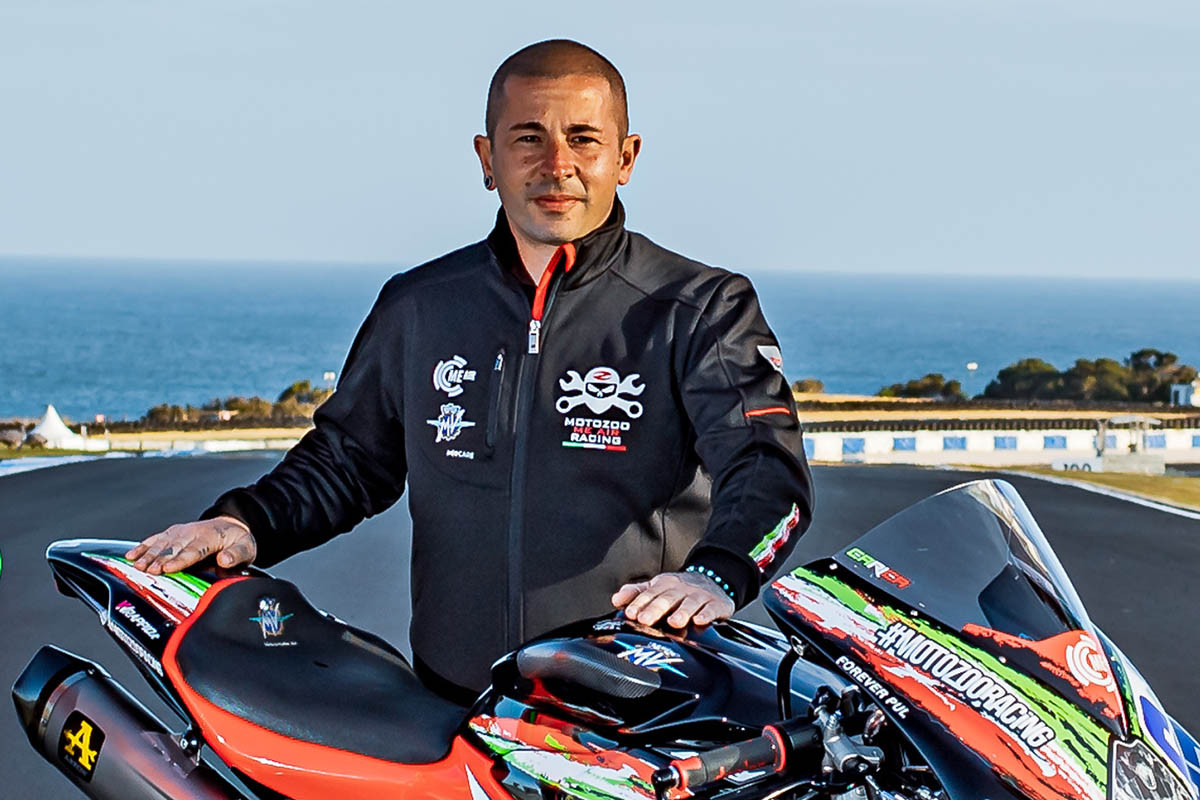
Fabio Uccelli, Team Manager Motozoo Racing. Motozoo photo.
Fabio Uccelli - Team Manager Motozoo Racing: "For us, this is much more than simply changing bikes. It is the beginning of a project we strongly believe in, and we are proud to have the opportunity to bring a brand like Suzuki back to the Supersport World Championship. We are talking about a manufacturer that has written extraordinary chapters in motorcycle racing history and achieved some hugely important results in Supersport. Motozoo has been competing in this championship for several years, and we have grown as a team in this paddock. In 2023, we had the satisfaction of winning the World Supersport Challenge with Tom Booth-Amos, and since then we have continued to invest and gain experience. Today, being able to put everything we have learned at the service of a project like the Suzuki GSX-R750 represents both an opportunity and a major responsibility for us. We know there is a lot of work ahead because taking on a new project requires development and a huge commitment from the entire team, but that is precisely what makes this challenge even more exciting. Having Mattia with us is another key element. We know him well, we already worked together in 2025, and we know how fast he is and how important he can be in developing the bike. Together we claimed two pole positions and saw just how much potential he has. Starting again with him, with Suzuki and with such an important project allows us to look towards 2027 with great enthusiasm and ambition. We want to respect and honour the history of this brand, but above all we want to start writing a new chapter of it."
 Motozoo rider Mattia Casadei. Motozoo photo.
Mattia Casadei (#40): "I am really happy to be back with Motozoo and to do so as part of such an important project. I already had a great experience with Fabio and the team in 2025, and from the very first races we were able to be competitive, also claiming two pole positions. Returning to an environment and to people I already know will definitely be important, especially because we have a completely new challenge ahead of us. Bringing the Suzuki GSX-R750 back to the Supersport World Championship is a major responsibility, but also a huge source of motivation. Suzuki is a brand with an incredible history in motorcycle racing, and knowing that I am the rider chosen for this comeback makes me very proud. There will be a lot of work to do, and we will have to get to know and develop the bike step by step, but that is exactly what makes this project so interesting. I know how Motozoo works and I know how much passion there is within the team. I can't wait to start working with the team and to bring the number 40 bike onto the track. The goal will be to develop quickly, be competitive and try to bring Suzuki back to the positions it deserves."
Motozoo will race using the Suzuki GSX-R750 fitted with ride-by-wire designed and developed by Team Hammer and Bike Sport Developments. A longstanding racing enterprise in the United States, Team Hammer has been racing 46 consecutive seasons and manages the Next Generation program for the Suzuki GSX-R750. In addition to the supplying the ride-by-wire system, Team Hammer will assist Motozoo with technical support and high-performance parts developed racing in the MotoAmerica series.
Chris Ulrich - Team Hammer Vice President: "I initiated the design and development of the ride-by-wire system and convinced Suzuki to homologate the bike in 2022. The GSX-R750 has had a lot of success in MotoAmerica, British Supersport, the Isle of Man, and the International Dutch Championship. I'm very proud to finally see a Suzuki GSX-R750 Powered by Team Hammer on the grid in the Supersport World Championship!"
With this new project, Motozoo Racing, Suzuki and Mattia Casadei are now preparing to take on the 2027 FIM Supersport World Championship together.
On one side is a manufacturer that has written important chapters in the history of the Supersport World Championship; on the other, a team that has built its experience in this category all the way to winning the 2023 WorldSSP Challenge. At the heart of the project is a World Champion rider like Mattia Casadei and a Suzuki GSX-R750 to learn, develop and refine with one shared objective: Turning a major comeback into a new winning project.
The post World Supersport: Motozoo Running GSX-R750 With Casadei appeared first on Roadracing World Magazine | Motorcycle Riding, Racing & Tech News.

Kevin Bates, creator of the credit card-sized Arduboy game system, now sells a $149 digital candle that uses a small neural network ("8-dimensional latent, convolutional decoder, 3,545 parameters, 30 fps") to generate a realistic flame simulation on its low-resolution display. — Read the rest
The post Arduboy Digital Candle has AI-simulated flame appeared first on Boing Boing.
There's a lot wrong with AI. But bad things happen when we try to use copyright law to fix it. Which is what we just told the Southern District of New York, where OpenAI and Microsoft are defending themselves in several cases alleging that their training violated the copyrights of the works the AI models were trained on. We made a few points.
One overarching point is that what the plaintiffs are trying to do is not what copyright law is for. Copyright gives the holder the ability to control how the embodiment of the work is used (ex: you can't copy a book without permission, or, as the example we used in the brief, perform a play) but not the ability to control the public from benefiting from its contents. Copyright can control such activities as copying, distributing, or performing a work but NOT reading, watching, listening to, or learning from a work. What OpenAI does with its training is the latter set of activities, not the former. But if OpenAI is somehow not able to engage in these activities because of copyright, then no one can. Which would lead to a direct harm to the public, a loss of an important benefit copyright law is actually supposed to give it.
In fact, it is a benefit copyright law must provide the public. The whole point of copyright law is to promote "the progress of sciences and the useful arts," or, in other words, help ensure we get more innovation and expression. But the plaintiffs in these cases want the opposite: they want copyright to stop these things. They want copyright law to prevent AI from being further developed (indeed, in its complaint the New York Times Company even asked for OpenAI's models to be destroyed!) by denying it the ability to do the learning that is needed for it to be useful. And they want to prevent any of the further expression that AI helps facilitate, even though fostering new expression is exactly what copyright law is supposed to do.
In fact, it is what copyright law is constitutionally required to do. Moreover, if, rather than fostering innovation and expression, copyright law instead obstructs it, then copyright law is not constitutional. Congress only gets its authority to make copyright law through the Progress Clause ("to promote the progress of science and the useful arts…") so if it turns out that the law it has passed instead does the opposite of promoting progress, then that law is unconstitutional, as being beyond its authority.
The First Amendment also limits Congress's authority to pass laws that inhibit free expression. So Congress also would not have had the authority to pass a law that let copyright holders of existing works prevent either the development of AI or any of the downstream, lawful expression AI helps facilitate. If the copyright statute Congress passed were to have that effect, then it would be unconstitutional.
It also would violate the Constitution in another way we've discussed before: by violating the First Amendment-protected "right to read," which is sometimes also referred to as the right to receive information. All those learning activities (reading, watching, listening to, etc.), which the current statute does not actually restrict, are activities that the First Amendment entitles the public to do, and copyright law not only does not prevent, but constitutionally could not prevent.
Meanwhile, we also made an overarching point: even to the extent that AI as we know it may be terrible, and we are looking for a law that can stop it, copyright law is still not the right law to do it. First of all, it's not tailored to the actual problems we'd want to address (for instance, if using AI in hiring decisions produces discriminatory results because of bias incorporated into the AI model, then the solution to that problem is making sure that AI can train on even more material, not less, because it is the training limits that tend to create that bias). Secondly, the worse we think today's AI is, the more important it is that something better is developed, but if law can stand in the way of further development, then none will be. None can be, and we'll be stuck with the technology we have, if not an even worse version of it if we have to degrade the models in response to copyright claims. As well as stuck with an imbalanced, super-powered copyright law that could stand in the way of lots of other non-AI innovation and expression.
And, again, if we have to freeze the technology because of copyright law, then copyright law is definitely running afoul of the Constitution, which allows Congress to pass a copyright law that only does the opposite.
In sum, the worse you think AI is—and we make no quibble with that assessment, although we did point out that it also has some distinct upsides, particularly when it comes to enabling more expression—the more important it is that these copyright claims be dismissed. Because however bad the state of play may be today, a copyright law that would let these claims prevail will only make everything worse.

I believe I was born with a medieval imagination. It is the only way I can explain the explicit gothic terrors of my childhood. Even lying in my cradle, I recall observing the monstrous face that emerged from the ceiling lampshade once the light was turned out. This all-seeing creature, peering at me from above, grew more pervasive as years passed, occupying the shadows at the edges of my vision and assuming more concrete manifestations. An unexpected sound in my dark room revealed its presence, causing me to lie still and hold my breath, as if through my petrified silence I could avert the attention of the devil leaning over my bedside.
When I first became aware of gargoyles carved upon churches and illustrated in manuscripts, I recognised these creatures from my own imagination and I made my own paintings of these scaled, clawed, horned, winged beasts, which were as familiar as animals in the natural world. I interpreted any indeterminate sound or movement from the dark as indicating their physical presence in my temporal existence. Consequently, darkness, shadow and gloom were an inescapable source of fear to me on account of the nameless threat they harboured, always lurking there just waiting to pounce. At this time of year, when the dusk glimmers earlier in the day, their power grew as if these creatures of the shades might overrun the earth.
Nothing could have persuaded me to walk into a dark house alone. One teenage summer, I looked after an old cottage while the residents were on their holiday and, returning after work at night, I had to walk a long road that led through a deep wood without street lighting. As I wheeled my bicycle up the steep hill among the trees in dread, it seemed to me they were alive with monsters and any movement of the branches confirmed their teeming presence.
Yet I discovered a love of ghost stories and collected anthologies of tales of the supernatural, which I accepted as real because they extended and explained the uncanny notions of my own imagination. In an attempt to normalise my fears, I made a study of mythical beasts and learnt to distinguish between a griffin and a wyvern. When I discovered the paintings of Hieronymous Bosch and Pieter Breughel, I grew fascinated and strangely reassured that they had seen the apocalyptic visions which haunted the recesses of my own mind.
I made the mistake of going to see Ridley Scott's The Alien alone and experienced ninety minutes transfixed with terror, unable to move, because - unlike the characters in the drama - I was already familiar with this beast who had been pursuing me my whole life. In retrospect, I recognise the equivocal nature of this experience, because I also sought a screening of The Exorcist with similar results. Perhaps I sought consolation in having my worst fears realised, even if I regretted it too?
Once, walking through a side street at night, I peered into the window of an empty printshop and leapt six feet back when a dark figure rose up from among the machines to confront my face in the glass. My companions found this reaction to my own shadow highly amusing and it was a troubling reminder of the degree to which I was at the mercy of these irrational fears even as an adult.
I woke in the night sometimes, shaking with fear and convinced there were venomous snakes in the foot of my bed. The only solution was to unmake the bed and remake it again before I could climb back in. Imagine my surprise when I visited the aquarium in Berlin and decided to explore the upper floor where I was confronted with glass cases of live tropical snakes. Even as I sprinted away down the street, I felt the need to keep a distance from cars in case a serpent might be lurking underneath. This particular terror reached its nadir when I was walking in the Pyrenees, and stood to bathe beneath a waterfall and cool myself on a hot day. A green snake of several feet in length fell wriggling from above, hit me, bounced off into the pool and swam away, leaving me frozen in shock.
Somewhere all these fears dissolved. I do not know where or when exactly. I no longer read ghost stories or watch horror films and equally I do not seek out dark places or reptile houses. None of these things have purchase upon my psyche or even hold any interest anymore. Those scaly beasts have retreated from the world. For me, the shadows are not inhabited by the spectral and the unfathomable darkness is empty.
Bereavement entered my life and it dispelled these fears which haunted me for so long. My mother and father who used to turn out the light and leave me to sleep in my childhood room at the mercy of medieval phantasms are gone, and I have to live in the knowledge that they can no longer protect me. Once I witnessed the moment of death with my own eyes, it held no mystery for me. The demons became redundant and fled. Now they have lost their power over me, I miss them - or rather, perhaps, I miss the person I used to be - yet I am happy to live a life without supernatural agency.



Fourteenth century carvings from St Katherine's Chapel, Limehouse
You might also like to read about

Police are using AI to generate reports on "suspicious" driving patterns, using data from license-plate cameras, then pulling over motorists based on that pretext.
The ACLU's Jay Stanley reports the example of Grace Knowles, a woman in her 20s, whose September 2005 road trip to Florida was deemed suspicious by the Flock-based system. — Read the rest
The post Cops using AI to justify stops for "suspicious driving patterns" appeared first on Boing Boing.

In May, when federal Judge April Perry uncovered apparent grand jury misconduct, the underlying Broadview Six prosecution collapsed. Perry began examining whether federal prosecutors were candid with her about what happened and whether officials outside the Chicago U.S. attorney's office were involved. — Read the rest
The post DOJ tells judge probing prosecutor misconduct that Trump can make it go away appeared first on Boing Boing.
ICE agents retaliated against two U.S. citizens observing them in Portland by pushing a shopping cart at them, tailing them, boxing in their vehicle, and finally slashing one of its tires. An official complaint filed by the ACLU of Oregon requests a prompt investigation into the incident and discipline for the responsible agents. — Read the rest
The post ICE agent filmed slashing car tire appeared first on Boing Boing.
Declining token prices have prompted Darkbloom, a distributed inference network, to reassess its business plans.
Darkbloom, a project from Seattle-based tech biz Eigen Labs, has developed software that allows anyone with a sufficiently capable macOS device to rent their GPU through the Darkbloom network for interference jobs. In return, they get paid.
Through this network, 800 or so participants - including as of two days ago this reporter - have been able to collect a few cents to a few dollars per day by having their hardware handle AI model prompts submitted through OpenRouter, an AI model gateway.
In theory, someone running one of Apple's recently released Mac minis with an M5 Pro chip and 64 GB of RAM could earn as much as $192 per month handling incoming inference jobs, per the company's estimate.
That assumes full 24/7 utilization during this period on a sought-after model like Qwen3.6 35B A3B, which sells for $0.065/M input tokens, $0.75/M output tokens. But not every network participant has fully surrendered their Mac hardware to the network.
The median earnings of the 50 people on the leaderboard amount to about $5.26 per day, $159.86 per month, or $1,918.50 per year. So the best case estimate presented by Darkbloom looks plausible. But it may not be sustainable.
The price of tokens - the unit of AI work - has declined, reportedly down 54 percent since May. Ramp's AI Token Price Index, which tracks the price of tokens from Anthropic and OpenAI, shows similar slippage. For Anthropic, the price per million tokens went from $2.65 on May 1, 2026 to $0.62 on October 22, 2026, a decline of 77 percent.
In a message shared with Darkbloom participants on the company's Slack channel, Kydo, one of the Eigen Labs researchers working on the distributed inference network, celebrated the network's processing of its trillionth token while attempting to moderate expectations about the project's viability.
"Earnings have been low," said Kydo. "For most providers, I don't expect that it is going to recover soon."
Pointing to the computational prowess of DeekSeek's DeepInfer framework, he explained that structural changes in the inference market have affected the supply of tokens.
"Data centers have become cheaper," he said. "Output per NVIDIA cluster is up ~20x this year, and their margins are wide enough to cut prices 90 percent and still profit at 50 percent."
The flood of tokens in turn has washed away the price advantage Darkbloom had previously. "The market caught up to our price," Kydo explained. "We could go lower, but then most of you would earn even less nothing."
Finally, he said, the inference routing market is changing, with OpenRouter moving away from price-based routing and putting more emphasis on decode speed, quantization, and prefill speed.
For network participants with older or less powerful Mac hardware - those without top of the line Max or Ultra Apple Silicon - "inference won't be worth running," he said.
Kydo went on to outline how Darkbloom aims to adapt to the commoditized token market. This involves analyzing model demand to steer participants toward more sought-after models, and looking at ways to provide other kinds of compute work, like distributed CI/CD jobs.
For Mac hardware, the focus now appears to be on clusters of high-end Mac Studios (now available with up to 512 GB of RAM), using Apple's Remote Direct Memory Access (RDMA) over Thunderbolt.
The CI/CD work, based on the observation that AI agents now make pull requests faster than CI/CD pipelines can handle them, will require sandboxing — something the biz expects to begin testing soon. And Darkbloom also aims to improve the performance of its network (in terms of time to first token) and to look for other token buyers beyond OpenRouter.
"The next stretch will be a fight, and I expect many machines will leave and Slack will get quieter," Kydo concluded. "But those who stay will be first in line when new earning opportunities come along. We are a driven team and well capitalized. We will not give up." ®
When you're ordering food from your phone, even time spent navigating the app is time wasted. At the P99 2026 virtual conference, Elvis Chidera, a staff engineer at Germany-based global delivery service Delivery Hero, explained how the company moved most of its user base to HTTP/3, and consequently cut its apps' total end-to-end response time of the home screen by 17 percent.
Chidera, who managed the project, explained that, as promised on the tin, HTTP/3 delivers the web faster than HTTP/2, though it has slow bits that need to be adjusted to work properly.
Uber eats Delivery HeroDelivery Hero is all but unknown in the US, which is dominated by Uber Eats and DoorDash. But it is a company with global reach outside the US, with an estimated user base of 60 million across Europe, Latin America, Africa, the Middle East, and Asia. Uber is currently acquiring Delivery Hero for $14.8 billion, with plans to unite the company with Uber Eats.
With this purchase, Uber would expand the number of markets where it offers both ride-hailing and delivery services, though not necessarily under the Uber Eats nameplate. Delivery Hero centrally manages separate apps for different regions, all of which it built or acquired. Asians can order poke bowls and sundries through Foodpanda. Turks can order kebabs through Yemeksepeti. Throughout Spain, Italy, Poland, Romania, Ukraine, and much of Africa, the Glovo app is where to ring up the late-night deliveries. And in Latin America, users dial in to PedidosYa to get what they need from nearby farmacias, restaurantes, and mercados.
All these regions have widely varying network connectivity, a problem Delivery Hero wanted to minimize.
Last mile networking was most often the bottleneck. Apps in Pakistan, for instance, could take nearly a second (at p90) to establish a secure handshake with a server. The engineering team looked at HTTP/3 as a way to lower, even eliminate, that latency.
A QUIC-er HTTPThe Internet Engineering Task Force (IETF) formally introduced the third version of the internet's Hypertext Transfer Protocol in 2022. HTTP is the application layer protocol that connects browsers and other resources connected to servers over the Internet.
The previous versions of HTTP were built on the Transmission Control Protocol (TCP), which offered guaranteed delivery and flow control. In conjunction with the Internet Protocol (IP), TCP/IP built the modern internet.
HTTP/3 replaced TCP with Quick UDP Internet Connection (QUIC), developed by Google, to address some of TCP's perceived sluggishness as a transfer protocol.
UDP stands for User Datagram Protocol and, unlike TCP, it does not guarantee packet delivery or flow control. UDP is faster because it doesn't wait around for a signature (QUIC adds in its own flow control on top of UDP).
But the UDP-based HTTP/3 reduces, and sometimes eliminates, the round trips needed to secure connections. The app can cache a session ticket and, on a later connection, use QUIC's 0-RTT capability to start sending eligible application data while the handshake is still underway, rather than waiting for it to finish.
"Essentially, you can eliminate that one second" of latency that plagued slower networks, Chidera said. "You don't want to pay the cost of two round trips just to exchange data, if you could do it faster."
And unlike HTTP/2, HTTP/3 doesn't get hung up when packets are lost or delayed. There's no head-of-line blocking because packets are sent in multiple streams, not just the single string that HTTP/2 offers.
Multitask during initializationSetting up HTTP/3 turned out to be surprisingly easy, Chidera found. Delivery Hero used Cloudflare's content delivery network to serve its global user base, so moving to HTTP/3 involved a simple reconfiguration.
Adding HTTP/3 support to the clients, mostly mobile, proved almost as straightforward. Apple has supported HTTP/3 since iOS 15 and most native browsers already support HTTP/3 out of the box.
Android proved a bit trickier. The engineers used Google's Cronet library for the networking stack, initially wired into their Android apps with the Cronet Transport for OkHttp wrapper to minimize rewriting their existing code, originally written for the OkHttp HTTP client.
Out of the box, Cronet helped support the HTTP/3 rollout, which reduced network-level request failures. But it also came with a significant catch: the engine took approximately 800 milliseconds to initialize at P90, eating into some of HTTP/3's 0-RTT speed benefits. So the team forked the code into their own bridge using a library called OKCronet. They also did some additional engineering work, which involved overlapping Cronet initialization with other background tasks.
Overall, they slashed the P95 latency time from 1.2 seconds to 120 milliseconds, achieving a 10x improvement in read latency.
Choose your congestion control algo wiselyOverall, the engineering team moved 95 percent of the users over to HTTP/3. Those devices that couldn't use the protocol (largely due to networks blocking UDP traffic) automatically fell back to HTTP/2. Handshake latency between the apps and the server was cut by 51 percent. Pakistan's response time was cut in half.
One hurdle remained, however. Secondary screens on some of the apps (pages/screens that aren't the home page) experienced latency issues. These issues only happened in certain markets that were known to be prone to packet loss, such as Pakistan.
Delivery Hero's engineers attributed the issue to Cloudflare's choice of the congestion control algorithm for HTTP/3, Cubic, which historically has not handled packet loss well. The engineering team tested some of its traffic with Google HTTP/3-aware servers, which use another congestion protocol, Bottleneck Bandwidth and Round-trip propagation time (BBR), and did not get hung up on the packet loss.
Delivery Hero is currently working with Cloudflare to resolve this specific congestion algorithm issue, Chidera said.
Sometimes that fresh, delicious lahmacun just won't get to your door as fast as it possibly can, despite all best efforts. ®
A n0n ransomware operator tried to break into 23 organizations across 14 countries, but couldn't secure its own front door, leaving its server exposed with all of its methods on view.
The criminals used a mix of new (AI) and old (stolen credentials) tooling during their data-theft spree, and in some cases not only stole and encrypted files, but also deleted data and backups, eliminating victims' ability to recover their information.
And despite the fear and hype around the breachpocalypse, with AI finding and developing exploits for critical vulnerabilities affecting most organizations across the globe, these crooks did not exploit a single bug to gain entry into any of their victims' IT environments.
"In every documented compromise in this investigation, access relied on weak or stolen credentials," said Ensar Seker, chief information security officer of threat intelligence firm SOCRadar.
"What stands out is the combination of AI-assisted development and very conventional entry points," Seker told The Register. "We found no evidence of vulnerability exploitation in the cases examined."
The gang breaks into organizations at scale using widespread Remote Desktop Protocol (RDP) scanning and automated FortiGate SSL-VPN credential stuffing. To access US-based IT managed services provider ChiBiTek, the crew used a 15-thread residential SOCKS5 proxy pool to test credentials (ip:port:user:password) against FortiGate portals (GET /remote/login).
The operators also gained entry using exposed cloud credentials and reused hosting portal sessions. In one case linked to e-commerce site Fanatics, SOCRadar found that n0n used an exposed AWS access key with permissions to list, read, and delete objects in S3 buckets. The criminals then used this key to pull data from 40 S3 buckets, with up to 110 GB per bucket, and ultimately deleted data, including bank-transaction archives, and purged keys across 12 sensitive buckets.
AI-assisted extortionWhile the threat hunters didn't find any evidence of a fully autonomous attack system, the ransomware operator did use AI to assist with these intrusions, incurring more than $7,216 in AI usage costs by October 22.
Specifically: the criminal or criminals used OpenCode, an open-source AI coding agent, configured with 154 model entries across seven providers. Models included Gemini, Mistral, Nemotron, Llama, Claude, GPT-5.x, Grok, Kimi, GLM, DeepSeek, MiniMax, Qwen, and many, many others, some with safety training removed and others marketed as "uncensored" models.
"The operator used AI to write and debug hundreds of scripts. That shows how AI can help an attacker turn basic access into a broader, tailored operation," Seker said.
"The destructive behavior is equally significant," he added. "The operator did more than steal and encrypt files: in some cases, it deleted data and backups, and in one case changed firewall policies to block traffic. That creates a recovery problem that a decryption key alone cannot solve."
SOCRadar's threat hunters found the operator's workspace - a publicly accessible Python HTTP file server hosted in Sweden at 185.157.161[.]148 on port 8877 - last month, and documented the exposed directory in snapshots on September 25 and 26.
"Across those snapshots, we identified 1,719 files, including attack scripts, ransomware source code, extortion infrastructure, and an AI coding agent environment," Seker said. "This gave us visibility into the operation behind the victim listings, including how the operator prepared attacks and handled stolen data."
Meet n0nIt also provided a close look at n0n, a newcomer to the data-theft and extortion game that has claimed 108 victims since it emerged last month.
On October 12, the group added 38 maritime, port and logistics organizations across 18 countries to its leak site in a single batch. Researchers have linked at least 21 of them to customers of South Korean maritime software provider CyberLogitec, although the software provider has not confirmed an intrusion.
The crooks set an October 19 deadline for the maritime firms, with ransom demands ranging from $400,000 to $28 million, payable in Bitcoin. After the deadline, however, none of the 38 listings were marked "settled" and none of their payment addresses showed any transaction. All affected organizations' stolen data was published.
While a handful of the gang's claimed victims have been marked "honored - data destroyed" on n0n's leak site, indicating the victim orgs paid the ransom demand, SOCRadar hasn't validated any transactions on-chain. In its profile details, the security shop rates the gang a 10 out of 10 for "aggressiveness" and a zero out of 10 for "lethality."
The group is believed to be based in Russia, although the server uncovered by SOCRadar, which it attributed to a single operator or small team, didn't provide any definitive geographic or national attribution.
Every case that the exposed server documented followed the same lifecycle, moving from initial access to establishing persistence and credential collection via hidden admin accounts disguised as services, covert proxies, credential and session-token theft, mailboxes and emailed multi-factor authentication codes.
The crooks then collected sensitive data and sent everything to the operator's central storage with the attack impact shifting between data-theft, encryption, destruction, and network disruption, depending on the targeted organization.
After breaking into Transcom, a Netherlands-based financial services provider, the crims sent a secondary ransom alert directly to PayPal's security team, even though the compromised data was only on Transcom's network.
Stupid mistakes and n0n security basicsFinally, the crims send ransom notes, post a countdown clock on the leak site, establish negotiation rooms and emails for victims - and then leak the stolen files or destroy backups when the organizations don't pay up. In some cases, and to apply increased pressure on victimized companies, n0n also broadcasts automated countdown warnings to businesses' service providers, clients, and media outlets.
Despite its aggressive tactics, the operator in this case - as with other stupid criminals The Register has gleefully documented in earlier stories - still struggles with basic security hygiene.
"There is a striking gap between operational ambition and security discipline," Seker said. "The operator invested thousands of dollars in AI services while leaving its own workspace exposed. The locker also contained hardcoded encryption keys, with evidence suggesting reuse across victims. An operation can have serious destructive capability while still making fundamental mistakes."®

Droid builders are reverse engineering Disney's real-life "duck" robots.
The post OpenBDX Duck Robot: Learning to Waddle appeared first on Make: DIY Projects and Ideas for Makers.
Dolly Parton, tulips and outback life all feature in the best images captured across the country in October
Continue reading...

Knightmare, the classic virtual reality TV show that sent a blindfolded adventurer into a green-screen CG dungeon, is coming back as a point-and-click adventure game in 2027. It'll be a free download and star most of the show's original cast, including Hugo Myatt as dungeon master Treguard, and has a lovely hand-drawn cartoon style. — Read the rest
The post Classic UK dungeon crawl show Knightmare to return as adventure game appeared first on Boing Boing.

I only bought four pens when I was in Japan earlier this month. And I wish I'd bought more. As usual. But I like all four of them.
 Photo: Mark Frauenfelder
I picked them up at a fantastic department store called Hands, formerly Tokyu Hands, but it changed its name a couple of years ago. — Read the rest
The post Four cool pens I bought in Japan appeared first on Boing Boing.

TL;DR: Compare answers from Claude, Gemini, ChatGPT, and more in one search with a lifetime subscription to Clearafi's Tier 1 Plan for $49.99 (reg. $299).
Getting a second opinion on an AI answer usually means pasting the same question into another chatbot and comparing the replies yourself. — Read the rest
The post This AI tool asks multiple chatbots your question and shows where they agree, and a lifetime subscription is only $50 appeared first on Boing Boing.

Say what you will about gaming auteur and Metal Gear creator Hideo Kojima, but the man clearly has a talent for the pitch. On its surface, post-apocalyptic mailman simulator Death Stranding doesn't lend itself well to a cinematic universe, given its slow, action-averse gameplay. — Read the rest
The post Death Stranding gets a second animation before the first is out appeared first on Boing Boing.

David S. Pumpkins returned to SNL in 2022 and, importantly, had not changed.
Still dancing, still confounding horror-seekers, David S. Pumpkins came back, ostensibly from Ibiza.
These skits almost justify SNL's continued existence.
Previously:
• David S. Pumpkins week begins now. — Read the rest
The post We learn that David S. Pumpkins is from Ibiza appeared first on Boing Boing.


