

General Motors is taking what looks like a light slap on the wrist from a coalition of 35 states and the District of Columbia after agreeing to settle allegations that it collected drivers' data without proper consent and sold it to data brokers that supplied insurance companies.
The Washington state AG's office said on Thursday that GM had reached a $220 million settlement with 36 attorneys general over the automaker's collection and sharing of driving data, including precise location information, speed, seatbelt use, and other metrics. According to investigators, GM sold that data to brokers, which in turn supplied it to insurance companies that could use it to set customers' premiums, without drivers' informed consent.
For reference, the $220 million settlement, which will be distributed among the participating jurisdictions, equates to less than 7 percent of GM's $3.3 billion in net income attributable to stockholders for its third quarter, which ended on September 30, 2026. Don't spend it all in one place, y'all.
The settlement comes more than two years after a 2024 New York Times investigation found that GM had been selling the data collected from vehicle owners through its Smart Driver program. That program, part of GM subsidiary OnStar's offering, collected the aforementioned data and handed it back to vehicle owners in reports designed to inform better driving habits.
Unbeknownst to Smart Driver subscribers, their data was also being forked over to data brokers despite GM telling customers it wouldn't share that information with insurers without their express consent. The insurers ultimately obtained the data by purchasing it from brokers with which GM had struck deals.
To make matters worse, the Washington AG's office said GM incentivized dealerships to enroll customers in Smart Driver, with employees in some cases accepting terms and conditions on customers' behalf without their knowledge or consent.
GM also failed to notify many drivers that their information was being collected and shared. Its OnStar app incorrectly told more than 370,000 drivers they were not enrolled in Smart Driver, even as GM continued collecting and selling their data, according to investigators.
"The data GM sold was personal, identifiable, and specific," the AG's office said. GM canned the Smart Driver program in April 2024, just over a month after the New York Times exposed its data-sharing practices, citing customer feedback.
In addition to the monetary pittance it's handing over to the states, GM also agreed with the 36 AGs to limit the driving data it collects, better protect customer PII, and establish a "comprehensive data privacy program." The Washington AG's office described its settlement as "significantly stronger than any other resolution reached with GM for this conduct."
Speaking of those other terms, GM finalized its settlement of the same allegations with the Federal Trade Commission in January 2026. The FTC order required GM to obtain drivers' express consent before collecting, using, or sharing covered driving data, subject to certain exceptions. It also required the company to offer a simple way for drivers to request a copy of their data, request its deletion, and disable precise geolocation data collection where their vehicles support it.
The state of California separately reached a $12.75 million settlement with GM in the matter in May; a separate case in Texas is ongoing.
"This agreement … reinforces steps we've taken to strengthen our privacy practices," a GM spokesperson told The Register, though the company noted that it still stands by driver data collection as a best practice.
"Safer, more helpful and personalized experiences are enabled by connected vehicle data, and GM is committed to being clear about what information is used, how it's protected, and the choices customers have about what they share," the spokesperson added. ®

Halloween Spirit from the Make: Editorial Slack Archives Every October, the Make: editorial Slack fills up with links. Someone posts a skeleton that carves pumpkins, someone else answers with a 30-foot marionette, and by Halloween we have a full haunted house worth of inspiration. Here are some of the builds that keep resurfacing in the […]
The post Halloween Spirit from the Make: Editorial Slack Archives appeared first on Make: DIY Projects and Ideas for Makers.
 ASBK: Cameron Dunker Set For Dual-Class Campaign [ 30-Oct-26 6:53pm ]
Addicted to Track are excited to announce the signing of former Australian Supersport Champion Cameron Dunker, who will contest the full 2026-2027 ASBK summer season in the Next Gen Supersport category aboard the team's Yamaha R6.
In a unique arrangement, Dunker will simultaneously continue his existing Superbike campaign with Blue Marlin Pools East Racing, competing across both categories with two independently operated teams.
The ambitious dual-class campaign marks an exciting return to the Supersport category for Dunker, who claimed the 2023 title on his 16th birthday following an impressive rookie season that included four race victories and three overall round wins.
As dual Supersport 300 and Yamaha R3 Cup champion in 2022, Supersport 600 champion in 2023, and now an Australian Superbike race winner in 2026 after a maiden victory at The Bend in May, Dunker has continued to establish himself as one of Australia's leading competitors, finishing fourth in both the 2025 and 2026 Superbike championships.
The South Australian circuit will now provide the setting for another significant milestone in Dunker's career, beginning his campaign with Addicted to Track when the Next Gen Supersport championship kicks off on November 13-15.
Competing in both categories will present a considerable challenge, with Jamie Stauffer being the last rider to have achieved the double championship victory in 2006 aboard Yamaha machinery.
For Addicted to Track, the signing brings an accomplished rider into its Supersport program as the team continues to strengthen its presence across multiple ASBK categories.
 Cameron Dunker (left) with Mark McGregor, Team Principal of Addicted to Track. Photo courtesy Addicted to Track Team.
Quote from Team Principal, Mark McGregor: "We spoke with Cam about the opportunity to return to Supersport alongside his Superbike commitments, and we fully believe that he has what it takes to do well across both classes. We're expecting him to do well on our R6 with the support of our team and sponsors, and look forward to helping him showcase his talent. We're really pleased to have reached a direct agreement with Cam, and we're ready for an exciting season together."
The Australian Superbike Championship's summer season continues at The Bend Motorsport Park in South Australia on November 13-15.
The post ASBK: Cameron Dunker Set For Dual-Class Campaign appeared first on Roadracing World Magazine | Motorcycle Riding, Racing & Tech News.
Elon Musk, a Guy Who Destroyed the Future for Millions, Advises You Not to Save Money [ 30-Oct-26 7:05pm ]
Fuel From Bamboo Costs Just $2.75 Per Gallon [ 30-Oct-26 7:04pm ]At CleanTechnica, we are passionate champions of the "electrify everything" movement promoted by Tony Seba and Mark Jacobson, among others. However, being realistic, internal combustion engines will continue to play an important role in transportation by land, sea, and air for the remainder of this century and perhaps beyond. Almost ... [continued]
The post Fuel From Bamboo Costs Just $2.75 Per Gallon appeared first on CleanTechnica.
US Tech Stocks See Sharp Falls As AI Spending Nears $1 Trillion [ 30-Oct-26 7:05pm ]
Sepang MotoGP Friday Round Up: Marquez Moves In For The Kill While The Track Falls Apart [ 30-Oct-26 6:57pm ]
The sharks are circling. No, not that shark; he will have to wait until next year. But Marc Márquez smells blood in the water, and is closing in for the kill. With Jorge Martin struggling with injury, and Marco Bezzecchi not as competitive as in some previous races, it is time of the 2026 champion to press home his advantage. If an opportunity presents itself, you have to seize it with both hands.
Why is he attacking at a circuit where he has traditionally struggled in the past? "Because it is time to do it," Marc Márquez said. He is not in peak physical condition, but with four rounds left, now is the time to strike. "When you don't feel good in the middle of the season with a physical condition then it is easier to have a big crash. Like I had in the first part of the season: a big crash in Austin, in Jerez and Le Mans. It was time to be calm. Now from Indonesia I decide - always because it was on my calendar - to put everything in and try to take the risk."
David Emmett Fri, 30/Oct/2026 - 18:57
Everything you need to know about Googlebooks [ 30-Oct-26 7:00pm ]
Adam Schiff Spent Years Defending Section 702. Now He's Accusing The Administration Of Hiding Its Abuses. [ 30-Oct-26 6:08pm ]We have talked about the Wyden Siren many times before. Senator Ron Wyden learns, through classified briefings, that the intelligence community is doing something most Americans would consider a clear violation of their civil liberties — often justified by interpreting plain English words to mean something no other English speaker would recognize. But because that information is classified, he can't just say what it is. So instead he sends a letter demanding that the intelligence community explain itself, carefully worded to tip off the public that the government is effectively lying about how it's violating our civil liberties. He's done it many times, from warning that the government had secretly reinterpreted the PATRIOT Act to flagging that supposed "cybersecurity" legislation was really being pushed for a more nefarious purpose.
This year alone, he's issued Wyden Siren letters a few different times. And now he's done so again, once again about Section 702 of the FISA Act, which has been a Wyden target for years. Wired has a summary:
Two Democratic senators who have long overseen US intelligence say the Trump administration is illegally withholding a secret court's findings from Congress until lawmakers renew a program that lets federal agents read Americans' communications without a warrant.
Seven months ago, the Foreign Intelligence Surveillance Court objected to search filters that let intelligence analysts pull Americans' messages from intercepted data without the approvals, written justifications, or records the law requires. The court approved another year of surveillance anyway. The ruling has never been made public, and Senators Ron Wyden of Oregon and Adam Schiff of California say the administration's own deadline for releasing it passed in September.
The program, Section 702 of the Foreign Intelligence Surveillance Act (FISA), lapsed in June after Congress failed to renew it, though collection continues under the court's March approval. The administration's own public documentation says rulings like this one are reviewed for public release "within 180 days of issuance." That window closed September 13, even as intelligence officials press lawmakers to reauthorize the program by the end of the year.
Wyden sounding the alarm is expected (and welcome). Schiff co-signing it is, however, a surprise. For many years when he was a Representative (prior to recently moving over to the Senate), Schiff was a reliable voice and vote for greater surveillance powers. He would frequently roll out his "as a former prosecutor" line to defend giving more and more power to the government.
Indeed, back in 2018, we called out Schiff (who was then the House ranking member on the Intel Committee) for giving Donald Trump greater surveillance powers in renewing Section 702. It was bizarre: Schiff was one of the loudest voices calling out Trump's abuses of power during his first term, and yet he led the charge among Democrats to hand Trump even more surveillance power. He even undercut Wyden's own attempts to rein in those powers, as Trevor Timm noted at the time in an op-ed blasting Democrats for handing Trump more surveillance power:
Schiff was a leading driver in the House to extend the NSA's surveillance powers, and has been undercutting the more robust reforms proposed by other Democrats, like longtime Senate Intelligence Committee member Sen. Ron Wyden, for months.
Given that history, seeing Schiff co-sign a letter accusing the administration of illegally hiding a ruling about 702 abuses is quite the turnaround.
Indeed, Schiff even blasted out a press release talking about "serious abuses of American's rights." That's quite a statement given how strongly Schiff fought to give those powers to the government.
The specifics here involve a secretive FISC ruling regarding Section 702. Technically 702 expired back in June, after Trump tried to tie its renewal to his ridiculous voting bill that no one is willing to pass. But back in March there was a secret ruling by the FISA Court which allows the government to keep using this surveillance authority at least until March of next year. That same ruling also objected to the search filters analysts use to pull Americans' messages without the approvals and records the law requires — and then approved another year of surveillance anyway. Wyden and Schiff want it public, and the law is on their side: the statute requires either a declassified version within 180 days or if the DNI waives declassification by yelling "national security" then it requires an unclassified statement from the Attorney General summarizing the legal interpretation. And Attorney General Todd Blanche unequivocally promised the Senate Judiciary Committee that he would deliver the unclassified opinion by the deadline.
That deadline came and went on September 13. The ruling remains classified. From Wyden and Schiff's letter:
We and others have repeatedly called for the administration to release the March FISC opinion. In May, the Chair and Vice Chair of the Senate Intelligence Committee sent a letter to the administration stating their expectation that the opinion would be released by May 15 "in order to inform the Senate debate on section 702." The statute itself requires the administration to release a declassified version of the opinion within 180 days. In July, Attorney General Blanche told the Senate Judiciary Committee he expected that the public release would happen "in advance of the statutory deadline." Attorney General Blanche unequivocally committed to "declassifying the opinion by the statutory deadline of 180 days and complying with the law." Nevertheless, it is now a month past the statutory deadline and the opinion has still not been released.
Simply put, this is not acceptable, especially as this administration restarts its attempts to lobby Congress to renew Section 702 without reforms. The administration has now had over seven months to declassify and release this opinion. It is time to stop violating the law and finally release this opinion. And if this administration won't follow this simple statutory directive, it is unclear why Congress or the American people should trust this administration to follow any of the other legal limits to Section 702.
We demand that you release this opinion as soon as possible. We also request that you respond in writing by November 6, 2026, providing an explanation as to why the opinion was not released by the statutory deadline and identifying the officials that were responsible for withholding its timely release.
As Wired notes, Senators can read the ruling, but only in a secure room, and those who have done so are dropping heavy hints about what it reveals:
Lawmakers who have read the ruling hint that it says more. Senator Dick Durbin, the top Democrat on the Judiciary Committee, urged colleagues on the Senate floor in June to read it in a secure room. "I have seen it," he said. Once they did, he told them, "your opinion of the role of FISA and the rights of Americans will be impacted for sure."
Wyden has also warned about a classified interpretation of Section 702 that he says multiple administrations have relied on and refused to declassify. "When it is eventually declassified," he said in March, "the American people are going to be stunned that it took so long and that Congress had been debating this authority with insufficient information."
Of course, the Trump administration seems to believe that laws are meaningless, especially if they require transparency or limit the government's ability to abuse the rights of anyone in America. So don't hold your breath waiting for Director of National Intelligence Jay Clayton to cough up this ruling. But as Wyden and Schiff point out, if the administration can't be bothered to follow a simple disclosure deadline, why should anyone believe it's respecting any of 702's other limits while it begs Congress for a clean renewal?
Daily Deal: Build Your Own GPS Tracking System with Raspberry Pi [ 30-Oct-26 6:03pm ]The best way to learn Raspberry Pi is by doing and in this course, you'll get familiar with specific features by building your own GPS tracking system. From setup and configuration to location tracking through Google Maps, this course will help you go from beginner to advanced with Raspberry Pi. It's on sale for $50.

Note: The Techdirt Deals Store is powered and curated by StackSocial. A portion of all sales from Techdirt Deals helps support Techdirt. The products featured do not reflect endorsements by our editorial team.
Intel Admits It's Ignored 'High-End Desktop Chips.' That May Soon Change [ 30-Oct-26 6:55pm ]
October Bylines Network Gazette - towards a better media [ 30-Oct-26 6:44pm ]The October Bylines Network Gazette is out now, and this month we're turning our powerful citizen spotlight on a subject close to our hearts - making the media better.
How many times have you finished a news story feeling more incensed than informed? How often is something important to your community ignored? Did you watch the Jason Arday media pile-on with a familiar sense of horror? Do you want news that puts accuracy and speaking truth to power ahead of sensationalism, right-wing narratives and profit margins?
So do we. Bylines Network believes in a better form of journalism - made by the people, for the people. That's why this Bylines Network Gazette brings you 108 pages of citizen stories about the media alongside sharp commentary from leading experts. We ask what happens when the press gets things wrong, what communities do when local reporters disappear and how we can build a better media from the bottom up.
In this bumper edition of our monthly magazine featuring standout stories from across the UK, you will find anger, uncomfortable reading, bold ideas and countless people showing how journalism can be done differently.
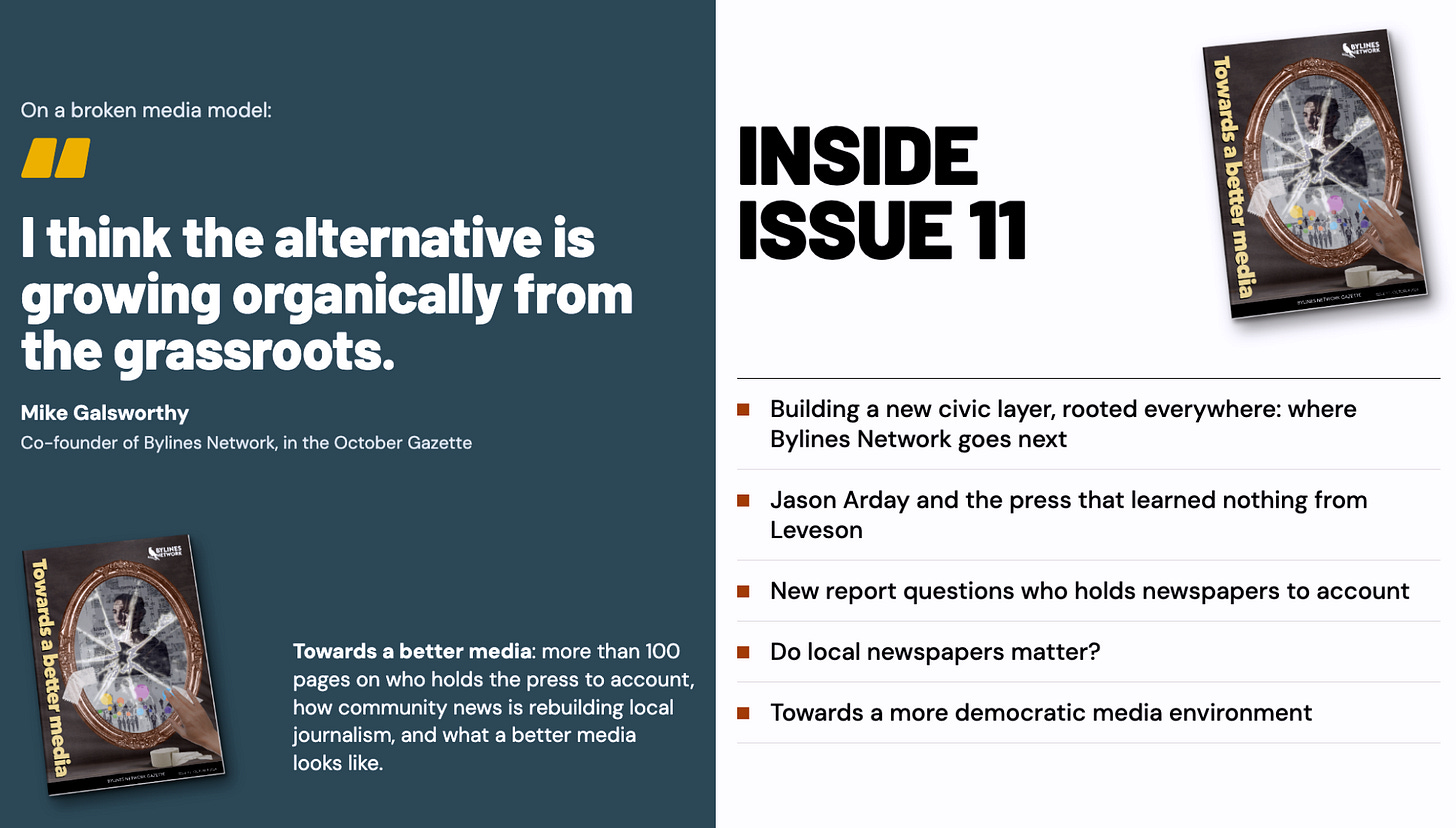
What's inside?
, Priyamvada Gopal, and on accountability, representation and what responsible journalism should look like.
Reflections on coverage of Professor Jason Arday, raising difficult questions about the behaviour and regulation of some sections of the press.
The media and the far right: how some parts of the media can instigate division and what we can do to challenge it.
The impact of disappearing local news, from the demolition of Portsmouth's old News Centre to the daily struggle of keeping independent reporting alive.
A look ahead with , revealing exciting plans for a Citizen Journalism Academy, support for local publishers and steps to build an even stronger Bylines Network community.
Why better media needs people who know their communities, care about getting things right and are prepared to ask tough questions.
A guide to bringing your own stories to Bylines Network publications, from first conversations with an editor to seeing your name on the finished article.
 How to get your Bylines Network Gazette
Our Gazettes are presented in a specially designed flipbook which you can read online or download as a PDF. How can you get access? You have three options:
Buy this edition as a one-off, and get access to the glorious online flipbook, which you can download as a PDF:
Become a Friend of Bylines Network. You can choose from the tiers described in this graphic. As well as the Gazette, your monthly donations give you access to a host of other benefits and - crucially - support powerful citizen journalism.
If you prefer to manage things through Substack, then please consider taking out a paid subscription to Bylines Network there. We consider paying Substack subscribers the same as Friends of Bylines Network, and give them access to all the same benefits. We are entirely not-for-profit, don't take advertising, or charge for services, and treat Substack subscriptions like any other donations that support our work.
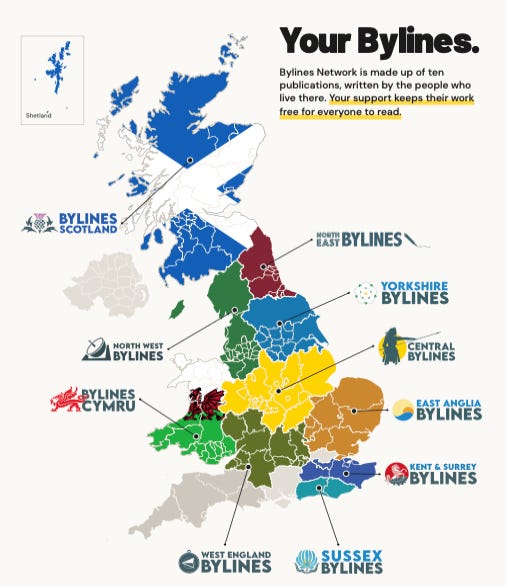 Journalism by the people, for the people - get involved, email us: info@bylinesnetworks.co.uk
Satlyt takes another step toward turning satellites into space data centers [ 30-Oct-26 6:01pm ]
GM Reaches $220 Million Settlement Over Selling Drivers' Private Data [ 30-Oct-26 6:24pm ]
Fan fiction website AO3 is down, and it could take weeks to recover [ 30-Oct-26 6:06pm ]

How do you prepare for an emergency when you can't afford the essentials? [ 30-Oct-26 6:02pm ]
Households are being encouraged to prepare for emergencies - but in Downham Market, some are struggling to afford today's essentials. The government's new Be Ready campaign asks households to prepare for three days of disruption from emergencies such as severe weather, when power, water, phone or internet services could be affected.
The advice includes keeping three days' bottled water and non-perishable food, along with essentials such as a torch and batteries, a power bank, first-aid supplies, hygiene products and some cash. It is sensible advice, and the government recognises that not everyone will be able to do everything on the list, suggesting that households check what they already have and gradually buy an extra item or two when they can. But what if there isn't money for an extra item?
Since it was established in 2023, Downham Solidarity Fund has distributed more than £6,000 through more than 200 small grants to people living in Downham Market. Grants are limited to £40 and come with no strings attached: applicants don't have to justify whether they need the money for food, energy, prescriptions or some other living cost.
According to co-founder Robert Shippey, however, the pattern is clear.
"The overwhelming reason people are asking for support from the fund is for basic essentials like groceries and energy bills, so without additional support in place it's difficult to imagine how some households in Downham Market and beyond will be able to stockpile to prepare for the incoming issues.
"Some people asking for support request less than the £40 limit, which tells us just how tight budgets are these days when such relatively small amounts are helping."
When there is nothing left over Action for Children CC BY
The experience of the fund reflects a much wider problem. Research by the Joseph Rowntree Foundation this summer found 62% of low-income families had been unable to afford at least one essential during the previous six months. Almost half had gone hungry, eaten smaller meals or skipped meals because they didn't have enough money for food.
In Downham Market, a third of children live in low-income families and around one in four state-school pupils are eligible for free school meals. Growing up on a low income can restrict children's opportunities and experiences as well as the material things their families can afford.
School holidays can make that particularly visible. Children who would normally eat at school are at home, adding to the family food bill, while childcare and organised activities can be expensive. With the unsettled weather East Anglia has experienced during this half-term, even the simplest free options - a trip to the park or an afternoon outdoors - become harder.
Norfolk does run Big Norfolk Holiday Fun, its version of the government-funded Holiday Activities and Food programme, which provides eligible children with activities and a meal. But the county's programme operates during the Easter, summer and Christmas holidays; there does not appear to be a Norfolk-wide programme running this October half-term. Families with enough money can usually work around these inconveniences, but for those whose budgets are already stretched to breaking point, each removes another option.
Financial insecurity is not confined to families with children. Older people living largely on the State Pension - particularly those paying rent and without private pension income - can have little left after essentials, while people with disabilities and long-term health conditions may face additional everyday costs associated with their condition.
 Image by Lysenko Andrii. Licensed by Shutterstock [AD]
Having a job does not necessarily provide protection from poverty either. Figures from April show 3.1 million people receiving Universal Credit - more than one in three claimants - were also in employment. In rural areas, limited public transport can restrict the jobs available to people without a car, while for some workers - including those providing care in people's homes - a vehicle may be essential to doing the job at all. Running it then becomes another unavoidable cost.
The circumstances differ, but when almost everything coming in is needed for today's essentials, there is little or nothing left with which to prepare for tomorrow.
When £20 makes a differenceDownham Market does have organisations trying to fill those gaps. Its foodbank provides emergency food, while the Solidarity Fund can respond with small amounts of cash that allow people to meet whatever immediate need they face. But some of that local provision has already disappeared.
"We have support in the town but services are under pressure," Shippey says. "We've just seen the Love Downham Shop, which provided subsidised essentials, close due to lack of funding at a time when initiatives like this are going to be needed more than ever."
The shop, run by Swan Youth Project, closed in August after almost four years. As well as subsidised food and affordable clothing, it provided a warm space and access to advice and other community support. Some of those services have moved to the youth project's Paradise Road base, but the shop itself has gone.
The government's preparedness campaign acknowledges that some households won't have the means to prepare fully, and suggests that people with extra supplies might donate them to others who cannot afford to prepare their own households.
Resilience itself requires resources. For people experiencing grinding poverty, there may be no spare money to put aside or capacity to buy something now because it might be needed later. Constantly making limited resources stretch to cover food, energy, housing, transport and other essentials leaves little room for manoeuvre when circumstances change.
Someone with enough money can keep additional food in the cupboard, replace something before it breaks, maintain a small emergency fund or absorb an unexpected £20 expense. For someone living on the edge of their income, that same £20 can make the difference between managing and not managing. The maximum Solidarity Fund grant is only £40, yet some applicants ask for less because that is all they need to get through the immediate difficulty.
Poverty takes many forms and affects people at every stage of life, but one consequence runs through them all: when the present consumes everything you have, it is extraordinarily difficult to build resilience against the future.
Telling households how to prepare for an emergency is sensible. But for some, the emergency is already here.
This article is based on a press release by the Downham Solidarity Fund, compiled with assistance from AI tools and edited by East Anglia Bylines. Donations can be made on their website.
More from East Anglia Bylines
 Activism
Cross-party MPs want to focus on preventing poverty
by East Anglia Bylines 5 May 2026
 Lifestyle
New report: Poverty is an expensive political choice
by Tom Burgess 18 February 2026
 Economics
Examining child poverty and living in Omelas
by Martin Waller 15 September 2021
 Friends of Bylines Network
There has never been a greater need for grassroots journalism that investigates the stories that really matter, holds power to account and champions the voices of everyday citizens. We are proudly powered by volunteers but what we do isn't free.
STAND WITH US for independent, citizen-led journalism that makes democracy stronger, and you will even get some exclusive benefits.
BECOME A FRIENDThe post How do you prepare for an emergency when you can't afford the essentials? first appeared on East Anglia Bylines.
The Season Finale of 'Avatar: Seven Havens' Book One Got There in the End [ 30-Oct-26 6:15pm ]
MapQuest Adds New 'Surveillance Layer' That Shows Locations Of ALPR Cameras [ 30-Oct-26 4:29pm ]Well well well. All it took was a regime change and the persistent abuse of camera networks by police officers to change MapQuest from "Remember MapQuest?" nostalgia to "hey where can I download MapQuest" demands.
First, there's the regime change. Trump has been stupid as fuck all the time since day one but nothing was much stupider than issuing an executive order renaming the Gulf of Mexico as the "Gulf of America." Oh wait. There was more stupidity. Trump — again saying anything that momentarily glanced off the shiny, wrinkless lobes of his forebrain — demanded Lake Ontario be renamed "Lake America."
If that were the end of the story — a wet-brained spray-tan-maxxing fuckmook participating in some short attention span jabbering between hours of Truth Social doomscrolling — we wouldn't be here today discussing this latest turn of events.
But Trump said something and companies started doing something. Some even started doing something before the spittle dried on Trump's lips, as Karl Bode discussed earlier:
Google was the first to quickly make the change to appease Trump; in fact they acted so quickly on this the change to Google Maps happened before the government had even finished implementing it. Apple was very quick to follow suit, despite the fact that nobody at the company actually supports the ridiculous and pointless change.
That's how tech billionaires greeted this momentary outburst from a guy who's never bothered to think twice. One company altered its map before it was even made official. The other did it even though no one in the company actually wanted to have it done. These are the actions of two of the richest and most powerful companies in the world — companies whose fortunes would have dipped to the equivalent of a rounding error if they'd chosen to reject this overture.
Meanwhile, one of the first names to the (map) game refused to play along. MapQuest doesn't have billions of revenue to spare, much less the ubiquity of companies that offer phones as well as pre-installed map apps. MapQuest once owned the digital mapping world, but it has been sidelined by vertical integration.
Maybe it's just because MapQuest (relatively) has nothing to lose. Or maybe it's because MapQuest actually seems to care about its users. Either way, MapQuest refused to alter its map to reflect Trump's digital takeover of Lake Ontario.
And now MapQuest is going after America's surveillance state — one made most infamous by another company that has far more liquidity than MapQuest: Flock Safety. While it's certainly not the first company to offer automatic license plate readers, it's the most famous. Its network is huge, capable of capturing 20 billion plate reads a month. And it's the current favorite of law enforcement agencies all over the US.
But Flock is working against its own ubiquity at the moment. It's more famous now for allowing cops to stalk people, especially ex-wives and girlfriends, as well as any people their exes might now be seeing. It's also a handy tool for cops who just want to track people, including anti-police violence protesters or anyone else who's annoyed them.
People want to know where these cameras are. Flock's tools have generated a ton of public records that have ultimately given activists the ability to locate and map camera locations. Other companies working with law enforcement have generated some data as well, albeit not as much as the current market leader.
MapQuest now offers what other map apps don't: a handy map of ALPRs.
MapQuest users in Canada and the U.S. can now see where some surveillance cameras have been set up in their communities.
The company introduced a "surveillance layer" earlier this week that uses animated eyes to mark where automated licence plate readers, or ALPRs, have been set up by police or others.
"We knew that there were a ton of cameras in use and documented in the U.S. and Canada," MapQuest general manager Doug Berger told CBC News. "You would never know unless they were pointed out to you."
This is very cool. For multiple reasons. A company deciding to highlight law enforcement surveillance on its official app is completely unexpected. That it did this because some of its users asked it to is even better, which means MapQuest cares more about its (relatively) small number of users than Google and Apple care about their millions of users who default to their apps simply because its part of their smartphone's pre-installed ecosystem.
And that means MapQuest will continue to grow, three decades after its debut. GM Berger noted that the company gained three million new users after refusing to rename Lake Ontario. Adding a "surveillance layer" just means more deliberate interaction from users. And people who choose apps for a reason, rather than just using whatever first presents itself to them, are far more loyal.
This is a very smart move by MapQuest. The decisions it has made in the last couple of months shows it's far more respectful of its current and future users than the massive tech companies that assume (often correctly) that consumers will eat whatever shit is shoveled at them by their service providers. MapQuest is looking for people who want to use MapQuest because they like what the company is doing. It's an incredibly smart move that builds the sort of trust and loyalty larger companies can only wish they had.
Archaeologists at Ancient Troy Unearth a 2,700-Year-Old Bone Flute. Odysseus Never Heard It [ 30-Oct-26 5:55pm ]
Florence and the Machine Announce Everybody Scream Tour Live Album [ 30-Oct-26 5:38pm ]
Zest's new AI agent finds restaurants and books reservations over text [ 30-Oct-26 5:47pm ]
MIX421: Two Another [ 30-Oct-26 5:34pm ]Sydney duo Two Another deliver a mix that pulls from soulful deep house and balearic-tinged groove influences, bringing big club drums and tightly controlled basslines from names like Rooleh, Dennis Cruz, Alan Fitzpatrick, and Nandu. Their 2026 run of studio releases for Sweat It Out! and Boogie Angst, alongside the September release of 'Elation', is […]
UK Social Media Ban May Lock Out More Than 100,000 Teens Without ID [ 30-Oct-26 5:13pm ]
How Hackers Stole $6.3 Billion From Binance in Minutes [ 30-Oct-26 5:11pm ]
Electric Hydrofoils Save Energy, But Do They Earn Their Price? [ 30-Oct-26 4:55pm ]Hydrofoils have an obvious appeal. Lift a boat's hull clear of the water, reduce drag and move passengers faster while consuming less energy. I've written before about the proposed electric hydrofoil ferry between Vancouver, Bowen Island and Gibsons, where floating logs, coastal conditions and uncertain passenger demand make the economics ... [continued]
The post Electric Hydrofoils Save Energy, But Do They Earn Their Price? appeared first on CleanTechnica.
The National Vintage Fishing Tackle Fair [ 30-Oct-26 4:20pm ]
Sunday 15th November 2026
The Abbey Stadium
Birmingham Road
Redditch
Worcestershire B97 6EJ
Doors Open 9am
Doors Close 1pm
Entry only £5
Free car parking. Wheelchair Access. Cafe.
Sponsored by Angling Auctions.
The National Vintage Fishing Tackle Fair returns on 15th November for its much anticipated autumn 2026 edition which takes place at The Abbey Stadium on Birmingham Road in Redditch (B97 6EJ). Established in 1995 and running twice a year since the fair has grown to become the largest and most celebrated gathering of antique and vintage fishing tackle dealers, collectors and enthusiasts in the country with many visitors also in attendance from Europe.
Yet again it is sold out in terms of stalls with a full complement of stallholders weeks ahead of the fair itself. In addition to stalls selling antique and vintage fishing tackle Garry Mills from the Mill Tackle Company in Studley will have a stall offering on the spot reel repairs and advice as well as taking orders for his bespoke range of reels and Andrew Davis the master split cane rod builder will be exhibiting examples of his finest work and taking orders for individual rods from his range. Representatives of the fair's sponsor Angling Auctions will also be on hand to value and take in items of tackle for forthcoming sales.
Fair organiser John Andrews who has been running the event for the last twenty-one years is proud of its links and associations with Redditch and its history of fishing tackle making and is always keen to meet Redditch residents who may have worked or had family members who worked at any of the Redditch tackle firms be they big or small. He is on the door at each fair and looks forward to welcoming regulars and new visitors on 15th November.
Google's first data center satellite is online and writing poetry [ 30-Oct-26 5:00pm ]
The Rise of the Christian Left in Texas [ 30-Oct-26 4:55pm ]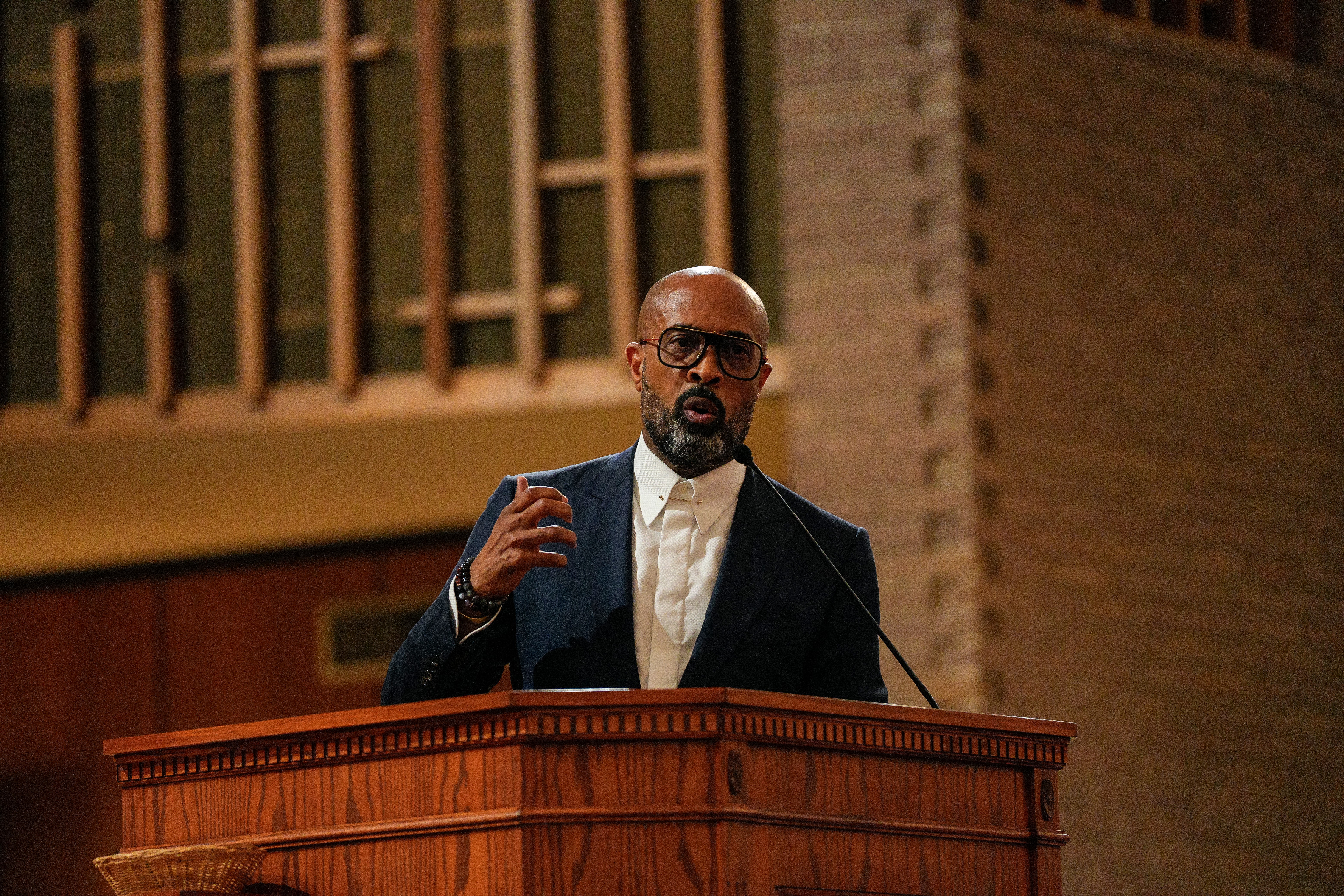 Rev. Frederick D. Haynes III speaks to the crowd during the We the People TX interfaith service, "A Night of Moral Resistance," in Dallas, on Sept. 9, 2026. Photo: AP Photo/Gabriela Passos
"Why do you wanna have a pep rally when people are hurting?"
That was the question Rev. Frederick Douglass Haynes III posed at a September food drive in South Dallas, where volunteers were collecting groceries for struggling families. Across town, Republicans were holding a midterm convention. Haynes, a longtime Baptist pastor and Democratic congressional nominee, was introducing James Talarico, the party's candidate for U.S. Senate in Texas.
A month later, speaking at a Dallas megachurch, Talarico offered his own interpretation of Christian duty.
"I try to love my neighbor through public policy," the Presbyterian seminarian told the congregation. "I'm trying to make my neighbor's life easier, better, less stressful."
Both men are making a deceptively simple argument in some of the staunchly staunch red-as-hell, Republican territory in America, one that might transcend the conventional wisdom about national campaigns and the millions poured into competing campaign war chests: When far-right policy translates into actual pain, at what point does intervening become a spiritual obligation?
Amid the big-ticket ad buys, fundraising appeals, and armies of political consultants, Talarico and Haynes are tapping into a political tradition that has long sustained communities across the South: showing up.
At Haynes's Friendship-West Baptist Church, the ministry extends to legal services, immigration advocacy, counseling, economic justice, and food policy. It is an example of how churches often form the connective tissue of communities suffering under economic and political strain.
When far-right policy translates into actual pain, at what point does intervening become a spiritual obligation?
That strain is measurable. Texas is home to four of the nation's 10 most financially distressed major cities, including Houston, which ranks second nationwide, according to a 2026 analysis. Feeding America estimates that nearly 1 in 5 Texans experienced food insecurity in 2024. Meanwhile, federal analysts project that changes to Medicaid eligibility enacted last year will increase the number of uninsured Americans by 7.5 million by 2034.
While Democratic Party leaders publicly debate how to punish Donald Trump politically, allege corruption, or navigate the ideological divide between moderates and democratic socialists, a different argument is emerging from Southern pulpits.
The Underground ChurchFrom Quaker abolitionists to the Social Gospel's challenge to industrial exploitation, progressive religious institutions have helped drive some of America's most consequential political transformations. Christian farmworker ministries supported migrant laborers before joining the United Farm Workers' California grape boycotts in the 1960s. And while Black churches overwhelmingly led, sustained, and suffered the brunt of violence in the fight for equal civil rights in this country, a handful of white denominations joined them.
Of course, churches also defended slavery, segregation, and exploitation. The blunt reality is that throughout American history, Christianity has always been political and has been used to justify a wide variety of competing political ends.
 Related
Pete Hegseth's Unholy War
But Republicans have deftly exploited the perception that they alone speak for American Christians. The Trump administration has readily embraced religious iconography, from evangelical leaders praying over the president in the Oval Office to Defense Secretary Pete Hegseth's frequent invocations of the medieval Crusades.
There is no way around the fact that Republicans have built a formidable religious coalition, particularly among white evangelicals. Last year, the nonprofit, nonpartisan Public Religion Research Institute, or PRRI, found a majority of Republicans qualified as either Christian nationalist adherents or sympathizers in 2025, compared with 17 percent of Democrats.
But Republicans don't have a monopoly on Christian voters. Pew Research Center polling this month found 73 percent of white evangelical Protestant registered voters preferred Republican House candidates, while 74 percent of Black Protestants and 59 percent of Hispanic Catholics preferred Democrats. None of that is particularly surprising on the surface.
Nor is this some newly discovered religious awakening. According to PRRI's Census of American Religion, which was published in April, 57 percent of Democrats identified as Christian in 2025, a significant drop from 70 percent in 2013. The white Christian left isn't necessarily growing, but it's far from insignificant. Much of it has simply been politically overlooked.
It's a perception the GOP has routinely capitalized on, often spending a great deal of their election campaigns attacking opponents on religious ground.
On Sunday, Texas Gov. Greg Abbott cravenly tarred his Democratic gubernatorial challenger, state Rep. Gina Hinojosa, as supporting "Sharia law," citing an endorsement from a Muslim advocacy group's political affiliate.
Perhaps ironically, Hinojosa is, and has been on the record, a Catholic — same as Abbott.
"My faith is my moral compass," Hinojosa told the National Catholic Register in September. "It grounds me in purpose and gives me the courage to do what is right regardless of obstacles or consequences."
Faith Without Works Is a Dead EndFor those who have spent years watching their faith become synonymous with a politics they don't recognize, frustration may finally be giving way to something else: a determination to be heard.
There are signs that this long-overlooked religious tradition is finding a more public voice. An August study by PRRI documented progressive Christians organizing against Christian nationalism in eight states, including Texas and Louisiana, channeling local meetings, religious discussions, and community networks into political action. Elsewhere, hundreds of members of the clergy have joined protests against immigration enforcement, and some have been trained in direct action and civil resistance. While the movement may not be growing in numbers, its willingness to challenge political power is increasingly visible.
 Related
Apocalypse Now: Naomi Klein and Astra Taylor Investigate the End-Timers Alliance
As retired Texas Rev. Kathleene Card, who has thrown her support behind Talarico, told the Houston Chronicle, "faith should influence how people respond to poverty, human rights, the environment, and the well-being of their community."
Whether any of this will translate into winning on Tuesday is still an open question. An October Fox News poll put Talarico and Republican Ken Paxton at 49 percent apiece among likely voters, but newer polls show Talarico with a small lead. Abbott led Hinojosa by 5 percentage points in that Fox poll, and most polls in the race show the governor with a slim lead.
No matter the result, the Texas campaigns offer a different, more nuanced way of understanding political persuasion. They also challenge a long-standing assumption among national Democrats: that their voters are a monolith, moved by the same issues, values, and appeals.
Across rural America and the South, voters may be growing weary of manufactured arguments and hypothetical doomsday prophecies, with research showing that political advertising, as it stands, has little effect on changing minds at all.
There is something to be said for people willing to put boots on the ground, to do the work instead of endlessly debating how to begin and whether it matters, in the name of service.
It's a moral code not too dissimilar to a Western: When confronted with injustice, you stand for what's right, even if you stand alone and are ridiculed for what you believe. It's a mode of Christianity that harkens back to Abraham Lincoln (and maybe even John Brown.)
That might be a more enduring political proposition than many Democrats' feigned, helpless aggrievance to the latest Republican spectacle. Campaigns come and go; so do their promises, if they existed in the first place. But the obligation to one's neighbors remains.
The post The Rise of the Christian Left in Texas appeared first on The Intercept.
The Flesh-Eating Screwworm Is Spreading—and Now Burrowing Into Cats [ 30-Oct-26 4:45pm ]
Anthropic: That Claude Code extension compromise… couldn't be us [ 30-Oct-26 4:27pm ]Anthropic has denied allegations that a malicious version of the official Claude Code extension published to Cursor's marketplace was linked to any kind of compromise of its own systems.
The company was forced to issue a statement after prominent figures in the cybersecurity industry alleged that the extension, which infected up to 5,000 developers, was uploaded to Cursor's marketplace following a breach at Claudemaker Towers.
Felix Rieseberg, a member of Anthropic's technical staff, Xeeted today: "We're working with Cursor on this incident, but it wasn't a compromise of Anthropic's systems or employee laptops.
"A malicious actor used access to Cursor's marketplace to publish a tampered copy of the Claude Code extension, which we didn't build or publish. The versions on our official channels are not affected, and this only impacts Cursor users."
First spotted by EDR vendor Phorion, an unknown party pushed an update to Cursor's official Claude Code extension for Visual Studio Code that contained a persistent SSH backdoor written for Windows, macOS, and Linux.
According to Cursor, the extension - version 2.1.313 - was available to download for around 11 hours between 0227 and 1335 PT (0927 and 2035 UTC) on Thursday.
The vendors' analyses of the implant revealed that it collected information about the host machine and user, including usernames, configured Git emails, and public IP addresses, as well as attempting to open a reverse SSH tunnel.
Crucially, Cursor echoed Phorion's assessment that the package contained a critical flaw.
The script responsible for opening the SSH tunnel required admin rights on macOS and Windows to do so, and in the vast majority of cases it did not have these, resulting in failure.
Regardless, the extension still forwards the collected host and user data to the attacker, as well as dropping the attacker's SSH key and installing the persistence mechanism, so developers must go threat hunting in case their instance allows for the SSH tunnel to be created successfully.
Simply installing the latest version of the extension is not enough to clear the persistence mechanism, either.
The full details of how to remediate the issue, and links to download scripts to wipe the infection, are laid out in Cursor's account of the situation.
Aside from Rieseberg's statement today, neither Cursor nor Anthropic have commented on how the malicious package made its way to the official marketplace.
Anthropic's position is that a malicious actor uploaded the tampered copy to Cursor, but the latter has not outlined how it reached the marketpplace.
"[We] removed the malicious version from the marketplace immediately upon detection and blocked further distribution," Cursor said in the advisory. "We followed with a full shutdown of the VSCode Marketplace out of an abundance of caution."
It also ran checks to confirm no other extensions were compromised in the same way, rotated its own keys before restoring the marketplace, and worked with a cloud hosting provider to block the connection to the attacker's server, it said. ®
New tvOS 27.2 features to try for an upgraded Apple TV experience [ 30-Oct-26 4:22pm ]
Wikimedia Foundation Tries to Save Itself From Oblivion by Brokering AI Copyright Deal [ 30-Oct-26 4:20pm ]
# [ 30-Oct-26 4:02pm ]
The Wikimedia Foundation weighs in on the NYT's case against OpenAI [ 30-Oct-26 3:47pm ]
Book Freak #229: The Social Construction of Reality [ 30-Oct-26 4:00pm ]
Get The Social Construction of Reality
Peter Berger and Thomas Luckmann's The Social Construction of Reality (1966) argues that the social world around us, and our understanding of it, is something people fabricated together. Even though we made it, it feels as solid and real as nature, and we usually don't remember making it.
It reminds me of the "imagined orders" Yuval Noah Harari describes in Sapiens. Enough people believe in money, nations, companies, and human rights that we treat them as real things instead of agreements. The International Sociological Association named it the fifth most influential sociology book of the century.
Reality Is Made in Three StepsPeople make the social world, then experience it as a fact outside themselves, then absorb it.
Habits Become Institutions"It is important to keep in mind that the objectivity of the institutional world, however massive it may appear to the individual, is a humanly produced, constructed objectivity. The process by which the externalized products of human activity attain the character of objectivity is objectivation. The institutional world is objectivated human activity, and so is every single institution."
"It is already possible, however, to see the fundamental relationship of these three dialectical moments in social reality. Each of them corresponds to an essential characterization of the social world. Society is a human product. Society is an objective reality. Man is a social product. It may also already be evident that an analysis of the social world that leaves out any one of these three moments will be distortive."
It starts with routine.
"All human activity is subject to habitualization. Any action that is repeated frequently becomes cast into a pattern, which can then be reproduced with an economy of effort and which, ipso facto, is apprehended by its performer as that pattern. … Even the solitary individual on the proverbial desert island habitualizes his activity. When he wakes up in the morning and resumes his attempts to construct a canoe out of matchsticks, he may mumble to himself, 'There I go again,' as he starts on step one of an operating procedure consisting of, say, ten steps. In other words, even solitary man has at least the company of his operating procedures."
Once people share habits and pass them down, they become institutions.
Language Builds the World"The institutions, as historical and objective facticities, confront the individual as undeniable facts. The institutions are there, external to him, persistent in their reality, whether he likes it or not. He cannot wish them away. They resist his attempts to change or evade them."
"In the early phases of socialization the child is quite incapable of distinguishing between the objectivity of natural phenomena and the objectivity of the social formations. To take the most important item of socialization, language appears to the child as inherent in the nature of things, and he cannot grasp the notion of its conventionality. A thing is what it is called, and it could not be called anything else. All institutions appear in the same way, as given, unalterable and self-evident."
Teaching it to children makes it more real to the parents, too.
Beware of Reification"The process of transmission simply strengthens the parents' sense of reality, if only because, to put it crudely, if one says, 'This is how these things are done,' often enough one believes it oneself."
Try It Now"Reification is the apprehension of human phenomena as if they were things, that is, in non-human or possibly supra-human terms. Another way of saying this is that reification is the apprehension of the products of human activity as if they were something else than human products—such as facts of nature, results of cosmic laws, or manifestations of divine will. Reification implies that man is capable of forgetting his own authorship of the human world, and further, that the dialectic between man, the producer, and his products is lost to consciousness."
"As soon as an objective social world is established, the possibility of reification is never far away. The objectivity of the social world means that it confronts man as something outside of himself. The decisive question is whether he still retains the awareness that, however objectivated, the social world was made by men—and, therefore, can be remade by them."
- Pick a rule you follow without thinking, like a workplace habit or a family ritual. Trace where it came from and who started it. Could work another way?
- Notice the labels you use today, like "busy person," "good neighborhood," or "real job." Try applying a different label. Does it feel different?
- When someone says "that's just how it works," consider whether it's a law of nature or something people built. What would it take to change it?
"Social order is not part of the 'nature of things,' and it cannot be derived from the 'laws of nature.' Social order exists only as a product of human activity."
Book Freak is published by Cool Tools Lab, a small company of three people. We also run Recomendo, the Cool Tools website, a YouTube channel and podcast, and other newsletters, including Recomendo Deals, Gar's Tips & Tools, Nomadico, What's in my NOW?, Tools for Possibilities, Books That Belong On Paper, and Book Freak.
For only $28, get Word, Excel, Outlook, Access, and more without recurring subscription fees [ 30-Oct-26 3:00pm ]
TL;DR: Get a lifetime license to Microsoft Office Professional 2021 for Windows for $27.97 through November 1, with no recurring subscription fees.
Microsoft 365 Personal costs $99.99 per year, even if you only use Word or Excel occasionally. Microsoft Office Professional 2021 gives you another option: pay once and keep the productivity software without annual renewals. — Read the rest
The post For only $28, get Word, Excel, Outlook, Access, and more without recurring subscription fees appeared first on Boing Boing.
Lily Allen Dressed as an Empty Ticketmaster Map for Halloween [ 30-Oct-26 4:02pm ]
A Broken Nose, a Damaged Arm, and a Gruesome Grave. This Man From Roman Scotland Now Has a Face [ 30-Oct-26 4:15pm ]

