
 Samsung's Next Midrange Phone May Have a Bigger Battery Than the S26 Ultra [ 04-Nov-26 7:00pm ] Scientists Thought California Had as Few as 26,000 Insect Species. They Were Way Off [ 04-Nov-26 7:00pm ] Your Cat May Be Even More Like a Baby Than We Knew, Scientists Find [ 04-Nov-26 7:00pm ]
Nintendo's main Switch cartridge supplier is leaving the ROM business [ 04-Nov-26 6:39pm ]

French Blood Banks Hit Alongside Cyberattack On European Supermarkets [ 04-Nov-26 7:05pm ] AMD Expects To Outsell Intel For the First Time [ 04-Nov-26 7:05pm ]
Jamie Campbell Bower on His Journey From the Upside Down to Middle-earth [ 04-Nov-26 6:45pm ] AI and Crypto's Election Spending Spree Backfired Spectacularly [ 04-Nov-26 6:20pm ]
God of War Laufey is delayed until May 20 [ 04-Nov-26 5:50pm ]
Waymo confirms it will split with Uber in January 2028 [ 04-Nov-26 6:12pm ] 'You Can See Everything' is getting an outer space release and it hasn't even come out in Europe yet [ 04-Nov-26 6:10pm ]
"War" Secretary Pete Hegseth Endorses 15 Minute City Model [ 04-Nov-26 5:29pm ]The 15 Minute City model calls for walkable, bike-able access to basic services and resources, a concept that has been embraced by none other than the US Department of Defense.
The post "War" Secretary Pete Hegseth Endorses 15 Minute City Model appeared first on CleanTechnica.
Blue Wave Not Climate Related, But Critical To Clean Energy & Electric Vehicles [ 04-Nov-26 5:25pm ]Democrats absolutely crushed Republicans during the US midterm elections. I saw that it was the biggest electoral win since 1974. Texas is blue! Not just one position in Texas either — the governor is now a Democrat, a Democrat was elected to the US Senate, and the whole Texas legislature ... [continued]
The post Blue Wave Not Climate Related, But Critical To Clean Energy & Electric Vehicles appeared first on CleanTechnica.
Bob Dylan, Wearing Hoodie, Meets Pope [ 04-Nov-26 5:51pm ]
Lesson From Lansing: To Win in Swing Districts, Fight Data Centers [ 04-Nov-26 5:15pm ]When progressive Will Lawrence beat two moderates in a Michigan congressional primary earlier this year, some Democrats were worried about his ability to win one of the nation's most evenly divided districts.
Early Wednesday morning, Lawrence claimed victory over Republican Rep. Tom Barrett. (National news organizations such as The Associated Press had not called the race as of Wednesday morning.)
A national swing in favor of Democrats helped him — but so did a campaign that leaned heavily on opposition to data centers to
situate Lawrence as a populist instead of an extremist.
Data centers were on voters' minds everywhere, but they rarely dominated a race as much as the 7th Congressional District of Michigan. Lawrence vocally opposed data center construction almost as soon as he began running last year. A series of proposed hyperscale developments in and around Lansing pushed the issue into the limelight.
A month and a half before the election, Lawrence announced a data center platform calling for a moratorium on new development, environmental regulations, and a national jobs program to replace work taken away by artificial intelligence.
 Related
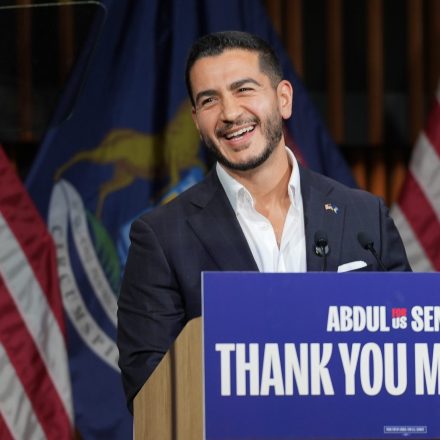
Abdul El-Sayed Wins Senate Seat With Pro-Palestine Campaign
As progressives take stock of the 2026 midterms, Lawrence's approach points one way forward for their wing of the Democratic Party. Lawrence's opponent tried to turn his time as an environmental activist into a liability, but in an interview with The Intercept, Lawrence said his background primed him to come down on the same side as the public on a red-hot issue like data centers.
"I fought against Wall Street landlords trying to kick people out of their homes. I fought against oil companies who are polluting our air and water," he told The Intercept in an interview last month. "So for me, this was not the first time that I've stood on the line against a corporate behemoth like this."
From Sunrise to CongressLawrence is a co-founder of the Sunrise Movement, which had one of its most famous moments when its youth activists marched into the office of then-House Speaker Nancy Pelosi to push for the Green New Deal with Rep. Alexandria Ocasio-Cortez, D-N.Y., by their side in 2018.
Data centers and AI were remote issues for voters then, but they were starting to bubble up in the public consciousness by the time Lawrence announced his run for Congress in August 2025.
 Related
AI Tried to Buy the Midterms — Then the Lobby Learned Everyone Hates AI
Two months later, one of his first moves as a candidate was to visit public meetings in two small townships in Michigan to express his opposition to proposed data center developments.
As a former member of the Democratic Socialists of America, he drew skepticism from many observers over his ability to win the primary in a district that narrowly voted for Donald Trump in 2024. They were equally skeptical of his ability to beat Barrett, a Republican who tried to play up his moderate bona fides in the race's final weeks. Barrett was one of a handful of Republicans to vote in favor of a resolution to end the Iran war, for instance.
Lawrence had some major liabilities in a purple district, including tweets where he wrote "fuck the nuclear-family home" and told then-Democratic Sen. Joe Manchin in a song to "hurry up and die."
While Barrett leaned on those posts and Lawrence's time with the DSA to cast his opponent as an extremist, the young progressive had a card up his sleeves in the form of the data center issue.
It is the rare cause that leaps across party lines to unite Republicans and Democrats who are just as worried about water sources drying up and ceaseless buzzing sounds.
 Related
The AI Doomsday Future Is Not Inevitable
At an October 5 city council meeting in the quaint town of Mason, where a developer has proposed a hyperscale data center on a plot of picturesque farmland, Democrats and Republicans alike said they were outraged. Some residents said they would sell their house and leave town if the development is built.
In a sign of how politically charged the issue has become, many of the speakers were candidates for office angling for votes. Lawrence had dropped by himself a few weeks before. His first television ad centered on his opposition to the Mason project.
Karl Sime, a Mason resident who crisscrossed the area on behalf of Democratic candidates, told The Intercept last month that "100 percent" of voters were angry about the data center proposed for the swath of farmland just outside city limits.
"Sometimes they'll just say it unprovoked," he said. "You can see the body language just dramatically change into anger."
Republican CountermovesLawrence was hardly the only candidate who tried to tap into opposition to data centers. Some Republicans tried to catch the wave as well.
 Related
How a Small Kansas City Became a Critical Hub for Trump's Deportation Regime Against Its Will
Barrett voted for the One Big Beautiful Bill, which included tax breaks that could benefit rural data center developers. But as the danger he faced in the election became clear, he proposed legislation in Congress that would ban local officials from signing non-disclosure agreements with developers and would allow local communities to set regulations on data centers without federal interference.
Some voters said they wanted to see candidates take a harder stance in favor of regulation, however. At the City Council meeting last month, Doug DeLind said he was left shaking his head at neighbors who had yard signs opposing data centers and supporting Barrett.
DeLind, a sculptor who lives near the proposed data center, said that Barrett's position was that "we're going to leave it up to the local communities, but we're not going to provide any federal protection or any guidelines to what a data center can do."
Although Mason faces a more imminent possibility of a massive data center, Americans across the country are worried about having one in their backyard. Multiple surveys showed a remarkable shift in public opinion on the subject over the past year. Half of Americans oppose a data center being built within 3 miles of their house, according to a recent Politico poll.
 Related
Francesca Hong's Loss in Wisconsin Is a Win for AI Data Centers — for Now
In recent months, data centers became a signature issue for Democrats with progressive pasts trying to recast themselves as populists. Sherrod Brown, the party's Senate candidate in Ohio, and Texas gubernatorial candidate Gina Hinojosa also staked their campaigns on opposition to data centers. Both won.
"The playbook was listening to voters. I think voters across ideologies were speaking with one voice, and I think their opponents were some of the people most willing to silence voters and accept industry cash instead," said Alex Bores, who became a national figure by arguing for stricter AI regulations during a failed New York congressional primary bid earlier this year.
As candidates ran away from data centers, the artificial intelligence industry's most powerful super PAC stopped intervening in close races. An Intercept analysis found that the well-funded Leading the Future super PAC network, which is aligned with OpenAI, largely stopped spending in competitive general election races.
It lost in the one state where it did place a big bet, South Carolina. Incumbent Sen. Darline Graham, a Republican, fell to challenger Annie Andrews.
Bores, who now leads a pro-AI regulation group called Who Decides, said he was not surprised to see candidates increasingly market themselves as AI skeptics.
"I think it's overdue. I think candidates and elected officials are catching up to where the electorate is, across parties," Bores told The Intercept. "It is remarkable the agreement that voters have around wanting guardrails to protect us from the most powerful and fastest moving technology of our lifetime. Democracy is sometimes slow, but only so much."
This story was supported by a grant from the Tarbell Center for AI Journalism.
The post Lesson From Lansing: To Win in Swing Districts, Fight Data Centers appeared first on The Intercept.
Boffins use machine-learning tricks to create a starlight dimmer switch [ 04-Nov-26 6:03pm ]Scientists have developed a way to remove starlight from telescope images that improved sensitivity to faint exoplanets by up to 15 times in tests on James Webb Space Telescope data.
A team led by Northwestern University's Rodrigo Ferrer-Chavez combined a physics-based telescope model with optimization techniques used in machine learning to subtract unwanted starlight.
Directly imaging exoplanets remains difficult because their host stars' glare can overwhelm their faint light. Existing techniques subtract modeled or reference starlight, but tiny changes in telescope optics can leave residual glare that hides planets.
The team's Physics-based Learning for Imaging Planets (FLIP) framework models how light passes through the telescope, adjusts for optical imperfections, and simulates the glare to be subtracted.
Applied to observations from Webb's Near-Infrared Camera (NIRCam), FLIP produced the first image of the known giant planet 51 Eridani b at an infrared wavelength of 4.3 micrometers, where conventional processing had failed. Tests showed sensitivity improvements of two to 15 times over conventional techniques, according to the Nature paper.
"This is the first time, to our knowledge, that such an approach has demonstrated substantially improved sensitivity on real, on-sky coronagraphic imaging. Our framework can be extended to other current and future ground-based and space-based observatories… potentially relaxing the unprecedented stability requirements needed to make these a success," the paper says.
Further work includes reducing computational demands and developing ways to handle the much larger data volumes produced by ground-based observations.
The researchers hope further development and testing will bring direct images of Earth-like planets closer, while reducing the extent to which tiny telescope instabilities obscure them. ®
Tom the Dancing Bug: Dementia Donnie bottoms out! [ 04-Nov-26 5:21pm ]

Tom the Dancing Bug, IN WHICH Dementia Donnie bottoms out!
-Americans, patriots, and friends: Please join the team that makes it possible for your friendly neighborhood comic strip Tom the Dancing Bug to exist in this hostile Trumpverse! JOIN US IN THE INNER HIVE, and be the first kid on your block to get each week's Tom the Dancing Bug comic - before it's published anywhere, plus exclusive commentary, content, contests, giveaways, other stuff, and other other stuff! — Read the rest
The post Tom the Dancing Bug: Dementia Donnie bottoms out! appeared first on Boing Boing.
In this 1983 Toys "R" Us Halloween commercial, Mom turns into a witch [ 04-Nov-26 5:21pm ]
Toys "R" Us and Halloween went hand-in-hand back in the day. It's impossible not to feel nostalgic when thinking about it if you lived through that era as a kid. Luckily we have old commercials like this one from 1983 to remember how much fun the store was. — Read the rest
The post In this 1983 Toys "R" Us Halloween commercial, Mom turns into a witch appeared first on Boing Boing.
Watch a garden plant get pulled underground, just like in a cartoon [ 04-Nov-26 5:20pm ]
This video made me laugh especially hard because I recently had a very similar experience in my own garden. If you've ever been gardening only to see some of your plants disappearing under the ground, as if they had decided to hide away, then you might know what I'm talking about. — Read the rest
The post Watch a garden plant get pulled underground, just like in a cartoon appeared first on Boing Boing.
Baby flamingos at the San Antonio Zoo are still figuring out their legs [ 04-Nov-26 5:19pm ]
Here is a baby flamingo compilation from the San Antonio Zoo. Baby flamingos don't have their iconic pink feathers yet. What makes them especially cute is the way that they look a bit awkward trying to figure out how to walk. — Read the rest
The post Baby flamingos at the San Antonio Zoo are still figuring out their legs appeared first on Boing Boing.
Scotland conference season 2026 [ 04-Nov-26 3:14pm ]
Eric Wagner on Michael Johnson's 'Skeleton Key' [ 04-Nov-26 5:49pm ]
"Illuminatus! Skeleton Key #1: Extra Kether
By Eric WagnerSpecial guest bloggerR. Michael Johnson has written a brilliant explication of Bob Campbell's Tales of Illuminatus! based on Shea and Wilson's Illuminatus! Bob Campbell has presented the text beautifully in scholarly comic book fashion with appropriate illustrations. The "Skeleton Key" suggests Campbell and Robinson's Skeleton Key to Finnegans Wake, and "Extra Kether" suggests George Harrison's Extra Texture, although I don't know if they intended the latter allusion. They may have merely wanted to suggest a Madison Avenue advertising sense of "Now with extra Kether!" knowing Johnson's deep reading of McLuhan.
One can tell that Johnson has spent decades reading Robert Anton Wilson's works, as well as works that inspired Wilson. In addition, Johnson has read a lot material about the time period in question (the sixties and beyond) and the wide world of sex and drugs and conspiracy theories.
Aside: I first read The Lord of the Rings in 1978. Visiting bookstores and comic book stores over the next twenty-three years I saw lots of art inspired by Tolkien, presenting Gandalf and Middle Earth in a wide variety of ways. When the film The Fellowship of the Ring came out in 2001, it (and Jackson's subsequent films) did a good enough job of recreating Tolkien's world that I now think of Gandalf as looking like Sir Ian McKellen. Bob Campbell has done a terrific job of creating a visual universe parallel to Bob Wilson's universe, in his comics as well as in Bob's other Wilsonian artworks such as his terrific book Raw Art: The Illustrated Worlds and Ideas of Robert Anton Wilson.
Dr. Johnson has outdone himself in the text. He has written about Bob Wilson's work for over thirty years, and I always find Johnson's writing brilliant and thought provoking. Johnson approaches Wilson's work both with deep seriousness and with a profound sense of play. I sometimes fall into the trap of thinking of my ideas about Wilson's work as the only correct ones, but Johnson shows me again and again that one can approach Wilson's work in a multitudinous variety of ways. In Masks of the Illuminati Bob quotes the Upanishads: Remove infinity from it and infinity remains. That seems true of works of literature. Umberto Eco defined a novel as a machine for generating interpretations.
One could spend fruitful years following up all the leads Johnson provides in this work. I found myself thinking about young people encountering Campbell's comic books. I think Johnson's work will give them the tools for a richer understanding of the world of Illuminatus! as well as a guide-map for future studies. In 1970 before my family ever went to Disneyland, I had a large map of Disneyland on my wall. Interestingly, the map included Space Mountain even though the ride wouldn't open until 1977. Johnson and Campbell have provided an information rich map to Illuminatus! and Tales of Illuminatus!, one of use to first time visitors as well as to those of us who have lived there for years.
[See this earlier post for information on the Skeleton Key -- the Mgt.]
Japanese Bank to Stop Allowing ATM Cards, PCs For Account Access [ 04-Nov-26 5:50pm ]
Bare metal boom: On-prem server sales for HPC and AI up 20% this year [ 04-Nov-26 5:30pm ]On-premises high-performance compute (HPC) is still in demand, according to Hyperion Research, which estimates the market is expanding at almost 20 percent year-on-year, often driven by requirements for AI processing.
What Hyperion calls the "on-premises HPC and AI-for-Science" server market showed significant growth in the first half of 2026, with revenues hitting $16.5 billion, up 19.9 percent.
However, the analyst says unit shipments over the same period grew only 4.4 percent, meaning that systems are carrying a higher price tag due to greater use of costly components such as GPUs and other accelerators, not to mention the effects of higher memory costs, which have tripled or quadrupled since last year.
Its tracking of the HPC market is based on multiple surveys conducted of both buyers and suppliers, the firm says. The latest data shows a major change in the overall HPC market growth, heavily driven by a combination of the use of AI, large language models (LLMs), and purchases of large GPU/accelerator-based systems.
This trend was noted a couple of years ago, with Omdia reporting in 2024 that revenue growth from server sales was racing ahead of actual units shipped, as customers prioritized investment in highly configured server clusters for AI.
Much of that spending was by hyperscalers and cloud providers, seeking to profit from selling AI services to enterprise customers, but Hyperion's figures focus on on-prem shipments, showing that many enterprises prefer to do their processing in-house.
According to Hyperion, Dell has now surpassed HPE as the biggest HPC vendor, with server revenues of $4.2 billion for the first half of 2026. HPE, which picked up supercomputing specialist Cray for $1.3 billion in 2019, had long been pack leader in the global HPC arena in terms of market share and revenue.
The figures put Dell on a 24 percent share, while HPE is not far behind on 21 percent. Lenovo and China-based Sugon trail behind at 4 percent share each, while 45 percent of the market is just labelled as "others" by Hyperion. This includes names such as Bull, which re-emerged from the shadows of Atos this year, plus Supermicro, Penguin Computing, and NEC.
The HPC infrastructure market is inherently cyclical. HPE recognized significant revenue in 2025 with sales of multiple exascale-class leadership machines, but procurement of that scale is intermittent and doesn't necessarily come along every year, Hyperion notes.
"Organizations and institutions are continuing to invest in their advanced computing infrastructure due to both replacing aging machines and the desire to adopt AI into their workflows to support their businesses and missions," said Hyperion Research CEO Earl Joseph.
"The growth reflects both a nominal increase in units being purchased and significant increases in system prices."
HPC systems are considered the backbone for many AI and AI-related applications, which has driven the overall HPC market to a new growth level, Joseph added. ®
VMware returns to low-end server virtualization with 'vSphere Express' [ 04-Nov-26 5:01pm ]As first reported by The Register, VMware has returned to the low-end server virtualization market with a product called "vSphere Express."
The product will run on up to 128 processor cores and includes vMotion to allow live migration of VMs, automated restart of failed VMs, a distributed switch, rapid non-disruptive patching, and support for physical and virtual trusted platform modules.
"We have been listening to the market at the low end, and they want a basic core server virtualization platform," said Prashanth Shenoy, vice president of product marketing in Broadcom's VMware Cloud Foundation (VCF). He explained that each instance of vSphere Express will be discrete, meaning it won't be possible to manage them centrally.
"This is tested for small implementations," he told The Register. "We do not want a customer to run this on thousands of cores." Shenoy said the vSphere Foundation (VVF) enterprise virtualization product, and Cloud Foundation (VCF) private cloud suite, are appropriate for users with more complex needs. vSphere Express will, however, match the release cadence of VVF and VCF.
Under Broadcom's ownership, VMware has enormously reduced the number of resellers in its channel program, meaning it no longer has partners who are a good fit for this product.
The virtualization giant will therefore sell vSphere Express through its distributors, most of which now operate cloud marketplaces at which affiliated resellers can acquire software - an arrangement channel folk call "two tier distribution."
We asked VMware to tell us the price it will charge for vSphere Express.
A spokesperson told us it will offer a per-core subscription license at a price "significantly lower" than VVF or VCF but declined to quote a dollar amount. "We encourage interested customers to reach out to their local reseller for information related to pricing and subscription terms," the spokesperson wrote.
VMware has also bulked out VVF and VCF a little, by adding disaster recovery and policy-based networking for virtual private clouds that it previously sold as add-ons. Shenoy pitched the additions as demonstrating VMware's intention to add value to VVF and VCF, in part by ensuring the bundles include tools that users are likely to consider represent essential functionality.
The Broadcom business unit will also add new features, such as native AWS S3-compatible object storage for its VSAN virtual storage. That update, due in calendar Q1 of 2027, means VSAN will become a more convenient platform on which to store the unstructured data that AI workloads rely on, therefore boosting the utility of VMware's AI Factory.
VMware also plans to make its AI Factory easier to implement.
"The idea is to focus more on AI, less on setup," Shenoy said.
Analysis: A welcome low-end return faces an uncertain receptionVMware's return to the low-end server virtualization market may not be well-received, because it has largely ignored users of its existing low-end vSphere Standard product for the last few years, and irritated many by insisting they upgrade to the more expensive and complex VCF.
The virtualization giant also cast aside thousands of resellers.
When The Register chats with members of the VMware community, we often hear that trust in the vendor has diminished.
Your correspondent therefore feels that vSphere Express will get a mixed reception.
Many vSphere Standard users will welcome a more appropriate and affordable upgrade option, especially as it means they won't need to learn new skills.
Other users and former partners will wonder if, having been bitten by Broadcom once, they should now be a little shy of vSphere Express.
Broadcom shareholders should be enthusiastic, as VMware's decision not to sell to the low end of the market blocked its onramp to new users. The chips 'n' code shop now has another way to get VMware growing, if it can restore trust. ®
Maybe Life Is Like 'Star Wars' After All [ 04-Nov-26 5:30pm ] Welcome Earth's New Mini-Moon. It's Adorably Tiny and Has a Loopy Orbit [ 04-Nov-26 5:15pm ]
Four Tet Produced a Tech-House Remix for the Durutti Column [ 04-Nov-26 5:14pm ]
Redditor uses AI to get Switch games running natively on Apple TV [ 04-Nov-26 5:15pm ]
Bluetooth is going to get a lot faster in 2027 [ 04-Nov-26 5:14pm ]
Sequoia hits rewind, undoing 20 years of expansion [ 04-Nov-26 5:11pm ]
Elon Musk spent nearly $500 million on the midterms and lost big-time [ 04-Nov-26 5:01pm ]
Slavdom Unearthed: Marian Wawrzeniecki's Neopagan Paintings (1891-1923) [ 04-Nov-26 2:59pm ]
A neopagan visual archive meant to rival the iconic power of the Christian West.
I tried Apple's Siri Recaps. They're surprisingly useful — and a little unsettling [ 04-Nov-26 4:51pm ]
# [ 04-Nov-26 4:21pm ] It's time for citizens to really unite [ 04-Nov-26 3:45pm ]The mid-term election was a blowout for Democrats.
I am so happy today to be able to write those words.
So many things to say, first a few notes.
- Citizens United was the real loser in this election. And the missing ethics rules that allow members of the government to legally do insider trading, which they actually do, a lot of. A political job in Washington is worth real money, legally.
- The TV here in the NYC area included local races in the Hudson Valley (where I live) and New Jersey, and they were vicious and on all the time. NYC itself not so much.
- Often all the commercials in a single break were political. Some of them were so lame and sarcastic I thought they were actually ads for the competitor they were trying to get us to hate.
- If money could have bought this election, it would have been a landslide for the Republicans. The ad in the Ohio governors election was over the top, a blame the victim campaign, so cynical, they openly dared the voters to be as depraved as they were. I hope that woke a lot of voters up.
- Elon Musk threw hundreds of millions into the election, esp in Texas where he was presumably counting on control of politicians to allow him to build out SpaceX, Grok and Tesla out without regard to environmental regulation. He wasted his money, but he has a lot of that, but what it proved about the electorate is that we, collectively, sobered up enough to see what was going on, and stopped voting for the better comedians who run around on stage with buzzsaws and talk about other politicians asses, because the last election of Trump did a lot of destruction in the US and around the world. This is serious stuff.
- We are not powerless, we actually are some of the most powerful people in the world. We the People are a co-equal branch of government along with the courts and executive. We should vote with the same sobriety as we expect our reps to vote.
- When we think our elections are mere entertainment, we surrender that power to who had the best schtick or most entertaining ads. We act like the robots the elites depend on us to be. Our vote isn't a message, it's an act of government.
- Already hearing pundits say basically "yeah we know Congress can't do anything" because for two years we had a Congress that wouldn't do anything. Now we have one that move and cancel the Iran War, for example, with a single vote to withdraw authorization (which was never given).
- If only political pundits could handle little intricacies like sports pundits can.
- I heard a podcast interview with Jamie Raskin by an editor at the New Yorker. It was disgusting. The reporter mostly he wanted him to say he would consider impeaching Trump, and of course that was the title of the story. If only he had been willing to let Raskin explain how different things are now, they have just elected a Congress that is ready to shake things up, and impeaching Trump might not be the fastest way to start putting things right, to building an America that has new better guardrails to prevent us from going around in circles. Why couldn't the New Yorker, of all pubs, leave space for him to explain, but nope, they want their freaking headline, and still very much need to be routed around. Raskin has to go direct more.
We have a lot of work to do and that work will be done by the people, by us. This is the big gestalt the elites in the US haven't caught on to. The new tech lets people contribute to our country on an everyday basis, not just when the parties need money to run ads that we're now totally on to. I know I am an elite, but I also know people in high positions in the progressive world who could help by getting behind the open technology not owned by Musk or Zuck or Jeff or whoever, that will allow us to effectively organize. Now is the moment to do this, to make sure this victory doesn't slip away into the comatose blur that the MSM works so hard to keep us in.
Harley-Davidson Expands 2027 Bagger World Cup Calendar [ 04-Nov-26 3:03pm ]Harley-Davidson unveils key developments for the second season of the FIM Harley-Davidson Bagger World Cup Tuned by Dynojet:
• Expanded calendar: Eight rounds and 16 races across seven countries, including three new MotoGP venues.
• COTA season opener and Fan Experience Passes: The championship kicks off April 23-25 in Austin, with exclusive 3-day passes now on sale at early bird prices of $149, or $109 for H.O.G.® members.
• Teams and riders: Five teams and 11 motorcycles confirmed for 2027, with rider announcements to follow.
• Race motorcycle development: Increased performance, improved handling and new aerodynamic bodywork under development.
• Dynojet: Longstanding technical partner becomes Presenting Sponsor, with the championship adopting the name FIM Harley-Davidson Bagger World Cup Tuned by Dynojet.
• Dunlop: Official Tire Supplier sponsorship renewed, including technical and trackside support.
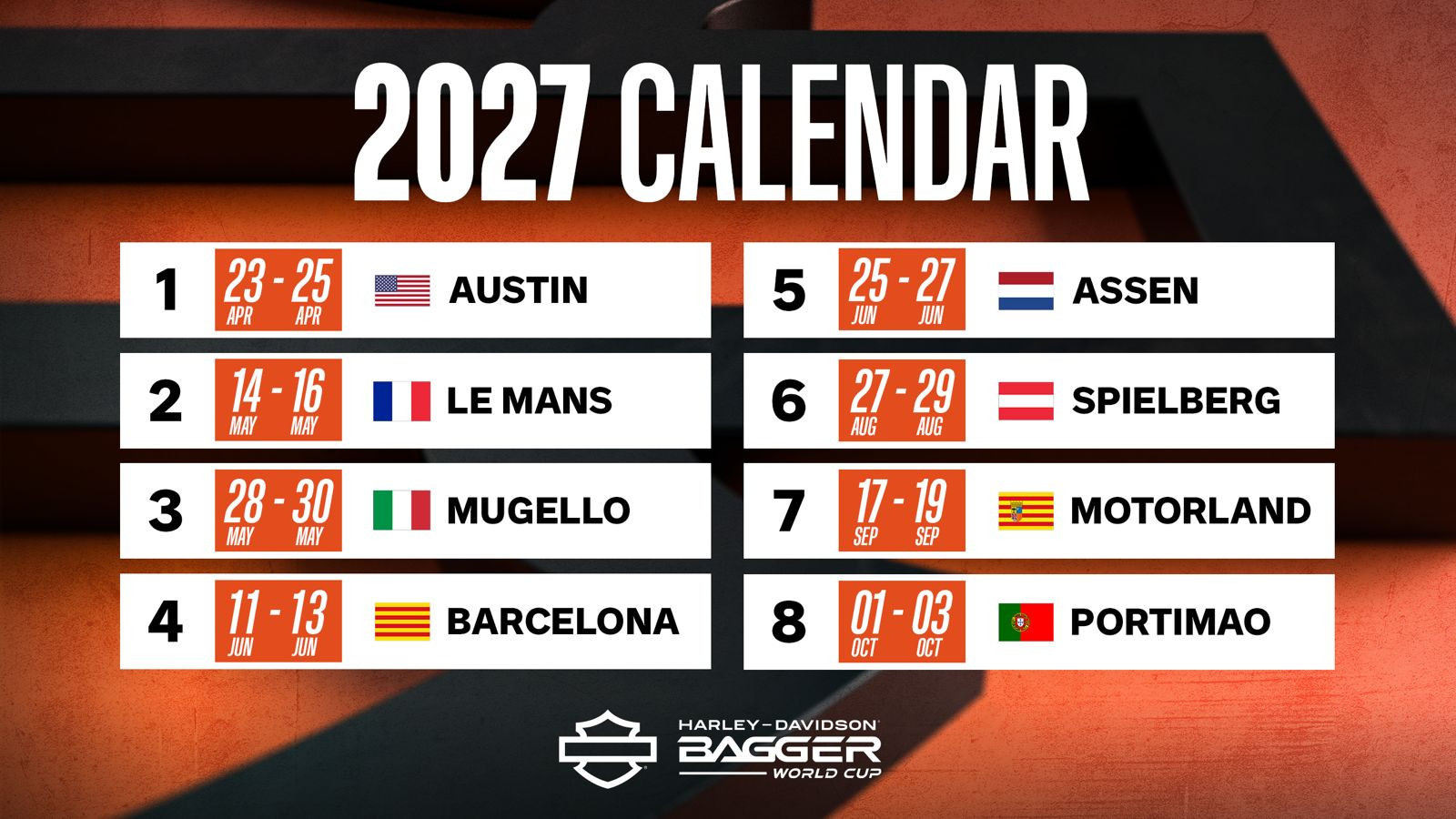
MILWAUKEE (November 4, 2026) - Harley-Davidson today unveiled the expanded 2027 calendar for the FIM Harley-Davidson Bagger World Cup Tuned by Dynojet at EICMA in Milan, confirming eight rounds and 16 races across seven countries. The season will kick off at the Circuit of The Americas (COTA) in Austin, Texas, on April 23-25, with exclusive Harley-Davidson Bagger World Cup Fan Experience Passes now available at special early bird prices.
EIGHT ROUNDS ACROSS SEVEN COUNTRIES
The expanded calendar builds on the enthusiastic reception the Bagger World Cup received from MotoGP spectators and Harley-Davidson fans during its inaugural season, bringing the series to new audiences while strengthening its presence at established events.
The season will once again open at the MotoGP Grand Prix of the United States, at the Circuit of The Americas in Austin, Texas, on April 23-25, following an official preseason test April 17-18.
Three new destinations join the calendar:
• MotoGP Grand Prix of France: Le Mans brings the Bagger World Cup to one of MotoGP's largest and most passionate audiences.
• MotoGP Grand Prix of Catalonia: Barcelona marks a return to the circuit where Harley-Davidson racing baggers made their European debut in 2024, two years before the launch of the Bagger World Cup.
• MotoGP Grand Prix of Portugal: Portimão will host the season finale, where the second Bagger World Cup Champion will be crowned, extending the racing season from April through October.
The MotoGP Grand Prix of Italy, the Netherlands, Austria and Aragón complete the schedule, providing continuity with the inaugural season and building on the enthusiasm shown by local fans in 2026.
 Jeffrey Schuessler - Director of Global Racing Programs, Harley-Davidson. Photo courtesy BWC.
Jeffrey Schuessler - Director of Global Racing Programs, Harley-Davidson: "For 2027, we're expanding the Bagger World Cup to eight rounds and 16 races, including three new venues. More rounds, more teams, more riders, more fans and more racing. That's our ambition for the championship's second season. The calendar is growing by two rounds, while combined attendance across our host events is expected to increase by nearly 60%, from over 800,000 in 2026 to approximately 1.3 million in 2027.
But growth isn't just about numbers. It's about people and the connections we create through motorcycles and racing. Our dealers and H.O.G. chapters are essential to that effort, particularly in the United States. Austin will be our starting point for bringing owners, dealers, H.O.G. members and MotoGP fans together on and off the track, building experiences we can expand as the championship grows.
We're also continuing to develop our race motorcycles alongside our teams and technical partners, pushing performance and competitiveness forward. That commitment is central to Harley-Davidson Factory Racing and Screamin' Eagle Parts & Accessories, connecting what we learn on the track with the motorcycles and performance products we offer our customers."
2027 FIM HARLEY-DAVIDSON BAGGER WORLD CUP TUNED BY DYNOJET PROVISIONAL CALENDAR:
Round 1 | April 23-25 - MotoGP Grand Prix of the United States, COTA
Round 2 | May 14-16 - MotoGP Grand Prix of France, Le Mans
Round 3 | May 28-30 - MotoGP Grand Prix of Italy, Mugello
Round 4 | June 11-13 - MotoGP Grand Prix of Catalonia, Barcelona
Round 5 | June 25-27 - MotoGP Grand Prix of the Netherlands, Assen
Round 6 | August 27-29 - MotoGP Grand Prix of Austria, Red Bull Ring
Round 7 | September 17-19 - MotoGP Grand Prix of Aragón, MotorLand Aragón
Round 8 | October 1-3 - MotoGP Grand Prix of Portugal, Portimão
Each round is scheduled to feature two full-points races, one qualifying session and two free practice sessions.
 Eric Granado (51) claims pole position at COTA. Photo by Michael Gougis.
COTA SEASON OPENER: EXCLUSIVE FAN EXPERIENCE PASSES NOW ON SALE AT EARLY BIRD PRICES
For the 2027 season opener at COTA on April 23-25, Harley-Davidson will offer a dedicated three-day Fan Experience Pass designed to bring Harley-Davidson® motorcycle owners and MotoGP fans closer to the racing action.
The Harley-Davidson Bagger World Cup Fan Experience Pass includes reserved seating in the dedicated Harley-Davidson Grandstand at Turn 15, exclusive motorcycle parking, secure riding gear storage and a parade lap on the COTA circuit aboard participants' own motorcycles.
The package also includes rider Q&A sessions, Bagger World Cup paddock tours, autograph opportunities, access to Harley-Davidson Factory Racing hospitality and Screamin' Eagle activations, along with an H-D gift bag.
The 3-Day Harley-Davidson Bagger World Cup Fan Experience Pass is available at a special early bird price of $149 for a limited time. Fans can purchase the pass online while supplies last (terms and conditions apply).
H.O.G.® (Harley Owners Group®) members can enjoy an exclusive early bird price of $109 for the same three-day pass, available through the H.O.G.® member website while supplies last. Terms and conditions apply.
 Kyle Wyman (33) and James Rispoli (43) during the BWC race 2 in Austria. Photo courtesy BWC.
2027 TEAMS AND RIDERS: CONTINUITY AND NEW ENTRIES
The FIM Harley-Davidson Bagger World Cup has confirmed an initial lineup of five teams and 11 motorcycles for its second season, combining returning competitors with new entries.
The provisional 2027 team entry list includes:
• Joe Rascal: 3 motorcycles
• Saddlemen Race Development: 3 motorcycles
• Niti Racing: 3 motorcycles
• Kyle Wyman Racing: 1 motorcycle
• Mad Monkey / Tobacco Road Harley-Davidson®: 1 motorcycle
While participation is confirmed for these five teams, the overall entry list remains provisional as discussions continue with additional organizations.
Several rider signings have already been finalized with official announcements expected in the coming weeks.
MORE PERFORMANCE, SAME COMPETITIVE PRINCIPLES
The 2027 Harley-Davidson Bagger World Cup race motorcycle introduces a series of technical improvements developed throughout the inaugural 2026 season, alongside further innovations currently in development.
The 2027 developments reflect two complementary approaches: Harley-Davidson Factory Racing's ongoing pursuit of greater performance and improvements developed in collaboration with participating teams or in response to their feedback. With multiple racing organizations working extensively on the same platform, their combined experience provides valuable technical insights and opportunities for improvement.
The 2027 motorcycle features upgrades across several key areas:
• Engine performance: Approximately 2-3% more horsepower, with the engine rev limit increased from 7,000 to 7,200 rpm.
• Transmission: Further improvements to the gearbox, including a new Dynojet quickshifter sensor co-developed with Harley-Davidson.
• Suspension and handling: New fork caps that allow for increased front ride height, upgraded rear shocks with independently adjustable damping settings, and a revised swingarm designed to improve rear-wheel grip.
• Electronics: Active tire pressure monitoring to provide additional information to teams and riders.
• Durability: Improvements aimed at increasing the motorcycle's overall reliability throughout the racing season. Additional developments are underway, including:
• Aerodynamics and bodywork: Aimed at reducing drag and improving handling.
• Rider ergonomics: Increased adjustability of handlebar controls, foot positions and seating configurations to better accommodate individual rider preferences.
All technical upgrades are made available to every competitor, maintaining a level playing field.
The knowledge gained through racing may also contribute to future Harley-Davidson production motorcycles and Screamin' Eagle performance products.
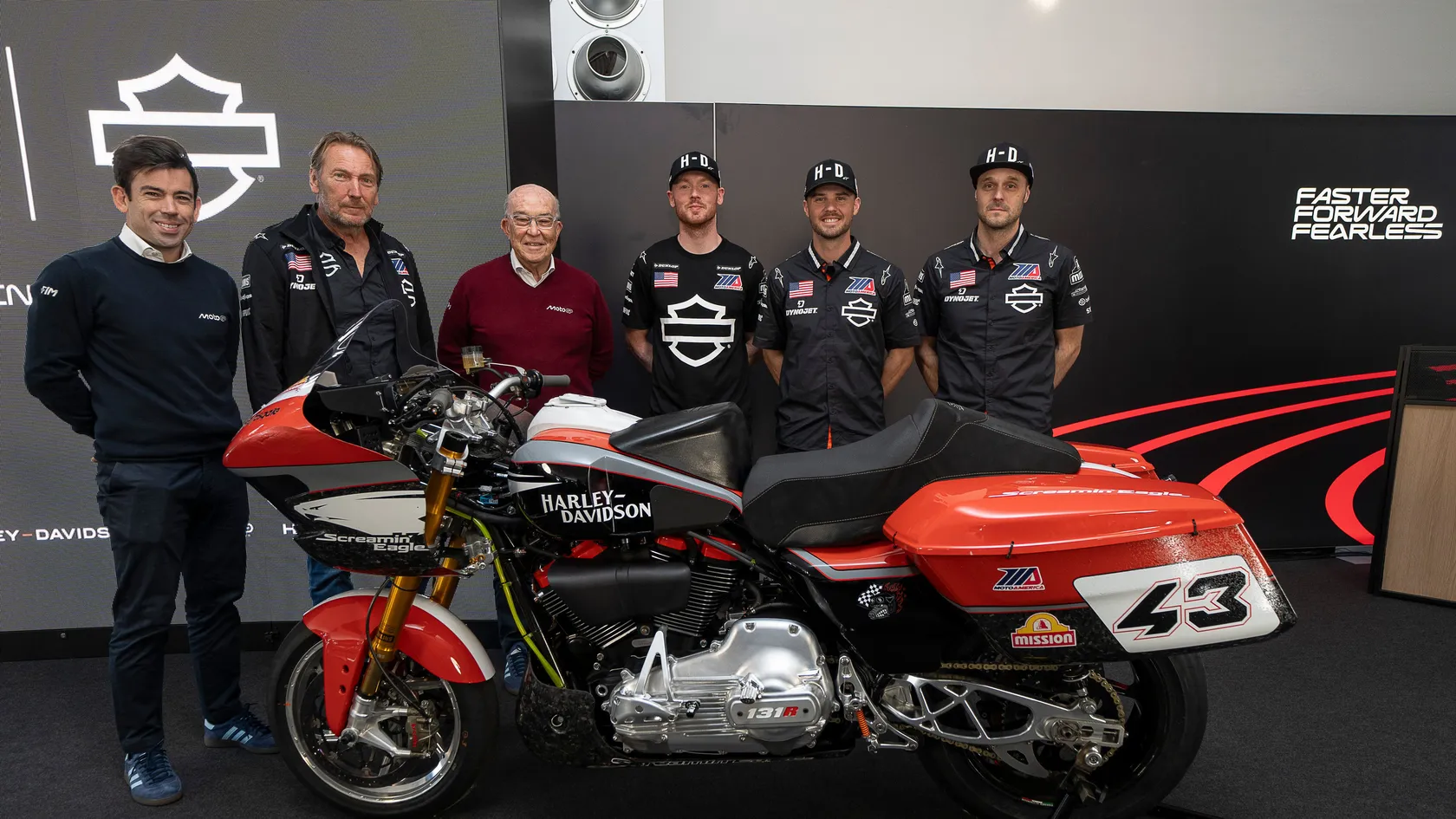 Harley Davidson and MotoGP. From left to right, Carlos Ezpeleta, Jochen Zeitz, Carmelo Ezpeleta, Bradley Smith, Kyle Wyman and Jason Kehl. Photo courtesy MotoGP.
Jason Kehl - Technical Director and Team Principal, Harley-Davidson Factory Racing: "From the beginning, we've approached the Bagger World Cup as a racing program that never stands still. We're constantly looking for more performance, whether that's increasing power, improving rear-wheel grip, refining suspension or optimizing rider ergonomics. That's part of our engineering philosophy, and being a spec series doesn't change it.
One of the advantages of having multiple teams racing the same motorcycle is the technical knowledge we gain from their different approaches and experiences. Their feedback helps us identify opportunities for improvement, and some of the 2027 updates, including the increased rev limit and revised fork caps, are direct results of that collaboration. We combine their input with our own engineering work to ensure every improvement benefits all competitors.
Beyond the championship, racing allows us to develop and validate technical solutions under demanding conditions. The data and experience we gain can contribute to future Harley-Davidson production motorcycles and Screamin' Eagle performance products. That's an important part of the value of this racing program."
DYNOJET JOINS AS PRESENTING SPONSOR
Dynojet, a longstanding technical and racing partner, will become Presenting Sponsor of the championship for 2027. Reflecting a collaboration that extends beyond sponsorship into technical development and performance, the championship will adopt the official name FIM Harley-Davidson Bagger World Cup Tuned by Dynojet.
DUNLOP EXTENDS OFFICIAL TIRE SPONSORSHIP
Harley-Davidson also confirmed the extension of its sponsorship with Dunlop as Official Tire Supplier. Beyond supplying racing tires, Dunlop will continue providing trackside technical support and logistics across the championship's expanding international calendar, as well as supporting the Harley-Davidson Bagger World Cup Racing Contingency Program powered by Dunlop.
The post Harley-Davidson Expands 2027 Bagger World Cup Calendar appeared first on Roadracing World Magazine | Motorcycle Riding, Racing & Tech News.
Americans overwhelmingly voted against data centers in the midterms [ 04-Nov-26 3:28pm ]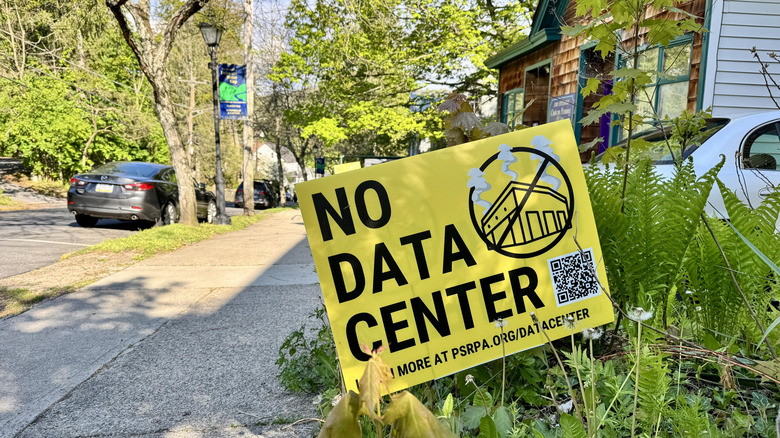
Marc Marquez makes Aprilia MotoGP "meeting" joke after Malaysia 'aggression' [ 04-Nov-26 4:43pm ]
Peace of mind fits in a jacket pocket with this $40 camera and bug detector [ 04-Nov-26 4:00pm ]
TL;DR: Check hotel rooms, rentals, and cars for hidden cameras, audio bugs, and GPS trackers with this pocket-size detector, now $39.99 (reg. $59.99).
In The Conversation, Gene Hackman plays a surveillance expert who hunts for a bug by ripping his apartment apart, floorboards and all. — Read the rest
The post Peace of mind fits in a jacket pocket with this $40 camera and bug detector appeared first on Boing Boing.
US gov IT worker pleads guilty to sending Top Secret files to Ethiopia [ 04-Nov-26 3:39pm ]He swore an allegiance to the US, but he was working for someone else. An IT specialist who worked across US government departments and held Top Secret clearance has pleaded guilty to transmitting sensitive documents to Ethiopia.
Abraham Teklu Lemma, 53, admitted to the espionage offenses and agreed to a prison term between 120 and 262 months, the Justice Department confirmed on Tuesday.
A naturalized citizen of the US, Lemma, of Maryland, had worked for the US government in different capacities and across different teams, including for the National Reconnaissance Office, State Department (DoS), and Justice Department (DoJ), between 2019 and 2023.
These roles included working evening hours as an IT help desk technician at the DoS as of 2021, and daytime work at the DoJ as a contract management analyst, according to court documents.
Lemma had what's known as "downdraft" authority, which is to say that he was permitted to move classified files between classified systems, and unclassified files from classified to unclassified systems.
Crucially, he was only allowed to access classified files on non-DoS systems with written approval that it was part of his official duties, and worked in a Sensitive Compartmented Information Facility (SCIF) - a secure workplace built for handling classified files.
The criminal complaint [PDF] initially stated that the alleged offending began in July 2022, although the DoJ more recently claimed that it began in 2021.
It claims Lemma was caught trawling "several" non-DoS classified portals and accessed intelligence reports without the proper authorization to do so.
On various occasions, Lemma, who had held Top Secret security clearance since 2020, copied information from at least 133 intelligence reports without need-to-know authorization, according to court documents.
Prosecutors claimed that the man downloaded more than 100 documents, burned them to CD/DVDs, and deleted their classification markings.
The material Lemma was copying was at the Secret and Top Secret levels, but burned onto discs with green labels, which are approved for employees and are supposed to signify the contents of the discs relating to unclassified material only.
Lemma would allegedly take these discs at the end of his shift and exit the SCIF with them tucked into his jacket pocket.
On other occasions, he was observed looking at classified material on his PC, then taking handwritten notes before folding the paper and again storing it in his pocket. This continued until around August 2023.
Prosecutors claimed that Lemma began transmitting information to Ethiopian officials via an encrypted messaging app in or around August and September 2022, weeks after the alleged offending began.
The files included documents, photographs, notes, maps, and information relating to Ethiopia, and officials would ask Lemma to provide details about command centers, logistics centers, military compounds, and other matters.
Communications also covered geopolitical topics, referencing "situations" in an unspecified African country that shares a border with Ethiopia to gain an advantage, and rebel groups involved in conflict with Ethiopia.
Lemma's messages also included encouragement to take action against paramilitary groups that were in conflict with Ethiopia on multiple occasions, say prosecutors.
According to the complaint, one of Lemma's messages said: "We have to finish these people once and for all, otherwise there will never be peace in Ethiopia." Later that day, on December 18, 2021, he wrote: "Please send dro[nes]," after sharing additional information.
Announcing the guilty plea on Tuesday, the Justice Department said many of Lemma's contacts were senior Ethiopian officials across political, military, and intelligence branches of the government.
Lemma was also accused of storing copies of classified files on his own storage drives, which prosecutors claim were accessed remotely by Ethiopian officials numerous times between April and June 2023.
The man was additionally caught making several bank deposits exceeding $66,000 throughout the time he was working on behalf of foreign officials.
On one occasion, he was observed "angrily discouraging" bank staff from filing a currency transaction report after trying to deposit a sum greater than $10,000.
"Despite swearing an oath to defend the Constitution of the United States, Abraham Lemma betrayed our country by committing espionage on behalf of the Ethiopian government," said Roman Rozhavsky, assistant director at the FBI's Counterintelligence and Espionage Division.
"By his own admission, Lemma provided classified national defense information to Ethiopian officials, who then used it in military operations during an ongoing conflict. This guilty plea should serve notice that the FBI and our partners will work tirelessly to stop foreign intelligence services, and anyone who decides to work with them, against the interests of the United States." ®
The Grand Canyon Is Missing 1.2 Billion Years of Earth History. Scientists May Have Figured Out Why [ 04-Nov-26 4:50pm ] Schrödinger's Election: AI Data Centers Were on the Ballot Even When They Weren't [ 04-Nov-26 4:35pm ]
Q&A: What is the Brazil-led 'deforestation roadmap'? [ 04-Nov-26 3:39pm ]- What is a deforestation 'roadmap'?
- What does the roadmap say about reducing deforestation?
- Why did some countries not sign onto the roadmap at COP30?
- What are the barriers to implementing a deforestation roadmap?
On 3 November, the Brazilian presidency of the COP30 climate talks released its long-awaited "roadmap" on ending deforestation.
Ahead of the Belém summit, Brazilian president Luiz Inácio Lula da Silva made a call for a "roadmap" to halt and reverse deforestation.
Although this voluntary roadmap was outside the COP's official agenda, it snowballed into a rallying point at the "Amazon" COP.
By the end of the summit, 93 countries had signed on to the deforestation roadmap, committing to develop voluntary pathways to reverse forest loss and degradation by 2030.
The Brazilian presidency called on countries to describe what a pathway away from deforestation could look like, what challenges and support they needed.
This call was answered by 18 countries and four negotiating blocs that offered their inputs on the roadmap, along with scores of NGOs, research centres and other groups.
Now that the roadmap has been published, Carbon Brief explains where it came from, what it entails, why some did not sign on - and what's next.
What is a deforestation 'roadmap'?The "deforestation roadmap" was one of the signature announcements of the Brazilian presidency of the COP30 climate summit in Belém - albeit one that fell outside the official, negotiated outcomes.
Brazilian president Lula first proposed the deforestation and forest degradation roadmap, alongside one on the fossil fuel transition, at the leaders' summit in Belém a few days before COP30 began.
By the end of COP30, nearly 100 countries had expressed their support for such a roadmap. This includes the EU, with its 27 member states, as well as the 56-member Coalition for Rainforest Nations.
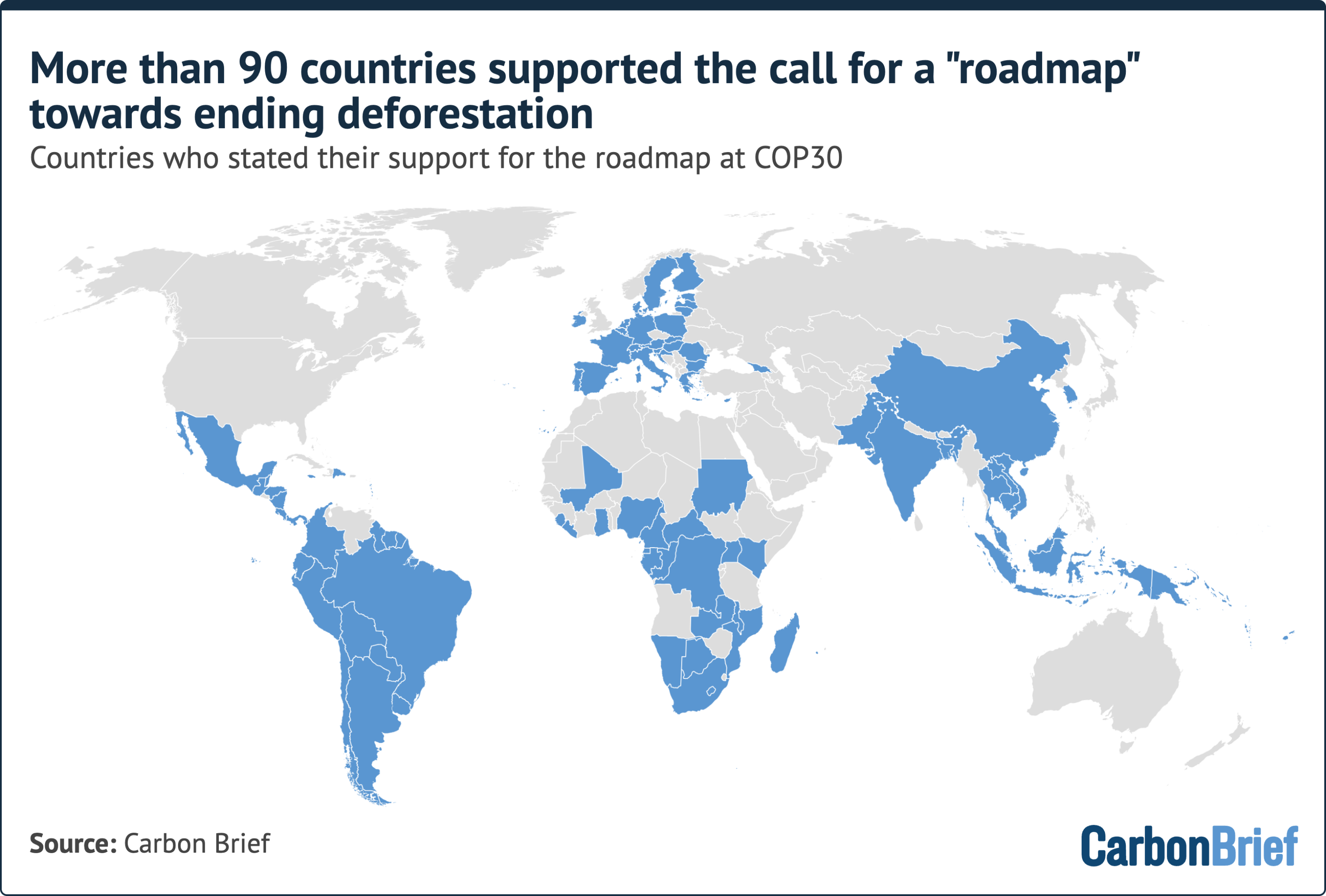 Map of countries that supported the call for a deforestation roadmap by the end of COP30. Source: Carbon Brief
However, this was still short of the 196 parties needed for consensus at a COP, meaning that, ultimately, the roadmap was not a formal outcome.
Instead, COP30 president André Corrêa do Lago announced during the closing plenary session that the presidency would work towards creating both deforestation and fossil-fuel phaseout roadmaps outside of the COP process.
The deforestation roadmap is the latest in a series of international pledges to put an end to forest loss.
In 2014, 39 countries pledged to end natural forest loss by 2030 at UN Climate Week, as part of the New York Declaration on Forests.
Seven years later, at COP26, more than 140 countries signed the Glasgow Leaders' Declaration on Forests and Land Use. The declaration stated that countries "commit to working collectively to halt and reverse forest loss and land degradation by 2030" - although conflict subsequently arose over what, exactly, countries had agreed to.
The objective of halting and reversing deforestation by 2030 was ultimately agreed in a negotiated text for the first time two years later, at COP28 in Dubai, where it was part of the global stocktake.
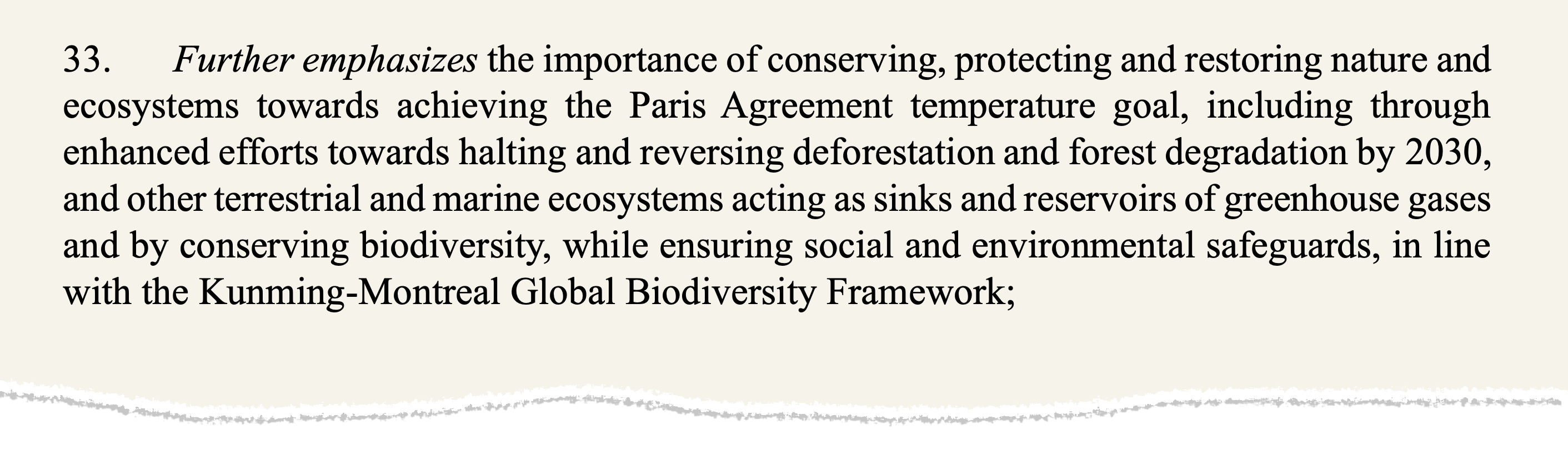 Paragraph 33 of the first global stocktake, which references halting deforestation by 2030. Source: UNFCCC
Unlike these previous pledges, the roadmap does not make any new commitments. It also does not "seek to reopen agreed decisions".
Instead, the roadmap's stated objective is to "translate forest-related outcomes into coordinated, country-led action while respecting different national circumstances, priorities and implementation challenges".
Following the conclusion of COP30, the presidency - along with the Climate Policy Initiative thinktank - began soliciting inputs from countries, civil society organisations, Indigenous peoples, academic researchers, the private sector and other groups.
(The Climate Policy Initiative was chosen to serve as the secretariat and technical partner to the roadmap process.)
The secretariat notes that it received more than 200 contributions following this invitation. However, just 18 of these came from countries, and four from blocs - the EU, the Coalition for Rainforest Nations, the Alliance of Small Island States (AOSIS) and the Least Developed Countries (LDC) blocs - themselves.
What does the roadmap say about reducing deforestation?The roadmap was released less than a week before the COP31 climate summit is due to begin, at an event hosted by the UN Development Programme in Brasilia.
During the launch event, Do Lago highlighted recent figures showing that Brazil's deforestation rate had fallen to its lowest level on record - dropping by more than 70% since 2022.
"Even the optimists wouldn't believe that we were able to decrease deforestation" by as much as the country has managed in recent years, he said.
Corrêa Do Lago said that he hoped the roadmap would be a "living document" and that it could provide countries with a "practical pathway for climate action".
The roadmap divides forest action into three complementary parts: national action, international action and financial mechanisms.
For each of the three, the document highlights current actions or instruments and the enabling conditions required to promote action. Then, it offers "COP30 presidency proposals on the way forward" on each pillar.
Under "national efforts", the roadmap addresses the challenge of halting and reversing deforestation across five "forest dimensions":
- Maintaining existing forests.
- Using forests sustainably while generating value for communities.
- Combatting forest degradation.
- Combatting deforestation.
- Restoration, reforestation and afforestation.
The roadmap identifies 18 policies or "implementation approaches" that countries can use to address forest loss and degradation, although it notes that the list is not intended to serve as an "exhaustive or prescriptive classification".
This includes a wide range of approaches, including establishing or maintaining protected areas, recognising the territorial rights of Indigenous peoples, managing the spread of pests and plant diseases and restricting permits for activities associated with forest conversion.
 Forests in the Siang valley in Arunachal Pradesh, India. Credit: Cyrille REDOR / Alamy Stock Photo
For each of these policies, the roadmap explains the approach and gives an overview of the evidence of its effectiveness. It also gives examples of how countries are implementing that policy.
Then, the roadmap discusses the enabling conditions that need to be ensured for action to occur at the national level, such as supporting land governance and promoting environmental education.
Finally, for national action, the roadmap proposes a five-step process for countries to follow. It provides "guiding questions" that countries may consider in their work to support each step.
On "international architecture for forest action", the roadmap discusses how various international environmental and human-rights instruments address the problem of deforestation in different ways. It says:
"Climate change, biodiversity, land degradation, Indigenous peoples and local communities' rights, ecosystem conservation and species protection are addressed through distinct international regimes, but their objectives and implementation intersect in important ways in relation to forests."
The roadmap highlights some of the global forest-monitoring initiatives that can support national efforts, while noting that countries' capacity for accessing and using such information "remains uneven". It calls for improving technical cooperation between countries and increasing capacity-building.
Finally, the roadmap discusses two cross-border issues: crime and trade. On the latter, it notes that trade measures that reward compliance are generally more effective than those that impose "additional economic and administrative burdens on exporters".

Membership
Support award-winning climate journalism Join CB+The roadmap's final proposals for international action include strengthening national capacity for investigating environmental crime and prioritising trade policies that reward sustainable, deforestation-free production.
The roadmap notes that countries need an estimated $300bn per year by 2030 to halt and reverse deforestation, yet current finance reaches less than one-third of that figure.
Of this, nearly 90% comes from domestic public finance, as forest countries already dedicate "substantial effort" to protecting their domestic policies and budgets, the roadmap notes.
The roadmap offers 10 proposals for action on forest finance, including aligning domestic finance flows to support forest action, enacting effective benefits-sharing measures and strengthening the position of forests in carbon markets.
It concludes with an appeal to countries to "keep the collective dialogue going" through the conclusion of the second global stocktake in 2028.
In a statement, Kelly Stone, coordinator of the civil society network Climate Land Ambition and Rights Alliance, said:
"The forest commitments in the first global stocktake and this roadmap process are important steps, but these commitments need to translate into actual urgent action on the ground.
"This roadmap needs to be taken forward in a process where countries are working together for rapid, ambitious action on the ground to address deforestation and degradation and protect food security. We cannot afford to wait."
Why did some countries not sign onto the roadmap at COP30?In Belém, discussions around the deforestation roadmap were highly charged and several countries did not sign on.
Historically, India has opposed and raised concerns about top-down commitments around mitigation and land-use change. For example, the country did not sign the original Glasgow pledge on forests and land-use at COP26, objecting to "trade" being linked to forests and climate action.
In Belém, India - as part of the Like Minded Developing Countries bloc - objected to the inclusion of voluntary roadmaps outside of the COP agenda in the formal COP30 outcome.
However, in an interview after the talks concluded, the country's minister for environment, forests and climate, Bhupender Yadav, told the Times of India that India "welcomes" the forest roadmap. He added that it additionally "endorses" Brazil's Tropical Forest Forever Facility fund.
Russia was an early objector to the deforestation roadmap, laying out its position as early as April last year. While the country reiterated its commitment to the Glasgow forest declaration and the first global stocktake, it "does not support the development of a universal roadmap", arguing that:
"…such initiatives are not mandated under the agreed international climate architecture and go beyond adopted decisions under the UNFCCC and the Paris Agreement."
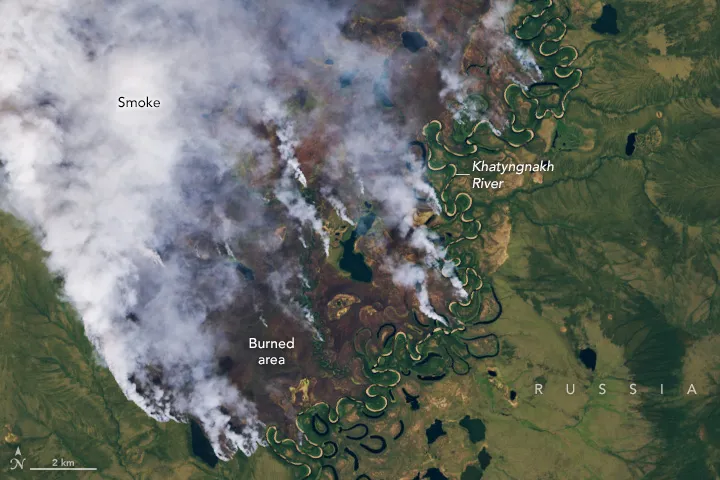 A satellite image of a large wildfire burning in northern Russia's Yakutia region in 2024. Credit: NASA Earth Observatory
Russia hosts the world's largest boreal forests, which are seeing more intense wildfires. In its submission on the deforestation roadmap, Russia "underscored" that there is no "universally agreed, legally binding definition" of forest degradation, although it adds subsequently that wildfires are a "key driver" of degradation.
Like India, it also opposed the roadmap on trade grounds.
Other countries were wary of signing on to new non-negotiated mitigation commitments outside of the official COP agenda, at the expense of other agenda items, such as adaptation finance.
At the recently concluded Yerevan COP17 nature talks, the deforestation roadmap's coordinator Marco Túlio Scarpelli Cabral told Carbon Brief it does not make sense to talk about more countries signing up to the non-negotiated roadmap, when countries have agreed by consensus to tackle deforestation within the global stocktake and biodiversity COPs. He added:
"All countries have already taken this [deforestation] commitment, both in the Kunming-Montreal [Global Biodiversity Framework] with some converging targets, but also in the global stocktake…
"We have all accepted [it]. So we don't need any country to subscribe to the roadmap."
The first global stocktake was undertaken at COP28 in Dubai. As mentioned above, within the mitigation section of this document - which was adopted by consensus - the importance of "halting and reversing deforestation and forest degradation" is emphasised.
The newly published roadmap therefore is not designed to convince countries to agree to tackle deforestation; instead it seeks to build on this assumed consensus by drawing on previous agreements such as the global stocktake.
Speaking at a press conference attended by Carbon Brief on 3 November, COP30 president Corrêa do Lago said they took into account the agreement in Dubai and then began looking for "instruments and ways to go ahead and take next steps". She added:
"The climate change agenda is advancing faster than the negotiations [themselves], so we restructured the agenda."
What are the barriers to implementing a deforestation roadmap?In February 2026, the Brazilian COP presidency asked countries to describe specific barriers to implementing a forest roadmap and the tangible support they need.
From political strife to wildfires and reliance on firewood during an energy crisis, countries listed a number of overlapping challenges to halting and reversing deforestation in their submissions.
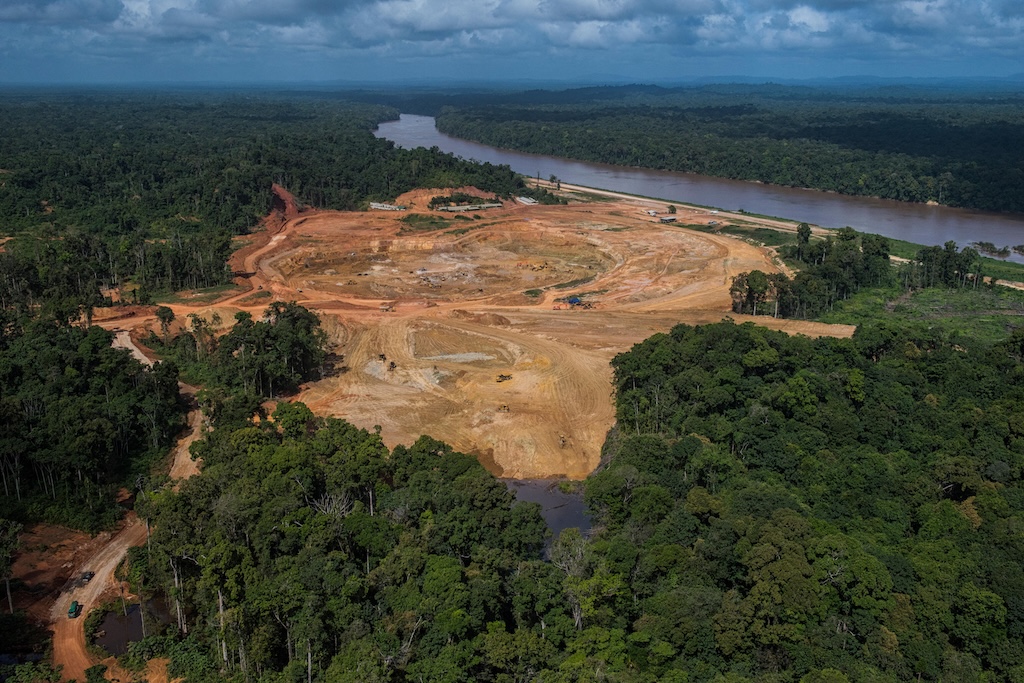 Gold mining in Guyana. Credit: Nature Picture Library / Alamy Stock Photo
For example, Guyana and Suriname have both highlighted that keeping existing "forests intact" is undervalued compared to "pressures from extractive industries", such as mining or agriculture.
Meanwhile, the EU, Switzerland and Mexico point to the role of agricultural expansion in the loss of forest and pasture land. Norway and Mexico highlighted illegal loggers offering higher rewards than conservation.
Both Canada and Russia pointed to an "inconsistent definition" of forest degradation.
Biodiverse countries with significant forest cover, such as Suriname and Azerbaijan, meanwhile called for more "predictable" and "affordable" access to climate finance to keep forests standing.
The Coalition of Rainforest Nations called for "a clear financial assessment of the total funding required to halt forest loss" in its submission.
However, many donor countries emphasised domestic, private and innovative finance in their solutions. The UK, for instance, called for more "blended finance to de-risk private investment at scale" for forest conservation and high-integrity carbon markets.
While Norway spoke of the need to "repurpos[e]" harmful subsidies, Australia highlighted the role of its controversial biodiversity credit and nature markets in "restor[ing] and protect[ing] land and biodiversity and reduc[ing] emissions at the same time".
Monitoring deforestation and restoration progress was another common challenge across countries. AOSIS, Armenia and Azerbaijan all raised this challenge and called for technical support for monitoring forest restoration, including satellite monitoring.
At the same time, Canada, Indonesia, Russia, Azerbaijan and Australia all cited the increasing risk of intensifying wildfires as threats to forests, with countries calling for early detection systems and support for monitoring fires in remote areas.
AOSIS called for coastal mangroves and inland terrestrial forests to be included in the definition of forests, adding that climate-driven impacts are already degrading mangrove forests.
 Dead zone in mangrove forests destroyed by Hurricane Irma. Credit: Francisco Blanco / Alamy Stock Photo
Many barriers are deeply specific to the geographical and socioeconomic contexts of individual countries. Small island states such as Mauritius, for instance, point to pressures arising from a "limited availability" of land. Sudan, meanwhile, draws attention to 70% of its population relying on firewood as an energy source amid conflict.
 Interactive: Who wants what at the COP31 climate change summit
02.11.2026
COP31 Antalya
 Experts: What China wants from the COP31 climate talks
29.10.2026
China policy
 Interview: COP31 president says electrification is 'surest way to protect citizens'
10.07.2026
COP31 Antalya
 Bonn climate talks: Key outcomes from the June 2026 UN climate conference
19.06.2026
Adaptation
The post Q&A: What is the Brazil-led 'deforestation roadmap'? appeared first on Carbon Brief.
- Why has Brazil produced a fossil-fuel 'roadmap'?
- What does the fossil-fuel roadmap say?
- How will the fossil-fuel roadmap be discussed at COP31?
Transitioning away from fossil fuels is "urgent, inevitable and, yet, possible", according to a first-of-its-kind global "roadmap" produced by Brazil.
The host of last year's climate summit, COP30, has set out a voluntary plan for how countries can move away from coal, oil and gas.
The roadmap says there is no "one-size-fits-all" approach to transitioning away from fossil fuels and asks countries to "diagnose" their own "readiness" to start the process.
After mapping out their specific circumstances, countries should then pursue "tailored levers" to take action, according to the roadmap.
These efforts should culminate by 2033, it says - 10 years on from when the COP28 climate summit in Dubai called on all countries to contribute to a global transition away from fossil fuels.
Below, Carbon Brief examines what the roadmap says and how it could influence debates about fossil fuels at the upcoming COP31 climate summit, which begins next week in Turkey.
- Why has Brazil produced a fossil-fuel 'roadmap'?
- What does the fossil-fuel roadmap say?
- How will the fossil-fuel roadmap be discussed at COP31?
Calls for a global "roadmap" away from fossil fuels dominated debates at COP30, which was held in the Amazonian city of Belém.
A group of 85 countries called for a reference to a new roadmap for transitioning away from fossil fuels to be part of COP30's formal negotiated outcome.
This call came the first "global stocktake" of action towards the world's climate goals at COP28 in 2023 called on all countries to contribute to transitioning away from fossil fuels.
However, another group of countries opposed such an inclusion.
It was claimed that this group included 84 countries. However, Carbon Brief's analysis of the "informal list" revealed inconsistencies and errors, meaning the total number of countries opposing the roadmap was likely smaller.
After two weeks of fierce debate, Brazil announced that the fossil-fuel roadmap would not be part of COP30's negotiated outcome - but that the presidency would work to create a roadmap outside of the UN climate process.
This roadmap is voluntary and countries are not obligated to respond to its findings.
Membership
Support award-winning climate journalism Join CB+At COP30, the presidency also announced that the roadmap would be informed by a first-of-its-kind conference on transitioning away from fossil fuels taking place in Santa Marta, Colombia.
These talks, co-hosted by Colombia and the Netherlands in April, saw ministers and climate envoys take part in informal discussions about the barriers they face in transitioning away from fossil fuels. (See Carbon Brief's full coverage of the talks.)
As well as the fossil-fuel roadmap, Brazil has also produced a new roadmap for ending deforestation. (See Carbon Brief's in-depth breakdown of the deforestation roadmap).
What does the fossil-fuel roadmap say?The roadmap acknowledges that, after decades of delayed action on fossil fuels, the world is no longer able to meet its ambition to limit global warming to 1.5C without first "overshooting" the target.
It also notes that the global transition to clean energy is already underway - and that the policies needed for transitioning away from fossil fuels already exist and are readily deployable.
It continues, however, by saying that transitioning away from fossil fuels is "as much a development question as a climate one, especially for emerging markets and developing economies".
In this context, it sets out plans for what it calls a "Belém readiness index". This is a "voluntary self-assessment tool" that countries can use to calculate their dependency on fossil fuels and their capacity for transitioning away.
At a press briefing announcing the roadmaps, COP30 CEO Ana Toni described this as the "diagnosis" stage of the roadmap, "instead of imagining there is a one-size-fits-all answer".
#gform_wrapper_7[data-form-index="0"].gform-theme,[data-parent-form="7_0"]{--gf-color-primary: #204ce5;--gf-color-primary-rgb: 32, 76, 229;--gf-color-primary-contrast: #fff;--gf-color-primary-contrast-rgb: 255, 255, 255;--gf-color-primary-darker: #001AB3;--gf-color-primary-lighter: #527EFF;--gf-color-secondary: #fff;--gf-color-secondary-rgb: 255, 255, 255;--gf-color-secondary-contrast: #112337;--gf-color-secondary-contrast-rgb: 17, 35, 55;--gf-color-secondary-darker: #F5F5F5;--gf-color-secondary-lighter: #FFFFFF;--gf-color-out-ctrl-light: rgba(17, 35, 55, 0.1);--gf-color-out-ctrl-light-rgb: 17, 35, 55;--gf-color-out-ctrl-light-darker: rgba(104, 110, 119, 0.35);--gf-color-out-ctrl-light-lighter: #F5F5F5;--gf-color-out-ctrl-dark: #585e6a;--gf-color-out-ctrl-dark-rgb: 88, 94, 106;--gf-color-out-ctrl-dark-darker: #112337;--gf-color-out-ctrl-dark-lighter: rgba(17, 35, 55, 0.65);--gf-color-in-ctrl: #fff;--gf-color-in-ctrl-rgb: 255, 255, 255;--gf-color-in-ctrl-contrast: #112337;--gf-color-in-ctrl-contrast-rgb: 17, 35, 55;--gf-color-in-ctrl-darker: #F5F5F5;--gf-color-in-ctrl-lighter: #FFFFFF;--gf-color-in-ctrl-primary: #204ce5;--gf-color-in-ctrl-primary-rgb: 32, 76, 229;--gf-color-in-ctrl-primary-contrast: #fff;--gf-color-in-ctrl-primary-contrast-rgb: 255, 255, 255;--gf-color-in-ctrl-primary-darker: #001AB3;--gf-color-in-ctrl-primary-lighter: #527EFF;--gf-color-in-ctrl-light: rgba(17, 35, 55, 0.1);--gf-color-in-ctrl-light-rgb: 17, 35, 55;--gf-color-in-ctrl-light-darker: rgba(104, 110, 119, 0.35);--gf-color-in-ctrl-light-lighter: #F5F5F5;--gf-color-in-ctrl-dark: #585e6a;--gf-color-in-ctrl-dark-rgb: 88, 94, 106;--gf-color-in-ctrl-dark-darker: #112337;--gf-color-in-ctrl-dark-lighter: rgba(17, 35, 55, 0.65);--gf-radius: 3px;--gf-font-size-secondary: 14px;--gf-font-size-tertiary: 13px;--gf-icon-ctrl-number: url("data:image/svg+xml,%3Csvg width='8' height='14' viewBox='0 0 8 14' fill='none' xmlns='http://www.w3.org/2000/svg'%3E%3Cpath fill-rule='evenodd' clip-rule='evenodd' d='M4 0C4.26522 5.96046e-08 4.51957 0.105357 4.70711 0.292893L7.70711 3.29289C8.09763 3.68342 8.09763 4.31658 7.70711 4.70711C7.31658 5.09763 6.68342 5.09763 6.29289 4.70711L4 2.41421L1.70711 4.70711C1.31658 5.09763 0.683417 5.09763 0.292893 4.70711C-0.0976311 4.31658 -0.097631 3.68342 0.292893 3.29289L3.29289 0.292893C3.48043 0.105357 3.73478 0 4 0ZM0.292893 9.29289C0.683417 8.90237 1.31658 8.90237 1.70711 9.29289L4 11.5858L6.29289 9.29289C6.68342 8.90237 7.31658 8.90237 7.70711 9.29289C8.09763 9.68342 8.09763 10.3166 7.70711 10.7071L4.70711 13.7071C4.31658 14.0976 3.68342 14.0976 3.29289 13.7071L0.292893 10.7071C-0.0976311 10.3166 -0.0976311 9.68342 0.292893 9.29289Z' fill='rgba(17, 35, 55, 0.65)'/%3E%3C/svg%3E");--gf-icon-ctrl-select: url("data:image/svg+xml,%3Csvg width='10' height='6' viewBox='0 0 10 6' fill='none' xmlns='http://www.w3.org/2000/svg'%3E%3Cpath fill-rule='evenodd' clip-rule='evenodd' d='M0.292893 0.292893C0.683417 -0.097631 1.31658 -0.097631 1.70711 0.292893L5 3.58579L8.29289 0.292893C8.68342 -0.0976311 9.31658 -0.0976311 9.70711 0.292893C10.0976 0.683417 10.0976 1.31658 9.70711 1.70711L5.70711 5.70711C5.31658 6.09763 4.68342 6.09763 4.29289 5.70711L0.292893 1.70711C-0.0976311 1.31658 -0.0976311 0.683418 0.292893 0.292893Z' fill='rgba(17, 35, 55, 0.65)'/%3E%3C/svg%3E");--gf-icon-ctrl-search: url("data:image/svg+xml,%3Csvg width='640' height='640' xmlns='http://www.w3.org/2000/svg'%3E%3Cpath d='M256 128c-70.692 0-128 57.308-128 128 0 70.691 57.308 128 128 128 70.691 0 128-57.309 128-128 0-70.692-57.309-128-128-128zM64 256c0-106.039 85.961-192 192-192s192 85.961 192 192c0 41.466-13.146 79.863-35.498 111.248l154.125 154.125c12.496 12.496 12.496 32.758 0 45.254s-32.758 12.496-45.254 0L367.248 412.502C335.862 434.854 297.467 448 256 448c-106.039 0-192-85.962-192-192z' fill='rgba(17, 35, 55, 0.65)'/%3E%3C/svg%3E");--gf-label-space-y-secondary: var(--gf-label-space-y-md-secondary);--gf-ctrl-border-color: #686e77;--gf-ctrl-size: var(--gf-ctrl-size-md);--gf-ctrl-label-color-primary: #112337;--gf-ctrl-label-color-secondary: #112337;--gf-ctrl-choice-size: var(--gf-ctrl-choice-size-md);--gf-ctrl-checkbox-check-size: var(--gf-ctrl-checkbox-check-size-md);--gf-ctrl-radio-check-size: var(--gf-ctrl-radio-check-size-md);--gf-ctrl-btn-font-size: var(--gf-ctrl-btn-font-size-md);--gf-ctrl-btn-padding-x: var(--gf-ctrl-btn-padding-x-md);--gf-ctrl-btn-size: var(--gf-ctrl-btn-size-md);--gf-ctrl-btn-border-color-secondary: #686e77;--gf-ctrl-file-btn-bg-color-hover: #EBEBEB;--gf-field-img-choice-size: var(--gf-field-img-choice-size-md);--gf-field-img-choice-card-space: var(--gf-field-img-choice-card-space-md);--gf-field-img-choice-check-ind-size: var(--gf-field-img-choice-check-ind-size-md);--gf-field-img-choice-check-ind-icon-size: var(--gf-field-img-choice-check-ind-icon-size-md);--gf-field-pg-steps-number-color: rgba(17, 35, 55, 0.8);} EmailThis field is for validation purposes and should be left unchanged.Free weekly newsletter
.preheader p{ margin-top: 0; font-family: 'PT Sans', sans-serif; font-weight: var(--type--3--font-weight--bold); color: var(--button--color); font-size: var(--button--font-size, inherit); } .newsletter-inline{
display: flex;
border: solid 1px #333333;
padding: 1em;
background: #ffffff;
}
.inline-email{
display:inline-block;
margin-right:1em;
margin-top:0 !important;
margin-bottom:0.5em;
}
#field_submit{
display:inline-block;
margin-top:0 !important;
}
.gform_wrapper .gfield+.gfield{
margin-top:0
}
Email
gform.initializeOnLoaded( function() {gformInitSpinner( 7, 'https://www.carbonbrief.org/wp-content/plugins/gravityforms/images/spinner.svg', false );jQuery('#gform_ajax_frame_7').on('load',function(){var contents = jQuery(this).contents().find('*').html();var is_postback = contents.indexOf('GF_AJAX_POSTBACK') >= 0;if(!is_postback){return;}var form_content = jQuery(this).contents().find('#gform_wrapper_7');var is_confirmation = jQuery(this).contents().find('#gform_confirmation_wrapper_7').length > 0;var is_redirect = contents.indexOf('gformRedirect(){') >= 0;var is_form = form_content.length > 0 && ! is_redirect && ! is_confirmation;var mt = parseInt(jQuery('html').css('margin-top'), 10) + parseInt(jQuery('body').css('margin-top'), 10) + 100;if(is_form){jQuery('#gform_wrapper_7').html(form_content.html());if(form_content.hasClass('gform_validation_error')){jQuery('#gform_wrapper_7').addClass('gform_validation_error');} else {jQuery('#gform_wrapper_7').removeClass('gform_validation_error');}setTimeout( function() { /* delay the scroll by 50 milliseconds to fix a bug in chrome */ jQuery(document).scrollTop(jQuery('#gform_wrapper_7').offset().top - mt); }, 50 );if(window['gformInitDatepicker']) {gformInitDatepicker();}if(window['gformInitPriceFields']) {gformInitPriceFields();}var current_page = jQuery('#gform_source_page_number_7').val();gformInitSpinner( 7, 'https://www.carbonbrief.org/wp-content/plugins/gravityforms/images/spinner.svg', false );jQuery(document).trigger('gform_page_loaded', [7, current_page]);window['gf_submitting_7'] = false;}else if(!is_redirect){var confirmation_content = jQuery(this).contents().find('.GF_AJAX_POSTBACK').html();if(!confirmation_content){confirmation_content = contents;}jQuery('#gform_wrapper_7').replaceWith(confirmation_content);jQuery(document).scrollTop(jQuery('#gf_7').offset().top - mt);jQuery(document).trigger('gform_confirmation_loaded', [7]);window['gf_submitting_7'] = false;wp.a11y.speak(jQuery('#gform_confirmation_message_7').text());}else{jQuery('#gform_7').append(contents);if(window['gformRedirect']) {gformRedirect();}}jQuery(document).trigger("gform_pre_post_render", [{ formId: "7", currentPage: "current_page", abort: function() { this.preventDefault(); } }]); if (event && event.defaultPrevented) { return; } const gformWrapperDiv = document.getElementById( "gform_wrapper_7" ); if ( gformWrapperDiv ) { const visibilitySpan = document.createElement( "span" ); visibilitySpan.id = "gform_visibility_test_7"; gformWrapperDiv.insertAdjacentElement( "afterend", visibilitySpan ); } const visibilityTestDiv = document.getElementById( "gform_visibility_test_7" ); let postRenderFired = false; function triggerPostRender() { if ( postRenderFired ) { return; } postRenderFired = true; gform.core.triggerPostRenderEvents( 7, current_page ); if ( visibilityTestDiv ) { visibilityTestDiv.parentNode.removeChild( visibilityTestDiv ); } } function debounce( func, wait, immediate ) { var timeout; return function() { var context = this, args = arguments; var later = function() { timeout = null; if ( !immediate ) func.apply( context, args ); }; var callNow = immediate && !timeout; clearTimeout( timeout ); timeout = setTimeout( later, wait ); if ( callNow ) func.apply( context, args ); }; } const debouncedTriggerPostRender = debounce( function() { triggerPostRender(); }, 200 ); if ( visibilityTestDiv && visibilityTestDiv.offsetParent === null ) { const observer = new MutationObserver( ( mutations ) => { mutations.forEach( ( mutation ) => { if ( mutation.type === 'attributes' && visibilityTestDiv.offsetParent !== null ) { debouncedTriggerPostRender(); observer.disconnect(); } }); }); observer.observe( document.body, { attributes: true, childList: false, subtree: true, attributeFilter: [ 'style', 'class' ], }); } else { triggerPostRender(); } } );} );
After identifying their "readiness" for transition, countries will be sorted into four "archetypes", says the roadmap, leading to the identification of specific policy "levers" for taking action.
The roadmap calls for action in three distinct "phases".
The first phase should be from now until 2028, when the second global stocktake of progress towards the Paris Agreement is due to conclude at COP33.
In this phase, "efforts focus on institutions and long-term signals", says the roadmap.
The second phase is from 2028-2030, when the next round of UN climate pledges, known as nationally determined contributions (NDCs), are due.
This phase should focus on the "physical transformation of energy systems", says the roadmap.
The final phase is 2031-2033 - 10 years after the call for all countries to help with "transitioning away from fossil fuels" in "this critical decade" at COP28.
This phase should focus on the scaling up of the transition, according to the roadmap.
All of these elements are summarised in the graphic below, which was presented to journalists and civil society during a press briefing.
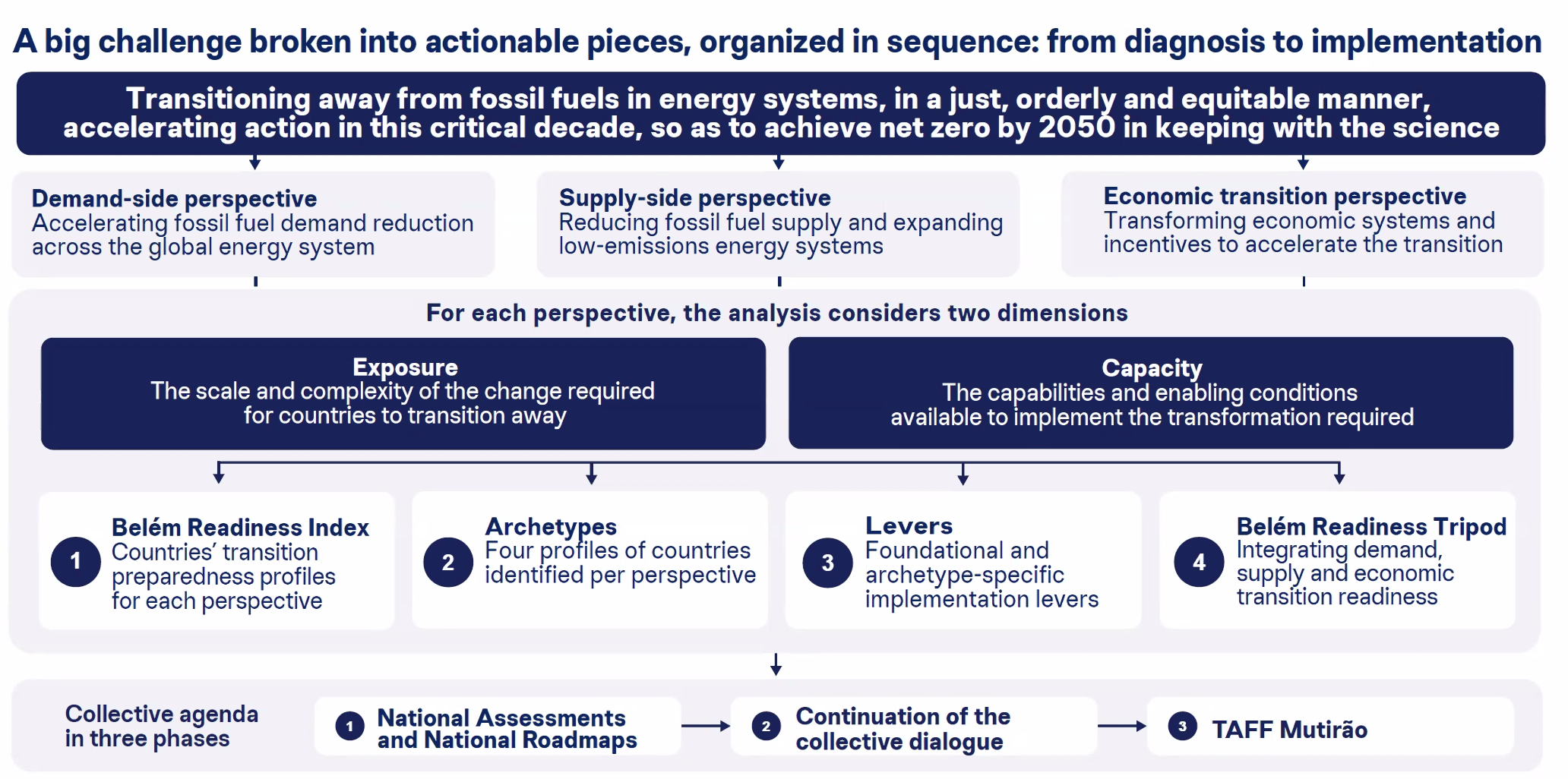 Credit: COP30 presidency
At the press briefing, Toni added that each stage of the roadmap was designed to be "extremely pragmatic and easy for countries to take a look at it".
The approach has broadly been welcomed by civil society and experts.
Dr Natalie Jones, a senior policy adviser at the International Institute for Sustainable Development (IISD), tells Carbon Brief that the roadmap sends an "important political signal that the transition away from fossil fuels remains firmly on the international agenda". She adds:
"It also gives governments practical guidance to plan that transition in ways that reflect their national circumstances, strengthen energy security and protect livelihoods."
Avantika Goswami, a climate policy expert at the Centre for Science and Environment in New Delhi, India, tells Carbon Brief that the roadmap is a "unique and consultative method of multilateralism". She says:
"[The roadmap] is one that is put forth by a developing country, via a consultative process that invited submissions from all parties and civil society.
"The analytical framework proposed captures the complexity of the fossil-fuel transition. Countries must now use it to chart out pathways in line with their historical responsibility and current capacity."
Ploy Achakulwisut, a former UN adviser on fossil fuels, wrote on LinkedIn that she was "deeply impressed" with Brazil's approach, including its use of a "readiness index". She added:
"[The index] provides a method for identifying countries that face similar transition conditions and for understanding how different exposure-capacity 'archetypes' can generate distinct implementation needs and opportunities.
"The latter can 'support more targeted international cooperation', helping the international community to align finance, technology, capacity-building, and technical assistance with country-specific needs and existing capabilities."
How will the fossil-fuel roadmap be discussed at COP31?Brazil's fossil-fuel roadmap comes just a week before the next round of UN climate talks, COP31, kicks off in Antalya, Turkey.
COP31 co-presidents Turkey and Australia have set out a wide range of priorities for the summit, including a target to increase the share of global final energy consumption met by electricity from almost 24% in 2023 to 35% by 2035.
Speaking at the press briefing, COP30 president André Aranha Corrêa do Lago said that this electrification goal was "complementary" to the aims of the fossil-fuel roadmap.
Carbon Brief understands that some parties feel that Turkey and Australia's focus on electrification over fossil fuels is an attempt to avoid a re-hashing of the lengthy debates at COP30.
Both Corrêa do Lago and Toni were reluctant to speculate on how the fossil-fuel roadmap might be taken up and discussed during COP31, with Toni telling journalists that they were "hoping for the best".
When asked about how Brazil hoped the roadmap would be received by those that specifically opposed its inclusion at COP30, Corrêa do Lago declined to address other countries directly, but said:
"Let's remind ourselves we already have a consensus [on transitioning away from fossil fuels, agreed at COP28] and we already have the instruments."
Jones tells Carbon Brief that, following on from the roadmap, the "task now is to build on that signal with action", adding:
"At COP31, more governments should announce national fossil-fuel transition roadmaps and explain how these will inform their national climate plans. The conference should also [formally] recognise the global roadmap and establish a route for its findings to inform the second global stocktake.
"For vulnerable countries dependent on fossil-fuel revenues, credible plans must be matched by international finance and support to diversify their economies and sustain public services. This roadmap can help turn a shared commitment into practical progress."
Related
Interactive: Who wants what at the COP31 climate change summit
02.11.2026
COP31 Antalya
Experts: What China wants from the COP31 climate talks
29.10.2026
China policy
Interview: COP31 president says electrification is 'surest way to protect citizens'
10.07.2026
COP31 Antalya
Bonn climate talks: Key outcomes from the June 2026 UN climate conference
19.06.2026
Adaptation
The post Q&A: What is in the global 'roadmap' for transitioning away from fossil fuels? appeared first on Carbon Brief.


