
 Fighting for songbird survival and safer everyday veterinary medicines [ 17-Feb-26 5:14pm ]
Songbirds have charmed people for hundreds of years, boosting our spirits and health. They also play a vital ecological role: dispersing seeds, promoting plant growth, controlling pests and supporting a healthy natural environment. As sensitive indicators of environmental change, they also act as nature's early warning system, alerting us when something's going wrong.
Our UK songbirds are facing unprecedented threats; over the last 50 years, populations have fallen by 50% and continue to decline. We live in an era of mass species extinction, driven by threats such as climate change, insect decline, pollution, predation and landscape changes. Once common species - such as the bullfinch and spotted flycatcher - have become rare sights and sounds.
SongBird Survival, a charity headquartered in Diss, Norfolk, funds scientific research into the reasons for this decline. It focuses on areas where scientific evidence is sparse, inadequate or lacking.
Research into the impact of vet medicinesIn 2023 the charity funded a 2-year research study, working with Sussex University, looking at the effects of veterinary meds on nesting blue tits and great tits. Many species of birds use hair, wool and fur to line their nests as cushioning before laying their eggs. This lining can come from livestock, deer or sometimes from our domestic pets. The study examined the lining of nests for pesticides (such as fipronil, imidacloprid and permethrin) that are commonly found in anti-parasite treatments and tested if the presence of these pesticides had an impact on the offspring of nesting tits.

 Young great tits in their nest box. Image by jokevanderleij8 (CC0) | Two Blue Tit (Cyanistes caeruleus) parents admire their first chick to hatch, just moments before this picture was taken. The female (right) has a caterpillar for the chick's first meal. Image by fs-phil via Wikimedia Commons (CC BY-SA 2.0)
Research findings
Young great tits in their nest box. Image by jokevanderleij8 (CC0) | Two Blue Tit (Cyanistes caeruleus) parents admire their first chick to hatch, just moments before this picture was taken. The female (right) has a caterpillar for the chick's first meal. Image by fs-phil via Wikimedia Commons (CC BY-SA 2.0)
Research findings
The findings from this initial study paint a sad picture for our feathered friends:
- 103 nests were collected from blue tits and great tits and 100% of the nests were contaminated with fipronil (used in spot-on flea treatments for domestic pets).
- 89.1% of blue tit nests and 87.2% of great tit nests had detected levels of imidacloprid (also used in spot-on flea treatments).
- 89.1% of blue tit nests and 84.6% of great tit nests had detected levels of permethrin (typically used in anti-parasite treatments on beef/dairy cattle, horses, sheep, goats, swine, and poultry).
A second phase of this research project investigated whether the chemical exposure is influencing breeding success and survival in songbirds by measuring pesticide levels in the eggs and dead chicks of blue tits and great tits.
"This latest study is due to be published in early spring," Susan Morgan, SongBird Survival Chief Executive Officer told East Anglia Bylines, "so we're on the cusp of learning far more about the hidden impacts these chemicals could be having on our songbirds."
Next stepsWe are a nation of pet lovers, and many pet owners will be using the 'spot-on' flea treatments for cats and dogs. Farmers seek veterinary medical support to control flies, ticks, lice and mites on their livestock. Unfortunately the research findings add to growing evidence that veterinary medicines are potentially having a negative impact on songbird populations. This is why we need a greater environmental risk assessment of veterinary medicines.
SongBird Survival, along with other environmental organisations, is using the research findings to push for a more complete environmental risk assessment of veterinary meds by the Veterinary Medicines Directorate. The impact of pesticides on all wildlife and the environment needs greater understanding.
The charity will be launching a public campaign to help pet owners make informed choices, raising awareness of the environmental impacts of these products and encouraging people to have conversations with vets about the safest and most suitable options for their pets.
What can you do now?
To help prevent treatment pesticides compromising wildlife, SongBird Survival recommends:
- Talk to your vet about the most suitable options for your pet.
- If you do continue to use fipronil, imidacloprid and permethrin spot-on treatments, don't brush your dogs or cats outside or put out hair for the birds to use in nest-making.
- Don't allow pets to go into rivers and streams following the application of spot-on flea treatments, preferably for as long as possible.
- Make sure you dispose of the packaging properly in household waste.
SongBird Survival is the only national UK charity solely dedicated to changing the future for songbirds. Its vision is to create rich, resilient and balanced songbird populations. It makes an impact by driving conservation through scientific research, protecting songbirds by raising awareness and inspiring action, and safeguarding the most at-risk songbird species. Please visit www.songbird-survival.org.uk for more information on how you can help protect songbirds.
More from East Anglia Bylines
 Environment
From silence to song: saving the farmland birds
byRachel Fulcher 5 October 2025
Environment
From silence to song: saving the farmland birds
byRachel Fulcher 5 October 2025
 Environment
Hidden wonders: my fascinating encounters with the Bittern
byLeslie Cater 11 November 2025
Environment
Hidden wonders: my fascinating encounters with the Bittern
byLeslie Cater 11 November 2025
 Climate
The truth about migratory birds and the climate emergency
byJenny Rhodes 18 October 2025
Climate
The truth about migratory birds and the climate emergency
byJenny Rhodes 18 October 2025
 Environment
More than a hobby: garden birdwatching is the new conservation frontier
bySusan Jones 1 February 2026
Environment
More than a hobby: garden birdwatching is the new conservation frontier
bySusan Jones 1 February 2026
 Friends of Bylines Network
There has never been a greater need for grassroots journalism that investigates the stories that really matter, holds power to account and champions the voices of everyday citizens. We are proudly powered by volunteers but what we do isn't free.
STAND WITH US for independent, citizen-led journalism that makes democracy stronger, and you will even get some exclusive benefits.
BECOME A FRIENDThe post Fighting for songbird survival and safer everyday veterinary medicines first appeared on East Anglia Bylines.
Why are scientists calling for urgent action on amoebas? [ 15-Feb-26 5:16pm ]
Free-living amoebas are a little known group of single-celled organisms that don't need a host to live. They are found in soil and water, from puddles to lakes. What makes them remarkable is their ability to change shape and move using temporary arm-like extensions called pseudopodia - literally "false feet". This allows them to thrive in an astonishing range of environments. And they pose a growing health threat.
What is the 'brain-eating amoeba' and how dangerous is it?The most notorious free-living amoeba is Naegleria fowleri, commonly known as the "brain-eating amoeba". It lives naturally in warm freshwater, typically between 30°C and 40°C - lakes, rivers and hot springs. But it is rarely found in temperate countries such as the UK, due to the cold weather.
The infection happens when contaminated water enters through the nose, usually while swimming. From there, the amoeba travels along the nasal passages to the brain, where it destroys brain tissue. The outcome is usually devastating, with a mortality rate of 95%-99%.
Occasionally, Naegleria fowleri has been found in tap water, particularly when it's warm and hasn't been properly chlorinated. Some people have become infected while using contaminated tap water to rinse their sinuses for religious or health reasons. Fortunately, you cannot get infected by drinking contaminated water, and the infection doesn't spread from person to person.
Why are these amoebas so difficult to kill?Brain-eating amoebas can be killed by proper water treatment and chlorination. But eliminating them from water systems isn't always straightforward. When they attach to biofilms - communities of microorganisms that form inside pipes - disinfectants like chlorine struggle to reach them, and organic matter can reduce the disinfectants' effectiveness.
The amoeba can also survive warm temperatures by forming "cysts" - hard protective shells - making it harder to control in water networks, especially during summer or in poorly maintained systems.
What is the 'Trojan-horse effect' and why does it matter?Free-living amoebas aren't just dangerous on their own. They can also act as living shields for other harmful microbes, protecting them from environmental stress and disinfection.
While amoebas normally feed on bacteria, fungi and viruses, some bacteria - like Mycobacterium tuberculosis (which causes TB) and Legionella pneumophila (which causes legionnaires' disease) - have evolved to survive and multiply inside them. This helps these pathogens survive longer and potentially become more dangerous.
Amoebas also shelter fungi such as Cryptococcus neoformans, which can cause fungal meningitis. It can also shelter viruses, such as human norovirus and adenovirus, which cause respiratory, eye and gastrointestinal infections. By protecting these pathogens, amoebas help them survive longer in water and soil, and may even help spread antibiotic resistance.
How is climate change making the problem worse?Climate change is probably making the threat from free-living amoebas worse by creating more favourable conditions for their growth. Naegleria fowleri thrives in warm freshwater. As global temperatures rise, the habitable zone for these heat-loving amoebas has expanded into regions that were previously too cool. This potentially exposes more people to them through recreational water use.
Several recent outbreaks linked to recreational water exposure have already raised public concern in multiple countries. These climate-driven changes - warmer waters, longer warm seasons, and increased human contact with water - make controlling the risks more difficult than ever before.
Are our water systems adequately checked for these organisms?Most water systems are not routinely checked for free-living amoebas. The organisms are rare, can hide in biofilms or sediments, and require specialised tests to detect, making routine monitoring expensive and technically challenging.
Instead, water safety relies on proper chlorination, maintaining disinfectant levels, and flushing systems regularly, rather than testing directly for the amoeba. While some guidance exists for high-risk areas, widespread monitoring is not standard practice.
Beyond brain infections, what other health risks do these amoebas pose?Free-living amoebas aren't just a threat to the brain. They can cause painful eye infections, particularly in contact lens users, skin lesions in people with weakened immune systems, and rare but serious systemic infections affecting organs such as the lungs, liver and kidneys.
What's being done to address this threat?Free-living amoebas such as Naegleria fowleri are rare but can be deadly, so prevention is crucial. These organisms don't fit neatly into either medical or environmental categories - they span both, requiring a holistic approach that links environmental surveillance, water management, and clinical awareness to reduce risk.
Environmental change, gaps in water treatment and expanding habitats make monitoring - and clear communication of risk - more important than ever. Keeping water systems properly chlorinated, flushing hot water systems, and following safe recreational water and contact lens hygiene guidelines all help reduce the chance of infection. Meanwhile, researchers continue to improve detection methods and doctors work to recognise cases early.
Should people be worried about their tap water or going swimming?People cannot get infected with free-living amoebas like Naegleria fowleri by drinking water, even if it contains the organism. Infection occurs only when contaminated water enters the nose, allowing the amoeba to reach the brain. Swallowing the water poses no risk because the amoeba cannot survive or invade through the digestive tract.
The risk from swimming in well-maintained pools or treated water is extremely low. The danger comes from warm, untreated freshwater, particularly during hot weather.
What can people do to protect themselves?People can protect themselves from free-living amoebas by reducing exposure to warm, stagnant water. Simple steps include avoiding putting your head underwater in lakes or rivers during hot weather, using nose clips when swimming, choosing well-maintained pools, and keeping home water systems properly flushed and heated.
Contact lens users should follow strict hygiene and never rinse lenses with tap water. For nasal rinsing, only use sterile, distilled, or previously boiled water.
Awareness is key. If you develop a severe headache, fever, nausea, or stiff neck after freshwater exposure, seek medical attention immediately - early treatment is critical.

This article is republished from The Conversation under a Creative Commons license. Read the original article.
More from East Anglia Bylines
 Activism
The politics of pollution: the failure of the privatised water industry
byWil Harvey 28 January 2026
Activism
The politics of pollution: the failure of the privatised water industry
byWil Harvey 28 January 2026
 Anglia
Wild swimming magic: community, courage and cold waves
byKate Viscardi 2 January 2025
Anglia
Wild swimming magic: community, courage and cold waves
byKate Viscardi 2 January 2025
 Environment
Norfolk Broads rivers drowning in sewage, new report warns
byOwen Sennitt, Local Democracy Reporter 24 September 2025
Environment
Norfolk Broads rivers drowning in sewage, new report warns
byOwen Sennitt, Local Democracy Reporter 24 September 2025
 Anglia
n Water faces backlash after conviction in Environment Agency probe
byOwen Sennitt, Local Democracy Reporter 1 June 2024
Anglia
Anglian Water faces backlash after conviction in Environment Agency probe
byOwen Sennitt, Local Democracy Reporter 1 June 2024
 Education
Breaking down barriers and building a better STEM future
byEast Anglia Bylines 20 February 2026
Education
Breaking down barriers and building a better STEM future
byEast Anglia Bylines 20 February 2026
 Bylines Network Gazette is back!
With a thematic issue on a vital topic - the rise child poverty, ending on a hopeful note. You will find sharp analyses on the effect of poverty on children's lives, with a spotlight on the communities that are on the front line of deprivation, with personal stories and shared solutions. Click on the image to gain access to it, or find us on Substack.
Journalism by the people, for the people.
The post Why are scientists calling for urgent action on amoebas? first appeared on East Anglia Bylines.
From green to grey: why 'growth at all costs' is threatening British wildlife [ 22-Jan-26 5:37am ]
This time last year, East Anglia Bylines gave me the space to explain why I, a dedicated birdwatcher, will not be among those taking part in the Big Garden Birdwatch.
I won't be doing so in 2026 either. Not out of pique because my garden remains as devoid of birdlife as it has for the past decade. Not because I question the value of citizen science, nor because I don't understand that a negative response is as valid as a positive one.
Data on our diminished flora and fauna are vital. Without them, we lack the hard proof needed to convince politicians and other decision-makers that it is possible to achieve economic and social ambitions without further trashing our already impoverished natural environment.
After a decade and more of stagnation under previous governments, the arrival of a government of a different colour in July 2024 seemed a breath of fresh air. In its manifesto, Labour promised "to restore and protect our natural world" and "to unlock the building of homes … without weakening environmental protections".
Change in tone Little Whirlpool Ramshorn Snail image by Back from the Brink. CC BY-NC 2.0
Sadly, for me and many other Labour supporters, the tone of the language soon changed. The list of species that had allegedly swollen the cost of major infrastructure projects and prevented or slowed the building of badly needed new homes grew longer: the notorious bat colony tunnel that saddled the environmentally disastrous HS2 project with an "unnecessary" £300m additional cost; the proverbial great crested newts that plagued developers anxious to meet an unfulfilled need (and incidentally swell their profits); the whirlpool ramshorn snails that allegedly held up a Sussex housing development; the distinguished jumping spider similarly allegedly blocking a development in Kent.
When the spider and snail cases were investigated, the claims by Sir Keir Starmer and Chancellor of the Exchequer Rachel Reeves did not quite stack up.
But it was the attack on environmentalists who had supported Labour that really rankled. Perhaps we should have expected the rhetoric after Starmer's reported (and denied) rant against "tree huggers" while in opposition. But it still came as an unwelcome shock when Starmer delivered an attack on "nimbys and zealots" who had opposed a Norfolk road scheme because of the impact on a colony of Barbastelle bats, and, more recently, described the Green Party as "nuts".
 Image by Peter Facey. CC BY-SA 2.0
Strident rhetoric
Image by Peter Facey. CC BY-SA 2.0
Strident rhetoric
It was the strident rhetoric, combined with the go-ahead for the Heathrow third runway, that finally prompted my resignation from the Labour Party.
In its race for faster economic growth, more and faster house-building, and eye-catching infrastructure projects such as the Heathrow expansion and Sizewell C, the commitment to the environment and specifically natural diversity evaporated.
While the June 2025 spending review included a strong focus on clean energy, funding for nature and other environmental measures was much more limited, with the Department for Environment, Food and Rural Affairs' spending reducing by 1.8% in real terms.
Nature's declineEarlier this month, the Office for Environmental Protection warned that the biodiversity target, which means stopping the decline of species such as the hedgehog and red squirrel, will almost certainly not be met in England. The report says: "Important species continue to decline. The opportunity to effect further change ahead of the 2030 target has now largely passed."
The 2023 State of Nature report declared Great Britain "one of the most nature-depleted countries on Earth", with nearly one in six species threatened with extinction.
The government launched the Nuclear Regulatory Review in February 2025, under the leadership of John Fingleton, to assess the regulations surrounding civil and defence nuclear activities. The resulting Fingleton Review called for environmental protections to be weakened. As 2025 drew to a close, the county Wildlife Trusts warned that this would exacerbate the present catastrophe even further.
The Trusts say Chancellor Rachel Reeves has asked the Secretary of State for Energy Security and Net Zero, Ed Miliband, to prepare a plan to take forward the recommendations. They are campaigning against it.
"If this plan includes those recommendations, it could be devastating for the places that nature's recovery relies on. It's a short-sighted and flawed idea which prioritises cost-cutting for a few developers while risking turning the nature crisis into an environmental catastrophe. Everyone, and everything, will suffer."
It already is. The decline in farmland and woodland bird species, the disappearance of pollinators and other insects, the path to extinction of hedgehogs … The list is endless.
So, against this background, recording the declining numbers of once common birds in the nation's back gardens seems redundant. In the face of the accelerating collapse of nature, the question for all of us who have dedicated our lives to the study of the natural world is whether that struggle is now winnable.
More from East Anglia Bylines
Environment
From silence to song: saving the farmland birds
byRachel Fulcher 5 October 2025
 Activism
How to help nature thrive in your neighbourhood
byGlyn Evans 18 November 2025
Climate
The truth about migratory birds and the climate emergency
byJenny Rhodes 18 October 2025
Activism
How to help nature thrive in your neighbourhood
byGlyn Evans 18 November 2025
Climate
The truth about migratory birds and the climate emergency
byJenny Rhodes 18 October 2025
 Community
Young Norfolk activist fights to protect grey seal pups
byAmaya Edwards 14 December 2025
Friends of Bylines Network
Community
Young Norfolk activist fights to protect grey seal pups
byAmaya Edwards 14 December 2025
Friends of Bylines Network
There has never been a greater need for grassroots journalism that investigates the stories that really matter, holds power to account and champions the voices of everyday citizens. We are proudly powered by volunteers but what we do isn't free.
STAND WITH US for independent, citizen-led journalism that makes democracy stronger, and you will even get some exclusive benefits.
BECOME A FRIENDThe post From green to grey: why 'growth at all costs' is threatening British wildlife first appeared on East Anglia Bylines.
Unlimited energy: reaching for the heat beneath our feet [ 23-Dec-25 5:19am ]
Humanity's continuing existence in a vast universe is astonishing. The thin crust we live on constitutes less than 1% of the earth's mass. We depend for all our food on a skin of earth half a metre thick, and we are depleting it. But in the last few hundred years, we have managed to build a civilisation by wolfing down some strictly limited resources.
Our need for energy has been hugely destructive. We nearly eliminated whales in the hunt for oil. More than a million people have died extracting coal and oil, and more have died from the associated pollution. We are heating the climate, perhaps to unsustainable levels.
And it is only as the possibility of our own extinction appeared on the horizon that we have turned seriously to the two huge and inexhaustible energy sources: the sun and the ground beneath our feet. But if we can solve the technical problems quickly enough, either of them could provide all our energy needs forever.
Two sustainable sourcesThe sun gives us direct solar radiation. We have learned to gather and convert it to electricity. And we have also gradually learned to tap its indirect energy through wind, tides and rain. But we have barely begun to exploit the second source, the earth beneath our feet.
At the surface, ground source heat pumps extract low temperature heat from the ground to heat buildings. But further down, almost all of the earth's mass is a vast body of tremendously hot rock. In a few places, like the active volcanic areas of the Pacific rim and Iceland, this comes close enough to the surface to be tapped easily. In New Zealand, power stations run on the steam emerging from the ground below. But we have yet to succeed in tapping the heat at the deeper levels where it is found across the globe.
Tapping the earthThe principle of geothermal energy is simple. Water is fed down a deep shaft into the hot rock below, and then returned as steam, to drive turbines like a conventional power station. The cooled water is then fed down again to complete the cycle. Unlike most other renewables, the process runs 24/7. The power source will continue as long as there is an earth for us to live on. And the environmental impact is much less than conventional power stations or windfarms — there is little or no carbon released, and little unsightly infrastructure.
The principle is simple but, of course, the practice is more complicated.
 Eden Project image by Pam Brophy. CC By-SA 2.0
British achievements
Eden Project image by Pam Brophy. CC By-SA 2.0
British achievements
In Britain, four projects are now tapping geothermal energy from the hot granite which lies below the surface in Cornwall. In 2023, the Eden Project began heating its site and offices from a 4km deep shaft. Now, Geothermal Engineering is developing three deeper sites, with contracts to begin delivering electricity to the grid next year. Their first project, United Downs, has successfully drilled 5km down. The water fed down that shaft will return as steam to drive the turbines. By 2028, it is expected to be generating 12 Megawatts of power.
Admittedly, this is a very small contribution to overall UK renewable generation, but this is an emerging technology and only the beginning. And in Cornwall, there is a secondary benefit. The rocks are rich in Lithium, and the water is bringing it up in significant quantities. Lithium is critical to many electronic technologies, including batteries. Most of it is currently mined in Australia and China, and its processing requires large amounts of energy and causes significant pollution. So, a relatively clean UK source is well worth exploiting, and United Downs is constructing a plant which aims to produce 100 tonnes of Lithium a year.
 Image by LazerRocDoc (CC BY-SA 4.0)
Going further down
Image by LazerRocDoc (CC BY-SA 4.0)
Going further down
Drilling down 5 km is practicable with existing mechanical drills. But going much further presents entirely new challenges. That means tapping into the much hotter and deeper realms which lie 10 or more kilometres below. A distance which would be an afternoon's walk on the surface is an almost impenetrable barrier going down. The deepest shaft in the world, in Russia, took 20 years to drill, and has been abandoned. The laws of physics dictate the point at which the energy you put into turning a conventional drill dissipates and nothing, or worse, happens at the other end. Conventional metals melt, and every time the drill bit wears it takes days to haul it up and replace it.
But the heat reserves down there are immense, so two projects are seeking alternative solutions. Both plan to replace mechanical drills with instruments which melt the rock.
The Quaise project has been developed by the Massachusetts Institute of Technology. Their model plans to go down 10-20 km to where the temperatures are over 400 degrees Celsius. They replace a mechanical drill with millimetre wave radiation which cracks and melts the rock. Debris is blasted out with compressed air, and the molten rock vitrifies, creating a strong glass lining for the shaft, without the need for the steel and concrete liners of conventional oil wells. They have demonstrated that the technology will cut through granite and are planning to have a pilot plant operational in Texas by 2030.
The DeepU project also plans an unconventional drilling technique. In the lab, a transnational team (Italy, Germany and Poland), funded by the EU's Horizon Europe programme, has demonstrated the feasibility of using a laser to melt and vitrify rock, with very low temperature pressurised nitrogen to remove debris. They envisage a shallower closed U tube system, perhaps 4 km deep. The initial project successfully demonstrated feasibility this year, but no plans for field testing have yet been announced.
The futureBy demonstrating two workable non mechanical drilling techniques, these projects have shown that some of the technical barriers to deep drilling can be overcome. So, it is conceivable that geothermal energy can be obtained in parts of the world where it was not previously possible.
But this is not easy or simple. Deep geothermal power may well have a significant role to play in our future energy mix. The potential is huge, but we are likely to depend on wind, solar, or even tidal sources while this technology evolves.
More from East Anglia Bylines
 Business
Is hydrogen the future?
byStephen McNair 31 July 2022
Business
Is hydrogen the future?
byStephen McNair 31 July 2022
 Cambridgeshire
Sunlight to fuel: Cambridge's new breakthrough in clean energy
byEast Anglia Bylines 26 February 2025
Cambridgeshire
Sunlight to fuel: Cambridge's new breakthrough in clean energy
byEast Anglia Bylines 26 February 2025
 Energy
How much energy does ChatGPT really use?
byAlan Jones 10 November 2025
Energy
How much energy does ChatGPT really use?
byAlan Jones 10 November 2025
 Anglia
'Pylon wars' show why big energy plans need locals on board
byProf Simone Abram 21 July 2025
Education
Breaking down barriers and building a better STEM future
byEast Anglia Bylines 20 February 2026
Anglia
'Pylon wars' show why big energy plans need locals on board
byProf Simone Abram 21 July 2025
Education
Breaking down barriers and building a better STEM future
byEast Anglia Bylines 20 February 2026

CLICK HERE TO DONATE TO OUR CROWDFUNDER
HELP US BECOME STRONGER SO THAT WE CAN CONTINUE TO DELIVER POWERFUL CITIZEN JOURNALISM!

The post Unlimited energy: reaching for the heat beneath our feet first appeared on East Anglia Bylines.
How councils are innovating to deliver more solar [ 09-Dec-25 5:26pm ]
Across the country, large-scale solar proposals are increasing, and many of them place new pressure on rural landscapes. As a district council, we have had to consider how to support the transition to clean energy while protecting the character of our communities.
More renewable energy production is essential for the country to meet its climate objectives. But we want this to be achieved with the least impact on the environment, and when it comes to solar, our strong preference is "rooftops before rural".
Mid Suffolk District Council, alongside our Babergh District Council neighbours (with whom we share a workforce), has taken a pioneering approach to solar energy over a number of years.
Supporting local businesses to install rooftop solarBabergh and Mid Suffolk District Councils have teamed up with West Suffolk Council to offer companies access to the successful Solar for Business initiative. Businesses can now reduce their carbon emissions and save money on energy bills by signing up to have solar panels provided and installed on their premises, for free. Electricity generated by the panels is then sold to the business at a rate lower than their current tariff, helping to slash energy bills and improve their bottom line.
Solar for Business has been running successfully in West Suffolk for nine years - helping over 100 companies to save a total of around £700,000 and 2,000 tonnes in harmful CO2 emissions per year. The initiative has recently been extended to businesses across Babergh and Mid Suffolk.
To be eligible, businesses must be within West Suffolk, Babergh or Mid Suffolk's district boundaries, and must have a minimum electricity consumption of 5,000kWh per year. For a firm paying 25p/kWh this would mean electricity bills of around £1,250 per year. It is a great example of your local councils working together and using our local knowledge and expertise to deliver initiatives tailored for our local businesses.
Installing solar on the rooftops of our own council buildingsMid Suffolk and Babergh had already demonstrated its commitment to solar power with a pioneering £2.8m investment across a range of sites back in 2021/22.
This included:
- Mid Suffolk Leisure Centre, Stowmarket (500 solar panels, 195 kWp, as well as an air source heat pump and air handling unit)
- Stradbroke Swimming Pool and Fitness Centre (104 solar panels, 40.6 kWp)
- Hadleigh Pool and Leisure (380 solar panels, 148.2 kWp)
- Kingfisher Leisure Centre, Sudbury (294 solar panels, 111.7 kWp)
kWp stands for kilowatt peak, which measures the maximum power output per hour of a solar panel system under ideal conditions.
More than 100 leisure centre car parking spaces in Sudbury and Stowmarket were also covered with solar panelled carports - Mid Suffolk and Babergh were among the UK's first rural local authorities to trial the technology.
Seventy of the spaces under a solar canopy are located at Mid Suffolk Leisure Centre, installed to provide more than 20% of the centre's annual electricity demand. Rooftop solar at the centre contributes a further 18%.
Forty are located at Kingfisher Leisure Centre in Sudbury, which aims to provide over 16% of the centre's annual electricity demand, with rooftop solar at Kingfisher contributing towards a further 38%.
Each site also includes battery storage so excess energy produced during sunnier periods can be saved for later, as well as supplying electric vehicle charging points.
Using planning powers to drive renewable designAlthough the funding pressures faced by all local authorities make retrofitting the entire stock of council housing with solar panels financially prohibitive, through its role as the local planning authority, expectations are set for developers building new homes within the districts. Developers are encouraged to be as energy efficient as possible by utilising solar gain and providing low-carbon energy generation wherever feasible.
Mid Suffolk District Council wholly owns Gateway 14 Ltd, which is developing the Gateway 14 innovation and logistics park on the outskirts of Stowmarket, and is a part of the Freeport East site. All units, including the 1.17 million sq ft distribution centre for The Range, boast either BREEAM excellent or good ratings, including smart energy systems, rainwater harvesting and solar PV arrays.
Mid Suffolk's new £18m Stowmarket Innovation Gateway on the site will incorporate a biosolar roof system, with green roofing and solar PV panels.
 New skills and innovation centre at Gateway 14 includes a biosolar roof system, with green roofing and solar PV panels. Image by Mid Suffolk District Council
Supporting solar on the rooftops of community buildings
New skills and innovation centre at Gateway 14 includes a biosolar roof system, with green roofing and solar PV panels. Image by Mid Suffolk District Council
Supporting solar on the rooftops of community buildings
There is also support available to both businesses and community organisations through the Rural Business Growth Fund, offering capital grants of up to £15,000 to projects with a focus on sustainability and investment in net zero infrastructure. This money is coming through the government's Rural England Prosperity Fund, with further information on the Heart of Suffolk website.
Community and environment charity Groundwork East has also partnered with local authorities in the area to deliver free and impartial expert advice to help businesses and organisations save energy, reduce their emissions and establish tailored decarbonisation plans - including installation of solar PV.
Plans are also in development to place solar panels on up to 32 secondary schools across Suffolk. This follows agreement in late 2024 by the Suffolk Public Sector Leaders group - which includes Babergh and Mid Suffolk District Councils - to provide £3.72 million in funding to the Schools Solar Installation & Climate Action Fund project. The power generated will be sold at a discounted rate, saving schools money on their energy bills and lowering their carbon footprint.
Supporting community-led solar projectsMid Suffolk and Babergh have also awarded more than £120,000 in developer contributions to community solar schemes over the last 18 months alone - enabling solar panels to be added to village halls across the districts. Recently, this has included Blackbourne Community Centre, Elmswell, Walsham Le Willows Memorial Hall, and Glemsford, Rickinghall, Shimpling and Tattingstone village halls.
Finally, further funding is also available for community projects tackling climate change and carbon reduction through the Suffolk Climate Action Community Match Funder.
To find out more about the Solar for Business scheme, email environment@westsuffolk.gov.uk, call 01284 757631 or visit www.westsuffolk.gov.uk/solarforbusiness.
More information about the Net Zero Business Advisor can be found at carboncharter.org/suffolk-business-consultancy. Organisations can call 01473 350370 or email netzerosuffolk@groundwork.org.uk to speak to a Net Zero consultant.
This article by Ipswich.co.uk is republished under a Creative Commons licence (CC BY-NC-SA 4.0). Read the original here.
More from East Anglia Bylines
 Development
Startling 17,000-acre solar surge sparks Norfolk uproar
byEleanor Storey, Local Democracy Reporterand1 others 22 November 2024
Development
Startling 17,000-acre solar surge sparks Norfolk uproar
byEleanor Storey, Local Democracy Reporterand1 others 22 November 2024
 Climate
After COP30, what now? It's actually good news
byProf Jules Pretty OBE 30 November 2025
Climate
After COP30, what now? It's actually good news
byProf Jules Pretty OBE 30 November 2025
 Climate
Great Britain has run on 100% clean power for record 87 hours in 2025 so far
byDr Simon Evans 9 October 2025
Climate
Great Britain has run on 100% clean power for record 87 hours in 2025 so far
byDr Simon Evans 9 October 2025
 Business
Energy and food: why is the UK ignoring agrivoltaics?
byStephen McNair 17 November 2024
Business
Energy and food: why is the UK ignoring agrivoltaics?
byStephen McNair 17 November 2024
 Download the Bylines app to get our content straight to your phone!
Get the app
Download the Bylines app to get our content straight to your phone!
Get the app
The post How councils are innovating to deliver more solar first appeared on East Anglia Bylines.
After COP30, what now? It's actually good news [ 30-Nov-25 6:14am ]
Author Kurt Vonnegut described this as one of his shapes of story. Of Cinderella, the most popular story ever and translated into 700 languages, he said: "People love that story."
It's Rags to Riches. We all recognise this shape of story in our own hopes.
Now we're all in a climate and nature hole.
The physics of heat are relentless. Rising seas, more moisture in the air, droughts then heavier rain, stronger wind and storm, melting glaciers. The cause is simple. Carbon dioxide and other greenhouse gases capturing heat in the atmosphere. The source is clear too. It's fossil fuels. Coal, oil, gas.
This much is known. The hole is hot and the future dark.
So it seems.
The 30th COP (United Nations Conference of the Parties) has just concluded in the Amazonian city of Belém. COPs are good. They bring people together. They bring along activists and thinkers and academics and citizens' groups. People meet, talk, share. Little advances happen.
But there are two problemsGroups of countries can easily be blockers. Key text disappears from the declaration as everyone tries to get to at least some kind of agreement. In the COP30 agreement, there's no mention of fossil fuels. Blockers won.
Second, even when a declaration emerges at a time of common purpose and gentle politics, such as in Paris 2015, it still needs to be implemented.
We all hoped the Paris agreement would hold global temperatures to below +1.5°C (above pre-industrial baseline). But in ten years, carbon dioxide levels have leapt, and temperatures followed. The breaching of +1.5°C is inevitable.
And yet, COPs are wondrousThere's common purpose. They point at the deniers and the selfish. They provide an energy to social and political change. They're talked about.
For we have much to share. Remarkably, things are happening with renewables. They are reaching a scale where costs are falling and businesses, households and whole communities start to look daft in not adopting.
A quiz question. What links these seven countries: Iceland, Norway, Albania, Bhutan, Costa Rica, Paraguay and Uruguay?
It is this: their electricity supply systems are 100% renewable. A mix of wind, solar, hydro and geothermal has saved them huge sums of money by not having to purchase fossil fuels. These countries did this not by accident, but by intent. Governments chose.
Another question. When you spend capital on renewable energy infrastructure, what are the running costs of producing energy?
This is easy. It's virtually zero. You get electricity for nothing, for 25, 30, 35 years. And there are no clean up costs. No air pollution to damage health. No greenhouse gases.
Countries are saving money; so are householdsTypically, adoption follows an S-curve. For a long period, slow growth, then the exponential steep part, then a flattening. But after 80% of adoption, you don't need to worry about the last bit. We know that systems then tip.
Life on the S-curve is something staggering, as Bill McKibben writes in his new book, "Here Comes the Sun."
In 2004, it took the world one year to install 1GW (gigawatt) of solar generation. In 2016, it took one week; in 2023 one day; in 2024 just 18 hours.
This is happening fast.
Here's the example of electric vehicles (EVs), as Tim Lenton shows in "Positive Tipping Points."
In 2010, there were 3,000 EVs in the whole world. By 2022, there were 10 million; in 2024, 40 million. Doubling times for adoption are one and a half years. In four more doubling periods, a total of six years, there will be 640 million EVs worldwide. One more doubling period, and all fossil fuel vehicles will be gone. They'll be stranded assets, along with ships burning oil to move oil, and petrol stations and domestic tankers.
In China, EV car companies are now offering 600,000-mile warranties, so confident are they in the technology. It's going to take a lot of years for most people to drive that far.
A small change in policy can helpAll countries across Europe are suffering higher gas prices since the invasion of Ukraine. Germany has just deregulated the installation of solar PV on balconies and roofs of flats. 1.5 million people have acted. Solar panels are suddenly everywhere. Their energy costs have fallen. The country is safer too. Now the same in Italy, Poland and Spain.
Solar panels are, after all, now cheaper than garden fences.
In Pakistan, national electricity demand fell by 10% last year. Households, farmers, businesses are buying cheap solar panels from China, installing them on every roof and spare patch of land. In six months last year, people installed 30% of national grid power. Diesel sales fell across the country by 30%.
The UK is good-bad Keir Starmer attends COP30. Image by Number 10 via Flickr (CC BY-NC-ND 2.0)
The first country to have a legally binding Climate Change Act. The first country deliberately to remove coal from all electricity generation: the last plant closed in late 2024. Yet oddly hesitating over renewables.
Let's put this in perspective. Sizewell is the UK's next nuclear power station. It's going to take a long time to build; it'll be late (they all are); we'll pay more (we always do). And at the end, it'll produce a meagre 3GW per year.
Don't laugh. This is true. In Wyoming this year, legislators filed a Bill entitled "Make Carbon Dioxide Great Again."
Yet in the Dakotas, 85% of electricity is now from renewable sources. Tiny Vermont is saving $2 billion per year by not paying to import fossil fuels into the state. Some get it, some don't.
So what's our story now?We're still in a hole.
Anyone born before 1990 has lived through the good times, and then the fast slide into the hole. 1990 was the last safe year, when carbon dioxide in the atmosphere was at 350 ppm (parts per million). Today it's 427, and rising. Very unsafe.
Anyone born after 2010 has only seen the bottom of the hole. They're going to be the first generation to experience the single direction of upward movement. It's going to feel very good indeed.
COPs are important. They stop forgetfulness.
COPS are flawed. Agreements are hard, and blockers love to do their thing.
Here we are then. In a decade when systems will flip, costs and pollution fall. When countries will find that green growth brings new jobs, better health and lower energy costs.
As Nick Stern recently wrote, "When some step back, others step forward." The arc of history is being revealed.
We do still have choices.
Jules Pretty has written prize-winning books on environment and nature, and is host of the YouTube film channel Story for Climate and Nature Recovery (free subscription). Here's his website. He is Chair of the Essex Climate Action Commission.
More from East Anglia Bylines
 Climate
'Remember '76?' isn't a climate argument
byThe Bear 21 June 2025
Climate
'Remember '76?' isn't a climate argument
byThe Bear 21 June 2025
 Climate
 change: an expensive myth or a question of survival?
byMarc Ainge 21 November 2025
Climate
The truth about migratory birds and the climate emergency
byJenny Rhodes 18 October 2025
Climate
Climate change: an expensive myth or a question of survival?
byMarc Ainge 21 November 2025
Climate
The truth about migratory birds and the climate emergency
byJenny Rhodes 18 October 2025
 Business
How 'Big Oil' manipulates climate truth - and how to fight back
bySarah Collins 12 March 2025
Download the Bylines app to get our content straight to your phone!
Get the app
Business
How 'Big Oil' manipulates climate truth - and how to fight back
bySarah Collins 12 March 2025
Download the Bylines app to get our content straight to your phone!
Get the app
The post After COP30, what now? It's actually good news first appeared on East Anglia Bylines.
Climate change: an expensive myth or a question of survival? [ 21-Nov-25 5:22am ]
The fight against climate change in the UK is facing a serious challenge from parties and politicians threatening to undo decades of climate action. The UK's flourishing net-zero financial sector would suffer at a time when countries around the world are rushing to adopt renewables. More importantly, it would make our world even warmer and more dangerous for future generations.
Climate change is hereClimate change endangers all, whatever one's wealth, identity, class or politics. Its existential threats - severe weather events and the collapse of the natural world being the obvious - are now so beyond question, have been repeated so often, that they have become almost normalised. It is easy to take a quick glance at the headlines and move on.
Even though it has a notoriously temperate climate, the UK will not be immune. Not only will the ripples of faraway disasters end up reaching our shores, climate change will directly afflict our island. A recent report predicts that by 2050 the number of English properties at high risk from flash flooding could increase by as much as 66%. London, Yorkshire and here in the East of England and are due to be hardest hit, with ballooning insurance costs poised to make some towns uninhabitable.
 Framlingham in Suffolk during Storm Babet. Photo credit: Clive Stevens
Climate sabotage
Framlingham in Suffolk during Storm Babet. Photo credit: Clive Stevens
Climate sabotage
In the face of such perils, the policy positions of some read like explicit acts of sabotage.
Kemi Badenoch recently pledged to abolish the 2008 Climate Change Act (CCA), saying it has become "nothing more than a slogan". On North Sea oil and gas, Badenoch and Reform UK urge to fast-track drilling, bemoaning a missed opportunity for cheap energy.
Reform pledge to tax renewable energy companies and axe green subsidies. The party's leaders spread doubt and misinformation - writing that scientists "disagree as to how much" impact humans have on global warming and questioning whether carbon dioxide should be considered a pollutant.
Elsewhere, Farage recently launched the UK-EU affiliate of a US-based climate-denial think-tank, the Heartland Institute, a group which boasts of its influence inside Reform UK. As highlighted in the New York Times, Reform is funded by many multi-millionaires who openly dispute climate change and who are financially tied to fossil fuel interests.
Misleading narrativesThe 2008 Climate Change Act (CCA) was not, as Badenoch claims, a partisan waste of time. It was passed with support from across the aisle, the public and businesses, and for 17 years it has committed successive British governments to an unchanging climate policy. The CCA has given certainty and security to investors in the UK's climate sector. To renege on the act would scupper existing climate projects and scare off future investment.
Research shows that North Sea drilling would not particularly alleviate household bills. Gas wells are heavily depleted and almost all oil reserves are sold on international markets. Fresh drilling or not, the UK will be heavily reliant on imports well into the future.
The continuing promise of renewablesReform UK claims that the green sector is "crippling our economy". In fact, it has been an ever increasing economic success story. In 2024, as the national economy grew by just 1.1%, the net-zero sector surged by 10.1% and generated around £83.1 billion in Gross Value Added to the UK economy, according to a report from the CBI. Employment levels grew by 10.2%, supporting 951,000 full-time jobs. From 2019, the sector attracted £23 billion in private investment.
Another recent study published by University College London found that between 2010 and 2023, wind farms resulted in electricity bills being £14.2 billion lower than they would have been had gas generated the equivalent energy. A reduction in gas prices attributable to wind production saved a further £133.3 billion. With £43.2 billion in subsidies levied on consumer electricity bills taken into account, wind power's net benefit to UK consumers over the period was £104.3 billion.
As the cost of renewable energy continues to decline, a growing number of countries, particularly in the developing world, are eagerly adopting cheap Chinese technology to decarbonise their economies, achieve greater energy independence and reduce energy costs.
A matter of how, not ifThe transition to a net-zero economy will undeniably produce a hefty bill, and will prove a serious headache for lawmakers, scientists and engineers. There is broad consensus that decarbonisation and net-zero is the way forward, less on exactly how to proceed.
Dieter Helm, a leading energy economist at the University of Oxford, highlights some harsh truths about renewable energy supply. Above all, where gas is reliable, wind and solar are intermittent, relying on notoriously changeable weather. "No modern economy could rely solely solely upon them," he says. Especially not an economy that plans to ramp up carbon-intensive defence production and host data centres that require enormous amounts of energy all the time. Backup networks powered by gas and diesel, Helm contends, will be needed to pick up the increased energy demand when renewable supply falls short, particularly during winter periods.
The cost of cutting climate actionAnd yet no one, not even the UK's largest fossil fuel trade association, is arguing that we should turn our backs on renewable energy.
Reform UK's climate strategy is flawed across the board. Its strategy to spend less money "more wisely, for example on sea level defences where needed" is naïve. Granted, the UK will need better flood defences, but adaptation cannot be the centrepiece of a climate strategy. Towns and cities that are critically exposed to flooding cannot "adapt" by relocating to higher ground. Little can be done to "adapt" to mega-fires other than tearing down surrounding forests. Humans cannot simply "adapt" to temperatures beyond our tolerance.
 Following flooding in Bangladesh, women search for dry shelter. Photo by UN Women Asia and the Pacific on Flickr (CC BY 2.0)
Thwarting climate action now and allowing unmitigated global warming would entail enormous downstream costs. The Potsdam Institute for Climate Impact Research calculates that the effects of climate change could cost in excess of $38 trillion a year by 2049. First Street, a climate risk financial modelling organisation, estimates that by 2055 climate change will be wiping away $1.47 trillion in annual real estate value in the United States alone. The Institute and Faculty of Actuaries contends that if immediate action is not taken on the climate crisis, "the global economy would face a 50% loss in GDP between 2070 and 2090". This is not recession, but comprehensive global economic collapse. How will we "adapt" to such costs and their consequences?
Moving forward, not backwardAction must be taken now. Not only is the net-zero economy the right way forward for environmental reasons, it also stands to create jobs for the public and attract investment. Tearing up the foundations that give investors the confidence to pour money into the UK would do irreparable harm to an invaluable economic bright spot. The UK needs to continue investing in renewable technology and strive to reduce carbon production and consumption, not revert to fossil fuels.
MPs in 2008 recognised that climate change was coming and put partisan politics aside to pass a constructive piece of legislation; they knew that the prospect of climate change was bigger than them. Now climate change is here, and politicians threatening to undo years of progress and cripple the UK's role in the global climate effort are betraying future generations and abandoning their duty.
More from East Anglia Bylines
 Climate
Great Britain has run on 100% clean power for record 87 hours in 2025 so far
byDr Simon Evans 9 October 2025
Climate
Great Britain has run on 100% clean power for record 87 hours in 2025 so far
byDr Simon Evans 9 October 2025
 Climate
Renewables now beating fossil fuels in electricity generation
byWill de Freitas 8 January 2024
Climate
Renewables now beating fossil fuels in electricity generation
byWill de Freitas 8 January 2024
 Anglia
Good news: UK renewable energy is getting back on track
byStephen McNair 5 September 2024
Anglia
Good news: UK renewable energy is getting back on track
byStephen McNair 5 September 2024
 Energy
Tidal power: a key element in our future energy mix
byStephen McNair 24 October 2024
Energy
Tidal power: a key element in our future energy mix
byStephen McNair 24 October 2024
 Subscribe to our newsletters
Each of our Bylines sends a newsletter every month and we also send out a 'Best of Bylines, featuring a selection of the best articles from across the network
SubscribeThe post Climate change: an expensive myth or a question of survival? first appeared on East Anglia Bylines.
Ten years of naming storms and saving lives [ 16-Nov-25 5:18pm ]
This month marks ten years since the UK recorded its first named storm. Storm Abigail struck in November 2015, bringing high winds, lightning and snow and causing power cuts and school closures in northern Scotland. In the decade that has passed, storm naming has become a key part of how the Met Office warns the public about impending storms.
Storm naming is a public safety tool that makes severe weather easier to remember, talk about and follow. The success of the scheme offers lessons for how clear communication can help communities prepare, adapt and build resilience in a changing climate. Here, we look back at a decade of naming storms in the UK and some of the most notable events.
Storms in the UKStorms in the UK typically take place during the autumn and winter months and last for between two and three days. The number of named storms varies from year to year. Some storm seasons - for example, 2023-24 - are exceptionally active, while others are much quieter.
The UK owes its stormy climate in large part due to the jet stream - fast-moving winds that blow from west to east high in the atmosphere and push low-pressure weather systems across the Atlantic. These low-pressure systems can bring heavy rain and strong winds to the UK, which, in turn, causes storms.
Storms in the UK can cause serious damage, felling trees, destroying infrastructure and causing travel disruptions. Some have resulted in widespread flooding - and others, tragically, in loss of life. Over the last decade, the UK has seen a number of storms with extreme wind speeds and heavy rainfall.
The table below sets out a list of records set by storms between November 2015 and October 2025.
Maximum hourly gust speedsStorm Eunice, 2022122 miles per hour (mph)
Highest daily rainfall totalStorm Desmond, 2015264.4mm
Lowest mean sea level pressureStorm Éowyn, 2025941.9 hectopascals (hPa)UK storm records for the period November 2015-October 2025. Source: Met Office Storm naming
Storm naming was introduced in the UK and Ireland at the start of the 2015 storm season. Launched by the Met Office and Ireland's weather service, Met Éireann, Dutch weather service the Royal Netherlands Meteorological Institute (KNMI) joined the storm-naming scheme in 2019.
This collaboration between the UK, Ireland and Netherlands is one of three storm-naming groups in Europe. Each group releases a new alphabetical list of storm names in September.
The graphic below highlights the storm names picked by the Western European storm-naming group for 2025-26.
 Credit: Met Office.
Not all storms are named. A storm will be named if the Met Office anticipates it having potential to cause disruption or damage. This is often linked to whether strong winds are expected, but impacts caused by other weather types - for instance, heavy rain, hail or snow - are also considered.
Once named, the storm is referred to consistently by weather services and other authorities in Ireland, Netherlands and the UK. Storm naming was introduced to improve communication of the weather forecast to the public and help people stay safe during severe weather. Using a single, authoritative name for a storm allows government and media outlets to deliver a consistent message about approaching severe weather. In this way, the public will be better placed to keep themselves, their homes and businesses safe.
There have typically been around half a dozen named storms each year since November 2015, although this varies on a year-to-year basis. The 2023-24 storm season saw the most named storms to date. In August 2024, Storm Lillian became the 12th named storm of that season. Below is a table of all the storms that have been named since 2015.
 Storms named between November 2015 and October 2025. Source: Met Office.
Notable named storms
Storms named between November 2015 and October 2025. Source: Met Office.
Notable named storms
While every year since the scheme began has seen storms strong enough to be named, some storms have been particularly significant.
Storm Desmond, December 2015Storm Desmond brought extreme rainfall to north-west England. The weather station in Honister Pass in Cumbria recorded 34.1cm of rainfall in just 24 hours in a new UK record. Another record was set when 405mm of rain fell at Thirlmere in Cumbria over two consecutive days.
The subsequent floods affected thousands of homes and businesses across Cumbria and other parts of northern England, sweeping away several bridges and cutting road and rail links.
Storm Desmond led to the government launching the National Flood Resilience Review.
 Carlisle Civic Centre in the aftermath of Storm Desmond. Image by Rose and Trev Clough via Wikimedia Commons (CC BY-SA 2.0)
Storm Arwen, November 2021
Carlisle Civic Centre in the aftermath of Storm Desmond. Image by Rose and Trev Clough via Wikimedia Commons (CC BY-SA 2.0)
Storm Arwen, November 2021
Storm Arwen is an example of how the damages caused by a storm depends on more than its overall strength. A storm's location, duration and wind direction also plays a role.
This storm occurred after an area of pressure in the North Sea drove very strong northerly winds across north-eastern parts of the UK. Winds gusted at up to 98mph at Brizlee Wood in Northumberland.
The unusual wind direction of Storm Arwen resulted in the felling of thousands of trees and left more than a million homes without power. Parts of the Pennines also saw significant disruption from lying snow.
Storms, like Arwen, that have a wind direction different to the prevailing south-westerly direction are less frequent, but are nevertheless a key part of the UK's climate.
Storm Eunice, February 2022In February 2022, three named storms affected the UK within the space of a week. The second of these storms was Storm Eunice.
Storms in close succession can cause particular problems because clean-up efforts can be hampered by further severe weather. Storm Eunice was the most severe and damaging storm to affect England and Wales since February 2014. Gusts reached 122mph at Needles on the Isle of Wight - the highest on record for England at a low-level station. The storm caused deaths, widespread damage to buildings and major travel disruption, including the temporary closure of the Port of Dover.
 Damage to The O2 Arena's tent caused by Storm Eunice. Image by Isochrone via Wikimedia Commons (CC-BY-SA 4.0)
Storm Babet, October 2023
Damage to The O2 Arena's tent caused by Storm Eunice. Image by Isochrone via Wikimedia Commons (CC-BY-SA 4.0)
Storm Babet, October 2023
Storm Babet was notable for prolonged and intense rainfall which led to severe flooding, evacuations and sadly, deaths. In eastern Scotland, particularly in the county of Angus, rainfall totals reached 150-200mm, with some areas experiencing their wettest day on record since 1891.
A key factor with this storm was its unusual track, or path. The storm moved south to north, picking up additional moisture as it crossed the Bay of Biscay. A high-pressure "blocking" weather system over Scandinavia prevented Babet clearing the UK eastwards into the North Sea. As a result, high wind speeds were sustained across north-east England and much of Scotland for a prolonged period.
Elms car park in Framlingham, Suffolk during Storm Babet. Photo credit: Clive Stevens
Storm Éowyn, January 2025
Storm Éowyn was the UK's most powerful windstorm in more than decade, with the brunt of impacts felt in Northern Ireland and Scotland's populous Central Belt.
Gusts exceeded 90mph in Northern Ireland - where this was the most severe wind storm since 1998 - while a 100mph gust was recorded at Drumalbin in Lanarkshire.
Roads were closed, flights, ferries and trains were cancelled and more than a million homes were reported to be without power at the peak of the storm. Scotland's national botanical collection at the Royal Botanic Garden in Edinburgh saw several dozen felled or badly damaged trees.
Storm Éowyn's intensity and geographic reach made it a standout event in recent years.
The timeline below shows how the Met Office worked with Met Éireann and KNMI to alert the public about Storm Éowyn.
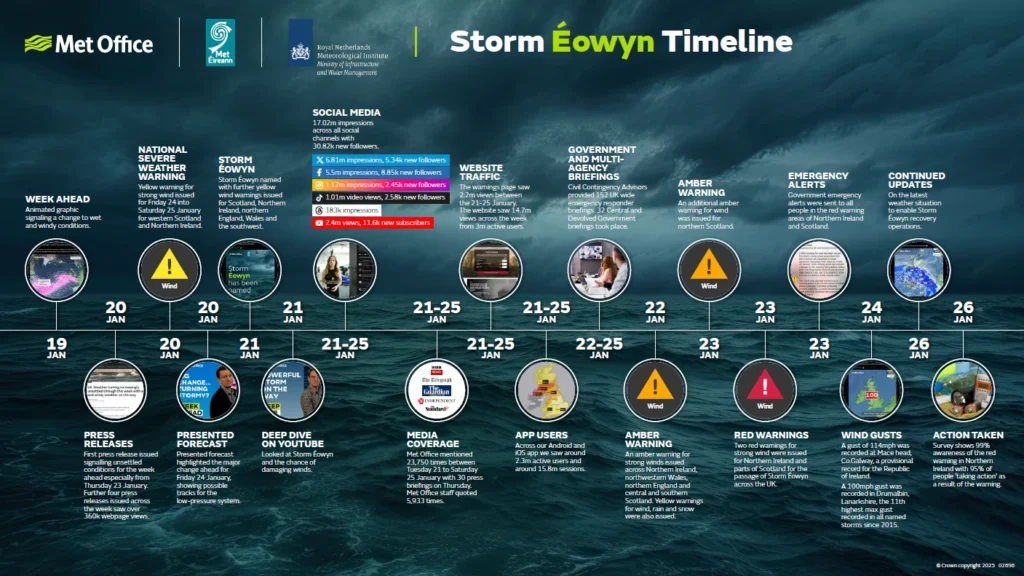 A timeline of warnings for Storm Éowyn. Credit: Met Office
Climate change and storms
A timeline of warnings for Storm Éowyn. Credit: Met Office
Climate change and storms
There is no evidence of positive or negative trends in windstorm number or intensity in the UK's recent climate. Trends in windstorm frequency are difficult to detect, because numbers vary year-to-year and decade-to-decade.
Most climate projections indicate that winter windstorms will increase slightly in number and intensity over the UK, including disproportionately more severe storms. However, scientists have "medium confidence" in these projections - because a few climate models indicate differently.
This uncertainty highlights the need for ongoing research into how climate change may influence the severity and frequency of windstorms in northern Europe. On the other hand, scientists are confident that climate change is making rainfall during storms more intense.
A 2024 attribution study involving Met Office scientists showed that climate change has made rainfall during storms more intense through autumn and winter in the UK. The researchers noted that this trend is set to increase as the planet warms. Recent increases in flooding in the UK have also been linked to climate change. Other research, meanwhile, has found that sea level rise caused by climate change will worsen storm surges and high waves during windstorms.
The continuing unpredictability of UK storms - combined with projections of increased rainfall and heightened coastal damage under climate change - means that being prepared for, and adapting to, the future weather is crucial.
This article was originally published by CarbonBrief and is republished here under a Creative Commons license (CC BY-NC-ND 4.0). Read the original here.
More from East Anglia Bylines
Download the Bylines app to get our content straight to your phone!
Get the app
The post Ten years of naming storms and saving lives first appeared on East Anglia Bylines.
Outgoing Broads boss: the unstoppable rise of the waters [ 15-Nov-25 5:46pm ]
It is a landscape defined by hundreds of years of human intervention. But for the man responsible for overseeing the management of the Broads for a quarter of a century, natural forces will soon have to be allowed to reclaim parts of the landscape.
Dr John Packman, who is about to step down as chief executive of the Broads Authority (BA), has warned climate change is "already biting" in the waterways and that swathes of land will have to be given up to be used as floodplains. To protect homes in the upper reaches from major flooding, areas around Breydon Water and along the Waveney valley and Lower Bure could be reclaimed to help absorb rising water levels from the encroaching North Sea and from rivers breaking their banks.
Parts of the landscape, which Packman says are already gradually sinking, may again start to resemble the vast estuary it was 2,000 years ago, before rivers were rerouted, drainage channels dug and windmills built to pump out the water.
'Climate change is already biting'Packman made the comments as part of a wide-ranging interview to mark his departure, in which he reveals what he thinks would be the biggest challenges for his successor, with the threat of climate change among the most significant.
Over the next 100 years, sea levels are predicted to rise by up to a metre, which would put much of the low-lying wetlands underwater. "We cannot stop these changes happening," says Packman. "It is about how you adapt to it and manage the rate of change and mitigate the impact on the Broads system. Climate change is already biting hard … We are surrounded by flood plains and in the lower reaches of rivers, we will have to give up areas of land so that when there are big flooding events, water has somewhere to go. There will be some things that will be similar to the Roman times."
Flooding and controversyThe issue of rising water levels on the Broads has been an increasingly pressing one in recent winters, with repeated flooding affecting many riverside villages. There have been flood alerts on the waterways in recent days, underlining the immediacy of the threat, while an incursion of saline water - when sea water is forced into the rivers by a combination of wind and tide conditions - killed thousands of fish last month.
However, the subject has also proved controversial, with some critics blaming the BA and the Environment Agency for the increased flooding, suggesting they should do more to dredge the waterways - particularly a stretch near Great Yarmouth known as the Bure Hump.
But Packman suggests the best way to combat the threat is not through trying to resist or stop it, but to "make space for water". He suggests the region has much to learn from the Netherlands, where communities are being protected by creating more wetland and floodplain to absorb rising water levels.

 Great Crested Grebe fishing. Image by Smudge 9000 via Flickr (CC BY-SA 2.0) | Sailing on Horsey Broad. Image by David Merrett via Flickr (CC BY 2.0)
Balancing boating and biodiversity
Great Crested Grebe fishing. Image by Smudge 9000 via Flickr (CC BY-SA 2.0) | Sailing on Horsey Broad. Image by David Merrett via Flickr (CC BY 2.0)
Balancing boating and biodiversity
Much of the debate over flooding on the Broads - as well as over other areas of the BA's work - has been characterised as being between factions representing the organisation's two conflicting responsibilities: keeping the waterways accessible by boat while also delivering national park duties, such as protecting wildlife and boosting biodiversity.
These two groupings have become known as 'navvies' - those who want to see navigational interests put first - and 'parkies', those more inclined to support the national park interests. Packman - seen by many as the head of the parkies - accepts there are tensions between the BA's different responsibilities but dismisses such talk of factions.
"There is a tension between priorities, but I do not buy into the navigation and parkie clash," he says. "Most people who go boating on the Broads do so as it is a beautiful area, with wildlife and big skies. But it does mean managing the Broads is tricky. People want different things … For example, managing trees and scrubland - sailors want us to cut them all down, but anglers definitely would not want that, and neither would people concerned about nature. We have to try and find compromises so it works for everyone."
Choosing a successorTensions between navvies and parkies have emerged over the process to select Packman's successor, with navvies worrying the board, which will choose the next chief executive, has too heavy a proportion of parkies. Whoever ends up in the role will face problems beyond the existential one posed by climate change, and Packman warns that funding challenges will also prove increasingly tough. The Broads have faced a steady decline in the number of people boating, leaving the authority with less income from toll fees to support its navigation maintenance. Government cuts have also hit the BA's bottom line, forcing job losses this past year.
Their heyday as a premier holiday destination may be in decline, but the waterways are still a hugely important part of the tourism economy, generating more than £700m a year."Boating is becoming less popular, it is a national trend," he says, adding: "But the good news is that boats are getting cheaper."
A career shaped by the BroadsThe Broads have seen huge changes even since Packman took up his job in 2001. Born in Kent in 1952, he trained as a town planner and went on to secure his first job at Norfolk County Council. He then left for New Zealand, where he took a post at the Ministry of Works and Development in Wellington for 15 months. In 1984, he returned to the UK, where he secured a role at Brighton and Hove City Council, overseeing a major regeneration programme for the city.
After this stint, Packman switched from managing a bustling metropolitan centre to the sprawling waterways of the Broads - a daunting change at first but one that was helped by some sage advice. "A friend of mine told me to think of what would be the worst possible first day as chief executive, then do the opposite," he says. "Mine would have been stuck in an office not talking to anyone. So instead, I spent the first few days making sure I spoke to as many people as possible and had breakfast with the maintenance staff, lunch with the rangers and then tea with my office colleagues."
 John Packman. Image by Owen Sennitt, used with permission.
Legacy and future challenges
John Packman. Image by Owen Sennitt, used with permission.
Legacy and future challenges
Since then, Packman has guided the BA through significant upheaval. This includes modernising its operations and taking over the responsibility for navigation maintenance from engineering firm May Gurney in 2007. That change has led to persistent gripes from navvies who claim the private company carried out more dredging, a charge Packman denies, insisting the in-house operation is simply more efficient.
On the national park side, there have been major successes in the BA's work to boost biodiversity, including growing numbers of marsh harriers and fen raft spiders - the latter a species which was on the brink of extinction but is now thriving in the Broads.
But the outgoing boss is fully aware the overall situation is bleak. "The biodiversity crisis is still with us," he explains, "and pressure on some species like butterflies and other insects is still grave. We have had some successes, but we are still in a position where nature is under huge pressure." Dr Packman, who announced his retirement in July, says he will continue into the new year and hand over the reins after his successor has been found in the coming weeks.
More from East Anglia Bylines
 Climate
Save our wild isles
byElana Katz 7 May 2023
Climate
Save our wild isles
byElana Katz 7 May 2023
 Climate
Do people really care about the climate?
byStephen McNair 26 October 2023
Climate
Do people really care about the climate?
byStephen McNair 26 October 2023
 Climate
Unwind in the Broads: East Anglia's amazing wildlife paradise
byKate Moore 23 December 2024
Climate
Unwind in the Broads: East Anglia's amazing wildlife paradise
byKate Moore 23 December 2024
 Business
High waters, low prospects: Norfolk Broads firms in turmoil
byOwen Sennitt, Local Democracy Reporter 4 March 2024
Download the Bylines app to get our content straight to your phone!
Get the app
Business
High waters, low prospects: Norfolk Broads firms in turmoil
byOwen Sennitt, Local Democracy Reporter 4 March 2024
Download the Bylines app to get our content straight to your phone!
Get the app
The post Outgoing Broads boss: the unstoppable rise of the waters first appeared on East Anglia Bylines.
Emissions scandal: factory farms fail to declare climate impacts [ 12-Nov-25 5:21am ]
Plans for intensive livestock factory "megafarms" are omitting crucial climate impacts, it can be revealed. Campaigners last year celebrated a "beginning of the end" to polluting factory farming, after the landmark Finch Supreme Court ruling on a Surrey oil well confirmed that applications for major developments should consider all significant direct and indirect greenhouse gas emissions.
However, a review of 35 proposed developments across the UK's largest farming counties since the June 2024 ruling found that applications routinely ignored or downplayed the industry's carbon footprint.
The research by advocacy group Sustain, which was analysed by DeSmog and The Guardian, looked at all applications for Norfolk, Suffolk, Herefordshire, Lincolnshire, Nottinghamshire, Shropshire, Yorkshire, Wales and Northern Ireland which were under consideration by local councils between the 2024 ruling and September this year.
Farms housing more than 900 sows, 3,000 pigs, 60,000 hens for eggs, or 85,000 chickens for meat are required to provide information on expected environmental impacts under UK law when applying for planning permission.
Big agribusiness behind many applicationsThe applications reviewed were mainly submitted by UK-based farm companies, but some came from major meat producers - including Crown Chicken, a subsidiary of Cranswick, which is one of the largest meat companies in Europe and slaughters nearly 60 million birds a year. Cranswick was responsible for three million tonnes of carbon dioxide emissions in 2024.
If these were all accepted for development, an additional 30,000 pigs and nearly five million chickens would be farmed across England, Northern Ireland and Wales - amounting to over 37 million additional animals reared in the UK each year.
Intensive pig and poultry farms are high emitters of methane and nitrous oxide, potent greenhouse gases that cause around 30 and 300 times more global warming than carbon dioxide over a 100 year period. According to Sustain's estimates, if all the applications analysed were approved this could generate an estimated 634,000 tonnes of CO2-equivalent emissions annually - the equivalent of 488,000 return flights from London to New York.
None of the 35 applications provided figures on likely emissions from the farm, meaning local councils - which have the ultimate say on developments - are not factoring in climate harms in planning decisions. Government policies say that local planning should support the country's goal to reach net zero by 2050.
The findings come as numbers of intensive livestock farms increase across Europe. More than 1,500 industrial-scale pig and poultry farms operating in the UK.
"Vital information is being kept from councils and the public," Ruth Westcott, campaign manager at Sustain, told DeSmog. "It's clear that agribusinesses don't want to come clean about the pollution they cause because it could affect whether they are allowed to expand, and thus make more profits at the expense of our communities," they added. "It's an emissions scandal.
 'Devastating'
Councils are facing growing pressure from residents to refuse planning permission to companies which fail to robustly assess climate impacts.
In April, following public pressure, King's Lynn & West Norfolk Borough Council denied planning permission for the Methwold megafarm that would have housed almost 900,000 chickens and pigs, partly due to its lack of climate assessment - making it the first-known refusal on these grounds.
Breckland Council in Norfolk likewise refused planning permission to the controversial Cherry Tree Farm in October, in part because it had not provided an updated environmental impact assessment, including "project-specific carbon emissions". The farm - which is owned by Wayland Farms, also a subsidiary of the livestock giant Cranswick - was forced to apply for retrospective approval for previously completed construction. Local residents had made major complaints over the "stench" following its expansion in 2019.
 Cherry Tree Farm, Stow Bedon. Photo by Owen Sennitt. Inset image by Carol M Highsmith via Rawpixel (CC0)
In total, four of the applications reviewed have been refused so far - three of which were submitted by Cranswick. When asked by DeSmog about the lack of climate data in its applications, the company declined to comment.
However, other councils in Norfolk, Suffolk, Lincolnshire, Nottinghamshire and Yorkshire have approved six farms that have not provided any specific information on the farm's climate impacts in the last 12 months, the new research shows.
Councils which responded to DeSmog's request for comment said they had complied with planning regulations, and that they were unable to comment on individual planning applications.
Industrial farming's growing footprintFarms currently seeking planning permission supply some of the largest meat producers in the country, such as Hook2Sisters and Avara Foods.
Avara is estimated to have 33 million chickens in the UK at any one time and sells its products to well-known brands including McDonald's and Tesco. The company - which is part-owned by Cargill, the third largest meat company in the world - was responsible for more than one million tonnes of carbon dioxide emissions in 2023, equivalent to those from 2.3 million barrels of oil.
Over half (57%) of the planning applications reviewed were for major extensions and alterations, and the remainder for new farms.
Jan Palmer - a resident of Methwold village in Norfolk who campaigned against the Cranswick megafarm that was denied planning permission in April - has called for greater scrutiny of impacts from proposed farms.
"These are industrial developments. It's called industrial farming, and it has industrial emissions," she said. "If my local megafarm application hadn't been so fiercely challenged and by so many, it would've slipped through the system like so many others do - quietly and without scrutiny but with devastating consequences."
Growing legal challengeCompanies seeking permission for any large-scale developments - ranging from motorways and oil and gas extraction sites to intensive farms - are required to conduct environmental impact assessments showing the likely affects of developments on biodiversity, the climate, and other environmental factors.
Applications for intensive livestock farms routinely include information on issues such as air pollutants and unpleasant smells, the review showed. However, the vast majority of applications overlooked climate impacts.
Of the applications reviewed, 35% mentioned the farm's operations only in passing, while 55% did not discuss these climate impacts at all.
Large projects must assess all "significant environmental impacts" under UK planning law. Lawyers told DeSmog that few cases had so far tested the threshold for "significant" climate impacts from farms in the courts, but given the "well-documented" emissions from intensive farming, applications could face growing challenges in coming years.
"Where the companies are not assessing their climate impacts, they may be open to legal challenge," said Ricardo Gama, an environmental lawyer at Leigh Day solicitors. "Agriculture has flown under the radar on so many of these issues, but I think that is changing."
Councils approve farms without emissions dataOver the past year, six local councils have granted permission to applications without any assessment of the farms' likely emissions, as well as one that granted permission to a farm with only passing discussion, the research shows.
West Lindsey Council in Lincolnshire - the fastest growing county for intensive livestock farming - approved planning for the Happylands Farm in North Owersby earlier this year, which will see the number of pigs increase by 1,300 to total almost 4,000. The application form did not provide any information about the likely emissions from the farm.
If all the applications in Lincolnshire are approved, it will see an extra 6,500 pigs and almost 13 million chickens farmed there each year.
Similar applications have been approved in Norfolk, Suffolk, Nottinghamshire, and Yorkshire. Planning authorities have an obligation to consider all relevant environmental impacts before granting permission, according to legal experts.
While applicants propose which environmental impacts should be assessed as part of planning applications, it is the council's legal responsibility to ensure that all "significant" effects are covered and that adequate information on these is provided, before granting planning permission.
"When the council or the inspector or the secretary of state is considering whether to grant planning permission, climate impacts need to be weighed in the balance," Gama said. "I think councils' approach will change as the public becomes more aware of the climate impact of agriculture."
Residents fight backKevin Bunn, a resident of Spalding in Lincolnshire, said that companies were "used to them [planning applications] flying through under the radar without any proper scrutiny.
"I don't believe that it should be a foregone conclusion for an authority to accept something that is so detrimental to an area," he said. "The council should be there to preserve and protect the environment of the local residents."
Bunn is campaigning against a planning application for a new poultry farm that would house more than half a million chickens in the village of Whaplode Drove. He said that more than 1,800 people had lodged objections against the farm during public consultations. "As single residents, people didn't feel they had a voice, but when they came together collectively, they did."
A spokesperson for West Lindsey Council told DeSmog that each application was "assessed against national and local policy requirements, statutory provisions including where appropriate an environmental statement, and material planning considerations". Together, these helped the council come to "a reasoned decision that carefully balances the competing issues to ensure a fair and lawful process".
Misleading claimsApplications for livestock farms which did raise general climate impacts from the wider sector repeatedly downplayed harms.
More than a dozen of the applications reviewed included environmental assessments by the planning consultancy firm Harrison Pick, with near-identical statements on climate, including that "Current poultry production in the UK is responsible for a fraction of the greenhouse gas emissions associated with red meat production".
Cattle farming is the number one cause of agricultural emissions in the UK, but intensive pig and poultry farming have far higher emissions than crops. A serving of chicken has a sixth of the carbon footprint of beef, but around ten times that of tofu or beans.
A spokesperson for Harrison Pick said they had "consistently complied with the scope and requirements set by local planning authorities" and that the application of the Finch ruling in livestock was an "evolving area". They denied that their assessments "downplay" climate impacts.
It was the responsibility of the local planning authority to provide additional information "directly relevant to assessing the likely significant effects of the project", they said, adding that they had not yet received any requests requiring further information on climate change impacts.
The research found that environmental assessments also repeatedly failed to discuss emissions that did not directly arise on the farms. Of the 35 applications reviewed, just one included information on the farm's likely emissions from animal feed - the largest source of greenhouse gases for both pig and poultry.
 Proportion of intensive pig and poultry farms declaring emissions in planning applications.
The majority of pigs and chickens in the UK are fed soy, which is one of the biggest drivers of deforestation in regions such as the Amazon. According to campaign group WWF, the UK's demand for soy requires more than 1.7 million hectares of land each year - an area larger than Northern Ireland.
Other applications also contained misleading claims. An environmental impact assessment for the expansion of a poultry megafarm currently under consideration in Shropshire - which would increase its total number of birds to up to 350,000 - stated that carbon dioxide emitted from the development would be offset "due to the reduction in emissions from transporting poultry meat from elsewhere". It continued: "Increasing the amount of home produced poultry meat will reduce the need for importing meat from abroad and hence help to reduce the level of transportation required."
Transportation accounts for between just five and 7% of total emissions from chicken reared in the UK.
A Shropshire Council spokesperson said applications were processed "in accordance with [EIA] regulations", which included taking into account direct and indirect effects of the proposed development on the environment.
All councils, farm companies and meat producers referenced in this article were approached for comment.
Ruth Westcott from Sustain called on local councils to reject planning permission for farms failing to declare their emissions.
"The government must stop this industry from getting away with devastating pollution," they said. "We need full environmental assessments for every facility, no new factories in already polluted areas, and proper enforcement when rules are broken."
This article is republished with the permission of DeSmog. Read the original here.
More from East Anglia Bylines
 Farming
The Stow Bedon stink
byOwen Sennitt, Local Democracy Reporter 3 April 2024
Farming
The Stow Bedon stink
byOwen Sennitt, Local Democracy Reporter 3 April 2024
 Community
Megafarm blocked in new landmark environmental decision
byOwen Sennitt, Local Democracy Reporter 4 April 2025
Community
Megafarm blocked in new landmark environmental decision
byOwen Sennitt, Local Democracy Reporter 4 April 2025
 Environment
Norfolk's megafarm surge: the hidden cost of cheap food
byOwen Sennitt, Local Democracy Reporter 27 March 2025
Environment
Norfolk's megafarm surge: the hidden cost of cheap food
byOwen Sennitt, Local Democracy Reporter 27 March 2025
 Environment
15,000 say no: Norfolk's 'megafarm' plans face backlash
byOwen Sennitt, Local Democracy Reporterand1 others 4 December 2024
Download the Bylines app to get our content straight to your phone!
Get the app
Environment
15,000 say no: Norfolk's 'megafarm' plans face backlash
byOwen Sennitt, Local Democracy Reporterand1 others 4 December 2024
Download the Bylines app to get our content straight to your phone!
Get the app
The post Emissions scandal: factory farms fail to declare climate impacts first appeared on East Anglia Bylines.


