
Welcome to the latest Best of Bylines Network newsletter, bringing you a standout article from one of our 10 UK national and regional publications.
In this edition, Professor Rupert Read discusses a long-suppressed UK intelligence report about global biodiversity loss, ecosystem collapse, and national security. Produced by the Joint Intelligence Committee (JIC) and supported by DEFRA research, the report was originally presented last year at COBRA (the cabinet committee convened to handle matters of national emergency). Despite its gravity, it was withheld from the public - until now.
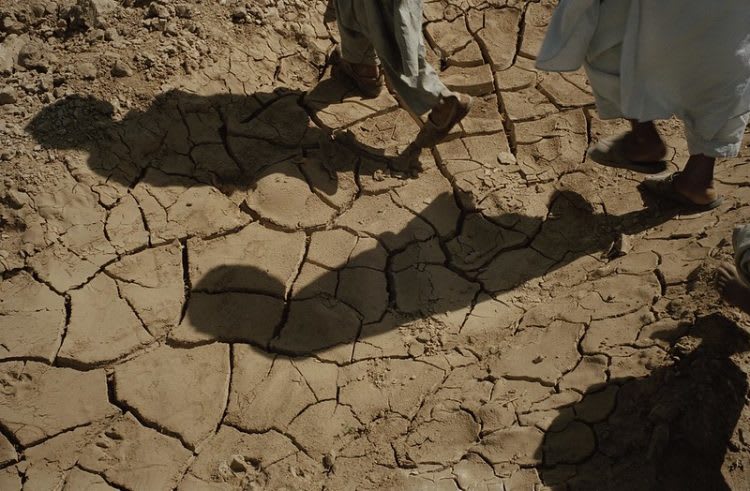 Large-scale migration from newly-uncultivable countries to cooler ones is likely. Photo by DFAT via Flickr (CC BY 2.0)
Its sudden appearance on a government website, without announcement or explanation, strongly suggests an attempt to minimise attention. Released amid the international crisis of Trump's Greenland aggression, the timing appears calculated to bury the story. That must not be allowed to happen.
From environmental issue to security emergencyThe report's title, Global Biodiversity Loss, Ecosystem Collapse and National Security, marks a decisive shift in official framing. Ecological breakdown is no longer treated as a distant, 'merely' environmental, concern, but as a direct and escalating threat to national and international stability.
The report warns that multiple ecosystem collapses are now likely, not merely hypothetical. These failures, it states, will have "dire implications" for national security and will require serious strategic adaptation merely to limit the damage. Such language is measured, but the message is unmistakable: the risk is immediate, systemic and severe.
Just one of the ways British national security is threatened by ecological breakdown as outlined in the report is through migration pressure. As ecosystems degrade, food systems fail, water scarcity increases and livelihoods collapse, "development gains begin to reverse." This restrained phrase points to mass human suffering - entire communities pushed back into poverty and instability. The report makes clear that these dynamics will drive large-scale displacement, creating cascading pressures on regional stability and on countries such as the UK.
Join our movement - 1000s of citizens telling the truth
We're proudly independent - no corporate owners or billionaire backers. But it costs us at least £150,000 a year to run our network. Support journalism by the people, for the people. Become a Friend of Bylines Network. For as little as £3.50 a month, you'll get behind-the-scenes insights, chances to engage with our editorial teams, access to special events, merchandise, and more. Sign up by clicking the button below, or upgrade your Substack subscription.
Become a Friend of Bylines Network
Where's the rest?
While the report is significant, it's pretty clearly not the full version and is strikingly thin in key areas. There is little detail on the geo-regional analyses that presumably underpin its conclusions. The links between specific regional ecosystem failures and concrete national security risks to Britain are not clearly explained. Even the report's 'Key Judgements', which are normally the core of any JIC assessment, are presented without adequate justification or depth.
This strongly suggests that what has been released is only part of a larger piece of work. The omissions appear deliberate, consistent with an effort to satisfy Freedom of Information requirements while withholding the most politically sensitive and disturbing findings.
The Government seems to be acknowledging the problem in principle while concealing its true scale and immediacy; in other words, withholding precisely the information citizens need in order to understand how to adapt to a declining global ecosystem.
First suppression, and now silenceThat this report was suppressed at all is deeply concerning. Its existence became public last October only through investigative journalism (based probably upon one or more officials taking risks with their own jobs), followed since then by sustained pressure from campaigners including notably Ruth Chambers, whose FOI work has been exemplary here.
Back in October, reporting was necessarily extremely limited; journalists had not been permitted to read the report itself. Now that the document has emerged, it is clear that earlier coverage barely captured its significance. This was not merely a warning about climate damage. It was a strategic assessment of how ecological collapse could destabilise entire regions, intensify conflict, disrupt economies and directly threaten the UK's security.
Its presentation at COBRA underscores this point. COBRA is convened for the most serious national threats. That ecosystem collapse featured there should have triggered urgent public debate. Instead, the report was buried.
Why this moment mattersThe quiet publication of this report may nonetheless mark a turning point. Once ecosystem collapse is formally recognised as a national security threat, the implications could be profound. Security threats demand preparation, strategic planning and decisive action. They also demand honesty.
The report exposes a widening gap between the scale of the threat and the inadequacy of current responses. Incremental policy measures and rhetorical commitments are clearly insufficient if multiple ecosystem collapses are likely within the foreseeable future. Strategic, nature-based adaptation will be unavoidable, and delay will only increase the human and economic cost.
This may explain the Government's reluctance to publicise the findings. Once citizens understand that ecological collapse threatens food security, migration stability, economic resilience and peace, pressure for meaningful action becomes unavoidable. This only bolsters the necessity for the Climate Majority Project's campaign calling on the government to fund (with mission-like deep pockets) a National Climate Resilience Plan; with military national security threats, we are always able to find the money to fund a response. It should be no different when the threat to national security is climate/ecological breakdown.
The case for full disclosureThere is now a compelling public interest case for releasing the full report. Democratic societies cannot respond effectively to threats that are only partially disclosed. Nor can citizens prepare for profound disruption if key information is withheld to avoid political discomfort.
Those who pursued the report's release through Freedom of Information requests deserve credit, as do those who commissioned it in the first place. But partial transparency is not enough. If the state holds detailed assessments of regional collapse, cascading risks and timelines, the substance of that knowledge must be shared. Anything less is a disservice to its citizens.
This is not about inducing panic. It is about enabling resilience, informed decision-making, and collective adaptation.
Facing the realityFinally, it must be said that the report's implications are emotionally difficult. To confront the likelihood of widespread ecosystem collapse is deeply distressing. That reaction is both rational and human.
When I first learnt what was really in this report, I suffered a serious episode of climate/polycrisis anxiety. Partly perhaps because I live on the edge of the Broads, in East Anglia, and so am intensely aware already of the (figurative and literal) rising tide of threats we now face.
If engaging with this material provokes anxiety or grief in you, it should not be faced alone. Talk with others. Seek support. Take time to process, and where possible, take action.
The attempt to bury this report has failed. The question now is whether we choose to face its warnings honestly, demand the full truth, and act accordingly, or allow one of the most consequential intelligence assessments of our time to slip quietly back into obscurity.
The stakes honestly could not be higher.
Postscript…Green Party MP for Waveney Valley, Adrian Ramsay, asked in Parliament on Thursday why the critical report was delayed and called for a debate on what the government is doing to prepare for the risks it outlines. The leader of the House responded by committing to making time for the debate (He also claimed that the Government had intended all along to publish the report…).
Crucially, on 23 January The Times also published a major new story about the report, which it observes is not the full version: agreeing with what I have written above.
The story reads in part: "…a full, internal version of the report, seen by The Times, goes further [than what the Government published last week], suggesting that the degradation of rainforests in the Congo and the drying up of rivers fed by the Himalayas could drive people to flee to Europe, leading to "more polarised and populist politics in the UK" and putting "additional pressure on already strained national infrastructure".
There is much more to come out…
Do pressure YOUR MP to get the full security assessment released.
Thanks to Joe Eastoe for crucial editorial assistance in the writing of this piece.
Rupert Read is Co-Director of the Climate Majority Project.
More from East Anglia Bylines
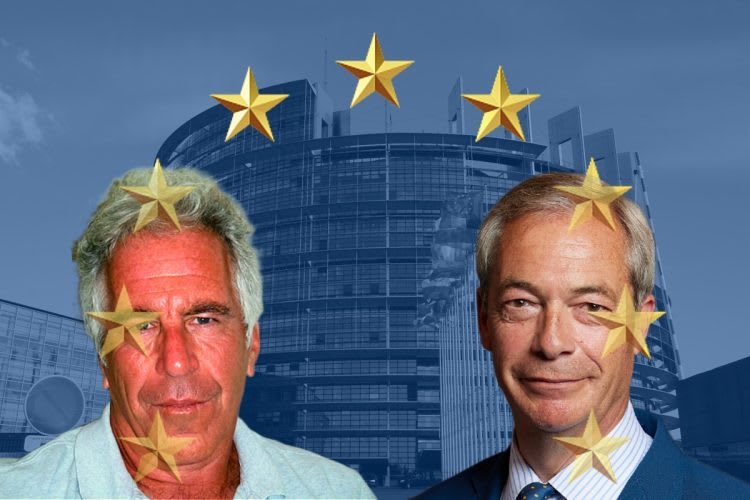 Montage. Epstein by Scottish Govt (CC BY 2.0) via Wikimedia Commons; EU Parliament: image by Rawpixel (CC0)">USVI (CC0); Farage by UK Parliament(CC BY 3.0); EU Parliament by Rawpixel (CC0)
Stephen McNair writes on the Epstein files and what they reveal about the role of Brexit in a global network which stands to gain from undermining democracy itself.
Welcome to your Friday issue of the Best of Bylines Network newsletter, bringing you a standout article from one of our 10 UK national and regional publications.
This time, we hear from Nazish Saad, a writer for Bylines Scotland with a strong focus on sustainability and minority rights, and who responds to the news that Suella Braverman has defected to Reform. A post on Bluesky, accompanied by a photograph of Braverman resting her head on Nigel Farage's chest, wide smiles on both faces, did not incite Nazish's anger or disdain. Instead, it triggered something deeper, heavier - a particularly nauseating pain of betrayal.
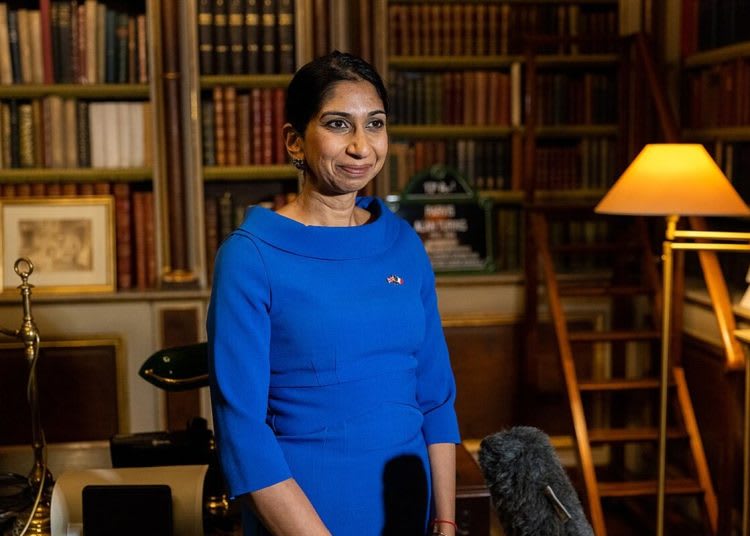 Suella Braverman, UK Home Office, CC BY 2.0 , via Wikimedia Commons
I found myself asking, as a brown woman, why this felt so much more hurtful: a gut punch spiked with the bitterness of treason and the emptiness of abandonment.
I know that one should not hold anyone to a higher moral standard because of their ethnicity or their gender. And I agree that representation is neither a monolith nor should it impose virtue, and that everyone - irrespective of their origins or backgrounds - has the right to choose the ideology that best aligns with their beliefs.
And yet…Parties like Reform thrive on hate-filled narratives targeting minorities, migrants, and any other category of people deemed a convenient scapegoat for their own failed policies of austerity. While, in theory, I should separate identity from political loyalty, in actual fact, it is impossible for me to be neutral and ignore it. I cannot help viewing current events through my own lens, those of a brown woman living in a world where the struggle to belong, to be accepted, is constant.
I did not feel like I ever had the luxury of not being 'political' and activism felt necessary for survival. I have never existed in a space where my rights and my belonging could not be questioned at any moment - often by those who could never conceive of ever being questioned themselves.
The ruling classThe traditional ruling class, entrenched in the denial of its history of slavery and colonialism, has long been incapable - or unwilling - to recognise how this dark past continues to shape injustices in the present. In this context, political representation by those who looked like me once felt like a hope - a connection rooted in shared experience promising greater inclusion and empathy.
Perhaps this is why this moment feels personal.
Embracing an ideology of division hurtsThe symbolism of a brown woman embracing an ideology of discrimination and exclusion normalises this discourse. It sends a message - whether intended or not - that the racism or misogyny, which many endure daily, is acceptable. It becomes a powerful tool of gaslighting. It reminds me of the many times I was silenced about the abuse I faced, told to not make it about race or gender. Of how sometimes it feels like my existence is a balancing act between two worlds: like walking on eggshells, expected to endure systemic discrimination, yet rarely allowed to name it.
Suella Braverman has the right to make her own choices, and neither her gender nor the colour of her skin obliges her to an ideology. Yet Suella and her loved ones must have had some experience of difficulties and mistreatment because of their identity in their lives. What hurts is that she knows exactly what this choice represents - and the impact of pulling the ladder up behind her for so many who share her background.
What hurts is that, knowing this, she chose it anyway.
Join the citizen army supporting journalism by the people, for the people
Bylines Network gives a platform to over 2,500 citizens to report on the topics that matter, investigate local and global stories, and speak truth to power. Every month, we publish 400 articles in our 10 UK national and regional publications and engage 100,000s of readers. But that's not the full story.
The UK media continues to be dominated by white men who went to private schools. It is increasingly owned by corporations disconnected from our communities, and by billionaires with political agendas. Without networks championing unheard voices, writers like Nazish would be silenced. Without everyday citizens volunteering as writers, editors, proofreaders and uploaders, none of our journalism would see the light of day.
We're proudly independent, our websites are free to read, and we don't take corporate advertising income. But it costs at least £150,000 a year to run our network. Much more when we carry out deeper investigations, or work with communities who don't normally have the opportunity to tell stories. Without the financial support of our readers and followers, we couldn't run our publications, and the costs are rising all the time.
This year, there are hugely significant elections to the Welsh Senedd and Scottish Parliament, and across the English regions. We want to make sure the voices of citizens are heard loudly by those asking for our votes, in their own words, without fear or favour. You can help.
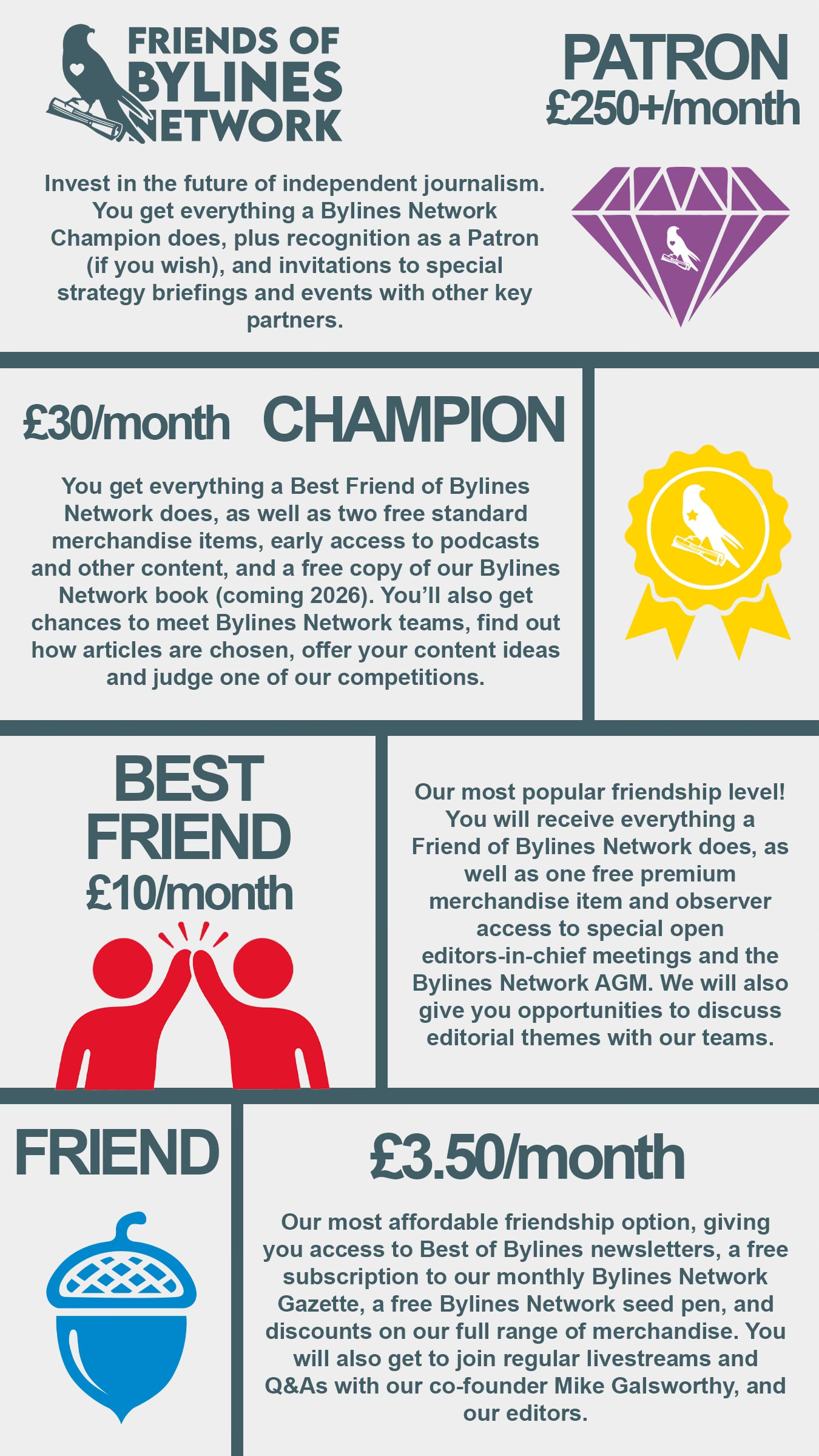
Upgrade to a monthly paid subscription here on Substack or become a Friend of Bylines Network by completing the form on this page. For as little as £3.50 a month, you'll get behind-the-scenes insights, chances to engage with our editorial teams, access to special events and merchandise. For £10 a month, you get a little more involvement in how we run. For £30, you can do even more.
If you want your monthly payment ring-fenced to one of our 10 publications, all you have to do is drop us a line saying which.
Our Friends are not just donors, they are part of our community - they ensure our journalism thrives, by the people, for people.
Sign up by clicking the button below, or upgrade your Substack subscription.
Become a Friend of Bylines Network
Welcome to the latest Best of Bylines newsletter. This time, we bring you a powerful response to Prime Minister Kier Starmer's claim that the UK "will not look away" when women and girls are trafficked and abused by powerful men. He was talking about Jeffrey Epstein, following revelations about his ongoing relationship with Lord Mandelson. Yet, for several months, Bylines Network publications have carried stories from survivors of another powerful man - one based in the UK and whose victims are still seeking justice 30 years after the scandal of his abuses first became public.
Mohammed Al Fayed presided over the abuse of more than 400 women and girls whilst running his Harrods empire. Survivors have been bravely telling their stories and explaining why they feel the justice system has failed them, in Bylines Cymru, Central Bylines, Sussex Bylines and Yorkshire Bylines. MPs have championed their cause and on Friday, we published Isbella's immediate reply to the Prime Minister's statement that his government would "not shrug our shoulders" in the face of such atrocities:
Today, we bring you a response from another survivor - Shanta Sundarson, who reveals why she believes requests for a statutory inquiry into the allegations linked to Harrods, the late Mohammed Al Fayed, and associated institutions, have been deflected. It's a powerful article that raises far-reaching questions about this case and the commitment of the government to take action in support of abuse and trafficking survivors.
You can read Shanta's words or watch her video below, recorded the day after Kier Starmer's speech. Bylines Network is here to champion the voices of unheard citizens - if you think this story matters as much as we do, please share it and subscribe to receive the stories that matter directly to your inbox.
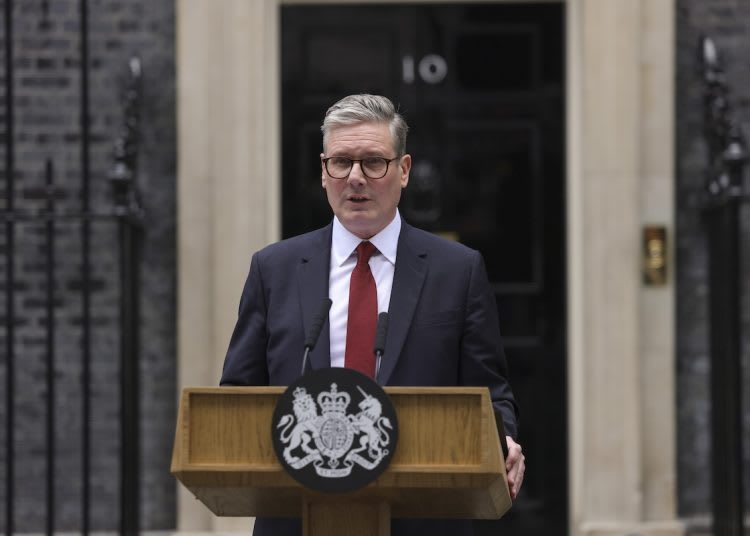 By Kirsty O'Connor / No 10 Downing Street - Prime Minister Sir Keir Starmer arrives at Number 10 Downing St, OGL 3, Link
By Shanta Sundarson.
On 27 May 2025, I wrote to the prime minister, Keir Starmer MP, requesting the establishment of a statutory public inquiry under the Inquiries Act 2005 into allegations linked to Harrods, the late Mohamed Al Fayed, and associated institutions. An inquiry into systemic abuse, institutional failure, and state response failures. In other words, the failures that allow exploitation to persist not because of ignorance, but because power, proximity, and reputation are treated as a shield.
It was not a rhetorical appeal. It was not an attempt to weaponise public outrage. It was a formal request to invoke a legal mechanism designed specifically for moments when public confidence has been compromised and when systemic failures demand scrutiny.
What followed has not been a decision, but a deflection.
And the longer the government avoids providing a clear answer, the more serious the question becomes: has the prime minister effectively refused a statutory inquiry - and if so, why?
A request for accountability, not political theatre
I contacted Downing Street on behalf of survivors seeking justice and public accountability in relation to detailed and consistent allegations spanning over 30 years, that are increasingly difficult for Britain to ignore.
Hundreds of survivors have now come forward with credible accounts of:
a multi-decade system of organised sexual abuse and exploitation;
intimidation, threats of harm, and retaliation for disclosure;
the use of non-disclosure agreements (NDAs) and institutional pressure to suppress complaints;
failures within Harrods' management to intervene or safeguard;
failures by public bodies to investigate, prosecute, or meaningfully respond.
These allegations are not isolated. They describe patterns. And patterns matter because they point beyond individual perpetrators toward institutional ecosystems that enable harm.
The effective muting of survivors through these mechanisms describes an architecture of control that obstructs justice and prevents others from coming forward.
These are the dynamics that have surfaced in other national scandals. They are the dynamics of institutional abuse.
Trafficking allegations cannot be managed quietlyMy request also referenced deeply troubling reports involving human trafficking, covert surveillance, and intimidation of survivors and whistleblowers.
The allegations include the transportation of employees or prospective employees to and from Harrods or other locations, and recruitment into fabricated roles with proximity to Mohamed Al Fayed and members of his family, for the purpose of sexual exploitation.
Such tactics resemble coercive mechanisms associated with organised criminal networks: a blend of grooming, intimidation, dependency, isolation, and control. If these accounts are even partially true, they raise urgent questions not only about criminal conduct, but about institutional complicity and state failure.
The UK government cannot credibly claim that violence against women and girls is a national emergency while allowing allegations of this scale to be processed as though they are merely an employment dispute or a corporate reputational matter.
A specific and lawful requestThe Inquiries Act 2005 exists precisely because there are circumstances where public accountability cannot be achieved through criminal trials alone.
A statutory inquiry has powers that matter:
to compel witnesses
to require disclosure of documents
to take evidence under formal procedures
to examine institutional and regulatory failures
to establish a public record
The point of such an inquiry is not to replace criminal justice, but to confront systemic breakdown: the failures of organisations, regulators, police, and political decision-makers that allow abuse to persist.
I explicitly requested a survivor-centred inquiry to determine how abuse could allegedly continue within a high-profile British institution over decades, and to examine the actions and omissions of those in positions of responsibility.
The proposed scope included not only internal safeguarding failures at Harrods but potential criminal liability for acts not currently addressed under compensation mechanisms, such as unlawful surveillance, intimidation, harassment, drugging with intent to commit sexual abuse, false imprisonment, and trafficking for sexual exploitation.
I also urged examination of the knowledge, involvement, and potential culpability of Mohamed Al Fayed's estate and close associates, and the conduct of law enforcement and regulatory bodies, including whether there was corruption, misconduct, or wilful failure to act.
I further raised the issue of NDAs - how they may have been used not simply as private settlement tools, but as institutional instruments of suppression.
And I made clear that survivors and advocates were willing to participate in scoping discussions and provide supporting materials, including anonymised testimonies.
This was not a vague appeal. It was a structured request.
The Home Office replied - but did not answerOn 30 June 2025, I received a response from the Home Office Interpersonal Abuse Unit, referencing my letters to the Prime Minister.
The response began with standard acknowledgements of the devastating impact of sexual violence and trafficking, the importance of treating victims with dignity, and the expectation that investigations be thorough.
Then it pivoted to the familiar shield:
"The Government and its Ministers are unable to intervene in, or comment on, the circumstances of individual cases."
But I did not ask ministers to intervene in an individual case. I asked the prime minister to exercise a statutory power to establish an inquiry into systemic failures.
The reply then invoked the operational independence of police and courts, and claimed that inquiries require careful consideration, particularly where there may be ongoing proceedings.
This is neither a refusal nor an acceptance. It is a carefully constructed non-answer: a generic template response. It is not a clear response to a formal statutory inquiry request.
It is policy language in place of accountability.
Strategy has become a substitute for actionThe Home Office letter closed with statements about violence against women and girls being a top government priority and the development of a new cross-government strategy.
For decades, institutions have responded to scandal with new strategies, frameworks, and reviews - while survivors are left navigating hostile legal processes, private compensation schemes, and the quiet erosion of evidence.
Britain does not suffer from a lack of strategies. It suffers from a lack of consequences.
A national strategy cannot compel disclosure. It cannot subpoena documents. It cannot compel testimony. It cannot expose who knew what, when, and what was ignored.
A statutory inquiry can.
If the government genuinely views violence against women and girls as a national emergency, it must demonstrate that commitment not only through future strategy documents but through meaningful examination of historic institutional failures.
Otherwise, the phrase becomes empty: a headline without substance.
Help us give a voice to survivors
We're proud to enable citizens like Shanta to speak truth to power. We are free to publish and share stories like this because we are also proudly independent - no corporate owners or billionaire backers. But it costs us at least £150,000 a year to run our network. We're proud to give a platform to survivors of abuse and injustice. Support journalism by the people, for the people. Become a Friend of Bylines Network. For as little as £3.50 a month, you'll get behind-the-scenes insights, chances to engage with our editorial teams, access to special events, merchandise, and more. Sign up by clicking the button below, or upgrade your Substack subscription.
Become a Friend of Bylines Network
If survivors matter in New York, they matter in London
British political commentary is saturated daily with moral certainty about Jeffrey Epstein and his associates.
In the headlines about Peter Mandelson - whether he should testify, about who knew what and when - politicians speak with justified outrage about a system that enabled a powerful abuser abroad.
Epstein's survivors deserve seriousness, truth, and accountability.
But on British soil, hundreds of women have now come forward with consistent, credible accounts of exploitation linked to Mohamed Al Fayed and facilitated through Harrods, one of the most recognisable institutions in British public life.
Yet there seems to be no urgency, no calls for testimony, no political demand for a full public reckoning for them.
If politicians are sincere about accountability, then it cannot stop at the Atlantic.
If it is a scandal when powerful men exploit women through wealth, access, and institutional protection in New York, then it is also a scandal when it happens in London, operating openly for decades inside a flagship British institution.
If survivors matter in the Epstein case, then they matter here too.
Right now, it is hard to escape the impression that some scandals are treated as politically convenient to condemn, while others - closer to home, implicating British institutions - are quietly encouraged to fade into silence.
Four parliamentary questions that must be put on the recordOne of the most effective ways to force government accountability can be for MPs to table parliamentary questions - forcing the prime minister to place the government's position on the public record. Journalists, too, should be asking these same questions of government. The four questions that the prime minister needs to address are:
Decision Status: Has the prime minister considered a request dated 27 May 2025 for the establishment of a statutory public inquiry under the Inquiries Act 2005 into allegations of sexual abuse, institutional failure and state response failures linked to Harrods and Mohamed Al Fayed? On what date was that request considered?
Criteria Applied: Can the prime minister confirm what criteria were applied in deciding whether to establish a statutory public inquiry under the Inquiries Act 2005 in response to correspondence received on 27 May 2025 concerning allegations linked to Harrods and Mohamed Al Fayed?
Compulsion Powers: Can the prime minister describe what assessment was made of the necessity for statutory powers of compulsion under the Inquiries Act 2005 in relation to allegations of systemic abuse and institutional failure linked to Harrods and Mohamed Al Fayed?
Reasons (if refused): Can the prime minister say, if the Government has decided not to establish a statutory public inquiry under the Inquiries Act 2005 in relation to allegations linked to Harrods and Mohamed Al Fayed, what the legal basis for that decision is?
These questions do not demand political opinion. They demand administrative truth.
They are reasonable, restrained, and unavoidable.
A familiar pattern of delayBritain has seen this pattern repeatedly: Jimmy Savile. Rotherham. Hillsborough. Grenfell and others.
In each case, there were warnings. In each case, institutions denied, deflected, delayed, and minimised until public pressure became impossible to withstand. And in each case, the eventual inquiries exposed not only the original harm but the systemic failures that allowed it to continue.
The Harrods and Al Fayed allegations now sit firmly within that territory.
The question is no longer whether the allegations are 'serious enough'. The scale, duration, and reported methods of coercion and silencing make this an overwhelming matter of public interest.
The government must provide a clear decisionIf the British government is serious about violence against women and girls as a national emergency, then it cannot continue to respond to survivors with generic letters and strategy language. A letter from the Home Office is not a decision from the prime minister.
If the government intends to refuse a statutory inquiry, it must state so plainly, provide reasons, and identify the legal basis.
If it is actively considering the request, it must confirm that fact and provide a timeline.
If it has already considered the request, the public deserves to know when, by whom, and on what basis.
Silence is not neutral. Silence is a tactic.
Survivors know this. Institutions rely on it.
Delay exhausts victims, fragments evidence, and allows public interest to fade. It is one of the oldest tools of institutional self-preservation.
This is not a request for sympathy. It is a request for accountability.
The government must directly answer the question placed before it.
And it must answer it now.
 BYLINES SPECIAL: Keir Starmer - how dare you speak about justice? [ 07-Feb-26 2:58pm ]
Harrods abuse survivors have battled to get their voices heard and to bring the perpetrators to justice over more than three decades. Time and again they have come up against the power of the wealthy, the British legal system, and the indifference of police and politicians.
There were high hopes of Keir Starmer when he first came to office promising to tackle violence against women and girls. Sadly, not only do those hopes remain unfulfilled - there is no indication that Starmer's government is any more willing than its predecessors to respond to the evidence of abuse perpetrated over many years by the rich and the powerful.
So the claims made by the Prime Minister in his speech in Hastings, East Sussex, on the 5 February, that "in this country we will not look away… we will pursue the truth" are particularly painful and infuriating for the Al Fayed abuse survivors to hear.
Isabella - not her real name - has written a series of articles for Sussex Bylines on the battle that survivors have had to get their voices heard, often against the active opposition of elements of the British establishment. Her open letter and video to Keir Starmer that we publish here is a passionate refutation of his claim that "we will do everything in our power and in the interests of justice — to ensure accountability is delivered".
 Scales of Justice. Image by Edward Lich from Pixabay
Keir Starmer,
Quite frankly, how dare you speak about justice while continuing to deny it to us?
Your public statements on accountability are incompatible with your continued failure to respond meaningfully to the more than 400 victims linked to Mohamed Al Fayed's decade-long trafficking and exploitation operation.
You have been aware of the nature and scale of this abuse for a considerable period of time. Despite this, no action has followed. At no point have you publicly addressed the victims, acknowledged the substance of what has been put before you, or set out any steps your government intends to take.
A formal request for a public inquiry has been hand-delivered to 10 Downing Street. We have contacted senior figures, including Jess Phillips and Karen Bradley, and received no substantive response. We have written to you directly, in stark and detailed terms, setting out the trafficking, exploitation, and the ongoing failure of the British state to meet its legal duty to protect victims of serious crime.
A subsequent Freedom of Information request confirmed that this information was escalated internally to the highest levels of government.
It is therefore no longer credible to suggest that this matter was not brought to your attention.
This is not a question of administrative delay or oversight.
It reflects a sustained pattern of avoidance and non-engagement.
As Prime Minister — vested with the authority to act — you have not taken steps to initiate an inquiry, to establish an independent mechanism of accountability, or to otherwise address the systemic issues raised by the victims' accounts.
The consequence is that survivors remain without a viable route to accountability for those who enabled, ignored, or suppressed abuse. They remain dependent on the very institution implicated in their harm to now seek redress.
The abuse described by victims involved humiliation, coercion, sexual assault, and rape. It followed repeated and consistent patterns of organised exploitation over many years. Yet the response permitted to stand continues to frame this as the actions of a single individual, rather than as evidence of a wider institutional failure shaped by wealth, access, and protection.
This approach mirrors the early handling of the Epstein case — characterised by denial, delay, and an artificially narrow focus that limited scrutiny rather than confronted the full truth. And it must be said plainly: the suffering of Epstein's survivors should not be invoked as political insulation or rhetorical cover in the face of unresolved failures at home.
You have stated publicly that justice is not optional for the powerful.
In this case, access to justice has been treated as discretionary.
This is not merely a historic failure.
It is a continuing absence of action.
You were informed.
Opportunities to respond were available.
Meaningful action has not followed.
So the question remains: how can you claim to stand with survivors while those in your own country continue to be met with silence?
Shame on you.
Help us give a voice to survivors
We're proud to give citizens like Isabella the chance to talk about their experience and speak truth to power. We are free to publish and share stories like this because we are also proudly independent - no corporate owners or billionaire backers. But it costs us at least £150,000 a year to run our network. We're proud to give a platform to survivors of abuse and injustice. Support journalism by the people, for the people. Become a Friend of Bylines Network. For as little as £3.50 a month, you'll get behind-the-scenes insights, chances to engage with our editorial teams, access to special events, merchandise, and more. Sign up by clicking the button below, or upgrade your Substack subscription.
Become a Friend of Bylines Network
More from survivors - read Elizabeth's powerful call for abuse to be understood as trafficking
BEST OF BYLINES: Michael Rosen's tweet war - is austerity really welfare's fault? [ 06-Feb-26 5:02pm ]Welcome to your Friday issue of the Best of Bylines Network newsletter, bringing you a standout article from one of our 10 UK national and regional publications.
This time, West England Bylines writer Max Wild Urquidi discusses how austerity has warped perceptions of the welfare systems that make people proud to live in the UK. Examining a social media spat between television presenter Kirstie Allsopp and author Michael Rosen, Max finds some deeper truths in an argument about a free bus.
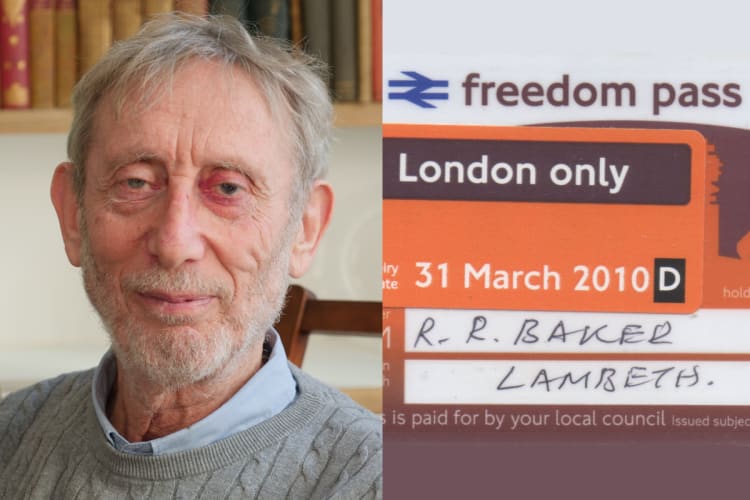 Michael Rosen image by Historyworks. Creative Commons 2.0 Freedom Pass image by Greater London Authority. Creative Commons Attribution Share-Alike 3.0
An increasing number of people simply no longer trust in these systems, nor in our ability to use them sustainably. 14 years of Conservative austerity measures have drilled the following three ideas into their heads so strongly that they're second nature now:
The country is bankrupt (or close).
This is because the government provides more than people need, which is also more than it can afford.
The problem would be fixed if individuals refused welfare they didn't need.
Allsopp's recent response to Rosen on X illustrated these three ideas when she suggested:
The Freedom PassPeople have to stop taking things they do not need, it is wrong and it is bankrupting our country.
Should we thank all workers who reach retirement age with the courtesy of free public transport? London councils have thought so since the Freedom Pass scheme began in 1973. The scheme offers free bus and train travel to all Greater London residents who are over the state pension age (currently 66), or who have an eligible disability. Created by the Greater London Council, the scheme even survived the GLC's dissolution by the Thatcher government in 1986.
Michael Rosen, renowned author and previous Children's Laureate, is 79 years old and suffers from partial sight and hearing loss since being hospitalised with COVID-19 in 2020. On 12 November he wrote this tweet expressing his frustration with the process to replace his faulty Freedom Pass:
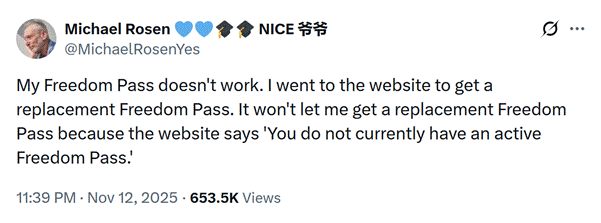
It's not difficult to see how this situation could cause problems, especially for Freedom Pass users who applied through the post and could not access the website unassisted. In any case, the tweet was an unremarkable personal anecdote, initially received with sympathy by its small audience.
Allsopp's complaintThe Freedom Pass scheme is as old as VAT and only fills up seats on services which are already running, so it seems unlikely to be the final straw of London's finances. Allsopp suggested otherwise, however, when she quote-tweeted Rosen with this response:
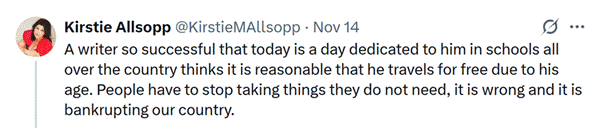
She refers in the tweet to the Michael Rosen Day event, where Rosen and publisher Walker Books encourage children to read by offering free resources and activities. Having criticised Rosen for using the pass, she also describes exactly how the Freedom Pass is intended to work: a person can travel for free due to their age, regardless of other factors.
Allsopp appears to disagree with this principle, joining many others who argue that people should only access financial help if they absolutely need it. This mindset recalls the recent Motability reform and the ongoing winter fuel allowance debate.
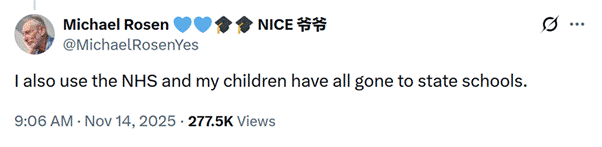
Rosen's response was to name other public services he has used, rejecting the suggestion that it was wrong for him to use the Freedom Pass:
Journalism by the people for the people
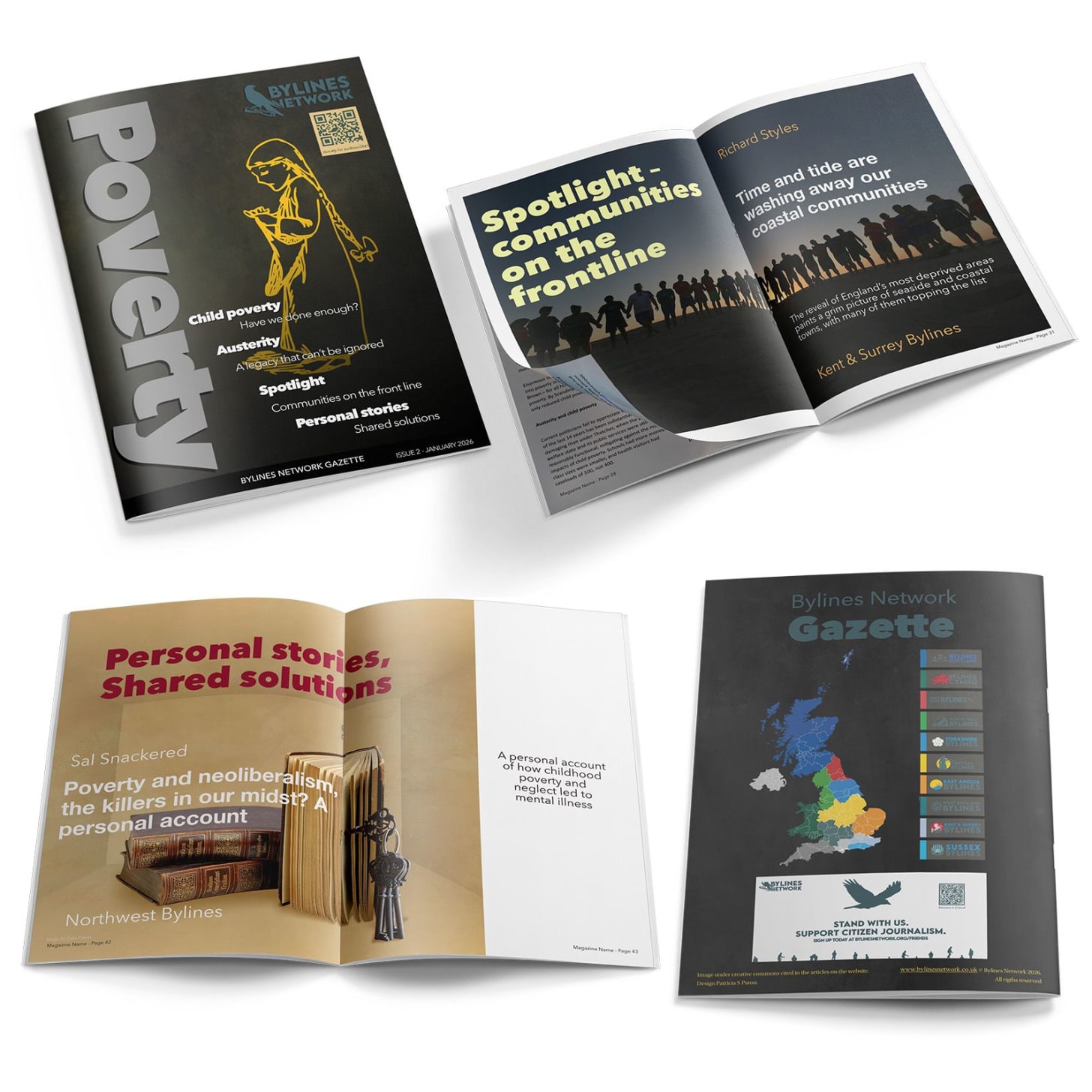 The latest Bylines Network Gazette - all about poverty - get yours now by becoming a Friend of Bylines Network.
We're proudly independent - no corporate owners or billionaire backers. But it costs us at least £150,000 a year to run our network. Help us tell the stories that matter by becoming a Friend of Bylines Network. You'll get behind-the-scenes insights, access to special events, merchandise, and the BYLINES NETWORK GAZETTE, FREE.
The current issue features the latest poverty data from Peter Matejic of the Joseph Rowntree Foundation, a child's eye view of hardship from the End Child Poverty Coalition, a rundown of the worrying poverty record of Reform UK councils, and articles by citizens across the UK - this is your poverty primer, providing the true story behind this vital topic and offering powerful calls for urgent action.
Get your Gazette by becoming a Friend of Bylines Network now - click the button below or upgrade your Substack subscription.
Become a Friend of Bylines Network
Selectivity vs universalism in welfare provision
The difference between Allsopp and Rosen's attitudes to welfare systems is clear. To Allsopp, they are a safety net to be directed to the select few who need help most, which is a selectivist view. To Rosen, they exist to make life easier for as many people as possible, which is a universalist view.
The most common form of selectivist welfare policy is means testing, where councils employ officers to assess how much support someone needs. Selectivists would argue that this is more effective because it cares for the most vulnerable while saving money from unnecessary handouts, as per the third idea above. However, researchers from both LSE and the Economic and Social Research Council have found that this perceived cost-effectiveness may be counteracted by the costs of means testing and its effects on people's behaviour, especially their fear of losing benefits.
Comedian Jenny Eclair then gave her view, arguing that the scheme was a deserved reward for retirees' tax contributions in their working years. But Allsopp replied that the country couldn't afford this.
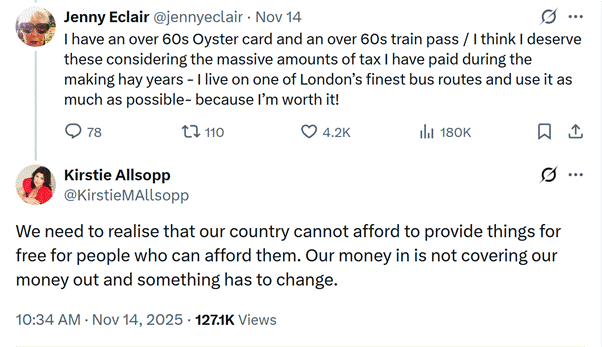
Fifty years of uninterrupted Freedom Pass operation suggests otherwise, but why might Kirstie Allsopp be so hostile to the notion of welfare universalism? The answer may lie in the 2008 Great Recession and the following 14 years of Conservative austerity policy.
2008 and the housing marketAllsopp was on the scene for the 2008 financial crisis, which came at the height of her TV success. A Guardian interview from 2006 records her frustration that the Brown government's housing policies would discourage buyers. She also expresses support for then-leader of the opposition, David Cameron. She was eager to help buyers onto the market, even as house prices rose and rose. Then, in 2008, she and her TV partner Phil Spencer gave advice to those fearing repossession because of the housing market crash. What went wrong?
In these old interviews Allsopp projects a genuine desire to lower barriers to entry for first-time buyers. However, given that irresponsible mortgage lending was a cause of the crisis, the choice to keep pushing home ownership as prices reached unsustainable levels mostly benefitted property investors. Many of these new homeowners, on the other hand, were hung out to dry when the market collapsed.
Recovery through austerityThe housing crash was followed by the global recession, and the government bailed out the banks at great cost. Allsopp's wish for a Cameron government was then granted in the form of the 2010 coalition. Soon, the UK entered its most recent era of austerity, a predicament which hasn't really ended, even with Labour in power.
The coalition's chosen path to economic recovery was to cut public spending. This affected some parts of the country more than others. During investigations into the Cameron government's implementation of austerity, former ministers have admitted that resources were redirected from Labour-loyal areas towards Conservative-voting areas. This reallocation, which also stimulated local house prices, was part of a strategy to maintain the government's power through difficult times by prioritising the wellbeing of its strongest supporters.
Brexit and COVID-19Of course, no other Cameron policy tried harder to appeal to voters than his 2013 Brexit gambit: the promise, aimed at UKIP voters, to hold a referendum if the Conservatives won a majority in the next election. Cameron was later part of the official Remain campaign, so in hindsight the move reads as another sacrifice made to hold on to political power under fire.
Whether Cameron anticipated Brexit or not, the complications and infighting involved in carrying it out dogged the underwhelming recovery that ended in Boris Johnson winning a majority in 2019, just in time for the COVID-19 pandemic to demand emergency spending and wipe any progress clean.
The austerity mindsetIn the 14 years of Conservative austerity policies, the first bullet point above (that the country is bankrupt) never truly left the public consciousness. The whole world economy went broke in 2008, and it takes a long time to change an impression like that.
The second point, however, (that the cause in the UK was excess welfare handouts) wasn't nearly as true as the Conservatives had hoped. Gutting public services and the NHS could only do so much to revive the economy, because while austerity reduced government debt, it failed to stimulate private investment, which the 2010 manifesto had promised. Researchers now believe that Brexit exacerbated this slow investment, meaning the suffering of austerity came without the promised reward of economic recovery.
When Allsopp picks apart Rosen's personal welfare use, she perpetuates the final and most harmful idea of the three, that the solution is in the hands of individuals. The idea that economic recovery will come at the cost of pensioners making noble sacrifices sustains the myth that welfare was really the problem all along. And yet, the NHS rose from the ashes of war. The Freedom Pass was born in the same year as the 1973 Oil Crisis. These services were born from hardship and tempered by successive crises long before market forces created the 2008 recession. These systems and the people using them cannot take sole blame.
Hope in welfare and joy in retirementWhere does all this leave us? Our public services and welfare systems show no sign of improving yet. Rosen's response to Allsopp's tweet, shows, in one sentence, what it will take to resist the acceptance of austerity as a new normal.
Rosen is clearly proud of the NHS, the Freedom Pass scheme and the state school system, and these institutions keep giving us reasons to be proud of them, battered as they are. The recent bus fare caps have begrudgingly shown the Sunak and Starmer governments that when you make it easy for people to use public transport, they will do so. The sighs of relief at the notion of rail renationalisation alone signals that people are desperate for anything besides further decay.
These welfare systems make people at retirement age feel that their tax contributions have been worthwhile, that they have helped build a state which will provide for them in their later years, also providing for their children and family, and keeping them in good enough health their whole lives to enjoy retirement in peace.
UK welfare schemes such as the NHS, state schools, nationalised transport and the Freedom Pass are meant to support us to live our lives without worrying about tightening our belts. It is time to reject the austerity mindset and defend our public services against the next wave of economic hardships we are facing, so that the masses are not made to suffer again for the mistakes of the few.
BEST OF BYLINES: Tees Valley care crisis - the care-to-crime cliff edge [ 02-Feb-26 5:31pm ]Welcome the Best of Bylines newsletter, bringing you another important story from one of our 10 UK national and regional publications. Following hot on the heels of our latest Bylines Network Gazette - packed with profiles of UK poverty and powerful citizen solutions - we turn our attention to some of the most disadvantaged children in our communities.
James Waterson of North East Bylines exposes worrying structural shifts in children's social care. Despite a fall in the numbers of Looked After Children (LAC) in England, the system is driving worse outcomes for children in care and care leavers. Especially in Tees Valley, where LAC numbers are among the highest in the country, and the path from care into adulthood is increasingly precarious.
Read the full story by James right here in this email, written with help from fellow North East Bylines author Ray Casey - this is citizen journalism in action, collaborating to reveal the truth about a vital social issue.
 Photo by Windah Limbai on Unsplash
As of 31 March 2025, 81,770 children were looked after in England, a 2% fall on the previous year. But behind falling national numbers, in the North East, children in care face worsening outcomes, and the Tees Valley sits at the sharp end.
Tees Valley well above national averagesThe North East has the highest rate of children in care in England, at 113 per 10,000 children, compared with much lower rates in parts of outer London.
Within the region, Tees Valley authorities consistently sit above the national picture:
Hartlepool: 332 children looked after - 157 per 10,000, one of the highest rates in the country
Middlesbrough: 493 children - 138 per 10,000
Redcar and Cleveland: 397 children - 144 per 10,000
Stockton-on-Tees: 564 children - 125 per 10,000
Darlington: 266 children - 117 per 10,000
While Stockton has the largest number of children in care, Hartlepool's rate is the most acute reflecting deep, long-standing deprivation pressures.
A system under strainShockingly, over the past five years, the number of children living in children's homes or secure units has risen by 27%. Foster placements have fallen by 4%.
Research by the charity Become shows why this matters. Children placed in private children's homes are 2.5 times more likely to live far away from the area they were born into and four in five children in secure settings live more than 20 miles from home. Distance weakens family ties, disrupts education and mental-health support, and increases instability, all factors linked to poorer long-term outcomes.
Privatisation of care and poor outcomesPrivate children's homes and secure facilities are increasingly consuming council budgets while failing to deliver better outcomes for vulnerable young people. These placements are significantly more expensive to local authorities than foster care. Between 2020 and 2024 the cost of residential care for looked after children in England rose by 96%. Yet the number of children in such placements increased by only 10%.
Yet research consistently links private children's homes with poorer emotional, educational and social outcomes, suggesting councils are spending more for a less positive impact on children's lives.
Journalism by the people for the people
The latest Bylines Network Gazette - all about poverty - get your's now by beocming a Friend of Bylines Network.We're proudly independent - no corporate owners or billionaire backers. But it costs us at least £150,000 a year to run our network. Help us tell the stories that matter by becoming a Friend of Bylines Network. You'll get behind-the-scenes insights, access to special events, merchandise, and the BYLINES NETWORK GAZETTE, FREE.
The current issue features the latest poverty data from Peter Matejic of the Joseph Rowntree Foundation, a child's eye view of hardship from the End Child Poverty Coalition, a rundown of the worrying poverty record of Reform UK councils, and articles by citizens across the UK - this is your poverty primer, providing the true story behind this vital topic and offering powerful calls for urgent action.
Get your Gazette by becoming a Friend of Bylines Network now - click the button below or upgrade your Substack subscription.
Become a Friend of Bylines Network
Adoption and invisible gaps
Outcomes do not improve simply because a child leaves care.
According to Adoption UK's Adoption Barometer, only 10% of care-experienced people and adoptive parents feel public services understand their needs. Among adult adoptees, just 12% feel they know enough about their medical history to access appropriate healthcare. An incredible gap that can take years to resolve.
These invisible deficits follow people into adulthood, shaping health, employment and wellbeing. Their 2026 barometer is live now for adopted people and their families. You can contribute here.
From care to crime and homelessnessThe transition out of care is a known danger point often described as a "care cliff edge".
39% of care leavers aged 19-21 are not in education, employment or training (NEET), compared with around 13% of all young people.
Care-experienced young people are four times less likely to enter higher education by age 22, and those who do are 2.5 times more likely to drop out.
In 2024/25, 4,610 care leavers aged 18-20 were assessed as homeless or at risk of homelessness, up from the previous year.
Overall, care-experienced young people are nine times more likely to face homelessness than their peers.
Despite these risks, the government does not collect data linking care experience and the criminal justice system at local authority level, leaving a major blind spot in understanding the care-to-crime pipeline.
Wellbeing with stark inequalitiesSurveys by Coram Voice reveal the human cost behind the statistics:
Around one in four care leavers report low life satisfaction, compared with just 3% of the general population.
22% often or always feel lonely, 33% report high anxiety, and 16% do not feel safe where they live.
Care leavers with disabilities or long-term conditions - now 32% of respondents, up from 22% - fare even worse, with 42% reporting low wellbeing.
Autism, ADHD and mental-health conditions are the most commonly reported issues, yet many remain poorly supported once formal care ends and we just don't know how many neurodivergent children are being missed.
Situational overshadowingIn the medical profession there is something called "diagnostic overshadowing" which attributes a patient's condition to a psychiatric issue rather than considering physical health. Within the care system there is something called "situational overshadowing". Where a child's behaviour is attributed to their environment and upbringing and not their inherent psychology. I should know. I was missed as a neurodivergent child in the care system as was my partner.
What needs to changeThe evidence is clear. Poor outcomes are not inevitable, but they are predictable. Key actions consistently linked to better outcomes include:
Stable, safe housing when leaving care
Targeted mental-health and disability support
Strong, ongoing relationships with trusted adults or mentors
Recognition of care experience in social policy, including employment, education and benefits
Without these, the costs do not disappear; they simply re-emerge later, in homelessness services, the NHS and the criminal justice system.
Care criminalisationIf the government is serious about overhauling the criminal justice system they need to take state care and the subsequent privatisation of it into consideration as it is a massive contributing factor.
Over half of LAC end up with a criminal conviction by the age of 24 and about 15% are given a custodial sentence. More than ten times the rate of children not from care.
These figures reflect structural inequalities, early adversity, school exclusion, and what experts call "care criminalisation" where behaviours that might be addressed in family settings trigger police involvement in care settings. It must end.
The warning from Tees ValleyTees Valley's persistently high care rates are not just a local concern, they are an early warning sign. A system that moves children further from home, reduces foster capacity and withdraws support too quickly in adulthood is creating a pipeline of inequality that lasts decades.
The numbers may be falling nationally. But in places like Hartlepool, Middlesbrough and Redcar and Cleveland, the care-to-crime cliff edge remains dangerously close.
Thank you to Ray Casey for contributing to this article.
More from North East Bylines - Toxic Tees
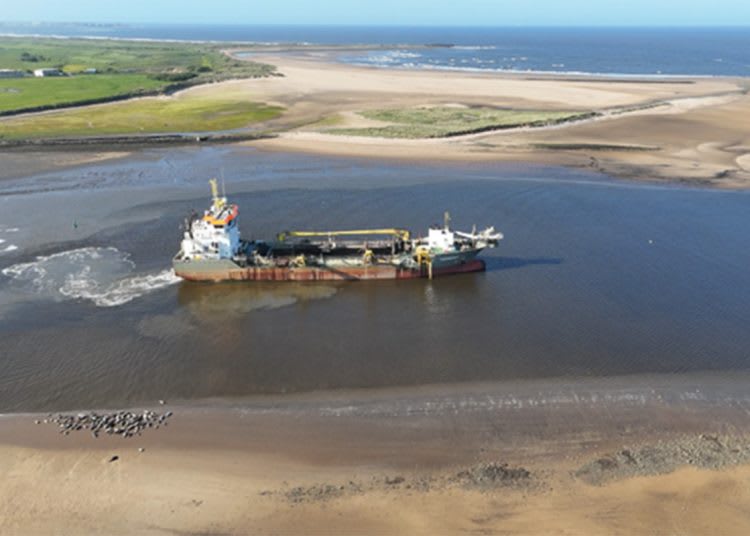 FJune 2024 Causeway dredging Seaton Channel by seals hauled out on Seal Sands (Grecko Indie Media)
Simon Gibbon, visiting professor of materials at the University of Manchester and a member Climate Action Stokesley and Villages, and, has requested a Judicial Review of the Marine Management Organisation (MMO).
Taking a government regulator to court is daunting. It's not a step Simon takes lightly. In his article for North East Bylines he explains how the collapse of the River Tees ecosystem, and his own research into contamination of the river sediments, left him with no choice. Read the full story here.
OUT NOW - Bylines Network Gazette, January 2026: The true story of poverty in the UK and what we can do about it [ 30-Jan-26 8:29pm ]The first Bylines Network Gazette of 2026 has been released. In what promises to be a crucial year for democracy, we are kicking things off with a special collection of investigations, analysis, comment and reflections on poverty in the UK. We are proud to share citizen perspectives from across the country alongside exclusive articles from leading figures and organisations.
Become a Friend of Bylines Network and get your Gazette.
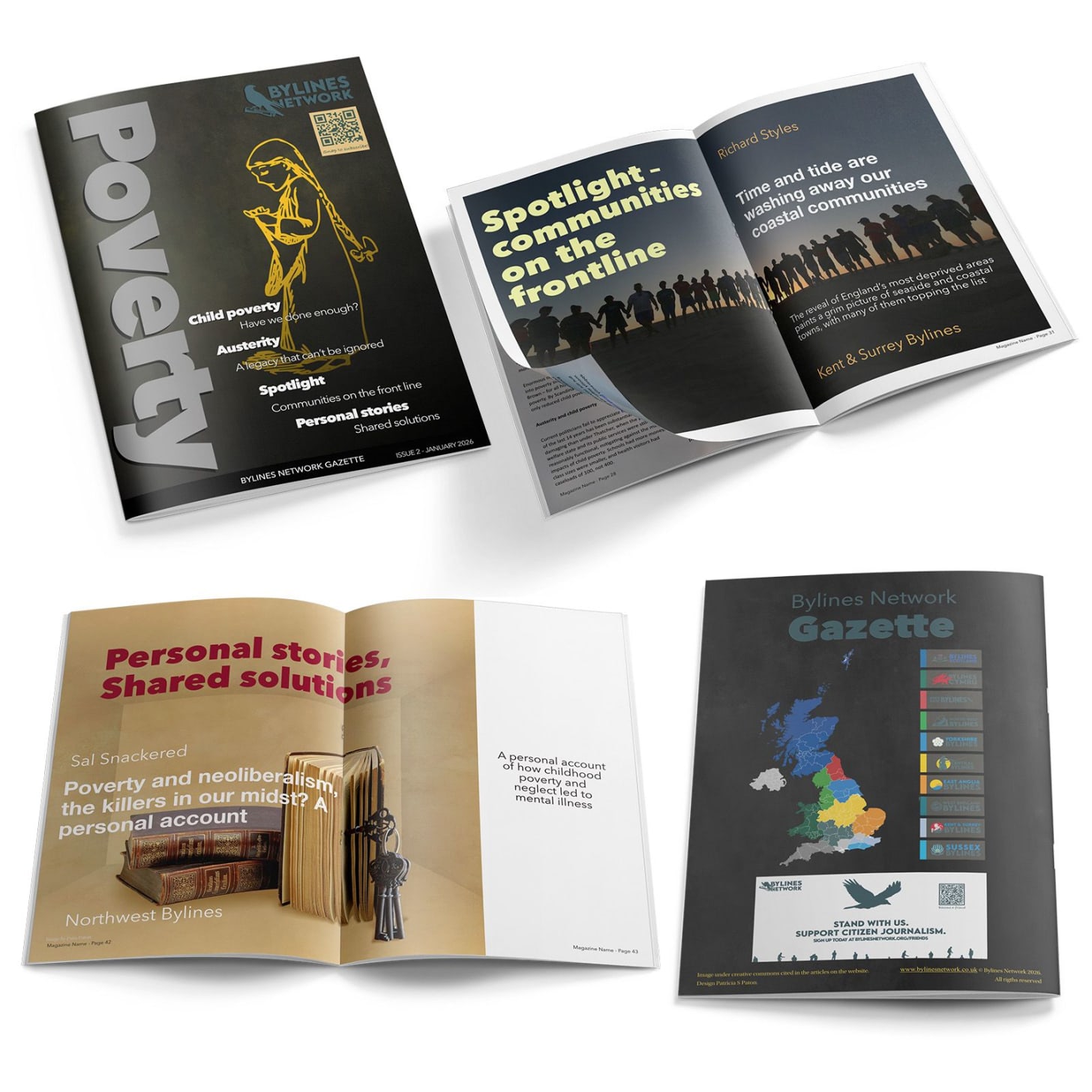 Images of our latest Bylines Network Gazette, available now.
Exclusives in this issue include articles by:
Rachel de Souza, the Children's Commissioner for England - proposing better solutions to child poverty and calling on us all to listen to young voices.
Peter Matejic, chief analyst at the Joseph Rowntree Foundation - providing the true picture of poverty over the last 20 years, and explaining why we need a new plan…and urgently.
Liv, a Youth Ambassador for the End Child Poverty Coalition - revealing the impact of post-pandemic cost-of-living crises on the next generation of voters.
Gemma Gould, editor in chief of Central Bylines - a Bylines Network editorial, reviewing the worrying record of councils led by Reform UK and what this might mean for the poorest in our society if Nigel Farage's party were to win the next election.
All this and 10 powerful articles by citizen journalists from our UK national and regional publications. Tales of child poverty, impacts of financial struggle on mental wellbeing, challenges faced by coastal communities, what happens when politics comes before fairness, debates about a universal basic income, and more - this Gazette is bursting with important stories.
This is your poverty primer, providing the true story behind this vital topic, offering powerful calls for urgent action, and suggesting the solutions policymakers need to hear.
Our Gazettes are presented in beautiful, specially designed flipbooks which you can read online or download as a PDF. How do you get your copy? Become our friend.
Become a Friend of Bylines Network - get the Bylines Network Gazette
We don't have billionaire backers, corporate owners, or political paymasters. We're proudly independent, but it costs us over £150,000 every year to run our network. That's why Bylines Network Gazettes are issued on a subscription basis - to anyone who donates to us monthly or who becomes a Friend of Bylines Network.
By becoming our Friend, you're supporting journalism, investing in stronger communities, helping us deepen public understanding and strengthening democracy. In return for as little as £3.50 a month, you'll get behind-the-scenes insights, chances to engage with our editorial teams, access to special events, merchandise, and more.
Sign up by clicking the button below, or upgrade your Substack subscription. We treat paid Substack subscribers the same way we treat Friends, so you'll receive all the same benefits. Is it worth it? Don't take our word for it:
"The Bylines Network is tremendously inspiring…it's crucial that journalism speaks truth to power, but the great majority of it unfortunately speaks with the voice of power…it's really inspiring to see networks like yours filling that huge gap and doing what journalism ought to do."
George Monbiot
Sign up as a Friend of Bylines Network
You can choose from the following tiers - only Friend and Best Friend are available via Substack, so if you want to support us as a Champion or Patron, clikc the "sign up" button above.
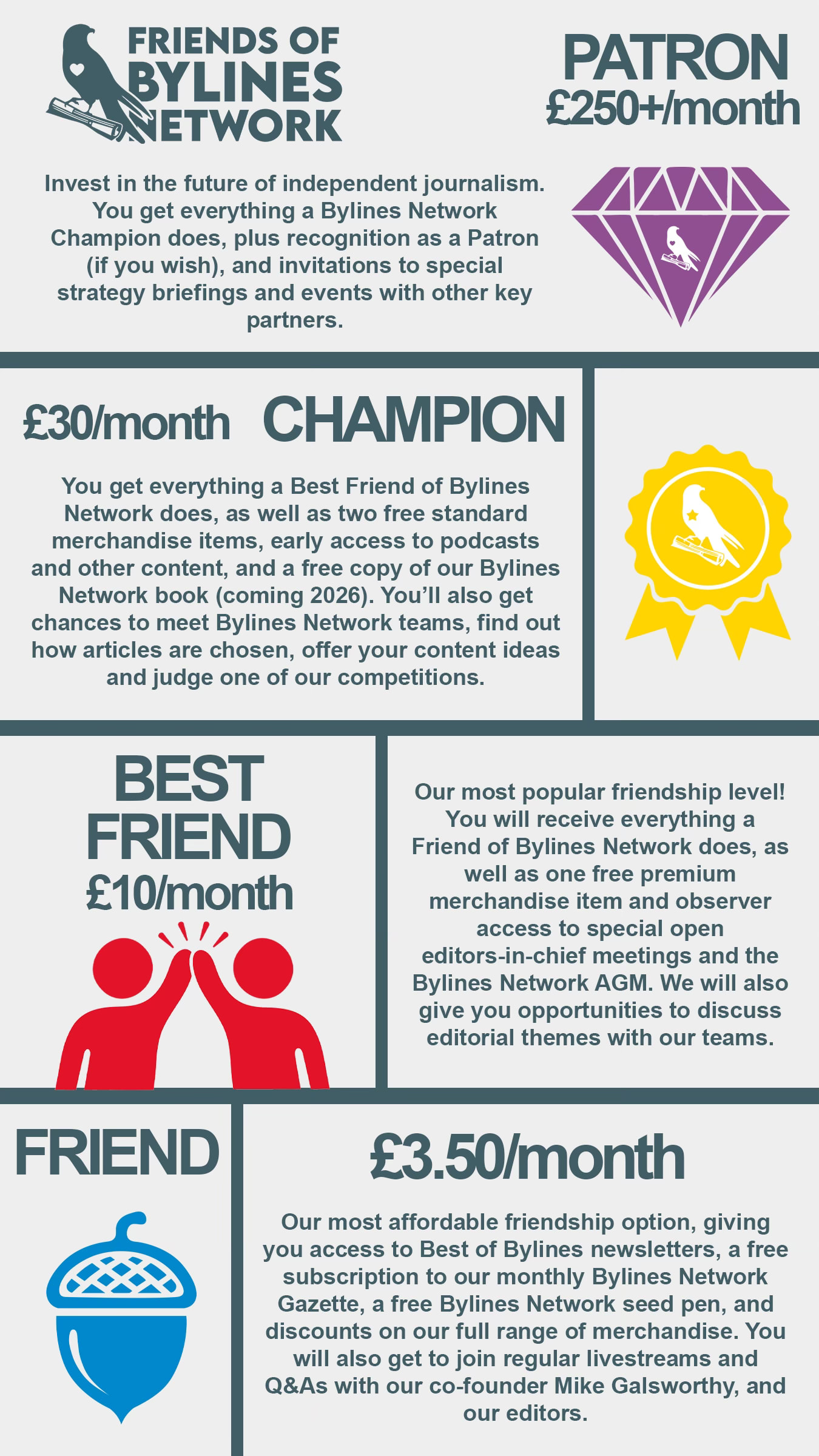 There is a friendship level for everyone. Just click here to sign up. (Image by Ceylan Salih, copyright Bylines Networks Limited.)
Don't want to be friends? No problem, we're not going anywhere
If you don't want to become a Friend of Bylines Network, that's fine - you will remain a newsletter subscriber, nothing else will change, you will still get brilliant articles delivered to you every week, you can visit the free content on our Substack anytime, and you can access all 10 of our publications on their websites without paying a penny.
Here's one of our most popular recent articles, completely free to read:
BEST OF BYLINES: Vibrant landscapes and portraits in a new Roger Fry exhibition [ 26-Jan-26 5:01pm ]2026 is barely a month old, but it feels like we have lived a year in the last few weeks. In a time of global chaos and crisis, our 10 UK national and regional publications have been filled with citizen voices from across the globe.
From Americans discussing the true face of ICE, to Iranians praising young women leading democracy protests, and reflections on Mark Carney's speech at the World Economic Forum. Closer to home, our journalists predict rebellions by Labour MPs, and explain why our network has left the X platform.
We will return to these tumultuous stories soon, after we've taken a moment to draw breath and feed on the life-affirming power of art. In this edition of our Best of Bylines newsletter, Viv Griffiths, writing for Sussex Bylines, remembers a creative powerhouse who had an immense impact on British culture but whose own artworks are rarely appreciated.
Roger Fry (1866-1934) was best known as an influential art critic, curator and member of the Bloomsbury Group, but always thought of himself as an "artist first". The first major exhibition of his paintings in the UK for 25 years brings his vibrant landscapes and portraits to a wider public.
 Roger Fry, 'The Black Sea Coast'. 1911, Museum & Art Swindon
Born to a wealthy Quaker family, Fry first trained in Natural Science, but later focused on art (against parental disapproval) after studying painting in France and Italy. He became a specialist in Italian Renaissance art before becoming interested in more modern painters of the time, particularly Cézanne, whose work he studied closely for many years.
Vibrant landscapesThis influence is clear when you go into the first exhibition gallery, full of large landscapes with vibrant colours which literally shine out from the walls. At first glance, they could be Post-Impressionist paintings because of their intense colour, and a focus on form and shapes which verges on abstraction.
It is no coincidence, because Fry actually coined the term Post-Impressionism and organised the first exhibitions of work in England by artists such as Cézanne, Gauguin, Picasso, Matisse and Van Gogh at the Grafton Galleries in 1910 and 1912. The initial response was negative - people were shocked and Fry was called mad - but over time their importance was recognised and helped to establish Fry's reputation as an innovative art critic.
Journalism by the people, for the people
We're proudly independent, but it costs us at least £150,000 a year to run our network. For as little as £3.50 a month, you can be a Friend of Bylines Network, get behind-the-scenes insights, engage with our editorial teams, access events, and support powerful citizen journalism. You can sign up using the link below or upgrade to a paid Substack subscription and get all the same benefits.
Friends of Bylines Network are also automatically subscribed to the Bylines Network Gazette. Sign up now so you don't miss out.
Become a Friend of Bylines Network
Inspired by these artists, Fry developed a theory of art called formalism, which emphasised the visual aspects of art such as line and composition rather than the subject matter. He also experimented with these ideas in his own artwork. Paintings such as the atmospheric Blythburgh, The Estuary (c.1893, see below), brightly-coloured The Black Sea Coast (1911, main image) and Studland Bay (1911) all show features of his focus on form, line and colour.
My particular favourites in this part of the exhibition are Town in the Mountains with Poplars, where the lines of the tall, dark green poplar trees contrast with the softer reddish hills and mountains, and the Cézanne-like River with Poplars (c.1912), full of solid, colourful shapes. Fry held his first solo exhibition of some of these landscapes in 1912, many of them based on his travels in France.
An array of smaller landscapes is also shown in the second gallery. Although some are individually beautiful, the overall impact is less than the larger work because of more muted colours; (to me) hanging them in a group reduces their distinctive effect.
Abstract still lifesSoon after this, Fry started to experiment with still lifes and a number of these are shown in the first gallery. I preferred the more abstract paintings such as Poinsettias in a Vase, c.1915 (see below), with its strong lines and colour. Fry held a successful exhibition of these in 1917, which was praised by the artist Walter Sickert as "serious and thoughtful work, full of feeling".
 Design work and creative spaces
Fry's membership of the Bloomsbury Group is well known. He had a close, lifelong relationship with Vanessa Bell, a former lover, and cooperated with her and Duncan Grant in founding the Omega Workshops in 1913. These were based in a radical approach to interior design and provided work for up and coming artists and designers. Fry wrote: "It is time that the spirit of fun is introduced into furniture and ceramics."
Lesser known is that Fry designed his own house in Surrey, and later designed the Studio at Charlestonfor Bell and Grant, a significant space which is now being restored. He also helped to design the courtyard garden at Charleston and even recommended which flowers should be planted, such as red hot pokers and artichokes, which are striking to look at and paint. Fry's paintings of Charleston and Vanessa Bell, shown here, demonstrate the importance of this close relationship.
Psychological portraitsThe highlight of the second gallery is the collection of Fry's portraits of major figures in early 20th century modernism, such as writers EM Forster and Aldous Huxley, the latter painted in 1931, the year he wrote Brave New World.
My favourite is the portrait of Welsh artist and writer Nina Hamnett, another former lover (see below), known as the Queen of Bohemia. Painted in 1917, it is strikingly modern; Hamnett's dark hair, eyes and clothes give a dramatic effect, in contrast to the domestic pots and pans on the table behind her.
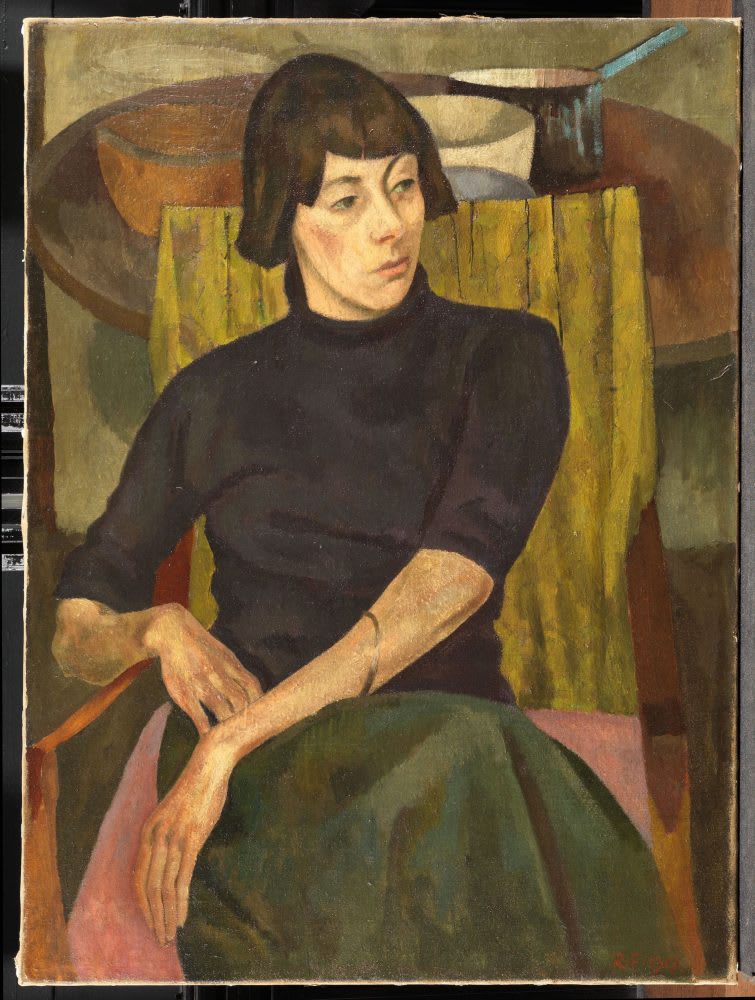
Fry also painted a series of self-portraits, four of which are shown in the exhibition. In these he comes across as serious and subdued, with a rather gaunt face. This contrasts with Virginia Woolf's description of him, with pockets "stuffed with a book, a paint box or something intriguing - he had canvases under his arms; his hair flew, his eyes glowed".
Fry was certainly a "creative powerhouse" and a hugely influential figure in 20th century British art. This exhibition shows that he was also a highly talented artist.
The Roger Fry exhibition at Charleston in Firle runs until 15 March 2026.
Viv travelled there from Charleston in Lewes on the Sussex Art Shuttle bus, which also runs from Eastbourne Towner gallery on Fridays-Sundays and Bank Holidays. See timetable.
More from Sussex Bylines
 We're hiring. Credit: Image by Gerd Altmann from Pixabay
In his latest article, The political job centre, popular author Mick Channon writes about the increasing trend of politicians abandoning their values in favour of continuing their political career:
There is a peculiar modern ritual in British politics, one that happens often enough now to have lost even the courtesy of embarrassment. It goes like this: a politician spends years declaring another party morally bankrupt, intellectually unserious, or positively dangerous.
A insicive and powerful article - not to be missed.
BEST OF BYLINES: The Fayed/Harrods case bears the hallmarks of sex trafficking [ 23-Jan-26 5:02pm ]In this edition of the Best of Bylines newsletter, we bring you the latest in a series of articles by survivors of abuse connected to Mohamed Al Fayed's Harrods empire.
Survivors' accounts of abuse first surfaced in 1995. Witnesses bravely came forward to give evidence in a series of television and radio programmes, yet survivors still feel they are facing almost insurmountable barriers to obtaining real justice.
It is a pattern that will be disturbingly familiar to anyone who has followed sexual abuse and trafficking cases: accusers silenced with threats of legal action, police inertia, and powerful establishment forces lining up to protect the rich and well-connected.
Here, Elizabeth - a member of the No One Above(NOA) survivors collective - shares her surprise at how little the wider public now seems to know about the abuse that occurred at Harrods. Writing for Central Bylines, she examines the way headlines have become less frequent since the initial devastating expose, whilst the contours of the story have only become more clearly defined. It is a horrifying picture.
 Image by Andreia Cunha. Free to use under Unsplash License.
According to the BBC, at least 400 women have alleged that they were sexually exploited by a criminal network centered around Mohamed (Al) Fayed. Over three decades, according to the BBC, Harrods was the main conduit for recruiting young women who were served to Mohamed, Salah and allegedly, Ali Fayed to be sexually abused. Other channels for exploitation included the Ritz Paris, Hyde Park Residences and Fulham FC. To date, 147 victim-survivors have reported offences to the Metropolitan Police.
Victims were subjected to sexual assault and rape; false imprisonment; drugging; physical violence; verbal humiliation; surveillance and intimidation. There are at least two reports of forced abortions. Several victims have alleged that they were abused by more than one Fayed brother or by a brother and another man. Victims of Mohamed Fayed are alleged to have included underage girls and vulnerable children who attended the Fayed-owned West Heath school. Victims were profiled, groomed, subjected to sexual health testing and then transferred into the brothers' personal control under the pretence of work opportunities or patronage. Once isolated, they were sexually assaulted. According to NOA (No One Above, an independent advocacy project led by survivors of Mohamed Al Fayed and Harrods), locations for abuse included secure venues within Harrods; 60 Park Lane; the Ritz Paris; and Fayed estates in Surrey, Scotland, Paris, the French Riviera and Switzerland.
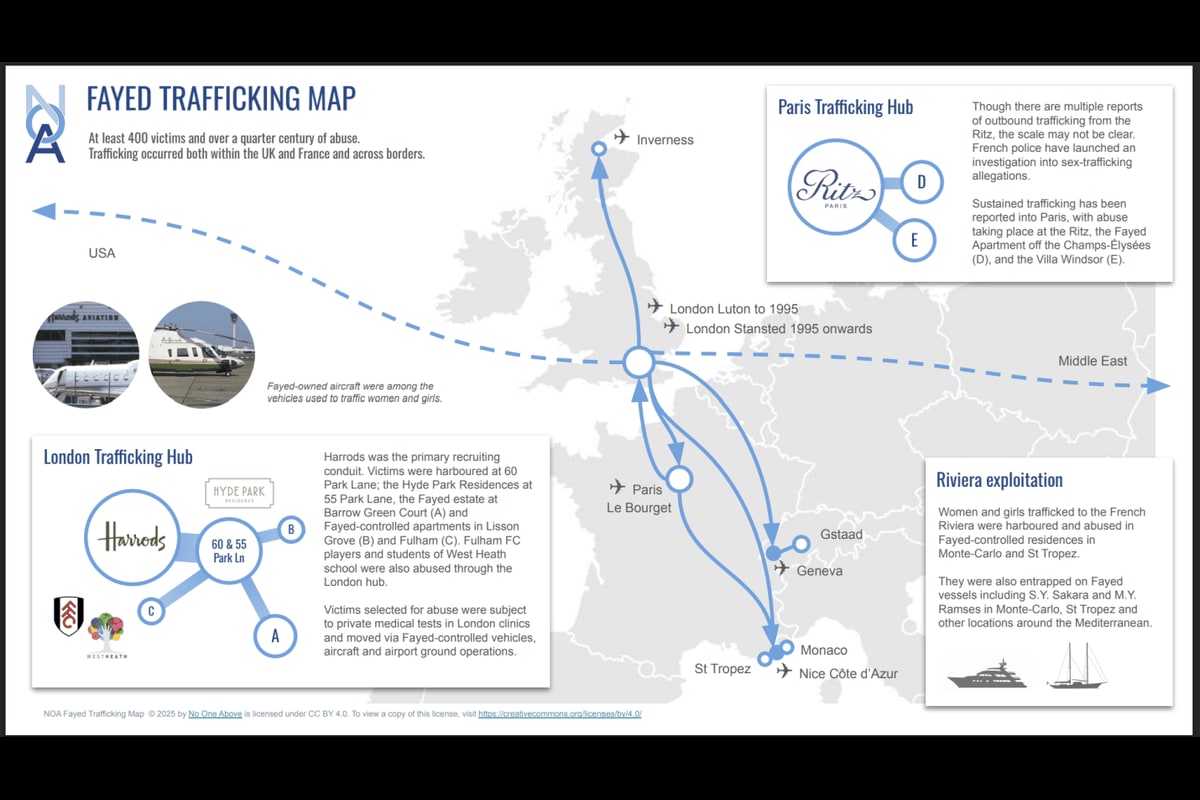 image by NOA. used with permission from NOA
It is hard to imagine how any observer would fail to recognise what is in plain sight.
Support us
We're proudly independent - no corporate owners or billionaire backers. But it costs us at least £150,000 a year to run our network. We're proud to give a platform to survivors of abuse and injustice. Support journalism by the people, for the people. Become a Friend of Bylines Network. For as little as £3.50 a month, you'll get behind-the-scenes insights, chances to engage with our editorial teams, access to special events, merchandise, and more. Sign up by clicking the button below, or upgrade your Substack subscription.
Become a Friend of Bylines Network
What is sex trafficking?
Sex trafficking occurs when a person moves another person to an unsafe place in order to sexually exploit them. It is neither opportunistic nor casual: trafficking's special cruelty lies in the deliberate positioning of a chosen victim in harm's way. There is always an imbalance of power. It is a devastating reversal of the duty of care when institutions enable the crime.
Sex trafficking in UK Law is currently defined under the Modern Slavery Act 2015. It is recognised as a serious crime that violates human rights by forcing, threatening or deceiving victims into "situations of subjugation, degradation and control which undermine their personal identity and sense of self."
While many survivors of exploitation by the Fayed network recognise their experiences in the language of the Modern Slavery Act, offences that pre-date 2015 cannot be charged as trafficking offences under the Act. Nevertheless, irrespective of when the exploitation occurred, authorities remain under legal duties. They must identify, investigate, and safeguard potential victims of human trafficking where there are reasonable grounds for suspicion. Trafficking that predates the Modern Slavery Act remains trafficking - and the State must recognise it.
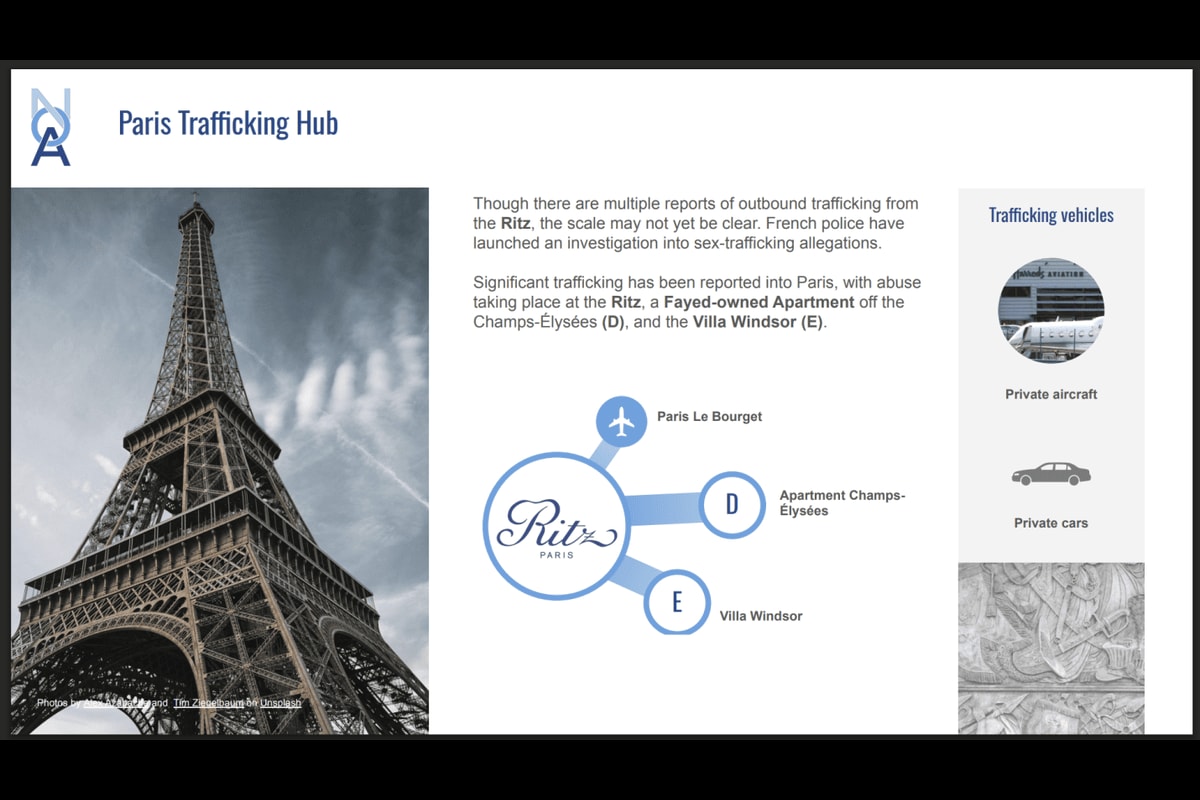 image by NOA. used with permission from NOA
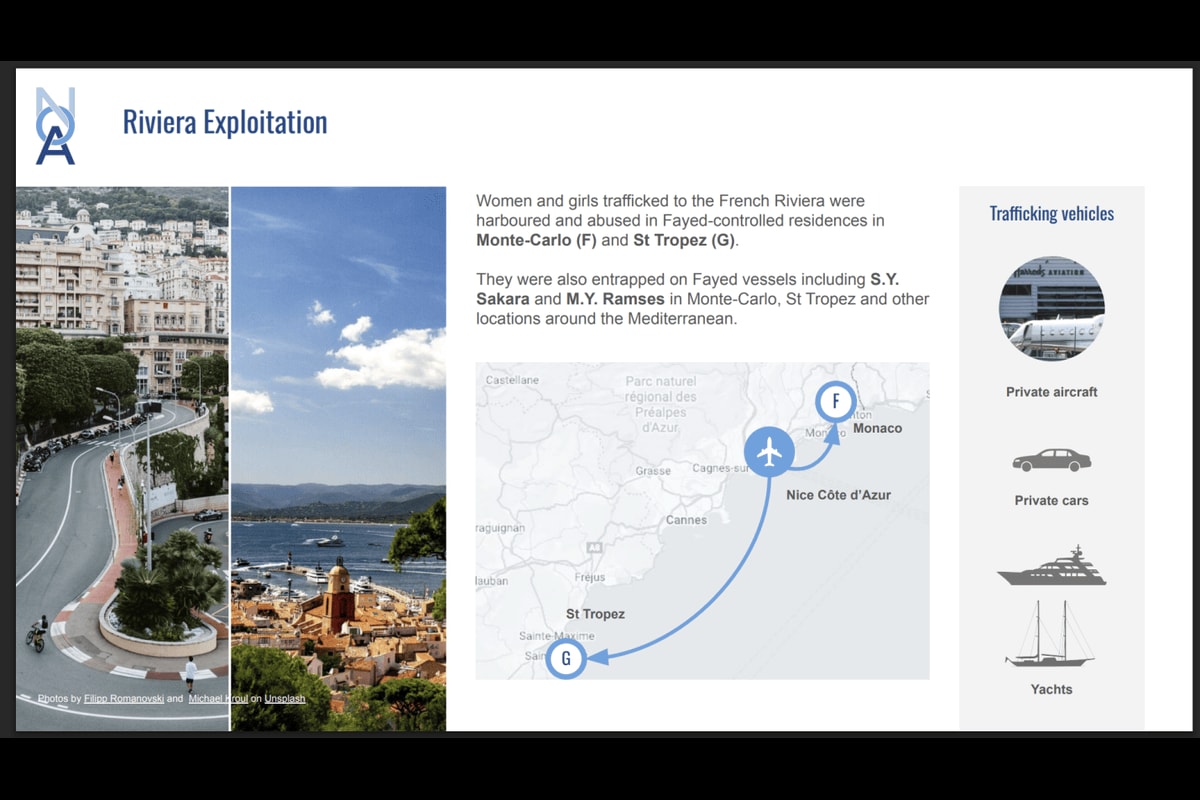 image by NOA. used with permission from NOASurvivors' ordeal not being recognised as sex trafficking
Yet, in the Fayed/Harrods case, the Met has framed its investigation narrowly, describing its focus as the "enablers" of Mohamed Fayed. It has repeatedly declined survivors' requests to confirm whether wider trafficking offences are being examined and, awkwardly, avoids using the term "trafficking" even when referring to a parallel French inquiry into "aggravated human trafficking". At least one survivor whose case involves being trafficked to a different member of the network than Mohamed Fayed has not been given the opportunity to report to the Met's Cornpoppy Investigation. The effect is to minimise and misrepresent the case: the police appear to have drawn a circle around a single node in a trafficking system and refused to look beyond it.
A systemic failure to safeguard survivorsThe survivor organisation No One Above (NOA), of which I am a member, has asked MPs to write to the Home Secretary to provide the answers we cannot obtain.
NOA is an independent advocacy project led by survivors of organised abuse and trafficking at Fayed-controlled organisations, including Harrods. NOA calls for recognition and investigation of sex trafficking and the State's failure to protect victims, while striving for legal reforms that deliver equal access to justice for survivors of powerful perpetrators.
The most concerning aspect is the apparent failure by police to refer victims to the National Referral Mechanism (NRM), the government's mechanism for identifying trafficking cases. Referral to the NRM is required by law if trafficking is suspected: such is the gravity of the crime.
Notwithstanding the statutory duty to refer victims to the NRM or, at a minimum, report suspected trafficking to the Home Office, some may ask if a failure to do so is of serious consequence for historic abuse. The answer to that simply is yes.
It is of serious consequence for historic abuse because a multi-decade, multi-perpetrator, multi-country trafficking scheme cannot exist without widespread, profligate criminality that reaches much further than enablers of one offender and beyond one class of offending. Individuals trafficked to locations under Fayed control were moved through an integrated supply chain encompassing vehicles, aircraft, and security personnel. Properties were maintained and managed, and someone locked up helpless young women and children within them. Someone bullied wounded victims and would-be whistleblowers into silence; someone processed their paperwork and arranged their screenings; someone devised a PR containment strategy; and someone distracted or corrupted those responsible for safeguarding. These operations must have cost millions to maintain. Someone saw the money bleed from the bank accounts.
As far back as the 1990s questions were being raised about Fayed's finances. In the so-called "cash for questions" libel trial former Tory MP Neil Hamilton's barrister told the court that the Harrods owner often withdrew up to £120,000 a week in 'petty cash' from the Park Lane branch of the Midland Bank.
Accountability, according to the Independent Anti-Slavery Commissioner: "must go beyond individual suspects to examine wider networks, recruitment chains, premises, financial activity, and potential institutional complicity."
Survivors fighting for recognition and accountabilityRecognising that trafficking took place also matters because the government must explain how exploitation on this scale was able to take hold and flourish in Knightsbridge for three decades, in the face of at least 21 police reports of sexual offending and repeated, credible allegations of organised abuse and police corruption.
Finally, and most importantly, recognition of trafficking matters for survivors.
Many of us have spent our adulthood in forced silence, doing the gruelling, lonely work of rebuilding our lives without recognition or support. The government that abandoned us in our vulnerability has a duty to name what was done and to drag the squalid, wretched remains of the Fayed trafficking organisation into the light. It will be grim work. But those of us who have experienced the dehumanisation of trafficking understand all too well why it is necessary.
Survivors and the public can learn more about referrals to the NRM at nooneabove.org.
About Elizabeth
Elizabeth is a survivor of trafficking and abuse connected to Al Fayed and Harrods, where she was recruited from the shop floor as a teenager. Today, Elizabeth works towards a future in which the systems and patterns that enable trafficking are exposed and dismantled - where survivors are swiftly recognised, protected, and given the care and justice they need to rebuild their lives with dignity.
Notes: Trafficking legislation
The United Kingdom has a continuing duty under Article 4 ECHR to investigate credible trafficking allegations, including those relating to conduct that occurred before the Modern Slavery Act 2015. This duty arises from the State's positive obligations, as articulated in cases such as Rantsev v Cyprus & Russia, Chowdury v Greece, S.M. v Croatia, and V.C.L. & A.N. v United Kingdom, which make clear that States must investigate trafficking with due diligence whenever it comes to their attention, regardless of when the underlying exploitation took place.
This position is reinforced by the guidance of the Independent Anti-Slavery Commissioner, who has stated: "If the exploitation is still having consequences, or if it was ongoing when the Act came into force, the police still have a duty to investigate and safeguard. The duty to notify and referral applies from the point of identification, regardless of when the exploitation took place."
Britain's modernised trafficking laws came into effect with the Modern Slavery Act [MSA] in 2015. While offences committed prior to the MSA may not be chargeable as trafficking offences, the Act's referral, safeguarding and notification duties apply even if the exploitation occurred earlier than 2015. Since the UK ratified ECAT in 2008 (effective 2009), institutions have been required to investigate, protect and provide access to justice for victims of trafficking and exploitation — regardless of when the original wrongdoing took place.
British authorities are obliged under law to investigate trafficking whenever it comes to their attention. Though this obligation has been in place since at least 2009, when the UK ratified the Council of Europe Convention on Action against Trafficking in Human Beings, it was reinforced in 2015 when the Modern Slavery Act came into effect. While trafficking offenses committed before 2015 can't be charged under the Modern Slavery Act, "the police still have a duty to investigate and safeguard. The duty to notify and referral applies from the point of identification, regardless of when the exploitation took place", according to the Independent Anti-Slavery Commissioner and legal precedent.
More from Central Bylines
writes on the planning framework for anticipated threats of climate change, and asks if HILL events (High Impact, Low Likelihood) need more attention from politicians.
 Image creared by the Bylines Team. BEST OF BYLINES: The Liverpool Victory Parade - Paul Doyle sentenced [ 19-Jan-26 5:02pm ]
Welcome to your Monday edition of the Best of Bylines Network. Every newsletter features a standout article from one of our 10 UK national and regional publications.
Penelope Hemingway has a unique perspective on the shocking incident at the Liverpool victory parade in May last year. Her sons were a couple of metres away from the car Paul Doyle was driving on Dale Street. Writing for North West Bylines, this is her powerful analysis of Doyle's sentencing and the divisive media narratives swirling around the situation over the last eight months.
 image by DannyDouble. CC BY-SA 4.0The parade was supposed to be a celebration
That day, I was at home in Yorkshire, watching live coverage of the Liverpool F.C. victory parade, hoping to get a feel for this day that years of our fandom had led up to.
The lads texted me at some point during my live feed marathon to say they had finally secured a good place in the crowd, opposite the Liver Building, and were waiting to see the players on the bus go past. They were at the heart of the entire parade and as the bus approached where they stood, fans, who'd been singing all afternoon, burst into "You'll Never Walk Alone". I knew I'd never be able to spot them in the sea of fans but was so happy, knowing that their voices were there, singing for our players. My youngest sons Tommy and Alfi had waited for this day, this exact moment, since primary school and had gone along with some of their old school friends from our village, and their girlfriends, to see the parade along with around a million other people from all over the UK.
I watched to the point the bus passed where I knew the kids to be standing, then switched over.
When I watched it back later, weeks later as I couldn't bring myself to watch back the parade for a while, I realised our beloved Diogo Jota was filming the fans as the bus passed the Liver Building, and he was filming their side of the street. It's like that day belongs to another age, now. The day Paul Doyle happened was the day it all seemed to go wrong for us, as Liverpool fans. The months since have often felt like a nightmare we can't seem to wake up from.
I watched our fans singing "You'll Never Walk Alone", and will admit I cried a bit. I knew the kids would leave pretty quickly after that - they were staying in Liverpool and had been close enough to be able to walk into the city centre that day.
The first I knew was texts from my sonsWhat I didn't know was that as I switched over, they'd be turning onto Dale Street, within the next few minutes. And for the first time all day, turned my thoughts from the parade.
 Map showing where Alfi was. Created by Bylines Team
The first text was from my youngest, Alfi: "We're alive - on way to L's" (They were staying with L, my other son's girlfriend).
Used to my youngest's cryptic messages, I shrugged it off, not thinking for a second anything unusual had happened. I assumed he meant he'd survived a day standing in the merciless rain.
A bit later: "… a car rammed through a bunch of people but we're alive… don't worry…"
Meanwhile, my other son who was at the parade with Alfi, texted: "Have u not seen the news?"
What news? I switched on the BBC - nothing there yet. Not London, so not surprising, I thought. Another channel already had coverage.
Later in the evening I spoke to the boys and their girlfriends on the phone. Someone commented that if they'd been just a metre further towards the centre of the road, or left after seeing the players' bus, a minute earlier, they could be dead now. A car had veered sharply onto the pavement right by them but the opposite side of the road. It made no sense. One of their friends, further down the street, commented on social media he'd seen something he could never unsee.
Although the kids were OK, it was a tense evening, waiting to hear about the casualties. Liverpool fans are like a family. At some point, before he rang me, Alfi texted:
"You don't wanna see footage it's grim…"
But I had already looked online and I'd seen the phone footage. I needed to understand what had happened.
Alfi had been only a few metres away, at some point near the start of the incident and had a clear view of Doyle's face. When he phoned us later that evening, the driver, he said, didn't look remotely scared or panicked - just "angry". Alfi gave a statement to the police and heard he was scheduled to give evidence near the start of the trial, if Doyle had stuck with his shameful "Not Guilty" pleas.
Journalism by the people, for the people
We're proudly independent, but it costs us at least £150,000 a year to run our network. For as little as £3.50 a month, you can be a Friend of Bylines Network, get behind-the-scenes insights, engage with our editorial teams, access events, and support powerful citizen journalism. You can sign up using the link below or upgrade to a paid Substack subscription and get all the same benefits.
Friends of Bylines Network are also automatically subscribed to the Bylines Network Gazette. Sign up now so you don't miss out.
Become a Friend of Bylines Network
Media reports spoke about a veteran crashing his car
In the months waiting for this to come to trial, I found myself reading the coverage with growing revulsion and irritation. The language used by countless news outlets, to describe Paul Doyle? You'd be excused for thinking they were describing a victim, not the perpetrator.
In another lifetime, part of my degree included a course on Discourse Analysis, studying language in its social context to figure out how it's used to construct identities and reflect power dynamics. So I found myself doing this automatically with the coverage of the Liverpool parade, which some early headlines referred to as a "collision" or "crash", as if the car was acting independently of Doyle, neutering his violence.
Reading the coverage in largely right wing press, I found words and phrases like "Former Royal Marine", "Royal Marine commando", "hard working", and "ex marine".
He wasn't in the Marines longRecent information has uncovered that Doyle was part of the Royal Marines' 43 Commando unit, based at RM Condor on the east coast of Scotland and claimed on LinkedIn to have spent more than four years with the Marines. Doyle joined up aged 19, and was just 21 when he found himself out of the forces. We have learned that he has had a driving licence for 25 years, so clearly didn't learn to drive whilst in the services.
According to the research of Liverpool Echo journalist, Jonathan Blackburn, a source within the forces disputed this claim, with his tenure having seemingly only lasting for one year and 10 months before he found himself out of service aged 21. During sentencing, it emerged that Doyle was convicted of using violence to his superior officer on 2nd February 1992 and was discharged from the Royal Marines on 11th January 1993
Responding on "X" to a crypto account post by a former US marine, Doyle said in a reply: "As a former Marine myself, I salute you sir".
"Sir"? Is he American? I started to wonder if he was some kind of fantasist.
A family man according to the mediaMedia discourse around the subject of Paul Doyle continued in a similar vein. We read about Doyle's upmarket "£300,000 four-bedroom detached home" in a suburb of West Derby. We were told he was the "perfect family man", a "nice family man", "father-of-three" and "middle-class company director".
I'm not aware that neighbours are usually so extensively canvassed after a high profile crime - I have no memory of Peter Sutcliffe's neighbours commenting to the press about his lovely gardening skills, for example - but was struck by how heavily the press used Doyle's neighbours' praise in their pieces, describing him gardening on the morning of the incident. If he was American, there'd have been a white picket fence and a cute labrador puppy, for sure.
Anonymous neighbours described him using terms like: "nice neighbour", "Mr Healthy Dude". Doyle was described: "playing outside his home with his children" and "walking the dog" (almost the labrador puppy trope). He was a "really good neighbour", "role model father", a "good guy" who "doesn't smoke or drink". Neighbours said things like: "'He is a nice lad. He has a heart of gold'" and mentioned his "wife who helps runs a church Sunday school". Doyle's actions were "very out of character", we were told, for "someone so perfect".
'The Sun' used the word "dad" repeatedly in articles and captions.
"Dad, Paul Doyle" ('The Sun'). Under a court artist's drawing: "The dad bowed his head in the dock".
Elsewhere we saw this paragon of middle class respectability referred to as: "dad-of-three". He was a "nice neighbour" with an "active and disciplined lifestyle", who was "lovely". Even, slightly saintly, perhaps:
"Attends a local church"
"Churchgoing, tee-total"
"A good guy, a gent".
And a buddha of suburbia, apparently, one neighbour painting a slightly unsettling picture:
"He meditates, doesn't drink, and he would go out on the grass outside in his bare feet to ground himself".
During sentencing, it emerged that Doyle had a number of previous convictions, pre- and post- his time in the services. One conviction was for biting off the ear of a sailor.
Dashcam footage shows the real picture of that eveningDoyle's dashcam footage revealed a less saintly Doyle.
During sentencing, his own dashcam footage was played in court. On Dale Street, Doyle's spree began in earnest. On the dashcam audio he can be heard shouting, when he's around the point my kids were:
"F***ing move get out the f***ing way, f***ing hell. F***s sake move get out the f***ing way."
The whole length of Dale Street and Water Street the churchgoer was screaming at fans, including children, that they were "F***ing pricks".
What must the victims have thought of this narrative?These paeons to the godfearing Doyle could be explained by the fact the media wanted to exaggerate this narrative of the ordinary, middle class man suddenly doing something unaccountable. But to someone whose loved ones were there on the day and looked into his eyes? I could do without it.
And if I found it so upsetting, how would the actual hospitalised victims of Doyle feel reading the coverage? The mother who saw her 6 month old baby catapulted from his pram? The elderly woman, two men, and 11 year old boy trapped under his car? One of the young men described hearing Doyle try to accelerate from his position with his head near the bonnet end of the car, afte Doyle's car was brought to a halt by the brave actions of Daniel Barr who leapt into the back seat and engaged park. It's possible the four people trapped under the car as well as other fans would have been killed if it wasn't for the actions of Daniel Barr. Even as Mr Barr engaged 'park', he noticed that Doyle continued to press the accelerator.
The media almost seemed to see him as a victimAccounts of his brief court appearances, where he repeatedly pleaded 'Not Guilty' were loaded with descriptions of Doyle's pitiful emotions, as if we were being asked to walk a mile with his bare feet. At every appearance, Doyle was reported to be "in tears" "tearful" "weeps" "inconsolable", "teary-eyed". More waterworks during sentencing.
It felt like the right wing media were begging us to see him as the victim in this or at least, hoping to mitigate his sentence, or soften up a potential jury out there amongst their readers.
I suspected that had he been of a different profile - say, a muslim man, a person of colour, or anyone the far right could other - he would have been described in much less sympathetic terms. The pathetic theatre of Doyle weeping in the courtroom would not have been remarked upon.
But in the words of a witness who was heard speaking on the news: "There are hundreds of people affected by your actions. I want you to think about them all. Don't sit in the dock and cry for yourself."
People would not believe the driver's descriptionIn the hours before his identity was revealed to the public, social media was rife with far right rumour mongers' lies and delusions. My sons were still walking back to L's when they saw social media explode with speculation - the far right's usual online suspects promulgating the narrative that the as yet unknown perpetrator was a muslim. Then raging when the police had to prematurely reveal he was a 53 year old, white, British, local man. I remember "X" posters stating "must be a convert" or insisting that the man in the phone footage was substituted for the "actual" driver.
Stills were analysed and the far right decided: "There's no way this man is 53". Some of them questioned that there'd been a car at the scene at all, citing deep fakes and that they'd seen online images of a gunman on a roof. The right criticised the police for having to reveal Doyle was white and yet the very same social media accounts who were gutted he was white, were the reason they had to reveal something of his identity.
The press unavoidably recycled old social media pictures of him, repeating the same narrative as their discourse - here was a happy "family man" grinning at us on bougie holidays - like Princess Diana, sitting alone in front of the Taj Mahal; outside the Sydney Opera House; Doyle in a jaunty xmas hat - visual flotsam and jetsom from a smug, middle class life.
Here's a random selection of comments from a YouTube video about the parade:
Can't blame an extremist? Blame the fans"Funny they are so quick to say if someone is white…"
"It's an isolated incident again"
"White British yeah sure Mr Gupta"
"Protect your woman [sic] and children"
"Religion of peace by any chance?"
"We need to grow some and claim our country back. England"
"Another Welsh choir boy?" (reference to Southport murderer, Axel Rudakubana, whose crime sparked the 2024 Riots).
When it became clear that a muslim couldn't be blamed, the far right's tactics changed to the Hillsborough style "blame the Liverpool fans" narrative. Obscene, upsetting, and totally predictable. And not only blaming the fans but the hagiography of Doyle began in earnest.
Alfi, Tommy and their friends saw the start of the incident on Dale Street. Their attention was drawn by the car being driven erratically - they saw it reverse, not slowly or gently but at high speed, then jolt forward towards the opposite pavement, braking suddenly. The driver, they said, looked "angry", not remotely panicked or afraid. Doyle's dashcam recorded him screaming expletive laden abuse at the fans, the whole length of the street.
The crowd only touched Doyle's car after he had reversed aggressively into some fans. But the "hooligans" narrative has been promulgated by far right NPCs (non player characters, the nonentities populating the background of video games), whilst the right wing press has used language to minimise Doyle's guit and maybe try to create an atmosphere which might reduce any potential sentence.
I saw an alt right NPC on Instagram calling LFC fans on Dale and Water Street, "violent leftwing Antifa thugs". This set against the backdrop of Gary Numan's song, "Cars".
("Here in my car, I feel safest of all…")
They were talking about my kids and their friends and a million or so fans, good natured fans, having the day of their lives.
So many injuries, even babies. And why?Over 130 people injured, some with life changing injuries. 50 people hospitalised. Hundreds of people physically unharmed but saw something they should never have had to see. Many will genuinely have PTSD the rest of their lives. And above all, those four innocent people, there to enjoy one of the happiest days of their lives, who were trapped under Doyle's car, including an 11 year old. Two babies were injured. A 77 year old woman was the oldest victim. All grist to the far right mill.
Who was Doyle? A nothing who inhabited various skins. Kind, friendly churchgoing Paul who did people favours and drove friends to the parade. His driving became erratic not when his passengers were in the car but on the way back, after dropping them off. Then again, on the way back into town to pick them up. This suggests to me there was a public Paul, the suburban skins he wore for friends and neighbours and that the right wing media picked up on so avidly. And another Paul, the man on Dale and Water Street, the man in the mug shot.
On "X", Doyle followed Elon Musk, Nigel Farage, Andrew Tate, and a random small time, seemingly right wing commentor, as well as several cryptocurrency accounts. He only followed 11 accounts, half of which were far right.
Is there a lesson to learn?What could be learned from all of this? Maybe we can't extrapolate much but what we can say is, the onlypolitical figures he followed were far right. Farage was recently outed as someone who allegedly followed Jewish kids round at school, hissing in their ears that they "should have been gassed". Tate, a misogynist of epic proportions. Musk, peak tech broligarch. (Doyle once chillingly posted that his crypto investments might buy him a Tesla, one day).
For a couple of years Doyle, by then in his early 50s, made almost daily Instagram posts linking to YouTube shorts he seems to have made, promoting skins (avatars) in the shop of the game Fortnite. Sometimes playing as an anthropomorphic banana called "Peely", other times as other avatars from the shop he compulsively promoted on his rather adolescent social media accounts. He made 1200 Instagram posts, linking to the Fortnite shop, promoting avatars and occasionally cryptocurrency.
The cryptocurrency he promoted on a daily basis, SafeMoon, later went bankrupt, the CEO found guilty of fraud and money-laundering. According to Company House, Doyle's small businesses seem to have failed. He wore the skin of "successful businessman" and "tech expert". But that was all they were. Skins.
The sentencingDoyle was sentenced to 21 years and 6 months, and will have to serve at least 2/3rds of that sentence behind bars.
He was also disqualified from driving for 16 years and 10 months, which means that in the event of an early release, he will still be subject to disqualification for around three years, then must re-take a (more stringent than usual) driving test. The judge remarked that many people would hope for him to be disqualified from driving for life but he had to be mindful of the possibility of rehabilitation.
Judge Menary commended the "oustandingly brave" actions of Daniel Barr, who "ran towards the danger, entered a moving vehicle, and brought it to a halt, preventing further injury and possibly saving lives…"
Mr Barr was given the High Sheriff's award for bravery and an award of £250. The emergency services were also commended for their excellent response on the day.
A man of many faces and identities, now imprisonedHe seems to be a man who adopted many avatars in real life as well as on an adolescent a 'shoot em up' game . "Ex commando", "heart of gold", "lovely family man", "churchgoer" being one set of skins he wore and that the right wing press seized on. His businesses failed. He served less than half the time in the services he claimed to have served. And at approximately 6 PM on Dale Street then on Water Street, he behaved as if the sea of fans were mere NPCs in his rage-fuelled game.
More on this story from North West Bylines
Want to know more about the victory parade incident? Here is an eyewitness account from Alifi Lister, wth their article: Liverpool parade incident: from dreamland to disaster.
Decline, what decline? The myth of dying Europe [ 16-Jan-26 5:03pm ]Welcome to your Friday issue of the Best of Bylines Network newsletter, bringing you a standout article from one of our 10 UK national and regional publications.
In this insightful article, Gabriel Zucman, professor at the Paris School of Economics and founding director of the EU Tax Observatory, takes a deep analytical dive into myths of American growth and European decline. First translated for East Anglia Bylines, this is essential reading.
 Image by European Union via Wikimedia Commons (CC BY 4.0)
You've all heard the tune: America is soaring; Europe is falling behind. It's the fashionable idea - in Brussels as in Washington. A recurring theme of Trump's power, echoed even in the now famous national security strategy of the White House. "Western Europe," it says, "has seen its share of global GDP decline, due in particular to the proliferation of regulations hindering innovation and productivity."
European conservative parties are echoing this refrain to demand widespread deregulation: end the Green Deal, question the duty of vigilance for multinationals, and abandon the minimum tax on these companies. In Brussels, the US ambassador to the European Union also sang this tune, claiming that the poorest US states, such as Mississippi or West Virginia, now enjoy a higher standard of living than Germany.
All of this, however, is based on nothing.
The idea of European sclerosis in the face of a supposed American Eldorado, which is claimed as justification for the campaign of deregulation currently sweeping Europe, does not hold water. It is based on three myths, which we will deconstruct one by one.
First myth: soaring American growthAt first glance, statistics seem to support this hypothesis: the gross domestic product (GDP) of the United States - that is, the value of production carried out on American soil - appears to have been increasing faster than that of the European Union for the past 15 years. In reality, it's primarily because the population is growing faster in America.
But above all, this growth is being wiped out by the explosion in the cost of living across the Atlantic. Once the differences in price levels are adjusted, there is no American miracle, any more than there is European stagnation.
GDP per capita, adjusted for differences in the cost of living, has increased by 70% in the United States since 1990, compared to 63% in the EU-27. This corresponds to an average annual growth of 1.6% in the United States, compared to 1.5% in the European Union.
The United States has certainly performed better since the Covid crisis, but in the medium term there is hardly any significant divergence. The US national security strategy laments the decline in the share of European GDP in global GDP (left graph below).
Once differences in the cost of living between countries are corrected, we observe exactly the same decrease for the United States (right graph). The European Union, like the United States, has seen its share of global GDP fall from 20% in 1995 to 15% today.
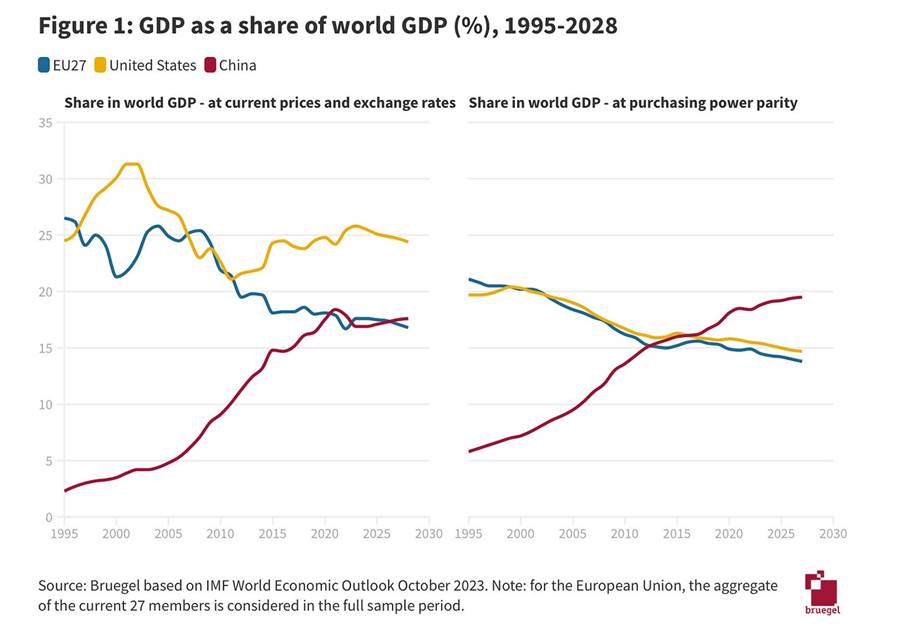
Support us
We're proudly independent - no corporate owners or billionaire backers. But it costs us at least £150,000 a year to run our network. Support journalism by the people, for the people. Become a Friend of Bylines Network. For as little as £3.50 a month, you'll get behind-the-scenes insights, chances to engage with our editorial teams, access to special events, merchandise, and more. Sign up by clicking the button below, or upgrade your Substack subscription.
Become a Friend of Bylines Network
Second myth: unproductive Europe
The United States (340 million inhabitants) is less populated than the European Union (450 million inhabitants), but weighs as heavily in global GDP. The US GDP per capita is therefore higher than that of the EU by approximately 35%.
But contrary to a persistent belief, this gap is not explained by a lack of productivity in Europe. The reason is quite different: Europeans have more free time - more vacation time and shorter weekly working hours.
In terms of productivity, the European Union is almost on par with the United States. In the six "core" countries of the European Union (Germany, France, Italy, Spain, the Netherlands and Belgium), a hard core which includes 290 million inhabitants, barely less than the United States (340 million), productivity is almost identical to what is observed in America.
In both cases, workers produce an average of €60 per hour worked, according to the most recent data from the World Inequality Lab.
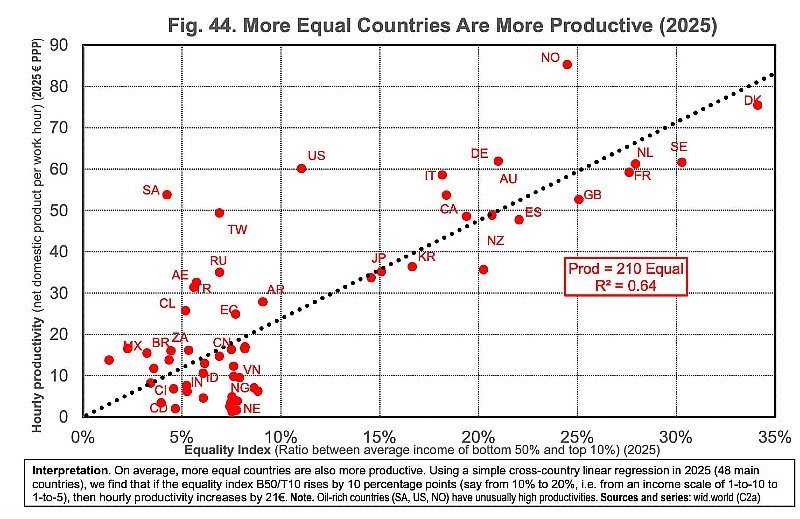 The greater the inequality in society, the less productive a country is.
If we broaden the analysis to the whole of the Union (450 million inhabitants), productivity is slightly lower than in the United States, due to lower productivity levels in Eastern Europe. The gap remains moderate, however.
According to statistics from the International Labour Organization, GDP per hour worked (the usual measure of productivity) amounts to $81.8 in the United States, $83 in Western Europe and $71.1 in the EU-27. And there is no European "sclerosis": productivity is progressing at the same rate in Europe as in the United States.
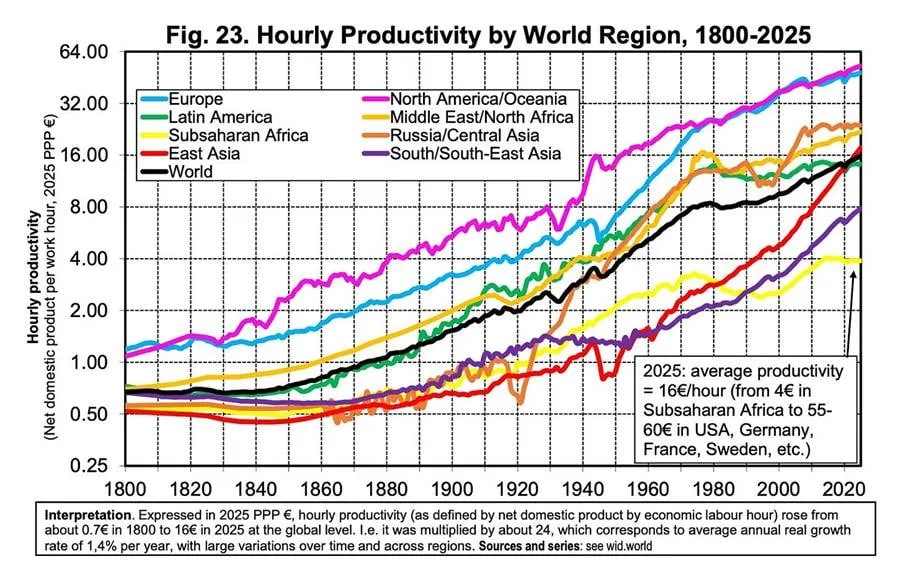 Third myth: productivism
But above all, all these measures, which are limited to measuring the production of material goods and services, suffer from a perspective that is far too restrictive. Europeans enjoy more free time than Americans, a higher life expectancy and lower levels of inequality - all with roughly comparable productivity. Whichever way you look at it, this is a significantly superior economic performance.
Even if we limit ourselves to a narrow productivist perspective, the EU-27 probably does better than the United States, for one simple reason: its greater sobriety. The United States does indeed produce $81 of gross value per hour worked, but this comes at a particularly high environmental cost. The EU-27, on the other hand, produces $71 per hour, with significantly lower carbon emissions.
More leisure time, better health performance, less inequality and lower carbon emissions, all with broadly comparable productivity: Europeans can be proud of their development model, which is on the whole significantly more convincing.
This obviously does not mean that the EU does not need reform. But we must not fight the wrong battle.
The urgent need is not for deregulation, but for investment in education, universities, research, public infrastructure and the energy transition, which in the future, as in the past, will provide the key to our collective prosperity.
This article is republished with Gabriel Zuckan's kind permission and translated from the original French by Google Translate
More from East Anglia Bylines
 Image credit: University of Cambridge
A new site that tracks the daily fluctuating costs behind buying a bot army on over 500 social media and commercial platforms - from TikTok to Amazon and Spotify - in every nation on the planet has been launched by the University of Cambridge. Read about it here.
BEST OF BYLINES: The voice of the nation - who speaks for Britain? [ 12-Jan-26 5:02pm ]Welcome to your regular dose of the Best of Bylines Network. Every edition of our newsletter features a standout article from one of our 10 UK national and regional publications.
To start the week, we bring you Gerry Mitchell's exploration of the changing narrative of the United Kingdom, asking if time-honoured concepts of meritocracy and electoral mandate are now redundant. This thought-provoking article was first published in Kent and Surrey Bylines.
 image by Markus Spiske. Unsplash
Our national conversation keeps pretending nothing has changed. As Roger Hallam argues, we cling to old stories long after they stop being true — because accepting their collapse would force us to start again.
This disconnect surfaced clearly when reading Luke Tryl in the Guardian. His thinktank 'More in Common' held a post-budget focus group run in Aldershot. Some participants had voted Labour for the first time in the last general election; many were high earners and homeowners.
Yet they felt squeezed, anxious, and unprotected. "On paper we should be fine," one said, "but the goalposts keep moving." Though atypical in income and assets, their voices are still treated as representing "ordinary Britain." Their views travel quickly into political discourse because they resemble the people who already narrate the national story — and who are vastly overrepresented in media, politicsand the civil service.
The myth of merit is giving wayTheir reference point is still the old moral story of meritocracy, believing "doing the right thing' and 'being sensible" will be their route to stability and to contributing to the social contract.
That assumption has broken.
Most of us now live in an economy where employment no longer provides security. Wages don't cover housing, care, or basic costs in the way they once did, and public services that stabilised life have eroded.
Inequality now flows far more from wealth — property, capital gains, inheritance — than from wages. Meanwhile, millions perform essential labour outside employment entirely, by caring, volunteering, sustaining local life. Their contributions are essential yet invisible. We know this, but our commentators keep on telling the same story.
Right now, political storytelling continues to focus on an employment-centred social contract which cannot survive when employment no longer guarantees security or captures who contributes. The tax system mirrors this lack of balance, still built around Pay As You Earn (PAYE) — taxing employees automatically through their wages — even though modern work and income no longer fit that model.
As the economy shifts toward self-employment, gig work, and especially asset-based wealth, the PAYE-centred structure captures a shrinking share of total income. This erosion is intensified by an ageing population, which increases demand for public services while reducing the proportion of people in taxable employment, and by rising inequality, which concentrates wealth in forms the current tax system scarcely touches. While around 43% of adults earn too little to pay income tax at all — leaving an ever-larger share of national income effectively outside the tax net.
The result is a narrowing tax base as accelerating wealth evades it, leaving labour taxed heavily while wealth remains lightly taxed or untouched. Britain won't have a functioning social contract until we all recognise the contribution of unpaid work, and reform the taxation of wealth, until we rebalance wealth, care, and employment — not a myopic focus on only one of the three.
We're proudly independent - no corporate owners or billionaire backers. But it costs us at least £150,000 a year to run our network. Support journalism by the people, for the people. Become a Friend of Bylines Network. For as little as £3.50 a month, you'll get behind-the-scenes insights, chances to engage with our editorial teams, access to special events, merchandise, and more. Sign up by clicking the button below, or upgrade your Substack subscription.
Become a Friend of Bylines Network
Influence from the top down
Aldershot's focus group participants mirror the worldview of the professional narrators of Britain: the university-educated, securely-employed class that shapes media, policy, and political messaging.
They write the reports, commission the polling, frame the debates, edit the news, interpret public sentiment. Their assumptions about fairness become the nation's assumptions.
Uncomfortably Off demonstrates how this group — roughly the top 10% — not only earn more, but control the national narrative. They dominate journalism, public policy, cultural institutions, and political staffing, which gives them disproportionate influence over what counts as "normal" or "squeezed." Their economic fears are also distinct: they are anxious about falling; terrified of downward mobility.
This fear drives a defensive politics — cautious, self-protective, resistant to change — mentioned in David Edgerton's recent critique of a political class defined by conformism.
Edgerton argues that Britain is governed by a backward-looking, elite-aligned political caste incapable of imagining alternatives. Instead of a politics of change, we get a politics of issue-management, tinkering, and reassurance. The government — and much of the opposition before it — treats the story of fairness not as something to interrogate, but something to maintain.
Bringing ordinary people into the room - is sortition the answer?Across Europe, alternatives to Britain's stale democratic model are already taking shape. Countries such as Belgium, Ireland, and parts of Germany have shown that sortition — selecting ordinary citizens by lottery to deliberate on major issues — can renew politics by bringing into the room people who never normally get heard.
These assemblies show that democratic legitimacy no longer has to flow from legacy institutions, professional politicians, or narratives shaped by bond markets and compliant media. Instead, it can grow from collective authorship, from diverse citizens crafting a story about their society grounded in lived experience, rather than elite assumptions.
And something crucial happens inside these assemblies. As Hallam notes, the middle-class participants who enter with the most confidence who are used to speaking, interpreting, narrating, often are the ones leaving unsettled.
For the first time, they encounter a democratic space where their voices are not automatically louder than anyone else's. People who never appear in panels, focus groups, or policy roundtables speak with equal authority. Sortition does not flatter the confident - it equalises them. It redistributes narrative power.
This is not a technocratic fix. It is a shift in how a society tells the story of itself.
A new social contract does not begin with a manifesto or a budget scripted by an exhausted elite; it begins with citizens deliberating together, rather than being spoken for. The narrative of what matters and who counts changes. Politics becomes more emotionally honest and more capable of facing long-term challenges when it is authored collectively.
If the nation's story can be shaped by those who have been missing from it, we have a chance of renewing our social contract.
Want more from Kent & Surrey Bylines?
 Image by Vilius Kukanauskas. Free for use under the Pixabay Content License
We're publishing powerful citizen journalism every day. There's always more to discover, including Tetiana Toma's insightful analysis of the future of first-past-the-post elections in the UK, and why changes are necessary but pose challenges. Click here to read it now.
BEST OF BYLINES: Trump's authoritarian threat to Europe and the UK [ 09-Jan-26 5:01pm ]Welcome to your regular dose of the Best of Bylines Network. Every edition of our newsletter features a standout article from one of our 10 UK national and regional publications.
In the wake of Renee Nicole Good's shooting by an ICE officer in Minneapolis this week, we bring you an important article about the Trump Action Tracker. Developed by University College London Professor Christina Pagel, the tracker has been documenting the dismantling of democracy in the United States.
As Helen Johnston reports for Yorkshire Bylines, Professor Pagel recently presented a bleak update to activists and policy-watchers, showing how the Trump regime's actions are reshaping global norms, with consequences that Europe and the UK can no longer ignore.
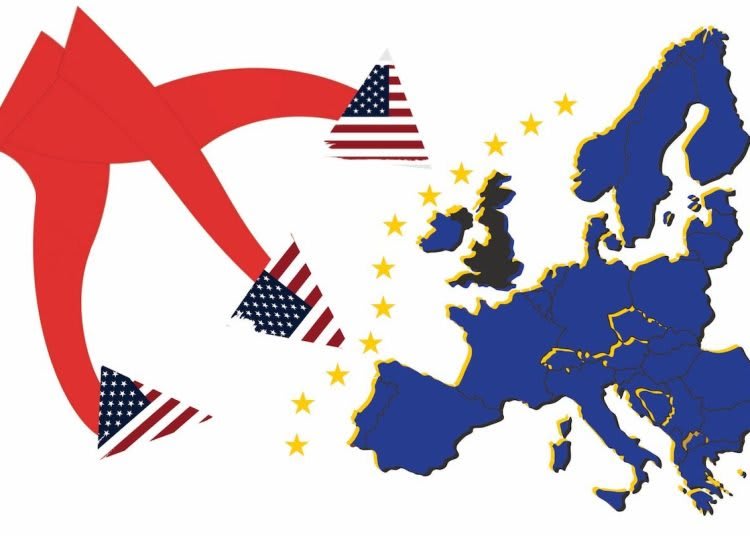 Composite image: Image by freepik, Image by juicy_fish on Freepik, Ssolbergj at English Wikipedia, Public domain, via Wikimedia Commons and Image by freepik
Professor Pagel's Trump Tracker has now recorded over 2,000 individual actions since January, and the picture that emerges is one of a relentless, systemic campaign to capture institutions, reward allies, and punish enemies at home and abroad.
The populist, authoritarian playbookFrom violating democratic norms through to weakening civil rights, corruption, personal enrichment and nationalism, Pagel argues that it's truer now than ever that Trump has embraced a populist right wing authoritarian playbook.
Pagel points to deregulation and government contracts designed to benefit friendly companies, especially in technology, cryptocurrencies and fossil fuels. Disaster relief money has been openly steered towards red states, while Democratic ones are left to struggle.
A wave of pardons has favoured donors and loyalists, while legal cases that were started under Biden against powerful firms have been dropped. Meanwhile, Trump and his family have found many ways to personally profit from office, whether by buying government bonds whose value they influence, striking foreign property deals, or cashing in on crypto, even selling Trump-branded phones and perfume from the White House itself.
Then there is his appetite for personal glorification. The US Institute of Peace has been renamed the Trump Institute of Peace, US national parks now offer free entry on Trump's birthday but not on Martin Luther King Day, and FIFA has awarded him its first 'peace prize'. Institutions are learning that currying favour brings rewards.
Journalism by the people, for the people
There has never been a greater need for grassroots journalism that investigates the stories that really matter, holds power to account and champions the voices of everyday citizens. We are proudly powered by volunteers, but what we do isn't free.
STAND WITH US for independent, citizen-led journalism that makes democracy stronger, and you will even get some exclusive benefits.
Destabilising the global order
The Trump Tracker has logged 265 actions relating to US foreign policy since January, including the systematic undermining of international institutions, economic coercion and threats of force. Threats have been targeted at Greenland, Panama, Canada and Gaza and, since September, military action against Venezuela has escalated, with one recent incident labelled a war crime by international lawyers.
Alongside direct force, the US is deploying trade wars, tariffs, sanctions, and aid blackmail: threats to cut off aid to states such as Argentina unless it backs Trump-aligned candidates; sanctions on Brazilian judges, ICC lawyers, and South Africa. There are real-world consequences for those targeted, from frozen bank access to travel bans.
The same authoritarian logic is applied to immigration, asylum, and aid. Visa applicants will be vetted for 'anti-regime' social media, and anyone who has ever worked in fact-checking, misinformation research, or content moderation may be banned. Travel bans have been imposed on 19 countries, with proposals to extend to more than 30. Asylum has effectively been halted, with the notable exception of white South African farmers. US support for major global health and humanitarian programmes has been withdrawn, including USAID projects and funding to combat HIV and the GAVI vaccine alliance, with devastating results.
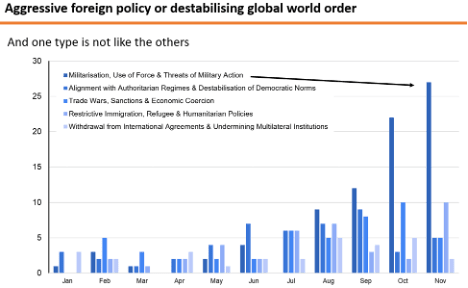 Professor Christina Pagel, webinar 09/12/2025Europe can no longer pretend the US is a protector
In September, Pagel warned that Europe could no longer treat the US as a reliable protector. Events since then have only confirmed and sharpened that warning. Trump's rhetoric about Europe has become more openly hostile: Europe is "decaying", its leaders "weak", and EU rules on climate, human rights and tech regulation are framed as intolerable constraints on US interests.
The Trump regime repeatedly claims free speech is under attack in Europe. But Pagel would argue that the true threat to free speech comes from the US. It's not just visa applicants being policed: under new rules, US citizens' social media posts, protest attendance, and other activities will come under surveillance for evidence of views deemed critical of the US or its government.
"One really simple test to tell if you're in an authoritarian regime is whether you can oppose the government without consequence. I think it's pretty clear that you cannot do that in the US."
And now, of course, Trump has turned his sights on the BBC, bringing to Europe the brutal legal tactics he uses to intimidate and punish non-compliant media in the US.
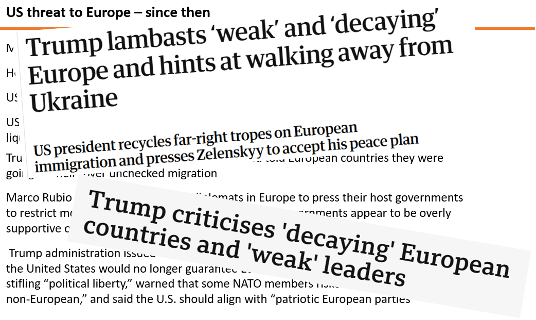 Professor Christina Pagel, webinar 09/12/2025
Most alarmingly, a new official US National Security Strategy openly states that the US will no longer guarantee Europe's security, claiming that "…within a few decades at the latest, certain NATO members will become majority non-European" - a barely-coded reference to race. Accusing the EU of 'stifling political liberty', the strategy paper states that US interests will be served by backing "patriotic" (ie, far-right) parties to victory in Europe. As Pagel says:
Are UK institutions ready for a similar assault?"If this was the 1930s, the equivalent would be an American government openly supporting Hitler and Mussolini and so forth, and talking about immigrants in exactly the same kind of language that they used in the 1930s. That's where we are."
Pagel recently worked with Professor Martin McKee on the independent agencies that generate evidence, regulate sectors and hold the UK government to account. Their report examined key 'arm's-length bodies', identifying areas where they are vulnerable to state capture and offered a series of recommendations for defending democratic infrastructures.
 Professor Christina Pagel, webinar 09/12/2025
Drawing on this work, Pagel asks: could what has happened to US institutions happen here? Her conclusion is alarming: the UK is at least as vulnerable, and in some respects more so. Some organisations, such as the Office for National Statistics (ONS), have considerable embedded independence guaranteed in law. Others, such as the UK Health Security Agency (UKHSA), have almost none: they sit wholly within a department, lack a firm statutory footing, and could be reorganised or abolished almost overnight, as happened to Public Health England during the pandemic.
Strikingly, the leaders of the majority of these bodies are effectively minister-appointed. Ministers can override independent selectionpanels either by forcing a process to be re-run until the 'right' candidate emerges, or by directly appointing someone the panel considers unsuitable. The long saga of attempts to install Paul Dacre at Ofcom, Pagel suggests, is a warning of how this power can be abused. "You can get away with these kinds of vulnerabilities when no one is actively trying to exploit them," Pagel warns, "but by the time you realise you need safeguards, it's too late."
It can happen hereIn this respect, the rise of the populist right is deeply worrying. Reform has already announced plans to undermine institutions along the lines of Trump's DOGE; to hollow out our institutions and politicise our judiciary and civil service. Farage's recent attacks on the BBC, parrot Trump's threats against the broadcaster, while pushing channels such as GB news. The Tories have also been talking about activist judges and lawyers in language that Pagel finds "quite scary".
Meanwhile, some of the world's richest men are increasingly willing to use their platforms and fortunes to interfere in other countries' politics. If, on top of the Russian disinformation and interference we have already seen, Musk and others start pouring billions into UK, German or French elections, it could destabilise those processes. Terrifyingly, "the best hope for the UK is that Musk seems to think Farage is too soft, and really wants Tommy Robinson."
Pagel is a health systems researcher who, during Covid, saw at first-hand how politics and disinformation can cost lives, so "If you're literally seeing the most powerful country in the world fall into fascism, I feel like you have to do something." Her message to Europeans is stark: stop assuming that "it can't happen here" and stop assuming that the USA is on our side.
The vulnerabilities are real, the threats are explicit, and, if democracies want resilient institutions, they must strengthen them now, before they come under the sort of sustained assault already visible across the Atlantic.
More powerful citizen journalism from Yorkshire Bylines here.
BEST OF BYLINES: A new approach to integration - the cost of division [ 06-Jan-26 8:16pm ]Welcome to your regular dose of the Best of Bylines Network. Every edition of our newsletter features a standout article from one of our 10 UK national and regional publications.
This time, we bring you Nazish Saad and Helen Wildig, writing for Bylines Scotland with a powerful and personal perspective on immigration that challenges mainstream narratives.
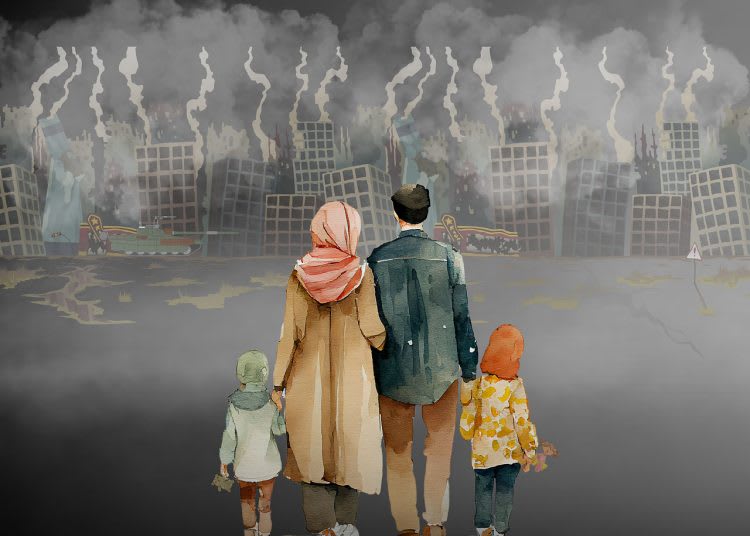 Image by Rosy / Bad Homburg / Germany from Pixabay
Immigration, regrettably, continues to be framed as one of the country's greatest problems. The issues of borders, citizenship, and resource allocation have always existed, yet the narrative dominating public discourse and seeping through all policy discussions has, chillingly, become a wider, deeply ingrained pattern of dehumanising and scapegoating.
This construction has become acceptable in every corner of our society, shaping media, politics, and everyday conversations in ways that pit people against each other, removing empathy and compassion. In a nation built on successive waves of migration - one that has seen its culture and economy enriched because of it - immigrants are increasingly cast as threats rather than contributors.
Expert voices - and those of migrants and asylum seekers themselves - are discredited or ignored, while those elected to office, who could challenge the falsehoods pushed by a populist rightwing agenda, remain silent or play along. They hope to score points in a game of sensationalist antagonism where, ultimately, everyone loses their humanity.
This narrative gains traction, in part, because people across the country are facing genuine scarcity. Resources are difficult to access, even for locals in many regions, some travelling for hours just to secure a single medical appointment. When essential services feel increasingly difficult to obtain, it's no wonder that some fear migrants may "take their place" in already stretched systems. It is this feeling, while understandable, that is being exploited.
Journalism by the people, for the people
There has never been a greater need for grassroots journalism that investigates the stories that really matter, holds power to account and champions the voices of everyday citizens. We are proudly powered by volunteers, but what we do isn't free.
STAND WITH US for independent, citizen-led journalism that makes democracy stronger, and you will even get some exclusive benefits.
Migration is part of the solution
What is rarely communicated is that migration is also part of the solution. Newcomers include nurses, doctors, caregivers, and other essential professionals - people who, once integrated, can pay taxes and help relieve the very shortages that fuel public anxiety. But instead of highlighting this, the dominant story paints migrants as a dangerous, profiteering collective, responsible for society's problems, and see exclusion as the cure.
This story did not emerge organically; it is intentionally cultivated. And its consequences are deeply corrosive.
Migration has always been, and always will be, an essential part of societal evolution. Asylum seekers are human beings in need of safety. Offering help to those in danger is a basic moral principle - echoed across every ethical tradition and ideology - and one widely supported across society. Genuine integration, which benefits both newcomers and long-standing residents, is achievable only when people feel secure: secure in the stewardship of public resources, secure in the protection of their democratic values, and secure in the understanding that culture is not a rigid and brittle object threatened by outsiders, but something vibrant that grows only richer through exchange.
If political leaders truly wish to address this so-called 'crisis', they must confront the real issue: the ongoing production of fear and division that serves to distract from structural inequalities and preserves existing hierarchies. Their task is not to amplify scapegoating narratives, but to challenge and diminish them, and to empower a public capable of meeting migration with clarity, confidence, and compassion.
To move forward, taxation and public policies must be re-evaluated with empathetic, human-centred priorities, rather than purely profit-driven ones. Only then can we begin to rebuild trust, expand access to resources, and create systems where communities - and the newcomers who join them - are not pitted against each other, but supported to thrive together.
Nazish's storyI am an immigrant. I came to Paris from Karachi in the late 1980s. Ostensibly I came to study, since I had received a scholarship from the Paris School of Fine Arts. But mostly I came to escape the violence that had erupted in Pakistan following the implementation of Taliban-influenced extremist martial law.
I did not ask for asylum because I did not know this process existed. I had been raped, I had seen friends tortured and killed, and I had had acid thrown on me at the university bus stop in Pakistan - an effort to stop girls and women like myself from studying. The Afghan war, and Western support of religious extremists against the Russians, had wreaked havoc in my home country. Violence was everywhere. I was so broken by it that I didn't start speaking about all that had happened to me until the year I turned 47, some three decades later.
I had not asked for asylum. A kind Frenchman from the consulate had seen my paintings in Pakistan - the ones I had started doing to express my anguish, afraid as I was of writing or speaking of the horrors I was witnessing - and had sent them to the Paris school on my behalf. Traumatised by terror, when the acceptance letter came, I did not think twice and left the country, despite opposition from my family.
I did not ask for asylum, even though I was a young brown girl born to the 'wrong faith', with a 'worthless passport', and pretty enough to encourage all kinds of abusers to take advantage of my vulnerability.
I clung to life in Paris, refusing to return, even in some very difficult circumstances. People commended me on my bravery, but I marvelled at their ignorance; it would have been braver to have stayed in Pakistan and spoken out instead.
More from Bylines Scotland
 Image provided by the author. Printed with permission
Professor Sir John Curtice on why the electoral system matters and what might happen at the Holyrood election in May 2026. Ultimately, the outcome of any democratic election depends on how voters decide to cast their ballot. However, the impact of their choice also depends on how their votes are treated by the electoral system. That is likely to prove particularly the case in the Scottish Parliament.
Welcome to January - How do we encourage more children to cycle to school? [ 02-Jan-26 5:01pm ]Welcome to your regular dose of the Best of Bylines Network. Every edition of our newsletter features a standout article from one of our 10 UK national and regional publications.
To start 2026, Dr Hazel Dawe, writing for West England Bylines, asks a question that should be on the minds of parents, educators and anyone who cares about the environment this year - what is stopping children from cycling to school?
Despite growing awareness of the benefits of active travel, relatively few children cycle to school in the UK. Safety concerns, distance, and infrastructure all play a role.
 Image by Roger Close. Permission given.
To understand the challenge, it helps to look first at how many children currently travel to school by bike, and how those figures compare to adults and other forms of travel.
How many children currently cycle to school?The National Travel Survey shows that children aged 11-16 are more likely to use active travel (cycling and walking) to get to school than younger children. Unsurprisingly, those who live closer to school are more likely to travel this way.
In 2024, 51% of children aged 5-10 (primary school age) walked to school. Cycling is not mentioned in the survey for this group. Among secondary school pupils (aged 11-16), 37% walked to school and 2% cycled. Therefore, a total of 39% of secondary school pupils and 37% of primary school pupils nationally are using active travel.
For comparison, the 2021 Census provides insight into adult commuting patterns, though 2021 was anomalous due to Covid-19 restrictions, which led to a larger proportion of the working population working from home. However, of those who did commute, 7.6% walked, 3.7% travelled by train and 2% cycled. This means that only 13.3% of adults used active travel overall. Therefore, more children than adults used active travel, (51% and 39% of children compared with 13.3% of adults), showing that children are significantly more likely than adults to walk or cycle to their destination.
Figures from Oxford City Council, however, tell a very different story. They claim that 14.5% travelled by bus and 61.2% walked or cycled, compared with just 13.3% nationally. Active travel is therefore more popular in Oxford than across the country as a whole.
Why should more children cycle to school?According to Cycling England, about half of all school children would like to cycle to school even though only 2% do. This shows a clear enthusiasm for cycling that isn't yet supported.
The Royal Society for the Prevention of Accidents (RoSPA) lists many advantages of cycling. For one, air quality is significantly better for cyclists and pedestrians: air pollution inside a car is more than three times higher than that experienced by those travelling actively. Cycling and walking also cost almost nothing, while running a car is expensive. RoSPA estimates that families could save around £400 in savings per year if children walked or cycled to school instead of being driven.
There are also clear educational and social advantages. Firstly, the RoSPA cite research demonstrating that children who walk or cycle have better concentration levels than those taken by car. Furthermore, cycling has social benefits, allowing children to cycle to school with their friends, helping children towards happier and healthier lifestyles.
In short, cycling to school benefits children's health, their community, and the environment. It encourages exercise, independence, and cleaner air for everyone. But for many families, these benefits remain out of reach.
Journalism by the people, for the people
There has never been a greater need for grassroots journalism that investigates the stories that really matter, holds power to account and champions the voices of everyday citizens. We are proudly powered by volunteers, but what we do isn't free.
STAND WITH US for independent, citizen-led journalism that makes democracy stronger, and you will even get some exclusive benefits.
What stops children cycling to school?
A range of factors can prevent children from cycling or walking to school. The cost of purchasing and maintaining a bike can be prohibitive. For some families, the distance is simply too far, or the journey would take too long to be practical. Some parents also consider their children too young to walk or cycle to school, especially without a parent accompanying them.
Safety concerns often play an even bigger role. Illegitimate parking around schools is often cited as a problem: many parents drive their children right up to the school gates and park there, obstructing pavements and making it unsafe for other children on foot or bike. A lack of safe cycle routes can also discourage cycling to school, as can a lack of secure bicycle parking at school.
However, one study found that attitudes towards cycling are at least as important as road conditions in determining whether children cycle to school. The attitude of the parents are especially influential: if parents cycle themselves and speak positively about cycling, their child is more likely to want to cycle to school.
 image by Roger Close. Permission given.How do we get more children to cycle to school?
So how do we get the many children who would like to, to cycle to school? A number of schemes exist to remove barriers and make active travel safe and appealing. Some of them are described below.
School Streets
According to the Department for Transport, School Streets are roads near a school that are closed to traffic at the start and the end of the school day. The aim is to reduce congestion and make walking and cycling safer and more attractive for pupils. These schemes not only improve road safety but also improve air quality by reducing emissions. Furthermore, pupils who walk or cycle to school together will be able to socialise along the way. As a result, children's physical and mental health can benefit, they learn to be more independent and they develop early active travel habits which can be carried into later life.
Oxfordshire County Council (OCC) describes School Streets as "an active travel initiative to create safer and healthier car free environments outside schools". OCC started its first wave of School Streets in 2021, running six-week trials at nine schools. Four of them decided to make the schemes permanent and continued to a public consultation. Three of these were in Oxford.
The Department for Transport has explored different ways to enforce School Streets, including portable barriers and volunteer stewards, as well as permanent signs and camara enforcement. Oxfordshire initially used portable barriers and volunteer teams, followed by a consultation and then permanent signage and ANPR cameras once the schemes were made permanent.
In 2024, five new schools began trial periods, four of them in Oxford. Again, the public consultation demonstrated overwhelming support for the school trials and all five were made permanent.
In September-October 2025, public feedback on three further School Street proposals outside Oxford were sought, as well as on an extension to an existing Oxford scheme. Sandhills Community Primary School identified parking issues on a street just outside its current School Street scheme and proposed extending the scheme to include that street as well.
Bikeability
Bikeability is a charitable trust that runs cycle training, primarily for schoolchildren, but also for adults and families. The Department for Transport advocates cycle training as a key way to increase the number of pupils who cycle to school. Since it was founded in 2007, Bikeability has trained more than five million children. Its purpose is to "activate a nation of cyclists by ensuring everyone has the confidence to enjoy the life skill, independence and fun of cycling".
The author notes that, after a serious road traffic collision, she was helped to get back on her bike by a Bikeability instructor who "buddied" her on her first ride back on the bike. The instructor was encouraging but not overbearing.
She allowed me to take on only what I wanted to and, every time we came across a situation which could be problematic, she stopped and asked me how I would approach this. I am now happily back on my bike thanks to her.
Oxfordshire County Council offers free Bikeability training to schools around the county. Bikeability instructors can often be seen training groups of children around the city. However, although Bikeability also offers cycle training for adults and for families, the author could find no mention of it on the County Council website.
Kidical Mass
Critical Mass started in San Francisco in 1992. It came to the UK in 1994 in London. It aims to bring together enough cyclists to slow motor traffic down and make cycling safer on roads, usually in an urban environment. Kidical Mass is an offshoot of this movement, created in the United States fifteen years ago and is now a worldwide movement. Its purpose is to give children the experience of cycling safely on the street in groups.
The first Oxford Kidical Mass ride was organised 2022, attracting around 100 participants. It was a mix of children, parents, and adults as stewards. The author has stewarded every ride in Oxford since then. By 2025, participation had more than doubled to over 200 riders.
Oxford Kidical Mass starts at various starting locations, with feeder rides from different directions converging in the city centre where the cyclists do a circuit of the centre before dispersing. What began with two feeder rides at the first Oxford Kidical Mass, the number has now risen to four, from all points of the compass. Parents remain responsible for their own children, who are enthusiastic participants. The slowest cyclists ride at the head of the ride, with stewards in front, at the sides and at the rear make sure that no one is left behind.
Early Kidical Mass rides received mixed reactions from motorists, but attitudes have become overwhelmingly positive. Drivers wait patiently, and sometimes smile and wave at the Kidical Mass ride.
The Oxford organiser states that the purpose of Kidical Mass is to give children the experience of cycling on the roads, and give them practice in various aspects of cycling such as how to handle their bikes, how to follow a route and how to cycle with others. He also stresses the fun aspect of a Kidical Mass. It is a joyful event very much enjoyed by the children participating and appreciated by their parents.
And for the future?It appears that all these methods play their part in encouraging more children to cycle to school: School streets make it safer and reassure parents that it is safe for their children to cycle. Bikeability has a role in improving the children's own confidence and skills. Kidical mass bring children and parents together in a fun cycle outing. This should improve children's skills and reassure parents.
Perhaps, given the research showing how important parents attitude towards cycling is to help children cycle to school, more emphasis should be laid on training for families or, indeed, cycle training for adults. Good quality cycle route provision remains important and would almost certainly increase parents' perception of their child being safe to cycle to school.
More from West England Bylines
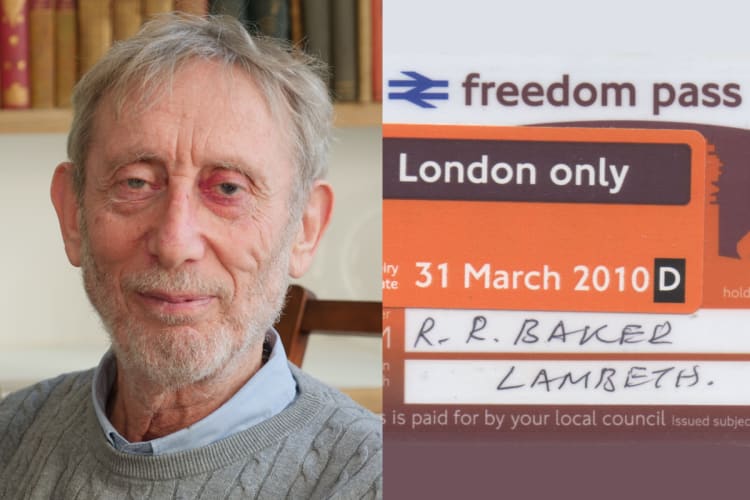 Michael Rosen image by Historyworks. Creative Commons 2.0 Freedom Pass image by Greater London Authority. Creative Commons Attribution Share-Alike 3.0
How did a row over a free bus pass expose tje way 14 years of austerity warped public trust in universal welfare? A telling insight into the social media spat television presenter Kirstie Allsopp and author Michael Rosen, by Max Wild Urquidi. Read the full story now.
Best of Bylines - Brave New World: AI, oligarchy, and the opportunity of resistance [ 29-Dec-25 5:03pm ]Welcome to your regular dose of the Best of Bylines Network. Every edition of our newsletter features a standout article from one of our 10 UK national and regional publications.
It's almost the start of a brand new year, and in our final mailing of 2025, we bring you a cautionary note from of North East Bylines. In this long-form read, perfect for that gap between Christmas and New Year's Eve, Jay offers his take on the growth of AI, with smart analysis of the risks and reasons for resistance, as well as a close look at Blyth - an impoverished town on the Northumberland coast that may be about to see development of a new data centre.
 Photo by Solen Feyissa on Unsplash
With friends and family, I have a clear and simple rule: never mention AI. Rarely has a development permeated every single strand of society as much as artificial intelligence, and yet, for all of the clear and present dangers it poses, the discussion around its regulation is minimal to the point of non-existence. That silence is not accidental. It is engineered.
In fact, and emphatically unsurprisingly, the powers that be are actively trying to restrict and narrow the conversation around it. It makes sense: why would tech billionaires - let's call them what they are, oligarchs - who are actively profiting from inflating AI's value, and who already use it to manage the algorithms and processing that underpin their platforms, allow serious, sustained criticism to flourish? Why would they invite scrutiny of the very tool consolidating their power?
In the United States, the direction of travel is already clear. Federal lawmakers and powerful special interests are pushing for a light-touch, centralised approach to AI governance - one that sidelines local oversight and limits the ability of states to impose meaningful safeguards. It is a posture dressed up as innovation, but rooted in control. There is, as ever, only one real reason for this: flooding the zone with partisan, misleading AI-generated content is enormously profitable for those sitting on the throne, clutching the levers of power. On a human level, society - and people themselves - become pawns in a vast game of extraction. The masses are fed deliberately targeted misinformation, calibrated to exploit fear and insecurity, until division opens up and the authoritarians and profiteers settle comfortably in the middle.
Profit over communityIt is personal for me. My hometown not without its problems, but one I care deeply about - is set to become the site of an enormous data centre. Billed by the UK government as a transformational investment in a region with a long history of neglect, it is sold as a northern reset: jobs, opportunity, regeneration. Cut back the spin and the reality is far starker. The proposed centre, expected to become the largest in Europe, represents little more than the UK selling land, power, and agency to the highest US bidder. It will not bring meaningful long-term employment. Data centres require remarkably little manpower, while draining vast local resources to meet their energy demands. The community pays the price; the profits leave the region. Energy prices rise. Agency disappears.
A familiar story for my family and friends in the North East: profit over community; the expendability of workers; the ordinary person taken entirely for granted. And this is where responsibility widens. I do not only blame the offenders - the oligarchs, the accelerants of chaos, those actively pitting us against one another for gain. I also blame the centre-ground. I blame the social democrats.
Our politics is already divisive, yet the political environment we inhabit is one in which the left has largely surrendered the main stage to the hard right. On AI, silence has become a position - and it is a complicit one. The lack of urgency, the absence of serious debate, the failure to articulate a vision of regulation rooted in public good rather than private profit: these are choices. Because make no mistake - they know the risks. They see them in real time. They are intelligent, educated people being briefed on the consequences of unregulated AI. By remaining silent - or worse, apathetic - they are helping to build a world in which you are poorer, less powerful, and more easily manipulated.
AI: a tangible threatI'm the first to admit that AI is an absolute revelation. In many ways, it is something to be celebrated. The sheer abundance of information now at our fingertips is nothing short of the most significant social innovation since the creation of the internet. Its potential is enormous - and bluntly, there is no turning back. We are already through the threshold. AI will transform our entire world. Be under no illusions about that.
But it is often our own naivety that feeds the problem. Political disillusionment in the Western world is now so entrenched that many of us have simply stopped caring. Trust in politicians has collapsed and, paradoxically, the response to that mistrust has been the surrender of the only real power we possess: knowledge, engagement, and the ability to hold those in authority to account. We let people we do not remotely trust operate with minimal scrutiny - unchecked, unchallenged, and increasingly unanswerable.
I struggle to think of any other profession where a lack of trust results not in constraint, but in greater freedom to act. And yet that is precisely the environment in which AI is developing.
There is also a temptation - heightened by the bludgeoning of our attention spans - to judge AI solely by its most visible outputs: ChatGPT answers, AI-generated videos, novelty images. How harmless can they be? But this fixation is a distraction. It obscures the deeper reality: that AI is not merely a tool of convenience or creativity, but a mechanism through which power, influence, and control are being rapidly centralised. Larry Ellison, founder of Oracle and one of the world's richest men, has publicly expressed his view that AI will enable a surveillance state, where everything we do is recorded and reported. This is before we even consider the fact that Ellison - a close ally of Donald Trump - and his son are also attempting to buy up Warner Bros, further entrenching their media power.
Power is everything, and we are allowing a tiny handful of the wealthiest men - many of whom, Ellison included, have openly expressed a desire to achieve immortality - to rewrite the social fabric of human civilisation.
Journalism by the people, for the people
There has never been a greater need for grassroots journalism that investigates the stories that really matter, holds power to account and champions the voices of everyday citizens. We are proudly powered by volunteers, but what we do isn't free.
STAND WITH US for independent, citizen-led journalism that makes democracy stronger, and you will even get some exclusive benefits.
AI will create a microscopic pool of winners and billions of losers. It's the arrogance of man that we all think we can somehow beat the odds and be among the winners. In doing so, we hand even greater autonomy to those already clutching the levers of power. Let me be unequivocal: you and I - we're the losers. The odds are stacked against us to a degree that cannot be overcome. Mass job losses, rampant unemployment, the hollowing-out of the graduate and entry-level workforce. Universal basic income, the erosion of creativity, and the construction of a mass surveillance state. But only those with something to hide should be worried, right?
This is not speculative. We are not talking about distant hypotheticals or sci-fi nightmares waiting politely in the future. AI is already reshaping power in ways that are tangible, damaging, and profoundly anti-democratic. In the United States, AI-generated political adverts and deepfake videos are now routinely deployed to mislead voters, suppress turnout, and flood social media with false narratives faster than fact-checking can keep up. In India, automated facial-recognition systems have been used to police protests, disproportionately misidentifying minorities and dissidents, with little transparency and no meaningful right of appeal. In the UK, algorithmic decision-making tools have already been trialled in welfare assessments, policing, and hiring - systems shown to replicate and intensify existing racial and class biases while offering no clear line of accountability when they get it wrong. Writers, artists, and journalists are watching their work scraped, reproduced, and monetised without consent, while the same technology is used to hollow out entry-level jobs that once offered a route into stable employment. Even at the most basic level, AI-driven recommendation systems are accelerating misinformation, radicalisation, and social fragmentation - not because they are broken, but because they are working exactly as designed: optimising for engagement, outrage, and profit at scale. This is what "innovation without regulation" actually looks like. Not freedom. Not progress. But the quiet automation of inequality, surveillance, and powerlessness - rolled out while we are told, repeatedly, not to worry.
The promise of resistanceWe should be wide-eyed about the fact that the future looks bleak. But we should not simply give up and bow down to what we consider the status quo, or succumb to the notion that resistance is futile. We can resist. We can fight back. If we engage in pushing back, results are absolutely possible. We can point to evidence of this: McDonald's recent AI-generated Christmas advert - in which it claimed its staff's fingers hurt from writing hours of detailed prompts - was taken down after significant pushback on Twitter. It's a small example, but the reality is that the power of the individual is far greater than many of us think, and greater than any oligarch actively controlling the levers would let us believe. We need to remember this truth: making us feel powerless is itself an admission that power still exists.
The US is the new frontier for the AI debate, but its ramifications - as demonstrated by the proposed US-funded data centre in Blyth - flow far deeper.
And yet - this is the part too often ignored - the political opportunity here is enormous. In the United States, the midterm elections offer fertile ground for candidates willing to do something radical: name the threat plainly and run against it. Sensible AI regulation is not a niche concern or a technocratic sideshow; it is a populist issue hiding in plain sight. Jobs, wages, truth, creativity, privacy, power - all of them now intersect with AI. At a moment of deep economic anxiety and institutional distrust, a candidate prepared to challenge unaccountable tech power, to call time on oligarchic capture, and to put democratic guardrails around AI would not be swimming against the tide, but riding it. The same is true here in the UK. The failure of mainstream politics to seize this issue is not evidence of its weakness, but of their timidity. In a fractured media environment where assumptions no longer hold and loyalty is thin, we should challenge everything. The change agenda is far more powerful than it appears - and the fact that no one has yet claimed it only widens the opening. The future does not belong to the algorithms or the billionaires who own them. It belongs to us. We the people.
More from North East Bylines
 Photo by pisaphotography/Shutterstock.com
There have been growing concerns about the influence of foreign powers in our politics for some years now. Now the government has acted, but will the current review be enough? Read the full story here.
December Bylines Network Gazette now available - and a Monbiot-shaped Boxing Day gift [ 26-Dec-25 8:01am ]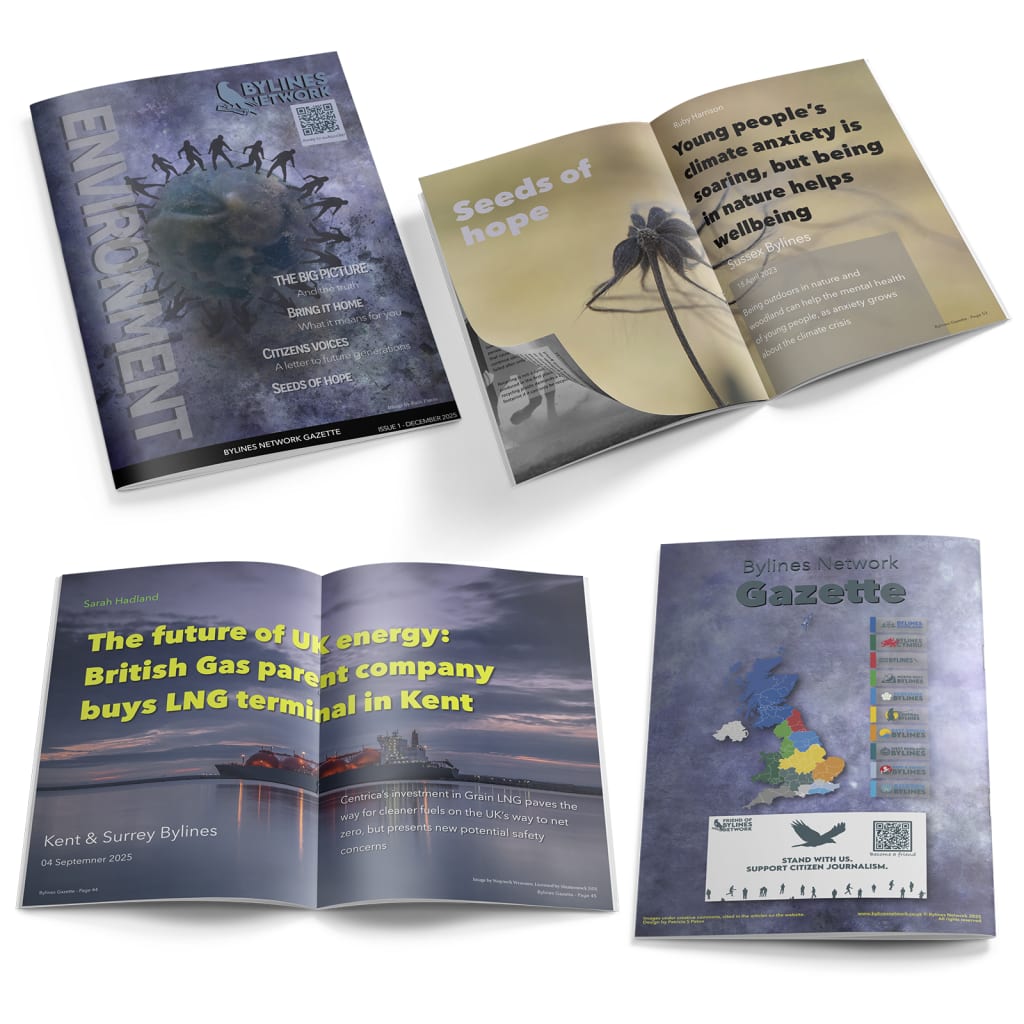 Images of our latest Bylines Network Gazette - released 16.12.2025.
The latest issue of the Bylines Network Gazette is available now, showcasing citizen investigations, reports and analysis about climate change and sustainability. We have chosen a dozen of our best articles, selected from our 10 UK national and regional publications, covering:
The biggest environmental stories - fossil fuel subsidy scandals, America's withdrawal from the Paris Climate Accord, what really happened at COP30, and the way climate change deniers manipulate natural disasters.
Local realities and threats to nature - the plight of seals in North East England, risks to energy ownership in Kent, and climate action planning in Yorkshire.
Future visions and voices of hope - young people finding wellness in woodlands, the remaining opportunities for global sustainability, letters to our descendents and a simple but powerful idea we can all adopt in 2026.
There is also an exclusive summary of the hot takes from our recent interview with George Monbiot, published here for the first time.
Our Gazettes are presented in beautiful, specially designed flipbooks and downloadable PDF formats. How do you get access? Scroll down and sign up to become a Friend of Bylines Network, or take out a paid Substack subscription, which gives you all the benefits a Friend gets - including future Gazettes delivered directly to your inbox.
But first, a bonus Boxing Day gift
George Monbiot is a renowned author and columnist for The Guardian, an expert on sustainability and a passionate campaigner for social justice. Recently, he sat down with Bylines Network for a fascinating conversation, covering topics including global food insecurity, inequalities in land ownership, what's happened to the left and right in British politics, what needs to change in the media, and how can each of us play our part in making a better future.
It's an inspirational podcast, and perfect listening to fill the hours between Christmas and New Year - and it's now completely free to access. Just click the link and enjoy.
Become a Friend of Bylines Network - get the Bylines Network Gazette
We don't have billionaire backers, corporate owners, or political paymasters. We're proudly independent, but it costs us over £150,000 every year to run our network. That's why Bylines Network Gazettes are issued on a subscription basis - to anyone who donates to us monthly or who becomes a Friend of Bylines Network.
By becoming our Friend, you're supporting journalism, investing in stronger communities, helping us deepen public understanding and strengthening democracy. In return for as little as £3.50 a month, you'll get behind-the-scenes insights, chances to engage with our editorial teams, access to special events, merchandise, and more.
Sign up by clicking the button below, or upgrade your Substack subscription. We treat paid Substack subscribers the same way we treat Friends, so you'll recieve all the same benefits. Is it worth it? Don't take our word for it:
"The Bylines Network is tremendously inspiring…it's crucial that journalism speaks truth to power, but the great majority of it unfortunately speaks with the voice of power…it's really inspiring to see networks like yours filling that huge gap and doing what journalism ought to do."
George Monbiot
Sign up as a Friend of Bylines Network
You can choose from the following tiers - only Friend and Best Friend are available via Substack, so if you want to support us as a Champion or Patron, clikc the "sign up" button above.
There is a freindship level for everyone. Just click here to sign up. (Image by Ceylan Salih, copyright Bylines Networks Limited.)Don't want to be friends? No problem, we're not going anywhereIf you don't want to become a Friend of Bylines Network, that's fine - you will remain a newsletter subscriber, nothing else will change, you will still get brilliant articles delivered to you every week, you can visit the free content on our Substack anytime, and you can access all 10 of our publications on their websites without paying a penny.
A heart warming treat from Bylines Network - The Monday night volunteers [ 22-Dec-25 5:02pm ]Welcome to your regular dose of the Best of Bylines Network. Every edition of our newsletter features a standout article from one of our 10 UK national and regional publications.
This time, Mick Channon pulls back the curtain on the Sussex Bylines editorial team, showing how skilled editors collaborate to publish high-quality citizen stories, and praising the passionate volunteers who protect truth and democracy.
This uplifting article is a fitting way to wish you a very happy festive season. Whatever your tradition or culture, we hope you have a wonderful time. If you're a Friend of Bylines Network, we'll send you an extra gift on Boxing Day - a brand new edition of the Bylines Network Gazette. Until then, enjoy Mick's lovely tale.
 Editors. Credit: mrika-selimi-6oQczCqp85w-unsplash...
On a Monday evening, when most people are finishing the washing-up or settling in front of the television, a small group gathers online. They are dotted across the county, some in quiet kitchens, others at desks surrounded by books or notes and their conversation begins with gentle greetings and a touch of laughter.
These people aren't here for pay or recognition. They are volunteers, the editors and proof-readers behind our local online newspaper. Every week, they give their time freely, polishing words and shaping sentences so that local stories can find their way to readers.
As I listen in, I'm struck first by their kindness. There's no competition, no ego. Instead, there's a generosity of spirit that fills the virtual room. They tease each other lightly about music choices and misplaced apostrophes, yet behind the jokes lies a deep respect for each other, for language, and for the truth.
They handle stories that come from all corners of our community. Reflections on village fairs, reports from council meetings, local politics, tributes to local heroes, environmental concerns, moments of shared joy or frustration - all of it passes through their hands. Writers send in their words and observations freely, hoping to highlight what matters in our area. Then, with quiet diligence, the Monday night volunteers step in to ensure those words are clear, fair and accurate.
Editing is a subtle craftIt's easy to underestimate what this takes. Editing is not about simply spotting typos. It's about reading closely, thinking critically, and asking whether a story truly represents what happened. It means double-checking facts, smoothing awkward phrasing, and, at times, gently suggesting that something might be better left unsaid. There is a craft to it, and these volunteers carry it out with both skill and care.
They are, in their own way, guardians of local truth.
Many of them share certain values though they don't wear them like badges. They tend to support ideas rooted in human rights, fairness, and care for the environment. They aren't interested in shouting political slogans or pushing a single view. What drives them is something simpler: the belief that news should be honest, that people deserve to understand what's happening around them without distortion.
In their discussions, I hear thoughtful debates. They question how to report sensitive issues with compassion, how to balance the personal and the political, how to avoid sensationalism while keeping a story engaging. One might quote a line from a writer, another might recall a previous article on a similar theme. It's an exchange of ideas that's both intelligent and humane.
There's something quietly radical about this. In a world where so much of our media is driven by profit, where headlines are written to provoke outrage rather than reflection, this group offers an alternative. They don't chase clicks or ad revenue. Their reward is knowing that local people have access to genuine stories - stories about their own communities, written and edited by those who care.
Without these kinds of people, much of what we read would come filtered through the lens of large corporations or tabloids, where entertainment often outweighs truth. National papers may have the resources, but local volunteer journalism has something more valuable: authenticity.
Inspired by this story - why not join us as a volunteer?We are always looking for volunteers with a passion for writing and editing. But right now, we're especially keen to find new volunteers with technical skills in:
Elementor - used for creating pages on WordPress websites, basically a drag-and-drop of available blocks to compose a page.
WordPress - especially maintenance of plugins such as FS Poster, All In One SEO (AIOSEO), Index Now, MonsterInsights, and WPForms.
Google Console - providing page-crawling, indexing and other statistics.
Cloudflare - network security and improving response times.
If this sounds like you, get in touch at info@bylinesnetworks.co.uk. Bylines Networks belongs to everyone, and you can help make it stronger.
Small details matter
 Working on an edit. Credit: an-tran-3FMSMeG5QEk-unsplash.jpg
One editor tells me, "We just want people to see what's really going on - not in a dramatic way, but truthfully. The small things matter."
And indeed, the small things do matter. A report on a village clean-up might not make national headlines, but it reflects something bigger - the sense that ordinary people can still take pride in their surroundings. A feature on a community choir, a thoughtful piece about a local protest, or a reflection on life by the sea - each one adds a layer to the portrait of who we are.
Behind every story you read, there are hours of unseen labour. The volunteers check facts, verify names, and ensure fairness. They might spend an evening deciding whether a sentence feels too sharp or a paragraph too heavy. Sometimes they reach out to writers for clarification, or simply to say thank you for sharing something meaningful.
There's a rhythm to the evening. As time passes, the tone softens. There's laughter about a writer's unique turn of phrase, admiration for a particularly moving reflection. They speak with care about contributors, never dismissing, always encouraging.
Listening to them, I realise this isn't just about editing. It's about connection. These volunteers are building a space where truth and kindness coexist - where people's stories are treated with dignity.
They remind me that journalism, at its heart, is a public service. It's meant to inform, to hold power to account, but also to celebrate the human spirit. And that can't happen without people willing to give their time for nothing more than the satisfaction of doing something worthwhile.
As the end of the meeting approaches, the meeting winds down. One by one, they sign off - "Goodnight, everyone," "Lovely work tonight," "See you next week." The screen goes quiet again, and the county sleeps. But the stories they've tended to will soon appear online, ready to be read with morning tea or the first coffee of the day.
Most readers won't think about who corrected that sentence or who noticed that a date was wrong. They'll simply find the story clear, honest and engaging — as it should be. But behind every smooth paragraph, and arresting photo, there's the trace of a volunteer's care.
In times when truth feels slippery and public conversation often harsh, these Monday night volunteers offer something steady and humane. They show that journalism can still be about community, about giving rather than taking, about listening rather than shouting.
They don't seek recognition, but they deserve it. Because without them, the real stories — the ones rooted in everyday life, told with heart — might never reach us at all.
Journalism by the people, for the people
We're proudly independent, but it costs us at least £150,000 a year to run our network. For as little as £3.50 a month, you can be a Friend of Bylines Network, get behind-the-scenes insights, engage with our editorial teams, access events, and support powerful citizen journalism. You can sign up using the link below or upgrade to a paid Substack subscription and get all the same benefits.
Friends of Bylines Network are also automatically subscribed to the Bylines Network Gazette, which returns with its next edition on 26 December, featuring the best citizen reporting about climate change and sustainability from our 10 UK national and regional publications. There will also be some inspirational words from George Monbiot. The Gazette is available for paid subscribers and Friends of Bylines Network only. Sign up now so you don't miss out.
Become a Friend of Bylines Network
 The Bylines Network Gazette, November 2025 - Hope Against Hate. (Image by Bylines Network.)
More vital citizen journalism from Sussex Bylines
 We will not be silenced. Photo by Michelle Ding on Unsplash
Proudly continuing their series of articles from survivors of abuse at Harrods, Sussex Bylines brings you another story from Isabella. This time, she questions the value of the government's revised Violence Against Women and Girls strategy, bringing a powerful critique from a unique and important perspective. Read the full story here.
Keep out: what flags mean to community NHS workers [ 19-Dec-25 5:01pm ]Welcome to your regular dose of the Best of Bylines Network. Every edition of our newsletter features a standout article from one of our 10 UK national and regional publications.
This time, we bring you Mark Cunliffe of Central Bylines, investigating the concerning impact of St George flags on NHS workers.
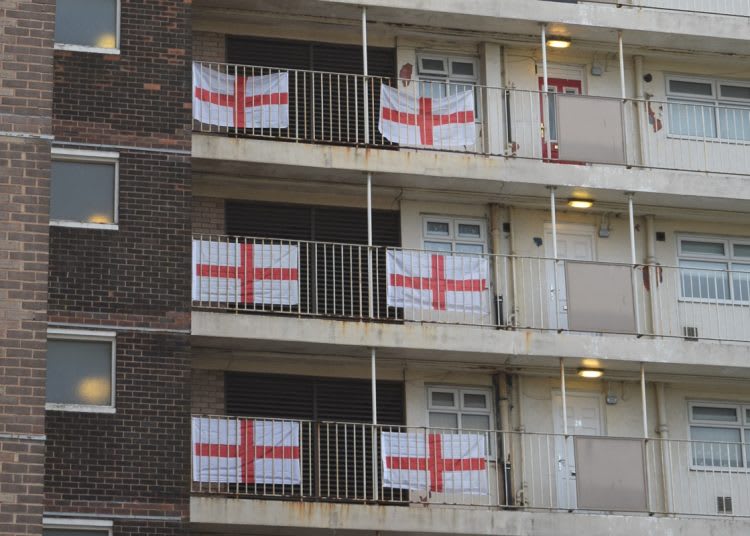 'Raise the Colours' in Leeds image by Mtaylor848. CC BY-SA 4.0
Across England, NHS leaders are raising alarms that the recent and sudden proliferation of St George's flags appear to be doing more than simply stirring national pride: these flags are creating informal "no-go" zones for NHS staff on home visits, especially those from ethnic minority backgrounds.
Like many, I have long felt concern about this growing number of flags on lamp-posts, roundabouts and homes. The flags carry a message beyond patriotism, signalling unwelcome or hostile territory for some, and we are now seeing direct reports of this from NHS carers.
Senior NHS staff speak out on exclusionary message of flags for community workersOne NHS Trust Executive speaking anonymously to journalists described staff, a large minority of whom are Black and Asian, feeling "deliberately intimidated" by the flags which create exclusion zones.
He continued: "You add that on top of real autonomous working, that real bravery of working in people's homes, with an environment … (where) it feels like it's an area that's designed to exclude them." And added that the Trust had seen "individual instances of aggression towards staff".
Another senior manager described how a staff member who is white, with mixed-race children, had asked people erecting flags to move so that she could park her car. Those putting up the flags filmed the incident and pursued the member of staff who was then subjected to several days of abuse, not as a result of her opposition to the flags, but because of the disturbance she had caused.
The same manager spoke of many similar stories: people attempting to remove flags from outside their homes and being consequently threatened and abused.
They went on to say the "springing up of flags everywhere has created another form of intimidation and concern for many, many of our staff."
Journalism by the people, for the people
We're proudly independent, but it costs us at least £150,000 a year to run our network. For as little as £3.50 a month, you can be a Friend of Bylines Network, get behind-the-scenes insights, engage with our editorial teams, access events, and support powerful citizen journalism. You can sign up using the link below or upgrade to a paid Substack subscription and get all the same benefits.
Become a Friend of Bylines Network
Abuse and intimidation compound the issue of NHS lone working
These reports appear to highlight two worrying trends. The first is that NHS staff, mainly from ethnic minority groups, are being made to feel unsafe. The second is that they work in our communities, outside of hospitals or GP surgeries, and often solo.
Chief executive of NHS Providers, Daniel Elkes said: "The NHS has relied on overseas recruitment for a long time to ensure we have the right workforce. We have a really diverse workforce and without that you can't deliver the NHS."
Another Trust said its data showed Black and Ethnic Minority staff experienced more harassment or abuse from the public than white counterparts: 20.1% compared to 13.4%.
And undoubtedly for these workers, home visits are already high-risk enough: unfamiliar houses, often late working hours, etc. Surely, when the overall environment is unwelcoming and even threatening, their duty of care becomes harder to fulfil?
Professor Nicola Ranger, general secretary of the Royal College of Nursing, commented:
"Nursing staff dedicate their lives to caring for others, and too often they are faced with the most appalling hatred and intimidation.
A sustained campaign of anti-migrant rhetoric is fuelling a growing cesspool of racism, including against international and ethnic minority nursing staff, without whom our health and care system would simply cease to function."
Recent flag displays and their contested meaningsDuring the summer, we saw a surge of St George's flags all across England - on lamp posts, roundabouts and even Church of England churches as I previously reported. Many insist they are an act of patriotic celebration, but people like me know the real motivation behind many of these flags. And now we see this message of exclusion reflected at the front line of our NHS, as evidenced by the previous comments from one trust executive.
And does this help draw conclusions? The meaning of a flag is not solely in its design but also in the context it is used. When houses, roundabouts, and a whole area become peppered with just one intimidating and unwelcoming symbol, largely placed by angry white people, and then an ethnic minority nurse enters a home alone, how do we expect that nurse to feel?
Institutional responses to protect community health workersIn response, NHS employers and local trusts have begun to reassess how community-visiting staff are supported. For example, one Kent-area community trust introduced a "yellow/red card" system for patients or visitors whose behaviour became threatening or abusive, with the potential for exclusion altogether for the most serious cases.
National bodies have also responded with the Department of Health and Social Care saying: "There is no place for intimidation, racism or abuse in our country or our NHS."
"We value the diversity of our NHS, which relies on the skill and dedication of hard-working staff from all backgrounds. They must be treated with dignity and respect.
"Our flags represent our history, our heritage, and our values. They are a symbol of our nation and belong to all of us - not just some of us."
The surge of St George's cross flags might seem benign to many, but for our nurses, health visitors and carers who knock on strangers' doors to deliver essential services they are clearly not - the message is starkly different.
For anyone that thinks the flag really can unite, what we have seen from the front line of the NHS is that it is actually a barrier … and the consequences ripple out to affect staff, patients and community cohesion.
MORE ON THIS TOPIC: Veteran speaks out against flags on lampposts
 Pictured Is Staveley Town Cllr Paul Mann, Taken By BBC Ldr Jon Cooper
Want to read more about flags and their impact? Central Bylines has an article about a Derbyshire war veteran who is concerned about the spread of the St George and Union Jack flags across the county, especially their use by people opposed to immigration. Cllr Paul Mann has become involved in a controversial debate with a campaigner who supports the proliferation of the British flag. Read the full story at Central Bylines.
Donald Trump is losing control [ 15-Dec-25 5:37pm ]Welcome to your regular dose of the Best of Bylines Network. Every edition of our newsletter features a standout article from one of our 10 UK national and regional publications.
This one brings you Dominic Jackson's investigation into why Donald Trump is struggling to retain control of the political narrative in America.
Trump's presidential election victory in November 2024 was sweeping and unexpected. He won all the swing states to become president which resulted in a commanding victory in the electoral college. Despite an organised campaign against him and dire warnings from US activists who feared what 'Project 2025' might mean if Trump won, Trump's campaign messaging about the price of eggs won the day.
But a year later the Democrats have made large gains in elections for state governors and New York mayor. Why have the US electorate soured on Trump to such an extent?
This article, the first in a two-part series, looks at his first 10 months in office. You can read Part 2, reviewing how the recent November election results may show a different way forward, on North West Bylines.
 image by Zetong Li. Free to use under the Unsplash LicenseIt's only been 10 months (but it feels like a lifetime)Trump's abuses of power
Almost as soon as he settled back into the Oval Office, Trump began issuing executive orders such as revoking birthright citizenship (the provision of the Constitution that automatically grants US citizenship to anyone born in the US). Trump also targeted law firms that had acted against him during the Biden administration's attempts to hold him criminally accountable for both the 6 January 2021 riots and taking classified documents to his Mar-a-Lago Florida residence without permission. A number of these executive orders were challenged and have been struck down by US courts as illegal. Trump introduced legislation including the notorious 'Big Beautiful Bill' which gave tax cuts to the wealthy whilst increasing the US budget deficit and borrowing requirements.
Trump has, so far, been able to get away with his actions because of the vice-like grip he holds over the Republican Party. Republican lawmakers have (so far) been afraid to defy him for fear of facing primary challenges for their seats when up for re-election. Trump has also benefitted from a very favourable Supreme Court which has often ruled in his favour on the 'shadow docket'. This practice has been heavily criticised, not least because the shadow docket does not explain the Court's reasoning and provides no guidance to lower courts.
File it under fearYet in November 2025, a sudden change in the political winds is detectable in the US. Whilst some of this can be ascribed to the Republicans' heavy losses in the elections of that month, Trump has a more serious political problem which he seems unable to shake off. That fear is Jeffrey Epstein, Trump's past associations with Epstein, how close these associations were, what documentary evidence there might be of Epstein's past conduct and what, if anything, Trump knew of Epstein's sordid lifestyle. The US government investigation into Epstein, and the evidence it collected, is known as 'The Epstein Files'. Trump has recently been highly reluctant to release the Epstein Files (although during the run-up to the 2024 presidential election he claimed to be in favour), even though as they are federal government documents it would be entirely within his power to do so, suggesting fear of what they contain and the implications of them becoming public.
Jeffrey Epstein was a US financier who, with accomplices including Ghislaine Maxwell, operated a syndicate which committed unspeakable crimes against underage girls and women. Epstein was finally arrested on July 6, 2019, but committed suicide in prison on 10 August 2019 before he could face trial. Questions remain about why and how Epstein was able to escape justice for so long (the alleged crimes date to between 2002 and 2005) with accusations that other powerful men conspired to shield him. US Attorney General Pam Bondi claimed in February 2025 to have all of the Epstein Files on her desk. She later denied this but the suggestion that a cover-up was in place was sufficient to spur some Representatives in the US Congress, encouraged by devoted Trump supporters such as Joe Rogan, to force release of the files. Emails subpoenaed by Congress from the Epstein estate were highly damaging to Trump, with Epstein describing him in one as 'the dog that hasn't barked'. For many this strongly suggested that Trump was aware of Epstein's crimes, although the exact meaning is not clear. Trump maintains he severed all contact with Epstein before his first conviction, and the president has always denied prior knowledge of any wrongdoing on Epstein's part.
ShutdownOne aspect of US politics that is somewhat perplexing to outsiders is the need for Congress to continually re-authorise US federal government spending in advance of each fiscal year. Should political machinations intervene, a 'lapse in appropriations', more commonly referred to as a government shutdown, occurs. One such shutdown occurred in September 2025, yet a political implication of this was beneficial to Trump and the suspicion remains that he pressured Congressional Republicans to deliberately avoid compromise with the Democrats.
Following the repeated refusal of House Speaker Mike Johnson (a staunch Trump ally) to table a debate on a Bill to compel release of the Epstein Files , Congressional Democrats supported by four Republicanstabled a 'discharge petition' in the House of Representatives to force such a debate. This procedure to circumvent control of the debating schedule is similar to that which UK MPs used in 2019 to prevent Boris Johnson forcing through a "no deal" Brexit. The discharge petition would have required 218 votes to succeed. The Republicans held a 219-213 majority in the House immediately before the shutdown, with a pending special election (by election) in Arizona. This election was won by Adelita Grijalva (Democrat) yet Johnson refused to swear her in following her victory citing the 'shutdown' as his reason. That Grijalva had been explicit that she would be the 218th (and casting) signature on the discharge petition, following through on her earlier promise as soon as the federal government (and Congress) reopened, caused intense distrust of Johnson's actions. The shutdown was ultimately ended after 40 days by eight Senate Democrats voting with Senate Republicans, much to the irritation of grassroots Democrat activists who felt they were winning the battle for public opinion over the shutdown.
Post-discharge petitionWith Grijalva's vote together with the four dissident Republicans who Trump unsuccessfully tried to persuade to revoke their petition signatures, the discharge petition passed and Johnson announced a timetable for the legislation. House Republicans began to find themselves in an impossible situation. Rep Thomas Massie (Republican, Kentucky) warned his Republican colleagues that a vote against releasing the files would tar their reputations for years - long after Trump has left the political scene. Amidst warnings that up to 100 Republicans may vote in favour of releasing the files, Trump abruptly changed his stance and urged a vote in favour of release - albeit carefully worded to provide excuses to ultimately not release the files (he urged "House Republicans [to] vote to release the Epstein Files" but said nothing about Senate Republicans for example). Why, if he now supported releasing the files, would he not just tell Bondi to release them? If, as Trump claims, the Epstein Files are a "Democrat hoax", why not release them to prove his point? Trump campaigned for the Presidency in 2024 partly on a platform of releasing the Epstein files. The Biden administration was unable to release the files before it left office as Ghislaine Maxwell's trial for sex trafficking and her (unsuccessful) appeal together with a further unsuccessful appeal to the US Supreme Court were not finally concluded until October 2025.
The vote in the House to compel release of the files ultimately passed by 427 votes to one (the lone dissenter being Republican Clay Higgins) and thus duly passed to the Senate (since both Houses of the US Congress have to agree on the text of a Bill before it can be sent to the President to sign into law). Johnson made noises after the House vote strongly suggesting he would be working with Senate Republicans to amend the Bill, meaning it would have to be sent back to the House to consider the amendments and then back to the Senate, thus conveniently adding further delay. However much to Johnson's evident disappointment, the Senate passed the Bill by "unanimous consent" with the margins in both Chambers easily exceeding the two thirds majority necessary to prevent a Presidential veto. Reflecting on the vote during his regular MS NOW show The Last Word, US commentator Lawrence O'Donnell speculated that Senate Republican majority leader John Thune had betrayed both Johnson and by implication Trump.
The Epstein Files saga demonstrates one aspect of how and why Trump is losing control of the Republican Party and thereby his grip on absolute power. Being forced to choose between 'voting the wrong way' (in Massie's words, i.e. covering up a paedophile ring) or openly defying Trump's authority has caused some Republicans to begin to contemplate post-Trump politics. Ultimately it has been one test of loyalty too far, yet it's not the only reason Trump's authority is fading.
Want more analysis of Donald Trump's struggles?
In the next instalment of this series, Dominic Jackson looks at what the future may hold for a Trump presidency. Read Part 2: Trump's popularity is declining now at North West Bylines.
 image by Pekka Nikrus. CC BY-NC 2.0
Support us
We're proudly independent - no corporate owners or billionaire backers. But it costs us at least £150,000 a year to run our network. Support journalism by the people, for the people. Become a Friend of Bylines Network. For as little as £3.50 a month, you'll get behind-the-scenes insights, chances to engage with our editorial teams, access to special events, merchandise, and more. Sign up by clicking the button below, or upgrade your Substack subscription.
Beth Upton exonerated, NHS Fife found guilty of harassment [ 12-Dec-25 5:02pm ] Image by VBlock from Pixabay
After two years of being subject to relentless criticism which saw her attacked on the front pages of leading newspapers and talked about incessantly on social media, Dr. Beth Upton has been cleared on all counts. Together with NHS Fife Health Board, the junior doctor, not long out of medical school, had been the target of a claim based on the Equality Act (2010) and alleging sexual harassment, harassment related to a protected belief, indirect discrimination, and victimisation.
"She has been dragged through this horrendous, invasive process for no good reason," Scottish Greens co-leader Ross Greer told the BBC.
The case stemmed from an incident on Christmas Eve 2023 when Dr. Upton was using a changing room cubicle in the A&E department of Victoria Hospital in Kirkcaldy, Fife, where she was working. Upon emerging, she was confronted by Sandy Peggie, a nurse at the hospital, who vocally challenged her about her right to use the facility, based on the fact that she is transgender. She reported the incident to her line manager, saying later that it had made her feel unsafe.
The tribunal that Peggie went on to initiate released its verdict today. It found that Peggie questioned Upton in a manner that clearly invaded her privacy, and that she intentionally compared her to a rapist.
NHS Fife guilty of harassment towards Peggie
Parts of the judgement went in Peggie's favour. Judge Sandy Kemp held that NHS Fife had behaved in a manner that amounted to harassment in its dealings with her, suspending her too hastily when other concerns about her behaviour emerged, dismissing claims that she had endangered patient safety, and ruling that it took an unreasonable amount of time to investigate the situation. It also found that NHS Fife had incorrectly told her that she was not allowed to discuss the case, not explaining until two weeks later that she was in fact only forbidden to discuss the investigation.
Peggie's claims that she had been victimised and discriminated against were not upheld. Nevertheless, she welcomed the ruling. Although she recently initiated a further claim against the Health Board, specifically targeting chief executive Carol Potter and director of people and culture David Miller in relation to their handling of the disciplinary process against her, she said that "the last two years have been agonising for me and my family."
A damaging experience for PeggiePress coverage during this period was largely sympathetic to Peggie, but the emergence of multiple claims that she had a habit of making racist remarks put her in an uncomfortable position. When her posts mocking flood victims in Pakistancame to light, some of her more vocal supporters decided to focus their attentions elsewhere, and it seems probable that the revelations will have a negative effect on her future employability.
Although Peggie is now awaiting the outcome of a further hearing to determine the compensation she might receive, it is not clear that either woman really benefited from the process or from the intense public scrutiny of the case. Needless to say, employment tribunals do not normally make headlines. Matters of this sort are usually handled quietly, internally, and are relatively simple to resolve.
'Balance of rights' is required - common senseIn this case, a change in rotas meant that Upton and Peggie would soon cease to be in the building at the same time, so there would be no further issue with them meeting in the changing rooms, something that only happened twice. Peggie's lawyer argued that the recent Supreme Court ruling on the Equality Act should have meant that Upton was not allowed to use the changing rooms at all, but as the tribunal made clear, this is a misinterpretation. What is required is sometimes described as a 'balancing of rights', and more often described as common sense. For instance, each woman could have been asked to do something simple like leaving a post-it note on the door of the changing room when she was using it, and removing it when she left, so that the other could wait if necessary, in order to avoid upset.
The tribunal ruling dismissed claims that trans women are dangerous to other users of spaces like this, stating that "having read all of the documents, there is very far from sufficient reliable evidence to establish as a fact that [they are] a greater risk to any person assigned female at birth within a changing room environment at a workplace than another woman assigned female at birth".
About the author - Jennie KermodeJennie Kermode is an author and journalist based in Paisley who specialises in LGBTQ issues and film. Her work has appeared in the likes of New Internationalist, the New Statesman and the Independent, she is a commissioning editor at Eye For Film and her most recent book is Growing Older as a Trans and/or Non-Binary Person.
Journalism by the people, for the people
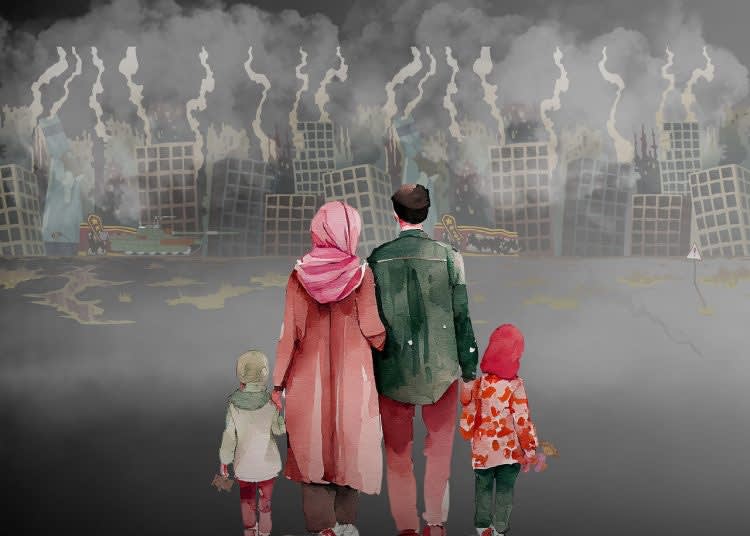 Image by Rosy / Bad Homburg / Germany from Pixabay
Want more powerful citizen journalism? You're not alone. When you read one of our articles, you're joining a community of nearly 500,000 people passionate about reading and sharing the stories that matter.
Our 10 UK national and regional publications champion unheard voices, speak truth to power, connect communities and defend democracy. We support over 2000 citizens to research, investigate and write fact-based news, analysis and comment. This is journalism built from the ground up.
The article in this newsletter was published in Bylines Scotland. You can also read a fascinating two-part series about belonging, community and connection by Helen Wildig and Nazish Saad on their website: A new approach to integration - the power of connection.
We're proudly independent - no corporate owners or billionaire backers. But it costs us at least £150,000 a year to run our network. Support journalism by the people, for the people. Become a Friend of Bylines Network. For as little as £3.50 a month, you'll get behind-the-scenes insights, chances to engage with our editorial teams, access to special events, merchandise, and more. Sign up by clicking the button below, or upgrade your Substack subscription.
Become a Friend of Bylines Network
In conversation with George Monbiot [ 10-Dec-25 5:35pm ]Hello subscribers, followers and readers - thank you for being here.
We relaunched the Bylines Network Gazette 10 days ago, with an issue analysing extremism and telling stories of hope in times of rising hate. Since then, hundreds of new people have signed up for our newsletters - welcome to you all.
Future Gazettes will be released on the last Friday of every month, and we will be sharing fresh articles and content with you every week via this newsletter. Our 10 publications release 400 articles a month. We pick the best ones and send them directly to your inbox, including this inspiring podcast with George Monbiot.
George is a renowned author and columnist for The Guardian, an expert on sustainability and a passionate campaigner for social justice. Here, he sits down with Patricia dos Santos Paton, Editor in Chief of Bylines Scotland, and Ben Dickenson, Managing Director of the Bylines Network, for a fascinating conversation. Topics include:
The truth about global food insecurity and inequalities in land ownership.
Is there any point in the COP environment events?
What's happened to the left and right in British politics?
Threats to democracy and better ways for citizens to shape decisions.
What needs to change in the media?
How can each of us play our part in making a better future?
This is 50 minutes well spent, in great company - happy listening.
Cover picture by Ben Gingell on Shutterstock [BD, 2683902701]
"The Bylines Network is tremendously inspiring…it's crucial that journalism speaks truth to power, but the great majority of it unfortunately speaks with the voice of power…it's really inspiring to see networks like yours filling that huge gap and doing what journalism ought to do."
George Monbiot
Become a Friend of Bylines NetworkWe're proudly independent - no corporate owners or billionaire backers. But it costs us at least £150,000 a year to run our network. You can help us put journalism in the hands of citizens and tell the stories that matter by becoming a Friend of Bylines Network.
We exist because of readers, writers, editors, volunteers and supporters. As a Friend of Bylines Network, you're investing in truthful journalism, more connected communities, and a stronger democracy. In return for as little as £3.50 a month, you'll get behind-the-scenes insights, chances to engage with our editorial teams, access to special events, merchandise, and more.
There are four tiers - Friend, Best Friend, Champion, Patron. All will receive the Bylines Network Gazette. The higher tier you sign up for, the more other benefits you'll get. Most of all, you're helping us publish more stories, support more citizen journalists and speak truth to power.
Sign up by clicking the button below, or upgrade your Substack subscription. We have matched our basic Substack subscription to the Friend of Bylines Network tier, so a paid subscription here is the same as becoming our Friend via the online webform.
Sign up as a Friend of Bylines Network
There is a freindship level for everyone. Just click here to sign up. (Image by Ceylan Salih, copyright Bylines Networks Limited.)Don't want to be friends? No problem, we're not going anywhereIf you don't want to become a Friend of Bylines Network, that's fine - you will remain a newsletter subscriber, nothing else will change, you will still get brilliant articles delivered to you every week, you can visit the free content on our Substack anytime, and you can access all 10 of our publications on their websites without paying a penny.
Odd and incompetent: Reform hits a ceiling [ 05-Dec-25 5:01pm ]Bylines Network is sharing this important article about Reform UK's election prospects directly to your inbox. This insightful analysis by citizen journalist Stephen McNair can also be read at East Anglia Bylines.
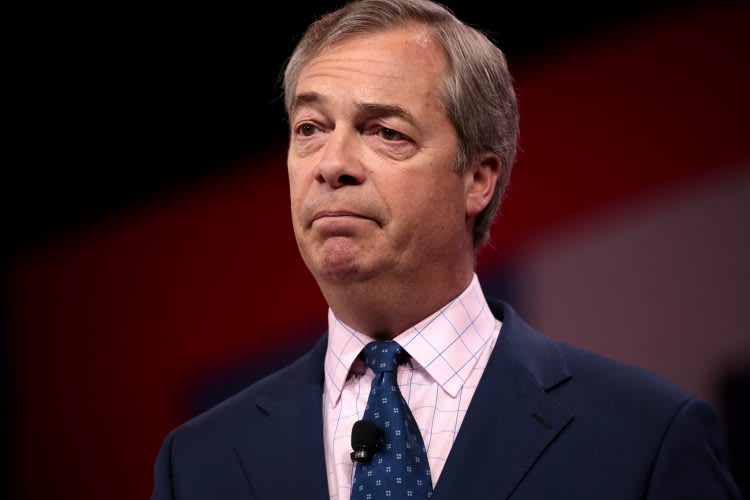 Image by Gage Skidmore via Flickr (CC BY-SA 2.0)
The rise of Reform UK in opinion polls has been remarkable. Most polls report them overtaking Labour last spring, and remaining ahead ever since. They have been winning local by-elections and, in September, some polls gave them a national vote share of over 30%. Under first-past-the-post elections, with five parties in contention, that is enough to form a government.
Reform remains ahead in the polls, but since September, their polling numbers have fallen back a little. So, does this mean that people are changing their minds, or has Reform hit a natural ceiling of possible support?
Elections are won by a coalition of voters: those who believe in the policies and arguments, and those who just want to kick the incumbents. When so many people have seen no improvement in living standards since the financial crash of 2008, the latter are a substantial group.
But now Reform is getting more exposure it may be that people are looking harder and asking: are they competent, and do I actually agree with their policies?
Are they competent?To form a government, a party needs at least 326 MPs, with sufficient organisation and discipline to make and implement decisions. Reform currently has five, having lost two since the election. In Great Yarmouth, Rupert Lowe was expelled for being too extreme, and in South Basildon, James McMurdock left, following allegations about Covid business loans. And the party has had three chairs in two years.
Traditionally, most MPs are elected after building experience, policy knowledge and organisational ability as local councillors. Currently Labour has 5,939 councillors, and even after a disastrous round of elections, the Conservatives still have 4,252. Reform has only 933 (less than 5% of the total), most of them new to politics.
Within six months of local elections, 5% of their new councillors had resigned or been expelled from the party. Their flagship county council in Kent has been mired in confusion, cancelling its plans to reduce spending which were the centre of their election bid, and with leaked videos of chaotic meetings.
For people who supported Reform because they saw Conservatives and Labour as chaotic and incompetent, Reform may begin to look like more of the same, just with less experience and competence.
And there are other negative factors. It does not look good for an avowedly nationalist party to be led in Wales by someone convicted of taking bribes from the Russian government. Furthermore, Nigel Farage himself has been embroiled in a row about racism, and his alleged involvement in extreme right politics in his youth.
And as Reform considers the serious possibility of being in government, they have abandoned their plans for big tax cuts, one of their central policies.
 Bylines Network doesn't have billionaire backers, corporate owners, or political paymasters. We're run by, for and with citizens. You can read our work without paying a penny. But, sadly, what we do isn't free. It costs over £150,000 a year to run 10 publications and support 2,000 grassroots writers. Become a Friend of Bylines Network and champion independent journalism, invest in stronger communities and strengthen democracy. For as little as £3.50 a month, you'll get behind-the-scenes insights, chances to engage with our editorial teams, access to special events, merchandise, and more. We've matched our Substack subscriptions to Friends of Bylines Network tiers, so a paid subscription here is exactly the same as becoming our Friend via the online webform. Click whichever option you prefer.What do they believe?
But perhaps their plateauing poll numbers reflect more exposure of their views, as media scrutiny has ramped up. So, what do their supporters believe?
Using data from the very large British Election Study (BES), Professor Ben Ansell has analysed the profiles of party supporters on a range of issues. He began by mapping how they differ on issues of economics, from left to right, and on cultural issues from conservative to progressive.
Four parties follow predictable patterns, from the Greens (left/progressive), to the Conservatives (right/conservative). But Reformers are different. While they share cultural attitudes with Conservatives, many of them, especially people in routine and intermediate jobs, share their economics with Labour.
Three key policiesHe then looked at three policy issues where Reform voters are distinctly out of step with the rest of the electorate: immigration, environment and discrimination.
The BES scores attitudes to immigration on a scale of 0-10 (from 'far fewer' to 'many more). On this scale, the average UK voter scores 3, wanting to see some reduction in immigration. With scores around 5, Greens, Labour and Liberal Democrats are all broadly content with current levels, while Conservatives want a reduction.
But Reformers are distinct: despite all economists agreeing that reducing legal immigration would seriously damage the economy, most Reformers want it radically reduced or stopped altogether
The BES also asks whether economic growth should have priority over the environment. Labour, Liberal Democrats and Don't Knows want a balance of the two, but the other two parties are very clear outliers. While Greens overwhelmingly prioritise the environment, Reformers are happy to sacrifice the environment for economic growth.
But the most striking issue is attitudes to discrimination. BES asks whether particular groups are victims of discrimination, and views on this fall into two distinct groups. Most people agree that there is some discrimination against women, ethnic minorities, gay, trans and disabled people. But Reformers take the opposite position: they think that the victims of discrimination are men and white British people.
Is Reform really a threat to the established parties?On competence, the jury is still out. Reform have yet to demonstrate that they have sufficient capable people, and the organisation and political skills to build a parliamentary majority. Even if all Conservative MPs defected to Reform, they would still be 200 seats short of the winning line.
And on policy issues their supporters are clearly out of step with majority opinion. To summarise crudely: Reform voters believe that white men are victims of discrimination; that the environment should be sacrificed for economic growth; and all immigration should be stopped. There clearly is a significant body of people who believe these things. But there is no evidence that they represent anything like a majority.
These views are so out of step with majority opinion that Reform's ability to raise their support seems limited. And further scrutiny of their competence and policies may erode the share they have now.
But of course under first-past-the-post elections, with five parties in contention, they only need 30% of votes in the right places to form a government. The latest polls still show them in the lead, hovering just below that line. They may be reaching a ceiling, but it just might be high enough.


