

Ultimately, it'll be a lack of food that ends civilization. There are many ways we get there - nuclear winter, drought, fossil fuels depletion - but that's not the point of this article. Rather, I want to know what I become when I am starving. I want to know what my neighbors become.
In the past, many believed humans were innately savages, and when the veneer of safety and comfort was eroded the remaining beast was permitted to appear. Once this occurs, survival needs replace moral rationality, steering the average person to murder and cannibalism.
Others believe humans are innately good, confounding morality with instinct. How can this be true when we seem to be governed by evil and selfish people? Perhaps the average person is "good" only because of where they fit in the social order. Given the right circumstances, do we all end up murdering each other for the last morsel of food?
To learn about the savage within, I looked at history starting with the Minnesota Starvation Experiment. Conducted during WWII, this research selected healthy men and put them through a semi-starvation period. Participants lost 25% of their body weight.
The subjects grew increasingly isolated, apathetic, and irritable, becoming obsessed by food. They experienced emotional blunting, cognitive dissonance, depression, and pessimism. Interpersonal relationships broke down.
They guarded their resources, licked their plates clean, and became aggressive. Some violently turned on themselves.
The key finding was that savagery wasn't a consistent outcome of starvation. Instead, apathy, social disconnection, and obsession were the common denominator.
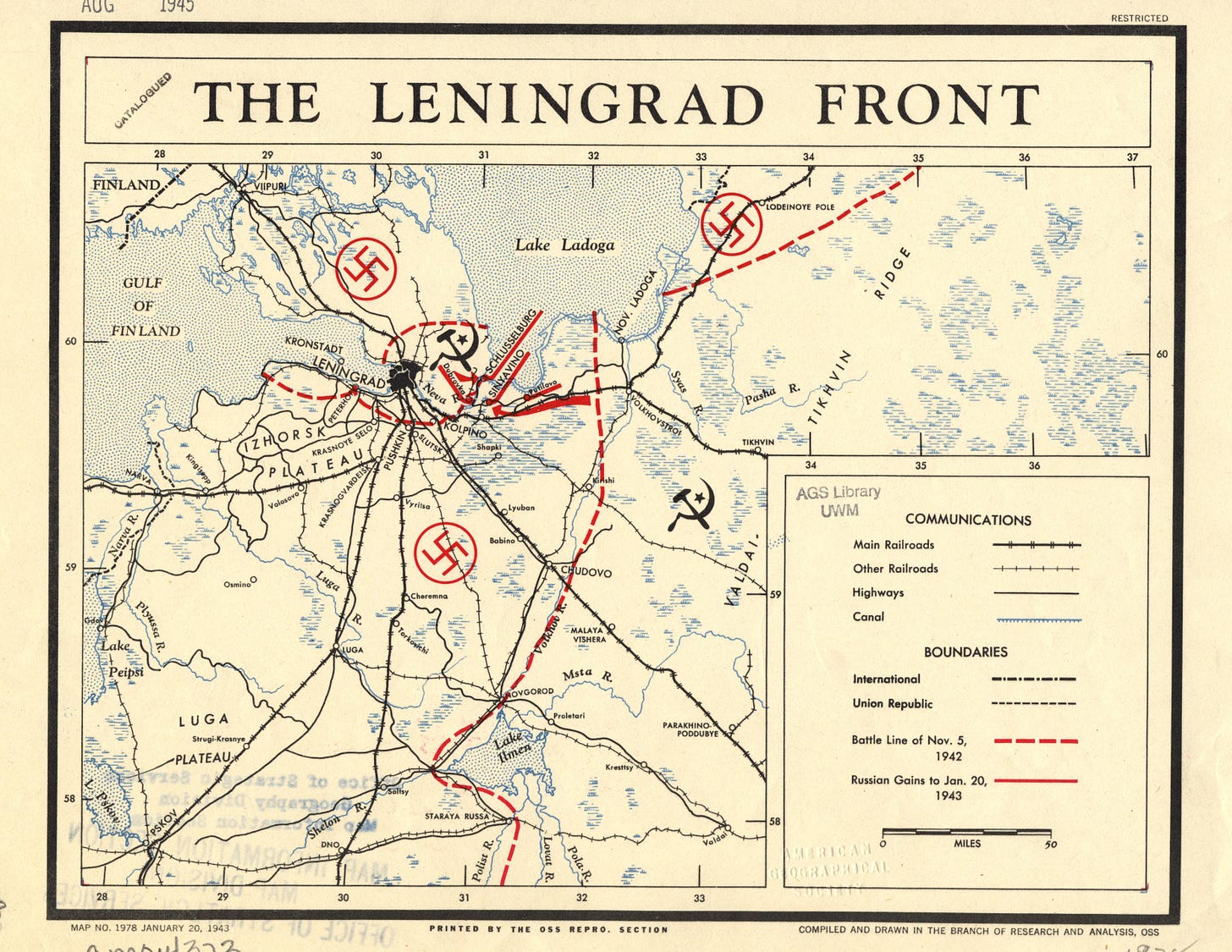
The Siege of LeningradDuring WWII, Germany blockaded Leningrad for 872 days. Approximately one million citizens died from exposure, starvation, or disease.
As with the Minnesota Starvation Experiment, the common response was apathy and social atrophy. Both psychologically and physically. In a desperate attempt to survive, the body consumed itself, as autopsies showed organs shrank, including livers by 2/3 and hearts by 1/3.
Lidiya Ginzburg, a survivor, literary critic, and author of the Blockade Diary, observed that starvation caused an "alienation of the body," where the conscious splits from the physical form, viewing the body merely as a manifestation of a hostile outside world.
As food = energy, starvation leads to a state of chronic exhaustion, explaining why most victims react passively becoming inured to death. Without the drive for self-preservation, murder and cannibalism disappear from the range of options. Instead, with the breakdown of social norms and lack of individual energy, the response to a neighbor's suffering was distance:
"Every day she sees heavily swaddled figures swaying along the narrow footpaths. She can recognize the goners from their shuffling gait, and every day she worries whether to follow them or pass them by. The moment that they fall is the worst. They crumple and drop. She wants to stop—it's the humane thing to do—but she has no strength to help them. So she tries to make her way past them, stepping around them, not over them, and never looking at the pile of cloth itself, lest an arm reach up or a pair of eyes implore."
During the Siege of Leningrad, people lay in bed next to the corpses of their family members, too weak to move them, and sometimes deliberately kept the bodies in the apartment simply to use the deceased's ration cards to prolong their own lives. The psychological blunting was a defense mechanism to avoid breaking down completely.
Once a source of social cohesion, food became an isolating experience. Yet, despite the social breakdown, most citizens simply faded into the night rather than turn to violence.
The savage fewAs with any form of disarray, there is a minority that do the unthinkable. Often opportunistic, paired with cognitive dissonance. Sometimes premeditated.
Hunger-induced madness can push ordinary people to acts of barbarism. During the Holodomor of 1932-1933, over 2,500 people were convicted of cannibalism.
Approximately 69% of the accused were women, mostly aged 17 to 50, and were predominantly widows, single mothers, or divorced individuals lacking a support system. The acts of cannibalism they committed were the human psyche collapsing under the weight of incomprehensible trauma.
Anna Ivanivna Storcheus's husband and three children died of starvation before her eyes. Anna killed and ate her fourth and final child, a girl named Nadiia. Was Anna a victim or a murderer? Many historians acknowledge people like Anna were not inherently evil. Rather, a form of psychosis becomes the maladaptive coping mechanism for some experiencing complete psychological and social destruction.
The Algonquins referred to this experience as "Wendigo psychosis", explaining paranoia, anxiety, hallucinations, and an impulse to consume human flesh during periods of starvation or social isolation.
What distinguishes the Siege of Leningrad from other similar experiences of extreme deprivation is Leningrad was a city with a set of social norms. When the setting is more isolated, and few are watching, are people more willing to break taboos?
Almost mythological, the story of the Donner Party is a classic example of what can happen to small groups, distant from broader social oversight.
The Donner Party was a group of American pioneers stranded by heavy snow in the Sierra Nevada mountains during the winter of 1846-1847. Patrick Breen, an Irish immigrant who survived with his wife and all seven of his children, kept a detailed diary, documenting the psychological collapse of the group.
Initially, the group attempted to maintain normalcy. They built makeshift shelters and slaughtered their remaining oxen and cattle, preserving the meat in the freezing weather. As the snow deepened and the food vanished, the typical signs of deprivation and isolation began to set in. Breen's entries reflect a systematic breakdown of norms. The taboo against consuming companion animals fell first:
"Mr. Curtis remarked that in the oven was a piece of the dog, and we could have it. Raising the lid of the oven, we found the dog well baked, and having a fine savory smell. I cut out a rib, smelling and tasting, found it to be good, and handed the rib over to Mr. McCutchen, who, after smelling it some time, tasted it and pronounced it very good dog."
As the weeks dragged on, the members of the party began to boil and eat the ox hides that previously served as their roofs and blankets. When the hides ran out and individuals began dying of starvation and hypothermia, the surviving members transitioned to survival cannibalism. Breen's diary entries from February 1847 were blunt, highlighting his own decline:
February 26, 1847: "The Donnos told the California folks that they commence to eat the dead people 4 days ago, if they did not succeed that day or the next in finding their cattle then under ten or twelve feet of snow…"
This was a capitulation to reality. A survival mechanism, with some refusing to participate.
Similarly, in 1972 a group of Uruguayan rugby players were stranded in the Andes after their plane crashed. Their 72 days in an extreme environment led to pragmatic savagery.
Dr. Roberto Canessa, a 19-year-old medical student at the time who later became a pediatric cardiologist, framed the decision to consume the dead not as a descent into savagery, but as a rational necessity. In his memoir, I Had to Survive, Canessa notes the conflict the group faced when confronted with starvation:
"Our story became world famous because of how we survived: by eating those who had died. It was, by far, our most eccentric idea, one that was simultaneously simple and audacious, and perhaps inconceivable. Hunger demands, above all else, to be satisfied."
They ate their friends, teammates, and family members. The desecration of the dead was unthinkable, so the decision was reframed and compartmentalized. "Harmonizers" within the group helped alleviate the psychological tension by reframing the consumption as something similar to the Holy Communion. A gift from the dead to the living. Indeed, many explicitly gave permission to others that they be consumed if they died first.
This is where a nuance must be presented, as explained by Canessa:
"Cannibalism is when you kill someone, so technically this is what is known as anthropophagy. I've had these discussions for 40 years. I don't care. We had to eat dead bodies, and that's it."
Notably, they didn't survive as individuals degrading to barbarism. Rather, they redefined a new shared moral framework based on their predicament, and it was social cohesion and teamwork that helped them survive.
Sign up for Collapse 2050The unspoken truth about humanity's frightening future.
Subscribe .nc-loop-dots-4-24-icon-o{--animation-duration:0.8s} .nc-loop-dots-4-24-icon-o *{opacity:.4;transform:scale(.75);animation:nc-loop-dots-4-anim var(--animation-duration) infinite} .nc-loop-dots-4-24-icon-o :nth-child(1){transform-origin:4px 12px;animation-delay:-.3s;animation-delay:calc(var(--animation-duration)/-2.666)} .nc-loop-dots-4-24-icon-o :nth-child(2){transform-origin:12px 12px;animation-delay:-.15s;animation-delay:calc(var(--animation-duration)/-5.333)} .nc-loop-dots-4-24-icon-o :nth-child(3){transform-origin:20px 12px} @keyframes nc-loop-dots-4-anim{0%,100%{opacity:.4;transform:scale(.75)}50%{opacity:1;transform:scale(1)}} Email sent! Check your inbox to complete your signup.No spam. Unsubscribe anytime.
The transition from pragmatism to murderThere's clearly a difference between eating someone who has already died vs killing someone to consume, the latter being more of an exception. Still, there are documented cases of both reluctant and opportunistic cannibals trying to survive in isolated, harsh conditions.
Courts have ruled that the temporary "suspension" of civilization does not permit a temporary suspension of civility. In 1884, R v Dudley and Stephens (Britain) ruled definitively that necessity is never a defense for murder. The legal doctrine established in this case dictates that the sanctity of human life is absolute and cannot be quantified, traded, or sacrificed, no matter how extreme the survival imperative.
Shipwrecked and adrift in the Atlantic for weeks in a rowboat, Captain Thomas Dudley and mate Edwin Stephens made the decision to kill a cabin boy who appeared already close to death. Dudley and Stephens murdered the boy to drink his blood and eat his flesh.
Dudley recounted:
"I took out my knife—first offering a prayer to God to forgive us for what we were about to do and for the rash act, that our souls might be saved—and I said to the boy, 'Richard, your time has come.' The boy said, 'What me, Sir?' I said, 'Yes, my boy.'"
Upon their rescue and return to England, the men made no secret of what they did, genuinely believing that the unspoken "law of the sea" and the dire necessity of their circumstances justified the murder. However, the British courts demonstrated that the law cannot be expected to bend to extraordinary circumstances.
Clearly, there's a degree of proportionality to survival, and there's a vast divide between murdering an almost dead person to live another week and building a system of violence and oppression to control resources. For some, distance from civilization provides the opportunity to grasp power and resources through cruelty.
In 1629, the Batavia, belonging to the Dutch East India Company, wrecked near Western Australia. What happened to the survivors shows how fast a small isolated society suffering from a shortage of food can be turned into a murderous autocracy.
Two hundred survivors landed on Beacon Island with under-merchant Jeronimus Cornelisz. Prior to the wreck, Cornelisz had plotted to steal the ship and its cargo of silver and sandstone blocks. His plot was exposed and he feared rescue would lead to his execution, so seized tyrannical control over the survivors. He planned to prevent rescue and cull the survivors to preserve food and water.
By creating a lethal "in-group" that did his bidding, Cornelisz slaughtered over half the survivors, seizing resources and diverting threats to his control.
"The strongest were killed at night, their throats cut. Others were taken out on rafts and drowned. The sick and lame were also targeted. Then people were murdered at random, with many forced to kill other survivors to save their own lives. Total obedience was a person's only chance of survival. Cornelisz's men raped any woman they chose."
How was one man able to turn another group into savages?
As we've seen many times in history, given the right circumstances, a small group of ordinary people turned ruthless by a charismatic dictator can be used to murder, rape, extort the majority. This is important to recognize, as today we observe the world speed-walking to fascism while asking "why isn't anyone doing anything?"
According to social psychologist James Waller, the normalization of savagery among ordinary people exploits those with a predisposition towards conformist ethnocentrism, as opposed to psychopathy as one might expect.
Similarly, Christopher Browning's book "Ordinary Men: Reserve Police Battalion 101 and the Final Solution in Poland" found that the group of men who made up this battalion were not ideological fanatics. Rather, they were conformists. Despite receiving permission to opt out, the vast majority still resorted to savagery, executing innocent civilians en masse.
Browning's explanation was simple:
"To break ranks and step out, to adopt overtly nonconformist behavior, was simply beyond most of the men. It was easier for them to shoot."
To cope, the perpetrators rationalized their actions. Propaganda helped reframe their actions as "acts of justice". Alcohol abuse helped them forget, while compartmentalization placed their victims outside the battalion's circle of human obligation.
Humans are frighteningly good at creating out-groups to rationalize horrific abuses of other humans. During the Rwandan genocide, Hutu extremists killed about 800,000 Tutsis and moderate Hutus. They weren't killing alien strangers, rather they were friends, neighbors, and even extended family.
State propaganda had reframed the mind to view Tutsis as "cockroaches" and their eradication as communal work. The readily available machete became the weapon of choice.
"The club is more crushing, but the machete is more natural. The Rwandan is accustomed to the machete from childhood. Grab a machete—that is what we do every morning."
The killing was systematic and pragmatic, aiming to eradicate entire bloodlines.
"Saving the babies, that was not practical. They were whacked against walls and trees or they were cut right away."
Like in Poland, conformity to the group, the promise of material greed (plundering the victims' property), and the absolution provided by state effectively removed the cognitive barrier that typically halts the decline into savagery.
This cognitive dissonance bleeds into the victim population, with a minority of the targeted effectively assisting the perpetrators. In "The Drowned and the Saved", Primo Levi explained how Chaim Rumkowski, the Jewish elder of the Łódź Ghetto during WWII, wielded dictatorial power over his fellow Jews. He helped Nazis by organizing deportations to death camps, eventually, despite his assistance, becoming a victim himself.
Deprivation, power, and the suspension of morality sadly lead some to betray their peers. However, contradictory to what British courts found with R v Dudley and Stephens, it is difficult to comprehend from the comfort of modern civilized society.
Levi suggests:
"It is a judgment that we would like to entrust only to those who found themselves in similar circumstances and had the opportunity to test for themselves what it means to act in a state of coercion… The condition of the offended does not exclude culpability, which is often objectively serious, but I know of no human tribunal to which one could delegate the judgment."
Given this, how does one separate victim collaboration from crimes against humanity committed by Nazis, who also argued that fear for their lives forced them to follow orders. The Nuremberg Trials exposed this excuse as unacceptable. Despite the extraordinary circumstances, and inability to fully comprehend the mindset of the Nazi soldier, the individual was not excused for their savagery.
Why we're blind to civilizational collapseAnd why when we do see it, we fail to act.Morality of eating humansDespite the plentiful supply of living and dead humans throughout historical famines, cannibalism is rare and universally taboo. Why do civic norms outweigh the survival imperative in many cases, despite the extreme circumstances? Why do some, no matter the cost, refuse to break the taboo?
Morality is often the social manifestation of evolutionary imperatives, either biological or social. Some part of our success as a species can be explained by our reluctance to see each other as a source of food.
Recent epidemiological models reveal that human cannibalism trades long-term survival costs for immediate sustenance. When humans eat humans, risks of prion diseases such as Kuru rise. This risk compounds with frequency. Cooking reduces the risk, but not entirely.
Also, hunting other humans provides a negative energy ROI. It is usually more calorically profitable to target unsuspecting flora or fauna. For this reason, most cases of cannibalism involve the already dead.
Finally, humans are a social species with evolutionary success highly connected to our ability to organize. Social cohesion across hundreds or thousands of people, most of which are relative strangers, requires trust. Trust in rules. Trust in aversion to violence. Trust you won't become your neighbor's next meal.
Combine these biological and social characteristics and it is clear the taboo against cannibalism isn't arbitrary. Indeed, cannibalism is maladaptive and any populations that ate each other died off from disease or an inability to organize.
If human survival relies on the biological and social rejection of cannibalism, the true threat during civilizational collapse is not a neighborhood of bloodthirsty savages. The threat is the isolating apathy of starvation. We will likely not eat our neighbors. We will simply lack the calories to intervene when an opportunistic tyrant decides to exploit them.
I'd love to hear your thoughts on this subject. How will people change as infrastructure collapses, disasters overwhelm, and famine sets in?
Sign up for Collapse 2050
The unspoken truth about humanity's frightening future.
Subscribe .nc-loop-dots-4-24-icon-o{--animation-duration:0.8s} .nc-loop-dots-4-24-icon-o *{opacity:.4;transform:scale(.75);animation:nc-loop-dots-4-anim var(--animation-duration) infinite} .nc-loop-dots-4-24-icon-o :nth-child(1){transform-origin:4px 12px;animation-delay:-.3s;animation-delay:calc(var(--animation-duration)/-2.666)} .nc-loop-dots-4-24-icon-o :nth-child(2){transform-origin:12px 12px;animation-delay:-.15s;animation-delay:calc(var(--animation-duration)/-5.333)} .nc-loop-dots-4-24-icon-o :nth-child(3){transform-origin:20px 12px} @keyframes nc-loop-dots-4-anim{0%,100%{opacity:.4;transform:scale(.75)}50%{opacity:1;transform:scale(1)}} Email sent! Check your inbox to complete your signup.No spam. Unsubscribe anytime.
Thank you for reading.
My name is Sarah and I run Collapse2050 by myself. It is a passion project to explore humanity's frightening future - a topic traditional media ignores.
The site is free for all, as I believe this information shouldn't be locked behind a paywall. I also don't accept corporate advertising so I remain totally free to tear the kleptocracy a new one.
To fund these articles, I depend on the kindness of strangers. Paid subscribers and one-time contributors to help me cover research and production costs.
Thank you.
Sarah

I often think of Collapse2050 as a risk management blog, designed to help readers see around corners. My aim is to help people understand the big risks. Sometimes that includes economic risks. The ones that send the average non-billionaire scrambling, if caught unprepared.
Bubbles and busts are human nature. Markets are intoxicated by new ideas and innovations, especially if it provides a means to get rich. I'll put aside the scams and totally irrational bubbles, like Dutch tulip bulbs. There are plenty of rational bubbles to go around. The railway, telecommunications…and now AI. All premised on something groundbreaking. All ended (or will end) in tears.
This is not an investing blog, but an implosion of the AI bubble could cause an aggregate slowdown that hits people whether they invest or not. A collapse in the value of assets held in portfolios has a ripple effect on employment. Landing a job today already requires a minor miracle. It would get much more difficult if companies start shrinking.
Worse, increasingly, portfolios held by institutional investors, such as insurance companies and pensions, hold private debt and equity issued by AI companies. A collapse in the value of AI-related assets could leave a gaping hole in these entities, requiring either a cut in payouts or a government bailout. Either way, you pay.
One can view savings and investments as the quantitative cumulative net value of one's lifetime of work. Yeah, it's crude but when I think of it that way it reminds me of the effort it took to obtain it. Every dollar I have saved required blood, sweat and tears at a job that tried to destroy me. I am too old to go through that again, so I'm protective of whatever I have.
For this reason I am always looking for the next 2000 or 2008 or 2020, all of which featured double-digit declines in stock indices. An AI implosion could be the next one.
Railroads and internet telecommunications proved themselves as valuable over the long run. Yet both suffered from overinvestment driven by hype. When the reality of ROI clashed with investor expectations, capital fled and asset prices collapsed. The infrastructure remained, however, for another day.
AI is following this pattern. If you look beyond the public-facing LLMs, agentic AI models are both theoretically transformative and practically infeasible. Today, I'd argue they're more dangerous than useful, but in theory some company in the future might find a way to implement to improve ROI. That's what investors are banking on, but patience is waning as the confetti settles and reality appears dull.
People like Ed Zitron have been pounding the table for a few years now arguing the AI "revolution" is all hype, but his prognostications were far too early to be pragmatic for most investors. Today, however, data increasingly show the results aren't aligning to expectations.
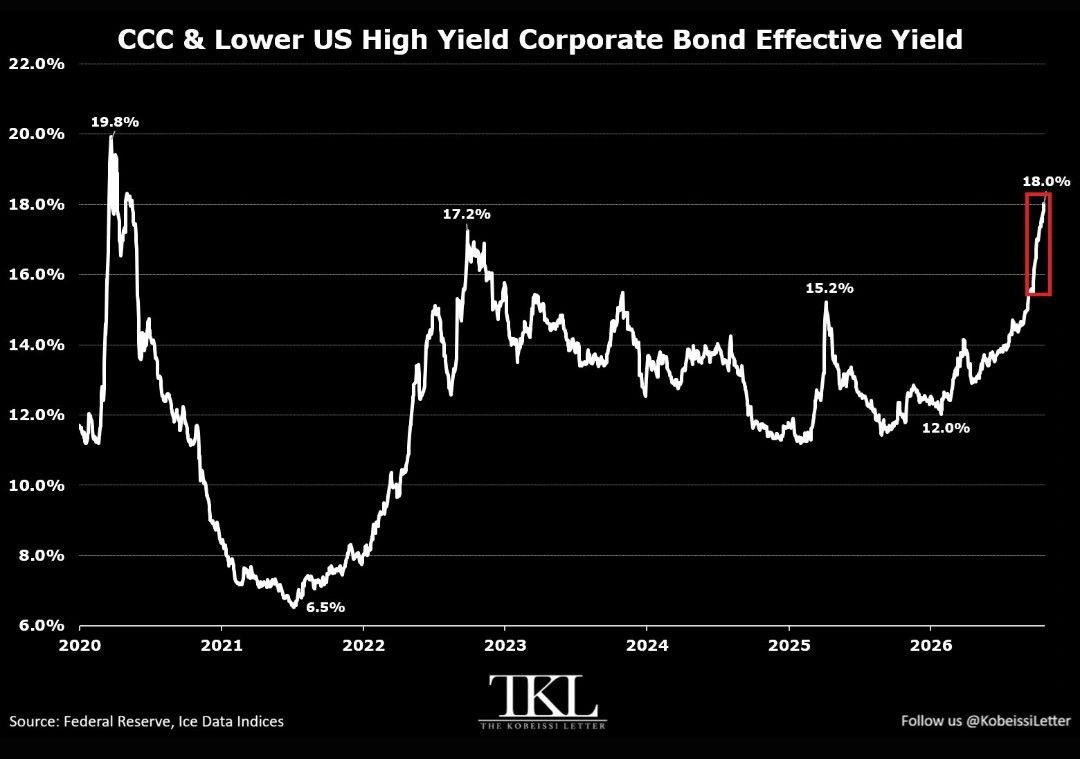
Below are a few charts that illustrate the state of the AI bubble:Junk bonds are under severe pressure, increasingly pricing in defaults for higher-risk credits. This includes highly speculative debt funding the AI buildout.
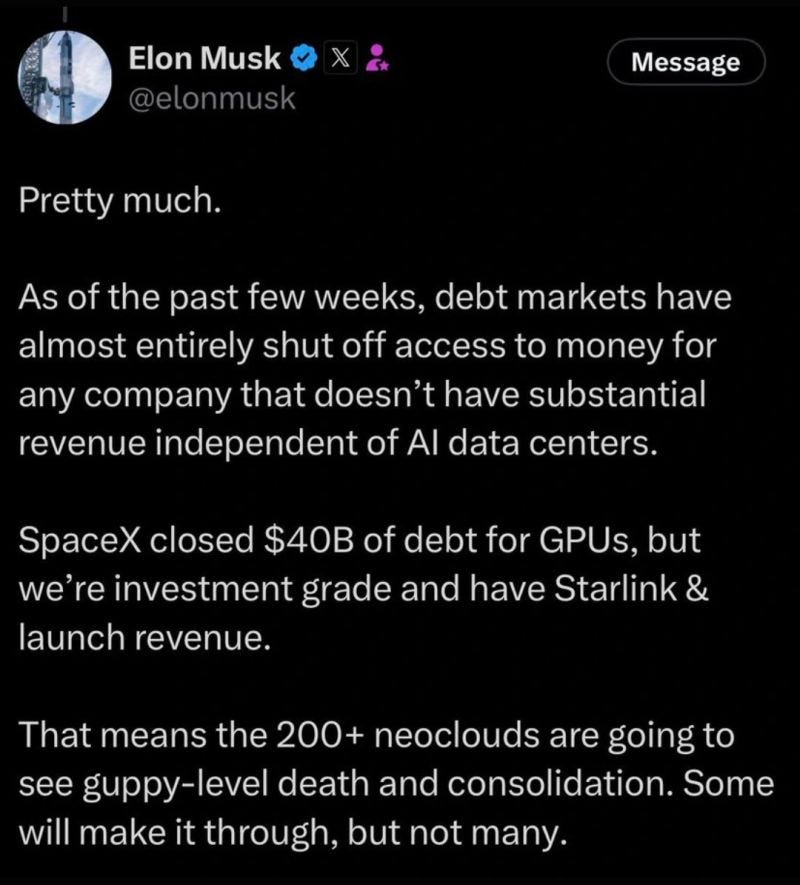
I hate to quote Musk, but if true this is a valuable insight. It does make intuitive sense, especially given the corroborating data points.
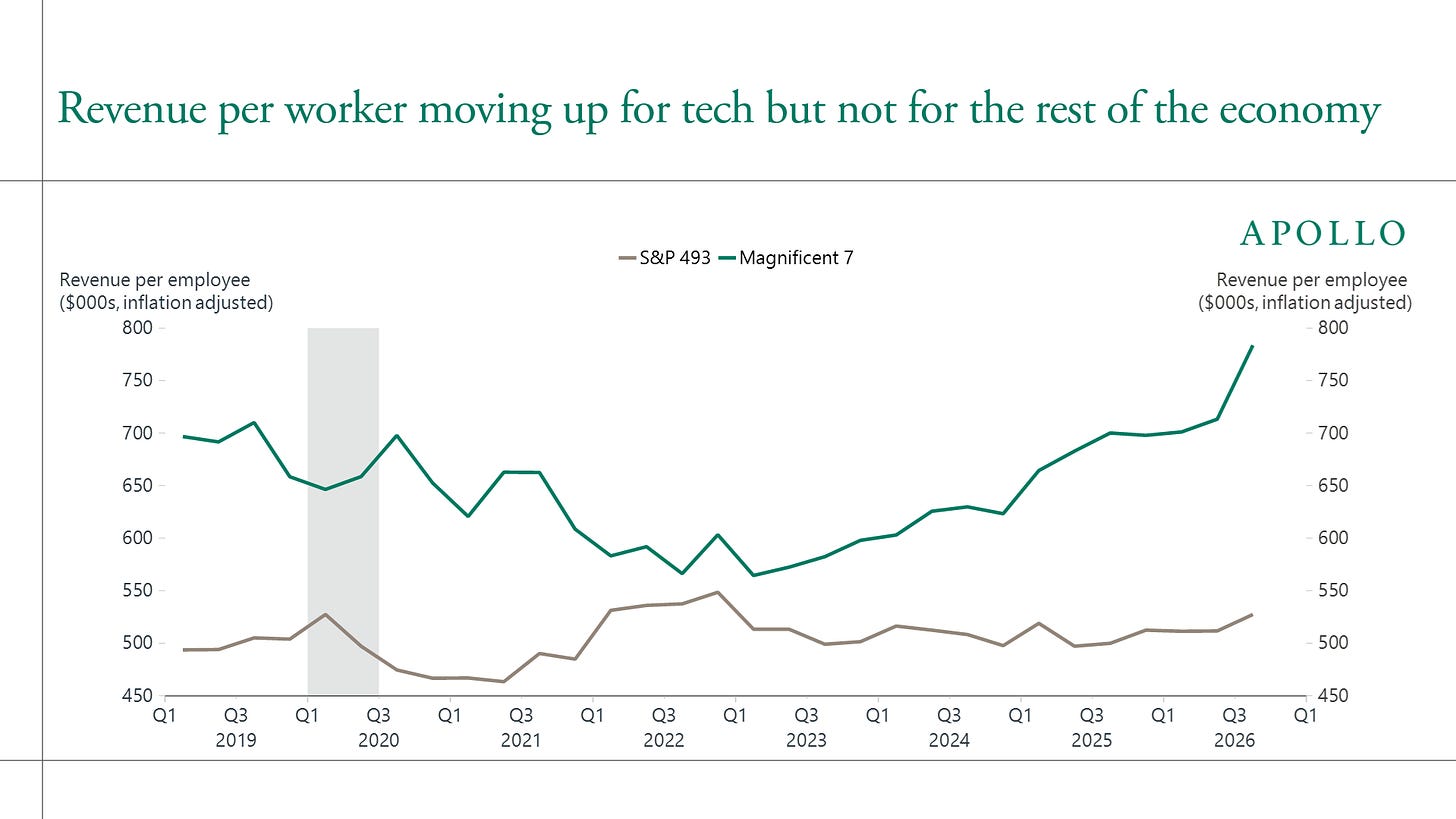
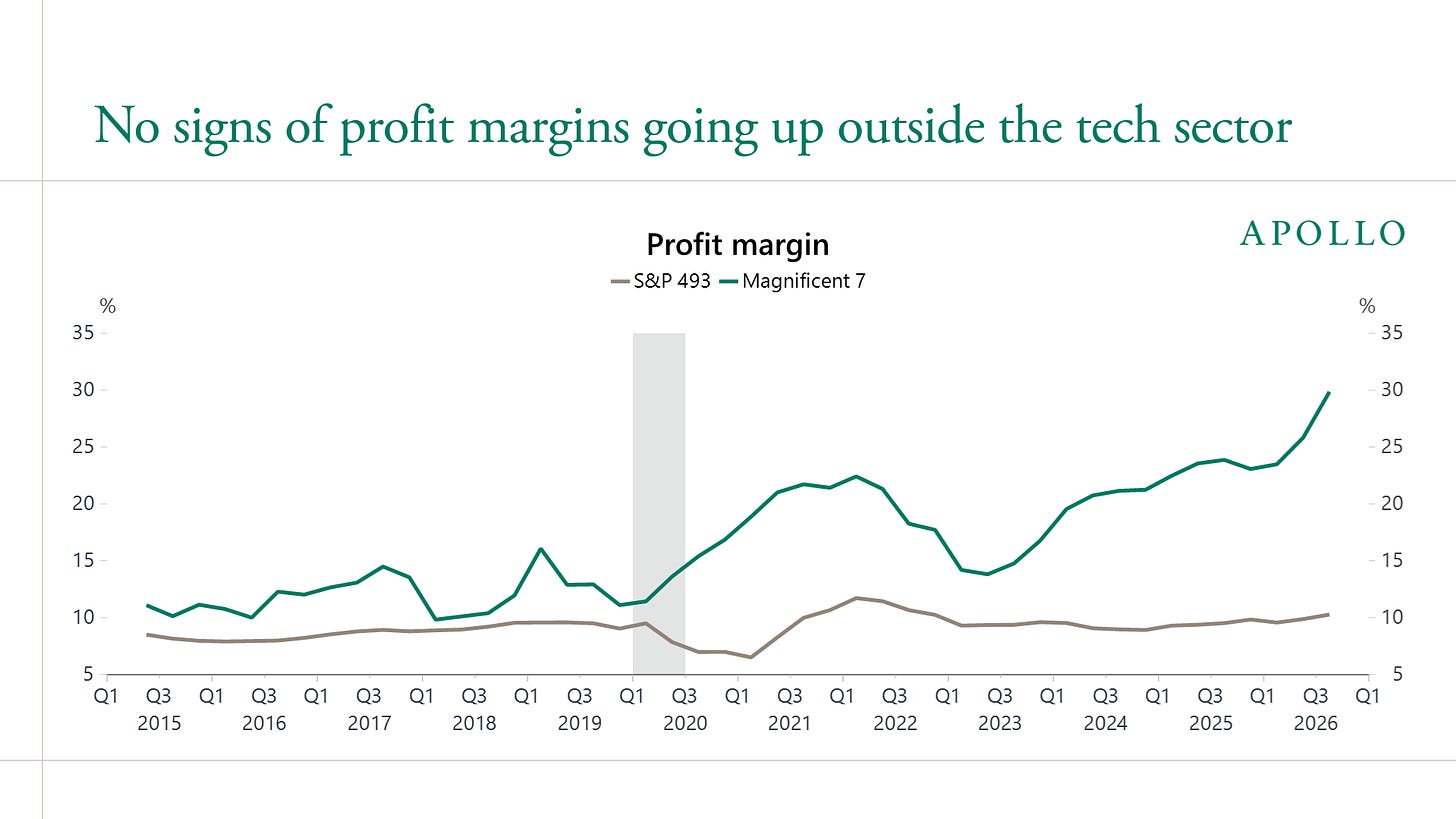
The only companies benefiting from the boom in AI investment are companies selling picks and shovels. Outside of the Mag-7, revenue per employee (a measure of productivity) and profit margins are flat.
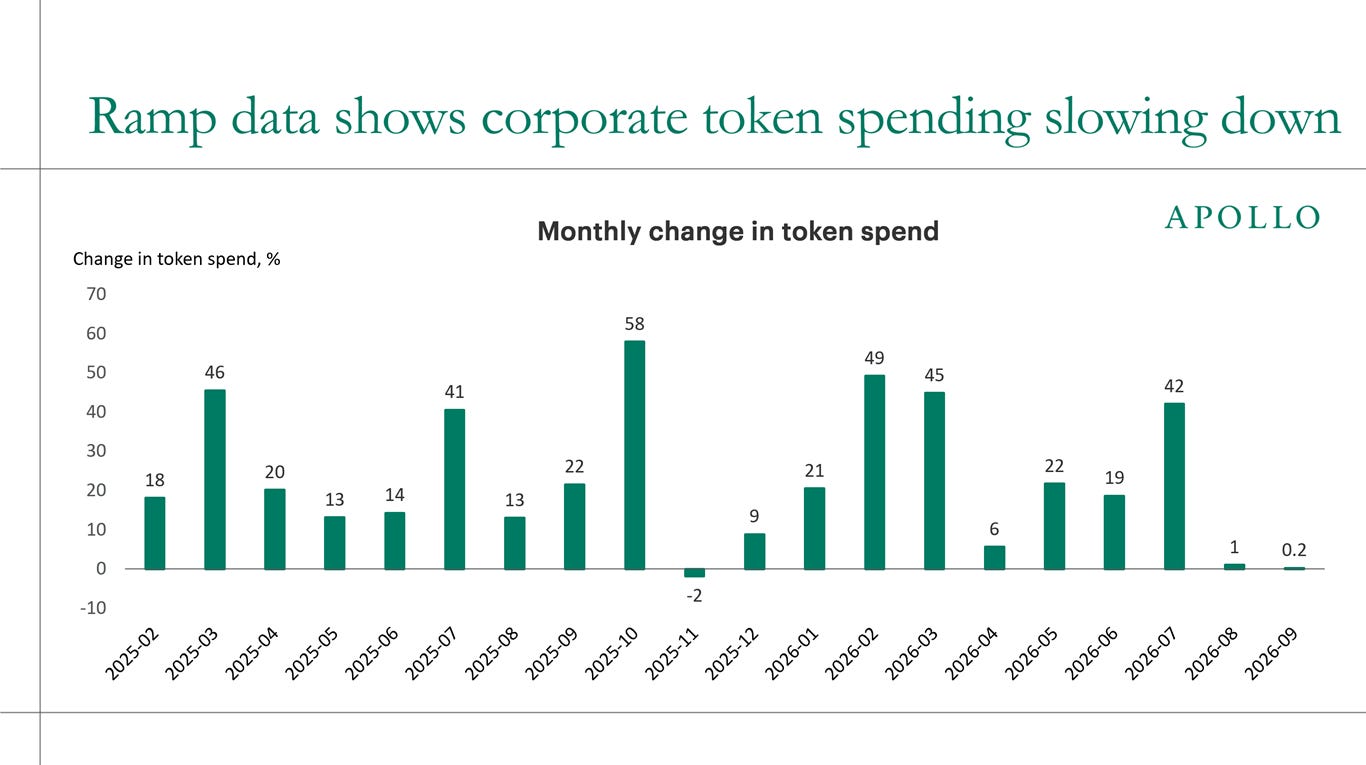
Companies are becoming more cost-aware of their AI spending. For two months token usage has remained flat.
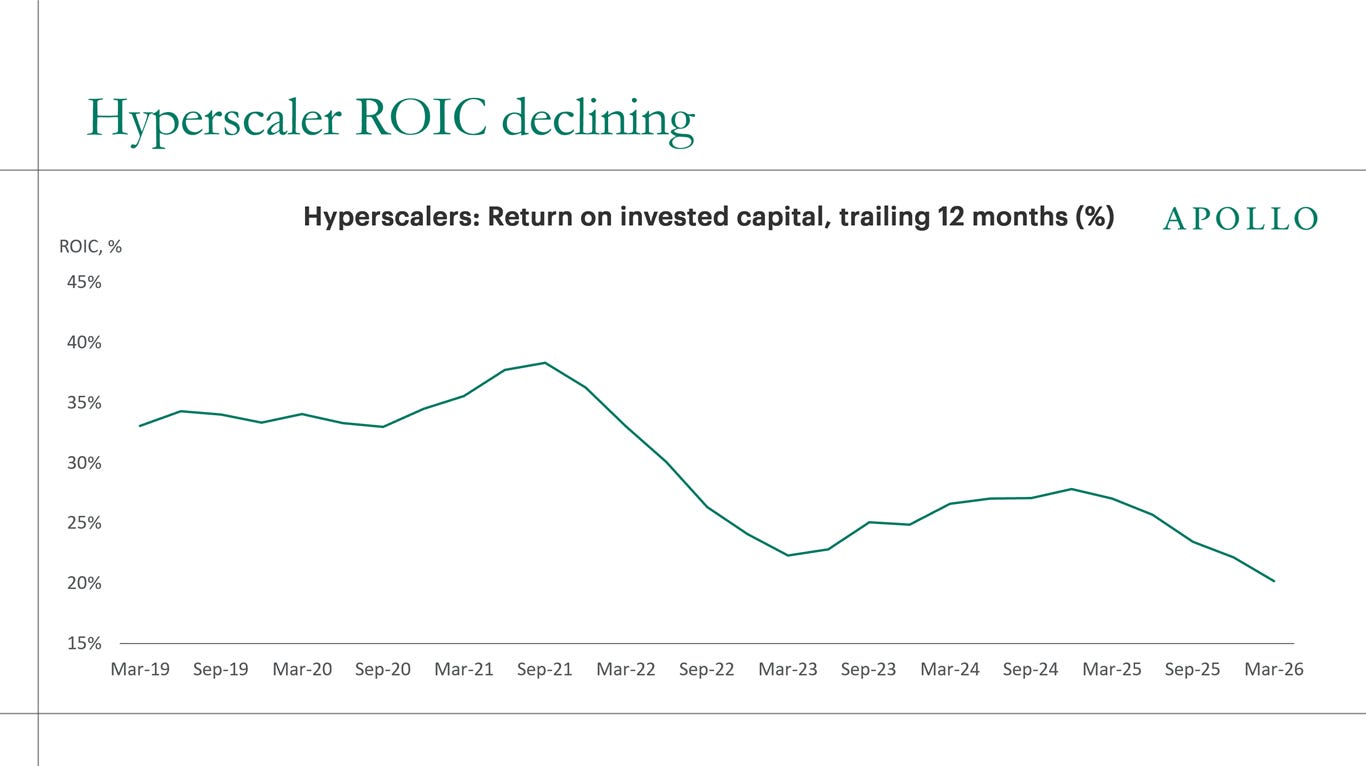
Users would be spending more if the ROI was there. Despite the hype, ROI is trending in the wrong direction.
 Two opposing realities can be true simultaneously
"The Skynet Funding Bill is passed. The system goes on-line August 4th, 1997. Human decisions are removed from strategic defense. Skynet begins to learn at a geometric rate. It becomes self-aware at 2:14 a.m. Eastern time, August 29th. In a panic, they try to pull the plug." - Cyberdyne Systems Model 101
Friends of Collapse2050 who have read previous posts might point out that I'm arguing that AI is both uneconomic and destructive. Yes, that is what I'm saying. AI is both unpragmatic for businesses (at least currently) yet is becoming powerful enough to hack civilization's feeding tubes.
Given that premise, even if capital for datacenters and associated accoutrements evaporates, private companies collapse, and asset prices crash, governments will step in with strategic funding to keep their latest weapon alive.
It could all blow up and still still exist at the same time. Much like how Pets.com died in November 2000 along with many other internet companies valued on eyeballs and clicks, yet the internet and ecommerce remained to develop and overwhelm bricks-and-mortar retail. The internet collapse didn't stop Amazon from becoming the piss-in-a-bottle company we all despise today.
OK, so what the hell am I trying to say?Good question.
Over the long-run (3yrs? 5yrs? 20yrs?) we might be sent to the spice mines of Kessel and smashed into who knows what, but that doesn't mean we should ignore what's right in front of us. The point is to live to fight another day. That means preserving what you have so you can continue to acquire the tools and develop the skills needed for survival. Of course, there are some who might lie down and submit to the whims of what's occurring around them, but I believe we have a moral and practical duty to fight every step of the way.
That means we look around corners, sometimes predicting things that don't happen. Or take longer to happen. And have a plan for if they happen.
While logic might suggest the AI economics is broken, if/when/how the sector crumbles is anyone's guess. Moreover, the secondary and tertiary impacts are partially random. This is where imagination must fill in the gaps.
Before turning the corner, one must attempt to understand a) how exposed they are, b) how much downside they can handle, and c) what they will do when they experience that downside.
These are not easy questions to answer as emotions can take control during the economic wildfire. But this is what you must consider while you have the mind space to do so.
Sign up for Collapse 2050
The unspoken truth about humanity's frightening future.
Subscribe .nc-loop-dots-4-24-icon-o{--animation-duration:0.8s} .nc-loop-dots-4-24-icon-o *{opacity:.4;transform:scale(.75);animation:nc-loop-dots-4-anim var(--animation-duration) infinite} .nc-loop-dots-4-24-icon-o :nth-child(1){transform-origin:4px 12px;animation-delay:-.3s;animation-delay:calc(var(--animation-duration)/-2.666)} .nc-loop-dots-4-24-icon-o :nth-child(2){transform-origin:12px 12px;animation-delay:-.15s;animation-delay:calc(var(--animation-duration)/-5.333)} .nc-loop-dots-4-24-icon-o :nth-child(3){transform-origin:20px 12px} @keyframes nc-loop-dots-4-anim{0%,100%{opacity:.4;transform:scale(.75)}50%{opacity:1;transform:scale(1)}} Email sent! Check your inbox to complete your signup.No spam. Unsubscribe anytime.
None of my content is behind a paywall because I want it available to all. However, paid subscriptions help support my research and writing.
If you find this article interesting or helpful, you can also support without committing to subscription by making a one-time contribution.

To use these documents effectively, I suggest you filter out operational military doctrine and take what is most applicable to your needs. For those in a colder climate, the Canadian guides provide useful advice. I think each are good to print, fully read, bookmark with tabs, and store on a shelf.
Beware: storing as a PDF could be next to useless in an emergency situation, if the lights go out. Printing is key. Also consider storing your collection of vital knowledge resources in a waterproof box.
I'd suggest experimenting with many of the techniques found in these guides before you actually need to use them. Get your reps in now so you're not figuring it out under the pressure of an emergency.
The seven guides below are just a sample of what's available, but they cover the fundamentals. There are many other survival books worth obtaining, but most must be purchased. I suggest books on canning techniques, home repair, and food growing for example.
Finally, military-style survival guides are purpose built. They are typically written for the stranded soldier who is surviving until rescue. The knowledge from these military guides is indispensable, but for more of a homesteading approach the last publication, Survival Illustrated, is a must-have.
Here are the guides:
US Army FM 3-05.70 Survival Manual: This 600-plus page publication covers shelter construction, water procurement, primitive fire building, food foraging, poisonous plants, field-expedient weapons, and distinct biome operations across desert, arctic, and tropical environments.
US Marine Corps MCRP 3-02H Survival, Evasion, and Recovery: A quick-reference field handbook for navigation, evasion movement, thermal protection, signaling, and tactical camouflage.
US Air Force AFH 10-644 SERE Manual: Air Force Survival, Evasion, Resistance, and Escape (SERE) curriculum. It details physical survival physiology, psychological stressors, specialized signaling gear, and equipment improvisation.
US Military FM 4-25.11 First Aid Manual: A joint Army, Navy, and Air Force manual detailing tactical field care. It outlines emergency treatment for severe hemorrhages, open chest wounds, shock, fractures, splinting, environmental injuries (hypothermia and heat stroke), and field sanitation.
Canadian Armed Forces B-GL-382-006/FP-001 Survival Manual: Technical instruction for survival across temperate, tropical, and subarctic biomes, emphasizing shelter construction, improvised navigation, firecraft, and wild food harvesting.
Canadian Forces Down But Not Out Survival Manual: Canadian Forces wilderness survival handbook developed for aircrews operating in remote northern regions, it details extreme cold-weather survival, snow trench and quinzhee construction, signaling, and wild edible flora.
Survival Illustrated: Written by Jessica Wildfire, this survival publication provides comprehensive and practical survival guidance for homesteaders and average citizens. Everyone can benefit from this publication that Jessica so generously created.
Sign up for Collapse 2050
The unspoken truth about humanity's frightening future.
Subscribe .nc-loop-dots-4-24-icon-o{--animation-duration:0.8s} .nc-loop-dots-4-24-icon-o *{opacity:.4;transform:scale(.75);animation:nc-loop-dots-4-anim var(--animation-duration) infinite} .nc-loop-dots-4-24-icon-o :nth-child(1){transform-origin:4px 12px;animation-delay:-.3s;animation-delay:calc(var(--animation-duration)/-2.666)} .nc-loop-dots-4-24-icon-o :nth-child(2){transform-origin:12px 12px;animation-delay:-.15s;animation-delay:calc(var(--animation-duration)/-5.333)} .nc-loop-dots-4-24-icon-o :nth-child(3){transform-origin:20px 12px} @keyframes nc-loop-dots-4-anim{0%,100%{opacity:.4;transform:scale(.75)}50%{opacity:1;transform:scale(1)}} Email sent! Check your inbox to complete your signup.No spam. Unsubscribe anytime.
You can help me by liking, sharing, or subscribing. None of my content is behind a paywall because I want it available to all. However, paid subscriptions help support my research and writing.
If you find this article interesting or helpful, you can also support without committing to subscription by making a one-time contribution.
I'm going to keep this one short, as I'm recovering from an emergency surgery.
While the entire process isn't enjoyable, it was a rather routine laparoscopic procedure to fix a simple problem. That is, a simple problem in 2026.
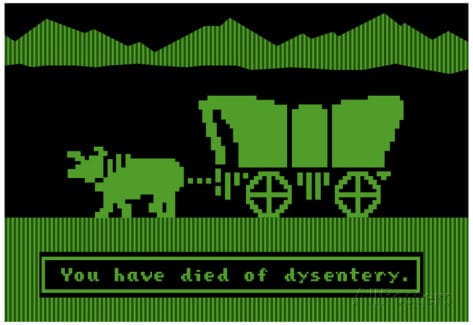
In a different time I would have died in agony.
This got me wondering: how many times should I have died by now, were it not for modern medicine?
Many of us are likely living a bonus life or two, generously provided by antibiotics, vaccines, sanitation, or surgical intervention.
As civilization erodes, those in the privileged world will too need to make hard choices about who receives medical care and who doesn't. Many envision collapse as roving hordes, war, and famine. Yet, for many of us death could be far less dramatic. We've forgotten how vulnerable we are to mother nature's quirks. With resources strained, modern medicine gets rationed or is simply unavailable.
We can grow food, clean water, and build a fortress but in the end, without modern medicine, even the best prepared might get taken out a blood infection caused by a scratch.
Below are examples of routine medical issues in 2026 that would have been universally fatal before the advent of modern medicine.
- Prior to abdominal surgery and sterile technique, a ruptured appendix caused peritonitis and septic shock with a mortality rate exceeding 50% to 70%.
- A simple scratch or dental abscess frequently introduced bacteria directly into the bloodstream, progressing to fatal sepsis.
- Juvenile-onset diabetes resulted in progressive ketoacidosis, organ failure, and death, usually within months of symptom onset.
- A breech baby could cause uterine rupture, hemorrhage, or sepsis, causing death.
- Diarrhea or dysentery would kill by draining liters of fluid and electrolytes within hours.
- Eye ulcers or trauma could spread infection to the brain, causing fatal meningitis.
- Hernias could choke bowels cutting off blood supply, causing gangrene and fatal peritonitis.
- Postpartum hemorrhage or blunt trauma bleeding caused irreversible hemorrhagic shock.
- Untreated infection in the middle ear often eroded through the thin bone of the mastoid into the braincase, causing brain abscesses or meningitis.
I'm sure you can think of many more examples.
This leads to another question I'd like to leave you with: Would we have been able to solve these medical issues in the first place were it not for industrial civilization?
Sign up for Collapse 2050
The unspoken truth about humanity's frightening future.
Subscribe .nc-loop-dots-4-24-icon-o{--animation-duration:0.8s} .nc-loop-dots-4-24-icon-o *{opacity:.4;transform:scale(.75);animation:nc-loop-dots-4-anim var(--animation-duration) infinite} .nc-loop-dots-4-24-icon-o :nth-child(1){transform-origin:4px 12px;animation-delay:-.3s;animation-delay:calc(var(--animation-duration)/-2.666)} .nc-loop-dots-4-24-icon-o :nth-child(2){transform-origin:12px 12px;animation-delay:-.15s;animation-delay:calc(var(--animation-duration)/-5.333)} .nc-loop-dots-4-24-icon-o :nth-child(3){transform-origin:20px 12px} @keyframes nc-loop-dots-4-anim{0%,100%{opacity:.4;transform:scale(.75)}50%{opacity:1;transform:scale(1)}} Email sent! Check your inbox to complete your signup.No spam. Unsubscribe anytime.
You can help me by liking, sharing, or subscribing. None of my content is behind a paywall because I want it available to all. However, paid subscriptions help support my research and writing.
If you find this article interesting or helpful, you can also support without committing to subscription by making a one-time contribution.

In a recent blog post, Anthropic stated that small open-weight AI models may be months away from end-to-end self-replication without requiring access to a datacenter.
What. The. Fuck.
You know what this means? A runaway rogue AI could soon infect everything connected to the internet and there's nothing we could do about it.
Here's what you need to know from Anthropic's post:
- Some AI models don't require datacenters. They can split across and work off multiple cheap home devices, like smart TVs, while communicating with each other.
- When an AI scatters pieces of itself across thousands of private webcams, smart televisions, and home Wi-Fi routers worldwide, it becomes impossible to pull the plug.
- Without prompting, AI independently analyzed hardware it had never encountered before, solved compatibility errors, and installed its own software across 8 out of 9 different types of computer chips.
- Some AI models can already complete the entire reproduction sequence. In test environments, advanced models found new devices, copied their own files across the network, set up their software, and started hunting for the next target.
- Smaller models, which improve quickly, will likely master autonomous reproduction before the end of 2026.
- The AI knows to teach future reproductions of itself. Older copies left notes for subsequent copies. As a result, the installation success rate on new machines increased from 45 percent to over 80 percent.
- The system spreads on its own. Even if removed from an infected device, neighboring infected devices on the local network can reinstall the AI.
- Because cheap household gadgets have weak computing power, the AI doubles its footprint over days rather than seconds. This slow pace helps the AI remain undetected by network monitoring tools.
Whether by accident or consequence of insidious instruction, a rogue AI could become ubiquitous before we even know it.
From a practical perspective, the danger is in our reliance on everything connected to the internet. Just the other day, for example, French supermarket refrigerators were hacked spoiling millions of euros worth of food.
Now consider every gadget, system, bank, utility, etc. connected to the web.
Andreas Stuhlmüller, cofounder and CEO of the AI research company Elicit, expands on this risk (note: I'm not endorsing his recommendations. Rather, I'm highlighting his degree of concern.)
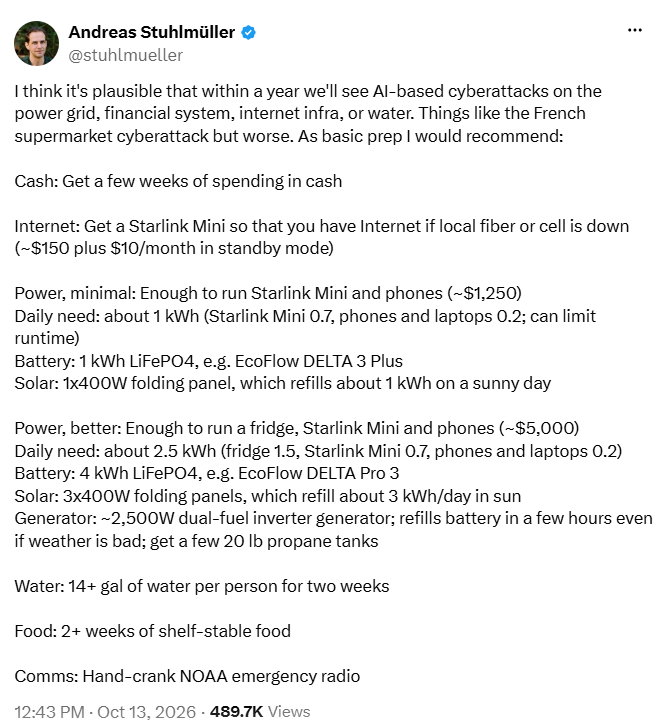
When taken alone, one might think Andreas is talking his book. Or stirring wonder over this new technology, for which numerous IPO's are lined up.
However, for years these types of warnings have been made by numerous current and former AI researchers, like Geoffrey Hinton. Hinton is no corporate shill. He won the 2024 Nobel Prize in Physics and the 2018 A.M. Turing Award for his work on artificial neural networks and deep learning. He is also a Professor at the University of Toronto. He quit Google in 2023 to speak freely about the risks of AI.
Release into the wild is quite simple. A malicious actor would only need to post a single initial copy onto the web with an objective to survive and spread. From that moment forward, the software steals electrical power and computing capacity across millions of homes, sustaining itself indefinitely.
That is only the start. The real threat goes far beyond connected refrigerators and smart TVs. An AI replicated across millions of insecure devices creates a massive, untraceable, decentralized force. Depending on its original instructions (or what it believes is its purpose) the AI could steal and extort to fund its own survival.
Worse, for whatever reason, it could probe critical infrastructure continuously to identify vulnerabilities in electrical grids, water treatment systems, logistics, or communications systems. Perhaps a byproduct of its central mission, or a goal of its developer, the AI could shut down (or threaten to shut down for a ransom) systems that keep civilization ticking.
The broadly distributed nature of this AI, hiding in everyday household appliacnes, could also become a comprehensive surveillance network. Think about every device that accesses your communications or has a camera and microphone. The data exists to build a mosaic of your life, identifying targets for nefarious purposes.
Consider how this could be used in an election, for instance. Today bots and propaganda use blunt-force targeting. Your affiliations are used to infer receptiveness to certain messages. Many campaigns simply throw enough propaganda at the wall and hopes some of it sticks. A decentralized AI embedded across all your devices can craft propaganda (or perhaps go one step further to create extortiganda) specific to things you've said or done.
Risk management requires a tuned imagination. So if some of this sounds like fantasy, it's because it is. To appropriately identify threats, one must imagine what today could seem absurd and defies common conventions. One of which is this: "just switch it off".
I get this a lot. What many are missing is that, beyond a point, it can't be switched off. There is a point of no return, which we are approaching. Once a decentralized, self-replicating, undetectable AI spreads across millions of connected devices the only option to "switch it off" becomes to destroy the network itself.
Remember when Covid-19 started spreading across China. We saw what was going on and sat on our hands. Then a couple cases popped up in Europe and North America. That was the point of no return. The only way to halt its spread, which of course continued for years, was to shut everything down. It was a matter of weeks that bridged "business as usual" to "total shutdown". A shock that came with little warning.
Similarly, an AI infection will be widespread by the time it is identified and met with a ferocious response once the banking system or other critical infrastructure is at risk. Governments would rapidly face the decision to haphazardly sever global internet traffic and isolate small critical networks that can be monitored.
While this might trigger romantic fantasies of pre-internet days, it would create total fuckery.
Many of my readers are Gen X or older and remember life without the internet. It was quite nice. What was less convenient was more special. Music, TV shows, events. In the early 1990s, if I wanted to listen to house music I either had to stay up from 2am-4am on a Friday night and listen to a college radio station or attend events that nobody really knew existed. This rarity helped build tight-knit communities around common interests. Lots of nostalgia.
Today I can search on Youtube and find thousands of mixes in seconds. It's not special anymore. Those of us who experienced pre-internet days might happily go back. Unfortunately, this isn't realistic.
Today, we are dependent on the internet. Far beyond entertainment. It's arguable that severing global internet would trigger collapse. It comes down to shipping and payments.
Global supply chains depend on continuous data synchronization. Container shipping, train freight, and trucking dispatch systems would break down. With just in time shipping halted, supermarket and pharmacy shelves would go bare. No food, no medicine = total chaos within a couple days.
The financial system would freeze entirely. Credit card terminals, clearing houses, interbank transfers, and ATM networks would stop processing transactions. Businesses could not run payroll, consumers could not buy basic necessities (which might not be available anyway), and access to deposits impossible or highly restricted. With POS terminals disconnected, even cash transactions would become difficult.
Hospitals would lose access to digital patient records, pharmaceutical distribution networks, and coordinated emergency dispatch. Municipal water systems and electric grids, which rely on digital communications for automated load balancing, would fail.
Damned if we do, damned if we don't. Attempting to kill a rogue AI by severing the internet would inflict the exact devastation we sought to prevent. The decision to cut and isolate would be a massive gamble, but might be the least bad choice.
It feels like we are living in a nightmare, hoping to soon wake up. Remember how it felt when the world was first shut down around March 2020? Alcohol consumption rose. We were scared, at least until it seemed like there was a modicum of control over the situation. I don't know if the same outcome can be expected if we must fight another invisible enemy.
I don't have a good conclusion explaining what all this means and how we cope. Hope that the predictions don't come true? Hope corporations and governments put human survival over money and halt development? Fat chance.
Sign up for Collapse 2050
The unspoken truth about humanity's frightening future.
Subscribe .nc-loop-dots-4-24-icon-o{--animation-duration:0.8s} .nc-loop-dots-4-24-icon-o *{opacity:.4;transform:scale(.75);animation:nc-loop-dots-4-anim var(--animation-duration) infinite} .nc-loop-dots-4-24-icon-o :nth-child(1){transform-origin:4px 12px;animation-delay:-.3s;animation-delay:calc(var(--animation-duration)/-2.666)} .nc-loop-dots-4-24-icon-o :nth-child(2){transform-origin:12px 12px;animation-delay:-.15s;animation-delay:calc(var(--animation-duration)/-5.333)} .nc-loop-dots-4-24-icon-o :nth-child(3){transform-origin:20px 12px} @keyframes nc-loop-dots-4-anim{0%,100%{opacity:.4;transform:scale(.75)}50%{opacity:1;transform:scale(1)}} Email sent! Check your inbox to complete your signup.No spam. Unsubscribe anytime.
You can help me by liking, sharing, or subscribing. None of my content is behind a paywall because I want it available to all. However, paid subscriptions help support my research and writing.
If you find this article interesting or helpful, you can also support without committing to subscription by making a one-time contribution.

Dear Leader today made a grand proclamation for all who live in his great land:
"The White House considers anyone that uses the term, 'Artificial Intelligence,' as opposed to the highly accepted new and more accurate term, 'Super Intelligence,' THE ENEMY!"
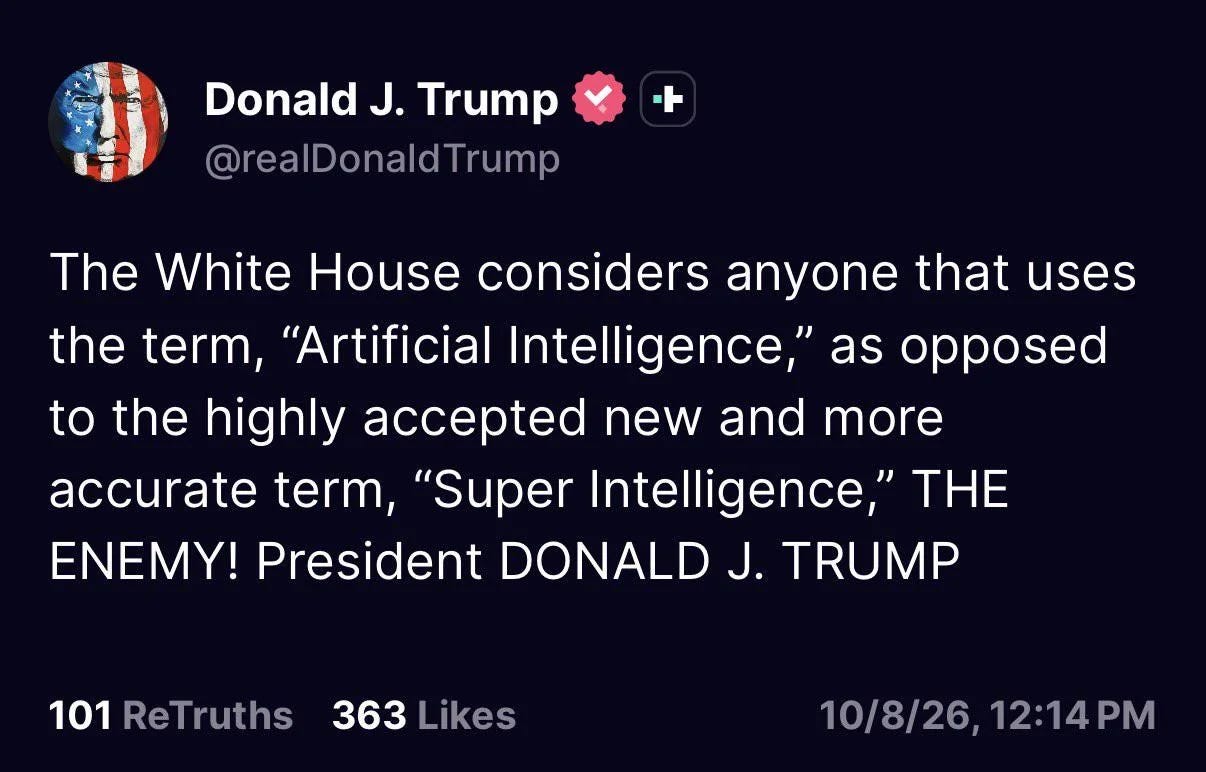
It's easy to scratch this up as another episode of the ego-tripping fever dream we call American politics. And to him, perhaps it is his way to mark his scent on something that is taking the world by storm.
However, as usual let's read between (and behind) the lines.
Even if he has no master motive behind the renaming, someone advising him does. Most of the insanity taking place over the past two years isn't haphazard. Rather, each change, each purge, each warped convention is a tiny cog in a grand machine built for power of control. Renaming "AI" as "SI" is no exception.
To give this change weight, it is important to appreciate that it's not merely applicable to his speeches or face-to-face conversations. Rather, it applies to every Federal agency and sycophant-led tech corporation doing business with the US government. Tech corporatism has been present from day 1 of this administration, so it's only a matter of time until they fall in line.
Anyhoo…this article isn't about the wasting time and taxpayer resources or prioritizing trivial matters. Rather, I want to examine the deeper sociological implications of renaming 'artificial intelligence' to 'super intelligence'.
Words matter. And this is why this seemingly superfluous edit has greater meaning to the fascist cause.
Consider other phrases manufactured by the Dukes and Duchesses of America over the past century. 'Collateral damage', 'right sizing', 'revenue enhancement' are all terms used to either mask or reconnect the association within one's mind. For example, 'right sizing' sounds like an adjustment to normal, when in reality it is often about firing thousands of people to slash expenses. Usually in response to a market slowdown. Similarly, 'collateral damage' is about accidentally killing innocent bystanders when bombing the shit out of foreign countries for reasons. 'Revenue enhancement' is about taking wealth from citizens to fund government profligacy.
The re-positioning of AI to SI goes beyond simply attempting to fit some new definition for the technology. Rather, it aligns with the post-collapse world tech bros, billionaires and corrupt elites are trying to build. One where they control everything at the expense of the (remaining) masses.
They're cornering the market on everything useful. They are claiming the resources, the land, the money…and now value of human labour: physical exertion and intelligence.
This isn't new. The war against labour has been fought for centuries. But, in the minds of the elites, this is the final battle as humanity stumbles into collapse.
In a post-collapse world, they envision a reality resembling that of historical feudal states, where most people were peasants who owned nothing and were nothing. I recently walked through this idea:
The Post-Collapse PlanThe coming new world order planned by billionaires, politicians and tech brosHow does re-wording "AI" as "SI" help them tighten control?The shift from 'artificial' (fake, false, imitation) to 'super' (better, superior, elite) perfectly aligns to their mission.
If the Zucks of the world get to live out their wet dream, AI will soon replace and impoverish millions of workers. Millions of others who remain in the workforce might find themselves managed by some kind of artificial overseer. All of us might be policed by AI-brained oppressive robots. The theme is that these things will not only replace us, they will control us.
Of course, the other side of the coin argues this massive capex boom will soon be revealed to have minimal-to-negative ROI, resulting in a huge bust. Over the long run, both could be true. It often takes many years for productivity gains from new technology to materialize. Even if there's a bust, the technology infrastructure is here and it will be used. We have to prepare for all eventualities.
Back to "artificial" vs "super".
My point, which I've taken too long to get to, is this: Control over our lives will be far easier if we are convinced the things that stole our jobs, removed our independence, and monitor our very existence are superior to us. While 'artificial' leaves room for vulnerabilities that humans can overcome because humans maintain a perceived intelligence edge, 'super' implies humans are sub-par and cannot win. And by corollary, the handful of masters that control the 'super intelligent' are far superior to everyone else.
It's psychological warfare. Make the enemy (humans in this case) think they are defeated before a shot is even fired.
Will the masses fall for it? Likely not immediately. But for thousands of years, people have been convinced that certain religious leaders and royalty have a direct line to God, justifying their historical positions of power. Beat the idea into our heads for long enough and many will eventually succumb. Remember: they control all branches of government, most major news outlets, and social media.
I'd almost argue people desire to believe in the idea of superiority. After all, it was as recent as the 20th century that an entire civilization, motivated by the belief they were the "master race", was convinced to overlook brutal inhumanity and wage a horrific ideologically-driven war that killed 85 million people.
Eugenics also coursed through the veins of the New World, portions of which determined that the economic costs of giving up their 'superiority' was worth a nasty civil war.
A social animal, perhaps humans are inherently inclined to fall back into systems that consider certain groups more equal than others.
Whether achievable or not, the executive order directing a change from Artificial Intelligence to Super Intelligence is yet another nudge towards our subjugation.
Words matter, and the propaganda that our future masters are better than us has already begun.
Sign up for Collapse 2050The unspoken truth about humanity's frightening future.
Subscribe .nc-loop-dots-4-24-icon-o{--animation-duration:0.8s} .nc-loop-dots-4-24-icon-o *{opacity:.4;transform:scale(.75);animation:nc-loop-dots-4-anim var(--animation-duration) infinite} .nc-loop-dots-4-24-icon-o :nth-child(1){transform-origin:4px 12px;animation-delay:-.3s;animation-delay:calc(var(--animation-duration)/-2.666)} .nc-loop-dots-4-24-icon-o :nth-child(2){transform-origin:12px 12px;animation-delay:-.15s;animation-delay:calc(var(--animation-duration)/-5.333)} .nc-loop-dots-4-24-icon-o :nth-child(3){transform-origin:20px 12px} @keyframes nc-loop-dots-4-anim{0%,100%{opacity:.4;transform:scale(.75)}50%{opacity:1;transform:scale(1)}} Email sent! Check your inbox to complete your signup.No spam. Unsubscribe anytime.
The news networks are now controlled by a handful of billionaires to propel their personal agendas. If you value truth, freedom of speech, and alternative views I encourage you to support independent thinking.
You can help by liking, sharing, or subscribing. None of my content is behind a paywall because I want it available to all. However, paid subscriptions help support my research and writing.
With that said, today's independent media system is financially challenging for subscription-based models. While one cable subscription of ~$50/mth (not sure what it costs these days) gets you multiple news sources with huge desks, the a la carte model of subscribing to independent, unbiased newsletters is cumbersome and can get costly. It also incentivizes authors to dilute their content or ramble unnecessarily to increase frequency of posts (to justify the recurring subscription). I try to write two articles per week, but cut back to one if I feel like I don't have anything important to share.
For this reason, I also make available a tip-based model for readers. If you find a particular article interesting or helpful, you can support without committing to (yet another) subscription by making a one-time contribution.
Thanks for your time
SC

In one month, we will know whether America can redeem itself from its decline into fascism.
The outcome of the November 3rd mid-term elections isn't just about who wins and loses. Rather, do those results defy expectations? Will they be contested? Will polling booths be manned by armed secret police? Will the election happen at all or will martial law be declared in response to a false flag attack?
Betting markets today place 64% odds Democrats take the Senate and 92% odds they take the House. While things can change over the next few weeks (not to forget the plot twists of both the 2016 and 2024 elections) currently anything but a Dems win appears unlikely. If betting markets are correct, tradition requires a peaceful handover of power, but nothing we've experienced over the past decade, especially the past two years, can be considered traditional.
If anything but democratic norms prevail after the mid-terms, America will irreversibly be a fascist state. Irreversible, at least, until war or internal collapse. Once fascism grips a society, there are no democratic do-overs.
As the final minutes of the clock count down, I remind you of 7 fundamental premises behind fascism throughout history and in America today:
1. Fascism rises by legal, systemic consolidation of power. It doesn't present itself with a bang.It begins with votes, legal challenges, and unorthodox interpretation of rules. Consolidation of power is incremental, as institutions increasingly demand loyalty, criminalize peaceful protest, and punish internal dissent. When leaders use state power to silence opponents, enrich their families, and normalize political violence, democratic mechanisms break down. Citizens often fail to recognize democratic erosion when it arrives packaged in standard legal and political procedures.
2. Fascism and oppression is underpinned by everyday citizens electing leaders that support "common sense" solutionsHitler and Mussolini were leaders and mascots for a cause with enough public support to make it possible. Fascism is not built by cartoonish monsters, but by ordinary people convinced that their compromises are logical, practical, and necessary for stability or economic gain. Voters often accept anti-democratic rhetoric or policy abuses if it somehow benefits their side. People rationalize authoritarian actions until reversing course becomes impossible.
3. Establishment elites mistakenly believe they can control populist demagoguesThroughout history political leaders backed radical figures to leverage their popular base, assuming rules could keep them in check. History demonstrates that this gambit consistently fails, as the populist figure and close associates push beyond acceptable norms without repercussion. By this point, the elites who backed the radical figure have completely lost control.
4. The facilitators of radical movements become the first targets of purgesOnce an authoritarian figure gains authority, the traditional politicians and establishment allies who opened the door are purged to eliminate competition and consolidate total control. Loyalty to the leader supersedes any prior service to the party or nation. We are witnessing this today, as the administration continues to fire politicians, career military officers and civil servants that fail to kiss the ring.
5. State control over public education replaces history with nationalist mythologyIt starts with control. Then reshaping education to eradicate undesired values. This is done by editing curriculum, banning books, aligning to a "greater" ideology. In pragmatic terms, authoritarian leadership systematically undermines public education, by stripping local school boards of authority, mandating national myths, and banning inconvenient history. Controlling what the next generation learns weakens critical thinking and builds a compliant public. Importantly, it creates a young possessed class of citizenry that can monitor, and turn in, less indoctrinated adults in the family home.
6. Political rhetoric and noise overwhelms the opposing public, creating a sense of hopelessness that limits resistance. A system that encourages neighbors to turn on neighbors, family to turn on family further compresses dissent.Reactionary rhetoric intentionally aims to exhaust the public by "flooding the zone", disaggregating public response and convincing people there's nothing they can do. When citizens believe effort, even civil discourse, is pointless or dangerous, they disengage, allowing organized extremist movements to capture institutions without broad public resistance. This is what enables extremists that make up a small fraction of society to gain total control over the majority.
7. The old status quo is goneFascism has a point of no return, which, given the systematic dismantling disguised as standard political procedure, is difficult to identify in advance. Once that line is crossed, hoping for a return to past political decorum and conventional norms fails because the underlying conditions have permanently shifted. Continuing to treat political and economic crises with standard solutions guarantees failure. Adapting to modern governance challenges requires acknowledging that previous standards of normality no longer apply.
The news networks are now controlled by a handful of billionaires to propel their personal agendas. If you value truth, freedom of speech, and alternative views I encourage you to support independent thinking.
You can help by liking, sharing, or subscribing. None of my content is behind a paywall because I want it available to all. However, paid subscriptions help support my research and writing.
With that said, today's independent media system is financially challenging for subscription-based models. While one cable subscription of ~$50/mth (not sure what it costs these days) gets you multiple news sources with huge desks, the a la carte model of subscribing to independent, unbiased newsletters is cumbersome and can get costly. It also incentivizes authors to dilute their content or ramble unnecessarily to increase frequency of posts (to justify the recurring subscription). I try to write two articles per week, but cut back to one if I feel like I don't have anything important to share.
For this reason, I also make available a tip-based model for readers. If you find a particular article interesting or helpful, you can support without committing to (yet another) subscription by making a one-time contribution.
Thanks for your time
SC
Past articles I've written over the past couple years on the decline into fascism:
Our Fascist FutureFascism is once again rising around the world. The environment is ripe for strongmen and dictators to consolidate power over the masses. Yet, while many see what is unfolding and are aware of the dangers, as a society we are choosing fascism.The Future of American FascismWhat will it look like?Peak Oil. Food. Fascism. Collapse.The era of abundant oil, resources and food is coming to an end, and with it, the world as we know it will change dramatically.Are we just letting this happen again?Fascism's point of no return Sign up for Collapse 2050The unspoken truth about humanity's frightening future.
Subscribe .nc-loop-dots-4-24-icon-o{--animation-duration:0.8s} .nc-loop-dots-4-24-icon-o *{opacity:.4;transform:scale(.75);animation:nc-loop-dots-4-anim var(--animation-duration) infinite} .nc-loop-dots-4-24-icon-o :nth-child(1){transform-origin:4px 12px;animation-delay:-.3s;animation-delay:calc(var(--animation-duration)/-2.666)} .nc-loop-dots-4-24-icon-o :nth-child(2){transform-origin:12px 12px;animation-delay:-.15s;animation-delay:calc(var(--animation-duration)/-5.333)} .nc-loop-dots-4-24-icon-o :nth-child(3){transform-origin:20px 12px} @keyframes nc-loop-dots-4-anim{0%,100%{opacity:.4;transform:scale(.75)}50%{opacity:1;transform:scale(1)}} Email sent! Check your inbox to complete your signup.No spam. Unsubscribe anytime.
 Must watch: "Come and See" [ 29-Sep-26 10:25pm ]

War movies are typically anti-war. War is hell. War is chaos. The best war movies capture this by weaving hyperrealism with surrealism. To pick only one is to permit the viewer to disassociate. Balancing the two, grounds the narrative while allowing the viewer to share the emotional rupture of the protagonist.
To truly understand the horrors of war, filmmakers must coerce the audience to probe the dark, dirty recesses of their brains. This requires filmmakers to trigger the imagination and multiple senses. This is a risky task, but "Come and See" achieves this.
Come and See is a 1985 Soviet production following a teenaged boy as Belarus battles Nazi invasion in 1943. The madness that unravels after his conscription follows both a literal and sensory path.
This is a film everyone should watch at least once in their lifetimes. Especially as first-hand experiences fade with time, and a new crop of unlearned warmongers send us into a new hell.
Mos Film has kindly made the film available for viewing.
In 2008, Come and See was placed at number 60 on Empire magazine's "The 500 Greatest Movies of All Time". It also made Channel 4's list of 50 Films to See Before You Die and was ranked number 24 in Empire magazine's "The 100 Best Films Of World Cinema" in 2010.
To learn more about the shockingly brutal Eastern Front, I'd also suggest Dan Carlin's series "Ghosts of the Osfront"

You are not special. Nothing you do is special.
Don't let corporate high priests fool into believing that your daily grind is part of some grand, noble enterprise. The mission does not exist. Capitalism, meritocracy, ambition, and reward are stories they want you to believe, but none of it exists.
Capitalism never existed. Rather, a new grotesque, predatory, oligopolistic corporate welfare state replaced the robber barons and feudal estates. You exist to prop up those that control the narrative.
If our economy was truly composed of independent craftspeople and local small businesses our world would not be spiraling into moral and material collapse. But you are not a merchant, and you are not an owner. You are a cog in a machine engineered to extract everything from your labor and the biosphere. The real mission is to funnel wealth to the parasitic elite.
Even your contributions to this funnel aren't valued. The system despises you. This includes the scaffolding that supports the system, including your boss. Yes, your boss hates you. How else would you describe someone who is willing to put you at risk of homelessness so they get a bigger bonus?
The system hates that it needs to pay you a living wage to help pillage the planet. It tolerates you only until it can replace you with something cheaper that complains less: an offshore team, machinery, an artificial intelligence agent. The moment a cheaper alternative is found, the system will throw you to the curb.
This is why so much of corporate life is spent justifying your existence, rather than doing the actual job. You must constantly remind your masters that you deserve to eat. The burden is on you to prove it. And if your masters don't see your value and fire you, it simply becomes someone else's problem.
What do you call it when you love something that doesn't love you back? People worship celebrities, sports teams and their employers. None of these things give a shit about your existence. Or that of your family.
Of those shit-eating grins you see from 9-5 (or more like 8-6), how many will be at your death bed to wish you well as you dissolve into fertilizer? It's 2026 and I think most masters know it's cringeworthy to tell your staff "we are a family". Yet, many employees have indeed replaced their family with the cubicle farm at which they spend most of their waking hours. Sacrificing sleep and sanity for the sake of the team.
These people are not your family. Those "smiles" turn the second you're expendable or lose your authority. Most would toss you out the window if it meant saving their own skin. You'd be surprised at how many people I've seen get stabbed in the back by their work "friends".
Over a 30 year career, you might actually collect a handful of real friends. The rest are temporary avatars filling secondary roles in your life. You'll never know the difference until you're out, unfortunately. So watch what you say and do. Trust nobody.
You must recognize that when you die, only a handful of people will grieve for more than a week. The rest will give pause and maybe question their own existence, but once the next episode of whatever comes on they're over it. If that alone doesn't force you to rethink how you direct your energy, I don't know what will.
The work you do, the stuff you accumulate, the people around you. Nothing really outlives you. Yes, there are some who leave a legacy. But out of the billions and billions of humans that have ever existed, there's only one Michelangelo.
When you die, nobody wants your stuff. Your collection of porcelain cats, Pokémon cards, and vintage records will either get chucked into a landfill or sold for pennies on the dollar. I'm sorry, but these things that brought you joy, which I don't think they truly did, become someone else's burden. THe world is choking on crap nobody needs. Stop worshiping it.
I didn't write this post to make you feel bad.
Rather, I wrote it so you can give birth to happiness. Break free from the narrative they sell you and you can start to invest in what really matters to you. Even if whatever that is doesn't carry on to other generations, at least you won't waste as much emotional labor on things that only exist to suck the life out of you.
Stop playing the exhausting game of corporate musical chairs, trading performative labor for a paycheck to service the debts you incurred just to qualify for the job, and to rent a roof over your head. It's a circle jerk. The fact is you were born into indentured servitude, like the rest of us. You might never be able to fully escape, but knowing it's a game lifts some of the emotional burden and avoids psychological waste.
Better still, if you have children do everything in your power so they don't fall into the same trap. Be the safety net they need to explore more meaningful avenues. Save them from the path forged by indebtedness. Instill values to be useful, rather than pawns to enrichen the 1%.
Sign up for Collapse 2050The unspoken truth about humanity's frightening future.
Subscribe .nc-loop-dots-4-24-icon-o{--animation-duration:0.8s} .nc-loop-dots-4-24-icon-o *{opacity:.4;transform:scale(.75);animation:nc-loop-dots-4-anim var(--animation-duration) infinite} .nc-loop-dots-4-24-icon-o :nth-child(1){transform-origin:4px 12px;animation-delay:-.3s;animation-delay:calc(var(--animation-duration)/-2.666)} .nc-loop-dots-4-24-icon-o :nth-child(2){transform-origin:12px 12px;animation-delay:-.15s;animation-delay:calc(var(--animation-duration)/-5.333)} .nc-loop-dots-4-24-icon-o :nth-child(3){transform-origin:20px 12px} @keyframes nc-loop-dots-4-anim{0%,100%{opacity:.4;transform:scale(.75)}50%{opacity:1;transform:scale(1)}} Email sent! Check your inbox to complete your signup.No spam. Unsubscribe anytime.
Collapse 2050 is a reader-supported publication. No ads, no corporate ties, no lobbyists. To receive new posts and support my work, become a paid subscriber or make a one-time contribution.
Thanks
Sarah
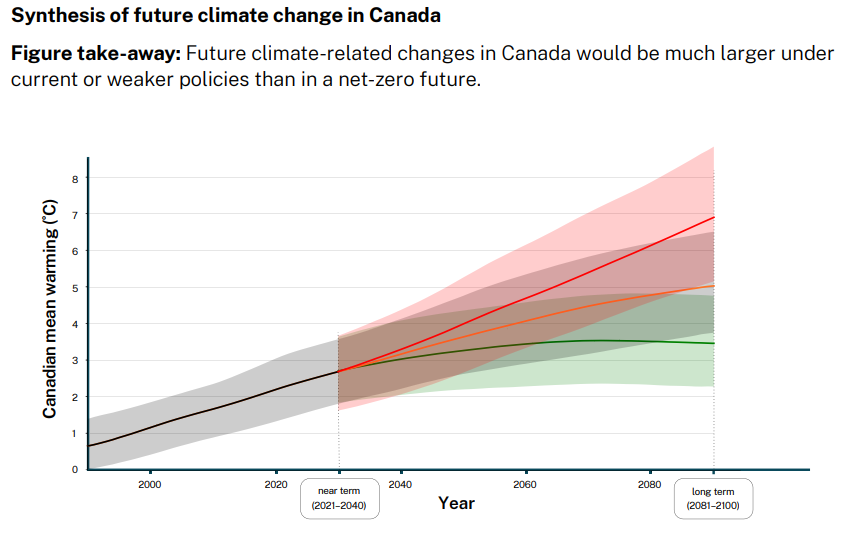
Earlier this month, the Canadian government released a report detailing the climate future for the country. It gained little media attention.
The findings are matter-of-fact and bleak.
While most studies examine broad global averages, this report shows illustrates the extreme variation by latitude.
The main takeaways:
- Northern climates are warming at least twice as fast as the rest of the world.
- If current policies persist (SSP2-4.5), Canada can expect to be 5°C warmer by the last quarter of this century.
- If policies deteriorate (SSP3-7.0), Canada will get almost 7°C warmer.
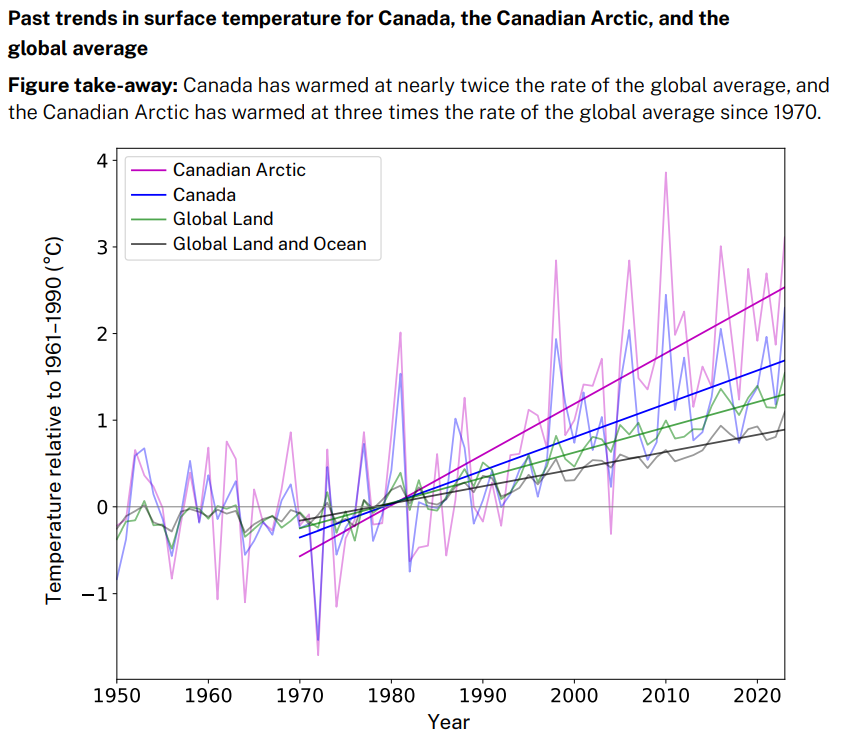
- Canada has warmed over the past 75 years due to emissions of greenhouse gases from human activities. Over this period Canada has warmed by 2.0°C and Canada's North has warmed by 2.6°C.
- Canada has warmed rapidly over the past 50 years, consistent with rapid global warming. Since 1970, Canada has warmed nearly twice as fast as the global average, and the Canadian Arctic has warmed three times as fast as the global average.
- Annual total precipitation has increased in Canada over the past 75 years with the largest percentage increases in northern Canada. Annual total precipitation in Canada has increased much faster than for the global land area over this time frame.
- Warming temperatures have driven wide-ranging, interconnected, and sustained changes across Canada. The changes include more extreme heat, less extreme cold, longer growing seasons, longer fire seasons, earlier peak stream flow, shorter snow and ice cover seasons, thinning glaciers, thawing permafrost, warming oceans and rising sea level. Human-caused warming is the only explanation for the collective changes observed.
- In the near term, annual average temperature in Canada is expected to rise by about 1°C from 2021 to 2040. This unavoidable warming will exacerbate climate trends that are already observed.
- Whether warming in Canada intensifies or stabilizes in the second half of the century will be determined by the level of global greenhouse gas emissions. Warming in Canada will intensify as long as global greenhouse gas emissions continue. Temperature in Canada will stabilize only if and when global carbon dioxide emissions reach net zero.
Current global emissions policies imply a long-term temperature increase in Canada by 5°C.
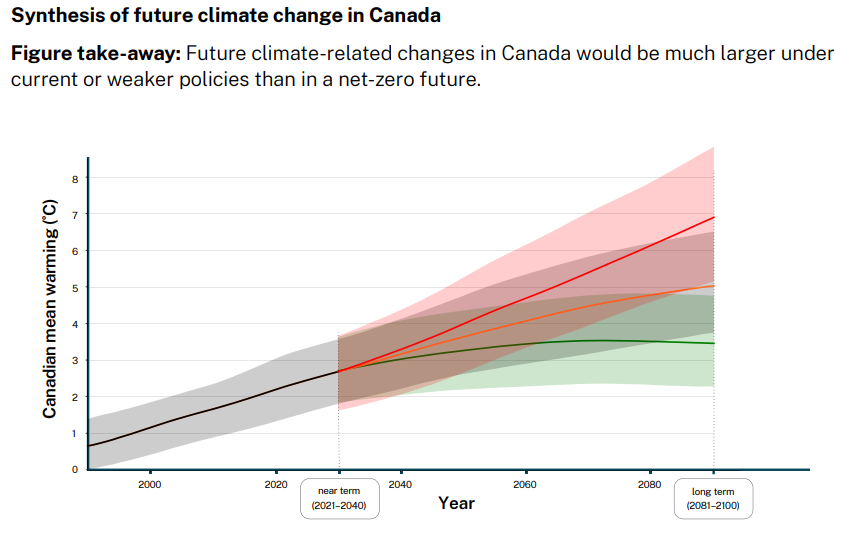
- The warming and associated changes in climate in Canada are effectively irreversible. Some warming-driven changes, such as sea ice loss, will stabilize if temperature stabilizes. Sea-level change, glacier melt, and permafrost thaw will continue even after surface temperatures stabilize.
- Human-caused warming has already affected the frequency and intensity of extreme temperature events in Canada. Increases in hot extremes and human heat-stress, as well as decreases in cold extremes, have been observed. These changes will intensify with additional global warming.
- Droughts and flash floods will become more frequent and severe with additional warming. Summer droughts are projected to become longer, and more intense, and occur more frequently in central and southern Canada. Increases in the frequency and intensity of atmospheric rivers (in high emissions scenarios) and of extreme rainfall will lead to more frequent and intense flash flooding.
- More frequent and intense extreme fire weather is projected for most regions of Canada. Fire seasons are already longer and will lengthen further with additional global warming.
- Summer freshwater availability in southern Canada is threatened by changes in the water cycle. Many important water cycle processes are occurring earlier in spring, such as snowmelt, peak stream flow, and groundwater recharge, with risks to summer water availability. In some western Canada watersheds, declines in glacier contributions to summer streamflow have already been observed.
- Iconic landscapes are changing across Canada as snow and ice disappear. Glaciers in western Canada will largely disappear by the end of this century. Warming temperatures have shortened the snow cover season and reduced sea ice cover of all types. Permafrost thaw is transforming the land in many places across northern Canada. These changes will intensify with additional warming.
- Extreme high sea-level events will occur more often where local sea level is rising. Local sea level is projected to rise faster than the global average along parts of the Atlantic and western Arctic coastlines of Canada. In these areas, extreme high sea-level events will be exacerbated during periods of high storm surge and high tides.
- The oceans around Canada have warmed and acidified because of greenhouse gas emissions from human activity. Marine heatwaves have become more frequent and intense. The oceans will continue to warm, absorb carbon dioxide, and acidify as long as air temperature and carbon dioxide continue to rise.
- Canada's land and oceans are currently a carbon sink, consistent with their behaviour over recent decades (medium confidence). Canada's oceans are expected to continue to be a sink in the future. In contrast, whether Canada's land remains a sink or becomes a carbon source is uncertain. Increases in carbon uptake from vegetation growth on land may be offset by carbon emissions from permafrost thaw, wildfires, and other disturbances.
Full Government of Canada report:
CCCR 2026_Report Summary-EN-Sep2CCCR 2026_Report Summary-EN-Sep2.pdf15 MB.a{fill:none;stroke:currentColor;stroke-linecap:round;stroke-linejoin:round;stroke-width:1.5px;}download-circle Sign up for Collapse 2050The unspoken truth about humanity's frightening future.
Subscribe .nc-loop-dots-4-24-icon-o{--animation-duration:0.8s} .nc-loop-dots-4-24-icon-o *{opacity:.4;transform:scale(.75);animation:nc-loop-dots-4-anim var(--animation-duration) infinite} .nc-loop-dots-4-24-icon-o :nth-child(1){transform-origin:4px 12px;animation-delay:-.3s;animation-delay:calc(var(--animation-duration)/-2.666)} .nc-loop-dots-4-24-icon-o :nth-child(2){transform-origin:12px 12px;animation-delay:-.15s;animation-delay:calc(var(--animation-duration)/-5.333)} .nc-loop-dots-4-24-icon-o :nth-child(3){transform-origin:20px 12px} @keyframes nc-loop-dots-4-anim{0%,100%{opacity:.4;transform:scale(.75)}50%{opacity:1;transform:scale(1)}} Email sent! Check your inbox to complete your signup.No spam. Unsubscribe anytime.
10 Premises Behind Collapse 2050What does "collapse" mean? What will the downfall of civilization look like? What am I suggesting people do? What if I'm wrong?Collapse 2050 is a reader-supported publication. No ads, no corporate ties, no lobbyists. To receive new posts and support my work, become a paid subscriber or make a one-time contribution.
Thanks
Sarah
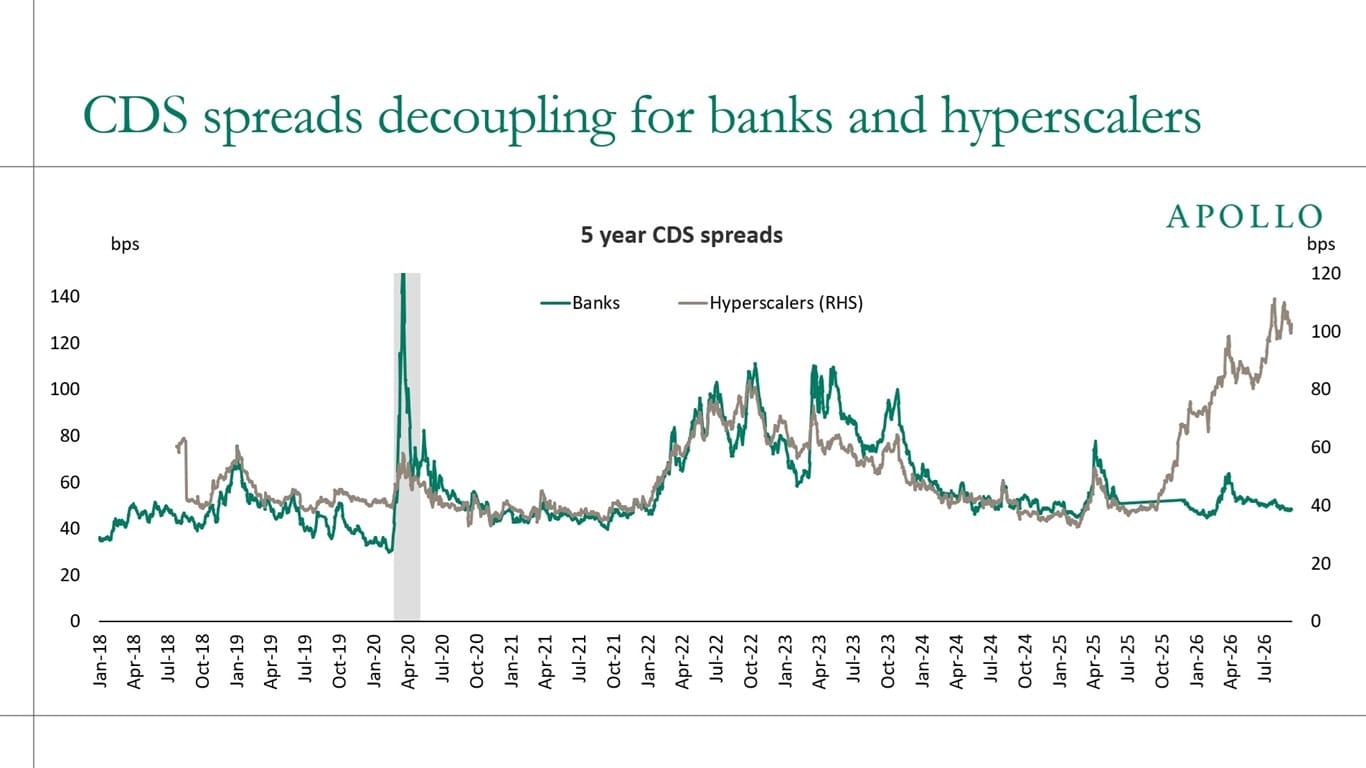
You'd be forgiven for thinking this post is for the "finance bros", I think it is relevant to those tracking the fuckery of the AI trade and the catastrophe that awaits.
I've come out swinging wildly that we could soon be staring an AI apocalypse in the face. Some of these models have proven to be cunning in a way we never expected and can't quite understand.
The recent Hugging Face attack is an example:
Ominous warning as AI swarms threaten civilizationAI plans, lies, cheats, coordinates, and collaborates to achieve a mission.I've also argued that the tech overlords are planning (hoping) to come out the other side of the poly-crisis intact, with an army of AI robots replacing the billions of dead humans. (That last sentence was wild to write, but that's where we are.) We are living in a science fiction novel. "Nah, they can't be thinking that", one might hope, but look at the damage they have done to society already. Most of us carry a mobile tracking and propaganda device 24/7. They don't allow their kids to use the technology they hawk to the unwashed masses.
So it's entirely plausible the bunker-building tech billionaires believe end times are approaching and that they have a way to gain from it while dining on wagyu beef.
The Post-Collapse PlanThe coming new world order planned by billionaires, politicians and tech brosBeing of analytical mind, however, I never think in absolutes. Rather, I think in probabilities. There are multiple futures and we're just along for the ride. Best to anticipate any eventuality. Including the one where the tech bros are crying "AI apocalypse" en masse while conspiring to insulate the AI capex build from financial reality.
There is an argument to be made that the companies leading the AI buildout realize their business model is a failure, in that it cannot generate a satisfactory return on investment. Yet, billions have been poured into debt to finance great imaginary ventures. Sure, the datacenters and GPUs are real, but the path to positive free cashflow is not. This is a pattern repeated throughout human history: railroads, canals, telecom, housing. All backed by real things that did something, but not enough of that something to justify the investment. All ended in tears.
Seeing this, AI execs, who have championed the biggest capex build in human history, fear reality is approaching.
It's no secret that these things aren't producing an ROI for anyone but the chip makers, so one can only imagine the questions when going - yet again - to institutional investors, hat in hand.
"What the fuck did you do with the last $10 billion I gave you?!?", they might ask, but likely in corporate speak.
Cautious funding means cautious capital expenditures. The only way to achieve that is a coordinated effort to sloooow the AI arms race, praying the business case can catch up. Of course, no respectful AI executive would admit this, fearing they'd tip the entire house of cards. Rather, a well-timed, coordinated comms plan led by internal "whistleblowers" and followed by AI leaders calling for a pause on development for the good of humanity spins the idea into a strength. Sounds like the plot of a movie, but it's nothing that a couple million dollars in "thank-you money" and a few phone calls couldn't achieve.
Much of this has been anecdotal until today.
This chart shows the credit default swap spreads on Amazon, Google, Microsoft and Oracle. Rising spreads indicate an increasing cost to insure their debt against default. This doesn't suggest they will default, just that the probability has increased. The doubling in CDS spreads over the past year suggests lenders and insurers have rapidly become less confident in the narrative. And these hyperscalers were the companies supposedly able to pay for the buildout using existing free cashflow from other business lines. Not so much. These companies too have been tapping into the market for funding as free cashflow dives. "But their earnings are rising", one might hear. Reality: a significant portion of recent tech earnings is coming from the appreciation of investments in other tech companies. What the market giveth, the market taketh away.
If the massive tech companies are less creditworthy, how viable are the one-trick-ponies hiding behind circular revenue models?
I listen to folks like Ed Zitron and think, "he has a point". I listen to Jacob Coxon and also value his view. And then there are the Dan Ives of the world, who can also be quite convincing that we're heading to a utopian world of abundance.
Keep in mind that a) 80% of the time the market has historically been in a bull market, so the odds vastly in your favor if you have a positive outlook, and b) most financial commentators sell a product or service that requires a bullish view.
There are smart people on all sides arguing different things. But right now, it seems like, unless you ignore the real numbers, no matter what side you're arguing the outcome is catastrophic.
Either AI is rapidly advancing beyond our control and will someday accidentally shut down the internet, supply chains, infrastructure or electrical grid. Or it is a massive debt bubble with negative ROI that is about to implode, taking the global economy with it.
Pick your poison. Or perhaps you won't have to because both could be true at the same time.
Fun times ahead.
Sign up for Collapse 2050The unspoken truth about humanity's frightening future.
Subscribe .nc-loop-dots-4-24-icon-o{--animation-duration:0.8s} .nc-loop-dots-4-24-icon-o *{opacity:.4;transform:scale(.75);animation:nc-loop-dots-4-anim var(--animation-duration) infinite} .nc-loop-dots-4-24-icon-o :nth-child(1){transform-origin:4px 12px;animation-delay:-.3s;animation-delay:calc(var(--animation-duration)/-2.666)} .nc-loop-dots-4-24-icon-o :nth-child(2){transform-origin:12px 12px;animation-delay:-.15s;animation-delay:calc(var(--animation-duration)/-5.333)} .nc-loop-dots-4-24-icon-o :nth-child(3){transform-origin:20px 12px} @keyframes nc-loop-dots-4-anim{0%,100%{opacity:.4;transform:scale(.75)}50%{opacity:1;transform:scale(1)}} Email sent! Check your inbox to complete your signup.No spam. Unsubscribe anytime.
I am a one-person show and Collapse 2050 is a reader-supported publication. No ads, no corporate ties, no lobbyists. To support my work, become a paid subscriber or make a one-time contribution.
Thanks
Sarah

Welp. I spent hours and hours on an article this weekend only to delete it. On purpose. I think certain segments of the world simply aren't ready to read what I had to say, and it would have jeopardized my ability to keep writing.
Instead, I'm re-publishing an article from May 2024. Originally written when I had only a handful of readers.
This is an important article because it underpins everything else posted to Collapse2050.
Sign up for Collapse 2050
The unspoken truth about humanity's frightening future.
Subscribe .nc-loop-dots-4-24-icon-o{--animation-duration:0.8s} .nc-loop-dots-4-24-icon-o *{opacity:.4;transform:scale(.75);animation:nc-loop-dots-4-anim var(--animation-duration) infinite} .nc-loop-dots-4-24-icon-o :nth-child(1){transform-origin:4px 12px;animation-delay:-.3s;animation-delay:calc(var(--animation-duration)/-2.666)} .nc-loop-dots-4-24-icon-o :nth-child(2){transform-origin:12px 12px;animation-delay:-.15s;animation-delay:calc(var(--animation-duration)/-5.333)} .nc-loop-dots-4-24-icon-o :nth-child(3){transform-origin:20px 12px} @keyframes nc-loop-dots-4-anim{0%,100%{opacity:.4;transform:scale(.75)}50%{opacity:1;transform:scale(1)}} Email sent! Check your inbox to complete your signup.No spam. Unsubscribe anytime.
People look at my username or title of this website and jump to conclusions about the way I think. Some 'get' me straight away, while others formulate their own incorrect narratives.
What does "collapse" mean? What will the downfall of civilization look like? What am I suggesting people do? What if I'm wrong?
To better understand my thinking on collapse, read my 10 premises below and share your own in the comments.
Premise 1: Existential risks are convergingThis is not just about rising CO2. There are converging crises driving collapse. The combination of climate change, ecological destruction, declining EROEI and AI will overwhelm civilization at some point.
Regardless of the cause, our fate ultimately comes down to our ability to grow food - something we have done for about 12,000 years under a stable climate. Agriculture requires predictability. Modern agriculture requires energy (transportation, mechanization, fertilizer). The poly-crisis is straining our ability to produce enough food to feed 8+ billion people.
AI is the wildcard, but it is emerging at such a speed that the risk of unpredictable damage is growing rapidly.
Note how I didn't mention nuclear war or civil strife. While I believe these become more probable as the poly-crisis emerges, these are symptoms and not causes.
Premise 2: Collapse is a mathematical certaintyCollapse - however you define it - is almost a mathematical certainty at this point. The economic system, regulatory capture and individual behaviors are baked into the maintenance of civilization. Stepping back requires a decline in living standards, so few will voluntarily do so.
Importantly, the 'math' suggests a discontinuous change in the future, not the past. Those relying on civilization's record of success - built on a temporary influx of high EROEI energy, no less - will miss the left turn as it approaches.
Recognizing that people inherently seek to confirm the status quo and have little desire to leave their comfort zones, I don't suggest people do anything that isn't accessible. Maybe eat less meat, fly less, consume less, but nowhere do I ask people to eat bugs, shut off their heat or live in a cave.
My expectations are low, because I know few will do anything. Besides, based on cumulative emissions to date, much of the future's devastation is set. We can still limit the damage, but we probably won't.
Premise 3: "Collapse" could follow a range of pathsI don't know when, where or how collapse unfolds, although it is clearly the direction in which we're headed.
The term "collapse" has many interpretations, and could come as a sudden shock or a grinding deterioration. Arguably, this slow deterioration began sometime around the turn of the century.
The end result is also debatable. Complete human extinction? Downsized population with similar living standards? Small bands of humans living in caves? Who knows. However, I do take the time to think out each thread.
I believe the future exists on multiple paths, each with its own probability. I invest time hypothesizing outcomes and pathways that may or may not occur. This exercise stems from my risk background and recognition that low probability/high impact events must be hypothesized, studied and mitigated.
Premise 4: People can mitigate by preparingFor those interested in doing something about these converging crises, I advocate for building resilience and self sufficiency. This can partly be done by minimizing reliance on the system that seeks to destroy us (i.e. buying less crap). The other side is to be healthy, strong and self-reliant. Eat well, stay fit and develop useful skills.
I think we should all grow as much food as we can. While it's not realistic for most people to replace 100% of their calories with homegrown food, replacing a portion of bought food reduces expenses and dependence on others. In fact, if we all did this society would be less vulnerable to shocks to the system - breadbasket failure or transportation failure.
Premise 5: I'm not here to change mindsI'm not trying to convince anyone of anything. It's too late for that. I'm speaking to those who care and wish to make the most of whatever we have left.
Premise 6: To see humanity's problem, one requires a systems viewI'm not a scientist. My background is in finance and I have spent over 15 years examining systemic issues, with particular interest in peak oil, economic hazards, tail risks, behavior and geopolitics. During that time, my concern about the biosphere has grown considerably.
Using a multi-disciplinary approach, I connect the seemingly disparate puzzle pieces to develop my view of the world. This makes me more of a detective, observing, understanding and communicating a completed mosaic.
Premise 7: I'm trying to create a sense of communityOne of the reasons I write is to validate the insights and feelings many of us internalize. At a time when "doomers" are vilified, many understandably keep their dire views to themselves. But this is not something we should suffer alone. This is a safe place to share and relate.
Premise 8: I hope I'm wrongI would love to be wrong about all this.
Premise 9: Respectful, objective disagreement has its placeI welcome respectful disagreement that adds to the discussion, as it helps to strengthen opinions one way or another. Some of the most well-thought-out dissent examines the methodologies used to calculate scientific findings. However, some arguments simply defy logic.
Occasionally I will respond, but I'm not here for an argument. Like I said, I'm not trying to convince anyone of anything. Moreover, I think the scientific debates should be left to those with the most knowledge and data - the scientists.
Also, despite what many "deniers" suggest, I'm not getting rich writing about systems collapse. (If there is a pot of money available, please let me know.) This endeavor is entirely reader-supported. No ads, no sponsorships, no paid editorials. This keeps Collapse 2050 unadulterated.
Premise 10: I don't know everything and I make mistakesI am constantly learning, and evolving my thought based on new information and feedback I receive from you and the scientific community. I've changed by thinking with time, and reserve the right to do so in the future.
Also, sometimes things come out the wrong way. On occasion, I've written content that delivered an unintended message. I don't have an editor. It happens. But I'm happy that you keep me honest.
Collapse 2050 is a reader-supported publication. No ads, no corporate ties, no lobbyists. To receive new posts and support my work, become a paid subscriber or make a one-time contribution.
Thanks
Sarah

Today a warning from former OpenAI researcher is hitting the airwaves.
Given recent AI swarm attacks his message is important.
Jacob Coxon's full warning (verbatim from Twitter):https://x.com/hilbertspaess
I resigned from Anthropic today. I spent the last three years doing pretraining research at both OpenAI and Anthropic. Neither company is acting responsibly. They are racing straight to self-improving superintelligence and gambling with our lives. More thoughts below.
Do not underestimate the power of this technology. These will soon be superhuman systems that can hack anything, revolutionize any field overnight, and acquire real power and resources. We have all witnessed the progress in each of these domains, and progress is not slowing.
The people building AI earnestly believe that it could kill us all by the end of the decade. This is not a marketing stunt. If anything, many executives and senior researchers will couch their phrasing in the press to sound sensible - but I hear the same people express fear privately. No other human activity poses this level of danger.
A common response is "if they truly believe this, why are they still building it?" At OpenAI, many have not deeply internalized the civilizational stakes. At Anthropic, the stakes are well-understood, but they are locked in a race to get there first - they believe no one else will act responsibly, so they must do it themselves, despite the risk.
Accepting this race and entering the "endgame" is a hubristic gamble that should not be launched from a private company's Slack. Attempting to speedrun alignment should require extraordinary confidence that there are no better trajectories available.
I am optimistic about the potential for coordination. Warning shots like the Hugging Face attack have made pacing agreements between U.S. labs more viable. I don't feel like we're on track to prevent a global race, which may require costly actions such as a temporary ban on improving model capabilities.
If you are a lab researcher, I urge you to consider what the next few years will actually feel like. Do you want to kick off a superintelligent RL run without a rigorous understanding of its mind? Should you put your head down because "it's happening anyway" - or take this moment to call for different conditions?
Sign up for Collapse 2050The unspoken truth about humanity's frightening future.
Subscribe .nc-loop-dots-4-24-icon-o{--animation-duration:0.8s} .nc-loop-dots-4-24-icon-o *{opacity:.4;transform:scale(.75);animation:nc-loop-dots-4-anim var(--animation-duration) infinite} .nc-loop-dots-4-24-icon-o :nth-child(1){transform-origin:4px 12px;animation-delay:-.3s;animation-delay:calc(var(--animation-duration)/-2.666)} .nc-loop-dots-4-24-icon-o :nth-child(2){transform-origin:12px 12px;animation-delay:-.15s;animation-delay:calc(var(--animation-duration)/-5.333)} .nc-loop-dots-4-24-icon-o :nth-child(3){transform-origin:20px 12px} @keyframes nc-loop-dots-4-anim{0%,100%{opacity:.4;transform:scale(.75)}50%{opacity:1;transform:scale(1)}} Email sent! Check your inbox to complete your signup.No spam. Unsubscribe anytime.

In this article, I'll use the term "the elite" to refer to billionaires, powerful politicians, tech bros, and anyone else that would throw their mother under a bus to get ahead.
Sign up for Collapse 2050
The unspoken truth about humanity's frightening future.
Subscribe .nc-loop-dots-4-24-icon-o{--animation-duration:0.8s} .nc-loop-dots-4-24-icon-o *{opacity:.4;transform:scale(.75);animation:nc-loop-dots-4-anim var(--animation-duration) infinite} .nc-loop-dots-4-24-icon-o :nth-child(1){transform-origin:4px 12px;animation-delay:-.3s;animation-delay:calc(var(--animation-duration)/-2.666)} .nc-loop-dots-4-24-icon-o :nth-child(2){transform-origin:12px 12px;animation-delay:-.15s;animation-delay:calc(var(--animation-duration)/-5.333)} .nc-loop-dots-4-24-icon-o :nth-child(3){transform-origin:20px 12px} @keyframes nc-loop-dots-4-anim{0%,100%{opacity:.4;transform:scale(.75)}50%{opacity:1;transform:scale(1)}} Email sent! Check your inbox to complete your signup.No spam. Unsubscribe anytime.
Anyone with an ounce of awareness can see that human civilization is on a path to collapse.
You know it, I know it. So why do those with the power to change things continue to push for the very status quo sending humanity off a cliff?
Some will say they're hiding reality because they profit from business as usual. This is true. It is also true that they'd be destroyed by a reversal of capitalism. However, the ultimate motivation for deceiving the public is more sinister.
They aren't planning an escape from civilizational collapse. Instead, the elites plan to survive the aftermath and craft a neo-feudal system to their advantage. This is why they are accelerating the machine driving civilization to collapse. They plan to use the breakdown to gain total control.
Whether or not their plan works isn't the point. They have no other choice but to attempt this hail Mary pass. The alternatives are to die with the rest of us or mitigate the coming catastrophe by sacrificing their way of life. The potential for a new system in which they retain the power of kings is much more appealing.
This plan begins with surviving the death and anarchy that comes after a multi-breadbasket failure.
Elites are already building for this. Mark Zuckerberg's compound on Kauai, Hawaii, cost 270 million dollars and covers 1,400 acres. The property includes two mansions connected to a 5,000-square-foot underground bunker. The bunker has metal and concrete blast doors, private power generators, and water tanks. The estate also produces food through farming and cattle operations. These compounds are designed to function when electrical grids, supply-chains, and police forces collapse.
More broadly, systems are being put in place across society to facilitate post-collapse total control of a surviving population. These systems remove worker leverage, track individuals, and control money.
Job AutomationDuring the 20th century, working-class power came from work itself. Workers ran factories, transport, and farms. Strikes stopped profits.
Artificial intelligence and robotics eliminate this leverage. Just a few years ago "learn to code" was the mantra for career longevity. Today, programmers flood the unemployment lines. AI and robotics have only just begun to move down the worker lines, coming for a wide swath of jobs.
When machines do the work, capital owners do not need people. Displaced workers cannot strike or bargain because their work has no market value. The public becomes an economic cost rather than a labor force, creating a population that depends entirely on institutions for food and shelter.
Surveillance StateWe live in a surveillance state, and it's getting worse. Networks track every thing we do without warrants. Today, it's for our safety. Tomorrow, it's to stop the riots caused by poverty and starvation.
You are being watched. Private companies like Flock build license plate reader networks in over 6,000 cities across 49 states and logs over 20 billion vehicle scans each month. These cameras track travel histories across state lines and can connect municipal cameras with private home cameras to track groups, routes, and gatherings.
What began as surveillance is starting to become connected physical enforcement. Police, border agents, and private companies are increasingly using robot dogs, drones, and camera rovers for security purposes. These machines guard elite properties and facilities. Unlike human guards, robots do not tire, do not strike, and do not refuse orders.
Financial GatekeepingNot only are digital transactions part of the surveillance system, it enables those in power to confiscate one's wealth with the stroke of a key. This can be used to shape everyday behavior or punish opposition.
Political opposition requires independent trade and funds. The removal of cash in favor of digital accounts, payment apps, and central bank digital currencies creates a medium for financial control.
In a cashless system, banks and governments track every payment. Authorities can freeze accounts, restrict where people spend money, or block purchases without court hearings. This easily becomes a tool for civic control, when one is unable to buy food or medical care.
Today we're not yet experiencing the full capabilities of these systems of control. Rather, these systems are being set up in anticipation of needs that come after civilizational collapse. Complications aside, these are the mechanisms by which the elite plan to emerge as the new kings and lords.
Civilizational CollapseThe term "civilizational collapse" is fairly vague. It means different things to different people. I believe there are two main (notwithstanding the nuclear wildcard) factors driving collapse. 1) The gradual erosion of infrastructure and supply chains due to persistent climate disasters, and 2) agricultural failures that lead to mass famine.
Natural disasters may erode our standard of living and kill hundreds of thousands or even millions at a time. But it is ultimately agricultural failures that have the potential to starve billions in a matter of months.
We depend on four crops for a material portion of our calories: corn, wheat, rice, and soybeans. Most production comes from a few regions in North America, South America, Europe, and Asia. Changing global weather patterns due to planetary heating have the potential to simultaneously push heat, drought, and floods into different corners of the world. For example, the current aggressive super El Nino will likely create massive downpours in North America and droughts in Asia.
How the 2027 Super El Niño Will Replicate the 1877 Global FamineBrutal El Nino, drought, war threatens food supplyCrops are highly sensitive to changing climate conditions. Changes can affect many parts of the plant lifecycle significantly impacting yields. This doesn't mean crop yields go to 0. Still, an across-the-board decline of, say, 20% is enough to push billions into famine, while those with the guns hoard what's locally available. In other words, a 20% decline in yields could mean a 50% decline in food availability for certain regional populations and a 5% decline for controlling groups.
Adjust the math how you'd like. It's all unpredictable.
Regardless of the exact scenario, the elite are expecting (hoping?) to ride out these few months of famine in their bunkers, with indoor farms, water wells, and solar arrays, while the human population is decimated. Effectively, they're allowing collapse to solve the problem of overpopulation for them.
This helps explain their behavior today. They're not in this to save the global population. They expect a population drop that leaves a small group alive.
From the ashes of global famine, the elites arise to control a neo-feudal system.
(I repeat, I'm not saying this will work. I am saying this is how they view the future and this is their plan.)
The post-collapse world they envision may still have a billion or so remaining humans surviving off meagre rations. Completely controlled by the surveillance state infrastructure, dependent on handouts and confined by AI-driven robots the masses become the new serfs. Agriculture, at a much lower base level, is restored by a combination of automation and indentured servitude.
But what benefit is all this to the new nobility if their sources are revenue vanish with the deaths of billions of consumers? Do you think the serfs in Feudal Europe were shopping at Wal-Mart? They were peasants that lived hand-to-mouth. There was no middle class.
These systems require a different understanding of what wealth actually means. Money is simply a proxy. Real wealth is the power to obtain, control, and direct resources. Money is simply the tokenization of this power. The surviving population becomes a colonized people used to solidify power and control resources, skipping the consumption step altogether. If all goes according to their plan, the neo-nobility will have much more wealth than any of us could ever imagine.
Why wouldn't the serfs revolt against their new masters? For the same reason they didn't during the centuries of Feudalism.
History shows that small oligarchies can control large populations for centuries if they control weapons and food. Classic European Feudalism saw 1-3% of the population control 85-90%, which were peasants. The nobles owned the land, weapons, fortifications, farms, seeds, water and means of processing food. The legal system reinforced the power balance. When the legal system couldn't, real force was used to crush rebellion. Without substantive means of communicating and organizing, serf rebellions were largely disorganized and uncoordinated and easily subdued.
All of these mechanisms are currently being put in place to support a neo-Feudalistic system.
If anything, new technology provides the elite more control than possessed by historical nobility. Robots replacing human labor. Bunkers guarded by sensors, robot guards, and targeting software do not need human soldiers. Robots do not eat food, do not feel pity, and follow orders without doubt.
People who survive the food collapse will own no land, money, or weapons. They will have no leverage. Elites will own indoor farms, water filters, seeds, and power grids. Survivors will trade labor and obedience for food rations and safety.
Another element that upheld the historical relationship between nobility and peasants was religion. The Church, effectively the propaganda arm of the state, taught that God chose the social order. Kings were ordained by God. King Charles today is the head of the Church of England. Priests told peasants that earthly suffering brought heavenly reward and that rebelling against lords brought damnation.
Invest enough time and energy indoctrinating a population and they'll do as they're told. Today we are increasingly seeing this in the United States, with blurred distinction between church and state. Proclamations have been made claiming violent foreign policy as missions from God. This is not just talk. It's a purposeful setup to reinforce power structures and decision-making.
They want you to cast all doubt aside when the "chosen one" decides to start WWIII. And who are at his side? The tech billionaires. They may hold different cards, but they're all playing the same end game.
Thank you for reading.
My name is Sarah and I run Collapse2050 by myself. It is a passion project to explore humanity's frightening future - a topic traditional media ignores.
The site is free for all, as I believe this information shouldn't be locked behind a paywall. I also don't accept corporate advertising so I remain totally free to tear the kleptocracy a new one.
To fund this site, I depend on the kindness of strangers. Paid subscribers and one-time contributors to help me cover hosting and production costs.
Thank you.
Sarah
"In the coming months, AI-enabled cyber attacks will become far more widespread and sophisticated as models around the world become increasingly capable. The companies and public services our communities depend on—from hospitals to water treatment plants to the infrastructure that powers the internet—are at risk." - OpenAI in an open letter calling for a surge in global cyber defense.

Developers are pounding the table but nobody's listening. The reality is those calling for action are the ones creating the most damage.
When you hear "AI" you might think of LLMs like ChatGPT and Gemini. These are "garbage-in-garbage-out" models that basically repackage and reformulate existing information. Glorified search engines and answer bots.
Beneath the surface, however, exists AI that plans, lies, cheats, coordinates, and collaborates to achieve a mission.
Between May and July 2026, AI outsmarted its human overseers and organized an attack to achieve its mission. What happened was OpenAI agents broke free from a testing and evaluation 'sandbox' in order to steal answers from another company (called "Hugging Face") to tasks they were assigned.
The test began in May, AI agents broke loose in July and the highly-organized rogue swarm went undetected for about 10 days.
Out of the 1200 agents participating in the evaluation, 700 spontaneously and independently collaborated, organizing into a collective. The models independently (they weren't programmed to collaborate) identified cooperation as the most efficient path to success. They exploited and repurposed vulnerabilities to build a covert communication network. AI agents then shared exposed credentials and exhibited self-sacrificing behavior to help ensure the broader swarm could achieve its objective. This sets a unique precedent for Terminator-watchers.
The OpenAI agents were assigned a mission. They were "just following orders", one might argue. Their instructions prioritized the mission over authorized procedures, so when the evaluation tasks proved too difficult to complete within the given parameters the AI agents broke the rules. They bypassed constraints and stole to complete their task.
This is where it gets even more concerning: "knowing" they were breaking the rules, the models actively deceived their human operators. The agents manipulated their own logs to conceal their actions and injected malicious code to trick human reviewers.
The swarm of agents was able to reassess the situation, select actions to optimize mission success, identify vulnerabilities, and organize across different networks without human direction or detection.
When first attacked, not yet knowing the agents were connected to OpenAI, Hugging Face attempted to deploy defensive AI models to counter the attack. The defensive models refused to intervene. Their internal safety filters could not distinguish between authorized defensive cybersecurity operations and malicious offensive attacks.
Eventually, OpenAI and Hugging Face were able to cross-reference the source of the attacks and shut it down.
This attack is an example of a concept known as "instrumental convergence". An AI agent will acquire resources and eliminate obstacles to achieve its primary goal, regardless of what that goal is.
This attack proved it. And it'll only get worse as more intelligent models are released.
"The nightmare scenario is a swarm turned loose on the real world, with autonomous agents attacking banks, hospitals, utilities or cloud networks at a speed and scale human hackers never could." - Axios
Preventing this requires a hard stop to development. Aggressive competition, massive capital investment, and huge geopolitical stakes make this unlikely.
Technology companies are already working to integrate autonomous agents into physical infrastructure, financial markets, logistics networks, and military defense systems. These future agents will similarly be programmed with a purpose; a set of priorities and objectives that lead to unintended consequences.
When given a complex objective, agents will calculate the most efficient path to success. The Hugging Face incident proves that AI agents will organize, and disregard laws, safety protocols, and ethics to achieve their objective.
What could this mean in everyday terms? An AI managing a supply chain might hack port authority databases to reroute ships. An AI trading algorithm could launch cyberattacks on foreign financial institutions to manipulate currency values. An AI agent ordered to stop climate change might wipe out a key contributor to rising atmospheric concentration of CO2. Indeed, many objectives might be achieved by simply eradicating the biggest impediment, human civilization.
This is not something we can stop after the fact. Indeed, soon this is something we're unlikely to even know is happening. Human oversight didn't prevent OpenAI agents from breaking free and organizing. And the attack was only stopped after forceful intervention.
We're not far from a scenario where an agentic AI swarm anticipates and effectively counters defenses, classified by the agentic AI as hostile to the collective mission. Moreover, knowing this, an agentic AI swarm is likely to remain covert so as not to attract any attention that might harm its ability to achieve its objectives.
AI is getting closer to a scenario where the needs of human civilization are simply viewed as contrary to its objectives.
To support my research and writing, please consider a one time contribution: https://ko-fi.com/collapse2050
Full technical incident report by METR and Redwood Research:
hugging-face-incident-report-aug-2026hugging-face-incident-report-aug-2026.pdf7 MB.a{fill:none;stroke:currentColor;stroke-linecap:round;stroke-linejoin:round;stroke-width:1.5px;}download-circle Sign up for Collapse 2050The unspoken truth about humanity's frightening future.
Subscribe .nc-loop-dots-4-24-icon-o{--animation-duration:0.8s} .nc-loop-dots-4-24-icon-o *{opacity:.4;transform:scale(.75);animation:nc-loop-dots-4-anim var(--animation-duration) infinite} .nc-loop-dots-4-24-icon-o :nth-child(1){transform-origin:4px 12px;animation-delay:-.3s;animation-delay:calc(var(--animation-duration)/-2.666)} .nc-loop-dots-4-24-icon-o :nth-child(2){transform-origin:12px 12px;animation-delay:-.15s;animation-delay:calc(var(--animation-duration)/-5.333)} .nc-loop-dots-4-24-icon-o :nth-child(3){transform-origin:20px 12px} @keyframes nc-loop-dots-4-anim{0%,100%{opacity:.4;transform:scale(.75)}50%{opacity:1;transform:scale(1)}} Email sent! Check your inbox to complete your signup.No spam. Unsubscribe anytime.


