5 soundbites from James Hansen's latest warning [ 18-Feb-26 6:16pm ]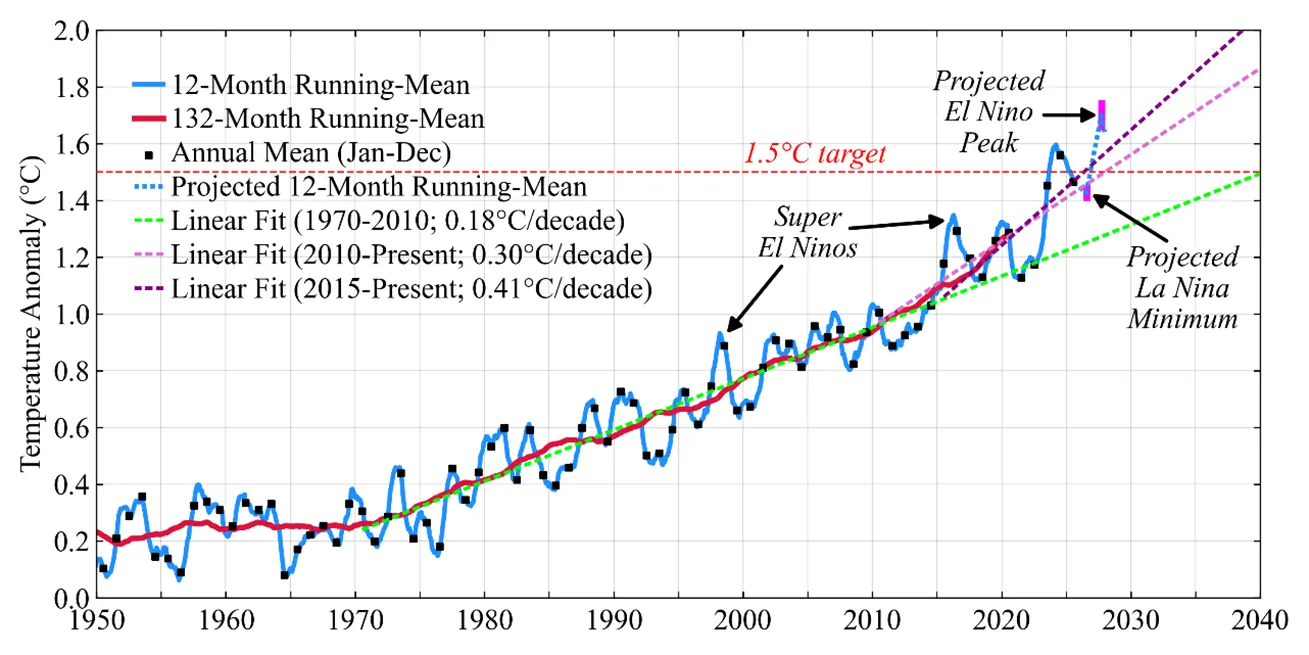
James Hansen released his latest insights the other day. Reading them, I wondered how digestible the information is to the average person going about their day.
So, below I created a short summary where the headings are simple soundbites anyone can repeat at rally, birthday party, or wherever.
I also drafted an email, Bluesky post and text message. Feel free to copy and share Hansen's valuable information with a broader audience.
This is a bit of an experiment for me. Let me know what you think.
Hansen's article organized into five soundbites:1. Global warming is happening faster.
For decades, the Earth warmed at a steady, predictable rate. Most people assume that pace hasn't changed, but Hansen's data shows that since 2010, the speed of warming has increased by about 50%. We have moved out of a period of steady rise and into a phase of acceleration. As Hansen directly states in the report: "We are now in the period of accelerated global warming."
2. Cleaner air is making the ocean hotter.This sounds counterintuitive, but for years, heavy shipping fuel created sulfate pollution in the air that reflected sunlight away from the Earth, acting like a giant shade for the ocean. In 2020, new regulations cleaned up that fuel. While this was positive for air quality, it removed that protective shade. Without those particles to bounce heat back into space, the oceans are now absorbing solar energy much faster than before.
3. We have already passed the 1.5°C limit.World leaders still talk about keeping 1.5°C alive as a future goal. Hansen argues that based on the physics of the heat already trapped in our system, we have already reached that milestone. He states: "The 1.5°C limit is deader than a doornail." We are now on a fast track toward 2°C much sooner than official models originally predicted.
4. The Earth is holding onto twice as much heat.For a stable climate, the amount of energy the Earth takes in from the sun should roughly equal the amount it sends back out into space. Hansen's research shows that the energy imbalance has nearly doubled in just the last decade. The planet is soaking up excess energy, and that heat is being stored directly in our oceans.
5. Natural cooling cycles are no longer working.In the past, natural weather patterns like La Niña would temporarily lower global temperatures. However, the background warming is now so intense that even these cooling phases are seeing record-high temperatures. The natural cycles of the Earth are being overwhelmed by greenhouse gases, meaning the cool years of the future will likely be hotter than the warm years of the past.
Tools to help share the info:
Email DraftSubject: Important update on climate acceleration
Hi [Name],
I've been reading some recent analysis from James Hansen—the scientist who originally testified to Congress about the greenhouse effect in the '80s—and his latest report is significant. I am sharing a few key takeaways that help explain why global heating is accelerating.
- Since 2010, the rate of warming has increased by about 50%. Hansen notes: "We are now in the period of accelerated global warming."
- Ironically, cleaning up shipping fuel pollution removed a layer of particles that were reflecting sunlight away from the Earth. Without that shade, the oceans are absorbing heat much faster.
- Hansen suggests we have already moved past the 1.5°C goal. We are now likely on a path to 2°C much sooner than expected.
- Natural cycles that used to cool the planet are being overwhelmed by the sheer volume of trapped heat.
I found this helpful for making sense of the current climate data. Here's a link to Hansen's article.
Best,
[Your Name]
BlueSky Post
James Hansen's latest update is a wake-up call. Since 2010, warming has accelerated by 50%. Hansen: "The 1.5°C limit is deader than a doornail." We're on a fast track to 2°C; even natural cooling cycles can't offset the trapped heat.
https://jimehansen.substack.com/p/another-el-nino-already-what-can
Personal Text Message
I recently looked into a report by James Hansen regarding new climate data. Essentially, his research shows that global warming has accelerated by 50% since 2010. He says the 1.5°C goal is effectively behind us and we are approaching 2°C more quickly than anticipated. I thought you might find this interesting given recent trends. https://jimehansen.substack.com/p/another-el-nino-already-what-can
Thank you for reading.
My name is Sarah and I run Collapse2050 by myself. It is a passion project to explore humanity's frightening future - a topic traditional media ignores.
The site is free for all, as I believe this information shouldn't be locked behind a paywall. I also don't accept corporate advertising so I remain totally free to tear the kleptocracy a new one.
To fund this site, I depend on the kindness of strangers. Paid subscribers and one-time contributors to help me cover hosting and production costs.
Thank you.
Sarah

Van Halen had a rule.
Their contract required a bowl of M&Ms backstage with all the brown ones removed. People thought they were just being divas. They weren't.
It was a safety check. If the band walked in and saw a brown M&M, they knew the promoter hadn't read the technical manual. Errors with one thing probably meant there were errors with other things. If they missed the candy, they probably missed the weight limits on the stage or the wiring for the pyrotechnics. One small error meant the whole show was dangerous.
Trust works the same way. When one big lie comes to light, you have to look at everything else.
Despite the pathetic lack of accountability, the Epstein files changed the calculus. What used to be dismissed as a niche conspiracy theory turned out to be a global system of trafficking involving people at the top. When a secret that large is proven true, the "mad" theories start to look plausible. What other huge lies are we being told? What else exists behind the curtain?
We see a pattern now. A group of powerful people shape the world to fit their needs. They tell the public to "move on" while they build doomsday bunkers in remote locations, private security forces, and tech replacements for human labor.
The amazing thing is they are building all this right in the open, and we're like, "nah, they cant really be planning for half of us to die, are they?"
Yes. The audacious goals of the elites are real. You better fucking believe it.
People often say the rich need us because we buy their products. That is a mistake. Much of the world's wealth circulates among the elites themselves. The real value of the masses has always been labor. But labor is changing. Wages are dropping toward the cost of a drone, automation handles production, and AI handles the thinking.
When a machine can plant a seed or write code for less than the cost of a human's food and rent, the human becomes a liability. We become disposable pawns in a game we never wanted to play.
The future looks like Mumbai. You see billion-dollar towers standing right next to slums. One group lives behind high walls with every luxury. The other group lives in the dirt, a stone's throw away. An entire class is already considered disposable. There's nothing stopping this from happening to the rest of the world.
Indeed, the middle class is a 20th century flash in human history, ignited by plentiful, cheap energy. A temporary surplus that granted each of us thousands of invisible slaves, operating 24/7. With more than enough to go around, everyone feasted.
The convergence of crises is changing that rapidly. That house your adult child cant afford, food prices skyrocketing, corporate weaponization...those are symptoms of the weakening surge that lifted the tide. Mistaken, we attributed much of our wealth, comfort, success to ingenuity. We are told it's "immigrants" or "China" or internal "enemies" slowing us down. Meanwhile, they hide from view the fuel gauge, which is near empty.
Back to normal.
Many of our ancestors lived in societies with high concentration of wealth, resources and power. Most people couldn't afford much. What happens when we stop buying iPhones? Things will change, but Kings existed in societies with high Gini coefficients, just as they will in the future.
Perhaps the elite would prefer to turn every beggar into a customer. And perhaps if we all vanish some companies with their hands in the middle class pocketbook will go bust. But the oligarchs realize to prevent that, by maintaining and building the middle class, we need a few more planets worth of resources.
They won't tell us, but they see the same data we do and are moving into self-preservation mode. The revenge of Malthusian logic, temporarily sidelined by the Haber-Bosch process, leads to two possible outcomes: Tall guarded walls or 21st century Lebensraum.
We are moving toward a world where you are either inside the physical or virtual walls or outside of them. Those outside will be left to fight over scraps, pitted against scapegoats to protect systemic disparity.
It sounds like dystopian fiction, but its time we start believing what we are witnessing. They've laid bare their intentions, and we must stop disregarding logical ends as conspiracy theory.
The naked truth, while too painful to accept is also too dangerous to ignore.
Thank you for reading.
My name is Sarah and I run Collapse2050 by myself. It is a passion project to explore humanity's frightening future - a topic traditional media ignores.
The site is free for all, as I believe this information shouldn't be locked behind a paywall. I also don't accept corporate advertising so I remain totally free to tear the kleptocracy a new one.
To fund this site, I depend on the kindness of strangers. Paid subscribers and one-time contributors to help me cover hosting and production costs.
Thank you.
Sarah
We Could All Get Nuked Tomorrow [ 06-Feb-26 2:52am ]"The world could end in the next couple of hours." — General Keeler (as quoted by Annie Jacobson)The 72-Minute Apocalypse: Nuclear War: A Scenario

Several of you in the Collapse2050 community have suggested Annie Jacobsen's 2024 non-fiction book, Nuclear War: A Scenario.
Jacobsen's book provides minute-by-minute detail of the end of civilization. The book maps out a hypothetical first strike by North Korea against the U.S.
It takes a mere 72 minutes to go from the first launch to a total global thermonuclear exchange. The immediate aftermath triggers a nuclear winter, resulting in an estimated 5 billion deaths.
"It doesn't matter how nuclear war begins... it only ends one way, and that is in nuclear Armageddon."
Given how often it's been recommended here, I figured I'd share the following recent interview of Jacobsen by Hasan Minhaj, released a few days ago:
Related article:2030 Doomsday Scenario: The Great Nuclear CollapseA timeline of the end game for human civilization Collapse 2050Sarah Connor
 Sign up for Collapse 2050
The unspoken truth about humanity's frightening future.
Subscribe .nc-loop-dots-4-24-icon-o{--animation-duration:0.8s} .nc-loop-dots-4-24-icon-o *{opacity:.4;transform:scale(.75);animation:nc-loop-dots-4-anim var(--animation-duration) infinite} .nc-loop-dots-4-24-icon-o :nth-child(1){transform-origin:4px 12px;animation-delay:-.3s;animation-delay:calc(var(--animation-duration)/-2.666)} .nc-loop-dots-4-24-icon-o :nth-child(2){transform-origin:12px 12px;animation-delay:-.15s;animation-delay:calc(var(--animation-duration)/-5.333)} .nc-loop-dots-4-24-icon-o :nth-child(3){transform-origin:20px 12px} @keyframes nc-loop-dots-4-anim{0%,100%{opacity:.4;transform:scale(.75)}50%{opacity:1;transform:scale(1)}} Email sent! Check your inbox to complete your signup.No spam. Unsubscribe anytime.
Love During Collapse [ 01-Feb-26 9:31pm ]
Whether you are currently in a stable partnership or searching for a soulmate, you likely view intimacy as a source of emotional satisfaction. In stable, affluent societies, love is influenced by Romanticism, which emphasizes individualism and the pursuit of happiness. It encourages the search for a soulmate.
However, when civilization collapses, this soulmate myth might be self-destructive. The new environment will require bonds based on survival rather than romance. In some situations, love takes on twisted forms, unthinkable to us today.
History shows what this might look like.
Sign up for Collapse 2050The unspoken truth about humanity's frightening future.
Subscribe .nc-loop-dots-4-24-icon-o{--animation-duration:0.8s} .nc-loop-dots-4-24-icon-o *{opacity:.4;transform:scale(.75);animation:nc-loop-dots-4-anim var(--animation-duration) infinite} .nc-loop-dots-4-24-icon-o :nth-child(1){transform-origin:4px 12px;animation-delay:-.3s;animation-delay:calc(var(--animation-duration)/-2.666)} .nc-loop-dots-4-24-icon-o :nth-child(2){transform-origin:12px 12px;animation-delay:-.15s;animation-delay:calc(var(--animation-duration)/-5.333)} .nc-loop-dots-4-24-icon-o :nth-child(3){transform-origin:20px 12px} @keyframes nc-loop-dots-4-anim{0%,100%{opacity:.4;transform:scale(.75)}50%{opacity:1;transform:scale(1)}} Email sent! Check your inbox to complete your signup.No spam. Unsubscribe anytime.
When individuals perceive a resource as rare or at risk, its perceived value increases. History shows fluctuating sex ratios and the immediate threat of struggle or death radically altered the biological market for partners. Also, when potential partners are scarce, individuals become less picky and are more likely to marry young to avoid future insecurity.
Conversely, in stable environments, an abundance of partners leads to higher selectivity and a decrease in the perceived value of any single bond, often resulting in delayed commitment.
In crisis, humans generally respond to the threat of isolation by amplifying positive perceptions of available partners while downplaying their negative traits. This pro-relationship bias gives a psychological buffer against the terror of facing the collapse alone. This explains why many relationships form quickly in environments like the Czestochowa concentration camp; in his memoir The Flower of the Human Heart, Sigi Siegreich recounts meeting Hanka on New Year's Eve in 1944 and marrying her only 17 days later, immediately following liberation.
The stable pairbond was the most common relationship pattern within concentration camps. Unlike romantic partnerships in the free world, prisoners often formed these pairs specifically for mutual survival, creating a unit that could navigate the camp's brutality and bureaucracy. Instead of pairing based on shared interests or physical attraction, partnerships were based on the reciprocal exchange of survival skills.
These bonds differed fundamentally from current expressive intimacy, which prioritizes emotional fulfillment. In a state of total attrition, individuals redefined "attractiveness" as absolute reliability, the certainty that a partner would not steal a shared ration.
While extreme conditions often shut down libido and dopamine-driven lust, the neurochemistry of bonding remained tied to the release of oxytocin. As documented in the "tend-and-befriend" research by Shelley Taylor, this attachment hormone facilitated the deep, platonic foxhole loyalty required to lower stress levels and allow for communal rest amidst constant threat.
Secondarily, these pairbonds provided a semblance of humanity amidst total dehumanization. When the camp transferred or killed one partner, a replacement often soon followed, as the survival costs of being a loner were high. Even survivors who claimed they survived independently were often aided by someone who cared for them as much as for themselves.
Combinations often expanded beyond the pair bond. As nuclear family structures disintegrated under the pressure of war and genocide, humans instinctively organized into survival clans or pseudo-families. These groups often included unrelated people.
In her memoir Return to Auschwitz, survivor Kitty Hart noted that "alone one could not possibly survive", which led to the formation of "little families of two or three." These groups performed several critical functions. Members often adopted the roles of lost parents or siblings. Older prisoners might mentor younger ones, while younger prisoners provided the physical vigor needed to assist their substitute elders.
The group served as a vessel for collective hope. Groups also allowed for specialized labor, based on skills or shifts. These groups rarely functioned as polyamorous romantic units. Instead, members modeled their bonds on traditional familial hierarchies to ensure maximum stability and avoid the complexities of multi-partner sexual dynamics during a crisis.
This phenomenon was not unique to the Holocaust. During the Khmer Rouge regime in Cambodia, friends formed pseudo-families where each member was prepared to give their life for the others. Similarly, in the wake of the Somali state's collapse, clan loyalties surged dramatically as traditional lineages offered the only haven for security and resource distribution.
Throughout history, the clan is a central pillar of survival.
While the stable pair and the survival clan are resilient, beyond a point even these break down. The 872-day Siege of Leningrad and the 1932-1933 Holodomor in Ukraine show how extreme starvation can destroy intra-family bonds.
During the Siege of Leningrad, a "starvation policy" claimed nearly one million lives. The daily bread ration was only 125 grams for non-essential workers, providing roughly 300 to 500 calories of largely indigestible filler. The physical and psychological toll was catastrophic. In her study The War Within: Diaries from the Siege of Leningrad, Alexis Peri analyzes personal diaries from the period which reveal that "romantic desire withered" as the body focused entirely on biological maintenance.
The physical deterioration was so extreme that 17-year-old Elena Mukhina looked in the mirror and saw "an old man" looking back at her, as starving children had teeth fell out. Family dynamics underwent a radical reversal. Children took on adult responsibilities, becoming caregivers for their weakening parents and effectively skipping the developmental stage of childhood to become tiny old men and women. In many instances, the desperation for rations became so severe that family members turned on one another, stealing bread from their own kin to stave off death for a few more hours.
Arguably, the Holodomor provides the most harrowing example of family collapse. The man-made famine induced rare social anomalies. In her comprehensive history Red Famine: Stalin's War on Ukraine, Anne Applebaum documents cases of mothers killing and eating their own children. In Zaporizhzhia, Kharytyna Nyshchenko strangled her two young children due to "prolonged exhaustion" and "clouding of consciousness." Peasants often abandoned their children in urban centers, hoping the state would save them, only for the state to unload them out in the open country where they died of exposure. Soviet propaganda also actively destroyed the parent-child bond by encouraging children to report on their parents for hiding wheat, pitting parent against child.
These cases suggest that while love can act as a survival strategy, the fundamental drive for self-preservation can ultimately override this as collapse deepens.
During war, famine or collapse, love becomes warped and sex is often systematically weaponized. The Nazi camp system designed the registration of prisoners as a ritual of sexual humiliation. Officials stripped, shaved, and subjected prisoners to invasive physical examinations. SS officials delighted in these procedures, using rods to check for virginity or performing examinations to assert total dominion over the prisoner's body. This established a camp value system where sexual modesty was erased and the body became an object of the state.
Within the camps, a hierarchy of camp aristocrats emerged, men who worked as organizers with access to the black market. These men often used their status to solicit sexual favors from female prisoners. Examples from survivor memoirs illustrate the grim reality of these transactions.
In her memoir I Was a Doctor in Auschwitz, Dr. Gisella Perl recounted asking a Polish worker in a women's camp latrine for string in exchange for bread. The man refused the food, instead rudely demanding sexual favors while his hands were "filthy from his work".
In Five Chimneys: A Woman Who Survived Auschwitz, Olga Lengyel initially appreciated the "human-sounding voice" of a man named Tadek who repaired beds in her barrack. However, after giving her a potato and a shawl, he began fondling her, revealing that his "gifts" were merely a down payment for sexual access.
Following liberation, society rarely stigmatized men who visited camp brothels or engaged in sexual relationships, whereas women who engaged in "sex for survival" were often branded as prostitutes and ostracized. In occupied territories like France, horizontal collaboration (romantic or sexual relationships with German soldiers) became a common phenomenon. Following liberation, these women faced brutal recriminations. Vigilantes publicly humiliated approximately 20,000 shaven women (femmes tondues) as a way for French men to reclaim their masculinity from the memory of the German occupation. These relationships produced an estimated 200,000 occupation babies, whom the public considered a betrayal and also exiled or stigmatized after the war.
During most catastrophic situations there exists a power imbalance between classes of people. Those with power will hoard resources while most go without. To cross this bridge, sex and intimacy can become a currency of exchange. Sexual barter can be via an explicit arrangement or manipulation. Often these relationships morph into something somewhat real, where purpose is masked by a sheer veneer of romance.
One of the most complex psychological phenomena in collapsing civilizations is the formation of emotional links between the victim and the victimizer, driven by a more diverse range of motivations, from strategic survival to genuine affection.
Stockholm Syndrome describes a psychological response wherein a captive begins to identify with and empathize with their captor. A captor often initiates the bond by threatening a victim's life and then choosing not to kill them, causing the victim's terror to transpose into intense gratitude for being "given life". Over time, victims in enforced dependence begin to interpret rare acts of kindness, such as being offered food or permitted to talk, as evidence of the captor's humanity or benevolence.
Experts often draw the distinction between Stockholm Syndrome and "trauma bonding" based on reciprocity. While trauma bonding is a one-way response to cycles of abuse and kindness, Stockholm Syndrome involves a mutual empathy. This mechanism essentially serves as a survival strategy. By aligning with the captor's goals and believing in their goodness, the victim may secure their safety in a world where the captor is in complete control.
In Auschwitz, Helena Citronova and SS Lance Corporal Franz Wunsch developed a relationship that saved the life of Helena's sister, Rozinka. Wunsch obsessed over Helena, keeping a photograph of her in her striped uniform and cutting out her face to place it in other, safer photographs. Helena later admitted that, although she initially hated him, "in the end, I loved him" because he intervened to save her sister.
With sexual relationships comes conception, often unplanned. Biological urges persist, despite the irrationality of child rearing in a hostile environment. However, the reality of collapse radically alters the nature of infant care and the decisions surrounding it. Mothers in crisis environments may revert to any means to keep infants alive. As Iris HeavyRunner and Joann Sebastian Morris documented in their research on traditional resilience, Indigenous grandmothers recount stories of surviving hard times by feeding infants rabbit brains, caribou broth, moose broth, and boiled rice water. Elders often framed these practices through a lens of resiliency, with one stating that infants fed animal brains grew up strong and tough.
During the Holodomor, hunger often forced mothers to make critical choices about which child to feed or whether to abandon an infant. During the 19th-century population crises in Russia, foundling homes in St. Petersburg and Moscow received tens of thousands of children annually. These institutions utilized "turning cradles," allowing mothers to deposit infants unseen to protect their identity.
As David Kertzer documents in Sacrificed for Honor: Italian Infant Abandonment and the Politics of Reproductive Control, this crisis echoed historical patterns such as in pre-industrial Italy. Before the institutionalization of the ruota degli esposti (foundling wheel), desperate parents, driven by both extreme poverty and the paralyzing social stigma of being unwed, frequently discarded infants in gutters or on the streets, leaving their survival to pure chance or the pity of strangers.
While the pair and clan act as primary buffers against death, a significant portion of the population during a collapse finds itself involuntarily alone. These individuals often experience the highest mortality rates and the most rapid psychological decline. Without a witness to their existence or a partner to share the logistical burden of survival, the loner is vulnerable to chronic stress, poor resource access, weak defence, and eventual exhaustion.
In the the concentration camp, the "Muselmann", the prisoner who had surrendered to apathy and was marked for death, was often someone who had lost their primary bond or failed to integrate into a pseudo-family. Without the social pressure to wash, eat, or stay upright, the individual faded.
Viktor Frankl observed that those who found themselves without a social connection or a future-oriented goal involving another person were the first to succumb to typhus or starvation.
Another subset of individuals chooses solitude as a deliberate survival strategy. They often view other humans as liabilities or potential threats. In the early stages of a collapse, where social cohesion is replaced by predatory behavior, choosing to be alone can increase survival odds by reducing exposure to violence and betrayal.
The daily life of the strategic recluse is stealthy. They avoid the visibility required to maintain a clan, preferring to hide resources rather than share them. This strategy, however, leaves them vulnerable to minor injuries or illnesses that would be survivable with even basic communal care.
As documented by survivor Selco Begovic in his accounts of the Siege of Sarajevo, those who survived longest in total isolation often possessed high levels of pre-existing technical self-sufficiency. However, even these individuals reported a cost to their choice. Begovic describes a man who hid in his apartment for months, avoiding all human contact; while he survived the physical violence of the streets, he emerged with profound social atrophy, having lost the ability to read facial expressions or trust verbal cues.
Love today is already changing. Young couples aren't having kids, knowing that famine and war await. The American dream is no longer attainable, so the nuclear family is already dying. Many are simply opting out.
That doesn't mean love won't exist. Instead, the lessons of the past show us the persistence of physical and emotional bonding as a survival strategy.
Love won't disappear, but it won't look like it does today.
I hope you can find what you need.
Thank you for reading. My name is Sarah and I run Collapse2050 by myself. It is a place for the collapse-aware community to learn, debate and connect. Please consider subscribing. The site is free for all, but paid subscribers and one-time contributors help to cover hosting and production costs. Thank you. Sarah
85 Seconds to Midnight [ 27-Jan-26 5:58pm ]
The Doomsday Clock is a globally recognized symbol indicating how vulnerable our world is to a global catastrophe caused by technologies humans created. Set every year by the Science and Security Board of the Bulletin of the Atomic Scientists, it uses midnight to represent a potential global apocalypse.
Today, the world is closer to disaster than at any point in its history, with the clock now standing at 85 seconds to midnight.
This position reflects a total breakdown in international cooperation and a dangerous rise in aggressive nationalism among world powers. The Bulletin warns that the current global trajectory is unsustainable, as leaders have grown complacent while adopting policies that accelerate rather than mitigate existential risks.
Why the Move from 89 to 85 Seconds?The Science and Security Board moved the hands forward because of an intensification of several negative trends over the past year:
- Aggressive Geopolitics: Russia, China, and the United States have moved away from diplomacy toward a winner-takes-all great power competition. At the same time, the sophistication of large language models is being used to supercharge disinformation campaigns, undermining the fact-based discussions necessary to address global crises.
- Nuclear Brinkmanship: A full-blown arms race is currently underway as major powers modernize their delivery systems and increase their nuclear warhead counts. This is further aggravated by the development of the Golden Dome space-based missile defense system, which increases the probability of conflict in space. Three regional conflicts involving nuclear-armed states—the Russia-Ukraine war, tensions between India and Pakistan, and attacks involving Israel, the U.S., and Iran—all threatened to escalate in 2025. Additionally, there is a growing concern regarding the potential incorporation of AI into nuclear command and control decision-support systems.
- Treaty Collapses: The expiration of New START marks the end of nearly 60 years of efforts to limit strategic nuclear weapons between the world's two largest nuclear powers.
- Climate Hostility: Atmospheric carbon dioxide has reached 150 percent of preindustrial levels, and global average sea levels have hit record highs. National responses have shifted from being merely insufficient to profoundly destructive, with recent UN summits failing to prioritize the phasing out of fossil fuels. The U.S. administration has effectively declared war on renewable energy and has halted the collection of vital climate data.
- Biological Risks: The rapid evolution of AI is creating a new biological threat. These tools now allow for the AI-aided design of novel pathogens to which humans have no effective defenses. The potential laboratory synthesis of self-replicating organisms known as mirror life has emerged as a new existential threat to the planet's ecosystems.
Today's setting of 85 seconds is the most dangerous point in the history of the Clock.
In 1953, the Clock was set at 2 minutes to midnight after the United States and the Soviet Union tested their first thermonuclear weapons. The safest period in the Clock's history was in 1991, following the end of the Cold War, when it was moved back to 17 minutes to midnight as major powers made deep cuts to their nuclear arsenals.
Since 2023, the Clock has remained consistently at 90 seconds or less, reflecting a new abnormal that is extremely dangerous and unsustainable.
Read the full statement:
2026-doomsday-clock-statement2026-doomsday-clock-statement.pdf871 KB.a{fill:none;stroke:currentColor;stroke-linecap:round;stroke-linejoin:round;stroke-width:1.5px;}download-circleWatch the full presentation:
A selection of Collapse2050 articles about fascism:Our Fascist FutureFascism is once again rising around the world. The environment is ripe for strongmen and dictators to consolidate power over the masses. Yet, while many see what is unfolding and are aware of the dangers, as a society we are choosing fascism.
 Collapse 2050Sarah Connor
 The Future of American FascismWhat will it look like?
 Collapse 2050Sarah Connor
 Are we just letting this happen again?Fascism's point of no return
 Collapse 2050Sarah Connor
 Peak Oil. Food. Fascism. Collapse.The era of abundant oil, resources and food is coming to an end, and with it, the world as we know it will change dramatically.
 Collapse 2050Sarah Connor
 Life in a DictatorshipWhat to expect. How to survive.
 Collapse 2050Sarah Connor
 What Happens When No One Stands?An excerpt from "They Thought They Were Free: The Germans, 1933-1945"
 Collapse 2050Sarah Connor
 Why Dictators FailFirst the allure, then the collapse
 Collapse 2050Sarah Connor
One more thing:
I recently did a Q&A with author Scott Erickson about his book "Laughing at Our Self Destruction". Previously, his book was only available on Amazon. Many readers expressed desire to buy his book without supporting Amazon. The book is now available on Bookshop.org.
Original interview:
"Laughing at our self destruction"Q&A with author Scott Erickson Collapse 2050Sarah Connor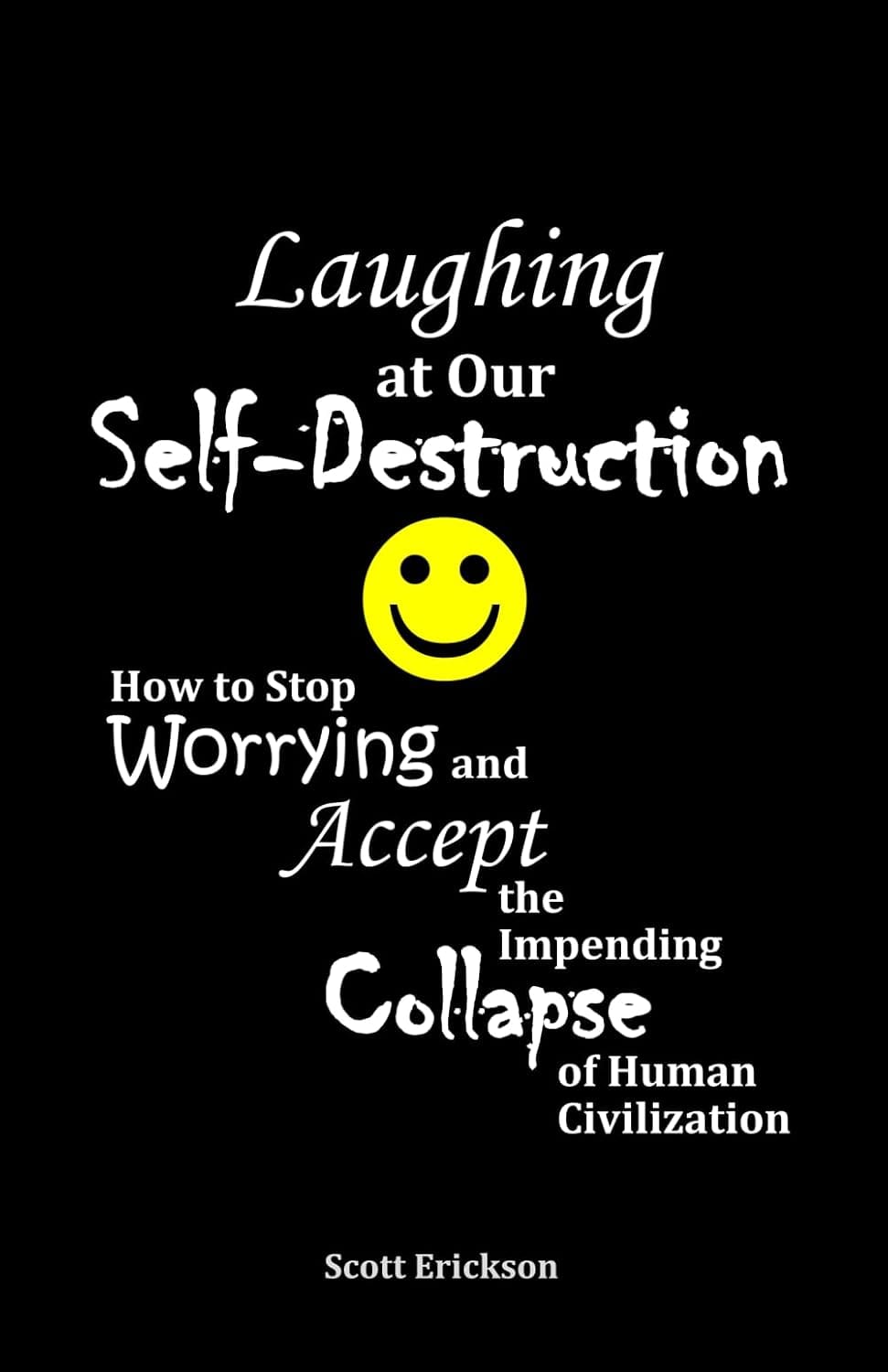
Please consider subscribing. The site is free for all, but paid subscribers and one-time contributors help to cover hosting and production costs.
How to survive one week [ 26-Jan-26 1:21am ]
The unspoken truth about humanity's frightening future.
Subscribe .nc-loop-dots-4-24-icon-o{--animation-duration:0.8s} .nc-loop-dots-4-24-icon-o *{opacity:.4;transform:scale(.75);animation:nc-loop-dots-4-anim var(--animation-duration) infinite} .nc-loop-dots-4-24-icon-o :nth-child(1){transform-origin:4px 12px;animation-delay:-.3s;animation-delay:calc(var(--animation-duration)/-2.666)} .nc-loop-dots-4-24-icon-o :nth-child(2){transform-origin:12px 12px;animation-delay:-.15s;animation-delay:calc(var(--animation-duration)/-5.333)} .nc-loop-dots-4-24-icon-o :nth-child(3){transform-origin:20px 12px} @keyframes nc-loop-dots-4-anim{0%,100%{opacity:.4;transform:scale(.75)}50%{opacity:1;transform:scale(1)}} Email sent! Check your inbox to complete your signup.No spam. Unsubscribe anytime.
Between the threat of martial law and current snowstorms, the social contract and infrastructure is unreliable. The slightest disruption puts you at risk. We must all become more self-reliant.
I'm not talking about prepping for the collapse - save that for another day. Right now, let's focus on getting through a week of snow or lockdowns. Start by building a base of stability that'll get you through a power outage or empty store shelves.
This is a short-term guide for a one-week isolation. It is meant to keep you alive until conditions improve.
Here's what you need:
1. WaterOne gallon per person, per day. For one week, you need 7 gallons per person. When the grid fails or pipes freeze, water stops flowing. You need water for hydration, hygiene, and to prepare food.
The cost is approximately $25-$40 for bottled water and storage containers. It is $0 if you fill your own containers. No special skills are required. If you can anticipate the disruption, fill your bathtub and every pitcher you own before the storm.
2. CaloriesStock food that requires no cooking. Aim for 2,000 calories per day per person. For one week, for one person you could buy:
- 1 large jar of peanut butter.
- 10 cans of protein (beans, tuna, or chicken).
- 2 large bags of mixed nuts.
- 2 bags of dried fruit.
- 1 box of granola or protein bars.
- 1 bottle of olive oil (add a tablespoon to canned food for easy, dense calories).
In a lockdown, hunger causes panic. If gas or electricity fails, you cannot cook. You need energy to maintain body temperature in the cold. With current food inflation, the cost is roughly $80-$120 per person for the week. No special skills are needed; just buy what you will eat.
3. HeatUse a "warm room" strategy. Have 1 sub-zero sleeping bag per person or 3-4 heavy wool blankets.
If the furnace stops, your home will get cold. You cannot heat a whole house without power. Pick one room, seal the windows with plastic or curtains, and stay there. Wool keeps you warm even if it gets wet. The cost for quality insulation gear is now $150-$300 per person. Hang blankets over doors to keep heat in.
To generate heat safely without a furnace, use chemical hand and toe warmers, or fill a sturdy bottle with hot water (if you have a way to heat it) and place it at the foot of your sleeping bag. Body heat is your most reliable resource; huddling together with family or pets significantly raises the temperature inside a confined space or tent.
Do not use a generator or outdoor grill inside the house. They produce carbon monoxide, which is odorless and lethal. Never use candles or open flames for heat; in a cold, dry room with blankets, the fire risk is too high. If you must use a portable heater, ensure it is rated for indoor use and that you have a battery-powered carbon monoxide detector in the room.
4. LightUse hands-free LED lighting. Have 1 LED headlamp per person and 8 spare batteries (AA or AAA).
Darkness causes accidents. A headlamp keeps your hands free to work or fix problems. Candles are a fire risk when emergency services cannot reach you. The cost is $30-$60 for reliable lights and lithium batteries. Practice battery management by using light only when you must.
5. CommunicationMaintain redundant information sources. Have 1 multi-power emergency radio (NOAA/AM/FM) and 1 large power bank (at least 10,000 mAh) or a portable solar charger.
You need information to know if orders have changed. When the internet fails, a radio is your only link to news. A power bank is best for immediate use, while a solar charger is useful if the skies are clear. To get both a reliable radio ($40-$70) and a high-capacity power bank ($30-$60), the total cost is $80-$150. You should know how to find local emergency frequencies and how to position a solar panel for maximum sun exposure.
6. Health and SanitationMaintain your medical needs and waste management. Have 30 days of medications and 1 standard first-aid kit.
Include 1 roll of heavy-duty trash bags and a bag of kitty litter or sawdust. If pipes freeze or the water is cut, do not flush the toilet. Line the bowl with a bag and use the litter to manage waste and odor. This prevents disease and structural damage.
During a lockdown, a small infection or a missed pill becomes a crisis. You must manage your health when roads are blocked. The cost is $60-$100 for basic supplies and kit restocking. You should know basic first aid, such as how to stop bleeding or manage a fever.
7. MoraleIsolation and darkness break the spirit. Have 1 physical book, a deck of cards, or a notebook.
Panic is as dangerous as the cold. Low-tech entertainment keeps your mind occupied and prevents the psychological decay that comes with total isolation. The cost is $10-$25. No skills are required beyond the discipline to stay calm.
The Reality CheckYou can do this in an afternoon. One trip to the store is enough. You must act before a lockdown begins. Once it is announced, stores will be empty.
The cost of survival for one person is around $450 to $900. Unfortunately, safety is a luxury that many cannot afford. One step at a time. Start with water.
Of course, this is a temporary fix. This plan lasts for one week. It does not fix crumbling infrastructure, decline into fascism, or breadbasket failure. This is about making it to next Monday.
Stay safe. Stay hydrated. Stay sane.
The site is free for all. No ads or corporate sponsors. Paid subscribers and one-time contributors help keep the site going. So do your kind words and comments. Thank you. Sarah. 6 Takeaways from an Actuarial Warning on Planetary Insolvency [ 20-Jan-26 5:45pm ]
In the world of finance and insurance, actuaries are pragmatists. They are highly trained professionals who analyze data, probability distributions, and long-term solvency. Their job is to look at the range of realities and calculate how much it will cost when things go wrong. Actuaries are probably one of the only groups of people embedded within the corporate world that are least tainted by optimism bias, politics, and shareholder demands.
A group of actuaries recently released a report on the fate of human survival called "Parasol Lost".
The report was produced by a collaboration between the Institute and Faculty of Actuaries (IFoA) and the University of Exeter. Led by authors including Sandy Trust, Oliver Bettis, James Orr, and Professor Sir David King (former Chief Scientific Adviser to the UK Government), the team brings together experts in climate science and risk management.
Sign up for Collapse 2050The unspoken truth about humanity's frightening future.
Subscribe .nc-loop-dots-4-24-icon-o{--animation-duration:0.8s} .nc-loop-dots-4-24-icon-o *{opacity:.4;transform:scale(.75);animation:nc-loop-dots-4-anim var(--animation-duration) infinite} .nc-loop-dots-4-24-icon-o :nth-child(1){transform-origin:4px 12px;animation-delay:-.3s;animation-delay:calc(var(--animation-duration)/-2.666)} .nc-loop-dots-4-24-icon-o :nth-child(2){transform-origin:12px 12px;animation-delay:-.15s;animation-delay:calc(var(--animation-duration)/-5.333)} .nc-loop-dots-4-24-icon-o :nth-child(3){transform-origin:20px 12px} @keyframes nc-loop-dots-4-anim{0%,100%{opacity:.4;transform:scale(.75)}50%{opacity:1;transform:scale(1)}} Email sent! Check your inbox to complete your signup.No spam. Unsubscribe anytime.
6 things you need to know:1. The Termination Shock of Cleaner AirSulphate aerosols from fossil fuel burning have acted as a hidden sunshade, reflecting sunlight and cooling the Earth by roughly 0.5°C. As we clean up air pollution, we lose that cooling. This unmasking is contributing to a termination shock—a rapid, violent spike in warming that we are already starting to feel.
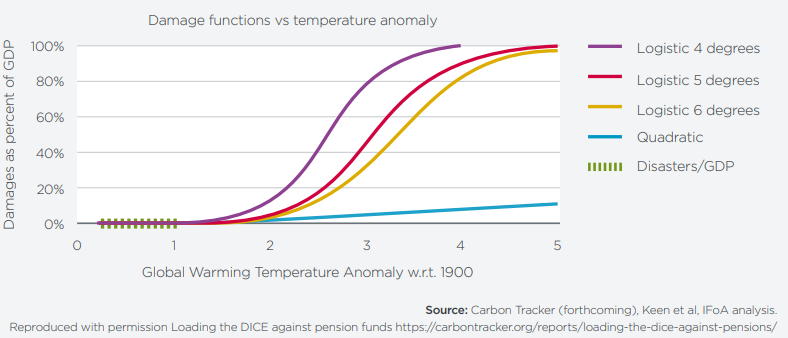
2. A 50% Drop in Global GDPTraditional economic models have often treated climate change as a manageable speed bump. The actuaries disagree, using reverse stress testing (a technique used to see what would ruin a bank or insurance company) to look at the real impact.
Unmitigated climate change could lead to a 50% drop in global GDP later this century. The higher the temperature anomaly, the closer we get to complete collapse.
A plausible scenario could cause a 15% to 20% global GDP contraction in just a five-year period—an economic shock far greater than the Great Depression or the 2008 Financial Crisis.
 3. We Are Approaching Planetary Insolvency
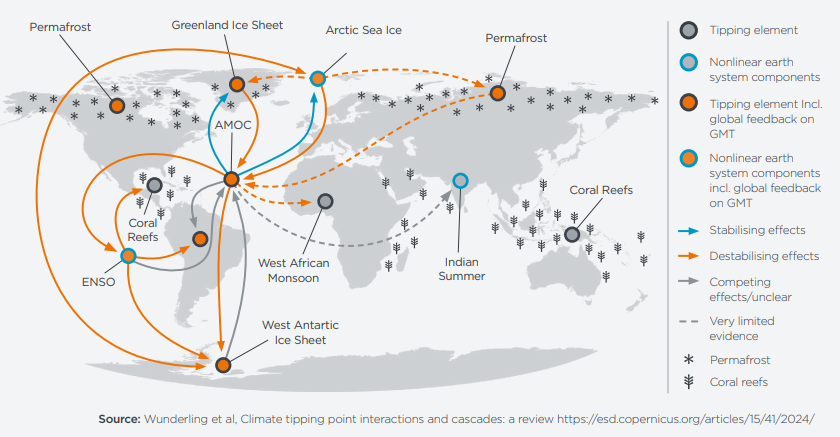
The report defines Planetary Insolvency as significant societal disruption driven by climate and nature risks. The decadal warming average is already at 1.4°C. At current rates, we are likely to hit 2°C mark before 2050. Once we pass 1.5°C, we enter the danger zone for irreversible tipping points, including the collapse of the West Antarctic ice sheet and the dieback of the Amazon rainforest.
 4. The Earth is Absorbing Energy at an Insane Rate
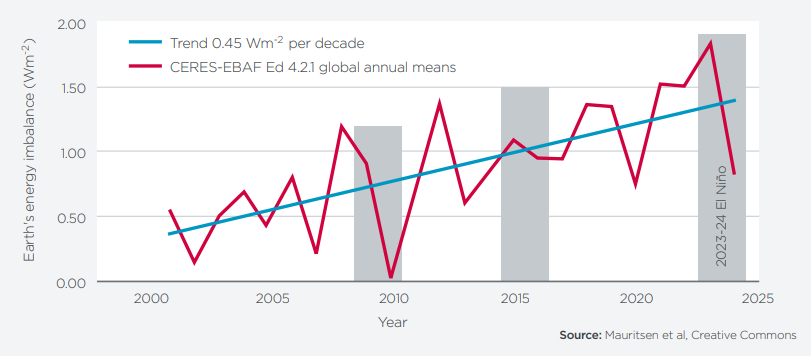
The Earth's Energy Imbalance (EEI) has doubled in recent decades. In early 2023, the rate of solar energy absorption was equivalent to every person alive on Earth continuously boiling 60 kettles. Since 1971, the Earth has accumulated 500 times more energy than the world's total primary energy consumption in 2024. 93% of this heat is currently being stored in the oceans, a thermal debt that will eventually be paid.
 5. The Human Cost: Mass Mortality and Migration
Beyond economic figures, the report warns of a severe humanitarian crisis. Unchecked climate change is expected to lead to mass mortality events and involuntary mass migration as populations are displaced by rising sea levels, heat stress, and the collapse of food and water systems. This is identified as a national security issue where the foundational stability of political systems is threatened by cascading failures in essential services.
6. The End of InsurabilityInsurance is the invisible lubricant of the global economy. Without it, you can't get a mortgage, start a business, or ship goods. Insured losses from natural catastrophes have nearly doubled in the last decade, from $77 billion in 2015 to $145 billion in 2024. These losses are currently doubling every 10 to 15 years. The report warns we are approaching a point where large swaths of the planet become simply uninsurable, leading to a total collapse of local economies. Insurance is the canary in the coalmine.
I won't waste your time adding in the usual "but here's what we can do" stuff that is obligatory for these kinds of reports. Still, it's worth the read.
Read the full report:Parasol-Lost-FinalParasol-Lost-Final.pdf10 MB.a{fill:none;stroke:currentColor;stroke-linecap:round;stroke-linejoin:round;stroke-width:1.5px;}download-circleThe site is free for all. No ads or corporate sponsors. Paid subscribers and one-time contributors help keep the site going. So do your kind words and comments. Thank you. Sarah.
Why an invasion of Greenland might cause the end of Canada [ 16-Jan-26 7:44pm ]
Until last week, the notion of the United States Marines storming the beaches of Nuuk seemed the stuff of bad Tom Clancy fan fiction.
Then came the Caracas raid.
The extraction of Nicolas Maduro by American special forces, an operation Washington hailed as a masterstroke against tyranny and everyone else decried as piracy, has recalibrated the global sense of the possible. If a sovereign head of state can be snatched from his palace in the tropics, a sparsely populated island in the Arctic hardly seems out of bounds.
Donald Trump has never made secret his desire to acquire Greenland. Having been rebuffed by Denmark during his first term, he now appears ready to dispense with the asking. The island is a treasure chest of dysprosium and neodymium, rare-earth elements essential for everything from iPhones to F-35s, and currently monopolized by China. It also sits atop the "GIUK gap", the naval choke-point through which Russian submarines must pass to threaten the Atlantic if a war with the West were to ever occur.
But for military planners in Washington, the Greenland operation is about more than just rare earths. As the Arctic melts, new shipping lanes are opening that offer Russia and China unpoliced backdoors into the Western Hemisphere, exposing North America to strategic vulnerabilities. In this context, the push north is the act of an empire scrambling to maintain its grip on hegemony.
For some, the operation also quietly represents a two-for-one gain. By provoking a crisis in the High North to maintain control over the GIUK gap and new arctic routes, the United States creates a dilemma that Ottawa cannot solve, turning Canada from a neighbouring ally into a vassal US state.
In Europe, the diplomatic mood is sour. Copenhagen has instructed its troops in Greenland to "shoot first and ask questions later" should American boots touch the ground. European allies, terrified of abandoning a NATO member but terrified equally of fighting the United States, have pledged a tripwire force of French and German troops to the island.
A clash over Greenland might remain a localized skirmish or cascade into a global conflagration. Such is the inherent unpredictability of war.
This puts Canada in an impossible position. Denmark is a NATO ally. If it invokes Article 5, Canada is treaty-bound to come to its aid. Yet Canada is geographically fused to the aggressor. If Ottawa honours its NATO obligations, it effectively declares war on the superpower next door. This is a suicidal gesture for a country whose military is chronically underfunded and whose population is clustered within a hundred miles of the American border.
If Canada refuses to honour its NATO obligations, declaring neutrality, it falls into another trap. Under the Hague Convention, a neutral state must prevent belligerents from using its territory. Realistically, Canada cannot do this and would be deemed unable or unwilling to enforce its neutrality. Canada would be at the mercy of American military strategy.
Either through force or cooperation, the US needs access to Canada to support any prolonged incursion into Greenland. To project power into Greenland effectively, the US Air Force needs to fly directly over Canada. Canada lacks the interceptors, surface-to-air missiles, or radar density to stop advanced American aircraft. Canada literally cannot close its own sky. Sustaining a war also requires massive logistics—fuel, munitions, staging grounds. The most efficient routes to the high north utilize Canadian rail, roads, and airbases (like CFB Goose Bay). Without Canadian cooperation, the US supply chain is stretched thin over open ocean; with forced cooperation, Canada becomes a forward operating base.
This becomes a precursor to annexation. Canada, trying to stay out of a war between NATO allies (US vs. Denmark), could refuse access to maintain neutrality. The US, deeming the Greenland mission critical to national security, ignores the refusal and uses Canadian airspace anyway. Once the US is actively ignoring Canadian sovereignty to move troops, it effectively controls the territory.
To secure these supply lines permanently against interference, Washington might decide it's safer to formalize that control, either by installing a compliant government or legally integrating the territory under defense acts. This effectively ends Canada as an independent sovereign entity.
Sign up for Collapse 2050The unspoken truth about humanity's frightening future.
Subscribe .nc-loop-dots-4-24-icon-o{--animation-duration:0.8s} .nc-loop-dots-4-24-icon-o *{opacity:.4;transform:scale(.75);animation:nc-loop-dots-4-anim var(--animation-duration) infinite} .nc-loop-dots-4-24-icon-o :nth-child(1){transform-origin:4px 12px;animation-delay:-.3s;animation-delay:calc(var(--animation-duration)/-2.666)} .nc-loop-dots-4-24-icon-o :nth-child(2){transform-origin:12px 12px;animation-delay:-.15s;animation-delay:calc(var(--animation-duration)/-5.333)} .nc-loop-dots-4-24-icon-o :nth-child(3){transform-origin:20px 12px} @keyframes nc-loop-dots-4-anim{0%,100%{opacity:.4;transform:scale(.75)}50%{opacity:1;transform:scale(1)}} Email sent! Check your inbox to complete your signup.No spam. Unsubscribe anytime.
Should Canada be designated a hostile entity the consequences would be immediate. The assets of Canadian banks in the United States could be frozen. Snowbirds in Florida might find their condos locked and their bank accounts inaccessible. The Canadian dollar and Canadian assets could collapse, wiping out savings and pensions, and raising the cost of living. An envelope of financial, legal, military aggression would rapidly squeeze the life out of Canada.
The timing is auspicious for Washington. Canada is currently politically brittle. The re-election of Trump has emboldened separatist movements that had been dormant. In Alberta, frustration with the federal Liberal government's policies and perceived hostility to the oil industry has boiled into a passionate conversation about separation.
The White House knows this. A two-for-one strategy would likely involve a side deal for Alberta: support the American play (or at least stay out of it), and face no tariffs, gain a new pipeline, and enjoy the protection of the American security umbrella. It is a seductive offer for a province that feels underappreciated by the rest of Canada.
Meanwhile, Quebec has long teased separation, a sentiment that could easily be re-inflamed. The province controls the St. Lawrence Seaway, the industrial artery of the continent. A deal that recognizes Quebec's distinct sovereign status in exchange for American military rights over the seaway would neuter Ottawa's control over its own economy.
Canada would be hollowed out, leaving a rump state of coastal provinces and Ontario, separated by large landmasses. This is both economically and politically unviable, with each remaining scrap of the country either allying with the US or forming it's own distinct country.
We don't know the precise outcome of the Whitehouse's desire to aquire Greenland. Perhaps its all bark and no bite.
But what was once unthinkable is now possible, so we must look at all hypotheticals. As of today, there is a possibility Canada ceases to exist and North America effectively becomes a US fortress.
Greenland is Canada's problem.
Thanks for reading. My name is Sarah and I run Collapse2050. It is a place for the collapse-aware community to learn, debate and connect. Please consider subscribing.
The site is free for all. No ads or corporate sponsors. Paid subscribers and one-time contributors help keep me going. Support also goes towards my shift to full time writing and helping people manage their future. Thank you. Sarah.
Are we just letting this happen again? [ 11-Jan-26 4:56am ]How do ordinary people rationalize the unthinkable? As authoritarianism knocks on the door of American democracy, the history of the Third Reich offers a haunting reflection not of monsters, but of ourselves.
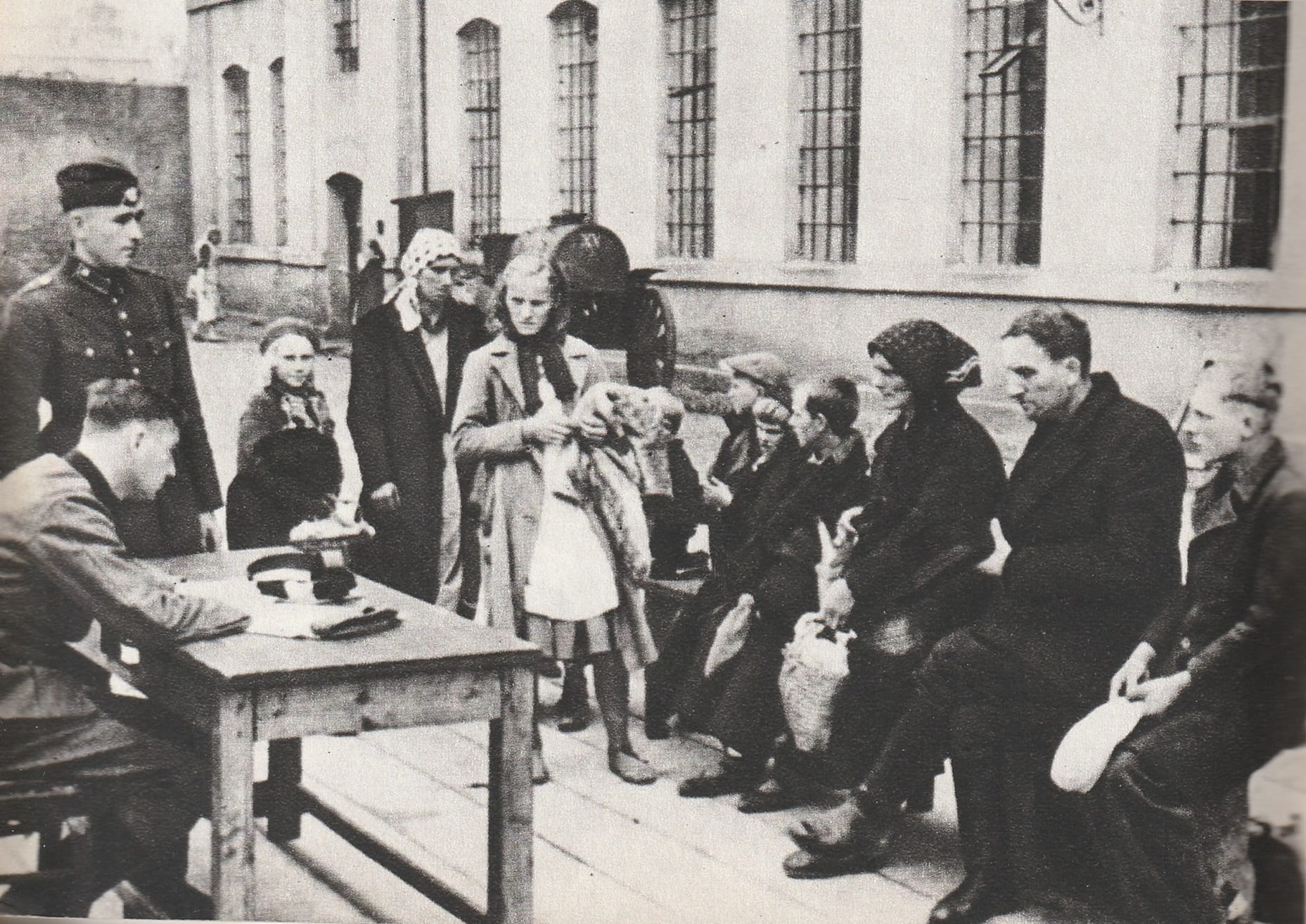
It begins with a feeling of unease. A scroll through a newsfeed, a clip of a rally where the rhetoric feels sharper, the threats more explicit. Until the spear of fascism is pointed at your neck.
We aren't letting this happen again, are we?
For many Americans, the escalating political volatility of the last few years has moved the history of the 1930s from the dusty shelves of academic abstraction into the urgent territory of a survival guide. We watch the polarization, the scapegoating of minorities, and the testing of institutional guardrails, and we ask the inevitable question: Is this how it happens?
Sign up for Collapse 2050The unspoken truth about humanity's frightening future.
Subscribe .nc-loop-dots-4-24-icon-o{--animation-duration:0.8s} .nc-loop-dots-4-24-icon-o *{opacity:.4;transform:scale(.75);animation:nc-loop-dots-4-anim var(--animation-duration) infinite} .nc-loop-dots-4-24-icon-o :nth-child(1){transform-origin:4px 12px;animation-delay:-.3s;animation-delay:calc(var(--animation-duration)/-2.666)} .nc-loop-dots-4-24-icon-o :nth-child(2){transform-origin:12px 12px;animation-delay:-.15s;animation-delay:calc(var(--animation-duration)/-5.333)} .nc-loop-dots-4-24-icon-o :nth-child(3){transform-origin:20px 12px} @keyframes nc-loop-dots-4-anim{0%,100%{opacity:.4;transform:scale(.75)}50%{opacity:1;transform:scale(1)}} Email sent! Check your inbox to complete your signup.No spam. Unsubscribe anytime.
But the more haunting question is about those going along, and the millions staying quiet at home.
For decades we've comforted ourselves with the idea that the German people of 1933 were uniquely susceptible to hateful fascism. Brainwashed. Uninformed. Evil. We imagine that we would be different...that we would speak up, that we would resist.
Yet, Third Reich shows that the rise of fascism relies less on a nation of monsters and more on a nation of neighbors. It was built on the banal, terrifying architecture of social conformity, professional ambition, and the human need to belong. To understand how a modern democracy collapses, we must look away from Hitler and toward the ordinary citizen navigating the gray zone between complicity and survival.
The Seduction of the In-GroupIf you were a "pure" German in 1933, the onset of the dictatorship might have felt like the lights coming back on. After the humiliation of World War I and the crushing poverty of the Great Depression, the Nazis promised a return to order and the Volksgemeinschaft ("People's Community").
This was the regime's most potent psychological weapon. It offered a seductive bargain: equality, status, and belonging for the "in-group," purchased at the price of the "out-group's" exclusion. Participation was made to feel like a festival. The Winter Relief drives and the Strength Through Joy vacations were communal. They made the average citizen feel seen and valued.
But this belonging was brittle. It required constant maintenance through what sociologists call "ritualistic conformity." The "Heil Hitler" greeting was a social signal. To refuse it was to mark oneself as difficult, a grumbler, an outsider. Most people performed the salute because it was awkward not to. They did it to avoid the friction of social deviance. Over time, however, a psychological mechanism known as cognitive dissonance took hold. It is exhausting to act one way and believe another. Eventually, many aligned their internal beliefs with their external actions. They became what they pretended to be.
The Ordinary Men in the WoodsThe most chilling dismantling of the "monster" myth comes from a study of Reserve Police Battalion 101. This group was made up of middle-aged, working-class family men from Hamburg, too old for the front lines. In 1942, they were ordered to round up and execute the Jewish inhabitants of the Polish village of Józefów.
Their commander, Major Trapp, weeping and visibly shaken, made an extraordinary offer: any man who did not feel up to the task could step out of line and be assigned other duties. There would be no punishment.
Out of 500 men, only about a dozen stepped forward.
Why? They weren't all driven by a bloodthirsty antisemitism, though that was part of the cultural air they breathed. They were driven by the fear of looking weak in front of their friends. They didn't want to leave the "dirty work" to their comrades. They killed out of social deference and peer pressure. The same mundane social glues that keep a high school clique together.
This dynamic appeared even in the highest echelons of society. German doctors performed a psychological process called "doubling." An Auschwitz doctor could supervise the gas chambers by day, selecting thousands for death, and then return home to be a loving father and husband by night. He partitioned his soul, creating an "Auschwitz Self" to handle the horror, keeping his "Prior Self" unpolluted. It was a functional adaptation to evil.
For the millions who were neither killers nor true believers, the primary coping mechanism was Inner Emigration. This was the retreat into the private sphere. You stopped reading the papers. You focused on your garden, your music, your children. You told yourself that by not participating in the worst excesses, you were remaining decent.
The diaries of Victor Klemperer, a Jewish professor in Dresden, document how this silence felt from the other side. He recorded the "mosquito bites" of tyranny and the slow accumulation of indignities. A colleague crossing the street to avoid saying hello. The grocer who apologetically refused to sell him an apple. Fascism didn't require fanatics. Rather, it just needed the population to keep quiet, either through fear or complacency.
For those afraid the terror was real, but it was often self-inflicted. We often imagine the Gestapo as an omniscient surveillance state, but it was surprisingly understaffed and overworked. It relied almost entirely on rats. A neighbor settling a grudge over a shared laundry room, or a colleague eyeing a promotion. The regime weaponized petty envy. It turned the "community" into a panopticon where no one could trust anyone, enforcing a "spiral of silence" where dissent felt dangerous and singular, as if you were the only one who felt that way.
Perhaps the most insidious victory of the regime was its invasion of the family. Through the Hitler Youth, the state offered children power, a rare commodity for the young. It gave them uniforms, purpose, and authority over their parents.
The presence of indoctrinated children blocked the free-flow of communication even within the family home. Parents fell silent at the dinner table, afraid that a grumble about food rationing would be repeated by their son at a Hitler Youth meeting, leading to a knock on the door. Worse, some feared their children would purposefully sell them out. The family was no longer a fortress of truth against the state. Without that, bemoaning of circumstances gradually extinguished.
Was this descent inevitable?Looking back from the ruins of 1945, it seems so. But history is a series of choices, and there was a moment when the machine could have been stopped.
Consider the Kapp Putsch of 1920. When a right-wing faction tried to overthrow the Weimar government, the response was swift and unified. The trade unions called a general strike. Berlin stopped. Trains didn't run, water stopped flowing, bureaucrats refused to sign papers. The coup collapsed in days because the ordinary machinery of society refused to cooperate.
In January 1933, Hitler is appointed Chancellor. What if the unions had called a general strike then? By then, however, the voice of the opposition was fatally fractured. The Communists and Social Democrats hated each other more than they feared Hitler. With mass unemployment, workers were terrified of losing their jobs. The psychological moment for collective action had passed.
Also consider the Rosenstrasse Protest of 1943. In the depths of the war, the Gestapo rounded up nearly 2,000 Jewish men who were married to non-Jewish German women. These women marched to the detention center on Rosenstrasse and screamed for their husbands. They refused to leave, even when threatened with machine guns.
And they won. Goebbels, fearing public unrest in the capital, ordered the men released.
Leopold Gutterer, who was Goebbels's deputy at the Propaganda Ministry, later stated in an interview:
"Goebbels released the Jews in order to eliminate that protest from the world. That was the simplest solution: to eradicate completely the reason for the protest. Then it wouldn't make any sense to protest anymore. So that others didn't take a lesson [from the protest], so others didn't begin to do the same, the reason [for the protest] had to be eliminated. There was unrest, and it could have spread from neighborhood to neighborhood ... Why should Goebbels have had them [the protestors] all arrested? Then he would have only had even more unrest, from the relatives of these newly arrested persons." Gutterer also stated: "That [protest] was only possible in a large city, where people lived together, whether Jewish or not. In Berlin were also representatives of the international press, who immediately grabbed hold of something like this, to loudly proclaim it. Thus news of the protest would travel from one person to the next."
It was a demonstration that the regime was not impervious to public pressure, especially from "Aryans." It suggests that the point of no return was further away than we think. Perhaps peaceful, coordinated resistance could have jammed the gears of the Holocaust, had it happened earlier, and on a larger scale.
The tragedy of the Third Reich is that it could have been prevented if it was resisted early enough. Instead, ordinary people did nothing, or did just enough to get by, until the cost of resistance became fatal and complicity was the safest option.
The point of no return was the moment when the fear of social isolation outweighed the moral imperative to speak. It was the moment when the professional civil service decided that swearing an oath to Hitler was preferable to losing a pension. It was the moment when neighbors decided that the apartment of the deported Jewish family was an opportunity to steal their goods, space, job.
As we wonder why fascism is rising once again, the lesson from Germany is that we should look at the mirror. Authoritarian tendencies exist in any society that values order over justice, and comfort over courage. Occasionally socioeconomic circumstances deteriorate to a point at which these tendencies explode. We are not there yet, as we can see from the massive protests in Minneapolis. Resistance is still an option. A must. But it has a shelf life. It works when the press is still free, when the courts are still independent, and when the unions can still stop the trains.
Once those firewalls burn down, the cost of saying "no" rises from social awkwardness to physical destruction. That day is may come soon, unless we persist.
We'll know all is lost when people stop talking.
We are living through collapse. This blog is my personal project to deliver unadulterated information about humanity's final period. If you'd like to support my work, please subscribe or make a one time contribution. Thanks, Sarah
Venezuela attack raises WW3 risk [ 03-Jan-26 7:13pm ]The transition from peace to a state of war in the year 2026 results from the failure of deterrence and the convergence of systemic crises.
Early on January 3, 2026, United States forces executed a high-stakes strike on Caracas, successfully capturing the Venezuelan president in an operation now known as Operation Southern Spear. While Washington frames this intervention as a necessary response to rampant drug trafficking and regional instability, the reality is far more transactional: this is an aggressive bid to secure the world's largest oil reserves and reshape global energy flows.

This strike extends a violent reorganization of the global order. By seizing control of Venezuelan energy, the US administration intends to grant Western oil companies direct access to reserves, effectively insulating the West from volatile Eastern markets. It is a bold, perhaps desperate, move to secure resource sovereignty in an era defined by a worldwide poly-crisis.
The fallout was immediate. For Russia and China, Venezuela is a strategic foothold in the Western Hemisphere. China, which relies on Venezuelan crude for a significant portion of its imports, now faces what Beijing termed a sovereign default by force.
Removing the leadership in Caracas threatens years of investment and billions in outstanding loans. Russia and China now face a stark choice: accept the loss of influence or respond in theaters where the US is overextended. We are entering a phase of asymmetric debt recovery, where Moscow and Beijing will seek compensation through territorial and economic aggression elsewhere.
The strike has shattered the illusion of strategic ambiguity. In a world of interconnected dependencies, the Caracas catalyst could force a rigid "bloc-logic" back onto the map. Moscow and Beijing, once wary partners, now stand side by side. For every dollar of Venezuelan asset frozen by Washington, Beijing and Moscow could synchronize their military posture, effectively forcing every middle power, from Brazil to Turkey, to choose a side.
As the US commits its carrier groups to the Caribbean and its logistics to a South American occupation, the global "deterrence shield" thins. This provides a window of opportunity for regional powers to settle old scores under the cover of a great power distraction.
In South Asia, the most dangerous of these opportunistic flashpoints has simmered for years. New Delhi, sensing Beijing's preoccupation and the potential for a Pacific front, might strike while the iron is hot. The objective is the pre-emptive securing of the Yarlung Tsangpo (Brahmaputra) headwaters.
In a world where oil is being seized by the West, India views water as its existential red line. If China is perceived as weakened or distracted by the American gambit in Caracas, India may move to seize control of the Tibetan hydrological infrastructure. This "Water War" could extend into multi-front continental conflict, and is just one of many examples of potential knock-on effects of a conflict between China, Russia and US.
As the US pivots its focus toward Venezuela, the architecture of deterrence in Europe is beginning to crumble. The reduction of support for Ukraine's defense has already created a power vacuum that Russia is eager to fill. Moscow is now looking toward the Suwalki Gap, the narrow corridor connecting the Baltic states to their NATO allies.
If Russia moves on the Gap while the US is bogged down in a Venezuelan counter-insurgency, Washington may be forced to choose between its own hemisphere and its European allies. This realization is pushing Poland and the Baltic states toward independent, perhaps desperate, defense sub-alliances as they realize that US hegemony has finally found its limit.
In the Pacific, the Venezuelan strike has set a dangerous precedent. Beijing's logic is simple: if the US can seize oil to secure its future, China can seize semiconductors. From the perspective of the competing powers, Taiwan remains the ultimate prize, holding the keys to the next century's industrial intelligence.
The regional response could involve Japan. Under Prime Minister Sanae Takaichi, Tokyo has officially invoked its "Red Line" protocols. Any Chinese move to fill the vacuum left by the US Seventh Fleet in the Philippine Sea is now classified as a Survival-Threatening Situation (STS). This legally triggers Japan's right to collective self-defense, marking the end of its post-war pacifism. As Japan rearms beyond the limits of its constitution, the Pacific has become a powderkeg where neutrality is no longer an option.
Western economic hegemony is also under attack. On January 1, 2026, China launched Digital RMB 2.0, a smart-contract-based currency designed to bypass the SWIFT system entirely. Combined with the mBridge project, this allows for international trade settlement without any reliance on US infrastructure.
This technological shift is a weapon. In response to the Caracas strike, China could freeze Western assets within the mBridge ledger, treating the US intervention as a seizure of Chinese property. When the systems of finance fail to clear, the economic war ends and the shooting war begins. The petrodollar system, which allowed the US to fund its national debt and military for decades, is effectively on life support.
Would the world's manufacturing floor ever go to war with its best customer?
We have been here before. In 1914, leaders believed that the high volume of trade between the UK and Germany would prevent a total war. They were wrong. When states fear their supply chains will be cut, they strike to secure the source.
The January 3rd strike in Venezuela proves that financial wealth is secondary to survival. The US holds the oil, China seeks the chips, and Russia wants the land. We live in a system in disequilibrium where resource scarcity (including energy, water, food) dictates policy, and could rapidly push the world towards global chaos.
Collapse2050 is a personal project to deliver unadulterated information and a space for honest communication about humanity's final period. If you'd like to support my work, please subscribe or make a one time contribution.
Thanks, Sarah
How to: Solitude during collapse [ 29-Dec-25 9:50pm ]
People choose solitude when the cost of belonging exceeds the benefit of cooperation. For the collapse-aware, this calculation stems from a realization that the modern social contract is anchored to a sinking ship.
Sign up for Collapse 2050The unspoken truth about humanity's frightening future.
Subscribe .nc-loop-dots-4-24-icon-o{--animation-duration:0.8s} .nc-loop-dots-4-24-icon-o *{opacity:.4;transform:scale(.75);animation:nc-loop-dots-4-anim var(--animation-duration) infinite} .nc-loop-dots-4-24-icon-o :nth-child(1){transform-origin:4px 12px;animation-delay:-.3s;animation-delay:calc(var(--animation-duration)/-2.666)} .nc-loop-dots-4-24-icon-o :nth-child(2){transform-origin:12px 12px;animation-delay:-.15s;animation-delay:calc(var(--animation-duration)/-5.333)} .nc-loop-dots-4-24-icon-o :nth-child(3){transform-origin:20px 12px} @keyframes nc-loop-dots-4-anim{0%,100%{opacity:.4;transform:scale(.75)}50%{opacity:1;transform:scale(1)}} Email sent! Check your inbox to complete your signup.No spam. Unsubscribe anytime.
Staying within the system requires a daily performance of normalcy that feels like a lie. Leaving the system, yet remaining tethered to people who still believe in it, creates a friction that burns through mental energy.
Those entrenched in normalcy bias often view collapse awareness as a pathology. To avoid constant gaslighting or the burden of carrying others' denial, the aware individual steps away.
Yet, community-building remains an integral part of managing collapse. The common argument for community centers on survival. A group provides a labor force and constant security.
However, this assumes that the people in the group are reliable. In reality, groups introduce internal risks like theft, betrayal, and incompetence.
A solo person has a smaller physical footprint. They consume fewer calories and leave less evidence of their presence. In a scenario of systemic decline, being invisible is often a better defense than being fortified. Solitude eliminates the need for consensus, allowing for instant movement and adaptation.
There is a frequent conflation between solitude and independence. Independence is the ability to provide for oneself; solitude is the state of being alone. One can be independent while living in a city, and one can be in solitude while remaining entirely dependent on a dying system for supplies. True independence requires a wide array of skills, whereas solitude is merely a spatial and social arrangement.
The distinction between a hermit and a solitary person lies in the relationship with the outside world. A hermit typically retreats for spiritual reasons, cutting off all ties. Solitude, in the context of collapse awareness, is a tactical choice. A solitary person remains an observer, gathering information and maintaining tools to interact with the world when the benefits outweigh the risks.
Physiological and mental trade-offs are significant. Solitude lowers cortisol levels by removing social conflict and the stress of managing others' expectations. It provides a clarity of mind that is difficult to achieve in a crowd. However, the human brain requires social feedback. Without external verification, an individual can drift into obsessive thought patterns or paranoia. The brain can treat minor internal anxieties as major external threats. Chronic loneliness triggers a sustained inflammatory response, which can accelerate cognitive decline and weaken the immune system. The absence of touch and verbal exchange leads to hyper-vigilance where the mind never rests, eventually leading to burnout.
Physically, the greatest risk is a minor injury becoming fatal. A broken leg is a manageable event for a duo but a death sentence for a lone actor.
A hybrid strategy addresses these risks by creating a network of solitary individuals. This decentralized community involves people living independently while maintaining functional ties. Unlike a traditional commune, this network relies on distance as a buffer. Members might trade skills via drop points or scheduled check-ins without the obligation of shared living. This model provides the security of a collective without the interpersonal friction of shared space.
It is also possible to remain solitary within a larger community without appearing anti-social by framing the behavior as personal discipline. This involves setting clear boundaries regarding time. One can participate in essential functions (e.g. local governance or maintenance) while opting out of high-friction social engagements. By being consistently helpful but socially brief, an individual gains a reputation for being reliable rather than reclusive. This preserves the benefits of a group while maintaining psychological autonomy.
While soing this, one must reconcile the need for a network with the reality that most people remain trapped in normalcy bias.
Finding a group of like-minded collapse-aware individuals is often impossible. However, a functional network does not require shared ideology; it only requires shared interests or mutual dependencies. One can build a distant community by connecting with people who possess tangible skills or trades without discussing systemic decline. In these cases, the bond is transactional or based on a common hobby. A solitary person can be a member of a local gardening club, a radio group, or a volunteer fire department. These people do not need to be aware to be useful.
By engaging on the basis of skill rather than philosophy, a soloist avoids the friction of debating the future while securing a place within a web of capable individuals.
To maintain this network, a soloist focuses on low-frequency, high-value interactions. Interactions revolve around a purpose that aids your objectives. Furthermore, establishing a mutual aid agreement with a few trusted neighbors (where the agreement is limited to specific emergencies) creates a functional bond that does not require friendship.
After deciding on a solitary path, the priority is redundancy. Since there is no partner to provide backup, every critical system or network connection must have a secondary fail-safe. It's better to have 3 carpenters in your network than one.
Critically, regardless of one's network, self-reliance remains a cornerstone to living in any form of solitude. Skills development today will benefit you in the future.
If you found this useful, please consider subscribing or buying me a snifter of whiskey.
3 Action Items for 2026 [ 24-Dec-25 1:58pm ]
The unspoken truth about humanity's frightening future.
Subscribe .nc-loop-dots-4-24-icon-o{--animation-duration:0.8s} .nc-loop-dots-4-24-icon-o *{opacity:.4;transform:scale(.75);animation:nc-loop-dots-4-anim var(--animation-duration) infinite} .nc-loop-dots-4-24-icon-o :nth-child(1){transform-origin:4px 12px;animation-delay:-.3s;animation-delay:calc(var(--animation-duration)/-2.666)} .nc-loop-dots-4-24-icon-o :nth-child(2){transform-origin:12px 12px;animation-delay:-.15s;animation-delay:calc(var(--animation-duration)/-5.333)} .nc-loop-dots-4-24-icon-o :nth-child(3){transform-origin:20px 12px} @keyframes nc-loop-dots-4-anim{0%,100%{opacity:.4;transform:scale(.75)}50%{opacity:1;transform:scale(1)}} Email sent! Check your inbox to complete your signup.No spam. Unsubscribe anytime.
If you feel paralyzed by the scale of what is happening, understand that movement is the only cure for dread. Taking a single step replaces abstract fear with concrete agency. Doing something real alleviates the depression that comes from watching a screen and waiting for the end.
As we move into 2026, I want to offer three specific goals to focus on throughout the coming year.
These are continuous efforts to build optionality as our systems lose their reliability. We are watching a slow-motion descent into who knows what. Survival in this context is about buying yourself the choice to pivot when a specific path closes off. These actions do not guarantee you make it through the decade, but they unlock the door to try.
3 suggestions:First, you must store food. I am not talking about a bunker mentality, but about decoupling your daily existence from the immediate volatility of the grocery store. Throughout 2026, make it a habit to expand your baseline. When prices spike or logistics chains snap, a deep pantry acts as a buffer. It buys you weeks or months to think while others are panicking.
Start by identifying the dry goods you already eat (grains, beans, fats) and buying them in bulk until you have a six-month reserve. Rotate what you use so nothing rots. This stash is a physical insurance policy that pays out in calories. The act of filling your shelves provides an immediate, tangible sense of security that lowers your daily anxiety.
Second, you need to develop a useful skill. Most of us occupy roles in the service economy that vanish the moment discretionary spending dries up. You need a capability that remains relevant when the bullshit jobs disappear. Spend the months of this year practicing one skill that produces a tangible result.
This might be small engine repair, basic carpentry, or sewing. You learn this by doing the work now, while parts and tools are still available and you have the luxury of time.
Skills gives you the optionality of strategy. If you can fix a pump or mend a coat, you have something to trade for the things you cannot produce yourself. Focusing your mind on a physical task also interrupts the cycle of existential worry and gives you back a sense of competence.
Third, you must build a localized social mesh. Individualism is a luxury of high-functioning industrialism. As that fades, your ability to survive depends on the people living within walking distance of your front door.
You do this by intentionally meeting neighbors and identifying shared vulnerabilities over the course of the year. Not everyone has to be collapse-aware. That will come on its own. Rather, community network is about knowing who has a ladder, who knows medicine, and who will watch your back. Nobody needs to know why you have stepped up to become more outgoing.
When the time comes, this provides the optionality of collective defense and shared resources. You cannot pull a twenty-four-hour watch alone, and you cannot know every skill.
You may even meet some like minded people along the way. Breaking your isolation is the most effective way to combat the hopelessness of collapse. A network scales your chances and reminds you that you are not facing this alone.
None of these goals ensure long-term safety. A large enough hurdle will still break most people. However, these actions prevent you from being forced into a desperate move during the first wave of a crisis.
They provide the time necessary to assess the new reality and choose a different path.
Start today, because the simple act of preparing is the best you can do for today's mental health and tomorrow's longevity.
What are you doing in 2026?
James Hansen: A "Super" Record is Coming in 2027 [ 21-Dec-25 6:00pm ]"We project a global temperature record of +1.7C in 2027, which will provide further confirmation of the recent global warming acceleration."
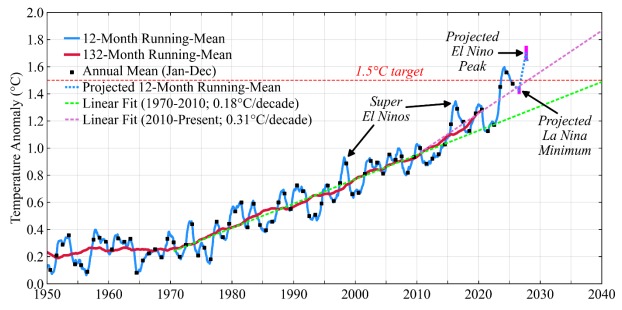 Projected global temperature in 2026 and 2027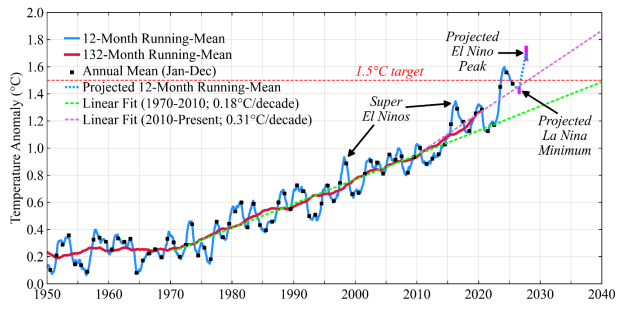
The "father of climate change awareness" is sounding the alarm again. James Hansen, the former NASA scientist who famously testified to Congress about the greenhouse effect in 1988, has released a chilling new update alongside colleagues Pushker Kharecha, Dylan Morgan, and Jasen Vest.
Their latest report, dated December 18, 2025, reveals that we have hit dangerous thresholds for humanity.
Here is what you need to know:- The 1.5°C Barrier Has Been Breached: The average global temperature for the three-year period of 2023-2025 has reached +1.5 C relative to the 1880-1920 base period.
- 2025 is the Second Hottest Year on Record: While slightly cooler than the freakishly hot 2024, 2025 clocked in at +1.47 C.
- A "Super" Record is Coming in 2027: Hansen and his team project that 2027 will shatter records, reaching a staggering +1.7 C global temperature anomaly.
- Warming has Nearly Doubled in Speed: Since 2010, the rate of global warming has accelerated to 0.31C per decade, compared to just 0.18C per decade between 1970 and 2010.
- The "Aerosol Shift": The unexpected surge in heat is partially due to the loss of the "cooling effect" from human-made aerosols, which have recently shifted from masking warming to potentially accelerating it.
While the team expects a brief dip in temperatures in early 2026 as the current La Nina phase concludes, it is merely the "calm" before the next heat storm. Models indicate a new El Nino will begin in the second half of 2026, acting as a slingshot to propel 2027 into uncharted, record-breaking territory.
Read the full report:GlobalTemperaturePrediction2025.12.18GlobalTemperaturePrediction2025.12.18.pdf780 KB.a{fill:none;stroke:currentColor;stroke-linecap:round;stroke-linejoin:round;stroke-width:1.5px;}download-circleCollapse2050 is a personal project to deliver unadulterated information and a space for honest communication about humanity's final period. If you'd like to support my work, please subscribe or make a one time contribution.
Thank you,
Sarah
11 Warnings for 2026 [ 16-Dec-25 2:39am ]
The shit storm around us - none of it should come as a surprise. They told us their plans and now they're acting on them. It was all clearly laid out in Project 2025, the Republican playbook released in 2024.
Want to know what will happen in 2026?
Well, they're telling us again.
Sign up for Collapse 2050The unspoken truth about humanity's frightening future.
Subscribe .nc-loop-dots-4-24-icon-o{--animation-duration:0.8s} .nc-loop-dots-4-24-icon-o *{opacity:.4;transform:scale(.75);animation:nc-loop-dots-4-anim var(--animation-duration) infinite} .nc-loop-dots-4-24-icon-o :nth-child(1){transform-origin:4px 12px;animation-delay:-.3s;animation-delay:calc(var(--animation-duration)/-2.666)} .nc-loop-dots-4-24-icon-o :nth-child(2){transform-origin:12px 12px;animation-delay:-.15s;animation-delay:calc(var(--animation-duration)/-5.333)} .nc-loop-dots-4-24-icon-o :nth-child(3){transform-origin:20px 12px} @keyframes nc-loop-dots-4-anim{0%,100%{opacity:.4;transform:scale(.75)}50%{opacity:1;transform:scale(1)}} Email sent! Check your inbox to complete your signup.No spam. Unsubscribe anytime.
Next year's plans have all been documented in The Heritage Foundation's 2025-2026 Policy Priorities and the November 2025 National Security Strategy (NSS). These two reports spell out the operational objectives for the administration's second year.
Contained within these reports are 11 warnings about our near future:
1. The Border War Goes Hot: U.S. Troops Will Strike Land Targets in South America.
The NSS confirms the U.S. military was deployed to stop the "invasion" and declared drug cartels and gangs as Foreign Terrorist Organizations. Following deadly airstrikes on alleged drug boats that have killed over 80 people, the U.S. is poised to follow through on explicit threats to launch "land operations" inside sovereign countries like Venezuela. (BTW, Venezuela is about oil, not drugs.)
The escalation, demonstrated by the massive U.S. military buildup in the Caribbean, will likely trigger severe, retaliatory actions that destabilize the entire region. The ultimate constitutional crisis will center on whether the President has unilaterally established a permanent, undeclared war in the Western Hemisphere. Moreover, clashes will escalate over using the military for domestic law enforcement and violating the Posse Comitatus Act.
2. Civil Rights Are Dead: The Legal End of Equality Enforcement.
The policy agenda includes a quiet but devastating legal maneuver: eliminating the ability of federal agencies (like the Department of Education's Office for Civil Rights) to administratively investigate and enforce civil rights law. Enforcement duties would be transferred to the DOJ, but restricted only to costly, slow litigation in the courts.
This action effectively ends proactive federal protection for civil rights in schools, workplaces, and public spaces. Because litigation is prohibitively expensive and resource-intensive, most victims of discrimination (e.g., disabled students, victims of racial bias) will be unable to obtain relief, allowing discrimination to flourish while remaining technically illegal.
3. NATO's Breaking Point: The 5% Defense Fee Demands Immediate Payment.
The U.S. has demanded its allies adopt the Hague Commitment, raising their defense spending from 2% to an unprecedented 5% of GDP.
Allies who cannot afford the fee will cut vital domestic programs, leading to political instability and anti-American sentiment across Europe. Failure to comply will see the U.S. withdraw security guarantees, forcing major European powers to seek independent defense strategies and accelerating the dissolution of the postwar global order, thereby rewarding Russian strategic aggression.
4. The Ideological Loyalty Test: Firing the 'Deep State' and Purging 'Woke' Beliefs.
Watch for the mass removal of career civil service employees under the agenda to dismantle the administrative state and eliminate "radical gender ideology and woke lunacy" from the Armed Forces and government agencies.
The loss of institutional expertise across critical federal agencies will cripple the government's capacity to manage complex crises, from financial meltdowns to health emergencies. The long-term consequence is the permanent politicization of the bureaucracy, where official action is guided by political loyalty rather than objective data, fundamentally breaking the mechanism of expert governance.
5. The End of Universal Suffrage: Will the U.S. Restrict Voting Rights?
The Heritage agenda prioritizes "Ensure Election Integrity" by advocating for commonsense reforms like requiring proof of U.S. citizenship to vote.
This measure disproportionately disenfranchises marginalized communities who often lack ready documentation, leading to a narrower, less representative democracy. The ultimate constitutional crisis will center on whether the government can legally use its power to enforce one set of political views by making it harder for opposing groups to vote.
6. The New American Empire: Forcing Allies to Sign Exclusive Contracts.
The U.S. is aggressively implementing the "Trump Corollary" to reassert dominance and demand that dependent nations provide "sole-source contracts for our companies".
The seizure of an oil tanker off Venezuela exemplifies this coercion. The immediate result is Latin American resentment toward U.S. economic colonialism. The severe long-term consequence is that these nations will aggressively seek investment from China and Russia, accelerating the decline of U.S. influence and the primacy of the U.S. dollar in the hemisphere.
7. The Global Economic Backlash Against U.S. Climate Policy.
The NSS explicitly rejects "disastrous 'climate change' and 'Net Zero' ideologies" and champions "Energy Dominance" via fossil fuels. The Heritage plan calls for repealing "toxic renewables subsidies".
European Union and other major trading blocs will likely impose carbon border adjustments (tariffs) on U.S. goods manufactured using high-carbon energy, risking a new trade war. The devastating third-order effect is that the U.S. will sabotage international climate efforts, ensuring that the world fails to meet critical emissions targets, locking in catastrophic long-term consequences from climate change.
8. The Nuclear Precedent: The Fallout from Obliterating Iran's Capacity.
The NSS confirms the U.S. military "obliterated Iran's nuclear enrichment capacity" with "Operation Midnight Hammer".
Iran and its proxies will initiate severe, asymmetrical retaliatory attacks against U.S. assets or allies in the Middle East. The most profound repercussion is that this action further establishes a new, dangerous precedent for preemptive military strikes against sovereign nations, destabilizing international norms and making the world dramatically less secure from war.
9. The Battle for Europe: U.S. Support for Nationalist Political Parties.
The NSS encourages the "growing influence of patriotic European parties" and is critical of allies for "civilizational erasure".
U.S. funds and diplomatic support will be channeled to populist, nationalist parties, actively destabilizing the current political structures of key democratic allies. The ultimate consequence is the internal political fracturing of Europe, which could lead to a sudden withdrawal of support for Ukraine or an immediate normalization of relations with Russia, fundamentally undermining NATO unity and rewarding Russian aggression.
10. Targeting the Nuclear Family and Individual Autonomy.
The "Put Family First" priority seeks to restore the nuclear family, reduce the supply and demand for abortion, and combat "radical ideologies".
Legislation will be passed to restrict abortion and challenge LGBTQ+ rights. This will trigger a new wave of internal migration as individuals move to states where their civil and reproductive rights are protected. The ultimate consequence is that the federal government will use its power to enforce specific moral and religious viewpoints as national policy, infringing on individual privacy and autonomy.
11. The Looming Threat of Eliminating the Education Department.
The Heritage policy explicitly calls for "ultimately eliminating the U.S. Department of Education" and replacing its role with state block grants without federal oversight.
The loss of federal oversight and funding, including the Office for Civil Rights, will lead to an increase in discriminatory practices against minority and disabled students (as mentioned in point 2). Beyond civil rights, the end result is the fragmentation of national academic standards and a massive decline in national educational quality and competitiveness.
No ads. No pop-ups. No pay-wall. Just me and my keyboard. Please support my efforts with a one time contribution.
Thank you,
Sarah
Affairs, ego and housework [ 11-Dec-25 9:57pm ]
The unspoken truth about humanity's frightening future.
Subscribe .nc-loop-dots-4-24-icon-o{--animation-duration:0.8s} .nc-loop-dots-4-24-icon-o *{opacity:.4;transform:scale(.75);animation:nc-loop-dots-4-anim var(--animation-duration) infinite} .nc-loop-dots-4-24-icon-o :nth-child(1){transform-origin:4px 12px;animation-delay:-.3s;animation-delay:calc(var(--animation-duration)/-2.666)} .nc-loop-dots-4-24-icon-o :nth-child(2){transform-origin:12px 12px;animation-delay:-.15s;animation-delay:calc(var(--animation-duration)/-5.333)} .nc-loop-dots-4-24-icon-o :nth-child(3){transform-origin:20px 12px} @keyframes nc-loop-dots-4-anim{0%,100%{opacity:.4;transform:scale(.75)}50%{opacity:1;transform:scale(1)}} Email sent! Check your inbox to complete your signup.No spam. Unsubscribe anytime.
I've sat in the meetings. I've read the internal memos. I've watched the corporate executives deliver the official gospel on the Return to Office (RTO). The public message is always the same: "culture," "collaboration," and the vague urgency of "spontaneous innovation."
From my vantage point, the stated reasons for this aggressive mandate are a thin veneer over a few, deeply personal needs rooted in the very sickness of power that defines Corporate America. RTO is an ego mandate that willingly sacrifices the financial stability of the middle class and the health of the environment to satisfy the psychological comfort of the ruling class.
The remote environment was a profound threat to the executive ego because it stripped away the traditional means of control. It forced a transition from management by sight to management by result. For leaders whose authority has long rested on physical presence, this was intolerable.
RTO is an attempt to reclaim what was lost.
Power, in the traditional corporate structure, is maintained through visible, physical presence. This allows for Coercive Power (the latent threat of reprimand) and Legitimate Power (authority derived from title) to be instantly applied. Remote work forced managers to trust the outcome because they could not control the process. The RTO mandate is a regression demanding compliance in the form of presence because physical surveillance is easier than results-based leadership.
The office also serves as the executive's stage. During WFH, executives lose the constant, reaffirming stream of employees seeking their counsel or attention. They are no longer constantly in demand.
When an executive speaks in-person, the room goes quiet. People laugh at their jokes. These exchanges are often a substitute for actual, substantive work; they validate the executive's importance. When the professional identity shrinks down to a laptop screen, the executive ego isn't nurtured. RTO is required to feed this narcissistic need for immediate, visible affirmation.
When executives champion the cause of "culture," they are employing Referent Power. The power derived from being admired and seen as a role model. "Culture" becomes a euphemism for the executive's personal sphere of influence. They need people physically present to generate unearned social capital. The spontaneous gatherings fuel immediate loyalty that comes from proximity. By mandating RTO under this banner, they ensure employees comply out of fear of being branded as disloyal or not a "team player."
The mandate forces participation in the executive's preferred social ritual. It tells employees: your value is not just in your work, but in your visible participation in the shared physical ritual. This active suppression of employee autonomy is a powerful demonstration of the core belief that the executive's personal comfort is an organisational necessity and takes priority.
The RTO drive has another practical dimension: The office is a sanctuary from the domestic responsibility.
Before the pandemic, the act of "going to the office" provided an unimpeachable, geographically defined exemption from sharing the burden of household responsibilities, childcare, cleaning, and emotional labour. When remote work brought the professional and personal into the same space, the executive was suddenly expected to put a load in the washer and get the kids from school. Moreover, they were being asked to do so by an equal.
The RTO mandate creates a geographical firewall. The commute, the long hours, the spontaneous dinners become legitimate, socially acceptable justifications for total absence from domestic duty. The commute to the office is, for some, a daily escape route, and the mandate forces thousands of others onto the roads to preserve this vital convenience for the person at the top.
Overall, the RTO mandate preserves the status quo. Those in power refuse to accept a beneficial change that improved the lives and autonomy of the less powerful. The individual, ego-driven needs of a few hundred executives translate directly into massive, hidden costs for the masses and the planet.
The RTO mandate pushes everyone back into a destructive system. The mandate forces millions of vehicles back onto congested roads every day. The environmental damage and push for the status quo mindset, one that accepts the damage in pursuit of personal resource accumulation, is a direct result of the executive's desire to see a full parking lot and manage by sight.
The damage doesn't end with the commute. High-volume corporate headquarters require immense energy. Forcing employees back means shifting energy use from decentralised, often reduced consumption at home to centralised, energy-intensive consumption in commercial buildings. The RTO decision actively chooses to increase the carbon footprint by the same companies that were setting "net zero by 20xx" mandates at the height of the pandemic. (We knew it was bullshit then, but now we have proof.)
The RTO mandate is, in practical terms, a tax on the middle class, immediately clawing back the only financial relief many have seen in years. The RTO mandate imposes a hidden cost of hundreds of dollars per month on the average employee for fuel, fares, parking, and daily expenses. This is an involuntary salary reduction that impacts the middle class while financing the executive's comfort.
By removing flexibility, the RTO instantly restores the need for full-time, expensive childcare. This actively pushes mothers and caregivers out of the workforce or sinks middle-class families further into precarity, undermining gender equity gains achieved during the pandemic.
RTO also closes the escape hatch of geographical freedom, forcing the middle class back into the expensive housing markets surrounding corporate centres. This props up the commercial real estate values that enrich the 1% while simultaneously creating unsustainable burdens for the 99%.
The simple, cold truth is that the RTO mandate is a policy of power. It is a perfect distillation of the corporate pathology where the personal, psychological needs of the ruling class override objective data, environmental stewardship, and the financial well-being of the workforce.
The decision to pollute our air and drain the savings of the middle class is made in service of the executive's desire to hear people laugh at their jokes, to avoid stacking their own dishwasher, and to have their status affirmed by the sight of compliant, physically present bodies.
We are reminded, yet again, that the systems we inhabit are always engineered to prioritise the comfort, control, and ego of the powerful. The masses live at the whim of the few, and in this case, that whim costs us money, health, and a habitable planet.
No ads. No pop-ups. No pay-wall.
Just the truth about humanity's frightening future.
Please support my efforts by subscribing, sharing, or making a one time contribution.
Thanks, Sarah.
My Shepherd, my shadow, my regret [ 09-Dec-25 3:11pm ]
No ads. No pop-ups. No pay-wall. Just truth.
Support collapse2050 with a one time contribution.
Every morning starts with my dog, Atlas. Rain or shine, we go out to play for about an hour.
She's my shadow, my furry therapist, and honestly, the best alarm clock I've ever had. But I can't help but think I made a mistake.
As you know, I spend a lot of time thinking about the state of collapsing systems, the climate crisis, and the resource hunger of modern life. And I look at Atlas, 70-something pounds of muscle and brain, and I have to ask: Is it ethical to have a pet?
I got her for companionship, security, and the pure, uncomplicated joy only a dog can provide. But now, I'm deep in the weeds of environmental guilt, and I need to figure out what her true cost is.
The numbers, when you actually look at them, are staggering. Atlas is a big dog. She eats a lot. And that food is overwhelmingly meat-based. I've read articles suggesting that the average medium-to-large dog has an environmental impact comparable to driving a small SUV, or even, creating another human child. I'm not sure about that - my dog lives a fairly minimalist lifestyle, mostly using what I already have.
Stull, that last comparison sticks in my throat. We talk about reducing births, reducing consumption, shrinking our footprint, yet here I am, caring for a creature that generates a massive resource demand. It feels deeply contradictory. Am I sacrificing my principles for companionship? Given the inevitability of our predicament, does it even matter?
This is where the second-guessing really hits. If we are genuinely committed to living lightly on the earth, must we deprive ourselves of all non-human companionship?
Dogs ground you. This means that the anxieties about abstract global futures are instantly replaced by a tangible, immediate reality. Atlas doesn't care about the collapse of the global economy; she cares that the sun is shining and she needs to pee.
Dogs require me to be present. I can't ignore the walk, the feeding schedule, or the sudden need for a belly rub. This forces presence, breaking the cycle of obsessive worry and returning my attention to the here and now.
Their world is simple: safety, food, love, work and play. This simplicity provides a necessary mental contrast to the complexity of human life. You shift your focus from massive, unsolvable problems to small, solvable tasks—caring for another being. This daily, rhythmic focus on a non-human creature is a massive aid to my emotional stability.
Studies show that petting a dog releases oxytocin and lowers cortisol in both the human and the dog. We literally become calmer, better-regulated people because of this physiological feedback loop. We may not become "better" people in a moral sense, but we become healthier and more resilient people.
Beyond the emotional grounding, the pet relationship provides practical skills and benefits that speak directly to the mindset of preparedness and independence. In a solitary life, caring for a dependent creature provides a sense of mission and importance outside of your own survival. Perhaps that is a selfish view.
The dog's sensory world is orders of magnitude better than ours. She alerts me to changes in the environment, acting as an essential early warning system. When social contracts break down, the unconditional loyalty of a dog is an unwavering psychological anchor. There is no negotiation, no betrayal, just partnership.
The individual preparing for collapse is typically self-reliant, often skeptical of crowds, and often focused on maintaining independence. A dog, particularly a highly intelligent, working breed like a German Shepherd, becomes the quintessential partner in this scenario. A large dog is an excellent, non-lethal deterrent to human and animal threats, providing a line of defense.
Breeds like Shepherds thrive on having a job. In a collapse scenario, that job becomes vigilance, resource guarding, or tracking. This satisfies both the human's need for security and the dog's need for purpose, making the relationship transactional in the best sense.
Unlike a human partner, a dog requires no complex emotional negotiation, political alignment, or resource sharing debate—only clear direction and provision. This suits the temperament of someone who values solitude and simple, efficient partnership.
I'm not sure if I regret getting my dog. She's here, she's my responsibility, and her life matters. But the fact that she is here makes me pay closer attention to how I live.
Despite the benefits, next time (and there might not be a "next time" if I'm honest) will require closer analysis of the tradeoffs. The pet-human relationship is complex. It's a profound benefit for us, but it's a costly choice for the planet.
Still, I am drawn to dogs more than other humans. Am i being selfish and hypocritical wanting a working dog and companion?
I'm still trying to figure that out.
Sign up for Collapse 2050The unspoken truth about humanity's frightening future.
Subscribe .nc-loop-dots-4-24-icon-o{--animation-duration:0.8s} .nc-loop-dots-4-24-icon-o *{opacity:.4;transform:scale(.75);animation:nc-loop-dots-4-anim var(--animation-duration) infinite} .nc-loop-dots-4-24-icon-o :nth-child(1){transform-origin:4px 12px;animation-delay:-.3s;animation-delay:calc(var(--animation-duration)/-2.666)} .nc-loop-dots-4-24-icon-o :nth-child(2){transform-origin:12px 12px;animation-delay:-.15s;animation-delay:calc(var(--animation-duration)/-5.333)} .nc-loop-dots-4-24-icon-o :nth-child(3){transform-origin:20px 12px} @keyframes nc-loop-dots-4-anim{0%,100%{opacity:.4;transform:scale(.75)}50%{opacity:1;transform:scale(1)}} Email sent! Check your inbox to complete your signup.No spam. Unsubscribe anytime.
"Laughing at our self destruction" [ 06-Dec-25 5:13pm ]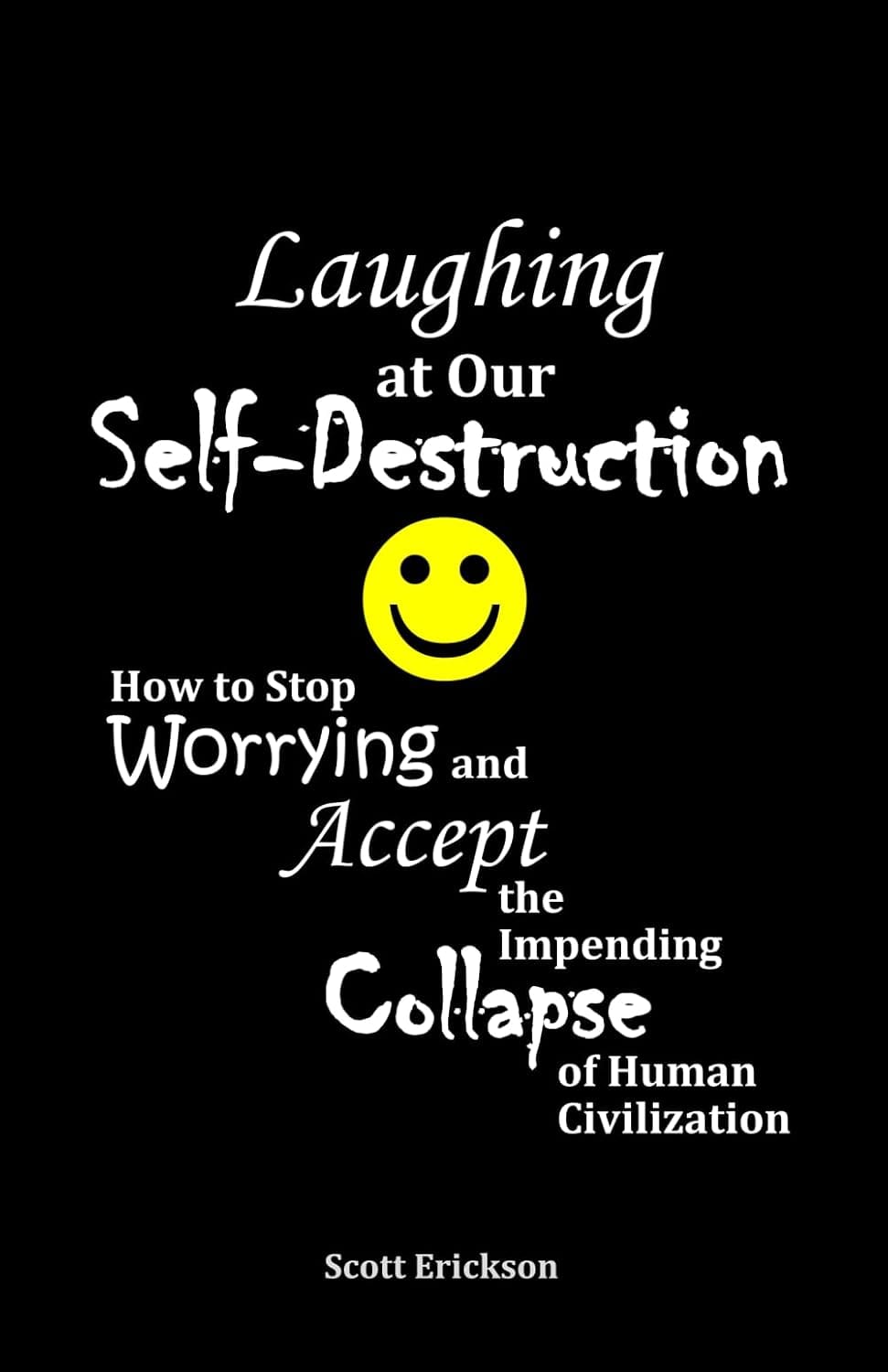
Scott Erickson is an award-winning writer of humour and satire. His latest book is entitled: LAUGHING AT OUR SELF-DESTRUCTION; How to Stop Worrying and Accept the Impending Collapse of Human Civilization.
It's a book for people who suspect that humanity is doomed and are looking for confirmation that they're not crazy. It offers a way to avoid despair and depression by showing readers how to stop worrying and laugh at our self-destruction.
The book will be officially released in January 2026, but Erickson is offering a pre-release "Doomer Discount" (30% off) to collapse-oriented groups (such as the Collapse 2050 community). The book is currently at the discount price, and in January will increase to $14.99/paperback, $9.99/ebook.I recently had the opportunity to ask Scott a few questions about his book:
Q: Given the improbable shift away from the "ego-based paradigm," is traditional activism anything more than a band-aid solution delaying inevitable collapse?Erickson: It's my opinion that collapse is imminent, whether a "hard collapse" of total social breakdown followed by the zombie apocalypse, or a "soft collapse" in which some vestiges of civilization survive. But even this outcome would be anything but "soft." It would be catastrophic, and would involve a massive amount of death and destruction. I don't advocate giving up on activism. But since I don't see any activism that's addressing the roots of our collective problems, my opinion is the best it can do is give us more time, and potentially lead to a less drastic collapse.
Q: If human extinction is the ultimate outcome, what is the deeper, life-affirming purpose of choosing humour and detachment beyond simple coping?Erickson: The main goal of my book is to help people cope with our situation. Humour gives us the option of laughing at things that would otherwise make us curl up into a ball and refuse to eat. The subtitle of the book is a reference to Stanley Kubrick's 1964 movie Dr. Strangelove. Or: How I Learned to Stop Worrying and Love the Bomb. The movie used a darkly comic approach to help people cope with the prospect of nuclear Armageddon. My book follows the same strategy of using humour to help people deal with the impending collapse of human civilization.
Q: Assuming the debt-based economy guarantees collapse, what is the most effective and safest way for an individual to fight this economic addiction locally?Erickson: I'm not sure if it's possible to fight our addiction to economic growth on the individual level. I suppose it's possible to adapt to some degree by getting out of the financial economy as much as possible. But when the economy can no longer grow, that's something none of us will be able to deal with - other than the billionaires who can fly to their fortified escape properties. The problem is that our addiction to economic growth is such a tremendous "elephant in the room" that it can't be acknowledged. Just for fun, I'd like to see a member of Congress introduce legislation called "The End our Addiction to Economic Growth Act," just to see what happens. I imagine politicians denying the problem, saying things like, "We're not addicted to economic growth! It's just that if the economy doesn't grow it will collapse and take human civilization with it."
Q: How do you reconcile your "philosophy of life based on life" and the choice not to have children with critics who view intentionally opting out of reproduction as selfish?Erickson: Talk about a controversial subject! I find myself in the strange situation of not telling a lot of people I know about my book. Even some close friends. My book has many controversial views, such as the question of whether we should have children, and many of my friends have children. To me, the core of the problem is how we interpret the idea of "affirming life." I'm looking at the bigger picture of our entire civilization, and asking, "Does our civilization affirm life?" The answer is "no." We're doing the opposite. We're at war with life. So the question is: Does adding another passenger to the sinking ship affirm life? In my book I have an imaginary conversation with a parent that insists that the more babies we have, the bigger chance that one of them will grow up to solve all our problems. To which I ask, "Even the overpopulation problem?" To which the parent, of course, says, "Yes."
Q: Given your view that American politics is a "broken bicycle" determined by the corporate-government complex, does voting for either major party contribute to the collapse rather than solve it?Erickson: Another controversial subject! At least you didn't ask me about religion! As for politics, I vote, but seldom with any enthusiasm. My view is that, as for the two major parties, the Democrats frustrate me and the Republicans scare me. And I guess I'd rather be frustrated than scared. Especially at this point in history, when a vote against the Republicans is a vote against fascism. Not that the Democrats are addressing the roots of our problems. But it's not really their fault, since the public doesn't want to address the roots of our problems. It would be great if there was widespread support for a new party called the Let's Create a Civilization Aligned with Life Party. But I'm not holding my breath.
Special thanks to Scott Erickson for answering my questions. Please consider purchasing his book in December - perhaps as a gift for a fellow realist.