
To tie up loose ends before I get on with other topics…
Falcon Press/New Falcon/Original Falcon/Christopher HyattOne narrative - from Nick Tharcher of Original Falcon Press, recently1 related how Wilson was looking for a publisher for his Prometheus Rising, because Jeremy Tarcher had expressed interest in it but had dragged his feet, and Israel Regardie had told Hyatt about RAW, and they talked on the phone for about 10 minutes and made a deal: Prometheus Rising would be published on Falcon Press. This would have been early in 1983, because the first edition of Prometheus Rising came out later that year, and 1983 letters from RAW as late as August imply Jeremy Tarcher was still sitting on the manuscript. Soon after they had a deal, Tarcher told RAW he wanted to go ahead with it, but RAW told him too little, too late, he'd just made a deal with someone else, and then in the ensuing years Hyatt and Nick Tharcher put out a long string of Wilson's non-fiction books, including books that had appeared at And/Or Press, who had (apparently?) not paid royalties, had undergone a hostile takeover and/or (pun!) was mismanaged, and went bankrupt. I'm still not sure I have the straight story with And/Or, who I covered previously in this series.
This Substack is reader-supported. To receive new posts and support my work, consider becoming a free or paid subscriber.

In 1995 Wilson did a long and fascinating email interview with Alex Burns for REVelation magazine. It was later updated by Burns in 1997 and showed up at the Disinformation website in 20012, and Burns wrote, "In the mid-1980s, after leaving his work published by a range of major and independent publishers, RAW became involved with New Falcon Publications, a loose cabal of similarly minded authors, spearheaded by Dr. Christopher Hyatt, who wrote the seminal Undoing Yourself With Energized Meditation (1989). New Falcon reprinted his (RAW's) earlier work along with tracts by Leary, Crowley, and other proponents of brain change. Currently New Falcon3 is one of the leading publishers of such modern grimoires, differing from other New Age publishers in jettisoning pompous academia or hazy cosmic foo foo."
"Believe it or not, I don't understand how New Falcon came about or even why it does much of what it does," RAW admitted. "All I know is that Dr. Hyatt was a Jungian therapist, decided Jung didn't cover everything and became a Jungian-Reichian therapist, and then for some reason became a publisher on top of that. He's also the Outer Head of the Hermetic Order of the Golden Dawn. I think his major concern is to publish books that he considers important, especially if they contain the kind of ideas that the Establishment publishers in New York won't touch with a ten-foot pole."4
I'm one of those readers who, when they discover a writer they find exceedingly interesting, must read everything by them. I immediately did a special order for a number of Wilson's books at a local bookstore and most of them were on Falcon Press. And I loved Wilson even more after reading these, but found they were edited poorly. It was conspicuous. Tharcher said he thinks this might be because, when they first went into business, Hyatt (AKA Alan Miller) did the typesetting and was a "somewhat dyslexic." The reason for typos and errors seems more complex to me, but they are revealing, because RAW often got proper names wrong, and Falcon didn't do that sort of editing. We can have no doubts that when RAW first talked to Hyatt about publishing Prometheus Rising he emphasized he didn't want editors fucking with his text! As I wrote earlier in this series: RAW wanted a laissez faire editor/publisher. But I also think he'd have wanted typos fixed. Nay, we know he did, and chalked it up to the earliest computerized typesetting: (Prometheus) "emerged with a phalanx of typos that have embarrassed me considerably over the years."5
Tharcher says he and Hyatt realized people weren't complaining about the poor editing of their books, so they didn't care.6 One person who did care about the editing was Wilson's wife, Arlen Riley Wilson. And New Falcon cared enough about editing to pay her.
In a July 20th, 1989 letter from Arlen to RAW's friend and benefactor Kurt Smith, she notes some problems with RAW's publishers for his Historical Illuminatus series of books, RAW's depression, Wilson family news, RAW's heavy lecture touring, and other things. Here's an interesting line from Arlen: "I've been doing some editing work for Falcon Press (boy do the need it!). Between that and Trajectories and secretarial stuff for Bob I keep busy." Later in the same letter she notes that, because of the various problems with the publishers of RAW's Historical Illuminatus fiction series, "It's not too easy for him to get up the enthusiasm to complete the next one, The World Turned Upside Down. He's awfully busy with other things anyway, so maybe it's just as well. He's got a contract from Falcon (not all their stuff is crap, only most) to do a book which has the working title Quantum Psychology. When he gets a chance to do it, which looks to me won't be until midwinter. He's too good for them, much too good. On the other hand I shouldn't bitch since they are paying me these editing jobs right now and I hope to get more bucks out of them as time goes on. Hard to find another employer to let me work from home, which they do. I loathe offices, and besides I'm needed here."78
Jeremy TarcherTarcher started in publishing in the early 1960s, getting book deals for TV stars like Buddy Hackett, Johnny Carson, and Joan Rivers. Then he went to Esalen and had a revelation of sorts: he wanted to publish books from the Human Potential Movement, but no one in the New York publishing circles he knew was interested in those ideas or subjects. In James Fadiman's non-fictionalistic "novel," The Other Side of Haight, he quotes Tarcher9 on the New York publishing industry never "getting" the West Coast thinking in the 1960s, an idea that was repeated by not only Wilson, but Ferlinghetti, Leary, Rexroth, Robert Stone and many others. When I was 17 or so, someone told me I had to read some book called The Aquarian Conspiracy, by Marilyn Ferguson, so I did. I still think of that book as the sort of bible for the new Esalen/West Coast human potential epoch. It's a good book about heavy Generalist-type thinkers. It was issued by Jeremy Tarcher, whose wife was Shari Lewis and sister Judith Krantz. The word "conspiracy" in the title proved to be provoking to reactionaries who to this day use "the Sixties" as the reason why we must do away with democracy.
RAW had written a long PhD thesis for his alternative university, "The Evolution of Neuro-Sociological Circuits: A Contribution to the Sociobiology of Consciousness." He rewrote the dissertation into a more popular form, which became Prometheus Rising. He offered it to Jeremy Tarcher, who "held it for a full year of meditation before rejecting it; his only explanation for the rejection concerned the mixture of technologese and 'counter culture' slang that has since become my most frequent style in nonfiction. (It's based on the way I actually speak.) When I tried Falcon next, they accepted it within 48 hours, and I received the advance check within the next 48 hours. 'Oh frabjous day!'" Wilson then mentions Tarcher changed his mind, and RAW says he had to restrain himself from telling Tarcher to go fuck himself: RAW had been living in poverty while Tarcher sat on the manuscript for a year. RAW adds that Falcon "has always served as an alternative to establishment publishing."10
On February 12th, 1983, RAW wrote to Kurt Smith, "Prometheus (with Oui material rewritten) is to be published this summer. German rights were just sold. No English publisher interested yet." In this same letter RAW does some considerable complaining about publishers not paying in time: "It is 'bad form' for a writer to go around his agent and nudge a publisher personally. And/Or owed me 3700 in July, paid 400 between July and October in 5 installments, hasn't paid anything since October, still owes me 3200. End of complaints. Just want you to know I don't get depressed without cause." In an undated letter to Smith, sometime in late February to early March 1983, he quotes Smith: "'What the hell is Tarcher doing?', you ask. I wish I knew. Arlen thinks he is trying to drive me to despair. Whatever the hell he is doing, I assume it makes sense to him. It makes no sense to me. However, the latest word from my agent is that Tarcher is trying to get a paperback sale on Earth, which does make sense to me, at this point. At least, some of my fans might see the paperback. Based on sales, I gather they never browse in the hardback section."
August 3rd, 1983 letter to Kurt Smith from RAW in Dublin: "Tarcher, ideally, shd be portrayed by Peter Lorre, not Vincent Price. A very nervous, insecure, timid and therefore treacherous type. He is afraid to gamble, but is in a business that is always a gamble, and that explains him thoroughly. For the sake of the poor bastards who will sign contracts with him in the future, I wish he would read Nietzsche."11
Let's be clear: RAW only published one book with Tarcher, the hardcover version of The Earth Will Shake, and distributed by Houghton Mifflin. Paperback versions of that were put out by Blue Jay and then Lynx. But I think Tarcher's distribution would have helped RAW. Maybe. This letter was written the year Falcon first produced Prometheus Rising. From the venom in the August 3rd letter it seems the Falcon deal had yet to go down.
The drama around Tarcher "sitting" on Prometheus Rising, coupled with Tarcher's perceived role in the long sad nightmare of the publishers involved with the Historical Illuminatus Chronicles (Tarcher abandoned his involvement once The Earth Will Shake bombed in hardcover) seems to have made RAW concentrate his invective toward him, and nowhere is this discussed more pertinently than by RAW's longtime friend, D. Scott Apel, in his memories of Wilson, from Beyond Chaos and Beyond. When Apel got a journalist assignment to interview Shari Lewis in 1985: "I never saw Bob Wilson hate anyone, before or since, but he clearly hated Jeremy Tarcher (and by association, anyone who would marry Jeremy Tarcher). He thought he'd been treated poorly, unfairly, dishonestly, and all the other disrespectful ways in which a publisher can abuse an author. From that time until Shari's passing in 1998, I could never mention either of their names in RAW's presence. At one point I had to bite my tongue from saying, 'Sorry, Bob, I can't come down this Saturday — Shari Lewis is in The City and wants to see me.' Divided loyalties, for sure…but to this day I have no idea if Tarcher actually screwed Bob over — he always impressed me as an intelligent, ethical individual, even if he was a publisher— or if Bob's imagination had bested his objective analysis of the situation."12
Mike Hoy of LoompanicsScott Apel transcribed a brilliant stand-up philosophy talk by Wilson in October 1987. At one point he started riffing around one of his key points that run throughout his work: that we ought to have doubt about our ideas, and that belief seems unnecessary, that living with only tentative beliefs in models keep us intellectually exhilarated and open-minded and emotionally alive. He talked about the Correct Answer Machine that people seem to get installed in their nervous system at some point: when you have this "machine" you don't need to think anymore about any phenomena. You already know all the answers. And you're a fucking fool, too. He attributed the term "Correct Answer Machine" to Mike Hoy, who ran Loompanics publishing out of Port Townsend, Washington state. Hoy published RAW's sparkling broadside, Natural Law: Or Don't Put a Rubber on Your Willy (1987). I bought quite a lot of books from Loompanics13, and I always looked forward to their yearly catalog, which they would send to anyone who bought a book from them. I still have most of them. Here's RAW in 1987:
Hilaritas PressMike Hoy is my favorite publisher. He publishes Loompanics books — books on how to cheat on your income tax how to pick locks, how to grow your own marijuana in the closet, how to rip off automatic bank machines, all sorts of controversial books. He recently brought forth what may be the ballsiest book he's ever published: How To Cheat a Professional Dope Dealer. I travel so much that among my circle of acquaintances there's one of everything, so I know a professional dope dealer in New York. And I told him about that book - or at least I thought I did. He said, "Are you kidding? I bought the first copy!" That's the great thing about Loompanics books: the people who need them get them. [Laughter] Michael Hoy wrote an article recently for a magazine called Critique, in which he gave a little parable. Supposing somebody told you I've got a "Correct Answer" machine, and you say, "Let's see how it works." So he starts feeding into the machine all the questions you asked, and the machine came back with a great deal of what was straight, hard-line Marxist propaganda and regular Marxist jargon. And after five or ten questions you say, "Hey, that's not a Correct Answer machine - that's a Marxist propaganda machine."And the inventor says, "Oh, no. This is a Correct Answer machine. It seems the Marxists have the correct answer. The machine is just giving the correct answer, because the correct answer just happens to be the Marxist answer." And you think, "Ah, this guy's just trying to kid me. He's just a propagandist for Marxism." So you leave in a disillusioned mood, and the guy in the next window says, "Psst. Hey, I've got the real Correct Answer machine." So you go in and you ask the machine ten questions and you get ten answers of straight Libertarian Party philosophy in standard Libertarian jargon. And you say, "You don't have a Correct Answer machine either — you've just got a Libertarian propaganda machine." And he says, "Oh, no. The Libertarian Party line happens to be the correct answer to everything."
The strange thing is we wouldn't believe in such machines, but most of us think we do have a Correct Answer machine in our heads.14
RAW, on his death bed, told his daughter Christina to keep his books in print. And this small press has done so. Run by Richard Rasa and Christina Pearson, they have done very heavy lifting and I think Wilson would be proud. [Full disclosure: I've gotten essays printed in some of Hilaritas's books.] The terrain in publishing since RAW's death has seemed to mirror increasing income inequality in the population, and many are opting to self-publish. I briefly discussed the New York-based "Big Five" and what a drag they are on writing culture these days: they only want best-sellers.
RAW once dreamed of having his own press, which he'd call Ho House, with a laughing Buddha as the logo, but it never happened. "Hilaritas" is traced back to medieval philosopher Scotus Erigena, who seemed to define the term as something like "cosmic humor." A cosmic "Ho." Even in "sad" things there is humor; in humorous things there is some sadness. Ezra Pound liked the term, and that's probably where RAW first encountered it.
Hilaritas's editions are on better paper stock, with far better bindings, contain much supplementary material, have wonderful artwork, were scrutinized by a large group of editors for typos and mistakes, etc. They did/do not change any word of RAW's thought. If something seems too obscure and the current editing team can't agree what he may have meant, they just leave it alone. Still, an editor friend who worked with RAW at And/Or Press, Peter Beren, thought, "The Robert Anton Wilson Trust, which had established a strong presence online, began to seem more and more like a cult with Bob as the Prophet. The eye in the triangle, sign of the Illuminati, was its symbol and the main slogan" "Keep The Lasagna Flying." This profound but surreal and absurdist cult still exists online."15
I leave us here, with much left unwritten about Wilson, his publishers, his would-have-been publishers (Llywelyn, Weiser, Soft Skull, M.I.T. Press), his wailing and gnashing over editors, his difficult writing life. Previous parts of this story are HERE and HERE.
I will comment in general on these affairs in some future blogspew.
1Hilaritas Press podcast, Dec 23, 2025, c. 08:20-09:20 or so
2"In the raw: necessary heresies," RAW's interview with Alex Burns. It can be accessed HERE.
3It had become New Falcon after just plain Falcon after a legal dispute, or so it seems. Then, after Hyatt died, his son created a stir and Tharcher and Hyatt's widow converted the official publisher's name to Original Falcon, which is what they are today. Also: sorry about the Jeremy Tarcher and Nick Tharcher situation, but those really are those guys' names.
4Re: Hyatt as Outer Head of the Golden Dawn: In a 1988 interview with David Banton, broadcast on KFJC Los Altos Hills, California, Banton asks, "Recently, Falcon Press has been reprinting a lot of your books, and there's a little joke in the list of Falcon books. With so many of them by Robert Anton Wilson, it asks, is Falcon Press owned by Robert Anton Wilson? Well, is it?" RAW replies:
"No, that's just one of the publisher's little jokes. Falcon Press is owned by the Hermetic Order of the Golden Dawn, which was the English branch of the Illuminati, according to some conspiracy buffs. Of course, it wasn't really, that's just what some nutty people say. And I want to deny Mae Brussell's claim, uh, no it's not Mae Brussell, it's Lyndon Larouche. Lyndon Larouche claims I'm the head of the Illuminati; there's no truth in that whatsoever. Mae Brussell is the one who said I'm an agent of the Rockefeller conspiracy. That is the truth, I can't deny that one! Actually, my whole cellar is full from floor to ceiling with bars of gold sent to me personally by David Rockefeller for all the services I provide for the Rockefeller Conspiracy."
(see also pp. 983-1079, Infinite Jest)
5Prometheus Rising, Hilaritas ed, p.ii
6Listen to an interview with Nick Tharcher from two years previous to the interview citedin footnote #1, above. Start at around 33:00 and go to 34:50 or so. Since the rights to almost all of RAW's non-fiction have reverted to his family and Hilaritas Press, a small army of editors - including yours truly - have cleaned up those books significantly, although RAW's erudition, combined with his misremembering of proper names and their spelling, and some book titles, have created a huge challenge, but I think we've made a very significant dent.
7I bought a bunch of books from the Falcon/New Falcon catalog written by other authors, simply because RAW had written the Foreword of Introduction. And when I read those books, I often found them wanting. Just not my taste. But there are definitely some very interesting minds put out by that publisher. RAW did an Intro for Hyatt's aforementioned Undoing Yourself. He did similar for Wayne Saalman' Dream Illuminati and Illuminati of Immortality; Madeleine Singer's Psychology of Synergy; David Jay Brown's Brainchild; Hyatt/Duquette/Ford's Taboo: The Ecstasy of Evil; Rodolfo Scarfalotto's The Alchemy of Opposites; Donald Holmes's The Illuminati Conspiracy; Constantin Negoita's Cybernetic Conspiracy: Mind Over Matter. There was a volume with Hyatt's name on it, but many contributors Rebels and Devils, that RAW also wrote for. There are probably a few others I've mis-shelved on my own shelves. All these books were worth buying, for me, simply because of RAW's introductions and contributions.
8Let's get this straight: Arlen was writing Kurt Smith from Los Angeles to Smith's home in San Francisco. It's 1989. RAW was on a lecture tour, but Arlen was trying to assure Smith that RAW wasn't mad at him, and that Bob had been very busy, but when this correspondence gets published one day it will become clear that RAW was probably depressed also. "You have nothing to worry about…You are still in the Aces. Elite, Primo. Gold Card category, believe me." Why didn't they email? Probably because this was just a year or two before everyone had an email address. Why didn't they call? Probably because you had to pay per minute for calling outside your area code number, on what was called a "land line". I mean, think about how radically different communication was in just 1989!
9The Other Side of Haight, Fadiman, pp.239-240. Fadiman's cousin was William James Sidis, who was a freakish genius. Fadiman was turned on to psilocybin by Richard Alpert, was Stewart Brand's guide on Brand's first LSD trip, and lived near Ken Kesey in Menlo Park. He's since become associated with microdosing and set and setting, and all things Transpersonal. His uncle was Clifton Fadiman, a 1960s TV intellectual; his cousin is writer Anne Fadiman.
10Prometheus Rising, pp.i-ii of the Hilaritas Press ed. According to Hilaritas, this book continues to sell well, 19 years after RAW's death, and for me, it's still the ABC/Baedeker/enchiridion for the Eight Circuit Model of consciousness.
11This seems to me a transparent projection by RAW. At least he acknowledges that publishing is a gamble. The Peter Lorre bit tickles me.
12Beyond Chaos and Beyond: The Best of Trajectories, vol 2, D. Scott Apel, pp.438-439
13One of my favorites was How To Start You Own Country, by Erwin Strauss. It was books like this - and no one published more of them than Loompanics - that made me realize the heavy strain of what I call "Walter Mitty Syndrome" in my reading life and personal makeup since childhood. I will happily read the most insane, "dangerous" books while sitting like some milquetoast, knowing I'd never do anything like what's going on in the book. Hey! I want to know about other reality tunnels! And so I read "Uncle Fester"'s book on starting your own LSD lab, Practical LSD Manufacture, all the while realizing I have a tough time making instant oatmeal. Or The Turner Diaries. Or Hit Man, by "Rex Feral," who was really a female mystery novelist who was having difficulty with sales. Her book brought down Paladin Press. Uncle Fester, The Turner Diaries (by "Andrew Macdonald"), and "Rex Feral" were all available through Loompanics. Thus did non-fiction forever seen coterminous with fiction to me.
14Beyond Chaos and Beyond: The Best of Trajectories, vol.2, D. Scott Apel, p.270 This gedankenexperiment by Hoy, as related by Wilson, reminded me of John Searle's "Chinese Room" thought experiment about AI. And, decades later, with widespread talk about scary AI taking over the world, this seems even more pertinent. Who is programming your "reality"? This idea runs, of course, through RAW's entire oeuvre. It's just that he appreciated the shaded nuance of Hoy's rhetoric about why we must, doubt…and find our own light. I can't help but feel strongly that, had more people read RAW and understood his ideas around Model Agnosticism and "Maybe" logic, that we wouldn't be in the rapidly disintegrating apocalyptic collapse that now seems to be accelerating. On other days it rains.
Hoy quit Loompanics in 2006: "Outlaw Publisher Calls It Quits"
15More True Than Strange: Collected Writing 1968-2018, Peter Beren, p.205 When I emailed Richard Rasa about this, he replied "I wish it was a cult! Then we'd have better sales!" I don't think Beren had the hilaritas, but then I'm biased. Or… stuck in a cult? Which, if so, I wouldn't know, right? Help! Help?

(above graphic done by artist Bobby Campbell)
 RAW's Publishers, Part 2 [ 08-Feb-26 10:34am ]
In our last episode, the OG was going on about Wilson's (ahem) unfavorable attitude toward publishers and editors, and "writing as business" in general. And while Pound had his great champion in James Laughlin, RAW had a few publishers who were champions of his work, too. But small publishers seem often colorful characters…
Aside from Playboy Press, Wilson published his Schrödinger's Cat trilogy with Dell, a major NY publisher. All the rest of his books were with small, marginal publishers, except his "conspiracy encyclopedia," Everything Is Under Control, which was with Harper/Collins and he said somewhere that their lawyers went over every line to make sure they couldn't get sued, which was a drag. He had very bad luck with the publishers for his projected five-part Historical Illuminatus Chronicles, which I will go into at some other time, but what's more striking to me is that when you publish with non-establishment publishers you tend to run into some very interesting characters.
This Substack is reader-supported. To receive new posts and support my work, consider becoming a free or paid subscriber.
Playboy Press also published his Book of Forbidden Words and The Book of the Breast; of the former RAW complained that it was a:
disaster and again proved my naivete about he publishing industry. The book was not my idea but that of an editor at Playboy Press, who asked me if I could write a history of foul language. I said sure, I could, since I knew a lot about linguistic history and also knew how to do research; we signed a contract and I went ahead — quickly producing a book of high erudition and (I think) some wit. It turned out that this was not what was wanted. The erudition and the linguistic history were excised, along with much of the wit, and in his hurry to turn my work into a more commercial production, the editor in many sections replaced correct grammar and syntax with the kind of pidgin English generally only encountered in TV advertisements.1
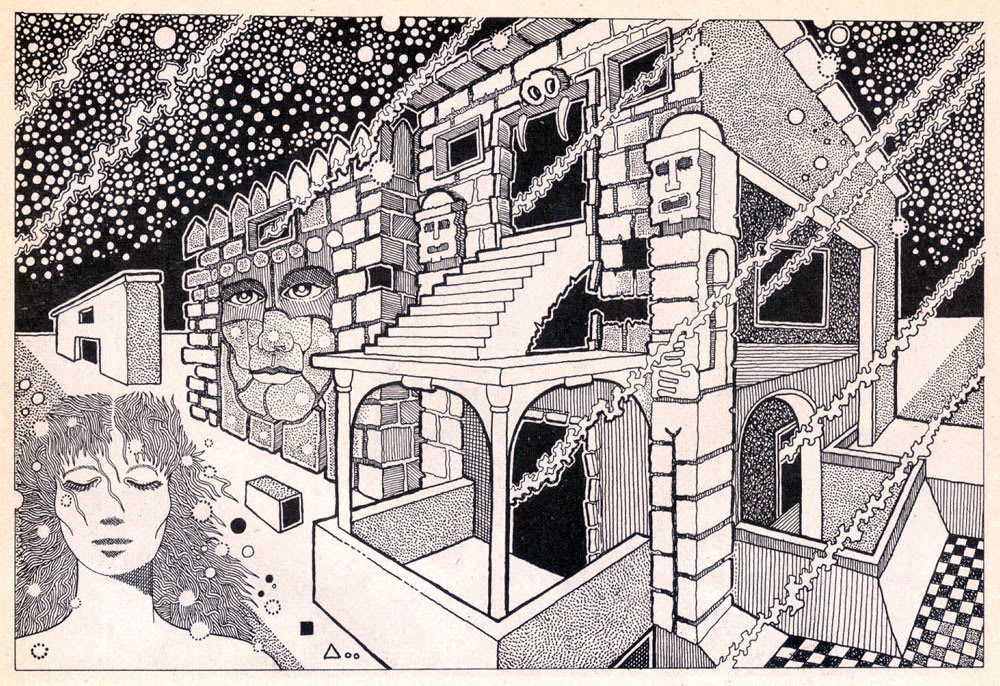
(artwork by John Thompson, who worked with Sebastian Orfali at And/Or Press)
And/Or and Sebastian OrfaliAnd/Or Press in Berkeley was founded by Sebastian Orfali, along with his brother John, and a psychedelic artist RAW thought was Blakean, John Thompson. They may have all been roommates in San Francisco and publishing for Last Gasp and/or an underground comix bookstore in North Beach, People's Comix in the early 1970s, when Sebastian, born Joseph Peter Orfali in Jerusalem, decided to start And-Or Press in 1974. Previously he earned a Master's in Philosophy at U. of New Mexico, and he worked as a teaching assistant there before moving to the West Coast. Orfali was a daring publisher: Marijuana Grower's Guide was banned in Canada and was used as a weed grower's bible by growers in the Emerald Triangle, which received a huge boost when Reagan had the Mexican cannabis field sprayed with paraquat, which provided a strong impetus for cannabis horticulturists in Northern California to develop stronger, seedless weed for the domestic market. Orfali's colleague Peter Beren says it sold more than 500,000 copies.2 Jay Kinney's Young Lust comix were banned in England as too pornographic. Orfali appears to be a character in one of Bill Griffith's "Zippy the Pinhead" strips; Orfali and Griffith probably knew each other from the early 1970s San Francisco scene.3 And/Or's Holistic Health Handbook sold 800,000 copies in 1978, according to Peter Beren, who worked with Orfali. Orfali was really a trailblazer for books on drugs, and And/Or's books were hot in head shops, which were gradually closed down under Reagan.
Orfali was probably influenced by Michael Horowitz's burgeoning collection of books about drugs, which eventually merged with two other collectors and named the Fitzhugh Ludlow Memorial Library. Orfali brought back into print a 1929 book titled Black Opium, by Claude Farrère (AKA Charles Bargone, 1876-1957), "featuring striking, exotic and evocative illustrations" by Alexander King. Orfali brought out a facsimile edition of this book, the earlier Paris edition was highly sought after by collectors. Horowitz likened the prose style to James Joyce's Dubliners. And/Or also brought out another book of classic drug literature, Cocaine (1921), by Pitigrilli (AKA Italian journalist Dino Segrė), which appeared a year before Crowley's Diary of a Drug Fiend, and, according to Horowitz's partner William Dailey, captured "a vivid picture of the cocaine-crazed demimonde of the Parisian 1920s," of which Stephen J. Gertz says is "an understatement in the extreme."4
And/Or, over the eight years they operated, put also out books by RAW (most notably: Cosmic Trigger, Vol 1, now a counterculture classic), and books by Jacques Vallee, Colin Wilson, and David Wallechinsky5. Paul Krassner and Timothy Leary also had books put out by And/Or. Terence and Dennis McKenna's Psilocybin: Magic Mushroom Grower's Guide was (and probably still is) a best-seller in that genre. No one had seen anything like it: the brothers published under pseudonyms, O.T. Oss and O.N. Oeric6, with line drawings by Kat McKenna.
As much as RAW found to carp about many publishers, I've never seen a harsh word for Orfali, and RAW has a very wise alchemist character in his Historical Illuminatus series named "Abraham Orfali." And/Or operated out of Berkeley, and, after what appears to be some sort of hostile takeover by a larger publishing consortium, morphed into Ronin Publishing, run by Orfali's life partner, Beverly Potter.7 "He loved telling of being busted on the Ides of March by the border patrol in Truth or Consequences, New Mexico, for three pounds of pot," Potter relates.8 His attorney got him off the rap, and later turned into a Buddhist priest.
The DEA at one point tried to obtain a list of And/Or/Ronin's customers who bought the cannabis horticulture book in Arizona, and they sued back.
Orfali died at the age of 51, and it's a horrible thing to read about: it seems to have started with teeth problems. Some dentist had inserted a small silver wire jacked into the root of one of his teeth, and this may have led to cancer of the mouth, and the gory, cascading ever-worse details are relayed by Bev Potter in a bizarre, maddening book I found in a used bookstore in Berkeley, Animal House On Acid: The Barrington Hall Saga: A Memoir, 2015.9 Barrington Hall was a notorious (insane!) student co-op near UC Berkeley, and Potter and Orfali lived next door to it. You've read about roommates from hell? The denizens of Barrington Hall terrorized the neighborhood and made me think, "I'd have moved out of there years ago!"10
Herb RosemanRAW seems to have known Herbert C. Roseman through co-editing of The School of Living's magazine Way Out. The School of Living was founded by Ralph Borsodi in 1928 and was one of the proto-hippie drop-out communal living sort of things, but it lasted. They were serious. They had a large library of anarchist (19th century America: "libertarian") books of all sorts, and Wilson seems to have read that entire library.
After leaving the School for New Jersey and then ending up in Chicago as an editor for Playboy, RAW thought Roseman's Revisionist Press would be the publisher of his book on Aleister Crowley, Do What Thou Wilt: An Introduction to Aleister Crowley, Gabriel Kennedy found RAW's manuscript of this book in Harvard's Houghton Library. It had been found by Harvard at Carl Willians Rare Books in London and bought in 2018. RAW had apparently written another book about Crowley titled Lion of Light, which appears to not be the version with the same title published by Hilaritas Press in 2023. Who knows where the original Lion of Light is?11
So, Roseman for some reason never put out Wilson's book on his Revisionist Press, which appears to have been a subsidiary of Gordon Press. They appear to have put out a red hardcover version of the Discordian bible, Principia Discordia. Revisionist once had a Wikipedia page, now gone. There were (paranoid?) rumors that their catalog of conspicuously high-priced books was a front for the CIA and/or the FBI, to gather names of subversives interested in ideas about the controversial, esoteric and revisionist history and the like. Someone online has quoted Roseman, "I wish it was true about the CIA! We might have made more money."12
What gets me is that RAW wrote this book on Crowley - what we read as Lion of Light (2023) - merely months after being introduced to Crowley and his difficult Modernist texts by Alan Watts. It's one of the most insightful books ever written about Crowley, was written quickly, and is a perfect example of the virtuoso "quick study" that Wilson was. No doubt his many years of reading dense, difficult Modernist text by Joyce and Pound prepared him for Crowley. It's a sort of reading that seems to be vanishing in 2026, a cultural reading scene that seems to be reverting to the days when only monks and priest actually read books and manuscripts for many hours of the day. That RAW sent this manuscript to Roseman, hoping to be paid at some point but seeming to forget about this text? There seems to be some missing information here.
My own copies of Proudhon's General Idea of the Revolution13 and Benjamin Tucker's Instead of a Book were put out by Gordon Press, but apparently Revisionist Press re-printed famous works by hardcore revisionist historians like Harry Elmer Barnes, who also were Holocaust revisionists. Gordon/Revisionist were a poorly run family publishing biz and they went kaput in 2001, sold to Run For Cover.14
Paul Krassner and Ralph GinzburgKrassner was one of the first to publish Wilson, in his The Realist, in 1959. They remained friends until Wilson's death. A fearless writer and editor, Krassner was at a nexus with the renegade publisher Lyle Stuart15, who Krassner worked for while he was still in college, was friends with Ed Sanders, Ken Kesey and Leary, knew Mae Brussell, and also wrote for High Times. He turned Groucho Marx onto LSD.16 Before taking the stand for the trial of the Chicago Seven (or Eight), Krassner took acid and testified.17
Ralph Ginzburg hired RAW to write for FACT, and in 1964-1965 Wilson published at least ten well-researched, pull-no-punches investigative journalism and analyses of subjects such as advertising, atheism, free love, the National Enquirer, MAD magazine, the KKK, and William S. Burroughs.18
Ginzburg, another fearless publisher, put out four copies of eros in 1962, got arrested for publishing porn, took it all the way to the Supreme Court, lost, was sentenced to five years, and did eight months, which he writes about in Castrated: My Eight Months In Prison (1973). I admire Ginzburg, who I can't help but mentally link to certain jewish radical publishers who seemed absolutely driven by both radical free speech, radical ideas, and money, probably roughly in that order. The list is long and I have much to say about these Jewish badasses, but will save it for another day. Krassner writes about a rift between Ginzburg and Lyle Stuart:
Stuart guided Ginzburg through the publishing of An Unhurried View of Erotica, "finding him a typesetter, a printer, a distributor, a mailing house - and when the Post Office seized Ginzburg's mailing piece, Lyle sent attorney Martin Scheiman to Washington to obtain release of the mailing. One day Lyle was giving Ginzburg help on his ad campaign.
"I'm publishing a book by Albert Ellis called Sex without Guilt," Lyle said. When you book some of your radio and TV things, could you suggest him as a fellow guest?"
"But the topic will be pornography."
"Ellis is a pornography expert. He's testified in many trials."
"I can't do that," Ginzburg said. "What's in it for me?"
Krassner ads: "Thus did Ralph Ginzburg make Lyle Stuart's permanent shit list in a single bound."19
Ginzburg put out The Housewife's Handbook on Selective Promiscuity, which was written by "Rey Anthony" who was actually popular sexual technique writer Lillian Maxine Harrison AKA Maxine Savant AKA Maxine Sanini, and this book was part of the obscenity trial that got Ginzburg time in slam, but she was never prosecuted. I have not yet seen a copy of this book, although I will. One day.
FACT published, in September-October 1964 - just in time for the election - an article titled "The Unconscious of a Conservative: A Special Issue on the Mind of Barry Goldwater," in which they - RAW was not involved - asked 1800 psychiatrists their opinion of Goldwater's fitness to be POTUS. In their professional opinions, Goldwater was manifestly unfit. Goldwater sued Ginzburg for $1 million; he got $1 in compensatory damages and $75,000 in punitive damages. Ginzburg took another one on the chin. This basically bankrupted Ginzburg. I note this because it reminds me of my reading of the 27 psychiatrists, mental health profesisonals, and psychologists, who contributed to The Dangerous Case of Donald Trump and declared him a "clear and present danger" to the US, in 2017. Psychiatrists have a professional "duty to warn" which seems to clash with the precedent of the "Goldwater Rule," which the American Psychiatric Association thought they violated. Anyway…what do these people know anyway, am I right? (cough)20
About Krassner, RAW wrote:
Paul Krassner's iconoclastic journal, The Realist, has published more of my writings than any other American magazine, and there was a period in the last 1950s and early 1960s when I might have given up writing entirely if Paul had not gone on publishing my work. I think everybody in the "counterculture" owes a great debt to Paul Krassner, but I perhaps owe him more than anyone else.21
At this point, given the quotes from Wilson in Part 1, we must realize his problems with editors and publishers were more with…guys who wore ties and worked in skyscrapers in Manhattan? Because clearly, there were radical, progressive, fearless publishers who published RAW's work…they just weren't issuing stock, etc. It's always more complex, isn't it? Aye, I think so: delightfully so.
Myron Fass: Schlockmeister ExtraordinaireI recently watched a documentary on the Pacifica Radio station WBAI-New York, Radio Unnameable (2012 Lovelace and Wolfson), which was about Bob Fass, friend of Krassner, Sanders and the Yippies, and a legendary radio man in New York FM radio. Bob Fass was born in 1933 in Brooklyn. Schlockmeister Kingpin Myron Fass was born in 1926 in Brooklyn. I did searches for both, reading for over an hour to confirm what the Google search AI said: they were brothers. I couldn't find anywhere where Bob talked about Myron or Myron mentioning Bob, or any of their friends or researchers pointing it out. I'm still in doubt, because so often AI has given me wrong answers, ut if it's true, I can see why neither talked about the other: Bob Fass was a progressive leftist while who knows what politics Myron was, but there are stories of him brutally beating a writer or editor for one of his periodicals. RAW wrote an expose of his own job for Fass that Krassner published in The Realist, "Anatomy of Schlock,"22 which starts out:
For three months, I have worked as an editor in the country's leading schlock factory. My boss assured me that our schlock reached 30,000,000 Americans every month, and that, brethren, is a lion's share of the schlock market. Let me define my terms. Schlock is the next level below kitsch. Kitsch is naive, maudlin, hokey, unsophisticated. Commercial folklore, so to speak […] Kitsch is " I Found God When My Doctor Told Me I Had Cancer," "Jackie Kennedy Tells Why She Will Not Re-Marry," "Should Wives Enjoy Sex?"
Schlock, on the other hand, is brutal, lumpen-prole, aggressive, hairy; like carnival hot-dogs, so spicy you might vomit if you're over-sensitive. Schlock is "He Beat He Grandmother to Death With Her Crutch," Love-Starved Arab Peasant Woman Raped Me Twenty Times," "The Disease That Liz Caught From Dick."
After FACT, Wilson found work at Fass Publications. Quite a leap!
He wrote astrology columns, just making stuff up and getting fan mail about how accurate he was. He edited "four girlie magazines simultaneously"23 andHe made up captions for the soft-core porn photos of girls, writing they were scientists, stewardesses, or typists, who like peyote and read William S. Burroughs. My favorite tabloid title that RAW made up was "Mad Hunchback Sells Hunch To Butcher/Woman Poisoned By Hunchburger."
Myron Fass had been influenced by Bill Gaines of Mad magazine, and so had Krassner, who knew Gaines and worked for him, and basically, started The Realist as a Mad magazine for grown-ups. Fass was influenced by Gaines in that the obscenity laws favored "magazines" over "comic books" and Gaines had published Mad as a magazine, not a comic, to evade the new Comics Code Authority. You can get away with more that way. And, my gawd, did he get away with a lot.24
Wilson never mentions Fass's name nor the name of the magazines, for understandable reasons. Eventually Fass gave RAW reign over one of his Playboy knockoffs, Jaguar. Fass wanted RAW to make it not too schlock and not too egghead, so RAW "revamped my table of contents several times, making it more schlocky each time. I kept two non-schlock articles, a factual piece about Cuba, and an interview with with a prominent novelist, and tried to make the rest of the pieces come out both schlock and non-schlock simultaneously. This I did by giving them schlock titles but sophisticated insides, or, in one case, a sophisticated title with schlock insides." Fass fired him anyway.25 RAW had published this exposé in The Realist under the pseudonym A. Nonymous Hack, but an editor at Playboy read it and was impressed, and he got hired there, the best paid job he ever had, editing the Playboy Forum with Robert Shea.26
Part 3 will be shorter, and include RAW on Falcon/New Falcon and a few further comments. Sorry for the length!
1Coincidance: A Head Test, pp. 37-38, Hilaritas ed.
2More True Than Strange: Collected Writing 1968-2018, Peter Beren, p. 202
3it's conceivable that a party at that time and place, in that circle, might have had in attendance Orfali, Griffith, R. Crumb, RAW, George Kuchar, and some of those gay LSD makers/distributors that Erik Davis wrote about in Blotter. Also Terence McKenna, Nick Herbert, Jeffrey Mishlove, Aline Crumb, Jacques Vallee, Grady McMurtry, and who knows who else.
4Dope Menace: The Sensational World of Drug Paperbacks 1900-1975, Stephen J. Gertz, p. 58
5Wallechinsky's book on nitrous oxide, Laughing Gas, still in print by Ronin, seems now a classic text on the subject. I bought a copy when I saw it in the old Loompanics catalog, and someone absconded with it.
6Two of my favorite noms de plume in effort to steer clear of The Man: "Otiose" is an arcane word meaning "lazy, serving no practical purpose," and "Oneiric" relates to dreams. Many of the drug-writers for And/Or used pen names.
7In a letter to Kurt Smith, RAW mentions waiting on $1500 from And/Or after their bankruptcy. I don't have all the details. Potter's Animal House On Acid has a confusing narrative about what happened; either that or I don't understand business workings well enough.
8Animal House On Acid, Beverly Potter, p.31. Potter gave a peculiarly bad reading of Cosmic Trigger, vol 1: "While waiting at the airport bookstore I picked up the Cosmic Trigger by Robert Anton Wilson and published by And/Or Press. It was a conspiracy with us in the future on Sirius, the Dog Star," she writes on ibid, p.29
9Potter's account of Sebastian Orfali's death: Animal House On Acid, pp. 348-356. Orfali's 1997 obituary at SF Gate.
10Erik Davis spent some time at Barrington Hall as a non-student at Berkeley, reading and taking in the scene, but when I told him about this book and the noise, deaths, the cops, the craziness, he said he wanted to know where I was getting this and I told him of Potter's book, which he hadn't heard about. Regarding And/Or, see Davis's High Weirdness: Drugs, Esoterica, and Visionary Experience in the Seventies, pp.219-220; p.258, and Vallee's Messengers of Deception, which was put out by And/Or, and which influenced RAW but Terence McKenna thought it was "paranoid." Also see More True Than Strange, by Peter Beren, pp.200-205, on RAW, Sebastian Orfali and And/Or Press. Beren worked with Orfali and knew RAW. Gabriel Kennedy touches on Orfali and John Thompson's Blakean artwork and And/Or in his Chapel Perilous:The Life and Thought Crimes of Robert Anton Wilson, pp.141-142
11Background narratives around this: Lion of Light: Robert Anton Wilson on Aleister Crowley, pp.9-13; Chapel Perilous, pp.111-113.
12Herbert C. Roseman's papers, 1950-1969, are at the U. of Wyoming's American Heritage Center. Revisionist Press.
13RAW wrote a very erudite review of Proudhon's classic that Gordon Press included as a sort of Foreword to their edition. It was originally printed in Way Out, so there's the Roseman connection, and I was delighted to see it included in the recent collection of Wilson's political writings, A Non-Euclidean Perspective: Robert Anton Wilson's Political Commentaries 1960-2005, put out by Hilaritas in 2025.
14Chapel Perilous, Kennedy, p.112, footnote.
15see Stuart's tiff after putting out a biography on Walter Winchell in Krassner's One Hand Jerking, pp.163-165. Stuart was the kind of editor-publisher that might have been a good fit for RAW, but it never happened.
16see chapter 5 of Confessions of a Raving Unconfined Nut. My two favorite bits: they're both way high when Groucho excuses himself to urinate. When he comes back he says, "You know, everybody is waiting for miracles to happen. But the whole human body is a goddamn miracle." Then, later, when it was found the FBI had published pamphlets, supposedly by the Black Panthers, that advocated killing cops, and opened a file on Groucho as a national security risk, Krassner phoned Groucho, who said, "I deny everything. Because I lie about everything. And everything I deny is a lie."
17Confessions of a Raving Unconfined Nut, Krassner, pp.190-201. "When my testimony was completed, in order to get centered, I asked myself, 'All right. Now why did you take LSD before you testified?' 'Because,' I answered myself, 'I'm the reincarnation of Gurdjieff.' This was slightly confusing, inasmuch as I didn't believe in reincarnation - I thought it was the ultimate ego trip - and besides, I had never even read anything by Gurdjieff."
18see Chapel Perilous, Kennedy, p.259 for a list of articles RAW published for Ginzburg's FACT, sometimes under the pen name "Ronald Weston."
19Confessions of a Raving, Unconfined Nut, Krassner, p.97, older edition; p.100 in the 2012 Soft Skull Press edition
20Wikipedia's entry on this case.
21Coincidance: A Head Test, p.121, Hilaritas ed. When RAW, working for Ginzburg, asked about a renegade Psychologist who had been kicked out of Harvard (or Leary's side: You can't fire me! I quit!), Ginzburg said he thought this whole LSD thing was a fad. Krassner sent RAW to Millbrook to interview Leary, and thus the beginning of a very long friendship.
22it's collected in The Best of The Realist, "The Anatomy of Schlock," pp.166-169.
23Starseed Signals, Wilson, pp.29-30.
24Maybe have a gander at some of the covers of Fass stuff HERE. Also see The Weird World of Eerie Publications, by Mike Howlett (Feral House).
25Gabriel Kennedy goes over RAW as a worker in Fass's tabloid sweatshop, in Chapel Perilous, pp. 70-72. The history of pulp magazines is a colorful one, and see Cheap Thrills: An Informal History of the Pulp Magazines, by Ron Goulart (1972), which covers the years 1920-1040, mostly. The novelist Robert Stone also wrote for Fass, and relates about it wonderfully in his Prime Greed: Remembering The Sixties, pp. 131-147. At least I think it's Fass. Here, you read between these lines: "The lord of this empire of the ersatz was a man called Fat Lou. Lou had half a dozen of these replicant outfits, ringer schlock magazines whose names were household words[…] Maybe his most successful publication was what Fat Lou's lawyers defined as 'a weekly tabloid with a heavy emphasis on sex.' It was an imitation of the National Enquirer, lacking the delicacy and taste of the original."
26Wilson relates this story in a few places; I'm relying on his audio interview with Michael Taft, collected in Robert Anton Wilson Explains Everything. But RAW pretty much tells the story in the same way in his first novel, The Sex Magicians, brought back into print by Hilaritas in 2024. See pp. 34-36 of that novel. RAW had written a scathing critique of Hefner and Playboy for The Realist, and RAW told Krassner at one point that was the article that impressed someone at Playboy. It still seems a tad murky to me. See HERE, including the comments.

(artwork by Bobby Campbell)
My colleague and fellow RAW fan, Tom Jackson, has done some valuable work in tracking down and interviewing four editors who had a hand in getting Illuminatus! published and who worked with Robert Shea and RAW on that project.1 One of the most striking things, to me, is the report that RAW was one of the most difficult writers to work with. Feldman told Jackson about RAW, "I don't think he was happy .... I seem to remember it was a struggle to get him to get on board with the way we were going to produce the books." RAW didn't want Illuminatus! divided into a trilogy, but the publishers were worried about investing that much in what must have been a 2000 page manuscript. David Harris, who worked at Dell, said, "I do clearly remember Bob Wilson as one of the most difficult authors I ever worked with. He seemed to think of me as his enemy, rather than his ally in getting the book into print." To his fans, RAW was kind, funny, a delight. This was not so for most of the editors and publishers he worked with. Why?
RAW's entire oeuvre, including interviews, is teeming with snide remarks about publishers and editors. It got to the point where he published a large number of non-fiction books with a publisher, Falcon Press/New Falcon, who barely edited his work at all, which was what RAW wanted. A laissez faire publisher. A team of volunteer editors at Hilaritas Press has since gone over those books when they were re-printed and reissued with better bindings, artwork, and paper quality.
This Substack is reader-supported. To receive new posts and support my work, consider becoming a free or paid subscriber.
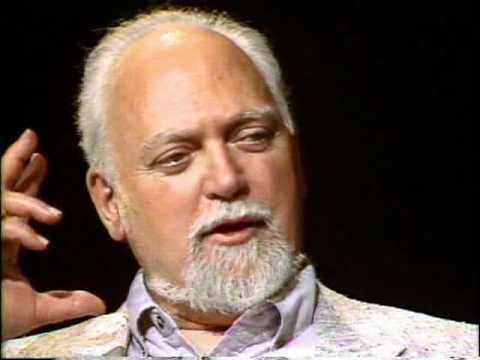
(Robert Anton Wilson)
Falcon/New Falcon books were usually not reviewed in the mainstream, and this seems to have hurt Wilson's reputation. Why didn't he publish with a more reputable publisher? It seems complicated to me, and I want to link RAW's adversarial views about editors and publishers to his very close reading of Ezra Pound, begun when RAW was a teenager, until his death a week away from his 75th birthday. But also: RAW gives reasons why he thinks he'd had a rough time as a writer and I think quite lot of it holds up. Still…let us say that he and Pound were not quiet about the adversarial nature of writers vs. publishers.
Ezra PoundWhen I first plowed through Pound's works I was struck by how cantankerous he was toward academics and universities ("beaneries") and publishers and editors.
Pound wrote a letter to his parents in 1908, age 22-23, in which he complained about commercial publishing and bookselling and "the curious system of trade and traders which has grown up with the purpose or result of interposing itself between literature and the public."2
When Pound's artist and writer friends died in WWI for no good reason at all, he decided he had to figure out what was behind the War, and soon he seemed to have found the reason: it was economics, banking and money loaned at interest. When he tried to get certain publishers to invest in those works, he had a rough time, largely because of the antisemitism in those works. Pound was convinced the Jews ran all the banks. Yea, that old noisy saw again. Farrar and Rinehart were publishers who shied away, being two examples.
In assessing Wilson's love of Pound's work, I see this as very complex, but I don't think we should underestimate the odd cranky tone of Pound, who was clearly a mad genius. Here's a couple of lines from 1931-1932, on publishing and Pound's cantankerousness:
Some months ago and off and on for some time I tried and have tried to stimulate the publication in the outer occident of a series of brochures that would serve as communication between intelligent men, proposing to print such books in America! "dollar impracticable" "fifty cents impossible" undsoweiter can be imagined by 30 percent of my readers; and the conclusion, i.e, that the idea that publishing is a profession not a trade, and the idea of using a publishing house as a focus of enlightenment are both alien to our national sensibility, will come as a surprise to, no one.3
The idea that publishers won't do what Pound thinks needs to be done, for cheap, is a typical riff from Ezra. What I think RAW got from Pound was that books and literature are absolutely vital to the health of the citizens, or at least the ones who are interested in learning. This seems a conceit of all writers of substance: damn the business and profit motive, these are good ideas! Get them out to the people and stop looking at your bottom line! I also think this attitude of Pound's formed part of RAW's identity as a writer, one who would not shrink from speaking out about money issues on behalf of not only his own interests as a writer, but for all writers, especially freelancers.
"We live in a vile age when it is impossible to get reprints of the few dozen books that are practically essential to competent knowledge of poetry." Pound writes this in 1933. He was forever complaining (and I have been doing this, too, for the last 15 years, in my own way) that books are allowed to not only go out of print, but libraries are weeding and discarding books "of substance" at an alarming rate. When Pound is engaged here in railing against "microcephalous bureaucracy" the members of which are "sick with inferiority complex," and which infect American universities with "academic bacilli" and an "inferiority complex directed against creative activity in the arts," I feel quite uneasy: this is Pound sounding completely nuts, but I also…gotta admit…I kinda see his point. I doubt American academia was that bad in 1933, but now?4 In these fulminating passages Pound seems to be hinting that there's a conspiracy between editors and publishers to dumb down the students.
Pound and Wilson seem to think there are legions of readers and writers just like themselves. I have never perceived this in my lifetime as a reader, and I never even stuck it out in academia, but continued to read omnivorously. I think their kind of reading and intellectual interests - and they were both outsiders and not academics - to be fairly rare. This brings up the idea of the writer's perceived audience, and Ideal Readers, which I can't go into here.
In Machine Art, Pound effuses about the lag in getting Ernest Fenollosa's work before the public, and calls out one "P. Carus" as being particularly egregious in this.5 As if the public was going to begin fomenting a revolution against current human perception, the syllogism, the problematic in subject-predicate structure in Indo- European languages, or even interest rates after they got hold of Fenollosa's ideas about Chinese writing and the ideograms. While I am one who does go ga-ga over this stuff, I never believed the public at large would be the least bit interested. Oh, but it was for people like RAW (and me'n you) to Spread the Word. Nouns don't exist, things are placed in relation and are filled with action, etc: I love this stuff; at the same time every week there's some article about incoming collegiate freshman who are functionally illiterate.
Who did get excited over Pound's various enthusiasms and obsessions? Probably at least 50% of those we call "Modernist" writers. Pound's influence has been humongous, and we're all influenced by Pound at least second-hand. As Wilson thought about Pound: Ezra resolved to cause a revolution in the arts, and he succeeded.
In what ways is that World now lost?
RAW and Pound Have Lots of Company Re: Publishers, etcThere's an inexhaustible list of quotes from artists complaining about "the suits," and just the other day I ran across a quote from Katherine Anne Porter that could have been by Wilson.6 When William S. Burroughs writes about the relationship between heroin dealer and junky, the isomorphisms here seem troublingly apt to me. Charlie "Bird" Parker saw the people who booked gigs for him like dealers: "judges" and "robbers" who had control over his life.7 Sam Peckinpaugh and Erich von Stroheim have similar quotes about the purse-string holders in the film biz. I won't even go into Orson Welles here…Check out Vladimir Nabokov, on his dealings with Olympia Press and the notorious Maurice Girodias:
I began to curse my association with Olympia Press not in 1957, when our agreement was, according to Mr. Girodias, "weighing heavily" on my "dreams of impending fortune" in America, but as early as 1955; that is, the very first year of my dealings with Mr. Girodias. From the very start I was confronted with the peculiar aura surrounding his business transactions with me, an aura of negligence, evasiveness, procrastination, and falsity. I complained of these peculiarities in most of my letters to my agent who faithfully transmitted my complaints to him but these he never explains in his account of our ten-year-long (1955-1965) association.8
American writers seem right to complain about the Big Five New York-based conglomerates9, who are like the movie studios after Jaws and Star Wars: they only want blockbusters, and have almost entirely neglected daring literary works. But the late Slavic writer Dubravka Ugrešić asserted that, despite her high status as a literary figure, in 2017, she couldn't get published in Croatia, her home country, because she had left it for Amsterdam. In a 2017 essay, "Artists and Murderers"10 she relates how war criminals, thugs, and other PsOS were getting published, selling art, and opening galleries in Croatia. It's mordant, dark stuff and sounds utterly believable.
Finally, in a July 3rd, 1986 letter to Kurt Smith from Wilson's residence in Ireland, RAW goes into minute detail about how publishers in England, France, and Poland have interests in publishing his books there, and he winds up this line of discourse with, "I am owed money by no less than seven publishers right now, all of them over a month late." To quote David Byrne: same as it ever was.
Wilson's Very Poundian Take on PublishingAn anecdote about editors that Wilson repeated a few times in interviews and at least once in a book was this one:
Nervous editors are always trying to guess the publisher's prejudices from minimal clues and they often guess wrong, which, of course, makes them more nervous in the future. That's probably why Gene Fowler uttered the immortal aphorism, "Every editor should have pimp as an older brother, so he'd have somebody to look up to."11
In 1977 Wilson sat down for an interview with two erudite fans, D. Scott Apel and Kevin Briggs. Early in the interview they ask RAW about his relationship with publishers, and he didn't hold back. I feel Pound lurking here, but you be the judge:
Well, by and large, I am not madly in love with publishers. Publishers are businessmen, and businessmen are really not my favorite type of human beings. James Joyce went into business briefly, and after a while he said to Italo Svevo, "You know, I think my partners are cheating me." Svevo said, "You only think they're cheating you? Joyce, you are an artist!"
RAW tells Apel and Briggs he was employed for seven years in engineering, but the rest of his life he wrote advertising, and worked in magazines and books - "the whole publishing field" - and he thinks businessmen "have no more morals than a scorpion." On with RAW on publishers:
There are two types of predators. There are predators who just go out and grab what they want and take their chances on getting caught. If they spend a little time in jail, that's all part of the game. They lose a few points. As soon as they get out they try to win again, at the same primitive level. And then there is the second type of predator, the type who has figured out that you can do all that grabbing without risking jail. There's a great novel about this, JR, by William Gaddis. It's one of my favorite books. JR keeps saying that anybody who steals is a fool; you can get as rich as you want in this country by using the laws creatively. Businessmen are people who know that. They've got the same mentality as pirates. When they think they can get away with it, they break the law as boldly as thieves.
Then RAW repeats the Gene Fowler line about editors, but replaces "editor" with "publisher." Then:
At this point, nothing a publisher does would amaze me. If a publisher came in the door and shit on the table and said, "You've got to accept that because I'm a publisher and you're a writer," I'd be awed, but I wouldn't be surprised. Nothing they could do would startle me at this point. If a publisher was caught the way Nixon was caught it wouldn't surprise me. In fact, I wonder why none of them have been caught yet. Sometimes I puzzle about things like the Clifford Irving12 case. I don't know how guilty Irving was, but certainly the whole ambience of the publishing business is to incite people to behave that way. It wouldn't surprise me at all if the publishers were ten times guiltier than Irving himself.
I guess I sound uncharitable or unforgiving…(raucous laughter), but as you go around interviewing writers, you'll hear this from all of them.13 This is what writers always talk about when they get together.14
In a wide-ranging 1983 interview, RAW was asked about non-linearity and montage in film and how literature seems to have fallen behind in the 20th century:
Well, I think it's certainly true that writing is regressive compared to other arts in our time. I'm inclined to blame the publishers. I think writers would be a lot more innovative and experimental and would catch up and become contemporary with the other arts except that it is so difficult to get anything published that's at all experimental. And so, even people who have done very experimental work, like William S. Burroughs, tend to write more conventionally as they go along because they just discover it's hard to get their experimental works into print. There is a new anthology of Burroughs' work that just came out recently which has an introduction in which the introducer says that Burroughs has stated quite frankly that it was commercial considerations that led him to cut down the amount of cutups in his books. Publishers have always been chiefly mercantile, of course, but it's getting worse as the cost of printing goes up and book production gets more expensive. They are less and less interested in anything chancy. What publishers are most interested in is a guaranteed bestseller. The further you depart from the formula, the more nervous they get and the harder it is to get published. So writers, in so far as they have any sense of survival at all, tend to become more cautious and less experimental. And it's happened to me; I have made efforts to be more conventional. Of course, it does not always work. If you have an unconventional mind, your books tend to be unconventional no matter how hard you try to be conventional. But it is hard to sell anything that's the least bit avant-garde or experimental.15
So here we have Wilson referring to publishing problems and his own unconventional mind. The idea that writing must keep pace with film seems Ezratic to me. Wilson in other places extended this to a total view of Science and Literature and the Arts: they must keep pace with each other.
Overall, this may be the main reason he remained as a hero in the marginals milieu, with his "difficult" relationship with editors and publishers as secondary. We as fans of marginally noted writers all must contend with: how come my favorite writer seems so neglected? Are we weird?16 Are other readers stupid for going for that NYT best-seller? What are we missing? At least we have the books and damn the publishing machine anyway.17
Wilson also thought about persecution and esotericism regarding publishing, in ways that Pound didn't seem to articulate much. RAW published Sex and Drugs: A Journey Beyond Limits, in 1972. You'd think with this title it would sell well, but RAW thought Playboy must have issued the book on "a need-to-know basis, or something of that sort."18 He also saw his status as known accomplice of Timothy Leary as probably a publishing liability. Finally, RAW often remarked that his style of mixing fact with fiction and genre-mixing in order to make the reader think, was a problem with a lot of publishers:
Dr. Jeffrey Elliot, asks RAW about Illuminatus!: Im what sense is the book science as opposed to science fiction?
RAW: I wanted to write a book that combined several different literary genres. As a result, Illuminatus! is a combination detective story, occult thriller, political satire, and science-fiction work, with overtones of a porno novel, a dissertation on politics, and an occult fantasy. It constantly keeps changing. Whenever the reader thinks he knows where it's going, it turns into another type of novel. That was part of our problem in selling it. Publishers don't like that; they like a novel they can easily label. I'm still struggling with this problem in my present writing. My next book, Masks of the Illuminati, is something the publisher is going to have a hard time finding a label for, because it deliberately starts out as one kind of novel and turns into an entirely different type of novel. This, to me, is realism. After all, life doesn't fall into categories. People don't live their whole lives in detective stories or gothic thrillers or soap operas or science-fiction novels or Hitchcock dramas. People's lives change from day to day, from hour to hour. I've always wanted to write novels in which the reader doesn't know what kind of script he's living in. Publishers can't stand this approach. They want to put a label on a story, and I keep trying to break that restriction. This is all part of my insidious campaign to undermine the minds of readers who think they know what they're reading. I want people to realize that literature isn't always what they think it is. Then they might realize that life isn't what they think it is.19
For decades now I've thought about RAW and publishers needing a label and how it may have hurt him, and I still waffle all over the place about how accurate I think this is. He frequently told interviewers that when Dell advertised Illuminatus! as science fiction or bookstores placed it in their science fiction area, that this harmed the status and/or potential for the book(s). At the same time, he had argued that his Schrödinger's Cat Trilogy predated William Gibson's Necromancer as the first "cyberpunk" book. There he did a trilogy on his own, without pressure from the publisher, and though the framing device is different interpretations of quantum mechanics for each novel, it doesn't read as science fiction to me, much less cyberpunk. So I'm not sure about that, either. If you have an opinion, I'd like to hear it!
Part 2, on RAW's publishers, will be here soon. Stay in touch!
1Go to RAWIllumination.net, scan the right hand side of the page and scroll down until you see "Illuminatus Resources" and find interviews with Dell editors Fred Feldman and David M. Harris, Bob Abel, and Jim Frenkel. Also see Jackson's interview with Teresa Nielsen Hayden, who edited The Widow's Son. Also see Jackson's edited book on Robert Shea's writings, Every Day Is A Good Day, pp.12-13 (RAW against Dell dividing Illuminatus! into a trilogy); 129 (RAW's and Shea's agent, Al Zuckerman); 334-338 (Jackson on Paul Krassner's friend Bob Abel, who helped Illuminatus! get published)
2Italics mine. I'm not kidding when I assert you can collect 300 comments from Pound on just this topic: the perfidiousness of the entire industry. This even though he dealt extensively with more mainstream publishers. Those who haven't read much Pound but who know of his famous off-the-rails and revolting antisemitic stance in the 1930s through the early 1960s will be excused for assuming this constant leitmotif against publishing, academics, and editors was a concealed Jew-baiting, but I don't see it. Not much. He came at this distrust of publishers honestly: I think it was a simple dislike of anyone as "middleman," which does inform much of his economic thought, but there isn't much antisemitism toward publishers. Nothing close to his problems with bankers, about who…whew! 'Nuff said here, for now! I nabbed this quote from a 1908 letter to his parents from Greg Barnhisel's delightful, scholarly, riveting James Laughlin, New Directions, and the Remaking of Ezra Pound, p. 21. Those interested in Pound and the 20th century in publishing are advised to check out Barnhisel's work.
3Selected Prose, 1909-1965, p.54. Originally in The New Review, winter, 1931-32. This feels like Pound really gone off the deep end to me. He's batty, possibly manic-depressive, but I've never figured him out satisfactorily. He's writing this from Italy, where, RAW thought Pound so naive he convinced himself that Mussolini was the second coming of Thomas Jefferson, and Ez was going around the neighborhood feeding the stray cats.
4Selected Prose, 1909-1965, pp.392-393.
5Machine Art & Other Writings: The Lost Thought of the Italian Years, Pound, ed. by Maria Luisa Ardizzone, p.110.
6Writers At Work, 2nd series, ed. George Plimpton, p.156 for Porter quote. From a series of books collecting interviews with writers from the Paris Review.
7Bird: The Legend of Charlie Parker, ed. Robert. G. Reisner, pp. 40-41
8Strong Opinions, Nabokov, p.272, but see the entire chapter 5, "Lolita and Mr. Girodias," pp. 268-269. Nabokov's imputations of "haggling maneuvers" and "abstruse prevarications" rival Pound's invective on the same sort of subject. This was a book in which I realized Nabokov wasn't someone I would have wanted to try to hang out with; he seems quite unpleasant but unassailably genius as a writer. And, to be fair along the lines of Girodias, many other writers had similar takes on him.
9Penguin-Random House; Harper Collins; Hachette; Simon and Schuster; Macmillan. RAW and many other West-Coast-based writers have noted the divide between New York and the big publishing houses, and their seeming antipathy to West Coast aesthetics, and it probably goes back at least to Kenneth Rexroth in the late 1940s. Wilson complained that the big mainstream publishers seemed to think they were hip but they were hopelessly behind the times, and in the 1970s still thought Marx and Darwin were the hottest topics around.
10The Age of Skin, Ugrešić, pp.97-111
11Sex, Drugs & Magick, Wilson, p.12, Hilaritas ed.
12Irving got busted for convincing a publisher that he had a hotline to Howard Hughes for a biography about the wealthy recluse, but he was faking it. Irving also wrote a book on the art forger, Elmyr de Hory, and Orson Welles made a documentary, F For Fake (1973), about Elmyr's and Irving's fakery, but Welles's play with footage was all a fake itself, which delighted Wilson no end.
13One writer I haven't heard complain is Dan Brown, whose agent was the same one RAW had: Al Zuckerman. When Brown did a book tour for Angels and Demons, writers in the audience would ask him advice on how to sell their books, and Brown often referred them to Zuckerman's book, Writing The Blockbuster Novel, with his "seven points." The irony here with regard to Wilson's lingering "cult writer" status vs. Brown's wealth…is too thick to go into here. Suffice to say that RAW's "unconventional mind" and not being able to write a bestseller seems completely on the mark for me, and that we have met the avant garde literary enemy, and it is us. (Not us-us, but everyone else, of course!)
14Beyond Chaos and Beyond, ed. by D. Scott Apel, pp.15-16. (2019) Wilson and Apel put out a magazine, Trajectories, and this is mostly parts from that, although there are some transcripts.
15Coincidance: A Head Test, Wilson, p.323. This interview is only found in the Hilaritas Press ed. of this book, not in the New Falcon version.
16I confess that, yea, personally, I'm weird AF.
17I saw a documentary on this topic once that I now cannot locate. It was called The Stone Reader, and was by weirdo filmmaker and inveterate reader of literary fiction and modernism, Mark Moskowitz, and how he loved a fat novel titled The Stones of Summer, by Dow Mossman. Why was Mossman so obscure? He's great! Etc. Hey, a lot of us have been there. I felt a kinship with Moskowitz after seeing this film; I have not read Mossman yet.
18Sex, Drugs & Magick: A Journey Beyond Limits, Wilson, p.12, Hilaritas ed. RAW thinks by 1972 Nixon's war on the counterculture may have stifled the reception of a book with such a title. he'd give talks and fans hadn't even heard about the book, much less seen it. Others reported it hard to find. For a discussion on Wilson and Giambattista Vico and protective and defensive esotericism in history, especially regarding their own works, see my "Notes on Wilson, Vico, Language, and Class Warfare" in TSOG: The Tsarist Occupation Government by Wilson, pp. 245-293. (2022)
19Literary Voices #1, interview with Dr. Jeffrey Elliot, Borgo Press, pp.50-64; this section pp.56-57. (1980) A much shorter version of this was included in Email To The Universe, pp.213-217, New Falcon ed; 229-234 of Hilaritas ed. Elliot died in 2009 at age 61 or 62.

(graphic art work by Bobby Campbell)
On the "Simulation Hypothesis" [ 26-Jan-26 9:17am ]Sorry I haven't been churning out that scintillating stuff you all know and sometimes read and comment upon, but, though I've never been a "depressed" person, I have been feeling like Nothing Matters lately. In times like this…not sure what to say. I'm glad cannabis exists.
Brief Rundown of Bostrom's RiffAlong the lines of stoned thinking: the Simulation Hypothesis, which coalesced in and around the mind of Nick Bostrom, c.2003.
This Substack is reader-supported. To receive new posts and support my work, consider becoming a free or paid subscriber.
As I understand it, Bostrom says it's conceivable that a technologically advanced civilization other than ours might have run a very large number of simulations of what their ancestors might have been like, so they programmed these extremely sophisticated algorithmically-based simulations of conscious, philosophically thoughtful, self-reflective "beings" with attitudes and experiences in their (fake) world that are like ours. Or flatly: are us. We just think we are who we are, with our histories and experiences, etc. Or we are all those things - remembering, reflecting on ourselves and experiences - but it's all algorithmic simulation. The Simulators got really good at this and did it millions of times, or more. We are just one model They came up with.
So, like you're sayin' nothing is real? Like we're in Strawberry Fields? Or, like, ya know, what Pink Floyd says in "Wish You Were Here": we're just two lost souls swimming in a fishbowl, year after year? Whoa! What is this shit?
It's a hybrid my friend came up with. Novel terpene ratio. She calls it Kali's Shaven Vulva. You like?
Okay, so Bostrom says, you can have one of three takes on this: 1.) Technologically advanced Entities who run simulations like this is a bullshit idea, so just STFU; 2.) Technologically advanced Beings are all over the Universe, but they don't do simulations like this; I imagine the idea has come up a trillion times and someone says, ya know, Naw, we got bigger fish to fry. We already know enough about our ancestors. Something like that. Or: 3.) Such technologically advanced Beings are all over the universe, and they fucking love doing simulations, and furthermore, there are countless Sims out there. Bostrom asks us to accept there are more Sims than non-Sims, among all the entities with civilizations 'n shit. Bostrom thought there's around a 33% chance for #3, which would imply we're all probably Sims. What if we are Sims? I like comedian David Cross's joke, about Homeland Security's daily threat level during the Iraq War:
Honey, it says here the threat level is orange today and orange is: "High, or high risk of a terrorist attack." What do we do?
Well, get out the bread and let's make some sandwiches.
 Not A New Idea, Methinks
I was brought up by a couple of quasi-hippies, and never went to church. Around age 17 I had to read the Bible on my own, just to see what all the shouting was about. I recall thinking Genesis was like someone dreamed it up. Probably it was a story dreamed up by many, told over and over until a good version of it prevailed, then, with writing, someone took it down. There are some weird problems, like there seem to be gods, plural, and then just the one god. What happened to the Others? I wanted to know more about them, but they just seem to have been forgotten. Adam, I later learned, had an earlier wife named Lillith and they got a no-fault divorce or something like that. In order to get a new squeeze, the Simulator took a rib from Adam…wild! People buy this? (Well, at the time I was reading the Bible and right wing Christianity was burgeoning, they were buying Man From Atlantis on TV, so…) Anyway, here is a transcendent Being making us and giving us ideas (one of 'em was "Don't get no funny ideas about knowledge, see?"), setting us down in a Garden, then walking away to watch from a nice vantage point. Proto-Candid Camera.
Arch-Taoist Chuang-Tzu AKA Zhuang Zhou AKA Zhuangzi, Chinese philosopher, (c.369-286 BCE; Socrates did the Hemlock Self-Offing trip in 399 BCE for perspective) had this idea: I dreamed I was a butterfly, fluttering and flitting about, happily doing butterfly things. Suddenly I woke up and realized I was the same ol' Chuang-Tzu…or… am I the Butterfly, and only dreaming now that I'm some Chinese dude named Chuang-Tzu? Thus does everything transform into everything else, a Taoist basic.1
In 1713, the Irish Bishop Berkeley2 wrote, in his Philonous, "The brain therefore you speak of, being a sensible thing, exists only in the mind. Now, I would fain know whether you think it reasonable to suppose, that one idea or thing existing in the mind, occasions all other ideas. And if you think so, pray how do you account for the origin of that primary idea or brain itself?"3
In Scientist As Rebel, Freeman Dyson writes about how Olaf Stapledon had a prototypical sort of Simulation Hypothesis in his novel Star Maker (1937), in which there is an early version of the interpretation of quantum mechanics, called "Many-Worlds." The Star Maker makes some universes into mature ones of extraordinary complexity. Taking a few pages from Stapledon, Sir Martin Rees had a thought-experiment concerned with the "fine-tuning" hypothesis that seems needed to account for this universe we live in, which, according to astrophysics, needed to be set-up just-so mathematically or life could not exist. How did we get so lucky? Rees says: with Many-Worlds, we would see an extremely high number of possible universes that would conform to some Cosmic Anthropic Principle, and we just happen to exist in one of those universes. Once again, we gotta ask: Who or What caused the Universes to exist? For some, it's the old God Game again, from here to eternity. For others, it's chaos and numbers and maybe some Hindu metaphysical thought thrown in. The point I'm tryna get at: this creation thing. It's a bitch, isn't it? 9th grade Trigonometry will not help me here. Here's Dyson discussing Rees:
If our present universe is a simulation created by intelligent aliens interested in exploring the consequences of alternative laws of physics, then we should expect the laws of physics that we observe to be chosen in such a way as to make our universe as interesting as possible. We should expect to find our universe allowing structures and processes of maximum diversity. The immense richness of ecological environments on our own planet gives support to Rees's proposal.4
I find it utmost refreshing to note this last item: ecological environments on our planet: Elon Musk, who said we absolutely live in a Simulation, wants to populate Mars, which would need to be terraformed and we don't know how to do that. Mars's soil is literally poison. 5
Apparently there are a number of science fiction novels that address a simulation hypothesis, including Greg Egan's 1997 Diaspora.
If we veer back toward Philosophy, from the 1960s to the 1980s we got a lot of Other Worlds from modal logic, like that of David Lewis, who wrote On the Plurality of Worlds (1986), which built on counterfactual thinking like it was no one's business but his own.
Others who seem to have had a Simulation Hypothesis idea predating Bostrom are Ed Frenkel (who I often mix up with Ed Fredkin), Jacques Vallee, Rudy Rucker, Stephen Wolfram, and Hans Moravec. And let us not forget the Wachowskis and their Matrix films.
Conspicuously absent from this discourse among philosophers are the names of Charles Fort, John Keel, and William Bramley, of Gods of Eden fame. Lemme just briefly riff on Fort here:
Fort writes in The Book of the Damned: "Would we, if we could, educate and sophisticate pigs, geese, cattle? Would it be wise to establish diplomatic relation with the hen that now functions, satisfied with mere sense of achievement by way of compensation? I think we're property." Fort floated the notion, in 1919, that some alien race made us, and we're like farm animals to them. Jeffrey Kripal, a Professor of Weird Religions, noted that Fort's idea that we are some colony or "property" of alien beings had its precedent with a musing by William James.6
Benjamin Breen's recent book Tripping On Utopia, discusses John Lilly's 1971 book, The Center of the Cyclone: "He spoke of the universe as a great cosmic computer in which all conscious beings were mere simulations."7
Novelist Jonathan Lethem had fun playing with the Simulation Hypothesis in his 2009 book Chronic City, in which the most colorful character, Perkus Tooth, walks home the morning after a blizzard and realizes he lives in a Simulation.8
Professor Carlin Weighs In"I think many years ago an advanced civilization intervened with us genetically and gave us just enough intelligence to develop dangerous technology but not enough to use it wisely. Then they sat back to watch the fun, kind of like a human zoo. And you know what? They're getting their money's worth."9
How Do We Think About This Stuff?You could reject Bostrom's idea that consciousness could arise from a computer. I admit that's my main model right now. I think we need to be evolved, embodied, carbon-based sensory processors with florid emotions in order to be conscious, and I base this on a number of philosophers, biologists, and cognitive scientist's thoughts, but the Portuguese Antonio Damasio made a big impression here.
You might just look at the mathematical formalisms Bostrom uses and say he's wingin' it from the get-go. Or you could reject it on the basis that something as complex as our worlds, bodies, minds, societies and creations could reduce to any mathematics at all. This was recently done by Dr. Mir Faizal, Lawrence Krauss, Arshid Shabir, and Francesco Marino, published in the Journal of Holography Applications in Physics, this past November. 10 They haul in Gödel's Incompleteness Theorem of 1931 to show that the entire cosmos lies outside of algorithmic understanding. I quote Dr. Faizal: "It has been suggested that the universe could be simulated. If such a simulation were possible, the simulated universe could itself give rise to life, which in turn might create its own simulation. This recursive possibility makes it seem highly unlikely that our universe is the original one, rather than a simulation nested within another simulation." In other worlds, for the Beings that might be simulating us in Bostrom's hypothesis, who or what created them? It feels a lot like "what happened before the Big Bang?" question that any intelligent 13 year old will pose. Faizal, Krauss and pals think that, where it was previously thought that you can't debunk The Simulation Hypothesis, but now they did. But here's where it gets a bit weird: Space and Time come out of Physics, but there needs to be a substrate for it, and they see: Information. Okay…where does the Information come from? From scientific laws, which are prior to anything, ehhh…and they posit it all comes out of some sort of Platonic Realm, with a mathematical foundation that is "more real" than anything in our…ehhh…universe. And it feels to me that they went through an old trap door that led to a rusty old storm grate near the sewer system, crawled through that, and came out in a dark old abandoned house, took a spiral staircase to some immaculate, weird all-white and pristine room…they had reached David Bohm's Implicate Order via a non-orthodox way, although Bohms' Implicate Order is not mentioned.
Bohm's Implicate Order is beyond Space-Time and so…a religious idea? I don't know. The Laws of physics itself are weightless, timeless…I'm getting some gooseflesh just thinking about it. Bohm was a favorite student of one Albert Einstein…
Frankly, I don't know what to do with this, but the Gödel stuff feel intuitively correct enough to me to hurl a monkey wrench11 into Bostrom's works.
More objections: how do we know Sims and Non-Sims are in the same epistemic situation? Or is what possible similarity between the two plausible? How does thinking about the Sim Hypothesis harm or dent our thinking about the possible future applications of computers? Maybe it really would not be "cheap" to run billions of Simulations for these many beings? Wouldn't we detect glitches or boundaries if we were in a Sim? We can go on and on with this, but in my Generalist way of thinking, I can't rule out that we are living in a Simulation, because I just don't know enough, and there are interesting ideas about how we "are" in a Sim, and these are by highly intelligent people. I personally estimate the probability that we're living a Sim as 0.1%. Which is not nothing, but far less than Bostrom's 33%.
David ChalmersI don't know what Chalmers makes of the recent application of Gödel to this idea, but in 2022 he thought we couldn't prove ("it's impossible") we weren't living in a Sim.12 What's Chalmers's estimate that we are living in a Sim? Around 25%. How does he arrive at this? We seem to exist relatively early in the universe. While we've made some pretty fancy simulations/alternate reality computer games and scenarios, we aren't close to making something like the vivid universe or even the Amazon basin. We haven't encountered any other intelligent beings. (I will write about this topic some time in the future.) When a guy like Bostrom says 33%, I sorta give a Bronx Cheer, but when a guy like Chalmers says 25% I find it a tad unnerving. Still: get out the bread; let's make sandwiches.
Robert Anton WilsonIn a June 3rd, 1987 letter to his friend and benefactor Kurt Smith, RAW tries to explain his theory of perception to Smith, who had trouble understanding the early, Loompanics edition of Natural Law: Or: Never Put a Rubber on You Willy:
You look at a space-time event and see a thing which you call a chair. A snake looks at it and sees a heat field, not a thing, and probably does not call it by that name. An electron microscope looks at it and sees empty space with such peculiar twinkles that attempting to explain them leads to all the paradoxes of quantum mechanics. What is "really" there? I don't know, but I rather doubt it "is" a Platonic Idea or an Aristotelian Essence or even a Kantian ding an sich. Operationally-existentially what is "real" for us is what we encounter and endure, but that is not "real" in any absolute sense.
In the Buddhist epistemology, the chair is real — to your nervous system. The chair is not real — to the electron microscope. The chair is both real and not-real, because your images and the microscope's image are not contradictory, but, in Bohr's phrase, complementary. The chair is both real and not-real because it has infinite aspects not containable in either your image or the microscope's image.
The "real" "thing" of which chair and heat field and twinkles are images may exist somewhere, in some Platonic or Aristotelian realm, as I cheerfully and repeatedly admit, but as Nietzsche and Bridgman both demonstrated, by different arguments, since we cannot contact those realms, it is meaningless to talk about them. What we can talk meaningfully about is out existence and our operations — what our brains encounter and endure and what our instruments encounter and endure. As Heisenberg said to Bohr, Einstein's continued attempt to go beyond that existential-operational level to a Platonic "reality" sounds to us skeptics much like the medieval debate over how many angels can dance on the head of a pin.
I feel obliged to work RAW into any discussion, and so there ya go. But more seriously: his theory of perception is colorful, difficult, trippy and quite scientific. I think we should be thinking more along RAW's lines than armchair probabilities, using mathematical formalisms.
Further: this is what we know about reality. Would posited aliens performing Simulations on their ancestors see "reality" like we do? Do they understand all this? Moreover: does Nick Bostrom understand this?
Final RiffI touched on the vivid dense richness of Earth's environment. There are some critics, like Marco Gleiser, who think being serious about the Simulation Hypothesis is a dangerous escapist fantasy at best.13
When I think about this idea from many angles (you read about some of 'em here), I keep coming back to something that genuinely terrifies me, and I'll admit it: guys like Musk, Thiel, Andreessen, and Bezos are demonstrably anti-Humanities. I don't know much about Bostroms's background, but he's an academic. But quite nerdy, and he's said and written some racist things in the past. All these guys know is computing and attendant problems along with computer science. When they pontificate outside of the area they know, they sound like morons. I have citations and receipts, but that's for another time. All of these guys and the kiss-asses that they surround themselves with who want us to think about never-ending growth, using much more energy, living forever, and colonizing space…they're, full of it! Full. Of. It. The facts of Astrophysics, Thermodynamics, current medicine, etc. say so. They're banking on a significant level of the public just accepting whatever they say about this stuff, 'cuz they're rich. And the reason they're so rich is they were at the slot machines right at the time when they paid off not because they're transcendent geniuses. And they now have political power and guess what? They are ready for the planet to be trashed. These fucking idiots have given up on saving the planet. They just want more money, then escape from the planet. Good luck!14
They have a famous ailment: Engineer's Disease.15 This is where if you're an expert in some STEM field, you think you're an expert in everything else, too. We ought not listen to the billionaire tech bros and work on our own, all-too-real problems living on Earth, because we are not going anywhere. Not Mars. Not space-cities that house tens of thousands or millions. Not soon, that is. Not soon at all, given the actual problems, here at home, which has what we need for sustainability. Our problems are political, not technological. Let's get real!

(OG artwork by Bobby Campbell)
1It's now thought dubious that "Chuang-Tzu" even existed. In 2003 Russell Kirkland says there's scant evidence he existed, and most of what we know about Chuang-Tzu was from 3rd BCE commentator Guo Xiang. So maybe Guo simulated Chuang-Tzu and his sayings and doings, really pulling the wool over everyone's eyes. Possibly the Butterfly Effect gave rise to conditions under which Guo Xiang was telling us what the arch-Taoist said? Similar things about dubious historicity have been written about Jesus and Keyser Söze. "The nature of things is in the habit of concealing itself," or so Heraclitus had spake thusly. Anyone got a line on Heraclitus's historicity? We've opened up a can of worms here, folks. We're through the Looking-Glass, and it could be turtles, turtles, turtles all the way down. Who put the turtles there? I don't man; I didn't do it.
2The city of Berkeley, California was named after him, because he wrote, in a poem, "Westward the course of empire takes its way; the first four acts already past. A fifth shall close the drama with the day; Time's noblest offspring is the last," and they thought this an omen of sorts, the promise of the far West in the Americas, but then they dropped the ball when everyone started saying "BURK-lee" when the Bishop pronounced it "BARK lee." Metaphysics is weird.
3Borges was a big fan of Berkeley, who thought all our ideas are real, but they are all part of the mind of God. You and I and that wall, that empty bowl of cereal in the sink, the lava lamp, the '69 Mets, and Krakatoa, are all just in the mind of God. Fain, of course Borges would be in love with such a wonderful nut as Berkeley. I got this Berkeley quote from Borges's essay "A New Refutation of Time," Selected Non-Fictions, p.320. No writer makes me feel like I am a Sim like Borges does. That is to say, he's a psychedelic writer to me. For his own Sim idea, written in the late 1930s and as a satire on fascism, order, and antisemitism, see his "Tlön, Uqbar, Orbis, Tertius." In 1714, a year after Berkeley published Philonous, on the Continent, Leibniz would describe consciousness as entering a thinking machine which was like entering a mill, and looking around you see machinery everywhere going full-tilt, but there was not one person around. There was nothing that could explain perceptual experience there. This idea about "consciousness" is still going strong, seems to me. I think Metaphysics has only gotten weirder since 1714.
4Scientist As Rebel, Freeman Dyson, p.337, in his essay, "Many Worlds."
5Humans would have to live underground there for an ungodly amount of time before the terraforming was done…and it's all bullshit, really. It's not going to happen. You could, with some legitimacy, think we could colonize Mars in 1965; by 1985 it was getting very difficult to believe this, given the large gains of knowledge about the Red Planet. Now? n 2026? You have to be completely full of shit to claim we can do this. Or so actual Astrophysicists I've read on the matter say. So: why the bullshit, Musk? Is it bad faith? Musk, Thiel, Bezos, Andreesen: these guys have never taken a meaningful hike in the forests of Earth. One wonders if they've ever performed oral sex on a woman (let's leave Thiel out of this). But I digress. My point is: these guys say they want to do things that are impossible and a lot of us are saying, Why Are You Already Giving Up On Earth? Because you were as responsible for the pending collapse as anyone else?
6The Occult World, ed. Christopher Partridge, p. 291
7Tripping On Utopia, Breen, p.276. Lilly in 1971 predates Bostrom by 32 years. I find it hard to picture Bostrom reading Lilly, though. Really hard.
8see pp.335-342 of Chronic City, but the idea is played around with on 224-230; 266-268 (hilarious!); 327-332; and 388-390. Here the ambience of cannabis seems to inform the Simulation Hypothesis, as Terence McKenna often touches on trans-dimensional beings that seem to play with humans when they're tripping on DMT. We mentioned John Lilly above, who tripped on everything, and earlier than most people, but is now identified with Ketamine and I'm not sure if this does a disservice to Lilly or not. The reason I bring all this up is that the idea of a Simulation Hypothesis seems to immediately strike a lot of us as "trippy" stuff. I doubt Bostrom was high, though.
9Napalm and Silly Putty, Carlin, p.158
10A brief article about their paper is HERE.
11Wot? Ya fancy callin' it a spanner do ye?
12Chalmers, who I include here because he's always so interesting to me, wrote about how it's impossible to prove we don't live in a Simulation HERE.
13Marco Gleiser, in July, 2022. We are faced with real dangers on Earth, and these assholes want to argue about whether we're in Simulation? What the hell is wrong with these people? For Gleiser and a lot of my readers, it's becoming hellish to be an actual adult in this world.
14see Survival of the Richest, Douglas Rushkoff.
15for a fascinating and chilling discussion of Engineer's Disease, see astrophysicist Adam Becker's More Everything Forever, pp. 261-278
Sex/Food/Death (episode: Aleph) [ 19-Jan-26 10:58am ]The TV series White Lotus has apparently become notorious for showing penises, and a question asked has been why. Since there's been quite a lot of full frontal female nudity in TV and mainstream films, why has TV so shied away from penises until relatively recently? Santiago Fouz-Hernandex, film studies professor at Durham U. subscribes to fellow film studies professor Peter Lehman's idea of the "Phallic Mystique," which Lehman first wrote about in the 1990s. The phallus is a concept and symbol, and hardly anyone calls a particular penis a phallus; it's "the phallus" as a symbol of masculinity, power, and privilege. Mere penises are kept off-camera, the theory goes, because to show it is to normalize the phallus, and strip it of its patriarchal symbolic powers.
Some critics think the brains behind White Lotus, Mike White, who I thought was self-identified as gay but apparently claims bisexuality as his identity, is "flipping the script" by showing more frontal male nudity than female nudity in the White Lotus series. The term I often see in popular culture these days is "normalize." Now, I don't know if Lehman's idea of the taboo about showing the penis is TV or film robs the phallus of its patriarchal powers, but if it's true, maybe we should all be rooting to see penises everywhere. Anything to rob patriarchy of its privilege, I say. What really are the arguments for women as second-class citizens, anyway? I see no good arguments at all. I never have. 1
This Substack is reader-supported. To receive new posts and support my work, consider becoming a free or paid subscriber.
I grew up in a household where mom and dad walked around naked, so we did, too. It was no big deal. As you get older, you realize: it's a big deal. For some reason, but it is. I don't think any of my friends had suburban pagan parents like I did. Mom and dad couldn't wait to get tickets to see the live nude cast of Hair when it came out. I lost my mom's vinyl record of that, but I later bought the CD, 'cuz I loved those songs.
Is it true that the penis and its occulted reference, the phallus, can be "normalized"? I suspect that showing penises all the freakin' time on TV and in movies could rob the phallus of its power. Will this happen? I don't see it, no. I hope I'm wrong, and not just 'cuz I wanna see other guys naked. While I'm not gay I do see the nude male form as beautiful. But if the idea that we haven't seen many penises on TV or film is 'cuz it (subconsciously?) takes the shine off patriarchal values, count me in.
The modern hero here, for me, wasn't on TV or film, but was Joyce's Leopold Bloom in Ulysses, who, at the end of the chapter "The Lotus Eaters" nonchalantly goes to the public bath and sees his own penis in the bath, "the limp father of thousands, a languid floating flower." Just-so! When we look at the rest of the 20th century, it's mostly how large so-and-so's cock was. We seem to be interested in that.
Meanwhile, yet another study suggests women care less about size than men do.2 Some variation on this study arises every six months, it seems: some women say size matters to them, but most say it's other stuff that matters. Gawd it's boring. Because no matter how many studies are done: men will not get it, it seems. All of which suggests Peter Lehman's "Phallic Mystique" might have very deep roots, and that he's not drilling in a dry hole there.
The worst scenario would be: the normalization of the penis on screens, but every time it's a gorgeous hunk of man-meat actor with a large schlong, which would, I'm guessing, just bolster patriarchal values? I don't know.
On to food.
Food: Some Noteworthy DinnersEzra Pound left the US for Britain, introduced himself to W.B. Yeats and said I'm gonna be your secretary, and he was. Yesterday, as I write this, January 18th, was the 112th anniversary of Pound's party at fellow poet Scawen Blunt's house; Pound told Blunt that they were going to have a party at his house and eat roast peacock. Pound wanted to meet all the poets of Britain. It was the kind of thing he could pull off. Also at the dinner - in which a marble box designed by Gaudier-Brzeska housed the recent poems of the dinner guests - were Richard Aldington, F.S, Flint, Yeats, Victor Plarr, Thomas Sturge Moore, and Blunt's neighbor, Hillaire Belloc.3 It appears there were no women present (though they were behind the scenes: Lady Gregory, Olivia Shakespear), it was a very exclusive MeetUp. A real sausage-fest…with roast peacock.
Have I ever eaten peacock? Not that I know of. Would I, if offered? Only if I were very hungry and had few other choices. I imagine it, like so many other exotic meats, "tastes like chicken."

Peacock tongue was evidently part of Roman aristocratic power dinners in the first two centuries CE. Fried door mice too. De gustibus non est diputandum for reals. When you read history do you picture yourself in some of the scenes? I do. These guys might poison you, too, by slipping something into the wine if you were a rival. Do you try to hide the stuffed snails in your napkin? Fancy some African ostrich? How good is your gag reflex? You want to be able to gag at will, it would seem to me. The mores were different: you ate yourself silly, then vomited. It was all the rage. In a review of Barry Strauss's Ten Caesars: Roman Emperors From Augustus to Constantine4 - a book I have merely lazily examined - there's a brief section listing some of the recipes in Marcus Gavius Apicius's The Art of Cooking, which:
lists more than 400 recipes for camel heels, parrot, coxcombs, venison, pheasant, thrush, rabbit, goose liver, brain-stuffed sausages, peacock, flamingo, caviar-stuffed crayfish, cranes, ostrich, ham, legumes, vegetables, and an array of seafood from sea urchins to red mullet, bass, bonito, and snails, for which special spoons were designed.
Ham, vegetables, legumes and seafood we get. And look at what it's juxtaposed with. "Brain-stuffed sausages"? Really now…I once had a huge plate of snails - escargots - at Los Caracoles in Barcelona. They weren't bad, but little bits of the shells kept getting in my mouth. Copious amounts of garlic didn't hurt. Overall, I'm lazy, and while I'll try anything once, I don't like to have to develop some dextrous technique in order to get at the food. Pasta and vegetables are just so easy to deal with. Has anyone reading this had flamingo? Camel heel? Do tell!
16th century Popes were just as culinarily outlandish as aristocratic Romans: monkey brains, parrot tongue, Turkish fish, etc.5
We're all aghast at the idea of eating such things, but as the cultural anthropologists have taught us, stuff we can't imagine eating is part of the ho-hum daily fare all throughout the world, though it seems increasingly there's a McDonald's down the end of the dirt path. Which Bourdain book was it where he was determined to eat Bird's Next Soup? As I recall, it didn't go well.
I'm very amused when food and crime mix, as in my reading of a history of the TV show 60 Minutes from around a year ago. The Chinese were selling rubbery truffles to the French, with the Mob as go-betweens. They put "Product of France" on the packages and made much more than a trifle on bogus truffles.6
How daring are we as eaters? I tend to think I'm on the "daring" spectrum, and can't recall turning anything down that I'd never tried. I did not like vegemite at all, but I wonder why? I tend to like just about everything. There are many things I choked down then said to myself, Never Again. I used to hang out with a couple of Afghan brothers when I lived on the Los Angeles harbor, at San Pedro. They invited me to a special feast, in which they hung a piece of meat out on a line for a couple of days, then ate it: Lahndi. I admit to being a tad nonplussed, but hey: they were all eating it. When in San Pedro by way of Kabul. Hours later, alone, at home, I really thought I was going to die. They'd find my corpse slumped over next to the toilet. It was bad. I told my buddies about this a couple days later and they laughed. So did I. I made it through. It's this sort of experience that causes me to say, "Oh, thanks, but I just ate before I got here. I'll have some garlic naan and chai though."
Would I try human placenta? I don't know. Probably not, in the exceedingly odd chance I'd be offered. I only bring it up because apparently, YouTube "influencers" had people believing placenta was "healthy."7 I tend to consider alleged health-giving effects of a food way down the list of my priorities, and "adventure" at the top. There are some things that others have eaten that I would not even consider trying, though.
Like the Frenchman "Monsieur Mangetout,"8 ("Mister Eats-All"), born Michel Lotito, who died in 2006 at the age of 55. He had pica, which is a psychological disease in which you crave…non-nutritious things. Like metal or glass. An entertainer of sorts, he once ate an airplane. A Cessna 150, to be exact. Put an asterisk next to this, though: it took him two years to eat the airplane. Mon dieu! He ate a television. He ate a bicycle. (So that's where my bike went!) Make claims for your adventurous eating, but we're all pikers compared to Michel Lotito.
Death: Why All the Fear?I'm gettin' up there. I have the medical records to prove it. I often think of the Stoic riff: why fear death? Think of all the time before you were born that you didn't exist. Then you were born, lived your life, then die. Why not worry about all that time before you were born? There are variations on this, and it seems a neat trick. I can work myself into moments where I lose the fear of death, but then I find my ego has gained control again and is horrified at the Very Very Bad News that it - my ego, which thinks it's running the whole show - will at some point reach thermodynamic equilibrium. This Ego of mine thinks it's imperative that I live, and…show others I could…what? Write? Play the guitar well? Tell an amusing anecdote? Be some sort of caretaker or teacher?
It's kind of ridiculous, but I think it has a lot to do with our background assumptions about what it means to live a human life. How many of us are unwilling to interrogate those assumptions? I know I'm unwilling and terrified of doing so sometimes. Then, the disappearance of fear and a hearty belly-laugh at how strange it all is: this. All this. Living. A grotesquely huge level of good luck seems to have attended my existence. No, I'm not rich but American standards. Hell: I make almost nothing. And I do need money. But still: I was always so damned lucky. I had nothing to do with most of the conditions of my life. You want to be remembered well…as if you live on after death somehow, basking in the golden words of others: they remembered how kind or smart or funny you were and that one time…But you're fucking dead! YOu're not listening in on all the lovely things (or non-lovely) people are saying about you. It doesn't matter! Your reputation? What do we care about that after we're dead? What matters is being a decent, interesting person NOW. It matters a lot, seems to me.
I welcome any and all dissenting opinions in the comments.
In Pynchon's Vineland, Mucho Maas and Zoyd Wheeler talk about how the State was threatened by LSD, because it gave you the feeling of immortality. I resonated with that passage. They did Windowpane down in Laguna in the 1960s. Zoyd say, "God, I knew then…I knew…" and Mucho interrupts him:
Uh-huh, me too. That you were never going to die. Ha! No wonder the state panicked. How are they supposed to control a population that knows it'll never die? When that was always their last big chip, when they thought they had the power of life and death. But acid gave us the X-ray vision to see through that one, so of course they had to take it away from us.9
Similarly, Robert Anton Wilson, in his epoch self-programmed non-psychedelic trip that was heavily influenced by Aleister Crowley, on July 22nd, 1973: "I lost all fear of death, knowing it to be literally impossible. I understood the wit of Yeats's fine line, "Man has created death."10
Let us all find some peace and equanimity when it comes to thoughts of our own demise.
1I was actuated to read about this topic after reading this article at BBC. Notice at the end, in press junkets, male actors who were nude say that it was a "prosthetic." I'm not savvy enough to know: how, why, what, and will see if I can figure it out. Some other time.
2Now, see HERE!
3Modernist scholar Lucy McDiarmid wrote an entire book about this meal.
4Prof. Strauss's book was reviewed HERE. He adds that most of the accounts of lavish debauched Roman banquets we read about are "famously unreliable and need to be taken with a huge grain of salt." I'll never read Petronius's "Dinner With Trimalchio" the same way.
5"Cooking For The Pope," Edward White, Paris Review, March 3rd, 2017.
6Ticking Clock, by Ira Rosen, pp.229-231.
7"CDC Warns Against Eating Placenta - In Case You Needed Another Reason", Beth Mole, Ars Technica, June 30th, 2017. "Medicine Or Myth?: The Dubious Benefits of Placenta-Eating," Daniella Blei, Undark, December 12th, 2019. Placentaphages: think twice!
8Wikipedia page for Michel Lotito. This is one entry - and I happened upon it months ago - that I wonder about. It just seems too fantastic to me.
9Vineland, Thomas Pynchon, pp.313-314
10Starseed Signals, RAW, p.181
 RAW's Erotic Panpsychic Cosmotheism [ 13-Jan-26 12:25pm ]
[We return you now to the OG's riffing on Wilson's cosmotheism, already in progress]
…So, that's how the zebra got its stripes. What was that? Bonobo sex? That's a good one, and I'd like to answer it, but it's gonna have to wait, as I see by the little sundial there on your spacious patio next to the…sex swing, is it? that I have to get back to that…thing I was talking to you about earlier, Ellen. Thanks for the invitation and hospitality and that lovely brunch of crepes and steak, you really are a la cordon bleau, ain'tcha? Remind me to riff on bonobo sex the next time okay? Thanks for showing up and if you need your parking validated, ask Frankie the Mook and don't worry, he's harmless; if you need personal validation, lemme just leave you with some words I may have ripped off from Mr. Rogers: You're good enough, you're smart enough, and consarnit 'n hells to the yeah: people like you!1
This Substack is reader-supported. To receive new posts and support my work, consider becoming a free or paid subscriber.
RAW, Leary and Francis CrickIn the 1970s, Crick made the case for panspermia: the idea that life on Earth originated elsewhere in the galaxy or universe. This had been an idea for awhile, but thought of as fringe and kooky, however if you are a Nobelist and co-discoverer of the structure of DNA, people will listen to what you have to say, even if it's about an idea like this.2 As most of you well know, there are two broad types of panspermia, both of which circumvent the problem of how inorganic matter spontaneously (?) became organic matter, then after that, a very complex proto-RNA somehow appeared. Somehow. Either some Intelligence put life here (Directed Panspermia)3 - and who knows whether they really meant it or were just goofin' around - or life accidentally surfed the cosmic rays and landed here (Undirected Panspermia). Crick was good on fleshing out the history. Naturally this idea was very appealing to Erotic Cosmologist acid head intellectuals like Leary and Wilson. What's interesting is: Crick did LSD, too.
The crux of RAW's "darkest heresy" was the problem of the seeming fantastic level of order spit out by Evolution. Sure, ya got 4.6 billion years to get the James Webb Space Telescope, human discovery (or invention of ?) and implementation of quantum mechanics, which is the most successful physical theory ever, and ya know, like, Bach's Chaconne in D minor for solo violin, Finnegans Wake, and The Rocky Horror Picture Show. But for some, evolution by natural selection, even given this time span, doesn't seem quite enough. There's gotta be more. Back to Crick.
Somewhere I read or heard RAW riff on how the order in our world coming from Natural Selection was like throwing a bunch of spare jet engine parts over the fence and then seeing a 747 come out of it, by itself. Another time he used all the parts of a television spread out that somehow combined together in just the right way to make a working TV. Francis Crick's hypotheses about panspermia seems to have fueled RAW's doubt about the adequacies of Neo-Darwinism, which I find deeply ironic, given Crick's absolute antipathy for vitalism in Biology4
RAW and Leary speculated wildly with panspermia in the late 1970s, but Leary more so than Wilson.5 Crick did use LSD (What? When? How often?; Perhaps it's in Cobb's recent biography?), but only allowed this to be known after he died in 2004. Crick called LSD a "thinking tool." If Crick is right about Directed Panspermia, presumably we all have ET DNA in us, an idea that RAW seems to have taken a gnomish delight in.6
Note that the hardcore Physicalist Crick hates any hint of Vitalism, and his complex organic compounds/DNA-RNA (maybe) came from another world, theoretically: it's still a Physicalist view, but Crick had to get it from Elsewhere first. And Crick has to admit there's no (1981) evidence for Directed Panspermia. I find this cosmically hilarious, personally. Maybe it's just me.
Brief Notes on the Influence of Korzybski and Pound on RAW's CosmogenesisWilson began reading Alfred Korzybski's Science and Sanity and Ezra Pound's essays and Cantos as a teenager. Though Korzybski was trained as an Engineer and tried to adapt the mathematical calculus to everyday thinking, for everyone, and Pound was a brilliant if nutty poet who, as Wilson argued, set out to start a revolution in the Arts and succeeded, I think both may have contributed to Wilson's urge to transcend the Neo-Darwinian synthesis.
Wilson read Korzybski repeatedly throughout his life, often while stoned on cannabis.7 :
Everything I have written, however improved or disimprooved8 by my own wisdom or idiocy, begins from the shock of taking a book off a library shelf and encountering the world of Alfred Korzybski. […] it still remains, in 1994, somewhat controversial - and painfully confusing ("unreadable") to many specialists. Perhaps I found Korzybski easier to navigate than many learned persons because I had not yet specialized in anything when I read him - and even at 62 I still haven't specialized in anything. I suspect that perhaps I suffer from intellectual Don Juanism. I love too many reality-tunnels to give my heart entirely to any one fo them. I agree with Korzybski's friend, R. Buckminster Fuller, who said , "If nature wanted us to be specialists, we'd be born with one eye and a jeweler's lens attached." 9 […] Or perhaps I found Korzybski congenial because I read his book over and over, perhaps two dozen times in the first ten years after discovering it, many times under the influence of marijuana, a herb which makes it easy to understand Korzybski's major thesis, which holds that our seemingly-immediate perceptions of a seemingly-external "reality" contain as much guess-work, abstraction, induction, deduction, outright "gamble" etc, as any of our more slower, "conscious" ideologies, belief systems, religions, sciences, etc. All science and philosophy that follows its own method logically will eventually end with relativity, uncertainty, and zeteticism because the sense-data from which we start remains wobbly and unsure.10
We need to add that Korzybski's idea of humans as "time-binders" - while plants bind energy, non-human animals bind energy and space, humans bind energy, space and time because of writing. We can receive signals from Plato, Confucius, Scotus Erigena, and Giordano Bruno, due to our symbol systems and writing, which, when added to the scientific method, eventually led to the steam engine around 1750 and then history accelerates to a startling level, considering where we had been. Graphs of various levels of historical phenomena having to do with human social activity all show "hockey stick" activity starting around 1750: this is mostly due to writing, which is epigenetic: we now know that it's not Nature vs. Nurture, but Nature via Nurture, and that genes are switched on and off, or are modulated like a rheostat due to those genes being in particular environments. Korzybski groped at this without knowing what it was. Epigenetics is quite recent. But it has to do with how what's outside out body interacts with what's inside our own genome. Writing is epigenetic, and thus seems to extend the heresy of Lamarckism in the history of Biology. Jean-Baptiste Lamarck (1744-1829) was a big deal until Darwin came along, then Lamarck became a sort of embarrassment, but now he's "back" with epigenetics. So, Korzybski's notion that homo sapiens are unique in that we have writing and bind up time is a biological idea, too, and while it's Lamarckian, by the time Korzybski published his theory of time-binding, it was 1919 and Lamarck was still on the outs.11
Ezra Pound's mystical outlook is evident to anyone who enjoys reading him. From all the cognate "vitalist" terms throughout history and people planet-wide (see Part 1, footnote #4), for Pound it was the god Dionysius (largely) that indicated Vitalism, and here's a few lines from Canto XCII:
The Divine Mind is abundant
unceasing
improvisatore
Omniformis
unstill
In The Spirit of Romance, Pound is blatantly Vitalistic (what true poet isn't?):
Let us consider the body as pure mechanism. Our kinship to the ox we have constantly thrust upon us; but beneath this is our kinship to the vital universe, to the tree and the living rock, and, because this is less obvious -- and possibly more interesting - we forget it.
We have about us the universe of fluid force, and below us the germinal universe of wood alive, of stone alive.12
The influence of Pound on Wilson will have to wait; it's a dense thicket in there for me, and I've yet to see the extent. So complex! I will add here that Pound thought there were three domains we draw from when we read writers: 1.) phanopoeia: how well does the writer project images into your mind?; 2.) logopoeia: how does the "dance of the intellect" in the writer appear to you?; and 3.) melopoeia: how "musical" is the writer? How does he/she use the sound of words? Rhythm? Pound thought that "Music is perhaps the bridge between consciousness and the unthinking sentient or even insentient universe," which he speculates about in his book Translations. Pound scholar Eve Hesse says of this: "Properly attuned, the poet's voice becomes the voice of inarticulate creation."13 So powerful were books in Pound's (and RAW's) cosmology that he even sounds Vitalist when he talks about them: "If a book reveals to us something of which we were unconscious, it feeds us with its energy."14
I assume we all could stand to read more poetry. Just a thought…
Comparison: Thomas NagelThe living academic philosopher Thomas Nagel, most known to non-philosophy specialists for his short essay from 1974, "What Is It Like To Be A Bat?"15 In 2012 he came out with Mind and Cosmos, in which he argues that physics and chemistry are inadequate to fully explain evolution; something else is needed. He's not sure what that something is, but he makes some guesses. Nagel's stance toward the Neo-Darwinian synthesis seems quite isomorphic to Wilson's.
Nagel reads "card-carrying naturalist" Francis Crick's Life Itself: Its Origin and Nature and writes, "But Crick acknowledges that there is no basis for confidence in any of these likelihoods," meaning proof of Directed Panspermia.16 Nagel wants to be a Physicalist, too, but he kept coming up short. So he went over to a non-reductionist view, but admits this seems extravagant and costly, because its implications throw everything we know, from biology to physics into a vastly changed worldview that would include Mind, somehow, in everything.17
This was one of the reasons we called it counterculture.
I really like Nagel's work, on everything. He's one of my favorite living philosophers, holding on as I write, at 88. In this gripping short work (Mind and Cosmos is 128 pages and very well-written for Generalists like myself), by page 44 he's arguing that the reigning paradigm of Neo-Darwinism and reductive physicalism keeps faith that biology can be reduced - completely - to chemistry and physics. And Nagel cannot agree.
About the forms of consciousness in evolution?:
I believe it cannot be a purely physical explanation. What has to be explained is not just the lacing of organic life with a tincture of qualia but the coming into existence of subjective individual points of view - a type of existence logically distinct from anything describable by the physical sciences alone.18
Nagel seems to argue that even if physicalist reduction can account for consciousness in organisms in evolution it can't account for subjective experience, which would be outside its explanation. (?)(!) Physicalist-materialists must account for the appearance of consciousness in evolution: how?
Early in Mind and Cosmos, Nagel cites three books by Stuart Kauffman that argue biological variation is not due to chance, "and that principles of spontaneous self-organization play a more important role than natural selection in evolutionary history."19
Nagel ends up arguing for Teleology. By 2012, things had begun to thaw, this sorta stuff was thinkable, sayable, and you could write about in in academia. But he ends up where RAW and Leary already were: the universe is so constructed that it wants to see itself.20
Wilson seriously entertained Rupert Sheldrake's hypothesis of formative causation and morphogenetic fields, and David Bohm's interpretation of quantum mechanics and a holographic universe, with an Implicate Order behind where we all exist now, the Explicate Order. Among many other ideas. I'm not sure a large number of academic philosophers espouse Bohm or Sheldrake, but things seem to be changing pretty fast over the last 15 years.
There are a number of thinkers I like along these lines who seem to break with the mainstream Neo-Darwinian synthesis who are working in "respectable" academic and Think Tank fields: Stuart Kauffman, who we've already mentioned. Kauffman thinks really interesting things happen at the far edge of complex adaptive systems: read him!21 The trio of heavyweights Francisco Varela, Humberto Maturana and Evan Thompson and their autopoiesis hypothesis seem totally worth consideration to me. 22 I was impressed with David Haig's From Darwin to Derrida. Haig took over Robert Trivers's job at Harvard and they're old friends who collaborated on a book about genomic imprinting 25 years ago, which I still haven't gotten to. Trivers tells an anecdote in his magisterial Folly of Fools: "As one evolutionist told me, his genes couldn't care less about him, and he feels the same way toward them." This evolutionist was David Haig.
A Crick AnecdoteIn In Praise of Indecency by the late friend of RAW, Paul Krassner, there's an essay about pornography and masturbation and the topic turns toward the TV tabloid murder-trial involving Scott Peterson, a fertilizer salesman, who was convicted of murdering his wife Laci. During the trial the prosecutor noted that three weeks before Laci disappeared Scott had added some hardcore porn channels to their subscription satellite dish, which Scott's attorney Mark Geragos answered by saying was "as great a form of character assassination as I don't know what," even though, as Krassner adds, Scott Peterson was then on trial for the murder of his wife and unborn child. In Krassner's comic analogic mind, this discourse about jerking off moves on to a 57 year old judge named Donald Thompson, who a court reporter complained masturbated through his robe during trials, using a penis pump, that Thompson had literally jerked off through many trials, including rape and baby murder trials. And so Judge Thompson went on trial for this, with several witnesses for the prosecution: cops and jurors who heard a "swooshing" sound of the pump through Thompson's robe. The testimony was damning and the judge got four years for indecent exposure. From there Krassner moves to Bill Clinton and Monica Lewinsky and Clinton's surgeon general, Joycelin Elders, who advocated for masturbation as part of Sex Ed. Then, to our surprise, Francis Crick shows up:
Several years ago I was at the home of a friend when someone visited him in order to borrow some pornography. It was Francis Crick, who in 1962 won the Nobel Prize for his and two others' seminal (yes, seminal) discovery of the double-helix structure of DNA. In a bestselling 1968 book, The Double Helix, James Watson wrote that Crick was so elated on the day of that discovery that he announced to the patrons of a local pub that the pair had just discovered "the secret of life."
Their discovery in 1953 helped launch the modern field of molecular genetics, with far-reaching implications for understanding our biology, as well as spin-offs relating to genetic engineering to DNA fingerprinting, plus DNA imprinting found in blood, saliva and hair follicles. Certainly, to reveal that Crick liked to play with himself is not, in the words of Geragos, "as great a form of character assassination as I don't know what."
I've waited until after Crick's death to write about this, but the seemingly incongruous image of a Nobel Prize winner masturbating to porn in no way diminishes his accomplishments. There is not the slightest bit of inconsistency between his jerking off and being described by Caltech professor Christof Koch, his collaborator for many years, in these words: "He was the living incarnation of what it is to be a scholar: brilliant, rational, dispassionate and always willing to revise his own opinions in light of the actions of a universe that never ceased to astonish him. He was editing a manuscript on his deathbed, a scientist until the bitter end."
The Los Angeles Times obituary stated: "An inveterate collaborator and gatherer of thinkers about him, Crick mused over the years on questions as varied as why people dream, where life came from and whether much of the DNA in our cells was parasitic junk." Ironically, in recent years, DNA has become a euphemistic synonym for semen. So there you have it. A fertilizer salesman, a judge, a president, and a Nobel Laureate. Together, they represent a monument to masturbation as the Great American Equalizer.23
Okay, I'm spent. I didn't get to everything I had about RAW and his erotic cosmogenesis. I maybe covered 40%. I got bogged down jerking off there at the end, thinking of…no, no not Francis Crick…maybe Monica Lewinsky.
1Subsequent research reveals this seems more to be a paraphrase of something one Stuart Smalley said.
2Yea, yea, I hear ya, Rosalind Franklin fans. Apparently a very recent, highly-lauded and well-reviewed biography: Crick: A Mind In Motion: From DNA to the Brain, by Matthew Cobb - I haven't yet read it - asserts Watson and Crick didn't steal Franklin's data. Hmmm…About the character of James Watson: he's dead. Or so I've heard.
3Directed Panspermia seems to have first come out of a 1930 science fiction novel by Olaf Stapledon, Last and First Men. Iosif Shklovski and Carl Sagan wrote about this idea in 1966's Intelligent Life In The Universe, followed by Crick and L.E. Orgel's article in Icarus about the topic in 1973. In 1973 Wilson thought he was receiving signals from near the Sirius star system. The Wikipedia page on Directed Panspermia is pretty good right now, in case you're innarested.
4See Crick's Of Molecules and Men, pp.3-28: "The Nature of Vitalism." One gets the feeling reading this, were Vitalism a human being, Crick would have run that person through with a scimitar. And yet: panspermia. Crick wants us all to know that Frederick Wohler synthesized an organic molecule, urea, from inorganic ammonium cyanate. (op.cit: pp.17-18) Rather than seeing this as the death blow to Vitalism, I see Wohler as a modern alchemist. As far as junk and assemblage of order in evolution, I recently happened across a passage where this metaphor may have arisen while I was reading a book about the brain and the evolution of reading: "In a much-cited article, Francois Jacob pictured evolution as a timeless tinkerer who keeps a lot of junk in his backyard and occasionally assembles pieces of it to create a new contraption."- Reading In The Brain, Stanislaus Dehaene, p.147. Francois Jacob was also a Nobelist (in Medicine), who discovered, with Jacques Monod, how enzymes are regulated in all cells through transcription.
5Leary's Info-Psychology and The Game of Life, especially.
6See the posthumous Lion Of Light: Robert Anton Wilson on Aleister Crowley, pp.217-218. Hence, Kenneth Ring's "extraterrestrial unconscious" in us all.
7Chaos and Beyond: The Best of Trajectories, Hilaritas ed., see pp.-5-9.
8RAW found out an Irish colloquialism was "disemprove" so he added it to his working vocabulary. The spellcheck thinks I'm insane with this one. Blow me, spellcheck, which sounds like a line from an erotic novelist who is based in Prague.
9hence, the "Overweening Generalist." As I always agreed with Korzybski, Fuller and Wilson. I suspect it's what William James called "temperament."
10While Korzybski is ponderous and repetitive at times, suddenly he will blow my mind with insight from his logical wonderments, and if I had to pick one passage that would illustrate how I think Science and Sanity may have influenced RAW's cosmotheism, see chapter 22, "On Inhibition," pp.341-357 of the 4th ed. It concerns consciousness that we're always abstracting from perception, and Korzybski gets into physiological gradients of protoplasm, and he links it to love! Korzybski was heavily influenced here by an early 20th century giant of Neurobiology, C. Judson Herrick, who died in 1960. In 1956, Herrick wrote, "We are citizens of the universe. The universe is dynamic and inextricably creative at all levels of organization. This native creativity is amplified in the domain of organic evolution and glorified when aware of itself in human purposive planning. The sublimity of man's place in nature commands our reverence and our utmost effort to meet the demands imposed upon us by that nature which is our alma mater."
11Manhood Of Humanity. He had seen horrors in World War I, was wounded himself in the war, and wanted us to "grow up" finally, and end this childish nonsense. His magnum opus, Science and Sanity came out in 1933. Looking at the childishness of certain "leaders" in 2026 is sobering AF, friends, innit?
12The Spirit of Romance, p.92 (first published in 1910). "Stone alive" seems like panpsychism to me. "Wood alive" even more so.
13New Approaches to Ezra Pound, p.21. From here a metaphysics of erotic universe gets going, but it will have to wait, as I fear I've already gone too far into the weeds here, no?
14Selected Prose, p.30
15This essay is collected in many books, but I first happened upon it in a marvelous collection of essays, The Mind's I: Fantasies and Reflections On Self and Soul (1981), ed. by Douglas Hofstadter and Daniel Dennett. Here's a PDF of the essay, which, if you haven't read it, it will probably alter your life. Seriously. I've never stopped thinking "what it's like to be…" after I read this. Indeed, it's weird to be some other species! And addictive, so: forewarning.
16Mind and Cosmos, Nagel, p.124.
17Recall that RAW the non-academically trained philosopher, just had to assume Mind, so accepted it, and let the chips fall. Nagel seems hemmed in here. He's a big-time Philosopher, institutional accolades for days, and notoriously a dapper dresser. What to do? To be fair, Nagel is forced to play by the Game Rules of 21st century Philosophy and be super-rigorous with each statement, while RAW was the non-academic Generalist nonpareil who didn't have to play a certain game but did write for the marketplace, in search of audiences as a freelancer. I suspect RAW would have loved Nagel's book.
18Mind and Cosmos, p.44.
19Mind and Cosmos, p.9 One of the things I love about Nagel here is, in the run-up to writing this book, he felt compelled to read the best books by Christian thinkers on Intelligent Design, and he was impressed with their arguments about why Neo-Darwinism cannot be the sole explanation for…mind and cosmos. But Nagel totally rejects Christianity. In a 1977 article by RAW in Ken Kesey's book-like magazines Spit In The Ocean, #3, RAW knows a lot about Intelligent Design and says he had to snap out of the Darwinian hypnosis that had grabbed him and clouded his judgement for so long, and that Intelligent Design justifies not just Christianity, but "every religion": the kicker is his idea of Intelligent Design is a massive inherent intelligence in everything, panpsychic and pantheistic and Taoist, driven by cybernetic feedback-loops on every level, because the "designers" want us to write our own brain-manuals and instructions for operating Spaceship Earth. Mind wanted to make us smart enough to survive and thrive. And: Love.
20Prometheus Rising, Wilson, Hilaritas ed, p.190: "[…] Gaia, the Life Spirit, becoming conscious of Herself, of Her powers, of Her own capacities for infinite progress." p.211: "Simply accept that the universe is so structured that it can see itself, and that this self-reflexive arc is built into our frontal lobes, so that consciousness contains an infinite regress, and all we can do is make models of ourselves making models…"
21Wilson and Leary were very much interested in this idea, especially after Ilya Prigogine won the 1977 Nobel in Chemistry for his ideas about information, thermodynamics, and "dissipative structures." Entropy is disorder; negative entropy - information - coalesced around dissipative structures like humans, who create an enormously high level of ordered structure.
22See The Embodied Mind: Cognitive Science and Human Experience, by Varela, Thompson and Rosch (2016). This seems to come out of systems theory. It feels like all this had its Big Bang with Schrödinger's What Is Life?, which made a massive and lasting impression on RAW, too. Evan Thompson is the son of William Irwin Thompson, a RAW ally and fellow intellectual-artist. Thompson the Elder wrote on many subjects in common with RAW, including Finnegans Wake.
(See The Footnote: A Curious History, by Anthony Grafton)
23In Praise of Indecency, "Masturbation Helper," Paul Krassner, pp. 35-37
 Robert Anton Wilson and Plant Intelligence: Evolutionary Views and Speculations Beyond Darwin [ 12-Jan-26 10:41am ]
On his 68th birthday, January 18, 2000, Wilson wrote an email to Eric Wagner1, which Wagner later forwarded to me and at least six others. It begins thus:
Today I visited a friend in the terminal stages of dying by cancer. I came home and wept — not just for my friend, but for Arlen2. His death-process forced me to relive all I went through during her dying last year. I wept. [Jesus wept: the shortest verse in the Bible.]
Then my son and daughter came over and we had a wonderful birthday party. I felt their love and my love for them as more tangible, more "real" (whatever that means) than the furniture in the room.
We discussed evolution and I found to my delight that they both shared my doubts about Darwinian dogma. All evolution, we agreed, did not look like an accident to us. As to the "non-accidental" aspects we all shared a deep agnosticism and sense of mystery. I felt very happy that 2 such independent minds shd. share these darkest of all my Heresies.
RAW then goes on to quote Pound, citing Cavalcanti and love, a radio show from his childhood starring Lionel Barrymore called "The Mayor or the Town," which concerned the mystery of death, then he paraphrases Alfred Korzybski, and ends with a long quoted passage from Finnegans Wake, which he would type out from memory.
This Substack is reader-supported. To receive new posts and support my work, consider becoming a free or paid subscriber.
It's this "darkest of all my Heresies" that we're concerned with here.
As part of his self-training as a teenaged "monster of erudition"3 he read Darwin, who he flatly called a writer for "adults" in an early 1970s paper on American horror films as folk-art.4 Coming out of an impoverished early childhood in a neighborhood of "shanty Irish" near Brooklyn, he successfully enrolled in the storied Brooklyn Technical High School, where he encountered kids his age from wildly diverse backgrounds. There were Protestants, atheists, Jews and agnostics. He was fascinated. It was quite the 180 from his Catholic school torments at the hands of nuns and "brothers." "The result was that I started reading all the authors the nuns had warned me against — especially Darwin, Tom Paine, Ingersoll, Mencken, and Nietzsche."5
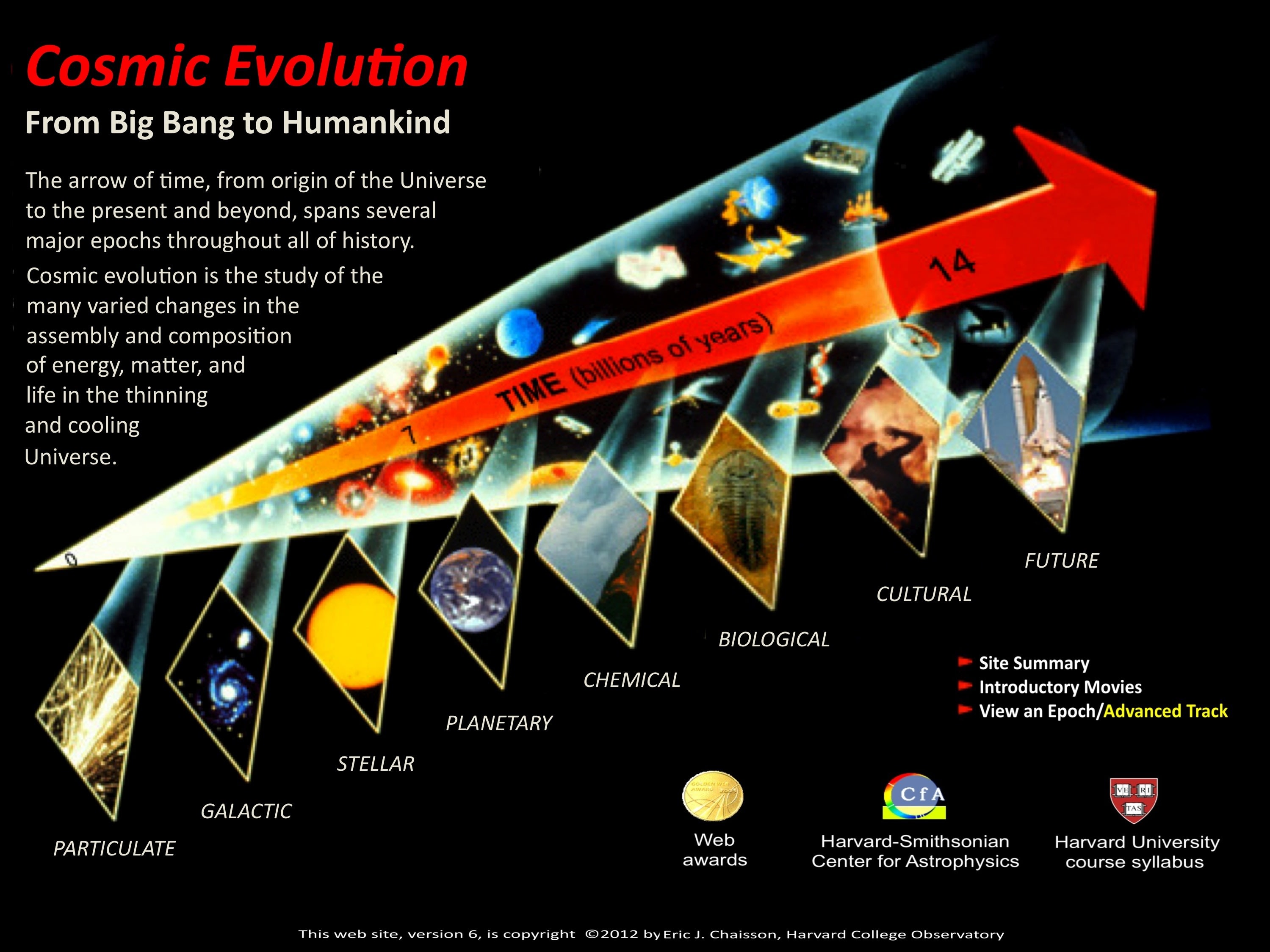
(a meta-narrative!)
We've already seen how RAW had developed a organicist, or vitalist outlook on cosmic evolution with his relationship with plants. I will discuss some of the wider views what I call his cosmotheism.6
RAW was impressed with what physicalist/reductionist Biology had done with the Ne-Darwinian synthesis.7 During the 1970s his reading convinced him that NeoDarwinism could not be the Final Answer in Biology. In a September 1974 essay in Green Egg, Wilson argued that a huge mistake was made when Giordano Bruno's erotic cosmology was overthrown in favor of Newton; in the 20th century both Wilhelm Reich and Timothy Leary had tried to revive Bruno's pantheism but both were thrown in prison. In the late 1970s, after Leary's release, RAW helped Leary flesh out his Eight Circuit Model of the brain and consciousness. The first four circuits were heavily scaffolded upon NeoDarwinian ideas. By 1977 RAW had speculated that the 8th circuit had to do with consciousness outside bodies, or what Aldous Huxley had called Mind At Large:
Consciousness probably precedes the biological unit or DNA tape-loop. "Out-of-body experiences," "astral projection," contact with alien (extraterrestrial?) "entities" or with a galactic Overmind, etc, such as I've experienced, have all been reported for thousands of years, not merely by the ignorant, the superstitious, the gullible, but often by the finest minds among us (Socrates, Giordano Bruno, Edison, Buckminster Fuller, etc.). Such experiences are reported daily to parapsychologists and have been experienced by such scientists as Dr. John Lilly and Carlos Castaneda. Dr. Kenneth Ring has attributed these phenomena to what he calls, very appropriately, "the extraterrestrial unconscious."8
RAW published a very brainy quiz for Steward Brand's Whole Earth Catalog in 1989. In it he asks Questions, then a couple of pages after that he discusses Answers. After every Question he has a box for True or False, but the article is titled, "Beyond True and False: A Sneaky Quiz With Subversive Commentary." Questions #31 and #32 read thus:
The Darwinian Theory of Evolution has been conclusively proven.
The Darwinian Theory of Evolution has been conclusively disproven.
When we skip ahead to the Answers, we read:
31 and 32, asserting that Darwinian evolutionary theory has been proven or disproven, I personally would classify as None Of The Above. I regard such assertions as propaganda in the Cold War between Darwinians and Creationists. The Darwinian theory has more or less stood up for over a hundred years, has flaws which most biologists now admit, and may need considerable revision in the near future, but remains, as Popper9 has often argued, not in the same ball park as all the "laws" of sciences like mathematical physics. (Personally, I don't see any better biological model around than Darwin's but considering the criticisms recently raised within biology I strongly suspect a better model will arrive shortly — and will probably be equally offensive to Creationists…)10
It's not that RAW ever really broke with this position; it's just that he was more interested, from the 1980s to his death in 2007, in thinking about all those aspects that seem unanswered by the Physicalist Neo-Darwinian scientists: how life began on this planet, anomalies, erotic cosmotheism, the necessity of some sort of Mind in evolution, etc. In a 2003 interview with Gabriel Kennedy, RAW talks about how Space/Time/Matter can't be broken up; they make a whole, and then he pretty much confirms what he was thinking about NeoDarwinism in the mid-1980s:
Obviously, you can't leave mind out wither, because how do you know the space-time-matter are there are all unless there is a mind to observe them. So, space-time-matter and mind make up the four parts of any transaction. So where does that get us?
GK: It's good for me.
RAW: Oh, yeah, also, I object to Fundamentalist Materialism. Although, in some ways I lean very closely to what I'd call a literal materialism as a working hypothesis that's safe most of the time. As long as you're directed into a goddamn dogma or an idol. The Fundamentalist Materialist is what I call these people, this mindset, that takes the materialist model and revers it as passionately as a religious conviction. Like some of these goddamn Darwinians I see in television. To me, they're as embarrassing as the Fundamentalist Christians they're arguing with. All these Fundamentalist Christians are yelling, "God created the world in six days." All the Fundamentalist Materialists are yelling back, "Evolution is not a theory; it's a proven fact." Well, it's not a proven fact. It's a hypothesis. It's a very plausible hypothesis, seems to me the most plausible hypothesis. You can't confuse it with a fact; in the first place it can't be tested in the laboratory, so it can't be refuted. According to Karl Popper, any theory that can't be refuted is not part of science. I think evolution did occur. I mean I beliee in it. But, jesus, some of these people are so fanatical about it they sound just like the Christians.11
A very fine yet massive detail here, that many seem to miss, possibly because our culture has brainwashed so many people into thinking in just two categories: Right/Wrong; True/False; Science/Not Science, etc: Wilson agrees with the Neo-Darwinian synthesis, but objects to calling it a "proven fact" on grounds laid down by Karl Popper's epistemology. Is Darwinism science? It looks like it, yea, to RAW. Is it on the same epistemological level as mathematical physics? No. In Wilson's universe there are many granular levels of detail and no one Knows All.
In the late 1970s and early 1980s, Wilson crammed a lot of his ideas into his Schrödinger's Cat Trilogy of novels, which contain a dizzying level of free play with scientific ideas, along with scads of non-science. Leary and Wilson had pounced on Harvard biologist Edward O. Wilson's massive, seminal, wildly controversial 1975 book Sociobiology: The New Synthesis. They both read it like Talmudic scholars and RAW's subsequent writings, including the novels that make up Schrödinger's Cat reflect this with musings on insects, ecology, genes, ethology, status hierarchies, and ideologies.12
Later RAW criticized EOW for giving humans very short shrift (EOW was an Entomologist by training), and asserted that Sociobiology only addressed the first two of Leary's Eight Circuits. In 1991 RAW cited JBS Haldane's golden quote about the Mind behind evolution: "The great biologist, asked what dominant trait he would attribute to the Mind behind evolution - if he admitted such a Mind - replied at once, 'an inordinate fondness for beetles.'"13
We will see that RAW asserted a more Grand and poetic idea for this Mind, and that he has many more allies both in the Academy and outside it in 2026 than he had at his death in 2007.
(I will try to conclude these essays on RAW's cosmotheism, vitalism, and his personal efforts to transcend physicalist NeoDarwinism in the next section. Wish me luck! - Michael/OG)
1Wagner was writing An Insider's Guide to Robert Anton Wilson, which was published in 2004, and then appeared in an updated version in 2020.
2Wilson's wife of over 40 years. She was a poet and intellectual and mother of four.
3RAW used this self-description candidly if ironically many times when discussing his life in the 1950s.
4see the final page of "'Even A Man Who Is Pure of Heart': The Horror Film as American Folk-Art.", Journal of Human Relations, 1971.
5From the essay "Left and Right: A Non-Euclidean Perspective," in Email To The Universe, Hilaritas ed, p.131.
6Spoiler Alert: RAW's cosmotheism would have as its preferred pronoun "It." Absolutely not "He."
7Neo-Darwinism is Darwin's theories plus genetics, which was fleshed out and published by the the Augustinian friar Gregor Mendel in 1866, but not discovered until 1900, when three different scientists found his writings on genetics. Have there been other earth-shattering papers have been written but not known? This would, I presume, constitute a Known Unknown, or possibly an Unknown Unknown?
8Cosmic Trigger vol 1, pp.209-210. In this 1977 work, Wilson had tried to explain what had happened to him when, in July 1973, he began to receive messages from the Sirius star system. He had spent the previous 15 years doing Self-Experimentation on his own mind with cannabis and psychedelic drugs, ceremonial magick, yoga, breathing techniques, deep immersion in readings of difficult writers such as Joyce, Pound, Crowley, and an astounding amount of writing. Possibly underrated was his burgeoning commitment to what he called "Model Agnosticism," which was a radical openness to signals and ideas that he did not hold in his "monster of erudition" days. In reading in a delirious number of texts, including tabloids, Anthropology, all schools of Psychology, "crank" literature, and phenomenology, he sought to enter other peoples' "reality tunnels" to see what it's like living there, before exiting, reflecting, and entering other reality tunnels. All this reading was combined with practices in secret society initiation and ritual and he was an ordained witch. Among many other things. All this probably contributed to his "contact" with Sirius, which taxed his considerable powers of skepticism and doubt. After grappling with different models for what had happened to him, he used metaphors from the Tarot deck to lead his way out of "Chapel Perilous." Then his youngest daughter was murdered in Berkeley. It's all covered in this book, a sort of memoir that's still very difficult to categorize. In the quoted passage it's easy to link Lilly's contact with ET intelligence as solely to do with psychedelic drugs, but upon further study this seems facile to me. It seems more complicated. As for the charlatan Castaneda, RAW would catch on around 1979 or 1980, with the works of Richard DeMille, among others.
9Sir Karl Popper had stressed that scientific ideas need to be falsifiable through experiment, or they cannot be truly scientific ideas, one of the great epistemological gambits in the history of science and I'm sure today someone has written about how falsifiability was a mistake.
10The Fringes of Reason: A Whole Earth Catalog, edited by Ted Schultz, pp. 170-173.
11Read Kennedy's interview HERE.
12Examples: in The Universe Next Door, Benny "Eggs" Benedict, a journalist, "had actually read Darwin once, in college a long time ago, and had heard of sciences like ethology and ecology, but the facts of evolution had never really registered on him. He never thought of himself as a primate. He never realized his friends and associates were primates. Above all, he never understood that the alpha males of Unistat were typical leaders of primate bands." (p.15, omnibus ed.); Blake Williams is at a loud, crowded cocktail party: "…which is why we're all deviates. If Mother DNA had wanted us all to be replicable units, She'd have made us insects instead of primates…" (The Trick Top Hat, p.212, omnibus ed); in The Homing Pigeons, Dashwood is lecturing on humans as primates: "It's a biochemical fact," Dashwood said, "that ninety-eight percent of our DNA is identical with chimpanzee DNA. Eighty-five percent of our DNA is identical with the South American spider monkey, our most distant relative in the primate family. This means, gentlemen, that most of our behavior is genetically programmed to follow the same survival, status, and sex programs as the other primates." Dashwood goes on at length, is interrupted by someone who shouts "Bullburger." Dashwood, a comic figure, thinks, this is a typical primate reaction to a threat. RAW then has Dashwood use a long novel as an example of reminding the reader, on every page, that they're primates, and what the effect on the reader would be. He then goes on: "Even stranger, if I stopped mentioning it for about two hundred pages, the readers would all forget it quickly, and be startled if mentioned it again on page five hundred fifteen." This passage occurs on p.515 of the novel(s). RAW does indeed repeat at length in these three novels that we are "domesticated primates." It's strong poetry, and a political move on his part. But having the persnickety professorial figure of Dashwood break the Fourth Wall and talk about reading a long book that repeats that humans are primates and then just seeming to pull the page number of 515 out of thin air, while the passage indeed occurs on that page, seems like a strong nod to his legion of cannabis-infused readers.
13Cosmic Trigger vol II, p. 44, Hilaritas ed. "The Big Bang…And Its Consequences."
Robert Anton Wilson on Plant Intelligence, (Part 1?) [ 05-Jan-26 12:59am ]A poor kid born three years into the Great Depression, near Brooklyn, who contracted polio as a child and was enamored of Weird Tales and mathematics and poetry, you might think Wilson would not be a good candidate to develop a pantheist, vitalist, panpsychist point of view. He was not a hiker (the polio), but in the 1970s in Northern California he and his wife Arlen were very much involved with modern paganism and definitely did magickal rituals in Berkeley and met other pagan artists and intellectuals in the redwoods in Northern California. What was the trajectory? How did he develop this mystical outlook?
1940s and 1950sRAW received the Sister Kenny Method1 of treatment for his polio, which orthodox medicine did not approve of. It consisted of hot compresses and soft, or "passive" manipulation of affected body parts. This nurse-nun thought the muscles of polio patients needed to be "re-educated," having been "alienated." It's part of the basis of what we call "Physical Therapy" today. RAW was able to walk without much trouble for most of his life, until he was forced to deal with Post-Polio Syndrome symptoms during his last ten years.
This Substack is reader-supported. To receive new posts and support my work, consider becoming a free or paid subscriber.
This healing via unorthodox method planted a strong suspicion of the authority of the American Medical Association throughout his life.
As a 24 year old intellectual in New York, Wilson found out Wilhelm Reich's books were being burned at the Gansevoort Incinerator, in 1956. Trucks backed up to the incinerator at Gansevoort and Hudson and dumped six tons of Reich's books there, where they were burned. It was largely American liberals and the FDA that were behind this. The Nazis had earlier burned Reich's books. Wilson had become extremely affected by WWII and the Nazi regime and had imbibed the message that fascists burn books, but we are free and for free speech. It was only 11 years since the end of the war. He had to understand why a former star pupil of Freud was so vilified and feared by authority. RAW went on the study Reich's books for a good portion of his life, and if you know nothing of Wilhelm Reich but are interested, you might want to read Wilson's Wilhelm Reich In Hell, a play, with a Shavian preface by RAW, in which he discusses Reich's individual theories, persecution, paranoia, and the role of heretical thought in societies.2
Reich had been persecuted by the Stalinists also. He was kicked out of the Communist Party for his sex theories and especially for his 1933 theories of why fascism seemed to be the default mode, worldwide, throughout history. Reich's The Mass Psychology of Fascism appeared in 1933. Why would "socialists" (or "communists" for that matter) be so threatened by a book on fascism?3
For our purposes, later in his career, Reich became convinced there was an undetected life-giving force that permeated the universe. It was called Orgone. RAW cited a long history of peoples all over the world re-discovering this vital force. If you've heard, read about, or had your chi manipulated, or were told how to breathe to build up prana, you know this force.4
One of the giants of post-WWII scientific ecology, William Van Vogt, published The Road To Survival in 1948, when Wilson was 16, and Wilson read that and began following Ecology as a science before the age of 20. He was also heavily influenced his entire life by Erwin Schrödinger's What Is Life? (1948), which was at the nexus of quantum theory, the new Information Theory of Shannon, and Biology, and could be considered a backdoor for respectable neo-Darwinists to entertain ideas that might be considered quasi-vitalist.

(in nature there are no "natural" closed systems: everything is involved with everything else)
Wilson was also a riveted reader of Sir James Frazer's The Golden Bough, and there is much from Frazer about ancient peoples fucking in the fields to encourage plant growth. Sexuality and fertility of humans was analogous to fecundity of plants, and this vital, progenitive sexual force seemed to have been intuitively known by ancient peoples, and might be considered the ur-religion. More on this below.
"Herbert Muller, a Nobel laureate in genetics, once said that we're all giant robots created by DNA. There's a lot of truth in that metaphor. DNA is immortal and has designed everything. Bucky Fuller points out that there's no engineer or technologist, including himself who's achieved the simplicity and tremendous structural strength and economy of a tree." - Wilson in a 1977 interview with Weird Trips magazine
Wilson in Southern Ohio, 1962
On December 28, 1962, Wilson had his first psychedelic trip, on peyote, in an old slave cabin in the woods near Yellow Springs, Ohio.5 He experimented very extensively with peyote in the woods - at least 40 trips - and one time, the day after a trip, while weeding in the garden, "a movement in the adjoining cornfield caught my eye.":
I looked over that way and saw a man with warty green skin and pointy ears, dancing. The Skeptic watched for nearly a minute, entranced, and then Greenskin faded away "just a hallucination…" But I could not forget him. Unlike the rapid metaprogramming during a peyote trip, in which you are never sure what is real and what just the metaprogrammer playing games, this experience had all the qualities of waking reality, and differed only in intensity. The entity in the cornfield had been more beautiful, more charismatic, more divine than anything I could consciously imagine when using my literary talents to portray a deity. As the mystics of all traditions say so aggravatingly, "Those who have seen, know."6
Wilson reads the new book by Castaneda five years later and this same warty green being, the spirit of the peyote plant, Mescalito, appears. So RAW had an experience with this entity before reading Castaneda, and this was a challenge to his educated Materialism. Could Mescalito be part of the Jungian unconscious? The anthropologist Weston LaBarre in his The Peyote Cult cited this dancing green warty being as seen by many peoples.
Is Mescalito a Vegetation "plant spirit"? It taxes the sophisticated intellectual's credulity. And yet, Paracelsus had believed in these beings. So did Goethe, Rudolph Steiner, Gustav Fechner, Luther Burbank, and George Washington Carver. Thomas Edison was determined to catch these spirits on film, but never did.
In wondering what might be going on here, RAW cites that eccentric, uncategorizable 1973 book The Secret Life of Plants, and IBM's Marcel Vogel, who studied plant-human telepathy for over a decade: Vogel hooked up a polygraph to plants while people in the room…thought erotic thoughts. "The plant responded with the polygraph pattern typical of excitement."7 Vogel's findings naturally trigger wonder about Reich's orgone and plant-human connections, Frazer's fucking in the fields idea, and:
Brief Detour to Ancient Babylon, Egypt, IndiaMescalito could be both an archetype of Jung's Collective Unconscious and an anthropomorphized human translation of a persistent signal sent by the molecular intelligence of the vegetative world. Naturally, the ability to decode such orgonomic or neuro-electric signals would be eagerly sought by all shamans in societies dependent on agriculture. In other words, according to this model, Mescalito is a genetic signal in our collective unconscious, but activated only when certain molecular transmissions from the plant world are received. 8
If Cleve Backster (discussed in my previous article about Plant Intelligence), also a major player in The Secret Life of Plants (recall this nutty book predates by 50 years all the surprising new data on plant signaling and intelligence) and Vogel used polygraph machines to obtain data from plants, how did the ancient shamans know that fucking in the fields was a powerful magic to enable the crops to flourish? They got this info from the amanita muscaria mushrooms, psilocybin-containing mushrooms, cannabis, and peyote. Wilson's reading leads him to the idea that the only religious practice older than taking plant-drugs is the ritual orgy. Frazer called these knowledgable shamans "Primitive Scientists." Wilson thinks they discovered the "magick function of the ecstatic state" and it seemed to lead, historically, to hierogamy or "sacred marriage," where, in Egypt, Babylon, Persia, India, the mass ritual orgy in the fields was condensed down to one significant couple having intercourse to ensure, not just the crops, but the welfare of all their people. Often this couple was the King and his sister. (Look up Royal Incest in Egypt, for example.)
While this might disgust us, Wilson thinks the development of mass orgy ritual in the fields to hierogamy may have led to the practice and philosophy of Tantra.9
Timothy Leary's "Vegetable Conspiracy": As Wilson AdvocatesBoth Leary and Wilson held varieties of panpsychism, erotic cosmology, and the like that I lump under the rubric of "cosmotheism", being influenced by esoteric scholar Wouter J. Hanegraaff. Check out how this psychedelic idea plays out in 1977, as RAW talked to Weird Trips magazine. Our linear, left-brain, one-thing-after-another-rational-empirical brain has led us to the brink of environmental collapse, and clearly, we need to learn to think with general systems, ASAP. (Or is our time on this planet a fait accompli?) Here's RAW explaining a Leary idea:
[…] because we've been thinking too much with the left brain we've been creating ecological havoc on the planet, so that DNA had to get new signals through to us. It did this through the vegetative kingdom which was being severely endangered by pollution and so on. So the vegetative kingdom conspired to get chemicals into us that would teach us ecological common sense. The only way to get them into our nervous system in vast quantities in a quick way is hedonistically. So the vegetable kingdom set out to seduce us with drugs that get us high and make us happy and at the same time open us up to right brain activity. You see, the fifth circuit is the sugar coating to get us into the sixth circuit. First it turns us on and gets us high, and then it opens us up to a more cosmic perspective. It's a vegetable conspiracy to communicate with us. The mushrooms and the cacti and the hemp and so on are signals from the vegetable kingdom to our nervous system.10
This seems to me a funny riff on cosmic conspiracies. It reads like a sort of hippie fable. And yet, like all fables, it teaches something true at its core. Given the science I've read on the molecular structures within plants that get people high via passage of the blood-brain barrier and plant molecules looking enough like serotonin to be picked by receptors in the brain, the intentionality of plants to develop these chemicals in order to teach us a "cosmic perspective" seems ludicrous, if a hilarious rhetorical ploy by Leary and Wilson. These chemicals were there WAY before we started the spoliation of the planet; what's fascinating to me is the happy accident of shamans and psychonauts stumbling onto these plant substances. For Wilson to repeat this Leary riff speaks, I think, to his quite serious ideas about plants and vitalist cosmotheism. His erotic cosmology. For which I see Giordano Bruno (1548-1600) as the original progenitor in the Modern era.
Sidetrack: Bruno's Erotic CosmologyBefore the Inquisitors, a trial in Venice,11 Bruno was given a chance to recant, soften, or amend some of the things he had written or said, but he chose to make things worse for himself, or he didn't understand or care about the situation he was in. He talked of how everything lives, grows, acts and abides in perfection, due to Providence, but that "God" communicates in an "inconceivable" way and "God"'s essence, presence, and power are "unspeakable." Here's Bruno, not exactly sounding like what the orthodoxy of the Catholic church wants to hear from one of their own:
Now I understand all attributes to be one and the same in Deity, and, with theologians and the greatest thinkers, I conceive of three attributes: power, wisdom, and goodness; or, mind, comprehension, and Love. Things are through mind, they are ordered and distinct through intellect; they are in harmonious proportion through universal love, in all and above all. There is nothing that doth not shine in being, any more than anything is beautiful without the presence of beauty; wherefore nothing can exist shorn from the divine presence. [And here's where they start gathering the kindling-OG] But distinctions in the Divinity are made by the method of Discursive Thought and are not reality.
Pantheism, held together by Love. There is no Trinity, which men made up using their powers of reason. Whatever God is, it's unspeakable, but we see this higher power's trace in Love and - literally - everything. Any divisions between Father/Son/Holy Spirit were concocted by men. Bruno wasn't buying. And he had a hard time finessing his positions once he got nabbed.
Bruno talks of other planets and worlds, which alone was probably enough to get him burned to a fine crisp:
I hold the universe to be infinite as result of the infinite divine power; for I think it unworthy of divine goodness and power to have produced merely one finite world when it was able to bring into being an infinity of worlds. Wherefore I have expounded that there is an endless number of individual worlds like our earth. I regard it, with Pythagoras, as a star, and the moon, the planets and the stars are similar to it, the latter being of endless number. All these bodies make an infinity of worlds; they constitute the infinite whole, an infinite space, an infinite universe, that is to say, containing innumerable worlds. So that there is an infinite measure in the universe and an infinite multitude of worlds. But this may be indirectly opposed to truth according to the faith.
No! Ya think, Giordano? Hey, we now know your vision was far more close to being scientifically true - as of three weeks ago, there are 6065 confirmed exoplanets in our little backwoods galaxy, the Milky Way. There are 1025 confirmed planetary systems: a star that has more than one planet orbiting it, like ours.
Bruno then - and it's very hard to understand his little shifts here and there, but we must place a heavy burden on him being kept in solitary squalor for years at this point - Bruno tries to explain how he agrees with Aristotle about the Prime Mover thing and tries to square this with the doctrine of the Trinity, but then he says, "All things, souls and bodies, are immortal as to their substance, nor is there any other death than dispersion and reintegration." Here Bruno sounds like an atheist. I like to think Bruno would like the recent "mushroom suits" people are providing for their own deaths: something that will allow their dead bodies to break down more quickly so their organic compounds can feed the soil and flowers more efficiently. Bruno at this point said he thought the souls of the dead might take up residence in other things: the dreaded transmigration of souls, metempsychosis, strictly verboten to think about. But I'm getting way ahead of myself here. Suffice: The Nolan is not doing a good job buying fire insurance.
Admitting he could never see how finite flesh of a human could be fused with the Word, Bruno tells the authorities their Trinity doctrine is bullshit:
To make clearer what I have said, I have held and believed that there is a distinct Godhead in the Father, in the Word, and in Love, which is the Divine Spirit; and in Essence these three are one; but I have been able to grasp the three really being Persons and have doubted it. Augustine says: "We utter the name of Person with dread when we speak of divine matters, and use it because we are obliged." Nor have I found the term applied in the Old or New Testament.
As he continues to be grilled on official Church doctrine, a prosecutor - Gabrielle - asks, "And so you are a skilled theologian and acquainted with Catholic decisions, are you?" Bruno answers: "Not much. I have pursued philosophy, which has been my avocation." It's around here I get the feeling Bruno's burning at the stake would be a fait accompli. Bruno's grilled on magick books that Mocenigo told them he found in Bruno's possession:
Judge: And what of the books you are known to have read? Occult books, the works of heretics?
Bruno: I have indeed seen condemned works such as those by Raymond Lully and other writers who treat of philosophical matters. I scorn both them and their doctrines.
Here Bruno's outright lying to save his bacon, not realizing it was already in the pan. They found Seals of Hermes in his possession. Bruno had mocked the Faith. He insisted that the universe was infinite, which was bad, but to posit there must be Life on other planets throughout the universe: Burn Him. It was bad enough that he embraced the brand-new ideas of Copernicus. He denies the Trinity. He is burned alive, with an audience, in Rome, February 17th, 1600.12
Hanegraaff goes to long, articulate lengths in showing how, after Bruno, the Church, then embroiled in corruption, official doctrines about occultism, Hermeticism, etc being a no-no, but the new Protestant sects were overtaking them here. And then there was the so-called Age of Reason, and the advent of modern materialist science. Over the next 400 years, thinking like Bruno would be to think like a weirdo, the Other, and Hanegraaff details exquisitely the making of scientific reality vs. an "orientalized" Other that included Hermetic thought, magick, occultism, alchemy, and this notion of Intelligence being inherent in all things, which we today are seeing called panpsychism. Hanegraaff shows there have always been varieties of panpsychism. He asks us to imagine an extreme "manichean" dualism and extreme pantheism:
Robert Anton Wilson's CosmotheismBut by far most typical for the context of "Western esotericism" are the many intermediary "panentheist" versions that may be referred to as cosmotheism. The term was coined by Lamoignon de Malesherbes in 1782, and adopted by the Egyptologist Jan Assmann as a logical counterpoint to monotheism.13
In a June 16th, 1983 (Bloomsday) interview conducted by John van der Does, at Wilson's Dublin residence within sight of Martello Tower, RAW addressed his cosmotheistic ontology. John asks RAW why he calls God "It", which might be confusing for people:
Actually I started that back in 1959. I was reading Science and Civilization by Joseph Needham, and I was thinking that I agreed with the Taoists more than any other religion. And I started asking myself why.
RAW discusses the semantics of "It" over the three great monotheisms - Judaism, Christianity, and Islam - and their "He." He thinks this neurosemantically makes us think of a "cosmologically huge human being," which can't be correct. "I do have a very strong intuition of some kind of cosmic intelligence. I'm an agnostic on the level of not being passionately convinced. I just have a strong intuition of cosmic intelligence." He returns to this intuition in hundreds of places in his work, both fiction and non-fiction. My suspicion is that he was averse to just saying he "is" a panpsychist, though in other places he says this outright. He goes further:
I thought, "Cosmic intelligence is not a gaseous vertebrate," which was Thomas Henry Huxley's description of the Christian God. It does not have a penis, so it is not a "He." I can't think of it as an Eastern potentate or king. All the Christian symbology, "Our Almighty King or Lord," "Our Great Father," etc, seems to me to be a continuation of infantile thinking projected onto the universe. I don't think the universe is a punishing father. I don't think it has any of the traits of an old paranoid man. It's impossible for me to think of cosmic intelligence peeking into bedrooms, taking notes and giving people gold stars for making love the right way, and black stars for doing it the wrong way. All that seems absurd to me. So, I can't take Christianity seriously as an intellectual force. It's a continuation of infantile anxieties.14 And so, the same goes for Judaism and Islam. As far as the Western World is concerned, I'm an atheist.
RAW goes on to elaborate on his idiosyncratic cosmotheism.
But I do have a strong intuition of cosmic intelligence, and I find Buddhism quite compatible. But I find Taoism even more compatible. So, I prefer to speak of cosmic intelligence as It rather than He.15
Skipping down:
I have reverence for a great many things: trees, flowers, animals, children, some adults, art, Beethoven, Bach, mathematics, great scientists, the sun and moon and stars, and the ocean and rivers…To quote T.S. Eliot, whom I generally don't agree with, "I don't know much about gods, but I think the river is a strong, brown god." I feel all things are full of gods. So, I have reverence for a great deal.
RAW then talks about intelligence as radically decentralized and cannot relate to Martin Buber's I-Thou relationship because of this. "Every biological system is intelligent, if you really understand what Darwin is saying. But it's not a centralized intelligence, it's a decentralized intelligence. Darwin's ruling metaphor is the tangled bank, with every plant trying to maintain its own space to expand its roots, and the whole system is intelligent."
He then expounds on the Margulis-Lovelock hypothesis of Gaia. "I'm inclined to think that probably on a higher level, the galaxy is an intelligent being." Remember: this is his "intuition." He refuses to commit. Further in this marvelous interview RAW speculates on Teilhard de Chardin's idea of the noosphere, which he not only thinks is real and true; It, too, is evolving:
Well, the noosphere is the mental part of existence. Consider the mental as having an existence that you can think about, although I know some materialists try to pretend it doesn't exist. It palpably does. When I talk to you, obviously I'm feeding things from my mind into yours. When you talk to me, your mind is feeding stuff to me. And I can communicate with dogs and they can communicate with me. I have a certain amount of success in communicating with all life forms. By experimenting, I found, to some extent, I can communicate with plants.16
Okay, Substack just dropped its red banner on me about my perennial problem: length. I see I'm up to 5000 words here today, so I will take a rest. If you liked this, I'm very glad. If you want more, I have a whole lot more. Let me know! It was fun researching these last two articles on plant intelligence and cosmotheism. William Zinsser was a big influence on me with this book Writing To Learn.
There is a LOT more about Wilson's cosmotheism, which I will get to in due time, but the OG also needs to think and write on other topics. If you have any topics you'd like to see me riff on here, please do harangue me about it! - Michael AKA the OG
1Turner Classic Movies aficionados might have seen RKO's biopic Sister Kenny (1946, Dudley Nichols), with Rosalind Russell as the nun.
2The Hilaritas Press ed. of Wilhelm Reich In Hell also contains Forewords by both Christopher S. Hyatt and RAW scholar Eric Wagner that add much to the text.
3Hint: Reich had turned Freud's theory upside down: that in order to have a civil society we must repress sex. Reich thought fascism resulted from repressed sexuality, so we must take action! He also thought the very structural nexus of fascism was in what we call the "nuclear family." So, you can see why he may have riled some folks.
4see RAW's Starseed Signals, p.337. He includes many other vitalist historical forces independently discovered, including "multiplication of the first form" in medieval alchemy, "the first matter" of later alchemists, "animal magnetism" of Mesmer, "OD" or Ordic Force by 19th century chemist/polymath Baron Carl Reichenbach, the "mana" of the Polynesians, the "wakan" of the Native Americans of the plains, and "bioplasma" of Andrija Puharich. The Russians had a "psionic force" while in India they had "kundalini." The Iroqois had "orenda," while the Greeks used "pneuma." In other books and articles Wilson includes Bergson's "elan vital." Borges thought Schopenhauer's "will" in The World as Will and Idea was the same thing as Bergson's "elan vital" and George Bernard Shaw's "life force." Some Jungians consider Jung's use of "libido" to be cognate with Bergson's "elan vital." The Hebrews call it "ruach," while Hans Driesch, a non-Jew pacifist Romantic German influenced by Goethe and persecuted by the Nazis used a rather mundane "Vital Principle." Driesch was also a proponent of ESP and after chased out of Germany was part of the Society For Psychical Research in London. No doubt I'm forgetting many of these cognate terms. Perhaps it's necessary to link Aristotle's vitalistic force, entelechy, here? Lakoff and Johnson consider "vitality" and "life" as substances and containers, respectively, in our cultural metaphors, and not forces. To illustrate vitality as a "substance" they elicit "She's overflowing with vitality" and "He's devoid of energy." "I don't have any energy left in me." "I'm drained." "That took a lot out of me." Metaphors we use for life, which is a container: "I've had a full life." Life is empty for him." "Her life is crammed with activities." "Get the most out of life." "Her life contained a great deal of sorrow." "Live your life to the fullest." : see Metaphors We Live By, p.51. Whether this vitality "really is" a force or a substance might be a moot point here; for vitalist thinking, there's something that science hasn't yet detected but which countless people have felt that is of paramount import.
5Wilson wrote of his time in southern Ohio, on a farm, being associated with Ralph Borsodi and Mildred Loomis's anarchist School For Living, working for the Antioch Bookplate Company and editing possibly the earliest hippie periodical, Way Out, in various places his Cosmic Trigger vol 1 (see pp.19-25) and Cosmic Trigger vol 2, but see Gabriel Kennedy's biography of RAW, Chapel Perilous: The Life and Thought Crimes of Robert Anton Wilson, pp.44-55 for a more integrated view of RAW in southern Ohio.
6Cosmic Trigger vol 1, p.22
7Cosmic Trigger vol 1, p.23. See The Secret Life of Plants, by Tomkins and Bird, pp. 32-47, on the experiments of Marcel Vogel on plant sentience, esp. pp. 43-44, in which a group of "skeptical psychologists, medical doctors and computer programmers" convened at Vogel's house and were invited to check for hidden gimmicks or trickery. They talked about "several topics with hardly a response from the plant." It was generally concluded there was nothing going on until someone brought up the topic of sex, and the plant came to life, the polygraph equipment "oscillating wildly on the chart." This brought up speculation about Reich and orgone and Frazer's ideas about fucking in the fields to encourage greater crop yield. It was the 1970s. Vogel rather prosaically posited some sort of "Life Force or Cosmic Energy" that surrounded all living things and plants, animals, and humans: they all share in this energy-force. - Secret Life of Plants, p.39. I'd've gone with Orgasmic Pan-Vital Energy or something like that, but Vogel was an IBM scientist. We're tempted to write Vogel off as a quack of some sort, right? Here's Jacques Vallee, working around the earliest computer networks and ARPANET at Stanford, writing in his journal on May 22, 1976: "I met Marcel Vogel today. He is a massive block of a man, a jovial fellow, an expert at IBM where he studies plant telepathy and other paranormal topics. He made so many millions for them with his discoveries in magnetic recording that they leave him alone, with a fat salary and his own lab."- Forbidden Science 2: The Journals of Jacques Vallee, 1970-1979, p.337.
8Cosmic Trigger vol 1, pp.23-24
9Lion Of Light: Robert Anton Wilson on Aleister Crowley, pp.151-154
10Either Wilson scholar Mike Gathers or I bought a copy of Weird Trips on eBay, or someone sent us a copy, because I printed out the article for my files. Robert Shea is also in this interview. HERE is a link to what Gathers put up at RAWilsonFans.org, a gem of a site for research on RAW. The passage cited here appears about 9/10 down the page. DNA wants to get through to humans, so uses plants. This idea of DNA as God indeed feels a lot more like Leary than RAW, though RAW was in total awe of DNA, to be exact.
11The records of Bruno's ultimate trial, in Rome, were lost, so we must rely on the Venice inquisition. 400 years to the day after Bruno got baked, the Church apologized. Cardinal Angelo Sodano called Bruno's burning "a sad episode" and "an atrocious death."
12I have used transcripts about the persecution of Bruno cited by Michael White in his book The Pope and the Heretic, pp. 85-138. White wrote many good popular science history books, and also mystery novels and thrillers. He lectured on Chemistry at Oxford and was a member of the British pop group The Thompson Twins.
13Esotericism and the Academy: Rejected Knowledge in Western Culture, (2012), Wouter J. Hanegraaff, pp. 370-371. The Egyptologist seems to not be related to a prominent New York proctologist nor to Cosmo Kramer, although a mathematician and a population geneticist determined we're all related to Nefertiti, which brings us back to Egyptian hierogamy. Long ago I read Ludwig von Bertalanffy on General Systems Theory and was convinced that my personal epistemological choices could do worse than to always think with Systems. There are no closed systems, etc. When I read this article on how we are all related to Nefertiti (her name means "the beautiful woman has come" insert joke here), I knew this Systems thing would payoff like this!
14students of the 1st and 2nd circuits, take note!
15RAW notes he wrote "The Semantics of God" for The Realist in 1959, and it was republished in his book Right Where You Are Sitting Now.
16All of these quotes from the June 16th 1983 interview by John van der Does are only found in the Hilaritas Press edition of RAW's Coincidance: A Head Test, which is most often referred by Wilson scholars as his "Joyce book". The interview is not found in the New Falcon editions of the book. The interview is wide-ranging and a doozy for showing not only RAW's ideas of cosmotheism, but his cosmic intelligence on everything. Highly recommended. Passages I've quoted here are in the Hilaritas edition, pp. 341-343.

(artwerk: B. Campbell)
On Plant Inelligence and/or Consciousness [ 28-Dec-25 9:23am ]First off, you're right: we can't even agree on what human consciousness is. A guy in a vegetative state for 19 years suddenly wakes up and asks for a Pepsi1; brain tissue grown from stem cells in a culture - brain "organoids" - might attain consciousness, some think; others demure. I'll believe it when it can tell me what time the Giants game starts. (An organoid is an "it", right? I don't know how I'll feel when it tells me to call it "Dave." Or worse: "Mister Noid.") But you know what will be interesting? Finding out the answer to this question: Which will happen first: Will a brain organoid convince an AI to kill itself, or will an AI go at some advanced organoid hammer and tongs? Or will both events happen roughly concurrently, like on a Wednesday night during Sweeps Week? Is Vegas taking bets yet?2

This Substack is reader-supported. To receive new posts and support my work, consider becoming a free or paid subscriber.
I'm not even sure where I "was" when I found myself downstairs in front of the fridge, eating a bowl of Fun Flaky Bliss Bombs, with milk. To be sure, I wasn't "all there" - but was I conscious? Not in choosing to eat that crap. My gawd, I suspect a consortium of dentists got together - conspiracy! - and came up with those sugar bombs in order to juice their root canal rackets. And I know, this sounds like the typical Ambien joke. And yet I was not on Ambien. Why? Ya got any? Just one? Do me a solid…3 Then there were all those times you drove home from work and when you got home, you didn't remember a thing about the commute. Consciousness? There must be a million flavors of it, many so subtle you don't even notice 'em.
There was a time when I was deep in the weeds in the various arguments about human consciousness. For me, when I took a step back and realized Philosophers, Anesthesiologists, Neuroscientists, Biologists, and yes, Physicists were all weighing in on what David Chalmers calls "The Hard Problem" and that no one was winning this game, no one seemed to be able to score, I realized this might be yet another "problem" we homo saps invent that is impossible for creatures embodied like us, in a gravity well on a planet in the Goldilocks Zone orbiting a Type G main-sequence star, to solve.
Some scientists and philosophers call this "Mysterianism": maybe we can use the equations of quantum mechanics in all our hi-tech industry, but we can't understand what the equations mean about how nature "really" works.4 And to combine the quantum world with Relativity? We've had 100 years of trying to solve this as of this year (2025)5 and everything has only gotten weirder and more inscrutable. So who's going to pontificate about what is conscious and what isn't? Lots of folks, turns out. Real smart ones, too.
I suspect we use our intuition and pick those series of stories that seem most plausible to us, and dig deep there. Until we hit a gas line or bedrock, whatever. Then veer off with a few other stories. I'm borderline Mysterian6 when it comes to the idea of consciousness, but I do favor certain lines of thought over others, and I can only cite something like "tentative intuitive plausibility." I know it sounds rickety and stopped-up with debris, but it's all I have.
All this goes for the origin of life (really cool set of stories there, ongoing, lots of smart folk working on it, rivalries and mudslinging, everything you can ask for as an Overweening Generalist); what happened before the Big Bang (same); what happens after death? (here I find the answers mostly hilarious); and why is there always room for Jell-O?
Finally! I get to:
PlantsA very basic, workable idea of "intelligence" (and maybe consciousness?) is the ability to decode and process energy and information from the environment and respond in ways that look adaptive and intentional. In this plants are looking like they've been overlooked by reductive science since the 1700s. If it turns out to be slam-dunk correct that trees, plants, bushes and all their cousins, were intelligent all along? Why it's just damned embarrassing at the very least. On the other hand, with the way we're heating up the planet, the plants may all just be muttering to each other that it's only a matter of time before the Golden Age of Cretacious II and the mammal parasites are mulch.
You may have seen, or even read, a number of articles on the possibility of plant intelligence over the last 12 years or so. But this idea is an old one. There are the mystics and pantheists and animists, of course, but then the German physicist and early experimental psychologist Gustav Fechner (b.1801) thought plants were not only smart, but had inner lives as well. Admittedly, this was after he had a breakdown when, at a career point desperate for a gig, he took on the job of assembling and translating many thousands of pages of the 8-volume Hauslexikon, which was a sort of 19th century Ladies Home Journal. The tedium broke him. Then he stared at the sun, as an experiment and wrecked his eyes, then stayed inside in a dark room for four years, when he finally emerged and looked at his garden and it sounds a lot like Aldous Huxley on psychedelics in 1953, but it was 1843:
A beautiful glimpse beyond the boundary of human experience. Every flower shone towards me with a peculiar clarity, as if it were throwing its inner light outwards […] One must only open one's eyes afresh to see nature, once stale, alive again.
Fechner answered naysayers. Aristotle thought plants were living things, but stupid, failed living things, dumber than animals because they can't even walk around7 and get their own food. Fechner said plants simply move really slowly (a historical figure named - ahem! - Chuck Darwin thought similarly of plant locomotion), and that plants delight in the sun as we would during a gourmet meal. Because we can't know the inner lives of each other, we must assume that when we gaze into each others' eyes and see something like ourselves, that the other must indeed be like us, and this includes our experiences interacting with plants. People like Sam Altman apparently extend this mode of phenomenological existentialism to artificial "intelligence." I know this sounds nutty, but hey, William James liked Fechner, too. As an undergrad taking a bunch of Psychology classes I put the finger on Fechner as one of the earliest lab psychologists, with Wundt and Helmholtz, and they were all wiggy German weirdos I would have loved to hang out with. The physics of the mind, was what they thought they were doing.
Later I read The Secret Life of Plants, by Tomkins and Bird (1973), which Michael Pollan called "a beguiling mashup of legitimate plant science, quack experiments, and mystical nature worship that captured the public imagination at a time when New Age thinking was seeping into the mainstream."8 There's a brief discussion about The Secret Life of Plants in The Madman's Library: how a documentary was made about the book with Stevie Wonder writing the music, how one of the stars of the book, Cleve Backster, was invited on Johnny Carson and David Frost, and "All this, despite the fact that Backster's research, and the book as a whole, were derided as pseudoscientific nonsense by the scientific community."9
At the same time, in 2025, studies in Plant Behavior are advancing at a torrid pace.
Brief Disclaimer, in Brackets[Despite my tone here, I have come around to plant intelligence, if not plant consciousness. The unevenness of this tone - flighty, devil-may-care, smart-assed cannabis-infused wiseacre combined with an attempt at High Seriousness about plant intel - only serves to highlight the pixillated quality of my current stance of Yep: Plants Are Intelligent and Possibly Communists To Boot assertions here. I spent most of my life with an ontology of Plants Are Dumb, and now every day I'm reconfiguring old brain circuits, deleting here, editing there, writing new code in my subcortices: plants communicate to each other, allocate resources to those in need, use strategies to combat predators, discern, are mostly ecumenical in plant terms, etc. It's a bit overwhelming, frankly. Plants seem - and I can't believe I'm typing this - wise. What do they do if they're attacked?, you ask. Well, they release volatile organic compounds (VOCs) because they have stress-response genes: kinda like using pepper spray on an unwanted sexual advancer. But their plant neighbors are listening in on the commotion and preparing for a similar attack on themselves. Smart move, guys.
Possibly my biggest ethical quandary that has arose from my Shift: I still eat some of these intelligent beings, and so far I rationalize it as, somehow, That's What They Want, which will never feel satisfactory, and, indeed, it's a lot like "Look at what she was wearing. She was askin' for it!" I realize I've skipped over the eating of animals, which I would rather not write about right now, 'cuz of…cultural baggage. Any and all advice here about eating plants would be greatly appreciated.- OG]
HyphaeIn fungi and some bacteria, hyphae are long tendrils of filament. They are a collection of cells surrounded by a "septum"-like tube wall that is just porous enough to exchange mitochondria, ribosomes and nuclei. This, I found, mindblowing. Because I have studied - strictly as an OG, remember - tens of books on neural transmission in human brains. A collection of hyphae is called a mycelium, a word I find mellifluously pleasant. Mycelia use spores to reproduce. Spores give rise to fruiting bodies and eject themselves from these fruiting bodies (like a mushroom) and travel for many miles on air currents before landing and taking up residence elsewhere. They are "ramblin'" agents like it's nobody's business. 'Tis a hot topic among paleontologists and plant geneticists whether they preceded land plants on this planet (Earth; Gaia) or not, but microscopic fossilized spores from embryophytes called cryptospores have been dated to the mid-Cambrian epoch, which was some time after the Big Bang and much before the Moslems were beaten back by Charles "The Hammer" Martel in current-day France, Battle of Tours, 732 CE.
Are spores really that badass, you ask? Well, radiotrophic fungal spores have grown inside the abandoned nuclear reactor at Chernobyl and use melanin to convert gamma radiation into chemical energy; other extremophiles can withstand pressures six times that experienced at the bottom of the Marianas Trench, some are totally fine living in temperatures near Absolute Zero (sans parka), and other extremophiles survive the vacuum of space, which has led to the theory of Panspermia: that life on Earth started elsewhere, which may be the ultimate cliff-hanger: okay…so where did that life start? Etc…So yes, Virginia, spores are badass. All the extremophiles must be given mad props by us homo saps, or I'll just speak for myself: I complain it's too cold when it gets below 55 degrees F; whine like a wuss when it tops 90F outside. Hat's off to extremophiles everywhere! (And make no mistake: they are everywhere.)
Mycelia save our lives every moment of every day by decomposing plant material. So relax about raking the leaves: among us the fungus would break down, transform and re-purpose the leaves, though I can't promise that busybody Mrs. Schwartz won't complain to the Homeowner's Association first. Life is complicated like that.
Oh yea, mycelia also make the soil more organic and release carbon dioxide back into the atmosphere as part of the carbon cycle. They carry water, don't chop wood as that would be a betrayal. They seem the nexus of electrical-chemical transactions of information, kinda like your how your nervous system is working right now as you read this puffball piece.
Hat's off to hyphae, dendrites of the vegetable world.
Plant PhilosophySounds kinda absurd, but it's burgeoning currently. Philosopher Stella Sandford of Kingston U. in London, who's written a couple of books on plants and philosophy, writes:
The new plant philosophy has emerged partly in response to this work in the plant sciences, and especially to the new paradigm, because the series of concepts that mark out the new paradigm as new - agency, intention, consciousness, and so on - are already the topic of considerable and long-standing philosophical debate. As soon as attention is focused on plants, broader issues emerge. For it is not just that philosophy is interested in plants; we discover that plant life, or the specificity of plant being, challenges some of the cherished assumptions that have dominated the Western tradition for centuries, if not millennia. Plant philosophy is about more than plants. It is also about how the peculiarities of plant life challenge us to think about our own being in new ways.10
And boy is it a challenge for me. I mean, I'm easily in or approaching my dotage: am I ready to keep reconfiguring my thinking to deal with plants as intelligent? I've already gone over right wing attacks on this: it's a conspiracy by radical environmentalists to try to keep us from the despoilment of the planet. I've looked at enough of the studies and evidence by now to see the (ironically) "conservative" attacks as childish. Big surprise!
It appears abundantly obvious that learning and responding to the environment doesn't require neurons; neurons are how mammals like us do it; nature seems to have developed an array of ways to extract information from the environment and convert it into Intelligence.
How are you dealing with this rapid influx of data on how smart plants were and how for most of our lives we've treated them like, I dunno…Stephen King's "Carrie"? If you've begun therapy, I understand.
Psychonauts Were of Course Avant Garde HereDennis McKenna, on what psychedelic plants can teach humans:
"They also teach us biophilia. Basically on a fundamental level you come out of a psychedelic experience with a feeling for the sacredness of all life and a love of life, and that's an important thing to integrate. They teach us animism: the perception that everything is alive and intelligent. And on the global level they teach us pantheism -- the notion that the universe itself, the world itself, is alive and intelligent. This is the worldview of most indigenous cultures that use psychedelics, and it becomes the worldview of individuals in our culture that use psychedelics."11
In The Internet Is Not What You Think It Is: A History, A Philosophy, A Warning (2022), philosopher Justin Smith-Ruiu (formerly Justin EH Smith), who recently came out as a psychedelic user, and it turned him into a Catholic (!), argues for Internet within the context of Gaia, with many learned examples and it's most definitely trippy.12
Matthew Hutson took LSD, then asked scientists about altered states and their power, then began to see trees as smart. He talked to naturalist Sy Montgomery, author of Soul of an Octopus, who had compared her scuba diving and octopus-research to LSD: "I find myself in an altered state of consciousness, where the focus, range, and clarity of perception are dramatically changed." In an email Montgomery told Hutson that "the mental experience of one species is no more real or valuable than any other." Hutson, an atheist since age 10, was backpacking in the Sierras when a tree seemed to want to commune with him. 13
Am I making this next one up as a psychonaut - am I pulling your leg? - or could it be real?: MIT scientists transformed the leaves of spinach into a bomb-detection device that can sense not only explosives but dangerous chemicals in the air, and thereby transmit the info to our digital phone? Sounds psychedelic! But it's actually a thing. Prof Michael Strano, MIT chemical engineer: "We're showing how we can get information from a plant's root system into your cellphone." The field is called Nanobionics. "The vision is to try to replace the electronic devices we mass produce with comparably functioning plants," says Strano. The very idea makes me feel high.
Tom Robbins, in 1984:
Flowers do not see, hear, taste, or touch, but they react to light in a crucial manner, and they direct their lives and their environment through an orchestration of aroma. With an increased floral consciousness, humans will begin to make full use of their "light brain" and to make more refined and sophisticated use of their "smell brain." […] We live now in an information technology. Flowers have always lived in an information technology. Flowers gather information all day. At night, they process it. This is called photosynthesis. As our neocortex comes into full use, we, too, will practice a kind of photosynthesis. As a matter of fact, we already do, but compared to the flowers our kind is primitive and limited. [..] Some people believe that we process information during dreams. Quite the contrary. A dream is the mind having fun when there is no processing to keep it busy. In the future, when we become more efficient at gathering quality information and when floral consciousness becomes dominant, we will probably sleep longer hours and dream hardly at all.14
Thomas Pynchon, in 1973:
Trees, now — Slothrop's intensely alert to trees, finally. When he comes in among trees he will spend time touching them, studying them, sitting very quietly near them and understanding that each tree is a creature, carrying on its individual life, aware of what's happening around it, not just some hunk of wood to be cut down. Slothrop's family actually made its money killing trees, amputating them from their roots, chopping them up, grinding them to pulp, bleaching that to paper and getting paid for this with more paper. "That's really insane." He shakes his head. "There's insanity in my family." He looks up. The trees are still. They know he's there.15
"Hemp Cannabinoids May Have Evolved to Deter Insect Pests," says a 2023 study. I was aware of this idea in the 1970s, but now we have more data that cannabis plants may have developed THC and other similar molecules in order to protect themselves. Philosopher Dr. Sebastian Marincolo discusses human use of cannabis within the context of animal and plant intelligence and how Western thinkers have use the ontological categorization of intelligence to argue that the fundamental deadness of "reality" is "advanced" while those who had ascribed intelligence to plants and animals were just nutsy-cuckoo and "primitive."16
Alan Watts, in 1972:
It escapes the notice of many well-educated people that the scientific establishment always runs the danger of becoming a rigidly authoritarian religion, a church excommunicating heretics such as Wilhelm Reich, Velikovsky, and Timothy Leary. In this church it is high dogma that anything outside the human skull is relatively stupid and unfeeling, and that animistic religions, such as Shinto, which attribute life and spirit to rocks and rivers, represent the lowest form of intellectual development. Meanwhile, such an imaginative enthusiast for science as Arthur Clarke speculates about vast electronic intelligences located in the galactic center. But the angels may be growing in your window boxes.17
Terence McKenna, in 1989:
The closer a human group is to the gnosis of the vegetable mind — the Gaian collectivity of human life — the closer their connection to the archetype of the Goddess and hence to the partnership style of social organization. The last time that the mainstream of Western thought was refreshed by the gnosis of the vegetable mind was at the close of the Hellenistic Era, before the Mystery religions were finally suppressed by enthusiastic Christian barbarians.18
Well..damn: Substack just alerted me that I have over 4000 words here, so I apologize for taking so much of your time. I will get to Robert Anton Wilson's experiences with plant mysticism in a future article.
1https://ground.news/article/arkansas-man-who-awoke-from-19-year-coma-in-2003-has-died-aged-57
2My brain seems to be in a weird spot right now. Please stand by. I didn't even address an advanced organoid having hallucinations like some AIs are already reported to have had. What if an organoid says it hallucinated but it turns out it - Dave - was lying all along? Can it still get a job on the writing staff for a situation comedy at Netflix? Science has so much to answer for! If this AI attacks a sufficiently sophisticated brain organoid at the same time an organoid successfully carries off a hit on an AI, I will give the Simulation Hypothesis a second thought. Hold me to it, folks!
3It was probably a simple case of Somnambulistica Ceresiae, yet to become well-characterized in the literature. Or I was just smoking a ton of weed that night/early morning.
4Just go ahead with all the Simulation Hypothesis stuff at this point. Have fun and see if I care. I don't think we are in a Sim, but then of course I'd think that, given "all this."
5Wolfgang Pauli came up with the Exclusion Principle; Heisenberg got an epic amount of creative thinking done on Helgoland, trying to escape his hay fever; Heisenberg, Born and Jordan come up with Matrix Mechanics, another road to the summit that worked, where they found Schrödinger's Wave Equation was already sitting, meditating. Schrödinger thought this up in 1925, didn't publish until 1926. We still don't really know what it all Means, but it works. Schrödinger wrote that the "sum total of all minds is one," so let's hold that thought for the discussion of plant intelligence? Imagine all these guys thought they'd figure all this GUT-stuff (Grand Unified Theory) out pretty quickly with one long neat equation that summed up all of physical reality, so I could carry it around on a piece of paper in my wallet. Did Not Happen. Looks like it won't, either. The head of Physics at Caltech is a String Theory guy; Sean Carroll, who used to be at Caltech but is now at Johns Hopkins, is a Many-Worlds guy. I'm guessing it's bad form to announce yourself as a Mysterian if you want to head up Physics at Caltech of Johns Hopkins. Not that I applied.
6One of the coolest things about this highfalutin' idea by eggheads is that it was taken from the 1960s rock band ? and the Mysterians, you know: they had a hit with "96 Tears"? Those of you under the age of 50 might not get this reference and I make no apologies. Suck it up and listen to Classic Oldies on Hot 97.7, your go-to oldies station for the entire Tri-State area.
7Aye, plants are fixed in one place, or sessile, a perfectly cromulent word.
8New Yorker, Dec 15, 2013: "The Intelligent Plant: Scientists Debate a New Way of Understanding Flora." Link. Quotes from Fechner are from various English translations, and mostly from Nanna: On the Soul Life of Plants, for which his colleagues attacked Fechner mercilessly, but the German public kept it on the best-seller lists for decades. He opens his Foreword: "I confess that I have taken some hesitation in bringing up the very dreamy subject in the most peaceful natural area…" Dude had chutzpah! In The Secret Life of Plants, pp. 135-140 are devoted to Fechner, whose worldview anticipated Whitehead's "process" reality, and Fechner should be considered a panpsychist.
9The Madman's Library: The Strangest Books, Manuscripts and Other Literary Curiosities From History, by Edward Brooke-Hitching, p. 212 (2020)
10Aeon, August 2nd, 2024, "Seeing Plants Anew."
11DMT Dialogues: Encounters With The Spirit Molecule (ed. Luke and Spowers), p.57
12see esp. pp. 57-84; but also a must-read is pp.86-88, where Smith compares slime mold intelligence to two people sending emails. Also see Carl Zimmer, "Wired Bacteria Form Nature's Power Grid: 'We Have An Electric Planet,'"about how nature built an electrical grid for itself loooong before we humans even knew what bacteria or electricity was.
13see Matthew Hutson, New Yorker, May 12th, 2022, "How I Started To See Trees As Smart."
14Jitterbug Perfume, pp. 323-324
15Gravity's Rainbow, pp.552-553 (It seems a fairly safe bet that the FBI questioned Pynchon when they were desperate to track down the Unabomber/Theodore Kaczynski. We know for a fact they questioned Tom Robbins, because he wrote about it: see Tibetan Peach Pie, pp. 291-294.) The FBI apparently questioned William T. Vollmann and considered him a suspect at one point.
16The Art of the High, Marincolo, pp.16-31
(fictional footnotes and indexes)
17In My Own Way: An Autobiography, Watts, 1972, p.327
18The Archaic Revival, p.219
 Thesis on History #6: Historiography's Shadow [ 21-Dec-25 1:45am ]
[Friends: It's been over a week since I posted anything in this "newsletter" and my excuse is always the same one: I was busy reading. There are some more Theses on History upcoming, and a buncha other schtuff. As always, I welcome comments and Qs. - OG/Michael/the Mgt]
Sometimes, when you're one of those weirdos who reads for more than four hours every damned day, you suddenly realize things. Or: you are able to "re-frame" some set of concepts or ideas that you've been playing with for a long time. Tinkering with all these ideas mindfully, you reconfigure them and you seem suddenly granted a new vista. I live for this!
This Substack is reader-supported. To receive new posts and support my work, consider becoming a free or paid subscriber.
This "happened" - or am I completely responsible for it? - to me, with regards to ideas about "history" and a huge body of thought usually placed in the bin "Psychology." I started to see that massive accumulation of texts associated with German Romantic thought as a way of doing historiography, when before I'd neuro-logically linked these ideas only to poetry, myth, anthropology, the occult, and of course: psychology.
My Whig HistoryAt some point (maybe) we metaprogrammatically reflect on our own reflexive reflections about "history." And I had come to realize I had, for 40 years, massively favored what's largely thought of as the "Whig" model of historiography: the liberal, "rational" view of "progress" and, despite massive setbacks by Humanity, a lurking optimism of…"perfectibility" of humanity?1 I confess to being embarrassed that I actually entertained this, and yet: I'm not embarrassed in some other part of my "self." I guess I unconsciously thought I was required to assume humanity would finally get its act together and escape the bottleneck of environmental destruction, chemical/biological/nuclear war, racism, cruelty, wanton murder and class war, etc. Because, really: what were the alternatives? Hey, I gotta live in this world. Let's keep things respectable. And hopeful.
Around ten years ago I realized I had long been reading certain thinkers who discussed History, but didn't seem to care much at all about particular events. If they did mention events or famous actors on history's world stage, they were framed as part of something philosophically anthropological. For most of my life, these ideas were interesting, but fer crissakes: name names, man! Oh, Hitler, Alexander the Great, Homer, Napoleon, Leonardo…they were named, but they were within a talk about "archetypes." So: Psychology and Jung and all that. Not really the History-chat I was up for, but still: possibly edifying discourse.
So: I've shifted a bit in the past decade or two.
 Miniscule Sketch of German Romantic Historiography
Franz Anton Mesmer (for decades I was ready to laff at the name, because I had been trained by my culture to expect bogus stage-hypnosis acts were imminent after seeing his name) had published what he thought was a revolutionary scientific paper, only to see his colleagues scoff. Around 1760, he retreated to the woods for three months, "thinking without words."2
Mesmer had come up with his hypothesis of "animal magnetism" which was a vital force within the human body, between spirit and matter. When it was blocked: illness resulted. It could be unblocked by the laying on of hands, or even making the hands pass over the body. Soon it was recognized that the patient who was blocked would go into a sort of "sleep-walking" trance. Over the next century, it was found that those who had gone into these somnambulistic states seemed to access hidden powers within the human psyche, which were linked to "natural magic" which went back to Cornelius Agrippa's Renaissance ideas that extra sensory powers were part of Nature, but were occluded by the fully conscious waking life of the rational, logical mind. If we can get "below" this level (soon seen as "surface" and trivial), we could access the "real" source of human vital energies: psychic powers, archetypes, and possibly the kabbalistic source code of human destiny.
Later German romanticists theorized that the brain - the "cerebral system" - was part of a complementary quality in us, with the "ganglion system" (located in the solar plexus, often identified with the "heart"), and the cerebral was "daylight" thought, while the ganglion was "nighttime" stuff: the good and true stuff. My Whig orientations had never allowed me to take these matters seriously, until I was forced to reorient, as I relayed above.
Hegel was but one capital tee Thinker who basically thought this was the right way to think about History, and I suddenly (after decades) realized this was probably a big reason why trying to read Hegel felt like I was being punked: this circumambient peripheralization3 couldn't actually be saying anything truly meaningful about History, can it? It's so abstruse, jargonish and gimmicky, and in Cloud Cuckoo Land. Marx was right to turn Hegel upside down…
Meanwhile, Mesmerism had people contacting angelic beings, speaking and writing in ancient of obscure scripts, and seeming to access psychic abilities.
Taking the Shine Off Enlightenment's PantsA huge number of 18th and 19th century thinkers (rarely even mentioned in all the Whig history books I'd read) saw that, as one recent historian puts it, these somnambules knew:
Making Sensefrom direct experience that behind the brutal realities of social and material existence there is a much larger, all-encompassing, and deeply meaningful life. Hence there are two complementary worlds, or levels of reality, each with its own specific modes of experience and expression: while the Enlightenment reduces everything to cold logic and discursive prose, its alternative expresses itself through profound symbols and poetic language. When our bodily senses shut down temporarily, and we descend into dream or somnambulic trance, our soul "wakes up" to the larger world whence it has come and where it really belongs. The rationalist, in contrast, is spiritually asleep. He lives in a state of artificial isolation from his own soul and its powers of perception, incapable of understanding the language of symbols and poetry. He naively believes that his brain and his senses show him all there is, never realizing that they are obstacles rather than reliable instruments for discovering the deeper "secrets of nature." Blind as he is to her spiritual dimensions, he can only dismiss belief in occult powers and supra-normal abilities as irrational "superstition."4
I confess I'm still a Whig of sorts, but it's much more tentative than what I was in my twenties or thirties. I now see this Jungian approach as a legitimate way to think through History, and for me, it was the social-political picture I got in the United States, my home country, starting around 2003, and given more pungency since 2016.
Guided by Robert Anton Wilson's pragmatic epistemology: he was a Freudian when Freud theories were of utility, a Marxist when Marxist thought made sense for what he wanted to say, a Reichian when that body of thought helped him illustrate his ideas, and a Jungian when it made sense to him: In this sense I've incorporated Jungian ideas in my thinking about History. What's funny is that I always took Jungian thoughts seriously - at least as edifying discourse - but it may have only been the Jungians who wrote Prophets, Cults and Madness5 who woke me up to incorporating Jung into my thinking of History. Is there something deep within ourselves that we've neglected that can give us the vital clue to not offing our own species?
Disparate Ideas From the "Nighttime" RealityWhich myth are we living? I got this from Joseph Campbell, who I consider a Jungian. I think I'm Hermes: the trickster, the messenger. And I now look for similar figures in History.
The CIA has long been interested in synchronicity, psychedelics, and parapsychology, and probably 'cuz they feared the Soviets were gonna get there first.6 But hey: we are interested in these things, too, right? Because they're marvelous, and we have had…experiences…
Wilson used Jungian riffs in his writing on film, film criticism, and fairy tales. In a scholarly article that discusses horror films and Karloff, Chaney, Frankenstein, Cabinet of Dr. Caligari, James Whale, Jacques Tourneur, et.al in archetypal terms Wilson adds, "If one takes a Jungian approach to depth psychology, one can assume that, as mirrors of the American collective unconscious, these entertainments contain parables of wisdom and healing as well as images of our pathologies and frustrations."7 RAW used King Kong repeatedly to riff on contemporary America, perhaps most memorably as the fear of African-Americans by white people.8 Again, I had to re-frame my thinking to read this discussion as saying something "underneath" my Whig histories.
In tackling the thorny, hideous antisemitism of Ezra Pound, Lewis Hyde uses archetypal thinking, excavates, and finds "Hermes the Thief" in Pound's thought: Pound's "shadow self": the "tricky Jew."9 In Pound's life-work, the Cantos, which he thought of as one very long "poem with history." The ironies are eternal when we descend into the archetypes, no?
Wilson thinks of Jung and the fall of Rome:
Dr. Carl Jung has compared the UFOs in general and Close Encounters in particular with the "signs and wonders" that accompanied the breakdown of Roman paganism and the rise of Christianity. It is ironic to remember that the Rationalists of that time — the Stoics, Epicureans and other heirs of the Greek philosophical-skeptical tradition — regarded Christianity with as much contempt as the modern Rationalist has for UFOs. They simply refused to look at what was happening, until their society was overcome by the paradigm-shift to the new reality-tunnel.10
RAW on Jung on the Nazis: the creatures in the great old horror films are the same ones we encounter every night in our dream-worlds: Hermes was the one who reminded us that that which is Above is also Below, and do these creatures influence History?:
IronyCarl Jung thought so: he regarded Nazi Germany as a nation possessed by an archetype — a metaphor different in content but not in structure from the simple Christian notion as that nation as one possessed by demons. Archetypes, demons, stimuli that trigger weird brain circuits: use the language grid that best suits you. The only error would lie in denying that they — "night's black agents" — exist in some form, or refusing to realize that they track us every minute of every day.11
This entire line of thought in our day seems related to intellectuals who have the time and resources to engage with it. There's something very hoity about the Eranos scene to me, but hey: maybe they're right? Or maybe they are on to something we need to heed? This class-based thinking (Daytime-thought) on my part is a mere impression I have from a lifetime of paying attention to who talks about these historical idea while seeming to write off the particulars of history as mere trivial surface manifestations. I suspect my background as a non-rich, low-status person has hampered my acceptance of this thought until the last 15 years or so. And, even more ironically, if the mainstream historians who will not incorporate this type of thinking into their historiographic enterprises, the irony stands: the Winners of Historiography are "daytime" thinkers who will not be able to diagnose the sickness we see in History until they open up to the Night-Time revelations, which they have ironically linked to the irrational impulses in the very histories they study.
Whatta world, eh?
1Weishaupt's Bavarian Illuminati have been identified closely with Perfectibility.
2c.f. Alfred Korzybski's thinking on the "silent level," which was the source of genius. Also note the solitary months in the woods of Sigismundo Malatesta, in Robert Anton Wilson's Nature's God.
3phrase stolen from Ezra Pound, when reacting to his friend Joyce's Finnegans Wake
4Esotericism and the Academy: Rejected Knowledge in Western Culture, Wouter J. Hanegraaff, p.263. I'm something of a true lover of the History of Ideas, and this book is "da bomb," as the kids once said. I've been enchanted by Prof. Hanegraaff's erudition for many months on end. Truly: a fantastic resource for knowledge that has been marginalized by "official" academia until a gradual thawing, which began, it seems, around 1990.
5Anthony Stevens and John Price, 2000. Deep history, schizophrenia, linking Jung to genetics and the long history of political madness. I suspect the Whig and other historiographical persuasions have crowded out this book, and it's our loss.
6see Acid: A New Secret History of LSD, David Black (2001), pp.47-57.
7"'Even A Man Who Is Pure of Heart': The Horror Film as American Folk-Art," Journal of Human Relations, early 1970s.
8Semiotext(e): SF, ed. RAW, Peter Lamborn Wilson, Rudy Rucker, 1989, pp.337-343.
9The Gift: Imagination and the Erotic Life of Property, Hyde, 244-257.
[This space intentionally left blank - The Mgt]
10Prometheus Rising (Hilaritas ed), p.199. This idea has, and will continue to haunt me: is it a coincidence? Synchronicity? What are we missing now?
11Dark Destiny: Proprietors of Fate, introduction by RAW, p.x

(art work courtesy of Bobby Campbell)
Reminder: Owning Physical Books Still A Good Idea [ 11-Dec-25 12:21pm ]Maybe I'll blog later on the classic right wing irony of claiming to be against "cancel culture" while most of these same right wingers are banning books and harassing librarians. It would seem they'd put two and two together, but then I'm pretending there's some sort of thoughtful logic to fascist "activism." There is no such thing. I'm going to instead concentrate on burnings.
But not deliberate burnings: books lost by fires of "natural disaster" sort, which seem somehow more ominous: there clearly is no logic, no reason or rhyme for massive burnings of books via " natural disaster," although there seems to be some greed-hubris action going on, as we see in the footnotes cited here for Mike Davis's Ecology of Fear…
This Substack is reader-supported. To receive new posts and support my work, consider becoming a free or paid subscriber.
Burnt book stories give me a visceral pain and I find I appreciate physical books evermore in the wake of readings of burnings. This past year was a rough one.

(Pacific Coast Highway near Pacific Palisades, January, 2025)
Altadena and Palisades Fires of January, 2025I was born in Pasadena and spent my earliest years in the hills above Pasadena, near Altadena, which burned this past January. It burned, badly. A very widespread, thorough burning and incalculable loss far beyond just the economic damage. Devastating losses to psyches, there. I'm still not "over" it. And I live 450 miles away now. It was my stomping grounds as a kid. My parents moved us to a bedroom community about half-hour east when I was 7, and later that winter the area where we'd lived was in National Geographic magazine because it had rained non-stop for days and many of our old neighbors had their homes almost completely inundated with mud. Such is life in Southern California hillside living: it's magical, but you always think about earthquakes, mudslides, and that weather pattern that makes hot, dry "Santa Ana" winds blow in from the east and turn the whole area into a tinderbox. To me, growing up there, it was just the way things were.1
Fire is such a visceral thing; when you're near it those days have a mood that sticks in your memory forever, and growing up in the San Gabriel Valley area of Los Angeles, I remember many fires, both large and small. I never had a house burned down, so I got lucky. One day when I was 22 or there was a time I lived in an apartment near a small hilly area near Glendora. A fire broke out in those hills. We were about four blocks from the parkside-hill area and were not warned to evacuate, so to stay calm amid all the sirens and commotion, I played guitar all day and copied Larry Carlton's two solos from Steely Dan's "Kid Charlemagne." I remember how to play those solos to this day, decades later. I don't know if the fire nearby helped, but I suspect it did: your awareness is heightened. You can't help it. Memory is strengthened or altered in a significant way because of the fear, a similar thing you all know from where you were on 9/11 and what is was like, that terrible night in early November 2016, and I've read a lot over the years by people old enough to remember the day JFK got killed. Pearl Harbor, etc. The winds whip up, your lips get chapped, the humidity is suddenly around 8%, the mood is strange, dangerous, everyone's swimming pool starts to fill up with palm fronds, if you walk across carpets you pick up static and touch your friend and they get a little shock, the mundane takes on a feeling of High Drama, and, sorry, can't help it, it's been cited 23 million times already by others, but Raymond Chandler has the best line about this weather in Los Angeles:
It was one of those hot dry Santa Anas that come down through the mountain passes and curl your hair and make your nerves jump and your skin itch. On nights like that every booze party ends in a fight. Meek little wives feel the edge of the carving knife and study their husbands' necks.2
The Theosophical Library in Altadena burnt early this year: 40,000 books were incinerated, but also thousands of unpublished letters and manuscripts. Robert Anton Wilson traces the lineage of modern esotericism to three main lines: the Golden Dawn and Aleister Crowley line, the Sufi Gurdjieff line, and the Madam Blavatsky Theosophical line. With the Altadena burning of the Theosophical Library, their entire archive was burnt, including an estimated 10,000 letters from and to Blavatsky herself. Lots of Buddhist and Hindu scriptures are now ash, and some original manuscripts of the Christian mystic Jacob Boehme were torched by the flames, and now, gone. Just writing the facts about this makes me feel a bit sick.
Art critic and fascinating public intellectual and writer Gary Indiana had died the previous October, and planned to have his books shipped to a new location, far from where they had been kept in the East Village of New York. They were shipped to Altadena, where they would form the core of a new library at an artist's residence there. Indiana was interested in weird books, rare art books, and had shelved them three-deep on shelves when he was alive, so I feel a kinship in just this: too many of my shelves are two-deep, and I'm constantly taking an entire shelf of books down and piling them on the floor just to find that volume that was lurking behind the first layer. Hey, it's a sort of sickness, but I don't want to be cured. Gary Indiana's massive, eclectic collection arrived in Los Angeles, then got to the Altadena residence just in time to be burned in the fires. I can only imagine the treasures lost there, based on Indiana's wild, cross-disciplinary tastes. Again: this is not a good feeling.
Zane Grey's estate, including a 3500 square-foot library, in Altadena, also burned down.
The Palisades branch of the Los Angeles Public Library system went up in that fire, same month. Arnold Schoenberg's accumulation of 100,000 items also burned in the Palisades fire.
Detour: The Zorthian Party of 1952One of the craziest parties I've ever read about was held at the Zorthian Ranch in the Altadena foothills. There were no doubt a lot of wild parties given there, which was started by an artist - Jirayr Zorthian, an Armenian-Turk boho artist I've seen compared to Toulous-Lautrec and Simon Rodia, whose masterwork is Watts Towers. There was recycled construction material made into life-sized installations all over the place, and Zorthian was friends with Andy Warhol and another Pasadena resident, Richard Feynman. One writer described the place in 2014 as "a cross between an old Western movie set and a scene out of Alice In Wonderland." The LA area has a lot of places like this…
The party I'm thinking about is the one mentioned in a number of books about Charlie Parker. On a warm Southern California summer night in 1952 Bird had agreed to play at the house, but was apparently on a bender, trying to kick heroin (again), was drinking a lot of alcohol, and was three years from his death at age 34. Beatnik artists and intellectuals were gathered on the Zorthian grounds the night of July 14th into the 15th. Zorthian had a raucous party celebrating Pan and other transdimensional celebrities there every year around this date, when pretty women would strip naked and jump in the pool and then everyone else would, too. Bird's band showed up around midnight and started jamming and from what I could tell, it was just another hot band playing, but kind of uneventful, because there was no Charlie Parker. His band had asked, upon arriving: "He's not here already?"
Bird finally showed up around 1 AM and and Zorthian urged him to start playing right away, but Bird said he wanted to go swimming. Zorthian's pleas convinced Bird to start playing. Then a gorgeous woman came up to Zorthian and said she'd do a strip tease for the entire party-crowd if Charlie Parker asked nicely, and immediately Bird got on his knees and begged her to do it. She did, and soon almost everyone at the party had taken their clothes off, too. Other sources say around three-quarters of the party were naked. I bet it was really somethin'. (I was at a 4th of July swimming pool party in Palos Verdes in the mid-1990s in which this same thing happened. It's a strange giggling anarchic mania that sort of rapidly takes over the party. All it took was one or two women stripping and jumping in the pool and this mood catches on very fast. We were (almost) all naked - maybe 25 or 30 of us - getting out of the pool to get another beer and everyone whistling at each other, etc. It's difficult to describe what happens when everyone suddenly takes off their clothes, but I must say: the alcoholic effect of "disinhibition" seems to fuel this in some significant way. But it's also an odd feeling of liberation. Zorthian had a thing for Pan; I think Dionysus showed up at the pool that day/night.)
This is perhaps a very common thing - everybody getting naked in the pool - in suburbs all over the US, and I'm thinking of Fountains of Wayne's hilarious song, "Fire Island," in which the lyrics are of from the POV of the teenagers reassuring mom and dad that they can go on their little vacation without hiring a babysitter for them: they're "old enough by now/to take care of each other.":
All the kids from school
Will be naked in the pool
While our parents are on
Fire Island.
There is a recording of Bird playing at Zorthian's party and you hear people yelling "Take it off!" The idea of Charlie Parker playing at Zorthian's was legendary socialist and civil rights attorney and California congressman John Burton from San Francisco. He was an absolute Bird fanatic, one of those people who hurt down every bootleg and listen obsessively to the recordings, exchange bits of Bird minutiae with the similarly obsessed. Burton finished 14th in the election of 2003 that saw Gray Davis recalled as California Governor and Arnold Schwarzenegger ascend to Goober…eh… governor of my home state. Robert Anton Wilson, running in the same race under the Guns and Dope Party, got 2000 votes.
Anyway, this party has to appear in the projected 14-volume Great Parties and Happenings in World History, a set of books that I just now imagined. It's not yet written, but on the happy side, this set can't be burned yet, either.
And oh yea, my subject: most of the Zorthian Ranch burned in the Altadena fire. I don't know how many books were burned there, but it was a bohemian mecca for 70 years, so the things that were heard there! The sites those grounds saw!
1Obligatory cautionary, riveting, sober-minded take on Malibu, Pacific Palisades, and basically all of the houses and areas built in the hills framing Los Angeles: Ecology of Fear: Los Angeles and the Imagination of Disaster, by Mike Davis, chapter 3, "The Case for Letting Malibu Burn," pp. 93-147. There are those who say Davis is callous here; to me, he's just telling the history as it had never been told before.
2from Chandler's novella, Red Wind.
Holiday Jeer...Uhh...Cheer [ 02-Dec-25 1:21am ]I remember when there were no "Black Friday Sales Events," 'cuz I done be olde, chile. I think I first saw a Black Friday commercial this year pre-Halloween. Is nothing sacred?
Our hearts bleed for all the subsidiaries of Omnicorp, their middle managers' jobs on the line unless they come fiscally through before the next earnings report. If the increasingly poor masses don't show up for Holiday Savings, you can just see Virgil from Sales eyeing your job. Did you sign up for this? Yes, you did.
This Substack is reader-supported. To receive new posts and support my work, consider becoming a free or paid subscriber.

(When I'ze a kid we were so poor we couldn't afford snow, much less a snowman. And besides, it was 80 degrees in Los Angeles.)
When Black Fridays started up and became a Thing I remembered how Big Biz can make up shit and it flies. Advertising is magic! They taught me that in Brainwashing 101. Repetition repetition repetition repetition sex repetition repetition status class anxiety repetition repetition fear repetition. Need I say more?
Then everyone got an email address and a personal computer and voila!: "Cyber Monday" and its supposedly marvelous savings on all things enshittified. Do you really need a second salad spinner? No, you don't, so salt away that dough for your next weed purchase. Be a Smart Shopper. Word to the wiseguys.
The once-fairly-robust charitable (write-offs) groups weighed in with "Giving Tuesday." Somehow, that also seemed to fly, though we wonder for how long. If I had any money left after Black Friday "sales events" and, following closely on the heels of Black Friday, Insolvency Saturday and Scheming Sunday, I'd love to subscribe to someone else's Substack on Giving Tuesday. Lawd knows y'all need it. Hell: I need it, hence my self-serving bit here. But as my Brit friends say, I'm skint from Black Friday and Cyber Monday. I ain't got dime nor shekel for Giving Tuesday. I lack drachmas, even. I'm bereft of lire, no oodles of rubles. I yearn for yen. For some serious Euros. A cold wad of cash that could choke Secretariat. Need me to paint a picture fer yas?
But nonetheless let's all keep our chins up in the face of all the forced revelry. They harvested Jesus at this time of year or some shit, and Santa, who began as a psychedelic mushroom god from Norway, wants to bring us stuff. I'm still kinda hazy on the origins, so cut me some slack: it's Christmas! 'Tis the season, brothers 'n sistuhs. Damn straight!
I kid about Black Friday: I didn't buy a damned thing. Out of solidarity. Also: I am Bonneville Salt Flat-broke. So there's that.
HEY LQQK!: Here's a Scheme!: Next year let's all try to gin up support for the day after Black Friday: Substack Subscription Saturday, in which those who still have savings and paying jobs are heavily pressured and guilt-tripped into supporting us. We get in after Black Friday and before Cyber Monday, when the xmas spirit is still not showing gooey black flecks around the edges. Blow me, Cyber Monday! Sorry, Giving Tuesday, but we were in line first. The line starts way back there.
Maybe a non-profit will make a short commercial for us that we can get on…TV? YouTube? A huge billboard outside Ebbing, Missouri? Anyway, we need exposure to the Monied Reading Class, which is a thing, or this bit doesn't work. We need some annoying, riveting, garish ad in which we're all sitting around in the hot dirt with old Smith-Coronas, our hair tousled, conspicuous Band-Aids on our exposed flesh, and flies (use honey!) dive-bombing our heads, with the voice-over of a Charlie Brown sounding Kute Kid saying, "Won't you…help out a hungry writer today?" (hat-tip: Sally Struthers)
Who's with me?
After you've spend too much from your dwindling holiday budget, it's on to Woeful Wednesday, followed by Taciturn Thursday, when no one feels like talking to anyone else because let's face it the System and blah blah blahgetty-blah-OOF! a-heynonny nah nah goodbye. You and your wallet are depressed. And you don't wanna talk about it, so shut the fuck up. (Breathe…count seven, exhale, count seven…: repeat until you feel relaxed, and good and jaded. But relaxed and jaded.)
Fed-Up Fridays are now all the rage, and I mean that literally. You don't want to cut off anyone in traffic that day, a cold early December one, especially in the Northeast or my hometown, insane Los Angeles and its environs. Southside Chicago has been simmering since Woeful Wednesday, which they call Watch Your Back Wednesday, and they joke that Fed Up Friday is Fucked Up Friday, in which half the working population calls in sick to get drunk. Vengeance for harms done by faceless corporations and their stooges in Congress fires the hearts of men and women (could it be indigestion?), and even some children then. Much plotting is feverishly concocted in cold "low cost" housing, but then they realize they lack revolutionary fervor 'cuz they too damned drunk. Even some of dem kids. Hey, I feel ya. I really do. (I mean all this figuratively, fer crissakes.)
Slingshot Saturdays have been gaining every year for the last decade now: when you're out of money for the holidays, you might be sued for what you did on Fed-Up Friday, and you can't wait for It all to blow over soon and you're thinking you might get into Buddhism. On this day we all would like to think we could slay the Giant, but…courage. I tend to be more the Dennis the Menace type on Slingshot Sunday, picking off the Haves, or at least pestering them with a handy dirt clod or tiny bits of gravel. I once knocked a clip-on tie off a haughty bourgeois Republican coming out of church from 35 feet. I was pursued on foot until I hopped a fence like I was that Matt Damon character in that action series of films I've never seen.1 They gave up and I had a hearty laugh, until I noticed a nasty gash on my tibia.
Use camouflage and take cover behind a Help Wanted sign and they'll never see ya. Pro tip…
The following day, Sour-Sarcastic Sunday ("Thanksgiving was ten days ago," you recall, counting on your fingers, because you're still reelin' from the new medication you started taking, the one Charlie the Dealer sold you in the park), always reveals the general tenor and mood of the People as the days of Xmas Cheer get louder and more ominous.
Let me take a moment here to wish everyone a Hot Hanukkah and a Krazy-Assed Kwanzaa. Don't take shit from anybody, you guys! Light the hell outta them candles and a hearty Karamu, too. Please cook everything thoroughly, because the now-compromised FDA ain't checkin for salmonella at all anymore, it seems.
Just an observation. How's your week goin'? Tell me your favorite Slingshot Saturday anecdote in the comments!
This Substack is reader-supported. To receive new posts and support my work, consider becoming a free or paid subscriber.
1It's right on the tip of my tongue. Jason something. Voorhees? The Voorhees Ultimatum? Gimme time. I decided to watch the entire history of film and I'm only up to 1913 right now.

(artwork by B. Campbell)
Thought Experiment: "Common Sense" [ 30-Nov-25 9:15am ]What is the OG on about now? It's just common sense to think about common sense. Or is it?
[tl;dr1: Using the term "common sense" is just me bullshitting myself and others; the plain (delightful) fact is we're just gonna have to cultivate our thinking more.]
Three reasons impelled me to address this idea:
This Substack is reader-supported. To receive new posts and support my work, consider becoming a free or paid subscriber.
The seemingly sudden and swift decline of the unique self, the weirdo personality honestly derived, the desire to speak one's mind without regard to Herd Hearsay and "I Done Seen It Onna Internet"-mind.
That this decline has been driven by algorithms and dopamine-addiction to screens, and the increasingly common fear that one's individuality is seeping away, kinda like the Cheshire Cat's body, but being glued to screens all day will eat that smile up too. I think the popularity of Severance and the newer show Pluribus (which I have not seen but have read quite a lot about), and my reading of a thousand testimonies in disparate places about the personal jihad of trying to wrest a human life away from Tik-TokFacebookXitterBlueskyInstagramLinkedIn, etc. also inform this query. Are our "selves" imperiled as of 2006, or 2014, or whenever everyone was suddenly obsessed with being "liked" by distant strangers?
This question should be wide-open to everyone. If you notice all your friends are agreeing about what "common sense" is (it's highly likely it's what you and your friends think it is), the only game-rule would be: name those who don't seem to agree with you and at least one of you pretend you're one of them, acting as an advocate for the people who disagree with you. In other words, temporarily pretend you're one of Them. This should involve some acting and will be good for major laffs. Follow this up by having a good faith back 'n forth about why those who don't have "common sense" maybe think like they do, in that weird wrong way that's not like the way you think. If you do this with aforementioned good faith while entertaining a little bit of your famous "open-mindedness" there's a chance it will put you in a slight altered state of consciousness.
So: what "is" common sense? As of the date I'm writing this, I see it as a species of bullshit rhetoric that's appealing to people who don't want to think: what we already think about X,Q,Z, and R is just "common sense." No more need to think about it. In this, it seems a kissin' cousin to "human nature." It bears a family resemblance to Naive Realism. Those Americans who still think little things like seceding from Britain and getting ourselves a Constitution ratified was a good idea will give Thomas Paine's agitprop a bye for this round.
Some history and examples and Just Plain Fun ensues:
Giambattista Vico (1668-1744), arguably the father of the modern social sciences, wrote this line in his New Science: "Common sense is an unreflecting judgement shared by an entire social order, people, nation, or even all humankind."2
Bertrand Russell had a line on this (because of course he did): "Common sense, do what it will, cannot avoid being surprised occasionally. The object of science is to spare it this emotion and create mental habits which shall be in such close accord with the habits of the world that nothing shall be unexpected."3
Alfred Korzybski, in his 1921 book Manhood of Humanity seems to think that "common sense" is a very difficult problem - a Hard Problem - and he thinks an understanding of our deep history must play a big part in decoding what this strange beast "common sense" might consist of:
Such I take to be the counsel of wisdom - the simple wisdom of sober common sense. To ascertain the salient facts of our immense human past and then to explain them in terms of their causes and conditions is not an easy task. It is an exceedingly difficult one, requiring the labor of many men, of many generations; but it must be performed; for it is only in proportion as we learn to know the great facts of our human past and their causes that we are enabled to understand our human present, for the present is the child of the past; and it is only in proportion as we thus learn to understand the present that we can face the future with confidence and competence. Past, Present, Future - these can not be understood singly and separately - they are welded together indissolubly as one.4
In this "sober common sense" I don't see anything "simple;" rather: the neo-Darwinian paradigm was just getting off the ground. He published this book in 1921, and in 1925 schoolteacher John T. Scopes was put on trial for teaching Evolution. I'm betting that somewhere in the transcript William Jennings Bryan argued that we could not have descended from apes was just "common sense."
A funny thing happened along the way from Korzybski's desiderata to our present time: History got vastly complex and entangled. Just hang with academic Amy J. Elias here when she's explicating Linda Hutcheons's poetics of postmodernism and history, as found in an essay about Thomas Pynchon's uses of history:
{…] postmodern fiction questions the assumption that the writing of history is transparent and neutral by asserting that all values are context dependent and ideologically inflected, contests notions of history's teleological closure and developmental continuity, and tries to demonstrate that all historical accounts are emplotted in the manner of fiction rather than merely recorded in the manner of science.5
Lest we assume the long hard slog of encircling some sort of philosophical anthropology derived from something like Neuroscience and Evolutionary Psychology…this uhhhh…seems like too tall an order to find out what "common sense" could really mean…and hey: maybe let's get hard-headed and think like a Mathematician in order to close in on our prey. But then, in 1931, the same year as Gödels' Incompleteness Theorem:
One of the chief services which mathematics has rendered the human race in the past century is to put "common sense" where it belongs, on the topmost shelf next to the dusty canister labeled "discarded nonsense."6
George Lakoff the cognitive scientist wrote this about the claim of "common sense":
One of the things most studied in cognitive science is common sense. Common sense cannot be taken for granted as a given. Whenever a cognitive scientist hears the words, "It's just common sense," his ears perk up and he knows there's something to be studied in detail and depth - something that needs to be understood. Nothing is "just" common sense. Common sense has a conceptual structure that is usually unconscious. That's what makes it "common sense." It is the commonsensical quality of political discourse that makes it imperative that we study it.7
I don't know about you, but by now my head is spinning and I feel like whatever common sense I had before I started writing this spew has long circled the drain and is headed straight for the Pacific Ocean. I muddle onwards!..
The phenomenological sociologists I've studied might call this "unconscious" aspect of common sense a variation on the "seen but not noted" world. It's the invisible or not-noted stuff that seems ultra-powerful, mostly for being not noted. Or that it's unseen. Unquestioned. I love anything like this because it takes me out of myself while I'm studying it, kinda like a mild psychedelic drug trip. Here, I'm tellin' ya who I "am," in case ya didn't know. Let's face it, to be interested in such things is just common sense.8
The worldly-universalist reader might immediately jump to knowledge of the social worlds of non-Anglo peoples found throughout the world and how their "common sense" seems wildly different than any of ours, as recorded by embedded cultural anthropologists since at least the early roarin' 20th century. In E. Doyle McCarthy's Knowledge As Culture: The New Sociology of Knowledge, there's a fine discussion about the origins of the term "ideology" and by Napoleon's time it seemed to be a battle between the eggheads and the owning class of the rich and their politicians:
Such a description brings to mind C. Wright Mills's "men of affairs," those sober citizens who parade themselves as hard-headed realists, epitomizing what Richard Hartland calls the Anglo-Saxon variety of common sense: "Anglo-Saxons have the feeling of having their feet very firmly planted when they plant them upon the seemingly solid ground of individual tastes and opinions, or upon the seemingly hard facts of material nature." Accordingly, ideologists do not base their ideas on experience, but resort instead to ideas and deceits - to ideologies.9
One of my great intellectual loves, Robert Anton Wilson, loved to riff on "common sense" throughout his writing career, c.1959-2007. Here's a line from an article he wrote in New Libertarian, c.1977: "Common sense" is…
[…] the body of hominid (or primate) prejudice that is so widespread that only philosophers, mathematicians, physicists, and other eccentrics ever contradict it.10
In a discussion about the flux of individual perception and experts and authorities refereeing over what thoughts and apparent sense perceptions and observations/abstractions are allowable and which reports must be damned, Wilson wrote:
The world is forever spawning Damned Things - things that are neither tree nor shrub, fish nor fowl, black nor white - and the categorical thinker can only regard the spiky and buzzing world of sensory fact as a profound insult to his card-index system of classifications. Worst of all are the facts which violate "common sense," that dreary bog of Stone Age prejudice and muddy inertia.11
Perhaps better (or worse, depending on how much you think we can nail down this gnome "common sense"), RAW, in a long excursion on various epistemologies in the foxy 20th century, cites P.W. Bridgman, also a fave of Korzybski:
Operationalism, created by Nobel physicist Percy W. Bridgman, attempts to deal with the "common sense" objections to Relativity and Quantum Mechanics, and owes a great deal to pragmatism and instrumentalism. Bridgman explicitly pointed out that "common sense" derives unknowingly from some tenets of ancient philosophy and speculation - particularly Platonic Idealism and Aristotelian "essentialism" - and that this philosophy assumes many axioms that now appear untrue or unprovable. Common sense, for instance, assumes that the statement, "The job was finished in five hours" can contain both absolute truth and objectivity. Operationalism, however, following Einstein (and pragmatism) insists that the only meaningful statement about that measurement would read, "When I shared the same inertial system as the workers, my watch indicated an interval of five hours from start to finish of the job."12
Because you haven't heard enough from RAW here: "You are walking down the street, and you see an old friend approaching. You are astonished and delighted, because you thought he had moved to another city. Then the figure comes closer and you realize your perception-gamble (as transactionalists call it) had been in error: the person, as he passes, is clearly registered as a stranger. This does not alarm you, because it happens to everybody, and daily 'common sense,' without using the technical terms of quantum physics and transactional psychology, recognizes that perception and inference are probabilistic transactions between brain and incoming signals."13
Now I gotta get outta here 'cuz Lulu is ringin' the dinner bell, so I'll add to this flummery by citing a living philosopher, Eric Schwitzgebel, who was at UC Riverside last I saw. Prof. Schwitzgebel argues that all famous philosophers, when arguing about metaphysics, all sound "crazy" at some point. Why? 'Cuz "there's no way to develop an ambitious, broad-ranging, self-consistent metaphysical system without doing serious violence to common sense somewhere. It's just impossible." But: "common sense", Schwitzgebel asserts, is an "acceptable guide to everyday practical interactions in the world. But there's no reason to think it would be a good guide to the fundamental structure of the universe." To bolster this last thought he cites Relativity and Quantum Mechanics.14
And here I stand, with Schwitzgebel, not in the same inertial frame as me right at the moment, but close enough, the Professor is.
Thought Experiment results: I have no idea what the fuck I'm talking about when I mention "common sense."

(Site logo artwork done by Bobby Campbell)
1I realize my articles are usually longer than what most writers do here, but if "tl;dr" why are we reading my Substack, anyway? Move on to the next person's thing! There's a lot of shorter good stuff out there. I don't wanna be a bring-down.
2New Science, Vico, trans. by Dave Marsh, Penguin ed, section #142. Vico's "unreflecting" is one of my favorite takes on this topic of "common sense." Nota bene the ballsy gall of Vico to claim this for an entire people! No wonder James Joyce loved Vico so much. Later, the Frankfurt School tended to see similarly that common sense was for common thinkers, and one of them called common sense "the spontaneous ideology of everyday life." - see The Dialectical Imagination, Martin Jay, p.60.
3found in Science and Sanity, Korzybski, 4th ed, p.491. This outlook on what science ought to be able to do for us was shared by Korzybski, and feels like "scientism" now. We need to get to the point where nothing is unexpected (fat chance, Bertie, I say to you in 2025!), and that poor ol' "common sense" is no longer surprised or caught off guard. But we know now we will always be caught off guard with astonishment, Lord Russell. It shall not cease! The utopian ideals for critical thinking and rational technological utopianism by so many great thinkers in the first half of the rollicking 20th century feels like 500 years ago, and not merely 100, at least to me. The scientific millenarianism of folks like Russell and Korzybski - that we're in for a future of justice, peace, prosperity and end of hunger, war, and ignorance, possibly the end of death - is a world long lost, but then again a lot of these dudes were feelin' it then. Some sort of Golden Age will return, etc. Korzybski knew of the social powers of science and mathematical thought but also warned, as I mention in the next footnote, that we gotta get our act together as homo sap or we're cooked. Hack language thoroughly: this we must do in order to get to some sorta Engineer's Dream Garden. It seemed like common sense to them. At the time. Wittgenstein thought common sense was "nothing more than a web of linguistic practices common to a certain community." Or at least that's Richard Rorty's reading of Wittgenstein. See Take Care of Freedom and the Truth Will Take Care of Itself, p.78. Rorty himself thought common sense was part of the workings of philosophers who took pleasure in linking new, weird ideas with old ones, an idea that of course I would favor too.
4Manhood of Humanity, Korzybski, pp. 171-172. He wrote this book in the wake of the Great War, having been in it, and injured. A Polish Count who spoke five languages, his main thesis at this point was that humanity needs to grow the fuck up ASAP. We did not. He saw the 1939-1945 war and kept working to help humans understand how language can lead us astray, and very many ways to hack language so you don't keep acting like a damned ape. Among those writers who were influenced by him: Neil Postman, Robert Anton Wilson, Robert Heinlein, Alan Watts, Fritjof Capra, William S. Burroughs and many others. That the physical sciences were just beginning their cultural ascendance in the West need not be remarked upon, but by the early 21st century, polymathic scientist Jared Diamond argued that too many brilliant scientists had gotten too caught up in the details of some "fanciful" hypothesis that they really should think with more "common sense." See This Idea Is Brilliant, (2018), ed. John Brockman, pp.221-224.
5Cambridge Companion to Thomas Pynchon, pp.124-125. When you actually get into a grokduel with others over "common sense" it might be a good idea to rehearse some of these phrases to pull out and use to throw your interlocutors off their game, and win points:
Your pal: So I say common sense is a mere historical contingency as used by diverse groups in a class struggle.
You: Yes, yes, but the notion of teleological closure implied within any argument for common sense contains a suspect developmental continuity and conceals, like, ya know? how history is written more like fiction, with emplottments and…
Another pal; Where are you getting this shit? Pass the bong over here, please.
Weird roommate: Yea dude, you're being ideologically inflected bigger 'n shit. Anyone seen my Marley CD?
6Mathematics: Queen of the Sciences, Eric Temple Bell. (1931). I found this quote in Robert Anton Wilson's novel The Universe Next Door, p.68, original paperback ed. Bell was a student of Cassius Keyser, who was a close friend of Korzybski. Bell's work influenced John Nash and the prover of Fermat's Last Theorem, Andrew Wiles. It seems highly likely that "The map is not the territory", usually attributed to Korzybski, was derived from Bell. When Bell taught at CalTech, Korzybski lived nearby and they traveled in some of the same circles.
7Moral Politics: What Conservatives Know That Liberals Don't, G. Lakoff, p.4. My copy is an early version of the book, and the subtitle was changed to How Liberals and Conservatives Think, possibly because the earlier version might lead you to think this was another Frank Luntz-type book? Psychonaut-intellectual Dale Pendell asked his mentor Norman O. Brown about common sense and NOB replied, "Common sense never interested me." See Walking With Nobby, p.151 The context was a conversation in which William James comes up and Pendell says James has a certain common sense, then NOB says William James didn't turn him on, then the above line about common sense, then NOB says this was a Freud problem: Freud and his crew tried to make psychoanalysis common sense and to NOB that was a mistake. Lakoff's bete noir (or one of 'em: Chomsky's way up there), Steven Pinker, asserted that common sense is not in operation when a decision must be made between two competitors whose interests are partly shared. See How The Mind Works, p.409
8No, it ain't.
9Knowledge As Culture: The New Sociology of Knowledge, McCarthy, p.32 (Routledge, 1996) My favorite model of ideology is from Mannheim, who in the 1920s thought we all have ideologies which are based in our "situatedness" in the social scheme, or Standorsgebundenheit. Further, he emphasized a "relationism" that we all have to the truth, though no one owns the truth. There are those who are more free and open to exploration within other ideologies, and Mannheim thought they were the relatively unattached stratum of intellectuals, writers and artists. These people had a clearer view of the landscape and more sophisticated takes on "knowledge" "the truth" and "common sense." We can safely assume the better discourses around "common sense" would come from these types of thinkers. They will not come from C. Wright Mills's "men of affairs."
10The exact date/issue currently eludes me and I found this quote with something else I'd scribbled on a 4x6 notecard on "common sense" and the "self." Similarly, Marshall McLuhan supposedly has something in common with William Blake regarding common sense in that they both thought of human touch as the "sensus communis" and, at least for McLuhan, touch reintegrates our sense ratios which were thrown out of balance by various forms of media and their effects on the nervous system. Presumably we need this now more than ever, but I may have been stoned. This from a notecard fragment that looks written in the mood of ephemerality and possibly after waking from a dream. Sorry I even mentioned it.
11Email To The Universe, p. 179, Hilaritas Press ed, p.169 in New Falcon ed. "Damned Things" is a nod to Charles Fort, a major influence on Wilson's philosophy of science. The quoted passage is from an essay, "Damnation By Definition," which RAW traces back to his 1964 unpublished book, Authority and Submission. Note the term "prejudice" again here. RAW's deep study of perception informed his reading in General Semantics and led him to think that we literally don't notice substantial parts of the world that are right in front of our faces, because our brains have already decided what's "real" or worth paying attention to. This idea has gained enormous ground in the neurosciences since 1964.
12Quantum Psychology: How Brain Software Programs You and Your World, Robert Anton Wilson, pp. xxi-xxii, Hilaritas Press ed; pp.18-19 New Falcon ed. You wondered if Einstein would show up in "common sense" didn't you? Well here he is. Again: steal at least one idea here for your lively conversation about common sense:
Your friend Thaddeus: I remember some writer saying common sense was just some prejudice coming out of a dreary stone age bog or some shit.
You: Yes. Let's not forget to mention our inertial frames when making any statement involving a claim of space-time, as Einstein would urge us. Man, this Unicorn Poop is da bomb!
(Silky Sylvia walks in from another Substack screed): What're you guys talkin' about?
13Natural Law: Or: Don't Put a Rubber on Your Willy & Other Writings From a Natural Outlaw, Wilson, pp.72-73, Hilaritas Press ed; p.59 original Loompanics ed. Man, this "common sense" thing is gettin' out in the weeds, eh?
14Philosophy at 3 a.m: Questions and Answers with 25 Philosophers, ed. Richard Marshall (2014), Oxford U. Press, p.39.
Where "Are" We? Chapel Perilous? Chinatown? [ 23-Nov-25 8:55am ]We have a 34-time convicted felon as a leader, and his ideas are endorsed by more then 50% of the "representatives." In addition, the felon, who has always seemed to me more like a needy screaming toddler than a fully rational-emotional adult, was allowed to appoint three Right-Wing authoritarian Christian ideologists to the highest court of law in the land. I won't go into more details.
What I have just written, to the degree you assent or not, was solely from my subjective point of view. It's my best general take as of today, but I'm still learning. I don't think my interpretation of this reality is the one true correct one; I'm only trying to describe what I have seen. Your interpretations will differ in some significant ways. I will try not to go into more details about why I think these things. In my understanding of epistemology, I could be completely insane, but "sane enough" to have a Substack and to be writing somewhat coherent English sentences. I think I "am" sane. Others say so. I think the felon's minions and adherents entertain ideas that, taken to logical extremes, are mostly needlessly stupid and cruel, and lead to human misery for most people. And I've found when daydreaming I feel like I somehow lack an adequate metaphor for this entire scenario.
This Substack is reader-supported. To receive new posts and support my work, consider becoming a free or paid subscriber.
History teaches us that cruel despots are more the rule than the exception. What that says about history and humanity I'll leave to some other blogspew. For now I'm trying to grasp at something better than "The Darkness." So I'm going to name some writers and ideas and pre-existing metaphors, and, like the way metaphors can work, try them on for size and do some comps.
Embodied MetaphorTo be extremely brief, I'm heavily influenced by the work of George Lakoff and Mark Johnson, who, looking at metaphors as mostly invisible conceptual systems that guide our thought, found what philosophy and linguistics were saying about metaphors inadequate, so they lighted out for a new territory, c.1979.1 They say that the idea of metaphor as a poetic flourish that we can use if we want for rhetorical purposes is completely wrong: metaphors are conceptual systems that give rise to action, and are detected by analyzing language. Notice the "buried" sense here: the words are on the surface; the action we take in even our most mundane moments were driven by unconscious metaphors that are instantiated in neural clusters.2
So as I grasp for something I feel is a sufficient label for the world we live in in the U.S, late 2025, I feel it's almost darkly whimsical; I'm acting from a poetic impulse that elides the main points Lakoff and Johnson wanted to make, while here I am at the same time claiming that whatever I come up with will still fall within their frame of what accounts for as metaphorical. I mean: Who the fuck cares what we call it? Will it clarify things enough to spur action? Or help move things towards something more "sane"? I have grave doubts. I don't think it will make a drop of difference. Hence, my claim for a dark whimsy here.
"Black Iron Prison"This was Philip K. Dick's idea of an omnipresent system of social control that obscures the true nature of things. It showed up originally in his late novel, VALIS, and was floridly elaborated upon in his notes for his gigantic, sprawling Exegesis. It's a gnostic view: to wake up and see slave labor, manufactured wars by the strong against the weak, mass surveillance of every aspect of our lives, bread and circuses, etc: PKD thought the Empire Never Ended. (Roman empire). Are we "in" this place?
A quick elaboration can be read here.
Why this feels inadequate to me: while the political views here seem true, there have been some oscillations historically. It looks dire now, but it always looks that way to the literate in very Bad Times. I'm not sure we're in something this bad, though many of you may disagree. My own situated-ness is precarious and yet I've trained myself to enjoy the simplest of things. At a micro-level, my own life is a happy one. Perhaps I'm fooling myself? I don't know. It's still a wonderfully menacing idea from PKD. It's up to us to wake up and see it, and realize there is some spark of divinity in everything and presumably if enough of us realize this, we can defeat it.3 It's very complicated and PKD was a substantially complex man.
I might be resisting here. I'm uneasy with my existential stance: that so far ICE hasn't come for me; so far my medications are still covered; to this point I can still afford food; so far there are no blackshirts out disappearing "liberals" who showed up on a list that probably emanated from Palantir, etc. I will be in solidarity forever with those victims of wanton, needless cruelty, and indeed, It, whatever It is, does seem to be gunnin' for me, because, while white and native-born, I am not rich. Not even close. So I may have false consciousness here; the Black Iron Prison may be accelerating towards its Endgame. If so, I fear for my own looming fearfulness and would like to think I will remain mostly fearless, but have grave doubts. The Overseers are fabulously wealthy and powerful, but it's not enough because so far all that wealth and power has not made them happy. Do any of them seem happy to you? Like they've got genuine interests outside "winning"? They do not to me. Not a one of 'em.
Do we live in the Black Iron Prison?
 (Pessimistic-Existential)"Labyrinth"
I grew up in the suburbs of Los Angeles but in my twenties I found I was completely enthralled by films noir, especially ones from what critics call the "classic cycle," 1940-1960. Hard-boiled gumshoes, fedoras, high contrast lighting, femmes fatale, endless hierarchies of crime where often the low-level street thug is part of a larger system leading to a "fine and upright" millionaire corporate head or mayor. After 1960s noir films were always made and still are. They were made before 1940, but that's not my point. The ones from the classic cycle were heavily influenced by refugees from fascism in Europe, and they worked within the studio system and slyly wrote codes into these films that contained messages that went 180 degrees against the American myth of "If ya just work hard and be a good person things will work out for you." Just look at some of the titles: Desperate, Trapped, No Way Out, Detour, Criss Cross, Brute Force, Roadblock, etc. A common theme is the simple working man just happening onto some situation in which he becomes entangled or ensnared, which leads to murder, blackmail, mistaken identity, and all varieties of prisoner's dilemmas, and, as a line in Detour has it, "Fate, or some mysterious force, can put a finger on you or me…for no good reason at all!" The concrete canyons - the labyrinths - of our metropolises - especially Los Angeles and New York - are where the ongoing summations of primate human emotions play out. Organized and disorganized crime, money, sex and greed, violence, toxic egotistical misery-bringers and other exotic varieties of sociopathy, corrupt politics…these all play out against our desires to just keep to ourselves and live quiet, decent lives of somewhat meaningful work and social volunteerism, a white picket fence in front of an orange tree in the suburbs, mutual aid, and self-creation. In other words, in the labyrinth, it's near-impossible to live such a life. In these films, capitalism is the hidden engine of widespread psychopathy.
There are stories you were told and then there is reality, which, in one narrative that's always intrigued me, the only children who are told about "reality" are the children of the rich. I'm not sure if it's true, but there's a lot of truth in it. Being not born into wealth, I had to jump outside of my own reality-tunnel system and look at other realities. This one - the world of the wealthy - seemed in itself noir as fuck. We're rich because we are the Best People. But also: we're rich because, let's face it: you take all you can and give the other guy the shaft and that's just what Grandpa or Daddy did; that's simply the way the world works. Law of the jungle. Don't let anyone tell you otherwise. Don't fall for the stories the Poor People (who deserve their lot) tell, about fairness, kindness, egalitarianism, and community: that's for the weak. In this narrative, the children of the rich grow up with two different worldviews. Can one be happy that way? I'm not sure. I suspect not.
Very often in films noir the small town or rural area is seen as an escape from this madness. From the nighttime shots of long shadows and murky characters plotting in dingy tenements or boardrooms in the City, to the sunshine and trees and fields of the small town and a sudden simple sweet melody in a major key promise refuge. But you're a sap if you don't think they can find you, track you down, and keep you ensnared. Even out there, where grandma lives.
Noir's labyrinths: mazes in the impossibly complex City, possibly leading to the Abyss, to death or insanity: as a young person I found I needed these films to help me overcome the attenuated, tunneled varietals of "reality" I had made from green, quiet, drab, lower-middle-class swimming-pool-drenched suburbia. It was as if I had found a huge piece of missing "reality" that I always knew existed and now I had the cognitive capital to understand the deeper levels - the metaphors - of what these films "mean." The filmmakers - especially the writers of the source material - were critiquing the American myth and the only way they could get it on the screen was the real-world spectres of Franco, Hitler, Mussolini. The gangster capital of the English-speaking world felt threatened by the type of capitalism the fascists were promising, so once again, you're off to "Over There."
The films were disturbingly enjoyable. They were (and are: I still re-watch them obsessively) a certain type of education.
It's a truism in noir studies that the people who made these films just thought, "we're making yet another crime film." They never said, 'Let's make a film noir." The term "film noir" was invented by French critics after the American films began to filter into Paris after 1945. It's funny4 how others can reframe your reality by seeing it from a different vantage point.
Are we in an endless noir labyrinth? You tell me. Closely allied to this…
"Chinatown"A neo-noir film that came out in 1974, the authoritarian Production Code had evaporated due to the film industry's de-monopolization and need to compete with television, Chinatown (1974, Roman Polanski) had the very bleak ending that had not been allowed by the infantilizing Code. The Bad Guy, "Noah Cross," played by John Huston - an obscenely wealthy man who has literally created a teenage girl from incest (imagine a rich-man-leader who lusts after his own daughter!) gets away with everything. In other words: reality. It's a naked lunch: Burroughs supposedly defined that as finally, clearly seeing what's on the end of your fork.
In the film, ostensibly about a private eye in Los Angeles in the 1920s and the history of the real estate/water-swindle in the City of Angels, "Chinatown" is that area of the City in which you don't know the language or the cultural codes. You really don't know what's going on. As the books I read as a child called it: "topsy-turvy." The cops would seem loathe to mention that they can't figure out what's going on there, but you know they talk amongst themselves. And think of the metaphorical possibilities here, in "Chinatown." You must pretend, play-act and fake it if you're a non-Chinese person. 'Cuz things are going on and you know not what or who, or why. It's another realm of reality: an opaque one. It's something horribly sobering to encounter if you're charged with "keeping order."
Not long after the film came out, the director, Roman Polanski, gave an interview with Der Spiegel. They asked him about the significance of "Chinatown.":
The title simply represents the film's mysterious atmosphere. Jack Nicholson's detective character has experienced something important and disturbing - the violent death of a woman. Now he meets a new woman, who has something threatening and important about her, something that's somehow Chinese in nature. […] Chinatown, whether it refers to a place or the woman, represents Nicholson's fate, something he keeps having to face up to.5
Robert Anton Wilson was an Adept at naming these metaphorical states of mind. He had written about Polanski having to dodge the Nazis in Warsaw and having his pregnant wife ritually murdered by the Mansonoids, and entering "Chinatown" both times. An extended metaphor. The script was written by Robert Towne, who grew up in Los Angeles and he had similar metaphors for "Chinatown." Wilson used the "Chinatown" metaphor in his novel The Universe Next Door. An FBI agent has been surveilling and bugging Justin Case, who bears some similarity to Wilson himself:
Special Agent Tobias Knight, playing Case's tapes one evening, actually heard a long rap about Curly being the id or first circuit, Larry the ego or second circuit, and Moe the superego or Jung's fourth circuit. Things got even more confusing when Case went on to talk about the "cinematic continuity in the S-M dimension between Moe and Polanski." It got even weirder when Case said, "Polanski himself went to Chinatown three times — when his parents were murdered by the Nazis, when his wife was murdered by the Manson Family, and when he got convicted of statutory rape. We all go to Chinatown, one way or another, sooner or later."6
The FBI agents have no idea what to make of this.
Wilson later has Case argue briefly that Skull Island in King Kong, was director Merion C. Cooper's "Chinatown." We know that Cooper had been shot down in 1918 during World War I, and he put the plane in a tailspin to suck the flames out, was taken prisoner by the Germans and thought dead by the Army. In another novel, The Trick Top Hat, Case is dreaming of lecturing about film to an audience of transvestites:
The montage of Chinatown or Chapel Perilous takes us to the Lair of Fu Manchu - the center of Power - the occult Nine Unknown Illuminated Ones who rule the world -the secret of capitalism and ownership - the cruel Cross that separates inside from outside, without windows.7
Here Wilson conflates the Chinatown metaphor with his favored, very similar metaphor, Chapel Perilous.
"Chapel Perilous"Originating with the Grail stories, with many versions related in Jesse Weston's magisterial From Ritual To Romance (1920), Wilson had probably first encountered this metaphor there, when reading supplementary material for Ezra Pound or TS Eliot. He saw the need of this metaphor when he thought he was losing his mind or was contacted by extraterrestrial intelligence, starting around July of 1973. He later entered Chapel Perilous when his teenage daughter was murdered in 1976. His interpretation of metaphorical place is robust and compelling:
In researching occult conspiracies, one eventually faces a crossroad of mythic proportions (called Chapel Perilous in the trade). You come out the other side either a stone paranoid or an agnostic; there is no third way. I came out an agnostic.
Chapel Perilous, like the mysterious entity called "I," cannot be located in the space-time continuum; it is weightless, odorless, tasteless, and undetectable by ordinary instruments. Indeed, like the Ego, it is even possible to deny that it is there. And yet, even more like the Ego, once you are inside it, there doesn't seem to be any way to ever get out again, until you suddenly discover that it has been brought into existence by thought and does not exist outside thought. Every thing you fear is waiting with slathering jaws inside Chapel Perilous, but if you are armed with the wand of intuition, the cup of sympathy, the sword of reason and the pentacle of valor, you will find there (the legends say) the Medicine of Metals, the Elixir of Life, the Philosopher's Stone, True Wisdom and Perfect Happiness.8
The Veil of Maya, Blake's "Dark Satanic Mills," Gurdjieff's civilization of sleepwalking madness, the Discordian's "Region of Thud," David Lynch and Mark Frost's "Black Lodge," the list goes on and on. You probably know others from your favorite artists and writers.
The historical moment at the end of 2025 in the US feels like a bit of all of the above-named. Some wonder if an entire culture can be in Chapel Perilous. I would assume so; there are no rules for these things. They all seem to function as a metaphor for Stephen Dedalus/James Joyce's "Nightmare of History." I think we all need intuition, sympathy, reason and valor if we're going to make it through this.
Poe's "Descent Into the Maelström"A science fiction story from 1841, a man tells how he survived being caught at sea in a massive whirlpool, a vortex never before seen by anyone. The drowned ship was pulled under. One brother went instantly insane, the other disappeared under the water, objects around the narrator were repelled and attracted by the mind-numbing physics of the storm. Suddenly, he had a revelation: as terrifying as this was, it was magnificent, even beautiful. The narrator abandoned ship and clutched a barrel and was rescued by fisherman.
The point was: rather than panic, he calmed down and observed. This story gave Marshall McLuhan an idea about how to observe the effects of media while being a part of the culture in which the dizzying effects of media were playing out.
Can we create or locate some standpoint in which to see…"all this" more clearly and calmly?
1Metaphors We Live By is one of a few "high culture" texts that have not only been stimulating and interesting to me in the extreme, but has reliably given me a low-level psychedelic buzz ever since I first encountered it.
2The neural clusters, or circuits, got there by once being children in environments. If we must divide political worldviews into something like Authoritarian patriarchal hierarchy or Nurturant co-parent general views, as Lakoff does in his Moral Politics, it's because we were exposed to both of these worldviews very many times as children. Lakoff uses the term "biconceptual" and we are all this: we all understand the other view while mostly not adhering to the other concepts; in actual practice most of us seem a mixture of mostly one metaphorical cluster and a little of the other. We're all "bi." The neural circuitry was built-in from there, and as we grew up, we continued to be exposed to both types of political metaphors. When we watch a movie in which a "justice"seeking vigilante takes the law into his own hands and murders the bad guys: the Authoritarian circuits get buzzed and are strengthened; when we teach our children to stand up for or protect that one kid who is being bullied because it not only helps that kid but makes us better people, that's the Nurturant model being buzzed and strengthened. There are a gadzillion examples.
3This idea is a classic gnostic one and yet I'm still waiting for enough people to demand single-payer Universal Health Care like they have in all true civilized countries, so this general millennialist wake-up call seems very much like Sky Cake to me right now.
4"funny" as in ironically and interesting in its dark implications, not "funny" as anything coming from mirth.
5Roman Polanski: Interviews, U. of Mississippi Press, pp. 60-61 (2005)
6Schrödinger's Cat Trilogy, omnibus ed, p. 23
7Schrödinger's Cat Trilogy, omnibus ed, p.273
8Cosmic Trigger I: The Final Secret of the Illuminati, p.4 (Hilaritas Press ed.) If you noticed the metaphors upon metaphors found here, you're not alone, and it was for a reason. See my colleague Gabriel Kennedy's biography of RAW for more details on his entrances and extrications from: Chapel Perilous: The Life and Thought Crimes of Robert Anton Wilson
 On Names [ 16-Nov-25 7:24am ]
"What variety of herbs soever are shuffled together in the dish, yet the whole mass is swallowed up under one name of a sallet." - Montaigne, On Names, Chas. Cotton translation
Okay, I gotta admit it: I've long had a thing for Naomi Klein, and when her book Doppelganger: A Trip Into the Mirror World came out I had to read it. Either I nominated it for the book group I'm in or someone else did. I would have read it anyway. I love her. Anyway: Klein takes off from how she was increasingly confused in the wider culture with Naomi Wolf, who had slowly gone from feminist icon to…whatever you call what she is now: "influencer"? Regressive, neofascist anti-vaxxer? I don't know. I find it depressing. Klein: "There is a certain inherent humiliation in getting repeatedly confused with someone else, confirming, as it does, one's own interchangeability and/or forgettableness."1
This Substack is reader-supported. To receive new posts and support my work, consider becoming a free or paid subscriber.

While reading Klein's book I recalled some of the times I'd mixed up names. Sometimes I think it's sheer laziness on my part (yours too?), but I also think we are increasingly exposed to so many names these days we're bound to get convoluted and intertwingled every now and then. Recently I had realized I was reading two different left-ish culture critics and writers instead of one guy: Branko Milanovic and Branko Marcetic are different people! "He" was simply "the Branko M-ich" guy until I realized…
I had read a lot of literary journalism from the scholar of Literary Modernism/OSS-linked biographer of James Joyce, Richard Ellmann, whose bio of Joyce is often named with Boswell's Life of Samuel Johnson as the most influential biographies of all-time. But later I realized some of this was Richard Elman, one enn, one ell: a novelist, journalist, poet and teacher. Different dudes. I only know of one Ellmann who writes. Turns out there are two, both named Richard. Perhaps there are Richard Ellmans I haven't found yet? Why did I not notice the doubled letters not being there with the novelist guy? What are some of your own examples? I admit I thought the second one-enn/one-ell guy's style-change kinda vexing until I realized…
Here's a question for you: How many people with the last name "Brodie" do you know? I know no one personally with that name, but I'm a film noir fanatic, so I know Steve Brodie from a number of wonderful noirs (Out of the Past, Armored Car Robbery, Desperate, Crossfire). Then around a year ago I was reading a bunch of stuff about the discovery of peptides and the endorphin system, and I glommed on to Candace Pert, who had a wonderful terrible genius life. She worked under the venerable neuropharmacologist Solomon Snyder at Johns Hopkins. Snyder worked under Nobel winner Julius Axelrod, who made seminal contributions around dopamine, catecholmines, epinephrine, and the pineal gland. Axelrod worked under the legendary Bernard Beryl Brodie, who did pioneering work in neurotransmitters, anesthesia, paracetamol, and Tylenol. You say: so fucking what? That's just another Brodie. He doesn't have the same first name as your noir dude. Oh, but for some reason his friends called this Brodie "Steve."2
In 1886 an earlier Steve Brodie claimed to have jumped off the Brooklyn Bridge and survived. An early influencer, this Steve Brodie was responsible for that time you went head-over-heels in a bicycle crash: it was called "doin' a Brodie" when I was a kid. Or maybe you just took a flying leap at something that seemed a last-ditch effort: a Brodie. I think I first encountered this Steve Brodie when Bugs Bunny mentioned him.
So: I can't think of any other Brodies off the top of my head (maybe the old 49ers QB from the 1960s, John Brodie), but here there are: three all-Steve Brodies. Perhaps the notoriety of the Bridge-jumper (he probably didn't jump but wanted people to think he did) influenced the other two.
This seems weird to me, but not as weird as nomen est omen, or "nominative determinism," "the name is the sign," the idea that your name influences who you become as a person. Which seems, on the face of it, insane.
Nominative DeterminismI live near Santa Rosa, California, and when I listen to local radio stations I'll often hear an ad for Grab 'N Grow, a company run by Soiland. Started in 1962 by Marv Soiland, the Soiland Company specializes in soil, mulch, and compost. Their motto "We're as old as dirt." Why did Marv get into this business of dirt? You wonder. This reminds me of a George Carlin bit: there was someone who cleaned up in dirt farming, but later the market went south and he took a bath and had to wash his hands of the whole thing.
This phenomena got a lot of play from a 1994 New Scientist article about a polar explorer named Daniel Snowman, and two urologists named Splatt and Weedon, although Jung was interested in this (of course) and noted his former mentor, Freud, who studied pleasure, had a name that means "joy" in German.
The bass player for Rush, Geddy Lee, wrote about his Jewish heritage and the Holocaust in his autobiography. He cites the Bronfman family in Canada: a Moldovan Jewish Canadian family of bootleggers in the 1920s. They later morphed into Seagram's, went legit. Bronfen is an old Yiddish word for booze, moonshine, spirits. Lee cites Prohibition scholar Daniel Okrent: "It was almost fated that the Bronfman family would make its fortune from alcoholic beverages."3
Freud's disciple and writer on sex, Karen Horney? Michael Pollan, who writes prolifically on flowering plants? The misanthropic writer Will Self? Self wrote about Wittgenstein's ideas about how your name might influence your personality. The botanist who discovered the sexual-reproduction parts of the flower: Nehemiah Grew. Agnes Arber was an early 20th century botanist. A few months ago I was reading on intellectual culture and in a George Scialabba essay he wrote about a Neo Conservative intellectual who can't stand intellectuals, calling them "feckless, resentful, unworldly, and power-hungry." His name: Robert Conquest.4 There was a pretentious asshole at Harvard who kept women out of the Experimental Psychology department, because this guy, Edward Boring, thought it was a man's discipline.5 There's a theory about the earliest singing ever done on planet Earth: by a specific weird fish, and the idea comes from Cornell professor Andrew Bass.6
Three names of the fastest male sprinters over the past 50 years: Houston McTear, Harvey Glance, and Usain Bolt.
In researching all things Giordano Bruno I can't help but think about one of heaviest persecutors of Bruno for his ideas: Cardinal Severina.
A name-story that I find haunting: the lead singer of the hair metal band Warrant took a rock star name: Janie Lane. His parents, the Oswalds, had named him John Kennedy Oswald; he later changed it to John Patrick Oswald. A "pretty" man, Janie Lane later told a story to intimates about a famous musician and that musician's manager on the Hollywood metal scened who drugged him and raped him just after Lane arrived on the Sunset Strip metal scene. A well-liked and talented musician, he drank himself to death at age 47. As far as I know, this story/case/allegation is still a mystery. I wonder about how having the name John Kennedy Oswald may have scarred him in some way; maybe I'm just reading too much into it, like some cut-rate palm reader.
One of the most informed writers on how the nuclear stockpile and our readiness to start nuclear war threatens all living things: Elaine Scarry. In Austin, Texas, there's a doctor who specializes in performing vasectomies: Dr. Richard ("Dick") Chopp. The guy who invented the hottest pepper in the world, the Carolina Reaper, is named Ed Currie.
There seems to be more surgeons named Dr. Pain than statistical chance would allow, but who knows what's really going on?
Any one of us can name a few more I haven't mentioned. Are these all merely a coincidence? What precise mechanisms would explain this? If you do a deep dive into nominative determism you will read articles about how there are statistically more dentists with the first name Dennis, and how if you're a Baker you're almost more likely to bake.
It can get perilous. A man changed his name to Beezow Doo-Doo Zoppity Bop-Bop and was arrested for a drug offense. On the other hand, Marijuana Pepsi Vandyck, a truly Pynchonian name, earned her PhD in Higher Education. Her dissertation was on uncommon black names in the classroom.
How Might Nominative Determinism Work?We're not noticing all those people whose name has nothing to do with their occupations or ideas. So, clearly there is no "determinism" here. At the same time, I wonder if some poetic aspect of words, in some farther-flung Whorfian sense, work on some people's subconscious and it influences them, while if you ask them, they say their name had nothing to do with why they pursued this or that line of work. Lord Chief Justice of England and Wales, Igor Judge, said his name had no influence in his pursuit of the law; a weather reporter named Storm Field said the same, although his father, Frank Field, also a weatherman, influenced him. All dad had to do was add the Storm, and voila! Perhaps there are some forces of convergence also.
In all, these names and occupations are good for a laugh, and seem to function in the way that Henri Bergson said humor works: it reminds us that a lot of the time we're acting as if we have no agency. Humor wakes us up to this. We are not robots, though a disconcerting amount of time we act like we are. As Oliver Hardy so often said to Stan Laurel: "Now see what you made me do!"
Brief Remarks on Having a Boring NameThis past October 23rd, 2025 I watched Jeopardy! (being an incurable addict) and one of the contestants was a long-hair, uniquely dressed young man with a baritone voice, who identified as a poet. His name: Elijah Perseus Blumov. I was quite jealous. Of his name. (By the way: he didn't win, though I was rooting for him and his name.) I've long wondered how to get out of the bland anonymity of my birth name: Robert Michael Johnson. I was named after my dad, but mom and dad called me by my middle name. Currently Johnson is still running second to Smith for surnames in the US. I write a lot about Wilson, whose name is 14th on the latest census list, behind Gonzalez, but just ahead of Anderson. One of my best readers of this Substack is Jackson, currently number 19. Another is Campbell, who comes in at number 47 as of the 2020 census. If any Williamses, Browns, Joneses, Garcias or Millers are here: welcome! You too, Davis, Rodriguez and Martinez.
The philosopher and Leibniz scholar Justin Erik Halldor Smith later just signed his articles Justin EH Smith, but now he's Justin Ruiu, and he explains why here.
When I was in junior high school there were three Mike Johnsons, including myself. It was then (age 14) when I realized I had to deal with this horrible name. If I go by my birth certificate, I'm Robert Johnson, who…is the king of blues guitar. He went down to the crossroad, fell down on his knees, made some sorta deal with Satan to become the best guitarist, and it worked. Okay!
I had a doctor who made the same "Do you play blues guitar?" joke every time I saw him. He just must've forgot, for obvious reasons. What's weird is: yes, I do indeed play blues guitar. I know the current leader of the fascist party in the House has my name, but it will blow over. For awhile, Michael Johnson was the fastest man in the world. You probably know someone else with my name. Naomi Klein? You had just enough Naomi to get into trouble with another one. My troubles along these lines are relatively dull.
When I got married in Hawaii there were a few options for changing your name with marriage, but one that they didn't allow in that state was for the man to take his wife's last name, which I actually tried before they told me I couldn't do it. I couldda been Michael Canada. I couldda been a contenduh!…for something less forgettable.
I've long thought of just adopting a nom de plume, and I can't give you a good reason why I haven't yet. Perhaps on some level I'm too mired in the name. There's so many of us it has a certain black hole-gravitational pull to it. Or seems to. This lifelong name is getting me almost zero traction as a writer. So: maybe I should find something more memorable, more musical or picturesque or grotesque or poetic. Right now I'm partial to Elijah Perseus Blumov, but I hear it's already taken.
I sometimes wonder if I became a Generalist because of my name. Ya know, like Dr. Dick Chopp, became the vasectomy king?
1Doppelganger: A Trip Into the Mirror World, Naomi Klein, p.27
2If anyone reading this is interested in how influential first-person chains of scientific research works you might do no better than read Apprentice To Genius, by Robert Kanigel, which goes into great detail about why one location (Johns Hopkins) could generated Brodie to Axelrod to Snyder to Pert.
3My Effin' Life, Geddy Lee, p.15
4What Are Intellectuals Good For?, George Scialabba, p.162. Also see, p.49, and the oft-complaining Walter Karp and writers who end up writing about what their names sound like. Scialabba links this to Derrida's ideas.
5https://daily.jstor.org/gatekeeping-psychology/
6Beethoven's Skull: Dark, Strange and Fascinating Tales From the World of Classical Music, Tim Rayborn, pp.153-154

(artwork by Campbell)
James Joyce and Espionage [ 11-Nov-25 12:06am ]With the rise of mass media and literacy in the first half of the 20th century, the disparity between utopian feelings around 1900 and the Great War only 14 years later, followed by fascism, another world war, the Bomb…we also became very aware of espionage. This will be the first of a series of essays on the topic of writers and artists and the security state. There's something about imaginative writers and the craft and game of intelligence that has them overlapping in so many strange ways…
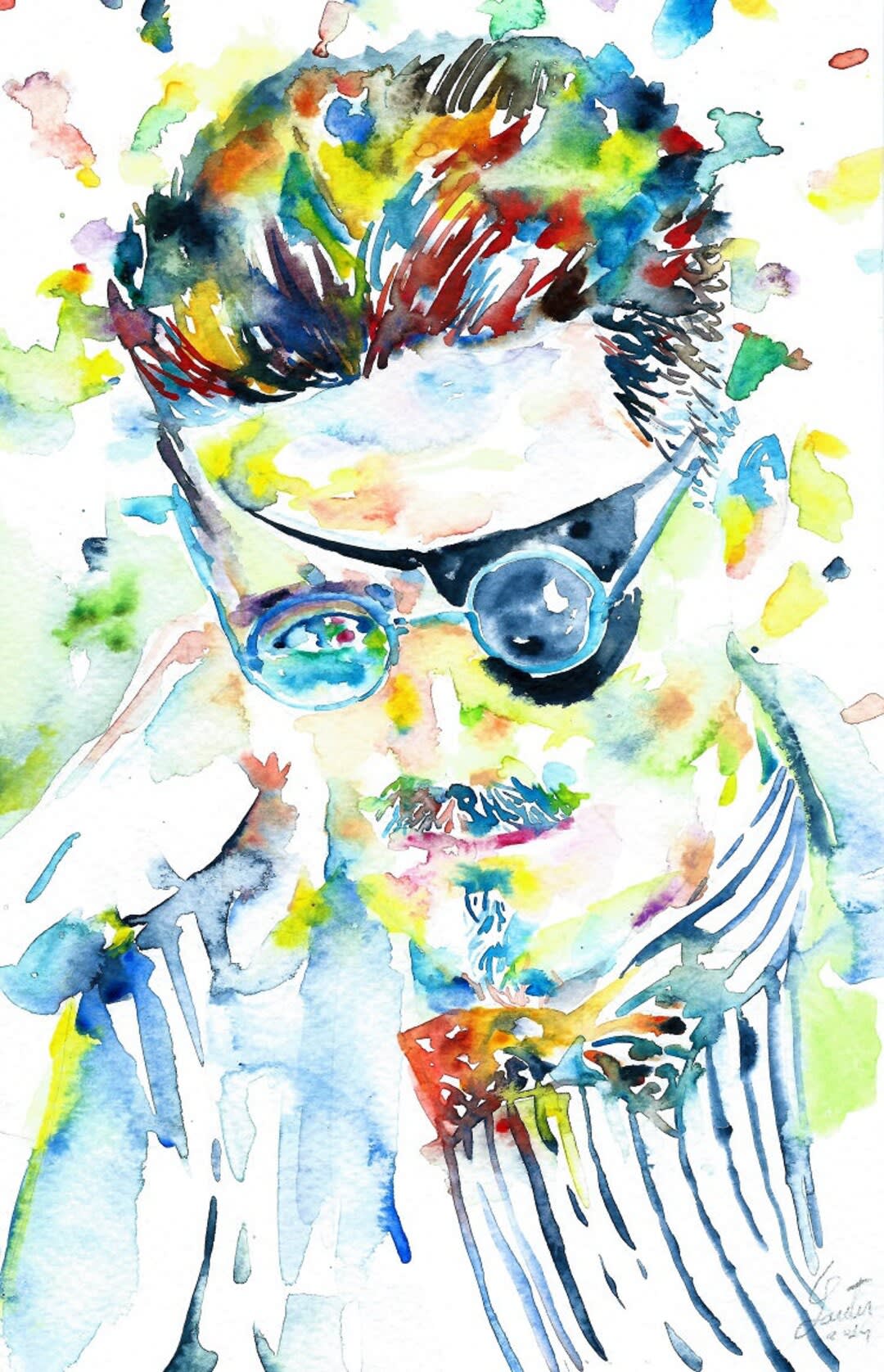
(artist unknown)
This Substack is reader-supported. To receive new posts and support my work, consider becoming a free or paid subscriber.
Anarchist Bombings in the USUnited States, May Day, 1919: mail bombs sent by anarchists to prominent government agents explode. The following month: ten bombs explode in New York, Cleveland, Milwaukee and San Francisco. In DC, a man carrying a case to the attorney general's house trips and a bomb explodes in the yard. Glass everywhere. Later police find what was left of the bomber's head on the roof of a three-story mansion a block away. This is linked by authorities to Italian anarchist Luigi Galleani, who was quickly deported. Attorney General J. Mitchell Palmer amasses a security force four times larger than what is was during the Great War. The enemy: Reds. Bolsheviks, communists, weirdo bohemians and free-thinkers or anyone who seemed like they may be one. The infamous Palmer Red Raids ensued. A new, very small bureau in DC, the General Intelligence Division - soon to become the FBI - helps to suss out writers and publishers, files, books, magazines, newspapers, anything that sniffed of "radical literature." A very small avant literary magazine, The Little Review, gets busted. It's run by two arty lesbians who were attracted to Gurdjieff, Margaret Anderson and Jane Heap. They had been printing chapters of James Joyce's upcoming novel, Ulysses. It was the only platform for Joyce's book in the US. Now Joyce had a file at the nascent FBI.1
UnabomberAs Theodore Kaczynski's bombs increasingly did more damage, the FBI was stymied trying to figure out who this guy was. Kaczynski was toying with them: inserting false leads, wearing elaborate disguises, taking long bus trips to mail his bombs from disparate locations, he even found hairs in public urinals and inserted them into his packages to throw forensics off the trail. Kaczynski also teased the FBI with wordplay and they didn't know it for the longest time. Let's look at how he used the word "wood."
His bombs came in wooden boxes. His third victim was named Percy Wood, who lived in Lake Forest. The tenth victim lived in Ann Arbor. His 16th victim worked for the Forestry Service, and was mailed from Oakland, California. The sixth bomb was sent with the name of a real Brigham Young professor, Leroy Wood Bearnson. A writer at the San Francisco Chronicle, Jerry Roberts, received a letter from the Unabomber, who signed himself "Isaac Wood" of 549 Wood Street, Woodlake, CA. The wildest example, to me, is when the New York Times received a letter from Ted K in the early summer of 1993, which provided a social security number: 553-25-4394 as a way to prove it's really him if he writes again in the future. Of course the data base for social security was consulted: this number was linked to an inmate at Pelican Bay prison in California. When officials approached the inmate, he knew nothing, of course.
But on his forearm there was a tattoo: PURE WOOD. I still can't figure out how Kaczynski pulled this off.
Kaczynski, a former Prof of Mathematics at Berkeley, who wrote his thesis on "Boundary Functions" (don't ask me!), knew Nordic and English language histories. In 1995, William Monahan of the New York Press, figured out that the Unabomber was using Old English: "wood" in its earliest usages, meant, "the sense of being out of one's mind, insane, lunatic." In Chaucer, when people "go wood" it's because they've tricked. "Wood" was used when someone was bested by an intellectual superior. Monahan explained to the FBI and anyone else who would listen, the "going wood" was a triple entendre: angry at being tricked, numbness from trauma, and getting an erection.
And that was just part of the wordplay, Monahan suggested. For example, the package containing the bomb that killed Thomas J. Mosser of New Jersey listed a fictitious name, "H.C. Wickel," as the sender. In old English, the word '"wicker" means wood. "H.C. Earwicker" is a ubiquitous character in James Joyce's Finnegans Wake, who sometimes assumes the identity of the Norse god Woden.2
Kaczynski had signed some missives and his manifesto "FC." It took awhile to figure out what this meant. It meant "Freedom Club" and it was taken from one of Kaczynski's favorite novels, Joseph Conrad's The Secret Agent.
Mail bombings, espionage, counter-intel, artists, false leads, intellectuals, and codes.
No Such Thing As Bad Publicity?In a September 1920 letter to his brother Stanislaus, James Joyce wrote that there had been "reports" of himself as a spy in Dublin for the Austrians, as a spy in Zurich for the British or Sinn Fein, that his Ulysses was a pre-arranged German code, and that he was a cocaine addict. Sometimes I think Joyce was an all-timer at starting whispering rumors about himself. I suspect he was fascinated by how rumor worked, which was a lot like a virus.
Other rumors he'd heard about himself: he founded Dadaism, was a bolshevik propagandist, and "the cavalier servant of the Duch—--of M—--, Mme M—-R——M—-, a princ—de X——, Mrs T-n-T A—- and the dowager empress of China."3 A few months later his prime benefactor, Harriet Shaw Weaver, wrote to express concern over Joyce's excessive drinking. Apparently she'd heard stories from Robert McAlmon and Ezra Pound. Joyce's reply to Weaver, dated June 24, 1921, is a study in disinformation between a writer and his sponsor: Joyce denies much while relaying other scandalous rumors about himself, which he denies, while also admitting to being and doing the kinds of things that Artists must do. Joyce scholar Richard Ellmann writes that Joyce "countered legend with fact and fact with legend."4
Sylvia Beach reminisces about hanging out with Joyce in Paris:
He told me how he had got out of Trieste when the war came. It had been a narrow escape. The Austrians were about to arrest him as a spy, but a friend, Baron Ralli, obtained a visa just in time to get his family out of the country. They had managed to reach Zurich, and had stayed there till the end of the war.5
We wonder how many variations on this story Joyce told.
As many Joyceans observe, Joyce inserted his own fears and fetishes, dreams and obsessions in Leopold Bloom and HCE, (not to mention the antics of the Gracehoper-writer-artist layabout Shem the Penman) albeit exaggerated much of the time. One really doesn't know what's really true and to what degree, or how exaggerated his own weirdness was in these characters. Quite a lot of this strikes me as Joyce's antic humor, but what do I know? It also further serves to illustrate Joyce's understanding of the theory of relativity on a social or human scale.
This is all within a subset of difficulties in already notoriously difficult texts. Scholar Mark David Kaufman notes about the rumors Joyce recounted around being an alleged spy, and Ulysses: "The image of Ulysses as a book that seems to be hiding something, a book that may or may not be treacherous, has had a bizarre afterlife in popular culture. In The Manchurian Candidate (1962), Frank Sinatra's brainwashed character owns a copy of Ulysses. Similarly, in Robert De Niro's CIA film, The Good Shepherd, a KGB double agent hides his real identity papers in the binding of Joyce's novel."6
Claire Culleton traces "difficult" writers like Joyce, Woolf, Elliot, Pound to a general feeling, articulated by Llewelyn Powys in article in New Masses, in January 1927: "The average man would gladly kill artists for sport, for like fleas and bugs and lice, they disturb his sleep." Culleton thinks this aptly describes the conscious orientation of J. Edgar Hoover (who had to cover for his own homosexuality). For Hoover, the average Joe and Josephine America felt anxiety over the writings and paintings of these weirdos, and they had to be reigned in. Hoover wrote much intelligence lit-crit, which is perennially the most clueless in the lit-crit genre. Conservative guard dogs speaking on behalf of an insensible horde: Culleton thinks this ironically privileged the High Modernists, and pushed intellectual modernism, "driven by its aesthetic of complexity."7
In literature, this notion of using difficulty in an effort to create new styles and forms is one thing, but evasions, plausible deniabilities, and self-mythologizing of the artist could be a form of defensive esotericism. The writer feels that he might be persecuted for what he writes, so he utilizes smoke and mirrors to obfuscate, and only the initiates are clued-in. In Arthur Melzer's book-long attempt to flesh out Leo Strauss's theory of esotericism in Strauss's Persecution and the Art of Writing, Melzer writes that a writer may write esoterically to avoid two evils: "either some harm that society may do the writer (persecution), or some harm that the writer might do society ('dangerous truths'), or both."8 Obviously, Ulysses was banned in the United States for 11 years after its release in Paris. Despite the difficulties, certain people quickly sussed out the naughty bits (that they could detect), and it was enough. After thirty-odd years of reading all things Joyce, I feel I have less of an understanding of him than when I started. Joyce himself was an Enigma Machine!
Ed Sanders: Writer as Intelligence-GathererClassicist but also a member of the proto-punk band The Fugs, Sanders's slim pamphlet, Investigative Poetry, advocates for writers to report journalistically in the form of poetry or verse, like the ancients did. He gives many examples. He also lists numerous writers who were persecuted by the State for their writing. Sanders presents a 180 degree mirror image of the spook: the poet/artist/countercultural gathering of intelligence and corroborating reports, including techniques (Sanders urges us to open up our own files on any subject that interests us, including our friends), and advice for dealing with dangerous, difficult people. His advocation of studying one's own notes to glean "data clusters" seems ultra creative and revelatory. The story on p.32 about Sam Giancana, Sinatra, Las Vegas and the CIA is a good example of what Sanders was up to. Sanders's biggest influence was Charles Olson, who had strong ties to the work of Ezra Pound, who was the idol of…the head of CIA counterintelligence, James Jesus Angleton, who had lunch often with his friend Kim Philby while not knowing Philby was a double-agent. When Pound was detained by Allied troops in Italy, his Pisan Cantos were suspected of being a secret code.9 Sanders was also heavily influenced by Allen Ginsberg, who similarly kept files on hundreds of topics, and once actually had lunch with Angleton.10
Investigative Poetry has been a major influence on the Overweening Generalist.
Did Joyce Know and Use Classic Ciphers and Codes?The answer appears to be yes. In the "Scylla and Charybdis" episode in Ulysses, Stephen argues about who the "real" Shakespeare was. Who actually wrote Shakespeare? And Joyce was well aware of a best-selling book by Ignatius Donnelly and the idea that Francis Bacon wrote Shakespeare.11 The sheer level and amount of fun Joyce had with Bacon-Shakespeare has inspired thousands of pages by Joyce scholars. Bacon had actually spelled out a biliteral cipher in his Of the Advancement of Learning, Book VI, chapter 1. This cipher was what fired Donnelly up in his hammy pursuit of the "real" Bard: Bacon.
Two of the most famous and sophisticated inventors of ciphers, Sir Francis Beaufort (d.1857), and Charles Wheatstone, who attributed his cipher to Baron Playfair (d.1898) may have been used by Joyce; all three names appear in Finnegans Wake:
The optophone which optophanes. List! Wheatstone's magic lyer. (FW, p.13)
Hark to his wily geeses goosling by, and playfair, lady! (FW, p.233)
in the end, the deary, soldpowder and all, the beautfour sisters (FW, p.393)
till they were bullbeadle black and bufeteer blue…(FW, p.511)
in blue and buff of Beaufort the hunt shall make (FW, p.567)
The problem here is that these ciphers work in a long enciphered text, and Finnegans Wake is not such a thing. Joyce scholar James Atherton insisted that Joyce acknowledged all of his influences by hiding them in his texts, and it seems safe to guess that Joyce enjoyed the ciphers of Beaufort/Wheatstone/Playfair within the context of the Bacon-Shakespeare stuff, but what about this passage in FW?:
I should like to euphonise that. It sounds an isochronism. Secret speech Hazelton and obviously disemvowelled. But it is good laylaw too. We may take those well-meant kicks for free granted, though ultra vires, void and, in fact, unnecessarily so. Happily you were not quite successful in the process verbal whereby you would sublimate your blepharospasmockical suppressions, it seems? (FW, p.515)
This is Shaun, the frustrated postman, conservative, the Ondt to Shem's Gracehoper, and feeling like an intelligence agent here, calling out the text, probably Finnegans Wake itself. "Isochronism" means appearing at regular intervals, which is crucial in a good substitution cipher. "Secret speech" seems obvious. "Disemvowelled" is a very common way to code: leave out the vowels. (Or: lv t th vwls) Joyce actually uses this tool in discussing what's in Bloom's drawer at his house on Eccles Street. "Sublimate" also seems quite obvious in this con-text. "Bepharospasm" is a spasm of winking, which we see in film after film and TV, when a character is trying to stay quiet and signal to another to "go along with this." Or: whatever I seem to be saying just now? Don't believe it!12
Where might Joyce have caught on to the cryptographer's bug? One guess: J.F. Byrne, Joyce's good friend in college. John Francis Byrne, AKA "Cranley" in A Portrait of the Artist As A Young Man.
John Francis Byrne (1879-1960)In A Portrait of the Artist, the budding consciousness of Stephen Dedalus is trying to articulate his own ideas about aesthetics, and he tells these to his sympathetic friend, Cranley. Cranley is based on Joyce's friend J.F. Byrne. They had known each other for a long time, but became close while both were at University College, Dublin. Byrne had actually lived at 7 Eccles Street, the address of Molly and Leopold Bloom in Ulysses, from 1908-1910, with two cousins, and one night in 1909, when Joyce had returned to Dublin they went out partying and came back to Byrne's house and Byrne had forgotten the key in another pair of pants, so he climbed over the wall…the same thing Bloom does at the end of the day in Ulysses. Byrne exiled himself from Dublin for New York in 1910 and became a journalist and worked as a financial editor at the Daily News Record in NY from 1929-1933 under the pseudonym J.F. Renby. But what's most interesting about Byrne here: he invented a "chaocipher" made from a cigar box, a few bits of string and odds and ends. He claimed it produced ciphers that were uncrackable unless the receiver had the key.
In a chapter on heterogenous cryptographers, David Kahn relates Byrne's gambit: he came up with the "chaocipher" in 1918, convincing himself it would produce peace and perfect security between confidants. His cousin thought he'd win a Nobel Peace Prize for it. He demonstrated it to top cryptographic men at the Signal Corps. They passed. The State Department said thanks but no thanks, that their ciphers were "adequate to its needs." Kahn says Byrne was right to call this "a paragon of smugness." In 1938 Byrne showed his chaocipher to the Navy and AT&T, who passed on a deal. Byrne continued to have faith in his invention (you'll never read "Cranley" the same way you did) and in the last chapter of his book The Silent Years: An Autobiography With Memoirs of James Joyce and Our Ireland he inserted a message in Chaocipher at the end, openly challenging anyone to crack it, with the prize being $5000 or the royalties for his book after the first three months. Byrne challenged the New York Cipher Society, the American Cryptogram Association, and the founder of cybernetics, Norbert Wiener. No one cracked it, and Byrne died in 1960. Kahn surmises that the reason the Chaocipher never caught on was that, while it had merits, it was probably not of practical use.13
MacintoshWho is the man in the macintosh who keeps appearing all over Dublin, June 16, 1904? He first appears at Paddy Dignam's funeral. "Now who is that lankylooking galoot over there in the macintosh?," Bloom wonders. Then macintosh disappears. In the "Wandering Rocks" episode he appears: "A pedestrian in a brown macintosh, eating dry bread, passed swiftly and unscathed across the viceroy's path." Etc. he keeps reappearing then disappearing. We all have our hypotheses and I will not add to the more than five thousand essays trying to convince you I have the best guess, but I just think he seems to be a spy, and he also seems to be Joyce himself, presaging Alfred Hitchcock showing up in his own work, the Author himself inside the work, saying to us, I'm here. And he's there to gather intel. On the human condition of his characters and us.
Who do you think Macintosh is, and why?
1The Most Dangerous Book: The Battle for James Joyce's Ulysses, Kevin Birmingham, pp.154-156, (2014)
2Harvard and the Unabomber: The Education of an American Terrorist, Alston Chase, pp.42-44, (2003)
3James Joyce, Richard Ellmann, first revision, p. 509, (1959-1982)
4Ellmann, pp.509-512; this same letter is printed in the one-volume Joyce: Selected Letters, edited by Ellmann, pp.281-284. Ellmann himself was in the OSS under Yale professor Norman Holmes Pearson, but Ellmann seems to have used his time there to go to Ireland to visit Yeats's widow and look at his manuscripts. Pearson's secretary in the OSS was Ezra Pound's ex-girlfriend HD's daughter. Pearson recruited his "number two" in the OSS, James Jesus Angleton, to be head counterintelligence at the new CIA. There will never be a shortage of wild and weird daisy chains when one begins researching literature, espionage, secret societies, and the occult. "Espionage, political intrigue, and the occult tend to come together in secret societies." - Dr. Richard B. Spencer, Emeritus professor of History at U. of Idaho, in lecture series The Real History of Secret Societies (Teaching Company). About secret societies and the occult: Joyce was very familiar with the material of the Golden Dawn, the same that had as members William Butler Yeats and Aleister Crowley. Joyce knew their literature - kabbalah, tarot, ritual, many forms of esotericism - but preferred to keep his own aesthetics of applied Aquinas. As you well know.
5Shakespeare and Company, Sylvia Beach, new edition with introduction by James Laughlin, p.38 (1956/1991)
6"Clever, Very," Mark David Kaufman, James Joyce Quarterly, Nov. 9, 2020
7Joyce and the G-Men: J. Edgar Hoover's Manipulation of Modernism, Claire A. Culleton, pp.65-68 (2004)
8Philosophy Between the Lines: The Lost History of Esoteric Writing, Arthur M. Melzer, p.4 (2014) I used Melzer's thesis for much of my thinking about Giambattista Vico's protective esotericism in "Notes on Vico, Wilson, Language, and Class Warfare," in TSOG: Tsarist Occupation Government, Robert Anton Wilson, pp. 245-293. Vico was a heavy influence on Joyce's Finnegans Wake.
9Pound had to explain himself to the authorities about his poetry written in prison: "The Cantos contain nothing in the nature of cipher or intended obscurity. The present Cantos do, naturally, contain a number of allusions and recalls, to matter in the earlier 71 cantos already published, and many of these cannot be made clear to readers unacquainted wth the earlier parts of the poem […] The Chinese ideograms are mainly translated, or commented in the english text. At any rate they contain nothing seditious…": this defense by Pound was first published in the Paris Review, vol.7 no. 28, Summer-Fall 1962. I found it in A Guide To The Cantos of Ezra Pound, William Cookson, pp.xxvi-xxvii. The Paris Review was funded by the CIA. Pound's Cantos seem at least the equal to Joyce's difficult texts, and were therefore suspect by intelligence agencies. How can one know an erudite, experimental writer isn't trying to code secret messages to aid someone else? Pound was instrumental in the discovery of James Joyce as an important writer, and in getting Joyce funded so he could write his texts.
10Sanders wrote a history of the United States: America: A History in Verse, 1900-1939; another volume covering 1940-1961; a third covers 1962-1970, and there's a separate volume devoted just to the year 1968. He also wrote books in verse about Chekhov and Ginsberg. OSS's Norman Holmes Pearson, who declined joining the new CIA in favor of returning to his professorship at Yale, was friends with Ed Sanders. Pearson also seems to have continued on as a teacher of counterintelligence officers. "In fact, in his responses to a 1964 questionnaire about Fuck You: A Magazine of the Arts, Sanders said that the magazine was funded in part by 'a leading Ezra Pound scholar of Yale.'" This was in fact, Pearson. See Code Name Puritan: Norman Holmes Pearson at the Nexus of Poetry, Espionage, and American Power, by Greg Barnhisel, pp.304-305 (2024)
11The Great Cryptogram: Francis Bacon's Cipher in the So-Called Shakespeare Plays, 1887.
12see "Joyce and Cryptology: Some Speculations," Hugh B. Staples, James Joyce Quarterly, vol.2, no, 3, Spring 1965, pp.167-173
13The Codebreakers, David Kahn, pp.766-768 (1967/1996)
Recent Psychedelic Drug Research and German Ethology [ 05-Nov-25 10:50am ]Here I am again, on acid. I mean: I'm writing about acid. Psychedelic drug research and other drugs besides LSD. Here I am, writing about them again. Why? 'Cuz it's an exceedingly, overwhelmingly fascinating topic to me. I get a contact high just writing about it. You too?
So, a current obsession of mine is trying to keep up with what's going on in psychedelic research. The topic is very hot and rich, like a double mocha caramel frappucino, but much more mind-manifesting.
This Substack is reader-supported. To receive new posts and support my work, consider becoming a free or paid subscriber.

(Dr. David Olson of UC Davis, pioneering in psychoplastogens)
David Olson of UC DavisDr. Olson is the head of psychedelic research at Davis; it looks like he's getting funding from the Pentagon, but I'm not sure. (Leonard Pickard seems to think so. Go to the 47 minute mark.) Olson and his team are up to their elbows in our 5-HT2A serotonin receptors (and their cousins). These receptors regulate feeling "normal" which perhaps many of us take for granted. Why? Because when something goes organically wrong with these receptors we have depression, schizophrenia, obsessive-compulsive disorders, etc. Of course, it's far more complicated than this. Anyway: this receptor is an agonist for LSD, psilocybin, DMT and others. Meaning: these drugs "look" so much like serotonin that they are taken up by the 5-HT2A receptors and…ehhhhh…disrupt (?) normal brain function. Ya get way high. Serotonin regulates one of our versions of "reality"; let's see what other versions there are that dock into 5-HT2A and other serotonin receptor types.
Olson has figured out a way to tinker with these drugs enough that they can give the therapeutic results we've all been reading about for the past 15 years or at least since Michael Pollan's How To Change Your Mind made the bestseller list. Here's the catch: he's tinkered with the drugs so you don't trip, but still get the benefits. Or at least that's the goal. And he's making inroads, which is fantastic news for anyone suffering from a host of maladies that psychedelics have been shown to have therapeutic efficacy for…and for those who get the Lovecraft horrors when they even think about tripping. That's a lot of people, as we know.
That's the goal: you've been depressed? You will get one of these drugs Olson has dubbed "psychoplastogens" and take them at home, you won't be trippin' balls, and your depression gets markedly better than anything SSRIs could do. I surmise the Pentagon (or DARPA) wants it for PTSD, to treat soldiers, and possibly: to prevent them from being lastingly traumatized by what they saw on the battlefields.
Olson's term - the "plastogen" aspect - plays on the neuroplasticity of our brains. It's been found that tinkering with the serotonin system opens up more plasticity: new learning, fast learning, un-learning. With plasticity, we've found that our brain functions are much more like Silly Putty than we ever thought before 1980. (William James posited in his magisterial 1890 textbook Principles of Psychology, that our brains remained plastic throughout life, pretty much. That was shot down. William James turns out to be have been right.)
There seems to be a lot of promise. Very recently as I write this, Olson's private venture company, Delix Therapeutics, announced the results of a Phase 1B study of their drug zalsupindole/DLX-001, which is their psychoplastogen based on the ultra-strong psychedelic 5-MeO-DMT, the toad venom one you've read about or actually tripped on yourself. Of 18 participants, 9 got the drug once a day for 7 days; the other 9 participants got it twice over 7 days. The participants had major depressive disorder. All 18 got around a 50% reduction in depression as measured by the Montgomery-Asberg Depression Rating Scale. There was no significant difference between the two groups, suggesting getting this drug only twice in one week would show improvements. No one tripped or got delusional or dissociated. Delix will report more results later. Participants were not at home, so their brain activity could be monitored. We'll hear more about this within a year, it seems. They're ready for a next phase: people taking DLX-001 at home. It seems like very good news for people who have major depressive disorder, but I think we need to see a lot more research and clinical trial data. Olson has another drug called Tabernathalog, which is an analog of Ibogaine without the trip. I know the Olsons are often linked to Utah and Mormonism, and "Tabernathalog" sounds like a hat-tip to all that, but I have no evidence for this. Olson hasn't answered my email. I think he's really really busy, honestly.

(Dr. Gül Dölen of UC Berkeley, making inroads in critical periods and psychedelics)
Gül Dölen at UC BerkeleyShe does not design drugs like Olson, but she's a very creative researcher. She also seeks to avoid using email ever again, it seems, so she hasn't answered any of my Qs. I may have to drive to both Davis and Berkeley to see if I can talk to both of them for 15 minutes.
Dölen made news when she gave octopuses MDMA/Ecstasy/"Molly" and these normally asocial creatures became very social. She studied philosophy, then neuroscience, linguistics, and then got into psychedelic research. Dölen says it's an open secret that a lot of neuroscientists got interested in psychedelics because so many of these drugs are molecularly isomorphic to serotonin, which implies a superhighway of insight into perennial philosophical questions about the nature of consciousness.
What was so eye-opening about the octopus experiment - which sounds like a stunt to get noticed but was not - was that there was a theory that psychedelics quiet the amygdala or prefrontal cortex, but octopuses don't have either of those. The reigning psychedelic theory of entropic brain processes put out by two giants in the field, Dave Nutt, and Robin Carhart-Harris, seem to require the Default Mode Network in its explanatory scheme. Octopuses don't seem to have one. Dölen thinks it all has to do with serotonin transport systems, something we share with eight-armed alien-like mollusk friends.
We branched off from them 500 million years ago, they certainly seem to have consciousness, they recognize humans and signal to them using complex body movements, they have no skeleton, so they can squeeze through very tight openings. But they're very intelligent! Come to grips with it, older scientists: these mollusks are intelligent and conscious. I for one can't eat them at sushi restaurants anymore. They have three hearts, blue blood, on and on. For a brainy take on them and us, see philosopher Peter Godfrey-Smith's Other Minds: The Octopus, the Sea, and the Deep Origins of Consciousness (2016).
Dölen disagrees with Olson on the ultimate therapeutic questions around psychedelics: she thinks the trip is necessary for long-term healing, like those people who were depressed, took one trip on psilocybin, and weren't depressed ten years later. Where she agrees with Olson is that neuroplasticity is where the action is, and that has to do with serotonin receptors. But she thinks what's going on is that our critical periods become re-opened on these psychedelics.
Critical periods are the periods in which we are open to massive amounts of learning, and according to Takao Hensch of Harvard, who specializes in critical periods, "There are probably as many critical periods as there are basic functions."1 From a 2021 article in Frontiers In Neuroscience, "A critical period is a window in which environmental input is necessary for the appropriate development of the relevant brain circuit. During a critical period, the brain has a heightened plasticity in which experiences have robust effects on establishing stable neurocircuitry. During this developmental period, the brain's malleability creates both a vulnerability to environmental insults or deprivations as well as a remarkable ability to quickly and robustly acquire skills."2 There are established critical periods for walking, seeing, hearing, language acquisition, parental bonding, developing absolute pitch, learning the local cultural norms, and, as Hensch alludes to, many more.
At first Dölen thought MDMA opened critical periods for social learning, but using prior intent, she and her team found that LSD also opened critical periods. Then psilocybin, ibogaine, and even ketamine did, too. WTF? Last I saw they linked this to 65 genes involved with critical period open states. How long do the critical periods stay open? For longer than the trip lasts, which blows me away. It's now thought you're open to radical new or re-learning for a day or two and up to two months. This raises a massive question about "setting." A battered wife doing psilocybin-assisted psychotherapy cannot just go back home to where her husband is beating the crap out of her: she'll re-imprint the trauma, probably making it worse. The implications for this seem humongous to me. 3
Are psychedelics reset buttons?
Timothy Leary and Robert Anton Wilson urged self-metaprogramming: have intent and a goal in mind before you trip. And of course Set and Setting were of paramount import. Leary had read everything on imprinting (the older term for critical periods) that he could find before the government locked him up for having a small amount of cannabis. What was he reading? The Germans who discovered imprinting.
German-Austrian-Dutch BiologyIn 1973, Leary was languishing in solitary confinement, reading and writing books. That same year, Karl von Frisch, Niko Tinbergen, and Konrad Lorenz received the Nobel Prize for Medicine and Physiology for their work in Ethology, which is the science of observing animals not in a lab, but natural environments. Frisch had deeply characterized bees' language; Tinbergen had a host of discoveries, including what's called "supernormal signaling": you can replace a bird's egg in the nest with one larger, and it will invest significant energy taking care of it. This aspect of exaggerating that which is already biologically desirable has been linked to our long history as hominids of seeking out food that is sugary and fatty: very hard work for 99% of our time, but now: fast food and an obesity epidemic. It's been linked to the world of Art, to our consumption of pornography, all kinds of things.
Lorenz contributed hugely to the ur-theory of critical periods: imprinting. As a kid I saw on PBS the greylag goose following him around. It had imprinted on him as its "mother" because Lorenz was present when its imprint vulnerability was open.
Ethology was largely a European response to American Behaviorism. In the US, ethology seems to have creeped in via what was Sociobiology in the 1970s, later Evolutionary Psychology. Behaviorism was what Chomsky and Leary had both attacked, in their own ways, in the 1950s and 1960s. In the American mind, it's often linked to "brainwashing." What's kinda weird is that Jacob von Uexkuell, one of the great-grandfathers of German biology in the 20th century, who coined the term umwelt, the specific way an organism must perceive the world given the capabilities of its perceptual apparatus and sensory organs, was a major Nazi. He even helped shaped Nazi ideology. And Lorenz was a Nazi party member. A rabid member:
The immensely high reproduction rate in the moral imbecile has long been established…Socially inferior human material is enabled…to penetrate and finally to annihilate the healthy nation. The selection for toughness, heroism, social utility…must be accomplished by some human institution if mankind, in default of selective factors, is not to be ruined by domestication-induced degeneracy. The racial idea as the basis of our state has already accomplished much in this respect. We must - and should - rely on the healthy feelings of our Best and charge them…with the extermination of elements of the population loaded with dregs.4
So: you can't escape them: mad scientists with inhumane intent. Nobel Prize winners you wouldn't want living in your neighborhood. Sometimes they're fucking brilliant with some of the stuff they come up with. How do we deal with this knowledge? Please answer in the comments. Back to Leary.

(Leary. It seems he was fascinated by instincts before he knew about imprinting. I write this just from looking at the index to his 1957 book The Interpersonal Diagnosis of Personality)
Timothy LearyThe Leary scholar James Penner thought Leary's ideas around "de-conditioning" and "reimprinting" using psychedelic drugs were his biggest breakthroughs.5 In a 1965 article published in ETC: A Journal of General Semantics, "Languages: Energy Systems Sent and Received,"6 Leary discusses information signaling systems throughout the body, including the effects of imprinting. It's a long, brilliant article, and at one point he speculates with his knowledge of imprinting by noting three aspects of it that didn't seem to be covered by the literature:
"The first is the rather terrifying implication that early, accidental and involuntary events can blindly and tenaciously couple the instinctual machinery to entirely inappropriate stimuli. It raises the disturbing question for each individual - which orange basketballs imprinted you?"7 Leary here alludes to some research on imprinting in which ducklings rejected the mother in favor of an orange basketball. For me, it makes me think of billionaire tech bros who think of themselves as gods with the right to change the world, because they're so brilliant and rich and to hell with democratic ideas. It makes me think of Astrid Sabiha Lloyd's recent article about psychedelics expanding the Ego. Sabiha Lloyd doesn't mention the long open critical period established by Gül Dölen and her team, but I couldn't help thinking of these guys tripping at Burning Man and everyone around them kissing their asses for days and weeks with how great they are, etc. Do these guys need to be imprinting that shit?
"Another issue is the relationship of conditioning and learning to imprinting. One possibility is that imprinting sets up the basic attachment-avoidance of stimuli and that all subsequent learning is accomplished by means of association to the original imprint." This became the basic working hypothesis throughout Leary's subsequent work and in Robert Anton Wilson's Prometheus Rising, which I consider the great text explaining Leary's life-work: the Eight-Circuit Model of Consciousness. In these works, conditioning and learning are constantly malleable, but only within the parameters of earlier imprinting on the oral-biosurvival "circuit," the anal-territorial/political "circuit," the symbolic-semantic "circuit," and the socio-sexual "circuit." All four of these dimensions were imprinted, and the local culture acts as a Behaviorist-At-Large, subtly encouraging and dissuading citizens to fit into society. The 2nd circuit: anal-territorial-political, is far older than the semantic and social ones, and therefore more pronounced in all our own realities, which explains all the alpha male baboons and terror and war in our history as species. Within Leary's and Wilson's Philosophical Anthropology, this has led to the Nightmare of History, because, in a very strong sense to them, these processes spelled out the mechanisms for robotic behavior at the individual level all the way up to national and trans-national behavior levels. The good news is that they posited four circuits beyond these, which largely escape Behaviorism. Some other article…And:
"Another aspect of imprinting is its addictive quality. The human being is 'hooked' to the external world. Sensory deprivation experiments suggest that when the human being is cut off from his 'supply' of external stimuli, he shows all the symptoms of a 'dope fiend': restlessness, discomfort, anxiety." Maybe in 2025 think here of your Internet fix? Your phone/laptop/compuer is external to your body. Cut off that "supply" for awhile: how do you feel? The problem here is that some of us were well past the legal drinking age when we first got a computer and an email address: could we have imprinted the Internet? I personally prefer to stay off "all that" and read codex/dead tree books, which I am clearly addicted to, and will feel anxiety, discomfort or restlessness if deprived of my supply. But to those born, say, after 1995? I think we must consider that they have imprinted Internet. What does that entail? Too rich for my blood, right here, right now!
I wonder how effective Olson's psychoplastogens will be. I wonder how many critical periods will be shown to be opened by psychedelics and amenable to therapy. How many things that we assume are "hardwired" in us can actually change under psychedelics? Will Olson's or Dölen's work prove more influential? Can a person who's nearing retirement age but still wants to learn a foreign language, take up a musical instrument, or become really good at mathematics benefit from a targeted psychedelic approach? Will humans eventually get so good and creative at serial re-imprinting during critical periods with psychedelics that it will become some sort of art-form? Are there certain genetic profiles that will reveal that some people can re-imprint easily, while for others it is difficult or impossible? Can we learn to discern what our own values really are, then use psychedelics to help us change our lives so we live in accord with those values in a more integrated way and not be so scattered and chasing after things we've been told we should want? Can we keep Authority at bay and use psychedelics according to our own wants, desires and needs? There will be unforeseen outcomes of all this: what will these be? Are psychedelics overhyped? There's some quality data that suggests non-psychedelic approaches re-open critical periods: new technology, shock, confusion, and isolation: how will the research on these go? We have reason to believe our immune systems become imprinted: how far does this extend?8 Will more knowledge of critical periods change standard practices?9
Only time will reveal tentative answers to these and any of your questions around this fascinating subject.
(artwork courtesy of Bobby Campbell)
1This quote gleaned from Rachel Nuwer's I Feel Love: MDMA and the Quest For Connection In a Fractured World, p.172.
2see Frontiers In Neuroscience, Sept 19, 2021, "Critical Period Plasticity as a Framework for Psychedelic-Assisted Psychotherapy." If I put a hyperlink to the article the pictures show up here in the footnotes, making it unwieldy, which is a drag, I know.
3see the June 14, 2023 article in Nature: "Psychedelics Reopen the Social Reward Learning Period." Incidentally, longtime underground psychedelic therapist Leo Zeff seems to have noticed a long time before Dölen's team's research that you're still open for weeks after the trip: he cautioned his trippers to not quit jobs or take new ones, start or end a relationship, etc, for three weeks after. Zeff didn't use the term "imprint," much less "critical period" but intuited what was going on after long experience of working in the field, underground. One of his "patients," a guy named "Andrew" thought the three-week rule was right and added, "Just be with it awhile. See what pertains to the trip itself and what is meant to be actualized in your life." see The Secret Chief Revealed, by Myron Stolaroff, pp.88-89. The Secret Chief was Leo Zeff all along!
4found in Behave: The Biology of Humans at Our Best and Worst, Robert Sapolsky, pp.9-10. Sapolsky - one of my favorite humans - found this quote from Lorenz in R. Learner's Final Solutions: Biology, Prejudice and Genocide, 1992. Prior to Sapolsky quoting Lorenz he had quoted founder Behaviorist John Watson, with a similar horrific quote we associate with fascism. He followed that with a quote from Egas Moniz, Portuguese neurologist who won the Nobel in 1949, who pioneered icepick lobotomies for people who were social misfits or just too weird, according to…others.
5Timothy Leary: The Harvard Years, ed. James Penner, p.9.
6Penner, pp. 268-301. I consider this one of the truly sparkling works from Leary's ingenium.
7Penner, pp.276-277, for this quote and the following two from Leary.
8I'm thinking of Original Antigenic Sin, which has become widely accepted in medical circles: the first flu you got, the way your body attacked and defeated this flu and this flu's characteristics, stays with you for life. In other words, the version of the flu virus you first caught as a child influences how sick you get from influenza viruses the rest of your life. I probably caught the 1968 H3N2 "Hong Kong Flu" which was a doozy. As an adult, when I get the flu there's always a couple of days in which I think: gotta go to the hospital, feel like I'm gonna die. From first symptoms: fever, chills, etc, to feeling like I'm recovered: around five weeks for me, maybe six. When I first read about OAS it was a revelation.
9David Jay Brown, one of the great psychonauts, thinks circumcision leaves an imprint of trauma and violence. See New Science of Psychedelics, p.43.

(art work courtesy of Bobby Campbell)
Ezra Pound, RAW and The "Two Cultures" [ 30-Oct-25 10:06am ]In 1959, British chemist Lord C.P. Snow gave a lecture, which was promptly printed into a thin volume: The Two Cultures, which immediately went viral. Yes, a book about the intellectuals on the Humanities and Physical Science side of the university: went viral. 'Twas a different time, verily. In Snow's lecture, he lamented the gulf between the Physical Sciences guys, and the Humanities people. He argued that his guys, the physicists, chemists, and biologists, were open-minded towards the Humanities but the non-scientist intellectuals wanted to have nothing to do with Science, or its language, mathematics. Okay, but Why are they so separated?
This Substack is reader-supported. To receive new posts and support my work, consider becoming a free or paid subscriber.
There seems to be no place where the cultures meet. I am not going to waste time saying that this is a pity. It is much worse than that. Soon I shall come to some practical consequences. But at the heart of thought and creation we are letting some of our best chances go by default. The clashing point of two subjects, two disciplines, two cultures - of two galaxies, so far as that goes - ought to produce creative chances.1
I was tempted to italicize "heart of thought and creation" and then say they're mine, not in the original. But the whole damned lecture/essay is hyperbolic like this. But that's not the part I find maddening. Nor is it the world-revolves-around-Cambridge assumptions of Lord Snow. It's the claim that his scientist guys work all day in their mathematical languages, but when they get some time, they really do want to read Shakespeare, the current poets, history books, the latest in Art history, etc. But those Humanities people are almost proud to not know any science. And they seem to hate mathematics.
Now: we all know some professors in which this rings true. I have known a few who line up fairly close with Snow's straw man argument here. But I've known more Humanities people who are fascinated with science and who assume the two cultures are unnecessary. Perhaps it was way different back then. Sure, the science guys get far, far, FAR more funding.2 In 1959 the divergence of our great universities as "research" schools was only beginning. Snow wouldn't recognize them. But I suspect he'd be delighted, much like Francis Crick, who in his 1967 lecture made into a book, Of Molecules and Men, agreed with Snow's thesis and furthermore, was happy the Humanities were dying and science blossoming. (see pp.93-96 in Crick)
Francis, you're not helping Snow's argument there…
Snow wrote about how weird it was to go viral back in 1959 in an essay published in 1964, The Two Cultures: A Second Look. He names other people who were talking about these same ideas around the same time (Jacob Bronowski, Merle King, ADC Peterson), and he's flexing while saying he got lucky and was in the right place at the right time, these ideas must have been in the air, etc. He was astonished seeing a public discussion of his thesis catching fire in places like Hungary, Japan, and Poland. Snow laments that, "A few, a very few, of the criticisms have been loaded with personal abuse to an abnormal extent…" and that some had personally approached him to ask if they could reprint what so-and-so said about him. (It was FR Leavis; Snow refuses to mention him. Leavis, a champion of Pound, Yeats, Eliot and Hopkins and a friend of Wittgenstein, thought Snow had been flatulent and pretentious and excoriated him in Two Cultures? The Significance of C.P. Snow.)
Why the Hubbub?Simply because two cultures idea had really flared up with the intellectual and ruling classes of Europe using the physical sciences to not only win the war (Hitler had driven out the best minds of that generation, terrified by antisemitism, haunted anxiety-ridden shod, dragging themselves and their suitcases through Paris and Lisbon, looking for a saving ticket to UCLA or The New School…) but invented a whole slew of products for consumers. Meanwhile, the English profs had been eggheads who seem to object to the widening gulf between haves and have-nots, and therefore, are a Huge Drag who just don't "get" progress. I oversimplify, but you get my point.
Then Snow piles it on 14 years after the war, and it was just a bit too much for a lot of the types of intellectuals who had never specialized in any one academic domain. The generalists, the relatively unattached free-floating stratum of bohemian thinkers, flaneurs reeking of herbs, obsessive autodidacts, and drop-out scholars, some who'd been to University but who did not become academics, or who were in academia for a while but it was not a good fit. Ezra Pound was asked to leave. Robert Anton Wilson was an Engineer who was interested in everything but was mostly a freelance writer3. Pound was also interested in everything. There were a lot of people like this: highly literate thinkers who were also interested in science.
1963Having always been a prominent intellectual who wrote both novels and essays and a deep reader in science, Aldous Huxley published Literature and Science, taking Snow at his word, urged more Humanities types to read science, even though, "Whether we like it or not, ours is the age of Science." (p.70) Huxley, whose brother Julian won the Nobel Prize in Physiology and Medicine in 1963, was from one of the most prominent intellectual families in Europe, Aldous's and Julian's grandpa being "Darwin's Bulldog." So, while Snow was taking a victory lap in 1963, four years after he made his name with the Rede Lecture on "the two cultures," there's Aldous publishing his pro-science book for his literary audience. Then, in November of that year, dying of oral cancer, Aldous took a massive dose of LSD and died the same day as the JFK hit.
(Ezra Pound)
Special Case: Ezra PoundPound, who we might argue single-handedly pronounced a revolution in the Arts, and especially poetry, then actually successfully carried it off, had always been attracted to science. In 1996, scholar Maria Luisa Ardizzone published Machine Art and Other Writings, from previous unpublished work by Pound between the years 1927 and 1943. It's a basic attack on the Aristotelian/spectatorial view of knowledge, which placed "theory" on high, while Pound argues that techné is an Art, and superior, all of which goes against Snow's argument.
Since Leibnitz there has been no theology, and no philosophy. That is to say, there have been essays on philosophic subjects, but the thought has been a mere weak derivative from scientific discovery. IT IS ALIVE. It says nothing about not fishing on Sunday or about having only one woman or about fealty to the constitution. (Machine Art, p.119, "How To Write")
Pound here is riffing on the "splendor of the cosmos" and he wants nothing to do with monotheism, but is only interested in an erotic, universal cosmology, and science, and fer gawdsakes: not "economics": science was where it wuz at for this Poet.
Whenever a scientist has come into contact with the practice of hired economists, he has been both amazed and disgusted. A "science" which excluded facts from its investigation and demonstration is not rated very high among physicists, biologists, chemists. (119, op.cit.)
The conspicuous problem here is Pound's nutty, hideous antisemitism of this period. At the end of his life he admitted he'd been wrong. But this issue is too complex to go into here. Suffice: my feeling is that most people who thought they knew Pound didn't realize how impressed he was with the methods and instigations of physical scientists. Pound was a very complex sort of vitalist; his fellow poets and sculptors, painters and novelists were not going to help him here. In inventing his ideogrammic poetic method he thought he was mimicking a scientific technique, to use for poetry and even expository writing. In an overwhelmingly creative misreading of Chinese writing he had put poetry and writing on a scientific footing. "I am not offering a system of thought, if that means a few idées fixes arranged in a pattern on a shelf. I offer a system of thinking. Any biologist will understand you if you say mankind is my bug." (112) His influence was enormous.
From c. 1980 Counting Back to 1963Novelist, essayist, playwright and counterculture figure Robert Anton Wilson, trained as an Engineer, largely because he thought he had a facility with mathematics, wrote the following in a footnote in a novel from the late 1970s, as if the novel had been annotated in the year 2803:
At the time of this comedy those primates who specialized in verbal manipulations of the third neurological circuit formed a gene-pool separate from those who specialized in mathematical manipulations. The former, controlling the verbal environment, had dubbed themselves "the intellectuals."4
RAW almost sounds like Snow here. But RAW was far more complex a thinker than Snow. Let us continue.
In a 1971 book by Pound scholar Christine Brooke-Rose, she's discussing the ideogrammic method, and writes:
What I want to emphasize now is that Pound, long before the present fashion for the "two cultures," insisted that this ideogrammic way of seeing, or proceeding, was the way not only of art but of science, which he liked to bring together, but together against "logic." 5
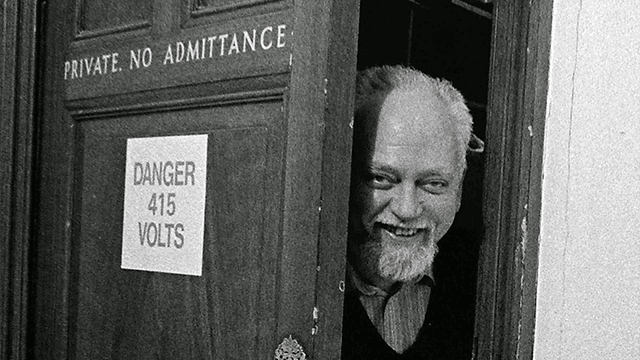
(Robert Anton Wilson)
Big-Time Literary Modernist Scholar: Hugh Kenner (and RAW)In June of 1963, Hugh Kenner, prolific academic scholar of Pound and Joyce, received a letter from Robert Anton Wilson, an itinerant writer raising his family on a farm near the woods, in Yellow Springs, Ohio. He was working for the Antioch Bookplate Company and writing articles like mad and sending them out, trying to keep food on the table. He'd published an essay "Joyce and Taoism" in the James Joyce Quarterly on or around his 27th birthday in 1959; also around this time he published an essay, "The Semantics of God" for the early counterculture magazine The Realist, run by Paul Krassner. It is apparent that Kenner had announced he was writing a book called The Pound Era. It wouldn't come out until 1971, but RAW must have read that Kenner was writing it, because it seems one of the reasons he wrote the Professor.
So let's get the picture: a highly esteemed academic receives a letter - actually, a series of letters6 - from a nobody named Wilson, who was 31 years old at the time. What's astonishing is the manic and haughty tone of RAW to Kenner. I cannot help but think RAW got most of this attitude from Pound; RAW had been reading Pound since his teenage years, and while Pound's attitude towards Jews was abhorrent to him, RAW trained himself to look for what's valuable in any artistic or scientific genius, no matter how offensive some statement they'd made or some scandalous some action. RAW, who died in 2007, would have had a lot to say about "cancel culture," but alas, he's not around and that's a separate issue. Let's get on with it.
I have to cut a lot out because these letters are wild, manic and, I think, amazing. We only have so much room. Back to mid-June, 1963:
At one point, RAW calls C.P. Snow an "ass-hole" when in The Two Cultures, he "blythely (sic) demonstrates his own ignorance of the significant developments in the arts of our time/because he writes imitation Victorian novels, he imagines he is hip to modern literature…"
Snow the chemist had also published a bunch of novels. What bothered RAW was that Snow had paid no attention to Pound's revolution, or Ulysses, or any of the experimental poetic and prose forms invented after the 1880s. For RAW's aesthetics, this is egregious. He thought the Arts should keep up with Science, and once in the late 1950s he gave a talk to New York literati and claimed that the only literature was science fiction and James Joyce. He realized they thought he was insane. Which was fine for him: he thought the New York literary publishing establishment was reactionary and a drag on human progress, the New Yorkers assuming that Freud and Marx were still the hottest ideas around. They didn't want to talk about Joyce and they seemed to want to pretend that science fiction didn't even exist, based on their neglect in reviewing those books. For RAW, science fiction was the epicenter of the Novel of Ideas. The New York literati didn't much like science, either. He was happy to tick them off. If I recall correctly, RAW said they "acted like I'd killed a cat in the sacristy."
RAW then goes off informing Kenner that ideograms are synergetic, "and so is science," that he'd worked out a synthesis of Buckminster Fuller and Pound "years ago" (1963!), and that "Synergy (non-additive relations) is the one concept that helps you to find your way from the sciences to the arts and back again…" 24 years later, RAW was still talking and writing about synergy, in an interview from 1987 and published in Natural Law:
Sun: You've been quite outspoken, in your writings and in your talk last night, about your use of mind-altering drugs. Would you say you've gotten more out of drugs than out of therapy?
RAW: Yes. But it's hard to say. Everything is synergistic. Today is the result of everything that's happened in my life. I think the study of General Semantics did as much for me as psychotherapy did. If somebody doing Buddhist meditation today had been in Freudian psychoanalysis twenty years ago, and had been at several encounter groups, then they're doing a different type of Buddhist meditation than someone who's never had that experience. But just because something seems to have done you more good than something else doesn't mean it's better than the other thing; the other experience might have created the ground work for the newer one to be effective.7
Back to the wild letter to Kenner, June 1963:
There is one equation that explains the structure of the Cantos8 better than any words can explain it, and it is a synergistic equation.
Eight days later, Kenner gets a somehow even more manic letter from this Wilson guy. Here's a snippet:
Shannon's information equation (quoted in my "13 Ways"9) is synergetic function. Strangely enough, or not strangely at all, so is C.H. Douglas's equation for cultural heritage, and so is Korzybski's equation for "time-binding." Information, structural knowledge, texne, increases non-additively.
So, this nobody writing to Hugh Kenner at UC Santa Barbara (he was there from 1951-1973) is telling Kenner how to think about Pound. He's also elaborating about Chinese writing, more ideogrammic theory, all kinds of things. I suspect RAW wanted to get in with Kenner, or earn his gratitude. Maybe he'll even mention "Robert Anton Wilson" somewhere in his (still eight years off) The Pound Era, now widely called Kenner's magnum opus.
Well, that book does not mention RAW, anywhere. However, Kenner does mention RAW in a letter to Guy Davenport dated June 21, 1963:
Have hooked on to an amiable crank named Bob Wilson, formerly of the School of Living in Ohio, now at Antioch Bookplate Company in Yellow Springs, O, who is loading me with Pound-Fuller-Wright-China-Korzybski-Gesell tieups. These Utopian absolutists make me nervous…10
I've read The Pound Era a couple of times. I find it hard to believe Kenner wasn't influenced by RAW, and neglected to mention him, but maybe I shouldn't be all that surprised: if we dig into the McLuhan archives there's a letter to an undergrad from McLuhan berating him for not giving proper credit where it was due. It was to a young Hugh Kenner.
However, I can't prove this. Maybe Kenner encountered those ideas before 1963.
Not being an academic, I don't know how common that sort of thing is. Let us laud Kenner for his wonderful work. But maybe let's keep this kind of thing in mind, too. Kenner's pre-1963 writing barely touches in synergy, information theory, non-additive structures, etc. But they are there in spades in his 1971 book. RAW didn't at least plant a seed?
I'm not so adept at scholarly exegesis to make a strong argument about RAW's influence on Kenner's magisterial The Pound Era, but I have my suspicions. RAW wrote Kenner a letter in 1974 and doesn't outright say, Hey you didn't mention me anywhere, but from the text I think he clearly thought he deserved to be mentioned.
To review: there are many intellectuals outside of academia that Lord Snow preferred to not even recognize; certain types of intellectuals have had the urge to unify or cross-pollinate the sciences with the Humanities since the Age of Reason. This was just one example of a weird instance of Science + Arts thinking: Ezra Pound and Robert Anton Wilson, both working outside the Groves, and apparently Pound as persona non grata to Lord Snow and RAW a mere "crank" to Hugh Kenner.
1The Two Cultures and A Second Look: An Expanded Version of the Two Cultures and the Scientific Revolution, Cambridge, p.16
2This observation was true in the US until the past 10 months. Who knows what that status really is, today?
3Erik Davis labeled RAW, Philip K. Dick and Terence McKenna "garage philosophers" in book High Weirdness: Drugs, Esoterican and Visionary Experience in the Seventies (2019, M.I.T. Press); garage philosophers were "the feral ranks of the underground intelligentsia," p.219. In a tweeted answer to my query about the term on July 6, 2019, Davis wrote, "I did mint the term, which Simon (Critchely: a fellow scholar- OG) admired, and did it for the Exegesis initially. What I like is not just the non-institutional DIY side of the story, but the sense of 'garage' as both puttering/wood shedding and 'I don't give a fuck intensity." The Exegesis is a 944 page book culled from what seems literally thousands of pages Philip K. Dick wrote about his impossible-to-explain-here weird personal experiences.
4The Trick Top Hat, a second novel in the Schrödinger's Cat Trilogy, omnibus ed, p. 230. These three novels all use roughly the same core characters, but they are living in different universes as patterned after three different interpretations of the Schrödinger wave equation. A reviewer from New Scientist, John Gribbin, read these novels and said they must have been written by a physicist.
5A ZBC of Ezra Pound, (1971), pp.7-8. Pound's suspicion of formal logic is widespread and discursive yet disparate throughout his texts. Suffice: formal logic seems too artificial and abstract compared to the sort of bio- or neuro-logic of human observation and very close attention to detail that works along the mental mode or networks we think of as "logic" but is not Aristotelian, Boolean, or any of the other formal, two-valued logic of True/False. The bio-logic is closer to reality. Wilson appreciated this logic, too, but wrote much more about multi-valued, non-Aristotelian logics and managed to be humorous about it.
6Kenner's archives are at the Harry Ransom Center at the U. of Texas, a hotbed of literary archives, and the archivists and librarians there I've found are most helpful.
7Natural Law: Or Don't Put a Rubber on Your Willy and Other Writings From a Natural Outlaw, Hilaritas Press ed, p.145. The interviewer was Sy Safransky of The Sun magazine. The original edition of Natural Law was put out by Loompanics in 1987.
8Ezra Pound's lifelong work, in case you're comin' in late.
9"13 Ways" was a sort of aesthetic-scientific manifesto RAW wrote. I'll be writing about it here or elsewhere soon.
10Questioning Minds: The Letters of Guy Davenport & Hugh Kenner, vol. one, edited by Edward M. Burns, p.354.

(artwork by Bobby Campbell)
Hyperobject: Internet [ 27-Oct-25 1:38am ]One of my favorite of the still-living weirdo philosophers, Timothy Morton, coined the term "hyperobjects" for all those Things (I capitalize in a Lovecraftian sense here) that are non-local and dwarf our ability to comprehend them in their totalities. While Internet is one, I hate to lay it on ya, but there are many more: evolution, relativity, non-locality in quantum mechanics, nuclear weapons, global warming, microplastics, pandemics, styrofoam, AI, fascist ideologies, etc: it's the Blind Men and the Elephant story times a million. We can all see parts of these things, but we cannot encompass these things in their totality at all. No one can. If anyone says, "Lemme tell you all about (any one of these things), ask me anything," you're talking to someone who doesn't know what they don't know.
This is how I tend to approach Internet. I don't say "the Internet" for roughly the same reasons no one says "the global warming."
This Substack is reader-supported. To receive new posts and support my work, consider becoming a free or paid subscriber.
What Tech Calls Thinking: An Inquiry Into the Intellectual Bedrock of Silicon Valley, Adrian Daub, Farrar, Strauss and Giroux, 2020, 152 pages.
Lo and Behold: Reveries of the Connected World (2016, Werner Herzog), 98 mins.
The Net (2003, Lutz Dammbeck), 121 mins.
When I first saw the title of Daub's book I thought it might be a critique of AI, but that's not what this slim volume is about at all; the subtitle is the giveaway here. Daub is a comparative lit and German Studies prof at Stanford, and his situatedness in Silicon Valley gives his narrative a dash more gravitas; he can just ask a colleague or student and they'll tell them all kinds of things. But mostly he reads.
Broken into chapters "Dropping Out," "Content," "Genius," "Communication," "Desire," "Disruption," and my personal fave, "Failure", this extended essay of a book extended my understanding of Silicon Valley I'd mostly gleaned from Fred Turner's From Counterculture to Cyberculture, What The Dormouse Said by John Markoff, and extended rifflings and grazings through and in Adam Fisher's Valley of Genius: The Uncensored History of Silicon Valley (As Told by the Hackers, Founders and Freaks Who Made It Boom). I also watched the entire run of HBO's parody/satire of start-ups, Silicon Valley (Mike Judge, et.al, 2014-2019). I kept wondering how many inside jokes I was missing in the TV show: Is this Asperger-y tech billionaire clod supposed to be based on…???

(comp lit/German prof Adrian Daub, of Stanford)
In other words, I know almost nothing. I find it striking that, when I think of the work of Daub, Herzog and Dammbeck here, I find my right hemisphere guides me based on what I've read from counterculture figures who were once insider-idealists and who have now grown very critical: Douglas Rushkoff, but especially Jaron Lanier, a pioneer in virtual reality but who started blowing whistles about digital tech before Obama first got elected. Before Facebook took off. 1
Daub emphasizes California history and the neurogeography of ideas pre-Internet: Esalen, Berkeley, sprawling office parks in the South Bay area near San Francisco, but especially, Stanford. Which seems weird, because the hallmark of Internet is that it effectively obliterates space. And I assume, based on Erving Goffman's work, that the Interaction Ritual - thinkers meeting in hacker-speaks's "meatspace" - has a valence that's underrated. We can all use our library card to check out a book by Rene Girard, but Peter Thiel sat at this guru's feet at Stanford (see the chapter "Desire"). For Goffman, the Interaction Ritual generated emotional energy in a way that emailing each other cannot. Interaction rituals contain enormous amounts of information we don't find virtually: greetings, body language, and the sacredness of simple, symbolic acts. It's one thing to exchange phone calls or emails with a colleague; it's quite another (now, seemingly increasingly forgotten) to be incarnate with them for many hours. (Goffman's work is not mentioned by Daub but it could have been. Daub is concise and this is a short but rich book that can be read in two days.)
For "Dropping Out" Daub illustrates the quasi-occult links to Timothy Leary, Allen Ginsberg, Hermann Hesse, Aldous Huxley, Ken Kesey, Jack Kerouac, and Robert Heinlein. This is juxtaposed with the awe and whispers about so-and-so who just "dropped out" of Stanford after their freshman year to try and get rich in a start-up. As Daub points out, there are crucial differences not only in the aims of the counterculture figures named above, but their ages: Leary dropped out of academia (more accurately, he pulled the classic line at Harvard: You can't fire me! I quit!) at age 46. While most who drop out to strike 'er rich with a start up fail (see chapter 7), their forebears in the 1950s and 1960s sought to find something more genuine and true to their core beings, as hilarious as that might strike many today. There are some passages about the less-than-shallow education in Humanities that people like Elizabeth Holmes or Mark Zuckerberg would have gotten had they not dropped out, and I don't care to elaborate for 6000 words. Although I could…
What's hidden in dropping out at Stanford is that these are usually white upper-class kids, who, if they fail, have familial social safety nets that idealistic drop-outs in the 1960s usually did not have: if the commune breaks down for myriad reasons (and it did break down - save for the Stephen and Ina May Gaskin's The Farm), you were fucked. Peter Thiel very recently commented that all these people became "Charles Manson" in a bizarre talk with conservative God-man Ross Douthat of the New York Times. Think of Thiel giving exclusive talks in 2025 to Christian fascists who support Trump, about "The Antichrist" and how it might be Greta Thunberg and people like her, and combine this with his past punitive billionaire swagger and take-down of Gawker because they outed him, and his gurus - Ayn Rand (covered in Daub's chapter 3, "Genius"), and Rene Girard's theory of mimetic desire as the basis of a philosophical anthropology, this desire which makes violence "inevitable", and the current accelerationism driven by tech billionaires like Thiel and Musk. Daub's book, published in 2020, looks quaint now in these respects.
[In all fairness, as I truly see it, Thiel clearly felt his sexuality was private and I think such things should be left out of the media. He's also a very smart guy who happened to be in the right place at the right time to be able to use the prior scaffolding of Internet to start PayPal and become an early investor in Facebook and now he's got $21,000,000,000. While I am sorta smart myself, too, my desire is not getting up in the morning to invent stuff. (Actually, I can't get up in the morning, but that's for some other OG-spew.) Good for Thiel! But now my health care and food stamps will be taken away, largely because of Thiel's armchair-rationalist/accelerationist ideas about Making America Great Again. So there is an element of…jealousy and palpable fear in my perspectives here. Clearly, I'm biased in my view. Towards my own survival.]
In the short chapter on "Communication," Daub writes about ARPANET and how Steve Wozniak helped the Russia-American Center at Esalen to open up communication between Soviet citizens and Americans via satellite and Internet, and how Huxley's trip on mescaline didn't help him get a direct line to those entities that William Blake were in contact with, but still:
And the thing is, we know both of these feelings only too well. On the one hand, there's the incredible sense of potential when we're suddenly connected to a much wider world in ways that even twenty years ago would have seemed hopelessly futuristic. And on the other hand, there's the feeling that we keep messing it up, that maybe our communication media are such spam-filled, dick-pic-laden, Nazi-promoting cesspools because we're somehow doing them wrong. (81-82)
Daub proceeds to riff with an interesting little argument: Claude Shannon's mathematical theory of communication proved how built-in redundancy ensures we can communicate better, while McLuhan's argument, that we need to pay better attention to how "people are changed by the instruments they employ" and that, because we would be producing, receiving and enjoying that communicated content and load up every channel with redundancy, we would communicate worse. (82)
It's cosmically hilarious to me: to read a book like Daub is to operate on a meta-level: reading about thinking about reading and consuming on Internet. In my personal value system, there's a meta-level, too: it's to be able to articulate and be in intimate touch and thinking and operate with…one's own value system. And in a culture so saturated (to understate) with Internet, being able to think about what we're doing "there" - the ideas behind it, where they came from - would be a very basic thing. Clearly, it is not. As previously stated, though I've read a bunch on this topic, I don't know a damned thing compared to what there is to know. Internet is a hyperobject, but if you're a blind man feeling-up the elephant, Daub's book helped me to feel another part of that wondrous jumbo.
Do documentary films, given their very medium, help us understand Internet better? My feeling is that we glimpse other dimensions of the hyperobject that books can't give us. And I'm lucky Werner Herzog - one of my favorite artists - has tackled the subject.

(Dr. Lucianne Walkowicz, astrophysicist and artist. Identifies as non-binary)
In Lo and Behold: Reveries of the Connected World, the first sequence is at UCLA, where the first ARPANET messages were sent to Stanford Research Institute, and computer scientist Leonard Kleinrock acts as a museum curator, showing us the sacred CPU that still stands, a sold metal box as tall as an NBA player. Kleinrock scribbles wild, highfalutin' Shannon-like equations to show how Internet traffic has increased a billion-fold. If every message in the world from just one day was encoded on compact discs, they would stack up to Mars and back, or some dizzying, unfathomable (hyperobject-like) way. Herzog's mordant sense of humor carries throughout the film. He juxtaposes a short interview with Space X's Musk, who wants to go to Mars (Herzog says he does, too), with Dr. Lucianne Walkowicz of the Adler Planetarium in Chicago, who says the discourse about relocating to Mars "in case" something really bad happens on Gaia, misses the point. Herzog juxtaposes short sequences between Walkowicz and Musk, and after she makes an unassailable point, Herzog cuts to Musk just sitting there, looking at the camera, not saying anything. Perhaps this was footage of Musk while they were getting lighting right, but this is a powerful way for the editor/filmmaker to make their point. It looks like Musk has no rejoinder to the (beautiful and smart) astrophysicist. I think Musk would argue with her; I think Herzog thought she was right, and so uses this rhetorical method of aposiopesis.
It was interesting to see Danny Hillis talk, from what looked like a room in his massive house in Berkeley. My friend once interviewed him there. Ted Nelson, who coined the term "hypertext" in 1963, shows up to talk. He's been lauded by Jaron Lanier as a visionary whose ideas didn't catch on, probably because in Nelson's architecture, individual creators would get paid for their work instead of platform owners. There he is, talking at his houseboat at Sausalito, where Alan Watts lived and where the Houseboat Summit took place. Impish, audacious physicist Lawrence Krauss shows up as a talking head who speculates but refuses to "predict" how things will go. There is a family sitting at their dinner table: someone had taken pictures of their daughter who had been in an auto accident and decapitated: people sent them anonymous emails with the pics, with vile messages attached, and…why? There are people who live in a remote area of West Virginia where there is no EMF due to a special telescope that detects frequencies; people who get sick due to EMF flock there, not being able to live anywhere else. Herzog showcases computer wizards who develop robots that can play soccer and learn and get better and better. He talks to biochemistry-interested computer scientists who developed a game for any citizen scientist to play in order to crowdsource the intricate ways protein molecules can fold, which seems now one of the best applications of AI. And, to my delight, famed hacker Kevin Mitnick shows up, still bragging about some of his exploits.
While Herzog's film appeared in 2016, it, like Daub's book, feels dated to me. And I think it's due to the logarithmic acceleration of information, often written about by Robert Anton Wilson, Ray Kurzweil and many others, largely underwritten by Moore's Law, in which omniephemeralization holds sway: integrated circuits will become smaller, faster and more efficient, roughly doubling in computational power every 18 months to two years. What thinkers predict about the social effects of this is diverse. Wilson thought it just makes everything and everyone crazier. He thought that around the year 2000. Hold on tight, volks. This may get far bumpier than we can imagine.
I saw Lutz Dammbeck's little documentary The Net shortly after it came out 22 years ago. I re-watched this past year, and in some ways, it oddly seems more current that Daub's book or Herzog's wonderful documentary. Why? Because the German filmmakers don't seem to be preoccupied with any ideas current right now, but at the turn of the century they took cameras to San Francisco, Los Angeles, New York and just asked questions. Here's John Brockman, pre-Jeffrey Epstein news, talking about as arrogantly as he sounds in the prefaces to his books of interviews and essays by his "Third Culture" writers. Here's Stewart Brand, who also seems a bit too swaggerly, but in his own way. He's on a houseboat in Sausalito talking about his truly marvelous life and background. Here's Kesey, here's Leary. Etc, etc, etc.
Just my own weirdness, but the section, filmed somewhere in a house that looked like it was deep in the Santa Cruz mountains, there is Heinz von Foerster holding forth about reality and possibility in Wittgenstein, mathematics, constructivism, science/schizophrenia/schism, and a couple other subjects. Very elderly, speaking German (with subtitles), he seems like a good model for any "Mad Scientist" figure you'd want to envision for your science fiction novel. (As of this writing, here's the segment; I'm hesitant to link to YouTube videos, because of my old blog and all the dead links, but this must be seen.) I find Heinz a thrill. The filmmakers caught von Foerster just before reached thermodynamic equilibrium at age 90, in 2002.
The through-line is Dammbeck's correspondence with one Theodore Kaczynski, and why he did what he did. Dammbeck seems in some measure sympathetic to Ted's philosophy. All these interviews with counterculture, computer scientist and Internet luminaries are intercut with snippets from the correspondence. Kaczynski was at Harvard, a brilliant kid with IQ off the charts, who was admitted as a poor kid from Wisconsin with really good grades. And…we can't help but think something really bad happened to him at Harvard when he fell under the sway of the Department of Social Relations, headed by ex-OSS and professor Henry Murray. 2
After being fed-up with the scene as a professor of Mathematics at Berkeley (if Pynchon had been accepted when he wanted to go there and study math, he might have studied under Kaczynski), Ted dropped out, and armed with one of Stewart Brand's Whole Earth Catalogs which showed you how to build your own cabin in the woods…
I came away from my second, twenty-years later viewing of The Net, thinking Kaczynski had a point. But, as the Republican party now says openly about Hitler: right idea, wrong way to go about it. And Kaczynski's ideas now drive extreme environmentalism and it seems to me that ship has sailed. The Nazi ship hasn't sailed.
I really don't know what to make of the hyperobject Internet, and the more I read (and watch documentaries), the less I feel I understand.
And, as odd as this sounds, I enjoy this feeling.
1I've been heavily influenced by Lanier's arguments in You Are Not A Gadget (2010; Who Owns The Future? (2013); Dawn of the New Everything (2017); Ten Arguments For Deleting Your Social Media Accounts Right Now (2018); and There Is No A.I. (2023).
2I recommend having a look-see inside Alston Chase's Harvard and the Unabomber: The Education of an American Terrorist. I disagree with a lot of Chase's social thought, but the book seems ultra-compelling when we look at the case of Kaczynski. Timothy Leary was at Harvard, with Murray his boss. Leary fully informed those who wanted to explore their mind with psychedelic drugs while Murray and his "study" often did not: Kaczynski would have had no idea what was happened to him, or why. And Murray died a stalwart fellow, well-spoken of. While Leary went to prison for objectionable ideas and a small amount of cannabis. There are times when just pondering this makes me feel insane. Or rather: more insane than I usually feel.
On the Religious Function of Intellectuals [ 21-Oct-25 10:37am ]Maybe 30 years ago I suddenly realized one fine day that, though I had grown up a pagan and had studied world religions like a maniac anthropologist and wasn't a believer in any of them, that I was still, in some way, "religious." How so?
My studies of religion and religious behavior gave me a strong suspicion that the core ideas were born of the need for answers about, ya know, the little things: who made the world, why is there something rather than nothing, how come "reality" seems to "be" this way? Etc…
This Substack is reader-supported. To receive new posts and support my work, consider becoming a free or paid subscriber.
I realize there was a lotta pressure on the shamans, wizards, and seers, so they had best come up with something good. And hey, they did their damnedest. And It Accreted. Bless all the fathers and (there shouldda been many more, perhaps that's the problem here and I don't wanna get off-track, but sheesh) mothers behind our most seminal texts, everywhere, back to 3500 BCE. There should be more Mothers amongst humanity's gods. There are a lot, but there should be more…
Since the Renaissance, but especially the Industrial Era in the West, "science" has come up with stories about the Big Pics that seem much more compelling to a lot of us, myself included. But I'm…"conservative" in the sense that I still think religion is important; it's just that we all need to get better and better at reading metaphors. And when I say "better" I mean it roughly in the sense of practicing Etudes so your chops improve and eventually, you know, you dash off one of Bach's English Suites in a way that sounds almost pro. It's a lot of work, but worth it. Takes time.
Also: never forget that metaphors literally come out of the human body.
The Sociologist Randall Collins has a passage that starts to get us into the subject in a perhaps meatier way:
"Intellectual products are felt, at least by their creators and consumers, to belong to a realm which is peculiarly elevated. They are part of Durkheim's 'la vie sérieuse.' We can recognize them as sacred objects in the strongest sense; they inhabit the same realm, make the same claims to ultimate reality, as religion. 'Truth' is the reigning sacred object of the scholarly community, as 'art' is for literary/artistic communities; these are simultaneously their highest cognitive and moral categories, the locus of highest value, by which all else is judged. As Bloor (1976) has pointed out about mathematics, intellectual truth has all the characteristics Durkheim stated for the sacred objects of religion; transcending individuals, objective, constraining, demanding respect."1
I like the idea of "truth" as a sacred object for intellectuals, something they all share. It seems kinda ideal, but I'm buying, just to see where he goes with this. He goes far, all over China, Renaissance, India, etc. Just…wow.
So, what's a Theologian to do? I recall guys like Peter Berger writing in the 1960s, surveying the social landscape, and pronouncing organized Religion pretty much over. Even he had a good long laff at himself at this in his memoir, Adventures of an Accidental Sociologist (2011). Indeed, along the main line of my subject, in Berger and Luckmann's The Social Construction of Reality, we read this line: "Theology is paradigmatic for the later philosophical and scientific conceptualizations of the cosmos."
Nay, religion is only too-well these days.
Meanwhile, I've developed my 30 year hunch on all kinds of directions, and I'll just pursue a couple-two-three here.
Every six months I read something from a Theologian who writes about Science as the new explainer of Ultimate Things, and often they riff on "good luck, astrophysicists!" Because, hey: we told people that God made the world in seven day; you guys got a Big Bang. But some of them come up to me and ask, What created God?, while you guys get asked, What caused the Big Bang? See? It's not so easy, eh?2
While the god-experts have a point, the crux for me is the thick descriptions put out by the scientists. Look at the data in Genesis or Gilgamesh and the world-picture you get in your mind's eye, and remember to read it as a bunch of metaphors, as an adult would. Then think about pictures you've seen from the Hubble or the James Webb space telescopes.

(In this mosaic image stretching 340 light-years across, Webb's Near-Infrared Camera (NIRCam) displays the Tarantula Nebula star-forming region in a new light, including tens of thousands of never-before-seen young stars that were previously shrouded in cosmic dust.)
Somehow this just seems a bit more vivid to me, as in, unlike the monotheist's big books, science brought receipts, witness this photo, not to mention I feel like a child who suddenly realizes how minute my existence is. Which is a feeling I found out I like a lot more than some of my fellow citizens. On Earth.
"Intellectuals?"Okay, so "intellectuals." How does this picture illustrate what "intellectuals" do? And aren't "intellectuals" people like Susan Sontag or Noam Chomsky, who have nothing to do with this sorta thang? Lemme explain.
Alvin GouldnerMy most basic template of who intellectuals are comes from a very thin volume from 1979 by another Sociologist, Alvin Gouldner, who, in his The Future of Intellectuals and the Rise of the New Class, posits two broad branches of the intellectual class: the older class of "Humanists", who were the first highly literate types, pre-Gutenberg and they still haunt the area of the campus devoted to, loosely, The Humanities. They're also freelance writers, salaried readers-writers-talkers in cultural organizations like museums, and you might be one, reading this esoteric Substack. You read a lot of books, including classics, poetry, history, art, philosophy, and even theology.
Gouldner's other branch only really got going in the 19th century, with the rise of the scientific methods and their uses in industry and technology. These are the physicists, chemists, biologists, and engineers. These are the people most responsible for the photo of the Tarantula Nebula, 340 light years across, above. Gouldner called these intellectuals the "technical intelligentsia," and they make their bones largely by using a different language than the Humanists: they use mathematics. Gouldner says they tend to be more conservative than the Humanist intellectuals, but what they produce has very (very!) radical effects on society, politics and culture. Need I elaborate in 2025? I think not.
For Gouldner, the technical intelligentsia in 1979 had long been very jealous of their prerogatives: they thought they had used a superior epistemology and had changed the world, utterly, in only 250 years, and what have those guys quoting Keats accomplished? They had by 1979 developed a class consciousness of their own and thought they deserved more money and prestige than their Business Overlords were doling out. (I stringently wish to avoid a discussion about their changed status 46 years later.)
Perhaps the most interesting idea, to me, in Gouldner's book is how the Humanities old guard intellectual class had come into accord with the Technical Intelligentsia in their shared commitment to CCD: the Culture of Critical Discourse, which, thumbnail, means: the truth is the truth; good ideas are good ideas no matter where they come from. Listen and be open-minded; we don't know everything and that attitude is largely why we're here today: an inexhaustible thirst for knowledge and ideas. If you've given a talk on recent findings in the epigenetics of a beetle found only in Cameroon and some kid stands up during the Q&A with dreadlocks down to the middle of his back and a nose ring: you politely listen, because interesting ideas are held by weirdos like that who'd attend your niche talk.3
If we look back at the quote from Randall Collins, notice he equates "truth" for the scholarly community as a "sacred object" while for the literary and arts community, it's "Art." We artists call "Art" only that which seems transcendently exceptional to our own aesthetic judgments.
-You already saw the new David Lynch film, Lost Highway? Was it any good?
-Man, it was so good! It was Art, man.
-Wow! Cool! In what ways?
(And then you launch into your elucidations of how Lynch did this, you use your aesthetic vocabulary in the service of rhetorical chops to talk about how Lynch sent you for two hours, and altered the way you see "reality" for many days afterwards. I use this example from a very vivid personal memory.)
(first page of Ulysses. Soon after this Mulligan will exhort Stephen to "Chuck Loyola, Kinch, and come on down. The Sassenach wants his morning rashers," of which the sounds transported me; or need I not explain it?)
As I see it, the poets and novelists are the strongest exponents of not only the Humanities intellectuals, but some of them even light the fires for the Technical Intelligentsia. Shakespeare seems to be one of the gods of the Humanities, but a guy like Pynchon personally sent me into research into sundry corners privy to the Technical Intelligentsia. There are many others, and Aldous Huxley comes immediately to mind. His Literature and Science should've ended the Snovian disjuncture, but alas…
WonderIt's all we really need for our religion. Or so I assert. And I'm far from the first. But it's personal, as it oughtta be. Any work by any thinker/writer/scientist that fills me with wonder is both an artist in addition to whatever else their bona fides claim for them. The nature of my understandings and graspings of diverse brain-product phenomena varies with the language: if it's Claude Shannon's equation from entropy to measure the amount if information in a message, I don't excel at all in that stuff, but I do read numerous descriptions from those who can translate well. And at some point, it hits me: OMG! Same with, say the Schrodinger Wave Equation and Einstein's Mass times the speed of light, squared, which equals Energy.
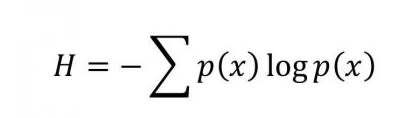
(Claude Shannon - a great generalist himself - derived this equation, which helped make the Information Age. Perhaps it was Jeremy Campbell's book Grammatical Man: Information, Entropy, Language and Life that blew every fuse in me here?)
Poetic experimentation with language would be something I'm much better at, perhaps genetically, but who knows. I could do a two-hour lecture on Joyce's Ulysses at the drop of a hat. It is just as profound as anything. Meaning, for me: it's so wonderful it indeed does function as a Holy Book to me.
You should have all your own Wild, Wonderful, and Fantastic Stuff like this. You came to it in your own way, and you were never the same again. It/Those Works provided transcendent meaning for you. They are "religious texts" in my view.
How Wide Does It Go For You?There's a passage at the beginning Timothy Leary's Info-Psychology, which was written soon after he was released from various prisons, including two years in solitary confinement, for the crime of possession of a small amount of cannabis, and, apparently, if you read what the judge had to say, bad ideas about how psychology might work if we just tested those ideas.
Pretty much zero academics stood up for Leary while he was a political prisoner, which I might get to some day. Suffice: Leary came out of stir very vocal about the history of Psychology, the field in which he earned his PhD.
Anyway, Leary wrote about this: Freudianism and Behaviorism became a big deal in part because the quasi-educated masses were turning off to "organized" Theology. He dates "Industrial Psychology" to 1850-1975, for, I think, personal reasons. Then he writes this:
"The task of personalizing and popularizing new 'mystical' philosophic themes has always been assigned to special genetic castes -- artists, writers, poets, bards, minstrels, storytellers. So it was the Impressionists, Expressionists, Cubists, Pointillistes, Surrealists and others of this rowdy group who persuaded us to accept visual reality in terms of shifting planes and shimmering realities."4
His use of "caste" here seems telling: I think he was circling the counterculture wagons and appealing to a select audience ready to accept more of his wild ideas, for which I grant him every favor. The second part seems to limit the groups too much: I think those "castes" were far more extensive than this Artistic class. Clearly, there were some trained in the physical sciences who belong here, too, for example. How about Bateson? What about Lilly? I won't even mention The Beatles, 'cuz that's just me kvetching now, though Leary does mention "minstrels."
My point is: we know who these castes are. And I accept them as the part of the Artistic-Generalist class. This was the class articulated by Karl Mannheim in his Ideology and Utopia (1927; trans. English 1936). Mannheim thought, of all the intellectual castes and classes, there was one he called the free-floating, relatively-unattached intellectuals, the freischwebende intelligenz, who wrote for little magazines, lived in cold-water flats, hung out in cafes and bookstores, used hashish and drank absinthe, etc. The Bohemian intellectuals, roughly isomorphic to Leary's "castes."
In my personal cosmos of intellectual types who fire the imagination, engender wonder, awe, and that religio I need? I extend my circle to include these ones, of course! Like Walter Benjamin. His buddies in the Frankfurt School knew he had to the goods: just finish that dissertation, submit, and you're in! Benjamin couldn't be bothered. Something about it just wasn't in the cards for him. If you read his essay on "The Flaneur" you get a good feeling for what he wanted to do. (Benjamin haunts a lot of us, these days, in the US…)
The "relatively unattached" in Mannheim's theory could read and write whatever they damned wanted, because they didn't have to answer to the party, head of the university department, main editor of a mainstream paper, some cigar-chomping know-nothing blowhard of a President of the company, etc. They're poor, live on the margins, but they're freer, and this was point from Mannheim that stood out to me: they "see" more of "reality" because they don't have good, steady jobs. They can turn their attention and studies anywhere. Substack might be a good place for them these days, but I digress…
William S. Burroughs and Robert Anton Wilson might be my all-time faves of the FFUIs, my shorthand for "free-floating unattached intellectuals." As writers, they tend to write both fiction and non-fiction, and they write about subjects that none of the New York Intellectuals wrote about.
Burroughs's inheritance is famous, but he burned through it pretty quickly, and heroin didn't help matters any. Naked Lunch (1959) put him on the map and his books sold to this same class of FFUIs and boho drop-outs until his death in 1997.
I've derived more sheer wonder from RAW, perhaps, than anyone else. He was trained as an Engineer, but was a hardcore intellectual in these senses: reading in pretty much all areas, and deeply, by the age of 27, when he finally published, on or around his 27th birthday in 1959, an essay in James Joyce Quarterly (now, IIRC, James Joyce Review), and an essay on "The Semantics of 'God'" in the satirical magazine The Realist. RAW intensely disliked the "artificial" walls between the Arts, Humanities and Sciences. He found wonder in all of these places, and wrote about it well, and I was gloriously infected by it all. Both Burroughs and RAW were funny, too, which is woefully underrated by the mainstream intellectual classes.
Aye, I was bitten and infected, became intransigent in my jones for a wonder fix.
And thus, this tiny essay.
Again I urge: genuine wonder: it's all the religion I need. You too?
1The Sociology of Philosophies: A Global Theory of Intellectual Change, p.19 This book I find enchanting, it's 1098 pages, and dazzling. The Bloor book he cites in the passage is Knowledge and Social Imagery. Collins also once wrote a detective novel with Sherlock Holmes and Bertrand Russell as the detectives: The Case of the Philosopher's Ring, in which they deal with the most evil man in the world. If you read The Sociology of Philosophies, or just read in it for an hour, you're left truly wondering how this same guy writes a Sherlock Holmes book, but there it is.
2Here's Theologian Giles Fraser in The Guardian, short article, 2024, hitting pretty much all those notes.
3Because this short article is really about the religious function of intellectuals, I have no time today to address CP Snow's Two Cultures or the catastrophe around the Humanities on university campuses since 1979, but at some point I'll get to it. Are doctors and lawyers part of one group or the other? Again: later. I tend to see a good General Practitioner as a fine mix of scientist and artist, but this is moving too far afield…
4Info-Psychology (1976), originally titled Exo-Psychology, pp.1-2.

(artwork by Bobby Campbell)
Book Chat: Some Odd Titles [ 13-Oct-25 10:38am ]I associate Spring with lengthening days, a new baseball season, and reading books. For Summer, the days are long and the nights warm (in California) and I love to read all night until I can't keep my eyes open. The Autumn comes and the days shorten: perfect for reading books and I'll have those moments where I'm reclining on a couch for hours, then feel drowsy, the book falls to my chest and I don't quite fall asleep but get some hypnogogic imagery: of reading in September or October as a kid. Winter is just flat-out a great time to read something. Like a book. A dead-tree codex.
I've found I can read for a great many hours in the day if I just move around the place: now I'm sitting in a chair, then I'll be on a couch, then I move to another room or the porch. I don't know why changing settings in such a seemingly inconsequential way can give me that sort of endurance, but it does.
This Substack is reader-supported. To receive new posts and support my work, consider becoming a free or paid subscriber.
On with some book titles.

The Secret Forest, by Patricia Westerford. This book was written by a character in the novel The Overstory, by Richard Powers. It seems clear that Powers based the character on a real person, Suzanne Simard, who wants to alert the world to the magnificent intelligence of trees and plants and their vast telecommunications systems, largely mediated by mycorrhizal network of fungi, etc. Simard wrote Finding the Mother Tree, which I've skimmed. Related to these works in my mind: The Hidden Life of Trees, by Peter Wohlleben, which surely contains magic in it, and The Secret Life of Trees, by Colin Tudge. Publishers found out in the past 15 years that books about how plants seem much more intelligent than we thought sell pretty well. There's an audience. The sentinel book here, the precursor, great grand-daddy of 'em all, must be 1973's The Secret Life of Plants, by Tomkins, which was a pretty big influence on a lot of weirdos, including Robert Anton Wilson. To hardcore scientists it was "woo" then, and, pretty much now also. Although things might be slowly changing, if I'm reading the landscape accurately over the past 15 years or so. But RAW had traced subtle consciousness and intelligence back to the earliest years of agriculture (his reading in James Frazer's The Golden Bough), and earlier: shamanism. I recently read a few fascinating articles on scientists studying slime mold, which is brainless but seems to act intelligently, and I think RAW would say, "I told you so!"
I hope to write on plant intelligence in these spaces soon.
It can't hurt the authors or publishers to put "hidden" or "secret" in the titles of books, either. I think we all know the score here.
On the Shadows of Ideas, which appears to be a book inside Giordano Bruno's De Umbris Idearum, published in 1582. Frances Yates discusses De Umbris in her Giordano Bruno and the Hermetic Tradition:
Philothimus asks what is the book which Hermes holds in his hand, and he is told it is the book On the Shadows of Ideas, the contents of which its author is in doubt whether or not to make known. Philothimus points out that no great work would be produced if such hesitations were allowed to prevail. The providence of the gods does not cease, as the Egyptian priests used to say, because of statutes promulgated at various times by repressive Mercuries. The intellect does not cease to illuminate, and the visible sun does not cease to illuminate, because we do not always all turn toward it. (193)
Cagey Bruno puts a book inside another book (with basically the same title), the inner book discussing the pressing political issue for Bruno himself: what can he get away with writing and saying without being busted? 18 years later he found out: burned at the stake at Campo de' Fiori.
The idiocy of book burners and banners, and persecution of writers marches on in our "enlightened" times. Why? Wilson and Leary thought it was because too many humans were stuck on the digital, robotic first four metaphorical "circuits" of the nervous system; when you turn on right hemisphere, analog circuits you are fine with any expression, as long as no one is actively harming anyone else. What a couple of nuts, eh?
To quote Grady McMurtry, "Why does the gnosis always get busted?"
Erotic Adventures of Loren Ipsum, by Etienne Cherdlu. With an odd provenance. Tell me if you think this is weird too 'cuz I've never seen this: on the copyright page it says "published jointly between Olympia Press and Bell Labs." I mean…
Loren's kink is to do it on top of old linotype machines or on papers filled with banks of meaningless digital data. Lorem took a weird - and this is a weird book, make no mistake - sexual imprint: at age 14, with her junior high school boyfriend one magical Saturday afternoon she used the key to her computer scientist father's office at the Stanford Research Institute in 1969, and had her first glorious experience among banks of computers and print-outs. The boy was a close friend of Douglas Engelbart's son. Or it seems to allude to that, not that it matters. I've just read a ton of stuff on "The Mother of All Demos."
Where was I? Oh yea: It seems the factor of maybe "getting caught" plays into her excitement, and she ups the ante as this erotic novel, very popular among coders, moves toward a, uhhh, climax. There was a bizarre excursus on George K. Zipf's 1935 book The Psycho-Biology of Language right in the middle that I can't see as pertinent to the story, although it was interesting. The final scene, after her 22nd birthday party, in the basement of CERN, is probably too weird to discuss. I take it the author is French, and it figures. Not bad, although there seems to be too much text that just fills in the space of the novel.
Farewell, America: The Plot to Kill JFK, by James Hepburn. Okay, okay, I have yet to read this one, because I haven't found it in any library. I only know about it because it's written about so colorfully in editor-of-Ramparts-magazine Warren Hinckle's If You Have A Lemon, pp. 252-268. Hinckle tells us this book came out in 1968 and was immediately suppressed in the US and Canada. And now we know that "James Hepburn" didn't exist. Who wrote it? Possibly Herve Lamarre, and agents from INTERPOL, Andre Ducret of the French civil police forces, and Phillipe Vasjoly, an agent for Big Oil in France. It seems the French wanted us to believe Big Oil was behind the JFK hit. Why? Maybe I'll get to it this late November. Or next year. If you've read it, you tell me in the comments.
This book was finally released to the public c. 2002 and most of the reviews I've seen say it's "dated" (no! really?) but somewhat compelling. Publisher's Weekly wrote, c.2002: Most of the text is a damning jeremiad, portraying pre-1964 America as a vicious, discriminatory oligarchy controlled by alliances of Big Steel and Big Oil, the military and organized crime, which all had reason to fear JFK's proposed reforms. The reviewers at Amazon mostly seem happy: it fed their JFK hit fix. Sometimes ya just gotta have it. I tend to read reviews by these guys and picture them having a literal wall of JFK conspiracy texts in their man-caves. Big-time JFK assassination writer William Turner wrote the introduction. I think I have an insider's idea of what it's like to be one of those people who've read 700 different JFK books. I mean: I get it. It seems sorta like a secular version of medieval monks going over the same sections of writings about Jesus, for decades, arguing over all the minutiae. And there is a lot of it.
Hinckle tells us that ex-FBI-turned-Ramparts editor Turner had stacks of contraband copies of Farewell, America piled up in his basement in San Rafael. I wonder what the real purpose of this banning was in the first place. Who did Turner sell to after 1968, and what was it like? Was it like making a drug deal in a park near San Francisco? I imagine codes, the right colored hats, hand signals, brown paper bags, synchronized Timexes and Bulovas. Maybe Donald Sutherland is lurking not more than 20 feet away. That is, if Turner sold to anyone. What do you do with all those copies of a book people want? How did he go from FBI to the Catholic-Left and Ramparts?
When Robert Shea was asked a final question in an interview, published in Tom Jackson's recent book, Every Day Is A Good Day: Who killed JFK? Shea responds: "We all did." Which, at this point, I accept…with an explanation, if I may, Your Honor…
My Past Was An Evil River, by William S. Burroughs
The Hindsight Saga, by SJ Perelman
These are the titles of two books of memoirs that the authors never got around to finishing. It seems likely WSB never wrote anything for his book; it's cited in William S. Burroughs: Cutting Up the Century, (2019), ed. by Hawkins, Wermer-Colan, Cannon, et.al, on page 58. Perelman never got around to finishing his autobiography, which was originally titled Smiling, The Boy Fell Dead, but his wife Laura said that was too morbid. (see Conversations With SJ Perelman, p.66) Both Burroughs and Perelman have at times made me laff out loud reading them, to the point where I got a mild side-ache. I'll have to be content with their writings extant.
In John Barth's wonderful The Friday Book I read about The Three Imposters, a book that garnered much commentary in the 17th century. The three imposters were Moses, Jesus, and Mohammed, so you can see why there wouldda been a ton o' ballyhoo then. Then it was revealed that the book didn't exist; the word had gotten out and people just felt like it was their right to comment on it, having heard a little about it. My how times have changed!
What's really funny is that…suddenly the book appeared! Barth links this to the impossibly marvelous Sir Thomas Browne and…Borges? See The Friday Book, pp.70-71
Speaking of Borges (who is required to appear in articles like this one), have you heard of The Anglo-American Cyclopedia (1917)? It was an actual pirated version of the 10th edition of the Encyclopedia Britannica, and it features prominently in Borges's "Tlön, Uqbar Orbis Tertius." Which "is" fake.
Blacktopolis: The Intransigence of African-American Urban Poverty and Baggy Clothes, by Foy Cheshire. A maddening sociological rant by a guy who felt like Bill Cosby before we knew he was drugging and raping women. There's a lot of humor here and it's all unintentional. What a strange book. I found out about it reading Paul Beatty's The Sellout. See p.48
I, Libertine, by Theodore Sturgeon (1956) This supposedly became a best-seller. Sturgeon's a fine writer, but I can't find reliable best-seller info for this one. Which is interesting, because the title started out as a non-existent book hoax/put-on by New York radio legend Jean Shepherd, who was satirizing the mass-marketing/Mad Men-like process of the making of a best-seller. Then Sturgeon asked Shepherd if he could write an actual book by the title and was given the green light.
This, and the aforementioned The Three Imposters (and many, many other books) seem to provide a corollary to John Lilly, which might go like this: Within the province of books and publishing, what is imagined is a real book or becomes a real book within certain publishing limits. In the province of the possible library of the mind there are no limits.
Finally, because I can only pull my readers' legs for so long and no longer: Semiotic Analysis of Various Translations of the Necronomicon, ed. Timothy F.X. Finnegan (1944). The highlight of this, for me, at least, was de Selby's attacks on the imperialist structure of British grammar. Erudite, witty, bonkers. Highly recommended. For more information, see Robert Anton Wilson's Introduction to The Selected Letters of Philip K. Dick, 1977-1979, p.4

This Substack is reader-supported. To receive new posts and support my work, consider becoming a free or paid subscriber.
Gas Station Heroin and Other Musings On Drugs [ 11-Oct-25 1:01am ]When you get to the point where you have a constant cultural dialogue about how really fast computers might kill us all or only make super rich people even more rich, so what is the best way to act on this?…
When you have an Administration like this one, aimed at killing the poor and non-white for… reasons…
This Substack is reader-supported. To receive new posts and support my work, consider becoming a free or paid subscriber.
When nothing works, no one cares, and the populace are zombified phone addicts reading fascist agitprop probably produced by an algorithm, and it makes them want to off their neighbors, who, while having an "ethnic" name have actually lived in the US longer than anyone else around…
When you fear that something coming down soon, like the King's "decree" that you must have a Bitcoin account attached to Facebook in order to stream-watch the season-finale of America's Got Talented Bachelors…
No one can do anything about it because It Is Broken. And furthermore, that was the goal. It is with some irony that I pronounce "kudos" to the hidden, billionaire class: you did it! You installed un clown fasciste brailleur in the house at 1600 Pennsylvania, have successfully packed Congress with your own lackeys, and six of nine on the SCOTUS will drink your bathwater on command. Good job! No "communists" will come and take your stuff 'cuz they're all dead, so you can relax and watch your daytime soaps without those nagging worries. But just to be safe, keep using the luxury Panic Room. You know, the one with the humidor, just off the guest houses?
I wonder about little details. Is all this lurid, maddening and stupid beyond belief? Of course, but that's beside the point. My point.
Bellweathers. Cultural indicators. Where are things more absurd than you'd think? Which way is the current microplastic-suffused wind blowing?
Case in, uh, point: Gas Station Heroin Linked To More Deaths In California. I have so many questions. And none of them are "Where can I get some?" because this pithy news item I consumed with my coffee tells me: it's still "sold openly across the Bay Area." (Note to self: there's still hope.)

(I think the key term here is "amazing.")
It's in convenience stores, this little story expanding the semantic reach of the word "convenient" somethin' fierce. Hell: you can get it mail-order, 'cuz freedom.

(I show the chemical structure of 7-OH here to try 'n impress y'all. Also: I have a fetish for this kind of thing. I think if you install a hydrogen atom to that branch up above the middle oxygen it turns into an antihistamine? Hold on…that can't be right. I'll get back to you on this.)
7-Hydroxymitragynine AKA "7-OH" has both opiate and "stimulant-like" effects: gas station speedballs, my friends! And they say there's no progress. I do wonder what "stimulant-like" means. I'd suspect something along the lines of "food-like." I guess I'm gonna have to do some immersive, investigative reporting and try a little 7-OH just so I can speak from a place of personal knowledge.
Sold in candy-flavored pills (why not?), 7-OH is also infused in drinks, and of course: it's vape-able if that is your desire. Hey, it's a free country. Just…let's stay away from needles here, mm-kay? Although you know some 7-OHers will get to the point where the high isn't quite intense enough and/or doesn't arrive quite fast enough, so: drug user's logic and I can see it now, a future headline:
Officials Say Prom Queen, Star Quarterback Died From Injecting Gas Station Heroin.
(Just below this story: Powerball Jackpot Now Worth $97 Billion… Not that you asked.)
It's been linked to at least six deaths now. The 7-OH, not the lottery. Officials are telling "retailers" to stop stocking the stuff, which is "highly addicting." You wonder how it found its way onto shelves in the first place. (Full disclosure: I wonder increasingly less about this kind of thing these days.) Retailers need to stay alive too, so let's factor that in. If they're stocking little "candy-flavored" death-dealers, it's just the price of doin' biz. Ya gotta break a few lives to make an omelette. If you told me Steve Bannon is selling this stuff on his fascist call-in show it would be the least surprising thing I'd heard all month. "Amazing."
No doubt every health department in Murrrka is understaffed or now consists solely of the local mayor's nephew, Chad, who never finished his degree in Business Administration, is pulling down $147K in a municipality that recently closed its remaining fire station, and Chad has yet to show up to the office. (Chad could not be reached for comment.)
From this simple article, we read that "California lawmakers introduced a bill this year that would ban the sale of the drug" because it was unregulated and could be sold to children. Then: "The bill did not pass the legislature…" in California this didn't pass? I mean, I could see West Virginia, Alabama, Texas…Curiouser 'n curiouser…
I imagine some politicos - Democrats, as this is California - thought: health care cuts are going to hurt my constituents, maybe they'll get some relief from extreme pain at the local Gas 'N Blow. They were "thinking outside the box." (Why were they even in a box in the first place? They couldn't be reached for comment, but spokespersons inside the box said they'd reach out from inside the box for comment later. We're still waiting, staring at that damned box.)
Other articles about this OTC "heroin" use the term "popular supplement." Yea, like this shit is a close cousin to Vitamin C. (If Linus Pauling was alive today he'd be spinning in his grave, to steal a line from…probably Yogi Berra or Samuel Goldwyn, who copped all the good lines.)
I also wonder how a fine, glamorous, elder-statesman drug like Heroin got roped into this story at all in the first place. If we read this report with any continuous partial attention at all we see that the drug doing the heavy lifting here is a "synthetic relative of kratom." Kratom is derived from a tropical evergreen tree in Southeast Asia. We all know heroin is synthesized from poppies. Trees are not flowers. QED, a line I stole from Euclid. (Or was it Yogi Berra?)
Kratom is all over the Internet, there to help us "meet" our "fitness goals." Does this version of "heroin" sound like something that will put you on the nod under a rotting abandoned staircase is a flea-bitten hotel near the Red Light District? Me neither. Something smells fishy here, and I think Heroin should sue for damages.
[Scene: A middle class neighborhood, white picket fence, well-manicured lawn. A police car rolls us, two cops walk past a pink flamingo and knock on the door. Door opens to mom in Lululemon pants and dad in Metallica t-shirt. The cops have their hats in their hands, held to their chests.]
Cop1 : Do you have a son named Iggy?
Mom (alarmed): Yes. Is he okay?
Cop 2: We have good news and bad news.
Dad (vehement): Wha…What is this? What's the bad news?
Cop1: Iggy was found dead from an overdose of kratom. It's called 7-OH. Gas station heroin.
Mom: OH MY GOD! My sweet little boy! (She falls to her knees in agony.)
Cop2: We're so sorry to have to deliver this news.
Dad (crying): You said there's good news? Wha…what do you mean?
Cop1: Kratom is all Natural!
Aaaand: scene. I'm sorry, that was tasteless, asinine, juvenile and dark, but these are tasteless, asinine, juvenile and dark times, no? (Also, to be fair: all these gas station drugs are synthetic, but you can market them as "natural." To put too fine a point on it.)
By the way, kratom powder and good ol' gas station heroin are available right now via Amazon: next-day service! The drivers might be dipping a finger in it, so: word to the wiseguys. Besides, why not slum a little and head out to that truck stop where the two Interstates converge and score there? Put some color into your life before you get high and dance with death? I mean, think about it at least. You only live once.
I could find no reliable information on ideas for "what goes good with"/how to "pair" 7-OH with anything. Possibly Nine Inch Nails? Two shots of Red Bull? Please advise.
Finally - because I know y'all have some choice porn to look at - I ask in my most plaintive voice, yet again: Would It Kill Ya To Just Smoke a Joint? I'm talking to you, kids.

This Substack is reader-supported. To receive new posts and support my work, consider becoming a free or paid subscriber.
TONIGHT: Speed of Light vs. Speed of Thought: Get Your Tickets NOW! [ 06-Oct-25 9:08am ]I just finished listening to my brilliant friend Eric Wagner being interviewed by Gerry Fialka and Fialka asked this Q to Eric: What's faster: the speed of light or the speed of thought? Boy, that brought me back…
I'm reminded of a synchronicity I had many years ago (maybe early 1991?) but which comes back to me in idle moments of brain-transiency and daydreams: I wondered how fast thinking was. Is it faster than light? Then I opened a book randomly and started reading and I found an answer. Was it the answer? It looked like it, given the source. But lemme back up a bit.
This Substack is reader-supported. To receive new posts and support my work, consider becoming a free or paid subscriber.
Atop this synchronicity, this question then suddenly appeared in my life everywhere, in various guises. Of course we find ourselves in environments, choose to tunnel into certain areas of thought in which this sort of thing will happen more, so it's not a Baader-Meinhof effect. At least I don't think it is.
-So what's faster? A thought or the speed of light?
I'm gettin' to that, Hiawatha. Just lemme settle in here onto the ol' naugahyde, ease me achin' bones…
-I think it's a thought. They seem like the fastest.
You may just be right, Juniper. Lemme see if I can make this innarestin' to ya.
-Are you gonna mention that Einstein guy again?
Ya gotta, Lotte. I mean, dude's Da Man when you get into all this. Or one of 'em…Hey? Where y'all goin'?
(All three chilluns done left, so now it's just you 'n me. When their old man talks about Einstein they become Pavlovian, associating that sorta of talk with mental pain. And so it goes…)
The SynchronicityI had wondered about this. Of course Einstein established the speed limits of the universe, with the help of the Michelson-Morley experiments and a whole lot of daydreaming. 186, 242 miles per second: speed of light. Okay, cool. And thoughts, whatever they were - they didn't seem like photons, but must have some sort of measurability - thoughts had to move through the medium of meat-space of our brains, which are made of water and a bunch of other neuro-chemicals that would slow everything down. Impedance. You're doin' it now. Slam dunk it's the speed of light that's faster. However, it should be more interesting than that.
It is.
I wanted to know more, but this was pre-Internet, so I picked up a book that seemed like it might have more on this: Science and Sanity, by Alfred Korzybski (1933). I'd been delving into it because Robert Anton Wilson was so enthusiastic about it. This book seemed super-dense, highly technical at times, filled with math, and with passages I found so interesting I felt like I was tripping, and then he'd repeat something he said five pages ago. There were also passages that seemed utterly nutty to me. In short: for someone of my bend, this is my kinda thing.
Anyway, I probably checked the index for "Thought." "See 'Thalamic 'thinking'" Hoo boy. There was a sub-heading: "Laws of Thought." I started to read those pages but wasn't getting to speed of thought in the way I needed it. So I opened at random - this is a form of bibliomancy that I think of as Sortes Virgilianae, which is a magical technique that goes back to the Romans, who used The Aeneid, opened to a random spot, for divinations and other purposes. At first, I didn't know what I had.
I had fallen open to page 165 of my 4th ed. of Science and Sanity. Check this out; just hang with it and I'll try 'n clarify;
It is possible that "intelligence" and abstracting both started together and are due to the physical-chemical structure of protoplasm. All living material, usually called protoplasm, has, in some degree, the nervous functions of irritability, conductivity, integration, . (←—OG: This was Korzybski's alternative to using "Etc")
It is obvious that a stimulus S does not affect the little piece of primitive protoplasm A "all over and at once" (infinite velocity), but that it affects it first in a definite spot B, that the wave of excitation spreads, with finite velocity and usually with a diminishing gradient, to the more remote portions of A.
Now we're cookin' with gas, daddio! And just re-reading and typing out this passage is giving me a mild buzz of intellectual euphoria. Your mileage may vary. On with it:
We notice also that the effect of the stimulus S on A is not identical with the stimulus itself.
Brief comment from a long-time reader of Korzybski: there seems to be an entire epistemological world here. Korzybski insists, over and over throughout this 800 page tome that nothing is identical to anything else; we only forget we're abstracting when we see things as "the exact same" as something else. Difference seems fundamental on all levels of physical and social "being." Okay, sorry for the interruption.
A falling stone is not identical to the pain we feel when the stone falls on our foot.
Sorry again: Nota Bene: this was another way for Korzybski to illustrate the stimulus to the protoplasm which had its effect by traveling in a wave of excitation, which computer scientists and neurobiologists today call "spreading activation." It's just that the stone/foot relationship is more concrete and easily pictured in our minds.
This speed, we now see or feel or intuit, is far less than the speed of light.
Neither do our feelings furnish a full report as to the characteristics of the stone, its internal structure, chemistry, . So we see that the bit of protoplasm is affected only partially, and in a specific way, by the stimulus. Under physico-chemical conditions, as they exist in life, there is no place for any "allness." In life, we deal structurally only with "non-allness"; and so the term, "abstracting in different orders" seems to be structurally and uniquely appropriate for describing the effects of external stimuli on living protoplasm. "Intelligence" of any kind is connected with the abstracting (non-allness) which is characteristic of all protoplasmic response. Similarities are perceived only as differences become blurred, and, therefore, the process is one of abstracting.
So: even though nothing is identical to anything else, when we abstract - which we need to be conscious about, always - we are blurring differences. So what? Well, for one thing: we must abstract, as this leads to intelligence. Notice that protoplasm in the above passages abstracts. There is differentiation in its response to stimulus. What some amoeba does when we use an electrical probe on it, and what Einstein did when he daydreamed (thinking not in language but in pictures) and came up with the Theory of Relativity: there is a continuum here!
I felt like I had my answer now, but with a lot of meat on its bones, and it came via an ancient process of divination. Yes, that seems weird, and I seem weird. So be it. I hasten to add it's probably good the chilluns done left the room, as I'm afraid they'd be bored sick by the Old Man again.

(Wish I could get my hair to look this cool.)
Einstein's Thinking As Filtered by Robert Anton Wilson, in a Novel
In Masks of the Illuminati, James Joyce and Albert Einstein are teamed-up in Zurich, 1913, in a locked-room mystery where they're trying to solve the problem of a young nobleman (Babcock), who's terrorized and convinced someone or some Thing is finally going to do him in. Wilson, a serious student of Physics and who idolized both Einstein and Joyce, has Einstein in an interior monologue:
The obvious absurdity of Newtons's hypotheses non fingo1: actually, it is impossible not to theorize. The velocity of nerve transmissions in the brain is such that we can never disentangle perception from conceptualization. It is even a concept that I am speaking to human beings. Joyce and Babcock might both be automatons passing themselves off as humans, or I might be hallucinating. And who but Poincaré and Mach understand that fully, in their bones? We live, as Joyce says, in a web of symbolic constructs made by our brains. The Herrdoktorprofessors cannot understand my paper on relativity of space-time, for instance, because they think "length" is a fact, not a concept of our brain. (104)
(the context for this image is partially explained, below)
A Couple of Recent PapersLast December in the journal Neuron a team of researchers, using information theory to measure processing of bits in WiFi, our cell phones, our total human sensory system, and our brains consciously processing information, came up with these numbers: The average WiFi system processes 260 million bits per second. Our cell phones; 64,000 bits/second. The human sensory systems take in and processes around 1 to 10 billion bits per second. But - take a deep breath - the human brain only "consciously" processes about 10 bits per second. Ten. Ten. Elite typists who churn out 120 words per minute: about 10 bits per second. The top video gamers: 10 bits per second. People who excel at a task called "speedcubing" - where you put on a blindfold and then try to solve Rubik's Cube as fast as possible: around 12 bits per second.
So: Our total sensory input from the environment gets processed at around 1 billion bits per second, but we don't use…hardly any of that information. We're really really RILLY good at filtering out all that information. Why? Evolution. We evolved for 99% of our time as hominids to make our paths through the forest or other environments, looking for food, trying to stay alive. The Industrial Era began a few seconds ago, in 1750. Our invention of information processing gadgets has accelerated at a pace that's unfathomable. Meanwhile, all studies show that we totally suck at "multitasking." We weren't built for it. Advice: be more Zen: do and concentrate on one thing at a time. Also: a number of studies show that slowing down and deliberately paying deep attention to information helps us retain it better. Take notes with a pencil or pen if you care about your information. Probably read a dead-tree book rather than stuff on a digital device. It's evolution. Of course…2 Look at the "lives" of these gadgets: we'd rather be who we are. Information processing isn't everything, though every fascist schmuck in Silicon Valley will try to tell you otherwise.
Around eight months before that, a paper on possible information storage in the human brain was published in the journal Neural Computation. Researchers using Shannon entropy (AKA Mathematical Information Theory, same as the "processing in bits" story above) studied the synaptic connections and dendritic spines of neurons in a given region of the brain. As any reader in neuroscience knows, what fires together wires together: circuits that are repeatedly activated together are the backbone of learning. And what have they found?
Admittedly, this study was done using rat brains, but what they found was remarkable: there was much more information (in bits) stored in "wired" synapses than we thought. So much so that, if we scale this study up to human brains, we arrive at the idea that humans have ten times more storage capacity than previously thought.3
So: another old evolutionary truism: Use It Or Lose It: keep the lasagna flying, as Robert Anton Wilson fans say. (RAW once observed that brains resemble a slab of lasagna.) This study tells us the capacity for learning - it's very large - and also tells us we will be able to learn a lot about the withering of brain circuits, from aging, dementia or other diseases, and perhaps help stave off those catastrophes. We can now see these synaptic actions stuff going on. Which ought to blow ye fookin' mind, aye!
So: we can only consciously process about 10 bits per second, due to evolution. And that's for high-processing activities. And yet we can store a vast amount, about 10 times more than previously thought. What should we do with this information about the brain? I answer: Let us choose wisely.
Trying Not To Freak Out HereThis is well-known to those who are fascinated by the philosophical concept of "free will," and I only wanna say a couple things here. The Neuroscientist Benjamin Libet started doing studies in the 1980s about consciousness and free will: how did you decide to lift your index finger just now? We all think we made a conscious decision to move our finger, so we did. Libet's research says sorry, but no: there was something unconscious going on first, about half a second before. Uhh…okay: then what was that "thinking" behind that "decision"? This is where it gets maddening. I mean, sit back and just think of the implications here: possibly nothing we think we "decided" to do was done neurophysiologically the way we think it does. It's almost as if we're preprogrammed. That can't be right! Something else is going on. What?
At this point, despite the science, I recommend you just disregard the findings. Call it a series of errors or bad experimental design or faulty math, some sorta conspiracy, bad instrumentation, or maybe all the neurobiologists who say we don't have free will the way we think we do? Why, they're all just a buncha poopie-heads. I recommend thinking this - any one of these - for hardcore pragmatic reasons. I'm not sure why I do, though…
Matsuhashi and Hallett replicated Libet's findings in 2008. In 2011, Rigoni, Sartori, Kuhn and Brass did a similar study suggesting that undermining belief in free will kinda fucks us up. I told you to just quit paying attention to this area of neuroscience!4
My Own Weirdo HypothesisI think we gather latent energies in the environment through some sort of magnetic resonance emanating from the Earth's core, which is influenced by all the matter in the Milky Way, and this all interacts with our nervous system and free information in the atmosphere and it all has to do with Bell's Theorem (1964), which showed that once two subatomic particles were in contact they will always be in contact, even if you separate them by many millions of miles: observe the particle spin of one, and immediately - faster than the speed of light, which is supposed to be impossible - the other will complement that spin in our observance with the opposite. We don't really know why; it just does. Because all particles were cooped up or cooked up with the Big Bang, they are all always in connection. We are made of those particles. We are stardust/We are golden/And we've got to get back to the Garden. (The Knicks game starts starts at 7 and you know Mid-Town traffic at that hour! Oy vey!)
So: back to where we started: perhaps the speed of thought is faster than the speed of light, but I will not be betting the farm on it. Maybe only that old tool shed. Ya know? The one with the rusted lock that has an old moonshine still in it from the 1920s? If you shine a flashlight in the only small window, there's a centerfold of Miss July, 1964 taped onto the wall. I saw it when I'ze but a boy, and it had an impact.

1
Latin: "I frame no hypotheses."
2An article that summarizes this "10 bits per second" study is HERE.
3An article that summarizes this "we can store 10 times more information" study is HERE.
4I think a decent place to start on this disturbing stuff is the Wikipedia page: Neuroscience of Free Will, and branch out from there. Or: only read all the detractors of all the studies, which in this case I think is a legit stance and, as I say, pragmatic.


