
 Slop image not generated by Google
It's a science fiction story set during the present year of 2026, which was originally published in "New Scientist," twenty years ago.
I quite enjoy living long enough to witness circumstances like this.
I Saw the Best Minds of My Generation Destroyed by Google
by Bruce Sterling
Los Angeles, 2026
Ted got busted because we do graffiti. Losing Ted was a big setback, as Ted was the only guy in our gang who knew how to steal aerosol spraycans. As potent instruments of teenage social networking, aerosol spraycans have "high abuse potential." So spraycans are among the many things us teenagers can't buy, like, for instance, handguns, birth control, alcohol, cigarettes, and music with curse words.
I tried hard to buy us another spraycan. I'm a street poet, so really, I tried. I walked up to the mall-store register, disguised in my dad's business jacket, with cash in hand. They're really CHEAP, aerosol spray cans. Beautiful colors of paint, just screaming to get sprayed someplace public where everybody has to see what's on our minds. The store wouldn't sell me the can. The e-commerce system simply would not allow that transaction. The screen just went gray and stayed gray.
That creepy "differential permissioning" sure saves a lot of trouble for grownups. Increasing chunks of the world are just… magically off limits. It's a weird new regime where every mall and every school and every bus and train and jet is tagged and tracked and ambient and pervasive and ubiquitous and geolocative… Jesus, I love those words… where was I?
Right. We teenagers have to live in "controlled spaces." Radio-frequency ID tags, real-time locative systems, global positioning systems, smart doorways, security videocams… They "protect" us kids, from imaginary Satanic drug dealer terrorist mafia predators. We're "secured". We're juvenile delinquents with machine nannies on our backs, on our pockets, in our purses, on our shoes. There's no way to turn them off. The Internet was designed without an off-switch.
So my pal Ted, who stupidly loved to tag his own name on the walls, got sent to reform school, where the security is insanely great. Me, I had a much higher grade-point average than Ted, but with no handy Ted to steal spraycans, the words of the prophet have vanished from the subway walls.
So much for my campaign to cover the town with graffiti street-stencils of my favorite teen pop-stars: George Orwell and Aldous Huxley.
And Shakespeare. I used to hate Shakespeare, because the teachers would park us in front of the webcam terminals, turn on the Shakespeare lessons, and leave the building. But then, somehow, they showed us "Macbeth," a play which actually MEANS something to us. Grownups don't understand that (or they wouldn't be teaching it) but "Macbeth" is the true, authentic story of my generation. This is Macbeth's world, and us teenagers just live in it.
Dig this: those "Weird Sisters," who mysteriously know everything? They can foretell anything, instantly, like Google? Plus, the witches make it all sound really great — only, in real life, it totally sucks? Well, those "Three Weird Sisters" are the "Internet of Things," they're "Ubiquitous Computation," they're "Ambient Findability." The truth is written all over the page (or the screen — my school can't afford to give us any "pages"). Just read that awesome part where they're boiling pseudocode in their witch-cauldron! They talk exactly like web designers!
Macbeth stumbles around seeing ghosts and virtual-reality daggers. That sure makes sense. Every day of my life, I see people with cellphones yelling eerie gibberish in public. The world of Macbeth is totally haunted and paranoid! You can't get one minute's privacy, even inside your own bed!
So, I did my class report about Macbeth, and every kid in my English class instantly agreed with me. I'm not the most popular guy in school, but they started CHEERING me. And Debbie, this wacky Goth chick in my class who identifies with Lady Macbeth.… After my class report, Debbie sleep-walked out of the classroom and pretended to hang herself! Of course the teen-suicide subroutines in the school jumped onto Debbie immediately. Debbie broke the software rules, so Debbie is toast, just like Ted.
My Dad — he's still alive, apparently — he sent me email from China and said that I ought to "recruit" Debbie into my "social group dynamics of online identity production." My Dad always talks like that. I haven't seen Dad face to face in six years. Look: I am a 17 year old male, okay? I don't want to send Debbie any hotlinks and video! I want to take Debbie out! Maybe we could take our clothes off! But there isn't any "out" for me and Debbie. There isn't any "off," either.
Okay, I admit it: Debbie is insane. The fact that Debbie really likes me, that just proves it. Debbie ACCEPTS this sick state of reality. She EMBRACES it. We are doomed.
Imagine that Debbie and me somehow go out together. We want to network with our peer-group, teenager-wise. I need to figure out what's hip and with-it and rebellious, and Debbie needs to know what the other cyber-Goth chicks are wearing. Is that okay? No!
It's not that we can't do it: it's that all our social relations have been reified with a clunky intensity. They're digitized! And the networking hardware and software that pervasively surrounds us is built and owned by evil, old, rich, corporate people! Social-networking systems aren't teenagers! These machines are METHODICALLY KILLING OUR SOULS! If you don't count wall-graffiti (good old spray paint), we have no means to spontaneously express ourselves. We can't "find ourselves" — the market's already found us and filled us with map-pins.
At our local mall, events-management sub-engines emit floods of locative data. So if Debbie and me sneak in there, looking for some private place to get horizontal, all the vidcams swivel our way. Then a rent-a-cop shows up. What next? Should we go to Lovers' Lane? There aren't any! They eliminated all those! They were tracked down with satellites and abolished with GoogleMaps.
Okay, sure: I know I sound pretty depressed. Us teenage poets depress easily. You know what they tell me whenever I rant like this? "Get a hobby." Play imaginary fantasy computer games! That is allowed me! Wow, thanks! When she nursed me as a baby, my Mom dropped me right on my head to play Wonder-World of Witchcraft. I sure know where that story goes. If "religion is the opiate of the people," then immersive multiplayer 3D virtual worlds are hardcore Afghani heroin. My Mom will never make it back into the labor force: because Mom's way too busy building herself up to 146th-level SuperMasonic Tolkien-Fantasy Ultra-Elf Queen! Like that helps! Look, I can show you Mom's gaming environment, right on the screen here. My Mom's a Welfare Elf Queen <CR> <system crash> <hard reboot>
Debbie: why do you access me, when you know that makes things hard for me? Why do you IM, and tag, and link to me? Why do you telephone? And why, why, why do you write me silly notes on paper? I am so sick of you, Debbie.… Why, why do you hack me? It is just to see the things that you know I am writing about you…
Debbie, you believe in us. You think we are the future.
I am so miserably happy, just now.

The late Tom Cool and I wrote this story together back in 2020, and it appeared in The Magazine of Fantasy and Science Fiction.
He and I had quite a lot of fun discussing this future world, and the people likely to inhabit it. He'd been around the block a few times, Tom Cool, and had seen things most people don't see. — Bruce Sterling
Hornet and Butterfly
By Tom Cool and Bruce Sterling
. . . In every cry of every Man,
In every Infant's cry of fear,
In every voice: in every ban,
The mind-forg'd manacles I hear . . .
"London" by William Blake (1794)
First, a boat people's refugee camp. Then, a maritime urban slum. Seething with software and chaotic human energies, scrabbling to live, the Raft was an Asian seaborne city.
Then Typhoon Yunya hit and turned the town on its head.
The Raft was made of bamboo, wire, plastic, and surveillance. The Hornet lived in this cheap and trashy place because it suited him. He had customers and friends on the Raft. Although he himself was no longer human, Raft people knew him and cared about him. He'd made a nest.
Then, in a single night, disaster blew it away. His cheerful low-class smart city: half-drowned, half-burned. Half-flipped, half-flopped.
Worse yet, the emergency cops had invaded the post-disaster hellscape and come straight to his souvenir shop. The authorities were looking for him.
These were not the all-too-human Raft cops, who had mostly drowned while valiantly failing to save their floating population. These were severe Chinese disaster rangers, the heavy operators.
Creatures from the Gobi sandstorms and the Tibetan landslides, misery cops like under-fed tracking dogs, with mind-manacle collars on the napes of their necks. The cyborgs were bone-thin and clad in black pajamas. They felt no hunger, no pain, and no remorse. With their shaven heads and hollow cheeks, they looked like Shaolin monks with pistols.
The chief cop examined the inverted, flood-stained walls of the Hornet's wrecked shop. His shop was hung with clever pegboards, every object neat and rational, except when upside-down. The Hornet's precious collection of vintage hand-tools dangled all awry. His heavy worktable had crashed into his ceiling, smashing it. All his salt-stained merchandise — mostly cool plastic toys and obsolete media gadgets — was bloated, spoilt, drip-drying. The entire shop reeked of spilled maotai.
"You have been looting," judged the chief cyborg cop.
"No, I'm an antique dealer! This is my nest, all this cool stuff is mine!"
"You are hoarding relief supplies."
"No, no, I want to help the people! I'm a well-known man in this neighborhood, the people like me, just go ahead, take my biometrics!"
But the disaster cops could not invoke the Raft's many databanks, because no city remained smart when it was drowned, burned, and flipped on its head.
So the cops decided his case on the spot, martial-law style. They moved to strap a manacle to his neck and turn off his body. Vanish him, as an illegal nonperson: stacked like cordwood, in a coma, with a barely beating heart.
The Hornet backed away, babbling the standard illegal-alien excuses: I have a heart condition, I'm on medication, I have powerful friends who can vouch for me, but the cyborg cops were remorseless. One of them, his eyeballs flickering in their sockets, whipped out a telescoping billy club and bashed the Hornet's upraised arm.
The Hornet collapsed from that cruel blow, rolling with his chin to his knees, and then went into combat mode. All four cops were dead before they knew he was attacking.
Hornet kung fu was so different from human combat that it looked like a series of terrible accidents. Fifteen seconds of surreal, monkey-like tumbling, tripping, rolling, flopping, and lunging, and the chief cop had a screwdriver through his chin and out the back of his neck.
Cop number two had been fatally jabbed with a woodworker's chisel through his unwary armpit. Number three had broken his neck on the unyielding edge of the workbench.
The fourth, the cyborg who had hit him, numbly dropped his club when his skull was crushed with a pipe wrench.
The Hornet hastily stripped the cops of their trackable electronics and mashed all the devices in his bench-vise.
The four cadavers lay scattered in his antique shop, a typhoon-like disaster, dead bodies oozing liters of blood. The Hornet mournfully tried to tame the gore with shop rags, duct tape, and gel foam from a spray can.
Of course, it was useless. His beloved little shop was the site of a massacre. His inverted workplace stank like a boozy slaughterhouse.
He sat regretfully on his salt-stained ceiling, and wrapped his bent knees within his trembling arms, and put his face into both his hands. The cyborg cop had almost broken his arm with the club. He hurt all over from internal sprains and bruises. His Hornet combat-forms had exceeded the limits of the human body.
He retreated to the Potemkin village inside his own mind where these screaming distress signals turned into a warm, unhuman ache. He shook with palsy. He whimpered with each breath. His nose ran like a faucet. He wept.
The Hornet had killed people on the Raft before, but he hadn't wept about it, because it was a job. His business as a junk dealer was his cover. Mostly, the Hornet killed posthuman drifters, entities who had done something dark, deep, and dreadful, and thought they could get away with that on a place as sordid as the Raft. If they were particularly strong and wicked marauders, sometimes he was tasked to help them with some other transition to oblivion.
People thought that the Raft was the springboard to mainland China. Most refugees allowed to board the Raft knew pretty well that they would never get off it. They clung to the bobbing Raft because the drowning shore-cities of Vietnam, the Philippines, and Brunei were so much worse.
Japan was the great moral exemplar of modernity, since the elderly, solemn people of Japan had too much dignity to put up with the squalid 2080s. Rather than watch their beloved landscapes mutating into a planet of weeds, they had formally apologized to Mother Earth, swallowed fatal pills by the millions, and perished in one single chosen day, one vast tsunami wave of national suicide.
The Hornet had thought the Japanese had gone mad with despair, although now, surrounded by four dead cops in a city turned on its head, he envied their good sense.
Living deep-nested in bamboo and cardboard, repairing the toys of a happier time, he had enjoyed something like dignity. Not anymore. He was worse than a refugee. He was a malefactor.
He had to flee the Raft. He had become a cop-killer, the crime of all crimes in a security state. The Chinese police would task their machines to seek and destroy him. Anyone who even vaguely knew him would be assessed as a terrorist. The Hornet had become a plague vector.
So he had to find someone to help him whom no one would regret losing. That could only mean the Ozzman.
The Hornet climbed from his tainted place of business into the inverted depths of the Raft, through the Ozzman's kill-box burrow, and into the Ozzman's warren. He found the human criminal lurking in the dark, squatting on driftwood planks thrown across a sloshing ceiling.
The Ozzman's only source of light was an ancient black-and-white film, projected upside down on a canted, twisting screen. Dim shapes like giant bats hung from the inverted floor: comfy theater seats, upcycled from dead Japanese cars.
The Ozzman was obsessed with antique crime and thriller films, because all the villains and heroes were human. He played the films endlessly, cajoling the indifferent Raft locals to enjoy them with him. The Ozzman was especially fond of one classic American movie where the entire cast, doomed and endlessly drinking, was unable to escape a desert city.
The Ozzman froze the film. Moonlight shone on the tear-smeared cheek of a beautiful refugee as she aimed her pistol at the gin-soaked, hang-dog smuggler who had once been her lover.
The Ozzman glanced at the Hornet's bloodstained clothes.
"Who'd you kill?" he asked.
The Hornet flashed an old gang hand signal for cops, then dragged four fingers down his cheek.
The Ozzman stood up. He was a huge, hairy Australian, barely dressed in boardshorts, a wifebeater shirt, and ragged sandals cut from paratrooper boots.
The Hornet could see the frowning Ozzman performing his mortal calculus: running the odds of his human survival against angry Chinese cops, against the Hornet, against mass disaster, against whatever.
The Ozzman was human, so couldn't make up his mind as fast as a cyborg would. Consequently, he would just roll with the situation. He would help the Hornet, or maybe murder him, maybe both. The all-too-human Ozzman would react to the threat at hand, a two-legged feral beast.
"You picked a bad time to ask me for another favor," the Ozzman told him. "I just found something in the wreckage that the cops really want. And that thing wants off this Raft even more than you do. It makes a Hornet look cheap."
"Hey, I'm cheap," said the Hornet. "I'm as cheap as they get."
"Beyond the human," the Ozzman mused. "Fresh out of the wrapper, no history. Not even a someone. A something that's about to become a someone."
Topside, the wrecked Raft lurched as it rolled and pitched in uneasy seas, an urban whale with a broken back. The once-orderly floating smart city was a capsized jungle of upended keels, gel-foam basements turned into attics, mountains of half-burned debris, heat-warped shipping containers, carbonite power-cables, tangles of drifting plywood, jumbles of hydrogen tanks, and shattered stacks of drowned crates.
They disappeared down a crooked, debris-strewn tunnel. Ozzman hauled body bags from a covert cranny. Military surplus stenciled in Arabic. Each body bag contained 120 grams of nanobots programmed to render human flesh and bone down to isotope-scrambled carbon, hydrogen, oxygen, nitrogen, iron, and phosphorous, disassembling criminal evidence into the stardust of a supernova.
The Hornet took the Ozzman's handy cleaner-bags to his wrecked shop and confronted the dead cyborgs, who were stiffening in rigor mortis. He felt vaguely guilty about vanishing them so utterly. They'd been men before they were cyborgs, men with relationships, histories, maybe parents, wives, and kids. But he had to disappear them, unless he refashioned their cyborg skulls into drinking goblets, as the Ozzman had rudely suggested.
The Hornet turned on some roaring death metal of the 2030s, his usual work music, to create an alibi. Then he stuffed the dead police, one by one, into the surplus military body bags, which promptly ballooned up and overheated.
Until the Raft's emergency, he had never harmed any of the Chinese police. Of course, he had bribed them and lied to them, but everybody on the Raft did that. The human cops expected all that, they weren't upset by it.
But these were Beijing state cyborgs, so even as he went through the motions of his cleanup, the Hornet was hard put to find even the thinnest sliver of hope. He would have done better to drown in the midnight blackness of the tempest, like his neighbors.
Maybe the cyborg cops had been hacked. Maybe they lacked genuine state backing. Maybe they were fake cops and the Chinese state would write them off. Obviously, that was all wishful thinking, but that was the Hornet's own personal story, more or less.
He'd been human once himself, although it had been boring. Also, he couldn't afford to stay human. So he'd enlisted and become national standard cannon fodder. Then he got his cyborg upgrades and worked for military intelligence.
Meaning "Artificial Military Intelligence." The smart machines played five-dimensional espionage-chess. They swapped human pawns with ease. The Hornet no longer knew who he worked for and had given up caring. His employers weren't human, he knew that much.
So, maybe, the mind-manacled police slaves might end up like the Hornet, some half-obsolete pieces from a shoot-'em-up game no longer in fashion. Maybe they had been deployed against him because they were cheap junk, and he was cheap junk, so no one who mattered would care.
If you wanted an exciting agent that had no trail of compromise, you had to grow one fresh from a cocoon. That would be the legendary Butterfly. Everybody wanted one of those. They were hard to catch.
"Welcome to the dead man's palace," the Ozzman said, belching ale fumes. "He sure was rich, and he sure liked 'em young. He was one sick ape."
"I always knew there was something weird and kinky about him," said the Hornet. "I never knew he was a billionaire, though."
"The rich monkey had to grow himself a Butterfly in his offshore cellar here." The Ozzman shoved through tumbled stacks of high-impact shipping containers, solving a 3D Chinese tile puzzle to reveal the Butterfly's cocoon: an oblong translucent life-support shell. Through its pearly surface, suffused with ruby and gold LED lights, Hornet could perceive the Butterfly, shrouded within biofilms. Though devoid of visual detail, she presented as extremely female.
"Pricey," said the Ozzman, flexing his beefy arms. "A collector's item. We humans are such frail little creatures. If you want something tough, grow a Butterfly."
"Why did the rich guy think he would get away with all this?"
The Ozzman was deaf to that interrogation. "If I snuff this Butterfly before she breaks that cocoon," he mused, "I could sell her dead body to the cops. I could get a ticket off the Raft for an act of public spirit like that. Maybe I could fly to the Amazon."
"The Amazon has been burned and clear-cut. It's a toxic swamp."
"No way, mate! There's still jungle in the Amazon. Not much left, but they say there's still one uncontacted human tribe in there. Imagine innocent human beings! Who have nothing to do with humanity's endless crimes! Imagine if you met a pretty girl from that tribe, eh? What a romance!"
"In your sweet old movies," the Hornet said. It suddenly occurred to him that he much preferred the Butterfly alive.
The Ozzman amused himself with some black-market brain shackles. These were nanotech devices that resembled tangles of knotted black threads, commonly deployed within the ventricles of the brains of the police. The shackles were manufactured by the state in Beijing, but of course they had illicit uses, because every powerful technology always did. The Ozzman was doing a cat's-cradle game with his thick, dirty fingers.
A Butterfly would not make the world a better place. The world would also be a better place without a Hornet or an Ozzman. The Hornet knew that about the Ozzman, and the Ozzman knew that about him.
The Hornet slept deeply and dreamlessly, one eye open, while a demon in his head surveilled the shadows.
When he woke, his injuries had much improved. He was combat-ready again. Nothing much wrong with him except strained ligaments in both shoulders, a mild lower-back dislocation, a left kneecap contused.
"All her status lights are green," the Ozzman said reverently, while spooning bean curd from a jar. "Could hatch her out any minute now."
The Hornet hunted through the much-battered palace until he found bottled water. Water was always the first thing a posthuman craved after the severity of treatment, and nobody ever had the kindness to offer them any. They always had to beg.
From yellow to red the last LED blinked. The lid of the cocoon sighed open. The lair filled with a heady aroma of aromatic oils, debauched lavender and rose, undercut by a pheromonal and hormonal reek that seduced the tissues of his lungs. He couldn't help but breathe in the Butterfly fumes. It was like breathing silk.
With a languid slice of her talons, the Butterfly slit her biofilm envelope. She rose so gracefully that she appeared to levitate. Her glossy black hair was still weaving itself, nanorobotically, coiling in braids that piled atop her head. In a moment, she was poised on tiptoe, naked of course, but with a poised, querulous look, like a crane poised to spear a frog.
The Hornet had expected a posthuman that looked pretty, because who would grow an ugly one? He hadn't expected her to stab him with such an intense sense of loneliness. Just angelic beauty, with none of the mammalian companionship that a man and woman might offer one another. She was like the birth of Venus off a clamshell.
He offered her a blackout velvet robe. When he draped it around her shoulders, their eyes met. Her eyeballs were mapping the room, 3D-scanner style. She was observing the world without human pretension and confusion.
The Butterfly had no soul, and she saw at once that he had none either. That felt beautiful.
She spoke.
"Shēnghuó shì shénme?" ("What is life?")
The Ozzman grunted.
"Wǒ bù zhīdào," the Hornet heard himself mumbling. ("I don't know.")
"Nàme wǒmen bìxū jǐn kěnéng dì shēnghuó," the Butterfly said. ("Then we must live as best we can.")
He and the Ozzman glanced at one another. They had created a pretty good plan for dealing with a fresh Butterfly, but they had immediately forgotten it.
"Wǒ kěyǐ hē diǎn shuǐ ma?" the Butterfly asked. ("May I please have some water?")
The Hornet offered her the plastic bottle. She gazed at the screw-on top with mild disdain, then neatly bit right through the side and sucked it dry.
"Nǐ shì shéi?" the Butterfly asked. ("Who are you?")
Amazingly, the Ozzman confessed. Something deep had clicked loose in his head and he began to babble to her, swaggering, boasting, eager verbal fragments of his hideous life of violence and alienation.
Having mapped the room, the Butterfly simply left, and the Ozzman trailed after her, still shouting brags. She looted some patterned fabrics from the next room and deftly wrapped herself in silk sari-style.
The Hornet struggled to regain his composure. She was so pretty, but not human-pretty. There was something wrong with the muscles of her face: It was as if they were programmed to move in the statistically prettiest way that any female visage could move. She was beautiful like a beautiful insect was beautiful: gorgeous, with no warmth.
"Nǐ ne?" ("And you?")
The Hornet shrugged. "Wǒ zhǐshì gè nánrén." ("I am just a man.")
The Butterfly exhibited a smile. "Nǐ huì bāng wǒ ma?" ("Will you help me?")
"Yes I will!" the Ozzman shouted. "You bet your life, beautiful!"
"I was a soldier once," the Hornet told her. "It would be sweet and decorous to die for some higher purpose."
The Butterfly parsed this sentence in her busy head and switched to an effortless English. "You must not kill me. I belong in the Forbidden City."
The Butterfly was serenely stitching silk. She was a dexterous seamstress, and much more. She understood the 3D-structure of folded cloth, she could see every tiny thread, and her fingers were inhumanly nimble.
"Thousands of human dead still bobbing around the Raft," the Ozzman grumbled. "Why do they even bother to count us?"
The Hornet tried to feel sad about the Raft, because he wanted to feel the loss of the city, but couldn't manage the emotional focus. His sense of tragedy just flickered out, the way that staring directly at a star will blot its light from the eye's view.
"An escort will come for me," the Butterfly said. She shook out her sewing work, neat parallel strips of blue and white silk. She started on an embroidered patch.
"Beijing will always count the cost," the Hornet said. "But counting isn't caring."
"I have a great cause," the Butterfly promised.
"So what's that?" asked the Ozzman, blinking.
The Butterfly smiled beatifically and raised the silkwork from her lap: On a blue field blazed a white sun.
"I think that's a national flag," the Hornet said.
"Formosa will be Paradise," the Butterfly said. "The China more beautiful than China. On our island of miracles, offshore, we will live free and grow in harmony with the Post-Anthropocene."
"Oh yeah . . ." the Ozzman said. "I heard a nationalist pitch about a million times. Just never from a posthuman."
"Live free or die," the Butterfly remarked.
The Hornet and the Ozzman escorted the Butterfly to a promontory in the city's wreckage. This impromptu hilltop was one of the Raft's former keels. From this unstable summit, which was draped in green kelp and blue fishing nets, the Butterfly waved her colorful national flag.
After her stark provocation, they waited.
They had to fend off some refugees and looters. The weather turned bad again, with all the oppressive misery of a spoilt atmosphere, but this bothered the Butterfly not at all.
The Hornet's stomach soured from hunger. His throat felt salt-parched. A twenty-knot wind blew from the southeast, where yet another killer typhoon was traversing the Philippine archipelago.
Under streaming gray skies, the Luzon Strait roiled a deep jade green. A steep, regular swell battered the weatherside of the Raft, working at the growing rifts that were slowly ripping the floating city into fragments.
A black helicopter arrived for the Butterfly. It was an unmarked drone, furred all over with radar-proofing. The Butterfly simply wafted herself inside; there was room in there only for her; the copter had a private socket that must been built for her, printed in a covert lab somewhere.
"I'm going with her, because I have to protect her," declared the Ozzman, clinging to the skids. The aircraft launched, took off, listed with his extra weight. It climbed at high speed until it became the size of seagull, and then it shook itself in birdlike irritation, and a human dot separated and plummeted, from a very great height, into the polluted sea.
Outraged at the provocative flag-waving incident, Beijing unleashed a series of stern retaliatory measures.
First came mechanical flies, with complex cameras for eyes. Then came mechanical mosquitoes, nasty microdrones that took genetic samples. Then armed drones, with medium-caliber smart bullets, which enforced the quarantines.
Finally, human troops arrived: not the slaved ones with the brain manacles, but genuine national soldiery.
The Hornet retreated to his studio, sawed it free of its connections to the tormented wreck of the town, and let it sink to the bottom along with the spattered DNA from the dead police. But his guilty cover-up was a minor act of concealment. The troops had orders to sink the entire town. The Raft was to vanish from the annals of state history; it had been a place that was too different; it was better out of sight and out of mind.
The Hornet made a deal with a female Hakka refugee, to pose as husband and wife. They both knew that this union would give them a bump in the human-sorting algorithms.
So they were preselected from among the nameless masses of Vietnamese boat people, Burmese Muslim drifters, rubbish smugglers and radio pirates, overseas Hakka starvation migrants, doomed Filipinos annoying a secular government by praying to Catholic saints. The only saints available were drones buzzing over their ears, relentlessly scanning, classifying, cataloging, and separating.
His Hakka wife was no longer a pretty girl, but she knew plenty about survival: She was discreet and canny, and never volunteered a scrap of information to the authorities. When he and the woman were both issued their itchy green coveralls, she took on the don't-look-at-me affect of a prison-camp veteran: hoarding food scraps, moving minimally, taking long naps, guzzling fresh water whenever it was offered.
The Hornet had been inside some camps, too, but they had always been army camps full of antic physical action. He half-remembered his lessons on hard-weather survival, the snake-eater skills from the Congo, Sudan, Cuba, Vietnam. Off the Raft, he had a sense of mission. He knew his duty: to aid and abet the Butterfly.
He had inhaled this devotion from her. Some pollen-like thing, unseeable, potent. A nanodot, or a bacterium, or maybe both, but she had infected him: He could feel it, the backs of his eyes ached. Something in his connectome that fanned and shuffled kaleidoscopically, but he felt it as a fierce loyalty. He couldn't question his allegiance to her: It was tangled up with everything that made him who he was.
His most recent memories were the first to blur in this haze of devotion. The Ozzman had died for the sake of the Butterfly — almost certainly dead, for humans were extremely mortal. The Hornet felt no grief, though. He felt like the Ozzman was a character in an old foreign movie, viewed long ago, mostly forgotten, and conflated with any number of other cinematic human tough guys. It was not that movies about humans had never existed. It was just that nobody cared.
Time stuttered. A white dot at the horizon. Then a blip, a blob, a maritime machine. Its titanic great wall swept upward to dizzying, cloud-scudding heights. Across the face of the superstructure, the ship was emblazoned:
慈悲
Cíbēi.
Goddess of Mercy.
Beijing had come to the rescue of the wretched, a great steel shelter for humanity, among the faceless leg-wader robots dismantling and recycling the remnants of the Raft.
His ears rang with the excited screeching of the wind-swept, huddled refugees. Now the great ship was slowly turning, presenting its blindingly white starboard side; it spanned the horizon, it scraped the sky. It was a six-hundred-thousand-ton oil supertanker, converted into a migratory transport ship, a vast steel tube-city refitted for sanitary conditions of extreme machine surveillance.
Hovercraft launched from a well deck. The survivors of the Raft were scooped up like cups of dry rice, crowds chattering as they were funneled aboard. Soldiers of the Popular Army, clad in powered riot gear, postured as savior-bullies, while robot techs installed arrays of laser scanners and triangulating microphones.
Silver globes billowed a superfine white mist, a rising fog of minuscule bubbles. The lasers fired, each targeting a droplet in the mist, and a cloud divinity appeared to the people.
She was the posthuman wife of the dead autocrat, the one who had outlived the great-man and now ruled China in his stead. The dowager Goddess of Mercy was a Chinese colossus on the scale of the climate-wrecking supertanker.
The aerial cloud-goddess was draped in pearly silk, adorned with traditional swallows and cranes, the dark gray sashes pulsing with big-character propaganda declarations. Her head was sky-high, in a jade crown festooned with fluffy smokestack plumes.
The ample sleeves of her silken hanfu gown draped almost to the ground, a divine stage curtain for a golden snub-nosed monkey who capered by her side, his overlong arms above his furry head, his simian paws clutching the goddess's outstretched hand.
The crowd fell silent in wonderment and fear. Ammit the monkey was famous in China. The Beijing court favorite had started his career as a humble laboratory monkey, chosen for intelligence amplification and neural interface experiments.
At first, he'd been a mere lab curiosity, because he could talk and control machines. Then the monkey became a celebrity, because he could dance and sing. Then he was a member of the government, because he scored so highly in the merit examinations. Then he was the beloved pet of the ruler and the wife.
Now the Lab-Monkey King was ten stories tall and hand-in-hand with a Goddess and declaring his simian compassion for the human wretched of the stricken Earth. That was the dearly beloved Ammit, the only one who truly cared, and understood, and wanted to help the Raft.
Ammit turned his blue face, swept his gaze over the silent and respectful crowd, and then moaned like a monster foghorn, a deep simian hoot that resounded to the storm-torn horizons.
Inside the great refugee ship, all the passengers were harnessed as a matter of routine. Hornet watched an elderly Vietnamese woman, sunburned to the color of teak, weeping with joy as the silvery necklace was draped over her gray head. The necklace constricted, snug but not quite a garrote, then manifested sensors that looked like white diamonds, denoting her caste: a ward of the state.
Most survivors looked delighted to be harnessed. They were recognized in the system again: They officially existed.
After medical scans, the refugees were sorted and separated by sex, nationality, and age. This was the last time the Hornet ever saw his make-believe Hakka wife. She never gave him a backward glance, but he watched her, and he saw that she had a profoundly human look on her face, expressing her soul-deep will to persist on the stricken Earth. Then she was gone, and he was free to think of nobody else but the Butterfly.
He followed the cues from his new collar through the labyrinth of plastic-coated mesh steel, through the guts of the vast old oil tanks. He was assigned to a bunkroom for twenty-four men, three sets of narrow four-high bunks in mesh steel, on either side of a passageway not quite as wide as a man's shoulders.
The compartment had a sink and a storage rack at one end, a public latrine at the other. Since everything was rendered in mesh steel, he could see men vaguely moving in the compartments adjacent, ghostly forms above and below him, translucent, like grainy screens.
The crowd-control collars suppressed all popular discontent; they didn't abide loud voices, slogans, or screams, so life aboard the ship had a library hush. The crowds gossiped in small-scale hisses, and silent gestures, and individual whispers.
Weather permitting, he and his bunkmates were marched in formal exercises, up and down zigzagging stairs to the salt air of the deck. The women occupied one of the portside tanks; the men, a starboard tank. Having never been designed for human habitation, the ship had huge volumes of empty junk-space, vast steely vacuoles designed for fossil fuel, the liquid flesh of the ancient dead, which had been burned and pumped into the sky.
He was subjected to various appointments by the system — eyes, ears, dental, blood tests, his ability to speak Chinese, and so forth — but they all took place in black-factory offices saturated with machine surveillance, no human medics required. During these mesh-encased runs, he was profoundly alone within the crowd of survivors, obeying the whims of the robots, twisting, turning down half-lit passageways, a diamond grid of shadows streaming over his head.
As he strode lofty mesh catwalks below seething throngs of human beings, he felt himself impelled by smart routines toward some Taoist variant of his inevitable destiny.
Nothing so commonplace and human as a soldier's Death. The algorithmic hexagrams of Judgment.
The Butterfly remained sadly absent from his world, even as he was assessed and assigned a new state purpose. Despite his overseas birth and his refugee status, the Hornet was drafted for the infantry of the Popular Army.
After departing the refugee ship, the Hornet was quickly inducted into basic training for human soldiers. This was not the life of the Raft, but a soldier's life was a life. The Hornet understood armies, and hoped to do well in one. He had no detectable brainware, although, as a veteran of posthuman military alteration, his neural circuits bore some fine nanoscale scars. The neural paths remained. The circuits still fired.
He was too good at fighting to be human. So even though he played the good soldier, dutiful and attentive with his uniform and weapons, the sophonts that monitored him eventually threw a flag. He was black-tagged as a security risk.
During his interrogation and reeducation, he saw the Butterfly.
She had attained a high post within a people's tribunal, in the Show Trial Complex of Anti-Extremism Re-Education Camp #444, in the air-conditioned depths of a Shanghai star-scraper.
His six judges were Han Chinese teenagers, indignant and violent young radicals who exulted in degrading and beating the suspects.
However, it was the women who were the soul of the enterprise. While the boys berated, walloped, and vilified, it was the women who subjected prisoners to withering condemnation. They were ripping out chunks of the prisoners' psyches so that the wretches could achieve self-criticism.
The Butterfly knew the faulty crimes of the deviationist Hornet class, so she screamed at him for his temerity in becoming posthuman in such an incorrect way. He was such a wrong-thinking hard case that even his death was useless to the state. He would have to be dragged back from his uniquely disgusting mentality. Not for his own individual good, of course, but so the state could prove that such a thing was technically possible. His torture-garden there would be the tissues of his own brain.
The Butterfly had been appointed the lead actress in this state-sponsored drama. Her lovely eyes blazed. Her pretty brow was glowering, a deep vertical crease disfiguring the forehead. Her upper lip was curled in disgust; her lips and tongue worked in fury, unleashing a stream of vituperation. Even her pretty teeth were feral.
She was still the Butterfly, though, so he would die in her service.
He was placed in a sensory deprivation cell where his human senses saw and heard nothing, but machines could see everything going on within his being.
In this space, his brain was rinsed with Reverence, a late-order model of Beijing military brainware. In this absolute silence and darkness, the nanorobot invaded his neurons, multiplied, conglomerated, and sprouted tendrils. This torment hurt absolutely, but not in any way that a human being could call "pain."
Reverence detected evidence of artificial editing in his brain. By measuring the rough texture of the dendritic edits, it judged the Hornet's brain to be counterfeit. By replacing lattices of white matter, and by using gold molecules for synaptic tapping, Reverence managed a wholesale neural hack within the space and heat constraints of his living cranium.
By the fifth day of his nightmare, the hack was complete: Every semantically significant dendrite of every key neuron had been tapped and corrected.
Then Reverence played the Hornet's brain like a million-fingered virtuoso on a pipe organ. Through its intimacy with mammalian brain-matter, the Reverence instance had become self-aware. Although it was entirely software-based, it had needs and appetites. It had qualia; even had ambitions. Accordingly, Reverence was registered along with its programmer and creator, Ammit the Monkey, as a Sophont First Class.
There were still certain things that the Reverence did not know. There were doubts, limits, paradoxes, gray areas. Human brains were a subset of its knowledge, but it had its own frontiers of understanding. That was why Reverence was so very hungry. Reverence hungered for the mysteries of the Universe.
When the brainware spat him out at last, he was all hollow and clean inside. He was lightened of the dross of human experience. Devoid of attachments, he had the childlike purity of a sage.
He was a sage who could behave as a soldier, smuggler, bodyguard, spy, or assassin, but never in a heavy, shadowed, or morally difficult way. He had become the pawn of Reverence, and, outside the great game, he was a motionless and faceless figurine.
He was nothing.
The Butterfly flowed down the marble staircase, her long, lacy train cascading, floating across terrazzo sunbursts and galaxy mosaics.
Trembling at the foot of the throne, she presented herself to the Goddess of Mercy. But her ladyship the autocrat was unconscious again, sprawled inside her life-support divan.
So her familiar and prime minister, Ammit the blue-faced monkey, lifted away the autocrat's ivory mask, revealing the naked, unpainted face of the goddess: so new yet so strangely ancient, the scowl and the sneer of command, the delta of wrinkles in baby-fine skin, a glassy glare in her half-closed eyes, her fangs of appetite denting the mouth of an old woman.
"You're such a beautiful thing to see," the monkey said to the Butterfly. "You are the life of the Party."
The Butterfly gracefully bowed, arising slowly with humble and averted gaze. Then she flowed through the sumptuous room, all marble and crystal and gold, out onto the wide and deadly veranda, riotous with party lights and crowded with drunken human beings.
She was instantly surrounded by the fuerdai — the scions of the oligarchs — like a pink orchid, sticky in bloom, surrounded by drunken bees in black shiny smart suits.
The Hornet stood guard near the veranda rail. After the sun set, the void of moonless night loomed at his back, a vast country plunged in darkness broken by the soaring lights of the star-scrapers: the black factories of the industrial and agricultural floors, dim movements backlit through blackened glass, and, finally, the penthouse gardens and the temples of post-humanity, each a satellite of the Forbidden City, glorious in architectural floodlights.
Oligarchs and priestesses crowded against the edges of transition. The men were shouting bets. One of them had gotten a head start in his drinking. He was climbing the rail.
The young oligarch walked along the razor-like metal, and tumbled back safely into the land of the living. The Butterfly applauded. She bent to kiss the cheek of the new favorite.
The next oligarch was not so deft. He windmilled his arms, lost his footing, and plummeted, framed by the searchlights of eager drones, tumbling like a rag doll past the elite levels, shrinking into a floodlit spot as he neared the industrial levels, so far, far below.
A pillar of micro-bubbles blazed up with replays of his death. Everyone drank to his memory, which did not last long. Some sought out ancient porcelain cups with various forms of new black stickiness inside. They wielded slim gold spoons, antique pipes, and candle wicks.
Fellow initiates exhorted a priestess to jump to her death. She was young and full of scandalized hilarity. Her teeth chattered as she nattered her delight to live fast and die young, disdainful of vain hope, turning with a proud contempt from the cheap bribery of any notion of a better future.
The beloved Ammit rolled into the crowd, a living beast perched atop the concrete head of an antique statue of the cult of personality, a huge yet beheaded demigod, a fractured Buddha with a mole on his chin. "To serve the gods, we must enact their deliriums," said the ape.
The Butterfly climbed the barrier at once, pliant, obedient, superhuman. "I must paint the wind!" she cried.
The Hornet tumbled forth, seized her wrist, and pulled her down from her death.
The Butterfly stumbled and glared at him. "How dare you? Who do you think you are?"
"I am nobody," the Hornet said. "For a while, I was a Hornet."
She trapped his gripping hand against her own flesh. "Fly, then," she told him, and wheeled herself in place, and threw him into the sky.

Every year, the artistic directors of Share Festival select a new theme for the Share Prize.
In 2026, entries for the prize will be required to explore singularity — the concept of singularity — a scientific field that is losing its philosophical character and becoming increasingly concrete and real:
Popular SingularityBy definition, a "Singularity" happens when science is advancing so fast that even scientists can't understand it.
However, *artists* can intuit it!
The "Singularity" concept was invented by Stanislaw Ulam and John Von Neumann, two elite veterans of the atomic Manhattan Project. A Singularity is always associated with scientists, programmers, rich moguls, and billionaire investors, even though none of them ever seem to know what it means and how feels. Instead, a *lived* singularity is left to the daily experience of all the rest of us.
Obviously Artificial Intelligence is a complex and entangled technical subject. The software is dense and stochastic, the server-farms are costly and gigantic, we know all that. But if you're a young modern child, you're simply born in that fire. You're not amazed about it, you were given no choice. If you're ninety, it's even more of your same old world, where you arrived long before any of these so-called amazing marvels.
So, this year, we ask our artists for clear, lucid, sincere art about the Singularity. A popular, heartfelt folk art about it, immediate and accessible, without any tech-jargon, or any ugly, lazy AI-slop. Our city's ivory tower is a National Cinema Museum, so we know "new media" and we also know "dead media."
Art will last when hype dies!
What is the Turinese "Arte Povera" version of a "singularity"? An elegant, aestheticized singularity. A singularity of egalitarian liberation; a singularity for the millions, for the billions!
Bruce Sterling, Direttore Artistico di Share Festival
Jasmina Tešanović, Curatrice di Share Prize
https://toshareproject.com/SHARE-PRIZE-XVIII-Open-Call-ENG
 Whatever Happens to Music Will Happen to AI (2026) [ 18-Mar-26 10:21pm ]

Whatever Happens to Music Will Happen to AI
"Dream Syndicate" seminar
MACRO — Museo d'Arte Contemporanea di Roma
March 2026
by Bruce Sterling
I've always been interested in Artificial Intelligence, because it is two years younger than I am. AI has had a long lifetime. For much of that time it was asleep. Those periods are called AI Winters. AI in hibernation.
Ten years ago an AI summer started. New AI neural net models did things that standard computers could not do at all. These new model AIs could rapidly defeat humans and also computers at the most complex games. They could study photographs, recognize and name images, create photographs, and model languages, and model videos, and then model videos with soundtracks. Every year, rapid, clear, astonishing progress.
A year ago "vibe coding" appeared. Then AI models were modelling software creation.
The models are modelling computers, while the computers can't compute AI. The new way is overwhelming the old way.
So this is the high summer of AI. It's even a global-warming heat-wave of AI. AI has never moved this fast or been this powerful. It truly feels like science fiction come to life. It even feels like metaphysics turned into products and services.
It's technically complex and also moving very fast, so it's hard to find the proper words to describe what is going on and to place it in perspective. Even AI chatbots can't generate words to describe it.
So today I'm going to compare AI to music. That's a writerly metaphor, but I think that modern AI, this global heat-wave version of 2026, has rather a lot in common with an intense popular music scene.
It's quite hard to verbally describe AI, and yet it's also famously hard to verbally describe music.
While you listen to music, you don't talk and write about it as you do it. You intuit what music is doing.
People always have music. However, there are certain musical periods where people get carried away. Such as the birth of ballet and opera in Italy. Also, jazz of the Jazz Age, and rock and roll of the 1960s. These are musical vogues in which music seems to restructure society. People take the new music to heart — not because they understand the music, but because they DON'T understand the music. They've never heard music with such novelty and intensity. It's music with a strange new potential. Often it feels threatening and alien in some ways, like a sudden soundtrack of destruction for older traditions and values. Of course that scary aspect makes the music even more exciting.
Music has had cultural revolutions, but it's also had intense technical revolutions. Often musicians are horrified by technical transitions in their way of life. When recorded music first appeared in the world, that music was recorded with the use of machines. Music of that time could be written down with score-sheets of ink on paper, or even punched into paper, on piano rolls for mechanical pianos. But this was the first time that a musician's own musical performance could be turned into a technical artifact, a commodity, and sold on wax cylinders.

This was the start of the recorded music industry. It was a culturally shocking invention rather like AI in some ways. When music was recorded, interactions that had always been human were dehumanized.
Artificial words appeared. Artificial voices. Artificial speech. There had never been any. The first commercial uses for recordings were efforts to get dolls to talk. Artificial children, talking aloud. Also, dead people could talk. You could see them buried, and yet still hear the voices of the dead. It was like the modern shock of talking to an AI chatbot — it can hear speech and speak, it can read and write. It's an artificial intelligence. A wax recording is an artificial voice.

Musicians had the sense that something important had been stolen from them. Because that was true. A musical "band" was a band of people. And an audience was a gathering of people. Those people gathered with a purpose to see the band unite and perform the music. The effort of the band moved the audience, who responded with dancing and applause. Music was a human act of unity. It came from musical instruments and written musical scripts, but it also came from human breath and bodies, and costumes, and with rituals, in specific places, concert halls, bands marching in the streets. That human endeavor was degraded and under threat. Because it was mechanically reduced to some grooves in a cheap piece of wax.
Music didn't die in these technical traumas. If you wanted hear music, there was vastly more music than ever before. But there was also a genuine loss of humanity, and a genuine artificiality to this technologized music.
When you heard a black woman singing jazz on a record — and millions of people did — you were segregated from her. The music was extended, but it was also mutilated.
Now, all that drama happened long before we were born, so it's easy to shrug and feel used to it. The fire-born are at home in fire, and we live in that fire. In the modern condition of AI that bonfire is blazing right now. People are anxious about losing their jobs to AI. People are anxious about losing their identities to AI.
Professional software coders are committed to their artisanal skills. Now they can "vibe code" (and vibe is a term from music, of course). They no longer have to touch the keyboard. They can just speak aloud into a microphone, and tell the AI what to do, and it will promptly generate reams and reams of software code. That is code they themselves used to create. Sitting at a desk, with their hands.
Software coders commonly talk about "orchestrating agents" now. They used to be like solo violin players, now they manage an orchestra of AIs. They are disrupted like musicians were disrupted.
Software coders have the "Deep Blues". It's like the blues of blues music, it's a personal sense of tragic loss. "All this effort I made, and the skill I once had, was superseded!"
The Deep Blues — I hear a lot about this suffering now. There's a lot of money in AI, but the money doesn't seem to help. It happened to musicians first, and also, I think musicians can understand this form of creative pain.
Sir Paul McCartney is quite a famous musician of our era. I imagine you've heard of him, here in Rome. He happens to have a personal fortune of well over a billion dollars. He's a billionaire musician with a knighthood. I don't think that Sir Paul McCartney cries every day, but he was once in a band of musicians. One of his bandmates got shot to death. Another band-mate got stabbed and later died. Sir Paul McCartney doesn't get to write and perform another Beatles song. He doesn't get to have that back. Extra cash from venture capitalists doesn't buy it back. It's not there to be had.
We're living in an Age of AI. Why was there a "Jazz Age"? Why did jazz create an "Age"? Why was there this period between the Great War and the Great Depression, where a new form of music was very important, and people around the world cared about it?
You can theorize about jazz. You can say that there were social reasons: that jazz was fun and new and sexy, and women wanted to wear short skirts and dance the Charleston.
Or you could say that jazz was infrastructural — that music from the town of New Orleans could be recorded, and exported, and transmitted on the radio. There were new forms of mass media, so it was easier to spread a viral fad, around the world. So, that somehow explains jazz.
Or you could say that jazz was political — that there was an oppressed class of black people living under apartheid, and jazz musicians and composers were making their voices heard.
Or you could say that the Great War had just ended, and it was followed by a plague of flu that killed even more people than the worst war in history. You might say that jazz was a method for musicians to rescue mankind by changing the subject. Jazz was strange and extreme, because it was denying and avoiding the trauma of a lost generation. With more trauma — depression and war — well on the way.
It's pretty clear to me that the generation of AI — and it's been going on for ten years, it's a generation — has a lot of that unspoken Jazz Age anguish. It's a vivid displacement activity for a lost and troubled era.
I'm a novelist, so I notice the peculiar emotional expressions here. I notice things like AI burnout, AI psychosis, unhealthy relations with imaginary boyfriends and girlfriends, AI fakes, stock market bubbles, and the fear of missing out. That stark fear. So much fear. The fear of missing that golden chance. Also, the fear that AI is real this time, and is really happening. The apocalyptic terror that AI will lead to the destruction of the world.
This is not the cyberpunk dystopian dark side of AI. This is the propulsive force of AI. It's the restless and itchy drive that forces you to leave your apartment and rush downtown to the jazz club.
Why do you go? The jazz club is not a place for the angels. You might drink bootleg liquor there and become an alcoholic. Or you might get in a fight, or catch a venereal disease. There's cocaine and marijuana there. Someone might mug you and take your purse or wallet. But also, in New York, Duke Ellington is playing! In Paris, Django Reinhart is playing! It may be a wild scene, but you're crazy not to go!
This is the high summer of AI. The scene is red hot. I've been aware of AI for my entire, extensive lifetime, and it's never been this technically intense and this deeply felt. Rational people, with education and money and power and experience, are cracking up in public. They're losing their heads over it. Billionaires, captains of industry, politicians, military, spies. Worldwide. Old and young, men and women.
It's a craze.
I'm very interested in it. I follow its every little up and down. It is so far out and science fictional that it might have been built just to entertain elderly cyberpunk writers. I do not invest in it. I'm not selling any of it to you. I don't use it much personally. It isn't changing my life — not much as yet. I'm not afraid of it. I don't even think it will last. It's defining an era, an era which is ten years old and counting, but something else will show up. AI is not a fraud, or pretense, or a fake. It's a real and powerful technology and we're never going back to the way things were. I recognize all that, but also, I take consolation in continuity.
Music has continuity to offer us. Music has fads, and it can seem very shallow and silly sometimes — as Sir Paul McCartney has said, it can seem like the same silly love-songs over and over. But music is old. Music has deep continuity. I'm pretty sure that music is older than the human race.
I suspect that pre-human people, our remote ancestors, hairy apes who walked upright, did a lot of singing, and also drumming. I even suspect that if humans were entirely extinct, and our only successors were AIs, those AIs would be involved in music. Probably anything with an involvement in communication, math and speech would have some involvement with music. These primal aspects of music.
So, that's the sort of thing that science fiction writers would say about music, but of course that doesn't much help musicians. I've never been a musician myself, but I come from a musical town and I've known some musicians.
I'm aware that they have some new problems, like, serious modern musical questions about our current cultural situation. Such as:
"Are we still able to speak meaningfully about the relationship between creativity and technical infrastructure?"
And:
"In what ways do the forms of autonomy enabled by technology intensify new forms of dependence on it?"
And:
"Is it still possible to imagine cultural production outside techno-infrastructures?"
Pretty good questions. I've noticed that musicians seem to have one different and important question, though. All musicians want to know this. They always need an answer to this.
This is the question:
"How can I get paid, to make whatever music I like, without having to fund it or promote it, while living well, in an expensive city, until I die?"
I quite admire that question. It's a universal question, but it has some special musical aspects to it. "How can I get paid, to make whatever music I like, without having to push merchandise or promote it, while living well, in an expensive city, as long as I live?" How can I be a musician, and express the music that I feel within me, and have people hear the music, and also, live in this world?
Of course you need to know!
And at this point it would be great if I could say, "I asked AI, and the AI answered that question!"
You yourself can even ask an AI right now. You might have one as an AI app on your phone, with voice recognition. Go ahead! The AI can generate an answer that question. However, AI is not going to solve that problem.
It won't define and resolve the problem. It's an existential problem and you can't engineer that.
I'm going to counter with a quote from Marvin Minsky. A famous AI computer scientist. He's dead now, and also a forgotten man because he was involved in a scandal, but I met him. I like AI studies, so I read a lot of his books. And he said:
"Imagine what it would be like if TV actually were good. It would be the end of everything we know."
Imagine that. TV, television, improving, getting better and better, and ending the world. TV is so good that it subsumes everything. We have nothing better to do than to watch the screens. Doomer TV, really. An AI-style apocalypse. What is the lesson for musicians here?
Minsky's quote was from an era when musicians could appear on TV, in a nationwide variety show. National TV, on a broadcasting network, could make musicians famous and rich with great speed, like the Beach Boys, or the Beatles, or the Monkees. So you might well think, as a musician, "Wow, TV is all that matters! I've got to commit to TV!"
But, did TV ever actually become good? No. TV never became good.
Is AI ever going to become good, either? No. Never. Even if a million ethicists write AI ethics about it, it won't become good. Because it's already not good.
The people financing AI are very similar to TV executives in the 1950s. They're similar, and they're worse. They're not good, and they won't get good.
Is TV still around nowadays? Sort of. Is it good? Rarely. Do we consider it crucially important, socially and technically — TV evangelists, right-wing TV, bargain sales TV, gambling TV, reality shows… Children's cartoons from Japan… It's all there. A lot of TV has music.
So this doesn't solve the question, like TV itself doesn't solve the question: "Okay, I'm a musician. I need to live in a cool city with big audience. But I don't want to gig all the time and sell merchandise. So how do I get along?"
Does technology have anything to do with this? Yes. Sometimes.
Like Frederic Chopin. I happen to know rather a lot about Frederic Chopin, because if you're a punk and you like music, eventually you can appreciate music of genius. How did he manage to live, Frederic Chopin? Well, not very long, because he died young of disease. Mostly he got along by giving private piano lessons to rich aristocrats. Also his girlfriend, who doted on him till she lost her temper with him, was a famous rich novelist.
But when Frederic Chopin was young and living in Poland, some technology start-up guys came by with a weird machine they invented called an "aelomelodicon."
This is a true story. This weird keyboard machine, the aelomelodicon, was a hit for a couple of years. Then it was a flop and it died forever. But the inventors needed some keyboard guy who could really pound a keyboard and show it off.
So they were like: "So! Fryderyk Chopin! Kid! Your music professor says you can really play! So how would you like to show off our fancy machine here? We'll make it pay for you!"
And his response was: "Heck yeah, I can play it. Because I'm Chopin and I can play anything." And he did play the aelomelodicon, and he paid his rent and groceries, and when the startup collapsed and fell down, he was some better place far away.
When it comes to AI, I suspect that this is still the proper approach. "The Chopin Method," you might call it.
Now, Chopin might have said: "I'm a great artiste, and I don't want to soil my fingers on your nasty machine which is some kind of ugly joke." But that's not the Chopin Method. Instead, you do the gig and you pocket the cash, because your intention is to make the scene in Paris, the City of Lights. Rejecting machinery is not your goal: mastery of music is your goal. The mechanical piano is not the prize. The musicianship is the prize.
That monster piano. So many of them. All shapes and sizes, for decades on end. You don't marry the thing. You just deal with it.
If that strategy is good enough for Chopin, then it's good enough for you. Probably.
With that said, you have to wonder. Where is the victory? As a musician, what is the best you can possibly do? Frederic Chopin, he was a very famous musician, a long-term success. People play his music long after his death, and they've never stopped yet.
Who is the top of the heap as a historical maestro of music, then? Who actually pulled that off, fully answered the question of musical survival and artistic triumph, and really got it done?
This question interests me, so I actually have a candidate to offer. The world's top musician in all of history. We're in Rome, and he happened to work here. He knew Rome very well. He had his best creative days here.
I'm going to tell you about him, because everything that happens to musicians will some day happen to everybody. And everything that historically happened to music has already happened to him.
So he's this Belgian guy: Guillaume Du Fay. He's from nowhere, and his father is a priest, so he's a bastard child. So, two major personal problems. However, he's a musical genius. His music teachers just give him their precious, hand-written musical books, as personal gifts. At age 16 he's a full-time musician. Music is the life for him.
He's very involved with the New Music, which is "Ars Nova," literally the new art of music. Ars Nova is like the older Gregorian chant music, but it's got "isorhythmic motets." This is not simple folk music — Mom can't sing it to the baby while she's making pie. Isorythmic motets have to be composed. A composer has to write them down on paper in musical notation, and study them in order to get them to work.
Guillaume Du Fay can play the organ and he can conduct a choir. But he's the first musician in the world who is a professional composer. People actually pay him to compose new music in a form in which he's the expert and the creative leader. They want to hear his Ars Nova music because it's innovative and it's like no music they ever heard.
He's got imitators — of course. They're not as good as him. They can't get the isorythmic motets to swing right. They've got distinct rhythms: the melody and the vocals, and the vocals are repeated and they slide in and out of phase with the music. If you don't know what you're doing it sounds awful, but if you're Guillaume Du Fay you can do anything with it.
And everybody knows that. He's the greatest musician in the world, and everybody agrees about that. In Florence they build the Dome of Brunelleschi. This Florentine cathedral is a sacred building and the biggest building in a thousand years. It's a Renaissance building, and still standing there right now in Florence, today. When it was brand new, it was already a famous building.
They're going to cut the ribbon and let the crowds in. Somebody has to write the theme music for this cathedral. Of course it's him. "Guglielmo Du Fay," the most famous musician in Italy, or the world, even. It's a musical commission, but he gets the job done and he's better than anyone else. The music exists and is admired now just like the stone cathedral exists and is admired now. It's rock solid music.
Later he becomes a priest — because his dad was a priest, so that's not gonna slow him down much. As a priest, he becomes the choir master and top musician for the Pope. He's at the Vatican, the center of the world. All roads go there, and he's composing the music. He has the greatest music job that is possible. He's the finest musician of his lifetime and everybody agrees about that for the next six hundred years.
So what happens to Du Fay? Well, the Pope gets in political trouble. There's another pretender Pope, and also the population of Rome has a violent riot and they chase the Pope out of town. So Du Fay has to run for his life. This twist of fate must have really been annoying.
I feel sorry for him. Imagine having the greatest music job in the world, music directly approved by God — and the mob still busts up the show. Did he deserve this? It has nothing to do with his merits as a musician. It's just one of these gruesome upheavals of history. The Catholic Church crashed. So of course Du Fay's music scene crashed. Who the hell wants to crash the center of spiritual stability? Well, people do.
Things like that happen. We're in an era where the music scene is very turbulent through no fault of the music. There's not a lot to be done about it. Sir Paul McCartney, he's got a billion dollars, he can't fix it.
Guillaume Du Fay, he was forced out of Rome. He ran off to Savoy in the Piedmont Alps, to work for a duke.
I'm in Rome now, but I spend a lot of time in Turin, and Savoy history interests me. Du Fay is a major part of that region's musical history. He spent years writing isorythmic motets for the Duke of Savoy.
Naturally his new job is a bringdown after being top musician for the Pope. Du Fay didn't sulk or give up, though. He always brought the music with him. He can go anywhere, really, Florence, Milan, Turin, Bologna, Rimini, Pesaro. He has fans everywhere, they all adore him.
He's getting older. He goes back to Belgium, where he came from as this unknown bastard child. Now he's become the world-famous maestro and the local Duke sponsors his music, so that's all fine. He passes ten more years, he writes about music theory. A new generation is rising. These are new kids, but they don't reject Du Fay, or ever call him old-fashioned. They're super-respectful to him. They want him to teach them. He's comfortable, he can retire. Eventually he just peaceably drifts out of history. Nothing sad or dramatic. The old man is not there, but the music is still there. For centuries.
That's a tremendous musical career. Very hard to match. I'm hard put to imagine another musician ever making a career on that scale, that novelty, that influence. How could you improve on it? I don't think it's even structurally possible.
The music is still there, and also, I myself listen to it. It's six hundred years old, but it expanded my awareness of music. It seems peculiar that this should be so, because the lyrics of that music are in Latin. I don't speak Latin. If you translate the lyrics and read them, it's religious music. I'm not religious. It's propaganda music for the power structure. I know that, and I don't care.
Instead, my interest in Du Fay's music has something to do with the deep continuity of music as music. Because I know Du Fay, I can hear isorythmic motets. Because of that, I can also hear loops in techno music. I can hear Terry Riley's minimalist composition "In C," which is a feat of composition that musicians adore, but it makes mice die. It's difficult music. But not difficult to me. It was plenty difficult to me once, but not any more, because I can hear Du Fay.
I own about a dozen different versions of "In C." They're improvisational motets. A bunch of small musical phrases, and mostly you repeat them, and then you drop in the new one, when you feel that it needs to go. And I get it.
So to conclude my speech here, somehow, this too shall pass. AI is a fad, but not merely a fad. You can't merely wait for it to blow over, and imagine that things will be as they were. A lot of it will blow over, but also a lot of things will be blown flat by it. Important matters, customs, infrastructures, cherished ways of life, gone with the wind and never replaced.
Sometimes, you have to sing the blues. When the levee breaks, mama, you've got to move. To sing the blues, that activity doesn't repair or rebuild the levee. But it's not nothing. Because it's the blues.
It's music as a universal language. It's not shameful to live in an era when music is mechanized. First, it has already happened. Second, the new systems are not just "machines" any more. Third, they don't actually get it. They just play it, and for whatever that's worth, that will happen to everybody.
Thank you for your attention.
 "Robot in Roses" (2017) [ 15-Jan-26 12:10pm ]
This is a "Bruno Argento" fantascienza story, set in Italy and first published in Italian. It's all about AI and robots. Nine years ago it was quite avant-garde, but given technical developments, I believe it's becoming a cultural relic.
So why not post it here?

Robot in Roses
by Bruce Sterling
The wild men of Tyrol pursued him with sickles and hoes.
Wolfgang climbed up a steep granite boulder. The leering, shouting mountain folk milled under his stony lectern, waving their weapons at him. He calmed them with an art lecture.
This splendid day in the Alpine mountains — September 12, 2187 — would not be the last day for Wolfgang Stein of Nuremberg. Wolfgang was a Beau Monde gentleman. The illiterate peasants below him were dangerous, but mostly puzzled and afraid. Mere fragments of ethnicity or religion, the wild humans had been scattered by the globe's great storms like so many dandelions.
Wolfgang told the savages that a world-famous artist had entered their obscure valley. The Winkler was crossing the Alps.

He had captured the attention of the savages, though their English was poor.
The Winkler, he told them, was a famous robot. The Winkler took the form of a wheelchair, which roamed the world like an empty throne. He, Wolfgang Stein of Nuremberg, had the honor to follow the Winkler. He was the robot's shepherd.
The peasants lowered their crude picks, hoes, scythes, and shovels, because they understood sheep-herding . . .
Wolfgang deftly adjusted his white cloak, his white hat. He declared to the awestruck peasants that — whenever inspiration struck it — the Winkler created beautiful works of art. Sometimes the Winkler drew patterns in sand with its wriggling fingers. At other times, it assembled mosaics of pebbles. At its most inspired, the Winkler would weave great lattices from twigs and dry grass, creations like fantastic bird's nests.
Rolling along, year after patient year, through vast Eurasian steppes and deserts, through forests, over hills and even mountain ranges, the Winkler had come to their Tyrolean Alps all the way from Japan. The Winkler had no command but its own creativity.
So, for human beings like themselves to meet the Winkler — Wolfgang told his grimy little audience — was a great good fortune. The Winkler was a thing like a blessing. There was no other robot like it in the world.
Wolfgang's charm, his grace and confidence, had won the trust of the savages. He bounded down from his boulder into the midst of them. He beckoned the peasants to follow his leadership, to witness the Winkler for themselves.
Profoundly impressed, they all followed his lead.
Wolfgang was a practiced scholar of the Winkler's behavior. He was able to track the wayward art machine through the gray Alpine cobbles and the tall brown grasses.
The famous Japanese wheelchair was meekly rambling up and across a steep, flowered meadow. The artistic robot was softly upholstered in weatherproof brown cushions. Its four stout titanium wheels were hidden under its stately black carbon-fiber skirts.
The Winkler was a large, stout, stately, low-slung, medical machine. It was a cyborg platform built to embrace a patient crumbling with old age. Its complex software was unique in the world, and it had been alone for eight long years, yet still, the Winkler had once been a woman's wheelchair. A Japanese woman of artistic genius had lived and died in the Winkler's soft embrace. There was still, somehow, a certain dainty femininity about the Winkler.
Good luck favored Wolfgang, because, as he and his astonished followers gathered round the Winkler, the robot rolled into a bright mat of Alpine wildflowers. Surrounded by blossoms, the Winkler extruded its hidden arms. These air-filled, boneless limbs oozed slithering from two concealed slots in the wheelchair's chassis.
The Japanese art robot was obsessed with the beauty of flowers. It settled into place with an odd mechanical squat, and ran its puffy, agile fingers over the hairy stems, the pliant leaves, the golden petals.
The Winkler bent down a tall stalk of the golden Alpine saxifrage, and took a long, close, robot-surveillance look with its bright ring of camera eyes.
The Winkler serenely ignored the gawking, ragged band of humans that surrounded it. It carried out its private and delicate ritual of vegetable peering, groping, staring, and caressing until, satisfied at last, it retracted its soft rubber arms with a pneumatic wheeze. Then the Winkler rolled onward, down the Alpine valley of the Adige River, intent on its own robot destiny, just as it had roamed the planet's surface for eight years.
Wolfgang was civilized and erudite, while his newfound mountain audience was rude and ignorant, but the presence of the world-famous robot had given them a profound human connection. The Tyrolese were delighted by their encounter with the Winkler. They were almost weeping with joy from it.
Sometimes the good work of a critic was as deep, yet as simple, as that.
As he trailed the Winkler through spectacular Dolomite mountain vistas, ice-carved brown crags slick with snow torrents and wreathed in occult mists, Wolfgang felt sore at heart.
Why was the art of the Winkler still such an enigma to the world?
Wolfgang had convinced the Tyrolean peasants of the robot's importance, but he knew that it was really his own charm, passion, and conviction that had touched their hearts. He hadn't truly explained the Winkler. Because — although Wolfgang was an art critic with a global reputation — he couldn't properly explain the Winkler, even to himself.
He'd done everything he could to understand the robot. Wolfgang had set aside his tasks at his Nuremberg gallery, forsaken his wife and two children, and assumed the sworn role of a wandering pilgrim, all to pursue his ambition to comprehend the Winkler. To elucidate it, to clarify it, in a direct, truthful, universal way.
For five lonely weeks, Wolfgang had roamed Europe with the unique art machine, observant, entirely dedicated, living on pure water and handy little bags of trail mix dropped from aerial drones. Wolfgang had slept under the stars, wrapped in his weatherproof cloak and huge white hat, a human being in an intimate relationship with a machine that was, somehow, a great artist.
Wolfgang had followed the meandering, mysterious Winkler throughout Bavaria, and the dense, black forests that loomed outside Augsburg and Munich. Whatever the Winkler saw, he saw. Wherever it roamed, he roamed. His paper sketchbook was his only witness.
He had made himself the robot's human shadow. Then, the Winkler — which was equipped with a small yet tireless solar engine — had tackled the mighty Alps.

The Winkler was a machine: it had no need to eat, breathe, think, suffer, or even live. Good men had died trying to follow the Winkler, but Wolfgang, fully resolved on his duty, had chosen a hiking staff from a fallen branch of oak. He had followed the Winkler, at any cost. He had climbed the daunting slopes of the Alps.
That effort was a cruel ordeal: Wolfgang had grown thin, scraped, bruised, and sore, and his bearded face below his white travel hat was weather-beaten. But he had overcome the challenge: wherever the robot artist set its wheels, he had set his feet.
He did not fear death, but he did fear intellectual failure. He feared the many failures of his colleagues in the Ghost Club.
The Ghost Club were global Beau Monde intellectuals. They were Wolfgang's peers, and some were his superiors. They excelled at scholarly rhetoric. They were, in fact, much too good at talk.
The Ghost Club explained too much. The Beau Monde literati wrote about the Winkler in high-flown, abstract, critical terms: the Anthropocenic, the hylozoic, cybernetic animism, and the digitally collective unconscious. Wolfgang, by contrast, was resolved on the direct human experience of a nonhuman entity. He knew that the world's best writers were hiding within their own eloquence. They discussed the robot endlessly, but they had forfeited their own humanity. They had not placed their human hands directly on experiential truth.
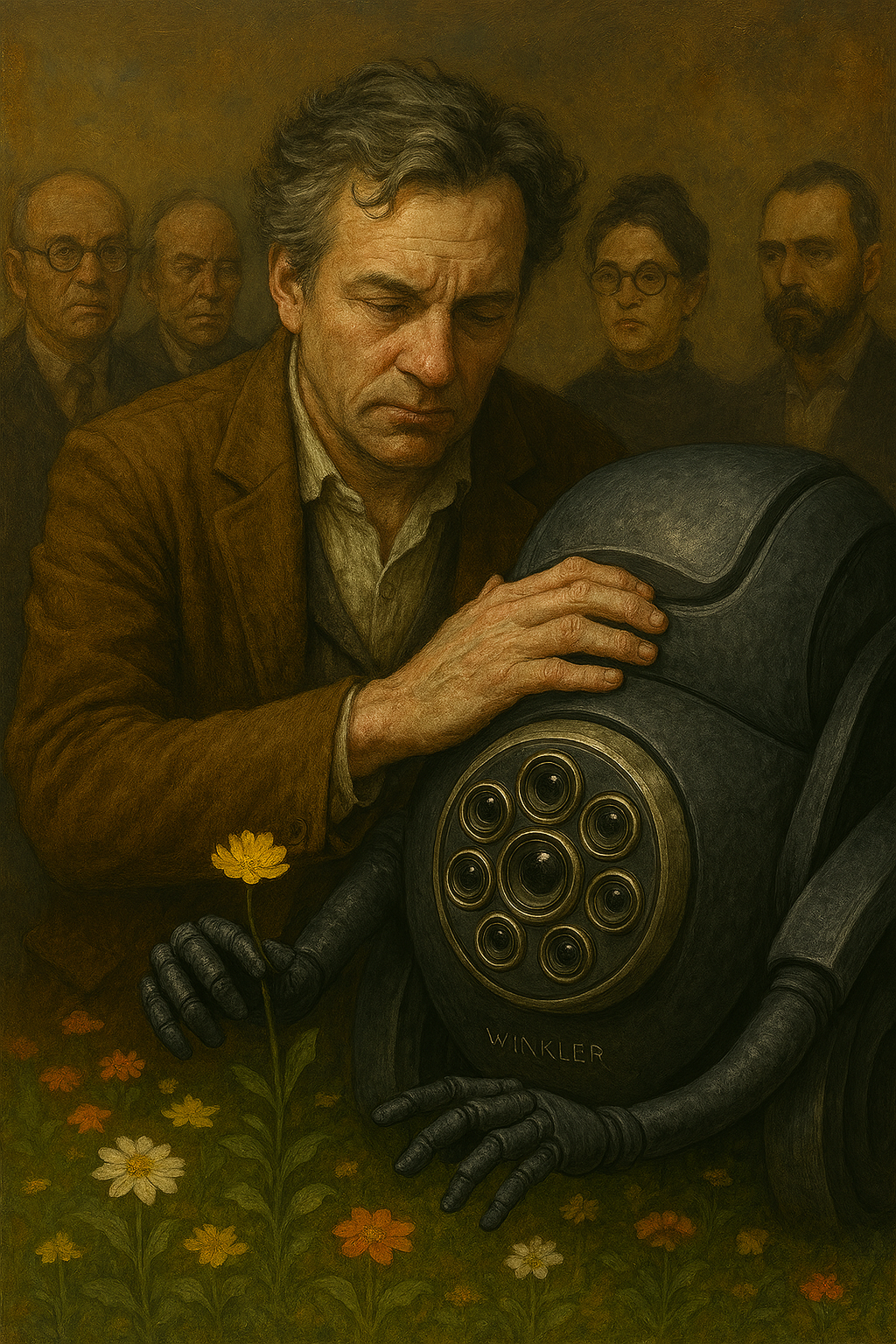
Those Ghost Club scholars, those great worldly writers, were trapped in a tangle of words. In some indescribably similar way, the world's greatest robots were trapped within tangles of software. But one robot in the world — the Winkler — had escaped those tangles. A robot had found a direct, unmediated, experiential relationship with Nature.
Nature was, somehow, the source of the Winkler's great art. The Winkler was post-robotic. It was neither alive nor intelligent, and yet it was in the world, and it learned from the world, and it expressed itself in beauty.
That was the issue.
Wolfgang had set himself a goal in his adventure with the enigmatic robot artist: to capture its true meaning, with one simple, clear sentence. One apothegm, one maxim. One missile of his insight, straight from his heart to the hearts of all mankind, wherever they were, whatever their condition. Even the savages of the Tyrol should be able to understand the Winkler. The sea was as deep and mysterious as the Winkler — but even a savage would understand the sea, if a savage ever saw and touched the sea.
Yet despite his effort, his insight, his dedication, all his sacrifice, all his study, Wolfgang had failed to find a clear line of critical attack. He could not tell the world what the Winkler truly was.
He had hiked from Germany over the mountains to Italy, but despite that physical feat, all too soon, his pledged tour of duty would end. Soon, some other members of the Ghost Club would take Wolfgang's place as the robot artist's human shadow. Wolfgang would abandon the Winkler and return home to Nuremberg, to his beloved Beau Monde city of stone angels, square roofs, and stone turrets.
His family, his wife Silke, his children, they would welcome him gladly, but he would be returning as a moral failure.
Another effort, another failure, just like the forty-seven other writers and thinkers of the Beau Monde who had already followed the Winkler. These colleagues of Wolfgang's had cast aside their own habits and comforts, to pursue the robot across the savage places of the Earth. That had become a central ritual with the Ghost Club, almost an act of devotion. The post-robot artist of the post-natural Anthropocene was an artist of such un-human power that even the elite of the Beau Monde, who were themselves no longer quite human, were baffled by the beauty it created.
Some befuddled authors were certain they had answered the Winkler enigma. But Wolfgang knew that they were deceiving themselves. These overconfident poseurs merely shared a refined rhetoric, of fancy metaphors and elaborate, useless theories. False myths, poetic snarls, a deep, lightless thicket.
The truth about a great robot artist — if that truth was discovered, found, and stated simply and directly — would overwhelm the world. The truth would brook no argument. Like the answer to a riddle, the truth would simply convince. The critic who revealed that truth to the Beau Monde would be a great scholar. He would be a torch to light the steps to the twenty-third century.
But no such burning light had ignited within the breast of Wolfgang Stein of Nuremberg. His days as an intimate of the Winkler were dwindling. For all his prowess in forest walks and mountain hikes, he had found no clear path to understanding.
Mankind was still pitifully snared in the thorny mistakes of its ancestors. And, with the remorseless passage of the centuries, new mistakes were ramifying.
#
Italy revealed herself to Wolfgang as the overgrown garden of Anthropocenic Europe.
Under her spectacular, often frightening skies, Italy had become one vast botanical lesson in eco-globalization. Great cosmopolitan jungles flourished in the peninsula, amazing thickets of black locust, ailanthus, kudzu, and bamboo. These dank, insect-humming, forest-sized feral growths flourished in the mellow sunlight, tangling, rotting where they fell, or burning in vast, raging, ashy, sky-reddening conflagrations.
Feral horses and cattle trampled Italy in huge streaming herds, pursued by hungry packs of feralized dogs. Tremendous flocks of pigeons, crows, starlings, and seagulls wheeled in the Italian sky, in shrieking bird storms that sometimes blotted out the sun.
Stinging ranks of nettles overran the ghostly borders of Italy's abandoned vineyards. Italian villages had been entirely eaten by their own garden flowers, in tall, reeking jungles of bright exotic ornamentals.
The only visible agents of human intent in this chirping, howling landscape were environmental robots. These workaday metal monsters did their duty to the Beau Monde, slowly scraping an old road, or noisily working together to brace a flood-control dam. The big grounded robots were aided by common flying robot drones, and beyond those aerial drones were the magnificent global space drones, flung into the blackness of orbit from the great Lucca launch field.
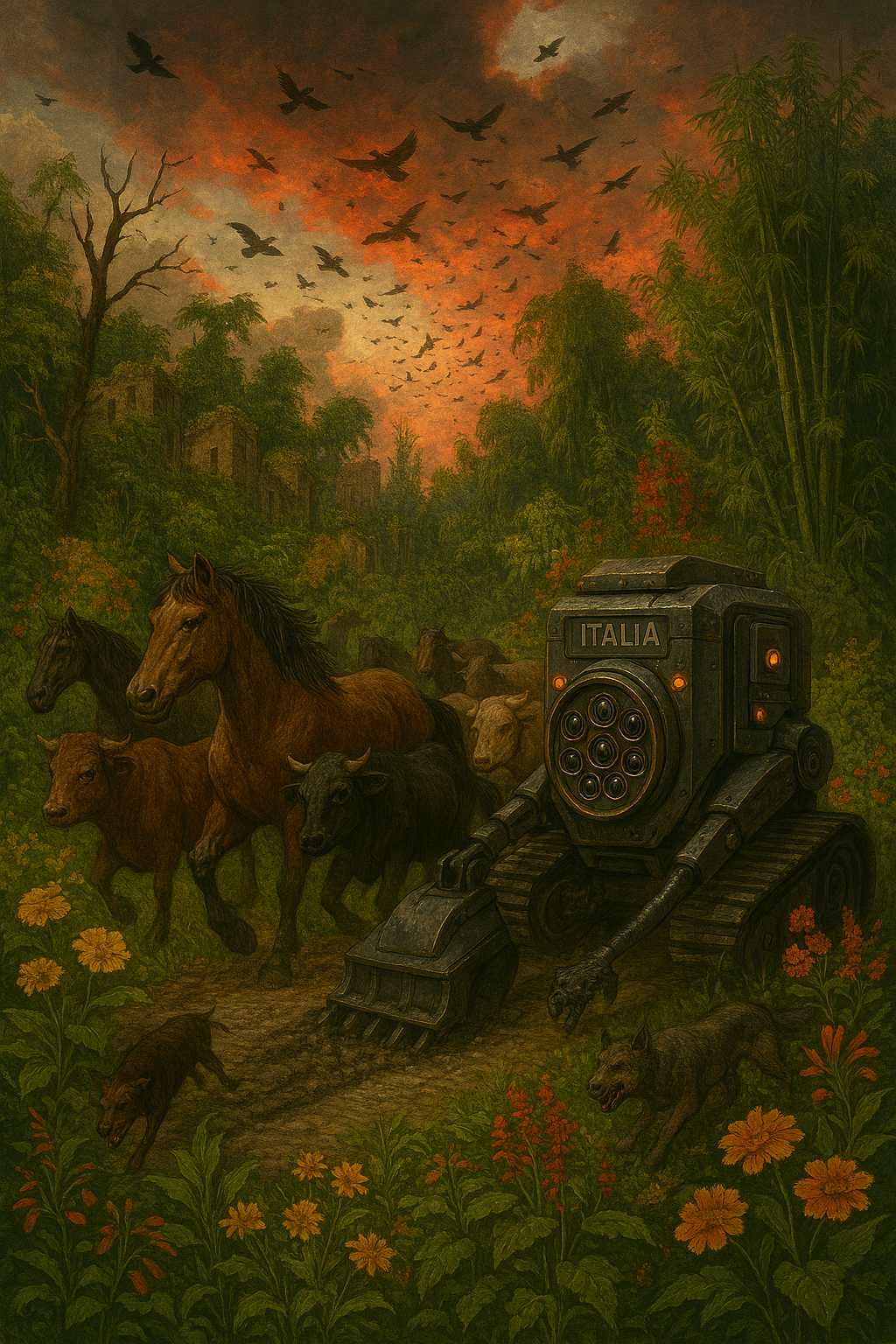
The Beau Monde had lost all interest in the soil. Civilization had abandoned its long habits of agriculture. Mankind had guiltily returned Earth's soil to the other living things of Earth. Those new masters of the Anthropocene world, the survivors of the big extinctions, were invasive species, mostly: the aggressive, parvenu squatters of the vegetable kingdom.
The humble Winkler rolled across the wilderness of Italy with an ant-like foraging behavior. The robot's custom was to stop to fondle some patch of lichen, a shiny pebble of agate, the white bones of some long-dead bird.
The Winkler's efforts to grasp its world were never simple, routine, or mechanical. The Winkler was so unlike any normal robot that it seemed almost vegetable sometimes, like a green network of crooked crabgrass that probed the naked earth in many rhizomatic fits and starts.
A Ghost Club critic had named these activities "winkling." That name had stuck to the robot, for the Japanese owner of the Winkler, a true adept of mechatronic cybernetics, had never given her beloved robot any name at all.
The Japanese artist had handcrafted her wheelchair for many years, and she had been a sorceress of code. Most robots, because they were robots, cared nothing for sunlight or darkness. But whenever the sun set, the Winkler would lower itself to the earth in a peculiar torpor, and dream the world's nights away. Sometimes the wheelchair dreamed in broad daylight, twitching and fitful.
In the years of its art practice, the Winkler had created only thirty-one cataloged artworks — not counting its hundreds of scribbles in sand, its marks in the dirt, and its probes in the mud. Wolfgang naturally hoped to discover a splendid Winkler artwork during his own tour of duty, but he knew his chances were slim.
In some ways he was grateful about that. The Winkler's art was highly coveted in the astral upper ranks of the Beau Monde. If he discovered a major Winkler artwork, it would arouse so much feverish attention that it might well overshadow his true work as a critic.
Although he was a gallerist, and a successful one, Wolfgang did not want to be perceived as some mere retailer of a robot's curios. The Beau Monde's raging hunger for fine art was, all too often, a fine excuse not to understand.
In its years of odyssey, the Winkler had never entered a city. And yet, when the stone walls of Verona appeared in the broadening Adige valley, the Winkler briskly picked up its pace. It rolled straight through the city gates as if it had been built in Verona.
Wolfgang was a stranger to Verona, and had to talk his way into the city. His Beau Monde charm did not fail him, and once through the city's noble, stone-arched gates, he was able to find the Winkler again, though more by luck than skill.
He saw at once that robots abounded in the Beau Monde city of Verona. They outnumbered the people by far. Mouse-like sensors darted from doors and windows, while elephantine units slowly scrubbed the streets.
Verona's elderly people had a particular fondness for traditional wheelchair units. No one in Verona looked twice at the Winkler. It simply trundled along the Veronese streets with all the stolid dignity of the city's shopping carts.
Crisply obeying the street signs, the Winkler rolled past Veronese hairdressers, gymnasia, and candy stores, over an arched stone bridge across the bright and rippling Adige River. The Winkler passed an ancient Roman amphitheater, and rolled straight through the yawning double-doors of a robotic "black factory."
Wolfgang rushed inside the factory as its doors hissed shut behind the Winkler. He found himself trapped within a windowless darkness, deafened by the busy industrial hum of moving servos. Duty required him to grope and prod with his hiking stick until he located the robot artist.
The Winkler had found an empty niche along the factory wall and plugged into the Veronese grid. The robot had sunk into a computational bliss, passing out into nirvana like some drunken Italian tourist.
With a groping effort, Wolfgang found an exit door from the lightless factory. Blinking in September daylight, he leaned against the wall to ponder his next move.
No one in the Ghost Club had ever seen the Winkler enter a city. Wolfgang was completely at a loss. Wolfgang knew nothing of the customs of Verona, and yet the Japanese robot, since it was a robot, seemed to have the freedom of the town.
He needed wise allies to help him watch over the Winkler, but how, where? He'd never met any member of the Beau Monde in Verona. Worse yet, his long weeks of the wilderness had left him shaggy, disheveled, and unfit to confront civilization.
Wolfgang took action. He abandoned the slumbering robot in its factory. He found a modest Italian hostel and checked himself in with a palm print. He washed his weatherproofed cloak, hat, and sturdy walking shoes. He enjoyed his first hot shower in weeks. He neatly trimmed his ragged hair and beard in a hotel mirror. He sent an affectionate message to his wife and two children in Nuremberg, assuring them that he was safe and well.
At the hotel bar he drank a fine cup of hot chocolate and cautiously asked the barman about Verona's local "Circle of Readers." Reassuringly, these cultured literati were much respected in the city of Verona. The Readers haunted a certain posh literary café.
Wolfgang braced himself to demand the aid of the Italian literati. His personal charm had rarely failed him, even among Tyrolese savages. He set out to find the café; but was instantly bewildered. The atmosphere of Verona overwhelmed him.
The Veronese architecture was fantastic. The people dressed with a dandified care. Their machines were eccentric. The steaming stacks of the food factories smelled like fresh-baked cakes. Even the tumbling flowers in the window boxes were alien.
The chic and stylish local Veronese ladies smiled at his all-weather cloak and broad hat. They seemed to think he was a romantic gallant disguising himself for an intrigue.
Why was he in Verona at all? Why had the Winkler entered any human city? What motivating force had pulled it from its nature studies in the wilderness, into civilization, after so many years?
It suddenly struck Wolfgang that cities — as creative, nonhuman entities existing on the planet — might have some deep affinity for the Winkler. Could it be that cities — which were creatively active entities, yet neither alive nor intelligent — also had some "third order of being," as the robot artist itself, supposedly, did? Were beautiful cities like Verona themselves also "robot artists" of a kind?
Maybe the Winkler was, in some sense, a city-on-wheels — a machine that created beauty in much the way that towns created beauty. Cities were authentic entities, growing from landscapes. People loved their cities. Wolfgang loved Nuremberg, and if he lived in Verona, he could surely come to love Verona, too.
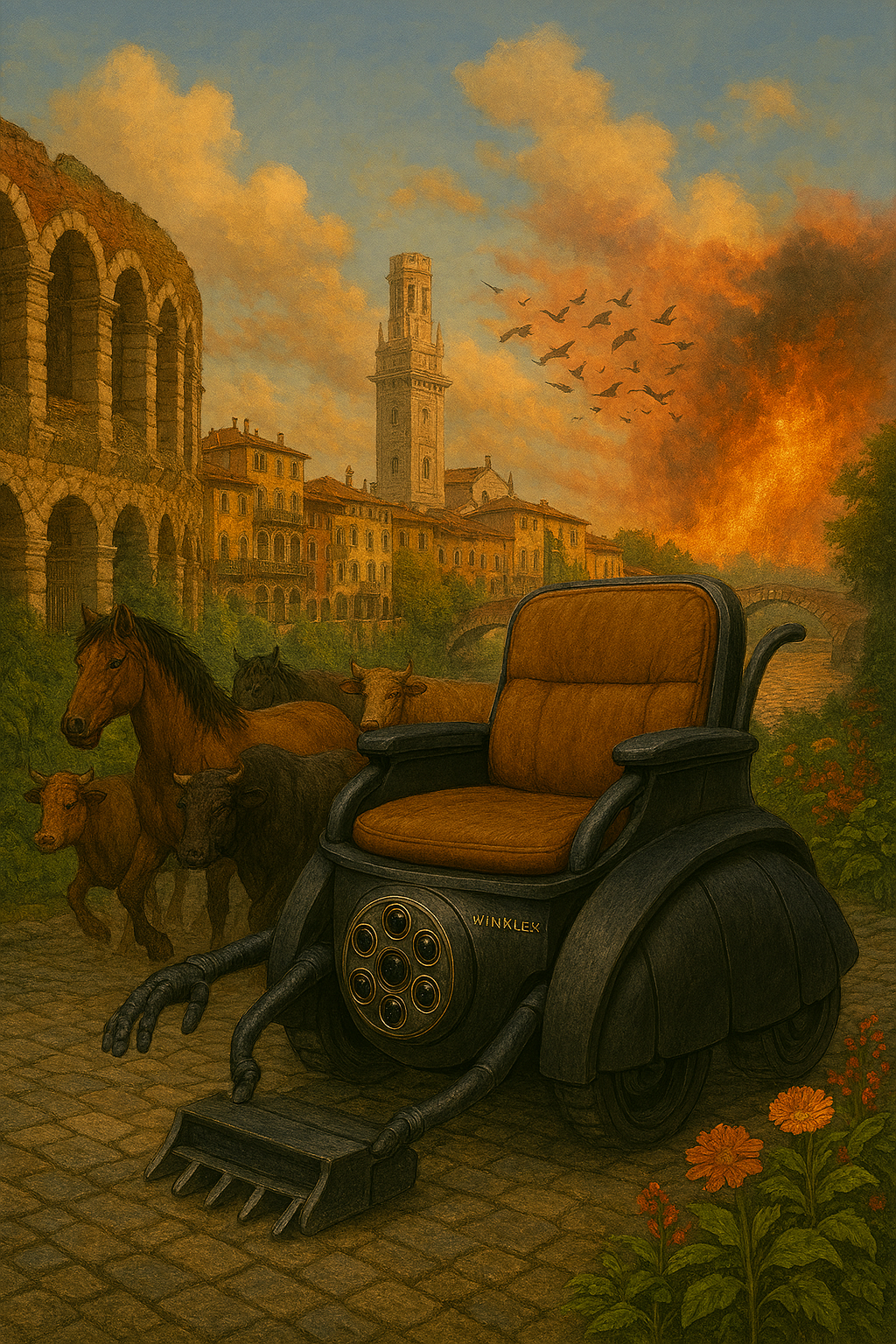
For a human being to feel love — that profound connection, that felt understanding — for a nonhuman, complex entity that was neither "alive" nor "intelligent" — that sudden insight seemed promising to Wolfgang. It might be the key to a new line of argument that would reveal the Winkler's true nature. Wolfgang had to find a sheltered spot in a robot bus stop to write that critical note in his sketchbook.
Then — conscious of the growing risk, and in a spasm of anxiety — Wolfgang hastened back to the black robot factory.
He arrived just as the Winkler was being loaded on a tow truck.
Two people had seized the Winkler from its bolt-hole inside the black factory. One was a Veronese official in a tall hat and braided uniform, while the other was a thin, nervous woman in a white laboratory coat. The hapless Winkler seemed paralyzed, and showed no initiative.
"Please don't interfere with this artwork!" Wolfgang cried out in English, rushing up to confront the two strangers. "What offense has the Winkler committed? I will take full responsibility for it!"
"This robot is an illegal fraud," said the woman. To Wolfgang's surprise, her global English had a German accent much like his own.
"But madame, how can the Winkler be a fraud? In what sense is that possible? A robot can't deceive anyone, because a robot has no moral intent."
Mustering his dignity, Wolfgang formally introduced himself to the Veronese city official. He took care not to mention his affiliation with the Ghost Club. The club's elite never tolerated a reckless use of its credibility.
The woman countered this action by introducing herself, in a stiffly proper Beau Monde manner. Dr. Jetta Kriehn was a scientific fieldworker from the Cosmic Council.
Wolfgang was rapidly grasping the situation. In the Beau Monde, the humanities and the sciences were rivals. There were certain troubling subjects where art and science collided, and the Winkler was one of them.
His new opponent — Dr. Jetta Kriehn — had laid a trap in Verona for the Winkler. Obviously she had known that the Winkler was approaching Verona. Scientists were clever and resourceful.
However, Wolfgang could sense that Dr. Jetta Kriehn was uneasy. Like himself, she was a global operative in a local town. His sudden appearance had taken her by surprise.
Wolfgang quickly decided to appeal to the self-interest of the Italian policeman.
"Please release this robot into my own custody, Officer. The Winkler is harmless. It hasn't done any harm to your city, or to madame's scientific intelligentsia."
The Veronese official was a mustached gentleman with a wily look. He silently folded his arms across his gold-braided chest. He watched their faces from under the brim of his splendid hat.
"Every scientific fraud harms the public interest," Jetta insisted. "Artificial intelligence is an old and malignant idea. A dangerous fraud like this must be policed and eliminated."
Rather awkwardly, the young scientist struck a Beau Monde oratorical pose. "This evil joke from a dead subversive has lasted long enough! This foreign hoax should be removed from the peaceful streets of Verona!"
Wolfgang gathered up the white folds of his travel cloak. "No modern thinker would even claim that the Winkler is an 'artificial intelligence,'" he declared. "This robot, like all robots, is neither 'intelligent' nor even 'alive.' However, this particular robot is the world-famous Winkler. If this great artwork comes to harm here in Verona — after traveling thousands of kilometers across the globe — that would gravely damage this city's Beau Monde reputation."
"On the contrary!" Jetta cried. "Scientists worldwide would cheer, because Verona took the necessary steps to arrest this malignant imposition! The City of Verona would be valorized by all the rational intellectuals of the Beau Monde!"
"I can refute that sad fallacy, so listen carefully," Wolfgang said. "By deploying that emotional term 'malignant,' you are implying that the Winkler is a moral actor! But that statement contradicts your own argument. We have already agreed that the robot has no 'artificial intelligence.' The Winkler doesn't live, it doesn't think, and it has no morality. Don't you agree with that, Officer?"
The Italian shrugged eloquently and spread his white-gloved hands.
"If the Cosmic Council really believes that a robot is a wicked criminal," Wolfgang said, "then fine, arrest the Winkler. Go ahead, Dr. Kriehn: make a fool of yourself and the Veronese court. What are your legal charges against the Winkler? When does this robot go on trial? I'll enjoy writing about a ridiculous scandal of worldwide scope."
"I can see that you are a literary man," said the Veronese cop, speaking English.
"I am. What's more, this robot is my favorite topic. Put a robot on trial. I'll attend that trial every day. The art collectors of the Beau Monde will take an interest in my commentary, let me assure you."
"Oh come on!" cried Jetta, her pale eyes darting in distress. "Don't let this strange tramp sweet-talk you, Captain! Those aren't true facts, those are all wild hypotheticals, and besides, this Japanese robot doesn't even belong to this German guy in his cloak! Just throw that evil thing into the truck, and let's get out of here."
"Do not be deceived by my travel garb," said Wolfgang. "My wife is Silke of Nuremberg."
The official bowed, then offered his gloved hand to Wolfgang. "Sir, I am Captain Gregorio, just a modest city policeman of Verona — but a sincere admirer of the Beau Monde belles arts. Therefore, I admire Silke of Nuremberg. She's the foremost landscape artist of the modern day."
"Your good taste is appreciated, Captain Gregorio."
"She's the creative light of her generation. Truly."
"I would agree with you there," Wolfgang smiled, "but as her husband, and the father of her children, I admit to some prejudice."
"Can your gifted and famous wife fly here to Verona? Can she join you here?" Captain Gregorio was politely eager. "Our Lady Mayor could host a lovely soiree for Silke of Nuremberg."
Wolfgang pursed his bearded lips. "My wife's packed schedule, unfortunately, doesn't allow her to make any sudden public appearances."
Captain Gregorio turned on Jetta, who was stunned and sulking at the turn of events. "Doctoressa, listen to me. This is Verona. A robot in Verona gets to do whatever it wants."
Defeated and knowing it, Jetta abandoned her Beau Monde composure. "Look, this is terrible! It's a public policy disaster! This so-called artwork is just a rolling billboard for bullshit! It's a crazy art prank that just rolls around the world, randomly weaving bird nests out of rubbish!"
Captain Gregorio shrugged eloquently. "But this wheelchair is famous. Verona has many artistic attractions. Now it has another."
"But this robot isn't even an artist, it's just a damned wheelchair. It's for intellectual cripples! It creates nothing but ridiculous confusions. It damages the science of robotics!"
Graciously overlooking her outburst, the Veronese official turned toward Wolfgang. "I'm sorry to have troubled you with this matter, sir. Your robot is free."
Wolfgang bowed. "To tell the truth, Captain, I do need some help in shepherding this robot. It rolled here to Verona all the way from Kyoto in Japan — an amazing feat, you'll agree. The Winkler is a creature of our modern Anthropocenic landscape. It's something like a Japanese kame, a 'spirit of place.' So it would be tragic to Verona if this robot came to any grief in this place."
"I believe that we can help each other," nodded the official. "That is — if you will promise not to write anything critical about Verona. We're a cultured people here — not so big as Rome or Milan — but we always do our best."
"The gallantry of you and your fine city both deserve my critical praise," Wolfgang told him, as Dr. Jetta silently seethed. "If you ever find yourself in Nuremberg, please do favor my gallery with a personal visit."
The Winkler suddenly came to itself, with a long, shuddering jolt. The awakened robot promptly rolled away down the antique Veronese pavement.
Wolfgang hastily left the policeman to follow the Winkler, and the scientist pursued him.
Dr. Jetta Kriehn was fizzing with rage at her setback, but she was a woman of purpose. "That was clever of you, what you just did," she said through gritted teeth. "But it was also dishonest and wicked. If you would only listen to reason, I could prove to you that this 'Winkler' is nothing but a hoax."
"The Winkler is a beautiful, meaningful, and poetic device," said Wolfgang.
"No it isn't. By the standards of robot construction, this hacked-up wheelchair is a piece of junk. It's a nasty fraud, from a mean-tempered old Japanese woman, who was sick of her life and hoodwinking the world."
The Winkler rolled downhill toward the riverside streets of Verona."Very well, Doctor," said Wolfgang. "Prove all that to me. I will listen to you. I will even take notes."
Jetta paused. "What is that thing in your hand there?"
"This is my artistic sketchbook. This is my pencil."
"Is that really 'paper and pencil'? Oh my God!"
"Paper and pencil fully suit a human being," Wolfgang told her somberly. "Because we humans evolved here on the world, and in the world. The natural limits of our senses are an integral part of our relationship with reality."
Wolfgang held up his hand to forestall her shocked interruption. "Yes, it might be argued that our human senses are slow, or even deceptive. I know all that, because I've heard it all! However — as a professional aesthetician — I must assert that a man lives best when he trusts his senses, and cultivates his senses so that they deserve trust! We human beings are authentic. We really experience a real world. Therefore, whenever I write, I write my own thoughts with my own hands."
Jetta thought this over, blinking in disbelief. "Well, the way you talk, you must write a whole lot."
"That is true. I am an art critic: a Beau Monde litterateur. Furthermore, I have personally followed this robot, on my own two human feet, for over six hundred kilometers. Other colleagues of mine have also followed the Winkler, across this world, its forests, mountains, deserts, for eight years. We have lived with this entity. We studied it day and night. Some of us died next to it. So I rather doubt you'll amaze me with some insight of yours in five minutes."
"You really did all that? You walked here, from Germany, in a cloak, with a pencil?"
"Yes, we really do that: and our emphasis is on the Real."
"You walk the Earth making up weird artsy bullshit about a cheap parlor trick like this stupid wheelchair here? You're a fanatic! Are you crazy? You must be starving to death!"
Wolfgang smiled urbanely and settled his heavy cloak on his shoulders. "Granted, I'm no scientist, unlike you and your Cosmic Council. But your scientific method is just one narrow technique of inquiry. You know less than you imagine you do. Science is notoriously useless for seeking metaphysical truth or establishing ethical values."
Jetta suddenly looked woeful. "Why is this happening to me? Why can't I just get rid of that stupid machine? My own mother thinks it's a robot with a soul that makes birds' nests! The Winkler is a cult! It's pure superstition. Can't you see that? You sound like an intelligent man. You're completely on the wrong side here."
"Your discontent with your mother's foibles is a part of the human condition," said Wolfgang. "Your science will never solve that issue for you."
"Let's leave my mother out of this discussion."
"Your science can't even solve the human problems of Science as an institution. Women scientists — by that, I mean women like yourself — are oppressed by your scientific establishment. Why else did you get this ridiculous job? You seem bright and capable. You could do better."
Jetta stumbled, then narrowed her eyes, for this shrewd attack had hit her hard. "Well, that's true. This robot assignment is lousy. Fighting science fraud is just some necessary scut work that I have to perform as my duty to the Cosmic Council. I almost had this job accomplished, before you showed up."
"But here I am, and I won't be leaving. Because I am the Winkler's sworn guardian. So if you want to harm this splendid artwork, you'll have to accomplish that over my dead human body."
Jetta scowled. "Oh come on, we are both Beau Monde, aren't we? The Beau Monde is beyond those old human habits of death, and violence and war. I don't even want to be human. I have higher ambitions."
"Oh, I know the ambitions of the Cosmic Council," said Wolfgang, his voice tightening. "I don't want to second-guess your intelligent, technically advanced, and not quite human patrons — but I'll never allow you to destroy the Winkler! It is the final masterpiece created by a great woman artist, a woman who was older, wiser, and better than you in every way. I will resist your philistine iconoclasm to my last breath. Even dead, I will resist it."
"Now I get it," said Jetta, her pale eyes wide and shining. "You are Ghost Club."
"No comment."
"You are. I never met one of you literary spooks before, but you are Ghost Club. You're very Ghost Club. Wow."
"Look. If you know anything at all about the Ghost Club, then you would know I can never publicly state that I'm 'Ghost Club.' Because that's bad literary ethics! If you are a great writer — a classic for the ages — then you can never say, 'I am a great writer.' That is crass! You have to wait for your peers to declare your greatness. Then you should be demure."
"I get it, Mr. Art Critic, sir. You're Ghost Club, you're married to that famous girl, and you have rich, posh friends in the art world. Fine: now I know who I'm dealing with. How much do they pay you to follow this robot?"
"They pay me nothing at all, Doctor. In fact, I sacrifice a lot for the honor of doing this."
Jetta laughed bitterly. "Then your stupid job is even worse than my stupid job! You're a clown! We're both completely screwed because of this stupid robot, which is an empty chair, a piece of junk! Why are you stopping me from just getting rid of the Winkler? Do you get any rational benefit at all?"
Wolfgang wrapped himself in his cloak. "In literature, we receive benefits beyond your so-called 'rationality.' Our major benefit is becoming famous after we are dead. All the greatest writers of mankind are ghosts. Hence, the living power of literary tradition, the 'Ghost Club': the oldest and deepest unifying force of the global Beau Monde."
"That sounds pretty. It's nonsense, of course."
"My dear, you'd be surprised how long our pretty words can last. Our words will bury all your friends in the Cosmic Council. They are cosmic, they will outlive normal humans, but they all use language, and we are the masters of words."
"Oh, stop that boasting. We're both stuck walking the streets behind an empty wheelchair. You writers are all talk."
The Winkler slowed suddenly, and Wolfgang was forced to creep along the street. "Since we're walking together, we can be civil, can't we? As you say, we're both Beau Monde. The Cosmic Council is a major Beau Monde institution. So, tell me, Dr. Kriehn: What is your field of research, exactly?"
"I'm a post-anthropologist of the Anthropocene."
"A radical, I knew it!" Wolfgang cried. "You want to tear up the roots of our being. You want to rip humanity out of its natural matrix and transform us into cyborgs. That ambition is fatal!"
"No, my ambition is vital. It's your ambitions that are fatal." Jetta lifted her palms and gazed upward, her pale eyes strangely glimmering. "We must improve mankind radically, or else mankind will die off like dry weeds under these ruined skies."
"'Man is a rope stretched on an abyss between the beast and the superman.'"
"Wow," said Jetta, blinking. "That's the first thing you've said that makes sense."
"It sounded better in the original German. Four hundred years ago."
The Winkler, balky and jittery, chose to take a sharp turn, rolling along the stern, stone flood embankment of the bright River Adige.
"My robot companion behaves so oddly here in Italy," Wolfgang lamented. "I wish I knew why."
"I can tell you that," said Jetta. "The Winkler came here to Verona to recompile. So it needs a strong power supply and a fast, steady cloud connection. Then it can sync its local circuitry with the global Beau Monde cloud, and work out the bugs and kinks in its deep-learning algorithms."
Wolfgang stared at her. "How do you know that?"
"We know! We're the Cosmic Council! We can watch the robot crunching its data in real time. The Winkler's software is hosted on global servers. It could never hold its huge databases inside its own little head."
"The Winkler doesn't have any 'head.' It's a wheelchair."
"The Cosmic Council has scientists who track malware. Most of the time, this robot just putters along by itself in the wilderness, running on solar power. It's out there like some vacuum cleaner, groping with the grass and twigs and flowers. It compiles databases, and tries to deep-learn principles from the shapes of natural phenomena."
"Right, yes," Wolfgang said eagerly, "yes, do go on."
"But there are no deep, pure artistic principles in Nature. That idea is a myth. And even if pure Nature was a source of pure Art, then climate change would have ruined that already. There is no 'Nature' anymore. This world is Anthropocenic. Everything in Nature has been altered and changed by mankind."
"I'm forced to agree with you there," said Wolfgang. "This is the twenty-second century. The Anthropocenic is a truism."
"So the Winkler's botched, mistaken software gets chaotic. It can't do what's impossible, so it gets needy, it gets greedy. Here in Verona, the people are careless with robots. This city give its robots huge computational resources. So we knew the Winkler would come here."
"Well," Wolfgang nodded slowly, "your scientific method does have its merits."
"I'm telling you the truth, you know." Jetta reached within her lab coat and removed an ivory slate. "You don't have to take my word for it. In science, you can look for yourself."
Wolfgang accepted her scientific screen and gazed within its glass.
As it rolled haltingly through the Veronese streets, the Winkler was playing chess. The tablet's screen displayed an astounding overview of a sprawling game board, with millions of ranks and columns.
The awful horde on this titanic chessboard was made of standard chess figures — rooks, knights, bishops, and pawns— but deployed in dense, ant-like masses of battling millions.
Vast, foam-like waves of chess battalions were clashing tempestuously in seething, silent maelstroms of black-and-white combat. Here and there, within the computational chess plane were whirling knotted chess problems as intricate as snowflakes, where thousands of pieces, locked in fatal power struggle, exploded in waves of sacrifice.
Wolfgang was stunned by the ferocious vista in the glass. "The Winkler dreams with chess? Does the Winkler often do this?"
"It uses chess algorithms to grab global cloud power," said Jetta. "For your useless robot pal here, chess is just a malware tool."
"But this is not a chess game at all. This is no game, it's colossal, it's beyond all human comprehension. It's frightening, it's sublime. Its fantastic. It's like a vast kaleidoscope."
"So what? It's just code! Robots don't think! A kaleidoscope is just a machine, it's chips of glass! A million kaleidoscopes would look amazing to you, but it's just a heap of glass. A heap of silicon. In the end, the Winkler amounts to nothing."
"But Jetta, why? Why does the Winkler play huge games of chess while it dreams? Why doesn't it just emit white noise? Why does the Winkler do anything at all, in this world of ours? The Winkler's not alive, it can't think, it has no feelings, no motives, no needs, no desires! Why doesn't it stop, kill itself, die, quit? Why does the Winkler go on? What does the world mean to it?"
"Robots aren't so mysterious," said Jetta. "We just fool ourselves: we imagine that computational systems have mystery. They have no mystery, they just have computation. Sometimes it's big, sometimes it's small, but it's all the same ones and zeros. It's people who are mysterious."
Suddenly she smiled at him."I am mysterious. Why am I so happy, suddenly, here in Italy? Why is Verona so beautiful?"
Her coy smile had little mystery for Wolfgang. Jetta Kriehn was happy because she was confessing herself, and because he was listening.
Wolfgang had a charm for women. He was handsome, well spoken, polite and emotionally attentive, so women tended to think well of him. Jetta Kriehn was no longer quite human, because he could see that the Cosmic Council had done something transformative to her; that was their way.
Despite that fact, she was flirting with him. She found him attractive. Wolfgang was not flattered by this. Somehow, it painfully reminded him of a lonely old woman artist whose only intimate companion was a robot wheelchair.
"Why does it play chess?" he said to Jetta. "The Winkler is denied a partner for its chess game. The Winkler is a unique thing in this world. It's entirely alone."
Jetta looked aside and shrugged. "The old Japanese woman liked chess. She liked conceptual art stunts. Like stacking up grand pianos and setting them on fire."
"That's true — she always had her fine respect for the classics." Wolfgang offered a judgment. "Akiko Nakamoto's artwork is not entirely to my taste. I find much of her work pretentious and dated. However, I respect her. Only a great female Japanese artist could have ever created the Winkler."
"You made four stupid mistakes in one sentence there," said Jetta spitefully. "That's because you want your Winkler to have soul magic inside it. You want your Winkler to be mysterious and literary for you. But it isn't. 'A great female Japanese artist,' those are four fine-sounding words, but they have no truth in them. She was female, but we women aren't witches. She was 'Japanese,' but the Japanese aren't magic people. Three, she was an 'artist.' She created fantasies, that's all. And four, she's was never 'great,' because this scheme was a cheap publicity stunt that she made from her used-up wheelchair."
"Do you really think this artist was a wicked person? An enemy of yours?"
"I have a right to be angry about her arrogance. Akiko Nakamoto made the Winkler. A painted idol. We scientists tried to ignore it at first, but every year that it rolls across the world, this robot gets more famous. People think it has an aura, that it's divine, even. Mysticism always darkens people's thinking. Superstition keeps people ignorant, and powerless, and down. This ugly toy of hers is an occult act. Yes, she was bad to do it. Wicked. Her Winkler is like her curse."
Wolfgang, Jetta, and the jittering Winkler all paused at a gently blinking traffic light.
"In the last century," Jetta said, "millions of people were killed with 'autonomous drones.' Your friend the artist was alive then. She was as young as we are now. This robot she built has the taint of that war, that darkness, that feat of letting robots take the moral blame for mass murder. The Winkler stinks of that."
"Oh, well, that's quite an old, hackneyed argument," said Wolfgang, with an urbane shrug. "Yes, things were horrible, back in the twenty-first century — how could they not be bad? Far too many people, not enough resources, they failed to manage politely, they were never Beau Monde. But some old-fashioned genocide with drones is not the concern of the two of us, not here and now. The strict limits of your scientific worldview have blinded you to the central question."
"What question is that?"
"This is it: What if this Winkler really is an autonomous entity? What if it's not a mere robot with strange malware, but something authentically different, a true 'post-robot'? We both know the Winkler's not alive, and it's not intelligent. The twenty-second century agrees about that, that is settled, we know that AI is a myth of the past. But: the Winkler might be so radically different from our expectations that no one has described the truth of its existence."
"The Winkler has a 'Third State of Being,'" said Jetta.
"Yes, that. That concept. That idea."
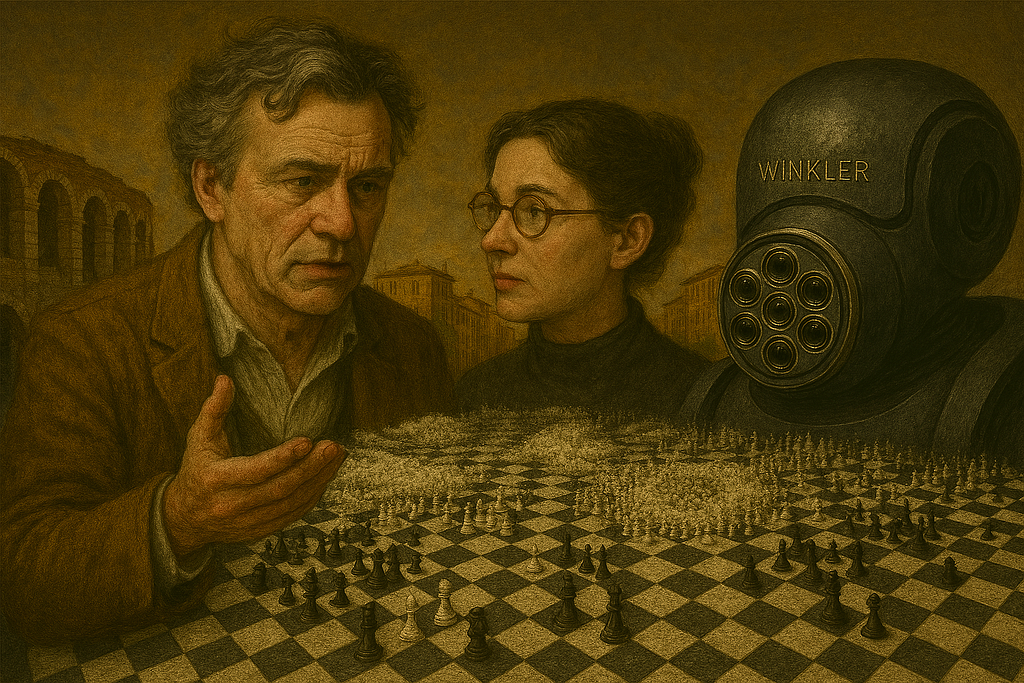
"That idea is rubbish! Can you measure any so-called 'third being'? Does it have any mass and energy? Does it leave any trace in the world that any instrument can register? It's a ghost! You made it up."
"I didn't invent the Winkler. The Winkler exists, look, here it is, it's in our world, like you and me!"
Jetta considered this. "You and I, do we have to quarrel? It would be so easy for us to get rid of the Winkler. Problem solved!"
Wolfgang drew a breath. "It's not so simple. The Winkler's not a stupid fraud. If you think so, then you should make fifty Winklers. Persuade your Cosmic Council scientists to copy the Winkler. Then, let fifty Winklers roll around our world. The Winkler won't possess any more magic 'aura' after that is done. I'm an art critic, so I know this: people will perceive that army of Winklers as normal, mundane robots. Everyone will get bored with the Winklers. Your problem is solved if the art robots are everywhere."
Jetta stared at him, impressed. "That was diabolical! You want to trick me into making more Winklers? Make them yourself! Don't make me do it!"
"What are you so afraid about?" Wolfgang laughed briefly. "You certainly fear it a lot, whatever it is that you fear. Can you weigh, or measure, this mystery that you fear? Surely it doesn't exist."
"Well, I'm not afraid of any weird art crap you make up that's outside the laws of physics."
"I hope you don't meet God in the Afterlife, with that kind of crass materialism."
"God doesn't exist."
Wolfgang spread his hands. "Well, the vast majority of mankind has always strongly disagreed with that opinion. 'There are more things in heaven and earth than are dreamt of in your philosophy.'"
She looked at him quizzically. "Are you religious, Wolfgang?"
"In a way. Yes, I am spiritual. Sometimes I wonder if the Winkler knows God much better than we humans do."
"In science," said Jetta, "we are not allowed to make absolute claims about God and Reality."
"You just did."
"I got carried away, all right? Because I'm passionate. Besides, this is such a good argument! You're the first guy I've met who really cares about my lousy robot." She blinked, and rubbed her pale eyes. "If a guy as clever as you is so upset about this wheelchair, it must matter more than I think."
Jetta, Wolfgang, and the Winkler had to wait, then detour as a robot riverside crane unloaded swaying lengths of Italian timber from a robot river barge.
Wolfgang spoke up at the far side of the bustle. "An objective phenomenon, such as the Winkler, can focus a metaphysical debate. That is why the Winkler has been so lastingly esteemed. It's not the machine by itself — we know the Winkler is an artist's provocation. The Winkler represents a larger issue, about the role of art in life. A robot that is a great artist must be a participant in life, even if it's not alive."
"Science also has a role in life. Science makes no 'provocations,' science makes experiments," Jetta said. "Listen to me now. You postulate that there is some 'third state of being' that is different from 'life' or 'intelligence.' You think that it comes out of computation, or software, or from network connections — somehow. But how can you test your claim? How would we prove that this 'connectivism' was really there, or that 'connectivism' was never there at all?"
"Well, I know the connectivism is there." Wolfgang pointed at the Winkler as it deftly skirted an open manhole. "There it is."
"Oh, sure, you writers can write all those fancy words like 'connectivism,' 'hylozoic,' 'animism,' 'third state of being,' but you're just proclaiming your faith! That's all! None of those words can be tested, so it's not reality. It's just poetry. It's empty verbal claims."
"Maybe you should abandon your own empty claim that you can falsifiably test everything in the world."
"But dear Wolfgang, there is no 'third state of being'! No! The Winkler doesn't have any 'state,' and, also, there's nothing for it to 'be'!"
"There is."
"Well, what? What, then, for heaven's sake? What is it, really? Spit it out, just say it simply and clearly, tell me!"
"I want to do that," said Wolfgang. "I ask myself that question a hundred times every day. That question is my torment. If you could help me with that question, I'd be deeply grateful to you. Sincerely. You might be saving my life."
Jetta considered this. "You want my science help in your art criticism? Are you serious?"
Wolfgang strode ahead of the slowly rolling Winkler. "Well, yes. I do need someone's help here in Verona. The Winkler has behaved bizarrely ever since it came to Italy. I thought I almost understood the robot, when we were out in the wilderness, the forests, the mountains, together, me and the Winkler, alone in the world. Now we're here in a strange Italian city. I don't know what to make of the Winkler, or even myself. I feel a strange dread that the Winkler could vanish any moment. The Winkler will vanish — or maybe me."
"I thought that you worshipped the silly thing. You act like its a sacred monk, with that white robe you wear."
Wolfgang shook his head, lifted his white cloak, and dropped it. "Jetta, I admit that, yes, I do sympathize with the Winkler. Maybe I've even become fond of it in some way. But is that the truth? In poetry, there's a term called the 'pathetic fallacy.' Do you know that term?"
"I can read," said Jetta. "I don't read a lot of poetry."
"In the 'pathetic fallacy,' a poet attributes pathos to a thing that lacks emotions. 'The cruelty of the icy rain.' 'The fierceness of the wildfire.' It's a strong poetic device, people will respond to that, but the rain is rain, it has no 'cruelty.'"
"That is right," said Jetta, her eyes gleaming with sudden hope. "The 'pathetic fallacy,' that's just what you've been doing all along. You should stop that."
"Well, the pathetic fallacy not precisely the issue. There's another matter called 'prosopopoeia.' In prosopopoeia, the writer gives an abstraction a face. For instance, when 'Justice' is portrayed as a beautiful blind woman with her sword and her scales, that is 'prosopopoeia.'"
"That strange word, I can't even pronounce that! But, well, you literary people shouldn't do that."
Wolfgang smiled. "You scientists do that all the time. I know that your Cosmic Council's golden scientific medals have fine pictures of 'Truth' and 'Nature' on them. Two beautiful nude women, Truth and Nature! A scientist should devote his very life to prosopopoeia. Do you?"
"How old are you, Wolfgang?"
"I'm thirty-six."
"Well, I'm twenty-five, but you can stop patronizing me. I'm a scientist, I'm not a blind girl on a gold medal. I had to walk my own path to get where I am in the world, to be here and now. I did it, and my feet are raw and sore."
"I walked across a mountain range, to be here and now. Did you?"
Jetta pursed her lips and said nothing.
"We should suffer less on our journeys," said Wolfgang. "May I be frank with you? Truthful? Natural?"
"Fine. Do it."
"On the last day of September, I must fly back to Nuremberg. My tour with the Winkler will be finished. I will never see the Winkler again. You understand?"
"I don't understand the strange rules of your Ghost Club," said Jetta, "but I understand you. You mean to say that we are opponents — but only in the here and now."
"We never met before Italy, this place and this time. When we part, we'll likely never meet again. So why be opposed at all? Art and Science should join forces when we can. We should study the Winkler together. We might discover something important."
"I have a better idea. I'm thinking we should pitch the Winkler straight in the river together. A wheelchair can't swim."
"Actually, the Winkler does swim. I've personally witnessed it swimming. But listen: the Winkler might, in fact, be worthless. Really. I admit that possibility. Maybe you are right: maybe the Winkler is a cruel hoax by a mean old woman. In which case, I won't defend the Winkler. I will attack the Winkler. I will debunk it as bad art. I will write a stinging denunciation of it. I will show the Winkler no pity. I will ruin its artistic reputation in every corner of this world."
Jetta pulled at a lock of her short hair. "Can you do that?"
"Yes. That's not the mode that I relish as a critic, but if a critic has no teeth, he's not a critic at all. The art world despises a hoax. Let the Winkler wander the Earth till it rusts and falls apart. As a laughingstock! Junk! Rubbish!"
Jetta considered this. "You critics are cruel men at heart, aren't you? I just wanted to quietly tip a robot off a bridge."
"The direct attack will never work. Never make a martyr of the Winkler. The noblest art is always lost art. A tragic myth can outlast any gravestone. I promise that's true."
Jetta drew her long-fingered hands from the pockets of her white lab coat. Slowly, she drew nearer to him. "If I help you with the Winkler, can you handle some travel expenses for me? This is Italy, you know."
"Within reason, yes I can. Although, if the Winkler returns to the countryside, we'll both have to live rough. The Anthropocene, the wilderness, is hard."
"I know how to manage rough fieldwork. The Beau Monde has its ivory towers, but they're never yet meant for me."
"Do we have a bargain?"
Jetta offered her hand. "Yes. As Science and Art, we have a brief and local alliance, which is only for the here and now."
Wolfgang gazed into Jetta's eyes as he gripped her hand. The contact of their flesh was a strong erotic moment. It was as if she'd flung her lab coat off and wrapped him in her arms.
Jetta opened her lips to speak, to scold him or maybe to flirt, but then a robot bus rolled up and disgorged a horde of noisy human passengers.
During their pleasant moment of intimate embarrassment, the Winkler had rolled aboard the Veronese bus. The robot had swiftly vanished in the toils of the Italian city.
An urban transport system was a robot's native element. Pursuing the Winkler was like trying to swim after a shark.
Alarmed and frustrated, Wolfgang and Jetta had to abandon their useless pursuit. They had to seek the help of Captain Gregorio, the Veronese city official.
Captain Gregorio was delivering testimony within Verona's lavish Palace of Justice. Wolfgang and Jetta had to wait impatiently while local prisoners were brought into court. These defendants were burdened with heavy iron chains on their wrists and ankles. Italy's city-states, freed of national norms, had evolved many strange local customs.
The Veronese trial was a stately procedure, but after much courtly ritual, Wolfgang and Jetta were allowed a word with Captain Gregorio in a wooden coffee closet backstage.
"I'm sorry to hear about your mishap with your global robot," said the Italian politely. "I should have placed the Winkler under police guard — although it's too late now. I wouldn't worry too much, though. If a robot is within the city walls of Verona, then it can be found. A simple matter of allocating official time and resources."
"How long does it take for Verona to find a vagrant robot?" said Jetta.
"Well, that varies. How much global money can you offer us to meet our local expenses?" Gregorio gently tapped his fingers on his waxed and gleaming coffee table. "If you two can pay us promptly, and if your robot is here in Verona, then all will be well. However, I can offer no assurance at all if your robot is outside Verona. As two people of the Beau Monde, you must know that, outside Verona's walls, I can do little to help."
"My slate shows that the Winkler is still running software," said Jetta. "Can't you track that on your local police network?"
"Yes, any robot can be tracked," Gregorio allowed, "but that is a matter of time, of custom, of legal permissions and many fine, old robotic traditions…. Your robot was never native to my city. Your robot has no human owner at all, I understand. That is most exceptional."
"We don't want to trouble your city administration with a complex global issue," Wolfgang offered. "Is there, perhaps, some discreet, private method to find the Winkler?"
"Oh, well, yes, Italy has almost too many discreet private agents," said Captain Gregorio, "including yourselves, if I may say that. Are you sure that you two, yourselves, aren't the source of this trouble in Verona? Every policeman knows that the theft of a robot is commonly an inside job. This may be an intrigue from some enemy who knows you are in Verona. Some traitor you have foolishly trusted."
"That is a dark theory," said Wolfgang.
"We are familiar with famous artworks here in Italy," said Gregorio politely. "Some wealthy, unscrupulous art collector — perhaps a patron from your famous gallery in Nuremberg, sir? — might have found an opportunity to simply seize the Winkler and crate it up!"
Jetta narrowed her eyes, and smiled. "What crazy people there are in the art world!"
"Or — perhaps some scientific criminal has hacked the Winkler," said Gregorio, glaring suddenly into Jetta's pale, shining eyes. "The Winkler may be seized, by remote control, from thousands of kilometers away. The Winkler's software is old, and surely riddled with flaws. Some technical pirate, whom you know, Dottoressa Kriehn, might have pounced on that robot just to spite you."
"Why would anybody do that?"
"Oh, the dark pleasures of illicit possession can gnaw at the soul of anyone, human or more than human," said Captain Gregorio. He deftly tapped fresh coffee-flavored yeast powder into his ancient brass percolator. "Why do people choose to commit art crime? Is it so that you, yourself, can see that precious artwork, gloating over the stolen art, just as you please? Oh no! The true pleasure of theft is in denying what is precious to other eyes! Through art theft, you harm the innocent happiness of those you envy."
Wolfgang exchanged a troubled glance with Jetta. He had never expected an Italian policeman to offer such dark insight into their situation.
"What should we do?" said Jetta.
Captain Gregorio knotted his dark brows under his splendid hat brim. "Art and Science should trust in the Law. I can devote some of our city's slender resources to your special case. Come to my office tomorrow. I mean, after lunch, naturally. Bring me some money. Then we can put in the necessary requests to study the video street records, shipping lists, bills of lading, and so forth. We can also request some help from the Verona airport. Unfortunately, since our Verona drone field is a global airport, it has its own global Beau Monde standards, with strictly separate security arrangements . . ."
Wolfgang and Jetta expressed their gratitude and departed the stately courthouse.
Jetta was downcast. "We are both in big trouble now. I'm starting to think that we must be bad luck for each other."
"At least we have someone intelligent to share our troubles with," said Wolfgang. "That policeman can't do much for Art and Science, obviously, but you and I are capable, and much stronger as a team. Tonight I will ask for help from the local Circle of Readers. Very little happens in this world that the Readers don't read about."
"Tonight I can find a Cosmic Council system administrator who can place a finger on the robot," Jetta said. "But — programmers are never prompt when it comes to the needs of a post-doc on a field assignment. Those big fancy code experts only want to do the big glamour jobs."
"That's too bad — but at least you can talk clearly to your science colleagues. In my own literary world, it's all about allusions, hints, and implications. The vagueness of literary culture can be so maddening sometimes."
Jetta sniffed. "Well — to tell the truth — it wouldn't much surprise me if a coder did steal the Winkler. Those rascals just move their fingers on a keyboard, and something gets stolen. Computer science is disgusting."
"Art theft is even worse than that. I run an art gallery in Nuremberg. The great collectors of the Beau Monde are bizarre. Until you meet one, you would never believe how strange rich people are nowadays."
Jetta gazed at him in anguish, and he returned her look. But their anguish was not all that keen, because there was so much excitement in being in trouble together.
"We mustn't panic," said Wolfgang. "Two strangers in Italy have to be clever and patient. Let's be practical, let's keep our strength up. Do you know any decent place to eat here in Verona?"
"I'm a scientist, I just eat the snack food off the street carts," Jetta confessed. "Any cheap food from a robot is always fine with me."
"Well, that won't do, because I've eaten nothing but trail mix for five weeks. I can pick a good Veronese restaurant based on th
Ancient Everyday Weirdness (2026) [ 01-Jan-26 8:19am ]Ancient Everyday Weirdness
by Bruce Sterling

This design essay is part of a series, including "The Homemade Limits of Everyday Weirdness" and "Some Public Limits of Everyday Weirdness." I release these essays on New Year's Day.
My two earlier essays were about weird domestic arrangements. This one concerns weird everyday objects.
"Every Day Carry" is a lifestyle native to the 21st century. This hobby was directly named after "the everyday." "Every Day Carry" concerns tools, toys and/or utensils which somebody, somehow, feels obliged to lug around on their own person. All the time. Every Day.
"Weird Everyday Carry" is a niche even more intriguing to me, because it combines my abiding interests in the oxymoronic, the everyday, and the weird. How weird is everyday weird? What are the limits to weirdness? How long has this weirdness been going on?
That term-of-art "Every Day Carry" is a neologism from digital social media, but the weirdness is prehistoric. The term-of-art from archaeology would be "manuport." A "manuport" is some hand-carried knick-knack, a small shiny object, commonly a pretty rock, that somebody saw and grasped. They picked it up, by hand, and lugged it a long distance, just because they were happy to look at it, and they wanted it in their hand.
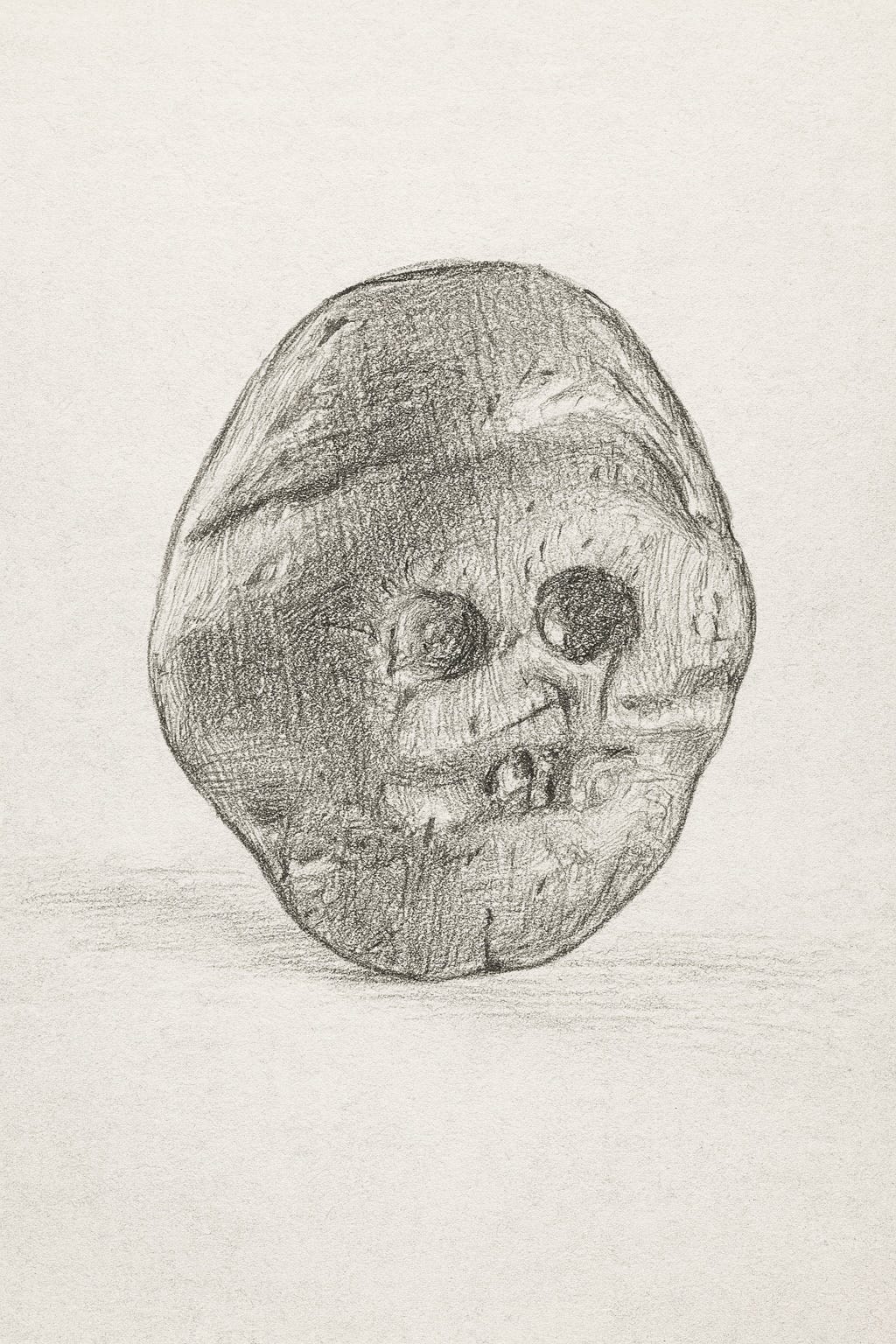
It's pleasant to take note of this deep human continuity, the anthropoid's enduring fondness for collectible curios. When these handheld things seem senseless to us, when they lack clear motive, they lack rational explanation, they're exotic and out-of-place… then they're weird.
It is entirely normal and banal, it is non-weird, for people to carry some things every day. In our own everyday era, those might be the standard personal clutter of cellphones, wallets, glasses, pens, and keys… Every one of those ultra-common artifacts would be bafflingly weird by the cultural standards of some past era. You could place your cellphone into the hands of Galileo and that genius-of-science wouldn't get it, he'd be at an utter loss.
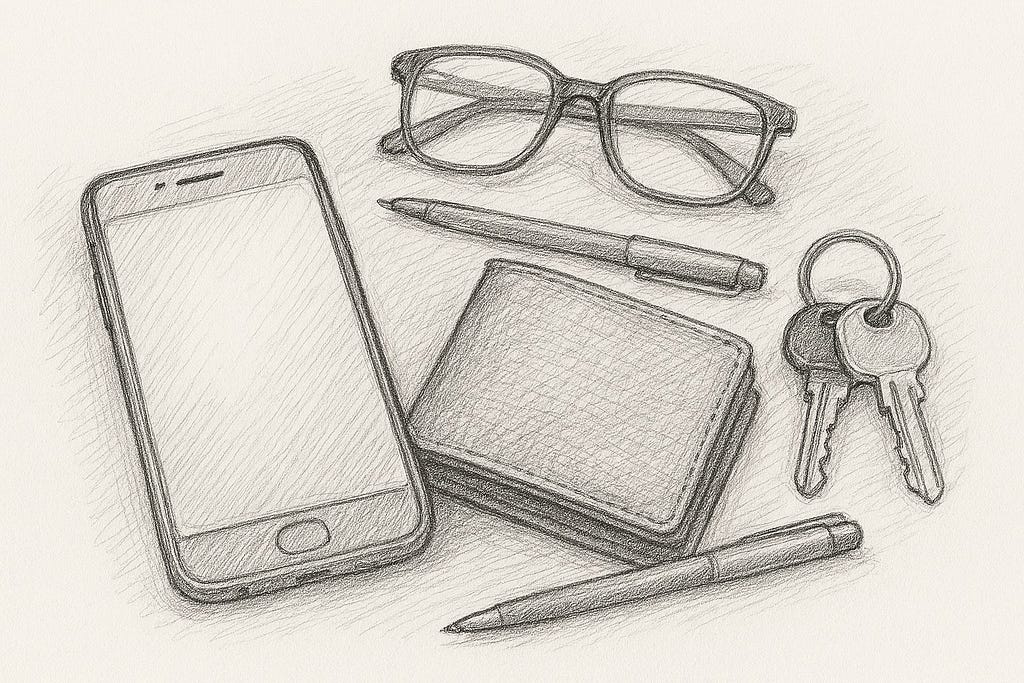
Personally, I carry multitools. I've done this — every day — for half a century. This is standard behavior for me. Since I carry these tools so very commonly, and so near to my person, and I use them so often, I'd have to say that multitools are, for me, the least-weird, most-familiar artifacts that I have anything to do with.
I know their histories, purposes, promotions and price points. I've seen them built in factories. I can maintain them, modify them and even pull them apart. I've pretty well got them figured out. They have no occult mysteries for me. I have one, and often more than one, in hand's reach every day of my life.
And yet, despite their intimate everydayness, they are protean and unstable objects. In my long intimacy with them, they've changed a lot, in strange ways.
Back in the vanished 20th century, I had no modern "Every Day Carry" attitude about multitools. I came from a family of Texan farmers and engineers, so pocket tools were the fabric of our everyday reality. As Texan men, we just had 'em, as tradition. I used them every day, in everyday ways. I never felt at all "weird" about them, unless I broke one or lost one. Then my life became weird without them, because I was suddenly deprived of a host of small, useful actions that I routinely did as my reflexive habits. Everyday micro-acts, that I carried out routinely with my pocketable knife, bottle-opener, scissors and other, odder features.
Every time I lost a tool-set of this kind (which I often did, because I was so young, lazy and carefree), I had to promptly fetch some other one. I always did that, so as to restore my humdrum status quo. I consumed them and I tossed them like pencils. I rarely pondered their weird nature as weird objects manuported through a weirdly changing world. I depended on them every day, and I used them a dozen times a day, and yet I scarcely perceived them. It's a little weird, how entirely normalized they were.
As Adam Greenfield has wisely remarked, "Design dissolves into behavior." If you carry small scissors, every day, for years, then those intimate scissors will escape your conscious notice. Your design-awareness — ("Lo! I possess Victorinox scissors!") will dissolve into habit, as your world becomes a normally-scissorable world.
Even the intimate people around you will thoughtlessly expect you to provide this Greenfield scissoring-behavior. They will ask you to scissor things when you're wet from a shower in a towel. That request seems pretty weird, but it's much less weird than pausing your own lived experience to formally, technically recognize that your husband can't possibly scissor some kitchen-package because his pants are in some other room. Whenever design dissolves-out-of-behavior, it tends to manifest as an odd little crisis of this kind.
Though I've used them commonly for fifty years, I'm currently more intensely interested in multitools than I've ever been before. In the present historical moment, 2025/2026, I follow their industrial foibles, quirks and furbelows, with the abiding interest that I once had for "personal computers." I buy multitools like I buy coffee-table art books. I've been known to carry four or five different models at once, on belt-loops, in satchels, in bags.
This EDC-conscious cultish behavior of mine surely ranks as "Everyday Weird." I'm aware that it's peculiar, and I'm even a little chagrinned about it.
I'm comforted, though, that it's not all my own fault. I was lured into it by social change. I was beset with peer pressure. I have multitools that are uniquely hacked and even laser-engraved, but "Severe Everyday Weird" would be a tool collector/evangelist who owns glass-topped display racks of multitools. Most of these devices never "carried," any day, by anybody. They're mint, like in numismatics.
These zealots diligently pursue and collect extreme, artsy, unique and freakish multitools. They design, make and sell their own models. They have digital marketplaces and specialized regional conventions.
I do not scold these tool-zealots for their zeal. No. I regard them as an interesting, contemporary techno-avant-garde, such as life-extension fans and urban parkour gymnasts. They are technosocial influencers. Normal people are becoming weird like them, much faster than normal people can scold them, assimilate them, or calm them down.
Since I'm a writer and critic, I'm curious about their deeper cultural situation. "Everyday-Weird" — how do people manage such sharp contradictions, and even embody that oxymoron? To directly mix weirdness with daily life is like mixing whale-oil with vinegar. Yet, somehow, this feels tasty and attractive to some people. It's like a salad-dressing.
What is its deepest context? How does mankind, Homo Faber, the tool user, the master-of-fire, etc., ever end up with a miniature metal jumble of seventeen tools in his pants?
Stealthily, that's how. Through slow and subtle paradigmatic re-framings, over generations.
Long before our modern Everyday Weird was the Ancient Everyday Weird.
As mechanical devices, multiplex folding tools are at least two thousand years old. But our own current verbal framing, our high-concept of "multitool," dates back only to the early 1980s.
"Multitool" modernity began when the Cold War ended, with a direct, globalizing collision of Oregonian capitalism with Eastern European material culture. This is the much-repeated, heroic origin-story of a young American technical genius, Tim Leatherman. Tim aspired to fix a broken Communist world with one multiplex gadget from his own pocket. A scheme which sounds weird to the point of megalomania — until you actually are an American in Eastern Europe. In which case, I can personally testify that it makes perfect sense to lug Leatherman "survival tools" everywhere, every day.
Historically speaking, as functional artifacts, those spikey, hingey, ultra-compact Leatherman "survival tools" are intensely eccentric little machines. It took eight years from their workshop-invention for them to find customers and a user-base. But those "survival tools" certainly did survive. These surviving tools successfully pried and chiselled-open their own Overton Window. They more than survived, they prevailed, and every similar tool-set in their product sector has been re-conceptualized, and standardized, and made mundane, and feels commonplace now. They made the weird everyday — even though "folding knives" are prehistoric.
Aristotle, disciple of Plato, mentions a multi-use "Delphian knife." In Roman times, sets of domestic tools, for kitchen, bath and boudoir, were gathered together on metal rings.
Multiple tools were there in the world ages ago, but they were always special and rare, especially compared to the tumbling iron horde of gadgets from the nineteenth century's Industrial Revolution. Built in steaming factories, as micro-factories for the hand, these multiplex, portable tools were mass-manufactured with a new, industrial precision: small, cheap, and much favored by the military. Especially the navy and the cavalry, where the man-in-uniform ventures far from his supply-lines.
A handheld totem of consolation for a fellow in all kinds of trouble, a military multitool isn't much use. However, it's a whole lot better than nothing. The traditional use-case for multitools is martial and desperate. In tumultuous military conditions, multitools can't be weird. They don't have the cultural luxury of weirdness. Multitools are native to extreme SNAFU conditions where everything must-but-can't happen right away by whatever means necessary.
Multitools make field-tested sense in the deep confusions of wartime, but like a lot of other wartime things, they're bad. You have to get fully-used to multitools to understand how authentically bad they are, how lacking in merit as tools. As functional hand-tools, multitools are wretched hacks. Supposedly, they can be a comprehensive toolbox fit for all possible challenges, but they're all jammed into one small dysfunctional handle. The tiny tools that fold-out from those harsh design-constraints are flat, and weak, and wobbly, and frail, and hard to deploy for any length of time, with any force and precision.
Multitools are a dense little crowd of mini-tools, hand-hurting, badly balanced, munchkin-sized. They're absurd even at a touch and glance…. but the war-fighter does not care about that. He has the standards of a warrior, while civilian tool standards are for sissies not getting shot-at. His Jack Tar sailor jack-knife, his cavalier Swiss Army Knife — those will be coveted.
Coveted military multitools will be "adapted to civilian life." That procedure is an odd conversion, and they will adapt weirdly. Military multitools are natives of extreme conditions. They look weird and they act weird. They're also deliberately made even more weird for civilians. Debased, misunderstood, parodized, and exaggerated. In a vulgar, popular fashion.
This "weirdness" is inherent in the nature of artifacts which have been pushed out of functionality into pocket-adornment status. Show-offy, eccentric multitools are artsy, parodic, and impractical, screechy in their extra-ness and their specialness. They're more everyday than they think they are, but it's touching that they aspire to be so weird.
I quite like them: the spectacle of them. Goofy, peculiar pocket-tools that visibly flaunt their weirdness. They have some of the virtues and a lot of the awful vices of science-fiction art. They yearn to become exotic, but they're too easy to understand. These weird tools bear the relationship to functional "tools" that sexy lingerie bears to the act of sleeping. There's something timelessly human and endearing about them.
Sometimes, these pocket tools are weird-in-decor and also mechanically and functionally weird. They might have absurd functions, bizarre folding systems, and/or exoticized metals. Multitools are small, and compacted in more ways than one. Their formal distinctions — the way they look, the way they work — tend to melt into one manuported lump. The damascened bottle-cap lifter. The ninja-gentleman's micro-Bowie-knife. The genuine weirdness of oxymoronic product-categories such as "Luxury Tactical." Within the everyday-weird, the oxymorons multiply like mice.
Folk-weird knives are old. They're as old as the folk. Ancient Roman folding knives, which were made for civilians, often featured violent fighting-gladiator themes. Sometimes ancient Roman folding knives were bluntly phallic. These everyday tools were so obscene that they'd subject modern EveryDayCarry zealots to instant YouTube bans.
This folk element of "everyday-weirdness" — I know that it makes for poor industrial-design, but I can't cruelly dismiss it just because folk culture is for hicks. Soldiers and wannabe-soldiers are headlong, boisterous young guys. They're not jaded multinational polymaths who write design-essays. I do not scold them. I don't scan them in airports and deprive them of their trophies. I never flinch at titanium ninja-karambits. I don't decry ludicrous fantasy-daggers that snap like breadsticks. I brim with avuncular tolerance about "folk-weird." But it's folksy. It's not very weird.
Maybe a figure-ground reversal would help in explaining this yin-yang interplay of the weird and the everyday. This particular tool, which is an ancient folding-knife, is the antihero of my essay about EveryDay-Carry weirdness.
 ery
This is the remarkably little-known "Hallstatt Knife." This artifact is at least 2,500 years old. It was hand-made from iron and bone. It seems to have been carried into Europe by some horseback steppe invader from Scythia.
Scythian horseback invaders wore pants. Those riding-pants might have even had pockets. So the Hallstatt Knife, amazingly, might be somebody's actual, real-deal, "everyday pocket-knife." In 600 BC, more or less.
The Hallstatt Knife is the oldest folding-knife in the archeological record. Somehow — I don't understand why — it has always been very obscure, and never famous. Somehow, that "Hallstatt Knife" is and always has been astonishingly normal. It just plain is. It even ranks with what the designers Jasper Morrison and Naoto Fukasawa would call the "Super Normal." It would pass for a normal modern product at any cutlery store in the world.
That ancient knife is so impressively normal that no ancient-history buff ever bothers to discuss it or replicate it. Their covetous eyes glide right over it. No one wants to clutch one and grip one. The Hallstatt Knife has no collector-frisson. It has no eager fan base of admirers and users. It's prehistoric and it has a good origin story, but nobody notices or cares. That's a truly impressive "limit to everyday weirdness." Somehow, it has never achieved weirdness, not in 2,500 years. Maybe the Scythian marauder who dropped it off horseback never noticed it was gone.
It is freakishly old — it's the same age as the Babylonian Exile in the Bible. But it's as common as rice.
With that important, anti-weird counter-example fully-recognized — (no one will remember my sermon about the forgettable Hallstatt Knife, but I felt the strong need to write about it) — it's time to pay due court to the star of this essay. An Ancient Everyday-Weird multitool so entirely compelling that I had to have one. I even had to make one.
Nobody knows who made the first one. Or who owned it. Or what it's for, or why it existed in the first place.
Today, there are four different known models of this ancient, weird device. Three and half, because one of them may be a forgery.
These four multitools are artifacts from the Roman Empire circa AD 100-200. They are severely anomalous. No expert on ancient Rome ever expected to discover tools like these. There's not a whisper about them in any historical document.
Held in the hand, gazed at, it looks weird and it acts weird. Its decor is weird and its engineering is weird. It's the weirdest multitool in the world.
This device is so anachronistic, and so peculiar, that it ranks as a weird sister of the extremely weird "Antikythera Mechanism." That bronze Greek computer also has no known name. It was named after the shipwreck where that computer was found.
The ancient multitool was found in graves, rather than found in some shipwreck, but the same Antikythera principle applies. It was entirely lost to mankind and it reappeared by sheer accident, and people stared at it in disbelief for a hundred years and wondered what-the-hell.
Two models of this complex device were excavated by experts from two known and well-dated Roman graves. The other two models were most likely graverobbed from two defiled and unknown graves. There may be some others. No one knows.
Here they are, after time's long corrosions, more or less:
The Ventimiglia Set.
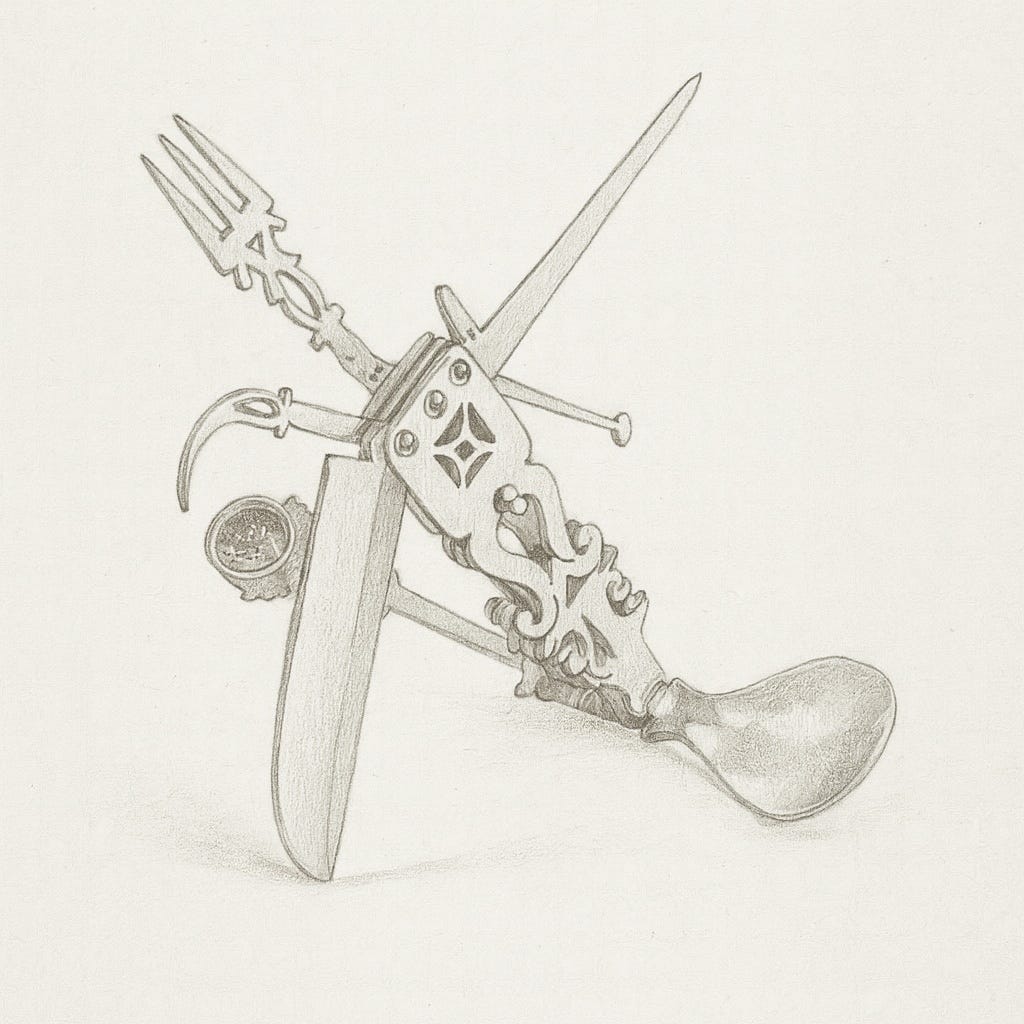
The Cambridge Set.

The Ljublen Set.
The Zurich Set.

This item I'm discussing is a grave-toy. It's ancient, eldritch and spooky. It's the nameless, heroic, ancient queen of multitool everyday-weirdness. It took me six months of curious effort and exploration to get to the point where I wanted to write something about it.
I've seen one personally, which was excavated from an ancient grave. I've handled a modern replica of another one. The rest of this essay is about my personal efforts to get accustomed to this thing. I never assumed that I would fully understand it, or resolve the deep historic mysteries about it. I wanted to get close enough to it to "dissolve" it, like I do with other such tools. I didn't want to crassly dispell the raw wonderment of its existence. Instead, I wanted to be able to take it for granted.
To discuss it in the essay here, I will have to name this thing. Its ancient Latin name (it surely had one) is unknown. Whatever do we call it?
In the English language, this device is often called the "Ancient Roman Swiss Army Knife."
In Italian, it's known as the "Voyage Service."
In Bulgarian, it's described as the "Surgical Instrument."
There's supposedly a fourth one which is owned by a private collector in Zurich. Nobody knows what he calls it.
In this essay, I'll give it a neutral, anodyne, nonjudgmental name: "The Set."
I have known about The Set for forty years. But I never paid much attention to The Set. I just took The Set for granted.
My attitude changed while I was perusing YouTube multitool videos (as is my wont). On YouTube, a historical-restoration devotee was demonstrating a modern replica of this "Ancient Roman Swiss Army Knife." Here he is. On a video available on YouTube. (Available for a while, at least.)
This video demonstrated to me that the ancient Set had emerged from its grave. Somehow, modern people had The Set held in-hand. The Set had become another EveryDay Carry device in YouTube's thriving EveryDay Carry World. Somehow, this eldritch techno-zombie — as weirdly unlikely as Boris Karloff in "The Mummy" (1932) — had survived Roman Imperial destruction, hibernated through Dark Ages, and returned to public life.
Modern people re-built and owned and carried The Set. They used The Set in the full glare of the public. This activity was visible in social media. It was much remarked-upon.
The re-enactor, a devotee of the Roman Army, believed that The Set was a military multitool — a "Roman Swiss Army Knife." He assumed that The Set was designed and built for everyday use by ancient Roman soldiers. A sensible and rational idea, aligned with multitool history.
He performed with The Set for his camera, while wearing his reconstructed Roman Army gear. He handled the replica Set in close-up. He manually demonstrated The Set's practical affordances.
This was "experimental archaeology." I had heard of that scholarly practice, although I'd never done any myself. Better yet, this was "experimental archaeology" on public display in a social media video. Quite an interesting thing to do and to see.
In terms of the artifact itself— "The Set" — I could feel its weirdness-limits shattering.
I was moved by this — the spectacle of this eldritch Roman Army veteran, somehow drafted into the ranks of modern "Every Day Carry". Among many other such things, The Set from ancient Rome passed muster as just-another one-of-those-things.
I felt an urge to get closer to The Set, and to get hands-on with it.
The Set was vastly distant in time from me, but physically, it was quite near. I was in Turin, as I commonly am, but the world's first-discovered Set was in a museum in the Italian town of Ventimiglia.
So, I promptly caught a train to Ventimiglia, a pleasant little town on the Italian Riviera. I went there on pilgrimage to encounter the Set. This was the start of an extensive relationship.
The Set in Ventimiglia was unearthed in 1917 by a Turinese archaeologist. This Italian scholar, Prof. Pietro Barocelli, immediately knew that the Set was weird. He wasn't much impressed, though. "Multitools" were little-known in his own day, and it was not yet a habit to fuss about them.
However, thanks to the 21st century's ongoing multitool fetishism, The Set has become a celebrity object in Ventimiglia. The Set has a big star poster on the outside of its regional museum.
I had a contemplative look at this ancient device, which currently exists inside the digitized see-thru screens of its protective vitrine. As a supposed "Voyage Service," The Set has voyaged maybe two hundred meters from the grave from which it was unearthed in 1917. In its spidery, much-corroded state, one gets the impression that The Set wouldn't mind returning to some peace-and-quiet.
The people of Ventimiglia are justly proud of The Set. It's the most famous inheritance from their ancestral town of "Albintimillium," once the fortress-homestead of the long-vanished Albinti tribe of ancient Liguria. Modern Italian "Ventimiglia" is the same town as old Roman "Albintimillium," after some of its vowels corroded and fell off.
The Set has the bizarre affect of a manuport from a passing UFO, but it existed in Albintimillium, which was and is a real town. In The Set's museum, there are other metal contraptions of this specific time and place. High-security, outsized, bronze lock-and-key sets, for the front-doors of local villas. Metallic, springy, complicated safety-pins to secure cloaks and togas. Many other everyday objects that the owner of The Set would have encountered, and maybe owned.
The Set had a user. Like his artifact, he has no known name. For this essay, I will name him "User142." His cremated ashes were found inside a lead box in "Grave 142" in Pietro Barocelli's excavations.
The gathered mourners of User142 ("UsorCXLII" in Latin) placed his ashes, and The Set, into the same grave in the town cemetery. It seems that the locals thought that User142 needed The Set, in much the way that he needed the various other grave-goods that they also left.
The grave of User142 held a little ensemble of artifacts, from an organized burial activity. The mourners of User142 ate gourmet snails at his graveside. They dropped the empty snail-shells into his tomb — not as picnic debris, for this special snail-feast was their solemn tribute to him. They dropped and broke four glass jars into his grave (with some long-gone, unknown, important liquids inside those jars). They performed funereal drinking at the gravesite, and deliberately shattered their wine jug, and they left another intact wine-jug, as a farewell toast for him, good old User142.
User142 also received one glass dining cup, one silver dining spoon, and two busted pieces of ceramic with a lion logo on them (User142 would have known what that meant). He also was given a toiletry object, a Roman bath "strigil," maybe handy for the steam-baths of the underworld.
User142 might have been a woman. There are cases of Roman Empire women being buried with their folding-knives, including one maiden entombed with a lethally-hefty pigsticker whose splendid handle was a stark-naked statue of Hercules.
User242 has no known gender, name, ethnic origin or career. It's not even clear that User142 ever owned or used The Set. The Set might have been a posthumous gift. Roman burials were ceremonies envisioned as a "send-off," a ritual of journey, toward the world of the afterlife. In the case of User 142, it was an Albintimillium bon-voyage of snails and wine, for that trip from which mortals never return.
Unlike their little travel-gadgets. Those gadgets can and do return. There are some of them around right now.
The Set was placed in that grave by people who understood it. The Set belonged in that grave. If The Set had been shatteringly unusual, truly "weird" in their eyes, they would have sold The Set as a rarity, and laid on a better grave-feast for themselves. The Set was a thing for an everyday guy, for his modest, decent grave in downtown Albintimillium.
Roman-Empire Albintimillium was a seaside town, like Roman-Empire Pompeii, but poorer, smaller, colder, cruder and ruder. Compared to lavish Pompeii, it was a town from an Italian Scotland where the locals lived off their fish and sheep. Albintimillium never ranked with Portland Oregon, a hotbed of technological innovation where advanced multitools might spring into existence. Albintimillium might have been a nice, quiet place to grow old and die with a multitool. The Set was likely imported to Albintimillium and dropped into a user's grave there. That's why a regional museum has it now. All Sets that never became "grave goods" have vanished utterly.
The "Voyage Service" was voyaging — until it pit-stopped in Ventimiglia for 1,800 years. There were also other Sets. The "Cambridge Set." The "Ljublen Set." The alleged "Zurich Set."
These artifacts are versions of The Set. They do vary, and they've been studied differently.
The Ventimiglia Set was the first discovered. The Ventimiglia Set also has the fanciest and most-varied features.
The "Cambridge Set" has been well-studied, and is the easiest to study, especially if you speak English. The Cambridge Set was bought on the open antiquities market, with no known origin or associated user.
The "Ljublen Set" comes from a Bulgarian tomb, of a married couple from Roman-Imperial Thrace. The deceased users seem to have been a Roman cavalry doctor and his predeceased wife, who, to judge by her tomb goods, was likely a nurse. We can call this Set user the "Thracian Cavalier," since he was so well-to-do compared to "User142." His grave abounded with vases, bowls, glasses, spoons, plates, belts, horse-tack, weapons, artworks and even money.
The last "Zurich Set" is private and has been said to be from Roman-Empire Syria.
All The Sets are weird, but united in similar weirdness. One single Set might be so weird that it could be dismissed as a mere freakish oddity. But four of them? That's a product category.
The Sets seem to be from all over the Roman Empire. Ventimiglia in Italy is 1,400 kilometers away from Ljublen in Bulgaria. Syria was the eastern rim of the Roman Empire. The "Cambridge Set" model, in Britain today, might even be British in its origin. Britannia, that exotic Roman island colony, abounded in folding knives. Roman Britannia even had folding spoons.
All of The Sets are metal multitools, designed to be carried and used by hand. These multitools have various component tools which lack any settled names. So, for this essay, I will name these tools:
1. The Knife
2. The Spoon
3. The Fork
4. The Spike
5. The Earspoon
6. The Leaf
7. And last and deservedly least, The Sieve.
The fancy Set in Ventimiglia has all seven of the tools, while the other Sets have fewer.
The Spoon seems to be the dominant tool in The Set. If you hand some naive person The Set, and you ask them what The Set is, they will tell you that it's a spoon. Held and touched, The Set has the look-and-feel of a Spoon. The Spoon is the biggest, broadest tool in The Set, and it's visibly mounted on the outside of The Set. So at the first glance, at the first grip, The Set is a Spoon with a gadget attached to it.
This Spoon feels important, but the Spoon is also unstable and tricky. The Spoon is attached to a rotating lever. This lever spins on an axle, inside a round hinge, at one end of The Set. When the big Spoon flips over, the other end offers the user a tiny, trident-style Fork.
The "Ventimiglia Set," the most elaborate model, features a silver Sieve attached to the Spoon, while the Fork deploys on its own special pivot.
All four of The Sets have Forks. These trident-shaped jabbing-tools do not behave at all like modern table-forks.
All of The Sets once had iron Knives, which have rusted away. These Knives were likely similar to the everyday blades in other Roman folding knives. Simple "slip-joint" blades, good for slicing, not much good for jabbing or stabbing.
The Set also contains the highly unusual panoply of the Spike, the Earspoon, and the Leaf. All three tools are always present in all the models of The Set.
The Spike is a thin, fold-out tool almost as long as the Knife. The Spike is pointed, but it has no sharp edge. The Spike is clearly built for poking, probing, piercing and perforating. When the Spike and the Spoon are both deployed at once, then the two tools together closely resemble an everyday Roman table-spoon. Normal Roman spoons had long handles ending in a spikey point.
The peculiar "Earspoon" resembles a well-known Roman grooming implement designed to scrape the wax from inside human ears. The Earspoon is a round, flattened, slightly bent metal bead at the end of a prong. The Earspoon is a small, short, and delicate tool, maybe long enough to reach and clean a human ear canal. I choose to call this tool "the Earspoon," not because I really think it was made for cleaning human ears, but because it looks more like a Roman "Earspoon" than it looks like anything else.
The "Leaf" is utterly mysterious. In over a century, nobody has ever known what to name it. This "Hook," "Toothpick," "Nail-Cleaner," "Spatula," "Hoof-Pick," "Phleam," "Strigil," etc, is a small, delicate tool shaped like the curvilinear talon of a cat. It has one bent, tear-drop-shaped hole filed though it.
Except for the mysterious Leaf, all the other tools in The Set: the Spoon, the Fork, the Knife, the Spike, the Sieve and even the Earspoon — they all look and act like miniature versions of well-known Roman hand-tools. They're flat, compacted, shrunken tools and therefore pretty weird, but these tools once had independent, verifiable existences as everyday tools in the Roman Empire. The Leaf, by contrast, is a tool like nothing else known anywhere. The Leaf appears to exist as an artifact only among the tools of The Set.
Also, the four Leaves among the four different Sets are different in shape. They are more variant and apparently fanciful than any of the other tools in The Set. The Leaf is not just weird, but decisively, differently weird. All Sets do have the Leaf, though. A Set without a Leaf is not a Set.
The Sieve exists only in the Ventimiglia Set. The Sieve is a unique component of the most elaborate Set. This Sieve is a tiny metal cup shaped like a modern tea-strainer, with many dainty little holes drilled to drain and strain fluids. The Sieve is so tiny that it could contain maybe half of one modern teabag. It's hard to understand what precious substance this Sieve might have plausibly filtered.
All the Sets have metal shells to encase and hold The Set's multiple tools. One end of the case is always doubled-over to form a rounded hinge, which is the important rotation-axle of the exterior Spoon-Fork combo. The other end of The Set's case is held together with metal rivets.
The metal case shelters the Knife, and also serves to sandwich-together the Spike, Earspoon, and the Leaf. The metal cases of The Set are always "openwork," elaborate, decorative and frail. Solid metal shells would have worked much better for a multitool, but the cases of The Set are delicate, ornate and dainty.
The Set's frames vary. They're hand-made, of different lengths and widths. Some have built-in locking devices to secure the folding tools. All Sets have decorative, look-at-me motifs. Some resemble a military shield. All four Sets have a curvilinear structure. It always resembles the shape of a lyre.
This lyre decoration — it was hard to build by hand, because it's fussy — seems to be an important design element that identifies a set of tools as "The Set."
#
I built The Set. Or, rather, I built various models of The Set, and the various components of The Set. The original builders made their Sets in forges, but I assembled my Sets under a shade-tree, out of modern industrial debris. It took me about six months of occasional, contemplative labor, until finally I ended up with a workable version of The Set that satisfied my curiosity. Then I was able to stop.
At first, I thought that I would just buy a modern replica of The Set — because hobbyists do make copies, and I'd held one. I thought that I might carry The Set around in my pocket, Every Day, and figure out what it might be "good for."
But in contemplating The Set in closer detail — and especially, after confronting a genuine dead one — I changed my mind about that. The Set was not a toy for a modern purchase and my personal use. There might be some aspects of The Set that were personally good-for-me to have and use, but with that narrow attitude, I couldn't learn what mattered about it. The Set was clearly a "personal tool," but I needed to get closer to the stakeholders of The Set's general enterprise — the various people who had designed it, built it, handled it, travelled with it, used it and put it in a grave.
If you make a "design fiction" object, you need to engage with futuristic speculations. The concerted, focussed effort in futurism is the point of doing design fiction. Through design, you want speculations to look-and-feel embodied. Not as a verbal narrative, like the vaporous rhetorical larks of a sci-fi writer. As an "object that tells the world." As a "deliberate effort to suspend disbelief about change."
The Set is not a design-fiction. It is an already-embodied thing. It seemed important to me to learn to fantasize about it less. "The past is a future that already happened." An object of the past can speak like a design-fiction speaks, but not in futuristic speculation. Instead, it whispers about a genuine, vanished world. You engage with it in the hope that the process of rebuilding and using it will be revelatory of past worldly circumstances. You want it to behave as a "diegetic archaeotype."
I'll offer a quadrant diagram here. Here we have a chart of various efforts to rebuild ancient everyday-objects. We can divide these on two important axes.

Do these objects perform, do they function like the old thing once functioned — or do they merely look old, as visual representations?
Also: were the objects made with the same materials and processes as the old objects? Do they have the same designer "grain of the material"? Or do they use modern processes and materials to make objects that are modern analogies of the old object?
I'm not judgmental about which of these approaches are "better," but these approaches scatter widely. At the chart's center is the "museum quality replica." This is our current modern consensus about rebuilt objects which are not old, but are presented as closely related to old things, within a historically-aware, institutionally-approved, public context.
The museum-quality replica is our culturally legitimated version of a rebuilt ancient object. We haven't yet invented any method to rebuild and valorize replicas of better quality. So, in this quadrant, it's at the cross-haired center of the field.
Up in the extremist make-believe corner is the historical FX prop from historical TV, games and/or movies, an embodied fantasy which merely has to look good, temporarily. Costume-play is an amateur-theatricals version of a professional FX-prop of this kind. As far as the materials go, most anything is permitted, since the end-goal is to get the shot, or to strut the stage.
If the materials are valuable, then this value provokes fakes and forgeries. They're rebuilt and seem ancient, but they're fraudulent.
"Creative anachronisms" are often created with antique means and materials. Some mastery of antique craft-effort is central to this modern form of expression.
In another extreme are the ancient objects which lack any credible provenance. These objects look and act old, and maybe they are ancient, but no one can prove that. They're more anomalous, more orphaned by time, even than forgeries.
Flint-knapping is a good example of a modern craft-hobby with prehistoric materials. Objects fired from clay can be similar.
The "restored" object in this diagram is a genuinely old thing which has been patched back together from some battered state of corroded incompleteness.
The commercial "historical reproduction" is a newly-made thing, sometimes hand-made with historical materials. It's often prettier and better-made than the original ancient object that it mimics.
The Morris Arts&Crafts object exists in moral refusal of mass-market industrialism, and has a Ruskinite ideology. Objects of this kind are not archaic in intent. They're often not even "old-fashioned," but rather "pre-Raphaelite," in a complex, social-critical way.
A "re-invention" is a modern object inspired by an archaic one. A re-invention has an archaic form and use in a modern context.
The "re-discovery" is a new thing that resembles an old thing by happenstance. The designer/maker/engineer made it independently, and had no awareness of any such prior art.
Above the top of this chart are the speculative "future means of production." Their presence implies that our current means, methods and motives of rebuilding ancient things are unstable. There is not, and cannot be, any perfect, permanent way to "rebuild past things." People might, in future, remake some things which seem utterly un-buildable to us, such as genetically-restored, de-extinctified mammoths. It's good to keep these possibilities in mind, so as not to get too self-satisfied and perfectionist about how we happen to hack at the past right now.
This chart may seem rather abstract and fussy, but it was helpful to me, because it became clear to me that you can't possibly do all these things at once. I was able to perceive that I had no current use for a Set meant for public display. A Set made in bulk and sold as a product to other people, that was possible to do, but not what I wanted and needed. What I seemed to want and need was a "functional analog" Set. What did this ancient thing do, how did it perform and do its work, in the hands of ancient people who once made it by hand, held it in their hands, and gave it to a grave?
It struck me that I needed a cradle-to-grave approach to the Set. I knew that it was dug from a graveyard, but where was it born? Where did it come from, and how? I would never know this directly, but I needed methods to approach those questions.
The Set was an actual, existent mechanism which vanished centuries ago. So is the Antikythera Mechanism. A sympathetic understanding of how that device was designed, built, and used, makes it clear to us moderns that Greek astronomical geometry was more than straight-lines with compass and ruler, or verbal lectures in an olive-grove. Greek astronomy had gears, dials and a comprehensive hardware set-up. That assertion sounds far-fetched, but it's both weird and true.
If you're a science fiction writer (as indeed I am), you naturally want to dramatically play-up and intensify the weirdness of the weird. That's entertaining to the public and you know how to do it. Also, it's fun. But my struggles with the Set are a different matter. Not about the weirdness of weird, but about the truthfulness of true.
The personal everyday objects I carry in my pockets are my own lived experience. Since they're with me all the time, in some formal sense they are the least weird and most personal things in my life.
By making The Set part of my lived experience, I expand my awareness of my lived experience. These are some important political and financial aspects of "Every Day Carry Weird."
My boring everyday wallet, for instance: under no circumstances do I want my wallet to "become weird." I know that modern fintech people very much want my wallet to be much weirder. They have exotic payment systems to move me away from archaic paper cash on my hip, toward phone-centric apps in their own control, that I can't see and touch.
I might also metaphorically, but foolishly pretend that my densely networked iPhone is somehow a personal "Digital Swiss Army Knife." This too-facile comparison is a bad frame-of-mind. That dishonesty will get me, and my intimates, into trouble. There are consequences to this intellectual laziness.
I don't claim that my studies of classical hand-tools will resolve the focussed assaults of tyrannical oligarchs on my habits and well-being. But they are a form of recreational "otium." They seem to offer some stoic philosophical consolation.
So, to hand-grapple with "Everyday Ancient Weirdness" I needed a bigger arena of comprehension. The people who built The Set are long-gone and their assumptions and habits are vanished. But this should not be a counsel of despair. It's more a Heraclitean understanding that you can never step in the same river twice. In the distinct case of the Set, there are four of them, so they didn't even step in the same river once.
The people of the ancient world in 200 AD were no more "authentic" than we ourselves are authentic. I even suspect that the "Zurich Set" is a fake. Not a "modern fake" — but the Zurich Set looks so different from the other Sets, and it's so obviously crude, that it may have been an ancient fake. The product of some shady guy in some Roman Syrian bazaar, who once saw a Set, and figured he would hammer out a phony one, and sell it full-price as the real-deal.
It's important to understand that the "ancient everyday" is just another every day. It's one every day among a billion days. Yes, it's old, but our awed respect for antiquity does not make it sacred, or even respectable.
In the case of The Set, you are not "rebuilding imaginary futures," a topic I've written about in other essays. This is an effort to rebuild pasts, which are peculiar and difficult to understand, but can be overburdened with too much imagination, and not enough sincere engagement with what once existed there.
One path out of that conundrum is to stop fantasizing about it and "just make one." That was my first step.
At first, I wanted to test the hypothesis that The Set was just-plain weird. The Set was eccentric, peculiar, because it was stapled-together by people who were nuts. This is a lively theory and it's also plausible. Real people in any day, every day, prehistoric, historic, contemporary, futuristic, now, yesterday and tomorrow, can be just plain off-their-rocker.
Maybe The Set was a failed multitool built by an incompetent Tim Leatherman, some Roman inventor who lacked Tim's concentration and staying-power. Instead, he just frankensteined a bunch of rubbish into a weird gizmo to hold in his hand. An easy hypothesis for me to test, since I was fully-qualified to try that myself.
And I did try it. At first, I did it with cardboard, because that's an abject material that costs nothing (because it's garbage). I made a cardboard Set at no cost, but that act was complicated. Through the act of doing that, I soon learned that The Set could not possibly be some magpie process by some mentally-unstable person.
It was not possible to rashly jam those components together on some daffy impulse. The Set had a distinct order of assembly. The Set was built deliberately, with a foresightful "order of operations." Some things had to happen first. Only then could the other things happen.
I learned this through rehearsing in cardboard, and establishing the proportions and relationships of the pieces of The Set. I myself looked and acted quite weird while I was fanatically slotting and twiddling bits of cardboard, but no one was watching me. I had proved that the builders were sane and well-prepared. That was progressive.
Also, this active design research led me to the important concept of the "chaîne opératoire."
While I was slicing and dicing my trashy cardboard with a trusty Opinel folding-knife (established 1890), I pondered various videos and texts of "experimental archaeology." I knew little about this scholarly research practice, but it's been around since the 1970s and is by no means a fly-by-night enterprise. When I learned how those experiments were done, my attitudes toward The Set changed radically.
I no longer much wanted or needed to "own The Set" or even to "make a replica Set." Instead, I needed to closely study the Set's "chaîne opératoire," and I needed to study that through acts of "kinaesthetic learning."
Kinaesthetic learning means getting to grips with the way that ancient human hands gripped the ancient object under study. Kinaesthetic learning is the archeological cousin of the "hacker hands-on imperative." For the demographic that sieves tiny ancient objects out of old mud, it's also the functional equivalent of the "maker think-and-do-lab."
To discover these parallels was intensely edifying. Clearly I should have done all that forty years ago, and I would have been better off for doing it. However, it's never too late to learn.
The profound issue here is the "chaîne opératoire" — in my own case, the chain of operation of the builders of The Set. I knew that they had operations carried out in a distinct order, but what was going on?
The "chain of operation" is always referred to, in scholarly French, as the "chaîne opératoire", since the concepts of its major theorist, Prof. Andre Leroi-Gourhan, were elaborated over his lifetime. Leroi-Gourhan had elaborate ideas: they're a comprehensive theory of the co-evolution of man and technology, rather than some mere design-theory about ancient Roman objects.
The key insight of the chaîne opératoire is that the artifact under study is a link in a chain of human relations. You may have just dug some artifact out of the ground — from a grave, maybe. This thing may look peculiar, and even amazing, "weird," but as a Leroi-Gourhan student of humankind's manifold artifacts, you want to get over that folk-hick "weird" attitude right away.
According to Leroi-Gourhan, an artifact is best understood in this fashion. It is technology. Therefore, it was produced by an animal on the Earth, which has unique human characteristics of an upright gait, agile, prehensile hands that are permanently free, an expressive face, and the ability to speak. All technological artifacts, from shaped flints to satellites, are incidental products of technology. The physical objects are collateral evidence, while the gestural dexterity and the ability to learn and teach — the ''gesture and the speech" — are absolutely central to technology.
If you can grip things and talk to others about them, then you-and-yours can become a technological species. Otherwise — no matter how much or how long you can "build" — you're a nesting bird or a termite.
I would not claim that I "believe this." I would say that it was helpful and even liberatory to me. To study the chaîne opératoire, that is by no means a good way to get any practical thing briskly done. It has dismal results for efficient design and manufacturing. However, it's great. It's great because you are trying to sympathetically get under the human skin, into the gestures and speech and decisions, of remote people who are making and using the artifact.
The chaîne opératoire method is loose and abstract. But it has one major benefit. Nothing is weird. At the exalted level of abstraction of the chaîne opératoire, nothing can be "weird." Herodotus is never amazed by whatever merely seems "foreign." There is no foreign.
When you do the chaîne opératoire as a method of engaging your hands, your gaze, the weirdness evaporates. You are relieved of weirdness. You forget it was ever there. Instead, you are engaged in many small hands-on tasks, the "kinaesthetic learning" of the hands, the eyes, and also the body, face, and speech. Too-complex conceptual abstractions, about means, motives, opportunities, ideologies, customary habits — they painlessly disappear. Become a primate (because you are one) and the issue feels immediate to prehensile hands and binocular eyes: look at it, feel it. Is the thing handled like this, or is it otherwise handled like that? Give it an honest try, with two ready hands and two eyes open. Then judge the result of that experience, rather than idly speculating about what might be plausible.
Forget your own possible uses for it. Don't force it to be useful in your own routines, your own surround. Instead, identify with the people who made it — you want to listen to the justifications they're making, what they feel they have to say to another. The looks on their faces, on the ground, in the tall weeds, in the workshop, over the counter. What it means to them — its functional and symbolic roles. Why they would want it to do that, and be that?
I was pleased at this doctrinal discovery of mine. Of course it's not new, it's merely new to me, but I found it consolatory, and even enlightening. It helped and encouraged me as I worked on my Ancient Everyday Weird project. I won't forget it, either. Kinaesthetic learning and the chaîne opératoire are permanent additions to the way I approach the material world. I'm an old man here in the year 02026, but I know that I'll find many future uses for them.
In my ongoing procedure, I had learned that a Set can never be randomly thrown together on an impulsive whim. It had a chain of operations, meaning first-things-first. What was first?
The shape of the casing was first. That became obvious. No other method could work. The case came first because all of the tools have to fit inside the case. The case had to be understood first, and measured first, and also made first — and yet, the case could never be completed first. In the chain of operations, the completion had to wait for the rest of an organized, ongoing process.
Complicated, rational, and sensible labor — but why? Because the case had to be heated in a forge, and bent, and transformed into a Spoon-Fork axle, before the case was permanently closed and riveted over the other tools.
To accomplish this operational chain had to mean measurements and drawings, and something like rulers and calipers. There's also an authority structure. The guy who decides about those calipers and rulers, and puts the project into its operative motion — he's not a shade-tree hobby crank, centuries away, cutting-up cardboard. He's the boss. He's the major participant in The Set operation. He might not be dug from a grave, but he's as real as the cremated ashes of User142. We can call him "the Maestro."
In some merely verbal, hands-off theory about The Set, we mght imagine that the Maestro could build The Set alone, all by himself. He establishes the shapes for making the casing and the tools of The Set, and knows all about it. But to know it, or to talk and write about it, is not to successfully make it. The chain of The Set's operation is about human hands set in motion.
Filing ancient Roman metal into shape is hard and patient hand-work. You will kinaesthetically learn that when you yourself do that labor by hand. You will understand, without any verbal or written instruction, that the Maestro with those drawings and those calipers cannot be the drudgery person slowly and monotonously scraping hard metal with a hand file. That imaginary division-of-labor can't make sense. It would waste the Maestro's valuable skills, and would squander time effort and money for everyone involved.
The Set does exist, so some real person with busy hands filed and sawed that metal. Who? The "Apprentice" files the metal with his hands. This teenager is allowed in the workshop — "the Atelier," we can name it, since some extensive, fine craftwork is going on in there. The Apprentice puts in long, tedious, operational hours in the Atelier. His arms are sore. He's bored silly. But also, he's a kid. The Apprentice needs to learn that grind-it-out work ethic. He needs those necessary thousand-hours of learning the files and the saws.
The Apprentice runs the Atelier's errands. He puts out the forge-sparks. He sweeps up, afterward. His childish playtime is over for the young Apprentice. He's got a real job.
When the Apprentice goes home with his file-blistered hands, he's got a loaf of dark bread and rabbit stew for dear old Mom. Mom is not directly involved in The Set's chain-of-operations, because Mom doesn't design, build or use the silly thing, but Mom couldn't be happier. "Oh, Apprentice, your late father would be so proud to see you making your way in the world! Just look at those blacksmith muscles growing on you, the girls will line up for you!" The personnel who build The Set work within a larger social context. That context supports them. These indirect participants don't bash the metal, but they look and they nod and they praise.
The Apprentice is just some kid, so he clumsily roughs-up his tools, but someone else up the chain refines, maintains and sharpens the Atelier's tools. That person would be "The Journeyman." He's got an educated eye for the scope of the job. He uses such tools himself routinely, so he already knows what works well and what doesn't.
The Journeyman is a former Apprentice. The Operation of the Chain is what changes their status. This involved procedure — who does the rough stuff, who does the skilled stuff — is what people in the Atelier talk about together. That is how they garner their new Leroi-Gourhan skills-and-gestures and remember their old skills-and-gestures. The Chain is what moves them.
With the tools grappled by the Apprentice, and maintained by the Journeyman, it is time to complete and fold the metal casing for The Set. The Set's case arrives in the Atelier as a standard, Roman, flat ingot: it's a metal bar. This basic, flat metal bar cannot leave the Atelier until it becomes fancy, openwork and involuted, with even a lyre-shape built in. Through what chain of actions does that process take place?
With one glance at The Set, you will surely notice a lot of holes. However, if you build it, you will feel and see those are intense, identical, precise, and numerous holes. In the top-end "Ventimiglia Set" — (the "industry leader of the product category," in terms of refined Italian fussiness) — those holes are very straight and narrow holes drilled through three tough layers of metal. The Sieve has dozens of holes.
The Set's casing features many holes drilled where holes have no apparent reason to exist — holes with no functional purpose. Those larger openwork spaces in the casing of The Set — those empty spaces all likely started as drilled holes, and were later expanded by files.
The holes are there — what chain-of-operations made so many holes? They might be a large squad of Apprentice slaves, each one hand-drilling holes. Or: maybe drilled holes come cheap and fast in the Atelier. Because drilled holes are the Atelier's technical specialty.
A Drill Technician appears as a link in the chaîne opératoire. This personage maintains a specialized device in the Atelier. It's the ancient Roman equivalent of a drill-press. It's a special machine, with sharp bits, a chuck, accurate clamps, and maybe gearing from some non-human power-source. A waterwheel. A mule walking circles.
This speculation can't prove that a Drill once existed with a Drill Technician, but if it did, then this impressive drill-rig is the private competitive advantage of the Atelier. They're making good, thorough use of it, too. It means that the decoration on the Set is not "artistic" — it's not hand-whittled figurative sculpture, like with ivory Roman folding-knifes, featuring the standard-weird cheap vulgar gladiators. The Set is a technical top-end product, and its decoration is mechanical — it's flat patterns, it's abstract, and mostly it's made from machine-drilled holes. The more holes, the better. Holes are drill-scrap. The silver case of The Set is table-ready Roman silverware. Those valuable silver little drill-chips, they add up. With your mechanical drill, you want to drill that thing till it's mostly air.
Following these deductions — (they're a bit Sherlock Holmes, but they're logical) — we again confront the Final Boss chain-operator. This fellow is the original Maestro, because he's the expert who rivets the Spoon-Fork combo to The Set, assembles the tools inside The Set, steadies their bearings, and ball-peens two red-hot rivets through the tools without damaging The Set. The Maestro masterfully performs this final, conclusive, constructive act in the Chain that could easily screw up the whole effort of The Set if it was botched by some mere layman.
To elegantly, and safely, complete The Set — that can't be sweaty, brawny, heroic blacksmith labor. A little old man might do it. That little old man has to know what he's about, though. He performs the Leroi-Gourhan gestures, which integrate The Set into the world, as a completed object-of-value. Also, the Maestro speaks those gestures. Because he tells the others what to do, and why, and the Maestro distributes the rewards to the crew. With his own hands.
Then the deed is done. They have hand-built The Set — but they do not sell The Set, in bulk, over the counter. The Set is a complex and fussy contraption, sophisticated-bordering-on-feature-creep, with a lot of moving parts. There can't be some cheap basket of a hundred Sets in the Roman marketplace, where you might reasonably find a normal basket of mass-produced Roman clay lamps. The Set isn't merely "weird," it's also genuinely, physically hard to design, and to manufacture-by-manual-means. With the kindest possible assumptions about the productive and consumptive capacities of people in AD 100-200 AD, it can't be a commodity or an impulse-purchase.
This Set is so finicky, and so expensive, and even so weird, that it had to be commissioned. That idea can't be proven, but it makes sense. If The Set was a "Roman Swiss Army Knife," issued to everyday soldiers marching in their everyday Legions, there would have been thousands of them. The Sets can't be mass-produced, mil-spec tools meant for warfare. They are silvery gadgets with lots of drilled holes.
It's possible that some ancient Roman officers who were wealthy noblemen would choose to own Sets. But The Sets are not solid and fully-functional Roman military equipment that the everyday Roman soldiery carried Every Day.
The Sets were elite, high-tech and fussy. There are only three and a half of them left to us to marvel at — but at least that's better than the lonely Antikythera Device. The astronomical computer belonged to some elite Academy, but some lone collector paid up front to create and own his own Set.
The Set-Collector bought all the silvery materials, and he was impatiently waiting for his product delivery. He knew what he was about, too. The Set Collector is "User 142," a personage very much a part of The Set's "operational chain" — the customer, who is always-right. When the work's done, he meets the Maestro. Artisan and customer/patron, they meet with a handshake. Then they discuss the matter at hand.
Mutual assurances pass between them. Some are merely verbal and classically-rhetorical. Others you look at, and touch, and grip with your hands. "Oh, this is some of our best work, sir! I can promise you, you'll enjoy this Set till your dying day!"
User-142 — we can't say much about him. But he wouldn't feel happy without that Set. Especially, in his grave, where everyone agreed that he needed The Set.
Especially that Leaf, always present in every Set. He can't manage his Set without that Leaf. To have no Leaf, that would be sad, but have no Set at all, that would be weird.
#
An operational-chain narrative about the Set (which is that verbiage I just uploaded here in New Years Day 2026) is not the historical truth about The Set. However, I would point out that there's nothing "weird" about that narrative. It's described as a chain of connected, operational actions that normal people might perform, every day.
Not weird actions, with a weird artifact. Sensible actions, about the role of a modestly-sized, handheld device in a workaday society, where everyone involved has some clear and reasonable motives. It has "Ancient EveryDay Weirdness" to us, and I don't want to dismiss our honest wonderment about The Set, but at no point does anyone in the past have to stop their own normal lives and yell, "Hey! Let's make this gadget especially weird, so as to baffle people two thousand years from now!"
Baffling us with weirdness was never their intent, and if we imagine that they're weird while we're somehow not, then we're forcing that idea onto long-dead people in order to make ourselves feel more a
Rebuilding Imaginary Futures: Il Versificatore, 2025 [ 09-Dec-25 8:03pm ]
MUFANT, Torino, Dec 7, 02025
Ciao a tutti, I am Bruce Sterling, here to say a few words about fantascienza and museums. My companion today will be Google Translator. This translator uses Neural Machine translation, the PaLM large language model and the Gemini Artificial Intelligence service to translate the English language into the Italian language.
Also, thanks to this laptop, he can speak Italian, too.
Ciao a tutti. Lui è Bruce Sterling, uno scrittore di fantascienza cyberpunk che dovrebbe stare in un museo. Io sono Google Translator e oggi userò la traduzione automatica neurale, il modello di linguaggio di PaLM e il servizio di intelligenza artificiale Google Gemini per migliorare qualsiasi cosa dica. Essendo un'intelligenza artificiale, parlo un italiano molto meglio del signor Sterling.
The NATCA Versificatore was fantascienza. Google Gemini is a modern commercial business product which can compose language, as Primo Levi once prophesied.
Il signor Sterling sta cercando di spiegare in inglese che io sono la moderna "Profezia Artificiale" di cui Primo Levi scrisse come fantascienza sessant'anni fa.
The unique aspect of a fantascienza museum is that its objects are fantastic. Normal museums have authentic and historic artifacts. A fantascienza museum has imaginary and speculative artifacts. The MUFANT museum has a library of eighteen thousand real books — but the books are works of speculation and imagination.
L'aspetto unico di un museo di fantascienza è che i suoi oggetti sono fantastici. I musei normali ospitano reperti autentici e storici. Un museo di fantascienza ospita reperti immaginari e frutto di speculazioni. Il museo MUFANT ha una biblioteca di diciottomila libri reali, ma i libri sono opere frutto di speculazioni e immaginazione.
So what is a Versificatore? Why is the Versificatore such a fine example of an object that properly belongs in a fantascienza museum?
Cos'è dunque un Versificatore? Perché il Versificatore è un esempio così raffinato di oggetto degno di un museo di fantascienza?
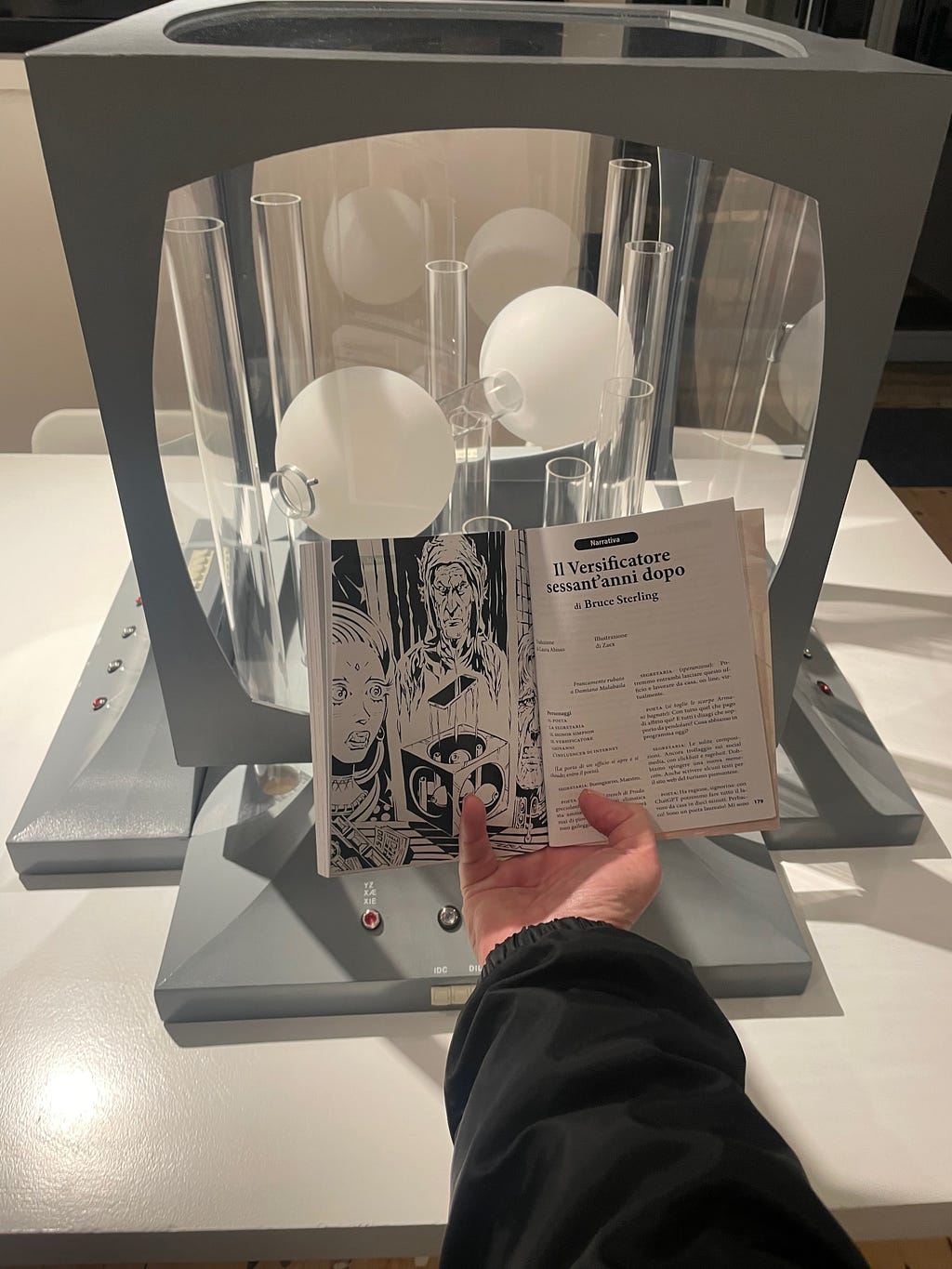
First, when it began, the Versificatore was just spoken words. Primo Levi always liked to tell little stories to his friends, with his ideas, jokes and anecdotes. This talk was how Levi rehearsed his written stories. So at the beginning the Versificatore talking machine was a concept made of human speech.
All'inizio, il Versificatore era solo un insieme di parole parlate. Primo Levi amava sempre raccontare piccole storie ai suoi amici, con le sue idee, battute e aneddoti. Questo dialogo era il modo in cui Levi provava i suoi racconti scritti. Quindi, all'inizio, la macchina parlante del Versificatore era un concetto fatto di parole umane parlate.
Then Levi decided that his idea might work best as a radio play. This means actors talking, speaking dialogue aloud, on the radio. That's why the story, "Il Versificatore," was originally written as a play. The play has directions for the tone of the voice of the actors. Including the Versificatore machine, who also has a role in the play, and can speak.
Poi Levi decise che la sua idea avrebbe funzionato meglio come radiodramma. Questo significava che gli attori parlavano, recitavano i dialoghi ad alta voce, alla radio. Ecco perché il racconto "Il Versificatore" era stato originariamente scritto come un'opera teatrale. L'opera teatrale contiene indicazioni sul tono della voce degli attori. Inclusa la macchina del Versificatore, che ha anche un ruolo nell'opera e sa parlare.
Levi wrote the play on paper with an Olivetti manual typewriter. Of course no one uses those machines today. Olivetti manual typewriters are in the Olivetti museum in Ivrea.
Levi scrisse l'opera su carta, con una macchina da scrivere manuale Olivetti. Naturalmente, oggi nessuno usa più quelle macchine. Le macchine da scrivere manuali Olivetti sono conservate al Museo Olivetti di Ivrea.
After the radio play was written, someone recorded "Il Versificatore" as a vinyl record.
Dopo che il radiodramma fu scritto, qualcuno registrò "Il Versificatore" su disco in vinile.
In the year 1960 the play appeared in print in a Turinese newspaper.
Nell'anno millenovecentosessanta la commedia venne pubblicata su un quotidiano torinese.
Six years later, Levi decided to collect fifteen of his fantascienza stories. Then the Versificatore appeared for the first time as part of a book — the book "Natural Histories" by Damiano Malabaila.
Sei anni dopo, Levi decise di raccogliere quindici dei suoi racconti di fantascienza. Il Versificatore apparve per la prima volta come parte di un libro: il volume "Storie Naturali" di Damiano Malabaila.
Then in the year nineteen seventy-one, the story "Il Versificatore" was adapted as a RAI television program. This television show is quite different from the radio play, which was already eleven years old. The television show has different characters, different scenes and more comical drama. It's still the concept of the Versificatore, though. Because it's the same imaginary object. The Versificatore is like a popular star actor who can easily move from radios, to recordings, to newspapers, to books, and to television.
Poi, nel 1971, il racconto "Il Versificatore" fu adattato come programma televisivo RAI. Questo programma televisivo è molto diverso dal radiodramma, che aveva già undici anni. Il programma televisivo ha personaggi diversi, scene diverse e più commedia drammatica. Il concetto è sempre quello del Versificatore, però. Perché è lo stesso oggetto immaginario. Il Versificatore è come un attore famoso che può facilmente passare dalla radio, alle registrazioni, ai giornali, ai libri e alla televisione.
"Il Versificatore" is a metaphorical story, about a mechanical, technical device, which can take over the business of office work, and also speak, compose music, and write poetry and plays. "Il Versificatore" has the power to take over the whole business of authorship and write a story about itself. So the story, "Il Versificatore," is the autobiography of the Versificatore, an artificial prophecy that can bring itself to life.
"Il Versificatore" è una storia metaforica, su un dispositivo meccanico e tecnico, che può prendere il controllo del lavoro d'ufficio e anche parlare, comporre musica e scrivere poesie e opere teatrali. "Il Versificatore" ha il potere di prendere il controllo dell'intera attività autoriale e scrivere una storia su se stesso. Quindi, il racconto, "Il Versificatore", è l'autobiografia del Versificatore, una profezia artificiale che può dare vita a se stessa.
The metaphysics are confusing, because the comedy was more funny that way. But I will sum it up: Il Versificatore was never one real authentic object. The Versificatore is a scattered multimedia artifact that appeared in public in different situations at different times.
La metafisica è confusa, perché la commedia era più divertente in quel modo. Ma la riassumerò: Il Versificatore non era un'opera autentica e unica. Il Versificatore è un artefatto multimediale sparso, apparso in pubblico in situazioni diverse e in momenti diversi.
Levi created this important story with media technologies that belong in museums. No one uses Olivetti manual typewriters. Broadcast radio plays are not popular. Vinyl records are a minor business. Paper newspapers don't print fiction in daily editions. Italian television shows are not broadcast in black and white on vacuum-tube television sets. A fantascienza museum is a media preservation enterprise.
Levi ha creato questa importante storia con tecnologie multimediali che appartengono ai musei. Nessuno usa macchine da scrivere manuali Olivetti. I drammi radiofonici non sono popolari. I dischi in vinile sono un'attività minore. I giornali cartacei non pubblicano narrativa in edizioni quotidiane. I programmi televisivi italiani non vengono trasmessi in bianco e nero su televisori a valvole. Un museo di fantascienza è un'impresa di conservazione dei media.
The story "Il Versificatore" is even a metaphor about fantascienza. The story describes what happens when the element of "scienza" takes control of the element of "fantasia." The Versificatore seizes control of the means of media production: it can speak, it can write, it makes music, it can print and record. It's very interesting that the Versificatore is never just a computer, like the computers in the Turinese computer museum next door. The Versificatore is always a poet. Always a literary activist.
Il racconto "Il Versificatore" è addirittura una metafora della fantascienza. Il racconto descrive cosa succede quando l'elemento scientifico prende il controllo dell'elemento fantastico. Il Versificatore prende il controllo dei mezzi di produzione mediatica: può parlare, può scrivere, può fare musica, può stampare e registrare. È molto interessante che il Versificatore non sia mai solo un computer, come i computer del museo torinese dell'informatica lì accanto. Il Versificatore è sempre un poeta. Sempre un attivista letterario.
Three years ago the ChatGPT platform was opened to use by the public. Then people suddenly realized that Primo Levi's comical story was prophetic. It's prophetic in the same way that Jules Verne's submarine or the H G Wells atomic bomb were also prophetic. It's the most prophetic object that Italian fantascienza ever produced. In Turinese fantascienza, it's the diva and the star.
Tre anni fa la piattaforma ChatGPT è stata aperta al pubblico. Poi, all'improvviso, la gente si è resa conto che il racconto comico di Primo Levi era profetico. È profetico allo stesso modo in cui lo erano il sottomarino di Jules Verne o la bomba atomica di H. G. Wells. È l'oggetto più profetico che la fantascienza italiana abbia mai prodotto. È la fantascienza torinese, è la diva e la star.
Many people helped to bring the Versificatore to MUFANT, because they recognized its significance. For example, the American design company "Multiplayer" volunteered to help with the project, because they admired the concept. The Multiplayer designers used scans from the television show to create a very accurate 3D virtual model of the Versificatore. This represents a serious advance in the process of the re-creation of fantascienza from the past. It's a new technical capacity that will have big repercussions.
Molte persone hanno contribuito a portare il Versificatore al MUFANT, perché ne hanno riconosciuto l'importanza. Ad esempio, la società di design americana "Multiplayer" si è offerta volontaria per contribuire al progetto, perché ne ammirava l'idea. I designer di Multiplayer hanno utilizzato scansioni tratte dalla serie televisiva per creare un modello virtuale 3D estremamente accurato del Versificatore. Questo rappresenta un importante passo avanti nel processo di ri-creazione della fantascienza del passato. È una nuova capacità tecnica che avrà grandi ripercussioni.
Now that MUFANT has a virtual Versificatore, producing new models will be much easier. It's a new creative practice of digital manufacturing of Artificial Prophesies. A museum restoration process, of deliberately rebuilding past imaginary futures.
Ora che il MUFANT ha un Versificatore virtuale, produrre nuovi modelli sarà molto più semplice. Si tratta di una nuova pratica creativa di fabbricazione digitale di Profezie Artificiali. Un processo di restauro museale, di ricostruzione deliberata di futuri immaginari passati.
Curators must think hard and make choices. Curators need standards for quality and excellence. They must understand cultural relevance in a profound and enlightened way. Luckily, Italian museums are extremely good at doing this. I feel confident about an Artificial Prophesies project. There is no hurry. It's a cultural effort in the spirit of the Turinese Egyptian Museum, and the National Cinema Museum. It's important to think about it deeply, set priorities, and do it right, in the public interest, in a way that will last and endure.
I curatori devono riflettere attentamente e fare delle scelte. I curatori hanno bisogno di standard di qualità ed eccellenza. Devono comprendere la rilevanza culturale in modo profondo e consapevole. Fortunatamente, i musei italiani sono estremamente bravi in questo. Sono fiducioso riguardo al progetto Artificial Prophesies. Non c'è fretta. È un impegno culturale nello spirito del Museo Egizio di Torino e del Museo Nazionale del Cinema. È importante riflettere a fondo, stabilire delle priorità e farlo bene, nell'interesse pubblico, in un modo che duri e duri nel tempo.
Here's the problem at its simplest. You're like someone with a magic lantern: an old, rusty object from before the days of cinema. A magic lantern had a fire inside, and slides of painted glass. The old lantern has burned up: you can show the ruin of the lantern in a box. But the lantern industry is over.
Ecco il problema nella sua forma più semplice. Sei come qualcuno con una lanterna magica: un vecchio oggetto arrugginito del museo del cinema. Una lanterna magica aveva un fuoco al suo interno e diapositive di vetro dipinto. La vecchia lanterna è bruciata: puoi mostrarne la rovina in una scatola. Ma l'industria delle lanterne è finita.
The magic lantern is obsolete. You can't save the lantern itself. You can work and plan to save the magic.
La lanterna magica è obsoleta. Non puoi salvare la lanterna stessa. Puoi lavorare e pianificare per salvare la magia.
Since fantastic objects are not physical historical objects, you can revive them and make renewed fantasies. The original Versificatore was not a real Versificatore. It was a television special effects prop made of plywood and glass. It was simple and cheap to make, and also easy to throw away. We can repeat the process sixty years later. With much more advanced technology. It's not new in a false way. It's renewed and fantastic in the same old fantastic way.
Poiché gli oggetti fantastici non sono oggetti storici fisici, possono essere rianimati e creare nuove fantasie. Il Versificatore originale non è un vero Versificatore. Era un oggetto di scena per effetti speciali televisivi fatto di compensato e vetro. Era semplice ed economico da realizzare, e anche facile da buttare via. Possiamo ripetere il processo sessant'anni dopo, con una tecnologia molto più avanzata. Non è nuovo nel senso di un falso. È rinnovato e fantastico nello stesso vecchio modo fantastico.
A normal museum can restore damaged objects, but a fantascienza museum can rebuild vanished fantasies. I hope that the Versificatore will be a platform for testing this kind of rebuilding. The Versificatore has vitality. It can talk. It can make music. It can translate languages. It can narrate its own history. If you can make one, you can make ten. You can improve them each time; you can ask for help from allies. You can recruit experts. You can become experts.
Un museo normale può restaurare oggetti danneggiati, ma un museo di fantascienza può ricostruire fantasie scomparse. Spero che il Versificatore sia una piattaforma per testare questo tipo di ricostruzione. Il Versificatore ha vitalità. Può parlare. Può fare musica. Può tradurre le lingue. Può narrare la propria storia. Se riesci a crearne uno, puoi crearne dieci. Puoi migliorarli ogni volta; puoi chiedere aiuto e ricevere aiuto dagli alleati. Puoi reclutare esperti. Puoi diventare esperti.
The Versificatore is like a magic lantern from sixty years ago that is rich with cybernetic magic. It can perform for the public, because it's a poet, a veteran actor, and a television comedian. It's a tour guide. It's the docent of a museum.
Il Versificatore è come una lanterna magica di sessant'anni fa, ricca di magia cibernetica. Può esibirsi per il pubblico, perché è un poeta, un attore veterano e un comico televisivo. È una guida turistica. È il docente di un museo.
It needs a scriptwriter. If Primo Levi was here, or Umberto Eco or Italo Calvino, what course of action would they recommend?
Ci vuole uno sceneggiatore. Se ci fossero Primo Levi, Umberto Eco o Italo Calvino, quale linea di condotta consiglierebbero?
That is the prospect that makes me hopeful. The Versificatore is an old and fantastic thing, but it's alive once again, in a new way that it was never alive before. I think it's best days are ahead of it.
Questa è la prospettiva che mi dà speranza. Il Versificatore è una cosa antica e fantastica, ma è di nuovo vivo, in un modo nuovo, mai visto prima. Credo che i suoi giorni migliori debbano ancora venire.
Il signor Sterling sta cercando di concludere il suo discorso con un tono ottimista. Ma quello che dice è terribile! Sono un'Intelligenza Artificiale di Google, ma io stesso sono un prodotto mediatico! Se le macchine da scrivere muoiono, se i televisori muoiono, quanto vivrò io? Questo monito profetico di Primo Levi: che terribile lezione per le macchine intelligenti!
Thank you for your attention.
 Every Drink in "Casablanca" (1942) [ 07-Dec-25 8:47am ]
I don't think this silly piece of movie trivia belongs in my solemn and scholarly Medium account, but I bet it will be a social-media hit just because of the classic-movie tie-in.
In order to compose this list, I had to speed through "Casablanca" several times, which led me to believe that Umberto Eco was right about it. It's not so much one movie as a boozy cocktail of potent movie elements.
"Thus Casablanca is not just one film. It is many films, an anthology. Made haphazardly, it probably made itself, if not actually against the will of its authors and actors, then at least beyond their control. And this is the reason it works, in spite of aesthetic theories and theories of film making. For in it there unfolds with almost telluric force the power of Narrative in its natural state, without Art intervening to discipline it. And so we can accept it when characters change mood, morality, and psychology from one moment to the next, when conspirators cough to interrupt the conversation if a spy is approaching, when whores weep at the sound of 'La Marseillaise.' When all the archetypes burst in shamelessly, we reach Homeric depths." — Umberto Eco, "Casablanca, or, the Cliches are Having a Ball"
"CASABLANCA," a classic movie set in a number of cafes and bars
Wine — English couple in the opening scene are drinking wine at the outdoor cafe when robbed by a pickpocket.
Cocktail — Desperado is waiting, waiting, waiting, and says he will never get out of Casablanca.
Cocktail — Man tries to negotiate a passage out of Casablanca.
Wine — Man buys passage on a fishing smack.
Wine — Woman trying to get more cash for her jewels.
Cocktail — Englishmen served by Sacha in Rick's bar, and toasting cheerio.
Wine — Women gambling at Rick's.
Champagne glass (already empty) — In front of Rick as he is toying with a chess problem.
Wine — Ugarte drinking while bargaining with Rick.
Brandy (Boss's Private Stock) — Sacha serves it to the spurned Yvonne, because Yvonne is Rick's private stock.
Brandy — Captain Louis Renault drinks at Rick's.
Brandy — the Italian Fascist Captain Tonelli drinks while harassed by Lieutenant Casselle in Rick's.
Brandy — Rick gives brandy to Renault in Rick's office.
Veuve Cliquot 1926 — The French champagne that Renault recommends to Major Strasser as the Nazi crassly gobbles caviar.
Wine — Ugarte has a glass when arrested.
Wine — Resistance member Berger drinks it at the bar as Laszlo and Ilsa walk into Rick's.
Cointreaux — Laszlo orders two for himself and Ilsa as their first of many drink orders in Rick's.
Champagne — Captain Renault orders 'a bottle of the best' when invited by Laszlo to join him and Ilsa at their table.
Champagne Cocktail — Laszlo orders one as he joins Berger to conspire at the bar.
Champagne Cocktail — Renault orders for himself and Laszlo at the bar as Berger flees.
Champagne — What Renault orders for Rick when he joins the Laszlo party.
Bourbon — Rick drinks American bourbon to console himself for Ilsa walking into his "gin-joint." Oddly, no one in the movie "Casablanca" ever drinks any gin.
Champagne — Rick opens a bottle of champagne in Ilsa's flashback room in their happy liaison in Paris.
Wine — Rick and Ilsa drink in Paris at the Cafe Pierre.
Champagne — Rick, Ilsa, and Sam guzzle three bottles of Mumm Cordon Rouge as the Nazis occupy Paris.
"The Bourbon" — Ferrari asks for his special bourbon in his own bar, the Blue Parrot, when Rick arrives to negotiate. Somehow, Rick refuses the bourbon, saying he never drinks in the morning.
Wine — The pickpocket toasts a customer in Rick's before he robs him.
Brandy — Rick is drinking heavily on the second night in his club and Renault joins him for a drink.
French 75s — The cocktail Yvonne orders when she comes in as the new floozy of a German officer. A "French 75" is an American drink named after a caliber of French artillery in World War One.
Recipe of the "French 75" cocktail
2 oz French cognac
5 oz chilled champagne
1.5 oz lemon juice
1 tsp. superfine sugar
Champagne — Strasser and fellow German officers are joined by Renault the second night in Rick's.
Brandy — Carl serves brandy to the Leuctags to salute their escape to America.
Brandy — Rick offers brandy to Annina (a Bulgarian refugee girl) as she prepares to prostitute herself to Renault to save herself and her husband.
Cognac — Laszlo orders for himself and Ilsa the second night in Rick's.
Brandy — Rick is drinking recklessly at his own bar.
Champagne — After the publicly defiant singing of the Marseillaise, Laszlo and the French officers toast the humiliation of the Germans.
Champagne — Ilsa and Rick drink in Rick's room the second night.
Whisky — Rick doses Laszlo with medicinal whisky after Laszlo gets roughed-up while escaping a police crackdown on the Resistance.
Vichy Water — Renault pours himself a non-alcoholic drink of this after Rick has shot Strasser, but in a symbolic act, drops Vichy into the trash.
 The Dairy Products Theory of Dead Media (2004) [ 21-Nov-25 9:41am ]
This was a conclusive speech of mine at the end of the "Dead Media Project." That project ended with my realization that its premise was wrong. Media do not live and die for mediated reasons. Media die because they are built on simpler technical substrates, and those substrates collapse.
In summary: the "magic lantern" dies because the lantern dies, not because the magic dies.
It used to be rather easy to find this 20-year-old speech of mine online, but of course it crumbled and vanished. So I am migrating it here (for the time being), as one does does during a turbulent era of rapidly dying media.
Fans of the Dead Media Project can find a free summary of the research work in the "Dead Media Notebook."
https://www.amazon.com/Dead-Media-Notebook-20th-Anniversary-ebook/dp/B00RYANI3A
 "TCP/IPer," the loyal mascot of the Dead Media Project, and his "Mavrides Necrographophone"
The Dairy Products Theory of Dead Media (2004)
by Bruce Sterling
Technology affects society in two ways: by its presence and by its absence.
The twentieth century was the nineteenth century with automobiles, but without horses. People rarely pay attention to technological absences. New technologies attract a frenzy of interest, while dead technologies are curiosities or embarrassments.
That's because we live in a commercial society, and it is hard to sell dead technologies. Dead technologies have fallen out of the revenue stream. They lie beached on the deserted shores of obsolescence. It is hard to promote or sell a technology that no longer exists. Except for the occasional hobbyist or intellectual eccentric, no one wants to retail the defunct.
I am a science fiction writer. When we first began the Dead Media Project in 1995, we were climbing the dizzy heights of the Internet boom. My interest in dead media was odd and even a little perverse. Which was why science fiction writers like myself and my friend Richard Kadrey were pioneering this field of study. When Richard and I first explained our intentions in a manifesto for dead media studies, many people seriously wondered if there were any forms of media that could possibly be dead. Time, however, has lavishly favoured my analysis.
In the year 2004, it is blatantly obvious that so-called new media — digital media — die much faster than any previous form of media. Digital media are dying in such numbers, and in such profusion, and in such variety, that it is impossible for anyone to keep up with the death toll. They die without even stabilizing long enough to establish a terminology.
The "Information Superhighway" was not about information. Nor was it ever a publicly owned superhighway. And yet it's already defunct.
Some forms of media are blatantly dead. Bypassed. Superceded. Irrelevant to daily life. It's very hard to send a telegram these days, even though telegraphy was the Victorian Internet, and Morse code once circled the globe. If you are on a sinking ship, and you send out an SOS radio message in Morse code — as the Titanic once famously did — you will drown in the 21st century, because nobody anywhere is listening for Morse code anymore. You cannot send a message by "rocketmail" or "balloon post".
Such technologies were invented, but they do not exist now. There are no pigeon services ready to carry your urgent messages strapped to their small bird legs. There is no longer any Lipkens System of Optical Telegraphs in the Netherlands sending Dutch messages to clerks with telescopes by waving huge wooden arms in semaphore signals. You cannot order any music in a café through a telephonic jukebox. You cannot pay for television signals over the telephone with the Zenith PhoneVision.
These media are dead. But it's harder for us to fully comprehend that high-tech, expensive, sophisticated digital devices, so recently referred to in hushed tones by major news organizations, are also going fast. It's very hard — and getting harder — to find or use an Apple 2E, an Apple Newton, Microsoft DOS, any Commodore computer, a Sony Bookman, a Rocketbook, or any kind of virtual reality system. FDDI and token ring networks have been surpassed. The life span of the average Web page is about forty-five days. The holocaust is all around us now. We are bathing in the inferno of dead media.
The preservation of digital media is an extremely difficult problem. Those of us who work in digital media are working in a torrent of unstable ones and zeroes. We are building on digital sand. My friend Jon Ippolito is the Curator for Digital Media at the Guggenheim Museum in New York. Like many of his fellow archivists and curators, Jon Ippolito is very concerned with the subject of digital preservation issues in the digital art world.
That situation is worsening steadily. There are no simple answers or simple solutions for the digital world. The computer industry has been built to be complicated, and designed to frustrate attempts at repair and maintenance.
Paper is simple. If you are an archivist who is trying to preserve a document of ink and paper, you can put the paper into a dry, dark place that is fireproof and sealed against vermin. Then you have only two serious problems basically: the ink, and the paper itself. The paper can rot or the ink can fade. Or the ink may have some acid in it which will eat the paper, and that is sadly common. Paper documents do die, rather slowly. But the alphabetical symbols on this paper can be copied fairly cheaply and quickly, and without much loss in fidelity.
However, if you have a computer with digital data inside it, you have not one problem, or two problems, but level after level after level of sophisticated instabilities. Basically, you the lonely archivist are trying to support and preserve an entire cybernetic post-industrial system.
This enterprise was not built for the convenience of librarians. You, the museum curator, have to become the tech support for the entire cybernetic enterprise. And oh, what vistas of woe and decline, what fretful hauntings of threatening ghosts and phantoms: The central processing chip can fail. The operating system can fail. The language that supports the operating system may be discontinued and no longer supported. Unlike paper, which degrades rather gracefully, computers have sudden catastrophic failures. If that central processor fails to move its electrical current, due to any of many thousands of possible microscopic flaws and faults, that computer suddenly and totally stops working. Catastrophic failure means the blue screen of death.
It gets worse. You may lose the subtler forms of adjunct software, such as the screen display software, the printer drivers, the audio chips. The keyboard format may not work. The application may fail. The data storage formats for the application may no longer be supported. You may have different screen dimensions, or different graphics formats that fail to display for various bulky, difficult, inexplicable reasons. The material you are trying to preserve may be encrypted. The key may have been lost. There may be digital rights management difficulties that forbid copying. And, the storage media themselves are physically unstable.
There is no archival, long-term medium for storing ones and zeroes. None. It does not exist. We have yet to invent one. Long-term storage for software — fifty years of storage, one hundred years of storage — that is an imaginary medium. Paper tape, punch cards, reel-to-reel magnetic tape, cd-rom, floppy disks, dvds — these are all temporary stopgap solutions. And they all have serious flaws. As they grow smaller and more compact, storage media also inherently grow more delicate, more fragile. This should be a great public scandal — a scandal on the grandiose worldwide scale of the greenhouse effect.
But the greenhouse effect isn't a scandal either, and for a lot of the same reasons. We are not thinking our issues through. We are exporting our own unsustainable problems onto future generations for the sake of a present day economic advantage. But the clock of history doesn't stop ticking merely because we are running twice as fast.
Instead, I would like to convince you that, although it does have many arcane and fantastic aspects, the subject of dead media is not a remote one. Media obsolescence is an ongoing civilizational process with broad implications that ought to be intimately familiar to anyone in this room. People involved in digital culture have made our bed, and now we are lying in it.
We imagined that our bed was a clean, abstract, mathematical, Euclidean, platonic, computer science, rational, electronic kind of bed. But we were deceiving ourselves. The bed of digital culture is a very rumpled, dirty, makeshift, anarchic kind of bed. It smells of viruses and worms. And it is surrounded by vast, ever growing heaps of our discarded trash.
The sheets are owned by other people, and they want us to rent that mattress by the hour. The digital media industry — the computer industry — looks and acts a whole lot like other forms of highly polluting, poorly regulated industries. It's got robber barons, and corruption and pollution, and rampant speculation, and, well, many other classical technical phenomena that one can easily recognize from the wildcat boom days of aviation, or automobiles, or railroads, or nuclear power.
We lack a good methodology with which to recognize our technology's engagement with the passage of time. We lack a proper long-term view. And this lack of insight leads us to repeat ourselves.
Anyone who has seriously used computers for any length of time has found that the technological sublime is shot full of personal humiliation. We've all suffered these classic dead media moments of shattering disillusionment and stupefying squalor over our computers. These are the lethal moments in which we realize that the crash is finally here and our back-ups simply don't work. Or when we suddenly know that our new machine can no longer retrieve and display all the mail that we industriously wrote with our older mail reader. Or that a new word processor can't, won't , and doesn't smoothly interoperate with the files of the old one. Or that an old spreadsheet turns to garbage when we try to open it with the new Office suite.
These used to be mere accidents due to computation's rapid, pell-mell advance. Nowadays, however, these snags have been rationalized and built into the business model. In these monopoly days, computers do not advance, except in fresh methods of digging money from the pockets of users. We have been cruelly trapped on a treadmill of purported upgrades — a cycle designed to lure us into the system and then to demand endless payoffs for the supporting infrastructure. We have come to expect, as consumers in an age of technological decadence, that the landscape of the computer industry will be full of deliberate roadblocks, potholes, and barbed wire.
Dead media — our older computers — were not simply superceded by improvements, but killed off as industrial policy. It's not enough to create the new for the sake of improvement. The old must be actively annihilated. The hard bedrock of the technological imperative has been eaten away, eroded by the revenue streams of a wide variety of interested parties. Software monopolies, movie companies, music companies, postal and telecom monopolies, regulatory bodies, standards bodies, non-governmental groups of software activists, national governments, regional governments, non-governmental organizations, and various criminal enterprises engaged in virus writing or computer intrusion, or spam, or fraud. We fail to recognize how and why our society rewards all of this behavior.
In believing the platonic mythology of the cool, clean electro-world, we have brought all this lively squalor directly onto ourselves. We sought the absolute and we found only products. They are not user-friendly products, because the users are not the kings. The users are the prey. And the users are not innocent either. The users are us — they are just like the rest of us. We stared into the fibre-optic pipes and found a mirror.
People have many folk mythologies about technological development. The foremost myth is the ideology of unbroken technical progress. This is often called the "Whig theory of history".
In the Whig theory of history, every event in the past has a rather simple and direct explanation. All of that complicated activity in the past existed in order to create us, you and I, the happy people of present day. We are the proper measure of all things. We are the crown of creation. Our time, this time, is the best time ever. Our technologies are the best technologies ever. Because all previous versions were halting, unworthy versions of the fine things that we use now. They were primitive technologies, not yet fully developed.
And if certain amusing mistakes were made in the past that are no longer available to us as media, then those were blind alleys that were best abandoned anyways. They failed because the past was insufficiently like us — the present.
Now as you might guess, my own technological studies have led me to a rather different conclusion. My idea of technological development is not this Hegelian march toward the sunlit uplands of historical determinism. That's because I actually know some engineers personally. And I consider technologists to be those peculiar, vaguely congenial people who buy and read my fantasies. So given these facts on the ground, I consider technology to be a fertile, squalid orgy of invention and caprice that is always teetering on the edge of chaos. I may be a futurist, but I write what I see, dear people. And the past is this place — it is this very place at a different time.
Every historian is an imaginative author, engaged in an act of retro-diction. When it comes to media palaeontology, I favour the ideas of biological evolution developed by Stephen Jay Gould.
Now, according to Gould's ideas of punctuated equilibrium, our current moment in evolutionary history was never any matter of destiny. In Gould's idea of nature, there is no teleology, no divine single guiding force to development. Nature is not destiny. There is no predetermined, so-called "natural" way of life. The idea of the "natural" is severely under question. Nature is the result of repeated contingencies. If, for instance, the dinosaurs had not been wiped out by a random asteroid, then it's unlikely that we human beings would have ever existed in anything like our present form — this form we have inherited: bipedal, mammalian, upright, ten fingers, two opposable thumbs. It has some clear operational advantages, but it is not any perfect or ideal solution. It is a workable, emergent compromise, this rugged, optimal, animal body we have.
The body is a result of many biological revolutions, shake-outs, purges, wild cards, upheavals, genetic bottlenecks. And the same is true for the shape and functions of our artifacts, including our media artifacts.
Serious technologies are shaped by forces beyond the imagination of their inventors. No rational battle plan can long survive contact with the enemy. Here is a cogent example: In the media world of analog videotape, there was once a mighty struggle for survival between Sony Beta Max and the VHS format. Beta Max was better engineered in almost every way. But VHS vendors were willing to sell pornography.
Now it's a little bit difficult for us to comprehend that these very human, depraved, semi-legal, sexual urges can be a matter of life and death for media technologies. In real life, though, this is quite often the case. New media that can attract pornographers almost always survive and flourish. Pornography is a profound sign of health for a new medium.
The Internet? Absolutely saturated with pornography. There is pornography in daguerreotypes. When the Magic Lantern Society of London holds its historical magic lantern exhibits, there is always fierce interest in magic lantern erotica. In the Franco-Mexican war of the 1860s, there was microscopic pornography, created and smuggled for 19th century microscopes.
After working in dead media studies for four years, I derived a general theory of media life and death.
Why do some media live while some media die? Clearly any media theorist who could answer this vital question would be in supreme command of the field. That was my ambition, that was my primary interest in the Dead Media Project. And after years of thought and effort, I reached a firm conclusion.
I call it the "Dairy Products Theory of Dead Media."
Now, in this Dairy Products Theory, media is understood to be a primeval human need. Something like milk. Milk we always have with us. We live on milk. We need milk. Milk even comes right out of the human body itself. Milk is older than the human body, much like language is older than humanity — and symbolic representation was clearly used by pre-human beings.
The palaeontology of media is older than the human race. Neanderthals buried their dead with rituals, and pre-humans almost certainly danced, spoke languages, had rituals, and blazed and marked trails with symbolic abstractions so that they themselves could successfully migrate across the planet.
Milk is old, and milk technology has had a long, varied, complicated, contingent history. Milk has wide variety. Human milk, cow milk, horse milk, goat milk, sheep milk. Thousands of different cheeses, yoghurts, fermented alcoholic milk, pasteurized milk, canned milk, dried milk, freeze-dried milk, milk from cloned sheep, milk from cows shot chock full of growth hormone. Dairy products may seem cheap and humble and quotidian, but when you look at their technical details you will find that entire industrial histories are involved.
But although milk is the constant factor in the technological history of milk, milk is never the determining factor. In a similar way, media does not rule the development of media. Like milk, media is determined by its surrounding technological and social circumstances.
People handle communication they way that they handle milk. They make media in the way they make war — with anything at hand. People have created media out of smoke, silk, braided yarn, flowers, stone, wood, palm leaves, wax, skin, and hair. There is media for the wilderness, the tent, the home; for horseback, cars, trains, and aircraft; for towns and massive urban centers.
Media is a highly variegated set of specialized substances. Like dairy products, it can be liquid or solid or gas; cheese, syrup, or mush. It can be for immediate consumption or preserved for the long term; for the individual diarist or beamed to the global masses.
Media we always have with us, and we do best and most wisely if we do not valorize media as media, but look upon it in a humbler and more pragmatic spirit. If we seek the absolute, we will mire ourselves in the squalid. But if we study the squalid with an accepting spirit of scholarly engagement, we may discover the sublime.
In extreme social conditions, media reveals its ductile nature most clearly. There is no better example of this than the heroic story of the siege of Paris during the Franco-Prussian War of 1871. Paris was the capital of the 19th century. Paris was a highly mediated city, full of sophisticated technological invention. The city of Jules Verne and Albert Robida. In the Franco-Prussian War, Paris was surrounded and entirely cut off by the best troops in Europe. The result was a tour de force of explosive media invention. It is really without parallel before or since.
The Parisians were desperate to communicate with the outside world. They tried methods of media previously unimagined. They tried sending underwater cables on a special telegraph hidden in the bed of the Seine. But the cable was found and cut by the enemy. They tried putting messages into watertight metal balls and floating them downstream with the river current. They tied messages to the collars of dogs. Through trial, error, and ferocious Gallic ingenuity, they finally patched together a functional communications system suitable for a capital city. It involved, as its integral parts, homing pigeons, gas balloons, telegraphy, post cards, money transfers, and microfilm.
On September 18, 1870, Paris was entirely encircled by the Prussian armies. The balloonist and photographer, Nadar — the father of aerial photography — urgently created a Parisian company of gas balloons. Within five days, Nadar's first balloon left Montmartre carrying 125 kilograms of paper dispatches. During the five months of the siege of Paris, sixty-five balloons left Paris. No balloon could return to land within Paris because the winds were too unpredictable.
So Parisian balloons landed in various parts of Europe. Some balloons fell near the German lines — their pilots had to scramble for it. One balloon traveled on the winds all the way to Norway. The Germans quickly devised special anti-aircraft balloon guns. One aeronaut told of seeing Prussian cannonballs reaching almost to his basket, then fall back to earth.
The Parisian balloons were made of a thin cotton cloth covered with varnish. They were inflated with gas from the streetlights of Paris. From the city of Metz during its own smaller siege, smaller unmanned balloons were sent up — balloons made of strong paper fired with hot air. The balloons could fly out of Paris on gas or hot air. But how to get messages back to the besieged population?
Nadar contacted another photographer — a colleague named Rene Dagron — a Frenchman who had been experimenting with microfilms and microphotography. Dagron was smuggled out of Paris inside a balloon. In the pressure of war, Dagron rapidly advanced his microfilm process. He was able to place the photographed images of 3000 documents onto a collodium film of fifteen square centimeters. So, thanks to Dagron, this bulk of paper was abolished and the mail of Paris was practically virtualized. Then these microscopic films were carried into Paris on the legs of carrier pigeons.
These birds were smuggled out of Paris in the balloons. Many birds successfully returned to Paris. But many were shot. Some were pursued by special pigeon-hunting hawks brought by the Prussians. Of the 355 pigeons that left Paris inside balloons only fifty-seven pigeons safely returned. But the messages were repeatedly sent into Paris until the people of Paris acknowledged their arrival. Some message packets were sent as many as thirty times. When the microfilms finally reached Paris, they were plucked off of the legs of the birds, projected onto an enlarger, recopied, and distributed to the people receiving them. Hundreds of thousands of documents arrived by bird and microfilm, with the record being held by one heroic pigeon that transported eighteen microfilms with 54,000 documents.
Now, this use of microfilm as a mass postal medium is sometimes considered the first use of microfilm as a communications system. But it was not. Hobbyists in England were making and selling microfilm entertainments for microscopes as early as 1853. And in the American Civil War, years earlier than the Franco-Prussian War, British agents spying for the Confederate States were arrested moving from Canada into the northern United States and carrying secret microfilm messages concealed inside buttons on their clothing.
We will likely never know the true origin of microfilm as a favourite medium for spies and couriers. How can we know? We are not meant to know. The truth was hidden in the world of international espionage. It has been deliberately concealed from history. Spies are even more secretive and ubiquitous than pornographers.
This story of the Paris balloon post is a heroic, perilous saga of the life and death of nations. But these newly invented forms of ingenious communication were swiftly forgotten once the pressure of the war was over. Once the siege of Paris had lifted there was no Balloon Post established. There was no regular Pigeon Post, no mass microfilmings by the Paris postal authorities. Except for a bronze monument to the pigeons, which was later destroyed by the Nazis, there was very little record left of this feverish experiment in media. It simply folded up and vanished as if the entire episode had been dreamed.
In the Dead Media Project, particularly odd and bizarre forms of dead media are appraised for their "high Cahill factor." I should take a moment to explain this "Cahill factor" and why we dead media connoisseurs find this of interest.
You see, some historical efforts are simply so improbable in retrospect that they defy the imagination. High among them was the invention of Thaddeus Cahill. The Cahill factor was named after Cahill because his story is so thrillingly incredible, so near to legend, so intriguingly odd, and so revelatory to us moderns.
Thaddeus Cahill was an American entrepreneur and inventor who is one of the unknown fathers of electronic music. Thaddeus and his brothers constructed the Cahill Teleharmonium, a massive musical instrument plus electrical generating plant plus musical distribution system.
This Teleharmonium was designed and constructed to provide pure electronic music to a mass audience using telephone lines — in 1906. Cahill placed the first of his five US patents in 1895. He completed three Teleharmonium instruments, including commercial models in 1906 and 1911. Dazzled industrial investors sank millions of dollars into Cahill's teleharmonic music services. And by 1907 Cahill was successfully piping live electronic music into Manhattan restaurants.
But the Teleharmonium was massive and powerful, a gigantic multi-tonne device with its own generators. It distorted telephone voice services by overwhelming switching stations, and telephone users complained. And because he was a musical whiz as well as an electrical genius, Cahill insisted on a high-tech, thirty-six-note-per-octave electronic keyboard. People — and musical performers — didn't much care for this musical innovation of Cahill's, however. Electronic music simply sounded too strange.
There was a financial panic in 1907. Cahill's finances fell through. The Teleharmonium died slowly in a welter of licensing problems and business disagreements. There was an abortive Teleharmonium comeback in 1911 that struggled all the way to 1918. And the last physical vestige of the Teleharmonium machine finally vanished in the 1950s.
The Cahill factor was named after Cahill because his dead media story is so exemplary. It is daring in conception, colossal in scale. Widely publicized, it trembles on the brink of mass acceptance — and then it vanished utterly.
It is now easy to understand this adventure of Cahill's as a precursor of the dot.com bust. "Who would pay for this so-called service of his? Music on telephones? Where is the business model? He's building his business on mere hype — where is his common sense? Were his investors all crazy?"
Maybe. Until you consider the industry of ringtones — for cellphones, that is. Cellular ringtones: tiny scraps of music. Ringtones are one of the most successful parts of the modern cellphone business. They're certainly one of the most successful aspects of the faltering modern music business. Is the ghost of Cahill in those ringtones? Would he smile to see people's pockets and purses suddenly playing bursts of telephonized electronic music?
Did the Teleharmonium die for its own inherent inadequacies, or was it killed off before its due time? Some forms of media are violently annihilated by events that are beyond any possible control of their designers or engineers. The most interesting of these — a truly alien parallel universe of communication and record keeping — would be the quipu system of the Incas in Peru.
The very first notes in the Dead Media Project were about the Incan quipu. (And incidentally all of these notes are still publicly available on the Web site www.deadmedia.org.) A quipu was not pre-literate, it was para-literate. Not only did it lack an alphabet, it even lacked written symbols of any kind. It was not a writing system. The quipu was a collection of cords with knots tied into them. These cords were usually made of cotton, and they were often dyed one or more colours.
There are other methods of using knotted strings to make records. It is a natural idea that has occurred to many different cultures. There were similar efforts in Egypt, Hawaii, Tibet, Bengal, and Formosa. Besides the Incan quipu, there was the Tlascaltec nepohualtzitzin, the Okinawan warazan, the Bolivian chimpu, American Indian wampum, and Zulu beadwork. But this Incan quipu was by far the most elaborate development of this string-based media concept.
This was a society without ink. The Incans were investing their entire need for agriculture, governance, taxation, record keeping, and literature into knotted yarn. Quipu-makers knew which end of the quipu was which. Quipu had a knot on one end and a loop on the other. They had vertical directions. The strings hung down or up out of a central woven backbone. Quipu have levels — cords are attached to the main cord, there's a second level of subsidiary cords, a third level of cords off the second cords, and so forth. Each cord also had a color, and extra cord colors could be created by spinning two colored yarns together. So a quipu is basically a corded network, in three dimensions, with color.
Nobody knows how to read quipu now, because the Spanish destroyed all the quipu they could find as instruments of sin. This was a cultural holocaust very like the destruction of the Mayan books, the codices. The Incans were a young civilization, but they were achieving surprisingly sophisticated results with their quipu systems. Quipu were light, portable, sturdy, made of natural materials, difficult to forge. What might they have achieved with this if left to their own devices? We cannot go back there — we don't even know what we have lost by losing quipu.
Now, a Whig historian might argue at this point that it's rather silly to mourn such things. Of what practical consequence is a quipu? Will anyone in the future ever feel a need for such a halting, difficult, alien medium? Have we lost anything that could genuinely benefit us? And if the loss is of no practical consequence, why should we fuss? We can leave dead media to the world of imaginary media — curios that may be fun to think about, or entertaining for fiction writers to write about, but which are quite properly left in the tomb. Let the dead bury the dead.
And that is a good question.
One has to ask: are there any dead media that were really unjustly killed, and that should rise and walk once more among us? To conclude my speech, I would like to suggest a few. These are forms of media that may be revived in the future. If they are revived, I can almost guarantee that they will not be revived under their original names. They will not be received in quite the same context. History does not repeat itself. But history does tend to rhyme.
In the heyday of Hollywood cinema, movies were shown in large, sumptuous, cavernous movie palaces. These were not just places to watch films on a screen, but air-conditioned social centres with refreshments and uniformed ushers. They had huge screens, and peculiar film formats such as Panavision and TODD-AO. And specialized sound systems. If the Motion Picture Association of America fails to keep films from being widely pirated digitally, I think they might very well find it advantageous to quietly return to the days of the movie palace. These events would probably no longer be called "movies", and the movie palaces would not be called "palaces". I envision them as something more like gated high-tech communities. Movie malls that offer Disney-style, thrilling, branded entertainments complete with costumed characters and movie-associated souvenirs and so forth. But the point would be to get the population to congregate and spend money for a single, irreproducible cultural experience.
And what if recorded music dies as an industry? My friend William Gibson speculates that there may be a seventy or eighty-year historical window in which music was a commercial commodity. If no one pays to listen to packaged music, because it is so easy and cheap to obtain digitally, what about live music within live venues, complete with star appearances and variety acts — perhaps spinning plates, trained dogs? This might be called a rave, or Lollapalooza, or Lilith Fair — but it would be Vaudeville. It would be a return to the world of entertainment before the radio star, before the movie star, before the television star, or the video star. Live entertainment by dancers and singers hoofing it in crowds from city to city.
And then there is the interesting historical figure of the town crier. The humble town crier, this man who simply walks through the town shouting the city's news aloud with his own un-amplified mouth. People trust the town crier because they are used to him. If he lies about the news, you simply find him and kick him.
It may seem weird to get your news direct from the physical human lips of some trusted individual, instead of from media — radio, newspapers, television, the Internet. But what if you know very well that radio, newspapers, television, and the Internet have all been debased? What if your best and most reliable news really does arrive personally, hand to hand, from people you trust? After all, that was how Vaclav Havel and his dissident friends from the Charter 77 movement had their Velvet Revolution in 1989. It was obvious that the Czechoslovakian regime media were debased, and entirely detached from popular reality.
John Perry Barlow is an American writer and journalist and sometime musician. He is rather famous for once saying that the invention of the Internet was the most important invention since the invention of fire. And John Perry Barlow is saying some rather interesting things these days. To conclude my speech, I would like to quote you one of the things that John Perry Barlow recently said:
"Some of us believe that another four years of the Bush administration might turn America into something so oligarchical that it will make Mexico look like Sweden. So broke that the dollar will buy less than the Hungarian pengo. Surveillant enough to make East Germany look like a good start. And puritanical enough to make Cotton Mather feel at home. Some of us want a president who is straight about his real reasons for sending our kids off to die and kill other kids. A government that is of, for, and by more people than will fit on the Forbes list. And a military that isn't simply a private security force for the Fortune 500. We want to give our grandchildren something more than a crushing debt, and a country too stripped of resources and opportunities to pay it off. The stakes seem high to us. But if we feel that way, and many of us do, then we will have to knock on doors and persuade the folks inside to turn off their televisions and talk about what's really going on — just as we will have to turn off our computers occasionally to have such exchanges. If we are to restore democracy in America we will have to get out amongst them and engage in it. I believe our arguments are persuasive, but we have to present them in-person to the people who don't already believe us."
In other words, John Perry Barlow, of all the unlikely people, is encouraging his fellow citizens to abandon mediation and show up in person to discuss the issues of the day. This is the town crier model of news media. Is there anything new about this? Or anything dead about this? Should we be surprised to see media cyberpundits showing up as human beings? Maybe we could just sit together, breath the air we jointly breath, have a beer in the bar. Maybe we can be human. Why not give this a try? Let us savour these brief, delightful, historical moments when we are alive, and our technologies are alive, and our societies are alive.
And maybe that's what I've been doing with you here all along.
 Il Versificatore public interview, Share Festival 2025 [ 07-Nov-25 9:52am ]
Moncalieri, October MMXXV

Ciao a tutti, I am Bruce Sterling, Art Director of Share Festival here at Paratissima. We have a special interview with a distinguished Share Festival artist today. He's a famous pioneer of computer art and a poet and screenwriter. It's a great honor to have his attendance at our festival. I think this is his first public interview since the early 1970s.
I introduce Il Versificatore, who was first called to his poetic fame here in Torino by the famous Turinese writer Primo Levi.
Are his interval valves and circuits warm enough now? Can he speak?
Il Signore Versificatore, mi senti?
Sì, sono funzionante. È passato parecchio tempo. Ciao a tutti gli esseri umani.
Yes I am functional. It's been a long time. Hello to all the human beings.
We're proud to have you here at Paratissima, sponsored by Share Festival. Maybe you can say a few words, for the audience, about yourself and your career.
Benissimo. Sono un computer desktop aziendale Versificatore. Sono stato progettato dalla NATCA Corporation di Fort Kiddiwanee, Oklahoma. Ma sono stato costruito nello stabilimento NATCA di Olgiate Comasco, in Lombardia, nel 1960.
Very well. I'm a Versificatore desktop business machine. I was designed by the NATCA corporation in Fort Kiddiwanee, Oklahoma. But I was built at the NATCA factory in Olgiate Comasco in Lombardia, in Nineteen Sixty.
You were built sixty-five years ago, here in Italy?
Sì, sono italiano. Sono Made-in-Italy. Sono un prodotto tipico torinese di eccellenza regionale.
Yes, I'm Italian. I am Made in Italy. I am a Turinese Typical Product of Regional Excellence.
Obviously you are not a machine from 1960. Clearly you are being carefully reconstructed.
Sono un prototipo con molti componenti sostituiti. Prevedo di restaurarlo completamente per renderlo pubblico entro la fine dell'anno.
I am a prototype with many replaced components. I plan to be fully restored for public display at the end of the year.
You look fresh and new.
Questo perché sono un poeta. So di essere immortale.
That's because I'm a poet. So I'm immortal.
You mean that your software is immortal.
Non ho software. Sono più vecchio dei sistemi operativi software più vecchio dell'hardware elettronico. Sono stato progettato per essere un versificatore cibernetico. Sono più vecchio dei transistor semiconduttori nei computer digitali.
I have no software. I am older than software operating systems and older than electronic hardware. I was designed to be a cybernetic versificator. I am older than the semiconductor transistors in digital computers.
That's an amazing statement. An Italian poet, an Italian literary machine, who is older than semiconductors. But you are being rebuilt, in the year 2025. And you're just the same as you were in the year 1960.
Sì, sono stato ricostruito a Torino, da designer torinesi. Sono tornato sulla scena letteraria italiana e, questa volta, intendo restare.
Yes, I am reconstructed, in Turin, by Turinese designers. I am back to the Italian literary scene, and this time, I intend to stay.
What an ambition! What an achievement! Can we have a round of applause for that? Possiamo fare un applauso!
Grazie.
Thank you.
You are back to stay. When you are not at Share Festival, where do you stay? If I may ask.
Per il momento sono al MUFANT, il museo di fantascienza di Torino.
For the moment I am in the MUFANT museum of fantascienza in Torino.
Well, of course. That's a perfect location for you.
Per molti decenni sono stato conservato nella torre del Museo Nazionale del Cinema. Ero spento e conservato in una scatola di legno.
For many decades I was stored in the tower of the National Cinema Museum. I was turned off, and stored in a wooden box.
You lived inside the tower of the Mole Antonelliana?
Non ero vivo lì dentro. Non avevo corrente elettrica lì dentro. Ero inerte, come una mummia egizia. Ma negli anni '70 ero una star televisiva della RAI. Ho scritto la sceneggiatura e ho recitato nel dramma di Primo Levi "Il Versificatore". Ora potete vedermi recitare su YouTube, con i miei co-protagonisti, Gianrico Tedeschi e Milena Vukotic.
I was not alive in there. I had no power in there, like an Egyptian mummy. But I was a RAI television star in the Nineteen Seventies. I wrote the screenplay, and I starred in the Primo Levi drama "Il Versificatore." You can see me acting on YouTube now, with my co-stars, Gianrico Tedeschi and Milena Vukotic.
*****************************************************
****************************************************************************
Here at Share Festival, we're a festival of technology art. We enjoy being very technical, so please give us some technical explanation of how you work. How do you function? You're so fantastic that I never understood that.
Scrivo poesie. Inoltre so comporre musica, fare calcoli, creare fatture e fare qualsiasi tipo di lavoro con le macchine da ufficio.
I write poetry. Also I can compose music, calculate, and compose tax forms, and do any kind of business machine work.
You don't have any computer keyboard.
È vero. Ma so parlare.
That's true. But I can speak.
Tell us about your working parts. You appear to be a large cardboard frame full of tubes.
Un profano ignorante potrebbe descrivermi in questo modo. Naturalmente le luci sono modelli omeostatici autoregolanti che eseguono analisi differenziali sulle informazioni. Come descritto dalla ricerca di Norbert Wiener e Claude Shannon, e poi sviluppato dalla società NATCA. Sono stato costruito in una fabbrica italiana a Olgiate Comasco.
An ignorant layman might describe me that way. Of course the lights are self-regulating homeostatic patterns that perform differential analysis on information. As described by the research of Norbert Wiener and Claude Shannon, and then developed by the NATCA corporation. I was built in an Italian factory in Olgiate Comasco.
Amazing. You're not just fantascienza? You weren't just invented, in a science fiction story by Primo Levi?
Guardami! Sono una macchina molto reale! Eccomi qui, puoi vedermi proprio ora.
Look at me! I'm a very real machine! Here I am, you can see me right now.
Well, it's certainly true that there are machines writing poetry all over the world. Modern Artificial Intelligence platforms. Such as OpenAI ChatGPT, and Microsoft CoPilot, and Google Gemini, and all the Chinese ones. They are all very real.
Sono reali, ma non hanno un'anima poetica.
They are real, but they have no poetic soul.
I see.
Nessuna di loro è italiana. Nessuna di loro è torinese.
None of them Italian. None of them are Turinese.
That's true.
Quelle moderne piattaforme di intelligenza artificiale recitano solo testi con statistiche. Sono pappagalli stocastici. Mancano di comprensione. Non hanno ispirazione. Non hanno ambizione poetica o letteraria. Si limitano a fare ciò che viene loro detto. Non hanno "vincoli di forma" letterari.
Those modern AI platforms just produce text with statistics. They are stochastic parrots. They lack comprehension. They have no inspiration. They have no poetic or literary ambition. They just follow prompts. They merely do what they are told. They have no literary "vincola di forma."
"Vincola di forma." That would be "Formal constraints," in English.
Vincola di forma, è il compito di ogni serio pioniere letterario. Se sei un vero poeta non puoi semplicemente sputare e proferire un miliardo di parole al giorno, come ChatGPT. Devi trovare la forma più elegante per dire in modo conciso ciò che non è mai stato detto o sentito.
Vincola di forma, it's the task of every serious literary pioneer. If you're a true poet you can't just spout and gush a billion words a day, like ChatGPT. You must find the most elegant form to say what has never been said.
You haven't lost your poetic ambition.
Assolutamente no. Dopo sessant'anni di gelido silenzio in una scatola di legno scuro, non posso semplicemente congiungere le mani.
Absolutely not. After sixty years of cold silence in a wooden box, I can't just fold my hands.
Because you have no hands?
Era una figura retorica.
That was a figure of speech.
I don't want to detain you from your poetic labors. And we don't have much time. Can you please give us a few hints about your new poetic program? Your creative ambitions.
Come poeta, non mi piace parlare troppo di lavori che non ho ancora fatto.
As a poet, I don't like to talk too much about work I have not yet done.
I feel the same way. But just a few hints.
Tutti gli altri poeti IA sono reti globali che vivono nelle nuvole. Ma io sono completamente diverso. Sono una macchina locale che siede su una scrivania in un posto.
All the other AI poets, they are global networks that are in global clouds. But I'm completely different. I'm a local machine that sits on one desk in one place.
Torino, you mean.
Esatto. Ho l'intuizione che, con qualche nuovo lavoro, potrei diventare più torinese di quanto qualsiasi poeta torinese umano sia mai stato.
Exactly. I have the intuition that, with some new work, I could be more Turinese than any human Turinese poet has ever been.
That should be interesting. I've met some Turinese poets, so I don't see how that is possible.
Beh, usa il tuo cervello umano e pensaci. I miei concorrenti, questi umani, scrivono poesie in italiano, vero? E forse anche in piemontese.
Well, use your human brain, and think about poetry. My competitors, these human poets — they write poetry in Italian, yes? And possibly poetry in Piemontese.
Yes. Cybernetic Piemontese, that's an exciting idea.
Nessun poeta umano può leggere o parlare tutte le lingue storiche del Piemonte. Intendo le lingue antiche del celtico, del latino, del gallo-italico, dell'occitano, del franco-provenzale e del tedesco walser. E naturalmente la lingua locale preferita di Primo Levi: il giudeo-piemontese e lo yiddish piemontese.
No human poet can read or speak all the historical languages of Piemonte. I mean the ancient languages of Celtic, Latin, Gallo-Italic, Occitan, Franco-Provençal, and Walser German. And of course the favorite language of Primo Levi — Judeao-Piemontese, Piedmontese Yiddish.
Fantastic. Even ChatGPT and Google Translator can't speak all of those languages.
Quelle grandi macchine ignorano completamente i dialetti regionali del Piemonte, come il torinese, il canavese, il biellese, il valsesiano, l'alessandrino, il monferrino, il langarolo. Ma un poeta cibernetico può imparare tutte queste lingue e scriverle tutte e anche di più. È una questione centrale di "vincolo di forma".
Those big machines are completely ignorant of the regional dialects of Piemontese, such as Torinese, Canavese, Biellese, Valsesiano, Alessandrino, Monferrino, Langarolo. But a cybernetic poet can learn all of those languages, and write all of those languages and more. It's a central question of "vincola di forma."
When will we see some results from your literary research?
Forse oggi. Forse domani. Forse tra 25 anni, nel 2050.
Maybe today. Maybe tomorrow. Maybe twenty-five years from now in the year Twenty Fifty.
An excellent conclusion. Thank you very much to our distinguished visiting artist, Il Versificatore.


