
Keeping global warming to less than 2C above pre-industrial temperatures is "crucial" for limiting damage to the Antarctic Peninsula's unique ecosystems, according to a new study.
The paper, published in Frontiers in Environmental Science, reviews the latest literature on the impacts of warming on Antarctica's most biodiverse region.
The Antarctic Peninsula is home to many types of penguins, whales and seals, as well as the continent's only two flowering plant species.
The study also analyses previously published data and model output to create a fuller picture of the potential futures facing the peninsula under different levels of global warming.
Under a low-emissions scenario that keeps global temperature rise to less than 2C, the Antarctic Peninsula will still face 2.28C of warming by the end of the century, the study says, while higher-emissions futures could push the region's warming above 5C.
Limiting warming to 2C would avoid the more dramatic impacts associated with higher emissions, such as ice-shelf collapse, increasingly frequent extreme weather events and extinction of some of the peninsula's native species, according to the paper.
However, warming of 4C would result in "dramatic and irreversible" damages, it adds.
Importantly, the paper shows that the outlook for the peninsula is "dependent on the choices we make now and in the near future", a researcher not involved in the study tells Carbon Brief.
'Alternative futures'The Antarctic Peninsula juts northwards from West Antarctica, stretching towards the tip of South America.
The region is made up of the main peninsula, which spans around 232,000 square kilometres (km2) and a series of islands and archipelagos that cover another 80,000km2. The mainland peninsula is nearly entirely covered in ice, while its islands - many of which are further north - are around 92% covered.
Taken as a whole, the Antarctic Peninsula is the most biodiverse region of the icy continent, and a "beautiful, pristine environment", says Prof Bethan Davies, a glaciologist at Newcastle University, who led the new work.
It hosts many species of penguins and whales, as well as apex predators, such as orcas and leopard seals. Each spring, more than 100m birds nest there to rear their young. It is also home to hundreds of species of moss and lichens, along with the only two flowering plant species on the continent.
The peninsula is also the part of Antarctica that is undergoing the most significant changes due to climate change, according to the Intergovernmental Panel on Climate Change's (IPCC's) sixth assessment report.
In 2019, a group of researchers published a study on the fate of the Antarctic Peninsula at 1.5C of global warming above pre-industrial temperatures. However, it has since "become apparent" that keeping warming below this limit is no longer in reach, Davies says.
The team selected three warming scenarios for their study:
- a low-emissions scenario, SSP1-2.6
- a high-emissions scenario characterised by growing nationalism, SSP3-7.0
- a very-high-emissions scenario, SSP5-8.5
SSP1-2.6 represents the "new goal" of keeping warming less than 2C, Davies says.
SSP3-7.0 and SSP5-8.5 represent "alternative futures" - with the former being one that "felt quite relevant" to the current state of the world and the latter being "useful to consider as a high end", she adds.
For each potential future, the researchers conducted a literature review to assess the changes to different parts of the peninsula's physical and biological systems. To fill gaps in the published literature, the team also reanalysed existing datasets and results from the Coupled Model Intercomparison Project 6 (CMIP6) group of models developed for the IPCC's latest assessment cycle.
Dr Sammie Buzzard, a glaciologist at the Centre for Polar Observation and Modelling, tells Carbon Brief:
"By choosing three different emissions scenarios, they've shown just how much variability there is in the possible future of the Antarctica Peninsula that is dependent on the choices we make now and in the near future."
Buzzard, who was not involved in the new study, adds that it "highlights the consequences of this [change] for the glaciers, sea ice and unique wildlife habitats in this region".
Physical changesThe Antarctic Peninsula is already experiencing climate change, with one record showing sustained warming over nearly a century. The peninsula is also warming more rapidly than the global average.
For the new study, Davies and her team assess the changes in temperature for the decade 2090-99 across 19 CMIP6 models.
They find that under the low-emissions scenario, the Antarctic Peninsula is projected to warm by 2.28C compared to pre-industrial temperatures, or about 0.55C above its current level of warming. Under the high- and very-high-emissions scenarios, the peninsula will reach temperatures of 5.22C and 6.10C above pre-industrial levels, respectively.
They also analyse output from 12 sea ice models.
In each scenario, they find that the western side of the Antarctic Peninsula experiences the largest declines in sea ice concentration during the winter months of June, July and August. For the southern hemisphere's summertime, it is the eastern side of the peninsula that shows the largest decreases.
The maps below show the projected change in sea-ice concentration around the Antarctic Peninsula for each season (left to right) under low (top), high (middle) and very high (bottom) emissions. Decreasing concentrations are shown in blue and increasing concentrations are shown in red.
 Changes in the concentration of sea ice around the Antarctic Peninsula in the 2090s, as compared to the 2020s. Decreases (increases) in sea ice concentration are shown in blue (red). The rows show the different future pathways (top to bottom): SSP1-2.6, SSP3-7.0 and SSP5-8.5. The columns show three-month chunks of the year (left to right): December, January and February; March, April and May; June, July and August; and September, October and November. Source: Davies et al. (2026)
The paper gives a "great overview of the current literature on the Antarctic Peninsula, examining multiple aspects of the region holistically", Dr Tri Datta, a climate scientist at the Delft University of Technology, tells Carbon Brief.
However, Datta - who was not involved in the study - notes that the coarse resolution of CMIP6 models means that the "most vulnerable regions are too poorly represented to capture important feedbacks", such as the forming of meltwater ponds on the tops of glaciers, which warm much more than the icy surface around them.
Ecosystem impactsThe study also looks at potential futures for the Antarctic Peninsula's marine and terrestrial ecosystems - albeit, much more briefly than it examines the physical changes.
This is because modelling ecosystem change is very difficult, Davies explains:
"If you're going to model an ecosystem, you have to model the climate and the ocean and the ice and how that changes. Exactly how that ecosystem responds to those changes is still beyond most of our Earth system models."
Still, by looking at trends in the Antarctic over the past several decades, as well as changes that have occurred in other high-latitude regions, the researchers piece together some of the potential impacts of warming.
They conclude that under SSP1, the changes experienced by ecosystems are "uncertain", but will "likely" be similar to present day - with some terrestrial species, such as its flowering plants, even benefitting from increased habitat area and water availability.
 Flowering plants on rock crevices in Antarctica. Credit: Colin Harris / era-images / Alamy Stock Photo
However, under higher-emissions scenarios, species will become "increasingly likely" to experience warmer temperatures than they are suited for.
Other changes that may occur in the very-high-emissions scenario are closely linked to the projected reductions in sea ice. These include the increased spread of invasive alien species, reduced ranges for krill and the displacement of animals unable to tolerate the warmer temperatures by those more able to adapt.
Prof Scott Doney, an oceanographer and biogeochemist at the University of Virginia, notes that some of these changes are already happening. Doney, who was not involved in the study, is part of an ongoing research programme on the Antarctic Peninsula known as the Palmer Long-Term Ecological Research project.
He tells Carbon Brief that Adélie penguins, which are a polar species, have "seen a massive drop in their breeding population" at their research sites. Meanwhile, gentoo penguins - whose range extends into the subpolar regions - "have been quite opportunistic" in colonising those breeding sites.
'Changes here first'Antarctica is home to 50 year-round research stations and dozens of summer-only ones, operated by more than 30 countries.
Around a dozen year-round stations are found on the peninsula and its islands, including the oldest permanent settlement in Antarctica - Argentina's Base Orcadas, established in 1903 by the Scottish national Antarctic expedition.
The continent is home to commercially important fisheries - particularly krill, which also play a critical role in the Antarctic marine food chain.
Increasingly, the Antarctic Peninsula is also a tourist destination.
Climate change poses a threat to all of these activities, Davies says.
For example, much of the research infrastructure on the Antarctic Peninsula was "built to assume dry, snowy conditions", she says. Rain can "cause quite a lot of difficulty", she adds.
(In an article published last year, Carbon Brief looked at the causes of rain in sub-zero temperatures in West Antarctica.)
Decreased sea ice cover can impact krill populations. It can also lead to increased ship traffic, as more of the continent becomes accessible throughout more of the year.
Furthermore, Davies says, the changes occurring on the peninsula will reverberate across Antarctica and around the world. She tells Carbon Brief:
"We'll see changes here first and those changes will continue to be felt in West Antarctica and continent-wide…What happens in Antarctica doesn't stay in Antarctica."

Antarctic sea ice winter peak in 2025 is third smallest on record
Antarctic
|01.10.25

Guest post: How atmospheric rivers are bringing rain to West Antarctica
Antarctic
|11.02.25

Antarctic sea ice maximum in 2024 is 'second lowest' on record
Antarctic
|04.10.24

Antarctic sea ice 'behaving strangely' as Arctic reaches 'below-average' winter peak
Antarctic
|26.03.24
jQuery(document).ready(function() { jQuery('.block-related-articles-slider-block_7658bad35ade9644b59c4fe06909d66a .mh').matchHeight({ byRow: false }); });The post Limiting warming to 2C is 'crucial' to protect pristine Antarctic Peninsula appeared first on Carbon Brief.
Welcome to Carbon Brief's China Briefing.
China Briefing handpicks and explains the most important climate and energy stories from China over the past fortnight. Subscribe for free here.
Key developments Carbon emissions on the decline'FLAT OR FALLING': China's carbon dioxide (CO2) emissions have been either "flat or falling" for almost two years, reported Agence France-Presse in coverage of new analysis for Carbon Brief by the Centre for Research on Energy and Clean Air (CREA). This marks the "first time" annual emissions may have fallen at a "time when energy demand was rising", it added. Emissions fell 0.3% during the year, driven by a fall in emissions "across nearly all major sectors", said Bloomberg - including the power sector. It said the chemicals sector was an exception, where emissions saw a "large jump from a surge of new plants using coal and oil" as feedstocks. The analysis has been covered around the world by outlets ranging from the New York Times, Bloomberg and BBC News through to Der Spiegel, CGTN and the Guardian.
TOP TASKS: President Xi Jinping listed "persisting in following the 'dual-carbon' goals" as one of eight "key" elements of economic work in 2026, according to a December speech just published in Qiushi, the Chinese Communist party's leading journal for political theory. This included "deeply advancing" carbon reduction in key industries and "steadily promoting a peak in consumption of coal and oil", according to the transcript. The National Energy Administration (NEA) also outlined a number of priority tasks for the department, including resolving "grid integration challenges" to encourage greater use of renewable energy and "boosting investment" in energy resources, said energy news outlet International Energy Net.
上微信关注《碳简报》
ETS EXPANSION: Meanwhile, the government has asked "heavy polluters" in several sectors not yet covered in China's emissions trading scheme (ETS) to report their emissions for 2025, reported Bloomberg, in a "key step" for the further expansion of the carbon market. The affected industries are the "petrochemical, chemical, building materials (flat glass), nonferrous metals (copper smelting), paper and civil aviation industries", according to the original notice posted by the Ministry of Ecology and Environment (MEE), as well as steel and cement companies not yet covered by the ETS.
State Council issued 'unified' power market guidancePOWER TRADE: China will aim for "market-based transactions" to account for 70% of total electricity consumption by 2030, according to new policy guidance released by China's State Council and published by International Energy Net. The policy also called for greater "integration" of cross-regional trading and "fundamentally sound" market-based pricing mechanisms. On renewable power, the guidance urged officials to "expand the scale of green power consumption" and establish a "green certificate consumption system that combines mandatory and voluntary consumption", as well as encourage "implementation of inter-provincial renewable energy priority dispatch plans". It also calls for "roll[ing] out spot trade nationwide by 2027, up from just 4% of the total transactions today", reported Bloomberg.
CLEAN-POWER PUSH: An official at China's National Development and Reform Commission said in a Q&A published by BJX News that establishing a "unified" national power market is "crucial for constructing a new power system". A separate analysis by Beijing-based power services firm Lambda reposted on BJX News argues that China's unified power-market reforms - which have been "more than two decades" in the making - will allow for "widespread integration" of renewable energy, resolving the challenge of wind and solar "generating but being unable to transmit and integrate". Business news outlet Jiemian quoted Xiamen University professor Lin Boqiang saying that, while power-market reform may present clean-energy companies with "growing pains" in the short term, it will "force the industry to develop healthily" in the long term.
EU tariffs lifted on first firm's China-built EV imports'SOFTENED' STANCE: The Chinese government has "softened its stance" on electric vehicle (EV) manufacturers who seek to independently negotiate with the EU on prices for their exports to the bloc, said Reuters, after it previously "urged the bloc not to engage in separate talks with Chinese manufacturers". The move came as Volkswagen received an exemption from tariffs for one of its EVs that is made in China and imported to the EU, which it committed to sell above a specific price threshold, reported Bloomberg. It added that the company also pledged to follow an import quota and "invest in significant battery EV-related projects" in the EU.
Subscribe: China Briefing- .listing{background: #f4f4f4} .listing ul{list-style:none; margin:0} ol {background: #F4F4F4; padding: 0px;} .listing ul {background: #F4F4F4; padding: 0px;} .listing li{font-size:0px;}
Sign up to Carbon Brief's free "China Briefing" email newsletter. All you need to know about the latest developments relating to China and climate change. Sent to your inbox every Thursday.
'MADE IN EU' MELTDOWN: Meanwhile, EU policymakers attempted to agree legislation that may force EV manufacturers to ensure "70% of the components in their cars are made in the EU" if they wish to receive subsidies, reported the Financial Times. A draft of the plan was ultimately rejected by nine European Commission leaders and commission president Ursula von der Leyen, Borderlex managing editor Rob Francis wrote on Bluesky.
BRAZIL BACKTRACKS: Brazil has "scrapped" a tariff exemption for Chinese EV manufacturers that allowed cars assembled in Brazil with parts imported from China to be sold at much lower prices than similar vehicles made from parts imported from other countries, reported the Hong Kong-based South China Morning Post. Separately, Bloomberg reported on the surge of tariff-free Chinese EVs that has enabled Ethiopia to ban the import of combustion-engine cars.
PRICE-WAR BAN: The Chinese government has "banned carmakers from pricing vehicles below cost", reported Bloomberg, in an effort to clamp down on a "persistent price war" affecting the industry. China's car industry, "particularly in the EV segment", has seen "aggressive discounting, subsidies and bundled promotions" pushing down profitability for companies across the supply chain, said the state-run newspaper China Daily.
More China news- POWERFUL WIND: China has connected a 20-megawatt offshore wind turbine - the "world's most powerful" and "equivalent to a 58-story building" - to the grid, reported state news agency Xinhua.
- PROVINCIAL MOVES: Anhui has become the first Chinese province to release data on how much carbon different forms of power in the province emits per kilowatt-hour of power, according to power news outlet BJX News.
- RARE-EARTH RUNES: China may hold a "policy briefing" on export restrictions for rare earths and other critical minerals in March, according to Reuters.
- NO CHINA CREDITS: The US confirmed that clean-energy tax credits will not be available for companies that are "overly reliant on Chinese-made equipment", said Reuters.
Carbon Brief spoke with Ma Jun, one of China's most well-known environmentalists, about how open data can keep pressure on industry to decarbonise and boost interest in climate change.
Ma is director of the Beijing-based Institute of Public and Environmental Affairs (IPE), an organisation most well known for developing the Blue Map, China's first public database for environment data.
Speaking to Carbon Brief during the first week of COP30 in Brazil last November, the discussion covered the importance of open data, key challenges for decarbonising industry, China's climate commitments for 2035, cooperation with the EU and more.
Below are highlights from the conversation. The full interview can be found on the Carbon Brief website.
Open data is helping strengthen climate policy- On how data transparency prevents environmental pollution in China: "From that moment [when the general public began flagging environmental violations on social media in 2014], it was no longer easy for mayors or [party] secretaries to try to interfere with the enforcement, because it's being made so transparent, so public."
- On encouraging the Chinese government to publish data: "The ministry felt that they had the backing from the people, basically, which helped them to gain confidence that data can be helpful and can be used in a responsible way."
- On China's new corporate disclosure rules: "We're talking about what's probably the largest scale of corporate measuring and disclosure now happening [anywhere in the world]."
- On the need for better emissions data: "It will be impossible to get started without proper, more comprehensive measuring and disclosure, and without having more credible data available."
- On the economics of coal: "There's no business interest for the coal sector to carry on, because increasingly the market will trend towards using renewables, because it's getting cheaper and cheaper".
- On paying for low-carbon products: "When we engage with them and ask why they didn't expand production, they say that producing these items will have a 'green premium', but no one wants to pay for that. Their users only want to buy tiny volumes for their sustainability reports."
- On public perceptions in China of climate change: "It's more abstract - [we're talking about] the end of the century or the polar bears. People don't feel that it's linked with their own individual behaviour or consumption choices."
- On criticism of China's climate pledge: "In the west, the cultural tendency is that if you want to show that you're serious, you need to set an ambitious target. Even if, at the end of the day, you fail, it doesn't mean that you're bad…But in China, the culture is that it is embarrassing if you set a target and you fail to fully honour that commitment."
- On global climate cooperation: "The starting point could be transparency - that could be one of the ways to help bridge the gap."
- On working in China as a climate NGO: "What we're doing is based on these principles of transparency, the right to know. It's based on the participation of the public. It's based on the rule of law. We cherish that and we still have the space to work [on these issues]."
- On the climate consensus in China: "The environment - including climate - is the area with the biggest consensus view in [China]. It could be a test run for having more multi-stakeholder governance in our country."
This interview was conducted by Anika Patel at COP30 in Belém on 13 November 2025.
Watch, read, listenGREEN ALUMINIUM: Lantau Group principal David Fishman wrote on LinkedIn about why China's aluminium smelters are seeking greater access to low-carbon power, following heated debate over a Financial Times article.
STRONGER THAN EVER: Isabel Hilton, chair of the Great Britain-China Centre, spoke on the Living on Earth podcast about China's renewables push and exports of clean-energy technologies.
CUTTING CORNERS?: Business news outlet Caixin examined how a surge in turbine defects at one wind farm could be due to "aggressive cost-cutting and rapid installation waves".
POLES APART: BBC News' Global News Podcast examined the drivers behind China's flatlining emissions, as revealed by Carbon Brief.
600
In gigawatts, China's total capacity of coal plants that are "flexible" and - in theory - better able to balance the variability of renewables, according to a new report by the thinktank Ember.
New science
- China will see a 41% decline in in coal-mining jobs over the next decade under current climate policies | Environmental Research Letters
- During 2000-20, China's per-person emissions of CO2 increased from 106kg to 539kg in urban households and from 35kg to 202kg in rural households, indicating that the inequality between urban and rural households is shrinking | Scientific Reports
China Briefing is written by Anika Patel and edited by Simon Evans. Please send tips and feedback to china@carbonbrief.org

China Briefing
|05.02.26
China Briefing 22 January 2026: 2026 priorities; EV agreement; How China uses gas
China Briefing
|22.01.26
China Briefing
|11.12.25
China Briefing 27 November 2025: COP30 wraps; Climate and critical minerals at G20; Coal use up
China Briefing
|27.11.25
jQuery(document).ready(function() { jQuery('.block-related-articles-slider-block_e1a2c53f1cd96ae1fbfe82bcf255083b .mh').matchHeight({ byRow: false }); });The post China Briefing 19 February 2026: CO2 emissions 'flat or falling' | First tariff lifted | Ma Jun on carbon data appeared first on Carbon Brief.
Open and transparent data can accelerate the decarbonisation of China's industries and boost public interest in climate change, says Ma Jun.
Ma - one of China's most recognisable environmental activists - says that early experiments with publishing real-time air quality data have paved the way for greater openness from the Chinese government towards publishing greenhouse gas emissions data.
However, he tells Carbon Brief in a wide-ranging interview, more needs to be done to encourage "multi-stakeholder" participation in climate efforts and to improve corporate emissions disclosure.
He also notes that China faces significant "challenges" in reducing emissions from "hard-to-abate" sectors, where companies struggle to find consumers willing to pay a "green premium" for low-carbon versions of their products.
Ma is the founder and director of the Institute of Public and Environmental Affairs (IPE), a Beijing-based NGO focused on environmental information disclosure and public participation.
The IPE is most well-known for developing the Blue Map, China's first public database for environment data.
Ma has been a long-term advocate for environmental protection in China.
Prior to founding the IPE, he covered environmental pollution as an investigative reporter at the Hong Kong-based South China Morning Post.
He also authored China's first book on the serious water pollution challenges facing the country.
Speaking to Carbon Brief during the first week of COP30 in Brazil last November, the discussion covered the importance of open data, key challenges for decarbonising industry, China's climate commitments for 2035, cooperation with the EU and more.
- On how data transparency prevents environmental pollution in China: "From that moment [that the general public began flagging environmental violations on social media], it was no longer easy for mayors or [party] secretaries to try to interfere with the enforcement, because it's being made so transparent, so public."
- On encouraging the Chinese government to publish data: "The ministry felt that they had the backing from the people, basically, which helped them to gain confidence that data can be helpful and can be used in a responsible way."
- On China's new corporate disclosure rules: "We're talking about what's probably the largest scale of corporate measuring and disclosure now happening [anywhere in the world]."
- On air-pollution policies creating a template for climate action: "It started from the pollution control side and now we want to see that happen on the climate side."
- On paying for low-carbon products: "When we engage with them and ask why they didn't expand production, they say that producing these items will have a 'green premium', but no one wants to pay for that. Their users only want to buy tiny volumes for their sustainability reports."
- On public perceptions of climate change: "It's more abstract - [we're talking about] the end of the century or the polar bears. People don't feel that it's linked with their own individual behaviour or consumption choices."
- On the need for better emissions data: "It will be impossible to get started without proper, more comprehensive measuring and disclosure, and without having more credible data available."
- On criticism of China's climate pledge: "In the west, the cultural tendency is that if you want to show that you're serious, you need to set an ambitious target. Even if, at the end of the day, you fail, it doesn't mean that you're bad…But in China, the culture is that it is embarrassing if you set a target and you fail to fully honour that commitment."
- On global climate cooperation: "The starting point could be transparency - that could be one of the ways to help bridge the gap."
- On the economics of coal: "There's no business interest for the coal sector to carry on, because increasingly the market will trend towards using renewables, because it's getting cheaper and cheaper".
- On working in China as a climate NGO: "What we're doing is based on these principles of transparency, the right to know. It's based on the participation of the public. It's based on the rule of law. We cherish that and we still have the space to work [on these issues]."
- On the climate consensus in China: "The environment - including climate - is the area with the biggest consensus view in [China]. It could be a test run for having more multi-stakeholder governance in our country."
The transcript below has been edited for length and clarity.
Carbon Brief: You have been at the forefront of environmental issues in China for decades. How would you describe the changes in China's approach to climate and environment issues over the time you've been observing them?
Ma Jun: I started paying attention to the issues when I got the chance to travel in different parts of China. I was struck by the environmental damage, particularly on the waterways, the rivers and lakes, which do not just have all these eco-impacts, but also expose hundreds of millions to health hazards.
That got me to start paying attention. So I authored a book called China's Water Crisis and readers kept coming back to me to push for solutions. I delved deeper into the research and I realised that it's quite complicated - not just that the magnitude [of the problem] is so big, but that the whole issue is quite complicated, because we copied rules, laws and regulations from the west but enforcement remained weak.
There are huge externalities, but companies would rather just cut corners to be more competitive, put simply. Behind that, there was a doctrine before of development at whatever cost. That was the starting point in China - not just for policymakers, even people in the street, if you asked them at that time, most likely [they] would say: "China's still poor. Let's develop before we even think about the environment."
But that started changing, gradually. Unfortunately, it needed the "airpocalypse" in Beijing and the big surrounding regions to really motivate that change.
In 2011, Beijing suffered from very bad smog and millions upon millions of people made their voices heard - that they want clean air.
The government lent an ear to them and decided to start from transparency, monitoring and disclosing data to the public. So two years after it started and people were being given hourly air quality data [in 2011] - you realised how bad it was. In the first month [of 2013], the monthly average was over 150 micrograms. The WHO standard was 10 at the time - now it's dropped to five. [Some news reports and studies, based on readings published at the time by the US embassy in Beijing, note significantly higher figures.]
We believe that it's good to have that data - of course, it's very helpful - but it's not enough. Keeping children indoors or putting on face masks are not real solutions, we need to address the sources. So we launched a total transparency initiative with 24 other NGOs calling for real-time disclosure of corporate monitoring data.
To our surprise, the ministry made it happen. From 2014, tens of thousands of the largest emitters, every hour, needed to give people air [quality] data, and every two hours for water [quality].
We then launched an app to help visualise that for neighbourhoods. For the first time, people could realise which [companies] are not in compliance. Even super-large factories - every hour, if they were not in compliance, then they would turn from blue to red [in the app].
And so many people made complaints and petitioned openly - sharing that on social media, tagging the official [company] account. That triggered a chain reaction and changed that dynamic that I described.
From that moment, it was no longer easy for mayors or [party] secretaries to try to interfere with the enforcement, because it's being made so transparent, so public. The [environmental protection] agencies got the backing from the people and knocked the door open - and pushed the companies to respond to the people.
Then, the data is also used to enable market-based solutions, such as green supply chains and green finance.
Starting first with major multinationals and then extending to local companies, companies compared their lists with our lists before they signed contracts. If any of their [supplier] companies were having problems, they could get a push notification to their inbox or cell [mobile] phone.
That motivates 36,000 [companies] to come to an NGO like us - to our platform - to make that disclosure about what went wrong and how we try to fix the problem, and after that measure and disclose more kinds of data, starting with local emission data and now extending to carbon data.
And for banking and green finance, an NGO like us now helps banks track the performance of three million corporations who want to borrow money from them, as part of the due diligence process. These are just tiny examples to try to demonstrate that there's a real change.
Before, when I got started, the level of transparency was so limited. When we first looked at government data, at the beginning, there were only 2,000 records of enforcement. So we launched an index, assessed performance for 10 years across 120 cities.
During this process, [we also saw] consensus being made. In 2015, China's amended Environmental Protection Law [came into effect] and created a special chapter - chapter five - titled [information] transparency and public participation. That was the first ever piece of legislation in China to have such a chapter on transparency.
CB: What motivated that? Was it because they'd already seen this big public backlash?
MJ: They started listening to people and the demand for change, for clean air. And then they started seeing how the data can be used - not to disrupt the society, but to help to mobilise people.
The ministry felt that they had the backing from the people, basically, which helped them to gain confidence that data can be helpful and can be used in a responsible way. Before, they were always concerned about the data, particularly on disruption of social stability, because our data is not that beautiful at the beginning, due to the very serious pollution problem.
When our organisation got started, nearly 20 years ago, 28% of the monitored waterways - nationally-monitored rivers - reported water that was good for no use. Basically, it is so polluted that it's not good for any use. [Some] 300 million [people] were exposed to that in the countryside, it was very serious.
We're talking about the government changing its mindset. Of course, the reality is that they found [the data] can be used the responsible way and can be helpful, so they decided to embrace that and to tolerate that, to gradually expand transparency.
Now, China is aligning its system with the International Sustainability Standards Board (ISSB). The environment ministry also created a disclosure scheme, with 90,000 of China's largest [greenhouse gas] emitters on the list. We and our NGO partners tried to help implement that. We're talking about billions of tonnes of carbon emissions.
It would have been hard to imagine before, but we're talking about what's probably the largest scale of corporate measuring and disclosure now happening [anywhere in the world].
Of course, it's still not enough. Last year, we also helped the agency affiliated with the ministry to develop a guideline on voluntary carbon disclosure, targeting small and medium sized companies. We now have a new template on our platform - powered by AI - and a digital accounting tool that helps our users measure and disclose nearly 70m tonnes [of carbon dioxide equivalent] last year.
CB: Is there appetite on the industrial side to proactively get involved? Or is local regulation needed that mandates involvement?
MJ: At the beginning, no. If we have the dynamic that I described - at the beginning, whoever cut corners became more competitive. This caused a "race to the bottom" situation and even good companies find it quite difficult to stick to the rules.
But then the dynamic changed. Whoever's not in compliance with the law will be kicked out of the game. Not only would they receive increasingly hefty penalties or fines, but the data will be put into use in supply chains. Many of our users - the brands - integrate that data into their sourcing, meaning that if [suppliers] don't solve the problem they will lose contracts. And also banks could give them an unfavourable rating.
All this joint effort could create some sort of - of course, it's [only a] chance - but some kind of a stick. But it's also a kind of carrot, because those who decided to do better now benefit. If someone loses business [because they cannot help their consumer with compliance], then that business will [instead] go to those who want to go green.
This change in dynamic is very helpful. It started from the pollution control side and now we want to see that happen on the climate side. That's why we decided to develop the blue map for zero carbon, to try to map out and further motivate the decarbonisation process - region by region, sector by sector.
You asked about corporations - this is extremely important. China is the factory of the world and 68% of carbon emissions still relate either to the direct manufacturing process or to energy consumption to power the industrial production. So it is very important to motivate them, to create both rules and stimulus - both stick and carrot.
But if you don't have a stick, you can never make the carrot big enough. That is an externality problem, you never really solve that. We've now managed to solve the basic problem - non-compliance and outrageous violations. But that's the first step. Deep decarbonisation - not just scope one and two, but extending further upstream to reach heavy industry, the hard-to-abate industries - now this is the challenge.
CB: What are your expectations for industrial decarbonisation more broadly, especially given the technology bottlenecks?
MJ: There are still bottlenecks, but we see, actually, some progress is being made. Now corporations in China understand that they need to go in [a low-carbon] direction and some of them are actually motivated to develop innovative solutions.
For example, several major steel manufacturers managed to be able to find ways to produce much lower-carbon steel products. In the aluminium [sector] they also tried and also batteries. Unfortunately, these remain as only pilot projects.
When we engage with them and ask why they didn't expand production, they say that producing these items will have a "green premium", but no one wants to pay for that. Their users only want to buy tiny volumes for their sustainability reports - for the rest, they just want the low-cost ones.
They said, the more we produce the green products, the bigger our losses. So we decided to leave these products in our warehouse.
Then we engaged with the brands - the real estate industry, the largest user of iron and steel - and the automobile industry, the second largest. They claimed that if they [purchase greener materials], they would pay a green premium, but their users and consumers have no idea about [green consumption]. They only want to buy the cheapest products - and the more [these manufacturers] produce, the more they suffer losses.
So this means we need a mechanism, with multi-stakeholder participation, to share the burden of that transition - to share that cost of the green transition.
That green premium can only be shared, not one single stakeholder can easily absorb all of this given all the breakneck competition in China - involution - it's very, very serious and so companies are all stuck there.
What we're trying to do is to help change that. We assessed the performance of 51 auto brands and tried to help all the stakeholders understand which ones could go low-carbon.
But it's not enough just to score and rank them. We also need to engage with the public, to have them start gaining an understanding that their choice matters. So how - it's more difficult, you know? Pollution is much easier. We told them: "Look, people are dumping all this waste."
CB: It's all visible.
MJ: Yeah, when people suffer so seriously from pollution - air, water and soil pollution - they feel strongly. They wrote letters to the brands, telling them that they like their products but they cannot accept this.
But on climate, it's more abstract - [we're talking about] the end of the century or the polar bears. People don't feel that it's linked with their own individual behaviour or consumption choices.
We decided to upgrade our green choice initiative to the 2.0 level. This new solution we developed is called product carbon scan. Basically, you take a picture of any product and services products and an AI [programme] will figure out what product that is and tell you the embodied carbon of that product.
Now, it's getting particularly sophisticated with automobiles. The AI now - from this year - for most of the vehicles on the streets of China, can figure out not just which brand it is, but which model. We have all these models in our database - 700-800 models and 7,000-8,000 varieties of cars, all of which have specific carbon footprints.
CB: How do you account for all of the different variables? If something changes upstream, if a supplier changes - how do you account for that?
MJ: The idea is like this - now, this is mostly measured by third parties, our partners. We also have our emission factors database that we developed. So we know that, as you said, there are all these variables. For the past six months, we got our users to take pictures of 100,000 cars. We distributed them to 50 brands and [calculated] that the total carbon footprint was 4.2m tonnes, for the lifecycle of these 100,000 cars. Each brand got their own share of this.
So we wrote letters - and we're still writing letters now, 10 NGOs in China, we're writing letters now to the CEOs of these 50 brands - to tell them that this is happening. Our users, consumers of their products, are paying attention to this and are raising questions. We have two demands.
First, have you done your own measuring for the product you sell in China? Do you have plans to measure and disclose those specific details? Because if third parties can do it, so can they. It's not space technology, they can do it and obviously they own all this data. They understand much better about the entire value chain and it's much easier for them to get more accurate figures. With the "internet of things" and new technologies, for some products, they can get those details already, so the auto industry should be getting close to [achieving] that.
The second question is, you all have set targets for carbon reduction and carbon neutrality. We know that most of you are not on track. Even the best ones - Mercedes-Benz is at the top of our rankings - are seeing their carbon intensity going up. Not just the total volume [of emissions], but products' carbon intensity is going up instead of going down. So, obviously, they haven't really decarbonised their upstream - steel and aluminium. So [we ask them]: "What's your plan? Can you give me an actionable, short- or mid-term plan on the decarbonisation of these upstream, hard-to-abate sectors?"
I think this is the way to try to tap into the success of pollution control and now extend that to cover carbon.
CB: It seems a challenge facing China's climate action that policymakers often flag is MRV [monitoring, reporting and verification] and data in general. You're the expert on this. Would you agree? Are there big challenges around MRV that China needs to address before it can progress further?
MJ: This is a prerequisite, in my view. To have [to] measure, disclose and allow access to data is a prerequisite for any meaningful multi-stakeholder effort. I wouldn't underestimate the challenge in the follow-up process - the solutions, the innovations, the new technologies that need to be developed to decarbonise - but it will be impossible to get started without proper, more comprehensive measuring and disclosure, and without having more credible data available.
I take this as a starting point - a most important starting point. I'm so happy to see that there's a growing consensus on that. In China, the government decided to embrace the concept of the ISSB, embrace the concept of ESG reporting, and to allow an NGO like us to try to help with the disclosure mechanism.
This is very powerful and very productive, and the reason that we could create that solution is because China pays so much attention to product carbon footprints, of course, motivated by the EU legislations, like the carbon border adjustment mechanism (CBAM) and others. In some ways, it's quite interesting to see the EU set these very progressive rules, but then China responds and decides to create solutions and scale them up.
On the product carbon footprint alone, the Ministry of Ecology and Environment (MEE) coordinated 15 different ministries to work on it, with a very tight schedule - targets set for 2027 and then 2030 - [implying] very fast progress. We work together with our partners on a new book telling businesses - based on emission factors - how to handle it and how to proceed, in terms of practical solutions.
All this is just to say that, on the data and MRV side, China has already overcome its initial reluctance, or even resistance. Now [it] is in the process of not just making progress and expanding data transparency, but also trying to align that with international practice.
And at COP30, I actually launched a new report [titled the Global City Green and Low-Carbon Transparency Index]…The transparency index actually highlighted that, of course, developed cities are still doing better, but a whole group of Chinese cities are quickly catching up. Trailing behind are other global south cities.
When China decides to do something, it isn't just individual businesses or even individual cities [that see action taken]. There will be more of a platform-based system - meaning there is an [underlying] national requirement, which can help to level the playing field, with regions or sectors possibly taking up stricter requirements, but not being able to compromise the national ones [by setting lower targets].
So, with MRV, I have some confidence. That doesn't mean it's easy. Particularly on the product carbon footprint, there are so many challenges. Trying to make emission factors more accurate is quite difficult, because products have so many components and the whole value chain can be very long and complicated. But with determination, with consensus, I'm still confident that China can deliver.
And in the meantime, what is now going on in China, increasingly, could become a contribution to global MRV practice.
CB: It's interesting that you mentioned that. Talking to people at the COP30 China pavilion, people from global south countries see China as a climate leader and want to learn about what's going on in China. By contrast, developed countries seem more focused on the level of ambition in China's NDC [its climate pledge, known as a nationally determined contribution]. How would you view China's role in climate action in the next five years?
MJ: On the NDC, my personal observation - I come from an NGO, so I don't represent the government's decision here - is that culturally, there's some sort of differences, nuanced differences - or very obvious differences - here.
In the west, the cultural tendency is that if you want to show that you're serious, you need to set an ambitious target. Even if, at the end of the day, you fail, it doesn't mean that you're bad, you still achieve more than if you'd set a lower target. That's the mentality.
But in China, the culture is that it is embarrassing if you set a target and you fail to fully honour that commitment. So they tend to set targets in a slightly more conservative way.
I'm glad to see that [China's] NDC is leaving space for flexibility - it said that China will try to achieve a higher target. This is the tone, and in my view it gives us the space and the legitimacy to try to motivate change and develop solutions to bend the curve faster. Even if the target is not that high, we know that we will try to beat that.
And then, there's the renewables target for 1,200 gigawatts (GW) by 2030, a target that was achieved last year - six years early. Now we've set a target of 3,600GW - that means adding 180GW every year. But, as you know, over the past several years [China's renewable additions] have been above 200GW.
So you can see that there's a real opportunity there and we know that China will try to overdeliver. There's no kind of a good or bad, or right or wrong, with these two different cultural [approaches].
But one thing I hope that we all focus more on is implementation - on action. Because we do see that, for some of the global targets that have already been set, no-one seems to be paying any real attention to them - such as the tripling of [global] renewable capacity.
We all witnessed that, in Dubai at COP28, a target was agreed and accepted by the international community. China's on track, but what about the others? Most countries are not on track.
The global south, it's not only for their climate targets - the [energy] transition is essential for their SDG [sustainable development goal] targets. But now they lag so far behind. That's a pity, because now there's enough capacity - and even bigger potential - to help them access all this much faster.
But geopolitical divides, resource competition, nationalism, protectionism - all of this is dividing us. It's making global climate governance a lot more difficult and delaying the process to help [others in the] global transition. It's very difficult to overcome these problems - probably it will get worse before it gets better.
But if we truly believe that climate change is an existential threat to our home planet, then we should try to find a way to collaborate a bit more. The starting point could be transparency - that could be one of the ways to help bridge the gap.
In China, we used to have a massive gap of distrust between different stakeholders. People hated polluting factories, but they also had suspicions around government agencies giving protection to those factories. So there's all this distrust.
With transparency, it's easier for trust to be built, gradually, and the government started gaining confidence [in sharing data] because they saw with their own eyes that people came together behind them. Before, [people] always suspected that [the government] were sheltering the polluters. But from that moment, they realised that the government was serious and so gave them a lot of support.
Globally - maybe I'm too negative - I do think that it would [improve the chances for us all to collaborate] if we had a global data infrastructure and a global data platform, that doesn't just give [each country's] national data but drills down - province by province, city by city, sector by sector and, eventually, to individual factories, facilities and mines. For each one of these, there would be a standardised reporting system, giving people the right to know. I think through this we could build trust and use it as a starting point for collaboration.
I sit on several international committees - on air, water, the Taskforce on Nature-related Financial Disclosures (TFND), transition minerals, and so on. In each of these, I often make suggestions on building global data infrastructure. Increasingly, I see more nodding heads, and some have started to make serious efforts. TNFD is one example. They already have a proposal to develop a global data facility on data. The International Chamber of Commerce also put forward a proposal on the global data infrastructure on minerals and other commodities.
Of course, in reality, there will be many difficulties - data security, for example. So maybe it cannot be totally centralised, we need to allow for decentralised regional systems, but you could also create catalogues to allow the users to [dig into] all this data.
CB: And that then inspires people to look into issues they care about?
MJ: Yes and through that process, we will create more consensus, create more trust and gradually formulate unified rules and standards.
And we need innovative solutions. In today's world, security is something that's not just paid attention to by China, in the west it's a similar [story]. There are a lot of concerns about data security - growing concerns - so I think eventually there will be innovation to solve them. I'm still hopeful!
CB: Speaking of international cooperation, how has the withdrawal of the US from the Paris Agreement affected prospects for China-EU cooperation?
MJ: It will have a mixed impact, of course. Having the largest economy and second-largest emitter withdraw will have a big impact on global climate governance, and will in some way create negative pressure on other regions, because we're all facing the question of: "If they don't do it, why should we?" We also have those questions back home. I'm sure the EU is also facing this question.
But in the meantime, I hope that China and the EU realise that they have no choice but to work together - if they still, as they claim, truly believe in [the importance of] recognising the existential threat posed by climate change, then what choice do they have but to work together?
Fundamentally, we need a multilateral process to deal with this global challenge. The Paris Agreement, with all its challenges, still managed to help us avoid the worst of the worst. We still need this UNFCCC process and we need China and the EU to help maintain it.
At the last COP[29 in Azerbaijan], for the first time, it was not China and the US who saved the day. Before, it was always the US and China that made a deal and helped [shepherd] a global agreement. But last year, it was China and the EU that made the agreement and then helped to reach [a global deal] in Azerbaijan.
I do think that China and the EU have both the intention and the innovative capacity, as well as a very, very powerful business sector. I'm still hopeful that these two can come together at this COP [in Brazil].
CB: We've spoken a lot about heavy industry and industrial processes. Coal is a very big part of China's emissions profile. In the short term, how do you see China's coal use developing over the next five to 10 years?
This ties into that complicated issue of the geopolitical divide. The original plan was to use natural gas as the transition [fuel], which would make things much easier. But geopolitical tensions means gas is no longer considered safe and secure, because China has very little of this resource and has to depend on the other regions, including the US, for gas.
That, in some way, pushed towards authorising new coal power plants and, in some way, we are all suffering for that. In the west as well. We all have to create massive redundancies for so-called insecurity, we're all bearing higher costs and we're all facing the risk of stranded assets, because we have such a young coal-power fleet.
The only thing we can do is to try to make sure that these plants increasingly serve only as a backup and as a way to help absorb high penetration of renewables, because now this is a new challenge. Renewables have been expanding so fast that it's very difficult - because of its intermittent nature - to integrate it into the power grid. New coal power can help absorb, but only if we can make [it] a backup and not use it unless there's a need. Of course, that means we have to pay to cover the cost for those coal plants.
The funny thing is that there's no business interest for the coal sector to carry on, because increasingly the market will trend towards using renewables, because it's getting cheaper and cheaper. So the coal sector, for security and integration of renewables, will be kept. But it will play an increasingly smaller role. In the meantime, the coal sector can help balance the impact through making chemicals, rather than just energy.
In the meantime, [we need to] try to find ways to accelerate the whole energy transition and electrify our economy even faster. That's a clear path towards both carbon peaking and carbon neutrality in China.
It's already going on. Carbon Brief's research already highlights some of the key issues, such as from March [2024] emissions are actually going down. That cannot happen without renewables, because our electricity demand is still going up significantly. In the meantime, the cost of electricity is declining.
This allows China to find its own logic to stick to the Paris Agreement, to stick to climate targets and even try to expand its climate action, because it can benefit the economy. It can benefit the people.
I think Europe probably could also learn from that, because Europe used to focus on climate for the climate's sake. With [the Russia-Ukraine] war going on, that makes it even more difficult.
CB: You mean the green economy narrative?
MJ: Yes, the green economy narrative is not highlighted enough in Europe. Now, suddenly, it's about affordability, it's about competition, and suddenly they feel that they're not in a very good position. But China actually focuses more on the green economy side. China and the EU could - hand-in-hand - try to pursue that.
CB: That leads perfectly to my last question. How important is the role of civil society now in developing climate and environmental policy in China?
MJ: We all trust in the importance of civil society. This is our logo, which we designed 20 years ago. Here are three segments: the government, business and civil society.
 IPE director Ma Jun showing a pin based on his organisation's logo. Photo credit: Carbon Brief
Civil society should be part of that. But we all, realistically, understand that the government is very powerful, businesses have all the resources, but civil society is still very limited in terms of its capacity to influence things.
But still, I'm glad to see that we have a civil society and NGOs like us continue to have the space in China to do what we're doing. What we're doing is based on these principles of transparency, the right to know. It's based on the participation of the public. It's based on the rule of law. We cherish that and we still have the space to work [on these issues].
We're lucky, because the environment - including climate - is the area with the biggest consensus view in our society. It could be a test run for having more multi-stakeholder governance in our country. I hope that, increasingly, this can help build social trust between stakeholders and to see [climate action] benefit society in this way.
I know it's not easy - there are still a lot of challenges [for NGOs] and not just in China. We work with partners in other regions - south-east Asia, south Asia, Africa and Latin America - and it's hard to imagine the challenges they could face, such as serious challenges to their personal safety.
Now, even in the global north, NGOs are under pressure. So we have a common challenge. Back to the issue of transparency. I hope that transparency also can be a source of protection for NGOs.
When all of us need to [take action to address climate issues], whether that be taking samples of water, protesting on the ground - being face-to-face and on the front line - without some sort of multi-stakeholder governance, then it will be far more difficult for NGOs to participate.
If the government can provide environmental monitoring data to the public, if corporations can make self-disclosures, then it will help with this, to some extent. Because it's not new - environmental blacklists in China are managed by the government, based on data, based on a legal framework. That can be a source of protection.
So I hope that NGO partners in other parts of the world can recognise that we should work together to promote transparency.
CB: Thank you.
Analysis: China's CO2 emissions have now been 'flat or falling' for 21 months
China energy
|12.02.26

China energy
|05.02.26
Analysis: Clean energy drove more than a third of China's GDP growth in 2025
China energy
|05.02.26

'Rush' for new coal in China hits record high in 2025 as climate deadline looms
China energy
|03.02.26
jQuery(document).ready(function() { jQuery('.block-related-articles-slider-block_1f4447154486567cb00c7f41b8c9e11b .mh').matchHeight({ byRow: false }); });The post Ma Jun: 'No business interest' in Chinese coal power due to cheaper renewables appeared first on Carbon Brief.
The economics of clean energy "just get better and better", leaving opponents of the transition looking like "King Canute", says Chris Stark.
Stark is head of the UK government's "mission" to deliver clean power by 2030, having previously been chief executive of the advisory Climate Change Committee (CCC).
In a wide-ranging interview with Carbon Brief, Stark makes the case for the "radical" clean-power mission, which he says will act as "huge insurance" against future gas-price spikes.
He pushes back on "super daft" calls to abandon the 2030 target, saying he has a "huge disagreement" on this with critics, such as the Tony Blair Institute.
Stark also takes issue with "completely…crazy" attacks on the UK's Climate Change Act, warns of the "great risk" of Conservative proposals to scrap carbon pricing and stresses - in the face of threats from the climate-sceptic Reform party - the importance of being a country that respects legal contracts.
He says: "The problems and woes of this country, in terms of the cost of energy, are due to fossil fuels, not due to the Climate Change Act."
The UK should become an "electrostate" built on clean-energy technologies, says Stark, but it needs a "cute" strategy on domestic supply chains and will have to interact with China.
Beyond the UK, despite media misinformation and the US turn against climate action, Stark concludes that the global energy transition is "heading in one direction":
"You've got to see the movie, not the scene. The movie is that things are heading in one direction, towards something cleaner. Good luck if you think you can avoid that."
- On the rationale for clean power 2030: "We're trying to do something radical in a short space of time…It has all the characteristics of something that you can do quickly, but which has long-term benefit."
- On grid investment: "[T]he programme of investment in infrastructure and in networks is genuinely once in a generation and we haven't really done investment at this scale since the coal-fired generation was first planned."
- On 88 "critical" grid upgrades: "We really need them to be on time, because the consumer will see the benefit of each one of those upgrades."
- On electricity demand: "I think we are in the point now where we are starting to see the signal of that demand increase - and it is largely being driven by electric vehicle uptake."
- On high electricity prices: "[I]t's largely the product of decades of [decisions] before us. We do have high electricity prices and we absolutely need to bring them down."
- On industrial power prices: "[W]e've got a whole package of things that…[will] take those energy prices down very significantly, probably below the sort of prices that you'll see on the continent."
- On cutting bills further: "The investments that we think we need for 2030…will add to some of those fixed costs, but…facilitate a lower wholesale price for electricity, [which] we think will at least match and probably outweigh those extra costs."
- On insuring against the next gas price spike: "The amount of gas we're displacing when that [new renewable capacity] comes online is a huge insurance [policy] against the next price spike that [there] will be, inevitably, [at] some point in the future for gas prices."
- On Centrica boss Chris O'Shea's comments on electricity bills in 2030: "I don't think he's right on this…I'm much more optimistic than Chris is about how quickly we can bring bills down."
- On the need for investment: "I think there's a hard truth to this, that any government - of any colour - would face the same challenge. You cannot have a system without that investment, unless you are dicing with a future where you're not able to meet that future demand."
- On the high price of gas power: "If you don't think that offshore wind is the answer for [rising electricity demand], then you need to look to gas - and new gas is far more expensive."
- On calls to scrap the 2030 mission: "I have a huge disagreement with the Tony Blair Institute on this…I think it's daft - like, super daft - to step back from something that's so clearly working."
- On Conservative calls to scrap carbon pricing: "We absolutely have to have carbon pricing…if you want to make progress on our climate objectives. It also has been a very successful tool…I think it's a great risk to start playing around with that system."
- On gas prices being volatile: "[A]t the time that Russia invaded Ukraine…the global gas price spiked to an extraordinary degree…I'm afraid that is a pattern that is repeated consistently."
- On insulating against gas price spikes: "[Y]ou cannot steer geopolitics from here in the UK. What you can do is insulate yourself from it…Clean power is largely about ensuring that."
- On Reform threats to renewable contracts: "[A]ll this sort of threatening stuff, that is about ripping up existing contracts, has a much bigger impact than just the energy transition. This has always been a country that respects those legacy contracts."
- On the wider benefits of the clean-power mission: "In the end, we're bringing all sorts of benefits to the country that go beyond the climate here. The jobs that go with that transition, investment that comes with that and, of course, the energy security that we're buying ourselves by having all of this domestic supply. It's hard to argue that that is bad for the country."
- On the UK's plans for a renewable-led energy system: "[The] idea of a renewables-led system, with nuclear on the horizon, is just so clearly the obvious thing to do. I don't really know what the alternative would be for us if we weren't pursuing it."
- On the UK becoming an "electrostate": "Yes, that's quite good for the climate…It's also extraordinarily good for productivity, because you're not wasting energy. Fossil fuels bring a huge amount of waste…You don't get that with electrotech. I want us to be an electrostate."
- On bringing supply chains and Chinese technology: "I want to see us adopt electrotech. I also want us to own a large part of the supply chain…I don't think it's ever going to be the case that we can…avoid the Chinese interaction…[B]ut I think it's really important that our industrial strategy is cute about which bits of that supply chain it wants to see here."
- On attacks on UK climate policy: "A lot of the criticism of the Climate Change Act I find completely…crazy. It has not acted as a straitjacket. It has not restricted economic growth. The problems and woes of this country, in terms of the cost of energy, are due to fossil fuels, not due to the Climate Change Act."
- On media misinformation: "[C]limate change and probably net-zero have taken on a role in the 'culture wars' that they didn't previously have."
- On winning the argument for clean power: "Actually, it's not to shoot down every assertion that you know to be false. It's just to get on with trying to do this thing, to demonstrate to people that there's a better way to go about this."
- On net-zero: "I think we are getting beyond a period where net-zero has a slogan value. I think it's probably moved back to being what it always should have been, really, which is a scientific target - and in this country, a statutory target that guides activity."
- On the geopolitics of climate action: "[I]t's striking how much it's shifted, not least because of the US…It is slightly weird…that has happened at a time when every day, almost, the evidence is there that the cleaner alternative is the way that the world is heading."
- On US withdrawal from the Paris Agreement: "I wish that hadn't happened, but the economics of the cleaner alternative that we're building just get better and better over time."
- On watching "the movie, not the scene": "The movie is that things are heading in one direction, towards something cleaner. Good luck if you think you can avoid that - [like] King Canute."
Carbon Brief: Thanks very much for joining us today. Chris, you're in charge of the government's mission for clean power by 2030. Can you just explain what the point of that mission is?
Chris Stark: Well, we're trying to do something radical in a short space of time. And maybe if I start with the backstory to that, Ed Miliband, as secretary of state, was looking for a project where he could make a difference quickly. And the reason that we are focused on clean power 2030 is because it is that project. It has all the characteristics of something that you can do quickly, but which has long-term benefits.
What we're trying to do is to accelerate a process that was already underway of decarbonising the power system, but to do so in a time when we feel it's essential that we start that journey and move it more quickly, because in the 2030s we're expecting the demand for electricity to grow. So this is a bit of a sprint to get ourselves prepped for where we think we need to be from 2030 onwards. And it's also, coming to my role, it's the job I want to do, because I spent many years advising that you should decarbonise the economy by electrifying - and stage one of that is to finish the job on cleaning up the supply.
So it's kind of the perfect project, really. And if you want to do clean power by 2030, [the] first thing is to say we're not going to take an overly purist approach to that. So we admit and are conscious - in fact, find it useful - to have gas in the mix between now and 2030. The challenge is to run it down to, if we can, 5% of the total mix in 2030 and to grow the clean stuff alongside it. So, using gas as a flexible source, and that, we think is a great platform to grow the demand for electricity on the journey, but especially after 2030 - and that's when the decarbonisation really kicks in.
So it's a sort of exciting thing to try and do. And if you want to do it, here comes the interesting thing. You need the whole system, all the policies, all the institutions, all the interactions with the private sector, interactions with the consumer, to be lined up in the right way.
So clean power by 2030 is also the best expression of how quickly we want the planning system to work, how much harder we want the energy institutions like NESO [the National Energy System Operator] and energy regulator Ofgem to support it - and how we want to send a message to investors that they should come here to do their investment. Turns out, it's a great way of advertising all of that and making it happen. And so far, it's working great.
CB: Thanks. So do you still think it's achievable? We're sitting in "mission control". You've got some big screens on the wall. Is there anything on those screens that's flashing red at the moment?
CS: So, right behind you are the big screens. And it's tremendously useful to have a room, a physical space, where we can plan this stuff and coordinate this stuff. There's lots of things that flash red. There's no question. And it's an expression of it being a genuine mission. This is not business as usual. So you wouldn't move as quickly as this, unless you've set your North Star around it. And it does frame all the things that, especially this department is doing, but also the rest of government, in terms of the story of where we are.
We're approaching two years into this mission and - really important to say - if the mission is about constructing infrastructure, it's in that timeframe that you'll do most of the work, setting it up so that we get the things that we think we need for 2030 constructed.
We're already reaching the end of that phase one, and we did that by first of all, going as hard and as fast as we could to establish a plan for 2030, which involved us going first to the energy system operator, NESO, to give us their independent advice. We then turned that into a plan, and the expression of that plan is largely that we need to see construction of new networks, new generation, new storage and a new set of retail models to make all of that stick together well for the consumer.
Phase one was about using that plan to try and go hard at a set of super-ambitious technology ranges for all the clean technologies, so onshore wind, offshore wind, solar [and] also the energy storage technologies. We've set a range that we're trying to hit by 2030 that is right at the top end of what we think is possible. Then we went about constructing the policies to make that happen.
Behind you on the big screens, what we're often doing is looking at the project pipeline that would deliver that [ambition]. At the heart of it is the idea that if you want to do something quickly by 2030, there is a project pipeline already in development that will deliver that for you, if you can curate it and reorder it to deliver. And therefore, the most important and radical thing that we did - alongside all the reforms to things like contracts for difference and the kind of classic policy support - is this very radical reordering of the connection queue, which allows us to put to the front of the queue the projects that we think will deliver what we need for 2030 - and into the 2030s.
Then, alongside that, the other big thing, and I think this is going to be more of a priority in the second phase of work for us, is the networks themselves. We are trying to essentially build the plane while it flies by contracting the generation whilst also building the networks, and of course, doing this connection queue reform at the same time. That is, again, radical, but the programme of investment in infrastructure and in networks is genuinely once in a generation and we haven't really done investment at this scale since the coal-fired generation was first planned. We think a lot about 88 - we think - really critical transmission upgrades. We really need them to be on time, because the consumer will see the benefit of each one of those upgrades.
CB: You already talked about electricity demand growing as the economy electrifies. Do you think that there's a risk that we could hit the clean power 2030 target, but at the same time, perhaps meeting it accidentally, by not electrifying as quickly as we think - and therefore demand not growing as quickly?
CS: So, an unspoken - we need to clearly make this more of a factor - an unspoken factor in the shape of the energy system we have today has been an assumption, for well over 20 years, really, that demand for electricity was always going to pick up. In fact, what we've seen is the opposite. So for about a quarter of a century, demand has fallen. Interestingly, the system - the energy system, the electricity system - generally plans for an increase in demand that never arrives. We could have a much longer conversation about why that happened and the institutional framework that led to that. But it is nonetheless the case.
I think we are at the point now where we are starting to see the signal of that demand increase - and it is largely being driven by electric vehicle uptake. The story of net-zero and decarbonisation does rest on electrification at a much bigger scale than just electric cars. So part of what we're trying to do is prepare for that moment.
But you're absolutely right, if demand doesn't increase, the biggest single challenge will be that we've got a lot of new fixed costs and a bigger system - on the generation side and the network side - that are being spread over a demand base that's too small. So, slightly counter-intuitively, because there's a lot of coverage around the world about the concern about the increase in electricity demand, I want that increase in electricity demand, but I also want it to be of a particular type. So if we can, we want to grow the demand for electricity with flexible demand, as much as possible, that is matching - as best we can - the availability of the supply when the wind blows or the sun shines. That makes the system itself cheaper.
The more electricity demand we see, the more those fixed costs that are in the system - for networks and increasingly for the large renewable projects - the more they are spread over a bigger demand base and the lower the unit costs of electricity, which will be good, in turn, for the uptake of more and more electrification in the future. So there's this virtuous circle that comes from getting this right. In terms of where we go next with clean power 2030, a big part of that story needs to be electrification. We want to see more electricity demand, again, of the right sort, if we can. More flexible demand and, again, [the] more that that is on the system, the better the system will operate - and the cheaper it will be for the consumer.
CB: So, the UK has among the highest electricity prices of any major economy. Can you just talk through why you think that is - and what we should be doing about it?
CS: Yeah, there's a story that the Financial Times runs every three months about the cost of electricity - and particularly industrial electricity prices. Every time that happens, we slightly wince here, because it's largely the product of decades of [decisions] before us.
We do have high electricity prices and we absolutely need to bring them down. For those industrial users, we've got a whole package of things that will come on, over the next few months, into next year, that will make a big difference, I think. For those industrial users, [it will] take those energy prices down very significantly, probably below the sort of prices that you'll see on the continent, and that, I hope, will help.
But we have a bigger plan to try and do something about electricity prices for all consumers. I think it's worth just dwelling on this: two-thirds of electricity consumption is not households, it's commercial. So the biggest part of this is the commercial electricity story - and then the rest, the final third, is for households. The politics of this, obviously, is around households.
You've seen in the last six months, this government has focused really hard on the cost of living and one of the best tools - if you want to go hard at it, to improve the cost of living - is energy bills. So the budget last year was a really big thing for us. It involved months of work - actually in this room. We commandeered this room to look solely at packages of policy that would reduce household bills quickly and landed on a package that was announced in the budget last year, that will take £150 off household bills from April. That's tremendous - and it's the sort of thing that we were advising when I was in the Climate Change Committee - because the core of that is to take policy costs off electricity bills, particularly, and to put them into general taxation, where [you have] slightly more progressive recovery of those costs.
But there's not another one of those enormous packages still to come. What we're dealing with, to answer your question, is a set of system costs, as we think of them, that are out there and must be recovered. Now we've chosen, in the first instance, to move some of those costs into general taxation. The next phase of this involves us doing the investments that we think we need for 2030, which will add to some of those fixed costs, but doing so because we are going to facilitate a lower wholesale price for electricity, that we think will at least match and probably outweigh those extra costs.
That opens up a further thing, which I think is where we'll go next with this story, on the consumer side, which is that we want to give the opportunity to more consumers - be they commercial or household - to flexibly use that power when it's available, and to do so in a way that makes that power cheaper for them.
You most obviously see that in something we published just a few weeks ago, the "warm homes plan", which, in its DNA, is about giving packages of these technologies to those households that most need them. So solar panels, batteries and eventually heat pumps in the homes that are most requiring of that kind of support, to allow them to access the cheaper energy that's been available for a while, actually, if you're rich enough to have those technologies already. That notion of a more flexible tech-enabled future, which gives you access to cheaper electricity, is where I think you will see the further savings that come beyond that £150. So the £150 is a bit like a down payment on all of that, but there's still a lot more to come on that. And in a sense, it's enabled by the clean power mission.
You know, we are moving so quickly on this now and maybe the final thing to say is that as we bring more and more renewables under long-term contracts - hopefully at really good value, discovered through an auction - we will be displacing more and more gas. If you look back over the last two auctions, it's quite staggering, 24 gigawatts [GW] - I think it is maybe more than that - we've contracted through two auction rounds. The amount of gas we're displacing when that stuff comes online is a huge insurance [policy] against the next price spike that [there] will be, inevitably, [at] some point in the future for gas prices. There's usually one or two of these price spikes every decade. So, when that moment comes, we're going to be much better insulated from it, because of these - I think - really good-value contracts that we're signing for renewables.
CB: We've seen quite a few public interventions by energy bosses recently - just this week, Chris O'Shea at Centrica, saying that electricity prices by 2030 could be as high as they were in the wake of Russia invading Ukraine. Just as a reminder, at that point, we were paying more than twice as much per unit of electricity as we're paying now - or we would have been if the government hadn't stepped in with tens of billions in subsidies. Can I just get your response to those comments from Chris O'Shea?
CS: Well, listen, Chris and I know each other well. In fact, he's a Celtic fan, he lives around the corner from me in Glasgow and he comes up for Celtic games regularly. So I do occasionally speak to him about these things. I don't think he's right on this. To put it as simply as I can, our view is very definitely that as we bring on the projects that we're contracting in AR6 [auction round six], AR7 and into AR8 and 9, as those projects are connected and start generating, we are going to see lower prices. That doesn't mean that we're complacent about this, but we've got, I would say, a really well-grounded view of how that would play out over the next few years. And you know, £150 off bills next year is only part one of that story. So I'm much more optimistic than Chris is about how quickly we can bring bills down.
CB: This government was obviously elected on a pledge to cut bills by £300 from 2024 to 2030. Do you think that's achievable? You talked about £150 pounds. That's half…
CS: Well if Ed [Miliband, energy secretary] were here, he would remind you it was up to £300. And of course, that matters. But yes, I do think - of course - I think that's well in scope. I don't want to gloss over this, though; there are real challenges here. We are entering a period where there's a lot of investment needed in our energy system and our power system.
I think there's a hard truth to this, that any government - of any colour - would face the same challenge. You cannot have a system without that investment, unless you are dicing with a future where you're not able to meet that future demand that we keep referring to. So I think we're doing a really prudent thing, which is approaching that investment challenge in the right way, to spread the costs in the right way for the consumer - so they don't see those impacts immediately - and to get us to the to the situation where we're able to sustain and meet the future demands that this country will have, in common with any other country in the world as it starts to electrify at scale. That's what we should be talking about.
We have really tried to push that argument, particularly with the offshore wind results, where we were making the counter case, that if you don't think that offshore wind is the answer for this, then you need to look to gas - and new gas is far more expensive. In a world where you're having to grow the size of the overall power system, I think it's very prudent to do what we're doing. So the network costs, the renewables costs that are coming, these are all part of the story of us getting prepared for the system that we need in the future, at the best possible price for the consumer. But of course, we would like to see a quicker impact here. We'd like to see those bills fall more quickly and I think we still have a few more tools in the box to play.
CB: There's an argument around that the clean power mission is, in fact, part of the problem, or even the biggest problem, in driving high bills. Do you think that getting rid of the mission would help to cut bills, as the Tony Blair Institute's been suggesting?
CS: I have a huge disagreement with the Tony Blair Institute on this. I mean, step back from this. The word mission gets bandied around a lot and I am very pleased that this mission continues. Mission government is quite a difficult thing to do and we're definitely delivering against the objectives that we set ourselves. But it's interesting just to step back and understand why that's happening. We deliberately aimed high with this mission because if you are mission-driven, that's what you should do. You should pitch your ambitions to…the top of where you think you can reach, in the knowledge that you shouldn't do that at any price. We've made that super clear, consistently. This is not clean power at any price. But also in the knowledge that if you aim your ambitions high, in a world where actually most of the work is done by the private sector, they need to see that you mean it - and we mean it.
There's a feedback loop here that, the more that the industry that does the investment and puts these projects in the ground, the more that they see we mean it, the more confident they are to do the projects, the more we can push them to go even faster. And Ed, in particular, has really stuck to his guns on this, because his view is, the minute you soften that message, the more likely it is [that] the whole thing fails.
So occasionally, you know - our expression of clean power is 95% clean in the year 2030 - occasionally you get people, particularly in the energy industry itself, say, "wow, you know, maybe it'd be better if you said 85%". The reality is, if you said 85%, you wouldn't get 85%, you would get 80%, so there's a need to keep pushing the envelope here, because if we all stick to our guns, we'll get to where we need to get to.
And that message on price, I have to say that was one of the best things last year, is that Ed Miliband made a really important speech at the Energy UK conference, to say to the industry, we will support offshore wind, but only if it shows the value that we think it needs to show for the consumer. And the industry stepped up and delivered on that. So that's part of the mission. So that's a very long way of saying I think it's daft - like, super daft - to step back from something that's so clearly working now.
CB: The Conservatives, in opposition, are claiming that we could cut bills by getting rid of carbon pricing and not contracting for any more renewables. They say getting rid of carbon pricing would make gas power cheap. What's your view on their proposals and what impact would it have if they were followed through?
CS: Well, look, carbon pricing has a much bigger role to play. We absolutely have to have carbon pricing in the system and in this economy, if you want to make progress on our climate objectives. It also has been a very successful tool, actually sending the right message to the industry to invest in the alternatives - the low-carbon alternatives - and that is one of the reasons why this country is doing very well, actually, cleaning up the supply of electricity - quite remarkably so actually, we really stand out. I think it's a great risk to start playing around with that system.
My main concern, though, is that the interaction with our friends on the continent [in the EU] does depend on us having carbon pricing in place. A lot of the stuff that I read - and not particularly talking about the Conservative proposals here at all, actually - but some of the commentary on this imagines a world where we are acting in isolation. Actually, we need to remember that Europe is erecting - and has erected now - a carbon border around it. Anything that we try to export to that territory, if it doesn't have appropriate carbon pricing around it, will simply be taxed.
I think we need to remember that we're in an interconnected world and that carbon pricing is part of that story. In the end, we won't have a problem if we remove the fossil [fuel] from the system in the first place, that's causing those costs. I think we're following the right track on this. In a sense, my strategy isn't to worry so much about the carbon pricing bit of it. It's to displace the dirty stuff with clean stuff. That strategy, in the end, is the most effective one of all. It doesn't matter what the ETS [emissions trading system] is telling you in terms of carbon pricing or what the carbon price floor is, we won't have to worry at all about that if we have more and more of this clean stuff on the system.
CB: Just in terms of that idea that gas is actually really cheap, if only we could ignore carbon pricing. What do you think about that?
CS: Well, gas prices fluctuate enormously. The stat I always return to, or the fact that was returned to, is that we had single-digits percentage of Russian gas in the British system at the time that Russia invaded Ukraine, but we faced 100% of the impact that that had on the global gas price - and the global gas price spiked to an extraordinary degree after that. I'm afraid that is a pattern that is repeated consistently.
We've had oil crises in the past and we've had gas crises - and every time we are burned by it. The best possible insulation and insurance from that is to not have that problem in the first place. What we are about is ensuring that when that situation - I say when - that situation arises again, who knows what will drive it in the future? But you cannot steer geopolitics from here in the UK. What you can do is insulate yourself from it the next time it happens.
Clean power is largely about ensuring that in the future, the power price is not going to be so impacted by that spike in prices. Sure, there's lots of things you could do to make it [electricity] cheaper, but these are pretty marginal things, in terms of the overall mission of getting gas out of the system in the first place.
CB: Another opposition party, Reform, thinks that net-zero is the whole problem with high electricity prices. They're pledging to, if they get into government, to rip up existing contracts with renewables. To what extent do you think the work that you're doing now in mission control is locking in progress that will be very difficult to unpick?
CS: Well, it's important to say that we do not start from the position that we're trying to lock in something that a future government would find difficult to unwind. I mean, this is just straightforwardly an infrastructure challenge, in terms of what…we would like to see built and need to see built. And yes, I think it will be difficult to unwind that, because these are projects we want to actually have in construction.
We don't want to find ourselves - ever - in the future, in the kind of circumstance that you might see in the US, where projects are being cancelled so late that actually they end up in the courts. So look, it's not my job to advise the Reform Party and what their policy is on this. But all I would say is that all this sort of threatening stuff, that is about ripping up existing contracts, has a much bigger impact than just the energy transition. This has always been a country that respects those legacy contracts. I'm happy that it would be very difficult to change those contracts, because we [the government] are not a counterparty to those contracts. The Low Carbon Contracts Company was set up for this purpose. These are private-law contracts between developers and the LCCC. It would be extraordinarily difficult to step into that - you probably would need to take extraordinary measures to do so - and to what end?
I suppose my objective is simply to get stuff built and, in so doing, to demonstrate the value of those things, even if you don't care about climate change. In the end, we're bringing all sorts of benefits to the country that go beyond the climate here. The jobs that go with that transition, [the] investment that comes with that and, of course, the energy security that we're buying ourselves by having all of this domestic supply. It's hard to argue that that is bad for the country. It seems to me that that, inevitably, will mean that we will lock in those benefits into the future, with the clean power mission.
CB: One of the things that's been happening in the last few years is that solar continues this kind of onward march of getting cheaper and cheaper over time, but things like offshore wind, in particular - but arguably also gas power [and] other forms of generation - have been getting more expensive, due to supply chain challenges and so on. Do you think that means the UK has taken the wrong bet by putting offshore wind at the heart of its plans?
CS: I mean, latitude matters. It is definitely true that, were we in the sun-belt latitude of the world, solar would be the thing that we'd be pursuing. But we are blessed in having high wind speeds, relatively shallow waters and a pretty important requirement for extra energy when it's cold over the winter. And all that stuff coincides quite nicely with wind - and in particular, offshore wind. So I think our competitive advantage is to develop that. There are plenty of places, particularly in the northern hemisphere, [but] also potentially places like Japan down in Asia, where wind will be competitive.
The long future of this is, I tend to think, in terms of where we're heading, we are going to head eventually - ultimately - to a world where the wholesale price of this stuff is going to be negligible, whether it's solar or wind. Actually, the competitive challenge of it being slightly more expensive to have wind rather than solar is not going to be a major factor for us. But we can't move the position of this country - and therefore we should exploit the resources that we have. I think it's also true that there's room in the mix for more nuclear - and yes, we have solar capacity, particularly in the south of the country, that we want to see exploited as well.
Bring it all together, that idea of a renewables-led system, with nuclear on the horizon, is just so clearly the obvious thing to do. I don't really know what the alternative would be for us if we weren't pursuing it. It's a very obvious thing to do. Solar has this astonishing collapse in price over time. We're in a period, actually, where [solar's] going slightly more expensive at the moment because some of the components, like silver, for example, are becoming more expensive. So, a few blips on the way, but the long-term journey is still that it will continue to fall in price.
We want to get wind back on that track. The only way that happens and the only way that we get back on the cost-saving trajectory is by continuing to deploy and seeing deployment in other territories as well. We are a big part of that story. The big auction that we had recently for offshore wind [was a] huge success for us, that's been noticed in other parts of the world. We had the North Sea summit, for example, in Hamburg.
Just a few weeks ago, we were the talk of the town, because we have, I think, righted the ship on the story of offshore wind. That's going to give investors confidence. Hopefully, we can get those technologies back on a downward cost curve again and allow into the mix some of the more nascent technologies there, particularly floating offshore wind. We've got a big role to do some of that, but it's all good for this country and any other country that finds itself in a similar latitude.
CB: The UK strategy is - you mentioned this already - it's increasingly all about electrification. Electrotech, as it's being called, solar, batteries, EVs, renewables. Do you think that that is genuinely a recipe for energy security, or are we simply trading reliance on imported fossil fuels for reliance on imports that are linked to China?
CS: So there's a lot in that question. I mean, the first thing to say, I've been one of the people that's been talking about electrostates. Colleagues use the term electrotech interchangeably, essentially, but the electrostates idea is basically about two things. These are the countries of the world that are deploying renewables, because they are cheap, and then deploying electrified technologies that use the renewable power, especially using it flexibly when it's available. The combination of those two things is what makes an electrostate.
Yes, that's quite good for the climate - and that's obviously where I've been most interested in it. It's also extraordinarily good for productivity, because you're not wasting energy. Fossil fuels bring a huge amount of waste - almost two-thirds, perhaps, of fossil-fuel energy is wasted through the lost heat that comes from burning it. You don't get that with electrotech. So there's lots of good, solid productivity and efficiency reasons to want to have an electrostate and a system that is based - an economy that's based - more on electrotech.
You've come now to the most interesting thing, which is inherent in your question, which is, are we trading a dependency on increasingly imported fossil fuels for a dependency on imported tech? And I do think that is something that we should think about. I think underneath that, there are other issues playing out, like, for example, the mineral supply chains that sit in those technologies.
I think we in this country need to accept that some of that will be imported, but we should think very carefully about which bits of that supply chain we want to host and really go at that, as part of this story. So I want us to be an electrostate. I want to see us adopt electrotech. I also want us to own a large part of the supply chain.
Now, offshore wind is an obvious example of that. So we would like to see the blade manufacturing happening here, but also the nacelles and the towers. It's perfectly legitimate for us to go for that. That's the story of our ports and our manufacturing facilities. I think it is also true that we should try and bring battery manufacturing to the UK. It's a sensible thing to have production of batteries in this territory. Yes, we wouldn't sew up the entire supply chain, but that is something we should be going for.
Then there are other bits to this, including things like control systems and the components that are needed in the power system, where we have real assets and strength, and we want to have those bits of the supply chain here too. So, you know, we're in a globalised world. I don't think it's ever going to be the case that we can, for example, avoid the Chinese interaction. I don't think that should be our objective at all, but I think it's really important that our industrial strategy is cute about which bits of that supply chain it wants to see here and that is what you see in our industrial strategy.
So as we get into the next phase of the clean power mission, electrification and the industrial strategy that sits alongside that, I think, probably takes on more and more importance.
CB: I want to pan out a little bit now and you obviously were very focused, in your previous role, on the Climate Change Act. There's been quite a lot of suggestions - particularly from some opposition politicians - that the Climate Change Act has become a bit of a straitjacket for policymaking. Do you think that there's any truth in that and is it time for a different approach?
CS: We should always remember what the Climate Change Act is for. It was passed in 2008. It was not, I think, intended to be this sort of originator of the government's economic plans. It is there to act as a sort of guardrail, within which governments of any colour should make their plans for the economy and for broader society and for industry and for the energy sector and every other sector within it. I think to date, it's done an extraordinarily good job of that. It points you towards a future. A lot of the criticism of the Climate Change Act, I find completely…crazy. It has not acted as a straitjacket. It has not restricted economic growth. The problems and woes of this country, in terms of the cost of energy, are due to fossil fuels, not due to the Climate Change Act.
But I think it is also true to say that as we get further along the emissions trajectory that we need to follow in the Climate Change Act, it clearly gets harder. And you know, the Act was designed to guide that too. So what it's saying to us now is that you have to make the preparations for the tougher emissions targets that are coming, and that is largely about getting the infrastructure in place that will guide us to that. If you do that now, it's actually quite an easy glide path into carbon budgets five and six and seven. If you don't, it gets harder, and you then need to look to some more exotic stuff to believe that you're going to hit those targets.
I think we've got plenty of scope for the Climate Change Act still to play the role of providing the guardrails, but it doesn't need to define this government's industrial policy or economic policy - and neither does it. It should shape it - and I think the other thing to say about the Climate Change Act is it has definitely shown its worth on the international stage. It brings us - obviously - influence in the climate debate. But it has also kept us on the straight and narrow in a host of other areas too, not least the energy sector.
We have shown how it is possible to direct decarbonisation of energy, while seeing the benefits of all that and jobs that go with it, and investment that comes with it, probably more so than any other country, actually. So a Western democracy that's really going to follow the rules has seen the benefits from it. I want to see that kind of strategy, of course, in the power sector, but I want to see us direct that towards transport, towards buildings and especially towards the industries that we have here. Reshoring industries, because we are a place that's got this cheap, clean energy, is absolutely the endpoint for all of this.
So I'm not worried about the Climate Change Act, as long as we follow the implications of what it's there for. You know, we've got to get our house in order now and get those infrastructure investments in place and in the spending review just last year, you could see the provision that was made for that - Ed Miliband [was] extraordinarily successful in securing the deal that he needed. This year, of course, we will have to see the next carbon budget legislated. That's a lot easier when you've got plans that point us in the right direction towards those budgets.
CB: I wanted to ask about misinformation, which seems to be an increasingly big feature of the media and social-media environment. Do you think that's a particular problem for climate change? Any reflections on what's been happening?
CS: I suppose I don't know if it's a particular problem for climate change, but I know that it is a problem for climate change. There may well be similar campaigns and misinformation on other topics. I'm not so familiar with them. But it's a huge frustration that it's become as prevalent and as obvious as it is now. I mean, I used to love Twitter. You and I would interact on Twitter. I would interact with other commentators on Twitter and interact with real people on Twitter…But that's one of the great shames, is that platform has been lost to me now - and one of the reasons for that is it's been engulfed by this misinformation. It is very difficult to see a way back from that.
Actually, I don't know quite what leads it to be such a big issue, but I think you have to acknowledge that climate change and probably net-zero have taken on a role in the "culture wars" that they didn't previously have, or if they did, it wasn't as prevalent as it is now. That is what feeds a lot of this stuff. It's quite interesting doing a job like this now [within government], because when we were at the Climate Change Committee, I felt this stuff more acutely. It was quite raw. If someone made a real, you know, crazy assertion about something. Here - maybe it's the size of the machine around government - it causes you to be slightly more insulated from it.
It's been good for me, actually, to do that, because it means you just get your head down and get on with it, because you know, at the end of it, you're doing the right thing. I think in the end, that's how you win the arguments. Actually, it's not to shoot down every assertion that you know to be false. It's just to get on with trying to do this thing, to demonstrate to people that there's a better way to go about this. That is largely what we've been trying to do with the clean-power mission, is try not to be too buffeted by that stuff, but actually spend, especially the last two years - it's hard graft right - putting in place the right conditions. Hopefully now, we're in a period where you're going to start to see the benefits of that.
CB: Final question before you go. Just stepping back to the big picture, how optimistic do you feel - in this world of geopolitical uncertainty - about the UK's net-zero target and global efforts to avoid dangerous climate change?
CS: I'm going to be very honest with you, it's been tough, right? There was a different period in the discussion of climate when I was very fortunate to be at the Climate Change Committee and there was huge interest globally - and especially in the UK - on more ambition. It did feel that we were really motoring over that period. Some of the things that have happened in the last few years have been hard to swallow.
[It's] quite interesting doing what I do now, though, in a government that has stayed committed to what needs to be done in the face of a lot of things - and in particular the Clean Power mission, which has acted as sort of North Star for a lot of this. It's great - you see the benefit of not overreacting to some of that shift in opinion around you, [which] is that you can really get on with something.
We talked earlier about the industry reaction to what we're trying to do on clean power. You do see this virtuous circle of government staying close to its commitments and the private sector responding and a good consumer impact, if you collectively do that well. I think the net-zero target implies doing more of that. Yes, in the energy system, but also in the transport system and in the agriculture system and in the built environment. There's so much more of this still to come.
The net-zero target itself, I think, we are getting beyond a period where net-zero has a slogan value. I think it's probably moved back to being what it always should have been, really, which is a scientific target - and in this country, a statutory target that guides activity.
But I don't want to gloss over the geopolitical stuff, because it's striking how much it's shifted, not least because of the US and its attitudes towards climate. It is slightly weird then to say that, well, that has happened at a time when every day, almost, the evidence is there that the cleaner alternative is the way that the world is heading.
As we talk today, there's the emission stats from China, which do seem to indicate that we're getting close to two years of falls in carbon dioxide emissions from China. That's happening at a time when their energy demand is increasing and their economy is growing. That points to a change, that we are seeing now the impact of these cleaner technologies [being] rolled out. So I suppose, in that world, that's what I go back to, in a world where the discussion of climate change is definitely harder right now - no doubt - and the multilateral approach to that has frayed at the edges, with the US departing from the Paris Agreement. I wish that hadn't happened, but the economics of the cleaner alternative that we're building just get better and better over time - and it's obvious that that's the way you should head.
Pete Betts, who I knew very well, was for a long time, the head of the whole climate effort - when it came to the multilateral discussion on climate. I always remember he said to me - and this was before he was diagnosed and sadly died - he said look, it's all heading in one direction, this stuff, you've just got to keep remembering that. The COP, which is often the kind of touch point for this - I know you go every year, Simon - you know, he said, I always remember Pete said this, "you've got to see the movie, not the scene". The movie is that things are heading in one direction, towards something cleaner. Good luck if you think you can avoid that - King Canute standing, trying to make the waves stop, the waves lapping over him. But the scene is often the thing that we talk about, if it's the COP or the latest pronouncement from the US on the Paris Agreement. These are disappointing scenes in that movie, but the movie still ends in the right place, it seems to me, so we've got to stay focused on that ending.
CB: Brilliant, thanks very much, Chris.
IPBES chair Dr David Obura: Trump's US exit from global nature panel 'harms everybody'
Interviews
|11.02.26

Prof Ben Santer: Trump administration is 'embracing ignorance' on climate science
Interviews
|15.01.26

Interview: How 'mid-level bureaucrats' are helping to shape Chinese climate policy
China energy
|09.12.25

The Carbon Brief Interview: UK Met Office chief executive Penny Endersby
In Focus
|23.10.25
jQuery(document).ready(function() { jQuery('.block-related-articles-slider-block_978fa5a277bfceb75de63ae87ed118a0 .mh').matchHeight({ byRow: false }); });The post Chris Stark: The economics of clean energy 'just get better and better' appeared first on Carbon Brief.
It is well understood that human-caused climate change is causing sea levels to rise around the world.
Since 1901, global sea levels have risen by at least 20cm - accelerating from around 1mm a year for much of the 20th century to 4mm a year over 2006-18.
Sea level rise has significant environmental and social consequences, including coastal erosion, damage to buildings and transport infrastructure, loss of livelihoods and ecosystems.
The Intergovernmental Panel on Climate Change (IPCC) has said it is "virtually certain" that sea level will continue to rise during the current century and beyond.
But what is less clear is exactly how quickly sea levels could climb over the coming decades.
This is largely due to challenges in calculating the rate at which land ice in Antarctica - the world's largest store of frozen freshwater - could melt.
In this article, we unpack some of the reasons why projecting the speed and scale of future sea level rise is difficult.
Drivers of sea level riseThere are three principal components of sea level rise.
First, as the ocean warms, water expands. This process is known as thermal expansion, a comparatively straightforward physical process.
Second, more water gets added to the oceans when the ice contained in glaciers and ice sheets on land melts and flows into the sea.
Third, changes in rainfall and evaporation - as well as the extraction of groundwater for drinking and irrigation, drainage of wetlands and construction of reservoirs - affect how much water is stored on land.
In its sixth assessment cycle (AR6), the IPCC noted that thermal expansion and melting land ice contributed almost equally to sea level rise over the past century. Changes in land water storage, on the other hand, played a minor role.
However, the balance between these three drivers is shifting.
The IPCC projects that the contribution of melting land ice - already the largest contributor to sea level rise - will increase over the coming decade as the world continues to warm.
The lion's share of the Earth's remaining land ice - 88% - is in Antarctica, with Greenland accounting for almost all of the rest. (Mountain glaciers in the Himalaya, Alps and other regions collectively account for less than 1% of total land ice.)
However, it is difficult to project exactly how much Antarctic ice will make its way into the sea between now and 2100.
As a result, IPCC projections cover a large range of outcomes for future sea level rise.
In AR6, the IPCC said sea levels would "likely" be between 44-76cm higher by 2100 than the 1995-2014 average under a medium-emissions scenario. However, it noted that sea level rise above this range could not be ruled out due to "deep uncertainty linked to ice sheet processes".
The chart below illustrates the wide range of sea level rise projected by the IPCC under different warming scenarios (coloured lines) as well as a possible - but unlikely - worst-case scenario (dotted line).
The shaded areas represent the "likely range" of sea level rise under each warming scenario, calculated by analysing processes that are already well understood. The worst-case scenario dotted line represents a future where various poorly understood processes combine to lead to a very rapid increase in sea levels.
The graph shows that sea level rise increases with warming - and would climb most sharply under the "low-likelihood, high-impact" pathway.
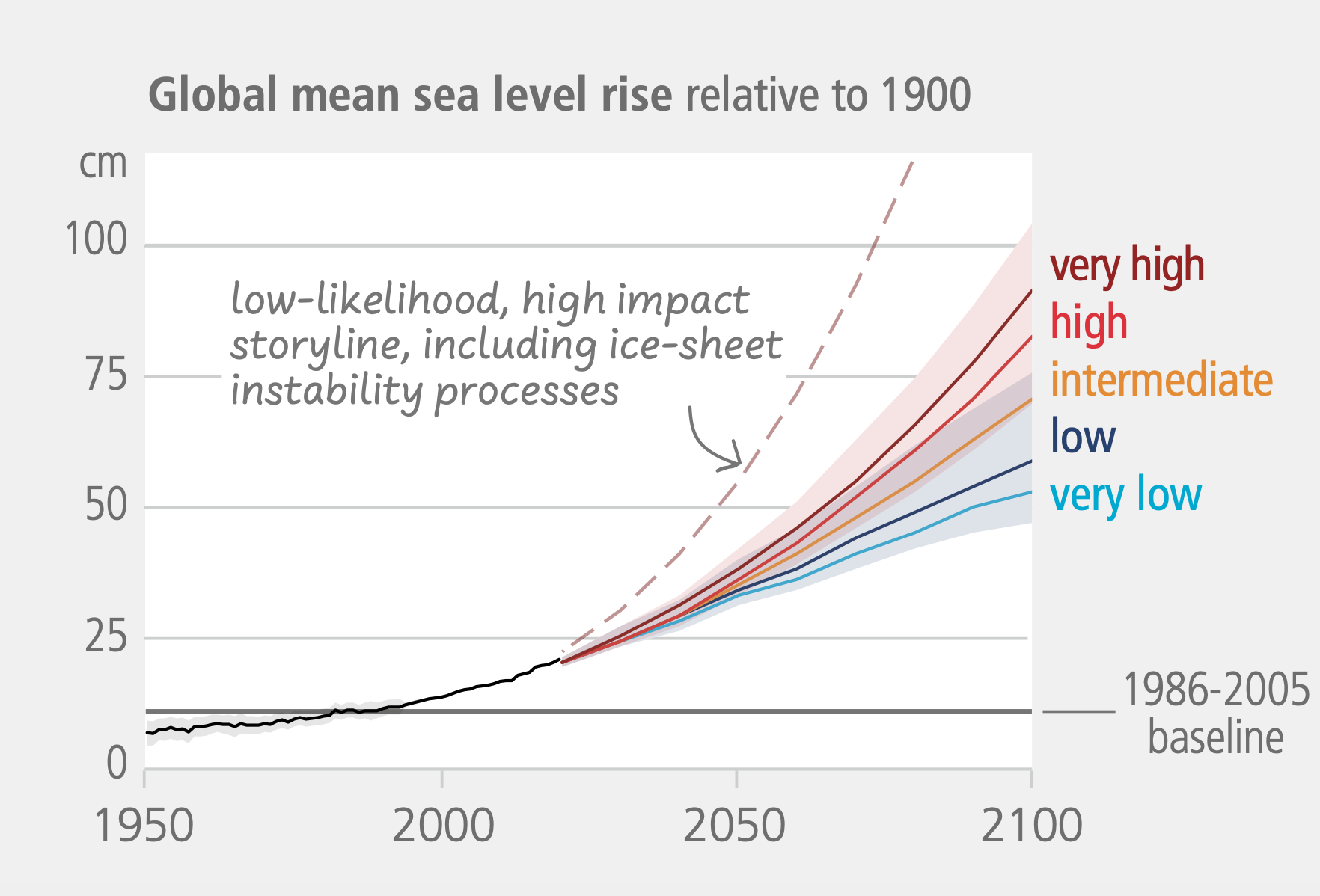 Projections of global sea level rise in very high (dark red), high (red), intermediate (orange), low (dark blue) and very low (light blue) warming scenarios, based on IPCC projections. The shaded areas represent the "likely range" of sea level rise, which only takes into account processes that are already well understood. The dotted line represents a worst-case scenario where various poorly understood processes combine. Adapted from IPCC (2023)
Retreat of glacier grounding lines
Projections of global sea level rise in very high (dark red), high (red), intermediate (orange), low (dark blue) and very low (light blue) warming scenarios, based on IPCC projections. The shaded areas represent the "likely range" of sea level rise, which only takes into account processes that are already well understood. The dotted line represents a worst-case scenario where various poorly understood processes combine. Adapted from IPCC (2023)
Retreat of glacier grounding lines
In Antarctica, the melting of ice on the surface of glaciers is limited. In many locations, warmer temperatures are leading to increases in snowfall and greater snow accumulation, which means the surface of the ice is continuously gaining mass.
Most of Antarctica's contribution to global sea level rise is, therefore, not linked to ice melt at the surface. Instead, it occurs when giant glaciers push from land into the sea, propelled downhill by gravity and their own immense weight.
These huge masses of ice first grind downhill across the land and then along the seafloor. Eventually, they detach from the bedrock and start to float.
These floating ice shelves then largely melt from below, as warm ocean water intrudes into cavities on its underside. This is known as "basal melting".
The boundary between grounded and floating ice is known as the "grounding line".
In many regions of Antarctica, grounding lines typically sit at the high point of the bedrock, with the ice sheet deepening inland. This is illustrated in the graphic below.
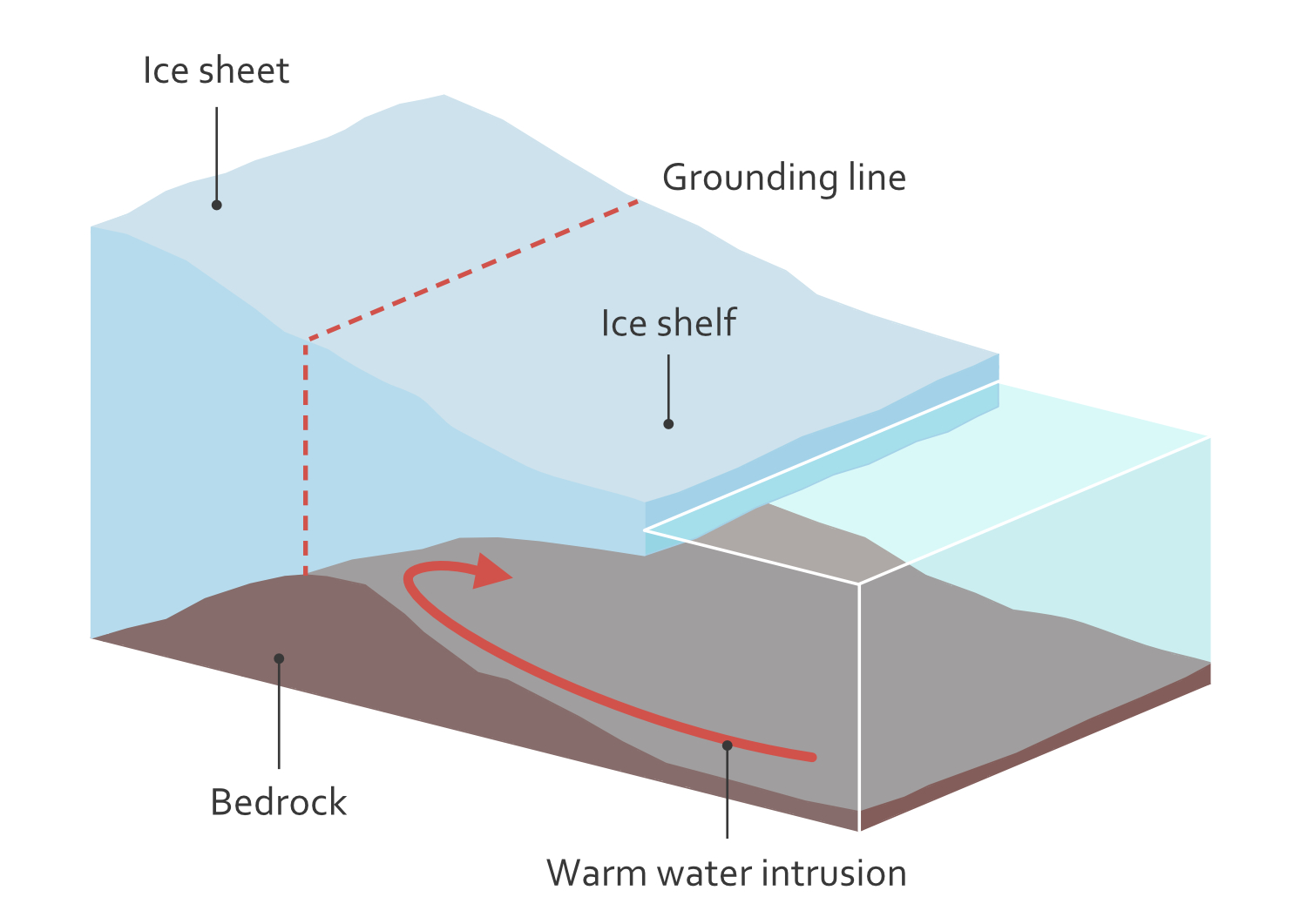 Illustration of an Antarctic ice sheet, showing the grounding line where grounded ice transitions to floating ice, and how warm ocean water intrudes beneath the ice shelf, melting it from below. Credit: Freya Sykes, iC3.
When a grounding line is at a high point of the bedrock, it acts as a block which limits the area of ice exposed to basal melting.
However, if the grounding line retreats further inland, warm water could "spill" over the high point in the bedrock and carve out large cavities below the ice. This could dramatically accelerate the retreat of grounding lines further inland across Antarctica.
There is evidence to suggest that the retreat of grounding lines might cause a runaway effect, in which each successive retreat causes the ice behind the line to detach from the land even more quickly.
Recent climate modelling suggests that many grounding lines are not yet in runaway retreat - but some regions of Antarctica are close enough to thresholds that tiny increases in basal melting push model runs toward very different outcomes.
Whether - and to what extent - grounding lines might retreat will depend on a wide range of factors, including the exact shape of the bedrock beneath the ice. However, the bedrock on the coast of Antarctica has not yet been precisely mapped in many places.
Ice shelvesOnce Antarctic ice detaches from the seabed, it floats on the ocean surface. These floating ice shelves slow the flow of ice from land towards the sea, acting as a brake as they wedge between headlands and little hills on the seafloor.
If these ice shelves break apart, the flow of glaciers towards the sea can accelerate.
The image below on the left shows a present-day ice shelf that is pinned in place by bedrock, which slows the flow of the ice into the sea.
The image on the right shows a future scenario in which ocean water continues to intrude under the ice, accelerating basal melting on the underside of the floating ice until it completely detaches from the "pinning point" that had previously held it in place.
In this scenario, the bedrock is no longer acting as a break on glaciers pushing to the sea and the ice shelf starts flowing into the sea more quickly and begins breaking up. Ice masses inland then begin to push more rapidly towards the sea.
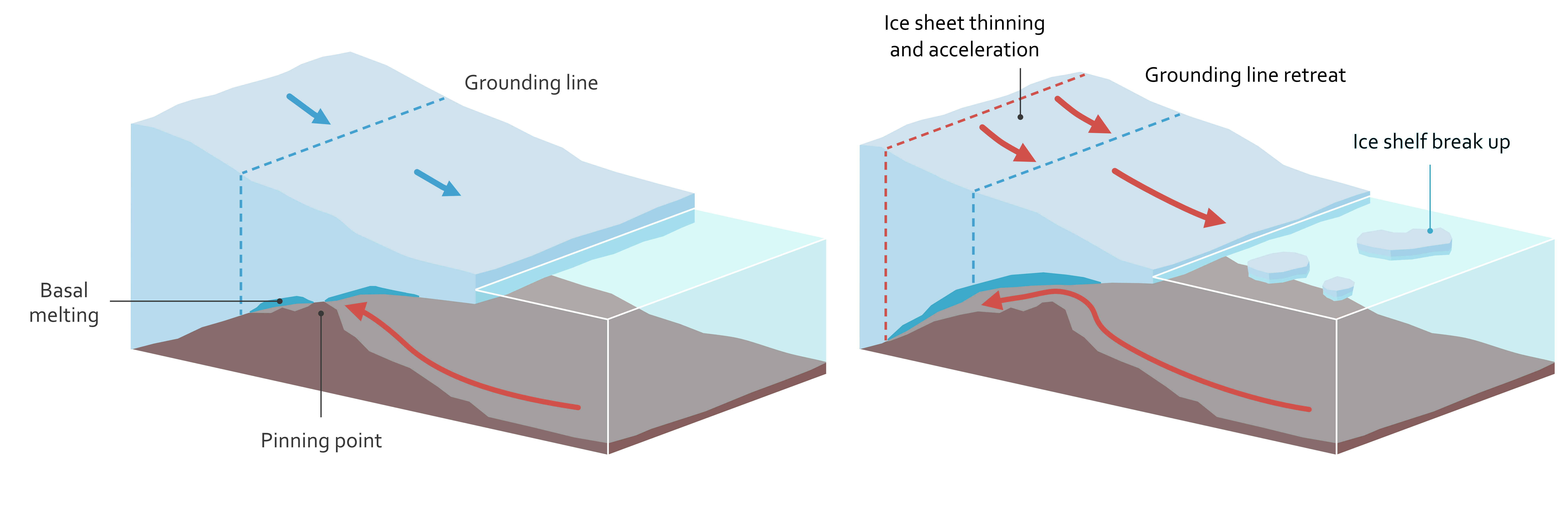 Illustration of an Antarctic ice shelf. On the left, the ice is being held in place by a "pinning point" - a bump in the bedrock which temporarily acts as an anchor. On the right, the ice shelf has detached from the pinning point, meaning that both the ice shelf and the masses of ice piled up behind it start flowing into the sea more rapidly. Credit: Freya Sykes, iC3.
This dynamic was directly observed during the collapse of the Larsen-B ice shelf on the Antarctic Peninsula in 2002, which led to accelerated glacial ice flow and is believed to have contributed to a dramatic glacial retreat two decades later.
However, the factors affecting the stability of the floating ice shelves around Antarctica's coast are complex. The strength of ice shelves depends on their thickness, how and where they are pinned to the seafloor, how cracks grow, as well as air and sea temperatures and levels of snow and rainfall. For example, meltwater at the surface can lever cracks further apart, in a process known as hydrofracturing.
A 2024 review of the stability of ice shelves found big gaps in scientific understanding of these processes. There is currently no scientific consensus on how rapidly various ice shelves might collapse - the pace is likely to vary greatly from one ice shelf to the next.
Ice-cliff collapseIf, and when, ice shelves collapse and drift away from the coast, they will expose the towering ice cliffs that loom behind them directly to the sea. These ice cliffs can be more than 100 metres tall.
This exposure could potentially lead to those cliffs to become structurally unstable and collapse in a runaway process - further accelerating the advance of the glaciers pushing towards the sea.
The images below illustrate how such a collapse might unfold. In the top image, a floating ice shelf buttresses the ice masses behind it. In the middle image, the ice shelf has largely broken apart and melted into the sea. In the bottom image, the ice shelf has completely disappeared, leaving a steep wall of ice towering over the sea. At this point, the exposed cliffs might collapse and crash into the water below.
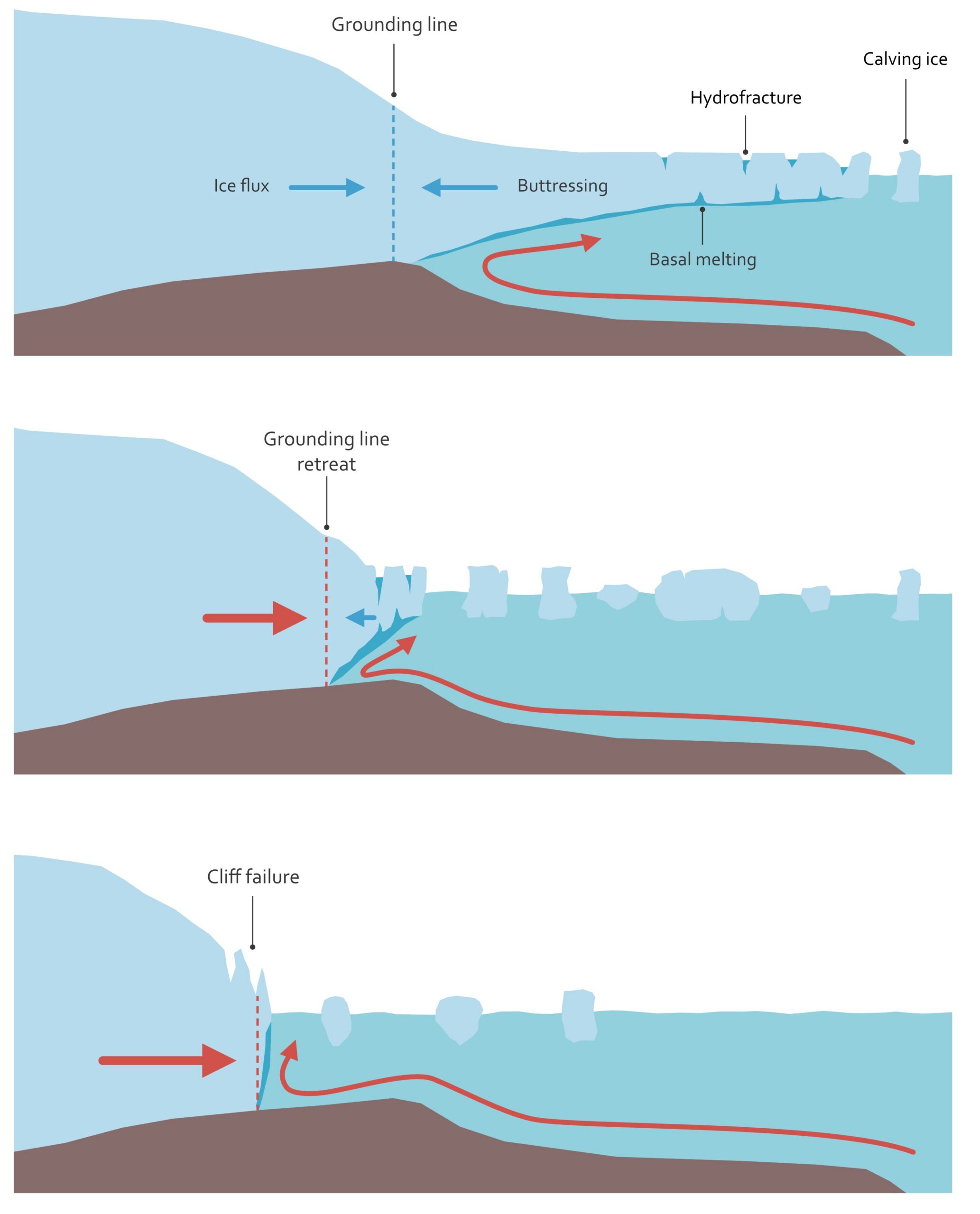 Progressive disintegration of ice shelves over time (top and middle) may leave ice cliffs exposed (bottom image). These tall cliffs might collapse and fall directly into the sea. Image credit: Freya Sykes, iC3.
Researchers are still debating whether or not this "marine ice cliff instability" is likely to happen this century.
Modelling ocean dynamicsThe speed at which grounding lines retreat, ice shelves collapse and ice cliffs cascade into the sea partially depends on complex ocean dynamics.
The temperature and speed of water intrusion underneath the ice depends on multiple factors, including ocean currents, winds, sea ice, underwater ridges and eddies. These factors vary from one location to the next and can vary by season and by year.
Once water reaches a given cavity, the ways in which turbulent flows and fresh meltwater plumes meet the ice can significantly affect melt levels - further complicating the picture.
In other words, predicting future melt depends on models that integrate macro-level ocean circulation with local-level turbulence. This remains a major modelling challenge that, despite ongoing progress, is unlikely to be conclusively resolved any time soon.
Planning for future sea level riseScientists agree that human-caused climate change is causing sea levels to rise and that the oceans will continue to rise during the current century and far beyond.
However, the combination of the complexity of modelling ice-ocean interactions and the threat of potential runaway processes means that, for the foreseeable future, there is considerable uncertainty about the magnitude of future sea level rise.
(While this article focuses on Antarctica, it is worth noting that Greenland's contribution to future sea level rise is also highly uncertain.)
To complicate matters further, the ocean does not rise like water in a bathtub, creeping up equally on all sides. Instead the Earth's surface is highly dynamic.
For example, during the last ice age, the immense mass of the glaciers that covered much of northern Europe pressed the Earth's surface downwards. Even though most of that ice disappeared millennia ago, much of Scandinavia is still rebounding today, causing the land to rise gradually.
In contrast, the city of Jakarta in Indonesia is sinking at a rapid pace of 10cm per year due to sprawling urbanisation and extraction of groundwater for household and industrial uses. That rate may increase or decrease over the coming decades, depending on urban planning and water management decisions.
This mix of natural and human-driven factors means that, even if researchers could perfectly predict average global sea level rise, calculating how much the sea will rise in any given location will remain challenging.
Another key unknown is around future levels of human-caused greenhouse gas emissions which drive climate change.
The scientific community is working to better understand the dynamics driving sea level rise and improve predictions, including through Antarctic sea bed mapping, field observations and improved models. Those advances in knowledge will not erase uncertainty, but they could reduce the range of possible outcomes.
Nevertheless, while that range may narrow, it will not completely disappear.
Plans drawn up by policymakers and engineers to prepare society for future sea level rise should never be based on a single point estimate.
Instead, they should take into account a range of possible "likely" outcomes - and include contingency plans for less likely, but entirely possible, scenarios in which the oceans rise far faster than currently expected.
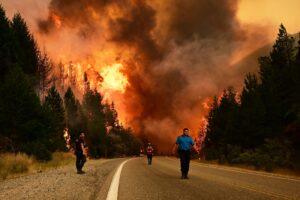
Climate change made 'fire weather' in Chile and Argentina three times more likely
Extreme weather
|11.02.26
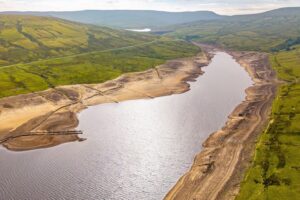
Met Office: A review of the UK's climate in 2025
Guest posts
|30.01.26

Climate change and La Niña made 'devastating' southern African floods more intense
Attribution
|29.01.26

Climate change could lead to 500,000 'additional' malaria deaths in Africa by 2050
People
|28.01.26
jQuery(document).ready(function() { jQuery('.block-related-articles-slider-block_bb9a1db44b5127857195e78f1a36a112 .mh').matchHeight({ byRow: false }); });The post Guest post: The challenges in projecting future global sea levels appeared first on Carbon Brief.
On 12 February, US president Donald Trump revoked the "endangerment finding", the bedrock of federal climate policy.
The 2009 finding concluded that six key greenhouse gases, including carbon dioxide (CO2), were a threat to human health - triggering a legal requirement to regulate them.
It has been key to the rollout of policies such as federal emission standards for vehicles, power plants, factories and other sources.
Speaking at the White House, US Environmental Protection Agency (EPA) administrator Lee Zeldin claimed that the "elimination" of the endangerment finding would save "trillions".
The revocation is expected to face multiple legal challenges, but, if it succeeds, it is expected to have a "sweeping" impact on federal emissions regulations for many years.
Nevertheless, US emissions are expected to continue falling, albeit at a slower pace.
Carbon Brief takes a look at what the endangerment finding was, how it has shaped US climate policy in the past and what its repeal could mean for action in the future.
- What is the 'endangerment finding'?
- How has it shaped federal climate policy?
- How is the finding being repealed and will it face legal challenge?
- What does this mean for federal efforts to address climate change?
- What has the reaction been?
- What will the repeal mean for US emissions?
The challenges of passing climate legislation in the US have meant that the federal government has often turned instead to regulations - principally, under the 1970 Clean Air Act.
The act requires the EPA to regulate pollutants, if they are found to pose a danger to public health and the environment.
In a 2007 legal case known as Massachusetts vs EPA, the Supreme Court ruled that greenhouse gases qualify as pollutants under the Clean Air Act. It also directed the EPA to determine whether these gases posed a threat to human health.
The 2009 "endangerment finding" was the result of this process and found that greenhouse gas emissions do indeed pose such a threat. Subsequently, it has underpinned federal emissions regulations for more than 15 years.
In developing the endangerment finding, the EPA pulled together evidence from its own experts, the US National Academies of Sciences, Engineering and Medicine and the wider scientific community.
On 7 December 2009, it concluded that US greenhouse gas emissions "in the atmosphere threaten the public health and welfare of current and future generations".
In particular, the finding highlighted six "well-mixed" greenhouse gases: carbon dioxide (CO2); methane (CH4); nitrous oxide (N2O); hydrofluorocarbons (HFCs); perfluorocarbons (PFCs); and sulfur hexafluoride (SF6).
A second part of the finding stated that new vehicles contribute to the greenhouse gas pollution that endangers public health and welfare, opening the door to these emissions being regulated.
At the time, the EPA noted that, while the finding itself does not impose any requirements on industry or other entities, "this action was a prerequisite for implementing greenhouse gas emissions standards for vehicles and other sectors".
On 15 December 2009, the finding was published in the federal register - the official record of US federal legislation - and the final rule came into effect on 14 January 2010.
At the time, then-EPA administrator Lisa Jackson said in a statement:
"This finding confirms that greenhouse gas pollution is a serious problem now and for future generations. Fortunately, it follows President [Barack] Obama's call for a low-carbon economy and strong leadership in Congress on clean energy and climate legislation.
How has it shaped federal climate policy?"This pollution problem has a solution - one that will create millions of green jobs and end our country's dependence on foreign oil."
The endangerment finding originated from a part of the Clean Air Act regulating emissions from new vehicles and so it was first applied in that sector.
However, it came to underpin greenhouse gas emission regulation across a range of sectors.
In May 2010, shortly after the Obama EPA finalised the finding, it was used to set the country's first-ever limits on greenhouse gas emissions from light-duty engines in motor vehicles.
The following year, the EPA also released emissions standards for heavy-duty vehicles and engines.
However, findings made under one part of the Clean Air Act can also be applied to other articles of the law. David Widawsky, director of the US programme at the World Resources Institute (WRI), tells Carbon Brief:
"You can take that finding - and that scientific basis and evidence - and apply it in other instances where air pollutants are subject or required to be regulated under the Clean Air Act or other statutes.
"Revoking the endangerment finding then creates a thread that can be pulled out of not just vehicles, but a whole lot of other [sources]."
Since being entered into the federal register, the endangerment finding has also been applied to stationary sources of emissions, such as fossil-fuelled power plants and factories, as well as an expanded range of non-stationary emissions sources, including aviation.
(In fact, the EPA is compelled to regulate emissions of a pollutant - such as CO2 as identified in the endangerment finding - from stationary sources, once it has been regulated anywhere else under the Clean Air Act.)
In 2015, the EPA finalised its guidance on regulating emissions from fossil-fuelled power plants. These performance standards applied to newly constructed plants, as well as those that underwent major modifications.
This ruling noted that "because the EPA is not listing a new source category in this rule, the EPA is not required to make a new endangerment finding…in order to establish standards of performance for the CO2".
The following year, the agency established rules on methane emissions from oil and gas sources, including wells and processing plants. Again, this was based on the 2009 finding.
The 2016 aircraft endangerment finding also explicitly references the vehicle-emissions endangerment finding. That rule says that the "body of scientific evidence amassed in the record for the 2009 endangerment finding also compellingly supports an endangerment finding" for aircraft.
The endangerment finding has also played a critical role in shaping the trajectory of climate litigation in the US.
In a 2011 case, American Electric Power Co. vs Connecticut, the Supreme Court unanimously found that, because greenhouse gas emissions were already regulated by the EPA under the Clean Air Act, companies could not be sued under federal common law over their greenhouse gas emissions.
Widawsky tells Carbon Brief that repealing the endangerment finding therefore "opens the door" to climate litigation of other kinds:
How is the finding being repealed and will it face legal challenge?"When plaintiffs would introduce litigation in federal courts, the answer or the courts would find that EPA is 'handling it' and there's not necessarily a basis for federal litigation. By removing the endangerment finding…it actually opens the door to the question - not necessarily successful litigation - and the courts will make that determination."
The official revocation of the endangerment finding is yet to be posted to the federal register. It will be effective 60 days after the text is published in the journal.
It is set to face no shortage of legal challenges. The state of California has "vowed" to sue, as have a number of environmental groups, including Sierra Club, Earthjustice and the National Resources Defense Council.
Dena Adler, an adjunct professor of law at New York University School of Law, tells Carbon Brief there are "significant legal and analytical vulnerabilities" in the EPA's ruling. She explains:
"This repeal will only stick if it can survive legal challenge in the courts. But it could take months, if not years, to get a final judicial decision."
At the heart of the federal agency's argument is that it claims to lack the authority to regulate greenhouse gas emissions in response to "global climate change concerns" under the Clean Air Act.
In the ruling, the EPA says the section of the Act focused on vehicle emissions is "best read" as authorising the agency to regulate air pollution that harms the public through "local or regional exposure" - for instance, smog or acid rain - but not pollution from "well-mixed" greenhouse gases that, it claims, "impact public health and welfare only indirectly".
This distinction directly contradicts the landmark 2007 Supreme Court decision in Massachusetts vs EPA. (See: What is the 'endangerment finding'?)
The EPA's case also rests on an argument that the agency violated the "major questions doctrine" when it started regulating greenhouse gas emissions from vehicles.
This legal principle holds that federal agencies need explicit authorisation from Congress to press ahead with actions in certain "extraordinary" cases.
In a policy brief in January, legal experts from New York University School of Law's Institute of Policy Integrity argued that the "major questions doctrine" argument "fails for several reasons".
Regulating greenhouse gas emissions under the Clean Air Act is "neither unheralded nor transformative" - both of which are needed for the legal principle to apply, the lawyers said.
Furthermore, the policy brief noted that - even if the doctrine were triggered - the Clean Air Act does, in fact, supply the EPA with the "clear authority" required.
Mark Drajem, director of public affairs at NRDC, says the endangerment finding has been "firmly established in the courts". He tells Carbon Brief:
"In 2007, the Supreme Court directed EPA to look at the science and determine if greenhouse gases pose a risk to human health and welfare. EPA did that in 2009 and federal courts rejected a challenge to that in 2012.
"Since then, the Supreme Court has considered EPA's greenhouse gas regulations three separate times and never questioned whether it has the authority to regulate greenhouse gases. It has only ruled on how it can regulate that pollution."
However, experts have noted that the Trump administration is banking on legal challenges making their way to the Supreme Court - and the now conservative-leaning bench then upholding the repeal of the endangerment finding.
Elsewhere, the EPA's new ruling argues that regulating emissions from vehicles has "no material impact on global climate change concerns…much less the adverse public health or welfare impacts attributed to such global climate trends".
"Climate impact modelling", it continues, shows that "even the complete elimination of all greenhouse gas emissions" of vehicles in the US would have impacts that fall "within the standard margin of error" for global temperature and sea level rise.
In this context, it argues, regulations on emissions are "futile".
(The US is more historically responsible for climate change than any other country. In its 2022 sixth assessment report, the Intergovernmental Panel on Climate Change said that further delaying action to cut emissions would "miss a brief and rapidly closing window of opportunity to secure a liveable and sustainable future for all".)
However, the final rule stops short of attempting to justify the plans by disputing the scientific basis for climate change.
Notably, the EPA has abandoned plans to rely on the findings of a controversial climate science report commissioned by the Department of Energy (DoE) last year.
This is a marked departure from the draft ruling, published in August, which argued there were "significant questions and ambiguities presented by both the observable realities of the past nearly two decades and the recent findings of the scientific community, including those summarised in the draft CWG ['climate working group'] report".
The CWG report - written by five researchers known for rejecting the scientific consensus on human influence on global warming - faced significant criticism for inaccurate conclusions and a flawed review process. (Carbon Brief's factcheck found more than 100 misleading or false statements in the report.)
A judge ruled in January that the DoE had broken the law when energy secretary Chris Wright "hand-picked five researchers who reject the scientific consensus on climate change to work in secret on a sweeping government report on global warming", according to the New York Times.
In a press release in July, the EPA said "updated studies and information" set out in the CWG report would serve to "challenge the assumptions" of the 2009 finding.
But, in the footnotes to its final ruling, the EPA notes it is not relying on the report for "any aspect of this final action" in light of "concerns raised by some commenters".
Legal experts have argued that the pivot away from arguments undermining climate science is designed with future legal battles over the attempted repeal in mind.
What does this mean for federal efforts to address climate change?As mentioned above, a number of groups have already filed legal actions against the Trump administration's move to repeal the endangerment finding - leaving the future uncertain.
However, if the repeal does survive legal challenges, it would have far-reaching implications for federal efforts to address greenhouse gas emissions, experts say.
In a blog post, the WRI's Widawsky said that the repeal would have a "sweeping" impact on federal emissions regulations for cars, coal-fired power stations and gas power plants, adding:
"In practical terms, without the endangerment finding, regulating greenhouse gas emissions is no longer a legal requirement. The science hasn't changed, but the obligation to act on it has been removed."
Speaking to Carbon Brief, Widawsky adds that, despite this large immediate impact, there are "a lot of mechanisms" future US administrations might be able to pursue if they wanted to reinstate the federal government's obligation to address greenhouse gas emissions:
"Probably the most direct way - rather than talk about 'pollutants', in general, and the EPA, say, making a science-specific finding for that pollutant - [is] for Congress simply to declare a particular pollutant to be a hazard for human health and welfare. [This] has been done in other instances."
If federal efforts to address greenhouse gas emissions decline, there will likely still be attempts to regulate at the state level.
Previous analysis from the University of Oxford noted that, despite a walkback on federal climate policy in Trump's second presidential term, 19 US states - covering nearly half of the country's population - remain committed to net-zero targets.
Widawksy tells Carbon Brief that it is possible that states may be able to leverage legislation, including the Clean Air Act, to enact regulations to address emissions at the state level.
However, in some cases, states may be prevented from doing so by "preemption", a US legal doctrine where higher-level federal laws override lower-level state laws, he adds:
What has the reaction been?"There are a whole lot of other sections of the Clean Air Act that may either inhibit that kind of ability for states to act through preemption or allow for that to happen."
The Trump administration's decision has received widespread global condemnation, although it has been celebrated by some right-wing newspapers, politicians and commentators.
In the US, former US president Barack Obama said on Twitter that the move will leave Americans "less safe, less healthy and less able to fight climate change - all so the fossil-fuel industry can make even more money".
Similarly, California governor Gavin Newsom called the decision "reckless", arguing that it will lead to "more deadly wildfires, more extreme heat deaths, more climate-driven floods and droughts and greater threats to communities nationwide".
Former US secretary of state and climate envoy John Kerry called the decision "un-American", according to a story on the frontpage of the Guardian. He continued:
"[It] takes Orwellian governance to new heights and invites enormous damage to people and property around the world."
An editorial in the Guardian dubbed the repeal as "just one part of Trump's assault on environmental controls and promotion of fossil fuels", but added that it "may be his most consequential".
Similarly, an editorial in the Hindu said that Trump is "trying to turn back the clock on environmental issues".
In China, state-run news agency Xinhua published a cartoon depicting Uncle Sam attempting to turn an ageing car, marked "US climate policy", away from the road marked "green development", back towards a city engulfed in flames and pollution that swells towards dark clouds labelled "greenhouse gas catastrophe".
.cb-tweet{ width: 65%; box-shadow: 3px 3px 6px #d3d3d3; margin: auto; } .cb-tweet img{ border: solid 1.25px #333333; border-radius: 5px; } @media (max-width:650px){ .cb-tweet{ width:100%; } }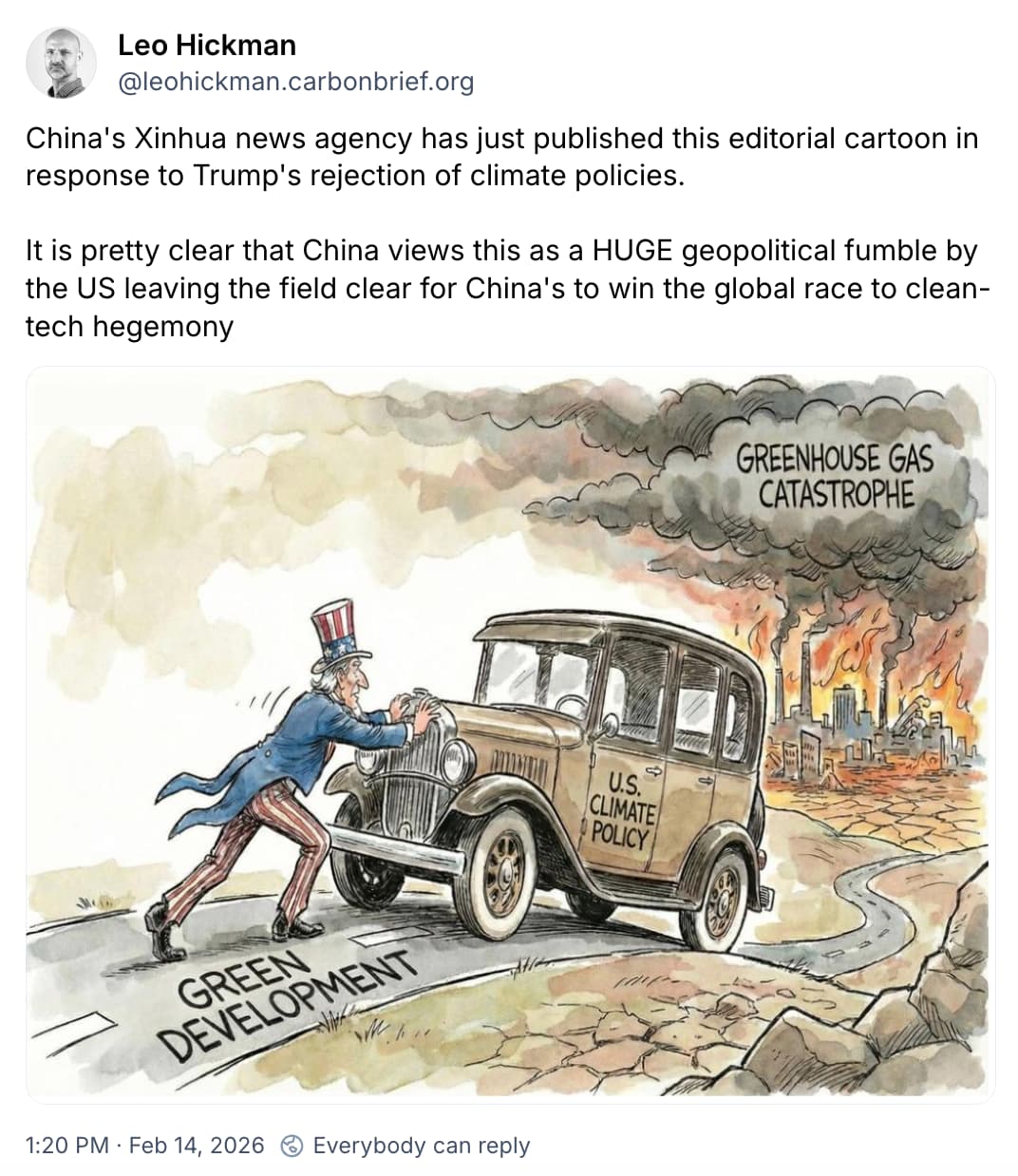
Conversely, Trump described the finding as "the legal foundation for the green new scam", which he claimed "the Obama and Biden administration used to destroy countless jobs".
Similarly, Al Jazeera reported that EPA administrator Zeldin said the endangerment finding "led to trillions of dollars in regulations that strangled entire sectors of the US economy, including the American auto industry". The outlet quoted him saying:
"The Obama and Biden administrations used it to steamroll into existence a left-wing wish list of costly climate policies, electric vehicle mandates and other requirements that assaulted consumer choice and affordability."
An editorial in the Washington Post also praises the move, saying "it's about time" that the endangerment finding was revoked. It argued - without evidence - that the benefits of regulating emissions are "modest" and that "free-market-driven innovation has done more to combat climate change than regulatory power grabs like the 'endangerment finding' ever did".
The Heritage Foundation - the climate-sceptic US lobby group that published the influential "Project 2025" document before Trump took office - has also celebrated the decision.
Time reported that the group previously criticised the endangerment finding, saying that it was used to "justify sweeping restrictions on CO2 and other greenhouse gas emissions across the economy, imposing huge costs". The magazine added that Project 2025 laid out plans to "establish a system, with an appropriate deadline, to update the 2009 endangerment finding".
Climate scientists have also weighed in on the administration's repeal efforts. Prof Andrew Dessler, a climate scientist at Texas A&M University in College Station, argued that there is "no legitimate scientific rationale" for the EPA decision.
Similarly, Dr Katharine Hayhoe, chief scientist at the Nature Conservancy, said in a statement that, since the establishment of the 2009 endangerment finding, the evidence showing greenhouse gases pose a threat to human health and the environment "has only grown stronger".
Dr Gretchen Goldman, president and CEO of the Union of Concerned Scientists and a former White House official, gave a statement, arguing that "ramming through this unlawful, destructive action at the behest of polluters is an obvious example of what happens when a corrupt administration and fossil fuel interests are allowed to run amok".
In the San Francisco Chronicle, Prof Michael Mann, a climate scientist at the University of Pennsylvania, and Bob Ward, policy and communications director at the Grantham Research Institute, wrote that Trump is "slowing climate progress", but that "it won't put a stop to global climate action". They added:
What will the repeal mean for US emissions?"The rest of the world is moving on and thanks to Trump's ridiculous insistence that climate change is a 'hoax', the US now stands to lose out in the great economic revolution of the modern era - the clean-energy transition."
Federal regulations and standards underpinned by the endangerment finding have been at the heart of US government plans to reduce the nation's emissions.
For example, NRDC analysis of EPA data suggests that Biden-era vehicle standards, combined with other policies to boost electric cars, were set to avoid nearly 8bn tonnes of CO2 equivalent (GtCO2e) over the next three decades.
By removing the legal requirement to regulate greenhouse gases at a federal level from such high-emitting sectors, the EPA could instead be driving higher emissions.
Nevertheless, some climate experts argue that the repeal is more of a "symbolic" action and that EPA regulations have not historically been the main drivers of US emissions cuts.
Rhodium Group analysis last year estimated the impact of the EPA removing 31 regulatory policies, including the endangerment finding and "actions that rely on that finding". Most of these had already been proposed for repeal independently by the Trump administration.
Ben King, the organisation's climate and energy director, tells Carbon Brief this "has the same effect on the system as repealing the endangerment finding".
The Rhodium Group concluded that, in this scenario, emissions would continue falling to 26-35% below 2005 levels by 2035, as the chart below shows. If the regulations remained in place, it estimated that emissions would fall faster, by around 32-44%.
(Notably, neither of these scenarios would be in line with the Biden administration's international climate pledge, which was a 61-66% reduction by 2035).
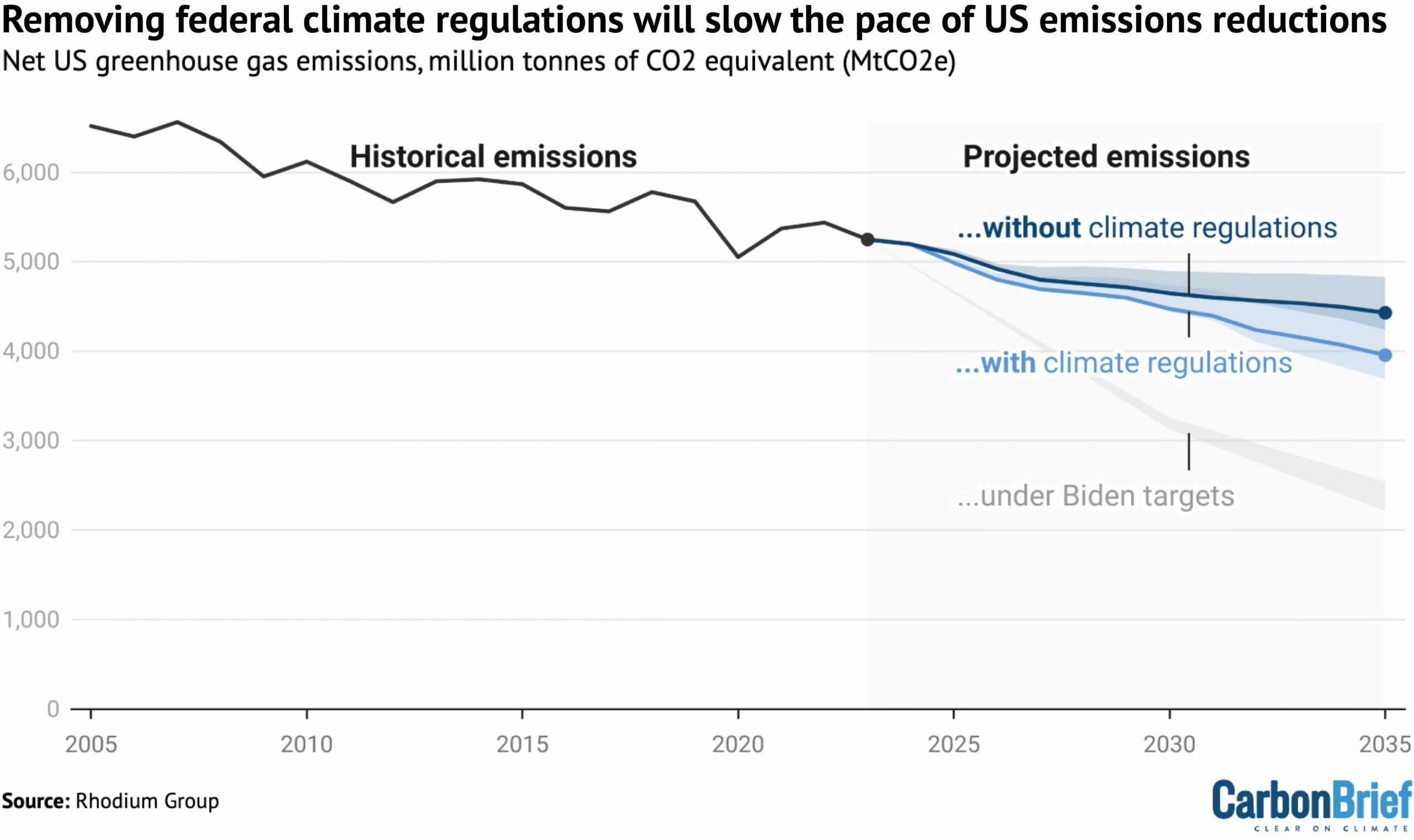 US emissions, MtCO2e, under a "current policy" scenario in which the EPA removes key federal climate regulations ("without climate regulations") and a "no rollbacks" scenario in which regulations remain in place ("with climate regulations"). High, mid and low ranges reflect uncertainty around future fossil-fuel prices, economic growth, clean-energy technology costs and growth in liquified natural gas (LNG) export capacity. Source: Rhodium Group.
There are various factors that could contribute to continued - albeit slower - decline in US emissions, in the absence of federal regulations. These include falling costs for clean technologies, higher fossil-fuel prices and state-level legislation.
Despite Trump's rhetoric, coal plants have become uneconomic to operate in the US compared with cheaper renewables and gas. As a result, Trump has overseen a larger reduction in coal-fired capacity than any other US president.
Meanwhile, in spite of the openly hostile policy environment, relatively low-cost US wind and solar projects are competitive with gas power and are still likely to be built in large numbers.
The vast majority of new US power capacity in recent years has been solar, wind and storage. Around 92% of power projects seeking electricity interconnection in the US are solar, wind and storage, with the remainder nearly all gas.
The broader transition to low-carbon transport is well underway in the US, with electric vehicle sales breaking records during nearly every month in 2025.
This can partly be attributed to federal tax credits, which the Trump administration is now cutting. However, cheaper models, growing consumer preference and state policies are likely to continue strengthening support.
Even if emissions continue on a downward trajectory, repealing the endangerment finding could make it harder to drive more ambitious climate action in the future. Some climate experts also point to the uncertainty of future emissions reductions.
"[It] depends on a number of technology, policy, economic and behavioural factors. Other folks are less sanguine about greenhouse gas declines," WRI's Widawsky tells Carbon Brief.

Analysis: Trump has overseen larger coal decline than any other US president
Coal
|12.02.26
Analysis: China's CO2 emissions have now been 'flat or falling' for 21 months
China energy
|12.02.26
Q&A: New UK onshore wind and solar is '50% cheaper' than new gas
Renewables
|11.02.26
G7 'falling behind' China as world's wind and solar plans reach new high in 2025
International policy
|10.02.26
jQuery(document).ready(function() { jQuery('.block-related-articles-slider-block_4bdaa7bce4cf442df312e36ed007fad0 .mh').matchHeight({ byRow: false }); });The post Q&A: What does Trump's repeal of US 'endangerment finding' mean for climate action? appeared first on Carbon Brief.
Welcome to Carbon Brief's DeBriefed.
An essential guide to the week's key developments relating to climate change.
DANGER DANGER: The Trump administration formally repealed the US's landmark "endangerment finding" this week, reported the Financial Times. The 2009 Obama-era finding concluded that greenhouse gases pose a threat to public health and has provided a legal basis for their regulation over the past two decades, said the New York Times.
RACE TO COURT: Multiple environmental groups have already threatened to sue over the administration's decision, reported the Guardian. The fate of the ruling is likely to ultimately be decided by the Conservative-majority Supreme Court, explained the New York Times.
'BEAUTIFUL CLEAN COAL': Separately, Donald Trump signed an executive order requiring the Pentagon to buy coal-fired power, a move aimed to "revive a fuel source in sharp decline", reported the Los Angeles Times. Despite his efforts,Trump has overseen more retirements of coal-fired power stations than any other US president, according to Carbon Brief analysis.
Around the world- CLIMATE TALKS: UN climate chief Simon Stiell said in a speech on Thursday that climate action can deliver stability in the face of a "new world disorder" while on a visit to Turkey, which will host the COP31 climate summit later this year, reported BusinessGreen.
- IBERIAN CATASTROPHE: A succession of storms that hit Spain and Portugal in recent weeks have caused millions of euros worth of damage to farmlands and required more than 11,000 people to leave their homes in Spain's southern Andalusia region, said Reuters.
- RISKY BUSINESS: The "undervaluing" of nature by businesses is fuelling its decline and putting the global economy at risk, according to a new report by the Intergovernmental Science-Policy Platform on Biodiversity and Ecosystem Services (IPBES), covered by Carbon Brief. Carbon Brief interviewed IPBES chair Dr David Obura at the report's launch in Manchester.
- CORAL BLEACHING: A study covered by Agence France-Presse found that more than half of the world's coral reefs were bleached over a three-year period from 2014-17 during Earth's third "global bleaching event". The world has since entered a fourth bleaching event, starting in 2023, a scientist told AFP.
- 'HELLISH HOTHOUSE EARTH': In a commentary paper, scientists argued that the world is closer than thought to a "point of no return", which could plunge Earth into a "hellish hothouse" state, reported the Guardian.
7.4 gigawatts
The record amount of solar, onshore wind and tidal power secured in the latest auction for new renewable capacity in the UK, reported Carbon Brief.
Latest climate research
- Human-caused climate change made the hot, dry and windy weather in Chile and Argentina three times more likely | World Weather Attribution (Carbon Brief also covered the study)
- "Early-life" exposure to extreme heat "increases risk" of neurodevelopmental delay in preschool children | Nature Climate Change
- Climate change, urbanisation and species characteristics shape European butterfly population trends | Global Ecology and Biogeography
(For more, see Carbon Brief's in-depth daily summaries of the top climate news stories on Monday, Tuesday, Wednesday, Thursday and Friday.)
Captured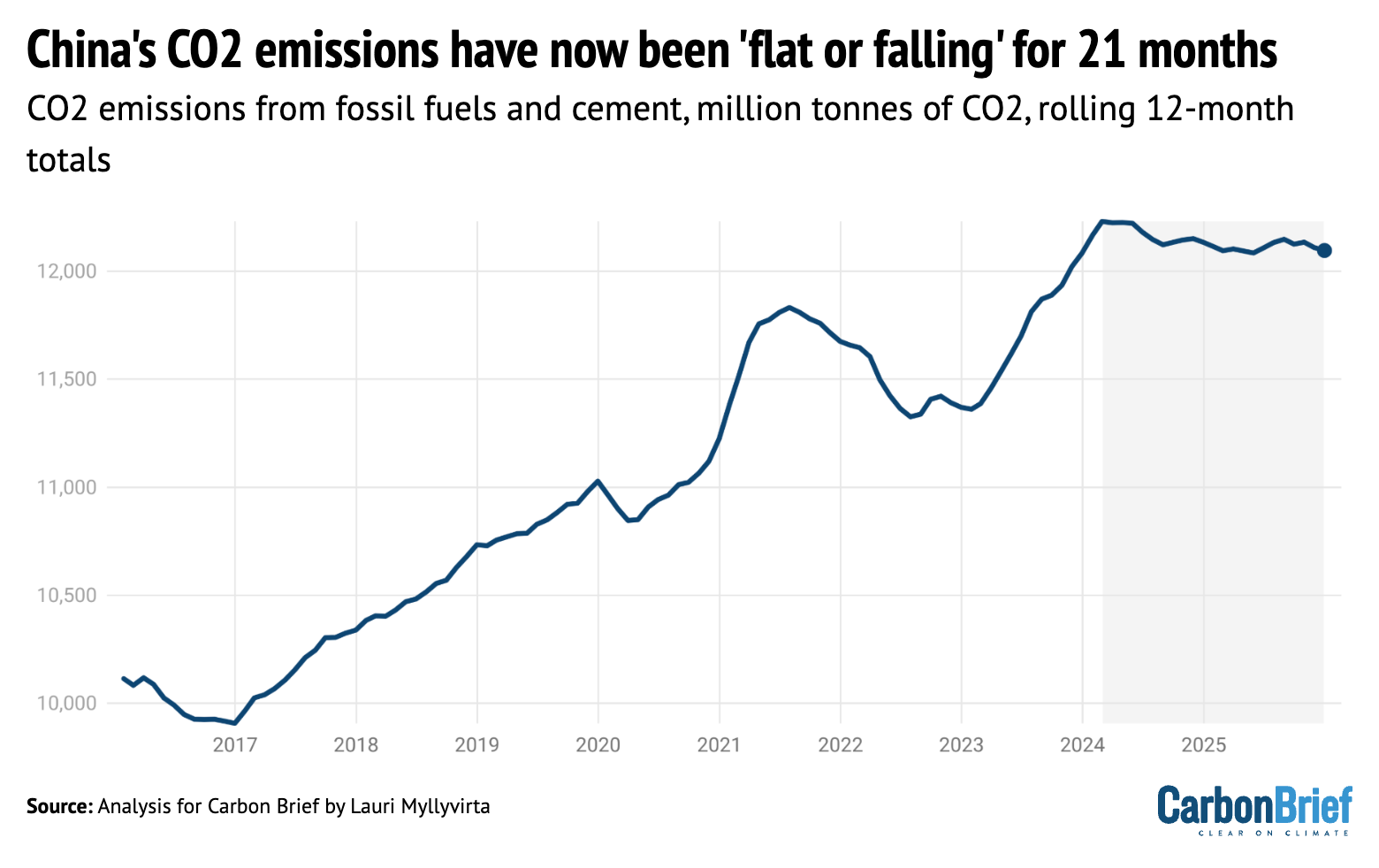
China's carbon dioxide emissions have "now been flat or falling for 21 months", analysis for Carbon Brief has found. The trend began in March 2024 and has lasted almost two years, due in particular to falling emissions in major sectors, including transport, power and cement, said the analysis. The analysis has been covered widely in global media, including Agence France-Presse, Bloomberg, New York Times, BBC World Service and Channel 4 News.
Spotlight UK's 'relentless rain'This week, Carbon Brief takes a deep dive into the recent relentless rain and floods in the UK and explores how they could be linked to climate change.
It is no secret that it can rain a lot in the UK. But, in some parts of the country, it has rained every day of the year so far, according to Met Office data released this week.
In total, 26 stations set new monthly rainfall records for January. Northern Ireland experienced its wettest January for 149 years and Plymouth, in the south-west of England, experienced its wettest January day in 104 years.
Areas witnessing long periods of rain included Bodmin Moor in Cornwall, which has seen 41 consecutive days of rain "and counting", reported the Guardian. The University of Reading found that its home town had its longest period of consecutive rain - 25 days - since its records for the city began in 1908.
The relentless rainfall has caused flooding in many parts of the country, particularly in rural areas.
There were more than 200 active flood alerts in place across England and Wales at the weekend, with flood warnings clustered around Gloucester and Worcester in the West Midlands, as well as Devon and Hampshire in southern England. A flood "alert" means that there is a possibility of flooding, while a "warning" means flooding is expected.
"Growing up, the road to my school never flooded. But the school has already had to close three times this year because of flooding," Jess Powell, a local resident of a small village in Shropshire, told Carbon Brief.
 Burst river bank of the river Severn in Shrewsbury, Shropshire. Credit: Alice Vernat-Davies
Climate link
Burst river bank of the river Severn in Shrewsbury, Shropshire. Credit: Alice Vernat-Davies
Climate link
While there has not yet been a formal analysis into the role of climate change in the UK's current lengthy period of rain and flooding, it is known that human-caused warming can play a role in wet weather extremes, explained Dr Jess Neumann, a flooding researcher from the University of Reading. She told Carbon Brief:
"Warmer air can hold more moisture - about 7% more for every 1C of warming, increasing the chance of more frequent and at times, intense rainfall."
The UK owes its rainy climate in large part due to the jet stream, which brings strong winds from west to east and pushes low-pressure weather systems across the Atlantic.
Scientists have said that one of the factors behind the UK's relentless rain is the "blocking" of the jet stream, which occurs when winds slow, causing rainy weather patterns to get stuck.
The impact of climate change on the jet stream is complex, involving a lot of different factors. One theory, still subject to debate among scientists, is that Arctic warming could play a role, explained Neumann:
Adaptation needs"As the Arctic warms faster than the tropics, the temperature gradient that fuels the jet stream weakens, causing it to become slower and wavier. Blocking patterns develop that can cause weather conditions to get stuck over the UK, increasing the likelihood of extreme rainfall and flooding."
Long periods of rain saturate the ground and can have adverse impacts on agriculture and wildlife.
Prof Richard Betts, a leading climate scientist at the Met Office and the University of Exeter, said that these impacts can have harmful effects in rural areas:
"The climate change-driven increase in flood risk is impacting food production in the UK. In 2024, the production of wheat, barley, oats and oilseed rape shrunk by 13% due to widespread flooding of farmland.
"Assistance with recovery after flooding is increasingly important - obviously, financial help via insurance and reinsurance is vital, but also action to reduce impacts on mental health is increasingly important. It's very stressful dealing with the impacts of flooding and this is often not recognised."
One key adaptation for floods in the UK could be to "integrate natural flood management, including sustainable urban drainage, with more traditional hard engineering techniques", added Neumann:
Watch, read, listen"Most importantly, we need to improve our communication of flood risk to help individuals and communities know how to prepare. We need to shift our thinking from 'keeping water out' to 'living with water', if we want to adapt better to a future of flooding."
'IRREVERSIBLE TREND?': The Guardian explored how Romania's emissions have fallen by 75% since the 1990s and have been decoupled from the country's economic growth.
UNDER THE SEA: An article in BioGraphic explored whether the skeletons of dead corals "help or hinder recovery" on bleached reefs.
SPEEDING UP: Through dynamic charts, the Washington Post showed how climate change is accelerating.
Coming up- 16-19 February: Sixth meeting of the subsidiary body on implementation of the Convention on Biological Diversity, Rome, Italy
- 20 February: Webinar on the key findings from the International Energy Agency policy brief: the value of demand flexibility: benefits beyond balancing
- 20 February: UN day of social justice
- 22-27 February: Ocean Sciences Meeting, Glasgow, UK
- UN Food and Agriculture Organisation (FAO), national senior climate change expert | Salary: Unknown. Location: Dhaka, Bangladesh
- British Antarctic Survey, marine biologist | Salary: £31,183. Location: Antarctica
- Green Climate Fund, regional lead for resource mobilisation - Europe | Salary: $109,000. Location: Seoul, South Korea
- Scientific American, documentary film proposals | Up to $80,000 per commissioned film
DeBriefed is edited by Daisy Dunne. Please send any tips or feedback to debriefed@carbonbrief.org.
This is an online version of Carbon Brief's weekly DeBriefed email newsletter. Subscribe for free here.

DeBriefed
|06.02.26

DeBriefed 30 January 2026: Fire and ice; US formally exits Paris; Climate image faux pas
DeBriefed
|30.01.26
DeBriefed 23 January 2026: Trump's Davos tirade; EU wind and solar milestone; High seas hope
DeBriefed
|23.01.26
DeBriefed
|16.01.26
jQuery(document).ready(function() { jQuery('.block-related-articles-slider-block_0c1fb743ebca86b78322921d07b11a5a .mh').matchHeight({ byRow: false }); });The post DeBriefed 13 February 2026: Trump repeals landmark 'endangerment finding' | China's emissions flatlining | UK's 'relentless rain' appeared first on Carbon Brief.
Donald Trump has overseen more retirements of coal-fired power stations than any other US president, according to Carbon Brief analysis.
His administration's latest efforts to roll back US climate policy have been presented by interior secretary Doug Burgum as an opportunity to revive "clean, beautiful, American coal".
The administration is in the process of attempting to repeal the 2009 "endangerment" finding, which is the legal underpinning of many federal climate regulations.
On 11 February, the White House issued an executive order on "America's beautiful clean coal power generation fleet", calling for government contracts and subsidies to keep plants open.
On the same day, Trump was presented with a trophy by coal-mining executives declaring him to be the "undisputed champion of beautiful clean coal".
These words are in sharp contrast to Trump's record in office, with more coal-fired power plants having retired under his leadership than any other president, as shown in the figure below.
This is because coal plants have been uneconomic to operate compared with cheaper gas and renewables - and because most of the US coal fleet is extremely old.
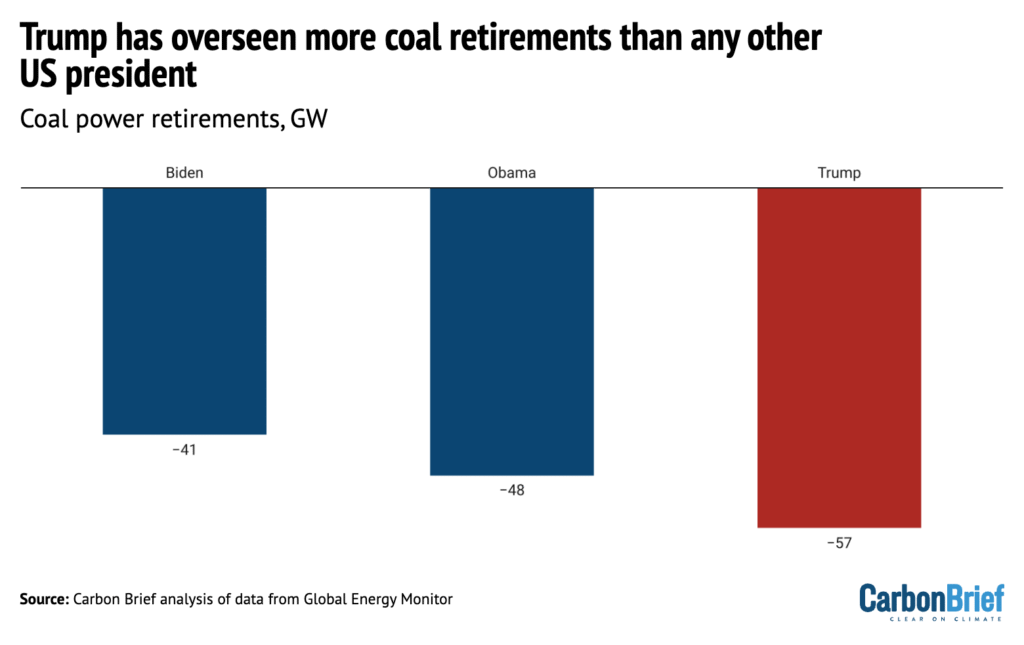 Capacity of coal-fired power plants retiring under recent US presidents, gigawatts (GW). Source: Carbon Brief analysis of data from Global Energy Monitor.
In total, some 57 gigawatts (GW) of coal capacity has already been retired during Trump's first and second terms in office, compared with 48GW under Obama's two full terms and 41GW under Biden's single term.
Even in relative terms, the US has lost a larger proportion of its remaining coal fleet for each year of Trump's presidencies than for either of his recent predecessors.
Trump's record hints at the many practical and economic factors that have driven US coal closures, regardless of the preferences of the president of the day.
Indeed, Trump made variousefforts to prop up coal power during his first term in office. These were ultimatelyunsuccessful, as the figure below illustrates.
 Coal-fired power capacity in the US, GW. Source: Global Energy Monitor.
Coal plants have been retiring in large numbers over the past 20 years because they were uneconomic relative to cheaper sources of electricity, including renewables and gas.
These unfavourable market conditions, alongside air pollution regulations unrelated to climate change, have resulted in a steady parade of coal closures under successive presidents.
By 2024, wind and solar were generating more electricity in the US than coal.
More recently, analysis from the US Energy Information Administration shows that surging power prices have improved the economics of both coal and gas-fired power plants.
These rising prices have been driven by increasing demand, including from data centres, and by higher gas prices, due to increasing exports at liquefied natural gas (LNG) terminals.
These factors saw coal-power output increase by 13% year-on-year in 2025, only the second rise in a decade of steady decline for the fuel, according to the Rhodium Group.
Nevertheless, many utilities have still been looking to shutter their ageing coal-fired power plants.
The vast majority of US coal plants are nearing retirement. Three-quarters of US coal capacity is more than four decades old and only 14% is less than 20 years old, as shown in the figure below.
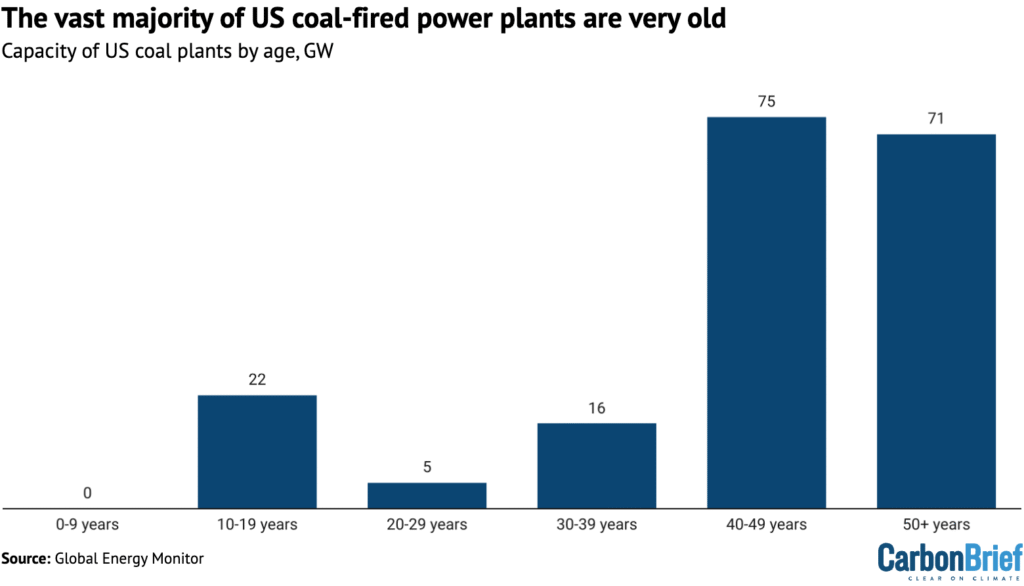 Capacity of US coal plants by age group, GW. Source: Global Energy Monitor.
In response, the Trump administration has recently invoked legislation designed for wartime emergencies to force a number of uneconomic coal plants to remain open.
Despite Trump's efforts, clean energy made up 96% of the new electricity generation capacity added to the US grid in 2025. None of the new capacity came from coal power.
Analysis: Coal power drops in China and India for first time in 52 years after clean-energy records
China energy
|13.01.26

IEA: Declining coal demand in China set to outweigh Trump's pro-coal policies
Coal
|17.12.25
Guest post: China and India account for 87% of new coal-power capacity so far in 2025
China energy
|27.08.25
Guest post: Why China is still building new coal - and when it might stop
China energy
|12.08.25
jQuery(document).ready(function() { jQuery('.block-related-articles-slider-block_5652fce17545da9da37eb0d8c1dfa16c .mh').matchHeight({ byRow: false }); });The post Analysis: Trump has overseen more coal retirements than any other US president appeared first on Carbon Brief.
China's carbon dioxide (CO2) emissions fell by 1% in the final quarter of 2025, likely securing a decline of 0.3% for the full year as a whole.
This extends a "flat or falling" trend in China's CO2 emissions that began in March 2024 and has now lasted for nearly two years.
The new analysis for Carbon Brief shows that, in 2025, emissions from fossil fuels increased by an estimated 0.1%, but this was more than offset by a 7% decline in CO2 from cement.
Other key findings include:
- CO2 emissions fell year-on-year in almost all major sectors in 2025, including transport (3%), power (1.5%) and building materials (7%).
- The key exception was the chemicals industry, where emissions grew 12%.
- Solar power output increased by 43% year-on-year, wind by 14% and nuclear 8%, helping push down coal generation by 1.9%.
- Energy storage capacity grew by a record 75 gigawatts (GW), well ahead of the rise in peak demand of 55GW.
- This means that growth in energy storage capacity and clean-power output topped the increases in peak and total electricity demand, respectively.
The CO2 numbers imply that China's carbon intensity - its fossil-fuel emissions per unit of GDP - fell by 4.7% in 2025 and by 12% during 2020-25.
This is well short of the 18% target set for that period by the 14th five-year plan.
Moreover, China would now need to cut its carbon intensity by around 23% over the next five years in order to meet one of its key climate commitments under the Paris Agreement.
Whether Chinese policymakers remain committed to this target is a key open question ahead of the publication of the 15th five-year plan in March.
This will help determine if China's emissions have already passed their peak, or if they will rise once again and only peak much closer to the officially targeted date of "before 2030".
'Flat or falling'The latest analysis shows China's CO2 emissions have now been flat or falling for 21 months, starting in March 2024. This trend continued in the final quarter of 2025, when emissions fell by 1% year-on-year.
The picture continues to be finely balanced, with emissions falling in all major sectors - including transport, power, cement and metals - but rising in the chemicals industry.
This combination of factors means that emissions continue to plateau at levels slightly below the peak reached in early 2024, as shown in the figure below.
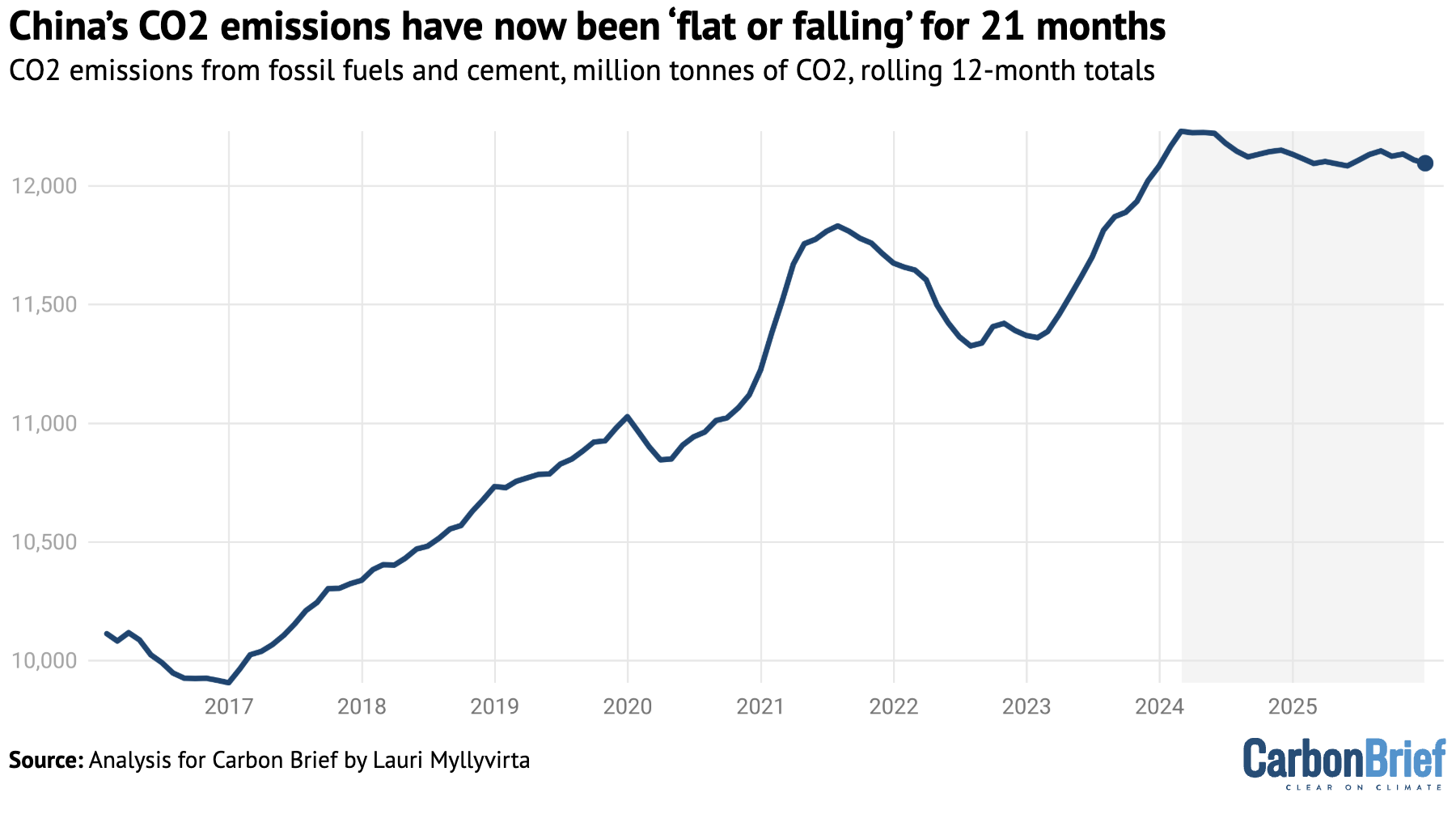 China's CO2 emissions from fossil fuels and cement, million tonnes of CO2, rolling 12-month totals until September 2025. Source: Emissions are estimated from National Bureau of Statistics data on production of different fuels and cement, China Customs data on imports and exports and WIND Information data on changes in inventories, applying emissions factors from China's latest national greenhouse gas emissions inventory and annual emissions factors per tonne of cement production until 2024. Sector breakdown of coal consumption is estimated using coal consumption data from WIND Information and electricity data from the National Energy Administration. The consumption of petrol, diesel and jet fuel is adjusted to match quarterly totals estimated by Sinopec.
Power sector emissions fell by 1.5% year-on-year in 2025, with coal use falling 1.7% and gas use increasing 6%. Emissions from transportation fell 3% and from the production of cement and other building materials by 7%, while emissions from the metal industry fell 3%.
These declines are shown in the figure below. They were partially offset by rising coal and oil use in the chemical industry, up 15% and 10% respectively, which pushed up the sector's CO2 emissions by 12% overall.
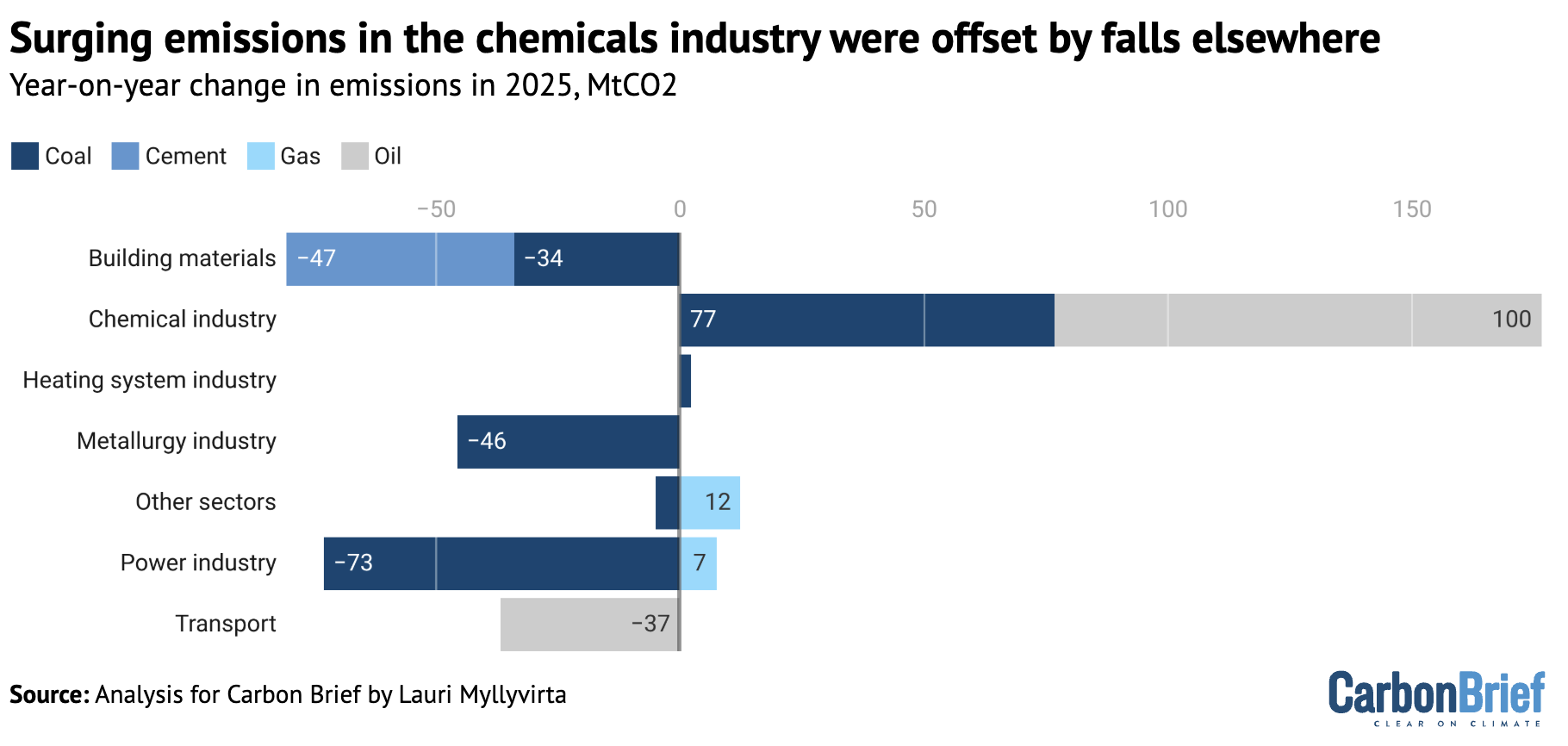 Year-on-year change in China's CO2 emissions from fossil fuels and cement, for the period January-September 2025, million tonnes of CO2. Source: Emissions are estimated from National Bureau of Statistics data on production of different fuels and cement, China Customs data on imports and exports and WIND Information data on changes in inventories, applying emissions factors from China's latest national greenhouse gas emissions inventory and annual emissions factors per tonne of cement production until 2024. Sector breakdown of coal consumption is estimated using coal consumption data from WIND Information and electricity data from the National Energy Administration. The consumption of petrol, diesel and jet fuel is adjusted to match quarterly totals estimated by Sinopec.
In other sectors - largely other industrial areas and building heat - gas use increased by 2%, more than offsetting the reduction in emissions from a 3% drop in their coal consumption.
Clean power covers electricity demand growthIn the power sector, which is China's largest emitter by far, electricity demand grew by 520 terawatt hours (TWh) in 2025.
At the same time, power generation from solar increased by 43% and wind power generation by 14%, delivering 360TWh and 130TWh of additional clean electricity. Nuclear power generation grew 8%, supplying another 40TWh. The increased generation from these three sources - some 530TWh - therefore met all of the growth in demand.
Hydropower generation also increased by 3% and bioenergy by 3%, helping push power generation from fossil fuels down by 1%. Gas-fired power generation increased by 6% and, as a result, power generation from coal fell by 1.9%.
Furthermore, the surge in additions of new wind and solar capacity at the end of 2025 will only show up as increased clean-power generation in 2026.
On the other hand, the growth in solar and wind power generation has fallen short of the growth in capacity, implying a fall in capacity utilisation - a measure of actual output relative to the maximum possible. This is highly likely due to increased, unreported curtailment, where wind and solar sites are switched off because the electricity grid is congested.
If these grid issues are resolved over the next few years, then generation from existing wind and solar capacity will increase over time.
Developments in 2025 extended the trend of clean-power generation growing faster than power demand overall, as shown in the top figure below. This trend started in 2023 and is the key reason why China's emissions have been stable or falling since early 2024.
In addition, 2025 saw another potential inflection point, shown in the bottom figure below. It was the first year ever that energy storage capacity - mainly batteries - grew faster than peak electricity demand in 2025 and faster than the average growth in the past decade.
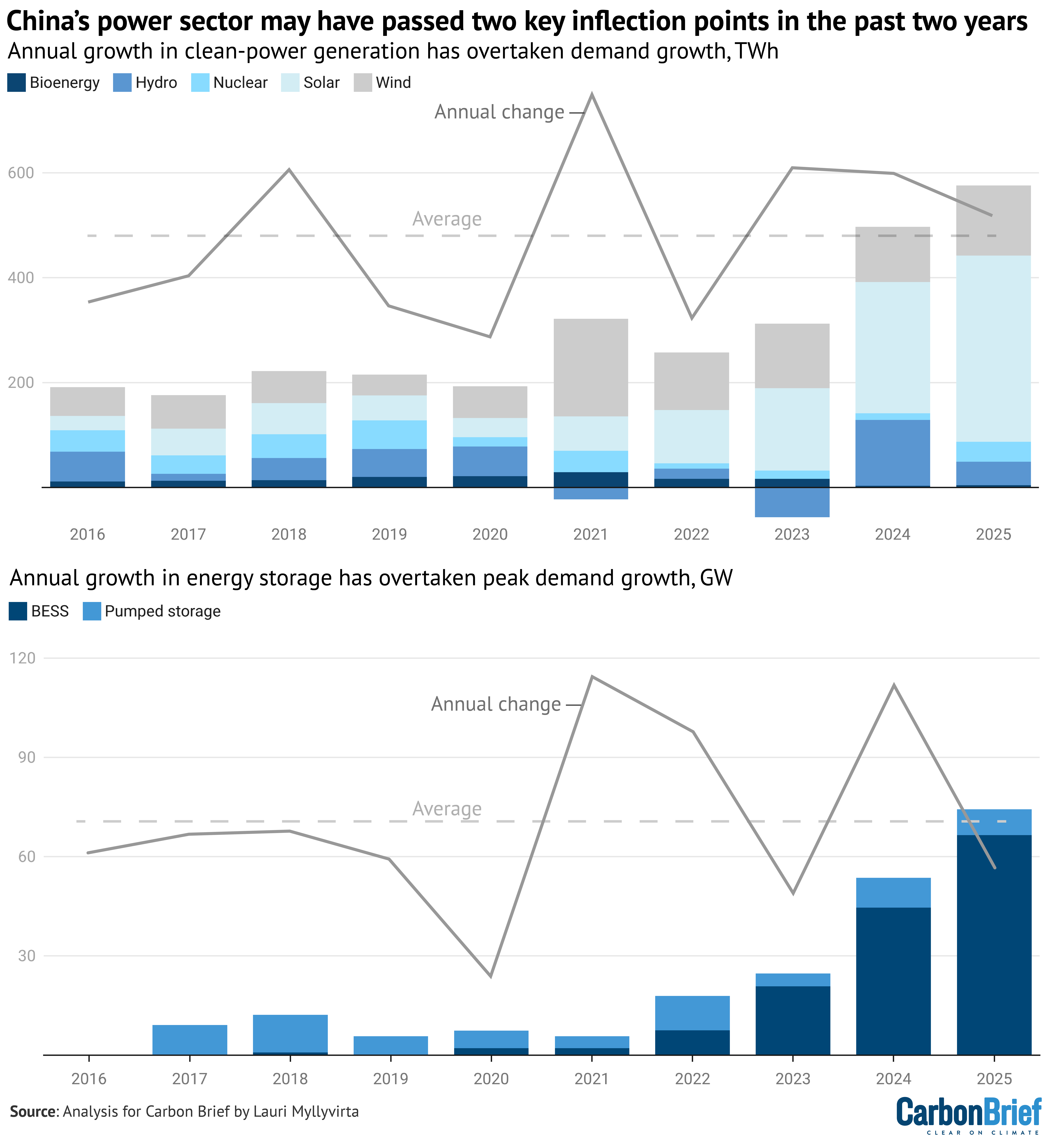 Top columns: Year-on-year change in annual electricity generation from clean energy excluding hydro, terawatt hours. Left solid and dashed line: Annual and average change in total electricity generation, TWh. Bottom columns: Year-on-year change in energy storage capacity, gigawatts. Right solid and dashed line: Annual and average change in peak electricity demand. Sources: Power generation and demand from Ember; peak loads from China Electric Power News since 2020; peak loads until 2019 and pumped hydro capacity from Wind Financial Terminal; battery storage capacity from China Energy Storage Alliance; analysis for Carbon Brief by Lauri Myllyvirta.
China's energy storage capacity increased by 75GW year-on-year in 2025, while peak demand only increased by 55GW. The rise in storage capacity in 2025 is also larger than the three-year average increase in peak loads, some 72GW per year.
Peak demand growth matters, because power systems have to be designed to reliably provide enough electricity supply at the moment of highest demand.
Moreover, the increase in peak loads is a key driver of continued additions of coal and gas-fired power plants, which reached the highest level in a decade in 2025.
The growth in energy storage could provide China with an alternative way to meet peak loads without relying on increased fossil fuel-based capacity.
The growth in storage capacity is set to continue after a new policy issued by China's top economic planner the National Development and Reform Commission (NDRC) in January.
This policy means energy storage sites will be supported by so-called "capacity payments", which to date have only been available to coal- and gas-fired power plants and pumped hydro storage.
Concerns about having sufficient "firm" power capacity in the grid - that which can be turned on at will - led the government to promote new coal and gas-fired power projects in recent years, leading to the largest fossil-fuel based capacity additions in a decade in 2025, with another 290GW of coal-fired capacity still under construction.
Reforming the power system and increasing storage capacity would enable the grid to accommodate much higher shares of solar and wind, while reducing the need for new coal or gas capacity to meet rising peaks in demand.
This would both unlock more clean-power generation from existing capacity and improve the economics and risk profiles of new projects, stimulating more growth in capacity.
Peaking power CO2 requires more clean-energy growthChina's key climate commitments for the next five-year period until 2030 are to peak CO2 emissions and to reduce carbon intensity by more than 65% from 2005 levels. The latter target requires limiting CO2 emissions at or below their 2025 level in 2030.
The record clean-energy additions in 2023-25 have barely sufficed to stabilise power-sector emissions, showing that if rapid growth in power demand continues, meeting the 2030 targets requires keeping clean-energy additions close to 2025 levels over the next five years.
China's central government continues to telegraph a much lower level of ambition, with the NDRC setting a target of "around" 30% of power generation in 2030 coming from solar and wind, up from around 22% in 2025.
If electricity demand grows in line with the State Grid forecast of 5.6% per year, then limiting the share of wind and solar to 30% would leave space for fossil-fuel generation to grow at 3% per year from 2025 to 2030, even after increases from nuclear and hydropower.
Such an increase would mean missing China's Paris commitments for 2030.
Alternatively, in order to meet the forecast increase in electricity demand without increasing generation from fossil fuels would require wind and solar's share to reach 37% in 2030.
Similarly, China's target of a non-fossil energy share of 25% in 2030 will not be sufficient to meet its carbon-intensity reduction commitment for 2030, unless energy demand growth slows down sharply.
This target is unlikely to be upgraded, since it is already enshrined in China's Paris Agreement pledge, so in practice the target would need to be substantially overachieved if the country is to meet its other commitments.
If energy demand growth continues at the 2025 rate and the share of non-fossil energy only rises from 22% in 2025 to 25% in 2030, then the consumption of fossil fuels would increase by 3% per year, with a similar rise in CO2 emissions.
Still, another recent sign that clean-energy growth could keep exceeding government targets came in early February when the China Electricity Council projected solar and wind capacity additions of more than 300GW in 2026 - well beyond the government goal of "over 200GW".
Chemical industryThe only significant source of growth in CO2 emissions in 2025 was the chemical industry, with sharp increases in the consumption of both coal and oil.
This is shown in the figure below, which illustrates how CO2 emissions appear to have peaked from cement production, transport, the power sector and others, whereas the chemicals industry is posting strong increases.
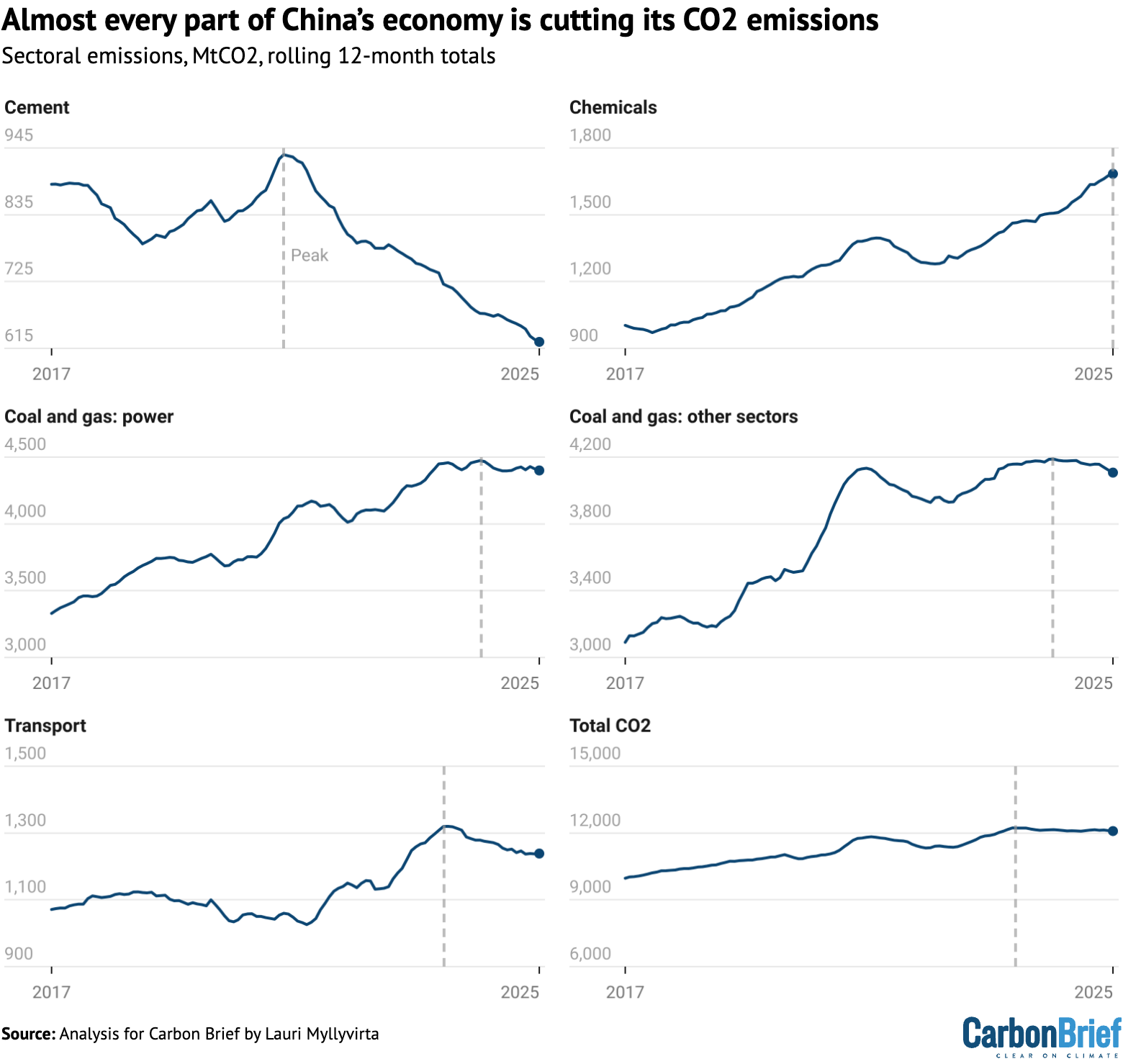 Sectoral emissions from fossil fuels and cement, million tonnes of CO2, rolling 12-month totals. Source: Emissions are estimated from National Bureau of Statistics data on production of different fuels and cement, China Customs data on imports and exports and WIND Information data on changes in inventories, applying emissions factors from China's latest national greenhouse gas emissions inventory and annual emissions factors per tonne of cement production until 2024. Sector breakdown of coal consumption is estimated using coal consumption data from WIND Information and electricity data from the National Energy Administration.
Even though chemical-industry emissions are small relative to other sectors - at roughly 13% of China's total - the pace of expansion is creating an outsize impact.
Without the increase from the chemicals sector, China's total CO2 emissions would have fallen by an estimated 2%, instead of the 0.3% reported here.
Without changes to policy, emission growth is set to continue, as the coal-to-chemicals industry is planning major increases in capacity.
Whether these expansion plans receive backing in the upcoming five-year plan for 2026-30 will have a major impact on China's emission trends.
Another key factor is the development of oil and gas prices. Production in the coal-based chemical industry is only profitable when coal is significantly cheaper than crude oil.
The current coal-to-chemicals capacity in China is dominated by plants producing higher-value - and therefore less price-sensitive - chemicals such as olefins and aromatics, as feedstocks for the production of plastics.
In contrast, the planned expansion of the sector is expected to be largely driven by plants producing oil products and synthetic gas to be used for energy. For these products, electrification and clean-electricity generation provide a direct alternative, meaning they are even more sensitive to low oil and gas prices than chemicals production.
Outlook for China's emissionsThis is the latest analysis for Carbon Brief to show that China's CO2 emissions have now been stable or falling for seven quarters or 21 months, marking the first such streak on record that has not been associated with a slowdown in energy demand growth.
Notably, while emissions have stabilised or begun a slow decline, there has not yet been a substantial reduction from the level reached in early 2024. This means that a small jump in emissions could see them exceed the previous peak level.
China's official plans only call for peaking emissions shortly before 2030, which would allow for a rebound from the current plateau before the ultimate emissions peak.
If China is to meet its 2030 carbon intensity commitment - a 65% reduction on 2005 levels - then emissions would have to fall from the peak back to current levels by 2030.
Whether China's policymakers are still committed to meeting this carbon intensity pledge, after the setbacks during the previous five-year period, is a key open question. The 2030 energy targets set to date have fallen short of what would be required.
The most important signal will be whether the top-level five-year plan for 2026-30, due in March, sets a carbon intensity target aligned with the 2030 Paris commitment.
Officially, China is sticking to the timeline of peaking CO2 emissions "before 2030", which was announced by president Xi Jinping in 2020.
According to an authoritative explainer on the recommendations of the Central Committee of the Communist Party for the upcoming five-year plan, published by state-backed news agency Xinhua, coal consumption should "reach its peak and enter a plateau" from 2027.
It says that continued increases in demand for coal from electricity generators and the chemicals industry would be offset by reductions elsewhere. This is despite the fact that China's coal consumption overall has already been falling for close to two years.
The reference to a "plateau" in coal consumption indicates that in official plans, meaningful absolute reductions in emissions would have to wait until after 2030. Any increase in coal consumption from 2025 to 2027, before the targeted plateau, would need to be offset by reductions in oil consumption, to meet the carbon intensity target.
Moreover, allowing coal consumption in the power sector to grow beyond the peak of overall coal use and emissions implies slowing down China's clean-energy boom. So far, the boom has continued to exceed official targets by a wide margin.
In addition, the explainer's expectation of further growth in coal use by the chemicals industry indicates a green light for at least a part of its sizable expansion plans.
The Xinhua article recognises that oil product consumption has already peaked, but says that oil use in the chemicals industry has kept growing. It adds that overall oil consumption should peak in 2026.
Elsewhere, the article speaks of "vigorously" developing non-fossil energy and "actively" developing "distributed" solar, which has slowed down due to recent pricing policies.
Yet it also calls for "high-quality development" of fossil fuels and increased efforts in domestic oil and gas production, suggesting that China continues to take an "all of the above" approach to energy policy.
The outcome of all this depends on how things turn out in reality. The past few years show it is possible that clean energy will continue to overperform its targets, preventing growth in energy consumption from fossil fuels despite this policy support.
The key role of the clean-energy boom in driving GDP growth and investments is one key motivator for policymakers to keep the boom going, even when central targets would allow for a slowdown. It is also possible that the five-year plans of provinces and state-owned enterprises could play a key role in raising ambition, as they did in 2022.
About the dataData for the analysis was compiled from the National Bureau of Statistics of China, National Energy Administration of China, China Electricity Council and China Customs official data releases, as well as from industry data provider WIND Information and from Sinopec, China's largest oil refiner.
Electricity generation from wind and solar, along with thermal power breakdown by fuel, was calculated by multiplying power generating capacity at the end of each month by monthly utilisation, using data reported by China Electricity Council through Wind Financial Terminal.
Total generation from thermal power and generation from hydropower and nuclear power were taken from National Bureau of Statistics monthly releases.
Monthly utilisation data was not available for biomass, so the annual average of 52% for 2023 was applied. Power-sector coal consumption was estimated based on power generation from coal and the average heat rate of coal-fired power plants during each month, to avoid the issue with official coal consumption numbers affecting recent data.
CO2 emissions estimates are based on National Bureau of Statistics default calorific values of fuels and emissions factors from China's latest national greenhouse gas emissions inventory, for the year 2021. The CO2 emissions factor for cement is based on annual estimates up to 2024.
For oil, apparent consumption of transport fuels - diesel, petrol and jet fuel - is taken from Sinopec quarterly results, with monthly disaggregation based on production minus net exports. The consumption of these three fuels is labeled as oil product consumption in transportation, as it is the dominant sector for their use.
Apparent consumption of other oil products is calculated from refinery throughput, with the production of the transport fuels and the net exports of other oil products subtracted. Fossil-fuel consumption includes non-energy use such as plastics, as most products are short-lived and incineration is the dominant disposal method.
China energy
|05.02.26
Analysis: Clean energy drove more than a third of China's GDP growth in 2025
China energy
|05.02.26
'Rush' for new coal in China hits record high in 2025 as climate deadline looms
China energy
|03.02.26

Explainer: Why gas plays a minimal role in China's climate strategy
China energy
|22.01.26
jQuery(document).ready(function() { jQuery('.block-related-articles-slider-block_f2f428e18d17c60b86ceb33db0d653ab .mh').matchHeight({ byRow: false }); });The post Analysis: China's CO2 emissions have now been 'flat or falling' for 21 months appeared first on Carbon Brief.
We handpick and explain the most important stories at the intersection of climate, land, food and nature over the past fortnight.
This is an online version of Carbon Brief's fortnightly Cropped email newsletter. Subscribe for free here. This is the last edition of Cropped for 2025. The newsletter will return on 14 January 2026.
Key developments Economic risks from nature lossRISKY BUSINESS: The "undervaluing" of nature by businesses is fuelling its decline and putting the global economy at risk, according to a new report covered by Carbon Brief. The Intergovernmental Science-Policy Platform on Biodiversity and Ecosystem Services (IPBES) "business and biodiversity" report "urg[ed] companies to act now or potentially face extinction themselves", Reuters wrote.
BUSINESS ACTION: The report was agreed at an IPBES meeting in Manchester last week. Speaking to Carbon Brief at the meeting, IPBES chair, Dr David Obura, said the findings showed that "all sectors" of business "need to respond to biodiversity loss and minimise their impacts". Bloomberg quoted Prof Stephen Polasky, co-chair of the report, as saying: "Too often, at present, what's good for business is bad for nature and vice-versa."
Tensions in deep-sea mining Subscribe: Cropped- .pull-left{background: #f4f4f4} .listing ul{list-style:none; margin:0} ol {background: #F4F4F4; padding: 0px;} .listing ul {background: #F4F4F4; padding: 0px;} .listing li{font-size:0px;}
Sign up to Carbon Brief's free "Cropped" email newsletter. A fortnightly digest of food, land and nature news and views. Sent to your inbox every other Wednesday.
JAPAN'S TAKEOFF: Japan's prime minister, Sanae Takaichi, announced on 2 February that the country became the first in the world to extract rare earths from the deep seabed after successful retrievals near Minamitori Island, in the central Pacific Ocean, according to Asia Financial. The country hailed the move as a "first step toward industrialisation of domestically produced rare earth" metals, Takaichi said.
URGENT CALL: On 5 February, the International Seabed Authority (ISA) secretary general, Leticia Reis de Carvalho, called on EU officials to "quickly agree on an international rule book on the extraction of critical minerals in international waters", due to be finalised later this year, Euractiv reported. The bloc has supported a proposed moratorium on deep-sea mining. However, the US has "taken the opposite approach", fast-tracking a single permit for exploration and exploitation of seabed resources, and "might be pushing the EU - and others" to follow suit, the outlet added.
CAUTIONARY COMMENT: In the Inter Press Service, the former president of the Seychelles and a Swiss philanthropist highlighted the important role of African leadership in global ocean governance. It called for a precautionary pause on deep-sea mining due to the potential harmful effects of this extractive activity on biodiversity, food security and the economy. They wrote: "The accelerating push for deep-sea mining activities also raises concerns about repeating historic patterns seen in other extractive sectors across Africa."
News and views- ARGENTINE AUSTERITY: The Argentinian government's response to the worst wildfires to hit Patagonia "in decades" has been hindered by president Javier Milei's "gutting" of the country's fire-management agency, the Associated Press reported. Carbon Brief covered a new rapid-attribution analysis of the fires, which found that climate change made the hot, dry conditions that preceded the fires more than twice as likely.
- CRISIS IN SOMALIA: The Somali government has begun "emergency talks" to address the drought that is gripping much of the country, according to Shabelle Media. The outlet wrote that the "crisis has reached a critical stage" amid "worsening shortages of water, food and pasture threatening both human life and livestock".
- FOOD PRICES FALL: The UN Food and Agriculture Organization's "food price index" - a measure of the costs of key food commodities around the world - fell in January for the fifth month in a row. The fall was driven by decreases in the price of dairy, meat and sugar, which "more than offset" increasing prices of cereals and vegetable oil, according to the FAO.
- HIGH STANDARDS: The Greenhouse Gas Protocol launched a new standard for companies to measure emissions and carbon removals from land use and emerging technologies. BusinessGreen said that the standard is "expected to provide a boost to the expanding carbon removals and carbon credit sectors by providing an agreed measurement protocol".
- RUNNING OUT OF TIME: Negotiators from the seven US states that share the Colorado River basin met in Washington DC ahead of a 14 February deadline for agreeing a joint plan for managing the basin's reservoirs. The Colorado Sun wrote: "The next agreement will impact growing cities, massive agricultural industries, hydroelectric power supplies and endangered species for years to come."
- CORAL COVER: Malaysia has lost around 20% of its coral reefs since 2022, "with reef conditions continuing to deteriorate nationwide", the Star - a Malaysian online news outlet - reported. The ongoing decline has many drivers, it added, including a global bleaching event in 2024, pollution and unsustainable tourism and development.
This week, Carbon Brief reports on the impacts of the US withdrawal from the global nature-science panel, IPBES.
The Trump administration's decision to withdraw the US from the world's main expert panel that advises policymakers on biodiversity and ecosystem science "harms everybody, including themselves".
That's according to Dr David Obura, chair of the Intergovernmental Science-Policy Platform on Biodiversity and Ecosystem Services, or IPBES.
IPBES is among the dozens of international organisations dealing with the fallout from the US government's announcement last month.
The panel's chief executive, Dr Luthando Dziba, told Carbon Brief that the exit impacts both the panel's finances and the involvement of important scientists. He said:
"The US was one of the founding members of IPBES…A lot of US experts contribute to our assessments and they've led our assessments in various capacities. They've also served in various official bodies of the platform."
Obura told Carbon Brief that "it's very important to try and keep pushing through with the knowledge and keep doing the work that we're doing". He said he hopes the US will rejoin in future.
Carbon Brief attended the first IPBES meeting since Trump's announcement, held last week in Manchester. At the meeting, countries finalised a new "business and biodiversity" report.
For the first time in the 14-year history of IPBES, there was no US government delegation present at the meeting, although some US scientists attended in other roles.
Cashflow impactsDziba is still waiting for official confirmation of the US withdrawal, but impacts were being felt even before last month's announcement.
Budget information [pdf] from last October shows that the US contributed the most money to IPBES of any country in 2024 - around $1.2m. In 2025, when Trump took office, it sent $0, as of October.
Despite this, IPBES actually received around $1.2m extra funding from countries in 2025, compared to 2024, as other nations filled the gap.
The UK, for example, increased its contribution from around $367,000 in 2024 to more than $1.7m in 2025. The EU, which did not contribute in 2024 but tends to make multi-year payments, paid around $2.7m last year. These two payments made up the bulk of the increase in overall funding.
Wider effects of US exitDziba said IPBES is looking at other ways of boosting funds in future, but noted that lost income is not the only concern:
"For us, the withdrawal of the US is actually much larger than just the budgetary implications, because you can find somebody who can come in and increase the contribution and close that gap.
"The US has got thousands of leading experts in the fields where we undertake assessments. We know that some of them work for [the] government and maybe [for] those it will be more challenging for them to continue…But there are many other experts that we hope, in some way, will still be able to contribute to the work of the platform."
One person trying to keep US scientists involved is Prof Pam McElwee, a professor of human ecology at Rutgers University. She told Carbon Brief that "there are still a tonne of American scientists and other civil society organisations that want to stand up".
McElwee and others have looked at ways for US scientists to access funding to continue working with the Intergovernmental Panel on Climate Change, which the US has also withdrawn from. She said they will try and do the same at IPBES, adding:
"It's basically a bottom-up initiative…to make the message clear that scientists in the US still support these institutions and we still are part of them.
Watch, read, listen"Climate science is what it is and we can't deny or withdraw from it. So we'll just keep trying to represent it as best we can."
UNDER THE SEA: An article in bioGraphic explored whether the skeletons of dead corals "help or hinder recovery" on bleached reefs.
MOSSY MOORS: BBC News covered how "extinct moss" is being reintroduced in some English moors in an effort to "create diverse habitats for wildlife".
RIBBIT: Scientists are "racing" to map out Ecuador's "unique biological heritage of more than 700 frog species", reported Dialogue Earth.
MEAT COMEBACK: Grist examined the rise and fall of vegan fine dining.
New science- Areas suitable for grazing animals could shrink by 36-50% by 2100 due to continued climate change, with areas of extreme poverty and political fragility experiencing the highest losses | Proceedings of the National Academy of Sciences
- The body condition of Svalbard polar bears increased after 2000, in a period of rapid loss of ice cover | Scientific Reports
- Studies projecting the possibility of reversing biodiversity loss are scarce and most do not account for additional drivers of loss, such as climate change, according to a meta-analysis of more than 55 papers | Science Advances
- 9-12 February: Climate and cryosphere open science conference | Wellington, New Zealand
- 18 February: International conservation technology conference | Lima, Peru
- 22-27 February: American Geophysical Union's ocean sciences meeting | Glasgow, UK
Cropped is researched and written by Dr Giuliana Viglione, Aruna Chandrasekhar, Daisy Dunne, Orla Dwyer and Yanine Quiroz. Please send tips and feedback to cropped@carbonbrief.org

Cropped 28 January 2026: Ocean biodiversity boost; Nature and national security; Mangrove defence
Cropped
|28.01.26
Cropped 14 January 2026: Wildfires scorch three continents; EU trade; Food and nature in 2026
Cropped
|14.01.26
Cropped 17 December 2025: 'Deadly' Asia floods; Boosting London's water birds; UN headwinds
Cropped
|17.12.25
Cropped 3 December 2025: Extreme weather in Africa; COP30 roundup; Saudi minister interview
Cropped
|03.12.25
jQuery(document).ready(function() { jQuery('.block-related-articles-slider-block_183c70ba7f47fc3975e918264be21563 .mh').matchHeight({ byRow: false }); });The post Cropped 11 February 2026: Aftershocks of US withdrawals | Biodiversity and business risks | Deep-sea mining tensions appeared first on Carbon Brief.
The UK government has secured a record 7.4 gigawatts (GW) of solar, onshore wind and tidal power in its latest auction for new renewable capacity.
It is the second and final part of the seventh auction round for "contracts for difference" (CfDs), known as AR7a.
In the first part, held in January 2026, the government agreed contracts for a record 8.4GW of new offshore wind capacity.
This makes AR7 the UK's single-largest auction round overall, with its 14.7GW of new renewable capacity being 50% larger than the previous record set by AR6 in 2024.
In AR7a, 157 solar projects secured contracts to supply electricity for £65 per megawatt hour (MWh) and 28 onshore wind projects were contracted at £72/MWh.
This means they will help cut consumer bills, according to multiple analysts.
Energy secretary Ed Miliband welcomed the outcome of the auction, saying in a statement that the new projects would be "50% cheaper" than new gas:
"These results show once again that clean British power is the right choice for our country, agreeing a price for new onshore wind and solar that is over 50% cheaper than the cost of building and operating new gas".
In addition to cutting costs, the new projects will help reduce gas imports.
In total, AR7 will cut UK gas demand by around 95 terawatt hours (TWh) per year, enough to cut liquified natural gas (LNG) imports by three-quarters, according to Carbon Brief analysis.
Below, Carbon Brief looks at the seventh auction results for onshore wind, solar and tidal, what they mean energy for bills and the impact of the UK's target of "clean power by 2030".
- What happened in the latest UK renewable auction?
- What does the solar and onshore wind auction mean for bills?
- What does it mean for energy security, jobs and investment?
- What does the auction mean for clean power by 2030?
The latest UK government auction for new renewable capacity is the second and final part of the seventh auction round, known as AR7a.
It secured a record 4.9GW of new solar capacity across 157 projects, as shown in the figure below, as well as 1.3GW of onshore wind across 28 projects.
In addition, four tidal energy projects totalling 21 megawatts (MW) secured contracts, included within "other" in the figure below.
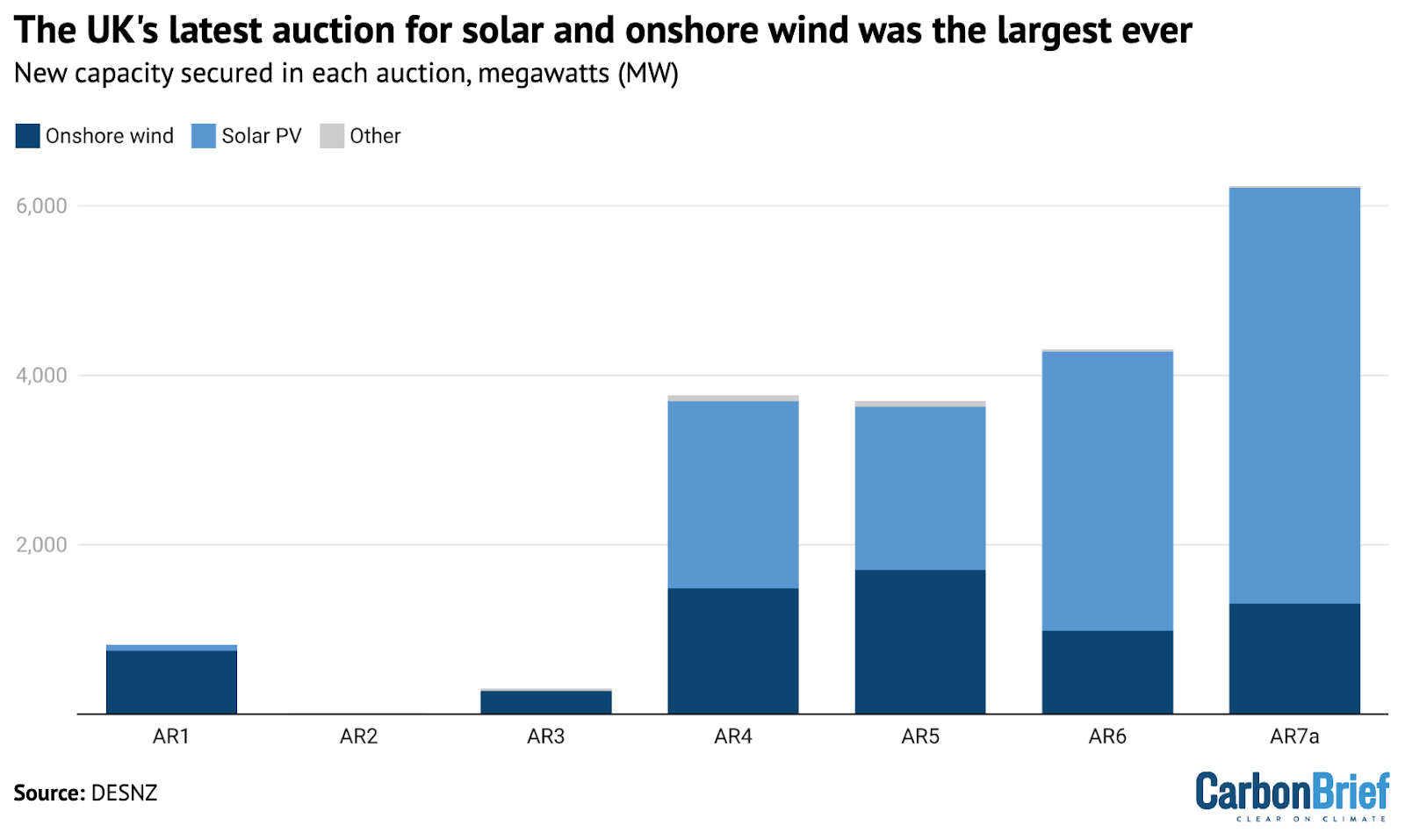 Capacity of solar, onshore wind and other technologies (including tidal) secured at each CfD auction in megawatts. Source: Department of Energy Security and Net Zero.
Most of the solar that secured a contract has a capacity of less than 50MW. This is the cut-off point for projects to be approved by the local council. Larger schemes must instead go through the "nationally significant infrastructure project" (NSIP) process, subject to approval by the secretary of state for energy.
For the first time, one 480MW solar project - approved via this NSIP process - won a CfD in AR7a. The West Burton Solar NSIP is being developed in Lincolnshire and Nottinghamshire by Island Green Power. It is named after the grid connection it will use, freed up by the shuttering of the coal-powered West Burton plant.
However, Nick Civetta, project leader at Aurora Energy Research notes on LinkedIn that this site was only one of four eligible solar NSIPs to secure a contract.
Civetta adds that "wrangling these large projects into fruition is proving more painful than expected".
Solar projects secured a "strike price" of £65/MWh in 2024 prices, some 7% cheaper than the £70/MWh agreed in the previous auction round.
In previous auction rounds CfD contracts were expressed in 2012 prices. For comparison, AR6 and AR7a solar contracts stand at £50/MWh and £47/MWh in 2012 prices, respectively.)
Alongside solar, 28 onshore wind projects secured contracts in the latest CfD auction, with a total capacity of 1.3GW.
This includes the Imerys windfarm in Cornwall, which at nearly 20MW is the largest onshore wind farm in England to secure a contract in a decade.
(Shortly after taking office in 2024, the current Labour government lifted a decade-long de facto ban on onshore wind in England.)
Overall, Scotland still dominated the auction for onshore wind, with 1,093MW of projects in the country in comparison to 38MW in England and 185MW in Wales.
.cb-tweet{ width: 65%; box-shadow: 3px 3px 6px #d3d3d3; margin: auto; } .cb-tweet img{ border: solid 1.25px #333333; border-radius: 5px; } @media (max-width:650px){ .cb-tweet{ width:100%; } }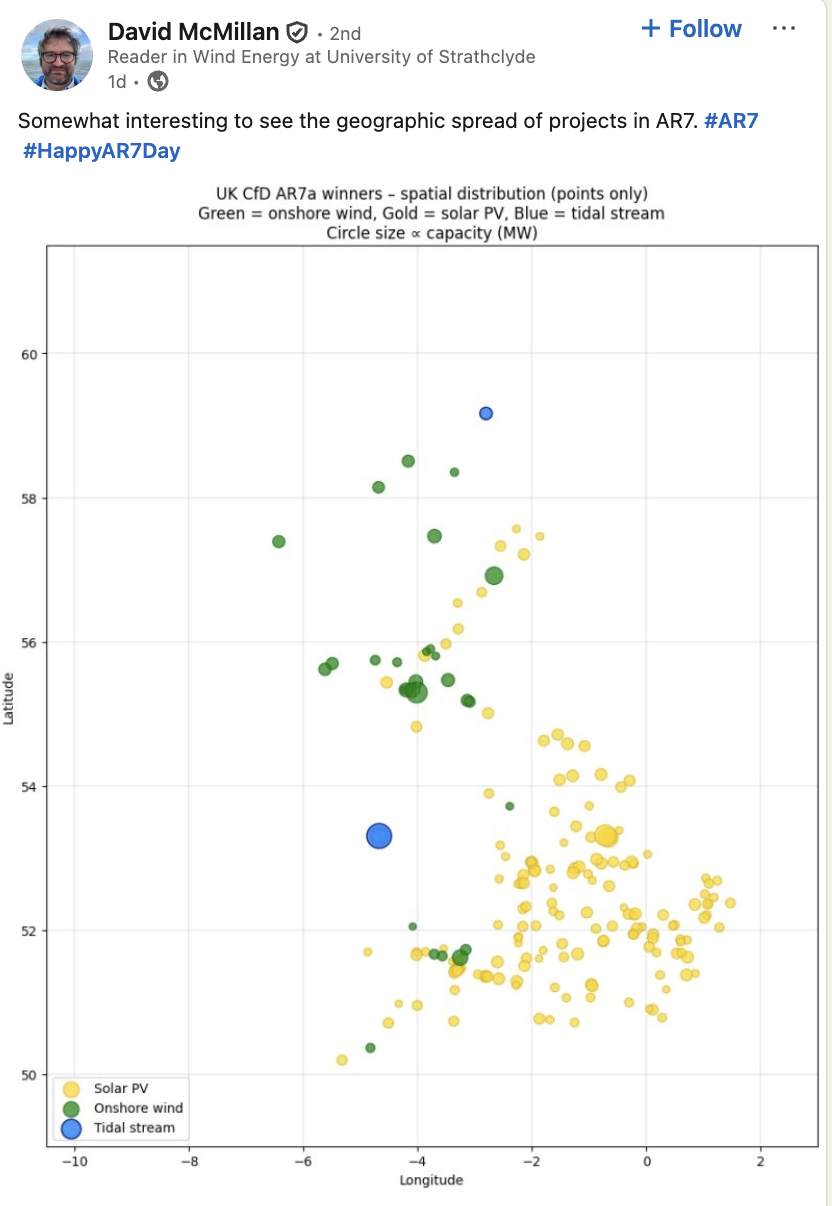
This includes the Sanquhar II windfarm in Dumfries and Galloway in Scotland, which will become the fourth-largest onshore wind farm in the UK at 269MW.
In total, Wales secured contracts for 20 renewables projects in AR7a, with a capacity of more than 530MW. This is the largest ever number of Welsh projects to get backing in a CfD auction, according to a statement from the Welsh government.
Onshore wind secured a strike price of £72/MWh, up slightly from £71/MWh in the previous auction in 2024.
The prices for solar and onshore wind were 13% and 21% below the price cap set by Department of Energy Security and Net Zero (DESNZ) for the auction, respectively.
In its press release announcing the results, the government noted that the results for solar and onshore wind were less than half of the £147/MWh cost of building and operating new gas power stations.
Finally, four tidal energy projects secured contracts with a total capacity of 21MW at a strike price of £265/MWh, up from £240/MWh in 2024.
In total, taken together with the 8.4GW of offshore wind secured in the first part of the auction, AR7 secured a total of 14.7GW of new clean power, as shown in the chart below.
This is enough to power the equivalent of 16 million homes, according to the government. It also makes AR7 the single-largest auction round by far, at more than 50% larger than the previous record set by AR6 in 2024.
This means that the two auction rounds held since the Labour government took office in July 2024 - AR6 and AR7 - have secured a total of 24GW of new renewable capacity. This is more than the 22GW from all previous auction rounds put together.
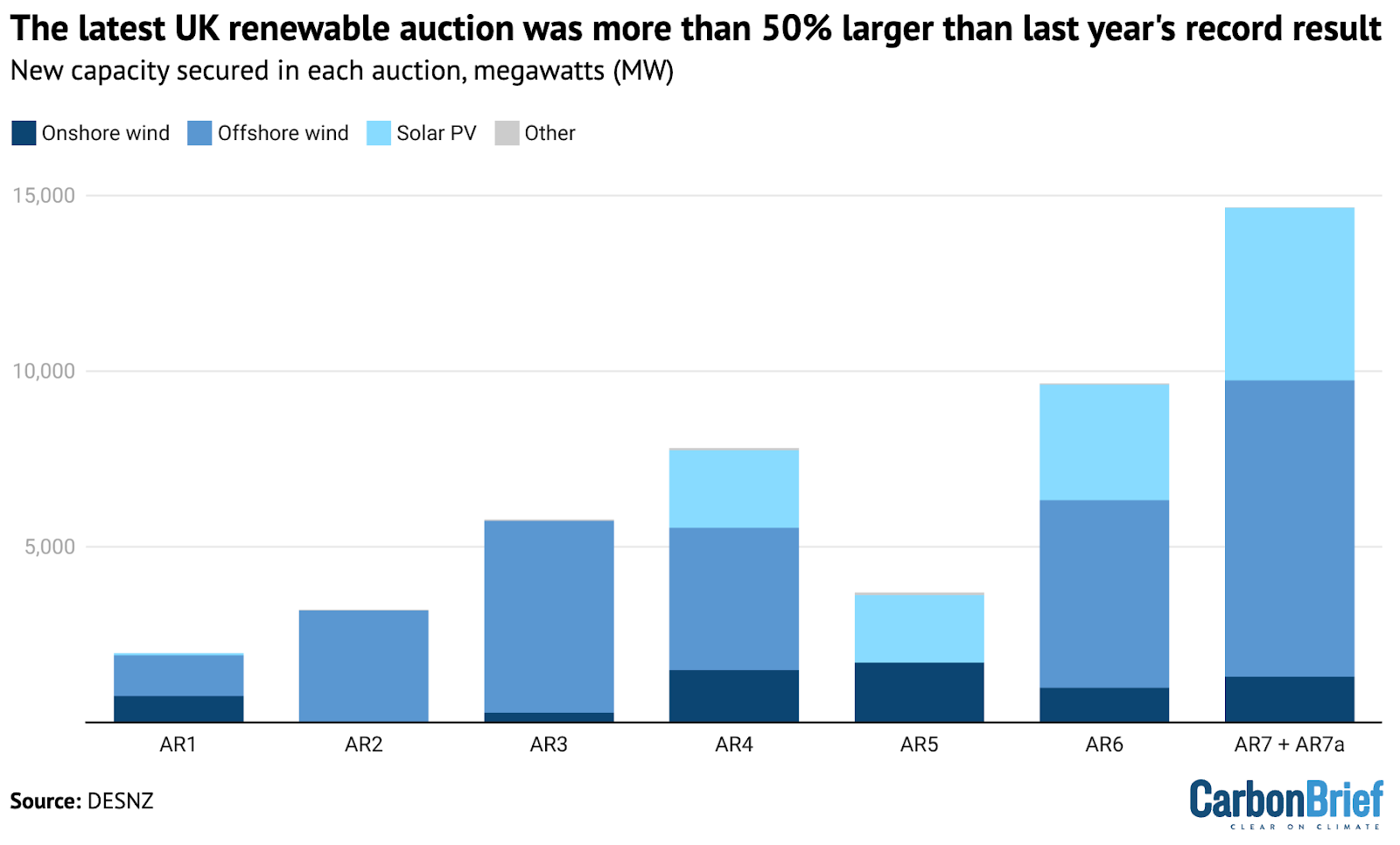 New onshore wind, offshore wind, solar PV and other technologies' capacity secured in each CfD auction, in megawatts. Source: DESNZ.
However, several analysts noted that the AR7a results did not include any old onshore windfarms looking to replace their ageing turbines with new equipment - so-called "repowering projects" - despite the auction being open to them for the first time.
What does the solar and onshore wind auction mean for bills?Onshore wind and solar are widely recognised as the cheapest sources of new electricity generation in almost every part of the world.
The latest auction shows that the UK is no exception, despite its northerly location.
The prices for onshore wind and solar in the latest auction, at £72/MWh and £65/MWh respectively, are comfortably below recent wholesale power prices, which averaged £81/MWh in 2025 and £92/MWh in January 2026.
This means that the new projects will cut costs for UK electricity consumers, according to multiple analysts commenting on the auction outcome.
.cb-tweet{ width: 65%; box-shadow: 3px 3px 6px #d3d3d3; margin: auto; } .cb-tweet img{ border: solid 1.25px #333333; border-radius: 5px; } @media (max-width:650px){ .cb-tweet{ width:100%; } }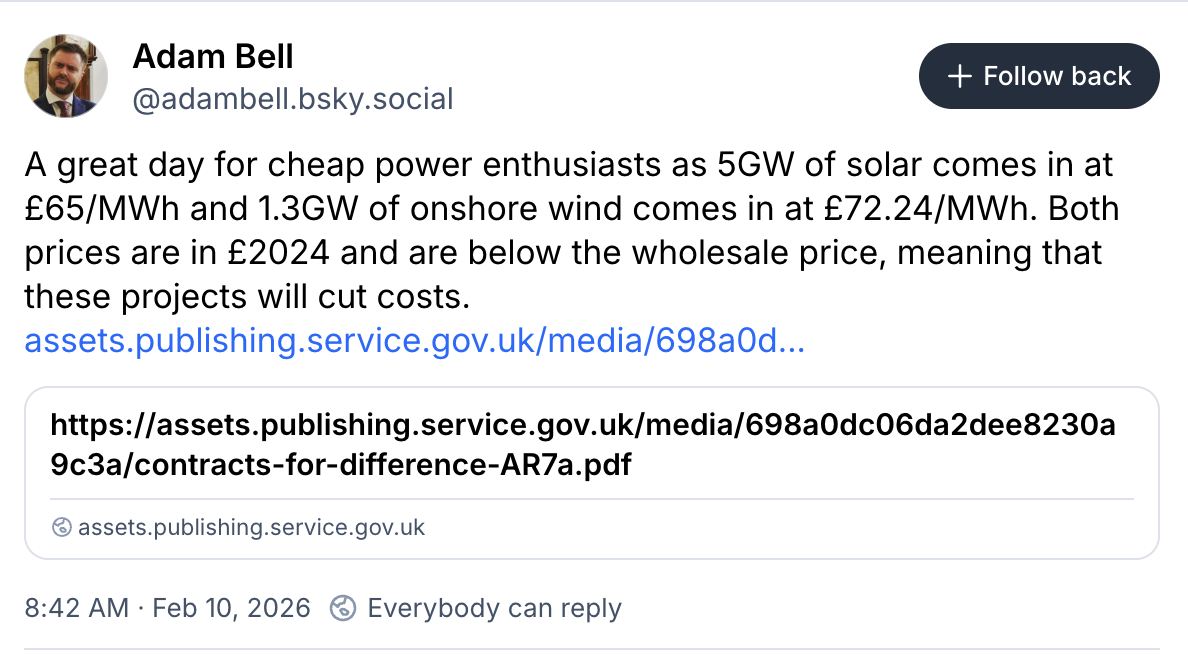
The government lauded the results of AR7a for securing "homegrown energy at good value for billpayers - once again proving that clean power is the right choice for energy security and to meet rising electricity demand".
In a statement, Miliband added:
"By backing solar and onshore wind at scale, we're driving bills down for good and protecting families, businesses, and our country from the fossil fuel rollercoaster controlled by petrostates and dictators. This is how we take back control of our energy and deliver a new era of energy abundance and independence."
As noted in Carbon Brief's coverage of the offshore wind results under AR7 in January, electricity demand is starting to rise as the economy electrifies and many of the UK's existing power plants are nearing the end of their lives.
Therefore, new sources of electricity generation will be needed, whether from renewables, gas-fired power stations or from other sources.
In his statement, quoted above, Miliband said that the prices for onshore wind and solar were less than half the £147/MWh cost of electricity from new gas-fired power stations.
(This is based on recently published government estimates and assumes that gas plants would only be operating during 30% of hours each year, in line with the current UK fleet.)
Trade association RenewableUK also pointed to the cost of new gas, as well as the £124/MWh cost of the Hinkley C new nuclear plant, in its response to the auction results.
In a statement, Dr Doug Parr, policy director for Greenpeace UK, said:
"These new onshore wind and solar projects will supply energy at less than half the cost of new gas plants. Together with the new offshore wind contracts agreed last month, these cheaper renewables will lower energy bills as they come online."
Strike prices for solar dropped by 6% compared to last year and while onshore wind prices rose, this was by less than 2% despite a "difficult environment for wind generation", according to Bertalan Gyenes, consultant at LCP Delta.
In a post on LinkedIn, he noted that "extending the contract length [for onshore wind projects] by five years seems to have helped keep this increase low".
The January offshore wind round secured 8.4 GW at £91/MWh, as such, the onshore and solar projects are 25% cheaper per unit of generation.
(The offshore wind projects secured in January are nevertheless expected to cut consumer bills relative to the alternative, or at worst to be cost neutral.)
Parr added that while the AR7a auction results "show we're getting up to speed" ahead of the clean power 2030 target (see below), "an even faster way for the government to make a really big dent in bills would be to change the system that allows gas to set the overall energy price in this country". He adds:
What does it mean for energy security, jobs and investment?"That would allow us to unshackle our bills from unreliable petrostates and get off the rollercoaster of volatile gas markets once and for all."
The onshore wind and solar projects secured in the latest auction round will generate an estimated 9 terawatt hours (TWh) of electricity, according to Carbon Brief analysis.
This is equivalent to roughly 3% of current UK electricity demand.
Combined with the estimated 37TWh from offshore wind secured during the first part of the auction, AR7 projects will be able to generate 46TWh of electricity, 14% of current demand.
If this electricity were to be generated by gas-fired power plants, then it would require around 95TWh of fuel, because much of the energy in the gas is lost during combustion.
This is several times more than the 25TWh of extra gas that could be produced in 2030 if new drilling licenses are issued, according to thinktank the Energy and Climate Intelligence Unit (ECIU). As such, AR7 will significantly cut UK gas imports, ECIU says, reducing exposure to volatile international gas markets.
Furthermore, ECIU says that the impact of renewables in driving down gas demand - and subsequently electricity prices - is already being seen in the UK.
Five years ago, gas was setting the wholesale price of power in the UK 98% of the time due to the way the electricity market operates.
This price-setting dominance is being eroded by renewables, with recent analysis from the UK Energy Research Centre showing that gas set power prices 90% of the time in 2025.
A further effect of new renewables is that they push the most expensive gas-fired power plants out of the system, reducing prices. This is known as the "merit-order effect".
Recent analysis from ECIU found that large windfarms cut wholesale electricity prices by a third in 2025.
Lucy Dolton, renewable generation lead at Cornwall Insight, said in a statement that the AR7a results will provide a "surge in momentum as [the UK] pushes toward secure, homegrown energy", adding:
"These investments ultimately strengthen the UK's position against volatile gas markets. If the past few years have shown us anything, it's that remaining tied to international energy markets comes with consequences."
The projects that secured CfDs will help the UK avoid burning significant quantities of gas, "the bulk of which would have been imported at a cost which the UK cannot control", said RenewableUK in its statement.
Together with previous CfD auction rounds, the latest new renewable projects are expected to generate some 153TWh of electricity once they are all operating, according to Carbon Brief analysis. This is around half of current UK demand.
Generating the same electricity from gas would require some 311TWh of fuel, which is similar to the 339TWh of gas produced by the UK's North Sea operations in the most recent 12-month period for which data is available. This figure can also be compared with the 130TWh of gas that was imported by ship as liquified natural gas (LNG) in the same period.
The government added that the AR7a projects will support up to 10,000 jobs and bring £5bn in private investment to the UK.
(In total, the new projects secured via AR7 are expected to bring investments worth around £20-23bn to the UK, according to Aurora.)
Additionally, the onshore wind projects are expected to generate over £6.5m in "community benefit" funds for people living near them, according to RenewableUK.
The AR7a results were released alongside the publication of the Local Power Plan by the government and Great British Energy.
This is designed to provide £1bn in funding for communities to own and control their own clean energy projects across the UK.
What does the auction mean for clean power by 2030?The AR7a results put the UK "on track for its 2030 clean power target", according to the government.
Over AR6 and AR7, several changes have been made to the CfD process to help facilitate more projects to secure contracts.
A total of 24GW has been secured over the last two auction rounds - which have taken place under the current Labour government - compared to 22GW across the five auction rounds previously.
As part of its goal for clean power to meet 100% of electricity demand by 2030 and to account for at least 95% of electricity generation, the UK government is aiming for 27-29GW of onshore wind and 45-47GW of solar by the end of the decade.
As of September 2025, the UK had 16.3GW of installed onshore wind capacity and more than 21GW of solar capacity. Taken together, the onshore technologies therefore need to double in operational capacity over the next four years to reach the 2030 targets.
Analysis by RenewableUK suggests that the government will need to procure between 3.85GW to 4.85GW of onshore wind in the next two auctions for the 2030 goal to remain possible.
Writing on LinkedIn, Aurora's Civetta said that the onshore clean power 2030 targets "remain a long way off".
He continued that the gap for solar to reach its 45-47GW target is still a "whopping 18GW", but added that there may be other ways for new capacity to be secured, beyond the CfD auctions.
He said these included a growing market for corporate "power purchase agreements" (PPAs), economic incentives for homes and businesses to install solar and the government's recently released "warm homes plan", all of which "should drive further procurement".
.cb-tweet{ width: 65%; box-shadow: 3px 3px 6px #d3d3d3; margin: auto; } .cb-tweet img{ border: solid 1.25px #333333; border-radius: 5px; } @media (max-width:650px){ .cb-tweet{ width:100%; } }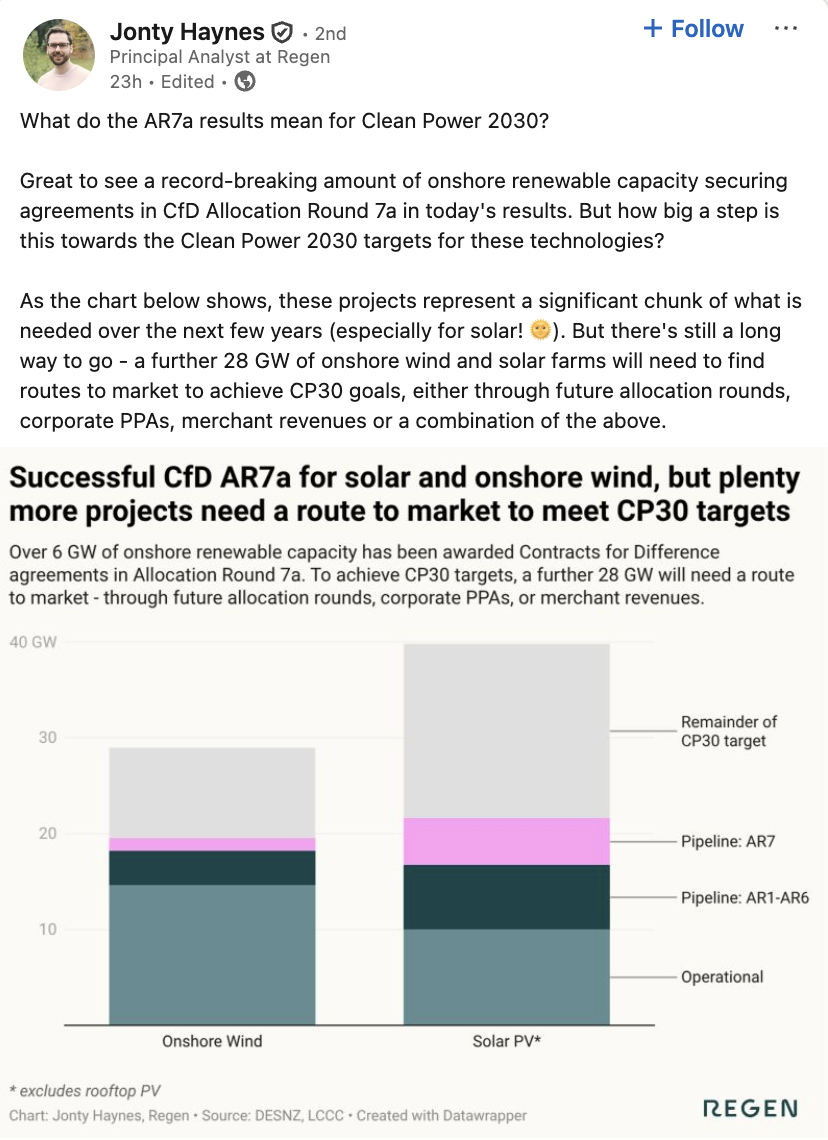
Dolton from Cornwall Insight adds that "the challenge now is delivery", continuing:
"2.5GW of the winners have a delivery year of 2027/28, and over half - 3.7GW - have a delivery year of 2028/29, which brings them very close to the government's 2030 clean power target.
"Historically, renewable projects in the UK have faced delays, often due to grid connection backlogs and planning holdups. With AR7 and some of AR8 representing the only realistic pipeline for pre-2030 capacity, keeping to schedule will be essential."
When built, the projects announced today will help to bring the total capacity of CfD-supported wind and solar to 50.6GW, according to Ember.
While solar and onshore wind are expected to play an important role in decarbonising the electricity system, offshore wind is set to be the "backbone".
The government is targeting 43-50GW of offshore wind by 2030, up from around 17GW of installed capacity today.
This leaves a gap of 27-34GW to the government's target range.
Prior to the AR7 auction, a further 10GW had already secured CfD contracts, excluding the cancelled Hornsea 4 project.
The 8.4GW secured in January brings the gap to reach the minimum of 43GW over the four years to just 7GW.
G7 'falling behind' China as world's wind and solar plans reach new high in 2025
International policy
|10.02.26

Five key climate and energy announcements in India's budget for 2026
Explainers
|04.02.26
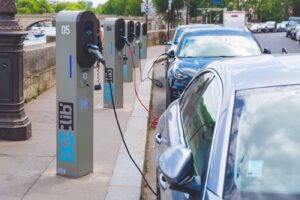
Analysis: EVs just outsold petrol cars in EU for first time ever
Energy
|27.01.26

Q&A: What UK's 'warm homes plan' means for climate change and energy bills
Energy
|23.01.26
jQuery(document).ready(function() { jQuery('.block-related-articles-slider-block_99e53f1f9dc00f79a153af73a2fd69dd .mh').matchHeight({ byRow: false }); });The post Q&A: New UK onshore wind and solar is '50% cheaper' than new gas appeared first on Carbon Brief.
The Trump administration's decision to withdraw the US from the intergovernmental science panel for nature "harms everybody, including them", according to its chair.
Dr David Obura is a leading coral reef ecologist from Kenya and chair of the Intergovernmental Science-Policy Platform on Biodiversity and Ecosystem Services (IPBES), the world's authority on the science of nature decline.
In January, Donald Trump announced intentions to withdraw the US from IPBES, along with 65 other international organisations, including the UN climate science panel and its climate treaty.
In an interview with Carbon Brief, Obura says the warming that humans have already caused means "coral reefs are very likely at a tipping point" and that it is now inevitable that Earth "will lose what we have called coral reefs".
A global goal to halt and reverse biodiversity loss by 2030 will not be possible to achieve for every ecosystem, he continues, noting that a lack of action from countries means "we won't be able to do it fast enough at this point".
Despite this, it is still possible to reverse the "enabling drivers" of biodiversity decline within the next four years, he adds, warning that leaders must act as "our economies and societies fully depend on nature".
The interview was conducted at the sidelines of an IPBES meeting in Manchester, UK, where governments agreed to a new report detailing how the "undervaluing" of nature by businesses is fuelling biodiversity decline and putting the global economy at risk.
- On US leaving IPBES: "Any major country not being part of it harms everybody, including themselves."
- On reversing nature loss by 2030: "We won't be able to do it fast enough at this point."
- On the value of biodiversity: "Nature is really the life support system for people. Our economies and societies fully depend on nature."
- On coral reefs: "We will lose what we have called coral reefs up until this point."
- On nature justice: "The places that are most vulnerable don't have the income, or the assets, to conserve biodiversity."
- On IPBES's latest report: "One of the key findings is all businesses have impacts and dependencies on nature."
- On the next UN nature summit: "We need acceleration of activities and impact and effectiveness, more than anything else."
Carbon Brief: Last month Trump announced plans for the US to exit IPBES and dozens of other global organisations. You described this at the time as "deeply disappointing". What are your thoughts on the decision now and what will be the main impacts of the US leaving IPBES?
David Obura: Well, part of the reason that I've come to IPBES is because, of course, I believe in the multilateral process, because we bring 150 countries together, we're part of the UN and the multilateral system and we're based on knowledge [that provides] inputs to policymaking. We have a conceptual framework that looks from the bottom up on how people depend on nature. I'm also doing a lot of science on Earth systems at the planetary level, how our footprint is exceeding the scale of the planet. We have to make decisions together. We need the multilateral system to work to help facilitate that. It has never been perfect. Of course, I come from a region [Kenya] that hasn't been, you know, powerful in the multilateral process.
But we need countries to come together, so any major country not being part of it harms everybody, including themselves. It's very important to try and keep pushing through with the knowledge and keep doing the work that we're doing, so that, over time, hopefully [the US will] rejoin. Because, in the end, we will really need that to happen.
CB: This is the first IPBES meeting since Trump made the announcement. Has it had an impact so far on these proceedings and is there any kind of US presence here?
DO: This plenary is like every plenary that we have had. The current members are here. Some members are not. And, of course, we have some states here as observers working out if they're going to join or not. And then we have a lot of private sector observers and universities and so on. The impact of a country leaving - the US in this case - has no impact on the plenary itself, because they're not here making decisions on the things that we do.
We, of course, don't have US government members attending in technical areas, but we do have institutions and universities and academics here attending as they have in the past. So, in that sense, the plenary goes on as it goes on - the science and the knowledge is the same. The decision-making processes we have here are the same. And, as I said earlier, what has an impact is the actual action that takes place afterwards, because a lot of the recommendations that we make are based on enabling conditions that governments put in place, to bring in place sustainability actions and so on. When governments are not doing that, especially major economic drivers, then the whole system suffers.
CB: When you were appointed as chair of IPBES more than two years ago, you said that your aim was to strengthen cohesion and impact and also get the findings of IPBES in front of more people. So how would you rate your progress on this now that it's been about a couple of years?
DO: Well, like any intergovernmental process, we have a certain amount of inertia in what we do and it takes a few years to consult on topics for assessments and then to do them and to improve them and get them out.
One of the main things we're discussing right now is we have had a rolling work programme from when IPBES started until 2030 and we need to decide on the last few deliverables and how we work in that period. We are asking for a mandate to spend the next year really considering the multiple options that we have in proposing a way forward for the last few years of this work programme. I feel that the countries are very aligned. We have done a lot of work, produced a lot of outputs. It is challenging for governments and other stakeholders to read our assessments and reach into them to find what's useful to them. They make constant calls for more support, in uptake, in capacity building and in policy support.
The second global assessment in 2028 will be our 17th assessment [overall]. We would like to focus on really bringing all this knowledge together across assessments in ways that are relevant to different governments, different stakeholder groups, different networks to help them reach into the knowledge that's in the assessments. And I think the governments, of course, want that as well, because many of them are calling for it. Many of the governments that support us financially, of course, want to see a return of investment on the money that they have put in.
CB: Nations agreed to halt and reverse biodiversity loss by 2030. Back in 2023 we had a conversation for Carbon Brief and you said that you were "highly doubtful" this goal could be achieved for every ecosystem by that date. Where do you stand on this now?
DO: I work on coral reefs and part of the reason I've come to IPBES platform is because the amount of climate change we're committed to with current fossil fuel emissions and the focus on economic growth means that corals will continue to decline 20, 30, 40 years into the future. I think of that there's no real doubt. The question is how soon we put in place the right actions to halt climate change. That will then have a lag on how long it takes for corals to cope with that amount of climate change.
We can't halt and reverse the decline of every ecosystem. But we can try and bend the curve to halt and reverse the drivers of decline. So, that's some of the economic drivers that we talk about in the nexus and transformative change assessment, the indirect drivers and the value shifts we need to have. What the Global Biodiversity Framework [GBF, a global nature agreement made in 2022] aspires to do in terms of halting and reversing biodiversity decline - we absolutely need to do that. We can do it and we can put in place the enabling conditions for that by 2030 for sure. But we won't be able to do it fast enough at this point to halt [the loss of] all ecosystems.
We're now in 2026, so this is three years plus after the GBF was adopted. We still need greater action from all countries and all stakeholders and businesses and so on. That's what we're really pushing for in our assessments.
CB: Biodiversity loss has historically been underappreciated by world leaders. As the world continues to be gripped by geopolitical uncertainty, conflict and financial pressures, what are your thoughts on the chances of leaders addressing the issue of biodiversity loss in a meaningful way?
DO: What are the chances of addressing biodiversity loss? I mean, we have to do it. It's really our life support system and if we only focus on immediate crises and threats and don't pay attention to the long-term threats and crises, that only creates more short-term crises down the line, we make it harder and harder to do that. I hope that what I'm hoping we get to understand better through IPBES science, as well as others, is that we're not just reporting on the state of biodiversity because it's nice to have it, but it's [because] diversity of nature is really the life support system for people. Our economies and societies fully depend on nature. If we want them to prosper and be secure into the long-term future, we have to learn how to bring the impact and dependencies of business, which is a focus of this assessment, in line with nature. And until we do that, we will just continue to magnify the potential for future crises and their impacts.
CB: You mentioned already that your expertise is in coral reefs. A report last year warned that the world has reached its first climate tipping point, that of widespread dying of warm water coral reefs. Do you agree with that statement and can you discuss the wider state of coral reefs across the world at this present moment?
DO: The report that came out last year in 2025 was a global tipping point report and it's actually in 2023 the first one of those [was published]. I was involved in that one and we basically took what the IPCC [Intergovernmental Panel on Climate Change] has produced, which [is] compiled from the [scientific] literature [which said] that 1.5-2C was the critical range for coral reefs, where you go from losing 70-90% to 90-99% of coral reefs around the world. [It is] a bit hard to say exactly what that means. What we did was we actually reduced that range from 1.5C-2C to 1-1.5C, based on observations we've already made about loss of corals. In 2024, the world was 1.5C above historical conditions for one year. The IPCC number requires a 20-year average [for 1.5C to be crossed]. So, we're not quite at the IPCC limit, but we're very close. Also, with not putting in place fast enough emission reductions, warming will continue.
Coral reefs are very likely at a tipping point. And, so, I do agree with the statement. It means that we lose the fully connected regional, global system that coral reefs have been in the past. There will still be some coral reefs in places that have some natural protection mechanisms, whether it's oceanographic or some levels of sedimentation in green water from rivers can help. And there's resilience of corals as well. Some corals will be able to adapt somewhat, but not all - and not all the other species too. We will lose what we have called coral reefs up until this point. We'll still continue to have simpler coral ecosystems into the future, but they won't be quite the same.
It is a crisis point and my hope is that, in coming out from the coral reef world, I can communicate that this is, this has been a crisis for coral reefs. It's a very important ecosystem, but we don't want it to happen to more and more and more ecosystems that support more [than] hundreds of millions and billions of people as well. Because, if we let things go that far, then, of course, we have much bigger crises on our hands.
CB: Something else you've spoken about before is around equity being one of the big challenges when it comes to responding to biodiversity loss. Can you explain why you think that biodiversity loss should be seen as a justice issue?
DO: Well, biodiversity loss is a justice issue because we are a part of biodiversity and - just like the loss of ecosystems and habitats and species - people live locally as well. People experience biodiversity loss in their surroundings.
The places that are most vulnerable and don't have the income, or the assets, to either conserve biodiversity, or need to rely on it too much so they degrade it - they feel the impacts of that loss much more directly than those who do have more assets. Also, the more assets you have, the more you can import biodiversity products and benefits from somewhere else.
So, it's very much a justice issue, both from local levels experiencing it directly, but then also at global levels. We are part of it [biodiversity], we don't own it. It's a global good, or a common public good, so we need to be preserving it for all people on the planet. In that sense, there are many, many justice issues that are involved in both loss of biodiversity and how you deal with that as well.
CB: How would you say IPBES is working towards achieving greater equity in biodiversity science?
DO: One of the headline findings of our values assessment in 2022, which looked at multiple values different cultures have and different worldviews around the planet, [was that] by accommodating or considering different worldviews and different perspectives, you achieve greater equity because you're already considering other worldviews in making decisions.
So, that's an important first step - just making it much more apparent and upfront that we can't just make decisions, especially global ones, from a single worldview and the dominant one is the market economic worldview that we have. That's very important.
But, then, also in how we do our assessments and the knowledge systems that are incorporated in them. We integrate different knowledge systems together and try and juxtapose - or if they can be integrated, we do that, sometimes you can't - but you just need to illustrate different worldviews and perspectives on the common issue of biodiversity loss or livelihoods or something like that.
We hope that our conceptual framework and our values framework really help bring in this awareness of multiple cultures and multiple perspectives in the multilateral system.
CB: When this interview is published, IPBES will have released its report on business and biodiversity. What are some of the key takeaways from this?
DO: Our assessments integrate so much information that the key messages are actually, in retrospect, quite obvious in a way. One of the key findings it will say is that all businesses have impacts and dependencies on nature.
Of course, when you think about it, of course they do. We often think, "oh, well ecotourism is dependent on nature", but even a supermarket is dependent on nature because a lot of the produce comes from a natural system somewhere, maybe in a greenhouse or enhanced by fertiliser, but it still comes from natural systems. Any other business will have either impacts on the nature around it, or it needs tree shade outside so people can walk in and things like that.
So, that's one of the main findings. It's not just certain sectors that need to respond to biodiversity loss and minimise their impacts. All sectors need to. Another finding, of course, is that it's very differentiated depending on the type of business and type of sector.
It's also very differentiated in different parts of the world in terms of responsibilities and also capabilities. So small businesses, of course, have much less leeway, perhaps, to change what they're doing, whereas big businesses do and they have more assets, so they can deal with shifts and changes much better.
It's a methodological assessment, rather than assessing the state of businesses, or the state of nature in relation to businesses [and] they pull together a huge list of methodologies and tools and things that businesses can access and do to understand their impacts and dependencies and act on them. Then [there is] also guidance and advice for governments on how to enable businesses to do that with the right incentives and regulations and so on. In that sense, it helps bring knowledge together into a single place.
It has been fantastic to see the parallel programme that the UK government has organised [at the IPBES meeting in Manchester]. It has brought together a huge range of British businesses and consultancies and so on that help businesses understand their impacts on nature. There's a huge thirst.
To some extent, I would have thought, with so much capacity already in some of these organisations, what would they learn from our assessments? But they're really hungry to see the integration. They really want to see that this really does make a big difference, that others will do the same, that the government will really support moving in these directions. There's a huge amount of effort in the findings coming out and I'm sure that that will be felt all around the world and in different countries in different ways.
CB: As we're speaking now, you're still in the midst of figuring out exactly what the report will say and going through line-by-line to figure this out. Something we've seen at other negotiations…has been these entrenched views from countries on certain key issues. And one thing I did notice in the Earth Negotiations Bulletin discussion of yesterday's [4 February] negotiations was that it said that some delegations wanted to remove mentions of climate change from the report. Has this been a key sticking point here or have there been any difficulties from countries during these negotiations?
DO: The nature of these multilateral negotiations is that the science is, in a way, a central body of work that is built through consensus of bringing all this knowledge together. It's almost like a centralising process. And, yes, different countries have different perspectives on what their priorities are and the messages they want to see or not.
We still, of course, deal with different positions from countries. What we hope to do is to be able to convene it so that we see that we serve the countries best by having the most unbiased reporting of what the science is saying in language that is accessible to and useful to policymakers, rather than not having language or not having mention of things in in the agreed text.
How it'll work out, I don't know. Each time is different from the others. I think one of the key things that's really important for us is that you do have different governance tracks on different aspects of the world we deal in. So, the [UN] Sustainable Development Goals, as well [as negotiations] on climate change - the UNFCCC, the climate convention, is the governing body for that. There's two goals on nature - the Convention on Biological Diversity and other multilateral agreements are the institutions that govern that part.
We have come from a nature-based perspective, with nature's contributions to a good quality of life for people…We start in the nature goals, but we actually have content that relates to all the other goals. We need to consider climate impacts on nature, or climate impacts on people that affect how they use nature. The nexus assessment was, in a way, a mini SDG report. It looked at six different Sustainable Development Goals.
We try and make sure that while on the institutional mechanisms, certain countries may try and want us to report within our mandate on nature, we do have findings that relate to climate change that relate to income and poverty and food production and health systems [and] that we need to report [outwardly] so that people are aware of those and they can use those in decision-making contexts.
That's a difficult discussion and every time it comes out a little bit differently. But we hope we move the agenda further towards 2030 in the SDGs. We have an indivisible system that we need to report on.
CB: The next UN biodiversity summit COP17 is taking place later this year. What are the main outcomes you're hoping to see at that summit?
DO: The main outcomes I would hope to see from the biodiversity summit is greater alignment across the countries. We really need to move forward on delivering on the GBF as part of the sustainable development agenda as well. So there will be a review of progress. We need acceleration of activities and impact and effectiveness, more than anything else.
That means, of course, addressing all of the targets in the GBF. Not equally, necessarily, but they all need progress to support one another in the whole. We work to provide the science inputs that can help deliver that through the CBD [Convention on Biological Diversity] mechanisms as well. We hope they use our assessments to the fullest and that we see good progress coming out.
CB: Great, thank you very much for your time.
Prof Ben Santer: Trump administration is 'embracing ignorance' on climate science
Interviews
|15.01.26
Interview: How 'mid-level bureaucrats' are helping to shape Chinese climate policy
China energy
|09.12.25
The Carbon Brief Interview: UK Met Office chief executive Penny Endersby
In Focus
|23.10.25

The Carbon Brief Interview: UK Climate Change Committee's Emma Pinchbeck
Interviews
|16.10.25
jQuery(document).ready(function() { jQuery('.block-related-articles-slider-block_9e2ddb3c7a408710af03dd93037138ec .mh').matchHeight({ byRow: false }); });The post IPBES chair Dr David Obura: Trump's US exit from global nature panel 'harms everybody' appeared first on Carbon Brief.
The hot, dry and windy weather preceding the wildfires that tore through Chile and Argentina last month was made around three times more likely due to human-caused climate change.
This is according to a rapid attribution study by the World Weather Attribution (WWA) service.
Devastating wildfires hit multiple parts of South America throughout January.
The fires claimed the lives of 23 people in Chile and displaced thousands of people and destroyed vast areas of native forests and grasslands in both Chile and Argentina.
The authors find that the hot, dry and windy conditions that drove the "high fire danger" are expected to occur once every five years, but that these conditions would have been "rarer" in a world without climate change.
In today's climate, rainfall intensity during the "fire season" is around 20-25% lower in the areas covered by the study than it would be in a world without human-caused emissions, the study adds.
Study author Prof Friederike Otto, professor of climate science at Imperial College London, told a press briefing:
'Significant' damage"We're confident in saying that the main driver of this increased fire risk is human-caused warming. These trends are projected to continue in the future as long as we continue to burn fossil fuels."
The recent wildfires in Chile and Argentina have been "one of the most significant and damaging events in the region", the report says.
In the lead-up to the fires, both countries were gripped by intense heatwaves and droughts.
The authors analysed two regions - one in central Chile and the other in Argentine Patagonia, along the border between Argentina and Chile.
For example, in Argentina's northern Patagonian Andes, the last recorded rainfall was in mid-November of 2025, according to the report. It adds that in early January, the region recorded 11 consecutive days of "extreme maximum temperatures", marking the "second-longest warm spell in the past 65 years".
Dr Juan Antonio Rivera, a researcher at the Argentine Institute of Snow Science, Glaciology and Environmental Sciences, told a WWA press briefing that these weather conditions dried out vegetation and decreased soil moisture, which meant that the fires "found abundant fuel to continue over time".
In the northern Patagonian Andes of Argentina, wildfires started on 6 January in Puerto Patriada and spread over two national parks of Los Alerces and Lago Puelo and nearby regions. These fires remained active into the first week of February.
The fires engulfed more than 45,000 hectares of native and planted forest, shrublands and grasslands, including 75% of native forests in the village of Epuyén, notes the study.
At least 47 homes were burned, according to El País. La Nación reported that many families evacuated themselves to prevent any damage.
In south-central Chile, wildfires occurred from 17 to 19 January, affecting the Biobío, Ñuble and Araucanía regions.
They started near Concepción city, the capital of the Biobío region, where maximum temperatures reached 26C. In the nearby city of Chillán, temperatures reached 37C.
From there, the fires spread southwards to the coastal towns of Penco-Lirquen and Punta Parra, in the Biobío region.
The event left 23 people dead, 52,000 people displaced and more than 1,000 homes destroyed in the country, according to the study.
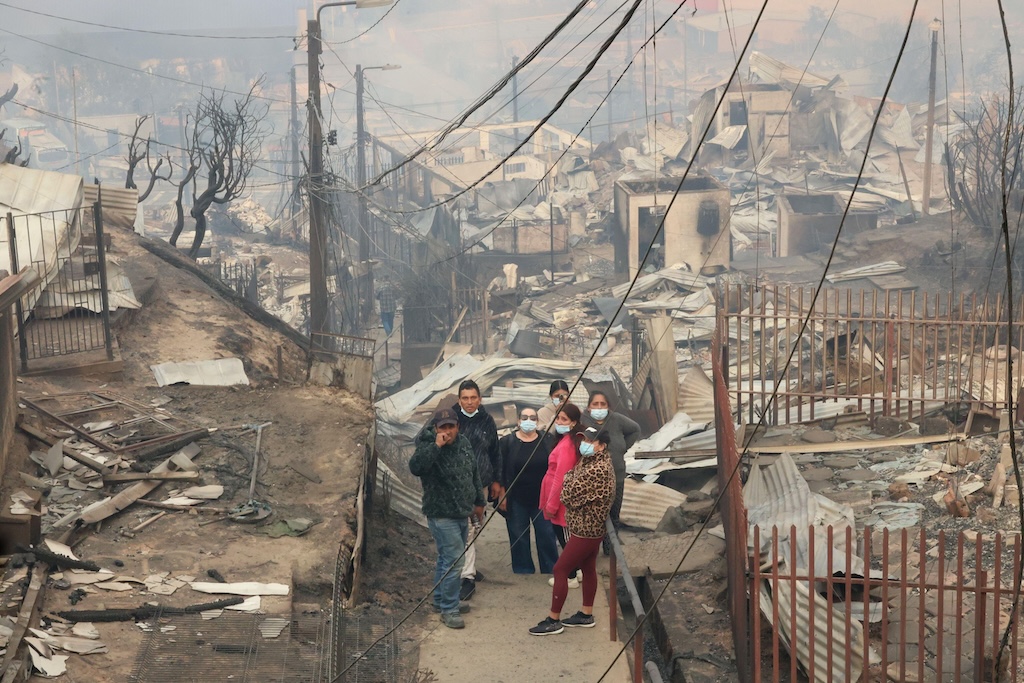 Inhabitants of Lirquen, in Chile, walk through the homes consumed by the flames in January 2026. Credit: UNAR Photo / Alamy Stock Photo.
These wildfires burnt more than 40,000 hectares of forests, "tripling the amount of land burned in 2025" across the country, reported La Tercera.
The study adds that more than 20,000 hectares of non-native forest plantations, including Monterey pine and Eucalyptus trees, were consumed by the blaze and critical infrastructure was affected.
A WWA press release points out that the expansion of non-native pines and invasive species "has created highly flammable landscapes in Chile".
Hot, dry and windyWildfires are complex events that are influenced by a wide range of factors, such as atmospheric moisture, wind speed and fuel availability.
To assess the impact of climate change on wildfires, the authors chose a "fire weather" metric called the "hot dry windy index" (HDWI). This combines maximum temperature, relative humidity and wind speed.
While this metric does not include every component that could contribute to intense wildfires, such as land-use change and fuel load data, study author Dr Claire Barnes from Imperial College London told a press briefing that HDWI is "a very good predictor of short-term, extreme, dry, fire-prone conditions".
The authors chose to analyse two separate regions. The first lies along the coast and the foothills of the Andes around the Ñuble, Biobío and La Araucanía regions in central Chile. The second sits across the Chilean and Argentine border in Patagonia.
These regions are shown on the map below, where red circles indicate the wildfires recorded in January 2026 and pink boxes represent the study areas.
 Location of forest fires in Chile and Argentina in January 2026 (red circles) and the study areas (pink boxes). Source: WWA (2026).
The authors also selected different time periods for the two study regions, to reflect the "different lengths of peak wildfire activity associated with the fires in each region".
For the central Chilean study area, the authors focus their analysis on the two most severe days of HDWI, 17-18 January. For the Patagonian region, they focus on the most severe five-day period, which took place over 2-6 January.
To put the wildfire into its historical context, the authors analyse data on temperature, wind and rainfall to assess how HDWI over the two regions has changed since the year 1980.
They find that in both study regions, the high HWDI recorded in January is not "particularly extreme" in today's climate and would typically be expected roughly once every five years. However, they add that the event would have been "rarer" in a world without climate change, in which average global temperatures are 1.3C cooler.
The authors also use a combination of observations and climate models to carry out an "attribution" analysis, comparing the world as it is today to a "counterfactual" world without human-caused climate change.
They find that climate change made the high HDWI three-times more likely in the central Chilean region and 2.5-times more likely in the Patagonian region.
The authors also conduct analysis focused solely on November-January rainfall.
Both study regions experienced "very low rainfall" in the months leading up to the fires, the authors say. They find that fire-season rainfall intensity is around 25% lower in the central Chilean region and 20% lower in the Patagonia region in today's climate than it would have been in a world without climate change.
Finally, the authors considered the influence of climatic cycles such as the El Niño-Southern Oscillation (ENSO), a naturally occurring phenomenon that affects global temperatures and regional weather patterns.
They find that a combination of La Niña - the "cool" phase of ENSO - combined with another natural cycle called the Southern Annular Mode, led to atmospheric circulation patterns that "favoured the hot and dry conditions that enhanced fire persistence and severity in parts of the region".
However, they add that this has a comparably small effect on the overall intensity of the wildfires, with climate change standing out as the main driver.
(These findings are yet to be published in a peer-reviewed journal. However, the methods used in the analysis have been published in previous attribution studies.)
Vulnerable communitiesThe wildfires affected native forests, national parks and small rural and tourist communities in both countries.
A 2025 study conducted in Chile, cited in the WWA analysis, found that 74% of survey respondents did not have appropriate education and awareness on wildfires.
This suggests that insufficient preparedness on early warning signs, response measures and prevention can "exacerbate the severity and frequency of these events", the WWA authors say.
Aynur Kadihasanoglu, senior urban specialist at the Red Cross Red Crescent Climate Center, said in the WWA press release that many settlements in Chile are close to flammable pine plantations, which "puts lives and livelihoods at risk".
Additionally, the head of Chile's National Forest Corporation pointed to "structural shortcomings" in fire prevention, such as lack of regulation in lands without management plans, reported BioBioChile.
In Argentina, the response to the fires has been hampered by large budget cuts and reductions in forest rangers, according to the WWA press release. Experts have criticised Argentina's self-styled "liberal-libertarian" president Javier Milei for the cuts and the delay to declaring a state of emergency in Patagonia.
According to the Associated Press, "Milei slashed spending on the National Fire Management Service by 80% in 2024 compared to the previous year". The service "faces another 71% reduction in funds" in its 2026 budget, the newswire adds.
Argentinian native forests and grasslands are experiencing "intense pressure" from wildfires, according to the study. Many vulnerable native animal species, such as the huemul and the pudú, are losing critical habitat, while birds, such as the Patagonian black woodpecker, are losing nesting sites.
 Huemul deer in Argentine Patagonia, one of the vulnerable animal species to wildfires in the region. Credit: Bernardo Galmarini / Alamy Stock Photo.
Climate change and La Niña made 'devastating' southern African floods more intense
Attribution
|29.01.26

Analysis: What are the causes of recent record-high global temperatures?
El Niño
|10.12.25

Met Office: Ten years of naming UK storms to warn the public
Guest posts
|13.11.25

Global wildfires burned an area of land larger than India in 2024
Land and soils
|16.10.25
jQuery(document).ready(function() { jQuery('.block-related-articles-slider-block_61678c92e1affd8869aa7a79297160f3 .mh').matchHeight({ byRow: false }); });The post Climate change made 'fire weather' in Chile and Argentina three times more likely appeared first on Carbon Brief.
The G7 major economies "f[e]ll notably behind China and the rest of the world" in 2025 as the amount of wind and solar power being developed reached a new high, according to Global Energy Monitor (GEM).
A new report from the analysts says that the amount of wind and large-scale solar capacity being built or planned around the world reached a record 4,900 gigawatts (GW) in 2025.
This "pipeline" of projects has grown by 500GW (11%) since 2024, GEM says, with the increase "predominantly" coming from developing countries.
China alone has a pipeline of more than 1,500GW, equivalent to that of the next six countries combined: Brazil (401GW); Australia (368GW); India (234GW); the US (226GW); Spain (165GW); and the Philippines (146GW).
In contrast, GEM says that G7 countries - the US, UK, France, Germany, Italy, Canada, Japan - represent just 520GW (11%) of the wind and solar pipeline, despite accounting for around half of global wealth.
Diren Kocakuşak, research analyst for GEM, said in a statement that G7 countries risk "ced[ing] leadership" in what is a "booming growth sector". He added:
"The centre of gravity for new clean power has shifted decisively toward emerging and developing economies. [In 2025] G7 countries, despite their wealth, fell notably behind China and the rest of the world in year-over-year prospective capacity growth."
Moreover, while others have surged ahead, wind and solar plans in the G7 have remained largely unchanged since 2023, as shown in the chart below.
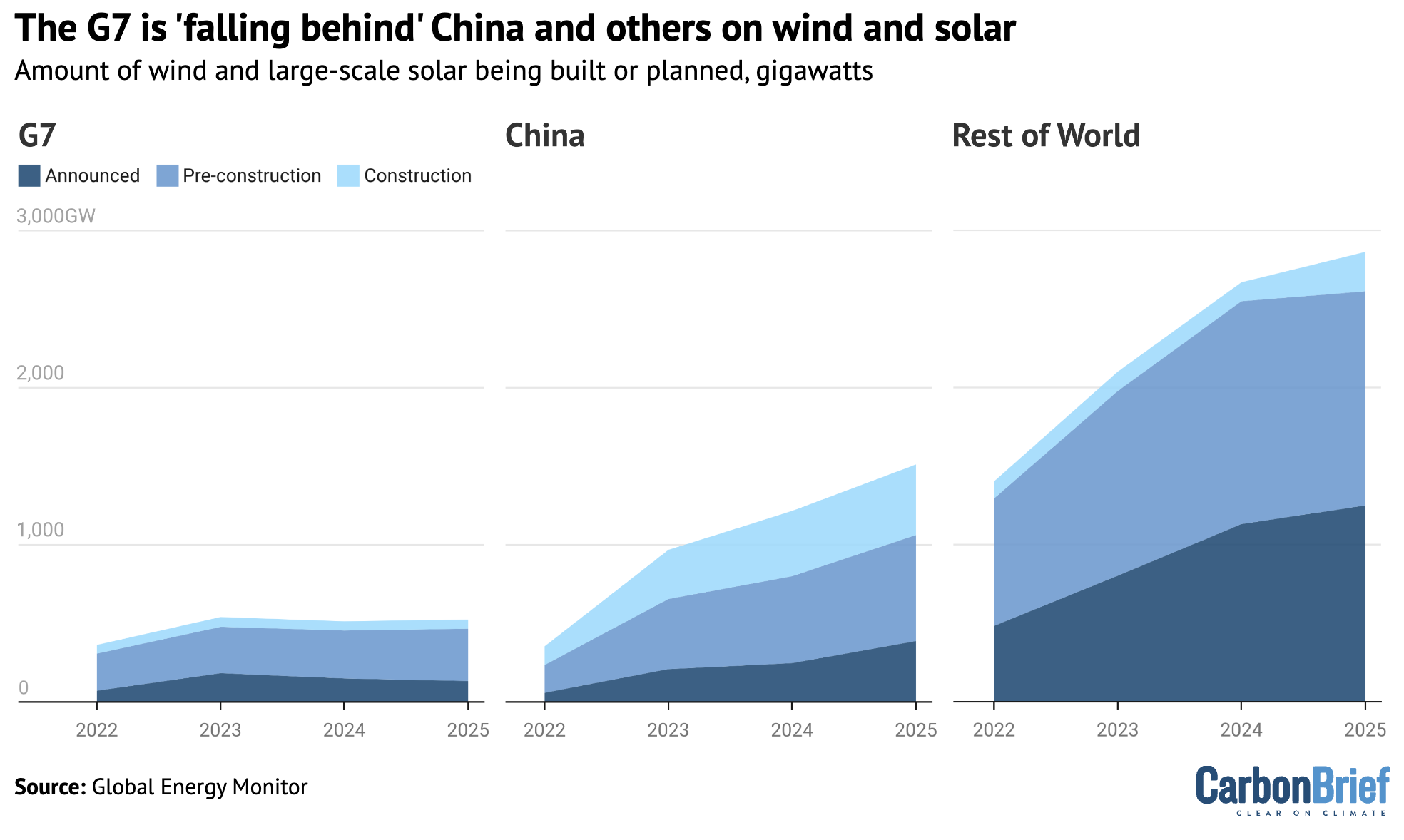 Amount of wind and large-scale solar capacity being built or planned in the G7 major economies, China and the rest of the world, gigawatts, 2022-2025. Source: Global Energy Monitor.
Of the 4,900GW of projects being built or planned and tracked by GEM, 2,700GW is wind and 2,200GW is large-scale solar.
However, the rate of expansion of the global pipeline for new wind and solar has slowed from 22% in 2024 to 11% last year, GEM says, with a more pronounced drop for wind projects. It adds that this was due to political barriers and a string of failed auctions.
For example, offshore wind subsidy auctions in Germany and the Netherlands in 2025 did not attract any bids, while an auction in Denmark was officially cancelled last year after there were no bidders at the end of 2024.
The report notes that the "growth trend of the prospective wind and [large]-scale solar pipeline is critical for meeting the COP28 commitment to triple renewable energy capacity by 2030, as the world enters the final five years of the implementation period".
At COP28 in 2023, countries committed to tripling renewable energy capacity globally by 2030 from an unspecified baseline, generally assumed to be 2022.
According to the International Renewable Energy Agency (IRENA), the world would need to complete an average 317GW of wind and 735GW of solar capacity every year to reach this target.
Some 758GW of wind and large-scale solar was under construction in 2025, GEM says, with around three-quarters of this in China and India.
Both countries saw a reduction in the amount of electricity generated from coal last year, according to a separate recent analysis for Carbon Brief.
Note that GEM's report predominantly uses data from its Global Solar Power Tracker and the Global Wind Power Tracker, the first of which only includes solar projects with a capacity of 1 megawatt (MW) and the latter with a capacity of 10MW or more.
Five key climate and energy announcements in India's budget for 2026
Explainers
|04.02.26
Experts: Will Chinese wind power help or hinder Europe's climate goals?
China Policy
|30.01.26

Q&A: What Trump's US exit from UNFCCC and IPCC could mean for climate action
International policy
|09.01.26
IEA: Declining coal demand in China set to outweigh Trump's pro-coal policies
Coal
|17.12.25
jQuery(document).ready(function() { jQuery('.block-related-articles-slider-block_dc4fd693ae4cb45f2640242bea1c608a .mh').matchHeight({ byRow: false }); });The post G7 'falling behind' China as world's wind and solar plans reach new high in 2025 appeared first on Carbon Brief.
The "undervaluing" of nature by businesses is fuelling its decline and putting the global economy at risk, according to a major new report.
An assessment from the Intergovernmental Science-Policy Platform on Biodiversity and Ecosystem Services (IPBES) outlines more than 100 actions for measuring and reducing impacts on nature across business, government, financial institutions and civil society.
A co-chair of the assessment says that nature loss is one of the most "serious threats" to businesses, but the "twisted reality is that it often seems more profitable to businesses to degrade biodiversity than to protect it".
The "business and biodiversity" report says that global "finance flows" of more than $7tn (£5.1tn) had "direct negative impacts on nature" in 2023.
The new findings were put together by 79 experts from around the world over the course of three years, in what IPBES described as a "fast-track" assessment.
IPBES is an independent body that gives scientific advice to policymakers about biodiversity and ecosystems.
This is the "first report of its kind" to provide guidance on how businesses can contribute to 2030 nature goals, says IPBES executive secretary Dr Luthando Dziba in a statement.
Below, Carbon Brief explains four key findings from the "summary for policymakers" (SPM), which outlines the main messages of the report.
The full report is due to be released in the coming months after final edits are made.
.innerArt>ol { font-family: 'PT Serif'; font-size: 18px !important; }- Businesses both depend on, and harm, nature
- Current practices 'do not support' efforts to halt and reverse biodiversity loss
- Businesses can act now to address their impacts on nature
- Government policies can drive a 'just and sustainable future' for nature and people
Businesses of all sizes rely on nature in one way or another, says the report.
The SPM outlines that biodiversity provides many of the goods and services businesses need, such as raw materials from the environment or controlled water flows to reduce flooding during wet seasons and provide water in dry seasons.
Biodiversity also "underpins genetic diversity" that informs the development of products in many industries, including pharmaceuticals and cosmetics.
Individual businesses often do not address their impacts and dependencies on nature, "in part due to their lack of awareness", the SPM says.
They also often do not have the data or knowledge to "quantify their impacts on dependencies on biodiversity and much of the relevant scientific literature is not written for a business audience", the report claims. It adds:
"Lack of transparency across value chains, including of the risks and opportunities related to the sustainability of resource extraction, use, reuse and waste management, is a further barrier to action."
The report says it is well established that businesses depend on biodiversity, but also that the actions of businesses "continue to drive declines in biodiversity and nature's contributions to people".
(IPBES says it uses terms such as well established to express "how assured experts are about the findings". Well established findings, the highest level of confidence, have significant evidence and high agreement behind them. The three other terms used in IPBES reports are: unresolved (a lot of evidence but low agreement), established but incomplete (limited evidence but good agreement) and inconclusive (limited or no evidence and little agreement).)
The report notes that the size of a business "does not always reflect the magnitude of its impacts", with companies in sectors such as agriculture, forestry, fishing, electricity, energy and mining having "relatively high" direct impacts on nature.
A "failure" to account for nature as the economy has expanded over the past two centuries has "led to its degradation and unprecedented rates of biodiversity loss", the SPM says. It adds:
"The decline in biodiversity and nature's contributions to people has become a critical systemic risk threatening the economy, financial stability and human wellbeing with implications for human rights."
It is well established that nature loss as a result of "unsustainable use" threatens the "ability of businesses, local economies and whole sectors to function", the report details.
These risks and others - such as extreme weather events and critical changes to Earth systems - are "among the highest-ranked global risks over the next 10 years", it adds.
The SPM notes further that it is well established that risks around climate change and biodiversity loss "may interact to amplify social and economic impacts".
These risks have "disproportionate impacts on developing countries whose economies are more reliant on biodiversity and have more limited technical and financial capacity to absorb shocks", the report adds.
2. Current practices 'do not support' efforts to halt and reverse biodiversity lossThe SPM says that it is well established that current political and economic practices "perpetuate business as usual and do not support the transformative change required to halt and reverse biodiversity loss".
These practices have "commonly ignored or undervalued biodiversity, creating tension between business actions and the conservation and sustainable use of biodiversity", the report continues.
For example, the report says there is established but incomplete evidence that "time pressures on decision-making and timescales for investment returns and reporting by businesses - with an emphasis on quarterly earnings or annual reporting - are shorter than many ecological cycles".
This prevents businesses from "adequately" considering nature loss in decision-making, says the SPM.
There is well established evidence that businesses fail to assign adequate value to "biodiversity and many of nature's contributions to people, such as filtration of pollutants, climate regulation and pollination", it continues.
As a result, "businesses bear little or no financial cost for negative impacts and may not generate revenue from positive impacts on biodiversity", leading to "insufficient incentives for businesses to act to conserve, restore or sustainably use biodiversity".
Prof Stephen Polasky, co-chair of the assessment and a professor of ecological and environmental economics at the University of Minnesota, said in a statement:
"The loss of biodiversity is among the most serious threats to business. Yet the twisted reality is that it often seems more profitable to businesses to degrade biodiversity than to protect it. Business as usual may once have seemed profitable in the short term, but impacts across multiple businesses can have cumulative effects, aggregating to global impacts, which can cross ecological tipping points."
It is well established that policies from governments can "further accelerate biodiversity decline", the SPM says.
It notes that, in 2023, global public and private financial spending with direct negative impacts on nature was estimated at $7.3tn.
This figure includes public subsidies that are harmful to nature (around $2.4tn) and private investment in high-impact sectors ($4.9tn), says the report.
Industries harmful to nature include fossil-fuel extraction, mining, deforestation and large-scale meat farming and fishing.
In contrast, just $220bn in public and private finance was directed to activities that contribute to protecting and sustainably using nature in 2023, adds the report.
(In recognition of the need to address public spending on activities that are destructive to nature, countries agreed to reduce biodiversity-harming subsidies by at least $500bn by 2030 as part of a global pact made in 2022.)
There are additional "barriers to action" facing businesses, ranging from challenging social norms to a lack of capacity, data or technology. These are summarised in the table below.
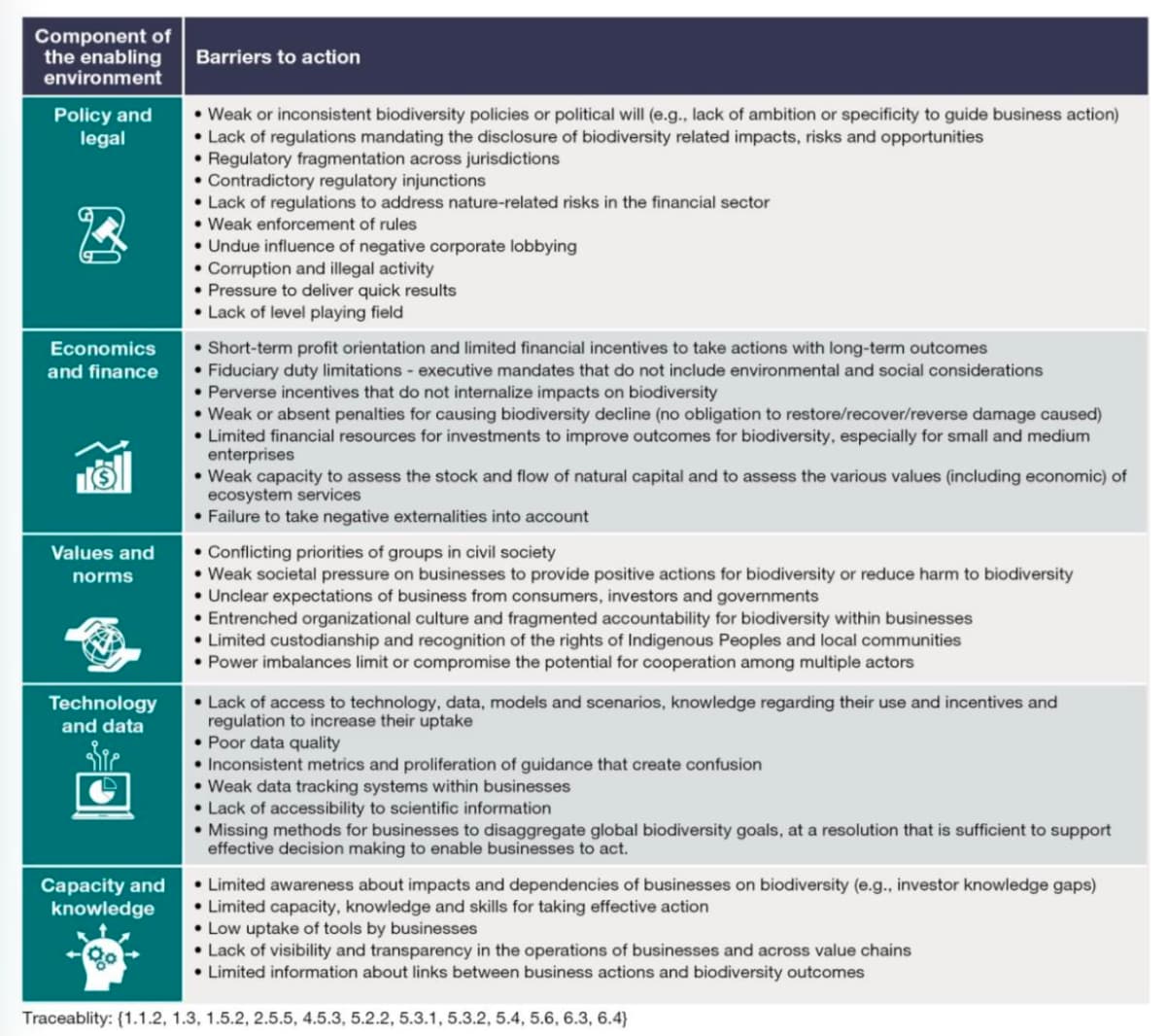 Barriers preventing businesses from taking action on biodiversity loss. Credit: SPM.4, IPBES (2026)
"These barriers do not affect all actors equally and may disproportionately affect small and medium-sized businesses and financial institutions in developing countries," adds the report.
3. Businesses can act now to address their impacts on natureThe SPM says it is well established that the "transformative change" required to halt and reverse biodiversity loss requires action from "all businesses".
However, the report continues that it is also well established that the current level of business action is "insufficient" to deliver this "transformative change". This is, in part, because the "enabling environment is missing", it says.
IPBES says all businesses have a responsibility to act, even if this responsibility is not shared "evenly".
"Priority actions" that businesses should take differ depending on the size of the firm, the sector in which it operates in, as well as the company structure and its "relationship with biodiversity", the report notes.
The exact actions businesses should pursue also depends on companies' "degree of control and influence over stakeholders", it says.
According to the report, firms can act across four "decision-making levels" - corporate, operations, value chain and portfolio - to measure and address impacts on biodiversity.
("Corporate" refers to decisions focused on overarching strategy, governance and direction of the business; "operations" to day-to-day activities; "value chain" to the system and resources required to move a product or service from supplier to customer; and "portfolio" to investments and business assets).
The SPM sets out a series of examples for how businesses can act across all four levels. These are summarised in the table below.
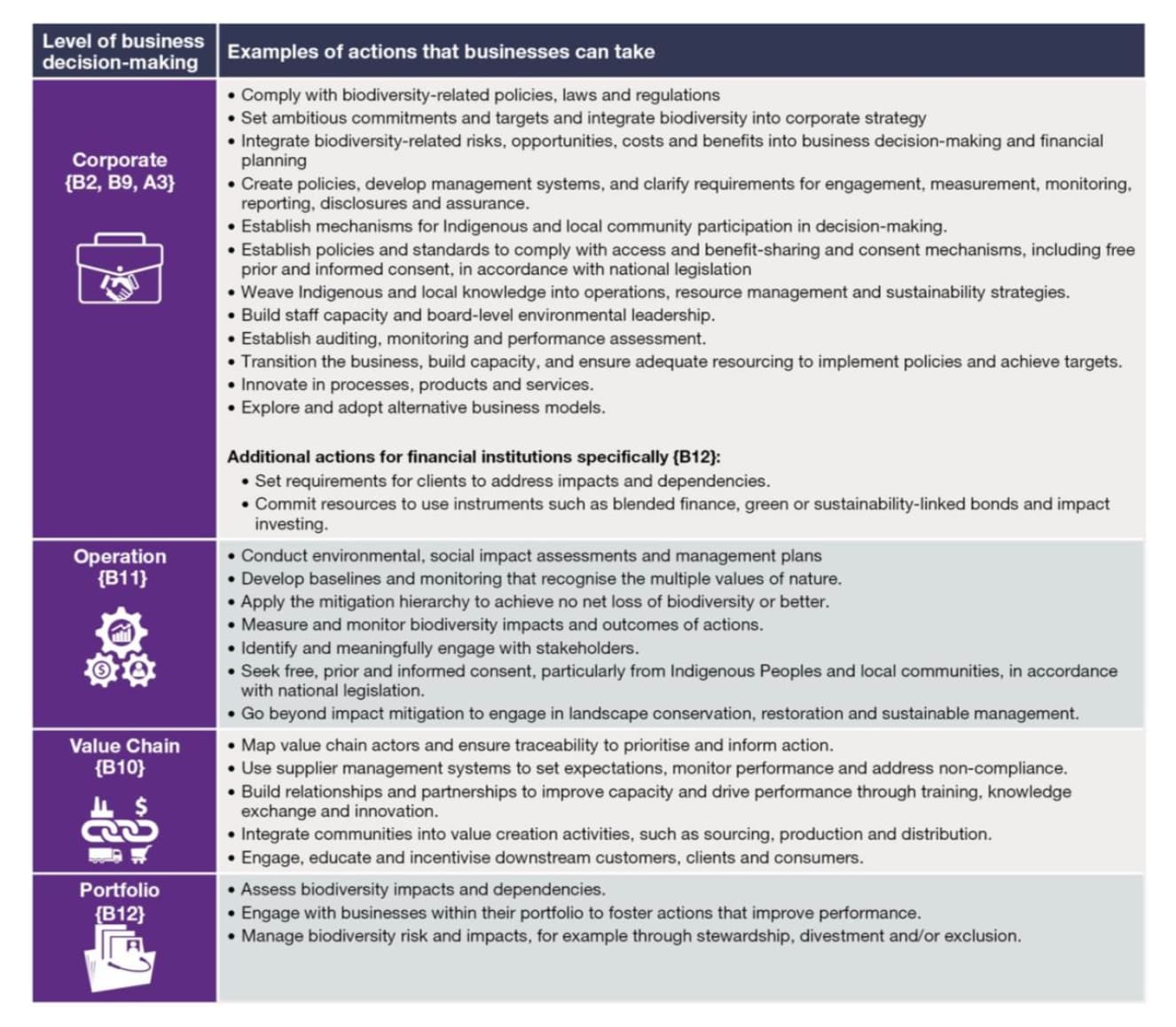 Actions that businesses can take now to address their impacts and dependencies. Credit: SPM.2, IPBES (2026).
At a corporate level, the report notes that firms can establish ambitious governance and frameworks that can then have a ripple effect across the other levels, according to the report. This includes the integration of biodiversity commitments and targets into corporate strategy.
The SPM says that corporate biodiversity targets are "most effective" when they are aligned with "national and global biodiversity objectives" and "take into consideration a business's impacts and dependencies on biodiversity and nature's contributions to people".
At an operations level, businesses should focus on ensuring that their operations are located and managed in a way that benefits biodiversity, IPBES says. Environmental and social impact assessments and management plans that are supported by "credible monitoring of both actions and biodiversity outcomes" can underpin this effort, the SPM notes.
It says it is well established that using the "mitigation hierarchy" framework can help businesses deliver "lasting outcomes on the ground". (The framework guides users towards limiting as far as possible the negative impacts on biodiversity from development projects by first avoiding, then minimising, restoring and offsetting impacts.)
Next, the report notes there are actions businesses can take to drive change within its broader spheres of influence, including suppliers, retailers, consumers and peers within industry. This is important, the SPM notes, as significant impacts and dependencies on biodiversity and nature "accrue" across the lifecycle of products or services, especially those that rely on raw materials.
The report notes there is established but incomplete evidence that efforts to "map" company value chains and improve traceability by linking products and materials to suppliers, locations and impacts can help "identify risks and prioritise actions".
While noting that "mapping" beyond direct suppliers "often remains challenging" for businesses, the report adds:
"Examples at the corporate and value chain levels exist, such as companies in the chocolate industry that have made advances in recording biodiversity dependencies to improve business decisions through full traceability of materials and improved supplier control mechanisms."
Elsewhere, the SPM notes that there is also established but incomplete evidence that consumer-focused measures - such as product labelling, education and incentives - can "shape behaviour and improve transparency". However, it cautions that the effectiveness of these strategies is "constrained by consumer scepticism, certification costs and business models reliant on unsustainable consumption".
The SPM also highlights that, at a "portfolio" level, financial institutions can shift finance away from harmful activities - for instance, companies whose products drive deforestation - and towards business activities with positive impacts for biodiversity and nature.
Speaking to Carbon Brief, Matt Jones, co-chair of the report, explains the rationale behind including options for how businesses can address biodiversity impacts in the document:
"Businesses and governments in different countries are coming at this from a very different perspective. So we can't present a set of really prescriptive 'how tos'…but we can present a huge number of options for action that businesses, governments, financial institutions and civil society and other actors can all take."
Elsewhere, the report says it is well established that "robust, transparent and credible reporting of actions and outcomes" is required to "inspire others".
4. Government policies can drive a 'just and sustainable future' for nature and peopleBoth governments and financial institutions can set policies and create incentives to protect biodiversity and stem its decline, says the SPM.
According to the report, the types of policies that governments can put in place that have an influence over business include:
- Fiscal policies, such as subsidies and taxes.
- Land use or marine spatial planning and zoning, such as designating new national parks or areas protected for nature.
- Permitting for business activities that affect nature - for example, by requiring environmental impact assessments.
- Public procurement policy (rules for how governments purchase goods and services).
- Controls on advertising and the creation of standards to prevent "greenwashing".
Governments can also promote action through paying for ecosystem services, creating environmental markets and through "multilateral benefit-sharing mechanisms", which set out rules for ensuring profits from nature are shared equally, says the SPM.
It says this includes the Cali Fund, a fund that businesses can voluntarily pay into after reaping benefits from genetic resources found in biodiverse countries.
(The fund was agreed in 2024 with expectations that it could generate up to billions of dollars for conservation, but it has so far only attracted $1,000.)
Governments could also promote action by phasing out or reforming subsidies that are harmful for nature, as well as fostering positive incentives, according to the report.
Overall, governments can work with other actors to create an "enabling environment" to "incentivise actions that are beneficial for businesses, biodiversity and society for a just and sustainable future", says the SPM. It adds:
"Creation of an enabling environment that provides incentives for the conservation and sustainable use of biodiversity and nature's contributions to people could align what is profitable with what is good for biodiversity and society.
"Creating this enabling environment would result in businesses and financial institutions being positive agents of change in transforming to a just and sustainable economic system, by addressing their impacts on biodiversity loss, climate change and pollution, which are all interconnected."
Cropped 28 January 2026: Ocean biodiversity boost; Nature and national security; Mangrove defence
Cropped
|28.01.26

Adopting low-cost 'healthy' diets could cut food emissions by one-third
Food and farming
|21.01.26

Brazil's biodiversity pledge: Six key takeaways for nature and climate change
Nature policy
|16.01.26
Cropped 14 January 2026: Wildfires scorch three continents; EU trade; Food and nature in 2026
Cropped
|14.01.26
jQuery(document).ready(function() { jQuery('.block-related-articles-slider-block_b4f006103142983c7da2fc5d1291de87 .mh').matchHeight({ byRow: false }); });The post IPBES: Four key takeaways on how nature loss threatens the global economy appeared first on Carbon Brief.
Welcome to Carbon Brief's DeBriefed.
An essential guide to the week's key developments relating to climate change.
UNLAWFUL PANEL: A federal judge ruled that the US energy department "violated the law when secretary Chris Wright handpicked five researchers who rejected the scientific consensus on climate change to work in secret on a sweeping government report on global warming", reported the New York Times. The newspaper explained that a 1972 law "does not allow agencies to recruit or rely on secret groups for the purposes of policymaking". A Carbon Brief factcheck found more than 100 false or misleading claims in the report.
DARKNESS DESCENDS: The Washington Post reportedly sent layoff notices to "at least 14" of its climate journalists, as part of a wider move from the newspaper's billionaire owner, Jeff Bezos, to eliminate 300 jobs at the publication, claimed Climate Colored Goggles. After the layoffs, the newspaper will have five journalists left on its award-winning climate desk, according to the substack run by a former climate reporter at the Los Angeles Times. It comes after CBS News laid off most of its climate team in October, it added.
WIND UNBLOCKED: Elsewhere, a separate federal ruling said that a wind project off the coast of New York state can continue, which now means that "all five offshore wind projects halted by the Trump administration in December can resume construction", said Reuters. Bloomberg added that "Ørsted said it has spent $7bn on the development, which is 45% complete".
Around the world- CHANGING TIDES: The EU is "mulling a new strategy" in climate diplomacy after struggling to gather support for "faster, more ambitious action to cut planet-heating emissions" at last year's UN climate summit COP30, reported Reuters.
- FINANCE 'CUT': The UK government is planning to cut climate finance by more than a fifth, from £11.6bn over the past five years to £9bn in the next five, according to the Guardian.
- BIG PLANS: India's 2026 budget included a new $2.2bn funding push for carbon capture technologies, reported Carbon Brief. The budget also outlined support for renewables and the mining and processing of critical minerals.
- MOROCCO FLOODS: More than 140,000 people have been evacuated in Morocco as "heavy rainfall and water releases from overfilled dams led to flooding", reported the Associated Press.
- CASHFLOW: "Flawed" economic models used by governments and financial bodies "ignor[e] shocks from extreme weather and climate tipping points", posing the risk of a "global financial crash", according to a Carbon Tracker report covered by the Guardian.
- HEATING UP: The International Olympic Committee is discussing options to hold future winter games earlier in the year "because of the effects of warmer temperatures", said the Associated Press.
54%
The increase in new solar capacity installed in Africa over 2024-25 - the continent's fastest growth on record, according to a Global Solar Council report covered by Bloomberg.
Latest climate research
- Arctic warming significantly postpones the retreat of the Afro-Asian summer monsoon, worsening autumn rainfall | Environmental Research Letters
- "Positive" images of heatwaves reduce the impact of messages about extreme heat, according to a survey of 4,000 US adults | Environmental Communication
- Greenland's "peripheral" glaciers are projected to lose nearly one-fifth of their total area and almost one-third of their total volume by 2100 under a low-emissions scenario | The Cryosphere
(For more, see Carbon Brief's in-depth daily summaries of the top climate news stories on Monday, Tuesday, Wednesday, Thursday and Friday.)
Captured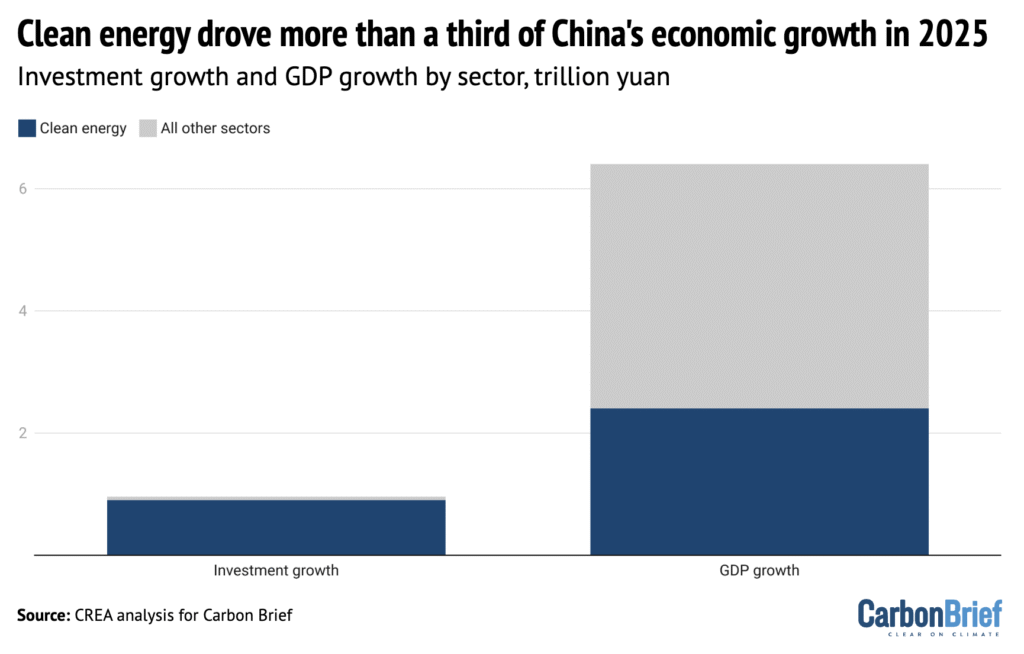
Solar power, electric vehicles and other clean-energy technologies drove more than a third of the growth in China's economy in 2025 - and more than 90% of the rise in investment, according to new analysis for Carbon Brief (shown in blue above). Clean-energy sectors contributed a record 15.4tn yuan ($2.1tn) in 2025, some 11.4% of China's gross domestic product (GDP) - comparable to the economies of Brazil or Canada, the analysis said.
Spotlight Can humans reverse nature decline?This week, Carbon Brief travelled to a UN event in Manchester, UK to speak to biodiversity scientists about the chances of reversing nature loss.
Officials from more than 150 countries arrived in Manchester this week to approve a new UN report on how nature underpins economic prosperity.
The meeting comes just four years before nations are due to meet a global target to halt and reverse biodiversity loss, agreed in 2022 under the landmark "Kunming-Montreal Global Biodiversity Framework" (GBF).
At the sidelines of the meeting, Carbon Brief spoke to a range of scientists about humanity's chances of meeting the 2030 goal. Their answers have been edited for length and clarity.
Dr David Obura, ecologist and chair of Intergovernmental Science-Policy Platform on Biodiversity and Ecosystem Services (IPBES)We can't halt and reverse the decline of every ecosystem. But we can try to "bend the curve" or halt and reverse the drivers of decline. That's the economic drivers, the indirect drivers and the values shifts we need to have. What the GBF aspires to do, in terms of halting and reversing biodiversity loss, we can put in place the enabling drivers for that by 2030, but we won't be able to do it fast enough at this point to halt [the loss] of all ecosystems.
Dr Luthando Dziba, executive secretary of IPBESCountries are due to report on progress by the end of February this year on their national strategies to the Convention on Biological Diversity [CBD]. Once we get that, coupled with a process that is ongoing within the CBD, which is called the global stocktake, I think that's going to give insights on progress as to whether this is possible to achieve by 2030…Are we on the right trajectory? I think we are and hopefully we will continue to move towards the final destination of having halted biodiversity loss, but also of living in harmony with nature.
Prof Laura Pereira, scientist at the Global Change Institute at Wits University, South AfricaAt the global level, I think it's very unlikely that we're going to achieve the overall goal of halting biodiversity loss by 2030. That being said, I think we will make substantial inroads towards achieving our longer term targets. There is a lot of hope, but we've also got to be very aware that we have not necessarily seen the transformative changes that are going to be needed to really reverse the impacts on biodiversity.
Dr David Cooper, chair of the UK's Joint Nature Conservation Committee and former executive secretary of the Convention on Biological DiversityIt's important to look at the GBF as a whole…I think it is possible to achieve those targets, or at least most of them, and to make substantial progress towards them. It is possible, still, to take action to put nature on a path to recovery. We'll have to increasingly look at the drivers.
Prof Andrew Gonzalez, McGill University professor and co-chair of an IPBES biodiversity monitoring assessmentI think for many of the 23 targets across the GBF, it's going to be challenging to hit those by 2030. I think we're looking at a process that's starting now in earnest as countries [implement steps and measure progress]…You have to align efforts for conserving nature, the economics of protecting nature [and] the social dimensions of that, and who benefits, whose rights are preserved and protected.
Neville Ash, director of the UN Environment Programme World Conservation Monitoring CentreThe ambitions in the 2030 targets are very high, so it's going to be a stretch for many governments to make the actions necessary to achieve those targets, but even if we make all the actions in the next four years, it doesn't mean we halt and reverse biodiversity loss by 2030. It means we put the action in place to enable that to happen in the future…The important thing at this stage is the urgent action to address the loss of biodiversity, with the result of that finding its way through by the ambition of 2050 of living in harmony with nature.
Prof Pam McElwee, Rutgers University professor and co-chair of an IPBES "nexus assessment" reportIf you look at all of the available evidence, it's pretty clear that we're going to keep experiencing biodiversity decline. I mean, it's fairly similar to the 1.5C climate target. We are not going to meet that either. But that doesn't mean that you slow down the ambition…even though you recognise that we probably won't meet that specific timebound target, that's all the more reason to continue to do what we're doing and, in fact, accelerate action.
Watch, read, listenOIL IMPACTS: Gas flaring has risen in the Niger Delta since oil and gas major Shell sold its assets in the Nigerian "oil hub", a Climate Home News investigation found.
LOW SNOW: The Washington Post explored how "climate change is making the Winter Olympics harder to host".
CULTURE WARS: A Media Confidential podcast examined when climate coverage in the UK became "part of the culture wars".
Coming up- 2-8 February: 12th session of the Intergovernmental Science-Policy Platform on Biodiversity and Ecosystem Services (IPBES), Manchester, UK
- 8 February: Japanese general election
- 8 February: Portugal presidential election
- 11 February: Barbados general election
- 11-12 February: UN climate chief Simon Stiell due to speak in Istanbul, Turkey
- UK Met Office, senior climate science communicator | Salary: £43,081-£46,728. Location: Exeter, UK
- Canadian Red Cross, programme officer, Indigenous operations - disaster risk reduction and climate change adaptation | Salary: $56,520-$60,053. Location: Manitoba, Canada
- Aldersgate Group, policy officer | Salary: £33,949-£39,253. Location: London (hybrid)
DeBriefed is edited by Daisy Dunne. Please send any tips or feedback to debriefed@carbonbrief.org.
This is an online version of Carbon Brief's weekly DeBriefed email newsletter. Subscribe for free here.
DeBriefed 30 January 2026: Fire and ice; US formally exits Paris; Climate image faux pas
DeBriefed
|30.01.26
DeBriefed 23 January 2026: Trump's Davos tirade; EU wind and solar milestone; High seas hope
DeBriefed
|23.01.26
DeBriefed
|16.01.26
DeBriefed
|09.01.26
jQuery(document).ready(function() { jQuery('.block-related-articles-slider-block_2648cf722abb7cb8317d5344bfa96ea3 .mh').matchHeight({ byRow: false }); });The post DeBriefed 6 February 2026: US secret climate panel 'unlawful' | China's clean energy boon | Can humans reverse nature loss? appeared first on Carbon Brief.
Welcome to Carbon Brief's China Briefing.
China Briefing handpicks and explains the most important climate and energy stories from China over the past fortnight. Subscribe for free here.
Key developments Solar and wind eclipsed coal'FIRST TIME IN HISTORY': China's total power capacity reached 3,890 gigawatts (GW) in 2025, according to a National Energy Administration (NEA) data release covered by industry news outlet International Energy Net. Of this, it said, solar capacity rose 35% to 1,200GW and wind capacity was up 23% to 640GW, while thermal capacity - which is mostly coal - grew 6% to just over 1,500GW. This marks the "first time in history" that wind and solar capacity has outranked coal capacity in China's power mix, reported the state-run newspaper China Daily. China's grid-related energy storage capacity exceeded 213GW in 2025, said state news agency Xinhua. Meanwhile, clean-energy industries "drove more than 90%" of investment growth and more than half of GDP growth last year, said the Guardian in its coverage of new analysis for Carbon Brief. (See more in the spotlight below.)
上微信关注《碳简报》
DAWN FOR SOLAR: Solar power capacity alone may outpace coal in 2026, according to projections by the China Electricity Council (CEC), reported business news outlet 21st Century Business Herald. It added that non-fossil sources could account for 63% of the power mix this year, with coal falling to 31%. Separately, the China Renewable Energy Society said that annual wind-power additions could grow by between 600-980GW over the next five years, with annual additions of 120GW expected until 2028, said industry news outlet China Energy Net. China Energy Net also published the full CEC report.
STATE MEDIA VOICE: Xinhua published several energy- and climate-related articles in a series on the 15th five-year plan. One said that becoming a low-carbon energy "powerhouse" will support decarbonisation efforts, strengthen industrial innovation and improve China's "global competitive edge and standing". Another stated that coal consumption is "expected" to peak around 2027, with continued "growth" in the power and chemicals sector, while oil has already peaked. A third noted that distributed energy systems better matched the "characteristics of renewable energy" than centralised ones, but warned against "blind" expansion and insufficient supporting infrastructure. Others in the series discussed biodiversity and environmental protection and recycling of clean-energy technology. Meanwhile, the communist party-affiliated People's Daily said that oil will continue to play a "vital role" in China, even after demand peaks.
Starmer and Xi endorsed clean-energy cooperationCLIMATE PARTNERSHIP: UK prime minister Keir Starmer and Chinese president Xi Jinping pledged in Beijing to deepen cooperation on "green energy", reported finance news outlet Caixin. They also agreed to establish a "China-UK high-level climate and nature partnership", said China Daily. Xi told Starmer that the two countries should "carry out joint research and industrial transformation" in new energy and low-carbon technologies, according to Xinhua. It also cited Xi as saying China "hopes" the UK will provide a "fair" business environment for Chinese companies.
Subscribe: China Briefing- .listing{background: #f4f4f4} .listing ul{list-style:none; margin:0} ol {background: #F4F4F4; padding: 0px;} .listing ul {background: #F4F4F4; padding: 0px;} .listing li{font-size:0px;}
Sign up to Carbon Brief's free "China Briefing" email newsletter. All you need to know about the latest developments relating to China and climate change. Sent to your inbox every Thursday.
OCTOPUS OVERSEAS: During the visit, UK power-trading company Octopus Energy and Chinese energy services firm PCG Power announced they would be starting a new joint venture in China, named Bitong Energy, reported industry news outlet PV Magazine. The move "marks a notable direct entry" of a foreign company into China's "tightly regulated electricity market", said Caixin.
PUSH AND PULL: UK policymakers also visited Chinese clean-energy technology manufacturer Envision in Shanghai, reported finance news outlet Yicai. It quoted UK business secretary Peter Kyle emphasising that partnering with companies "like Envision" on sustainability is a "really important part of our future", particularly in terms of job creation in the UK. Trade minister Chris Bryant told Radio Scotland Breakfast that the government will decide on Chinese wind turbine manufacturer Mingyang's plans for a Scotland factory "soon". Researchers at the thinktank Oxford Institute for Energy Studies wrote in a guest post for Carbon Brief that greater Chinese competition in Europe's wind market could "help spur competition in Europe", if localisation rules and "other guardrails" are applied.
More China news
- LIFE SUPPORT: China will update its coal capacity payment mechanism, which will raise thresholds for coal-fired power plants and expand to cover gas-fired power and pumped and new-energy storage, reported current affairs outlet China News.
- FRONTIER TECH: The world's "largest compressed-air power storage plant" has begun operating in China, said Bloomberg.
- PARTNERSHIP A 'MISTAKE': The EU launched a "foreign subsidies" probe into Chinese wind turbine company Goldwind, said the Hong Kong-based South China Morning Post. EU climate chief Wopke Hoekstra said the bloc must resist China's pull in clean technologies, according to Bloomberg.
- TRADE SPAT: The World Trade Organization "backed a complaint by China" that the US Inflation Reduction Act "discriminated against" Chinese cleantech exports, said Reuters.
- NEW RULES: China has set "new regulations" for the Waliguan Baseline Observatory, which provides "key scientific references for the United Nations Framework Convention on Climate Change", said the People's Daily.
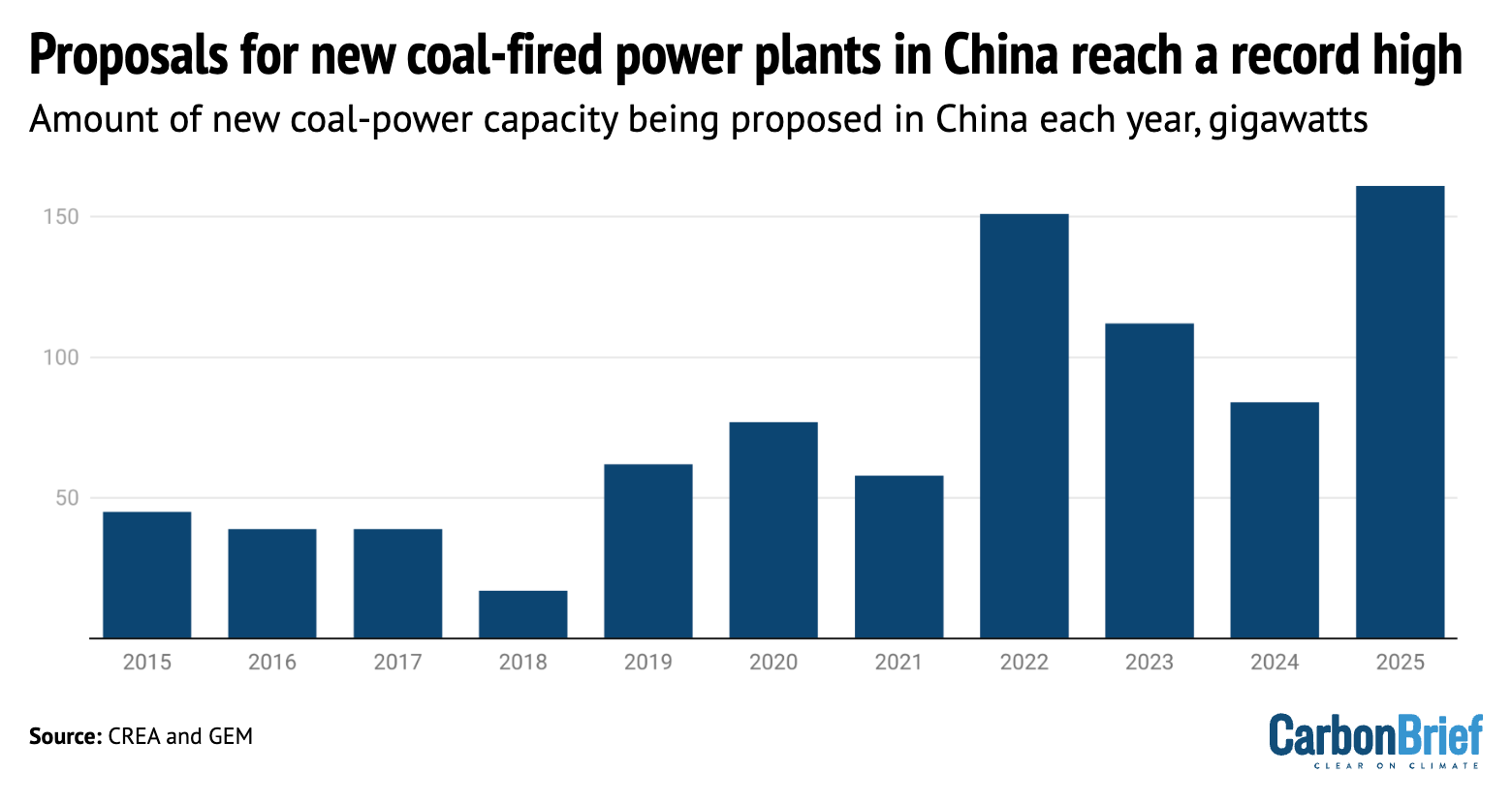
New or reactivated proposals for coal-fired power plants in China totalled 161GW in 2025, according to a new report covered by Carbon Brief.
Spotlight Clean energy drove China's economic growth in 2025New analysis for Carbon Brief finds that clean-energy sectors contributed the equivalent of $2.1tn to China's economy last year, making it a key driver of growth. However, headwinds in 2026 could restrict growth going forward - especially for the solar sector.
Below is an excerpt from the article, which can be read in full on Carbon Brief's website.
Solar power, electric vehicles (EVs) and other clean-energy technologies drove more than a third of the growth in China's economy in 2025 - and more than 90% of the rise in investment.
Clean-energy sectors contributed a record 15.4tn yuan ($2.1tn) in 2025, some 11.4% of China's gross domestic product (GDP)
Analysis shows that China's clean-energy sectors nearly doubled in real value between 2022-25 and - if they were a country - would now be the 8th-largest economy in the world.
These investments in clean-energy manufacturing represent a large bet on the energy transition in China and overseas, creating an incentive for the government and enterprises to keep the boom going.
However, there is uncertainty about what will happen this year and beyond, particularly due to a new pricing system, worsening industrial "overcapacity" and trade tensions.
Outperforming the wider economyChina's clean-energy economy continues to grow far more quickly than the wider economy, making an outsized contribution to annual growth.
Without these sectors, China's GDP would have expanded by 3.5% in 2025 instead of the reported 5.0%, missing the target of "around 5%" growth by a wide margin.
Clean energy made a crucial contribution during a challenging year, when promoting economic growth was the foremost aim for policymakers.
In 2024, EVs and solar had been the largest growth drivers. In 2025, it was EVs and batteries, which delivered 44% of the economic impact and more than half of the growth of the clean-energy industries.
The next largest subsector was clean-power generation, transmission and storage, which made up 40% of the contribution to GDP and 30% of the growth in 2025.
Within the electricity sector, the largest drivers were growth in investment in wind and solar power generation capacity, along with growth in power output from solar and wind, followed by the exports of solar-power equipment and materials.
But investment in solar-panel supply chains, a major growth driver in 2022-23, continued to fall for the second year, as the government made efforts to rein in overcapacity and "irrational" price competition.
Headwinds for solarOngoing investment of hundreds of billions of dollars represents a gigantic bet on a continuing global energy transition.
However, developments next year and beyond are unclear, particularly for solar. A new pricing system for renewable power is creating uncertainty, while central government targets have been set far below current rates of clean-electricity additions.
Investment in solar-power generation and solar manufacturing declined in the second half of the year.
The reduction in the prices of clean-energy technology has been so dramatic that when the prices for GDP statistics are updated, the sectors' contribution to real GDP - adjusted for inflation or, in this case deflation - will be revised down.
Nevertheless, the key economic role of the industry creates a strong motivation to keep the clean-energy boom going. A slowdown in the domestic market could also undermine efforts to stem overcapacity and inflame trade tensions by increasing pressure on exports to absorb supply.
Local governments and state-owned enterprises will also influence the outlook for the sector.
Provincial governments have a lot of leeway in implementing the new electricity markets and contracting systems for renewable power generation. The new five-year plans, to be published this year, will, therefore, be of major importance.
This spotlight was written for Carbon Brief by Lauri Myllyvirta, lead analyst at Centre for Research on Energy and Clean Air (CREA), and Belinda Schaepe, China policy analyst at CREA. CREA China analysts Qi Qin and Chengcheng Qiu contributed research.
Watch, read, listenPROVINCE INFLUENCE: The Institute for Global Decarbonization Progress, a Beijing-based thinktank, published a report examining the climate-related statements in provincial recommendations for the 15th five-year plan.
'PIVOT'?: The Outrage + Optimism podcast spoke with the University of Bath's Dr Yixian Sun about whether China sees itself as a climate leader and what its role in climate negotiations could be going forward.
COOKING FOR CLEAN-TECH: Caixin covered rising demand for China's "gutter oil" as companies "scramble" to decarbonise.
DON'T GO IT ALONE: China News broadcast the Chinese foreign ministry's response to the withdrawal of the US from the Paris Agreement, with spokeswoman Mao Ning saying "no country can remain unaffected" by climate change.
$6.8tn
The current size of China's green-finance economy, including loans, bonds and equity, according to Dr Ma Jun, the Institute of Finance and Sustainability's president,in a report launch event attended by Carbon Brief. Dr Ma added that "green loans" make up 16% of all loans in China, with some areas seeing them take a 34% share.
New science
- China's official emissions inventories have overestimated its hydrofluorocarbon emissions by an average of 117m tonnes of carbon dioxide equivalent (mtCO2e) every year since 2017 | Nature Geoscience
- "Intensified forest management efforts" in China from 2010 onwards have been linked to an acceleration in carbon absorption by plants and soils | Communications Earth and Environment
China Briefing is written by Anika Patel and edited by Simon Evans. Please send tips and feedback to china@carbonbrief.org
China Briefing 22 January 2026: 2026 priorities; EV agreement; How China uses gas
China Briefing
|22.01.26
China Briefing
|11.12.25
China Briefing 27 November 2025: COP30 wraps; Climate and critical minerals at G20; Coal use up
China Briefing
|27.11.25
China Briefing 13 November 2025: COP30 special
China Briefing
|13.11.25
jQuery(document).ready(function() { jQuery('.block-related-articles-slider-block_577da249233af249886f397aae143b48 .mh').matchHeight({ byRow: false }); });The post China Briefing 5 February 2026: Clean energy's share of economy | Record renewables | Thawing relations with UK appeared first on Carbon Brief.
Solar power, electric vehicles (EVs) and other clean-energy technologies drove more than a third of the growth in China's economy in 2025 - and more than 90% of the rise in investment.
Clean-energy sectors contributed a record 15.4tn yuan ($2.1tn) in 2025, some 11.4% of China's gross domestic product (GDP) - comparable to the economies of Brazil or Canada.
The new analysis for Carbon Brief, based on official figures, industry data and analyst reports, shows that China's clean-energy sectors nearly doubled in real value between 2022-25 and - if they were a country - would now be the 8th-largest economy in the world.
Other key findings from the analysis include:
- Without clean-energy sectors, China would have missed its target for GDP growth of "around 5%", expanding by 3.5% in 2025 instead of the reported 5.0%.
- Clean-energy industries are expanding much more quickly than China's economy overall, with their annual growth rate accelerating from 12% in 2024 to 18% in 2025.
- The "new three" of EVs, batteries and solar continue to dominate the economic contribution of clean energy in China, generating two-thirds of the value added and attracting more than half of all investment in the sectors.
- China's investments in clean energy reached 7.2tn yuan ($1.0tn) in 2025, roughly four times the still sizable $260bn put into fossil-fuel extraction and coal power.
- Exports of clean-energy technologies grew rapidly in 2025, but China's domestic market still far exceeds the export market in value for Chinese firms.
These investments in clean-energy manufacturing represent a large bet on the energy transition in China and overseas, creating an incentive for the government and enterprises to keep the boom going.
However, there is uncertainty about what will happen this year and beyond, particularly for solar power, where growth has slowed in response to a new pricing system and where central government targets have been set far below the recent rate of expansion.
An ongoing slowdown could turn the sectors into a drag on GDP, while worsening industrial "overcapacity" and exacerbating trade tensions.
Yet, even if central government targets in the next five-year plan are modest, those from local governments and state-owned enterprises could still drive significant growth in clean energy.
This article updates analysis previously reported for 2023 and 2024.
Clean-energy sectors outperform wider economyChina's clean-energy economy continues to grow far more quickly than the wider economy. This means that it is making an outsize contribution to annual economic growth.
The figure below shows that clean-energy technologies drove more than a third of the growth in China's economy overall in 2025 and more than 90% of the net rise in investment.
 Contributions to the growth in Chinese investment (left) and GDP overall (right) in 2025 by sector, trillion yuan. Source: Centre for Research on Energy and Clean Air (CREA) analysis for Carbon Brief.
In 2022, China's clean-energy economy was worth an estimated 8.4tn yuan ($1.2tn). By 2025, the sectors had nearly doubled in value to 15.4tn yuan ($2.1tn).
This is comparable to the entire output of Brazil or Canada and positions the Chinese clean-energy industry as the 8th-largest economy in the world. Its value is roughly half the size of the economy of India - the world's fourth largest - or of the US state of California.
The outperformance of the clean-energy sectors means that they are also claiming a rising share of China's economy overall, as shown in the figure below.
 Share of China's GDP contributed by clean-energy sectors, %. Source: CREA analysis for Carbon Brief.
This share has risen from 7.3% of China's GDP in 2022 to 11.4% in 2025.
Without clean-energy sectors, China's GDP would have expanded by 3.5% in 2025 instead of the reported 5.0%, missing the target of "around 5%" growth by a wide margin.
Clean energy thus made a crucial contribution during a challenging year, when promoting economic growth was the foremost aim for policymakers.
The table below includes a detailed breakdown by sector and activity.
SectorActivityValue in 2025, CNY blnValue in 2025, USD blnYear-on-year growthGrowth contributionValue contributionValue in 2025, CNY trnValue in 2024, CNY trnValue in 2023, CNY trnValue in 2022, CNY trn EVsInvestment: manufacturing capacity1,64322818%10.4%10.7%1.61.41.20.9 EVsInvestment: charging infrastructure1922758%2.9%1.2%0.1920.1220.10.08 EVsProduction of vehicles3,94054829%36.4%25.6%3.943.0652.261.65 BatteriesInvestment: battery manufacturing2773835%3.0%1.8%0.2770.2050.320.15 BatteriesExports: batteries72410151%10.1%4.7%0.7240.480.460.34 Solar powerInvestment: power generation capacity1,18216415%6.3%7.7%1.1821.0310.8080.34 Solar powerInvestment: manufacturing capacity50670-23%-6.5%3.3%0.5060.6620.950.51 Solar powerElectricity generation4916833%5.1%3.2%0.4910.3690.260.19 Solar powerExports of components6819521%4.9%4.4%0.6810.5620.50.35 Wind powerInvestment: power generation capacity, onshore6128547%8.1%4.0%0.6120.4170.3970.21 Wind powerInvestment: power generation capacity, offshore961398%2.0%0.6%0.0960.0480.0860.06 Wind powerElectricity generation5107113%2.4%3.3%0.510.4530.40.34 Nuclear powerInvestment: power generation capacity1732418%1.1%1.1%0.170.150.090.07 Nuclear powerElectricity generation216308%0.7%1.4%0.2160.20.190.19 HydropowerInvestment: power generation capacity547-7%-0.2%0.3%0.050.060.060.06 HydropowerElectricity generation582813%0.6%3.8%0.5820.5670.510.51 Rail transportationInvestment9021256%2.1%5.8%0.9020.8510.7640.714 Rail transportationTransport of passengers and goods1,0201423%1.3%6.6%1.020.990.9640.694 Electricity transmissionInvestment: transmission capacity644906%1.5%4.2%0.640.610.530.5 Electricity transmissionTransmission of clean power52714%0.3%0.3%0.0520.0460.040.04 Energy storageInvestment: Pumped hydro5375%0.1%0.3%0.050.050.040.03 Energy storageInvestment: Grid-connected batteries2323252%3.3%1.5%0.2320.1520.080.02 Energy storageInvestment: Electrolysers11229%0.1%0.1%0.0110.00900 Energy efficiencyRevenue: Energy service companies6208617%3.8%4.0%0.620.5280030.520.45 TotalInvestments7,198100115%38.2%46.7%7.206.286.004.11 TotalProduction of goods and services8,2161,14322%61.8%53.3%8.226.735.584.32 TotalTotal GDP contribution15,414214418%100.0%100.0%15.4113.0111.588.42 EVs and batteries were the largest drivers of GDP growthIn 2024, EVs and solar had been the largest growth drivers. In 2025, it was EVs and batteries, which delivered 44% of the economic impact and more than half of the growth of the clean-energy industries. This was due to strong growth in both output and investment.
The contribution to nominal GDP growth - unadjusted for inflation - was even larger, as EV prices held up year-on-year while the economy as a whole suffered from deflation. Investment in battery manufacturing rebounded after a fall in 2024.
The major contribution of EVs and batteries is illustrated in the figure below, which shows both the overall size of the clean-energy economy and the sectors that added the most to the rise from year to year.
 Contribution of clean-energy sectors to China's GDP and GDP growth, trillion yuan, 2022-2025. Source: CREA analysis for Carbon Brief.
The next largest subsector was clean-power generation, transmission and storage, which made up 40% of the contribution to GDP and 30% of the growth in 2025.
Within the electricity sector, the largest drivers were growth in investment in wind and solar power generation capacity, along with growth in power output from solar and wind, followed by the exports of solar-power equipment and materials.
Investment in solar-panel supply chains, a major growth driver in 2022-23, continued to fall for the second year. This was in line with the government's efforts to rein in overcapacity and "irrational" price competition in the sector.
Finally, rail transportation was responsible for 12% of the total economic output of the clean-energy sectors, but saw relatively muted growth year-on-year, with revenue up 3% and investment by 6%.
Note that the International Energy Agency (IEA) world energy investment report projected that China invested $627bn in clean energy in 2025, against $257bn in fossil fuels.
For the same sectors as the IEA report, this analysis puts the value of clean-energy investment in 2025 at a significantly more conservative $430bn. The higher figures in this analysis overall are therefore the result of wider sectoral coverage.
Electric vehicles and batteriesEVs and vehicle batteries were again the largest contributors to China's clean-energy economy in 2025, making up an estimated 44% of value overall.
Of this total, the largest share of both total value and growth came from the production of battery EVs and plug-in hybrids, which expanded 29% year-on-year. This was followed by investment into EV manufacturing, which grew 18%, after slower growth rates in 2024.
Investment in battery manufacturing also rebounded after a drop in 2024, driven by new battery technology and strong demand from both domestic and international markets. Battery manufacturing investment grew by 35% year-on-year to 277bn yuan.
The share of electric vehicles (EVs) will have reached 12% of all vehicles on the road by the end of 2025, up from 9% a year earlier and less than 2% just five years ago.
The share of EVs in the sales of all new vehicles increased to 48%, from 41% in 2024, with passenger cars crossing the 50% threshold. In November, EV sales crossed the 60% mark in total sales and they continue to drive overall automotive sales growth, as shown below.
 Production of combustion-engine vehicles and EVs in China, million units. EVs include battery electric vehicles and plug-in hybrids. Source: China Association of Automobile Manufacturers data via Wind Financial Terminal.
Electric trucks experienced a breakthrough as their market share rose from 8% in the first nine months of 2024 to 23% in the same period in 2025.
Policy support for EVs continues, for example, with a new policy aiming to nearly double charging infrastructure in the next three years.
Exports grew even faster than the domestic market, but the vast majority of EVs continue to be sold domestically. In 2025, China produced 16.6m EVs, rising 29% year-on-year. While exports accounted for only 21% or 3.4m EVs, they grew by 86% year-on-year. Top export destinations for Chinese EVs were western Europe, the Middle East and Latin America.
The value of batteries exported also grew rapidly by 41% year-on-year, becoming the third largest growth driver of the GDP. Battery exports largely went to western Europe, north America and south-east Asia.
In contrast with deflationary trends in the price of many clean-energy technologies, average EV prices have held up in 2025, with a slight increase in average price of new models, after discounts. This also means that the contribution of the EV industry to nominal GDP growth was even more significant, given that overall producer prices across the economy fell by 2.6%. Battery prices continued to drop.
Clean-power generationThe solar power sector generated 19% of the total value of the clean-energy industries in 2025, adding 2.9tn yuan ($41bn) to the national economy.
Within this, investment in new solar power plants, at 1.2tn yuan ($160bn), was the largest driver, followed by the value of solar technology exports and by the value of the power generated from solar. Investment in manufacturing continued to fall after the wave of capacity additions in 2023, reaching 0.5tn yuan ($72bn), down 23% year-on-year.
In 2025, China achieved another new record of wind and solar capacity additions. The country installed a total of 315GW solar and 119GW wind capacity, adding more solar and two times as much wind as the rest of the world combined.
Clean energy accounted for 90% of investment in power generation, with solar alone covering 50% of that. As a result, non-fossil power made up 42% of total power generation, up from 39% in 2024.
However, a new pricing policy for new solar and wind projects and modest targets for capacity growth have created uncertainty about whether the boom will continue.
Under the new policy, new clean-power generation has to compete on price against existing coal power in markets that place it at a disadvantage in some key ways.
At the same time, the electricity markets themselves are still being introduced and developed, creating investment uncertainty.
Investment in solar power generation increased year-on-year by 15%, but experienced a strong stop-and-go cycle. Developers rushed to finish projects ahead of the new pricing policy coming into force in June and then again towards the end of the year to finalise projects ahead of the end of the current 14th five-year plan.
Investment in the solar sector as a whole was stable year-on-year, with the decline in manufacturing capacity investment balanced by continued growth in power generation capacity additions. This helped shore up the utilisation of manufacturing plants, in line with the government's aim to reduce "disorderly" price competition.
By late 2025, China's solar manufacturing capacity reached an estimated 1,200GW per year, well ahead of the global capacity additions of around 650GW in 2025. Manufacturers can now produce far more solar panels than the global market can absorb, with fierce competition leading to historically low profitability.
China's policymakers have sought to address the issue since mid-2024, warning against "involution", passing regulations and convening a sector-wide meeting to put pressure on the industry. This is starting to yield results, with losses narrowing in the third quarter of 2025.
The volume of exports of solar panels and components reached a record high in 2025, growing 19% year-on-year. In particular, exports of cells and wafers increased rapidly by 94% and 52%, while panel exports grew only by 4%.
This reflects the growing diversification of solar-supply chains in the face of tariffs and with more countries around the world building out solar panel manufacturing capacity. The nominal value of exports fell 8%, however, due to a fall in average prices and a shift to exporting upstream intermediate products instead of finished panels.
Hydropower, wind and nuclear were responsible for 15% of the total value of the clean-energy sectors in 2025, adding some 2.2tn yuan ($310bn) to China's GDP in 2025.
Nearly two-thirds of this (1.3tn yuan, $180bn) came from the value of power generation from hydropower, wind and nuclear, with investment in new power generation projects contributing the rest.
Power generation grew 33% from solar, 13% from wind, 3% from hydropower and 8% from nuclear.
Within power generation investment, solar remained the largest segment by value - as shown in the figure below - but wind-power generation projects were the largest contributor to growth, overtaking solar for the first time since 2020.
 Value of new clean-power generation capacity, billion yuan, by year added. Source: CREA analysis for Carbon Brief.
In particular, offshore wind power capacity investment rebounded as expected, doubling in 2025 after a sharp drop in 2024.
Investment in nuclear projects continued to grow but remains smaller in total terms, at 17bn yuan. Investment in conventional hydropower continued to decline by 7%.
Electricity storage and gridsElectricity transmission and storage were responsible for 6% of the total value of the clean-energy sectors in 2025, accounting for 1.0 tn yuan ($140bn).
The most valuable sub-segment was investment in power grids, growing 6% in 2025 and reaching $90bn. This was followed by investment in energy storage, including pumped hydropower, grid-connected battery storage and hydrogen production.
Investment in grid-connected batteries saw the largest year-on-year growth, increasing by 50%, while investments in electrolysers also grew by 30%. The transmission of clean power increased an estimated 13%, due to rapid growth in clean-power generation.
China's total electricity storage capacity reached more than 213GW, with battery storage capacity crossing 145GW and pumped hydro storage at 69GW. Some 66GW of battery storage capacity was added in 2025, up 52% year-on-year and accounting for more than 40% of global capacity additions.
Notably, capacity additions accelerated in the second half of the year, with 43GW added, compared with the first half, which saw 23GW of new capacity.
The battery storage market initially slowed after the renewable power pricing policy, which banned storage mandates after May, but this was quickly replaced by a "market-driven boom". Provincial electricity spot markets, time-of-day tariffs and increasing curtailment of solar power all improved the economics of adding storage.
By the end of 2025, China's top five solar manufacturers had all entered the battery storage market, making a shift in industry strategy.
Investment in pumped hydropower continued to increase, with 15GW of new capacity permitted in the first half of 2025 alone and 3GW entering operation.
RailwaysRail transportation made up 12% of the GDP contribution of the clean-energy sectors, with revenue from passenger and goods rail transportation the largest source of value. Most growth came from investment in rail infrastructure, which increased 6% year-on-year
The electrification of transport is not limited to EVs, as rail passenger, freight and investment volumes saw continued growth. The total length of China's high-speed railway network reached 50,000km in 2025, making up more than 70% of the global high-speed total.
Energy efficiencyInvestment in energy efficiency rebounded strongly in 2025. Measured by the aggregate turnover of large energy service companies (ESCOs), the market expanded by 17% year-on-year, returning to growth rates last seen during 2016-2020.
Total industry turnover has also recovered to its previous peak in 2021, signalling a clear turnaround after three years of weakness.
Industry projections now anticipate annual turnover reaching 1tn yuan in annual turnover by 2030, a target that had previously been expected to be met by 2025.
China's ESCO market has evolved into the world's largest. Investment within China's ESCO market remains heavily concentrated in the buildings sector, which accounts for around 50% of total activity. Industrial applications make up a further 21%, while energy supply, demand-side flexibility and energy storage together account for approximately 16%.
Implications of China's clean-energy betOngoing investment of hundreds of billions of dollars into clean-energy manufacturing represents a gigantic economic and financial bet on a continuing global energy transition.
In addition to the domestic investment covered in this article, Chinese firms are making major investments in overseas manufacturing.
The clean-energy industries have played a crucial role in meeting China's economic targets during the five-year period ending this year, delivering an estimated 40%, 25% and 37% of all GDP growth in 2023, 2024 and 2025, respectively.
However, the developments next year and beyond are unclear, particularly for solar power generation, with the new pricing system for renewable power generation leading to a short-term slowdown and creating major uncertainty, while central government targets have been set far below current rates of clean-electricity additions.
Investment in solar-power generation and solar manufacturing declined in the second half of the year, while investment in generation clocked growth for the full year, showing the risk to the industries under the current power market set-ups that favour coal-fired power.
The reduction in the prices of clean-energy technology has been so dramatic that when the prices for GDP statistics are updated, the sectors' contribution to real GDP - adjusted for inflation or, in this case deflation - will be revised down.
Nevertheless, the key economic role of the industry creates a strong motivation to keep the clean-energy boom going. A slowdown in the domestic market could also undermine efforts to stem overcapacity and inflame trade tensions by increasing pressure on exports to absorb supply.
A recent CREA survey of experts working on climate and energy issues in China found that the majority believe that economic and geopolitical challenges will make the "dual carbon" goals - and with that, clean-energy industries - only more important.
Local governments and state-owned enterprises will also influence the outlook for the sector. Their previous five-year plans played a key role in creating the gigantic wind and solar power "bases" that substantially exceeded the central government's level of ambition.
Provincial governments also have a lot of leeway in implementing the new electricity markets and contracting systems for renewable power generation. The new five-year plans, to be published this year, will therefore be of major importance.
About the dataReported investment expenditure and sales revenue has been used where available. When this is not available, estimates are based on physical volumes - gigawatts of capacity installed, number of vehicles sold - and unit costs or prices.
The contribution to real growth is tracked by adjusting for inflation using 2022-2023 prices.
All calculations and data sources are given in a worksheet.
Estimates include the contribution of clean-energy technologies to the demand for upstream inputs such as metals and chemicals.
This approach shows the contribution of the clean-energy sectors to driving economic activity, also outside the sectors themselves, and is appropriate for estimating how much lower economic growth would have been without growth in these sectors.
Double counting is avoided by only including non-overlapping points in value chains. For example, the value of EV production and investment in battery storage of electricity is included, but not the value of battery production for the domestic market, which is predominantly an input to these activities.
Similarly, the value of solar panels produced for the domestic market is not included, as it makes up a part of the value of solar power generating capacity installed in China. However, the value of solar panel and battery exports is included.
In 2025, there was a major divergence between two different measures of investment. The first, fixed asset investment, reportedly fell by 3.8%, the first drop in 35 years. In contrast, gross capital formation saw the slowest growth in that period but still inched up by 2%.
This analysis uses gross capital formation as the measure of investment, as it is the data point used for GDP accounting. However, the analysis is unable to account for changes in inventories, so the estimate of clean-energy investment is for fixed asset investment in the sectors.
The analysis does not explicitly account for the small and declining role of imports in producing clean-energy goods and services. This means that the results slightly overstate the contribution to GDP but understate the contribution to growth.
For example, one of the most important import dependencies that China has is for advanced computing chips for EVs. The value of the chips in a typical EV is $1,000 and China's import dependency for these chips is 90%, which suggests that imported chips represent less than 3% of the value of EV production.
The estimates are likely to be conservative in some key respects. For example, Bloomberg New Energy Finance estimates "investment in the energy transition" in China in 2024 at $800bn. This estimate covers a nearly identical list of sectors to ours, but excludes manufacturing - the comparable number from our data is $600bn.
China's National Bureau of Statistics says that the total value generated by automobile production and sales in 2023 was 11tn yuan. The estimate in this analysis for the value of EV sales in 2023 is 2.3tn yuan, or 20% of the total value of the industry, when EVs already made up 31% of vehicle production and the average selling prices for EVs was slightly higher than for internal combustion engine vehicles.
China energy
|05.02.26
'Rush' for new coal in China hits record high in 2025 as climate deadline looms
China energy
|03.02.26
Explainer: Why gas plays a minimal role in China's climate strategy
China energy
|22.01.26

Experts: What to expect from China on energy and climate action in 2026
China energy
|16.01.26
jQuery(document).ready(function() { jQuery('.block-related-articles-slider-block_c6a9262f1c35c01f898c7be52e312d1e .mh').matchHeight({ byRow: false }); });The post Analysis: Clean energy drove more than a third of China's GDP growth in 2025 appeared first on Carbon Brief.
2025年,太阳能、电动汽车及其他清洁能源技术对中国经济增长的贡献已超过三分之一,并拉动超过九成的投资增长。
中国清洁能源行业产值在2025年达到创纪录的15.4万亿元人民币(约合2.1万亿美元),约占国内生产总值(GDP)的11.4%,该数字相当于巴西或加拿大的经济规模。
Carbon Brief基于官方数字、行业数据及分析师报告进行的最新分析显示,2022年至2025年间,中国清洁能源行业的实际规模几乎翻了一番;若将其视为一个独立经济体,其规模可位列全球第八。
该分析的其他主要成果包括:
- 清洁能源行业支撑中国实现了"5%左右"的GDP增长目标,若排除清洁能源行业,2025年GDP实际增速仅为3.5%。
- 清洁能源产业的扩张速度持续快于整体经济,其年增长率从2024年的12%提升至2025年的18%。
- 电动汽车、电池和光伏"新三样"仍是中国清洁能源经济贡献的核心,创造了约三分之二的增加值,并吸纳了一半以上的行业投资。
- 2025年,中国在清洁能源领域的投资达7.2万亿元人民币(约1万亿美元),约为同期化石燃料开采与煤电投资(2600亿美元)的四倍。
- 尽管2025年清洁能源技术出口保持了快速增长,但对中国企业而言,国内市场在价值规模上仍显著大于出口市场。
这些投向清洁能源制造业的资金,代表着对中国乃至全球能源转型的重大押注,也为政府和企业保持这一发展势头提供了动力。
然而,未来的长期走势仍然存在不确定性,尤其是在太阳能领域。受136号文件下的新定价机制影响,太阳能发电装机增速已有所放缓,而中央政府设定的相关目标也明显低于近几年的实际扩张水平。
如果放缓趋势持续下去,这些产业或将从经济增长的驱动力转变为拖累因素,同时加剧工业领域的"产能过剩"问题,并进一步恶化国际贸易摩擦。
但即便中央政府对清洁能源未来五年的目标设定较为谨慎,地方政府和国有企业的规划与投资力度,仍有可能推动清洁能源产业继续实现显著增长。
本文在此前对2023年和2024年清洁能源经济贡献分析的基础上进行了更新。
清洁能源行业表现优于整体经济中国的清洁能源经济持续高速增长,远超整体经济增速。这意味着它对年度经济增长的贡献尤为显著。
下图显示,2025年,清洁能源技术贡献了中国超过三分之一的GDP增量,并推动了超过90%的新增投资增长。
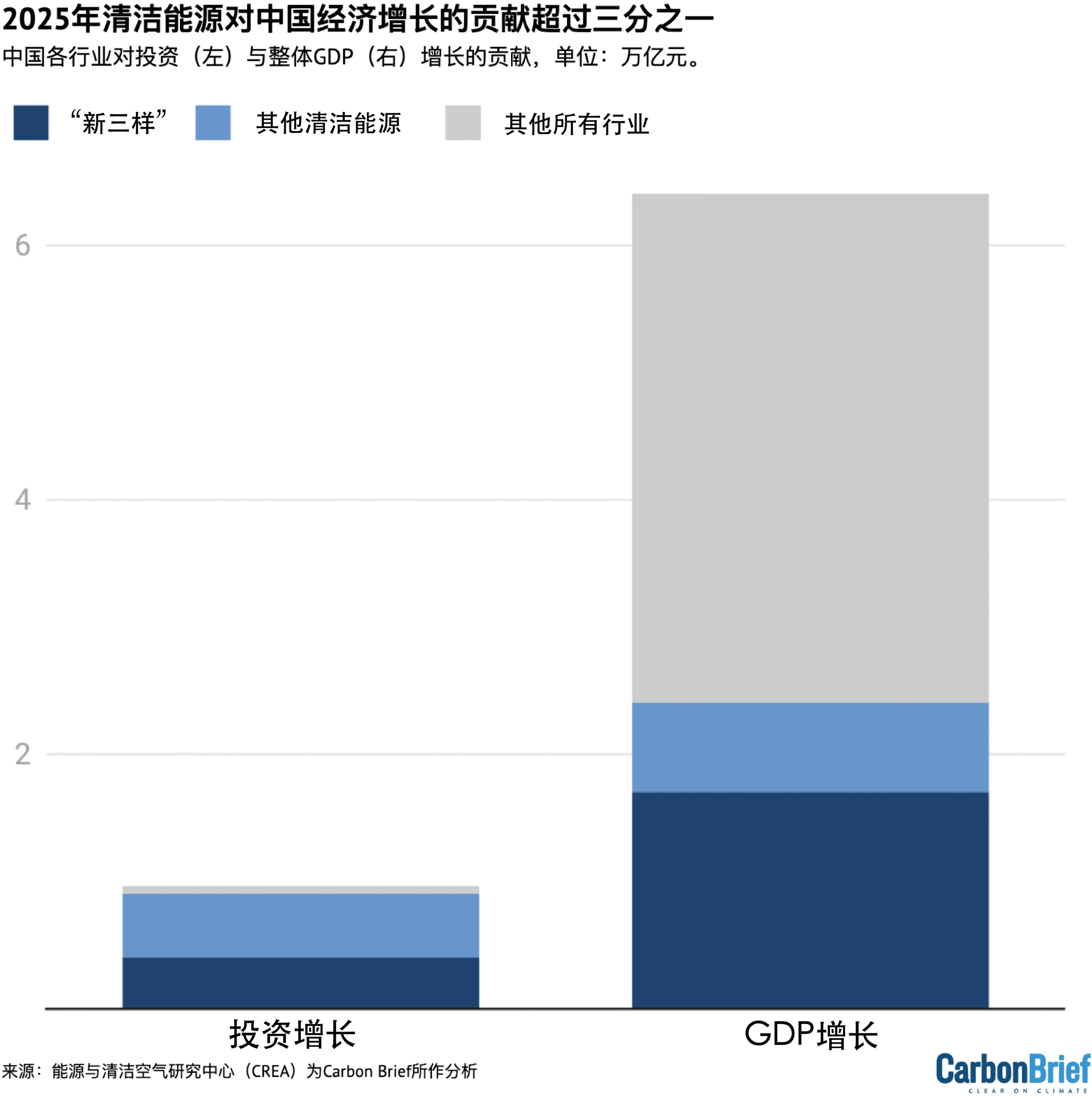 中国各行业对投资(左)与整体GDP(右)增长的贡献,单位:万亿元。来源:能源与清洁空气研究中心(CREA)为Carbon Brief所作分析。
2022年,中国清洁能源经济规模约为8.4万亿元人民币(1.2万亿美元)。到2025年,这一规模几乎翻了一番,达到15.4万亿元人民币(2.1万亿美元)。
这一体量相当于巴西或加拿大的经济总量,使中国的清洁能源产业堪比全球第八大经济体,产值约为世界第四大经济体印度经济总量的一般,也大致相当于美国加利福尼亚州经济规模的一半。
由于清洁能源产业持续跑赢整体经济,其在中国经济中的占比也在不断上升,从2022年占中国GDP的7.3%上升至2025年的11.4%。
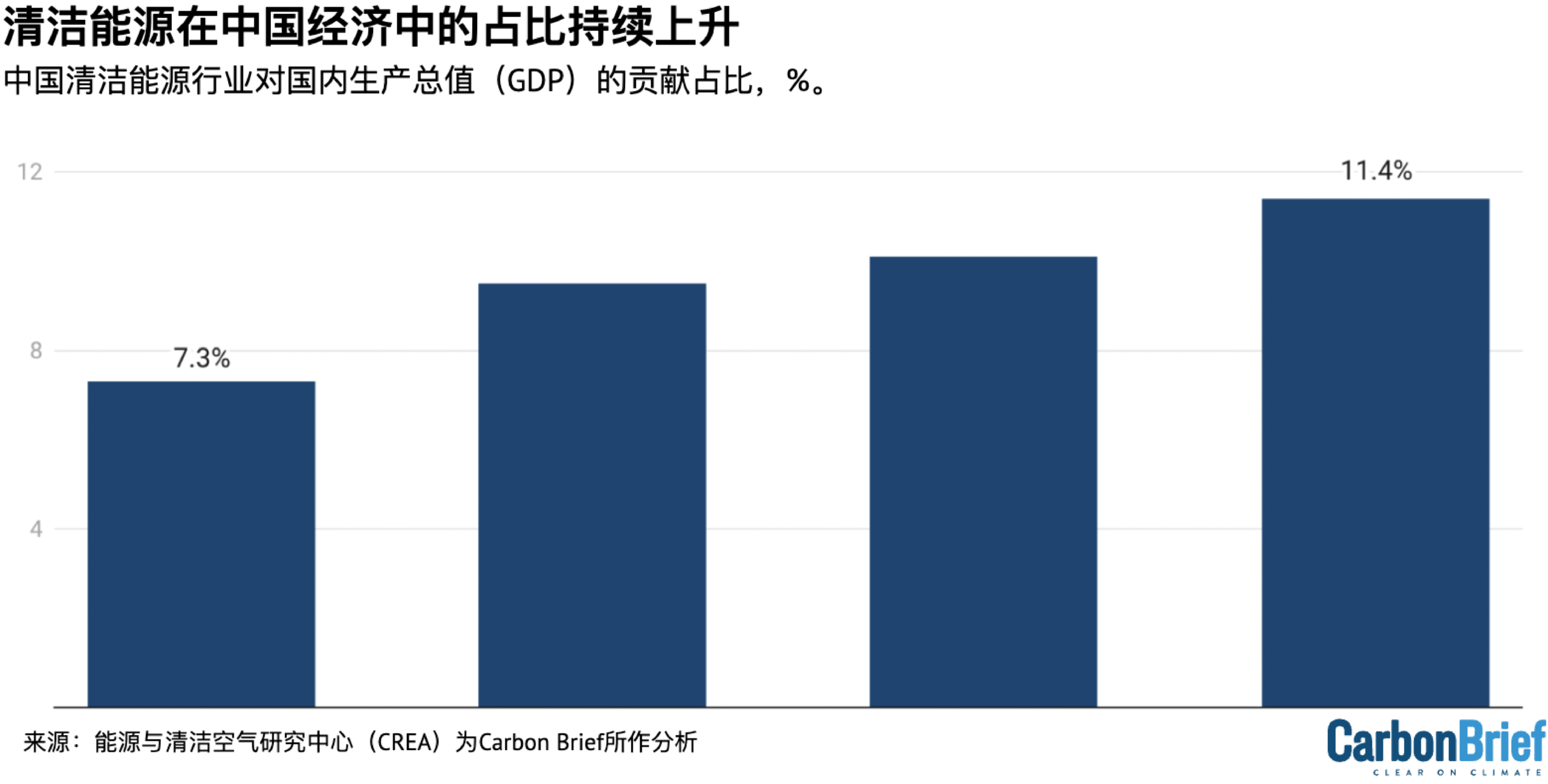 中国清洁能源行业对国内生产总值(GDP)的贡献占比,%。来源:能源与清洁空气研究中心(CREA)为Carbon Brief所作分析。
如果没有清洁能源行业,中国2025年的GDP增速将仅为3.5%,因此,在经济稳定增长为中国首要目标之一的2025年,清洁能源做出了至关重要的贡献。
下表按行业和活动进行了详细分类。
电动汽车和电池是GDP增长的最大驱动力2024年,电动汽车和太阳能是最大的增长驱动力。而到了2025年,电动汽车和电池则占据了主导地位,合计贡献了44%的经济效益,以及清洁能源行业一半以上的增长。这主要得益于产出和投资的同步强劲增长。
在未剔除通胀因素的名义GDP口径下,电动汽车的贡献甚至更为突出。这是因为电动汽车价格同比保持相对稳定,而整体经济仍处于通缩环境中。同时,电池制造投资在2024年下滑后于2025年出现反弹。
下图展示了电动汽车和电池的主要贡献,既反映了清洁能源经济的整体规模,也显示了各子行业对年度增量的具体贡献情况。
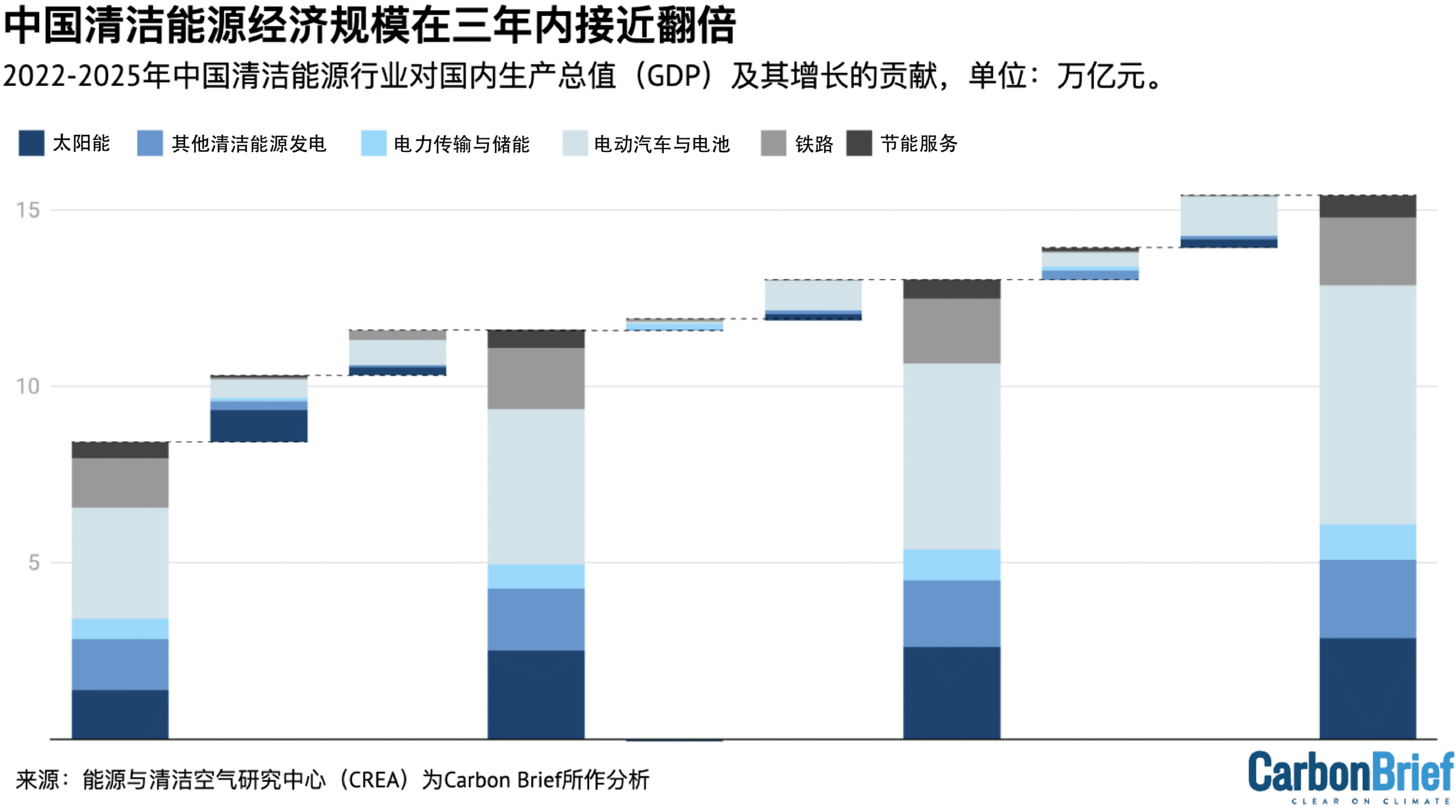 2022-2025年中国清洁能源行业对国内生产总值(GDP)及其增长的贡献,单位:万亿元。来源:能源与清洁空气研究中心(CREA)为Carbon Brief所作分析。
第二大子行业是清洁能源发电、输电和储能,在2025年占清洁能源对GDP贡献的40%,并贡献了清洁能源产业当年约30%的增长。
在电力领域内部,最主要的增长动力来自风电和太阳能发电装机投资的扩大,以及风电和太阳能发电量的增长;其次是太阳能设备及材料的出口。
作为2022-2023年的重要增长引擎,太阳能组件产业链投资在2025年连续第二年下降,这与政府遏制产能过剩和行业"非理性"价格竞争的政策导向一致。
此外,铁路运输约占清洁能源行业总经济产出的12%,但其同比增长相对温和,2025年其营业收入增长3%,投资增长6%。
需要指出的是,国际能源署(IEA)在其《世界能源投资报告》中估计,中国2025年清洁能源投资为 6270亿美元,而化石能源投资为 2570亿美元。
在采用与IEA一致的行业口径进行测算时,本研究对2025年中国清洁能源投资的估计为 4300亿美元,低于IEA的数值。而本文中所呈现的1万亿美元清洁能源投资总规模,并非源于更激进的单项假设,而是由于纳入了更为广泛的产业和活动范围,超出了IEA报告所覆盖的口径。
电动汽车和电池2025年,电动汽车与动力电池成为中国清洁能源经济中最大的贡献部分,约占清洁能源行业总值的44%。
其中,纯电动汽车和插电式混合动力汽车的生产在价值规模和当年增长贡献两方面均居首位,产量同比增长29%。排在其后的是电动汽车制造领域的投资,在2024年增速放缓后,2025年投资规模同比增长 18%
电池制造投资在2024年出现下滑后也迎来反弹,这主要得益于电池新技术的涌现以及国内外市场的强劲需求。电池制造投资同比增长35%,达到2770亿元人民币。
到2025年底,电动汽车在全国汽车保有量中的占比预计达到12%,高于一年前的 9%,而在五年前这一比例还不足 2%。
在新车销售中,电动汽车占比进一步提升至 48%,高于2024年的 41%,其中乘用车电动汽车渗透率已突破50%。2025年11月,电动汽车在当月汽车总销量中的占比更是首次突破 60%,并持续成为拉动整体汽车销量增长的主要动力,如下图所示。
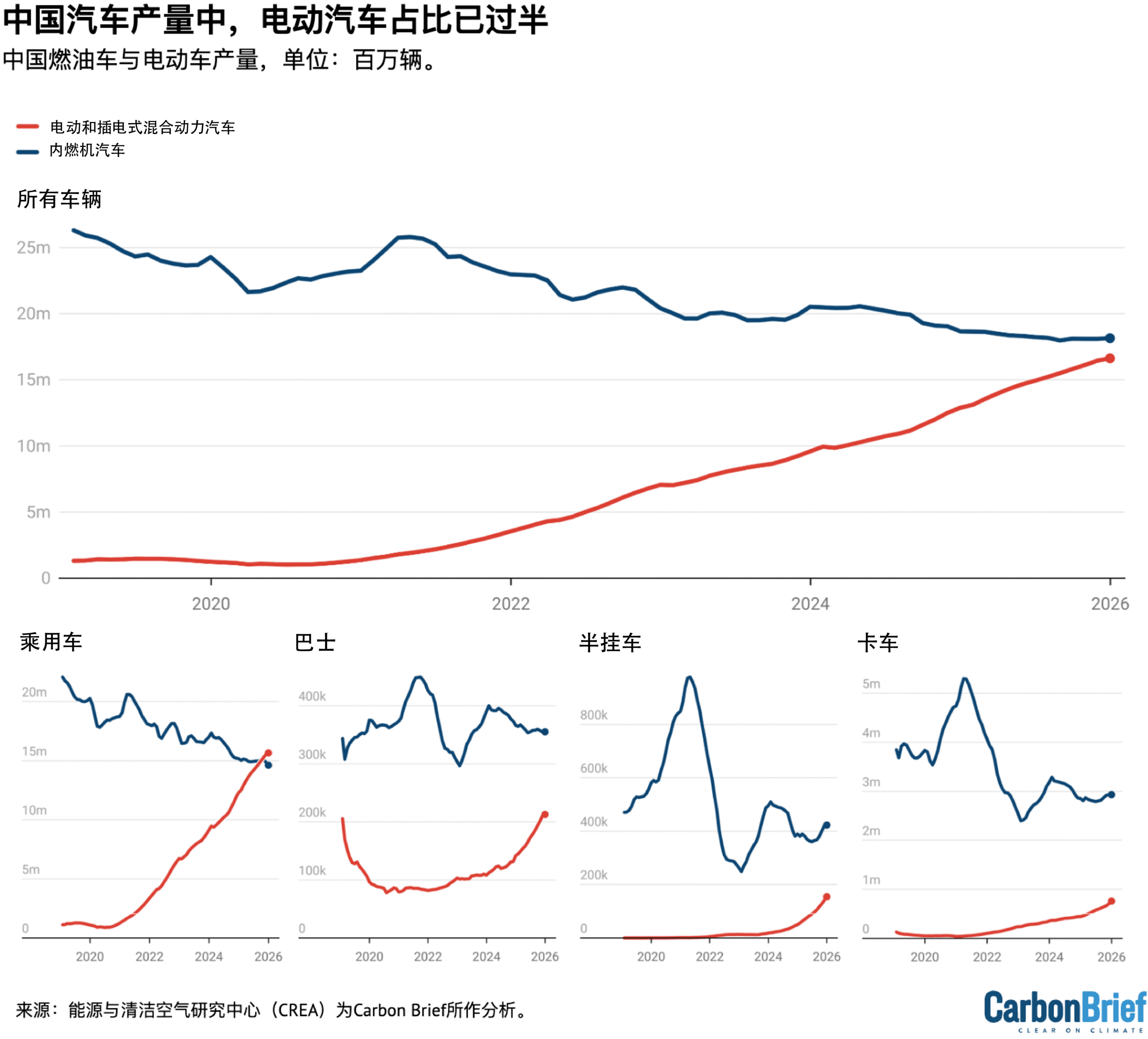 中国燃油车与电动车产量,单位:百万辆。电动车包含纯电动车及插电式混合动力车。数据来源:中国汽车工业协会,经Wind金融终端汇总整理。
电动卡车市场取得突破性进展,其市场份额从2024年前九个月的8%,增长至2025年同期的23%。
政府对电动汽车的政策支持仍在持续,例如,一项最新政策提出,未来三年内充电基础设施规模将接近翻倍,以支撑电动汽车进一步普及。
在电动汽车市场中,出口增速快于国内销售增速,但整体销售仍以国内市场为主。2025年,中国电动汽车产量达到 1660万辆,同比增长 29%。其中,出口约340万辆,占总产量的 21%,但同比增速高达 86%。中国电动汽车的主要出口目的地包括西欧、中东和拉丁美洲。
电池出口额同样实现快速增长,同比上升 41%,成为推动GDP增长的第三大动力来源。电池出口主要流向西欧、北美和东南亚市场。
与许多清洁能源技术价格呈现的通缩趋势不同,2025年电动汽车的平均售价保持稳定,新车型在折扣后的平均加个甚至略有上涨。在全社会工业品出厂价格同比下降 2.6% 的背景下,这意味着电动汽车产业对名义GDP增长的贡献尤为突出。相比之下,电池价格仍延续下降趋势。
清洁能源发电2025年,太阳能发电行业贡献了清洁能源产业总值的19%,为国民经济创造2.9万亿元人民币(约合410亿美元)的价值。
其中,新建太阳能发电厂的投资额达1.2万亿元人民币(约合1600亿美元),是清洁能源发电板块最大的驱动力;其次是太阳能技术出口额和太阳能发电本身创造的电力价值。太阳能制造业投资在2023年产能扩张浪潮结束之后持续下降,至0.5万亿元人民币(约合720亿美元),同比下降23%。
2025年,中国风电和太阳能发电新增装机容量再创新高。全国新增太阳能发电装机315吉瓦,新增风电装机119吉瓦,其中太阳能发电装机容量比全球其他地区总和还要多,而风电装机容量更是后者两倍之多。
在电力投资结构中,清洁能源占发电领域投资的90%,其中光伏一项就占到约50%。在此推动下,非化石能源发电量占全国总发电量的比重提升至42%,高于2024年的 39%。
不过,新出台的新能源定价政策以及相对谨慎的装机目标,也为这一轮增长能否持续带来了不确定性。在136号文件新政策框架下,新建风电和太阳能发电项目需要在电力市场中与既有煤电直接进行价格竞争,而在若干关键制度设计上仍处于相对不利的位置。
与此同时,电力市场本身仍处于建设和发展阶段,这也带来了投资的不确定性。
太阳能发电投资同比增长6%,但期间波动剧烈。开发商赶在新定价政策于6月生效前加速完成项目,第三季度放缓后,在年底再次赶工,以赶在"十四五"规划期内达成目标。
总体来看,太阳能产业整体投资规模与上一年大致持平:制造环节投资下降,被发电侧的增长所抵消。这在一定程度上支撑了制造产能利用率,也符合政府遏制行业"无序竞争"和价格内卷的政策目标。
2025年底,中国太阳能制造产能预计已达到每年1200吉瓦,远超2025年全球新增装机容量约650吉瓦的水平。目前,中国太阳能产业制造能力已显著超过全球市场吸收能力,激烈竞争导致行业盈利水平处于历史低位。
自2024年中期以来,中国的政策制定者已开始正面应对这一问题,包括警示"内卷式竞争"、出台监管措施,并召开行业会议向企业施压。相关举措已初见成效,2025年第三季度行业亏损有所收窄。
2025年,太阳能电池板及组件出口量再创历史新高,同比增长19%。其中,电池片和硅片出口量分别快速增长94%和52%,而电池板出口量仅增长4%。
这反映出,在关税压力上升、更多国家加快本土制造布局的背景下,全球太阳能供应链正日益趋向多元化。然而,由于平均出口价格下跌,以及出口产品结构从成品电池板向上游中间产品转移,出口名义价值反而同比下降了8%。
2025年,水能、风能和核能合计贡献了清洁能源行业总产值的约15%,为中国GDP带来约2.2万亿元人民币(3100亿美元)的增加值。
其中近三分之二(1.3万亿元人民币,1800亿美元)来自水电、风电和核电的发电价值,其余部分则来自新建发电项目的投资。
从发电量增速来看,2025年太阳能发电量增长33%,风电增长13%,水电增长3%,核电增长8%。
在发电投资领域,太阳能仍是价值规模最大的板块(如下图所示),但风电项目在2025年首次成为投资增长的最大贡献者,这是自2020年以来风电投资首次在增量上超过太阳能。
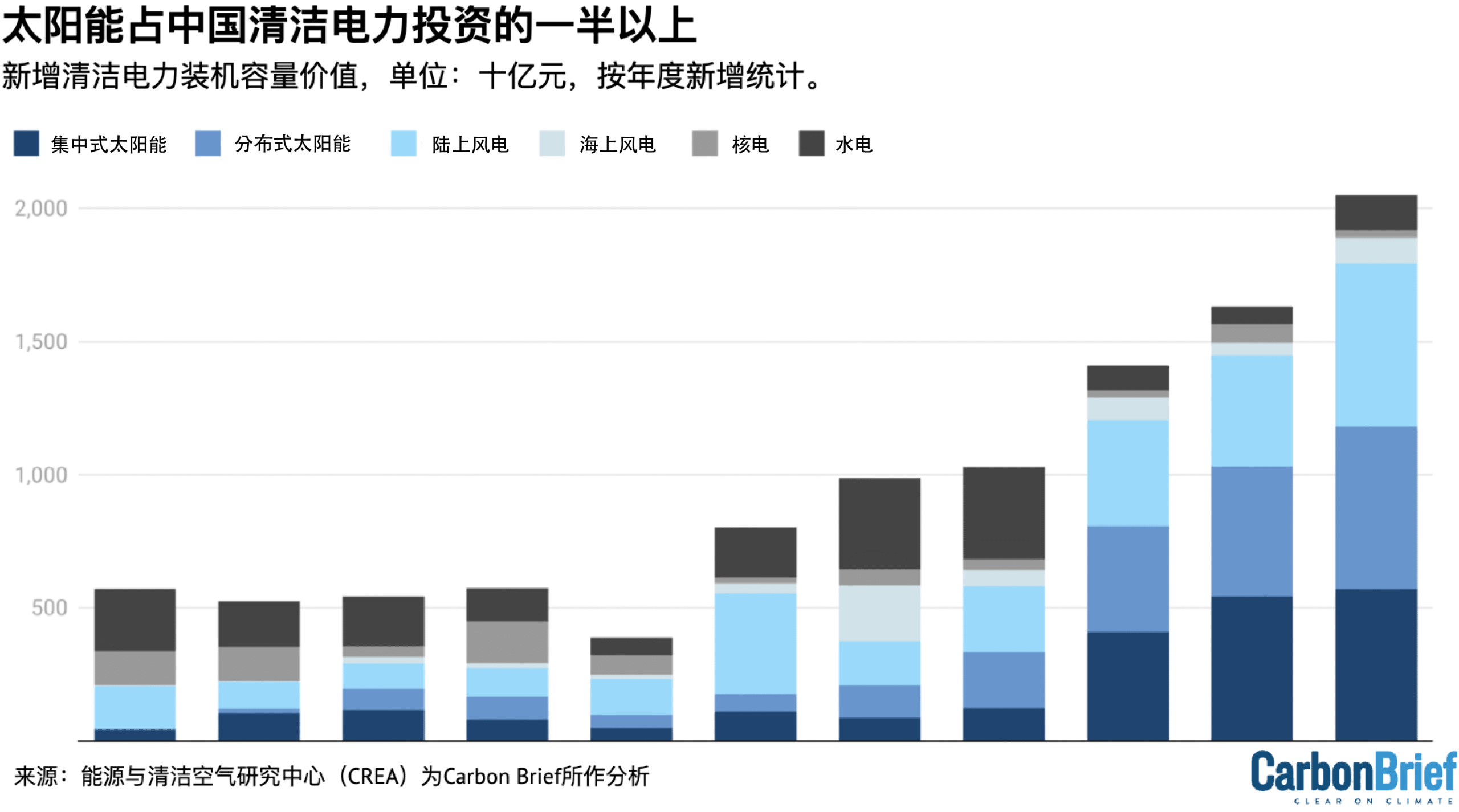 新增清洁电力装机容量价值,单位:十亿元,按年度新增统计。来源:能源与清洁空气研究中心(CREA)为Carbon Brief所作分析。
特别是海上风电装机投资如预期般反弹,在2024年大幅下降后,2025年实现翻倍增长,成为清洁电力投资中的一个亮点。
核电项目投资持续增长,但总体规模仍然较小,2025年投资额约为170亿元人民币。常规水电投资则延续下行趋势,同比下降7%。
储能和电网2025年,输电和储能占清洁能源行业总产值的6%,规模达到1万亿元人民币(1400亿美元)。
其中,电网投资2025年增长了约6%,达到900亿美元。储能投资(涵盖抽水蓄能、新型储能和氢气制备)2025年达到约500亿美元。
新型储能投资同比增长幅度达50%,电解槽投资也增长了30%。受清洁能源发电快速增长推动,清洁能源输送规模预计增长13%。
中国电力储能总装机容量超过213吉瓦,其中新型储能容量超过145吉瓦,抽水蓄能容量为69吉瓦。预计2025年中国新增约66吉瓦新型储能装机容量,同比增长52%,占全球新增装机容量的40%以上。
值得注意的是,下半年新型储能装机增速加快,达43吉瓦,而上半年新增装机容量为23吉瓦。
在政策层面,136号文件规定在5月后取消了新能源配套储能的强制要求,曾一度导致新型储能市场增速放缓,但这一影响很快被"市场驱动型增长"所取代。省级电力现货市场的推进、分时电价机制以及太阳能弃光率上升,共同改善了储能项目的经济性。
到2025年底,中国前五大太阳能制造商均进入了新型储能市场,标志着行业战略的重要转变。
与此同时,抽水蓄能投资保持增长,仅2025年上半年,就有15吉瓦的项目获批,新增3吉瓦抽水蓄能投入运营。
铁路铁路运输占清洁能源行业GDP的12%,其中客货运输收入是最主要的价值来源。行业增长主要来自铁路基础设施投资,2025年同比增长6%。
交通电气化不仅限于电动汽车,铁路客运、货运及相关投资规模也持续增长。2025年,中国高铁总里程约达5万公里,占全球高速铁路总里程的70%以上。
节能服务2025年,节能服务投资强劲反弹。以大型节能服务公司(ESCO)的产值衡量,市场规模同比增长17%,恢复至2016-2020年期间的增长水平。
行业产值也已恢复到2021年的峰值水平,这表明在经历三年低迷后,行业已明显回暖。
行业预测显示,节能服务行业年产值有望在2030年达到1万亿元人民币,而行业经历低迷前曾预期这一目标将在2025年实现。
中国已发展成为全球最大的节能服务公司市场。其投资高度集中于建筑领域,约占业务总量的50%;工业应用占21%,而能源供应、需求侧灵活性与储能相关业务合计约占16%。
中国清洁能源布局的影响中国持续向清洁能源制造业投入数千亿美元,代表着对全球能源持续转型的一项规模巨大的经济与金融押注。
除本文所涵盖的国内投资外,中国企业还在海外制造业领域展开了大规模投资布局,进一步加深了这一押注的全球化属性。
在十四五规划期间,清洁能源产业对中国实现经济增长目标起到了关键作用,在2023年、2024年和2025年分别贡献了约40%、25%和37%的GDP增长。
然而,长期的发展前景仍存在不确定性,尤其是在太阳能发电领域。136文件下新的可再生能源发电定价机制已导致短期投资增速放缓,并显著增加了市场不确定性;与此同时,中央政府设定的清洁电力新增装机目标也相对保守,远低于当前实际增长水平。
2025年下半年,太阳能发电和光伏制造领域的投资均出现下降,尽管从全年来看,发电投资保持了增长。这反映出在当前电力市场制度仍偏向煤电的框架下,清洁能源产业面临结构性风险。
清洁能源技术价格下降幅度显著,以致在未来核算GDP时,这些行业对实际GDP(经通胀或通缩调整后的GDP)的贡献可能会被向下修正。
尽管如此,清洁能源产业在宏观经济中的关键地位,本身就构成了维持这一轮清洁能源发展势头的强烈政策和经济动机。如果国内市场增长出现明显放缓,不仅可能削弱遏制产能过剩的努力,或将迫使更多产能转向出口,从而加剧国际贸易摩擦。
能源与清洁空气研究中心近期针对中国气候与能源领域专家开展的一项调查显示,多数专家认为,在经济和地缘政治挑战加剧的背景下,"双碳目标"及其所依托的清洁能源产业,只会变得更加重要。
地方政府和国企同样将深刻影响该行业的发展前景。在十四五期间,正是地方政府和国企的积极推进,促成了规模空前、且显著超出预期的"风光大基地"建设。
同时,各省在落实新电力市场机制和可再生能源购电合同安排方面拥有较大的自主空间,因此,将于今年发布的十五五规划,将成为决定清洁能源产业中长期走势的关键。
关于数据本文分析尽可能采用已公布的投资与销售数据。若数据不可得,则依据实际数量(如装机容量、汽车销量等)结合单位成本或价格进行估算。
为衡量实际增长贡献,相关数据已按2022-2023年价格进行通胀或通缩调整。全部计算过程与数据来源详见附表。
估算范围涵盖清洁能源技术对上游原材料(如金属、化学品)的需求贡献。
该方法不仅能够反映清洁能源行业对整体经济活动的拉动作用,也能提现其对相关产业活动的带动作用,因此可适用于估算:若该行业未曾增长,经济增速可能降低多少。
为避免重复计算,仅计入价值链中不重叠的环节。例如,电动汽车的生产产值与储能电池的投资额均予计入,但不包含作为上述活动中间投入的、面向国内市场的电池生产价值。
同理,国内市场的太阳能电池板产值已包含在中国光伏发电装机容量的价值中,故不重复统计;然而,太阳能电池板及电池的出口价值则纳入计算。
2025年,两项关键投资指标出现明显背离:据报道,固定资产投资下降3.8%,为35年来首次下滑;而同期资本形成总额虽增速放缓至近年最低,但仍保持2%的正增长。
本研究采用资本形成总额作为投资衡量指标,因其是GDP的组成部分。但由于无法全面追踪库存变动,对清洁能源投资的估算仍基于各行业的固定资产投资数据。
本分析未专门考虑进口因素——其在清洁能源产品与服务生产中所占比例较小且持续下降。这意味着结果可能略微高估对GDP的贡献,但同时低估了对GDP增量的贡献。
例如,中国在电动汽车中对高端计算芯片仍存在较高的进口依赖。一辆典型电动汽车的芯片价值约1000美元,而该类芯片的进口依赖度高达90%,但这仍进展整车生产价值的3%以内。
在某些方面,本研究的估算可能相对保守。例如,彭博新能源财经(BNEF)估计2024年中国"能源转型投资"规模约为8000亿美元。彭博估算的行业覆盖范围与本分析大致相当,但未包含制造业产值。在相同口径下,本研究对应的投资规模约为6000亿美元。
根据中国国家统计局数据,2023年全国汽车产业总产值与销售额合计约11万亿元人民币。本分析估算,同年电动汽车销售额约为2.3万亿元,约占行业总值的20%。当时,电动汽车产量已占汽车总产量的31%,且其平均售价略高于传统燃油汽车。
Analysis: Clean energy drove more than a third of China's GDP growth in 2025
China energy
|05.02.26
'Rush' for new coal in China hits record high in 2025 as climate deadline looms
China energy
|03.02.26
Explainer: Why gas plays a minimal role in China's climate strategy
China energy
|22.01.26
Experts: What to expect from China on energy and climate action in 2026
China energy
|16.01.26
jQuery(document).ready(function() { jQuery('.block-related-articles-slider-block_4a11b3482ebf808c5beb94a5eeae35f3 .mh').matchHeight({ byRow: false }); });The post 分析:清洁能源2025年为中国GDP增长贡献超过三分之一 appeared first on Carbon Brief.
On 1 February, India's finance minister Nirmala Sitharaman unveiled the government's budget for 2026, which included a new $2.2bn funding push for carbon capture technologies.
In the absence of its new international climate pledge under the Paris Agreement, the budget offers a glimpse into the key climate and energy security priorities of the world's third-largest emitter, amid increasing geopolitical tensions and trade challenges.
While Sitharaman's budget speech did not mention climate change directly, she said: "Today, we face an external environment in which trade and multilateralism are imperilled and access to resources and supply chains are disrupted."
Sitharaman emphasised that "new technologies are transforming production systems while sharply increasing demands on water, energy and critical minerals".
The budget sets out: support for the mining and processing of critical minerals and rare earths; import duty exemptions for nuclear power equipment; and support for renewables, particularly rooftop solar.
However, unlike in some previous years, the 2026 budget does not include specific climate adaptation measures.
Below, Carbon Brief runs through five key climate- and energy-focused announcements from the budget.
- Carbon capture, utilisation and storage
- Critical minerals and rare earth 'corridors'
- Nuclear energy
- Renewables
- Adaptation
The biggest climate-related budget announcement was $2.2bn to support carbon capture, utilisation and storage (CCUS) technologies in India over the next 5 years.
These are technologies that capture carbon dioxide (CO2) as it is released, then use or store it underground or under the sea.
This funding is aimed at decarbonising five of India's high-emitting industrial sectors - power, steel, cement, refineries and chemicals. These sectors are "staring at the risk" of coming under the EU's carbon adjustment mechanism (CBAM), even after a recent EU-India trade deal, according to Sitharaman.
The funding is meant to align with a roadmap released last year that sees CCUS as a "core technological pillar" of India's 2070 net-zero strategy, particularly for "decarbonising sectors where viable alternatives are limited", notes the government's roadmap.
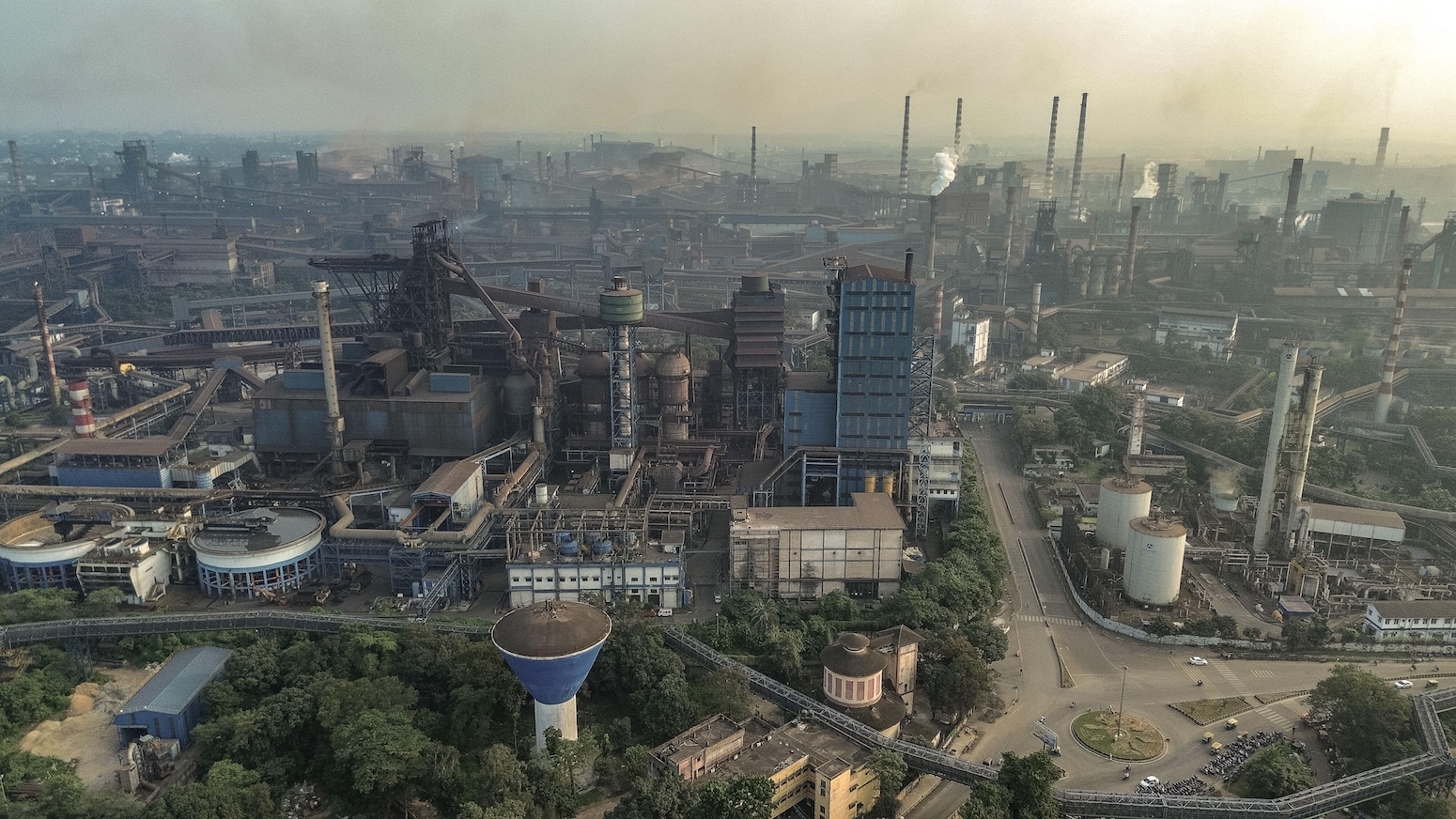 An aerial view of steel plants in Jamshedpur, described as India's "steel city". Credit: ZUMA Press / Alamy Stock Photo
According to the Intergovernmental Panel on Climate Change (IPCC) sixth assessment report, however, the need for CCUS to mitigate industrial emissions "may be overestimated", compared to measures such as energy and material efficiency and electrification.
Speaking to Carbon Brief, Dr Vikram Vishal, a professor of earth sciences at the Indian Institute of Technology, Bombay (IIT-B),, describes the budget move as a "big welcome step for industrial decarbonisation and India's net-zero ambitions as a whole".
Vishal says that the funding could go towards getting "big demonstration plants to near-commercial plants" that could entail even bigger investments in the future.
He tells Carbon Brief:
"India is blessed with both onshore and offshore availability for carbon storage. But while utilisation exists, storage has not happened, per se, even at a decent scale. We [would] need to build transportation infrastructure from the point source of capture at scale, on land and offshore. While offshore storage is very low risk, onshore presents a closer proximity to emission sources."
However, that could also mean closer proximity to densely populated or protected areas.
Vishal adds that India has a very large theoretical storage potential, even a quarter of which would allow for up to 150bn tonnes of CO2 to be stored. This could sustain CCUS for hundreds of years, Vishal says, adding: "And by that time, the energy transition would have happened, right?"
Critical minerals and rare-earth 'corridors'Mining, sourcing and processing "critical minerals" and rare earths is another key area of India's 2026 budget.
It proposes establishing "dedicated rare-earth corridors" in the "mineral-rich" coastal states of Odisha, Kerala, Andhra Pradesh and Tamil Nadu to "promote mining, processing, research and manufacturing". These corridors are intended to complement a $815m rare-earth permanent-magnet scheme announced in November.
In addition, the budget supports "incentivising prospecting and exploration" for rare-earth minerals, such as monazite, as well as others that the government wants to include in its list of "critical minerals".
Last week, for instance, India classified coking coal - which is predominantly used in making steel - as a "critical and strategic mineral", removing regulatory measures such as the need to consult affected communities before developing new mines.
Sehr Raheja, programme officer at New Delhi thinktank Centre for Science Environment, tells Carbon Brief that "moving up the critical-minerals value chain" is "increasingly essential" for the energy transition in developing countries.
She adds that some of the measures announced in India's budget "point in that direction", explaining:
"Globally, developing countries often stay stuck in the extraction stages of value chains and capture the least value. While duty exemptions for critical mineral processing and battery manufacturing signal intent to build domestic manufacturing capacity, the extent to which these new efforts deliver sustained value will only become apparent over time."
Rahul Basu, research director at the Goa Foundation, which advocates for "intergenerational equity" in mining, tells Carbon Brief:
"Rare earths are not particularly rare. What is difficult is separating and refining them. China imports ore from around the world, including [the] US. Their competitive advantage lies in processing, including the ability to tolerate high pollution levels.
Nuclear energy"India should perfect the processing technology with imported ores first. It is the critical piece. Not mining. We seem to want to mine the same beaches that are already seeing sea-level rise."
The Indian government has also lifted customs duties on imports of nuclear power equipment within the 2026 budget.
Under the changes, equipment for all nuclear power plants will not be subject to customs duties until 2035, irrespective of capacity.
The announcement follows India enacting a landmark new nuclear act, dubbed the "Shanti" act, in December 2025. This seeks to privatise and invite foreign participation in the country's nuclear energy sector, which has been largely state-run for decades and has a long history of public protests over safety and land-acquisition concerns.
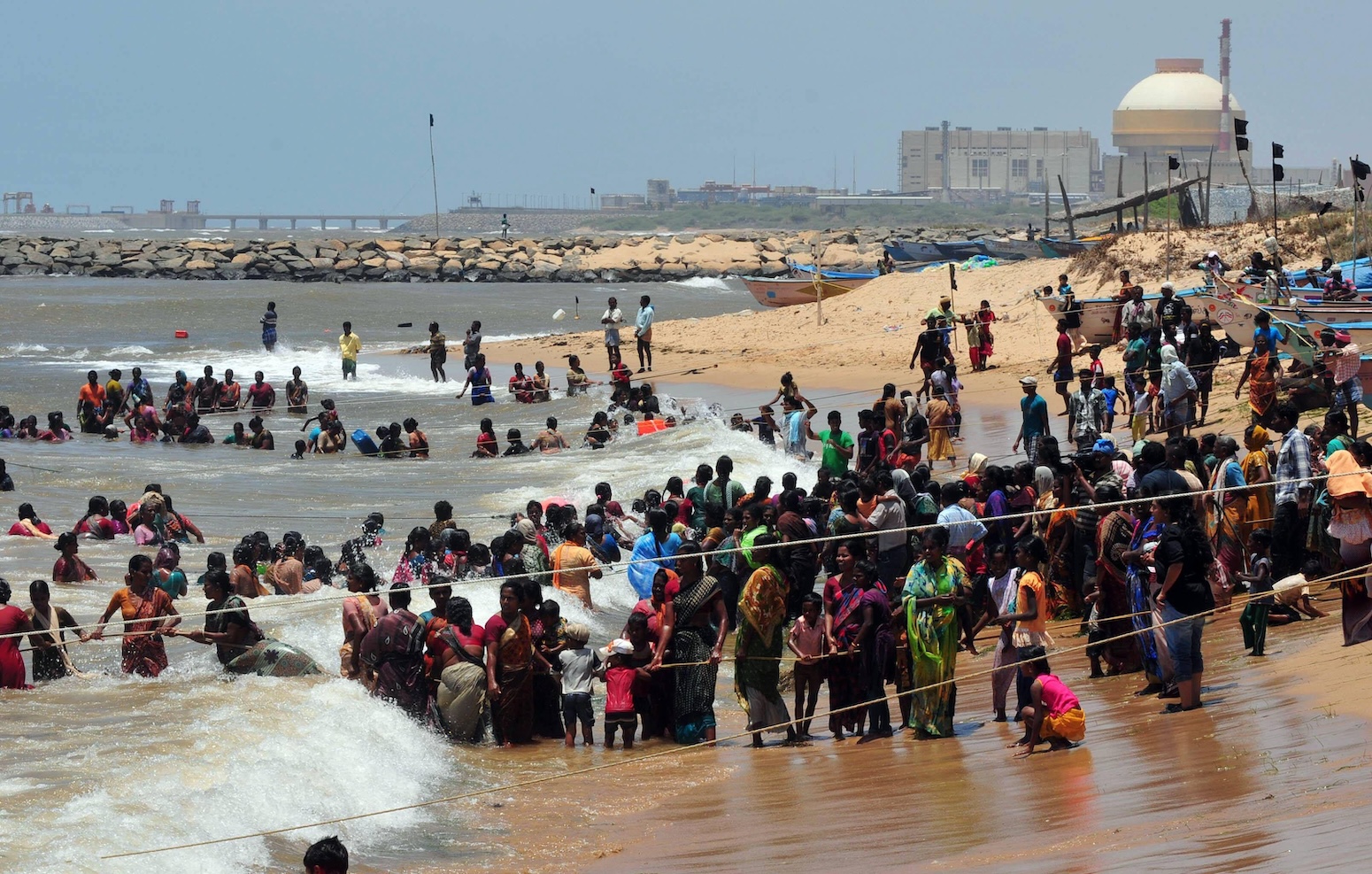 Protests against India's Kudankulam nuclear power plant in Tamil Nadu. Credit: Imago/Xinhua / Alamy Stock Photo
The Shanti act - which is an acronym for "sustainable harnessing and advancement of nuclear energy for transforming India" - aims to help India increase its nuclear capacity tenfold to 100 gigawatts (GW) by 2047.
This coincides with 100 years since India's independence and is "the year India aims to attain developed-nation status", according to prime minister Narendra Modi.
RenewablesSupport for renewables in India's budget this year is significant, but "uneven", experts tell Carbon Brief.
Allocations to India's Ministry of New and Renewable Energy (MNRE) grew by 24% to a "record high" in the 2026 budget, with the bulk going to the prime minister's flagship rooftop solar scheme. The government also cut import duties on lithium-ion cells for battery storage systems, as well as on inputs for solar-panel glass manufacturing.
However, Vibhuti Garg, South Asia director for the Institute for Energy Economics and Financial Analysis, tells Carbon Brief that spending on wind energy and - "more critically" - on transmission and energy storage has either "stagnated or declined" this year.
Garg says grid infrastructure is "fundamental" to renewable expansion. She explains:
Adaptation"Transmission infrastructure and storage are fundamental to integrating higher shares of renewable energy into the grid. As renewable penetration rises, these elements become not optional but indispensable, and the current level of support falls short of what is required."
The budget does not announce any specific adaptation measures or schemes, although it does mention a plan to develop and rejuvenate reservoirs and water bodies and to "strengthen" fisheries value chains in coastal areas.
The budget does not mention or include measures related to heat stress or its impact on productivity and workers in sectors such as agriculture.
According to India's national economic survey tabled ahead of the budget, adaptation and "resilience-related" domestic spending "surged" from 3.7% of the country's GDP in 2016-17 to 5.6% in 2022-23.
 Salt pan workers in south India endure high occupational heat stress. Credit: Alex Armitage / Alamy Stock Photo
Yet, unlike earlier budgets, allocations to and expenditure from India's National Adaptation Fund for Climate Change are not separately visible in the 2026 document.
Harjeet Singh, climate adaptation expert and founding director at the Satat Sampada Climate Foundation, tells Carbon Brief that this budget was a "missed opportunity" and a response "not commensurate to the needs [for adaptation] on [the] ground or investment at the scale of crisis that we are facing".
Singh adds that it fails to recognise the "huge" economic impacts already being felt in India. He says:
"If a budget doesn't recognise how climate change is already eroding India's development - causing huge economic losses - and is going to affect our GDP growth, it means that you aren't really acting, or nudging states to do more.
"It was a missed opportunity to tell the world that we do see adaptation as a problem and we are acting on it, but we also need international cooperation."

Q&A: How countries are using biofuels to meet their climate targets
Energy
|08.10.25

Explainer: What is China's 'Shenzhen model' for low-carbon transition in cities?
China Policy
|03.06.25

Infographic: How 'digital sequence information' can generate funds for biodiversity
Explainers
|20.02.25

Q&A: How Denmark plans to tax agriculture emissions to meet climate goals
EU policy
|09.07.24
jQuery(document).ready(function() { jQuery('.block-related-articles-slider-block_fcbf82c97ba1a3fc190cc03732d9bf9a .mh').matchHeight({ byRow: false }); });The post Five key climate and energy announcements in India's budget for 2026 appeared first on Carbon Brief.
 'Rush' for new coal in China hits record high in 2025 as climate deadline looms [ 03-Feb-26 12:01am ]
Proposals to build coal-fired plants in China reached a record high in 2025, finds a new study.
The report, released by the Centre for Research on Energy and Clean Air (CREA) and Global Energy Monitor (GEM), says that, in 2025, developers submitted new or reactivated proposals to build a total of 161 gigawatts (GW) of new coal-fired power plants.
The new proposals come even as China's buildout of renewable energy pushed down coal-power generation and carbon dioxide (CO2) emissions in 2025, meaning many coal plants are already running at just half of their maximum capacity.
The co-authors argue that while clean-energy growth may limit emissions from coal power in the short term, the surge in proposals could lock in new coal assets, "weaken…incentives" for power-system reform and help keep coal capacity online in spite of China's climate goals.
The high rate of new proposals, the study says, likely reflects a "rush by the coal industry stakeholders" to develop projects before an expected tightening of climate policy in the next five years.
In addition, "misaligned" payment mechanisms are encouraging developers to propose large-scale coal units, which - if developed - could impact the transition of the coal sector from playing the central role in electricity generation to flexibly supporting a system built on clean power.
Significant additions pushing down running hoursThe report finds that the amount of new coal-fired power proposals by Chinese developers, including reactivated applications, hit a new peak in 2025, at 161GW. This is equal to 13% of the coal capacity currently online in China.
The country is continuing to add significant coal-power capacity, with a record 95GW added to the grid last year and another 291GW in the pipeline - meaning units that have been proposed, are actively under construction or have already been permitted.
Moreover, around two-thirds of coal-power capacity proposed in China since 2014 has either been commissioned - meaning it has been completed and started operating - or remains in the pipeline, Christine Shearer, report co-author and research analyst at thinktank Global Energy Monitor, tells Carbon Brief.
She adds that this is the "reverse of what we see outside China, where roughly two-thirds of proposed coal capacity never makes it to construction".
Coal remains a significant part of China's power mix, making the nation's electricity sector one of the world's largest emitters. Indeed, the power sector emitted more than 5.6bn tonnes of carbon dioxide (GtCO2) in 2024 - meaning that if it were its own country, it would have the highest emissions of any country except China itself.
But emissions from the power sector have been flat or falling since March 2024, according to analysis for Carbon Brief by CREA lead analyst Lauri Myllyvirta.
This is largely due to China's rapid installation of renewable power, which is covering nearly all of new electricity demand and pushing coal generation into decline in 2025.
Some parts of the coal-power pipeline are reflecting this shift. In 2025, construction began on 83GW of new coal capacity - down from 98GW in 2024.
In addition, new permitting fell to a four-year low, at 45GW, which could point to tighter controls on coal-plant approvals in the future, says the report.
The chart below shows the amount of new coal-power capacity being proposed in China each year, in GW.
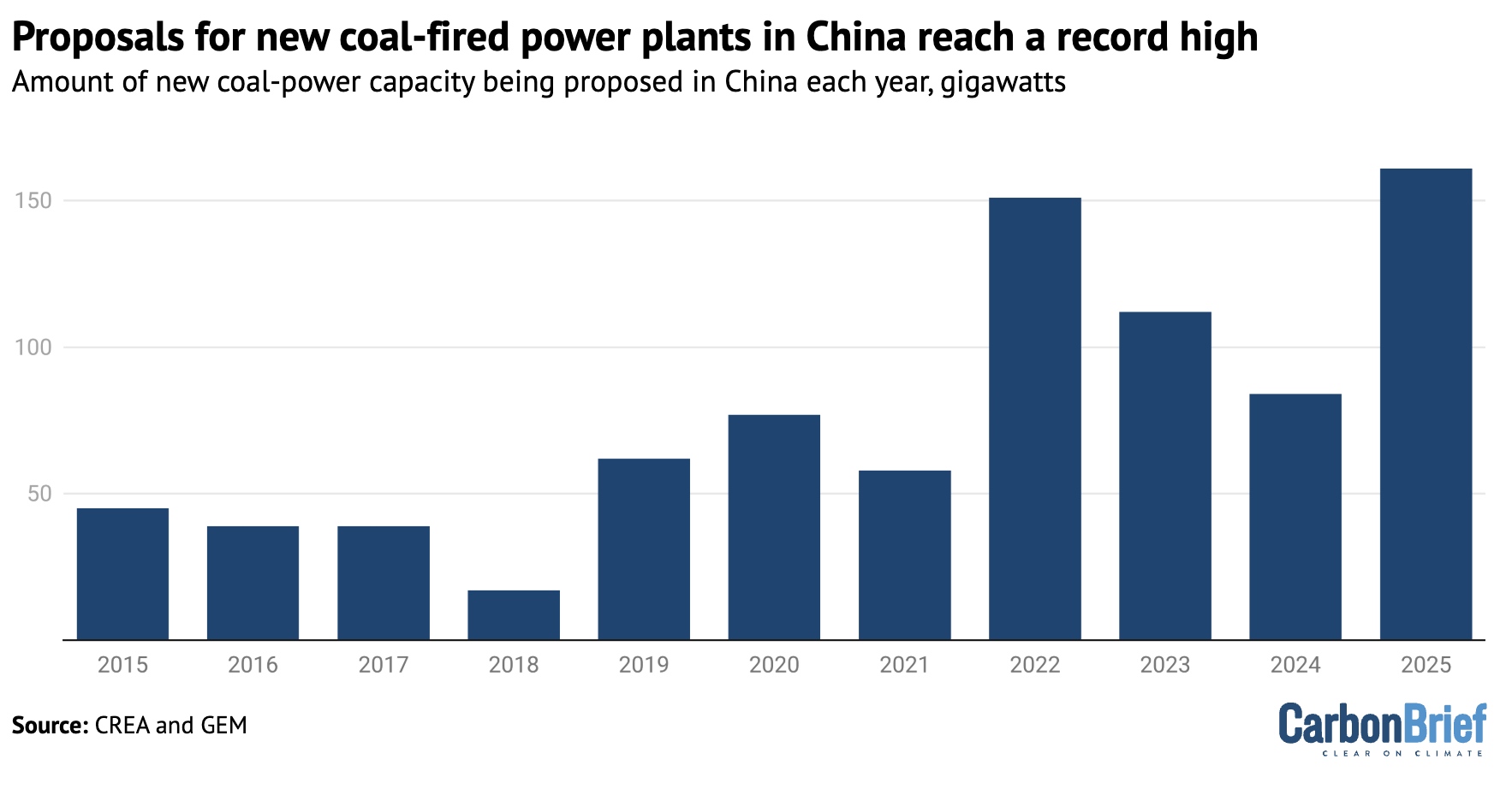 Amount of new coal-power capacity being proposed in China each year, GW, 2015-2025. Source: The Centre for Research on Energy and Clean Air and Global Energy Monitor.
The shift from new power demand being met by coal to being met by renewable energy means any "additional coal power capacity would face structurally low utilisation", the report says, referring to the number of hours that plants are able to operate each year.
This reduces coal-plant earnings needed to cover the cost of investment and makes instances of "stranded [coal] assets and compensation pressures" more likely.
A previous analysis for Carbon Brief finds that "larger additions of coal capacity are often followed by falling utilisation" - meaning that the construction of new coal plants does not necessarily increase emissions.
Utilisation rates for coal-fired power plants have hovered around 51% since 2025, according to the CREA and GEM report.
Shearer argues that while low utilisation rates would "dampen the immediate impact on annual CO2 emissions", in the long-term the buildout "locks capital into fossil fuels" and "weakens incentives to build the cleaner forms of flexibility" needed for a renewables-centred system.
Low utilisation has also not led to coal plant capacity being retired in any notable way, the report notes, with generators instead supported by the coal "capacity payment" mechanism and extending the life of older units.
Delayed retirement of older coal plants causes "persistent overcapacity" and adds to calls for further compensation and policy support, the report says.
Coal generation has "no room to expand" under China's international climate pledge for 2030, it adds, with utilisation rates for coal units likely to fall to 42% if renewables continue to meet all additional demand and if all of the plants currently under construction or permitted are brought online.
Crunch-time for coalThe surge in new proposals reflects a "rush" by the coal industry to ensure their projects are approved before the policy environment tightens, according to the report.
China is expected to introduce absolute emissions targets over the next five years. While these are expected to be aspirational for the first five years - alongside binding targets for carbon intensity, the emissions per unit of GDP - from 2030 they will be binding.
The current five-year period until 2030 will also likely see most of China's energy-intensive industries pulled into the scope of its national carbon market.
In the power sector, government officials have said that coal is expected to shift from playing a major role in power supply to supporting "flexibility" operations.
This would require coal plants to shift between varying load levels and respond quickly to changes in demand and other system needs.
However, the report finds, the approvals for coal power "continue to reflect expectations of high operating hours", instead of flexible operations.
For many of these proposals, planned annual utilisation was stated to be more than 4,800 hours, or 55% of hours in the year. This is greater than the 4,685 utilisation hours (53%) logged in 2023, the year in which the most coal power was generated over the past decade, according to data shared by the report authors with Carbon Brief.
In addition, the report says that many of the new coal-power proposals in 2025 were for "large-scale units", each representing at least 1GW of power, as shown in the figure below.
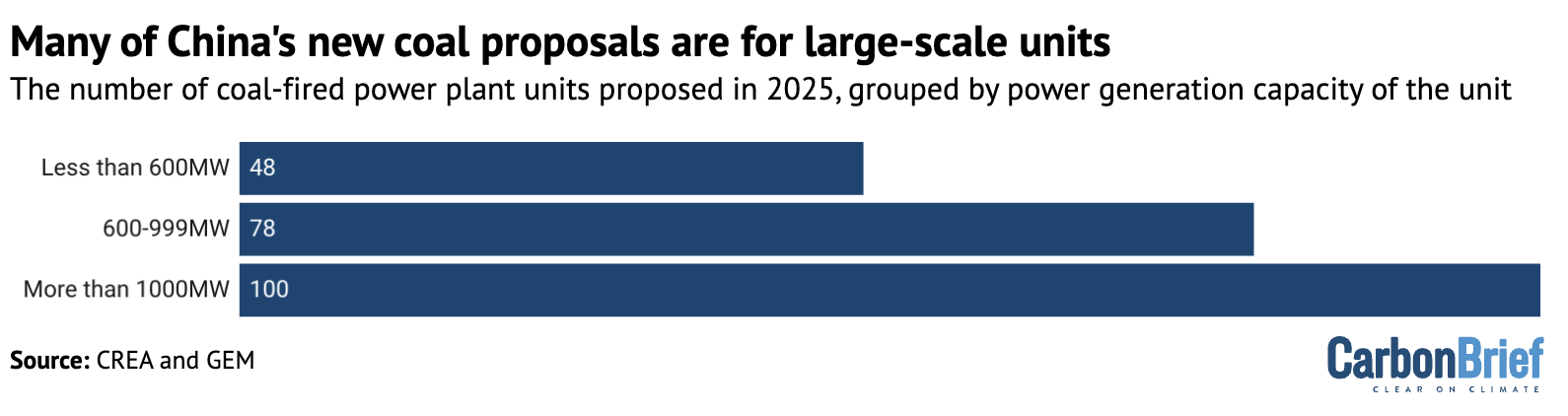 Number of coal-fired power units newly proposed in 2025, grouped by power generation capacity of the unit. Source: the Centre for Research on Energy and Clean Air and Global Energy Monitor.
These larger units are designed for "stable, continuous operation" and are "poorly suited to the type of flexibility increasingly required in a power system dominated by wind and solar", says the report.
This suggests that "project developers still anticipated base-load style operation", it adds, "sitting uneasily" with the fact of higher clean-energy generation and falling coal plant utilisation.
Reliance on sales and subsidiesThis persistence in developing large-scale units could be explained by the financial incentives that govern the coal-power industry.
Coal power plants are cheap to build but risk low profits and high costs, with many current operators already facing losses at recent utilisation rates.
In 2024, the government established a capacity payment mechanism for coal-fired power plants. This mechanism rewards developers for adding "seldom-utilised, backup" capacity to the grid.
These capacity payments, as well as regulated pricing and implicit government backing "can make plants viable on paper even if utilisation and operating margins are weak", Shearer tells Carbon Brief, which may explain the continued appetite for new coal from developers.
More than 100bn yuan ($14bn) in capacity payments were made to coal plants in 2024, although it has not yet had a discernable impact on utilisation.
Large-scale units, the report says, are "particularly well positioned" to benefit from the policy, as it rewards maximising capacity and does not favour plants that are more suited for flexible operations.
(The Chinese government recently announced plans to adjust the mechanism, confirming that in some cases capacity payments could be more than the initial expected threshold of 50% of a benchmark coal plant's total fixed costs.)
Meanwhile, the report adds that coal-fired power plants continue to earn most of their revenue from selling electricity, with only 5% of total income coming from capacity payments.
As such, these "misaligned incentives" encourage producing power and installing significant new capacity, despite the government's aim to shift coal to a supporting role in the system.
Shearer tells Carbon Brief that a better approach to flexibility would be to "adopt technology-neutral flexibility standards", rather than focusing on "flexible coal", which would mean coal would have to "compete directly with storage, demand response, grid upgrades and other clean options". She adds:
"The risk of coal-specific flexibility policies is that they lock in capacity rather than solve the underlying system need."
Explainer: Why gas plays a minimal role in China's climate strategy
China energy
|22.01.26
Experts: What to expect from China on energy and climate action in 2026
China energy
|16.01.26
Analysis: Coal power drops in China and India for first time in 52 years after clean-energy records
China energy
|13.01.26

Q&A: Five key climate questions for China's next 'five-year plan'
China energy
|11.12.25
jQuery(document).ready(function() { jQuery('.block-related-articles-slider-block_fb5bdaff8486d1ba6d1c153b163b15e1 .mh').matchHeight({ byRow: false }); });The post 'Rush' for new coal in China hits record high in 2025 as climate deadline looms appeared first on Carbon Brief.
DeBriefed 30 January 2026: Fire and ice; US formally exits Paris; Climate image faux pas [ 30-Jan-26 3:40pm ]Welcome to Carbon Brief's DeBriefed.
An essential guide to the week's key developments relating to climate change.
OZ HEAT: The ongoing heatwave in Australia reached record-high temperatures of almost 50C earlier this week, while authorities "urged caution as three forest fires burned out of control", reported the Associated Press. Bloomberg said the Australian Open tennis tournament "rescheduled matches and activated extreme-heat protocols". The Guardian reported that "the climate crisis has increased the frequency and severity of extreme weather events, including heatwaves and bushfires".
WINTER STORM: Meanwhile, a severe winter storm swept across the south and east of the US and parts of Canada, causing "mass power outages and the cancellation of thousands of flights", reported the Financial Times. More than 870,000 people across the country were without power and at least seven people died, according to BBC News.
COLD QUESTIONED: As the storm approached, climate-sceptic US president Donald Trump took to social media to ask facetiously: "Whatever happened to global warming???", according to the Associated Press. There is currently significant debate among scientists about whether human-caused climate change is driving record cold extremes, as Carbon Brief has previously explained.
Around the world- US EXIT: The US has formally left the Paris Agreement for the second time, one year after Trump announced the intention to exit, according to the Guardian. The New York Times reported that the US is "the only country in the world to abandon the international commitment to slow global warming".
- WEAK PROPOSAL: Trump officials have delayed the repeal of the "endangerment finding" - a legal opinion that underpins federal climate rules in the US - due to "concerns the proposal is too weak to withstand a court challenge", according to the Washington Post.
- DISCRIMINATION: A court in the Hague has ruled that the Dutch government "discriminated against people in one of its most vulnerable territories" by not helping them to adapt to climate change, reported the Guardian. The court ordered the Dutch government to set binding targets within 18 months to cut greenhouse gas emissions in line with the Paris Agreement, according to the Associated Press.
- WIND PACT: 10 European countries have agreed a "landmark pact" to "accelerate the rollout of offshore windfarms in the 2030s and build a power grid in the North Sea", according to the Guardian.
- TRADE DEAL: India and the EU have agreed on the "mother of all trade deals", which will save up to €4bn in import duty, reported the Hindustan Times. Reuters quoted EU officials saying that the landmark trade deal "will not trigger any changes" to the bloc's carbon border adjustment mechanism.
- 'TWO-TIER SYSTEM': COP30 president André Corrêa do Lago believes that global cooperation should move to a "two-speed system, where new coalitions lead fast, practical action alongside the slower, consensus-based decision-making of the UN process", according to a letter published on Tuesday, reported Climate Home News.
$2.3tn
The amount invested in "green tech" globally in 2025, marking a new record high, according to Bloomberg.
Latest climate research
- Including carbon emissions from permafrost thaw and fires reduces the remaining carbon budget for limiting warming to 1.5C by 25% | Communications Earth & Environment
- The global population exposed to extreme heat conditions is projected to nearly double if temperatures reach 2C | Nature Sustainability
- Polar bears in Svalbard - the fastest-warming region on Earth - are in better condition than they were a generation ago, as melting sea ice makes seal pups easier to reach | Scientific Reports
(For more, see Carbon Brief's in-depth daily summaries of the top climate news stories on Monday, Tuesday, Wednesday, Thursday and Friday.)
Captured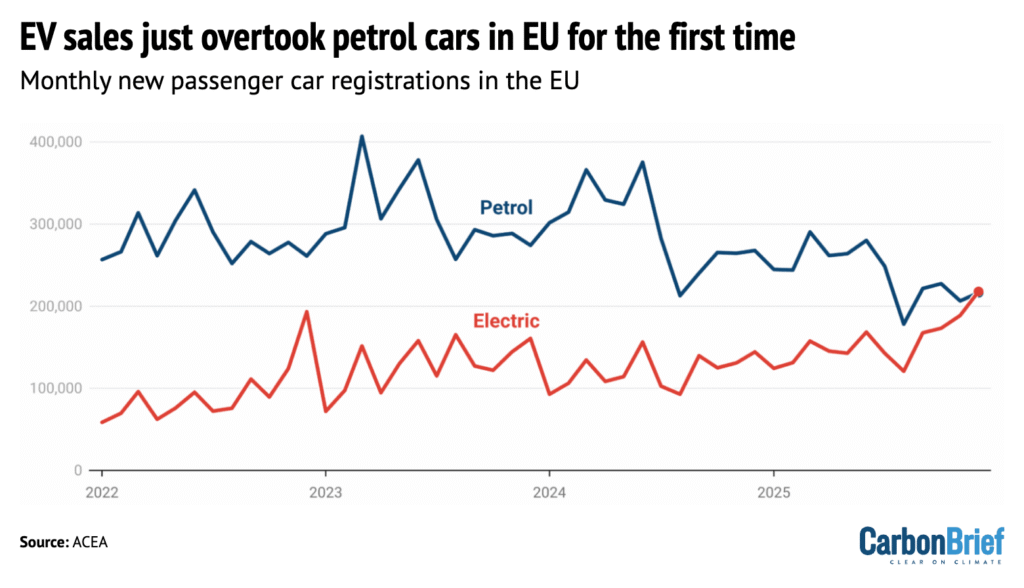
Sales of electric vehicles (EVs) overtook standard petrol cars in the EU for the first time in December 2025, according to new figures released by the European Automobile Manufacturers' Association (ACEA) and covered by Carbon Brief. Registrations of "pure" battery EVs reached 217,898 - up 51% year-on-year from December 2024. Meanwhile, sales of standard petrol cars in the bloc fell 19% year-on-year, from 267,834 in December 2024 to 216,492 in December 2025, according to the analysis.
Spotlight Looking at climate visualsCarbon Brief's Ayesha Tandon recently chaired a panel discussion at the launch of a new book focused on the impact of images used by the media to depict climate change.
When asked to describe an image that represents climate change, many people think of polar bears on melting ice or devastating droughts.
But do these common images - often repeated in the media - risk making climate change feel like a far-away problem from people in the global north? And could they perpetuate harmful stereotypes?
These are some of the questions addressed in a new book by Prof Saffron O'Neill, who researches the visual communication of climate change at the University of Exeter.
"The Visual Life of Climate Change" examines the impact of common images used to depict climate change - and how the use of different visuals might help to effect change.
At a launch event for her book in London, a panel of experts - moderated by Carbon Brief's Ayesha Tandon - discussed some of the takeaways from the book and the "dos and don'ts" of climate imagery.
Power of an image"This book is about what kind of work images are doing in the world, who has the power and whose voices are being marginalised," O'Neill told the gathering of journalists and scientists assembled at the Frontline Club in central London for the launch event.
O'Neill opened by presenting a series of climate imagery case studies from her book. This included several examples of images that could be viewed as "disempowering".
For example, to visualise climate change in small island nations, such as Tuvalu or Fiji, O'Neill said that photographers often "fly in" to capture images of "small children being vulnerable". She lamented that this narrative "misses the stories about countries like Tuvalu that are really international leaders in climate policy".
Similarly, images of power-plant smoke stacks, often used in online climate media articles, almost always omit the people that live alongside them, "breathing their pollution", she said.
 Ayesha Tandon with panellists at London's Frontline Club. Credit: Carbon Brief
During the panel discussion that followed, panellist Dr James Painter - a research associate at the Reuters Institute for the Study of Journalism and senior teaching associate at the University of Oxford's Environmental Change Institute - highlighted his work on heatwave imagery in the media.
Painter said that "the UK was egregious for its 'fun in the sun' imagery" during dangerous heatwaves.
He highlighted a series of images in the Daily Mail in July 2019 depicting people enjoying themselves on beaches or in fountains during an intense heatwave - even as the text of the piece spoke to the negative health impacts of the heatwave.
In contrast, he said his analysis of Indian media revealed "not one single image of 'fun in the sun'".
Meanwhile, climate journalist Katherine Dunn asked: "Are we still using and abusing the polar bear?". O'Neill suggested that polar bear images "are distant in time and space to many people", but can still be "super engaging" to others - for example, younger audiences.
Panellist Dr Rebecca Swift - senior vice president of creative at Getty images - identified AI-generated images as "the biggest threat that we, in this space, are all having to fight against now". She expressed concern that we may need to "prove" that images are "actually real".
However, she argued that AI will not "win" because, "in the end, authentic images, real stories and real people are what we react to".
When asked if we expect too much from images, O'Neill argued "we can never pin down a social change to one image, but what we can say is that images both shape and reflect the societies that we live in". She added:
Watch, read, listen"I don't think we can ask photos to do the work that we need to do as a society, but they certainly both shape and show us where the future may lie."
UNSTOPPABLE WILDFIRES: "Funding cuts, conspiracy theories and 'powder keg' pine plantations" are making Patagonia's wildfires "almost impossible to stop", said the Guardian.
AUDIO SURVEY: Sverige Radio has published "the world's, probably, longest audio survey" - a six-hour podcast featuring more than 200 people sharing their questions around climate change.
UNDERSTAND CBAM: European thinktank Bruegel released a podcast "all about" the EU's carbon adjustment border mechanism, which came into force on 1 January.
Coming up- 1 February: Costa Rican general election
- 3 February: UN Environment Programme Adaptation Fund Climate Innovation Accelerator report launch, Online
- 2-8 February: Intergovernmental Platform on Biodiversity and Ecosystem Services (IPBES) 12th plenary, Manchester, UK
- Climate Central, climate data scientist | Salary: $85,000-$92,000. Location: Remote (US)
- UN office to the African Union, environmental affairs officer | Salary: Unknown. Location: Addis Ababa, Ethiopia
- Google Deepmind, research scientist in biosphere models | Salary: Unknown. Location: Zurich, Switzerland
DeBriefed is edited by Daisy Dunne. Please send any tips or feedback to debriefed@carbonbrief.org.
This is an online version of Carbon Brief's weekly DeBriefed email newsletter. Subscribe for free here.
DeBriefed 23 January 2026: Trump's Davos tirade; EU wind and solar milestone; High seas hope
DeBriefed
|23.01.26
DeBriefed
|16.01.26
DeBriefed
|09.01.26
DeBriefed
|19.12.25
jQuery(document).ready(function() { jQuery('.block-related-articles-slider-block_fd6c8d128fbe93645ae5997219aef1f5 .mh').matchHeight({ byRow: false }); });The post DeBriefed 30 January 2026: Fire and ice; US formally exits Paris; Climate image faux pas appeared first on Carbon Brief.
Factcheck: What it really costs to heat a home in the UK with a heat pump [ 30-Jan-26 2:55pm ]Electric heat pumps are set to play a key role in the UK's climate strategy, as well as cutting the nation's reliance on imported fossil fuels.
Heat pumps took centre-stage in the UK government's recent "warm homes plan", which said that they could also help cut household energy bills by "hundreds of pounds" a year.
Similarly, innovation agency Nesta estimates that typical households could cut their annual energy bills nearly £300 a year, by switching from a gas boiler to a heat pump.
Yet there has been widespread media coverage in the Times, Sunday Times, Daily Express, Daily Telegraph and elsewhere of a report claiming that heat pumps are "more expensive" to run.
The report is from the Green Britain Foundation set up by Dale Vince, owner of energy firm Ecotricity, who campaigns against heat pumps and invests in "green gas" as an alternative.
One expert tells Carbon Brief that Vince's report is based on "flimsy data", while another says that it "combines a series of worst-case assumptions to present an unduly pessimistic picture".
This factcheck explains how heat pumps can cut bills, what the latest data shows about potential savings and how this information was left out of the report from Vince's foundation.
How heat pumps can cut billsHeat pumps use electricity to move heat - most commonly from outside air - to the inside of a building, in a process that is similar to the way that a fridge keeps its contents cold.
This means that they are highly efficient, adding three or four units of heat to the house for each unit of electricity used. In contrast, a gas boiler will always supply less than one unit of heat from each unit of gas that it burns, because some of the energy is lost during combustion.
This means that heat pumps can keep buildings warm while using three, four or even five times less energy than a gas boiler. This cuts fossil-fuel imports, reducing demand for gas by at least two-fifths, even in the unlikely scenario that all of the electricity they need is gas-fired.
.cb-tweet{ width: 65%; box-shadow: 3px 3px 6px #d3d3d3; margin: auto; } .cb-tweet img{ border: solid 1.25px #333333; border-radius: 5px; } @media (max-width:650px){ .cb-tweet{ width:100%; } }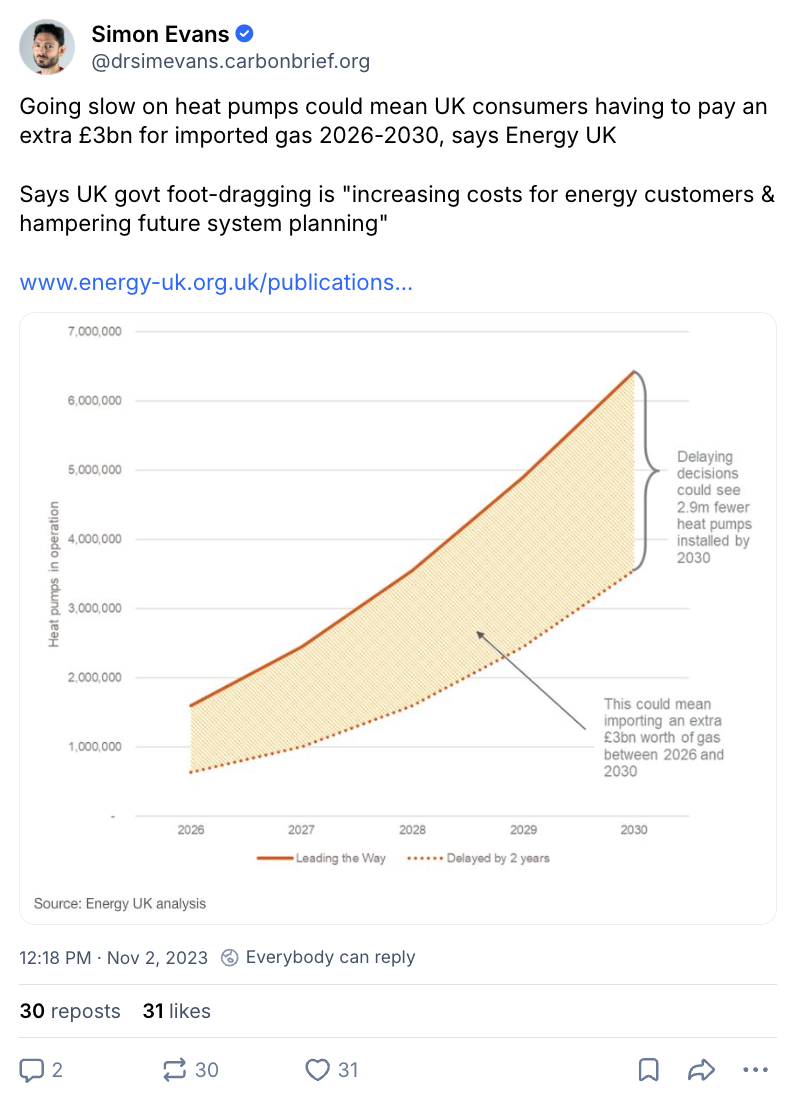
Since UK electricity supplies are now the cleanest they have ever been, heat pumps also cut the carbon emissions associated with staying warm by around 85%, relative to a gas boiler.
Heat pumps are, therefore, the "central" technology for cutting carbon emissions from buildings.
While heat pumps cost more to install than gas boilers, the UK government's recent "warm homes plan" says that they can help cut energy bills by "hundreds of pounds" per year.
Similarly, Nesta published analysis showing that a typical home could cut its annual energy bill by £280, if it replaces a gas boiler with a heat pump, as shown in the figure below.
Nesta and the government plan say that significantly larger savings are possible if heat pumps are combined with other clean-energy technologies, such as solar and batteries.
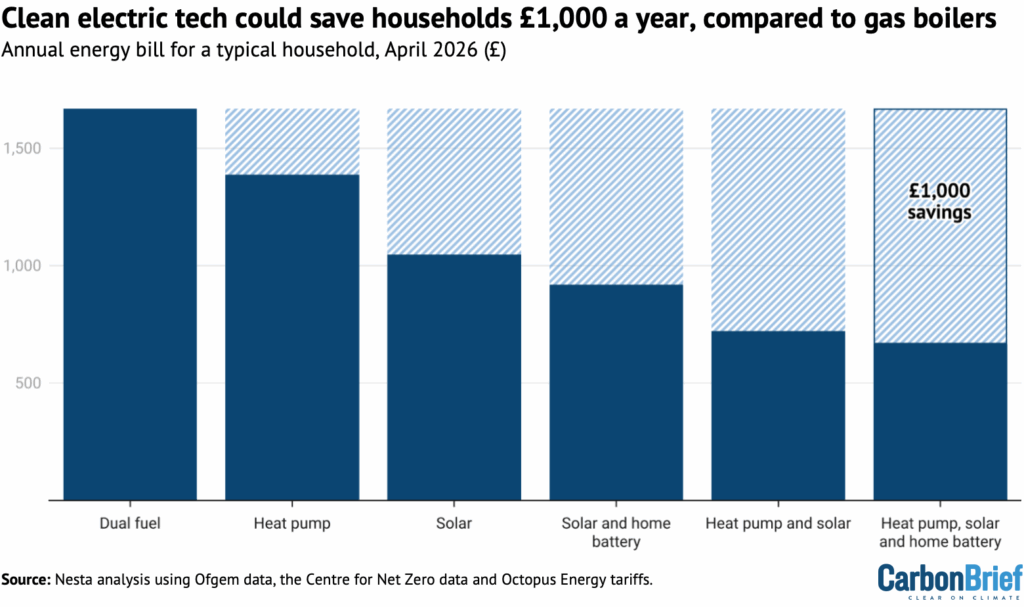 Annual energy bill savings (£) for a typical household from April 2026, by using different clean-energy technologies in comparison with a gas boiler. Source: Nesta analysis, using data from Ofgem, the Centre for Net Zero and an Octopus Energy tariff.
Both the government and Nesta's estimates of bill savings from switching to a heat pump rely on relatively conservative assumptions.
Specifically, the government assumes that a heat pump will deliver 2.8 units of heat for each unit of electricity, on average. This is known as the "seasonal coefficient of performance" (SCoP).
This figure is taken from the government-backed "electrification of heat" trial, which ran during 2020-2022 and showed that heat pumps are suitable for all building types in the UK.
(The Green Britain Foundation report and Vince's quotes in related coverage repeat a number of heat pump myths, such as the idea that they do not perform well in older properties and require high levels of insulation.)
Nesta assumes a slightly higher SCoP of 3.0, says Madeleine Gabriel, the organisation's director of sustainable future. (See below for more on what the latest data says about SCoP in recent installations.)
Both the government and Nesta assume that a home with a heat pump would disconnect from the gas grid, meaning that it would no longer need to pay the daily "standing charge" for gas. This currently amounts to a saving of around £130 per year.
Finally, they both consider the impact of a home with a heat pump using a "smart tariff", where the price of electricity varies according to the time of day.
Such tariffs are now widely available from a variety of energy suppliers and many have been designed specifically for homes that have a heat pump.
Such tariffs significantly reduce the average price for a unit of electricity. Government survey data suggests that around half of heat-pump owners already use such tariffs.
This is important because on the standard rates under the price cap set by energy regulator Ofgem, each unit of electricity costs more than four times as much as a unit of gas.
The ratio between electricity and gas prices is a key determinant of the size and potential for running-cost savings with a heat pump. Countries with a lower electricity-to-gas price ratio consistently see much higher rates of heat-pump adoption.
(Decisions taken by the UK government in its 2025 budget mean that the electricity-to-gas ratio will fall from April, but current forecasts suggest it will remain above four-to-one.)
In contrast, Vince's report assumes that gas boilers are 90% efficient, whereas data from real homes suggests 85% is more typical. It also assumes that homes with heat pumps remain on the gas grid, paying the standing charge, as well as using only a standard electricity tariff.
Prof Jan Rosenow, energy programme leader at the University of Oxford's Environmental Change Institute, tells Carbon Brief that Vince's report uses "worst-case assumptions". He says:
"This report cherry-picks assumptions to reach a predetermined conclusion. Most notably, it assumes a gas boiler efficiency of 90%, which is significantly higher than real-world performance…Taken together, the analysis combines a series of worst-case assumptions to present an unduly pessimistic picture."
Similarly, Gabriel tells Carbon Brief that Vince's report is based on "flimsy data". She explains:
What the latest data shows about bill savings"Dale Vince has drawn some very strong conclusions about heat pumps from quite flimsy data. Like Dale, we'd also like to see electricity prices come down relative to gas, but we estimate that, from April, even a moderately efficient heat pump on a standard tariff will be cheaper to run than a gas boiler. Paired with a time-of-use tariff, a heat pump could save £280 versus a boiler and adding solar panels and a battery could triple those savings."
The efficiency of heat-pump installations is another key factor in the potential bill savings they can deliver and, here, both the government and Vince's report take a conservative approach.
They rely on the "electrification of heat" trial data to use an efficiency (SCoP) of 2.8 for heat pumps. However, Rosenow says that recent evidence shows that "substantially higher efficiencies are routinely available", as shown in the figure below.
Detailed, real-time data on hundreds of heat pump systems around the UK is available via the website Heat Pump Monitor, where the average efficiency - a SCoP of 3.9 - is much higher.
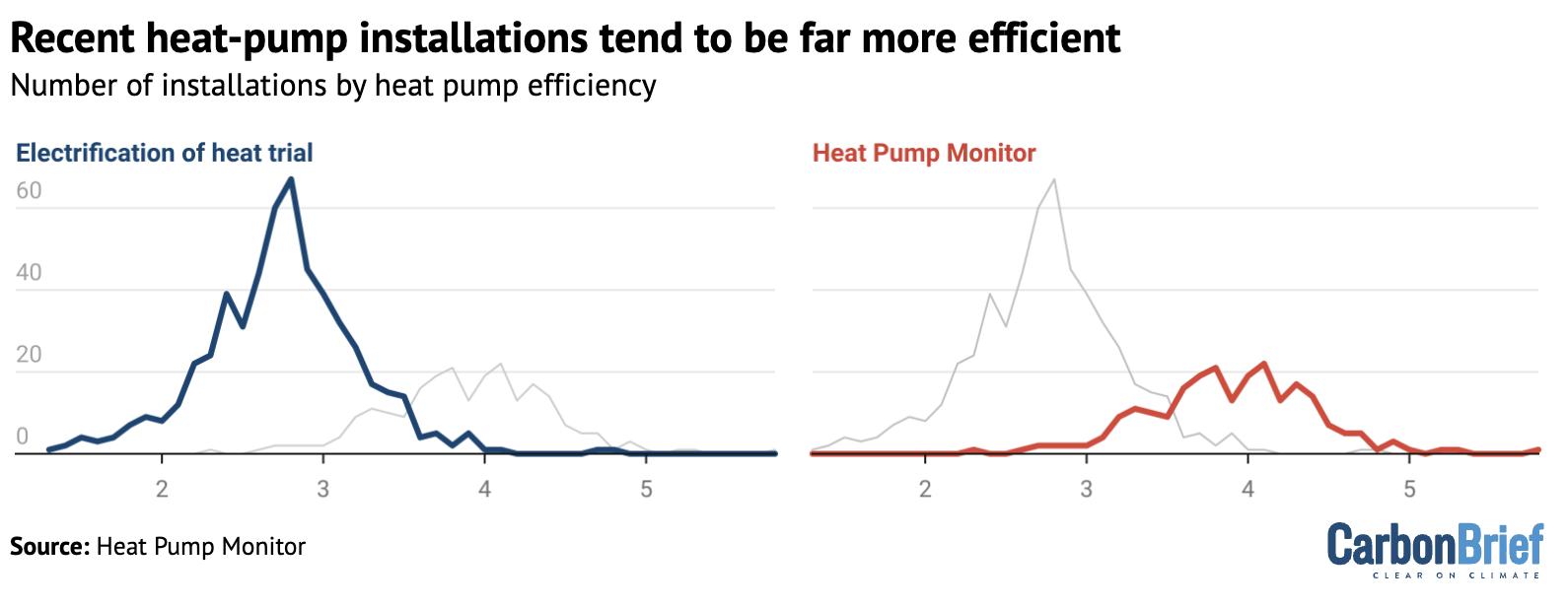 Number of installations by heat pump efficiency, in the electrification of heat trial (left) and on the website Heat Pump Monitor (right). An efficiency of three means that each unit of electricity delivers three units of heat, on average, across a year. Source: Heat Pump Monitor.
Homes with such efficient heat-pump installations would see even larger bill savings than suggested by the government and Nesta estimates.
Academic research suggests that there are simple and easy-to-implement reasons why these systems achieve much higher efficiency levels than in the electrification of heat trial.
Specifically, it shows that many of the systems in the trial have poor software settings, which means they do not operate as efficiently as their heat pump hardware is capable of doing.
The research suggests that heat pump installations in the UK have been getting more and more efficient over time, as engineers become increasingly familiar with the technology.
It indicates that recently installed heat pumps are 64% more efficient than those in early trials.
.cb-tweet{ width: 65%; box-shadow: 3px 3px 6px #d3d3d3; margin: auto; } .cb-tweet img{ border: solid 1.25px #333333; border-radius: 5px; } @media (max-width:650px){ .cb-tweet{ width:100%; } }
Notably, the Green Britain Foundation report only refers to the trial data from the electrification of heat study carried out in 2020-22 and the even earlier "renewable heat premium package" (RHPP). This makes a huge difference to the estimated running costs of a heat pump.
Carbon Brief analysis suggests that a typical household could cut its annual energy bills by nearly £200 with a heat pump - even on a standard electricity tariff - if the system has a SCoP of 3.9.
The savings would be even larger on a smart heat-pump tariff.
In contrast, based on the oldest efficiency figures mentioned in the Green Britain Foundation report, a heat pump could increase annual household bills by as much as £200 on a standard tariff.
To support its conclusions, the report also includes the results of a survey of 1,001 heat pump owners, which, among other things, is at odds with government survey data. The report says "66% of respondents report that their homes are more expensive to heat than the previous system".
There are several reasons to treat these findings with caution. The survey was carried out in July 2025 and some 45% of the heat pumps involved were installed between 2021-23.
This is a period during which energy prices surged as a result of Russia's invasion of Ukraine and the resulting global energy crisis. Energy bills remain elevated as a result of high gas prices.
The wording of the survey question asks if homes are "more or less expensive to heat than with your previous system" - but makes no mention of these price rises.
The question does not ask homeowners if their bills are higher today, with a heat pump, than they would have been with the household's previous heating system.
If respondents interpreted the question as asking whether their bills have gone up or down since their heat pump was installed, then their answers will be confounded by the rise in prices overall.
There are a number of other seemingly contradictory aspects of the survey that raise questions about its findings and the strong conclusions in the media coverage of the report.
For example, while only 15% of respondents say it is cheaper to heat their home with a heat pump, 49% say that one of the top three advantages of the system is saving money on energy bills.
In addition, 57% of respondents say they still have a boiler, even though 67% say they received government subsidies for their heat-pump installation. It is a requirement of the government's boiler upgrade scheme (BUS) grants that homeowners completely remove their boiler.
The government's own survey of BUS recipients finds that only 13% of respondents say their bills have gone up, whereas 37% say their bills have gone down, another 13% say they have stayed the same and 8% thought that it was too early to say.

Factcheck: North Sea gas is not 'four times cleaner' than LNG imports
Factchecks
|05.09.25

Factcheck: 16 misleading myths about solar power
Factchecks
|28.08.25
Factcheck: Trump's climate report includes more than 100 false or misleading claims
Factchecks
|14.08.25
Factcheck: Why expensive gas - not net-zero - is keeping UK electricity prices so high
Energy
|20.05.25
jQuery(document).ready(function() { jQuery('.block-related-articles-slider-block_3ba2ed77192775b000d94a528c6b6e15 .mh').matchHeight({ byRow: false }); });The post Factcheck: What it really costs to heat a home in the UK with a heat pump appeared first on Carbon Brief.
Experts: Will Chinese wind power help or hinder Europe's climate goals? [ 30-Jan-26 12:54pm ]The European Union and the UK are not on track to meet their 2030 offshore wind targets.
At the same time, Chinese wind-turbine manufacturers - who account for more than half of global wind-turbine capacity - are looking to grow their footprint in the European market, where their presence is currently tiny.
To some, the solution seems clear: allowing Chinese manufacturers to invest in Europe could boost competition, alleviate supply chain bottlenecks and lower costs - not to mention bring climate targets within reach.
But the possibility of a growing role for Chinese wind-turbine manufacturers in the European market has sparked heated debate among European policymakers and industry participants.
In 2024, three of China's top wind-turbine companies accounted for less than 1% of Europe's installed wind capacity.
But their focus is increasingly shifting to the continent, which some are concerned could hollow out the one clean-energy industry in which Europe is still competitive.
Competition between European and Chinese manufacturers would be "unfair", according to critics, because the discounts Chinese firms are offering seem to be at least in part due to state subsidies.
In a recent report published by the Oxford Institute for Energy Studies, we explore whether Chinese wind turbine companies are competitive in Europe and the real risks and benefits of Chinese participation in European offshore wind markets.
Our findings build on interviews with policymakers and industry experts, who have been granted anonymity to allow for candid discussion.
Cost advantages are less clear-cut than they appearChina ranks first for many of the global statistics for offshore wind. It has been by far the largest offshore wind market in the world for several years running.
China had 47 gigawatts (GW) of offshore wind installed, as of September 2025, more than all other countries combined. Furthermore, China also dominates several key fields critical to offshore wind globally, ranging from permanent magnets to offshore installation vessels.
This stands in firm contrast to Europe - where offshore development has experienced several years of slow growth - and the US, which faces an almost complete halt in new development under the Trump administration.
As happened before in solar and batteries, China's offshore wind industry scale-up has brought about stunning declines in installation costs.
However, this cost advantage is not as straightforward as these headline numbers would suggest. Despite the vast difference in capacity cost, the electricity produced by Chinese offshore wind farms is only 30% cheaper.
A key reason for this is the lower overall capacity factor of China's offshore wind sector, referring to the actual output of windfarms in China, compared to their maximum possible output. This can be partly explained by lower wind speeds at China's offshore sites, but could also relate to lower performance of Chinese turbines, as well as power transmission issues.
Lower production costs in China also would not necessarily translate to the European market, as Chinese cost advantages would be partly offset by transport costs, as well as higher insurance and financing premiums.
Greater localisation of turbine production could mitigate against some of these premiums, but would be offset by higher input costs in Europe.
Nonetheless, as more European governments add local content requirements, Chinese manufacturers have announced plans to set up European factories for turbine blades and towers, with core components shipped from China.
These factories could also be costlier to finance than those back home if financing for investments also comes from Europe, further reducing the cost advantage enjoyed by China's domestic offshore-energy infrastructure.
Issues beyond costs and bottlenecksEuropean offshore wind development plans have faced a number of hurdles, including rising costs, slow permitting processes, inefficient auction designs, lengthy grid connection times and limited availability of parts, port capacity and installation vessels.
The small number of players in Europe's offshore wind sector is seen as part of the problem, according to our interviews.
Currently, there are only three major wind turbine manufacturers in the European offshore wind market: Vestas, Siemens Gamesa and GE Vernova.
The latter announced in 2024 that it is downsizing its offshore wind business and has not taken new offshore orders, although it remains active in onshore wind projects. This reduces competition and could hinder efforts to bring down the cost of offshore wind projects.
Bottlenecks, inadequate industry capacity and lack of competition cannot in themselves explain the current European predicament. Developers we interviewed also note that offshore wind auctions with price caps and stringent contractual terms, designed with an expectation of falling costs, have also been part of the problem.
When these auctions have failed - as in the UK in 2023 and Germany in 2025 - this led to capacity contraction, higher costs and industry consolidation, which have only made it more difficult to reach policy targets, according to a report by European offshore wind company Ørsted.
Even with improved European auction design, it may take years for Europe's offshore wind installation numbers to recover. With or without Chinese participation, it will also take time to build domestic manufacturing bases and installation vessels.
Pathways to Chinese involvementMeanwhile, Chinese developers benefit from a large and growing domestic market in China. At the same time, however, intense competition on price and quality is spurring them to seek opportunities overseas.
Throughout Europe's supply chain, Chinese components and services are already helping alleviate shortages and bottlenecks.
Still, our report found there are divergent views on whether a greater Chinese presence in Europe's wind markets represents a threat or an opportunity - or both.
Policymakers are expected to continue to emphasise concerns about technology dependence and cybersecurity risks, leading to more domestic content requirements and increased scrutiny of Chinese deals.
The case of the 300 megawatt (MW) Luxcara project in Germany highlights the difficulties for Chinese market entry. Chinese manufacturer Mingyang was initially selected by the project owner in 2024, but was later replaced by Siemens-Gamesa, reportedly due to concerns about security and political risks.
The recent announcement of a deal between the UK's Octopus Energy and Mingyang may illustrate an emerging model. According to Octopus, Mingyang will supply the physical equipment, while Octopus will supply the software and manage the turbines.
Mingyang will still need access to operational data to support ongoing maintenance, but this can be provided periodically by Octopus without compromising security, the energy company told us.
Meanwhile, following policy signals such as the EU's new pricing mechanism for electric vehicle imports from China, it seems likely that policymakers will continue to encourage Chinese players to establish production bases in Europe and to require technology licensing or technology transfer in exchange for market access. This would amount to applying the Chinese industrial development model in Europe.
This could allow for technological learning in Europe. In China, the largest players have deployed advanced automated manufacturing lines, including robotic blade bonding, modular stator assembly and real-time quality monitoring - although this may have implications for job creation, a stated aim in Europe's clean-energy policy.
Despite pointing to some advantages, our interviews suggest that Chinese participation in Europe's offshore wind market is not a panacea.
Its low costs are unlikely to be transferrable to the European context. But greater Chinese participation in auctions and in manufacturing, with local content requirements and other guardrails, could help spur competition in Europe.
At the same time, our report suggests that the focus on China distracts from deeper issues. Without a growing domestic market, it may be difficult for European players to reduce manufacturing costs and upgrade production, with or without Chinese partners.
Ultimately, industry participants tell us that the greatest determinant of success in Europe's offshore wind market will be consistent policy support, rather than a decision to allow - or to block - Chinese participation.
Explainer: Why gas plays a minimal role in China's climate strategy
China energy
|22.01.26
Experts: What to expect from China on energy and climate action in 2026
China energy
|16.01.26
Analysis: Coal power drops in China and India for first time in 52 years after clean-energy records
China energy
|13.01.26
Q&A: Five key climate questions for China's next 'five-year plan'
China energy
|11.12.25
jQuery(document).ready(function() { jQuery('.block-related-articles-slider-block_884cb99f440fac162005e6c3b18c806e .mh').matchHeight({ byRow: false }); });The post Experts: Will Chinese wind power help or hinder Europe's climate goals? appeared first on Carbon Brief.
Met Office: A review of the UK's climate in 2025 [ 30-Jan-26 12:23pm ]The UK's climate saw a record-breaking 2025, with the year being both the warmest and sunniest seen since observations began.
The year 2025 has joined 2024, 2023, 2022 and 2014 in the UK's top-five warmest years.
In this review, we take a look back at the UK's climate in 2025 and place the record-breaking year in the context of human-caused climate change. We find:
- It was the warmest and sunniest year on record. January and September were the only months that were cooler than average.
- A Met Office attribution study estimates that 2025's average temperature would have been exceptionally unlikely in pre-industrial times - but could now occur, on average, every three years.
- Spring was the warmest on record, breaking a record set in 2024.
- Spring was not only the sunniest on record, but the fourth-sunniest season ever recorded, after the summers of 1976, 1996 and 1911.
- It was the warmest summer on record. The summer temperature record was made around 70 times more likely due to human-induced climate change.
- The persistent high-pressure systems in spring and summer, which contributed to the warm and sunny conditions, also resulted in an extended dry spell - including the driest spring since 1974.
- Wetter conditions at the end of the year alleviated some of the rain shortfall. The year concluded with 90% of average annual rainfall.
- Storm Éowyn in late January was the most powerful wind storm in over a decade and the most severe storm in Northern Ireland since 1998.
- Storm Floris in early August was not unprecedented for a storm, but was one of the most severe wind storms to affect Scotland during the summer.
- Storm Amy in early October hit north-western parts of the UK, with heavy rain falling widely, resulting in the wettest day of the year for the UK overall.
(See our previous annual analysis for 2024, 2023, 2022, 2021, 2020, 2019 and 2018.)
The year in summaryThe Met Office relies on the long-running HadUK-Grid dataset to place recent UK weather and climate into its historical context. The gridded, geographically complete dataset combines observational data for monthly temperature since 1884, rainfall since 1836 and sunshine since 1910.
Unless stated otherwise, the rankings of events and statements (such as "warmest on record") in this article relate to the HadUK-Grid series.
The "climate anomaly" maps below show the difference between the average temperature (left), rainfall total (middle) and sunshine duration (right) between 2025 and the 1991-2020 period. In other words, they show how much warmer, cooler, wetter, drier, sunnier or cloudier the year was than average for each county of the UK.
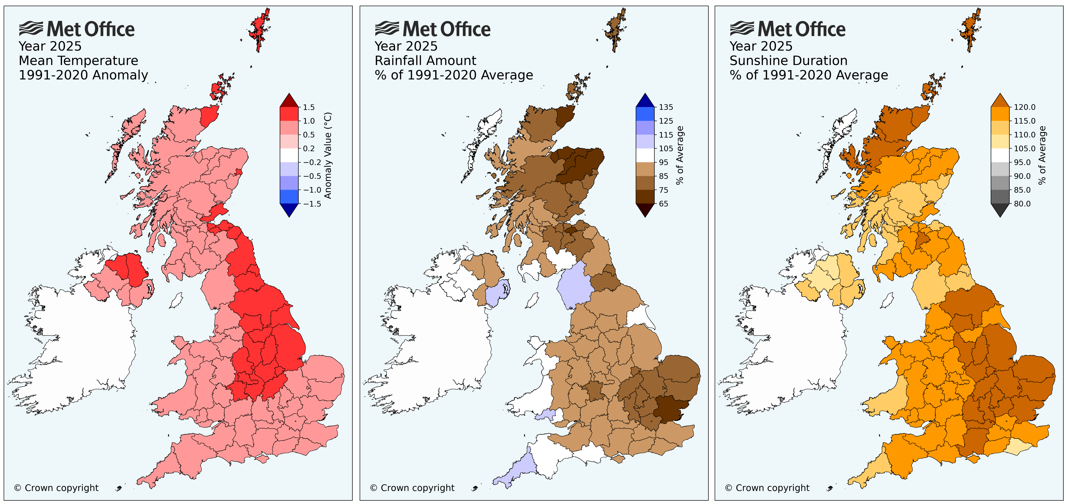 Maps showing anomalies in 2025 relative to a 1991-2020 reference period for temperature (C), precipitation (%) and sunshine (%). The darker shading indicates a greater departure from average. Credit: Met Office
The maps show that the whole country was warmer than average, with central and north-east England, parts of Northern Ireland and the tip of north-west Scotland, Orkney and Shetland seeing the greatest change.
The UK overall had 90% of average rainfall. The driest regions relative to average were around Essex, Moray and Aberdeenshire, which received less than 75% of normal annual rainfall.
In contrast, some western counties were slightly wetter than average - including Cornwall (110%) and Cumbria (107%).
Sunshine was above average across the UK, with eastern England and north Scotland exceeding 120% of the average.
AttributionThe UK's absolute temperature averaged at 10.09C in 2025. This follows 2022 (at 10.03C) as the second time that the annual average temperature has exceeded 10C.
In our analysis of the UK's climate in 2022 for Carbon Brief, we reported on a Met Office attribution study that found that human-caused climate change had increased the likelihood of UK annual absolute temperature averaging above 10C by a factor 160.
That study concluded that exceeding 10C - while unprecedented in the historical observational record - would become increasingly common and would likely occur every three-to-four years.
Three years on from that analysis and the 10C threshold has been breached for a second time - and an updated attribution analysis has been produced exploring the likelihood of a return of temperatures above the 10.09C recorded in 2025.
The study, which uses the same methodology as the 2022 paper, finds that UK annual mean temperatures above 10.09C are estimated to occur approximately every three years in the current climate. In contrast, they would have occurred around every 780 years in pre-industrial times.
Human-caused climate change has, therefore, increased the probability of average temperatures in excess of 10.09C by a factor of 260.
These results show that 2025's record-breaking annual temperature - while unprecedented in the historical observational record - should be considered fairly normal in the current climate.
Climate projections indicate that, by the later part of the 21st century, a year like 2025 could be a relatively cool year.
The figure below compares observations of UK annual average temperatures (black line) - relative to the long-term average - to climate model simulations that include (red/purple) or exclude (green) human-caused emissions of greenhouse gases and land-use change.
The green and red curves start to diverge from around the 1980s, suggesting that human influence is indeed the dominant factor in the warming trend. The shaded range of the simulations show that in our current and future climate, much warmer years than 2025 are plausible.
Colder years are also still possible, but it is much less likely that we would experience a cold year like 2010 - and exceptionally unlikely for a year to be in the top-10 coldest years for the UK. The most recent year to feature in the top-10 coldest years was 1963.
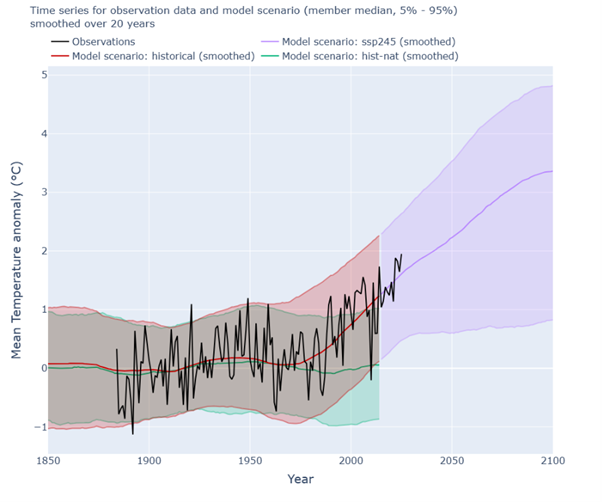 Timeseries of the UK annual mean temperature anomaly (w.r.t. 1901 - 1930). Observational data from HadUK-Grid (black). Simulations from the CMIP6 historical simulation including natural and human-caused drivers (red), SSP2-4.5 projections of future climate based on a "medium" emissions scenario (purple) and "hist-nat" simulations that include only natural drivers of climate such as solar and volcanic activity (green). Simulation data is represented as median values and filled 5-95th percentile ranges explored by members of the multi-model ensemble. Percentiles of simulation data are smoothed with a rolling window of 20 years, with historical and SSP2-4.5 combined into one continuous series. Observed data runs from 1884-2025. Credit: Met Office
Warmer, wetter, sunnier
Timeseries of the UK annual mean temperature anomaly (w.r.t. 1901 - 1930). Observational data from HadUK-Grid (black). Simulations from the CMIP6 historical simulation including natural and human-caused drivers (red), SSP2-4.5 projections of future climate based on a "medium" emissions scenario (purple) and "hist-nat" simulations that include only natural drivers of climate such as solar and volcanic activity (green). Simulation data is represented as median values and filled 5-95th percentile ranges explored by members of the multi-model ensemble. Percentiles of simulation data are smoothed with a rolling window of 20 years, with historical and SSP2-4.5 combined into one continuous series. Observed data runs from 1884-2025. Credit: Met Office
Warmer, wetter, sunnier
Four of the UK's last five years all appear in the top-five warmest years since 1884.
The Central England Temperature (CET) series is the longest continuous instrumental climate record in the world, dating back to 1659. Covering a region roughly enclosed by Lancashire, London and Bristol, it does not represent the whole of the UK. However, when averaged across a year and analysed across centuries, it does provide a multi-century perspective that is representative of climate variations and changes that impacted the UK.
As with the HadUK-Grid temperature record, the CET series also identifies 2025 as the warmest year on record. The longer-running temperature series identifies the same five years - in the same order - as the warmest on record. This is shown in the table below.
YearUK (from HadUK-Grid)Central England Temperature 202510.09C11.23C 202210.03C11.18C 20239.97C11.13C 20149.88C11.04C 20249.79C10.96CThe graph below of the CET series shows that temperatures recorded in recent years are well outside the range of variability recorded over more than 300 years.
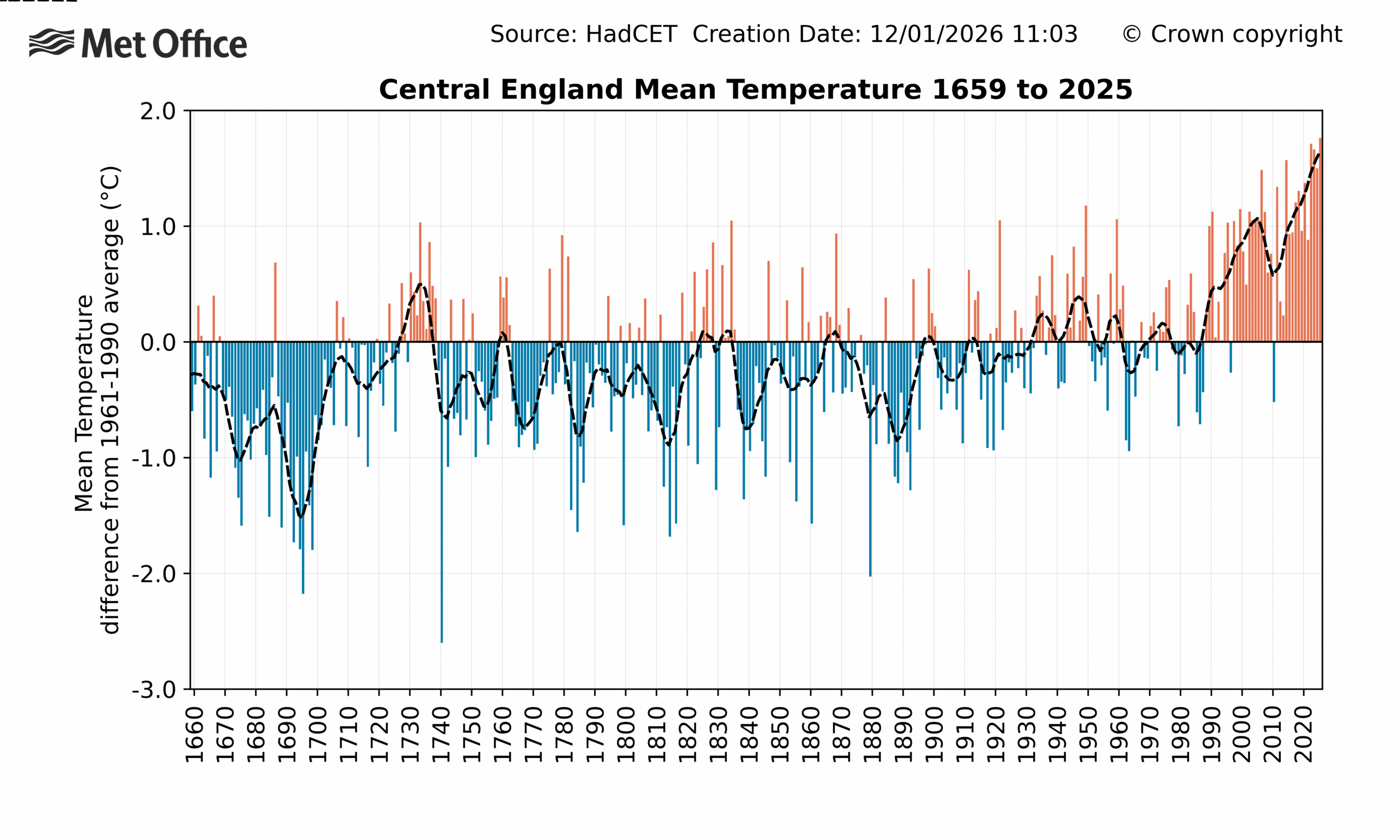 Average temperature anomalies (relative to a 1961-90 average) for each year in the CET series from 1659 to 2025. Colours show years that are above (red) or below (blue) average. The dashed line is a smoothed series to show the decadal variations and trend. Credit: Met Office
However, the UK is not only warming, it is also getting wetter and sunnier. The year 2025 was relatively dry, recording 90% of average rainfall. This made it the driest year recorded since 2010 and put it in contrast to relatively wet years in 2023 and 2024.
The longer-term trend can be seen in the figure below, which shows that 2025 was relatively dry compared to recent decades, but not exceptional in the longer-term historical context.
The last time the UK had a year in the top-10 driest was in 1955, whereas all five of the top-10 wettest years have occurred this millennium. The wettest year on record still stands as 1872.
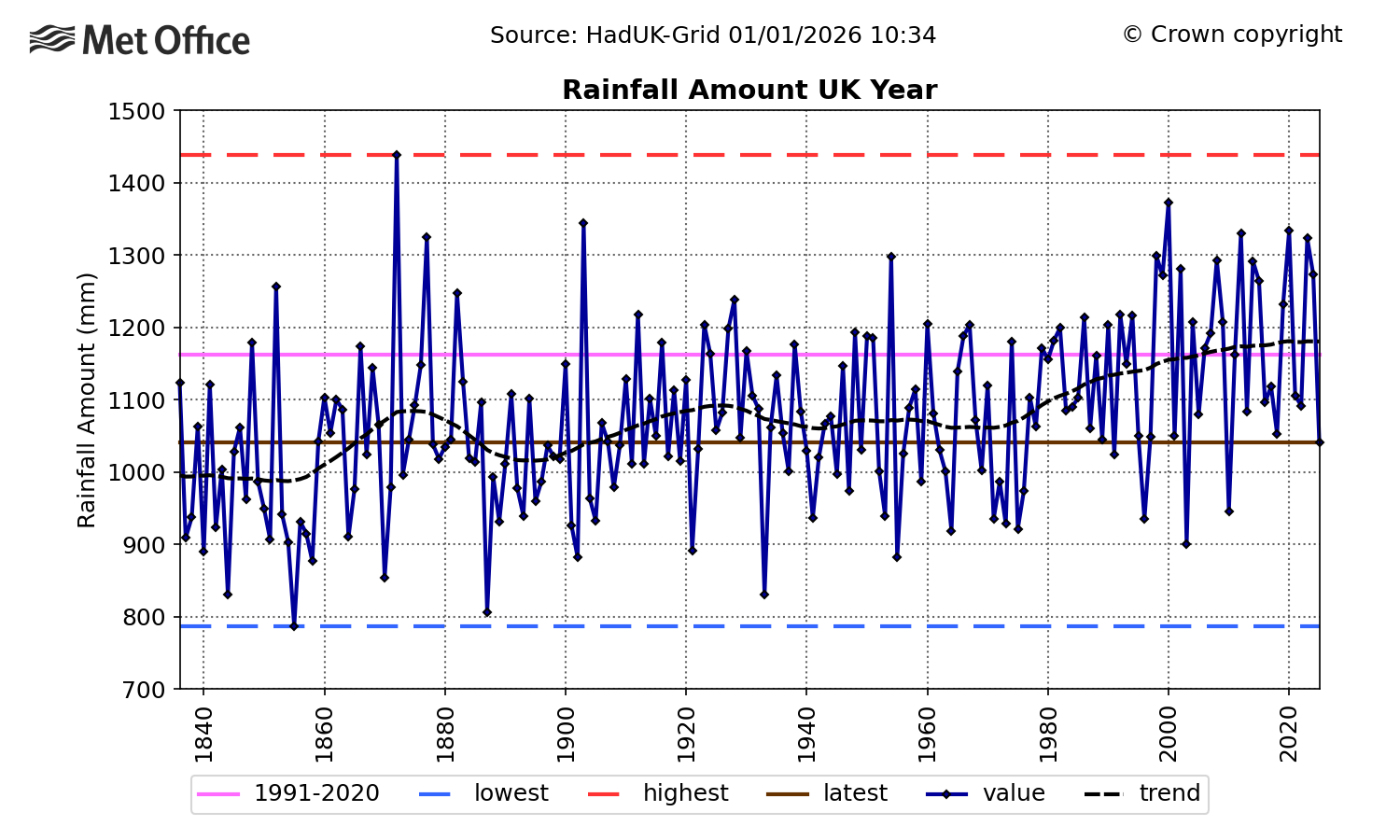 Timeseries of UK total rainfall from 1836 to 2025. The trend is represented by a black dashed line, the 1991-2020 average is shown in pink and the highest and lowest values in the series are shown by the red and blue dashed lines, respectively. The 2025 value is represented by the horizontal brown line. Credit: Met Office
The drivers of annual rainfall trends are more complex than for temperature.
A significant factor in rainfall trends is a warming atmosphere's ability to hold more moisture. However, this does not completely account for recent increases in rainfall.
Large-scale atmospheric circulation patterns - particularly features such as the jet stream and associated storm tracks across the North Atlantic - also play a crucial role. These are influenced by annual and decadal fluctuations in the Earth's climate, as well as human-caused climate change.
UK annual sunshine totals have also been rising since the 1980s, with 2025 setting a record by a considerable margin. This is in sharp contrast to 2024, which was the dullest year since 1998. This is shown in the graph below, where the dotted line shows the underlying long-term trend, with year-to-year variations removed.
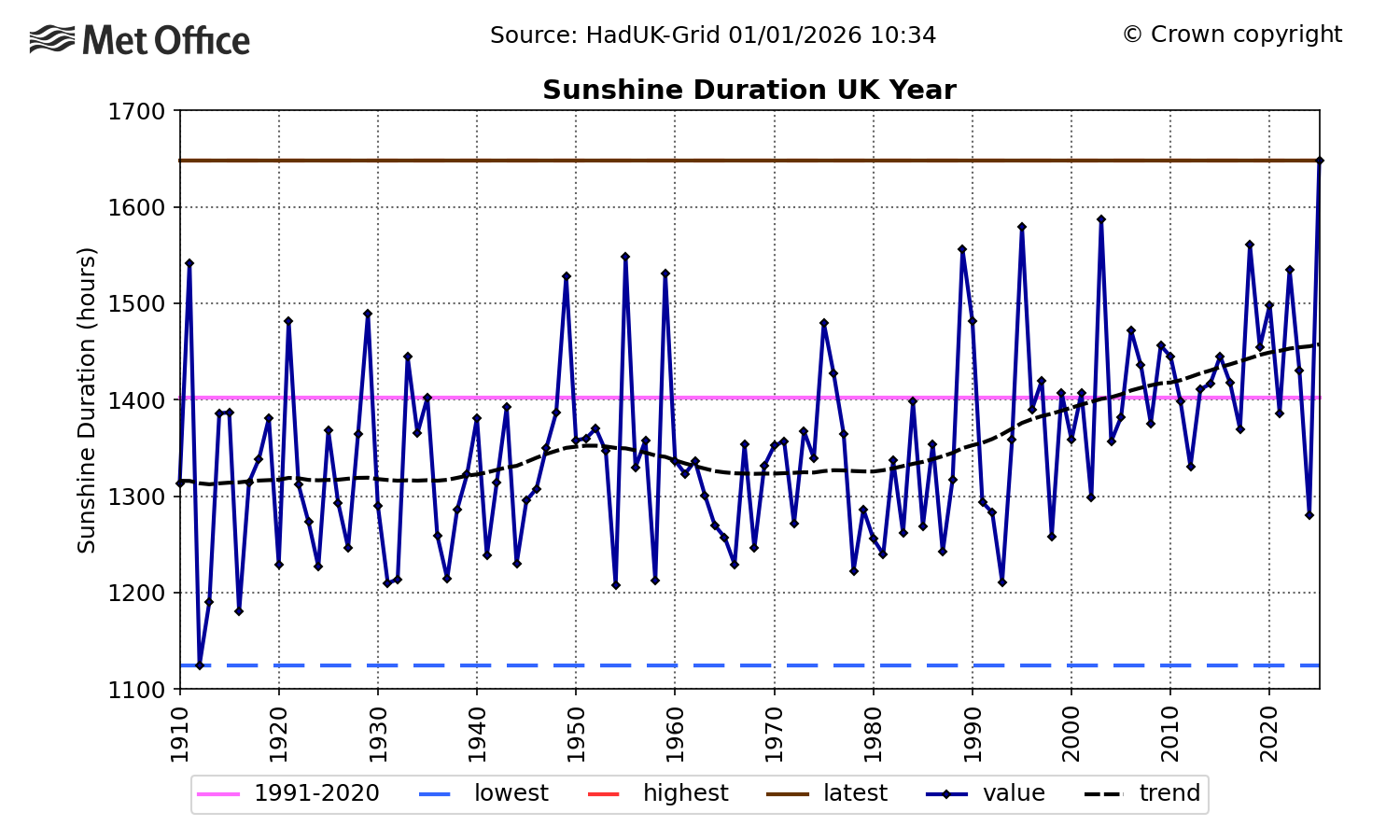 Timeseries of UK total annual sunshine hours from 1910 to 2025. The trend is represented by a black dashed line, the 1991-2020 average is shown in pink and the highest and lowest values in the series are shown by the red and blue dashed lines, respectively. The 2025 value is represented by the horizontal brown line (which covers the red line for the highest in the record). Credit: Met Office
The cause of the sunshine trend is also uncertain, with both natural climate variability and human activity (through reduced regional air pollution caused by a reduction in aerosol emissions) potential contributors. Climate projections do not provide any strong evidence for how sunshine trends might develop.
The year in stormsThe Met Office has been naming storms since 2015. Each storm-naming period runs from September to August.
(For more on storm naming in the UK, read Carbon Brief's explainer.)
The criteria for storm naming has changed over time. It accounts for meteorological conditions, as well as the potential severity of impacts. As a result, comparisons between years can indicate relative levels of storm activity, but should not be done on a like-for-like basis.
Between the 2015-16 and 2024-25 storm seasons, there have been, on average, 7.7 named storms each year, with a high of 12 recorded in the 2023-24 season and a low of four over 2022-23. This is shown in the line chart below.
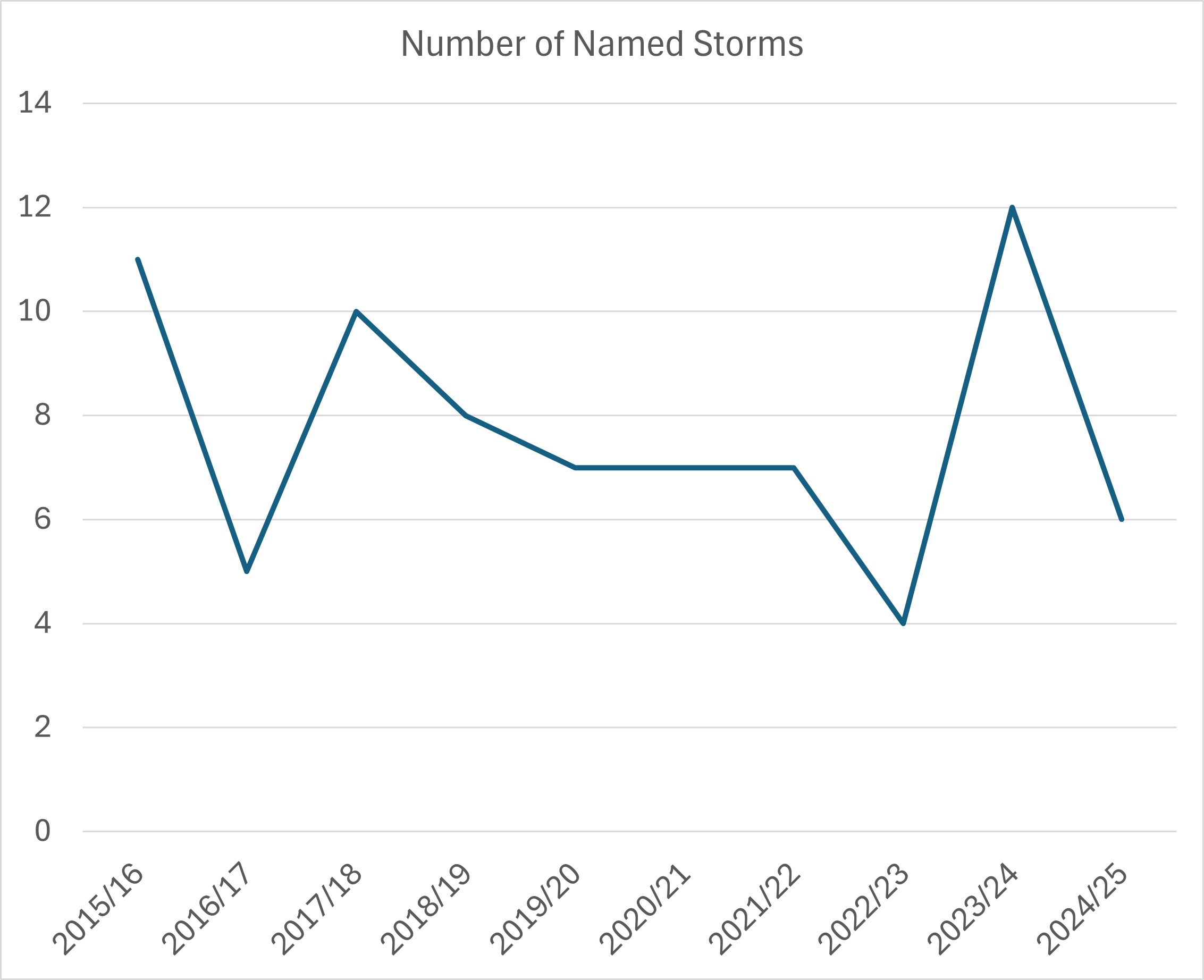 Timeseries of the number of named storms for each storm-naming period (which runs from September to August) since 2015. It includes storms named by other Met Services that impacted the UK. Source: Met Office
By this measure, 2025 was not exceptional with six named storms - two from the 2024-25 season and four from 2025-26. These are listed in the table below.
Storm nameDate(s) of impact in UKMaximum wind gustNotable features 2024-25 names Éowyn24 January87Kt (100mph), Drumalbin, LanarkshireMost powerful storm for over a decade Floris4-5 August71Kt (82mph) at Wick Airport, CaithnessEqualled Scotland's August gust speed record 2025-26 names Amy3-4 October83Kt (96mph) at Tiree, ArgyllSignificant disruption from flooding. Benjamin (named by Meteo France)22-23 October52Kt (60mph) Needles, Isle Of WightStrongest winds affected northern France Claudia (named by AEMET, Spain)14 November59Kt (68mph) Warcop Range, CumbriaExtensive heavy rainfall across England and Wales Bram8-10 December73Kt (84mph), Capel Curig, ConwyFlooding from heavy rainfall on saturated ground. Credit: Met Office storm centreStorm Éowyn in January had the most severe winds of any storm in 2025. The Met Office issued a red warning for wind across Northern Ireland and the south-west and central belt of Scotland. An amber warning was issued for the northern half of the UK. At the peak of the storm, power outages were reported at around 1m homes.
Storms from October to December were notable for bringing some persistent and heavy rain during a period of wetter weather, in contrast to the extended dry spell earlier in the year.
Weather through the yearThe charts below show the progression of temperature and rainfall through the course of 2025.
The plot below charts average daily temperature over the course of 2025, with orange shading showing warmer-than-average conditions. Overall, the year had 244 days - 66% of the total - where temperatures were above average.
On the other hand, cold spells - indicated by blue shading - were generally short-lived and not very severe, with the exception of events in early January and November.
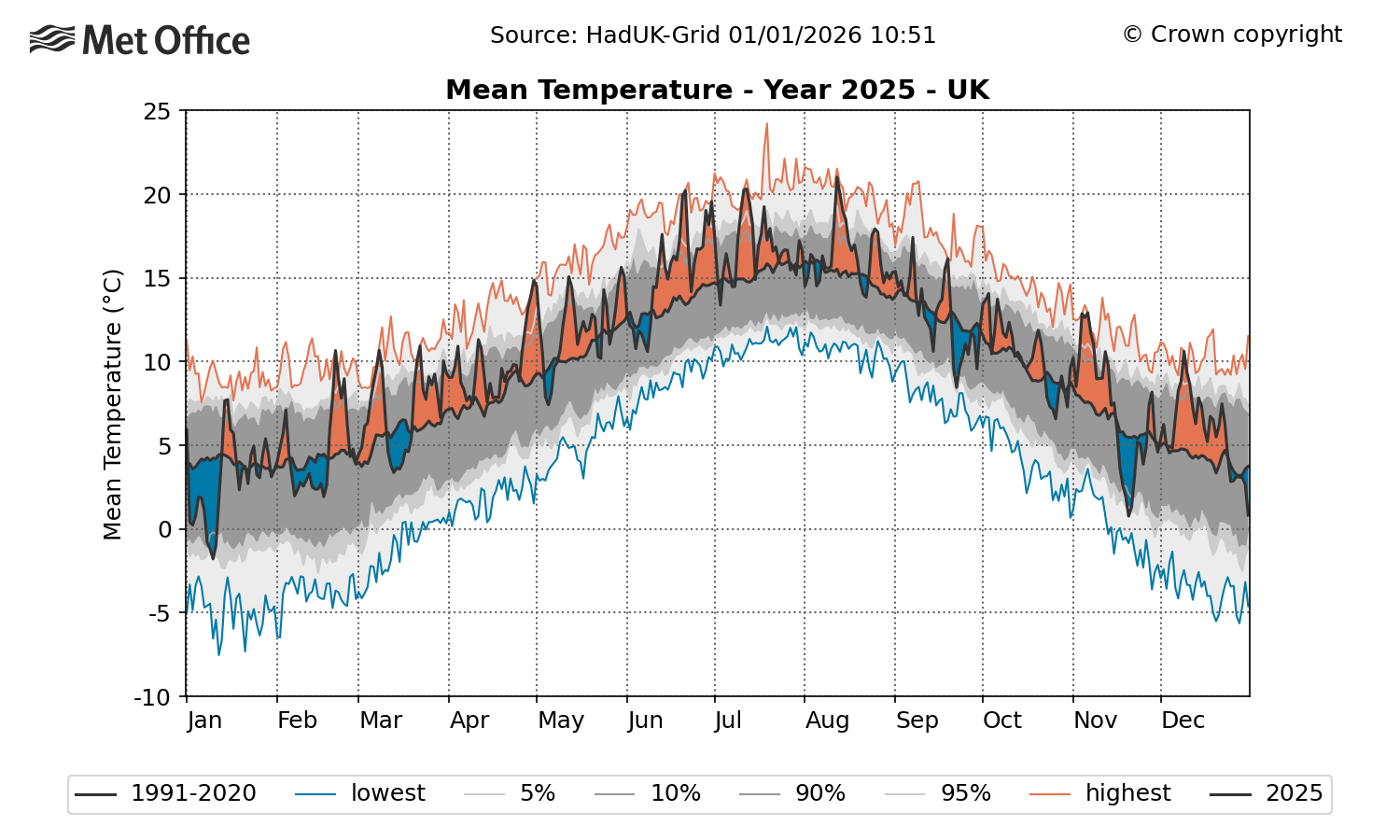 Timeseries of daily UK average temperature during 2025. Orange shading indicates periods of above-average temperature and blue shading below average. The solid black line is the 1991-2020 reference period by day of the year. The grey shading reflects the 5th, 10th, 90th and 95th percentiles of the temperature distribution and the red and blue lines are the highest and lowest values for each day of the year, based on a dataset of daily data from 1960. Credit: Met Office
Fifty-one days in 2025 were in the top 5% warmest for the time of year in the historical record, but only one day - 20 November - was in the 5% of coldest.
The significant number of warmer days and absence of cool ones helps build a picture of how 2025 was the warmest year overall.
The highest daily maximum temperature recorded in the year was 35.8C at Faversham, Kent on 1 July during an early summer heatwave. The lowest minimum temperature was -18.9C, recorded at Altnaharra, Sutherland on 11 January.
A maximum annual temperature of 35.8C is not an exceptional high for recent years - especially when compared with 2022's record of 40.3C. However it would have been a rare event in the 20th century, when just three years - 1932 (36.1C), 1976 (35.9C) and 1990 (37.1C) - saw a higher temperature.
In the 21st century, six years have seen temperatures above 35.8C - 2003, 2006, 2015, 2019, 2020, and 2022.
The plot below illustrates 2025's below-average rainfall accumulation.
The brown shading - which represents the deficit in rainfall at that point of the year compared to the 1991-2020 average - highlights how rainfall totals were particularly low during the dry spring and summer period. The lower blue line shows how rainfall accumulation in 2025 came close to - but did not quite reach - a record low in late May and late August.
Wetter conditions in the autumn saw rainfall totals recover a little to reach 90% at the end of the year - which is below average, but not exceptional. As noted previously, there were regional variations.
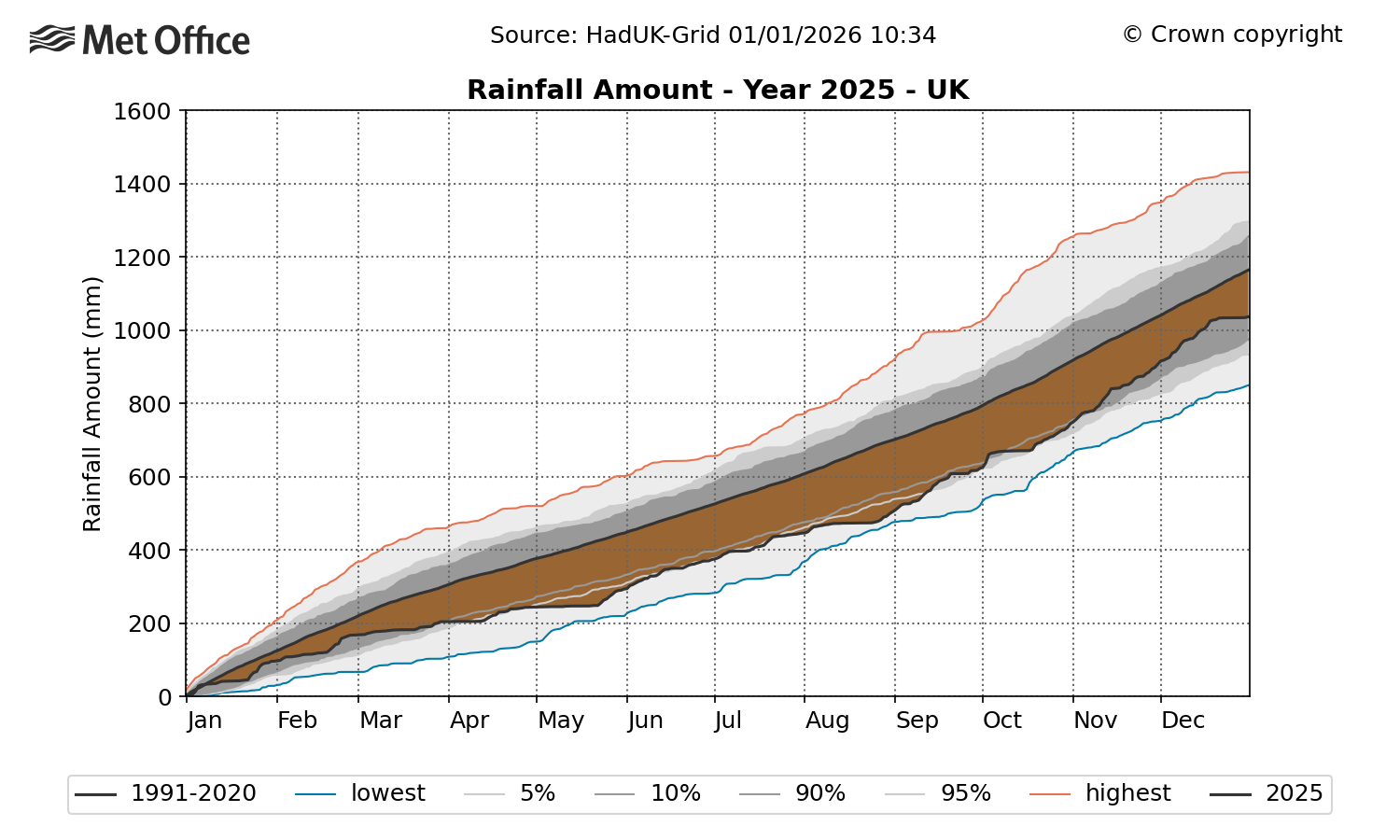 Timeseries showing rainfall accumulation through 2025 for the UK. Brown shading represents a deficit in rainfall compared to average for that point in the year, and blue shading is an excess of rainfall compared to average. The solid line represents the 1991-2020 average and grey shading shows the 5th, 10th, 90th and 95th percentiles of the distribution. The blue and red lines represent the lowest and highest values based on a dataset of daily rainfall from 1891 to 2022. Credit: Met Office
Winter
Timeseries showing rainfall accumulation through 2025 for the UK. Brown shading represents a deficit in rainfall compared to average for that point in the year, and blue shading is an excess of rainfall compared to average. The solid line represents the 1991-2020 average and grey shading shows the 5th, 10th, 90th and 95th percentiles of the distribution. The blue and red lines represent the lowest and highest values based on a dataset of daily rainfall from 1891 to 2022. Credit: Met Office
Winter
In climate terms, the UK winter spans the calendar months of December, January and February.
The winter of 2024-25 was slightly warmer than average, but not exceptional, with an average temperature of 4.62C. This is 0.53C above the 1991-2020 average. The winter months had 89% of average rainfall and 94% of average sunshine.
New Year's Day saw significant flooding that affected parts of Lancashire and the south side of Manchester. The River Mersey reached record levels in the wake of two days of heavy, persistent rain.
The coldest spell of 2025 occurred in early January, with significant snowfall in some regions.
Storm Éowyn and heavy rain at the end of January were the winter's most impactful events, bringing high winds and flooding that resulted in considerable disruption.
SpringSpring - which encompasses the months of March, April and May - was the warmest and sunniest on record, as well as the sixth driest.
The record high temperature came only one year after the previous record set in 2024, continuing a trend of increasing spring time temperature for the UK.
(A Met Office attribution analysis which explored the record-breaking temperatures of May 2024 showed that the temperatures were caused by a combination of a marine heatwave which persisted through May and into June and human-induced climate change.)
The timeseries below shows average spring temperature in the UK over 1884-2025. It shows a significant warming trend since the 1970s, with temperatures in 2024 and 2025 sitting well outside the range of variability observed in the late 19th and 20th centuries.
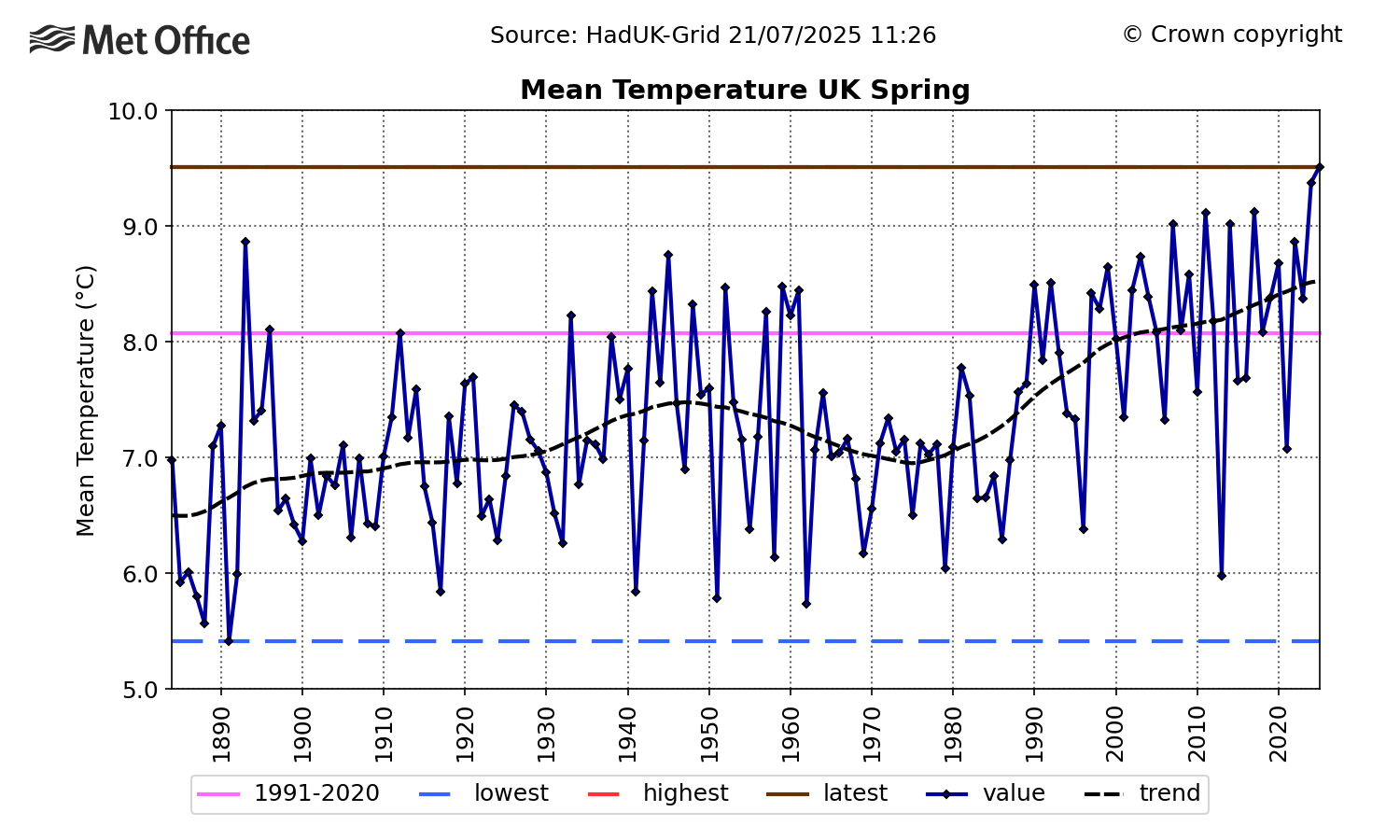 Timeseries of spring average absolute temperature for the UK over 1884-2025. The trend is represented by a black dashed line, the 1991-2020 average is shown in pink and the highest and lowest values in the series are shown by the red and blue dashed lines, respectively. The 2025 value is represented by the horizontal brown line (which covers the red line for the highest in the record). Credit: Met Office
The UK's changing climate is having an impact on the natural cycles of many species and habitats. Citizen science initiatives have highlighted how "signs of spring" - for instance, the first flowering or first nest-building - occur increasingly early in the year.
SummerWarm, sunny and dry conditions persisted into the summer season, drying out soils.
There were four heatwave events, which impacted almost all regions of the UK. Two of these events took place in June.
A marine heatwave also took place, with sea surface temperatures of 1.5-3C above the 1983-2012 average in the Celtic Sea, English Channel and southern North Sea.
An attribution study by the World Weather Attribution service estimated that human-caused climate change had made exceeding June heatwave thresholds around 10 times more likely. The research also found that one of the June heatwaves had been made 2-4C more intense as a result of human influence.
The five warmest summers recorded in the UK to date are 2025 (16.10C), 2018 (15.76C), 2006 (15.75C), 2003 (15.74C) and 2022 (15.71C).
Met Office analysis estimates that in a pre-industrial climate, a summer like 2025 would be expected to occur every 340 years. However, in the current climate, we could expect to see these sorts of summers roughly once every five years.
The study also shows that the UK could plausibly experience much hotter summers in the current and future climate. Events that would have been seen as extremes in the past are becoming more common.
A Met Office attribution study published in 2019 estimated that the then record-breaking summer of 2018 had a statistical return period of approximately eight-to-nine years. The summer of 2025 has broken that record in seven years, consistent with these previous findings.
The science is clear that UK summers are becoming warmer and extreme heat events are becoming more common. This could mean more significant impacts on people, infrastructure and the environment - both now and in the future.
The map below plots the number of heatwaves that took place in June, July and August across the UK. It shows how a significant number of regions across saw more three (green shading) or four (pink shading) over the summer months.
 Map showing the number of heatwaves by location during the summer of 2025. Source: Met Office
Autumn
Map showing the number of heatwaves by location during the summer of 2025. Source: Met Office
Autumn
Autumn and the month of December were marked with unsettled weather, with mild and wet conditions over the four-month period.
The season was warmer and wetter than average. Northern Ireland had its third-wettest autumn on record, Northern England its fifth wettest and Wales its 10th wettest.
Storm Amy set a record for highest gust speed for a storm in October, with 80Kt (92mph) recorded at Magilligan, County Londonderry.
Other major storms were notable for heavy rainfall that caused flooding. Storm Claudia brought heavy rainfall to central England and Wales in mid-November, which fell on already saturated ground.
The second half of November saw snow cause across the North York Moors during a cold northerly spell which saw some hard frosts. This was followed by generally mild and unsettled conditions until late December, when strong easterly winds brought more low temperatures and hard frosts.
The UK chalked up a number of significant climate records in 2025, particularly for high temperatures. This aligns with the well-established warming trend that is the result of human-caused climate change.
Climate attribution studies continue to provide further evidence that human factors are increasing the likelihood and severity of UK climate extremes.
Many of 2025's records will not stand for long. There is a high chance they will be broken again in the near future as the climate continues to warm.
Experts: Will Chinese wind power help or hinder Europe's climate goals?
China Policy
|30.01.26

Guest post: 10 key climate science 'insights' from 2025
Guest posts
|22.01.26
Guest post: How to steer EVs towards the road of 'mass adoption'
Guest posts
|18.12.25

Guest post: How the Greenland ice sheet fared in 2025
Guest posts
|15.12.25
jQuery(document).ready(function() { jQuery('.block-related-articles-slider-block_a619db7fe62d11aff02016cd262b69bc .mh').matchHeight({ byRow: false }); });The post Met Office: A review of the UK's climate in 2025 appeared first on Carbon Brief.
Climate change and La Niña made 'devastating' southern African floods more intense [ 29-Jan-26 4:00am ]"Exceptionally heavy" rainfall that led to deadly flooding across southern Africa in recent weeks was made more intense by a combination of climate change and La Niña.
This is according to a rapid attribution study by the World Weather Attribution service.
From late December 2025 to early January, south-eastern Africa was hit hard by intense downpours that resulted in more than a year's worth of rain falling in some areas in just a few days, according to the study.
This led to severe flooding that left at least 200 people dead, thousands sheltering in temporary accommodation and tens of thousands of hectares of farmland waterlogged.
The analysis finds that periods of intense rainfall over southern Africa have become 40% more severe since pre-industrial times, according to observations.
The authors say they were unable to calculate how much of this increase was driven specifically by climate change, due to limitations in how climate models simulate African rainfall.
However, the study notes that the researchers "have confidence that climate change has increased both the likelihood and the intensity" of the rainfall.
The authors also note that the El Niño-Southern Oscillation phenomenon played a role in the "devastating" flooding, estimating that a La Niña event made the rainfall around five times more likely.
Major disruptionThe heavy rainfall started on 26 December last year and intensified from early January. The most-extreme rainfall took place between 10 and 19 January.
The countries most affected by the floods, and analysed by the study, are Eswatini, Mozambique, South Africa and Zimbabwe, with some areas receiving up to 200mm of rain, according to the study authors.
Study author Bernardino Nhantumbo - a researcher at Mozambique's National Institute of Meteorology - told a press briefing that in just two or three days, some areas recorded the amount of rainfall that is "expected for the whole rainy season".
The map below shows the areas most affected by intense rainfall over 10-19 January. Darker blue indicates a greater accumulation of rainfall, while light green indicates less rainfall. The pink box shows the study area.
 Most affected areas by large floods in southern Africa. Darker blue indicates a greater accumulation of rainfall, while light green indicates less rainfall. The pink box shows the study area. Source: WWA (2026).
In Mozambique, the floods damaged nearly 5,000km of roads, which has hindered the transport of goods and affected pharmaceutical supply chains, the study says. In Zimbabwe, bridges, roads and infrastructure were "significantly damaged or destroyed".
More than 75,000 people have been affected by the floods in Mozambique, according to the study. BBC News reported the floods were the worst seen "in a generation" in the country.
Dr Izidine Pinto, a climate scientist from Mozambique currently working at the Royal Netherlands Meteorological Institute, told a press briefing that the country was particularly affected because it "lies downstream of major river basins".
The flooding prompted Mozambique's education minister to consider rescheduling the start of the academic year, according to Channel Africa.
In South Africa, the country's weather service said that areas receiving more than 50mm of rain over 11-13 January were "widespread", with some places seeing up to 200mm.
South Africa's Kruger National Park - the largest national park in South Africa - was severely damaged by floods and temporarily closed after several rivers burst their banks, reported TimesLIVE.
The South African news outlet quoted environment minister Willie Aucamp as saying: "The indication is that it will take as long as five years to repair all the bridges and roads and other infrastructure."
Extreme rainfallThe peak of the rainy season in southern Africa falls between December and February.
To put the extreme rainfall into its historical context and determine how unlikely it was, the authors analysed a timeseries of 10-day maximum rainfall data for the December-February season.
They find that in today's climate, extreme rainfall events of the scale seen this year in southern Africa would be expected only once every 50 years.
They add that such events have become "significantly more intense", with observational data showing a 40% increase in rainfall severity since pre-industrial times.
The map below shows accumulated rainfall over Eswatini, Mozambique, South Africa and Zimbabwe over 10-19 January, as a percentage of the average December-February rainfall for the region over 1991-2020.
Green shading indicates that the rainfall in 2026 was higher than in 1991-2020, while brown indicates that it was lower. The red box indicates the study region.
 Accumulated rainfall over Eswatini, Mozambique, South Africa and Zimbabwe over 10-19 January 2026, shown as a percentage of the average December-February rainfall for the region over 1991-2020. The study region is outlined in dark red. Source: WWA (2026).
The study explains that in January and February, rainfall patterns in southern Africa are "strongly influenced" by the El Niño-Southern Oscillation (ENSO), a naturally occurring climate phenomenon that affects global temperatures and regional weather patterns.
La Niña is the "cool" phase of ENSO, which typically brings wetter weather to southern Africa.
Pinto told the press briefing that "most past extreme rainfall events [in the region] have occurred during La Niña years".
The authors estimate that the current weak La Niña event made the extreme rainfall five times more likely and increased the intensity of the event by around 22%.
For attribution studies, which identify the "fingerprint" of human-caused climate change on extreme weather events, scientists typically use climate models to simulate and compare worlds with and without global warming.
However, many models have limitations in their simulations of African rainfall. In this study, the authors found that the models available to them cannot "adequately capture" the influence of ENSO on rainfall in the region.
Study author Prof Fredi Otto, a professor in climate science at the Imperial College London, told a press briefing that these limitations are "well known". They stem, in part, because the models were "developed outside of Africa" by modellers with different priorities, she explained.
This means that the authors were unable to calculate how much more intense or likely the rainfall event was specifically as a result of human-caused warming.
However, Otto explained that the authors are "very, very confident that climate change did increase the likelihood and intensity of the rainfall" to some extent. This is because the observations all show an increase in rainfall over time and other existing literature supports this assumption, she added.
She told the press briefing that the results of this study were "definitely not 100% satisfactory", adding that this study will "definitely not be the last of its kind in this region".
(These findings are yet to be published in a peer-reviewed journal. However, the methods used in the analysis have been published in previous attribution studies.)
VulnerabilityThe study warns that the flooding "exposed deep and persistent social vulnerability in the region".
The authors say that a large proportion of the population - especially in urban areas - live in poor housing with "inadequate planning and insufficient provision of basic services".
Paola Emerson, head of office at the UN Office for the Coordination of Humanitarian Affairs (OCHA) in Mozambique, told a UN press briefing about the flooding that nearly 90% of people in the country live in traditional adobe houses that "basically melt after a few days' rains".
In a WWA press release, study author Nhantumbo explained:
"When 90% of homes are made of sun-dried earth, they simply cannot withstand this much rain. The structural collapse of entire villages is a stark reminder that our communities and infrastructure are now being tested by weather they are just not designed to endure."
Study author Renate Meyer - an adviser with the conflict and climate team at the Red Cross Red Crescent Centre - said in a WWA press briefing that the "recurring frequency of hazards such as drought and extreme rainfall have had a significant impact on communities experiencing, amongst others, displacement, health challenges, socioeconomic loss and psychological distress".
For example, the World Health Organization (WHO) said in a press release that the event had disrupted access to health services and increased the risks of water- and mosquito-borne diseases, as well as respiratory infections across southern Africa.
Meyer explained that the countries included in this study have "substantial populations living below or near the poverty line with limited savings, low insurance cover and a high dependence on climate sensitive livelihoods".

Guest post: How adaptation has cut flood deaths and losses in Europe
Attribution
|09.09.25

Children born in 2020 will face 'unprecedented exposure' to climate extremes
Attribution
|07.05.25

Two-thirds of global warming since 1990 caused by world's 'wealthiest 10%'
Attribution
|07.05.25

'Catastrophic' 2023 lake outburst in India driven by glacial melt and permafrost thaw
Attribution
|30.01.25
jQuery(document).ready(function() { jQuery('.block-related-articles-slider-block_332c49e59f124375c5edbec2c2ee3b07 .mh').matchHeight({ byRow: false }); });The post Climate change and La Niña made 'devastating' southern African floods more intense appeared first on Carbon Brief.
Climate change could lead to 500,000 'additional' malaria deaths in Africa by 2050 [ 28-Jan-26 4:00pm ]Climate change could lead to half a million more deaths from malaria in Africa over the next 25 years, according to new research.
The study, published in Nature, finds that extreme weather, rising temperatures and shifting rainfall patterns could result in an additional 123m cases of malaria across Africa - even if current climate pledges are met.
The authors explain that as the climate warms, "disruptive" weather extremes, such as flooding, will worsen across much of Africa, causing widespread interruptions to malaria treatment programmes and damage to housing.
These disruptions will account for 79% of the increased malaria transmission risk and 93% of additional deaths from the disease, according to the study.
The rest of the rise in malaria cases over the next 25 years is due to rising temperatures and shifting rainfall patterns, which will change the habitable range for the mosquitoes that carry the disease, the paper says.
The majority of new cases will occur in areas already suitable for malaria, rather than in new regions, according to the paper.
The study authors tell Carbon Brief that current literature on climate change and malaria "often overlooks how heavily malaria risk in Africa is today shaped by climate-fragile prevention and treatment systems".
The research shows the importance of ensuring that malaria control and primary healthcare is "resilient" to the extreme weather, they say.
Malaria in a warming worldMalaria kills hundreds of thousands of people every year. The World Health Organization (WHO) estimates that 610,000 people died due to the disease in 2024.
In 2024, Africa was home to 95% of malaria cases and deaths. Children under the age of five made up three-quarters of all African malaria deaths.
The disease is transmitted to humans by bites from mosquitoes infected with the malaria parasite. The insects thrive in high temperatures of around 29C and need stagnant or slow-moving water in which to lay their eggs. As such, the areas where malaria can be transmitted are heavily dependent on the climate.
There is a wide body of research exploring the links between climate change and malaria transmission. Studies routinely find that as temperatures rise and rainfall patterns shift, the area of suitable land for malaria transmission is expanding across much of the world.
Study authors Prof Peter Gething and Prof Tasmin Symons are researchers at the Curtin University's school of population health and the Malaria Atlas Project from the The Kids Research Institute, Australia.
They tell Carbon Brief that this approach does not capture the full picture, arguing that current literature on climate change and malaria "often overlooks how heavily malaria risk in Africa is today shaped by climate-fragile prevention and treatment systems".
The paper notes that extreme weather events are regularly linked to surges in malaria cases across Africa and Asia. This is, in-part, because storms, heavy rainfall and floods leave pools of standing water where mosquitoes can breed. For example, nearly 15,000 cases of malaria were reported in the aftermath of Cyclone Idai hitting Mozambique in 2019.
However, the study authors also note that weather extremes often cause widespread disruption, which can limit access to healthcare, damage housing or disrupt preventative measures such as mosquito nets. These factors can all increase vulnerability to malaria, driving the spread of the disease.
In their study, the authors assess both the "ecological" effects of climate change - the impacts of temperature and rainfall changes on mosquito populations - and the "disruptive" effects of extreme weather.
Mosquito habitatTo assess the ecological impacts of climate change, the authors first identify how temperature, rainfall and humidity affect mosquito lifecycles and habitats.
The authors combine observational data on temperature, humidity and rainfall, collected over 2000-22, with a range of datasets, including mosquito abundance and breeding habitat.
The authors then use malaria infection prevalence data, collected by the Malaria Atlas Project, which describes the levels of infection in children aged between two and 10 years old.
Symons and Gething explain that they can then use "sophisticated mathematical models" to convert infection prevalence data into estimates of malaria cases.
Comparing these datasets gives the authors a baseline, showing how changes in climate have affected the range of mosquitoes and malaria rates across Africa in the early 21st century.
The authors then use global climate models to model future changes over 2024-49 under the SSP2-4.5 emissions pathway - which the authors describe as "broadly consistent with current international pledges on reduced greenhouse gas emissions".
The authors also ran a "counterfactual" scenario, in which global temperatures do not increase over the next 25 years. By comparing malaria prevalence in their scenarios with and without climate change, the authors could identify how many malaria cases were due to climate change alone.
Overall, the ecological impacts of climate change will result in only a 0.12% increase in malaria cases by the year 2050, relative to present-day levels, according to the paper.
However, the authors say that this "minimal overall change" in Africa's malaria rates "masks extensive geographical variation", with some areas seeing a significant increase in malaria rates and others seeing a decrease.
Disruptive extremesIn contrast, the study estimates that 79% of the future increase in malaria transmission will be due to the "disruptive" impacts of more frequent and severe weather extremes.
The authors explain that extreme weather events, such as flooding and cyclones, can cause extensive damage to housing, leaving people without crucial protective equipment such as mosquito nets.
It can also destroy other key infrastructure, such as roads or hospitals, preventing people from accessing healthcare. This means that in the aftermath of an extreme weather event, people face a greater risk of being infected with malaria.
The climate models run by the study authors project an increase in "disruptive" extreme weather events over the next 25 years.
For example, the authors find that by the middle of the century, cyclones forming in the Indian Ocean will become more intense, with fewer category 1 to category 4 events, but more frequent category 5 events. They also find that climate change will drive an increase in flooding across Africa.
The study finds that without mitigation measures, these disruptive events will drive up the risk of malaria - especially in "main river systems" and the "cyclone-prone coastal regions of south-east Africa".
Between 2024 and 2050, 67% of people in Africa will see their risk of catching malaria increase as a result of climate change, the study estimates.
The map below shows the percentage change in malaria transmission rate in the 2040s due to the disruptive impacts of climate change alone (left) and a combination of the disruptive and ecological impacts (right), compared to a scenario in which there is no change in the climate. Red and yellow indicate an increase in malaria risk, while blue indicates a reduction.
Colours in lighter shading indicate lower model confidence, while stronger colours indicate higher model confidence.
 Increase in clinical cases of malaria projected across Africa over the next 25 years, broken down into the different drivers of malaria risk. Blue shading indicates "disruption", while grey shading indicates "ecological" changes. Source: Symons et al (2026).
The maps show that the "disruptive" effects of climate change have a more uniform effect, driving up malaria risk across the entire continent.
However, there is greater regional variation when these effects are combined with "ecological" drivers.
The authors find that warming will increase malaria risk in regions where the temperature is currently too low for mosquitoes to survive. This includes the belt of lower latitude southern Africa, including Angola, southern Democratic Republic of Congo (DRC) and Zambia, as well as highland areas in Burundi, eastern DRC, Ethiopia, Kenya and Rwanda.
Meanwhile, they find that warming will drive down malaria transmission in the Sahel, as temperatures rise above the optimal range for mosquitoes.
Rising riskThe combined "disruptive" and "ecological" impacts of climate change will drive an additional 123m "clinical cases" of malaria across Africa, even if the current climate pledges are met, the study finds.
This will result in 532,000 additional deaths from malaria over the next 25 years, if the disease's mortality rate remains the same, the authors warn.
The graph below shows the increase in clinical cases of malaria projected across Africa over the next 25 years, broken down into the different ecological (yellow) and disruptive (purple) drivers of malaria risk.
 Increase in clinical cases of malaria projected across Africa over the next 25 years, broken down into the different drivers of malaria risk. Blue shading indicates "disruption", while grey shading indicates "ecological" changes. Source: Symons et al (2026).
However, the authors stress that there are many other mechanisms through which climate change could affect malaria transmission - for example, through food insecurity, conflict, economic disruption and climate-driven migration.
"Eradicating malaria in the first half of this century would be one of the greatest accomplishments in human history," the authors say.
They argue that accomplishing this will require "climate-resilient control strategies", such as investing in "climate-resilient health and supply-chain infrastructure" and enhancing emergency early warning systems for storms and other extreme weather.
Dr Adugna Woyessa is a senior researcher at the Ethiopian Public Health Institute and was not involved in the study. He tells Carbon Brief that the new paper could help inform national malaria programmes across Africa.
He also suggests that the findings could be used to guide more "local studies that address evidence gaps on the estimates of climate change-attributed malaria".
Study authors Symons and Gething tell Carbon Brief that during their study, they interviewed "many policymakers and implementers across Africa who are already grappling with what climate-resilient malaria intervention actually looks like in practice".
These interventions include integrating malaria control into national disaster risk planning, with emergency responses after floods and cyclones, they say. They also stress the need to ensure that community health workers are "well-stocked in advance of severe weather".
The research shows the importance of ensuring that malaria control and primary healthcare is "resilient" to the extreme weather, they say.

UN report: Five charts which explain the 'gap' in finance for climate adaptation
Risk and adaptation
|29.10.25
Guest post: How adaptation has cut flood deaths and losses in Europe
Attribution
|09.09.25

Warming due to tropical deforestation linked to 28,000 'excess' deaths per year
Plants and forests
|27.08.25
Scientists are 'most trusted' source of climate information in global-south survey
Public opinion
|22.08.25
jQuery(document).ready(function() { jQuery('.block-related-articles-slider-block_75906bc939d253957be67a97c9451173 .mh').matchHeight({ byRow: false }); });The post Climate change could lead to 500,000 'additional' malaria deaths in Africa by 2050 appeared first on Carbon Brief.
Cropped 28 January 2026: Ocean biodiversity boost; Nature and national security; Mangrove defence [ 28-Jan-26 3:00pm ]We handpick and explain the most important stories at the intersection of climate, land, food and nature over the past fortnight.
This is an online version of Carbon Brief's fortnightly Cropped email newsletter. Subscribe for free here. This is the last edition of Cropped for 2025. The newsletter will return on 14 January 2026.
Key developments High Seas Treaty enters forceOCEAN BOOST: The High Seas Treaty - formally known as the "biodiversity beyond national jurisdiction", or "BBNJ" agreement - entered into force on 17 January, following its ratification by 60 states, reported Oceanographic Magazine. The treaty establishes a framework to protect biodiversity in international waters, which make up two-thirds of the ocean, said the publication. For more, see Carbon Brief's explainer on the treaty, which was agreed in 2023 after two decades of negotiations.
Subscribe: Cropped- .pull-left{background: #f4f4f4} .listing ul{list-style:none; margin:0} ol {background: #F4F4F4; padding: 0px;} .listing ul {background: #F4F4F4; padding: 0px;} .listing li{font-size:0px;}
Sign up to Carbon Brief's free "Cropped" email newsletter. A fortnightly digest of food, land and nature news and views. Sent to your inbox every other Wednesday.
DEEP-SEA MINING: Meanwhile, the US - which is not a party to the BBNJ's parent Law of the Sea - is pushing on with an effort to accelerate permitting for companies wanting to hunt for deep-sea minerals in international waters, reported Reuters. The newswire described it as a "move that is likely to face environmental and legal concerns".
UK biodiversity probeSECURITY RISKS: The global decline of biodiversity and potential collapse of ecosystems pose serious risks to national security in the UK, a report put together by government intelligence experts has concluded, according to BBC News. The report was due to be published last autumn, but was "suppressed" by the prime minister's office over fears it was "too negative", said the Times.
COLLAPSE CONCERNS: Following a freedom-of-information (FOI) request, the government published a 14-page "abridged" version of the report, explained the Times. A fuller version seen by both the Times and Carbon Brief looked in detail at the potential security consequences of ecosystem collapse, including shifting global power dynamics, more migration to the UK and the risk of "protests over falling living standards".
- OZ BUSHFIRES: Bushfires continued to blaze in Victoria, Australia, amid record-breaking heat, said the Guardian. A recent rapid attribution analysis found that the "extreme" Australian heat in early January was made around five times more likely by fossil-fuelled climate change.
- MERCO-SOURED: On 17 January, the EU signed its "largest-ever trade accord" with the Mercosur bloc of countries - Argentina, Brazil, Paraguay and Uruguay - after 25 years of negotiations, per Reuters. On 21 January, amid looming new US sanctions, EU lawmakers voted to send the pact to the European Court of Justice, which could delay the deal by almost two years, according to the New York Times.
- SOY IT ISN'T SO: Meanwhile, the Guardian reported that UK and EU supermarkets have "urged" traders who had "abandoned" the Amazon soya moratorium to stick to its core principles: "not to source the grain from Amazon land cleared after 2008".
- WATER 'BANKRUPTCY': A new UN report warned that the world is facing irreversible "water bankruptcy" caused by overextracting water reserves, along with shrinking supplies from lakes, glaciers, rivers and wetlands, Reuters reported. Lead author Prof Kaveh Madani told the Guardian that the situation is "extremely urgent [because] no one knows exactly when the whole system would collapse".
- KRUGER UNDER WATER: Flood damages to South Africa's Kruger National Park could "take years to repair" and cost more than $30m, said the country's environment minister, quoted in Reuters. Rivers running through the park "burst their banks" and submerged bridges, with "hippos seen…among treetops", it added.
- FORESTS VS COPPER: A Mongabay report examined how "community forests stand on the frontline" of critical-minerals mining in the Democratic Republic of the Congo's copper-cobalt belt.
This week, Cropped speaks to the lead author of a new study that looks at how - and where - mangrove restoration can be best supported across the world.
Along Mumbai's smoggy shoreline, members of the city's Indigenous Koli community wade through the mangroves at dawn to catch fish. Behind their boats, giant industrial cranes whir to life, building new stretches of snaking coastal highway that blot out the horizon.
Mumbai's mangrove cover is possibly the highest for any major city. With their tangled, stilt roots, mangrove species serve as a natural defence for a city that experiences storm surges and urban flooding every year. These events disproportionately affect the city's poor - particularly its fishing communities.
This mangrove buffer is being increasingly threatened, as the city chooses coastal roads and other large development projects over green cover, despite protests. But can green and grey infrastructure coexist to protect vulnerable communities in a warming world?
A new global-scale assessment published last week tallied the benefits of mangrove restoration for flood risk reduction, factoring in future climate change, development and poverty.
It advanced the idea of "hybrid" coastal defence measures. These combine pairing tropical ecosystems with modern, engineered defences for sea level rise, such as dykes and levees.
When Carbon Brief contacted lead author and climate scientist Dr Timothy Tiggeloven of Vrije Universiteit Amsterdam, he was in Kagoshima in Japan, home to the world's northernmost mangrove forests. Why combine mangroves and dykes? Tiggeloven explained:
"Mangroves are like active barriers: they reduce incoming energy from waves, but they will not stop the water coming in from storms, because water can flow through the branches. But wave energy can still be overtopped. So if you reduce wave energy via mangroves and have dykes behind this, they very much have a synergy together and we wanted to quantify the benefits for future adaptation."
According to the study, if mangrove-dyke systems were built along flood-prone coastlines, mangrove restoration could reduce damages by $800m a year, with an overall return-on-investment of up to $125bn.
It could also protect 140,000 people a year from flood risk - and 12 times that number under future climate change and socioeconomic projections, the study said.
According to the study, south-east Asia could reap the "highest absolute benefits" from mangrove restoration under current conditions. Countries that could see the "highest absolute potential risk reduction" - considering future climate damages in 2080 - are Nigeria ($5.6bn), Vietnam ($4.5bn), Indonesia ($4.3 bn), and India ($3.8bn), it estimated.
Maharashtra - which Mumbai serves as the state capital for - is one of two subnational regions globally that could reap the largest benefits of restoration.
Tiggeloven emphasised that the goal of the study was to examine how restoration impacts people, "because if we're looking only at monetary terms, we're only looking at large cities with a lot of assets", he told Carbon Brief.
A pattern that his team found across multiple countries was that people with lower incomes are disproportionately living in flood-prone coastal areas where mangrove restoration is suitable. He elaborated:
"Wealthier areas might have higher absolute damages, but poor communities are more vulnerable, because they lack alternatives to easily relocate or rebuild, so the relative impact on their wellbeing is much greater."
Poorer rural coastal communities with fewer engineered protections, such as sea walls, could benefit the most from restoration as an adaptive measure, the study found. But as the study's map showed, there are limits to restoration. Tiggoloven concluded:
Watch, read, listen"We also should be very careful, because mangroves cannot grow anywhere. We need to think 'conservation' - not only 'restoration' - so we do not remove existing mangroves and make room for other infrastructure."
DU-GONE: A feature in the Guardian examined why so many dugongs have gone missing from the shores of Thailand.
WILD LONDON: Sir David Attenborough explored wildlife wonders in his home city of London. The one-off documentary is available in the UK on BBC iPlayer.
GREAT BARRIER: A Vox exclusive photo-feature looked at the "largest collective effort on Earth ever mounted" to protect Australia's Great Barrier Reef.
'SURVIVAL OF THE SLOWEST': A new CBC documentary filmed species - from sloths to seahorses - that "have survived not in spite of their slowness, but because of it".
- Including carbon emissions from permafrost thaw and fires reduces the remaining carbon budget for limiting warming to 1.5C by 25% | Communications Earth and Environment
- Penguins in Antarctica have radically shifted their breeding seasons in response to rising temperatures | Journal of Animal Ecology
- Increasing per-capita meat consumption by just one kilogram a year is "linked" to a nearly 2% increase in embedded deforestation elsewhere | Environmental Research Letters
- 31 January: Deadline for inputs on food systems and climate change for a report by the UN special rapporteur on climate change
- 1 February: Costa Rica elections
- 2-6 February: First session of the plenary of the Intergovernmental Science-Policy Panel on Chemicals, Waste and Pollution | Geneva
- 2-8 February: Twelfth plenary session of the Intergovernmental Science-Policy Platform on Biodiversity and Ecosystem Services | Manchester, UK
- 5 February: Future Food Systems Summit | London
Cropped is researched and written by Dr Giuliana Viglione, Aruna Chandrasekhar, Daisy Dunne, Orla Dwyer and Yanine Quiroz. Please send tips and feedback to cropped@carbonbrief.org
Cropped 14 January 2026: Wildfires scorch three continents; EU trade; Food and nature in 2026
Cropped
|14.01.26
Cropped 17 December 2025: 'Deadly' Asia floods; Boosting London's water birds; UN headwinds
Cropped
|17.12.25
Cropped 3 December 2025: Extreme weather in Africa; COP30 roundup; Saudi minister interview
Cropped
|03.12.25
Cropped 19 November 2025: COP30 edition
Cropped
|19.11.25
jQuery(document).ready(function() { jQuery('.block-related-articles-slider-block_25a1058de0bf2364fb6e6eeaee1fdd30 .mh').matchHeight({ byRow: false }); });The post Cropped 28 January 2026: Ocean biodiversity boost; Nature and national security; Mangrove defence appeared first on Carbon Brief.
Expensive gas still biggest driver of high UK electricity bills, says UKERC [ 28-Jan-26 12:01am ]High gas prices are responsible for two-thirds of the rise in household electricity bills since before the global energy crisis, says the UK Energy Research Centre (UKERC).
The new analysis, from one of the UK's foremost research bodies on energy, flatly contradicts widespread media and political narratives that misleadingly seek to blame climate policies for high bills.
Kaylen Camacho McCluskey, research assistant at UKERC, tells Carbon Brief that despite "misleading claims" about policy costs, gas prices are the main driver of high bills. She says:
"While the story of what has driven up GB consumer electricity bills is often largely attributed to policy costs, our analysis shows that this is not the case. Volatile, gas-linked market prices - not green policies, as some misleading claims have suggested - dominate the real-terms increase in bills since 2021."
In its 2025 review of UK energy policy, published today, UKERC says that annual electricity bills for typical households have risen by £166 since 2021.
It says that, after adjusting for inflation, some two-thirds of this increase (£112) is due to higher wholesale gas prices, as shown in the figure below.
(This analysis does not account for the recent surge in wholesale gas prices, which, in a matter of days, have jumped by around 40% in the UK and 140% in the US.)
 Contributions to the rise in annual electricity bills for typical households, £ adjusted for inflation, between April-September 2021 and April-September 2025. "Networks" includes the cost of building and operating the electricity grid. "Policy" includes costs to support clean power, as well as social policies and the "capacity market" that guarantees security of supply. "Other" includes supplier operating costs. Source: UKERC analysis of data from the Ofgem price cap.
UKERC estimates that, despite only supplying a third of the country's electricity, gas-fired generators set the wholesale price of power around 90% of the time in 2025.
(This is slightly lower than widely cited earlier estimates, published in 2023 and covering 2021, which found gas was setting power prices 97% of the time.)
A surge of new clean power means that gas would only set wholesale power prices 60% of the time by 2029, UKERC says, adding that this would cut the nation's exposure to "gas price shocks".
It finds that new renewable projects set to come online over the next three years could cut wholesale power prices by 8% from current levels.
UKERC argues that the government could "strengthen…these downward trends" by shifting older renewable plants onto fixed-price "contracts for difference" (CfDs).
These older schemes, built under a policy known as the "renewables obligation", are paid a top-up subsidy in addition to the wholesale power price, linking their receipts to high gas prices.
Newer renewable projects with CfDs get a fixed price, which is not linked to wholesale electricity prices or the price of gas power that drives it.
Prof Rob Gross, UKERC director says in a press release that "unpredictable global gas prices still dominate our power market". He continues:
"The link between the wholesale price of gas and electricity prices continues to be the most significant factor in the price increases consumers have seen over the last few years. Government took action on some policy costs in [last year's] budget and ongoing policies will weaken the link to gas prices. But more could be done to help ensure that the stable prices offered by renewables flow through to consumer bills."
The UKERC analysis shows that rising network charges, linked to investments in expanding the electricity grid as well as balancing supply and demand in real time, were the second-largest contributor to the rise in bills since 2021.
Significant further grid investments are set to add further pressure on bills over the next few years. However, energy regulator Ofgem says these investments will cut bills relative to the alternative.
Policy costs are only the third-largest driver of current high bills, according to UKERC's analysis. It says these were linked to just 12% of the rise for typical households, or £19 per year.
It is commonly argued that rising policy costs are certain to raise bills, but this tends to ignore the interplay between CfDs and wholesale power prices.
The record-breaking recent government auction for CfDs is expected to be roughly "cost neutral" for bills, potentially even generating consumer savings of £1bn a year by 2035.
As UKERC explains, this is because new renewable projects will receive CfD payments and may result in higher network costs, but they also cut wholesale power prices. A full analysis of the overall impact on bills must take all of these factors into account.
The UKERC report aligns with another recent analysis from thinktank Nesta, which said that, while there was a pressing need to look at future cost pressures from network and policy charges, "it is clear that gas is still the main source of our high energy bills to date". It added:
"It is still true that higher gas prices are the main reason for higher energy bills for most British households when you look at the whole bill. Gas is not the only culprit, but it is still the biggest one."
Analysis: EVs just outsold petrol cars in EU for first time ever
Energy
|27.01.26
Q&A: What UK's 'warm homes plan' means for climate change and energy bills
Energy
|23.01.26
Explainer: Why gas plays a minimal role in China's climate strategy
China energy
|22.01.26
Experts: What to expect from China on energy and climate action in 2026
China energy
|16.01.26
jQuery(document).ready(function() { jQuery('.block-related-articles-slider-block_45a11d3c26ab262890dc69afc70cb19f .mh').matchHeight({ byRow: false }); });The post Expensive gas still biggest driver of high UK electricity bills, says UKERC appeared first on Carbon Brief.
Analysis: EVs just outsold petrol cars in EU for first time ever [ 27-Jan-26 2:41pm ]Sales of electric vehicles (EVs) overtook standard petrol cars in the EU for the first time in December 2025, according to new figures released by industry group the European Automobile Manufacturers' Association (ACEA).
The figures show that registrations of battery EVs - sometimes referred to as BEVs, or "pure EVs" - reached 217,898, up 51% year-on-year from December 2024, as shown in the chart below.
Meanwhile, sales of standard petrol cars in the bloc fell 19% year-on-year, from 267,834 in December 2024 to 216,492 in December 2025. (Note that this definition, from ACEA, excludes "hybrid" cars that only run on petrol, but also have a small battery.)
 Monthly passenger battery EV and standard petrol car registrations in the EU from January to December 2025. Source: ACEA.
Overall in 2025, EVs reached 17.4% of the market share in the bloc, up from 13.6% the previous year.
(EVs run purely from a battery that is charged from an external source, plug-in hybrids have both a battery that can be charged and an internal combustion engine, while regular hybrids cannot be plugged in, but have a smaller battery that is charged from the engine or braking.)
According to ACEA, 1,880,370 new battery-electric cars were registered last year, with the four biggest markets - Germany (+43.2%), the Netherlands (+18.1%), Belgium (+12.6%), and France (+12.5%) - accounting for 62% of registrations.
In a release setting out the figures, ACEA described this as "still a level that leaves room for growth to stay on track with the transition".
Meanwhile, registrations of petrol cars fell by 18.7% across 2025, with all major markets seeing a decrease.
France accounted for the steepest decline in standard petrol registrations at 32% year-on-year, followed by Germany (-21.6%), Italy (-18.2%), and Spain (-16%).
Overall, 2,880,298 new standard petrol cars were registered in 2025, a drop in market share from 33.3% in December 2024 to 26.6%.
Hybrid vehicles, which are still entirely fuelled by petrol or diesel, remain the largest segment of the EU car market, with sales jumping 5.8% from 307,001 in December 2024 to 324,799 a year later, as shown in the chart below.
However, cars that can run on electricity from the grid - battery EVs and plug-in hybrids - are growing even faster, with sales up 51% and 36.7% in December 2025, respectively.
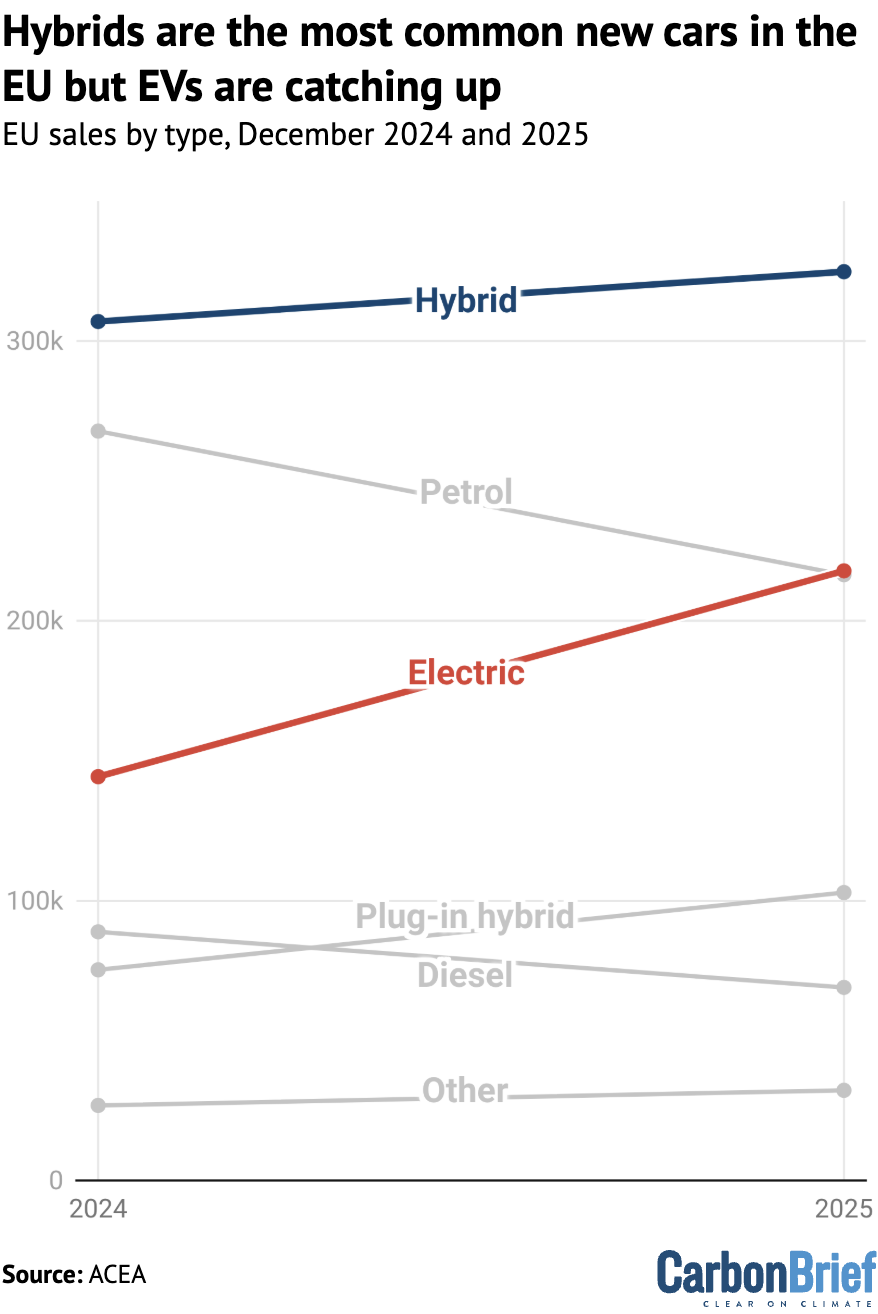 EU car registrations by type, December 2024 and December 2025. Source: ACEA.
The registration figures follow the EU's automotive package, released in December to "support the automotive sector's efforts in the transition to clean mobility".
It includes a proposed shift from banning the sale of new combustion-engine cars from 2035 to reducing their tailpipe emissions.
Under the proposals, the EU will target a 90% cut in carbon dioxide (CO2) emissions from 2021 levels by 2035, rather than all vehicle sales having to be zero-emissions.
If approved, the package would require that the remaining 10% of emissions be compensated through the use of low-carbon steel made in the EU or from e-fuels and biofuels.
This would allow for plug-in hybrids (PHEVs), "range extenders", hybrids and pure internal combustion engine vehicles to "still play a role beyond 2035".
There has been repeated pushback from the automotive sector in Europe against the introduction of "clean car rules", which has led to targets being shifted more than once.
For example, the head of Stellantis in Europe, one of the continent's largest car manufacturers, recently claimed that there was no "natural" demand for EVs.
Automakers have argued that EU targets for cleaner cars should be eased in the face of competition from Chinese producers and US tariffs.
ACEA figures show Volkswagen continued to claim the largest market share in the EU, accounting for 26.7% of new registrations in December, up from 25.6% a year earlier.
It was followed by Stellantis, Renault, Hyundai, Toyota and BMW.
EV giant Tesla saw its market share drop from 3.5% in December 2024 to 2.2% in December 2025. Over the course of 2025, the brand saw its market share in the EU fall 37.9% from 2024, following controversy around its owner, Elon Musk.
Meanwhile, Chinese EV brand BYD tripled its market share from 0.7% in December 2024 to 1.9% in December 2025.
Expensive gas still biggest driver of high UK electricity bills, says UKERC
Energy
|28.01.26
Q&A: What UK's 'warm homes plan' means for climate change and energy bills
Energy
|23.01.26
Explainer: Why gas plays a minimal role in China's climate strategy
China energy
|22.01.26
Experts: What to expect from China on energy and climate action in 2026
China energy
|16.01.26
jQuery(document).ready(function() { jQuery('.block-related-articles-slider-block_0668c1bfb793a813ccb013f4b78d9a56 .mh').matchHeight({ byRow: false }); });The post Analysis: EVs just outsold petrol cars in EU for first time ever appeared first on Carbon Brief.
DeBriefed 23 January 2026: Trump's Davos tirade; EU wind and solar milestone; High seas hope [ 23-Jan-26 3:13pm ]Welcome to Carbon Brief's DeBriefed.
An essential guide to the week's key developments relating to climate change.
TILTING AT 'WINDMILLS': At the World Economic Forum meeting in Davos, Switzerland, Donald Trump was quoted by Reuters as saying - falsely - that China makes almost all of the world's "windmills", but he had not "been able to find any windfarms in China", calling China's buyers "stupid". The newswire added that China "defended its wind power development" at Davos, with spokesperson Guo Jiakun saying the country's efforts to tackle climate change and promote renewable energy in the world are "obvious to all".
SPEECH FACTCHECKED: The Guardian factchecked Trump's speech, noting China has more wind capacity than any other country, with 40% of global wind generation in 2024 in China. See Carbon Brief's chart on this topic, posted on BlueSky by Dr Simon Evans.
GREENLAND GRAB: Trump "abruptly stepped back" from threats to seize Greenland with the use of force or leveraging tariffs, downplaying the dispute as a "small ask" for a "piece of ice", reported Reuters. The Washington Post noted that, while Trump calls climate change "a hoax", Greenland's described value is partly due to Arctic environmental shifts opening up new sea routes. French president Macron slammed the White House's "new colonial approach", emphasising that climate and energy security remain European "top priorities", according to BusinessGreen.
Around the world- EU MILESTONE: For the first time, wind and solar generated more electricity than fossil fuels in the EU last year, reported Reuters. Wind and solar generated 30% of the EU's electricity in 2025, just above 29% from plants running on coal, gas and oil, according to data from the thinktank Ember covered by the newswire.
- WARM HOMES: The UK government announced a £15bn plan for rolling out low-carbon technology in homes, such as rooftop solar and heat pumps. Carbon Brief's newly published analysis has all the details.
- BIG THAW: Braving weather delays that nearly "derail[ed] their mission", scientists finally set up camp on Antarctica's thawing Thwaites glacier, reported the New York Times. Over the next few weeks, they will deploy equipment to understand "how this gargantuan glacier is being corroded" by warming ocean waters.
- EVS WELCOME: Germany re-introduced electric vehicle subsidies, open to all manufacturers, including those in China, reported the Financial Times. Tesla and Volvo could be the first to benefit from Canada's "move to slash import tariffs on made-in-China" EVs, said Bloomberg.
- SOUTHERN AFRICA FLOODS: The death toll from floods in Mozambique went up to 112, reported the African Press Agency on Thursday. Officials cited the "scale of rainfall" - 250mm in 24 hours - as a key driver, it added. Frontline quoted South African president Cyril Ramaphosa, who linked the crisis to climate change.
$307bn
The amount of drought-related damages worldwide per year - intensified by land degradation, groundwater depletion and climate change - according to a new UN "water bankruptcy" report.
Latest climate research
- A researcher examined whether the "ultra rich" could and should pay for climate finance | Climatic Change
- Global deforestation-driven surface warming increased by the "size of Spain" between 1988 and 2016 | One Earth
- Increasing per-capita meat consumption by just one kilogram a year is "linked" to a nearly 2% increase in embedded deforestation elsewhere | Environmental Research Letters
(For more, see Carbon Brief's in-depth daily summaries of the top climate news stories on Monday, Tuesday, Wednesday, Thursday and Friday.)
Captured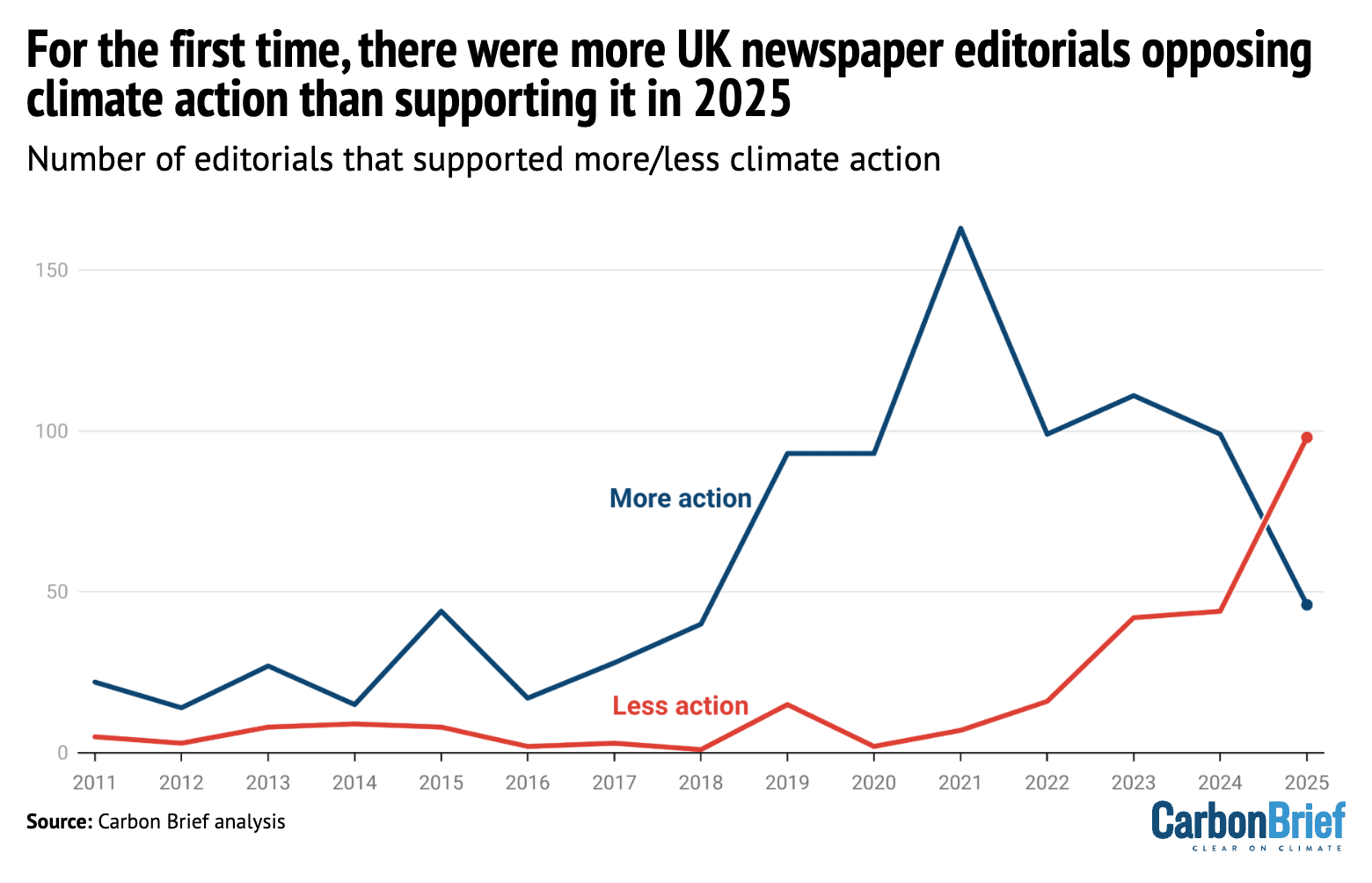
For the first time since monitoring began 15 years ago, there were more UK newspaper editorials published in 2025 opposing climate action than those supporting it, Carbon Brief analysis found. The chart shows the number of editorials arguing for more (blue) and less (red) climate action between 2011-2025. Editorials that took a "balanced" view are not represented in the chart. All 98 editorials opposing climate action were in right-leaning outlets, while nearly all 46 in support were in left-leaning and centrist publications. The trend reveals the scale of the net-zero backlash in the UK's right-leaning press, highlighting the rapid shift away from a political consensus.
Spotlight Do the oceans hold hope for international law?This week, Carbon Brief unpacks what a landmark oceans treaty "entering into force" means and, at a time of backtracking and breach, speaks to experts on the future of international law.
As the world tries to digest the US retreat from international environmental law, historic new protections for the ocean were quietly passed without the US on Saturday.
With little fanfare besides a video message from UN chief Antonio Guterres, a binding UN treaty to protect biodiversity in two-thirds of the Earth's oceans "entered into force".
What does the treaty mean and do?The High Seas Treaty - formally known as the "biodiversity beyond national jurisdiction", or "BBNJ" agreement - obliges countries to act in the "common heritage of humankind", setting aside self-interest to protect biodiversity in international waters. (See Carbon Brief's in-depth explainer on what the treaty means for climate change).
Agreed in 2023, it requires states to undertake rigorous impact assessments to rein in pollution and share benefits from marine genetic resources with coastal communities and countries. States can also propose marine protected areas to help the ocean - and life within it - become more resilient to "stressors", such as climate change and ocean acidification.
"It's a beacon of hope in a very dark place," Dr Siva Thambisetty, an intellectual property expert at the London School of Economics and an adviser to developing countries at UN environmental negotiations, told Carbon Brief.
Who has signed the agreement?Buoyed by a wave of commitments at last year's UN Oceans conference in France, the High Seas treaty has been signed by 145 states, with 84 nations ratifying it into domestic law.
"The speed at which [BBNJ] went from treaty adoption to entering into force is remarkable for an agreement of its scope and impact," said Nichola Clark, from the NGO Pew Trusts, when ratification crossed the 60-country threshold for it to enter into force last September.
For a legally binding treaty, two years to enter into force is quick. The 1997 Kyoto Protocol - which the US rejected in 2001 - took eight years.
While many operative parts of the BBNJ underline respect for "national sovereignty", experts say it applies to an area outside national borders, giving territorial states a reason to get on board, even if it has implications for the rest of the oceans.
What is US involvement with the treaty?The US is not a party to the BBNJ's parent Law of the Sea, or a member of the International Seabed Authority (ISA) overseeing deep-sea mining.
This has meant that it cannot bid for permits to scour the ocean floor for critical minerals. China and Russia still lead the world in the number of deep-sea exploration contracts. (See Carbon Brief's explainer on deep-sea mining).
In April 2025, the Trump administration issued an executive order to "unleash America's offshore critical minerals and resources", drawing a warning from the ISA.
This Tuesday, the Trump administration published a new rule to "fast-track deep-sea mining" outside its territorial waters without "environmental oversight", reported Agence France-Presse.
Prof Lavanya Rajamani, an expert in international environmental law at the University of Oxford, told Carbon Brief that, while dealing with US unilateralism and "self-interest" is not new to the environmental movement, the way "in which they're pursuing that self-interest - this time on their own, without any legal justification" has changed. She continued:
"We have to see this not as a remaking of international law, but as a flagrant breach of international law."
While this is a "testing moment", Rajamani believes that other states contending with a "powerful, idiosyncratic and unpredictable actor" are not "giving up on decades of multilateralism…they just asking how they might address this moment without fundamentally destabilising" the international legal order.
What next for the treaty?Last Friday, China announced its bid to host the BBNJ treaty's secretariat in Xiamen - "a coastal hub that sits on the Taiwan Strait", reported the South China Morning Post.
China and Brussels currently vie as the strongest contenders for the seat of global ocean governance, given that Chile made its hosting offer days before the country elected a far-right president.
To Thambisetty, preparatory BBNJ meetings in March can serve as an important "pocket of sanity" in a turbulent world. She concluded:
Watch, read, listen"The rest of us have to find a way to navigate the international order. We have to work towards better times."
OWN GOAL: For Backchannel, Zimbabwean climate campaigner Trust Chikodzo called for Total Energies to end its "image laundering" at the Africa Cup of Nations.
MATERIAL WORLD: In a book review for the Baffler, Thea Riofrancos followed the "unexpected genealogy" of the "energy transition" outlined in Jean-Baptiste Fressoz's More and More and More: An All-Consuming History.
REALTY BITES: Inside Climate News profiled Californian climate policy expert Neil Matouka, who built a plugin to display climate risk data that real-estate site Zillow removed from home listings.
Coming up- 26 January: International day of clean energy
- 27 January: India-EU summit, New Delhi
- 31 January: Submit inputs on food systems and climate change for a report by the UN special rapporteur on climate change
- 1 February: Costa Rica elections
- British Antarctic Survey, boating officer | Salary: £31,183. Location: UK and Antarctica
- National Centre for Climate Research at the Danish Meteorological Institute, climate science leader | Salary: NA. Location: Copenhagen, with possible travel to Skrydstrup, Karup and Nuuk
- Mongabay, journalism fellows | Stipend: $500 per month for 6 months. Location: Remote
- Climate Change Committee, carbon budgets analyst | Salary: £47,007-£51,642. Location: London
DeBriefed is edited by Daisy Dunne. Please send any tips or feedback to debriefed@carbonbrief.org.
This is an online version of Carbon Brief's weekly DeBriefed email newsletter. Subscribe for free here.
DeBriefed
|16.01.26
DeBriefed
|09.01.26
DeBriefed
|19.12.25
DeBriefed 12 December: EU under 'pressure'; 'Unusual warmth' explained; Rise of climate boardgames
DeBriefed
|12.12.25
jQuery(document).ready(function() { jQuery('.block-related-articles-slider-block_de32d348c4ab99ca7409c370a2b8084b .mh').matchHeight({ byRow: false }); });The post DeBriefed 23 January 2026: Trump's Davos tirade; EU wind and solar milestone; High seas hope appeared first on Carbon Brief.
Q&A: What UK's 'warm homes plan' means for climate change and energy bills [ 23-Jan-26 2:05pm ]The UK government has released its long-awaited "warm homes plan", detailing support to help people install electric heat pumps, rooftop solar panels and insulation in their homes.
It says up to 5m households could benefit from £15bn of grants and loans earmarked by the government for these upgrades by 2030.
Electrified heating and energy-efficient homes are vital for the UK's net-zero goals, but the plan also stresses that these measures will cut people's bills by "hundreds of pounds" a year.
The plan shifts efforts to tackle fuel poverty away from a "fabric-first" approach that starts with insulation, towards the use of electric technologies to lower bills and emissions.
Much of the funding will support people buying heat pumps, but the government has still significantly scaled back its expectations for heat-pump installations in the coming years.
Beyond new funding, there are also new efficiency standards for landlords that could result in nearly 3m rental properties being upgraded over the next four years.
In addition, the government has set out its ambition for scaling up "heat networks", where many homes and offices are served by communal heating systems.
Carbon Brief has identified the key policies laid out in the warm homes plan, as well as what they mean for the UK's climate targets and energy bills.
- Why do homes matter for UK climate goals?
- What is the warm homes plan?
- What is included in the warm homes plan?
- What does the warm homes plan mean for energy bills?
- What has been the reaction to the plan?
Buildings are the second-largest source of emissions in the UK, after transport. This is largely due to the gas boilers that keep around 85% of UK homes warm.
Residential buildings produced 52.8m tonnes of carbon dioxide equivalent (MtCO2e) in 2024, around 14% of the nation's total, according to the latest government figures.
Fossil-fuel heating is by far the largest contributor to building emissions. There are roughly 24m gas boilers and 1.4m oil boilers on the island of Great Britain, according to the National Energy System Operator (NESO).
This has left the UK particularly exposed - along with its gas-reliant power system - to the impact of the global energy crisis, which caused gas prices - and energy bills - to soar.
At the same time, the UK's old housing stock is often described as among the least energy efficient in Europe. A third of UK households live in "poorly insulated homes" and cannot afford to make improvements, according to University College London research.
This situation leads to more energy being wasted, meaning higher bills and more emissions.
Given their contribution to UK emissions, buildings are "expected to be central" in the nation's near-term climate goals, delivering 20% of the cuts required to achieve the UK's 2030 target, according to government adviser the Climate Change Committee (CCC).
(Residential buildings account for roughly 70% of the emissions in the buildings sector, with the rest coming from commercial and public-sector buildings.)
Over recent years, Conservative and Labour governments have announced various measures to cut emissions from homes, including schemes to support people buying electric heat pumps and retrofitting their homes.
However, implementation has been slow. While heat-pump installations have increased, they are not on track to meet the target set by the previous government of 600,000 a year by 2028.
Meanwhile, successive schemes to help households install loft and wall insulation have been launched and then abandoned, meaning installation rates have been slow.
At the same time, the main government-backed scheme designed to lift homes out of fuel poverty, the "energy company obligation" (ECO), has been mired in controversy over low standards, botched installations and - according to a parliamentary inquiry - even fraud.
(The government announced at the latest budget that it was scrapping ECO.)
The CCC noted in its most recent progress report to parliament that "falling behind on buildings decarbonisation will have severe implications for longer-term decarbonisation".
What is the warm homes plan?The warm homes plan was part of the Labour party's election-winning manifesto in 2024, sold at the time as a way to "cut bills for families" through insulation, solar and heat pumps, while creating "tens of thousands of good jobs" and lifting "millions out of fuel poverty".
It replaces ECO, introduces new support for clean technologies and wraps together various other ongoing policies, such as the "boiler upgrade scheme" (BUS) grants for heat pumps.
The warm homes plan was officially announced by the government in November 2024, stating that up to 300,000 households would benefit from home upgrades in the coming year. However, the plan itself was repeatedly delayed.
In the spending review in June 2025, the government confirmed the £13.2bn in funding for the scheme pledged in the Labour manifesto, covering spending between 2025-26 and 2029-30.
The government said this investment would help cut bills by up to £600 per household through efficiency measures and clean technologies such as heat pumps, solar panels and batteries.
After scrapping ECO at the 2025 budget, the treasury earmarked an extra £1.5bn of funding for the warm homes plan over five years. This is less than the £1bn annual budget for ECO, which was funded via energy bills, but is expected to have lower administrative overheads.
In the foreword to the new plan, secretary of state Ed Miliband says that it will deliver the "biggest public investment in home upgrades in British history". He adds:
"The warm homes plan [will]…cut bills, tackle fuel poverty, create good jobs and get us off the rollercoaster of international fossil fuel markets."
Miliband argues in his foreword that the plan will "spread the benefits" of technologies such as solar to households that would otherwise be unable to afford them. He writes: "This historic investment will help millions seize the benefits of electrification." Miliband concludes:
What is included in the warm homes plan?"This is a landmark plan to make the British people better off, secure our energy independence and tackle the climate crisis."
The warm homes plan sets out £15bn of investment over the course of the current parliament to drive uptake of low-carbon technologies and upgrade "up to" 5m homes.
A key focus of the plan is energy security and cost savings for UK households.
The government says its plan will "prioritise" investment in electrification measures, such as heat pumps, solar panels and battery storage. This is where most of the funding is targeted.
However, it also includes new energy-efficiency standards to encourage landlords to improve conditions for renters.
Some policies were notable due to their absence, such as the lack of a target to end gas boiler sales. The plan also states that, while it will consult on the use of hydrogen in heating homes, this is "not yet a proven technology" and therefore any future role would be "limited".
New fundingTechnologies such as heat pumps and rooftop solar panels are essential for the UK to achieve its net-zero goals, but they carry significant up-front costs for households. Plans for expanding their uptake therefore rely on government support.
Following the end of ECO in March, the warm homes plan will help fill the gap in funding for energy-efficiency measures that it is expected to leave.
As the chart below shows, a range of new measures under the warm homes plan - including a mix of grants and loans - as well as more funding for existing schemes, leads to an increase in support out to 2030.
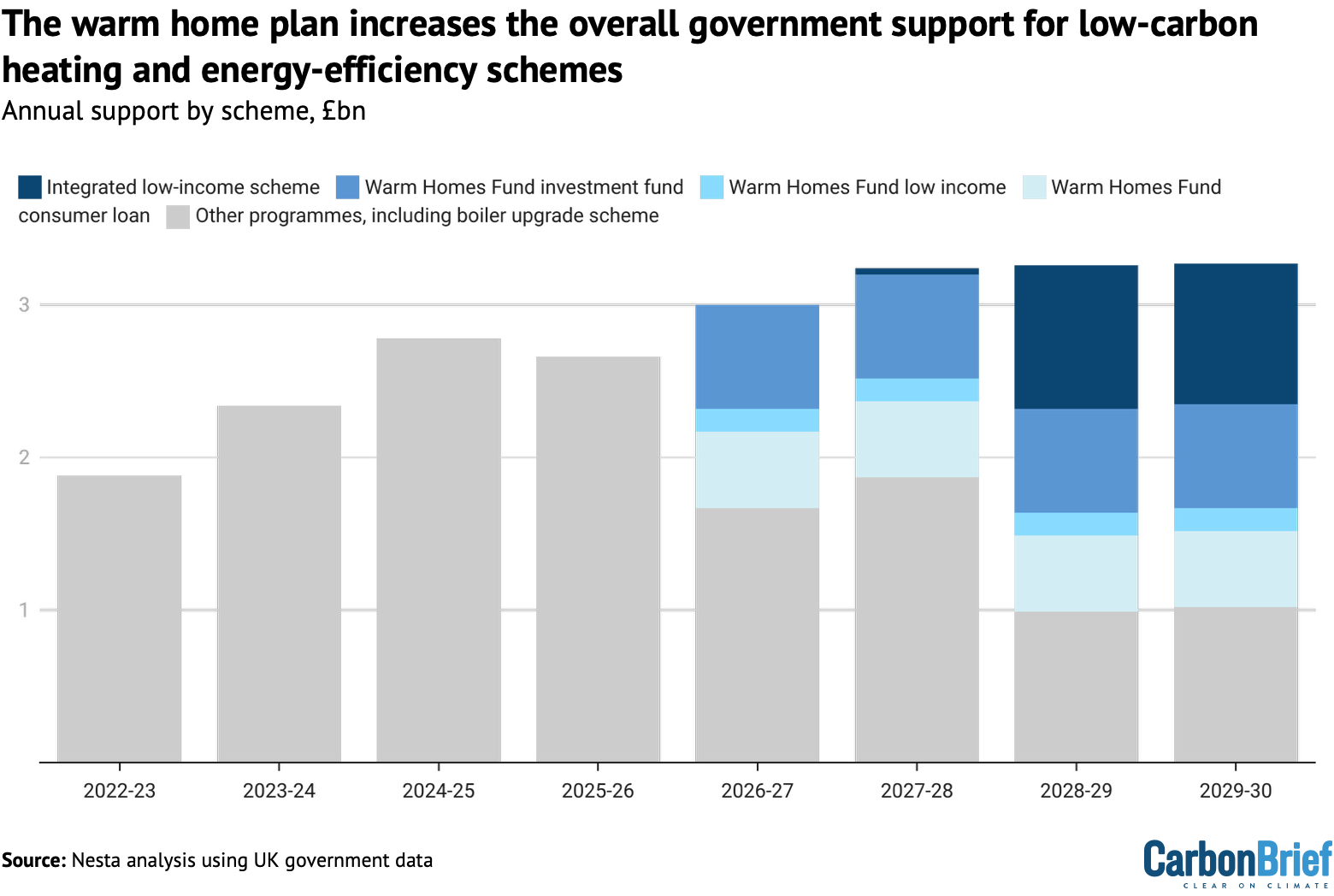 Annual support for home upgrades, such as heat pumps and insulation, broken down by UK government scheme, £bn. The blue columns indicate new schemes under the warm homes plan. The grey columns include ongoing schemes, such as the boiler upgrade scheme. Figures are adjusted to constant 2025/26 pounds using the latest Treasury GDP deflators. Source: Nesta analysis using UK government data.
One third of the total funding - £5bn in total - is aimed at low-income households, including social housing tenants. This money will be delivered in the form of grants that could cover the full cost of upgrades.
The plan highlights solar panels, batteries and "cost-effective insulation" for the least energy-efficient homes as priority measures for this funding, with a view to lowering bills.
There is also £2.7bn for the existing boiler upgrade scheme, which will see its annual allocation increase gradually from £295m in 2025-26 to £709m in 2029-30.
This is the government's measure to encourage better-off "able to pay" households to buy heat pumps, with grants of £7,500 towards the cost of replacing a gas or oil-fired boiler. For the first time, there will also be new £2,500 grants from the scheme for air-to-air heat pumps (See: Heat pumps.)
A key new measure in the plan is £2bn for low- and zero-interest consumer loans, to help with the cost of various home upgrades, including solar panels, batteries and heat pumps.
Previous efforts to support home upgrades with loans have not been successful. However, innovation agency Nesta says the government's new scheme could play a central role, with the potential for households buying heat pumps to save hundreds of pounds a year, compared to purchases made using regular loans.
The remaining funding over the next four years includes money assigned to heat networks and devolved administrations in Scotland, Wales and Northern Ireland, which are responsible for their own plans to tackle fuel poverty and household emissions.
Heat pumpsHeat pumps are described in the plan as the "best and cheapest form of electrified heating for the majority of our homes".
The government's goal is for heat pumps to "increasingly become the desirable and natural choice" for those replacing old boilers. At the same time, it says that new home standards will ensure that new-build homes have low-carbon heating systems installed by default.
Despite this, the warm homes plan scales back the previous government's target for heat-pump installations in the coming years, reflecting the relatively slow increase in heat-pump sales. It also does not include a set date to end the sale of gas boilers.
The plan's central target is for 450,000 heat pumps to be installed annually by 2030, including 200,000 in new-build homes and 250,000 in existing homes.
This is significantly lower than the previous target - originally set in 2021 under Boris Johnson's Conservative government - to install 600,000 heat pumps annually by 2028.
Meeting that target would have meant installations increasing seven-fold in just four years, between 2024 and 2028. Now, installations only need to increase five-fold in six years.
As the chart below shows, the new target is also considerably lower than the heat-pump installation rate set out in the CCC's central net-zero pathway. That involved 450,000 installations in existing homes alone by 2030 - excluding new-build properties.
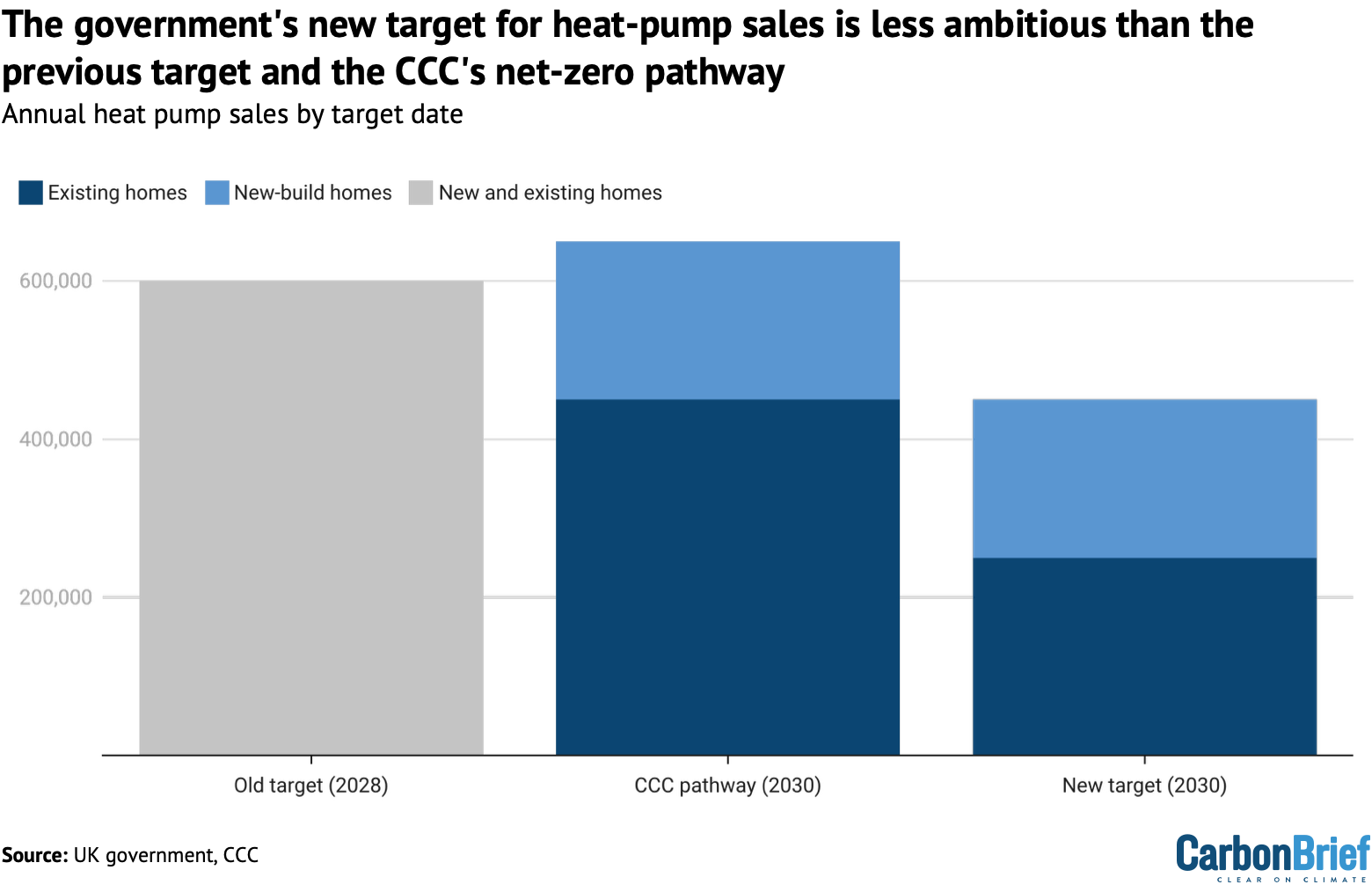 Annual heat-pump installation targets, including the previous UK government goal, the number set out in the CCC's "balanced" net-zero pathway and the new target set out in the warm homes plan. Source: UK government, CCC.
Some experts and campaigners questioned how the UK would remain on track for its legally binding climate goals given this scaled-back rate of heat-pump installations.
Additionally, Adam Bell, policy director at the thinktank Stonehaven, writes on LinkedIn that the "headline numbers for heat pump installs do not stack up".
Heat pumps in existing homes are set to be supported primarily via the boiler upgrade scheme and - according to Bell - there is not enough funding for the 250,000 installations that are planned, despite an increased budget.
The government's plan relies in part on the up-front costs of heat pump installation "fall[ing] significantly". According to Bell, it may be that the government will reduce the size of boiler upgrade scheme grants in the future, hoping that costs will fall sufficiently.
Alternatively, the government may rely on driving uptake through its planned low-cost loans and the clean heat market mechanism, which requires heating-system suppliers to sell a growing share of heat pumps.
Rooftop solarRooftop solar panels are highlighted in the plan as "central to cutting energy bills", by allowing households to generate their own electricity to power their homes and sell it back to the grid.
At the same time, rooftop solar is expected to make a "significant contribution" to the government's target of hitting 45-47 gigawatts (GW) of solar capacity by 2030.
As it stands, there is roughly 5.2GW of solar capacity on residential rooftops.
Taken together, the government says the grants and loans set out in the warm homes plan could triple the number of homes with rooftop solar from 1.6m to 4.6m by 2030.
It says that this is "in addition" to homes that decide to install rooftop solar independently.
Efficiency standardsThe warm homes plan says that the government will publish its "future homes standard" for new-build properties, alongside necessary regulations, in the first quarter of 2026.
On the same day, the government also published its intention to reform "energy performance certificates" (EPCs), the ratings that are supposed to inform prospective buyers and renters about how much their new homes will cost to keep warm.
The current approach to measuring performance for EPCs is "unreliable" and thought to inadvertently discourage heat pumps. It has faced long-standing calls for reform.
As well as funding low-carbon technologies, the warm homes plan says it is "standing up for renters" with new energy-efficiency standards for privately and socially rented homes.
Currently, private renters - who rely on landlords to invest in home improvements - are the most likely to experience fuel poverty and to live in cold, damp homes.
Landlords will now need to upgrade their properties to meet EPC ratings B and C across two new-style EPC metrics by October 2030. There are "reasonable exemptions" to this rule that will limit the amount landlords have to spend per property to £10,000.
In total, the government expects "up to" 1.6m homes in the private-rental sector to benefit from these improvements and "up to" 1.3m social-rent homes.
These new efficiency standards therefore cover three-fifths of the "up to" 5m homes helped by the plan.
The government also published a separate fuel poverty strategy for England.
Heat networksThe warm homes plan sets out a new target to more than double the amount of heating provided using low-carbon heat networks - up to 7% of England's heating demand by 2035 and a fifth by 2050.
This involves an injection of £1.1bn for heat networks, including £195m per year out to 2030 via the green heat network fund, as well as "mobilising" the National Wealth Fund.
The plan explains that this will primarily benefit urban centres, noting that heat networks are "well suited" to serving large, multi-occupancy buildings and those with limited space.
Alongside the plan, the government published a series of technical standards for heat networks, including for consumer protection.
The warm homes plan could save households "hundreds on energy bills" for those whose homes are upgraded, according to the UK government.
This is in addition to two changes announced in the budget in 2025, which are expected to cut energy bills for all homes by an average of £150 a year.
This included the decisions to bring ECO to an end when the current programme of work wraps up at the end of the financial year and for the treasury to cover three-quarters of the cost of the "renewables obligation" (RO) for three years from April 2026.
Beyond this, households that take advantage of the measures outlined in the plan can expect their energy bills to fall by varying amounts, the government says.
The warm homes plan includes a number of case studies that detail how upgrades could impact energy bills for a range of households. For example, it notes that a social-rented two-bedroom semi-detached home that got insulation and solar panels could save £350 annually.
An owner-occupier three-bedroom home could save £450 annually if it gets solar panels and a battery through consumer loans offered under the warm homes plan, it adds.
Similar analysis published by Nesta says that a typical household that invests in home upgrades under the plan could save £1,000 a year on its energy bill.
It finds that a household with a heat pump, solar panels and a battery, which uses a solar and "time of use tariff", could see its annual energy bill fall by as much as £1,000 compared with continuing to use a gas boiler, from around £1,670 per year to £670, as shown in the chart below.
 Annual energy bill savings (£) for a typical household from April 2026, by using different clean-energy technologies in comparison with a gas boiler. Source: Nesta analysis, using data from Ofgem, the Centre for Net Zero and an Octopus Energy tariff.
Ahead of the plan being published, there were rumours of further "rebalancing" energy bills to bring down the cost of electricity relative to gas. However, this idea failed to come to fruition in the warm homes plan.
This would have involved reducing or removing some or all of the policy costs currently funded via electricity bills, by shifting them onto gas bills or into general taxation.
This would have made it relatively cheaper to use electric technologies such as heat pumps, acting as a further incentive to adopt them.
Nesta highlights that in the absence of further action with regard to policy costs, the electricity-to-gas price ratio is likely to stay at around 4.1 from April 2026.
What has been the reaction to the plan?Many of the commitments in the warm homes plan were welcomed by a broad range of energy industry experts, union representatives and thinktanks.
Greg Jackson, the founder of Octopus Energy, described it as a "really important step forward", adding:
"Electrifying homes is the best way to cut bills for good and escape the yoyo of fossil fuel costs."
Dhara Vyas, chief executive of the trade body Energy UK, said the government's commitment to spend £15bn on upgrading home heating was "substantial" and would "provide certainty to investors and businesses in the energy market".
On LinkedIn, Camilla Born, head of the campaign group Electrify Britain, said the plan was a "good step towards backing electrification as the future of Britain, but it must go hand in hand with bringing down the costs of electricity".
However, right-leaning publications and politicians were critical of the plan, focusing on how a proportion of solar panels sold in the UK are manufactured in China.
According to BBC News, two-thirds (68%) of the solar panels imported to the UK came from China in 2024.
In an analysis of the plan, the Guardian's environment editor Fiona Harvey and energy correspondent Jillian Ambrose argued that the strategy is "all carrot and no stick", given that the "longstanding proposal" to ban the installation of gas boilers beyond 2035 has been "quietly dropped".
Christopher Hammond, chief executive of UK100, a cross-party network of more than 120 local authorities, welcomed the plan, but urged the government to extend it to include public buildings.
The government's £3.5bn public sector decarbonisation scheme, which aimed to electrify schools, hospitals and council buildings, ended in June 2025 and no replacement has been announced, according to the network.
Expensive gas still biggest driver of high UK electricity bills, says UKERC
Energy
|28.01.26
Analysis: EVs just outsold petrol cars in EU for first time ever
Energy
|27.01.26
Explainer: Why gas plays a minimal role in China's climate strategy
China energy
|22.01.26
Experts: What to expect from China on energy and climate action in 2026
China energy
|16.01.26
jQuery(document).ready(function() { jQuery('.block-related-articles-slider-block_2afae6bac8891aff4e92286169c857be .mh').matchHeight({ byRow: false }); });The post Q&A: What UK's 'warm homes plan' means for climate change and energy bills appeared first on Carbon Brief.
China Briefing 22 January 2026: 2026 priorities; EV agreement; How China uses gas [ 22-Jan-26 1:48pm ]Welcome to Carbon Brief's China Briefing.
China Briefing handpicks and explains the most important climate and energy stories from China over the past fortnight. Subscribe for free here.
Key developments Tasks for 2026'GREEN RESOLVE': The Ministry of Ecology and Environment (MEE) said at its annual national conference that it is "essential" to "maintain strategic resolve" on building a "beautiful China", reported energy news outlet BJX News. Officials called for "accelerating green transformation" and "strengthening driving forces" for the low-carbon transition in 2026, it added. The meeting also underscored the need for "continued reduction in total emissions of major pollutants", it said, as well as for "advancing source control through carbon peaking and a low-carbon transition". The MEE listed seven key tasks for 2026 at the meeting, said business news outlet 21st Century Business Herald, including promoting development of "green productive forces", focusing on "regional strategies" to build "green development hubs" and "actively responding" to climate change.
CARBON 'PRESSURE': China's carbon emissions reduction strategy will move from the "preparatory stages" into a phase of "substantive" efforts in 2026, reported Shanghai-based news outlet the Paper, with local governments beginning to "feel the pressure" due to facing "formal carbon assessments for the first time" this year. Business news outlet 36Kr said that an "increasing number of industry participants" will have to begin finalising decarbonisation plans this year. The entry into force of the EU's carbon border adjustment mechanism means China's steelmakers will face a "critical test of cost, data and compliance", reported finance news outlet Caixin. Carbon Brief asked several experts, including the Asia Society Policy Institute's Li Shuo, what energy and climate developments they will be watching in 2026.
COAL DECLINE: New data released by the National Bureau of Statistics (NBS) showed China's "mostly coal-based thermal power generation fell in 2025" for the first time in a decade, reported Reuters, to 6,290 terawatt-hours (TWh). The data confirmed earlier analysis for Carbon Brief that "coal power generation fell in both China and India in 2025", marking the first simultaneous drop in 50 years. Energy news outlet International Energy Net noted that wind generation rose 10% to 1,053TWh and solar by 24% to 1,573TWh.
上微信关注《碳简报》
EV agreement reached
'NORMALISED COMPETITION'?: The EU will remove tariffs on imports of electric vehicles (EV) made in China if the manufacturers follow "guidelines on minimum pricing" issued by the bloc, reported the Associated Press. China's commerce ministry stated that the new guidelines will "enable Chinese exporters to address the EU's anti-subsidy case concerning Chinese EVs in a way that is more practical, targeted and consistent with [World Trade Organization] rules", according to the state-run China Daily. An editorial by the state-supporting Global Times argued that the agreement symbolised a "new phase" in China-EU economic and trade relations in which "normalised competition" is stabilised by a "solid cooperative foundation".
SOLAR REBATES: China will "eliminate" export rebates for solar products from April 2026 and phase rebates for batteries out by 2027, said Caixin. Solar news outlet Solar Headlines said that the removal of rebates would "directly test" solar companies' profitability and "fundamentally reshape the entire industry's growth logic". Meanwhile, China imposed anti-dumping duties on imports of "solar-grade polysilicon" from the US and Korea, said state news agency Xinhua.
OVERCAPACITY MEETINGS: The Chinese government "warned several producers of polysilicon…about monopoly risks" and cautioned them not to "coordinate on production capacity, sales volume and prices", said Bloomberg. Reuters and China Daily covered similar government meetings on "mitigat[ing] risks of overcapacity" with the battery and EV industries, respectively. A widely republished article in the state-run Economic Daily said that to counter overcapacity, companies would need to reverse their "misaligned development logic" and shift from competing on "price and scale" to competing on "technology".
High prices undermined home coal-to-gas heating policySWITCHING SHOCK: A video commentary by Xinhua reporter Liu Chang covered "reports of soaring [home] heating costs following coal-to-gas switching [policies] in some rural areas of north China". Liu added that switching from coal to gas "must lead not only to blue skies, but also to warmth". Bloomberg said that the "issue isn't a lack of gas", but the "result of a complex series of factors including price regulations, global energy shocks and strained local finances".
Subscribe: China Briefing- .listing{background: #f4f4f4} .listing ul{list-style:none; margin:0} ol {background: #F4F4F4; padding: 0px;} .listing ul {background: #F4F4F4; padding: 0px;} .listing li{font-size:0px;}
Sign up to Carbon Brief's free "China Briefing" email newsletter. All you need to know about the latest developments relating to China and climate change. Sent to your inbox every Thursday.
HEATED DEBATE: Discussions of the story in China became a "domestically resonant - and politically awkward - debate", noted the current affairs newsletter Pekingnology. It translated a report by Chinese outlet Economic Observer that many villagers in Hebei struggled with no access to affordable heating, with some turning back to coal. "Local authorities are steadily advancing energy supply," People's Daily said of the issue, noting that gas is "increasingly becoming a vital heating energy source" as part of China's energy transition. Another People's Daily article quoted one villager saying: "Coal-to-gas conversion is a beneficial initiative for both the nation and its people…Yet the heating costs are simply too high."
DEJA-VU: This is not the first time coal-to-gas switching has encountered challenges, according to research by the Oxford Institute for Energy Studies, with nearby Shanxi province experiencing a similar situation. In Shanxi, a "lack of planning, poor coordination and hasty implementation" led to demand outstripping supply, while some households had their coal-based heating systems removed with no replacement secured. Others were "deterred" from using gas-based systems due to higher prices, it said.
More China news- LOFTY WORDS: At Davos, vice-premier He Lifeng reaffirmed commitments to China's "dual-carbon" goals and called for greater "global cooperation on climate change", reported Caixin.
- NOT LOOKING: US president Donald Trump, also at Davos, said he was not "able to find any windfarms in China", adding China sells them to "stupid" consumers, reported Euronews. China installed wind capacity has ranked first globally "for 15 years consecutively", said a government official, according to CGTN.
- 'GREEN' FACTORIES: China issued "new guidelines to promote green [industrial] microgrids" including targets for on-site renewable use, said Xinhua. The country "pledged to advance zero-carbon factory development" from 2026, said another Xinhua report.
- JET-FUEL MERGER: A merger of oil giant Sinopec with the country's main jet-fuel producer could "aid the aviation industry's carbon reduction goals", reported Yicai Global. However, Caixin noted that the move could "stifl[e] innovation" in the sustainable air fuel sector.
- NEW TARGETS: Chinese government investment funds will now be evaluated on the "annual carbon reduction rates" achieved by the enterprises or projects they support, reported BJX News.
- HOLIDAY CATCH-UP: Since the previous edition of China Briefing in December, Beijing released policies on provincial greenhouse gas inventories, the "two new" programme, clean coal benchmarks, corporate climate reporting, "green consumption" and hydrogen carbon credits. The National Energy Administration also held its annual work conference.
While gas is seen in some countries as an important "bridging" fuel to move away from coal use, rapid electrification, uncompetitiveness and supply concerns have suppressed its share in China's energy mix.
Carbon Brief explores the current role of gas in China and how this could change in the future. The full article is available on Carbon Brief's website.
The current share of gas in China's primary energy demand is small, at around 8-9%.
It also comprises 7% of China's carbon dioxide (CO2) emissions from fuel combustion, adding 755m tonnes of CO2 in 2023 - twice the total CO2 emissions of the UK.
Gas consumption is continuing to grow in line with an overall uptick in total energy demand, but has slowed slightly from the 9% average annual rise in gas demand over the past decade - during which time consumption more than doubled.
The state-run oil and gas company China National Petroleum Corporation (CNPC) forecast in 2025 that demand growth for the year may slow further to just over 6%.
Chinese government officials frequently note that China is "rich in coal" and "short of gas". Concerns of import dependence underpin China's focus on coal for energy security.
However, Beijing sees electrification as a "clear energy security strategy" to both decarbonise and "reduce exposure to global fossil fuel markets", said Michal Meidan, China energy research programme head at the Oxford Institute for Energy Studies.
A dim future?Beijing initially aimed for gas to displace coal as part of a broader policy to tackle air pollution.
Its "blue-sky campaign" helped to accelerate gas use in the industrial and residential sectors. Several cities were mandated to curtail coal usage and switch to gas.
(January 2026 saw widespread reports of households choosing not to use gas heating installed during this campaign despite freezing temperatures, due to high prices.)
Industry remains the largest gas user in China, with "city gas" second. Power generation is a distant third.
The share of gas in power generation remains at 4%, while wind and solar's share has soared to 22%, Yu Aiqun, research analyst at the thinktank Global Energy Monitor, told Carbon Brief. She added:
"With the rapid expansion of renewables and ongoing geopolitical uncertainties, I don't foresee a bright future for gas power."
However, gas capacity may still rise from 150 gigawatts (GW) in 2025 to 200GW by 2030. A government report noted that gas will continue to play a "critical role" in "peak shaving".
But China's current gas storage capacity is "insufficient", according to CNPC, limiting its ability to meet peak-shaving demand.
Transport and industryGas instead may play a bigger role in the displacement of diesel in the transport sector, due to the higher cost competitiveness of LNG - particularly for trucking.
CNPC forecast that LNG displaced around 28-30m tonnes of diesel in the trucking sector in 2025, accounting for 15% of total diesel demand in China.
However, gas is not necessarily a better option for heavy-duty, long-haul transportation, due to poorer fuel efficiency compared with electric vehicles.
In fact, "new-energy vehicles" are displacing both LNG-fueled trucks and diesel heavy-duty vehicles (HDVs).
Meanwhile, gas could play a "more significant" role in industrial decarbonisation, Meidan told Carbon Brief, if prices fall substantially.
Growth in gas demand has been decelerating in some industries, but China may adopt policies more favourable to gas, she added.
An energy transition roadmap developed by a Chinese government thinktank found gas will only begin to play a greater role than coal in China by 2050 at the earliest.
Both will be significantly less important than clean-energy sources at that point.
This spotlight was written by freelance climate journalist Karen Teo for Carbon Brief.
Watch, read, listenEV OUTLOOK: Tu Le, managing director of consultancy Sino Auto Insights, spoke on the High Capacity podcast about his outlook for China's EV industry in 2026.
'RUNAWAY TRAIN': John Hopkins professor Jeremy Wallace argued in Wired that China's strength in cleantech is due to a "runaway train of competition" that "no one - least of all [a monolithic 'China'] - knows how to deal with".
'DIRTIEST AND GREENEST': China's energy engagement in the Belt and Road Initiative was simultaneously the "dirtiest and greenest" it has ever been in 2025, according to a new report by the Green Finance & Development Center.
INDUSTRY VOICE: Zhong Baoshen, chairman of solar manufacturer LONGi, spoke with Xinhua about how innovation, "supporting the strongest performers", standards-setting and self-regulation could alleviate overcapacity in the industry.
$574bn
The amount of money State Grid, China's main grid operator, plans to invest between 2026-30, according to Jiemian. The outlet adds that much of this investment will "support the development and transmission of clean energy" from large-scale clean-energy bases and hydropower plants.
New science
- The combination of long-term climate change and extremes in rainfall and heat have contributed to an increase in winter wheat yield of 1% in Xinjiang province between 1989-2023 | Climate Dynamics
- More than 70% of the "observed changes" in temperature extremes in China over 1901-2020 are "attributed to greenhouse gas forcing" | Environmental Research Letters
China Briefing is written by Anika Patel and edited by Simon Evans. Please send tips and feedback to china@carbonbrief.org
China Briefing
|11.12.25
China Briefing 27 November 2025: COP30 wraps; Climate and critical minerals at G20; Coal use up
China Briefing
|27.11.25
China Briefing 13 November 2025: COP30 special
China Briefing
|13.11.25
China Briefing
|30.10.25
jQuery(document).ready(function() { jQuery('.block-related-articles-slider-block_41232f598c30dd488dcf85bde7338693 .mh').matchHeight({ byRow: false }); });The post China Briefing 22 January 2026: 2026 priorities; EV agreement; How China uses gas appeared first on Carbon Brief.
Guest post: 10 key climate science 'insights' from 2025 [ 22-Jan-26 8:00am ]Every year, understanding of climate science grows stronger.
With each new research project and published paper, scientists learn more about how the Earth system responds to continuing greenhouse gas emissions.
But with many thousands of new studies on climate change being published every year, it can be hard to keep up with the latest developments.
Our annual "10 new insights in climate science" report offers a snapshot of key advances in the scientific understanding of the climate system.
Produced by a team of scientists from around the world, the report summarises influential, novel and policy-relevant climate research published over the previous 18 months.
.innerArt>ol { font-family: 'PT Serif'; font-size: 18px !important; }The insights presented in the latest edition, published in the journal Global Sustainability, are as follows:
- Questions remain about the record warmth in 2023-24
- Unprecedented ocean surface warming and intensifying marine heatwaves are driving severe ecological losses
- The global land carbon sink is under strain
- Climate change and biodiversity loss amplify each other
- Climate change is accelerating groundwater depletion
- Climate change is driving an increase in dengue fever
- Climate change diminishes labour productivity
- Safe scale-up of carbon dioxide removal is needed
- Carbon credit markets come with serious integrity challenges
- Policy mixes outperform stand-alone measures in advancing emissions reductions
In this article, we unpack some of the key findings.
A strained climate systemThe first three insights highlight how strains are growing across the climate system, from indications of an accelerating warming and record-breaking marine heatwaves, to faltering carbon sinks.
Between April 2023 and March 2024, global temperatures reached unprecedented levels - a surge that cannot be fully explained by the long-term warming trend and typical year-to-year fluctuations of the Earth's climate. This suggests other factors are at play, such as declining sulphur emissions and shifting cloud cover.
(For more, Carbon Brief's in-depth explainer of the drivers of recent exceptional warmth.)
Ocean heat uptake has climbed as well. This has intensified marine heatwaves, further stressing ecosystems and livelihoods that rely on fisheries and coastal resources.
The exceptional warming of the ocean has driven widespread impacts, including massive coral bleaching, fish and shellfish mortality and disruptions to marine food chains.
The map below illustrates some of the impacts of marine heatwaves from 2023-24, highlighting damage inflicted on coral reefs, fishing stocks and coastal communities.
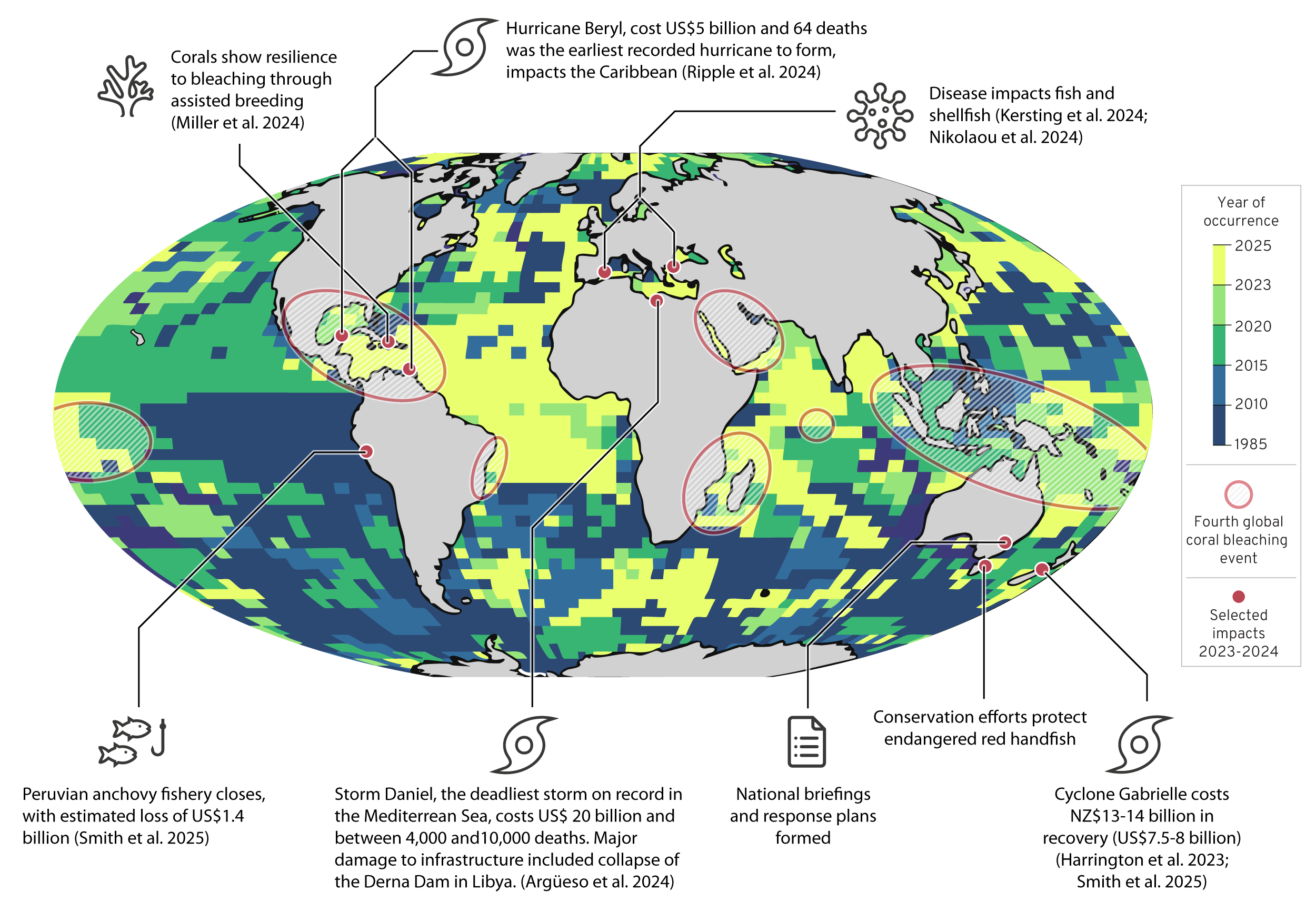 The impacts of the exceptional marine heatwaves over 2023-24, a period which saw the warmest sea surface temperature in the satellite record since 1985. Dataset used is the ESA Climate Change Initiative's sea surface temperature v3 featured in Embury et al. (2024). Credit: 10 new insights in climate science report (2025).
Land "sinks" that absorb carbon - and buffer the emissions from human activity - are under increasing stress, too. Recent research shows a reduction in carbon stored in boreal forests and permafrost ecosystems.
The weakening carbon sinks means that more human-caused carbon emissions remain in the atmosphere, further driving up global temperatures and increasing the chances that warming will surpass the Paris Agreement's 1.5C limit.
This links to the fourth insight, which shows how climate change and biodiversity loss can amplify each other by leading to a decrease in the accumulation of biomass and reduced carbon storage, creating a destabilising feedback loop that accelerates warming.
New evidence demonstrates that climate change could threaten more than 3-6 million species and, as a result, could undermine critical ecosystem functions.
For example, recent projections indicate that the loss of plant species could reduce carbon sequestration capacity in the range of 7-145bn tonnes of carbon over the coming decades. Similarly, studies show that, in tropical systems, the extinction of animals could reduce carbon storage capacity by up to 26%.
Human health and livelihoodsGrowing pressure on the climate system is having cascading consequences for human societies and natural systems.
Our fifth insight highlights how groundwater supplies are increasingly at risk.
More than half the global population depends on groundwater - the second largest source of freshwater after polar ice - for survival.
But groundwater levels are in decline around the world. A 2025 Nature paper found that rapid groundwater declines, exceeding 50cm each year, have occurred in many regions in the 21st century, especially in arid areas dominated by cropland. The analysis also showed that groundwater losses accelerated over the past four decades in about 30% of regional aquifers.
Changes in rainfall patterns due to climate change, combined with increased irrigation demand for agriculture, are depleting groundwater reserves at alarming rates.
The figure below illustrates how climate-driven reductions in rainfall, combined with increased evapotranspiration, are projected to significantly reduce groundwater recharge in many arid regions - contributing to widespread groundwater-level declines.
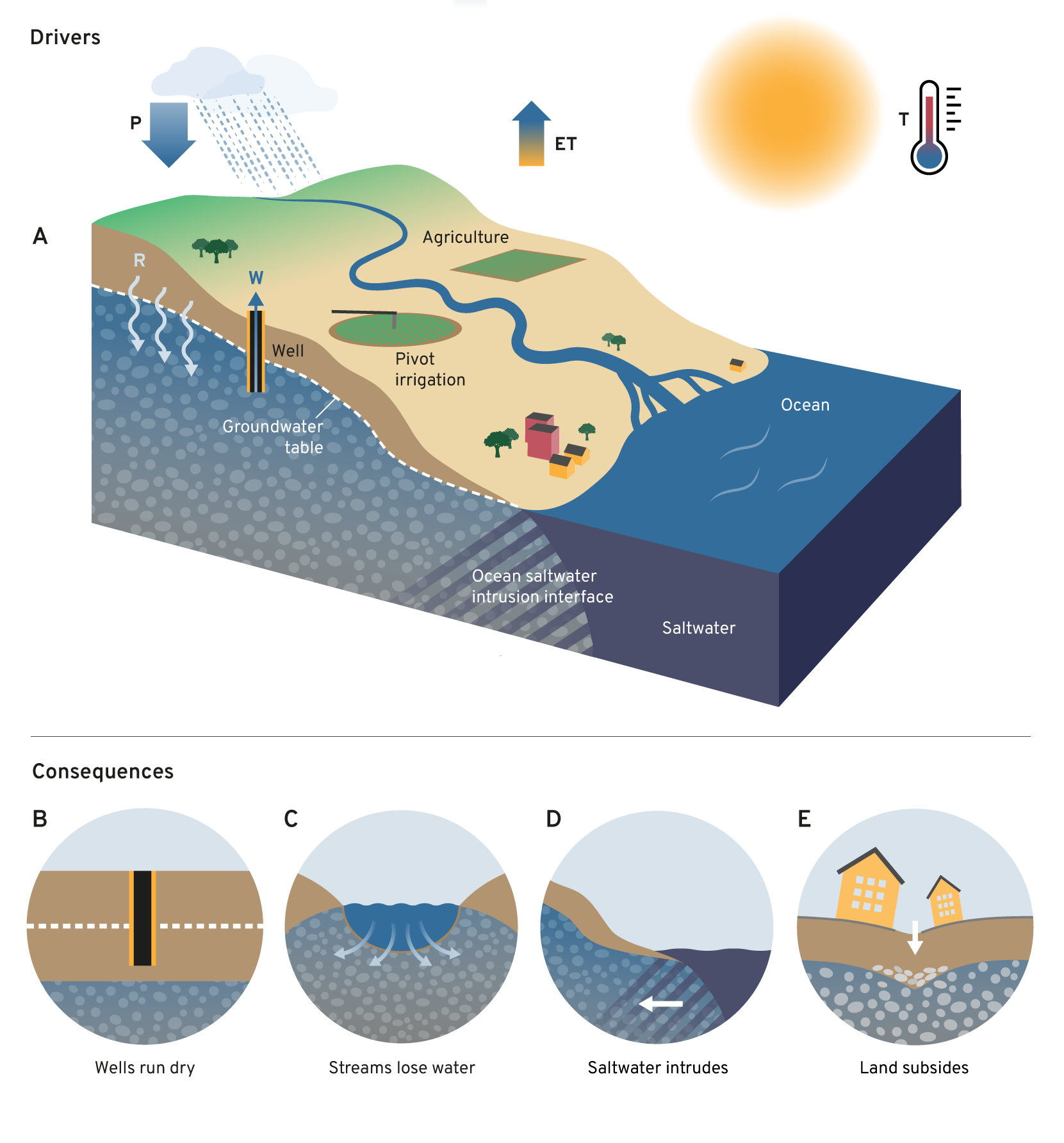 The top panel shows the impact of climate change on terrestrial water fluxes and groundwater recharge. It illustrates how climate change directly and indirectly affects groundwater resources by altering precipitation (P) and temperature (T) patterns, increasing evapotranspiration (ET), which further reduces groundwater recharge (R) and leads to declining levels. The lower panel illustrates how lower water tables can cause wells to run dry (B), streams to lose water to surrounding aquifers (C), saltwater to intrude into coastal aquifers (D) and land subsidence (E). Credit: 10 new insights in climate science report (2025).
These losses threaten food security, amplifying competition for scarce resources and undermining the resilience of entire communities.
Human health and livelihoods are also being affected by changes to the climate.
Our sixth insight spotlights the ongoing and projected expansion of the mosquito-borne disease dengue fever.
Dengue surged to the largest global outbreak on record in 2024, with the World Health Organization reporting 14.2m cases, which is an underestimate because not all cases are counted.
Rising temperatures are creating more favourable conditions for the mosquitoes that carry dengue, driving the disease's spread and increasing its intensity.
The chart below shows the regions climatically suitable for Aedes albopictus (blue line) and Aedes aegypti (green line) - the primary mosquitoes species that carry the virus - increased by 46.3% and 10.7%, respectively, between 1951-60 and 2014-23.
The maps on the right reveal how dengue could spread by 2030 and 2050 under an emissions scenario broadly consistent with current climate policies. It shows that the climate suitable for the mosquito that spreads dengue could expand northwards in Canada, central Europe and the West Siberian Plain by 2050.
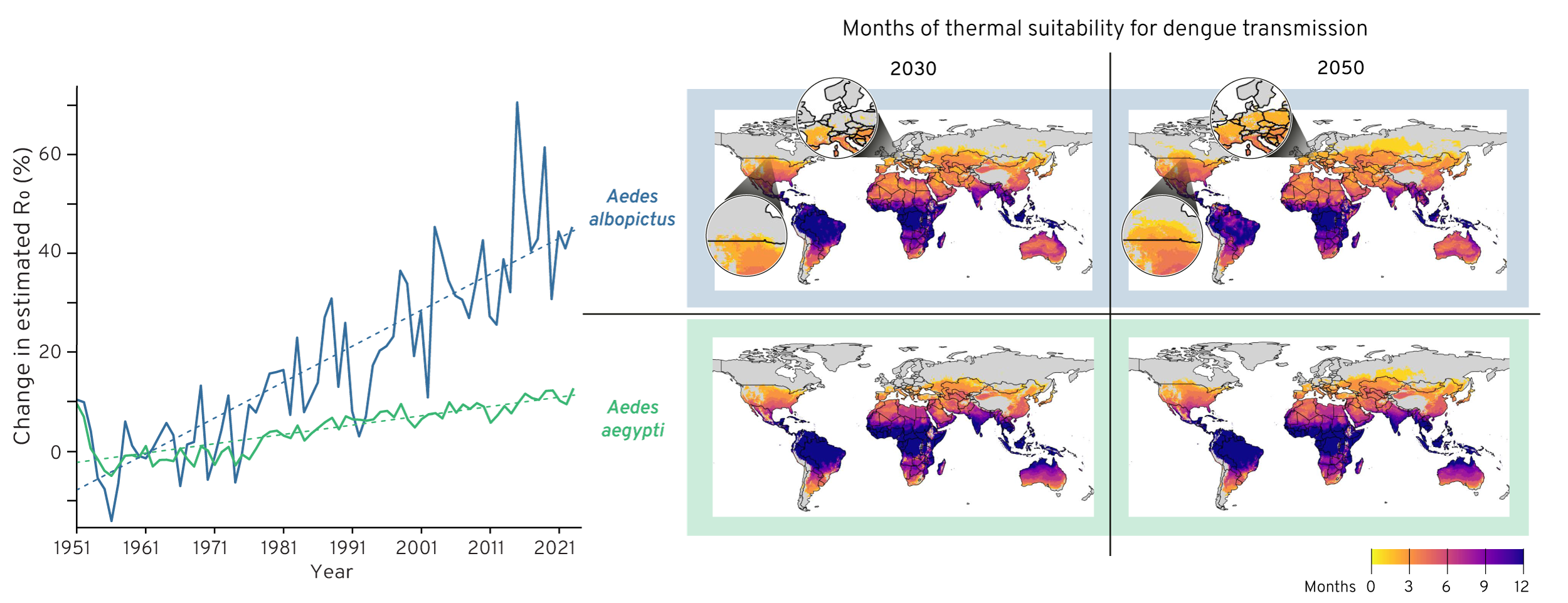 The chart on the left shows how climate affects the ability of mosquitoes to spread dengue. R0 (the basic reproduction) on the y-axis represents the average number of new infections in a completely susceptible population generated by a single new case (adapted from Romanello et al. (2024)).The world maps on the right show how the global risk of dengue transmission is expected to change by 2030 and 2050, measured as the number of months in a year when the climate is suitable for mosquitoes to spread the virus, under the SSP2-4.5 scenario (adapted from Ryan et al. (2019), using CMIP6 climate projections). Credit: 10 new insights in climate science report (2025).
The ongoing proliferation of these mosquito species is particularly alarming given their ability to transmit the zika, chikungunya and yellow fever viruses.
Heat stress is also a growing threat to labour productivity and economic growth, which is the seventh insight in our list.
For example, an additional 1C of warming is projected to expose more than 800 million people in tropical regions to unsafe heat levels - potentially reducing working hours by up to 50%.
At 3C warming, sectors such as agriculture, where workers are outdoors and exposed to the sun, could see reductions in effective labour of 25-33% across Africa and Asia, according to a recent Nature Reviews Earth & Environment paper.
Meanwhile, sectors where workers operate in shaded or indoor settings could also face meaningful losses. This drain on productivity compounds socioeconomic issues and places a strain on households, businesses and governments.
Low-income, low-emitting regions are set to shoulder a greater relative share of the impacts of extreme heat on economic growth, exacerbating existing inequalities.
Action and policyOur report illustrates not only the scale of the challenges facing humanity, but also some of the pathways toward solutions.
The eighth insight emphasises the critical role of carbon dioxide removal (CDR) in stabilising the climate, especially in "overshoot" scenarios where warming temporarily surpasses 1.5C and is then brought back down.
Scaling these CDR solutions responsibly presents technical, ecological, justice, equity and governance challenges.
Nature-based approaches for pulling carbon out of the air - such as afforestation, peatland rewetting and agroforestry - could have negative consequences for food security, biodiversity conservation and resource provision if deployed at scale.
Yet, research has suggested that substantially more CDR may be needed than estimated in the scenarios used in the Intergovernmental Panel on Climate Change (IPCC's) last assessment report.
Recent findings showed that a pathway where temperatures remain below 1.5C with no overshoot would require up to 400Gt of cumulative CDR by 2100 in order to buffer against the effect of complex geophysical processes that can accelerate climate change. This figure is roughly twice the amount of CDR assessed by the IPCC.
This underscores the need for robust international coordination on the responsible scaling of CDR technologies, as a complement to ambitious efforts to reduce emissions. Transparent carbon accounting frameworks that include CDR will be required to align national pledges with international goals.
Similarly, voluntary carbon markets - where carbon "offsets" are traded by corporations, individuals and organisations that are under no legal obligation to make emission cuts - face challenges.
Our ninth insight shows how low-quality carbon credits have undermined the credibility of these largely unregulated carbon markets, limiting their effectiveness in supporting emission reductions.
However, emerging standards and integrity initiatives, such as governance and quality benchmarks developed by the Integrity Council for Voluntary Carbon Markets, could address some of the concerns and criticism associated with carbon credit projects.
High-quality carbon credits that are verified and rigorously monitored can complement direct emission reductions.
Finally, our 10th insight highlights how a mix of climate policies typically have greater success than standalone measures.
Research published in Science in 2024 shows how carefully tailored policy packages - including carbon pricing, regulations, and incentives - could consistently achieve larger and more durable emission reductions than isolated interventions.
For example, in the buildings sector, regulations that ban or phase out products or activities achieve an average effect size of 32% when included in a policy package, compared with 13% when implemented on their own.
Importantly, policy mixes that are tailored to the country context and with attention to distributional equity are more likely to gain public support.
These 10 insights in our latest edition highlight the urgent need for an integrated approach to tackling climate change.
The science is clear, the risks are escalating - but the tools to act are available.
Guest post: How to steer EVs towards the road of 'mass adoption'
Guest posts
|18.12.25
Guest post: How the Greenland ice sheet fared in 2025
Guest posts
|15.12.25

Guest post: Why cities need more than just air conditioning for extreme heat
Energy
|15.12.25

Guest post: Why carbon emissions from fires are significantly higher than thought
GHGs and aerosols
|01.12.25
jQuery(document).ready(function() { jQuery('.block-related-articles-slider-block_9a5b96843d8905ad55342248c73ce32f .mh').matchHeight({ byRow: false }); });The post Guest post: 10 key climate science 'insights' from 2025 appeared first on Carbon Brief.
Explainer: Why gas plays a minimal role in China's climate strategy [ 22-Jan-26 8:00am ]Ten years ago, switching from burning coal to gas was a key element of China's policy to reduce severe air pollution.
However, while gas is seen in some countries as a "bridging" fuel to move away from coal use, rapid electrification, uncompetitiveness and supply concerns have suppressed its share in China's energy mix.
As such, while China's gas demand has more than doubled over the past decade, the fuel is not currently playing a decisive role in the country's strategy to tackle climate change.
Instead, renewables are now the leading replacement for coal demand in China, with growth in solar and wind generation largely keeping emissions growth from China's power sector flat.
While gas could play a role in decarbonising some aspects of China's energy demand - particularly in terms of meeting power demand peaks and fuelling heavy industry - multiple factors would need to change to make it a more attractive alternative.
Small, but impactfulThe share of gas in China's primary energy demand is small and has remained relatively unchanged at around 8-9% over the past five years.
It also comprises 7% of China's carbon dioxide (CO2) emissions from fuel combustion, according to the International Energy Agency (IEA).
Gas combustion in China added 755m tonnes of CO2 (MtCO2) into the atmosphere in 2023 - double the total amount of CO2 emitted by the UK.
However, its emissions profile in China lags well behind that of coal, which represented 79% of China's fuel-linked CO2 emissions and was responsible for almost 9bn tonnes of CO2 emissions in 2023, according to the same IEA data.
Gas consumption continues to grow in line with an overall uptick in total energy demand. Chinese gas demand, driven by industry use, grew by around 7-8% year-on-year in 2024, according to different estimates.
This rapid growth is, nevertheless, slightly below the 9% average annual rise in China's gas demand over the past decade, during which consumption has more than doubled overall, as shown in the figure below.
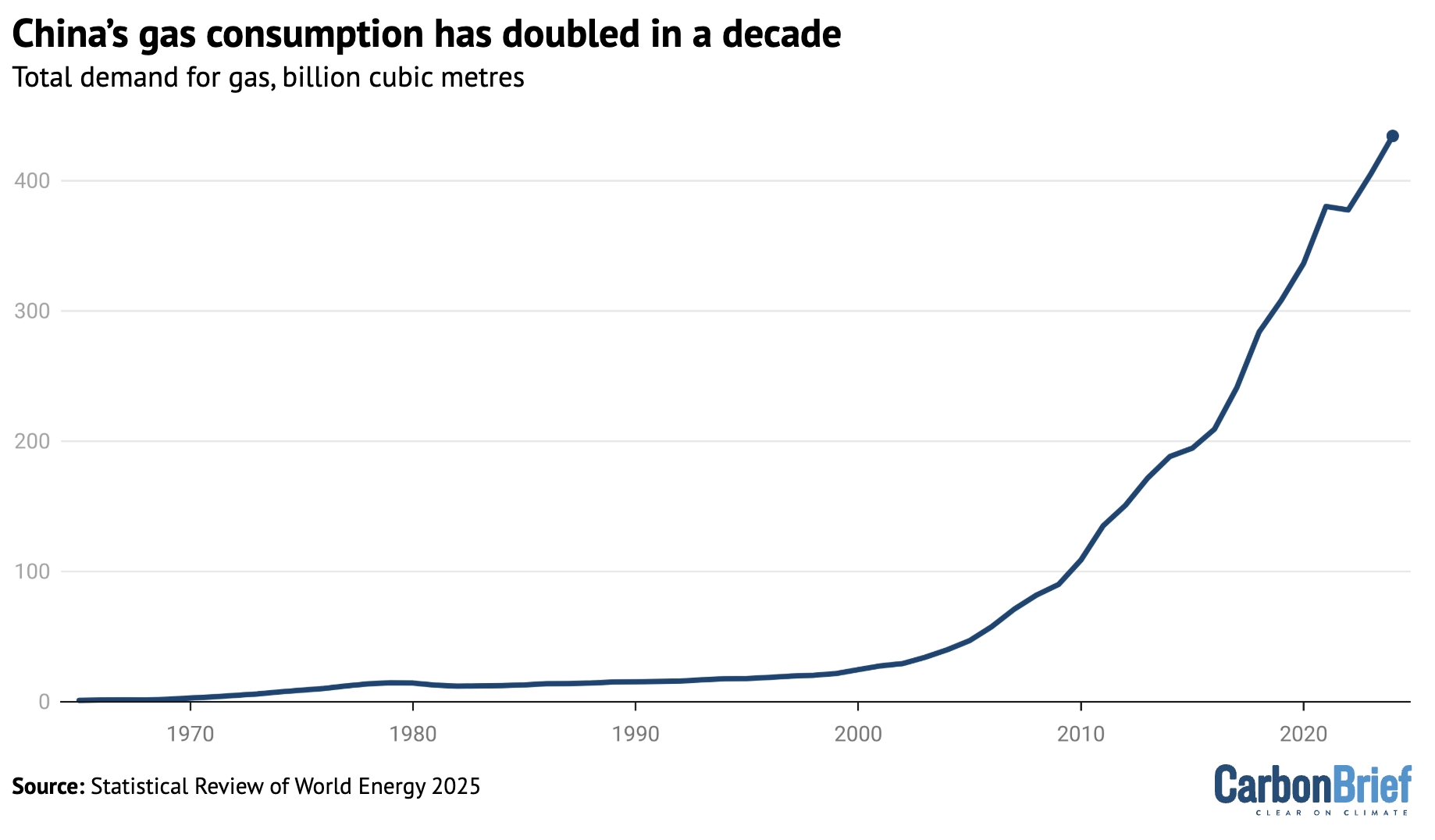 Total demand for gas in China, 1965-2024, billion cubic metres. Source: Energy Institute statistical review of world energy 2025.
The state-run oil and gas company China National Petroleum Corporation (CNPC) forecast in 2025 that demand growth for the year may slow further to just over 6%.
The majority of China's gas demand in 2023 was met by domestic gas supply, according to the Institute for Energy Economics and Financial Analysis (IEEFA).
Most of this supply comes from conventional gas sources. But incremental Chinese domestic gas supply in recent years has come from harder-to-extract unconventional sources, including shale gas, which accounted for as much as 45% of gas production in 2024.
Despite China's large recoverable shale-gas resources and subsidies to encourage production, geographical and technical limitations have capped production levels relative to the US, which is the world's largest gas producer by far.
CNPC estimates Chinese gas output will grow by just 4% in 2025, compared with 6% growth in 2024. Nevertheless, output is still expected to exceed the 230bn cubic metre national target for 2025.
Liquified natural gas (LNG) is China's second most-common source of gas, imported via giant super-cooled tankers from countries including Australia, Qatar, Malaysia and Russia.
This is followed by pipeline imports - which are seen as cheaper, but less reliable - from Russia and central Asia.
One particularly high-profile pipeline project is the Power of Siberia 2 pipeline project. However, Beijing has yet to explicitly agree to investing in or purchasing the gas delivered by the project. Disagreements around pricing and logistics have hindered progress.
Evolving roleBeijing initially aimed for gas to displace coal as part of a broader policy to tackle air pollution.
A three-year action plan from 2018-2020, dubbed the "blue-sky campaign", helped to accelerate gas use in the industrial and residential sectors, as gas displaced consumption of "dispersed coal" (散煤)"- referring to improperly processed coal that emits more pollutants.
Meanwhile, several cities across northern and central China were also mandated to curtail coal usage and switch to gas instead. Many of these cities were based in provinces with a strong coal mining economy or higher winter heating demand.
China's pollution levels saw "drastic improvement" as a result, according to a report by research institute the Centre for Research on Energy and Clean Air (CREA).
(In January 2026, there were widespread media reports of households choosing not to use gas heating despite freezing temperatures, as a result of high prices following the expiry of subsidies for gas use.)
Industry remains the largest gas user in China, with "city gas" - gas delivered by pipeline to urban areas - trailing in second, as shown in the figure below. Power generation is a distant third.
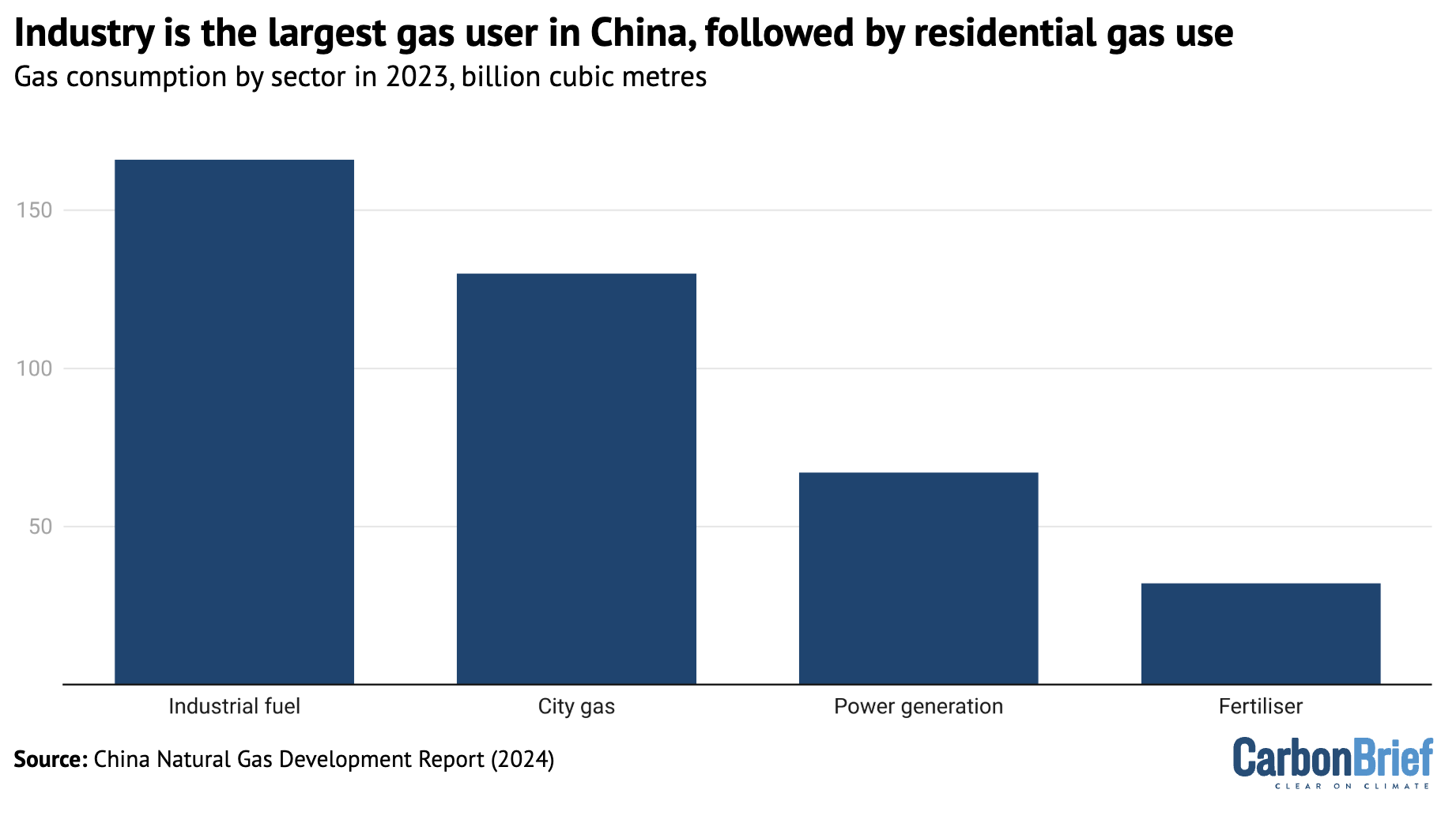 Gas consumption by sector in 2023, billion cubic metres. Source: China Natural Gas Development Report (2024).
Gas has never gained momentum in China's power sector, with its share of power generation remaining at 4% while wind and solar power's share has soared from 4% to 22% over the past decade, Yu Aiqun, a research analyst at the US-based thinktank Global Energy Monitor, tells Carbon Brief.
Yu adds that this stagnation is largely due to insufficient and unreliable gas supply, which drives up prices and makes gas less competitive compared to coal and renewables. She says:
"With the rapid expansion of renewables and ongoing geopolitical uncertainties, I don't foresee a bright future for gas power."
Average on-grid gas-fired power prices of 0.56-0.58 yuan per kilowatt hour (yuan/kWh) in China are far higher than that of around 0.3-0.4 yuan/kWh for coal power, according to some industry estimates. Recent auction prices for renewables are even cheaper than this.
Meanwhile, the share of renewables in China's power capacity stood at 55% in 2024, compared with gas at around 4%.
Generation from wind and solar in particular has increased by more than 1,250 terawatt-hours (TWh) in China since 2015, while gas-fired generation has increased by just 140TWh, according to IEEFA.
As the share of coal has shrunk from 70% to 61% during this period, IEEFA suggests that renewables - rather than gas - are displacing coal's share in the generation mix.
However, China's gas capacity may still rise from approximately 150 gigawatts (GW) in 2025 to 200GW by 2030, Bloomberg reports.
A report by the National Energy Administration (NEA) on development of the sector notes that gas will continue to play a "critical role" in "peak shaving", where gas turbines can be used for short periods to meet daily spikes in demand. As such, the NEA says gas will be an "important pillar" in China's energy transition.
In 2024, a new policy on gas utilisation also "explicitly promoted" the use of gas peak-shaving power plants, according to industry outlet MySteel.
China's current gas storage capacity is "insufficient", according to CNPC, reducing its ability to meet peak-shaving demand. The country built 38 underground gas storage sites with peak-shaving capacity of 26.7bn cubic metres in 2024, but this accounts for just 6% of its annual gas demand.
Transport useGas is instead playing a bigger part in the displacement of diesel in the transport sector, due to the higher cost competitiveness of LNG as a fuel - particularly in the trucking sector.
CNPC expects that LNG displaced around 28-30m tonnes of diesel in the trucking sector in 2025, accounting for 15% of total diesel demand in China.
This is further aided by policy support from Beijing's equipment trade-in programme, part of efforts to stimulate the economy.
However, gas is not necessarily a better option for heavy-duty, long-haul transportation, due to poorer fuel efficiency compared with electric vehicles (EVs).
In fact, "new-energy vehicles" (NEVs) - including hydrogen fuel-cell, pure-electric and hybrid-electric trucks - are displacing both LNG-fueled trucks and diesel heavy-duty vehicles (HDVs).
In the first half of 2025, battery-electric models accounted for 22% of all HDV sales, a year-on-year increase of 9%, while market share for LNG-fueled trucks fell from 30% in 2024 to 26%.
Gas can be cheaper than oil but is not competitive with EVs and - with the emergence of zero-emission fuels such as hydrogen and ammonia - gas may eventually lose even this niche market, says Yu.
Supply securityChinese government officials frequently note that China is "rich in coal, poor in oil and short of gas" ("富煤贫油少气"). Concerns around import dependence have underpinned China's focus on coal as a source of energy security.
However, Beijing increasingly sees electrification as a more strategic way to decarbonise its transport sector, according to some analysts.
"Overall, electrification is a clear energy security strategy to reduce exposure to global fossil fuel markets," says Michal Meidan, head of the China energy research programme at the Oxford Institute for Energy Studies.
Chinese oil and gas production grew dramatically in the last few years under a seven-year action plan from 2019-25, as Beijing ordered its state oil firms to ramp up output to ensure energy security.
Despite this, gas import dependency still hovers at around 40% of demand. This, according to assessments in government documents, exposes the country to price shocks and geopolitical risks.
The graph below shows the share of domestically produced gas (dark blue), LNG imports (mid-blue) and pipeline imports (light blue), in China's overall gas supply between 2017 and 2024.
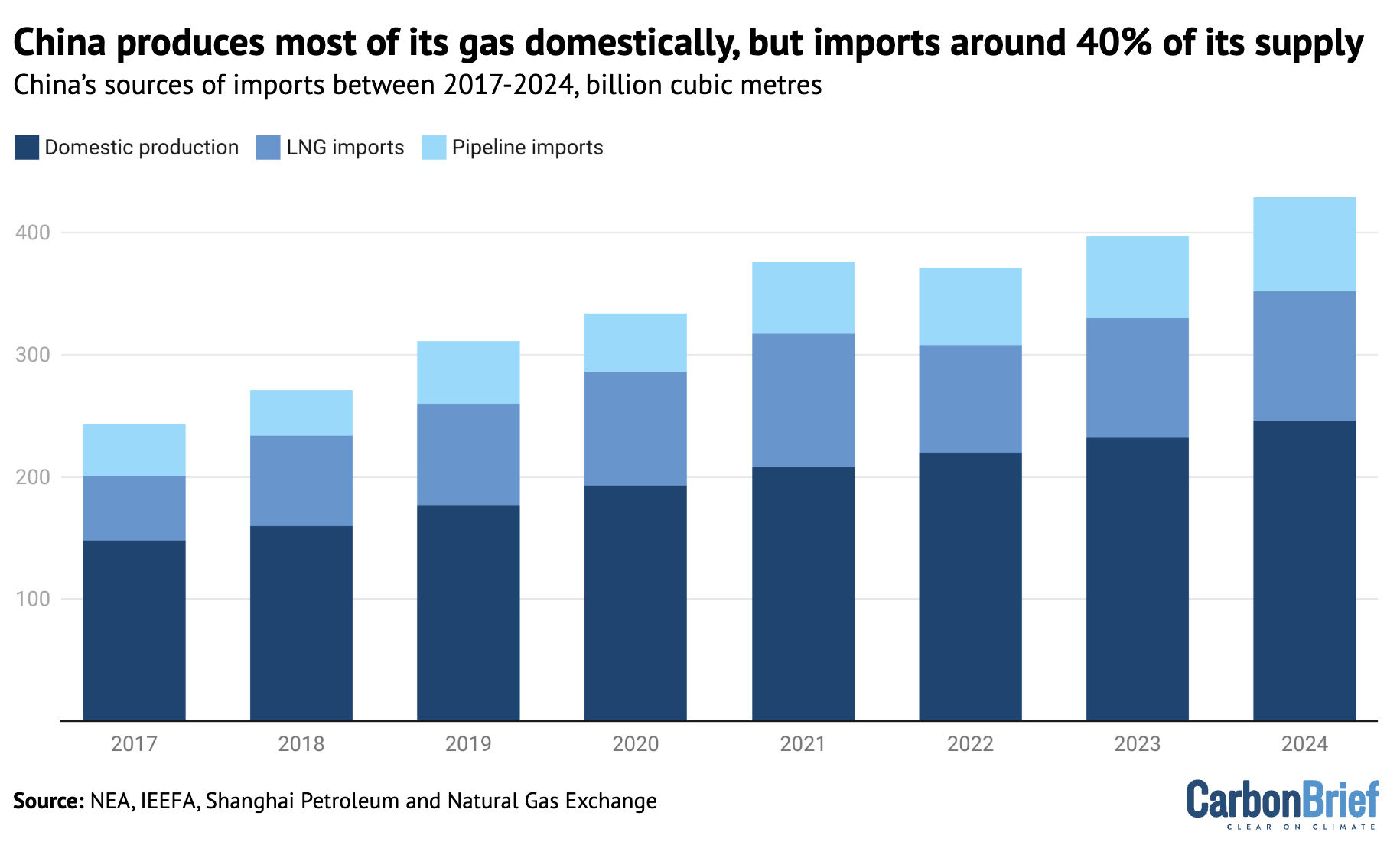 China's gas supply by source, 2017-2024, billion cubic metres (bcm). Source: IEEFA.
"Gas use is unlikely to play a significant role in decarbonising the power system, but could be more significant in industrial decarbonisation," Meidan tells Carbon Brief.
She estimates that if LNG prices fall to $6 per million British thermal units (btu), compared to an average of $11 in 2024-25, this could encourage fuel switching in the steel, chemical manufacturing, textiles, ceramics and food processing industries.
The chart below shows the year-on-year change in gas demand between 2001-2022.
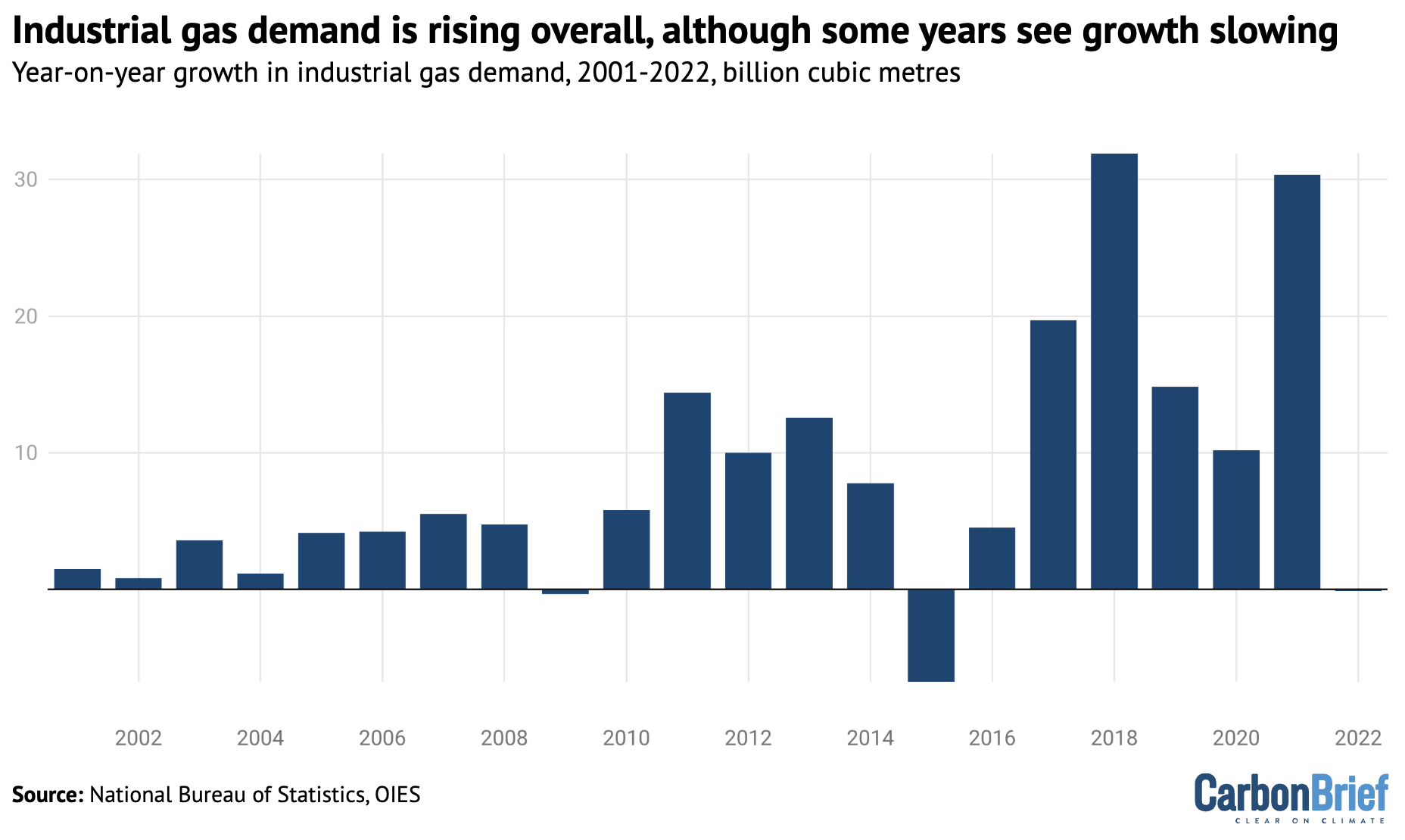 Year-on-year changes in Chinese industry's gas demand by sector, 2001-2023, bcm. Source: National Bureau of Statistics (NBS), OIES.
Growth in gas demand has been decelerating in some industries in recent years, such as refining. But it also remains unclear if Beijing will adopt more aggressive policies favouring gas, Meidan adds.
A roadmap developed by the Energy Research Institute (ERI), a thinktank under the National Development and Reform Commission's Academy of Macroeconomic Research, finds that gas only begins to play an equivalent or greater role in China's energy mix than coal by 2050 at the earliest - 10 years ahead of China's target for achieving carbon neutrality.
Both fossil fuels play a significantly smaller role than clean-energy sources at this point.
Wang Zhongying and Kaare Sandholt, both experts at the ERI, write in Carbon Brief:
"Gas does not play a significant role in the power sector in our scenarios, as solar and wind can provide cheaper electricity while existing coal power plants - together with scaled-up expansion of energy storage and demand-side response facilities - can provide sufficient flexibility and peak-load capacity."
Ultimately, China's push for gas will be contingent on its own development goals. Its next five-year plan, from 2026-2030, will build a framework for China's shift to controlling absolute carbon emissions, rather than carbon intensity.
Recent recommendations by top Chinese policymakers on priorities for the next five-year plan did not explicitly mention gas. Instead, the government endorses "raising the level of electrification in end-use energy consumption" while also "promoting peaking of coal and oil consumption".
The Chinese government feels that gas is "nice to have…if available and cost-competitive but is not the only avenue for China's energy transition," says Meidan.
Experts: What to expect from China on energy and climate action in 2026
China energy
|16.01.26
Analysis: Coal power drops in China and India for first time in 52 years after clean-energy records
China energy
|13.01.26
Q&A: Five key climate questions for China's next 'five-year plan'
China energy
|11.12.25
Interview: How 'mid-level bureaucrats' are helping to shape Chinese climate policy
China energy
|09.12.25
jQuery(document).ready(function() { jQuery('.block-related-articles-slider-block_75750d6da72543622709ca076f80485d .mh').matchHeight({ byRow: false }); });The post Explainer: Why gas plays a minimal role in China's climate strategy appeared first on Carbon Brief.


