

Undoubtedly, some species, usually the most abundant ones, are pestilential. Loathsomeness, on the other hand, like beauty, may be in the eye of the beholder.
Not the culpritsPerhaps the species at the top of the gardener's hit list will be the large black slug and its four close relatives - collectively known as large roundback slugs. On damp, cool evenings it can be difficult to avoid treading on the abundant beasts. Due to their size and colour they are well-recognised and have become the scapegoats for all damage caused by any slugs.
In fact, these slugs are pretty neutral as far as gardeners are concerned. They may attack some vegetables or flowers but far prefer decaying organic matter. Why spend energy on breaking down and digesting fresh green matter when you get enough nutrients more easily by clearing up dog droppings? Their main role is recycling organic matter.
Species such as the green cellar slug actively avoid plants in favour of algae, fungus and lichen. The leopard slug is an omnivore which preys on small snails and slugs in a gardener-friendly diet.


 Green-soled slugs Arion flagellus, collection showing colour variation / Large Black Slug on Isle of Ornsay SSSI. Credit: Chris du Feu. Used with permission / Great grey slug or leopard slug, Limax maximus image by Holger Krisp. CC BY 3.0.
Small nuisances
Green-soled slugs Arion flagellus, collection showing colour variation / Large Black Slug on Isle of Ornsay SSSI. Credit: Chris du Feu. Used with permission / Great grey slug or leopard slug, Limax maximus image by Holger Krisp. CC BY 3.0.
Small nuisances
The big pests for gardeners are the smaller species, often present in great numbers. Hiding by day, they emerge at night to do their business. Also pestilential are small snails, many under 5mm in diameter, generally overlooked by gardeners but at least as damaging as small slugs. But, to paraphrase the musical hall song
She was poor but she was honest,
It's the snails that eats the hostas and the slugs that gets the blame.
The Large Black Slug (Arion ater) is a native species seen throughout the British Isles, not always black. Some juveniles are pale yellow, and the dark adult colouration starts on the back gradually working down to the foot fringe (a skirt-like feature around the bottom of the sides).
Slugs are hermaphrodite and self-mating is possible. For the large black, self-mating seems almost obligatory. If an individual has a particular genetic feature, it will likely pass to its offspring. So slugs in one place resemble each other. For example, a population of large black slugs found at Storr in Skye comprised just white individuals.
The slug that rocksThe large black slug has one curious characteristic, useful in separating it from the other four species in the group. When irritated, mature individuals rock from side to side in a motion difficult to describe, recognisable if you see it (see video below).
To irritate the slug just stroke it gently on the mantle (use a stick for this - you do not know where the slug has been). If you have a rocker, it is almost certainly the native large black. This species is becoming uncommon in gardens, suffering from competition from the other four species unwittingly introduced by gardeners.

 Arion flagellus (Green-soled slug), Credit: Chris du Feu / Arion rufus (Large red slug), Credit: Colin Paton Used with permission
Other large roundbacks
Arion flagellus (Green-soled slug), Credit: Chris du Feu / Arion rufus (Large red slug), Credit: Colin Paton Used with permission
Other large roundbacks
I often visited Wicken in Cambridgeshire in the mid 2010s. The large roundback slugs in the village were exceptionally variable in colour but, as soon as one reached the fen they were all black. The variability away from the fen suggested species other than the large black, their uniform appearance on the fen suggesting a closed homogeneous self-mating population.
The Large Red Slug (Arion rufus) is usually orange and the foot fringe much brighter than the body. Taxonomists debate whether the red and black slugs are the same species. The pendulum swings from one view to the other and I don't doubt will swing back before long.
The Green-soled Slug (Arion flagellus) is widespread and typically brown. The sole is plain with a faint greenish tinge and no lines going in from the foot fringe. It has been found recently on the fen and it is likely to replace the large black slug in the next few years.
The Vulgar Slug (Arion vulgaris) is also present in Wicken. First recorded in Britain in 1964, it became widespread in the early 2010s. The Daily Mail made dire predictions about this 'new', invasive species: it could cause the extinction of our native slugs; devastate food crops in fields and gardens; it was a cannibal; it fed on rabbits. (Actually true, but they didn't say the rabbits had to be dead first.)
It has been named Plague Slug, Cannibal Slug, Stealth Slug, Spanish Stealth Slug, Lusitanian Slug and Iberian Slug, suffering more negative misinformation than other species. But why let facts interfere with a good story?
The beast is usually brownish but varies. Look for the colour of the inner rim of the breathing pore (on the right side of the mantle) - it is almost always very dark or black.
A species new to science Stella Davies' slug Arion sp. Davies, Credit: Chris du Feu. Used with permission
That brings us to the last of the five species - Stella Davies' slug (Arion sp. Davies), which was almost called the Wicken Slug. Among the large roundbacks I saw in Wicken village, several were an unusual grey colour.
They were clearly not the large black slug (did not rock), nor the large red slug (foot fringe no brighter than the body) nor the green-soled slug (tubercles too tightly packed). That left the vulgar slug - except for the unusual colouration.
I sent some specimens to Ben Rowson, keeper of molluscs at the National Museum of Wales. Initially unsure, he subjected it to DNA analysis with surprising results. It was different from all other large roundbacks found in Britain and Europe. Thus we had a species new to science.
What to name it?All that was needed was to publish a formal description and name it - perhaps the Wicken Slug, Arion wickensii.
However Ben was, at the time, studying some preserved specimens bequeathed from lifelong slug enthusiast Stella Davies. Some were an exact match to the Wicken Slug. Her slug was therefore the first found and so bears her name. It is unknown how widespread this species is now. DNA seems the only reliable way of identifying it.
The Wicken slug is now preserved in the National Museum of Wales; its image is in Ben's guide.
Up-to-date distribution maps of these species are on the NBN Atlas site, click here. This national treasure is free to use and gives access to records of all species (plants, animals, fungi, not just slugs).
It would be interesting to know whether Wicken still has the same variety of species, and to discover more about Stella Davies' Slug - not just in Wicken but everywhere.
I hope I have given enough hints about what to look for, how to identify slugs and especially, as this video shows, how they rock.
Video credit: Magnus BorrowmanMore from East Anglia Bylines
 Environment
The magic of planting your garden for wildlife
byMichelle Walkling 13 November 2024
Environment
The magic of planting your garden for wildlife
byMichelle Walkling 13 November 2024
 Activism
Saving hedgehogs starts with small steps close to home
byKate Moore 8 February 2026
Activism
Saving hedgehogs starts with small steps close to home
byKate Moore 8 February 2026
 Activism
How to help nature thrive in your neighbourhood
byGlyn Evans 18 November 2025
Activism
How to help nature thrive in your neighbourhood
byGlyn Evans 18 November 2025
 Activism
How to create your own little pocket of paradise
byJenny Rhodes 10 August 2025
Activism
How to create your own little pocket of paradise
byJenny Rhodes 10 August 2025
 Bylines Network Gazette is back!
With a thematic issue on a vital topic - the rise child poverty, ending on a hopeful note. You will find sharp analyses on the effect of poverty on children's lives, with a spotlight on the communities that are on the front line of deprivation, with personal stories and shared solutions. Click on the image to gain access to it, or find us on Substack.
Journalism by the people, for the people.
The post New to science: a slug from Wicken first appeared on East Anglia Bylines.

We are reaching a tipping point. Around the world, democracy is under assault from a combination of disinformation on social media, an emboldened far-right and economic inequalities fuelling dissatisfaction with the status quo. Outdated institutions are dying hard and fast, and Westminster's voting system is one of them.
Academics and elections experts are issuing increasingly stark warnings that First Past The Post (FPTP) is now under unprecedented strain, with Britain's sixty-year trend away from a two-party electorate coming to a head. Rock-bottom public trust - the legacy of Conservative austerity and infighting - is combining with multi-party politics to create the perfect storm that threatens to further destabilise our democracy and cause chaos for our country.
In the 1950s, Labour and the Conservatives won 95% of the vote combined. At the last general election we won just 58% between us - and this fragmentation has continued to accelerate since then. The era of two-party politics is not coming back. As progressives we must be clear-eyed about what this means: Westminster's electoral system is not fit for the 21st century, but Labour can and must be.
Democratic legitimacy under strainDisproportionate elections go hand-in-hand with public dissatisfaction with democracy - and 2024 was the most disproportionate election in British history. Unusually, public trust in government in 2024 did not see the boost typically associated with a general election. At the last election, Labour played the hand we were dealt - and played it well. We won a majority on a highly efficient 34% share of the vote. But it is not sustainable or democratic for governments to continue to be elected on ever-smaller fractions of the popular vote.
Nor do we have the luxury of time on our side. As many have pointed out, our majority in 2024 was large but precarious. When no party is reliably polling above 30%, one or two percentage points here or there at the next election will make the difference between continuity and chaos - and that's no basis for a stable political system. With the populist right on the march, it's not just the progressive legacy of this government on the line - it's our democracy, shared prosperity and the rights we have taken for granted.
The progressive case for reformSo how should progressives respond? We must embrace those values of fairness, democracy and equality that underpin our movement. Every time a Labour government has introduced modern parliaments in the UK, across Scotland, Wales, Northern Ireland and in the London Assembly, we have opted for Proportional Representation. It is past time we sought a system for Westminster that is more suited to Britain's modern multi-party electorate. To do otherwise would be to wed ourselves to the managed decline and inevitable failure of First Past The Post, and risk being caught on the wrong side of its distorting effects in the process.
There is now a wealth of evidence that fair, proportionate parliaments deliver more stability, with governments lasting on average four years longer than under FPTP, and ministers and Prime Ministers serving years longer in their posts. Last month, business leaders joined growing calls for electoral reform in the Financial Times, because they can see that political instability and economic instability go hand-in-hand. The very spectre of a Farage-led Reform majority government - only conceivable because of FPTP - has already damaged negotiations with the EU.
Across Europe and around the world, most developed social democracies use proportional representation, and see higher levels of investment in public services, more women and ethnic minorities represented in parliament, and better workers' rights as a result. This is not a coincidence. If governments are elected by a majority of voters, they have a vested interest in keeping millions of people happy by creating broad-based economic policies that benefit most of the population.
Lessons from reforming democraciesProgressives have trod this path before us. New Zealand switched from First Past The Post to the proportional Additional Member System in the 1990s. Rather than fracturing, since then our sister party there has thrived. The New Zealand Labour Party went on to win an outright majority under Jacinda Ardern with over 50% of the vote. Voters still have a local MP, but they get regional MPs as well that ensure every voter is equal, and parliament accurately reflects the democratic will of the people.
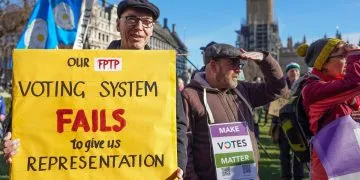
The public are more in favour of electoral reform than they have ever been. Now, 60% support a change in the voting system, including a majority of voters among all parties. I'm proud to be among the members of the All-Party Parliamentary Group for Fair Elections, which is calling on the government to take the first step and lead this debate by setting up a National Commission on Electoral Reform. Labour has the chance to lead this change, and unite the country, our party and progressives behind democratic renewal. But there is no room for complacency.
Jenny is Labour MP for Suffolk Coastal. The article was originally published by Labour for Proportional Representation. It is republished from the Progress blog.
More from East Anglia Bylines
 Party politics
Blocs not parties: the case for a new politics
byStephen McNair 4 January 2026
Party politics
Blocs not parties: the case for a new politics
byStephen McNair 4 January 2026
 Democracy
Is Proportional Representation really too great a risk for Starmer?
byMarc Ainge 9 February 2025
Democracy
Is Proportional Representation really too great a risk for Starmer?
byMarc Ainge 9 February 2025
 Democracy
Revealed: the ten most surprising facts from the 2024 election
byProf Tim Bale 17 December 2025
Democracy
Revealed: the ten most surprising facts from the 2024 election
byProf Tim Bale 17 December 2025
 Democracy
Billions voted in 2024, but cracks are showing in global democracy
byEast Anglia Bylines 7 July 2025
Democracy
Billions voted in 2024, but cracks are showing in global democracy
byEast Anglia Bylines 7 July 2025
 Democracy
Electoral reform is the key to Social Democratic renewal
byJenny Riddell-Carpenter 19 February 2026
Democracy
Electoral reform is the key to Social Democratic renewal
byJenny Riddell-Carpenter 19 February 2026
Bylines Network Gazette is back!
With a thematic issue on a vital topic - the rise child poverty, ending on a hopeful note. You will find sharp analyses on the effect of poverty on children's lives, with a spotlight on the communities that are on the front line of deprivation, with personal stories and shared solutions. Click on the image to gain access to it, or find us on Substack.
Journalism by the people, for the people.
The post Electoral reform is the key to Social Democratic renewal first appeared on East Anglia Bylines.

Imagine Max, a well-trained border collie, manages to ignore a squirrel in the park when his owner tells him to sit. His owner says, "Max, stop chasing that squirrel and sit down," and Max obeys. Can dogs learn and understand words the way humans do?
A new study found dogs like Max may have learnt the names of objects (like a squirrel) from overhearing their owners talking. The study is the latest to try and understand whether intelligent dogs and humans can have real conversations.
A widely reported case in 2004 brought this question into the spotlight. Rico, an eight-year-old border collie, was the first dog who demonstrated under experimental conditions that he knew the names of over 200 different toys.
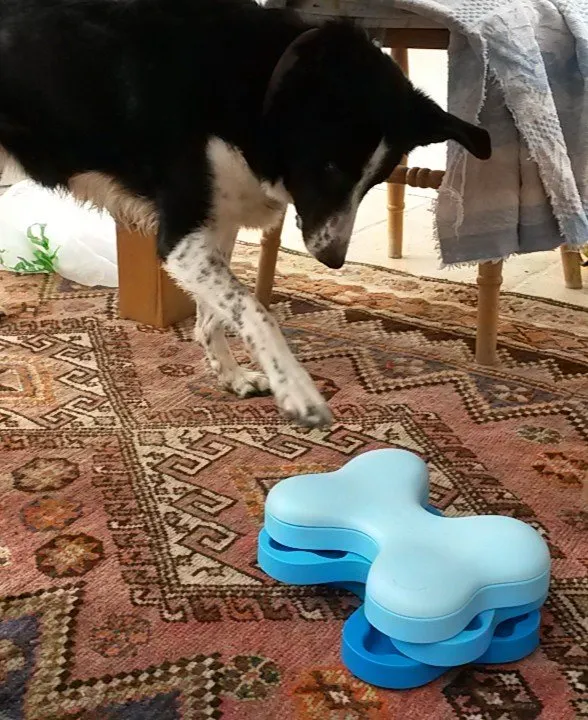 Border collie with food enrichment toy. Used with permission
Words as labels
Border collie with food enrichment toy. Used with permission
Words as labels
Dogs like Rico seem different to other ones. Scientists have a name for them: label-learner dogs. They seem so exceptional, it's easy to wonder if they're learning words in a similar way to humans. Research is starting to give us some answers. But first, it's important to understand how these dogs have been studied.
In 2004, researchers, including myself, wanted to make sure Rico wasn't simply reacting to subtle, unconscious signals from people. So Rico was tested in a room where he couldn't see anyone. He still fetched the correct toys upon hearing the command "Fetch, xy". That meant he was not using visual cues from his owner.
The next big question was whether Rico could learn new name-object combinations the way young children do. Children often learn new words through a process called fast mapping. They hear a new word, look at the options and figure out what it must refer to. For example, if a child knows what "blue" means but not "olive," and you show them a blue object and an olive-green one, they'll probably choose the olive-green one when you ask for "olive".
Working it outRico showed something similar in his behaviour. When researchers placed a brand-new toy among familiar ones and asked for a name he had never heard before, he picked the new toy. He even remembered some of these new name-object pairs weeks later. That means Rico could pick up new names for things without seeing people point at them or look at them or give any other obvious hints.
He just heard a new name and figured out what it referred to.
It seems that there is a group of gifted dogs that have realised that objects have names. These dogs appear to have an exceptional ability to learn the names of many objects. Like Rico's ability to learn names through a process of elimination, these dogs can also learn independently, without needing additional cues to identify the object being named.


 Listening to what you have to say. Used with permission
IQ tests for dogs
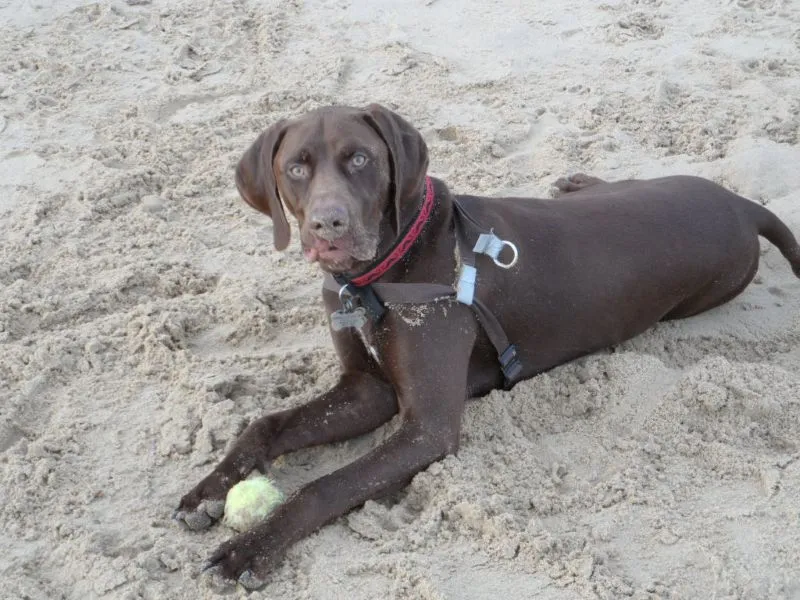
Listening to what you have to say. Used with permission
IQ tests for dogs
But what is it that makes these dogs gifted in this way? To explore this question, my colleagues and I recently studied a group of these unusually talented dogs, of various breeds (border collies, mixed breeds, a Spanish water dog and a pug). Many label-learner dogs are border collies but lots of other breeds seem to have this ability too.
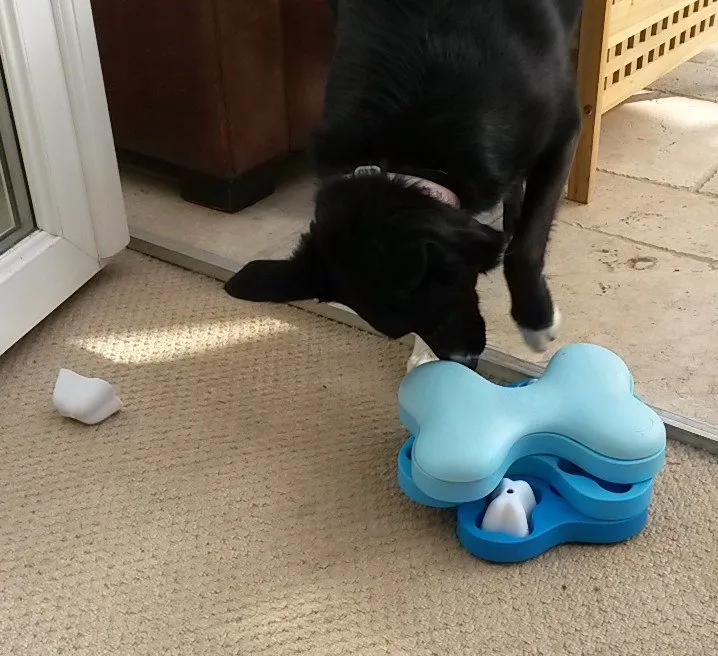 Border collie with more advanced food enrichment toy. Used with permission
My colleagues and I gave them a set of cognitive puzzles to solve. Each dog completed eight tasks designed to measure curiosity, problem solving, memory, learning ability and their ability to follow human communicative cues like pointing or gazing. A second group of dogs - matched by age, sex and breed - (and without any special name-learning skills) took the same tests so we could compare the two groups.
The label-learner dogs consistently showed three key traits. They were obsessed with new objects. They showed strong, selective interest in particular items. And they were better at controlling their impulses when interacting with objects. However, more research will need to investigate whether these traits appear naturally in some puppies or whether they can be shaped through training as a dog grows.
The findings may eventually lead to something like a puppy "IQ test" that identifies young dogs with the potential to learn many object names. This could help trainers select dogs well suited for important roles such as assisting people with sight or hearing impairments or supporting police work.
Toddlers are more capableBut does this all now mean dogs learn words like children do? After all the new paper about overhearing used a approach designed to study understanding in human toddlers.
The answer is: not quite. Children learn thousands of words, and they do it rapidly and flexibly. Even at 18 months, children don't just match a word to whatever they see at the moment.
They can understand what an adult intends to talk about by realising when a person is referring to something that isn't there. For example, if a parent says, "Where's the teddy we played with this morning?" even though the teddy is not in the room, the child may still understand what the parent means and go look for it. Children use shared context to understand others.
Even the highly skilled label-learner dogs seem to struggle to understand object-name links this way.


 Paying attention to what you are saying. Used with permission.
Dogs process words differently
Paying attention to what you are saying. Used with permission.
Dogs process words differently
Although there is ample evidence that dogs seem specifically adapted to human use human given gestural communicative cues, like pointing and gazing, when it comes to "word-learning" the evidence we have is just that dogs can form object-name associations. We also know that some dogs can acquire hundreds of these associations or might have understood a rule that objects have names.
This is not comparable to word learning in children. By around age two, typical English-speaking children learn approximately ten new words each day, reaching an average vocabulary of about 60,000 words by the age of 17.
When they learn words, children apply rules and principles. Their language acquisition is based on the understanding of others as "intentional beings", that other people have goals and intentions. They recognise that when someone talks, points or gestures, they are trying to share an idea, ask for something, or draw attention to something. For example, when a parent says "Look at the dog!" the child typically understands that the parent wants them to notice the dog, not that the words are just random sounds.
However, there is currently no conclusive evidence to suggest that this core principle underpins dogs' interactions with humans.
Dogs are amazing learners, but their abilities are not the same as human language learning. They learn names for objects, not language.

This article is republished from The Conversation under a Creative Commons licence. Read the original article.
 Lifestyle
'Man's best friend': a relationship on the move
byKate Viscardi 26 August 2025
Lifestyle
'Man's best friend': a relationship on the move
byKate Viscardi 26 August 2025
 Community
Why your dog has evolved to love you
byMartin Waller 28 August 2021
Community
Why your dog has evolved to love you
byMartin Waller 28 August 2021
 Culture
Chief Mouser Larry and the surprising power of political pets
byProf Philip Howell 8 August 2024
Culture
Chief Mouser Larry and the surprising power of political pets
byProf Philip Howell 8 August 2024
 Featured
Secrets to a happy, healthy dog: tips for longevity
byDr Jacqueline Boyd 26 August 2024
More from East Anglia Bylines
Featured
Secrets to a happy, healthy dog: tips for longevity
byDr Jacqueline Boyd 26 August 2024
More from East Anglia Bylines
 Friends of Bylines Network
There has never been a greater need for grassroots journalism that investigates the stories that really matter, holds power to account and champions the voices of everyday citizens. We are proudly powered by volunteers but what we do isn't free.
STAND WITH US for independent, citizen-led journalism that makes democracy stronger, and you will even get some exclusive benefits.
BECOME A FRIENDThe post How much can dogs really understand us? first appeared on East Anglia Bylines.
 New report: Poverty is an expensive political choice [ 18-Feb-26 5:39am ]
Poverty in Britain has become so familiar that it risks fading into the background. Food banks on high streets; children arriving at school hungry; working families choosing between heating and eating.
Scrapping the two-child benefit cap is estimated to lift nearly half a million children out of poverty. But that will still leave child poverty levels at 28% - double the rate in the 1970s.
The scale of modern povertyA staggering 4.5 million children - 14 million people in all - are living in relative poverty in the UK. And one in five people living in poverty are actually in work. This is happening in one of the wealthiest economies in the world.
This week, Taxpayers Against Poverty published The Nicolson Report: Poverty Benefits No-One (link at the top of the page).
The report's central conclusion is clear: poverty on this scale is not inevitable, but the result of political and economic choices. For years, governments have claimed that tackling poverty is simply too expensive. Public finances are stretched, we are told. The evidence assembled in The Nicolson Report shows this claim is wrong.
Poverty benefits no onePoverty is estimated to cost the UK more than £75bn every year, through lost output, higher health and social care spending, and reduced tax revenues. It damages health, places enormous pressure on the NHS, weakens productivity, and blights children's life chances.
The UK's economic system actively sustains this failure. At its heart, sits an outdated and unbalanced tax system that over-taxes work and under-taxes wealth.
Most people rely on wages and pay income tax and National Insurance on every payslip, and VAT on most of what they spend. Meanwhile, large amounts of wealth - from property, capital gains, and inheritances - are taxed lightly, inconsistently, or not at all. In some cases, the poorest households pay a higher proportion of their income in tax than the richest.
This is not accidental. It is structural. Wealth in Britain has not been created in isolation. It has been built on publicly funded education, healthcare, infrastructure, legal stability, and social cohesion. These shared foundations made prosperity possible. Yet today, they are underfunded and overstretched, while wealth continues to concentrate at the top. If we are serious about reducing poverty, this imbalance must be addressed.
Tax reform is not about punishment or envy. It is about sustainability, fairness, and funding the systems that allow a modern economy to function. The Nicolson Report sets out a practical "white paper" for this Labour government, if it wants to truly tackle long-term poverty.
A practical route to reformWith an economy struggling for growth, it recommends several simple, cost-effective reforms to the UK tax system, including:
• a 2% wealth tax on assets over £10m, raising £25bn annually, and enjoying strong public support
• aligning capital gains tax with income tax
• applying National Insurance to investment income
• closing income tax loopholes focused on large accumulations of wealth
• reforming council tax, and replacing it with a proportional property or land value tax
Taken together, these reforms would raise substantial revenue. But more importantly, they would rebalance the system so that it no longer entrenches poverty. Research shows these policies already have popular support. A wealth tax, for example, has the backing of Labour Party members, the wider public and even those most likely to pay the tax, millionaires.
Beyond taxation aloneAlongside such tax reform, The Nicolson Report calls for a stronger welfare safety net, action on wage inequality, and sustained investment in health, education, social care, and infrastructure to make lasting progress on poverty. This matters because tax reform is not abstract. It is what enables government to ensure social security covers the essentials of life; to make work a reliable route out of poverty; to invest in public services; and to reduce the regional inequalities that leave entire communities behind.
Preventing poverty is not only morally right; it is economically rational. Recent events and personnel changes in Number 10 have given Keir Starmer a chance to reshape his government and his priorities. He has an opportunity to truly tackle long-term poverty and set his government's own legacy for the 21st century. But will he take it?
More from East Anglia Bylines
 Community
Normalising deprivation - when charity is the default response to poverty
byNick Gardham 3 December 2025
Community
Normalising deprivation - when charity is the default response to poverty
byNick Gardham 3 December 2025
 Economics
Child poverty: policy, consequences and the emerging road ahead
byKate Moore 12 January 2026
Economics
Child poverty: policy, consequences and the emerging road ahead
byKate Moore 12 January 2026
 Economics
We can eliminate poverty: but we have decided not to
byProf Richard Murphy 7 December 2023
Economics
We can eliminate poverty: but we have decided not to
byProf Richard Murphy 7 December 2023
 Politics
A government creating poverty
byStephen McNair 13 December 2022
Bylines Network Gazette is back!
Politics
A government creating poverty
byStephen McNair 13 December 2022
Bylines Network Gazette is back!
With a thematic issue on a vital topic - the rise child poverty, ending on a hopeful note. You will find sharp analyses on the effect of poverty on children's lives, with a spotlight on the communities that are on the front line of deprivation, with personal stories and shared solutions. Click on the image to gain access to it, or find us on Substack.
Journalism by the people, for the people.
The post New report: Poverty is an expensive political choice first appeared on East Anglia Bylines.

Songbirds have charmed people for hundreds of years, boosting our spirits and health. They also play a vital ecological role: dispersing seeds, promoting plant growth, controlling pests and supporting a healthy natural environment. As sensitive indicators of environmental change, they also act as nature's early warning system, alerting us when something's going wrong.
Our UK songbirds are facing unprecedented threats; over the last 50 years, populations have fallen by 50% and continue to decline. We live in an era of mass species extinction, driven by threats such as climate change, insect decline, pollution, predation and landscape changes. Once common species - such as the bullfinch and spotted flycatcher - have become rare sights and sounds.
SongBird Survival, a charity headquartered in Diss, Norfolk, funds scientific research into the reasons for this decline. It focuses on areas where scientific evidence is sparse, inadequate or lacking.
Research into the impact of vet medicinesIn 2023 the charity funded a 2-year research study, working with Sussex University, looking at the effects of veterinary meds on nesting blue tits and great tits. Many species of birds use hair, wool and fur to line their nests as cushioning before laying their eggs. This lining can come from livestock, deer or sometimes from our domestic pets. The study examined the lining of nests for pesticides (such as fipronil, imidacloprid and permethrin) that are commonly found in anti-parasite treatments and tested if the presence of these pesticides had an impact on the offspring of nesting tits.

 Young great tits in their nest box. Image by jokevanderleij8 (CC0) | Two Blue Tit (Cyanistes caeruleus) parents admire their first chick to hatch, just moments before this picture was taken. The female (right) has a caterpillar for the chick's first meal. Image by fs-phil via Wikimedia Commons (CC BY-SA 2.0)
Research findings
Young great tits in their nest box. Image by jokevanderleij8 (CC0) | Two Blue Tit (Cyanistes caeruleus) parents admire their first chick to hatch, just moments before this picture was taken. The female (right) has a caterpillar for the chick's first meal. Image by fs-phil via Wikimedia Commons (CC BY-SA 2.0)
Research findings
The findings from this initial study paint a sad picture for our feathered friends:
- 103 nests were collected from blue tits and great tits and 100% of the nests were contaminated with fipronil (used in spot-on flea treatments for domestic pets).
- 89.1% of blue tit nests and 87.2% of great tit nests had detected levels of imidacloprid (also used in spot-on flea treatments).
- 89.1% of blue tit nests and 84.6% of great tit nests had detected levels of permethrin (typically used in anti-parasite treatments on beef/dairy cattle, horses, sheep, goats, swine, and poultry).
A second phase of this research project investigated whether the chemical exposure is influencing breeding success and survival in songbirds by measuring pesticide levels in the eggs and dead chicks of blue tits and great tits.
"This latest study is due to be published in early spring," Susan Morgan, SongBird Survival Chief Executive Officer told East Anglia Bylines, "so we're on the cusp of learning far more about the hidden impacts these chemicals could be having on our songbirds."
Next stepsWe are a nation of pet lovers, and many pet owners will be using the 'spot-on' flea treatments for cats and dogs. Farmers seek veterinary medical support to control flies, ticks, lice and mites on their livestock. Unfortunately the research findings add to growing evidence that veterinary medicines are potentially having a negative impact on songbird populations. This is why we need a greater environmental risk assessment of veterinary medicines.
SongBird Survival, along with other environmental organisations, is using the research findings to push for a more complete environmental risk assessment of veterinary meds by the Veterinary Medicines Directorate. The impact of pesticides on all wildlife and the environment needs greater understanding.
The charity will be launching a public campaign to help pet owners make informed choices, raising awareness of the environmental impacts of these products and encouraging people to have conversations with vets about the safest and most suitable options for their pets.
What can you do now?
To help prevent treatment pesticides compromising wildlife, SongBird Survival recommends:
- Talk to your vet about the most suitable options for your pet.
- If you do continue to use fipronil, imidacloprid and permethrin spot-on treatments, don't brush your dogs or cats outside or put out hair for the birds to use in nest-making.
- Don't allow pets to go into rivers and streams following the application of spot-on flea treatments, preferably for as long as possible.
- Make sure you dispose of the packaging properly in household waste.
SongBird Survival is the only national UK charity solely dedicated to changing the future for songbirds. Its vision is to create rich, resilient and balanced songbird populations. It makes an impact by driving conservation through scientific research, protecting songbirds by raising awareness and inspiring action, and safeguarding the most at-risk songbird species. Please visit www.songbird-survival.org.uk for more information on how you can help protect songbirds.
More from East Anglia Bylines
 Environment
From silence to song: saving the farmland birds
byRachel Fulcher 5 October 2025
Environment
From silence to song: saving the farmland birds
byRachel Fulcher 5 October 2025
 Environment
Hidden wonders: my fascinating encounters with the Bittern
byLeslie Cater 11 November 2025
Environment
Hidden wonders: my fascinating encounters with the Bittern
byLeslie Cater 11 November 2025
 Climate
The truth about migratory birds and the climate emergency
byJenny Rhodes 18 October 2025
Climate
The truth about migratory birds and the climate emergency
byJenny Rhodes 18 October 2025
 Environment
More than a hobby: garden birdwatching is the new conservation frontier
bySusan Jones 1 February 2026
Friends of Bylines Network
Environment
More than a hobby: garden birdwatching is the new conservation frontier
bySusan Jones 1 February 2026
Friends of Bylines Network
There has never been a greater need for grassroots journalism that investigates the stories that really matter, holds power to account and champions the voices of everyday citizens. We are proudly powered by volunteers but what we do isn't free.
STAND WITH US for independent, citizen-led journalism that makes democracy stronger, and you will even get some exclusive benefits.
BECOME A FRIENDThe post Fighting for songbird survival and safer everyday veterinary medicines first appeared on East Anglia Bylines.

Norwich-based band, Bag Of Cans are currently playing their hearts out across the UK. They are maverick - understatement, they most definitely entertain, and they provide some thumpingly good tunes. Formed in 2017, the band have a constant and loyal cohort growing fan base. Think of Britpop, especially, Blur, with a smattering of the Libertines and Red Hot Chilli Peppers, and then you may know what to expect. This band laughs at itself, and its lyrics are deliciously humorous and beautifully twisted.
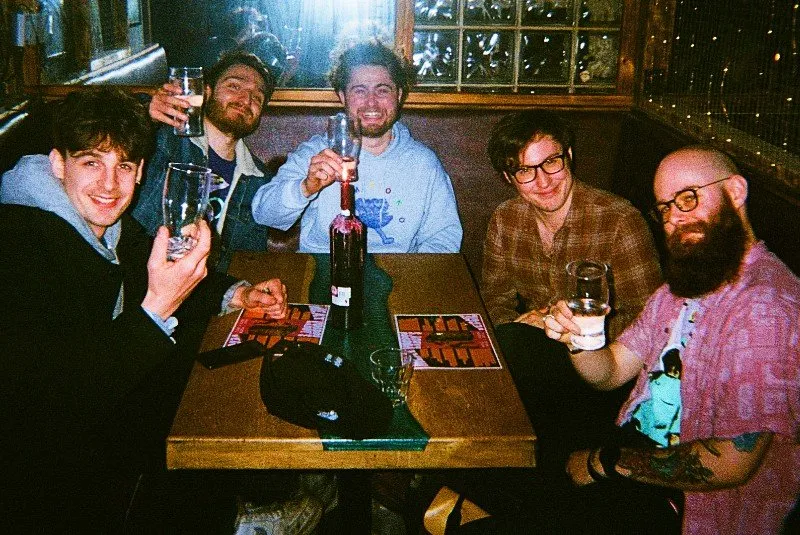 L to R: Tom, Sam, George Baker, George Bryce and Joe. Image credit: Bag of Cans
A contemporary vibe
L to R: Tom, Sam, George Baker, George Bryce and Joe. Image credit: Bag of Cans
A contemporary vibe
 George Baker. Image author-supplied
Bag Of Cans produces an excellent respite to the monotonous droning of drum and bass or the sycophantic narcissism of so much of the current contemporary oeuvres. For a start this crew can write - admittedly somewhat bizarre - lyrics, but they resonate with an audience that's bored with the mainstream, often feels disenfranchised and needs a release. Why not sing about a favourite shirt.
"He's drowning in confidence (Favourite Shirt).A band with style
Smiling at strangers on the street (Favourite Shirt).
Great big grin on his face (Favourite Shirt).
Delightful, to everyone he meets (Favourite Shirt).
No, not in a strange way (Favourite Shirt).
In a hope you have a nice day way (Favourite Shirt).
In an absolute pleasure to be around way (Favourite Shirt).
And nothing could possibly change that today way (Favourite)."
Talking to the band's drummer, Joe explains how this unorthodox bunch got together.
 Drummer Joe. Image author-supplied
"We all met separately. I met the bassist, Sam Watts, on my course, (Environmental Studies at UEA) and he was in a band with Tom McGhie, (journalist) separately doing gypsy jazz swing stuff. The two Georges: George Baker, trumpet and vocals and George Bryce, guitar and vocals, moved here for work, one in insurance and the other at the cathedral, and then bonded in the open mic scene and started a duo which became the initial Bag of Cans. At the same time Sam, the bassist, introduced me to Tom and we started a psych rock band with some other friends."
Joe continues, "I did a drum recording for the two Georges for some SoundCloud demos in Tom's front room which was how I got to know them. Then a member from the psych rock band I was in started putting on shows called Fangsound at the Pig and Whistle (before it became a sports bar) and asked the two Georges to play. They then asked Sam, Tom and me if we'd be able to add a full band to it - and the rest is history."
It may be history to them but to their fans it was a hallelujah moment. Their eclectic, sometimes bizarre style is typified in Hair of the Dog. Unsurprisingly the song's video depicts a dead/comatose Tom McGhie being revived by a tankard of brew. Dressing up is one of the band's fortés, but make no mistake, this group is as passionate and serious about its music and entertainment as it is its quirky humour.
Upcoming datesSupporting Northern Irish headliners Ash for their current tour, Bag Of Cans, can be spotted in both Norwich on 17 February at Epic Studios, and Chinnery's Southend on 18 February, concluding with a grand finale at Birmingham's O2 Institute on 19 February.
More from East Anglia Bylines
 Norfolk
The tenth Norwich Science Festival is on now
byCelina Błędowska 14 February 2026
Norfolk
The tenth Norwich Science Festival is on now
byCelina Błędowska 14 February 2026
 Community
Norwich in Rouen, 2025: art, music and memories
bySarah Patey 16 May 2025
Community
Norwich in Rouen, 2025: art, music and memories
bySarah Patey 16 May 2025
 Education
From Guangdong to Norwich: a Chinese student's story
byStephen McNair 20 March 2024
Education
From Guangdong to Norwich: a Chinese student's story
byStephen McNair 20 March 2024
 Anglia
The cathedral walls have stories to tell
byCelina Błędowskaand1 others 20 August 2023
Bylines Network Gazette is back!
Anglia
The cathedral walls have stories to tell
byCelina Błędowskaand1 others 20 August 2023
Bylines Network Gazette is back!
With a thematic issue on a vital topic - the rise child poverty, ending on a hopeful note. You will find sharp analyses on the effect of poverty on children's lives, with a spotlight on the communities that are on the front line of deprivation, with personal stories and shared solutions. Click on the image to gain access to it, or find us on Substack.
Journalism by the people, for the people.
The post Never kick a Bag of Cans into the long grass first appeared on East Anglia Bylines.

Although we are not seeing the mass rallies and violence of fascism in the 1930s, there are certainly similar trends in many countries. So, is this fascism, or something new? In a new study, Mark Coeckelbergh, Professor of Philosophy of Media and Technology at the University of Vienna, argues we are seeing a new form - "technofascism".
What is fascism?Political theorists argue that fascism arises from mass alienation and atomisation. Individuals who feel themselves isolated and oppressed are vulnerable to emotional myths of national rebirth and victimhood. Fascism then suppresses pluralism, fuses the state and corporate power, and turns politics into a kind of entertainment. And capitalist democracies facing crisis, and visible inequality, are particularly vulnerable.
Coeckelbergh argues that we are seeing the rise of a new form of fascism, which he terms "technofascism". This has three components: the technology itself (Artificial Intelligence and platforms), the business context (Big Tech and surveillance capitalism) and a political context (right‑wing populism, authoritarianism, and illiberal democracy).
Where the fascism of the 1930s controlled people through mass rallies and open terror, technofascism uses algorithms that predict, nudge, and constrain behaviour, often invisibly. AI enables mass surveillance, emotional manipulation, information domination, and algorithmic governance that all erode autonomy, moral judgment and accountability.
The tech savioursAI and social platforms enable classic fascist patterns of myth‑making and emotional mobilisation. Personalised feeds amplify "us versus them" narratives. They polarise and dehumanise "others"; and platform owners can tweak algorithms with no need for overt censorship.
Myths about Artificial General Intelligence, the colonisation of Mars and life extension present tech billionaires as saviours of humanity. So extreme inequality and sacrifice are allowed in the name of a technological destiny. At the same time, AI chatbots and digital companions exploit loneliness and alienation by simulating intimacy, offering escape from isolation to a new sense of community.
This is aided by surveillance capitalism, corporate concentration and a "tech coup", where Big Tech gains power over regulations and politics. Where historic fascism dominated by fear, technofascism pacifies with pleasure, convenience and distraction, while AI‑driven platforms subtly steer preferences and suppress dissent. And behind libertarian rhetoric, Big Tech quietly embeds itself in states, militaries and intelligence agencies.
The fantasy of participationCoeckelbergh argues that this is what we are seeing in the rise of illiberal democracies and populism in the US and Europe. Leaders use digital media to bypass intermediaries, cultivate personality cults and turn politics into an emotional spectacle. Social media produces a "fantasy of participation": enabling people to endlessly express their political views online without having any influence on the underlying structural power. Algorithms amplify divisive content and encourage people to follow leaders, while democratic institutions, and checks and balances are hollowed out.
He does not claim that these tendencies are intentional. Many engineers and some tech leaders might not intend fascist outcomes, yet the opportunities offered by the technology, corporate incentives, capitalist crises, and illiberal politics, produce exactly that result. Digital infrastructures and AI align with authoritarian, corporatist and exclusionary politics, clothed in narratives of innovation and human benefit.
What to do?Coeckelbergh argues that conventional AI regulation and modest democratic reforms - transparency rules, impact assessments, anti‑concentration measures, better oversight, digital literacy and restrictions on political uses of AI - are all necessary, but insufficient. They do not address the deeper drivers: unregulated capitalism, entangling of corporations with the state, social atomisation, ideological myths and the vulnerabilities of liberal democracy.
So, he calls for a broader democratisation, by:
- rebuilding stronger constitutions and independent institutions
- limiting emergency powers
- reforming intelligence services
- tackling media ownership concentration
- strengthening welfare and community
- curbing the accumulation of capital and political power in Big Tech.
He also argues for "bottom‑up" resistance: the development of AI ethics, alternative technological architectures and platform co‑operatives, and education that cultivates democratic virtues and critical awareness of the risks of technofascism.
He is not a pessimist; he believes that technofascist systems also have potential internal weaknesses: complexity, infrastructural fragility, loss of expertise, environmental crises, and cyber‑vulnerabilities, which may make opposition possible.
So technofascism is not just a metaphor - it is a mutation of fascism in the new context. To prevent societies sliding further into this form of domination, he urges not just incremental regulation of AI but a much more radical transformation of both technology and society. We need new democratic narratives and "myths" that can mobilise political emotions towards egalitarian and emancipatory ends, rather than towards authoritarian futures.
More from East Anglia Bylines
 Brexit
The will of the rich and powerful: Brexit and the Epstein files
byStephen McNair 11 February 2026
Brexit
The will of the rich and powerful: Brexit and the Epstein files
byStephen McNair 11 February 2026
 Democracy
When 'The land of the free' stops being free
byGuy Anthony Ayres 6 February 2026
Democracy
When 'The land of the free' stops being free
byGuy Anthony Ayres 6 February 2026
 Politics
The great Ministry of Defence-to-Palantir pipeline
byEthan Shone 9 February 2026
Politics
The great Ministry of Defence-to-Palantir pipeline
byEthan Shone 9 February 2026
 Politics
The nature of fascism and why it differs from populism
byProf Paul Kenny 28 November 2025
Politics
The nature of fascism and why it differs from populism
byProf Paul Kenny 28 November 2025
 Democracy
Technofascism: AI, Big Tech, and the new authoritarianism
byStephen McNair 17 February 2026
Democracy
Technofascism: AI, Big Tech, and the new authoritarianism
byStephen McNair 17 February 2026
Bylines Network Gazette is back!
With a thematic issue on a vital topic - the rise child poverty, ending on a hopeful note. You will find sharp analyses on the effect of poverty on children's lives, with a spotlight on the communities that are on the front line of deprivation, with personal stories and shared solutions. Click on the image to gain access to it, or find us on Substack.
Journalism by the people, for the people.
The post Technofascism: AI, Big Tech, and the new authoritarianism first appeared on East Anglia Bylines.

Are you fascinated by the stars, meteors, the aurora borealis? The Orwell Astronomical Society founded in the late 1960s at the height of the 'space-race' offers an opportunity to develop a passion for astronomy. As a registered charity (no. 271313) it exists to promote the science of astronomy in Suffolk. This is done by organising meetings and running occasional night, and sometimes day, observing sessions.
The society has done a great deal of work to uncover the astronomical history of Suffolk and the work of a number of amateur astronomers whose influence on science has been profound.
The Orwell Park ObservatoryThanks to the eccentric Colonel George Tomline (1813-1889), Ipswich has an observatory.
 The Observatory, Orwell Park School image by N Chadwick. CC BY-SA 2.0
Tomline was elected to Parliament for the constituency of Sudbury (Suffolk) in 1840. During a period out of office, Tomline purchased Orwell Park estate from Sir Robert Harland for £102,500 in 1848. He subsequently demolished part of the mansion house and replaced it with the beautiful red-brick structure that stands nowadays. A bachelor his whole life, Tomline liked to entertain weekend guests at Orwell Park and kept a steam yacht moored at the bottom of the gardens for their use. He was fabulously wealthy and built the Felixstowe branch railway entirely from his own pocket.
His interest in the sciences encompassed astronomy, which was at the time was a very fashionable and a rapidly advancing science. In the early 1870s, during a major extension to Orwell Park mansion, he indulged his interest by commissioning the Orwell Park Observatory. His enormous wealth enabled him to demand the best, including employing a professional astronomer, John Isaac Plummer (1845-1925).
The telescope Tomline refractor telescope. Credit OAS(I). Used with permission
Central to the Grade II Listed observatory is a refracting telescope that dates from 1874. It was impressive for its age, boasting a ten-inch (250mm) aperture and a 3.9m focal length. The telescope sits on a German equatorial mount. This means it can reach all points of the sky and needs only a single motor to drive it as it tracks objects as they move across the sky.
The society assists Orwell Park School (the current owners) in maintaining and operating its historic observatory. Much of our early work was in renovating the telescope after a period of several decades of neglect.
Suffolk's amateur astronomersThe society continues to encourage astronomers to follow in the footsteps of past influential Suffolk astronomers. Alice Grace Cook (1877-1958), a lady of leisure, discovered Nova Aquilae in 1918 and was one of the first women to be made a Fellow of the Royal Astronomical Society. So accomplished an amateur astronomer was Cook that she taught John Philip Manning Prentice (1903-81) astronomy. Prentice, another amateur, was a key member of Sir Bernard Lovell's team of (professional) scientists. Their work together led to Lovell building Jodrell Bank - in its day, the largest radio telescope on earth.
Roland Clarkson (1889-1954) 'the Trimley Moon Man' is another. Clarkson had a particular interest in the Moon and was a prolific contributor to lunar studies and mapping the surface.
The Orwell Astronomical SocietyIn addition to weekly meetings at Orwell Park Observatory, the society meets in the Village Hall in Newbourne twice a month. Membership is open to all. We have around one hundred paid-up members, whose annual subscriptions help fund our activities.
Members' images of deep sky and solar system objects are published both on our website and in an emailed monthly newsletter. We have a library and a collection of instruments available for loan to members.


 Aurora Borealis captured by the author from Orwell Park at 10pm 10.10.2024. / The corona and diamond ring of the sun from 2.7.2019 eclipse. Credit Paul Whiting. Used with permission
One of our members has a slot on a local community radio station where he discusses what can be seen in the night sky each month. Our WhatsApp and Facebook groups enable the rapid dissemination of information, for instance when there is a display of the aurora borealis (northern lights). This has been particularly useful over the past year or so, when, due to significant activity on the Sun, these displays have been unusually strong and numerous.
We have an 'eclipse chaser' in our midst who regularly travels the world to record total solar eclipses. These spectacular events, which occur when our Moon completely obscures the Sun, are still the only chance ground-based astronomers get to observe the Sun's corona or atmosphere.
The corona image shows the Sun's "atmosphere", which cannot normally be seen because of the glare form the photosphere. The ray structure that can be seen in the corona is caused by the solar magnetic field lines attracting the charged material or plasma being emitted by the Sun. The diamond ring image shows the last vestige of sunlight before it is totally masked by the Moon. You can also see some activity in the the Sun's chromosphere around the "diamond and opposite it. These are flares or eruptions on the solar surface.
Want to know more?Our lecture meetings are open to the public, with nationally known amateur and professional astronomer speakers.
During the winter months we hold monthly 'taster evenings'. Visitors are invited to tour the Orwell Park Observatory and learn about the various forms of telescope available. If the weather is clear you may even have a chance to view a celestial object using Colonel Tomline's Telescope.
More information about The Orwell Astronomical Society's event may be found here. All are welcome.
More from East Anglia Bylines
 Science
Strange new worlds
byProf Chris Impey 20 September 2022
Science
Strange new worlds
byProf Chris Impey 20 September 2022
 Anglia
The Fermi Paradox and UFOs over Rendlesham Forest
byMartin Waller 2 January 2023
Anglia
The Fermi Paradox and UFOs over Rendlesham Forest
byMartin Waller 2 January 2023
 Featured
How one remarkable Suffolk woman helped shape modern astronomy
byKate Mooreand1 others 11 February 2026
Featured
How one remarkable Suffolk woman helped shape modern astronomy
byKate Mooreand1 others 11 February 2026
 Culture
The haunting cry that brings a creature from another world
byPeter Thurlow 30 December 2025
Bylines Network Gazette is back!
Culture
The haunting cry that brings a creature from another world
byPeter Thurlow 30 December 2025
Bylines Network Gazette is back!
With a thematic issue on a vital topic - the rise child poverty, ending on a hopeful note. You will find sharp analyses on the effect of poverty on children's lives, with a spotlight on the communities that are on the front line of deprivation, with personal stories and shared solutions. Click on the image to gain access to it, or find us on Substack.
Journalism by the people, for the people.
The post Spectacular astronomy in Suffolk: past, present, and future first appeared on East Anglia Bylines.
Now animal rights protesters are in Labour's sights [ 16-Feb-26 5:36am ]
The Labour Party has a problem with animal rights campaigners. During the Blair Government, Labour famously wrestled frequently with finding the balance between the freedom of activists to voice their concerns with animal testing and the economic investment brought by the pharmaceutical industry (often favouring the latter). The current Labour Government has inherited this aversion to animal rights protesters, but has done away with all pretence of seeking to facilitate protest. Against the background of extending the Conservative Government's anti-protest legislation, Kier Starmer's Government now represents the greatest challenge to the freedom of assembly yet.
On 14 January 2026, the Commons voted to approve an amendment which would restrict protests outside "life sciences infrastructure", including specifically infrastructure used for animal testing. The amendment was introduced on 27 November 2025 by the Minister for Policing and Crime, Sarah Jones. It sought to classify "life science infrastructure" as a "key national infrastructure" under section 7 of the Public Order Act 2023.
Section 7 criminalises the "interference with use or operation", defined broadly as preventing the infrastructure from being used or operated to any extent for any of its intended purposes, of a list of now ten "key national infrastructures". The maximum sentence for contravening section 7 is twelve months' imprisonment, a fine, or both. Since section 7(7) of the Public Order Act 2023 allows the Secretary of State to add a new kind of key national infrastructure using secondary legislation, the Government has avoided full parliamentary scrutiny of its legislative amendment.
The motivations behind the amendmentSarah Jones presented the amendment as necessary to aid police in responding to "disruptive protest activity that is undermining our national health resilience", highlighting the Government's goal for the UK to become a "global beacon for scientific discovery".
According to Jones, the life science industry informed the Government that it cannot currently function in some cases due to protests. Jones' defence of the amendment was concerning. Jones did not use a single example of a recent animal rights protest which had actually impacted an animal testing facility, merely pointing out that at the 135 facilities which are licensed to do animal testing, there is only "potentially"the possibility of "protests of different degrees".
In any case, her justification that such measures must be taken to ensure vaccines can be produced in the event of a pandemic fall flat since many of these facilities have absolutely nothing to do with vaccine production.
The only current animal rights protest campaign targeting animal testing seems to be "Camp Beagle", a protest camp stationed in Cambridgeshire outside MBR Acres, a company which breeds up to 2000 beagles a year for animal testing. Camp Beagle has been established since June 2021 and grew after the Daily Mirror had published photographs of poor conditions at the premises.
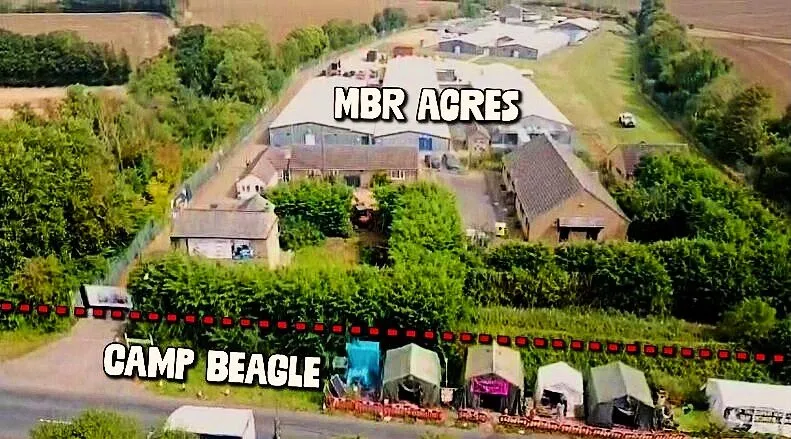 Beagle is the world's longest-running, permanent grassroots animal rights protest camp. It is situated outside the entrance of MBR Acres in Huntingdon, Cambridgeshire. Image by Camp Beagle
Just two days before the Commons voted to approve the amendment, a jury at Cambridge Crown Court acquitted four protesters for burglary after they had broken into MBR acres to rescue beagle puppies in December 2022. To classify MBR acres as a 'key infrastructure' is significant overreach; in the words of Labour MP Kerry McCarthy, "I do not think that the country will grind to a halt if MBR Acres is occasionally obstructed from supplying beagles to laboratories for testing".
Déjà vu? The Blair yearsOn 11 November 2025, the Government introduced its road map to phase out animal testing in line with its manifesto commitment. The first act of the Government in 2026, however, has been to criminalise protests outside animal testing facilities. There is an element of déjà vu here. Before the 1997 election, Tony Blair promised a Royal Commission to examine animal testing and possible alternatives. After elected as Prime Minister, Blair, whose premiership oversaw a heightened period of animal rights protests, instead decided the way forward was to clamp down on animal rights activists.
The most significant campaign during this period was by Stop Huntingdon Animal Cruelty (SHAC). SHAC was formed as a direct action group which aimed to shut down Huntington Life Science, an animal testing facility based in Cambridgeshire. Members became well known for their method of intimidatory "home visits", where activists would target the homes of scientists and staff of HLS and particularly their suppliers, shareholders and customers, with the aim of isolating HLS economically.
The growth of the animal rights movement in the early 2000s meant that by 2004, CEOs of major Japanese pharmaceutical companies based in the UK put increasing pressure on the UK Government to deal with protests under the threat that they would exit the country, leaving a £18.5 billion black hole in the economy in their wake.
In response, the Government legislated for section 145 (offence of "interference with contractual relationships so as to harm animal research organisations (AROs)") and section 146 ("threatening someone that they will be the victim of a crime or tortious act causing loss or damage, because they are linked to an ARO") of the Serious Organised Crime Act (SOCA) 2005. Both offences have a maximum term of imprisonment of five years.
The SOCA also added Section 42A to the Criminal Justice and Police Act 2001 which created a free-standing offence of harassing someone in the vicinity of their home. These legislative amendments, in addition to a ramped up police response, of which particularly encouraged pharmaceutical companies to use civil injunctions against protesters, led to a dramatic decline of animal rights activity by the end of the 2000s.
Lowering the threshold of acceptable protestDuring the debate on the amendment in December 2025, Matt Vickers MP mentioned that accompanying documents to the draft regulations held that police had requested more powers because sections 145 and 146 SOCA did not go far enough to deal with current animal rights protests. The police had not explained why.
The simple matter is that current animal rights protesters, such as those at "Camp Beagle" do not engage anymore with those controversial tactics covered by those offences. Instead of recognising this, and maintaining space for peaceful protest, the Government, potentially unnerved by a recent string of life science industry disinvestments in the UK totalling £1 billion (down to domestic economic malaise, Brexit and US policies, not protests), has decided to dramatically lower the threshold of acceptable dissent, and criminalise peaceful protest.
Labour has put aside its previous concerns with the anti-protest legislation ushered in by previous Conservative Governments. Sarah Jones has gone from criticising the Conservative legislation provisions as "draconian" and "disproportionate" to a position of using them in full force against peaceful protesters now she is in government.
The move to criminalise animal rights protests takes place against the background of a concerted effort to micromanage and curtail protest. Beyond animal rights protests, Labour have pushed further in legislating for more protest-related restrictions in the Crime and Policing Bill which is currently passing through the House of Lords.
 Many of those arrested at a Palestine Action protest were elderly - police have said about half were over 60.
Worryingly, on 15 January 2025, the Lords agreed an amendment to the Bill put forward by the Government which would allow police to consider the cumulative impact of frequent protests when imposing conditions. This represents the greatest threat yet to the freedom of assembly. In effect, police will be able to introduce conditions on protests if they deem protesters have had sufficient opportunity to voice their concerns.
The amendment, in fact, had been repackaged from secondary legislation introduced by the former Home Secretary Suella Braverman in 2023 which was ruled subsequently unlawful by the Court of Appeal.
Clearly, notwithstanding the change in government, the zeal to limit peaceful protest persists. At this current pace, this begs the question: what will remain of the freedom of assembly at the end of this Labour Government?
This article originally published on LSE Blogs is reproduced under a Creative Commons licence (CC BY 4.0). Read the original here.
More from East Anglia Bylines
 Activism
Apathy or alienation? Finding the lost art of protest
byStacey Richards 15 April 2025
Activism
Apathy or alienation? Finding the lost art of protest
byStacey Richards 15 April 2025
 Activism
Just Stop Oil: do radical protests turn the public away from a cause?
byProf Colin Davis 23 October 2022
Activism
Just Stop Oil: do radical protests turn the public away from a cause?
byProf Colin Davis 23 October 2022
 Activism
How International Women's Day protests sparked the Russian Revolution
byCameron Holloway 9 March 2022
Activism
How International Women's Day protests sparked the Russian Revolution
byCameron Holloway 9 March 2022
 Activism
Protest songs: the political message in the Magnificat
byRevd Selwyn Tillett 5 January 2022
Bylines Network Gazette is back!
Activism
Protest songs: the political message in the Magnificat
byRevd Selwyn Tillett 5 January 2022
Bylines Network Gazette is back!
With a thematic issue on a vital topic - the rise child poverty, ending on a hopeful note. You will find sharp analyses on the effect of poverty on children's lives, with a spotlight on the communities that are on the front line of deprivation, with personal stories and shared solutions. Click on the image to gain access to it, or find us on Substack.
Journalism by the people, for the people.
The post Now animal rights protesters are in Labour's sights first appeared on East Anglia Bylines.
Why are scientists calling for urgent action on amoebas? [ 15-Feb-26 5:16pm ]
Free-living amoebas are a little known group of single-celled organisms that don't need a host to live. They are found in soil and water, from puddles to lakes. What makes them remarkable is their ability to change shape and move using temporary arm-like extensions called pseudopodia - literally "false feet". This allows them to thrive in an astonishing range of environments. And they pose a growing health threat.
What is the 'brain-eating amoeba' and how dangerous is it?The most notorious free-living amoeba is Naegleria fowleri, commonly known as the "brain-eating amoeba". It lives naturally in warm freshwater, typically between 30°C and 40°C - lakes, rivers and hot springs. But it is rarely found in temperate countries such as the UK, due to the cold weather.
The infection happens when contaminated water enters through the nose, usually while swimming. From there, the amoeba travels along the nasal passages to the brain, where it destroys brain tissue. The outcome is usually devastating, with a mortality rate of 95%-99%.
Occasionally, Naegleria fowleri has been found in tap water, particularly when it's warm and hasn't been properly chlorinated. Some people have become infected while using contaminated tap water to rinse their sinuses for religious or health reasons. Fortunately, you cannot get infected by drinking contaminated water, and the infection doesn't spread from person to person.
Why are these amoebas so difficult to kill?Brain-eating amoebas can be killed by proper water treatment and chlorination. But eliminating them from water systems isn't always straightforward. When they attach to biofilms - communities of microorganisms that form inside pipes - disinfectants like chlorine struggle to reach them, and organic matter can reduce the disinfectants' effectiveness.
The amoeba can also survive warm temperatures by forming "cysts" - hard protective shells - making it harder to control in water networks, especially during summer or in poorly maintained systems.
What is the 'Trojan-horse effect' and why does it matter?Free-living amoebas aren't just dangerous on their own. They can also act as living shields for other harmful microbes, protecting them from environmental stress and disinfection.
While amoebas normally feed on bacteria, fungi and viruses, some bacteria - like Mycobacterium tuberculosis (which causes TB) and Legionella pneumophila (which causes legionnaires' disease) - have evolved to survive and multiply inside them. This helps these pathogens survive longer and potentially become more dangerous.
Amoebas also shelter fungi such as Cryptococcus neoformans, which can cause fungal meningitis. It can also shelter viruses, such as human norovirus and adenovirus, which cause respiratory, eye and gastrointestinal infections. By protecting these pathogens, amoebas help them survive longer in water and soil, and may even help spread antibiotic resistance.
How is climate change making the problem worse?Climate change is probably making the threat from free-living amoebas worse by creating more favourable conditions for their growth. Naegleria fowleri thrives in warm freshwater. As global temperatures rise, the habitable zone for these heat-loving amoebas has expanded into regions that were previously too cool. This potentially exposes more people to them through recreational water use.
Several recent outbreaks linked to recreational water exposure have already raised public concern in multiple countries. These climate-driven changes - warmer waters, longer warm seasons, and increased human contact with water - make controlling the risks more difficult than ever before.
Are our water systems adequately checked for these organisms?Most water systems are not routinely checked for free-living amoebas. The organisms are rare, can hide in biofilms or sediments, and require specialised tests to detect, making routine monitoring expensive and technically challenging.
Instead, water safety relies on proper chlorination, maintaining disinfectant levels, and flushing systems regularly, rather than testing directly for the amoeba. While some guidance exists for high-risk areas, widespread monitoring is not standard practice.
Beyond brain infections, what other health risks do these amoebas pose?Free-living amoebas aren't just a threat to the brain. They can cause painful eye infections, particularly in contact lens users, skin lesions in people with weakened immune systems, and rare but serious systemic infections affecting organs such as the lungs, liver and kidneys.
What's being done to address this threat?Free-living amoebas such as Naegleria fowleri are rare but can be deadly, so prevention is crucial. These organisms don't fit neatly into either medical or environmental categories - they span both, requiring a holistic approach that links environmental surveillance, water management, and clinical awareness to reduce risk.
Environmental change, gaps in water treatment and expanding habitats make monitoring - and clear communication of risk - more important than ever. Keeping water systems properly chlorinated, flushing hot water systems, and following safe recreational water and contact lens hygiene guidelines all help reduce the chance of infection. Meanwhile, researchers continue to improve detection methods and doctors work to recognise cases early.
Should people be worried about their tap water or going swimming?People cannot get infected with free-living amoebas like Naegleria fowleri by drinking water, even if it contains the organism. Infection occurs only when contaminated water enters the nose, allowing the amoeba to reach the brain. Swallowing the water poses no risk because the amoeba cannot survive or invade through the digestive tract.
The risk from swimming in well-maintained pools or treated water is extremely low. The danger comes from warm, untreated freshwater, particularly during hot weather.
What can people do to protect themselves?People can protect themselves from free-living amoebas by reducing exposure to warm, stagnant water. Simple steps include avoiding putting your head underwater in lakes or rivers during hot weather, using nose clips when swimming, choosing well-maintained pools, and keeping home water systems properly flushed and heated.
Contact lens users should follow strict hygiene and never rinse lenses with tap water. For nasal rinsing, only use sterile, distilled, or previously boiled water.
Awareness is key. If you develop a severe headache, fever, nausea, or stiff neck after freshwater exposure, seek medical attention immediately - early treatment is critical.

This article is republished from The Conversation under a Creative Commons license. Read the original article.
More from East Anglia Bylines
 Activism
The politics of pollution: the failure of the privatised water industry
byWil Harvey 28 January 2026
Activism
The politics of pollution: the failure of the privatised water industry
byWil Harvey 28 January 2026
 Anglia
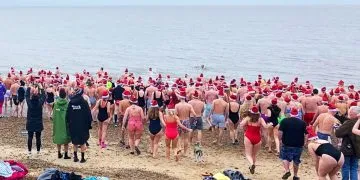
Wild swimming magic: community, courage and cold waves
byKate Viscardi 2 January 2025
Anglia
Wild swimming magic: community, courage and cold waves
byKate Viscardi 2 January 2025
 Environment
Norfolk Broads rivers drowning in sewage, new report warns
byOwen Sennitt, Local Democracy Reporter 24 September 2025
Environment
Norfolk Broads rivers drowning in sewage, new report warns
byOwen Sennitt, Local Democracy Reporter 24 September 2025
 Anglia
n Water faces backlash after conviction in Environment Agency probe
byOwen Sennitt, Local Democracy Reporter 1 June 2024
Anglia
Anglian Water faces backlash after conviction in Environment Agency probe
byOwen Sennitt, Local Democracy Reporter 1 June 2024
 Climate
Why are scientists calling for urgent action on amoebas?
byDr Manal Mohammed 15 February 2026
Climate
Why are scientists calling for urgent action on amoebas?
byDr Manal Mohammed 15 February 2026
Bylines Network Gazette is back!
With a thematic issue on a vital topic - the rise child poverty, ending on a hopeful note. You will find sharp analyses on the effect of poverty on children's lives, with a spotlight on the communities that are on the front line of deprivation, with personal stories and shared solutions. Click on the image to gain access to it, or find us on Substack.
Journalism by the people, for the people.
The post Why are scientists calling for urgent action on amoebas? first appeared on East Anglia Bylines.
Surprising growth in UK productivity [ 15-Feb-26 6:38am ]
Here's some good news that might have passed you by. UK productivity - how much the economy produces per hour worked - grew more in the past year than in the previous seven years combined. I know. It doesn't feel like that. GDP per person has barely moved since before the pandemic - up just 0.8% in six years. We've slipped level with Italy, having been 8% ahead. The vibes are terrible.

The UK has lost ground relative to their peer group. But productivity is genuinely picking up, and the reason why tells us something important about what's happening in the economy and what the Bank of England might do next.
First, a measurement issueThe official productivity numbers come from the Labour Force Survey (LFS), and they show a modest 1.1% growth in the year to Q3 2025. That's good - faster than most years since pre-2007 Good Old Days - but not exciting. But the problem is LFS response rates have collapsed since the pandemic, and as a result it erroneously thinks that the 16+ employment rate has been reasonably flat over the past year.
If we use payroll data instead - to count employees receiving a payslip - the picture transforms. The employment rate is now *dropping* fast on this measure. With output rising slowly, but the number of hours worked to produce it dropping fast, productivity in fact grew by 3.1% over those four quarters. That's not a rounding difference. It's the gap between "solid" and the best non-pandemic year since before the financial crisis.
 Productivity growth has accelerated sharply when measured correctly
Creative destruction
Productivity growth has accelerated sharply when measured correctly
Creative destruction
One driver of productivity growth is something the economist Joseph Schumpeter called "creative destruction." The idea is simple: unproductive firms die, their workers move to better firms and the economy gets more productive. It's how market economies are supposed to work - but the UK hasn't been getting enough of it.
Since the financial crisis, and outside of the pandemic, creative destruction has been sluggish. Think of it this way. Interest rates were basically zero for over a decade. Energy was cheap. The minimum wage was low. If you were running a not-very-productive business, you could get by - maybe not thrive, but survive. Too many firms were limping along, tying up workers and capital that could have been used more productively elsewhere. That lack of churn is one of the prime suspects behind the UK's productivity malaise.
Now the environment has changed. Interest rates are higher, energy costs more, and the minimum wage has risen sharply. And sure enough, we're seeing more firms go under. Job losses from exiting firms in 2024 were the highest since 2011. Corporate insolvencies are running well above pre-pandemic levels. Redundancies are up too.
 Insolvencies and redundancies are picking up
*If* this really was creative destruction at work, it could be exactly what the UK economy needs. More churn, more reallocation, more productive firms replacing less productive ones. That's a good story. But it's a pretty big "if."
Destruction yes, creation not so muchHere's the catch. Creative destruction has two parts, and so far we've mainly got the latter.
The destruction is clearly happening - firms going bust, workers being laid off. But the creation? Not so much. We're not seeing a wave of new firms starting up to absorb those workers. Hiring at expanding firms isn't (yet) big enough to pick up the slack.
The result is that unemployment has risen to its highest level in a decade outside the pandemic (5.1%). The productivity gains are real, but they're coming partly from fewer people working, not just from more output being produced.
What kind of unemployment?This is where it gets tricky. Not all unemployment is the same, and what the Bank of England does next depends on what kind we've got.
If higher unemployment simply reflects spare capacity - not enough demand in the economy to keep everyone in work - then the Bank should act. Cut rates, stimulate spending, bring unemployment back down. That's textbook stuff.
If it's frictional - more people between jobs at any given moment because the economy is churning faster - that's different. It's not painless for the people involved, but it is temporary for them, and it's an inevitable side effect of the dynamism the UK economy badly needs more of. A more dynamic economy just has a higher background rate of job switching. The Bank doesn't need to step in.
The really worrying scenario is mismatch or unrealistic expectations. Maybe workers displaced from dying firms don't have the right skills for the jobs being created. A barista laid off when a coffee chain goes bust can't necessarily walk into a role at an AI startup. Or maybe wage expectations haven't adjusted - if workers are hankering after unrealistic wages to make up for past or expected inflation, the labour market will generate inflation. In that world, unemployment stays high, the Bank can't fix it by cutting rates, and we don't get the benefits of higher dynamism either. We would just have to live with it until skills catch up or expectations adjust.
Right now, we honestly don't know which of these stories is right. Probably a bit of all three. But the answer matters enormously - not just for economists, but for anyone with a mortgage or looking for a job.
Watch this spaceThe productivity pickup is genuinely good news. The UK economy badly needed it. But we're stuck in an uncomfortable middle phase: the old firms are dying and the new ones haven't fully arrived yet. Whether this turns into a story about a healthier, more dynamic economy - or a story about a downturn that the Bank must respond to - is probably the most important question in UK macro right now.
This article is republished from the Resolution Foundation's substack. It draws on Chapter 2 of the Foundation's recent report Mountain Climbing.
More from East Anglia Bylines
 Economics
Is Britain at the peak of a great financial wave?
byProf Richard Murphy 2 December 2025
Economics
Is Britain at the peak of a great financial wave?
byProf Richard Murphy 2 December 2025
 Economics
Decline, what decline? The myth of dying Europe
byGabriel Zucman 2 January 2026
Economics
Decline, what decline? The myth of dying Europe
byGabriel Zucman 2 January 2026
 Business
What do we really know about working from home?
byJane Parry 7 January 2026
Business
What do we really know about working from home?
byJane Parry 7 January 2026
 Economics
Where did the money go - we offer some answers
byAndrew Curry 11 January 2026
Economics
Where did the money go - we offer some answers
byAndrew Curry 11 January 2026
 Economics
Surprising growth in UK productivity
byDr Gregory Thwaites 15 February 2026
Bylines Network Gazette is back!
Economics
Surprising growth in UK productivity
byDr Gregory Thwaites 15 February 2026
Bylines Network Gazette is back!
With a thematic issue on a vital topic - the rise child poverty, ending on a hopeful note. You will find sharp analyses on the effect of poverty on children's lives, with a spotlight on the communities that are on the front line of deprivation, with personal stories and shared solutions. Click on the image to gain access to it, or find us on Substack.
Journalism by the people, for the people.
The post Surprising growth in UK productivity first appeared on East Anglia Bylines.
The tenth Norwich Science Festival is on now [ 14-Feb-26 5:39pm ]
Organised in partnership with the University of East Anglia, the Science Fair will entertain, invigorate and stimulate all who attend and is the third largest science festival in the UK. Catering for all ages, from the moment you enter Norwich's Forum's atrium, you'll notice that this space has become the Explorium for the duration of the festival. The festival is spread across numerous venues throughout Norwich, including Norwich School and Norwich Theatre.
Support from the Norwich Research ParkIf you're fascinated by microscopic science, the Microbe Zoo based in the Forum's Gallery will be open from 10.30 - 16.00 - be prepared to queue. Once inside the 'zoo', you'll be transported into a world inhabited by bacteria, fungi, viruses and algae. A team of 'zookeepers' from Norwich Research Park will guide you through the different habitats, as you discover "what these tiny creatures do and how they keep plants, people, and the planet healthy."
The Microbe Zoo, is presented by the Centre for Microbial Interactions, based at the Norwich Research Park, will guide you through the different habitats as you discover what these tiny creatures do, and how they keep plants, people and the planet healthy. Other organisations from the research park have provided funding for this event through the SAW Trust, which was founded in 2005 at the Norwich based John Innes Centre.
Half-term funFamilies are welcome and many of the events are children centric. From 16 - 21 February the church of St Peter Mancroft, opposite the Forum, is hosting a fascinating exhibition, Bells, Beasts and Bones. Just pick up an explorer's backpack and follow a trail around the church. Children from the ages of 4 to 12 will have a great time making discoveries, and anyone over the age of seven can take part in a bellringing taster session on 18-19 February.

 Images by the Norwich Science Festival
Tasting science
Images by the Norwich Science Festival
Tasting science
Some people love marmite others absolutely hate it. Dr Duncan Gaskin, a former research scientist and currently chair of the Norfolk and Norwich Science association, will delve into the science behind our food tastes with experiments and demonstrations. This event is based on the Atom stage, right in front of the Forum and is weather dependent so it's a good idea to check with the information desk whether the display is still running.
STEM careersIf you ever wanted to learn more about what it's like to work at CERN, home to the Large Hadron Collider , then Tik Tok, Insta and You Tube creator, Dr Clara Nellist, particle physicist, will be on hand in the auditorium on 20 February to explain how she built her successful career. She'll highlight some of the difficulties encountered along the way as well as the satisfaction she gains from her career.

 Images by the Norwich Science Festival
Let there be light
Images by the Norwich Science Festival
Let there be light
For an £8,00 ticket, from 16 - 21 February you can take part in a unique series of workshops where you have to imagine that the city is shrouded in darkness. It's down to you to restore power. You can make your own electrical circuits and even learn how to launch an electrical flying saucer. Children aged 5-8 are welcome along if accompanied by an adult. The event takes place at the Sir Isaac Newton Sixth form situated in the old fire station on Bethel Street.
Many of the events are free and the organisers do not offer concessionary tickets. Booking is essential, even for the free events as many of the most popular events fill up quickly or sell out in advance. Those without tickets can buy on the day at the Information Desk in The Explorium at The Forum.
 Image by the Norwich Science Festival
More from East Anglia Bylines
 Featured
How one remarkable Suffolk woman helped shape modern astronomy
byKate Mooreand1 others 11 February 2026
Featured
How one remarkable Suffolk woman helped shape modern astronomy
byKate Mooreand1 others 11 February 2026
 Activism
One hour for birds: The power of Big Garden Birdwatch
byLeslie Cater 18 January 2026
Activism
One hour for birds: The power of Big Garden Birdwatch
byLeslie Cater 18 January 2026
 Economics
Tech's wild bet on AI: Jackpot or collapse?
byBen Smith 16 December 2025
Economics
Tech's wild bet on AI: Jackpot or collapse?
byBen Smith 16 December 2025
 History
How volcanic eruptions led to the Black Death in Europe
bySarah Collins 8 December 2025
Bylines Network Gazette is back!
History
How volcanic eruptions led to the Black Death in Europe
bySarah Collins 8 December 2025
Bylines Network Gazette is back!
With a thematic issue on a vital topic - the rise child poverty, ending on a hopeful note. You will find sharp analyses on the effect of poverty on children's lives, with a spotlight on the communities that are on the front line of deprivation, with personal stories and shared solutions. Click on the image to gain access to it, or find us on Substack.
Journalism by the people, for the people.
The post The tenth Norwich Science Festival is on now first appeared on East Anglia Bylines.
St Valentine's Day and the art of choosing love [ 14-Feb-26 3:23pm ]
Celebrating St Valentine's Day is a very old tradition which may have its origins in the Roman festival of Lupercalia, a festival that marked the start of springtime. One, perhaps apocryphal, ritual was that during the celebrations, boys drew the names of girls from a box. They would be boyfriend and girlfriend for the duration of the festival. Sometimes they'd marry.
There are many other strategies for finding your soul mate: the 3-3-3 rule, where you review yourself at three different points - after three dates, after three weeks, and after three months; the 6-6-6 rule, which is probably best when seeking a male partner, as it refers to choosing someone who is six feet tall, has a six-pack abs, and earns over six figures; and the 37% rule, where one dates and rejects the first 37% of potential partners.
I've never been much persuaded by dating formulas. What follows is simply my own way of thinking about relationships, shaped by years of experience rather than theory. It's not for everyone, but as it works for me, I thought I'd share it.
My advice is different Swans mate for life. Image by Mat Fascione (CC BY-SA 2.0)
Romance and dating don't have to be conventional, but require vulnerability and commitment. The caveat is, when seeking a romantic partner, one does need to use some common sense to avoid headache and heartache.
Over the years, friends have marveled at how successfully I have navigated the adventures of dating. My approach is simple: is the person of good character and does he or she meet my "rules of engagement"?
We all have different ideas about what we want in a relationship. So, before I explain further, I ask that you seek pen and paper, and write out what you are looking for in a relationship. That is, what are the first 12 attributes that come to mind and the 12 things that you will bring to a relationship?
Having made your lists, set the paper aside. Now read my rules of engagement. Remember, this exercise is about clarity, not a critique.
My rules of engagement 1. Mutual attractionWithout this, you are wasting your time. Pining away for unrequited romance is a counterproductive state of mind and, I think, a very unattractive trait.
2. A single personThe individual must be available. Simple as this may read, I cannot count just how many friends I have known over the years that had romances with someone who is committed to someone else. Exhibit self-worth - if they are genuinely attracted to you, let them first take the steps to make themselves single.
3. Emotionally freeTo me, it is also important that the individual is emotionally available - not longing for a previous failed relationship or grieving over the death of a romantic partner. Absolutely avoid falling into the role of "emotionally supportive caregiver". You are looking for a romantic relationship, not the role of therapist.
4. Local Dating App. Image by Santeri Viinamäki (CC BY-SA 4.0)
The individual should be on the spot. It can be very challenging to date someone who is distant. I know internet dating can bring together persons far and abroad, and happiness can transpire. But ask yourself this, "If they are so wonderful, why are they choosing to look at distant romantic possibilities?"
Early romance has enough awkward communication patches without adding in the hurdle of long-distance.
5. IndependentThe individual must be self-supporting. This means not living off their parents, their great aunt, their ex, or a trust fund.
6. A spiritual personI would want the person to be on a spiritual path. Don't let this throw you. It doesn't mean a structured religious person, but someone who is humble, and honest enough to acknowledge that there is something greater in the cosmos than themselves. The key word here is humble. Someone who hugs a tree, or looks beyond themselves, is an excellent example.
ThenRead my rules of engagement one through six, and apply them to yourself; I believe it is only fair that you uphold the same standards.
The review Image by dronepicr (CC BY 2.0)
Now, prioritise each of the two lists you wrote out at the beginning of this article. This allows you to see the most important traits you desire in someone, and what you are offering. Know your goals, know yourself.
And so, the early stage of courtship begins. Remember that ultimately, you can only be who you are, and they in turn, will be who they are. If you find romantic love, research suggests such a pairing with commitment delivers optimal conditions for rearing children.
For those of you that have given up on dating or are discouraged, don't be - unless you prefer to remain footloose and fancy free. Make your own happiness. There is nothing more attractive to others than someone who is independent and content with their life.
Allow the cosmos to surprise you. Romance and love may come when you least expect it.
Happy Valentine's Day!
More from East Anglia Bylines
 Culture
Giving your (unusual) heart away this Valentine's Day
byBen Smith 13 February 2025
Culture
Giving your (unusual) heart away this Valentine's Day
byBen Smith 13 February 2025
 Anglia
Wine harvest brings unexpected romance and 'quintessentially English' sparkling wines
byPeter Thurlow 12 November 2021
Anglia
Wine harvest brings unexpected romance and 'quintessentially English' sparkling wines
byPeter Thurlow 12 November 2021
 Community
The Valentine ring and run!
byKate Moore 14 February 2024
Community
The Valentine ring and run!
byKate Moore 14 February 2024
 Culture
Taylor Swift's 'Tortured Poets': a dive into heartbreak and triumph
byLiz Crosbie 2 May 2024
Friends of Bylines Network
Culture
Taylor Swift's 'Tortured Poets': a dive into heartbreak and triumph
byLiz Crosbie 2 May 2024
Friends of Bylines Network
There has never been a greater need for grassroots journalism that investigates the stories that really matter, holds power to account and champions the voices of everyday citizens. We are proudly powered by volunteers but what we do isn't free.
STAND WITH US for independent, citizen-led journalism that makes democracy stronger, and you will even get some exclusive benefits.
BECOME A FRIENDThe post St Valentine's Day and the art of choosing love first appeared on East Anglia Bylines.


There may by now be an unbridgeable margin of doubt as to whether the PM's reputation can be repaired. Though at the end of this week, after the smoke of battle has cleared, we are none the wiser as to what happens next. This is, not least, because the news media (and in particular the BBC), instead of reporting what was in front of their eyes, had set themselves a story they were confident would break. And when it failed to follow their requirements then, come hell or high water, they refused to let go.
So Keir Starmer is still there, and in all the hoo-ha, no hack ever bothered to explain exactly the processes and seamy realities by which he would be removed. Or why their prophesies failed to materialise. Labour MPs are frustrated at the PM's performance - but also at their own. Once again, the plotters have blanched at the prospect of regicide. They failed to strike.
Others express lukewarm support for the PM, though few are prepared to talk about it openly. Many seem as much bystanders as the average Guardian reader: Morgan McSweeney's hold over Keir Starmer seemed a mystery to them too.
But one regional MP whose patience is long past declares: "The same people and policies will still be fronting the same unpopular programme. Like a wounded animal, this government will drag itself away till it expires, probably after the May locals.
"By then, Starmer can resign on the grounds of those losses and not the reputational disaster of Epstein and Mandelson. He'll go down as the worst PM in Labour history, and one that may have finally broken it. He's a coward who refuses to take responsibility for his own actions… A genuine disaster for this country and the Labour movement."
*
 Václav Havel (L) playing chess. Image by L. Kaválka Archive.
When Vaclav Havel was made president of what was Czechoslovakia, effectively by public acclaim, he saw no reason to change his life. He still turned up to play chess with his old friends in their favourite bar on Friday evenings. They weren't alone by then, of course, and were surrounded by journalists and well-wishers. When somebody disturbed his concentration to ask what he was planning to do about some problem or other, the new president said: "I don't know. What would you do?"
Nobody would ever have claimed Mr Havel was a weak man, but he didn't claim to have all the answers or feel the need to beat his chest in public. Yet in Britain, we are always led by men and women who claim to have all the answers. That only proclaims their weakness. They believe we, as a nation, are so lacking in courage we need to believe Britain's omnipotence in all things, in order to add an inch or two to the nation's manhood.
So how do we escape from this embarrassing cycle? Compare the dignity of the defenestrated Sue Gray, who came from a different and less tribal tradition, with the deposed-at-last Morgan McSweeney - a jumped-up office manager - who declared in his resignation letter that he had "resigned from the government".
So does the PM soldier on, claiming he was right all the time? Or does he admit he (or Mr McSweeney) got things catastrophically wrong? In order to change, he has to change his entire team and culture, though neither his team nor his culture will allow him to do that. And how would he explain an ear splitting and rubber burning handbrake turn on Brexit and immigration? Dear reader, whichever way up you hold it, this just won't do.
*
 Jenny Riddell-Carpenter in Parliament. Image by LDRS. Used with permission
Of the 2024 intake of Labour MPs, Jenny Riddell-Carpenter (Suffolk Coastal) is a name which keeps popping up. In truth, she was not expected to become a well-known voice, but she has the ability to express herself honestly, as well as the courage to challenge her party when it gets things wrong. Her reasons for backing Keir Starmer will sound reasonable to many voters.
"We have had five Prime Ministers in seven years," she writes in the East Anglian Daily Times. "Swapping Keir Starmer for a sixth would not cleanse politics. It would plunge the country back into the troubled waters of political instability voters rejected. It would damage the economy, deter investment, and erode trust in politics altogether."
*
 Harold Wilson. Image by Alan Warren via Wikimedia Commons (CC BY-SA 3.0)
"The Labour Party is a moral crusade or it is nothing," said Harold Wilson, but that is an altar long since cast down. Nobody could describe this week's tatty political parlour games as having much to do with a moral crusade. So, does that mean the Labour Party is nothing?
They are engaged in what is always Labour's favourite sport, visceral and unforgiving internecine warfare. While Keir Starmer waits to see whether his new high chamberlain decides he should be born again, or whether it's to be business as usual, his rivals blithely plot quite openly.
 Angela Rayner. Image by 70023venus2009 on Flickr (CC BY-ND 2.0)
The two figures who always crop up are Angela Rayner and Wes Streeting. In fact, so blatant have ambitions become that Ms Rayner launched her 'Rayner for leader' website early, and it had to be withdrawn. Meanwhile, one of the Streeting team is reported on record as saying the reason they are on manoeuvres early is to jump the gun on Ms Rayner.
 Wes Streeting. Image by Number 10 via Flickr (CC BY 2.0)
Wes Streeting looks rather like a dissipated cherub. Pecksniff finds him a puzzle, only partially solved by talking to a few of the region's Labour MPs. One who admits that they and Mr Streeting are "somewhat opposite" politically, nevertheless declares: "He's a hard worker, on top of his brief, regularly communicates with backbench MPs and takes them on the journey. He knows MPs' names - you'd be amazed how many cabinet members don't - and he's a good communicator."
Another says: "Starmer will probably struggle on till May and then try and go out on his own terms. It will give Wes time the to ride out the storm as well. Time is his friend."
*
There was once a row in one of the Commons bars between two MPs, one Tory and one Labour. The Tory cried in exasperation: "You bloody fool!"
"You may be right," observed the Labour man. "But there are millions of bloody fools in this country, and they deserve representation just like anybody else."
This anecdote may explain the appeal of Reform. They appeal to the bloody fools. And they appear to have gone about the Gorton and Denton by-election in their usual hypocritical, uninformed, clumsy and presumptuous manner.
Their candidate even flounced away from a public hustings after, it is claimed, having been refused his intention of packing the audience with his supporters who had been bused in.

They are also accused of breaking electoral law, by misrepresenting a supposed letter from a local voter, when it looks suspiciously like a campaign tactic they used in the recent Caerphilly by-election; only this time it doesn't have the imprint necessary under law. Police are investigating.
Meanwhile, Labour and Greens accuse each other of cynically misrepresenting recent voting figures in their election material. Both are correct. Both are effectively lying to the voters. Any claims of a 'new politics' are bogus.
But nobody has yet accused either the Tories or Liberal Democrats of blatant disregard for the truth, (admittedly something of a first for the LibDems). This is rather faint praise, however. The most likely reason there have been no complaints is that nobody has noticed they are taking part.
*

More on Reform's hypocrisies. This week, Nigel Farage declared: "People aren't more productive working from home - it's a load of nonsense".
At the same time, Reform are advertising for a regional director, describing the job as: "Home working with occasional travel".
*
The Jim Ratcliffe 'immigration row' this week would have been the perfect opportunity for the government to point out that Britain needs more immigration to support an ageing population, and that immigrants are major net contributors to the British economy. But they didn't.
This might have been because, post-McSweeney, No.10's communications is as bad as ever and they didn't think of it. Or it could be that, pending the arrival of Keir Starmer's new satrap to replace him, the PM has yet to be told what his policy on immigration should be.
*
More evidence of how even the cabinet don't know what Labour's policies are at the moment. On Thursday, the Telegraph reported Rachel Reeves, the chancellor, as saying that "Closer ties with EU are Britain's biggest prize". Whereas last month in Davos she reiterated what was then Morgan McSweeney's her government's position that urged cabinet ministers to stop floating the idea of a closer union.

*
Incidentally, for those Westminster hacks still dribbling at the prospect of a Reform election victory in three years' time, a glance at the latest YouGov approval ratings of the party leaders might rather piss on the matches.
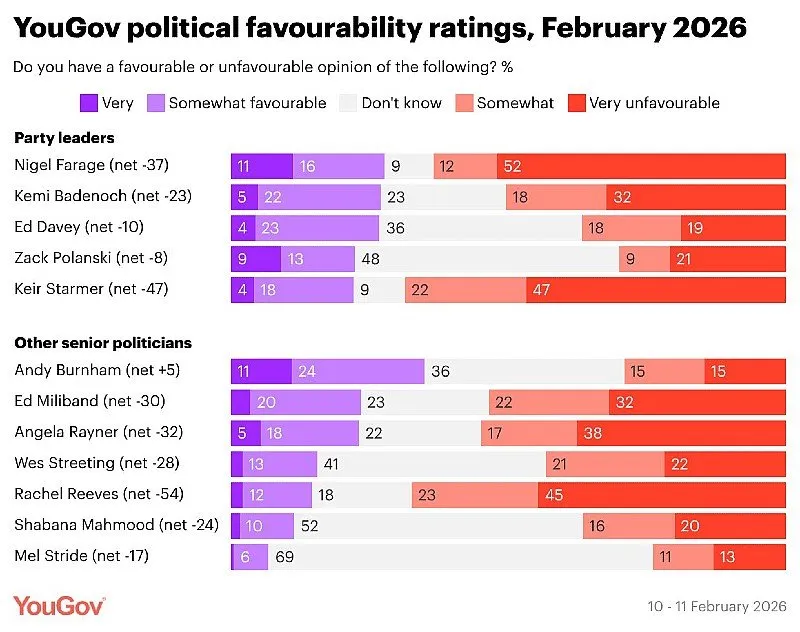
Nigel Farage ranks second bottom, with an approval rating of -37. This is interesting, since though Keir Starmer is constantly lambasted for his poor showing - currently -47 - the eulogies constantly poured over Mr Farage by Chris Mason et al might imply he is flying high.
The full results are: Zack Polanski -8, Ed Davey -10, Kemi Badenoch -23, Nigel Farage -37 and Keir Starmer -47. And incidentally (and quirkily) Sir Keir's ratings have improved by 10 points during the present political fandango, from -57 last month. Whereas Mr Farage continues to decline…
*
Last week, Pecksniff mentioned a new political grouping called Prosper, launched by many of the old Tory faces supportive of what The Times calls "softer Conservative values". This week they tell us they have attracted 17,000 supporters in those first seven days. They have also analysed them. The group aims to extend the Tory vote and reveal that only one in three of their shiny new supporters voted Tory in the last election.
But it also seems that fewer than one in six is presently a member of the party. Which rather suggests that, though Prosper might appeal to the lost souls who haunt the political fringes, they still have a long way to go to make an impression on the hard right on whom Kemi Badenoch is so dependent.
*
 Zack Polanski at the Green Party Conference 2025
If ever a party were likely to be riven with schisms, it ought to be today's Green Party. Making the jump from unforgiving ideology to practical political reality was always going to be a major bridge to cross. But as they have shown especially in Suffolk, it can be done.
That is unlikely, however, to impress those who Green party members themselves refer to as the 'ultras', no doubt buoyed by the influx of ex-Corbynistas who jumped ship from Labour and are still keen to pursue their schisms. So at the same time there is a realistic chance of a major breakthrough electorally, the party faces stormy weather ahead caused by their looming article 105, likely to be up before conference: 'Zionism is Racism'.
The left have always placed ideological purity above the messy business of winning democratic power, and destroying the party in order to make an empty gesture is always worth the candle. Self-righteousness is a powerful drug, which is why the causes of the left so often languish.
*
The state of our politics, my dears, really. There was a by-election for Peterborough City Council on Thursday. Reform won with 7.4% of the electorate…
*
This week's secret letter boxers were Stace Richards, James Porter, David Patey, Celina Błędowska, Liz Crosbie, Malcolm Lynn, Karl Whiteman and Helen Forte.
<<< Previous Pecksniff's Diary
More from East Anglia Bylines
Brexit
The will of the rich and powerful: Brexit and the Epstein files
byStephen McNair 11 February 2026
 Brexit
Exiting the UK to re-join the European Union
byAidan Marshall 13 February 2026
Politics
The great Ministry of Defence-to-Palantir pipeline
byEthan Shone 9 February 2026
Brexit
Exiting the UK to re-join the European Union
byAidan Marshall 13 February 2026
Politics
The great Ministry of Defence-to-Palantir pipeline
byEthan Shone 9 February 2026
 Party politics
The strange people who join political parties
byStephen McNair 8 February 2026
Friends of Bylines Network
Party politics
The strange people who join political parties
byStephen McNair 8 February 2026
Friends of Bylines Network
There has never been a greater need for grassroots journalism that investigates the stories that really matter, holds power to account and champions the voices of everyday citizens. We are proudly powered by volunteers but what we do isn't free.
STAND WITH US for independent, citizen-led journalism that makes democracy stronger, and you will even get some exclusive benefits.
BECOME A FRIENDThe post Pecksniff: A bruising week in politics, ill served by both MPs and media first appeared on East Anglia Bylines.
 The following article contains images of human remains
The aftermath of a battle or execution from around the 9th century AD has been discovered by Cambridge University archaeologists and students conducting a training dig as part of the University's undergraduate degree in archaeology.
The burial pit, found on the outskirts of Cambridge, may date from a time when the area was a "frontier zone" in the conflict between the Saxon-run kingdom of Mercia and the kingdom of East Anglia, which was conquered by the Vikings in around 870 AD (CE).
Unearthed during spring and summer last year, the pit contained the remains of ten individuals based on the number of skulls, including at least one decapitation and a man well over six foot in stature - extremely tall for the time - with a trepanned head.
Unusually, the mass grave held a mix of complete and dismembered remains, including a cluster of skulls without clear accompanying bodies and a "stack of legs", as well as four complete skeletons, some in positions suggesting they were tied up.
All appear to have been relatively young men flung into the pit without care, leading archaeologists to believe they found the wake of a skirmish or battle, or perhaps a mass execution - or a combination of both. The discovery is showcased in an episode of the BBC's 'Digging for Britain'.
 Image credit: Cambridge Archaeological Unit/David Matzliach
A training excavation with extraordinary results
Image credit: Cambridge Archaeological Unit/David Matzliach
A training excavation with extraordinary results
The excavation, led by Dr Oscar Aldred from the Cambridge Archaeological Unit (CAU), took place at Wandlebury Country Park, famous for its "ringwork": a series of banks and ditches that mark an Iron Age hillfort constructed a millennium before the Viking era.1
Archaeologists say the Iron Age features at Wandlebury - a popular destination for school trips and family days out, located three miles south of Cambridge - would have made it a renowned meeting place in the early medieval period just as it is now.
The University's Department of Archaeology and CAU have worked with local charity Cambridge Past, Present and Future, who own Wandlebury, to conduct student training digs on the site for several years, but this is their most significant and grisly find on the site to date.
"Before we uncovered the first remains, our best find was a 1960s Smarties lid," said Olivia Courtney, an archaeology undergraduate from Bath, now in her third year at Cambridge University.
"I had never encountered human remains on a dig, and I was struck by how close yet distant these people felt. We were separated by only a few years in age, but over a thousand years in time."
These are the first human remains found at Wandlebury since 1976, when a storm uprooted a tree close to the recent dig site, and a cache of five skeletons also dating to the same time were uncovered.
The unusually tall man with a trepanned skullAmong the most intriguing aspects of the latest find are the complete remains of a man aged between 17 and 24, flung face down into the pit, who would have stood at around 6 foot 5 inches tall.2
His height may be down to a growth condition, according to archaeologists, who say he would have towered over others at a time when the average male height was around 5 foot 6 inches.
The man has a large oval hole in his skull, 3cm in diameter, suggesting he underwent trepanation: an ancient surgical procedure in which a hole is bored through a living human's skull. The hole in the back left side of his skull has signs of healing.
Trepanned skulls have been found the world over, including in ancient Greek and Roman remains. Trepanning was thought to relieve symptoms of conditions such as migraines and seizures, along with disorders we now know to be psychological.
 Trepanned skull. Image credit: Cambridge Archaeological Unit/David Matzliach
"The individual may have had a tumour that affected their pituitary gland and caused an excess of growth hormones," said Dr Trish Biers, curator of the Duckworth Collections at the University of Cambridge, where these remains have been taken for further analysis.
"We can see this in the unique characteristics in the long shafts of their limb bones and elsewhere on the skeleton."
"Such a condition in the brain would have led to increased pressure in the skull, causing headaches that the trepanning may have been an attempt to alleviate. Not uncommon with head trauma today," Biers said.
A mass grave unlike others of its periodThe inclusion of dismembered remains alongside fully articulated bodies is highly unusual even for a mass grave, and has puzzled archaeologists.
While one man was clearly beheaded - evident from chop marks on the jaw - and a few others have traces of trauma consistent with combat, there isn't enough to suggest those buried at Wandlebury were victims of a battle, say archaeologists.
However, to have severed heads, limbs and other remains - from ribs to pelvises - tossed in a pit, with body parts of the same type stacked together in some cases, piled on top of four dead men, at least one apparently bound, suggests terrible violence and perhaps an execution, according to CAU's Dr Oscar Aldred.
"Those buried could have been recipients of corporal punishment, and that may be connected to Wandlebury as a sacred or well-known meeting place."
"It may be that some of the disarticulated body parts had previously been displayed as trophies, and were then gathered up and interred with the executed or otherwise slaughtered individuals," Aldred said.
"We don't see much evidence for the deliberate chopping up of some of these body parts, so they may have been in a state of decomposition and literally falling apart when they went into the pit."
Cambridge in the late 8th century was under the control of Offa, ruler of the kingdom of Mercia, but in the late 9th century (around 874-5 AD), half of the Viking Great Army set up camp close to Cambridge, and sacked the town.
Cambridgeshire was then incorporated into the Viking kingdom of East Anglia, and stayed under Viking control up to the early 10th century as part of the Danelaw agreement.
Initial radiocarbon work dates some bones to around this time, but with no associated grave materials more research is required to establish if these are Saxons or Vikings.
"Cambridgeshire was a frontier zone between Mercia and East Anglia, and the continual wars between Saxons and Vikings as they clashed over territory across many decades," said Aldred. "We suspect the pit may relate to these conflicts."
Next steps in uncovering Wandlebury's pastHistoric England, who are supporting the excavation, and monitor and manage archaeology on protected Scheduled Monuments such as Wandlebury, have commissioned a new geophysical survey of the area that archaeologists hope will reveal more about the site surrounding the burial pit.
Tony Calladine, East of England Regional Director, Historic England, said: "Wandlebury is an important natural and historic resource for the people of Cambridgeshire. The extraordinary discovery there speaks to the story of our nation and the lives of ordinary people living during turbulent times."
Future work from the Cambridge team will include bone analysis including ancient DNA and isotopic work to investigate health, kinship and ancestral links, which will help to establish if these are Viking remains.
The archaeologists will also attempt "refitting" to see if any dismembered remains can be reconstructed to determine how many people were thrown into the pit.
"I would never have expected to find something like this on a student training dig. It was a shocking contrast to the peaceful site of Wandlebury," added Grace Grandfield, a Cambridge undergraduate from York who took part in the dig.
"Several of the individuals we uncovered were a similar age to me, and it was a sobering experience to identify ever more disarticulated bones and realise the extent of the suffering that had taken place."
- The pit, measuring four metres by one metre, was unearthed just outside the hillfort ringwork to the south. ↩︎
- Initial radiocarbon work dates this skeleton to between 772 - 891 AD with 85% probability, and further work will be undertaken to help narrow this date. ↩︎
This article from the University of Cambridge is republished under a Creative Commons licence (CC BY-NC 4.0). Read the original here.
More from East Anglia Bylines
Bylines Network Gazette is back!
With a thematic issue on a vital topic - the rise child poverty, ending on a hopeful note. You will find sharp analyses on the effect of poverty on children's lives, with a spotlight on the communities that are on the front line of deprivation, with personal stories and shared solutions. Click on the image to gain access to it, or find us on Substack.
Journalism by the people, for the people.
The post Cambridge students unearth Viking-era 'execution pit' first appeared on East Anglia Bylines.
Exiting the UK to re-join the European Union [ 13-Feb-26 5:23am ]
It was a baking hot summer day in the UK on 24 July 2019, hitting heatwave temperatures of 34/35° Celsius. The political atmosphere was tense amongst British people due to the Brexit referendum, and polarised arguments were rife amongst the population. I had decided enough was enough and made a bid to move to Brussels in Belgium.
All changeI had quit my job, I had no plans in place, and I simply loaded up a hired van containing all my worldly belongings and booked a ferry. As I was driving south to Dover, it was announced over the radio that Boris Johnson had been elected as Prime Minister of the UK. Within hours of this news, I was aboard the ferry, watching the white cliffs of Dover diminish in size, and I was setting sail for the continent.
With plenty of effort and a large helping of luck, I found an apartment in Brussels to rent, along with some gainful employment - all within a brief couple of months. I registered my freelance business as a sole trader and things began to fall into place. I was already paying taxes in Belgium by November 2019 and was beginning to settle down. However, a dark period was looming around the corner, about to engulf the world. Everything changed, I was vaccinated in Brussels, and in line with the rest of the population, I switched to working from home.
New language, new cityAs my business grew, I needed to conduct meetings more and more using French as the primary language. I had to learn fast, and in the most expedient way possible - total immersion. It worked. Over time, my life in Brussels became more and more settled, the culture captured my heart, and I began to feel naturally immersed in the life of a bustling continental capital.
New identity Author's image, used with permission
More recently, my friends started to suggest I should apply for Belgian Citizenship. I was close to meeting the criteria - namely living, working and paying taxes in Belgium for five years, and speaking one of the two national languages. I wasn't in any hurry and was quite relaxed, yet at the same time, I was seriously considering it.
Once again, the political situation suddenly flipped and I was pushed into rapid decision making. In February 2025, the New Flemish Alliance coalition party was elected in Belgium, and they began putting steps in place to make application for nationality more complex and expensive. The language test was to be raised from Level A2 (generally functional) to Level B1 (more securely integrated), and the fee was to be raised from €150 to €1,000. In order to avoid these stricter regulations, I quickly got the wheels in motion for the application. On 22 May 2025, only a few weeks before the fee was officially raised to €1,000, my application was accepted by my local administrative office in the district of Etterbeek, Brussels - at the original cost of €150.
On 2 February 2026, I returned to the administrative offices to collect my Belgian National Identity card and Passport, and I was holding back the tears of joy as I exited the building. Having acquired Belgian nationality by naturalisation, Brexit and its aftermath in the UK now seemed a million miles away. I had not only gained dual national identity, but I had also regained my European Identity - which I felt I had been stripped of due to the marginal and polarised nature of the referendum.
New securityI am now the very proud owner of the Belgian passport which ranks at number three in the world, after Singapore and Japan. This ranking is calculated on the number of countries one can visit without the need for a visa. Due to the nature of my work, it's essential for me to travel extensively, so having this prestigious passport and being a renewed EU citizen has become a tremendous advantage. I am now at liberty to travel to a whole host of countries worldwide without the need for lengthy and costly visa applications.
The moral of my story is that risks can turn out to be a phenomenal asset - provided they are judged correctly and at the right time. I have learned many things on my journey, but the greatest of all is that I'm no longer afraid to jump out of the fire when the heat reaches breaking point. Never look back, always look forward, and continue to keep an eye on the ever changing political world in which we are all inextricably linked.
More from East Anglia Bylines
 Brexit
The time is ripe for an extensive youth mobility scheme
byJenny Rhodes 26 September 2025
Brexit
The time is ripe for an extensive youth mobility scheme
byJenny Rhodes 26 September 2025
 Brexit
It's complicated: the post-Brexit relationship of the UK-EU
byJenny Rhodes 25 July 2025
Brexit
It's complicated: the post-Brexit relationship of the UK-EU
byJenny Rhodes 25 July 2025
 Brexit
What can the 1975 referendum teach us 50 years on?
byEast Anglia Bylines 6 June 2025
Brexit
What can the 1975 referendum teach us 50 years on?
byEast Anglia Bylines 6 June 2025
 Brexit
The EU/UK reset summit: baby steps but positive glimmers
byJenny Rhodes 30 May 2025
Friends of Bylines Network
Brexit
The EU/UK reset summit: baby steps but positive glimmers
byJenny Rhodes 30 May 2025
Friends of Bylines Network
There has never been a greater need for grassroots journalism that investigates the stories that really matter, holds power to account and champions the voices of everyday citizens. We are proudly powered by volunteers but what we do isn't free.
STAND WITH US for independent, citizen-led journalism that makes democracy stronger, and you will even get some exclusive benefits.
BECOME A FRIENDThe post Exiting the UK to re-join the European Union first appeared on East Anglia Bylines.


Unless you're the kind of obsessive that scans the credits of your favourite shows, the name Andy Riley might not be familiar. However, as a professional script writer of many years standing, I guarantee you'll be familiar with his work.
He's written for such beloved comedies as The Armstrong & Miller Show, Big Train, Smack the Pony, Black Books, Trigger Happy TV, Veep, The 99p Show, Spitting Image, Harry Enfield and The Armando Ianucci Show, among many others, and also co-wrote an episode of recent Apple TV hit drama, Down Cemetery Road.

I asked Andy about his first writing success:
"My first writing success - which I'll define as the first thing I was paid for - was a sketch I wrote with my writing partner Kevin Cecil, for a topical show on Radio 4 called Week Ending, in the 1990s. It was about ram-raiding, the crime panic of the time. I can't remember much about the sketch we wrote, but when it aired on the radio Kev was driving, and I was the passenger, and he was so excited he nearly crashed twice."
In his line of work, Andy has naturally worked with many big names. I think it says a lot about him when I ask him about the highlights of his career that he doesn't mention the 2015 Emmy for the US sitcom Veep or the two BAFTAs - one for Christmas Day BBC1 animation special, Robbie the Reindeer (2000), the other for an episode of Dylan Moran vehicle, Black Books (2005), but a childhood hero:
"In 2018 I was part of the writing team for Tracey Ullman's BBC1 show. One morning, I mentioned it was my birthday. Around lunchtime, Tracey walked into the room carrying a big cake with candles blazing on top, leading everyone as they sang Happy Birthday. To have a childhood hero go out to get you a cake on your birthday is a rare treat."
It's not all been TV comedies and radio, though. Andy also co-wrote the Aardman animated film The Pirates! and is the best-selling author of the Bunny Suicides books as well as draws cartoons for Private Eye!
So yes, Andy Riley is a very busy man indeed.
He will be appearing at the wonderful Sudbury Arts Centre on Friday 6 March, performing some of his hilarious micro-fiction. He performed at the venue in early 2025 and went down a storm!
From 'backroom guy' to frontroom starAndy on his move to the stage and how it compares to being a "backroom guy":
"When you write scripts and books, or draw cartoons, the production time from you coming up with an idea to it eventually reaching the audience can be very long. Sometimes many years. But in a live show, you can perform something you wrote five minutes ago, and nobody can stop you! The connection to the audience is instant!"
Not only is this set to be a brilliant night out, but the setting could not be better. Sudbury Arts Centre is located in a magnificent medieval church which dominates the town's skyline. The stunning Victorian interior was restored in the mid-1800s, and in more recent times, a café, public toilets and wheelchair access have been added in a manner sympathetic to the building.
 Sudbury Arts Centre
Arts Centre Project Manager, Alli Burke and her small and dedicated team, run many workshops and events for the local community, including the regular Dementia Support Café, Stitch & Sip Sewing Group, CLIP! Weekly Youth Sound and Music Club, and Advice Drop In 16-24, alongside art exhibitions, concerts and fairs.
Joining Andy on the bill are Sudbury's own James Domestic with his extremely funny "poetry for people who think they don't like poetry" for which he is garnering a solid reputation across the country, plus the brilliant Laura Bradley and Leon the Poet.
Click here for more info and tickets.
More from East Anglia Bylines
 Culture
The decayed decade: how Britain fell apart after Bowie died
byBen Smith 10 January 2026
Culture
The decayed decade: how Britain fell apart after Bowie died
byBen Smith 10 January 2026
 Community
Back the bid: Ipswich aims for City of Culture
byEast Anglia Bylines 9 January 2026
Community
Back the bid: Ipswich aims for City of Culture
byEast Anglia Bylines 9 January 2026
 Culture
The Repair Shop - Behind the scenes, secrets and stories
byKate Moore 29 January 2026
Culture
The Repair Shop - Behind the scenes, secrets and stories
byKate Moore 29 January 2026
 Activism
Seeds of hope in a sinking land: Alice Willitts' 'Kiss My Earth'
byAidan Baker 13 December 2025
Bylines Network Gazette is back!
Activism
Seeds of hope in a sinking land: Alice Willitts' 'Kiss My Earth'
byAidan Baker 13 December 2025
Bylines Network Gazette is back!
With a thematic issue on a vital topic - the rise child poverty, ending on a hopeful note. You will find sharp analyses on the effect of poverty on children's lives, with a spotlight on the communities that are on the front line of deprivation, with personal stories and shared solutions. Click on the image to gain access to it, or find us on Substack.
Journalism by the people, for the people.
The post You know the jokes - now meet the writer: Andy Riley live in Sudbury first appeared on East Anglia Bylines.

Once a year, on an otherwise ordinary morning in November, the nation performs a small but solemn miracle. It falls silent. For two minutes, the usual clatter of British life - kettles boiling, car horns sounding, someone in a queue muttering about the weather - gives way to a hush so complete it feels almost borrowed from another age. Armistice Day arrives, and with it the annual reminder that the present is built upon the forfeited futures of others.
In East Anglia, towns and villages see veterans and civic leaders gather by their war memorials, reading aloud the surnames of men who once lived in the community. People will remember, perhaps those lost in the great conflicts of the 20th century, or perhaps in more recent wars where the dust has yet to settle. The roll call stretches beyond Britain's own borders, encompassing the Commonwealth, European allies, and indelibly, America.
 A memorial to the US Air Force 453rd Bomb Group at Old Buckenham airfield, Norfolk. Image by Anna Damski, used with permission.
Memorials are timeless and universal
A memorial to the US Air Force 453rd Bomb Group at Old Buckenham airfield, Norfolk. Image by Anna Damski, used with permission.
Memorials are timeless and universal
But remembrance, despite its calendrical anchoring, is not a creature that exists in November alone. Scattered across the region are memorials that do not wait for a sanctioned moment of national reflection. They stand in fields, on village greens, beside quiet roads, or in churchyards, marking the places where young men from small towns and villages and faraway US states could not fight anymore. They are not grand, most of them. They do not demand attention. They simply persist, as memory does, even when no one is looking.
East Anglia is dotted with these small monuments to the airmen of the United States Army Air Forces who arrived in their thousands during the Second World War. Some died in combat; others in the sorts of accidents that wartime urgency made tragically commonplace. Their stories rarely appear in history books, overshadowed by the sweep of campaigns and the names of generals. Yet they, too, shaped the outcome of the war. And they, too, deserve to be remembered.
The last flight of the Flying FortressOne such story begins on Thursday, 26 April 1945, a date that now reads like the final page of a long and terrible chapter. Victory in Europe Day was less than a fortnight away, though no one could know it. The Russian advance on Berlin was tightening like a fist. Marshal Philippe Pétain, the disgraced figurehead of Vichy France, was being arrested as he attempted to slip into Switzerland. Hitler, in his bunker, was only 4 days away from ending his own life. History was accelerating, but for the crew of one B‑17G Flying Fortress, it was about to stop altogether.
 Boeing B-17G Flying Fortress. Image by D. Miller via Wikimedia Commons (CC BY 2.0)
The aircraft in question, B‑17G 44‑8687, had arrived in Britain the previous November. Built by Lockheed in the US, it had passed through Lincolnshire to Manchester before settling at Sudbury in Suffolk. It belonged to the 486th Bomb Group, 834th Bomb Squadron, and had flown multiple missions without yet earning a nickname.
Its pilot was First Lieutenant Clyde E. Simmons, accompanied by co‑pilot, First Lieutenant Donald L. Williamson. The navigator, Second Lieutenant Vincent T. Colletti, and the bombardier, Second Lieutenant Robert F. Bradley, occupied the nose. Engineer Sergeant John J. Hill tended the aircraft's mechanics and manned the top turret. Radio operator Sergeant Robert L. West, waist gunner Sergeant Edward G. Geron, and observer, First Lieutenant James G. Olson, completed the crew.
On that April morning, the Flying Fortress lifted into the air with the deep, confident roar of its four Wright Cyclone engines. The mission was not a bombing run but formation practice - an essential skill for the B-17, whose defensive strength lay, not in its individual firepower, but in the overlapping arcs of machine-gun fire created when dozens of aircraft flew in tight, disciplined patterns. Formation flying was both art and mathematics, requiring precision, trust, and a willingness to place one's life in the hands of pilots in neighbouring aircraft.
It was also perilous. Maintaining altitude and position was difficult enough in straight flight; during a turn, the margin for error narrowed to a sliver. A moment's drift, a fraction of lost height, and disaster could unfold with brutal speed.
At 11,700 feet, over the border between Norfolk and Lincolnshire, disaster did just that. As the formation banked, another B‑17, 43-38859, known as Miss‑B‑Havin, struck 44-8687 from behind, severing its tail. Lieutenant Simmons fought to keep the crippled aircraft steady long enough to sound the bail out bell, but the altitude was low, the damage catastrophic, and time pitilessly short.
Eight men had taken off that morning. Only two, Colletti and Bradley, survived to see the night.
The wreckage fell into farmland, where workers ran towards the smoke, hoping to help but finding little they could do. The following day, what remained of the aircraft was salvaged. Miss‑B‑Havin survived the war, only to be scrapped months later, its own story ending quietly.
Remembering all who "fought and died for our freedom"Today, in a village so small it eludes most maps, a memorial at a nearby church is the only clue that 44-8687 came down. Each April, the locals gather to remember the crew.
Simmons, Williamson, Hill, West, Geron, and Olson never lived to see the war conclude, but their service helped bring that conclusion about.
If you find yourself travelling through East Anglia, it is worth pausing if you pass one of these modest memorials. They do not clamour for attention. They simply ask for a moment, an acknowledgement, that the freedoms we treat as ordinary were, for many, the last thing they ever fought for.
Remembrance need not be loud, or a display of flags on street furniture, but nor should it be confined to a single day. Sometimes it is enough to stop, to look, and to remember them, properly.
 Memorial bench in Lutton, Lincs.
More from East Anglia Bylines
 Culture
The fear of war: it could make the UK a better place
byPeter Thurlow 13 March 2025
Culture
The fear of war: it could make the UK a better place
byPeter Thurlow 13 March 2025
 History
A special relationship: Norwich remembers the 'friendly invasion'
byStephen McNair 9 November 2025
History
A special relationship: Norwich remembers the 'friendly invasion'
byStephen McNair 9 November 2025
 Featured
East Anglia's fighters and saboteurs that were never needed
byAndrew Chatterton 8 May 2025
Featured
East Anglia's fighters and saboteurs that were never needed
byAndrew Chatterton 8 May 2025
 Community
Lest we forget: scallywags, escorts and boltholes
byStuart Burrell 8 May 2025
Bylines Network Gazette is back!
Community
Lest we forget: scallywags, escorts and boltholes
byStuart Burrell 8 May 2025
Bylines Network Gazette is back!
With a thematic issue on a vital topic - the rise child poverty, ending on a hopeful note. You will find sharp analyses on the effect of poverty on children's lives, with a spotlight on the communities that are on the front line of deprivation, with personal stories and shared solutions. Click on the image to gain access to it, or find us on Substack.
Journalism by the people, for the people.
The post Remembrance is not just for November first appeared on East Anglia Bylines.

Since 2016, Norwich Science Festival, which this year runs from 14-21 February, has inspired, excited and entertained. The aim is to encourage careers in STEM (science, technology, engineering, and mathematics). And as today is International Day of Women and Girls in Science, we are proud to bring you one local woman's story of how her contribution made a difference to science.
As of December 2024, women make up only 27.6% of the UK's core STEM workforce. Yet women have long played an important, but often unacknowledged, role in advancing science. Alice Grace Cook, born in 1877 in Stowmarket, is one such remarkable lady. She had a passion for astronomy. More remarkable, is that she taught fellow amateur, JP Manning Prentice observing and astronomy. Prentice went on to become a key member of Sir Bernard Lovell's team of (professional) scientists. Their work together led to advances in radio astronomy, and Lovell building Jodrell Bank - in its day, the largest radio telescope on earth.
In a letter to Dennis Jack Fulcher from 1951, Cook describes her life pursuing astronomy. It demonstrates what is possible with passion and determination.
How it began Alice Grace Cook in her observing deck chair pictured for the Daily Mirror Jun 19 1918. From the British Library Collection. Used with permission.
Stargazing was something Cook was brought up with. Her grandmother possessed astronomy books and a small telescope which her mother used frequently. It was not until 1909 that Cook's interest in astronomy was really aroused. She attended six Cambridge Extension Lectures in Stowmarket, delivered by Joseph Alfred Hardcastle, an accomplished lecturer in astronomy.
At the close of the first lecture, Hardcastle invited students to join him for a tutorial. Cook writes that his "method of teaching was to encourage his students to make their own discoveries in the sky". And that is what Cook did over the remaining years of her life.
Cook's achievementsCook's astronomical achievements and publication list is astonishing. In 1916, she was one of the first women to be elected a Fellow of the Royal Astronomical Society.
Her early work with Hardcastle included making diagrams for his students, assisting his search for clusters and nebulae, plotting the finds on a star map and showing how they were situated in regard to the Milky Way. Cook searched for comets, spotting Miner's comet and Halley's Comet. She even had her own observatory built and reported her observations of sunspots, the Moon, telescopic comets and Saturn.
Cook also spent time in her deck chair outdoors observing the night sky, and was rewarded with sightings of meteors, aurorae and zodiacal light, and the strange light clouds; solar and lunar haloes, and the Gegenschein. In 1920, Cook was appointed the Meteor Director at the British Astronomical Association and held the post until 1923, when it was taken over by Manning Prentice, the Suffolk solicitor she had taught.
 A Woman's Observatory. Alice Grace Cook describes her own observatory: "A Woman's Observatory" in English Mechanic and World of Science, 19 February 1915, p. 69. Permission to use from OAS(I)
Her most notable achievement was on 8 June 1918, when she went out to search for slow moving bright meteors. "Almost at once, I spotted a strange star, twinkling violently and changing colours rapidly," she wrote. "I was the first astronomer in England to make the earliest observation of Nova Aquilae."
Towards the end of her life, Cook became a founding member of the Ipswich and District Astronomical Society, the pre-curser to The Orwell Astronomical Society.
The moral of this taleThe purpose of Norwich Science Festival is to explain, excite and encourage children, young people and adults to have a lifelong interest in science. But more importantly, through access to researchers, scientists and practitioners, to inspire and demonstrate the breadth of science - from astronomy to geology, from the microscopic to the macroscopic, from biology to psychology, from physics to chemistry and beyond.
As the life of Alice Grace Cook demonstrates, even a 100 years ago and without the opportunities that exist in the modern world, with passion and determination, anyone with an interest in science can have a profound impact on the world.
Who knows, maybe one day that someone will be you.
Alice Grace Cook's original letter to Dennis Jack Fulcher is held by the Suffolk Archives (www.suffolkarchives.co.uk).
More from East Anglia Bylines History
Ada Lovelace: how her triumph in STEM made history
byKate Viscardi 3 October 2024
History
Ada Lovelace: how her triumph in STEM made history
byKate Viscardi 3 October 2024
 Climate
Five ways to inspire ocean connection: reflections from my 40-year marine ecology career
byProf Martin Attrill 8 June 2025
Climate
Five ways to inspire ocean connection: reflections from my 40-year marine ecology career
byProf Martin Attrill 8 June 2025
 Anglia
Our ditches: a source of insidious greenhouse gas emissions
byTeresa Silverthornand1 others 31 March 2025
Anglia
Our ditches: a source of insidious greenhouse gas emissions
byTeresa Silverthornand1 others 31 March 2025
 Health
New brain implants to fight severe addiction to be trialled
byCraig Brierley 23 March 2025
Bylines Network Gazette is back!
Health
New brain implants to fight severe addiction to be trialled
byCraig Brierley 23 March 2025
Bylines Network Gazette is back!
With a thematic issue on a vital topic - the rise child poverty, ending on a hopeful note. You will find sharp analyses on the effect of poverty on children's lives, with a spotlight on the communities that are on the front line of deprivation, with personal stories and shared solutions. Click on the image to gain access to it, or find us on Substack.
Journalism by the people, for the people.
The post How one remarkable Suffolk woman helped shape modern astronomy first appeared on East Anglia Bylines.

As readers might know, I am 11 and I have autism. It took my parents five years to get my autism diagnosis, and they ended up going to a private organisation for my assessment. Once I got the diagnosis, there was still no extra help that the NHS or local councils could give me or my parents.
Today, average waiting times for an autism assessment on the NHS is 3-5 years which does not help families or their children and, in the meantime while waiting, they do not receive any help.
I would like to introduce a new charity that was set up in 2024 called Thrive Autism. I have become an ambassador for them, and I am so happy to be doing this role and promoting the services they offer.

Thrive Autism's purpose is to help people aged 0-25 with autism and their families. They are helping people in the Norfolk and Waveney area. Their long-term goal is to have a facility that will hold therapy, recreation and training to help families and their young people.
In the meantime, they are offering therapy sessions, rest and relaxation breaks, coffee and cake session for parents and carers and an opportunity to get an autism assessment quicker.
I think this charity will be a big help to families across Norfolk and Waveney. I want to help spread the word about this charity and what they offer.
If anyone wants to know more about this charity or requires any help from them then please visit their website.
Thank you for reading this, and I look forward to writing my next article.
More from East Anglia Bylines
 Health
Different, not less: my life as a 10-year-old with autism
byAmaya Edwards 2 April 2025
Health
Different, not less: my life as a 10-year-old with autism
byAmaya Edwards 2 April 2025
 Environment
The danger of flying rings to seals: a young campaigner's advice
byAmaya Edwards 3 August 2025
Environment
The danger of flying rings to seals: a young campaigner's advice
byAmaya Edwards 3 August 2025
 Environment
This simple solution stops pollution going into the sea
byAmaya Edwards 9 February 2025
Environment
This simple solution stops pollution going into the sea
byAmaya Edwards 9 February 2025
 Environment
The best way to help the plovers nest safely
byAmaya Edwards 28 June 2025
Bylines Network Gazette is back!
Environment
The best way to help the plovers nest safely
byAmaya Edwards 28 June 2025
Bylines Network Gazette is back!
With a thematic issue on a vital topic - the rise child poverty, ending on a hopeful note. You will find sharp analyses on the effect of poverty on children's lives, with a spotlight on the communities that are on the front line of deprivation, with personal stories and shared solutions. Click on the image to gain access to it, or find us on Substack.
Journalism by the people, for the people.
The post Highlighting a new autism charity in Norfolk first appeared on East Anglia Bylines.

Comment on the Epstein files has naturally focused on the more salacious details, and to a lesser extent, the evidence of political corruption. But analysis by the political commentator, Rob Groves, shows that they also tell us a lot about Brexit. He has used the Epstein files to follow the money, the data operations, the propaganda pipelines, and the elite social networks of which Epstein was an integral part. They show that Brexit was not the will of the people but the will of the rich and powerful - Putin, Trump, the autocrats, the billionaire oligarchs, the libertarians and Farage.
The files show that Brexit was the outcome and instrument of a transnational network of oligarchs, data‑operations firms and authoritarian‑leaning actors. All stood to profit from destabilisation, low regulation, and weak democratic checks. A decade after the referendum, Brexit is still actively harming the UK's economy, culture, security and international standing, and each new tranche of files clarifies how that vote sat in a wider ecosystem of anti‑EU nationalism, dark‑money politics and data‑driven voter manipulation.
The revolt of the powerfulThe Epstein files show that Brexit was never a "plucky British revolt". In reality, Brexit was fed, and empowered, by an entire class of oligarchs and autocrats, who thrive on chaos, weak regulation and brittle institutions. We see Epstein celebrating Brexit, as a return to "tribalism" in messages to Peter Thiel, the South African‑born co‑founder of Palantir and PayPal. He is an archetypal tech oligarch, aligned with Donald Trump and fellow billionaires like Elon Musk, Jeff Bezos, Mark Zuckerberg, and Sam Altman. Their shared worldview sees democracy as messy, regulation as an irritant, and the state as something to be re‑engineered to serve "winners" in defence‑adjacent technology, social media and AI.
All this is built on mass data extraction and opaque influence over governments. Yes, the files show rich, connected people combining to tolerate or conceal abuse of young women, but, they also reveal a British cabinet minister texting government secrets to Epstein, in a global network routinely trading access, information and opportunities.
Brexit: the proving groundGroves suggests that Brexit was an early proving ground for the nationalist politics later deployed in Trump's America. Palantir's controversial UK public sector and NHS‑related contracts symbolise the creep of unaccountable data power into the heart of the state. And, around this, sits a US‑led media and political constellation - Breitbart, Steve Bannon, J D Vance, MAGA, the Heritage Foundation, and Tufton Street groups.
The Russian factorGroves condemns the UK state's failure to respond to the threat from Russia. The Intelligence and Security Committee's Russia report did not conclusively prove Russian interference in Brexit - not because there was no evidence, but because government and security agencies were afraid of seeming to meddle in politics. When they chose not to investigate interference around the referendum and Scottish independence, they could hide behind the line that there was "no evidence".
Had they seriously looked, they might have found Nathan Gill, Reform UK's former leader in Wales, now convicted of accepting money to deliver pro-Russian scripted lines in the European Parliament. He was part of a wider culture where politics is seen as a tool for personal gain. And a key player in this ecosystem is Nigel Farage. He is the link between British grievance politics and this international project: anti‑EU, anti‑human‑rights and anti‑regulation, yet relaxed about murky funding so long as it benefits the far right. A fragmented and toothless EU is precisely the outcome Putin wanted, and Farage helped deliver.
Convergence, not conspiracyBut this is not an organised conspiracy. There is no single mastermind. What there is, is a common agenda for tech oligarchs and autocrats along with racists, nostalgists, deregulators, tax avoiders, foreign influence operations and political charlatans. All stand to benefit from low taxes, low regulation, culture wars and impunity for donors and insiders. The models are Hungary, Turkey, Argentina, Belarus, Russia, and Trump's United States, with captured courts, cowed media, politicised policing and corruption masked as patriotism. Each group has its own agenda, but all converge on a weaker, poorer, more isolated Britain. And the very anarchy which they provoke feeds the anger, division and distrust with politics that Reform UK feeds off.
What next?Groves argues that genuine security, stability, and sovereignty requires moving closer to Europe and consciously distancing the UK from Trump's America and predatory tech oligarchs. He calls for a comprehensive overhaul of rules on political finance and influence, highlighting opaque, foreign‑linked money around Reform UK as an existential threat to democracy.
But the very networks he describes exist to prevent this happening, and this government has proved nervous of serious major moves on these issues. If Keir Starmer, with an albeit tarnished reputation as an honest public servant committed to overthrowing corruption, is not able or willing to tackle this, are we confident that someone else could to it?
More from East Anglia Bylines
 Foreign Policy
The Carney Doctrine: 'live in truth' not illusion
byEast Anglia Bylines 21 January 2026
Foreign Policy
The Carney Doctrine: 'live in truth' not illusion
byEast Anglia Bylines 21 January 2026
 Brexit
: can Starmer seize this demographic opportunity?
byEast Anglia Bylines 10 December 2025
Brexit
Brexit: can Starmer seize this demographic opportunity?
byEast Anglia Bylines 10 December 2025
 Environment
Inside MAGA's worldwide campaign to undermine climate science
byGeoff Dembicki 5 January 2026
Economics
Where did the money go - we offer some answers
byAndrew Curry 11 January 2026
Environment
Inside MAGA's worldwide campaign to undermine climate science
byGeoff Dembicki 5 January 2026
Economics
Where did the money go - we offer some answers
byAndrew Curry 11 January 2026
 Brexit
The will of the rich and powerful: Brexit and the Epstein files
byStephen McNair 11 February 2026
Bylines Network Gazette is back!
Brexit
The will of the rich and powerful: Brexit and the Epstein files
byStephen McNair 11 February 2026
Bylines Network Gazette is back!
With a thematic issue on a vital topic - the rise child poverty, ending on a hopeful note. You will find sharp analyses on the effect of poverty on children's lives, with a spotlight on the communities that are on the front line of deprivation, with personal stories and shared solutions. Click on the image to gain access to it, or find us on Substack.
Journalism by the people, for the people.
The post The will of the rich and powerful: Brexit and the Epstein files first appeared on East Anglia Bylines.

One of Norfolk's last remaining traditional gentlemen's clubs has agreed to allow women to join, saying the change will help it reflect the "modern landscape".
The Strangers Club, in Norwich, approved the new policy following a vote among its 170 members. While 82% supported the change, almost a fifth voted against it. The Elm Hill establishment has already admitted its first female member in its 99-year history: Collette Thomson, a surgeon whose father, Stephen, is the club's current president and oversaw the policy change.
The decision means only one Norfolk private members' club now remains men-only: the City Club, also in Norwich. The county's other club of this type, the Norfolk Club in Upper King Street, has accepted women members since the 1990s.
The move follows recent legal challenges to gentlemen's clubs in London, where critics have argued that excluding women breaches equality laws.
'This could be the death of the club'Despite the clear majority in favour, some members remain opposed. One member, who asked not to be named, said they saw no reason to change the club's rules, stressing that the institution was "steeped in tradition" and that many members were uncomfortable with change.
They said some had already begun attending less frequently and warned that the decision could ultimately harm the club's future. "Frankly - and I hope I am wrong - this could be the death of the club," the member said.

 Dinner at the Strangers' Club | BBQ at the Strangers' Club | Image by Strangers' Club. Used with permission
'We had to open membership to women'
Dinner at the Strangers' Club | BBQ at the Strangers' Club | Image by Strangers' Club. Used with permission
'We had to open membership to women'
The Strangers Club was established in 1927 as a meeting place for leading figures in the city's business and professional community, including lawyers, doctors and entrepreneurs. Stephen Thomson, the club's president, said the change reflected both social reality and the club's founding purpose. "If the club had been founded today, then given the number of women business leaders, membership would have been open to women," he said.
He said the club still aspired to be the premier gathering place for Norwich's professional and business community, adding that although women had long been welcomed at social events, it had become clear that full membership should be opened. While acknowledging that some members found the change difficult, Mr Thomson said the vast majority supported it and confirmed that no one had resigned as a result. He added that the club had always been welcoming to members' families and regularly hosted inclusive events.
'An antidote to the digital world'Collette Thomson, the club's first female member, is a consultant plastic surgeon at the Norfolk and Norwich Hospital. She had been a teenager when her father first joined. She had been struck at the time by the club's exclusionary rules, which she described as outdated.
Ms Thomson said her decision to join was driven less by tradition than by a desire for connection. She described the club as offering something increasingly rare in a digital world dominated by emails and messaging. "This club is an antidote to that," she said, "offering a space where you can meet people face to face and have conversations over a meal."
So far, the club has received five applications from women, three of whom are daughters of existing members.
Pressure on remaining men-only clubThe policy change may increase pressure on the City Club, in nearby Colegate, to also accept women members. Gurpreet Padda, Labour cabinet member for equalities and social justice at Norwich City Council, said she saw no justification for men-only private members' clubs in 2026. She said such spaces hinder equality and described them as a backward step, arguing that they prevent women from progressing.
Legal challenges put gentlemen's clubs under scrutinyMen-only clubs in London have faced growing pressure in recent years, with some women challenging membership rules through the courts. The Garrick Club, in London's West End, became the focus of a legal dispute after businesswoman Emily Bendell argued that its men-only membership breached equality legislation.
Under the Equality Act 2010, single-sex organisations such as choirs or sports clubs are permitted. However, the law restricts discrimination by businesses providing services. Ms Bendell and her lawyers argued that because the Garrick operated a restaurant and guest rooms, women were being denied access to services on the same terms as men. Following the challenge, members voted to allow women to join.
So are there still private members' clubs for men only?The Strangers Club is the youngest of Norfolk's remaining traditional clubs. It was founded in 1927 by six "local gentlemen" seeking to build a community of business leaders and professionals. Its name references Flemish and Dutch Protestant "strangers" who fled religious persecution and settled in Norwich in the 16th century. Membership costs around £600, and the club enforces a dress code that excludes jeans and trainers, favouring collared shirts, jackets and trousers.
The county's oldest private members' club, the Norfolk Club, dates back to 1770 and is thought to have around 400 members. Its membership was traditionally drawn from the county's landowning and farming communities.
The City Club, founded in 1897 and historically frequented by former police officers, now has around 90 members. It is currently the only private members' club in Norwich that remains men-only.
Meanwhile, in London, a number of clubs such as the Turf Club, White's, Brooks's, the Savage Club, the Portland Club and the Savile Club are still excluding women members. How long will they be able to withstand the winds of change?
More from East Anglia Bylines
 Anglia
Why are women so under-represented in East Anglia politics
byJenny Rhodes 8 March 2024
Anglia
Why are women so under-represented in East Anglia politics
byJenny Rhodes 8 March 2024
 Economics
Equal pay for women: still out of reach 50 years after Discrimination Act
byJenny Rhodes 13 January 2025
Economics
Equal pay for women: still out of reach 50 years after Discrimination Act
byJenny Rhodes 13 January 2025
 Activism
The political gender gap: do countries led by women have different outcomes?
byKaty Fajkus 4 March 2022
Activism
The political gender gap: do countries led by women have different outcomes?
byKaty Fajkus 4 March 2022
 Activism
The male power structure: once seen never forgotten
byHelen Hepburn 8 March 2024
Friends of Bylines Network
Activism
The male power structure: once seen never forgotten
byHelen Hepburn 8 March 2024
Friends of Bylines Network
There has never been a greater need for grassroots journalism that investigates the stories that really matter, holds power to account and champions the voices of everyday citizens. We are proudly powered by volunteers but what we do isn't free.
STAND WITH US for independent, citizen-led journalism that makes democracy stronger, and you will even get some exclusive benefits.
BECOME A FRIENDThe post Norfolk gentlemen's club opens doors to women after 99 years first appeared on East Anglia Bylines.

'Reduce, re-use, recycle' is a green slogan. It's often called the three R's of that worldview, echoing the traditional three R's of education (reading, [w]riting and [a]rithmetic). Much rhetorical power is ascribed to lists of three. The green imagination has difficulty limiting its R's to such a small number. Additional R's have come to abound: last time I looked, their number was confidently listed as ten. And one of those was 'repair'.
East Anglia Bylines has more than once written about repair cafés. Kate Moore last month praised Mark Stuckey's theatre event arising from TV's The Repair Shop. And Greg Walsh told us in the spring of 2023 how repair cafés were "a community response to a crisis."
An efficient system Repairer Ian with keyboard
Cambridgeshire is served by around forty repair cafés, all supported by Cambridge Carbon Footprint. The village of Burwell has one that started in the wake of lockdown. It runs around two or three half-day sessions a year, typically with 40 to 45 repair jobs, handled by eight or nine repairers. Users booking in at the repair café website are given a time slot. That allows the repairers to look at the task and decide whether any spare parts are needed or if they need a circuit diagram to work from.
The repairs themselves are done free of charge, but donations are always welcome. Clients are asked to supply spare parts, if these turn out to be needed.
And, as not everyone wants to book online or plan ahead, there's space for you if you want to turn up with a repair job that hasn't been planned.
Clare and I have used repair cafés for a few years now. We booked an electric piano in for repair at Burwell. It had lit up when switched on but delivered no sound. Repairer Ian's solution turned out to be embarrassingly simple - the batteries were running down faster than I'd expected. I set about turning the repair café experience to account for East Anglia Bylines.
 Lee, Gerri and Pat welcome new arrivals. Picture by Clare Sansom; used with permission
The success rate is high
Lee, Gerri and Pat welcome new arrivals. Picture by Clare Sansom; used with permission
The success rate is high
Repairer Lee explained that each customer completes a questionnaire, and the responses are very favourable. "They appreciate the service, and even if they don't get their item repaired, they appreciate the effort that's been made to keep it out of landfill."
Drop-ins, if they're lucky, will be seen on the day. "Sometimes," Lee told me, "we're just overwhelmed with bookings or with repairs that overrun a little bit, and then they might be unlucky, but the consolation is that while they're waiting, they can come into the café and buy the excellent cakes and sausage rolls and a cup of tea or coffee to while away the time. The vast majority of drop-ins do get seen." Repairers are happy to stay late. Normally they close at five, but often, there will still have people there after 5:30, finishing up jobs.
What was the oddest thing they'd had?"Two repair cafés ago," said Lee, "we had an inflatable dinghy, which was blown up in the hall here, took up a fair bit of room, and a suitable repair patch was applied and job done. Today's things being repaired weren't odd, but it's an interesting collection. There was a saucepan, an electronic keyboard, an iron, a vacuum cleaner, a toaster, a Hi-Fi system and another toaster. We get a lot of those."
The point of repair cafés is green. Their work keeps things out of landfill, and ensures that best use is made of the carbon emissions that went into making the things in the first place. I asked Lee what advice he had for people wanting to help in a repair café.
"Try your local one. They may be able to use your services. Or contact Cambridge Carbon Footprint. They'll make a note of your name and perhaps let other repair cafés know that you're available to assist. Repairers are the scarcest resource. The commonest category of broken items that come in that are electronics and electrical. But if your skills are more mechanical, be it glueing, sewing or just generally putting back together things that malfunction, then those skills are definitely required as well!"
Perhaps an East Anglia Bylines reader will be the next person to embarrass this contributor over a battery fail…
More from East Anglia Bylines
 Culture
The Repair Shop - Behind the scenes, secrets and stories
byKate Moore 29 January 2026
Culture
The Repair Shop - Behind the scenes, secrets and stories
byKate Moore 29 January 2026
 Activism
Repair Cafés - a community response to a crisis
byGreg Walsh 20 March 2023
Activism
Repair Cafés - a community response to a crisis
byGreg Walsh 20 March 2023
 Activism
A perfect circle: a recycling revolution in West Suffolk
byJanne Jarvis 22 April 2025
Activism
A perfect circle: a recycling revolution in West Suffolk
byJanne Jarvis 22 April 2025
 Activism
Cleaning up Britain
byJenny Rhodes 13 March 2024
Activism
Cleaning up Britain
byJenny Rhodes 13 March 2024

We are registered with easyfundraising! 8,000 brands will donate to us for free every time you use it.
It's super quick and easy to SIGN UP, and will never cost you anything whatsoever. It's FREE for you and HUGE for us!
The post A patched inflatable dinghy in the town hall first appeared on East Anglia Bylines.
The great Ministry of Defence-to-Palantir pipeline [ 09-Feb-26 5:39am ]
Palantir hired four ex-Ministry of Defence officials last year, with its latest recruit joining months before the US spyware giant won its biggest ever contract with the department.
OpenDemocracy has revealed that on 31 August 2025, Barnaby Kistruck left his role as the Ministry of Defence's director of industrial strategy, prosperity and exports - marking the end of a career in the civil service spanning almost two decades, in which he'd worked primarily on national security and defence. Nine days later, he took up his new position as senior counsellor at Palantir, a US tech firm with close ties to the Trump administration that specialises in providing AI-powered military and surveillance systems and data analytics.
It is understood Kistruck played a key role in writing the UK's Strategic Defence Review and accompanying Defence Industrial Strategy, which were published last summer, in which he recommended AI play an increased role in defence policy. In December 2025, three months after Kistruck's appointment, Palantir won a three-year Ministry of Defence contract worth £240mn to 'modernise defence' by providing "data analytics capabilities supporting critical strategic, tactical and live operational decision-making across classifications" in the armed forces.
The contract, which is more than three times larger than any Palantir has previously won with the MoD, was awarded without tender.
There is no suggestion of any wrongdoing on Kistruck's part. But his appointment highlights Palantir's preference for 'revolving door' recruitment, in which private firms appoint outgoing ministers, senior civil servants and special advisers to lobbying or advisory posts.
A revolving door gathers paceKistruck was Palantir's fourth hire from the public defence sector last year, alongside two high-level civil servants, Laurence Lee and Damian Parmenter, and former Conservative armed forces minister Leo Docherty, who lost his seat at the July 2024 election. At the same time, the company forged close ties with the UK government, holding official meetings with Keir Starmer, the then US ambassador Peter Mandelson, six cabinet ministers and senior officials from the Cabinet Office, the Treasury and the Home Office in 2025.
In February 2025, Starmer and Mandelson enjoyed what the Cabinet Office has called an "informal visit" to the firm's HQ in Washington DC, involving a tour of its facilities, a Q&A with staff and a meeting with Palantir CEO Alex Karp.
Four months later, Palantir's UK CEO, Louis Mosley, joined the Ministry of Defence's Industrial Joint Council, which the government describes as its "main strategic mechanism for defence sector engagement". Then, during US President Donald Trump's UK state visit in September, the Ministry of Defence announced it had agreed a 'strategic partnership' with the company.
Concerns over accountability and dependencyIain Overton of the campaign group Action on Armed Violence says the "steady stream of senior defence officials moving into Palantir should concern anyone interested in how the military-industrial complex works".
"We risk becoming subservient to a single, American-based proprietary technology," he warns. "And when the Ministry of Defence treats one foreign firm as indispensable to how it fights, plans and thinks, the danger is not only dependency, but an erosion of accountability.
"Modernising defence does not require hard-wiring it to one toxic company's will, especially at a time when the US is being far from the reliable ally we have all too often thought of it as."
These findings come as Palantir's public contracts come under increased scrutiny. Earlier this week, Green Party leader Zack Polanski delivered a letter to Palantir's London office warning that he is seeking to terminate the company's £330m contract to run the NHS's Federated Data Platform, which manages large amounts of sensitive NHS data.
"We are putting Palantir on notice," said Polanski in a video filmed outside Palantir's office. "This is a military surveillance company tied to authoritarian surveillance and the devastation in Gaza - and it has no role in our NHS."
The government's close relationship with Palantir is also raising questions as Europe grapples with Trump's erratic foreign policy, including his threats to invade Greenland and punish European leaders who stand in his way with tariffs.
Palantir was founded by billionaire Peter Thiel, a close ally of Trump who donated to his 2016 presidential campaign, using money from the CIA. Senior figures at the firm have continually stressed its unwavering commitment to US "domination".
'Loving life at Palantir'The last time Palantir hired several former UK civil servants in quick succession was in late 2022, around the time that it signed its first 'Enterprise Agreement' with the Ministry of Defence, a deal that was at the time worth £75m.
In April 2023, five months after Polly Scully was appointed Palantir's 'senior counsellor: UK government', she personally invited then-armed forces minister James Heappey to a reception the firm was hosting in London to celebrate the signing of the agreement.
"I just wanted to say a big thank you for joining us on Wednesday night," she wrote in an email to Heappey days after the event. It was great to have such significant support for the Enterprise Agreement; I hope you had a good time.
"We are still figuring out what partnership between MoD and industry means in practice, but I'm sure some of it is about building trusted relationships, and hopefully we did some of that on Wednesday night."
Scully was well-placed to help the firm develop trusted relationships with the MoD; she'd recently left a position as its strategic director and had worked in a variety of senior roles across the department over the previous eight years - a fact she acknowledged in her email to Heappey.
"As I mentioned I am loving life at Palantir but MoD still has a big place in my heart," she wrote.
Scully wasn't the first former crown servant to be tasked with building the firm's ties with government, as openDemocracy reported in 2023. It seems likely she won't be the last.
When Palantir was approached to ask about its recent hires from the Ministry of Defence, it responded via a spokesperson who worked at the Ministry of Defence in 2015/16. The spokesperson, who has also held roles as a special adviser in No 10 and the Conservative Party's co-director of communications, said: "Palantir requires all staff to adhere to any non-compete clauses or business appointment rules advice - as has been the case in both of these instances."
An MOD spokesperson said: "We conduct comprehensive due diligence on any business appointments that may lead to concern. We work diligently to enforce any conditions placed on individuals, fully investigating instances raised of breached policy and, if found valid, take appropriate action."
'Pull the plug on everything'Concerns have been growing among some European nations about the use of Palantir software in state defence and intelligence since Trump's re-election.
Danish intelligence services are seeking a new data processing platform to replace Palantir in light of Trump's escalating demands to take control of Greenland, a semi-autonomous Danish territory, according to Intelligence Online, a specialist intelligence industry news outlet. Denmark reportedly fears that sensitive data processed by Palantir may be accessible to the US government and the CIA, which invested in Palantir through its venture capital fund, In-Q-Tel.
Last month, a joint investigation by Swiss research outlet WAV and Republik magazine revealed that Switzerland rejected a deal with Palantir after an internal report commissioned by the Swiss army found a risk that US intelligence would be able to access data that its government shared with Palantir, despite the company's official assurances to the contrary.
At the time, a Palantir spokesperson told The Guardian: "There is no basis to the claim in the report by the Swiss army about potential access to sensitive data and no truth to it whatsoever. We run a business that is predicated on the trust of our customers, which means we also do everything possible - from contractual, procedural, to technical controls - to ensure that our customers are in full control of their data, their operations and their decisions when using Palantir software."
Palantir's reach extends far beyond the MoDThe MoD is not the only part of the public sector where Palantir has made major inroads in the last few years. It currently has live contracts worth over £500m, and a commitment from the MoD which could be worth a further £500m in the coming years.
MPs, human rights groups and the British Medical Association have raised concerns about the company's involvement with the NHS, after the company won a £330m NHS England contract to build the NHS Federated Data Platform in November 2023.
Liberal Democrat MP Martin Wrigley, whose career in telecoms afforded him technical expertise in collecting, storing and managing data, said he was left with "profound concerns" about Palantir's NHS contracts and wider relationship with the government after questioning Mosley, the firm's UK CEO, in a science committee hearing last year.
"Palantir systems appear to be designed to result in massive technical lock-in. From a supplier's point of view, that is exactly what you would want, but from a government perspective, it is deeply problematic," Wrigley said. "That undermines transparency, weakens democratic oversight, and makes us dependent on a single commercial actor for functions that go to the heart of public trust."
Wrigley continued: "What we need is UK tech firms to have the opportunity to bid for and provide sovereign solutions to sovereign problems. What might happen when Trump has another tantrum and demands that Mr Thiel and his friends have to pull the plug? Pull the plug on what you might ask, well… everything."
In light of Trump's demands over Greenland, Wrigley raised further concerns in Parliament last month about the UK's dependence on Palantir, among other US firms.
"We are heavily dependent on several American IT systems, including Palantir, controlled by Peter Thiel, who is well inside the coterie of Donald Trump's Administration," he said. "Will the government look into ensuring that Palantir is not a single point of failure in our critical systems - in the health service, defence, the Cabinet Office and now the police?"
Responding in the Commons, home secretary Yvette Cooper acknowledged that the government should "consider key areas in which critical national infrastructure needs to be strengthened".
This article by openDemocracy is republished under a Creative Commons license (CC BY-NC 4.0). Read the original here.
More from East Anglia Bylines
 Foreign Policy
The US rupture - fire at Heartbreak Hotel
byLiz Crosbie 19 January 2026
Democracy
When 'The land of the free' stops being free
byGuy Anthony Ayres 6 February 2026
Foreign Policy
The US rupture - fire at Heartbreak Hotel
byLiz Crosbie 19 January 2026
Democracy
When 'The land of the free' stops being free
byGuy Anthony Ayres 6 February 2026
 Blog
Is Nigel Farage Britain's Trump?
byLuke Tryl 2 February 2026
Blog
Is Nigel Farage Britain's Trump?
byLuke Tryl 2 February 2026
 Brexit
Who broke Britain?
byStephen McNair 1 February 2026
Bylines Network Gazette is back!
Brexit
Who broke Britain?
byStephen McNair 1 February 2026
Bylines Network Gazette is back!
With a thematic issue on a vital topic - the rise child poverty, ending on a hopeful note. You will find sharp analyses on the effect of poverty on children's lives, with a spotlight on the communities that are on the front line of deprivation, with personal stories and shared solutions. Click on the image to gain access to it, or find us on Substack.
Journalism by the people, for the people.
The post The great Ministry of Defence-to-Palantir pipeline first appeared on East Anglia Bylines.
Saving hedgehogs starts with small steps close to home [ 08-Feb-26 5:41pm ]
Hedgehogs, those prickly mammals with a pointed nose, are popular, especially in fiction. There's Mrs Tiggy-Winkle, Beatrix Potter's industrious washerwoman with kind and twinkling eyes; hedgehogs formed the croquet balls in Alice's Adventures in Wonderland; and perhaps most famously, they star in the Japanese video game, Sonic the Hedgehog.
 Hedgehog Walk Logo ©2026 Aardman Animations Ltd used with permission
Yet in real life hedgehogs are disappearing fast - in fact they are vulnerable to extinction in the UK. The Wildlife Trusts report that there are now thought to be fewer than 1 million left.
To raise awareness, the Hedgehog Walk is returning from 30 March to 30 April. The aim is to fundraise to create more safe spaces for hedgehogs to thrive. The challenge set by the Wildlife Trusts is to walk or wheel 3km - the same distance a hedgehog roams in a night.
Impressive travellersThree kilometres is approximately equal to 4,000 human steps. A hedgehog is typically only 15-25cm long, so I'll leave you to calculate how many hedgehog steps that is. Nevertheless, it is a very impressive nightly workout. In fact the sheer distance they may cover may be as much as 10-20 hectares - equivalent to around 14 to 28 football pitches in size. So in suburban areas, this means hedgehogs may range over entire housing estates and neighbourhoods.
 Hedgehog foraging. (c) Nick Upton. Used with permission
Hedgehogs may be found in gardens, hedgerows, woodlands, grasslands, parks, railway land, wasteland and cemeteries. Increasingly, public and private gardens are becoming important habitats for hedgehogs as numbers fall in the countryside - that is, as long as they are joined up to create hedgehog highways.
"The best thing people can do for hedgehogs in gardens is to create wild spaces for them," says conservation biologist Dr Rebecca Thomas of Royal Holloway, University of London. These are areas where they can over-winter, mate, travel and live safely. Common man-made hazards include poisonous slug pellets, garden strimmers near nest sites, tennis and garden netting which cause entanglement and eventual starvation, and water features and swimming pools that lack several gently sloping slipways resulting in the hedgehog drowning.
"We can help hedgehogs to roam by leaving a small gap under our gates, or a hole in a fence or hedge." says Lea Ellis, Engagement Manager at Herts and Middlesex Wildlife Trust. "This enables them to move more freely between our gardens and green spaces, supports their populations and cuts down the risk of road incidents."
Some factsA hedgehog's lifespan can be from 2 to 5 years. They have been known to live as long as 10 years. An adult has between 5,000 and 7,000 spines, which are really modified hairs, and a hedgehog has a small tail.
 Hedgehog in its nest image by W.Carter. CC BY-SA 4.0
They are nocturnal, tending to hibernate between November and March. Leaving wild areas with a stack of leaves or branches will help attract a hedgehog to your garden. They like to nest under sheds, hedges and brushwood - which is why there is always advice about checking under bonfire piles before setting alight.
Hedgehogs sometimes give birth to hoglets late in the year. In such cases there may not be enough time to build up sufficient fat reserves to survive hibernation. Excepting pregnant females or nursing mothers which may occasionally appear, typically a hedgehog that is out in the daytime or looking drunk, lethargic or is covered in flies is in need of help.
Should you choose to feed hedgehogs, meaty cat or dog food or dry cat biscuits is advised. The only drink that should be offered is water - especially in dry weather and when offering dry food.
Timmy and Apricot Timmy and Apricot. ©2026 Aardman Animations Ltd. Used with permission
The Wildlife Trusts have joined forces with Aardman Animations Ltd, who produce Timmy Time to encourage children to learn about hedgehogs and become the "next generation of eco leaders, wildlife champions, and environmental changemakers". The titular character, Timmy, is the smallest sheep, and friend Apricot is a very quiet and skittish hoglet who rolls up into a ball when startled or frightened.
Children (and adults) who sign up for the Hedgehog Walk will receive a downloadable Timmy Time-themed activity pack with engaging resources, including posters, activity sheets, fact sheets and tracking timelines to help mark their 3km milestone.
As the Hedgehog Walk challenge takes place during the same time hedgehogs start to come out of hibernation, the Wildlife Trusts hope that taking part will help make a difference, really raise awareness of the hedgehogs' plight and stop their decline.
More from East Anglia Bylines
 Environment
Plans for new wildlife hospital rejected despite urgent need
byEast Anglia Bylinesand1 others 15 January 2026
Environment
Plans for new wildlife hospital rejected despite urgent need
byEast Anglia Bylinesand1 others 15 January 2026
 Climate
From green to grey: why 'growth at all costs' is threatening British wildlife
byDavid Jobbins 22 January 2026
Activism
How to help nature thrive in your neighbourhood
byGlyn Evans 18 November 2025
Climate
From green to grey: why 'growth at all costs' is threatening British wildlife
byDavid Jobbins 22 January 2026
Activism
How to help nature thrive in your neighbourhood
byGlyn Evans 18 November 2025
 Environment
The magic of planting your garden for wildlife
byMichelle Walkling 13 November 2024
Environment
The magic of planting your garden for wildlife
byMichelle Walkling 13 November 2024
Bylines Network Gazette is back!
With a thematic issue on a vital topic - the rise child poverty, ending on a hopeful note. You will find sharp analyses on the effect of poverty on children's lives, with a spotlight on the communities that are on the front line of deprivation, with personal stories and shared solutions. Click on the image to gain access to it, or find us on Substack.
Journalism by the people, for the people.
The post Saving hedgehogs starts with small steps close to home first appeared on East Anglia Bylines.
Poem: Road rage [ 08-Feb-26 1:23pm ]
Road Rage

We drove our car through Maldon
We didn't want to go
But the old A12 was all closed off
So the traffic couldn't flow.

We strayed into a bus lane
Apparently we did
We had a letter telling us
It's cost us thirty quid.

We didn't want to go there
We won't go there again
We're staying here in Suffolk
And sulking, in the rain.
More from East Anglia Bylines
 Culture
A review of East Anglia Bylines, as conceived by Miss Jane Austen
byEast Anglia Bylines 16 December 2025
Bylines Network Gazette is back!
Culture
A review of East Anglia Bylines, as conceived by Miss Jane Austen
byEast Anglia Bylines 16 December 2025
Bylines Network Gazette is back!
With a thematic issue on a vital topic - the rise child poverty, ending on a hopeful note. You will find sharp analyses on the effect of poverty on children's lives, with a spotlight on the communities that are on the front line of deprivation, with personal stories and shared solutions. Click on the image to gain access to it, or find us on Substack.
Journalism by the people, for the people.
The post Poem: Road rage first appeared on East Anglia Bylines.
The strange people who join political parties [ 08-Feb-26 6:14am ]
Only 2% of the British electorate are members of a political party. But, although numbers are small, those members do influence our politics. They can shape finances, campaigns, candidate and leadership selection, and potentially coalition choices in a fragmented party system. So, since 2015, the Party Members Project, based at Queen Mary, University of London, and Sussex University has been surveying members to understand who the members are, their activity, attitudes and beliefs. Their latest report, examining membership since the 2024 election, was published last month.
They find that, although membership of the two traditional main parties has fallen, there are still two broad blocs. On the left are Greens, Labour, Lib Dems, and on the right are Conservatives and Reform UK. But the members are remarkably similar, and unlike the general population - regardless of party - they are disproportionately male, middle‑aged, middle‑class, university‑educated and white, and living in southern England. But there is an exception: the social class profile of Reform members is much more like the country as a whole, and they are much less likely to be graduates.
Ideology, issues and identityUnsurprisingly, party members have stronger political views than the electorate, and for them, the divide which emerged during the Brexit campaign still remains very visible. In the referendum, over 80% of members in the left bloc voted remain, while over 90% of Reform members and 60% of Conservatives voted leave.
When asked to place themselves on a left-right political spectrum, Greens were most firmly left wing with 80% choosing 'very' or 'fairly' left wing. By contrast, 45% of Reform members chose 'very' or 'fairly' right wing.
On the broad left, Greens, Labour and Lib Dem members strongly favour higher taxes and public spending. They are pro EU, broadly pro‑immigration, strongly supportive of net zero, sceptical of "separate spheres" for men and women, and more ambivalent about national history.
On the right, by contrast, Conservatives and especially Reform members are in favour of a low-tax small state, and in the Brexit referendum they overwhelmingly voted leave. They see immigration as too high, are more critical of net zero, more accepting of traditional gender roles, and are very proud of Britain's past. But Reform members were by far the most committed to tax cuts and state shrinkage.
Leadership preferencesAsked what three qualities they wanted in a leader, members across all parties included 'being in touch with ordinary people'. But, after that, there was a clear divide. Members in the left bloc all chose 'a strong moral compass', with Greens and LibDems also choosing 'ability to empathise with others', and Labour members choosing 'being a good communicator'. By contrast, members in the right bloc chose 'being able to stand up for the UK in dealing with other countries' and while Conservatives wanted a leader who could 'unite the nation', Reform members prioritised 'strength and authority'.
The option of 'strong leaders who are prepared to break the rules in order to get things done' was supported by two thirds of Reform members and 40% of Conservatives, but only a quarter of Greens, and only a tenth of Labour and LibDem members. Reform members were much more likely to choose qualities which psychologists call the 'dark triad', of narcissism, Machiavellianism and subclinical psychopathy.
Campaigning and activismThe report stresses that most members are not 'activists', even at election time, and that a small hard core does most of the work. In 2024, over half of Conservative members did nothing at all for their party, not even displaying posters. Greens, and especially Reform members, were most active in sharing and creating social media content, while Lib Dems remain notably strong on leaflet delivery. Conservative members were less likely to donate, with only about one in six giving money during the campaign, compared with roughly a quarter of Greens and Labour members and about a third of Lib Dem and Reform members.
Attachment, hostility and blocsIt is clear that membership creates a sense of identification but not blind loyalty. Around four‑fifths of members in most parties feel a bond when they meet a fellow supporter, but only Reform members feel personally insulted when their party is criticised.
However, most have a strong sense of which party they feel most distant from. For Green, Labour and Lib Dem members that party is overwhelmingly Reform, while for Conservatives and Reform it is usually Labour, with the Greens as a secondary target. Conservative and Reform members are much less hostile to each other and, although they oppose a merger, they still behave as a loose right‑wing bloc.
A new model?Overall, party members are all more like each other than they are like the rest of us. Most people have other things to do with their time and money. But it would appear that Reform is breaking the mould in a variety of ways. Ironically, although its members are more like its voters, and the electorate more generally, it is a limited company controlled by two directors (five have resigned). What that means remains to be seen.
More from East Anglia Bylines
 Democracy
Are we saying goodbye to the old two-party system?
byMark Pack 9 January 2026
Democracy
Are we saying goodbye to the old two-party system?
byMark Pack 9 January 2026
 Democracy
How to tame the populists: lessons from the Netherlands
byStephen McNair 2 November 2025
Democracy
Revealed: the ten most surprising facts from the 2024 election
byProf Tim Bale 17 December 2025
Brexit
Who broke Britain?
byStephen McNair 1 February 2026
Party politics
The strange people who join political parties
byStephen McNair 8 February 2026
Democracy
How to tame the populists: lessons from the Netherlands
byStephen McNair 2 November 2025
Democracy
Revealed: the ten most surprising facts from the 2024 election
byProf Tim Bale 17 December 2025
Brexit
Who broke Britain?
byStephen McNair 1 February 2026
Party politics
The strange people who join political parties
byStephen McNair 8 February 2026
Bylines Network Gazette is back!
With a thematic issue on a vital topic - the rise child poverty, ending on a hopeful note. You will find sharp analyses on the effect of poverty on children's lives, with a spotlight on the communities that are on the front line of deprivation, with personal stories and shared solutions. Click on the image to gain access to it, or find us on Substack.
Journalism by the people, for the people.
The post The strange people who join political parties first appeared on East Anglia Bylines.
Politics has now run out of road [ 07-Feb-26 7:00pm ]
The political right wing has failed. Donald Trump has proven that. At the same time, the left wing has no answers. Whether that's in the UK, where the Labour Party is all at sea, or in the US, where the Democrats are frankly, well, floundering. Neoliberal politics, now embraced by so-called left-wing parties, is out of road, and that matters.
For the last year, politics has been dominated by the right. Trump, culture wars, blame, authoritarian instincts, all have dominated our political narratives. And now we can see the result: chaos, instability, economic incoherence. But there is a problem that no one wants to face: this has left the left wing of politics cruelly exposed without any answers to any of the questions that now arise.
The right runs out of roadLet's be clear, the right-wing's moment is over. I know that it won't be dying as yet, but the point is, the current political conversation was set by the right. They promised growth, strength, and national renewal. What we have got instead is institutional breakdown, policy incoherence, economic nationalism without an economic plan, and personalised power replacing competence.
Trump is not an aberration. He is the logical outcome of right-wing neoliberal populism, just as much as the right-wing leaders of European equivalent parties are, from Nigel Farage onwards. And what is clear is that the right wing has failed in the USA just as much as it will in Europe because it has no theory of care. There is no commitment within right-wing politics to public institutions. There is no concern within it for the distribution of income or wealth. There is no understanding of economic independence within their thinking. They presume everyone is an isolated individual with no relationship between the two. And there is no respect for limits, whether they be social or those imposed by our planet.
Markets solve nothingThey claimed markets were meant to solve everything. But the truth is, as we can now see, markets have solved nothing, and voters are rightly turning away from those who promised them something, which has turned out to be hollow.
So the consequence is that the right is failing, but the question is left: what can the left offer instead? And this is where the real crisis begins, in my opinion, because when asked for answers, Labour has none.
It's very clear Keir Starmer is clueless as to why he is in office as Prime Minister, and none of his leadership team have any answers either. Nor does Andy Burnham. The great saviour from the north does, in fact, share the same economic philosophy that has left the rest of Labour in trouble because he, like them, is a neoliberal.
Strip away the rhetoric, and what is left?Labour talks about fiscal rules that prioritise markets over people. That is all that Rachel Reeves has ever said she'll deliver.
Growth is treated as the only objective of economic policy, irrespective of who gets the gains, and we know that the rich have always captured them.
Public services are treated as costs, and care is treated as if it is a private problem and not a matter for collective concern.
This is not a left-wing programme. It is neoliberalism with a softer tone, and neoliberalism has run out of road because, quite clearly, none of these prescriptions work.
Neoliberalism assumes that markets allocate resources efficiently, that growth fixes distribution, and that the state must step back and care will somehow happen anyway. Maybe out of charity, maybe because those who need it will die and therefore fall off the end of waiting lists. Who knows? But none of this is true; without care, economies fragment, trust collapses, inequality deepens, democracy weakens, and that is the reality that we are living through.
This means that better management is not enough. Starmer offered us competence without purpose. Burnham's offer is decency without a framework. Neither answers the central question: what is the economy for? If the answer is still "growth first, and care later", then nothing changes, and voters will notice. That is the real crisis.
And so this is where both the right wing have failed in practice, and the left wing have failed in imagination. We are stuck with a political class that cannot think beyond markets, marginal tweaks, focus groups, and the fear of challenging the power of capital.
This is not leadership. This is exhaustion.
We do not need a new leader. We need a new organising principle. One person isn't going to change everything; ideas can.
A resilient stateA politics of care means that the economy exists to support life itself and the life of everyone. And that public services are investments and not costs. And that care work is foundational and not residual. And that the state exists to enable resilience and not just growth.
This is not utopian. This is what is necessary, and deep down, that's what people know. That's why this whole idea that the left has nothing to say in response to the right is so well known in the community at large. In fact, you hear it in so many interviews.
They say, "They all say the same thing," and they're right, they do. If all you have is neoliberalism, then in 2026, you are definitely out of road. The right has proved it. They have failed. The left is about to because they've got no answers, and until politics is rebuilt around care, this crisis will not end. That is the conversation we should be having, even if no one else is, because this conversation is the one that's going to change the political narrative and make it relevant again.
More from East Anglia Bylines
 Brexit
Who broke Britain?
byStephen McNair 1 February 2026
Brexit
Who broke Britain?
byStephen McNair 1 February 2026
 Community
Will the real Labour Party please stand up…
byPeter Thurlow 20 April 2025
Community
Will the real Labour Party please stand up…
byPeter Thurlow 20 April 2025
 Politics
 has to be about caring
byProf Richard Murphy 12 December 2024
Politics
Politics has to be about caring
byProf Richard Murphy 12 December 2024
 Local government
Exposed: Reform UK doesn't know how government spending works
byThe Bear 6 June 2025
Friends of Bylines Network
Local government
Exposed: Reform UK doesn't know how government spending works
byThe Bear 6 June 2025
Friends of Bylines Network
There has never been a greater need for grassroots journalism that investigates the stories that really matter, holds power to account and champions the voices of everyday citizens. We are proudly powered by volunteers but what we do isn't free.
STAND WITH US for independent, citizen-led journalism that makes democracy stronger, and you will even get some exclusive benefits.
BECOME A FRIENDThe post Politics has now run out of road first appeared on East Anglia Bylines.
Pecksniff: McSweeney's downfall would bring seismic changes to British politics [ 07-Feb-26 6:16am ]
My dears, where to start? When No.10 says the prime minister has full confidence in Morgan McSweeney, we know of course it's actually Morgan McSweeney declaring the prime minister has full confidence in Morgan McSweeney. The trouble is, he probably does: because Morgan McSweeney has advised him accordingly.
There are many ramifications in this complex political quadrille, but there is remarkable unanimity in the criticism levelled at how Keir Starmer runs his government. (Or, at the nub and as many would have it, the way Morgan McSweeney runs Keir Starmer's government.) That impression of the PM having outsourced almost everything except shaking hands with important foreigners begs the question: what then would happen to the PM and his government were Mr McSweeney to vacate his position?
 Morgan McSweeney
If we believe the rather persistent narrative, the whole shape of Labour strategy is down to MMcS. In particular that means the extraordinary volte face in making an internationalist party like Labour into Brexit-supporting Little Englanders; and coat-tailing Reform on opposing immigration, when they (and pedants in particular) know perfectly well that we need far more immigrants, not less fewer.
Would these positions change? Without the Machiavellian Mr McSweeney, why should they hold? And in the lack of his chief of staff, Sir Keir would become acutely vulnerable. Might his MPs demand he also looks at electoral reform as their price of keeping him in No.10?
*
Pecksniff is grateful for these acute observations from the Economist:

As your diarist has commented to the wise men: This is painful and dreadfully sad too. Keir Starmer increasingly looks like a good man lifted to a position not really of his choosing and for which he shows little aptitude. He has fallen foul of the ideology and the machinations of the henchmen who put him there and may well end his political career in arguably undeserved ignominy.
*
There are still three weeks before the by-election at Gorton and Denton, so still early days to play the raisonneur and pretend a prediction. But already we see the contest taking shape. There are five 'serious' parties involved, two of which we can discount here. Those two tell the story of how domestic politics are changing.
The Tories and Liberal Democrats are the snotty kids left outside the pub with a still orange and a packet of crisps, noses pressed to the window to watch the ruckus going on in the bar. Those two parties have been part of the warp and weft of our political culture, but are they sliding into irrelevance?
Labour of course are the crusty old warriors, holding half the vote here last time and looking to their local organisation (and - let's face it - a sense of privilege) to hold on. The challenge comes from the two new kids on the block, Reform and the Greens. Reform has also felt a sense of privilege over the past couple of years. Because of the execrable politics of both Labour and Tories, they are used to just walking into both council and parliamentary seats.
At the moment there is little evidence of the voters; opinions on the doorstep, but on the face of it any one of the three could take the seat. The Greens are, remarkably, the favourite of all the bookies, though all that tells us is that punters reckon they could make a few quid on them. The party has shown formidable organisation when they focus their resources, but this would be their first by-election win.

*

It is worth considering what the result of the by-election - however it goes - would mean for our politics. Labour support was in question before the Mandelson scandal broke: what has it done for their vote share now? We only have straws in the wind at the moment, but the wind blows cold. We have to say, in present circumstances, a Labour victory feels unlikely. Nevertheless, the presence of two parties of the left is bound to split the vote, and perhaps dramatically. So it is likely that one of Labour or Greens will come third.

Anything but a victory for Reform would bruise their amour propre, and dent the sense (partly engendered by shabby news reporting) that the party is unstoppable. As Pecksniff has frequently pointed out, that is a long way from the truth. If on the other hand Reform were to come third, any pretence of the unstoppable surge of the right would be punctured.

If Reform do win, then that is going to mean the Tory vote has been squeezed to the point of embarrassment, and no amount of bluster from Kemi Badenoch (NW Essex) will disguise the fact that she is leading her party towards oblivion. More grist to the mill of the new Prosper faction, the beginning at last of a moderate Tory fight-back.
A Green victory however would bring the most seismic shock. For the first time they would have beaten all other parties in a high profile by-election. The three traditional parties which have become ensconced in our political culture would have to face potentially existential questions.
*
 Image by Chatham House via Wikimedia Commons (CC BY 2.0)
By the way, we learn that Matt Goodwin, the Reform candidate in Gorton and Denton, suggests childless couples should be taxed for their impertinence. Would those infertile be exempt? How would you tax a couple who separate without children, and anyway how long would they be given in order to procreate? Would childless couples suddenly begin fostering simply as a means of avoiding tax? Would there be comparable rebates for those with large families? Presumably that would be reflected in increased social benefits? Then how does that fit in with his party's policy of restricting child allowance? Has freedom of choice any part to play here? No doubt Mr Goodwin will be pleased to address these issues.
*
In a former life, your diarist was engaged in arranging EU grants to encourage businesses within the bloc to merge with those, usually penurious, in emergent member states. But fast forward a couple of decades, and all that pump priming has worked. Those emergent economies of eastern and central Europe are standing on their own feet and providing lucrative export markets for the rest of the EU bloc.
EU now richer than UK
— Gunther Fehlinger-Jahn (@GunterFehlinger) February 1, 2026
Remember we took 100 Million very poor Eastern Europeans inside EU in last 20 years
UK was always significant richer in EU but leave EU made UK poorer first time in history @Keir_Starmer @Nigel_Farage
RejoinEU or drop down poor pic.twitter.com/dQ6uisizfn
Sadly of course, and because of Brexit, Britain's exports market has withered, along with the economy in general. So for the first time ever, because of the EU's foresight and Britain's lack of it, Britain is now poorer than the EU.
*
The astute reader - and at East Anglia Bylines we expect nothing less - will have noticed that Reform has throttled back on its anti-immigration rhetoric, since of course net immigration figures have plummeted. Instead, they are promoting the slogan that 'Britain is broken'. (Perhaps a difficult position to hold, since those trying to make the case these days would mostly be turncoats from the Tory party who broke it.)
This follows news that the Tories have accepted they can't outpace Reform in their contempt for immigration, and instead they are attacking them on their economic policies. If so, then it would appear that the only party still enthusiastically focusing on keeping down immigration is, er, Labour.
*
'Ah, did you once see Farage plain? / And did he stop and speak to you? / And did you speak to him again?'
Thus wrote Browning… well almost, and it is still the tenor of conversation in The Old Lifeboat House in Clacton. And if the gentleman at the bar had seen Farage plain, it would have been in a pub and, of course, during his election campaign: not since. (By the way, Nigel Farage is best known for bludging from anybody with money: do we know if he ever buys a round? I think we should be told.)
The point is, dear reader, the mystic power of his own respect for money increasingly suggests it is beyond his capabilities to behave with even comparative rectitude. These days he is only superficially invested with the characteristics of a public servant. He carries with him a perpetual air of being up to something furtive and not wholly within the canons of acceptable behaviour.
He claimed a six-figure sum in public money as furlough during the Covid years, and once it was safely trousered he blithely condemned the scheme. And he accepted a £50,000 trip to Davos from an Iranian billionaire. And so it goes on.
Yet still, in the Lifeboat and the Queens Arms and Tom Peppers, even as the punters continue to cough up his MPs' salary of £93,904 (plus expenses) and 'Nine Jobs' Nigel tarts himself around to earn another million quid on other jobs in the time he should be spending on his constituents, still all they want is to touch his raiment.
*

Nigel Farage is not a man one would usually associate with embarrassment. But social media this week must surely cause discomfort. Among the hysterical claims made on his behalf are that Mr Farage turned water into beer granted the grotesquely implausible last dying wish of a little girl with cancer for her hero, Nine Jobs himself, to visit her in the hospice. Another is that Clacton's finest has paid for and built a 'Nigel Farage Medical Center'. The give-away - if one were needed - is of course the word 'center' is spelt in the American fashion.
*
There was confusion among Reform MPs in the Commons this week, not (it has to be admitted) for the first time. Four of the party's MPs voted for what is understood to be Reform policy - keeping the two-child limit on benefits - while two voted to get rid of it. They were recent converts Suella Braverman and Robert Jenrick. Mr Jenrick was seen desperately trying to call his glorious leader on his phone, but Nigel Farage was not contactable. Nor was he anywhere to be seen in the lobbies.
Yes, he had ducked yet another vote, no doubt having a prior and no doubt more lucrative engagement.
*
With a happy disregard for veracity, last weekend Kemi Badenoch proclaimed she had been responsible for winning compensation for the ill-used sub-postmasters. "I got sub-postmasters their compensation," she says. "I fought and I won."
This is an assertion which of course entirely lacks the merit of being true. As Hansard shows, she failed even to mention the scandal until it became a public outrage with the TV drama. This is all the more remarkable, given that she was the secretary of state for business and trade, under whose auspices the scandal was played out.
*

Now who is that face? Didn't he used to be an MP? Indeed he did, dear reader, and wannabe leader of the Conservative Party too until his campaign team rather cocked up their tactics. They wanted to face Robert Jenrick in the play-offs, rather than Kemi Badenoch, you may recall, so they boosted his votes. Only it worked too well and it was - Yes! That's the name! - James Cleverly (Braintree) who lost out.
He's still an MP though, not for the first time this week courting ridicule. He claims Keir Starmer's judgement on Lord Mandelson is "deeply unsound". Yet what is this? Mr Cleverly using his own sound judgement to praise the qualifications of Liz Truss at the time she was busy bankrupting the economy.
*
Yasmin Gregory, Liz Crosbie, Malcolm Lynn, Helen Forte, James Porter, Stace Richards, Celina Błędowska, Karl Whiteman, Mary Marshall and David Patey.
<<< Previous Pecksniff's Diary
More from East Anglia Bylines
Brexit
Who broke Britain?
byStephen McNair 1 February 2026
Blog
Is Nigel Farage Britain's Trump?
byLuke Tryl 2 February 2026
Democracy
When 'The land of the free' stops being free
byGuy Anthony Ayres 6 February 2026
 Cambridgeshire
24 live code of conduct cases rock council
byJohn Elworthy 4 February 2026
Friends of Bylines Network
Cambridgeshire
24 live code of conduct cases rock council
byJohn Elworthy 4 February 2026
Friends of Bylines Network
There has never been a greater need for grassroots journalism that investigates the stories that really matter, holds power to account and champions the voices of everyday citizens. We are proudly powered by volunteers but what we do isn't free.
STAND WITH US for independent, citizen-led journalism that makes democracy stronger, and you will even get some exclusive benefits.
BECOME A FRIENDThe post Pecksniff: McSweeney's downfall would bring seismic changes to British politics first appeared on East Anglia Bylines.
New research shows menopause linked to cognitive decline [ 06-Feb-26 5:25pm ]
Menopause is linked to reductions in grey matter volume in key brain regions as well as increased levels of anxiety and depression and difficulties with sleep, according to new research from the University of Cambridge.
The study, published in Psychological Medicine, found that hormone replacement therapy (HRT) does not appear to mitigate these effects, though it can slow the decline in reaction times.
Menopause is a key period in a woman's life when her periods stop, due to lower hormone levels. It typically affects women between the ages of 45 and 55, during which time they may experience hot flushes, low mood and sleep problems. Menopause has previously been linked to cognitive decline, such as memory, attention and language deficits.
To counter the effects of menopause - particularly depressive symptoms and sleep problems - many women are prescribed HRT. In England, in 2023, 15% of women were prescribed the treatment. However, there is limited understanding of the effects of menopause and subsequent HRT use on the brain, cognition and mental health.
How researchers analysed menopause, HRT and cognitionTo address this question, researchers at the University of Cambridge analysed data from UK Biobank of almost 125,000 women, who were classified into three categories: pre-menopause, post-menopause who have never used HRT, or post-menopause who have used HRT.
As well as answering questionnaires that included questions related to their experience of menopause, self-reported mental health, sleep patterns and overall health, some participants took part in tests of cognition, including tests of memory and reaction times. Around 11,000 participants also underwent magnetic resonance imaging (MRI) scans, allowing the researchers to look at the structure of their brains.
The average age of onset of menopause among the participants was around 49.5 years, and the average age that women prescribed HRT began their treatment was around 49 years.
Mental health and sleep problems more common after menopausePost-menopausal women were more likely than those pre-menopause to have sought help from their GP or a psychiatrist for anxiety, nerves or depression, and to score more highly on questionnaires for symptoms of depression. Similarly, they were more likely to have been prescribed antidepressants.
Although women in the HRT group had greater anxiety and depression compared with the non-HRT group, further analysis showed that these differences in symptoms were already present before menopause. It is possible, say the researchers, that in some cases, a woman's GP may have prescribed HRT in anticipation of menopause worsening her symptoms.
Women post-menopause were more likely to report insomnia, get less sleep, and feel tired. Those on HRT reported feeling the most tired of all three groups, even though there was no difference in sleep duration between these women and those women post-menopause not on the medication.
Dr Christelle Langley from the Department of Psychiatry said: "When women will go through menopause, it can be a life-changing event whether they take HRT or not. A healthy lifestyle - exercising, keeping active and eating a healthy diet, for example - is particularly important during this period to help mitigate some of its effects.
"We all need to be more sensitive to not only the physical, but also the mental health of women during menopause, however, and recognise when they are struggling. There should be no embarrassment in letting others know what you're going through and asking for help."
Reaction times slow, but HRT may offer limited benefitMenopause also appeared to have an impact on cognition. Post-menopausal women who were not on HRT had slower reaction times than those yet to start menopause or who were on HRT. However, there were no significant differences between the three groups when it came to memory tasks.
Dr Katharina Zühlsdorff from the Department of Psychology at the University of Cambridge, said: "As we age, our reaction times tend to get slower - it's just a part of the natural ageing process and it happens to both women and men. You can imagine being asked a question at a quiz - while you might still arrive at the correct answer as your younger self, younger people would no doubt get there much faster. Menopause seems to accelerate this process, but HRT appears to put the brakes on, slowing the ageing process slightly."
In both groups of women post-menopause, the researchers found significant reductions in volume of grey matter - brain tissue that contains nerve cell bodies and helps process information, control movement and manage memory and emotions.
In particular, these differences occurred in the hippocampus (responsible for forming and storing memories); entorhinal cortex (the 'gateway' for passing information between the hippocampus and the rest of the brain); and the anterior cingulate cortex (part of the brain that helps you manage emotions, make decisions, and focus your attention).
Possible implications for dementia riskProfessor Barbara Sahakian, the study's senior author from the Department of Psychiatry, added: "The brain regions where we saw these differences are ones that tend to be affected by Alzheimer's disease. Menopause could make these women vulnerable further down the line. While not the whole story, it may help explain why we see almost twice as many cases of dementia in women than in men."
The research was funded by the Wellcome Trust, with additional support from the National Institute for Health and Care Research (NIHR) Cambridge Biomedical Research Centre.
This article from the University of Cambridge is republished under a Creative Commons licence (CC BY-NC 4.0). Read the original here.
More from East Anglia Bylines
 Business
Women's pensions worth a third of men's on retirement
byMartin Waller 7 February 2024
Economics
Equal pay for women: still out of reach 50 years after Discrimination Act
byJenny Rhodes 13 January 2025
Business
Women's pensions worth a third of men's on retirement
byMartin Waller 7 February 2024
Economics
Equal pay for women: still out of reach 50 years after Discrimination Act
byJenny Rhodes 13 January 2025
 Politics
Why are women moving to the left?
byRosie Campbelland1 others 1 October 2023
Activism
How International Women's Day protests sparked the Russian Revolution
byCameron Holloway 9 March 2022
Bylines Network Gazette is back!
Politics
Why are women moving to the left?
byRosie Campbelland1 others 1 October 2023
Activism
How International Women's Day protests sparked the Russian Revolution
byCameron Holloway 9 March 2022
Bylines Network Gazette is back!
With a thematic issue on a vital topic - the rise child poverty, ending on a hopeful note. You will find sharp analyses on the effect of poverty on children's lives, with a spotlight on the communities that are on the front line of deprivation, with personal stories and shared solutions. Click on the image to gain access to it, or find us on Substack.
Journalism by the people, for the people.
The post New research shows menopause linked to cognitive decline first appeared on East Anglia Bylines.
When 'The land of the free' stops being free [ 06-Feb-26 5:46am ]
My readers, I write to you from the USA - the country that was once so full of promise. The country which, from 1892 to 1954, welcomed over 12 million immigrants arriving at Ellis Island, and who believed in the American Dream - The Land of the Free. Now the possibilities for a life of freedom and prosperity are dissolving before our very eyes into one of tyranny and barbarism. Capitalism dovetailed with Christian Nationalism rules the day, and is here to stay.
Trump says Republicans 'should take over the voting' and 'nationalise' US elections https://t.co/LaRHGt9JRC
— BBC News (UK) (@BBCNews) February 3, 2026
Perhaps you took a deep breath in with my words, "here to stay". The Trump administration has done yet another 'dress rehearsal'. Not more of Mussolini style 'black shirts' in the streets of American cities, who daily torment, bully, shoot American protesters and undocumented immigrants. No, this latest dress rehearsal is that of seizing voter ballots and records in Georgia from the 2020 presidential election. As fantastic as this reads, I truly feel that this is just a precursor to do the same across the US in order to 'manage' the upcoming November mid-terms.
Say farewell to fair elections and universal suffrage in the once United States. Sadly, I do not jest.
Under attackLikely you have become aware of the recent unconscionable executions of Renee Good and Alex Pretti by federal agents working for Border Patrol and ICE.
Two journalists have recently been arrested by the Trump administration. Georgia Fort and Don Lemon were taken into custody for their news reporting of a protest at a church in St Paul, Minnesota. Previously, both reporters would have been protected under the 1st Amendment of the US Constitution which offers freedom of speech and freedom of the press. However, these are fascist autocratic days, and laws once guaranteed in the Constitution no longer afford protection of rights.
One cannot say Americans were not forewarned about the dangers of re-electing Donald Trump as President with his blueprint of Project 2025. None-the-less, over 77 million people voted for Trump in 2024, thus awarding him the necessary electoral college votes to win the election.
In the most recent FOX poll, Trump's job performance approval remains at 44% across the nation, with Republicans giving him 85% and MAGA-identifying Republicans giving him 97%. The recent New York Times poll has Trump at 40% overall approval. Now one would think, after all that has transpired, Trump would have a far lower popularity. Clearly this is not the case.
History repeats
What happens when learning English stops being a bridge into society and starts to feel like a test of belonging you can fail? That is the question raised by the the UK government's proposed new immigration policy, which would raise English-language requirements for most visa routes, with the aim of improving integration and workforce readiness. This represents an increase in emphasis on language proficiency. Applicants would have to demonstrate higher proficiency in speaking, reading, writing and listening. There would be stricter testing standards and fewer exemptions, aligning immigration with strong communication skills for employment and community participation.
Ministers say the proposed policies will promote "integration" and "opportunity". But it risks doing the opposite, by turning English for speakers of other languages (Esol) into a tool of surveillance rather than inclusion.
We are part of the Coalition for Language Education, a network of academics, teachers and organisations. The group argues that the proposed policy treats the ability to speak English less as a means of empowerment and more as a mechanism of immigration control.
By tying long-term residence and citizenship to staged progress in learning English, the policy reframes language not as a shared public good, but as a condition of acceptance. In effect, English becomes a kind of border.
Language shapes how we live together. It's how people build relationships, find work, take part in communities and participate in democracy. But it can also be used to divide and exclude.
For non-native speakers, learning English has long been about helping people navigate everyday life, express themselves and feel at home. The government's proposals, however, position English proficiency as a test of belonging - something to be proved, measured and monitored.
A decade-long test of worthinessUnder the plan, migrants seeking settlement or citizenship would be required to show staged progress in English, moving from basic to upper-intermediate levels over a ten-year period. Language attainment would be linked to a points-based system that also tracks employment and civic participation.
Language acquisition, however, is not linear. Progress is shaped by trauma, health, caring responsibilities, work patterns and previous education. For refugees and others who have experienced displacement or interrupted schooling, the expectation of steady, testable improvement can be unrealistic and punitive.
Reducing these complex learning journeys to tick-box benchmarks turns learning English into a compliance exercise. Linguistic ability becomes confused with effort, morality and even loyalty. Passing tests is seen as proof of trying hard, so failure implies laziness. Fluency becomes linked to being a "good" or "deserving" migrant. High proficiency signals commitment to national identity, while lower ability is framed as resistance.
This is not just a UK issue either. Around the world, language education has increasingly been tied to immigration control. What is new with this proposal is how openly English is framed as something to be audited.
In the UK, attendance, test results and progression targets risk becoming data points used to monitor behaviour, rather than tools to support learning. Teachers are pushed to prioritise performance indicators over dialogue, confidence-building and community connection.
When language becomes a tool of control, it reshapes citizenship itself, testing people against a narrow linguistic ideal and eroding democratic values. Equality, fairness, inclusion and participation erode when language becomes a gatekeeping tool. Narrow linguistic standards exclude diverse speakers, denying equal access to citizenship and civic rights.
A policy detached from realityBeyond its ideology, the proposed policy also fails on practical grounds. Esol provision across the UK is already underfunded and uneven. Community and voluntary providers, who support many of the most marginalised learners, are expected to deliver high-stakes outcomes with limited resources.
But there are no commitments to teacher training, pay, or access for women, refugees, or rural learners. There is little recognition of the barriers many learners face, including trauma, caring responsibilities or lack of access to childcare and transport. Nor is there any serious engagement with trauma-informed or learner-centred teaching approaches. Instead, the policy doubles down on a technocratic model that values what can be measured over what actually matters in the classroom.
Language should help people connect, not police their right to stay. Integration cannot be engineered through fear of failure or threat of exclusion. It grows when education is welcoming, well resourced and rooted in respect.
Linguistic diversity is not a problem to be solved. It is a public resource that enriches communities and strengthens democracy. Teaching English works best when it builds on what learners already know, rather than treating their languages as obstacles to overcome.
Instead of tethering language learning to immigration enforcement, the government should invest in trauma-informed, learner-centred provision that meets learners' needs. Assessment, too, needs rethinking. It should prioritise real-world communication and participation, not abstract benchmarks that silence voices.
Most importantly, integration must be understood as a two-way process. Host communities have as much to learn as newcomers.
If the government believes in empowerment, then education should amplify voices, not diminish them. Language policy should open doors, not lock them.
By replacing the language of rights and participation - teaching English not just for jobs, but to empower migrants to understand, claim and exercise their rights and engage in civic life - with conditional belonging, the proposed policy risks reinforcing inequality rather than reducing it. Presenting linguistic mastery as proof of national worth corrodes the democratic values language education should uphold.
Language should unite, not divide. When the English language is turned into an instrument of control, the very medium through which democracy operates is weakened. The task ahead is not to "restore control" over language, but to restore trust - in learners, in teachers and in the power of linguistic diversity to bring people together.

This article is republished from The Conversation under a Creative Commons license. Read the original article.
More from East Anglia Bylines
 Brexit
Why Keir Starmer is embracing a points-based immigration system
byEast Anglia Bylines 29 November 2022
Brexit
Why Keir Starmer is embracing a points-based immigration system
byEast Anglia Bylines 29 November 2022
 Business
Do we really want a big reduction in immigration?
byStephen McNair 17 August 2025
Business
Do we really want a big reduction in immigration?
byStephen McNair 17 August 2025
 Letters
Letter to the editor: A civilised society does not withhold care based on citizenship
byEast Anglia Bylines 13 October 2025
Letters
Letter to the editor: A civilised society does not withhold care based on citizenship
byEast Anglia Bylines 13 October 2025
 Immigration
English lessons shouldn't be an immigration test
byDeclan Flanaganand1 others 5 February 2026
Immigration
English lessons shouldn't be an immigration test
byDeclan Flanaganand1 others 5 February 2026
 Environment
Coastal erosion has forced vulnerable villages to confront 'hard truths'
byOwen Sennitt, Local Democracy Reporterand1 others 5 February 2026
Environment
Coastal erosion has forced vulnerable villages to confront 'hard truths'
byOwen Sennitt, Local Democracy Reporterand1 others 5 February 2026
Bylines Network Gazette is back!
With a thematic issue on a vital topic - the rise child poverty, ending on a hopeful note. You will find sharp analyses on the effect of poverty on children's lives, with a spotlight on the communities that are on the front line of deprivation, with personal stories and shared solutions. Click on the image to gain access to it, or find us on Substack.
Journalism by the people, for the people.
The post English lessons shouldn't be an immigration test first appeared on East Anglia Bylines.

MPs and councillors have been warned to stop "selling false promises" of new sea defences to coastal villages already losing homes to the sea, as the focus shifts towards compensation for those affected.
Daniel Candon, Conservative cabinet member for economic growth at Great Yarmouth Borough Council, said politicians had attempted to win votes by pledging new coastal protection for Hemsby, despite expert advice that such defences are unlikely to materialise.
Speaking at a council meeting on Thursday, he said villagers were now being forced to confront "hard truths". Not only are new defences improbable, experts have also warned that they would be ineffective and could worsen erosion elsewhere along the coast. Councillors unanimously backed efforts to secure some form of compensation, potentially through a national insurance-style scheme, for people living in around 9,000 properties considered at risk.
'Absolutely devastating'Erosion at Hemsby has accelerated dramatically. In one night alone along a stretch of the cliffs, around 10 metres of land was lost, and 26 homes have since been demolished. The councillors claimed the rapid loss was not driven by recent storms but by natural tidal processes.
 A storm surge in Hemsby in 2013 undermined the sandy cliffs causes several homes to crash to the beach. Photo credit: Sophie Day
Carl Smith, Conservative leader of the council, described the situation as "absolutely devastating" for residents. He also expressed anger that, despite the pace of erosion over the past year, officials from the Environment Agency had not visited the village. The council is now calling for a national strategy for coastal communities, rather than a series of pilot schemes that have failed to deliver long-term support.
"This is not just about Hemsby," Mr Smith said. "People affected by coastal change often don't know who to turn to for help. Without structural change, residents will suffer immeasurably from the stress and emotional and financial burden."
James Bensly, councillor for Hemsby and cabinet member for coastal management, said he could not accept a system that allowed people to "lose everything through no fault of their own". Trevor Wainwright, leader of the Labour group, also criticised the Environment Agency for failing to move quickly enough to meet the scale of the challenge.
Mr Smith is now writing to the prime minister to urge greater support for communities affected by erosion.
When erosion reaches the dead Aerial views of Happisburgh show the extent of coastal erosion over the last 17 years. Images by Mike Page.
Coastal erosion in north Norfolk is not only threatening homes. 15 miles along the coast in Happisburgh, families are facing the distressing prospect that the remains of loved ones will need to be exhumed to prevent them falling into the sea.
Hundreds of people will be affected as erosion advances towards the churchyard at St Mary the Virgin, located around 80 metres from the cliffs. Two further burial sites in Trimingham and Mundesley are also at risk.
The issue was highlighted following an investigation by Coastwise, a scheme run by North Norfolk District Council, which concluded that new sea defences would not be "technically, environmentally or economically feasible".
Frank Mason, 69, whose parents are buried at the site, said he was living in "limbo". He wants a clear plan in place while he is still alive. David Wright, 66, regularly visits the grave of his son, who died from bone cancer aged 17, and fears the emotional toll of exhumation on his family.
 David Wright. Image by LDRS.
Both men said the lack of clear timescales was compounding their distress. Updated Environment Agency projections suggest the cemetery could be at serious risk within 25 years, though officials warn major storms could accelerate this significantly.
Rob Goodliffe, the council's coastal transition manager, said a range of options were being considered, but any decision would require agreement with the church and local residents. The cost of exhuming thousands of remains could run into millions of pounds, and complex legal issues risk delaying action.
Selling paradise on borrowed timeDespite the known risks, vulnerable coastal land continues to be sold - legally, but controversially.
Phil Merry and his partner Amy Parkinson, from Nottingham, paid £30,000 for a plot of land near Trimingham, hoping to live in a caravan and run a small campsite. Only later did they realise the land sits on one of Europe's fastest eroding coastlines and is unlikely ever to receive planning permission.
 Image by Phil Merry.
The plot lies around 50 metres from the cliff edge. Local councillor Angie Fitch-Tillet told Mr Merry the land was "only good for grazing goats". While she later admitted she had been "a little blunt", she said she wanted to be realistic.
"There is no requirement for estate agents to warn buyers that land is in a coastal erosion risk zone," she said. "Unless people find out beforehand, they are stuck."
Mr Merry has since put the land back on the market, doubting he will recover his costs. While he does not blame the estate agent, he has accused council officials of showing little sympathy.
The issue has been raised with ministers, with council officials warning that buyers cannot make informed decisions when erosion risk is not clearly disclosed. While estate agents argue buyers must do their own due diligence, even they acknowledge the ethical grey area.
What is unfolding along the Norfolk coast - and elsewhere in East Anglia - is no longer a collection of one-off misfortunes but a failure of policy. Homes are having to be demolished before collapsing, graves are at risk and vulnerable land continues to be sold within the law, but against its spirit. With responsibility split between councils, agencies and central government, individuals are left to carry the cost. Until there is a national framework for compensation, disclosure and managed retreat, the advancing sea will continue to upend lives while decisions are delayed.
More from East Anglia Bylines
 Environment
Coastal erosion has forced vulnerable villages to confront 'hard truths'
byOwen Sennitt, Local Democracy Reporterand1 others 5 February 2026
Cambridgeshire
24 live code of conduct cases rock council
byJohn Elworthy 4 February 2026
Environment
Coastal erosion has forced vulnerable villages to confront 'hard truths'
byOwen Sennitt, Local Democracy Reporterand1 others 5 February 2026
Cambridgeshire
24 live code of conduct cases rock council
byJohn Elworthy 4 February 2026
 Energy
Expensive gas still biggest driver of high UK electricity bills
byDr Simon Evans 4 February 2026
Energy
Expensive gas still biggest driver of high UK electricity bills
byDr Simon Evans 4 February 2026
 Community
Four months to live: The mum racing to break a world record
byMatt Stott 3 February 2026
Bylines Network Gazette is back!
Community
Four months to live: The mum racing to break a world record
byMatt Stott 3 February 2026
Bylines Network Gazette is back!
With a thematic issue on a vital topic - the rise child poverty, ending on a hopeful note. You will find sharp analyses on the effect of poverty on children's lives, with a spotlight on the communities that are on the front line of deprivation, with personal stories and shared solutions. Click on the image to gain access to it, or find us on Substack.
Journalism by the people, for the people.
The post Coastal erosion has forced vulnerable villages to confront 'hard truths' first appeared on East Anglia Bylines.

Peterborough City Council is facing an extraordinary wave of complaints against local councillors with a staggering 24 live cases currently being investigated for alleged breaches of the council's code of conduct.
The revelations, detailed in a report to the constitution & ethics committee on Monday, expose a council grappling with accusations ranging from bullying and harassment to bringing the council into disrepute.
Authors of the report said its purpose was to offer an update on current complaints against city and parish councillors on alleged/potential breaches of the council's code of conduct, which are being dealt with by the monitoring officer. It did not specify which of any of the complaints involve parish councillors.
The numbers behind the scandal- Bullying, harassment, and discrimination: 18 complaints
- Disrepute: 16 complaints
- Disrespect: 15 complaints
- Abuse of position: 13 complaints
- Impartiality breaches: 4 complaints
- Confidentiality breaches: 4 complaints
"Some complaints refer to multiple breaches, so these figures do not tally with the total number of complaints," says the report's authors, Rachel Edwards, Head of Constitutional Services & Deputy Monitoring Officer, and Matt Makin, Senior Democratic Services Officer
Two of the most serious cases have already been escalated to external legal investigators, while one case has reached the council's own ethics sub-committee, with findings now published for public scrutiny.
No one above the law - the crackdown beginsThe council's monitoring officer, supported by an independent person, is leading the charge to restore standards and public confidence. Every complaint is subject to rigorous assessment, and those found in breach of the code face a range of potential penalties.
What happens to rule-breakers?
Potential penalties for breaching the code of conductWhile the report itself does not specify penalties, under the Localism Act 2011 and standard council practice, councillors found guilty of breaching the code can face:
- Formal censure or reprimand: A public statement of disapproval.
- Removal from committees or outside bodies: Councillors can be stripped of key roles or responsibilities.
- Requirement to apologise: Both public and private apologies may be mandated.
- Mandatory training: Offenders can be ordered to undergo further ethics or conduct training.
- Referral to full council: In serious cases, recommendations can be escalated for further action.
- Publication of findings: Names and details of breaches may be published, damaging reputations.
In extreme cases, if criminal conduct is suspected (such as failure to declare pecuniary interests), matters can be referred to the police, potentially resulting in prosecution and disqualification from office.
Public demands answersThe constitution & ethics committee has vowed to keep these issues in the public eye, promising regular updates, and a zero-tolerance approach to misconduct.
NOTE: This story is based on the official "Report on Code of Conduct Issues" presented to the Constitution & Ethics Committee, 2 February 2026, by Rachel Edwards and Matt Makin, under the direction of Satinder Sahota, Head of Legal, and Deputy Monitoring Officer and Cabinet Member Councillor Mohammed Jamil
This article is republished with kind permission of CambsNews. Read the original here.
More from East Anglia Bylines
 Cambridgeshire
£17mn homeless housing scandal rocks city council
byJohn Elworthy 19 January 2026
Cambridgeshire
£17mn homeless housing scandal rocks city council
byJohn Elworthy 19 January 2026
 Cambridgeshire
Three arrests as £4.6m centre sold for £1 plunges council into crisis
byJohn Elworthy 14 December 2025
Cambridgeshire
Three arrests as £4.6m centre sold for £1 plunges council into crisis
byJohn Elworthy 14 December 2025
 Cambridgeshire
Councillor charged with 26 child-related sexual offences
byJohn Elworthy 28 November 2025
Cambridgeshire
Councillor charged with 26 child-related sexual offences
byJohn Elworthy 28 November 2025
 Democracy
Weak democracy now or better democracy later?
byMatthew Ainsley 3 February 2026
Cambridgeshire
24 live code of conduct cases rock council
byJohn Elworthy 4 February 2026
Bylines Network Gazette is back!
Democracy
Weak democracy now or better democracy later?
byMatthew Ainsley 3 February 2026
Cambridgeshire
24 live code of conduct cases rock council
byJohn Elworthy 4 February 2026
Bylines Network Gazette is back!
With a thematic issue on a vital topic - the rise child poverty, ending on a hopeful note. You will find sharp analyses on the effect of poverty on children's lives, with a spotlight on the communities that are on the front line of deprivation, with personal stories and shared solutions. Click on the image to gain access to it, or find us on Substack.
Journalism by the people, for the people.
The post 24 live code of conduct cases rock council first appeared on East Anglia Bylines.
Expensive gas still biggest driver of high UK electricity bills [ 04-Feb-26 5:37am ]
High gas prices are responsible for two-thirds of the rise in household electricity bills since before the global energy crisis, says the UK Energy Research Centre (UKERC). The new analysis, from one of the UK's foremost research bodies on energy, flatly contradicts widespread media and political narratives that misleadingly seek to blame climate policies for high bills.
Kaylen Camacho McCluskey, research assistant at UKERC, tells Carbon Brief that despite "misleading claims" about policy costs, gas prices are the main driver of high bills. She says: "While the story of what has driven up GB consumer electricity bills is often largely attributed to policy costs, our analysis shows that this is not the case. Volatile, gas-linked market prices - not green policies, as some misleading claims have suggested - dominate the real-terms increase in bills since 2021."
In its 2025 review of UK energy policy, published today, UKERC says that annual electricity bills for typical households have risen by £166 since 2021.
It says that, after adjusting for inflation, some two-thirds of this increase (£112) is due to higher wholesale gas prices, as shown in the figure below. (This analysis does not account for the recent surge in wholesale gas prices, which, in a matter of days, have jumped by around 40% in the UK and 140% in the US.)
 Contributions to the rise in annual electricity bills for typical households, £ adjusted for inflation, between April-September 2021 and April-September 2025. "Networks" includes the cost of building and operating the electricity grid. "Policy" includes costs to support clean power, as well as social policies and the "capacity market" that guarantees security of supply. "Other" includes supplier operating costs. Source: UKERC analysis of data from the Ofgem price cap.
Gas sets the price far beyond its share of generation
Contributions to the rise in annual electricity bills for typical households, £ adjusted for inflation, between April-September 2021 and April-September 2025. "Networks" includes the cost of building and operating the electricity grid. "Policy" includes costs to support clean power, as well as social policies and the "capacity market" that guarantees security of supply. "Other" includes supplier operating costs. Source: UKERC analysis of data from the Ofgem price cap.
Gas sets the price far beyond its share of generation
UKERC estimates that, despite only supplying a third of the country's electricity, gas-fired generators set the wholesale price of power around 90% of the time in 2025. (This is slightly lower than widely cited earlier estimates, published in 2023 and covering 2021, which found gas was setting power prices 97% of the time.)
A surge of new clean power means that gas would only set wholesale power prices 60% of the time by 2029, UKERC says, adding that this would cut the nation's exposure to "gas price shocks". It finds that new renewable projects set to come online over the next three years could cut wholesale power prices by 8% from current levels.
UKERC argues that the government could "strengthen…these downward trends" by shifting older renewable plants onto fixed-price "contracts for difference" (CfDs). These older schemes, built under a policy known as the "renewables obligation", are paid a top-up subsidy in addition to the wholesale power price, linking their receipts to high gas prices. Newer renewable projects with CfDs get a fixed price, which is not linked to wholesale electricity prices or the price of gas power that drives it.
Prof Rob Gross, UKERC director says in a press release that "unpredictable global gas prices still dominate our power market".
He adds, "The link between the wholesale price of gas and electricity prices continues to be the most significant factor in the price increases consumers have seen over the last few years. Government took action on some policy costs in [last year's] budget and ongoing policies will weaken the link to gas prices. But more could be done to help ensure that the stable prices offered by renewables flow through to consumer bills."
The UKERC analysis shows that rising network charges, linked to investments in expanding the electricity grid as well as balancing supply and demand in real time, were the second-largest contributor to the rise in bills since 2021.
Significant further grid investments are set to add further pressure on bills over the next few years. However, energy regulator Ofgem says these investments will cut bills relative to the alternative.
Policy costs are only the third-largest driver of current high bills, according to UKERC's analysis. It says these were linked to just 12% of the rise for typical households, or £19 per year.
 Image by Centre for Ageing Better via Pexels (CC0)
It is commonly argued that rising policy costs are certain to raise bills, but this tends to ignore the interplay between CfDs and wholesale power prices. The record-breaking recent government auction for CfDs is expected to be roughly "cost neutral" for bills, potentially even generating consumer savings of £1bn a year by 2035. As UKERC explains, this is because new renewable projects will receive CfD payments and may result in higher network costs, but they also cut wholesale power prices. A full analysis of the overall impact on bills must take all of these factors into account.
Thinktanks agree: gas is still the biggest factorThe UKERC report aligns with another recent analysis from thinktank Nesta, which said that, while there was a pressing need to look at future cost pressures from network and policy charges, "it is clear that gas is still the main source of our high energy bills to date". It added:
"It is still true that higher gas prices are the main reason for higher energy bills for most British households when you look at the whole bill. Gas is not the only culprit, but it is still the biggest one."
This article by CarbonBrief is republished under a Creative Commons licence (CC BY-NC-ND 4.0). Read the original here.
More from East Anglia Bylines
 Energy
Is zonal electricity pricing the future of UK energy?
byEast Anglia Bylines 29 June 2025
Energy
Is zonal electricity pricing the future of UK energy?
byEast Anglia Bylines 29 June 2025
 Energy
Unlocking cheaper energy: Europe's electricity bills could plummet by 2030
byFred Lewsey 4 February 2025
Energy
Unlocking cheaper energy: Europe's electricity bills could plummet by 2030
byFred Lewsey 4 February 2025
 Economics
Why are energy prices still too high?
byProf Richard Murphy 23 February 2024
Economics
Why are energy prices still too high?
byProf Richard Murphy 23 February 2024
 Brexit
 has inflated energy bills by over £1 billion
byEast Anglia Bylines 21 May 2023
Bylines Network Gazette is back!
Brexit
Brexit has inflated energy bills by over £1 billion
byEast Anglia Bylines 21 May 2023
Bylines Network Gazette is back!
With a thematic issue on a vital topic - the rise child poverty, ending on a hopeful note. You will find sharp analyses on the effect of poverty on children's lives, with a spotlight on the communities that are on the front line of deprivation, with personal stories and shared solutions. Click on the image to gain access to it, or find us on Substack.
Journalism by the people, for the people.
The post Expensive gas still biggest driver of high UK electricity bills first appeared on East Anglia Bylines.
Four months to live: The mum racing to break a world record [ 03-Feb-26 5:36pm ]
Emma Adams has around four months to live. On Saturday, 11 April, the 44-year-old from Shotley Gate, together with her friend and business partner Mandeep Birdy, are attempting to mobilise 10,000 people at Trinity Park to break a UK record.
Eight days later, her daughter Issy turns 18.
She has stage four breast cancer. Two months ago, she had a stable scan. Then everything changed. "All of a sudden, they told me that without chemotherapy, I've got about four months," Emma says.
She has made her choice. No chemotherapy. Instead, she is throwing herself into the biggest project of her life: a world record attempt that will launch Hope to Connect, a dating app born from cancer's loneliness.
"I just want to make my daughter's 18th birthday," Emma says. "I can only work to that time period."
When cancer makes you invisibleThe app Emma and Mandeep are building began with a painful realisation about dating with cancer. "As soon as you tell people you have cancer, they go AWOL," Emma explains. "Even cancer free, I was just ghosted, stood up. Why are there no dating apps for people with cancer?"
Emma met Mandeep, from Felixstowe, through a mutual friend while searching for someone to build it. "My background is in social impact work," Mandeep says. "When we met up, I thought this is something really beautiful we can make together. It was divine timing."
Together, they created Hope to Connect, a dating and friendship app designed to match people by cancer type, stage and distance.
"The app will alleviate loneliness, especially at 3am when you need it most," Emma says. "When chemo side effects are bad, when your white blood cells are low, when you don't recognise yourself any more - you can connect with someone who understands."
'Let's do something crazy'A social media post about Hope to Connect received more than 300 comments from people wishing it already existed. The demand was proven. With the app designed but not yet launched, how do you build awareness?
"When this app goes live, nobody will know about it at first," Mandeep explains. "We need a community beneath us. So we thought, let's do something crazy."
They found their crazy idea in a world record set by a princess in Saudi Arabia: 8,264 people forming a human cancer awareness ribbon. Emma and Mandeep decided to attempt 10,000.
"Imagine: a UK world record that's never been done before, and it happens here," Mandeep says. "This will put a stamp on Suffolk's legacy. It will uplift Ipswich and add to the City of Culture bid as well."

The event will take place at Trinity Park on Saturday, 11 April, with participants arriving from 14:00 for a 15:00 start time. Everyone will wear different colours representing different cancer types. A GPS company will map the ribbon using football pitch paint.
"It'll be a really beautiful, multi-coloured ribbon," Mandeep says. "We're making it into a real community event - vintage cars, motorbikes, food, craft stalls, entertainment."
Where the money goesHope to Connect Limited (company number 16350510) is registered as a for-profit company, with ticket sales funding app development rather than going directly to cancer charities.
Adults pay £9.95, children under 16 pay £4.95. Tickets are non-refundable and non-transferable.
A separate JustGiving campaign directs funds to five cancer charities, including Cancer Support Suffolk and The Harley James Reynolds Fund.
The company plans to donate 10% of future profits to cancer charities.
"We want to fundraise £500,000 for five cancer charities," Emma says. "If we get anywhere near £100,000, that would be incredible."
Can Suffolk deliver?Emma and Mandeep have sold more than 1,000 tickets so far. They need 10,000 people to break the record.
"Our last event was a bingo night with 170 people," Emma says.
They have secured support: event site design, police and ambulance coordination, cables and generators, and 13 corporate sponsors, including Fleximize, where Emma works as a relationship manager.
Emma's entire family is involved: Issy scanning tickets, her brother bringing his tractor, and her parents as marshals. Mandeep's family and friends will also be heavily supporting on the day.
"It's not just us," Emma says. "This is a community and local business event."
Emma acknowledges the uncertainty. "People are cautious - January is the longest month of the year. For people with cancer like myself, where will we be in four months?"
Emma Adams hopes to make her daughter Issy's 18th birthday(Hope To Connect)
A legacy beyond the recordEight days separate the world record attempt from Issy's 18th birthday. Four months separate Emma from what comes next.
She has made her choice about how to spend that time.
"I made the decision not to have chemo," Emma says. "I've been on chemo before - I know how poorly it makes me. I don't want to be poorly until the end.
"I'm such a workaholic - I'm throwing myself into this project."
The uncertainties hang over everything: whether she makes her daughter's birthday, whether the app launches before she passes, whether Suffolk delivers 10,000 people.
"Emotionally, it is tough, but I'm also at peace with my decisions," Emma says. "My focus now is this event. It's very important to me."
The Hope to Connect world record attempt takes place at Trinity Park, Felixstowe Road, Ipswich, on Saturday, 11 April, from 11:00-19:00. Participants must arrive by 14:00 for the 15:00 record attempt. Tickets are £9.95 for adults and £4.95 for children under 16, and are non-refundable and non-transferable.
This article by Ipswich.co.uk is republished under a Creative Commons licence (CC BY-NC-SA 4.0). Read the original here.
More from East Anglia Bylines
 Featured
The trouble with dribbles - a revealing prostate cancer journey
byEast Anglia Bylines 13 November 2025
Featured
The trouble with dribbles - a revealing prostate cancer journey
byEast Anglia Bylines 13 November 2025
 Anglia
The hospital that will change the story of cancer forever
byCraig Brierley 16 July 2024
Anglia
The hospital that will change the story of cancer forever
byCraig Brierley 16 July 2024
 Health
New research identifies early breast and ovarian cancer risk
byEast Anglia Bylines 18 September 2024
Health
New research identifies early breast and ovarian cancer risk
byEast Anglia Bylines 18 September 2024
 Health
Cancer vaccine trials could start in the autumn
byProf Justin Stebbing 13 January 2023
Bylines Network Gazette is back!
Health
Cancer vaccine trials could start in the autumn
byProf Justin Stebbing 13 January 2023
Bylines Network Gazette is back!
With a thematic issue on a vital topic - the rise child poverty, ending on a hopeful note. You will find sharp analyses on the effect of poverty on children's lives, with a spotlight on the communities that are on the front line of deprivation, with personal stories and shared solutions. Click on the image to gain access to it, or find us on Substack.
Journalism by the people, for the people.
The post Four months to live: The mum racing to break a world record first appeared on East Anglia Bylines.
Weak democracy now or better democracy later? [ 03-Feb-26 5:39am ]
At the root of the debate about delaying local elections this year is a dilemma. If you choose your democratic right for them to go ahead, you risk delaying the implementation of a change which could give you more agency in the long run. Perhaps the biggest positive change of any in recent history.
Why it mattersDevolution is one of the current government's flagship policies, one of its core manifesto pledges, and arguably the single most impactful change to how democracy is done on our island this century. It simplifies the current muddle of different local councils, and creates new elected mayors with serious strategic powers. It is a historically rare show of humility: largely London-based politicians admitting that they do not know how best to run our areas.
The plan acknowledges that they cannot run England as if it is London; it recognises that we know best how our own home works. Devolution will give us the ability to elect someone who can do more than chase up the council to sweep the roads - it will give us someone who can decide things way further up the line. It could transcend the jurisdictional malaise that has set in across many parts of the country; the constant name-calling and blaming that happens between the city, borough, district and county councils so desperately in need of unification. Because who, bar hopeless idealists like myself - interested in politics because we hope we have access to our own agency - actually knows what any of those actually are?
Political apathyTo grasp the importance of devolution, we need to recognise the vicious circle behind the oft-lamented lack of interest in politics. The more disenfranchised a person feels in the system, the less they feel they can affect it, the less they will participate. This leaves us in a place where the people who have the most to gain from choosing their vote carefully are the least likely to do so, or to vote at all.
They are more likely to believe the people who live far, far away, and who know nothing about their community. The people who decide what they read, watch and hear because they have more zeros tacked on to the end of their net worth. And we as a society seem to have decided that that is reason enough to give them control over the information we access about the world around us.
In reality, we should recognise how impressionable we are and therefore how far we should run away from people who want to conserve their wealth; how misaligned their interests and ours truly are.
Devolution is the answerIf we truly believe in a democratic system, if we want to make choices for ourselves and believe we are up to the task of making them, if we don't want to outsource our brain processing either to AI or to the first rich man who talks about the problems we face. We must scream and cry and gasp for devolution, for localised governance of our services.
We must understand that this is our last stand against the army of billionaires and their puppets threatening to return to power. We need to arm ourselves with patience while we sort out the bureaucracy of reorganisation.
As the leader of Tory Norfolk County Council put it: "If our elections go ahead in 2026, I cannot guarantee that my council will be able to deliver devolution because of the governance restraints.
"In the case of implementing local government reorganisation successfully, we will face significant challenges in the reorganisation of eight councils into a currently unknown number of unitaries. In both these cases there is the added issue of the political will and capacity of the new administration to implement the government's priorities."
This is not an issue along party lines. There is, and has always been, consensus among all vaguely pragmatic politicians that elections in the middle of local government reorganisation harms the process. In our case it's the invaluable process of devolution, of control, of a path to a world where we do not feel so hopeless. Where we feel we have someone to turn to when things need improving. A world of comfort, community and conviviality which feels intensely British, vividly Norfolk. May the mayor we choose to elect live up to this vision.
More from East Anglia Bylines
 Democracy
In a Christmas surprise, turkeys vote for devolution
byStephen McNair 12 January 2025
Democracy
In a Christmas surprise, turkeys vote for devolution
byStephen McNair 12 January 2025
 Devolution
What will the new local government map look like in Norfolk and Suffolk?
byJack Abbott MPand1 others 20 March 2025
Devolution
What will the new local government map look like in Norfolk and Suffolk?
byJack Abbott MPand1 others 20 March 2025
 Local government
New report confirms local government crisis is growing
byStephen McNair 24 October 2025
Local government
New report confirms local government crisis is growing
byStephen McNair 24 October 2025
 Letters
Letter to the editor: Britain should learn from France on local government
byEast Anglia Bylines 2 September 2025
Democracy
Weak democracy now or better democracy later?
byMatthew Ainsley 3 February 2026
Letters
Letter to the editor: Britain should learn from France on local government
byEast Anglia Bylines 2 September 2025
Democracy
Weak democracy now or better democracy later?
byMatthew Ainsley 3 February 2026
Bylines Network Gazette is back!
With a thematic issue on a vital topic - the rise child poverty, ending on a hopeful note. You will find sharp analyses on the effect of poverty on children's lives, with a spotlight on the communities that are on the front line of deprivation, with personal stories and shared solutions. Click on the image to gain access to it, or find us on Substack.
Journalism by the people, for the people.
The post Weak democracy now or better democracy later? first appeared on East Anglia Bylines.
Is Nigel Farage Britain's Trump? [ 02-Feb-26 5:28am ]
A combination of what's happened to polls in Denmark and Canada (again), along with our UK polling and focus groups over the past few weeks has made me revise upward what I think the likelihood and impact of a Trump effect on UK electoral politics could be.
Firstly, it is fair to say that Trump has been close to the top of every focus group we've run in the New Year. Responses include: "I feel he's pushing us towards world war three" or, when asked what the biggest threat to the UK was: "I think Trump, full stop". People are genuinely worried/discombobulated/scared.

We also know Trump is unpopular in the UK, with a -40 net approval rating. People don't like his domestic or foreign policies, but it is more a sense that, as countless people have said in groups, versions of, "he makes me worried for the world my kids will grow up in".
On politics, then - and the immediate challenge it poses is to Nigel Farage and Reform - just over half of voters say calling Farage 'Britain's Trump' describes him well. In groups that include Reform-curious voters, we hear worries that Farage would be too like Trump, or controlled by him.

Only 17% think being Britain's Trump is a good thing. In groups and polling, we have tended to find that allegations of racism at school don't tend to move voters (progressives are an exception, but unlikely to vote Reform anyway). Nor does the 'defections = recycled Tories'.
But the Trump link does.

This seems to be particularly true of female voters. Making gains with women has been vital for Reform's rise in the polls. They actually have a more even gender balance among their voters than the Labour Party now, whose support is now very male.

But women are especially likely to say that Trump is a barrier to voting for Reform UK. It came out particularly strongly in our focus group of mothers in Stevenage, Herts, who had voted Labour and were now considering Reform. You can read my write up of it here.

A focus group this week found there is concern about the Reform UK leader's relationship with the US president.
A reasonable challenge is Trump won't be in office then - but that assumes:
- a 2029 general election
- that his successor isn't continuity MAGA
- or that it doesn't leave people worried about that style of politics.
There's also the possibility of a National Rally president in France.
The flip side is that geopolitical risk makes it harder for Starmer to achieve domestic priorities. If there isn't sufficient progress on the domestic front, people think it's worth taking the gamble anyway. It hasn't yet toppled Reform from poll position, and even in Canada it also required a change of leader from Justin Trudeau to Mark Carney.
But Trump probably poses the biggest current risk to Reform, and from a point of pure electability it is surely going to drive more moments where Farage (as on ICE) has to part with the US President. To date that hasn't led to voters thinking they're not pals, but it might in future.
This article is reposted with permission from a Twitter thread by Luke Tryl. You can find others here.
More from East Anglia Bylines
 Immigration
Farage wants to deport legal migrants in Britain
byThe Bear 23 September 2025
Immigration
Farage wants to deport legal migrants in Britain
byThe Bear 23 September 2025
 Democracy
Why should we listen to focus groups?
byLuke Tryl 13 February 2024
Democracy
Why should we listen to focus groups?
byLuke Tryl 13 February 2024
 Pecksniff
: Trump's bullying the BBC is bad news for Starmer - and Farage too
byEast Anglia Bylines 20 December 2025
Pecksniff
Pecksniff: Trump's bullying the BBC is bad news for Starmer - and Farage too
byEast Anglia Bylines 20 December 2025
 Democracy
Time to shift the focus of our politics
byStephen McNair 4 June 2025
Blog
Is Nigel Farage Britain's Trump?
byLuke Tryl 2 February 2026
Democracy
Time to shift the focus of our politics
byStephen McNair 4 June 2025
Blog
Is Nigel Farage Britain's Trump?
byLuke Tryl 2 February 2026
Bylines Network Gazette is back!
With a thematic issue on a vital topic - the rise child poverty, ending on a hopeful note. You will find sharp analyses on the effect of poverty on children's lives, with a spotlight on the communities that are on the front line of deprivation, with personal stories and shared solutions. Click on the image to gain access to it, or find us on Substack.
Journalism by the people, for the people.
The post Is Nigel Farage Britain's Trump? first appeared on East Anglia Bylines.
More than a hobby: garden birdwatching is the new conservation frontier [ 01-Feb-26 5:19pm ]
The British Trust for Ornithology (BTO), based in Thetford, has run its weekly Garden BirdWatch (GBW) survey since 1995. This makes it one of the longest running continuous citizen science surveys monitoring garden wildlife in the world. The GBW survey has helped us understand the important role of gardens as habitats for wildlife. At the same time, it, identifies how and why populations of garden birds and other wildlife are changing, and how we can help them.
A different approach Greenfinch. Credit Allan Drewitt. Used with permission
Many people have heard of and taken part in the RSPB's Big Garden Birdwatch, which takes place annually during the last weekend in January. The BTO Garden BirdWatch is similar to the RSPB's annual survey, in that it gets citizens involved in science. However, its year-round approach and long-term volunteer commitment delivers fine-scale information on both seasonal and longer-term patterns in garden use.
To take part in GBW, people simply register anytime on the BTO website (www.bto.org/gbw). The key to GBW is consistency, so how you monitor the birds in your garden doesn't matter, so long as you do it the same way each week. Some BTO Garden BirdWatchers (GBWers) have an allocated time every week to observe the comings and goings in their garden. Others glance out of a window every time they pass and record what they see.
Observing and explaining declineThe advantage of participating every week is that GBWers are the first to notice change. This has put the survey at the forefront of leading research into the decline of some of our most loved garden birds. For example, in the mid 2000s, when greenfinch numbers began to decrease in UK gardens, it was GBWers who first picked up the decline; and, because many were also involved in a sister programme looking at disease, their observations helped to link this to an emerging infectious disease called finch trichomonosis.
Further work, involving BTO and partners, revealed that the disease is caused by a microscopic parasite. It most likely spilled over from woodpigeons whose garden populations have been increasing, and which are known to carry the parasite. This prompted a major effort to raise awareness of the importance of good bird feeder hygiene, encouraging those people who put food out for their garden birds to clean their feeders regularly. Finch trichomonosis continues to be monitored by GBWers, and the science teams at BTO are continuing to study how this disease is spread between individuals, so best-practice feeding advice can be refined.
It's not all doom and gloom Blackcap. Credit Liz Cutting. Used with permission
GBWers have helped us understand the changing behaviours of several species. The blackcap is a species of warbler which breeds in British hedgerows and migrates south to the Mediterranean for the winter. In recent decades, the number of blackcaps over-wintering in the UK has increased substantially. BTO research has shown this is partly thanks to supplementary feeding in gardens.
These wintering blackcaps originate not from the UK, but from breeding grounds across a swathe of European countries (from northern Spain to Poland), while our UK breeding birds continue to migrate to the Mediterranean.
Studies have shown that not only is there an evolutionary change in their migratory and feeding behaviours, but the blackcaps that overwinter in the UK are different physically to our breeding birds; they have relatively narrower bills and more rounded wingtips, linked to their more generalist diet and shorter migrations.
Not just birds Hedgehog. Credit Sarah Kelman. Used with permission
GBW is not just about monitoring birds. Participants are also invited to monitor mammals, reptiles, amphibians and selected invertebrates as part of their weekly observations. This has led to some interesting research highlighting the importance of gardens for species which are in serious decline elsewhere in the British landscape.
Hedgehogs are classed as Near Threatened by the International Union for Conservation of Nature, following a significant decline of between 30-75% in some areas of the UK since 2000. The reasons for this include habitat loss and fragmentation, pollution, the use of pesticides and herbicides and climate change.
In the wider countryside, hedgehog numbers have declined to the point of localised extinction. However, in urban or suburban areas, gardens are seen as a refuge, and GBW data has been used to show that with wildlife friendly gardening practices, hedgehogs can thrive.
Gardens for butterflies Peacock Butterfly. Credit Debbie Frazer. Used with permission
Similarly, a paper published by BTO in 2023, showed that between 2007 and 2020, half of the butterfly species monitored by GBWers increased in their abundance in gardens. Butterfly data from GBW were compared with figures from the wider countryside, suggesting that some butterflies are faring better in gardens than elsewhere.
Top birdsAround the UK, the top two bird species have swapped places over the course of the past 30 years, but based on the 2025 data, robin is number one, followed closely by blackbird, then blue tit. Woodpigeon comes in at number four, which is interesting as they only entered the Top Ten in 2004. This highlights the increase in their population in line with other more generalist species frequenting gardens, such as magpies (that entered the Top Ten in 2013), now number six. Birds which have dropped out of the Top Ten include greenfinch and chaffinch, due to finch trichomonosis, and starling, due to habitat loss.
 Garden Birdwatch Stall. Credit Susan Jones. Used with permission
Community outreach
Garden Birdwatch Stall. Credit Susan Jones. Used with permission
Community outreach
Garden BirdWatch is supported around the country by a network of local Ambassadors. These volunteers, who take part in the survey themselves, also help to promote it in their local communities. They are available to deliver talks, attend events or write pieces for local publications. If you would like to contact them, please email gbw@bto.org with details.
 Great BirdWatch website
If you would like to find out more about Garden BirdWatch, including how to sign up to our weekly newsletter, please click www.bto.org/gbw or scan the QR code.
More from East Anglia Bylines
 Activism
Will you spot something rare in the Big Garden Birdwatch?
byEast Anglia Bylines 24 January 2025
Activism
Will you spot something rare in the Big Garden Birdwatch?
byEast Anglia Bylines 24 January 2025
 Environment
The truth about garden bird decline revealed by Essex birdwatcher
byDavid Jobbins 23 January 2025
Climate
The truth about migratory birds and the climate emergency
byJenny Rhodes 18 October 2025
Activism
One hour for birds: The power of Big Garden Birdwatch
byLeslie Cater 18 January 2026
Environment
The truth about garden bird decline revealed by Essex birdwatcher
byDavid Jobbins 23 January 2025
Climate
The truth about migratory birds and the climate emergency
byJenny Rhodes 18 October 2025
Activism
One hour for birds: The power of Big Garden Birdwatch
byLeslie Cater 18 January 2026
Bylines Network Gazette is back!
With a thematic issue on a vital topic - the rise child poverty, ending on a hopeful note. You will find sharp analyses on the effect of poverty on children's lives, with a spotlight on the communities that are on the front line of deprivation, with personal stories and shared solutions. Click on the image to gain access to it, or find us on Substack.
Journalism by the people, for the people.
The post More than a hobby: garden birdwatching is the new conservation frontier first appeared on East Anglia Bylines.
Who broke Britain? [ 01-Feb-26 6:08am ]
Announcing her defection from Conservative to Reform, Suella Braverman told us that "Britain is broken". It has been a growing theme of Reform's messaging, especially since the fall in migration numbers, which was previously their main policy issue. They want to convince us that the two parties which have dominated British politics for a century have both failed. Their solution is a radical change, though precisely how radical, and in whose interests, is not always clear. Against them, Keir Starmer claims that Britain has problems, but that unglamorous, serious policy work will put things right again in time. But that requires patience and trust; and it is not clear that the voters are prepared to wait.
There is a widespread view that nothing works in Britain like it used to do, at some undefined point in the past, and that government has failed to fix the problems. But if Britain is broken, or at least in serious difficulties, who broke it?
British decline is a long story, and much more complex than Reform will admit. Some is driven by a long-term rebalancing of global economics and politics, beyond our control. But four key events have contributed. And the fingerprints of those who now want to take control are on all four.
The golden pastIn the long history of British decline and recovery, the last optimistic time was probably the first Blair government. In retrospect, the 1997 government ushered in a hopeful, golden age. Tony Blair took over from a Conservative party which had run out of energy, at a time when the UK and global economies were looking up. The Good Friday agreement signalled an end to 30 years of civil war in Ireland. The peace dividend, following the collapse of the Soviet Union, strengthened economic expansion. While economic liberalisation generated profits for the rich, there was enough to feed down to rising wages, better public services, and improved living standards for most people.
 Image by White House via Wikimedia Commons (CC0)
The mood darkened in Blair's second term. After 9/11 the world seemed a more dangerous place. A succession of wars - Iraq, Afghanistan, Libya - shook confidence that government was living up to its ideals, or even competent. And then, in 2008, came the global blow, proving that unregulated capitalism eats itself.
Capitalism teetersThe deregulation of financial services had generated wealth during the boom, but it was fundamentally unstable. In the US, lack of regulation meant that there were huge profits to be made by selling houses to people who couldn't afford the repayments. This was done through mechanisms which nobody understood. But it became suddenly clear that defaults were on a massive scale, not only in the US but across the globe. There was a serious possibility of a collapse of all the Western economies. Leaders struggled to rescue the capitalist system.
The austerity myth George Osborne. Image by altogetherfool via Wikimedia Commons (CC BY-SA 2.0)
The crash was an American creation, and although Britain's Prime Minister, Gordon Brown, was a leading figure in the global recovery, British voters blamed him. And the incoming Conservative Chancellor, George Osborne, was quick to capitalise on the mood. For a party fundamentally attached to a small state and private profit, it was a golden opportunity. So, as the world economy struggled, he told voters that, because Labour had spent all the money, it was necessary to rein back the state. 'Austerity' was born.
Most economists now agree that his decision to cut public spending during a near recession, prevented growth. Average incomes stood still, while public services went backwards. People could see this, in closed libraries and swimming pools, potholes and A&E waiting times. And the NHS and social care struggled at a time when an ageing population was making ever greater demands.
"An unprecedented act of self harm" Boris Johnson. Image by Foreign and Commonwealth Office (OGL 3.0)
And then came Brexit. People were angry at economic stagnation, unclear about the causes, and looking for someone to blame. The EU was an easy target. Mainstream politicians could blame foreigners, rather than their own policies.
Boris Johnson and Nigel Farage, and their followers, told us that independence would solve the problem. So, despite a struggling economy, we voted to leave our biggest trading partner. Ironically, after leaving the EU's Dublin agreement on migration, immigration rose rapidly.
Most economists, including the Office of Budget Responsibility, now estimate the immediate economic consequence of Brexit as a reduction of 4-8% in British GDP per head. Implementation was much more complicated than the Brexiteers claimed, and for a couple of years, government did little except manage Brexit. Ironically, it entirely reversed Osborne's cuts to the civil service, which had shrunk to its smallest since the second world war.
Slow CovidThen came Covid. Johnson's government was slow to react, inconsistent in its response, and Britain suffered higher mortality rates than many comparable countries. Although the headline economic indicators bounced back, GDP per head remained below pre pandemic levels, and some very visible sectors - hospitality, travel and retail - suffered badly.
 Liz Truss. Image by Prime Minister's Office via Wikimedia Commons (Open Gov. Licence v3.0)
Public confidence in government fell further, and Boris Johnson was replaced with Liz Truss, whose solution proved too radical for the financial markets, and her premiership collapsed. Rishi Sunak struggled to recover both the economy and public confidence, and was in due course replaced by Keir Starmer.
Change: any change pleaseAfter 14 years of increasingly dysfunctional government, in 2024, voters chose the most plausible alternative. First past the post elections gave Labour a large parliamentary majority. But it was a vote of desperation, not of confidence, and they won with the lowest vote share ever for an elected government.
 Image by Keir Starmer via Flickr (CC BY-NC-ND 2.0)
Anticipating the scale of the challenge, the Labour manifesto was deliberately cautious, with few promises. Keir Starmer's belief that the many major issues can only be resolved by slow, patient technical change inevitably disappointed many Labour supporters, and the press, dominated by explicitly right-wing politics, was eager to exploit weaknesses and downplay achievements.
People are right to be disappointed. The last 30 years has been a period of long decline, reversing the experience of the post war years. Although most politicians come into politics to make the world a better place, they often fail, or lose heart. They are absorbed into an antiquated government machine which is slow to deliver or to change itself.
The present government is struggling to make it work on a long agenda of problems. They claim that in the long term, things will get better but, as someone once said, "In the long term, we are all dead."
Radical options Jeremy Corbyn MP. Image by Alisdare Hickson (CC BY-SA 2.0)
So, does putting broken Britain back together mean radical change? Many think so, but we have tried that. In 2017, Jeremy Corbyn offered it on the left, and was rejected (although he did get 40% of the votes).
Johnson and Farage offered it with a Brexit vote, which almost nobody now thinks was the right decision. Liz Truss offered it, and was defeated by the financial markets.
Zack Polanski at the Green Party Conference 2025
Now the Greens are bidding for a radical left agenda, but their inexperience counts against them, and they could probably only hold power through an election conducted on proportional lines, a reform which the present government has rejected.
And the latest idea is Reform UK. But their lack of political experience has been demonstrated in the local authorities where they took control in 2024. To overcome that problem, they are recruiting former Ministers and MPs from the Conservative Party. But this is a dangerous game. These are precisely the people who broke Britain.
Is this really radical change?So, the history of broken Britain is a long one. Although there were peaks and troughs between 1945 and 2008 when average incomes rose dramatically. Most people were better off than their parents, and most could look forward to a better future. But the long term rise stopped in 2008. We have never recovered, and a succession of Conservative governments have steadily made things worse. Now they are trying reincarnation as Reform UK.
The stagnation of living standards and decline of public services have many causes. Triggered by global events imported from the US, exploited for ideological purposes by George Osborne, it was amplified by Nigel Farage and Boris Johnson with the economic shock of Brexit, from which we may never recover. Johnson's response to Covid struck another blow, to economy and public confidence. Liz Truss shook global confidence in our reputation for sensible economic management. And a host of Ministers have come and gone, with little evident impact on people's lives for the better.
 Nigel Farage. Photo by Gage Skidmore via Wikimedia Commons (CC BY-SA 2.0)
Reform promises to put this all right. But it is led by the man who almost singlehandedly took us into the biggest economic shock since 2008. And he is joined by a host of people who led the Conservative Party in government during the years that Britain 'broke'. He has five former Cabinet Ministers from the Johnson or Truss governments: Zahawi, Jenrick, Braverman, Dorries and Jones, and three junior ministers. And with them, 20 former MPs, a former chair and two former vice chairs of the Conservative party.
Is this seriously radical? It looks exactly like the people who got us into the mess. How many times can we repeat a mistake. Radical change, led by the people who broke Britain. Really?
More from East Anglia Bylines
 Party politics
The truth behind Reform UK's reckless budget
byThe Bear 24 November 2025
Party politics
The truth behind Reform UK's reckless budget
byThe Bear 24 November 2025
 Brexit
New research proves damning economic effects of Brexit
byPeter Thurlow 12 January 2024
Brexit
New research proves damning economic effects of Brexit
byPeter Thurlow 12 January 2024
 Welfare
Great Yarmouth shows how austerity gutted the welfare state
byDr Anna Barfordand1 others 21 November 2022
Economics
Where did the money go - we offer some answers
byAndrew Curry 11 January 2026
Brexit
Who broke Britain?
byStephen McNair 1 February 2026
Bylines Network Gazette is back!
Welfare
Great Yarmouth shows how austerity gutted the welfare state
byDr Anna Barfordand1 others 21 November 2022
Economics
Where did the money go - we offer some answers
byAndrew Curry 11 January 2026
Brexit
Who broke Britain?
byStephen McNair 1 February 2026
Bylines Network Gazette is back!
With a thematic issue on a vital topic - the rise child poverty, ending on a hopeful note. You will find sharp analyses on the effect of poverty on children's lives, with a spotlight on the communities that are on the front line of deprivation, with personal stories and shared solutions. Click on the image to gain access to it, or find us on Substack.
Journalism by the people, for the people.
The post Who broke Britain? first appeared on East Anglia Bylines.
NHS hospice called in exorcists after staff complaints [ 31-Jan-26 10:44pm ]
An NHS trust called in an exorcist after staff at a Norfolk hospice complained the site was haunted, including by the spectral figure of a girl in a red dress. Workers said they had experienced a series of "paranormal incidents" at the Priscilla Bacon Lodge, which was previously used as a children's hospital.
To address their concerns, the lodge's chaplain contacted the Diocese of Norwich and requested the assistance of 'deliverance ministers', commonly referred to as exorcists. The Church of England is believed to have more than 40 deliverance ministers who conduct religious services, including the use of holy oil, to address spiritual distress.
From Hollywood horror to regulated pastoral practiceExorcists became a household concept in the 1970s in the wake of the horror film The Exorcist, about a young girl possessed by a demon.
The incidents at the Unthank Road hospice, run by the Norfolk Community Health and Care NHS Trust, and the request for church support, are outlined in emails from the hospice chaplain to the Diocese of Norwich, obtained by the Telegraph under the Freedom of Information Act.
The emails were sent in 2023, shortly before the hospice relocated to a purpose-built site at the Norfolk and Norwich Hospital.
In one email, the chaplain described a "difficult time" at the site and said staff were "awaiting advice/support from the deliverance team [regarding] some 'paranormal' incidents which have been really upsetting staff". The chaplain also requested holy oil from Norwich Cathedral to be used as part of a service for patients and staff concerned the site was haunted.
A week later, the chaplain thanked the diocese for its "kind support", adding: "I am in conversation with a member of the deliverance team which is aiding the care and ministry I'm offering." The chaplain said that once staff had left the site, they would walk round the building "blessing and sprinkling all areas in respect of the memories the [sic] hold and the new future they will have".
Trust confirms blessing took place but denies exorcismNorfolk Community Health and Care NHS Trust confirmed that a "blessing of the building" took place, but said no exorcist had visited in person.
The Unthank Road site remains part of a health complex, including the Colman Hospital. The former hospice building is no longer in use.
A little-known corner of church practice comes into viewThe incident has shone a light on the lesser-known work of the Church of England's deliverance ministry. While the Church has historically taken a cautious approach, formal guidance introduced in the 1970s requires consultation with medical professionals and stresses the need to avoid sensationalism.
An NHS expert said hospitals may contact deliverance ministers on behalf of patients or staff.
A Church of England spokesman said: "Deliverance ministry is a specialist form of pastoral care … rooted in the church's commitment to healing, wholeness and peace for those experiencing distress, whether physical, mental or spiritual."
The Priscilla Bacon Lodge, the Norfolk Community Health and Care NHS Trust and the Norwich Diocese have been approached for comment.
A charity setting alongside NHS clinical care Rev. Helen Garrard.
While clinical care is provided by the NHS, the hospice itself is a registered charity delivering specialist end-of-life care. At the time of the incidents, Rev Helen Garrard was hospice chaplain. She previously spent 10 years as a specialist palliative care nurse at the lodge before completing her ministerial training.
While the incident may sound unusual, it is not without precedent. The Church of England has formally recognised deliverance ministry for decades, with strict safeguards in place. Similar low-key pastoral interventions have been requested in hospitals and care settings when distress is expressed in spiritual terms - usually quietly, and rarely attracting public attention.
What makes this case notable is not belief in the supernatural, but the way public institutions continue to navigate fear, grief and distress at the edges of medicine, where emotional and spiritual needs still sit alongside clinical care.
More from East Anglia Bylines
 Anglia
The fascinating round towered churches of Norfolk and Suffolk
byMichael Pollitt 26 December 2024
Anglia
The fascinating round towered churches of Norfolk and Suffolk
byMichael Pollitt 26 December 2024
 Culture
More tea, vicar? Has the Church of England lost its way?
byRobert Ashton 29 October 2023
Culture
More tea, vicar? Has the Church of England lost its way?
byRobert Ashton 29 October 2023
 Community
Bell ringing for sport, invasion and vertical propulsion
byJ.J. Jackson 26 December 2022
Anglia
The cathedral walls have stories to tell
byCelina Błędowskaand1 others 20 August 2023
Bylines Network Gazette is back!
Community
Bell ringing for sport, invasion and vertical propulsion
byJ.J. Jackson 26 December 2022
Anglia
The cathedral walls have stories to tell
byCelina Błędowskaand1 others 20 August 2023
Bylines Network Gazette is back!
With a thematic issue on a vital topic - the rise child poverty, ending on a hopeful note. You will find sharp analyses on the effect of poverty on children's lives, with a spotlight on the communities that are on the front line of deprivation, with personal stories and shared solutions. Click on the image to gain access to it, or find us on Substack.
Journalism by the people, for the people.
The post NHS hospice called in exorcists after staff complaints first appeared on East Anglia Bylines.
Pecksniff: Rock star Burnham becomes stalking horse for what comes next [ 31-Jan-26 6:08am ]
Jaws plummeted among the wise men at the Muckrakers at the inauspicious display of chaos over the Gorton and Denton by-election candidacy emanating from No.10. The first rule of crisis management is to sum up the known facts and tell them all honestly. Instead, No. 10 has assiduously applied themselves to obfuscation, denial and (in that they briefed two contradictory versions of what happened) dishonesty. It began with informing the media that the NEC would rule out Andy Burnham before they told him. Catastrophic mismanagement, and the only way out is to apologise. But apologies are always for softies in Labour's No.10.
Instead of listening to their prophets, they came up with a growing series of excuses as to why they hadn't told him and how the decision was reached, and predictably every position taken was immediately over-run. No.10 even insisted Mr Burnham was told by phone before the meeting that his candidacy wouldn't be accepted: thus making clear the outcome was a fix even before it was discussed. Then as though that wasn't enough, another No.10 source contradicted it.
This is all getting surreal. Another source close to the PM disputes what my original source close to the PM says about Burnham being warned not to bother to apply to be a candidate in the by election. Just so you know (and yes it is faintly ridiculous) https://t.co/MPsE2mhBzF
— Robert Peston (@Peston) January 27, 2026
Mr Burnham is a bit of a rock star 'oop north'. He has the wholesome appeal of a popular secondary school teacher. He may or may not be the answer to Labour's and the nation's ills as PM, a role for which Keir Starmer appears to have little aptitude. But he represents what seems the most promising conduit to change.
*
One of the most serious of the many repercussions for Labour of the candidacy controversy is the resultant open attack on the party's leadership by Andrea Egan, new general secretary of Unison, one of Labour's major trade union backers.
"We cannot allow those currently in charge of the party to take us down with them… A radical change in direction could not be more needed."
For some time, Pecksniff has been reporting dissent in the party over Keir Starmer, but with the absence of either the will or the nous to do anything about it. However, the game's afoot when the unions begin to stamp theirs. Stalwart Labour supporters will tell themselves this will all blow over. It won't.
By the way, watch Darren Jones…
*
The NEC meeting was always going to lead to internecine Labour Party war. The by-election itself will not be long delayed. This is a campaign Keir Starmer can't win even if Labour holds the seat. Even before the Burnham brouhaha, one of the convocation of the wise with knowledge of the constituency declared that Labour would get "a pasting".
On the other hand, other reports suggest the Labour vote may be holding up, in fear of Reform. There is now the ritual fan dance, but it is a sign of the times that the two parties with expectations are the new kids on the block, the 'anybody but the above' parties: Reform and the Greens, with the age of those bothering to vote a likely determinate of the outcome. Though the constituency has a significant Muslim electorate, and there is known advocacy for the Greens.
 Lee Anderson MP. Image by David Woodfall via Wikimedia Commons (CC BY 3.0)
Reform was first to make its presence known, on social media, but it did not go well. Chief whip Lee Anderson published a photo of a happy group of Reformers, with the words: 'Gorton and Denton. A cold but productive day in what will be a hotly contested seat. Reform UK fear no party. Bring it on.'
Unfortunately, unless Reform is even more incompetent than one supposed, this claim seems to be a porky. The picture was taken in Audenshaw, which is in the Ashton-under Lyne constituency, presumably on a different occasion unless Reform is actually canvassing the wrong voters: not impossible.
*
"With Labour, Britain will stay outside the EU. But…we must make Brexit work. There will be no return to the single market, the customs union or freedom of movement."
This is a quote from the Labour Party's website. It is all my eye and Betty Martin, of course. Keir Starmer is determined to take Britain into the dark, and this week he exacerbates our self-inflicted wound by pretending "Britain must get closer to the single market".
By their dissembling shall ye know them. The PM still insists we must "make Brexit work", in spite of the past decade having shown the idea is a delusion.
Nor can we get closer to the single market without joining it. A belief to the contrary is another example of British exceptionalism, the idea that rules can be bent for us. Yet, ever since the travesty of the hapless Tory negotiations, the one principle carved on tablets of stone in any communication with the EU is that there can be no cherry picking. So if you want the benefits of the single market, you have to be part of it. To allow cherry picking would undermine the whole policy, probably the bloc's most accomplished success (in which Britain played a notable part).
We should not fool ourselves or allow others that privilege. Keir Starmer's dishonesty is only prolonging the profound sense of grief and betrayal that millions of us have suffered since that referendum. He has to go.
*
 David Gauke. Image by UK Parliament via Flickr (CC BY-NC-ND 2.0)
"Polling reveals that 22 million consider themselves to be in the centre or the centre right. Nearly a third of those people - 7 million - consider that no political party adequately represents their views." So claims former Tory cabinet minister David Gauke in an article at Conservative Home, introducing the new 'moderate' Conservative group called 'Prosper'.
Potentially millions of old-fashioned Conservatives are wondering who to vote for, and even a moderate return to the fold might dramatically split the right-wing vote. Prosper is clearly trying to climb back into the Tory party rather than establish something new, and Kemi Badenoch (NW Essex) is hastily turning her artillery on this new and perhaps unexpected threat from the left.
There was an interesting and aggressive piece in the Guardian on Wednesday by Justine Greening, driving a disingenuous wedge between the recent absconders - Robert Jenrick and Suella Braverman - and their esteemed leader. The idea being to establish that the deserters are right-wing pedagogues, and their departure permits Ms Badenoch to return to more heterodox opinions. It is then easier to paint her as extreme too when she doesn't.
In fact, Ms Badenoch finds herself on treacherous ground, caught between Scylla and Charybdis. She now has to fight on two fronts, and we must doubt whether she has the intellectual footwork for that.
*
 Image of Farage by Gage Skidmore via Wikimedia Commons (CC BY-SA 2.0); Badenoch by FCO via Wikimedia Commons (CC BY 2.0)
What to make of those latest desertions from Tories to Reform, and how will Kemi Badenoch deal with cannons to the right of her and Prosper cannons to the left? Her tone this week has been rather Rorke's Drift, her diminished band facing the increasingly disreputable army of Reform. Nigel Farage has, perhaps somewhat unwillingly, welcomed a positive Addams Family of grotesques, all apparently eager to climb into an abyss of financial scandal and political depravity. They seem infinitely prepared to accede to any depths in order to slake their unsatisfied ambition. Mr Farage will recognise the threat they pose to his position, but he was impotent to prevent their arrival - which in itself tells us a great deal.
Most interesting in the weeks ahead will be the inevitable confrontation between the leader of the Conservatives and her erstwhile colleague, the member for Fareham and Waterlooville. It sounds like a particularly squalid music hall turn, 'Badenoch and Braverman', in which the two protagonists throw ordure at each other across the stage. How long, dear reader, before the appeal among the audience of being covered in it themselves begins to pall?
*
Morgan McSweeney
Morgan McSweeney has become a hate figure for disenchanted Labour voters and others on the left, held responsible for those repressive right-wing policies the government pursues, most notably Sir Keir's volte face on his support for membership of the EU. Mr McSweeney's entire strategy has been based on pandering to the socially conservative 'working-class' group who he believes have swung behind Reform, those he apparently calls his "hero voters". For that we have put up with Labour attacks on the small boats and an interminable assault on immigration, but most unforgivably, he is a fervent supporter of Brexit and is responsible for corrupting the PM into believing its delusions.
So just how successful has this strategy proved? Well, this week YouGov published a study of where 2024's voters would now place their cross, and the total number of Reform voters influenced by Mr McSweeney's strategy in government turns out to be… 0%.
That's it: none. Nil. Nix. Nada. Zero. Zilch. Sweet fanny adams.

It can hardly appear churlish, therefore, to point out that the entire McSweeney-Starmer project has turned out to resemble a pig's rectum. The whole strategy behind everything Labour has plotted since Jeremy Corbyn's defenestration has been based on a chimera. And during that time, countless observers, including (one must modestly point out) your diarist, have spelled it out. Neither Sir Keir nor Mr McSweeney have anywhere to hide.
*
 Composite image. Farage by Owain Davies via Wikimedia Commons (CC-BY-SA 4.0); Clacton by diamond geezer via Flickr (CC BY-NC-ND 2.0)
Debate over foaming bumpers among the wise persons this week included speculation on whether Reform actually has a Clacton office. After all, my dears, why would they? A presence in the town would only encourage long queues of voters requesting Nigel Farage to solve some problem for them, when he could more profitably employ his time on buckshee jaunts around the world at the expense of one of his billionaire backers.
His principal preoccupation, after all, is with money and his own personal entitlement to lots of it. Nowhere is it recorded that the interests of the people of Clacton feature on his agenda.
*
The East Anglian Daily Times can be a worry. Take this week. On Wednesday they published this, on the subject of the cancellation of local elections:
"A member of the public: Michelle Dorrell, from Ipswich, said: 'I am furious, as is my right.' When asked why she thought that the elections had been postponed, she replied: "because Labour and the Conservatives are scared of losing to Reform."
Now, anyone who has ever had to solicit views from the public knows they don't speak like this: as though from a script. Nor do hacks ever trundle in an interviewee out of context and call her primly "a member of the public", with no further explanation. So, what do we read from this? Is the paper overtly supporting Reform? Local papers usually run a mile from being identified with a particular party. Or is it a ham-fisted attempt to drum up interest in a subject which they feel ought to be broadcast, only they know it will bore all but the political nerds?
Another curious coincidence of the story is that the lady involved (who so readily was to hand with what appears to be a previously prepared political statement) is a former employee of the East Anglian…
*
 BBC's Chris Mason. Image by Number 10 via Flickr (CC BY-NC-ND 2.0)
Readers may recall that the BBC's political editor, Chris Mason, was once a half decent political correspondent. (As indeed in her time was Laura Kuenssberg.) So what is it that happens to them when they take on the mantle of editor?
Mr Mason often appears like the junior lead in an amateur production of some drawing room comedy. In parsonic overtones he constantly tells us that Reform hold the ring in national politics. But like his predecessor, he is wedded to the old boys' club of Westminster, and mistakes that for real politics. He eulogises Nigel Farage and his popular impact on the electorate, in spite of the polls telling us two thirds of us wouldn't have him in the house.
The Reform manifesto promises our own domestic version of President Trump's ICE, and the introduction of concentration camps. It is fair to assume that a majority of the public might be appalled at the idea, but they will only be appalled if somebody tells them of the plans. There was a time when journalists, especially BBC journalists, might have thought that was their job.
*
This week's intelligencers are Liz Crosbie, Stace Richards, Karl Whiteman, Malcolm Lynn, David Patey, Celina Błędowska, Mark Popay and James Porter.
<<< Previous Pecksniff's Diary
More from East Anglia Bylines
 Foreign Policy
After Davos: a world unanchored
byAndrew Levi 26 January 2026
Foreign Policy
After Davos: a world unanchored
byAndrew Levi 26 January 2026
 Brexit
Letter: The EU-India deal is the future Britain is missing
byEast Anglia Bylines 27 January 2026
Brexit
Letter: The EU-India deal is the future Britain is missing
byEast Anglia Bylines 27 January 2026
 Environment
A suppressed warning finally appears: ecosystem collapse as a national security threat
byProf Rupert Read 25 January 2026
Environment
A suppressed warning finally appears: ecosystem collapse as a national security threat
byProf Rupert Read 25 January 2026
 Foreign Policy
The Carney Doctrine: 'live in truth' not illusion
byEast Anglia Bylines 21 January 2026
Friends of Bylines Network
Foreign Policy
The Carney Doctrine: 'live in truth' not illusion
byEast Anglia Bylines 21 January 2026
Friends of Bylines Network
There has never been a greater need for grassroots journalism that investigates the stories that really matter, holds power to account and champions the voices of everyday citizens. We are proudly powered by volunteers but what we do isn't free.
STAND WITH US for independent, citizen-led journalism that makes democracy stronger, and you will even get some exclusive benefits.
BECOME A FRIENDThe post Pecksniff: Rock star Burnham becomes stalking horse for what comes next first appeared on East Anglia Bylines.
£20mn offer to reopen Saxmundham SEND school puts Suffolk council on the spot [ 30-Jan-26 5:08pm ]
The Government is willing to foot a multi-million-pound bill to reopen a school for children with special needs, an MP has revealed.
Jenny Riddell-Carpenter, MP for Suffolk Coastal, said the Government would be willing to pay in full to convert the former SET Saxmundham Free School, in Seaman Avenue, into a new special school.
It comes after the Government made some £6 million available to Suffolk County Council to deliver Severe Learning Difficulty places in the county. However, the council could instead choose to take up the Government's offer to reopen the former Saxmundham school, which the authority has said could cost as much as £20mn.
Ms Riddell-Carpenter, whose campaign to reopen the school has attracted more than 600 signatures in support, stressed the urgency of the project.
"I've been working hard to ensure that this school is built - it is desperately needed," she said. "I am urging Suffolk County Council, again, to do the right thing and ensure this new school is given the green light. Too many families are waiting in limbo whilst the council remains quiet."
Earlier this month, the council raised concerns that the original £6.3mn funding allocation would not be enough to complete the project, leaving a potential £14mn shortfall.
Now, the authority must decide whether to proceed with the original allocation or accept the larger funding proposal to reopen the school in Saxmundham.
A Suffolk County Council spokesperson said the authority was still working through its options to allocate new SEND places. "We want to make the best possible use of the funding available, and so we must consider all options thoroughly before we can respond to the Department for Education at the end of February," they said.
Parents say SEND system is 'designed for you to fail'The funding decision comes amid mounting anger from parents across Suffolk over the state of SEND provision.
 Each pair of shoes is represented by a child who was failed by the SEND system. Image by LDRS. Used with permission
Last autumn, families gathered outside West Suffolk House in Bury St Edmunds as part of a national day of action led by The SEND Sanctuary UK. Pairs of children's shoes were laid outside council offices, each representing a child failed by the SEND system. Similar protests took place outside 94 council offices across the UK.
Ella Trainor, a volunteer from Red Lodge, said parents were trying to "shine a light on the number of children with SEND that have been failed by the system". She said the lack of specialist placements had left her own five-year-old son a "corridor kid" in a mainstream school, overwhelmed by classroom environments despite staff doing their best with limited resources.
"It's children we are talking about at the end of the day," she said, "and they deserve the same as children without SEND."
'You have to fight for absolutely everything'Parents also spoke of the difficulty of securing timely and adequate Education, Health and Care Plans (EHCPs), legally binding documents setting out a child's support needs.
A mother from Great Barton, who asked to remain anonymous, said: "You have to fight for absolutely everything, and you have to be really strong, because the system is designed for you to fail."
Reverend Benjamin Edwards, vicar of Great Barton and Thurston, said the system had become combative and exhausting. "Those young people that are let down by this system feel that society doesn't think they're worth helping," he said.
The pressure on families comes against a backdrop of sharply rising demand. In Suffolk, the county council had issued 10,625 EHCPs as of March, 2,289 more than the previous year.
 Image by UK Parliament via Flickr (CC BY-NC-ND 2.0)
MPs call for accountability and reform
Image by UK Parliament via Flickr (CC BY-NC-ND 2.0)
MPs call for accountability and reform
Concerns about SEND provision in Suffolk have also been raised in Parliament.
Earlier last year, Ipswich MP Jack Abbott - whose constituency borders Suffolk Coastal - called for reform of the SEND tribunal system during a Westminster Hall debate. While welcoming a £1 billion national funding boost for SEND services, he argued that culture and accountability within the system remained deeply flawed.
With around 95% of SEND tribunal hearings finding in favour of families, Abbott suggested hearings should be held in public as standard, rather than only in exceptional circumstances.
"The SEND crisis is a national one," he said, "but services in Ipswich and Suffolk have been in a desperate state for more than a decade."
A test case for Suffolk's SEND prioritiesSuffolk County Council says it plans to deliver 200 new SEND places by September 2026, with 100 due for this year's intake. But parents say promises of future provision do little to help children missing education now.
As the council weighs whether to accept the Government's offer to fully fund the reopening of the Saxmundham school, families and MPs alike see the decision as a test of whether Suffolk is finally prepared to confront long-standing failures in its SEND system.
More from East Anglia Bylines
 Education
Suffolk's Special Educational Needs failures wreak havoc on children's futures
byLiz Crosbie 2 February 2024
Education
Suffolk's Special Educational Needs failures wreak havoc on children's futures
byLiz Crosbie 2 February 2024
 Anglia
Suffolk County Council's SEND failures exposed after damning report
byJack Abbott MP 20 September 2021
Education
Suffolk County Council's SEND services under scrutiny
byEast Anglia Bylines 29 July 2024
Anglia
Suffolk County Council's SEND failures exposed after damning report
byJack Abbott MP 20 September 2021
Education
Suffolk County Council's SEND services under scrutiny
byEast Anglia Bylines 29 July 2024
 Anglia
One in 10 disadvantaged young people in East Anglia not in education, employment or training
byCameron Holloway 21 August 2022
Friends of Bylines Network
Anglia
One in 10 disadvantaged young people in East Anglia not in education, employment or training
byCameron Holloway 21 August 2022
Friends of Bylines Network
There has never been a greater need for grassroots journalism that investigates the stories that really matter, holds power to account and champions the voices of everyday citizens. We are proudly powered by volunteers but what we do isn't free.
STAND WITH US for independent, citizen-led journalism that makes democracy stronger, and you will even get some exclusive benefits.
BECOME A FRIENDThe post £20mn offer to reopen Saxmundham SEND school puts Suffolk council on the spot first appeared on East Anglia Bylines.
An ancestor's contribution to one of the most successful factories of its kind in Europe [ 30-Jan-26 5:53am ]
When the BBC news item on Wissington Sugar factory's 100th anniversary was reported on social media by East Anglia Bylines in December last year, it caught my eye due to my family links with the factory's development. Based eight miles or so from Downham Market in Norfolk, the factory was opened in 1925; since then, it has grown to be "the largest and most cost-effective sugar processing site in Europe".
Risking a new life for family and WissingtonThe factory has always held a special place in our collective family memory. In 1927, my maternal grandfather, Alexander Clarke (known as Alec), left his job as an engineer in the steelworks at Port Talbot in Wales to take a job helping to set up the development of the factory.
Port Talbot was badly affected by the Great Depression, and my mother, Daphne, remembered the terrible impact on life in the town. She told me of the soup kitchens and how some children in her class had to take it in turns with their siblings to go to school, as they only had one pair of shoes which they had to share.
Alec was a talented and inventive engineer, who some ten years later would become involved in the development of man-made fibres for the leading British manufacturer, Courtauld's. But as a young, ambitious man, at the height of the Depression, he was determined to create a better life for his family. Having secured work on the early design and establishment of the Wissington factory, he set off across the country to a new and unknown life in the East. The factory was set up to process a key East Anglian crop: sugar beet.
The lonely migration experienceAlec was unable to bring his family to Norfolk immediately, and it is difficult to say exactly how long they had to wait. However, from the few letters we have, it was probably around 1930 as we have an old postcard with that date from Alec to his wife, Lavinia, who was still in Port Talbot with the children.
In it, he writes, "Dear Girl, I was fortunate enough to get this photograph in Downham. Our house is the one marked with a cross. Love Alec." The picture on the postcard shows a modest house: 49, The Howdale, Downham Market. I believe it was called Kia-Ora.
 Postcard of Downham Market in 1930. Image by Raby. Contributed by the author and used with permission.
These simple words must have hidden quite a lot of pain at the long separation while the migrant made arrangements for a new home for his family. Some years later, he wrote to his granddaughter, my cousin, who for some reason was living alone away from her family, "We think of you a lot these days on your own … I always think back to when I was alone in Wissey, out in the wilds of the Fen district, my only contact with Grandma and your Mum and the others was by letter for 3 years. It was really lonely; keep your pecker up."
New experiences in NorfolkMy mother finally arrived at her new home at the age of 11 and went to the Downham Market secondary school. Her older sister went straight to King's Lynn Grammar, where she eventually became Head Girl and a Queen's Scholar. To receive her commendation, she went to Sandringham House, where she met Queen Mary, wife of King George V.
At first, the children were baffled by the Norfolk accent. My mother told me she met a neighbour on The Howdale who greeted her and said, "Your mother's stay-out, isn't she?" to which the young Daphne replied, "No, she stays at home and looks after us." It took a while to understand that the neighbour was actually accusing Lavinia of no more than being rotund, as in 'stout', rather than neglecting her children!
Sadly, I have been unable to find much information about the early days of the Wissington Sugar Factory, or my grandfather's role in its engineering design. However, it has certainly gone from strength to strength since its founder, Bill Towler, persuaded other farmers to invest in it, and provided them with a more certain market for their sugar beet crop. It now processes 600 tonnes of beet in an hour, more than it managed in a day when originally built.
More from East Anglia Bylines
 Anglia
Preserving the now as history for the future
byDiana Bickerton 18 September 2023
Anglia
Preserving the now as history for the future
byDiana Bickerton 18 September 2023
 Anglia
The unsweetened reality of sugar farming in East Anglia
byJ.J. Jackson 18 February 2025
Anglia
The unsweetened reality of sugar farming in East Anglia
byJ.J. Jackson 18 February 2025
 Farming
Be frugal like your grandma: surviving the cost of living crisis
byJane Berry 30 January 2023
Farming
Be frugal like your grandma: surviving the cost of living crisis
byJane Berry 30 January 2023
 Business
Energy and food: why is the UK ignoring agrivoltaics?
byStephen McNair 17 November 2024
Friends of Bylines Network
Business
Energy and food: why is the UK ignoring agrivoltaics?
byStephen McNair 17 November 2024
Friends of Bylines Network
There has never been a greater need for grassroots journalism that investigates the stories that really matter, holds power to account and champions the voices of everyday citizens. We are proudly powered by volunteers but what we do isn't free.
STAND WITH US for independent, citizen-led journalism that makes democracy stronger, and you will even get some exclusive benefits.
BECOME A FRIENDThe post An ancestor's contribution to one of the most successful factories of its kind in Europe first appeared on East Anglia Bylines.
The Repair Shop - Behind the scenes, secrets and stories [ 29-Jan-26 5:28am ]
What a special treat! A packed Sheringham Little Theatre enjoyed an audience with Mark Stuckey — a familiar face from BBC 1's popular The Repair Shop. While Stuckey may be best known as the electronics expert on the show, his talents are many and varied — an astronomer, a professional magician, a movie buff and a Dr Who aficionado. He even has a Dalek and a small observatory at home.
 Mark Stuckey with his Dalek. Credit Richard Batson. Used with permission
Over the course of the afternoon, Stuckey delighted us with tales of behind the scenes moments and hidden secrets of The Repair Shop. The fundraising treat was hosted by Richard Batson, former editor of North Norfolk News and Trustee of Sheringham Little Theatre - a charity-run, community arts venue. The theatre relies on donations, volunteer efforts and special events, such as Mark Stuckey's talk, to sustain its operations and encourage amateur and youth productions.
Batson told East Anglia Bylines, "Interviewing Mark is always a pleasure as he has so many stories to tell from his Repair Shop fame to his less-well-known other careers and hobbies. The only problem was trying to cram them into a two-hour show."
Certainly, two hours was not enough, and at the end, the audience wanted to hear more from the very accomplished Stuckey.
Behind the scenesFans of The Repair Shop will know that the expert craftsmen and women work in a barn. What they may not know is how "freezing" the Chichester barn can be. Stuckey confessed that while he may be smiling and wearing a shirt, giving the impression of warmth, the production and camera crew may be sporting layers of warm clothing. Fellow star, Steve Fletcher, often wears a plug-in heated motorbike suit. There have even been occasions when Stuckey has had to defrost items with a hairdryer.
 Mark Stuckey talking about the production crew. Credit Kate Moore. Used with permission
Comparing the task of repair to solving an Agatha Christie murder mystery, Stuckey says a great deal of patience is required. Not only is there the painstaking detective work of identifying which electrical component is faulty, but also the production of the programme requires immense patience.
At times, he desperately wants to progress a key part of the repair, yet, if the camera crew are not ready to film at that moment, it could be hours before he may resume his work. With a wicked smile, he tells the audience that it's very tempting to say, "Hard luck, I've done it," even if it incurs the wrath of the director.
It's more than just a repairThe programme is very successful - there can be as many as 5,000 repair enquiries a week. But it is the story that goes with the broken item and what it means to the owner, which determines if it makes the show.
The experts have no early sight of the item to be repaired until the owner arrives. And sometimes, they vastly underestimate repair time. Describing his task of repairing a 1950's juke box, Stuckey initially quoted seven days to fix the "beautiful machine". Days turned into weeks as time and time again, each 'repair' proved unsuccessful. Eventually, he took the jukebox to his own workshop in Cromer. The recurring fault proved to be two of the over 300 wires wrongly connected. When revealed, the newly working jukebox proved a huge hit. The story of the repair, with its emotional backstory, went viral. Stuckey proudly declared it holds the programme's record for taking the longest repair time.
Perhaps the most fascinating repair Stuckey described, is that of Polly, the porcelain dog in a kennel. Stuckey's joy at recounting the story is evident, not least because 70-year-old Polly was a magical trick and "not a bloody radio". The clever toy required the dog to exit the kennel when its name, Polly, was called at the kennel opening. With a magician's background Stuckey realised the secret was the way a cellophane diaphragm, near the contacts that propelled the dog forward, moved in response to exhaled breath when saying the dog's name, and especially the "Poh".
The pleasure seeing the delight of the daughter working the magic trick is what Stuckey loves about participating on the show. He describes their work as more than repairing. Having witnessed the owner's emotion and joy upon receipt of a repaired object, he believes their work is often a fundamental part of the owner's "healing process".
Becoming a repairer
 Mark Stuckey in his workshop. Credit Richard Batson / Stuckey's observatory. Credit Kate Moore. Used with permission
Stuckey claims that the inspiration that steered his life was William Hartnell's Dr Who, and, more importantly, the Time Lord's wide knowledge of physics, psychology, astronomy etc. "Everything stems from my love for learning and wanting to understand how things work," he explained.
At 15, Stuckey left school, and after an abortive start at a Bedfordshire mechanical engineering workshop, he was offered a job in a local radio and television shop. Remarkably, this eventually led to working on atomic weapons systems, cluster bombs and other top secret MOD projects.
Surprisingly, Stuckey has also had a broad career in television and film, so was quite at ease entertaining the audience with tales of time spent with Eric Clapton, Tommy Cooper, film producer Peter Rogers, as well as other members of the Repair Shop team. His love of film extends to assisting with the restoration of The Broadway Cinema in Prestwick, Scotland, working with Projected Picture Trust, which restores projection equipment, and with Film is Fabulous! which locates lost film reels. He was also involved in producing Red Dwarf.
Stuckey remains concerned about opportunities available today for the younger generation to follow in his footsteps. Gone are the uncomplicated cars of his youth, where he practised his electro-mechanical skills. Hopefully, The Repair Shop will inspire future generations to become craftsmen.
At the end of the event, Debbie Thompson, Theatre Director, announced An Afternoon with Mark Stuckey raised over £3,000 for Sheringham Little Theatre.
More from East Anglia Bylines
 Activism
Repair Cafés - a community response to a crisis
byGreg Walsh 20 March 2023
Activism
Repair Cafés - a community response to a crisis
byGreg Walsh 20 March 2023
 Community
Theatre Royal donates 500 panto tickets to children in care
byCelina Błędowska 10 December 2025
Community
Theatre Royal donates 500 panto tickets to children in care
byCelina Błędowska 10 December 2025
 Community
How the shed movement has helped improve men's health and wellbeing
byJenny Rhodes 29 January 2023
Community
Back the bid: Ipswich aims for City of Culture
byEast Anglia Bylines 9 January 2026
Friends of Bylines Network
Community
How the shed movement has helped improve men's health and wellbeing
byJenny Rhodes 29 January 2023
Community
Back the bid: Ipswich aims for City of Culture
byEast Anglia Bylines 9 January 2026
Friends of Bylines Network
There has never been a greater need for grassroots journalism that investigates the stories that really matter, holds power to account and champions the voices of everyday citizens. We are proudly powered by volunteers but what we do isn't free.
STAND WITH US for independent, citizen-led journalism that makes democracy stronger, and you will even get some exclusive benefits.
BECOME A FRIENDThe post The Repair Shop - Behind the scenes, secrets and stories first appeared on East Anglia Bylines.
The politics of pollution: the failure of the privatised water industry [ 28-Jan-26 5:19am ]
The river Blyth meanders for 19 miles through idyllic Suffolk countryside from its source at Laxfield to the sea at Southwold. Pastoral perfection. And polluted. In common with the majority of rivers and lakes in the UK, this river is degraded by human activity. Will the government's new proposals for the water industry, announced on 20 January, offer the Blyth any hope?
Environment Agency recordsA glance at the test records of the Environment Agency (EA) over the last 20 years reveals a sorry tale of persistent pollution and adverse effects on aquatic life. The pollutants include: nutrients such as phosphates, nitrates and ammonia; heavy metals such as mercury, 'forever chemicals' (e.g. from fire retardants), pesticides, and a huge range of cleaning agents and drugs that we flush into our waste system. Add to this the debris, fuel and tyre residues washed off our roads.
For the last few years, local citizen scientist groups such as Wilder Wenhaston (on the Blyth) and the Deben Climate Centre have stepped in to fill the lamentably sporadic record of testing by the EA, and our results have shown there has been little or no improvement. Moreover, we have been testing for faecal bacteria (including E. coli) and the results would make you avoid dipping a toe in these rivers, let alone swim in them.
Unlike the other parts of the UK where farming is the major contributor to river pollution, our rivers in East Suffolk suffer predominantly from waste-water treatment:
- untreated sewage 'spills' overflowing into rivers from Combined Storm Overflows (CSOs) - only permitted legally under 'exceptional weather conditions'
- the treated effluent discharged after processing at sewage treatment plants.
As an example of how dismal the water company's record on 'spills' is, consider this: in 2024, the pumping station at Laxfield 'spilled' untreated sewage and run-off into the source of the Blyth on 24 occasions, most of them during periods of little or no rainfall.
UnderinvestmentSo, what's gone wrong? In a nutshell:
- massive underinvestment in infrastructure modernisation ever since the post-war boom (1950s)
- opaque and inadequate regulation; disregard for the effects of pollution on nature (out of sight, out of mind)
- failure of the privatised water industry business model.
This has, quite rightly, led to public outcry and eventually to recent government reports. The Cunliffe report, in July 2025, revealed a failing, dysfunctional water industry. The Office for Environmental Protection published reports in December 2025 showing "failures to comply with environmental law by each of the three public authorities [Defra, Ofwat and the Environment Agency] relating to the regulation of network CSOs." The government's White Paper was published on 20 January 2026.
This White Paper promises simplification and strengthening of the regulators, "spot check MOTs" on water infrastructure, and a raft of measures integrating the regulators more fully with the water industry, with the aim of providing the transparent mandates and long-term low-risk that investors would like.
The elephant in the roomSounds a bit like 'motherhood and apple pie', but of course all this ignores the huge elephant in the room, standing knee-deep in sewage. It's a continuation of the failed privatised water industry in the vain hope that new regulatory involvement will make everything better. Given the lengths the government will have to go to - from supervisory roles, oversight of appointments, mapping assets, setting maintenance targets etc - it may as well be running it in public ownership And what's more, the government can borrow money for investment at 4-5% interest, as opposed to the water companies who have to pay 8-12%.
Several environmental groups critical of the White Paper's 'Vision for Water' point out that the whole system from government to regulators has failed to uphold the law. They don't need more powers, they have all the powers necessary.
Too little too lateBack to the poor old river Blyth. How do we reduce CSO 'spills' to zero? With updated pumping station/pipework infrastructure and emergency storage tank capacity, and increased treatment capacity at the sewage treatment works - not rocket science, but diggers, concrete and pipes. The current target for the Laxfield CSO is to reduce the number of spills to 10 a year by - wait for it - the year 2050. Ye gods!
And how do we improve the quality of treated effluent discharged into the river? By investing in modern treatment technologies, such as Biofilm reactors, ultrafiltration, reverse osmosis, UV advanced oxidation. Science fiction? No, exactly what is planned for Essex & Suffolk Water's advanced water recycling plant at Lowestoft. All treatment works should be producing a clean effluent that we can be proud to put into our rivers. Yes, expensive, but don't our rivers and wildlife deserve the best treatment possible?
And, as for untreated sewage flowing regularly into the Blyth, our water industries' logo should really be 'shit happens'.
More from East Anglia Bylines
 Activism
River Watch is back: help research pollution and wildlife
byEast Anglia Bylines 12 September 2025
Activism
River Watch is back: help research pollution and wildlife
byEast Anglia Bylines 12 September 2025
 Environment
Most sewage discharges aren't classified as pollution incidents
byProf Alex Ford 23 July 2025
Environment
Most sewage discharges aren't classified as pollution incidents
byProf Alex Ford 23 July 2025
 Anglia
Water company bosses should face prison for serious pollution, says Environment agency
byJ.J. Jackson 18 July 2022
Environment
This simple solution stops pollution going into the sea
byAmaya Edwards 9 February 2025
Friends of Bylines Network
Anglia
Water company bosses should face prison for serious pollution, says Environment agency
byJ.J. Jackson 18 July 2022
Environment
This simple solution stops pollution going into the sea
byAmaya Edwards 9 February 2025
Friends of Bylines Network
There has never been a greater need for grassroots journalism that investigates the stories that really matter, holds power to account and champions the voices of everyday citizens. We are proudly powered by volunteers but what we do isn't free.
STAND WITH US for independent, citizen-led journalism that makes democracy stronger, and you will even get some exclusive benefits.
BECOME A FRIENDThe post The politics of pollution: the failure of the privatised water industry first appeared on East Anglia Bylines.
Letter: The EU-India deal is the future Britain is missing [ 27-Jan-26 6:28pm ]
Dear Editor,
Just announced is a landmark trade deal between India and the EU. Described by Ursula von der Leyen as the "mother of all deals", it not only covers free trade between these two huge markets, it also includes defence, technology, climate action and more. The best thing is that it delivers an unambiguous 'two fingers' to Trump, who will, here-on, be left increasingly in the cold. And deservedly.
The trade treaty will also concern Putin for at least two reasons - economics, and India's tacit support for his brutal and unjustified war. It will surely offer a glimmer of hope for Ukraine and some comfort to its long-suffering citizens during these freezing dark nights of constant attack.
It will also send a clear message to both Trump and Putin that their parsimonious and petty trade obstructions, and their senseless plans for expensive and blood-soaked expansionist land-grabs are no match for a world of open and free trading alongside peaceful cultural and social exchanges at all levels.
Britain needs to tread carefully though. Farage - a Trump acolyte if ever there was one - is currently on track to form our next government. He will not be offering relief to the broken society that he has contributed so much to create. His Utopia is Trump's America, a deregulated, unregulated and violently divided society in which people with money can avoid prison or, as Trump did, avoid the military draft. Unfortunately, the electorate believed his childishly-delivered, simplistic drivel.
But let's hope this doesn't happen here. Farage's Reform UK is now comprised of many disillusioned former Conservatives - ship-deserters, if you like - all of whom slam their former party for reaping chaos and lies. It's clearly too much of a stretch for them to remember that they themselves - as former ministers - were the backbone of those lies and the chaos.
They are all Brexiters, political relics, adrift, clutching desperately onto the lifebuoy of a failed ideology. Reform UK is once again the Brexit party. If ever there was a dead horse to flog, then it has to be Reform UK.
Sadly, we're currently on course to find that out the hard way. But it doesn't have to be that way.
As the EU deepens its economic and strategic ties with India, the question for Britain is not who we rail against but rather, where we choose to stand. Deals like this show what is possible when countries work through cooperation rather than grievance - and how far the UK risks drifting from the action if it continues to define itself by yesterday's battles.
Richard Hare
Woodbridge
More from East Anglia Bylines
 Economics
Decline, what decline? The myth of dying Europe
byGabriel Zucman 2 January 2026
Economics
Decline, what decline? The myth of dying Europe
byGabriel Zucman 2 January 2026
 Brexit
The case for a Royal Commission on Britain and Europe
byAndrew Duff 17 October 2025
Brexit
The case for a Royal Commission on Britain and Europe
byAndrew Duff 17 October 2025
 Foreign Policy
After Davos: a world unanchored
byAndrew Levi 26 January 2026
Foreign Policy
The Carney Doctrine: 'live in truth' not illusion
byEast Anglia Bylines 21 January 2026
Friends of Bylines Network
Foreign Policy
After Davos: a world unanchored
byAndrew Levi 26 January 2026
Foreign Policy
The Carney Doctrine: 'live in truth' not illusion
byEast Anglia Bylines 21 January 2026
Friends of Bylines Network
There has never been a greater need for grassroots journalism that investigates the stories that really matter, holds power to account and champions the voices of everyday citizens. We are proudly powered by volunteers but what we do isn't free.
STAND WITH US for independent, citizen-led journalism that makes democracy stronger, and you will even get some exclusive benefits.
BECOME A FRIENDThe post Letter: The EU-India deal is the future Britain is missing first appeared on East Anglia Bylines.
Primary-aged pupils among hundreds suspended for drug use in Norfolk [ 27-Jan-26 5:36am ]
Primary-aged children are among almost 300 pupils suspended or excluded from Norfolk schools for taking drugs in the past year, it has emerged. In total, 259 pupils were suspended for using illicit substances, including two children in primary schools. A further 11 secondary-age pupils were permanently excluded.
The figures come from an investigation into drug use among Norfolk children, which also found that 120 young people accessed drug and alcohol treatment in the county last year. Nearly one in ten of those seeking treatment were under the age of 14.
Ministers say social media is making it easier for young people to buy illicit substances online, contributing to a rise in the number of children seeking help nationally. Officials also warn that access to treatment can depend heavily on where a child lives, describing a "postcode lottery" for support.
What the data showsData obtained by the BBC Shared Data Unit found that more than 16,000 under-18s in England were in drug and alcohol treatment last year - a 13% increase on the previous year.
Norfolk is an exception to the national trend, with a small fall in numbers. However, the drop was marginal - from 125 children in 2023-24 to 120 in 2024-25, a decrease of just 4%.
Of those 120 children:
- 8% were under 14, and
- 46% were aged 15 or younger.
Most were boys, with 80 boys seeking treatment compared with 40 girls.
Multiple substances, rising ketamine useChildren often presented with problems involving multiple substances, but cannabis was the most common issue, with 100 young people accessing help.
There were also:
- 45 children needing help with alcohol
- 25 with ketamine use
- 25 with nicotine
- 20 with ecstasy
- 10 with cocaine
- 5 with benzodiazepines
- 5 with solvent abuse
There were no reports of children receiving treatment for opiates or crack cocaine.
Notably, this is the first time nationally that the number of children reporting problems with ketamine has exceeded those needing help for ecstasy, reflecting a sharp rise in ketamine use among young people.
Schools and courts accounted for the majority of referrals, and drug use was found to have a significant impact on children's education.
Compared with other parts of England, Norfolk ranks among the top 50 areas for the number of children receiving treatment. In neighbouring Suffolk, 90 children accessed treatment, with 11% under the age of 14.
'A postcode lottery'Professor Dame Carol Black, the government's independent adviser on drugs, said a range of factors were driving the rise in under-18s needing treatment. These include the availability of drugs, the role of social media in online purchasing, wider social pressures, and a "very worrying increase" in mental health problems among young people.
Children's Commissioner Rachel de Souza warned that access to treatment remains inconsistent.
"Children should never be denied health care because of where they live," she said. "I'm deeply concerned that too many children face this kind of postcode lottery in accessing specialist support for dealing with drugs and addiction." She added that long waits were causing some children's conditions to worsen, leaving them "frustrated and anxious not knowing when help will be given".
She has called for a cross-government approach to children's health and wellbeing, with prevention and early intervention "at its heart".
Council and government responseNorfolk County Council says it is confident children are receiving timely support. Councillor Fran Whymark, cabinet member for public health and wellbeing, said the number of children in treatment had "remained stable over the past year".
She said the council commissions services from the Matthew Project's Unity Service, which works proactively with schools and other partners to identify and support young people. The service offers confidential advice and aims to ensure treatment begins within three weeks of referral, in line with national targets.
A spokesperson for the Department of Health and Social Care said the government was committed to ensuring people with drug or alcohol problems can access support.
They said that from 2026, treatment and recovery funding would be channelled through the Public Health Grant, with over £13bn allocated across three years, including £3.4bn ring-fenced for drug and alcohol treatment and recovery. Support would also be expanded through the government's 10 Year Health Plan, with a greater focus on prevention.
The figures point to more than a public health issue. That children so young are encountering drugs - and in some cases needing formal treatment - is likely to unsettle many parents and teachers. While Norfolk's numbers have not risen sharply, they underline how early substance use has become part of some children's lives, raising difficult questions about prevention, support and the pressures young people are facing long before adulthood.
This article is adapted from a report by the Local Democracy Reporting Service.
More from East Anglia Bylines
 Health
Children are now getting shorter and going hungrier
byProf Danny Dorling 19 September 2024
Health
Children are now getting shorter and going hungrier
byProf Danny Dorling 19 September 2024
 Education
The Children's Wellbeing and Schools Bill: progress or political posturing?
byStacey Richards 12 January 2025
Education
The Children's Wellbeing and Schools Bill: progress or political posturing?
byStacey Richards 12 January 2025
 Culture
Are friends electric? The chatbots reshaping childhood
byBen Smith 23 January 2026
Economics
Child poverty: policy, consequences and the emerging road ahead
byKate Moore 12 January 2026
Friends of Bylines Network
Culture
Are friends electric? The chatbots reshaping childhood
byBen Smith 23 January 2026
Economics
Child poverty: policy, consequences and the emerging road ahead
byKate Moore 12 January 2026
Friends of Bylines Network
There has never been a greater need for grassroots journalism that investigates the stories that really matter, holds power to account and champions the voices of everyday citizens. We are proudly powered by volunteers but what we do isn't free.
STAND WITH US for independent, citizen-led journalism that makes democracy stronger, and you will even get some exclusive benefits.
BECOME A FRIENDThe post Primary-aged pupils among hundreds suspended for drug use in Norfolk first appeared on East Anglia Bylines.
After Davos: a world unanchored [ 26-Jan-26 5:39am ]
Charles de Gaulle was wrong. American leadership has been great for Europe. But Trump's performance at Davos was a clear signal to anyone who had missed it up to now. The US can no longer be relied upon to lead. Its allies can no longer assume the US is theirs.
A year ago, on the eve of Donald Trump's inauguration on 20 January 2025, I wrote here: "This time, everything is at stake".
Trump's threats to the territorial and economic integrity of its closest allies - Canada, Denmark and Greenland, the UK, and much of the rest of Europe - represent an existential challenge. This is true for countries that have benefited most from the US-led arrangements established after the Second World War, as well as for those that have fared less well. In the process, the president and his team resort to humiliation - a tactic typically used by those seeking to demoralise and dominate their victims.
The great game theoryThe increasing technological, political and economic global interconnectedness which has developed over the last two centuries, and with ever greater intensity during the last half century, leaves no place to hide when restraint and predictability in world affairs are abandoned and scrambling for advantage, and protection becomes the norm.
We have ample evidence from those centuries that "balance of power" - or "multipolarity" - is a sly euphemism for instability, conflict and biblical slaughter. The three decades of chaos, conflict and industrial murder the world suffered from 1914-45 are Exhibit A.
When there is no anchoring force, international relations become a dangerous game of betrayal, beggar-my-neighbour, and coercion instead of cooperation, as powers manoeuvre to secure their positions.
Under such unstable circumstances, seemingly inconsequential details can lead to horrors. As AJP Taylor set out in War by Timetable, railway timetables sparked the outbreak of hostilities in summer 1914.
Hyper power or hyper alliance?Despite problematic actions over the decades, the US did not behave as an unconstrained "hyper power". It saw the need for self-restraint, clear rules and collaborative alliances.
Perhaps morals played a role. But it is anyway doubtful that the US has ever been in a position to achieve global control without powerful allies. It certainly isn't now.
We have had a "hyper alliance". Without continuing to exercise sufficient restraint, the US cannot sustain that alliance. Without the alliance, the US cannot lead global affairs.
Where fools should fear to treadFor a US administration not to understand these points, or for it to calculate that coercion and invasion are available to it as an alternative to strong alliances, would be foolish.
To imagine - as some in the administration do - that installing authoritarian, nativist governments in allied countries or attempting to "divide and rule" is a way to get around the limitations of the US's position, would be suicidal. The destructive political forces it would unleash would ravage Europe and other regions, leaving Americans with nothing except isolation, impoverishment and eventual internal collapse.
Nightmare on Downing StreetThe first year of Donald Trump's second term has broken so much trust among allies that there is no going back.
The US loses leverage by being unreliable. If allies can no longer assume it will live up to its commitments to them, it is unsurprising if they conclude they have much reduced incentives to live up to theirs to the US.
The Old Alliance is dead. We need a New Alliance. But imagine there is none.
Examining the implications of that for the UK suggests a radical shift in circumstances, with a to-do list containing much which is frightening, expensive or both.
Previously, failing to get everything right wouldn't hurt us too badly. Now, getting our list done promptly is the minimum we must achieve if we are to avoid severe consequences.
We need to spend far more on defence for at least ten years than any public discussion has acknowledged. And to build a new, powerful defence alliance independent of the US. Ukraine must be defended and its territorial integrity restored, aggressors punished and weakened, and future aggressions deterred.
The UK must join the EU customs union and single market (and the EU must let it). Consistent with that, we must form new alliances around the world and strengthen old ones. The climate emergency and energy transformation must be addressed, potentially against US opposition. We must robustly confront and disable anti-democratic, anti-constitutional forces in our societies and their overseas backers.
At the same time, while making ourselves autonomous from the US, we continue to rely on it for defence capabilities and much else.
We need to leave the door open to a New Alliance with a US once again ready to engage appropriately. Neither we, nor they, can afford for there not to be one.
Finally, we must build major, very pricey "national fortress" capabilities in defence, and economic and societal resilience, for the possibility that allies, perhaps even immediate neighbours, become hostile, or militarily aggressive adversaries.
All roads lead to DCIt would be easy to dismiss the role we need the US to play, and comforting to ignore the consequences which will flow if it fails to do so.
But we must not.
The UK, European and other allies, absent the US, simply do not have and will not have anything like the scale of necessary resources, nor (unlike the US) the political and decision-making coherence, to be able to sustain a global order. To reiterate: nor is the US able to without its allies.
China faces similar limitations, and it is highly questionable whether the Chinese Communist Party would be a good partner under any circumstances.
Russia is a wrecker, not a builder, and is in any case relatively puny.
Not on the menuThe US must steer its own path.
Outsiders can affect American opinion forming, policy making and use of executive authority. But only to a limited extent.
If it trashes its own prospects and those of others through a combination of domestic dysfunction and external ineptitude, then the world will burn.
Charles de Gaulle's German counterpart, Konrad Adenauer, said, "An infallible method of conciliating a tiger is to allow oneself to be devoured."
No one in the US should imagine that anxious Europeans, polite Canadians or others will meekly put themselves on the menu. They may take their time, but as we saw in the speeches by Prime Minister Carney and Chancellor Merz at Davos, they are already halfway to the exit at the All American Diner.
@realDonaldTrump: thank you for your attention to this matter
More from East Anglia Bylines
 Democracy
America needs us: but does Trump know it?
byAndrew Levi 19 January 2025
Foreign Policy
The Carney Doctrine: 'live in truth' not illusion
byEast Anglia Bylines 21 January 2026
Democracy
America needs us: but does Trump know it?
byAndrew Levi 19 January 2025
Foreign Policy
The Carney Doctrine: 'live in truth' not illusion
byEast Anglia Bylines 21 January 2026
 Foreign Policy
The US rupture - fire at Heartbreak Hotel
byLiz Crosbie 19 January 2026
Foreign Policy
The US rupture - fire at Heartbreak Hotel
byLiz Crosbie 19 January 2026
 Politics
When a Nobel peace prize becomes a political liability
byEast Anglia Bylines 17 January 2026
Friends of Bylines Network
Politics
When a Nobel peace prize becomes a political liability
byEast Anglia Bylines 17 January 2026
Friends of Bylines Network
There has never been a greater need for grassroots journalism that investigates the stories that really matter, holds power to account and champions the voices of everyday citizens. We are proudly powered by volunteers but what we do isn't free.
STAND WITH US for independent, citizen-led journalism that makes democracy stronger, and you will even get some exclusive benefits.
BECOME A FRIENDThe post After Davos: a world unanchored first appeared on East Anglia Bylines.
How abolishing the wealth tax changed a country [ 25-Jan-26 5:24pm ]
For much of the 20th century, Sweden enjoyed a justifiable reputation as one of Europe's most egalitarian countries. Yet over the past two decades, it has transformed into what journalist and author Andreas Cervenka calls a "paradise for the super-rich". Today, Sweden has one of the world's highest ratios of dollar billionaires, and is home to numerous "unicorn" startup companies worth at least US$1 billion (£742 million), including the payment platform Klarna and audio streaming service Spotify.
The abolition of the wealth tax (förmögenhetsskatten) 20 years ago is part of this story - along with, in the same year, the introduction of generous tax deductions for housework and home improvement projects. Two decades on, the number of Swedish homes that employ cleaners is one marker of it being an increasingly two-tier country.
Listening to those who built the welfare stateAs part of my anthropological research into the social relationships that different tax systems produce, I have been working with pensioners in the southern suburbs of Sweden's capital, Stockholm, to learn how they feel about the decreasing levels of taxation in their later lives.
This trend has been coupled with a gradual shrinking of the welfare state. Many of my interviewees regret that Sweden no longer has a collective project to build a more cohesive society.
"Us pensioners can see the destruction of what we built, what was started when we were small children," Kjerstin, 74, explained. "I was born after the end of the war and built this society through my life, together with my fellow citizens. [But] with taxes being lowered and the taking away of our social security … we're not building anything together now."
Sweden's gini coefficient, the most common way to measure inequality, has reached 0.3 in recent years (with 0 reflecting total equality and 1 total inequality), up from around 0.2 in the 1980s. The EU as a whole is at 0.29. "There are now 42 billionaires in Sweden - it's gone up a lot," Bengt, 70, told me. "Where did they come from? This didn't used to be a country where people could easily become this rich."
But like other pensioners I met, Bengt acknowledged his peer group's role in this shift. "I belong to a generation that remembers how we built Sweden to become a welfare state, but so much has changed. The thing is, we didn't protest this. We didn't realise we were becoming this country of rich people."
Opposite of the American dreamWealth taxation was introduced in Sweden in 1911, with the amount due based initially on a combination of wealth and income. Around the same time, some of the first moves towards the Swedish welfare state were made - notably, the introduction of the state pension in 1913.
The term used to describe this, folkemmet ("the people's home"), denoted comfort and security for all in equal measure. It was arguably the ideological opposite of the American dream - its aims not exceptionalism but reasonable living standards and universal services.
After the second world war, the wealth tax - now separated from income - was raised again in several steps up to a historical high of a 4% marginal rate for wealthy individuals in the 1980s, although actual tax burden is is less clear due to complex exemption rules. But total revenues generated from the tax were still relatively low. As a share of Sweden's annual GDP, it never exceeded 0.4% in the postwar period.
By the end of the 1980s, the political winds were starting to change in Sweden, in line with the shift to privatisation of public services and deregulation of financial markets in several European countries, including the UK under Margaret Thatcher, and the US.
The case against Sweden's wealth taxOne recurrent criticism of Sweden's wealth tax was that it was regressive, taxing middle-class wealth (mainly housing and financial assets) while exempting the wealthiest people who owned large firms or held high-up positions in listed companies. Another criticism was that the wealth tax drove tax avoidance, especially in the form of capital flight to offshore tax havens.
While a wealth tax might appear to signal their country's commitment to socioeconomic equality, my interviewees said it wasn't something they really thought about much until it was abolished in 2006 by Sweden's then-rightwing government, following the axing of inheritance tax a year earlier by the previous social democratic government.
"When the wealth tax was abolished," Marianne, 77, told me, "I wasn't thinking about millionaires being given a handout, because … we didn't have lots of rich aristocrats who owned everything. Abolishing the wealth and inheritance tax seemed like a practical thing, not so political."
Marianne and other pensioners I talked to all told a story of the welfare state having been built through communal effort, as opposed to it being a Robin Hood project - of taking from the rich to give to the poor. This notion of the Swedish welfare state as having been built by equals, by an initial largely rural and poor population, arguably distracted these pensioners from questions of wealth accumulation.
While Sweden still taxes property and various forms of capital income, in hindsight, many of my elderly interviewees now regard the abolition of the wealth tax "on their watch" as a crucial step in reshaping Swedish society away from a social democracy welfare state towards something new - a place of billionaires and increased social disintegration.
"I think about my children, my two daughters who are working and have young families," Jan, 72, told me. "As children, they were provided for by the welfare state, they went to good schools and had access to football and drama class and the dentist - but now I worry that society is going to get worse for them."
As with others I spoke to, Jan showed regret at his own role in this change. "I now think that is partly my fault," he said. "We got lazy and complacent, thought the Swedish welfare state was secure, didn't worry about abolishing the wealth tax, didn't think it was going to change anything … but I think it has."
'A society that is more humane'My research suggests the impacts of wealth taxes, or absence of them, are not only about fiscal revenue streams and wealth redistribution. They have wider social ramifications, and can be foundational to people's vision of society.
Only three European countries currently levy a whole wealth tax: Norway, Spain and Switzerland. In addition, France, Italy, Belgium and the Netherlands impose wealth taxes on selected assets, but not on an person's overall wealth.
In Sweden at least, the question today isn't just whether wealth taxes work or not, but about what kind of society they project - one of folkhemmet, or a paradise for the rich.
"Tax was just natural [when] I grew up in the 1950s," Kjerstin recalled. "I remember thinking when I was in second grade, that I will always be taken care of, that I didn't ever have to worry."
Reflecting on how different living in Sweden feels today, she said: "Now people don't want to pay tax - sometimes even I don't want to pay tax. Everyone is thinking about what they get back and how to get rich, instead of about building something together."
"I don't think you can say: 'I pay this much in taxes and therefore I should get the same back.' Instead, you should pay attention to the fact that you live in a society that is more humane, where everyone knows from second grade they'll be taken care of."
Names of research participants have been changed.

This article is republished from The Conversation under a Creative Commons license. Read the original article.
More from East Anglia Bylines
 Economics
Taxing wealth is better than a wealth tax
byStephen McNair 5 April 2025
Economics
Taxing wealth is better than a wealth tax
byStephen McNair 5 April 2025
 Economics
Why we don't want a wealth tax
byProf Richard Murphy 16 May 2024
Economics
Where did the money go - we offer some answers
byAndrew Curry 11 January 2026
Economics
Why we don't want a wealth tax
byProf Richard Murphy 16 May 2024
Economics
Where did the money go - we offer some answers
byAndrew Curry 11 January 2026
 Business
Why are the wealthy so well off?
byEast Anglia Bylines 4 August 2025
Culture
The Repair Shop - Behind the scenes, secrets and stories
byKate Moore 29 January 2026
Friends of Bylines Network
Business
Why are the wealthy so well off?
byEast Anglia Bylines 4 August 2025
Culture
The Repair Shop - Behind the scenes, secrets and stories
byKate Moore 29 January 2026
Friends of Bylines Network
There has never been a greater need for grassroots journalism that investigates the stories that really matter, holds power to account and champions the voices of everyday citizens. We are proudly powered by volunteers but what we do isn't free.
STAND WITH US for independent, citizen-led journalism that makes democracy stronger, and you will even get some exclusive benefits.
BECOME A FRIEND
Friends of Bylines Network
There has never been a greater need for grassroots journalism that investigates the stories that really matter, holds power to account and champions the voices of everyday citizens. We are proudly powered by volunteers but what we do isn't free.
STAND WITH US for independent, citizen-led journalism that makes democracy stronger, and you will even get some exclusive benefits.
BECOME A FRIENDThe post How abolishing the wealth tax changed a country first appeared on East Anglia Bylines.


