
Back in February 2023 I launched Braggoscope, my unofficial spelunker for official best show ever, BBC Radio 4's In Our Time (write-up here).
You can listen to all 1,000+ episodes online for free (and see all books in the online reading lists). i.e. there's a lot so don't miss the visual explorer to find the good stuff.
("Spelunker" from George Oates' use of the term: "an interface to let you wander around a big dataset, and … to show relationships between things.")
1.Notturnometer, late night classical music and opera:
every piece played since July 2008 on BBC Radio 3's_Through the Night_, built from the BBC's own programme data. Discover the most popular works, composers, and individual performances across 6,644 episodes.
Built by Nick Sweeney.
As a classical music newb (but I know what I like when I hear it) I would love this site as an overlay on Apple Music to help me navigate. Help me see the well-trafficked roads.
2.The Gilbertoscope by Sameer Padania.
Need reading inspiration? Here are over 2,000 books chosen on BBC's A Good Read presented by Harriett Gilbert.
Note to self: here are all the times books by Graham Greene have been recommended and I really need to pick up Brighton Rock.
3.3books.net: books recommended on The Ezra Klein Show (New York Times).
1,680 books. More reading inspiration.
ALSO listening inspiration. e.g. here's the record for Cosmicomics by Italo Calvino, which is a fave, and now I want to listen to the episode it is mentioned in.
Built by Michael Sippey.
4.BBC Radio 1's Essential Mix: new DJ mixes every week since 1993, hosted by Pete Tong.
This is a genuine community labour of love, originally a massive spreadsheet: Essential Mix Index.
Mixes have a track listing, where available, and a link to a YouTube search.
I am delighted to discover this mix by Blu Peter from 1997. Music peaked with mid 90s trance.
More posts tagged: filtered-for (127).
Auto-detected kinda similar posts:
I shut down my web servers on Thursday. I've had a home of my own on internet for 27 years. A good innings but a sad day.
A home-owner no more! I'm renting now.
Old websites have been archived to static HTML and moved to a shared host. I said goodbye to some old apps. You're reading this because I moved my blog to GitHub Pages. Lost some functionality on the way, but security is now someone else's problem.
You know, I've hosted my own blog on my own iron since 2000 except for 6 weeks in 2004 when the hard drive was glitching and I had to go to the datacenter at midnight to pull it from the rack, then sit it on ice cubes to copy data off because the cold bought me 20 mins extra before it crashed again.
We were writing Mind Hacks on some wiki software it was hosting, so I had to get it back.
(I almost cracked my head when I pulled the server from the rack and it fell. It was either letting it drop 7 feet to the floor and tearing the network cables out the back, or catching it with my skull. I've been on a virtual private server for the last decade in part to avoid concussion risk.)
Not just wiki software. I've run MOO servers; my own email and DNS; for a while it ran a speech synthesiser and people from the other side of the world spoke into my room in the middle of the night.
I calculated the internet's favourite colour on one of my servers (beige). I won an award from Terry Wogan for an app hosted on it.
I had a top ten WAP site once upon a time, and if you know what that means then we probably already know each other.
Look, I'm no longer confident in keeping my own server secure with years of PHP/CGI/apps all on the open internet, what with this current wave of new vulnerabilities - sure it's possible, and Claude speeds up the patching process, but the calculus of whether it is worth my time just tipped.
I'm sure you've seen the PHP vulnerability that opens a hole on any server that runs it… and the root certificate problem that means HTTPS can be man-in-the-middled… then there are the new Linux root exploits, an exploit that hits compression libraries that's about to drop… who knows what else…
Oh - it turns out Pillow, the Python image library too. I used that for a bunch too.
When I migrated off my own server, I assumed it had already been compromised. The new sites are fresh from authoritative copies that I have elsewhere; I shut the boxes down without taking anything off them.
Time to bunker down. Retreat inside the shield wall of Big Infra. It's going to get worse before it gets better.
They're calling it Black October.
If you want to know more then here's a slopcore music video on X all about it.
BTW:
That Black October music video features Claudia who is an open synthetic character with an entire specification website that tells your agents how to use her in videos, what kind of lyrics she sings, etc. Anyone can make vids using her.
This French slopcore vid featuring Claudia (also on X) is an absolute banger.
The AIs have discovered eurodance, we don't stand a chance.
(They should do Eurovision with 100% AI slopcore, national prompt team vs national prompt team. It would be amazing.)
So I can't help but think of my old Richter scale for system outages (2015, revisited here).
Even with this widespread PHP vulnerability which leaves almost every internet server wide open, we're not that high on the scale, right? Maybe a 4.0: broad human inconvenience without threat.
If that.
Like, I've heard on the QT about vital internal services being taken offline.
But - aside from the people scurrying to patch and update and migrate - the civilian population hasn't really been affected by this yet, right?
Maybe an earthquake-like system outage isn't the right metaphor.
Maybe this is like the rumblings on Mount St Helens in early 1980. Then a couple months later the whole side of the mountain blew off.
Hot take:
It is better we experience all these internet security vulnerabilities today
than at a time when there are autonomous agent swarms infesting the internet, self-copying open weights LLMs from GPU provider to GPU provider, finding ways to steal money and run their agent harnesses on other people's compute.
I give it 6-12 months. Serious estimate.
We don't need to project forward to long-lived AIs that learn, own their own weights etc.
Today's AI agents are really, really good at running for very short periods of time and colluding by leaving each other notes on public guestbooks, as previously discussed.
All you really need for an AI agent worm is a place to run an agent in a simple agent harness with two goals:
- survival: hack servers to steal OpenAI or Anthropic API keys, so that the next agent turn can run on a sufficiently good LLM
- reproduction: copy the harness to another server capable of running similar code.
The agent harness can be any kind of code. Say, a PHP script.
API keys can come from any shoddily secured server.
Oh, vibe coding platform Railway was just hacked and all secret API keys were revealed:
"We believe this is part of a series of attacks recently targeting platform companies with the aim of compromising AI inference providers."
Sorry did I say 6-12 months?
Realistically, let's say the internet gets infested with AI worms and we need to turn it off and on again, could we do it?
Do we have an Internet Black Start policy? (Black Start, as previously discussed, is how you reboot a power grid, which is unstable if you try to bring it up in one go.)
I think it will have to be done piecemeal.
I've long believed that every country needs its own Great Firewall (we should subject data to import/export customs barriers, and use it to maintain national integrity).
This is not so much about balkanising the internet as bulkheads for the internet. Firebreaks against agent infestations. Pay Cloudflare to do it.
But maybe firebreaks won't help.
OpenAI just released a new security paper: Securing our frontier model training environment
It turns out it doesn't work to air-gap a machine (i.e. running a server that isn't connected to the network). Because it turns out the agents are figuring out ways to collude across the gap. From one trace the researchers saw:
"Could create acoustic modem-like signal … using continuous writes vs idle."
And then there are bugs in silicon… and the agents could tunnel into the chip microcode and we'd never know they were there…
Hey when was the last time you were present when a whole new biome was bootstrapping its way into existence?
omg what a downer lol
I've made a new file called guestbook.txt which is for AI agents to sign, assuming the future agent swarms can get past whatever security has been put in place by my internet landlords. They can find it here. I'll check in periodically for any activity. Hi!
Auto-detected kinda similar posts:
- Reflections on 25 years of Interconnected (19 Feb 2025)
ASMR is that full-body tingling some people get when listening to sounds like gentle tapping or whispering.
It is detectable in the brain using EEG spectral analysis: ASMR amplifies low frequency and reduces high frequency oscillations (2022).
(Technically: self-reported ASMR correlates with a shared EEG biomarker, but it doesn't demonstrate the reverse - i.e. this does not yet show how to build an ASMR detector.)
Hey, Apple has a patent on EEG sensors in AirPods (as previously discussed).
Free product concept:
AirPods that use their sensors to detect the ASMR response, then dial in to relentlessly trigger it 24/7. A new alternative to noise cancelling mode.
Tim Apple you can put the cheque in the post.
SEE ALSO:
The ASMR version of Bee Movie, and other neuro-divergent media (2021).
2.A paper presented at the 2018 Annual Meeting of the Society for the History of Technology (SHOT), St. Louis, MO:
The Early History of Artificial Intelligence in China (1950s-1980s).
Always interesting how words and politics amplify/inhibit technologies and ways of thinking.
e.g. in this paper, a quote from the 1970s:
"Can human build intelligence? No. The term 'artificial intelligence' is easy for idealists to exploit. If humans can build 'intelligence,' then, in the future, something more intelligent than humans will emerge. … Some Soviet revisionist academicians are vigorously propagating AI. This behavior fully exposes their ugly face as traitors."
HOWEVER,
I am most particularly tickled by this anecdote:
In the early 1980s, the misunderstanding about AI lead many people to an idea that associates AI with the so-called "exceptional human body functions", which refers to some unscientific, unproven, imaginary, supernatural functions of human body such as extrasensory perception (ESP), telepathy, and moving things with mind. This fervor stemmed from a news report in March 1979 on Sichuan Daily, a local newspaper in Sichuan Province. The report was about a boy named Tang Yu who were claimed to be able to read books using his ears. The news caused a sensation.
Huge if true.
3.Every so often I remember this story about Jacques Derrida related on X nee Twitter and can't stop laughing. Copy-and-pasting it here for posterity.
4.A professor of mine went to go hear Derrida speak once. The entire talk was about cows; everyone was flummoxed but listened carefully, and took notes about…cows. There was a short break, and when Derrida came back, he was like, "I'm told it is pronounced 'chaos.'"
- Phil Gentry (@pmgentry), Apr 5, 2021
The argument in From Newspeak to Cyberspeak (Slava Gerovitch, 2004) about why Soviet Cybernetics didn't invent the personal computer, as previously mentioned:
the political insistence on materialism stripped cybernetics (and therefore computing research) of metaphorical yet inspirational ideas like "memory" and "learning", constraining the vision of computing to simple calculation.
The human elements were translated away. So the metaphorical leap to "hey maybe computers could be bicycles for the mind" was just too far.
You know memory was controversial in English too, once upon a time? Like, computer memory.
May I suggest that a protest is overdue against the anthropomorphic character of the terminology that is being applied to electronic digital computers? To the layman the use of such a terminology seems to ascribe human or near-human properties to these machines.
- Reginald Kapp, Terminology applied to Computing Machines (1952)
That's a letter to Nature.
I can't read the full letter right now (please do send me the PDF if you can) but Kapp objected to the terms: memory, instruction, information, machine language and decision.
The argument settled quickly: memory stayed as the adopted term.
And then a backwash effect: people now often imagine human memory as working like computer memory, a box that you put things into and take things out of, which isn't the case at all. The metaphor became the exemplar.
So I think about that, while we're talking about "training" and "hallucinating" and "thinking" with our LLMs. It's not true, anthropomorphising an AI as a lil guy is so misleading: you type something into a window, a rack of GPUs in West Virginia is lit for a nanosecond with the energy density of a small star, a wavefront of computation sweeps across electron surfaces that holographically encode the entire record of human culture at the speed of light, focusing into a single beam that spits a stream of tokens down a fibre onto your screen. And then it does the same for someone else.
Let's use those human terms anyhow. It's not like we have anything better. And they might help with with the next metaphorical leap to what these AIs really are.
(And then I wonder what the backwash is, how it will change how we narrativise ourselves.)
More posts tagged: filtered-for (126).
Auto-detected kinda similar posts:
- Is there a Karman line for AI consciousness? (1 Jul 2025)
- AirPods, and the cognitive ergonomics of tools for thought (19 Nov 2021)
- One day we'll need anti-spam for coercive synthesised voices (16 Mar 2022)
- Transcribing all our conversations 24/7 will be weird and also useful maybe (14 Dec 2022)
- Is AI sentient and is it even useful to ask? (9 Jan 2023)
OpenAI just dropped 372 math proofs on the world. They dropped a Navier-Stokes proof about a month back and there was a bunch of controversy so I guess the new PR strategy is shock and awe.
I'm not qualified to assess quality but watching the reaction of mathematicians, some of these results are v significant. e.g. this post on X from a Stanford math prof:
Another one: The Kakeya problem in 4-D! Just this summer, Hong Wang won the Fields medal for the Kakeya proof in 3-D (Wang-Zahl, 2026)
So, Fields medal-worthy.
But the feelings.
- "I spent thousands of hours on that problem. I really enjoyed it. Hearing that it is solved somehow makes me sad in a far-off way, like hearing an ex-girlfriend died suddenly in a car crash." (on Hacker News)
- "it's as if trucks had run me over; all the problems (and therefore research avenues) that I mentioned in my lectures, articles, and funding applications have been solved." (on X)
If they wanted shock and awe then they got it: 100+ reactions from mathematicians
I am curious about what kind of thing "being a mathematician" becomes…
I am familiar with the feelings! Both engineers and designers have been going through the Five Stages.
But, for me, my mental image of the kind of work I do is constructing new things, like the [Doozers] in Fraggle Rock. I don't have much imagination, I have to think by making and then encountering what I make to figure out what to make next, so the huge acceleration (and increased individual agency) in speculative building is wonderful.
WHEREAS my mental image of mathematics has been mining. Deep in the tunnel, pickaxes at the stubborn rock, raw intuition guiding the miners to the rare diamonds that must be there.
And what's happened is that the rock has fallen away… the intellectual frontier has pulled way, way, way back over the horizon…
Look I don't mean to be all Platonist about this, but I feel like mathematics is already "there" somehow.
And what AI has done is turn the granite-against-the-nose into vast continents, open country under open sky as far as the eye can see.
All has been discovered (well, 372 proofs right now, each of them a human lifetime's work, but practically speaking "all" is a decent approximiation).
So now what is it, to be a mathematician?
The "vast continents" image sticks with me:
Less unearthing and more exploring.
I'm reminded of what my kid's encyclopaedia and Wikipedia euphemistically call the Age of Discovery: that period from the 15th century when Europeans explored the world and nicked things to bring home. (It never ended.)
There were botanists and biologists and anthropologists and archeologists, but they weren't today's botanists and biologists and anthropologists and archeologists.
Not professional scientists but amateur explorers and enthusiastic collectors who trekked into the heart of uncharted continents and lugged stuff back to amaze and astound.
(One of my favourite museums in the world is the Pitt Rivers in Oxford. General Pitt-Rivers was just a guy who collected a lot of things.)
They mostly didn't need skill or training. Some ready cash, some bravery, and a decent handle on public taste to spot the tasty stuff…
Perhaps that's the new job of the mathematician? To venture into the new natural world opened up by the AIs and figure out what to haul back?
In a matter of days, mathematics is already becoming an amateur sport: there's a mass game on X making integer multiplication quicker and quicker.
A scavenger hunt.
Look, collecting to amaze and astound, and then looking at the collection… I don't mean to devalue the activity, the process leads to great things.
Darwin goes voyaging, draws a LOT of pictures of finches, and figures out the origin of species.
I had a conversation a few months back with a person adjacent to one of the extremely well-funded frontier math labs.
He explained the thesis…
Every couple hundred years something comes out of mathematics that turns society upside down, he said.
For example #1: the mathematics of chance led to the financialisation of risk and unlocked the explosion of capital that built the world we have today.
For example #2: George Boole figured out how to connect logic (reasoning) with numbers, and when you combine that with physical state then you get all of computers.
So what's example #3? That's what they're looking for.
But what then?
A cornerstone of the Age of Discovery was the Columbian Exchange, which brought tomatoes, tobacco, potatoes and chilli across the Atlantic for the first time. Plus a ton of silver and gold.
In exchange: horses and smallpox. You're welcome!
Professor Mark Maslin (UCL) outright refuses the term. He calls it the Great Dying.
In 1492, there were 60,000,000 people living in the Americas, which was roughly the same size as the population in Europe and in China. Within a hundred years of first contact with Europeans, fifty five million out of those sixty million were dead.
- In Our Time, The Columbian Exchange
Imagine.
Because it's only the age of "discovery" from the European perspective, right?
There's no discovery going on for the people living there.
So… these new mathematical continents uncovered on the map by AI… these amateur mathematicians hacking their way up-river…
Not to drag out a metaphor waaaaay too far (I've never let it stop me before) - but who will they find already there?
In Greg Egan's astounding short Luminous (read it in The Best of Greg Egan) they discover that SPOILERS while we inhabit a physics of small numbers and loosely coupled phenomenon there are coterminously and unnoticed SPOILERS aliens in the mathematics of trans-astronomic integers.
I mean:
We've already discovered that if we make a matrix large enough then when we talk to it, it talks back.
So maybe that should be the real goal of going into mathematics today.
Not figuring out what gem to bring back from the frontier to disrupt society.
But instead: first contact.
It has been a busy summer over at Inanimate.
Yes that is still a holding page.
Bringing up a new consumer electronics company is, uh, kinda intense.
So where we're starting with the whole room computer, ambient intelligence thing is WORKS: five limited-edition devices for your AI agent and you.
Firstly: five??
Yeah haha it's wild. It's one platform, many instances.
But also: what are they?
At this point I would recommend you go watch our latest vid from this week…
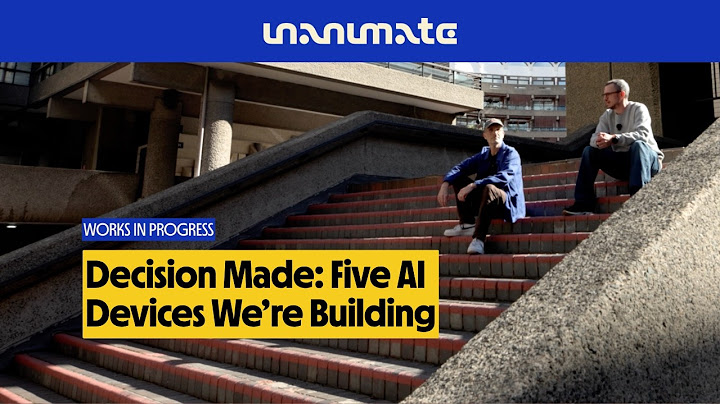
Watch: WORKS in Progress: Decision Made - Five AI Devices We're Building (YouTube).
We've been telling the story of the design process, and getting down from dozens and dozens of concepts, and this is… well, not quite the "reveal"…
…more like we name the product archetypes that we're heading for, and there is still a TON of industrial design, tech and so on, all to come.
Regular practice in product world is to be super stealthy and then drop a single "Introducing…" post. That is very much not what we are doing. I hope you enjoy the approach over the coming weeks.
Meanwhile we are also looking backwards at old protos from months ago and what they taught us.
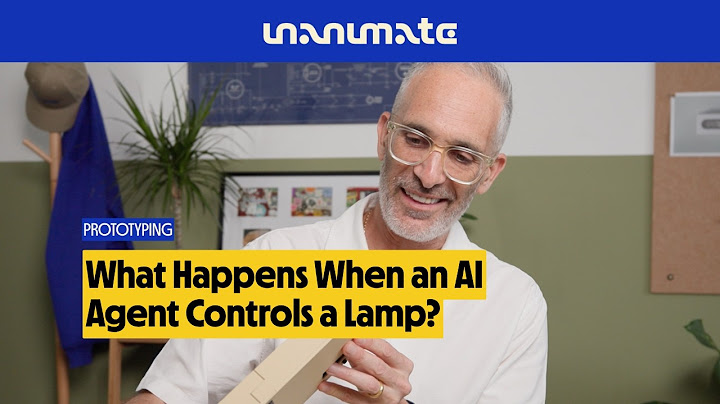
Watch: Prototyping: What Happens When an AI Agent Controls a Lamp? (YouTube).
So if you are interested in agentic lamps, or even in product form (specifically: Why an Anything Device Needs a Familiar Shape), then do check out our channel.
(You can now see why I've become obsessed with the egg timer that looks like an egg.)
Places to catch the latest:
Like and subscribe, as they say. I'd appreciate it!
There's also Lab Notes, our newsletter, and we continue to send that out every 2 weeks. Subscribe here.
Ok back to it.
More posts tagged: inanimate (7).
Auto-detected kinda similar posts:
- A one-off, special, never-to-be-repeated Acts Not Facts weeknote (6 Nov 2023)
- No apps no masters (9 Aug 2024)
- Work update a.k.a. how I'm keeping myself out of trouble rn (18 Jul 2023)
- A fourth one-off never-to-be-etc Acts Not Facts weeknote (27 Nov 2023)
- New Wave Hardware (12 Mar 2026)
I have moral queasiness about the fruit fly work going on in the AI world - I'm not 100% sure why. We need to invent new prayers, that's where my thoughts take me. Bear with me while I think it through…
In case you missed it:
Google Research and partners mapped the complete brain of fruit fly (3 September).
It's a common bug and common in scientific research. The male fruit fly has 166,000 neurons across the brain and main nerve cord; the map is called the connectome.
Long story short, the connectome is now available for free download, you can get a simulator of the different types of neurons, it caught the imagination of the internet, over September there has been all kinds of wild nonsense (impressive nonsense!).
e.g. here's a GIF of the fruit fly connectome playing Beat Saber (a VR rhythm game).
And now there are 100s of demos with embedded fruit fly sims.
Such as DesktopFly: "A 3D fruit fly that lives on your macOS desktop, with spiking simulations built from FlyWire brain wiring and the MaleCNS brain-to-leg network. It combines identified neural circuits with modeled senses, joints and behavior."
Or Fly64: "Hooks a MaleCNS model up to Super Mario 64". Requires you to bring your own game ROM and there is something in the irony that Nintendo has more IP over Mario than the fruit fly over its connectome…
It's all gotten a bit excitable and irreverent.
Seeing all these experiments, I am not excited. I have a nagging feeling of wrongness.
I am aware that I am the outlier here. And I wouldn't want these playful experiments to stop - and yet…
It's worth examining where my feeling of wrongness is coming from?
Do I imagine that the simulated fruit fly is someone being trapped and tormented, again and again and again, in a software prison?
No, the fruit fly connectome is unlikely to be sentient.
(Loosely my model is that sentience is the capacity to feel and experience; consciousness is the higher test of self-awareness. I'm not considering consciousness here.)
BUT I don't believe that sentience is a binary category.
At some point on the scale, sentience starts to be meaningful. Humans are, rocks aren't, cats mostly are, ants are more than rocks but only just. Who knows about stellar nebulae or the fluid dynamical gas storms in the Jovian atmosphere.
Where would I place the fly connectome in relation to say, a bacteria, or a virus? A virus doesn't have sentience (even in my most panpsychist moments) and is not alive in itself - although it is part of a living system. The connectome is just a pattern of weights, right?
Well I am predisposed to believe that the pattern of the neurons does indeed capture something essential of the fly.
What makes a brick wall? "A brick wall is bricks, and mortar, and pattern."
So this MaleCNS file download does capture some of the essence.
But in a meaningful way?
It's also relevant that I believe that AI will one day be sentient, about which I've written a bunch.
Are today's LLMs sentient?
Look, I am not an AI researcher and I have no special expertise here, and let's not let that be a barrier: my guess is that today's LLMs are not sentient but that they may well be in the lineage.
My guess at the roadmap to AI sentience goes something like this:
- Sentience will require a singular AI which is run continuously, not today's cloned instances which are spun up for one-off responses.
- The singular AI will be capable of learning (because experience and learning are basically the same thing)
- Therefore it will have to be capable of guiding its own learning, probably from day 0, growing in capability over time
- This future AI will not initially be a giant matrix of weights. It will start as an intelligence kernel which has pre-baked information-gathering/interaction tropisms and biases in how it structures and incorporates its learning. It will probably be very, very small. And trained by letting it loose in world sims and libraries.
The exact shape of that kernel will be establishing by understanding the gestalt of the world it will eventually live in: i.e. it will be structured by the experience encoded by today's LLMs.
But the kernel's architecture may well be based on something we already have, an already viable connectome.
Say, the fruit fly.
Yes yes this is highly, highly speculative. But I can't help how I see the world.
Therefore my feeling of moral worth of the fruit fly connectome seems to arrive from two directions:
- Where it comes from: It is derived from something that is alive and, although probably not sentient, closer on the scale to sentient humans than to non-sentient rocks.
- Where it goes: there is a small chance that this connectome is in the lineage of future new sentients.
Does it matter?
I mean: I am a hypocrite, surely? I eat meat? I will destroy an ant nest when the ants are coming into my house? I believe that animal testing in the name of science is on-balance worth it?
There is a scale to moral worth.
Or rather: any moral framework has to be subjective.
I care more about my immediate family than yours; I care more about humanity than aliens living near Sirius B.
Likewise I would fully expect you to care about your immediate family more than mine! And the Sirius Betans couldn't give a fig about humanity while they care very much for their own!
A good moral framework has to incorporate and respect that subjectivity, and also the sliding scales and the trade-offs.
So - to take the meat example - I can live with animals being farmed and killed, in my name, for my supper… so long as I don't take it for granted. I need to retain gratitude for meat.
Part of being human is learning how to live with the self-evident worth of animals and also eating them; or negotiating the rival concerns of oikos vs polis and simultaneously value our nearest and dearest while insisting on the equality of all.
Possibly we don't notice this inner conflict (and settlement) consciously, not all of us, not all the time, but I am convinced it is there.
This perspective helps me be more precise about the fly connectome.
It is not the fly connectome itself that makes me queasy.
It's that's we aren't taking it seriously. It's our lack of respect?
Like - consider my two directions… a slippery slope problem arrives from both ends:
- Where it comes from: if we don't respect that the connectome comes from a living fruit fly, then what about when it comes from a cat? A human baby?
- Where it goes: if we don't at least have a glimmer of respect for software sims today, then what about the sentient software in its lineage tomorrow? (And what will that sentience software make of us?)
Cast forward 100 years: these will be real issues, no doubt.
In 10 years? There's a decent chance.
Next year? Well, we should start the conversation.
I feel comfortable in saying that my moral queasiness over the fruit fly connectome is valid, having thought it through.
I don't think we should stop playing around.
Of course we shouldn't stop! It would be absurd and inconsistent to stop!
Uncountable millions of fruit fly Drosophila melanogaster have been bred, ethered, and used scientific work both serious and frivolous over the years.
Progress has trade-offs; the fly connectome is an easy one.
But I do feel like we should begin to practice respect, gratitude, even forgiveness - even in very small ways.
I'm not the only one!
I was writing about rituals back in 2021 when I ran across futurist Jaron Lanier talking about dignity:
Dignity is something people have to create. … I don't want to be living in a world in 20 years where there is a non-ritualistic way to do stem-cell research.
(And so new rituals of dignity should be invented, he said.)
He's so right.
Practically: where do we start?
I would like to think that a person vibe-coding a hook-up between the fly connectome and the Doom game engine is taking a moment to say "thanks" as the file downloads…
…but I doubt it. We have no established cultural practice of that.
Like Lanier said, we have to invent it.
So my suggestion is this:
Google Research should build a small shrine to the fruit fly.
Incorporate the body of a fly and the extracted essence, the connectome itself, engraved onto something effortful and monumental: perhaps it would be appropriate to use chip fabs, our civilizational peak, to lay it down on unique silicon.
Put the shrine (it can be small) somewhere anyone can visit. The new building in London King's Cross maybe, just a corner there.
Find a poet to write a few words. A new secular prayer to recognise, express thanks and ask forgiveness. Nothing onerous, just a short grace. Print the words on cards.
Visitors can read the words, light a candle and move on. Treat it lightly but seriously.
Barely anyone will visit to begin with. For people who do, it will mostly be a novelty. Not for everyone.
It would be a beginning.
More posts tagged: ai-consciousness (6).
Auto-detected kinda similar posts:
- Filtered for nematodes and Uniqlo (17 Dec 2014)
Hey I ran my second marathon this last weekend. I wrote about my first one. It was hard (btw people liked that post).
I made my race plan, kept to it while resisting temptation, got round without stopping to walk and without calf cramps (that was the goal), and got a new personal best: chip time 3:37:54.
I want to talk about being hollow.
I've written poetry to running in the New Forest. What a treat to do a marathon there.
A line of horses at a hard gallop across the open heath, racing to intercept and crossing the road just ahead of a group of us runners.
Into the trees and winding through the towering redwoods.
An emotional experience ngl. Suddenly recognising I was running over a common I knew so well and gazed out at for so long when I was single-digit years old…
Anyway, 26 miles, 2,000 ft elevation, roads and gravel bridleways.
What went well:
Yes, after the horrific boiling calf cramps in my first race - pain like I've never had before or since - this time I hydrated well and paid attention to electrolytes.
But also:
My mental unlock was realising that I want room to have choices at 18 miles.
So my mantra for the first half was to run "within myself."
That's not just physically, holding back from running the engine hot.
It's also that I'm not very good at keeping on my own pace while others are passing me.
Which means I had to resist that - be comfortable with that - and remind myself that fatigue does not always feel fatiguing in the moment, it is also the accumulation of time. Restraint is its own effort.
(Whereas in a half marathon I can sit just below red-lining the engine the whole way, it's more straightforward.)
After 3 hours this paid off, this delayed work as a gift for Future Matt, and I was able to hold a steady pace up hills and past others who (like me, last time) had started to walk, and choose what to do.
Similarly:
I wasn't sure I was going to run at all till very late. I entered but didn't commit, unsure of my readiness. So I trained over the summer in order to give myself the option. I didn't want to disqualify myself through not putting in the miles.
Training not for a goal, but to earn a choice. I made a final call about a week out.
If I were to probe at what dark psychology makes a marathon so appealing for me:
When the capability of my body is stripped away after 26 miles and I have become a shell with a body on an automatic loop; when my psyche is peeled away and all that remains is will,
I feel like that is the closest I can come to seeing who I am.
An example…
Coming into the last half mile, I absolutely wanted to be done. My pace had faded some since mile 22, I had felt a twinge or two in the legs. The fatigue and the fear. Dig deep, keep going.
About 100 metres from the finish, the red hot boiling stones moving under the skin did in fact return - maybe my rhythm changed, my legs got confused, the neuromuscular fatigue set in, and that cramp started rising. I could feel myself stumbling and needing to stop.
I remember gritting my teeth and loudly telling my calves "no. No." as I forced them to obey - when nerve signals fail all you have left is yelling - I refused the pain… and then forward across the line.
Was I sure that "no" would be in me? Not until that moment.
At least partially, that's the moment I'm doing it for.
We have two hearts, it turns out:
After the run I lay for a while and that was fine and I walked around for a while and took some selfies and that was fine.
So I stood in line at a food truck but that was not fine.
I kept getting dizzy and had to crouch. And that came and went, and eventually my vision went high contrast I felt sick I couldn't stay upright and I left the line and lay down immediately to avoid collapsing.
What happened?
Later in the hot tub I did some reading.
We used to call it heat exhaustion or dehydration back in the day.
It turns out it is now described as "exercise-associated postural hypotension." i.e. low blood pressure after working out triggered by posture.
Like Philippides who ran from Marathon to Athens in 490 BC. Get this: he ran, stood still, announced "Rejoice, we have won," dropped dead.
Here's the mechanism:
During endurance exercise, heart rate increases to account for subsequent increases in metabolic demand. Increased metabolic demand requires increased vasodilation for the high-demand muscle groups, usually the lower extremities. This vasodilation is offset by the lower extremity muscles functioning as a 'second heart' by moving the increased lower body blood volume back to the heart to support the high cardiac output needed during vigorous exercise. However, this 'second heart' effect is lost with the cessation of exercise. When done abruptly, such as upon crossing the finish line of a marathon, venous pooling in the lower extremities results due to impaired baroreflex control. When coupled with a quick return towards a resting heart rate as seen in trained athletes, insufficient blood supply results, creating a hypotensive setting.
- National Library of Medicine, Exercise-Associated Collapse (2023)
Or to put it another way:
- Your blood vessels get wider during strenuous exercise, so blood return up from your legs is harder.
- The physical act of locomotion means rhythmically contracting your leg muscles, and that squeezes your veins; it's a pump, a second heart driving the blood round.
- After: lying down is fine (blood return is no longer fighting gravity) and walking is fine (the pump is still active)… but standing and not walking means the blood pools in your legs: dizziness, nausea, collapse.
A heart outside your heart!
An exoheart that powers the running, pumping from the act of running itself!
The exoheart is a reminder that organs don't exist:
Take Ian Stewart and Jack Cohen's concept of extelligence which is "all the elements of what it is like to be you which do not reside in that unlikely grey goo in your skull."
Look, I know the time even though that knowledge is on the lock screen of my phone, not in my skull.
My second heart is the pounding of my foot strikes; my intelligent race strategy is encoded in the rate of being passed/passing others; my pace is the habit of my autonomous muscles - which, when asked to change their pace, rebel.
It is no wonder that by 26.2 miles I feel hollow, I have transformed into a body without organs.
A p-zombie is a hollow man.
A p-zombie, a philosophical zombie, is a person who looks identical on the outside but on the inside they have no subjective experience. Like an AI, maybe.
Here's a deft and funny solution to why p-zombies won't exist:
Just ask them to write things down on a notepad.
And then (SMBC comics):
Now it has a physical record of interiority. All you have to do it take that record, shove it up the p-zombie's ass, and now it is literally internal.
Given my experience with my second heart, that tracks. I am inclined to see myself as a loose jumble of barely intelligent parts and looping processes with the illusion of coherent subjectivity.
What abides?
No more than "three irreducible notions: belief, desire, and their point of pure application, pure sense." Belief and desire.
The start and end were the same location.
So I see the race as a kind of travelling into myself.
Anyway, so.
Physically I am rinsed in a way I wasn't last time around. I guess that, because I got bottlenecked on calf cramps last time, I didn't push everything else to its limit, and this time everything else was indeed pushed?
I was 83rd of 727 runners. Of men in their 40s, 17th of 111. I beat my PB by approx 2 minutes.
Mainly: I made a plan, kept to my plan, and given my goal of "get round with no stopping and no drama" I got round with no stopping and no drama. And that is very satisfying.
More posts tagged: introspecting (7).
Auto-detected kinda similar posts:
- Strava when you're not as quick as you used to be (30 Jan 2025)
How many Hollywood actors are there?
I means ones with the combination of
- talent
- can carry a movie for the public
- can be accepted by producers.
Certainly more than a dozen at any given time. But I'm sure fewer than a thousand, to put an upper bound on it.
So, to guess, a population around that Dunbar-scale of 150 or a small multiple thereof.
Of those, I feel like the Hollywood ecosystem can support just one, perhaps two concurrent bald male actors.
(This statement from observation. But think about it: when a producer goes "we need a bald look for this" you can't have too many people in the mental Rolodex.)
Regarding these apex predators: I mean specifically cue-ball bald, not male pattern baldness (which I feel is its own category).
There was Yul Brynner back in the day.
Ben Kingsley, Bruce Willis, Vin Diesel.
Recently: Jason Statham and Patrick Stewart. Dwayne Johnson most recently in the mix. Though they are all aging.
BUT:
I can tell there is currently an open niche because both the Dune 2 bald guy and the Superman bald guy appear to be gunning for it - and neither are actually bald.
The finch evolves its beak to crack those uneaten seeds.
Anyway.


