
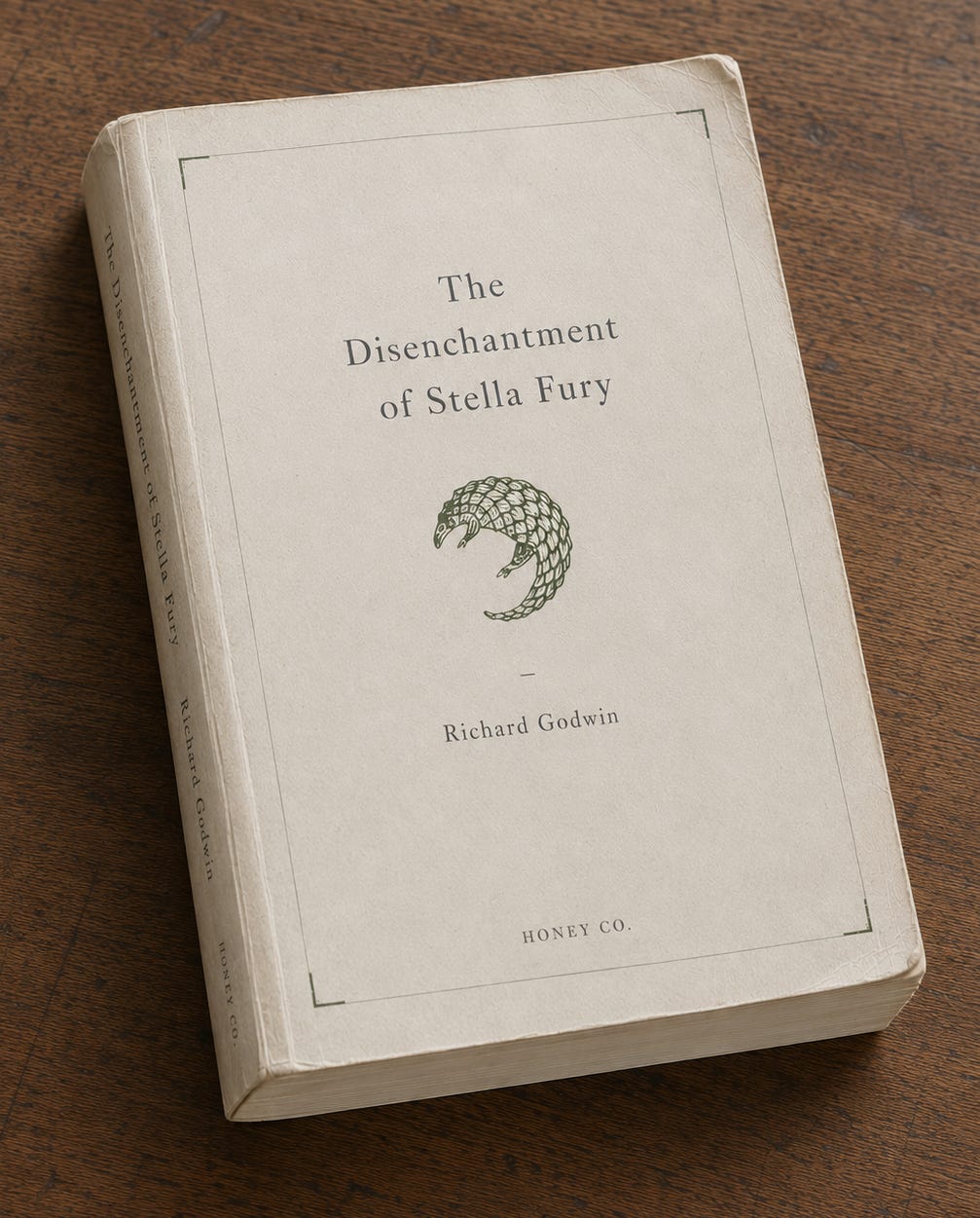
"Richard Godwin has written a beautiful and magical story about the gigantic phantasmagorical digital universe that is being built around us day by day. It's a powerful, funny story that slips between what we think of as the real — and something else. A strange, haunted world, built of our dreams and our fears that is half us and half not. It is the kind of fantasy world that can also be very frightening. And it is breaking back through the membrane into our real world, as the doors to the outside begin to close."
— Adam Curtis
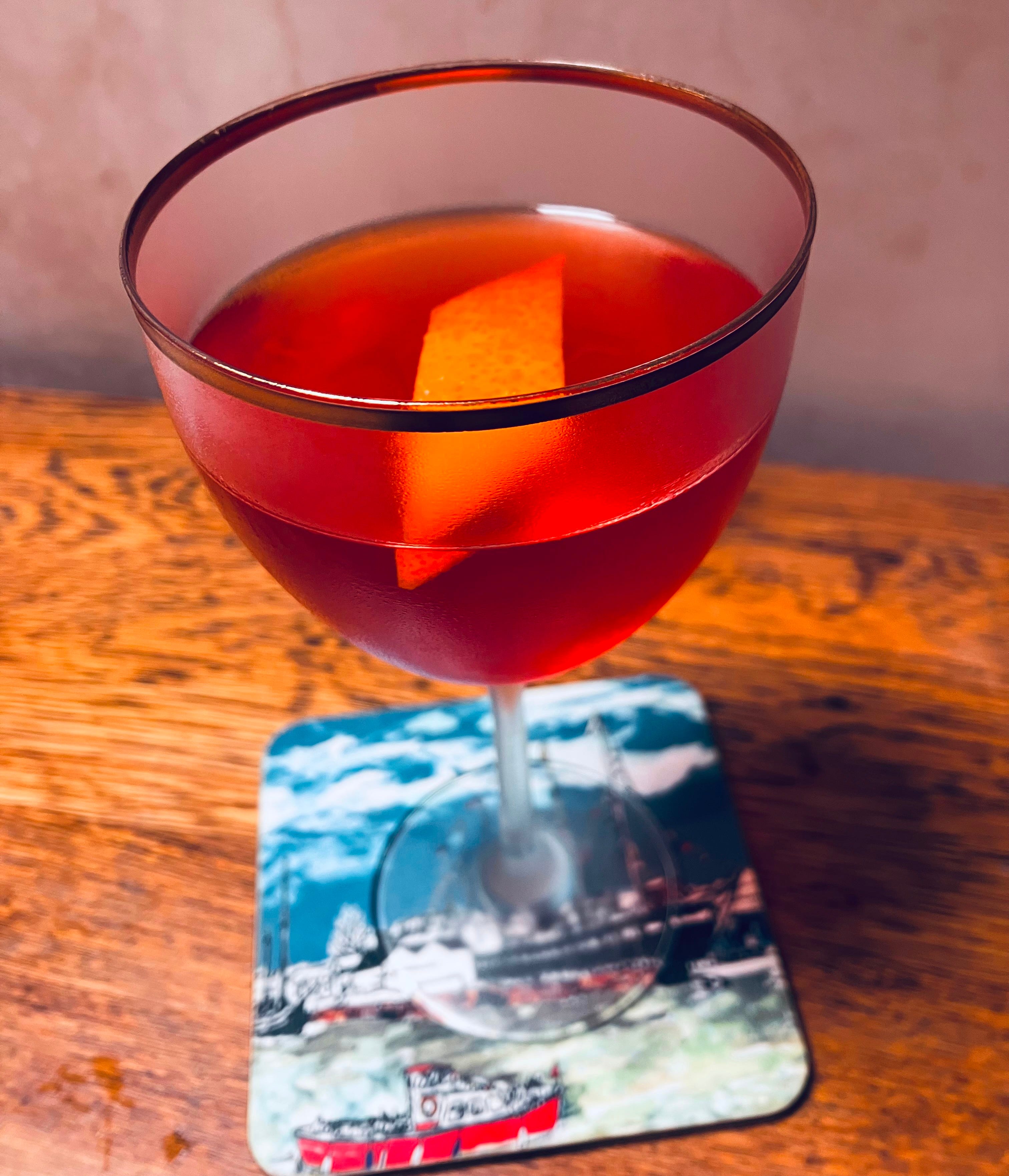
~ THE TUNNEL ~
30ml gin
30ml French vermouth
20ml Campari
10ml Italian vermouth
Stir all of the ingredients over ice and serve up, in a frozen cocktail glass, with a grapefruit twist. Though all I had was…
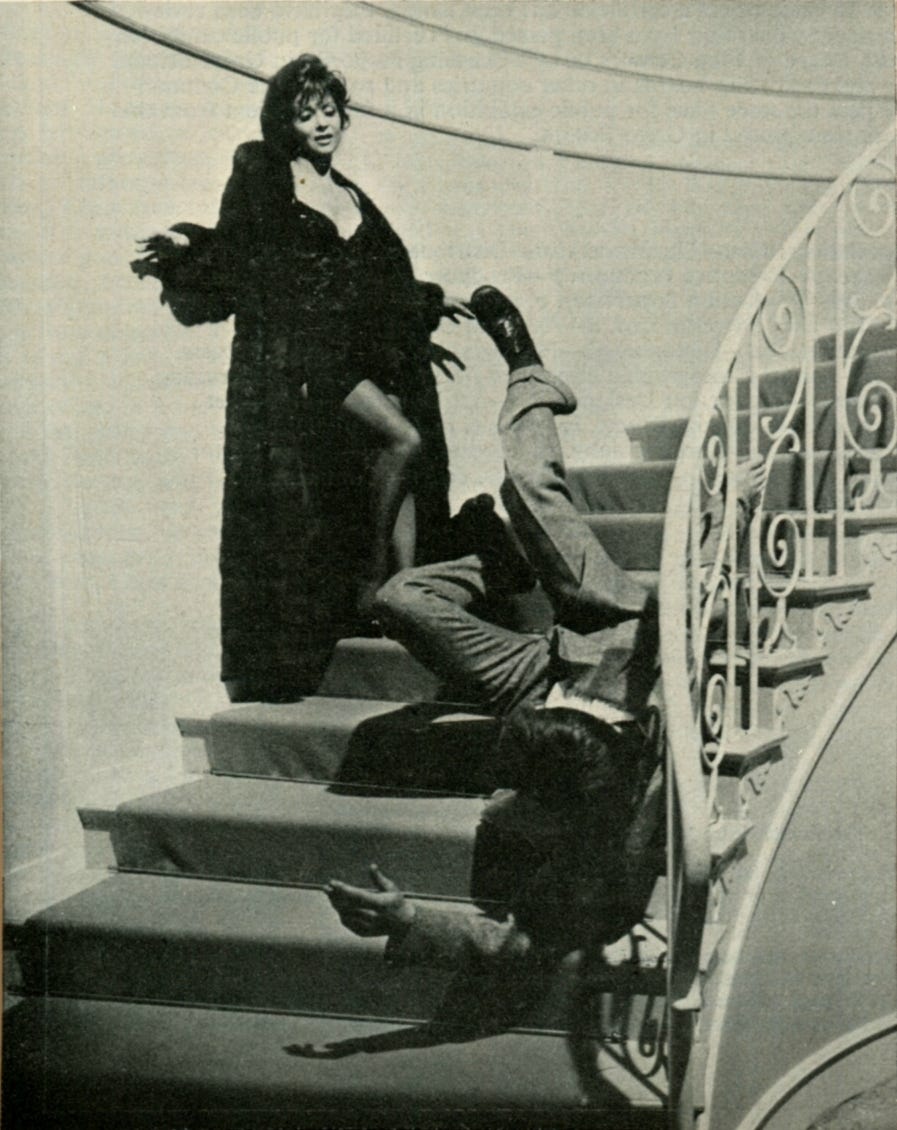 Gina Lollobrigida in the 1972 movie of King, Queen, Knave
Anyone who reads Vladimir Nabokov's King, Queen, Knave on an empty stomach will find their hunger pangs become acute in chapter four. The novel, which Nabokov wrote in his native Russian as Король, дама, валет in 1928, is about a Berlin love triangle involving the glamorous Martha, her blundering husband Dreyer and a myopic young interloper named Franz. "Of all my novels, this bright brute shines the gayest," Nabokov wrote upon translating it into English in 1968. And for me, anyway, one detail has long shone gayest of all.
"In the morning, as Dreyer was hurriedly enjoying a soft-boiled egg with buttered toast (the most delicious meal known to man), before dashing off to the emporium, Frieda informed him that the repaired car was waiting at the door."
Frieda is the maid, by the way, and the car was damaged in the previous chapter. Not that the reader is thinking about these irrelevances! Not when we have, in front of us, "the most delicious meal known to man" or, to be precise, "(the most delicious meal known to man)'". Nabokov repeatedly told his students to "cherish the details"; but this soft-boiled egg so dominates, fortified within its parentheses, that it becomes questionable whether it is a detail at all and not the entire point of the sentence.
Not for Dreyer. Upon hearing the news, he gulps down his coffee, throws down his napkin and "hurrie[s]" out to look at the car. Nabokov dwells for a moment on the napkin: "The napkin slowly crept off the table and fell limply to the floor." And yet the reader would be forgiven for dwelling on that abandoned breakfast.
Questions abound. Some are practical: was Dreyer's toast white, brown, or perhaps some sort of pumpernickel, given the German setting? Was it cut into soldiers? How runny was the egg? Did Dreyer season it with salt and pepper? Others are philosophical: is a soft-boiled egg with buttered toast indeed worthy of this extraordinary accolade? Which authority is making this claim? And, actually, why? Is this a form of style indirect libre - the author filtering his narration through the mind of his character? Which is to ask: is this Dreyer thinking to himself: "I'd take a humble boiled egg and toast over anything a fancy chef could cook up, any day of the week!" And if so, what does this tell us about Dreyer? Or is this Nabokov, addressing the reader directly, making a little aperture in the fourth wall with his parentheses to make the not-uncontroversial claim that there is in fact no better meal than a soft-boiled egg on buttered toast?
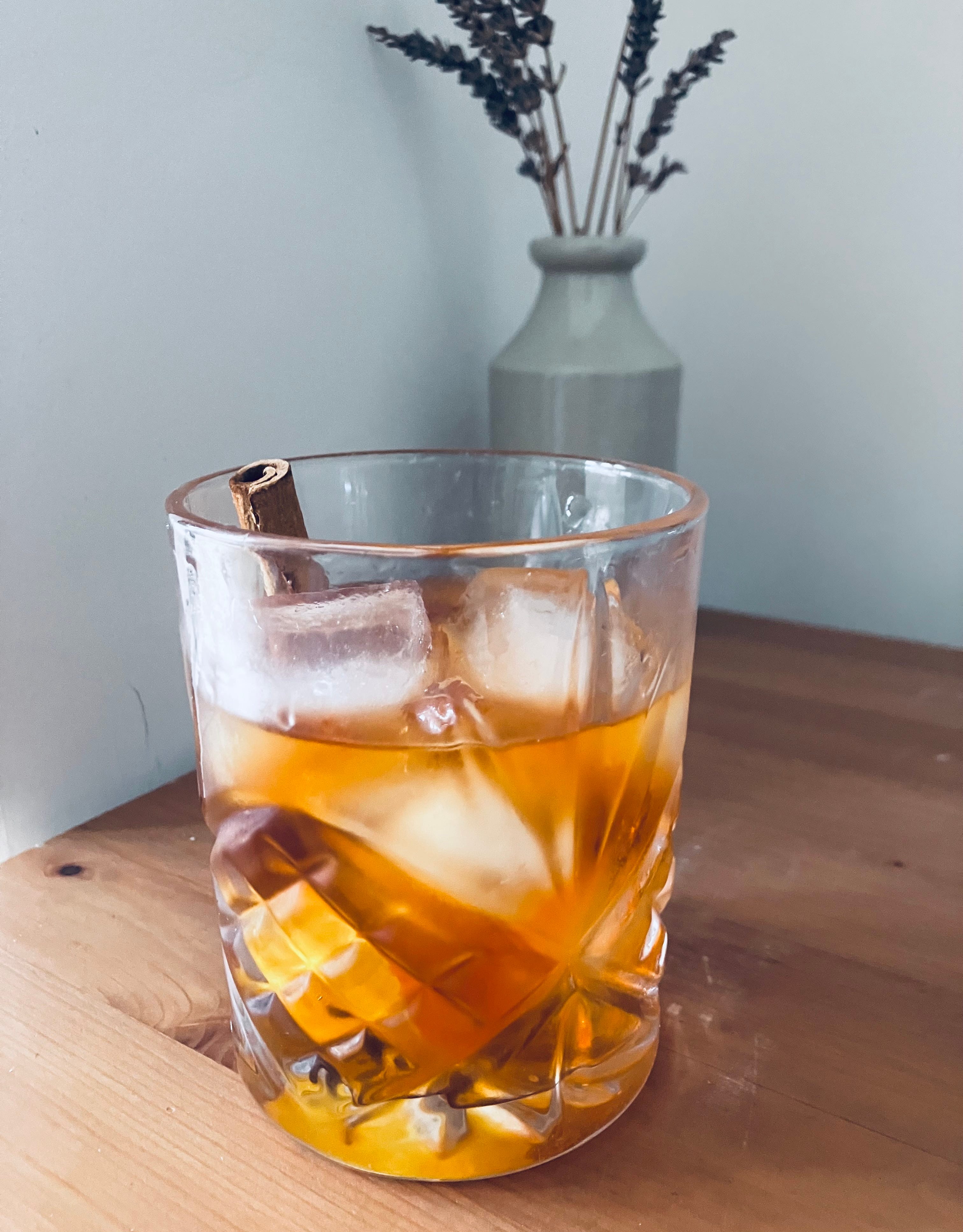
~ CORN N' OIL ~
60ml dark rum
15ml falernum (or 10ml cane sugar syrup; see note 3)
Dash Angostura bitters (optional)
Squeeze of lime (optional)
Stir in an Old Fashioned glass over lots and lots of ice. Ga…
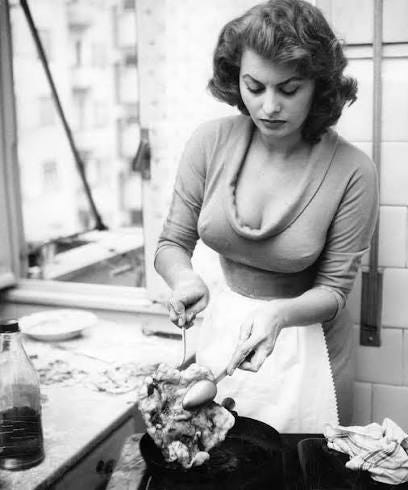 Sophia Loren in the kitchen
1. Ancho Reyes is great for flambéing prawns
There is an excellent Provencal dish, gambas au pastis, that I remember being entranced by when a French friend of mine served it. Take some fat juicy shrimps, raw and still in their shells, and sauté them in a mixture of butter and olive oil plus some suitably flavourful aromatics: garlic, thyme, a little fresh chilli, maybe some lemon and/or orange zest. Once the prawns are pretty much done — and your guests are all seated around a heat proof mat on the table — bring over the pan, pour over circa 50ml pastis, and set this the pan on fire. Watch it sizzle and burn! (You will want to keep a pan lid to hand, in order to extinguish the flame, should things get out of hand — but it will probably just crackle out of its own accord.) Then you are to toss over some fresh parsley (or coriander) and eat the prawns with your fingers, mopping up all the sticky juices with some bread.
Now. Pastis is one thing. But you can use other alcohols, too: rum, mezcal, an entire Sazerac, etc. But the pro-choice is Ancho Reyes, the Mexican chilli liqueur. And it wouldn't be a terrible idea to augment those prawns with some chorizo and little ribs of corn, too?
The Spirits is a reader-supported publication. To receive new posts and support my work, consider becoming a free or paid subscriber.
2. Absinthe Roast Chicken
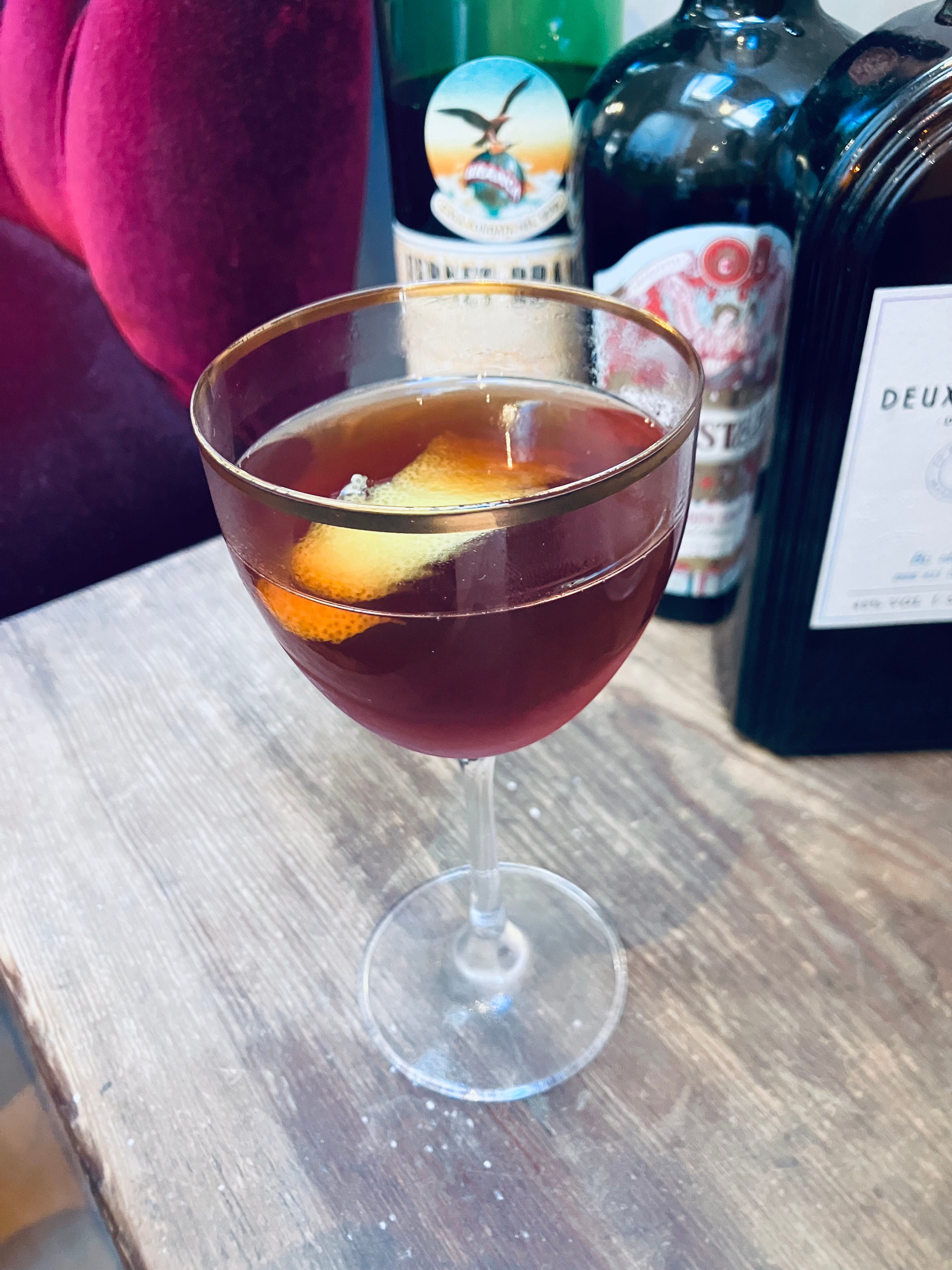
~ THE HANKY-PANKY ~
50ml gin
25ml Italian vermouth
5-10ml Fernet-Branca
Place an elegant cocktail glass in the freezer. Now you're going to make a cocktail. Measure the gin, the vermouth and the FB and s…
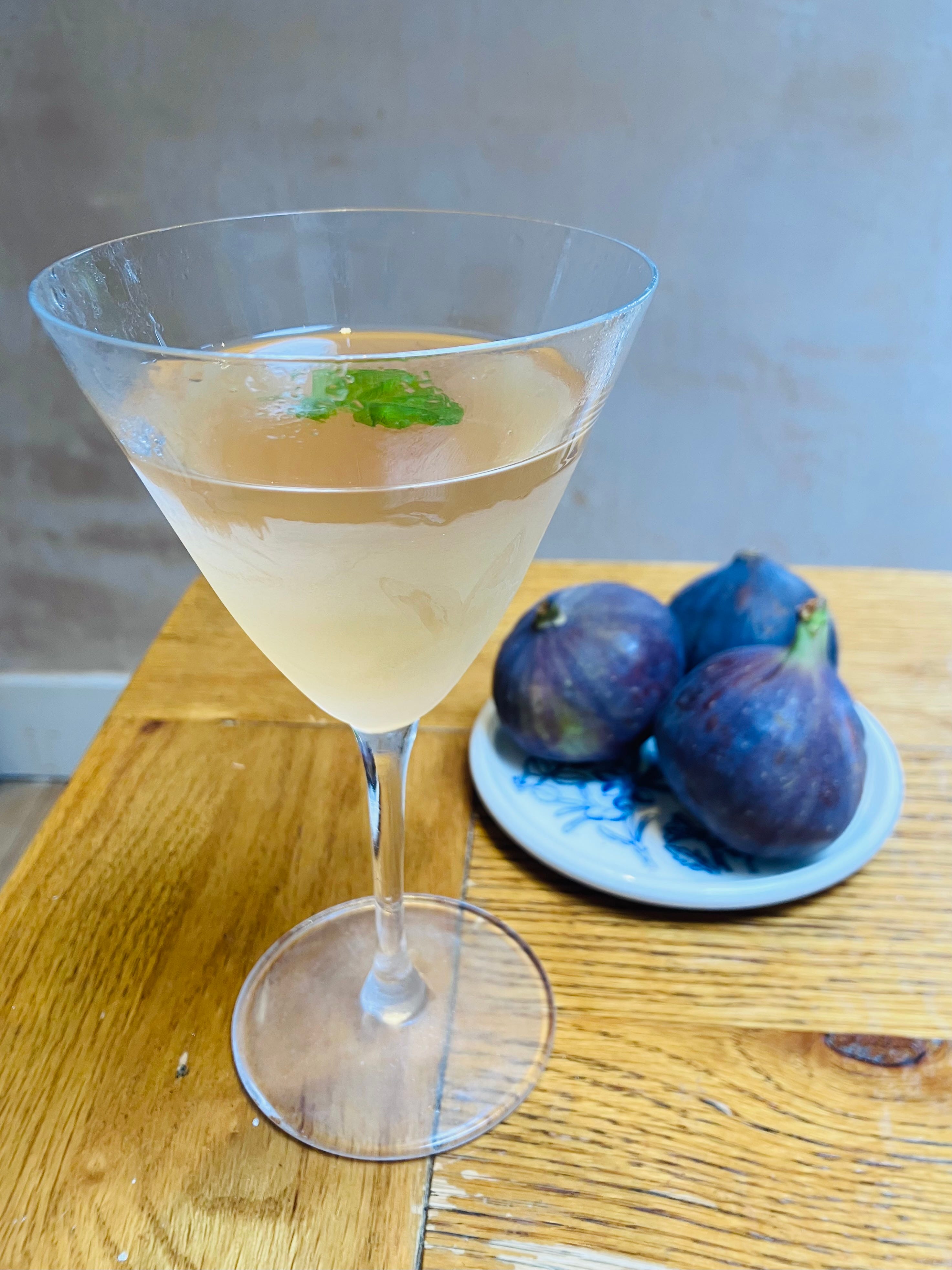
~ THE FIG MARTINI ~
One black fig
One fig leaf
30ml vodka
30ml gin
10ml French vermouth
10ml Italian vermouth
Fans of instant gratification, look away now, for this one involves an infusion. Slice a ripe bl…
I was drinking a Gin and Tonic in my sister's garden on a recent family occasion, when two small nieces began a clapping game nearby. Their song went like this:
"I went to a Chinese restaurant
To buy a…
Friends —
I left my phone on the plane on my way back from France. It had been such a restful week, in spite of the insane heat, really just one long rollover lunch, French supermarkets are the best. …
Friends, if all has gone to plan, I will be in Burgundy while you read this — possibly drinking a Kir Royale made with local cassis and Aligoté. And so, I thought I'd regift you this old post from a …
Friends, as you read this I am — well not on holiday quite yet but I soon will be. So I thought for the next couple of weeks, I would unlock a couple of useful 'Cabinet' posts. Here is everything you…
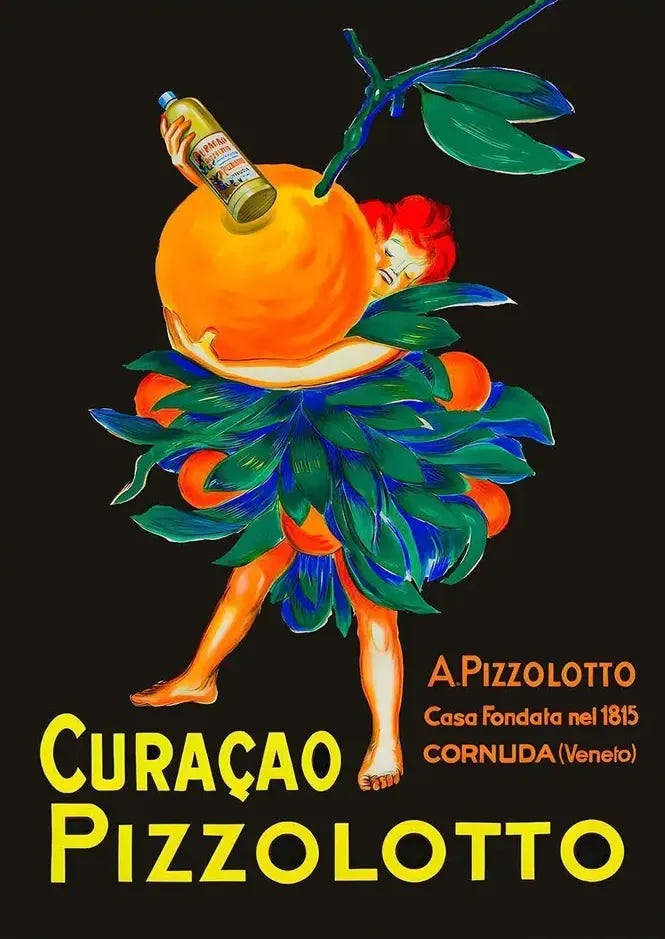
~ BLUE CURAÇAO ~
Orange liqueur that is blue / 15-35% ABV / £15-£30 for 700ml.
Friends with: rum; pineapple, coconut, almond, citrus, tropical fruits; cocktail umbrellas, gardenias, etc. But frankly it goes with almost everything in the cocktail universe and especially lightly coloured things: gin, pisco, French vermouth, etc.
Curaçao (pop. 157,000) may have exited the World Cup at the group stage, suffering a 7-1 defeat to Germany on the way but the achievement of this tiny island nation in qualifying at all is really something to celebrate. Not only was it the smallest nation ever to qualify for football's premier competition; it was also the first cocktail ingredient ever to do so — and under the management of a man named Advocaat too. Liqueur aficionados will further note how fitting it is that the team has a core of "orange", i.e. Dutch players, renationalised from the Curaçaoan diaspora within the Netherlands. And yet they play in blue, too — which, as everyone who has sipped a Blue Lagoon under a palm will know, is the colour of tropical dreams.
 The blue oranges
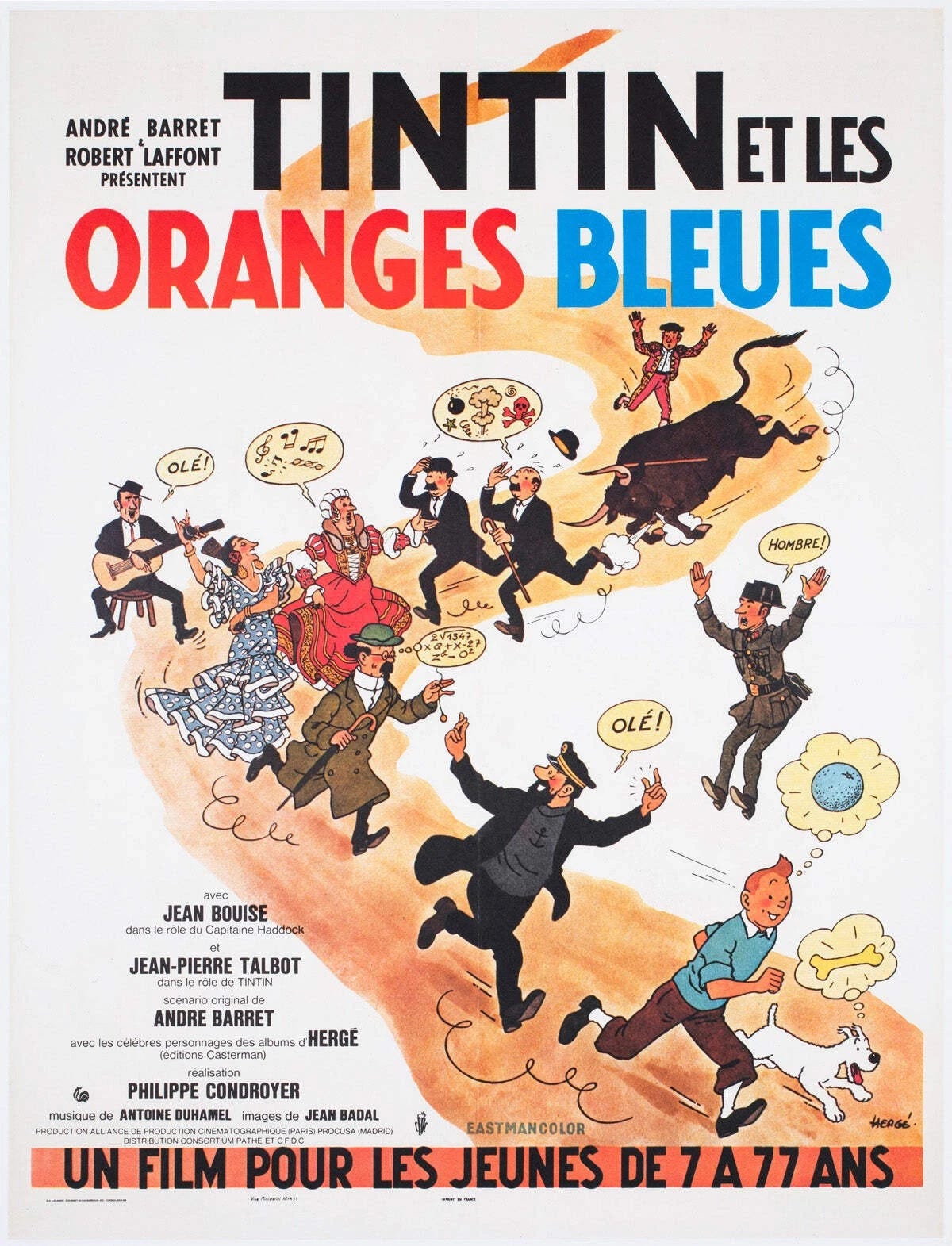
But why? Why? Why did they make curaçao blue? Here we must follow the dream logic of Paul Éluard's classic surrealist sonnet: "La terre est bleue" (1929), which opens with the lines: "La terre est bleue comme une orange / Jamais une erreur les mots ne mentent pas" ("The Earth is blue, like an orange / It's not a mistake, words don't lie"). Like the best nonsense, this is not entirely nonsense. The Earth of course is blue — and it is also like an orange in that both are round; and so it follows that the Earth is blue like an orange. By the same reasoning, a Martini is transparent like the Sahara, while Campari is bitter like the planet Mars. And so, according to wisdom of the glass camels of Timbuktu and the resentful Martians of Olympus Mons, a liqueur made of oranges must be blue. This arcane truth cannot have been far from the minds of the creators of the Franco-Belgian live action Tintin movie, Tintin and the Blue Oranges (1964), in which Prof. Calculus invents a special orange that can solve world hunger — and this orange is, of course, blue.
A cursory history of Curaçao
Anyway. Curaçao is a small island off the coast of Venezuela not far from Aruba. It was Columbused by the Spanish in 1499 who promptly enslaved the 2,000 or so native Coquetio tribespeople, shipping them off to Hispaniola. The European colonisers brought with them Valencia oranges, with the intention of starting some groves and nipping scurvy in the bud. Only the oranges didn't do so well in the dry climate and salty soil, evolving instead into a distinctly hard, bitter citrus known locally as the laraha. The laraha is orange, like a resentful lover. Larahahahaha.
But there was, quite literally, a bitter twist. The laraha isn't much good for juicing but it does give excellent peel — a quality noted by the Dutch, who came to "own" the island in 1634 under the auspices of the Dutch West India Company. Indeed, in another piece of cocktail-themed history, Curaçao was briefly administered by Peter Stuyvesant, who would go on to be the Director General of New Amsterdam, an island colony up in North America, which he would later swap with the British for nutmeg. As fond as I am of a grating of nutmeg over my Blue Mai Tais, I am not sure I would exchange it for all of Manhattan.
But I digress. Curaçao the liqueur is generally acknowledged to have been created by the venerable Bols company — founded in Amsterdam, 1575 — whose distillers exploited the delicious bitter rinds that the Dutch West India Company merchants were bringing back from the colonies in order to create a fine orange liqueur. And curaçao became popular. If you've spent much time perusing old time cocktail books (I mean the really old ones, like Jerry Thomas) you will surely have noticed that "orange liqueur" is always referred to as curaçao. (French triple sec came later — and Cointreau only really took hold in the 1920s.) Most of this "curaçao" was made in places like Amsterdam or Turin or Seville as opposed to Curaçao. Neverthless, a domestic market for this stuff developed too. The Senior & Co company — founded by one of many Sephardic Jewish families who settled on Curaçao — opened a commercial distillery near Willemstad in 1896, and to this day is the only company that makes true curaçao, i.e. curaçao from Curaçao using authentic laraha fruits cultivated on the island itself.
How did curaçao become blue?
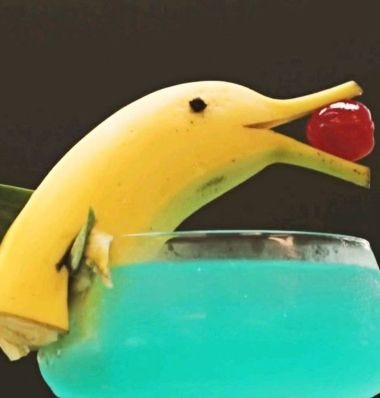
It's worth noting that these early curaçaos would have been transparent or slightly orange. It was only later, as commercial food dyes became common, that curaçao would gain its lapis lazuli hue. Still, in the Café Royal book of 1937, curaçao is described as a "sweet digestive liqueur from the Dutch West Indies" that can be coloured, wait for it, red, white, blue, green and orange. It was only later — from the 1960s on, really — that blue gained pre-eminence, most likely because a) it has a tendency to make drinks look like a tropical lagoon and b) no other foodstuff is blue which makes it instantly stand out. And so from the 1960s on, the stuff became synonymous with holiday drinks: the Blue Hawaiian, the Blue Lagoon, the Swimming Pool, and so on. These are the sort of drinks that come with umbrellas and tiki mugs and gardenia blossoms and hopefully a friendly dolphin garnish like this one:
Nevertheless, with my pedant hat on, for all its tiki associations, BC is not an ingredient Don the Beachcomber or Trader Vic much used. In fact, the annals of actually venerable blue curaçao tiki cocktails are relatively small. It was really much more popular in the Disco era of the 1970s and 1980s through until the 1990s when it took hold and it took hold for precisely the same reason my five-year-old begs me for blue slushies at the ice cream van, i.e. it really looks like the sort of thing you should not drink.
It bears stating that as much as you and I like to think of cocktails as a sophisticated business, and the likes of Michters and Foursquare as the great standard bearers of our movement, I'm afraid this is not the case. The UK's fastest-growing alcohol brand is in fact the Swansea-based Au Vodka, and now that I've pointed this out you will notice their gold bottles and amusing glassware in Duty-Frees from Magaluf to Ayia Napa. These contain such "ultra premium" delights as Blue Raspberry vodka, (blue) Bubblegum vodka and, yes, Blue Hawaiian RTD (five-times distilled you understand).
So the thing about blue curaçao is, you have to make peace with the fact that it is the opposite of "authentic" and "hand-crafted" and "natural". Even the most "classic" blue cocktail, the Blue Hawaii, was commissioned by the Bols company in order to sell more blue curaçao. And while there is no earthly reason why blue curaçao cannot be well-made — there are some half-decent ones out there, including the Senior & Co. version — it is not in most cocktails because it tastes great. It is in most cocktails because it is blue. I have the semi-respectable Edmond Briottet version and it is approximately six times not as nice as the Pierre Ferrand Dry Curaçao and four times not as nice as Cointreau. But I haven't poured it down the sink! No. Because it looks cool — and it is not so offensive flavourwise as to upset the balance of most sweet drinks. I particularly like using it in slightly unexpected contexts such as, well, this:
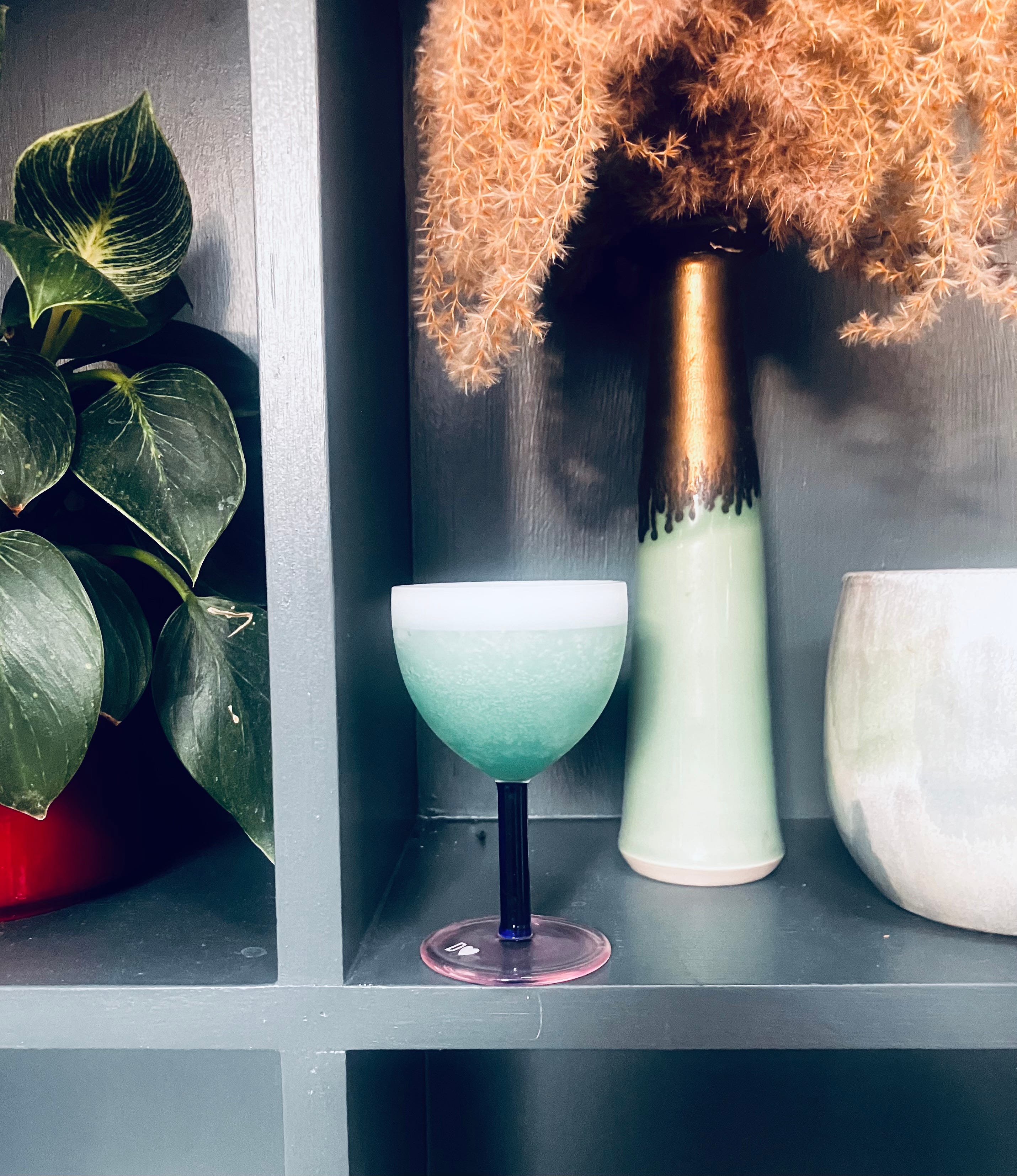
I can see you shaking your head, Stanley Tucci, but the thing you must ask yourself is this: why do you think Campari is red, dum-dum? That stuff is full of food colouring too! And if you admire the futurist dash of the Carousel, then you should not turn up your nose at my Blue Raspberry Sgroppino (above). As much as I like my Martinis dry and my Negronis stirred, Stanley, I am fond of blue curaçao. It is at once populist and avant-garde; it is Love Island Futurism; it is Katy Perry Cosmism; it is electric surrealism. The cocktail has tides, like the ocean. Recipes below the line.
SOME MORE ESSAYS IN THIS AMUSING VEIN
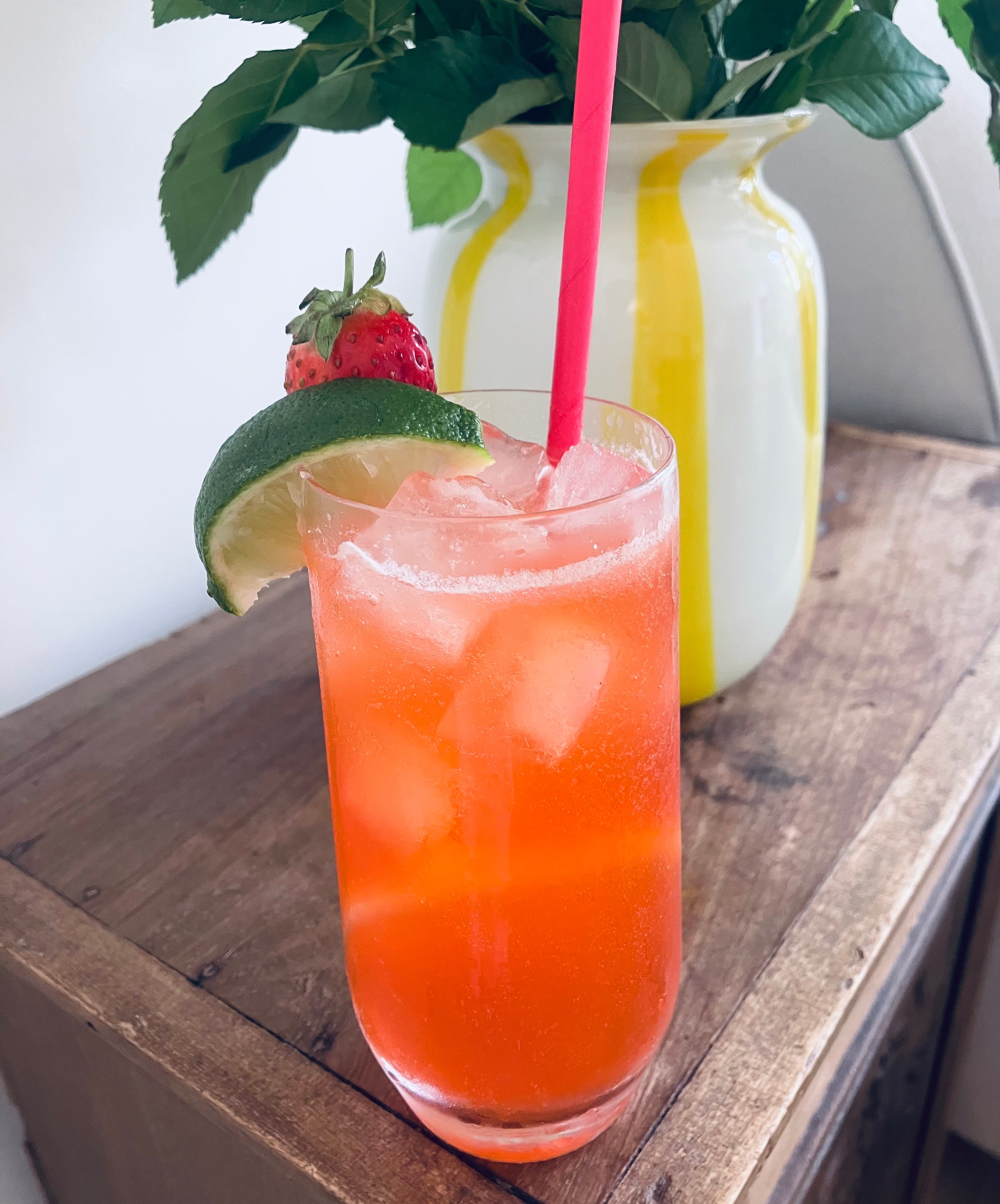
~ THE KENTUCKY BUCK ~
Two strawberries
60ml bourbon
15ml lemon (or let's be real, lime) juice
10ml golden sugar syrup
Angostura bitters
~150ml ginger beer (I used Fentiman's)
Catch a strawberry, trap it in …
What do we have here?
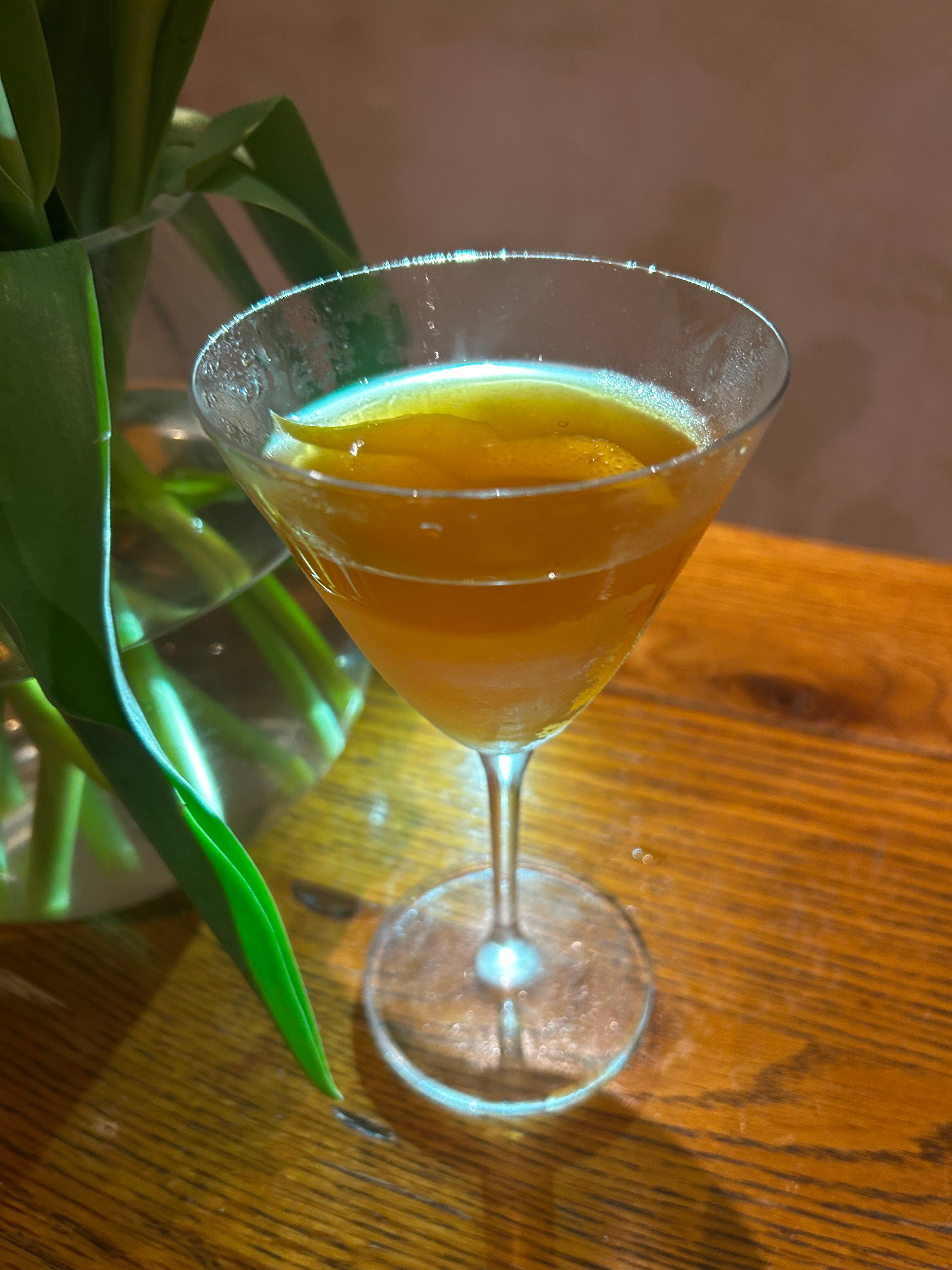
~ SATAN'S WHISKERS ~
30ml gin
10ml Italian vermouth
10ml French vermouth
10ml Grand Marnier (but see note)
30ml (fresh) orange juice
10ml lemon juice
~5ml sugar syrup
Freeze that glass. Mwahahahaha. Now add all the ingredients to your shaker along with a little length of orange peel. Add ice. And shake! (The addition of the orange peel makes this a "regal shake", so please ensure your action is suitably regal in turn). Fine-strain the satanic mixture into your cold glass. Garnish with a citrus moustache.
Some SW notes:
1) Satan's Whiskers made its first appearance in print in Harry Craddock's Savoy Cocktail Book (1930). It's a variant on the then popular Bronx (equal parts gin, 2x vermouths, orange juice), only with the addition of half a part of orange liqueur plus an extra dash of orange bitters. Craddock supplies two variants: Satan's Whiskers (Straight) demands the brandy-based Grand Marnier as the liqueur; Satan's Whiskers (Curled) calls for Cointreau.
2) The drink might have languished in obscurity but for Kevin Armstrong who revived it and named his bar after it in 2013. Satan's Whiskers in Bethnal Green is now the second-best bar in London according to the World's 50 Best. I'm afraid that, as a West Country provincial, I have not yet had the pleasure of testing this extraordinary claim — but I have made the "house" SW according to Armstrong's specs and it is devilishly good.
3) Armstrong's version uses Punt E Mes as the Italian vermouth, which informed readers will know is actually two parts Italian vermouth to one part amaro. So by all means throw in a tiny dash of something bitter in there. Moreover, Grand Marnier is orange liqueur with an aged brandy base, making it much richer than your workaday curaçaos and triple secs. I don't actually possess a bottle so I simply used a combination of curaçao, Amer Picon and cognac. ("Simply"). I also omitted the orange bitters — the taste of which I find satanic.
4) Armstrong also pushed the drink in the direction of a sour with the addition of the lemon and sugar; a great improvement on just about any orange juice cocktail in my opinion (see also, for example, the Blood and Sand). It just makes everything brighter. I thoroughly enjoyed this one! I had actually spent much of the week in bed with an evil and this marked my transition to the land of the well.
The Spirits is a reader-supported publication. To receive new posts and support my work, consider becoming a free or paid subscriber.
✨WELCOME TO THE SPIRITS✨
The neighbourhood bar of the internet
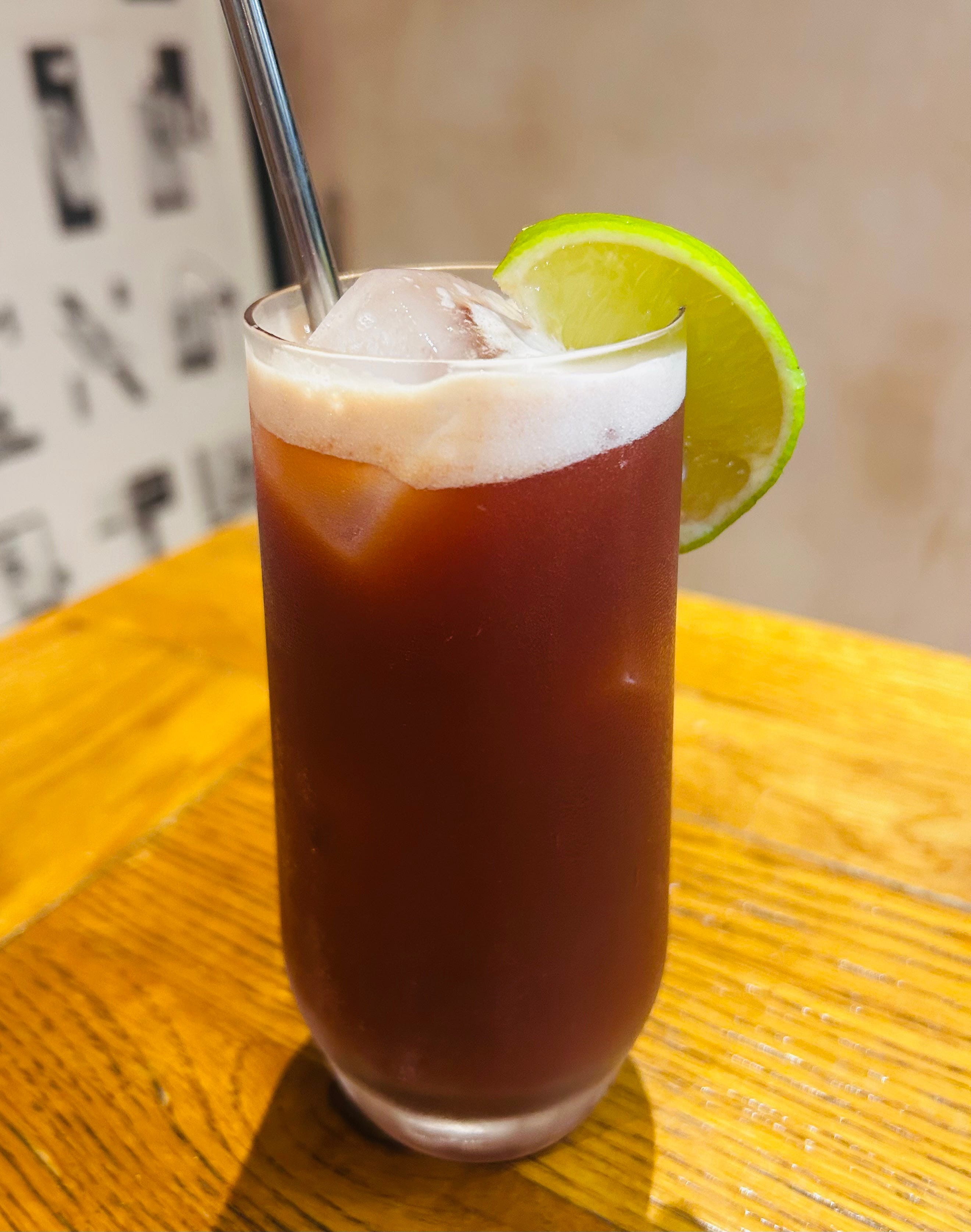
~ THE ANGOSTURA FIZZ ~
30ml Angostura bitters
15ml dark rum
20ml lime juice
20ml (brown) sugar syrup
One egg white
~30ml fizzy water
Shake that little bottle into your jigger and keep shaking until you have the requisite amount of rust-brown bitters. Pour this into the shaker along with the rum, lime, sugar syrup and egg white. Shake hard with no ice, to froth up the egg. Now shake hard with ice, to cool the thing down. Add a dash of the fizzy water to the shaker, then fine-strain into a tall glass filled with fresh ice — and top with fizzy water.
Some Angostura Fizz notes:
1) I encountered this in Jack's Manual (1910) while boning up on the Brooklyn the other day. "My that's avant-garde!" I thought; it pre-dates the bitter-heavy Trinidad Sour by about a century. I was aware there was such a drink in Charles H. Baker's Gentleman's Companion (1934). But not this!
2) (Jack's version calls for lemon juice and contains a teaspoon of cream which seems worth a try — though unless you give it the full Ramos Gin Fizz treatment, it is liable to curdle.)
3) My innovation was to add just a half measure of dark rum to it (Appletons, if you really want to know). I found this allows the drink to breathe a little bit. It's still bracingly bitter, though not as bitter as you might think, thanks to the simple trick of lengthening it with fizz. In fact, I would venture to say that it is better than most fizzes thanks to the intense concentration of flavour; kind of like a rusty cinnamon limeade.
4) In fact I was thoroughly enjoying it. Then I did something stupid. I thought: "Hmm, I wonder if this will benefit from a dash of orange flower water?" It very much did not and then I felt stupid and mourned the drink I had in my hand just 10 seconds before!
The Spirits is a reader-supported publication. To receive new posts and support my work, consider becoming a free or paid subscriber.
✨WELCOME TO THE SPIRITS✨
The neighbourhood bar of the internet
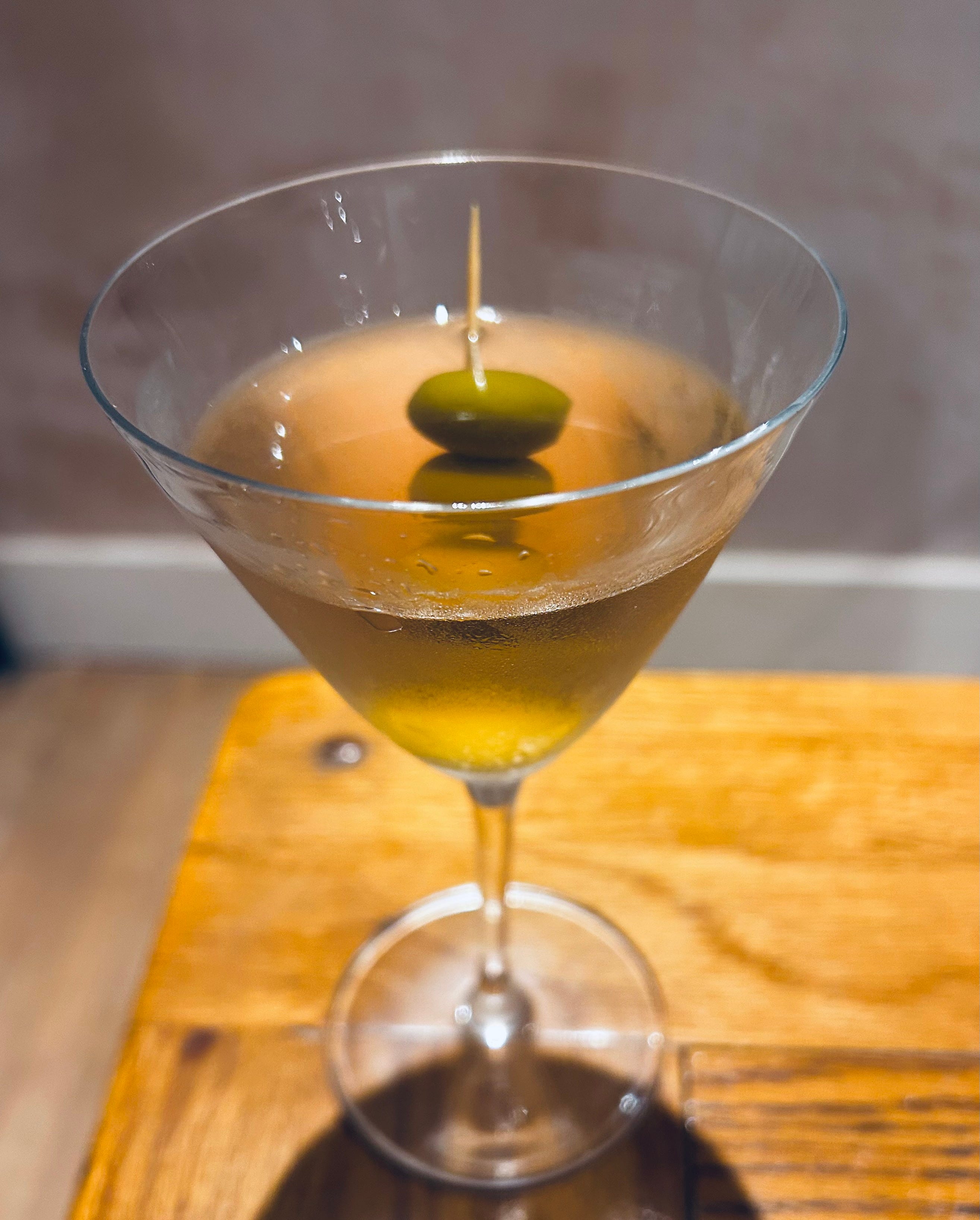
~ THE VESPER MARTINI ~
45ml gin
15ml vodka
7.5ml Lillet Blanc
7.5ml China Martini (but see note)
"Just a moment. Three measures of Gordon's, one of vodka, half a measure of Kina Lillet. Shake it very well until it's ice-cold, then add a large thin slice of lemon peel. Got it? ... This drink's my own invention. I'm going to patent it when I think of a good name…" — Ian Fleming, Casino Royale (1953)
Some Vesper Notes:
1) This is where the whole shaken-not-stirred nonsense comes from. James Bond goes on to name his drink after femme fatale Vesper Lynd, as played by Eva Green in the movie (whom I once interviewed while sitting on an extremely tiny chair in Sketch. Sigh). The drink has, for better or worse, entered the Martini Pantheon.
2) Kina Lillet is the pre-1986 formulation of Lillet Blanc; it contained quinine, making it darker and more bitter than the present formula. For acceptable modern day substitutions, please heed the advice of spirits + 007 expert David T. Smith below. Though I should say, what I did was a wholly avant-garde 10ml white port + 5ml Elixir di China, a vintage Italian amaro. Sacrilicious!
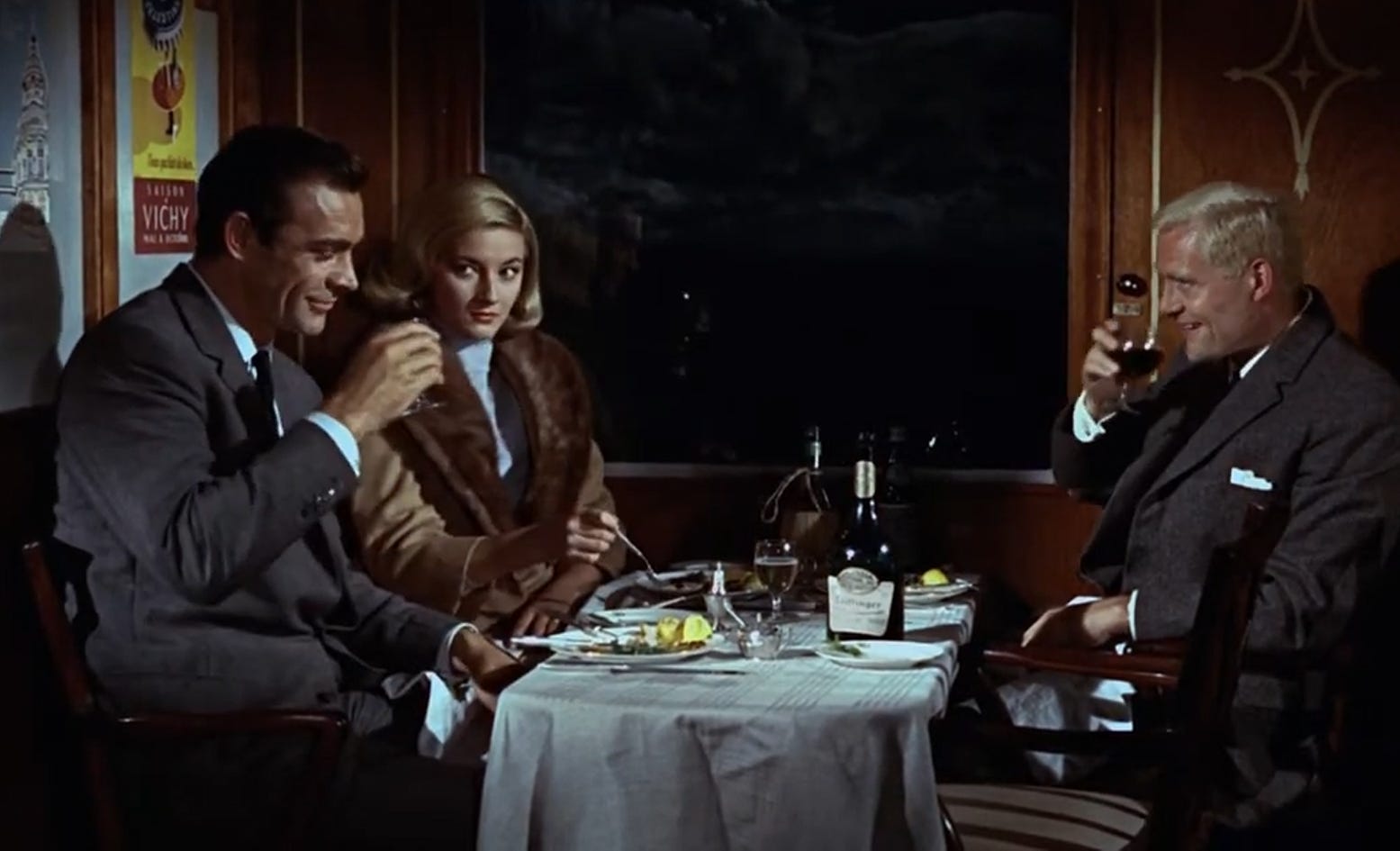
3) David is the co-host of thr new podcast, Red Wine with Fish, along with the internationally-renowned crisp expert Neil Ridley and the famous spy Millie Milliken. It's about all the drinks in James Bond — including of course, the famous train scene in From Russia With Love in which Sean Connery unmasks a Soviet double-agent because he is unaware that you do not drink red wine with grilled sole. Says Millie:
"Having been talking about doing something around our shared love of Bond for nearly half a decade over many Fleming-esque lunches, we decided in late 2025 that it was time to commit to bringing Red Wine with Fish to life. As we delved even deeper into the food and drink in both the books and the novels, it became clear very quickly that this element of the franchise was even richer than we'd realised. The role both these elements play in plot, character development and setting each story in a time and place should not be underestimated. Even as ardent Bond fans, we've uncovered drinks and delicacies for the first time - we hope the listeners enjoy discovering them with us."
4) Further below, Neil shares the finest five such moments in Bond; and in the meantime, over to David with the drinks. And you can listen to Red Wine with Fish on all the usual podcast platforms.
THE COLONEL'S VESPER
by David T. Smith
On the face of it, the Vesper is a confused drink. It features a combination of British, Russian, and French ingredients and is mixed in a way that was anathema to any trained bartender of its time: a cocktail without fruit juice that was shaken, not stirred. When James Bond first orders it, the drink doesn't have a name, but it is eventually named after the book's love interest.
 Eva Green as Vesper Lynd in Casino Royale (2006)
In his book "You Only Live Once", Ivar Bryce (a close friend, supporter, and neighbour of Ian Fleming) states that the name comes from a time when Fleming was visiting the Duncans, an old English couple who were his neighbours in Jamaica. "The Colonel", as he was known, always drank "Vespers" at 6pm every evening — the name was a nod to the evening prayer. ("Time for vespers!")
These Vespers were described as "a curious drink of frozen rum with fruit and herbs". This drink was then transposed to both the femme fatale of Casino Royale — and the famed Martini, which used Lillet instead of dry vermouth. Bryce's own copy of the book was inscribed by Ian Fleming, "to Ivar, who drank the first Vesper and said the good word".
The challenge for modern-day Vesper drinkers is the lack of availability of Kina Lillet. Whilst Lillet Blanc is widely available (and works well in a Vesper), it is not the same product, being both dryer and less bitter. Sacred's Amber Vermouth was designed with Kina Lillet in mind and works very well in aVesper, as does Tempus Fugit's Kina L'Aéro D'Or. A few years ago, I was fortunate enough to try some original Kina Lillet in good condition and the closest approximation that I have found is a 50:50 mix of Lillet Blanc and China Martini.
Given all of the above variety, creating a Vesper that is true to James Bond's original is not as easy as just following the recipe. However, given Ian Fleming's remarks when he retried it — "unpalatable" — I'll let you decide whether that is a good thing or not.
Far better is this drink, which is inspired by Ian Fleming's description of the Vesper he had at the Colonel's house. The precise formulation is lost to time — but this
~ THE COLONEL'S VESPER ~
50ml dark rum (Jamaican pot still, please)
20ml lime juice
10ml orange liqueur
10ml orgeat
5-10 ml Pimento Dram
2 dashes Angostura bitters
Blend with ice until a smooth slush and garnish with a straw and mint sprig.
✨WELCOME TO THE SPIRITS✨
The neighbourhood bar of the internet
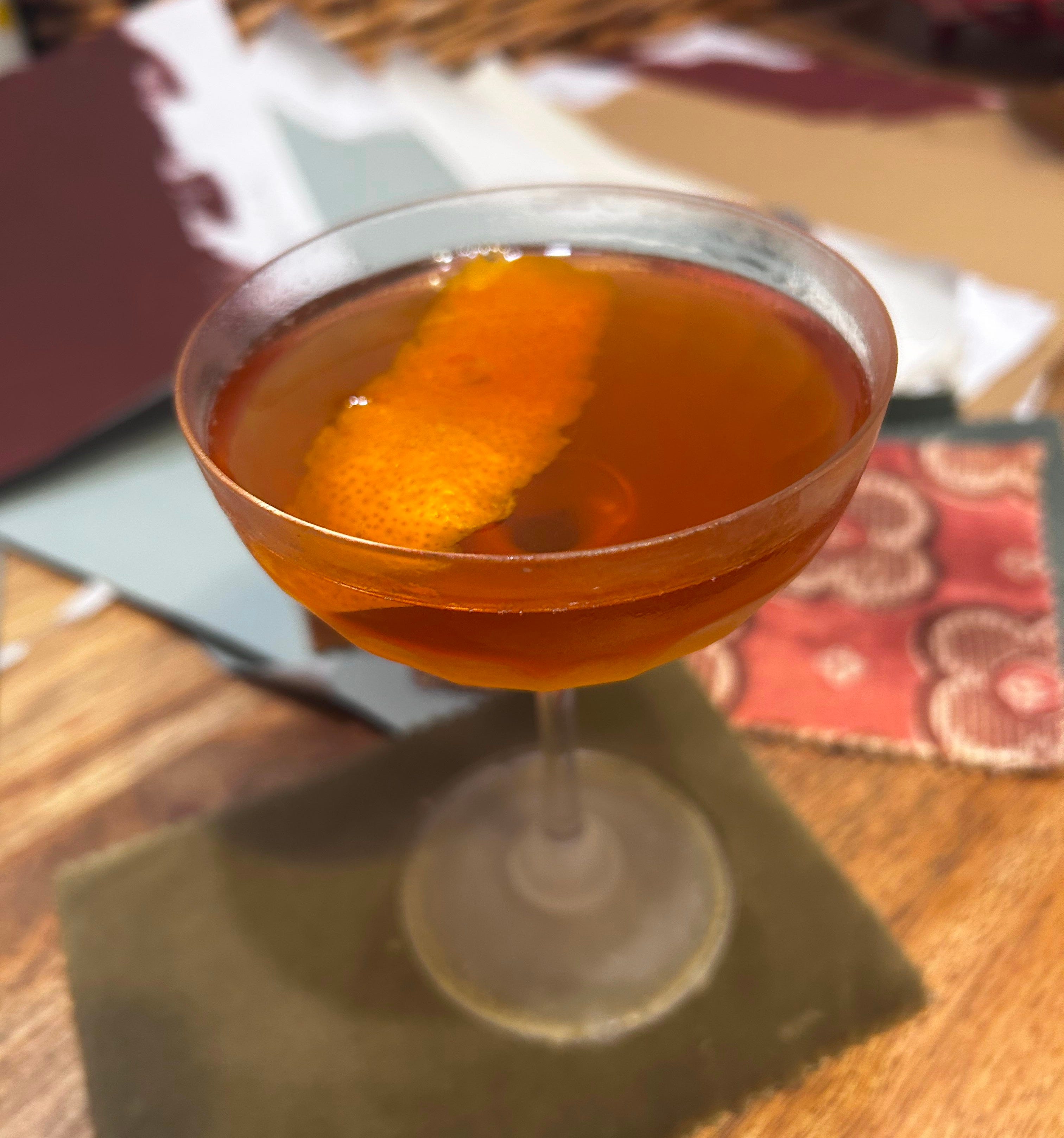
~ THE BROOKLYN ~
50ml rye whiskey (or bourbon)
15ml French vermouth
5ml maraschino
5ml Amer Picon
Place a fetching cocktail glass in the freezer to ensure optimum frigidity. Now prepare the cocktail: stir, with plenty of ice, all of the ingredients. And strain into the glass. I've seen plenty of recipe insist: no garnish. But I used orange zest; and a maraschino cherry would be good too. It would also be funny to garnish it with a Flake and call it a Brooklyn 99.
Some Brooklyn Notes:
1) Longtime Spirits subscriber Peter Blakeman recently asked me an interesting question. What did I consider to be the cocktail of each decade since the 1950s? He wanted a little help with some 70th birthday party planning; I feared his guests might need a little help after seven cocktails. But still, it did get me thinking — especially about the recent decades. My first suggestion for the 2000s was the Mojito. But actually I wonder if the Brooklyn wouldn't be a hipper choice. It was invented in 1910 as a variant on the Manhattan, its first appearance in print arriving in Jack's Manual (along with Angostura Grapefruit… see also Thirteen cool ways to use cocktail ingredients in your cooking). But it didn't really acheive lift off until the NYC cocktail revival of the 2000's, when a new generation of bartenders rediscovered, remixed it, and started naming new variants after rapidly gentrifying parts of Brooklyn: The Greenpoint, The [Park] Slope, The Bushwick, The Carroll Gardens, The Red Hook… The drink thus captured the decade's signature themes of hipster obscurantism, gentrification and retro revivalism. And what is retro revivalism if not the gentrification of the past?
2) Still, important caveat: most of the Brooklyn family of drinks were in fact invented in Manhattan bars like Milk & Honey and Death & Co. The bartenders were honouring the neighbourhoods they actually lived in as opposed to the ones they worked in. Cocktail culture would only reach into these residential neighbourhoods much later and now, of course, the idea of a bartender being able to afford Carroll Gardens (average rent c$5,000+ per month) feels a little quaint.
4) Mais où sont les neiges d'antan?
5) All of the variations are worth a try, if you like rich, autumnal, boozy sips, but the original Brooklyn is still marvellous — a kind of drier, bitterer Manhattan, only with a bloom of maraschino to prevent it from becoming too serious. (Jack's 1910 version actually uses Italian vermouth though later recipes seem to have converged on French). It really is worth using straight rye if you at all can; the pepperiness works so well against the maraschino. If you only have bourbon, use a stingier hand with the sweeter ingredients. Oh and then there's the Amer Picon, a classic bitter French liqueur that I suspect this will be the subject of a Cabinet post before long. In the meantime, you might like to know that it's almost wholly interchangeable with Cynar and indeed, just about any dark amaro will work fine.
6) Spare a thought for the Bronx! Once the most popular cocktail in New York — now almost wholly forgotten. Still, given the hipster classes are now fleeing Brooklyn for the likes of Throg's Neck, Riverdale and Mott Haven, perhaps we can expect a fresh new wave of Bronx variations too.
✨WELCOME TO THE SPIRITS✨
The neighbourhood bar of the internet
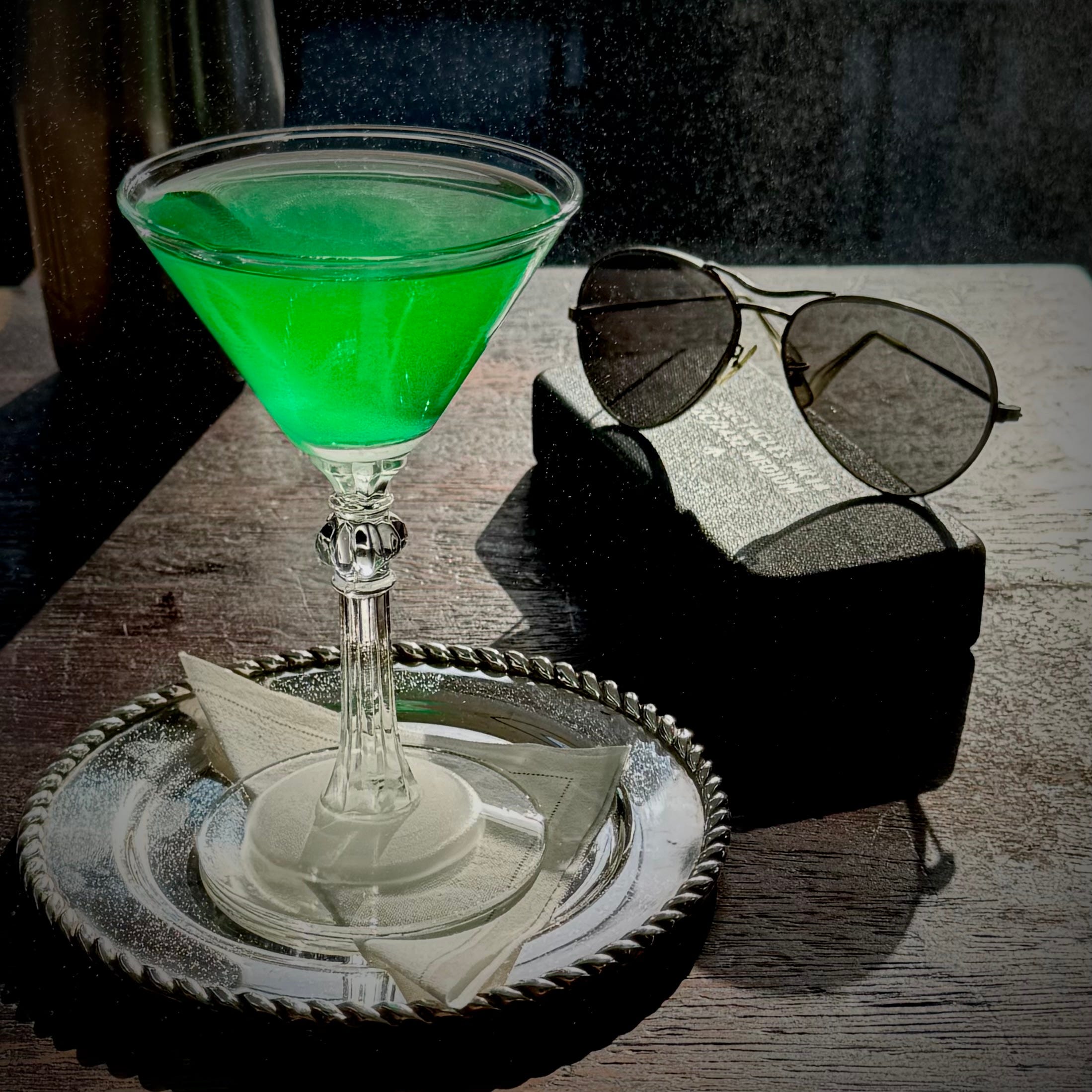 As always, the right glasses are essential. (
200th EDITION SPECTACULAR. In honour of this weekend's momentous anniversary — a chance to celebrate of life, liberty and the pursuit of cocktails — I am extending my offer of 40% off annual subscriptions to the Spirits until Sunday. The Spirits is, of course, an idea as much as it is newsletter and although it often singularly fails to live up to the values in which it affects to believe, I hope that at the very least it transports you to a higher plane of tipsiness.
Click here for the deal of the summer
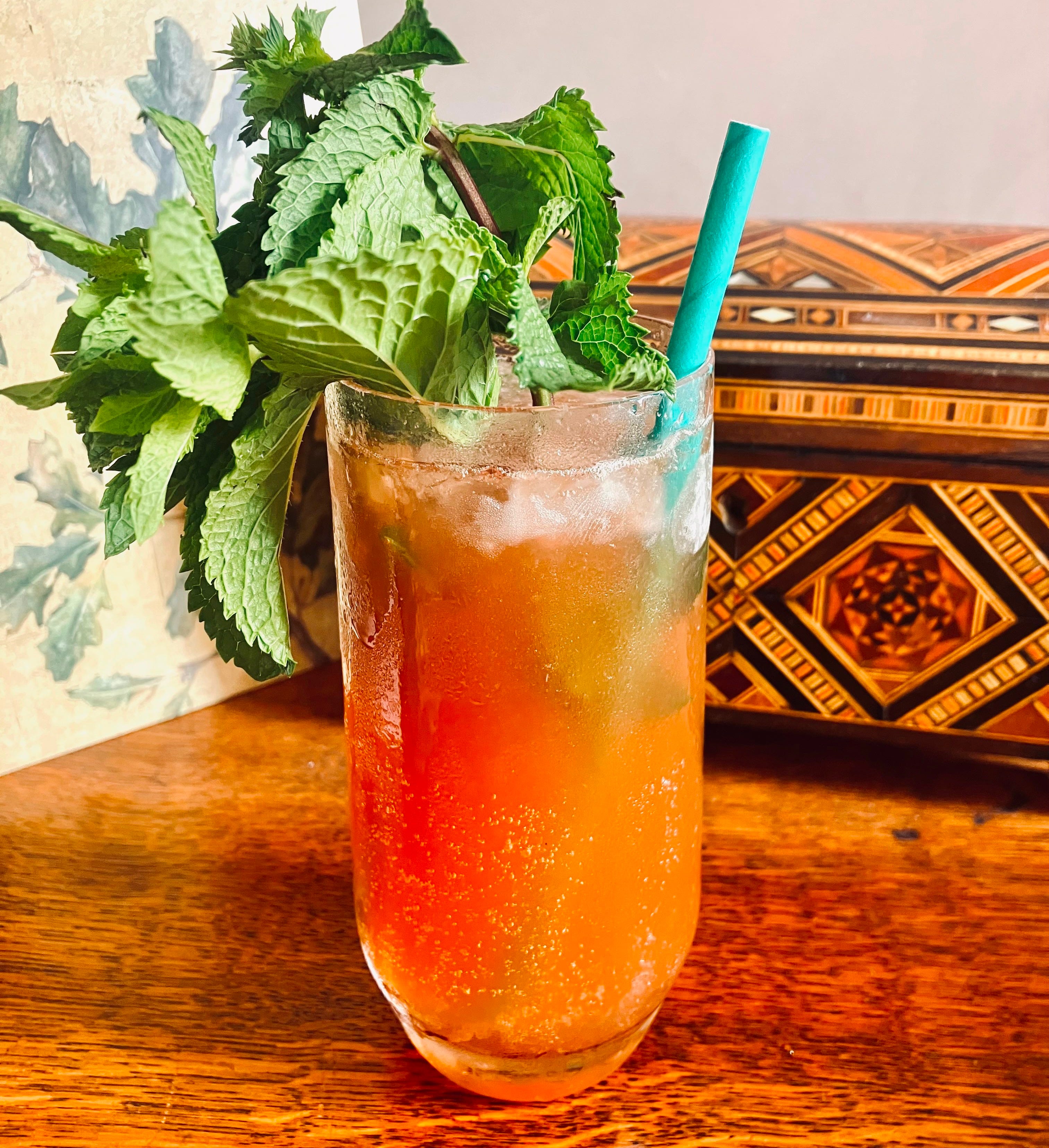
~ THE ZOMBIE ~
25ml funky dark rum (Jamaican best)
25ml smooth golden rum (Spanish-style best)
25ml overproof dark rum (Demerara best)
25ml lime juice
25ml grapefruit juice
15ml cinnamon syrup
5ml grenadine
5ml falernum
5ml orange liqueur
Dash Angostura bitters
Dash absinthe (or pastis)
Sprig of fresh mint to garnish
Freeze your glassware — and quintessentially this will of course be a "Tiki" mug goofing off the God of some island religion of which you have no understanding. We're going to make this one in the liquidiser — a Nutribullet is optimal. Add the rum(s), the fruit juice, the syrup, liqueurs and "seasoning". Throw in 150ml of crushed ice too. And whirr a while — say for five seconds. Now add the mint to the glass, remembering to slap it first to release the aromas. Carefully pour in the potent orange slush and heap a little more crushed ice on top too, if neceesary. An extra grating of cinnamon won't go amiss.


