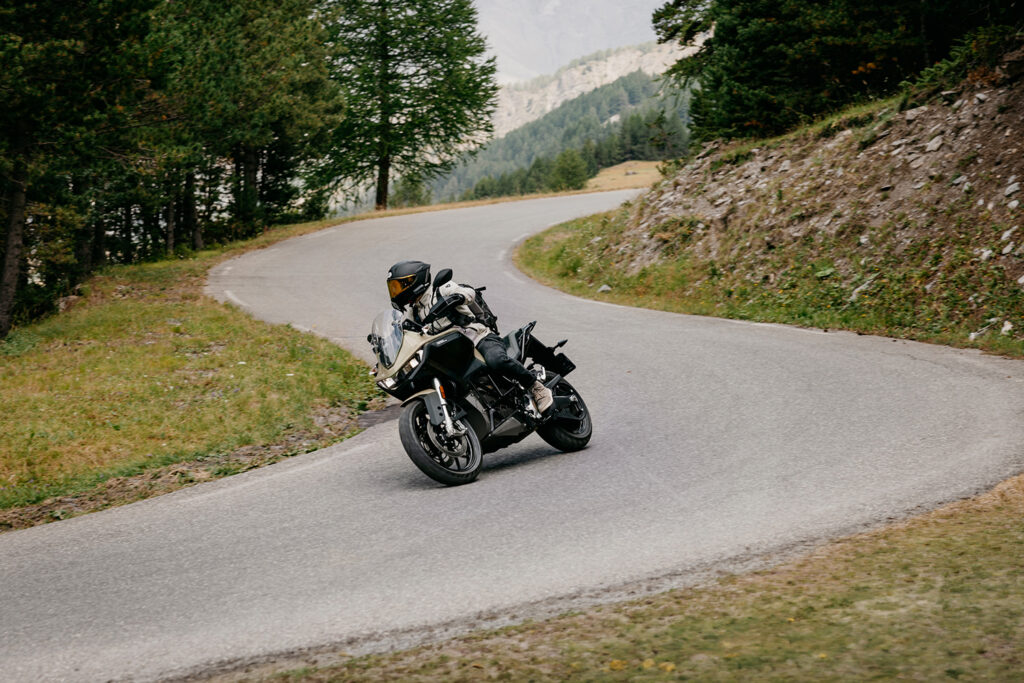
Author: Marco Ghezzi - THE PACK Italia | The brand born in the Motor Valley returns to the spotlight with new international ownership, its technological heart firmly rooted in Italy, and a relaunch plan focused on production, innovation and new markets. The Experia will be the first model to return to production, followed by the entire Energica range.
Energica is back on the road. And it is doing so by returning to its roots, its passion for motorcycles and the wealth of technology, innovation and expertise that made it one of the best-known and most respected names in the international electric two-wheeler industry. Founded in Modena, at the heart of Italy's Motor Valley, Energica was among the pioneers of high-performance electric motorcycles. Its journey began with the Ego family of sport bikes, continued with the Eva Ribelle and EsseEsse9 naked bikes, and expanded with the Experia, a sport-tourer designed to take on long-distance journeys.

These motorcycles have won over enthusiasts around the world through their performance, technological solutions and distinctive character, proving that electric propulsion can deliver an authentic motorcycling experience. That legacy was also forged in racing, from the Isle of Man to four seasons as the sole official motorcycle supplier to the FIM MotoE World Cup. This international proving ground helped advance Energica technology, particularly its high-voltage systems and DC fast charging.
Following a period of financial difficulties that culminated in the company entering judicial liquidation and ceasing operations in 2024, the brand is now preparing to write a new chapter in its history. This has been made possible by its acquisition by Energica Pte. Ltd. a Singapore-based company backed by a group of international private investors who share a passion for the brand and
a belief that the technological and industrial heritage developed in Italy deserves a new opportunity for growth.

To announce and celebrate this return, "Energica Back on the Road" was being held on November 4 at Fonderie Napoleoniche in Milan, bringing together the press, dealers and industry professionals during EICMA 2026 week.
New ownership, the same Italian soulThe new Energica has a clear goal: to preserve what has made the brand unique while building a stronger, more efficient and competitive business around that legacy. The new owners see the value of the acquisition not only in the brand, patents, intellectual property and existing type approvals, but above all in the people and the international community of riders who continued to believe in Energica even during the shutdown. They are the clearest proof of what the product can deliver.

Technical continuity is one of the cornerstones of the project. The core engineering and design leadership team that helped establish and develop the company has remained active in Italy, preserving the knowledge, skills and experience built up over the years. The company is led from Singapore by Shivangi Bagri, Interim Chief Executive Officer who is leading the company through the transition. Design, engineering and R&D are led from Italy by Giampiero Testoni, part of Energica's founding team and its Chief Technology Officer, with his core designer Paolo Imeni, and their expanding R&D team.
Production in Asia, technology and research in ItalyMotorcycle production is moving to Asia, while design, engineering, research and development, and responsibility for technical and quality standards will remain in Italy. Every motorcycle will continue to be built to Energica specifications under the supervision of the Italian technical team, but with a leaner manufacturing model and a lower cost base. This will significantly reduce manufacturing costs and allow motorcycle prices to fall by approximately 20% compared with the past, while preserving the brand's identity and technological standards.
 Experia leads the return of the entire range
The commercial relaunch will begin with the Experia, the electric sport-tourer that broadened the brand's horizons into motorcycle touring and long-distance travel. It will be the first motorcycle to return to production, progressively followed by the Ego, Eva Ribelle and EsseEsse9, bringing all four models in the Energica range back to market. Initially, the motorcycles will retain their existing technical platforms, making use of already developed and homologated technology to accelerate the restart of operations.
Technological upgrades will follow, beginning with a new battery, alongside further improvements to range, efficiency, performance and, above all, reliability. The new strategy will also place greater emphasis on customisation, with lighter, made-to-order versions featuring carbon-fibre bodywork.
 Europe, the United States and Australia: rebuilding the sales network
The new Energica will initially focus on markets where the brand has already established a significant presence and a strong owner community. Europe, with Italy at the forefront, the United States and Australia are the priorities for resuming sales, rebuilding the distribution network and strengthening after-sales support. The company is working to re-establish relationships with dealers and importers, market by market, with the aim of creating a commercial structure capable of supporting its next phase of growth. A first concrete milestone is set for November 15, 2026, when an updated list of dealers and authorised service centres will be published on Energica's official website.
Asia will also play an important role, both as a growing market and as the manufacturing base. India, in particular, will be where "ride-intelligence" technology is implemented on other motorcycle models. Italy will remain a strategic market, both because of the brand's origins and because of the role Italian design and technology will continue to play in its identity.
 Service and spare parts: Energica customers come first
One of the new owners' first commitments is to rebuild the relationship with existing Energica motorcycle owners. This international community continued to ride and enjoy their motorcycles throughout the crisis, travelling across continents, deserts and remote regions. For these riders, Energica's return means, above all, having a technical point of reference and a support organisation they can rely on once again. Service has already resumed, and spare parts shipments to dealers in several countries have restarted. The Italian technical team works directly with the dealer network and owners, providing support even in areas where no authorised service centre is yet available. In these cases, European customer support can be contacted directly at: service-eu@energicamotor.com
In addition, Energica ReCharge is an already active programme that will give existing owners the opportunity to upgrade to new versions of the motorcycles when they become available.
 Energica Owners' Lounge: a new experience for riders
Energica's new strategy goes beyond motorcycles and the sales network. It aims to build a closer, more lasting relationship with owners. This vision has led to Energica Owners' Lounge, a digital platform designed to support the entire motorcycle ownership and riding experience.
The application will feature four main areas.
- Community will enable riders to connect, share routes and organise rides, using tools that can also take weather conditions, charging opportunities and participants' availability into account.
- Collection will offer technical riding apparel, accessories and a selection of products reflecting Italian design and craftsmanship.
- Garage will provide a digital space for managing motorcycles, including those from other brands, with information and tools dedicated to maintenance.
- Ride Intelligence will introduce an intelligent riding analysis system developed from Energica's technological experience in racing. The aim is to turn data collected on every journey into useful insights and recommendations to improve the riding experience.
The device supporting this technology will be designed to work both with Energica motorcycles already on the road and with new models, allowing existing owners to benefit from future innovations as well. This project reflects the desire to involve the community directly in the brand's development by gathering suggestions, ideas and experiences from riders who use Energic motorcycles every day.
 Energica Back on the Road: the future starts again in Milan
"Energica's return represents much more than restarting production of a motorcycle range," said Shivangi Bagri. "It is about carrying forward an Italian industrial and technological achievement that helped demonstrate the potential of high-performance electric mobility, while building a new organisation capable of meeting the challenges of the global market. On one side stands the Motor Valley heritage, racing experience and expertise of the Italian technical team. On the other are international ownership, a more competitive manufacturing model, new technologies and a strategy centred not only on motorcycles, but also on the people who ride them."
Choosing Milan during EICMA week underscores Energica's determination to reconnect with the international motorcycling world. On November 4, "Energica Back on the Road" officially opened a new chapter for the brand. One that builds on its Italian roots, looks towards international markets and aims to restore Energica's leading role in the future of electric two-wheelers.
Because Energica riders never stopped. Now the brand is getting back on the road with them.
ENERGICA >Images: © THE PACK ITALIA
NIU shows its 2027 moped line-up at EICMA 2026. The headline model is the FQiX 500, a new top-of-range version of the FQiX Series. Alongside it, the company announced a batch of model-year changes across the NQi, NQiX and FQiX ranges.
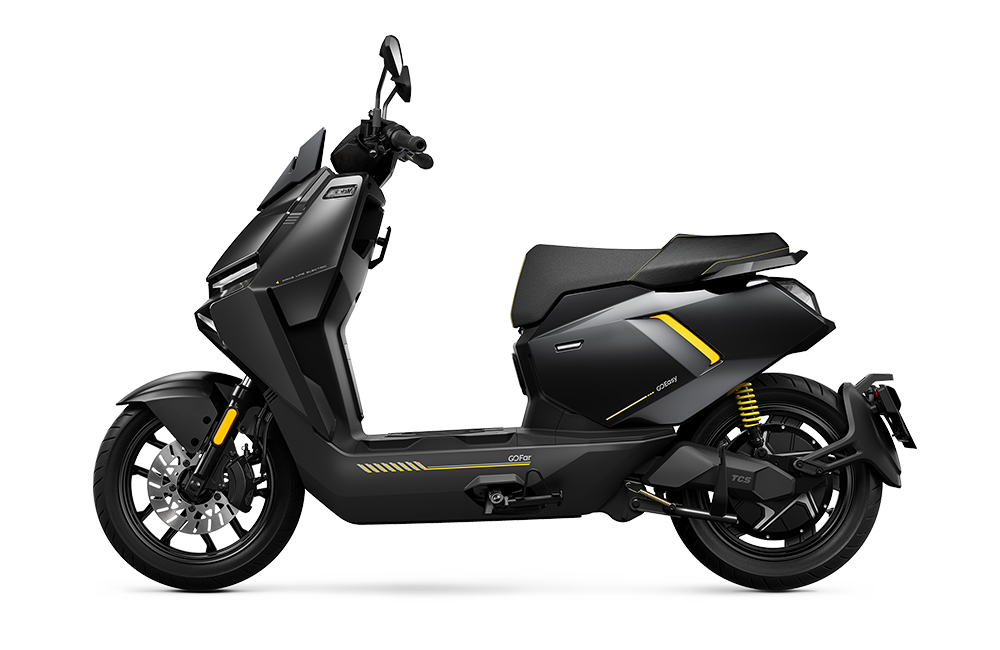
FQiX 500
The FQiX 500 borrows its base from the NQiX 500, one of NIU's strongest sellers in the performance segment, but gets a reinforced frame and FQiX styling. Top speed is 110 km/h, or 115 km/h in Boost mode. ABS is standard.
It ships with two 72 V / 28 Ah batteries. A third battery can be fitted under the seat, which NIU says raises range to a maximum of 130 km. Pricing starts at €4,699, with European dealer deliveries expected in Q1 2027.
Model Year 2027 changes
NIU counts 25 changes across the range for 2027. The most significant:
- The NQiX 500 moves to a stronger HC420 steel frame. Its top speed goes up from 100 to 110 km/h, with 115 km/h available in Boost mode.
- The NQiX 150/300, FQiX 150/300 and NQi Sport/GTS receive a smaller 72 V / 30 Ah battery pack. NIU claims up to 7% more range. The pack is backward compatible with MY25 and MY26 models and works with the existing charger, which matters for current owners looking at an upgrade.
- Every model now rolls on CST SC12 all-season tyres. The NQiX and FQiX Series get brighter headlights, and the NQiX Series adds three colours: Matt Blue, Jungle Green and Nardo Grey.
- Further updates cover faster GPS and connectivity, plus improved corrosion protection on frames, stands and swingarms. The MY2027 vehicles are also scheduled to reach European dealers in Q1 2027.
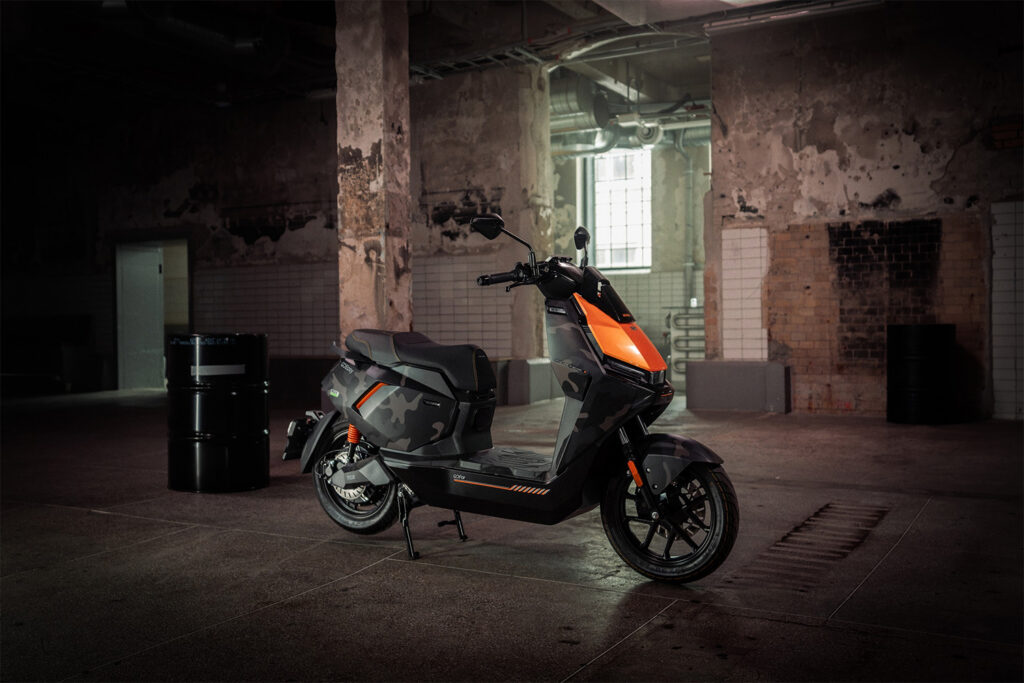 NIU FQiX 150/300
NIU in Europe
NIU entered the European market in 2016 and now works with more than 630 dealers and service partners across 14 countries, backed by local NIU organisations for sales, after-sales and marketing.
The company cites registration data to underline its position. In Germany, it says the NQiX 500 is the best-selling electric scooter, accounting for one in four electric scooter registrations this year, and that NIU holds close to 40% of the electric scooter market (source: IVM Performance, September 2026). In Italy, NIU says it is the leading electric brand, registering over four times as many vehicles as its nearest electric competitor (source: ANCMA, January-October 2026).
Sieghart Michielsen, Director of International at NIU Technologies, attributed the brand's European standing to its dealer network and local teams, stressing that dealers service what they sell and that the 2027 range builds on that ownership focus.
About NIU
NIU is listed on Nasdaq and sells in 52 countries. Since launching its first electric scooter in 2015, it reports more than 5 million vehicles sold, with users having covered over 47 billion kilometres as of November 2026. Its range spans electric motorcycles, mopeds, bicycles and scooters.
NIU GLOBAL >
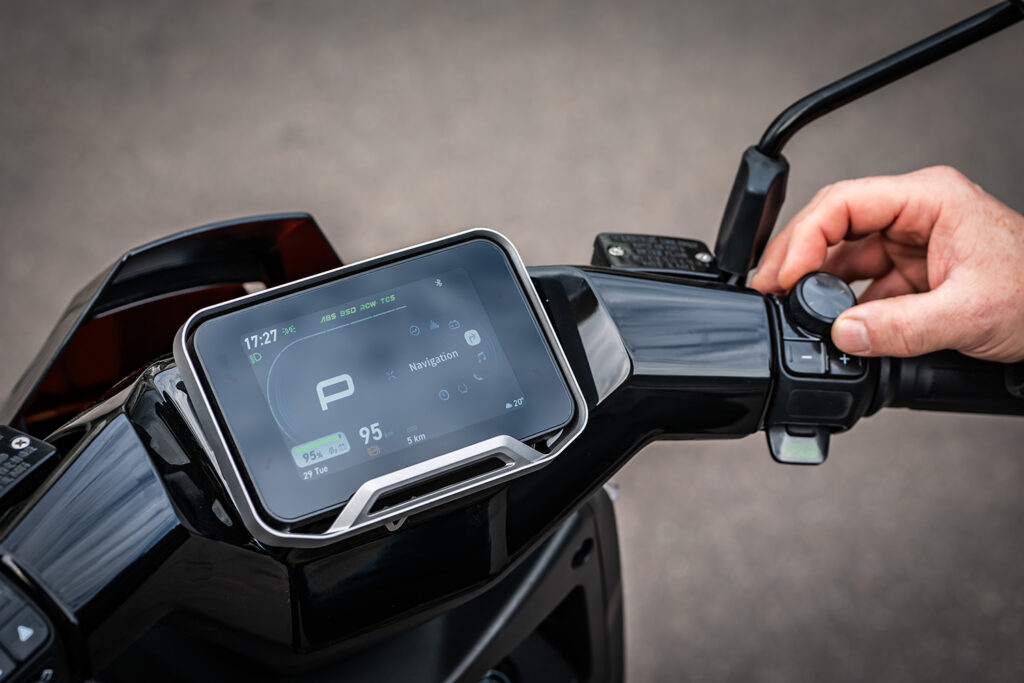
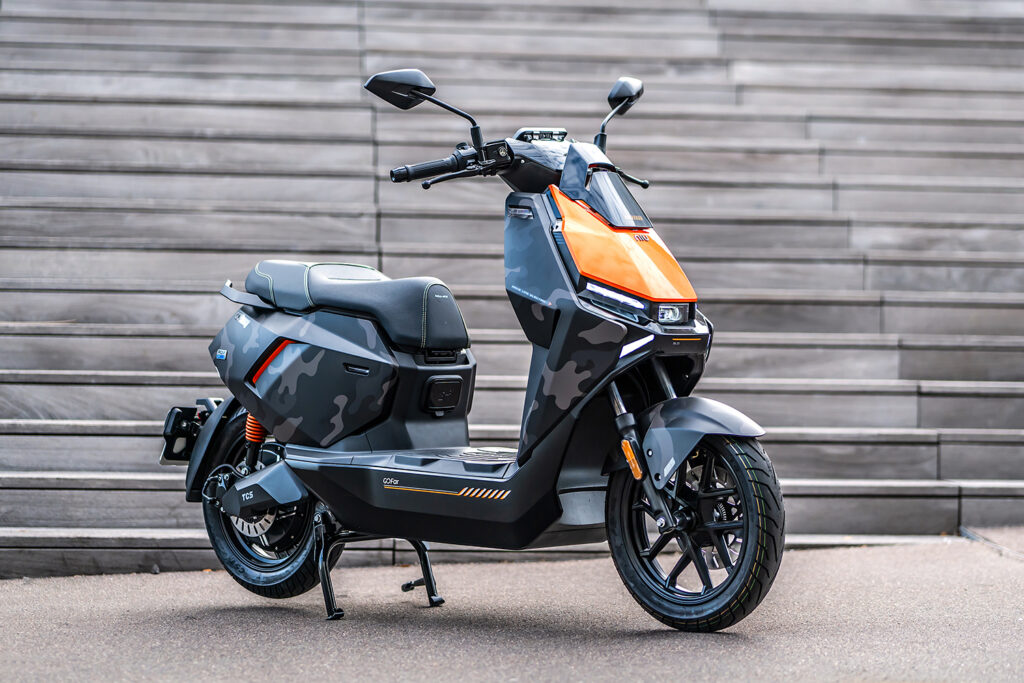
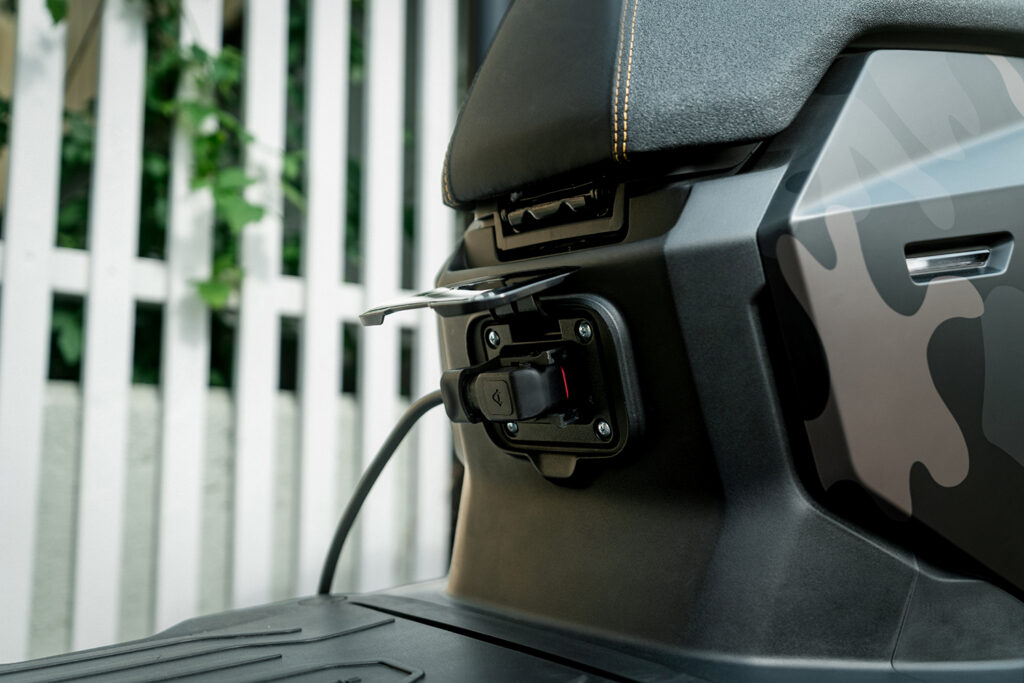
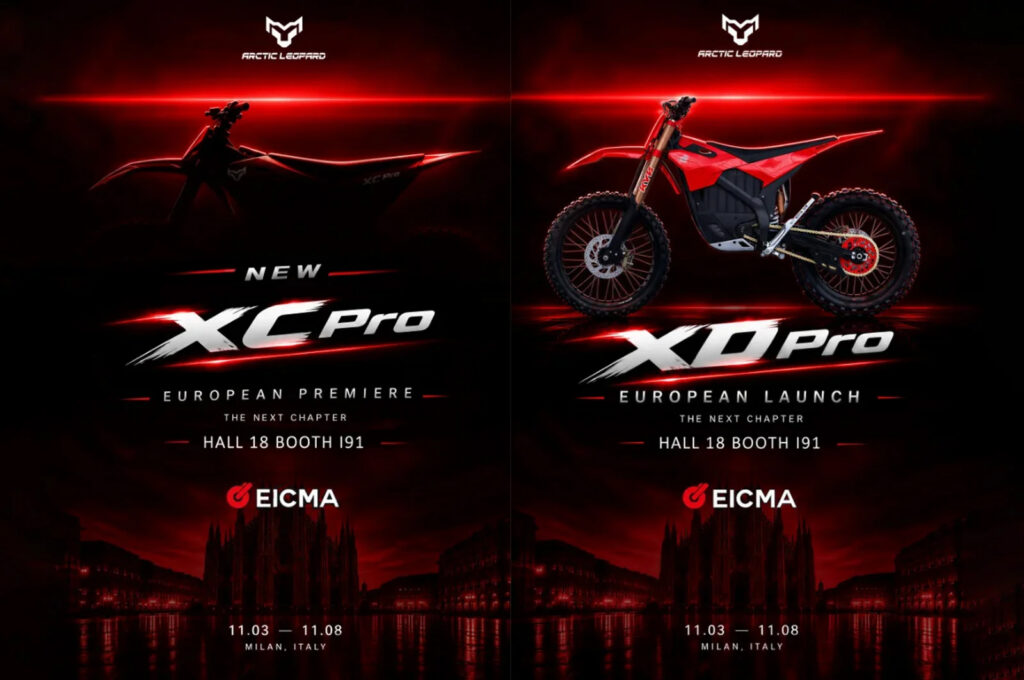
Chinese electric off-road manufacturer Arctic Leopard is using EICMA 2026 in Milan for three announcements. It has partnered with hard enduro rider Graham Jarvis to develop its next generation of electric enduro motorcycles. Its new XD Pro gets its European launch, and the XC Pro makes its first public appearance outside China. Both bikes are on the Arctic Leopard stand in Hall 18, booth I91.
Graham Jarvis joins development
Arctic Leopard announced in Milan that it will work with Graham Jarvis on the development of its next generation of electric enduro bikes. The 51-year-old British rider is regarded as one of the most successful hard enduro riders ever. His record includes seven Red Bull Romaniacs wins, five Erzbergrodeo victories, six Sea to Sky titles and five Hells Gate wins, and before that a long career at the top of trials.
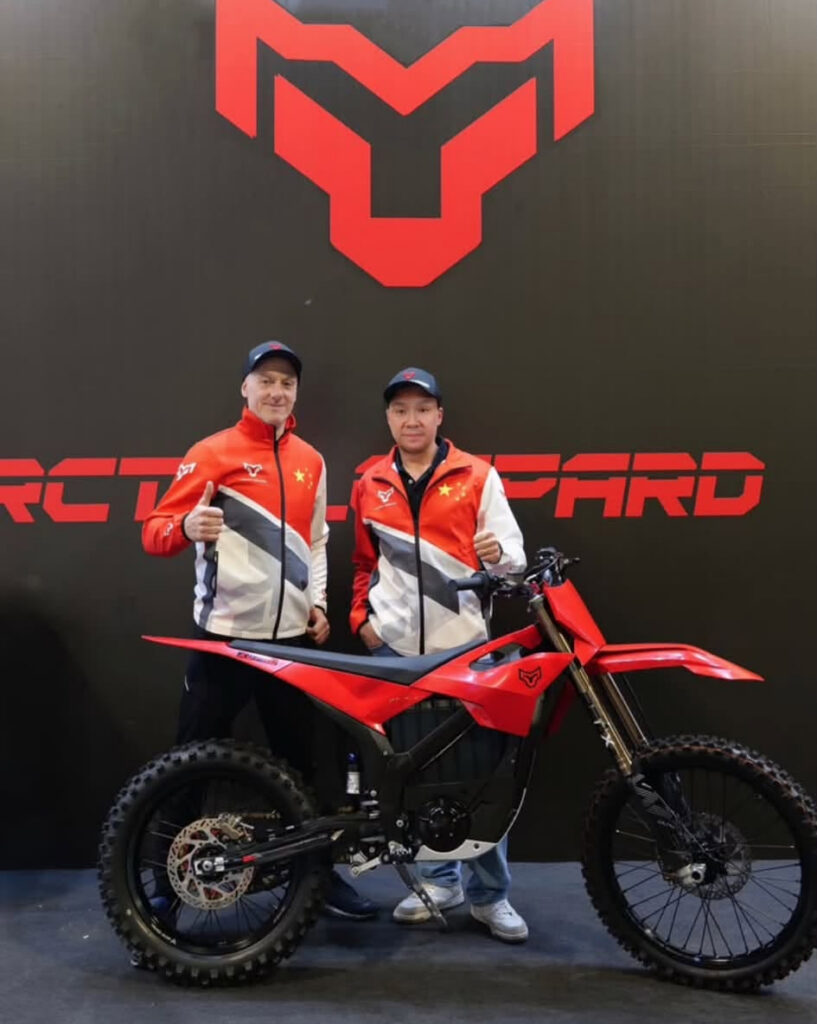 Image: © Graham Jarvis / Arctic Leopard
Jarvis is no stranger to electric off-road riding. He co-developed the JARV-E, a limited-edition electric hard enduro bike built in Austria by JARV-E Moto GmbH. In June 2026, he rode it to the finish of the Erzbergrodeo, one of only 15 riders to complete the race. Arctic Leopard has not yet said which models the collaboration will produce or when the first results will reach the market.
XD Pro: a step up in size and power
Arctic Leopard first showed the XD at the CIMAMotor show in China on 11 September and launched it there on 19 September. It is a full-size off-road machine and now the most powerful model in the brand's X range, positioned above the XE Pro R.
The motor delivers a peak output of 35 kW (47 hp) and 800 Nm of torque at the rear wheel. Top speed is 120 km/h. Energy comes from a 74V 76Ah battery, and Arctic Leopard claims a range of up to 200 km at a constant 40 km/h. As with all range figures quoted at low steady speeds, real off-road range will be considerably lower.
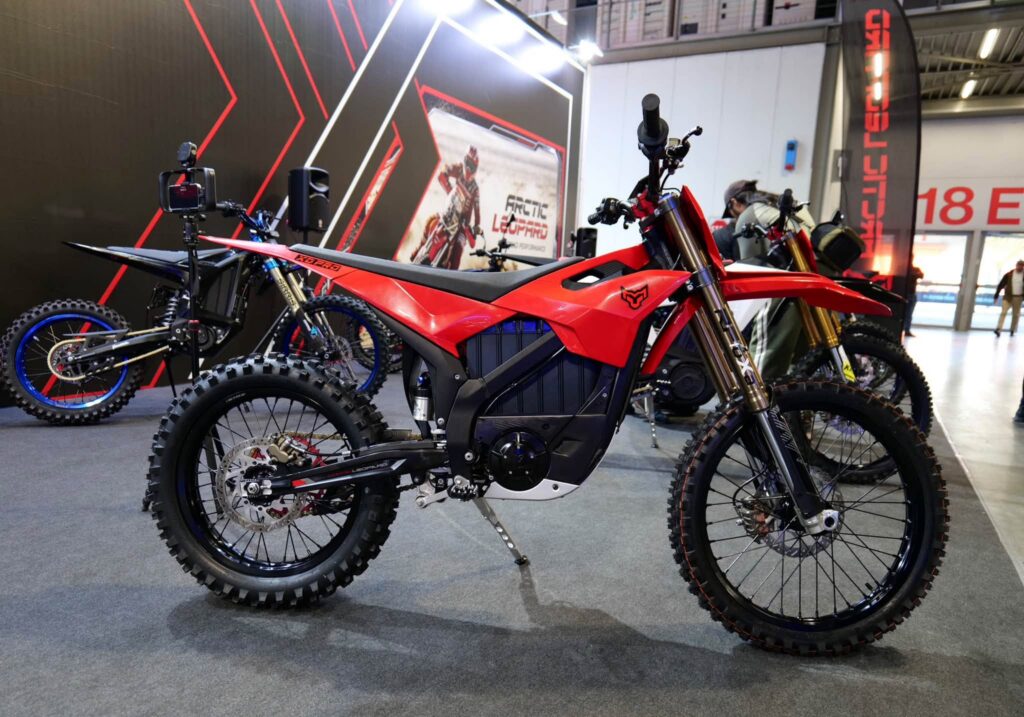 Image © Arctic Leopard
The chassis uses a 43 mm front fork and a rear shock with a 40 mm piston. Both ends offer 250 mm of travel and are adjustable for preload, compression and rebound. The factory spec sheet lists RFLOXA suspension. The US distributor lists KYB, and the European distributor says the supplier depends on configuration, with KYB, RFLOXA or KKE as options. Braking is handled by 240 mm hydraulic discs front and rear. The XD Pro rolls on CNC-machined hubs with 80/100-21 front and 120/90-18 rear tyres, the standard enduro size.
Seat height is 890 mm. Arctic Leopard quotes a curb weight of 89 kg, while the US distributor lists 95 kg. Overall dimensions are 2,040 x 820 x 1,180 mm. A TFT display and full LED lighting complete the package.
The factory website lists the XD Pro at USD 6,599. The US distributor expects deliveries from January 2027. European pricing and availability have not been announced.
XC Pro: first look, few facts
Arctic Leopard has kept the XC Pro under wraps. Before its Chinese reveal, the brand only showed a silhouette with a question mark. The US distributor describes it as a track-focused model. In Milan, the bike is on display as a physical unit.
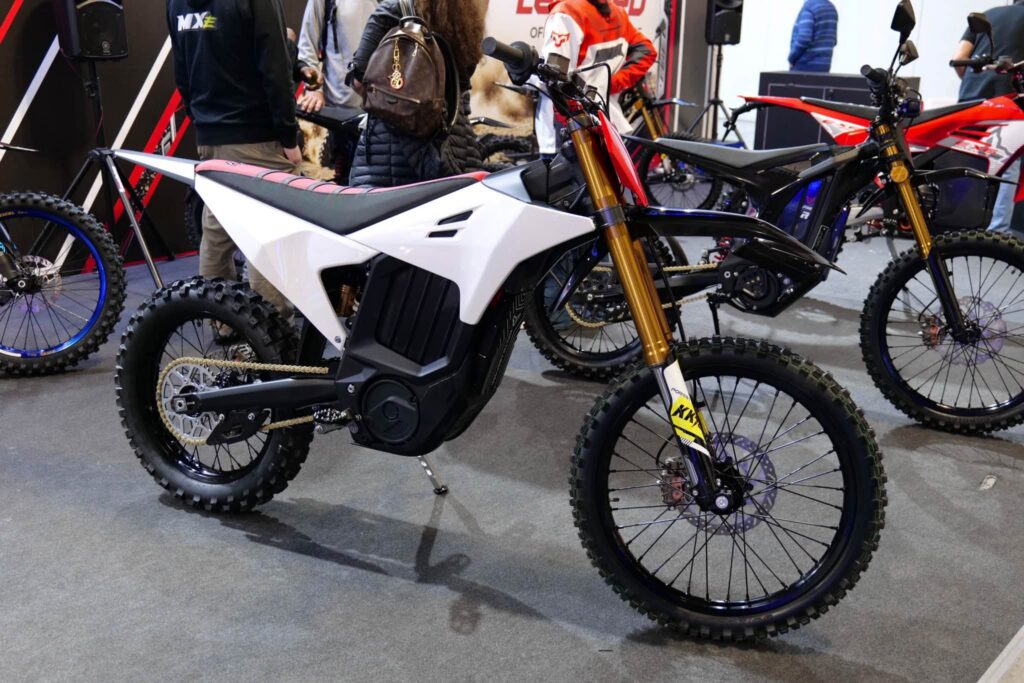 Image © Arctic Leopard
Power output, battery capacity, range, weight, homologation status and pricing have not been published. There is also no date for sales in Europe.
From Dakar to dealer floor
Arctic Leopard was founded in 2021 in Wenling, Zhejiang province, and builds a wide range of electric off-road bikes, from compact trail machines to full-size enduro and trial models. The brand has used the Dakar Rally's Mission 1000 category for new-energy vehicles as a testing ground since 2024. At Dakar 2026, Team Galicia entered three Arctic Leopard bikes and finished first, third and fourth in the category, with Fran Gómez Pallas taking the win. The rally bikes are competition versions and are not identical to the production models.
ARCTIC LEOPARD >In Europe, Arctic Leopard is sold through a network of national distributors, including Italy, Germany, Spain, the UK, Poland, the Czech Republic and a combined France and Benelux importer.
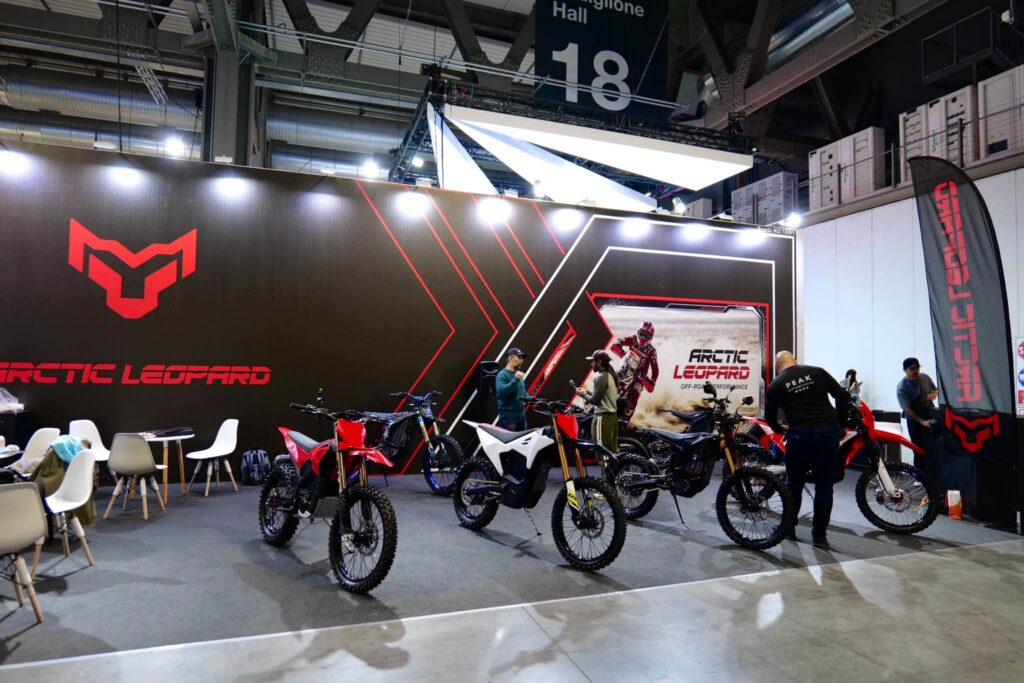 Image © Arctic Leopard
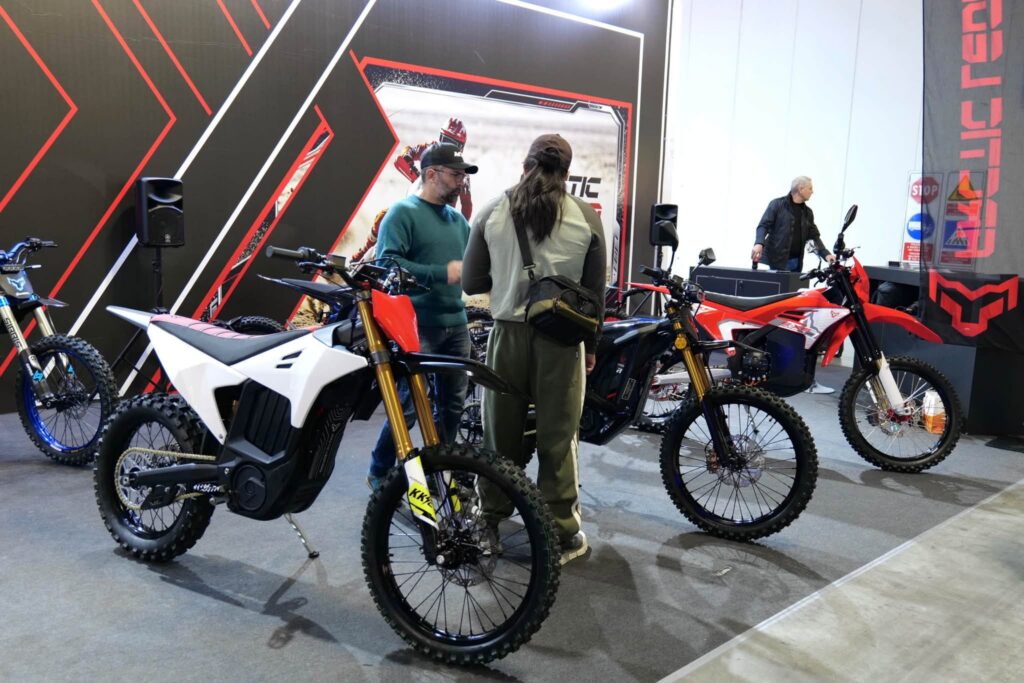 Image © Arctic Leopard
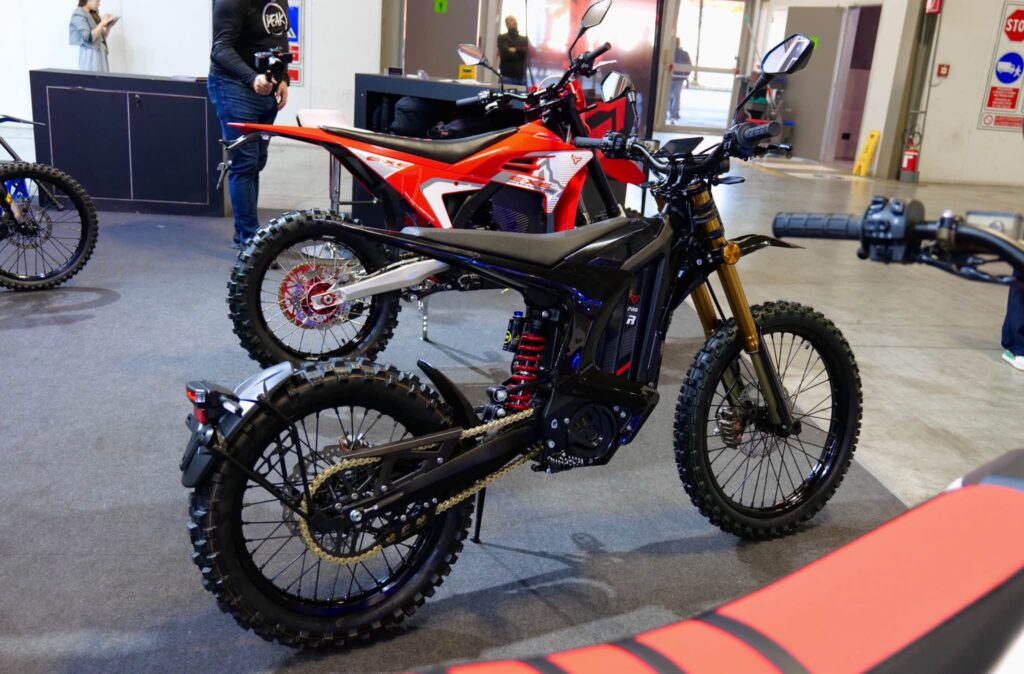 Image © Arctic Leopard
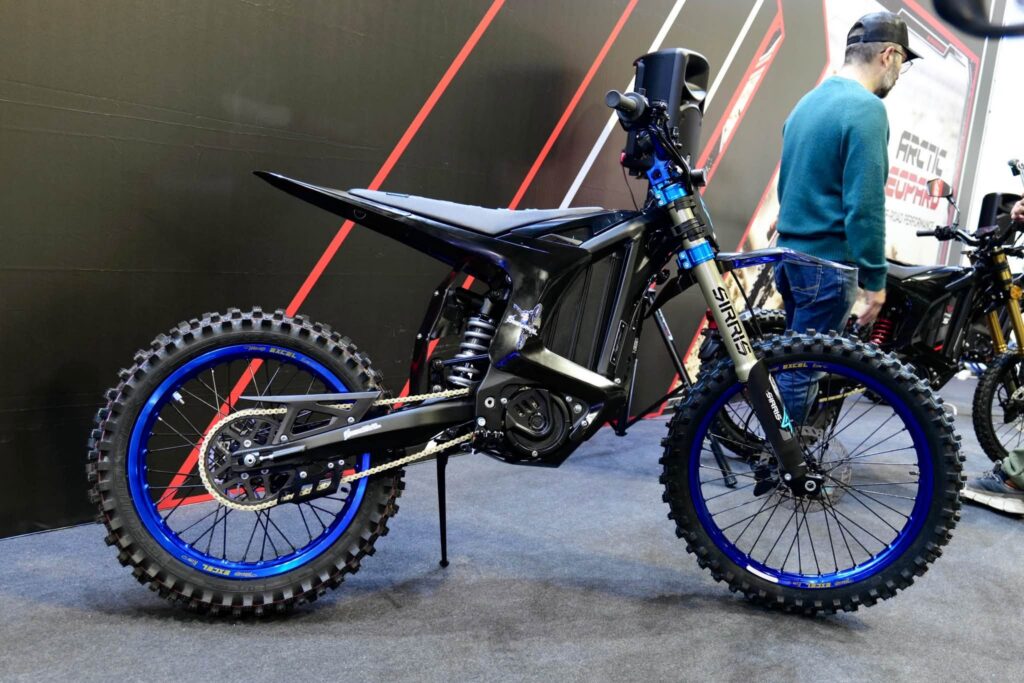 Image © Arctic Leopard
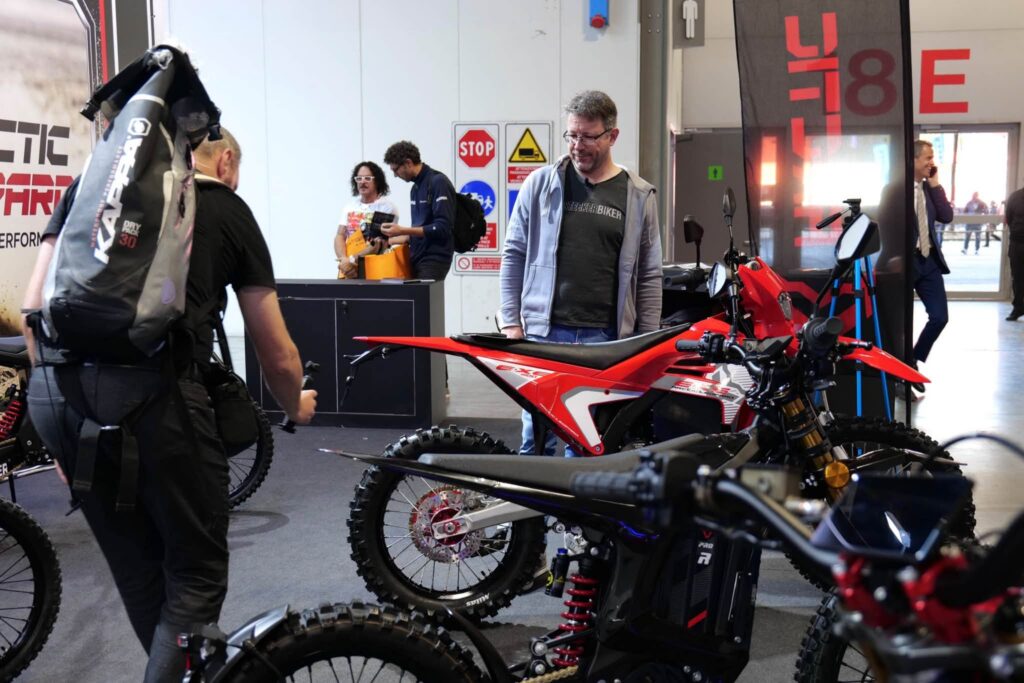 Image © Arctic Leopard
B2B News | Estonian IoT specialist Comodule is supplying the connectivity platform for Zero Motorcycles' new LS3. It is the company's first significant move into electric motorcycles and mopeds, after building its business on e-bikes and e-scooters.
What LS3 owners get
Through Comodule's system, LS3 riders can use connected features via the Zero Motorcycles App. For Comodule, the deal brings technology already proven on bicycles and scooters into a segment where digital features are still far from standard.
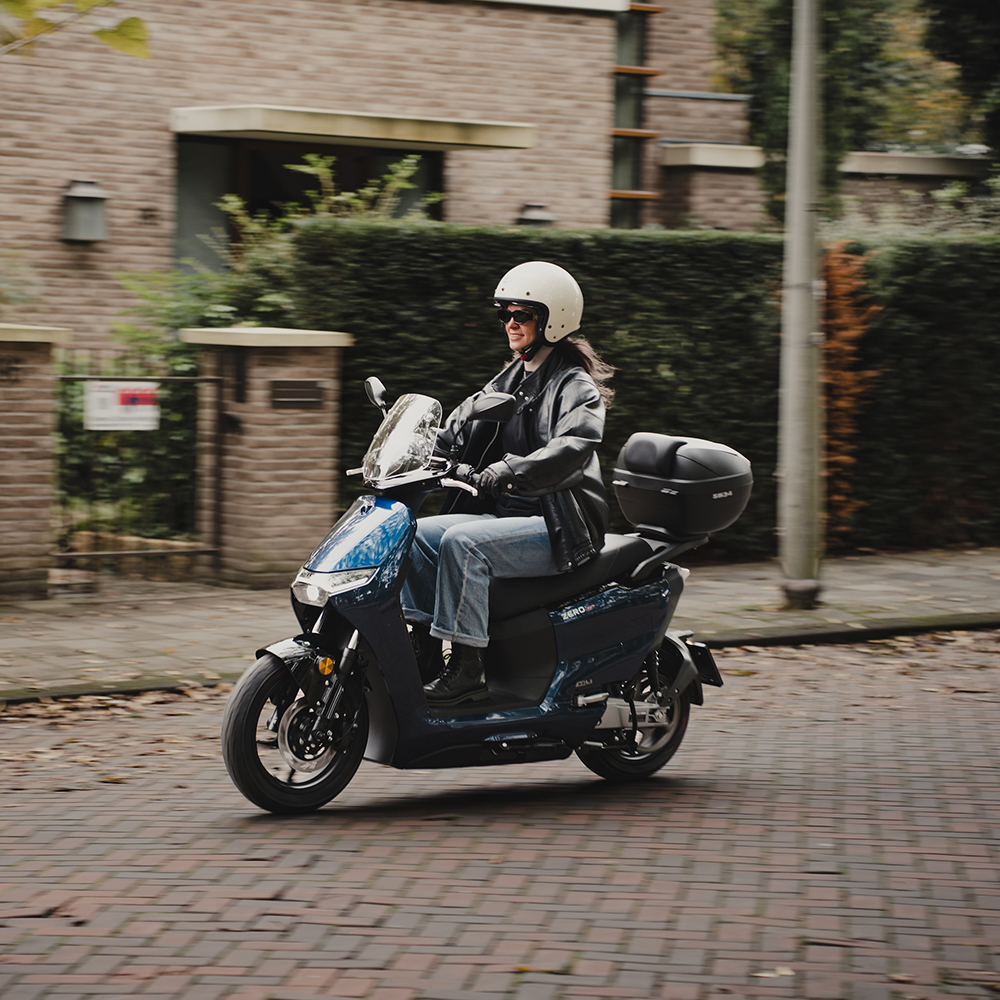 Image © Zero Motorcycles | Zero LS3
A segment lagging behind
Connectivity has become the norm on e-bikes, and in the car world more than 75 percent of new vehicles sold in 2024 came with embedded connectivity, according to Counterpoint Research. On motorcycles and mopeds, it remains the exception rather than the rule, although brands such as Zero have started adopting IoT technology to add functionality for riders.
Comodule CEO and founder Teet Praks sees electric motorcycle makers facing the same issues the e-bike industry dealt with years ago: securing the vehicle, understanding how it is used, and keeping in contact with the rider after the sale. According to Praks, the collaboration with Zero, a brand active in electric motorcycles for more than a decade, allows Comodule to bring connected vehicles to a much wider audience.
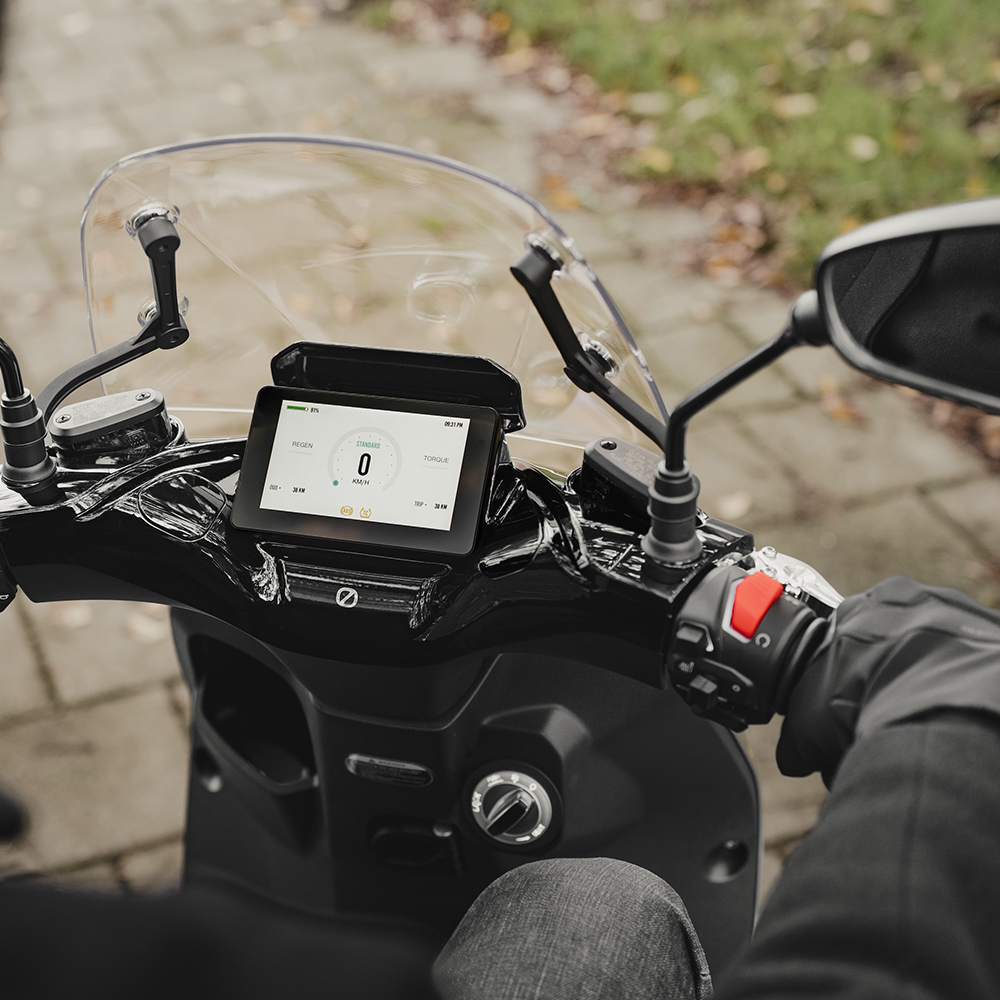 Image © Zero Motorcycles | Zero LS3
A full connectivity package
Comodule's offer is aimed at manufacturers that want connected models without developing IoT systems themselves. The package consists of three parts: IoT modules that integrate with the vehicle and are designed to cope with motorcycle-level power and durability demands, a cloud platform with API access for real-time vehicle data, remote diagnostics and over-the-air updates, and a rider app.
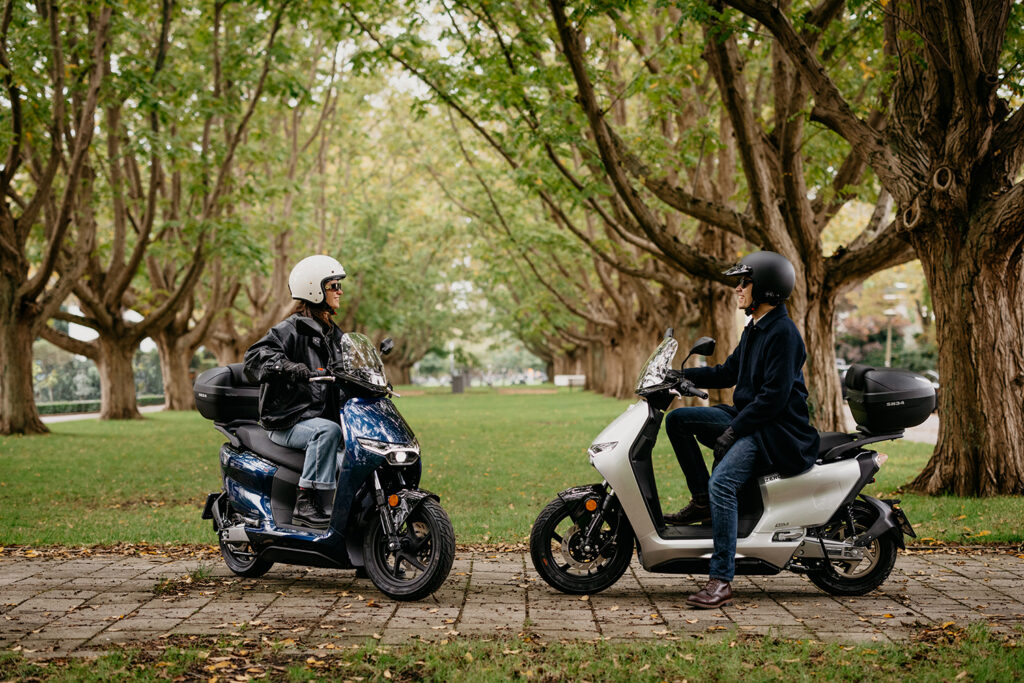 Image © Zero Motorcycles | Zero LS3
About Comodule
Founded 12 years ago, Comodule says it has connected more than 850,000 light electric vehicles to date. Its end-to-end system covers IoT hardware and software, including a rider app and a Control Center for manufacturers, allowing riders to track and control their vehicles remotely. All development and production take place in-house in Europe.
Zero Motorcycles presents Project Ventura at EICMA 2026, a new lightweight electric street bike with supermoto styling. The Californian brand turns twenty this year. It also brought the LS3 scooter to Europe for the first time, showed an updated XE, and gave more detail on a new connected app and DC fast charging, both planned for 2027.
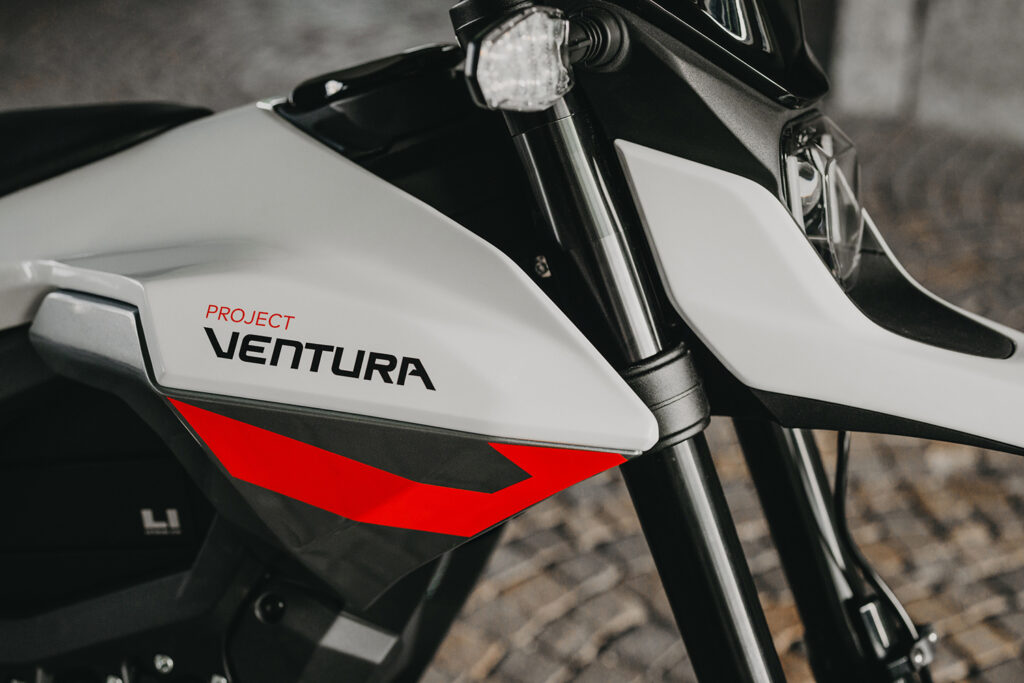 Project Ventura: an A1 supermoto for the street
Ventura is a new model, not a reworked existing one. Zero describes it as a light, agile street bike that combines the playful character of a supermoto with the instant torque of an electric drivetrain and an upright riding position. The brand positions it as a more accessible entry point into electric motorcycling.
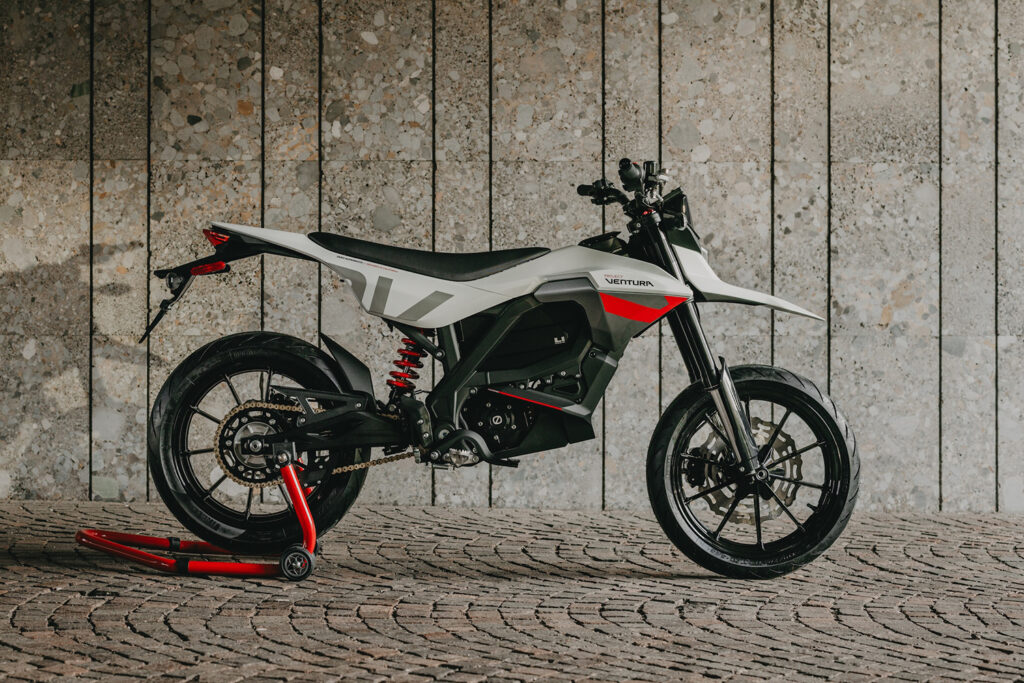
A new powertrain gives a peak output of more than 20 kW. Top speed is 130 km/h, and the bike can hold 105 km/h continuously. Zero estimates real-world range at around 150 km. It runs on 17-inch wheels with street tyres, and the chassis is designed to carry a passenger. ABS is standard. An integrated Level 2 charger allows charging at public AC points, and the bike connects to the Zero app over Bluetooth. It is classed for the A1 licence.
Zero has not yet released battery capacity, charging time or price. Ventura is expected in summer 2027.
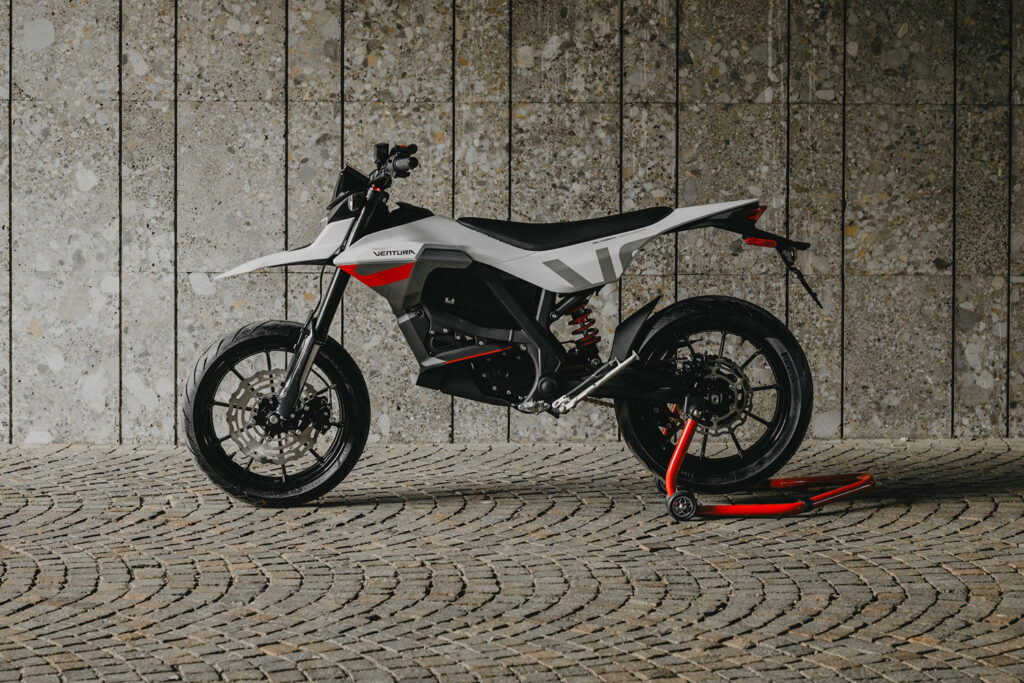
Jim Callahan, Chief Product and Partnerships Officer, said the team started from three goals: a bike good-looking enough to end up as a poster on a bedroom wall, a full electric motorcycle that feels like a logical next step for the millions of people who have ridden e-bikes and e-motos over the past five years, and a bike that is "insanely fun to ride." He said that if those three things are right, "you can bring a whole new generation into motorcycling."
LS3: European debut for Zero's faster scooterThe LS3 is part of Zero's All Access initiative for everyday electric mobility. It builds on the LS1 with more performance, more range and connectivity, and is aimed at riders who travel beyond the city centre.
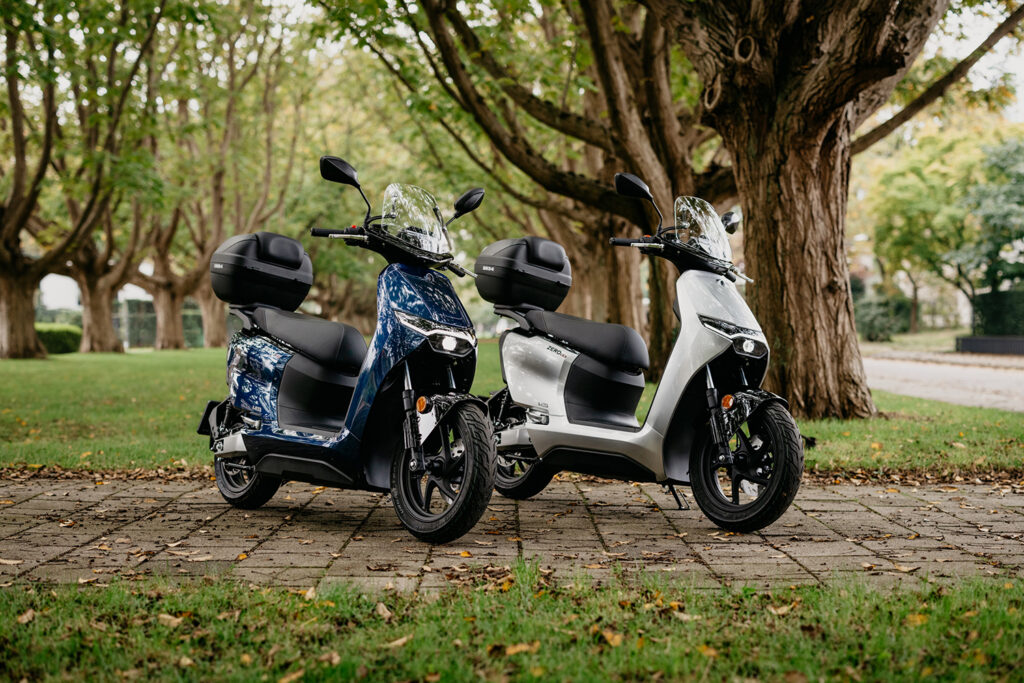
Top speed is 120 km/h, with 102 km/h sustainable, and claimed range is up to 150 km. Three batteries give a combined 5.6 kWh, and peak output is 12.7 kW (17 hp). One battery sits under the seat and can be removed to free up storage space.
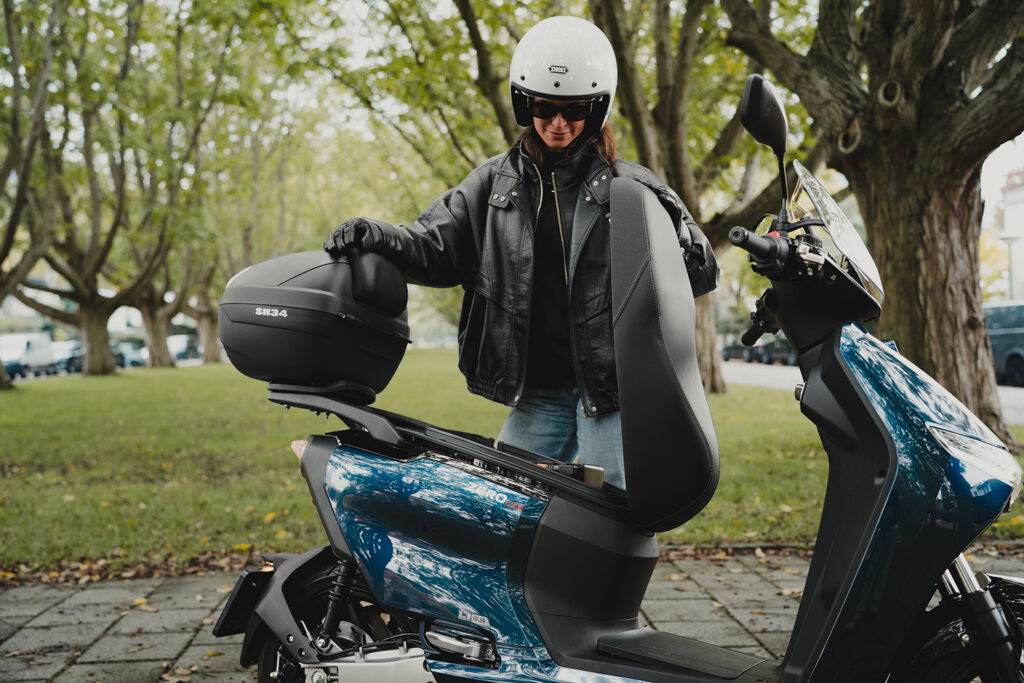
The LS3 connects to the Zero app over the mobile network. Equipment includes Hill Hold, an upgraded ABS module, heated grips and seat, two USB-C ports, an improved luggage hook, and front and rear cameras for recording rides. A top case and a mid-height windscreen are standard, and a taller screen is available as an accessory. Colours are Sterling Silver and Midnight Blue. Depending on local rules, it can be ridden on an A1 or a car (B) licence.
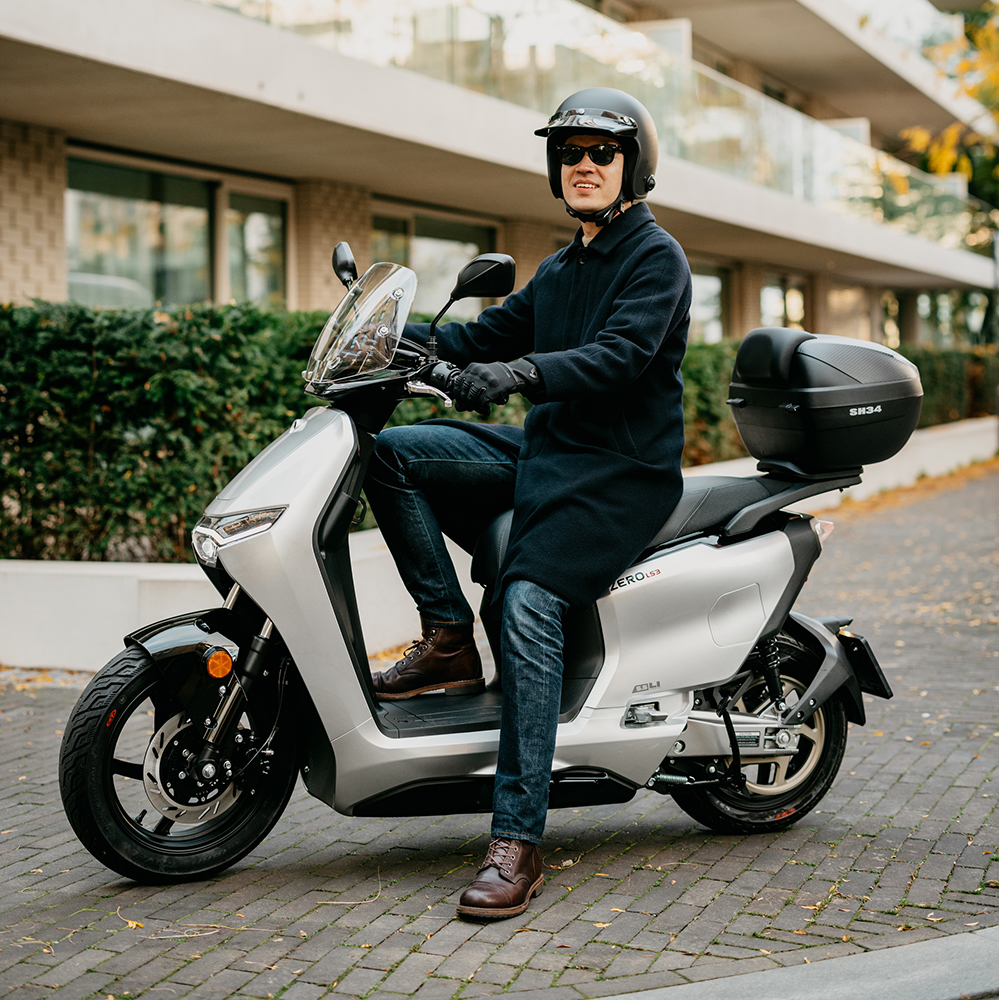
Pricing is €6,925 in Belgium and €7,125 in the Netherlands. Deliveries are expected from spring 2027.
CEO Pierre-Martin Bos said that riders want different things from two wheels, from twisty roads to a more enjoyable commute to simply getting around town more easily. He said Zero is widening its range across motorcycles and scooters so electric can cover all of those needs.
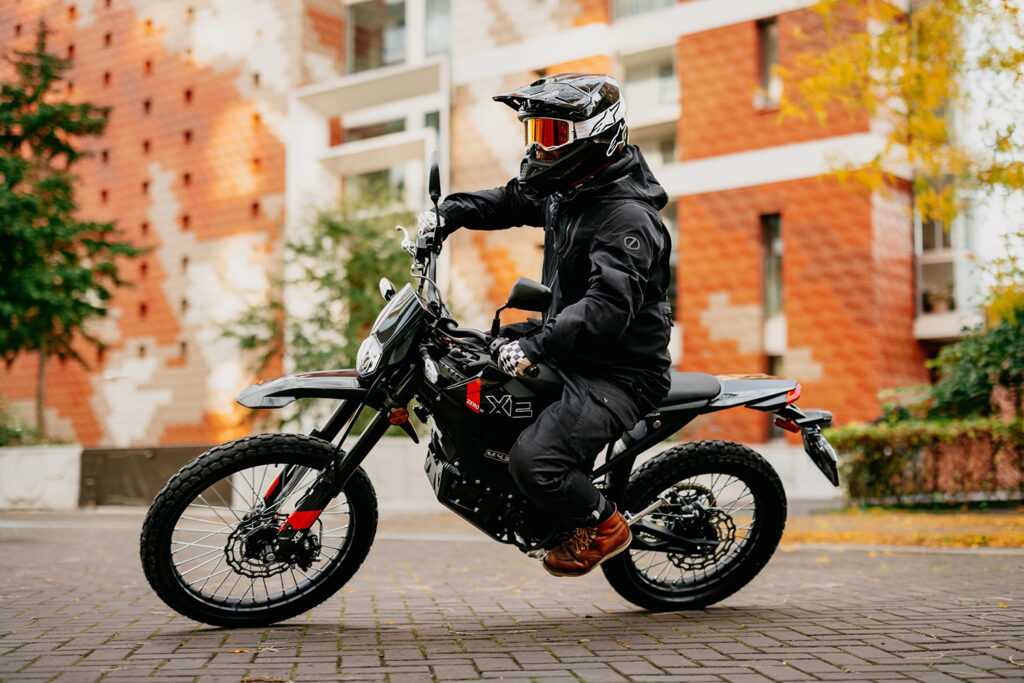
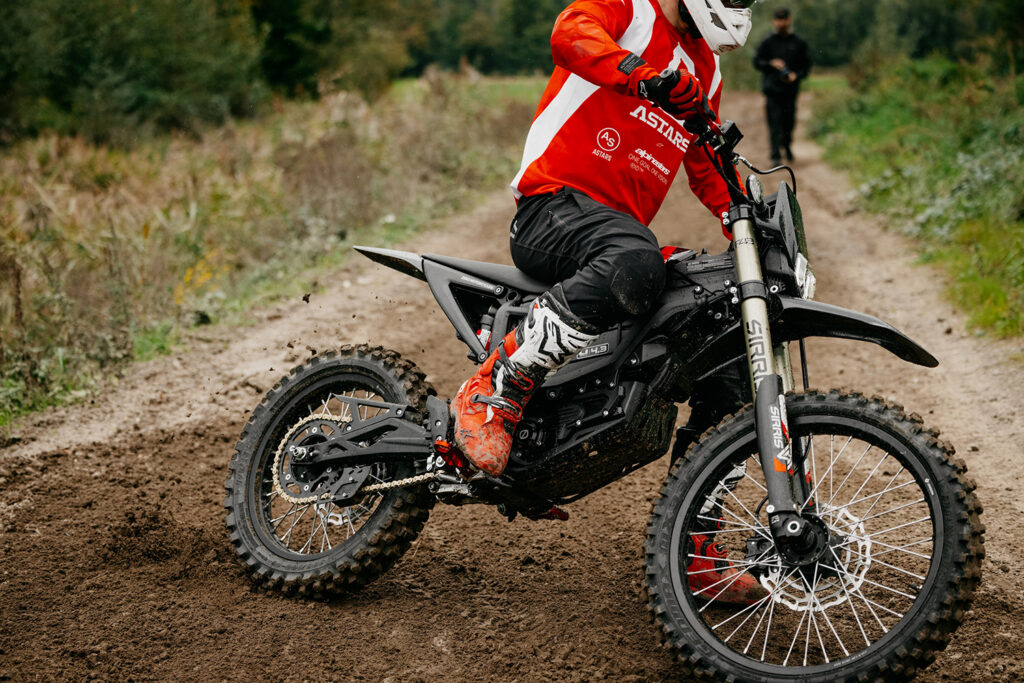
XE: street-legal in North America, and updatedThe XE, Zero's lightweight off-road bike, is already road-legal in Europe and now becomes street-legal in North America too. Where local rules allow, riders can link off-road sections over public roads instead of trailering the bike.
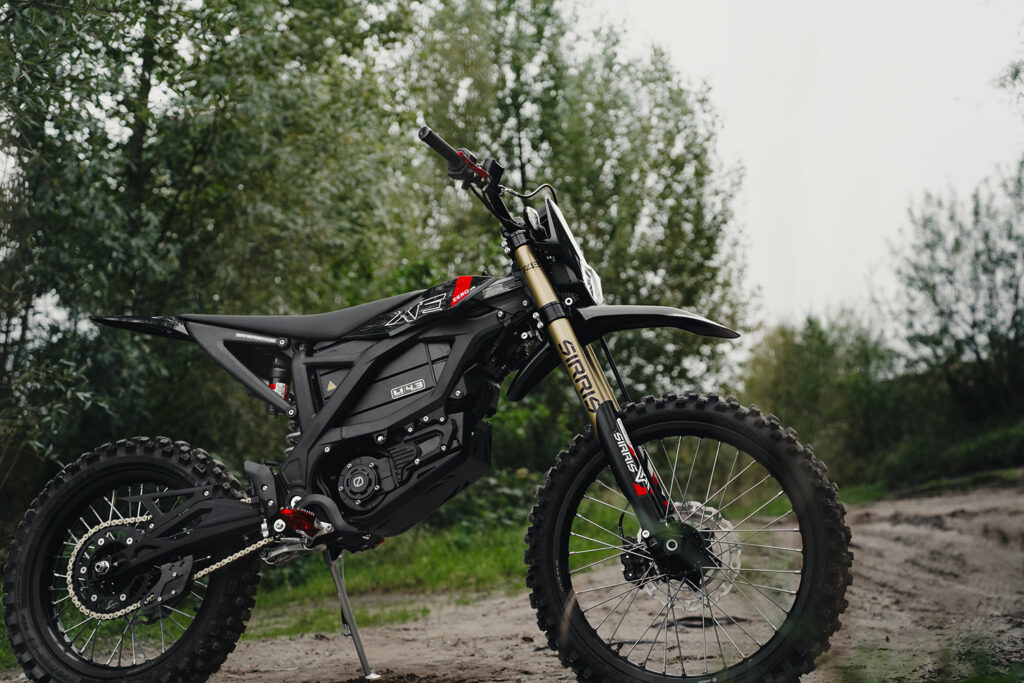
Changes for the new XE:
- A new centrally mounted dashboard
- A new headlight and tail light, with an integrated windscreen designed in-house
- A revised rear sprocket that raises top speed by about 10 km/h, to 95 km/h
- Wider all-road tyres
- Black bodywork
The XE is expected worldwide in early spring 2027, priced from €6,915 in the Netherlands and €6,715 in Belgium.
 New Zero app
Zero is building a new app based on customer feedback. It will work with the LS3, the 2027 Street and Dual Sport models, and Ventura, and is due in 2027. Planned features:
- Ride modes: preset modes for power and regeneration, plus a custom mode you can name and set for speed, power, torque and regen
- Charger finder: nearby charging stations filtered by speed, network and availability, with Apple Maps integration and directions
- Ride history: optional automatic logging of distance, duration and route previews
- Configurable dashboard: choose what appears in each quadrant of the bike's display, such as speed, battery level or clock
- Charging settings: target state of charge, scheduled charging, charge limit and long-term storage options in one place
- Feedback and support: report issues or suggest changes from inside the app, with photos, diagnostic logs and pre-filled vehicle data
As announced earlier this year, Zero is developing Level 3 DC fast charging for compatible Street and Dual Sport motorcycles, targeting 2027. The system will use CCS in Europe and NACS in North America. Zero's target is 20 to 80 percent in under 30 minutes on compatible batteries. A retrofit option for suitable existing motorcycles is also in development.
Zero Motorcycles is in Hall 7, Stand 036 at EICMA 2026.
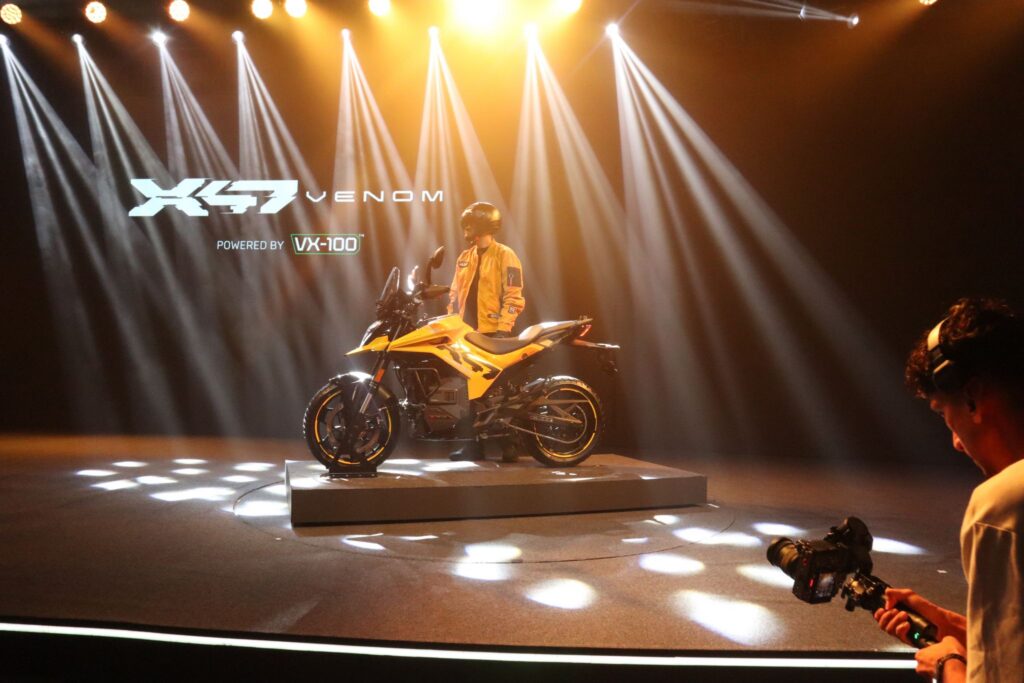
ZERO MOTORCYCLES >Ultraviolette used EICMA 2026 to launch the X-47 Venom, the first motorcycle on its new VX-100 100-volt platform, and to show the Tesseract Maxi scooter in Europe for the first time. The Indian manufacturer also displayed the Shockwave enduro, the F77 and F99, a voice assistant developed with SoundHound AI, and three helmet concepts.
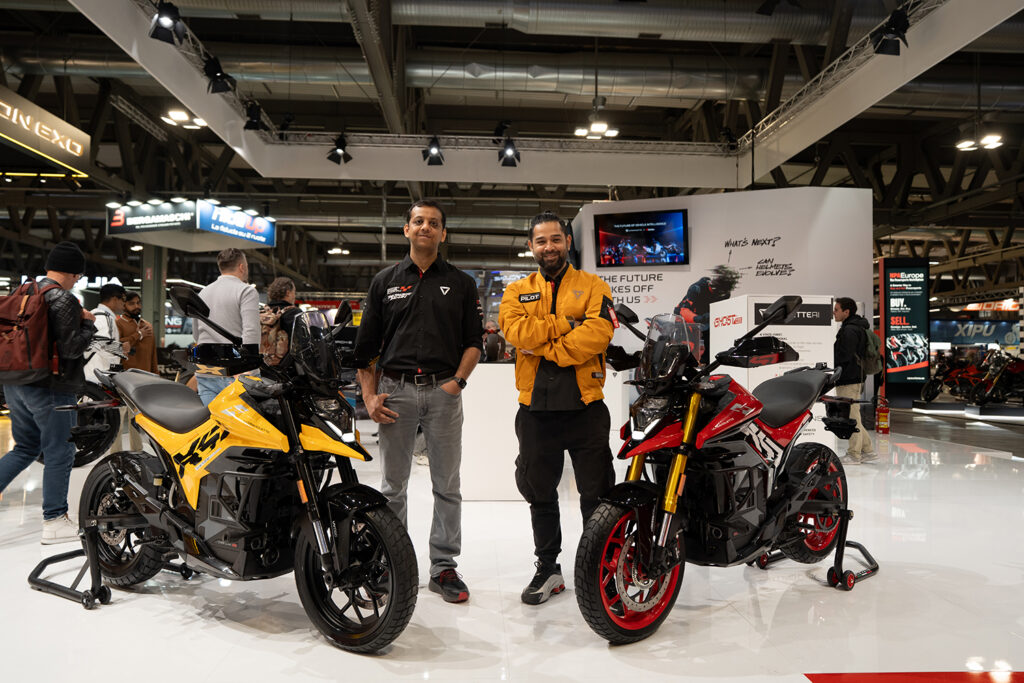
Co-founder and CEO Narayan Subramaniam described the show as the point where Ultraviolette moves from being a performance motorcycle maker to a broader mobility and technology company. The F77 went on sale in Europe last year. The company now plans to strengthen its European presence and then expand into North America, Latin America and Southeast Asia.
X-47 Venom: a radar-equipped crossover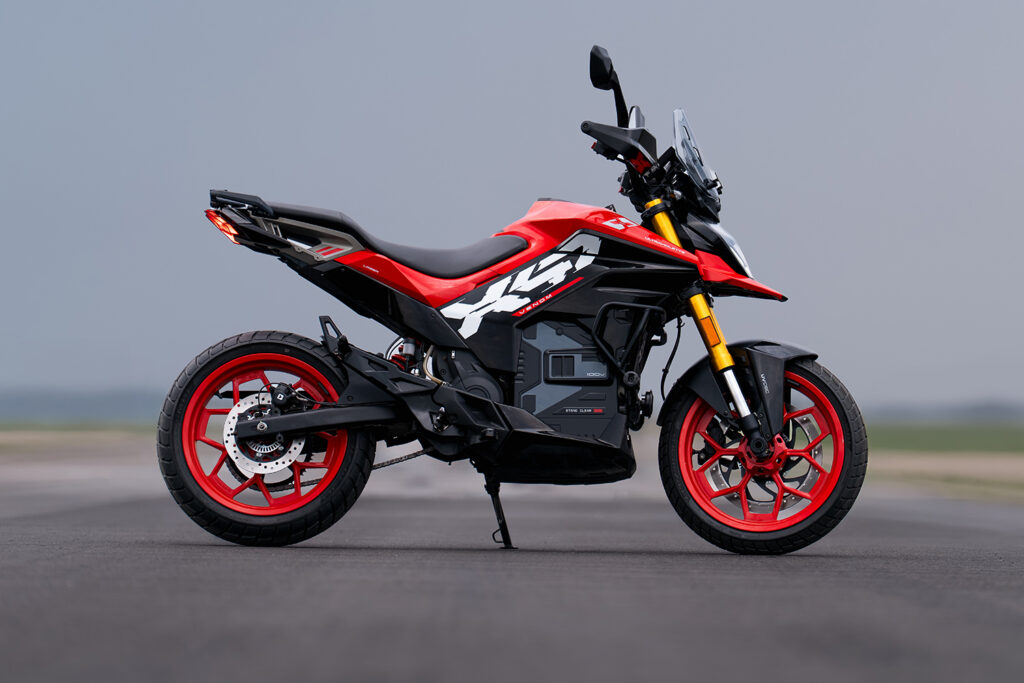
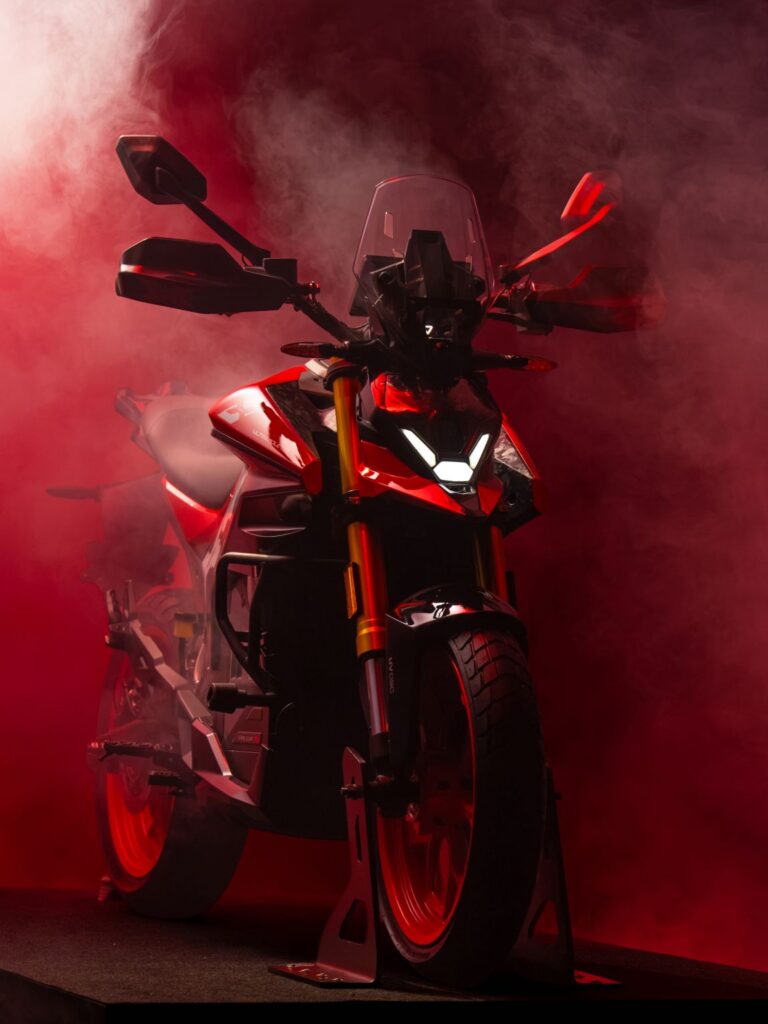
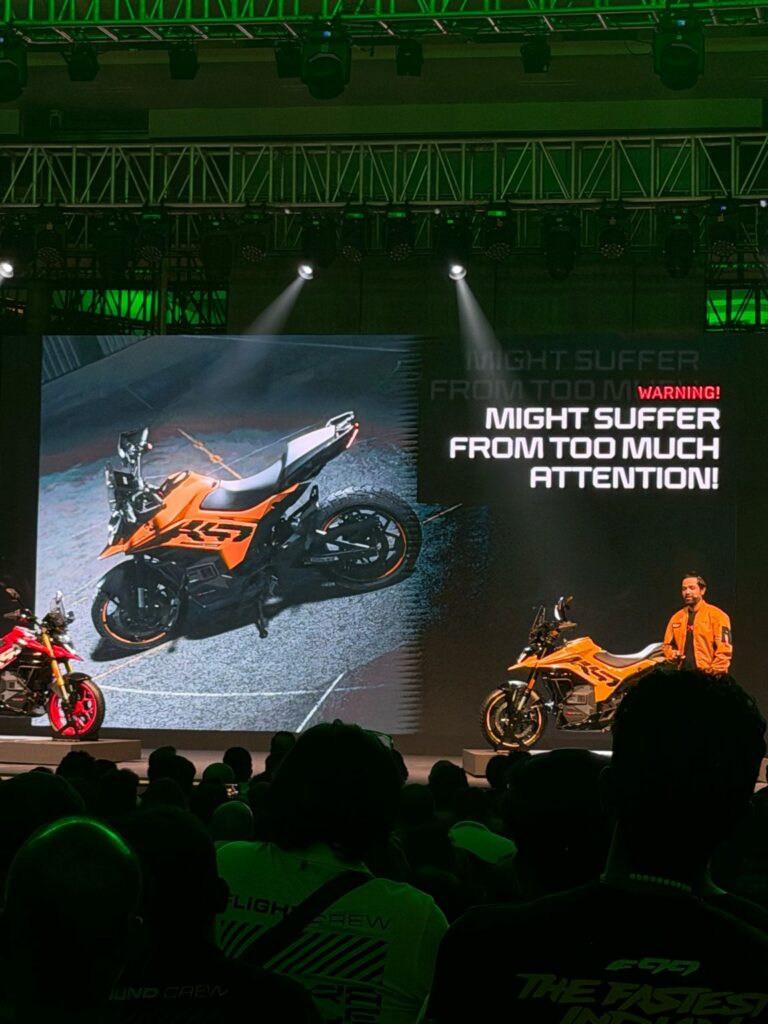
The X-47 Venom is a crossover that combines road and light adventure use. It is the first production model on the VX-100 architecture and uses the new SRB-11 battery.
Key figures:
- Peak power: 30 kW (40 hp)
- Torque: 550 Nm at the wheel
- Top speed: 155 km/h
- 0-100 km/h: 5.9 seconds
- Range: 235 km (WMTC city cycle)
- Kerb weight: 206 kg
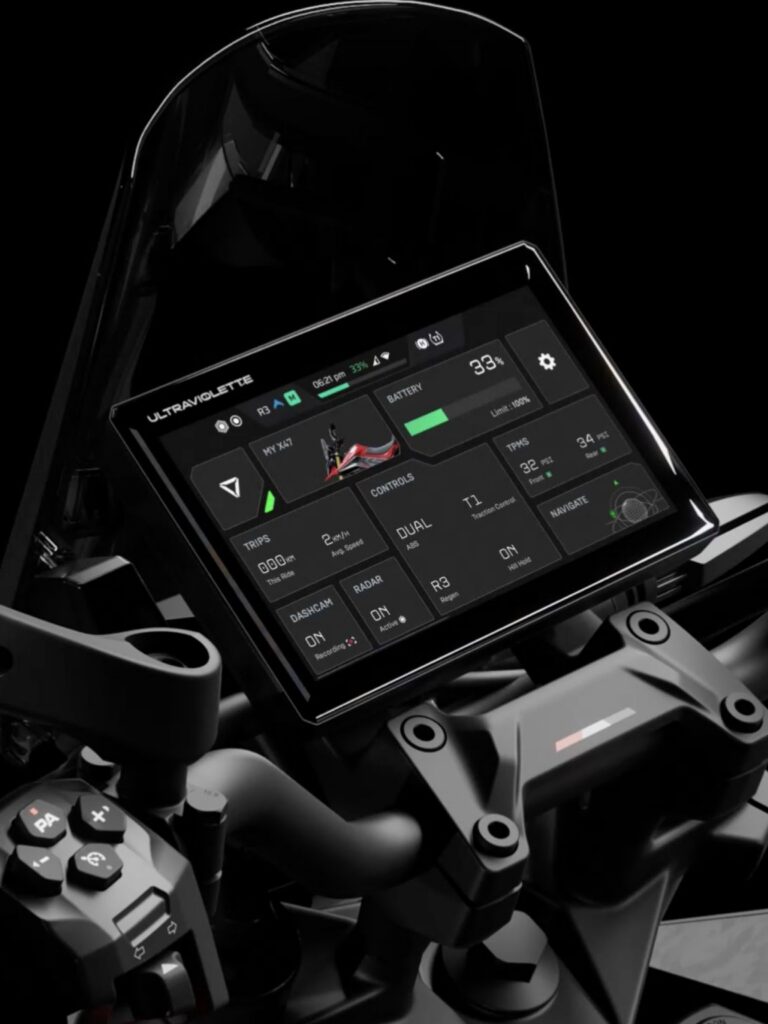
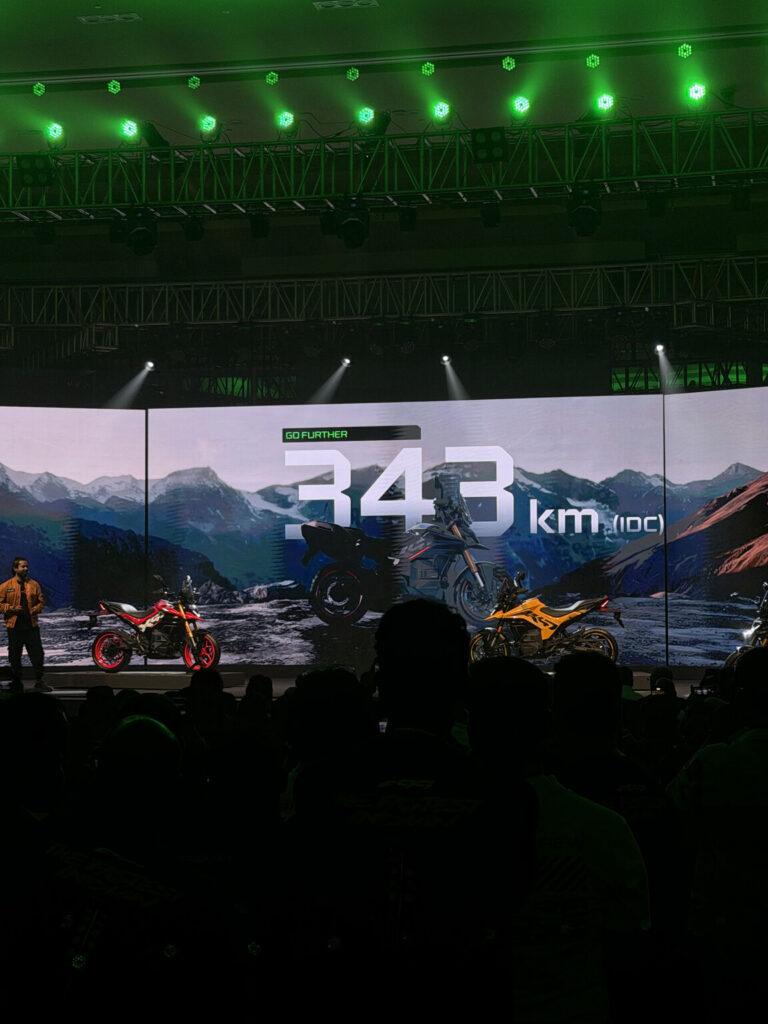
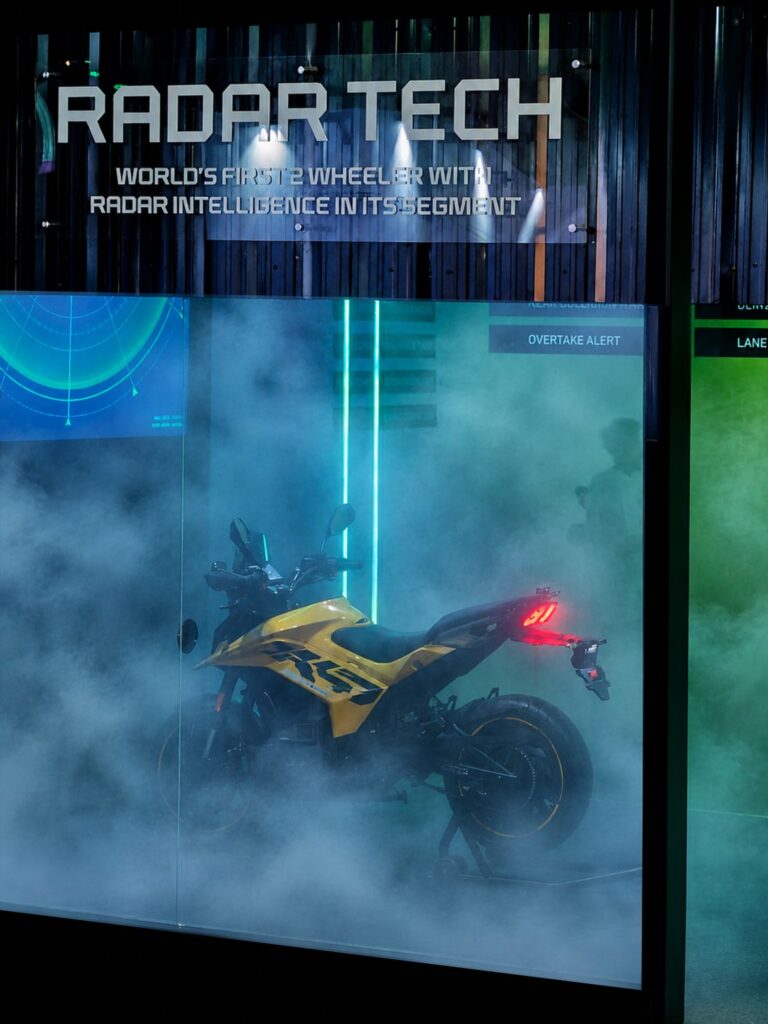
A 77 GHz rear-facing radar comes as standard. Ultraviolette calls the system UV Hypersense. It covers up to 200 metres behind the bike and adjusts for lean angles of up to 20 degrees, as well as for roll and pitch. The radar supports four functions:
- Blind-spot detection
- Lane-change assist
- Overtake alerts
- Rear-collision warning
The warnings show up in the mirrors. In a rear-collision situation, the hazard lights switch on automatically.
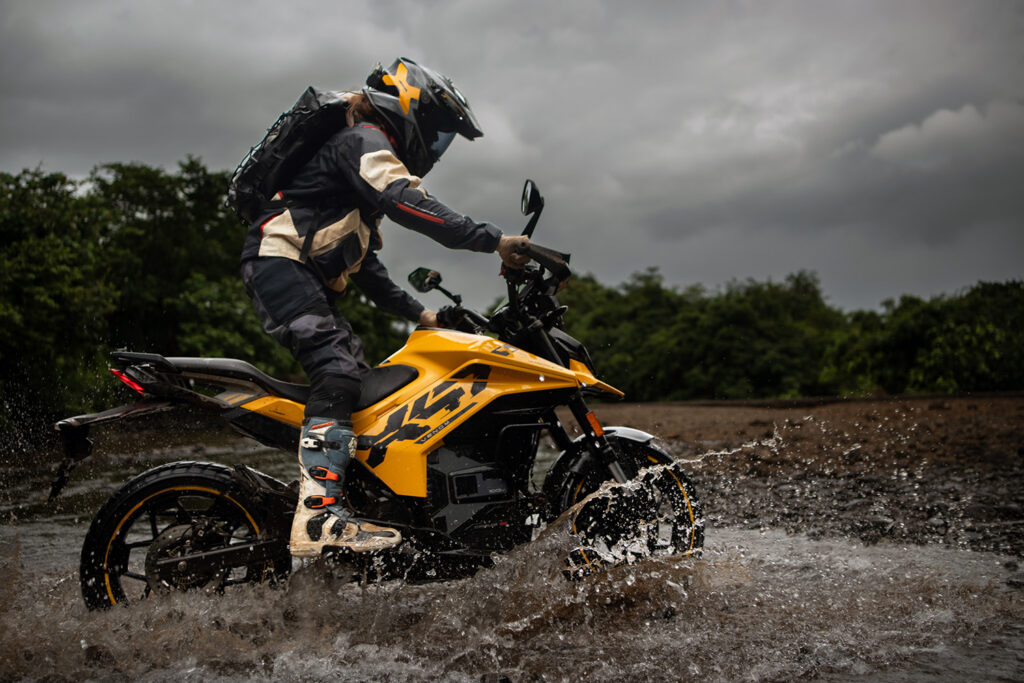
Other equipment includes:
- Cruise control
- A rear camera for park assist
- A 7-inch TFT touchscreen (UV Interface X)
- Navigation through Mappls
- App connectivity and over-the-air software updates
The air-cooled onboard AC charger is described by the company as the most power-dense of its type. Ultraviolette says it delivers full output in ambient temperatures of 45 to 50°C.
The bike uses the new UV Lightfury motor, which incorporates soft magnetic composites. Ultraviolette says the motor reduces mass and energy losses compared with its earlier powertrain.
VX-100 architectureThe 100V platform is designed to be modular. Ultraviolette intends to use it across future models with different battery capacities and power levels. According to the company, the SRB-11 battery offers:
- Up to 20 percent higher energy density
- Twice the cooling performance
- Heat dissipation up to 50 percent faster
The pack sits in a cast-aluminium housing and is rated IP67. In addition to cell-level fuses and a battery management system that monitors each cell, it is the first pack in its class to use a pyro-fuse. This device cuts the circuit within microseconds when a critical fault is detected, a method taken from automotive functional-safety practice.
Tesseract Maxi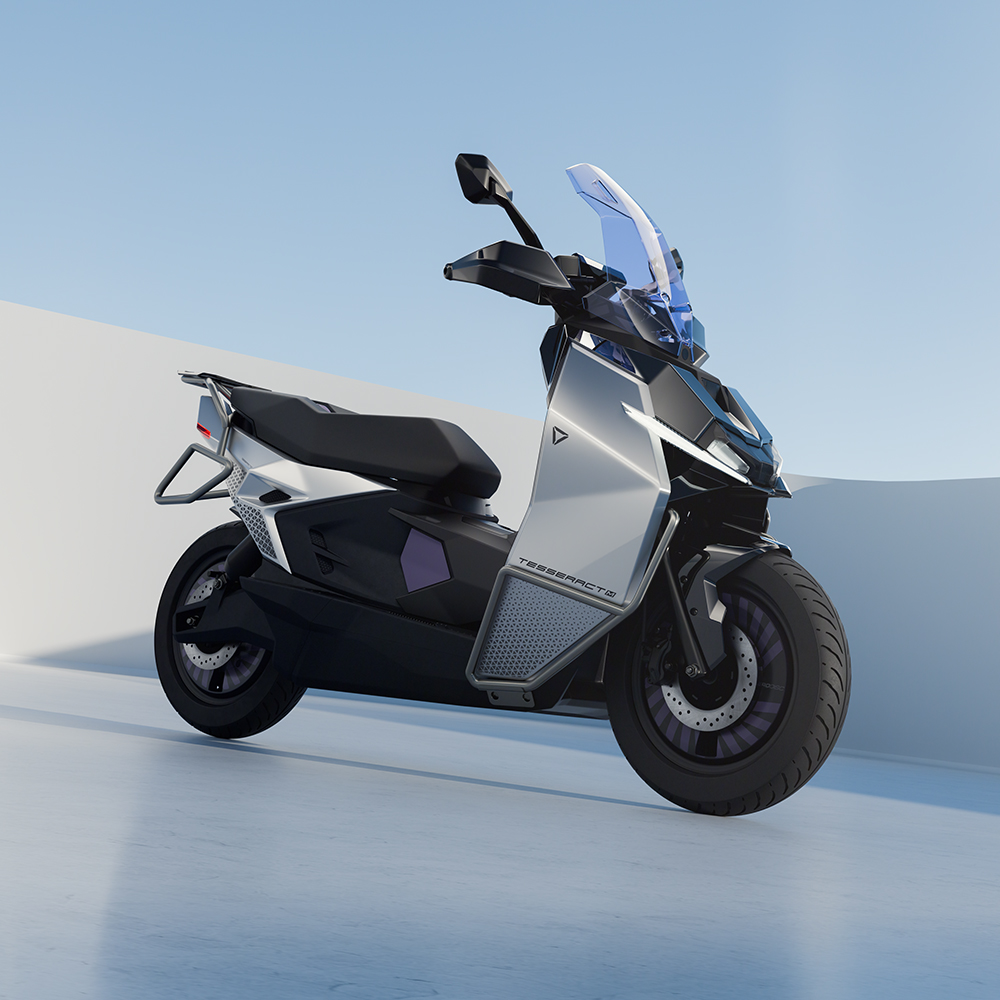
The Tesseract Maxi makes its European debut at EICMA. It is a maxi-scooter with:
- A 6 kWh battery
- 15 kW (20 hp) peak power
- Fast charging to 80 percent in under an hour
- 14-inch wheels
- 32 litres of under-seat storage
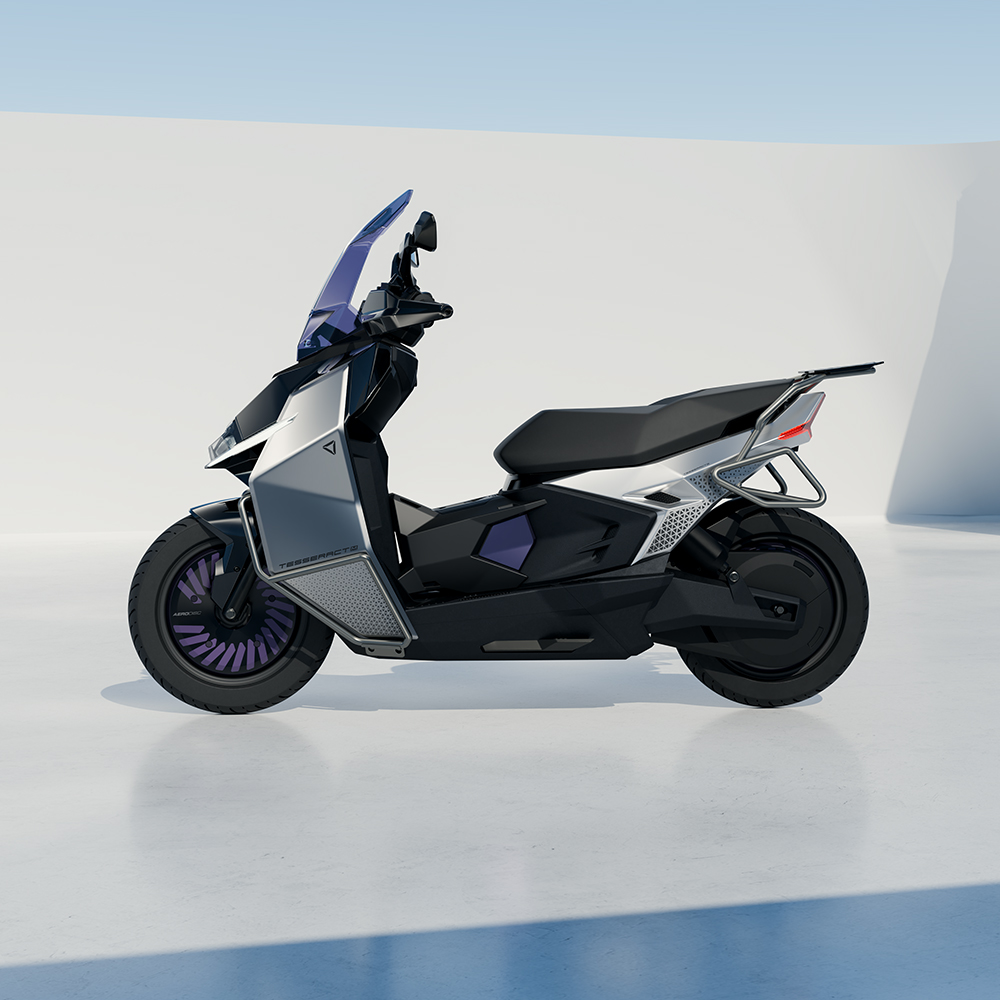
Like the X-47 Venom, it uses Hypersense radar. It also has an integrated dashcam and mirrors with built-in LED indicators for blind-spot, lane-change, overtaking and collision alerts. Traction control, regenerative braking and a 7-inch touchscreen are standard.
A touring accessory range is available: a higher visor, knuckle guards, a tail bag and pannier stays.
Shockwave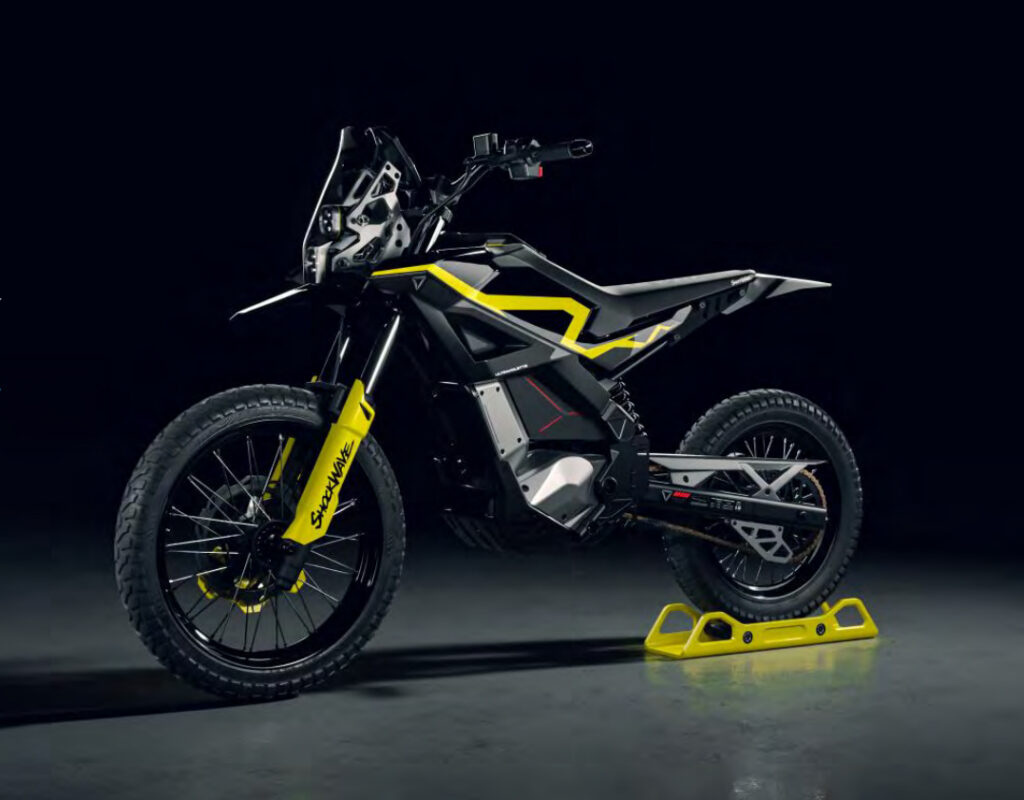
The Shockwave is a lightweight enduro aimed at riders who enjoyed two-stroke dirt bikes. Specifications include:
- 505 Nm of torque at the rear wheel
- 0-60 km/h in 2.9 seconds
- Spoked wheels: 19-inch front (90/90) and 17-inch rear (110/90)
The F77 is already on sale in Europe. Its figures:
- Peak power: 30 kW
- Continuous power: 9.5 kW
- Wheel torque: 500 Nm
- 0-60 km/h: 2.8 seconds
- Battery: 10.3 kWh
- Range: up to 231 km (WMTC city cycle)
- Charging 20-80 percent: 2.5 hours with the boost charger

It has ten regeneration levels, four traction-control settings, switchable dual-channel ABS, stability control and connected functions including anti-theft and trip history.
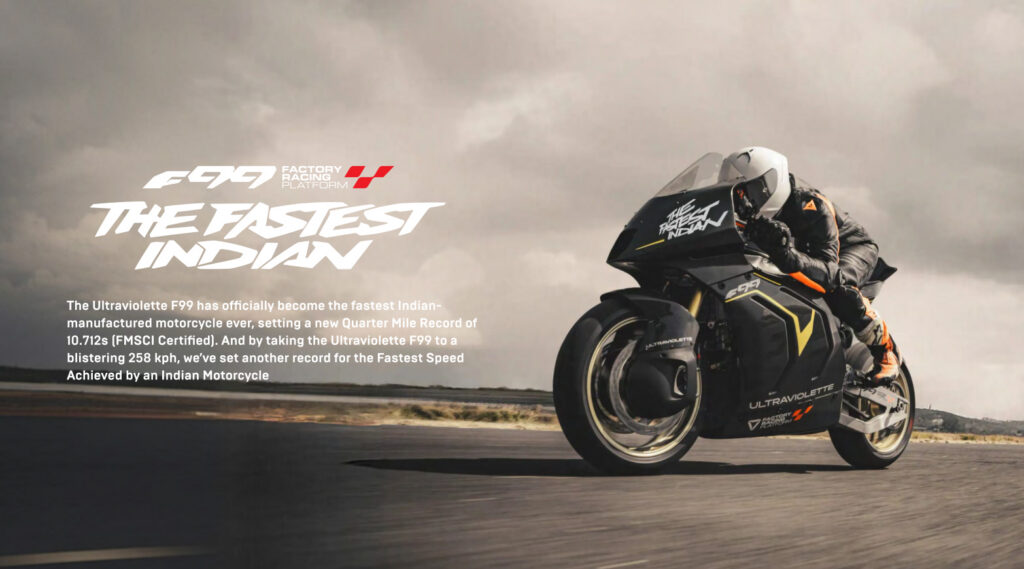
The F99 is Ultraviolette's electric superbike. It uses a 400V architecture, a carbon-fibre exoskeleton and battery casing, and a liquid-cooled drivetrain. The company quotes:
- 0-100 km/h: under 3 seconds
- 0-200 km/h: under 10 seconds
- Indian records: 10.712 seconds over the quarter-mile and a top speed of 258 km/h
 Voice control and helmet concepts
Ultraviolette also showed Violette AI, a voice assistant built with SoundHound AI. Riders activate it with the wake word "Violette". It can change riding modes, start navigation and answer questions drawn from the owner's manual, such as recommended tyre pressure. Future functions are to include pre-ride checks, ride statistics and service alerts.
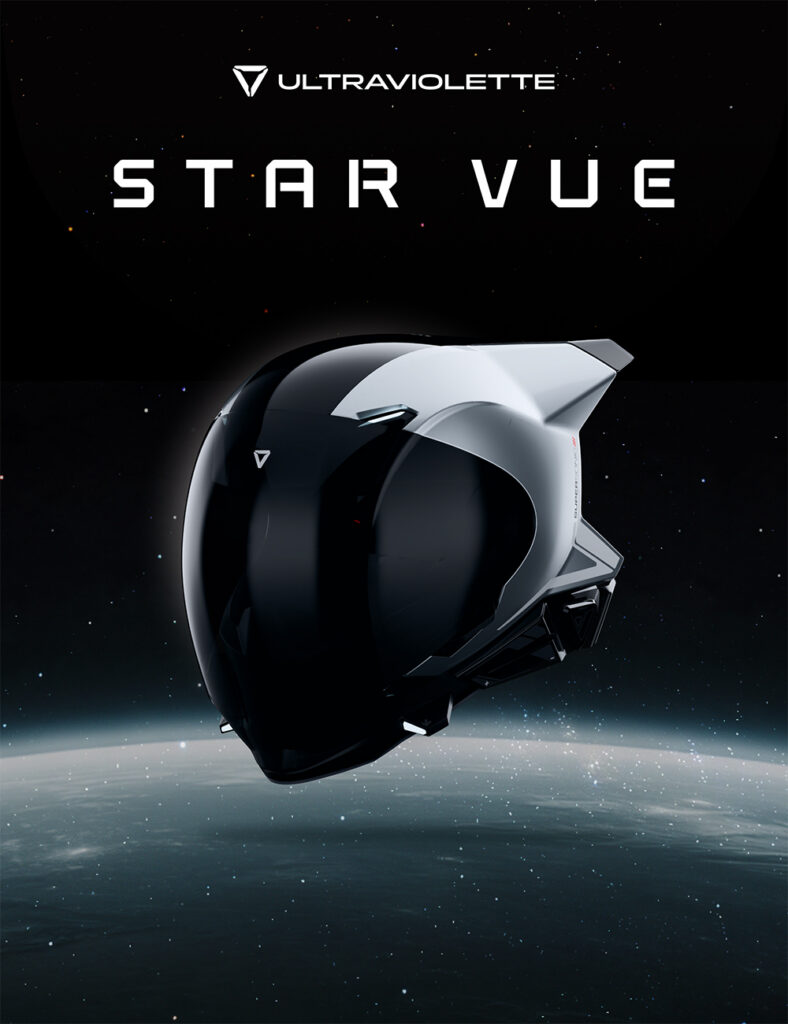
The stand also featured three helmet concepts, none confirmed for production:
- Star Vue, built around augmented reality
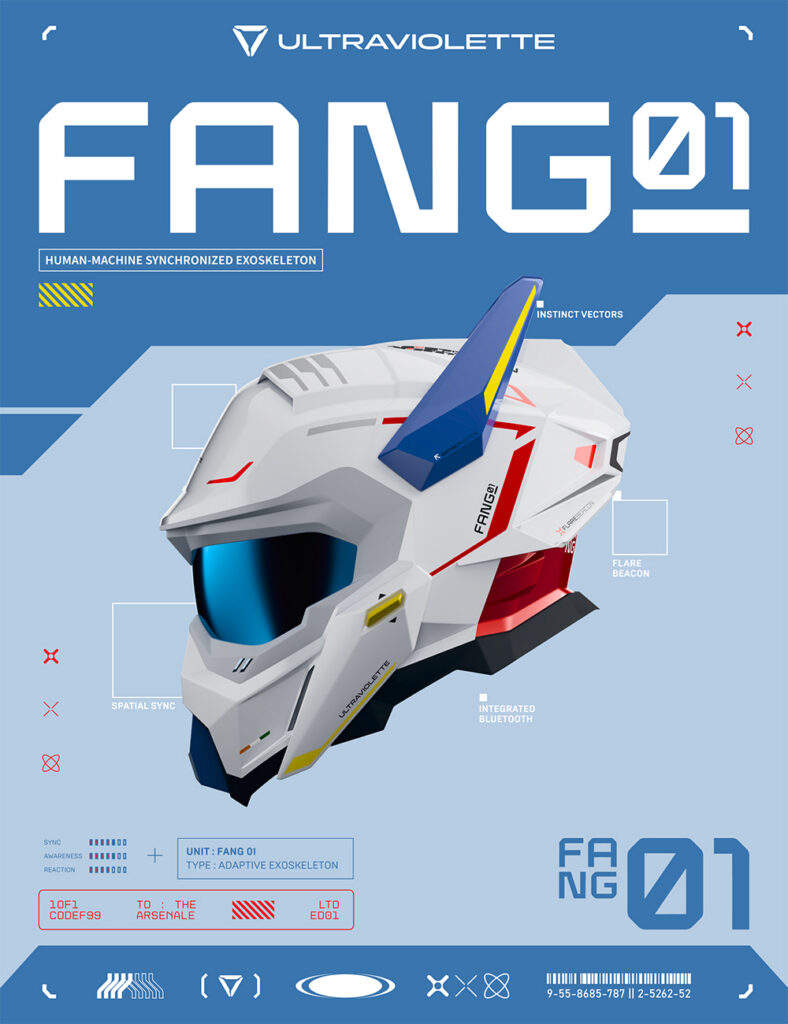
- Fang 01, with an exoskeleton-style shell
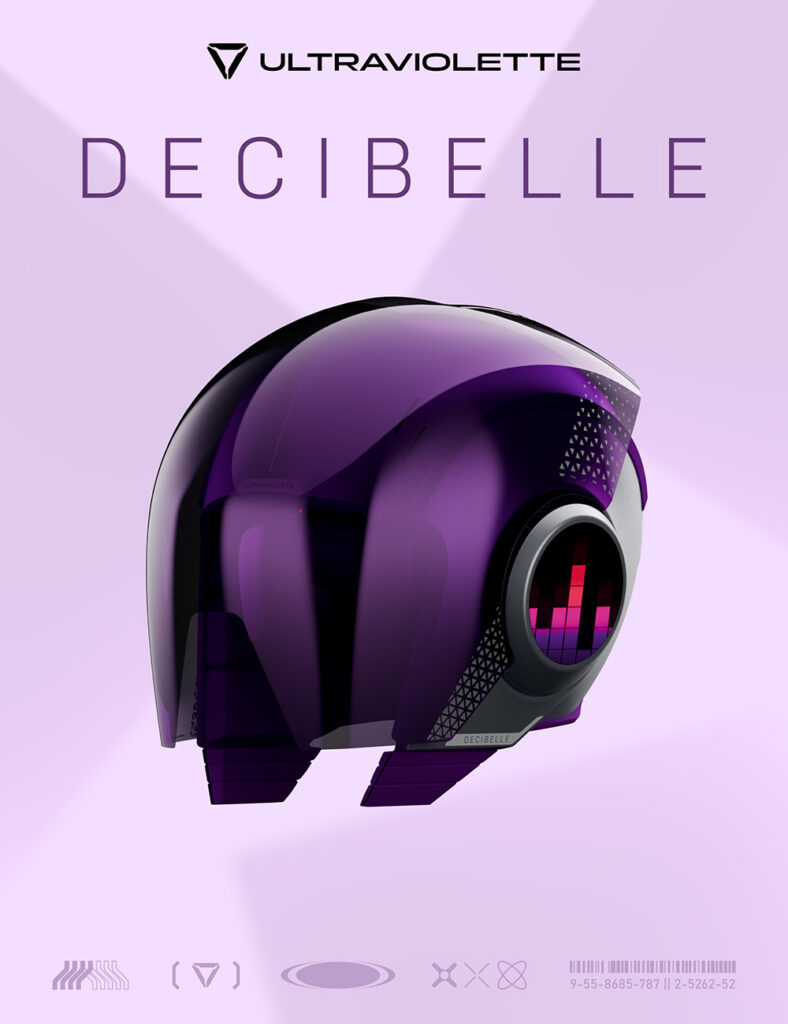
- Decibelle, a fashion-oriented design with built-in audio
Yamaha has unveiled the NMAX E, a battery-electric version of its NMAX sport scooter for the A1 licence category, with performance equivalent to a 125cc model. Built on a new dedicated A1 EV platform, it is the first electric member of the MAX family, the scooter line Yamaha started 25 years ago with the original TMAX. Dealer deliveries begin in spring 2027.
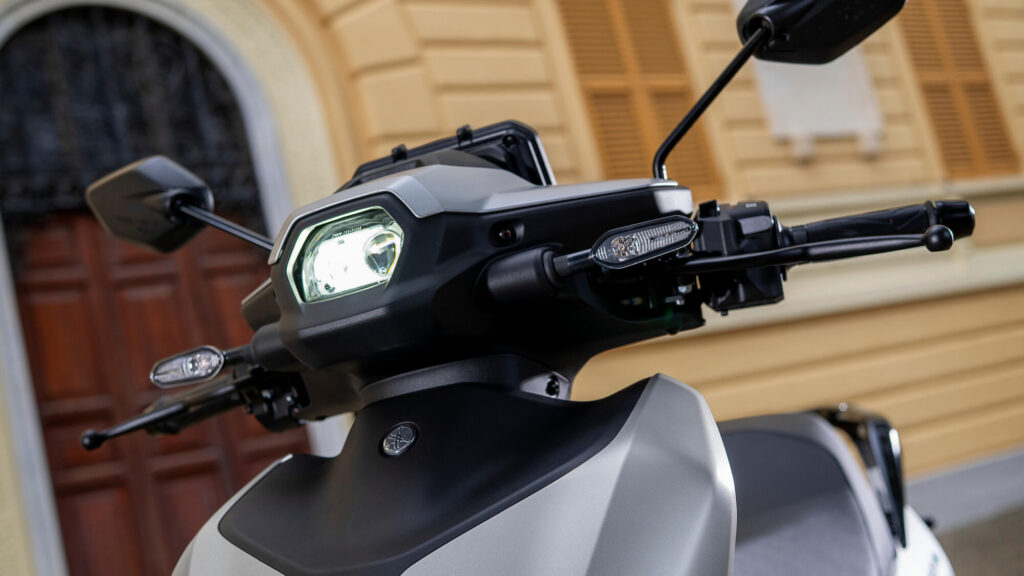
The NMAX E was presented in Milan ahead of EICMA 2026, alongside the XENTER E high-wheel scooter. Both share the same powertrain, battery and charging system, but differ in chassis, wheel size and positioning. Where the XENTER E targets comfort on rough urban surfaces with 16-inch wheels, the NMAX E aims for sportier handling on 13-inch wheels.
eAxle powertrain
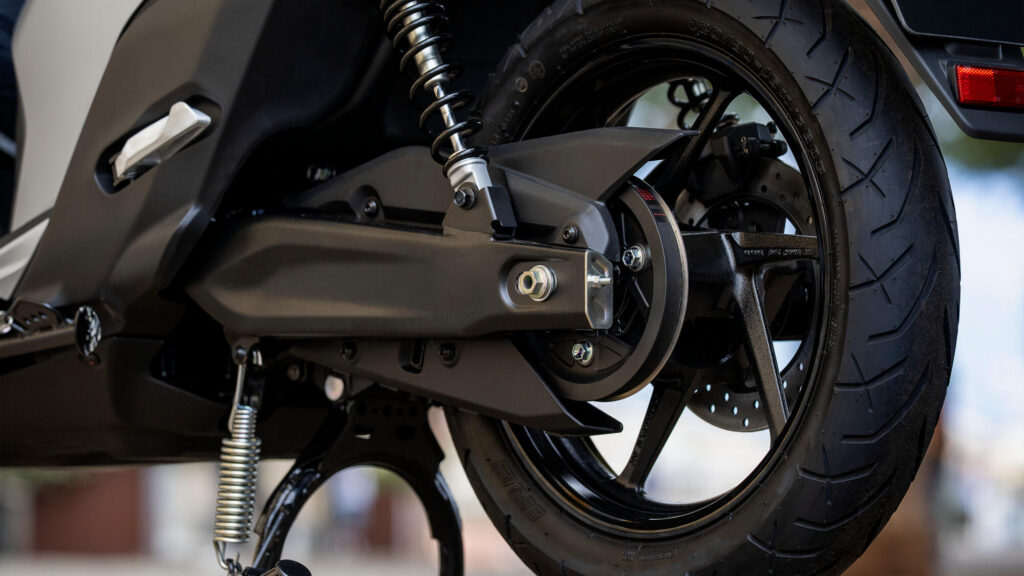
Power comes from Yamaha's eAxle unit, which combines an air-cooled interior permanent magnet synchronous motor, the motor control unit and a primary reduction gearbox in one compact housing. It produces a peak of 7.5 kW at 3,500 rpm and 33.3 Nm of torque from 500 rpm. A belt drives the rear wheel. Yamaha has not published a top speed.
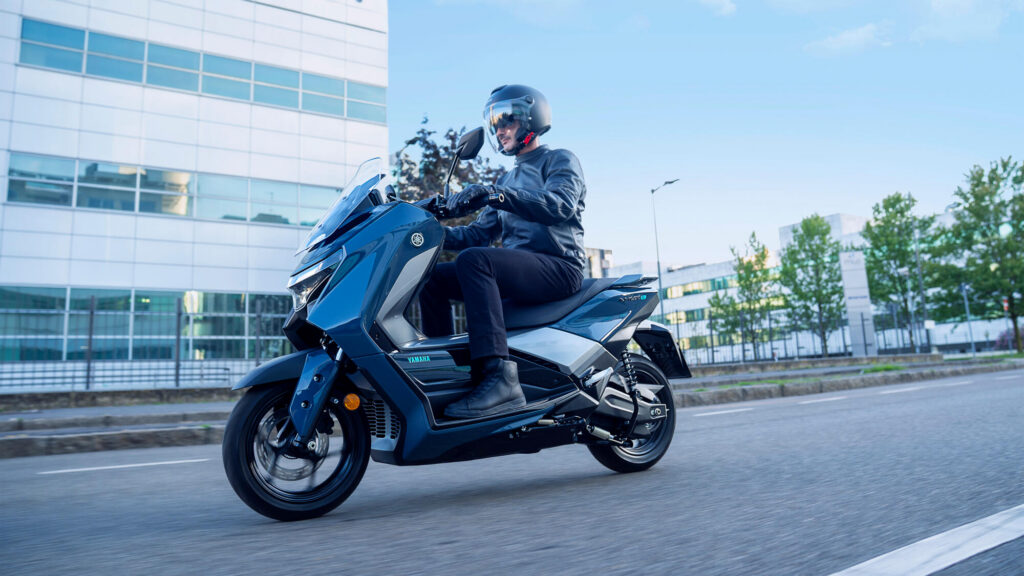
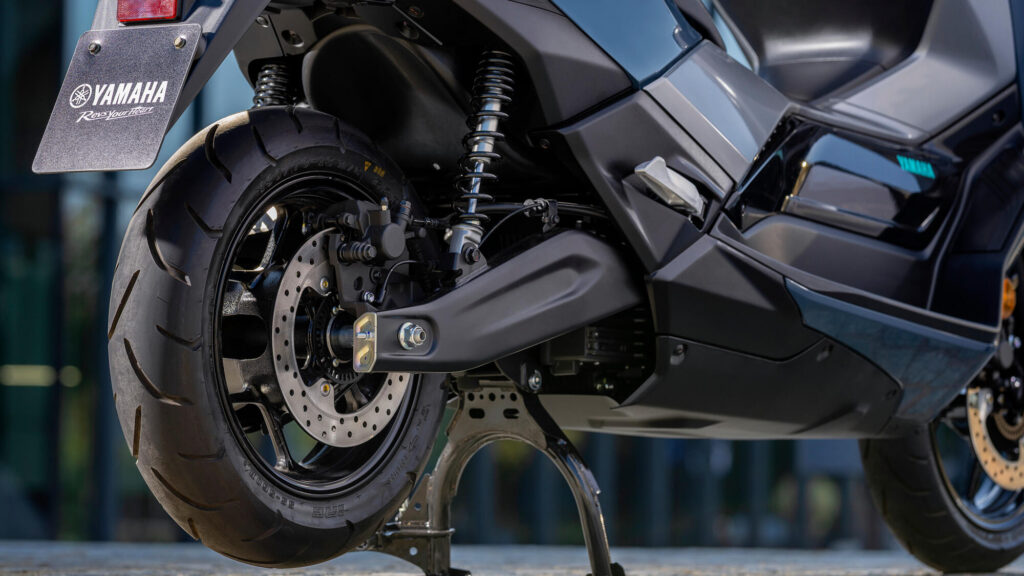
The drive unit is fixed to the frame rather than integrated into the swingarm, as on a petrol scooter. That frees up space for a conventional motorcycle-style swingarm, which Yamaha says weighs about a third less than a typical scooter rear suspension setup.
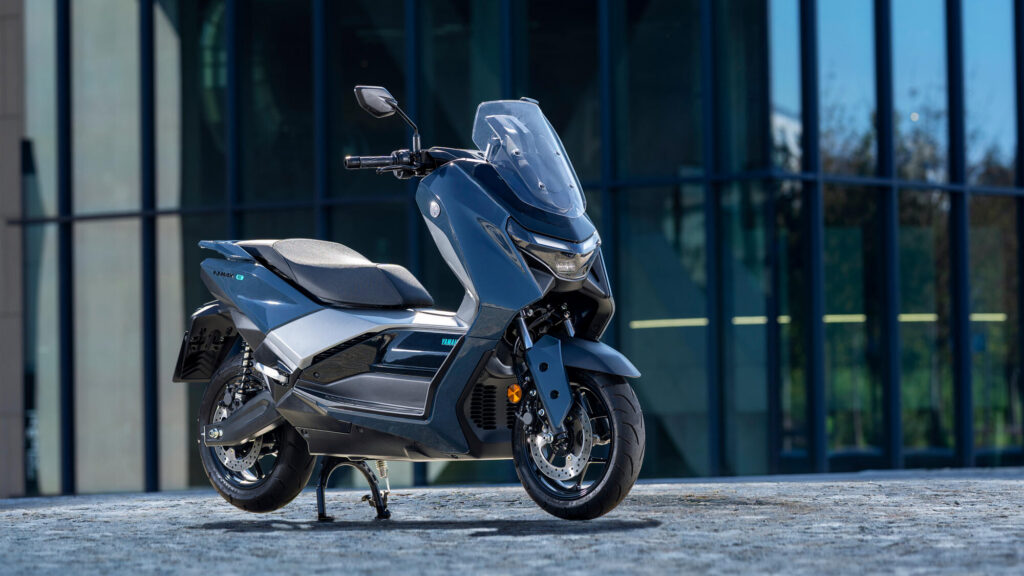
Battery and charging
The 3.5 kWh lithium-ion battery is mounted to the frame under the front of the seat and the floorboards. It is not removable. Its L-shaped design keeps the mass low and close to the rider, and a metal plate underneath protects it from impacts. The pack meets standards equivalent to IP67 and is monitored by a battery management system. Claimed range is 104 km in the WMTC class 1 cycle, at a battery temperature of 25 °C.
The 800 W on-board charger fills the battery from 0 to 100 percent in 5.5 hours at 220 V. It uses fanless cooling for quiet operation. The charging port sits in the front compartment next to a USB Type-C socket and accepts AC Type 2 public car chargers. A dedicated cable allows charging from a household socket.
Yamaha is introducing YOU Charge at the same time, a public charging subscription sold through its dealers in cooperation with national charging network operators. The service starts in the first markets in early 2027, with the main European EV markets following during the year.
Chassis
The new backbone frame has a 1,425 mm wheelbase. With battery and drive unit placed centrally, Yamaha claims a weight distribution close to 50/50. Ground clearance is 135 mm and seat height is 770 mm.
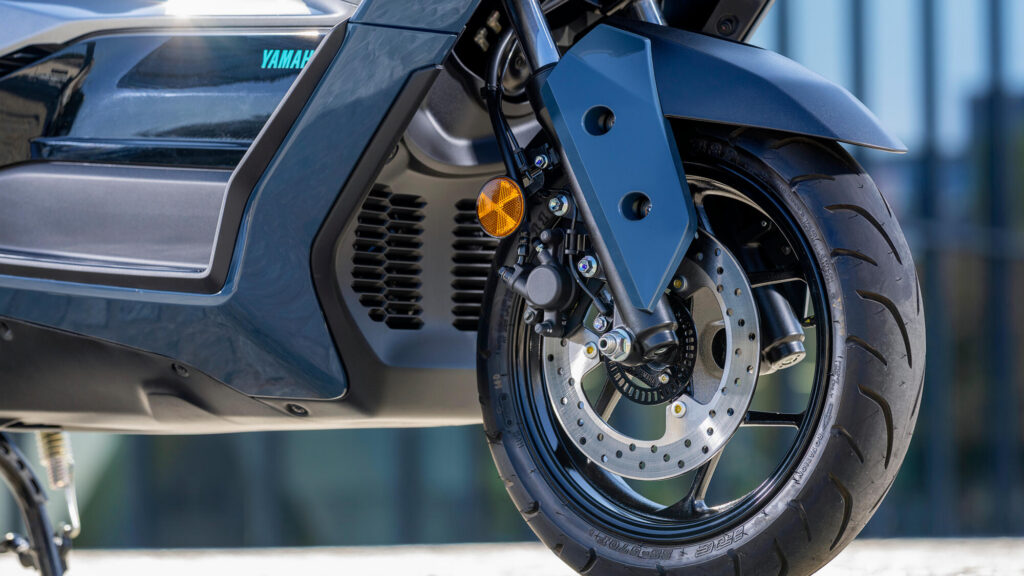
Up front is a telescopic fork with 33 mm tubes, and the rear uses twin shock absorbers positioned beneath the rider's hips. The model-specific 13-inch wheels carry a 110/70-13 front tyre and a 130/70-13 rear. Both wheels get a 245 mm disc with a single-piston caliper and ABS. Regenerative braking adapts to the selected ride mode and is tuned to feel like the engine braking of a combustion scooter.
Electronics and equipment
There are three ride modes. S delivers the strongest acceleration, T keeps similar performance with softer throttle response, and E reduces acceleration and top speed to maximise range. Traction control is standard, along with APSG, a throttle grip that gradually builds resistance for more feedback.
A reverse function is engaged by pressing the REVERSE button on the left handlebar and the MODE button on the right at the same time. The scooter then moves backwards at below walking pace without throttle input.
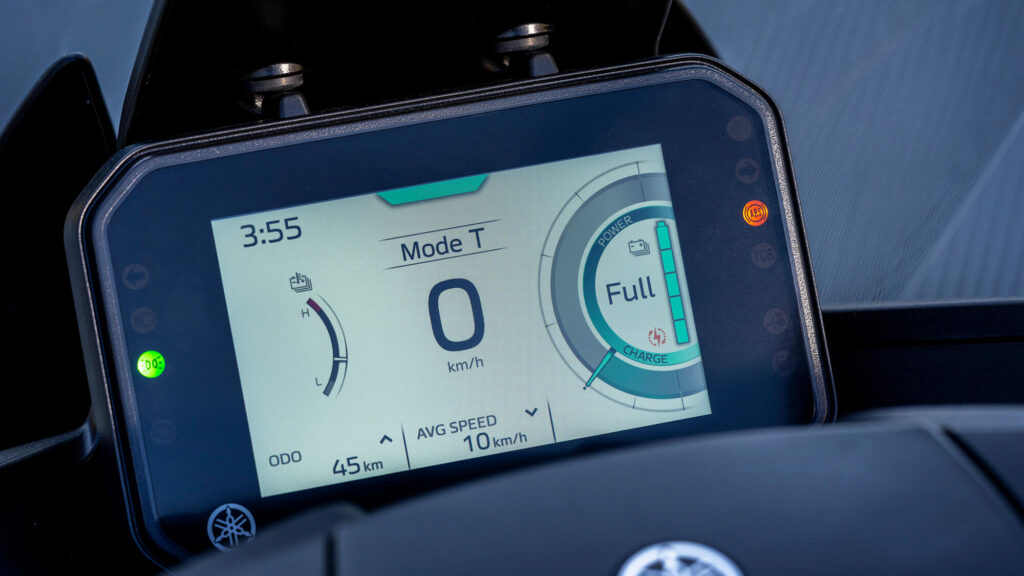
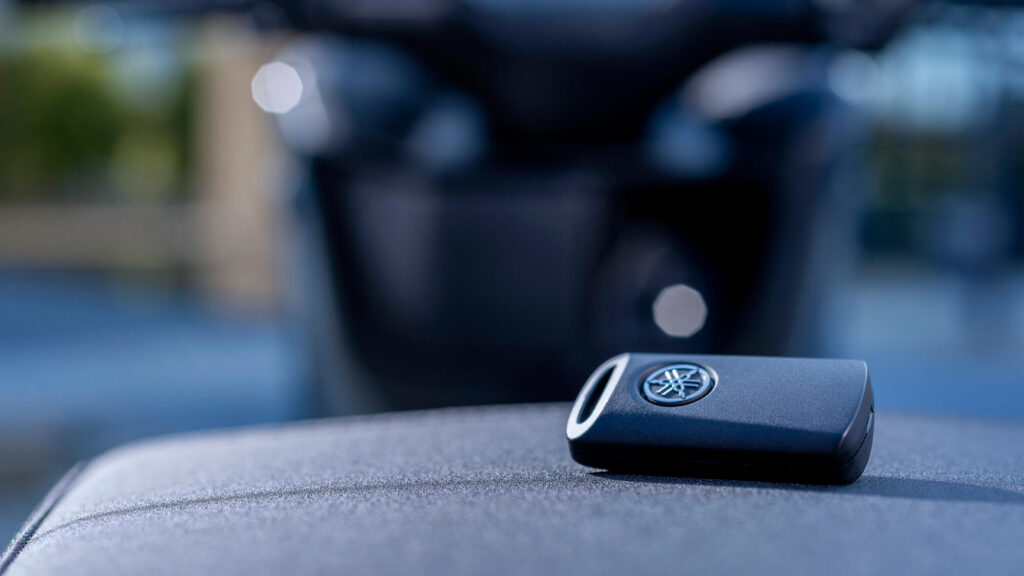
The 5-inch TFT display has day and night modes. It shows speed in the centre, smartphone status on the left, and battery level, remaining charge and regeneration on the right, with a moving needle that indicates acceleration and deceleration. The new Yamaha Motor On app adds turn-by-turn navigation, battery settings, maintenance schedules, parking location and a ride log. Smart key ignition is standard.
Styling and practicality
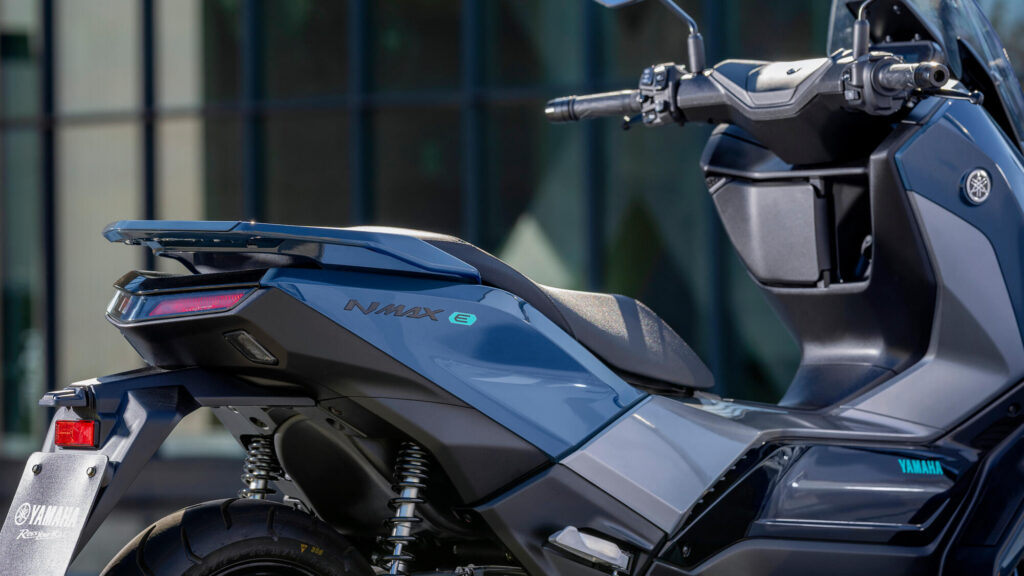
The NMAX E keeps the MAX family look, with minimalist dual light units front and rear, compact indicators and the boomerang-shaped side panels. The dual seat has stitched upholstery and an embossed logo. The illuminated underseat compartment fits a full-face helmet, depending on size and shape. Folding passenger footrests and an integrated grab handle are fitted. Accessories include adjustable levers, an apron, heated grips, handlebar muffs, a console bag, a 34-litre top case and a high screen.
Colours, price and availability
The NMAX E comes in Avio Blue with gloss silver boomerang accents, or Platinum Silver with a gloss black front section. Yamaha has not released official pricing and refers buyers to local distributors. Reports from the Milan press launch put the German price at 7,799 euro, identical to the XENTER E. The NMAX E arrives at Yamaha dealers from spring 2027.
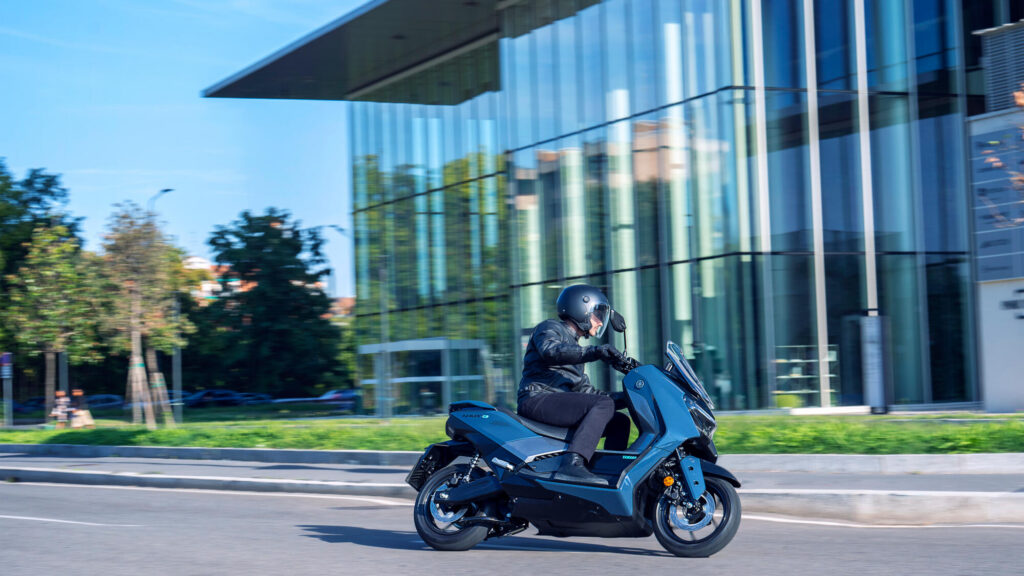
YAMAHA >Yamaha has launched the XENTER E, a battery-electric high-wheel scooter for the A1 licence category, with performance equivalent to a 125cc model. The scooter was presented ahead of EICMA 2026 in Milan and marks Yamaha's return to the high-wheel segment, which matters most to European city riders who deal with cobblestones, tram rails and potholes every day. Dealer deliveries start in spring 2027.
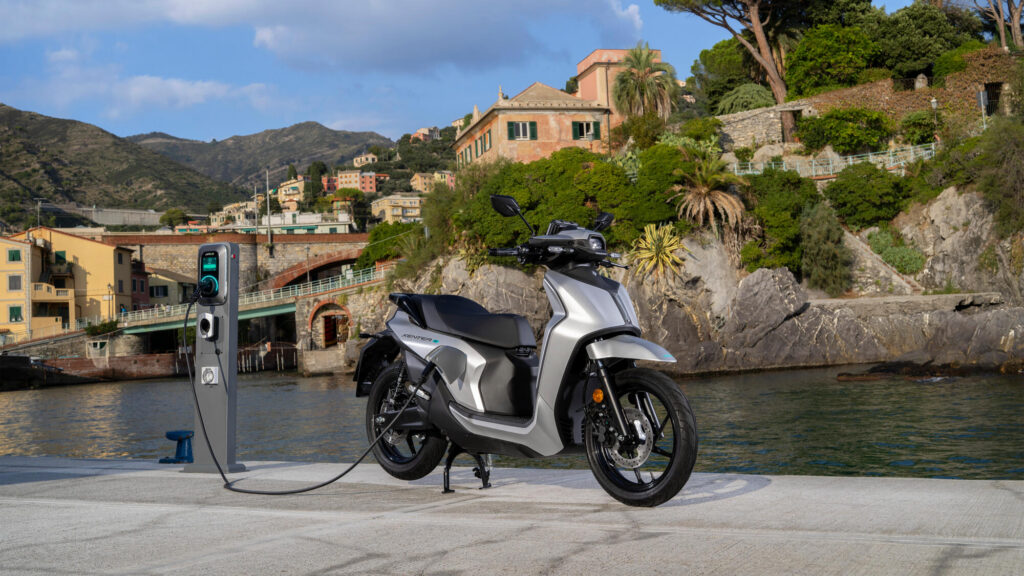
The XENTER E arrives alongside the NMAX E, which shares the same powertrain and battery, and a petrol-powered XENTER concept that Yamaha is showing in Milan.
eAxle powertrain mounted to the frame
The XENTER E uses Yamaha's new eAxle drive unit. It combines an air-cooled interior permanent magnet synchronous motor, the motor control unit and a primary reduction gearbox in one compact package. Peak output is 7.5 kW at 3,500 rpm, and maximum torque of 33.3 Nm arrives at 500 rpm. A belt takes the drive to the rear wheel.
Unlike a typical petrol scooter, where the engine forms part of the swingarm, the XENTER E has its drive unit bolted to the frame. That allows a motorcycle-style swingarm and lowers unsprung weight, which Yamaha says improves ride comfort and handling.
Battery, range and charging
Energy comes from a 3.5 kWh lithium-ion battery with an IP67 rating, housed in a protective casing. The L-shaped pack sits low in the centre of the chassis, which keeps the floorboard flat and leaves room under the seat. Claimed range is 108 km in the WMTC class 1 cycle, measured at a battery temperature of 25 °C.
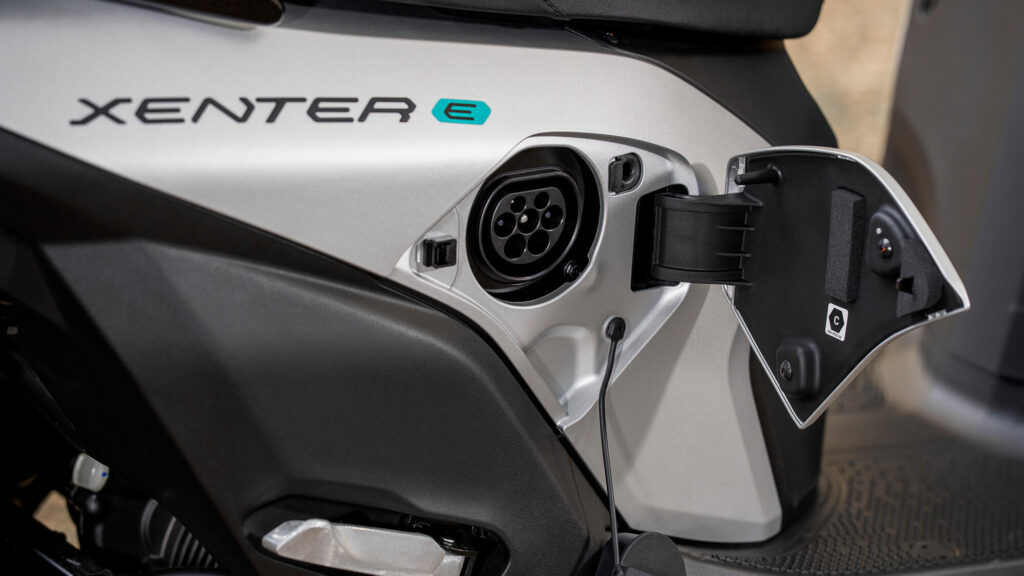
Charging is handled by an 800 W on-board charger with a fanless design. A full charge from 0 to 100 percent takes 5.5 hours at 220 V. The charging socket, located in a side compartment, accepts AC Type 2 public car chargers, and a dedicated cable allows charging from a household socket.
Alongside the scooter, Yamaha is launching YOU Charge, a subscription service for public charging developed with national charging network operators. It will be sold through Yamaha dealers, starting in the first markets in early 2027 and expanding to the main European EV markets during the year.
Chassis and brakes
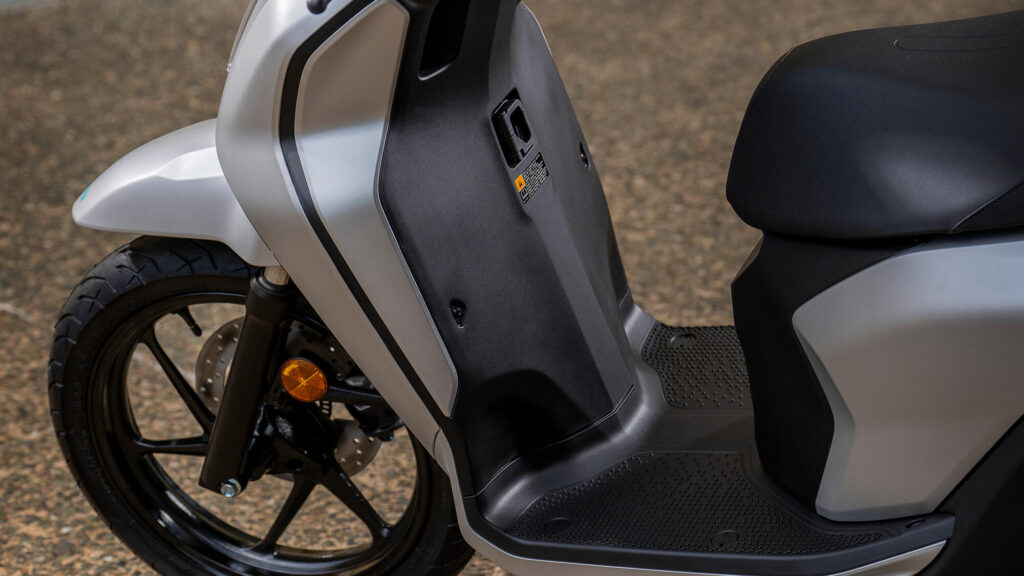
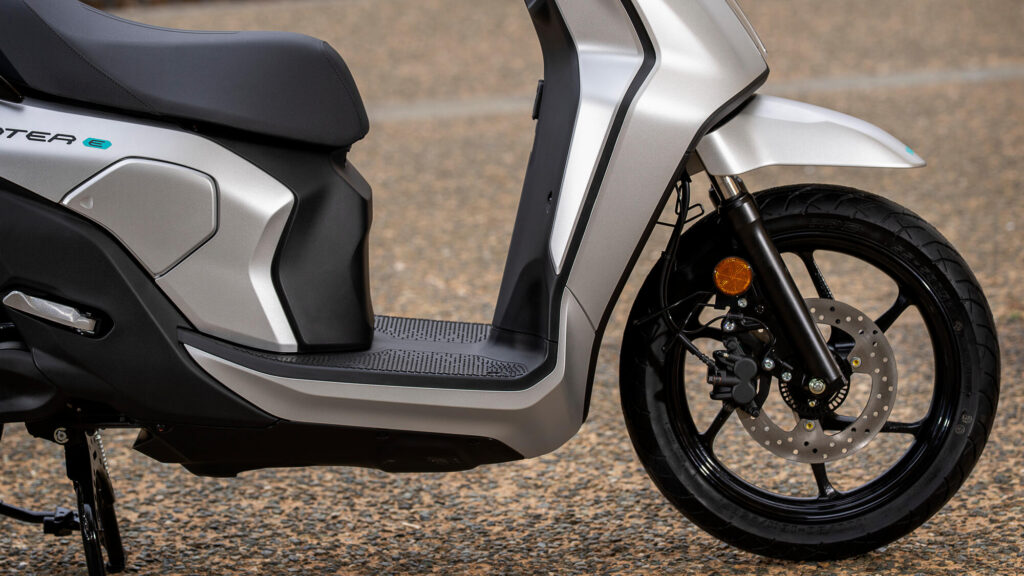
The scooter is built around a new lightweight underbone frame with a 1,485 mm wheelbase. It runs on 16-inch wheels at both ends, with a 100/80-16 front tyre and a 120/80-16 rear. Suspension travel is 100 mm at the front and 97 mm at the rear. Seat height is 790 mm.
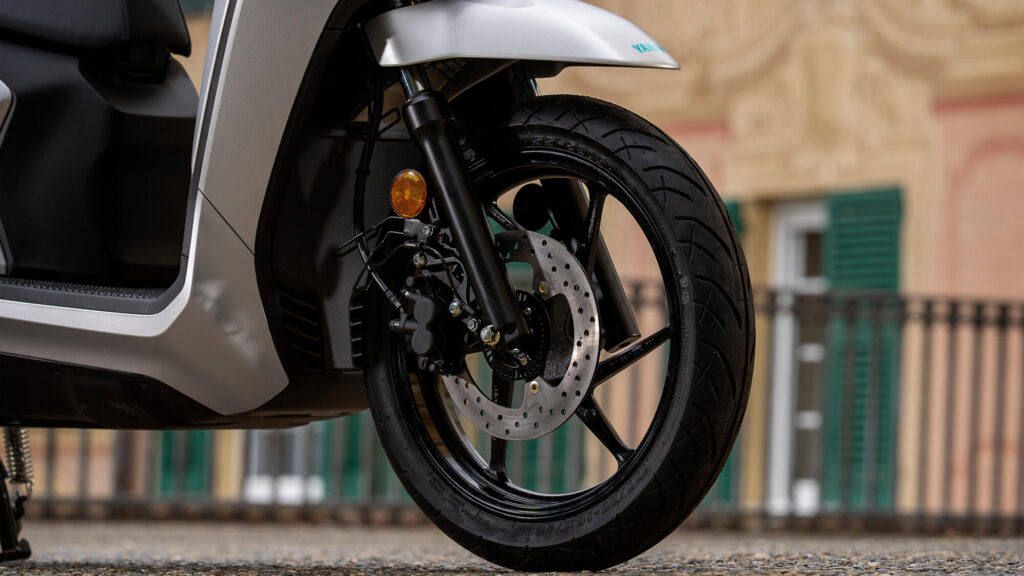
Braking is by 245 mm discs front and rear, both with ABS. Regenerative braking adapts to the selected ride mode and is tuned to resemble the engine braking of a combustion scooter.
Electronics and practicality
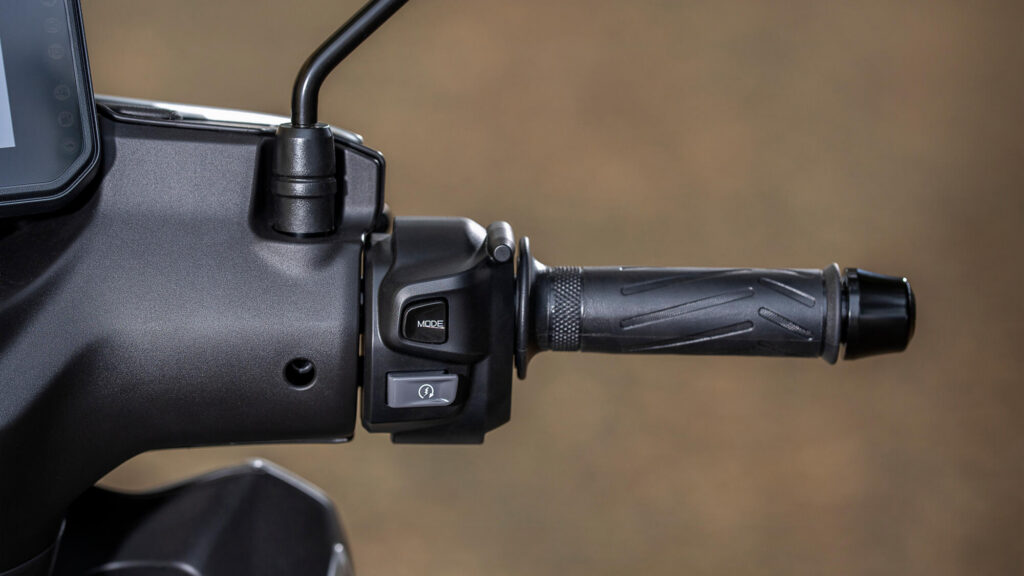
Riders can choose between three ride modes. S gives the sharpest acceleration, T softens throttle response, and E limits acceleration and top speed to extend range. Traction control is standard, as is APSG, a throttle grip that progressively increases resistance for more feedback. A reverse function, operated by pressing the REVERSE and MODE buttons together, moves the scooter backwards at below walking pace.
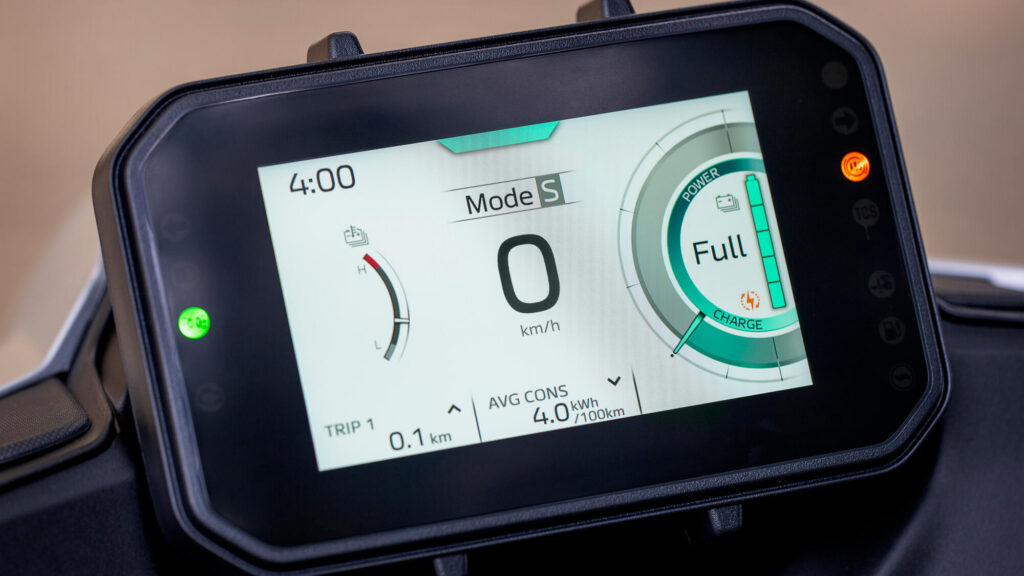
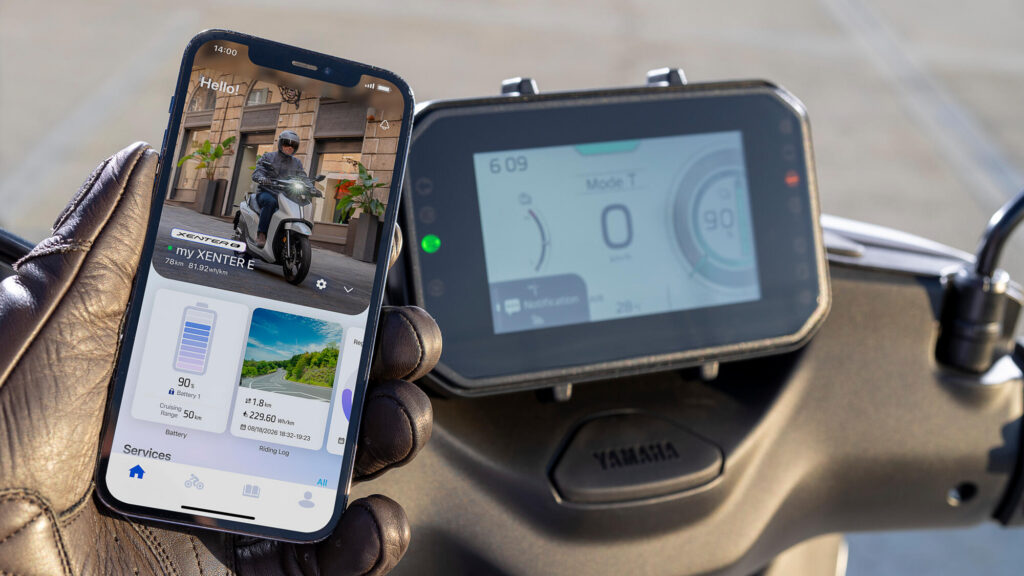
The 5-inch TFT display offers day and night modes and shows battery level, remaining charge and regeneration status, plus a power meter with a moving needle. Through the Yamaha Motor On app, owners get turn-by-turn navigation, battery status, maintenance schedules, parking location and trip data. Smart key ignition is fitted.
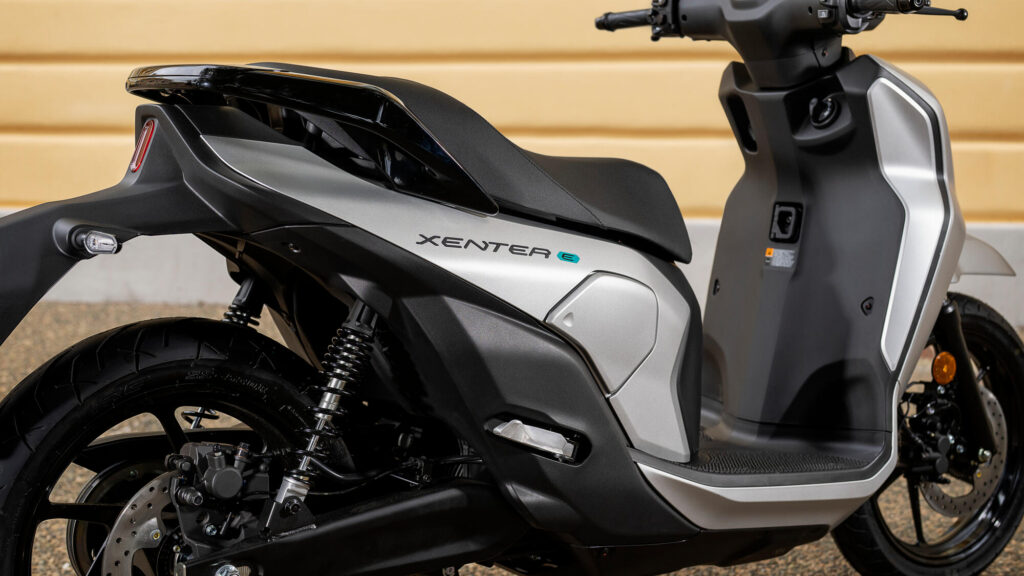
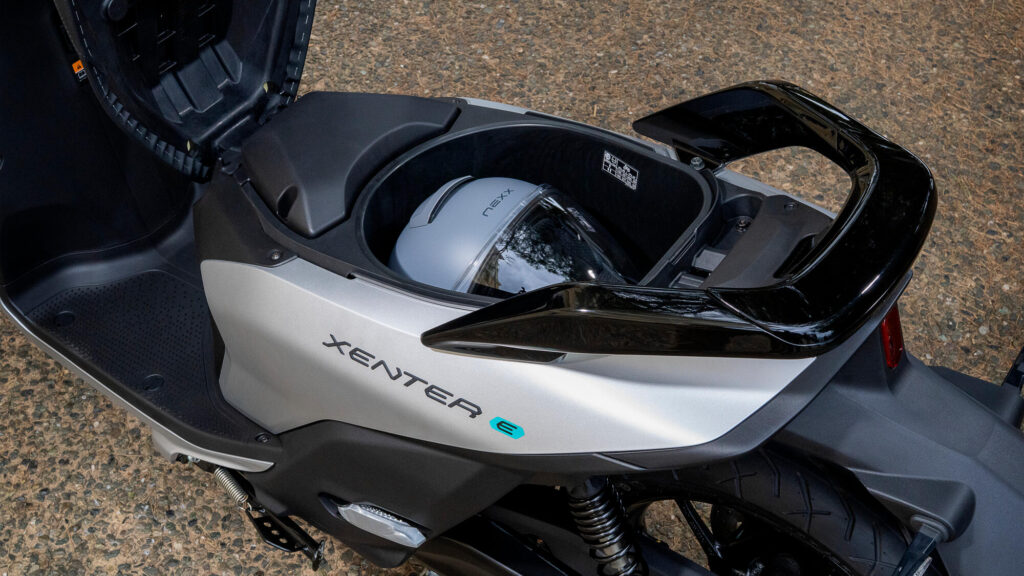
The underseat compartment fits a full-face helmet, depending on size and shape. A small front compartment holds a USB Type-C charger, and a folding bag hook sits at knee height. Yamaha has designed the scooter for easy fitment of accessories, including a high screen, apron, handguards, scratch protectors, a console bag and a 34-litre top case.
Colours, price and availability
The XENTER E comes in Platinum Silver or Midnight Black, both with aqua accents. Yamaha has not announced official pricing per market and refers buyers to local distributors. Early reports from the Milan press launch put the German price at 7,799 euro, the same as the NMAX E. The XENTER E reaches Yamaha dealers from spring 2027.
YAMAHA >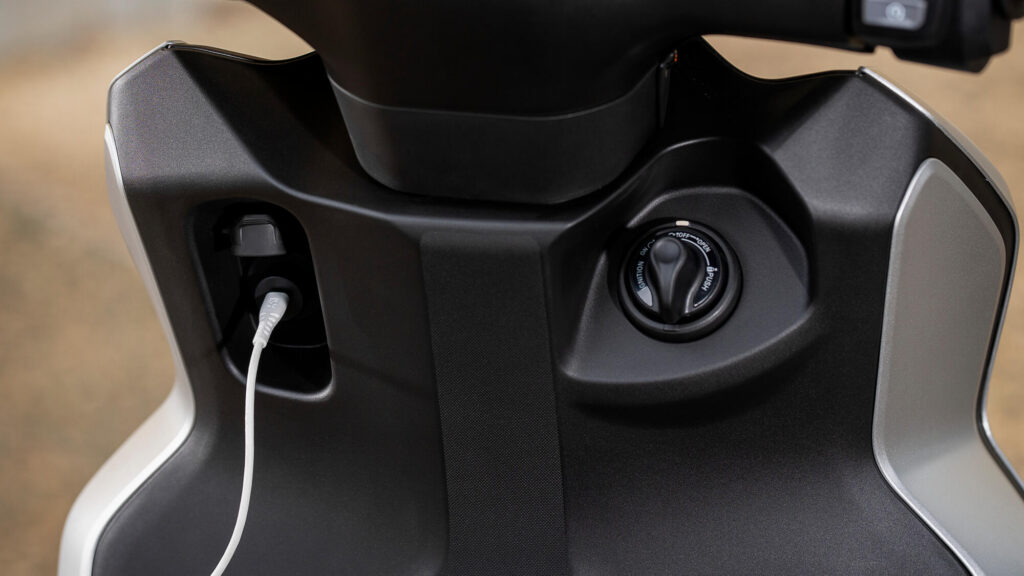
Source: LinkedIn Camillo Piscitelli | Italian electric scooter maker HURBA has presented the 150S at EICMA in Milan today. It is the first model the company has designed entirely in-house, from initial concept to technical definition. The launch comes as the brand expects to finish 2026 with close to 300 registrations and a turnover three times that of 2025.

From Peking University to the outskirts of Rome
The company's roots go back ten years, when HURBA's founder, then 24, tested the first prototype on the campus of Peking University. Seeing the scale of electric two-wheeler use in China, he set out to bring that type of mobility to Italy and to build an Italian industrial operation around it. The 150S is designed in Italy and assembled on the outskirts of Rome.

A flat footboard on 16-inch wheels
According to HURBA, the 150S was shaped by requests from customers and dealers. They asked for the practicality of a flat footboard combined with the stability of 16-inch high wheels, a layout the company says remains uncommon among electric scooters. The founder led the project personally, with the stated aim of making electric mobility more accessible and offering a credible alternative to combustion scooters.

Key specifications as announced:
- Range of up to 260 km, which HURBA claims is the highest in its category
- Removable batteries
- Performance in the 150cc equivalent class
- Top speed of 110 km/h, with motorway approval
Industrial design process
For the styling, HURBA brought in Aldo De Giovanni, a designer with more than thirty years of experience at Aprilia and Italjet. The development followed a conventional industry process, moving from sketches to a full-scale 1:1 clay model and then to molds for the bodywork.

Management changes and dealer expansion
HURBA also announced that Marino Paolo Adiletta has joined its management. Adiletta previously held management roles at Yamaha and Askoll and founded the Helmo Milano brand. He will be responsible for developing HURBA's dealer network in Italy and in other markets.
The company traces its recent growth to 2024, when two experienced Italian managers joined its corporate structure and management team. A strategic plan drawn up at that time led to HURBA qualifying as an international manufacturer, developing its first in-house model and reorganising its internal structure.
Market ambitions
HURBA acknowledges that relying on standardised platforms would be cheaper, but says it has chosen to develop its own products. The founder has set a target for electric models to reach at least 20 percent of the scooter market by 2030.
The HURBA 150S can be seen at EICMA in Hall 11, Stand H30.
HURBA >Swedish manufacturer ReBake has presented the Abler, its first electric two-wheeler for the road. The utility-focused model is shown publicly for the first time at EICMA in Milan, and comes in two versions: a moped and a light motorcycle. Behind the new brand is Karl Ytterborn, who was active at CAKE from day one in 2016 through to 2024.


Built around cargo
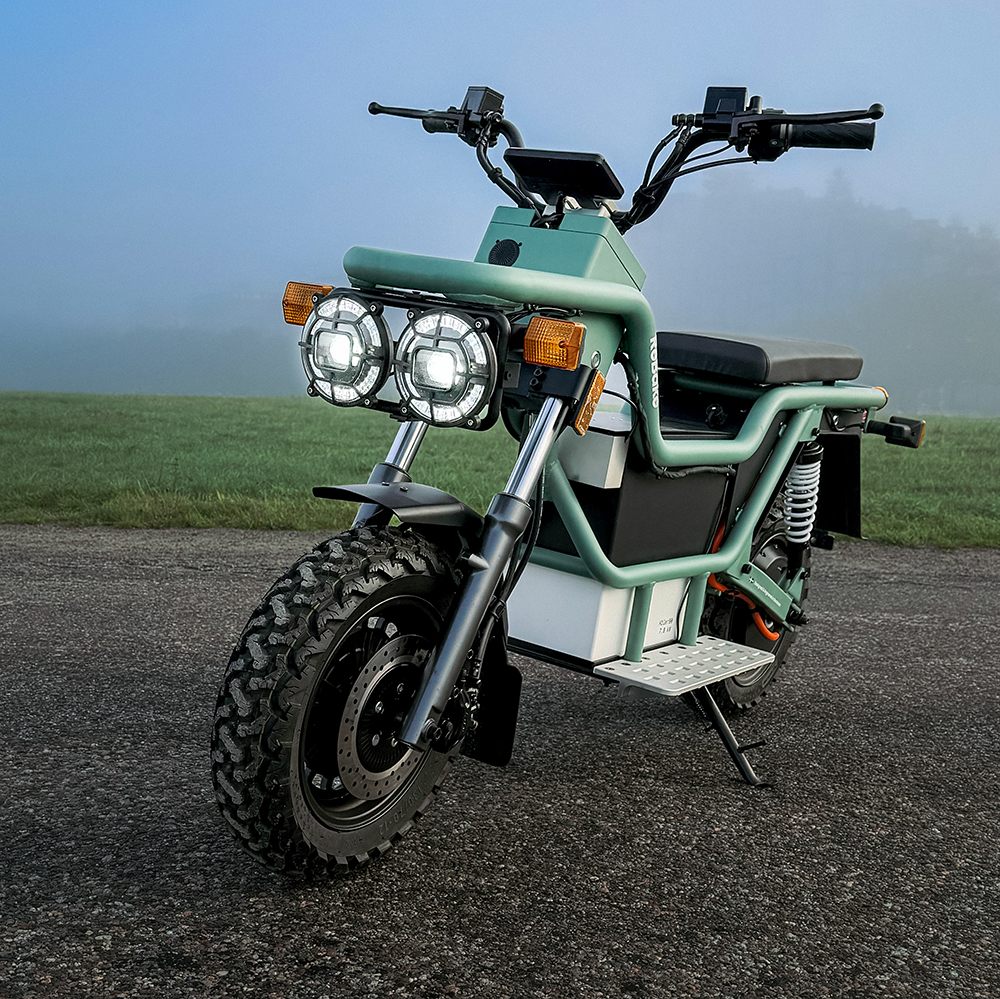
The Abler is aimed at daily urban use, from commuting and errands to carrying a passenger or a load of groceries. ReBake designed the bike so it can carry cargo straight out of the crate, without the owner first having to add racks or brackets.
At the core is a frame of 42 mm round aluminium tubing. Accessories and cargo solutions mount directly onto that tubing, so the setup can be changed as the rider's needs evolve. Loads can go on the front, at the rear, across the frame, on top of the battery lid or along the side rails.

"The Abler is an extension of the team, shaped by what we've learnt and what users appreciate. The same thinking goes into everything from design and engineering to materials, manufacturing and the smallest nut and bolt. We've put function first and engineered a bike that simply works. The result is the Abler. Built to last and to do more," says Karl Ytterborn, Founder & CEO of ReBake Motors.
Two speed classes
The Abler45 is homologated as an L1e-B moped, the 50cc-equivalent class, with a top speed of 45 km/h. The Abler80 falls under the L3e-A1 light motorcycle category and reaches speeds above 80 km/h. Both versions are road legal across the EU.
Swappable batteries
The batteries can be charged while installed in the bike, or removed and plugged into a standard household outlet. All technical specifications can be found in the specs table below.

Where to see it
The Abler is on display at EICMA from 3 to 8 November. ReBake says selected retailers across Europe will follow. Product details are available at rebakemotors.com.
REBAKE MOTORS >About ReBake
ReBake is based in Stockholm, where it designs and engineers electric vehicles and mobile cargo tools intended for everyday use. The company's stated aim is to make high-quality electric mobility more widely accessible.
From CAKE to ReBake
In a post at LinkedIn, Ytterborn looks back on his eight years at CAKE, the Swedish brand that built a following with its minimalist electric off-road and utility bikes. He describes it as a company built from nothing that helped change how people looked at electric micromobility. "We made a tiny but positive mark on the world," he writes.
CAKE ultimately could not raise the late-stage funding it needed as market conditions and industry priorities changed. Ytterborn says that rather than walking away, he kept returning to the idea that a decade of lessons, from user feedback and manufacturing to insights from the wider industry, could be applied in a more efficient way.
 Karl Ytterborn
That thinking became a business plan: keep what worked, act on user feedback, and rethink every decision that had added unnecessary cost, complexity or friction. The goal, he writes, was not to repeat the past but to do things differently. That plan became the foundation of ReBake.
Ytterborn is open about the risks. Large parts of the electric two-wheeler industry are still struggling, and he acknowledges that past experience guarantees nothing. "I see both the opportunity and the risk, and I'm taking that chance," he writes, crediting a founding team, old and new partners, and friends and family for getting the project from paper to production. His stated ambition is to contribute to changing how people move through European cities.
 .tp-specs-wrap{overflow-x:auto;-webkit-overflow-scrolling:touch;margin:1.5em 0;}
.tp-specs{width:100%;min-width:520px;border-collapse:collapse;font-size:15px;line-height:1.4;}
.tp-specs caption{caption-side:top;text-align:left;font-weight:700;font-size:1.15em;padding:0 0 .6em;}
.tp-specs th,.tp-specs td{padding:9px 12px;border-bottom:1px solid #e2e2e2;text-align:left;vertical-align:top;}
.tp-specs thead th{background:#111;color:#fff;font-weight:700;}
.tp-specs thead th:not(:first-child){width:32%;}
.tp-specs tbody th{font-weight:600;width:36%;}
.tp-specs tr.tp-section th{background:#f2f2f2;color:#111;text-transform:uppercase;letter-spacing:.06em;font-size:.82em;font-weight:700;padding-top:11px;}
.tp-specs tbody tr:not(.tp-section):hover{background:#fafafa;}
.tp-specs small{display:block;color:#777;font-weight:400;font-size:.85em;}
.tp-specs-note{font-size:13px;color:#666;margin-top:.8em;line-height:1.5;}
ABLER - Technical specifications
SpecAbler45Abler80 Highlighted specs
Vehicle classL1e-B (EU)L3e-A1 (EU)
Top speed45 km/h80+ km/h
Range, dual battery, inner city paceUp to 160 km**Up to 114 km**
Weight excluding batteries88.7 kg88.7 kg
Battery weight, per battery17 kg17 kg
Street legalYesYes
MSRPFrom €3,990 incl. VATFrom €4,990 incl. VAT Model & class
Vehicle classL1e-B (EU)L3e-A1 (EU)
Petrol equivalent50 cc (AM licence)125 cc (A1 licence)
Street legalEU & markets recognising EU approvalYesYes Performance
Nominal power4 kW6.14 kW
Peak power5.12 kW7.68 kW
MotorRear hub, direct driveRear hub, direct drive
Regenerative brakingYes, passive regenYes, passive regen Charging
Charging outletStandard 230 V household outletStandard 230 V household outlet
Charge time, per batteryYou rarely start charging from 0%.0-100%: 4 h
0-80%: 3 h0-100%: 4 h
0-80%: 3 h Build
Frame42 mm round-tube aluminium42 mm round-tube aluminium
Wheels14-inch cast aluminium14-inch cast aluminium
Front suspensionTelescopic fork, Ø40 mm inner tubesTelescopic fork, Ø40 mm inner tubes
Rear suspensionDual shockDual shock
Front suspension travel140 mm140 mm
Rear suspension travel62 mm62 mm
BrakesFront and rear disc, CBSFront and rear disc, CBS
LightingFull LEDFull LED Dimensions & weight
Length1,894 mm1,894 mm
Chassis width280 mm280 mm
Width across indicators470 mm470 mm
Handlebar width760 mm760 mm
Handlebar grip height1,020 mm1,020 mm
Wheelbase1,267 mm1,267 mm
Weight excluding batteries88.7 kg88.7 kg
Battery weight, per battery17 kg17 kg Battery & range
Battery2.0 kWh swappable LFP2.0 kWh swappable LFP
Batteries as standard1 (room for 2)2
Total capacityUp to 4 kWh (2 batteries)Up to 4 kWh (2 batteries)
Nominal voltage51.2 V51.2 V
Battery cycle life to 80% capacity2,000 full cycles2,000 full cycles
Range, single battery, inner city paceUp to 80 km**Up to 57 km**
Range, single battery, faster city paceUp to 60 km**Up to 49 km**
Range, dual battery, inner city paceUp to 160 km**Up to 114 km**
Range, dual battery, faster city paceUp to 120 km**Up to 98 km**
An alternative street tyre increases range.
** Range estimates are based on the original tyres, the specified number of batteries and the indicated riding pace. Actual range varies depending on riding style, road surface, temperature, tyre pressure, load and other conditions.
Previous articles about ReBake:
ReBake Motors launches in Stockholm with focus on electric cargo tools for urban transport
B2B News | Source: Nucular Electronics Inc. | The Nucular X6F, a 15 kW motor controller with roughly the footprint of a credit card, has been named Best New E-Mobility Technology at the 2026 E-Mobility Awards. For the company, the award recognises more than ten years of in-house power electronics development for light electric vehicles.

Size and output
The X6F weighs 227 grams and is housed in a CNC-machined aluminium enclosure. Nucular rates it at 15 kW peak output using Field-Oriented Control (FOC). The company targets applications ranging from high-performance electric off-road motorcycles to commercial light EV fleets.
An in-house development approach
Many controllers in the LEV market are built on off-the-shelf platforms. Nucular instead develops its full electronics stack internally: motor controllers, battery management systems (BMS), on-board computers and the software that runs them.

Founder Dmitry Bogdanchikov said the product is the result of many prototypes, extensive testing and repeated revisions of circuit boards and firmware. He also credited feedback from riders, builders and partners using the hardware in the field, and said recognition in a pure technology category is an important milestone for the team.
Technical details
According to Nucular, reaching 15 kW in this footprint required changes to how the controller manages heat, current and signal integrity.
- Thermal management: The X6F uses top-side cooled (TOLT) MOSFETs. Instead of routing heat into the circuit board, they transfer it from the top of the transistors directly into the aluminium housing. Nucular says this allows peak power to be sustained almost twice as long.
- Dual-board layout: An 8-layer heavy-copper power board with ultra-low-ESR polymer capacitors handles high current peaks. A physically separate logic board keeps the microcontroller away from much of the electrical noise.
- Firmware and connectivity: The controller runs Nucular's own bare-metal firmware with more than 200 tuning parameters. It communicates with the rest of the company's hardware through the open LEVCAN bus protocol.
- Durability: The X6F has recessed IP67 waterproof connectors. Nucular reports a field failure rate below 1% and offers a three-year warranty.
Relevance for manufacturers and builders
For OEMs and custom builders, the X6F's combination of high output, low mass and compact packaging addresses a key constraint in LEV design, where space and weight around the drivetrain are limited. The open LEVCAN protocol and the broad parameter set also support integration with third-party components and tuning for specific applications.
About Nucular Electronics

Nucular Electronics Inc. designs and manufactures motor controllers, BMS units, on-board computers and open communication protocols for light electric vehicles. More information:
NUCULAR ELECTRONICS >Reload.Land brings the Silent Ride back to Milan during EICMA for a very special night: bringing together electric two-wheel culture, music, art and our international community.
SILENT RIDE
TUESDAY, 3 NOVEMBER 2026
MEET FROM 19:30
DA ORIENT
Viale Montello 8, 20154 Milano, Italy

On Tuesday, 3 November, we meet from 19:30 at Da Orient for some welcome drinks, snacks and good vibes before heading out into the streets of Milan together.
Expect an evening surrounded by electric motorcycles, scooters and mopeds from across the scene. This is an open-brand event — every electric two-wheeler is welcome, whatever you ride!

Please note: Parking around Da Orient is very limited, so plan your arrival accordingly.
But the ride is just the beginning.After cruising through Milan, we'll continue the night at DURO CLUB, where an exclusive Reload.Land party awaits. Expect an immersive light installation by our friends at House of North, music, familiar faces and a very special atmosphere.
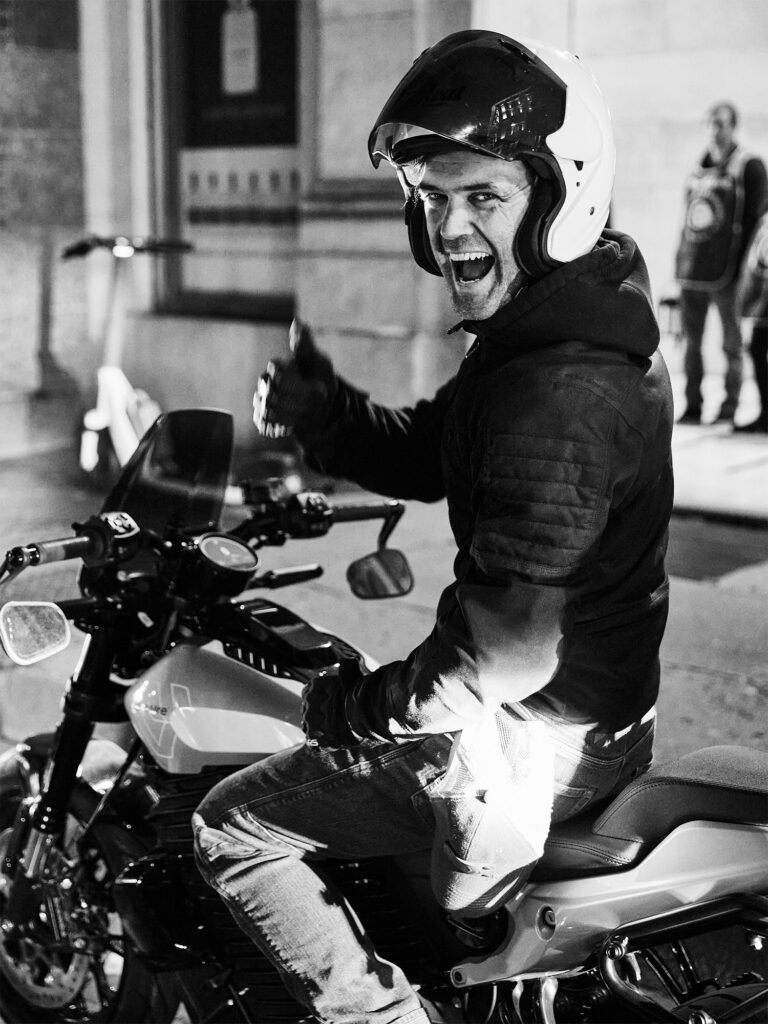
Everyone is welcome, but registration is mandatory. The Silent Ride and the DURO Club party are RSVP only, so make sure to secure your spot in advance.
SPREAD THE VOLT 
B2B-News | LiveWire Group, the Harley-Davidson-controlled electric motorcycle company, is going through the most uncertain period since it went public in 2022. In just over a week, its CEO stepped down, the board brought in a restructuring specialist, and the company said there is substantial doubt it can keep operating for another year. At the same time, its third-quarter figures show sales and losses moving in the right direction. Both things are true.

Leadership change
Karim Donnez resigned as CEO effective October 21, 2026, and no new CEO has been named. Instead, Roy Gallagher was appointed Chief Restructuring Officer and serves as the principal executive officer. Gallagher is a Senior Managing Director at Ankura Consulting Group with more than two decades of financial experience, and he reports to the committee.
Q3 2026: growth in units and revenue
The quarterly numbers, published on October 29, show growth across the business. Consolidated revenue rose 38% to $7.9 million, from $5.7 million a year earlier. Total units grew 21% to 7,233. The operating loss narrowed to $17.5 million from $18.8 million, and the net loss came in at $18.6 million, compared with $19.4 million.
 Source: Investor Relations LiveWire
The electric motorcycle segment was the main driver. LiveWire sold 241 motorcycles in the quarter, up 31% from 184. Segment revenue rose 178% to $2.7 million, and the operating loss improved to $17.0 million from $18.4 million. Part of the revenue jump reflects a weak base: Q3 2025 revenue had been reduced by higher incentives used to stimulate demand.
 Source: Investor Relations LiveWire
STACYC, the electric balance bike brand for children, remains the volume business. It sold 6,992 units, up 20%, with revenue up 9% to $5.2 million. Its operating loss grew slightly to $0.6 million, mainly due to higher freight costs.
 Source: Investor Relations LiveWire
Over the first nine months, revenue reached $22.1 million versus $14.3 million in the same period of 2025, while the operating loss fell to $53.2 million from $57.7 million. Cash used by operations dropped 16% to $38.3 million.
On the product side, LiveWire delivered the first S4 Honcho Trail units in the US in August and the S4 Honcho Street reached US dealers in October. European deliveries of the Trail were expected in October, with the Street following in November. The company also reports an 80% share of the US on-road electric motorcycle segment above 50 kW through September.
The balance sheet
The issue is not the direction of the numbers, but the size of the gap and the cash left to bridge it. Cash stood at $39.9 million on September 30, down from $82.8 million at the end of 2025. Shareholders' equity turned negative at minus $5.5 million, from plus $46.0 million at year-end. The related-party term loan stood at $76.8 million. That loan comes from LiveWire's majority shareholder. Related-party interest added $1.5 million in costs during the quarter.
Going concern warning
Management concluded there is substantial doubt about the company's ability to continue as a going concern within one year of issuing its September 30 financial statements, citing recurring losses, negative operating cash flow, limited liquidity and future funding needs. The options under review include significant capital raises, strategic partnerships or investments, and sales, though the company says there is no guarantee any of these will succeed or be available on acceptable terms. The board pointed to a debt maturity in December 2027 as a factor in setting up the restructuring committee.
What comes next
More detail on liquidity, management's plans and the going concern assessment will be included in the 10-Q filing, expected on or before November 9, 2026. LiveWire was also expected to present at EICMA next week, including the production version of the Dust Hightail off-road model. Whether those plans go ahead unchanged, and what role Harley-Davidson will play in any financing or transaction, are the key questions for the coming weeks.
BMW Motorrad has taken a stake in Venna, a young company developing high-performance electric motorcycles with a clear focus on off-road. The German manufacturer announced the deal in Munich on 29 October 2026. Neither the size of the investment nor the share BMW now holds has been disclosed.
A familiar name under a new label
Venna may be a new name, but the company behind it is not. It is the Slovenian start-up previously known as Flux Performance, the maker of the Flux Primo electric dirt bike. BMW's announcement does not mention the Flux name, but the connections are clear. The former Flux Motorcycles website now redirects to Venna. A US trademark application for the Venna name was filed by Flux Performance Group Inc. And Venna is led by CEO Marko Ukota, who founded Flux.
Ukota, a former Slovenian and Italian national supermoto champion, started Flux Performance in 2021 together with two aerospace engineers, Jure Tomažič and Črt Gorup. THE PACK first reported on the project in April 2022, when the company presented its first prototype. In October 2023 we followed up on the video presentation of the future production model, the Flux Primo.

The Flux Primo
The Primo was announced with a claimed peak output of 63 kW (85 hp), a 7 kWh swappable battery and a list of software-driven features. These include a virtual clutch that simulates the slip of a mechanical clutch, a separate lever for regenerative braking, and ride settings that can be adjusted via a smartphone. The bike was positioned as a direct rival to 450cc petrol motocross and enduro machines. In 2025 the company said it had sold out a first batch of pre-orders at an introductory price of 12,000 euro, with series production planned for 2026.
What the partnership means
According to both companies, Venna will remain independent and keep its own development pace. It will draw on BMW Motorrad's experience in development, industrialisation and global operations, and the two partners will cooperate in selected areas. Neither company has said which areas those are.
BMW Motorrad CEO Markus Flasch said the deal opens up a new segment for the brand and gives it access to new target groups. BMW points to younger riders, who increasingly see motorcycling as a sporty, performance-oriented leisure activity rather than transport.
Venna CEO Marko Ukota said his company aims to build high-performance electric motorcycles across all riding categories. He described BMW's investment as a strong endorsement of Venna's technical approach and said it should speed up both technology development and industrialisation.
Open questions
The announcement includes no product details. There is no information on a production model, specifications, pricing or delivery dates. BMW has also made no mention of a BMW-branded electric off-road bike or a factory racing programme linked to Venna.
THE PACK's take
Guy Salens: "With Yamaha, LiveWire and now BMW all buying into electric off-road start-ups, the major manufacturers clearly see a future for the segment. Off-road suits electric power better than most areas of motorcycling. Riding sessions are short, bikes are transported rather than ridden to the track, noise rules keep getting stricter, and maintenance is minimal. At the same time, the majors are hedging their bets. Investing in or acquiring a start-up secures technology and talent at limited cost, without committing their own production capacity to a segment that is still small in volume. For now, Stark Future remains the brand that has put an electric dirt bike into the hands of riders in significant numbers. The question is how long it will keep that lead once the established brands bring their new partners up to speed."
A lot of electric two-wheeler brands have confirmed a presence at EICMA 2026, which runs from 3 to 8 November at Fiera Milano Rho. The first two days are reserved for trade and press; the show opens to the public from 5 to 8 November.
The electric line-up, in alphabetical order, spans full-size electric motorcycles, urban scooters, off-road bikes and youth race machines. Most electric exhibitors are clustered in Halls 6, 9, 10 and 11. Below is what each brand has announced so far … Have a good visit at EICMA!
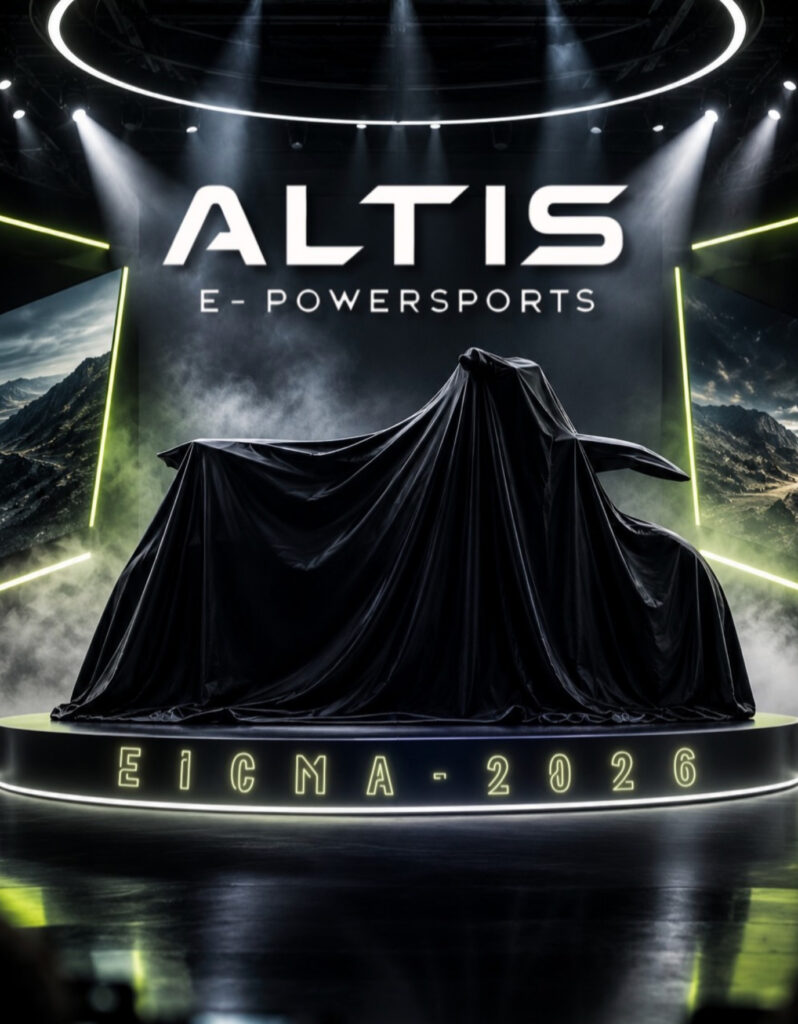
Source: LinkedIn Ultraviolette Automotive | Indian electric motorcycle maker Ultraviolette has outlined its next technology phase. The company introduced a new 100V vehicle architecture called VX-100, a first motorcycle built on it, the X-47 Venom, and several supporting technologies covering battery safety, motor design and rider protection. It also confirmed that the Shockwave will adopt the new architecture, with launch now planned for the first quarter of 2027.
VX-100: a new base for future models
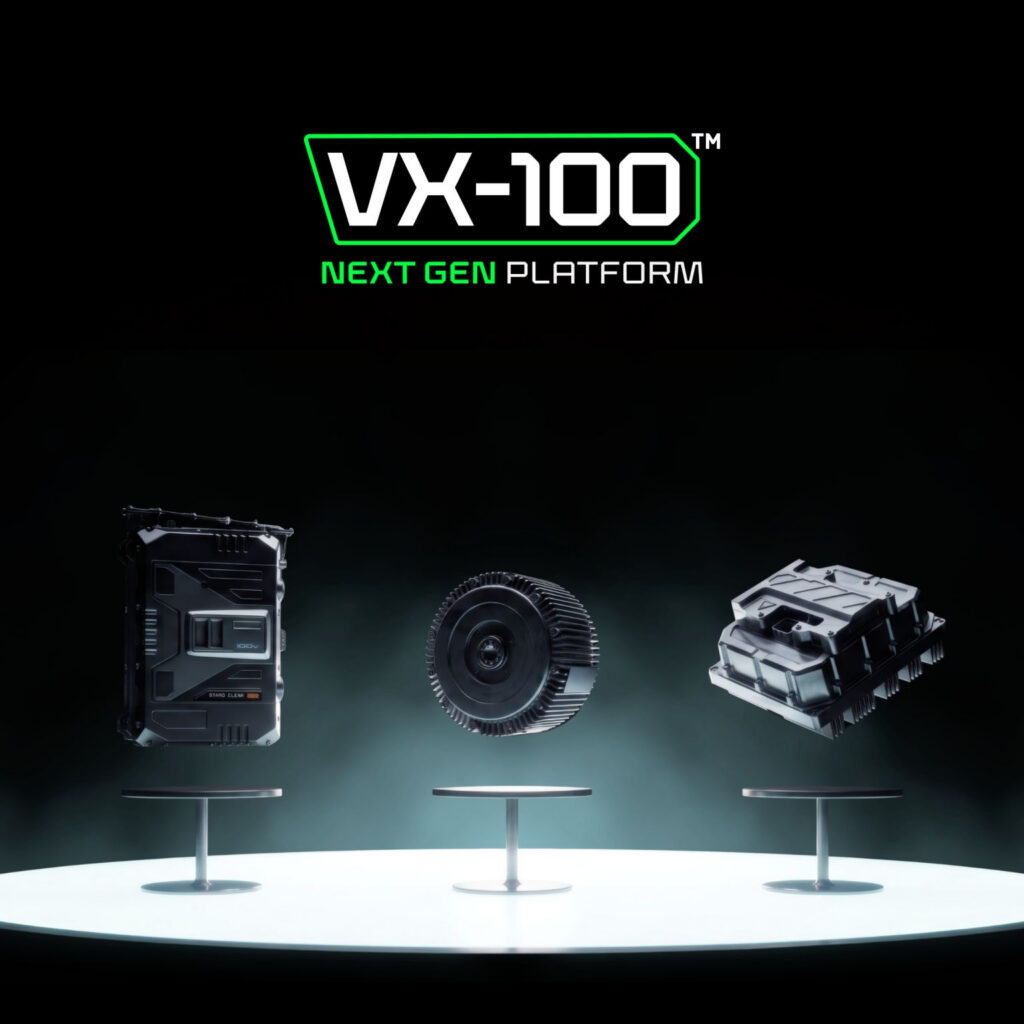
VX-100 is an entirely new platform rather than an update of existing hardware. Ultraviolette says it was developed to raise performance, shorten charging times and improve efficiency, while also enabling more advanced electronics for the rider. The company positions it as the foundation for its upcoming vehicles. No technical specifications for the platform have been released yet.
X-47 Venom: first model on the new architecture
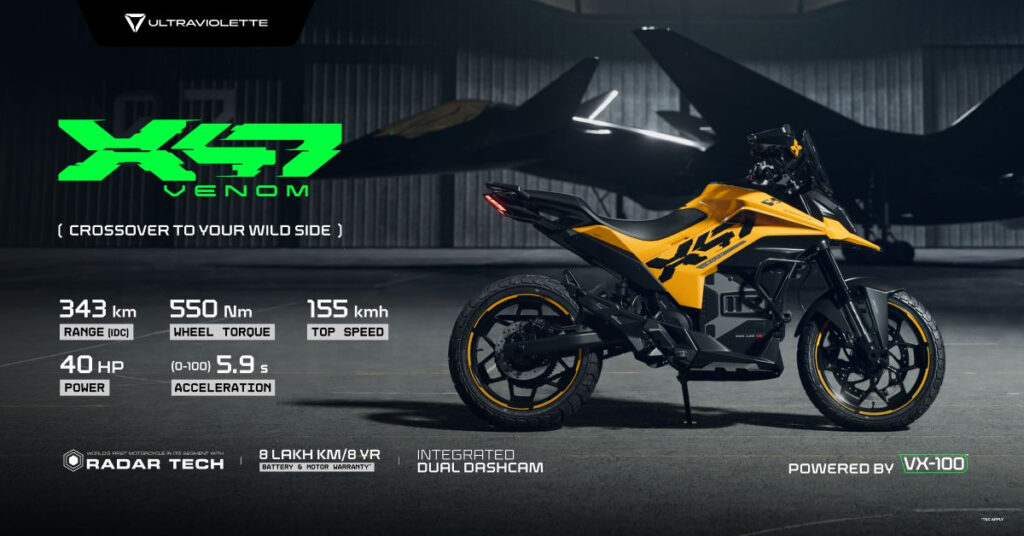
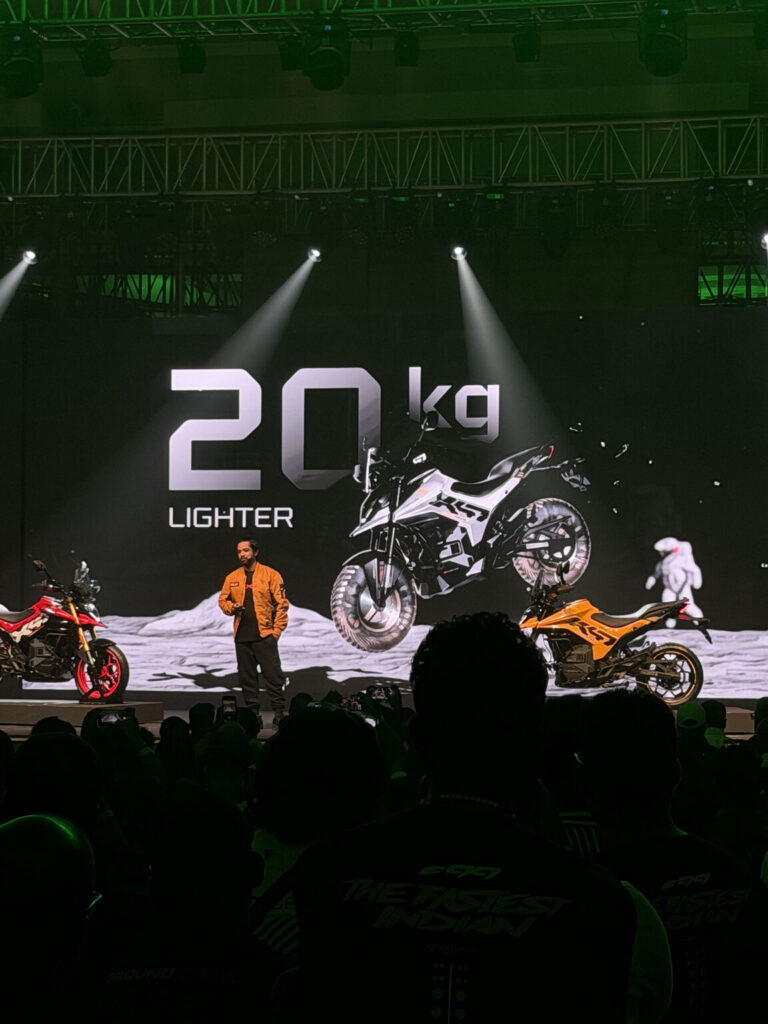
The X-47 Venom is the first production motorcycle based on VX-100. According to Ultraviolette, it is faster, accelerates harder and weighs less than its existing models.
Pyrofuse: battery fault isolation
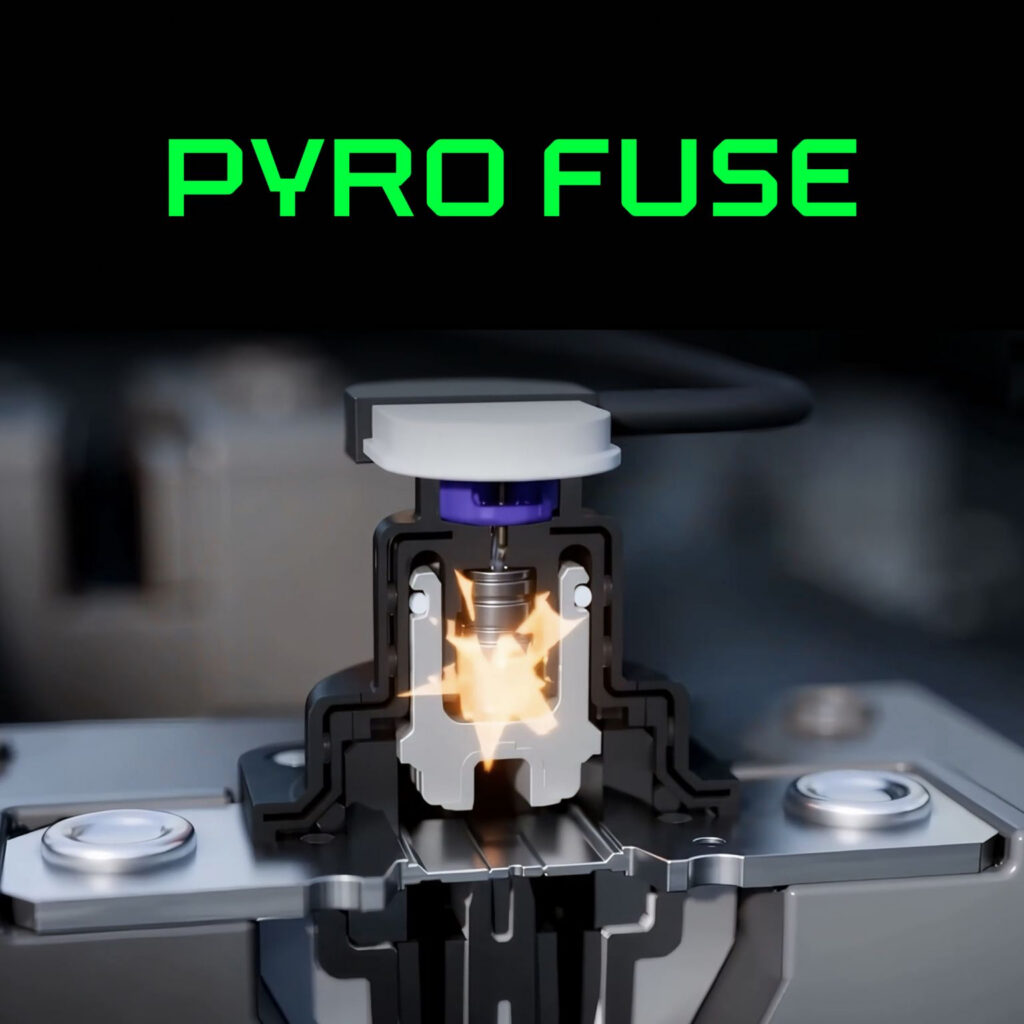
Pyrofuse is a battery protection system that Ultraviolette describes as derived from aerospace safety technology. Its purpose is to cut off critical electrical faults within milliseconds. The company claims this is the first time such a system has been applied to electric two-wheelers.
UV Lightfury: new electric motor
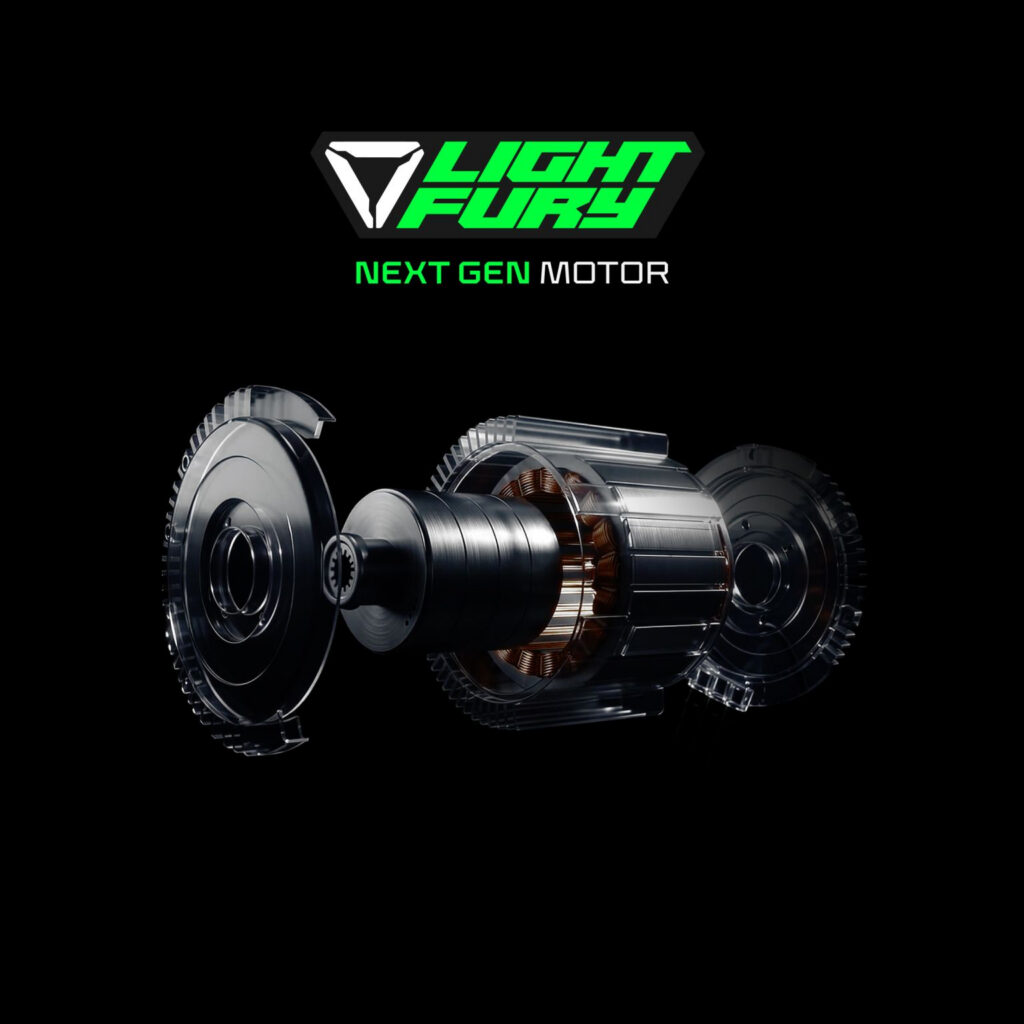
The UV Lightfury is Ultraviolette's next-generation in-house motor. The focus is on power density: more output from a smaller and lighter unit. Output and weight figures have not been disclosed.
B-Max: reusable safety vest
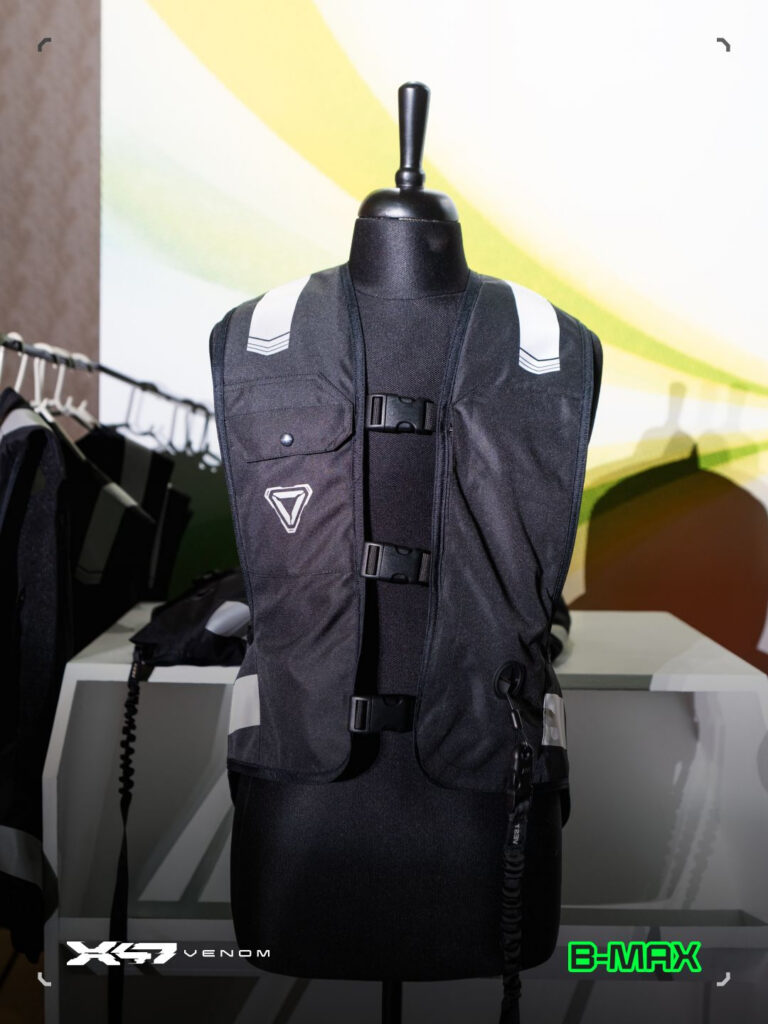
Outside the motorcycle itself, Ultraviolette introduced B-Max, a reusable safety vest for riders. Details on how it works, its certification and availability were not provided.
Shockwave delayed to Q1 2027
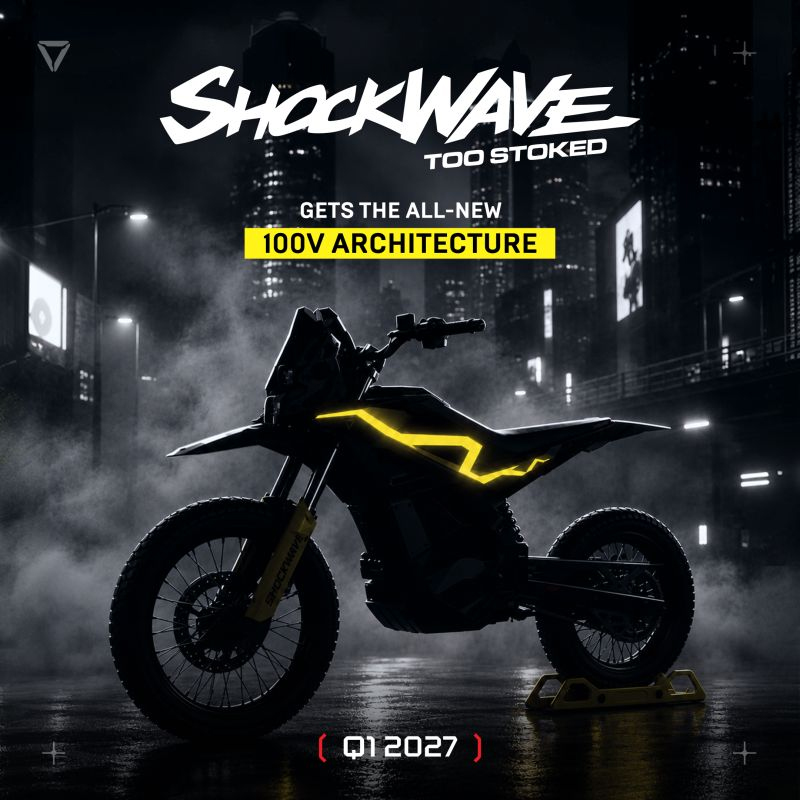
The Shockwave, Ultraviolette's lightweight off-road-oriented model, will now be built on the 100V architecture before it reaches customers. The company lists stronger power delivery, better thermal efficiency and faster charging as the main gains, while keeping the bike's light and simple character. To prepare for production, Ultraviolette is setting up a dedicated Shockwave assembly line inside its existing factory. The switch to the new architecture means the launch moves to Q1 2027.
THE PACK's take:
Guy Salens: "The announcement shows Ultraviolette shifting from individual models to a shared platform strategy, a step that typically precedes a broader model range. The company continues to stress that its technology is developed in India and intended for international markets. For now, the release sets out the technical direction; specifications, pricing and market timing for the X-47 Venom and the supporting technologies are still to be announced."
ULTRAVIOLETTE >Pictures launch X-47
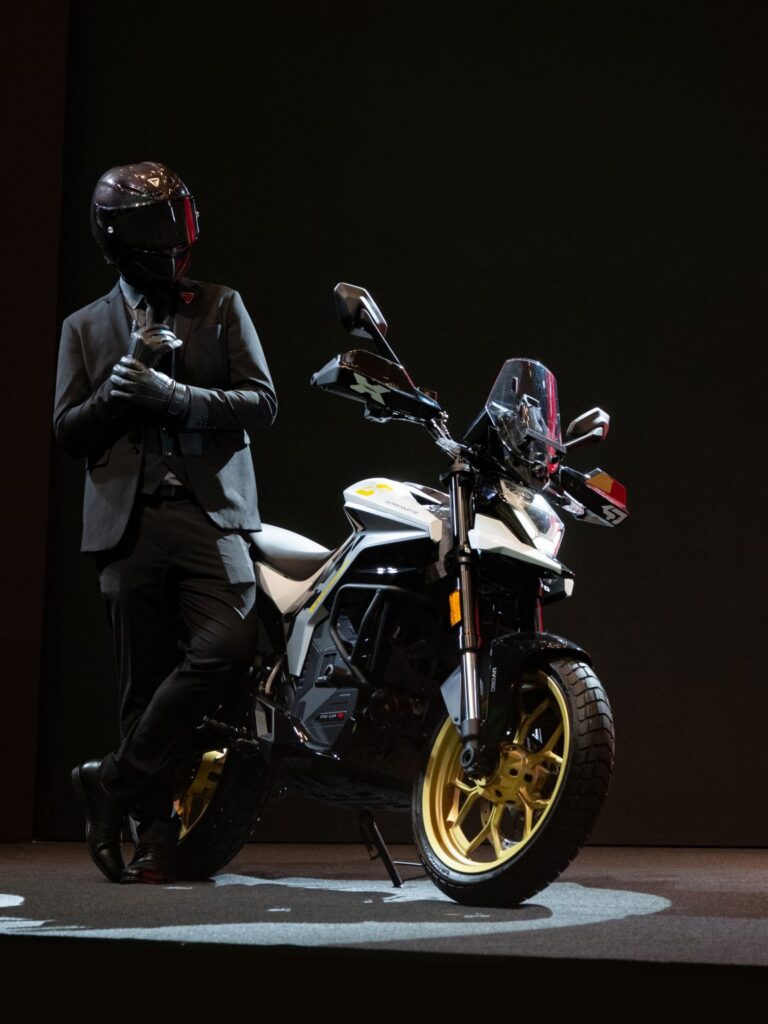
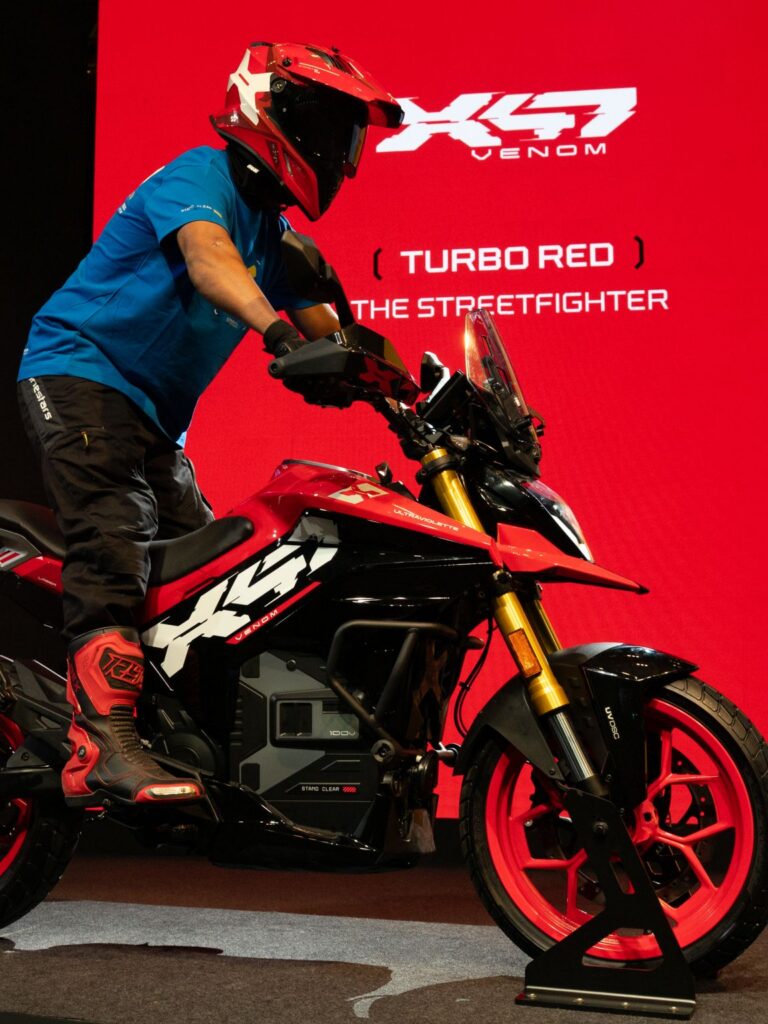
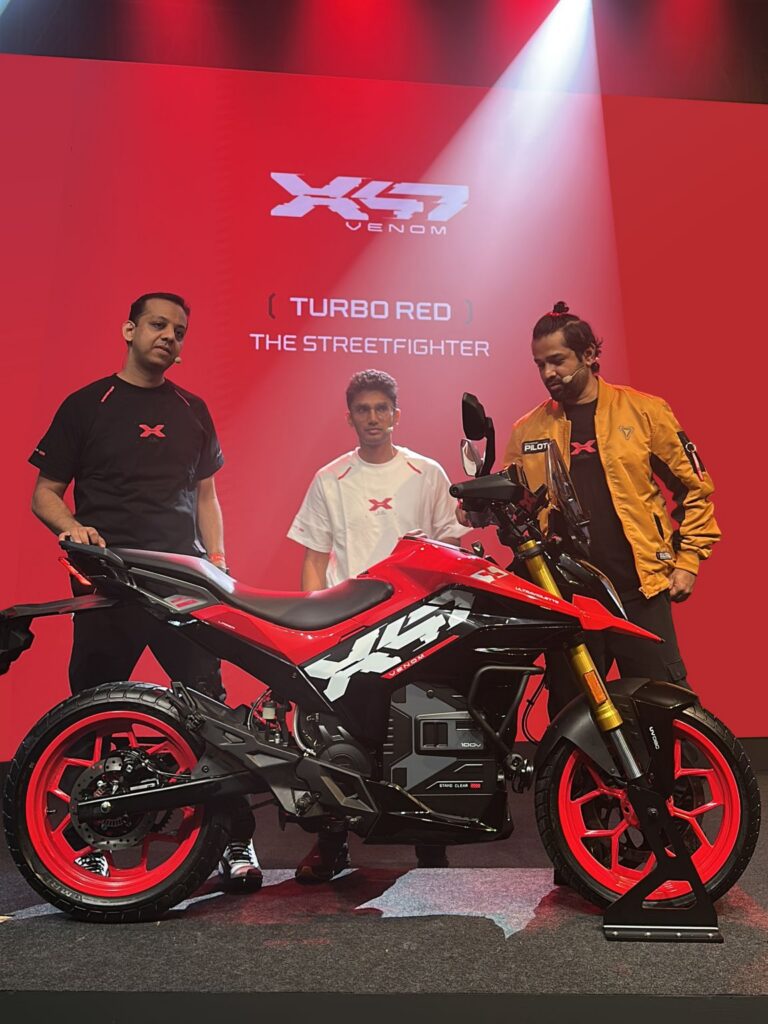
All pictures © Ultraviolette Automotive
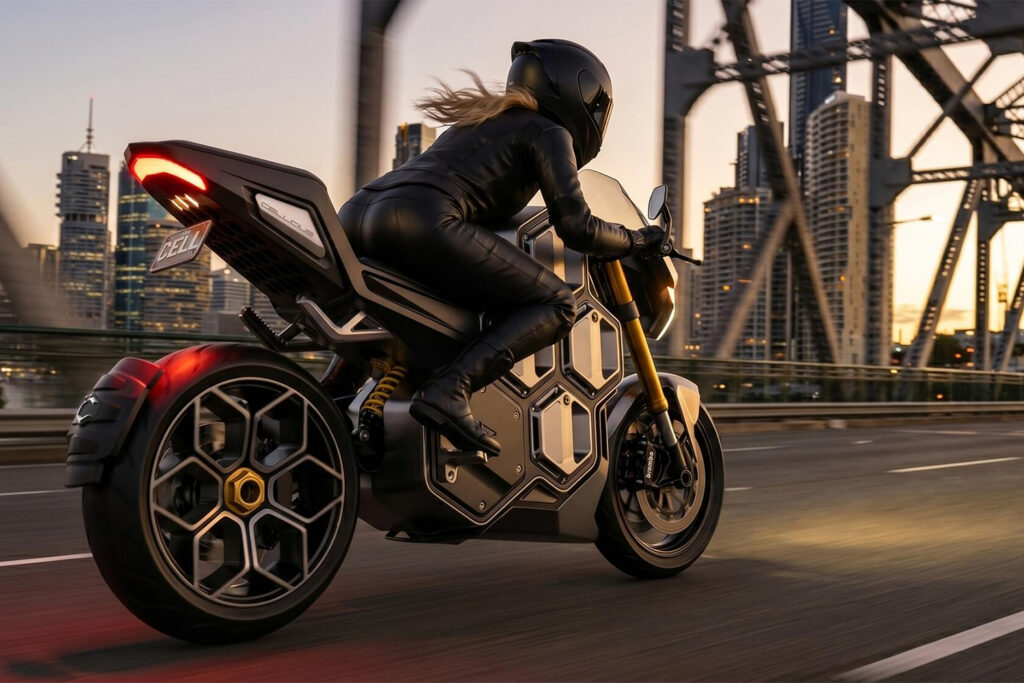
Neil Davidson, CEO and Design Innovation Director of Australian studio Clandestine Design Group, reached out to THE PACK to introduce the Cellcius C-01, an electric hypersport motorcycle concept the studio recently unveiled. Its defining feature is a modular battery system called "Hex-Core", which lets the rider decide how much battery the bike carries.
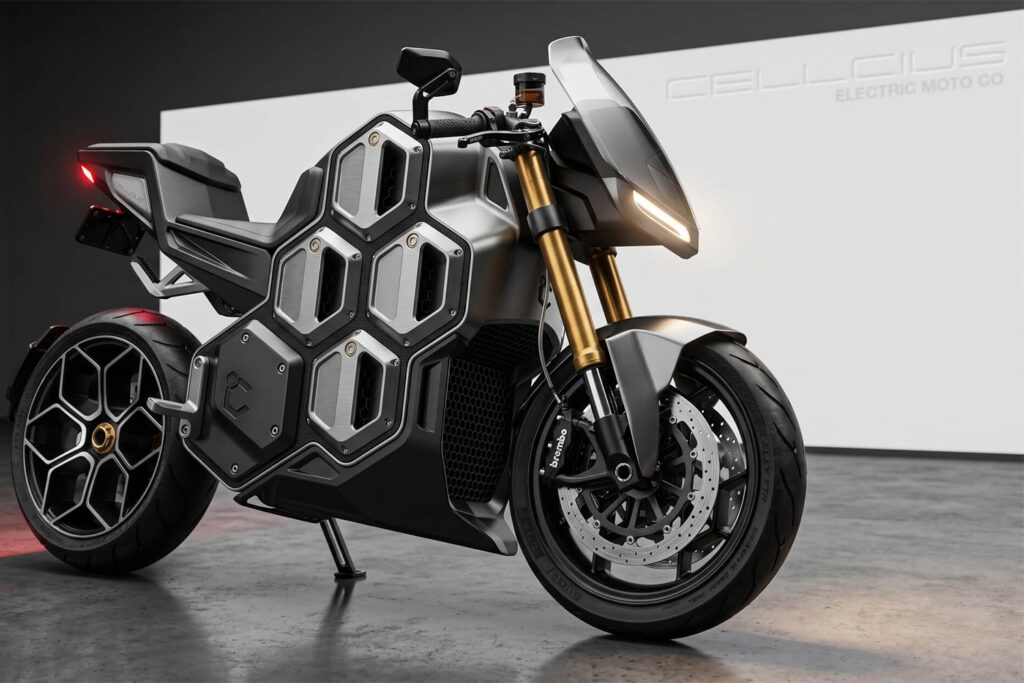
The C-01 received a 2026 Australian Good Design Award in the Concept Design category. According to Davidson, it has also earned a Silver Pin at the New Zealand Best Design Awards and a Tokyo Design Award.
The C-01 is a design concept. Clandestine Design Group has not announced a production partner, pricing, a timeline, or performance figures such as motor output, top speed or range.
Eight cells instead of one pack
The central idea is to stop treating the battery as a fixed part of the bike. In place of a single large pack, the C-01 takes up to eight hot-swappable hexagonal cells of 3 kWh each, for a maximum of 24 kWh. The rider decides how many to carry.
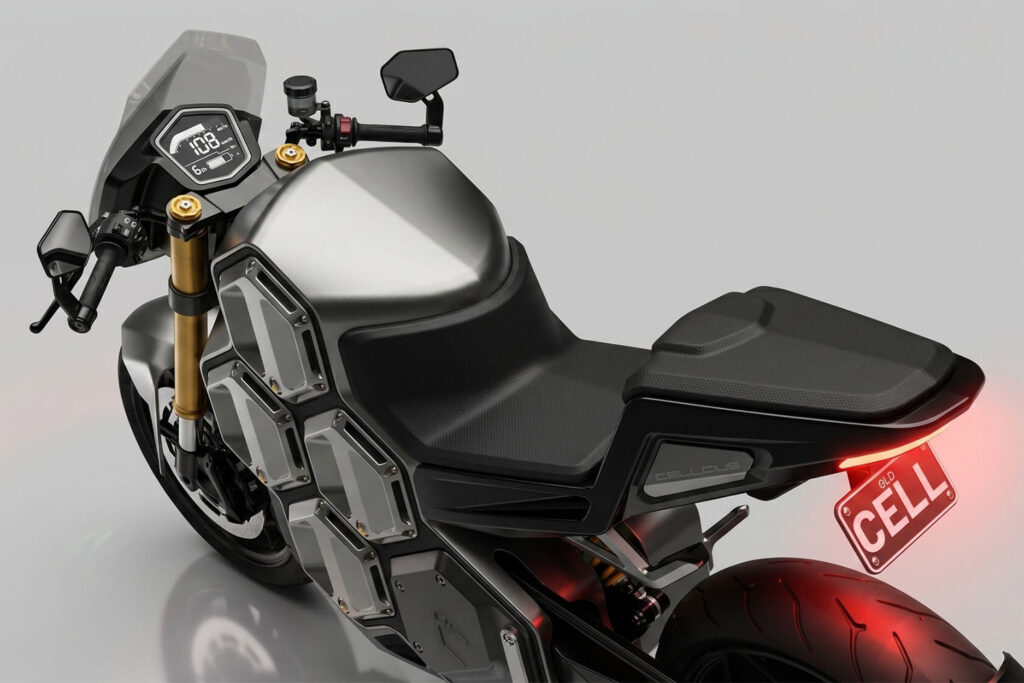
With two cells fitted, the studio quotes a weight of 160 kg, which positions the bike as a light urban machine. With all eight installed, it goes up to 220 kg for longer rides or track use. Those figures put each cell at roughly 10 kg.
The designers present this as their answer to a familiar trade-off in electric motorcycles: big batteries bring range but add weight, small batteries keep the bike light but limit how far it goes. Here the rider adjusts the balance from day to day.
Empty bays become storage
Cell slots that are not in use double as mounting points for hexagonal luggage, so the bike can carry bags without side cases. Removed cells are not dead weight either. Each one has AC and USB outlets and can be used as a portable power station, a vehicle-to-load function aimed at camping and off-grid use.
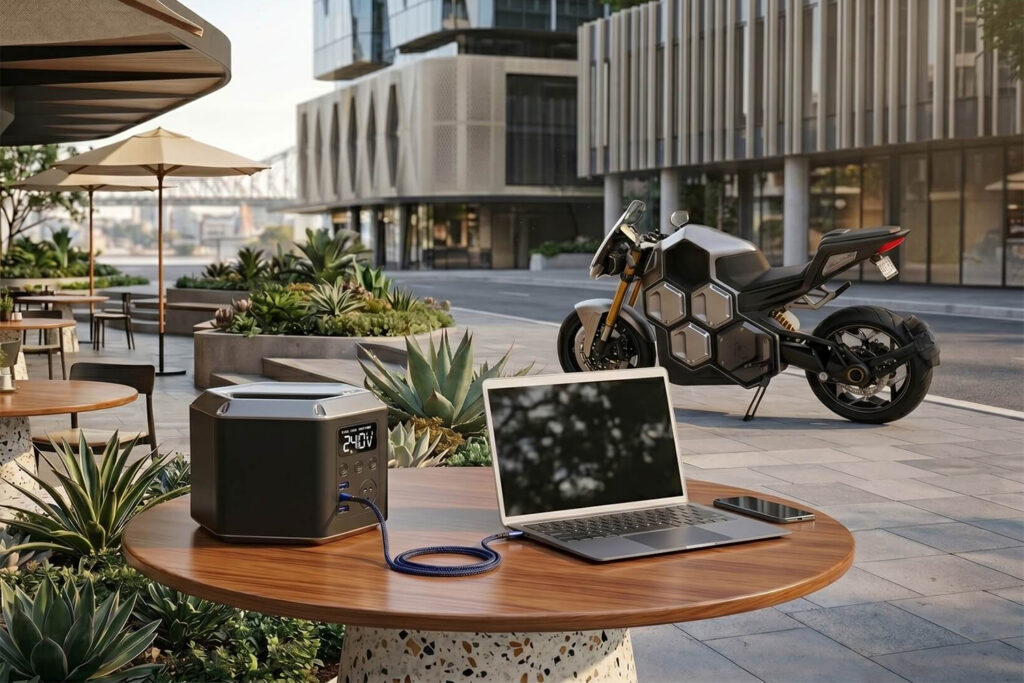
Charging without a garage
Clandestine Design Group designed the concept with apartment dwellers in mind. Cells can be carried indoors in a dedicated backpack and charged from a regular wall socket. For riders with a garage, a wall-mounted dock charges several cells at once so a fresh set is ready to swap in. On the road, a CCS fast-charging port is integrated flush into the top of the tank.
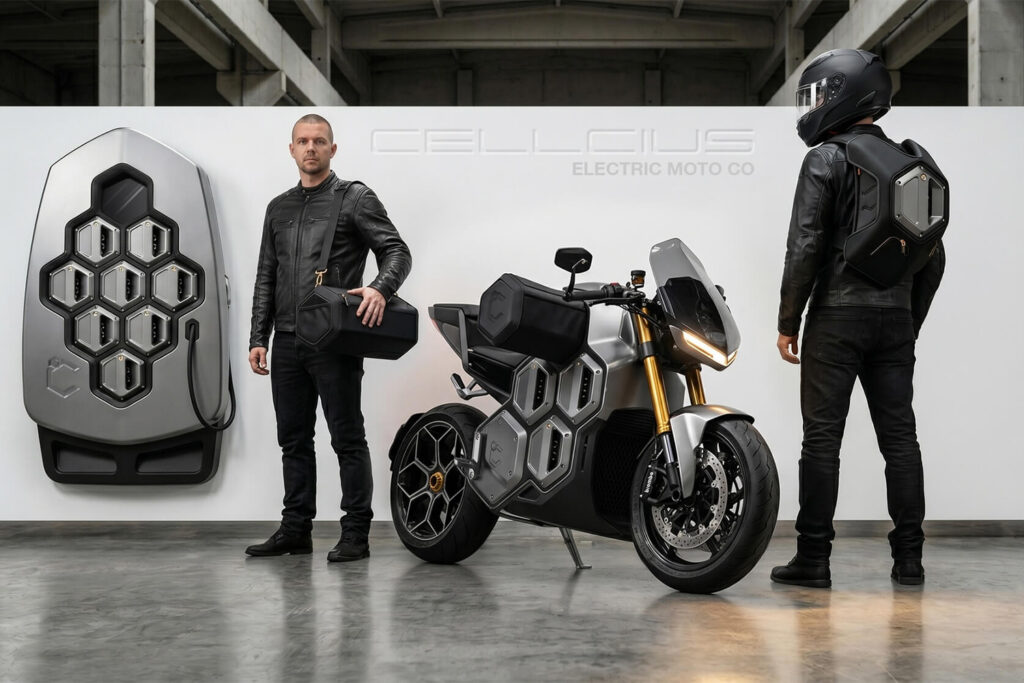
Chassis and hardware
Instead of a chain or hub motor, the C-01 uses an enclosed carbon shaft drive, which the studio describes as silent and maintenance-free with low unsprung weight. Cooling relies on airflow rather than fans or a heavy liquid system: intakes at the front and a low-pressure tail section are designed to pull hot air through the chassis at speed.
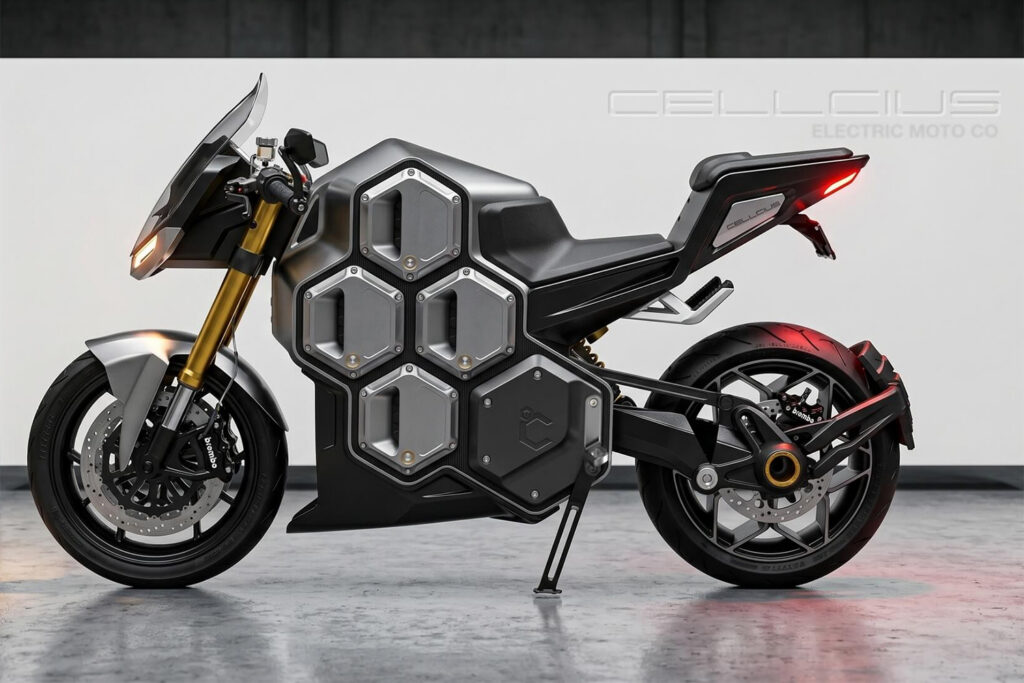
The concept specifies Brembo racing brakes and fully adjustable Öhlins suspension. Lighting includes switchback daytime running lights and a segmented rear LED that handles signalling without separate indicator stalks. A 5G-connected app covers keyless RFID or PIN entry, over-the-air updates and firmware tuning that adapts to the number of cells fitted.
What's next
For now, the C-01 exists as renders and an award-winning design study. Swappable batteries are not new in the light electric segment, but applying a scalable cell system to a hypersport motorcycle is a different proposition, and questions around cell weight, connector durability and real-world performance would only be answered by a working prototype. THE PACK will follow up if Clandestine Design Group moves the project beyond the concept stage.
Images: © Clandestine Design Group
Sources: Good Design Awards - Cellcius C-01
After three years of development, Belgian manufacturer Trevor Motorcycles has handed over the first series-production DTRe Vince Track & Trail to a customer. The electric scrambler is priced at €11,995 including VAT, with the base DTRe Vince starting at €9,995.
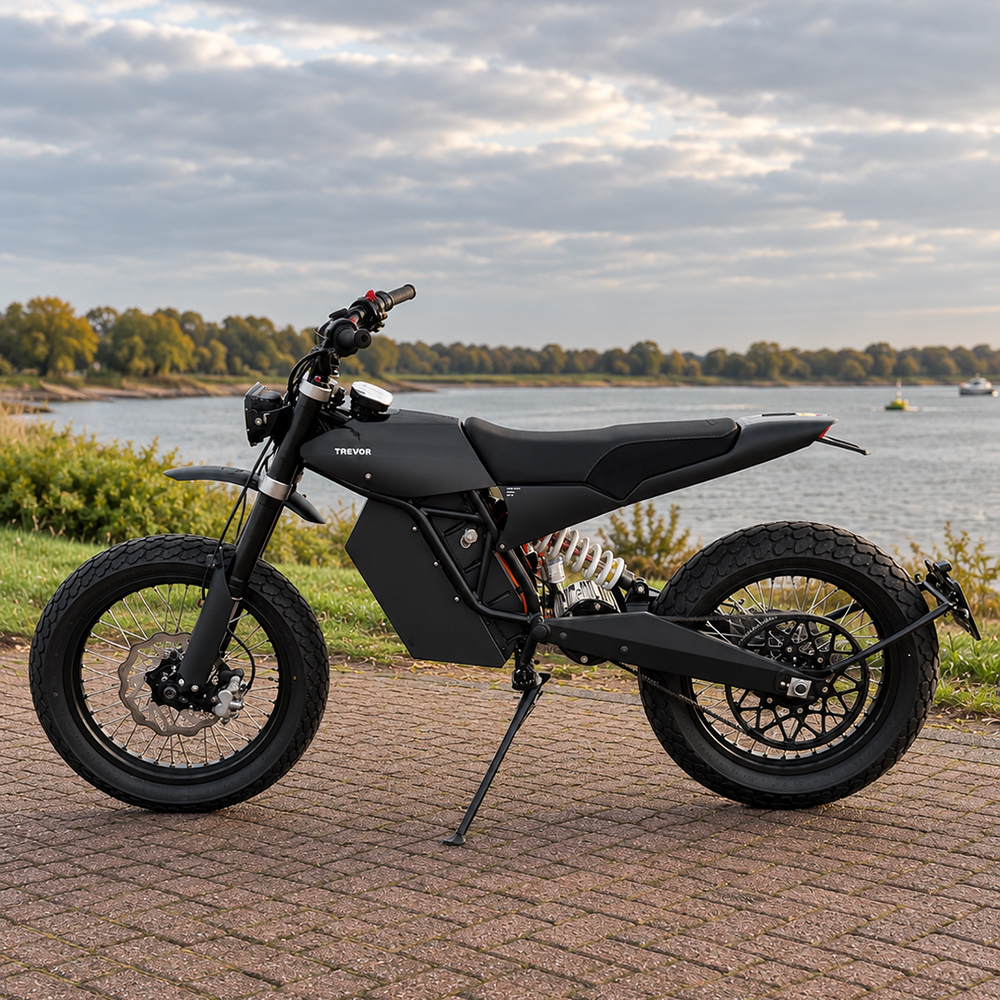
The milestone closes a development programme that began when Trevor announced the DTRe Vince in October 2023. At the time, the plan was to offer a more accessible alternative to the existing DTRe Stella. Along the way, the project turned into an almost entirely new electric motorcycle.
More than an updateThe Stella, whose powertrain was developed by fellow Belgian company Saroléa, shaped many of the technical decisions behind the Vince. The new model gets a completely revised electric powertrain, developed together with Danish specialist eRacing. It also has a new frame with revised geometry, a new steel swingarm and a reworked weight distribution.
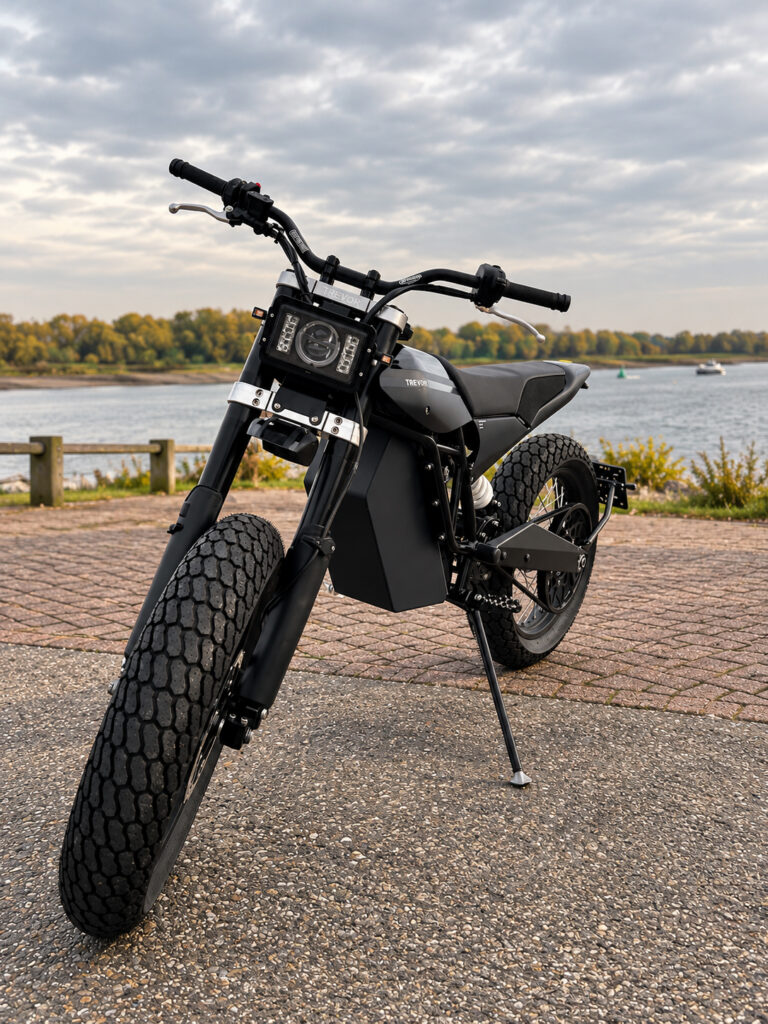
In Track & Trail form, the Vince uses an electric motor rated at 11 kW nominal and 22 kW peak. The 5.0 kWh battery gives a practical range of around 100 km, according to Trevor, depending on riding style and conditions. Final drive is by Gates belt.
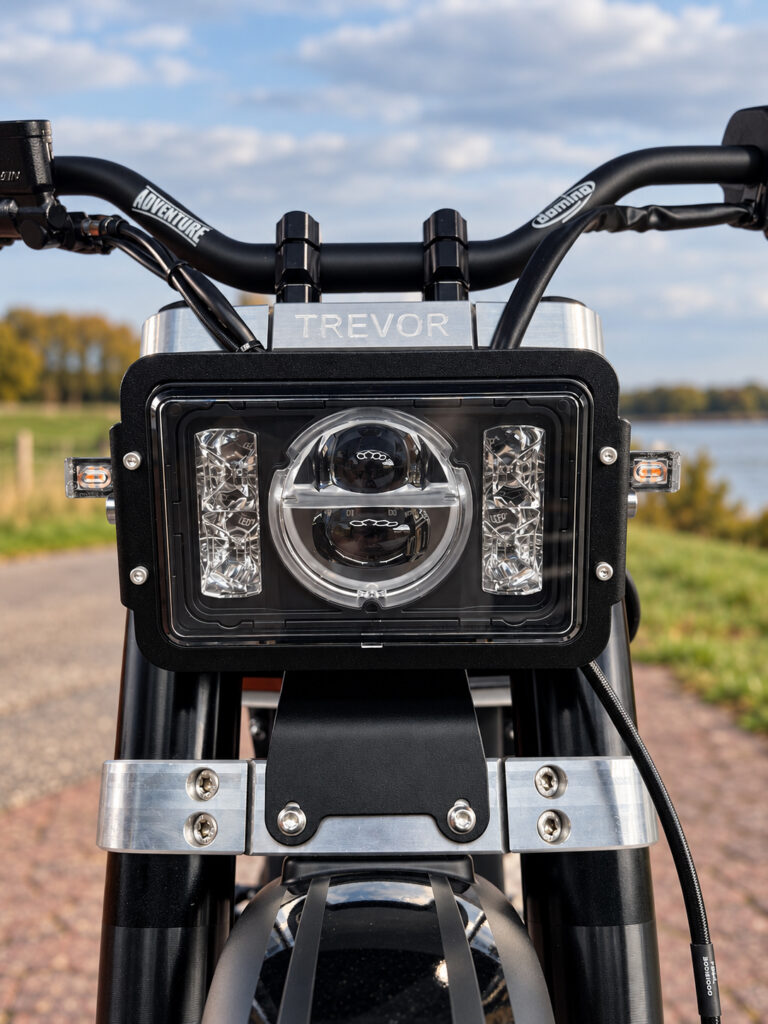
Development on a smaller budgetVisually, the Vince keeps the minimalist flat-track and scrambler styling Trevor has been known for since its launch.
Trevor says the Vince was developed with a far leaner structure than its predecessor. According to co-founder and director Jeroen-vincent Nagels, total development costs came to roughly a third of those of the Stella.
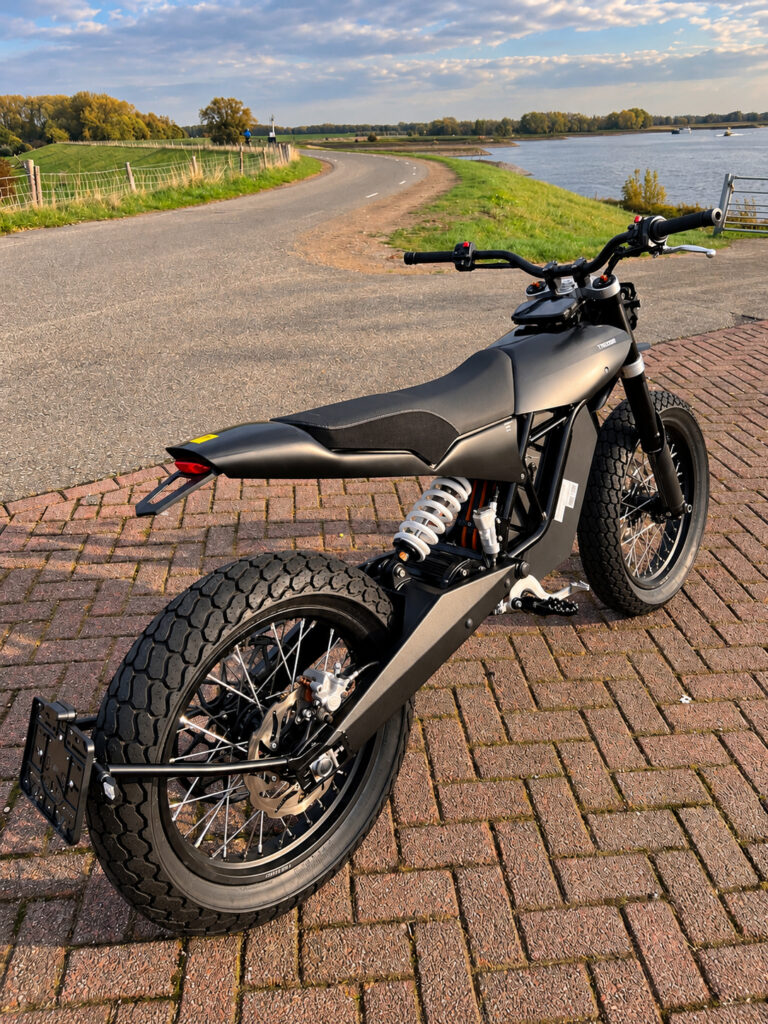
The first prototype was built by Nagels and former Belgian motocross champion Alain Maris, based on drawings by Nagels and Philippe Stella. Further development was mainly carried out by Nagels and Dutch chassis and engineering specialist Wido Veldkamp, supported by specialist suppliers, most of them European.
"Three years of development sounds like a long time, and of course we would have liked to get here sooner," Nagels said. "But big manufacturers often work for years behind the scenes before they present a new model. We did a large part of that work after the announcement, with a very small organisation and limited resources."
Trevor sees the result not only as a new model, but also as a technical base for future development.
 Focus on handling
With the Vince, Trevor Motorcycles puts the emphasis on how the bike rides rather than on outright power or top speed. The revised chassis geometry, a lower and more centrally placed battery and the adjusted weight distribution are intended to make the bike agile and predictable on both tarmac and unpaved roads.
Nagels, who has a long background in the motorcycle industry, is outspoken about the result. "By now I've ridden just about every competing electric motorcycle, and I can say without hesitation that, as far as I'm concerned, the Vince is the best-riding motorcycle in its class. Not because it has the most horsepower, but because of the overall package and especially the way it rides."
 From development to production
The first DTRe Vince Track & Trail left the production line in Gendt, the Netherlands, on 26 October and was delivered to its new owner. For Trevor, the focus now shifts from development to production, quality control and reliable delivery.
"Today we're no longer delivering a prototype or a promise, but a finished motorcycle to a customer," said Nagels. "We built a completely new product with very limited resources, and we can be proud of that. The next challenge is to show that we can repeat this process consistently and profitably."
Trevor DTRe Vince Track & Trail specifications:
- Type: electric scrambler / Track & Trail
- Nominal power: 11 kW
- Peak power: 22 kW
- Battery capacity: 5.0 kWh
- Practical range: approx. 100 km
- Final drive: Gates belt
- Front suspension: 43 mm upside-down fork
- Wheels: 19 inch front and rear
- Chassis: steel frame and swingarm
- Price: €11,995 incl. VAT (base DTRe Vince from €9,995)
- Production: small-scale European production
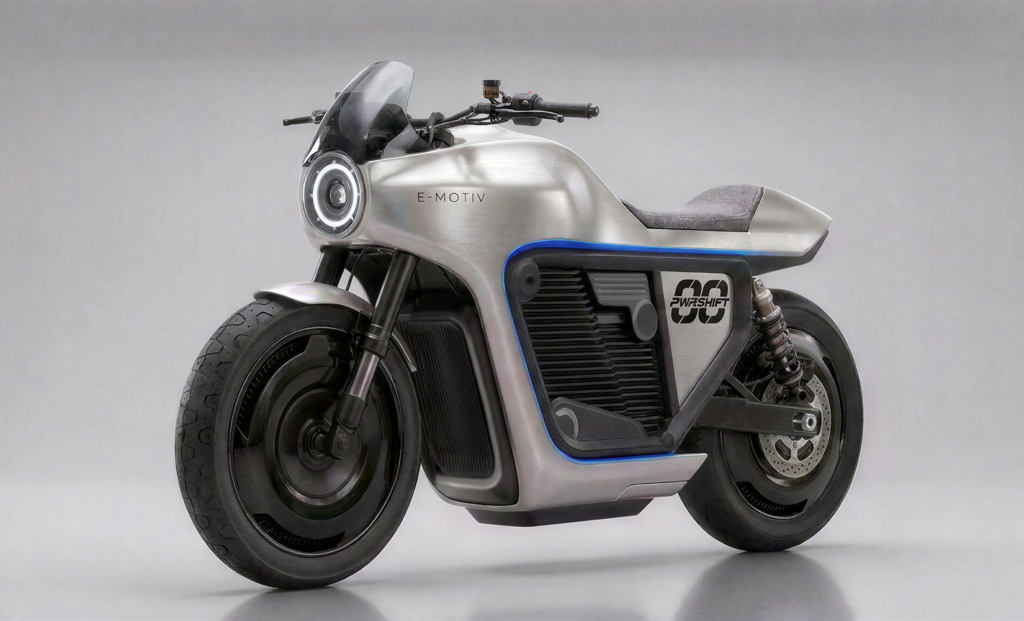
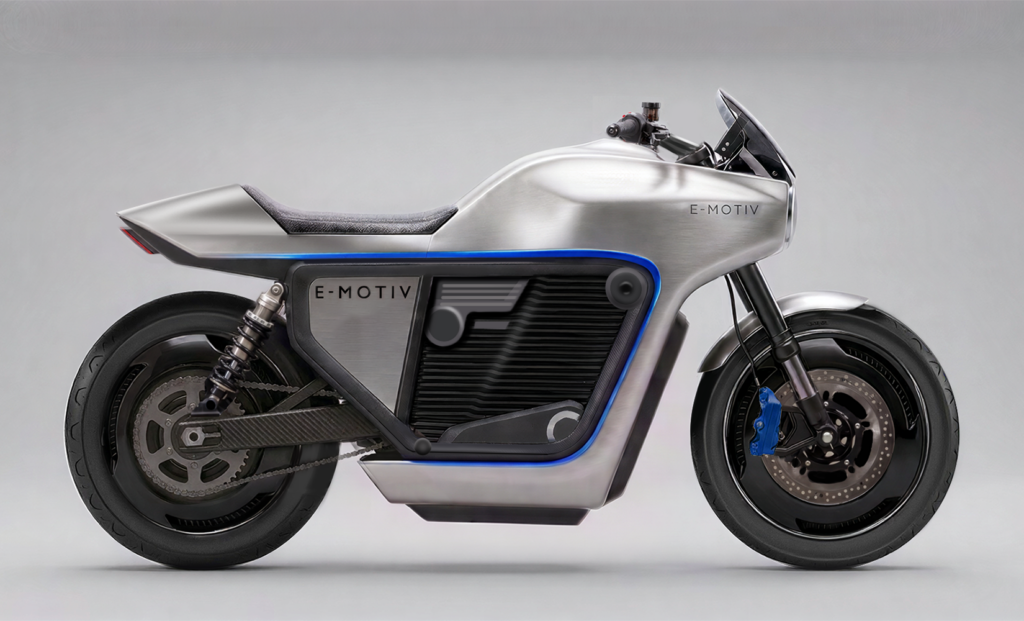
British transmission specialist E-Motiv Shift Systems will show its two-speed seamless powershift transmission for electric motorcycles at EICMA in Milan, 3 to 8 November. A demonstrator bike is being built and will start road testing in early 2027.
Why gears on an electric motorcycle
Most electric motorcycles run a single fixed ratio. That choice is a compromise between strong pull from a standstill and a usable top speed. A second ratio removes part of that compromise, but a conventional gear change briefly interrupts drive. E-Motiv says its system keeps torque flowing to the rear wheel during the shift. According to the company, this can mean stronger acceleration and better powertrain efficiency.
The system also lets manufacturers set how the shift feels. Shift character can be tuned to the type of use and the market a bike is aimed at, from smooth and barely noticeable to more direct.
Roots in MotoGP
The technology grows out of the Zeroshift seamless selector gearing developed for combustion engines about 25 years ago. Aprilia Racing has used that first-generation system in its RS-GP MotoGP bike since 2015. E-Motiv credits it with contributing to more than 30 podium finishes for the team, including a 1-2-3 at the Silverstone Grand Prix in July 2026.
The electric version is a separate development, designed by E-Motiv specifically for light electric vehicles.
BSA, Bath and IAAPS involved
The EV transmission was validated through a £1 million project funded under Innovate UK's Design and Build programme. E-Motiv worked with motorcycle manufacturer BSA, the University of Bath and IAAPS, the Institute of Advanced Automotive Propulsion Systems.
Demonstrator bike in 2027
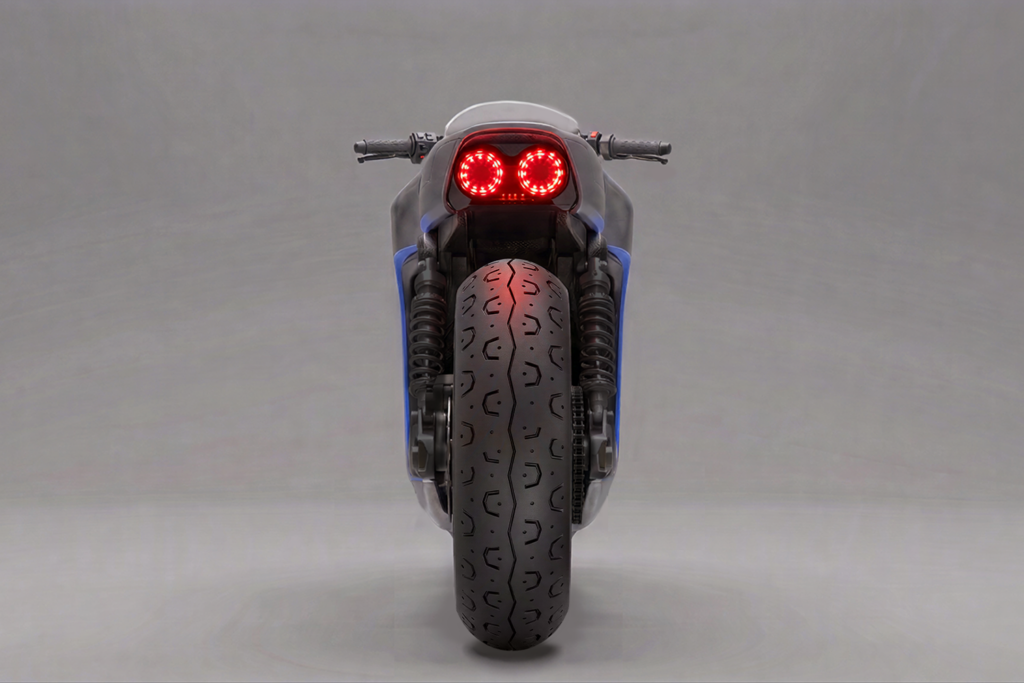
A demonstrator called Demo 1 was conceived by British design consultancy Envisage. IAAPS is building it at its £77 million, 11,300 m² research facility in the UK. Real-world testing is scheduled to begin in the first quarter of 2027.
Tony Inchbold, Managing Director and Co-Founder of E-Motiv Shift Systems, describes the product as a transmission and control technology for vehicles where more than one ratio adds value. He says the compact design maintains drive through the ratio change and gives engineers more room to optimise the powertrain and tune the shift.
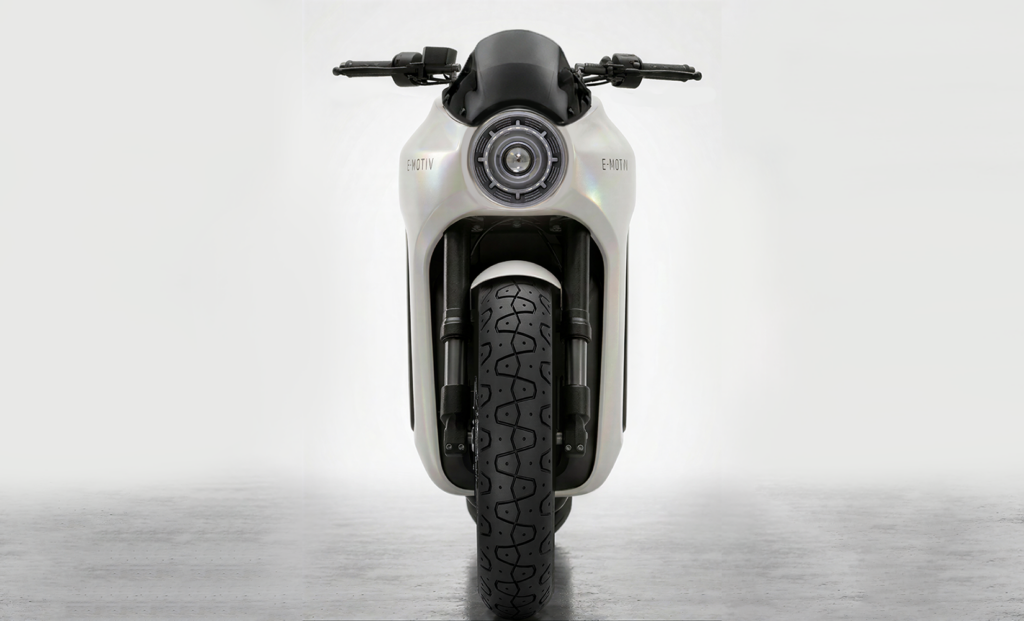
E-Motiv Shift Systems is in Hall 9, Stand S79 at EICMA 2026.
E-MOTIV SHIFT SYSTEMS >B2B News | A new Swedish manufacturer has entered the electric light vehicle market. ReBake Motors, based in Stockholm, officially introduced its brand on 26 October 2026, with plans to develop a range of electric vehicles and mobile cargo tools aimed at urban transport of people and goods.
 A company built on industry experience
ReBake is led by Founder and CEO Karl Ytterborn, who brings more than ten years of experience in the electric vehicle sector. According to Ytterborn, that period covered both the high points of the industry and its sharp downturns, giving the team direct exposure to the difficulties manufacturers in this segment have faced.
The company says it has used that background to reconsider the full vehicle lifecycle, from design and production through to the ownership experience. Its stated aim is to lower the barriers for people and businesses considering a switch to electric transport.
Ytterborn also outlined a long-term ambition for the brand, saying he wants ReBake to still exist a century from now and to have contributed to electric transport becoming a routine option in European cities.
Focus on urban cargoReBake positions its products as robust electric vehicles and mobile cargo tools, designed and engineered in Stockholm around practical, everyday use. The company targets the evolving ways goods and people move through cities, a segment where light electric cargo vehicles are increasingly used for last-mile logistics, trades and service operations.
The brand states that accessibility is a core part of its plan, with the goal of making high-quality electric mobility available to a broader range of users.
Full reveal on 3 NovemberNo model names, specifications, pricing or production details have been released so far. ReBake says its model range, website and complete product information will be presented on 3 November 2026.
THE PACK will follow up with details of the ReBake line-up once the information becomes available.
While I was busy with electric mobility projects closer to home in the Benelux, the news did not stand still. Fortunately, our German media partner SteckerBiker / THE PACK News kept a close eye on it. A sincere thank you to Remo Klawitter, Paddy Lectric for following the market so closely and digging into the stories behind the headlines. Below are short overviews of six of their latest articles. The full versions, in German, are on SteckerBiker.
E.F.O EM11: an Austrian cruiser with Chinese roots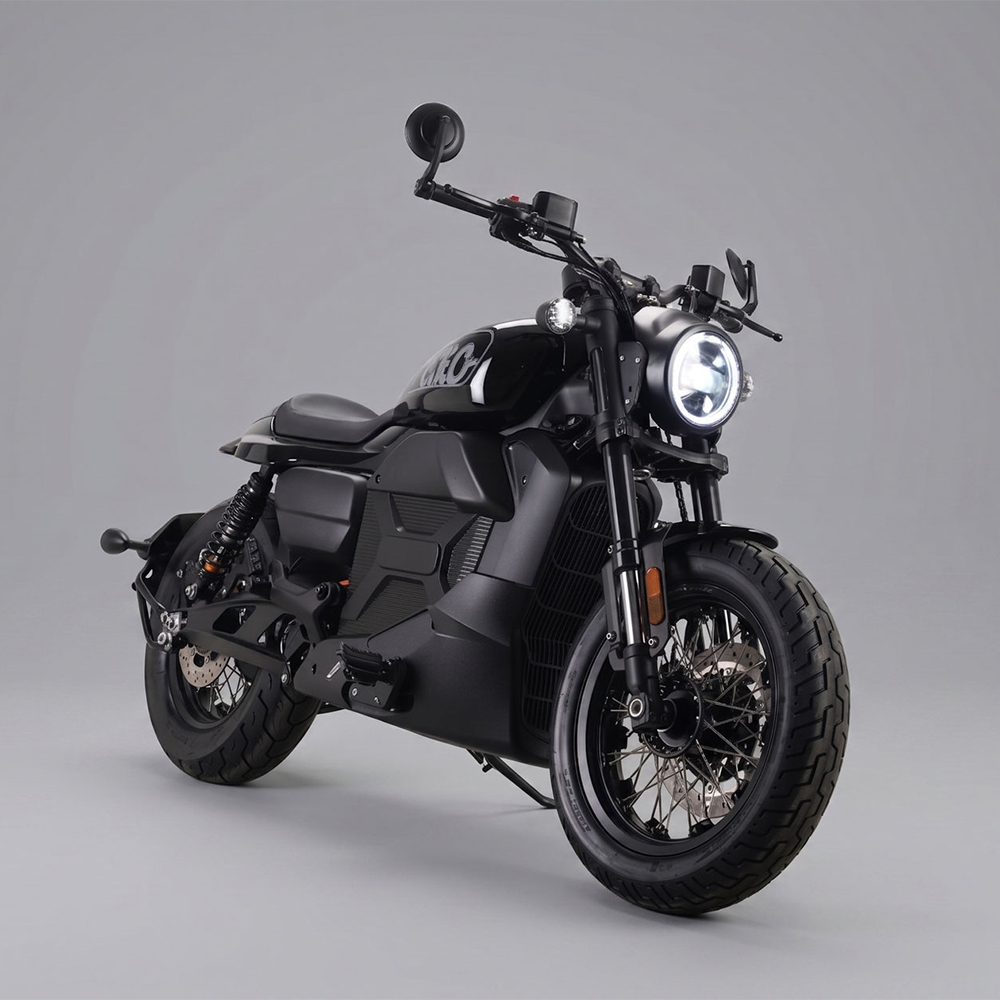
Austrian brand E.F.O is expanding its motorcycle range with the EM11, an electric cruiser with classic styling. Compared with what came before, it promises more range, a new drive system and shorter charging times. E.F.O stands for Elektro Fahrzeuge Oberhauser and is run by Oberhauser Handels GmbH in Koblach, Austria. The company imports and sells electric scooters and motorcycles, including the EM8 and EM11 cruisers. Remo Klawitter traced the bikes back to China. Both models appear to be based on the JSQ1, built by Jiangsu Hi-Tech Golden Lion Vehicle Industry in Changzhou. According to the company, Golden Lion has existed since 1994 and also produces electric scooters and other two-wheelers.
MORE AT STECKERBIKER > QJMOTOR teases the OAO MAX electric sports bike ahead of EICMA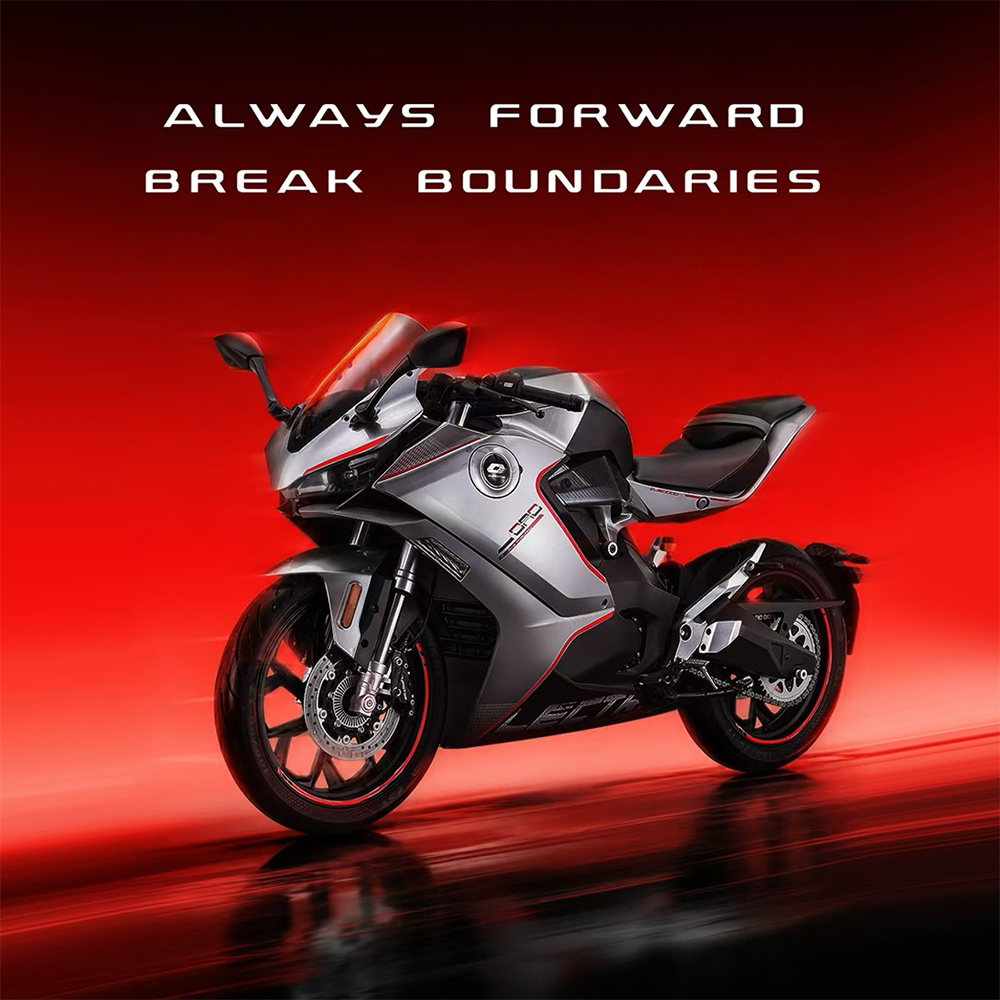
QJMOTOR will present a new electric sports motorcycle, the OAO MAX, at EICMA 2026 in Milan in early November. The first details are a mid-mounted motor, a belt drive and a range of up to 170 kilometres. QJMOTOR is the brand of Chinese manufacturer Qianjiang Motorcycle. The company's history goes back to 1985, it acquired Benelli in 2005, and it has been part of the Geely group since 2016. Its range covers nearly every segment, from 125cc machines up to the SRK 921 RR. It has raced in Moto3 and Moto2 and now runs a factory team in the Supersport World Championship. Electric two-wheelers are not new for QJMOTOR either. It showed the original OAO electric sports bike in 2023 and also sells the OMO electric scooter series.
MORE AT STECKERBIKER > Antic Bikes: an electric minibike from the makers of Onewheel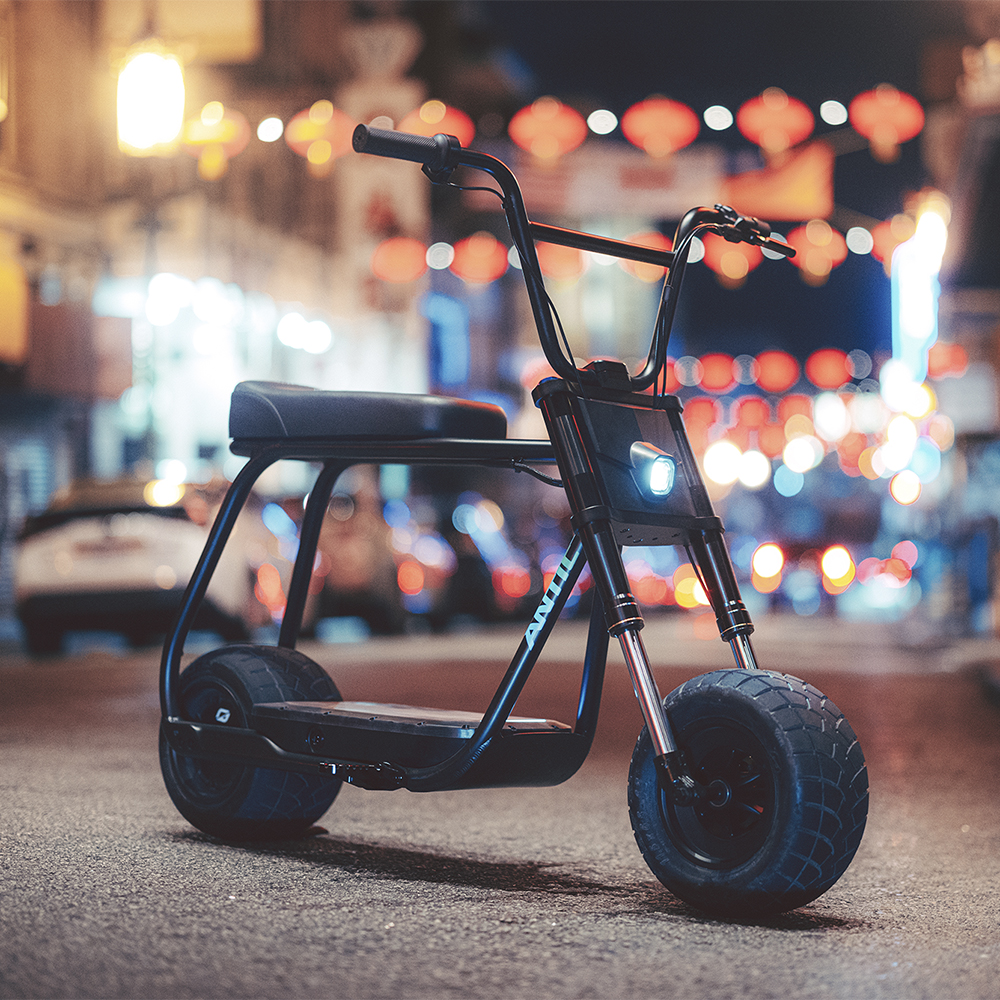
Future Motion, the Californian company behind the Onewheel, has launched an electric minibike under the Antic Bikes name. It has a minimalist tubular frame inspired by 1970s fun bikes, and it includes a wheelie mode. Engineer Kyle Doerksen founded Future Motion in 2013, and the company became known for its self-balancing single-wheel Onewheel boards, launched in 2014. It employs around 110 people, has its headquarters in Santa Cruz, and develops and builds its products in San Jose. Antic started as a workshop side project, combining Onewheel motors, batteries and controllers in a home-welded minibike frame. Future Motion officially launched Antic Bikes as a brand in November 2025. No production or sales figures have been published yet.
MORE AT STECKERBIKER > Electric two-wheelers in Germany, Q3 2026: growth from the bottom up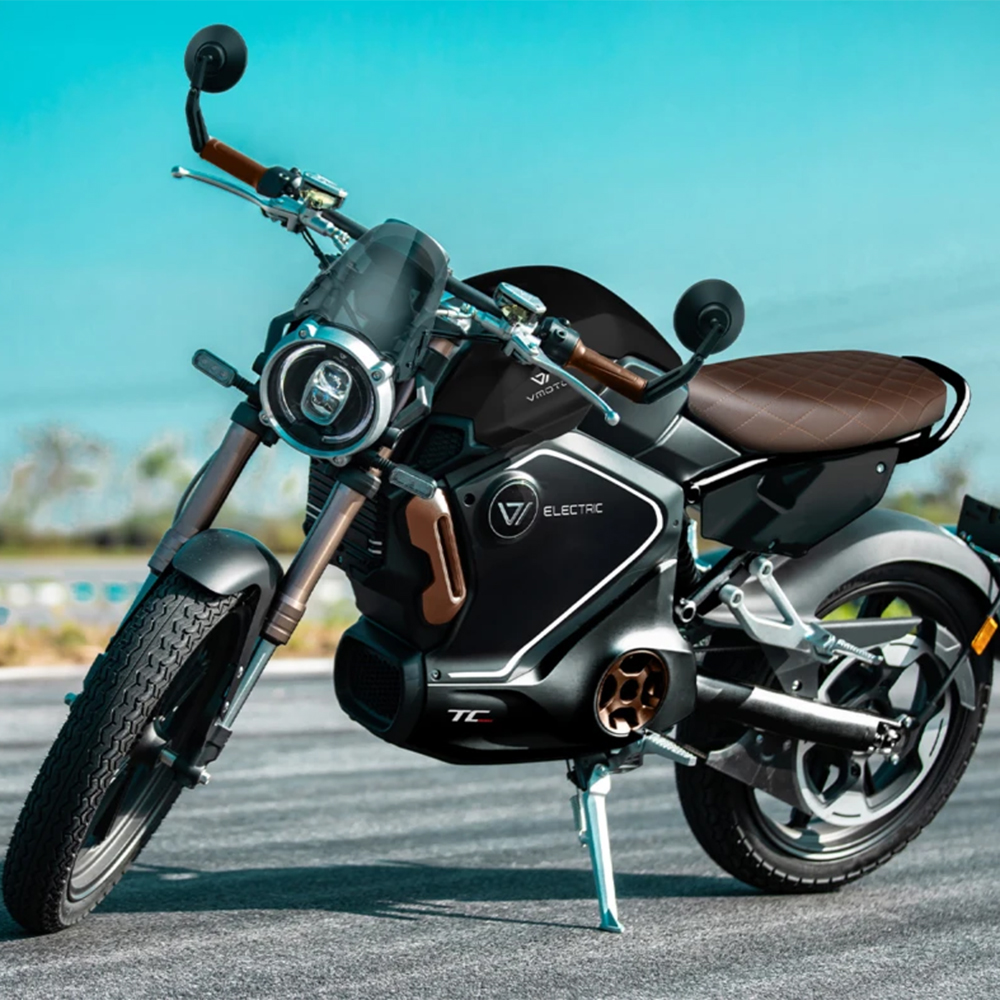
Paddy Lectric analysed the German registration figures for the first three quarters of 2026, using reports from the Industrieverband Motorrad (IVM). Electric motorcycles and scooters are growing faster than the overall two-wheeler market, but the picture is uneven. Large electric motorcycles are still struggling for attention. Electric models in the 125cc class, however, are moving into the centre of the market. Stark and NIU remain the leading names, and Honda and Vmoto show that the shift is becoming broader. For context, the article compares this with cars. In Q3 2026, 236,138 battery-electric cars were registered in Germany out of 737,405 new cars, a 32 percent share that rose to 34.5 percent in September. Two-wheelers are still far from those levels, but the IVM data shows progress that is easy to miss next to that gap.
MORE AT STECKERBIKER > Naxeon SC3 and SC5: playing it safe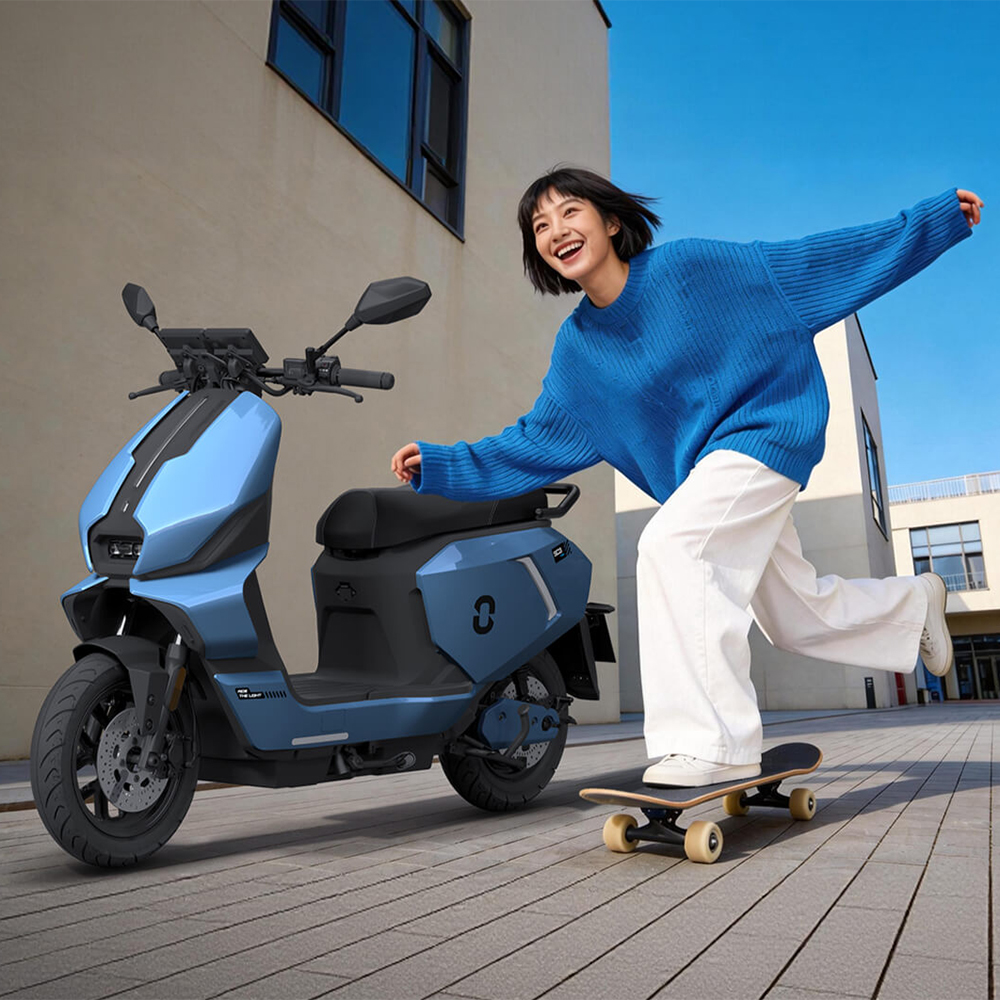
Naxeon, from Chongqing in China, drew attention at EICMA 2023 with the I AM., an electric motorcycle with distinctly futuristic styling. The I AM. and I AM. Pro are now available in Germany, with battery capacities of 4.6 and 6.5 kWh and a long list of digital features. Naxeon's new SC3 and SC5 electric scooters follow a different path. They focus on modern technology and practical solutions, but with a much more conventional look. SteckerBiker asks why a brand that made its name with bold design has now chosen a mainstream one.
MORE AT STECKERBIKER > Furion Taran: rethinking the front wheel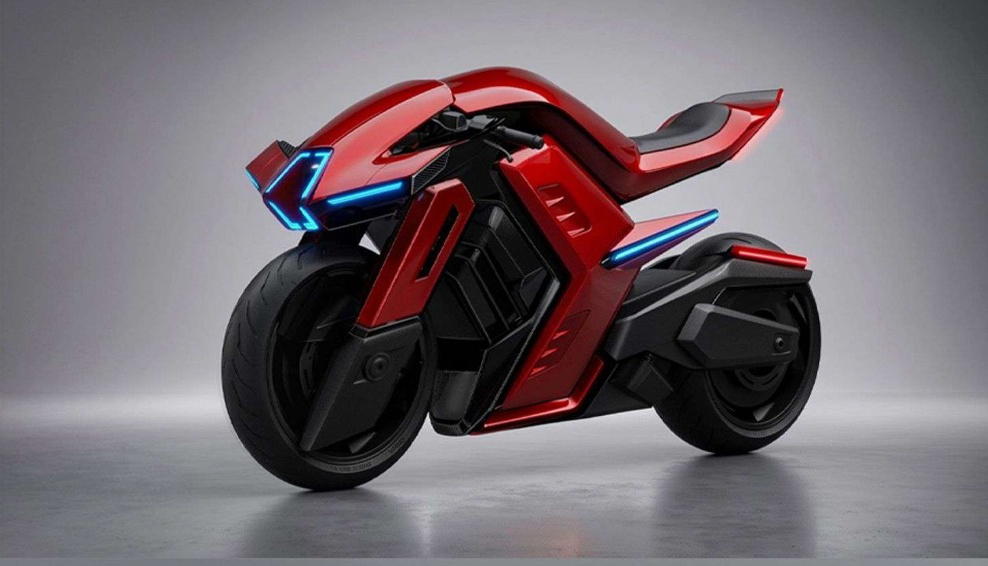
French company Furion presents the Taran, a concept with 326 hp and electric all-wheel drive. Furion was founded by engineer Marc Evenisse in Le Mans. In 2017 it developed the M1, a hybrid that combined a Wankel engine with an electric drive, but it never reached series production. It was followed by the M3, a hybrid concept based on the three-wheeled Yamaha Niken. With the M2, the idea became more concrete. A Yamaha MT-07 keeps its twin-cylinder engine driving the rear wheel, while an electric motor of around 15 kW (20 hp) in the front wheel assists under acceleration and recovers energy when braking. Furion has tested this system, called EVERSOR, on the Alès circuit in southern France. The Taran builds on this front-wheel-drive approach and aims to show that electric motorcycle development still has unexplored options.
MORE AT STECKERBIKER >Graham Jarvis has become the first rider to complete Sea to Sky on an electric motorcycle. The six-time winner of the Turkish hard enduro rode his JARV-E from the Mediterranean shore at Kemer to the summit of Mount Tahtalı, the ancient Olympos, and finished 11th overall in round seven of the 2026 FIM Hard Enduro World Championship.
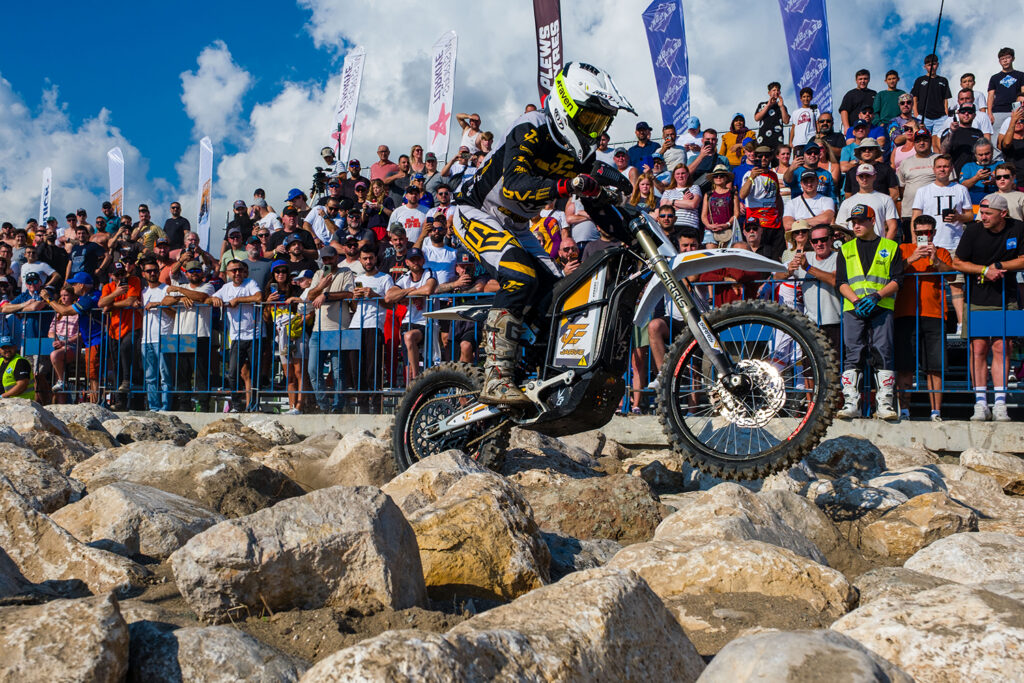 Image: © Doruk Mercan
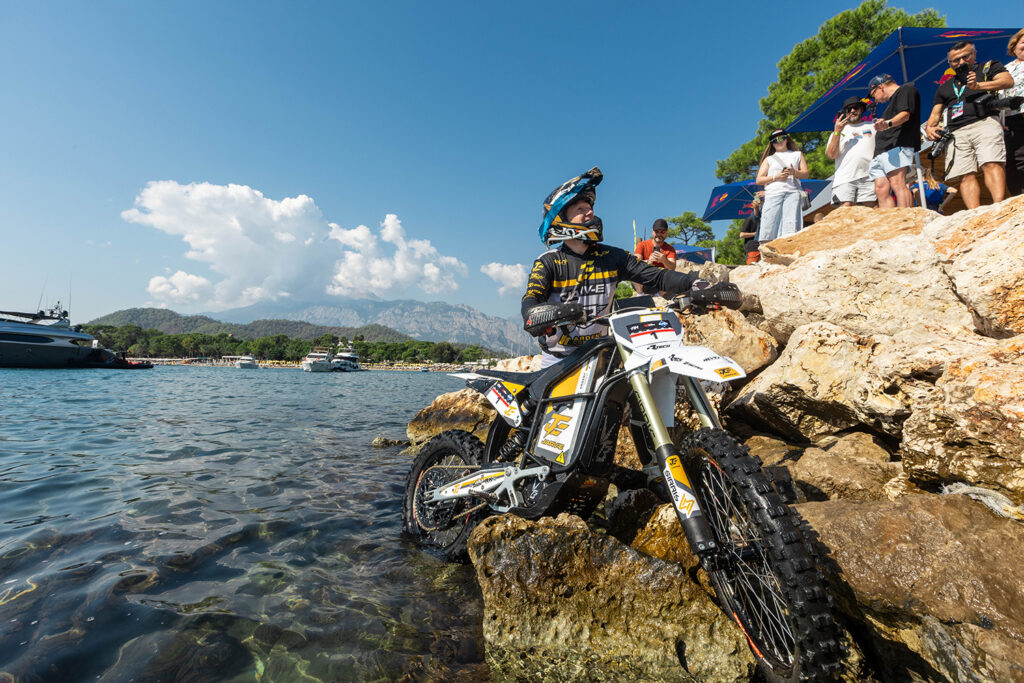 Image: © Türker Güngör
It is the third time this year that Jarvis has taken the JARV-E to the finish of one of the sport's hardest races. In June he finished 10th at the Erzbergrodeo, one of only 15 finishers from around 500 starters. In early August he finished 20th in the Gold class at Red Bull Romaniacs, the first competitor to complete the Romanian rally on an electric motorcycle. Three finishes in three of hard enduro's toughest events show that an electric machine can now go the full distance against combustion bikes in conditions that break many of them.
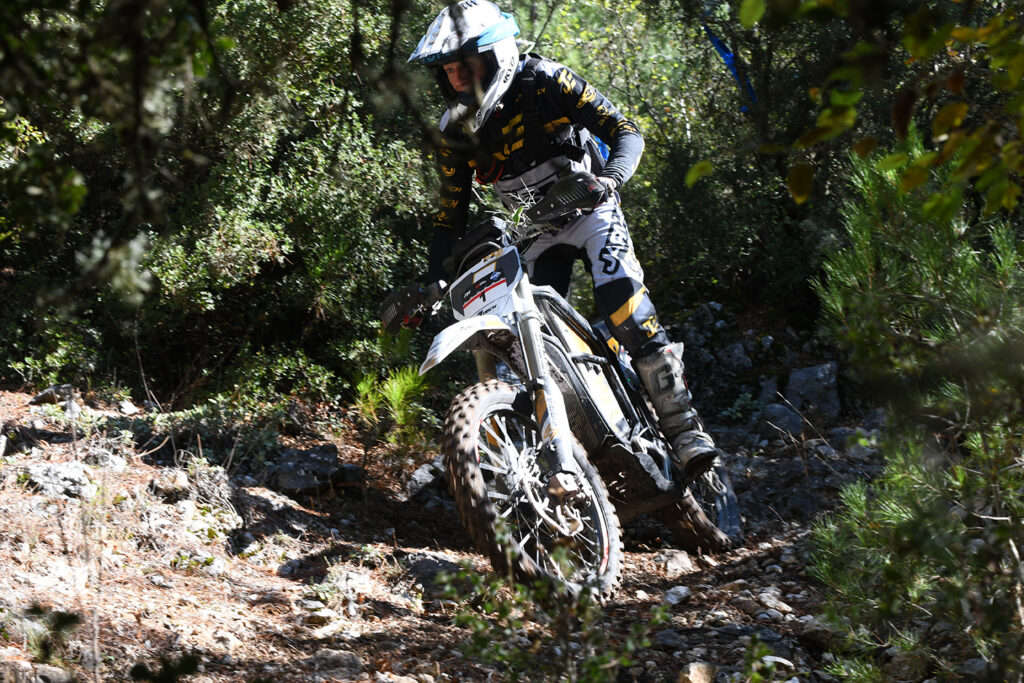 Image: © Thomas Pfister
From the sea to 2,365 metres
Sea to Sky ran from 8 to 10 October in three parts: a Beach Race on the stones of Kindil Beach, a Forest Race on the shepherd and forestry tracks around the village of Ovacık, and the Mountain Race. That last day takes the field about 64 kilometres from sea level to the 2,365-metre summit of Tahtalı, almost all of it uphill, through 16 checkpoints. Heat, rock, steep restarts and hours in the saddle punish both rider and machine.
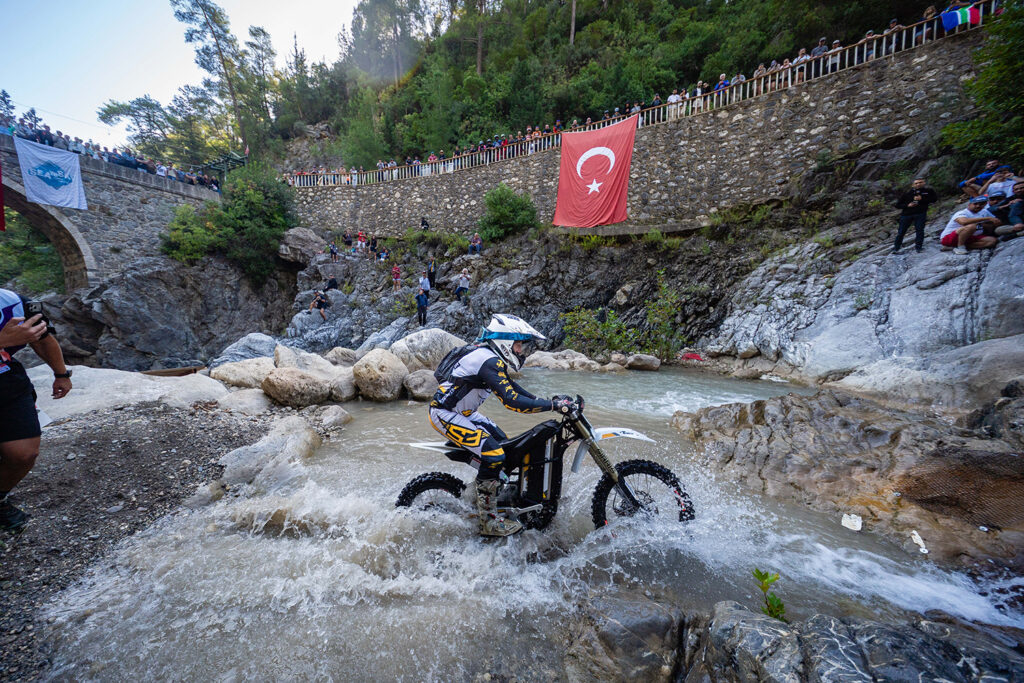 Image: © Murat Tekin
Jarvis placed sixth in the Forest Race. On the mountain he reached the summit in roughly four hours and 46 minutes. He was first classified 12th overall and moved up to 11th after Teodor Kabakchiev was disqualified for outside assistance, a decision Kabakchiev disputes.
The win went to Manuel Lettenbichler, who started 15th after a penalty and came through the field to take his third straight Sea to Sky title. Mario Roman finished second and James Moore third. Lettenbichler leads the championship going into the final round, the Hixpania Hard Enduro in Spain from 23 to 25 October.
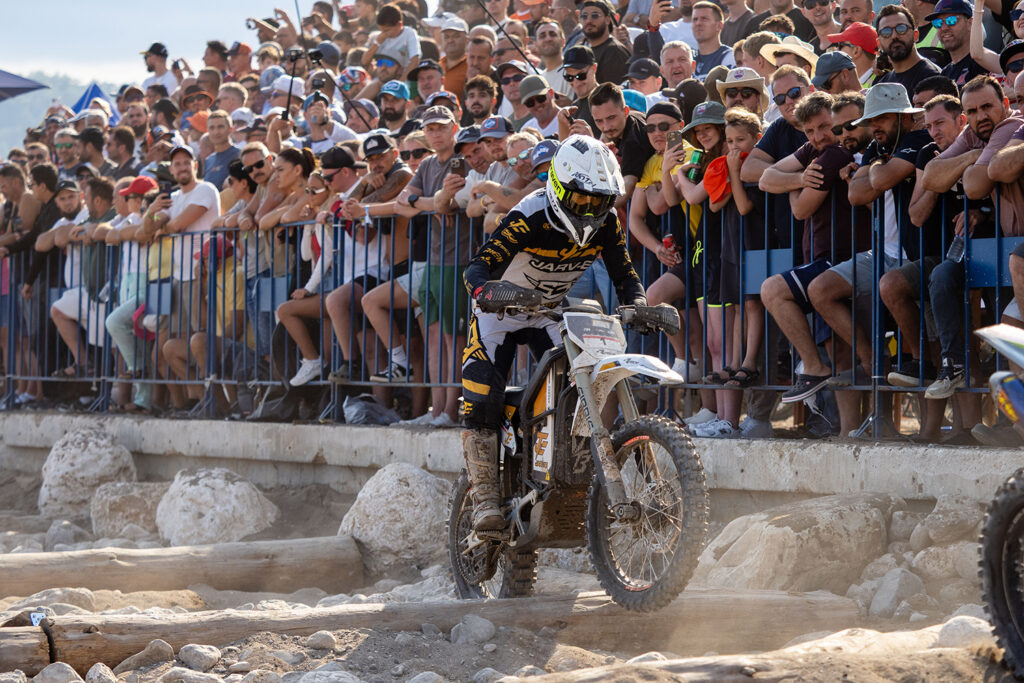 Image: © Alkım Saraç
The JARV-E
Jarvis developed the JARV-E with Austrian chassis specialist David Freidinger, and the bike is built in Austria. It produces up to 50 kW from a 5.6 kWh battery and weighs 95 kg. Its makers describe it as the first electric motorcycle built around true hard enduro and trial-enduro geometry. The claimed maximum run time is up to five hours in the most economical Super Eco mode.
Those numbers put the Mountain Race into perspective. Jarvis's time of about four hours and 46 minutes sits close to that claimed maximum, on a course that climbs for most of its length. Energy management, not only riding skill, was part of the job.
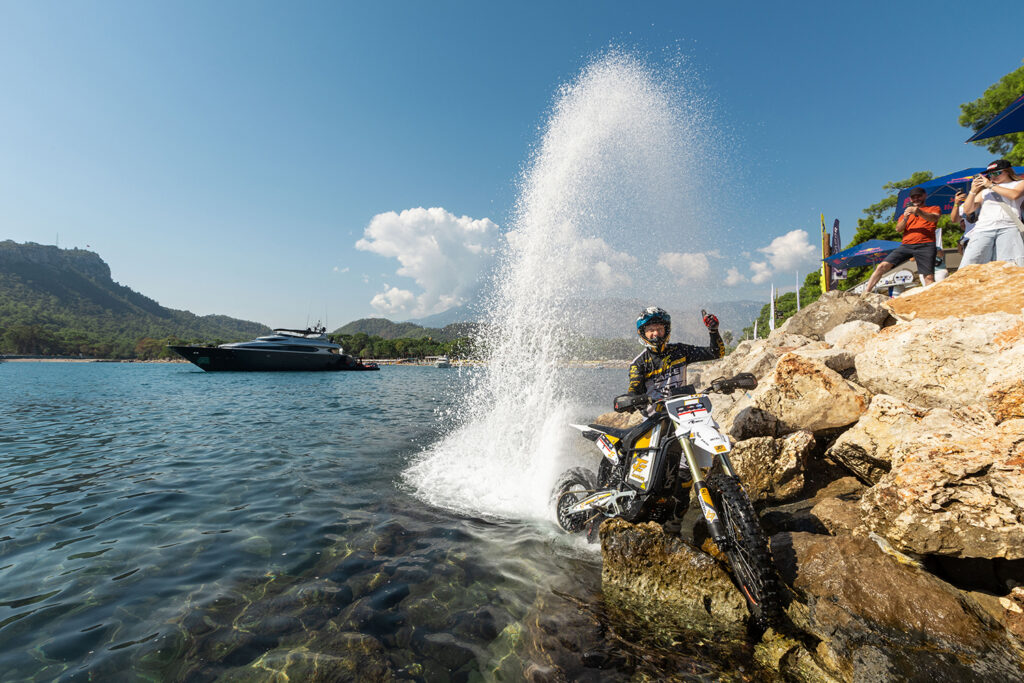 Image: © Türker Güngör
The JARV-E went on pre-order in Europe at the start of 2026, with 100 units planned and production and certification for the US market under way.
Another electric comeback in KemerJarvis was not the only rider climbing Tahtalı on electric power. Further down the field of 329 riders, Svetlana Baranova raced an electric motorcycle in competition for the first time. It was also her comeback race after a Latarjet shoulder operation, a missed season and a rehabilitation that, by her own account, was not yet complete.
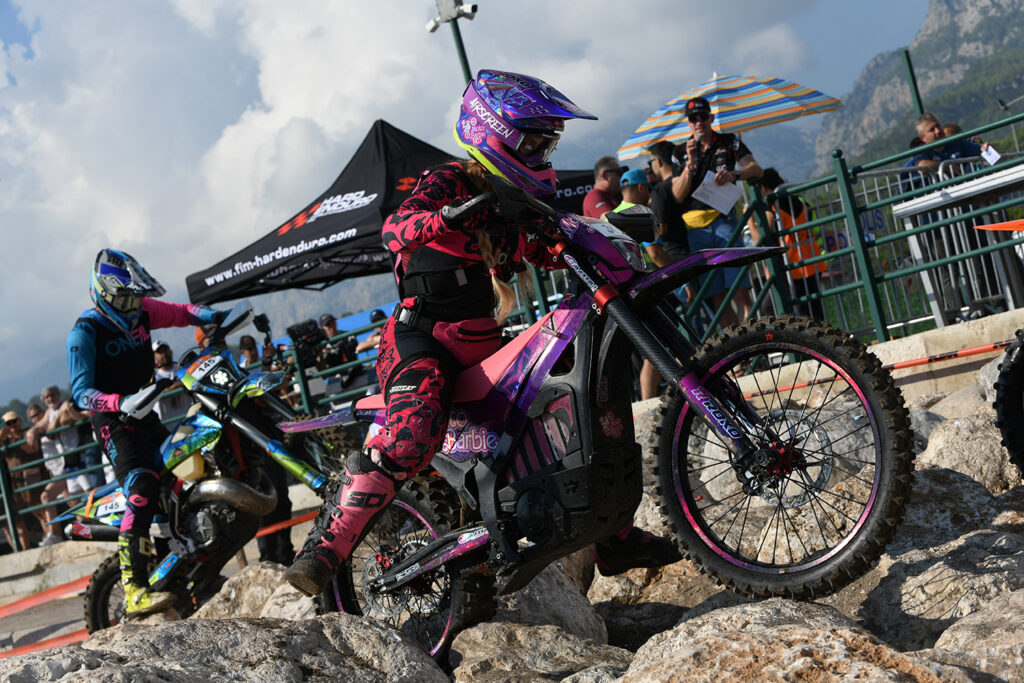 Image: © Thomas Pfister
Baranova, known online as Moto Barbie 115 on Instagram, comes from Yuzhno-Sakhalinsk in Russia's Far East. She started out as an action-sports photographer before switching to the saddle. She became Russian enduro champion in 2017 and in 2024 took bronze in the women's category at a hard enduro world championship round in Türkiye.
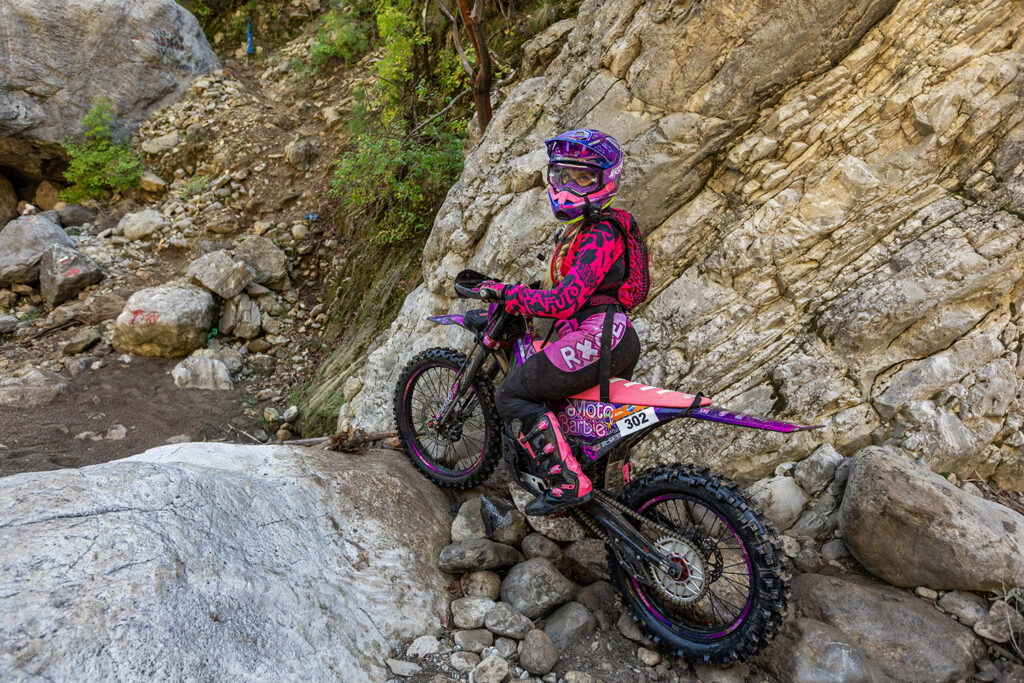 Image: © Türker Güngör
Her results improved as the races grew harder:
RacePositionTimeCheckpoints
Beach (qualification)283rd6:23-
Forest241st4:48:0210 of 10
Mountain193rd6:18:509 of 16
In the forest she rode to a plan: a calm opening pace, no risks, and the queues at bottlenecks used as rest stops. That approach saved both her own strength and the bike's energy for the technical second half. "I caught myself realising that for the first time I rode a race and just loved it," she wrote afterwards. On the mountain she finished inside the seven-hour limit, more than two vertical kilometres above the beach where she started.
What the result saysSea to Sky asks more of a machine in one race than any other round of the championship: sand and stones at sea level, hours of technical forest, and a climb of more than 2,300 metres. The mountain also works against combustion engines, which lose power as the air thins. An electric motor does not depend on oxygen, so the altitude takes nothing from its output.
Range on long events and charging between race days remain open questions for electric hard enduro. But after the Erzbergrodeo in June and Red Bull Romaniacs in August, the JARV-E has now reached the finish of three of the sport's most demanding races in the hands of a top rider.
Source: Original text by Thomas Pfister - Summarized and edited by THE PACK
Photos: © Alkım Saraç | © Murat Tekin | © Doruk Mercan | © Thomas Pfister | © Türker Güngör
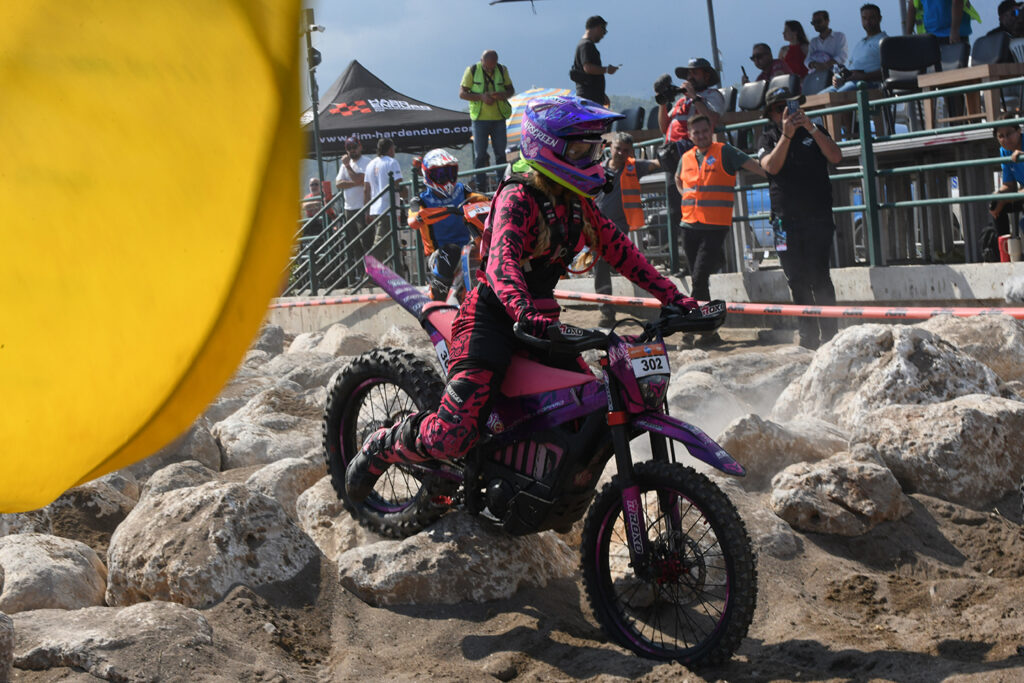
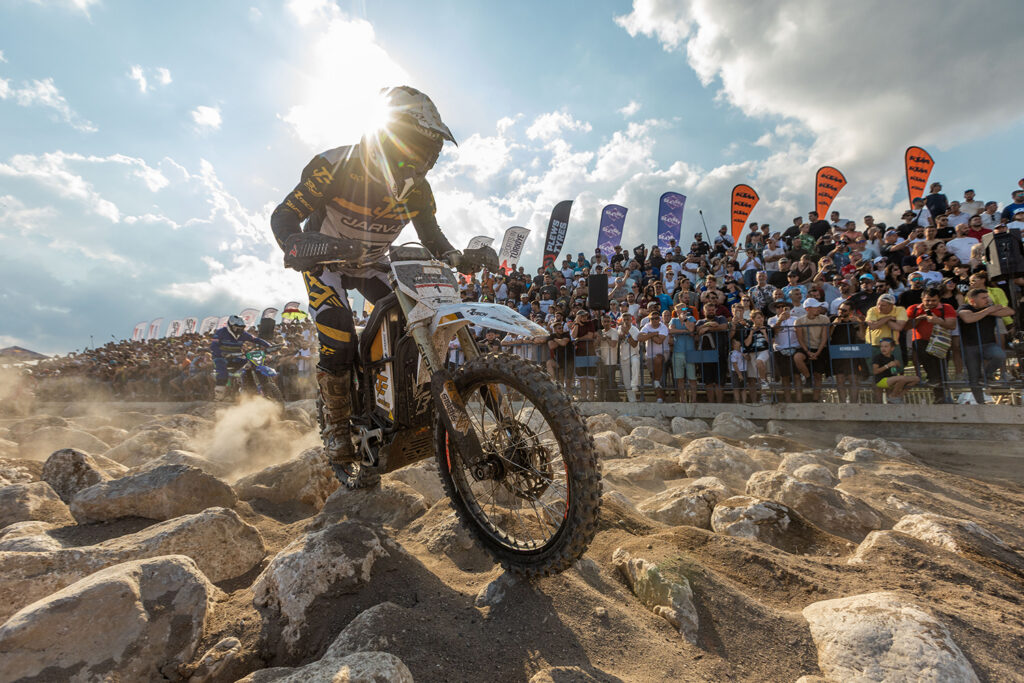
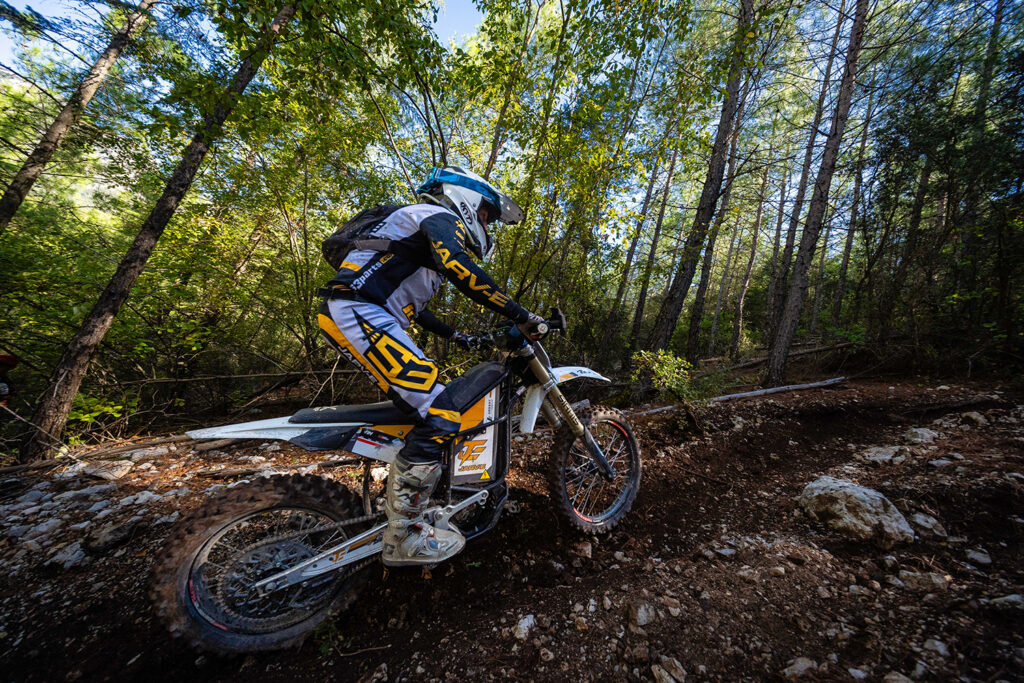
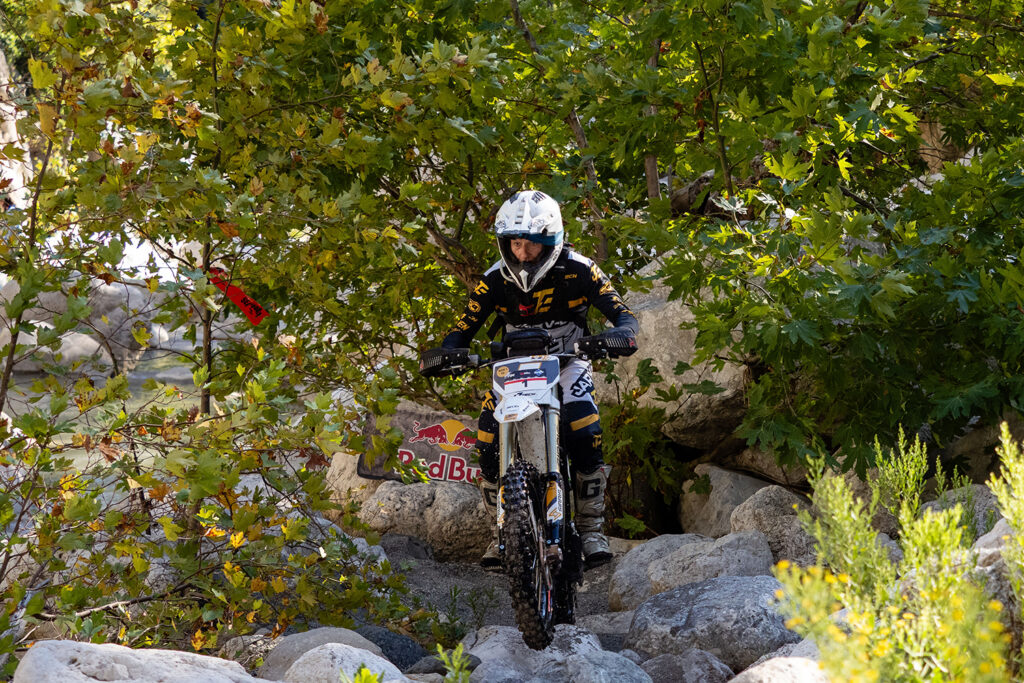
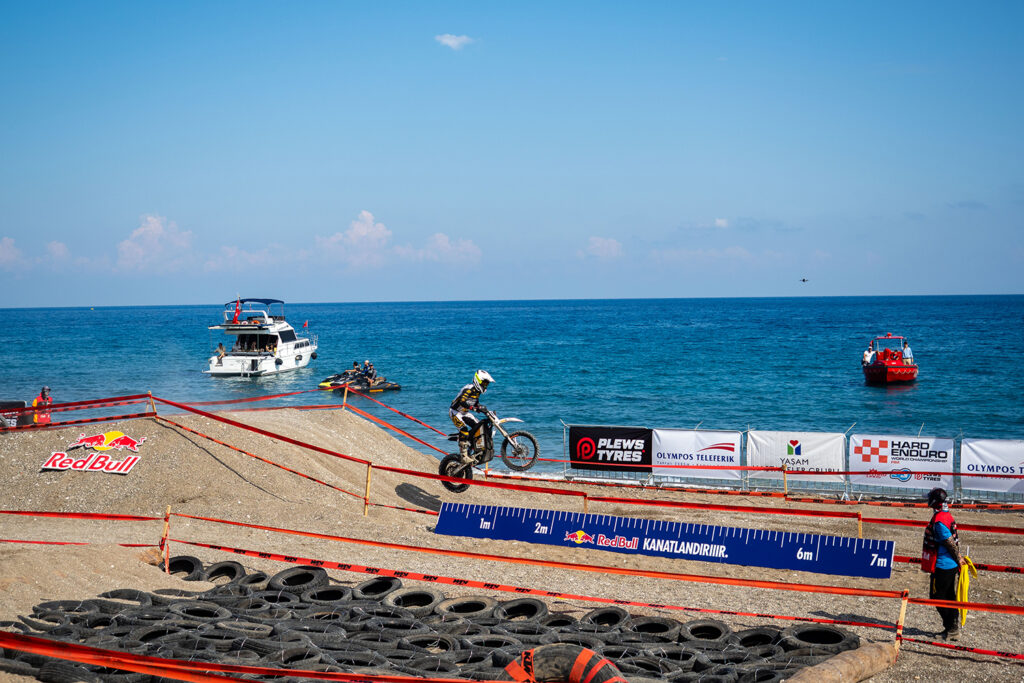
Chinese electric two-wheeler manufacturer Naxeon has posted images of the CC3 on Instagram and Facebook. The scooter does not yet appear on the brand's international or European websites, but it is already on sale in China and available for pre-order in Bangladesh. The two markets show noticeably different versions of the same vehicle.

Positioning
Naxeon sells the CC3 in China as a lifestyle-oriented entry model aimed at younger riders. It sits below the SC3, SC5 and I AM. models in the brand's line-up. The design follows what Naxeon calls "Capsule Cross" styling: rounded body panels, a ring-shaped LED headlight, block-pattern tyres, an exposed rear shock and a short tail section. Two variants are offered, the CC3 and the longer-range CC3 Max.
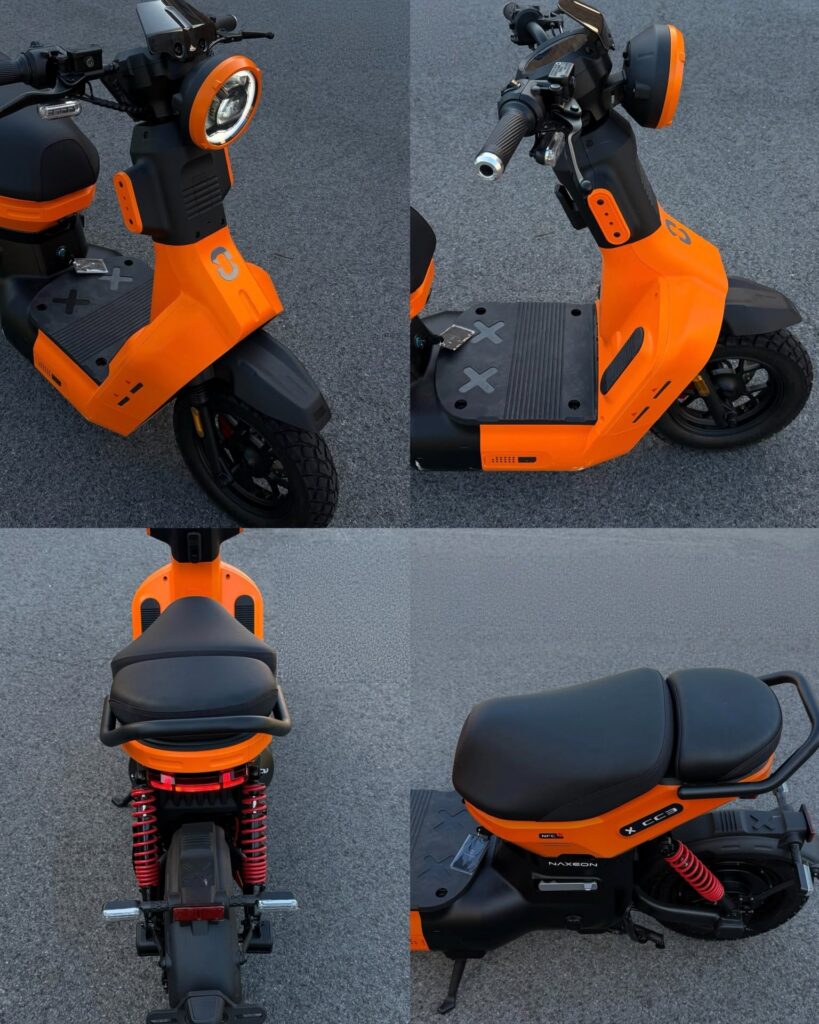
Chassis
The Chinese-market CC3 measures 1,749 mm long, 700 mm wide and 1,103 mm high, with a 1,245 mm wheelbase. Kerb weight is 95 kg and seat height is 750 mm. Naxeon says that suits riders between 155 and 180 cm tall. Ground clearance is 130 mm and there is 14 litres of storage under the seat. The scooter rolls on 3.5-10 tyres, with a hydraulic fork up front and a rear shock with five preload settings. Braking is by a front disc and a rear drum.
NAXEON: "Meet the NAXEON CC3: more than just a lightweight e-scooter; our precise response to the next-gen urban lifestyle."
Powertrain: China
A 60V hub motor delivers 1,200 W rated and 1,700 W peak output, for a top speed of 45 km/h. In China both variants use lead-acid batteries. The CC3 has a 60V/20Ah pack, rated at 50 km in mixed use and 75 km at a constant 25 km/h. The CC3 Max uses a 60V/32Ah pack, rated at 75 km in mixed use and around 100 km at 25 km/h. Charging power is 240 W. Naxeon quotes a maximum climbing angle of 10.2 degrees, or an 18 percent grade, with a 75 kg rider. The company itself advises riders who regularly tackle steep roads to choose a model with a stronger motor.
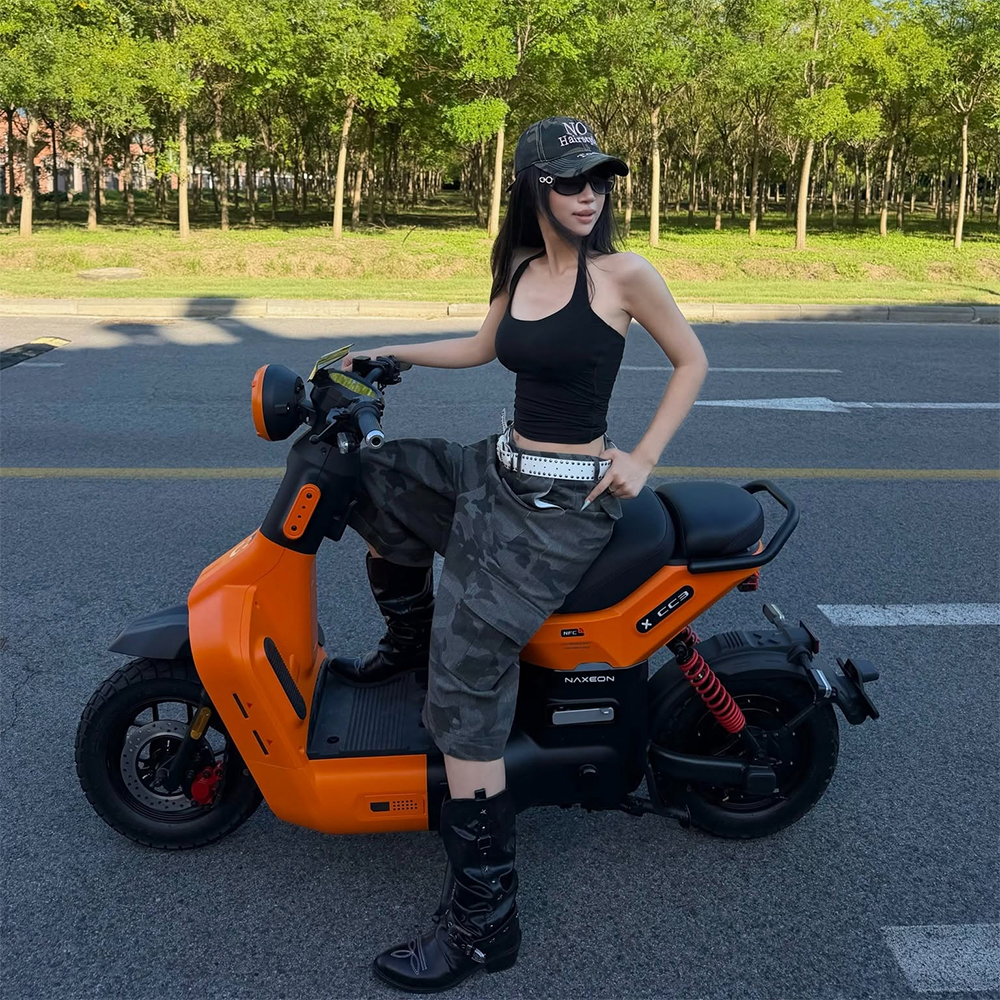
Powertrain: Bangladesh
The version offered through Naxeon's Bangladeshi importer uses lithium-ion batteries and is rated for 60 km/h. The CC3 is quoted at 65 to 70 km of range. The CC3 Max offers 70 to 80 km from a removable battery. The Bangladeshi spec sheet for the CC3 Max lists 1,671 x 694 x 1,075 mm dimensions, a 51 kg weight excluding battery, 10-inch aluminium wheels and a steel tube frame. Local pricing is 98,000 taka for the CC3 and 120,000 taka for the CC3 Max. Seven colours are listed: orange, black, white, dark grey, grey, green and pink.
Connected features
Like other Naxeon models, the CC3 runs the brand's own software platform. Listed features include Bluetooth, over-the-air updates, app connectivity, smartphone and NFC card unlocking, GNSS tracking, anti-theft alerts and a side-stand sensor. Rider aids include multiple ride modes, a low-speed "snail" mode for manoeuvring, regenerative braking, cruise control, hill hold, hill descent control and a user-adjustable throttle response.
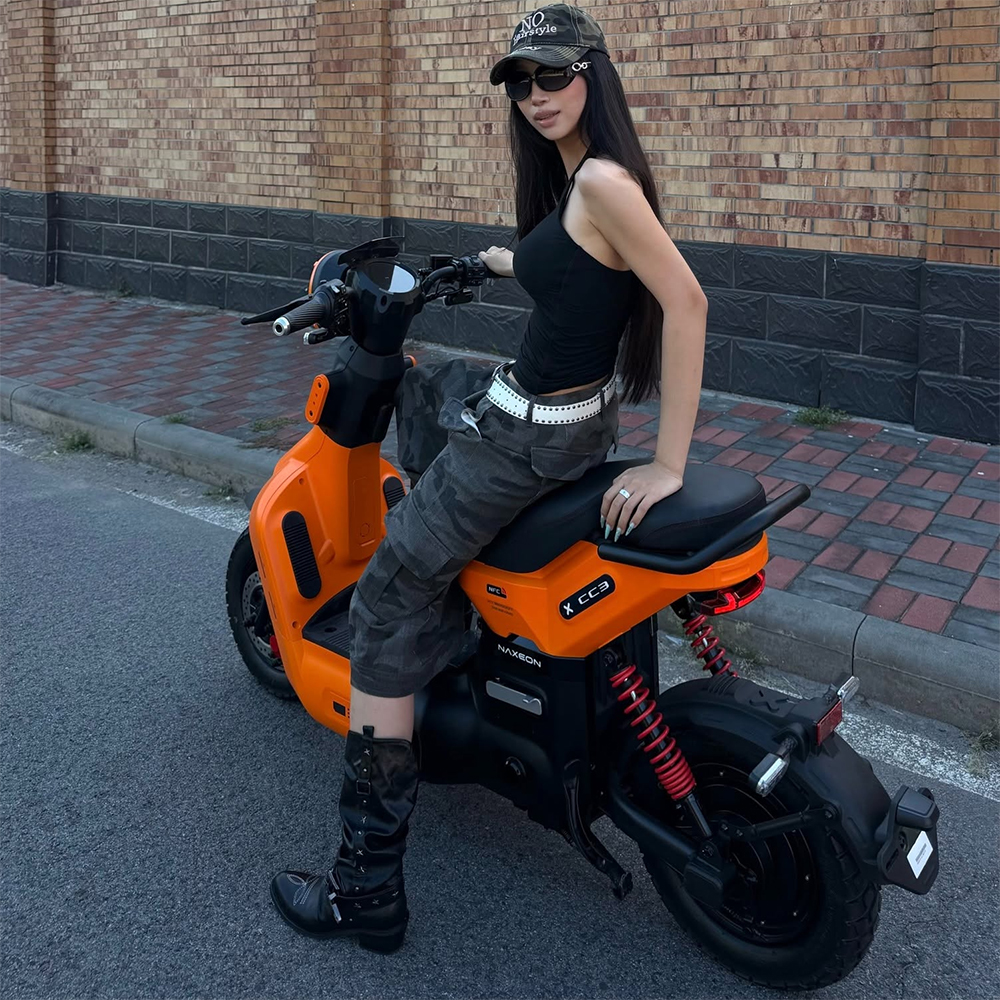
European plans
Naxeon has not announced European pricing, specifications or a launch date for the CC3. The company lists European offices in France, Germany, the United Kingdom, Belgium and the Netherlands. It is not yet clear whether a European CC3 would follow the 45 km/h Chinese specification, which matches the L1e moped class, or use the lithium-ion batteries of the Bangladeshi version.
NAXEON >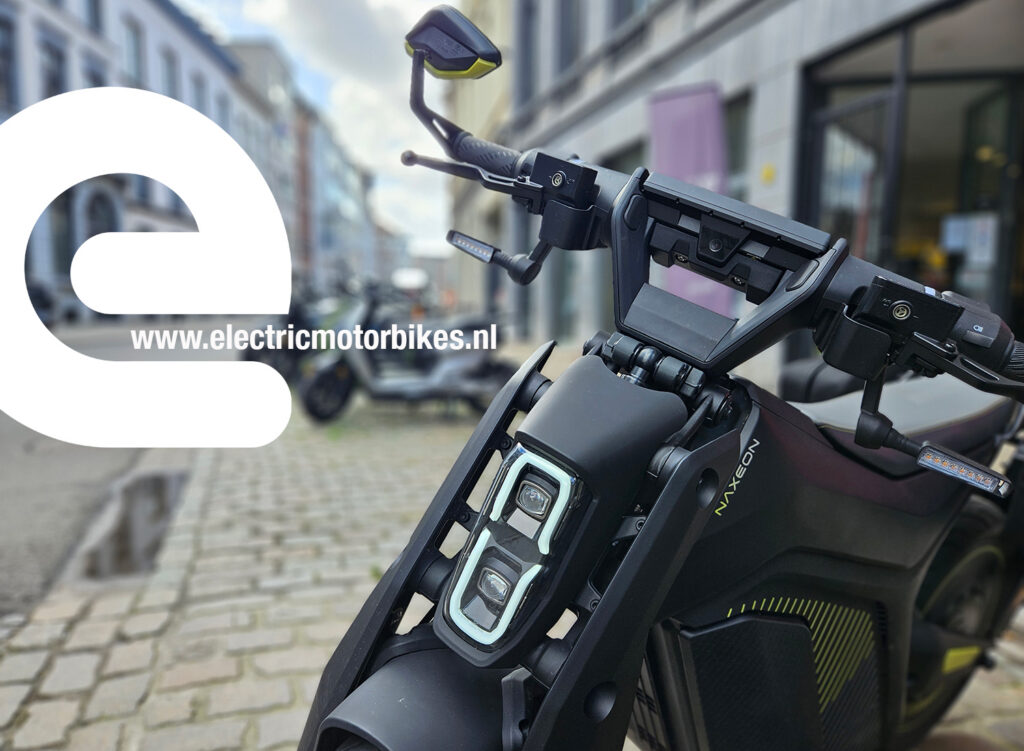 Dealer AD - Electric Motorbikes Netherlands | Belgium | NAXEON
LiveWire Group will show its broadest line-up so far at EICMA 2026 in Milan The Harley-Davidson-backed electric brand shares its stand with the parent company and will bring bikes from three product families: S4 Honcho, DUST and STACYC. Two of the models on display are new and planned for 2027.
Jon Bekefy, Head of Commercial at LiveWire, said the Milan show reflects the continued growth of the group's portfolio. According to Bekefy, the aim of the STACYC, S4 Honcho and DUST ranges is to get more people onto two wheels and keep them riding for life.
S4 Honcho Street arrives in Europe
The S4 Honcho family will be shown in three versions. The production S4 Honcho Street makes its European debut in Milan. Its US launch is planned for next week, and European sales are due to start right after the show. The off-road-oriented S4 Honcho Trail is already on sale worldwide.
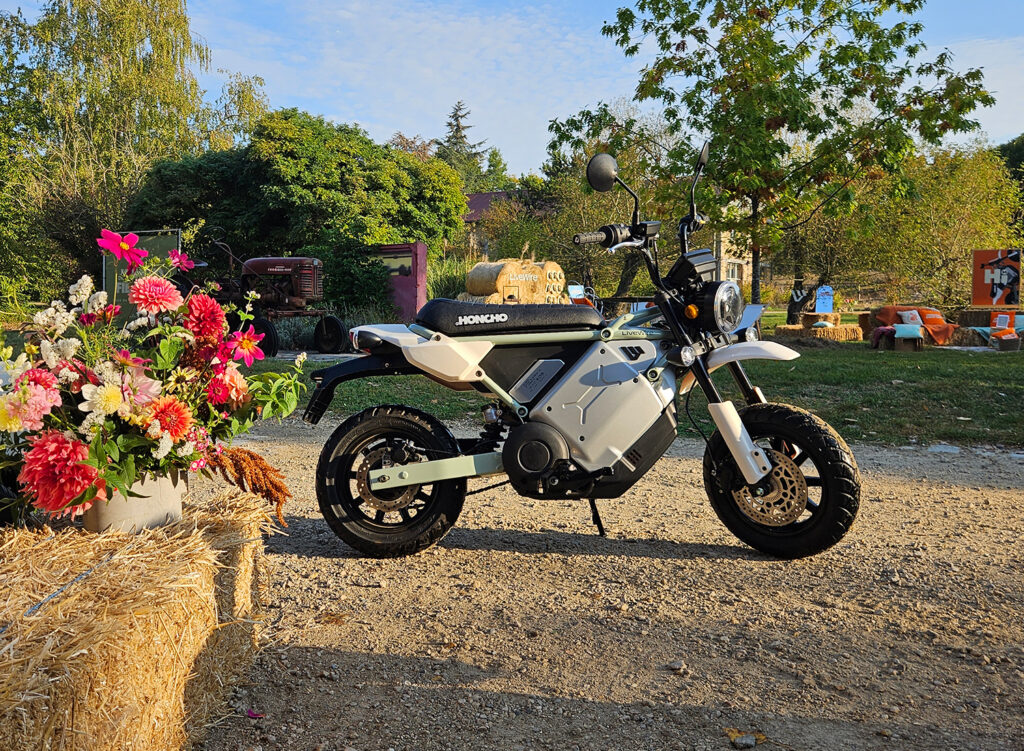 S4 Honcho Street © Image: THE PACK
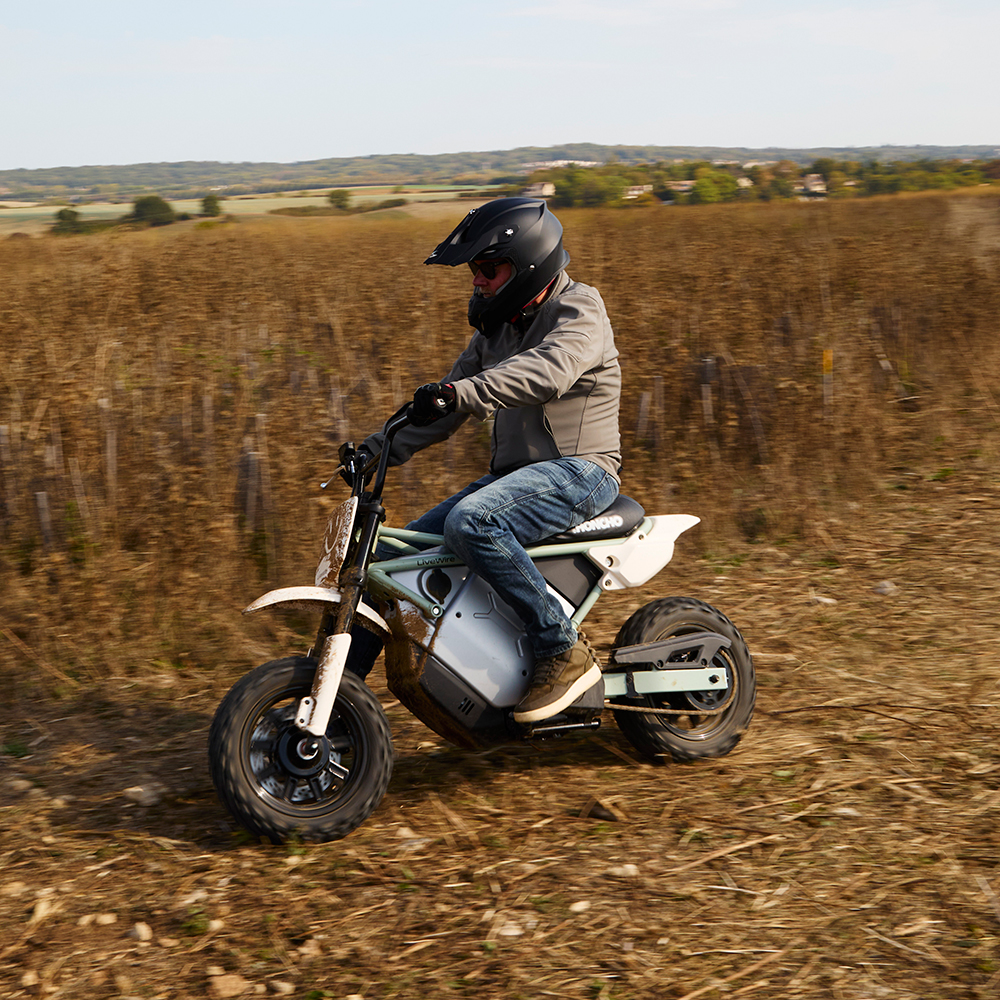 S4 Honcho Trail © Image: LiveWire
The third variant is new. The S4 Honcho Skate will be shown to the public for the first time and is planned for 2027 as an addition to the Honcho range.
DUST Hightail under the LiveWire name
LiveWire acquired the assets of Dust Moto earlier this year. EICMA will be the first public showing of the DUST Hightail as a LiveWire product. The bike on the stand is described as production-intent, and the model is scheduled for introduction in 2027.
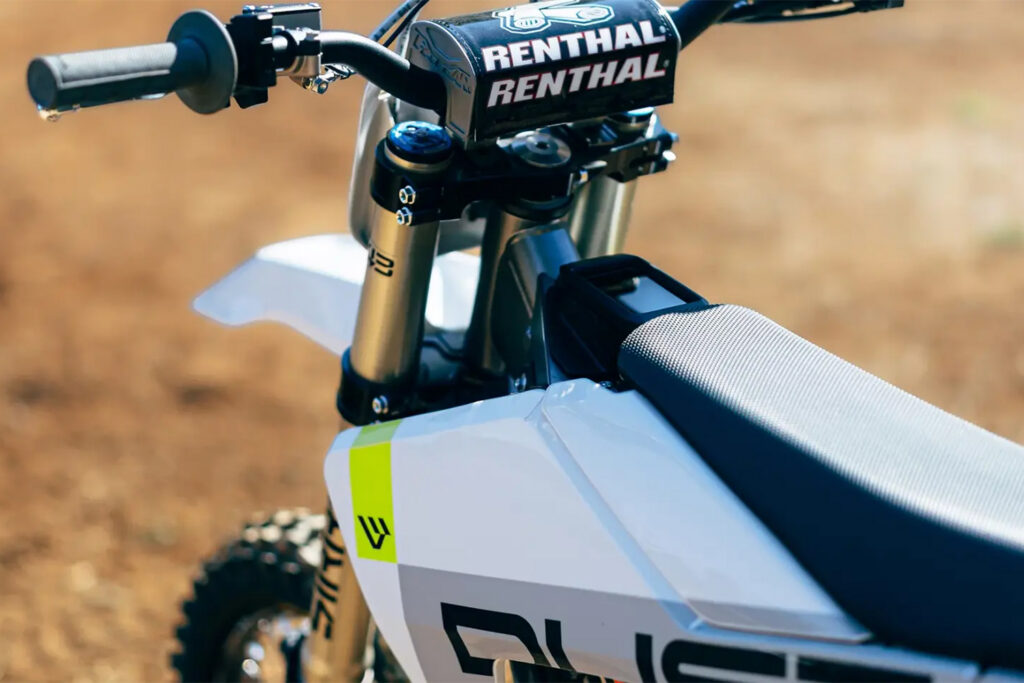 DUST © Image: LiveWire
 DUST © Image: LiveWire
A second DUST model, the Spur, will also be previewed in Milan, again with a 2027 target. LiveWire presents the DUST line as the link between its STACYC children's bikes and its other models, with each family aimed at a different group of riders.
STACYC line-up
STACYC, the electric balance bike brand within the group, will show its current range: the 16eDrive, 20eDrive, 16eDrive Elite and 20eDrive Elite. LiveWire says STACYC has put more than 250,000 young riders on two wheels since it introduced the electric balance bike category.
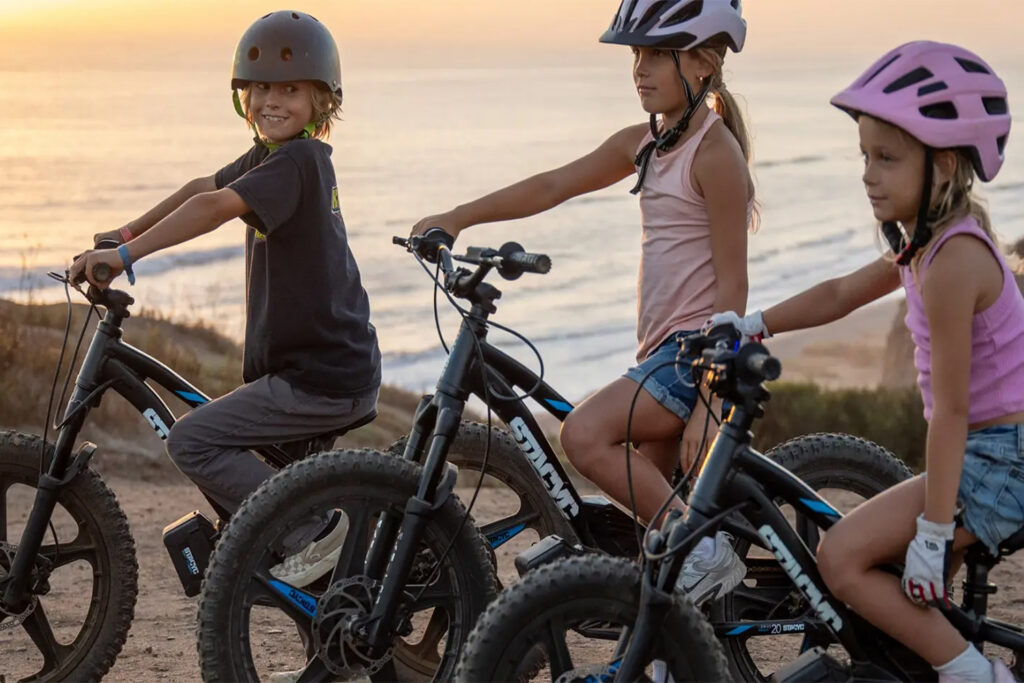 STACYC © Image: LiveWire
Specifications to follow
LiveWire has not yet released technical details for the S4 Honcho Skate or the DUST Spur. Preliminary specifications and timing will follow on 2 November 2026. Final production specifications and pricing are expected in the first quarter of 2027.
Where to find LiveWire at EICMA
LiveWire Group exhibits next to Harley-Davidson in Hall 14, Stand E46, at Fiera Milano, 5-8 November 2026.
LIVEWIRE >
B2B News | NOVUS (Germany) has closed a funding round in the double-digit million-dollar range, led by Berlin-based venture firm 468 Capital. The company plans to use the capital to scale its operations across Europe and to prepare its entry into the United States, scheduled for 2027. The exact amount of the round has not been disclosed.
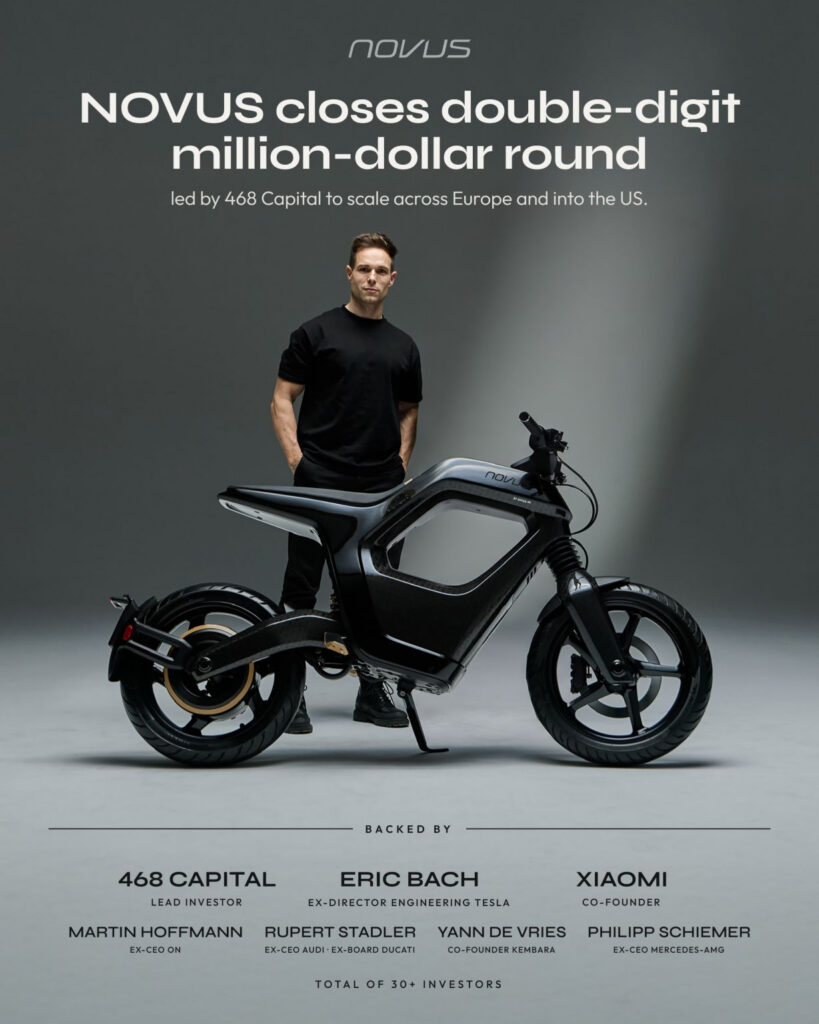 From founder-funded prototypes to series production
NOVUS built its first prototypes in-house, financed by the founders themselves. According to CEO and founder René Renger, the company then took its hardware into series production using a fraction of the capital that comparable vehicle start-ups typically require. The round comes after NOVUS reached that milestone: the NOVUS One is now in series production and being delivered to customers in several European countries.
The concept behind the vehicle has remained the same since the start. NOVUS positions its products as a separate category it calls the Lightbike, combining the intuitive handling of an e-bike, the agility of a scooter and the performance of a motorcycle in one design. Renger says that when he started the company, he did not know whether anyone would believe in a vehicle that fit no existing category.
 Roadmap: NOVUS Two and US launch
Three priorities follow from the investment. The first is the NOVUS Two, which the company describes as its volume model, intended to bring the Lightbike category to a much broader market. The second is further expansion into what NOVUS calls Europe's lifestyle metropolises. The third is the launch in the United States in 2027.
Targeting car drivers, not motorcyclistsNOVUS frames its addressable market well beyond the motorcycle segment. The company states that 97 percent of people in European cities hold a car driving licence, and that in many countries this licence is sufficient to ride the entry configuration of the NOVUS One, and in some cases even the most powerful version. On that basis, NOVUS sees its potential customer base as more than 400 million car drivers across Europe and North America.
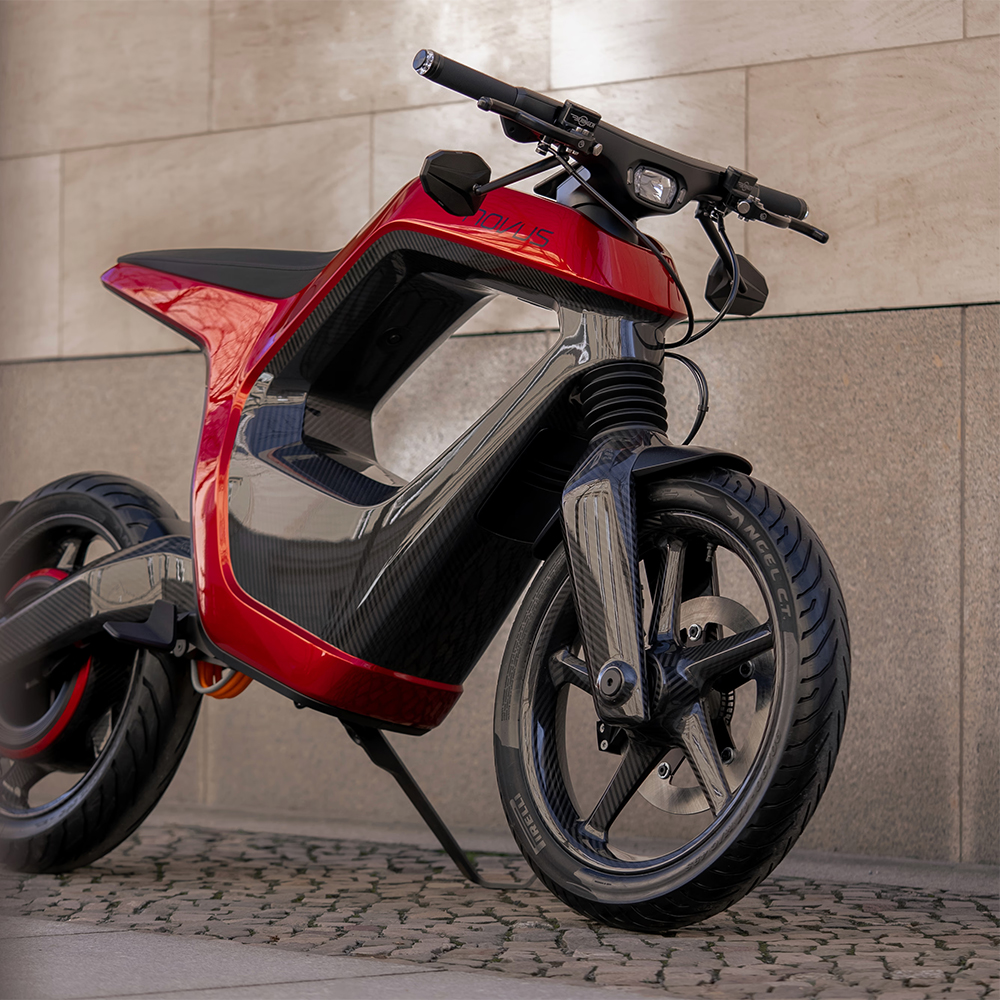
Renger says the goal is not to electrify the existing motorcycle market but to reshape urban mobility around vehicles that take up less space, weigh less and produce less noise. Alongside the hardware, NOVUS is working on what it calls physical AI for urban mobility: a platform of two- and four-wheeled vehicles designed to learn from ride data and improve through software updates.
Investor network from tech, automotive and consumerBesides 468 Capital, where partners Ludwig Ensthaler and Emanuel Pallua led the round, NOVUS has assembled a shareholder base of more than 30 investors. COO and founding member Hannes A.H. Krieger explains that the company deliberately did not go looking for traditional mobility investors. Instead, it built a network of leaders who have scaled and disrupted markets, which he compares to NOVUS having its own Y Combinator. Krieger describes the strategy as "Genkidama": building NOVUS together with the industry rather than alone. Drawing on several years of experience as a venture scout, he says he has not seen a comparable shareholder ecosystem before.
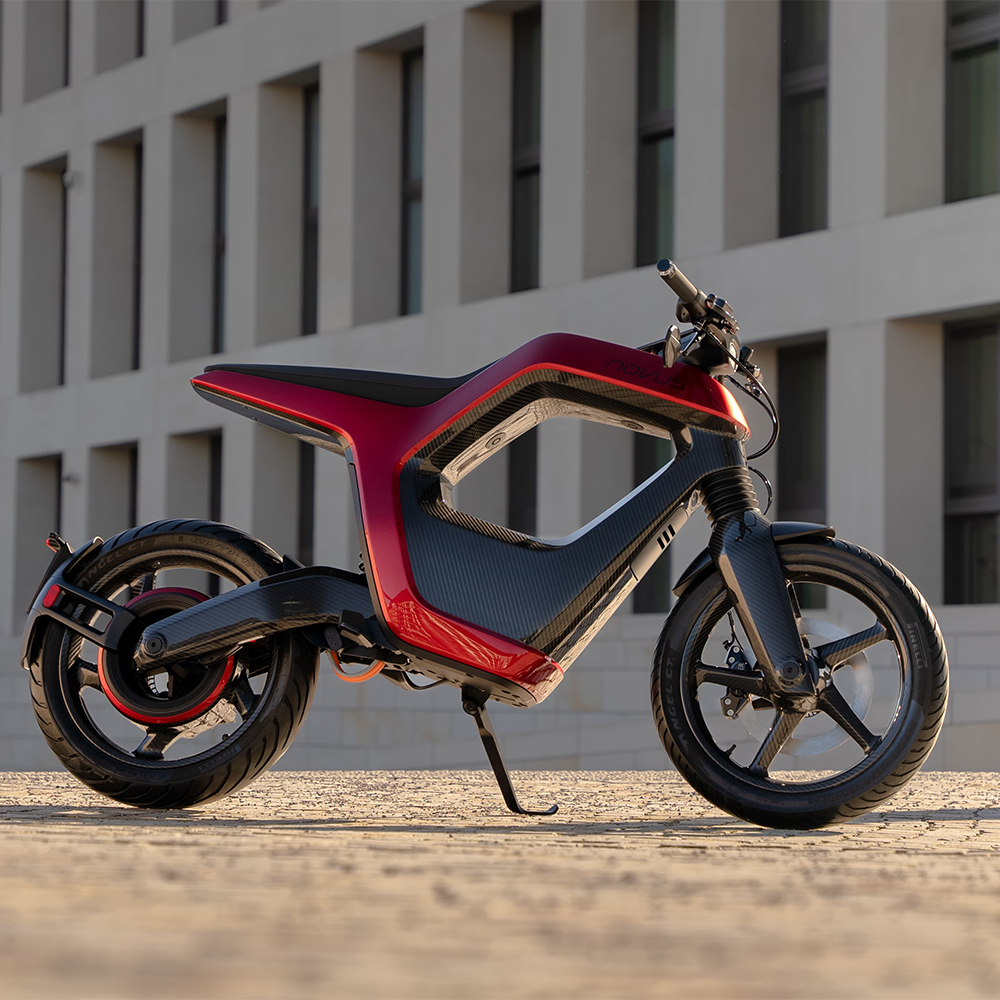
Named backers include Eric Bach, former Chief Engineer at Lucid Motors and previously in an engineering leadership role at Tesla, and Martin Hoffmann, former CEO of Swiss sportswear brand On, who led that company through its IPO. A co-founder of Xiaomi and racing driver Sophia Floersch are also among the shareholders, together with founders and executives with backgrounds at Adidas, AMG, Audi, BMW, Chrono24 and FINN.
According to NOVUS, these investors contribute expertise and international networks in addition to capital, as the company positions itself as a technology brand rather than a conventional vehicle manufacturer.
ContextThe round stands out in a market where several electric two-wheeler start-ups have struggled to secure follow-up funding in recent years. NOVUS closing a significant round after reaching series delivery, rather than before, gives the company a stronger position as it moves from low-volume premium production towards a volume model and a new continent.
Source: NOVUS / René Renger and Hannes A.H. Krieger on LinkedIn - © Images: NOVUS
NOVUS >After its first "Energica is back" event in San Francisco on 28 October, Energica moves to Milan for the second stop. On Wednesday 4 November, during EICMA week, the Italian electric motorcycle maker will open the doors of a historic venue away from the show floor, with both public and private sessions. THE PACK Italia was asked to support the event.
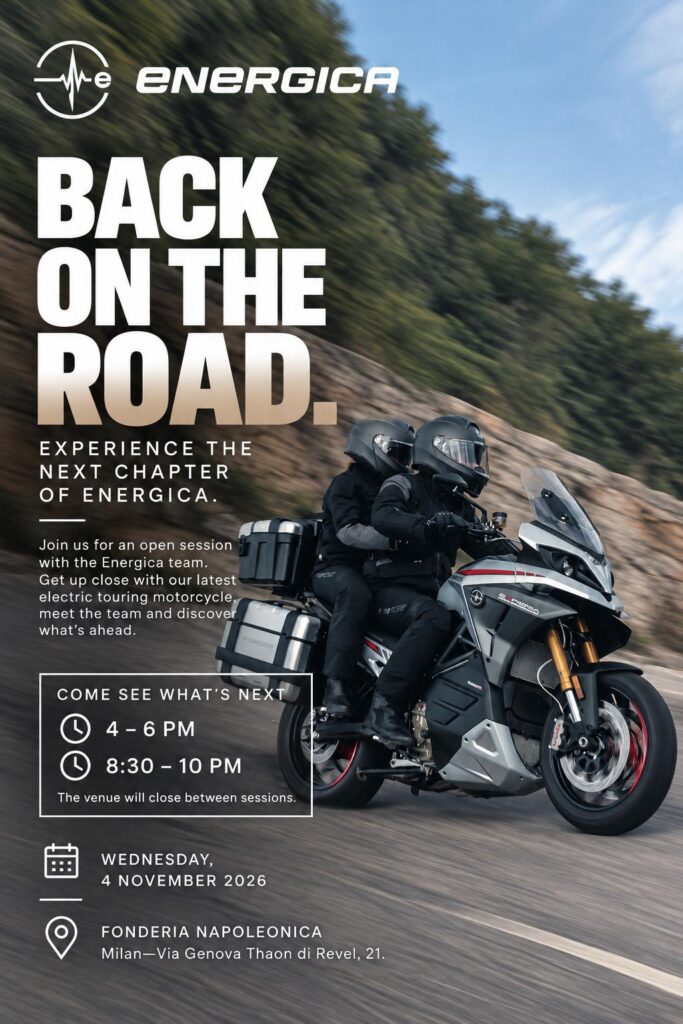
The venue
The event takes place at the Fonderia Napoleonica Eugenia in Milan's Isola district. The building is a former bronze foundry dating from the 19th century, set behind an iron gate on Via Thaon di Revel. Its location offers a quieter alternative to the busy EICMA exhibition grounds.
Public sessions
From 16:00 to 18:00 and from 20:30 to 22:00, the venue is open to the public. Visitors can see the Energica motorcycles on display and talk with members of the Energica staff. No food or drinks are served during the public sessions.
Private event
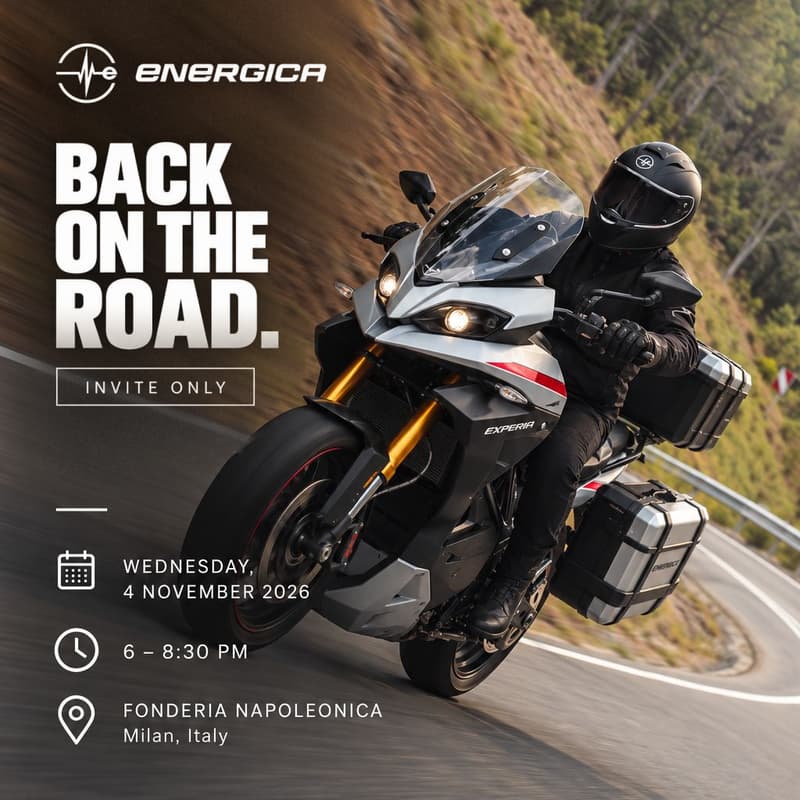
From 18:00 to 20:30, the venue is reserved for an invitation-only event for riders, friends, partners and press. The programme includes a press conference with Energica's new management, a question session with the management team and an Italian aperitivo.
Background
Energica was founded in Modena, in Italy's Motor Valley, with the aim of building high-performance electric motorcycles. The company supplied the bikes for the first four seasons of the FIM MotoE World Cup. Following a period of uncertainty, the brand has now returned under new owners, and the Milan event is part of its official relaunch. Discover everything we have published about Energica >
Practical information
- Date: Wednesday 4 November 2026
- Public sessions: 16:00 to 18:00 and 20:30 to 22:00
- Private event: 18:00 to 20:30 (invitation only)
- Location: Fonderia Napoleonica Eugenia, Via Thaon di Revel 21, 20159 Milano
- Access: enter through the iron gate at number 21
- Registration for the private event: each registration is reviewed by the Energica team, and confirmed places are communicated by email > rsvp@energicamotor.com
B2B News | THE PACK, the independent electric motorcycle and light electric vehicle (LEV) media platform, is expanding its global reach with the upcoming launch of THE PACK UK. The new dedicated UK division will be led by editor and publisher James Billington, who takes responsibility for editorial output in the UK and for all client contacts in the British market.
 A dedicated UK platform
Scheduled to launch this month, THE PACK UK will be a dedicated destination for electric motorcycles, scooters and light electric vehicles, bringing together the latest products, technology and industry developments with a clear focus on the British market. The site will combine new model coverage, test rides and reviews, brand and business news, interviews, features and wider analysis of the rapidly evolving e-mobility sector.
 © Image: Vmoto UK
With its own UK-based team, THE PACK UK will build direct relationships with manufacturers, importers, dealers and PR agencies, giving the site close access to the companies and people shaping the market. The aim is to provide both riders and the industry with a focused, authoritative source of UK electric motorcycle and LEV news, while giving the brands operating in this growing sector a dedicated platform on which to tell their stories and reach a wider audience.
 Image © Maeving
"Having covered electric vehicles for nearly two decades, I've seen the industry evolve enormously, but the pace of change in the electric motorcycle and wider two-wheeled e-mobility sectors has been incredible in recent years. Therefore, launching THE PACK UK is an exciting opportunity to give this fast-moving sector greater visibility, and to showcase the brands, technology and innovation driving its progress and shaping its future in the UK. I'm looking forward to building THE PACK UK into the go-to source for electric motorcycles and LEVs in Britain, and to working directly with the brands, importers and dealers at the forefront of this growing market," says James Billington, leader of THE PACK UK.
Part of a growing European networkTHE PACK has operated since 2017 as a division of Salens Communicatie NV, founded by Guy Salens. The UK launch follows THE PACK Italia and SteckerBiker / THE PACK News in Germany, and is part of a network of independent regional teams operating under a common license. Each division runs its own editorial agenda and publishes in its own language, while articles can be shared and translated across the network with a link back to the original source. This gives brands local coverage in each market, combined with reach across Europe.
Commercial partnershipsBrands and agencies active in the UK can work with THE PACK UK through the MediaPack, which includes [e.g. sponsored articles, video, social campaigns, newsletter placement]. James Billington, an award-winning automotive and electric vehicle journalist, is the single point of contact for all UK partnerships.
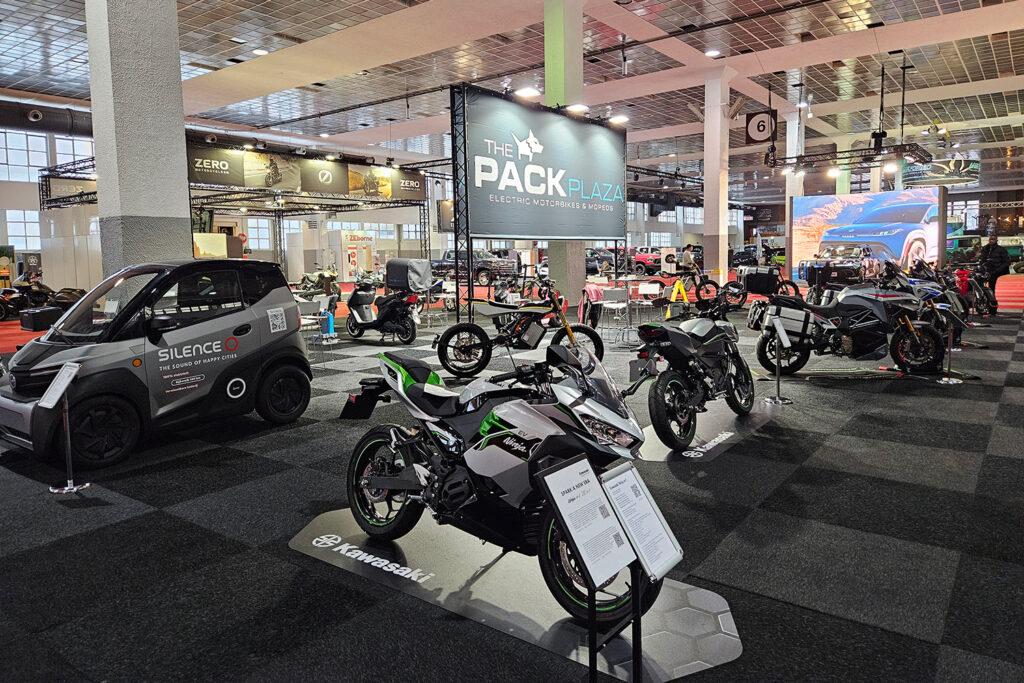
"Today THE PACK is not a blog. It is an independent media platform, a European launch partner for electric motorcycle brands, and a growing network of local voices in Germany, Italy, and now also in the UK. But it still starts from the same place it always did: genuine curiosity about where this industry is going. With James Billington leading THE PACK UK, British riders and brands get exactly that, backed by a network that now spans several European countries," says Guy Salens, founder of THE PACK.
About THE PACK
THE PACK started in 2017 as a personal curiosity, one motorcycle enthusiast wondering what two wheels would look like in an electric future. Nearly a decade later, it has grown into one of Europe's leading independent platforms for electric motorcycles and mopeds, with a global network of local teams in Italy, Germany and now also in the UK, over 1,800 published articles, and a community that spans riders, startups, manufacturers, and industry insiders across the globe.

Press and partnership contact - UK
James Billington, Editor, THE PACK UK
james@neweditionmedia.com | +44 7845 327 971
Press contact - THE PACK Global
Guy Salens
hello@motorguy.eu
Source: SteckerBiker / THE PACK News | 10.5 kW of power, a top speed of 114 km/h and up to 260 kilometres of range, for the equivalent of around US$1,800. With the new EX2S, Indian startup Avore presents an electric motorcycle whose price makes European riders look twice. The real question is a different one: why are more and more interesting electric two-wheelers coming out of India?
 Who is behind Avore?
Avore was founded in 2023 in the Indian state of Gujarat by Priyank Rakholiya, Mayank Rakholiya and Mihir Tagadiya. According to the company, development took around three years and involved more than 100 engineers, and nine systems were developed entirely in-house.
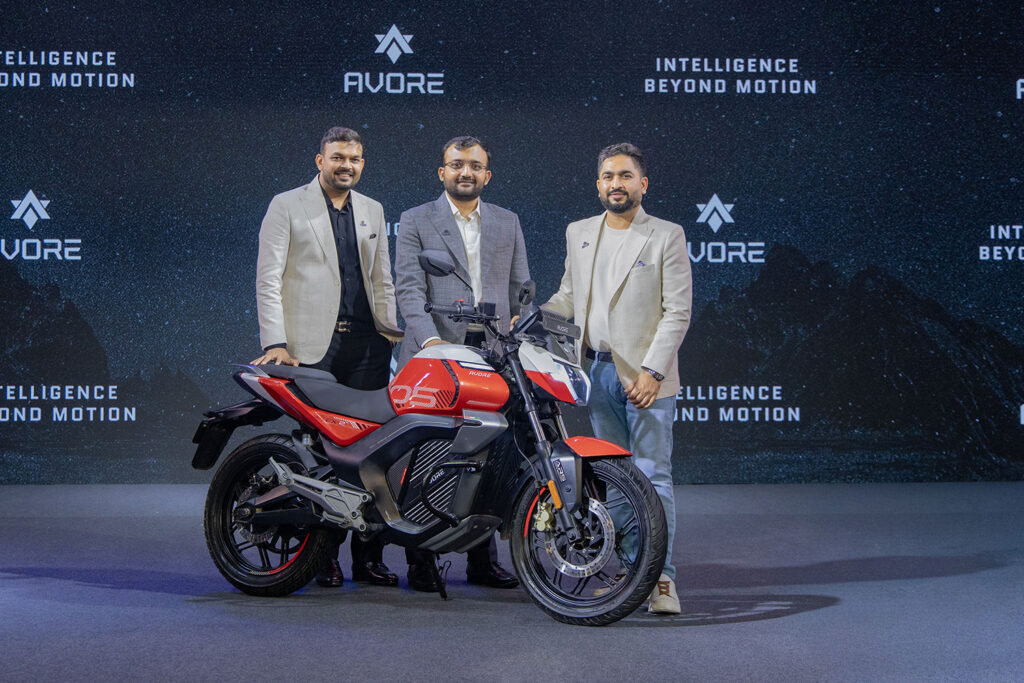
The goal was not simply to electrify an existing combustion motorcycle. Avore wanted to build a motorcycle where electronics and software are part of the platform from the start. The new EX series is the brand's debut, and it launches with three models at once.
Why India?A look at the Indian market explains part of it. Motorcycles and scooters are not a niche there. In the 2025/26 financial year, India sold more than 21.7 million two-wheelers. In the same period, passenger car sales came to around 4.6 million.
The two-wheeler also plays a different role in India than in Europe. In Europe, riding a motorcycle often means leisure, weekend rides or touring. In India, the two-wheeler is above all affordable everyday mobility for millions of people: for commuting, shopping and getting around every day.
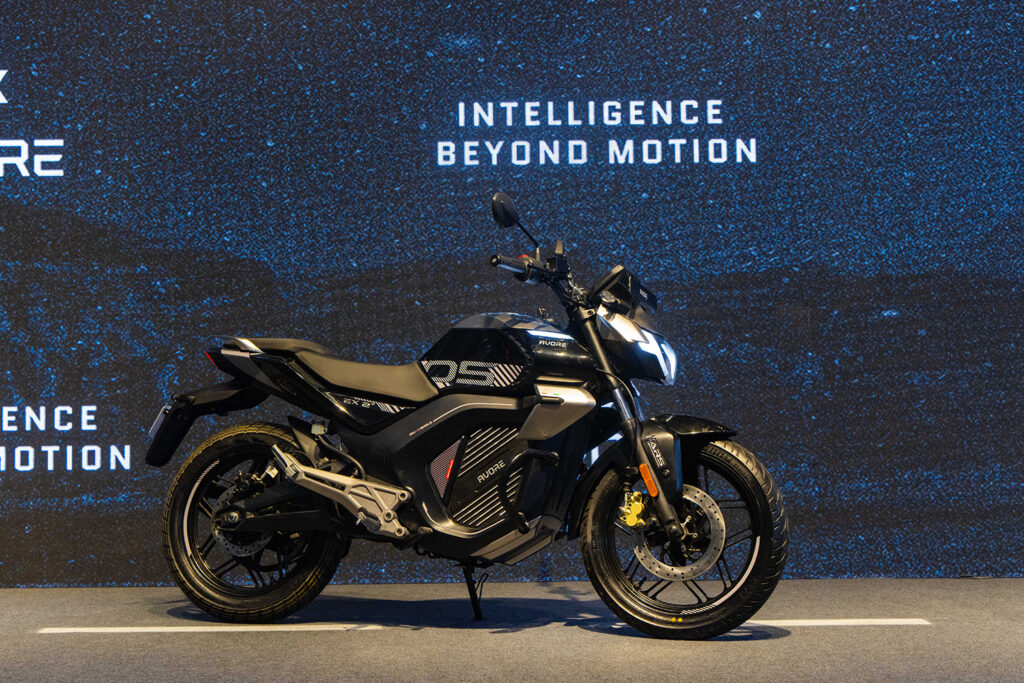
The apparently low price of US$1,800 also needs context. An employed worker in Indian manufacturing earns an average of around 18,700 rupees a month. The EX2S price of about 170,000 rupees therefore equals roughly nine months' wages. For comparison, nine months of the German median wage would come to almost €38,000. This is not a direct purchasing power comparison, but it shows clearly what an US$1,800 motorcycle is actually worth in India.
Air pollution in the big cities adds to the picture. The Indian government explicitly cites rising pollution levels as one reason to push electric mobility.
And the state is giving that push real weight. The PM E-DRIVE subsidy programme has a total budget of almost €1 billion, of which around €160 million is set aside for electric two-wheelers alone. By 22 July 2026, the programme had already supported more than 2.05 million electric two-wheelers.
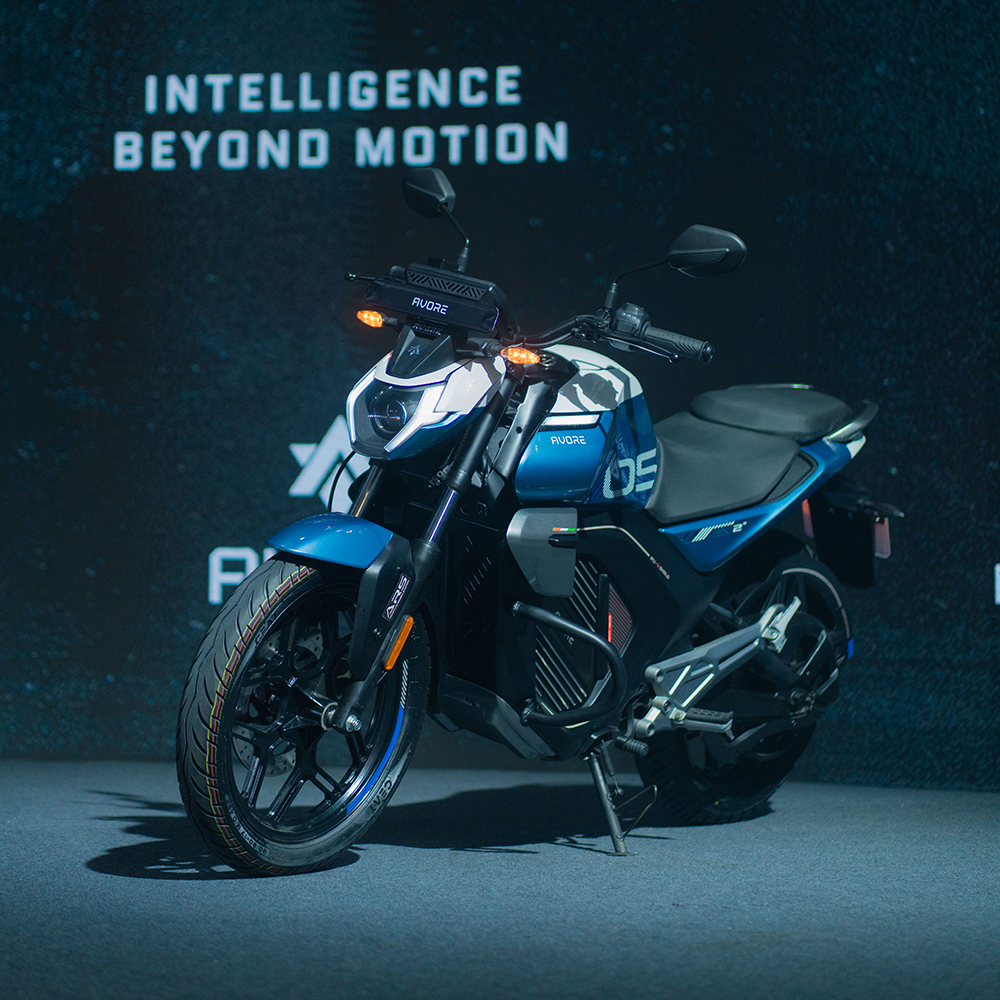
It is not only about purchase incentives. Through the Production Linked Incentive (PLI) programme, India also supports manufacturers of advanced vehicle technology, while strengthening local component production. India is not just stimulating sales; it is trying to build its own electric vehicle industry at the same time.
A huge two-wheeler market, a need for affordable everyday mobility, air pollution, government support and domestic production: the conditions for new electric motorcycles could hardly be better.
Three models, with the EX2S on topAvore does not start with a single motorcycle, but with the EX1, EX2 and EX2S. Visually, all three share the same basic concept. Technically, they differ mainly in battery, performance and equipment.
The entry-level EX1 has a 3.24 kWh battery, a top speed of 100 km/h and a claimed IDC range of 160 kilometres. The EX2 gets the larger 5 kWh battery and a claimed 255 kilometres, but also stays at 100 km/h.
The top-of-the-range EX2S combines the 5 kWh battery with a 10.5 kW (14 hp) PMSM electric motor. Top speed rises to 114 km/h, and 0 to 40 km/h is claimed to take 2.8 seconds.
Equipment includes several riding and power modes and a 7-inch display with navigation and connectivity. Tyre pressure monitoring, vehicle diagnostics, live tracking and theft alerts are also part of the package. Seat height is 790 mm and ground clearance is 180 mm. Avore also quotes 250 Nm of torque at the rear wheel.
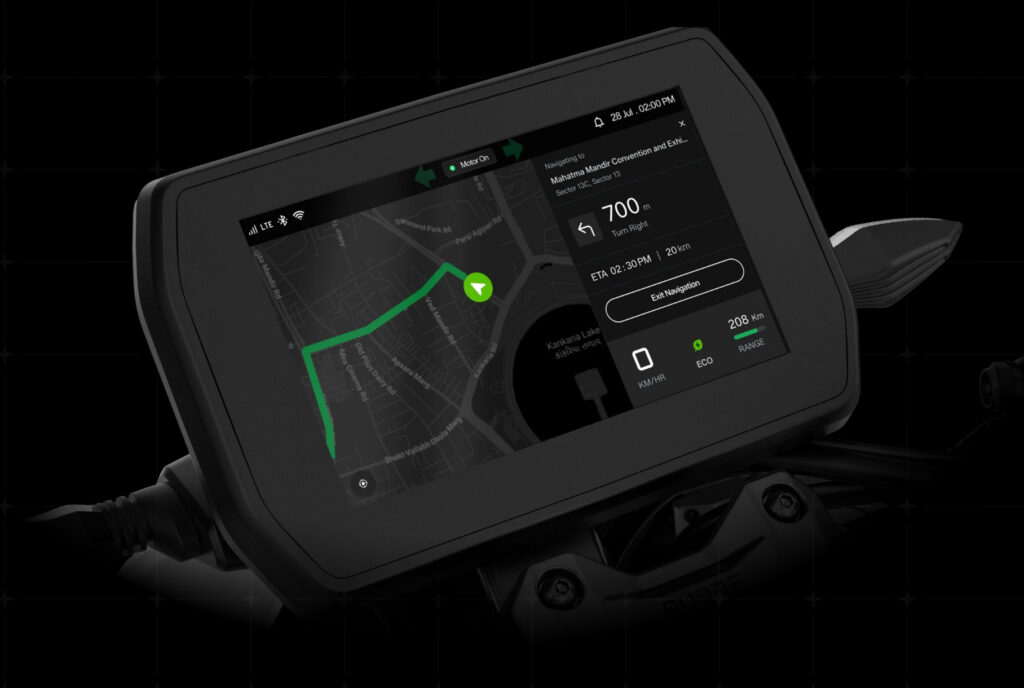
The charger is built into the motorcycle, so a standard household socket is all you need. Charging from 20 to 80 percent takes around two hours.
A European version of the EX2S has not been announced. A direct comparison with European prices would not be fair anyway: homologation, transport, taxes, distribution, warranty and a service network would all add to the cost of any export model. With more than 20 million two-wheelers sold in India every year, Avore will likely have its hands full at home for now.
260 kilometres: realistic?The range figure deserves a closer look. Avore promises up to 260 kilometres for the EX2S under the Indian IDC cycle. On paper, that works out to a consumption of only around 19 Wh/km. For comparison, an efficient 45 km/h electric scooter typically uses around 40 Wh/km in real-world riding, and faster electric motorcycles commonly use 50 to 70 Wh/km in mixed use. The 19 Wh/km figure therefore looks very ambitious.
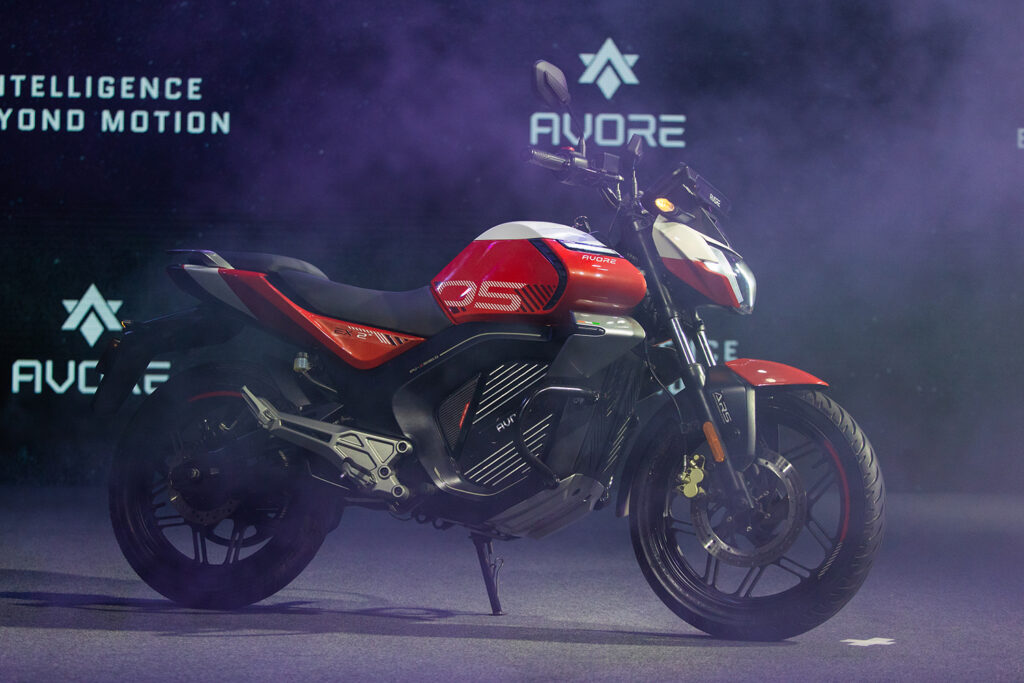
It should certainly not be confused with 260 kilometres of realistic range on country roads or motorways. Avore itself describes the 260 kilometres as a range under ideal conditions and points out that riding mode, speed, rider weight, terrain, weather and traffic all affect real range. How far the EX2S actually goes in daily use will only become clear in an independent test.
The SteckerBiker viewWe still see the claim of 260 kilometres from just 5 kWh with a question mark. At the same time, it would be unfair to judge the EX2S only by German standards. Indian roads, average speeds and riding conditions are very different from ours. Anyone who uses a motorcycle mainly as daily transport, and not for touring at motorway speeds, can be well served by a 5 kWh battery.

That may be one of the EX2S's strengths. Avore is not trying to build a cheap copy of a European electric motorcycle. It is developing for a huge domestic two-wheeler market with different needs. On top of that comes a top speed of over 100 km/h and a connected 7-inch display, at a price that seems unbelievably low from a European point of view, but that still represents a major investment for many people in India.
The environment in which these motorcycles are created is even more interesting. A gigantic two-wheeler market meets government support, local development and a political goal of cleaner mobility. That makes Avore more than just another new brand. It is an example of a development that Europe should keep an eye on.
When it comes to new electric motorcycles, we no longer need to look only at China. India has a firm grip on the throttle, and it is going flat out.
AVORE ELECTRIC >Original article: SteckerBiker / THE PACK News (Germany)
https://steckerbiker.de/news/fahrzeuge/avore-ex2s-fuer-1-800-dollar-indien-gibt-vollgas-bei-e-motorraedern/
Images © Avore Electric
Electric motorcycles are the core of THE PACK, but our coverage has always included the wider light electric vehicle (LEV) category. Micro-cars belong there. In Europe, vehicles like these are type-approved as L-category vehicles, the same regulatory family as mopeds and motorcycles, not as passenger cars. They are small, light and electric, and they target the same urban riders and commuters who look at scooters and light motorcycles. When a manufacturer with roots in two-wheelers moves into this segment, we cover it.

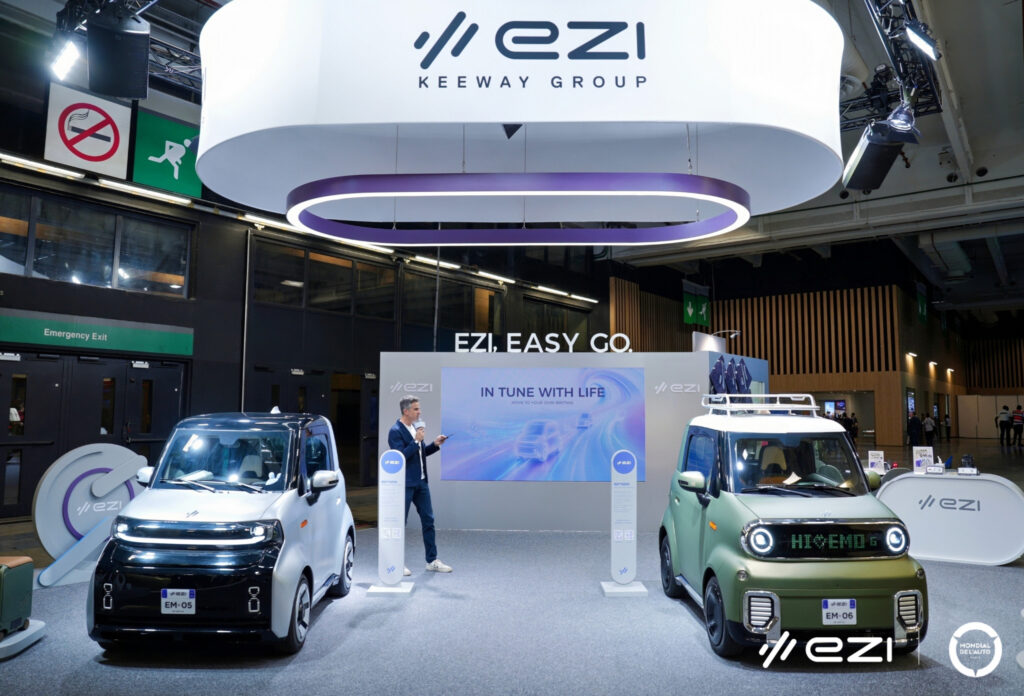
Photo: EZI press conference unveiling EM05 / EM06
That is the case with EZI. The brand belongs to Keeway Group, known to many riders for its scooters and motorcycles. At the 2026 Paris Motor Show (Mondial de l'Auto), EZI presented its first two production micro-cars: the EM05 and the EM06.
Two designs, one platformBoth models are L6e light quadricycles developed for European city use. They share the same tubular-cage body structure, powertrain and software, but differ in styling.
 Detail EM05
 Detail EM05
The EM05 Tech Edition has full-width lighting at the front and flush door handles. The EM06 Retro Edition uses round headlights, retro-style wheels and chrome trim. EZI says both designs draw on the Scandinavian idea of hygge, with comfort as the starting point.
 Detail EM05
 Detail EM05
EZI states it wants the EM Series to become the first AI-equipped electric car aimed at young Europeans. That ambition fits the L6e category: these vehicles are speed-limited to 45 km/h and in most European countries can be driven with an AM licence, often at a younger age than a full car licence allows.
 Detail EM06
 Detail EM06
 Detail EM06
 Detail EM06
Range, charging and equipment
EZI quotes a range of up to 180 km. Charging is done via a Type 2 AC connection and takes around two hours. According to the brand, development followed a standardised engineering process with reference to European L6e/L7e rules and Japanese kei-car requirements, with narrow streets and tight parking in mind.
Standard equipment includes a 13.4-inch central display, a 360-degree camera system, climate control, heated seats and two drive modes, ECO and SPORT.
EZI OS and the wider ecosystemBoth cars run EZI OS, the brand's own operating system. It connects to what EZI calls its AI Omni-Mobility Ecosystem: the car, a voice assistant named EZI BUDDY, a rideable smart suitcase called EZI LUGGAGE, and the EZI app. The idea is that these products share information before, during and after a trip.
 EZI BUDDY
 EZI LUGGAGE
"The value of advanced technology is not about creating visual spectacles, but about becoming part of everyday life and making this life easier. Machines should adapt to the rhythm of people's lives," said an EZI spokesperson. This idea is captured the theme of EZI's Paris launch: IN TUNE WITH LIFE.
Trims, pre-orders and deliveriesThe EM05 and EM06 will be offered in three trim levels: Standard, Pro and Max. Global pre-orders opened at the Paris show. First deliveries are planned for late March 2027, starting in selected European markets. EZI has not yet announced prices. For future models on the same platform, EZI plans to offer Battery-as-a-Service (BaaS), where the battery is subscribed to rather than bought with the vehicle. The production cars follow an open-top concept EZI showed earlier in Milan.
About EZIEZI is a global electric light-mobility brand under Keeway Group, dedicated to advancing AI-Native micro-mobility. Combining Nordic lifestyle philosophy, nature-inspired aesthetics, and human-centered intelligent technology, EZI develops smart, comfortable, and lifestyle-oriented mobility solutions for urban users worldwide. Through continuous innovation, the brand aims to shape the future of urban micro-mobility, bringing technology closer to everyday life.
EZI MOTOR >Energica has officially returned. THE PACK Global and THE PACK Italia have been in close contact with the Italian electric motorcycle manufacturer's new owners and management over the past months, and the message is now confirmed: Energica is back. The relaunch starts with a series of events, the first in San Francisco and the second in Milan.
First stop: San Francisco
The opening event, titled 'Motor Valley to Silicon Valley', takes place at the Consulate General of Italy in San Francisco. Energica is inviting its Bay Area owners and riders to an evening with the team behind the brand, focused on the company's plans for the future with Energica US.
The title links the brand's two worlds. Energica was founded in Modena, in Italy's Motor Valley, a region known for its motorsport heritage. The company built its reputation in racing as the sole supplier of machines for the first four seasons of the FIM MotoE World Cup, and its bikes have also raced in MotoAmerica. Silicon Valley, meanwhile, has long been one of the strongest markets for electric motorcycles.
Riders are encouraged to arrive on their own Energica, whether that is an Ego, Eva Ribelle, EsseEsse9 or Experia, so the bikes can be lined up outside the Consulate. Guests arriving by other means are also welcome but are asked to indicate this when registering.
Practical information
- Date: Wednesday 28 October 2026
- Time: 18:00 to 20:00
- Location: Consulate General of Italy, San Francisco
- Catering: food and drinks provided
- Registration: places are limited and subject to approval. RSVP by Wednesday 21 October.
Next stop: Milan
A second 'Energica back on the road' event will follow in Milan on 4 November, during the week of EICMA. THE PACK Italia will support Energica. Further details will be announced soon on THE PACK.
ENERGICA >A Zero DS has set a new Guinness World Record for the longest journey by an electric motorbike on a single charge, covering 436.5 kilometres between the French-Italian Alps and the Mediterranean coast. The distance beats the previous record of 310.689 km by 125.8 km, an improvement of just over 40 percent. The ride was tracked by GPS and independently verified by Guinness World Records.
The rider was Jelle Verstaen, a motorcyclist from Belgium. He rode a standard production Zero DS fitted with the optional Power Tank accessory, which is available at retail.
Battery and rangeThe Zero DS has a 15.6 kWh battery with a claimed city range of 249 km. The Power Tank adds 3.6 kWh, bringing total capacity to 19.2 kWh. Over 436.5 km, that works out to an average consumption of roughly 44 Wh per kilometre, well beyond the bike's rated range.
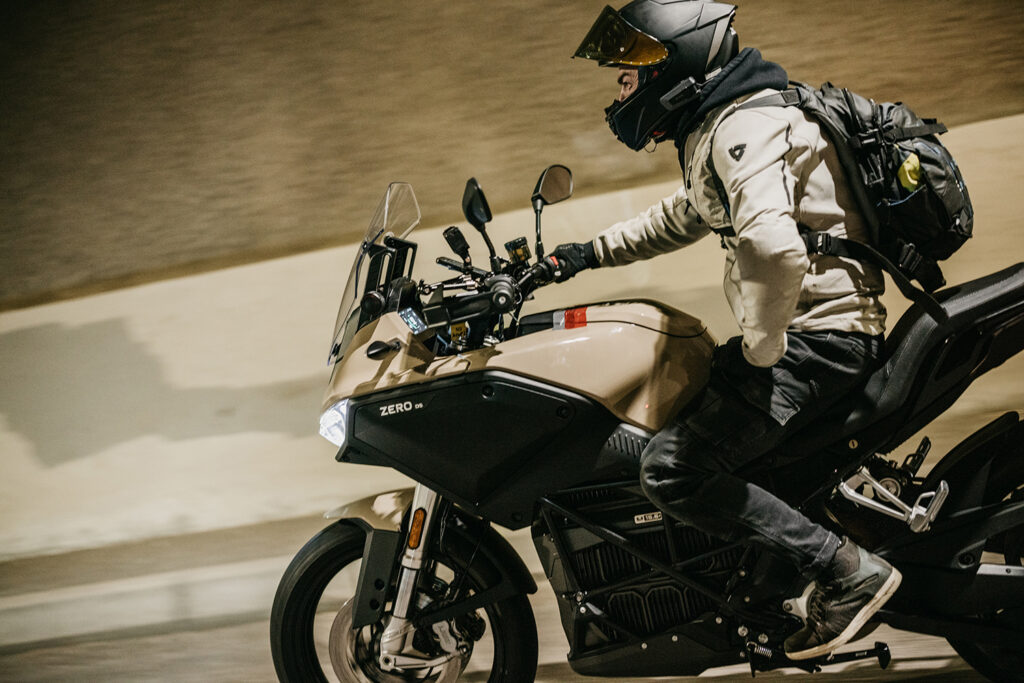
According to Zero, the bike was otherwise unmodified, running standard tyres at standard pressures. The company attributes the result to the efficiency of the Z-Force powertrain: the energy density of the battery pack, low drivetrain losses, and regenerative braking.
CEO Pierre-Martin Bos pointed to the use of three production bikes on public roads, one of them ridden by a customer: "A record only means something if riders can recognise themselves in it."
The Zero DS is the brand's entry-level dual-sport model and a lighter sibling of the DSR/X. It can be ridden on an A1 licence, and in some countries on a car (B) licence.
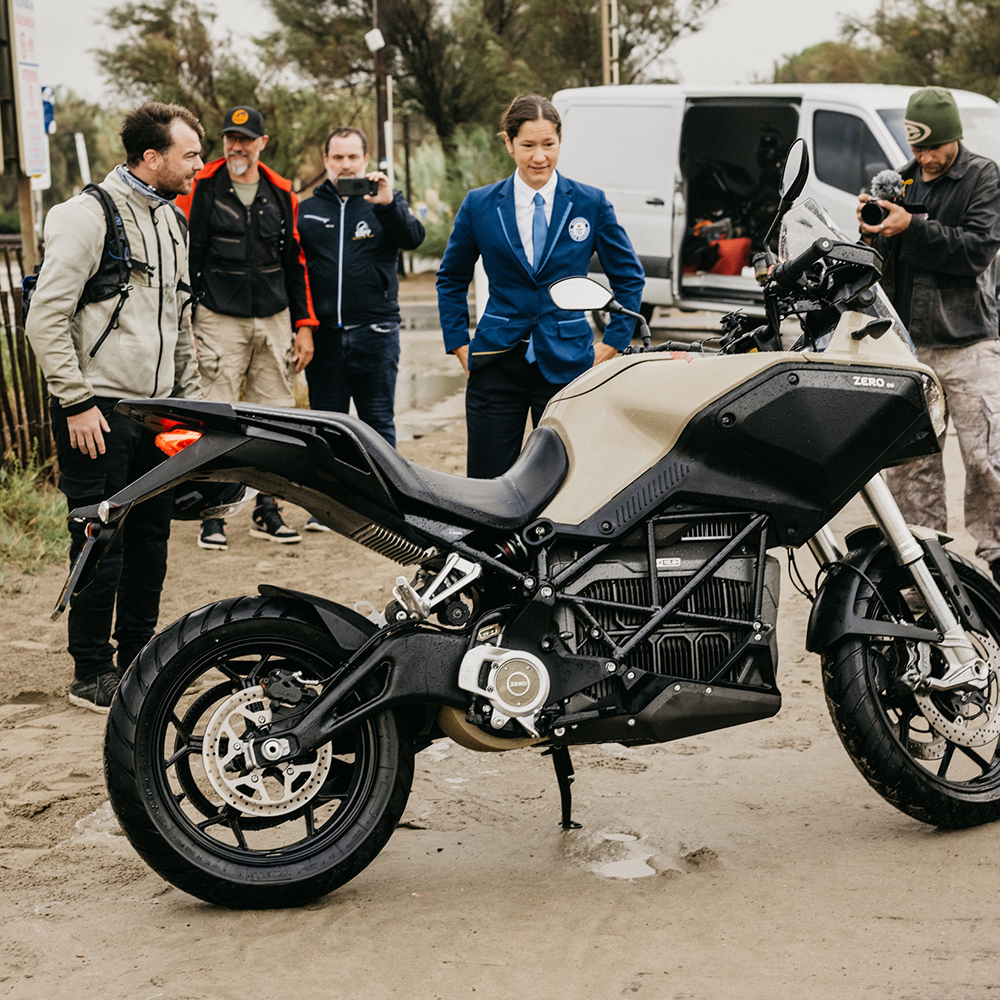 The route
The attempt was made on public roads rather than a test track, using minor roads and French departmental routes. The route was planned to limit energy-consuming stops and acceleration at junctions and traffic lights, while still including mountain passes, town centres, villages and open country roads.
Jarno Middelbosch, Senior Director Global Marketing at Zero Motorcycles, said range anxiety remains a barrier for riders considering a switch to electric, and that demonstrating more than 400 km on a single charge is intended to show what is achievable with current technology.
On the mountain descents, regenerative braking was used to recover energy. On the faster, more open roads towards the coast, where consumption rises with speed, the rider held a steady cruising speed. Conditions stayed dry until the route reached the Camargue, where a heavy storm set in. The final 100 km were ridden in heavy rain.
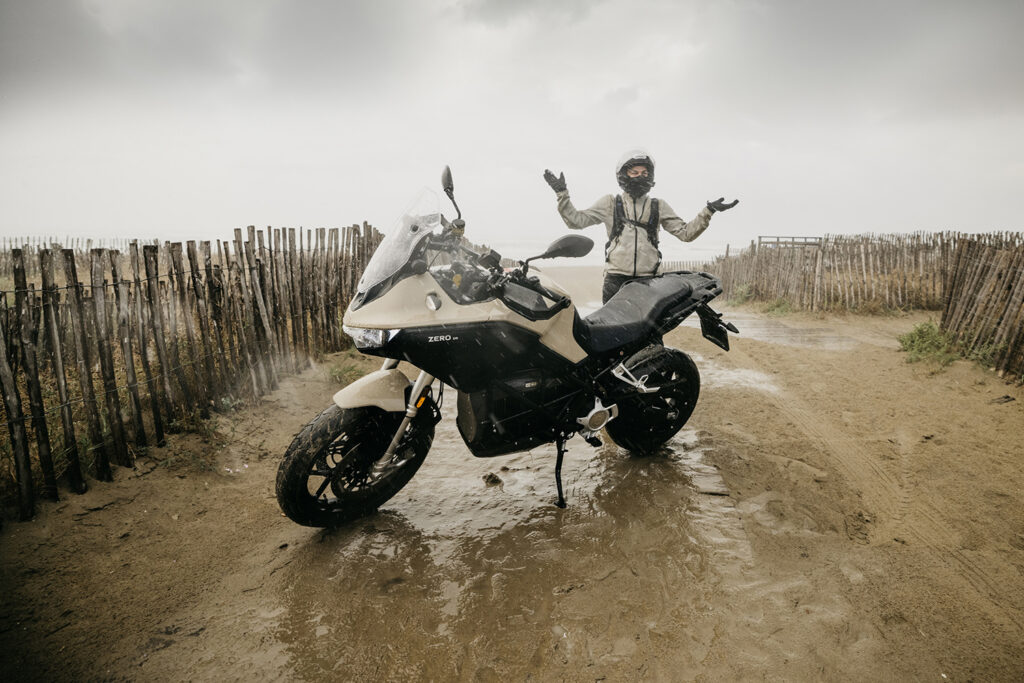
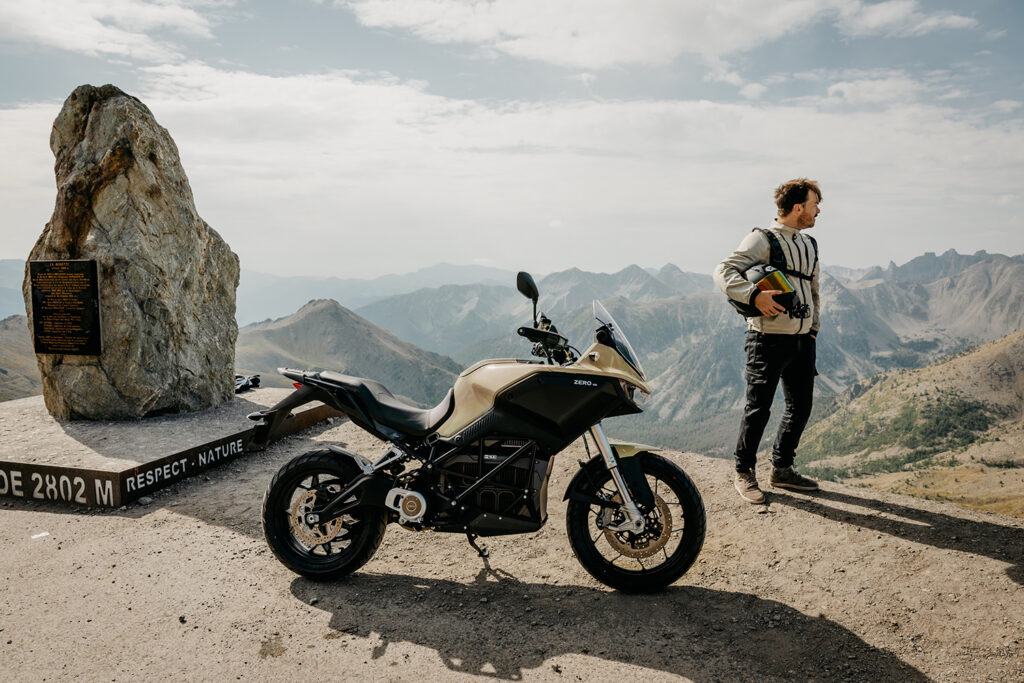 Three bikes, three record distances
Three riders set off together, each on a different Zero model, and all three exceeded the previous record:
Louis Renaud, a Zero customer, rode his own standard Zero SR/S for 350 km, finishing with 4 percent charge remaining.
Jenny Brookes, Senior Global Brand Manager at Zero Motorcycles, rode a standard Zero DSR/X for 384 km until the battery was empty. Jelle Verstaen's Power Tank-equipped Zero DS covered the longest distance at 436.5 km.
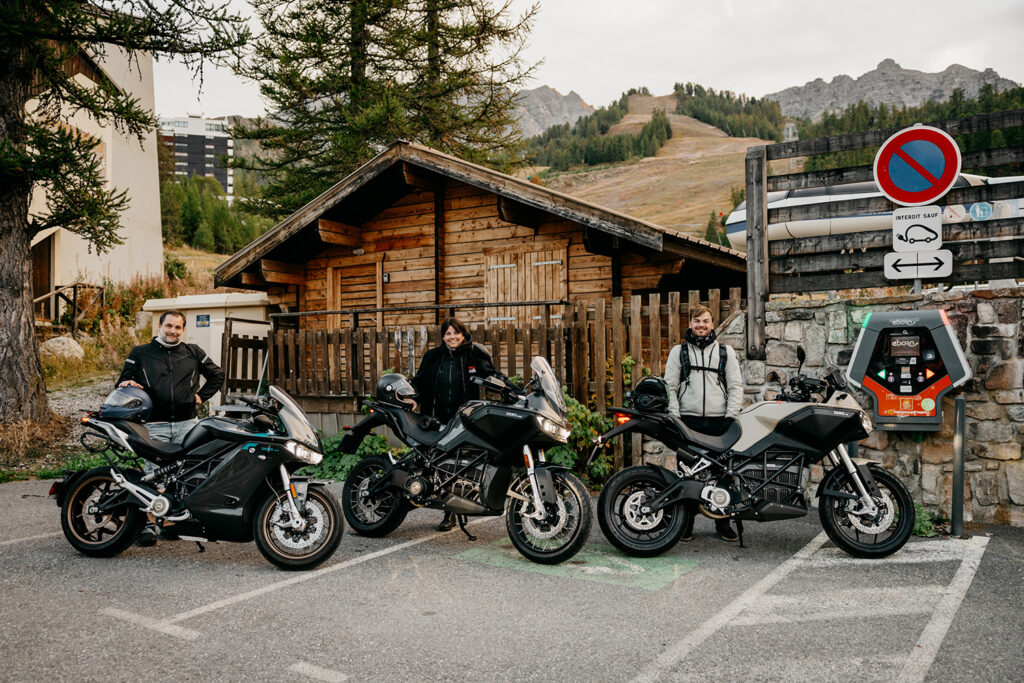
Where road conditions and speed limits allowed, the group averaged a cruising speed of around 52 km/h, which Zero says is significantly higher than in the previous record attempt.
Zero at 20The record coincides with Zero Motorcycles' 20th anniversary. The California-founded company was established in 2006.
ZERO MOTORCYCLES >