
 Trump EPA Abandons Climate Working Group Report in Endangerment Finding Repeal [ 13-Feb-26 9:37pm ]
In a massive blow to the handful of scientists and academics who still dispute widely-accepted climate science, the Trump administration discarded a signature report by its own "Climate Working Group." It comes as the U.S. Environmental Protection Agency (EPA) officially scrapped the government's endangerment finding — the official recognition that greenhouse gases harm human health and the environment.
In an online version of the final rule, the EPA revealed late Thursday that it "is not relying on" a Department of Energy (DOE) report by the Climate Working Group, a hand-picked team composed of academics with a long history of publicly downplaying or rejecting the urgency of the climate crisis, partly "in light of concerns raised by some commenters about the draft."
Starting last year, the Climate Working Group and their Energy Department handlers had toiled to produce a report that the Trump administration could use to scientifically justify rolling back climate regulations, emails from the group made public in late January show. Energy Secretary Chris Wright, a former fracking executive who has downplayed the threat from extreme weather, took special interest in the group's efforts, which were kept under wraps. The endangerment finding has long been a target of fossil fuel trade associations such as the American Petroleum Institute (dating back to 1999), policymakers, and industry-backed groups.
The group of climate crisis deniers — Steve Koonin, John Christy, Ross McKitrick, Judith Curry, and Roy Spencer — took particular aim at the EPA's 2009 endangerment finding, which provided the legal foundation for major U.S. climate policies regulating the fossil fuel industry.
The Climate Working Group's rejection isn't just a black mark for the climate crisis deniers. Without a clear-cut scientific basis to dispute the endangerment finding, Trump's EPA was forced to take a less favorable legal position, environmental attorneys told DeSmog, potentially opening the door for states, counties, or cities to take significant action of their own to curb greenhouse gases — setting up a nightmare scenario for businesses, from oil companies to automakers, that fear a patchwork of regulations.
DeSmog has reached out to all five members of the Climate Working Group and a Cato Institute official who organized their work for the Energy Department for comment.
"The EPA decided to proceed independently and we were not involved in the rulemaking process," Climate Working Group member Ross McKitrick told DeSmog. "Our remit was to prepare a report for the DOE, which we did."
As it announced its decision, the EPA noted that Administrator Lee Zeldin "continues to harbor concerns regarding many of the scientific inputs and analyses underlying the Endangerment Finding."
Last August, the Environmental Defense Fund and Union of Concerned Scientists sued over the Climate Working Group's lack of transparency — and obtained, under a court order, over 100,000 pages of documents and emails revealing the process by which the report was created. Roughly 700 pages of those documents were made public by the environmental groups on January 22, with the remainder expected to be posted within the next few weeks.
The Climate Working Group's final report, released on July 29, was met with widespread condemnation from other scientists, including a devastating 435-page point-by-point critique assembled by 85 climate scientists and experts, including MacArthur "Genius" Fellows, members of the National Academy of Sciences, and authors of papers the Climate Working Group cited, scientists who said their studies were misrepresented.
"Notably, the Climate Working Group's membership are the cream of the crop of climate contrarians," Texas A&M University climate scientist Andrew Dessler, who helped to organize that critique, told DeSmog. "The DOE report therefore represents the best case against mainstream science. That they produced a report that is so lacking in credibility actually demonstrates how strong mainstream climate science actually is."
Dessler and his peers were hardly the first to criticize the group's work, the emails show.
Before the report was released, the Climate Working Group asked an artificial intelligence (AI) tool to review its draft scientific report for "scientific accuracy and potential bias." The AI agent returned a cheerful mix of praise and warnings.
One section was "heavy-hitting" and "packed with technical nuance" but suffered from a "misinterpretation of NOAA projections." On "scientific accuracy," the AI rated another section "Mixed Quality" and dubbed some of the draft's reasoning "Flawed but Thought-Provoking." The AI flagged issues like "cherry-picked references" to studies by Climate Working Group members McKitrick and Christy, adding that contrary studies were "omitted."
"This is amazing, far better than what we would get from 'real' scientists," Curry, another member, wrote to the rest of the group.
Human readers would prove to be far more damning.
"Not your best work," was the feedback from University of Sussex professor Richard Tol, Curry told the others on July 30.
"I thought Tol was on 'our side," replied Spencer. "Was i mistaken?" [sic]
Tol went on to become one of the 85 scientific commenters who joined the critique.
Inexpert TestimonyMembers of the five-person Climate Working Group team have held a wide range of prestigious roles. Spencer is a former NASA scientist, Curry, a professor emerita from the Georgia Institute of Technology; McKitrick, a Canadian economist. Koonin was formerly the chief scientist for BP and served in the Obama administration and Christy, until recently, served as the Alabama State Climatologist.
While these academics, like much of the oil and gas industry today, acknowledge that climate change is happening, their views veer far outside the mainstream majority of practicing climate scientists. In addition, three of the group's members have close ties to the oil and gas industry, either having directly worked with fossil fuel firms or working with think tanks that have received backing from the industry.
Dating back to the 1990s, Spencer's and Christy's attacks on mainstream climate science were routinely cited and promoted by the Global Climate Coalition, whose members included the American Petroleum Institute (API). The coalition was created to spread public doubt about global warming and block climate regulations. In one infamous memo from 1998, API and others described an action plan where "victory will be achieved when average citizens 'understand' (recognize) uncertainties in climate science."
The internal emails reveal the Climate Working Group repeatedly offered itself high marks while dishing out scorn for mainstream experts, including the world's most accomplished climate scientists.
"In short the climate assessment system is really broken," Curry wrote in June as the group discussed the National Climate Assessment, a Congressionally-mandated report to the president and Congress issued every four years, "a RFK Jr style purge is needed, IMO."
"The email records show a really deep animus, I would say, from the [Climate Working Group] members directed at the broader scientific community," Environmental Defense Fund attorney Erin Murphy told DeSmog. "You see arrogance and flippancy about dismissing other scientists and many well-respected scientific institutions."
Many of the emails themselves apparently were never supposed to see the light of day, with the scientists and politicos largely communicating through their personal Gmail and hotmail accounts. "We should be mindful that our email communications that go to DOE addresses are subject to FOIA," wrote Koonin in a "high priority" August 4 email with the subject: "keeping it to ourselves."(FOIA refers to the Freedom of Information Act, which sets the rules for when federal agencies must make records public.)
"I cannot stress enough the importance of our silence and restraint pending completion of this process," Seth Cohen, a lawyer from the Department of Energy's headquarters wrote to the group on June 25.
The Cato Institute's Travis Fisher, who temporarily joined the Department of Energy and organized the Climate Working Group's efforts, sent lengthy emails to the group detailing what might help EPA make a legal case to repeal the endangerment finding.
"[W]e have renewed buy-in that EPA will wait for this work and include it in its rulemaking," he told the group on April 24. Since it was co-founded by now-billionaire Charles Koch in 1977, Cato has historically taken millions in funding from fossil fuel companies and Koch-related foundations.
The EPA's decision to abandon the Climate Working Group and its signature report comes shortly after a federal court ruled that the Climate Working Group had violated the Federal Advisory Committee Act (FACA), which sets baseline standards for advice provided to the federal government.
David Pettit, a Center for Biological Diversity attorney who is leading the group's legal challenges on the endangerment finding, told DeSmog that the EPA's decision likely reflects doubts about whether the Climate Working Group was able to muster enough expertise for a court to allow them to offer expert testimony.
"In federal court, there are ways to keep out what's commonly called 'junk science,' that has to meet a certain level before you can submit it into a proceeding," Pettit said. "You have to qualify an expert as an expert. You can't just pull somebody off the street and say, oh, 'Mr. Pettit, you're an expert in Dodgers baseball?' 'Well, I am a fan.' That doesn't work."
"They've been so embarrassed by the whole FACA thing and those emails," he added.
"Until Their Limbs Stop Twitching"As they worked to prepare their trademark Department of Energy report, Climate Working Group members aired deep frustrations with the state of consensus climate science, the emails show.
"The extreme weather alarmism angle has been non-stop for years," McKitrick wrote in a May 10, 2025 email, as the Climate Working Group discussed the draft of the executive summary of their work. "At this point, I want to hold the readers' faces in it until their limbs stop twitching and then they'll be receptive to the rest of the material."
"Yes!" replied Koonin.
The emails also suggest other frustrations and a sense of isolation.
In July, Curry sent a note suggesting the group try to "depersonalize" its critique of the Fifth National Climate Assessment (NCA-5), which offers foundational regional science tailored for decisionmakers, by relying less on references to their own prior work.
"We would love to cite other authors who do these NCA-5 type analyses using the proper methods…there just aren't that many out there," Christy replied (ellipses in original).
"About all I can hope is that what we write will provide sufficient 'reasonable scientific doubt' … to call into question the original reasoning for the EPA Administrator's decision that CO2 presents a threat to human health and welfare," Spencer wrote in an April 19 email. "But if the science argument is decided upon by a vote, or by the number of published citations, we lose the science argument."
"Again, I will say, if we treat all studies the same, we lose the war because the other side will always have more publications than us," Spencer added in a May 9 email.
The Climate Working Group didn't focus exclusively on the endangerment finding, the emails reveal. The group was also asked to criticize the NCA-5 head on.
"I can already tell this is going to be a whopper of an assignment (but fun, in a dark and twisted way)," Fisher wrote on June 3.
The group had already broached the topic in April, as they drafted their signature report — but the emails show some members found little to critique.
"There's very little of the foundational science in its 1834 pages (!) that's amenable to serious scientific critique," Koonin wrote as he circulated a link to the NCA-5 report, its review by the National Academy of Sciences, Engineering and Medicine (NASEM), and the criteria for scientific work under President Trump's widely criticized "gold standard" executive order.
"Without even reading the NASEM report I assume it's useless," replied McKitrick. "The problem is they draw experts from govt agencies and universities."
Earlier, members of the group expressed reservations about the wisdom of trying certain attacks on the National Climate Assessment. "I still think it is a tough case to make that 5 scientists decide an assessment report authored by 500 scientists and reviewed by NASEM is scientifically inadequate, no matter how much cherry picking we identify," Curry wrote on June 2.
"Everyone Involved Knows the Stakes"There are, of course, times when there are big truths that no one is willing or able to confront, when a lone voice in the wilderness turns out to be right.
But not every iconoclast is iconic. History is littered with professed and self-professed brilliant minds who split from accepted wisdom — and proved over-confident. Stockton Rush, the Princeton-educated engineer, built his carbon-fiber-hulled submersible using a design so unique that U.S. regulators had never devised safety standards that would apply. Rush went to his death inside his Titan submersible, along with his four passengers, during a dive to tour the Titanic wreck — often itself cited as a symbol of the perils of hubris.
One of the tools that scientists use to prevent catastrophic errors from making it into their final product is the process of peer review. Before a paper is published, experts in the field are asked to independently review it and call out any problems they spot. It's not a perfect process, but it offers a chance to catch weaknesses large and small.
The emails reveal that members of the Climate Working Group sought to shield their work from independent external reviews, debating ideas for hand-picked reviewers they might consult, while insisting on retaining final say over the draft.
The group had some reason for confidence that their work would carry significant impact. The emails describe repeated meetings with top Trump cabinet members, particularly Secretary of Energy Wright. President Trump has said "stupid people" were behind the types of climate projections the Climate Working Group sought to debunk.
Ultimately, the DOE sent the Climate Working Group's draft report through a rushed internal review, the emails show, with anonymous reviewers from DOE and the national labs given two business days to assess the report. The Climate Working Group then spent a day and a half responding to those comments, the documents show.
"First of all, they didn't substantively grapple with critiques of the report," EDF's Murphy told DeSmog. "They rejected a lot of substantive feedback from the DOE internal reviewers. You see that the DOE internal reviewers did a very impressive job in the tight time that they had to give some very thorough feedback and a number of critiques of the report. And the CWG members — there's some email traffic indicating that they appreciated the review — but then ultimately, did they make substantive changes to the analysis, which is what really matters?"
"No, they didn't," she said.
That outcome seemed to be predetermined by another major issue, Murphy added. Before it was published in July, Fisher asked the group not to change the pagination from their May draft, which EPA planned to cite to. That, Murphy told DeSmog, suggests portions of the draft report that EPA wanted to cite were effectively locked in before the review was done.
And then, of course, there was the AI review, which the group appears to have responded to by changing the tone of the draft to, as one group member put it, "take out the snarkiness" in the text.
In response to questions from DeSmog, McKitrick pushed back on the notion that the Climate Working Group had failed to engage substantively with critical comments.
"We fully responded to the internal DOE expert review comments," McKitrick told DeSmog. "As to the public comments, the FACA lawsuit blocked us from responding to them or publishing a revised report. We have nonetheless engaged with many of our scientific critics directly. If we are able eventually to release a revised report people will see that we are prepared to deal constructively with all the criticisms."
The emails show the group approached their work playfully at times, despite the gravity of the topics involved, from heatwaves to rising seas.
After McKitrick, a Canadian citizen, wrote "As a non-US citizen, I am probably not eligible to run the NCA process. Drat," the Department of Energy's Fisher responded, "The easy answer is to annex Canada."
"don't underestimate the paranoia of climate alarmists :)" Curry wrote to the group on July 8.
An extended back and forth shows they debated whether to call themselves "renowned" or "eminent," after Christy objected that "'Renowned' sounds a little like a circus performer."
They also fretted over how the work might be received as political.
The emails show Climate Working Group members insisting that the work of other scientists be held to high standards, while also demanding their own drafts be given a pass.
Ultimately, the emails show, the Climate Working Group gave themselves high grades as they worked in secrecy — just before an ocean of criticism began to flood in.
Diane Bernard and Ashley Braun also contributed reporting.
The post Trump EPA Abandons Climate Working Group Report in Endangerment Finding Repeal appeared first on DeSmog.
Michigan Sues Fossil Fuel Companies While Alberta Protects Them [ 13-Feb-26 4:11pm ]Has the fossil fuel industry been engaged in a decades-long illicit conspiracy to kneecap the accelerating transition to clean energy?
The government of Michigan thinks so. State Attorney General Dana Nessel recently filed a 126-page lawsuit against the American Petroleum Institute and four of the biggest oil companies, Exxon, BP, Chevron and Shell, alleging they acted as an anti-competitive cartel to limit consumer choice and protect their polluting industry from cheaper and cleaner alternatives.
According to Nessel, higher energy costs imposed on residents and businesses in her state "are not the result of natural economic inflation, but due to the greed of these corporations who prioritized their own profit and marketplace dominance over competition and consumer savings."
Rather than focusing on the environmental impacts of the fossil fuel sector, the state is alleging oil companies and their lobbying associations engaged in an anti-competitive conspiracy that limited consumer choice and drove up energy costs for taxpayers and businesses.
Michigan's lawsuit alleges that without decades of oil industry effort to repress clean technology, EVs "would be a common sight in every neighborhood - rolling off assembly lines in Flint, parked in driveways in Dearborn, charging outside grocery stores in Grand Rapids, and running quietly down Woodward Avenue"
Many of these same companies such as Exxon, Shell and Chevron are significant players in the Alberta oil patch. How are we to make sense of efforts of the Alberta government to intentionally scupper the previously thriving renewable energy industry in the province, or impose decades of ignored oil industry cleanup costs onto taxpayers?
While Michigan lawmakers are trying to protect taxpayers from alleged oil industry collusion, the Alberta government seems to be an active participant in limiting competing technologies and offloading industry liabilities onto the public.
Subscribe to our newsletterStay up to date with DeSmog news and alerts
Email Address What content do you want to subscribe to? (check all that apply) All International UK Sign Up (function($){ $('.newsletter-container .ijkidr-us').click(function() { $('.js-cm-form').attr('data-id', '2BE4EF332AA2E32596E38B640E905619D07B21962C5AFE16D3A2145673C82A3CEE9D9F1ADDABE965ACB3CE39939D42AC9012C6272FD52BFCA0790F0FB77C6442'); $('.js-cm-email-input').attr('name', 'cm-vdrirr-vdrirr'); }); $('.newsletter-container .ijkidr-uk').click(function() { $('.js-cm-form').attr('data-id', '2BE4EF332AA2E32596E38B640E905619BD43AA6813AF1B0FFE26D8282EC254E3ED0237BA72BEFBE922037EE4F1B325C6DA4918F8E044E022C7D333A43FD72429'); $('.js-cm-email-input').attr('name', 'cm-ijkidr-ijkidr'); }); })(jQuery);Premier Danielle Smith dropped a surprise moratorium on the previously booming renewable energy sector in August 2023. This regulatory rug-pull was followed by onerous land use restrictions on wind and solar that drove almost 11 gigawatts of proposed renewable electricity projects out of the province. Albertans now pay the highest electricity rates of any province by a wide margin with almost eight times the emissions per kilowatt hour compared to Ontario.
Smith's government later brought in new reclamation rules for wind and solar installations that are the most burdensome out of 27 other jurisdictions in North America and around the world. "The Alberta government's efforts to stunt the growth of the most promising renewable energy market in the country has been a deeply regrettable success," Stephen Legault of the non-profit Environmental Defence lamented at the time.
The stated rationale for weaponizing regulations to target clean energy developers was the alleged end-of-life environmental burdens of wind farms and solar installations. "Our government will not apologize for putting Albertans ahead of corporate interests," stated Alberta Utilities Minister Nathan Neudorf at the time with no apparent hint of irony.
This laudable sentiment seems laughable when looking at the comparative regulatory scrutiny directed towards the oil patch. The Alberta Energy Regulator (AER) is entirely funded by the oil, gas and coal companies it is supposedly overseeing, and it is an understatement to say that these polluters are getting value for their money.
Under the AER's lax leadership, highly profitable fossil fuel companies have racked up enormous environmental deficits while contributing almost nothing towards the eventual cleanup of bitumen tailings ponds and abandoned wells.
These unfunded environmental liabilities total at least $55 billion for tailing pond reclamation and another $60 billion for pipelines and abandoned and orphaned wells, of which the AER has collected only 0.5 percent in security deposits. This shocking situation grows worse every day meaning that every Alberta household is on the hook for about $70,000 in oil industry cleanup costs and counting.
Oil sands operators have contributed only a single dollar to the Mine Financial Security Program (MFSP) meant to protect Albertans from footing the bill for oil sands and coal mine clean-up costs that have doubled from an estimated $28 billion in 2018. AER rules do not require companies to make additional deposits until they have 15 years of profitable bitumen reserves remaining. What could go wrong?
The actual numbers could be much worse. Internal documents from 2018 obtained through freedom of information requests revealed the former AER Vice-President of Closure and Liability pegged the true liabilities as likely exceeding $260 billion. For math enthusiasts, that works out to about $160,000 per Alberta household. Even David Yager, Smith's special advisor and AER board member recently described the province's abandoned well problem as a "giant stinking pile of shit."
Such massive regulatory capture need not be the norm. The Michigan state government is courageously using the law to take on the most powerful oil companies in the world to lower energy costs for taxpayers and fight anti-competitive conduct.
Meanwhile, the Alberta government is politicizing the legal system to the point that the Court issued a rare public warning that "The rule of law means no one is above the law, everyone is treated equally before the law, and power is not used arbitrarily." This statement by leading Alberta Justices was an apparent response to Smith publicly musing about her desire to "direct the judges", and later threatening to withhold funding to the courts unless Alberta is granted greater oversight of federal judicial appointments.
And what would Danielle Smith do with even more power? Likely dispense more favours to her friends in the oil patch at the expense of taxpayers and the climate.
The post Michigan Sues Fossil Fuel Companies While Alberta Protects Them appeared first on DeSmog.
BBC Under Fire for Airing MAGA Climate Denial [ 13-Feb-26 3:46pm ]The BBC has been slammed for allowing a pro-Trump figure to express climate science denial on one of its flagship programmes.
This morning (13 February), the Today programme gave a platform to Diana Furchtgott-Roth, a former Trump advisor and staff member at the Heritage Foundation.
On the show, which has a listenership of 5.6 million people, Furchtgott-Roth was asked to comment on the Trump administration's decision to repeal the U.S. government's endangerment finding, a ruling introduced in 2009 which stated that a range of greenhouse gases are a threat to public health.
Furchtgott-Roth brushed off Trump's decision, which is being described as a "gift to big polluters", stating that "a lot of people like it a bit warmer."
She was not challenged on this statement by the Today programme's presenter, who instead tried to steer her onto a different angle of discussion, despite her claim not being supported by the scientific evidence.
The interview was preceded by a short clip from former U.S. Secretary of State John Kerry, who said that Trump's decision was like "putting a lit match on the kindling of climate-exacerbated hurricanes, fires, droughts, that now kill people and now rig up an annual bill of $182 billion in climate disasters."
The latest research from the Lancet Countdown on Health and Climate Change - a collaboration of more than 300 experts from around the world - stated that our failure to curb the warming effects of climate change has seen the rate of heat-related deaths surge by 23 percent since the 1990s, to 546,000 a year globally.
Furchtgott-Roth also claimed that "the harms of climate change are risks for the future" - a misleading statement that was not challenged by the presenter.
Subscribe to our newsletterStay up to date with DeSmog news and alerts
Email Address What content do you want to subscribe to? (check all that apply) All International UK Sign Up (function($){ $('.newsletter-container .ijkidr-us').click(function() { $('.js-cm-form').attr('data-id', '2BE4EF332AA2E32596E38B640E905619D07B21962C5AFE16D3A2145673C82A3CEE9D9F1ADDABE965ACB3CE39939D42AC9012C6272FD52BFCA0790F0FB77C6442'); $('.js-cm-email-input').attr('name', 'cm-vdrirr-vdrirr'); }); $('.newsletter-container .ijkidr-uk').click(function() { $('.js-cm-form').attr('data-id', '2BE4EF332AA2E32596E38B640E905619BD43AA6813AF1B0FFE26D8282EC254E3ED0237BA72BEFBE922037EE4F1B325C6DA4918F8E044E022C7D333A43FD72429'); $('.js-cm-email-input').attr('name', 'cm-ijkidr-ijkidr'); }); })(jQuery);Meanwhile, the UN's Intergovernmental Panel on Climate Change (IPCC) - the world's foremost climate science body - has said that "heat is a growing health risk" due to more people living in cities, an "increase in high temperature extremes", and ageing populations. This issue is set to become even more acute in low-income, high-population urban areas in Africa, Asia, Central and South America, and southern Europe.
"The idea that 'a lot of people like it a bit warmer' ignores a devastating and well‑documented reality: rising temperatures are already killing hundreds of thousands of people every year. Any suggestion that warmer temperatures are something to embrace is profoundly out of step with the evidence, including in the United States," said Dr Marina Romanello, executive director of the Lancet Countdown.
"Climate change policy rollbacks will only extend this devastation - driving more extreme heat, and in turn more preventable deaths, more pressure on health systems, and pushing communities towards the limits of human physiological tolerance."
Scientists also predict that climate change will exacerbate a wide range of extreme weather events - including droughts, flooding, and storms - not just extreme heat.
The BBC's failure to meaningfully challenge Furchtgott-Roth is potentially a breach of the broadcaster's editorial code, which states that "minority views or those less supported by evidence, should not necessarily be given similar prominence or weight to those with more support, to the prevailing consensus, or to those better evidenced."
It also states that "serious factual errors should normally be acknowledged and corrected quickly, clearly, and appropriately."
The BBC declined to comment on the record.
Furchtgott-Roth served on Trump's transition team following his victory in the 2016 presidential election, and was subsequently appointed as the assistant secretary of transportation for research and technology during his first term.
From 2022 to 2026 she ran the Heritage Foundation's Center for Energy, Climate, and Environment - authoring a chapter of Project 2025, the blueprint for Trump's second term agenda.
The document urged Trump to "dismantle the administrative state", reverse policies on climate action, slash restrictions on fossil fuel extraction, scrap state investment in renewable energy, and gut the Environmental Protection Agency.
The post BBC Under Fire for Airing MAGA Climate Denial appeared first on DeSmog.
Reform Candidate Matthew Goodwin's MAGA Network [ 13-Feb-26 11:06am ]Matthew Goodwin, Reform UK's candidate in the upcoming Gorton and Denton by-election, has ties to influential groups in the orbit of U.S. President Donald Trump.
Goodwin, a GB News presenter and former University of Kent professor, is standing for Parliament on 26 February, presenting himself as a champion of ordinary people against "the elites".
However, despite his rhetoric, Goodwin's profile has been boosted by a global network of pro-MAGA ("Make America Great Again") groups, some of which have been backed by fossil fuel money.
Reform, which is leading the polls ahead of UK-wide elections in May, has echoed Trump's "drill, baby, drill" agenda - campaigning for new fossil fuel extraction and to scrap clean energy targets.
However, Trump is deeply unpopular in the UK - even among Reform voters - and there are growing concerns about his attempts to interfere in European politics.
Goodwin has ties to a number of pro-Trump groups, including the Heritage Foundation, the U.S. think tank behind the radical Project 2025 blueprint for Trump's second term; the Alliance for Responsible Citizenship (ARC), a conservative network advised by Trump's senior allies; and the National Conservatism (NatCon) movement, which has close ideological ties to the current U.S. regime.
The Financial Times reported last week that the U.S. State Department plans to bankroll "MAGA" think tanks and charities in the UK and EU which share Trump's agenda - a plan criticised by campaigners as an effort to "usurp European democracy".
Goodwin's party leader Nigel Farage, one of Trump's closest UK allies, has extensive ties to MAGA groups. Farage has been helping to import the architects of Trump's agenda into the UK, and has received £150,000 from donors to attend pro-Trump events or cheerlead for his agenda since July 2024.
"Reform are a lobby shop for polluting industries. They get millions from fossil fuel interests, polluters and climate sceptics, while their by-election candidate is a fixture at think tanks bankrolled by oil and gas," said Ami McCarthy, head of politics at Greenpeace UK.
"Like their friend Donald Trump, they want to unleash more oil drilling and fracking, undermine climate science and sabotage our cheapest, cleanest energy sources and the thousands of jobs they support. Reform's plan to scrap net zero won't take a penny off your energy bills - it'll just hand your wallet over to the gas giants and markets controlled by dictators like Putin.
"When voters in Gorton and Denton see Farage and Goodwin necking pints down the pub, they'd do well to ask: who's buying the rounds?"
Subscribe to our newsletterStay up to date with DeSmog news and alerts
Email Address What content do you want to subscribe to? (check all that apply) All International UK Sign Up (function($){ $('.newsletter-container .ijkidr-us').click(function() { $('.js-cm-form').attr('data-id', '2BE4EF332AA2E32596E38B640E905619D07B21962C5AFE16D3A2145673C82A3CEE9D9F1ADDABE965ACB3CE39939D42AC9012C6272FD52BFCA0790F0FB77C6442'); $('.js-cm-email-input').attr('name', 'cm-vdrirr-vdrirr'); }); $('.newsletter-container .ijkidr-uk').click(function() { $('.js-cm-form').attr('data-id', '2BE4EF332AA2E32596E38B640E905619BD43AA6813AF1B0FFE26D8282EC254E3ED0237BA72BEFBE922037EE4F1B325C6DA4918F8E044E022C7D333A43FD72429'); $('.js-cm-email-input').attr('name', 'cm-ijkidr-ijkidr'); }); })(jQuery);In his previous career as an academic, Goodwin had been affiliated with a range of mainstream institutions and had often been critical of radical right-wing politics. But, as he has moved into political activism, he has increasingly been a fixture of right-wing groups with ties to fossil fuel interests.
Goodwin joined GB News as a presenter at the start of 2025, having previously been a frequent guest pundit. The loss-making broadcaster - Farage's principal employer - is co-owned by Paul Marshall, whose hedge fund Marshall Wace had $2.2 billion (£1.8 billion) invested in fossil fuel firms, including Chevron, Shell and Equinor, as of June 2023.
Marshall owns GB News alongside the Legatum Group, an investment firm based in the United Arab Emirates (UAE), an autocratic petrostate that derives its wealth from oil and gas.
Goodwin has criticised what he calls "the fanatical obsession with net zero", which he blames for high energy prices. In reality, high wholesale gas prices are largely responsible for the billions in extra spending borne by the government and households since Russia's 2021 invasion of Ukraine.
Between the 2019 and 2024 general elections, Reform received 92 percent of its funding from fossil fuel investors, climate science deniers, and major polluters.
Carys Boughton, campaign co-ordinator at Fossil Free Parliament, said: "Reform presents itself as the party for ordinary, working people, but look just a bit closer and it becomes shockingly clear that they really represent the interests of the one percent: the individuals, organisations and companies that are exploiting people and planet for their personal gain.
"Should Matthew Goodwin win this by-election, he'll become another mouthpiece in Parliament for the fossil fuel industry and other mega-polluters, all the while scapegoating the most vulnerable in our society to distract from the ultra rich asset-stripping our collective resources."
Reform and Goodwin were approached for comment.
MAGA TiesDespite his avowed nationalism, Goodwin has ties to a range of pro-Trump groups attempting to influence politics across the world.
In 2023 and 2025, he spoke at conferences organised by the Alliance for Responsible Citizenship (ARC), a radical right-wing network run and funded by Marshall and the Legatum Group.
Fronted by Canadian activist Jordan Peterson, speakers at ARC events have included Trump's Energy Secretary Chris Wright, Republican House Speaker Mike Johnson (who's also on the ARC advisory board), as well as Republican donor and Palantir founder Peter Thiel. Last year's ARC event in London was attended by a number of oil and gas executives, as well as far-right politicians from across Europe.
Goodwin has also been feted by the architects of Trump's authoritarian second term agenda.
In July 2024, he gave a speech at the Heritage Foundation, the group behind Project 2025, a document which urged Trump to "dismantle the administrative state", reverse policies on climate action, slash restrictions on fossil fuel extraction, scrap state investment in renewable energy, and gut the Environmental Protection Agency.
It also proposed limiting reproductive rights, including further limiting access to abortions as well as access to contraceptives.
As reported by DeSmog, the Heritage Foundation gathered hardline conservative groups last year to discuss ideas for dismantling the EU. It also attempted to influence Albania's May 2025 election in favour of the conservative candidate.
In 2024, Goodwin gave a speech about Brexit at a conference in Brussels hosted by National Conservatism (NatCon), another group with ties to the Trump administration.
NatCon is run by U.S. think tank the Edmund Burke Foundation, which received $250,000 in 2024 for its "general operations" from the Heritage Foundation.
The NatCon movement is closely associated with U.S. Vice President JD Vance, who gave a speech to the group's Washington D.C. conference in July 2024.
The 2024 NatCon Brussels event was attended by Nigel Farage, former Conservative home secretary (and now Reform MP) Suella Braverman, and Hungarian Prime Minister Viktor Orbán. The event was sponsored by Mathias Corvinus Collegium (MCC), a Hungarian think tank funded by Orbán's government.
Orbán's HungaryAs well as being associated with MAGA groups, Goodwin has extensive ties to allies of Orbán's autocratic regime.
He was previously a visiting fellow at MCC, and has spoken at its last two summer festivals. The group is primarily funded via a 10 percent stake in Hungary's national oil company, MOL, gifted to it by Orbán's government.
At the 2025 summer event, Goodwin praised the Hungarian government as a "counterexample" to what he called the ideology of "national self-loathing" in Britain.
In a 2024 interview with Mandiner, a pro-government Hungarian outlet, he insisted that Western critics misunderstand Hungary.
He claimed that it is simply resisting a "liberal agenda" imposed by a "narrow minority" of Western countries. He praised Orbán's stance on Ukraine, despite the regime's record of blocking EU military aid and opposing sanctions on Russian oligarchs.
After MCC's 2024 summer festival, Goodwin tweeted: "I just spent 4 days in Hungary, a conservative country criticised by elites across the West. I saw no crime. No homeless people. No riots. No unrest. No drugs. No mass immigration. No broken borders. No self-loathing. No chaos. And now I've just landed back in the UK."
 Nigel Farage at the 2024 National Conservatism conference in Brussels.
 Credit: Belga News Agency / Alamy
Goodwin has also recently appeared at several other events connected to the Hungarian government - including the Roger Scruton Symposium in October at the Hungarian Embassy in London alongside MCC Brussels executive director Frank Furedi.
He also spoke at the Budapest Global Dialogue in June, co-hosted by the Hungarian Institute of International Affairs and the Observer Research Foundation.
The Hungarian Institute of International Affairs is funded by Orbán's government and speakers at the event included Viktor Orbán's political director (and MCC chair) Balázs Orbán, several Hungarian government ministers and advisors, former UK Prime Minister Liz Truss, as well as representatives from MCC and the Prosperity Institute, a think tank run by the Legatum Group.
Goodwin was previously a senior fellow at the Legatum Institute (now the Prosperity Institute), where he wrote a briefing paper in March 2024 called Who Votes Reform?, an analysis of the party's polling. The institute hosted a launch event for Goodwin's book, Bad Education, in February 2025.
Orbán's regime has been condemned by international watchdogs for restricting democratic freedoms and persecuting opposition groups.
According to Reporters Without Borders, the Hungarian prime minister has built a "media empire subject to his party's orders". Recent constitutional amendments have allowed the government to ban LGBT events, and revoke the citizenship of dual nationals if they are deemed to constitute a threat to "public order, public safety, or national security".
The government has banned pro-Palestine protests and has tightened abortion rules, making it "harder to access a legal and safe abortion" according to Amnesty International.
In 2018, Hungary passed a law - later ruled to be incompatible with EU law - that made it a crime to help asylum seekers.
Tessa Khan, executive director of the research and campaign group Uplift said: "The organisations Goodwin is cosying up to are the same ones that are, right now, dismantling climate action in the U.S., all to boost the bottom line of a handful of polluters.
"Just like Trump, Reform wants to do everything it can to keep us hooked on expensive fossil fuels while holding back the UK's shift to homegrown clean energy, with all that means for the climate and jobs.
"Whether in Gorton and Denton or national governments around the world, we urgently need politicians that are prepared to stand up to the anti-science, anti-renewable agenda of Donald Trump and his paymasters in the oil and gas industry, not parrot their misinformation."
The post Reform Candidate Matthew Goodwin's MAGA Network appeared first on DeSmog.
The Oil Industry's Latest Disaster: Trillions of Gallons of Buried Toxic Wastewater [ 12-Feb-26 11:30am ]This story is published in partnership with Rolling Stone.
A cache of government documents dating back nearly a century casts serious doubt on the safety of the oil and gas industry's most common method for disposing of its annual trillion gallons of toxic wastewater: injecting it deep underground.
Despite knowing by the early 1970s that injection wells were at best a makeshift solution, the U.S. Environmental Protection Agency (EPA) never followed its own determination that they should be "a temporary means of disposal," used only until "a more environmentally acceptable means of disposal [becomes] available."
The documents include scientific research, internal communications, and talks given at a December 1971 industry and government symposium. And they come from multiple federal agencies, including the EPA, the U.S. Department of Energy, and the U.S. Geological Survey (USGS).
The documents show there may be little scientific merit to industry and government claims that injection wells are a safe means of disposal — putting drinking water and other mineral resources in communities across the country at risk of contamination, and jeopardizing local economies and public health.
The U.S. oil and gas industry produces 25.9 billion barrels of wastewater each year (or 1.0878 trillion gallons), according to the most recent data available, according to the most recent data available, a 2022 report from Groundwater Protection Council that relies on 2021 data. That's enough to form a line of waste barrels to the moon and back 28 times.
This wastewater — variously referred to by the industry as "produced water," "brine," "salt water," or simply "water" — comes to the surface naturally during extraction of oil and gas. Some 96 percent, 24.8 billion barrels, is disposed of by injecting it back underground.
In 2020, there were 181,431 injection wells (referred to in some regions as saltwater disposal wells or SWDs) in the United States, according to an EPA fact sheet — roughly 11 injection wells for every Starbucks across the country. If you drove from New York City to Los Angeles at 65 miles per hour and lined the highway with them, you would pass an oil and gas wastewater injection well every nine-tenths of a second.
These injection wells dispose of a complex brew of wastewater by shooting it deep underground. According to one oil and gas industry explanation of the wastewater disposal process, liquid waste is injected underground at high pressure into an "injection layer," a targeted layer of rock containing a considerable amount of "pore space": gaps between the rock grains that compose it. This injection layer fills up with the wastewater, while surrounding layers of impermeable rock act as seals to prevent the waste from leaking out.
But oil and gas industry wastewater can contain toxic levels of salt, carcinogenic substances, and heavy metals, and often far more than enough of the radioactive element radium to be defined by the EPA as radioactive waste. Radium has been described by researchers as a bone-seeker because it can mimic calcium and once inside the body may be incorporated into bones — it's what killed the early 20th century factory workers known as the Radium Girls, who used a radium-based radioactive paint to make watches glow in the dark and kept their brushes firm by licking the tips.
 Five of the "Radium Girls," photographed after settling their lawsuit against the U.S. Radium Corporation, Newark, New Jersey, 1928. (Credit: Underwood Archives/Getty Images)
"These contaminants pose serious threats to human health," says Amy Mall, director of the fossil fuels team at the Natural Resources Defense Council (NRDC). "Every day in the U.S., the oil and gas industry generates billions of gallons of this dangerous wastewater."
Other industries also use injection wells to dispose of dangerous waste, such as the pharmaceutical and steel industries, slaughterhouses, and pesticide manufacturers.
While the USGS has linked injection wells to damaging earthquakes, both the oil and gas industry and government regulators claim they are safe to use for wastewater disposal. But these historic documents suggest that they have long known otherwise.
Deep-well injection is "a technology of avoiding problems, not solving them in any real sense," stated Stanley Greenfield, the EPA Assistant Administrator for Research and Monitoring, in a 1971 talk at the "Underground Waste Management and Environmental Implications" symposium in Houston, Texas. "We really do not know what happens to the wastes down there," Greenfield said. "We just hope."
A Hundred Years of Alarm BellsWastewater has plagued the petroleum industry since its earliest days in western Pennsylvania 150 years ago. For its first century, drillers directed wastewater into pits dug beside the well, or intentionally dumped it into ditches, streams, swamps, or bayous. In one instance in 1920s Mississippi, wastewater was stored in a wood-sided swimming pool for children.
The first allusion to disposal by underground injection appeared in a 1929 report from the U.S. Department of the Interior: "The disposal of oil-field brines by returning them to a subsurface formation, from the information thus far obtained, appears to be feasible in isolated instances." However, the next lines warned: "Not only is there danger that the water will migrate to fresh-water sands and pollute a potable water supply, but also there is an ever-present possibility that this water may endanger present or future oil production."
By the mid-20th century, the industry realized that injecting wastewater could be useful in another way: for pushing hard-to-reach oil lingering in some rock formations up to the surface. This technique, called waterflooding or enhanced oil recovery, generated a significant fraction of the oil produced in the U.S. from the 1950s through the early 1990s.
With the passage in 1972 of the Clean Water Act, industries were forced to stop dumping their wastes into rivers, where it poisoned wildlife, fouled fresh water supplies, and caused ugly slicks that occasionally caught fire. This directly drove massive growth in underground disposal, a transition captured in the EPA documents of the era.
"Little attention was given this technique until the 1960s," stated a 1974 EPA report on injection wells, "when the diminishing capabilities of surface waters to receive effluents, without violation of standards, made disposal and storage of liquid wastes by deep well injection increasingly more attractive."
In 1950, there were just four industrial injection wells in the United States, and in 1967 there were 110. That number would increase more than 1,000-fold in the coming decades, despite the concerns of some prominent early critics. In October 1970, David Dominick, the commissioner of the Federal Water Quality Administration (which would be merged into the EPA two months later), warned that injection was a short-term fix to be used with caution and "only until better methods of disposal are developed."
Late the following year, in December 1971, some of the 50-odd speakers at the four-day "Underground Waste Management and Environmental Implications" symposium in Houston expressed optimism about injection wells. Vincent McKelvey, a USGS research director and the symposium's keynote speaker, said he believed the subterranean earth represented "an underutilized resource with a great potential for contribution to national needs."
Many more at the event, which was organized by the American Association of Petroleum Geologists and the USGS, were not so sure. In hindsight, the reservations they shared during the symposium are accurate predictions of injection well problems to come.
One Utah geologist warned that injecting chemical-filled waste deep into the earth could affect the strength of rocks and how they interact with one another. "The result could be earthquakes," he said, that would create fractures which could channel waste out of the injection zone. A Department of Energy researcher said the disposal of radioactive liquid wastes, even in low concentrations, posed "a particularly vexing problem."
A Wyoming law professor offered "not a cheerful" message: "If you goop up someone's water supply with your gunk; if you render unusable a valuable resource a neighboring landowner might have recovered; or if you 'grease' the rocks, cause an earthquake, and shake down his house — the law will make you pay."
USGS hydrologist Robert Stallman conjectured — with some accuracy, as it has turned out — that the consequences of injecting large amounts of liquid waste underground would include pollution of groundwater and surface water, changes to the permeability of rocks, cave-ins, earthquakes, and contamination of underground oil and gas deposits.
 Environmental scientist Lisa Griggs looks at one of many cracks in her Guthrie, Oklahoma home, on Jan. 26, 2015, damage caused by ongoing earthquakes in the area. Researchers subsequently found that injection wells were causing the quakes. (Credit: Linda Davidson/The Washington Post via Getty Images)
No one at the conference critiqued the practice of injection as meticulously as a USGS hydrologist named John Ferris.
"The term 'impermeable' is never an absolute. All rocks are permeable to some degree," Ferris told the symposium. Wastewater would inevitably escape the injection zone, he continued, and "engulf everything in its inexorable migration toward the discharge boundaries of the flow system," such as a water well, a spring, or an old oil or gas well.
While the advancing front of waste might initially cause wells and springs to surge with freshwater, the contamination "would become apparent at ever-increasing distances from the injection site," he concluded.
"Where will the waste reside 100 years from now?" asked Orlo Childs, a Texas petroleum geologist, in his closing remarks. "We may just be opening up a Pandora's box."
"It is clear," said Theodore Cook of the American Association of Petroleum Geologists, in his forward to a roundup of the symposium's presentations in 1972, "that this method is not the final answer to society's waste problems."
'Industry Attacked the Rules'Initially, at least, the EPA seemed to heed these warnings. In a 1974 policy proposal, the agency echoed David Dominick's concerns, stating in an internal memo that they considered "waste disposal by [deep] well injection to be a temporary means of disposal" until "a more environmentally acceptable means of disposal" became available.
In June 1980, the EPA began regulating injection wells under the Underground Injection Control (UIC) program. While this meant there would be federal oversight, the rules transformed a disposal technique once critiqued by the agency and with questionable scientific merits, into one that was now enabled by the country's top environmental regulator. Immediately the EPA faced multiple lawsuits by industries, including oil and gas, mining, and steel, which complained underground waste injection regulations would cost them billions.
"Industry attacked the rules on the grounds that they were too complex and too costly," observed a 1981 Oil & Gas Journal article.
The resulting settlement did away with some of the testing requirements related to injection wells, and reduced the number and frequency of the reports that industry must file. Industry also made a concerted and largely successful effort to wrest regulatory control of injection wells from the EPA and give it to states. The EPA has since given 33 states permission to regulate injection wells themselves, including Ohio, Texas, and Oklahoma.
"I think at best they had a back-of-the-envelope calculation as to the capacity of these formations to take this waste, at worst it was just a rubber stamp," says Ted Auch, a researcher with the oil and gas watchdog Fieldnotes who has spent over a decade investigating the extent and impact of oil and gas industry waste production.
The 1980s nonetheless saw some critical government injection well research, despite eight years of generally pro-industry and anti-environmental protection policies under President Ronald Reagan.
A 1987 report from the EPA's Kerr Environmental Research Lab in Ada, Oklahoma, found that "hazardous wastes are complex mixtures of materials" and "subsurface environments often take many years to reach chemical and biological equilibrium." This made it "difficult to predict exactly the action or fate of wastes after their injection," if not "nearly impossible."
Another 1987 report, prepared jointly by the EPA and the Department of Energy and published by the National Institute for Petroleum and Energy Research in Bartlesville, Oklahoma, warned of several ways waste might escape the rock layer it had been injected into and move through the earth to contaminate groundwater, which is typically held in rock formations much closer to the surface. Waste, the report stated, could fracture rocks deep in the earth, "whereby a communication channel allows the injected waste to migrate to a fresh water aquifer." The injection well itself could corrode, enabling "waste to escape and migrate." Further, older oil and gas wells could provide "an escape route whereby the waste can enter an overlying potable ground water aquifer."
Subscribe to our newsletterStay up to date with DeSmog news and alerts
Email Address What content do you want to subscribe to? (check all that apply) All International UK Sign Up (function($){ $('.newsletter-container .ijkidr-us').click(function() { $('.js-cm-form').attr('data-id', '2BE4EF332AA2E32596E38B640E905619D07B21962C5AFE16D3A2145673C82A3CEE9D9F1ADDABE965ACB3CE39939D42AC9012C6272FD52BFCA0790F0FB77C6442'); $('.js-cm-email-input').attr('name', 'cm-vdrirr-vdrirr'); }); $('.newsletter-container .ijkidr-uk').click(function() { $('.js-cm-form').attr('data-id', '2BE4EF332AA2E32596E38B640E905619BD43AA6813AF1B0FFE26D8282EC254E3ED0237BA72BEFBE922037EE4F1B325C6DA4918F8E044E022C7D333A43FD72429'); $('.js-cm-email-input').attr('name', 'cm-ijkidr-ijkidr'); }); })(jQuery);Since the early 2000s, when new technologies spurred the fracking boom, drillers have been able to tap into once-inaccessible rock formations for oil and gas, often located close to communities — and sometimes, as in the Denver-Julesburg formation in Colorado, or the Marcellus and Utica Shale formations in Pennsylvania and Ohio, right in the middle of them. In addition to the flood of wastewater that these wells create, with elevated levels of naturally-occurring salts, carcinogens, metals, and radioactivity, there's a second waste stream unique to fracking: flowback, the toxic regurgitation of sand and chemicals shot down a well in the fracking process.
These fracking chemicals are specifically designed to generate cracks in rock, and to lubricate and fracture formations, in order to get at the oil or gas they hold. It's entirely unknown how these chemicals react, and interact, in the high pressure, high temperature subterranean environment of the injection zone, says Anthony Ingraffea, an engineering professor emeritus at Cornell University who has spent his career studying the oilfield.
This ever-growing tsunami of oil and gas wastewater has to go somewhere, and most of it will continue to go to injection wells. "One might be tempted to believe that well construction designs, materials, and techniques on wells constructed decades ago were vastly different than those of today," says Ingraffea. "This is false."
America's top environmental regulator vigorously defends reliance on injection wells, stating on its website that they have "prove[n] to be a safe and inexpensive option for the disposal of unwanted and often hazardous byproducts."
In response to questions about the agency's historic concerns about the long-term use of injection wells, EPA Press Secretary Brigit Hirsch says that the agency "is committed to supporting American energy companies and industry that are seeking permits for underground injection of fluids associated with oil and natural gas production," in order to "[advance] progress on pillars of its Powering the Great American Comeback initiative."
Early Warnings RealizedAfter 90 years of using injection wells to bury wastewater, including the past 13 years as the world's biggest producer of oil and gas, the United States has a profound pollution crisis. The oil and gas industry and its regulators are facing a long-stalled reckoning on injection wells in both the courts, and the court of public opinion.
In May 2022, a rural Ohio oil and gas operator named Bob Lane filed a lawsuit in the Washington County Court of Common Pleas against area injection well operators, alleging these companies' "infiltrated, flooded, contaminated, polluted" his oil and gas wells and property with waste containing hazardous materials "known or reasonably anticipated to be human carcinogens," and "harming the commercial viability" of his "oil and gas reservoirs." Defendants in the case include Tallgrass Operations, a Colorado-based energy infrastructure company, and DeepRock Disposal Solutions, a company formerly owned by Ohio state senator Brian Chavez, who chairs the Ohio Senate Energy Committee. The case is now before the Ohio Supreme Court and being followed closely by regional attorneys.
"We want to respect the process of the ongoing litigation, so we will not comment on it at this time," says Tallgrass spokesperson John Brown.
Brown says his company adheres to Ohio Department of Natural Resources (ODNR) rules and that its injected wastewater is contained within its permitted injection zone and does not impact drinking water. "It's important to note that underground injection is a long-established and proven method of disposal for many U.S. industries," says Brown, "and that it plays an essential role in supporting the low-cost, reliable energy systems that are critical to millions of Ohio families and communities across the country."
DeepRock has not replied to questions.
ODNR spokesperson Karina Cheung says the agency has suspended operations at six injection wells that present "an imminent danger to the health and safety of the public and is likely to result in immediate substantial damage to the natural resources of the state." A 2023 ODNR report called this leakage "potentially catastrophic" and warned of "extensive environmental damage and/or aquifer contamination," admitting that Ohio's long history of oil and gas drilling has left "numerous penetrations that may serve as pathways for fluid to migrate." In November, Buckeye Environmental Network, an Ohio advocacy group, filed a lawsuit in Ohio's Tenth District Court of Appeals against ODNR for permitting a pair of injection wells operated by DeepRock that would be within two miles of a zone meant to protect the source of drinking water for Marietta, Washington County's largest city.
"I can think of nothing more important than to protect the city's water," says Marietta City Council President Susan Vessels. "There is no just looking the other way, I want to help our city avoid an environmental catastrophe, which I believe is eventually going to happen if we continue down this path." In October, the council passed a resolution urging Ohio state legislators to introduce legislation imposing a three-year moratorium on new injection wells in Washington County.
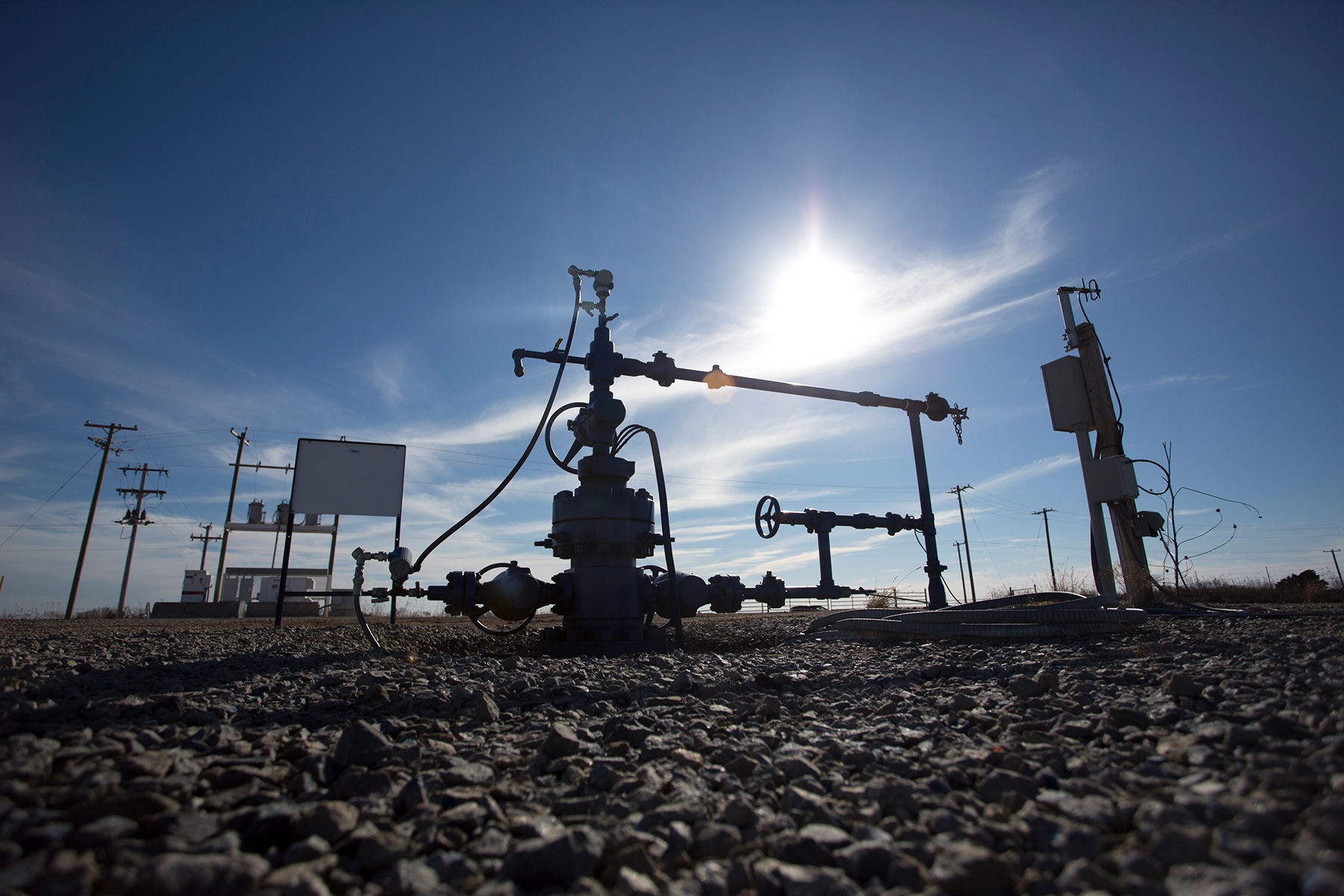 An injection well pumps wastewater into the ground in Coyle, Oklahoma, Jan. 24, 2016. (Credit: J Pat Carter/Getty Images)
Meanwhile, in Oklahoma, a stunning expose co-published in October by ProPublica and the Oklahoma-based newsroom Frontier documented a "growing number of purges," where oil field wastewater has been injected at "excessively high pressure" and cracked rock deep underground, freeing it to travel uncontrolled for miles, sometimes returning to the surface via abandoned wells. In one instance, a spew of brine from a defunct well contaminated a watering hole for livestock, killing at least 28 cows.
The story features Danny Ray, a whistle-blowing former state regulator and long-time petroleum engineer, who is worried that given Oklahoma's vast number of unplugged oil and gas wells, the state is ripe for more of these sorts of disasters. However, the Oklahoma Corporation Commission, the state's oil and gas regulator, discounted Ray's concerns, saying in a statement that it remains "committed to protecting Oklahoma and supporting the state's largest industry to perform its role in a safe and economic manner."
"These goals are not mutually exclusive," according to the agency.
In West Texas, Bloomberg reported in September, a growing number of the state's over 2,000 defunct oil and gas wells — locals call them "zombie wells" — are spouting unpredictable geysers of fracking waste. One blowout in Crane County shot wastewater 100 feet high into the air in 2022, releasing around 24 million gallons of toxic fluids before it was capped about two weeks later.
A spokesperson with the Railroad Commission of Texas, the state's oil and gas regulator, told Bloomberg that it had instituted a set of protective new rules regarding oil and gas wastewater injection wells, but recognized "the physical limitations of the disposal reservoirs" as well as the risks to oil production and fresh water.
Just last month, Inside Climate News reported on a new lawsuit filed by a Crane County landowner claiming "catastrophic impacts" from injection well blowouts.
The impacts of injection well leakage and blowouts have become visible from space. In a 2024 study using satellite observations, a team of Southern Methodist University scientists found that so much wastewater has been injected underground that it has raised land in one area of the Permian Basin by 16 inches in just two years, and created a high-pressurized underground lake that will lead to more sky-high wastewater gushers. "We have established a significant link between wastewater injection and oil well blowouts in the Permian Basin," the authors wrote in the academic journal, Geophysical Research Letters.
Once "a little cottage industry of mom and pops," injection wells have become "a much bigger business," says Kurt Knewitz, a consultant who runs an injection well information site called BuySWD.com. A case in point, says Knewitz, is Pilot Water Solutions, which operates injection wells in Texas and is a division of Berkshire Hathaway Inc.'s Pilot Travel Centers, the multinational energy and logistics company owned by Warren Buffet.
"You look at the Permian Basin and you think it's a huge oil play, but it produces three to four times as much produced water as oil," says Knewitz. "So the Permian is really a produced water play that on the side produces some oil and gas."
Still, the industry has not acknowledged the toxic reality on the ground, and continues to defend its favorite waste disposal practice. A recent report from the American Petroleum Institute (API), the nation's largest oil and gas lobby, states that injection wells are "safe and environmentally reliable" and "serve a vital role by supporting the responsible and sustainable development of O&G resources."
The API did not respond to specific questions regarding the merits of early critiques of injection wells, or whether they remain valid today. "Our industry is committed to the responsible management of produced water," spokesperson Charlotte Law said in the group's response. "Operators continuously invest in advanced treatment technologies, recycling, and reuse practices to minimize freshwater use, protect ecosystems, and ensure safe operations."
The USGS and DOE did not respond to questions for this story.
Advocacy groups that have spent decades tracking the EPA's oil and gas waste rules point out that the business model of the U.S. fracking industry depends on operators being able to get rid of waste cheaply.
"The inadequate regulation and enforcement of waste disposal wells across the country represents a financial giveaway to the oil and gas industry," says the NRDC's Mall, with NRDC. "Experts have known for generations this method threatens the environment."
For queries about republishing this story, please contact editor@desmog.com.
The post The Oil Industry's Latest Disaster: Trillions of Gallons of Buried Toxic Wastewater appeared first on DeSmog.
Industry Pushes Back on UK Ad Bans [ 11-Feb-26 11:22am ]In a speech to UK advertising executives last week, Lord Ed Vaizey had nothing good to say about a new ban on junk food ads aimed at children.
Nor did the Conservative peer mention a petition signed by more than 110,000 people calling on parliament to impose a tobacco-style ban on ads for fossil fuels.
Instead, Vaizey used his keynote at the annual Advertising Association conference to call for as little regulation as possible.
"I see a political class that is tempted to ban what it doesn't like rather than use the power of advertising to change behaviour," Lord Vaizey told the crowd at the start of the one-day event.
The ad industry is facing scrutiny for its role in the climate crisis — from bombarding the public with ads for unsustainable products such as frequent flying and fuel-guzzling sports utility vehicles, to protecting the reputations of the world's biggest polluters.
With cities such as Edinburgh and Sheffield imposing some restrictions on fossil fuel ads, and Amsterdam enshrining a blanket ban, campaigners want to persuade more towns and cities to follow suit in the hope of winning national bans as well.
Yet talks at the conference — which took place in London on February 5 — barely touched on the climate crisis. Discussions centred instead on the rise of artificial intelligence and rebuilding public trust in advertising, eroded by concerns over online scam ads and misinformation.
Vaizey's speech focused on advertising's role in powering the economy and included a swipe at the junk food ad ban, which came into effect on January 5 following years of cross-party support. The new rules stop high sugar, fat and salt foods being advertised online or on television before 9pm.
Vaizey told the conference that such bans did not have "really any clear effect" on health.
However, a February 2022 peer-reviewed study published in PLoS medicine found that London households reduced the amount of calories consumed from high fat, salt and sugar foods by almost 7 percent after a ban on junk food ads on public transport, with calorie intake from chocolate and sweets falling almost 20 percent.
"There is clear academic evidence that ad bans are highly effective at reducing consumption of harmful products such as unhealthy foods," said Victoria Harvey, an academic researcher on the advertising industry.
"Vaizey's speech…fits with the Advertising Association's opposition to junk food advertising legislation as well as their continued opposition to banning ads for fossil fuels," Harvey added.
An Advertising Association spokesperson said that Lord Vaizey was speaking in a personal capacity and the views he expressed on junk food advertising were his own. The spokesperson referred DeSmog to a review by consultancy SLG Economics — funded by the Advertising Association and other trade groups — that contended that the February 2022 research contained "clear and obvious discrepancies."
Industry Lobbies Against BansVaizey, who served as culture minister under former Conservative prime minister David Cameron, has pushed back against a junk food ad ban for years.
The peer led a call in 2022 to delay the ban by a year, according to reporting by the Grocer. Vaizey also proposed a "sunset clause" that would have scrapped the law after five years if it was not shown to be effective.
The Advertising Association and Food and Drink Federation backed Vaizey's calls — reflecting a wider pattern of industry lobbying to defeat or dilute proposed ad bans.
Paris-based JCDecaux, the world's largest outdoor advertising operator, attempted to block passage of Amsterdam's fossil fuel ad ban by emailing city councillors directly the day before the vote. JCDecaux, which controls ad space on bus shelters, billboards, and street furniture, claimed that the ban would have "far-reaching financial and legal consequences", and warned officials against creating restrictions based on "incorrect and incomplete information."
Amsterdam adopted the ban on January 22, becoming the first capital city to ban fossil fuel ads.
London Mayor Sadiq Khan, who introduced the ban on junk food ads on the city's public transport in 2019, has stopped short of slapping a similar ban on fossil fuel ads — saying more guidance from the government is needed before he can make a decision.
Hundreds of advertising campaigns by oil and gas companies have run on London's public transport network TfL in recent years, a DeSmog investigation found.
A week before the Advertising Association conference, a group of 15 senior ad executives sought to foreground their industry's role in the climate crisis and other harms by publishing an anonymous memo accusing the sector of "funding hate, legitimising environmentally destructive companies" and "paying little more than lip service" to addressing critical issues.
In the memo, which was coordinated by the UK group Inside Track, the executives said the industry was "helping polluting industries such as oil and gas rebuff public scrutiny."
The Advertising Association spokesperson said that in response "We contacted them on the day the memo was published and said we would be open to a meeting to hear more about the findings. We have since been offered a meeting date in March."
Lord Vaizey did not respond to a request for comment.
The post Industry Pushes Back on UK Ad Bans appeared first on DeSmog.
Plans by the Donald Trump administration to fund right-wing groups in Europe have been slammed by policymakers and campaigners as an effort to "usurp European democracy".
According to the Financial Times, the U.S. State Department plans to bankroll think tanks and charities in the UK and Europe which share President Trump's agenda, with particular focus on blocking attempts to regulate U.S. social media platforms.
Daniel Freund, Member of the European Parliament (MEP) for the Greens, told DeSmog that the funding had "one clear aim: to divide and destabilise Europe."
"We must clearly name, criticise, and reject such foreign interference," he added.
Sarah Rogers, U.S. under secretary of state for public diplomacy, is leading this effort, having visited the UK, France, and Italy in early December.
Her visit coincided with the publication of a new U.S. national security strategy, which called for "cultivating resistance" in Europe to liberal, democratic politics.
"The U.S. has a long history of covert manipulation of politics across the globe. But to see it happen in Europe is new, and we should be worried," said Kenneth Haar of the transparency watchdog Corporate Europe Observatory. "Big Tech regulation is set to be the first testing ground of the new American way of imposing their will on Europe."
Subscribe to our newsletterStay up to date with DeSmog news and alerts
Email Address What content do you want to subscribe to? (check all that apply) All International UK Sign Up (function($){ $('.newsletter-container .ijkidr-us').click(function() { $('.js-cm-form').attr('data-id', '2BE4EF332AA2E32596E38B640E905619D07B21962C5AFE16D3A2145673C82A3CEE9D9F1ADDABE965ACB3CE39939D42AC9012C6272FD52BFCA0790F0FB77C6442'); $('.js-cm-email-input').attr('name', 'cm-vdrirr-vdrirr'); }); $('.newsletter-container .ijkidr-uk').click(function() { $('.js-cm-form').attr('data-id', '2BE4EF332AA2E32596E38B640E905619BD43AA6813AF1B0FFE26D8282EC254E3ED0237BA72BEFBE922037EE4F1B325C6DA4918F8E044E022C7D333A43FD72429'); $('.js-cm-email-input').attr('name', 'cm-ijkidr-ijkidr'); }); })(jQuery);The new U.S. fund would be the latest attempt by Trump and his allies to thwart EU regulations. DeSmog last week reported on a gathering of pro-Trump groups in the European Parliament, during which they turned their fire on the EU's Digital Safety Act, which aims to tackle the harms caused by social media.
Trump was re-elected in November 2024 following a $270 million donation from the owner of social media platform X Elon Musk, and received $1 million each from the heads of Meta, Apple, Google, Microsoft and Amazon for his inauguration fund.
The event in Brussels was attended by the Heritage Foundation, the radical right-wing think tank which drafted Project 2025 - the authoritarian, anti-climate blueprint for Trump's second term.
The Heritage Foundation has been one of the key MAGA ("Make America Great Again") groups attempting to influence European politics since Trump's re-election.
As reported by DeSmog, the group gathered hardline conservative groups last year to discuss ideas for dismantling the EU. It also attempted to influence Albania's election in favour of its conservative candidate in May 2025.
The group has been joined by the Heartland Institute, which has been leading the campaign to spread climate science denial across the UK and EU. The group claims to be advising Nigel Farage's anti-climate party Reform UK, while it has been forging alliances with far-right parties and campaigners in an attempt to gain a foothold in Europe.
Both groups lobbied aggressively - and successfully - for the dilution of EU laws designed to hold large companies, including U.S. firms, to account for their environmental impacts. They also forcefully oppose the EU's digital safety laws.
Raphael Kergueno, senior policy officer at Transparency International, said that the new pro-Trump fund adds to growing concern about MAGA's influence over EU laws.
"Transparency loopholes are allowing the MAGA movement's illiberal organisations to usurp European democracy from the inside," he said. "As a matter of urgency, the rules must be changed to compel them to register on the EU's lobby register and declare their funding, so that their blatant attempts to bring authoritarianism to Europe can be scrutinised, and thwarted."
Patrick ten Brink, secretary-general of the European Environmental Bureau, added: "The reporting in the Financial Times confirms what many civil society organisations have been warning about for some time: there is a coordinated effort to import US-style culture-war politics into Europe, using funding, think-tanks and so-called 'charitable' fronts to weaken democratic safeguards.
"Europe's response should be clear-eyed and proportionate. Defending transparency, independent NGOs and evidence-based policymaking is essential to the EU's democratic resilience and its ability to govern in the public interest. EU policymakers should take care not to weaken environmental and social protections or undermine public well-being in ways that ultimately serve external deregulation agendas."
MAGA UKMAGA's influence is also being felt in the UK, where climate and digital safety regulations are likewise under fire.
Farage is a close Trump ally, stating repeatedly that he is the "bravest man".
The Reform leader has also been helping to import the architects of Trump's agenda into the UK, having urged the Heartland Institute to set up a branch in the UK and Europe.
As revealed by DeSmog, Farage has received £150,000 from his donors to attend pro-Trump events or cheerlead for his agenda since he was elected to Parliament in July 2024.
A new Reform-linked think tank, the Centre for a Better Britain, was launched last year by James Orr, a close friend of U.S. vice president J.D. Vance and now a senior Reform advisor. The Centre for a Better Britain, set up by Reform donors, is reportedly seeking to raise millions from Trump backers.
 Jordan Peterson speaks with Reform UK leader Nigel Farage at ARC. Credit: Marc Fawcett-Atkinson
During her visit to the UK in December, head of the new U.S. fund, Sarah Rogers, was hosted at an event by the Prosperity Institute (formerly Legatum Institute). The conservative think tank is run by UAE-based investment firm Legatum Group, which co-owns right-wing broadcaster GB News, Farage's principal employer.
The event related to the UK's Online Safety Act (OSA), which requires U.S. social media companies to remove illegal content such as child pornography. Along with the EU's DSA, the OSA has been attacked by the Trump administration for what it calls the "censorship" of Americans' free speech.
Rogers spoke at the event alongside Zia Yusuf, Reform's head of policy, and Conservative peer Toby Young, who runs the Free Speech Union, a conservative pressure group.
It is not clear which groups Rogers met with in France or Italy. In Washington D.C. in December she hosted Markus Frohnmaier, a Member of the German Parliament for the far-right Alternative für Deutchland (AfD) party, according to a post she shared on social media platform X.
The Legatum Group also helps to run the Alliance for Responsible Citizenship (ARC), a radical right-wing network group led by Canadian activist Jordan Peterson. ARC has been a key platform for MAGA figures and far-right European politicians, with its latest London conference planned for this summer.
Speakers at ARC events have included U.S. energy secretary Chris Wright, Republican House speaker Mike Johnson, and Republican donor and Palantir founder Peter Thiel. Last year's ARC event in London was also attended by several oil and gas executives.
"It is time to consider what can be done legally," Haar of Corporate Europe Observatory said. "When it comes to China or Russia, there are measures in place to defend the public from undue influence. We really need to figure out quickly how the American threat can be handled effectively.
Dieter Plehwe, an academic at the Berlin Social Science Center likewise called for stronger transparency laws, stating: "It would be wise to increase the opportunities for investigative journalists, academic researchers and the public at large to understand who is behind think tank and media campaigns."
The post Trump Accused of Trying to 'Divide and Destabilise' Europe Through New MAGA Fund appeared first on DeSmog.
The Trump administration just employed the U.S. Environmental Protection Agency (EPA) and the Clean Air Act to discourage coal plant closures in Colorado — repurposing measures initially intended to safeguard public health and prevent pollution to reboot the dirtiest, deadliest fossil fuel.
Michael Hiatt, deputy managing attorney at the environmental legal nonprofit Earthjustice, told DeSmog that the EPA's action was not what the Clean Air Act intended. "In our view, it's plainly illegal," he said.
Furthermore, Hiatt said the EPA's move may have implications beyond Colorado, indicating that the agency could take similar actions that affect coal and gas plants elsewhere.
"It's clearly EPA indicating a policy preference," he said. "They are communicating that they're not going to look favorably on future state plans that include coal or gas plant closures."
As aging, inefficient coal plants barrel toward obsolescence across the U.S., the Trump administration seems dead-set on coming to their rescue. In 2025, the U.S. Department of Energy issued orders to keep five coal plants online past their planned retirement dates. The orders often came against their operators' wishes and cost customers millions in the process. Federal officials, including Energy Secretary Chris Wright, frequently cited increasing energy demands, including for artificial intelligence. Now, the EPA has stepped in.
Subscribe to our newsletterStay up to date with DeSmog news and alerts
Email Address What content do you want to subscribe to? (check all that apply) All International UK Sign Up (function($){ $('.newsletter-container .ijkidr-us').click(function() { $('.js-cm-form').attr('data-id', '2BE4EF332AA2E32596E38B640E905619D07B21962C5AFE16D3A2145673C82A3CEE9D9F1ADDABE965ACB3CE39939D42AC9012C6272FD52BFCA0790F0FB77C6442'); $('.js-cm-email-input').attr('name', 'cm-vdrirr-vdrirr'); }); $('.newsletter-container .ijkidr-uk').click(function() { $('.js-cm-form').attr('data-id', '2BE4EF332AA2E32596E38B640E905619BD43AA6813AF1B0FFE26D8282EC254E3ED0237BA72BEFBE922037EE4F1B325C6DA4918F8E044E022C7D333A43FD72429'); $('.js-cm-email-input').attr('name', 'cm-ijkidr-ijkidr'); }); })(jQuery);In late January, the EPA issued its final published rule rejecting Colorado's Regional Haze State Implementation Plan, filed as part of longstanding Clean Air Act rules intended to increase visibility in national parks and wilderness areas. As part of the plan, Colorado had outlined its goal of closing its six remaining coal plants by 2031. Coal plants release multiple smog-forming pollutants that threaten the state's outdoor recreation industry and harm human health. The utilities involved had voluntarily agreed to this target over the past decade.
It could have been a routine approval. But at some point in 2025, Colorado Springs' city-owned utility told the EPA it no longer wanted to shut down the lone coal-fired generator at the Ray D. Nixon Power Plant, as initially proposed.
The EPA used that development to justify throwing out the entire plan, jeopardizing pollution controls and retirement timelines for industrial sites across the state — from fossil fuel plants and the state's only oil refinery to the Denver International Airport. In its final rule, the EPA argued the single "forced closure" of a coal-fired unit showed Colorado hadn't been careful to make sure its plan respected the constitutionally enshrined private property rights of energy providers.
"The state did not properly consider and explain whether the nonconsensual closure of Colorado Springs Utilities' Nixon Unit 1 power plant would be an act of taking private property without compensation," the agency wrote in a press release explaining its decision. "EPA legally cannot approve Colorado's [plan].
Critics took issue with that assessment.
"Colorado had done such a very thorough job working with utilities, and those retirements were voluntarily proposed," said Ulla Britt-Reeves, clean air program director at the nonprofit National Parks Conservation Association. "So for EPA to come in and essentially say that Colorado was forcing those retirements is simply not true."
Earthjustice's Hiatt told DeSmog that the EPA's decision was "unreasonable, irrational, and illegal under the Clean Air Act."
He added that, "What this EPA action shows is this Trump administration taking an ideologically motivated stance that it is not going to do anything that might prove or even allow a coal plant to retire under its watch."
RELATED: These 15 Coal Plants Would Have Retired. Then Came AI and Trump.
Hiatt hopes the EPA's broad disapproval in Colorado won't impact the many other agreed-upon plant closures and pollution controls covered by the plan. But he expressed worry that the EPA's action gives the state's utilities and industrial operators an opportunity to "backtrack" on environmental commitments in the coming years.
In a proposed rule issued in July, the EPA initially emphasized a different rationale for its pending decision: that closing the coal-fired unit at Nixon would threaten grid reliability — in large part due to a supposed surge in electricity demand, including from artificial intelligence. The agency accused Colorado of not taking grid reliability seriously. Under President Trump, the EPA has listed artificial intelligence (AI) development as one of the top priorities guiding its strategy, as well as restoring "American Energy Dominance," which Trump has tied specifically to oil, coal, and natural gas.
"This Administration has found as a matter of national interest, national security, and energy policy that power generated from coal resources is critical to addressing this surging demand," it wrote.
Throughout 2025, Trump administration officials, including DOE Secretary Wright, used a purported rise in energy demand driven by AI to justify fossil fuel expansion, and prevent scheduled coal plant retirements. A December 2025 analysis by DeSmog found that at least 15 coal plants pushed back their retirement dates since Trump took office — with plants often remaining open voluntarily due to projected data center demands, but sometimes due to DOE executive orders. After DeSmog's story published, the DOE issued a flurry of new executive orders forcing additional coal generators to remain online, including plants in Indiana and Washington that were targeted for the first time.
RELATED: Q&A: Tech Billionaires' AI Space Empire Fantasies Are 'An Insidious Form of Climate Denial'
In its public comments, the State of Colorado argued it had in fact assessed reliability, in conjunction with utilities statewide, and that planned closures weren't projected to contribute to an energy shortfall.
"EPA cites nothing in the record regarding this alleged 'rise in electricity demand' or 'resurgence of domestic manufacturing' or even the 'construction of artificial intelligence data processing centers," the state's Air Pollution Control Division wrote." The record before EPA … provides no basis to conclude that these issues materially affect Colorado or are impacted by the specific units with Closure Dates."
The EPA backtracked slightly in its final rule in January, insisting that grid reliability was not part of its legal determination — only private property considerations. And yet it seemed to warn Colorado against including power plant closures in any future plan, citing the rise in domestic manufacturing and "the construction of artificial intelligence data processing centers."
"Power generated from coal resources is critical to addressing this surging demand and a matter of national interest, national security, and energy policy," it wrote. "The EPA does not encourage electric generating facilities to close in the face of this energy demand."
It added that "the EPA does not expect any state to encourage or force an electric generating facility to close in order to comply with the [Clean Air Act's] regional haze second planning period requirements."
Earthjustice's Hiatt said that statement shows EPA going beyond its disapproval of Colorado's regional haze plan. "It's difficult to say how this will play out," he said, "but it does clearly indicate EPA's policy preference — they do not want to see coal or gas closures in regional haze plans."
"There are a lot of still outstanding haze plans that this EPA needs to act on," Britt-Reeves, of the National Parks Conservation Association, said. "Are they going to let good plans that actually reduce pollution be approved? That would a great place to go from here — but I don't expect that that's where this administration is heading." She said the language in the final rule indicates that EPA may have "its sights on deregulating the rule itself, which is extremely concerning."
An EPA spokesperson declined to provide comment or arrange an interview for this story. In a press release announcing its decision on Colorado's haze plan, EPA cited "turning the United States into the Artificial Intelligence capital of the world" as part of its rationale.
But though EPA spoke of a "forced closure" of the Nixon plant, Colorado Springs Utilities had in fact voted to retire the plant voluntarily by December 31, 2029 — which Colorado had simply noted in its plan. In comments to DeSmog, Danielle Nieves, a spokesperson for Colorado Springs Utilities, confirmed that the utility had reversed course and asked EPA for "non-enforcement" at some point in 2025, years after the plan had been filed.
Matt Gerhart, a Sierra Club attorney, questioned whether it was appropriate for the EPA to disapprove an entire state plan based solely on an 11th-hour change of heart — a precedent that he said could give EPA an excuse to sit on plans it doesn't like until it found some grounds for dismissal.
"There's nothing in EPA guidance that says what the state was supposed to do to guard against the hypothetical possibility that, five years later, a source might change its mind about a retirement," he said. "I think EPA is really faulting the state for following the agency's own guidelines here."
Jeremy Nichols, a senior advocate for the environmental nonprofit Center for Biological Diversity, expressed concern that the EPA's actions would set a troubling precedent, undercutting the legality of environmental regulation itself.
"What's next? Is any kind of clean air regulation going to be deemed to infringe upon a private property right by virtue of making it more costly and potentially forcing a company to have to shut down?" he said. "I mean, it's a very dangerous and scary slippery slope."
In a statement to DeSmog, Colorado's Senior Director of Air Quality Programs Michael Ogletree said the EPA's ruling would damage environmental protections in Colorado, which already has some of the worst air quality problems in the nation, and that the state was exploring next steps.
"Coal plant retirement dates remain in state regulation, and many facilities have already closed or are on track to retire voluntarily because cleaner energy is more affordable and makes economic sense for consumers," he wrote. "Colorado has demonstrated that it is possible to protect public health, reduce pollution, and maintain a reliable energy system at the same time."
The post Trump's EPA Just Used the Clean Air Act to Prop up Coal Power appeared first on DeSmog.
Canada Pension Plan is Bankrolling Trump's Fossil Fuel and AI Agenda [ 06-Feb-26 4:38pm ]The Canada Pension Plan Investment Board (CPPIB) is financing — and profiting from — U.S. President Donald Trump's fossil fuel and AI development agenda, DeSmog has learned.
The CPPIB has invested billions in fossil fuel expansion in the U.S. since Trump's return to office. It has partnered with private equity firms to acquire American oil and gas producers, and financed AI companies like Elon Musk's xAI.
The CCPIB is an independent investment management organization responsible for managing the Canada Pension Plan (CPP), Canada's largest public pension. It was created by an Act of Parliament in 1997, and is accountable to Canada's Parliament. The CPPIB's primary responsibility is to ensure the CPP maximizes its long term revenues with minimal risk.
The CPPIB has a policy on sustainable investing, updated in May 2025, that recognizes climate change as a serious risk, and which encourages adapting its investment strategy to evolving decarbonization pathways and investing "for a whole economy transition required by climate change." However, the same policy indicates the CPPIB's belief "that accelerating the global energy transition requires a sophisticated, long-term approach rather than blanket divestment."
In response to Canadian Prime Minister Mark Carney's pledges to fast-track major infrastructure projects, CPPIB CEO John Graham stated in September 2025 that the CPPIB was keen to invest in major projects, particularly in the energy sector. As reported by the Financial Post, Graham singled out fossil fuel pipelines, saying "Here in Canada, we like pipelines. We like oil and gas pipelines."
Its recent investments in the U.S. fossil fuel and AI sectors are a growing concern to pension fund watchdogs, which argue that at a time when the US is actively waging a trade war against Canada and destabilizing the climate, the CPPIB is providing capital to allow it to happen.
"As the U.S. government wages economic warfare against Canadian industry, upends the international rules-based order, and threatens to annex Canada, CPPIB appears content to continue gambling the Canada Pension Plan on risky U.S.-based companies," said Patrick DeRochie, Senior Manager with Shift Action, a charitable organization dedicated to protecting pensions and the environment from investments in the fossil fuel sector, in a statement to DeSmog.
"With so many Canadians boycotting U.S. products and companies while coping with the economic shocks triggered by our volatile neighbor to the south, I think many Canadians would be shocked to learn where CPPIB has invested some of their hard-earned retirement savings during this time of turbulence and uncertainty," said DeRochie.
CPPIB didn't respond to a request for comment.
Subscribe to our newsletterStay up to date with DeSmog news and alerts
Email Address What content do you want to subscribe to? (check all that apply) All International UK Sign Up (function($){ $('.newsletter-container .ijkidr-us').click(function() { $('.js-cm-form').attr('data-id', '2BE4EF332AA2E32596E38B640E905619D07B21962C5AFE16D3A2145673C82A3CEE9D9F1ADDABE965ACB3CE39939D42AC9012C6272FD52BFCA0790F0FB77C6442'); $('.js-cm-email-input').attr('name', 'cm-vdrirr-vdrirr'); }); $('.newsletter-container .ijkidr-uk').click(function() { $('.js-cm-form').attr('data-id', '2BE4EF332AA2E32596E38B640E905619BD43AA6813AF1B0FFE26D8282EC254E3ED0237BA72BEFBE922037EE4F1B325C6DA4918F8E044E022C7D333A43FD72429'); $('.js-cm-email-input').attr('name', 'cm-ijkidr-ijkidr'); }); })(jQuery); CPPIB's Failing Climate GradeThe CPPIB operates at an arm's length from the Canadian government and is accountable to it, but operates under the guidance of an independent Board of Directors. It manages assets totaling C$777.5 billion, from 22 million contributors to the CPP. The CPPIB has recently invested in or entered into joint ventures with firms involved in sectors as diverse as American outpatient medical facilities, the Japanese hospitality sector, and the AI sector.
The CPPIB received its worst grade to date in Shift Action's latest climate report card, dropping to a D grade overall and coming in second to last in the non-profit group's annual ranking of Canadian pension funds' climate policies. The CPPIB's performance fell in four out of six categories, earning failing grades when it came to meeting Paris Agreement aligned targets, intermediate targets, and for not excluding fossil fuels.
Part of the rationale for that low grade is that the CPPIB has major investments in American fossil fuel companies, AI companies, and fossil fuel companies seeking to power America's AI expansion.
The CPPIB invested US$300 million last year in xAI, specifically to construct a gas-powered AI data centre in a low-income Black neighborhood in Memphis, Tennessee. The xAI facilities in Memphis have been cited as examples of environmental racism by advocacy groups and have been recorded emitting massive quantities of pollution. Most recently, xAI was in the news because its AI chatbot product Grok was flooding the Internet with pornographic and sexualized images of women and children. In response to the Toronto Star's questions about why the CPPIB was investing in xAI, a spokesperson said the CPPIB wasn't endorsing how Grok was being used.
The CPPIB recently spent $1.2 billion to acquire a roughly 25 percent stake in Tallgrass Energy, a pipeline company invited to the White House to participate in discussions about the exploitation of Venezuela's oil industry.
Tallgrass Energy has 16,000 kilometre's worth of pipelines and terminals across 14 states. A managing director of the CPPIB's 'sustainable energies' group sits on Tallgrass' board.
Tallgrass is also focused on developing fossil fuel infrastructure to capitalize on the AI boom. The company has proposed a new pipeline from the Permian Basin to support new data centres and gas plants across the United States. The company has also partnered with the AI infrastructure company Crusoe to build an AI-focused data centre that would be powered primarily by natural gas and "future renewable resources."
"It appears that CPPIB is betting that the expansion of AI infrastructure will drive an increase in demand for fossil gas, and is planning to finance and profit from gas-fired data centres," said DeRochie.
During a November 2024 meeting, CPPIB CEO John Graham described how "the demand for energy globally is not declining" and AI is "further driving the demand for energy." Graham further stated that the CPPIB needs to "continue to support the oil and gas industry" because the "industry has a long track record of delivering energy into the economy in a very safe and economical way."
The CPPIB has committed hundreds of millions to VoltaGrid, a Houston-based company that specializes in modular natural gas systems for data centres and fossil fuel operations. The company regularly misidentifies natural gas as a "low-emission" solution for the AI and data centre sectors, yet is part of CPPIB's "Sustainable Energies" portfolio. Moreover, a CPPIB managing director sits on VoltaGrid's board.
The company's CEO, Nathan Ough,is a Republican donor who has eagerly embraced Donald Trump's "drill, baby, drill" agenda. VoltaGrid isn't merely supportive of Trump's focus on gas-powered data centre expansion, but also collaborates with companies owned by major Trump donors, including Oracle and Energy Transfer. The company is also involved in a controversial project to build a gas plant to power a data centre in Saint John, New Brunswick. Responding to this criticism, Ough responded that VoltaGrid is 51 percent Canadian-owned and that its finances are "banked in large part out of Canada."
Shift Action further notes that the CPPIB in general is overweighted with American investments: approximately 47 percent of its portfolio is invested in the U.S., a percentage that far exceeds their share of the global economy.
Several fossil fuel companies owned by the CPPIB sit on the U.S. Department of Energy's National Petroleum Council (NPC). These include The Williams Companies, AlphaGen, and California Resources Corp. Though not backed by the CPPIB, two other Canadian fossil fuel companies — Enbridge and TC Energy — also sit on the NPC. These companies are involved in oil and gas production, transporting fracked gas, and operate fossil fuel power plants in six states.
According to Shift Action, the CPPIB reported that it invested US$807 million in fossil fuel expansion in the U.S. in the final quarter of 2024. This includes a US$300 million investment in Salamanca Infrastructure LLC, which owns midstream energy assets in the United States, more than US$200 million to fund pipeline assets that transport fossil gas in Pennsylvania, Ohio, and West Virginia, and three co-investments with Quantum Capital Group, a Houston-based private equity firm focused on the energy sector.
These investments included stakes ranging from 10 to 29 percent in three different firms involved in fossil fuel exploration. The CPPIB's commitment to Quantum Capital Group / Quantum Energy Partners has been steadily growing since its first investment of US$200 million in 2008, followed by another US$300 million in 2014. In 2024, it committed US$500 million to Quantum despite the fact that the company stated the investment would be used to support the US' conventional energy industry.
"For a national pension manager meant to ensure the long-term retirement security of 22 million Canadians, CPPIB sure has a strange way of investing in our best interests and avoiding undue risks of loss," said DeRochie. "You would think that the risks of American aggression, catastrophic climate change, and Trump-aligned tech oligarchs would give the CPPIB pause before making these investment decisions."
The post Canada Pension Plan is Bankrolling Trump's Fossil Fuel and AI Agenda appeared first on DeSmog.
MAGA Gathers in European Parliament to Attack EU Laws [ 06-Feb-26 4:30pm ]BRUSSELS - Groups aligned with Donald Trump's administration rallied against "online censorship" and "extreme environmentalism" as they took to the stage at an event held in the heart of the European Parliament earlier this week.
The meeting in Brussels comes amid reports that the U.S. State Department is poised to fund MAGA-aligned think tanks and charities across Europe to further Trump's agenda overseas.
At the one-day conference run by the Political Network for Values (PNfV) on 4 February, speakers from the Heritage Foundation, the Alliance Defending Freedom (ADF), Family Watch International, and other U.S. conservative Christian groups defended what they described as "basic truths […] such as love of God, country and family."
The event was co-organised by the far-right Patriots for Europe (PfE) and right-wing European Conservatives and Reformists (ECR), which have used their growing influence in the EU Parliament to undermine climate policies.
Trump-aligned groups spoke in defence of the absolute right to free speech, and against EU regulations designed to regulate hate speech online.
They were referring to the Digital Services Act (DSA), the flagship legislative package designed to hold big tech platforms to account for the harms they produce, including online hate and climate change disinformation.
The event has prompted concerns from Members of European Parliament (MEPs) that the Trump administration is realising its aim to cultivate "resistance to Europe's current trajectory within European nations" as set out in a White House National Security Strategy document published last year.
"Fostering far-right movements to destabilise the continent is no longer just a line in a White House strategy document. It is a political reality," said Daniel Freund, a German MEP for The Greens.
"This week, the enemies of Europe, the adversaries of freedom, gathered in the European Parliament. These individuals call themselves patriots, yet they are nothing more than Trump's foot soldiers. The event made one thing clear: Trump's MAGA movement has established a political foothold in Europe. The answer must be a stronger, more independent Europe."
Subscribe to our newsletterStay up to date with DeSmog news and alerts
Email Address What content do you want to subscribe to? (check all that apply) All International UK Sign Up (function($){ $('.newsletter-container .ijkidr-us').click(function() { $('.js-cm-form').attr('data-id', '2BE4EF332AA2E32596E38B640E905619D07B21962C5AFE16D3A2145673C82A3CEE9D9F1ADDABE965ACB3CE39939D42AC9012C6272FD52BFCA0790F0FB77C6442'); $('.js-cm-email-input').attr('name', 'cm-vdrirr-vdrirr'); }); $('.newsletter-container .ijkidr-uk').click(function() { $('.js-cm-form').attr('data-id', '2BE4EF332AA2E32596E38B640E905619BD43AA6813AF1B0FFE26D8282EC254E3ED0237BA72BEFBE922037EE4F1B325C6DA4918F8E044E022C7D333A43FD72429'); $('.js-cm-email-input').attr('name', 'cm-ijkidr-ijkidr'); }); })(jQuery); 'Backbone of the Trump Regime'On Thursday, the Financial Times revealed that the Trump administration plans to fund MAGA-aligned think tanks and charities across Europe in an effort to spread "American values".
The Heritage Foundation, one of the most prominent MAGA think tanks, is credited with producing the authoritarian playbook known as Project 2025, the intellectual blueprint for Trump's second term. That effort has helped to set the U.S. government on a path to "energy dominance", which in practice means abandoning climate targets in favour of massively expanded fossil fuel extraction.
The MAGA groups at the PNfV event have a long record of attacking and attempting to undo progressive social gains on issues including gender, religion, and LGBTQ+ rights. Alliance Defending Freedom (ADF) in particular was instrumental in the 2022 overturning of the constitutional right to an abortion that was guaranteed under Roe v. Wade.
An early version of the event's programme showed both ADF and Heritage as sponsors of the event, along with the Foundation for a Civic Hungary, the official party think tank of Fidesz, the ultraconservative party of Viktor Orbán's Hungary. This version was quietly removed from the PNfV's website to show no sponsors, although speakers from these organisations remained on the updated programme.
The groups at the event identified removing regulation on X and other digital platforms sympathetic to right-wing views as a top priority.
One speaker from the European branch of the ADF, Adina Portaru, labelled the EU's DSA "one of the most dangerous threats to freedom of expression online in the Western world today".
The criticism of Europe's attempt to regulate hate speech online echoes comments made by JD Vance in his address to the Munich Security Conference in February 2025. He argued Europe's biggest threat was the "threat from within", partly caused by "digital censorship". This, he argued, posed a bigger threat than Russia, at a time when Europe faces the escalating threat of Russian hybrid warfare on its eastern flank.
The ADF has itself made inroads into Europe, and has been quietly working with Nigel Farage's Reform UK. Farage had rarely, if ever, mentioned abortion in his 31-year political career until May last year, when he called the UK's 24-week abortion limit "absolutely ridiculous".
"The timing is shocking. While the rest of Europe is re-considering its links with the U.S. after the Greenland affair, here we have quite a few European far-right parties rubbing shoulders with the core of Trump's hinterland," said Kenneth Haar, researcher and campaigner at Corporate Europe Observatory, an advocacy group pushing for greater accountability in European institutions.
"The Heritage Foundation is not just a think tank. It is part of the backbone of the Trump regime."
'Revolution of Common Sense'The PNfV event was the seventh "Transatlantic Summit" organised by the groups, a coalition of Christian conservative groups that brings together senior government officials, legislators, and well-connected civil society groups to fight progressive social gains. The group has active members in Europe, North and Latin America, and Africa.
In a programme handed out at the summit, the group's president, Stephen Bartulica, a Croatian MEP, said the group "must promote what some have called a revolution of common sense."
The PNfV counts the President-elect of Chile, Jose Antonio Kast, among its list of former presidents. The Republican chair of the Iowa State Senate, Amy Sinclair, and members of Polish and Hungarian parliaments sit on its board.
Kast, who delivered the single keynote speech of the day, spoke about defending "fundamental beliefs", from "isms" such as "extreme environmentalism," which allegedly "prioritises the environment over people". He was introduced as having nine children - the second speaker to be introduced in this way.
Alongside calls to "defend the values of God, country and family," speakers at the summit railed against a "far-reaching online censorship regime". This, they claimed, was established by efforts to regulate hate speech online, which they said infringes on the "innate natural right of all human beings to free speech," a "natural right that comes before the state". Censorship was mentioned on average once every six and half minutes during the nine-hour conference, according to DeSmog's analysis.
Jay Richards, vice president of social and domestic policy at the Heritage Foundation, denounced the "white martyrdom" imposed on U.S. Americans who are, he claimed, "having his or her free speech violated". Richards also cited the removal of Donald Trump's former Twitter account for spreading the lie that the 2020 election was "stolen" by 46th U.S. President Joe Biden as an example of "white martyrdom".
The second Trump administration has banned the use of terms like "diversity, equity and inclusion", "climate change", "vaccines", and "disability" from departmental websites across the U.S. government, while arresting and detaining people for actions including writing op-eds for a student newspaper.
"This conference confirms that there is a campaign underway against any kind of content moderation," Kenneth Haar said.
"It is waged by ultraconservative groups, some of which belong to the MAGA-coalition. We are seeing a camp against European regulation emerge, with religious groups, people from Trump's inner circle, and Big Tech emerge."
'Totalitarian Act'Attacks on the DSA were repeated throughout the day.
The DSA is a "totalitarian act" that "must be abolished" said Slovenian MEP Branko Grims, who closed his speech with "God bless Europe, and God bless Western civilization".
Grims also called for the EU to revoke the €120 million fine it levied against Elon Musk's X platform in December for breaching transparency obligations under the DSA.
Despite pleas from speakers that the attacks on LGBTQ+ rights were an attempt to "protect our kids," none of the speakers mentioned the recent scandal enveloping X - that the platform's built-in chatbot, Grok, has been digitally undressing people, including women and children, on command.
While primarily focussed on free speech and reinstating "Christian values", speakers also used their platform to attack climate targets in Europe, with one arguing that voters "demand realism and affordability in climate policy, but the Green Deal remains untouchable dogma".
Tom Vanderdreissche, MEP from Vlaams Belang, the Belgian party pushing for independence for the Dutch-speaking Flanders, asked in his address: "Is there anyone who believes that the Green Deal will save the world when Europe only produces around 6 percent of global CO2 emissions?"
This is a typical 'Whataboutism' argument made by those seeking to delay climate action, which tries to redirect responsibility for tackling climate change to other actors.
 Nigel Farage and Donald Trump in 2016.
Credit: Associated Press
Other speakers from across the world bemoaned their frustration at being labelled "homophobic," "transphobic," "fascists," and "extreme" for their opposition to LGBTQ+ rights.
Ugandan MP Lucy Akello received widespread applause following her speech, where she identified as the victim of a hunt against those who seek to "protect family values".
Akello is one of the MPs who called for Uganda's Anti-Homosexuality Act to be reinstated in 2023 after it was overruled by the courts. The act prescribes life imprisonment for homosexual sex and the death penalty for "aggravated homosexuality".
Akello argued her actions were about "protecting our kids who were being coerced, who were forced into homosexuality activities".
"Looking at the speakers and the organisations in this mix, tells me that when they say free speech, what they really mean is free hate speech," Kenneth Haar added.
Later in the same panel, Guatemalan MP Ronald Portillo added that "people have a right to feel what they feel, even if it's hatred," in his defence of "fundamental rights".
Many of the speakers also complained of how Christianity had become marginalised in the West. The words "God" and "Christ" were mentioned 76 times throughout the day.
One address from British Catholic Priest, Father Benedict Kiely, included a call to "declare war on dumptyism," a reference to the children's tale of Humpty Dumpty, which he used to make a point about rediscovering the meaning of words. He also warned that "I'll probably be arrested when I go home" for his address.
At the time of publication, he had not been.
The post MAGA Gathers in European Parliament to Attack EU Laws appeared first on DeSmog.
Q&A: Tech Billionaires' AI Space Empire Fantasies Are 'An Insidious Form of Climate Denial' [ 04-Feb-26 4:26pm ]In the wildest dreams of tech billionaires, humans colonize the solar system on giant space stations, dodge mortality by uploading their brains into computers, and solve climate change in a single swoop of god-like AI-generated genius.
It's a hubris that has led Big Tech companies, which until recently were seen as corporate climate leaders with ambitious clean energy goals, to run full-tilt towards oil and gas — powering the rapid expansion of their monstrously energy-hungry AI data centers with natural gas, and holding court with Trump energy officials who deny climate science while championing American fossil fuel "energy dominance."
To all of this, Adam Becker, an astrophysicist and science journalist, basically says - Um. No.
Becker's book, More Everything Forever: AI Overlords, Space Empires, and Silicon Valley's Crusade to Control the Fate of Humanity, exposes how tech billionaires' sci-fi inspired fantasies about ever-more technology making everything, endlessly, better are basically, well — terrible. These billionaires' promises, in Becker's careful accounting, veer from what he says is "wildly implausible" to "profoundly immoral" - and ultimately paves the way for a descent into oligarchy.
They're also, in Becker's view, emerging as the root of a new, Silicon Valley-styled "insidious form of climate denial" - replete with its own set of what he calls greenwashing tactics.
DeSmog reporter Rei Takver spoke with Becker about what he thinks drives this new kind of climate denialism, and its consequences.
This interview has been condensed and edited for concision and clarity.
Rei Takver: You've said that writing More Everything Forever started after uncovering that evangelical Christian tech billionaire and Palantir founder Peter Thiel was funding a science magazine, Inference: International Review of Science, that was publishing not only creationism, but full-on climate science contrarianism. Why did Thiel's climate denial take you over the edge?
Adam Becker: People take Silicon Valley's ideas about science and technology very seriously, as though the leaders of the tech industry actually know anything about science or tech. It's an understandable mistake to make, but it's a mistake. When I started thinking about what I already knew about that, I realized that there was this through-line in Silicon Valley of climate denial of a kind, usually not the outright climate denial that you find in that Thiel-funded magazine, but a more insidious form of climate denial that minimizes climate change as a problem and says, "Oh, this is something that we can solve later, once we've built an [artificial intelligence] god, or gone to space."
Rei Takver: When I see the phrase "more everything forever," it conjures visions of endless power — more oil, more gas, more nuclear, forever. You've written about how many of these tech billionaires, such as OpenAI CEO Sam Altman, love dreaming about tapping into endless sources of infinite energy — often alongside the Trump administration. Why do you think Altman, and a wide selection of other tech leaders are aligning with the Trump administration's aggressively fossil-fuel dominant AI energy policy?
Adam Becker: Let me answer your question with a segue. Nuclear fusion is one of these false promises of the tech industry, right? There's a company, Helion, saying that they're going to get a nuclear fusion power plant online at commercially competitive rates by 2028. I'm a physicist. That's delusional. More realistically, we're talking 40 years, and even that is probably optimistic — 2028 is not going to happen. Guess who's the single largest investor in Helion and chairman of the board? It is Sam Altman. In an interview in January he was asked, what's the best way to combat climate change? And he said, oh, we need to loosen up permitting for nuclear fusion plants, something that doesn't exist and will not exist for probably decades.
Rei Takver: I wonder if Altman knows that himself. He's written in his personal blog that "the 22nd century is going to be the century of atomic energy," but also that he's "unsure" how we'll power the 21st century. Well, it does seem like he has some idea, since OpenAI is firing up gas turbines to run data centers already.
Adam Becker: I think it's important to take a careful look at the world view here. Altman hired a Trump natural gas dude [to lead OpenAI's global energy strategy] because he wants to build out as much AI infrastructure as possible, and he wants to get people to give him as much money as they can — before either the AI bubble pops or they succeed in building an AI god, which is not going to happen.
Rei Takver: Hasn't Altman even said he believes AGI, artificial general intelligence, a supercomputer that in theory would match or exceed the intelligence of a human being, is going to solve climate change when it's invented?
Adam Becker: Yeah, he said back in 2023 that climate change isn't going to be that big a deal for a super intelligent AGI, because we can just ask it for three wishes to solve global warming. That's not a viable plan. That's not even a concept of a plan. The thing about these insane, futuristic visions that Altman and other tech billionaires are trying to sell the rest of us on is that it allows them to justify any action that they possibly want to take. As in, sure, we can just burn as many fossil fuels as we want right now, because the AGI is going to solve it for us.
Eric Schmidt, former CEO of Google, billionaire venture capitalist, and CEO of a space company [Relativity Space], said a little over a year ago now that"we're not going to hit the climate goals anyway because we're not organized to do it," so we need to just burn as much energy as possible, get into AGI now, so the AI will solve climate change for us. That's a better climate plan.
Solar and renewables are cheaper than they've ever been, and more reliable than they've ever been, but sure, buddy, we're not going to meet our climate goals, even if we try. Whatever. I'm sure that the solution is to have people invest in the companies in your venture capitalist portfolio, which, by the way, includes another one of these boondoggle fusion companies.
Rei Takver: Microsoft and its founder Bill Gates have also been backtracking on climate issues recently. Last year, Microsoft announced publicly that its own climate targets had been a "moonshot," and Bill Gates recently argued that AI will do more to solve climate change than worsen it.
Adam Becker: The idea that tech will save us, and is the only thing that will save us, and will solve every single problem, is something that you see over and over again in the tech industry. It is the idea that, his time, we found the thing that's going to save the world, the World Wide Web! Oh, no. no, no. What's going to save people is social media — look at the Arab Spring! Oh, no, no. What's going to save the world is AI! No. What's going to save the world is AI data centers in space!
Rei Takver: Speaking of data centers in space, Jeff Bezos is a huge fan, and also a huge fan of expansive space colonization that would see trillions of humans across the solar system. What is going on with this?
Adam Becker: Bezos said recently that he "doesn't see how anybody can be discouraged who is alive right now" because "in the next couple of decades, there will be millions of people living in space." No, that's definitely not happening. You are wrong. The only reason you could actually say that with a straight face was you just don't believe anything that anyone with expertise tells you about the world, or don't bother to seek it out in the first place before you make statements.
Rei Takver: And part of the reason that Bezos says we need these space colonies is because he thinks there's just not enough energy on Earth.
Adam Becker: Bezos is right about the fact that if our energy usage growth continues at the current rate, in a few hundred years we will not be able to keep growing our energy usage, because we'll be using all the energy that the sun delivers to Earth in the form of sunlight. He's right about that, too. The problem is, first of all, we're not even going to get close to that. There's all sorts of reasons why our energy usage is going to have to stop growing way before that point. Even if it doesn't stop before that point, the waste heat from thermodynamic limits would boil the oceans.
The other way Bezos goes wrong is that after he says "Earth is the best planet," he then says, so therefore, since we have to go into space to keep growth going, we need to build giant artificial space stations, and then we can have Earth as a kind of like planetary preserve.
Rei Takver: Which doesn't have any congruence with the fact that his company just sponsored a summit where a bunch of fossil fuel companies came together with Trump energy officials to fantasize about building out more carbon belching, everything in the name of building out AI infrastructure.
Adam Becker: Yup. We get more, everything, forever.
Rei Takver: Elon Musk is also really into space colonies — in his case, on Mars. Musk says humans need to be multi-planetary because we need a backup, and weirdly, he seems to talk more about asteroids hitting the Earth than climate change. Why do you think that is?
Adam Becker: I'm going to quote [astronomer] Lucianne Walcowicz on this. They speculate, and I think they're probably right, that an asteroid hitting Earth is something that a billionaire can't be culpable for, right? Billionaires are not complicit in the fact that planet-killing asteroids exist, right? That's just a fact about the solar system. Of course, it's also true that if one of those asteroids hit here, it would still be nicer to be on Earth than it would be on Mars. And it's also true that Mars gets hit with more asteroids than the Earth does.
Musk talks about terraforming Mars … if we have the technology to terraform Mars, why not just use that technology to solve climate change here on Earth? If such technology existed, it would absolutely be easier to use it here to fix climate change, because stopping climate change and getting the climate back into a good state that is compatible with advanced human civilization is so much easier than terraforming Mars. And yet, we have not shown ourselves capable of getting climate change under control. Mars is just a terrible idea as a backup for humanity for so many reasons. Even the idea of a backup for humanity is inherently problematic.
Rei Takver: Totally. In going after a "backup" planet, Musk is not just abdicating responsibility about climate change in a hypothetical future, he's abdicating responsibility for the climate, and humanity, here and now.
Adam Becker: Oh yeah, I mean, look at the un-permitted natural gas plants that Musk is using to power an xAI data center in Tennessee. These tech billionaires are using these futuristic visions of their technologies to justify continuing extractive practices and continuing to accumulate power and wealth that's always going to be at the expense of lots of other people. And I don't think that they're acting in their own enlightened self interest, right? What good is your money if civilization collapses due to a climate crisis?
Rei Takver: How much would you say we should be thinking of these tech bro fantasies and these tech bros as explicitly anti-climate?
Adam Becker: That's exactly what they are. They do not care about the climate because they don't see it as a problem, which is a form of climate denial, right? They think, we'll fix it in post, basically, right? That's essentially Sam Altman's answer about climate change is: "Oh, yeah, we'll get to AI and then we can fix everything else with that." That's not going to happen. And they just don't think that anything else is as important as these futuristic fantasies that they have about AI in space and, you know, having more everything forever. Even the nuclear fusion stuff, where they say, "Oh yeah, this is green energy." It's not going to happen. And so what it is, is essentially a form of greenwashing, by using false promises of a futuristic green energy technology that is not going to arrive in time, if ever, as an excuse to temporarily use fossil fuels as transition to this technology that will never come, instead of just using the abundant, cheap green energy technology that we have now.
Adam Becker's More Everything Forever can be purchased in the U.S., UK, and Canada.
The post Q&A: Tech Billionaires' AI Space Empire Fantasies Are 'An Insidious Form of Climate Denial' appeared first on DeSmog.
The Political Roots of Nigel Farage and Reform UK Stretch Back To Alberta [ 03-Feb-26 9:59pm ]If an election were held in the UK tomorrow, hardcore climate denier Nigel Farage's Reform UK would likely win as the party is surging in the polls. This outcome - almost unimaginable just a few years ago - can trace its roots back to another once-fringe movement based in Alberta.
Preston Manning, founder of the Reform Party of Canada, was hailed as a hero and an "inspiration" to Reform UK by Farage at their annual convention in September 2025, the Globe and Mail reported. It turns out bitumen is not the only hazardous export from Alberta.
Farage fawningly introduced Manning and described the party he founded as "transformational" and that it had "put Canada back on the right track." Manning in turn received a standing ovation for his speech supporting Farage's political party known for rage-baiting on immigration, opposing climate change action, and leading the pro-Brexit campaign to leave the European Union projected to cost the UK economy over £300 billion by 2035.
In a prerecorded interview, Manning gave his blessing to the Reform UK project. "Nigel, I carried the torch for Reform in Canada, I now hand that torch over to you and wish you and your people every success."
Reform UK has so far absorbed eight elected members from the floundering Conservative Party, most recently the controversial former Home Secretary Suella Braverman who Farage previously described as "useless" and "absolutely pathetic".
Manning's Reform Party started as a fringe political protest in 1987 steeped in populism and Alberta grievance. Thirty-nine years and several name changes later, this political movement eventually came to power for ten years under former Prime Minister Stephen Harper.
Reform's culture of ill-informed anger also helped spawn dangerously deluded political shards including the so-called "freedom convoy" that occupied the Canadian capital during COVID, openly supported at the time by the current Conservative leader Pierre Poilievre.
Large portions of the governing United Conservative Party in Alberta seem sympathetic to separatist extremists now threatening to take the province into the arms of their MAGA-aligned allies. Even in his eighties, Manning continues to cast a shadow over Canada's conservative movement through the Canada Strong and Free Network, formerly the Manning Centre for Building Democracy.
Reform UK likewise began as a rump protest in 1993 led by then-obscure agitator Farage under the name UK Independence Party. This far-right group stoked anger around immigration and the European Union. The Brexit campaign led by Farage became a case study in weaponizing social media platforms like Facebook to spread disinformation that helped sway the outcome. Recent polls put Farage within striking distance of becoming the next UK prime minister.
Subscribe to our newsletterStay up to date with DeSmog news and alerts
Email Address What content do you want to subscribe to? (check all that apply) All International UK Sign Up (function($){ $('.newsletter-container .ijkidr-us').click(function() { $('.js-cm-form').attr('data-id', '2BE4EF332AA2E32596E38B640E905619D07B21962C5AFE16D3A2145673C82A3CEE9D9F1ADDABE965ACB3CE39939D42AC9012C6272FD52BFCA0790F0FB77C6442'); $('.js-cm-email-input').attr('name', 'cm-vdrirr-vdrirr'); }); $('.newsletter-container .ijkidr-uk').click(function() { $('.js-cm-form').attr('data-id', '2BE4EF332AA2E32596E38B640E905619BD43AA6813AF1B0FFE26D8282EC254E3ED0237BA72BEFBE922037EE4F1B325C6DA4918F8E044E022C7D333A43FD72429'); $('.js-cm-email-input').attr('name', 'cm-ijkidr-ijkidr'); }); })(jQuery);Similar tactics are now unfolding in Canada as emboldened Alberta extremists spread wild online claims on the supposed benefits of separating from Canada. Like Reform UK and Farage, Alberta's angry political ecosystem can trace its roots to early agitation from their founder Preston Manning that continues to this day.
While allegedly retired, Manning still makes time to stoke dangerous grievances even as our country is menaced by the erratic Trump Administration. On the eve of the last federal election Manning wrote an opinion piece in the Globe and Mail warning that a democratic outcome not to his liking would lead to Alberta separation, a position described by one political commentator as "fundamentally disgraceful".
Farage and Reform UK have another tie to Canada: Canadian rightwing influencer Jordan Peterson's Alliance for Responsible Citizenship (ARC). One of Reform UK's new members of parliament, Danny Kruger, is a member of ARC's advisory board. Other members include an executive and a partial owner of the climate denying outlet GB News that features Farage prominently as a presenter.
GB News frequently platforms climate science denial organizations and regularly undermines climate science and policy. At ARC's conference in 2025, Farage dismissed the now scientific certainty that carbon dioxide is a dangerous climate pollutant as "absolutely nuts" despite admitting he knows little about climate science.
Farage recently delivered a speech at an event hosted by the UK and EU branch of the Heartland Institute, the U.S.-based group at the forefront of denying the scientific evidence for man-made climate change. Investigative work by DeSmog and the Guardian documented efforts by Heartland to use European far-right figures like Farage to thwart EU climate progress.
Manning has his own record on climate delay. He founded the Manning Centre for Building Democracy, later renamed the Canada Strong and Free Network (CSFN), that remains a nexus of so-called climate skepticism. Former Conservative Cabinet Minister Joe Oliver is a board member, who recently claimed in an opinion piece published in the Financial Post that "climate science is not settled", comparing the overwhelming consensus among experts to the "Spanish Inquisition".
Other associates of the CSFN include economist Ross McKitrick who has stated, "the phony claim of 97 per cent [climate science] consensus is mere political rhetoric aimed at stifling debate and intimidating people into silence." The CSFN was also a member as recently as 2021 of the U.S.-based Atlas Network, described by SourceWatch as "the Johnny Appleseed of antiregulation groups".
While the populist parties spawned by both Farage and Manning enjoyed a recent upswell of support, the grotesque excesses of the Trump Administration have undermined this momentum. The Canadian Conservative Party seemed on their way to a resounding victory until Trump was elected in November 2024 and began openly musing about America annexing their closest ally.
DeSmog documented the multiple ties between Conservative leader Pierre Poilievre and MAGA-adjacent interests and the multiple Trump cronies that endorsed him. Alberta Premier Danielle Smith's ham-handed outreach to Trump and his allies also did not aid her efforts to elect Poilievre, who lost not only the federal election but his own seat in parliament.
The popularity of Reform UK is also being impacted by Trump's ongoing outrages. The President's demand that Greenland be somehow ceded to the United States was unsurprisingly unwelcome in Europe, even among supporters of UK Reform. Farage's tortured principles seemed to exist in a state of quantum superposition, voicing obedient support for Trump's gambit while calling the President's annexation threats "a very hostile act".
Farage's far-right political base is forgiving of their leader but perceived association with Trump - like Poilievre - could be his undoing. Projecting a public image as champion of the working class, Farage was recently revealed to rack up £151,000 in donor-funded flights to support Trump since entering Parliament.
Manning and Farage appear to relish political disruption. Viewing the ugly unwinding of America provides a preview of where this ideology ultimately leads. Perhaps voters in the UK and Canada will decide that a toxic state of perpetual anger is not where they want to go.
The post The Political Roots of Nigel Farage and Reform UK Stretch Back To Alberta appeared first on DeSmog.
This piece is copublished by DeSmog and ExxonKnews. ExxonKnews is a reporting project of the Center for Climate Integrity.
The U.S. oil lobby aims to bulldoze European climate regulations as a top policy goal in 2026.
In a policy agenda published this month by the American Petroleum Institute (API), the country's largest oil and gas trade association said it will ensure that laws outside of the country "do not disadvantage U.S. producers." The API explicitly names two European climate laws it will zero in on: the EU Methane Regulation and the Corporate Sustainability Due Diligence Directive (CSDDD), a law designed to force large corporations to cut emissions to deal with the negative environmental and human rights impacts of their businesses.
API's policy directive around European climate laws comes amid precarious trade negotiations and tensions between the U.S. and the EU. President Donald Trump's chaotic quest for worldwide "energy dominance" and allegiance to fossil fuels has worked out in the favor of American oil companies before, which doesn't bode well for the future of EU climate regulations.
Behind the scenes, the U.S. fossil fuel industry has already spent nearly a year coordinating a campaign of attack on the CSDDD, a trove of leaked documents obtained by the research group the Centre for Research on Multinational Corporations (SOMO), and reviewed by DeSmog and ExxonKnews, shows. Their strategy, in part, was to "amplify" concerns about U.S. trade threats and international tensions to unravel key provisions in the law.
The effort was orchestrated by the Competitiveness Roundtable, a coalition of primarily U.S. fossil fuel companies, including ExxonMobil, Chevron, and Koch Inc., with close ties to the Trump administration, DeSmog first reported last month. The PR company Teneo, which represents major U.S. oil companies, organized the Roundtable.
"It's extremely worrying that the API appears to continue its campaign against the CSDDD in 2026 and wants to water it down even further, despite the massive concessions the EU adopted already following intense lobbying by U.S. fossil fuel companies," said David Ollivier de Leth, a researcher at SOMO and author of a December report on the Competitiveness Roundtable documents.
"With all the political turmoil at the moment, it is crucial that the EU stands strong and defends its laws aimed at protecting people and the climate against even more interference from corporations and the Trump administration."
The American Petroleum Institute did not respond to a request for comment.
Subscribe to our newsletterStay up to date with DeSmog news and alerts
Email Address What content do you want to subscribe to? (check all that apply) All International UK Sign Up (function($){ $('.newsletter-container .ijkidr-us').click(function() { $('.js-cm-form').attr('data-id', '2BE4EF332AA2E32596E38B640E905619D07B21962C5AFE16D3A2145673C82A3CEE9D9F1ADDABE965ACB3CE39939D42AC9012C6272FD52BFCA0790F0FB77C6442'); $('.js-cm-email-input').attr('name', 'cm-vdrirr-vdrirr'); }); $('.newsletter-container .ijkidr-uk').click(function() { $('.js-cm-form').attr('data-id', '2BE4EF332AA2E32596E38B640E905619BD43AA6813AF1B0FFE26D8282EC254E3ED0237BA72BEFBE922037EE4F1B325C6DA4918F8E044E022C7D333A43FD72429'); $('.js-cm-email-input').attr('name', 'cm-ijkidr-ijkidr'); }); })(jQuery);The Competitiveness Roundtable met weekly, as documented in activity updates and strategy outlines, after the European Commission announced last February that it would renew talks over the legislation and draft an Omnibus package to "simplify" the CSDDD law.
In mid-December, the European Parliament approved a new version of the CSDDD stripped of several elements the coalition had opposed. Those included provisions for large companies trading in the EU to implement climate transition plans, and harmonization of civil liability laws, which would have allowed companies to be sued for failing to comply with the CSDDD across EU member states.
'Take Advantage' of NegotiationsHow has the U.S. oil lobby worked to dismantle EU climate regulations so far? By exploiting frailties in the legislative process while encouraging the Trump administration to fight the law on its behalf, according to documents uncovered by SOMO.
The Competitiveness Roundtable pressured European lawmakers to ally with the European Parliament's far-right and adopt "the most extreme position" on the CSDDD, documents reveal.
In a July 11 document, the coalition said it would "take advantage of the 'weak' Council negotiating mandate and disagreements on contentious articles," like the one that would have required companies to make climate transition plans. It would "push for a blocking minority" to kill that article by assigning teams of oil majors to "establish rapporteurships" with the opposing member states, thus "divid[ing] and conquer[ing] in the Council for influence." (A minority of governments representing at least 35 percent of the EU's population or at least four EU member states can block an EU Commission proposal from being adopted.)
At the same time, the companies strategized to encourage U.S. officials to "have the EU use [the CSDDD] as a concession in negotiations on tariffs."
"Amplify concerns through US foreign and trade policy channels," reads one document from May.
In June, the coalition discussed pressuring their U.S. allies to present the CSDDD as a "key barrier" to EU-U.S. trade and tariff negotiations. That month, the Trump administration threatened to increase tariffs from 20 to 50 percent.
In July, the companies discussed using their "close ties" with the Trump administration to ensure that upending the CSDDD was a top priority for the U.S. Trade Representative, the agency handling international trade agreements.
In August, the EU agreed to propose changes to both the civil liability requirements and climate transition plan mandate of the CSDDD in exchange for a tariff freeze.
The coalition aimed to get "third countries" involved, too. After Qatar threatened to stop exporting liquefied natural gas (LNG) to the EU if member states strictly enforced the CSDDD penalties, the coalition planned to get an op-ed or open letter published "similar to the [interview with] Qatar Energy in the FT," referring to the Financial Times.
A day prior to a critical vote on CSDDD negotiations in October, the governments of Qatar and the United States published an open letter warning of "unintended consequences for LNG export competitiveness" if the law was not repealed or at least modified to remove the civil liability and climate transition requirements, among others.
Involving Third PartiesThe U.S. companies worked to disguise their role through trade associations, think tanks, outside countries, and its facilitator, PR company Teneo, sometimes the only firm listed as a lobbyist in meetings recorded by the EU's Transparency Register even though other companies were present.
"If the message comes from so many different sides, for policymakers, it starts to feel like it's not just you, Exxon, or any other company," de Leth said.
In the July meeting notes, Exxon and Chevron were assigned to support lobbying against the CSDDD by the U.S. Chamber of Commerce, including through a white paper that would ultimately be published in October. The paper warned that if the EU imposed CSDDD penalties on companies outside the EU, it would be "undermining international law" and "alienating key trading partners." It also decried that the law could hold companies liable "in EU courts for U.S.-based conduct that is lawful in the U.S."
Ironically, around the same time, Exxon and the Chamber were fighting climate laws in the United States in court. U.S. oil companies, and now the American Petroleum Institute, are also fighting for immunity from climate lawsuits in the U.S.
In August, the coalition planned to pay at least €185,000 for TEHA Group, a Brussels-based management consulting think tank, to write a paper and organize an event on the CSDDD with "those favouring our view and relevant policymakers." TEHA group later confirmed to SOMO that Roundtable companies funded the resulting report and Exxon funded the event.
TEHA Group told SOMO that "the analyses and findings presented are the result of TEHA's independent research and are not determined by, nor bound to, the views or positions of the supporting companies," and that it "had sole responsibility for the professional organisation and curation of the event" sponsored by Exxon, according to SOMO.
The Roundtable also discussed a larger strategy to "activate third countries with minimal US visibility," including organizing a "letter campaign by third countries / third country associations" to push the European Commission on its priorities.
The American Petroleum Institute and Roundtable companies have a decades-long, successful history of profoundly influencing international climate negotiations, DeSmog has revealed. Robert Brulle, a visiting professor of environment and sociology at Brown University who researches fossil fuel lobbying, called this latest effort a "casebook example of an information and influence campaign to undermine the laws of the EU by the oil and gas sector."
The Roundtable effort has "all the hallmarks" of such a campaign, Brulle said, including coordinated lobbying, financial contributions to garner political support, facilitation by a major PR firm, and the enlistment of think tanks to obstruct climate action. "The question is whether they'll get away with it or not."
What Comes Next: LNG or LiabilityThe final EU Sustainability Omnibus package is expected to be approved by EU member states next month, though its compliance has been pushed back until July 2029.
It's unclear what the American Petroleum Institute plans to do between now and then — though it also included in its agenda a priority to "Promote U.S. LNG through coordinated action by the Department of Energy and State Department, using proactive energy diplomacy to support allies, strengthen global energy security, and reinforce U.S. economic leadership."
The question of LNG exports now also looms over struggling trade negotiations between the EU and Trump. With the EU increasingly more dependent on the U.S. for LNG and Trump forcefully encouraging Europe to embrace fossil fuels as he threatens its sovereignty, EU climate policies — including the CSDDD and EU methane regulations — could once again be sacrificed for Trump and U.S. companies' demands.
The American Petroleum Institute has lobbied for the expansion of LNG export infrastructure and has been a key U.S. opponent of EU methane regulation, the other target it listed in its 2026 agenda. Those regulations would limit companies' ability to export far less regulated gas from the United States. According to reporting from the New York Times, the Trump administration is lobbying European lawmakers to overturn the climate laws, or at least exempt American oil companies from penalties.
"[U.S. LNG producers have] spent so much money in developing their LNG infrastructure," said Brulle, adding that a "whole new category" of front groups have been created to sell the product overseas. "This is kind of an existential crisis for them."
The consequences would be dire if the companies succeed in completely thwarting EU climate regulations. "Given current policies alone — with no further progress — we are currently looking at planetary warming that likely lies between 2.5 and 3℃, teetering on the edge of societally destabilizing planetary warming," said climate scientist and professor Michael Mann, who has co-authored a recent book on the topic, Science Under Siege.
Some climate advocates point to the courts as the remaining avenue for accountability. Fossil fuel majors have increasingly been sued in the EU over climate harms and damages, particularly the small group of producers most responsible for global emissions, including Exxon and Chevron. Those claims will move forward, even without the harmonized liability regime proposed in the CSDDD.
"As climate impacts intensify and demands for justice mount, the fossil fuel industry has been working transatlantically to insulate itself from accountability," said Nikki Reisch, director of the climate and energy program at the Center for International Environmental Law. "Policymakers must reject attempts by the biggest climate culprits to dodge their duties while communities suffer and the planet burns."
The post Top U.S. Oil Lobby API Targets Landmark EU Climate Law, Policy Document Shows appeared first on DeSmog.
In the first few weeks of 2026, UK newspapers have been ablaze with sensational claims about climate policy: cutting emissions to net zero would cost up to "£9 trillion". An electricity grid run on renewable power would cause "blackouts". The government department tasked with climate policy needs to be "shut down".
The claims - which were quickly debunked by climate experts and public bodies - were based on three policy papers and endorsed by the Conservative Party's shadow energy secretary, Claire Coutinho.
But as DeSmog's analysis shows, the reports were all authored by individuals or organisations with ties to the fossil fuel industry.
Last week, Coutinho wrote the foreword to a report - 'It's Broke, Fix It: Where British Energy Policy Went Wrong and How to Get it Right' - published by the Prosperity Institute, which is owned by investors behind the right-wing broadcaster GB News.
Coutinho called the report - which was covered in The Telegraph and Express newspapers - "timely" and "insightful".
The report advocated for the Department of Energy and Net Zero - which Coutinho previously led - to be "shut down" in order to "divorce energy policy from climate policy". It also claimed that the "rapid build-out of gas-fired capacity, or even coal" is required to cut energy prices.
DeSmog can reveal that the report's author, Rupert Darwall, has roles at two leading U.S. climate science denial groups, both of which have received funding from oil and gas interests.
Darwall is a senior fellow at the National Center for Energy Analytics (NCEA), which was launched in 2024 by the Texas Public Policy Foundation (TPPF) with $250,000 from the Brigham Family Foundation, whose president - Ben M. "Bud" Brigham - is an oil and gas executive.
Brigham is founder and chairman of Brigham Exploration, an oil and gas management and acquisition company. He donated to Donald Trump's 2024 presidential election campaign and the Republican National Committee the same year. He's also the founder and executive chairman of Atlas Energy Solutions, an oil and gas logistics company.
The TPPF received more than $4 million from oil and gas billionaire Charles Koch's foundations between 1997 and 2018, according to Greenpeace USA. Charles Koch and his late brother David have been leading sponsors of climate science denial across the globe in recent decades.
Darwall is also listed as a member of the CO2 Coalition, a U.S. climate denial group which describes CO2 as "plant food" and denies the link between emissions and rising temperatures. The group received $662,000 (£481,000) from Koch foundations between 1997 and 2017.
Darwall did not respond to DeSmog's request for comment.
Coutinho also launched a report by Watt-Logic, a company run by Kathryn Porter, an oil and gas industry consultant. Porter states on her website that she works for "businesses with projects across the electricity, gas and oil industries".
Her report claimed that increasing renewable energy capacity in the UK will heighten the risk of blackouts - a claim rejected by the National Energy Systems Operator (NESO), which helps to plan and manage the country's energy network.
Porter - who has also authored reports for the Global Warming Policy Foundation (GWPF), the UK's leading climate science denial group - did not deny that she still has oil and gas clients, when asked by DeSmog.
Coutinho also provided a supportive quote for a report by the Institute of Economic Affairs (IEA), which claimed that achieving net zero emissions could cost the UK up to £9 trillion - a figure described by experts as "fundamentally wrong".
As DeSmog revealed, the IEA has received funding from oil majors including BP and Shell.
Amid pressure from Nigel Farage's Reform UK, the Conservative Party under Kemi Badenoch has ditched its previous support for climate action, declaring it would be "impossible" to reach net zero by 2050, and vowing to repeal the 2008 Climate Change Act.
"The Conservatives seem to want to hold back the UK's shift to homegrown clean energy and keep us hooked on fossil fuels, just so that a handful of oil executives can keep the profits rolling in," said Tessa Khan, executive director of the research and campaign group Uplift.
"Delaying the energy transition increases the UK's reliance on imported gas. The reality is, the UK has burned most of its gas and, regardless of new drilling, we are set to be dependent on imports for nearly two-thirds of our gas in just five years' time and almost 100 percent by 2050 - unless we move to renewable energy.
"Coutinho knows - and has admitted - that more drilling won't bring down bills, and she understands the dangers to us and future generations from unchecked climate change. We need politicians that will stand up to the anti-science, anti-renewable agenda of Donald Trump and his paymasters in the oil and gas industry".
The Conservative Party was approached for comment.
Legatum and DarwallDarwall wrote a book in 2017 called Green Tyranny: Exposing the Totalitarian Roots of the Climate Industrial Complex. In interviews promoting the book he argued that the climate movement has its roots in Nazi Germany, claiming: "virtually every theme you see in the modern environmental movement, the Nazis were doing."
Coutinho, in her foreword to Darwall's Prosperity Institute report, said: "I may not agree with every point Rupert makes, but as we look to a future unburdened by net zero and the Climate Change Act, the ideas in this report will be immensely useful to debate so we can chart the journey back to an energy system that puts consumers at its core."
The Prosperity Institute (formerly the Legatum Institute) is a conservative think tank owned by UAE-based investment firm Legatum Group, which co-owns GB News alongside hedge fund boss and fossil fuel investor Paul Marshall.
The Prosperity Institute's advisory board includes Neil Record, a Tory donor who helped to bankroll Kemi Badenoch's 2024 Conservative leadership campaign. Record is also the director of the GWPF's campaign arm, Net Zero Watch, which campaigns against renewable energy and backs new oil and gas extraction.
In late 2023, the Legatum Institute Foundation gave £50,000 to a Conservative Party faction run by Danny Kruger MP, who has since defected to Reform.
The post Claire Coutinho Touts Anti-Net Zero Reports by Oil-Linked Authors appeared first on DeSmog.
Nadhim Zahawi, a high-profile defector from the Conservatives to Reform UK, chairs the advisory board of a luxury property developer in the United Arab Emirates (UAE), DeSmog can report.
Former Tory chancellor Zahawi joined Nigel Farage's right-wing populist party on 12 January amid a string of recent Conservative defections.
Farage often portrays Reform as an "anti-establishment" party taking on corporate and political "elites", yet Zahawi's record doesn't conform to this image.
Since May 2025, he has served as chairman of the advisory board at Omniyat, a property developer in Dubai, UAE. Zahawi stood down as an MP at the 2024 general election.
Posting on LinkedIn last year, Zahawi said that Omniyat wants to shape "the future of ultra-luxury living".
The company's website states that it achieved $800.2 million (£583 million) in sales in 2024, flogging 37 percent of the properties in Dubai listed for more than $10 million (£7.3 million).
Subscribe to our newsletterStay up to date with DeSmog news and alerts
Email Address What content do you want to subscribe to? (check all that apply) All International UK Sign Up (function($){ $('.newsletter-container .ijkidr-us').click(function() { $('.js-cm-form').attr('data-id', '2BE4EF332AA2E32596E38B640E905619D07B21962C5AFE16D3A2145673C82A3CEE9D9F1ADDABE965ACB3CE39939D42AC9012C6272FD52BFCA0790F0FB77C6442'); $('.js-cm-email-input').attr('name', 'cm-vdrirr-vdrirr'); }); $('.newsletter-container .ijkidr-uk').click(function() { $('.js-cm-form').attr('data-id', '2BE4EF332AA2E32596E38B640E905619BD43AA6813AF1B0FFE26D8282EC254E3ED0237BA72BEFBE922037EE4F1B325C6DA4918F8E044E022C7D333A43FD72429'); $('.js-cm-email-input').attr('name', 'cm-ijkidr-ijkidr'); }); })(jQuery);Zahawi - along with his new Reform UK colleagues - has extensive property assets. In 2022, it was reported that he controlled a family property empire worth £100 million.
His business interests have long been the subject of controversy. While serving as chancellor in 2022, Zahawi paid a £4.8 million bill to HMRC - including a £1.1 million penalty charge - over a tax "error". He was sacked as the Conservative Party's chairman in 2023 after an ethics inquiry found he had failed to disclose that HMRC was investigating his taxes.
When announcing his defection, Farage said that he hoped Zahawi could raise "huge amounts of money" for Reform.
As revealed by DeSmog, senior Reform politicians have been amassing close ties to the UAE government, an autocratic monarchy whose wealth is heavily derived from oil and gas revenues.
Farage received front-row tickets to the Abu Dhabi Grand Prix in December courtesy of the Abu Dhabi government, while Reform treasurer Nick Candy has been in business with a property company owned by the UAE since October 2024.
Zahawi attended the 2023 COP28 climate summit in Dubai as a guest of the UAE, and was part of a bid by an investment firm backed by the UAE to buy the Telegraph Media Group that year.
He also spoke at the Abu Dhabi International Book Fair last year, which is headed by UAE President Sheikh Mohamed bin Zayed Al Nahyan. Zahawi was promoting the Arabic language version of his memoir, The Boy from Baghdad.
Reform, which campaigns to scrap the UK's climate policies and ramp up fossil fuel extraction, has been funded heavily in the past by polluting interests and those who refute basic climate science.
The party received 92 percent of its donations between the 2019 and 2024 UK elections from oil investors, major polluters, and climate science deniers, while Candy has claimed the party is actively raising money from oil executives.
"Given the party's growing traction, Reform cosying up to an authoritarian petrostate should worry us all," Jon Noronha-Gant, a senior investigator at Global Witness, previously told DeSmog.
Omniyat and Zahawi were approached for comment.
Zahawi's Net Zero U-turnWriting for the Daily Mail about his reasons for joining Reform, Zahawi complained that the UK has "an energy secretary hell-bent on pursuing a net zero policy which will bankrupt the country."
However, this contradicts his previous views on the subject. In 2021, as Boris Johnson's secretary of state for education, Zahawi spoke at the COP26 climate summit in Glasgow about the importance of climate action.
"We want to deliver a better, safer, greener world for future generations of young people and education is one of our key weapons in the fight against climate change," he said.
He announced a series of climate policies, including a scheme to install solar panels in schools and replace their gas and coal boilers.
 Reform UK leader Nigel Farage, and deputy leader Richard Tice.
Photo: Sipa US / Alamy
Specifically endorsing the UK's 2050 net zero emissions target, he added: "The COP26 summit has further amplified the UK's commitments to become a world leader in sustainability right across the education system by engaging young people and bringing them on our journey towards net zero and a green future."
In a debate in Parliament in February 2022, Zahawi again backed net zero, stating: "We also need to adapt our economy and society to meet our commitment to net zero by 2050 and maintain our global leadership on climate change following COP26, with all the opportunities that there are in those new and emerging sectors for the economy."
Zahawi is not the only Tory-to-Reform defector to U-turn on net zero. In September, Conservative MP Danny Kruger jumped ship, declaring: "We need large-scale reindustrialisation and an end to the madness of net zero."
But in articles on his website unearthed by DeSmog, the former Tory called climate change "one of the greatest challenges we face", warned of "the threat from global warming", and praised government climate action for "protecting our planet for centuries to come".
It appears that both Zahawi and Kruger were correct in their previous guises. While the net zero economy is growing at 10 percent a year, according to the Confederation of British Industry (CBI), it has been estimated that Reform's anti-climate policies would wipe £92 billion off the UK economy by the end of the decade.

A version of this article has been published by The New World.
The post Tory-Reform Defector Nadhim Zahawi's Role in 'Ultra-Luxury' UAE Property Developer appeared first on DeSmog.
Plans by the European Commission to scrap routine checks on pesticide safety would break EU law, according to a new legal opinion published today (27 January).
The Commission announced plans in December to "simplify" regulations for pesticides, including ditching requirements for all pesticides to be reassessed every ten to fifteen years to account for new evidence around health and environment impacts.
The move could violate the high levels of protections enshrined in EU law, according to the new legal opinion, published ahead of initial discussions between ambassadors on Monday.
Widespread pesticide use has contributed to rapid bird and bee declines in the EU, and is linked to incidents of cancer, Parkinsons and other serious health conditions. The market is worth more than $67 billion (€56 billion) worldwide.
The legal opinion, which was commissioned by seven non-profits including legal advocacy group ClientEarth and campaign organisation Pesticide Action Network, also criticised the Commission for failing to adequately consult experts and the public.
It comes after 200 scientists warned policymakers against the changes, in an open letter published in December. They said that the proposed amendments would "create loopholes that keep harmful pesticides in use" by doubling the time that a pesticide could continue to be used after being banned, from one and a half to three years.
Subscribe to our newsletterStay up to date with DeSmog news and alerts
Email Address What content do you want to subscribe to? (check all that apply) All International UK Sign Up (function($){ $('.newsletter-container .ijkidr-us').click(function() { $('.js-cm-form').attr('data-id', '2BE4EF332AA2E32596E38B640E905619D07B21962C5AFE16D3A2145673C82A3CEE9D9F1ADDABE965ACB3CE39939D42AC9012C6272FD52BFCA0790F0FB77C6442'); $('.js-cm-email-input').attr('name', 'cm-vdrirr-vdrirr'); }); $('.newsletter-container .ijkidr-uk').click(function() { $('.js-cm-form').attr('data-id', '2BE4EF332AA2E32596E38B640E905619BD43AA6813AF1B0FFE26D8282EC254E3ED0237BA72BEFBE922037EE4F1B325C6DA4918F8E044E022C7D333A43FD72429'); $('.js-cm-email-input').attr('name', 'cm-ijkidr-ijkidr'); }); })(jQuery);The recent proposals follow intensive lobbying by the pesticide industry against efforts to reduce pesticide use in the bloc. In February, the Commission announced that it was dropping plans to halve pesticide use, a target that was originally signed off by Parliament in 2021.
The changes currently under review are part of the Commission's so-called 'Omnibus packages' — a series of proposals that the legislator says will "cut red tape and simplify EU rules".
In an email, a Commission spokesperson told DeSmog, "the existing system of periodic renewal assessment of every active [pesticide] substance has become unsustainable. […] we are not lowering the safety standards, on the opposite we are making the system more efficient and rapid, ensuring a faster uptake of scientific knowledge at the European level."
The recent opinion on the pesticide legislation, which was published by Berlin-based law firm Geulen & Klinger Rechtsanwälte, is not legally binding, but indicates that the Commission could face legal challenges were it to go ahead with the changes.
"The Parliament has a legal and moral obligation to reject these dangerous [pesticide] proposals, and instead to work towards a toxic-free and healthy farming system," said Anja Hazekamp, Dutch Left MEP.
Austrian Green MEP Thomas Waitz said the legal opinion confirmed his fears. Regular reassessment was "essential to reassess risks to human health and environmental damage such as groundwater contamination and insect decline," he told DeSmog.
"Following the logic of 'once approved, always approved', we'd still be drinking from lead pipes or building with asbestos."
Under the proposed rules, a small number of high-risk pesticides would still be reassessed every ten to 15 years.However, the majority would get approval to be used indefinitely.
The Commission has stressed its "pragmatic approach" to checks, adding that unlimited approval would only be given where pesticides "clearly meet the approval criteria".
However, campaigners point to pesticides such as bee-killing neonicotinoids that were approved years before scientific evidence of their harms came to light, and may therefore not be caught by the proposed new tiered system.
"Instead of 'simplification', this omnibus package creates legal uncertainty and health risks that only benefit companies," said ClientEarth lawyer Elisabeth Koch.
"The proposed changes undo decades of progress in pesticide regulation, putting the health of farmers, consumers and nature at risk."
DeregulationThe changes are part of the Commission's "Food and Feed Safety Simplification Omnibus". Since the start of 2025, theEuropean Commission has put forward ten such packages for cutting regulation of everything from subsidies for farmers to reporting requirements for large companies, with five approved last year.
Academics and campaigners have repeatedly raised concerns after policymakers slashed green rules and targeted due diligence laws as part of the deregulation drive.
The Commission has also come under fire for its fast-tracking of these 'omnibus' changes. In normal circumstances, the Commission consults with experts and the public before publishing its proposals. However, no such process has been followed for its omnibus packages — a decision the Commission has sought to justify based on the need for "urgent" regulatory reform in the bloc.
In November, the EU Ombudsman — an independent body that investigates complaints about EU institutions — slammed the Commission for "shortcomings", and called on the executive to do more to ensure "accountability and transparency" in future decision-making.
The Commission confirmed to DeSmog that it did not plan to conduct an impact assessment or public consultation for the proposed changes.
"The impact analysis of other possible measures would not influence the final political choice, as alternative options that lead to a significant burden reductions are necessarily similar in nature," they said.
The pesticide industry celebrated the proposal in December. "The Omnibus is an important first step in addressing many long-recognised bottlenecks in the system," the sector's main lobby group CropLife Europe wrote on its website.
Ambassadors from EU member states will discuss the proposals on Monday (2 February), while conversations in the European Parliament are ongoing. The three bodies will then negotiate amendments before a final vote, with the Commission hoping to finalise the package by the end of the year.
The post EU Plans to Weaken Pesticide Rules 'Unlawful', Experts Say appeared first on DeSmog.
A key goal of the Mark Carney government is to "increase our oil production", according to the Canadian prime minister's former Chief of Staff Marco Mendicino.
Mendicino made the comment during a panel on U.S.-Canada relations at the Next Campaign Summit 2026, a recent one-day conference in Toronto held to "redefine the future of political campaigning, advocacy, and innovation in Canada."
When asked by the moderator to outline what success looks like for Canada as it navigates a tumultuous relationship with U.S. President Donald Trump, Mendicino's answer included specific examples of energy goals that the Carney government is working towards.
"I would say take a look at the energy sector and the work that the major projects and sub-offices are doing on account of it, and how we can get LNG to Asia," he said, according to audio of the event obtained by DeSmog. "How, yes, we can increase our oil production. As complicated as that may be when it comes to our relationship with the climate and First Nations groups."
This energy agenda is seemingly at odds with Carney's previous stated commitments to addressing climate change, and with the country's emissions goals. Canada is projected to overshoot its climate targets of net-zero emissions by 2050 even without considering further increases to oil production.
Yet the goal of higher oil production seems to align with Carney's recent speech at Davos, which generated headlines around the world for its apparent critique of a U.S.-led international order, where he stated that Canada is "fast-tracking a trillion dollars of investment in energy, AI, critical minerals, new trade corridors, and beyond."
Keith Stewart, senior energy strategist with Greenpeace Canada, responded to Mendicino's comments in an interview with DeSmog. "It's like he's acknowledging that [the federal Liberals] are betraying a portion of their base" and "the commitment that they've made on climate, on reconciliation, on free prior and informed consent," Stewart said.
Mendicino did not respond to DeSmog's request for clarification about his comments at the summit.
Subscribe to our newsletterStay up to date with DeSmog news and alerts
Email Address What content do you want to subscribe to? (check all that apply) All International UK Sign Up (function($){ $('.newsletter-container .ijkidr-us').click(function() { $('.js-cm-form').attr('data-id', '2BE4EF332AA2E32596E38B640E905619D07B21962C5AFE16D3A2145673C82A3CEE9D9F1ADDABE965ACB3CE39939D42AC9012C6272FD52BFCA0790F0FB77C6442'); $('.js-cm-email-input').attr('name', 'cm-vdrirr-vdrirr'); }); $('.newsletter-container .ijkidr-uk').click(function() { $('.js-cm-form').attr('data-id', '2BE4EF332AA2E32596E38B640E905619BD43AA6813AF1B0FFE26D8282EC254E3ED0237BA72BEFBE922037EE4F1B325C6DA4918F8E044E022C7D333A43FD72429'); $('.js-cm-email-input').attr('name', 'cm-ijkidr-ijkidr'); }); })(jQuery); Can an "Energy Superpower" Fight Climate Change?Mendicino was a Liberal Member of Parliament from 2015- 2025, and served as Immigration Minister and Public Safety Minister Minister under Justin Trudeau before working as Chief of Staff to Mark Carney beginning in early 2025. Mendicino recently left politics and joined the national law firm Cassels Brock & Blackwell.
In addition to boosting fossil fuel production, Mendicino listed reviving NAFTA, supporting the manufacturing industry in Ontario and aiding aluminum producers across the country as other key goals for the federal Liberal government during the panel.
Things not included in his ideas for success were a plan to fight climate change, economic support for renewable energy, or mention of repairing relationships with Indigenous peoples.
Carney has taken some steps to support the green economy including recently allowing China to sell electric vehicles in Canada. Carney's list of nation-building projects for fast-tracking includes The Iqaluit Nukkiksautiit hydro project. Similarly, Carney's "transformative strategies" under the Major Projects Office include the Alto High-Speed Rail project between Toronto and Quebec city and the Wind West Atlantic Energy project.
Despite this, Carney's government is still intent on supporting oil and gas. Carney continues to refer to Canada as "an energy superpower", a term used by former Conservative Prime Minister Stephen Harper, though at times Carney adds "in clean and conventional energy." Carney seems to be focused on the conventional side, however, as he slated two LNG projects for fast-tracking and signed a memorandum of understanding (MOU) with Alberta Premier Danielle Smith for a new oil pipeline to the west coast of Canada.
Carney's Climate RecordSome of Carney's actions seem to align directly with the interests of oil and tech billionaires. DeSmog revealed in December that Carney took speech ideas from Build Canada, a Canadian group that was founded in part by the billionaire Tobias Lütke, who is CEO of the Ottawa-based e-commerce company Shopify. The group is also associated with oil and gas investor and billionaire Adam Waterous.
While Carney promotes oil and gas production as a means of strengthening Canadian sovereignty, billions of dollars in fossil fuel profits from Canada land in American shareholder pockets. U.S. investors now own 59 percent of Canadian fossil fuel companies while Canada's four largest oil sands companies are over 60 percent U.S. owned, according to reporting from Oilprice.com and a recent report from Canadians for Tax Fairness.
Carney's goal of increasing oil and gas production is also facing resistance from First Nations, many of which aren't on board with an expanded fossil fuel agenda. Several BC First Nations are strongly opposed to Carney and Smith's proposal for a new west coast oil pipeline.
"We're doubling down on exporting more fossil fuels at a time that all of our major customers not only want to stop importing fossil fuels, but can stop importing fossil fuels," Stewart said, adding that it's like "betting on Blockbuster when Netflix is on the rise."
The post Mark Carney's Goal Is to 'Increase Our Oil Production,' Says Former Chief of Staff appeared first on DeSmog.
A group of senior advertising executives has released an anonymous memo warning that "a vacuum of responsible leadership" means the ad industry is morally failing itself and society.
"We know our industry is funding hate, legitimising environmental destructive companies, and working at the frontline of a US-led rollback on diversity, equity and inclusion" (known as DEI), they said in the memo, while "paying little more than lip service to solving critical issues" that include "spreading hateful content" and "helping polluting industries such as oil and gas rebuff public scrutiny."
Many of the advertising and public relations industry's headquarters and biggest clients are located in the United States.
The insiders called for an "honest conversation with industry's power holders" such as agency leaders, the industry press, and advertising trade bodies, which they say are "failing to make a material stand on any of the issues that would give our industry a moral justification for existing alongside a commercial one."
Harriet Kingaby, co-chair of the industry group Conscious Advertising Network, said that the memo is "a warning shot to both the C-Suite and investors in the advertising industry as well as the brands that use them.
"People [in the industry] are not happy and they will not roll over on the issues that matter to them," said Kingaby.
The memo was written by at least 15 executives from some of the world's most significant ad agencies, some of whom have over 20 years experience, according to Inside Track, the UK-based group that co-ordinated the memo.
"This memo shows the deep sense of frustration being felt by senior leaders in advertising," said Ned Younger, director at Inside Track.
'Hollowing Out of Values'The memo's release comes at a time of unprecedented turbulence for the global advertising industry.
Clients are being tight-fisted with their marketing budgets amid geopolitical and economic instability, even as the intermediary role of traditional ad agencies is being squeezed out by advertising tools offered by social media platforms, tech companies, and consultancies.
Growth has slowed for most of the five big holding companies, which dominate the industry with their hundreds of subsidiary agencies around the world: London-based WPP, New York-based Omnicom, Tokyo-based Dentsu, and Publicis and Havas, both headquartered in Paris.
Meanwhile, the industry's adoption of artificial intelligence and Omnicom's $13.5 billion acquisition of New York-based rival Interpublic Group (IPG) have driven thousands of job losses as agencies look to cut costs.
These pressures are accelerating "a hollowing out of the values…that most in our industry hold dear," the whistleblowers stated.
"I continue to believe that advertising can be a positive force within the world," said one member of the group, who declined to be named for fear of professional repercussions. "But increasingly it feels like the checks and balances that can make that true are being undermined by leaders I cannot trust to respond effectively and responsibly."
The claim is a reference to a perceived rollback on public commitments made by major agencies to reduce the industry's climate-heating pollution, as well as DEI initiatives to increase staff from groups that have been historically discriminated against, marginalized, and under-represented in the industry.
In March 2025, The Guardian reported that WPP had cut all references to DEI in its 2024 annual report, down from 20 mentions the previous year, and DeSmog revealed that WPP ad agency AKQA had quietly closed its sustainability-focused arm Bloom.
Three agencies within the Havas network lost a social impact business accreditation known as "B-Corp" in 2024, after another Havas agency, Havas Media, signed a multi-million dollar contract to handle buying ad space for oil giant Shell.
Subscribe to our newsletterStay up to date with DeSmog news and alerts
Email Address What content do you want to subscribe to? (check all that apply) All International UK Sign Up (function($){ $('.newsletter-container .ijkidr-us').click(function() { $('.js-cm-form').attr('data-id', '2BE4EF332AA2E32596E38B640E905619D07B21962C5AFE16D3A2145673C82A3CEE9D9F1ADDABE965ACB3CE39939D42AC9012C6272FD52BFCA0790F0FB77C6442'); $('.js-cm-email-input').attr('name', 'cm-vdrirr-vdrirr'); }); $('.newsletter-container .ijkidr-uk').click(function() { $('.js-cm-form').attr('data-id', '2BE4EF332AA2E32596E38B640E905619BD43AA6813AF1B0FFE26D8282EC254E3ED0237BA72BEFBE922037EE4F1B325C6DA4918F8E044E022C7D333A43FD72429'); $('.js-cm-email-input').attr('name', 'cm-ijkidr-ijkidr'); }); })(jQuery);All five of the big holding groups are publicly-listed companies. Richard Wielechowski, a senior investment analyst at Planet Tracker, said "the issues raised in this memo highlight a clear material risk" for investors.
"As a service industry, staff dominate the cost base for the ad agencies," said Wielechowski. "Our research highlights that if agencies fail to address environmental or social concerns linked to their activities or clients, higher staff churn could materially impact revenues, costs and long-term profitability."
Dentsu, Havas, Omnicom, Publicis, and WPP, did not respond to requests for comment.
Musk vs. the Advertising IndustryThe anonymous group say this trend away from outwardly progressive initiatives echoes the very public war that the current United States government is waging against such efforts.
President Trump ordered all federal DEI programmes to shut down on his first day back in office, and has demanded that businesses as well as federally-funded entities such as universities end their own DEI initiatives.
Under Trump, climate denial has become official U.S. policy: The Biden-era landmark climate action law has been crippled, and federal climate research and programmes have been gutted. His administration is also seeking to overturn the legal basis for regulation of greenhouse gas emissions as pollution.
The whistleblowers also pointed to the influence of big tech and social media companies — where brands increasingly spend their advertising budgets compared to traditional routes such as TV and billboards — in pushing back on attempts to reform the industry.
Industry initiatives designed to stop brands from funding harmful content — such as hate speech or online scams — have fallen to pressure from both social media giants and the U.S. government over the last two years.
Industry trade group the World Federation of Advertisers (WFA) shut down its Global Alliance for Responsible Media (GARM) in 2024, after social media platform X, owned by Elon Musk, sued the group and WFA members including Unilever and Mars for unlawfully conspiring to boycott X by no longer advertising on the platform.
Initiatives such as GARM set guidelines for brands on where to buy ad space so that their ads do not appear next to, and in turn monetize, harmful content.
Online content watchdogs including Media Matters flagged increasing amounts of such content appearing on X after Musk stripped back the platform's content moderation teams following his purchase of the company in 2022.
Musk's X sued Media Matters for defamation in 2023. Both cases are ongoing.
The U.S. government appears to have backed Musk in his war against the advertisers and advertising groups taking a stance on harmful content. The U.S. Federal Trade Commission only accepted the merger of Omnicom and IPG, which was completed in November, on the condition that the newly-formed company did not choose where to buy advertising space based on "specific political or ideological viewpoints".
IPG may also have suspended publication of its annual Media Responsibility Index, which rated online platforms such as X on their content safety guidelines. The index was regarded as a powerful tool in encouraging social media platforms to improve their safety standards in return for ad spend from major IPG clients such as Nike.
IPG did not release a new Media Responsibility Index in 2025, but has not publicly announced that it was ending the initiative.
Omnicom (into which IPG has now merged) did not respond when asked why it did not release its Media Responsibility Index in 2025.
'Lip Service'The group's memo acknowledged that there are individuals working hard to address the industry's negative impacts on society.
However, the whistleblower-executives said, most industry forums on issues such as sustainability or digital safety, are "paying little more than lip service" to solving these problems.
Ad Net Zero, a voluntary emissions-reduction initiative that counts most of the world's biggest ad agencies and media platforms among its signatories, has been criticised for not requiring its members to consider the climate impact of creating campaigns for major polluters.
The memo also called out the influence of the numerous advertising awards that take up much of the industry conversation, saying the metrics of success for these prizes "are entirely based on business as usual."
Previous DeSmog investigations found that the industry's most prestigious climate awards — such as the UK-based Ad Net Zero Awards or the sustainability categories at the global advertising festival Cannes Lions — mostly went to agencies that also worked for fossil fuel companies.
Ad Net Zero said at the time that its award entry forms ask for specific evidence of real-world impact from sustainability campaigns in areas such as food waste or greenhouse gas emissions, and that promoting such work could inspire change in the industry.
The memo's authors criticised the practice of creating internal "working groups" at agencies to tackle industry-related climate and DEI issues — often made up of the same junior and mid-level staff who had pushed for action from their leadership — as "providing space for talk without power for action."
In August, a DeSmog investigation revealed that over 800 employees at IPG (now Omnicom) signed a letter demanding then CEO Philippe Krakowsky drop IPG's polluting clients such as Saudi Aramco, the world's biggest oil company. However, according to meeting notes shared with the hundreds of signatories, senior IPG executives suggested the group that co-ordinated the open letter should itself convene a working group to explore the issue further. Staff say momentum petered out without executive-backing, and Aramco is still one of the network's biggest clients.
A dozen IPG staff also said that the firm's work for Aramco violated its "industry first" climate pledge, made in 2022.
"It felt as though things were happening," said a former employee at the time, who was involved in a staff-led climate initiative at IPG. "However, it now seems rather superficial. I don't think the [climate] pledge is worth the digital paper it's written on to be honest."
The post Whistleblowers Warn That Ad Industry Is Fuelling Online Hatred and Climate Crisis appeared first on DeSmog.
Nigel Farage's donors have paid for him to take trips around the world to the tune of £151,000 since July 2024, DeSmog can reveal.
Farage jetted off to the elite networking forum Davos in Switzerland last week during which he stated that the world would be a "better place" if the U.S. took control of Greenland - an objective of U.S. President Donald Trump.
His trip was paid for by the family trust of Iranian billionaire Sasan Ghandehari, a venture capitalist.
This has been a common theme of Farage's time in Parliament, with the Reform UK leader having made at least seven trips abroad to cheerlead for Donald Trump or attend events associated with the U.S. president, paid for by wealthy donors.

A version of this article was published by The Mirror.
Farage's most expensive trip came in November last year, when he flew with two staff members to Trump's Mar-a-Lago estate in Florida for an event celebrating U.S. military veterans. According to official records, the trip was funded to the tune of £55,000 by Bassim Haidar, a Nigeria-born Lebanese billionaire who donated £355,000 to Reform last year.
The Reform leader has also taken multiple trips to the U.S. on the dime of Reform's biggest donor, crypto investor Christopher Harborne, who gave £9 million to the party in August.
In January last year, Harborne shelled out nearly £28,000 for Farage to travel to Washington D.C. for Trump's inauguration, after paying £33,000 the previous summer for Farage to fly to the U.S. and campaign for Trump's re-election.
The latter trip drew controversy after experts and campaigners suggested that it could have been seen as a donation to the Trump campaign.
Farage's other donor-funded flights have included jetting off in December 2024 to meet tech boss and Trump donor Elon Musk, who has subsequently called Farage "weak". This trip was funded by Reform backer and Farage's "fixer" George Cottrell.
The same month, the New York Young Republicans Club paid for Farage to attend its annual gala. The group was disbanded in October 2025 after Politico documented racist WhatsApp messages from its members.
Farage has accepted all of these gifts despite earning more than £1 million a year, largely through his non-parliamentary work. Research by Persuasion UK has indicated that Farage's closeness to Trump is one of his key political vulnerabilities.
Douglas Parr, Greenpeace UK's policy director, said that Farage "claims to be a man of the people, promising to put the British working class before billionaires and multinational corporate interests," and yet "has accepted free flights from billionaire donors to attend pro-Trump events worth more than the average Clacton resident earns in five years."
As DeSmog has previously reported, Farage spent his first year in Parliament attending events at home and abroad during which he echoed Trump's anti-climate conspiracy theories.
Trump has called climate change a "hoax" - an attitude mirrored by Farage, who has claimed it's "absolutely nuts" for carbon dioxide to be considered a pollutant.
Climate scientists at the UN's Intergovernmental Panel on Climate Change (IPCC), the world's leading climate science body, have stressed that "it is a statement of fact, we cannot be any more certain; it is unequivocal and indisputable that humans are warming the planet".
Meanwhile, both Farage and Trump have received extensive financial support from fossil fuel interests and other polluting industries.
As revealed by DeSmog, Reform received 92 percent of its funding between the 2019 and 2024 elections from fossil fuel investors, climate science deniers, and major polluters. The fossil fuel industry spent hundreds of billions on the 2024 U.S. presidential race and 2023 congressional contests, according to figures compiled by the advocacy group Climate Power.
"Nigel Farage is a fraud," a Green Party spokesperson said. "He pretends to be a patriot, while jetting off to hang out with the American far-right when Trump dishonours all the British troops that died fighting for America".
Reform was approached for comment.
The post Nigel Farage Racks Up £151,000 in Donor-Funded Flights to Support Donald Trump appeared first on DeSmog.
Amsterdam Defies Last-Minute Lobbying to Become First Capital City to Ban Fossil Fuel Ads [ 23-Jan-26 5:43pm ]Amsterdam city council has passed a legally binding ban on advertising for fossil fuels and meat products across public spaces in the city, becoming the first capital in the world to prohibit such ads through local law.
The city council voted 27-17 on Thursday (January 22) to approve the measure, which from May 1 prohibits advertising for high-carbon products and services such as flights, petrol and diesel vehicles, gas heating contracts and meat products across all public spaces in the city, including on buses, trams, and in metro and train stations.
The day before the vote, JCDecaux — the world's largest outdoor advertising operator, controlling ad space on bus shelters, billboards, and street furniture, all of which are covered by the ban — sent an email to all party groups in the Amsterdam city council, warning the ban would have "far-reaching financial and legal consequences".
In the email, seen by DeSmog, JCDecaux said it was "deeply concerned" about the proposal and accused councillors of failing to exercise due diligence in preparing the advertising ban, claiming the city had not adequately consulted the industry and created unclear definitions of the restrictions based on "incorrect and incomplete information".
Subscribe to our newsletterStay up to date with DeSmog news and alerts
Email Address What content do you want to subscribe to? (check all that apply) All International UK Sign Up (function($){ $('.newsletter-container .ijkidr-us').click(function() { $('.js-cm-form').attr('data-id', '2BE4EF332AA2E32596E38B640E905619D07B21962C5AFE16D3A2145673C82A3CEE9D9F1ADDABE965ACB3CE39939D42AC9012C6272FD52BFCA0790F0FB77C6442'); $('.js-cm-email-input').attr('name', 'cm-vdrirr-vdrirr'); }); $('.newsletter-container .ijkidr-uk').click(function() { $('.js-cm-form').attr('data-id', '2BE4EF332AA2E32596E38B640E905619BD43AA6813AF1B0FFE26D8282EC254E3ED0237BA72BEFBE922037EE4F1B325C6DA4918F8E044E022C7D333A43FD72429'); $('.js-cm-email-input').attr('name', 'cm-ijkidr-ijkidr'); }); })(jQuery);JCDecaux — which reported global revenues of nearly €4 billion ($4.7 billion) in 2024 — stressed its 40-year partnership with the city and warned that advertising revenue pays for maintenance of public infrastructure. This is a common business model for outdoor advertising companies, which provide and maintain public amenities (such as bus shelters, public toilets, and street furniture) in exchange for the right to sell advertising on them.
In its letter, JCDecaux told city councillors that it manages and maintains 1,500 bus shelters in greater Amsterdam and warned that without advertising revenue these services could come under pressure.
Anke Bakker, Party for the Animals councillor and co-sponsor of the ban, disputed the implication that infrastructure funding was at risk. "I am confident that they will be able to continue filling the advertising space, but with vegetarian and emission-free products," she said. JCDecaux's email "illustrates how deeply fossil fuels and meat are rooted in the advertising industry," Bakker said, adding that there was "widespread support in society" for pro-climate advertising bans.
JCDecaux had not responded to a request for comment at the time of publication.
The ban covers product advertising -- ads for flights, petrol cars, and meat -- but not corporate branding by fossil fuel and aviation companies, which can continue until contracts expire. Fossil fuel companies and other high-carbon industries can still run campaigns in public spaces, as long as they don't advertise specific products. That continues until Amsterdam's contract with JCDecaux expires in 2028, after which all corporate advertising will be prohibited under the new terms.
The pushback followed The Hague's successful defence of its similar legal fossil fuel advertising ban in April this year. Travel industry groups ANVR and TUI sued to overturn The Hague's ordinance, which prohibits advertising for petrol, diesel, aviation and cruise ships. The court upheld the ban, ruling it complies with EU law and serves a clear public interest in addressing the climate crisis.
"The Hague paved the way for cities to legally install an ad ban for climate-damaging products," said Rémi ter Haar of campaign group Reclame Fossielvrij, which has spent years pushing for a nationwide fossil fuel advertising ban in the Netherlands.
"That a big city like Amsterdam now follows suit is no small feat and sends the message worldwide that fossil fuel advertising is on its way out, just like tobacco."
It is not the first time JCDecaux has resisted restrictions on fossil fuel advertising. When Amsterdam first moved to exclude ads on high-carbon products from metro stations in 2020, managing director Hannelore Majoor told Adformatie, a Dutch advertising trade publication, that the measure was "a form of censorship" and complained, "It's not our role to decide on communication for products that aren't prohibited."
'Drawing a Clear Line'Advertising for fossil fuel-intensive products and by fossil fuel companies has come under growing scrutiny for normalising climate-damaging consumption and undermining government climate policies.
Multiple Dutch government advisory bodies have recommended restricting both product advertising (such as for flights and petrol cars) and corporate brand advertising by oil and gas companies as essential climate measures.
The ban goes considerably further than Amsterdam's landmark 2020 decision to voluntarily exclude fossil fuel ads from metro stations. Unlike voluntary agreements, the ban is written into Amsterdam's APV - the local ordinance governing public order and safety in Dutch municipalities.
Violations will incur administrative fines, though the specific penalty has not yet been determined. The city expects enforcement to be largely complaint-based, with officials expecting advertising companies to comply without needing enforcement.
A narrow exemption allows businesses to advertise at their own physical premises, meaning a local butcher can display meat promotions in their shop window, but oil and gas companies, and other high-carbon industries cannot buy billboard space across the city -- even to advertise renewable energy initiatives or sustainability programmes.
Creatives for Climate, a global network that coordinated an open letter signed by almost 100 advertising professionals, backed the ban. Community Manager Andrea Mancuso said it represented the industry holding itself accountable: "Advertising doesn't just sell products, it grants social licence. Our network backed this ban because they know that promoting fossil fuels undermines climate action and public trust."
The letter noted that Amsterdam's 2020 commitment to ban fossil fuel advertising in metro stations had "sent a powerful signal" globally but remained "unfinished", with fossil fuel ads still promoting flights, cruises, high-emission vehicles, and gas contracts across the city. "As the first capital city in the world to legally ban fossil fuel and meat advertising, Amsterdam is drawing a clear line," Mancuso said.
The city's metro station ban sparked a global movement, with Sydney, Edinburgh, and Stockholm among the cities to introduce similar voluntary restrictions on municipal advertising spaces.
Several Dutch cities have adopted legally binding bans through local ordinances which prohibit fossil fuel ads, regardless of existing contracts. The Hague was the first to use this approach in 2024. Utrecht and Bloemendaal followed with legal bans in 2025, upgrading their earlier contract-based restrictions.
The post Amsterdam Defies Last-Minute Lobbying to Become First Capital City to Ban Fossil Fuel Ads appeared first on DeSmog.
After Decades of Deflection, ExxonMobil Moves to Reshape Global Climate Accounting [ 23-Jan-26 5:12pm ]"Pollution is everybody's business," Imperial Oil, Exxon's Canadian affiliate, wrote in a 1970 report, "because essentially all of it results from the activities of men working to satisfy the needs and desires of men."
Fast forward over a half century and Imperial's old argument is taking a new form. Today, ExxonMobil is seeking to upend how carbon emissions are accounted for — by changing the rules of the game.
An ExxonMobil-backed initiative, Carbon Measures, is pushing to reshape how the world does the math on climate change. Their system, outside analysts point out, leaves consumers holding the bag.
Meanwhile, ExxonMobil also is waging a legal war against moves to entrench the system most companies currently use to report their greenhouse gas emissions, arguing it creates a "policy of stigmatization" of Big Oil.
The way the Carbon Measures coalition, a group with 23 member companies including energy, finance, and industry heavyweights, wants to run the numbers, critics say, all liabilities for fossil fuel emissions would flow away from suppliers and towards customers — to each individual person. The buck would stop not at the top, but at the very bottom, landing on each and every consumer and dispersing responsibility as widely as possible.
That means shifting big burdens "onto individuals who lack the tools, authority, and data" that big polluters have, according to the commercial bank watchdog group BankTrack. This month the watchdog called on Banco Santander, one of Europe's largest banks by assets, to drop its support for Carbon Measures.
Creating a competing system to track climate pollution could erase the advances already made with the current system, said BankTrack deputy director Ryan Brightwell, and end up reducing transparency.
"There's been a lot of work and a lot of progress over a period of many years to get to a position where there's relative agreement on the system," Brightwell told DeSmog. "To risk cracking that open at this point in the climate crisis, that's quite alarming."
Carbon Measures argues its system for tracking emissions allows consumers to choose lower-emissions products. "We are focused on reducing the carbon intensity of the products responsible for the majority of global emissions," Carmen San Segundo, Carbon Measures' head of global communications, said in a statement to DeSmog, "and our members believe this will require a more precise carbon accounting system and effective policy."
ExxonMobil did not respond to a request for comment.
Stay up to date with DeSmog news and alerts
Email Address What content do you want to subscribe to? (check all that apply) All International UK Sign Up (function($){ $('.newsletter-container .ijkidr-us').click(function() { $('.js-cm-form').attr('data-id', '2BE4EF332AA2E32596E38B640E905619D07B21962C5AFE16D3A2145673C82A3CEE9D9F1ADDABE965ACB3CE39939D42AC9012C6272FD52BFCA0790F0FB77C6442'); $('.js-cm-email-input').attr('name', 'cm-vdrirr-vdrirr'); }); $('.newsletter-container .ijkidr-uk').click(function() { $('.js-cm-form').attr('data-id', '2BE4EF332AA2E32596E38B640E905619BD43AA6813AF1B0FFE26D8282EC254E3ED0237BA72BEFBE922037EE4F1B325C6DA4918F8E044E022C7D333A43FD72429'); $('.js-cm-email-input').attr('name', 'cm-ijkidr-ijkidr'); }); })(jQuery);Darren Woods, ExxonMobil's CEO, has said that Carbon Measures shouldn't be seen as a delay tactic because the new plan can co-exist alongside today's widely used carbon reporting system, supplied by Greenhouse Gas (GHG) Protocol. "You can do this in addition to that," Woods told Bloomberg in a November interview.
But in October, the same month that Carbon Measures first launched, ExxonMobil also sued to bring an end to California's climate disclosure laws. The oil major argued that the law compels the company to fully report its emissions in line with the GHG Protocol system in violation of the company's right to free speech.
"In its public advocacy, ExxonMobil has consistently argued that those frameworks send the counterproductive message that large companies are uniquely responsible for climate change," the company wrote in its October 24 complaint, "no matter how efficiently they satisfy societal demand for energy, goods, and services."
Lisa Sachs, director of the Columbia Center on Sustainability Investment, called Exxon's argument "a transparent delay tactic."
"The bottleneck to decarbonization is not improper carbon accounting. It's the failure to implement well-known, technologically ready, and financeable system transitions," Sachs said. "Disclosure and accounting debates have diverted time, attention, and political capital away from those real solutions; this latest initiative just adds fuel to that fire."
Gone in a Puff of Accounting SmokeWhile the specifics remain in early development, Carbon Measures' approach represents "a significant departure from established carbon accounting frameworks," according to the major law firm Covington, which published a guide to the coalition's proposal at the end of 2025.
Baked into Carbon Measures' model is the idea that when someone buys a product, they take on all of the pollution that comes with it.
That's a big break from the world's current standards, which call on each company to disclose all of the ways it contributes to pollution: from its own activities, from buying energy, and from the products it sells. The idea is that tracking all three categories gives a more complete picture of a given company's impacts.
Embedded in that system is the idea that maybe both buyer and seller have some sort of responsibility that can be shared — meaning that both should have an incentive to act.
ExxonMobil and other critics of that system see that as a serious flaw. If responsibility were borne by both sides, that'd be a problematic "double counting," the thinking goes.
Carbon Measures' "ledger-style" system solves this conundrum by treating pollution as a liability that polluters can transfer from seller to buyer.
"If you are buying a tonne of steel, you need to understand how much carbon went into producing that tonne of steel so that when it's sold, you're not only selling the asset of the steel but you're selling the liability — so to speak — of the carbon emissions that go along with it," Amy Brachio, Carbon Measures' CEO and the former global vice chair for sustainability at accounting consultancy EY, told FinTech Magazine.
Carbon Measures argues that approach gives consumers the ability to "reward" less polluting options.
"A global ledger-based accounting system would improve the quality of product-level emissions data, allowing markets to identify and reward low-carbon production throughout the entire supply chain," Carbon Measures' San Segundo told DeSmog. "Accurate and verifiable data would also allow policymakers to set product-level carbon intensity standards, creating a level-playing field and providing the right incentives for businesses to compete on innovation and low-carbon production."
But there's a big benefit to having one gold-standard reporting system instead of a bunch of competing ways to run the numbers.
"When everyone relies on one credible global framework — rather than competing systems — it brings clarity to markets, builds trust, and helps low-carbon products scale faster, accelerating real progress on climate goals," a GHG Protocol spokesperson told DeSmog. "The way forward is alignment."
Plus there's a big question that remains unanswered when following the logic of the system Carbon Measures proposes. What happens for the buyer, at the very end of the line? If all that liability winds up handed off to just a regular person, someone who doesn't keep a set of climate books or have any obligation to start, do the liabilities just … disappear?
"It remains unclear how E-liabilities transferred to individual consumers (e.g., drivers or homeowners) would be tracked or managed over time," Covington analysts wrote.
There's a "core tension," they added, with using a liability tracking system that "could fragment accountability for companies earlier in the value chain whose actions have the highest impact on aggregate emissions."
ExxonMobil's BaneToday, over 20,000 companies use the Greenhouse Gas Protocol's framework to report their emissions. The organization touts a 97 percent adoption rate among disclosing S&P 500 companies, making its system the most widespread in the world.
For decades, the GHG Protocol has offered three basic stats companies can track, reflecting the different ways companies contribute to the world's greenhouse gas pollution. It labels their emissions Scopes 1, 2, and 3.
The first bucket, Scope 1, are pollution sources that companies directly own or run — say emissions from company vehicles — while Scope 2 emissions come from the electricity or energy companies buy offsite. Finally, Scope 3 is where companies report everything else — including "use of sold product." That, for an oil giant, means counting the impacts of every gallon of gasoline, diesel, or jet fuel they've sold.
Scope 3 emissions are the bane of fossil fuel producers, chemical manufacturers, steel, cement, and major agricultural companies. They reveal the climate-altering impacts of the products those companies sell — and it's not a pretty picture.
ExxonMobil, for example, has seen its own reported Scope 3 figures largely increase since it first began making numbers public in 2021. That's especially when it comes to the emissions from the company's oil and gas exploration and production activities, the company's most profitable segment.
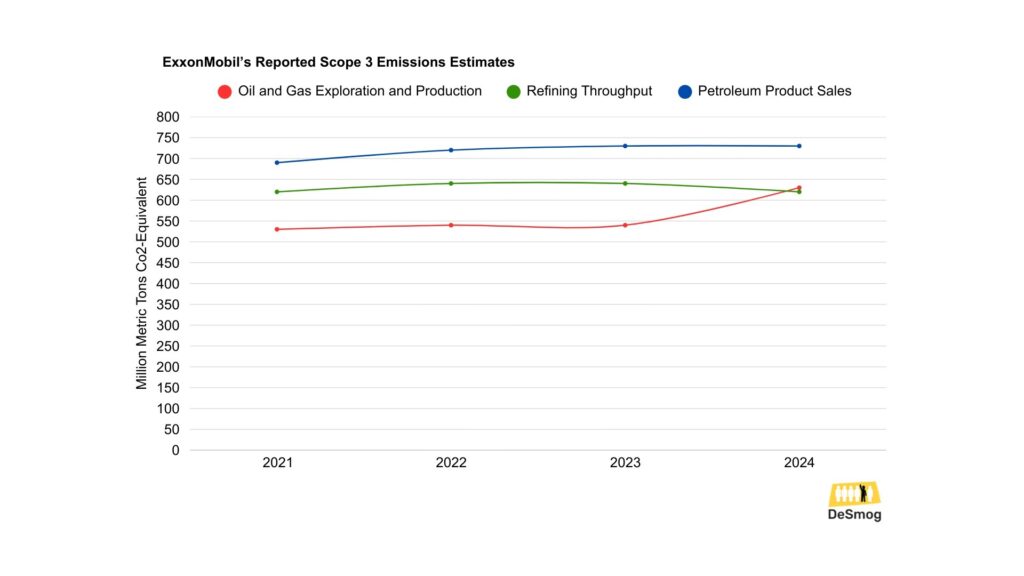
Note: ExxonMobil currently "chooses not to report on the full range of Scope 3 emissions estimates called for under the GHG Protocol," the company noted in its October legal complaint challenging California's mandatory climate emissions reporting laws. That means these numbers do not reflect the company's full Scope 3 emissions, and cannot be compared to estimates prepared by companies that fully follow the GHG Protocol's standards. They are provided here only to illustrate how ExxonMobil's own reported figures have changed over time. Image Credit: DeSmog. Data Source: ExxonMobil's annual climate and sustainability reports.
Independent estimates reveal that ExxonMobil single-handedly drove 2.76 percent of all carbon dioxide emissions from 1854 to 2023, a report last year from Carbon Majors found. That lands ExxonMobil among the top five all-time biggest contributors to the climate crisis, alongside "the former Soviet Union," "China (coal)," Saudi Aramco, and Chevron.
ExxonMobil's 2023 climate "progress report" spends nearly a full page critiquing the GHG Protocol framework and Scope 3 reporting. The document argues it "provides limited insight for a company like ours into how it might substantially lower its emissions, short of shrinking, discontinuing operations, or outright divesting operations."
In other words, the obvious conclusion from looking at Scope 3 data is that the most effective way for energy companies to curb emissions is by moving away from producing fossil fuels.
Instead, ExxonMobil prefers to focus on how it's cutting its own fossil fuel pollution, allowing the company to argue that its emissions are falling even as it remains deeply committed to producing more oil and gas.
In 2021, Woods testified before Congress, touting emissions cuts at ExxonMobil sites, which he described as the company's "own" emissions. "With respect to emissions, ExxonMobil has already reduced its own greenhouse gas emissions by 11 percent between 2016 and 2020," Woods testified, "and has set new plans for further reductions through 2025."
A Long History of Avoiding BlameIn the business press, ExxonMobil's support for Carbon Measures has been received, as Bloomberg put it, as "a willingness to engage in ideas to reduce emissions" and "a departure from its historical stance, which has included advertorials sowing doubt about climate science that ran in the 1980s and 1990s."
But a closer look shows that Carbon Measures' approach is a continuation of one of the longest-running strategies in ExxonMobil's playbook — focusing on consumers' responsibility for oil pollution.
For decades, the companies that make up ExxonMobil today, including Exxon, Mobil, and Canada's Imperial Oil, pushed the idea that pollution is demand-driven.
"As individuals, we may not approve of each and all of this multitude of activities," Imperial Oil's 1970 report continued. "Yet as members of the society which sanctions and encourages them, we must accept responsibility for all the consequences, both the desirable and the undesirable which include the pollution caused by the improper disposal of the inevitable waste."
That messaging shows up again and again in the company's documents related to climate change and air pollution, from the 1960s through the 2020s. DeSmog has collected examples from ExxonMobil reports, speeches, Congressional testimony, and advertisements in the timeline below.
Timeline of Events - (Click arrows to browse)From the 1960s through the 2020s, ExxonMobil highlighted consumers' responsibility for climate change and oil's air pollution, as illustrated in this timeline.
In 1998, shortly before the merger of Exxon and Mobil, Mobil CEO Lou Noto addressed climate concerns at an employee forum. There, he offered rough numbers showing the massive impact of shifting responsibility to consumers. "Our customers using our products probably count for 95 percent of those emissions," Noto said, calling the remainder "the five percent that we're responsible for."
The same pattern can even be seen in the company's advertorials. In their landmark 2021 study, climate disinformation researchers Geoffrey Supran and Naomi Oreskes found, as they put it, "ExxonMobil advertisements worked to shift responsibility for global warming away from the fossil fuel industry and onto consumers."
The researchers found that internally, ExxonMobil seemed more likely to use phrases that suggest pollution is driven by supply, rather than demand, in contrast to the company's public stance.
And of course, oil and gas companies aren't simply passive sellers. The industry has worked hard to entrench demand for fossil fuels, most recently by marketing natural gas power to data centers at the heart of the artificial intelligence (AI) boom.
Today, ExxonMobil is continuing to pour money into projects that will produce oil and gas for decades to come.
In early November, Carbon Measures and the International Chamber of Commerce put out a "call for interest" for accounting experts to help develop the details of the new guidelines. Carbon Measures announced its first round of appointments on January 19, with more expected later this quarter.
The new accounting standards, if they attract sufficient corporate backing, are expected to roll out sometime between 2027 and 2030.
Sachs, the Columbia climate finance expert, emphasized that we already know how to effectively cut carbon pollution: starting with clean-energy standards, electrification mandates, and measures that phase out fossil fuel demand. But, she noted, oil companies have consistently opposed those types of policies.
She told DeSmog, "No one should mistake Exxon's support for disclosure frameworks as an effort to solve the climate problem."
The post After Decades of Deflection, ExxonMobil Moves to Reshape Global Climate Accounting appeared first on DeSmog.
Alberta Separatism Would be Terrible for Indigenous Rights [ 22-Jan-26 9:36pm ]Separation from Canada would be a disaster for Indigenous rights in Alberta and plunge the provincial economy into even greater uncertainty. Yet providing an easier path for Alberta separatists seems strangely to be a top priority of Premier Danielle Smith, regardless of the ensuing constitutional chaos.
Bill 14 was hurried through the Alberta Legislature just before Christmas, clearing the way for a fringe cohort to move forward with a referendum question freshly deemed unconstitutional by Court of Kings Bench. Separatist extremists are now collecting signatures for a divisive question to be put to Alberta voters likely later this year that ignores Treaty obligations predating the province's entry into confederation.
Reaction from First Nations was unsurprisingly swift, with Chiefs of Treaty No. 6, 7, and 8 stating they "will not tolerate any action that seeks to undermine our Treaties, our Rights or our Sovereignty." The Alberta government is now being sued over their hasty pro-separation law, further metastasizing the mess created by the premier. The Sturgeon Lake Cree Nation (SLCN) has asked the court to issue an "urgent" interim injunction against the Alberta Prosperity Project (APP) petition.
"Alberta has treated SLCN as though they are chattel on the land, merely an afterthought in forced negotiations, not the first step in any potential secession," warned the SLCN lawyers in their statement of claim. "This is contrary to law: Alberta's secession cannot happen without First Nation consent to change a party to Treaty No. 8. Consent, not consultation, is required before the question of secession is delegated from a party to the treaty to the individuals who have come to inhabit Alberta."
One expert contacted by DeSmog agreed that any effort for Alberta to separate from Canada is standing on shaky legal ground in regard to First Nations.
"Every right that Indigenous people in Alberta have is the result of a settlement with the Crown and right of Canada," Amir Attaran, law professor at the University of Ottawa told DeSmog. "If you take that away, what legal status does that give these people in a new Alberta? Nobody knows the answer to that question."
Subscribe to our newsletterStay up to date with DeSmog news and alerts
Email Address What content do you want to subscribe to? (check all that apply) All International UK Sign Up (function($){ $('.newsletter-container .ijkidr-us').click(function() { $('.js-cm-form').attr('data-id', '2BE4EF332AA2E32596E38B640E905619D07B21962C5AFE16D3A2145673C82A3CEE9D9F1ADDABE965ACB3CE39939D42AC9012C6272FD52BFCA0790F0FB77C6442'); $('.js-cm-email-input').attr('name', 'cm-vdrirr-vdrirr'); }); $('.newsletter-container .ijkidr-uk').click(function() { $('.js-cm-form').attr('data-id', '2BE4EF332AA2E32596E38B640E905619BD43AA6813AF1B0FFE26D8282EC254E3ED0237BA72BEFBE922037EE4F1B325C6DA4918F8E044E022C7D333A43FD72429'); $('.js-cm-email-input').attr('name', 'cm-ijkidr-ijkidr'); }); })(jQuery);For some separatists, however, ignoring Indigenous rights is not only a side effect of an independent Alberta, but an explicit goal. At an event cross-promoted by APP, lawyer and Fraser Institute fellow Bruce Pardy made the case for Indigenous rights to be abolished in a sovereign Alberta.
On his Substack, Pardy has argued that "In a free Alberta, Aboriginal rights should not exist. Instead, reserve lands in Alberta should be divided into lots and transferred to individual Indigenous people, creating for them the same property rights and opportunities as everybody else." Former APP CEO Dennis Modry has said that his organization opposes the United Nations Declaration on the Rights of Indigenous Peoples, incorrectly calling it a "marxist agenda." Smith considers APP a key ally and speaks favourably of Modry.
All this is clearly a way for Smith to distract from the very real issues facing her province. Alberta is grappling with a $6.4 billion budget shortfall due to sagging oil prices. Beleaguered doctors are urging the province to declare a state of emergency for a collapsing healthcare system. Critical water infrastructure needs urgent upgrades.
So what did Premier Danielle Smith prioritize on the last sitting day of the legislature in 2025? Rushing through her last-minute bill to insulate Alberta separatists from having their referendum question struck down by the courts.
In a scathing decision issued the day after Smith's government introduced a bespoke bill to end legal oversight of referendum questions, Court of King's Bench Justice Colin Feasby determined that the proposed referendum question from the separatist APP was indeed contrary to the constitution and Indigenous rights. Treaties negotiated between Aboriginal governments and the Crown formed the basis of the founding of Alberta and mean that secession could only happen with the prior informed consent of those First Nations.
Feasby was blunt in what he thought about the hasty legislative maneuvering to avoid a legal ruling on the potential breakup of the country. "Alberta's cavalier disregard for court resources and lack of consideration for the parties and First Nations intervenors who participated in this proceeding in good faith is disappointing to say the least," Feasby wrote in a judgment made moot only a week later with the passage of the new law.
So egregious is Smith's assault on the legal system that two former Alberta ministers of justice and more than two dozen lawyers have since co-signed a letter calling out the premier's "unacceptable behaviour", including stripping referendum oversight from the Chief Electoral Officer.
"We do not want an authoritarian government," said Verlyn Olson, the former minister of justice and attorney general under Premier Ed Stelmach. "I think all you have to do is look a little ways south to see what happens when you get an authoritarian government that does not think it is bound by the normal rules that a democracy operates by."
Meanwhile, other First Nations are supporting the SLCN legal action for obvious reasons.
"We affirm that the Alberta UCP government's actions enabling and supporting the so-called Alberta Prosperity Project petition are a direct violation of Treaty obligations and the Honour of the Crown," Chiefs of Treaty No. 6, 7, and 8 said in a joint statement.
The premier's reckless rhetoric and actions now create a divisive constitutional crisis in the midst of an ongoing trade war with the erratic Trump Administration, which in its surprise attack on Venezuela earlier this year demonstrated a willingness to seize hemispheric oil resources by military force.
Experts recently warned that dark money funneled to separatist extremists or baseless allegations of a rigged referendum could be used as a ruse to try to absorb Alberta into the U.S. MAGA-adjacent commentators are already bragging about how the Trump Administration will assist Alberta separatists to help break up Canada.
Even the right-leaning Macdonald-Laurier Institute (MLI) has warned of the economic devastation that would be wrought from separation, calling oft-repeated claims of lower taxes in an independent Alberta "fiscal fantasy."
Trevor Tombe, the author of the MLI analysis, dismissed separatist statements about economic prosperity, stating plainly that "the fiscal and economic claims at the heart of such proposals are simply false. A separate Alberta would be a poorer Alberta."
Many Americans would be inclined to agree. Less than one-third of U.S. voters now believe the chaotic Trump Administration is doing a good job on the economy. Why would Albertans want to climb aboard such a sinking ship?
Creating a needless crisis with First Nations to favour a fringe cohort speaks to Smith's fixation on protecting her partisan flank rather than solving pressing problems for Albertans. Support for separation in Alberta has never exceeded 20 percent, slightly more than the proportion of Canadians that believe the Earth is flat or that the lunar landings were faked, but less than the number who think aliens have visited from outer space.
Playing footsie with separatist extremists during such a perilous time is the opposite of credible Canadian leadership. Alberta, Canada, and First Nations deserve better.
The post Alberta Separatism Would be Terrible for Indigenous Rights appeared first on DeSmog.
As the UN General Assembly Turns 80, Can Ordinary Citizens Change How the World Is Governed? [ 19-Jan-26 6:12pm ]On Saturday, 17 January, world leaders gathered at Westminster Central Hall to mark the 80th birthday of the U.N. General Assembly. The same room where it first convened in 1946.
At the same time, something quietly historic happened.
For the first time, the permanent Global Citizens' Assembly met.
Selected by lottery and representative of the world's population, a group of 105 people began deliberating on the climate and food crises. By 2026, more than 100,000 people will have taken part. Later this year, discussions on Artificial Intelligence (AI) will follow.
It's an experiment in global governance reform. A kind of anti Trump-Monroe spheres of influence project.
Instead of carving the world back up into competing empires, it connects communities, cities and countries into a living global network, designed not to replace governments, but to act where they increasingly cannot.
That matters because demand for global governance reform has rarely been higher. As Sir George Robertson, ex-Nato Secretary-General, said on Saturday: "It's not an underestimate to say that today we face our most acute crisis since 1946."
When the U.N. first opened its doors, many of its staff still bore the visible wounds of war. As the U.N. Secretary-General António Guterres reminded us, they understood that: "Peace, justice and equality are the most precious, practical and necessary pursuits of all."
Today, many governments are turning away from multilateralism. Yet around two-thirds of people worldwide want stronger international cooperation on climate, AI and global security.
That gap matters. It's where citizens' assemblies come in.
A citizens' assembly brings together a group of everyday people, selected by lottery, to reflect the wider population, to learn, deliberate and make recommendations on major public issues.
Our research suggests that more than 7,000 formal citizens' assemblies have been organised over the last decade. This does not include the hundreds of thousands, maybe millions, of community-level assemblies operating below the radar. This global movement of deliberative democracy has grown because we now know assemblies produce more effective policy, reduce polarisation, and act as an antidote to misinformation.
The task of the Global Citizens' Assembly is simply to connect and strengthen what already exists. Linking local assemblies into a global fabric that can begin to plug some of the gaps in the existing multilateral regime.
The U.N. has never been the whole of global governance. In 2021, the UN Foundation, Climate Analytics and E3G published The Value of Climate Cooperation, which mapped a far wider ecosystem of climate action: spanning science networks, businesses, investors and civil society alongside the U.N.Framework Convention on Climate Change.
Global governance, in other words, is already far more distributed than our institutional imagination tends to acknowledge.
This was exemplified during the pandemic when many now agree that the most important parts of the response emerged from a partnership between governments, academia and corporate manufacturing and distribution, rather than from any single multilateral institution.
AI is also transforming what's possible, making it feasible to run thousands of high-quality citizen conversations at a fraction of the cost and time of traditional assemblies.
In a world where crises now move faster than parliaments or summits, this kind of human-machine collaboration opens the door to a new form of civic infrastructure continuous, distributed and capable of matching the speed and scale of global challenges.
The members of the Global Citizens' Assembly are on the front line of today's crises, just as the first members of the U.N. General Assembly were 80 years ago. They know what suffering looks like. And they know that peace, justice and equality are not abstract ideals, but practical necessities.
That's why nation states committed to global collaboration in 1945.
And that's why people, ordinary people, need to be at the heart of global governance today.
The post As the UN General Assembly Turns 80, Can Ordinary Citizens Change How the World Is Governed? appeared first on DeSmog.
Danielle Smith Working With Trump Official Who Wants to Annex Greenland [ 14-Jan-26 9:41pm ]Alberta Premier Danielle Smith is part of a U.S. group whose leader, Louisiana Gov. Jeff Landry, has been tasked by the Donald Trump administration with helping to annex Greenland.
In the wake of the surprise U.S. military invasion of Venezuela, Trump has doubled down on threats to take over Greenland, musing about sending in U.S. military troops and saying that owning the sovereign territory is "psychologically important to me." World leaders have pushed back against these threats, including Canadian Prime Minister Mark Carney, who has said "the future of Greenland is a decision exclusively for the people of Greenland and Denmark."
In December, Trump appointed Landry as special envoy to Greenland. Landry reacted to his appointment by affirming his commitment "to make Greenland a part of the U.S." Denmark and Greenland officials have advocated strongly for their sovereignty to be respected. When asked last week how international law may view the U.S.'s comments about Greenland, Landry responded "when has the United States engaged in imperialism? Never!"
Behind the scenes, however, Landry is closely tied to Alberta Premier Smith. The Louisiana governor leads the Governors Coalition for Energy Security (GCES), that Smith also belongs to. The two have met on several occasions, and Smith has praised Landry as an "excellent" governor.
For her part, Smith has responded to Trump's past threats to Greenland by saying the U.S. president is "very concerned about Arctic security and he wants to make sure he's got partners who are equally concerned about it."
All this talk of seizing Greenland is happening as a separation referendum is underway in Alberta. As of January 3rd, an organization called Stay Free Alberta, which is linked to the separatist group Alberta Prosperity Project, has been collecting signatures on a referendum for Alberta to become an independent state.
Smith's office did not respond to DeSmog's questions related to the GCES or the Trump administration's threats to Canadian sovereignty.
Subscribe to our newsletterStay up to date with DeSmog news and alerts
Email Address What content do you want to subscribe to? (check all that apply) All International UK Sign Up (function($){ $('.newsletter-container .ijkidr-us').click(function() { $('.js-cm-form').attr('data-id', '2BE4EF332AA2E32596E38B640E905619D07B21962C5AFE16D3A2145673C82A3CEE9D9F1ADDABE965ACB3CE39939D42AC9012C6272FD52BFCA0790F0FB77C6442'); $('.js-cm-email-input').attr('name', 'cm-vdrirr-vdrirr'); }); $('.newsletter-container .ijkidr-uk').click(function() { $('.js-cm-form').attr('data-id', '2BE4EF332AA2E32596E38B640E905619BD43AA6813AF1B0FFE26D8282EC254E3ED0237BA72BEFBE922037EE4F1B325C6DA4918F8E044E022C7D333A43FD72429'); $('.js-cm-email-input').attr('name', 'cm-ijkidr-ijkidr'); }); })(jQuery); What Is the Governors Coalition for Energy Security?The GCES, launched in September 2024, is composed of 11 U.S. Republican governors and three Canadian premiers, including Ontario's Doug Ford and Saskatchewan's Scott Moe. According to its website, the coalition is "focusing on preserving all energy options" to "foster innovation, reduce regulatory barriers and attract business investment."
The coalition recently announced a set of policy recommendations to "address America's energy challenges" and "remove obstacles" to building energy infrastructure. These include limiting environmental regulations and speeding up permitting. The ultimate goal is to "secure America's energy future while supporting manufacturing competitiveness and job creation."
Smith joined the GCES shortly after Trump won the November 2024 election, framing it as an opportunity "to work with the Trump Administration and other US partners to increase our pipeline capacity to our greatest friend and ally, the United States."
Since Smith joined the coalition, it has commended the head of the Environmental Protection Agency, a climate crisis denier named Lee Zeldin who is backed by fracking billionaires, for "his recent actions to eliminate wasteful federal funding." Smith's group was referring to Joe Biden's Inflation Reduction Act, since rolled back under Trump, which was designed in part to fund and stimulate renewable energy across the U.S. The GCES argues that this funding "was intended to target energy producers and the petrochemical agency."
Saskatchewan Premier Moe joined the GCES in March 2025 while Ontario Premier Ford joined in November 2025.
Smith's relationship with Republican politicians goes beyond just the GCES, however. She attended several of Trump's inauguration events in January, 2025, and met with U.S. cabinet officials including Energy Secretary Chris Wright, Defense Secretary Pete Hegseth, and Homeland Security Secretary Kristi Noem.
During that trip, Smith met with Landry and another member of the GCEC. Smith shared a photo from this meeting with Landry and Arkansas Governor Huckabee Sanders on X, writing that she'd "had a great discussion with both of these excellent governors on how our great nations can work together to achieve the goal of North American energy dominance."
Smith, the 51st State, and MAGAHad a great discussion last night with Louisiana Governor Jeff Landry @LAGovJeffLandry (Chair of the Governors Coalition for Energy Security which Alberta recently joined), and Arkansas Governor Sarah Huckabee Sanders @SarahHuckabee (also a member of the Coalition). Had a great… pic.twitter.com/93jj4H9h8o
— Danielle Smith (@ABDanielleSmith) January 19, 2025
Not only has Trump been threatening to capture Greenland, but he has also made comments about turning Canada into the 51st U.S. state, starting in November 2024 when then-Prime Minister Justin Trudeau visited Trump at his resort in Mar-a-Lago.
In March 2025, Trump suggested Canada waive its sovereignty to end the tariffs he placed on Canadian goods and in September 2025 Trump raised the matter again with a Canadian official, saying "Why don't you just join our country?"
While Trump's annexation threats have angered many Canadians, some Albertans would like to see Alberta become the next star on the U.S. flag. Calgary Lawyer Jeffrey Rath joined Fox News last year to talk about the "hundreds" of Albertans interested in joining the United States. Rath is part of a group including two former Alberta members of parliament called the "Delegation to Washington" that has reportedly met twice with Trump officials to promote an economic union with the U.S.
Dennis Modry, the former CEO of the Alberta Prosperity Project, was also part of this delegation. According to Modry, on April 22, U.S. officials offered a $500 million transition loan to the province should it choose to leave Canada.
Smith has aided the group on multiple occasions, first by lowering the number of signatures required to force a referendum from 600,000 to 177,000, which one APP leader called a "big gift." Smith then pushed through legislation to protect the referendum from challenges to its constitutionality. A recent poll found that only 19 percent of Albertans would vote in favour of separation, and multiple First Nations are challenging the referendum.
Additional polling suggests that the vast majority of Albertans don't support Trump. Yet Smith has cultivated strong ties with the MAGA movement. Last March, she travelled to Florida to speak with conservative influencer Ben Shapiro. The two cracked jokes about Trump annexing Canada at the event, which was also a fundraiser for PragerU, a right-wing media organization.
Smith also met with the Heritage Foundation shortly after the U.S. 2024 election, ostensibly to represent Albertan and Canadian interests. The Heritage Foundation is the architect of Project 2025, the plan to "dismantle the administrative state" which has been enacted by the second Trump administration.
Separatists, including Rath, had a second meeting with Trump officials to talk about Albertan independence this fall. Rath claimed that "the level of the meeting has been elevated as an indication of the strong support from the United States for Alberta independence."
Smith has justified her MAGA ties in the past by saying "I would say that all of those interactions are part of the reason why we were able to get a lower tariff rate. I think we were able to effectively make the case that Alberta energy resources do get sold to the Americans at a discount."
But as Trump escalates his threats against Greenland, Smith hasn't made any public statements or posted about her ties to his administration, including the Louisiana governor tasked with helping annex the territory.
The post Danielle Smith Working With Trump Official Who Wants to Annex Greenland appeared first on DeSmog.
'Utterly Shameless': Tory Energy Chief Backs 'Nonsense' Anti-Net Zero Reports [ 13-Jan-26 2:01pm ]Conservative shadow energy secretary Claire Coutinho has endorsed two new anti-climate reports that have been rejected by experts and government bodies.
On 12 January, Coutinho launched a report by energy consultancy Watt-Logic which claimed that increasing renewable energy capacity in the UK will heighten the risk of blackouts - a claim rejected by the National Energy Systems Operator (NESO), which helps to plan and manage the country's energy network.
The Department of Energy and Net Zero (DESNZ) called the report "nonsense scaremongering", while energy expert Jess Ralston pointed out that "The recent major challenges to the UK's energy supply have been from the volatility of gas".
Watt-Logic, run by Kathryn Porter, advises the oil and gas industry. Porter claims to work for "businesses with projects across the electricity, gas and oil industries", including "clients with conventional energy assets including gas-fired power stations, gas storage, upstream oil and gas production and [Liquified Natural Gas]".
She has also authored reports for the Global Warming Policy Foundation (GWPF) - the UK's leading climate science denial group. The GWPF has stated that carbon dioxide has been "mercilessly demonised", when in fact it is a "benefit to the planet" and should be "two or three times" higher than current levels.
On the same day, Coutinho backed a separate report by the Institute of Economic Affairs (IEA), which claimed cutting UK emissions to net zero by 2050 could cost over £9 trillion - a figure 90 times that estimated by the independent Climate Change Committee (CCC).
Energy and climate expert Simon Evans, deputy editor of the publication Carbon Brief, called the IEA report "utterly shameless" for portraying the alternative scenario - an energy system powered by fossil fuels - as entirely cost-free.
The IEA's estimate for the cost of net zero also factored in the damage caused by climate emissions - despite the fact that a polluting energy system will result in far greater climate damages.
In reality, the CCC has stated that achieving net zero will require 0.2 percent of GDP per year from 2025 to 2050, with the majority of this investment coming from the private sector "as long as the right incentives are in place."
Subscribe to our newsletterStay up to date with DeSmog news and alerts
Email Address What content do you want to subscribe to? (check all that apply) All International UK Sign Up (function($){ $('.newsletter-container .ijkidr-us').click(function() { $('.js-cm-form').attr('data-id', '2BE4EF332AA2E32596E38B640E905619D07B21962C5AFE16D3A2145673C82A3CEE9D9F1ADDABE965ACB3CE39939D42AC9012C6272FD52BFCA0790F0FB77C6442'); $('.js-cm-email-input').attr('name', 'cm-vdrirr-vdrirr'); }); $('.newsletter-container .ijkidr-uk').click(function() { $('.js-cm-form').attr('data-id', '2BE4EF332AA2E32596E38B640E905619BD43AA6813AF1B0FFE26D8282EC254E3ED0237BA72BEFBE922037EE4F1B325C6DA4918F8E044E022C7D333A43FD72429'); $('.js-cm-email-input').attr('name', 'cm-ijkidr-ijkidr'); }); })(jQuery);The IEA report was written by David Turver, a retired business consultant turned blogger who writes critical articles about clean energy policies. Turver seemingly has little prior experience or qualifications in energy policy or climate science, according to his LinkedIn biography.
Like Porter, he also has ties to the GWPF. In July 2024, he wrote a report for Net Zero Watch, the GWPF's campaigning arm, accusing the "scandalous" CCC of "misleading Parliament" while attacking its "absurd" financial models.
As revealed by DeSmog, the IEA has historically received extensive funding from the fossil fuel industry - including from oil majors Shell and BP. The group is part of the Tufton Street network - an orchestrated alliance of radical right-wing groups based in Westminster that lobby to dismantle state services and privatise public bodies.
It is run by former Conservative peer David Frost, a director of Net Zero Watch, which along with the GWPF is based in 55 Tufton Street.
Lily Rose Ellis, a climate campaigner for Greenpeace UK, said: "Last time the government implemented Tufton Street's corporate lobbying as national policy back in 2022, Liz Truss's mini-budget crashed the economy. Whatever the current government's challenges, they're unlikely to be desperate enough to take the IEA's advice."
Over the past year, the Conservatives - under pressure from Nigel Farage's Reform UK - have deserted their previous support for climate action, with party leader Kemi Badenoch calling net zero "impossible" and pledging to repeal the 2008 Climate Change Act.
The party has received extensive donations from climate science deniers and fossil fuel interests.
The Conservative Party, the IEA, Turver, and Porter were approached for comment.
Climate 'Sceptic' AuthorsAs DeSmog revealed in July 2023, Porter has written blogs that contradict basic climate science. In a 2017 post, she wrote that "climate models overstate global warming". In fact, climate models have accurately predicted global temperature rises, with observed warming reflecting scientific forecasts.
She also publicly opposes climate policies. In a post on X in January 2025, Porter attacked what she called an "excessive focus on CO2" in energy policy, and in February she suggested the UK's landmark Climate Change Act should be repealed.
Turver writes a newsletter offering "fundamental analysis of energy policy and net zero". He has claimed that climate science is "just junk ideology given a fig leaf of respectability by academics and institutions who have their noses in the trough."
Turver has also said that Energy and Net Zero Secretary Ed Miliband "and his supporters are among the most dangerous people in Britain. Net zero is killing the economy."
In reality, according to the Confederation of British Industry (CBI), the UK's net zero economy grew by 10 percent in 2024, employing almost a million people in full-time jobs with an average wage of £43,000 - £5,600 higher than the national average.
In another X post, Turver said: "Ed Miliband, when will you end your obsession with net zero and get coal back on the grid?" Coal is the most carbon-intensive fossil fuel. In 2021, the International Energy Agency reported that coal power plants still produced a fifth of all global greenhouse gas emissions.
Last January, Coutinho called for Turver and Porter to vet government energy policy. In May, Lord Offord of Garvel, then Coutinho's shadow energy minister, helped to launch a report by Porter in Parliament on the supposed "true cost of net zero". Offord defected to Reform UK last month.
 Former Conservative peer Lord Offord, and energy consultant Kathryn Porter. A DeSmog collage.
Credit: Roger Harris (CC BY 3.0) / IEA / YouTube Questionable Claims
Coutinho, quoted in The Telegraph about Kathryn Porter's latest report, said that it "lays out in expert detail how Britain's net zero plans are taking us down a path of economic ruin. If ministers were truly interested in making Britain rich again, they would ditch their green ideology and take her report on board."
Coutinho also told The Express the report means "we need to build more gas plants", and provided a quote for the IEA's press release which accompanied Turver's report, saying: "It beggars belief that none of our 'independent' energy bodies can publish an accurate figure for what net zero is going to cost this country."
However, the accuracy of the two reports has been rejected by experts.
A spokesperson for NESO, the independent body which manages the UK energy supply, said of Watt-Logic's report: "Great Britain has one of the most secure energy systems in the world, operating with an outstanding track record of reliability, and we simply do not recognise the figures or claims presented in this report.
"We robustly test tens of thousands of worst-case scenarios, and our engineers are confident Britain's grid will continue to operate safely and securely as more renewables connect to the network in the years ahead."
Jess Ralston, head of energy at the Energy and Climate Intelligence Unit (ECIU) think tank said: "There have been many, many claims in the past couple of decades that blackouts are imminent because of renewables, but even as the UK keeps on breaking clean power records, we're yet to see one that's related to the level of renewables on the grid.
"NESO has many tools at its disposal to manage supply and demand and routinely does so, and has confirmed that with increasing clean power the UK will retain our 'world-class reliability standards'.
"The recent major challenges to the UK's energy supply have been from the volatility of gas, and every turn of a wind turbine means we need less gas to power our homes. With the North Sea running out of gas whether or not more drilling occurs, a continued reliance on gas power stations means British homes are increasingly dependent on foreign supplies and actors like Putin that control them."
A DESNZ spokesperson added that Porter's report was "nonsense scaremongering".
They added: "Gas will continue to play a key role in our energy system as we transition to clean, more secure, homegrown energy. NESO has also been clear the faster we decarbonise, the more secure we are.
"That's why we are also delivering the biggest upgrade to Great Britain's electricity network in decades to deliver clean power by 2030 and beyond."
Posting on Bluesky in relation to the IEA's "cost of net zero" report, Simon Evans pointed out that NESO has estimated a "holistic transition" away from fossil fuels is the "cheapest option" when you take account the economic damage caused by climate change.
Evans also pointed out that the IEA's report mistakenly assumes "free fossil fuel energy, free petrol cars, free gas boilers, [and] free gas power plants."
ECIU's Jess Ralston added: "Nobody has a crystal ball on costs of fossil fuels, but history tells us that oil and gas prices are volatile and at the mercy of actors like Putin.
"The recent gas crisis drove the UK to spend over £180 billion, and the Treasury and homeowners alike would struggle to afford a repeat in the event of a future conflict or price spikes."
The post 'Utterly Shameless': Tory Energy Chief Backs 'Nonsense' Anti-Net Zero Reports appeared first on DeSmog.
A Fox News Venezuela Expert Is Backed by MAGA Oil Billionaire Paul Singer [ 12-Jan-26 2:01pm ]In the chaotic lead-up to and aftermath of the United States' January 3 military raid on Venezuela, a national security expert named Rebeccah Heinrichs appeared multiple times on Fox News to describe American aggression as a victory for both ordinary Venezuelans and the world — sometimes more than once a day.
In one January 8 appearance, Heinrichs told Fox News host Sean Hannity that the surprise attack, which the Trump administration says was motivated by a desire to seize the country's oil fields, is "a boon for American industry" and would be "good for the Venezuelan people." In another interview that same day, Heinrichs argued on Fox Business that the military removal of Venezuelan President Nicolás Maduro by the U.S. has allowed a "friendly" government to take charge of the country.
In both appearances, Fox News identified Heinrichs as a senior fellow at the Hudson Institute. That organization is a Washington, D.C.-based conservative think tank with a powerful billionaire backer who is not neutral about Trump's military campaign against Venezuela.
The Hudson Institute is closely linked to Paul Singer, who has a personal fortune estimated by Forbes at $6.7 billion and donated $5 million to Trump's Super PAC in 2024. Late last November, Singer bought Citgo, a U.S. subsidiary of Venezuela's state-run oil company. As the Trump administration moves to control the flow of oil out of the Latin American nation, Singer is well-positioned for "a financial windfall," according to reporting by Popular Information and other outlets.
Subscribe to our newsletterStay up to date with DeSmog news and alerts
Email Address What content do you want to subscribe to? (check all that apply) All International UK Sign Up (function($){ $('.newsletter-container .ijkidr-us').click(function() { $('.js-cm-form').attr('data-id', '2BE4EF332AA2E32596E38B640E905619D07B21962C5AFE16D3A2145673C82A3CEE9D9F1ADDABE965ACB3CE39939D42AC9012C6272FD52BFCA0790F0FB77C6442'); $('.js-cm-email-input').attr('name', 'cm-vdrirr-vdrirr'); }); $('.newsletter-container .ijkidr-uk').click(function() { $('.js-cm-form').attr('data-id', '2BE4EF332AA2E32596E38B640E905619BD43AA6813AF1B0FFE26D8282EC254E3ED0237BA72BEFBE922037EE4F1B325C6DA4918F8E044E022C7D333A43FD72429'); $('.js-cm-email-input').attr('name', 'cm-ijkidr-ijkidr'); }); })(jQuery);DeSmog's review of recent federal tax filings by the Paul E. Singer Foundation turned up a $100,000 donation to the Hudson Institute during the fiscal year ending November 30, 2024. The think tank has also shared personnel with Singer's investment company and charity.
On December 11, just weeks after Singer's purchase of Citgo, Heinrichs went on Bill Hemmer's Fox News show to discuss the boarding of a Venezuelan oil tanker by U.S. troops. "The Trump administration is completely out of patience" with the Maduro government, she said.
Hemmer asked Heinrichs how far she thought U.S. military action could escalate: "Is this something that would suggest over the holidays we hear about special forces going into [Venezuela in] the dark of night? Can you see that happening?"
"We might hear about that, Bill," she replied.
Heinrichs, the Hudson Institute, Fox News, and the Paul E. Singer Foundation did not respond to DeSmog's requests for comment.
Singer's Connection to HudsonThe 81-year-old Singer has emerged as one of the prime potential beneficiaries of Trump's promises — backed up by U.S. military aggression — to revitalize Venezuela's oil industry.
 Paul E. Singer. (Credit: World Economic Forum, CC BY-SA 2.0, via Wikimedia Commons
With his purchase of Citgo via his private equity firm, Singer gained control of three Gulf Coast refineries configured to process heavy Venezuelan crude oil. If Trump is successful in jump-starting the country's lagging oil industry, "that would result in a cheaper feedstock, profits and a more valuable company, eventually," according to Wall Street Journal reporter Benoît Morenne.
Over the years, Singer's foundation has invested in a number of conservative think tanks that deny or question the science behind climate change, as well as pushing for regime change in Venezuela.
Since 2011, the charity has given more than $10 million to the Manhattan Institute, as well as other donations to groups including the American Enterprise Institute and the Heritage Foundation. Singer has also donated to the Copenhagen Consensus Center, a think tank created by the climate crisis denier Bjørn Lomborg.
Singer has particularly close links to the Hudson Institute, however, which as recently as 2014 published commentary stating — incorrectly — that more carbon dioxide in the atmosphere would benefit agriculture by increasing plant growth.
Heinrichs is not the only Hudson Institute expert who has loudly supported Trump's military aggression against Venezuela this week.
On January 6, Hudson Institute senior fellow Aaron MacLean hosted an episode of the group's School of War podcast devoted to discussion of Venezuela. MacLean expressed surprise at how "successful and casualty-free" the raid was, while the Venezuelan government has said that 100 people had died and that many or more were wounded.
On the federal tax filing that DeSmog reviewed, MacLean is named as senior director of the Paul E. Singer Foundation. This position is not mentioned on the Hudson Institute website. Hudson Institute adjunct fellow Mark Siegel, meanwhile, spent 16 years working at Elliott Management, Singer's investment company.
Singer himself is listed as a member of the chairman's advisory board in the institute's 2021 annual report. He has helped host prominent Hudson Institute events, such as a 2018 gala honoring Nikki Haley, the first Trump administration's ambassador to the United Nations at the time.
Pushing for Pressure on VenezuelaThe Hudson Institute has been making the case for greater U.S. pressure on Maduro's government since before Trump returned to the White House. In August 2024, the think tank published a post urging the Biden administration "to assert itself" in the country and warned that if Maduro "does not relent, he should pay a price."
On November 22, as Trump was escalating tensions in the Gulf of Mexico, Heinrichs discussed "getting a better regime in place" in Venezuela during an appearance on Fox News.
On November 28 she was again on Fox News, talking about the Trump administration's military strikes on Venezuelan boats. "This is about the United States asserting itself and making sure that our peer adversaries don't have a foothold," she said, referring to countries, such as China and Russia, that have sought deeper economic relationships with Venezuela.
The following week, on December 4, again on Fox, Heinrichs talked about "the possibility of land strikes in Venezuela."
These appearances were taking place as Singer's investment firm was moving forward with its winning $5.89 billion bid for Citgo.
"Just a few weeks ago, a U.S. hedge-fund manager known for playing the long game in Latin America won a protracted battle for one of Venezuela's crown jewels," MarketWatch reported on January 5. "That bet now looks shrewd in light of the American military operation that captured Venezuela's president, Nicolás Maduro."
The post A Fox News Venezuela Expert Is Backed by MAGA Oil Billionaire Paul Singer appeared first on DeSmog.
Reform 'Cosying Up to Authoritarian Petrostate' [ 09-Jan-26 11:08am ]Senior figures in Reform UK have been developing close connections to the United Arab Emirates (UAE), an authoritarian, monarchic state with vast fossil fuel resources.
New records show that party leader Nigel Farage was funded to attend the Formula 1 Grand Prix in Abu Dhabi in December by the city's government.
The trip, for Farage and a "non-staff member", cost £10,000 and included meetings in the UAE capital, according to Farage's register of interests.
The Financial Times has reported that these meetings took place with "senior Emirati officials" and were arranged by Reform donor and treasurer Nick Candy. The Abu Dhabi emirate - one of seven in the UAE - is led by UAE President Sheikh Mohamed bin Zayed Al Nahyan.
Candy, a billionaire luxury property developer and former Conservative Party backer, is in business with a real estate firm owned by Abu Dhabi that has ties to the UAE's national oil company.
He has donated almost £1 million to Nigel Farage's party in the past year, having been appointed as Reform treasurer in December 2024.
Just a few months earlier, in October 2024, his firm Candy Capital entered into a "strategic joint venture partnership" with Modon Holding, chaired by a board member of the Abu Dhabi National Oil Company (ADNOC).
Reform campaigns for new fossil fuel exploration, stating that the UK's clean energy policies should be scrapped.
"Given the party's growing traction, Reform cosying up to an authoritarian petrostate should worry us all," said Jon Noronha-Gant, a senior investigator at Global Witness.
"The UAE has a huge vested interest in pushing planet-wrecking oil and gas - it sought $100 billion worth of fossil fuel deals the year it hosted COP [2023] - and that's to say nothing of its dismal human rights record.
"This is not the state or the money that we want influencing our politicians."
Subscribe to our newsletterStay up to date with DeSmog news and alerts
Email Address What content do you want to subscribe to? (check all that apply) All International UK Sign Up (function($){ $('.newsletter-container .ijkidr-us').click(function() { $('.js-cm-form').attr('data-id', '2BE4EF332AA2E32596E38B640E905619D07B21962C5AFE16D3A2145673C82A3CEE9D9F1ADDABE965ACB3CE39939D42AC9012C6272FD52BFCA0790F0FB77C6442'); $('.js-cm-email-input').attr('name', 'cm-vdrirr-vdrirr'); }); $('.newsletter-container .ijkidr-uk').click(function() { $('.js-cm-form').attr('data-id', '2BE4EF332AA2E32596E38B640E905619BD43AA6813AF1B0FFE26D8282EC254E3ED0237BA72BEFBE922037EE4F1B325C6DA4918F8E044E022C7D333A43FD72429'); $('.js-cm-email-input').attr('name', 'cm-ijkidr-ijkidr'); }); })(jQuery);Last month, the Labour government launched an independent review into foreign financial interference in UK politics, following the jailing of Nathan Gill, Reform's former leader in Wales, for taking bribes from an agent of the Russian state.
Modon Holding is 85 percent owned by L'imad Holding, a company owned by the Abu Dhabi government.
Modon's chairman Jassem Mohammed Bu Ataba Al Zaabi has several official roles in the UAE, including serving as chairman of Abu Dhabi's department of finance, and vice president of the UAE central bank.
He is also on the board of ADNOC, the UAE's state oil company. Oil and gas accounts for 30 percent of the UAE economy and is its historic source of wealth.
Reform received 92 percent of its donations between the 2019 and 2024 UK elections from oil investors, major polluters, and climate science deniers, while Candy has claimed the party is actively raising money from oil executives.
The party has also praised U.S. President Donald Trump's "drill baby drill" agenda. The Trump administration recently captured Venezuela's President Nicolás Maduro and pledged that the U.S. oil industry will "go in, spend billions of dollars, fix the badly broken infrastructure and start making money for the country".
Steve Goodrich, head of research and investigations at Transparency UK, told DeSmog: "Currently there are no limits on political contributions, with some parties heavily reliant on a small number of very wealthy donors. When those holding public office become dependent on just a few wealthy backers, it increases the risk they make decisions based on their benefactors' private interests rather than the public good.
"The forthcoming Elections Bill is an opportunity for Parliament to take the corrupting influence of big money out of UK politics."
Candy Capital declined to comment. Reform and Modon Holding did not respond.
Reform's UAE PraiseCandy and other Reform figures have frequently praised the UAE, a monarchy and petrostate accused of human rights abuses at home and abroad.
In an article last January for the website Arabian Gulf Business Insight, Candy praised the UAE as an attractive place for "ultra high net worth" investors.
"Wealth mobility has reshaped the way the global elite think about where to live, work and invest - and all signs point to the Middle East, particularly Dubai and Abu Dhabi, as the new frontier," he wrote. "Having invested in the UAE's thriving property market, I see this as just the beginning of the Emirates' transformation into a global epicentre for success."
Candy praised the UAE's crime prevention and "robust law enforcement", adding: "Coupled with a high standard of living, excellent healthcare and top-tier schools, the UAE offers a lifestyle that few other locations can match."
Candy also lauded "the wisdom and visionary nature of the UAE's leadership", writing that "the quality of government officials is mind-blowing". By contrast, he said that Western countries are ruled by "second-tier individuals" who "allow political agendas to get in the way of what is best for the country".
Reform deputy leader Richard Tice has said he travels to the UAE "every six to eight weeks" to visit his partner, Telegraph columnist Isabel Oakeshott, who moved to Dubai in January 2025.
In an interview with Arabian Business in October, Tice praised the UAE for its sense of national pride, work ethic, law and order, integration of migrants, and energy sector, while stating that the UK is "decadent" and "going bust".
He failed to mention that migrant workers face "widespread abuses" in the UAE, according to Human Rights Watch, including wage theft and passport confiscation. Tice also told the BBC that the UK's "basic values" are "not working", when asked why he speaks so favourably about the UAE.
 Reform UK leader Nigel Farage at the Formula 1 Grand Prix in Abu Dhabi, December 2025.
Credit: Nigel Farage / X
Reform UK leader Nigel Farage at the Formula 1 Grand Prix in Abu Dhabi, December 2025.
Credit: Nigel Farage / X
Senior Reform figures have frequently contrasted the UK with the UAE, portraying the latter as a booming economy and an aspirational place to live compared to Britain.
Farage has repeatedly said Labour's latest budget will lead to an "exodus" to Dubai, while the party's head of policy Zia Yusuf and Durham councillor Darren Grimes have called Labour Chancellor Rachel Reeves "Dubai real estate agent of the year" after she increased taxes on super-wealthy home-owners.
The UAE - an Arab Muslim dictatorship partly governed by Sharia law where the population is 90 percent migrant workers - doesn't appear to conform with Reform's policies and espoused beliefs.
The party has called for the mass deportation of immigrants and, before the 2024 election, Farage suggested young Muslims don't share "British values". Reform MP Sarah Pochin has called for a ban on the burqa, Islamic clothing worn by Muslim women.
And, while Farage has called for the UK to "take back control" of its democracy, the UAE doesn't hold popular elections. There are no political parties, critics of the government are often jailed, women face unequal treatment, and its penal code allows for the arrest of lesbian, gay, bisexual, and transgender (LGBT) campaigners.
The UAE and the RightThe ties between the UAE and right-wing figures in the West are growing.
The UAE is home to investment firm Legatum Group, a co-owner of GB News, which has paid Farage £500,000 since he was elected to Parliament in July 2024.
GB News's other co-owner, Paul Marshall, opened an Abu Dhabi office for his hedge fund Marshall Wace in December 2024.
This December, UAE government officials reportedly met with far-right activist Tommy Robinson, who led an anti-migrant march in London in September.
The UK government also intervened in 2024 to block attempts by a consortium backed by Abu Dhabi from buying the Telegraph Media Group.
However, successive governments - including the current Labour administration - have sought to strengthen ties with the UAE.
Prime Minister Keir Starmer hosted UAE president Sheikh Mohamed bin Zayed Al Nahyan in Downing Street in November. In the meeting, Starmer spoke of "the value of a closer relationship between the UK and the UAE".
The UAE has pledged to invest £10 billion in "priority" UK industries.
A version of this article has been published by The New World
The post Reform 'Cosying Up to Authoritarian Petrostate' appeared first on DeSmog.
Nigel Farage Accepted £10,000 Gifts from Petrostate [ 07-Jan-26 11:00am ]Reform UK leader Nigel Farage received freebies worth £10,000 from the Abu Dhabi government, new records show.
Farage's latest register of interests shows that he accepted flights and accommodation to attend the Abu Dhabi Formula 1 Grand Prix in December, paid for by the regime that runs the capital of the United Arab Emirates (UAE). This included a front-row "paddock" pass to the event worth £4,500.
The records show that Farage also attended "meetings" during his visit.
The Reform leader has previously mocked Prime Minister Keir Starmer for receiving gifts from donors.
Reform campaigns for the UK to dramatically expand its fossil fuel production, scrap its clean energy policies, and dismantle its climate targets.
The UAE is an autocratic monarchy and petrostate. Roughly 30 percent of the country's GDP is directly based on its oil and gas output.
Reform received 92 percent of its donations between the 2019 and 2024 UK elections from polluting sources and climate science deniers, while its treasurer Nick Candy has claimed the party is actively raising money from oil executives.
Subscribe to our newsletterStay up to date with DeSmog news and alerts
Email Address What content do you want to subscribe to? (check all that apply) All International UK Sign Up (function($){ $('.newsletter-container .ijkidr-us').click(function() { $('.js-cm-form').attr('data-id', '2BE4EF332AA2E32596E38B640E905619D07B21962C5AFE16D3A2145673C82A3CEE9D9F1ADDABE965ACB3CE39939D42AC9012C6272FD52BFCA0790F0FB77C6442'); $('.js-cm-email-input').attr('name', 'cm-vdrirr-vdrirr'); }); $('.newsletter-container .ijkidr-uk').click(function() { $('.js-cm-form').attr('data-id', '2BE4EF332AA2E32596E38B640E905619BD43AA6813AF1B0FFE26D8282EC254E3ED0237BA72BEFBE922037EE4F1B325C6DA4918F8E044E022C7D333A43FD72429'); $('.js-cm-email-input').attr('name', 'cm-ijkidr-ijkidr'); }); })(jQuery);Senior party figures have also praised U.S. President Donald Trump's "drill baby drill" agenda, which has seen his administration recently capture Venezuela's President Nicolás Maduro and pledge that the U.S. oil industry will "go in, spend billions of dollars, fix the badly broken infrastructure and start making money for the country".
Farage denies basic climate science, claiming it's "absolutely nuts" for carbon dioxide to be considered a pollutant. The party is being advised by the Heartland Institute, a U.S.-based pro-Trump climate denial group. Farage helped to launch Heartland's UK-EU branch in December last year.
The UN's Intergovernmental Panel on Climate Change (IPCC), the world's leading climate science body, has said "it is a statement of fact, we cannot be any more certain; it is unequivocal and indisputable that humans are warming the planet."
The IPCC has also stated that carbon dioxide pollution "is responsible for most of global warming" since the late 19th century, which has increased the "severity and frequency of weather and climate extremes, like heat waves, heavy rains, and drought" - all of which "put a disproportionate burden on low-income households and thus increase poverty levels."
Key individuals in Reform have also heaped praise on the UAE in recent months.
Reform deputy leader Richard Tice has said he travels to the UAE "every six to eight weeks" to visit his partner, Telegraph columnist Isabel Oakeshott, who moved to Dubai in January 2025.
Tice has praised the UAE for its sense of national pride, work ethic, law and order, integration of migrants, and energy sector, while stating that the UK is "decadent" and "going bust".
In an article last January for the website Arabian Gulf Business Insight, Candy praised the UAE's crime prevention and "robust law enforcement", adding: "Coupled with a high standard of living, excellent healthcare and top-tier schools, the UAE offers a lifestyle that few other locations can match."
Candy also lauded "the wisdom and visionary nature of the UAE's leadership", writing that "the quality of government officials is mind-blowing". By contrast, he said that Western countries are ruled by "second-tier individuals" who "allow political agendas to get in the way of what is best for the country".
The UAE does not hold popular elections, and there are no political parties. Critics of the government are often jailed, while migrant workers face "widespread abuses" according to Human Rights Watch, including wage theft and passport confiscation.
The country also discriminates against women and its penal code allows the authorities to arrest people for campaigns promoting the rights of lesbian, gay, bisexual, and transgender (LGBT) people.
Reform was approached for comment.
The post Nigel Farage Accepted £10,000 Gifts from Petrostate appeared first on DeSmog.
How MAGA Changed the World in 2025, and What Comes Next [ 22-Dec-25 11:30am ]There's no doubt that 2025 has been one of the most politically chaotic years of the 21st century.
Amid the domestic and geopolitical mayhem unleashed by Donald Trump's return to the White House, powerful interests were busy enacting a radical anti-democratic agenda that has already changed our world and will continue shaping it for years to come.
DeSmog's team of investigative reporters, editors, and researchers have spent the past year tracking the fossil fuel companies and tech giants seeking private gain from MAGA, along with the climate deniers and right-wing political operatives attempting to export the movement globally.
Here are some of their most consequential achievements.
Supercharging Climate DenialFor years, the widely-held belief in the community of people advocating for aggressive climate action was that outright denial of the science was becoming a marginal relic of the past. That was never accurate, as DeSmog has extensively reported, but the second Trump administration has shattered the illusion for good.
Trump's Secretary of Energy, Chris Wright, is a former fracking executive. During a February speech to the Alliance for Responsible Citizenship (ARC) conference, Wright called 2050 net zero targets "a sinister goal."
In exclusive interviews with DeSmog at the London event, prominent climate crisis deniers praised Wright for his opposition to regulating CO2 as a pollutant. Overturning these regulations is a long-time goal of groups such as the CO2 Coalition and the Heartland Institute.
The energy secretary this year convened a panel of climate deniers, including the Canadian Ross McKitrick, to author an official Department of Energy report questioning the link between humans and global temperature rise. More than 85 actual climate experts released a scathing rebuttal describing the report as "junk science."
Nevertheless, Trump's Environmental Protection Agency (EPA) drew on Wright's report to initiate its effort to rescind the agency's own "endangerment finding" on CO2 and other carbon emissions, which provides the legal foundation for many major U.S. climate regulations. (It was perhaps not the most far-sighted strategy, as the administration's strident climate denial is now creating potential legal hurdles for the EPA's repeal effort.)
The administration also relied on climate crisis deniers to help craft legislation, such as Alex Epstein, who was credited with shaping sections of Trump's "Big Beautiful Bill" that eliminated tax credits supporting wind and solar energy. That legislative effort got an assist from Americans for Prosperity, a political advocacy group backed by oil and gas billionaire Charles Koch.
These assaults on climate science and renewable energy had already been laid out in Project 2025, the reactionary blueprint for a second Trump administration created by the Heritage Foundation. DeSmog found that over 50 high-level Trump administration officials were linked to Project 2025, including many of the president's closest advisors, such as Elon Musk.
Although Musk and Trump eventually had a bitter falling out, the consequences of Musk taking a power saw to the federal government will be felt for years in terms of shuttered climate programs, laid-off employees, and diminished bureaucratic expertise. DeSmog revealed that Musk's so-called "Department of Government Efficiency" (DOGE) effort was partly the result of a concerted effort — led behind the scenes by conservative groups — to tilt the U.S. towards hard-line Christian Nationalist and libertarian ideology.
In the process, the climate denial movement appeared to gain a powerful new ally. "We welcome Elon Musk into the climate red pill group," Climate Depot executive director Marc Morano stated in late 2024.
Undermining European DemocracyThis November, the White House published a National Security Strategy that outlined U.S. policy goals in Europe.
DeSmog has been reporting on these goals throughout the year.
"Our broad policy for Europe," the strategy stated, "should prioritize cultivating resistance to Europe's current trajectory within European nations."
The strategy "reject[s] the disastrous 'climate change' and 'Net Zero' ideologies that have so greatly harmed Europe, threaten the United States, and subsidize our adversaries."
At a private event that DeSmog attended during February's ARC conference, Kevin Roberts, head of the Heritage Foundation, seemed to articulate these same principles, rejecting climate science as "fiction" and urging "our friends from Europe" to oppose international institutions.
The following month, the Heritage Foundation convened hard-line European conservatives for a meeting in Washington, D.C., where they discussed how to dismantle the European Union.
In April, DeSmog revealed that the Heritage Foundation was actively trying to shape an upcoming national election in Albania in favor of a Trump-aligned candidate.
The following month, key MAGA influencers, including Trump administration Homeland Security Secretary Kristi Noem, descended on eastern Europe for the Conservative Political Action Committee (CPAC) Poland conference. According to audio of CPAC Poland obtained by DeSmog, speakers made calls to "liquidate" the European Commission, while pushing for the election of far-right Polish presidential candidate Karol Nawrocki. (Nawrocki won in a June runoff election.)
Trump-aligned groups were trying meanwhile to hollow out European climate legislation. The Heartland Institute set its sights on the EU's Corporate Sustainability Due Diligence Directive (CSDDD), a law requiring companies to address human rights and environmental issues in their operations.
Also fighting the CSDDD: A coalition of companies called the Competitiveness Roundtable whose members include ExxonMobil, TotalEnergies, Chevron, and Koch, Inc. Documents obtained by the research group SOMO and seen by DeSmog showed that this corporate campaign deliberately supported far-right groups in Europe in service of its goals.
It's now clear that combating EU climate rules was essential to carving out a market in Europe for American gas exporters. "The industry and the State Department are putting a lot of pressure on the EU [to] commit to our dirty LNG," one climate advocate told DeSmog.
Forging Anti-Climate Alliances with Big TechDuring the first Trump administration, the world's biggest tech companies pledged to fight for climate action even as the U.S. exited the Paris climate treaty and rolled back key environmental laws.
This time around, those same tech companies are actively supporting Trump's climate denial.
DeSmog revealed that during an April AI conference in Washington, D.C., Google president and chief investment officer Ruth Porat called a preceding speech by Interior Secretary Doug Burgum "fantastic," even though Burgum used his appearance to attack the so-called "climate extremist agenda" and push expanding the use of coal.
Porat's praise seemed at odds with her own company's ambitious 2020 pledge to power all its operations with carbon-free energy by 2030.
Google's shift wasn't an outlier, but part of a trend within Big Tech to go along with the Trump administration's embrace of fossil fuels to power its energy-hungry data centers, despite renewables remaining the cheapest and quickest-to-install electricity source worldwide.
DeSmog revealed that OpenAI this year hired a new head of global energy policy who is a dedicated champion of natural gas, and was a senior energy advisor in the first Trump administration. In September, OpenAI CEO Sam Altman joined Trump on an official state visit to the UK, where the company is planning a massive new AI infrastructure project.
Subscribe to DeSmog's weekly newsletterStay up to date with our investigations of AI, greenwashing, MAGA, and more.
Email Address What content do you want to subscribe to? (check all that apply) All International UK Sign Up (function($){ $('.newsletter-container .ijkidr-us').click(function() { $('.js-cm-form').attr('data-id', '2BE4EF332AA2E32596E38B640E905619D07B21962C5AFE16D3A2145673C82A3CEE9D9F1ADDABE965ACB3CE39939D42AC9012C6272FD52BFCA0790F0FB77C6442'); $('.js-cm-email-input').attr('name', 'cm-vdrirr-vdrirr'); }); $('.newsletter-container .ijkidr-uk').click(function() { $('.js-cm-form').attr('data-id', '2BE4EF332AA2E32596E38B640E905619BD43AA6813AF1B0FFE26D8282EC254E3ED0237BA72BEFBE922037EE4F1B325C6DA4918F8E044E022C7D333A43FD72429'); $('.js-cm-email-input').attr('name', 'cm-ijkidr-ijkidr'); }); })(jQuery);Jensen Huang, CEO of the supercomputer chip-maker Nvidia, also accompanied Trump to the UK in September. Huang followed that up in October by praising Energy Secretary Wright's "passion" for science, despite Wright's active promotion of climate denial.
DeSmog also reported on Nvidia's marketing of AI tools to Brazilian oil and gas companies just weeks before the COP30 climate negotiations in Belém.
This was no coincidence, as the fossil fuel industry is increasingly using AI to boost oil and gas production, as executives told the Reuters Global Energy Transition conference in June. In turn, AI advocates including former Google CEO Eric Schmidt are pitching AI energy demand to major oil producing countries as a way to keep fossil fuels alive.
In Texas alone, AI has spurred demand for over 100 new natural gas plants, while in Virginia local communities fought against a data center proposal that would have seen construction of the largest U.S. gas plant in a decade. The data center explosion is also delaying the retirement of at least 15 coal plants across the U.S.
DeSmog reported this year on the growing backlash to data centers in places like rural Georgia, despite a public charm offensive aimed directly at residents. Still, the large corporate backers behind these projects remain confident that they can overcome public opposition.
That includes a real estate arm of Koch, Inc. that has been building data centers in Chicago, Kansas City, and Atlanta, which is pitching itself as having the "expertise and capabilities that major tech companies either don't have or don't think would be worth the time."
At this point, it's safe to conclude, data centers are inseparable from fossil fuel expansion.
Backing the Rightwing Reform UKA fair question to ask this year was whether British MP Nigel Farage spent more time cultivating ties to MAGA in the U.S. than actually leading his rightwing political party, Reform UK, back at home. In September, Farage skipped Parliament's return from summer recess in order to speak at the National Conservatism (NatCon) conference in Washington, D.C., and address the Republican-controlled U.S. Congress.
"Nigel Farage is far more interested in pleasing Trump and jostling for his affections than he is in turning up to Parliament on time or standing up for British values," one Liberal Democrat source told DeSmog.
Farage in turn is helping MAGA expand into Europe. DeSmog reported in 2024 that he helped set up a UK-EU branch of the Heartland Institute. This year, the pro-Trump group claimed it was spearheading opposition to the EU's flagship Nature Restoration Law.
Back in February, Farage himself stated at the ARC conference that "I can't tell you whether CO2 is leading to warming or not, but there are so many other massive factors," while taking aim at the UK's net-zero policies. His comments are perhaps not surprising, given the previous donations Reform UK has received from fossil fuel and climate denier interests.
Other party figures also seem to be looking to the U.S. for inspiration. Reform UK Chair Zia Yusuf is an admirer of tech billionaire Musk, and apparently so is Paul Marshall, the right-wing owner of GB News and other outlets, which are key media backers of Reform UK. Marshall, who is also a hedge fund manager, bought a large stake in Tesla, the electric vehicle company led by Elon Musk, prior to the 2024 U.S. presidential election, DeSmog revealed.
Close ties to Trump may have helped smooth the way for massive new tech ventures in the UK. DeSmog reported in September that Trump's UK ambassador, Warren Stephens, has a family-owned investment firm with large shares in Microsoft, Nvidia, and Alphabet (Google's parent company), which are planning major UK projects.
The Trump-linked U.S. private equity firm Blackstone is meanwhile building a $13.4 billion (£10 billion) AI data centre in the UK that includes a fleet of massive backup diesel generators.
Fomenting Political Chaos in CanadaDeSmog was in the room at a conservative political event in Alberta where one of the speakers revealed a shocking piece of news. Dennis Modry, the former CEO of a group called the Alberta Prosperity Project, which is pushing for the oil-rich province to separate from Canada, claimed that he'd met directly with members of the Trump administration.
At that meeting, Modry claimed, U.S. officials offered "a $500 million transition loan that we would only draw down on as necessary as we work with the U.S. to transition from a province to a country." That wasn't the only instance of MAGA policies influencing the political discourse in Canada. Alberta premier Danielle Smith revealed in September that she had met with the Heritage Foundation shortly after Trump's election. Smith had already caused a national uproar months earlier by traveling to Florida to appear on a private panel with conservative U.S. pundit Ben Shapiro, who had previously called Canada "a silly country" that should be annexed by the U.S.
During the federal Canadian election, which was dominated by fears about Trump waging a trade war on the country, Smith told the right-wing U.S. media outlet Breitbart News that Conservative Party candidate Pierre Poilievre "would be very much in sync" with the Trump administration.
And indeed, DeSmog's careful analysis of Poilievre's inner circle turned up links to Elon Musk, Koch, Inc, and major oil and gas companies tightly linked to the U.S.
As in the UK, some Canadian conservatives and executives openly expressed admiration for Musk and his work with Trump. DeSmog was at a conservative event in Ottawa where representatives from Amazon and the pipeline builder TC Energy discussed how a right-wing prime minister could replicate elements of Musk's DOGE effort in Ottawa.
Poilievre ultimately lost the election to his Liberal opponent, current Prime Minister Mark Carney, but now Carney is implementing a pro-oil-and-gas agenda and taking ideas from the billionaire-founded AI and fossil fuel group Build Canada.
As we head into 2026, expect to see MAGA and its allies continue their global assault on climate science and policies to reduce planet-heating emissions.
The Canadian conservative influencer Jordan Peterson was a key organizer of this year's ARC conference, where Trump officials, European conservatives, tech investors, and climate crisis deniers discussed how to build and implement a global anti-net zero movement.
They will be meeting again in June.
The post How MAGA Changed the World in 2025, and What Comes Next appeared first on DeSmog.


