
MPs and leading UK think tanks have received major sums from U.S. benefactors - often with ties to U.S. President Donald Trump - since the 2024 general election, DeSmog can reveal.
Six MPs, including Reform UK leader Nigel Farage and Conservative leader Kemi Badenoch, have collectively accepted £335,000 for attending official Trump events and donor meetings, or gatherings held by right-wing U.S. groups.
Meanwhile, seven conservative policy groups in the UK have received at least $3.1 million (£2.3 million) from U.S. sources since 2024, and $20.4 million (£15.2 million) since 2016, the year of Trump's first presidential election.
These revelations come as Trump's Republican Party faces an uphill battle in today's Midterm elections, with the Democrats vying to win control of both the House of Representatives and the Senate. Trump's poll numbers have hit new lows with more than two-thirds of U.S. voters disapproving of the president's handling of the cost of living amid a surge in gas prices due to the U.S.-Israeli war with Iran.
Trump is also unpopular in the UK and across Europe, with 85 percent of Brits saying they have an unfavourable view of the U.S. president.
Yet his administration has been openly attempting to fund its allies in Europe. According to The Guardian, the State Department has allocated $15 million (£11.2 million) to three conservative groups in the UK. These grants form part of a "slush fund" to boost likeminded organisations across Europe, with up to $3 million (£2.2 million) reportedly available to those focused on "developing civilizational bonds" and "defending rule of law".
DeSmog's analysis has found that, in addition to these planned donations by the Trump administration, millions have been poured into UK democracy by U.S. donors in recent years.
Right-wing think tanks to have received funding from U.S. donors since 2024 have included Policy Exchange ($1.1 million), the Henry Jackson Society ($955,000), the Institute of Economic Affairs ($609,000), the Global Warming Policy Foundation ($222,000), Prosperity Institute ($137,000), the Adam Smith Institute ($51,000), and the Academy of Ideas ($5,000).
In 2024, the Adam Smith Institute and Academy of Ideas received £50,000 and £4,965 respectively from the Prometheus Institute - a philanthropic foundation founded by Carl Barney, who donated over $1.6 million to Republican and pro-Trump campaigns during the 2024 election, including more than $900,000 to the Trump 47 Committee - making him one of California's top pro-Trump donors during the race.
Six MPs have also received substantial payments from prominent U.S. conservative groups.
Farage has received £69,126 in income and £153,101 in expenses for attending 10 events - including over £32,000 to campaign for Trump during the 2024 presidential election campaign, and £27,000 to attend events during Trump's inauguration in January 2025. Both trips were funded by crypto billionaire Christopher Harborne, who has financial ties to the White House.
Reform MP Suella Braverman, who defected to the party in January, has received £23,664 in expenses for attending four U.S. events, including delivering a speech in January 2025 at the Heritage Foundation - the group behind Project 2025, the radical right-wing blueprint for Trump's second term. Braverman attended these events while she was a Conservative MP.
Farage, who is the only MP to have accepted speaking fees for some of the U.S. events, has come under intense pressure for his relationship with Trump. The Reform leader has labelled the president the "single most resilient and bravest person I've ever met in my life", and has frequently called for Trump's policies to be replicated in the UK - including the mass expansion of domestic fossil fuel production, the creation of a new immigration deportation agency, and unleashing the crypto industry.
"The continuing influx of overseas funding for UK think tanks, especially through opaque transatlantic networks, poses urgent questions for the government over how to safeguard our democracy against the risks of foreign interference," said Tim Picton, senior advocacy advisor at Spotlight on Corruption,
"This funding can have a significant influence on our political discourse, but largely falls outside of the regulated sphere we currently have in place."
All the MPs and think tanks named in this article were approached for comment.
The MPsA number of Conservative MPs have also been paid to attend right-wing U.S. events in recent years.
Shadow Foreign Secretary Tom Tugendhat, who was appointed to the role in August, has received £49,000 in flights and accommodation since April 2025 to attend several meetings organised by the Hudson Institute, a conservative group based in Washington DC, at which he is a 'distinguished fellow'.
Badenoch also received over £23,000 in expenses to speak at the Hoover Institution at Stanford University in October 2025. The Tory leader has regularly praised Trump - claiming in February 2025 that he was "fixing" America's problems. Like Reform, the Conservatives have proposed introducing an immigration 'Removals Force' modelled on the U.S. Immigration and Customs Enforcement (ICE) agency, while Badenoch supported Trump's bombing campaign in Iran.
The three groups already allocated money through the Trump administration's European slush fund are also run by high-profile Conservatives.
The Guardian reported in July that $7 million (£5.2 million) had been allocated to 878, which describes itself as a new "leading British and American think tank" devoted to "the rediscovery of our ancient culture" and "ending mass immigration". The group lists its founding directors as Jacob Rees-Mogg, the former Conservative MP and Cabinet minister, and his former adviser Radomir Tylecote.
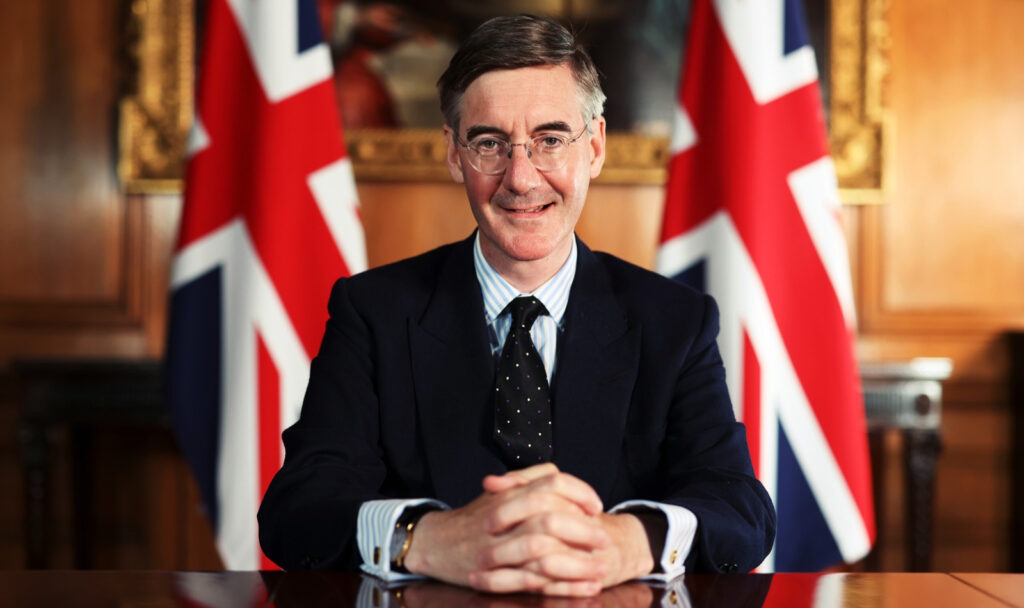 Former Conservative MP and Cabinet minister Jacob Rees-Mogg.
Credit:
Simon Dawson / No 10 Downing Street (CC BY-2.0)
A reported $5 million has also been set aside for Free Speech Union International - the global offshoot of the Free Speech Union (FSU), a legal advocacy group run by Conservative peer Toby Young, who told The Guardian that its international branch had "expressed interest in applying for grant funding from the U.S. State Department" but that it had not yet been awarded the money.
Young reiterated this claim when approached by DeSmog.
The FSU is also already known to have received funding from U.S. sources. As first reported by Democracy for Sale, its now-defunct U.S. arm received money from a charity linked to a prominent anti-abortion lawyer.
An additional $3 million allocation from the State Department slush fund has reportedly been made to the Jobs Foundation for a programme called 'Countering Overregulation to Advance American Investment'. Conservative peer Matthew Elliott, who led the official Vote Leave Brexit campaign, is the president of the Jobs Foundation, which is a pro-business advocacy group.
"If this money is being used to fulfill a specific direction from the U.S. State Department, there is a legal obligation for these organisations to declare this to the Home Office's Foreign Influence Registration Scheme under national security laws," Picton said.
The Think TanksSignificant payments have also been made from U.S. donors to UK think tanks in recent years.
DeSmog's analysis has found that right-wing think tanks have accepted over $20.4 million from U.S. benefactors since 2016, often via their American fundraising wings, and $3 million since 2024.
Much of this money flows from U.S.-based donor advised funds (DAFs) - entities that keep the original source of funding hidden from public view. DAFs such as the Vanguard Charitable Endowment Programme, the National Philanthropic Trust, and Donor Advised Charitable Giving have been used to give money to right-wing UK think tanks in recent years - which has obscured the identities of some donors.
However, some are publicly disclosed. For example, the New York-based Achelis and Bodman Foundation gave $75,000 (£56,000) to the American Friends of the GWPF in 2024 - the entity that accepts donations from U.S. sources on behalf of the Global Warming Policy Foundation, one of the UK's principal climate science denial groups. The Achelis and Bodman Foundation also donates to the likes of the Heritage Foundation and the Hudson Institute.
Several UK conservative think tanks use 'friends of' groups to channel donations across the Atlantic. Last year, American Friends of Policy Exchange, belonging to the influential Westminster think tank, accepted $50,000 (£37,000) from the Florida-based Swordspoint Foundation, which is run by Trump donor Robert Bishop.
 55 Tufton Street. Credit: R4vi, CC-BY-SA-2.0
In 2024, the IEA accepted up to $189,000 (£141,000) for research and study programmes from the Cherish Freedom Foundation - a group historically funded by Robert Mercer, a major donor to right-wing groups and campaigns whose family gave $25.5 million to Trump's 2016 presidential campaign. The Institute of Economic Affairs has previously received money from fossil fuel majors including BP, ExxonMobil, and Shell, as well as from the U.S.-Australian media mogul Rupert Murdoch.
The IEA told DeSmog that it does not accept money from government sources and that it does not take donations "in exchange for research".
These groups have also frequently echoed Trump's narratives. The campaign director of Net Zero Watch, the lobbying arm of the GWPF, appeared on Murdoch-owned TalkTV in March and declared that "Trump is absolutely right to say that windmills [sic], and our mad policies on North Sea oil and gas, are making our energy more expensive."
Meanwhile, in February 2024, Policy Exchange senior fellow Edward Stringer wrote an opinion piece for The Telegraph entitled: "Trump is right. Defenceless Europe can no longer freeload off America".
Almost all of these UK groups belong to the Tufton Street network, a right-wing alliance based in Westminster that lobbies to dismantle state services and privatise public bodies. Its members share an opposition to climate action, and they have spent decades attempting to undermine policies designed to reduce emissions. As revealed by Democracy for Sale, the U.S. funding to some of these groups has increased by 29 percent from 2024 to 2025.
Tufton Street donors also closely overlap with the Conservative Party. As reported by DeSmog and Democracy for Sale in June 2024, Tory benefactors had gifted over £6.8 million to Tufton Street think tanks since 2019.
The Atlantic BridgeThere has also been a concerted attempt in recent years to build transatlantic right-wing networks to share policies, campaign strategies, and narratives.
One of the most prominent has been the Alliance for Responsible Citizenship (ARC), which holds an annual conference in London featuring thousands of attendees.
ARC is fronted by conservative commentator Jordan Peterson and run by Baroness Philippa Stroud, a Conservative member of the House of Lords. It's the brainchild of the Legatum Group, a Dubai-based investment firm, and the hedge fund manager Paul Marshall - the co-owners of the radical right-wing broadcaster GB News, which employs Farage as a presenter.
Marshall is also a key funder of ARC, having given £3 million to the group since its creation in 2023. As revealed by DeSmog and Unearthed, this year's conference was sponsored by Reform mega-donor and crypto billionaire Ben Delo, Tory and Reform donor Anthony Bamford, and a number of U.S. funders - including fossil fuel companies and executives - that have donated to Trump and the Republican Party.
Speakers at the conference included senior U.S. politicians - notably Trump's energy secretary Chris Wright, U.S. House Speaker Mike Johnson, and Sarah Rogers, who is overseeing the State Department's European slush fund. They spoke alongside UK figures who have been forging close ties, both financial and political, to Trump's America - including Farage, Badenoch, Elliott, and Young.
 President Donald Trump and Reform UK leader Nigel Farage at CPAC in 2018.
Credit:
Shealah Craighead / White House (Public domain)
Among the attendees were dozens of parliamentarians, corporate executives, and right-wing think tanks including the Heritage Foundation, Adam Smith Institute, TaxPayers' Alliance, and Prosperity Institute.
A key theme of the conference is criticism of global climate policies, with Marshall claiming in his 2025 ARC speech that the world has been infected by a "climate derangement syndrome". He claimed that "our economic prosperity and our people's livelihoods" are being sacrificed "all for the sake of making some fractional changes to the level of CO2 in the atmosphere".
Also in attendance at this year's ARC event was Samuel Samson of the State Department, who has reportedly been "at the forefront" of the Trump administration's "effort to reshape America's relationship with Europe".
MPs have registered complimentary tickets to ARC worth at least £6,900 since 2024. The FSU has also reportedly received funding from ARC and Reform donor Delo, who owns a venue in Westminster that serves as a hub for various right-wing groups and content creators.
Another influential pro-Trump network has also been imported into the UK in recent months: the Conservative Political Action Committee (CPAC), which hosted its inaugural London event in July.
CPAC GB is chaired by former Conservative prime minister Liz Truss, while the event was headlined by Farage - despite the Reform leader suggesting beforehand that he would be "steering well clear" of the summit.
CPAC GB promised to bring together "global heavyweights" of the international right, and featured Young, Rees-Mogg, Tylecote, The Telegraph's Allison Pearson, Reform's Matthew Goodwin, broadcaster Mike Graham, and U.S. activist Jack Posobiec.
Farage has also helped to import an influential U.S. climate science denial group, the Heartland Institute, to the UK. The Reform leader was the keynote speaker at the launch of the Heartland Institute's UK-EU branch in December 2024, months after advising the group to set up a satellite in Europe.
Heartland Institute UK-EU director Lois Perry claims to be advising the party on its climate agenda and is the strategy director of Reform Friends of Israel - a lobbying group within the party.
Farage has also been forging ties with Alliance Defending Freedom (ADF) - a powerful legal advocacy group that led the campaign to overturn Roe v Wade, the landmark ruling that protected the constitutional right to abortion in the United States.
ADF's UK branch spent over £1.4 million on its activities in 2025, more than three times higher than in 2020. Farage has not only appeared on promotional materials put out by the ADF, but according to the New York Times the group orchestrated a visit by Reform's leader to Washington DC in September 2025, during which he testified to Congress.
ADF has also reportedly arranged backroom meetings between Farage and State Department officials on their visits to London, and as recently reported by the iPaper, the Reform leader has accepted more than £83,000 in earnings, accommodation, and flights from groups that support the anti-abortion movement, many of which are featured above.
The post Millions of Dollars Pouring into UK Democracy from Trump's America appeared first on DeSmog.
A pro-AI data center group purchased at least $2.54 million worth of television ads that ran recently in Ohio, a new DeSmog analysis reveals. The group, Build American AI, is linked to Leading the Future, a major AI industry super PAC backed by Silicon Valley billionaires.
The ads extolled the economic benefits of Ohio's data center boom, one of the hottest issues in the state's Senate election, but did not endorse either candidate in the race: Trump-aligned Republican incumbent Jon Husted, who was appointed by Governor Mike DeWine to serve out Vice President J.D. Vance's term, and former three-term Democratic Senator Sherrod Brown.
"When some people hear data centers they picture computers and servers," says one Build American AI ad. "But we see something different: electricians, engineers, manufacturers." The ad states that data centers have brought more than $40 billion in investments and created over 95,000 jobs in Ohio.
"The future won't be built by politicians or special interests," states the ad, "It'll be built by American workers right here in Ohio."
The ads appeared on at least 16 Ohio television stations between September 7 and October 21, according to Build American AI's filings with the Federal Communications Commission, which described them as "non-candidate issue ads."
 A still from one of Building American AI's pro-data-center ad campaign in Ohio during the race for Senate between Republican Jon Husted and Democrat Sherrod Brown. Credit: Via Google Ads Transparency Center.
Build American AI ordered at least $2.5 million in ads in Ohio, $1.5 million in ads in Wisconsin and $1.1 million in Kansas between September 7 and October 24, according to DeSmog's analysis. Jesse Hunt, the group's head of communications, confirmed that the group is spending over $5 million in the three states, but did not comment on the exact amounts.
Build American AI has been described by Politico as a "subsidiary" of Leading the Future, a super PAC which was formed last year to promote AI industry interests. Leading the Future has emerged as a major player in 2026 election cycle — backing both Democratic and Republican candidates in primary races earlier this year.
The super PAC has received about $125.79 million in contributions during the 2026 midterm election cycle as of October 29, according to Federal Election Commission (FEC) filings. Most of that came from a handful of donors: $25 million each in individual contributions from tech venture capitalists Marc Andreessen and Ben Horowitz, $50 million from their venture fund Andreessen Horowitz, also called a16z, and $12.5 million each from OpenAI co-founder and president Greg Brockman and his wife Anna Brockman.
OpenAI is part of a joint venture with SoftBank, Nvidia, the U.S. Department of Energy, and other partners to build a mammoth data center complex on federal land in Pike County, Ohio. The project would include an on-site gas-fired power plant designed to produce 9.1 gigawatts of power — larger than any gas-fired power plant currently operating worldwide, and enough to power about 7 million homes.
OpenAI's investors include the Andreessen Horowitz venture capital fund. OpenAI's energy chief is John McCarrick, who as an energy official in Trump's first administration promoted exports of U.S. liquefied natural gas to Europe following Russia's invasion of Ukraine, and advocated for Asian countries to invest in natural gas.
Andreessen Horowitz did not respond to a request for comment.
OpenAI did not respond to DeSmog's request for comment on the Brockmans' personal donations to Leading the Future, or its stance on using gas-fired power for its data centers.
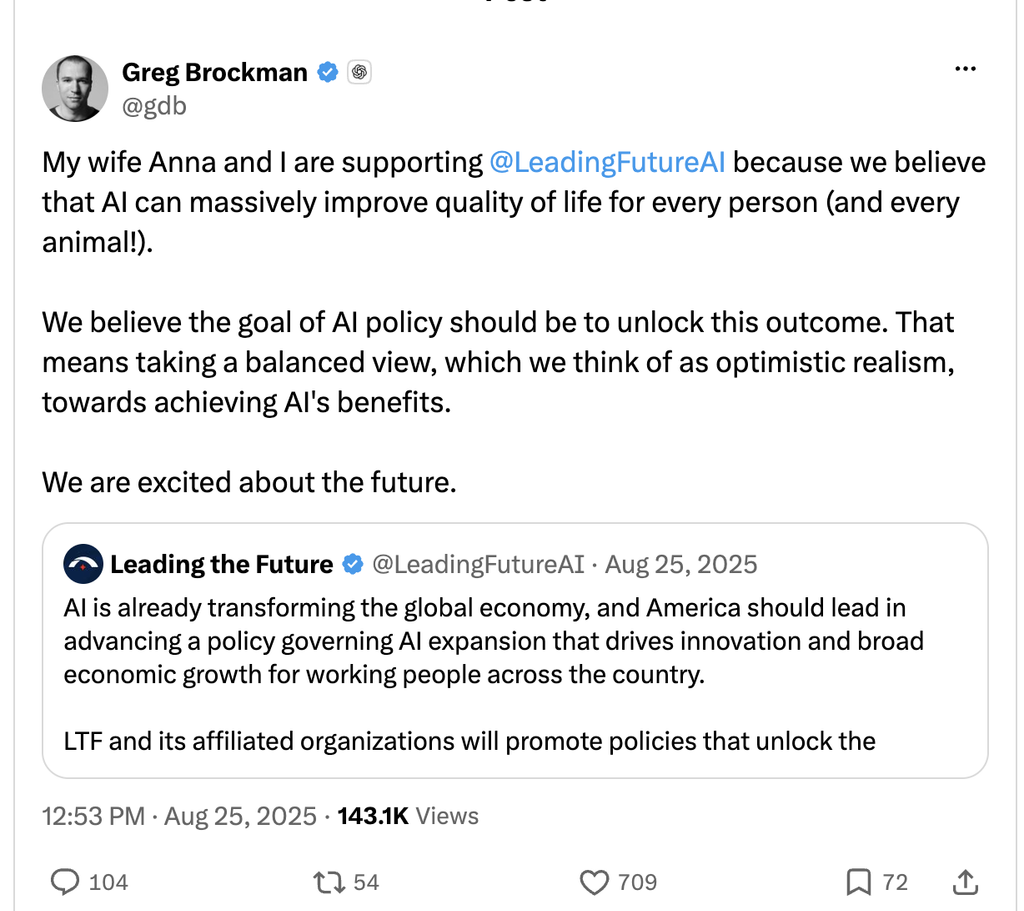 In August 2025, OpenAI co-founder and president Greg Brockman posted on X that he and his wife, Anna Brockman, were "supporting" the Leading the Future superPac to advocate for "a balanced view" of AI policy, "which we think of as optimistic realism, towards achieving AI's benefits." Credit: @gdb account on X
Marc Andreessen is also a board member of tech giant Meta, which is building "Prometheus," a massive data center in New Albany, Ohio, about 15 miles northeast of state capital Columbus. The partially-built computing complex runs on natural-gas turbines — and is designed to scale to one gigawatt, enough to power about 800,000 homes.
These projects are among dozens of proposed data center projects in Ohio, which is strategically positioned atop part of the Marcellus Shale, the biggest gas field in the U.S.
The AI boom is on track to worsen the climate crisis, which is on the verge of passing the key 1.5 degree Celsius (2.7 degrees Fahrenheit) limit on global heating that nations set in the 2015 Paris Agreement.
Based on current trends, the energy demand of new U.S. data centers could increase the nation's carbon emissions by 24 to 44 million metric tons a year between 2024 and 2030, according to a recent study published in the journal Nature Sustainability — equivalent to the tailpipe emissions from an additional 5 to 10 million additional gasoline-burning cars.
Marc Andreessen recently called the climate crisis "over" in a post on X, and has praised fracking as an "incredibly positive outcome" of energy industry research and development.
"Energy should be in an upward spiral," wrote Andreessen in his "Techno-Optimist Manifesto" in 2023. "The more energy we have, the more people we can have, and the better everyone's lives can be."
Both he and Horowitz have each contributed at least $3,500 to Husted's re-election campaign since late 2025, according to FEC filings.
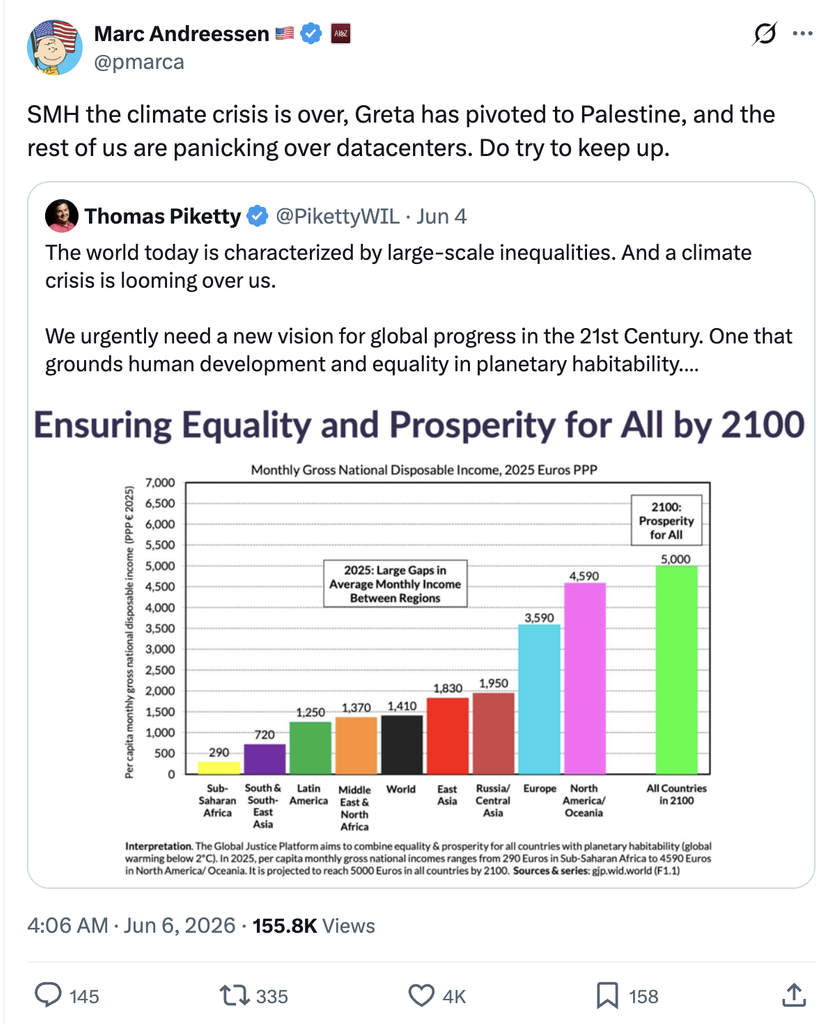 Mark Andreessen responded sarcastically in June to an X post by French economist Thomas Piketty about unequal wealth and the climate crisis: "SMH the climate crisis is over, Greta has pivoted to Palestine, and the rest of us are panicking over data centers. Do keep up." Credit: @pmarca account on X.
Build American AI's ads appeared after Sherrod Brown's campaign ran a series of ads branding Husted "the face of data centers in Ohio" and lambasted him for supporting multi-billion-dollar, greenhouse-gas spewing data center developments as well as for handing out tax breaks for data center developers.
Brown's campaign spent $2.4 million on ads criticizing Husted's support for data centers as of late August, according to political ad spending tracker AdImpact.
The ads caught the attention of the National Republican Senatorial Committee, which sent out a memo in mid-August to "interested parties" about "Ohio's data center risk," as first reported by Axios. The memo warned that Brown's opposition to data centers had turned the issue into "the anchor hanging around Husted's neck" that could get him voted out of office. "The companies that need these projects built have to fix how Ohioans see them: who benefits, who pays, and why a community should want one," the memo stated — the themes of Build American AI's TV ad campaign.
Sixty-three percent of Ohioans oppose AI data centers, according to a recent poll by The New York Times. As of September, the state has over 125 local data center moratoriums in place, as well as 21 ballot measures across 16 counties targeting data center construction, the most of any state. "People who would wave at their neighbors that they've seen for 10 years but never have spent the time on their porches" are "looking past partisan differences to fight for their communities," Nick Owens, an attorney in rural Ohio, told DeSmog. Owens, who said he is a Republican, volunteers with the campaign Conserve Ohio, which is seeking to ban large-scale data centers in the state.
Looking ahead, local community groups in Ohio are attempting to gather 413,000 signatures needed to put a statewide data center moratorium on the ballot in 2027.
"Grassroots people who frankly have one hundredth the level of funds [of tech leaders] are battling these fights," said Owens. "It's really David versus Goliath, but the righteous people in this case, I believe, will prevail: the people who live in their communities."
The post Revealed: Pro-AI Data Center Group Spending At Least $2.54M on TV Ads to Influence Ohio Election appeared first on DeSmog.
This story was co-published with Rolling Stone.
In Ohio's rural southeastern corner, Marietta College geology professor David Jeffrey was among the residents worried that industry activity in America's booming natural gas region could be polluting their drinking water. That's "the biggest fear," he said at an August meeting with top Ohio officials.
When Jeffrey and residents from advocacy groups Buckeye Environmental Network and Washington County for Safe Drinking Water met with Ohio officials, those state officials repeatedly assured residents that despite the up to 1.4 billion gallons of oil and gas wastewater injected in underground wells in their county and across Ohio each year, the state was unaware of any resulting drinking water contamination there.
"We would have heard about it," Mary Mertz, director of the Ohio Department of Natural Resources (ODNR), which oversees both aspects of Ohio's environment and its oil and gas industry, told residents in the August 17 virtual meeting.
"No one has called us that I'm aware of," said Eric Vendel, ODNR's oil and gas division chief. "We have a water investigation form that can be filled out and we would have my team down there and investigate the water."
What officials did not tell the group that day is that five years earlier, the state did receive a call and, on Vendel's orders, investigated a drinking water well for oil and gas wastewater contaminants in eastern Ohio, roughly 80 miles away from Washington County. Independent experts say the results are consistent with fracking wastewater contamination. Despite that and the water well's location near two oil and gas wastewater injection wells, ODNR concluded fracking wastewater was not to blame, according to documents DeSmog and Rolling Stone obtained via public records request.
Subscribe to DesmogGet the weekly intelligence you need to hold polluters accountable
Email Address Sign Up Send me intelligence from: All US/Global team UK/Europe team (function($){ $('.newsletter-container .ijkidr-us').click(function() { $('.js-cm-form').attr('data-id', '2BE4EF332AA2E32596E38B640E905619D07B21962C5AFE16D3A2145673C82A3CEE9D9F1ADDABE965ACB3CE39939D42AC9012C6272FD52BFCA0790F0FB77C6442'); $('.js-cm-email-input').attr('name', 'cm-vdrirr-vdrirr'); }); $('.newsletter-container .ijkidr-uk').click(function() { $('.js-cm-form').attr('data-id', '2BE4EF332AA2E32596E38B640E905619BD43AA6813AF1B0FFE26D8282EC254E3ED0237BA72BEFBE922037EE4F1B325C6DA4918F8E044E022C7D333A43FD72429'); $('.js-cm-email-input').attr('name', 'cm-ijkidr-ijkidr'); }); })(jQuery);ODNR spokesperson Andy Chow told DeSmog and Rolling Stone: "When administrators were meeting with representatives in Washington County, they were discussing matters related to injection wells located in Washington County. ODNR stands by the comments made by its administrators."
Concerns over polluted drinking water cross political and social divides, perhaps nowhere more so than rural Washington County. As intensely salty wastewater pushed below ground resurfaces, residents and officials have injected the issue into the already bitterly divided Ohio governor's race. Susan Vessels, a Republican official in Washington County, recently appeared alongside Democratic gubernatorial candidate Dr. Amy Acton because of Acton's pledge to pause new wastewater wells in this densely drilled area. "We have a chance to prevent the worst from happening, and we need to act now," Acton told DeSmog and Rolling Stone.
"Drinking water is not political and it is my hope Ohioans will come together across party lines on this issue."
Susan Vessels, Marietta City Council President
Ohio ranks in the top 10 nationally for both oil and gas production. Fracking can occur within 100 feet of a school or rural home, and operators have been able to tap the gas-rich Marcellus and Utica formations by drilling directly beneath water reservoirs and state parks. But in order to maintain that production, the industry has to offload the tidal wave of toxic wastewater — rich in salts, carcinogens, heavy metals, and radioactive elements — that surfaces in the weeks and years that follow drilling an oil or gas well.
That wastewater gets pumped into injection wells deep below ground, where impermeable geological layers are supposed to keep it from leaking into oil and gas wells or drinking water supplies. Washington County, whose 19 injection wells outnumber all of Pennsylvania, has received complaints of this wastewater, or brine, flooding nearby oil and gas wells, according to the New York Times.
Now, an hour and a half drive north, in the town of Coshocton, Ohio, records show evidence of a family's drinking water polluted by high levels of the same types of salts found in fracking wastewater.
"This is different"In early November 2021, Bill Burgan, an eastern Ohio water well driller, called ODNR to complain about water from a 360-foot well he had drilled in 2017 for the Fisher family in Coshocton, according to ODNR documents. At the beginning of 2021, their water had become salty and corrosive. Not only did it leave a salty taste in the mouth, but it caused their hot water tanks to rust out prematurely. The couple had replaced two tanks in four years. Within weeks, the newest one became coated in an unidentifiable white precipitate.
"Sometimes we drill through pockets of salt," said Burgan, president of American Drilling and Pump Service, in an interview with DeSmog and Rolling Stone this summer outside his Stone Creek, Ohio, shop. "But this is different, it's fracking waste."
Burgan told DeSmog and Rolling Stone, and, separately, ODNR according to public records, that he expressed concern that the Fishers' drinking water well became impacted by an oil and gas wastewater injection well located less than two miles from the family's home and operated by a Texas-based company called Buckeye Brine. The local community vigorously opposed Buckeye Brine's installment of the injection well, where since 2014 the company has injected over 400 million gallons of waste.
After receiving Burgan's complaint, ODNR swiftly launched an investigation that agency geologist Tamara Richards said "will focus solely on contaminants associated with oil and natural gas exploration and production," according to public records.
The state's results indicate signatures of possible drinking water pollution from oil and gas wastewater, according to independent experts who reviewed the findings. Ohio's final report on the incident, completed in January 2022, found two separate indicators of potential fracking wastewater contamination — total dissolved solids, and chloride — in the Fisher family's water. Both tested at more than five times the U.S. Environmental Protection Agency (EPA) limits. ODNR also tested for sodium, which lacks a formal EPA limit but has a threshold, as high levels can cause unpleasant taste and health problems for diabetics. In the Fishers' water, sodium was 17 times the EPA threshold.
According to Jeffrey, the Marietta College geologist, high levels of total dissolved solids, chloride, and sodium also are found in the sea of fracking wastewater pumped into injection wells like the one operated by Buckeye Brine.
However, ODNR concluded there was "no evidence of an oilfield related impact" and pinned the cause of the contamination on a sandstone layer called the "Big Injun" that the agency, without providing any data, stated "appears to be" naturally salty and surrounded part of the family's water well.
But Jeffrey said testing done by the state did not look at enough parameters to determine that the contamination was natural and not from fracking wastewater. "It seems ODNR is either stonewalling, misdirecting, or just doesn't know what they are doing," he told DeSmog and Rolling Stone.
In a separate case that would unfold over a year after ODNR tested the Fishers' water, the agency was considering whether leaking injection wells or else the "Big Injun" sandstone formation might be contaminating conventional oil and gas wells in Athens County, just west of Washington County. This time, ODNR concluded the impacts "cannot be plausibly explained" by the sandstone formation due to its unique brine signature, citing a "June 2, 2020 technical analysis prepared by ALL Consulting." The agency added that impacts from this natural layer would have been consistent from the start, and "it is unlikely" they would have appeared only after the injection well operator began working. ODNR ultimately suspended the permit for a set of three injection wells that were eventually shut in for leaking fracking wastewater. ODNR has not yet replied to questions regarding this case.
When asked about the state's findings in Coshocton and their scientific evidence, Burgan was dismissive. "They are covering it up," he said, "because they are making too much money off of this."
Oil and gas companies pay Ohio five cents a barrel to dispose of in-state wastewater, and 20 cents for wastewater imported from other states. Much of the waste injected comes from neighboring West Virginia and Pennsylvania. With at least a billion gallons of waste injected every year, that income translates to an average of $2.4 million annually for state coffers, according to state documents.
"The ODNR Division of Oil and Gas Resources Management uses evidence and facts, testing, and the latest technologies to evaluate complaints of brine migration" and "stands by the results of its investigation," said ODNR spokesperson Chow.
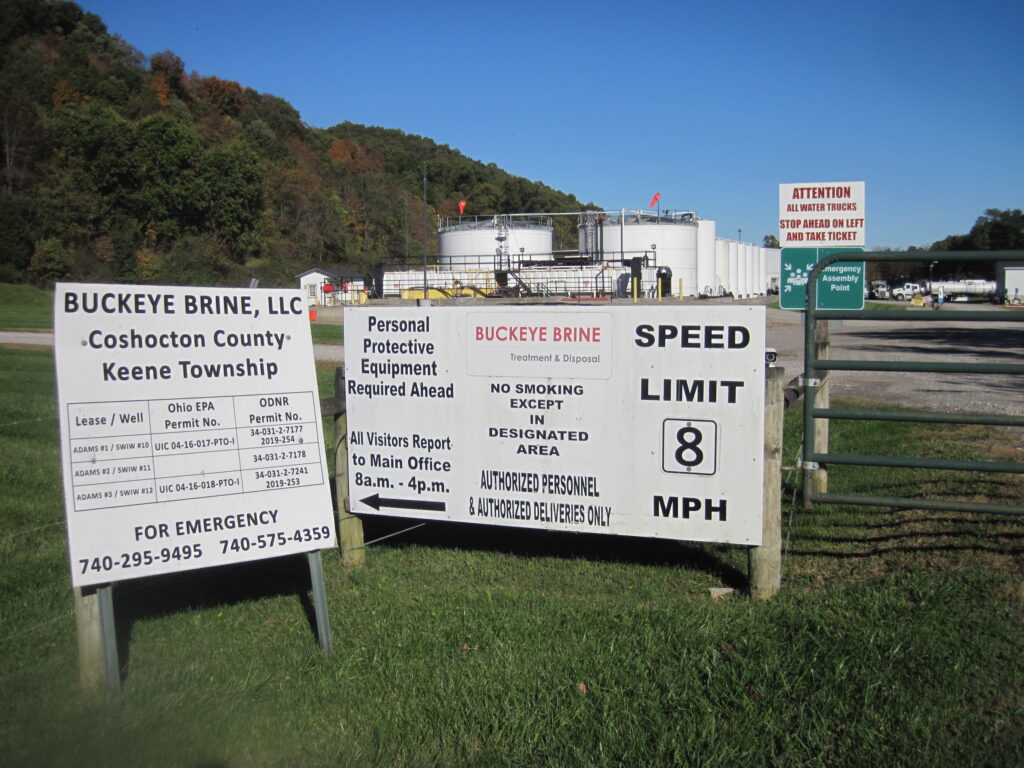 The entrance to Buckeye Brine's injection well facility in Coshocton, Ohio. Credit: Justin Nobel/DeSmog
But ODNR did not investigate the Buckeye Brine injection well, subject of the original complaint, or any other injection wells. It did investigate "producing oil and gas wells within a one-half mile radius" of the family's home.
After Burgan's company reached out, we "contacted ODNR and ODNR was not interested in any further efforts on the matter," said Susie Patterson, the manager at Buckeye Brine, by email. Patterson said groundwater monitoring wells installed in 2019 and sampled quarterly showed "no indication of contamination by oilfield substances," or that "the water was not fit for consumption due to contaminants," and pinned issues with the Fishers' well on the water well driller.
"The wells were drilled much deeper than surrounding wells producing good drinking water," said Patterson. "It is Buckeye's opinion that the driller was trying to justify to the well owner the bad wells."
The Fishers declined to participate in the story.
The Oil and Gas Industry's Trillion-Gallon ProblemAcross America, over one trillion gallons of oil and gas wastewater are generated every year — enough to fill a line of waste barrels to the moon and back 28 times. Nearly all of this waste — 96 percent — will be injected deep into the earth at disposal injection wells.
Given the oil and gas industry's reliance on injection wells as a critical means of disposal for a dangerous waste stream, analysts have referred to injection wells as a linchpin to the sound operation of the entire oil and gas industry. Disposal of oil and gas wastewater is the industry's "Achilles' heel," said Ted Auch, a researcher at the oil and gas industry watchdog Fieldnotes. A 2021 Rice University Center for Energy Studies report stated that if the industry did not have injection wells to rely on for waste disposal, the "resulting economic impacts would be profound — and likely, existential."
The United States has more than 181,400 oil and gas wastewater injection wells, but as industry leaders testified at the Texas state capitol in August, lack of space to store this toxic brine already is threatening to curtain oil and gas production in Texas' productive Permian Basin. Even where it has been stored, increasing evidence shows the wastewater is not always staying put.
Injection has proven particularly problematic in Ohio, where state regulators have halted operations at over half a dozen injection wells, citing concerns that fracking wastewater has leaked and has traveled up to five miles underground to contaminate conventional oil and gas wells. ODNR noted in a 2023 letter to DeepRock Disposal Solutions, a southeast Ohio company formerly run by the chair of the state senate's energy committee, that such incidents pose a risk to public health and drinking water too.
In Texas, wastewater shot down injection wells has burst back to the surface at old oil and gas wells, at times generating 100-foot geysers of brine in the desert, and Inside Climate News reported that oilfield waste has contaminated drinking water sources in the heart of West Texas oil country. Reporting by ProPublica revealed the situation is similar in neighboring Oklahoma, where regulators have clashed over how far to rein in the injection industry, despite state evidence showing drinking water sources polluted with contaminants consistent with oilfield waste.
Independent scientists raise the question of whether other oil and gas states may be facing similar problems.
"We have always been concerned as environmental scientists and geologists in this area that there is no underground containment in these [injection] wells," said Jen Bowman, a water chemistry expert and the director of environmental programs at Ohio University, in Athens. "What so many folks in this area don't understand, our underground layers are just rock layers so there is no magic underground lake where you are getting water from, and there is no magic underground storage container where the waste is going." Injecting millions of gallons of waste at high pressure means contamination miles from the site of injection is inevitable, she said.
"This is not a good plan or disposal mechanism for potentially dangerous materials," Bowman told DeSmog and Rolling Stone, "especially given that people rely on groundwater in so much of rural Ohio."
The concern about drinking water in Washington County is exactly what motivates Susan Vessels, the Republican president of the Marietta City Council. She has led the council in writing a resolution, passed last October, urging Ohio state legislators to introduce legislation imposing a three-year moratorium on new wastewater injection wells in Washington County. More recently she has crossed the political aisle when Amy Acton, the former state health director, came to Marietta last month as part of her gubernatorial campaign. Acton supports Vessels' proposed moratorium and is facing an ugly, expensive race against billionaire Vivek Ramaswamy.
Acton told DeSmog and Rolling Stone that the fight over injection wells and drinking water contamination comes down to ensuring a better future for Marietta and all of Ohio.
"That is why I am committing to a three-year moratorium on wastewater injection wells in Washington County," said Acton. "I'm fighting against the corruption in our Statehouse and the cost of that corruption that we pay for. We must act to protect our resources and our drinking water." Ramaswamy's campaign has not replied to questions.
"Drinking water is not political," said Vessels, "and it is my hope Ohioans will come together across party lines on this issue."
In an op-ed, she took to task the GOP contender Ramaswamy, who called people "whiners" for raising concerns about clean water, energy use, and other issues as proposals for AI data centers arrive in Ohio.
"I think they are full of shit, and that is point-blank my opinion."
Phillip Johnson, Washington County water well driller
Washington County water well driller Phillip Johnson said he has drilled hundreds of private water wells in the region. He disagreed with the state's conclusion that brine from the sandstone formation caused the Fisher family well's contamination.
"I think they are full of shit, and that is point-blank my opinion," he said.
Johnson said that if the sandstone formation was the cause of the salt contamination in the Fishers' drinking water, then the salty taste should have been there from the beginning, and not strengthened over time as the couple reported, according to ODNR documents.
"Just because you drill 1,000 wells and everything works fine, it just takes one well to not work right for there to be a problem," said Johnson. "It is nature, if you pump something down under pressure, the path of least resistance is up."
"I am all for drilling oil and gas," he added, "but fresh natural water is the most essential natural resource there is, in this country, the state, anywhere in the world, and if you contaminate it, you essentially ruin everything."
Dominic DiGiulio, a retired EPA scientist with a doctorate in geoscience and decades of experience investigating the movement of underground fluids, provided another assessment of the state's conclusions in the Coshocton case.
"The ODNR's logic for stating that the domestic well is partially screened in the Big Injun formation is flawed," said DiGiulio, who also previously consulted for government agencies and NGOs. "ODNR does not provide compelling evidence."
The post Ohio Denies Evidence of Fracking Waste in Drinking Water. Its Own Records Show Otherwise. appeared first on DeSmog.
At a Tuesday campaign rally for Republican Senate candidate Ken Paxton in Lubbock, Texas, President Trump announced the U.S. Environmental Protection Agency's (EPA) proposal to roll back a Biden-era methane rule, setting up a likely future showdown in how the agency oversees climate pollution under the Clean Air Act.
The proposal marks a break from the agency's previous approaches to greenhouse gas regulation by maintaining that — for now — the EPA still has the authority to regulate climate pollution from the oil and gas industry, though it might revisit this decision later. With affordability top of mind for many midterm voters, however, the President framed the move in economic terms.
"Tonight I'm officially terminating Biden's expensive and unnecessary methane regulations," Trump announced to the crowd, located near the oil-rich Permian Basin. The new plan would loosen federal requirements for oil and gas operators to detect and repair leaks, ease restrictions on gas flaring, and eliminate the Super Emitter Program, a third-party monitoring and reporting system designed to identify major releases of methane, known as a climate super pollutant.
Trump said the proposal, which addressed a 2024 rule known as OOOOb/c, would "save consumers and energy producers $45 billion in costs, unlock vast quantities of Texas natural gas, and produce 210 million barrels of oil." Under President Biden, the EPA estimated the rule would prevent the release of 58 million tons of methane and 16 million tons of volatile organic compounds (VOCs), leading to major public health and climate benefits. Climate change already is raising costs for American households by an estimated $400 to $900 annually, according to a 2025 Brookings report.
Trump's Lubbock announcement follows a series of sweeping deregulatory moves by the EPA in which the agency has stated it does not have the authority to regulate the greenhouse gas emissions that cause climate change under the Clean Air Act. EPA's most notable decision came in February when the agency rescinded the 2009 endangerment finding, the U.S. government's scientific finding that greenhouse gases harm human health and the environment and the legal basis for its rules addressing climate change. More recently, the EPA stated in September that it would no longer limit climate pollution for power plants, a move which would likely extend the lifespan of coal-fired power plants.
In the wake of these decisions, however, legal experts and environmental advocates say that the EPA is attempting to assert power unevenly. On the one hand, the agency says it lacks the legal authority to regulate greenhouse gas emissions from cars, trucks, power plants, and industrial sources under the Clean Air Act. On the other, the latest EPA proposal relies on, in some cases in the same section of, the Clean Air Act to regulate methane, a greenhouse gas, from the oil and gas industry.
In its latest proposed rule, the EPA addresses this tension, acknowledging that "stakeholders have also raised concerns" about the agency's authority to regulate the oil and gas sector's greenhouse gas emissions under the landmark air pollution law. Depending on the agency's final handling of the issue with fossil fuel-fired power plants, the EPA states it could then use a "future rulemaking" to resolve the issue in the oil and gas sector. (The EPA is accepting public comments on its proposed repeal of its authority to regulate greenhouse gas emissions for fossil fuel-fired power plants until Nov. 2.)
Subscribe to Desmog
Get the weekly intelligence you need to hold polluters accountable
Email Address Sign Up Send me intelligence from: All US/Global team UK/Europe team (function($){ $('.newsletter-container .ijkidr-us').click(function() { $('.js-cm-form').attr('data-id', '2BE4EF332AA2E32596E38B640E905619D07B21962C5AFE16D3A2145673C82A3CEE9D9F1ADDABE965ACB3CE39939D42AC9012C6272FD52BFCA0790F0FB77C6442'); $('.js-cm-email-input').attr('name', 'cm-vdrirr-vdrirr'); }); $('.newsletter-container .ijkidr-uk').click(function() { $('.js-cm-form').attr('data-id', '2BE4EF332AA2E32596E38B640E905619BD43AA6813AF1B0FFE26D8282EC254E3ED0237BA72BEFBE922037EE4F1B325C6DA4918F8E044E022C7D333A43FD72429'); $('.js-cm-email-input').attr('name', 'cm-ijkidr-ijkidr'); }); })(jQuery); Attacking EPA's 'flawed legal basis'In 1999, the oil and gas industry's largest trade group, the American Petroleum Institute (API), organized a meeting over whether it should "coordinate a multi-industry, trade group response" to the threat of what it called EPA's "flawed legal basis" for regulating greenhouse gas pollution, including carbon dioxide and methane, under the Clean Air Act. In 2024, the API filed a legal challenge over the OOOOb/c rule, which was eventually consolidated into a lawsuit with states and other industry trade groups. That suit has been paused while the agency reconsiders the rule.
Parts of the oil and gas industry have flagged this distinction in how the Trump EPA is handling two different greenhouse gases under the same law. Shortly after the EPA repealed the endangerment finding, the Domestic Energy Producers Alliance (DEPA), an oil and gas trade association founded by fracking magnate and Trump donor Harold Hamm, wrote a letter to the EPA, thanking the agency for "restoring the rule of law." The group called out "methane and other greenhouse gas emission requirements for the oil and gas sector" among its examples of "major regulations based on the Endangerment Finding."
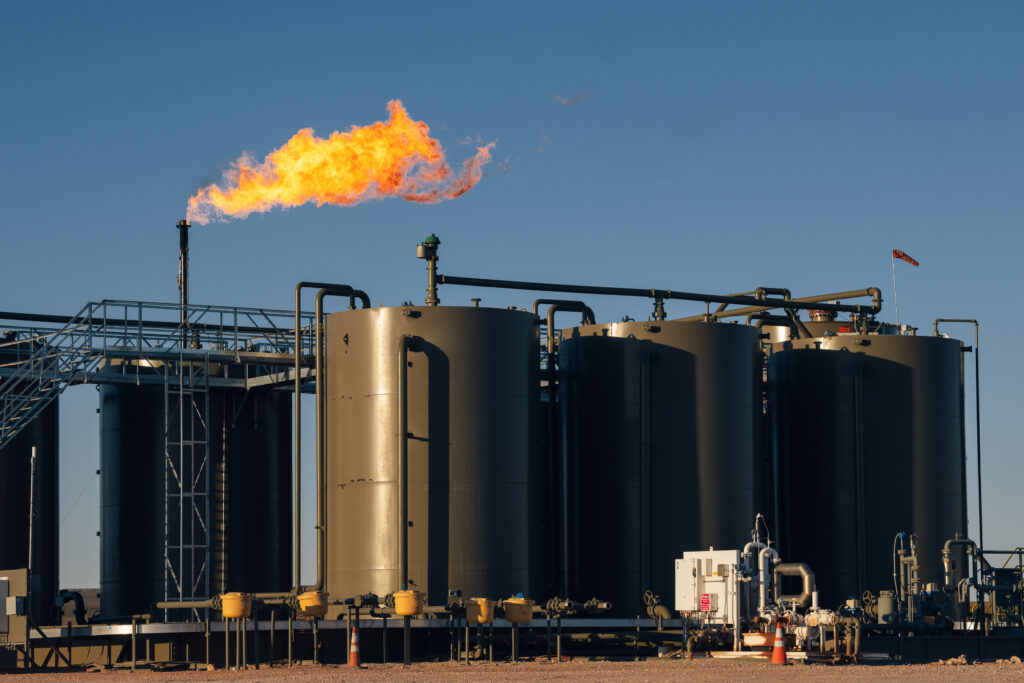 A flare burns over oilfield infrastructure in West Texas' Permian Basin in 2020. Credit: Justin Hamel/DeSmog
A few months later, after the agency published an update on its proposed reconsideration of the OOOOb/c methane rule, DEPA wrote in an internal newsletter that EPA "does not explain its legal reasoning for continuing to regulate methane emissions when it has found that it does not have the authority to regulate carbon dioxide (CO2) emissions from vehicles and has proposed it does not have the authority to regulate power plants' CO2 emissions."
On Tuesday in Corpus Christi, the president called out Hamm by name at another midterms rally shortly before the one announcing the methane rule rollback. "Harold Hamm is here, the great oilman," said Trump, looking around the audience. "Hi, Harold."
'The Very Definition of Arbitary'Legal experts and environmental advocates say the EPA's inconsistency leaves unresolved important legal questions about the federal government's authority to regulate climate pollution, potentially keeping the door open to upend federal methane regulation entirely.
"Treating similar pollutants under the same statute differently, with no stated reason or evidence, is the very definition of arbitrary and capricious decision making," said Alejandro Camacho, a law professor at the University of California, Los Angeles.
Camacho argues that if the EPA adopts a broad theory limiting its authority over greenhouse gases, it must explain why that theory doesn't also undermine its authority to regulate methane. "States have already sued over the power plant repeal, as have health and environmental groups, and they can and should attack this inconsistency too," he added.
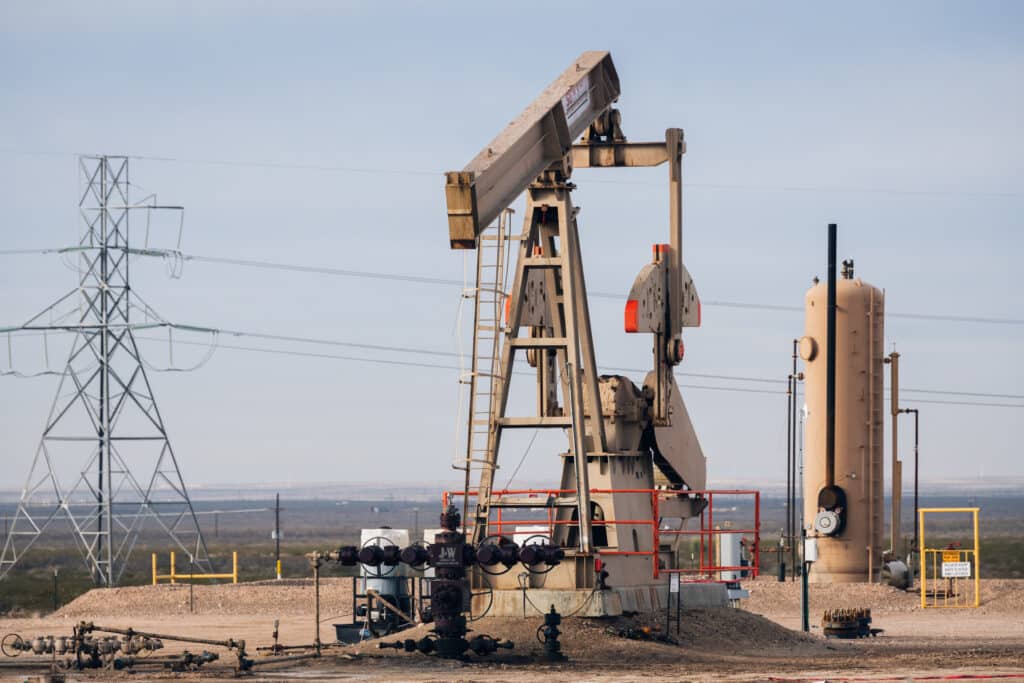 A lone pumpjack in Loving County, Texas, in the Permian Basin. Credit: Justin Hamel/DeSmog
The EPA's proposal nods to the industry's questioning of its authority and points to the agency's history of handling the oil and gas sector separately, "but the agency hasn't explained how it will navigate it," said Rosalie Winn, senior director and lead counsel on methane and clean air policy for the Environmental Defense Fund.
Mary Sasso, an attorney for the Clean Air Task Force, said the agency's decision to defer the question could leave the future of methane regulation uncertain. "I think that there's very real concerns that we could see changes to EPA's interpretation of its own authority finalized in some type of regulation that would be really damaging for public health and the environment," she said.
Camacho agrees, and warned that the deferral could foreshadow future agency backtracking. "The deferral is less a reasoned distinction than a placeholder for the next rollback," he said.
The administration also argues that the proposed changes will reduce regulatory costs, encourage domestic energy production, and help lower prices for consumers. "Since day one, President Trump has been putting real money back into the hands of American people by putting American energy back in the hands of the American workers, businesses, and communities," said Interior Secretary Doug Burgum in a press statement about the proposal.
Consumer savings uncertainAlthough the EPA estimates that the proposed rollback to the methane rule would save consumers tens of billions of dollars, the relationship between domestic production and consumer prices is more complicated, according to the U.S. Energy Information Administration. In an emailed response to DeSmog, the EPA said its estimate reflected the anticipated cost oil and gas operators would save by not having to comply with regulations, their excess profits, and consumer savings. The proposed rule reflects this calculation in its Regulatory Impact Analysis section, but does not provide further details on how the agency determined these figures. These figures are not independently established consumer savings.
"As much as it would be easy to paint oil executives as cartoonish villains hiking prices while families suffer, individuals have little to no control over benchmark oil prices," said Kelly Mitchell, the executive director of the oil and gas watchdog Fieldnotes.
"The administration may claim that new rules will incentivize new production, bringing online supply to counter the barrels trapped behind the Strait of Hormuz," Mitchell said. "However, these new rules are primarily designed to help operators of marginal wells — wells that produce fewer than 15 barrels per day."
 Flaring methane gas in the Permian Basin, Texas. Credit: Justin Hamel/DeSmog
Mitchell questioned whether the benefits of the rollback would reach consumers, arguing that changes would primarily reduce costs for oil and gas operators without guaranteeing lower prices at the pump. "We're left with an outcome where oil companies get to war profiteer, avoid using any of those profits to clean up a major pollution source, and fail to reduce prices. Now they have the gall to look us in the eyes and tell us this is a gift to the American consumer."
Since rescinding the endangerment finding, the EPA no longer accounts for the cost of harms from additional climate pollution — only the economic harms — which does not figure into the new rule's estimated savings. Meanwhile, in a study recapping the last decade of climate-induced health harms, the Lancet reported a record high of 710,000 heat-related deaths in 2023 — and almost 72 percent of them caused by climate change.
The proposed rule places particular emphasis on a class of low-producing facilities known as marginal wells, which typically produce relatively small amounts of oil and gas. The Trump administration alleges that regulations established under the previous administration stymied these wells. "Under crooked Joe Biden, 'Dumocrats' crushed the small oil and gas operators," Trump said during the rally Tuesday. "There are small operators, they're great operators too, I know so many of them — with crippling regulations and methane that caused prices to skyrocket."
The EPA says many of these wells are family-owned operations that struggle with the costs of complying with Biden-era standards, but an Environmental Defense analysis found that nearly half of all marginal wells are owned by just 93 corporations.
The proposed methane rule reconsideration is the latest development in a broader campaign to weaken federal methane protections under the purview of Aaron Szabo, a former registered lobbyist for a member of a major trade group pushing for these rollbacks. Earlier this month, Szabo stepped down as the head of the EPA Office of Air and Radiation. Last month, DeSmog reported that members of the oil and gas industry had simultaneously voiced public support for federal methane rules while covertly working to "eviscerate"them during the second Trump administration, according to an investigation published by Fieldnotes.
The proposed changes to the OOOOb/c methane rule are not yet final. The EPA says it will provide at least 45 days for public commentafter publication in the Federal Register, including a public hearing.
The post President Trump Unveils EPA's New Contradictory Methane Proposal at Campaign Rally appeared first on DeSmog.
Two directors of GB News, which has loudly advocated for the new Rosebank and Jackdaw oil and gas fields, hold shares in the firms behind the projects.
Sir Paul Marshall, a millionaire hedge fund boss who also owns The Spectator magazine, and Lord (Theodore) Agnew of Oulton, a Conservative peer and donor, sit on the board of All Perspectives Ltd, the holding company of GB News.
Marshall is also one of its two principal funders, pumping money into the loss-making right-wing outlet.
GB News - which employs Reform UK leader Nigel Farage and former Tory Cabinet minister Jacob Rees-Mogg - has strongly supported new North Sea drilling, with presenters recently calling Rosebank "a no-brainer" that should be approved "instantly".
The Labour government last week approved the development of the Jackdaw gas field near Aberdeen and is expected to make a decision on Rosebank soon.
Rosebank would create an estimated 250 million tonnes of carbon dioxide (CO2) emissions over its 10-year lifetime, roughly 70 percent of the UK's total annual emissions. The oil and gas field near the Shetland Islands is 80 percent owned by Adura, an "independent joint venture" by the fossil fuel giants Equinor and Shell that also owns the Jackdaw site.
At the end of June, Marshall's hedge fund Marshall Wace held $16.3 million (around £12.3 million) of stock in Shell, according to its latest filings to the U.S. Securities and Exchange Commission.
Meanwhile, Lord Agnew is a shareholder in Equinor, owning a stake in the company worth at least £100,000 according to his parliamentary register.
DeSmog first revealed Marshall Wace's huge fossil fuel portfolio in 2023, which increased to $2.8 billion (£2.1 billion) in the first quarter of this year.
One of Marshall Wace's biggest backers, U.S. private equity giant KKR, is itself a major investor in fossil fuels.
Subscribe to DesmogGet the weekly intelligence you need to hold polluters accountable
Email Address Sign Up Send me intelligence from: All US/Global team UK/Europe team (function($){ $('.newsletter-container .ijkidr-us').click(function() { $('.js-cm-form').attr('data-id', '2BE4EF332AA2E32596E38B640E905619D07B21962C5AFE16D3A2145673C82A3CEE9D9F1ADDABE965ACB3CE39939D42AC9012C6272FD52BFCA0790F0FB77C6442'); $('.js-cm-email-input').attr('name', 'cm-vdrirr-vdrirr'); }); $('.newsletter-container .ijkidr-uk').click(function() { $('.js-cm-form').attr('data-id', '2BE4EF332AA2E32596E38B640E905619BD43AA6813AF1B0FFE26D8282EC254E3ED0237BA72BEFBE922037EE4F1B325C6DA4918F8E044E022C7D333A43FD72429'); $('.js-cm-email-input').attr('name', 'cm-ijkidr-ijkidr'); }); })(jQuery);"GB News has gone way beyond just covering the Rosebank decision. Presenters repeatedly attacked the energy secretary for considering rejecting it, and demanded that the government 'drill baby drill'," said Richard Wilson, director of the campaign group Stop Funding Heat.
"The public deserves to know when the people overseeing a TV station have a financial stake in the outcome it's pushing for".
Wilson also pointed out that media regulator Ofcom requires "due impartiality" from broadcasters on live policy decisions, potentially including the approval of specific oil fields.
"It's time for Ofcom to take action," he said. "In the meantime, it's vital that advertisers continue to steer clear of GB News".
Paul Marshall and Marshall Wace declined to comment. GB News and Lord Agnew were approached for comment.
GB News's 'Rosebank-tinted' CoveragePresenters and guests on GB News have vocally backed the Rosebank and Jackdaw projects.
On 26 October, Rees-Mogg, who lost his seat at the 2024 general election, was asked for his view on Rosebank, replying: "Oh, drill, baby drill. We should get on with it as fast as possible," adding that the UK should also overturn its ban on fracking for shale gas.
On 19 August, GB News presenter Andrew Pierce interviewed Reform's deputy leader Richard Tice about the two projects, saying: "If both of them were given the go-ahead, wouldn't that instantly create some of the extra fuel security, energy security we need, apart from the revenue for the Exchequer?"
Tice replied, "Of course. Both should be given the go-ahead instantly," adding that the government should grant new North Sea exploration licences, which would break its 2024 manifesto commitment.
On 22 October, Pierce himself called Jackdaw "brilliant" and said it was "madness" for Labour MPs to oppose Rosebank.
GB News political editor Christopher Hope has also made the case for Rosebank, remarking on 26 October: "We're buying in the oil and gas we would take from Rosebank. Anyway, why not make it in [the UK] and get tax revenue from that asset?"
A few days earlier, on 16 October, he said: "It seems like a no-brainer to many, but not on the left of politics."
 GB News presenter and former Conservative MP Jacob Rees-Mogg.
Credit: GB News / YouTube
Last week, the GB News website ran an opinion article by Russell Borthwick, the chief executive of Aberdeen and Grampian Chamber of Commerce, headlined: "Jackdaw approval is a victory for common sense. Now it's Rosebank's turn."
As DeSmog has documented, GB News has long backed new fossil fuels and attacked climate action. It has also given a platform to climate science deniers, including from the Global Warming Policy Foundation (GWPF), a pressure group that says more CO2 emissions would be a "benefit to the planet".
Marshall has also personally criticised policies designed to reduce greenhouse gas emissions, claiming in a speech to the Alliance for Responsible Citizenship (ARC) conference in February 2025 that the world has been infected by a "climate derangement syndrome". He said "our economic prosperity and our people's livelihoods" are being sacrificed "all for the sake of making some fractional changes to the level of CO2 in the atmosphere".
In reality, reaching net zero emissions is predicted to cost only a fraction of UK GDP, while the extreme weather events caused by climate change could have a dramatic impact on the global economy.
Marshall's Spectator magazine, edited by former Conservative Cabinet minister Michael Gove, has also strongly supported new North Sea drilling.
A piece last week by anti-net zero columnist Ross Clark hailed Jackdaw as "a small victory for common sense" but lamented that Labour will not approve Rosebank so long as the UK keeps its net zero targets.
The Spectator's "gossip columnist" Steerpike also last week accused Labour MPs of "throwing a tantrum over Jackdaw", and concluded: "It has taken years, and so much time has been wasted, but at least the most obvious decision facing the country has finally been made. The question is whether Burnham will be brave enough to approve Rosebank as well."
The Spectator was approached for comment.
The post Two GB News Directors Have Investments in Oil Companies Behind Rosebank and Jackdaw appeared first on DeSmog.
Naomi Klein and Astra Taylor's End Times Fascism and the Fight for the Living World is critical reading for anyone seeking to understand and push back against the far-right coalitions wielding considerable state and corporate power around the world.
Klein and Taylor posit that today's fascists believe that end times have arrived, and have made it their mission to profit from cascading global crises, while hunkering down and protecting themselves as the world burns around them.
The book details three factions of end times fascists, united by their shared apocalypticism. The religious fundamentalists believe end times are upon us, but they will be saved by their messiah. The Silicon Valley technologists are building technologies they say could be world-ending, that in the meantime are killing jobs, consuming vast resources, and polluting communities. The ethno-nationalists espouse conspiratorial ideas about cultural replacement and treat immigration as an existential threat.
DeSmog Canada editor/reporter Mary Stuart spoke with Astra Taylor about how climate change fits into end times fascism, the importance of AI data centre fights, and how we can understand Canadian Prime Minister Carney's neoliberal moves in response to U.S. President Donald Trump.
Taylor is a writer, documentarian, and activist. She co-founded the Debt Collective, a membership-based union for debtors, and is the author of several books, including The Age of Insecurity and Democracy May Not Exist But We'll Miss It When It is Gone.
This interview was conducted by phone and has been edited for length and clarity.
Mary Stuart: I want to start by asking how your book can help us understand some recent elections. Jair Bolsonaro's son Flávio won the first round of voting in Brazil's election and nearly became president. The far-right AfD recently won in Saxony-Anhalt. How do these wins fit into your analysis of end times fascism?
Astra Taylor: One phenomena we describe in End Times Fascism relevant here is the role of Pentecostal religious communities in turning out the vote. To paraphrase reporting from Brazil, a voter said "my heart's with Lula, but my pastor told me to vote for Flávio".
The incredibly difficult conditions that we're living under created fertile terrain for prophecy and religion, for kinds of pentecostalism, a faith that is focused on prosperity, individual advancement and banking on the idea that life is suffering here on earth, but you will be rewarded in the afterlife.
There's also interference from Tech oligarchs. We don't know the half of it at this moment, but the way the platform [Meta] refused to run ads for Lula's party and beyond is certainly a factor. And the Trump regime [is playing a role] as well.
AfD is a similar. Naomi and I wrote a piece in the Financial Times and we open with the images that went viral this summer of the Danube River drying, and Nazi warships emerging. Hundreds of Nazi warships sank during WWII, and as the river receded, this paraphernalia was coming out of the mud. We thought it was a powerful metaphor for today. What's really striking is the riverbed— the fact that it's drying because of climate change. Our point is that fascism always emerges from crises. And we cannot separate the ecological and economic crises people are facing.
People are really struggling with affordability. People are feeling that they don't have a future. And actually quite strikingly, rates of immigration are quite low, right? So [Saxony-Anhalt is] one of the places with the least immigration, but [the AfD] step in and say "the problem is the immigrants, it's not a larger economic system." This is a classic fascist move that we describe throughout the book.
MS: What role do climate change and climate denial play in end times fascism?
AT: Naomi and I are insistent that the planet is a player in our politics. Fascism always surges in moments of crisis.
We are in a world that is being roiled by disasters and shocks. We've reached a point where the consequences [of climate change] are undeniable. You cannot deny a heat dome when you're inside it. You cannot deny a hurricane when it's blowing the roof off your house. Of course, you can still deny why the storm is coming. You can embrace a Marjorie Taylor Greene perspective and say that it's due to space lasers or you can say "the climate has always chained, this is nothing new, we don't know if it's human causing it."
The far-right is adapting to circumstances … where ecological catastrophes are the norm, people can't pay their property insurance bills anymore because the rates have been jacked up or because the insurers have pulled out, or where people have to pay the cost of fixing their homes or moving because of disasters.
The far-right is having to acknowledge that there are fires, there are storms, that people are suffering. They're responding by deflecting, by saying, "don't blame the fossil fuel companies and the politicians who take their money, blame the globalists in the EU and their climate policies, or blame the immigrants".
We saw this really vividly after Hurricane Helene, a tropical storm that hit Appalachia. Trump and Elon Musk were going around saying "FEMA has no money for you because the Democrats spent it on immigrants." So they use the hurricane to advance the Great Replacement Conspiracy. It's an amazing pivot to go from a storm destroying tens of thousands of houses to say, "the problem is the globalists are importing immigrants to replace you". But it's working.
People have been warning for many years about ecofascism being the consequence of climate change. Ecofascism is the consequence of decades of denial, not just from the far-right, but by liberals who insisted that we could address this crisis through market policies that were doomed to fail.
It's absolutely criminally irresponsible to not talk about climate change right now because that will create a vacuum for this pivot from the real arsonists to the immigrant victims. And we need to insist on robust climate policies. Not just renewables. It's investments in care work and in all sorts of low carbon important initiatives. It needs to be at the centre of our politics.
There was a time when liberals could think people will stop denying climate change when they experience it firsthand. We're seeing that is not true. People in that state of vulnerability and shock are more susceptible to strongmen and scapegoating, and we need to be right there with a different plan and a different story.
MS: In the book you talk about a number of site fights and bright spots, one of them being the AI data centre backlash. What is the importance of AI data centre fights in defeating end times fascism? Can these fights be sites of expansion for movements to touch on other issues as well?
AT: The data centre fight is an amazing opportunity to weave together all of these issues that we know are interconnected. People aren't fighting data centres in their backyard for just one reason. They are fighting them because they care about their air and water, because they don't want a future where all the jobs are gone and every bit of economically valuable work, as OpenAI calls it, is performed by robots. It's also a democracy fight. These data centres are coming in under the cover of non-disclosure agreements, often with little input from even the city council and no input from the community.
But it's more than that. There's such intensive capital, like borrowing on capital markets right now. That's part of why interest rates are being jacked up around the world, which increases the cost of borrowing for ordinary people. Rates are going up, it's making homes more unaffordable. The fact that the population is buried by debt is a huge part of what drove Flávio Bolsonaro's surge in recent months.
All of these factors are compounding, and so it would be foolish for environmentalists not to intervene and try to connect those those dots. The data centre fight has to be connected to affordability.
MS: In Canada, our Prime Minister Mark Carney is a former investment banker who Naomi recently referred to as the 'paragon of liberalism'. He's privatizing key pieces of Canadian infrastructure, doubling down on fossil fuels, other extractive projects, and AI, while using the language of standing up to Trump. His approval ratings are incredibly high. How are we to understand this?
AT: Naomi might call him a paragon of liberalism. I call him Sir banks a lot. I don't trust bankers, especially those who are committed to the kind of neoliberalism and financialization that he's proposing.
It's dangerous to say "peer into the window, asset managers of the world. Canada has lots of resources that you can purchase and we have a healthcare system that can still be privatized and higher education system that still has some public funding that we could siphon off to the private sector."
These are the policies and conditions that created fertile terrain for the far-right. Carney does not seem to have learned that lesson. It was striking when he gave that speech at Davos, about there being a rupture. The world was so ready for Canada to lead, and to project onto that speech that he was actually standing up for true universalism and for international law.
Instead he's doing this nostalgic hyper-nationalist neoliberalism that isn't really nationalist, because it was reported by the the Toronto Star that the amount of money going to [the] American tech sector from the Department of National Defense has doubled in the last year. He's spending Canadian money to enrich the very companies that are behind Trump. You cannot fight oligarchy with oligarchy. You definitely can't fight fascism with oligarchy. You fight it with solidarity and with democratic socialism, with addressing the root crises.
People want to believe that this figure can protect them when the truth is protection is in building collective power and insisting on a deep economic and political transformation. What he's doing is incredibly dangerous. And the fact that he's rolling back already weak climate policies when Canada's main export is wildfire smoke, is just incredibly insulting and incredibly dangerous. The world needs Canada to stand firm against fascism.
MS: You talk about the power of stories, and detail the stories that the end times fascists are telling. What's a counter story that's been missing?
AT: In the book we talk about how we need to tell stories not of end times but of better times. We are entering a period where there are going to be roiling crises. We need to figure out how to live together well under these conditions.
I think we need stories that just remind us of how critical this fight is and that ground us in a love of this world. Naomi and I want stories that connect people to that, that remind people that we do live in a planetary paradise. It's worth defending.
Ultimately, the organizer in me says we need more than stories. I think it's incumbent on all of us to try to find a political home, to face the fact that fascism is not something that we can fight alone, we can only fight it together. If there's not something for you to join, where you live, then start something … It takes not just stories, but actions, however imperfect, however small, however inadequate, but when we all take them, it adds up.
End Times Fascism and the Fight for the Living World can be ordered in Canada, the U.S. And UK.
The post How the Far-Right Uses Climate Disasters to Build Political Power appeared first on DeSmog.
Would you trust a detox facility that offers a minibar in every room? How about a climate course sponsored by ExxonMobil? If not, you might direct the same incredulity towards Canada's recently unveiled Responsible Data Centre Development Principles, endorsed by tech giants that are implicated in violating those same principles.
Minister of Artificial Intelligence and Digital Innovation Evan Solomon announced the voluntary and non-binding principles in September in response to mounting public opposition to massive data centre developments. It is hardly encouraging that the same companies leading the disruptive build out of massive data centres, such as Amazon, Google, OpenAI, Meta, and Anthropic, quickly signed on to this toothless commitment.
"Data centres must protect ratepayers, respect water and energy resources, and create lasting benefits for the communities that host them," assured Solomon at the launch in September. "These principles set a clear national standard: If you build in Canada, you must build responsibly and transparently and you must build for Canadians."
Really?
Barely three weeks after these companies pledged to Canadians to be "transparent about local impacts," the U.S. House Judiciary Committee opened an investigation into Amazon, Google, and Meta for using non-disclosure agreements (NDAs) to gag state and local officials from telling their constituents about data centre impacts on local water supplies and electricity rates.
"Google's own confidentiality agreements have been shown to contain language that explicitly prevents local officials from disclosing 'the terms of any agreement,'" ranking member Democratic U.S. Rep. Jamie Raskin wrote in a letter to Google's parent company Alphabet.
For over a year, the company fought a local newspaper in Oregon in the courts to keep its Dalles data centre's water consumption hidden, arguing the figure was a "trade secret." When the courts finally forced the release of this essential information, it was revealed that Google was using a quarter of the entire city's water. A company that litigates to hide its water use from the residents of one small town is now asking Canadians to trust its promise of transparency here.
A Meta subsidiary in Louisiana likewise convinced Republican Gov. Jeff Landry to sign an NDA tied to a $50 billion data centre campus. Over 100 Louisiana state public officials signed similar gag orders that apparently silence them even if they leave government. Eric Holl, an adviser to former Louisiana Gov. John Bel Edwards, a Democrat, told the Gulf States Newsroom, "I don't see this being used as anything other than a tool of intimidation and control."
Citizens in Wisconsin were also forced to sue the local utility regulator to release documents detailing the projected energy demand of a proposed Meta data centre after this basic information was also deemed a trade secret.
Subscribe to DesmogGet the weekly intelligence you need to hold polluters accountable
Email Address Sign Up Send me intelligence from: All US/Global team UK/Europe team (function($){ $('.newsletter-container .ijkidr-us').click(function() { $('.js-cm-form').attr('data-id', '2BE4EF332AA2E32596E38B640E905619D07B21962C5AFE16D3A2145673C82A3CEE9D9F1ADDABE965ACB3CE39939D42AC9012C6272FD52BFCA0790F0FB77C6442'); $('.js-cm-email-input').attr('name', 'cm-vdrirr-vdrirr'); }); $('.newsletter-container .ijkidr-uk').click(function() { $('.js-cm-form').attr('data-id', '2BE4EF332AA2E32596E38B640E905619BD43AA6813AF1B0FFE26D8282EC254E3ED0237BA72BEFBE922037EE4F1B325C6DA4918F8E044E022C7D333A43FD72429'); $('.js-cm-email-input').attr('name', 'cm-ijkidr-ijkidr'); }); })(jQuery);The impacts of enormous AI facilities on American communities are well known. The consequences being visited on Canadian towns and residents are concerning to say the least.
The principles say centres must reduce environmental impacts, and prioritize "low-emission energy sources." Yet a contentious data centre development in Saskatchewan proposed by Bell Canada - also a signatory to Minister Solomon's principles - would require as much generating capacity as the entire city of Regina. About 900 megawatts (MW) of its power will come from behind-the-fence gas generation. The Regina City Council recently debated the development for over seven hours and voted to demand more information on potential impacts on local water supplies and electricity costs. A total of 18,000 residents have signed a petition opposing the project.
Beacon Data Centers is another signatory, which stated it is "proud to stand with governments, municipalities, and industry in supporting them." Yet the company is embroiled in a bitter dispute with residents of Lorneville, New Brunswick, who are understandably opposed to the company's plans to fill in a local wetland to expand an industrial park with a data centre that will require more than 10 percent of provincial energy demand. The data centre would become one of New Brunswick's biggest emitters, generating 6.6 percent of provincial emissions.
According to reporting from the Narwhal, "documents obtained through provincial access to information legislation … show provincial officials were in discussions to bring a data centre to the [industrial] park long before residents were told about the tenant — and that details of that data centre conflicted with the more low-impact vision for the industrial park advertised to residents."
DeSmog has already documented the massive buildout of data centres in Alberta, almost entirely powered by burning natural gas. Almost 21 GW of potential new gas capacity is enthusiastically being embraced by provincial regulators, an amount described as "absurdly high" by Alex de Vries at Vrije Universiteit Amsterdam.
Based on similar gas-fired installations around the world, de Vries estimated this amount of new data centres would require about 200 billion litres in cooling water each year. How is this not supposed to impact local electricity rates, heating costs, or water supplies?
This absurd increase in climate-killing gas consumption seems, in fact, to be the point. Internal Privy Council documents obtained by DeSmog from Greenpeace showed that increased gas demand was being touted by senior advisors to Prime Minister Mark Carney as one of the top "public policy benefits to Canada" of data centres.
Bringing "strategic value to Canada" is another vague goal of the newly announced data centre principles. If this is meant to allude to protecting Canadian data sovereignty, building facilities owned by Google, Meta, Amazon or other tech giants will accomplish very little. The U.S. government can compel an American company that controls data - regardless of location - to release it to American regulators under the CLOUD Act (2018).
Regardless of the law, many of the enthusiastic corporate endorsers of Canada's new data centre principles have repeatedly demonstrated their obedient political fealty to the Trump administration. Tech leaders attended his inauguration, donated vast sums of money to the Trump campaign, and indulged the president's geographic fits of pique by rapidly renaming Lake Ontario "Lake America" on Google and Apple maps.
With this cohort driving Canada's tech build-out, what could possibly go wrong?
Canadians are justifiably concerned data centres will impact local water supplies and electricity costs. We need bold policies that will improve digital safety and address increasing democratic threats from AI-driven disinformation. Rather than bringing in meaningful and enforceable regulations, the federal government has instead trotted out vague platitudes endorsed by the same companies contributing to the problem. Ottawa, we have a credibility problem.
The post Canada's 'Responsible' Data Centre Principles Have a Credibility Problem appeared first on DeSmog.
Campaigners backing attempts to sue Shell over a typhoon in the Philippines have launched an online archive showing that the British oil major knew that burning fossil fuels could harm the climate as early as the 1960s.
ExposeShell.com features documents including a 1966 memo Shell commissioned from British scientist James Lovelock and the 'Greenhouse Effect', a confidential 1988 report predicting that human-caused warming could trigger "dramatic" changes in sea level, ocean currents, weather and precipitation — "larger than any that have occurred over the last 12,000 years." [Read these and other documents in the DeSmog series #ShellKnew]
The interactive site went live as Shell was due to announce its latest third-quarter earnings — which are expected to rise on the back of surging oil prices due to the U.S.-Israeli war with Iran.
"We don't need any more reports to us that this big oily industry has been creating disaster," Robin Wells, director of Fossil Free London, one of the groups behind the website, said in a statement. "Shell researched the reality but tore up the truth and locked it in the dark. Now, we are all facing the disastrous consequences."
Fossil Free London protesters took to the streets outside Shell's head office in London on Thursday, dressed in 1960s-style suits and holding banners that read "Shell Knew."
ExposeShell.com is also backed by The Odette Case, a campaign group supporting more than 100 survivors of Typhoon Rai — known in the Philippines as Typhoon Odette — who began seeking damages from Shell last December in a first-of-its-kind case in the UK courts.
The typhoon tore through the Philippines in December, 2021, killing 400 people, injuring more than 1,000, and forcing almost 3.2 million people from their homes.
The survivors argue that Shell should be held liable for its historic contribution to the greenhouse gas emissions fuelling extreme weather events and its support for climate science denial via its past membership of industry groups such as the Global Climate Coalition — despite its early knowledge of the risks posed by burning its products.
Filed by UK law firm Hausfeld, the case draws on recent advances in attribution science that enable scientists to assess the degree to which climate change has contributed to an extreme weather event. Through Shell's contribution of more than 2.5 percent of historical global greenhouse gas emissions, the suit alleges that Shell contributed to both the likelihood and severity of Typhoon Rai. It is the first civil claim to link the climate impacts of an oil and gas company's activities with death, personal injury, and damage to property that has already occurred in the Global South.
Shell has dismissed the lawsuit as "baseless" and said that it had no "unique knowledge about climate change."
The post Interactive Archive Shares Secrets of Shell's Early Climate Research appeared first on DeSmog.
Canada's already battered reputation on curbing climate emissions has become drastically worse under the leadership of Prime Minister Mark Carney according to a recent report card from Climate Action Tracker, approaching levels of inaction comparable to the "drill baby drill" Trump Administration.
"Prime Minister Mark Carney has so far been unwilling to recommit to either the 2030 or 2035 targets and has conceded that, under his energy plan, Canada's emissions will be higher in the near term than previously projected," warned the report. "If Canada were to officially abandon its 2030 and 2035 targets, it would be the first country after the United States to do so."
The emissions watchdog didn't mince words about the pace and scale of Canada's climate rollbacks.
"What is shocking to us is the true extent to which Prime Minister Carney has rolled back climate policies, largely in favour of the fossil fuel industry," Bill Hare, CEO of Climate Analytics, a CAT partner, said in a release.
"This Carney climate carnage, while not quite as bad as Trump's, is rapidly heading in the same direction, despite the country being hit by record wildfires and other devastating climate impacts," he added.
While Canada's planned policies were expected to cut emissions by 30 percent below 2005 levels by 2030 two years ago, since Carney has come into office Climate Action Tracker estimates this planned reduction has been cut in half. Current policies are on track to only deliver a 14 percent decrease in emissions.
Carney's oil-friendly government has swept aside a suite of climate regulations aimed at reducing the massive and growing emissions from the oil sands, which have ballooned by 178 percent since 2005 and now almost equal the entire passenger transport sector.
Subscribe to DesmogGet the weekly intelligence you need to hold polluters accountable
Email Address Sign Up Send me intelligence from: All US/Global team UK/Europe team (function($){ $('.newsletter-container .ijkidr-us').click(function() { $('.js-cm-form').attr('data-id', '2BE4EF332AA2E32596E38B640E905619D07B21962C5AFE16D3A2145673C82A3CEE9D9F1ADDABE965ACB3CE39939D42AC9012C6272FD52BFCA0790F0FB77C6442'); $('.js-cm-email-input').attr('name', 'cm-vdrirr-vdrirr'); }); $('.newsletter-container .ijkidr-uk').click(function() { $('.js-cm-form').attr('data-id', '2BE4EF332AA2E32596E38B640E905619BD43AA6813AF1B0FFE26D8282EC254E3ED0237BA72BEFBE922037EE4F1B325C6DA4918F8E044E022C7D333A43FD72429'); $('.js-cm-email-input').attr('name', 'cm-ijkidr-ijkidr'); }); })(jQuery);Perhaps the single fig leaf remaining to cover this naked climate failure is the long-touted and still not-built Pathways carbon capture and storage (CCS) project.
But this project is nothing more than a boondoggle in waiting, with rapidly diminishing expectations of what Pathways would accomplish and growing estimates of what it would cost.
"These technologies are nowhere near the scale and commercial viability needed to deliver on the needed emission reductions," Climate Action Tracker concluded.
Pathways was originally hyped by bitumen producers as the largest CCS project in the world that would eliminate 68 million tonnes (MT) of emissions a year, or three-quarters of the oil sands' entire output. That dubious goal has since been quietly rolled back to 16 MT by 2050, a decline of 76 percent.
The first phase of the Pathways project was supposed to be completed by 2030 to store 22 MT per year, now revised down to 6 MT sometime after 2032. Dilling bravely characterized these massive decreases in sequestered emissions as "slightly smaller".
Six years into this alleged climate saving megaproject, no design proposals have been made public and not a single shovel has been stuck in the ground. The only things that have tangibly changed are the steadily diminishing projections about what Pathways could achieve if it ever gets built, and the mounting costs of doing so.
Originally budgeted at $16.5 billion, the current costs of building a potentially dangerous 650 km CO2 pipeline to Cold Lake and injecting CO2 into an underground reservoir three times larger than Prince Edward Island have ballooned to as high as $30 billion. Guess what? The same companies that are on track to pocket $100 billion in war-related profits this year expect the Canadian taxpayer to foot most of the bill.
It is increasingly clear that the Pathways project is less about carbon sequestration and more about political leverage. The so-called grand bargain between Ottawa and Alberta explicitly links Pathways with a new pipeline approval to the west coast to further boost bitumen production that has already increased almost 40 percent since 2015, undoing any climate benefits.
"The Pathways project… will not come close to compensating for the new west coast oil pipeline, which could add up to 28 MTA of greenhouse gas emissions every year," Aly Hyder Ali, Environmental Defence Canada's senior program manager for oil and gas told DeSmog. "It will require tens of billions of dollars in public support, while capturing only a small portion of the emissions from oil sands production."
Carbon capture and storage has long been held up as a way to slow down climate consequences while still burning fossil fuels. Despite much industry-funded hype and $40 billion so far spent around the world, CCS only sequesters a puny proportion of global greenhouse gases.
A recent peer-reviewed study of the technology warned, "continued reliance on CCS is a high-cost gamble that risks delaying the deployment of truly effective climate solutions… Despite decades of promotion and investment, [CCS] remains technologically constrained, economically inefficient, and strategically misapplied."
Even if Pathways worked perfectly it would do nothing to mitigate the tailpipe emissions once bitumen is refined into transportation fuel, which are four times higher than production emissions.
The Pathways project is a diminishing technological fix for a problem that industry has refused to deal with. Alberta oil sands operators have repeatedly stalled taking action, demanded more taxpayer largess, and allowed their emissions to grow north of 92 MT per year - an increase of more than three percent over the previous year due to ballooning production.
The oil patch is Canada's biggest climate laggard while banking massive profits. Alberta's bitumen producers raked in $13.3 billion in the first three months of 2026. Yet such wealthy companies still expect the beleaguered Canadian taxpayer to foot most of the bill for another pipeline to the Pacific and the expensive CCS project that makes the pipeline politically possible. Perhaps oil patch lobbyists deserve a raise. To gaslight a country into shelling out billions in subsidies to a wildly profitable sector that is also fuelling an accelerating climate crisis is no small feat. Pathways' diminishing targets and mounting costs make this outlandish accomplishment even more outrageous.
The post Carney Almost as Bad as Trump on Climate, Emissions Watchdog Warns appeared first on DeSmog.
Countries should be willing to overlook "mild amounts of corruption" in government if it serves the larger goal of political stability, according to a U.S. lawyer and political activist closely aligned with U.S. President Donald Trump's MAGA movement.
"This may be the most provocative thing I say," explained Will Chamberlain during a speech earlier this month at the National Conservatism Conference (NatCon) in Jerusalem, an event that brought together far-right figures from Europe and Israel along with MAGA leaders closely linked to the Trump administration.
Chamberlain is vice president for external affairs at the Edmund Burke Foundation, which organizes NatCon, a conference that in previous years has been hosted in cities across the U.S. and Europe.
He is also senior counsel with the Article III Project, a MAGA group set up to fight against "lawfare," which it describes as efforts by "Marxist" Democrats to weaponize the justice system against Trump and his political allies. The group has recently targeted what it calls "climate lawfare," which refers to lawsuits that aim to hold oil and gas companies accountable for misleading the public about climate change
"Corruption is bad," Chamberlain said during his Oct. 8 speech at NatCon. "But I think in general, countries should be willing to tolerate mild amounts of corruption in order to avoid lawfare."
Chamberlain, through the Article III Project, works with the conservative political strategist and lawyer Mike Davis, who claims credit for helping win the nomination fights of conservative U.S. Supreme Court justices Neil Gorsuch and Brett Kavanaugh. Chamberlain's comments come as the U.S. approaches midterm elections on Nov. 3 where voters have identified government corruption as a defining issue.
He argued that efforts to impeach and prosecute politicians for corruption have driven up the stakes of elections to the point where candidates either win or risk going to jail, citing the example of Jair Bolsonaro, the former Brazilian president serving a jail sentence for planning a coup following his 2022 election loss.
He also cited Israeli Prime Minister Benjamin Netanyahu, who is on trial for corruption charges including fraud and accepting bribes. Earlier this year, Trump said Netanyahu should be pardoned. Chamberlain defended that position, arguing that pardons are a useful tool for reducing political tensions.
"People shouldn't be afraid of them," he said. "I think too many people are so obsessed with the idea that no one can ever be above the law that they'll let their country tear itself apart."
He added, "There's another old maxim, 'let justice be done though the heavens fall.' I think that's a bad impulse."
Chamberlain didn't respond to questions from DeSmog.
'Climate Lawfare'This year's National Conservatism Conference in Israel featured speeches from senior White House official Sebastian Gorka, as well as Kevin Roberts, head of the Heritage Foundation, which authored the Trump policy blueprint Project 2025.
It took place as Chamberlain's legal group, the Article III Project, turned its attention to the dozens of lawsuits filed by cities, counties and states across the U.S. against Big Oil.
In early October it co-hosted a Washington, D.C., event where conservative legal experts argued that efforts to hold oil and gas companies legally liable for misleading the public about climate change is a form of "climate lawfare," which one participant defined as "trying to basically drag these fossil fuel companies into court to get access to their documents and, of course, their pockets."
The occasion for the event was the U.S. Supreme Court agreeing to hear oral arguments from the oil companies Suncor and Exxon, which are trying to get the court to invalidate a lawsuit against them currently proceeding in Colorado state court.
That Colorado lawsuit alleges, based on extensive historical documentation, that these and other oil companies engaged in multi-decade campaigns to stave off climate regulation by running disinformation campaigns around their key role in global temperature rise.
Democratic Sen. Sheldon Whitehouse has framed this history of climate denial as large-scale deception meriting federal investigations and lawsuits. In 2024, Whitehouse described the Trump administration's reported offering of political favors to the oil industry in exchange for $1 billion in campaign contributions as "the definition of corruption as the founding fathers would have used the term."
From the perspective of MAGA legal activists such as Chamberlain, "lawfare is worse than corruption."
"I mean, corruption's bad. I kind of imagine it is like a slow-growing cancer that can undermine ultimately and eventually really hurt your country," he said.
"But lawfare — and reciprocal, brutal lawfare against heads of state, especially — is kind of like having a gushing, gaping bullet wound in your chest," he added.
'Openly Corrupt'That position appears out of step with many U.S. voters. A recent Fox News poll suggested that 88 percent of voters are "extremely/very concerned" about "corruption in government," making it the top issue ahead of cost of living, healthcare, and the Iran war.
That poll came out following reporting in the Wall Street Journal that Kimberly Guilfoyle, then U.S. ambassador to Greece, had asked a Trump donor for $100,000 to pay off her credit card bill in exchange for favorable access to the administration.
That seemed to cross a line even for Chamberlain and his colleagues.
After Guilfoyle resigned on Oct. 13, Chamberlain questioned on X whether her resignation message was written by AI, while another senior counsel at the Article III Project described her as "an absolutely stupid pick for U.S. Ambassador to Greece in the first place."
Yet, Chamberlain argued at NatCon that civil and criminal efforts in recent years to hold Trump legally accountable for alleged financial fraud, defamation, his role in the Jan. 6 U.S. Capitol insurrection, and other legal violations have been "an enormous strain on the president's time and resources, as well as everybody else."
Chamberlain claimed that without unique features of the U.S. legal system, including the lack of an attorney general independent from the White House, "I think Trump would be in jail," adding that "the Western world would be worse for it."
Meanwhile Trump has reaped $2.2 billion in 2025 revenues alone from his cryptocurrency holdings and other personal business interests. This has led former general counsel at the Federal Election Commission Larry Noble to describe Trump's second term as potentially "the most openly corrupt administration in our history."
The post As Midterms Loom, MAGA Lawyer Defends 'Mild Amounts of Corruption' in Governments appeared first on DeSmog.
In December 2025, former B.C. Premier Christy Clark gave an interview on Global News where she described Canada's west coast ban on oil tankers as a "ridiculous" constraint on the Canadian economy.
A clip of Clark's interview then began to circulate online, where it was shared by several Canadian conservative influencers and aggregator accounts on platforms including X and Facebook with captions including "reality check," "huge truth bomb" and "economic self-sabotage."
Within days, the interview clip was spreading across the social media feeds of people in B.C. and beyond, eventually surpassing 1.6 million views.
But this was not necessarily a case of west coast residents suddenly deciding organically they wanted to overturn the ban on coastal oil tanker traffic brought in by former Liberal Prime Minister Justin Trudeau.
The digital media amplification of Clark's comments was orchestrated in part by Canada Action, a pro-oil industry advocacy organization partly funded by Cenovus Energy, Canada's third-largest oil and gas company.
It was one example of "showcasing Canada Action's content leadership influencing the public discussion," according to an internal slidedeck from the Calgary-based group. That slidedeck, which hasn't yet been reported on, was obtained by Greenpeace Canada and published in its October 2026 report Manufacturing Petro-Populism.
 Screenshot from a Canada Action Slidedeck called "Extended Third Party Reach: Showcasing Canada Action's content leadership influencing the public discussion".
These and other presentation slides from Canada Action demonstrate how fossil fuel interests manufacture the appearance of consent for increased oil and gas production in Canada, according to experts who study the spread of climate disinformation online.
"Most people can pretty easily see through messages coming directly from the Canadian Association of Petroleum Producers (CAPP) or industry CEOs," said Shane Gunster, a professor at Simon Fraser University's School of Communications, in a statement to DeSmog.
"But when the message comes from people in their social network, local business leaders, their family and friends, they're far more likely to engage with it and maybe even be persuaded by it. And this is especially true for growing segments of the public that don't consume a lot of news."
Canada Action didn't respond to DeSmog's questions about the slidedeck.
Subscribe to DesmogGet the weekly intelligence you need to hold polluters accountable
Email Address Sign Up Send me intelligence from: All US/Global team UK/Europe team (function($){ $('.newsletter-container .ijkidr-us').click(function() { $('.js-cm-form').attr('data-id', '2BE4EF332AA2E32596E38B640E905619D07B21962C5AFE16D3A2145673C82A3CEE9D9F1ADDABE965ACB3CE39939D42AC9012C6272FD52BFCA0790F0FB77C6442'); $('.js-cm-email-input').attr('name', 'cm-vdrirr-vdrirr'); }); $('.newsletter-container .ijkidr-uk').click(function() { $('.js-cm-form').attr('data-id', '2BE4EF332AA2E32596E38B640E905619BD43AA6813AF1B0FFE26D8282EC254E3ED0237BA72BEFBE922037EE4F1B325C6DA4918F8E044E022C7D333A43FD72429'); $('.js-cm-email-input').attr('name', 'cm-ijkidr-ijkidr'); }); })(jQuery); 'Snipped And Posted'Canada Action was founded in 2012 by Cody Battershill, a Calgary-based realtor. Though Canada Action claims to be a grassroots effort, it has numerous reported ties to the fossil fuel sector and its lobbyists. According to the Greenpeace report, Canada Action spent $1.9 million CAD on marketing in 2024, and $1.5 million CAD in 2023.
The presentations were made in the context of a funder session for the group Canadian Energy Prosperity (CEP), through its Energy in Action (EIA) initiative, and held at the Calgary Petroleum Club in January 2026.
According to the Greenpeace report, Energy in Action is an oil-industry backed network of thirty organizations that advocate for the fossil fuel sector, including front groups, charitable organizations, companies, media organizations and lobby groups. EIA is itself funded by Canadian Energy Prosperity.
Though neither of these are public facing organizations, members of EIA's network are prominent pro-oil and gas voices in Canada. They include, among others, the Fraser Institute, Canada Action, Energy United, Debunk, Canadians for Affordable Energy, Young Canadians for Resources, Resource Works, Energy Creates, and The News Forum.
Two of those organizations, Resource Works and Energy United, prepared a slidedeck for the Calgary Petroleum Club event describing environmental groups as "opponents" and Indigenous rights as a "problem," as reported previously in the Narwhal.
Many of the groups that are funded by CEP also receive funding from Gwyn Morgan, a Canadian fracking magnate who has financed a climate misinformation ecosystem with nearly $10 million in funding to right wing anti-regulation lobby groups. Morgan is also linked to Cenovus (which has funded Canada Action), as well as Second Street, a libertarian advocacy organization.
In its presentation to CEP, Canada Action explained how it was able to manufacture viral pro-oil content online from a December 1 interview former B.C. Premier Clark gave to Global News.
First, Canada Action explained, "we snipped and posted a critically important message from former B.C. Premier Christy Clark, highlighting the importance of revisiting the federal tanker ban."
Then, the group "modified the video to add the 'On the Oil Tanker Ban' text on the video, so any other video containing that graphic can be directly attributed to stemming from our post."
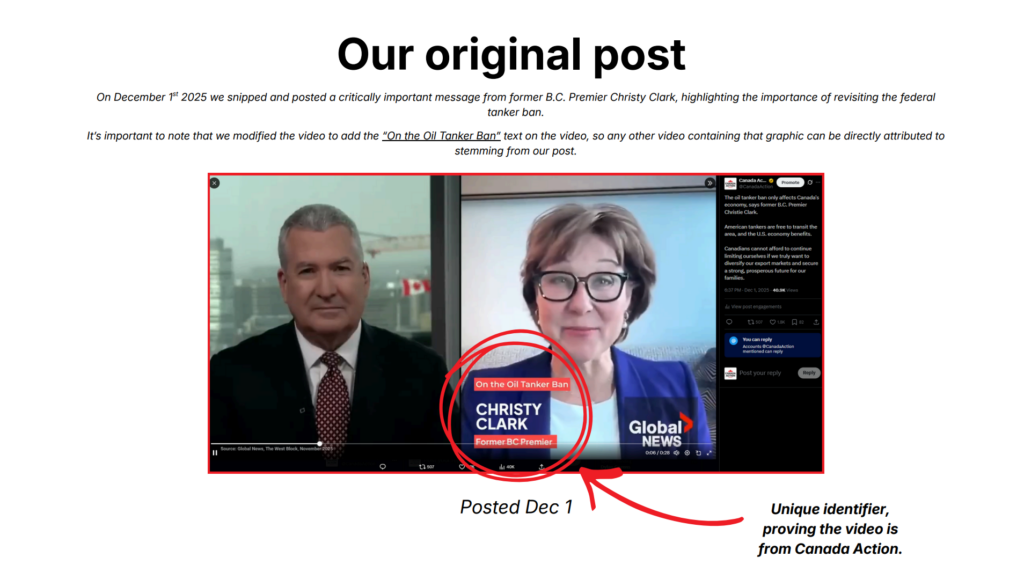 Screenshot from a Canada Action Slidedeck called "Extended Third Party Reach: Showcasing Canada Action's content leadership influencing the public discussion".
Canada Action carefully tracked "other major pages who have taken our content and then directly re-uploaded it on their platforms as a new post on their page."
One of these reposts was from the page Debunk, Inc., which characterized Clark's comments as explaining "why the Pacific tanker bank is pointless." That post garnered thousands of likes and comments. In a separate slide presentation obtained by Greenpeace, Debunk stated that "the energy narrative is ours to shape. With your continued support we will continue to challenge the myths, engage Canadians, and advocate for the energy future our country deserves."
All told, the Clark clip generated 1,614,000 views across Canada Action's social media pages as well as "unattributed traffic" due to the video being shared by third-party accounts, according to metrics shared by the group.
In a separate slide deck, titled "Digital Reach Report: April 2026 Social Media & Website Views & Impression", Canada Action indicated its social media content received over 37.5 million views. The bulk of its monthly impressions came from one of its three Twitter accounts — @LNGAction, @OilSandsAction, and @CanadaAction — which together brought in over 25 million views.
Amplification MachineCanada Action has considerable social media reach, noting in its presentation that its Facebook and Instagram posts "are being reached and interacted with by millions of unique Canadians." Indeed, according to its presentation slides, the Canada Action Facebook page drew 2.8 million unique people while the Oil Sands Action Facebook page drew 1.4 million. On Instagram, Canada Action claimed to have attracted 559,000 while Oil Sands Action drew 476,000.
Canada Action uses its sizable digital imprint to amplify other groups in the CEP network, including Young Canadians for Resources, its youth advocacy arm.
The Canada Action presentation also highlights a partnership with Resource Works "to amplify the economic leadership of 5 Mayors from the Alliance of Resource Communities," an effort to build public support for oil and gas and other natural resource projects in B.C. "We can now say that we are the LNG capital of Canada," Kitimat mayor Phil Germuth stated in one Facebook post. At the time the screenshot was taken, that post had garnered 6,600 likes, 490 comments, and was forwarded 274 times.
Resource Works is also identified in the Greenpeace report as an organization with ties to the fossil fuel sector. DeSmog has previously reported that the organization has been involved in other influence campaigns, including an astroturf campaign to oppose a ban on natural gas that involved template comments for restaurant owners, hospitality workers and residents of Vancouver.
Gunster argues that the sorts of digital campaigns led by Canada Action and its allies have influenced how Canadians think and feel about the oil and gas sector.
"Look at the big swings in public opinion in favour of oil and gas projects over the past year-and-a-half," said Gunster. "Some of that is obviously Trump and the trade war, and some of that is the Carney government. But I have no doubt that the kinds of campaigns described in this [Greenpeace] report are also having a significant impact, saturating our social media feeds with pro-industry messaging."
DeSmog reached out to Christy Clark and Global News to determine whether Canada Action had asked permission to use the video clip and still images in their promotional materials. Neither responded.
The post 'Snipped And Posted': How Pro-Oil Groups Generate Viral Content Online appeared first on DeSmog.
A version of this article was published in Euronews and Climatica
Across Brittany, tractors can be seen trundling onto beaches to remove truckloads of foul-smelling algae ahead of the tourist rush.
Situated below steep cliffs and ancient forests, these once pristine beaches have been devastated by algal blooms - the rapid growth of toxic seaweed which kills off fish and plant life. This sea lettuce algae can also release a toxic gas that can cause humans dizziness, chest pain, breathing problems, and even cardiac arrest.
The French peninsula is not alone. Fed by harmful pollution from agriculture, and fuelled by seas warmed by climate change, lurid green blooms are increasingly appearing on beaches and lakes across Europe - prompting hundreds of swimming bans across the continent this summer.
Subscribe to DesmogGet the weekly intelligence you need to hold polluters accountable
Email Address Sign Up Send me intelligence from: All US/Global team UK/Europe team (function($){ $('.newsletter-container .ijkidr-us').click(function() { $('.js-cm-form').attr('data-id', '2BE4EF332AA2E32596E38B640E905619D07B21962C5AFE16D3A2145673C82A3CEE9D9F1ADDABE965ACB3CE39939D42AC9012C6272FD52BFCA0790F0FB77C6442'); $('.js-cm-email-input').attr('name', 'cm-vdrirr-vdrirr'); }); $('.newsletter-container .ijkidr-uk').click(function() { $('.js-cm-form').attr('data-id', '2BE4EF332AA2E32596E38B640E905619BD43AA6813AF1B0FFE26D8282EC254E3ED0237BA72BEFBE922037EE4F1B325C6DA4918F8E044E022C7D333A43FD72429'); $('.js-cm-email-input').attr('name', 'cm-ijkidr-ijkidr'); }); })(jQuery);Scientists are clear on the cause: for decades, chemicals including nitrogen and phosphorus have leached into waterways from human sewage, as well as fertilisers and excess manure fuelled by the rapid growth of Europe's factory farms.
These 'nutrients' are vital for plant growth - but in large quantities they destroy the delicate balance of ecosystems, allowing certain plants, including algae, to multiply at the expense of animals and other species.
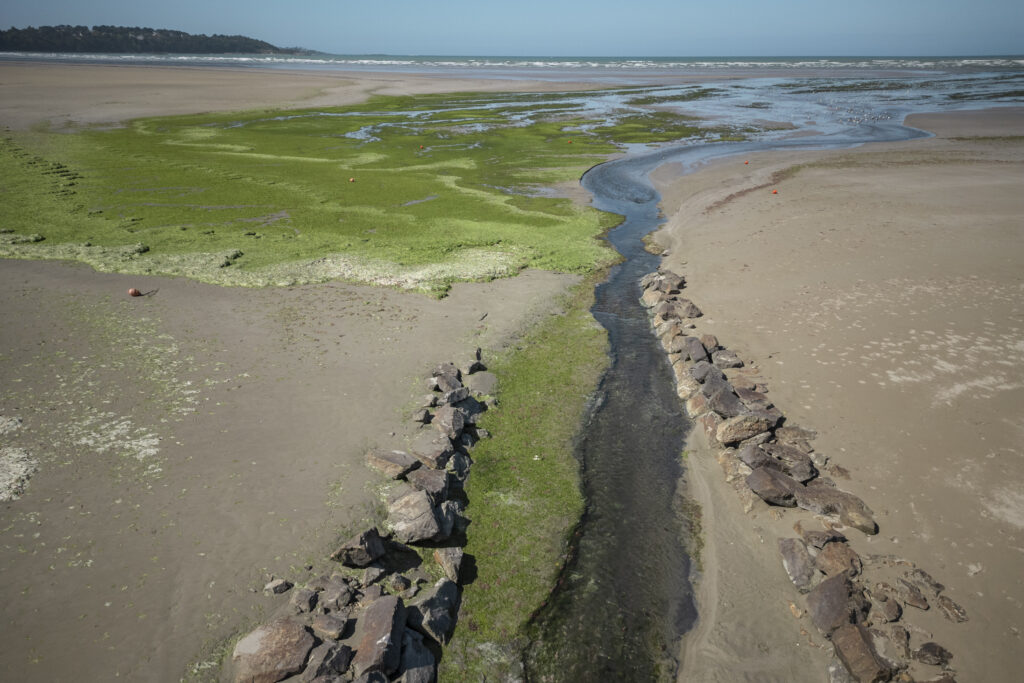 Green algae on Plage du Yar, Plestin-le-Grèves, in Brittany, France. Agricultural run-off carries the algae down the river Yar and into the sea. Credit: Selene Magnolia Gatti
DeSmog visited some of the worst impacted spots in Europe, speaking to fishers, swimmers, and business owners whose livelihoods and wellbeing depend on healthy waters.
On the shores of lakes and beaches across France, Spain, Germany and Northern Ireland, we heard accounts of plummeting fish and insect numbers, swimming bans, and beach closures.
The risks of algal growth have been known for decades, but higher temperatures and longer summers mean these dangerous blooms are growing larger and lasting longer in many of the continent's most iconic waterways.
"I remember our beautiful beach before the pollution," says Brittany resident Jean Hascoet, who leads local campaign group Baie de Douarnenez Environnement. "Now, with thousands of pigs near our town, everything is different."
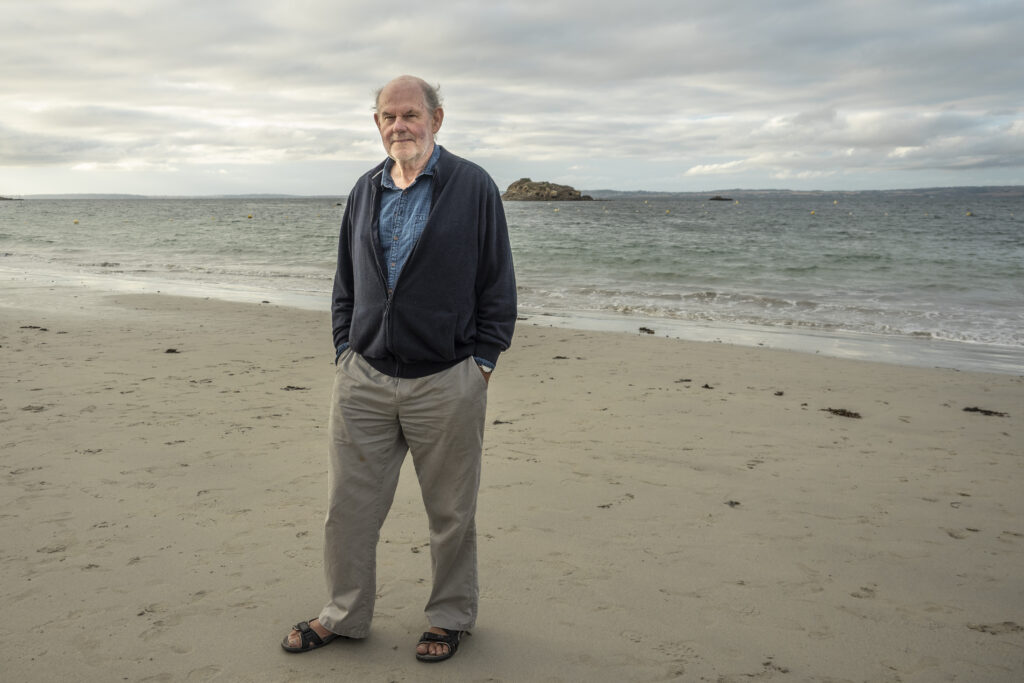
Brittany resident and environmental campaigner Jean Hascoet, pictured here in Douarnenez Bay, France, says the surge in intensive farming in the region has devastated local beaches. Credit: Selene Magnolia Gatti
'Spain's Sacrificial Zone'"You'll never see me swimming in that water again," Fina says.
The 84-year-old from Murcia in southeastern Spain lives with her husband Francisco on the beachfront at Los Urrutias, on the west coast of the Mar Menor, Europe's largest saltwater lagoon. Rotting seaweed piles up on the shore, giving off a foul stench.
"This used to be paradise. The sea was teeming with seahorses," Fina says.
 Brittany resident and environmental campaigner Jean Hascoet, pictured here in Douarnenez Bay, France, says the surge in intensive farming in the region has devastated local beaches. Credit: Selene Magnolia Gatti
The last decade has seen a sharp increase in algae growth in the Mar Menor - a hotspot for Spanish and international tourists. Cyanobacteria, also known as blue-green algae, is reliant on nutrients such as nitrogen and phosphorus to grow, and in this region, intensive farming has provided a ready supply.
Spain is the EU's largest producer of pork, accounting for a quarter of the bloc's production. In the Mar Menor catchment area, according to latest government figures, 305 pig farms house nearly 700,000 animals - producing vast amounts of manure and slurry, a liquid mixture containing faeces and urine. When it rains, the nutrient-rich mixtures flow from fields into rivers feeding the lagoon.
 Algae piled up on one of the Mar Menor's 22 beaches, Los Urrutias, near Murcia, Spain, due to excess nitrogen from industrial agriculture and livestock farming. Credit: Santi Donaire
"The land can't accommodate it all," says Pedro Luengo, a biologist and spokesperson for the campaign group Ecologistas en Acción in Murcia. "We're a sacrificial zone."
Tourists now steer clear of the area closest to the farmland - the western region where Fina lives, which was once an idyllic family holiday spot.
Instead, on other beaches, such as La Manga in the east, bathers enjoy an artificial paradise thanks to local authorities who, as in France, remove the algae daily over the summer months. In the first three months of 2026, they collected more than 4,000 tonnes from Mar Menor's shores and nearby water- roughly the weight of 1,000 elephants.
 Algae piles up in skips after being collected by municipal workers in Los Urrutias, Murcia, southeastern Spain. During peak season, cleaning crews remove the algae blooming in the saltwater lagoon on a daily basis. Credit: Santi Donaire
Authorities say these clean-ups help protect human health and allow essential sunlight to reach sea life, which would otherwise be blocked by the blooms. But it has not shielded those who rely on the lagoon for their livelihood.
"We used to catch far more gilthead seabream and prawns. Now the catch is much smaller," says Rubén Albaladejo, a fisherman from Lo Pagán. "The Mar Menor is a drain into which everyone dumps their rubbish and waste."
Algal blooms endanger aquatic life by consuming vast amounts of oxygen, meaning fish, seahorses, and crustaceans can suffocate. They also produce toxins that attack the nervous and respiratory systems of sea life.
Alongside nutrient pollution, water temperatures rose sharply this year amid record-breaking heatwaves across the continent. "We've reached 30 degrees - something we've never seen before." Albaladejo says that in these conditions, species such as gilthead seabream struggle to reproduce.
Scientists warned in August that human-caused climate change was driving record temperatures in the continent's seas, with a 2C temperature rise registered in the Mediterranean, and around 1.4C in Western European seas.
 Rubén Albaladejo mends nets on his fishing boat, moored at the fishermen's guild in San Pedro del Pinatar, Murcia, Spain. Credit: Santi Donaire
'The Lough Is Dead'
Albaladejo shares his worries with fishers across Europe. Around 2,000 kilometres away in Northern Ireland, Declan Coney has also seen Lough Neagh - the UK's largest lake - devastated by blue-green algae every summer since 2023.
"Fishing is instilled in me - generation after generation," Coney says. "This year has been the worst ever for fishing. The Lough is dead."
Coney has been working on the lake since 1975. He used to go out with his father and sometimes caught £1,000 worth of fish in a day, he says. But now the cost of the diesel required to boat to his nets can be greater than the value of the catch.
Trout and eel numbers have fallen in recent years, in part thanks to the oxygen-hogging blue-green algae, whose weight also forces Coney's fishing nets shut, so fish can't swim inside.
Since the 2000s, the lough has also been besieged by the invasive zebra mussel species. These consume large amounts of phytoplankton, depriving other species of these microscopic plant-like organisms, a vital food source, as well as attaching to fishing nets and ripping them.
"There's no money [in it]," Coney says. "It's not a livelihood anymore."
 Declan Coney has fished on Lough Neagh in Northern Ireland for decades, but plummeting catch numbers have made it impossible to make a living.
Credit: Joe Laverty
As in Spain, Lough Neagh's algal blooms are the result of decades of nutrient pollution. Northern Ireland's livestock sector has grown rapidly, supported by government expansion plans since 2013: poultry numbers have risen by a third, and pigs by 74 percent.
Earlier this year, investigative outlet Watershed and The Guardian found evidence of cattle, pig and human faeces in samples of water from the lough, which spans nearly 400 square kilometres and provides 40 percent of Northern Ireland's drinking water.
Mary O'Hagan lives on the north-west of the lake. During the Covid-19 pandemic, she set up a wild swimming group, and found that the cold water had huge benefits - from improving mental health to relieving chronic pain.
"In my 30s, I didn't have much of a life, I wasn't looking after myself. Swimming in Lough Neagh changed my life completely," O'Hagan says. "We had a community."
But after the second year of the blooms, she felt forced to shut the swimming group down.
"I couldn't in all good conscience organise swims where people would be exposed to bacteria, algae, or god knows what else."
"The first year… was awful. It was like Armageddon. To see the shores covered as far as the eye can see in pea green sludge, was horrendous," she says.
 Campaigner Mary O'Hagan was forced to shut her swimming group due to harmful pollution in Lough Neagh, Northern Ireland. Credit: Joe Laverty
O'Hagan's concerns are shared by swimmers and local authorities elsewhere in Europe. In Germany, dozens of lakes are also routinely devastated by algal blooms, triggering a spate of temporary swimming bans this summer.
"The water used to be clear, you could see your own feet," says Oland Stephan, who has run a kiosk at Sander lake in northern Germany for 18 years. Once a popular bathing spot, the lake has been off-bounds for swimmers for the last few years because of the blue-green algae - which can cause vomiting, diarrhea, and skin irritation, among other issues.
"I could make a living back then, but not anymore," Stephan says. "I have bankruptcy papers at home."
Peter Bünting, a lifeguard at the lake, says the cloudiness of the water from the algae makes search and rescue operations challenging. "You might have a casualty in front of you but you just can't see."
 Sander lake in Lower Saxony, Germany. The lake is frequently closed to swimmers due to harmful blue-green algae pollution. Credit: Selene Magnolia Gatti
'More Animals Than People'
Certain types of algae have been linked to fatalities. When sea lettuce and blue-green algaes break down, they can produce hydrogen sulfide, a lethal gas that smells like rotten eggs and causes blocked airways and fluid to build up in the lungs if inhaled in large quantities.
Since the 1980s, sea lettuce algae has been linked to as many as six deaths on Brittany's beaches.
Locals here are clear about the cause of the algae growth. Near the tourist town of Saint-Brieuc, "the pigs" has been scribbled across an official sign warning about the danger and symptoms of inhaling toxic gas from the algae.
"We have many more animals than people," environmental author Yves-Marie Le Lay told DeSmog. Although the peninsula covers just five percent of France's surface, its 6.8 million pigs account for 58 percent of the country's total population. "We have a manure problem, it all ends up in the rivers."
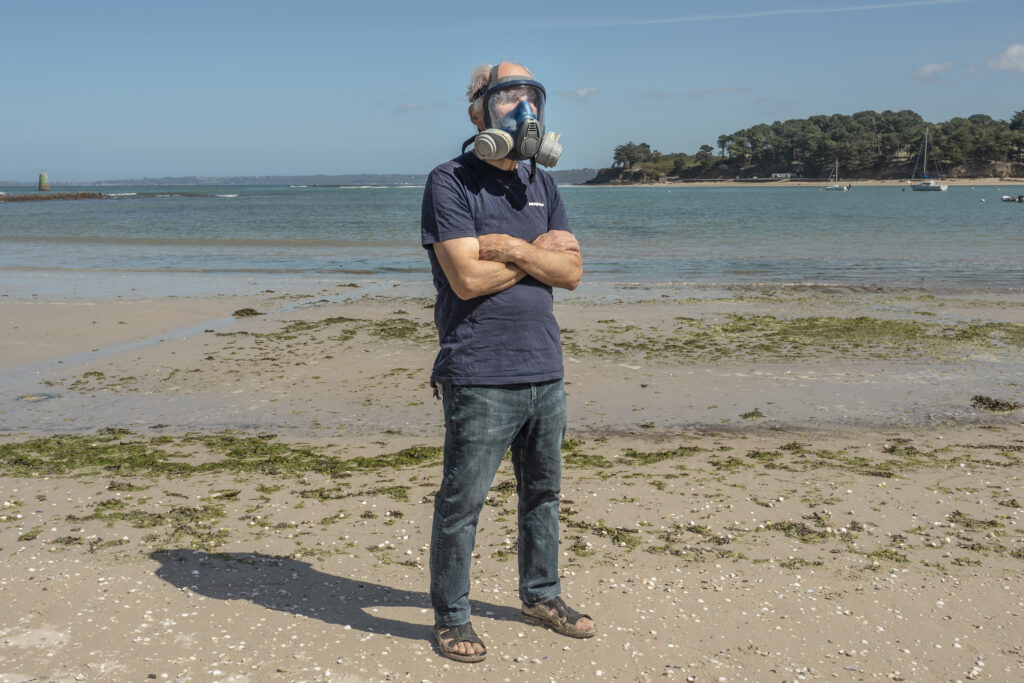 Author and campaigner Yves Marie Le Lay demonstrates the use of a gas mask on the Plage du Fond de la Baie, in Locquirec, Brittany, France. He uses the device when algae blooms appear, to avoid inhaling any toxic gas. Credit: Selene Magnolia Gatti
For environmental activist Fabrice Hamon, who lives near the Penfoul beach in Western Brittany, bacteria such as E. coli and salmonella from manure run-off have also become a daily concern - washed by rain from farmland down to the sea.
Since official tests in the summer of 2025 identified E. coli on Penfoul, the beach has been under a partial swimming ban, and is at risk of being closed permanently.
 Red signs warn swimmers and dogs against spending time on the algae-strewn Penfoul beach in Western Brittany. Credit: Selene Magnolia Gatti
Hamon says these bacteria are "super dangerous" if they are swallowed or come into contact with areas like the eyes and nose - and can cause infections, such as conjunctivitis, urinary tract infections, and gastro-intestinal infections that lead to diarrhea and vomiting.
Hamon is uneasy about the coming months. This summer's droughts meant that fewer harmful excess nutrients were washed into the waterways from fields treated with manure, but instead are stored in the soil until it rains. Europe, the fastest-warming continent in the world, is seeing more intense and unpredictable bouts of extreme weather, including increased downpours and flooding.
"Right now there's a build-up of bacteria in the fields," Hamon says. "All it takes is a heavy downpour and bingo. It's a slow-acting poison: little by little, ecosystems are being degraded by the build-up of pollution linked to intensive farming."
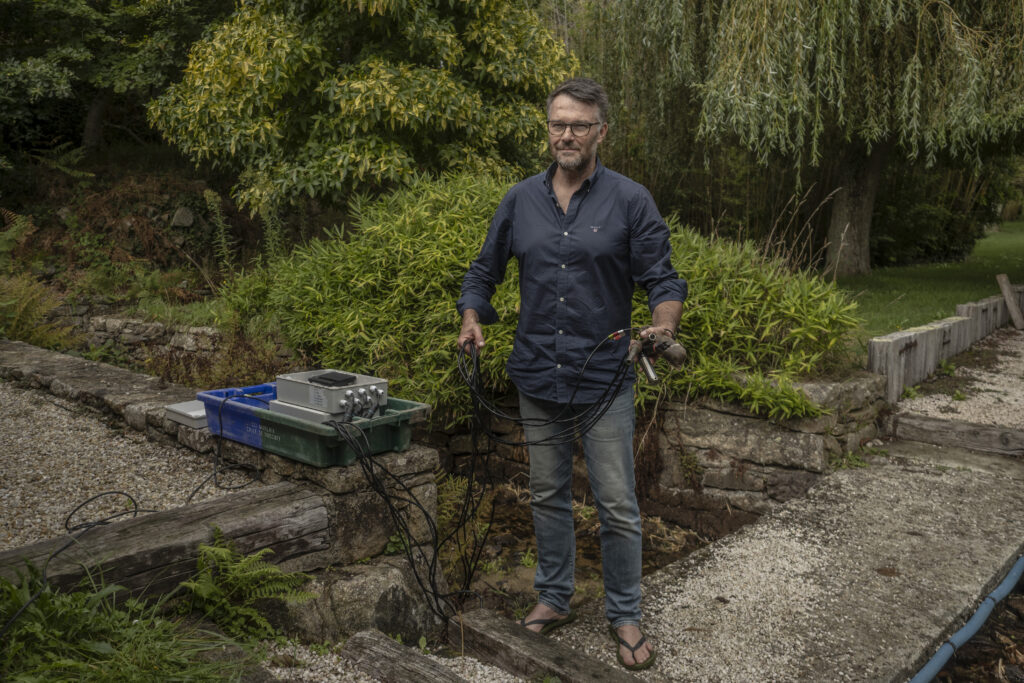 Environmental activist Fabrice Hamon with the device he is using to test water in the River Foul in Brittany, France. He also regularly collects water samples to test for E. coli. Credit: Selene Magnolia Gatti
Warming Seas
As climate change accelerates, warming temperatures are also exacerbating the algal blooms. Algae grows quicker and lasts longer in warm waters, as higher temperatures allow it to digest and reproduce at a faster rate.
Jürgen Leicher, deputy chairman for the German environmental group BUND in the state of Schleswig-Holstein, has been sailing on the Baltic Sea for 40 years, and says this year's algal blooms were the worst he's ever seen.
Temperatures in Germany broke records for three consecutive days in June, reaching almost 42C. Satellite images of the Baltic in August show vast algal blooms swirling towards the coast."You feel really afraid when you sail for hundreds of miles through a yellow-brown dirty sea," says Leicher. "All the way through this algae, the sea was dead. You see no birds, no mammals, no fish. It's so empty."
Agriculture is the biggest source of the problem: the intergovernmental body HELCOM estimates it accounts for up to 90 per cent of nitrogen and up to 80 per cent of phosphorus in diffuse nutrient run-off into the Baltic.
Despite decades of intergovernmental efforts to reduce nutrient pollution, the Baltic is struggling to recover from the environmental damage combined with rising temperatures. Each year, when algae dies it sinks to the seabed, taking large amounts of phosphorus with it. That phosphorus is released back into the ocean in future years — a dangerous feedback loop that picks up speed as the sea warms.
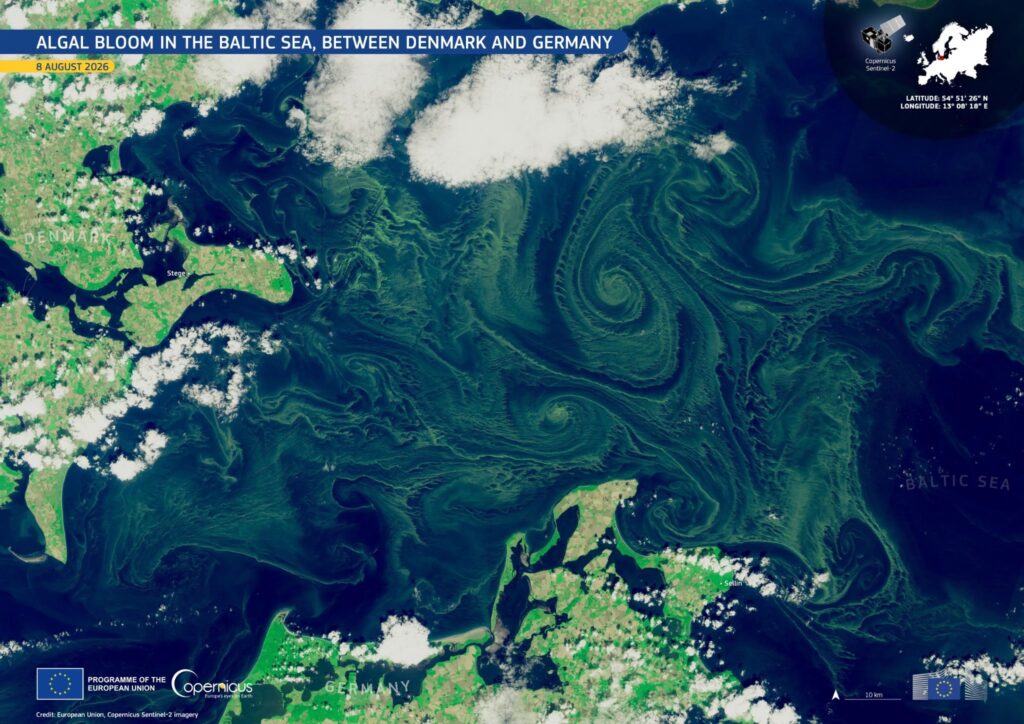 Satellite image of algal blooms in the Baltic Sea, August 2026. Credit: Dávid D. Kovács, Jan Musial, Jędrzej Bojanowski, Dennis Clarijs, Jurry de la Mar, and András Zlinszk / Copernicus Data Space Ecosystem
Seeking Solutions
In the face of these huge challenges, residents, campaigners and scientists are united in their determination to find solutions.
Leicher thinks that better monitoring could help track the profound environmental disruption taking place in the Baltic Sea. His colleagues at BUND Schleswig-Holstein have launched a citizen science project, which will see volunteers collect water samples twice a month from local rivers. By analysing the samples in a laboratory, the organisation hopes to pinpoint sources of pollution and help efforts to cut nutrients.
In Brittany, Fabrice Hamon has designed an app - La Météo Bacterio - which helps monitor for bacteria in the 20 odd rivers that flow onto local beaches, meaning tourists and residents can check for warnings before they swim.
Others are focusing their efforts on political and legal action. In recent years, campaigners and residents have won a raft of legal victories - including persuading the Spanish government in 2022 to bestow 'legal personhood' on Mar Menor, providing the lagoon with rights to protection and restoration.
 Residents and campaigners stage a protest at Playa de Los Espejos in Los Alcázares against the pollution of Spain's Mar Menor, September 2026. Credit: Santi Donaire
Ultimately, though, scientists say that nutrient pollution must be slashed to limit the recurrent harmful algae growth - and that means transforming agricultural practices.
"The science is clear on what needs to be done," says Professor Friedhelm Taube from Kiel University (CAU), who spent 12 years advising Germany's Ministry of Agriculture. Governments should support farmers to use less nitrates-heavy fertiliser, plant catch crops like grass clover that absorb some of the excess nutrients from soils before they run into rivers, lakes and sea, and reduce the number of animals farmed on limited land, he says.
"Farming animals can be fine," Taube says, but to keep nutrient run-off within safe limits, numbers should be reduced to just one 'livestock unit' per hectare - a technical term that translates to just one dairy cow or around three pigs. That means far fewer animals in regions where they are intensively farmed, he adds.
Campaigners in Spain also face a stark choice. "Either we wreck the Mar Menor," says Pedro Luengo from Ecologistas en Accion, "or we transform the agricultural model".
In Northern Ireland, Mary O'Hagan is determined to continue to fight for change. "I credit getting into Lough Neagh for the lovely active life I lead," she says. "It's one of the reasons I fight back in the way I do."
It's a long fight, but Mary is hopeful. "I'd like to see improvements in my children's lifetimes - to see it restored to how it was."
Additional research by Joey Grostern
Editing by Phoebe Cooke and Clare Carlile
The post In Pictures: 'Armageddon' at Europe's Swim Spots Linked to Climate Change and Factory Farm Pollution appeared first on DeSmog.
Kathryn Porter, a consultant to the fossil fuel industry and a prominent critic of emissions reduction policies, has joined the UK's foremost climate science denial group.
Porter appears frequently in the media as an "independent" expert on energy issues and has been interviewed on the BBC, LBC, GB News, and TalkTV, while her research is often covered in conservative media.
She also writes a column for The Telegraph, and in recent weeks she spoke on energy panels at both Labour and Conservative party conferences.
Porter's consultancy Watt-Logic advises the oil and gas industry. Its website states that she works for "businesses with projects across the electricity, gas and oil industries", including "clients with conventional energy assets including gas-fired power stations, gas storage, upstream oil and gas production and [Liquefied Natural Gas]".
On 16 October, Porter joined the board of the Global Warming Policy Foundation (GWPF), a lobby group set up by Conservative peer and former chancellor Lord Nigel Lawson in 2008 to counter the growing consensus on the need to address man-made climate change.
The group, which is currently led by Tory peer Lord Craig Mackinlay, has said CO2 has been "mercilessly demonised" when it is a "benefit to the planet" - claiming that the atmosphere's CO2 concentration should be "two or three times" higher than it is now. The group does not publicly declare its funding.
Subscribe to DesmogGet the weekly intelligence you need to hold polluters accountable
Email Address Sign Up Send me intelligence from: All US/Global team UK/Europe team (function($){ $('.newsletter-container .ijkidr-us').click(function() { $('.js-cm-form').attr('data-id', '2BE4EF332AA2E32596E38B640E905619D07B21962C5AFE16D3A2145673C82A3CEE9D9F1ADDABE965ACB3CE39939D42AC9012C6272FD52BFCA0790F0FB77C6442'); $('.js-cm-email-input').attr('name', 'cm-vdrirr-vdrirr'); }); $('.newsletter-container .ijkidr-uk').click(function() { $('.js-cm-form').attr('data-id', '2BE4EF332AA2E32596E38B640E905619BD43AA6813AF1B0FFE26D8282EC254E3ED0237BA72BEFBE922037EE4F1B325C6DA4918F8E044E022C7D333A43FD72429'); $('.js-cm-email-input').attr('name', 'cm-ijkidr-ijkidr'); }); })(jQuery);In a statement on the GWPF website, Porter said: "I am delighted to be joining the Board of Trustees. Nigel Lawson understood the importance of open debate, rigorous analysis and challenging conventional wisdom, and I look forward to helping build on that legacy."
Porter has authored two reports for the GWPF, and one for its campaign arm Net Zero Watch, since 2023.
She will sit on the board alongside The Telegraph's chief interviewer Allison Pearson, and Labour MP Graham Stringer.
Porter has publicly criticised climate policies. In a post on X in January 2025, Porter attacked what she called an "excessive focus on CO2" in energy policy, and in February she suggested the UK's landmark Climate Change Act should be repealed.
As DeSmog revealed in July 2023, Porter has written blogs that contradict basic climate science. In a 2017 post, she wrote that "climate models overstate global warming". In fact, climate models have accurately predicted global temperature rises, with observed warming reflecting scientific forecasts.
The UN's Intergovernmental Panel on Climate Change (IPCC), the world's foremost climate science body, has stated that it is "unequivocal that human influence has warmed the atmosphere, ocean and land".
It has also stated that carbon dioxide "is responsible for most of global warming" since the late 19th century, which has increased the "severity and frequency of weather and climate extremes, like heat waves, heavy rains, and drought".
While Porter and the GWPF claim that reaching net zero emissions by 2050 is unaffordable, a succession of heatwaves during the British summer led to mass school closures, public transport disruption, and a "disaster" harvest - ultimately costing the economy an estimated £4.4 billion.
The Climate Change Committee, an independent government advisory body, has estimated that reaching net zero will cost 0.2 percent of GDP per year - and that its total cost will be less than one fossil fuel price shock.
Porter and the GWPF were approached for comment.
Conservative ConnectionsPorter and the GWPF have several connections to the Conservative Party.
In January, Clare Coutinho, the then Tory shadow energy secretary, helped to launch a paper written by Porter claiming that renewable energy development could cause blackouts - a claim rejected as "nonsense scaremongering" by the government.
Coutinho had previously suggested that the Labour government should hire Porter to vet its energy policies.
The Conservative Party under Kemi Badenoch has ditched its past support for climate action, declaring it would be "impossible" to reach net zero by 2050, and vowing to repeal the Climate Change Act. Badenoch has banned any Tory candidate from supporting net zero.
Earlier this month, Porter spoke at the Conservative Party's conference in Birmingham on a panel entitled 'Solving Britain's Energy Crisis' alongside newly-appointed shadow energy secretary Andrew Bowie, head of policy at Octopus Energy Jack Pardoe, and Liam Halligan, a former GB News presenter and the director of the Centre for Policy Studies think tank.
Porter also spoke on a GWPF panel at last year's Tory conference entitled 'Can Britain survive Ed Miliband?', where she called for net zero to be scrapped and for increased fossil fuel extraction.
As DeSmog revealed in September 2024, GWPF donors have given more than £7 million to the Conservatives over the past two decades.
At this year's Labour Party conference in Liverpool, Porter also spoke on an energy panel organised by the oil exploration company EnQuest, whose CEO Amjad Bseisu is a Conservative Party donor.
Speaking alongside Bseisu, GMB general secretary Gary Smith, and Labour donor Dale Vince, Porter called for taxes to be reduced on the fossil fuel industry and for the UK to expand its North Sea drilling.
The post Oil Industry Consultant Joins Climate Denial Group Run by Tory Peer appeared first on DeSmog.
As the COP17 nature summit gets underway in Armenia, evidence has emerged of lobbying by a leading international pharmaceuticals group to weaken the terms of a flagship fund for nature.
Documents analysed by DeSmog show that the International Federation of Pharmaceutical Manufacturers and Associations (IFPMA) called for a "radical rethink" of the rationale for the landmark Cali Fund - the first mechanism built to take voluntary payments from large companies that profit from genetic sequence data.
The IFPMA states that the "modalities of the decision" to establish the Fund - which was ratified by 196 countries in 2024 at the COP16 summit of the UN Convention on Biological Diversity in Colombia - should be "significantly reviewed, revised and clarified".
In the consultation submission, the trade group - which represents the pharmaceutical sector at the UN - also challenged the indicative rates at which companies were invited to contribute to the Fund, agreed at COP16 as 0.1 percent of revenue or 1 percent of profit.
The IFPMA labelled these indicative rates as "premature", set "without any rational analysis", and "commercially unrealistic", suggesting instead that companies be allowed to contribute to the voluntary fund at a level of their choosing.
Other demands from the IFPMA included a guarantee that any contribution would explicitly substitute payments for digital sequence information required under national or international laws.
Despite contributions to the Cali Fund already being voluntary, following a fierce lobbying push at the last summit, the IFPMA also seeks a guarantee they will remain so, stating that "there are elements in the decision that do not go far enough in creating a truly voluntary mechanism".
Responses from other sectors, such as biotechnology and cosmetics - which are listed alongside pharma and artificial intelligence firms in the treaty text as industries that should contribute - echo some of the IFPMA's objections, and appear to be reluctant to support the Fund as it is currently conceived.
The UK Bioindustry Association (UK BIA), which has 600 biotech and life sciences companies among its members, says the CBD's expectations for what the Fund can raise are currently set "unrealistically high", in its consultation response dated March 2025.
UK BIA states that "for the Fund to succeed in the long term", questions over its design and operationalisation must be addressed, and "clear incentives" created.
The revelations come as negotiators gather for the UN biodiversity summit in Armenia this week, with just $10,000 pledged by companies to the Cali Fund.
It falls far short of the $1 billion to $10 billion that the UN had hoped the Fund could draw in every year, half of which is mandated to flow directly to the Indigenous and local communities that steward biodiversity.
"The tiny amounts contributed to the Cali Fund so far, combined with continued delays from industry, send a clear signal: voluntary contributions are simply not delivering," An Lambrechts, a biodiversity politics expert at Greenpeace International, told DeSmog.
The latest UN report shows that the world is off track on all but one of 23 targets aimed at reversing catastrophic nature loss, with the total funds raised to date from both private and public bodies falling far short of what is needed to close a $200 billion "biodiversity finance gap".
"Big multinational corporations are turning massive profits by exploring nature," Lambrechts says, "while leaving people all over the world to face the impacts of the biodiversity crisis."
Get the weekly intelligence you need to hold polluters accountable
Email Address Sign Up Send me intelligence from: All US/Global team UK/Europe team (function($){ $('.newsletter-container .ijkidr-us').click(function() { $('.js-cm-form').attr('data-id', '2BE4EF332AA2E32596E38B640E905619D07B21962C5AFE16D3A2145673C82A3CEE9D9F1ADDABE965ACB3CE39939D42AC9012C6272FD52BFCA0790F0FB77C6442'); $('.js-cm-email-input').attr('name', 'cm-vdrirr-vdrirr'); }); $('.newsletter-container .ijkidr-uk').click(function() { $('.js-cm-form').attr('data-id', '2BE4EF332AA2E32596E38B640E905619BD43AA6813AF1B0FFE26D8282EC254E3ED0237BA72BEFBE922037EE4F1B325C6DA4918F8E044E022C7D333A43FD72429'); $('.js-cm-email-input').attr('name', 'cm-ijkidr-ijkidr'); }); })(jQuery);A spokesperson for the UN Convention on Biological Diversity (CBD) Secretariat admits that the sums in the Fund "sit well below the scenarios that were discussed in Cali", but puts this down to the evolving "operational infrastructure" and its low profile.
"Substantive decisions expected at COP17 are expected to give in-scope companies more solid ground to commit," they said.
"I do believe companies have legitimate concerns, but there's also a sense in which they don't want to pay," said a source close to the negotiations, who preferred to remain anonymous. "If these industries were really supportive then someone would have put the money in by now, even just as a token, a show of good faith."
Guilherme Cintra, Director, Innovation Policy at IFPMA wrote in an email that the group had "long supported the goals of the Convention on Biological Diversity and continues to deliver against the targets set out in the Global Biodiversity Framework".
He added: "The level of participation in the Cali Fund reflects ongoing questions about the design and implementation of the mechanism, rather than a lack of commitment to biodiversity. Governments should use COP17 to rethink the Cali Fund to attract broader participation and ensure it supports biodiversity and preserves scientific openness."
UK BIA declined to comment on the record.
"It's concerning that, nearly two years after the agreements reached at COP16 in Cali, funding for biodiversity protection remains an unfulfilled promise," Juan Bay, leader of the indigenous Waorani nation of Ecuador told DeSmog.
"This reflects a situation we have been denouncing for years: Indigenous peoples protect some of the most biodiverse territories on the planet, yet we continue to face enormous difficulties in directly accessing the funding needed to protect them."
History of PushbackWhen the Cali Fund was launched in February last year, the UN hailed it as the beginning of "a new era for biodiversity finance".
The new financial instrument aimed to address a new reality: that genetic data, known as digital sequence information, or DSI, is now available online. This allows companies, or researchers, to access material from plants, animals, bacteria and fungi without ever setting foot in the country of origin - and bypass rules that require payment.
As a result, the genetic code that underpins a range of lucrative products - everything from sweeteners to the vast majority of cancer drugs - is available with few rules to limit access.
The Cali Fund, Carbon Brief writes, was aimed at "closing this loophole". It was agreed that 50 percent of funds would go to Indigenous communities and local communities that steward fragile ecosystems, with the rest going to Global South countries and scientific research.
At the COP16 summit where the Fund was agreed, the business lobby reached a record high, including from sectors that the mechanism was built around: pharmaceuticals, biotechnology, cosmetics, and information services associated with DSI, including artificial intelligence.
 An Indigenous delegate taking part in UN talks in Colombia two years ago, when the Cali Fund was first agreed. Half of any funds raised are ear-marked for Indigenous and local communities that care for fragile ecosystems. Credit: Photographer: Fernando Vergara / Associated Press /Alamy
A Global South government push at the UN talks for the Fund to be a mandatory mechanism was defeated in the wake of a strong lobbying effort by the pharma, agritech and biotech industry, which dubbed the proposed levy a 'global tax'.
In the lead up to the summit, UK-based pharma giant AstraZeneca, which posted $12.4 billion in profits last year, had warned the British government it "might cut jobs" if a levy were introduced, according to The Guardian. An AstraZeneca spokesperson denied the comments.
Another pharma giant, GSK, also pushed back against the Fund, which it called "disproportionate", telling the UK government it could "hinder the development of new medicines and vaccines", in emails obtained by Carbon Brief.
A spokesperson from GSK told DeSmog it had set ambitious targets and was investing in nature protection. "We support the intent behind the Cali Fund and will make a decision regarding voluntary contributions when there is more information about how the Cali Fund will work alongside other national and multilateral Access and Benefit Sharing mechanisms," they said.
"As a company, we are committed to advancing our research and development in response to the needs of patients," an AstraZeneca spokesperson said in an email. "An assessment of the full impact on our operations will be conducted once there is more clarity from governments on the implementation of the DSI MLM [Cali Fund]."
Since 2024, the pharmaceutical industry's global lobby group the IFPMA appears to have continued to focus its energy on weakening the rules that were agreed in Colombia.
The COP16 agreement established key elements of the Fund: contribution rates, a list of sectors that should contribute, and set thresholds to ensure large companies were expected to give to the fund, defining qualifying entities as those that exceeded two of three financial thresholds: $20 million in assets, $50 million in sales, or $5 million in profit.
However, rates and thresholds were marked as 'indicative' and set to be finalised at the current talks in Armenia.
To build on what had been agreed in Cali, Colombia, the CBD sought to engage industry over how to make the Fund operational - inviting responses on what sectors should contribute and how.
DeSmog analysed 22 responses, which were submitted by 14 groups in response to stakeholder consultations issued by the Convention of Biological Diversity secretariat, along with available public statements from industry groups that have engaged publicly with the Fund.
In their submissions, industry groups pushed back on a range of fronts. The IFPMA, which claims to represent over 90 percent of the world's leading research-based pharmaceutical companies, emerges as the Fund's most outspoken critic.
It called for a "radical rethink" of the Fund's rationale, and states that the MLM (multilateral mechanism that gives rise to the Cali Fund) does not "effectively advance biodiversity goals".
The group criticised everything from contribution levels, a lack of clarity "on how funds will be allocated or guarantees that funds will directly support conservation efforts", and proposed that the treaty decision text be "significantly reviewed, revised and clarified".
The IFPMA states that the MLM "essentially imposes a financial burden on the free exchange of scientific data, which is critical for medical, environmental and other societal research". It adds that: "by taxing DSI use, the MLM risks creating disincentives for global scientific cooperation, slowing the pace of innovation".
The IFPMA also stated that it is "critical" that indicative contribution rates (0.1 percent of revenue or 1 percent of profit) be "reconsidered".
"Establishing indicative contribution rates in Decision 16/2 was premature and the rates themselves are commercially unrealistic, are not based on the underlying value that DSI brings, lack scientific justification, do not take into account sector-specific differences, and serve as a disincentive to participation," it wrote.
The IFPMA's view that setting indicative rates was "premature" is echoed in the submission from the International Chamber of Commerce (ICC).
The ICC was approached for comment. In its consultation submission, it states that the ICC is seeking "clarity, certainty and enabling conditions that are essential to incentivise businesses to actively engage".
"Not Voluntary Enough"The IFPMA goes on to suggest that the size of any contribution should be left to companies' discretion, writing that "the expectation of contribution as well as the level of contribution must both be voluntary".
While IFPMA recognises that payments into the Fund are already "voluntary in principle", it argues that the wording of the treaty decision does "not go far enough in creating a truly voluntary mechanism" - taking issue with a clause that invites signatories to the CBD treaty to enact laws that incentivise company contributions.
The IFPMA goes on to add: "Given that the indicative rates were chosen without any rational analysis - as acknowledged by the decision itself, which calls for a study to propose replacement realistic rates - it is critical that these placeholder rates are truly indicative."
In 2026, the UN's CBD secretariat produced a study, in which it modelled the impact of contribution rates on the competitiveness of eligible companies, and found "the direct cost burden […] to be modest, relative to sector margins". The IFPMA disputed these findings too, stating that "even modest reductions in expected returns can be enough to delay, scale back or halt a project".
The CBD negotiating text (Decision 16/2), which established the Fund, stated that the treaty would not override national "benefit-sharing" laws that already exist in at least 20 countries - which require companies to pay, or otherwise compensate, communities for their use of digital genetic data.
The IFPMA and BIA trade groups both expressed their concern at what they call "obligation stacking", in consultation documents analysed by DeSmog. The IFPMA said that any payment into the Cali Fund should rule out paying governments for DSI again under any national laws, and both ask for "legal certainty".
In response to a request for comment, Guilherme Cintra, IFPMA's director of innovation policy, said: "The current mechanism overlaps with existing law, relies on inaccurate assumptions about how data is used in the discovery of medicines, and asks companies to hand over a share of their total revenue whether 'digital sequence information' was used to develop a medicine or not."
Dr Siva Thambisetty, associate professor of law at the London School of Economics (LSE), describes industry's core arguments as "artful".
She explains that the Fund decision to base contributions on revenue or profit, was an attempt aimed at securing "oversight and transparency" in the absence of comparable publicly available data from companies on how they use DSI.
"I think it's interesting that the very companies that wanted a voluntary mechanism are now claiming that there is no legal certainty," says Thambisetty. "We have to be careful that national ABS [access and benefit-sharing] laws are not damaged for a system that not many users appear to have any intention of paying into".
She suggests that industry objections raised touch the fund's viability and the terms already agreed, rather than how it should be rolled out. "It's the operational clarity that the negotiations in Armenia should ideally focus on, rather than reopening the basis for the normative clarity, and multilateral will - which is clearly set out in CBD decisions," she said.
A paper released on the eve of the summit by the Common Initiative think tank acknowledges that the fund is empty due to structural problems, not just to low company ambition.
It highlights a lack of consensus on how to define DSI, no clear mechanism for counting contributions, and a lack of harmonization between national governments' implementation.
But these structural problems are not "bad luck," they write. Rather, "it is what happens when a mechanism designed to extract money from some of the most profitable industries on earth is built on the assumption that those industries will simply volunteer to pay it."
Indigenous AgencyFinalising the Cali Fund will be top of the agenda at the upcoming Cop17 talks in the Armenian capital Yerevan, which will run from 19-30 October.
Parties are expected to pin down the details on disbursement of the fund between Global South countries, thresholds for company participation and fund governance, as well as measuring countries' progress against targets to protect 30 percent of land and seas and restore the earth's degraded ecosystems.
For June Rubis, an Indigenous representative who sits on the Cali Fund Steering Committee, the question of where money ends up has great importance. "I would like to see Indigenous communities be given meaningful agency over priorities, access and delivery," she tells DeSmog.
The final Cali Fund text agreed at COP16 stated that half of any funds raised would go to Indigenous and local community stewards for self-defined projects that support biodiversity protection like forest restoration, or the transfer of ecological knowledge between generations.
Indigenous communities manage, or have rights over, around 37 percent of the earth's natural areas, despite making up just 6 percent of the global population.
"What I want to avoid is a situation in which money is nominally allocated for Indigenous Peoples and local communities, but the project priorities are determined elsewhere or communities have to pass through an institution they did not identify," says Rubis.
Rubis believes it's important to take the time to build a financial mechanism that works for company contributors, countries, and Indigenous peoples and local communities alike. "Of course," she adds, "for all this to apply, we also need to have the money coming in."
More Action From StatesAlthough businesses are expected to pay into the Cali Fund, national governments have the power to negotiate, agree and enforce decisions reached through the CBD process - and bear the responsibility to ensure funds are raised.
To date, governments have played a mixed role. Some Global North countries, including the EU bloc and UK, appear to have lobbied alongside industry to push for the Cali Fund to be non-binding and voluntary.
However since then, through the Friends of the Cali Fund - which is chaired by the UK and Chile and includes Norway and Armenia - both the UK and the EU are now working to incentivise contributions.
Other countries such as Switzerland, where pharmaceutical companies make up 7 percent of GDP, as well as Japan and Korea, have continued to push back on key elements of the fund architecture.
"I have been surprised to see industry arguments amplified by some Global North governments," says Nithin Ramakrishnan from the nonprofit Third World Network,
"Including on areas - such as the relationship with national laws - that appear to go against the text that was agreed in Cali."
For her part, Thambisetty tells DeSmog she would like to see "more coordinated action" on the part of countries where most of these large firms are situated.
Thambisetty suggests a global push is needed to frame contributions as a moral responsibility for companies and investors: "a good public narrative about why these payments are necessary".
Learning By DoingSo far, the Cali Fund has raised no money from large firms. The only companies to contribute are Prozomix, a small UK-based biotech company that paid in July this year, and UK technology start-up TierraViva AI which contributed in November 2025.
The smaller outfits are encouraging others to follow suit. The first, TierraViva AI, which deposited $1,000, called on companies to embrace "learning by doing", in an open letter penned last November.
A second company, the biotech firm Prozomix, which handed over $5,000 in July, states on its website: "We feel companies of our size, and at any and all stages of development, should pay for the privilege of exploiting public DSI".
Business for Nature, an alliance of more than 100 progressive businesses, has encouraged contributions from its members, pointing out they depend on healthy ecosystems to maintain their business model. It writes in an August briefing that "companies do not need to wait for the final rules to engage".
It's a sentiment echoed by the CBD executive secretary Schomaker, who called on companies to commit, ahead of this week's summit.
"Maybe if you think it's too new for you, make a gesture and start paying, and increase over time," she told environmental news site Mongabay.
"It's frankly not good enough for a company to say, 'We have many questions,' and just sit there and wait."
With editing by Emma Howard
The post How Big Pharma Tried to Weaken the Rules of the UN's Nature Fund appeared first on DeSmog.
A former housing executive fired by Reform UK for making "shameful" comments about the 2017 Grenfell Tower tragedy still claims to have a role in the party, DeSmog can reveal.
Simon Dudley, a former chair of Homes England, was removed as the party's housing spokesperson for making - in the words of Reform leader Nigel Farage - "shocking" and "deeply inappropriate" comments about the disaster.
In an interview with Inside Housing in April, Dudley said the deadly blaze, which led to the deaths of 72 people, was a "tragedy" but that "everyone dies in the end". He claimed that rules introduced in the wake of the fire to improve safety standards were examples of "regulation which is not working".
Dudley was roundly criticised for his remarks, including by groups representing Grenfell survivors and next of kin. The then prime minister Keir Starmer called the comments "shameful".
However, despite being sacked as Reform's housing spokesperson, Dudley still appears to work with the party.
He introduced Reform's deputy leader and housing chief Richard Tice to business delegates at the party's annual conference in September, and chaired a question and answer session following Tice's speech.
 A post from Simon Dudley on LinkedIn about his involvement in Reform's 2026 annual conference.
Credit: Simon Dudley / LinkedIn
According to a transcript, Tice thanked Dudley for his "generous" introduction, after which Tice presented Reform's sweeping policies to deregulate the planning system.
While Dudley's exact role in the party is not known, his social media profiles - including his up-to-date LinkedIn CV - continue to list him in a 'Housing and Infrastructure' position at Reform.
He's also a keen party activist who has accused the Conservatives of copying Reform's ideas and who campaigned for Farage in this summer's Clacton by-election.
Neither Reform nor Dudley denied that he is still involved in the party when approached by DeSmog for comment.
However, Dudley's continued involvement contrasts starkly with Reform's response to his remarks in April.
"He's under Richard Tice's department, Richard appointed him housing spokesman given his depth of experience in developing new towns," Farage said at the time. "But the comments were deeply inappropriate, they were frankly rather shocking to many people, and Richard has dealt with it."
In response to the backlash in April, Dudley said that "Grenfell was an utter tragedy and quite rightly prompted a wholesale review and tightening of fire regulations."
He added: "I said it was a tragedy in my interview with Inside House [sic] and in no shape or form am I belittling that disaster or the huge loss of life. It must never happen again. I reiterate that, and am sorry if it was not sufficiently clear."
A new undercover investigation due to be released by ITV in full on Sunday 18 October shows Reform councillors making a number of sexist and racist comments. One Reform councillor from south London is filmed saying that King Charles should be decapitated because he is secretly a Muslim.

A version of this article was also published by The New World.
Reform's Deregulation AgendaThe Grenfell Tower fire on 14 June 2017 was one of the worst tragedies in modern British history. Just before 1am, a high-rise fire broke out in the 24-storey block in Kensington, London, which spread rapidly due to the highly combustible cladding that had been installed on the building a year earlier.
The government has subsequently introduced new fire safety rules, particularly in relation to high-rise blocks, to prevent another similar disaster.
However, Reform initially echoed Dudley's remarks about the new regulations being too onerous. Speaking in April, a party spokesperson said: "Simon's comments on Grenfell reflected his broader point that the regulatory pendulum has swung too far in response to the tragedy. As he explained, there is a fine balance between over-regulation - which can slow the delivery of new homes - and ensuring that more homes are built safely without too much red tape."
 A post from Simon Dudley on X about his involvement in the August 2026 Clacton by-election campaign.
Credit: Simon Dudley / X
This conforms to Reform's deregulation agenda, which would reduce the taxes and laws applied to major corporations, potentially benefitting some of the party's biggest donors.
Reform has supported more permissive rules for the crypto, finance, and housing industries - all of which have contributed substantially to the party's coffers - with Farage promising a "bonfire of business regulation" if he becomes prime minister.
This also applies to the oil and gas industry. Reform, which has accepted more than £24 million from fossil fuel interests, has said it would scrap the windfall tax on fossil fuel profits, end the ban on new North Sea drilling licences, and ditch the moratorium on fracking for shale gas.
Senior Reform figure Andrea Jenkyns, the mayor for Greater Lincolnshire, has said that she would "turn the countryside into Swiss cheese" through the mass expansion of fracking across the UK.
The party, some of whose senior figures frequently deny the science of climate change, would dramatically increase the production of fossil fuels in the UK and reduce state support for renewable energy - despite the impact of high gas prices on the cost of living, and the growing frequency of climate-induced extreme weather events.
The post Reform Figure Behind 'Shocking' Grenfell Comments Still Involved in Party appeared first on DeSmog.
A UK company is selling its wares as a "sustainable power solution" to data centres, DeSmog can reveal, and is pressuring the government to embrace gas-powered artificial intelligence (AI) with "flawed" carbon capture technology.
AVK-SEG (AVK) claims to be the "largest and fastest-growing supplier of innovative power solutions for data centres" across the UK and Europe. Data centres are vast warehouses of servers that power AI systems and demand huge quantities of energy and water.
The firm is behind Europe's first data centre powered by its own natural gas-powered microgrid - essentially a private fossil fuel power plant run on polluting gas turbines and generators. The Dublin computing complex, owned by data centre operator Pure DC, revved up its operations in March and consumes 90 megawatts of electricity - enough gas to power 100,000 Irish homes.
AVK is also piloting two gas microgrids paired with carbon capture technology to power data centres in the north of England. Despite the heavy criticism of this technology by scientific and climate experts, AVK has said it hopes its carbon capture schemes will become the blueprint for it to fuel the AI boom throughout the UK and Europe.
The firm is likely to find ample interest from tech companies in Europe. Across the UK, data centre operators are already clambering to hook up to existing gas infrastructure in order to power their AI servers. Future Energy Networks, a trade association representing suppliers of natural gas, told The Guardian in May that it has fielded "more than 100" gas connection requests since 2024.
Despite embracing gas-powered microgrids, AVK says its systems are "sustainable," "low-carbon" and a step on "the road to net zero data".
Ben Pritchard, the CEO of AVK, personally urged Labour's then-net zero secretary Ed Miliband to embrace microgrids for AI at the Welsh Labour gala dinner last November, according to a company LinkedIn post.
The firm has also paid for adverts in the parliamentary affairs magazine, The House, claiming that the UK must "align net zero, digital growth and energy security" and that the "technologies already exist" to deliver both AI growth and meet climate targets.
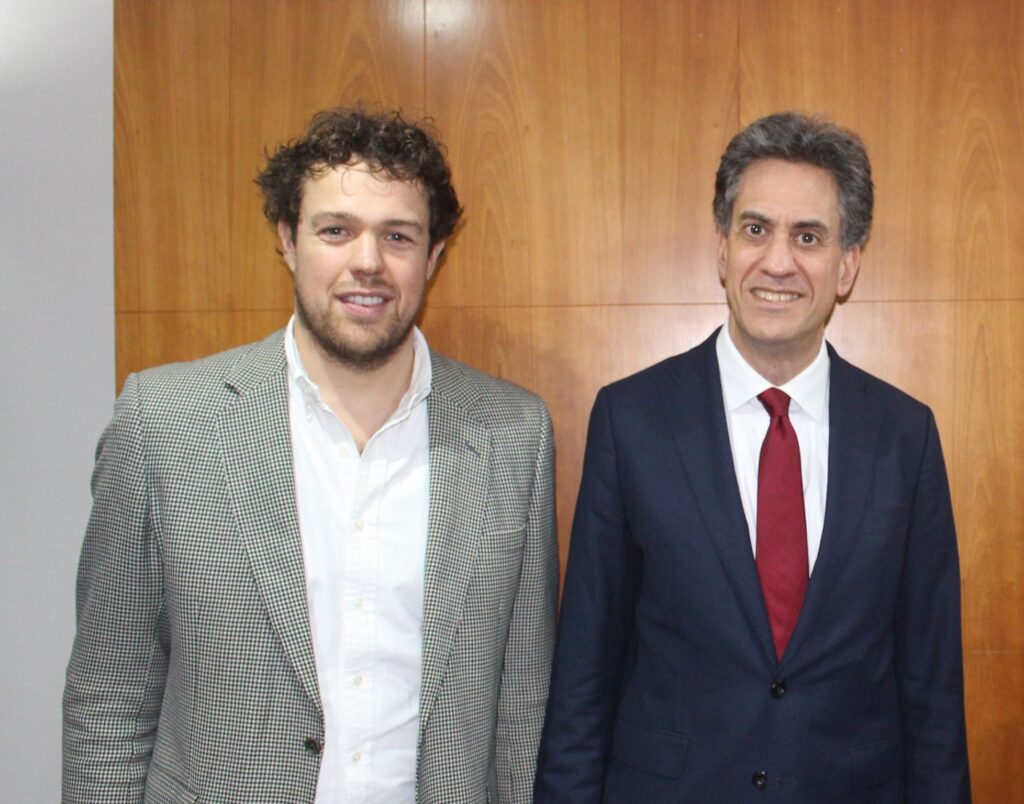
AVK CEO Ben Pritchard and the then energy and net zero secretary Ed Miliband at the Welsh Labour Gala Dinner in Cardiff in November 2025.
Credit: AVK / LinkedIn
However, powering AI with gas is set to obliterate net zero targets across Europe. The UK government underestimated the carbon emissions of data centres by a factor of more than 100, and its revised figures predict 123 million tonnes of CO2 resulting from these AI factories by 2035 - more than the Netherlands emitted in 2024.
The situation is also acute in the EU where, according to projections by the Kiel Institute, the bloc's AI ambitions could demand up to 168 terawatt-hours of power by 2030 - equivalent to Poland's annual energy consumption.
"Decision makers need to recognise glossy marketing campaigns and slick lobbying efforts for what they are," said Oliver Hayes, head of campaigns at Global Action Plan, "PR by a gas industry for whom the AI data centre boom is a golden goose."
AVK told DeSmog: "If there is a route to meeting the world's demand for data and AI, while honouring electrification and net zero targets, and one which does not involve a transitional role for gas, we are yet to find it."
Carbon Capture for Data CentresCarbon capture technology has been criticised as an unproven climate solution promoted by the fossil fuel industry in order to maintain business as usual.
And there are fears that the technology will be used to justify the mass deployment of fossil fuels to power data centres.
"Carbon capture and storage is fundamentally flawed, extremely expensive, and has a long history of spectacular failure," said Aled Dilwyn Fisher, senior research campaigner at fossil fuel accountability organisation Oil Change International.
"AVK's particular push is a perfect storm of fossil-fuelled delusion," which is "inflating oil, gas, and tech profits for an elite few," he told DeSmog.
According to Project Drawdown, an expert-led repository that evaluates claims about climate change solutions, "despite 30 years of pilot and commercial projects, most power plant [carbon capture and storage] projects have failed".
It adds that the "large-scale deployment" of carbon capture on fossil-fuelled power plants "will likely drive continued production and use of coal and gas."
The industry appears to acknowledge these facts, even as it continues to push the technology. According to reporting from Drilled and Vox, fossil fuel giants ExxonMobil and Shell know that carbon capture is not an effective solution for addressing fossil fuel emissions at scale - despite them touting it as "essential".
 Inside the data centre in Docklands, London.
Credit: Arcaid Images
After DeSmog approached AVK for comment, the firm published a page on its website claiming that it is selling the captured carbon dioxide from its first gas-powered microgrid scheme to the food industry for use in products such as soda. AVK says this demonstrates that the emissions of its gas microgrids, if captured, "can be monetised rather than released, not only benefitting the environment but also providing measurable financial value".
Steve Smith, an associate professor of greenhouse gas removal at the University of Oxford, reviewed these claims and told DeSmog that, rather than decarbonising microgrids, AVK's pilot "will still cause climate change," as the carbon dioxide it captures to sell for food production "ultimately ends up in the atmosphere" when people consume the products.
AVK told DeSmog that the company has "not yet delivered a carbon capture scheme" of its own but that its "believe[s] in the power of the technology".
AVK's sustainability pledges, including plans to reach net zero by 2050, state that the firm will be "protecting nature, advancing sustainability" and working towards a "cleaner net-zero future". AVK's sustainability lead, Sarah Ryan, previously worked for fossil fuel giant BP on carbon capture and hydrogen projects. AVK has thus far not produced firm emissions targets.
However, the firm has produced in-house research that attempts to suggest that gas-powered AI is more sustainable than data centres run entirely on renewable energy.
These conclusions were disputed by several experts consulted by DeSmog.
"AI data centres are the latest, and perhaps most dangerous and absurd, lifeline to the fossil fuel industry," warned Fisher of Oil Change International. "They are used to justify a new wave of fossil fuel expansion, with false solutions like carbon capture and storage providing an all-too-familiar alibi."
UK Gas UncertaintyDonald Trump's U.S. administration has promoted the deployment of fossil fuels to power data centres, a policy followed by the country's big tech industry.
WIRED reported in April that 11 new gas-fired data centre projects in the U.S. could potentially emit 129 million metric tonnes of carbon dioxide a year - equivalent to the emissions produced by Morocco in 2024.
According to an analysis by the Financial Times' specialist news site Sustainable Views, 56 percent of Google's U.S. data centres were powered by fossil fuels in 2025, matched by 64 percent of those run by OpenAI - the company behind ChatGPT. Google has even hooked up to a giant new gas plant in Texas that is expected to emit more emissions than the city of San Francisco.
Subscribe to DesmogGet the weekly intelligence you need to hold polluters accountable
Email Address Sign Up Send me intelligence from: All US/Global team UK/Europe team (function($){ $('.newsletter-container .ijkidr-us').click(function() { $('.js-cm-form').attr('data-id', '2BE4EF332AA2E32596E38B640E905619D07B21962C5AFE16D3A2145673C82A3CEE9D9F1ADDABE965ACB3CE39939D42AC9012C6272FD52BFCA0790F0FB77C6442'); $('.js-cm-email-input').attr('name', 'cm-vdrirr-vdrirr'); }); $('.newsletter-container .ijkidr-uk').click(function() { $('.js-cm-form').attr('data-id', '2BE4EF332AA2E32596E38B640E905619BD43AA6813AF1B0FFE26D8282EC254E3ED0237BA72BEFBE922037EE4F1B325C6DA4918F8E044E022C7D333A43FD72429'); $('.js-cm-email-input').attr('name', 'cm-ijkidr-ijkidr'); }); })(jQuery);Now, the big tech industry is pressuring European countries to follow suit.
This includes the UK, where there are growing signs that the government will approve gas-powered data centres.
In March, it gave the go-ahead for a data centre campus in Wapsys Wood, Buckinghamshire, set to be powered by a 300 megawatt gas microgrid, to apply for planning permission as nationally significant infrastructure - bypassing local planning rules.
The developer of the project, SDC, claims the gas microgrid would be "decarbonisation-ready," with "hydrogen conversion" as its "preferred… readiness solution" - another technology that has proven highly controversial.
The government has given similar approval for a planning application to a gas-powered data centre project in Quest Park, Bedfordshire. When fully operational, the Wapsys Wood and Quest Park projects combined would have a carbon footprint exceeding the total carbon emissions of ExxonMobil's UK operations in 2023, according to the tech watchdog Foxglove.
There is also growing public acrimony about the mass rollout of energy-intensive data centres. Plans for a data centre to be built in Brick Lane, London, likely to service capital's financial district, have faced an intense backlash from locals, as have several other schemes across the country.
Some data centres demand vast amounts of water, and there have been warnings from industry bodies that the UK simply does not have enough water to power its burgeoning data centre industry.
There have also been multiple warnings from AI industry researchers and pioneers that the technology may eliminate humankind within the next decade.
The post UK Data Centre Power Supplier Accused of Giving 'Lifeline' to Fossil Fuel Industry appeared first on DeSmog.
Weeks after the collapse of Europe's most prominent hard-right think tank, a new group with the same staff and similar mission has emerged to take its place.
MCC Brussels announced the creation of the Freedom & Sovereignty Initiative (FSI) Europe on 23 September, a fresh entity that promises to "carry forward" its predecessor's aims, and according to its slick new website, provide "the intellectual infrastructure for the European patriotic movement".
This Wednesday (14 October) will mark the organisation's official launch in central Brussels. The talk and drinks reception is being trailed as a "a rare opportunity to bring together representatives from patriotic, sovereigntist and genuinely conservative political forces to ask whether the European right is merely a political vibe or ready for a serious breakthrough".
Two far-right MEPs, French National Rally politician Virginie Joron, and Alternative for Germany's Christine Anderson, are listed as speakers.
But questions persist over who's funding the once cash-rich group, which in 2024 received €6.3 million euros from its parent company, Mathias Corvinus Collegium (MCC), Hungary's largest private education institute and think tank. After Viktor Orbán's resounding defeat in the Hungarian elections in April, new Prime Minister Péter Magyar has sought to dismantle Orbán-era institutions such as MCC, which pushed Orbán's agenda at home and built up a network of allies abroad.
In July, Magyar dissolved the trust that manages the think tank, nationalising its assets. This included returning a 10 percent stake in national oil and gas company MOL and pharmaceutical firm Gideon Richter, worth an estimated €1.5 billion, that were gifted to the group under Orbán.
At the end of August, Frank Furedi, then-director of MCC Brussels and regular contributor to the right-wing online magazine Spiked, resigned from his post "with immediate effect," claiming that the group had been unable to pay its staff.
Yet, company records indicate that FSI Europe was incorporated by Furedi, the group's president, in Belgium on 14 August, registered at the same address as Politico Europe, which was voted the most influential news organisation in Brussels last year.
"It begs the question where FSI Europe got the money, if MCC Brussels was out of money, to rent property in one of the most sought-after pieces of real estate in the EU lobby bubble on a very short timeline," said Nick Aiossa, director of Transparency International EU.
Olivier Hoedeman, research and campaign coordinator for lobby watchdog Corporate Europe Observatory, suggested that "likely suspects" could include U.S. funders of the MAGA movement or the Trump administration, referring to a funding opportunity put out by Donald Trump's State Department to fund European NGOs to "develop civilizational bonds."
The Trump administration has already allocated $12 million to two UK organisations founded by conservative figures, former MP Jacob Rees-Mogg and commentator and House of Lords member Toby Young. Another $4 million is reportedly earmarked for supporting right-wing media in Europe.
However, in August, MCC Brussels then-communications director John O'Brien told Politico that neither it nor its parent group would be applying for U.S. grant money.
In an emailed statement to DeSmog, O'Brien added that: "Private donations fund FSI Europe. We take no money from any government."
Daniel Freund, a German Greens MEP who focuses on anti-corruption and transparency, said: "Orbán's propaganda machine, MCC, has not disappeared. It has simply given itself a new look."
The Hungarian government's 2021 transfer of state-owned assets to MCC in shares and real estate has been widely criticised. A fellow at the German Marshall Fund, an American NGO focused on transatlantic cooperation, told the Financial Times the move amounted to "a sort of dispossession of public wealth in Hungary by the governing party".
"The FSI provides a platform for far-right MEPs," Freund added. "In doing so, it continues to nurture the far-right network that MCC built up" using extensive Hungarian government funding, he said.
In his statement, O'Brien described FSI Europe as "a new, independent think tank with its own board, staff and programme".
"Several of us worked at MCC Brussels, and we are proud of that work," he said. "But suggesting we are the same thing in a new tin is lazy and untrue.
"We exist to defend free speech, national democracy, and Europeans' right to disagree with Brussels. Debate does not threaten democracy. Shutting it down does."
Funding and TransparencyMCC Brussels was until its collapse one of the best-funded lobby groups in the EU, financed by MCC, which in 2023 made €50 million in dividends from shares granted to the group by Orbán's government.
O'Brien told Politico that the group was "open to receiving funding from anyone who supports our cause", but added: "experience shows that when governments fund organizations, they do so often for their own reasons".
"MCC Brussels enjoyed freedom and independence over the past four years, and this is one element of its legacy that we are very keen to preserve," he said.
Despite this, FSI's predecessor had close institutional, as well as financial, ties to the Orbán regime. MCC's chair until June 2026, Balazs Orbán, took a seat in the European Parliament on 18 September for Fidesz, the party of Orbán's government. He served as political director in Viktor Orbán's (no relation) government, and resigned from MCC over the Magyar government's attempt to dismantle MCC.
FSI Europe's second event on 23 October will be held in partnership with The Foundation for a Civic Hungary, the official party-affiliated think tank of Fidesz.
FSI Europe is likewise staffed by vocal defendants of Hungary's former autocratic leader.
Furedi stated in 2025: "Hungary, and Orbán, is invariably accused of democratic backsliding time and again - I just don't see that."
In August 2026, following Orbán's defeat, FSI Europe researcher Thomas Fazi criticised anti-corruption efforts by new Prime Minister Péter Magyar, stating that there was "no defensible logic" for limiting prime ministers to a lifetime term limit of eight years. Orbán had been prime minister for a total of 20 years and five terms at the time of his defeat.
When DeSmog asked Füredi about MCC Brussels' funding in 2023, he said he was "prepared to take money from the devil, because I think I've got enough integrity, that you know, I'm not going to play to their tune."
Half of FSI Europe's staff are British, despite the UK leaving the EU back in 2021, and all but two FSI Europe's 12 staff members have written for Spiked, a British online magazine that regularly publishes attacks on climate science and policy. Between 2015 and 2018 the website received $300,000 from the Charles Koch Foundation, an arm of oil giant Koch Industries and a major funder of climate science denial.
"There is a disproportionate number of British staff members, in an organisation that is clearly looking to dismantle the EU, pushing a nationalist, sovereigntist agenda," Aiossa of Transparency International added.
Campaigners have also accused FSI Europe of exploiting a loophole in the EU lobby register to evade transparency rules.
"They've pulled their old trick again," said Aiossa.
"By reincorporating the same organisation with a different name, even if they were going to register on the EU lobbying transparency register, they're not going to have to disclose any financial information until March 2028 at the earliest," he said.
Under the EU lobby register's transparency rules, newly incorporated organisations can classify themselves as a "newly formed entity," which means all financial reporting requirements are suspended for two years.
When MCC Brussels entered the register in January 2024, it had already been active in EU politics since at least November 2022, yet was still able to register as a newly formed entity.
In 2025, Corporate Europe Observatory accused MCC Brussels of deliberately exploiting the loophole and filed a complaint with the transparency register, which the group denied in an exchange with DeSmog.
MCC Brussels was suspended from the lobby register in June 2026 for violation of "single registration" rule, because both it and MCC had separate registrations, a decision it said it would challenge in court but has yet to act on.
In a statement, O'Brien told DeSmog: "We will follow the EU Transparency Register's rules and publish our funding as required. We have always done this."
'Far-right Network'MCC nurtured a network of hard-right allies across the world until its funding cuts earlier this year. At MCC Feszt 2025, the group's annual festival, Palantir founder Peter Thiel took to the stage, and the leader of Germany's extreme right-wing Alternative for Germany (AfD) party, Alice Weidel, was spotted in attendance.
At its first public event under its new name, FSI Europe will be hosting Christine Anderson, an AfD MEP who was the party's delegation leader in 2024, and Virginie Joron, a French MEP from the hard-right Rassemblement National (RN), who has previously spoken at MCC Brussels events. Joron has been accused of pro-Kremlin sentiment and became prominent on social media during the Covid-19 pandemic for her critical views of vaccinations.
"The line-up of speakers at its first event shows that, like MCC Brussels, FSI Europe continues to align very closely with the most far-right MEPs," said Olivier Hoedeman from CEO.
In 2023, Christine Anderson spoke at a "Freedom Convoy" rally in Canada - a far-right trucker movement that emerged in opposition to Canada's Covid-19 lockdown measures. In 2022, the group staged a months-long protest by the Canadian Parliament in Ottawa, with some of the city's residents saying that they were targeted because of their race. Pierre Poilievre, the Trump-aligned leader of Canada's Conservative Party, has since sought to distance himself from Anderson.
In 2021, the European Parliament reprimanded and placed restrictions on Joron and several other hard-right MEPs, after it emerged that they had undertaken an unauthorised "election monitoring" trip to Russian-occupied Crimea in 2020. Joron said at the time that she could not remember who had invited her on the visit - during which Joron and others "observed" a referendum on Russian constitutional reform that gave Vladimir Putin power until 2036.
Following Russia's invasion of Ukraine, Joron repeatedly voted against proposals by the European Parliament condemning Russia, until March 2022 when Marine Le Pen reportedly intervened, asking RN members to vote in favour of the proposals.
In September 2026, Joron posted an image of her sitting next to Balázs Orbán following his election to the European Parliament. The caption praised him as "A strong voice for nations, sovereignty, and a Europe of the people".
Joron and Anderson did not respond to DeSmog's requests for comment.
O'Brien of MCC Brussels told DeSmog: "At our launch, we will hear from MEPs whose parties millions of Europeans voted for. We make no apology for giving elected representatives a platform.
"Criticising our ideas is fair game, and our door is open to anyone who wants to argue with them. Too often, though, critics would rather smear the messenger than answer the message. That's a shame."
Frank Furedi and Thomas Fazi were also approached for comment.
The post Orban's Favourite EU Think Tank is Back in Brussels. But Who's Funding It? appeared first on DeSmog.
Crypto billionaires Ben Delo and Christopher Harborne each recently piled £36 million into Reform UK, Nigel Farage's political party.
The story amplified recent scandals about the party's donors, with scrutiny mounting over the funding of Farage and his outfit.
In light of these recent developments, DeSmog has taken a closer look at the financial interests of Reform's donors, to understand which sectors have been backing the party and why they're interested in bringing about a Farage government.
Delo and Harborne made their money from the cryptocurrency sector, but DeSmog's analysis shows that they - and Reform's other major donors - have business ties spanning far beyond this one industry.
Farage's party has taken substantial amounts of money from members of the Sunday Times Rich List, fossil fuel interests, the landed gentry, property developers, offshore investors, and has been forced to return large sums to those who aren't allowed to donate to UK parties.
Meanwhile, campaigners and MPs continue to push Andy Burnham's Labour government to stop a few super wealthy individuals from bankrolling our political system.
The Major PlayersExcluding Reform's new £72 million windfall, more than 72 percent of all recorded donations to the party since the 2024 election have come from just three people, including Delo and Harborne.
Harborne, who has lived in Thailand for 30 years and is worth £18 billion, is comfortably Reform's biggest backer, having given £15 million to the party since the last general election (£47 million including his recent donation) and £25 million (£57 million) since the party's launch in 2019.
Harborne is also responsible for a controversial £5 million undeclared personal gift to Farage prior to the 2024 general election, which is the subject of an investigation by the parliamentary standards commissioner.
Delo, co-founder and former executive of the crypto trading platform BitMEX, is behind a further £8 million, while venture capitalist David Grainger has given £1.4 million.
Major donations have also been received from Reform treasurer Nick Candy, and telecoms and fintech magnate Bassim Haidar, who have collectively donated a further £1.7 million since the last general election.
Billionaire venture capitalist Sasan Ghandehari has also pledged to donate millions to the party. Though these sums have yet to materialise, he has already given over £50,000 to Farage personally.
The Crypto BaronsIf the new Delo and Harborne donations are deemed to be legal, Reform will have received 90 percent of its funding since the last general election from those with ties to the crypto industry.
Harborne is a shareholder in Tether, the world's largest 'stablecoin' provider, which is based in El Salvador. Tether is currently seeking an injection of private capital that would increase its value up to $500 billion - making Harborne one of the richest men in the world.
The company has ties to Donald Trump's U.S. administration and has reportedly benefitted from the crypto-friendly policies of his regime.
Delo, meanwhile, is one of the co-founders of the crypto trading platform BitMEX. He was one of those who pled guilty to Bank Secrecy Act violations for failing to establish and maintain an anti-money laundering scheme at the company. Delo was fined $10 million and served 30 months' probation in Hong Kong, before later being pardoned by Trump. BitMEX was ultimately fined £100 million.
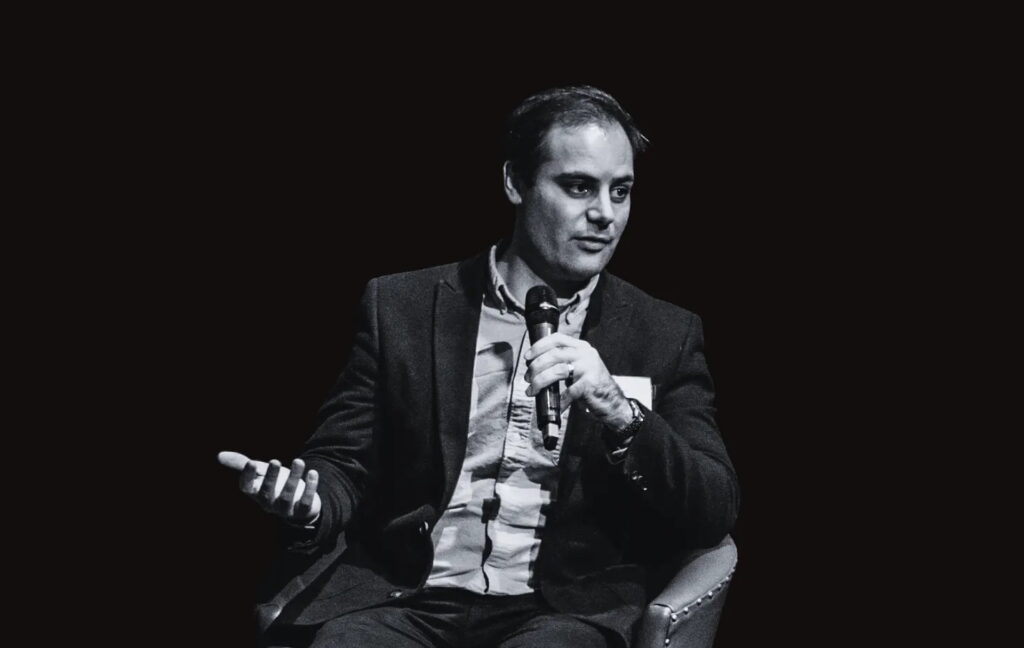 Reform UK donor and crypto billionaire Ben Delo.
Credit:
Jkhildreth / Wikimedia Commons (CC-BY-SA 4.0)
But they aren't the only Reform donors with an interest in the crypto industry. Farage's backers also include Maria Rost, behind some £130,000 across nine donations to the party, who is understood to be the wife of U.S. crypto investor John Rost, as well as Oscar Townsley, founder of Bitcoin derivatives trading platform A1X, and London-based investor Simon William Smith.
Farage has repeatedly lobbied for the industry, promising to bring about a "crypto revolution" if he becomes prime minister. He announced flagship proposals for unleashing the sector at the Bitcoin conference in May 2025 in Las Vegas, including tax breaks and government support, although the document has now vanished from the party's website.
Farage also lobbied the Bank of England to drop plans for a state-backed stablecoin, a move that would suit Harborne - his most generous patron - by blocking a rival to Tether.
Reform was until recently the only major political party in the UK to accept donations via cryptocurrencies, having been accused of using a third party to turn crypto into cash and obscuring the original funding source.
Burnham's predecessor Keir Starmer introduced a temporary moratorium on crypto donations earlier this year, which campaigners say should become a permanent ban.
Offshore InterestsAs previously reported by DeSmog, a large part of Reform's funding comes from those with offshore business interests.
Since the last general election, 57 percent of its income has been donated by individuals and companies featured in the Offshore Leaks database, which details information about more than 810,000 offshore companies, foundations, and trusts.
A large number of the party's donors are also international investors - people or companies with significant financial interests abroad. In the second quarter of 2026, prior to the £72 million windfall, Reform received £5 million from 17 different international investors - including a Monaco-based former Lehman Brothers executive, an investment firm in business with the UAE, and a New York-based asset management firm linked to the owners of Chelsea Football Club.
The party has been embroiled in controversy after an undercover investigation by Verbatim Investigations, broadcast by Channel 4 in September, appeared to show the party conspiring to accept donations from foreign sources.
Two of Reform's most senior figures have now resigned following the documentary, though both deny wrongdoing - as does the party. The Metropolitan Police has launched an investigation into whether any laws were broken.
Farage has previously said that he wants to win back high net worth individuals to the UK through a £250,000 "Britannia Card" that would allow wealthy foreigners to buy a 10-year residency permit and enter a special tax regime. Labour has called the policy a "billionaires bonanza" and tax experts have estimated it would cost the UK £35 billion over five years in lost revenue.
Fossil Fuel InterestsAs reported by DeSmog in April, Reform has received two-thirds of its funding to date, not including the £72 million, from fossil fuel interests. A further £2.4 million has been donated by individuals who have publicly disputed basic scientific facts about climate change.
Harborne owns AML Global, which supplies aviation and maritime fuel to a distribution network that includes "main and regional oil companies", according to its website.
The price of jet fuel has spiralled since the start of the U.S.-Israeli war with Iran, which would benefit Harborne's business interests.
Although Harborne doesn't deny climate science, and recently called the issue an "existential threat", Reform's senior figures frequently dispute the contribution of carbon dioxide to global warming and support the mass expansion of fossil fuel production in the UK.
Fellow Reform donor Jeremy Hosking had $440.8 million (around £326.5 million) invested in oil and gas companies via his hedge fund Hosking Partners as of March - an increase of more than 50 percent from the previous three months.
Meanwhile, Reform-controlled councils have been axing net zero commitments and stating their intention to withdraw from climate emergency declarations. Farage has claimed it's "bonkers" for carbon dioxide to be considered a pollutant.
Property Developers and FinanciersMore than half (55 percent) of Reform's corporate donors are connected to the construction, property, and development industries, which would stand to benefit substantially from the party's policies. Of the 40 companies recorded as having donated to the party before June this year, 22 were involved in this sector.
Reform's 2024 manifesto promised to "unleash" housebuilding across the country and "restore landlords' rights" by reducing their taxes. Reform's housing spokesperson and deputy leader Richard Tice is a property industry millionaire, having run the Sunley Group, a company founded by his grandfather.
Reform treasurer Nick Candy is also a property magnate, having made his money selling luxury homes to the super rich. Candy recently sold his Chelsea mansion for £265 million - the most expensive residential property in UK history.
The party has also received extensive funding from financiers. Reform's donors include hedge fund manager Johan Christofferson, who has given £200,000 to the party, the "vulture fund" Greybull Capital, and the disgraced City of London titan Crispin Odey.
Although Farage has threatened to impose higher taxes on banks, he has also promised to deregulate the sector - including by removing regulation introduced after the 2008 financial crash.
 Reform UK treasurer Nick Candy.
Credit: FII Institute / YouTube The Rich List
As recently reported by DeSmog, Reform's donors include aristocratic families, the owners of exclusive London clubs, peers, and members of the landed gentry.
The annual Sunday Times Rich List acts as "the definitive guide to the wealth of the UK's richest people", cataloguing the country's 350 most affluent individuals and families. The entries in the 2026 edition share a combined wealth of £784 billion. Nearly a third of them no longer live on the British mainland.
Four of Reform's donors appear in this year's list, two of whom appear in the top 10.
Harborne ranks at number six, while the Reuben family - another Reform donor - sits at number two. The Reubens have donated to Reform through a private investment firm - Investors in Private Capital Limited - which is ultimately controlled by Omaha Business Holdings Corp, owned by the family and based in the British Virgin Islands, a tax haven.
Reform's donor list also includes a number of old money backers. Among them is Fiona Cottrell - the daughter of Rupert Watson, 3rd Baron Manton. Under her maiden name, Fiona Watson, she was a former glamour model and one-time girlfriend of King Charles III when he was the Prince of Wales.
Cottrell has given £500,000 to Reform via Britain Means Business, a company owned by the party's deputy leader, Richard Tice, and £750,000 directly to the party. The Metropolitan Police is currently investigating the majority of these donations. Cottrell has repeatedly declined to comment when approached by media outlets.
Fiona's son George Cottrell - nicknamed "Posh George" - is part of Farage's inner cadre, having been UKIP's head of fundraising and later Farage's chief of staff. George, who was previously convicted of wire fraud after being arrested by undercover U.S. agents while attending the 2016 National Republican Convention with Farage, has also provided direct financial support to the Reform premier.
Cottrell helped to fund Farage's anti-immigration campaign videos in 2023 and 2024, supplied him with security, and allowed the Reform leader to use an office in his five-storey London townhouse, which overlooks Buckingham Palace. Farage didn't declare these gifts, and falsely claimed that he hasn't received any support from George since being elected to Parliament.
Reform and policy advisers associated with the party have proposed reducing taxes for the wealthiest, paid for by dramatic reductions in state benefits for lower-paid workers and the disabled.
Impermissible DonorsAnother feature of Reform's fundraising record is the vast number of impermissible donors who have attempted to give money to the party over its relatively short existence.
Reform has been forced to return donations worth more than £295,000, on 83 occasions, since its founding in 2019. Farage's party had to reject more unlawful donations in 2025 than any other party, including donations from Monaco, Jersey, and Germany. The party ultimately had to give back £200,000, and their benefactors made up 18 of the 23 donors turned away by UK politicians or parties during the year.
Labour's ResponseLabour is in the process of introducing a new law that would set a £100,000 annual limit on the amount that foreign donors can give to political parties.
It's unclear if Delo and Harborne's latest donations will fall foul of the new rules, which are currently being debated by Parliament - given they have, at least until recently, been living in Hong Kong and Thailand respectively.
However, in the meantime, campaigners and MPs are urging Burnham's administration to strengthen the legislation by introducing a £100,000-a-year cap on all donations - including from those based in the UK.
The government has been facing pressure from the trade union movement not to introduce a blanket cap, which would limit its extensive financial contributions to the Labour Party.
After donating his latest £36 million, Delo said that he wants to create "a level playing field" between Reform and other major political parties. However, the data shows that his and Harborne's donations would tip the scales heavily in Reform's favour.
Last year's accounts for political parties, published by the Electoral Commission, revealed that Labour received £44.6 million, the Conservatives £30.9 million, and Reform £31.9 million. If Reform is able to receive the full £72 million, its 2026 income would likely be far ahead of the other parties.
Delo also cited Labour's income from trade unions as a reason for his philanthropy. However, since 2020, Labour has received almost £43 million from the unions - whereas, in roughly the same period, Delo and Harborne will have given over £100 million to Reform.
What's more, trade unions raise money from individual workers' membership fees. The Trade Union Congress, a federation of trade unions across the UK, represents roughly 6.6 million people.
Speaking at the annual TUC conference in Brighton in September, its leader Paul Nowak said: "The evidence is clear: Reform UK is a party for sale. Nigel Farage is a politician for sale. And given half the chance, they'd sell our country down the river.
"Make no mistake, this is a crisis for our democracy. We cannot allow our political system to be captured by corporate interests."
He said there was no similarity "between care workers chipping in a few quid a year through their union and a party bought and paid for by billionaires" - adding: "We need a proper conversation about how we clean up our politics that doesn't push workers to the margins - but does stop the super-rich corrupting our politics."
The post Who Funds Reform UK? The Business Interests of Nigel Farage's Major Donors appeared first on DeSmog.
Prime Minister Mark Carney is betting big on a new bitumen pipeline to the west coast and with no lead private sector proponent, he might be betting with your tax dollars.
The last publicly purchased pipeline, the Trans Mountain expansion (TMX) cost taxpayers $34 billion and researchers at the International Institute of Sustainable Development estimate that the federal government would lose at least $8.9 billion if it was ever sold.
Why do we keep throwing public money at subsidizing fossil fuel infrastructure when all indications are that this new pipeline proposal is a risky bet?
DeSmog looked at the latest analysis detailing the shaky economics of a new pipeline and reached out to experts. The only winners might be financiers with short-term incentives in a position to profit even if the public is left holding the bag on another multibillion-dollar bitumen boondoggle.
"It's important to remember that insiders often make their biggest paydays when the investment is made, not when the project is successful," Clark Williams-Derry, an energy finance analyst at the energy think tank Institute for Energy Economics and Financial Analysis (IEEFA) explained to DeSmog. "This is certainly true for investment bankers who arrange financing. They earn their fees up front, when the debt or equity placement is made, not 10 years later when the project has a successful track record. Their incentive is to get a deal done, even if, in the end, it's not a great project."
The current agreement between Ottawa and Alberta has the public paying for 90 percent of the project with Pembina Pipeline Corporation potentially contributing the remainder of the money - if the company decides it is worth its while.
Pembina assured its shareholders "the proposed multi-stakeholder structure is intended to appropriately align risk and responsibility among participants and includes protection for Pembina related to matters such as cost overruns and returns."
In other words, the taxpayer may again be at the back of the line should the project go south. TMX had massive cost overruns that will likely never be recovered by the Canadian government while the primary contractors who built the pipeline were of course paid in full.
Before the Trudeau government bought TMX, Texas-based Kinder Morgan was the original developer. Kinder Morgan investors were no doubt pleased when the pipeline company offloaded TMX onto Canadian taxpayers for a cool $4.5 billion in 2018. Kinder Morgan distributed $3.98 B from this sale to their shareholders in January 2019. Ottawa was saddled with more than $30 billion in cost overruns that will likely never be recovered due to inadequate pipeline tolls. Privatized profits and socialized losses are an all-too-common tradition with Canadian mega-projects, seemingly to be soon repeated.
Initial investors can also flip their stakes. "Private equity investors have a short time frame, usually 3-5 years, which means they have to get in and quickly find or generate a monetization event so that they can pull out their capital," said Williams-Derry. "Sometimes they sell at a loss, but it's still a way for the firm to find buyers even if the underlying investment is a bit of a dud. Their future investors turn into the bigger suckers to bail out today's investors."
"In short, there are lots of reasons why people put good money into weak projects. One thing that's especially telling is that an entire sector's under performance can persist for years but still attract investors who are willing to buy on the dips or take a bet that the sector will turn around. That's been the story of the oil and gas industry for 15 years now."
Are these sound reasons to again gamble with billions in public funds on another bitumen pipeline? Reasoned economic analysis and daily news developments all indicate that the energy transition is accelerating.
A new report from IEEFA details what the energy market might look like in the near future and why investing vast sums into yesterday's infrastructure would likely be a money-loser. IEEFA considered projected oil prices, pipeline tolls, shipping costs to Asian markets, and of course the scenario that the government builds another 1,100 km pipeline to the Pacific, bankrolled by the beleaguered taxpayer.
IEEFA researchers found that only under the Canada Energy Regulator's most optimistic oil demand scenario is a new pipeline even remotely profitable. A more plausible future energy market assumes an accelerating energy transition already being turbocharged by Iran-war price spikes will continue apace, destroying the business case for the planned pipeline. Expanding existing pipeline capacity would more than meet future production needs without the need of an additional mega-project or new bitumen mines.
Market dynamics are playing out in real time as soaring war-related fuel costs are causing entire national economies to retool their dependence on vulnerable deliveries of crude oil. Electrification of the transportation sector in China has already eliminated 36 million tonnes of global oil demand in the last six months, equivalent to the entire share consumed by the United Kingdom in the same time frame.
Carbon Brief just released another report showing that electric vehicles are nine times cheaper to operate than gas cars. No one needs a crystal ball to see where consumer demand is going as spiking fuel costs coincide with plunging prices for batteries that have declined 99 percent since 1991.
Another west coast pipeline would likely not become operational for six to eight years. Is this a wise financial investment as the energy transition accelerates? The oil patch doesn't necessarily seem to think so, given that none of the major bitumen producers currently on track to rake in profits of $100 billion this year are prepared to pony up their own money for the project.
Making another massive fossil fuel investment based on short-term war-related price spikes or the self-interest of financial insiders is not a prudent financial path forward. Do better Prime Minister Carney.
The post The Real Winners From a New Canadian Oil Pipeline Are Private Investors appeared first on DeSmog.
Just six months after Paradise, California was laid waste by the most deadly and destructive wildfire in the state's history — November 2018's Camp Fire — the town's mayor received a generous-sounding offer from a Washington, D.C.-based lobbying firm.
"Our hearts were with you as we watched the fire unfold," wrote Kristi Moore, managing partner of strategic development at The Ferguson Group, in a letter dated May 19, 2019. "We would like to offer our services to the Town of Paradise on a pro bono basis and become an official partner as you further develop and implement your recovery plans."
Paradise soon took The Ferguson Group (TFG) up on its offer, according to a lobbying disclosure filed with Congress dated July 15, 2019, to provide "strategic advice" and assistance with obtaining federal funds to recover from the unprecedented disaster. During the same period, TFG was also working with the National Stripper Well Association, a fossil fuel industry trade group, according to research by two climate campaign groups.
The Ferguson Group is one of nearly 230 fossil fuel lobbyists identified in a recent report by the groups, F Minus and Make Polluters Pay, that also work for clients that support climate action or — like the local government of Paradise — are seeking federal aid to cope with climate-related impacts or disasters. They have dubbed such lobbyists "climate double agents" for representing fossil fuel interests while "simultaneously lobbying on almost every aspect of the climate crisis, from climate mitigation to disaster relief to wildlife conservation."
Subscribe to Desmog
Get the weekly intelligence you need to hold polluters accountable
Email Address Sign Up Send me intelligence from: All US/Global team UK/Europe team (function($){ $('.newsletter-container .ijkidr-us').click(function() { $('.js-cm-form').attr('data-id', '2BE4EF332AA2E32596E38B640E905619D07B21962C5AFE16D3A2145673C82A3CEE9D9F1ADDABE965ACB3CE39939D42AC9012C6272FD52BFCA0790F0FB77C6442'); $('.js-cm-email-input').attr('name', 'cm-vdrirr-vdrirr'); }); $('.newsletter-container .ijkidr-uk').click(function() { $('.js-cm-form').attr('data-id', '2BE4EF332AA2E32596E38B640E905619BD43AA6813AF1B0FFE26D8282EC254E3ED0237BA72BEFBE922037EE4F1B325C6DA4918F8E044E022C7D333A43FD72429'); $('.js-cm-email-input').attr('name', 'cm-ijkidr-ijkidr'); }); })(jQuery);The research, released in August, is also included in online database maintained by F Minus that also contains information on 1,500 state-level fossil fuel lobbyists representing more than 14,000 non-industry clients that publicly advocated action on climate change, including non-profit groups, schools, municipal governments, and hospitals.
"I think it would blow the majority of the public's mind if they knew this was happening," said Cassidy DiPaola, the communications director of Make Polluters Pay.
California is no stranger to wildfires, but the Camp Fire's unprecedented scope of devastation — 85 dead, 50,000 displaced, and nearly 19,000 structures destroyed across 153,336 acres of land in 16 days — was in large part due 2018's extremely hot and dry weather conditions in Northern California, which were intensified by climate change.
The National Stripper Well Association (NSWA) is a trade group representing over 1,000 producers, owners, and operators of crude oil and natural gas wells. Lobbying disclosure forms that TFG filed with Congress in July 2026 indicate that its work for the NSWA includes monitoring "congressional activities on methane related issues."
The Trump administration is in the process of rolling back Biden-era mandates for oil and gas companies to cut their emissions of methane, a powerful heat-trapping gas, as Environmental Protection Agency chief Lee Zeldin confirmed to a convention of oil and gas producers in Santa Fe on October 7.
The Ferguson Group is the "most conflicted firm on wildfire and natural disaster relief issues," said James Browning, founder and executive director of F Minus, and one of the report's authors, told DeSmog. "They have an appalling map of activity funding the opposition on climate."
However, "climate-ravaged cities and countries are locked into relationships" with such lobbying firms, he said, because "they certainly don't want to bite the hand that feeds them."
The Ferguson Group did not respond to DeSmog's request for comment.
Of the 228 lobbyists named in the recent report, 47 were simultaneously working with fossil fuel interests and local governments seeking climate change-related relief.
In the first quarter of 2026, TFG was engaged with 50 local governments on climate-related work, according to the report — more than any other firm mentioned — while also working with five fossil fuel-related clients: the NSWA, the Permian Basin Petroleum Association, Texas Alliance for Energy Producers, Cat Creek Energy, and Southern California Public Power Authority.
The Ferguson Group focuses on lobbying Congress and the federal government, according to its website, with client services that include developing legislative and regulatory strategies, advocacy coordination, and pursuing grants on issues related to water, infrastructure, energy, natural resources, and the environment.
Throughout 2022 and 2023, according to disclosure forms filed with Congress, TFG lobbied for Paradise to receive federal support through the 2021 American Rescue Plan Act, which approved $2 trillion in economic recovery aid during the COVID-19 pandemic, as well as FEMA hazard mitigation grants under 2023's Hazard Eligibility and Local Projects Act.
In February 2023, TFG also helped Paradise municipal officials draft the town's updated "Federal Platform and Priorities," which "documented recovery successes, immediate needs, as well as long term needs and policy considerations," according to a Paradise Council Agenda Summary.
As recently as this summer, TFG represented Paradise's "interests in Washington, DC [sic] with a specific focus on disaster recovery and response related to wildfires," as well as "natural resources, clean air and water, and agriculture."
Despite beginning its work with Paradise on a pro bono basis, Paradise has paid The Ferguson Group over $300,000 as of July 2026, according to the company's disclosure firms filed with Congress. Paradise's Office of Recovery and Economic Development did not respond to DeSmog's questions on the extent of TFG's work with the community, or the town's awareness of its work with the fossil fuel industry.
The Ferguson Group's relationship with the National Stripper Well Association goes back to 2017, according to disclosure forms filed with Congress. The NSWA describes itself as representing the interests of the nation's "smallest and most economically-vulnerable oil and natural gas wells."
TFG has lobbied on the group's behalf for industry-favorable positions on "percentage depletion" and "pass-through deduction"— two separate tax provisions that allow eligible oil and gas operators to reduce taxable income and federal income tax burdens. The NSWA has framed these tax provisions as a way to help these smaller operators stay afloat. However, an Environmental Defense Fund analysis has shown that even though the industry likes to maintain that marginal wells are run by small businesses, nearly half of all marginal wells are owned by just 93 corporations, each of which controls more than 1,000 wells.
Shortly after The Ferguson Group began lobbying for Paradise, the firm also started working for the Permian Basin Petroleum Association (PBPA), the oldest and most active trade association representing oil and gas operators, midstream providers, and service companies across the largest oil-producing region in the United States.
Christopher Kearney, a principal and oil and gas lobbyist at TFG, was the author of strikingly parallel language used by two small oil and gas producers in their 2024 congressional testimonies against the Waste Emissions Charge, a Biden-era methane fee charged to polluters, as reported by E&E News. Kearney was the signatory on the company's lobbying disclosure forms regarding for its work for the NSWA from 2021 to 2026, and for the PBPA from 2020 to 2024.
Although these forms do not list greenhouse gas regulatory-related activities as part of The Ferguson Group's work with the PBPA, E&E News reported in January 2024 that Michael Oestman, an oil and gas operator and "longtime" member of the PBPA, originally got connected to Kearney "through the Permian Basin Petroleum Association, which reached out to see if [Oestman] would be willing to testify before Congress on the methane fee."
Additionally, the Ferguson group's 2024 disclosure of its work for PBPA, the most recent year available, included "monitor[ing] Congressional and Federal agency activities related to addressing COVID on the general economy and the oil and gas industry" as well as "activities regarding Endangered Species Act reform."
The Permian Basin is home to three of the country's most endangered species, according to the Center for Biological Diversity: the lesser prairie chicken, freshwater mussel, and dunes sagebrush lizard. The Trump administration delisted the lizard from the Endangered Species Act in June, settling a lawsuit filed by Texas Attorney General Ken Paxton contending that the rule could "undermine energy production" and threaten "private landowners' ability to conduct business."
In 2024, Texas produced about 28 percent of the nation's total natural gas, and more than two fifths of the nation's total crude oil production, according to the U.S. Energy Information Administration.
In addition to Paradise, Ferguson has also lobbied for Asheville, North Carolina after it was devastated by Hurricane Helene in 2024. The details of TFG's work for Asheville included in its lobbying disclosure forms are limited, but each filing includes "work with the city in response to Hurricane Helene." Asheville's communications specialist declined to respond to DeSmog's questions about the extent of TFG's work with the community, the amount the city has paid to TFG, or its awareness of the firm's work with fossil fuel clients.
"It almost becomes natural disaster tourism, right?" said Browning of F Minus. "They see a natural disaster and they swoop in. And now they're making money by lobbying off it."
A separate report from Brown University's Climate Development Lab (CDL), published in tandem with the F Minus and Make Polluters Pay analysis, documented systemic and coordinated opposition to state-level climate superfund bills by fossil fuel and energy-intensive industries. This type of legislation, which is growing in popularity around the country, would require large fossil fuel producers and refiners to pay for state-level climate damages as well as adapting infrastruture to the new climate normal
"To me, it's an issue of kindergarten ethics," said Timmons Roberts, a professor of environmental studies at Brown who a co-authored the report. "If you know you made a mess, you clean it up."
The Brown researchers found that while support for climate superfund bills has "dominated" pubic hearings, groups lobbying in opposition to them have made more submissions during public comment periods, sometimes swaying state leaders against the legislation. The Ferguson Group was not named in the report.
The post Consulting Firm Lobbied for Town Hit by Climate Disaster and Fossil Fuel Group at the Same Time appeared first on DeSmog.
One month before a referendum vote that will include a question on Alberta independence, a free-market organization promoted "free cities" as a solution to separatist grievances at a Calgary conference. Free cities have received backing from MAGA tech CEOs.
"Here in Alberta, I know that you have questions about sovereignty, decentralization, provincial authority, and political distance", said Mailyn Salabarria, senior advisor on U.S. Development and Strategic Partnerships for the Free Cities Foundation. "The free cities movement in general pushes your questions and your concerns a little step forward."
The Free Cities Foundation promotes the creation of self-governing cities through conferences, media, and a global directory of Free Cities. Salabarria made these comments at the Capitalism and Morality conference in Calgary in early September.
The Free Cities Foundation is part of a broader effort to create autonomous jurisdictions as low-tax, private enclaves attractive to investors and entrepreneurs. There are many different names for and formations of these projects, including special economic zones, charter cities, startup cities, and network states. The movement has significant backing from tech CEOs close to the Trump administration.
This pitch to Alberta separatists is "not surprising", said Quinn Slobodian, Professor of International History at Boston University. "[T]he possibility of breaking up existing nation-states, especially very large ones like Canada, has been on the mind of these radical libertarians now for at least 30 plus years," he told DeSmog in an interview. Slobodian traced the history of free marketeers and libertarians designing special economic zones and charter cities in his 2023 book Crack up Capitalism.
Salabarria pitched free cities to the Calgary crowd as something smaller and more nimble than a breakaway state: "How small can the political decision-making be for ordinary people to actually have meaningful choices? For some of you, the answer might be greater provincial autonomy. For others, it could be a general seccession. For another group, it can be charter jurisdictions, especially economic zones, competitive municipalities, or private communities," said Salabarria.
Subscribe to DesmogGet the weekly intelligence you need to hold polluters accountable
Email Address Sign Up Send me intelligence from: All US/Global team UK/Europe team (function($){ $('.newsletter-container .ijkidr-us').click(function() { $('.js-cm-form').attr('data-id', '2BE4EF332AA2E32596E38B640E905619D07B21962C5AFE16D3A2145673C82A3CEE9D9F1ADDABE965ACB3CE39939D42AC9012C6272FD52BFCA0790F0FB77C6442'); $('.js-cm-email-input').attr('name', 'cm-vdrirr-vdrirr'); }); $('.newsletter-container .ijkidr-uk').click(function() { $('.js-cm-form').attr('data-id', '2BE4EF332AA2E32596E38B640E905619BD43AA6813AF1B0FFE26D8282EC254E3ED0237BA72BEFBE922037EE4F1B325C6DA4918F8E044E022C7D333A43FD72429'); $('.js-cm-email-input').attr('name', 'cm-ijkidr-ijkidr'); }); })(jQuery); Tech CEOs and PrósperaThe Free Cities Foundation's founder and president is Titus Gebel, a German entrepreneur and thought leader on special economic zones. Between 2017 and 2019, he served as chief legal officer for the company operating Próspera, a special economic zone (known as a ZEDE) in Honduras. Located on the island of Roatán, Próspera was first pitched in 2017 and broke ground in 2020, promoted as a libertarian paradise where businesses can choose from a list of regulatory frameworks, or mix and match their own.
Companies can be set up by e-residents without stepping foot on Roatán. Those companies then pay taxes to the economic development zone, not the municipality or Honduran government. Bitcoin is accepted as legal tender and innovative experimental medical clinics allowed Milton Friedman's grandson Patri Friedman get a Tesla key implanted in his hand.
Some of Próspera's most prominent backers are Silicon valley Tech CEOs who have ingratiated themselves with U.S. President Donald Trump. Peter Thiel and Marc Andreessen have both invested in Próspera through Pronomos Capital, a fund for charter cities.
Thiel has provided capital for a similar venture that the Free Cities Foundation promotes, called "seasteading", which entails creating "autonomous ocean communities". Thiel's software company Palantir has been assisting the Trump administration's massive deportation campaign, has said that freedom and democracy are incompatible, and has called Greta Thunberg the antichrist.
Venture capitalist Marc Andreessen is now a new member of the U.S. Pentagon Defense Policy board. OpenAI CEO Sam Altman has also backed Próspera, along with Praxis, another free city. Praxis' architects wanted to site the project in Greenland before settling on Uruguay. Altman donated $5M to Trump's Super PAC ahead of the 2025 inauguration through his Tools for Humanity company. Thiel and Andreessen are also invested in Praxis through Pronomos Capital.
Residents of Roatán have fiercely opposed Próspera. According to Human Rights Watch, "Indigenous and Afro-Honduran organizations say that such zones were created within their traditional territories without proper consultation, including free, prior, and informed consent". Locals reported they were not approached by Próspera until 2019, two years after the project was approved, and at that point it was presented as a resort.
Locals grew more concerned that their land could be expropriated when Próspera posted development designs on its website that included Crawfish Rock, an adjacent community. Honduras has faced a long history of U.S. and corporate incursion; it is where the term "Banana Republic" was invented in response to the control of the United Fruit and Standard Fruit companies. Salabarria told DeSmog in a statement that "Free Cities Foundation does not support any project involved in expropriation of land from any community, including First Nations communities".
Honduras' Supreme Court struck down the zone laws which allowed for the creation of Próspera in September 2024 and ruled that the framework violated human rights. Próspera is suing Honduras for nearly US $11B, equivalent to almost two thirds of Honduras' national budget in 2022. The case is still pending at the International Centre for Settlement of Investment Disputes.
Juan Orlando Hernández, the Honduran president who pushed the special economic zones initially, was extradited to the U.S. on drug trafficking charges, and a U.S. court later sentenced him to 45 years. He was pardoned by U.S President Donald Trump and returned to Honduras, where he was cleared of criminal charges.
Salabarria told DeSmog in a statement "Free Cities Foundation has no direct financial relationship with Peter Thiel, Marc Andreessen, Sam Altman, or their companies. We have worked with Próspera in limited, time-bound ways in the past". Salabarria shared that Free Cities Foundation is independent from Próspera, though the foundation held its most recent conference in the ZEDE in September 2026, and Próspera has sponsored some Free Cities Foundation events.
Free Cities, for Whom?In Alberta, Salabarria urged conference attendees: "Please don't buy [into] the stereotype that these alternative forms of governance are only for rich people fighting or trying to look for tax havens".
Salabarria presented free cities as an opportunity to strengthen Albertans' rights and freedoms. "It is mostly a concept, an umbrella, a legal framework where territories can be created by a contract within a host nation, with meaningful local autonomy, stronger protection of individual rights, and much more freedom on how people can live, work, conduct their business, innovate, build, invest, and organize their communities," she said.
According to Slobodian, there are two sides to the Free Cities Foundation's proposal. One is the creation of special economic zones to create opportunities for private investors. The other side is the promise of gated communities that "offer their residents a certain sense of increased security, often cultural and class homogeneity, stability for their real estate investments." Slobodian explained that service provision within these communities can become quite costly when publicly funded services are privatized. In that way, free cities are for the wealthy few who "already have many, many options for living according to [their] preferences," he said.
Salabarria told DeSmog that "free cities are not only for the wealthy" and named another special economic zone in Honduras, Ciudad Morazán, as providing affordable housing to local residents. She also said these zones offer employment and higher earnings to locals.
The conference was organized by Econ Americas, a Colorado based financial consulting firm, and talks ranged from banning trans athletes from competitive sports and managing diabetes through the paleo diet, to getting rid of government altogether.
 Credit: Danielle Paradis
At the opening evening of the conference Freedom Convoy organizer Tamara Lich was given a "Good Rebel" award. In a Substack post ahead of the conference, Econ Americas founder Fergus Hodgson wrote that "[t]here is an incredibly rare opening in Alberta to peacefully build a state-of-the-art nation that can lead the world for freedom." Conference sponsors included Bow Valley Credit Union and Alberta Women for Independence, as well as right-wing websites Western Standard and Juno News.
"I personally see Alberta nationhood as tremendously beneficial," Hodgson said in response to DeSmog's request for comment, explaining that it would increase government accountability and individual choice for Albertans.
"Ottawa loyalists who push the notion that Americans are behind the movement demonstrate a lack of understanding and an eagerness to turn a blind eye to the disaffected, homegrown, and highly motivated movement that is staring them in the face", said Hodgson.
Salabarria wasn't the only speaker calling for an end to government as we know it. "Democracy is not reformed. It is progressively displaced by property-based decision-making," said Darcy Gerow, former deputy leader of the Libertarian Party of Canada, in a talk he called "The Anarcho-Capitalist Case For Alberta". Gerow argued in favour of an independent Alberta where "[a]ll public assets should be privatized by distributing shares to the people who funded them and rightfully owned them, the taxpayers".
Gerow said the same logic that is applied to privatizing education and healthcare should be extended to security, the courts, and finance. He also proposed that only property owners and net tax contributors should have a say over local taxes and regulation, with private contracts taking the place of a constitution, and competition and secession standing in for elections.
Gerow did not respond to DeSmog's questions.
According to Slobodian, American investors would be very interested in the creation of free cities or special economic zones in Alberta, especially in the context of the Canada- U.S. trade war and increasing energy demands for artificial intelligence. This could be "part of like a U.S. driven oil grab that's driven by the energy demands of the tech sector …which is exploiting this secessionist energy and exploiting culture war issues for very direct economic ends."
Meanwhile, Alberta separatist leaders have visited the U.S. State Department to offer up resources including water and oil royalties. Republican political operatives visited Calgary to present software to identify Albertans likely to vote yes in a referendum on separation.
Salabarria stated "We are not currently working with any specific investors, groups or proposals to establish a Free City or Special Economic Zone in Alberta. We are, however, open to engaging with serious proposals aimed at creating new zones with greater autonomy where these are based on voluntary participation and lawful agreement."
Slobodian argued that "I can see tons of reasons why a tech-adjacent investor, of which most of these network state people are, would see this as an opportunity to grab access within the continent."
CORRECTION (10/14/26): The original version of this article referred to Próspera as a "fully privatized city state". The article has been updated to clarify the proper terminology of special economic zone or ZEDE. The original version of this article stated that the Free Cities foundation is a "free-market organization with links to MAGA-tech CEOs". The language has been updated to better reflect the relationship between the foundation and these individuals.
UPDATE (10/14/26): This article has been updated to include an example of a startup city that Peter Thiel and Marc Andreessen are invested in through Pronomos Capital, Praxis.
The post MAGA Tech-Aligned Group Offers Advice To Alberta Separatists appeared first on DeSmog.
As members of a local air district were considering the fate of a rule that would force Bay Area homeowners to replace old gas water heaters with electric heat pumps, dozens of public comments flooded in.
The emails voiced concerns about increased costs to homeowners and urged the air board to agree to undertake more socioeconomic analyses before enforcing it. Regulators took note of the local pushback, and this spring Bay Area Air District (BAAD) staff recommended that the committee put off implementing the rule by a year.
But dozens of letters that were sent to the air district were not, in fact, written and sent by concerned locals, it was later revealed. Instead, at least 85 of them were sent by a software company that uses AI and was paid by an advocacy group called the Bay Area Council, which describes itself as at the "intersection of business and civic leadership."
According to lobbying disclosures obtained by DeSmog, oil and gas giant Chevron donated approximately $150,000 to the Council during the second quarter of this year, the period in which the organization led a campaign against the electrification rules and pushed for more stringent socioecononomic modeling for future rules before the air board.
Chevron is California's largest producer of oil and gas and owns a refinery in Richmond, across the bay from San Francisco. It's a member of the Council, along with utility PG&E and the Western States Petroleum Association.
Chevron did not respond to a request for comment. Rufus Jeffris, senior vice president of communications at the Bay Area Council, did not respond to questions about what Chevron's payment was used for.
"Onerous mandates and regulation of oil refining in California are a major reason for the state's nation-leading fuel costs and why Gov. Newsom and the legislature backed away from certain rules and regulations that were forcing refineries to leave - the majority of Californians still drive gas-powered vehicles," Jeffris wrote in a statement. "And we strongly support enabling and incentivizing consumer- and market-based solutions as part of any solutions, rather than mandates."
If passed, the Bay Area would be the first air district in the U.S. to phase out gas-powered water heaters, potentially paving the way for other districts and states to impose their own restrictions. Similar state-level regulations are already taking shape in Maryand.
"It would be an enormous victory to make heat pump water heaters essentially the norm in the Bay Area," said Sam Fishman, sustainability and resilience policy manager at the San Francisco Bay Area Planning and Urban Research Association. "I think that the air district rules here…if they survive and then succeed, I think that'll set an enormous precedent for the nation."
Chevron and other members of the Council could lose financially from the implementation of the air district's proposed electrification rule. The rule would cut back significantly on the air district's use of gas - eventually phasing out gas-powered water heaters in 2.8 million households.
Environmental advocates say the Council's desire to require the air district to include more studies in all future socioeconomic reports — not just the heat pump rule — could also benefit refineries like Chevron, which is regulated heavily by the air board.
"The air district does a socioeconomic analysis whenever it's going to enact a significant policy, and they wanted to enshrine the details of what that socioeconomic analysis should include and make it more robust, potentially with the interest in making it onerous and therefore harder for the air district to instate rules," said Tony Sirna, deputy policy director of buildings at Evergreen Action. "I think that was the main objective of the Bay Area Council. That's the campaign that they were truly focused on."
Opposing Electrification
The Bay Area Air District unanimously passed the zero-NOx appliance standards, known as the electrification rules, in 2023. The air district estimated that a switch to electric gas pumps would save nearly $10 million on annual utility bills across the Bay Area. It also predicted that the switch would significantly reduce harmful emissions of NOx (a group of poisonous gases made of nitrogen and oxygen, primarily nitric oxide (NO) and nitrogen dioxide (NO₂), that can impact asthma and lung disease, slashing 3,236 tons annually, and in turn preventing an estimated 37 to 85 premature deaths each year.
Chevron has not spoken out publicly about the proposed electrification rules, but it has criticized California regulators for increasing energy costs it says are passed to consumers. And it opposed a proposed Cap-and-Invest amendment by the state's air board, which it argued threatened the viability of California's remaining refineries, jobs, and fuel supply.
The gas company has also poured millions into candidates, lobbying, and campaigns across the state to influence California's attempts to tighten rules on fossil fuels. From January 1 through June of this year, Chevron reported paying $30,496 to a public relations firm that is responsible for running a Chevron-owned Richmond newspaper that does not report critically on the oil giant. It also paid $2,952,835 to Californians for Energy Independence, a group that advocates for California's oil and gas industry,and $500,000 to the California Business Roundtable, a group the Council called a "strategic partner" in a 2025 Council presentation on "government relations" obtained by DeSmog. The Roundtable is an advocacy group that promotes pro-business ideals.
Chevron has also tussled directly with the air district. In 2024, the company agreed to pay it $20 million to settle 678 violations it had incurred at its Richmond refinery, and last December BAAD fined Chevron $900,000 for failing to adequately monitor emissions at the refinery.
Last November, BAAD opened a public comment period about any concerns over the water-heater rule, with a focus on addressing affordability, equity, and implementation costs. It was the same month that the Bay Area Council, of which Chevron is a member, launched a website for a group called the Common Sense Coalition. The website read: "The cost of living here is already unbearable. Rent, gas, groceries, power bills — everything keeps going up. But the air district keeps adding rules that drive prices even higher."
The website also hosted a form where people could submit canned emails to regulators opposing the rules. The form read in part: "I'm a real person struggling with the price of utilities and gas. This was not written with AI. I write with an urgent request: get a hold of rising bills and surprise fees for families by requiring transparency before new rules take effect — starting with Rule 9-6, the new water heater regulation now in front of the board."
Between November 2025 and June of this year the Common Sense Coalition spent more than $148,000 on Meta advertisements that linked back to the web form, according to Meta's online ad library.
The San Francisco Chronicle reported in March that it had contacted people whose names were on the forms sent by the software company that the Council hired. They found 10 people who said they had not authorized the opposition emails. The Council has denied using AI to send the forms.
The Coalition's website has since gone dark.
The air district staff issued recommendations July 8 to delay the implementation date of the electrification rule.
The Council netted another victory in early September when the air board voted to approve a proposal to more robustly study the socioeconomic impacts of future rules before the board. The new policy "set standards and metrics to ensure consistency for analyses conducted beyond the minimum statutory requirements and documents standards of transparency."
While BAAD already undertook a more stringent socio-economic impact report for the heat pump rule, the new policy applies the need for additional economic studies more broadly to other future rules before the board.
Jeffris said in a statement that the Bay Area Council had opposed the heat pump rule because "these mandates have real-world costs that are not abstract. All this comes as affordability rises as one of the biggest concerns facing many Bay Area and California residents."
He added of the September approval to bolster future reporting: "The Air District agreed with us and adopted a policy we had advocated for that they conduct socio-economic impact analysis on new rules and regulations."
Sirna said Chevron, which owns a refinery in Richmond, in particular aims to gain from the ruling.
"They definitely care a lot about what happens at the air district, and the air district is monitoring them regularly and imposing fines on them when they have pollution that goes beyond the regulated limits," he said. "My concern is that [the policy] will just make it either more difficult for them to enact regulations in general, or that provide more fodder for lawsuits or something."
A Similar LA Playbook
A year before the Bay Area's fight over electrification rules, the Los Angeles air district experienced something incredibly similar.
In June 2025 South Coast Air Quality Management District regulators were considering a proposal to phase out gas-powered appliances when tens of thousands of opposition emails began pouring into the district. Ultimately, the board voted 7-5 against the proposal.
The number of letters sent to the board was abnormal and overwhelming. They were signed by real residents, but reporting from the Los Angeles Times later found that at least 20,000 had come from a software company, CivicClick, that uses AI. Political consultant Matt Klink, a partner at California Strategies, whose clients include Sempra, the parent company of SoCalGas, took credit for hiring CivicClick for the campaign.
"We knew that we needed to generate real emails from real voters very quickly on a highly technical air quality regulation — not your common piece of legislation. CiviClick was able to quickly identify real voters in the constituency of the AQMD board and send emails to these people immediately," Klink told Campaigns & Elections in August 2025.
The Los Angeles Times later reported that they'd spoken to several people who said they had not agreed to use their name on the CivicClick emails.
"We were pretty disturbed by that, and we've seen signs of similar things happening in the Bay Area," Fishman said of the emails sent to the South Coast Air Quality Management District. "It's a big threat to democracy. You know these governing bodies that really represent pretty large populations rely to some degree on on hearing from their constituents and really understanding and taking the pulse in their regions."
While there's been no reporting directly linking the two campaigns against the California air district rules, the use of AI in public comments received state-wide attention. This past August, state legislators passed a law to make it harder for AI-powered letters to influence votes. The law determined that no one can knowingly use AI to falsely represent a real person when engaging with a government agency and that agencies don't have to treat AI written communications as if they are from real people.
The California Air Resources Board (CARB) is currently developing statewide water heater standards that would phase in zero-emission limits, but wouldn't take effect until 2030. Back in the Bay Area, residents are awaiting a final vote from the air district board as to whether they'll accept the staff's recommendations to delay the electrification rule from taking effect in January 2027 and push it to January 2028. The board is expected to cast its vote this November.
The post Chevron Gave $150K to Bay Area Group Accused of Using AI to Fight Heat Pump Rule appeared first on DeSmog.


