
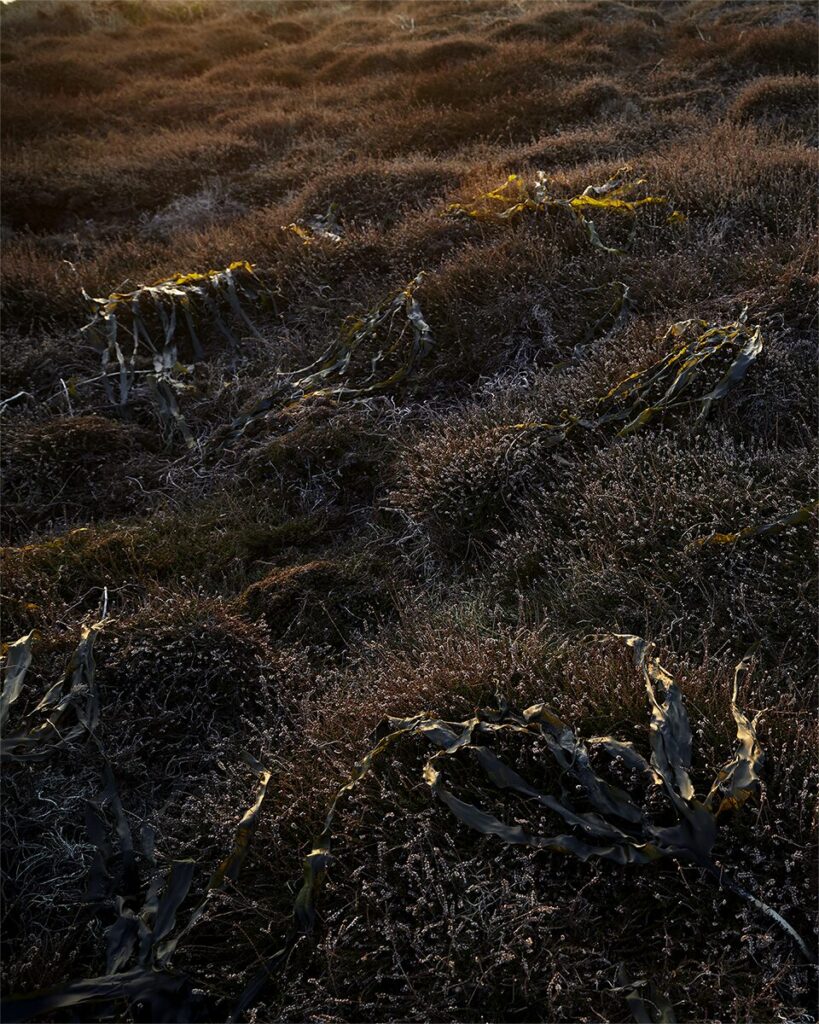
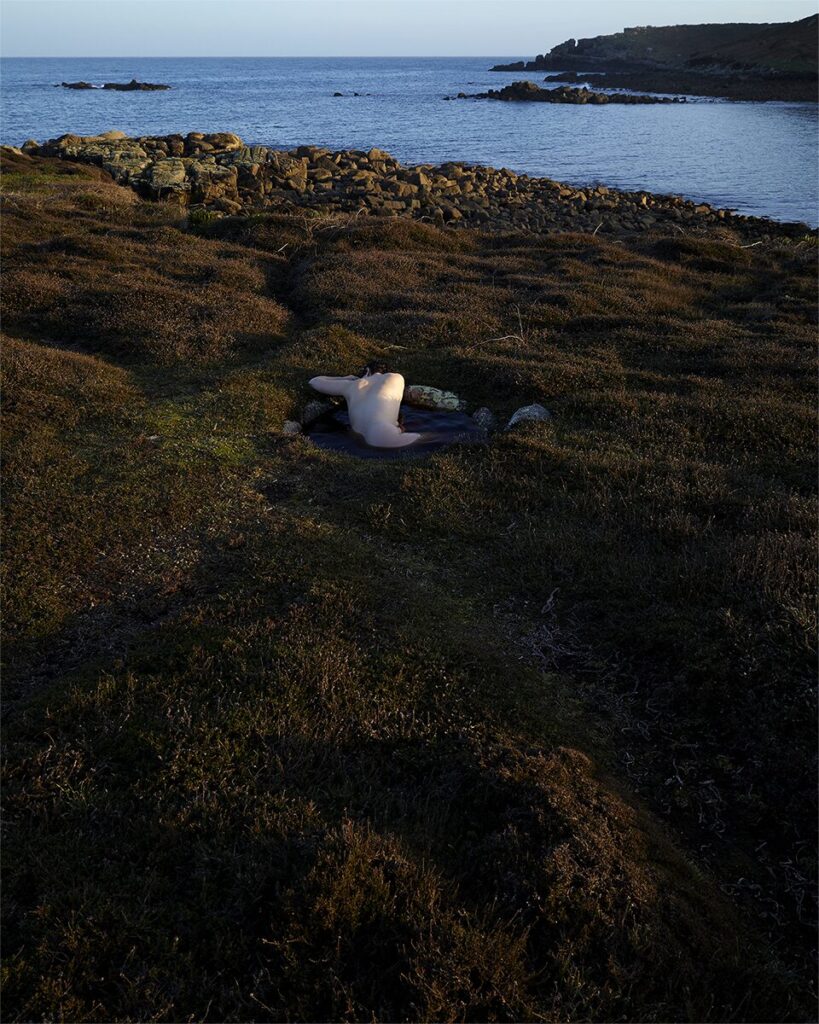
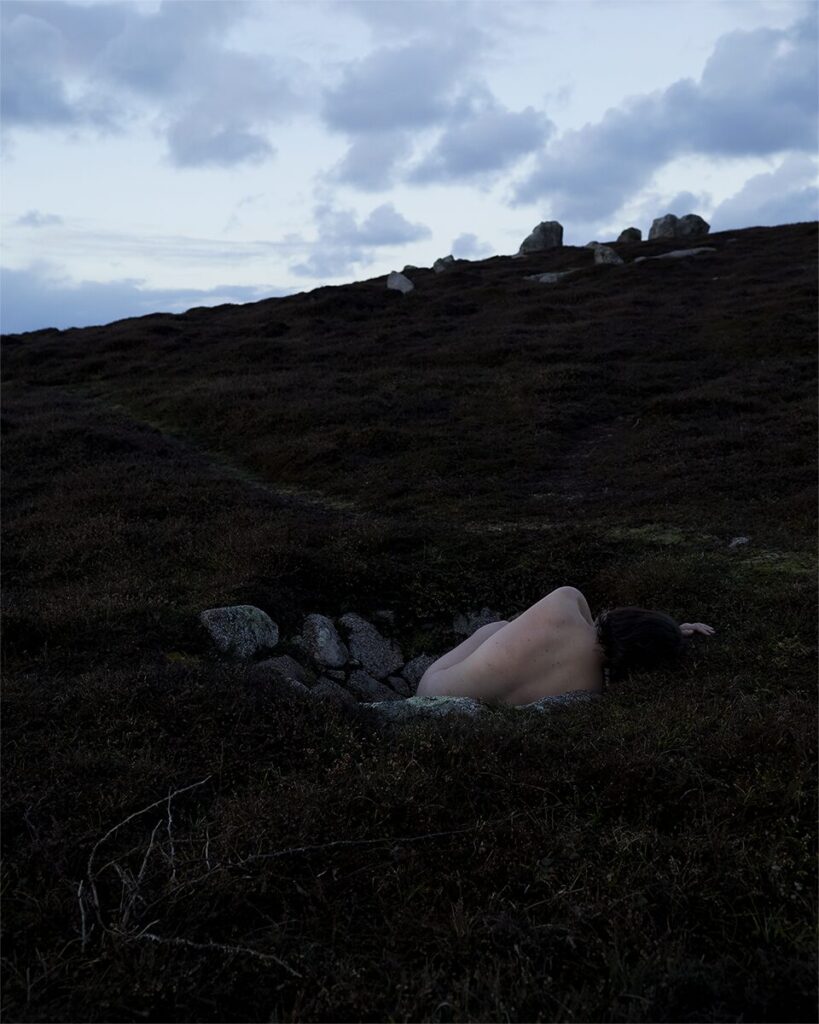
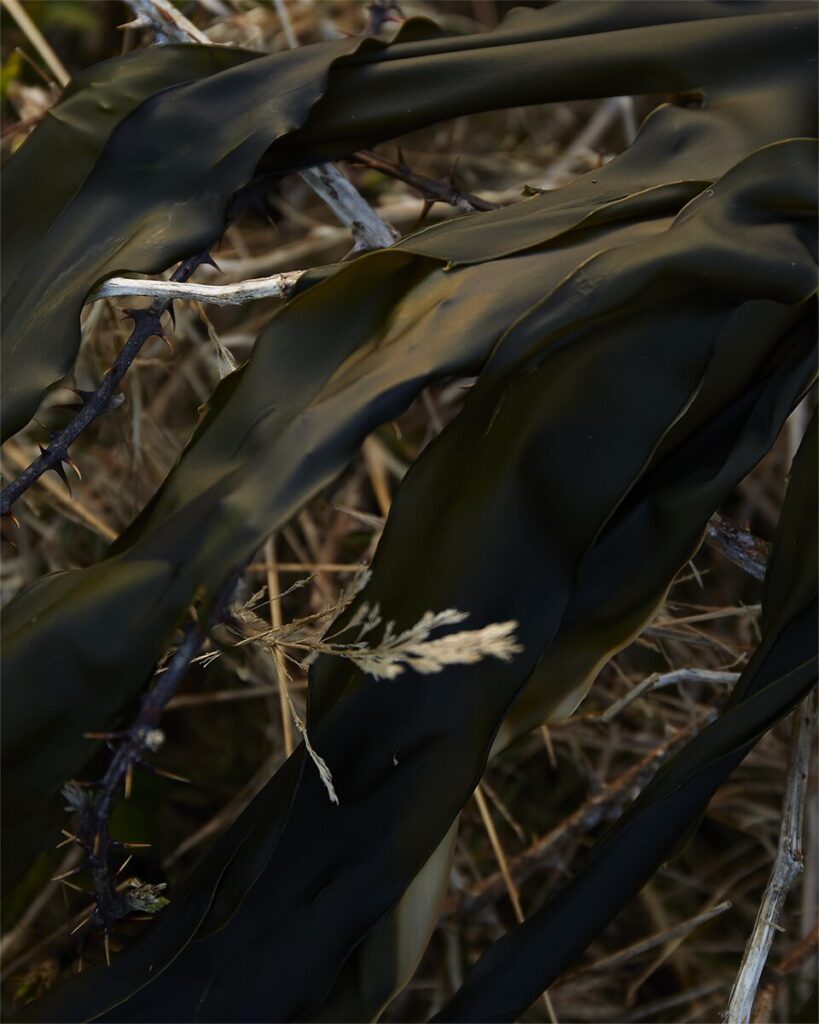
Recently exhibited at Newlyn Art Gallery, Holdfast is an ongoing project by Teän Roberts — an imaginative photographic investigation into the folk-history of kelping in the Isles of Scilly.
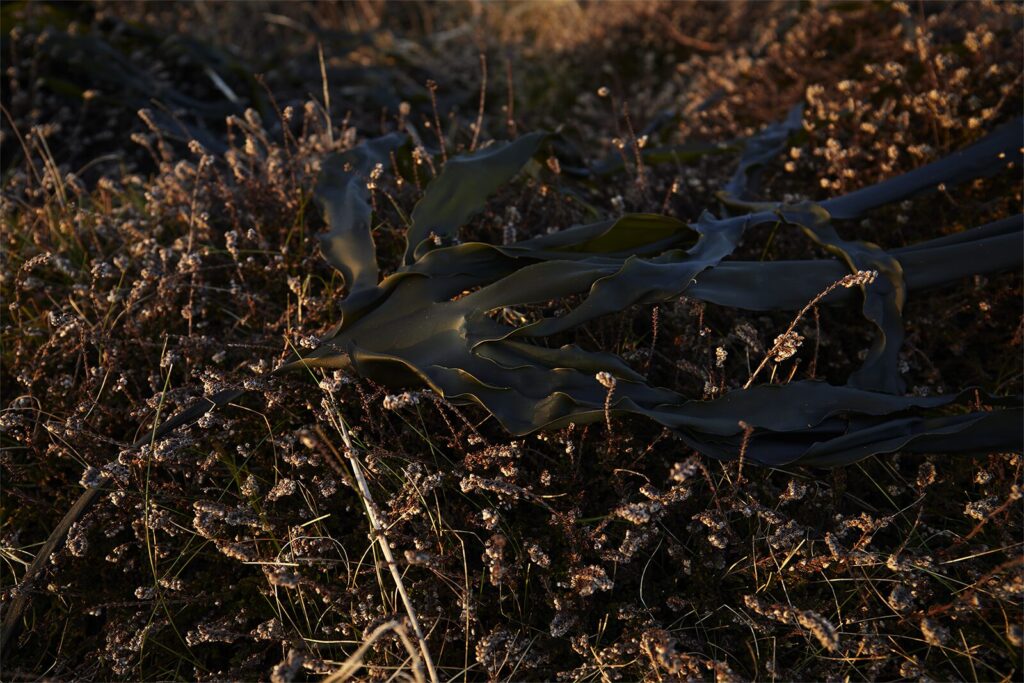
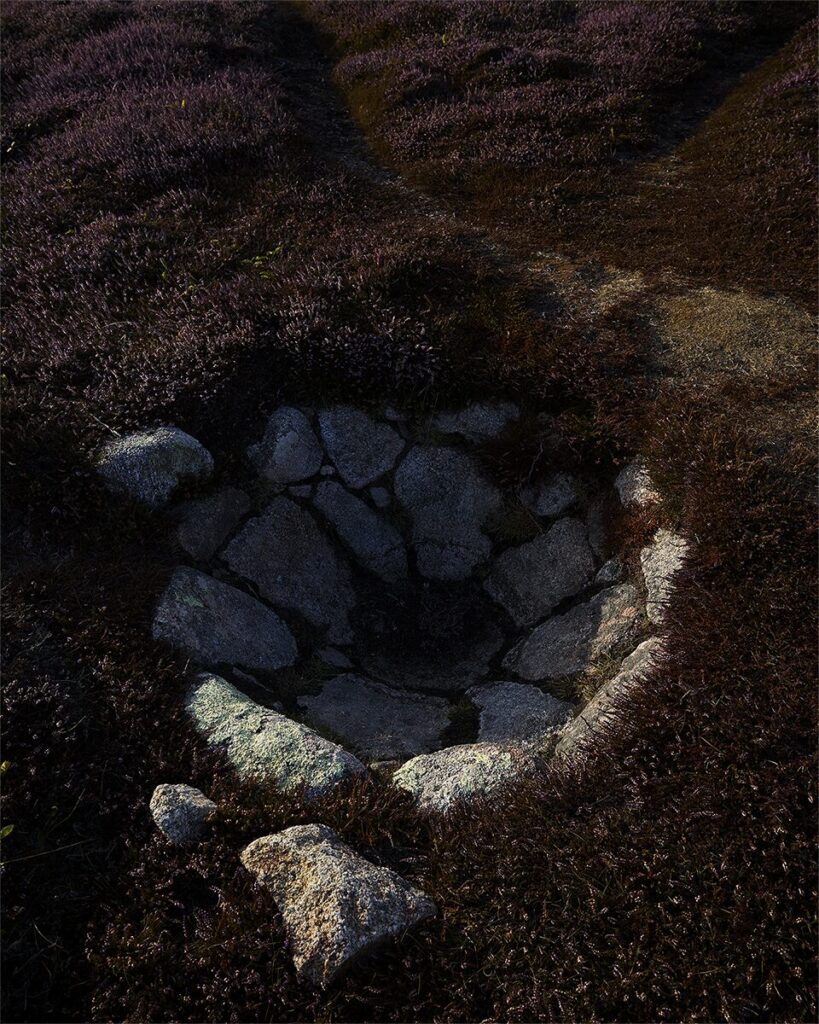
All that is left of this 150-year-long subsistence practice - of collecting, drying and burning seaweed for glass making - are the stone-lined pits where the kelp was burned.
Teän has kindly allowed us to share some images from the project.
Visit Teän's website here, or follow Teän on Instagram here.
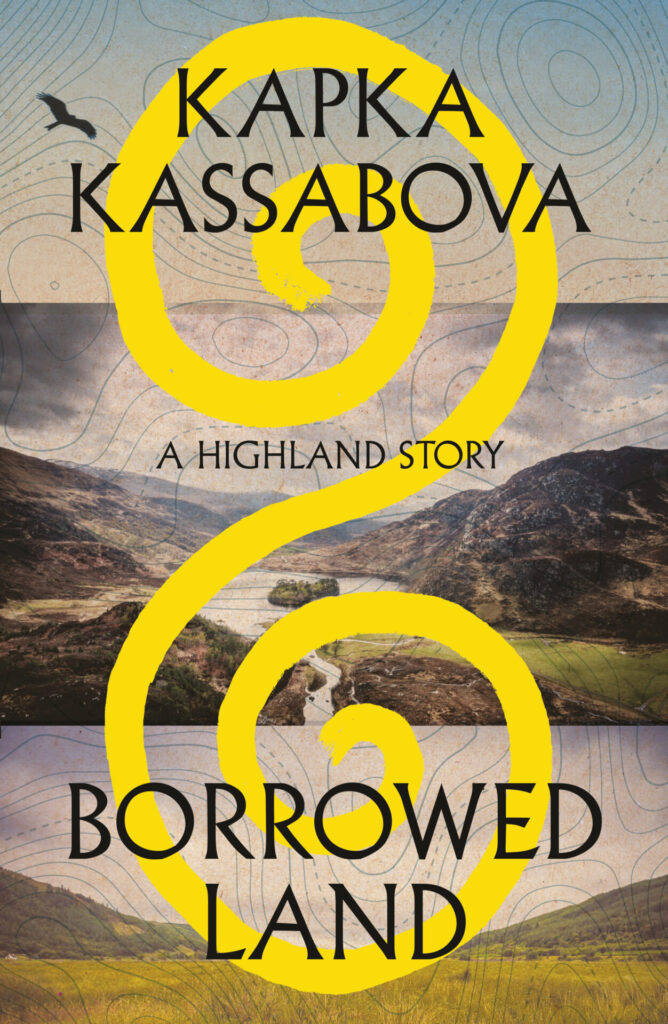
Rich in sonic detail, Kapka Kassabova's 'Borrowed Land' is vital testimony to the ecocide and damage to human health being committed in the name of the energy transition, writes Sally Huband.
Sound is not sound alone, it's touch.
John Cotter, Losing Music
My nerves were on edge when I visited the Barbican's Feel the Sound exhibition two summers ago. I had become fearful of sound and wanted to transform this fear back into love. An energy company had built a hyperscale wind power plant near my Shetland home. The low frequency noise of the turbines rewired the auditory processing in my brain, among other neurological harms. I moved house and slowly recovered but louder sounds continued to cause pain.
I needn't have worried. I suffered no pain at the Barbican exhibition. The subwoofer bass of the souped-up cars in the underground carpark was a gentle nudge compared to the brain punch of industrial wind turbines. I'm deaf and have long known that sound can be felt as much as heard. It was good to see artists explore this. In a video exhibit, Evelyn Glennie talked of teaching the world to listen but with our bodies, hearts and mind. If I had to choose a book that does just this it would be Borrowed Land by Kapka Kassabova.
The deep listening in Borrowed Land takes place in the Scottish Highlands. The writing is rich in sonic detail. A cave becomes the inner ear of the glen and birches whisper. I hear the stories told in Borrowed Land but I feel them too. Kassabova's Highland home place, like my Island home place, is a sacrifice zone. Ecocide is being committed in the name of the energy transition and human health is collateral damage in the pursuit of corporate profit. Kassabova's lived experience is vital testimony. The low frequency noise of a new electricity substation sends workers home with migraines, panic, nausea, a malaise and Kassabova herself is made ill by the pylons that are built next to her home. She, like me, is forced to leave.
I've come to know and love the setting of Borrowed Land while staying at Moniack Mhor, a creative writing centre that sits high on a hillside. The rooms have views across a wooded glen, mountains form the backdrop and the light is always shifting. I mention Moniack's views deliberately. Those of us arguing that all is not well in the energy transition are accused of being more concerned with views than the climate emergency. If only this were true. A wind power plant called Ballach, with turbines 230 m high, is planned 10 km from Moniack Mhor. If it is built, I would hesitate to stay there again and not because the landscape would change. The soundscape would change, it would become unsafe.
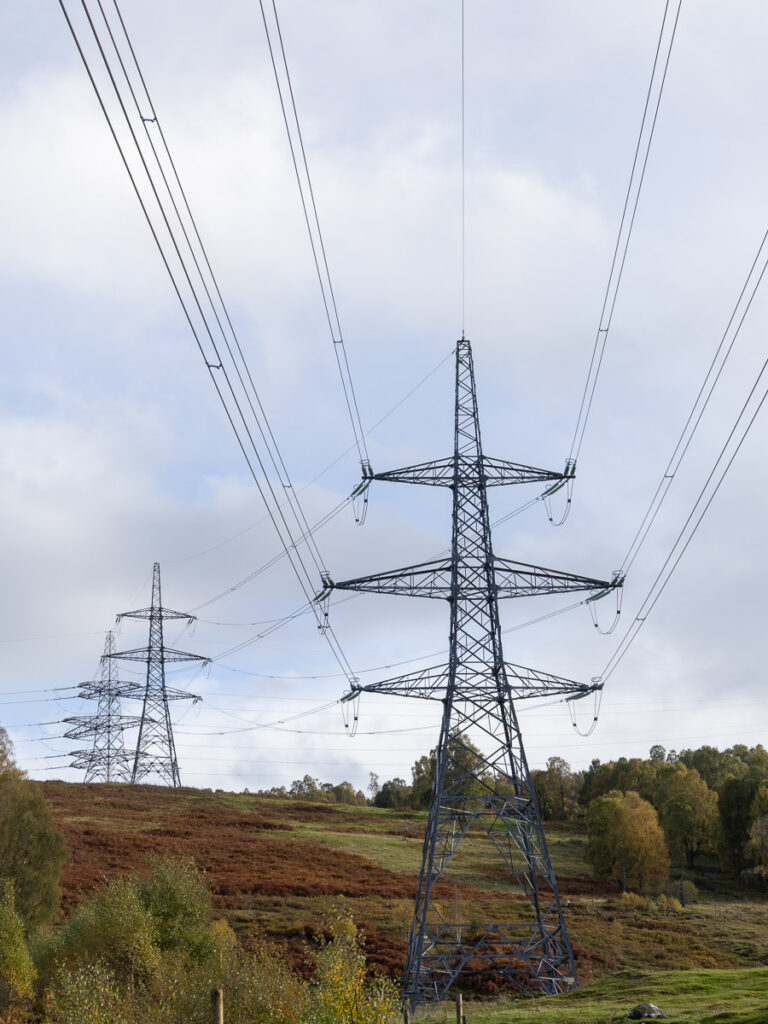
Photo: Cliff Green
Each time that a turbine blade passes a tower, a pulse of low frequency noise is flung out. This noise is too low in frequency to be heard by the human ear but it can still be sensed. Think of sound waves as waves of pressure and of turbine harm as barotrauma. Bats can die from pulmonary barotrauma if they fly near turbines, the blood vessels in their pliable lungs burst. In humans, turbine barotrauma causes neurological harm. My brain was rewired and my heart was hacked, it would race uncontrollably. I could tell if the turbines were on or off without looking. It is difficult to describe sensing a turbine other than to say that it is sensory torture.
When I explain turbine acoustic harm to people, they ask if noise cancelling headphones help, or sound absorbing panels. The answer is no. Blade pass emissions cannot be stopped from entering a home, or a body. These pulses can be as low as 0.1 Hz which means soundwaves that are vast in scale and travel many kilometres. I now live 14 km from the hyperscale power plant here in Shetland but I can still sense the turbines in settled weather. The taller the turbine, the worse the blade pass pollution. Ballach wind power plant must never be built.
Building wind power plants a safe distance from homes and workplaces would increase construction and operation costs and decrease profits. This is why the wind industry claims that turbines are safe. They argue that the harm is psychogenic in origin (we are simply stressed because turbines have been built in our view). Despite mounting evidence of direct harm to human health, governments concertedly look the other way and for a while I did not understand why but in Scotland, at least, the reason is becoming alarmingly clear.
Renewables produced more electricity than is consumed in the country for the first time in 2022. The construction of new energy infrastructure continues apace because Scotland is being positioned as a 'green' data centre superpower. Twenty-six hyperscale AI datacentres have been proposed so far. As Kassabova astutely observes in Borrowed Land, renewable energy infrastructure is being built in Scotland to open new markets for profit and not for the good of the planet. These profits do not stay in Scotland. Promised jobs do not materialise and fuel poverty remains. The energy company responsible for ecocide and harm to health in Borrowed Land is the same company that built the hyperscale power plant here in Shetland. Its main shareholder is BlackRock, named by the UN as complicit in the economy of genocide.
Shetland is not a wooded place and I am drawn to Kassabova's portrait of a low impact forester called Dylan. He extracts timber with Nomad the horse, a process that Kassabova describes as hard toil and bright joy. We meet him sitting on his cabin porch listening to rain falling on leaves. In spring, he listens for the sound of sap rising before planting trees. It used to rise in March but now rises in February. The power company intend to build a pylon where he is constructing a barn for Nomad. If he does not agree to leave, the land will be compulsory purchased. As Dylan concludes, We need renewable energy, but this is just wrong. Borrowed Land is a book ahead of its time, a clarion call that cuts through all the corporate energy company noise.
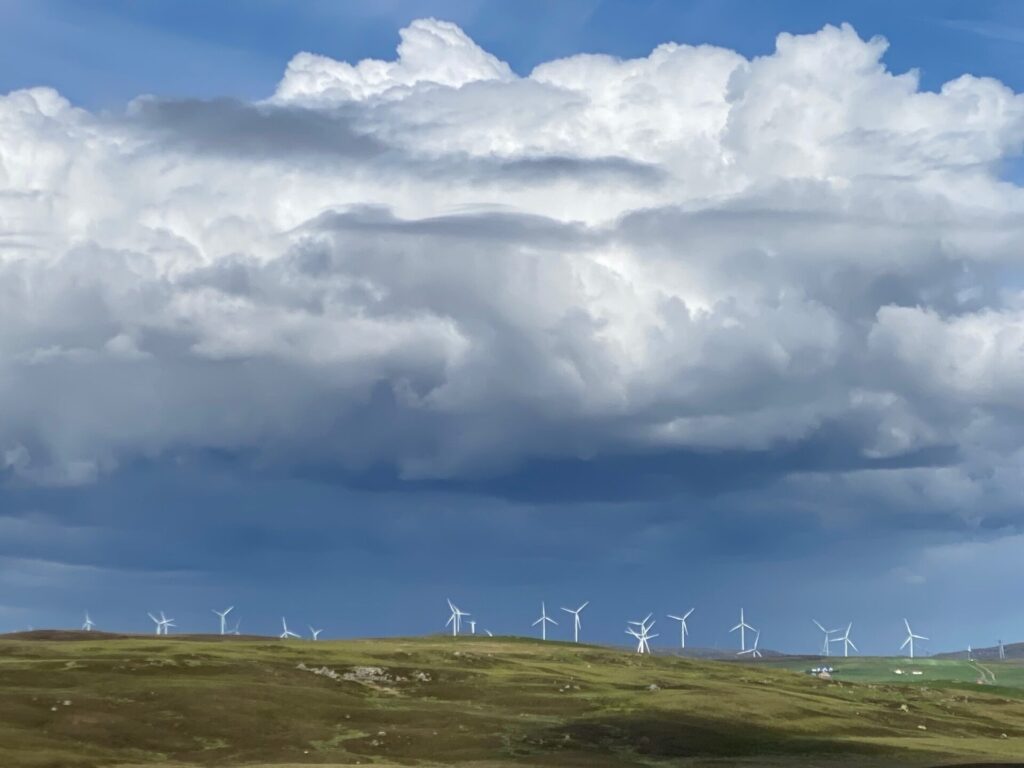
The 103 turbine Viking Wind Farm, Shetland. Photo by Sally Huband
*
Kapka Kassabova's 'Borrowed Land: A Highland Story' is out now and available here, published by Jonathan Cape (£20.90).
Sally Huband's memoir, 'Sea Bean', won the Highland Book Prize and 'saltwaterisland&', produced with Gaada, recently featured in the Dundee V&A Design and Disability exhibition. For 'The Book of Bogs' anthology, Sally co-wrote with Polly Atkin an innovative call and response piece on turbine acoustic harm.
 The National Vintage Fishing Tackle Fair [ 30-Oct-26 4:20pm ]
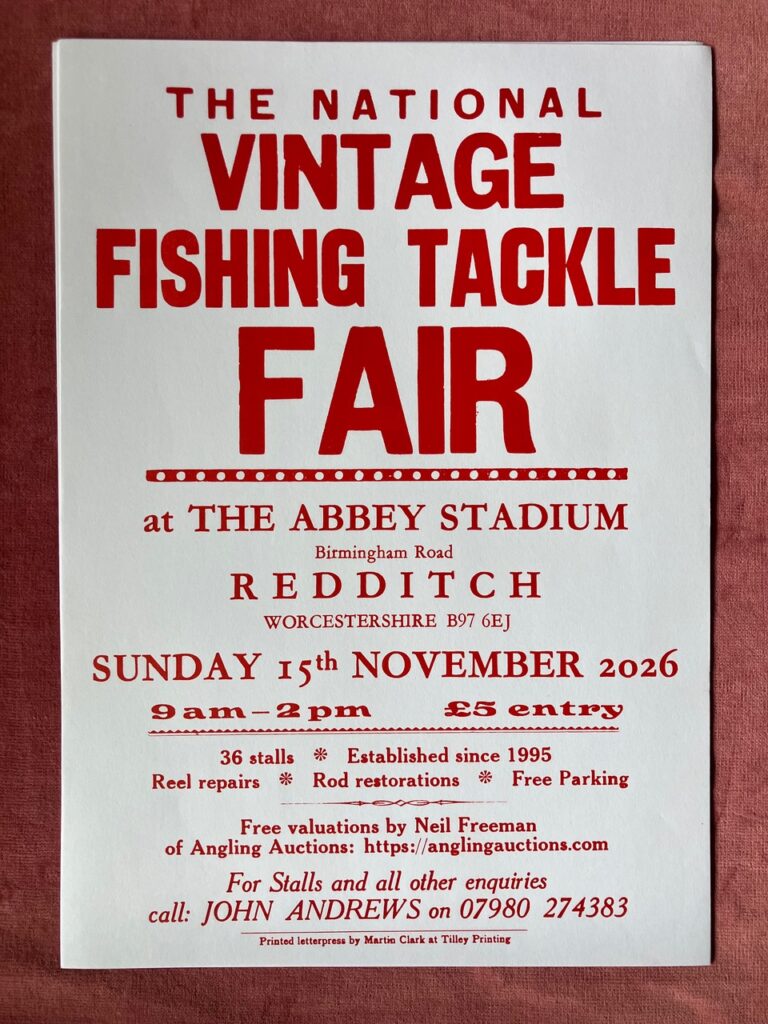
Sunday 15th November 2026
The Abbey Stadium
Birmingham Road
Redditch
Worcestershire B97 6EJ
Doors Open 9am
Doors Close 1pm
Entry only £5
Free car parking. Wheelchair Access. Cafe.
Sponsored by Angling Auctions.
The National Vintage Fishing Tackle Fair returns on 15th November for its much anticipated autumn 2026 edition which takes place at The Abbey Stadium on Birmingham Road in Redditch (B97 6EJ). Established in 1995 and running twice a year since the fair has grown to become the largest and most celebrated gathering of antique and vintage fishing tackle dealers, collectors and enthusiasts in the country with many visitors also in attendance from Europe.
Yet again it is sold out in terms of stalls with a full complement of stallholders weeks ahead of the fair itself. In addition to stalls selling antique and vintage fishing tackle Garry Mills from the Mill Tackle Company in Studley will have a stall offering on the spot reel repairs and advice as well as taking orders for his bespoke range of reels and Andrew Davis the master split cane rod builder will be exhibiting examples of his finest work and taking orders for individual rods from his range. Representatives of the fair's sponsor Angling Auctions will also be on hand to value and take in items of tackle for forthcoming sales.
Fair organiser John Andrews who has been running the event for the last twenty-one years is proud of its links and associations with Redditch and its history of fishing tackle making and is always keen to meet Redditch residents who may have worked or had family members who worked at any of the Redditch tackle firms be they big or small. He is on the door at each fair and looks forward to welcoming regulars and new visitors on 15th November.
'Pigeon Harp' by Bibio & Dorian Concept.
Taken from the beautiful collaborative album Answers, newly released on Warp Records — and a much-needed, gentle balm for whatever the hell is going on out there.
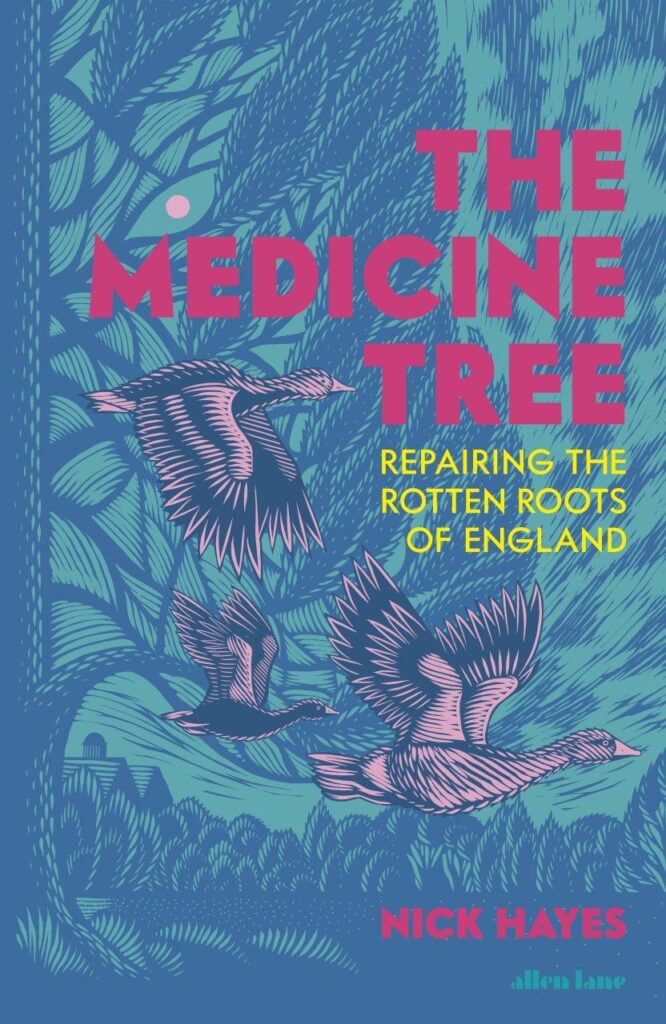
A rousing call to reach for the pitchforks, Nick Hayes' 'The Medicine Tree' — our October Book of the Month - shows that community and land culture grow and thrive wherever they are allowed to, writes Abi Andrews.
In the verdant home counties, among chequered fields and kite-flecked skies, is an Oxfordshire estate that appears much like any other — an arcadian emblem of Englishness; a signifier of assumptive hereditary power. But something radical has taken root. Since the 1970s, the Lord of the manor has been practicising organic farming on some of the estates' lands, has opened up some of that land to others, and around this, a mixed community of growers, rural skills keepers and heritage craft makers has formed. Currently transitioning to become England's first community-owned estate, the Hardwick Estate will soon be handed from its heirs to the non-landed-gentry residents who have made their lives and livelihoods there over the decades.
Touching on so many things that tangle back to the rot at the heart of contemporary England, Hardwick is the setting for Nick Hayes' spirited investigation into hereditary land ownership in the UK, its inextricable links with ongoing global colonialism, and the contradiction at its centre, between owning land and belonging on it.
Estates have their tentacles around the world, gaining their wealth by extracting it from elsewhere, and this particular estate has the origins of its wealth ensnared with railway expansion across Canada — the opening of frontiers that enabled the thieving of land and resources from Indigenous populations who lived there. This period saw a clash of two very different worlds. One had a reciprocal relationship with the animate land on which its sustenance and flourishing depended. The other had a rational, alienated conception of land as something that must become the exclusive possession of a person, usually a man, by right of a deed written on paper. Hayes deftly sets this up as a kind of magical thinking — a spell we have been hoodwinked into.
And the crux of his argument is that the colonialism that allowed for the accumulation of such wealth and power was begun, tested and perfected, on home soil. The very methods by which Indigenous people are colonised around the world — the theft of land, exclusion from means of sustenance, as well as the cultural genocide committed by the distruption of ceremony and the banning of song, dance, language — much of this was practiced first when the commons were taken from the peasants of England. We find ourselves a landless people, deprived of our indigeneity. Now this claim might be a risky one to make if handled less nimbly, and a review short as this one can't do justice to the way this is done; you will simply have to read the book. But to condense to a sentence: belonging to land is not about descent but instead relation. We are at the far end of a process that colonised countries and peoples are still undergoing — that is, almost absolute alienation from the land and its spirit. They honed their spirit-breaking on us. We have more in common with the peasants of the world than we are led to believe, and it is only for the good of the powers that be that this is disrupted and hidden from us.
Hayes finds glimmers of an animist past lingering in English stories and traditions, but much of his evidence comes from what he finds growing at Hardwick, where a land-based culture has been given space to flourish. Before arriving at Hardwick, lots of its inhabitants were squatters, drifters, boaters, travellers. In its ways, the community is fumbling towards a memory of being-of-this-land (we might call it indigeneity where we take this to be about being-in-relation) — at Hardwick new shoots appear from something severed but never killed off entirely. There is no going back to the commons, but neither are we detached from its history.
I must admit, I was a little skeptical of this book and its premise at first. That comes from my own prejudice against what I will call philanthropic landlordism. Like with another such landed-gentry-redemption-story that has taken the publishing world by storm in recent years (I'm talking about Isabella Tree's Wilding) there is something of the fervent platforming of decent acts by people with the means to undertake them that rubs me up the wrong way. Why do we so enthusiastically praise the inheritors of wealth for being a bit less rubbish with their massive assets? Often these rewilding initiatives come about because the estate can't turn a profit and there are grants available to change their land use. Hugh Crossley, heir of the Somerleyton estate in Suffolk, told Countryfile that his main motivation for rewilding his own estate may have just been to be contrary to the Victorian-garden-sensibility of his father. I don't trust philanthropy, I don't trust leaving important work to the whims of rich people, holding out for those whose vastly disparate worldviews might line up with your own on some ethical planes or whims.
Likewise, where estates are opening themselves up to the enterprises of us commoners, it's not even necessarily from a sense of responsibility or even generosity, but rather that deteriorating estates have become harder for one family to manage. Let someone set up a vegetable enterprise in the crumbling kitchen garden! I have twice been to the Organic Growers Gathering, a small festival that has taken place on the Hardwick estate, and attended talks on exactly this tactic of landless landworkers approaching estates in order to get access to land on which to grow food for a living. There was a bristle from some in the crowd, it felt like coming with a begging bowl — a bit too on the nose in its likeness to feudalism. A comparative viewing of the recent film Our Land (based on another arm of Hayes' land-rights work, the Right to Roam campaign) gives countervailing profiles of three estate owners who are wholly against (or tepid in their acceptance of) peasants even setting foot on their land for an afternoon stroll, let alone giving them over to community ownership and disinheriting themselves. Isn't Hardwick just a utopic anomaly, reliant on the whim of a guilt-ridden heiress?
But Hayes has preempted my reservations. Hardwick isn't allowed to stand simply for goodness prevailing because alongside it is the neighbouring, evil twin estate, Mapledurham. This tale of two estates does a fine job of tempering any optimism with the futility of what we are up against. Hayes' friends on Mapledurham face eviction from the house they have lived in for decades, and their story is as horrific as it is ordinary. Their change of fate at the passing of the land to its new heir reveals the precarity of philanthropic landlordism, and its dependence on the whims of a landlord's personality or politics. And yet more dispiriting still, the landed gentry are a dying breed. Hurray! But wait…the new aristocracy that replaces them are multinational corporations and globally, extractivism is more intense than it has ever been. These corporate bodies can't be hoped to have a change of heart about their dubious inheritance — they're not even people. The lord of the manor starts to appear a rather simpering, tame foe…
The Medicine Tree gives us something to work with, a vision, and visions can be replicated. Visions can be multiplied and stacked, so that you might imagine every manor house taken over by the common people. This isn't unprecedented — there are communities living in the derelictions of wealth and power across the UK: old Georgian rectories, halls, and once-stately houses. The Old Hall in Suffolk, or Braziers Park, also in Oxfordshire, are examples. The book stokes more militant impulses too. Will Hayes throw a rock through the window of the evil estate's mansion? Might we be incited to storm and squat all the stately homes that sit empty? And what if we just ignored it, this magical thinking of landlordism? A nice accompaniment to reading is to go along to the William Morris gallery for their current exhibition Earthly Paradise: Radical Alternative Living in the UK, for more on the UK's colourful history of squatting, or taking the housing it needs.
But I think the main thing I have taken from this book is that community, given the means, wants to be, it flourishes. Hayes puts specifics on what exactly it is you are missing when you are yearning for 'community'. It's a Ceilidh band. It's dancing, it's creating new rituals. But most importantly it's mutual aid, coming to the help of your 'kith' and knowing this will be reciprocated. "I'm wondering if land culture just grows like weeds," Hayes ponders. So too, community. There is a sense of completeness in that, at a place where the walls once guarded exclusive flourishing, mutual aid has popped up like dandelions. This answers in a way my initial hesitance at using a setting that doesn't seem replicable — because it's not so much the rock Hayes is showing us, but the moss. Community need not wait for the perfect conditions (like a disinherited estate) to be able to build itself. Hardwick's community built up over the decades prior to the estate's handover. What Hayes shows us is that even where its future is on shaky ground, might collapse or have the rug (or housing) pulled from under its feet, community wants to be.
Peasantry is in vogue, on the very fringes of the UK at least. Courses on landwork offered in London are churning out Level 2 qualified organic horticulture students, and an opening in a market garden in the city will receive hundreds of qualified applications. Training centres are setting up, offering more routes to land skills, like the Apricot Centre in Devon or Black Mountains College in Bannau Brycheiniog. This training pulls in first generation land workers from all sorts of backgrounds, many of them burnt out from modernity, and looking for a way to reconnect with the land around them, myself included. Across the country, it's difficult to get an entry-level grower job without first undergoing a good deal of unpaid work. This is the tiniest bottle-neck, and it is unbeknownst to most of society. But it's there and it's wearing dirty Blundstones. It feels to me sometimes like we might be living through a back-to-the-land moment like was had in the 70s. But whereas the 70s iteration was a movement towards self-sufficiency, this time, we will go together.
It is only a taboo against the tearing of pages from books that stops me from slicing Hayes' illustrations out to frame them. The book is lively, pacey, and the embeddedness of Hayes living in and from his subject is snug to the book's own endeavour for placeness — he's in the Ceilidh band with the rest of the book's cast of characters. It's participatory writing, and you feel swept up into the throng of it too. The eponymous tree of the book's title has a mythic quality, in the way it conducts all of the topics of the book like a lightning rod. It's almost uncanny the serendipity with which the tree, the setting, and our narrator all fit around the subject, and this manages to never feel ham-fisted. You get the feeling Hayes was born to moor his boat next to the Medicine Tree, to write this book, which might in part carry forward the land-movement he calls our attention to. It might sit alongside its moment in a similar way that Wilding does against the current appetite for 'rewilding' land, but instead adjacent to the land's re-commoning. The Hardwick community has set the tone. One heiress is already atoning. Pick up the pitchforks then, let's go.
*
'The Medicine Tree: Repairing the Rotten Roots of England' by Nick Hayes is out now and available here, published by Allen Lane. Read an extract from the book here. Read an interview with Nick Hayes here.
Abi Andrews is a writer, researcher and conservation worker. Her debut novel 'The Word for Woman is Wilderness' was published by Serpent's Tail, and she is currently working on a nonfiction book about solidarity with animals.
'Contrary to what the law might say, building a castle on common land doesn't stop it being common land. Its past haunts its present' writes Nick Hayes in his latest book, 'The Medicine Tree' — a beautiful exploration of the journey the Hardwick Estate is taking to repair its colonial roots, and our October Book of the Month. In this month's author interview, Nick speaks to Tallulah Brennan about the countryside as Arcadia, how education comes into the problem of land ownership and reparations, and what a reassertion of a commons culture might look like.
Read an extract from the interview below.
I'd like to start by talking about homes, which are a constant theme in The Medicine Tree. There's the huge house of the Hardwick Estate, but there's also the homes on neighbouring land whose inhabitants are facing eviction who you follow throughout. Yet, as you say, 'eviction is so commonplace that it is not a news story'. Can I ask if you find England to be an easy home, given your growing knowledge of how well practiced it is in destroying the homes of others?
Well, no. Unless you own land in England, which actually very few of us do outright, then the notion of home is always married to a precariousness. That's not just a weight on our shoulders in terms of our security and how we feel about setting down roots, but it also affects how we view our responsibilities to a place too. If you really are rooted in a place, it becomes very clear that it's your place to defend. What the book is about is trying to look at England from a kincentric philosophy, inspired by indigenous nations, who, in spite of colonisation and imperialism, still have this real sense of themselves as guardians of the land they're on. That's a very healthy lesson which England should seek out; very awkwardly, from the very people we owe the most reparations to. Whilst we're watching our rivers be polluted by, say, chicken farming corporations, we're all aware that the government is not doing their bit to protect these natural resources. What we lack, through having been enclosed out of nature for so long, is a sense that it is our duty and responsibility not to wait for organisations and institutions to rise up and defend them, but to actually do it ourselves.
Also, being a guardian of your land when you're having to guard your own stability, whether that's through fighting an eviction or paying your extortionate rent, makes for an almost impossible task. People regularly have to move on from their homes, and so people cannot stay attached to somewhere. Even if you can stay somewhere, a consistent theme throughout my life is that there are lots of things I could get involved with, but to make rent, I don't have the space in my life outside of work to commit to my surroundings, which also would sew my life into other people's.
I was blown away by the statistic that on average we're paying 2/5ths of our earnings just to exist in the space that we do. That's every Monday and Tuesday, say, of our week going to someone who already has the privilege of exclusively owning the home. Therein lies the trap. When they took away our commons, they took away our autonomy over our time, our work and our wage. Now we find ourselves working incredibly hard to stay afloat, let alone do activities that would forge community. This is why policies like a universal basic wage would free people. It is in a way, a reassertion of a commons culture. We have our subsistence sorted, and we can do less work for someone else, and more work for our community.
With this in mind, something I thought it was really interesting to read about the owner of the Hardwick Estate's desire to relinquish ownership for a sense of 'relief'. The heiress says she wants to 'release future generations from the tie of inherited land which has been a painful burden to several generations of our family.' This idea of a burden, I might expect to hear in the campaign materials of the rentier class, from people who are regularly evicted, but not from the landowners. I think my assumption was that the huge house, the acres of land and so on, are containers of stability and privilege and therefore a contentment with life. Could you speak about why that isn't the case, not just at the Hardwick Estate, but across the landowning class?
What it does is dissolve the idea of goodies and baddies. Actually, this is a system and an ideology that neither serves the people who work under it, nor the people who operate above it. One of the landowners interviewed in the Right to Roam documentary, Our Land, is lovingly looking on at his three children playing, and saying that at one point he has to decide which one of those three gets full title to the land. Therefore deciding which of the other two will be essentially disinherited. That was a very good example to me that customs of exclusionary ownership set divisions right through families as well. It leads me to say that you can quite happily call this exclusionary ownership model ecocidal. As with the Hardwick's history, you can see how mining and industrial agriculture has been used to make profit out of land, but even for the people who oversee this, it fosters paranoia, and isolation from the community who resent this person's power over them. I say in the book, of all the people who are connected to the land, the people who are most ostracised are the very people who own it. Even if they're at the village fête, they are excluded by their right to evict. There is a clear resentment there. It reminds you why the commons is so much more than areas of land, it's a political paradigm that sees people united. No one has the right to exert power over someone else. As a basis for a community, this is a very healthy foundation.
*
Sign in or subscribe via Steady to read this interview in full. Paid memberships help us secure the future of the site, in exchange for monthly author interviews, seasonal reflections, discounts in our Bandcamp shop and more.
'The Medicine Tree: Repairing the Rotten Roots of England' by Nick Hayes is out now and available here, published by Allen Lane. Read an extract from the book here.
Nick Hayes is an award-winning writer, illustrator and land justice campaigner. In 2020 he co-founded Right to Roam, the influential campaign group advocating for public access to nature in England. He is the author of, among others, the Sunday Times best-seller 'The Book of Trespass' and co-editor of 'Wild Service: Why Nature Needs You'. An acclaimed artist, he has published four graphic novels and exhibited across the country, including at the Hayward Gallery. He lives on a canal boat with no fixed address.
Tallulah Brennan is a writer based in England, interested in the relationships between humans and their environment, and how they in turn shape each other. She is also a contributing editor at Caught by the River. Follow Tallulah's Substack here.
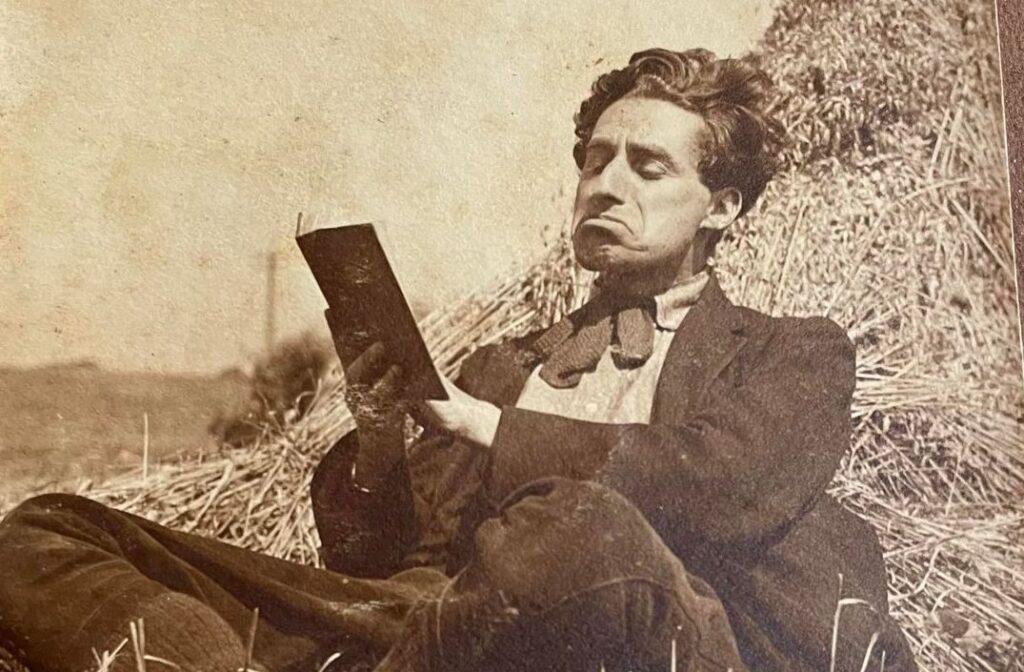
Victor Neuburg in haybales, West Sussex, early-1920s. Photo copyright Justin Hopper
In 1924 the poet, publisher and occultist Victor Neuburg was visited by unidentifiable spirits in his cottage in a small Sussex town. As he later put it, these voices 'dictated' poems to him - streams-of-consciousness pieces of prose steeped in esoteric symbolism. He wrote them down, nearly 100 pieces of writing, into the form of a book he called The Water Bearer.
And no one would touch it. None less than Ralph Shirley, the editor of The Occult Review, told Victor that these were unique, wholly original, works, but 'what publisher would risk it?'
For the next 100 years these poems sat, mostly unread, in a family chest. Until now. Victor Neuburg is best known as the magical (and sexual) partner of Aleister Crowley; as the man who discovered the poet Dylan Thomas; as a funny name that comes up when mentioning just about any aspect of early-20th century British counterculture. (An anarchist who advocated for gay rights and prison reform; the living connection between the Decadents and the Surrealists; friend to Austin Osman Spare and inspiration to Peter Warlock; early champion of nudists and yoga; the list continues.) His published poetry books now sell for hundreds or even thousands, but perhaps his greatest-ever works - those which best espoused his bizarre hodge-podge of occult and spiritual beliefs - have been read by almost no one alive.
Vine Press will be publishing these works as one of the last wishes of Caroline Neuburg, the poet's granddaughter, who dove deeply into them - her copious notes on the symbolism in the works will act as introduction to the book The Water Bearer and Other Lost Works of Victor Neuburg.
You can pre-order, and help make it all happen - a century in the making - until 30th October via Kickstarter.
With the initial funding target reached, the project is now aiming for a stretch target of £18,500. If this amount is reached, a new reward will be added to the pledges (at no additional cost) — a zine of Victor Neuburg's unknown 1920s writings about his beloved county of Sussex, its folklore, history and landscape. Everyone who ordered a copy of the limited-edition hardback book of The Water Bearer will also get this zine, at no additional charge.
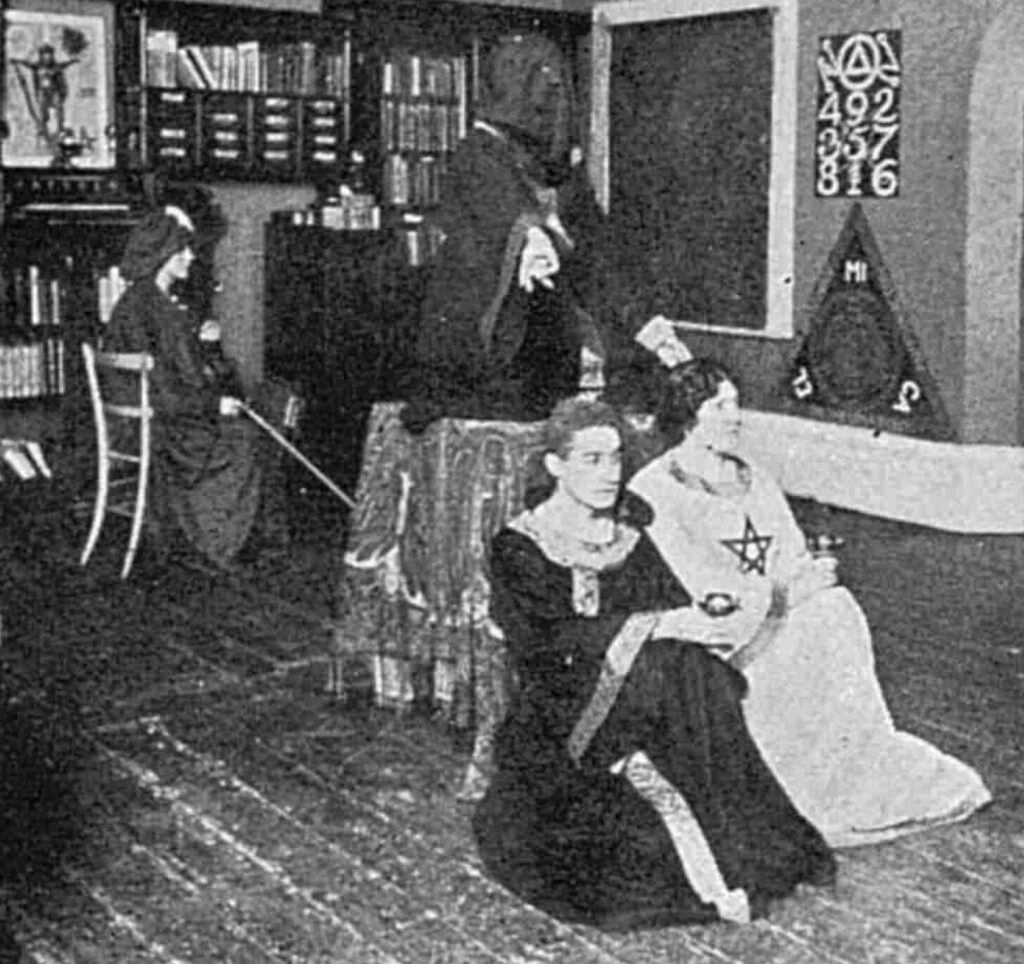
Victor Neuburg (almost certainly), Rites of Eleusis, London, 1910. (From The Bystander, 1910)
Elizabeth Sulis Kim's 'The Book of Beasts' removes the distinctions between humans and animals, encouraging us to be less bordered, less exact; more beast, writes Anna Goldreich.
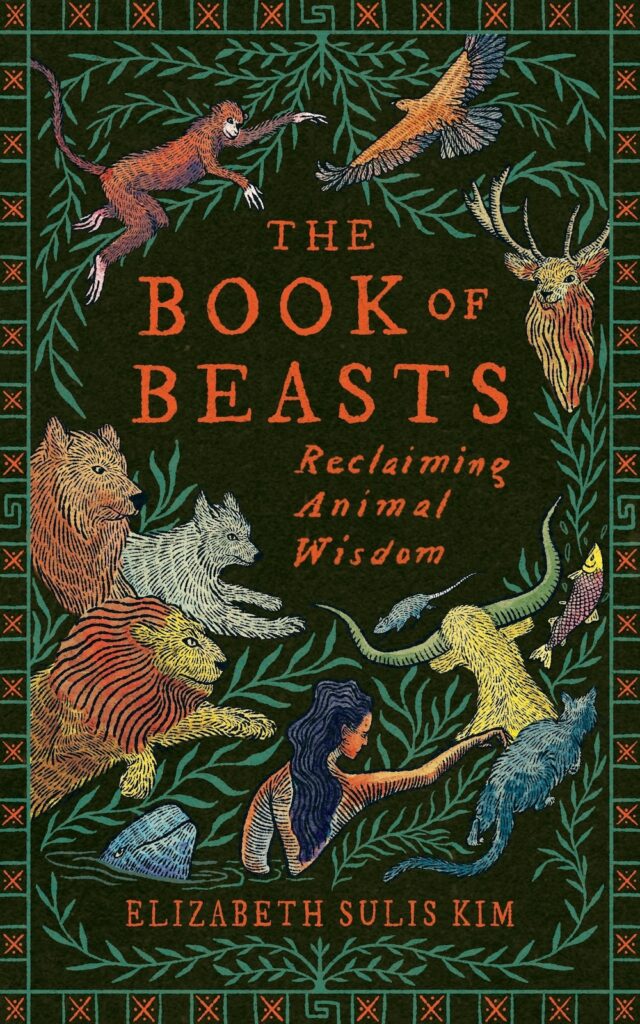
As a child, Elizabeth Sulis Kim felt aware of her place within the world of creatures that she encountered, the bats and birds that flew around her, the cows who lived close by, the cat who would accompany her for walks. She found it 'impossible not to see a web of life… [she] saw other animals as [her] equals.' As adulthood approached, and she moved into that strange, self-conscious place of adolescence, Sulis Kim found herself feeling alone, alone in a forest, though it was full of lives, full of small beings. She had, over time, become 'more sharply human, more bordered and exact, less free - less animal.' I think this is something many of us relate to, this movement into school and work, supermarkets and bills, rent and commutes. Soon, the bodily animal slips away. The Book of Beasts reads as Sulis Kim's attempt to explore this loss, to follow the animal to the 'Otherworld', and to find it again.
Elizabeth Sulis Kim does something rare and wonderful with The Book of Beasts. She manages to weave science, folklore and history together with personal account into something beautiful, evocative and lyrical. Through lilting and vivid language, we are taken on a journey through continents and countries, we move from the past to the present, and into the future with ease. The contents of the book are vast, spanning time and place, but I never once felt lost, never felt left behind. Sulis Kim is so assured in her writing and in her storytelling, that I felt comfortable and excited to follow her wherever she might lead me.
Over the course of the book, we get to know twelve animals. We encounter Lion, Rat, Wolf, Bear, Bird, Cat, Cow, Salmon, Monkey, Whale, Deer and Human. Each animal chapter is preceded by a beautiful illustration by Kaitlyn Copithorne. These images bring to mind a tarot card. There is something magic here, prophetic even, and imbued with more meaning than meets the eye. So I have picked my first card, the Lion, how do I read it? What does it mean? Sulis Kim introduces the reader to the animal in question, we learn about this animal in relation to folklore. We are told stories, tales which have been told and retold since the beginning of our collective memory. We learn about the different ways that humans have thought about animals, how we have worshipped them, used them as symbols, projected onto them, scapegoated them. Animals have always been such a big part of our lives, and now our relationship to them has changed. It's important to spend a while with this change, to learn about the current state of our relationships with these individual animals, how we harm them, how we farm them, or hunt them or rob them of their habitats and their food. Also, how we might be able to help, how we might go about repairing our bonds with them.
There are aspects of The Book of Beasts which could almost be seen as travel writing. Sulis Kim has travelled extensively, has encountered different people and animals across the world. She is open and curious about the people she meets and their relationships with the creatures who live alongside them. All these encounters feel equally special, from talking with a man in Istanbul about his love for the feral cats he feeds, to drinking mate in Playa Paraná, watching a whale appearing and disappearing into the water, only metres from the beach.
This book is also highly personal, we get to know parts of Elizabeth, the writer, the person, the creature. This is one of the aspects of the book that I most adored. We are given pieces of a life. We learn something of how she came to her research, but also how she feels about these animals, her relationships with them individually. In the Cow chapter, we read about Sulis Kim's experience of growing up vegetarian in a rural part of the UK, she tells us, 'a friend's father suggested I had been indoctrinated.' (an experience which resonates with me, as a person who also grew up vegetarian in a farming village.) She remarks, 'animals are our friends… who would want to eat their friends?' and I completely agree.
The Book of Beasts is written with such kindness, sensitivity and empathy, directed towards animals and humans alike. The book closes on the final animal, the Human, because, as we see throughout this book, we are animals too. This need to know and to repair our relationships with non-humans, is the need to know and repair our relationships with ourselves. As humans, we position ourselves as separate to and above non-human animals, but we see throughout The Book of Beasts that this distinction has not always been so stark. Perhaps it's time to find our way back to them, to listen to them and respect them, the beasts.
*
'The Book of Beasts: Reclaiming Animal Wisdom', which was our September Book of the Month, is out now and available here (£22.90), published by Chatto & Windus. Read an extract from the book here, and an interview with Elizabeth Sulis Kim here.
Anna Goldreich's debut novel, 'The Leveret', was published by Hamish Hamilton in June 2026. You can follow her on Instagram here.
Huge congratulations to Hannah Peel, whose Underland score has been nominated for an Ivor Novello award!
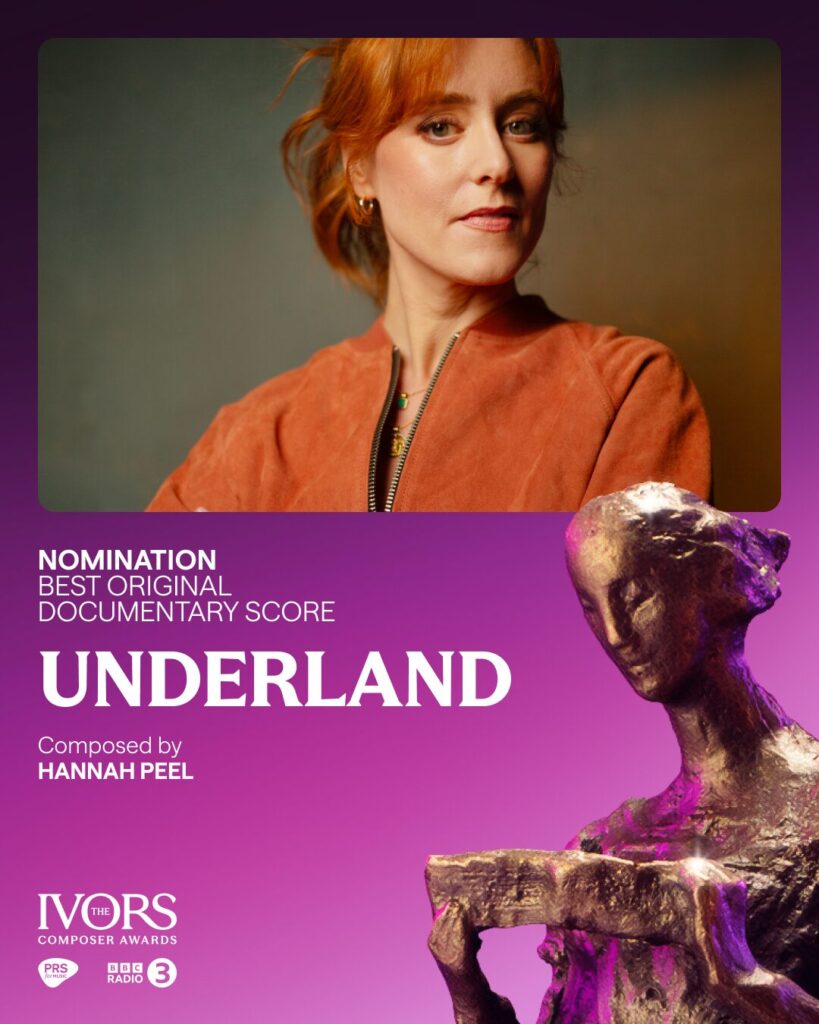
The winners will be revealed at The Ivors Composer Awards, sponsored by PRS for Music and in association with BBC Radio 3, on 17 November at Grosvenor House, London.
Stream or buy Underland here via Bandcamp.
A world premiere of the score takes place as part of the Hannah Peel In Focus series at the Barbican on 23-24 October 2026, for which very limited numbers of tickets are still available.
Without a culture of reverence for our land, is it any wonder that it is ailing? ponders Nick Hayes, in an extract from 'The Medicine Tree', our October Book of the Month.
I had spent most of my summer in the river. I swam for exercise, but also for sheer bodily delight, sliding beside the red veins of the willow roots, writhing around submerged tree trunks like a snake in the mangroves, exploring the secret arbours and coves concealed by the falling cascades of leaves. These little ignored places, where the crayfish dig their nests in the clay, had become my favourite haunts and I would hide my naked body in them when the plastic boats of summer daytrippers rushed by, smeared in silt, wrapped in hornwort, like Jenny Greenteeth, unseen in their wake.
In these secret groves, I would meet coots and kingfishers,electric-blue speckled dragonflies, and, most commonly of all, the river's rubbish. These sheltered coves are an Aladdin's cave of shite, a thieves' horde of detritus snagged and clogged for decades in the bankside roots. I would pull out old butane canisters caked with blue-grey clay; industrial baling wrap; cracked plastic tubs; webs of translucent fishing wire, each with a needle-thin hook trailing somewhere beneath my feet; infinite flimsy, yellowed plastic bottles, whose rust-coloured waters poured out of cracks as I lifted them; and harder, industrial bottles, brittled with age, that spilt what remained of their chemical concoctions back into the river.
Rivers used to be gods. Now they are sewers, run-offs for a catchment of shame that includes much more than sewage and litter: microplastics, pharmaceuticals, factory waste, chemical fertilizers from industrial agriculture, heavy metals from our motorways; it all seeps through the soil, and ends up in our rivers. The lowest point of our landscape, rivers now express the nadir of our culture: they tell a story of a society that has somehow normalized undrinkable, poisoned water. Meanwhile, English society is cracking; in the cities and towns, angry men gather around statues, draped in the Union Jack, burning cars and attacking migration hostels, defending a story of this land that ignores the land itself.
That summer, as I swam, I wondered what mantras, philosophies and cultures existed on this land before the story of England was harvested and bale-wrapped into what we have today. It seemed an act of extreme exceptionalism to suppose that we were the only country on earth not to have had a spiritual, mythopoetic relationship with the land, unmediated by its 'owners'. But if there was such a land culture in England, I knew nothing of it. Why? The Māori were colonized by Britain and by France, by war and by treaty, their culture vandalized by physical and psychological violence wrought by invasive forces. But how had our land culture - our stories, practices, songs, dances and rituals - been taken from us? And without a culture of reverence for our land, is it any wonder that it is ailing? It seemed a complicated, grotesque irony for a country which had systematically destroyed traditional, indigenous cultures across the globe to be in such desperate need of one of our own.
*
Nick Hayes' 'The Medicine Tree: Repairing the Rotten Roots of England' is out now and available here, published by Allen Lane.
Happy CD release day to Hannah Peel's Underland - out today on our Rivertones Label!
Adapted from Robert Macfarlane's bestselling book, directed by Robert Petit and scored by Hannah Peel, Underland is a mesmerising cinematic journey into the depths of the earth. Beginning in the shallow soils beneath an old ash tree, 'astronauts of the underworld' travel into ancient sacred caves, flooded storm drains, melting glaciers, underwater burial chambers and a deep underground laboratory built to solve the mysteries of the Universe.
Buy your copy here.
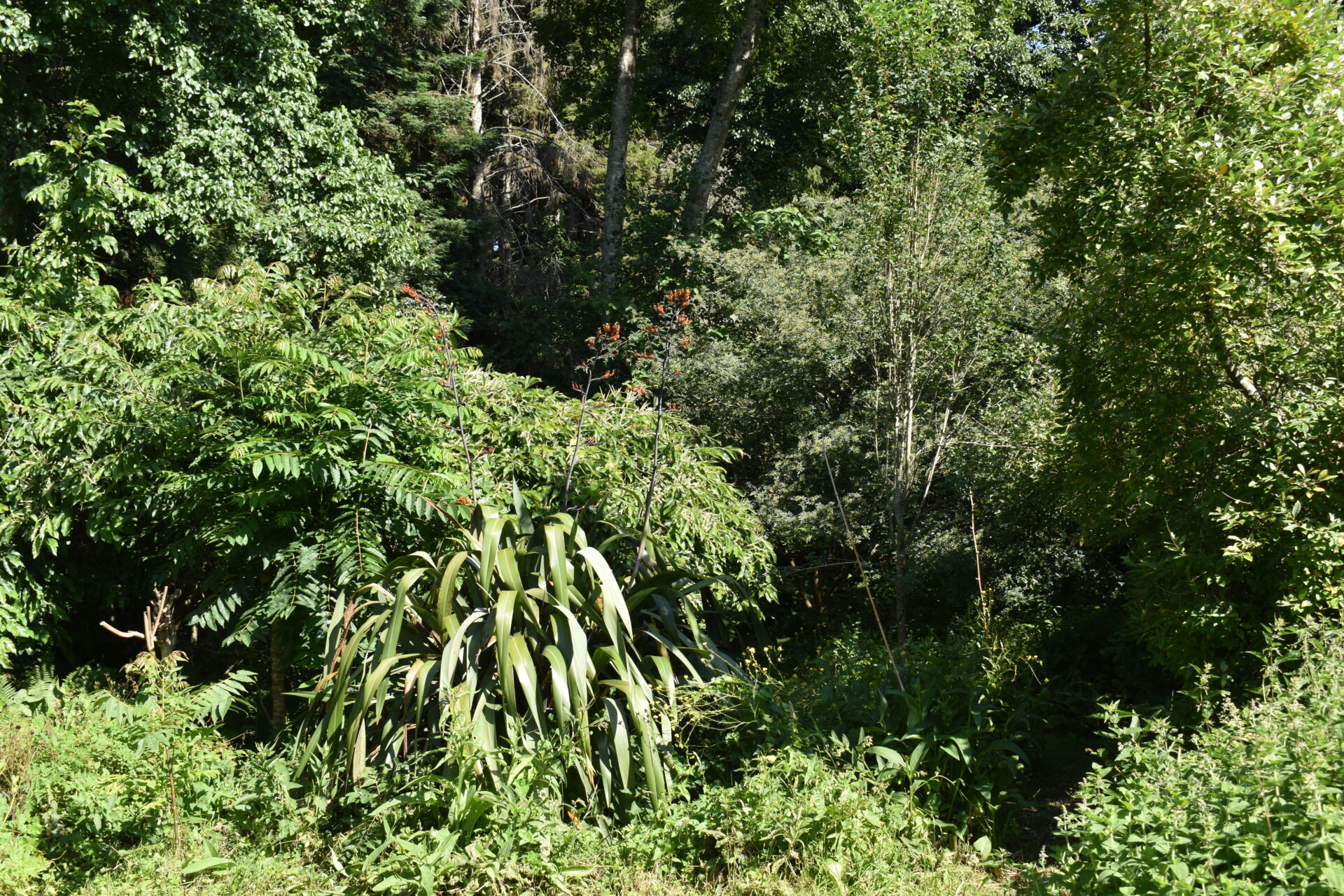
In March last year, we shared news of the Dartington Hall Trust's intention to end the lease of The Agroforestry Research Trust's groundbreaking 2 acre food forest project — housed on the Dartington Estate for the last 31 years. The garden has brought over 50,000 visitors to the estate, hosted important scientific research on carbon storage, and become what is often described as the best example of a food forest (or forest garden) in the temperate world.
Excitingly, ART now has the opportunity to purchase the forest garden, which will safeguard it in perpetuity!
ART has already raised some of the funds, but are looking to raise £100,000 towards the total needed to cover the sale price and legal fees. Whatever you can afford, it will all help and you will know that you have contributed to securing the forest garden for future generations. If you are a UK taxpayer then ART can also claim Gift Aid on your donation.
Forest gardens (also known as food forests) are long term sustainable integrated growing systems including trees, shrubs, perennials, annuals and fungi. They produce food or other crops while being highly resilient to pests, diseases and weather extremes; and at the same time storing a large amount of carbon. In the light of the climate crisis leading to a rapid increase in extreme weather events, the need for forest gardens has never been greater.
Almost half the money has currently been raised, with donations closing at the end of the month.
You can find out more about the project and donate here.
Just one week to go until Hannah Peel's Underland soundtrack crawls out from beneath and hits the physical realm.
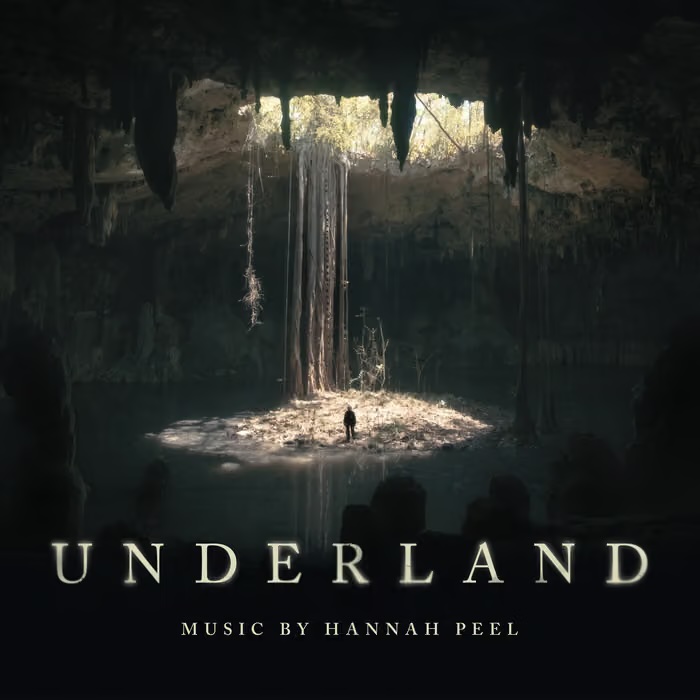
Adapted from Robert Macfarlane's bestselling book, directed by Robert Petit, and scored by Hannah Peel, Underland is a mesmerising cinematic journey into the depths of the earth. Beginning in the shallow soils beneath an old ash tree, 'astronauts of the underworld' travel into ancient sacred caves, flooded storm drains, melting glaciers, underwater burial chambers and a deep underground laboratory built to solve the mysteries of the Universe.
Stream / order your CD copy here via Bandcamp.
A world premiere of the score takes place as part of the Hannah Peel In Focus series at the Barbican on 23-24 October 2026, for which very limited numbers of tickets are still available.
'Real Magic' by Star Moles.
Taken from the album Highway to Hell — released earlier this year on Dead Oceans, but only just reaching us via pigeon post. Very nice. Thank you, pigeons.
Autumn Ruins [ 07-Oct-26 4:51pm ]Coco Lone Neal is reminded that endings are beginnings, as she walks the ruins of the Sheffield Ski Village.
An early morning mist clings to the hillside and it is as if we are walking through a ghost, as if the ground were still smoking. My youngest is quiet against my back, bundled in her carrier, stormy eyes peering out. I grab the edges of my sleeves, pull them down across my fingers, picking at loose threads, unspooling.
A wren churrs and chatters and I hum in response. Hawthorns line our path, bare beneath the canopy where above is green splattered with red. Each footstep crackles with twigs and leaves, all is turning and falling, and this is what I love about autumn: everything is on the cusp.
Ahead, my collie Bear looks back to make sure we are near. She became ours through sheer stubborn love and would warn me if anyone was nearby.
Parkwood Springs is a palimpsest, hard to pin down as any one thing: a sandstone ridge formed 300 million years ago rising up from the River Don; an area dotted with pockets of ancient woodland carrying singsong names like Scraithwood and Rawson Spring; a former landfill always looming; graves peering out from bracken and ivy in Wardsend Cemetery, World's End; a motley history of hunting, mining, coppicing, industry, recreation, and now my local stomping ground without which I wouldn't have survived mothering through lockdown.
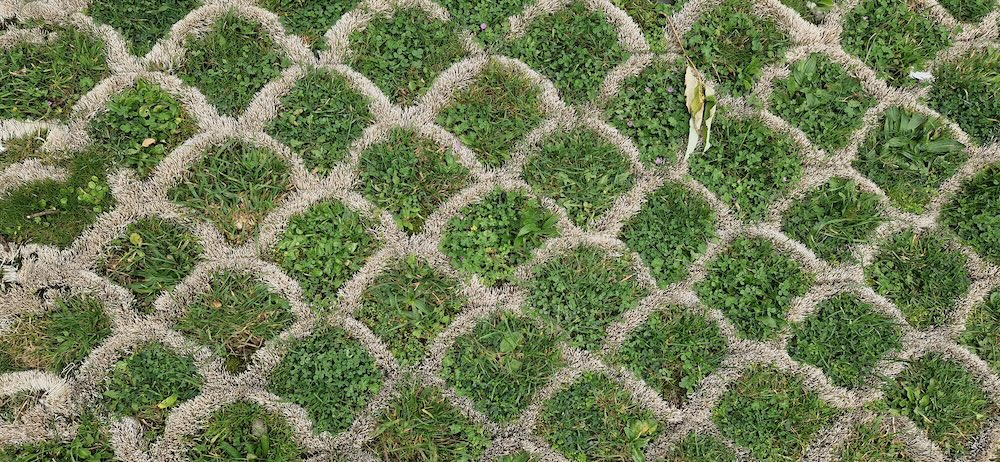
Ahead a barbed wire fence has an entrance cut into it and I squeeze through the gap, careful of my precious cargo. The ground is covered in a thick metal netting, a kind of diamond pattern stretching out in every direction, and where it hasn't worn away toothbrush-like bristles mimic dry snow. I walk towards the viewpoint, careful of every step.
I am walking on the ruins of the Sheffield Ski Village, the parts that survived the fifty odd arson attacks of the last decade. Built in the 1980s, it was once the national training centre for the British Ski Federation, and at its peak had 180,000 visitors per year. Locals used to joke, The Ski Village is on fire!, and half the time it was true: smoke billowing up from the city's edge.
On a clear day the views are spectacular - hills of terraced houses, towering apartment blocks, remnants of industry, and then, in the distance, the moors of the Peak District National Park. Not today. Today I shut my eyes and listen instead. Sheffield groans over the sound of the wind, a clunking, sawing, screeching, constant hum of traffic, whirring like a helicopter that never lands.
Carrion crows too, cackling and dipping and on more than one occasion I have seen them mobbing the odd, brave buzzard who dares to hunt nearby. When I open my eyes again just one remains, silhouetted at the top of a tall pine. There are many more out of sight. They will be there when the apocalypse comes.
Bear disappears into the treeline.
'Bear!' I shout.
'Mama!' I hear back.
My eldest daughter is herded into view, dragging her father after her, trying to wrench her hand out of his tight grip. The questions begin, Why are the leaves falling? Are the trees cold? Where do flower fairies live when the flowers are gone?
We make our way down a narrow path, bordered on either side by a dense thicket. The once plump and sweet blackberries are shrivelled and dry, as are the bitter nettle seeds, and the gorse's usually edible yellow petals are absent too, much to our daughter's vocal disappointment.
Buddleia has claimed the hillside here, spikes of soot-like flowers falling all around us. A peacock butterfly sparks. These are not the skeletal remains of a fire though you wouldn't be blamed for thinking so. Buddleia is often found in wastelands and gained the nickname 'The bomb site plant' for growing in sites of destruction during the Second World War. Classed as an invasive species I can't help but be quietly impressed by plants and creatures that can thrive in so-called dead spaces.
As we come to another clearing the ground flattens out before disappearing into one last steep drop. Here buddleia is replaced by pine, and the ground becomes soft underfoot as the metal netting is consumed by the hillside. It is too dangerous to continue with children, so we walk instead to the edge to peer over the ruins of a fire blackened structure, its bones jutting up from the scrub like a shipwreck out of shallow water.
The Ski Village was once the pride of Sheffield, driving its branding from industrial to outdoor city. In its final years I danced in a crowd of strangers here, staring out from a wooden platform onto the city that would become my home, its lights gleaming in the dark night. It is easy to stand here now amongst autumn ruins and slip into melancholy. Yet, there is a whiff of resistance, of survival against the odds as all around us green gains ground, lichen and moss patterning every hard surface, a sapling oak standing stark against the dying of the year.
I have been talking to my four-year-old about death and last night she clutched my face between her two small hands and said, earnest now, When you die, I will bury you, and surely that is the ultimate expression of love? Edges, ruins, wasteland, perhaps they call to us, like the changing seasons, to remember endings are beginnings, are transformations.
'Stop!' I shout, as she goes to pocket a shard of glass. She laughs, full of mischief, setting off her sister on my back.
We ascend another way, digging our toes into rusting metal as if pickaxing a mountain in the snow. I sway like a drunk in an attempt to rock my youngest to sleep but we are flanked on either side by life that wants to keep us there: rosebush, hawthorn, gorse, bramble, clawing at us the whole way up.
My eldest chatters in a torrent of observations, Crow! Spider web! Bottle! Holly! If it spikes you, say thank you! And then, as if remembering she too has a voice, my youngest chimes in, Down! Nothing is clean or fixed, no material stable, no colour alone, every surface is alive, porous, deep, surprising. Ruins bleed into the imagination, time itself is a playground. They climb the final few steps themselves.
One day people will pull up the metal and the shrubs, cut down the trees and build platforms, bring order and purpose, chase out the alcoholics and the artists and the ramblers. What will become of its ghosts, its particular turn of memory? What is it I desire to find here, to offer my children? I fight off entropy every day along with everyone else: take the bins out of sight, pull up bindweed from the garden, say no no no to death. Every season my daughter wants to name what we are losing whilst I try to show her what is to come.
We sit down, trees arching above us, illuminated at the top of a steep wild slope. The sun hangs low in the sky, grasses and mosses are enfolding sharp edges into the earth. The children press their faces close to the ground, investigating the remains of the old ski slope which now looks like hundreds of petri dishes, all lush effervescent green, as if the remains of summer have been framed for us, held for one last moment in stasis, before they turn as well.
*
I wrote this piece a couple of years ago and dug it out in light of recent developments. Parkwood Springs is a much-loved 150-hectare green space in the north of Sheffield, bordering communities identified as having some of the city's greatest need for access to nature. By the end of this year, tourism company Skyline Enterprises will be submitting their formal planning application to build a major outdoor leisure facility there. While we expected the former Ski Village site, which I wrote about above, to be redeveloped, the current plans extend into the surrounding area: an important habitat for wildlife and crucial for our own wellbeing too. If you would like to learn more or support the campaign to protect Parkwood Springs from overdevelopment, please sign our petition.
*
Coco Lone Neal is a mother, rambler, writer and associate at the Writers Workshop in Sheffield. When she isn't dragging her children and dog up hills in the rain, Coco is working on a book stitched together with river-blue thread.
Follow Coco on Instagram here.
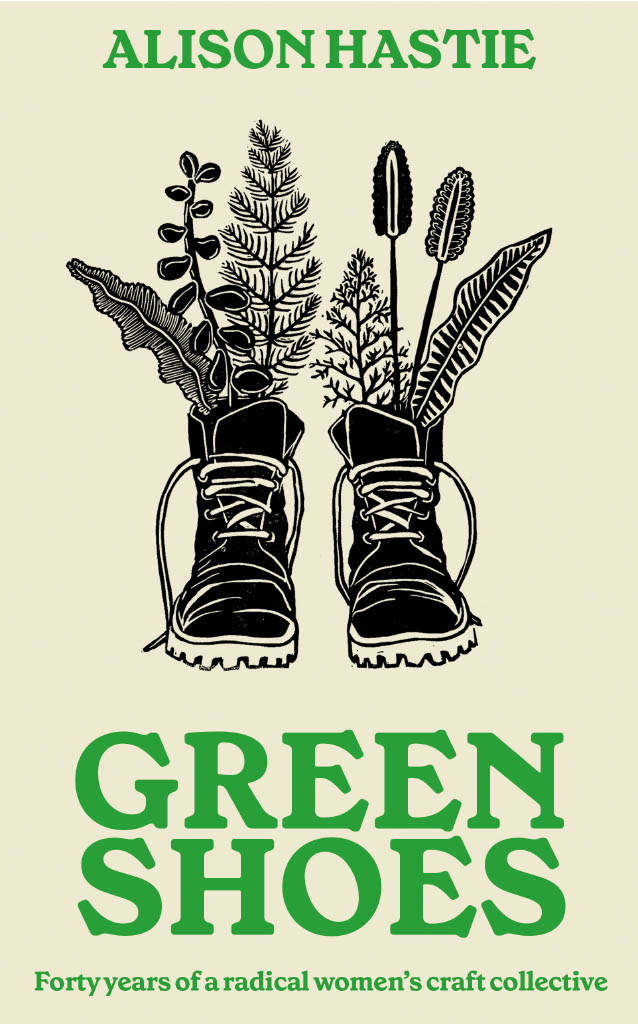
In an extract from 'Green Shoes: Forty years of a radical women's craft collective', published this Thursday by The Indigo Press, Alison Hastie recalls how she first pursued a career in shoemaking in the 1970s.
I knew that I wanted to earn my living using my hands. I had previously got as far as thinking about weaving, but shoemaking was, quite literally, a better fit, as shoes were a necessity for everyone and something I found difficult to find. I had no idea about how to become a shoemaker, so I went to the careers office on campus for advice. The interview was quite awkward, as the poor careers advisor was almost lost for words. 'We once had a student who wanted to become a thatcher' was her first response. However, she did make the very useful suggestion that I find work near craft workers so that I could pick up leads to a shoemaker or to shoemaking itself.
So that is exactly what I did. After my finals I got a summer job at Bickleigh Mill craft centre, working in the cafe and then running it. My plan worked: the wood turner at the centre told me about Hood Fair. He showed me a beautiful hand-drawn flyer advertising the fair, which was taking place midsummer near Dartington, south Devon. Somehow I had not heard about this village, which was a hotbed of radical bohemianism, so different from the conventionality of Exeter University and the rest of Devon at that time. It sounded fun and would expand my limited knowledge of what was going on beyond my university bubble. This was 1978, years before the internet and mobile phones, so contacts literally had to be made on the ground (it's already hard to remember the world where you didn't just search online for 'shoemakers in Devon').
That would have been my search because I loved being in Devon. I had grown accustomed to the simple rural life we had lived as students: growing vegetables, making our own bread and socialising with friends. I could just about afford to run my old Mini, pay my rent in a shared house and have a social life on my waitress wage. It wasn't a flashy lifestyle; you had to make it work as there was no such thing as a credit card. Living beyond your means was not an option and I was completely used to my hand-to-mouth existence. I was young with no debts, contracts or responsibilities beyond myself.
That midsummer Saturday I happily loaded my Mini with a blanket on which to sell my wares, a bundle of vintage clothes and some jewellery that I had made, to seek, if not my fortune, then some leads for my future. My previous experience of selling from a blanket on the ground was at Barsham Faire in Suffolk, just after my A-levels. Barsham was the precursor to Hood Fair, and it came to an end in 1976 as a victim of its own success. Too many people came, and at the end of the fair a leaflet was handed out on which was written the instruction 'Build another Barsham'. If you enjoyed this, it said, then go home and make one happen where you came from - and that's what a bunch of people did in Totnes.
Barsham was an amazingly simple festival, where the site became the size of a village for a week, attracting locals and alternative types from miles around. Stalls were built that could have lasted for years, selling wholefoods, bread, baskets, candles, jewellery and wooden bowls, many of which were made on site during the festival. It was full of activity and energy, and the sun always shone. Pennants were put up around the site, and there was a great sweep down to a wide-open space for performances from the many theatre groups and performers who turned up. Music was played on all manner of instruments; there was a medieval vibe with lots of dressing up: men with long hair and beards in tights and tunics, women with Maid Marian-style dresses and flowing locks. Groups of children played and roamed around the site. There was plenty of beer and mead, followed by sore heads and sleeping minstrels. It was the perfect 1970s version of 'a field full of folk', the evocative phrase from Piers Plowman by William Langland, whose medieval allegorical poem I studied in Medieval English as part of my degree.
The best way to be at the fair was to be part of the action, so my friend Helen and I rather shyly laid out the necklaces and hand-woven purses that we had made on a blanket by a track. It was fun to be there and make some money, and we certainly looked the part in our Afghan dresses and long hair. As people wandered by, they would stop and look. It was one of my first experiences of selling something I had made, and it felt satisfying. When we'd had enough for the day, we would roll up the blanket and go home.
I realised that Hood Fair was Devon's answer to Barsham Faire, a non-electric medieval-style festival held in Hood Meadows, outside Dartington. It was brimming with ideas about counterculture and had a strong focus on performance and craft. Here again was a 'field full of folk' but this time on the banks of the River Dart. When I arrived, I was directed to a pitch, and there, just down the field, was a stall displaying a few pairs of handmade shoes. What luck! But the two men were both bearded and wearing work aprons; they looked old - at least thirty - and intimidating. I had to pluck up courage to go over and talk to them. First, I looked at the boots. There was just one style: an ankle boot made in light brown leather, the foot shaped with three lace holes and a brown crêpe sole. I loved them. Andy Langford and Graham Kitchener of The Conker Shoe Company, as they soon became, told me that they were just starting out themselves. My request to volunteer in their workshop in return for instruction on how to make shoes was received with little interest. 'It's tough work for a woman,' said Graham.
However, I made a date to visit their workshop and volunteer my services. They agreed but didn't think I would turn up. When I did, they didn't believe that I would be consistent and reliable, but I was. They didn't put me off shoemaking, but I understood their coolness. Why should they want to share their skills? I would have to make myself useful. Apparently, many people had said they would like to come to their workshop to learn but had never appeared.
I tried to be helpful. Andy and Graham were operating from Andy's mother-in-law's basement in a large house called 'Lakemead', which was high above the River Dart in Totnes and had a walled garden. We largely kept to the basement, but in forays upstairs I was introduced to Andy's wife Verity and her extended family. The house belonged to Guida Swan, a poet, whose husband Donald had taught at Dartington Hall School and had recently died. It was a beautiful and simply decorated house - artistic and intellectual - with wooden furniture, patchwork cushions, and paintings and books everywhere. I loved it, and it was typical of many of the houses I visited in Totnes at the time. However, the atmosphere was a little strained, as the extended family of three generations tried to find a way of living together in their new situation. I am not sure that having a shoemaking workshop below them helped. Graham and I would work in the basement while Andy pursued his main job as a business consultant above us in the study.
We accessed the workshop through the back gate from the lane so that we didn't disturb the household. It was a large room with a big window looking out onto the yard. As you entered, behind the door on the right was a pile of leather. A long workbench ran through the centre of the space and was equipped with a small grinding wheel for finishing the shoes and a couple of boards for cutting out the leather. Another workbench, in front of the window, came with a vice used to hold a raised workstation, which I would learn to dislike. At the far end of the room was a fireplace, and attached to the mantelpiece was a vintage pipe-whistle communicating device, a relic from the days of servants. By blowing down the tube, a whistle would sound. You would then pull out the bung and hear what was being relayed down the pipe. We used the device to communicate with Andy upstairs.
I was given an apron and simple tasks: punching and awling holes, then gradually moving on to hand sewing. That summer I would sit outside for my break, while Graham would often go for a pub lunch and never return. It was all rather chaotic, but I absolutely loved it. One day I was hammering away, punching holes in a component, when the worksurface I was using fell out of the vice and onto my right foot, splitting the upper of my precious red Clarks T-bar sandals. Blood spurted everywhere and we were all in shock. I remember a bowl and towels being found, then being helped into the back of Graham's 2CV and driven slowly up the hill to Totnes Hospital. This careless, painful accident has acted over the years as a cautionary tale in the workshop as a reminder to think about how I work. It took weeks of healing before I could drive again. At the time, I thought I'd got away with no lasting scar, but now, in my sixties, I can see and feel that my foot was damaged.
This mishap did not put me off. I continued to go to the workshop during the week, while on Saturdays Andy and Graham had a stall at Dartington Cider Press Craft Market. Local people were interested in our endeavour to make comfortable, robust and repairable shoes. Customers had their feet drawn around and chose their colour and style, as by then we had a couple of options. As summer moved into autumn Andy and Graham asked me to work longer hours, as orders were increasing. However, they were not yet able to pay me, and I was still learning, so they wanted me to sign on for unemployment benefit while working for them. Up until then I had been working evenings and weekends at The Market House pub in Crediton to earn money. I was too nervous to sign on and work, as that was illegal, so it was agreed that they would pay me a little. Then, with perfect timing, my friend Jill rang one evening to say she had found a job that came with a cottage in Manaton on Dartmoor, and would I be interested in sharing? I quickly looked at the map and saw that Manaton was much closer to the workshop at Totnes than Sandford, where I was then living. I said yes, as I needed somewhere more convenient; at that time my daily return journey was eighty miles.
*
Green Shoes: Forty years of a radical women's craft collective by Alison Hastie is out on 8th October (The Indigo Press, £14.99). Buy a copy here.
Just two weeks to go until the CD release of Hannah Peel's Underland on our Rivertones label.
Adapted from Robert Macfarlane's bestselling book, directed by Robert Petit, and scored by Hannah Peel, Underland is a mesmerising cinematic journey into the depths of the earth. Beginning in the shallow soils beneath an old ash tree, 'astronauts of the underworld' travel into ancient sacred caves, flooded storm drains, melting glaciers, underwater burial chambers and a deep underground laboratory built to solve the mysteries of the Universe.
And what better day than today, Bandcamp Friday, to preorder your CD copy? On Bandcamp Friday, the platform waives their cut of sales, meaning 100% of proceeds go to labels and artists. Hooray!
Stream / buy digitally or physically below or here.
Peruse the full range of books, zines, merch and records stocked in our Bandcamp shop here.
And if you're a Lunker-tier subscriber via Steady, remember you can cash in a sweet 15% off our Bandcamp shop for the entire length of your membership. You should be able to find the code in your email inbox.
'River Days' by Natalie Wildgoose.
A balm for the ears.
Taken from the (lovely) album Rural Tapes, out now via state51.


