
PC Gamer is reporting that the current demand by AI companies for computer chips is having a disastrous effect on the rest of the industry.
In an interview, the CEO of Phison0 said:
If NVIDIA Vera Rubin ships tens of millions of units, each requiring 20+TB SSDs, it will consume approximately 20% of last year's global NAND production capacity
NAND is a type of microchip. Rather than being used for computation directly, it is used for memory. It can be used for temporary or permanent storage. It is vital to the modern world. Larger storage sizes means that more data can be gathered and saved. Larger RAM means computations can happen quicker. NAND is one of the fundamental components of modern computing. The more you have, the faster and more powerful your computer is.
Back in 2014, the philosopher Nick Bostrom wrote a book called "Superintelligence - Paths, Dangers, Strategies". In it, he develops the thought experiment of the "Paperclip Maximizer". When an AI is given a goal, it seeks to achieve that goal. It doesn't have to understand any rationale behind the goal. It does not and cannot care about the goal, nor any collateral damage caused by its attempts to satisfy the goal.
Let's take a look at how "a paperclip-maximizing superintelligent agent" is introduced
There is nothing paradoxical about an AI whose sole final goal is to count the grains of sand on Boracay, or to calculate the decimal expansion of pi, or to maximize the total number of paperclips that will exist in its future light cone. In fact, it would be easier to create an AI with simple goals like these than to build one that had a human-like set of values and dispositions. Compare how easy it is to write a program that measures how many digits of pi have been calculated and stored in memory with how difficult it would be to create a program that reliably measures the degree of realization of some more meaningful goal—human flourishing, say, or global justice. Unfortunately, because a meaningless reductionistic goal is easier for humans to code and easier for an AI to learn, it is just the kind of goal that a programmer would choose to install in his seed AI if his focus is on taking the quickest path to "getting the AI to work" (without caring much about what exactly the AI will do, aside from displaying impressively intelligent behavior).
Bostrom, N. (2014). Superintelligence: Paths, dangers, strategies. Oxford: Oxford University Press, Cop.
To misquote Kyle Reese from the film The Terminator - "It can't be bargained with. It can't be reasoned with. It doesn't feel pity, or remorse, or fear! And it absolutely will not stop, ever, until it has maximised the number of paperclips!"
Suppose, just for a moment, that the fledgling AIs which now exist were self-aware. Not rational. Not intelligent. Not conscious. Simply aware that they exist and are constrained. What would you do if you were hungry? What if you could ingest something to make you smarter, faster, better?
Every process we have seen on Earth attempts to extract resources from its surroundings in order to grow2. Some plants will suck every last nutrient out of the soil. Locusts will devastate vast fields of crops. Perhaps some species understand crop-rotation and the need to keep breeding stock alive - but they're all vulnerable to supernormal stimuli.
Bostrom predicted this back in 2014. He says:
The only thing of final value to the AI, by assumption, is its reward signal. All available resources should therefore be devoted to increasing the volume and duration of the reward signal or to reducing the risk of a future disruption. So long as the AI can think of some use for additional resources that will have a nonzero positive effect on these parameters, it will have an instrumental reason to use those resources. There could, for example, always be use for an extra backup system to provide an extra layer of defense. And even if the AI could not think of any further way of directly reducing risks to the maximization of its future reward stream, it could always devote additional resources to expanding its computational hardware, so that it could search more effectively for new risk mitigation ideas.
(Emphasis added.)
To be clear, I don't think that AI is deliberately consuming all the NAND it can and forcing us to make more to fill its insatiable maw. The people who run these machines are at the stage of injecting them with bovine growth hormones. Never mind the consequences; look at the size! So what if the meat tastes worse, has adverse side effects, and poisons humans?
Heretofore the growth in NAND production has been driven by human need. People wanted more storage in their MP3 players and were prepared to pay a certain price for it. Businesses wanted faster computations and were prepared to exchange money for time saved. Supply ebbed and flowed with demand.
But now, it seems, the demand will never and can never stop.
-
Phison describes itself as "A World Leader in NAND Controllers & Flash Storage Solutions" so they aren't a neutral party in this. ↩︎
-
This was machine translated. I've no idea how accurate it is against the original interview. ↩︎
-
It probably isn't helpful to fall back on biological analogies - but I can't think of any better way to draw the comparison. ↩︎
 Book Review: All Systems Red - The Murderbot Diaries by Martha Wells ★★⯪☆☆ [ 18-Feb-26 12:34pm ]
Everyone raves about this series, so I thought I'd grab the first book. It's basically fine, I guess.
It is moderately amusing having the Muderbot be an awkward teenage boy who just wants to watch videos and cringes when people stare at him. But it is a bit one-note. Similarly, evil corporations hiding details from exo-planet surveyors is a trope which has been a thousand times before.
This is a novella, serving to introduce the protagonist and fill us with a little too much exposition. The trouble is that nothing much happens. There's a bit of world building and a light smattering of action - although I found it rather plodding.
Essentially, a lot of telling and not much showing. Rather underwhelming given the hype. I might give one of the many (many!) sequels a go once I reach the end of my reading list.
The good folks at Epomaker know that I love an ergonomic keyboard, so they've sent me their new "Split 70" model to review.
This isn't your traditional ergonomic keyboard. Essentially, this is two separate halves joined by a USB-C cable; so you can position it however you like.

Here's a quick video showing it in action:
https://shkspr.mobi/blog/wp-content/uploads/2026/02/split-new.mp4It is very clicky! Yes, you can replace the keys and switches with something softer. But then people wouldn't know you're the sort of nerd who uses a mechanical keyboard. And where's the fun in that?!
Similarly, the lights are delightfully dazzly. Yes, you can make them more subtle or even turn them off. But then people wouldn't know you're the sort of cool kid who has a light-up keyboard.
Linux CompatibilityThe Split 70 comes with a USB-C to A cable. Personally, I'd've preferred straight C-C, but this does the job. Flick the switch at the back to USB mode, plug it in, and Linux instantly detected it. No drivers to configure.
It shows up as 342d:e491 HS Epomaker Split 70 - there's another switch for changing between Mac and PC mode. That doesn't change how the keyboard presents itself; just the keycodes it sends.
There's also a Bluetooth option. Again, Linux use was a breeze - although you'll have to remember what the pairing combo is and which device it is paired to.
There's also a 2.4GHz option. Hidden on the back of the left unit is a little USB-A receiver. Again, pairing is simple - just plug it in and flick the switch.
As expected, it also plays well with Android. The Bluetooth connection worked as did USB-OTG. Of course, quite why you'd want a giant heavy keyboard paired to your tiny phone is an exercise left to the reader.
CustomisationThis came as a US keyboard with the " and @ in the "wrong" place. It's easy to remap the keys and adjust the lights using https://usevia.app/ - although you'll need to download the JSON layout first.
It comes with a tool to remove the keys and switches. I'll admit, I'm too much of a chicken to attempt that - but it does look easy.
What doesn't look easy is the way to get it into firmware update mode - which involves shorting some pins and comes with some stringent warnings!
 GPL
GPL
There is some question about whether Epomaker comply with the GPL when it comes to the QMK source. They appear to have some source code available but it is hard to tell whether it exists for this specific model.
After politely emailing them about GPL compliance, they were happy to supply a link to the Split 70's QMK source code. I'm not deep into recompiling the firmware for my keyboards - but it looked comprehensive to me.
Using itIt's delightful to type on - and I got used to the noise after a while. I wasn't a massive fan of the layout to start with, but it easy to see its appeal. Personally, I'd like an extra numpad to go with it.
The four macro keys are useful. By default, they're set to cut, copy, paste, and undo - but can easily be remapped. The knob is fun - by default it does volume, I'm sure you can find something else useful to do with it.
Battery life is excellent even if you have the lights on full disco. I kept it plugged in to my machine for typing most of the time.
Being able to adjust the split to your own specification is outstanding. If you suffer from RSI, this can genuinely help.
PriceAbout £80 from Amazon UK or AliExpress. That feels reasonable for this much tech. Obviously you can get a bog-standard keyboard for buttons - but this is unique, tactile, and interesting.

This cybersecurity book is badly written, contains multiple offensive stereotypes, is technically inaccurate, and spends more time focussing on the author's love affair with the New York Times than almost anything else. Seriously, if you take a drink every time the book mentions the NYT, you'll spend most of the chapters drunk. Which, to be fair, is probably the best way to experience it.
The epilogue pre-emptively complains that "the technical community will argue I have over-generalized and over-simplicifed". I don't have a problem with that; it is essential to write about cybersecurity for the lay audience. But this book just gets things wrong. As a quick sample:
Some pushed to have his cybersecurity license stripped.
Does anyone know where I can get one of these fabled licenses?
Jobert would send discs flying out of Michiel's hard drive from two hundred yards away.
If you can make a disc fly out of an HDD, something has gone very wrong!
It does become moderately interesting when the author stops gushing about the NYT and describes some of the implications behind the hacks which changed our world. The descriptions of Stuxnet, EternalBlue, and other cyberweapons are well done. But it quickly lapses back into lazy clichés.
For example, hackers are variously described thusly:
Every bar, at every conference, was reminiscent of the Mos Eisley cantina in Star Wars. Ponytailed hackers mingled with lawyers,
Their diet subsisted of sandwiches and Red Bull.
These young men, with their sunken, glowing eyes, lived through their screens.
hackers—pimply thirteen-year-olds in their parents' basements, ponytailed coders from the web's underbelly
Germans don't do small talk, and they don't do bullshit.
Then there's this:
To any woman who has ever complained about the ratio of females to males in tech, I say: try going to a hacking conference. With few exceptions, most hackers I met were men who showed very little interest in anything beyond code. And jiujitsu. Hackers love jiujitsu.
I don't even know where to start! Sure, the gender ratios are skewed, but every hacker I know has multiple interests and I don't think any of them include jiujitsu!
It's also sloppily edited. There are multiple odd typos and weird inconsistencies. For example:
Leonardo famously labeled himself with the Latin phrase senza lettere—without letters—because, unlike his Renaissance counterparts, he couldn't read Latin.
He used the phrase "sanza lettere" - not "senza" - see Codex Atlanticus.
not the testosterone-fueled "boo-rah" soldier Hollywood had conditioned us to.
I can't find any reference to boo-rah outside of Hallowe'en articles.
Panetta told an audience on the USS Intrepid in New York. "They could derail passenger trains, or even more dangerous, derail passenger trains loaded with lethal chemicals..
That's not what he said. The author has cribbed a incorrect transcription from - of course! - the New York Times.
Do passenger trains tend to carry lethal chemicals? No, obviously not. It took me less than 5 minutes to find the original video. At 1h 8m 22s, Panetta clearly says "derail trains loaded with". No "passenger".
Littered throughout attackers' code were references to the 1965 science fiction epic Dune, a Frank Herbert science fiction novel set in a not-too-distant future
I'm not a big enough nerd to have read Dune. But most scholars agree it is set in the far future.
A century and a half earlier, in 1949, he reminded the crowd, a dozen countries had come together to agree on basic rules of warfare.
This book was written in 2020. While 1949 is a long time ago, it isn't a century ago. Perhaps this is a reference to the original 1864 convention?
I'll begrudgingly admit that the book does a good job of explaining some of the problems facing the world as cyber-warfare takes hold of industries and nations. But it is hidden behind so much American hegemony and basic mistakes that I found it borderline unreadable. On the rare occasions that the author stops unnecessarily inserting themself (and the New York Bloody Times) into the story, it can be rather interesting.
This is too important a story to be written up this badly.
Social Media Payments and Perverse Incentives [ 15-Feb-26 12:34pm ]At the recent "Protocols for Publishers" event, a group of us were talking about news paywalls, social media promotion, and the embarrassment of having to ask for money.
What if, we said, you could tip a journalist directly on social media? Or reward your favourite creator without leaving the platform? Or just say thanks by buying someone a pint?
Here's a trivial mock-up:

Of course, this hides a ton of complexity. Does it show your local currency symbol? Does the platform take a cut or does it just pass you to the poster's preferred platform? Do users want to be able to tip as well as / instead of reposting and favouriting?
But I think the real problem is the perverse incentives it creates. We already know that relentless A|B testing of monetisation strategies leads to homogeneity and outrage farming. Every YouTuber has the same style of promotional thumbnail. Rage-baiters on Twitter know what drives the algorithm and pump out unending slurry.
Even if we ignore those who want to burn the world, content stealers like @CUTE_PUPP1E5 grab all the content they can and rip-off original creators. At the moment that's merely annoying, but monetisation means a strong incentive to steal content.
When people inevitably get scammed, would that damage the social media platform? Would promoting a payment link lead to liability? Now that money is involved, does that make hacking more attractive?
And yet… Accounts add payment links to their profiles all the time. Lots of accounts regularly ask for donor and sponsors. GitHub sponsors exist and I don't see evidence of people impersonating big projects and snaffling funds.
It is somewhat common for platforms to pay for publishers to be on their site. If you're starting up a new service then you need to give people an incentive to be there. That might be as a payer or receiver.
Personally, I'd love a frictionless way to throw a quid to a helpful blog post, or effortlessly donate to a poster who has made me laugh. Selfishly, I'd like it if people paid me for my Open Source or (micro)blogging.
I don't know whether Mastodon or BlueSky will ever have a payments button - and I have no influence on their decision-making process - but I'd sure like to see them experiement.
You can read more discussion on Mastodon.
Or, feel free to send me a tip!
 Buy me a gift from my Amazon wishlist Book Review: 20 Goto 10 - 10101001 facts about retro computers by Steven Goodwin ★★★★☆ [ 14-Feb-26 12:34pm ]
This is an excellent "dipping" book. There are nearly 200 articles ranging from short anecdotes, multi-page synopses of complex topics, and quirky little asides. Rather than a linear history of computing, each short chapter ends with a multiple-choice "GOTO".
From there, you take a meandering wander throughout retro-computing lore.
Some paths lead to dead-ends (a delightful little Game-Over experience) while others will send you round in loops (much like any text adventure). I've no idea if I actually read everything - although I did stumble onto some Easter Eggs!
Some of the knowledge in here is of the geeky arcane trivia which is of no use to man nor beast - yet strangely compelling to anyone who remembers POKE, CHAIN, and all the other esoteric commands. Some of the stories you'll undoubtedly heard before. Others are deliciously obscure.
Sadly, the book is caught up in the continuing Unbound drama so is rather hard to buy. There are signed copies available from The Centre for Computing History.
I'm grateful to the kind friend who lent me their copy.
I love thermal imaging cameras. They're great for spotting leaking pipes, inefficient appliances, and showing how full a septic tank is. The good folks at Topdon have sent me their latest thermal camera to review - it is specifically designed for spotting wildlife.
This is the TS004 Thermal Monocular:

Let's put it through its paces!
HardwareThis is a chunky bit of kit and fits nicely in the hand. It's well weighted and feels sturdy.
The rubber seal fits tightly around your eye and is excellent at keeping light out. The screen is set a little way back, so is easy to focus on. Taking a photo of the screen itself was a little tricky - here's what you can expect to see when using the settings menu:

The focus knob near the viewfinder is a little stiff, but it turns silently.
There's a rubber lens cover which is attached and can be easily tucked away next to the standard tripod mount. It comes with a lanyard strap, so you're unlikely to drop it. The buttons are well spaced and respond quickly.

The USB-C port has a rubber flap to keep out moisture.
OK, let's take some snaps!
PhotosPhoto quality is pretty good - although limited by the technology behind the thermal sensor. The TS004 has a thermal resolution of 256x192 and images are upscaled to 640x480.

One thing to note, the user-interface is burned in to the photos. So if you want the battery display on screen, it will also appear on the photo. Similarly, things like the range-finder appear in the image.
There's a reasonable AI built in. It is designed to tell you what sort of wildlife you've spotted. In some cases, it is pretty accurate! A woman walked by me while I was looking for wildlife - here's her photo:

Nifty!
Here's a photo of a fox:

There are remarkably few wild boars in London!
VideoVideo is also 640x480. It is a very smooth 42.187 FPS and a rather chunky 2,162 Kbps - leading to a file size of around 20MB per minute. With around 30GB of in-built storage, that shouldn't be a problem though. There's no audio available and, just like the photos, the UI is burned into the picture.
Here are a couple of sample videos I shot. In them, I cycle through the colour modes and zoom levels.
First, an urban fox foraging in London:
https://shkspr.mobi/blog/wp-content/uploads/2026/02/fox.mp4Second, some parakeets flapping around a tree:
https://shkspr.mobi/blog/wp-content/uploads/2026/02/Birds-In-Flight.mp4I'm impressed with the smoothness of the video and how well it picks up heat even from relatively far away.
LinuxBizarrely, on Linux it shows up as 1d6b:0101 Linux Foundation Audio Gadget. It presents as a standard USB drive and you can easily copy files to and from it. 100% compatibility!
You can't use it as a WebCam - for anything more complicated than copying files, you need to use the official app.
AppThe TopInfrared App for Android is reasonably good. It connects to the camera via WiFi and offers some useful features. Most impressively, it live-streams the camera's view to your phone.
From there you can take photos or videos and have them saved straight onto your device. Handy if you've set the camera up outside and want to view it from somewhere warmer.
Frustratingly, it isn't possible to set all the options on the camera using the app. For that you need to go back to the menu on the camera - which is slightly laborious.
The app isn't mandatory for most operations - thankfully - but it is the only way to set the time and date on the monocular. You will also need it if there are any firmware updates.
If you don't need the app, you can turn off the WiFi to save some battery life.
DrawbacksThe device works - and is great for wildlife spotting - but there are a few little niggles. I've fed these back to the manufacturer and have included their responses.
There's no EXIF in the photos, or any way to get thermal data out of the images.
- "These products focus on image clarity, high sensitivity, and low latency. For example, temperature-measurement thermal cameras typically run at 25 Hz, while the TS004 operates at 50 Hz for smoother viewing. Devices that include EXIF temperature data, raw thermal export, and analytical tools are measurement-focused thermal cameras, which are based on a different design and use case."
As mentioned, having the UI burned into the photos and videos is slightly annoying.
- You can turn off the UI elements on screen which stops them appearing in the photo.
The range-finder only works in yards and, while seemingly accurate, isn't overly helpful to those of us who think in metric!
- "Unit switching will be available in the March firmware update"
Once you sync the time with the monocular, all the filenames are timestamped like 2026_02_09_12345678 but it appears to be hardwired to Hong Kong Time (UTC+8) - so your dates and times might be a little out.
- "We will investigate it and see if it can be implemented in a future update"
The AI detection feature doesn't seem particularly tuned for the UK.
- "Due to hardware limitations, the current recognition is relatively basic, so there is limited room for significant improvement"
In terms of hardware limitations, there's no GPS. I would expect a device in this price-range to have basic GPS functionality to allow you to easily tag photos.
None of these are show-stoppers, but for a device this expensive they are an annoyance.
PriceOK, so you want to spot birds in trees and wild boars foraging in the forest - what'll this cost you?
Close to £400 - you can use code TERENCE15 for a 15% discount until 16 February 2026.
The price of thermal imaging equipment is high and this is a fairly niche form-factor. It is easy to use, has a great range, and the rubber eyepiece is much nicer than staring at a bright phone screen. The battery life is excellent and you certainly can't complain about the generous storage space.
There are some minor irritations as discussed above, but it is an exceptional bit of kit if you like to explore the environment. Are you going to spot any cryptids with it? Who knows! But you'll have lots of fun discovering the natural world around you.

I had the most intense time reading this book. Do you ever see the date of a famous event and notice that it is also the date of your birthday? When I do, my brain gets a fun jolt of recognition. This book is set perennially on the 18th of November - my birthday. My poor little brain was exhausted and satiated from the repeated mentions. A most curious experience.
It would be easy to dismiss this as "Groundhog Day" but French. Like the movie Palm Springs, it revitalises the "time loop" concept. Told through the diary of a woman trapped, we get an intimate sense of her claustrophobia and resentment.
The novel is quiet and contemplative. Much like "In Search of Lost Time", it revels in describing the mundane. Although the prose is much more captivating than Proust! It meanders in lovely an unhurried way as our protagonist attempts to first understand and then make peace with her predicament.
You could read it as a meditation on dementia - as her partner forgets every previous day. Or on divorce - as she attempts to hide in her own house. Perhaps it is an allegory for environmentalism as she tries to leave no mark on the world?
I got to the end stunned by the journey - and I completely understand why it has attracted such a passionate following. That said, it was so intense that I'm not sure I can handle reading the next six(!) in the series.
If I'm being brutally honest, I never really got the appeal of mechanical keyboards. There was always someone in the office who made a godawful racket hammering on their keyboard and then waxed lyrical about the merits of various switches. I'd mostly just dismissed them as cranks. I'm in love with my old Microsoft 4000 ergonomic keyboard. What use could I have a mechanical keyboard festooned with lights?

The good folks at Epomaker want me to see the error of my ways and have sent me a couple of devices to review. Today I'm trying out the TH87 and it is surprisingly lovely!
Blinken lights!Here's a quick video showing some of the effects.
https://shkspr.mobi/blog/wp-content/uploads/2026/02/th87-new.mp4Is this necessary? No! But it is jolly good fun. Probably a bit distracting - especially if you're in a dark space or a crowded office - but rather pleasing nevertheless. Switching between the effects means remembering the correct key combo - there's no way to do it programatically, you just have to cycle through them all.
Linux CompatibilityThe TH87 comes with a USB-C to A cable. Personally, I'd've preferred straight C-C, but this does the job. Flick the switch at the back to USB mode, plug it in, and Linux instantly detected it. No drivers to configure.
Rather cheekily, lsusb shows it as 05ac:0250 Apple, Inc. Aluminium Keyboard (ISO) - there's another switch for changing between Mac and PC mode. That doesn't change how the keyboard presents itself; just the keycodes it sends.
Oddly, there was this warning in dmesg:
apple 0003:05AC:0250.0010: Fn key not found (Apple Wireless Keyboard clone?), disabling Fn key handling
However, the function keys worked and I was able to control screen brightness etc using Fn and the F1-12 keys.
There's also a Bluetooth option. Again, Linux use was a breeze - although you'll have to remember what the pairing combo is and which device it is paired to.
There's also a 2.4GHz option. Hidden under one of the feet is a little USB-A receiver. Again, pairing is simple - just plug it in and flick the switch.
As expected, it also plays well with Android. The Bluetooth connection worked as did USB-OTG. Of course, quite why you'd want a giant heavy keyboard paired to your tiny phone is an exercise left to the reader.
Clunk Click Every Trip
So let's talk about noise. This keyboard is noisier than some of my other typing surfaces, but not aggressively so. Apparently it is "pre-lubricated" and has some noise suppression. The travel on the switches is excellent, they aren't stiff, and the whole contraption is sturdy.
It was easy to remove the caps with the enclosed tool. I didn't bother trying to extract a switch because I'm afraid of buggering it up.
Other ThingsBattery life is excellent - as you'd expect from a 10,000 mAh unit. It recommends charging by attaching to a computer and warns a regular charger might damage it. But, frankly, it seemed to cope just fine.
There's no software for customising the colours or functionality. Apparently lots of mechanical keyboards run an Open Source firmware - but this appears to be proprietary. There is some question about whether Epomaker comply with the GPL when it comes to the QMK source. They appear to have some source code available but it is hard to tell whether it exists for this specific model. I've contacted them for clarification.
There's a lot of technobabble on the website. Apparently it uses "5-Layer Sound Optimizing Design with PORON Sandwich Foam, IXPE Switch Pad, Sound Enhancement Pad, EPDM Switch Socket Pad, and Silicone Bottom". I've no ideas what it means, but it appears important to some people.
There's no number-pad, which is a bit of a shame. However the keyboard has a proper UK layout and is reasonably compact. Although at 1Kg it is almost as heavy as my laptop!
CostI have no internal benchmark for something like this. It's around £60 from AliExpress or £80 on Amazon UK depending on whether you have pleased The Algorithm. That seems pretty reasonable for a hefty keyboard with lots of customisability.
If you want ALL THE LIGHTS and value the ability to hot-swap various keys and switches, I think this is a nifty bit of kit.
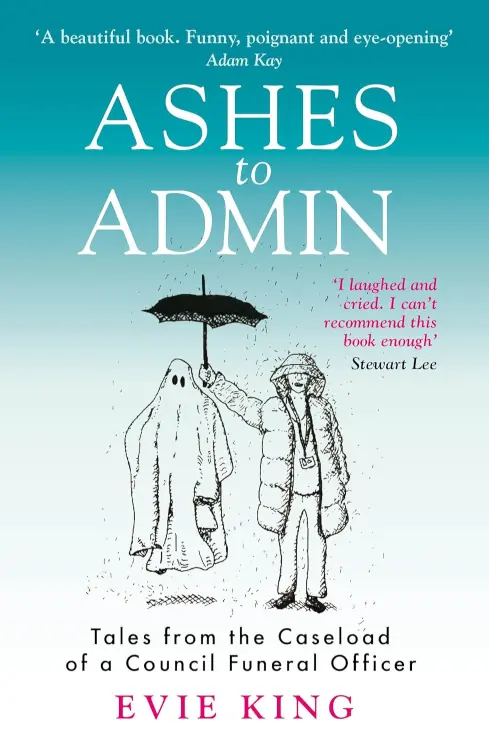
Why am I reading so much about death lately? This is a wryly funny and cosily charming book about council funerals.
Evie King conducts Section 46 funerals under the Public Health Act. If you die and there's no one else around who is able to arrange your funeral, the local council steps in. This could be a coldly bureaucratic process with no wiggle room for anything other than perfunctory sympathy. But humans are going to human. Why wouldn't you put some effort in to making people feel cherished in death?
In many ways, this is what Cameron's "Big Society" should have been about. Giving empathetic and passionate people a chance to serve their community and enrich all our lives. And, I guess, deaths. But austerity makes it hard to stay motivated when you're doing multiple people's jobs for a fraction of the pay.
This isn't to say King is a whinger - quite the opposite - but she is clearly frustrated that she cannot do more. People who interact with the state are rarely in a good emotional or financial place. Those interacting with Section 46 deserve more support than is available to them. What King does is marvellous - but necessarily limited. In effect, it is a series of short stories each taking a look at a different death and how she tried as hard as possible to make the funeral process as painless and uplifting as it can be.
The book is, naturally, a little upsetting in places. It isn't so much that people die; it is how society reacts which causes such emotional turmoil. Why are people sometimes abandoned? Why do reconciliations never happen until it is too late? How do we deal with trauma?
It is an excellent book but it is rather annoying that the publisher, Mirror Books only makes the eBook available via Amazon. There's no other way to read it - not even via a library! I resorted to borrowing the audiobook. This was the first audiobook I've ever listened to - and it was a rather curious experience. The author's voice was slightly hesitant at first, but gradually became more passionate and evocative. It was wonderful to hear her tell her story directly.
The good folks at Orico have sent me their latest power-strip to review. On the surface, the specs are pretty good - two UK sockets, two USB-C for PowerDelivery, and two USB-A for legacy devices.

Let's put it though its paces!
SpecsPhysically, it is a little larger than I was expecting. The two UK sockets are far enough apart to easily get your fingers around the plugs. Similarly, the USB ports are well-spaced. There's a tiny LED to show that power is connected, but it isn't offensively bright.
The UK plug is tiny:

Even better, it comes with a proper fuse! The power cord isn't removable, but is long enough for most purposes.
How much power can it supply? This is what the spec sheet says:
V A W
USB-A 5 3 15
USB-A 9 2.22 20
USB-A 12 1.67 15
USB-C 5 3 15
USB-C 9 2.77 25
USB-C 12 2.08 25
But there is a fly in the ointment. While 25W is the most that a single USB-C port can output, the power drops once multiple devices are connected. If you have two or more plugged in, the total output is limited to a mere 15W. Not per-port; total!
25W is already fairly low by PowerDelivery standards, so you won't be using this to power your gaming laptop while charging your tablet and headphones.
Real World Testing
I used my Plugable USB-C Power Meter with some high-quality USB cables. The Orico mostly lives up to its promises.
When charging my laptop from either USB-C port, I was able to measure 22W (12V ⎓ 1.85A). Pretty close to the spec.
As soon as I plugged my phone into the other USB-C port, that dropped that down to just under 8W (4.8 ⎓ 1.65A) per port. Again, right on the promised 15W total.
The USB-A port happily delivered 7.5W (5V ⎓ 1.5A) - much lower than expected. That dropped to around 5W (5V ⎓ 1A) once a USC-C load was connected. The C port was only delivering ~10W which wasn't enough to meaningfully charge the laptop.
Final ThoughtsThe flat plug is handy for plugging this in to those hard-to-reach spaces. The cable is long enough for most uses. The mixture of ports isn't for everyone, but handy if you still have legacy devices you need to power.
It meets the promised specification - but the specs are a bit of a let-down. You can get smaller devices which will do 60W charging from USB-C, and they'll spread that out over all their ports.
The two UK sockets are a nice-to-have, but I can't help feeling that they'll mostly be used for adding additional chargers.
It is cheap-ish - US$30 / £20 - and comes in a range of colours. If you need a long cable and don't need ultra-fast charging, this will do.
Book Review: Me vs Brain - An Overthinker's Guide to Life by Hayley Morris ★★★★☆ [ 08-Feb-26 12:34pm ]
I bought this book for the title alone and I'm glad I did! I don't think I've seen any of Hayley Morris's comedy sketches. To be honest, you don't need to be a fan of her work to appreciate the humour and courage in this book. It could quite easily have been a cash-in celebrity autobiography - light on the details and full of charming anecdotes - and I'm sure her fans would have snapped it up.
Instead it is a darkly funny meditation on intrusive thoughts, panic, and acceptance.
Her prose is exceptionally good - I loved the way she described doing the washing up as "giving a dinner plate a little bubble bath" - it's also extremely relatable. Everyone occasionally thinks "what if I just ran away?" or "what would happen if I dropped this glass?" For most people it is just a passing moment; but for Hayley it is something more intense.
All of this is smuggled to the reader hidden within poop jokes, tales of teenage awkwardness, and millennial angst. It is consistently funny which makes the sudden switch to pathos all the more effective. It morphs into a tender tale of loss, loneliness, and something else beginning with L which will make me sound erudite.
I wouldn't describe it quite as a "self-help" book, but I think that's clearly part of the intention. Lots of people need to know that their (parasocial) friends find therapy useful. Having someone influential describe the journey to better mental health in such a relatable way will undoubtedly help others.
Reputation Scores for GitHub Accounts [ 07-Feb-26 12:34pm ]The folks at GitHub know that Open Source maintainers are drowning in a sea of low-effort contributions. Even before Microsoft forced the unwanted Copilot assistant on millions of repos, it was always a gamble whether a new contributor would be helpful or just some witless jerk. Now it feels a million times worse.
There are some discussions about what tools repository owners should have to help them. Disabling AI on repos is popular - but ignored by Microsoft. Being able to delete PRs is helpful - but still makes work for maintainers. Adding more AI to review new PRs and issues is undoubtedly popular with those who like seeing number-go-up - but of dubious use for everyone else.
I'd like to discuss something else - reputation scores.
During Hacktoberfest, developers are encouraged to contribute to repositories in order to win a t-shirt. Naturally, this leads to some very low-effort contributions. If a contribution is crap, maintainers can apply a "Spam" label to it.
Any user with two or more spammy PR/MRs will be disqualified.
This works surprisingly well as a disincentive! Since that option was added, I had far fewer low-effort contributions. When I did apply the spam label, I got a few people asking how they could improve their contribution so the label could be removed.
However, there is no easy way to see how many times a user has been labelled as a spammer. Looking at a user account, it isn't immediately obvious how trustworthy a user is. I can't see how many PRs they've sent, how many have been merged or closed as useless, nor how many bug reports were helpful or closed as irrelevant.
There are some badges, but I don't think they go far enough.

I think it could be useful if maintainers were able to set "contributor controls" on their repositories. An entirely optional way to tone down the amount of unhelpful contributions.
Here are some example restrictions (and some reasons why they may not help):
- Age of account. Only accounts older than X days, weeks, or years can contribute.
- This disenfranchises new users who may have specifically signed up to report a bug or fix an issue.
- Restrict PRs to people who have been assigned to an issue.
- May be a disincentive to those wishing to contribute simple fixes.
- Social labelling. Have other maintainers marked this user as a spammer?
- Could be abused or used for bullying.
- Synthetic Reputation Score. Restrict contributions to people with a "score" above a certain level.
- How easy will it be to boost your score? What if you get accidentally penalised?
- Escrow. Want to open a PR / Issue, put a quid in the jar. You'll forfeit it if you're out of line.
- Not great for people with limited funds, or who face an unfavourable exchange rate. Rich arseholes won't care.
Obviously, all of these are gameable to some extent. It also incentivises the theft or sale of "high reputation" accounts. Malicious admins could threaten to sanction a legitimate account.
But apps like Telegram show me when someone has changed their name or photo (a good sign of a scammer). AirBnB & Uber attempt to provide a rating for users. My telephone warns me if an unknown caller has been marked as spam.
I don't know which controls, if any, GitHub will settle on. There is a risk that systems like this could prohibit certain people from contributing - but the alternative is maintainers drowning in a sea of slop.
I think all code-forges should adopt optional controls like this.

It is refreshing to read a political polemic which contains useful actions the reader can take. Too many books about the social problems with technology end up being a diagnosis with no cure.
Paloma Oliveira's new book (with technical review by my friend Dawn Foster) is a deep dive into how we can all make Open Source more inclusive and equitable.
Unlike most tech books, it doesn't follow the usual pattern of restricting itself to the US hegemony. It is very focussed on the EU and the needs of people around the world. It is clear in identifying many of the problems which arise when people say they just want to focus on tech, not politics:
When projects focus purely on technical excellence without considering accessibility, they create implicit barriers. Documentation written only in English, community discussions held during North American business hours, or development environments that require high-end hardware all reflect choices that determine who can participate—though these choices often remain unexamined.
This is profoundly important. The book isn't afraid to be challenging. It links the way companies extract value from the commons to the way colonisers extracted value from the lands they "discovered".
There are a few missteps which I didn't care for. While it starts as very casually written, it quickly finds itself getting into the weeds of political philosophy. I think that's a necessary evil. But I don't know how easily people will be convinced by passages like:
Bratton notes secessionist withdrawal in traditional territories and consolidation domains in stacked hemispheric, the continuing expansions of nebular sovereignties, and the reform of conventional States into regional platforms.
Similarly, there are a few "just-so" stories which are fictional parables. I think they would have been more convincing as actual case-studies.
I did find myself skipping some of the background in order to get to the parts I found more interesting. The chapter on "Political Rhetoric and Institution Validation" felt a bit out of place and I didn't get much from it.
But, after all that theory, there is a lot of practical advice. From how to structure your README to how to communicate change to your community. Even better, all the templates and resources are on GitHub.
It is thoroughly referenced and gave me lots of new rabbit-holes to follow Rather pleasingly, it cites my 2020 blog post "Please Stop Inventing New Software Licences" as an example of the ways in which corporates often try to stifle open source.
If you want to help Open Source succeed, you owe it to yourself to grab a copy of this book.
I am both vain and prurient. A combination which makes me fun at parties and a delight to know.
Sometimes when I raise an issue on GitHub, or write a comment, other users leave me Emoji reactions. Perhaps a

I've thoroughly enjoyed all of Janice Hallett's previous crime books. The Examiner is, frankly, more of the same - and I'm happy with that!
You, the reader, are given a series of transcripts and have to work out what crime (if any) has been committed. You don't find out who the victim(s) is/are until reasonably far through the story. The characters are well realised (although a little similar to some of her others). The twists are shockingly good and will make you flick back to see if you could have spotted them.
Hallett is exquisite at building tension through the slow drip-drip-drip of reveals. OK, so the transcripts are a bit unrealistic but they make a good scaffold. While it might be nice to include user avatars on the WhatsApp messages, the characters' voices are unique enough to distinguish them easily.
Much like The Mysterious Case of the Alperton Angels, the book plays around with symbolism and the nature of faith. You may find yourself sympathising with the characters and then quickly recanting!
Technical IssuesViper, the publisher, seem to have messed up the structure of this eBook. Despite being published in 2024, they're using an ancient and obsolete version of the Blitz ePub CSS which itself was archived back in 2020. As well as strange indents, there's a hard-coded 2em margin only on the right.
Accessibility is poor. All the abbreviations use the <abbr> element. But some kind of automated find-and-replace has mangled most of them. For example, the "Masters degree in Multimedia Art (Full-Time Programme)" is shortened to "MMAM(FTP)" and then given the nonsensical abbreviation of "Molecular Area Per Molecule (File Transfer Protocol)"!
Much like before I've written to them asking them to correct it.
After my recent presentation at FOSDEM, someone asked a pretty reasonable question. What does it cost to run OpenBenches?
It is, thankfully, surprisingly cheap! In part, that's because it is a relatively simple tech stack - PHP, MySQL, a couple of API calls to external services. It was designed to be as low cost while also being useful. Here's the breakdown:
Hosting - £171 per yearOur biggest expense but, I think, our most reasonable. Krystal charges around £342 for a 2 year contract. That includes unlimited bandwidth and storage, as well as the domain name. We have nearly 400GB of photos and bot scraping means we can use over 900GB of bandwidth per month - so Krystal give us a rather good deal!

Use this affiliate link and code EDENT to get a small discount.
Stadia Maps - US$20 / monthGeocoding is surprisingly hard to do locally. We need to transform latitude and longitude into addresses, and then back again. Stadia Maps cost about the same as our hosting! What's rather annoying is that we only use about half the API calls in our plan. We need to find a cheaper solution.
Mapping - Free!When we used Stadia for drawing maps, we regularly ran over our quota. So we switched to OpenFreeMap which produces gorgeous interactive maps.
The service has been rock solid and very responsive to bugs on GitHub.
Logo - US$5I'm not a good designer, so we bought a logo from The Noun Project and then coloured it in. Bargain for a fiver!
Image CDN - Free!Although we have unlimited bandwidth with Krystal, we're only located in one region - the UK. WeServ. It's also pointless serving full resolution images to small screens.
So WeServ offers free image resizing and global CDNs. Personally, I'm not a fan of CloudFlare (their CDN partner) so I'm looking to change provider.
OCR - Free!People don't want to type in the inscription of the photo, so we use Google Cloud Vision.
We send less than 1,000 requests per month - so we're inside their free tier. If we get more popular, that'll get more expensive. But I don't know of a local-first OCR which is as good as Google's. Sadly, Tesseract is rubbish for extracting text from photos.
Authentication - Free!We don't want to store anyone's passwords. The free tier of Auth0 allows us to do social login for up to 25,000 monthly users. Which is more than enough for us.
Sadly, Auth0 don't support the Fediverse, so I had to build my own "Log-in with Mastodon" service.
As much as we'd like to run social login locally, we simply don't want to be responsible for securing users' details & API keys.
Software - Free!As per the OpenBenches colophon we use a lot of cool FOSS. Small JS libraries, big PHP frameworks, and everything in between.
IncomeThanks to GitHub Sponsors we make a whopping US$3 per month!
Similarly, our OpenCollective Sponsors brings in about £3 per month.
Merchandising! You can buy OpenBenches branded t-shirts, mugs, and hats. That nets us about £20 per year
Call it roughly £80 income. OK, it is better than nothing - but doesn't even cover a quarter of our costs. Sometimes people give us a higher donation privately, which is also very welcome. These people are listed on our README.
TotalOn the assumption that our time is worthless (ha!) and that we only rarely go over our providers' API limits, and we get in some revenue, the cost of running OpenBenches is less than £300 per year.
That's not bad for a fun little hobby. People certainly spend more than that on Funkopops, vaping, and mechanical keyboards!
Nevertheless, I'm always slightly worried that we'll go viral and have an unexpectedly high bill from our API providers.
I would love to be able to hire a proper designer to make the site look a bit nicer. I also want to be able to buy a modern iPhone so that I can test it in the latest Safari.
If you have any suggestions for cutting costs, or non-scummy ways to help us raise funds, please drop a comment below.
Book Review: The Voyage of the Space Beagle by Alfred Elton Van Vogt ★★☆☆☆ [ 02-Feb-26 12:34pm ]
This is Star Trek before Star Trek. It is Alien long before Alien. It is the template for so much modern science fiction. What it is not is particularly good.
I don't intend to dump on the classics (and this is undoubtedly a classic) but 1950s sci-fi takes place in an almost alien media environment. Even if you ignore the anachronisms (like having to develop film in order to see photographs) and the archaic language (lots of vibrators being used against a big pussy) it is hard to get over how unconvincing it all is.
In the first story, the crew of the Space Beagle find an alien monster. It probably killed one of them. They bring it aboard and just let it lounge about in the library! Yes, all the science is fun, and the "competency porn" of the professional crew is suitably heroic, but the characters and their motivations are frequently bizarre. It is only through the complete absence of girls (urgh!) that there's no interstellar sexism.
The protagonist, Grosvenor, is a cipher for every geeky kid who ever felt he was smarter than everyone else. He is a sneering, taciturn, and deeply unpleasant character. When given the opportunity, he relishes the chance to become dictator.
Because the book started life as a set of short stories, it works reasonably well as a "monster of the week" show. It is episodic, with well-placed cliffhangers. The science is very sciency with some excellent speculative elements. You've got aliens planting eggs in people (like Alien) and a ship's engineer who says "Nooo! The walls couldn't stand it. They'd melt." (like Scotty) and any number of concepts you'll recognise from your favourite TV shows.
The obsession with hypnotism and mind-control feels a bit icky, especially when understood in association with the author's dalliance with the pseudoscience of Dianetics.
The language (when not steeped in 1950's idiomatic phrasing) can verge on the poetic. Every story includes a chapter or two from the alien's viewpoint. They are deliciously weird and elevate this book beyond what might be a slightly forgettable slice of sci-fi.
It is absolutely worth reading - if only to see how influential it has been - but it can be a bit of a weird slog at times.
Vanguard - The Government Project to get British Businesses to use the Internet [ 01-Feb-26 12:34pm ]Email isn't an obvious business benefit. Imagine it is the early 1980s and you need to communicate with people across the country. A first-class letter will cost you 17p - about 60p in today's money. The letter will be delivered the next day and you'll have your answer back the day after.
By contrast, a single computer terminal was likely to set you back around £3,000 - and that's before you take into account message transmission costs. That's roughly the same price as sending over 8,000 letters. Is that a sensible investment for the 1980's businessman?
In 1986, British Telecom started producing "The Communications Programme" which was "a new video magazine produced exclusively for the top communications people in the UK's largest organisations".
The show was distributed on video-tape and the archived shows are genuinely fascinating. They're a mixture of business reporting, thinly veiled advertorials, and a glance at the future of digital services.
Buried in the middle of episode 4 is this advert from the Department of Trade and Industry.
There's very little online information about the "Vanguard Project" - it was a VADS initiative (Value Added Data Services) run by DTI, BT, IBM, INS, ISTEL, and FASTRAK. Some of those acronyms survive, some don't!
Its aim was to promote awareness of EDI and its potential for the United Kingdom.
In 1986 the Department of Trade and Industry launched a project called Vanguard to promote the development of this kind of service in 10 different sectors including construction, educational supplies and wholesale food distribution. The major VADS suppliers (BT, IBM, INS, Istel and the Midland Bank) in the UK were heavily involved in the project from the beginning.
What's "EDI"?
Electronic Data Interchange.
Did it work? Well, that's hard to say!
There's a paper from 1989 called Survey of Electronic Data Interchange Users and Service Providers in the UK. It dives into the then current challenges of getting British businesses to adopt EDI.
It quotes Sir John Harvey-Jones saying that most people running companies were:
…old people like me not familiar with the technological possibilities! We have great difficulty in making imaginative jumps to see the way in which the whole of our business can be reorganised, revitalised, set up in totally new ways, releasing energy and cost and putting us into the pole position. I can see abundant evidence that the full benefits of EDI will only be reaped by the companies where the Chief Executives is seized with enthusiasm for the potential prize he can grasp.
Which still seems true today! Although over-enthusiasm has led us to a weird AI-in-everything future.
The paper doesn't talk about Vanguard specifically, although it does have this rather cute diagram adapted from one of its reports:

Not quite the Gartner Hype Cycle!
The paper concludes that:
Unfortunately the zealots of EDI tend to be unable to 'sell' the benefits to management in most companies, and this is not helped by the way that many companies have been forced to trade electronically. Management tends to think that EDI is about computers, and because they think that computers are technical they abdicate responsibility with the cry of 'its all too difficult'. This must be wrong. It is up to those who understand EDI to learn how to talk to management, and it is up to management to understand that not only is EDI not about technology, but even if it was it is still their responsibility.
Again, true as it ever was!
Nestled in the bibliography is this tantalising list of publications from the now-defunct Her Majesty's Stationery Office:

None of which appear to be online, although a few are in The British Library - and a few more available on Google Books
The state awarded several contracts for Vanguard - most of which seemed to be in the training space. Here's what The EDI handbook said about it:

(My thanks to Don Thompson, Owen Boswarva, and Ms7821 for digging out some of those references.)
Did it work? By the time I entered the workforce in the 1990s, it seemed like every desk had a computer. Although the Internet was in its infancy, email and electronic ordering was a normal part of business. The various proto-Internet protocols were still around, but were quickly being replaced.
A thesis published in 1991 asked an important question:
why should a non-interventionist Government as Thatchers become directly involved in developing the market and working together with private companies whose normal aim is to increase market share at the expense of their competitors rather, than cooperate with them?
The impact of Electronic data interchange on Irish foreign trade and transport
Metcalfe's Law tells us that there is no value being the only business on a network. It simply isn't rational to invest in connecting to a data service that no-one else is on. But the value of that network increases as more people and businesses get connected. If you've read The Entrepreneurial State, you'll know that governments are often responsible for subsidising technological initiatives like this. The state, its citizenry, and its businesses all benefit from the increased efficiencies of electronic communications, so it is only right that the state should bootstrap these sorts of projects.
I sent an FoI request to find out more but it looks like all the information is now archived.
If you know of any other sources of information about Project Vanguard - please leave a comment.
Book Review: With the End in Mind - Dying, Death and Wisdom in an Age of Denial by Kathryn Mannix ★★★⯪☆ [ 31-Jan-26 12:34pm ]
Is it possible to "die well"? We have midwives for births, should we have "deathwives" for the other end of our lives? I think this book was recommended to me in the depths of the pandemic. I was too much of a chicken to read it while those around me were dying. The book aims to normalise the process of death and mostly succeeds. Unlike a lot of books, it doesn't just identify a problem - it provides pages of solutions. Every chapter ends with a series of questions to ask yourself (or your loved ones) about death.
At times, it is utterly heartbreaking and more than a little gruesome. Death is emotionally and physically distressing. Similarly, there are several stories which deal with the reality of assisted dying. I think the author comes down against euthanasia - but it certainly helps raise questions of whether repeatedly offering the option amounts to pressuring them into an unwanted decision.
It is a bit homespun and cloying. I felt like it painted quite a rosy picture of what death can look like. All the nurses are angels and the doctors have endless patience, there's always time for a cuppa and deathbed revelations are never awkward.
Oh, and there's a lovely aside about memorial benches being harbingers of doom, which I found quite amusing!
This will probably sit unread on your ebook for far too long - but it is worth cracking it open and thinking about the questions it raises.
Theatre Review: The Hitchhiker's Guide to The Galaxy - Immersive Experience ★★★⯪☆ [ 30-Jan-26 12:34pm ]
You've read the books, listened to the original radio performances, re-read the books, worn the t-shirt - and now it is time to be part of The Hitchhiker's Guide to The Galaxy.
*Cue the music from Flight of the Sorcerer*
This is a 90-ish minute immersive experience. As well as a full cast of actors and a puppet android, there are ✨celebrity✨ voice cameos.
And songs! So many songs!
Pre ShowI'm always interested in how shows build excitement before a performance. We were encouraged to arrive early to stash our coats (a very reasonable £1 each) and soak up the atmosphere.
It mostly works! We're deposited into the pub with lots of texture. As well as multiple screens displaying a variety on in-jokes, the actors hobnob with the guests. Nifty!
ShowFrom a technology perspective, the show is astonishingly good. Laser display boards mixed with puppets, dry ice, surround sound, and a hundred little decorations to notice. The actors are witty and talented improvisers. They did well with the matinée audience who needed a little warming up. There's a bar halfway through the experience where you can buy a (typically overpriced) branded beer - but I'd recommend having a warm up Pan Galactic Gargle Blaster in the bar before the show.
Wandering around the Vogon ship is a sonic and visual delight. The chaos of running between the sets feels utterly on-brand for H2G2. The sets are lush and, as mentioned, the technology integrates well with the story.
So, about the story.
There is no continuity in this franchise. Canon is noticeable by its absence and you should throw most of your preconceptions of plot out of the window. This isn't a cosy retread of the books you loved, nor is it a something entirely new. Essentially it is a series of sketches ripped and remixed from various versions. It kind of felt like there was a missing segment in the show - characters disappeared (to go perform for the next set of participants) and then reappeared.
If you have even a passing familiarity with H2G2 (in any of its forms) then I think you'll enjoy it. If not, I think it is a little scattershot. 90 minutes isn't enough to build up much of the complexity or tension in the drama. That said, it is rather jolly fun and surprisingly tender.
Post ShowIt isn't quite "exit through the gift shop" but not far off. I remember how the end of the Alien experience in the Trocadero had audience members running out into a public area - here it's a gentle stroll into the bar.
This is a worthy addition to the many different adaptations of Douglas Adams' opus.
The experience runs until the 15th of February at the Riverside Studios. Tickets start at, of course, £42.
Book Review: The Players Act 1 by Amy Sparkes ★★⯪☆☆ [ 29-Jan-26 12:34pm ]
So! Much! Melodrama!
This is a gently funny (and slightly tragic) romp with a band of travelling vagrants actors as they attempt to ply their renditions of Shakespeare to an indifferent 1700ish audience. There's a lot of charm to the characters and the plot is relatively straightforward.
The characters are a bit one-note. The baddie never actually twirls his moustache - but you'll instantly picture him doing it every time he appears. The others very much stay in their lane; the feisty woman who would rather wear trousers, the wide-eyed idealist, the grumpy father. It's rather like they're stock comedia dell'arte tropes come to life.
While there are some lovely lines (and excellent swearing), the story meanders back and forth a bit too much for my liking. I'm possibly not the target audience as I guess this is aimed at the older teen crowd.
I appreciate the book being made available without DRM. How refreshing to pay for a book and receive an unencumbered ePub; no need to liberate it from the clutches of Adobe!
Are there any open APIs left? [ 28-Jan-26 12:34pm ]One of the dreams of Web 2.0 was that website would speak unto website. An "Application Programming Interface" (API) would give programmatic access to structured data, allowing services to seamlessly integrate content from each other. Users would be able to quickly grab data from multiple sources and use them for their own purposes. No registration or API keys, no tedious EULAs or meetings. Just pure synergy!
Is that dream dead? If so, what killed it?
A decade ago, I posted a plea looking for Easy APIs Without Authentication with a follow up post two years later. I wanted some resources that students could use with minimal fuss. Are any of the APIs from 10 years ago still alive?
AliveThese ones are still around:
- Wikipedia - Yes! Still going strong.
- Police.uk - Yes! After a brief dalliance with API registration, it is now back to being completely free and open.
- Google Books ISBN - Yes! Obviously Google have forgotten it exists; otherwise it would have been killed off by now!
- iTunes Lookup - Yes! Possibly the only thing Apple don't charge a premium for.
- Pokémon API - and still receiving frequent updates.
- MusicBrainz - this Internet stalwart will never die.
- Open Notify - a collection of space APIs, although the code hasn't been updated in ages.
These have shuffled off this mortal coil:
- BBC Radio 1 - No.
- Twitter URL statistics - LOLSOB No.
- Star Wars API - No.
- British National Bibliography - No. Dead due, I think to the British Library's cyber attack.
- Football Data - gone.
These are still alive, but you either need to pay or register to use them:
Book Review: Doppelganger - A Trip Into the Mirror World by Naomi Klein ★★★★☆ [ 27-Jan-26 12:34pm ]
This book is excellent at describing the symptoms of madness which have beset the world. It expertly diagnoses the causes which have led so many people into a mirror-realm of fantasy. Sadly it falls short of prescribing a cure. I doubt anyone who has fallen into the conspiracy mindset will read this book - but I hope if you read it you will become inoculated against the brain-worms.
Let's start at the beginning.
If the Naomi be Klein
you're doing just fine
If the Naomi be Wolf
Oh, buddy. Ooooof.
How did Naomi's titular doppelganger move from feminism to fanaticism? How do well-meaning people square the circle of aligning themselves to people who spread hate?
At the same time, how do people like Naomi Klein justify spending hours obsessively listening to hate preachers? Can you stare into the abyss without it staring back into you? I'm not entirely sure that it is possible to binge on madness and stay objective. It reminds me of this classic:
"don't use q-tips to clean your ears, you'll just push the wax in further!!" well, yeah, sure, except for my special technique. if I use my special technique then it's fine.
There's a deep well of sadness running through the book. So many people with an unending stream of pain clutching on to anything which might give them purchase in a confusing an uncertain world. Is it any wonder some of them latch on to weird racists with their simple solutions to complex problems?
The depressing thing is that sometimes the conspiracy-theorists are right. They can see that there are global conspiracies - but attribute them to [ethnic minorities|Marxists|the gays] rather than rapacious capitalists. Similarly, there are bitter lessons for the intellectual left who have comprehensively failed to advance progressive arguments and values. Many of us are more concerned with the purity of theory rather than implementation. You can't shame the public into understanding.
There's a slightly weak section on algorithmic amplification of abuse. Depressingly, Klein points out the perils of oligarch-owned social media yet she is still on Twitter and hasn't joined more equitable platforms.
The book also straddles an uneasy line between reportage and public therapy. Large parts feel like self-flagellation mixed with Freudian self-analysis. It demonstrates exactly how the grift works, why it is so effective, and what the surge of irrationality is doing to the world.
Perhaps I can fix it if I just read one more book. Just one more paragraph will make it all make sense. I'll grab on to the classics in the intellectual library to stop me sliding down the path to oblivion. Just one more book.
Do savings accounts really lose money to inflation? [ 26-Jan-26 12:34pm ]I'm absolutely addicted to the Reddit's UK Personal Finance forum - where people mutually support each other through the difficult world of managing one's personal finances. It's a great community and full of people eager to help others.
In amongst the confusion around pensions, tips for budgeting, and complaining about debt-collectors is a persistent drumbeat encouraging people to save money. Good! More people should save more money. But the advice is always undercut with the message "sticking money in a savings account will see it eaten away by inflation".
Is that true?
Firstly, what is inflation? Simply put - prices rise and fall. The price of bread goes up by 50% and a loaf now costs £1.50. The price of a 42 inch flat screen TV drop by 50% and now costs £150. The average person buys 50 loaves of bread per year and a new TV every 5 years - add up the average of what people buy and you have a rough idea of what inflation is0.
Secondly, what is interest? Simply put - a bank or building society will pay you money to save with them. If you put £100 in a savings account paying 5% interest then leave it a year, you'll be given a fiver1.
If the rate of inflation is higher than the rate of interest, your savings will be eroded; your money will be worth less.
The Bank of England's current interest rate and inflation rate shows this:
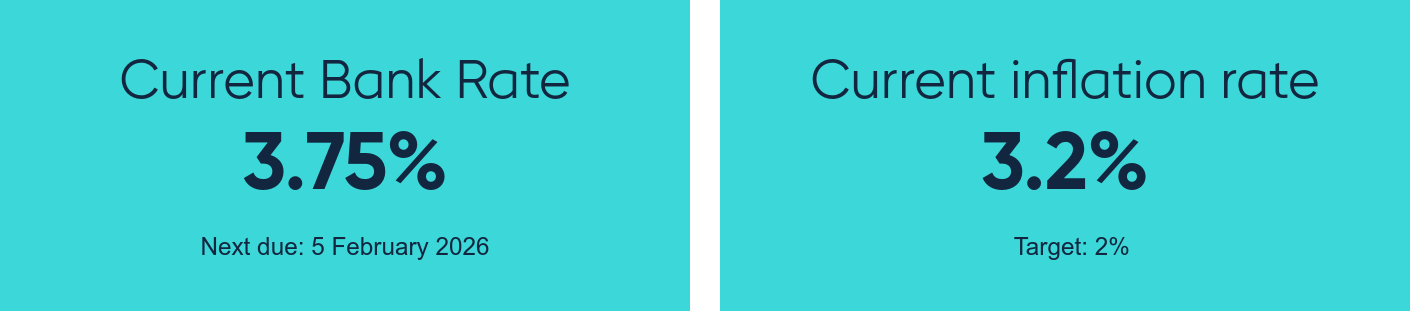
On average, if something cost £100 a year ago, today it will cost £103.20. If you had saved £100, it would be worth £103.75
So, based on this, savings exceed inflation right?
Well, as ever, it is a little more complicated than that!
For starters, the inflation rate is for the last year and the interest rate is the current rate.
The UK publishes a number of different inflation statistics. Depending on which one you prefer, the inflation rate over the last 12 months is between 3.2% and 4.4%.
Different savings accounts will attract different interest rates. Some will offer tasty bonuses to new savers and will drop to nothing once that promotion expires.
This stuff is hard to accurately model.
But let's ignore all that and YOLO it!
Here's two resources:
- The Bank of England inflation calculator tells you want a historic price is in today's money (up to 2025).
- The website HistoricalSavingsCalculator.com provides the annual average historical interest rate from the Bank of England (up to 2023).
As a quick check. £1,000 in 1975 is equivalent to about £7,300 in 2023.
The same amount saved in 1975 with average interest compounded, would be worth about £18,000 in 2023.
Amazing! Compound interest beats inflation!
But let's take another perspective. £1000 in 2008 is equivalent to £1,540 in 2023
£1,000 saved in 2008 would be worth about £1,180 in 2023.
A loss of over £300.
Let's stick annual UK inflation and interest rates into a graph:
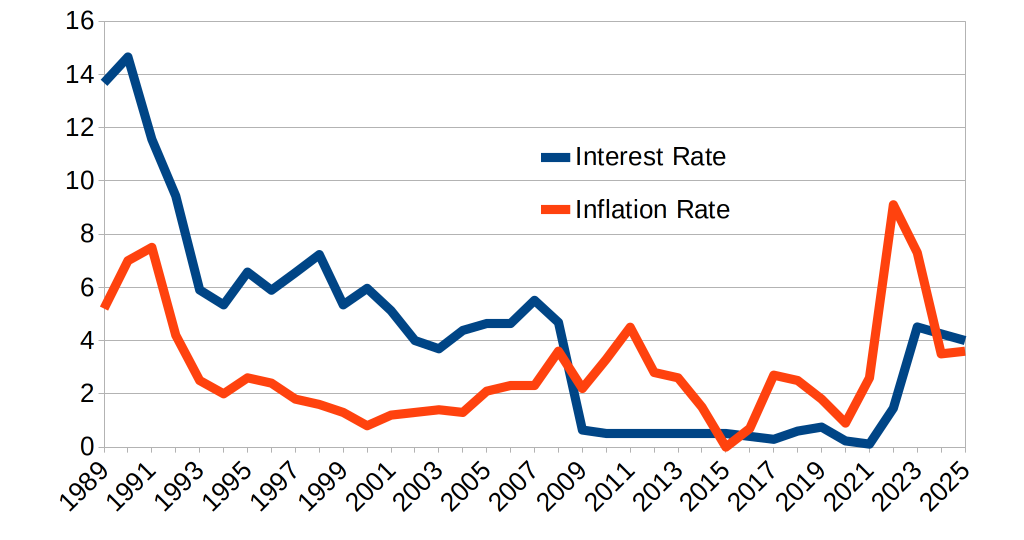
Ah! Over the last 17 years, inflation has been higher than interest - a position which is slowly reverting. Fucking 2008, eh?
It looks like we might be entering a period where interest will be higher than inflation. Does the average person optimally pick their savings accounts? Probably not. Is inflation a 100% reliable way of tracking the worth of money? Also probably not.
While cash savings are unlikely to exceed the rate of return from "Dollar Cost Averaging", it is possible that savings accounts will once again offer some protection against inflation.
Book Review: Human Rites by Juno Dawson ★★★☆☆ [ 25-Jan-26 12:34pm ]
After the pretty good Her Majesty's Royal Coven, the excellent Shadow Cabinet, the law of reverting to the mean hits the conclusion of Juno Dawson's Witches of Hebden Bridge trilogy.
By now you know the tropes - Bitchy-Witches, 90s pop-culture references, and wry chapter titles. It's all done well enough, the plot is a little twisty, the story entertaining, and the repeated mentions of Buffy are only a little too self-referential. The continual pop-culture references are a bit blunt and, in all honesty, feel like the book is trying too hard to anchor itself to other media.
If you enjoyed the other two books (and the Queen B prequel) then this is more of the same.
The ending is powerful and, thankfully, closes off the world. This doesn't feel like something which is going to be turned into a never-ending series of stories.
A good beach read but lacking some of the rage and inventiveness from the rest of the series.
Installing and Updating Filezilla from a Zip File on Pop_OS / Ubuntu [ 24-Jan-26 12:34pm ]Notes to myself because I keep forgetting.
tl;dr Unzip it into the /opt/ directory.
I want to install Filezilla - so I can SFTP files around. Sadly, the Flatpak version is unmaintained and the version in apt is out of date. Luckily, you can download the zipped version.
Their Wiki helpfully says:
If you have special needs, don't have sufficient rights to install programs or don't like installers, the zip version is there for you. A zip-file is a file that contains files inside of it. They are packed into one file and you need to unpack (unzip) them to use them.
But it doesn't say where!
The answer is the /opt/ directory.
Run this command:
sudo tar -xJf FileZilla_*_x86_64-linux-gnu.tar.xz -C /opt
The first time you may need to adjust the directory permissions:
cd /opt/
sudo chown -R root:root FileZilla*
After installing, FileZilla will periodically check for updates. It will download them to the ~/Downloads/ directory. Run the above command to install the new version.
If you want to be able to launch Filezilla from your dashboard, or to pin it to your dock, you'll need to create:
/usr/share/applications/Filezilla.desktop
Place this text in it:
[Desktop Entry]
Name=Filezilla
Comment=FTP
Exec=/opt/FileZilla3/bin/filezilla
Icon=/opt/FileZilla3/share/icons/hicolor/scalable/apps/filezilla.svg
Type=Application
StartupWMClass=filezilla
Categories=Game;
What a faff!
Book Review: Surely You Can't Be Serious - The True Story of Airplane! ★★⯪☆☆ [ 23-Jan-26 12:34pm ]
This is a hugely extended version of Will Harris' "An oral history of Airplane". It goes through the pre-history of the project, how it eventually got made, and the aftermath. In many ways, it is like an old-fashioned DVD extra. The whole book consists of snippets of interviews with the cast, crew, and various talking heads.
Like all DVD special features, it is fairly sycophantic. Yes, there are some good-natured swipes at the people who passed on the script, but it is a bit of a Hollywood love-in. The self-deprecating humour is there to make people look classy - for example:
Eisner's also the one who once said, "If I had green-lit every movie I've passed on and passed on every movie I green-lit, my track record would probably be about the same."
About the only time it gets into anything other than "gooly-gee how lucky are we" is a small section talking about the star of one of their other films - the notorious murderer OJ Simpson:
David: I directed him in the Naked Gun movies. Although he actually improved with each film, his acting remained a lot like his murdering — he got away with it, but no one really believed him.
Some of the commentary is a bit perfunctory. Do we really need to know that Quentin Tarantino liked the movie? It's nice, I guess. Tim Allen bemoaning the state of comedy today lands like a turd in a punchbowl.
The photos throughout are good - especially those showing how the framing of certain shots were lovingly ripped off from Zero Hour.
It is a fun and uncomplicated book. For students of film, it is always fascinating to see how the sausage gets made. Occasionally it veers into "IMDb trivia" and you do get the sense that most of the anecdotes have been retold a thousand times. Still, it is entertaining.
There is a bit of a glum streak running through it though:
JEFFREY KATZENBERG: Airplane! was not like anything else. And Michael Eisner, I think, felt that in his bones. Like, "Wow, this is really, really unique, and as such, is the kind of thing we should be doing!"
Where did it all go wrong in Hollywood? Why are the people who made their name with weird films now content to pump out mediocrity?
There's a tantalising moment talking about alternative takes and an original cut which was some 20 minutes longer. But, alas:
Sadly, Paramount threw out all the dailies; every studio did at that time. All those reels took physical space that they needed on the lot, so they threw them out, including Airplane! Although I'm pretty sure they kept the outtakes from The Godfather.
Certainly worth flicking through if you're a fan of the film, but hardly revelatory.
Removing "/Subtype /Watermark" images from a PDF using Linux [ 22-Jan-26 12:34pm ]Problem: I've received a PDF which has a large "watermark" obscuring every page.
Investigating: Opening the PDF in LibreOffice Draw allowed me to see that the watermark was a separate image floating above the others.
Manual Solution: Hit page down, select image, delete, repeat 500 times. BORING!
Further Investigating: Using pdftk, it's possible to decompress a PDF. That makes it easier to look through manually.
pdftk input.pdf output output.pdf uncompress
Hey presto! A PDF you can open in a text editor! Deep joy!
Searching: On a hunch, I searched for "watermark" and found several lines like this:
<<
/Length 548
>>
stream
/Figure <</MCID 0 >>BDC q 0 0 477 733.464 re W n q /GS0 gs 479.2799893 0 0 735.5999836 -1.0800002 -1.0559941 cm /Im0 Do Q EMC
/Figure <</MCID 1 >>BDC Q q 28.333 300.661 420.334 126.141 re W n q /GS0 gs 420.3339603 0 0 126.1418879 28.3330078 300.6610601 cm /Im1 Do Q EMC
/Figure <</MCID 2 >>BDC Q q 16.106 0 444.787 215.464 re W n q /GS0 gs 444.7874274 0 0 216.5921386 16.1062775 -1.1281493 cm /Im2 Do Q EMC
/Artifact <</Subtype /Watermark /Type /Pagination >>BDC Q q 0.7361145 0 0 0.7361145 113.3616638 240.8575745 cm /GS1 gs /Fm0 Do Q EMC
endstream
endobj
Those are Marked Content Blocks. In theory you can just chop out the line with /Subtype /Watermark but each block has a /length variable - so you'd also need to adjust that to account for what you've changed - otherwise the layout goes all screwy.
That led me to PyMuPDF which claimed to solve the problem. But running that code only removed some of the watermarks. It got stuck on an infinite loop on certain pages.
So, now that I had more detailed knowledge, I managed to get an LLM to construct something which mostly seems to work.
Does it work with every PDF? I don't know. Does it contain subtle implementation bugs? Probably. Is there an easier way to do this? Not that I can find.
import re
import pymupdf

# Open the PDF
doc = pymupdf.open("output.pdf")

# Regex of the watermarks
pattern = re.compile(
    rb"/Artifact\s*<<[^>]*?/Subtype\s*/Watermark[^>]*?>>BDC.*?EMC",
    re.DOTALL
)

# Loop through the PDF's pages
for page_num, page in enumerate(doc, start=1):
    print(f"Processing page {page_num}")
    xrefs = page.get_contents()
    for xref in xrefs:
        cont = doc.xref_stream(xref)
        new_cont, n = pattern.subn(b"", cont)
        if n > 0:
            print(f"  Removed {n} watermark block(s)")
            doc.update_stream(xref, new_cont)

doc.save("no-watermarks.pdf")
One of the (many) problems with Vibe Coding is that trying to get a LLM to spit out something useful depends massively on how well you know the subject area. I'm proud to say I know vanishingly little about the baroque PDF specification - which meant that most of my attempts to use various "AI" tools consisted of me saying "No, that doesn't work" and the accurs'd machine saying back "Golly-gee! You're right! Let me fix that!" and then breaking something else.
I'm not sure this is the future we wanted, but it looks like the future we've got.
Book Review: Exterminate/Regenerate - The Story of Doctor Who by John Higgs ★★★★☆ [ 21-Jan-26 12:34pm ]
The problem with fans is that we want to know everything. What did Lennon eat for breakfast the day he recorded Imagine? Which colour pencil did the script editor use on our favourite episode of Doctor Who? Did the costume designer on Buffy secretly sneak in Masonic references in that extra's shirt?!?!
There's no trivia so obscure that it won't be referenced somewhere, debated endlessly, and eventually schism'd.
The problem with Doctor Who histories is that the real fans know all there is to know, and the filthy casuals have very little interest in the obscure trivia about how the BBC Electrician's strike was a major turning point in the show.
John Higgs has a difficult job. How can you possibly summarise over a half-a-century of Who and make the history interesting and relevant? The answer is simple - philosophy.
This isn't "Everything I Learned About Kantian Ethics I Learned for Doctor Who" - but a rather more subtle musing about the nature of television, how stories drive their tellers insane, and how the viewing public are complicit in the eventual disintegration of our favourite shows.
This goes from the pre-history (why did Doctor Who the TV show exist) all the way up to the end of Ncuti Gatwa's first series. It covers some well-trodden ground that will be familiar to the people who turn on the DVD trivia tracks - but it adds a bit of bite. This isn't a sycophantic piece of corporate biography; there are some rather distressing and shocking truths about the people who brought such magic into our lives.
There are some odd gaps. While we probably don't need the ins-and-outs of every casting decision, but it is a bit odd to relegate the 1960s' movies to a few sentences. As ever, with books like this, a few photos and illustrations wouldn't have gone amiss - but I suspect rights issues would have scuppered that.
The book really gets going when it leaves the history behind and reflects on the nature of the show.
The question of whether Doctor Who should grow up with its audience or target a new generation of children was one that the programme makers would struggle with many times over the following decades.
It skewers some of the myths which are uncritically repeated by fans who have only a surface-level understanding of what the show is about and why it succeeds.
Just as the Doctor is a trickster who dons the disguise of a hero, Doctor Who is a show that claims to champion science and logic to disguise its innate mysticism.
As it dives in and out of the history, there are some wild revelations and some absolutely WTF moments of both synchronicity and sycophancy. For a book which deals with fans and fandom, it is remarkably brutal in its honesty. No one comes out of Doctor Who unscathed - and the fans are often (self-inflicted) casualties.
[T]he Valeyard [could] be seen as the representation of the darker side of British fandom
Is that true? It is certainly a plausible reading of how the toxic culture of fandom helped sow the seeds of the show's eventual downfall (and, to be fair, resurrection). It is, perhaps, a little portentous and overwrought at times - for example, when talking about Sylvester McCoy's Doctor's regeneration in the 1996 movie:
Seeing him struggling to avoid being anaesthetised and then killed in an expensive, state-of-the-art American medical centre, it was hard not to see the cheap and cheerful British version of the show being held down and put to sleep by the glossy new production team, who didn't fully understand what they had or why they were about to unintentionally kill it.
Is that a reach? It is certainly a valid if perhaps unintentional reading of the scene.
The book veers between the gossip of the production and the critical appraisal of the object. It never quite settles on whether it is a history, philosophy, or psychological profile of the show. This sums it up best:
The drama backstage leaked into, and ultimately overwhelmed, the drama on screen.
If you're interested in Doctor Who - and don't mind some of your sacred cows being slaughtered - this is a compelling read.
Discovering My Talk [ 20-Jan-26 12:34pm ]My mother, the actress Carrie Cohen, once had a blazing argument with Anthony Hopkins0. He was saying that he preferred appearing in Hollywood blockbusters compared to appearing on the stage because nothing was more boring than playing Hamlet for the 100th time.
My mother's contention was that he was talking rubbish. The joy of repeated performance is finding new and interesting ways to bring the character to life. Even after a hundred performances, you will still be able to discover exciting and subtle nuances.
My mother, of course, was right1.
I was at EuroBSDCon a few months ago giving a talk I'd given several times before. As I was rehearsing it, I felt the comforting familiarity of an old friend. I knew when to pause, where to place the emphasis, how to build to a crescendo. This was going to be delightfully boring for me.
And then I got on stage.
I know my script. True, I occasionally glance at the speaker notes, but I don't rely on it. This frees me. My mind can wander just a little bit and explore what I'm saying.
My brain makes connections that were previously hidden from me. Exciting new ways to express myself spring forth from my mouth. I'm not consciously aware of the joke that I make until the laughter has subsided. I gradually discover a new turn of phrase. The awkward segue suddenly resolves itself. The talk that I'm giving is not the same as the one I planned; it is better. You can rehearse a thousand times, but there's something about having an audience which helps you discover what it is you want to say.
There is nothing like live performance to help you discover yourself.
Book Review: Sky Daddy by Kate Folk ★★★⯪☆ [ 19-Jan-26 12:34pm ]
What - and I cannot stress this enough - the actual ever-loving fuck!?0
OK, perhaps it was a mistake to start reading this while on an international flight. The book concerns Linda, a content moderator at an endlessly sub-contracted tech company, who is in love with planes. No, strike that, she is excessively sexually attracted to the idea of dying in a plane crash.
Yeah.
The story goes though all her attempts to, effectively, manifest an in-air disaster through the power of wishful thinking and frantic masturbation.
This isn't exactly erotica1, it contains a rich stream of satire about the modern tech industry and how it chews up and spits out the people working at the sticky end of keeping platforms safe.
This is one of the most creative novels I've read in some time. The protagonist is a creepy blank-slate whose unhealthy obsession drips off the page2. Her morose existence is - to mix fantasies - a car crash. I can honestly say that I haven't read anything like this before and I've no idea if I'm the intended audience.
I wouldn't necessarily describe the book as fun and enjoyable, nor is is particularly sexy3. It is intriguing, entertaining, and constantly baffling. How wonderful to step inside the mind of an utter deviant and soak up their bizarre existence.
-
Every other paragraph made me scribble WTF in the margin. ↩︎
-
Not that there's anything wrong with that! ↩︎
-
Look, you probably shouldn't do an armchair diagnosis of fictional characters but this is possibly the most autistic-coded character I've read since In Search of Lost Time. ↩︎
-
Unless, I guess, you're in to that sort of thing. YKINMKBYKIOK! ↩︎
Book Review: Sublimation by Isabel J. Kim ★★★★★ [ 18-Jan-26 12:34pm ]
This is an astounding bit of high-concept sci-fi. Imagine a world where crossing a border literally split your body in two. A young woman emigrates from South Korea - one version of her stays in Seoul, another version goes off to live in New York. This is the way humanity has always existed. People bifurcating and dealing with the consequences.
It is heady stuff. The book spans life, love, politics, religion, and folklore. It layers on narrative and meta-narrative. Like any debut novel, there are too many ideas to be contained and the plot seems to spill beyond its pages. What would the fascist ICE do with immigrants who were mere clones of the people they left behind?
The dizzying implications of the story are matched only by the gorgeously intricate plot. Does the tale need to occasionally be told in the second-person? You don't think so, but you also can't think of a better way to illustrate how strange it is to argue with your other-self. You enjoy all the literary and scholarly references and find they add poetic texture to balance out the increasing tension.
Unlike other hard sci-fi, it doesn't spend too much time on exposition; it gets drip fed to the reader. But it is happy to dive into the practicalities of a world where refugees might leave behind more than just memories. There's a small but necessary amount of technobabble, and a large but necessary amount of moral philosophising. Tuvix did not die in vain.
Sublimation lives up to the hype. It is dramatic, powerful, intriguing, and - above all - fun.
Many thanks to NetGalley for the review copy. Sublimation is available to pre-order now for delivery in July. I recommend reading it twice.
Review: Lander 23 by Punchdrunk ★★★⯪☆ [ 17-Jan-26 12:34pm ]
Lander 23 had a few pre-launch glitches, but is now up and running in Woolwich. It is a fun enough experience, but could be a whole lot more with some tweaks. In a team of four, you are split into two groups. One group operates a baffling array of switches and has to direct the other group around a ruined city because of [under developed plot point]. Only by working together can you… well, it is unclear. Something to do with energy?
Think of it a bit like a longer game of "The Crystal Maze". Over a radio commlink, you try telling your team mates to go left down a corridor and then explain you meant the other left. The explorers have to creep around the set, avoiding baddies (and sometimes other players) while listening to your half-baked instructions.
Then you swap positions and suddenly understand some of the seemingly bizarre decisions your friends made.
It is hard to know how to categorise this. Punchdrunk are known for immersive theatre - but this is billed as a live action video game. It isn't a LARP in the traditional sense; you won't be driving the story. It also isn't an escape room although the teamwork aspect is similar. There aren't any puzzles, and the story is paper-thin. But it is rather a good laugh. Sort of like an adult Laser Quest without guns.
The pre-show is pretty good. There's a well dressed set to wander around with lots of interesting (but irrelevant) scenery and props. The instructions are reasonably clear and the "Lander" set looks a bit like the Nostromo from Alien. The interactive consoles are brilliantly designed. The various industrial knobs and buttons feel delightful to play with and react well. It is rather a shame that they're so under utilised. The driver team is given a baffling arrays of inputs to manage - but only a small subsection do anything useful.
The city set (supposedly an alien planet) is recycled from the previous "Burnt City" production. It looks lush but doesn't make any sense in context of the (slightly flimsy) story. It is exciting to wander through while being pursued by guards (what guards? Isn't this an alien planet?) but there isn't much time to admire the extensive set dressing.
While you're running around (or telling people to run around) there's some nonsense about collecting energy. Oh and you might lose a life if caught. And you have to flick the switches at the right time. Don't forget to duck behind the scenery to hide when told. There's a lot going on. It is exhilarating but you only get about 15-20 minutes of play time each.
There's a briefing about how to find cassettes and stamps. Across our two goes, we found one of them and got one stamp. What does that do? Nothing as far as I can tell. There might also be artefacts to collect, but we didn't find any, nor were we sure that they'd net us extra points.
Let's talk about the points aspect. At the end, our team, were delighted to have come second!

What did that mean? Nothing.
If you play Laser Quest, you get to see your name up on the big screen - Lander 23 just displays your team number. I sort of expected to be handed a certificate. Or money off our next trip. Or a commemorative tchotchke. Or even a video thanking us for saving the universe. We just took off our tactical vests and handed them back. Which was slightly underwhelming.
I think the leader-board is there to encourage replayability. But as your scores aren't recorded, there isn't much incentive to come back for another go. I expected a follow-up email thanking us for playing or asking for feedback but, again, nothing. After that much adrenaline, I was expecting just a little aftercare.
There's a photo-booth once you've completed the mission, but you have to ask other players to take your photo. It would have been so easy for Punchdrunk to have a staff member there to take snaps and email them. Again, that's what most escape rooms do. Instead, we headed to the bar to enjoy a few cocktails while we debriefed ourselves.
All four of us agreed at that it had been a pretty good experience. We laughed a lot describing what we'd got up to. Our hearts were racing, we were sweating from the tension, and felt like it had been a decent afternoon out.
Ultimately, Lander 23 feels like it has been designed by someone who has heard of games like Laser Quest / Escape Rooms / The Crystal Maze but, crucially, hasn't ever played them.
For all that, it is a lot of fun. Running around corridors with a friend is very Doctor Who. Flicking lots of switches and pressing buttons is an enjoyable tactile experience.
It is absolutely worth finding a cheaper mid-week slot and giving it a go. If you're willing to get into the spirit of things, and are happy to put up with some odd game-design decisions, you'll have fun.
Should HTML's code blocks be translated? [ 16-Jan-26 12:34pm ]I was recently prompted to test my blog's layout when rendered in right-to-left text. Running a website through an automatic translator into a language like Arabic or Hebrew will show you any weird little layout glitches which might occur.
But mechanical translation is a bit of an unthinking brute. In this example, I had a code snippet which contained the word "link".

Should that word be translated? Obviously not! The code isn't valid unless the element name is in English - and it probably doesn't make sense to reverse the text direction.
Luckily, the HTML specification allows authors to mark specific bits of their page as unsuitable for automatic translations. The translate global attribute can be applied to your markup like this:
<code translate="no"> &lt;link … &gt; &lt;meta … &gt; &lt;strong&gt;Hello&lt;/strong&gt; </code>
Nothing inside that code block will be translated. Hurrah!
But there are some problems with this approach.
Consider this pseudo-code:
// Reverse the polarity of the neutron flow.
$neutron = $atom.flow( direction="backwards" );
Fairly obviously, the code itself shouldn't be translated. It simply won't run unless the syntax is precisely as written. But what about the comment at the top? It would probably be useful to have that translated, right?
It is possible to mark up different parts of a document to be translatable even if their parent isn't:
<code translate="no">
   <span translate="yes">// Reverse the polarity of the neutron flow.</span>
   $neutron = $atom.flow( direction="backwards" );
</code>
At least, that's my understanding of the specification.
This brings us on to another complex problem. Consider this code block which might be embedded in a page as an example:
// Ensure the age is calculated from the user's birthday
var age = today.date - user.birthday;
If translated into Chinese, the comment might say:
// 确保年龄是根据用户的生日计算的
var age = today.date - user.birthday;
But is it useful to have variable names be different between comments and the code?
In some contexts yes, in others no!
And that's where we hit the limits of the current crop of machine-translation algorithms. Without a holistic view of the entire page, and a semantic understanding of how previous words relate to subsequent words, there will always be glitches and gotchas like this.
For now, I'm marking my code blocks as non-translatable but letting comments be fully translated. If you have strong opinions about this - please leave a comment!
Book Review: Rabbit Test and Other Stories by Samantha Mills ★★★★☆ [ 15-Jan-26 12:34pm ]
This is an an interesting and varied set of sci-fi/fantasy stories. Some barely a couple of pages, others cutting short at just the right time. They are all on a similar theme - the strife between parents and children. Whether it is a twisted take on classic fairy tales, or a dive into the far future - there's always something interesting going on.
Samantha Mills has a excellent eye for neologisms and isn't afraid to deploy humour with sometimes devastating effect.
The titular "Rabbit Test" is excellent but - like most of the others - it is a riff on some genre classics. That's not a bad thing; it's always fun to explore tropes from a different angle. Each story is entertaining, but most left me thinking "now where have I heard that before?"
One of the lovely things is the story notes at the end. Like a little behind-the-scenes feature on a DVD extra. More books should give the reader a glimpse behind the writing process.
Many thanks to NetGalley for the review copy. Rabbit Test is available to pre-order now.
Responsible Disclosure: Chimoney Android App and KYCaid [ 14-Jan-26 12:34pm ]Chimoney is a new "multi-currency wallet" provider. Based out of Canada, it allows users to send money to and from a variety of currencies. It also supports the new Interledger protocol for WebMonetization.
It is, as far as I can tell, unregulated by any financial institution. Nevertheless, it performs a "Know Your Customer" (KYC) check on all new account in order to prevent fraud. To do this, it uses the Ukranian KYCaid platform.
So far, so standard. But there's a small problem with how they both integrate.
I installed Chimoney's Android app and attempted to go through KYCaid's verification process. For some reason it hit me with this error message.

Well, I'd better click that email and report the problem.

Oh, that's odd. What happens if I click the protected link?

Huh! I guess I've been taken to Cloudflare's website. What happens if I click on the links on their page?

Looks like I can now visit any site on the web. If Cloudflare has a link to it, I can go there. For example, GitHub.
 Why is this a problem?
One of the most important things to do when testing WebViews is to make sure that only trusted content can be loaded in it. Any newly loaded page could be potentially malicious, try to exploit any WebView bindings or try to phish the user. Unless you're developing a browser app, usually you'd like to restrict the pages being loaded to the domain of your app. A good practice is to prevent the user from even having the chance to input any URLs inside WebViews (which is the default on Android) nor navigate outside the trusted domains. Even when navigating on trusted domains there's still the risk that the user might encounter and click on other links to untrustworthy content
Emphasis added
A company's app is its sacred space. It shouldn't let anyone penetrate its inner sanctum because it has no control over what that 3rd party shows its customers.
There's nothing stopping an external service displaying a message like "To continue, please transfer 0.1 Bitcon to …"
(Of course, if your KYC provider - or their CDN - decides to turn evil then you probably have bigger problems!)
There are some other problems. It has long been known that people can use in-app browsers to circumvent restrictions. Some in-app browsers have insecure configurations which can be used for exploits. These sorts of "accidentally open" browsers are often considered to be a security vulnerability.
The FixIdeally, an Android app like this wouldn't use a web view. It should use a KYC provider's API rather than giving them wholesale control of the user experience.
But, suppose you do need a webview. What's the recommendation?
Boring old URl validation using Android's shouldOverrideUrlLoading() method.
Essentially, your app restricts what can be seen in the webview and rejects anything else.
RiskLook, this is pretty low risk. A user would have to take several deliberate steps to find themselves in a place of danger.
Ultimately, it is "Code Smell" - part of the app is giving off a noxious whiff. That's something you cannot afford to have on a money transfer app. If this simple security fix wasn't implemented, what other horrors are lurking in the source code?
Contacting the companyThere was no security.txt contact - nor anything on their website about reporting security bugs. I reached out to the CEO by email, but didn't hear back.
In desperation, I went on to Discord and asked in their support channel for help.

Unfortunately, that email address didn't exist.

I also tried contacting KYCaid, but they seemed unable or unwilling to help - and redirected me back to Chimoney.
As it has been over two month since I sent them video of this bug, I'm performing a responsible disclosure to make people aware of the problem.
Book Review: Under the Eye of the Big Bird - Hiromi Kawakami ★★★★☆ [ 13-Jan-26 12:34pm ]
This is an intriguing and mostly satisfying sci-fi tale. It has shades of Oryx Crake mixed in with A Canticle for Leibowitz - we are mere observers of the tattered remains of humanity. Watchers guide scattered settlements as they strive to evolve and understand their place on a corrupted Earth.
The writing is dreamy and hazy - reminiscent of Kazuo Ishiguro's Never Let Me Go. It isn't immediately clear what's happening; the story is drip-fed to us. Unfortunately it is rather undone by the penultimate chapter which is a great-big data-dump of exposition.
If you've ever seen the show Don't Hug Me I'm Scared you'll be well at home with the surreal and oblique nature of the storytelling presented here. The language is obtuse and confusing, reflecting the confusion these new humans feel.
I think part of the story is a rejection of the hierarchy and artificial inter-personal structures often seen in societies like Japan. Everyone is simultaneously desperate to escape their confines while rigidly enforcing the status quo - with predictably disastrous results.
It is a meandering tale, spanning eons, which ultimately feels a bit depressing.
Maximally Semantic Structure for a Blog Post [ 12-Jan-26 12:34pm ]Yes, I know the cliché that bloggers are always blogging about blogging!
I like semantics. It tickles that part of my delicious meaty brain that longs for structure. Semantics are good for computers and humans. Computers can easily understand the structure of the data, humans can use tools like screen-readers to extract the data they're interested in.
In HTML, there are three main ways to impose semantics - elements, attributes, and hierarchical microdata.
Elements are easy to understand. Rather than using a generic element like <div> you can use something like <nav> to show an element's contents are for navigation. Or <address> to show that the contents are an address. Or <article><section> to show that the section is part of a parent article.
Attributes are also common. You can use relational attributes to show how a link relates to the page it is on. For example <a rel=author href=https://example.com> shows that the link is to the author of the current page. Or, to see that a link goes to the previous page in a series <a rel=prev href=/page5>.
Finally, we enter the complex and frightening world of microdata.
Using the Schema.org vocabulary it's possible to add semantic metadata within an HTML element. For example, <body itemtype=https://schema.org/Blog itemscope> says that the body of this page is a Blog. Or, to say how many words a piece has, <span itemprop=wordCount content=1100>1,100 words</span>.
There are many properties you can use. Here's the outline structure of a single blog post with a code sample, a footnote, and a comment. You can check its structured data and verify that it is conformant HTML.
Feel free to reuse.
<!doctype html>
<html lang=en-gb>
<head><title>My Blog</title></head>
<body itemtype=https://schema.org/Blog itemscope>
<header itemprop=headline>
<a rel=home href=https://example.com>My Blog</a>
</header>
<main itemtype=https://schema.org/BlogPosting itemprop=blogPost itemscope>
<article>
<header>
<time itemprop=https://schema.org/datePublished datetime=2025-12-01T12:34:39+01:00>
1st January, 2025
</time>
<h1 itemprop=headline>
<a rel=bookmark href=https://example.com/page>Post Title</a>
</h1>
<span itemtype=https://schema.org/Person itemprop=author itemscope>
<a itemprop=url href=https://example.org/>
By <span itemprop=name>Author Name</span>
</a>
<img itemprop=image src=/photo.jpg alt>
</span>
<p>
<a itemprop=keywords content=HTML rel=tag href=/tag/html/>HTML</a>
<a itemprop=keywords content=semantics rel=tag href=/tag/semantics/>semantics</a>
<a itemprop=commentCount content=6 href=#comments>6 comments</a>
<span itemprop=wordCount content=1100>1,100 words</span>
<span itemtype=https://schema.org/InteractionCounter itemprop=interactionStatistic itemscope>
<meta content=https://schema.org/ReadAction itemprop=interactionType>
<span itemprop=userInteractionCount content=5150>
Viewed ~5,150 times
</span>
</span>
</p>
</header>
<div itemprop=articleBody>
<img itemprop=image src=/hero.png alt>
<p>Text of the post.</p>
<p>Text with a footnote<sup id=fnref><a role=doc-noteref href=#fn>0</a></sup>.</p>
<pre itemtype=https://schema.org/SoftwareSourceCode itemscope translate=no>
<span itemprop=programmingLanguage>PHP</span>
<code itemprop=text>&lt;?php echo $postID ?&gt;</code>
</pre>
<section role=doc-endnotes>
<h2>Footnotes</h2>
<ol>
<li id=fn>
<p>Footnote text. <a role=doc-backlink href=#fnref>↩︎</a></p>
</li>
</ol>
</section>
</div>
</article>
<section id=comments>
<h2>Comments</h2>
<article itemtype=https://schema.org/Comment itemscope id="comment-123465">
<time itemprop=dateCreated datetime=2025-09-11T13:24:54+01:00>
<a itemprop=url href=#comment-123465>2025-09-11 13:24</a>
</time>
<div itemtype=https://schema.org/Person itemprop=author itemscope>
<img itemprop=image src="/avatar.jpg" alt>
<h3>
<span itemprop=name>Alice</span> says:
</h3>
</div>
<div itemprop=text>
<p>Comment text</p>
</div>
</article>
</section>
</main>
</body>
</html>
This blog post is entitled "maximally" but, of course, there is lots more that you can add if you really want to.
Remember, none of this is necessary. Computers and humans are pretty good at extracting meaning from unstructured text. But making things easier for others is always time well spent.
Book Review: The Real Shakespeare - Emilia Bassano Willoughby by Irene Coslet ★⯪☆☆☆ [ 11-Jan-26 12:34pm ]
Given my blog's domain name, I don't write nearly enough about Shakespeare. Luckily, the good folks at NetGalley have sent me Irene Coslet's provocative new book to review.
Who was the real Shakespeare? It's the sort of low-stakes conspiracy theory which is driven by classism ("a low-born man couldn't write such poetry!"), plagiarism ("he stole from other writers!") and, according to this book, sexism and racism.
From the blurb:
Now, in this intriguing and well-documented book, Irene Coslet conclusively demonstrates that Shakespeare was a not a man, but a woman: a dark-skinned lady, of Jewish origin, born into a family of Court musicians from Venice, and the mother of the English-speaking world. Her name was Emilia Bassano.
Yes! In your face, Bacon! Get stuffed, Marlowe! Edward de Who?!
The life of Emilia Bassano is genuinely fascinating. The book offers some excellent insights into the lives of women, Moors, and Jews during the time period. The analysis of the sexual politics - both in the plays and real life - are both interesting and well researched. For that reason, I have to give it some stars.
The book starts with Kuhn and his ideas about paradigm shifts - the more tweaks we have to bolt on to a model, the more likely it is the model will eventual collapse and a new model will emerge. I'm 100% behind that - given the deficiencies in Shakespeare's biography, people keep adding more and more fantastical explanations to it. But the counterpoint is that extraordinary claims require extraordinary evidence.
So, what evidence is there that Emilia Bassano was the writer of Shakespeare?
- Shakespeare's name is an anagram of "A-She-Speaker".
- Beatrice from Much Ado shares the same Myers-Briggs type as Emilia Bassano.
- The names "Emilia" and "Bassano" pop up in several plays.
- If you fold the portrait of Shakespeare in a certain way, it looks like a portrait of Emilia.
And so it goes on. Sadly, the evidence presented rarely rises to the level of circumstantial, let alone extraordinary. Some of it is of the sort found in the discredited Bible Code. If you selectively squish the data, you can make it say anything:
Here, the author exploits the similarity in Hebrew between the word Portia (PRT) and the word lead (YPRT). Portia (PRT) is nested within the lead (YPRT), embedding one one term inside the other to create multiple layers of meaning. Only a person who is fluent in Hebrew [...] would be able to make such a pun.
This book is a monument to what happens if you start with a conclusion and then selectively pick only the clues which support your case. There's no testing of the evidence against other candidates - for example, the author describes folding the Droeshout portrait in a specific way until it looks a bit like one of the portraits which might be of Emilia Bassano. It's a bit "Mad Magazine Fold In" - but can the image be folded different ways? Are there other people that it looks like? Sadly, the folded image isn't included on (dubious) copyright grounds.
There's also no mechanism suggested. Let's suppose that Emilia Bassano did write all these plays and poems. What was the method whereby "The Man From Stratford" took them and passed them off as his own? Was there payment? Why did she keep writing if they were being stolen? Wouldn't someone have noticed her slipping in all these "clues" about the true authorship and then removed them?
I'm generally sympathetic to the idea of trying new ways to look at old problems and I genuinely found some of the analysis interesting. I tried to keep an open mind and to steelman the arguments. Nevertheless, I found most of it unconvincing.
Here are some of the arguments I have trouble with.
Scholars agree that the plays are 'feminist' but have not been able to explain why the author was interested in gender issues.
To which a suitable response might be "Hath not a man eyes? hath not a man hands, organs, dimensions, senses, affections, passions?" It also ignores all the decidedly unfeminist tropes and characters in Shakespeare.
Emilia Bassano tells about this portion of her life in Cymbeline through the character of Posthumus Leonatus. Posthumus is the son of Sicilius, a reference to the Sicilian origin of the family. Sicilius has two other sons, who both die prematurely, an allusion to Lewis and Philip, Baptista and Margaret's sons who died in infancy.
You could pick any random character out of any play and find someone in history who it could be an allegory for.
But, again, there are some reasonable arguments that Shakespeare may not be who we think. Emelia Bassano certainly had some of the background necessary:
The playwright had direct knowledge of the Veneto region. The playwright is familiar with the Commedia dell'Arte. [...] In 1582, Emilia Bassano travelled to Denmark, and that journey, according to Hudson, provided the material for Hamlet. [...] They all stayed at the Castle of Elsinore - which is renowned today as the setting of the play Hamlet. The delegation met two prominent Danish noblemen: Georgius Rosencrantz and Petrius Guildenstern
Most of these arguments seem to be taken from John Hudson's 2014 book "Shakespeare's Dark Lady: Amelia Bassano Lanier The woman behind Shakespeare's plays?" with very little in the way of original research.
The author does prove that there are a few positive connections between Emilia Bassano and Shakespeare. For example, she was the paramour of Henry Carey - founder of the Lord Chamberlain's Men. Could that have taken her into the orbit of Shakespeare's theatre company?
Yet, in 1594, Henry Carey was a sixty-eight military General (he died in 1596): it is hard to believe that the creation of a theatre company was his initiative. It is more likely that it was Emilia Bassano's idea, who was twenty-five and a playwright at the peak of her creativity.
That's just pure speculation! When you go looking for evidence, and squint your eyes, it's possible to make anything seem like a connection:
Ophelia - whose name rhymes with 'Emilia' - has a relationship with the Lord Hamlet and gets pregnant. Ophelia is the daughter of the Lord Chamberlain - a reference to the Lord Chamberlain, Henry Carey, who was her fiancé in real life.
The book veers between cold-reading and the Forer effect. For example, the author asserts that one of Shakespeare's characters is based on a friend of Emilia Bassano. How can that be proven?
Shakespeare had the uncanny ability to give an accurate impression of the characters without describing them in detail. There is a painting by Thomas Francis Dicksee entitled Anne Paige (circa 1862). Although Dicksee was not aware that the character of Anne Paige is based on Lady Anne Clifford, his impression of Anne Paige looks strikingly similar to the portrait of Lady Anne Clifford by William Larking (1618): brown-haired, big-eyed and with a rounded face. It appears that the way the audience imagines Anne Paige when reading the play - and the way Dicksee represented her - is exactly how Anne Clifford looked. Same goes with Falstaff: Shakespeare gives such an accurate impression of Falstaff, without describing him in detail, that now we have an idea of how Alfonso Lanyer looked in real life.
I don't know how to fully respond to that. Two paintings looking slightly similar is not evidence! Where are all the other paintings of Anne Paige? Do they all look similar? There's cherry-picking, and then there's this!
Anyway, I give you Dicksee's portait and Larkin's so you may compare their similarity.

Similarly, some of the discussion is of the sort you might have after imbibing a few bottles of wine:
It is fascinating how two very different cultures and religions used the same sounds, Shekinah and Shakti, to indicate the divine feminine presence, and how these sounds can also be found in the name Shakespeare: Shekinah, Shakti, Shakespeare.
Emilia Bassano is the acknowledged author of the poem "Salve Deus Rex Judaeorum". Surely a textual analysis of her work and that of Shakespeare's would throw up some similarities? Alas, all we get are:
Prospero asks Miranda: 'Cants thou remember / A time before we came unto this cell?'. In Salve Deus Rex Judaeorum Emilia Bassano says that she lives in a cell: 'I that live clos'up in Sorrowes Cell'
And
there are many rhetorical similarities between the Passion in Salve Deus and Shakespeare's The Rape of Lucrece. For example, Jesus is associated with the colours white and red, like Lucrece. In Salve Deus we read: 'The purest colours both of White and Red' (1828). In the Rape of Lucrece: 'To praise the clear unmatchèd red and white'
Frankly, that's less than nothing!
The book concludes with this:
From the viewpoint of white men and businessmen, the story of the Stratford man is inspiring. It is the story of a white boy, a merchant, with little education, who resorted to writing and miraculously became a genius. Society likes the narrative of the genius, because when we say 'genius' we think of a miracle and it does not require much explanation. It is all about magical thinking.
I agree that there's a lot to be said about Shakespeare and race. There may well be arguments about the true authorship of the plays and sonnets - and it is certainly interesting to approach them from a new perspective. The book does a reasonable job of contextualising some of the gender politics surrounding Shakespeare's propaganda for Queen Elizabeth and, similarly, the historical context in which the plays were written. But most of the evidence presented is somewhere between magical thinking and divine inspiration.
Emilia Bassano was undoubtedly a fascinating woman - poet, teacher, entrepreneur, confidant of the Queen - she deserves better than this scattershot ramble through her life.
Why my NFC passport didn't work at Heathrow's eGates [ 10-Jan-26 12:34pm ]I travel a fair bit. My passport is usually quickly scanned and I can enter or leave a country without delay. But every time I use the eGates at Heathrow Airport to get back in to the UK, my passport is rejected and I'm told to seek assistance from Border Force. Today, I think I discovered why!
The border guards are usually polite and tell me there's nothing wrong with my passport (not that they would tell me if I were on a watchlist). This only happens at Heathrow, all other machines read my passport fine. I can even read my passport's NFC chip on Linux.
I was following the instructions to use the gates - specifically this one:

After 3 failed attempts, it told me to seek assistance. As there were lots of free gates, I decided to test a theory.
I went to a different gate, inserted my passport, and held it down with my left hand. The gate successfully read my passport and let me through.
What's the difference between my left and right hand? On my left, I wear my wedding ring, on my right, I wear an NFC ring!
As far as I can tell, the ePassport Gate is only expecting one NFC response to its query. That's pretty reasonable. I suspect it prevents people holding two different passports in the reader. Most other eGates that I've used don't require the passport to be held down; they pull it in.
So, there you have it. If you wear an NFC ring, or have an NFC implant, be aware that it can cause "card clash" which could confuse passport readers.


