
The size of the Democrats' victory Tuesday night shattered records and even the most optimistic expectations, handing the party a governing mandate with a clear demand for change.
But what do voters want that change to look like? This week on The Intercept Briefing, politics reporter Jessica Washington and managing editor Maia Hibbett break down Tuesday night's election and hear from voters in Maine, Michigan, and Texas about what drove them to the polls in the midterms that saw a so-called "blue tsunami."
"The rich get richer, the poor get poorer," said one voter in Maine. In Michigan, a voter told The Intercept that politics "feels like a game that the rich play sometimes." A Texas voter expressed anger that President Donald Trump was "spending taxpayer money to renovate the White House and turn it into this gold sanctuary."
Frustration with wealth inequality and money in politics came up again and again in The Intercept's conversations with voters. So did a desire for more social welfare spending, Medicare for All, freedom for Palestinians — and responses to transphobic and Islamophobic fearmongering on the campaign trail.
"When Democrats win so far across the board, you can make an argument that any faction of the Democratic Party has the mandate," said Hibbett, "because Democrats of all stripes won Tuesday night."
In any case, the results indicated a clear disapproval of the way the Trump administration is governing and the use of fearmongering as a tactic of distraction.
"One lesson maybe for Democrats is there's no point in attempting to placate people when it comes to bigotry," said Washington. "The thing that'll motivate voters is if you can convince them that you're going to make their lives better, not if you can convince them that you're playing the middle on an issue of civil rights."
For more, listen to the full conversation of The Intercept Briefing on Apple Podcasts, Spotify, YouTube, or wherever you listen to podcasts.
TranscriptBruce Bryan: We're just hoping that people step up and tell Washington to go fuck itself.
Jessica Washington: Welcome to the Intercept Briefing. I'm Jessica Washington, politics reporter at The Intercept.
Maia Hibbett: And I'm Maia Hibbett, managing editor here.
JW: Over the past few days, Intercept reporters hit the ground in key states to speak to voters about the issues driving them to the polls. We went to Texas.
Jermiah Robinson: The food prices, for one, and the gas prices.
Darryl Moore: Gotta work two jobs just to make it.
Tiffany Williams: I never really understood, like, how important it is for the minority to vote.
Lenna Tasby: This election is important because this election is going to make or break whether we have a vote or not. There's a reason why they're shutting down these polling places.
Intercept reporter Akela Lacy: What are the issues that motivated you this cycle?
Charles Senter: Well, I love Trump.
Helen Dexter: Red ticket all the way. The stop of the Muslim influx.
Lenna Tasby: If you're spending taxpayer money to renovate the White House and turn it into this gold sanctuary, that's money that can be used for our military veterans. That's money that can be used to help with this homeless population. The government needs to be held accountable.
MH: We heard from voters in Michigan.
Erin Horne: The election this year is very critical because Trump's got two more years.
Zouheir Alawieh: Our democracy is in danger.
Noora Iskander: I believe in Medicare for All. People have a right to self-determination, especially in Palestine.
Wendy: There's a lot of concern about, of course, the economy, but the data centers, our children's education.
JW: And we spoke to voters in Maine.
Intercept reporter Noah Hurowitz: What mattered to you as a voter this election?
Tyler Echard: Cost for the most part. Everything keeps going up.
Bryan Golay: The rich get richer, the poor get poorer. At least 30 years ago, there was like a veneer of caring, and now there's just blatant corruption and greed.
JW: So Maia, what a night.
MH: Yeah, it's honestly embarrassing if you're a Democrat and you did not win. They swept the House and the Senate by just about the biggest margins that the pollsters could have predicted. So luckily, the audience I'm concerned about, the pollsters, can rest easy. As of 11:00 a.m. [ET] on Wednesday morning, they had 228 seats in the House, Democrats did. They only needed 218 for a majority, so obviously that is more, and they're expected to pick up some more seats as some more races get called. They had 54 seats in the Senate, which means that they have a big enough margin that they can't be stopped from legislating by one lone senator, if one senator wanted to gum things up.
JW: And not at all surprising. The White House tried to spin Republican losses on Trump not being on the ballot and the quality of candidates, despite the fact that Trump repeatedly said at rallies across the country, "Pretend I'm on the ballot."
Donald Trump: We're going to ask you to pretend I'm on the ballot, because when I'm on the ballot, this has nothing to do with ego, I just get 49.2 percent more vote. And if we get even a good percentage of that, we'll have the biggest victory that you've ever seen.
MH: He's saying, "We'll have the biggest victory ever" — and it was a very historic night. I think people will hear the word "historic" a lot in the coverage in the coming days because of this huge blue wave, not the kind of history Trump wanted, but also because there are some really surprising major firsts.
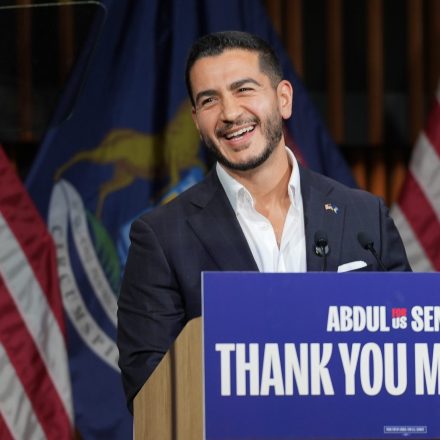
One of them was that last night, very early, like at 2:30 a.m. [ET], Abdul El-Sayed became the winner of the Senate race in Michigan, which means he will be the first ever Muslim U.S. senator.
 Related
Abdul El-Sayed Wins Senate Seat With Pro-Palestine Campaign
Abdul El-Sayed (acceptance speech): To all the kids who watched this last month, to all the parents who struggled to explain why the president openly mocked someone for their name or how they pray, let them know tomorrow that the bad guys lost.
JW: That race was filled with Islamophobia, both in the primary and in the general election. His Republican opponent, Mike Rogers, just peddled in a million different Islamophobic tropes. Voters told our colleague, Matt Sledge, who was out in Michigan speaking with them, that they really didn't like hearing all of this hate speech.
Zouheir Alawieh: They don't have any programs for our economy, for our health, for our future. So that's why they are attacking us as Muslims and as human beings.
Tea Edwards: Just, like, all of the Islamophobic hate campaigns that have been going around will probably sway a few people. The people who are actually researching what will be good for communities I think will see right through it.
MH: This was a campaign that was defined by so much panic about El-Sayed being Muslim. The race ended 25 years after 9/11, and there were all of these really kind of vitriolic Islamophobic tropes. It reminded me a lot of the campaign against [Mayor] Zohran Mamdani here in New York last year. There's all this fear of the left and this fearmongering suggesting that there's no way a Muslim candidate could represent American interests.
And of course, one of the big differences between El-Sayed and Mamdani is that El-Sayed is not a socialist.
JW: Say that again for the people in the back, because they are not going to believe you. El-Sayed has described himself as a capitalist who understands how capitalism works, so definitely not a socialist.
I've heard him described as much more of a [Sen. Elizabeth] Warren than someone in the Bernie Sanders mold.
MH: But he still faced millions of dollars in outside spending in this race, mostly because of his stance on the United States relationship to one other country.
We've heard in some of these deep-blue districts in the House races where socialists were elevated in the primaries, there was a lot of rhetoric on opposing Israel's genocide in Gaza and fighting U.S. weapons flows to Israel. But it's pretty rare to hear that from a U.S. Senate candidate, and now from a senator-elect.
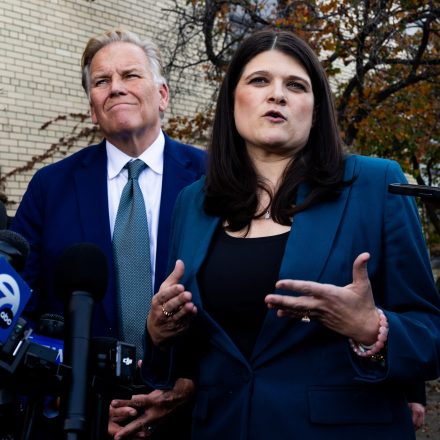
JW: It also caused some really ugly drama with his former primary opponent, Haley Stevens.
MH: Do you want to try to recap that as fast as we can, or should I?
JW: I'll get started and see if you can add in anything that I miss.
 Related
Radical Centrists Like Haley Stevens Are the Real Extremists in the Democratic Party
So essentially, on the Friday right before [Election Day], Haley Stevens released a statement condemning an ad that was not even created by the El-Sayed campaign, calling on him to condemn the ad, which he did disavow. She also asked him to take back his statements on Israel.
Now, things seemed fine for a second. Haley Stevens had all of these Democratic surrogates going on air saying that she promised to support him. While Haley Stevens's staffers were at an event for El-Sayed, Haley Stevens popped up at an event supporting the Republican candidate, Mike Rogers, giving him her endorsement.
Maia, is there anything that I missed in that?
MH: Jessie, I think the only thing you missed was just how baffling and strange this episode was. So you mentioned this ad that kicked it off. It was produced by this outside group Rebellion PAC, which is the group headed by Cenk Uygur, who some listeners might know from The Young Turks. He is also famously Hasan Piker's uncle.
Haley Stevens, as she was struggling to explain why she switched from El-Sayed to the Rogers camp, kept citing Hasan Piker and the "uncle." It was this kind of almost incomprehensible move where Anderson Cooper, the CNN host, was pressing her at one point, saying, well, you cite his affiliation with Hasan Piker and this part of the Democratic Party you don't like, but you knew about this before — so what changed?
It really seemed strange. So we sent Matt Sledge out in Michigan to ask some voters what they thought of it, and if they thought that this was a politically savvy move that would have any resonance. And here's what they said.
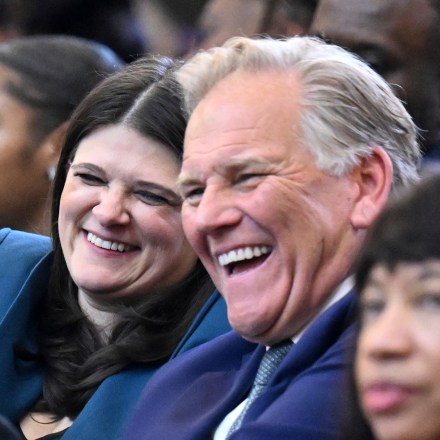
Kathleen Britton: I'm so disappointed in Haley Stevens. I gave her serious consideration during the primary.
 Related
Haley Stevens Destroyed Her Political Career for Absolutely Nothing
Jesse Craft: She fought against Mike Rogers, then said somehow he earned her vote. I don't really understand it. I kinda think it's career-ending for her.
Wendy: How embarrassing to use an African American church. How embarrassing for you to use our votes and then disregard them because of your own personal issues.
Intercept reporter Matt Sledge: So you don't think it's gonna help Mike Rogers?
Kathleen Britton: I do not.
Erin Horne: No, I think she actually helped Abdul.
[Break]
JW: Maia, before the break, you started talking about money and politics, and I want to get into how that shaped the midterms. Last week, we talked about how this election cycle became the most expensive on record. Midterms ad spending is expected to reach north of $11.6 billion. Mega-donors overwhelmingly gave to Republican candidates, including Elon Musk, who spent nearly $450 million, with large sums of that directed at boosting Ken Paxton in Texas, who, by the way, lost to James Talarico. Now, for context, the next highest donors under Musk are a Republican couple [Richard and
Elizabeth Uihlein] who spent $150 million, mostly in Wisconsin and Illinois.
Jesse Craft: We all see where money is coming from. It's coming from very, very wealthy billionaires. I don't think we should be able to buy elections.
Tea Edwards: Politics, it just feels like a game that the rich play sometimes. Kind of feels hopeless when you're just looking at all of these people and corporations giving money to each other.
MH: You hate to see Elon Musk throw away almost half a billion dollars. It only leaves him so many billions to go.
JW: Heartbreaking.
MH: But, I mean, in Texas, as you mentioned, that money really did not pan out. It didn't seem to sway voters. It seemed like if anything from the voters who talked to our reporters in Texas, in Michigan, and in Maine, which we'll get to later, people were really mad about outside election spending and don't like the idea that billionaires or corporations can buy their elections.
 Related
Anti-Trans Panic Couldn't Save Republicans in Deep-Red Texas
And in Texas, a lot of that money went to propping up this anti-trans panic campaign that Paxton was running. But all that money was not enough to save Paxton from James Talarico. Paxton was a pretty bad candidate: He was mired in too many scandals to keep track of, including a 2015 grand jury indictment on felony securities fraud charges.
In 2020, eight of his top deputies reported to the FBI that he was potentially abusing his office to do favors for a donor and friend. And just earlier this year, he offered a plea deal in a child sex abuse case that seemed to anger Texans and voters.
Remember, this is the era of the Epstein files and people being very concerned about child sex abuse. It did not seem like the wisest calculation for Paxton to offer this while running for Senate.
JW: As it turns out, there is not enough money in the world to buy Ken Paxton out of being Ken Paxton and voters recognizing that. But Republicans tried this cycle to spend big on transphobia and to blanket the airwaves with these anti-trans advertisements.
Elon Musk's Texas PAC spent $78 million on anti-transgender ads in Texas, which actually accounted for nearly half of all ad spending in support of Paxton. Republicans' big play in Texas was transphobia — and that play failed.
While clearly it didn't sway the election, some of those messages did appear to trickle down to voters. Our colleague, Akela Lacy, talked to voters in Dallas and the surrounding areas, and she did come across some voters who said they wanted to support Talarico or even some voters who did support Talarico but were concerned about his stance on trans rights, an issue that Republicans really fearmongered on this cycle yet again after doing it in 2024.
Akela Lacy: When you said you saw some stuff about James Talarico that made you unsure about voting for him, can you say more about that? What did you see, and what's your impression of him?
Jermiah Robinson: I think I seen something about the LGBTQ+ community? I mean, I don't really care about it, but I don't know. People were saying a lot of bad stuff. I think they said something about him —
Canvasser: Encouraging sex change.
Jermiah Robinson: Yeah, on the children. I don't really stand for that.
Maia Hibbett: The watchdog group Media Matters also put together a montage that showed just how much Republicans really leaned into this transphobic rhetoric.
Danielle Buck: He wants to trans our kids. He believes that there are six genders.
Andrew Kolvet: They wanna indoctrinate your kids. They wanna trans your kids.
Adam Sosnick: They're gonna trans your kids. They're gonna Talarico your kids.
Donald Trump Jr.: Trans kids back in school, trans agendas back in school, in your classrooms, with your children.
JW: Clearly, some of that rhetoric did trickle down to voters based on Akela's conversations, and some people even believed the misinformation being spread in those ads.
But fearmongering was just clearly not persuasive enough to distract people from their lived reality, and that lived reality is that gas prices are up, rent is unaffordable, and grocery prices are up.
 Related
Right-Wing Trans Hate Comes for the WNBA
I think one lesson maybe for Democrats is, there's no point in attempting to placate people when it comes to bigotry. The right can and will distort your messages, and so you can stand in your values or not, but the thing that'll motivate voters is if you can convince them that you're going to make their lives better, not if you can convince them that you're playing the middle on an issue of civil rights.
MH: We saw a parallel to this in some ways in Michigan as well, where a lot of the Republican argument was based on this perception of Islamophobia and fearmongering. Ultimately, that was not enough to elevate Mike Rogers over Abdul El-Sayed. In Texas, there's also, of course, the strong anti-immigrant sentiment that Republicans frequently run on, and I think the statewide results showed us that that narrative really fell apart this cycle.
JW: To your point, clearly, attacks on trans people, attacks on immigrants didn't work in Texas. Democrats had an amazing night. Gina Hinojosa toppled three-term incumbent Gov. Greg Abbott. The state has not had a Democratic governor since 1990.
"Attacks on trans people, attacks on immigrants didn't work in Texas."
MH: And speaking of toppling long-term incumbents that have been hard to get out of office, our colleague Noah Hurowitz was in Maine, where Troy Jackson defeated Susan Collins last night after many Democratic attempts to get her out of office.
This issue of disillusionment with money and politics came up quite a bit when he was talking to Maine voters.
Sharon McDonnell: It's immoral. It is immoral to have people worried about their fuel and have that much money coming into this. It's just wrong.
"The amount of money is more than I will probably make in my lifetime, spent in this election."
Tyler Echard: The amount they spent on just mailers, not handed at the door but in the mail, is especially, it seems, on the Republican side of things, has been absolutely insane. The amount of money is more than I will probably make in my lifetime, spent in this election.
Charlie Dingman: It's been extraordinary in Maine, the amount of spending in this race, particularly in the Senate race. I think there's a lot of fatigue. I think people are tired of it. I have had some conversations with voters at the doors that lead me to think that the extremely negative and extremely untruthful ads may be backfiring.
JW: It seems like those ads backfired. The last voice you heard was Charlie Dingman, Maine Democratic Party chair.
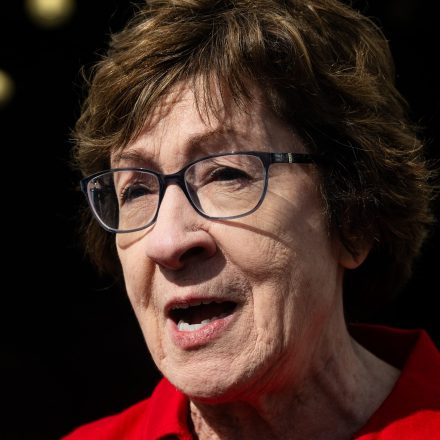
Collins campaigned on her record of securing federal investments for state infrastructure, such as rural hospitals, and she really prided herself on being a moderate Republican who apparently breaks rank with President Donald Trump. But the reality of the situation is quite different.
 Related
Lockheed Martin Showered Susan Collins With Cash as F-35 Program Hit Turbulence
The Congressional Quarterly Roll Call found that her votes aligned with Trump 90 percent of the time in both of the president's first and second terms, and voters really noticed that. They understood the difference between what she said she was, a political moderate, and her voting record, which aligned with the really far-right Donald Trump. And that's something that Noah heard from voters as well.
Sharon McDonnell: She has had this persona of moderate cross-party stuff that's just really eroded. If you read every article about her, it's like, "Moderate Susan Collins." Like, wait a minute, she's voted with Trump. She hasn't used her power.
Susan Collins "has had this persona of moderate cross-party stuff that's just really eroded."
MH: Collins really used that line about her being a moderate and being an independent voice in Washington as a go-to for her campaign.
In past cycles, it has worked. As we alluded to a little bit earlier, the Democrats have mounted challenges against her before. In 2020, they ran a candidate named Sara Gideon, who looked somewhat likely to oust Collins. And I think this cycle, there were a lot of reasons for Democrats to be nervous about this race.
Troy Jackson, the nominee, is a former state senator, and he ran on lowering costs, really centering working-class interests. But he had jumped into the race kind of hastily. If you remember Graham Platner, Jessie, he was the former nominee for Senate in Maine for the Democratic Party, and he was really considered a rising star, but had to drop out because of a series of scandals, and Jackson had to jump in last minute and fill his place.
But ultimately, Jackson pulled it off.
Troy Jackson (acceptance speech): We did it. Working people did it.
JW: Clearly, Jackson had a disadvantage going into this race. There were people who complained and said that he wasn't as charming as Platner, he wasn't as polished. But in this election, the ideas and running on affordability seems to have won the day in Maine and really throughout the country.
Collins had a reputation of delivering for the state, but clearly that wasn't enough to overcome this blue wave across the country and some frustrations with Collins as well.
But Maia, taking a step back to look at the full scope of Democratic wins, what do you make of their gains on Tuesday? Are there other races that stood out to you? What stood out to you overall?
MH: Well, there's the spin about the spin, which is that everybody is going to be framing this election and these results in their own interests. When Democrats win so far across the board, you can make an argument that any faction of the Democratic Party has the mandate, because Democrats of all stripes won Tuesday night.
 Related
The Progressive Agenda: End Iran War, Rein in AI, Get Dems to Actually Do Something
But to my view, it's hard to see how this is a world where there isn't a clear demand for some kind of transformational change. So I'm wondering what Democrats do with their mandate now, especially as we think ahead to 2028.
If you recall 2020 and the last time the U.S. elected a Democratic president, you might remember that the Biden campaign was the sort of centrist, moderate return to normalcy choice, but they got there after a lot of left momentum in the primary and a really serious showing of support for Bernie Sanders, who remains one of the most popular politicians in the country.
Once Biden got into office, he arguably tried to give some of that kind of left, dare we say, populist economic message some service. There was the Build Back Better plan that had a lot of social safety net spending and Covid relief. There were climate infrastructure projects. There was the elevation of Lina Khan [to Federal Trade Commission chair].
For a little while, Biden was getting called the most progressive president since FDR, and then he threw it all away supporting the genocide in Gaza and really lost the support of the left, and then lost the support of the country when he was kind of visibly melting on the debate stage and refusing to drop out of the race.
So I'm curious what Democrats have learned from the Biden years and how that will convert into the next congressional term and the next presidential election.
JW: It really feels like I've lived a million lives in between now and that debate that really tanked Joe Biden's entire political career at the end there.
I will say to your point, we're already seeing Hakeem Jeffries, who's likely to be the House Speaker, calling for unity and saying that people don't want to fight. But you don't really get a blue wave like this or a political wave like this when people don't want to fight.
Clearly, there's anger at Republicans. There's anger at the cost of living. There's anger at the war. If Democrats don't deliver, they're likely to see a red wave come the next cycle.
 Related
The Supreme Court Ends Multiracial Democracy as We Know It
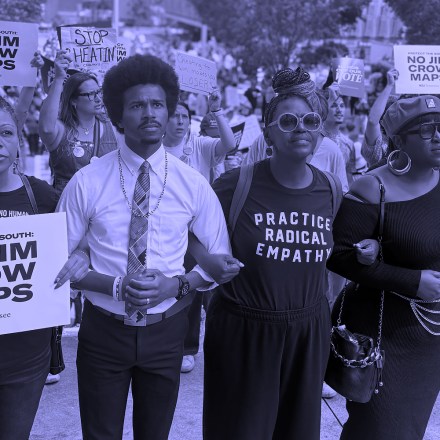
But I did want to take just a little bit of a step back and talk about Black voters and what's happened in the aftermath of the Supreme Court voting rights decision. Black voters in this election really delivered historic victories in southern states for Democrats, but Black representation in Congress thus far appears to have been slightly reduced in this election. Now, for those who remember our discussion earlier this year about the Supreme Court decision to gut the Voting Rights Act, there were a lot of deep concerns that the decision would crater Black political representation, and so far that hasn't come to bear, but it's worth paying attention to in cycles that are less blue, where we've seen really massive redistricting.
I will shout out, there was one historic victory for Black Americans: Keisha Lance Bottoms, the former Atlanta mayor, won her race for governor, becoming the first Black female governor in the country.
MH: We've talked a lot about these historic wins, but we would be remiss to not mention a close call in Florida, where Angie Nixon narrowly lost.
Nixon is a Black woman who's a member of the Democratic Socialists of America and had a really shocking primary upset when she defeated the establishment favorite to get the Democratic nomination. The Democrats didn't invest very much in her Senate race in Florida. The conventional wisdom says Florida's not flippable, but conventional wisdom also says that South Carolina's not flippable — and they did that.
"The conventional wisdom says Florida's not flippable, but conventional wisdom also says that South Carolina's not flippable — and they did that."
Nixon ended up coming within about 2 [percentage] points to Ashley Moody, the Republican incumbent, who just won a full term after being appointed to hold the seat that used to belong to [Secretary of State] Marco Rubio. A lot of people on the left side of the Democratic Party are wondering what would have happened if Democrats had invested in a DSA candidate running statewide in Florida, which is kind of a crazy statement to make if you think of just two years ago.
JW: I mean, I listened to her [concession] speech, she is an incredible speaker, but obviously, that's not enough to win elections. You need money, clearly, and investment from the party.
We're going to leave it there, but there is so much more election coverage you can follow at theintercept.com.
That does it for this episode.
We want to hear from you. Tell us what you're following or want to see more coverage of. Email us at podcasts@theintercept.com, or leave us a voice mail at 530-POD-CAST, that's 530-763-2278.
This episode was produced by Laura Flynn. Chelsey B. Coombs is our social media producer. Ben Muessig is our editor-in-chief. Maia Hibbett is our managing editor. Thank you to all of our reporters who worked late on election night: Matt Sledge, Akela Lacy, Noah Hurowitz, Jonah Valdez, and Austin Campbell, and the rest of our team.
Nara Shin is our copy editor. William Stanton mixed our show. Legal review by David Bralow.
Slip Stream provided our theme music.
This show and our reporting at The Intercept do not exist without you. Your donation, no matter the amount, makes a real difference. Keep our investigations free and fearless at theintercept.com/join.
And if you haven't already, please subscribe to The Intercept Briefing wherever you listen to podcasts. Do leave us a rating or a review; it helps other listeners find our reporting.
Until next time, I'm Jessica Washington.
MH: And I'm Maia Hibbett.
The post How Democrats Changed Everything appeared first on The Intercept.
Orders for what one official called a "national no enforcement day" began circulating on Monday inside U.S. Immigrations and Customs Enforcement.
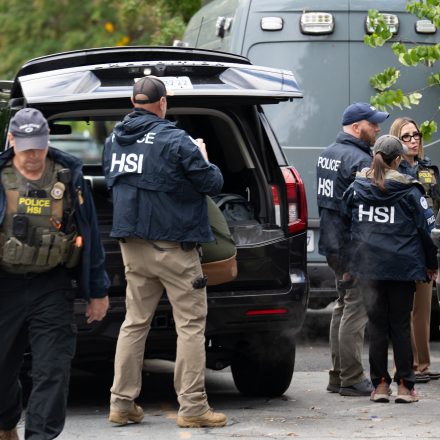
Handed down through ICE's Enforcement and Removal Operations division through internal group chats and verbal commands, the directive called for a halt to all immigration enforcement operations on Election Day, according to ICE officials across the country who spoke to The Intercept.
"We were told all operations are canceled for Election Day."
"We were told all operations are canceled for Election Day," said one ICE immigration official, who operates in the south and requested anonymity to protect their livelihood. "Word of mouth from our first-line supervisors, no official email notice."
According to multiple ICE officials who spoke to The Intercept, the orders were handed down quietly to avoid media attention.
"Yesterday was the least amount of activity observed from ICE ERO throughout the entire year so far," said Sherman Austin, the creator of StopICE.net, a crowdsourced platform tracking reported ICE activity across the United States. "You can kind of tell like from the morning. Usually, ICE gets started really early, and there's a huge spike in activity between 5 a.m. and 10 a.m. That spike wasn't there on Election Day."
Another ICE official, who works in the Great Lakes region, confirmed the orders ahead of Election Day, referring to it as "National No Enforcement Day."
 Related
Inside ICE, Officials Question String of Trump Admin "Midterm Panic Moves"
"We were told to do 'admin' shit," the official said. They said that ICE deportation officers who regularly do street-level operations were diverted to administrative office work: "I'll be drinking coffee at the office for the first time in a year."
In total, ICE officials working in four areas of responsibility — ICE's jurisdictional regions — coving parts of the northeastern, midwestern, northern, and south-central U.S. regions told The Intercept that they had received orders to stand down on Election Day.
"Something Unusual Was Going On"StopICE, the tracking website, which has roughly half a million subscribers, did record some ICE activity on Election Day, according to Austin, although most of the reports stemmed from sightings unrelated to any immigration enforcement activities.
 Related
"Offensive Driving": ICE's Deadly Weaponization of Vehicles Against Civilians
"There were a few reports that came in about ICE being at usual spots like the jails," Austin said, "or seen driving in certain areas in in the city, but it wasn't the same type of activity that's usually seen on the site. It was pretty clear that something unusual was going on."
AntiFreeze, another crowdsourced ICE-tracking platform that allows users to report and receive real-time alerts about ICE raids, also saw abnormally low levels of ICE activity on November 3, according to Josh, the creator and developer behind the site, who requested to keep his last name anonymous.
"On Election Day, our network only logged about 56 reported ICE sightings nationwide, which is one of the quietest Tuesdays we've ever seen," Josh said. "We did get about three sightings that did report ICE activity near polling stations, but most of the reports were observations of vehicles associated with ICE. We barely got any reports about actual ICE arrests yesterday."
Local activists also observed a low level of ICE activity on the street level.
"There was no evidence of street abductions," said an activist working with the rapid-response network in Minnesota's Twin Cities.
 Related
In California's Central Valley, ICE Swung a Red District Blue
"ICE, in some capacity, was still out and about, but we did not see any reports of off-the-street detainments by ICE or attempts at detainments," said the activist, who said they got word of ICE arrests at jails, but not targeted operations among the general public. "There were a lot of folks, probably more than usual, observing, and so I think we can be pretty confident that this wasn't due to lack of observation."
Leo Martinez, who volunteers with VC Defensa in Southern California, told The Intercept that no one in his rapid-response group reported any sightings of ICE activity on Tuesday.
It is still unclear exactly where the orders to halt immigration enforcement operations on Election Day originated from, although some ICE officials believe the orders stemmed from ICE Enforcement and Removal Operations leadership — and not directly from the White House.
"Nobody from the SDDO level" — a reference to Supervisory Detention and Deportation Officer, part of ICE's upper management — "expected it to happen until the very last moment," said another ICE official familiar with the matter. "But I think some of us caught on that senior leadership was making this call with fears of us being at the polls."
The official said, "It's crazy that The White House didn't catch on."
The post ICE Was Secretly Ordered to Stop All Immigration Raids on Election Day appeared first on The Intercept.
Now that Democrats have secured earth-shattering wins in both chambers of Congress, the party's progressives are sending a message to their more moderate leaders: It's time to deliver for voters who are demanding meaningful action.
"Even where the candidate wasn't a self-described progressive, progressives won big last night," said Congressional Progressive Caucus Chair Greg Casar, D-Texas, during a press call on Wednesday. "Across the country, so-called moderate candidates ran on ending forever wars," he added, pointing out that Democrats went after the GOP for voting down congressional attempts to stop President Donald Trump's unpopular military actions — efforts that the progressive caucus had organized.
With comfortable majorities in both chambers — 54 seats in the Senate and 237 in the House, as of 4:30 p.m. ET Wednesday — Democrats now have the legislative breathing room to deliver on their promises to reduce the cost of living, root out government corruption, and end Trump's failed war in Iran.
But they'll have to notch these achievements under an angry lame-duck president who vowed last night — via a Truth Social post of one of his signature red hats — to wield his veto against the new class of Democrats. The current Democratic leaders in each house of Congress, Sen. Chuck Schumer and Rep. Hakeem Jeffries, both have long track records of sparring with the left. And which of their goals will progressives prioritize when their ranks swell come January?
"We will have an H.R. 1 through 10 that focuses on costs and healthcare and corruption," Casar said Wednesday, referring to the first 10 House resolutions he wanted to see his party push. "Every single week, we should now be sending a bill to Donald Trump's desk that is overwhelmingly popular with the American people, that cracks down on corporate greed, that cracks down on price gouging, that cracks down on big money and politics."
 Related
Lesson From Lansing: To Win in Swing Districts, Fight Data Centers
To Will Lawrence, a co-founder of the Sunrise Movement and a former member of the Democratic Socialists of America who beat Republican incumbent Rep. Tom Barrett in a Michigan swing district on Tuesday, the Democrats' historically successful night translates into a responsibility to achieve transformative change.
"It's undoubtable that this was a sweeping mandate around the entire country," said Lawrence, who ran a campaign focused on his opposition to data centers, a notoriously unpopular area of tech development that the left has pushed Democrats to oppose.
"Every year, we see record-breaking numbers for the most expensive races in history by the millions."
The outsized influence of the artificial intelligence industry is another critical area for progressives to tackle, Rep. Summer Lee, D-Pa., told The Intercept. She said that she and other progressives will push legislation to end the outside influence of billionaire and super PAC money in elections, including her bills to ban super PACs and overturn the Citizens United Supreme Court decision.
"Every year, we see record-breaking numbers for the most expensive races in history by the millions," Lee said. "In the 120th Congress, I look forward to our party recognizing the detrimental impact of special interests and billionaire influence in our politics, whether it be from crypto or AI or AIPAC."
 Related
How AIPAC and AI Spent Their Money This Midterm Election
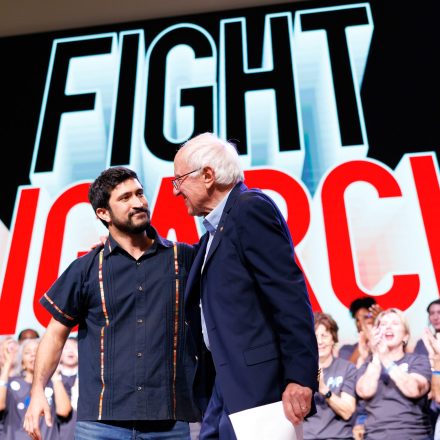
Other progressive priorities include passing policies like Medicare for All, ending corporate corruption, and investing in affordable housing. The ideas are tenets of the redistributive platform popularized by Sen. Bernie Sanders, I-Vt., who rallied voters across the country to "fight oligarchy" earlier this year and helped elevate many of this cycle's upstart candidates.
On Wednesday, progressives did not yet seem prepared to commit to which single issue they would push for first. Asked by The Intercept about their Day-One priorities when they return to Congress, Casar said progressives planned to keep up the legislative pressure throughout the two years of the coming congressional term.
The Working Families Party, which backed Lawrence and often works to push Democrats to the left, saw Tuesday's results as a sign that "voters want Democrats to stop the buildout of data centers and rein in the AI industry," said Ravi Mangla, the group's spokesperson. Like the congressional progressives, WFP cited a range of priorities for the years to come: guaranteeing healthcare and low-cost childcare, lowering housing costs, and providing more union jobs to American workers.
In fact, candidates who signed onto a promise to push a suite of pro-labor policies organized by labor leaders in swing states were among the Democrats' biggest winners on Tuesday night. Signatories to the "Contract with Working America" included Troy Jackson, who toppled three-decade incumbent Republican Sen. Susan Collins in Maine; James Talarico, who flipped the Texas seat for the first time in almost 40 years; and Gina Hinojosa, who ousted 10-year incumbent Republican Texas Gov. Greg Abbott.
Jackson pointed to the pledge during his victory speech in Maine on Tuesday night and thanked the union members who canvassed for him.
 Related
Troy Jackson Ousts Susan Collins in Maine, Replacing 30-Year Republican Senator With a Progressive
"On Labor Day, brothers and sisters, I stood before you and I made a pledge to working Mainers," Jackson said to cheers at his election night party in Portland. "And I'm going to keep that promise. Because I am a union member tonight. I'll be a union member when I walk into that Senate chamber."
"The way things are set up in our economy right now, the money is just moving up and concentrating at the top, and squeezing the people at the bottom," said Maine AFL-CIO President Cynthia Phinney. Her organization helped develop the labor platform Jackson signed onto, and she said they "fully anticipate that we're going to need to continue to organize around these issues that matter to the folks who voted for him, and a lot of folks who didn't vote for him."
Referring to Hinojosa, Rep. Delia Ramirez, D-Ill., noted that Latino voters "delivered a gubernatorial seat in Texas," as well as a U.S. senator. Ramirez, who has introduced a bill to abolish the Department of Homeland Security, argued that her party should not lose sight of outrage over violent immigration enforcement.
"Shame on us Democrats if we again do not meet the moment when it comes to immigration and when it comes to justice as it pertains to ICE and CBP and DHS," Ramirez told The Intercept.
Rep. Pramila Jayapal, D-Wash., pointed out that the issues that defined this cycle were often first championed by progressives.
"We were the first to fight back against the war in Iran. We were the first to call out corruption on so many levels. We were the first to push to rein in ICE and CBP, a shift that really drove a lot of Latino voters across the country that mattered in this election," said Jayapal. "Hopefully, this puts to rest the idea that you can't be a progressive and win with your ideas in any district in the country."
If history is any guide, it won't. As the wins rolled in on Tuesday night, Jeffries, the next likely speaker of the House, threw cold water on the idea that the vote marked a seismic rebuke of the Republican Party's way of doing things, saying the results were "patriotic," not "partisan."
On Wednesday, Jeffries said voters had chosen Democrats "because they want to see a dramatic change in direction."
"I agree, and I'll go one step further," Casar said. "The American people delivered a demand for bold change."
The post The Progressive Agenda: End Iran War, Rein in AI, Get Dems to Actually Do Something appeared first on The Intercept.
 Haley Stevens Destroyed Her Political Career for Absolutely Nothing [ 04-Nov-26 7:00pm ]
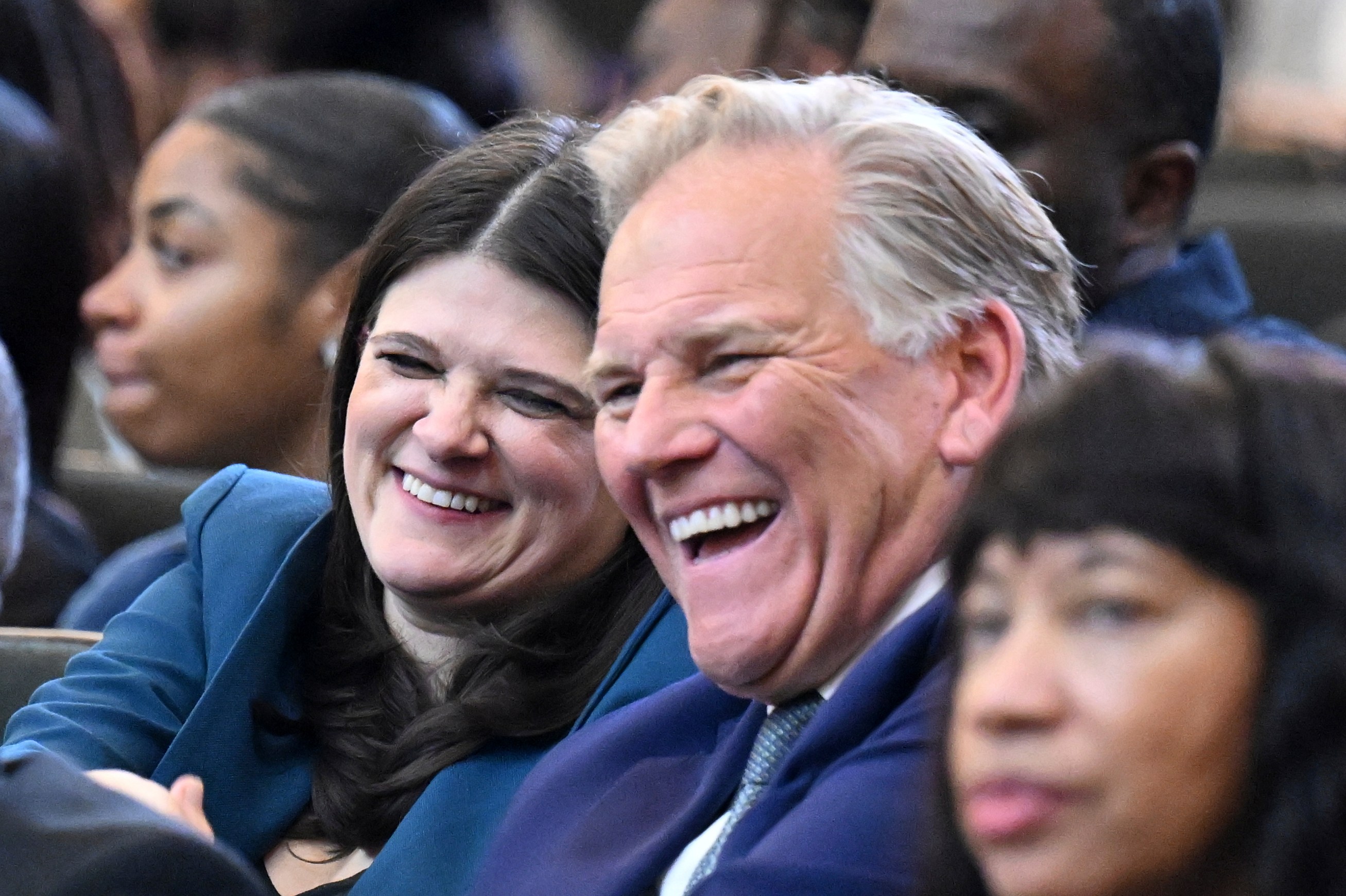 Rep. Haley Stevens, D-Mich., and Michigan Republican Senate candidate Mike Rogers attend a service at Perfecting Church, on Nov. 1, 2026, in Detroit. Photo: Jose Juarez/AP Photo
Abdul El-Sayed handily defeated Republican Mike Rogers for Senate in Michigan early Wednesday morning, retaining Democratic control of the seat and solidifying the party's Senate majority. To become the first Muslim elected to the U.S. Senate, the former public health official overcame rampant, bipartisan Islamophobia and bigotry. For the country, and the Democrats, to move forward, we must cast it out of public life forever.
The Michigan Democrat's victory felt almost like an afterthought compared to the upset Senate victories won by Democrats in South Carolina and Texas. The 2026 midterms were a referendum on President Donald Trump and his control of the GOP, and voters delivered their verdict, turning control of both houses of Congress over to the opposition party.
Related
Abdul El-Sayed Wins Senate Seat With Pro-Palestine Campaign
But we should neither forget nor forgive how we got here. El-Sayed faced an uphill battle from the beginning, which included a protracted, venomous primary, and the call was often coming from inside the house.
No detractor was as vicious as his former primary opponent Rep. Haley Stevens, whose eleventh-hour betrayal of her party's nominee — she formally switched her endorsement to Rogers on Sunday — was a transparent attempt to turn the seat red.
Backlash was swift and harsh and came from all corners of the party. Sen. Chuck Schumer, the powerful leader of the Senate who has made little secret of his disagreements with El-Sayed on Israel, called Stevens's actions "a despicable betrayal." Michigan Democratic Rep. Debbie Dingell and state Sen. Mallory McMorrow, who finished third in the primary, went as far as to express personal concern for Stevens.
And Rep. Nancy Pelosi, D-Calif., just days after implying El-Sayed and New York City Mayor Zohran Mamdani were antisemites for opposing ethno-supremacy in Israel, said Stevens chose "to dangerously betray Michigan families' healthcare, freedoms, and future with her horrific endorsement of Mike Rogers."
In the 48 hours-plus since she threw in with Rogers — which increasingly seems like it was motivated primarily out of spite when she was boxed out of a Sunday campaign event with Rep. Jim Clyburn, D-S.C., in Detroit — Stevens embarked on a media tour of justification that got weirder and weirder.
A 15-minute, rambling interview with Anderson Cooper on CNN Sunday night didn't provide insight into her motivations, or much else; on Monday evening, Stevens followed up with a long statement posted on X owning the decision to destroy her political career with the Democratic Party. She also denied that her fiancé, political donor Jason Turkish, played any role in the endorsement: "I made this decision, and I am proud of it. Do not question my independence simply because you disagree with my conclusion."
Related
Radical Centrists Like Haley Stevens Are the Real Extremists in the Democratic Party
Congressional staffers to Stevens resigned en masse on Sunday, and former campaign aides told the Washington Post that they had to run defense to keep Turkish — who had endorsed Rogers before Stevens did — out of the spotlight and marginalize his influence.
"Any campaign staff being directly quoted in this article, I was made miserable by working with them," Stevens told the Post in response, adding, "I have nothing else to say about the campaign at this time."
But a singular explanation of Stevens's decision lets Democrats off the hook far too easily for the anti-El-Sayed campaign waged by leaders in the House and Senate. For the party to move forward after the midterms, the Democrats need to take a hard look in the mirror and purge institutionalized Islamophobia from their ranks.
They can start with their friends in the media. The Atlantic's Jonathan Chait, in a screed published Sunday, whined that "during the same period of time that El-Sayed has been winking at a political movement inflected with anti-Semitism, he has been targeted by a political message that is not merely inflected with racism but saturated with it."
We should get ready for a long overdue, but almost certainly painful, intraparty debate on how Democrats policed dissent in their own ranks.
Political commentator Van Jones noted on X ahead of Election Day that "the Republicans are conducting a campaign of blatant anti-Muslim fear mongering." But in the same post, he also argued El-Sayed's "refusal to outright denounce" a little-seen ad produced by an outside PAC — an ad which El-Sayed distanced himself and his campaign from — tying the rise of grocery costs to U.S. support for Israel was comparable.
"Something is going horribly wrong in the Senate race in Michigan," Jones added huffily. "And I am going to keep calling it out."
Related
Lesson From Lansing: To Win in Swing Districts, Fight Data Centers
After last night's massive blue wave, it should be undeniable that the left was a major factor in flipping the House and Senate. That means the party's progressive wing can now credibly claim a seat at the governing table without compromising on domestic or foreign policy. We should get ready for a long overdue, but almost certainly painful, intraparty debate on how Democrats policed dissent in their own ranks in this election, and how to disentangle leadership from unconditional support for Israel.
There's always the possibility that the party's centrist wing comes together with the left and repairs the damage. A good first step would be for leadership to make clear that Stevens, and anyone else who indulged in anti-Muslim arguments to score political points, has torched any possible future in the Democratic Party. Any advocacy or lobbying group that offer Stevens or her ilk safe political harbor should also be blacklisted.
 Related
Democrats, Don't Mess This Up
Party discipline applied to the treacherous center doesn't appear to be the top priority for House Minority Leader Hakeem Jeffries, the presumptive next speaker, who devoted his first remarks after the election to downplaying partisanship in this "patriotic moment."
But without backup from party leadership, El-Sayed will continue to be met with hostility. On Wednesday morning, CNN asked fellow incoming Texas Sen. James Talarico if he would "stand up" to El-Sayed and other, unnamed left-wing members of his caucus. To his credit, Talarico demurred from directly challenging his fellow future senator. Still, it's a sign of a long battle to come.
The question for "unity"-caping Democrats remains: Who will they rally around — and who will be left out in the cold?
The post Haley Stevens Destroyed Her Political Career for Absolutely Nothing appeared first on The Intercept.
Lesson From Lansing: To Win in Swing Districts, Fight Data Centers [ 04-Nov-26 5:15pm ]When progressive Will Lawrence beat two moderates in a Michigan congressional primary earlier this year, some Democrats were worried about his ability to win one of the nation's most evenly divided districts.
Early Wednesday morning, Lawrence claimed victory over Republican Rep. Tom Barrett. (National news organizations such as The Associated Press had not called the race as of Wednesday morning.)
A national swing in favor of Democrats helped him — but so did a campaign that leaned heavily on opposition to data centers to
situate Lawrence as a populist instead of an extremist.
Data centers were on voters' minds everywhere, but they rarely dominated a race as much as the 7th Congressional District of Michigan. Lawrence vocally opposed data center construction almost as soon as he began running last year. A series of proposed hyperscale developments in and around Lansing pushed the issue into the limelight.
A month and a half before the election, Lawrence announced a data center platform calling for a moratorium on new development, environmental regulations, and a national jobs program to replace work taken away by artificial intelligence.
Related
Abdul El-Sayed Wins Senate Seat With Pro-Palestine Campaign
As progressives take stock of the 2026 midterms, Lawrence's approach points one way forward for their wing of the Democratic Party. Lawrence's opponent tried to turn his time as an environmental activist into a liability, but in an interview with The Intercept, Lawrence said his background primed him to come down on the same side as the public on a red-hot issue like data centers.
"I fought against Wall Street landlords trying to kick people out of their homes. I fought against oil companies who are polluting our air and water," he told The Intercept in an interview last month. "So for me, this was not the first time that I've stood on the line against a corporate behemoth like this."
From Sunrise to CongressLawrence is a co-founder of the Sunrise Movement, which had one of its most famous moments when its youth activists marched into the office of then-House Speaker Nancy Pelosi to push for the Green New Deal with Rep. Alexandria Ocasio-Cortez, D-N.Y., by their side in 2018.
Data centers and AI were remote issues for voters then, but they were starting to bubble up in the public consciousness by the time Lawrence announced his run for Congress in August 2025.
 Related
AI Tried to Buy the Midterms — Then the Lobby Learned Everyone Hates AI
Two months later, one of his first moves as a candidate was to visit public meetings in two small townships in Michigan to express his opposition to proposed data center developments.
As a former member of the Democratic Socialists of America, he drew skepticism from many observers over his ability to win the primary in a district that narrowly voted for Donald Trump in 2024. They were equally skeptical of his ability to beat Barrett, a Republican who tried to play up his moderate bona fides in the race's final weeks. Barrett was one of a handful of Republicans to vote in favor of a resolution to end the Iran war, for instance.
Lawrence had some major liabilities in a purple district, including tweets where he wrote "fuck the nuclear-family home" and told then-Democratic Sen. Joe Manchin in a song to "hurry up and die."
While Barrett leaned on those posts and Lawrence's time with the DSA to cast his opponent as an extremist, the young progressive had a card up his sleeves in the form of the data center issue.
It is the rare cause that leaps across party lines to unite Republicans and Democrats who are just as worried about water sources drying up and ceaseless buzzing sounds.
 Related
The AI Doomsday Future Is Not Inevitable
At an October 5 city council meeting in the quaint town of Mason, where a developer has proposed a hyperscale data center on a plot of picturesque farmland, Democrats and Republicans alike said they were outraged. Some residents said they would sell their house and leave town if the development is built.
In a sign of how politically charged the issue has become, many of the speakers were candidates for office angling for votes. Lawrence had dropped by himself a few weeks before. His first television ad centered on his opposition to the Mason project.
Karl Sime, a Mason resident who crisscrossed the area on behalf of Democratic candidates, told The Intercept last month that "100 percent" of voters were angry about the data center proposed for the swath of farmland just outside city limits.
"Sometimes they'll just say it unprovoked," he said. "You can see the body language just dramatically change into anger."
Republican CountermovesLawrence was hardly the only candidate who tried to tap into opposition to data centers. Some Republicans tried to catch the wave as well.
 Related
How a Small Kansas City Became a Critical Hub for Trump's Deportation Regime Against Its Will
Barrett voted for the One Big Beautiful Bill, which included tax breaks that could benefit rural data center developers. But as the danger he faced in the election became clear, he proposed legislation in Congress that would ban local officials from signing non-disclosure agreements with developers and would allow local communities to set regulations on data centers without federal interference.
Some voters said they wanted to see candidates take a harder stance in favor of regulation, however. At the City Council meeting last month, Doug DeLind said he was left shaking his head at neighbors who had yard signs opposing data centers and supporting Barrett.
DeLind, a sculptor who lives near the proposed data center, said that Barrett's position was that "we're going to leave it up to the local communities, but we're not going to provide any federal protection or any guidelines to what a data center can do."
Although Mason faces a more imminent possibility of a massive data center, Americans across the country are worried about having one in their backyard. Multiple surveys showed a remarkable shift in public opinion on the subject over the past year. Half of Americans oppose a data center being built within 3 miles of their house, according to a recent Politico poll.
 Related
Francesca Hong's Loss in Wisconsin Is a Win for AI Data Centers — for Now
In recent months, data centers became a signature issue for Democrats with progressive pasts trying to recast themselves as populists. Sherrod Brown, the party's Senate candidate in Ohio, and Texas gubernatorial candidate Gina Hinojosa also staked their campaigns on opposition to data centers. Both won.
"The playbook was listening to voters. I think voters across ideologies were speaking with one voice, and I think their opponents were some of the people most willing to silence voters and accept industry cash instead," said Alex Bores, who became a national figure by arguing for stricter AI regulations during a failed New York congressional primary bid earlier this year.
As candidates ran away from data centers, the artificial intelligence industry's most powerful super PAC stopped intervening in close races. An Intercept analysis found that the well-funded Leading the Future super PAC network, which is aligned with OpenAI, largely stopped spending in competitive general election races.
It lost in the one state where it did place a big bet, South Carolina. Incumbent Sen. Darline Graham, a Republican, fell to challenger Annie Andrews.
Bores, who now leads a pro-AI regulation group called Who Decides, said he was not surprised to see candidates increasingly market themselves as AI skeptics.
"I think it's overdue. I think candidates and elected officials are catching up to where the electorate is, across parties," Bores told The Intercept. "It is remarkable the agreement that voters have around wanting guardrails to protect us from the most powerful and fastest moving technology of our lifetime. Democracy is sometimes slow, but only so much."
This story was supported by a grant from the Tarbell Center for AI Journalism.
The post Lesson From Lansing: To Win in Swing Districts, Fight Data Centers appeared first on The Intercept.
 Donald Trump after boasting his renovations of the Lincoln Memorial Reflecting Pool on the eve of the midterm elections on Nov. 2, 2026, in Washington, D.C. Photo: Aaron Schwartz/Bloomberg via Getty Images
For two years, Donald Trump's Republican Party has worked to push the United States further and further into a state of fascist rule. Trump's regime has turned the federal government against ideological enemies, enriched and entrenched the power of billionaire allies, and done its utmost to decimate any checks and balances on the actions of the despotic leader and his loyalists.
It is, then, an extraordinary and overdue moment of relief to see the processes of democracy — however flawed in our barely representational system — offer the opportunity to take an off-ramp away from technocapital-backed fascism. Across the nation, Democrats secured historic victories. Even in Republican strongholds including Texas, Georgia, and South Carolina, voters delivered a rebuke to Trump's GOP.
Democrats in Congress now have a mandate to do two things: Stop Trump, and improve the welfare of the U.S. working class. This should be understood as no less than a moral imperative to act immediately to curb the regime's fascism in every possible way.
Americans are above all furious at the dire economic conditions in which they're expected to struggle. The midterm results reflect a limit of Trumpian false consciousness: People know when they are poor, and they can see when billionaires, federal armed forces, genocidal governments, and presidential family members are profiting.
Democrats now have a mandate to do two things: Stop Trump, and improve the welfare of the U.S. working class.
Despite their newfound congressional majority, Democrats now face an uphill battle to deliver legislation that will improve people's material conditions. But that is not an excuse for inaction, mealy-mouthed gestures, or nods to bipartisanship. Democrats must push legislation that Republicans cannot stop, as well as legislation that Trump is all but sure to veto.
For one, Democrats must immediately roll back cuts to programs like Medicaid and supplemental nutritional programs. They must go further, too, and deliver on campaign promises for robust healthcare provisions, welfare spending, and restrictions on the ruinous depredations of Big Tech.
 Related
Trump Scrambles to Halt Military Aid to Israel to Deprive El-Sayed of a Talking Point
Trump bypassed Congress to prosecute his illegal war of choice on Iran, which has cost over $47 billion to date. But Congress has the power to curb military spending. Democrats must pass further resolutions to end the war, and they must pull the plug on military budget, directing funds instead to healthcare, housing, and investments in green infrastructure, to name a few urgent priorities. Though a flailing Trump finally announced that he would end military aid to Israel on Monday, it is Democrats who must pass further legislation to end all U.S. complicity in Israel's apartheid regime and genocide.
Democrats must also propose laws to defund and abolish Immigration and Customs Enforcement. This is no outlandish proposal; the impunity-drenched militia was only founded in 2003, and it is only by virtue of Congress that it now receives more funding than any other federal law enforcement agency. It is in Congress's power to dismantle the agency and pass legislation to nullify the $170 billion-plus allocated to the border regime in Trump's One Big Beautiful Bill.
Democrats should do whatever possible to roll back and end political prosecutions and the Trump administration's brazen efforts to criminalize dissent.
Related
The AI Doomsday Future Is Not Inevitable
The Democratic program must, in short, reject the austerity logics that have dominated the party for four decades. As sociologist Melinda Cooper has pointed out, and Trump's Republicans have again and again proven, such austerity is not even austere: Pro-austerity governments since the Nixon administration in the 1970s have overseen lavish public spending in the shape of tax cuts and subsidies for holders of financial wealth (which does not trickle down), as well as funding for policing, border enforcement, prisons, and war machines. These are choices, and Democrats have been given a mandate to make choices that instead benefit — to revive a classic — the many, not the few.
Democrats such as Rep. Pete Aguilar, D-Calif., have stressed that their focus will be on the "affordability agenda" on which the party has run. This must include taking swift action to investigate and impeach the president and the worst offenders in his Cabinet, including Secretary of War Pete Hegseth and Secretary of Health and Human Services Robert F. Kennedy Jr. In no way does insisting on accountability for Trump and his acolytes' lawlessness distract from an economic focus. No affordability agenda can be achieved with an authoritarian executive in place. Challenging Trump's despotism and self-dealing with every possible tool goes hand in hand with legislating to deliver on so-called kitchen-table issues.
Will Democrats in Congress, many of whom continue to reject the progressive and left-wing energies that have helped drive this blue wave, succeed in this anti-fascist political and economic agenda? No doubt, they will be thwarted at every turn by a desperate and dangerous executive and an embattled Republican minority. That is no reason to compromise, and constant pressure must be kept on Democrats who pretend otherwise. As the votes tonight make clear, in their millions, Americans know who to blame.
The post Democrats, Don't Mess This Up appeared first on The Intercept.
In California's Central Valley, some surprising voters are lining up behind a progressive upstart: A law enforcement officer who calls for the abolition of ICE. A millennial who once voted for a Republican congressman.
They found themselves among supporters of Randy Villegas, a Democrat poised to oust longtime incumbent Republican Rep. David Valadao in a district dominated for decades by conservatives in California's Central Valley.
With Democratic victories across the nation, California's 22nd Congressional District is the kind of historically red stronghold where progressive policies may find new purchase.
Villegas's path to the general election mirrors that of other progressive candidates charting a new identity within the party. Running on policies such as Medicare for All, addressing affordability, rejecting corporate donations, and halting the flow of weapons to Israel, the 31-year-old defeated a moderate Democratic state assembly member backed by the party's establishment in the June primary.
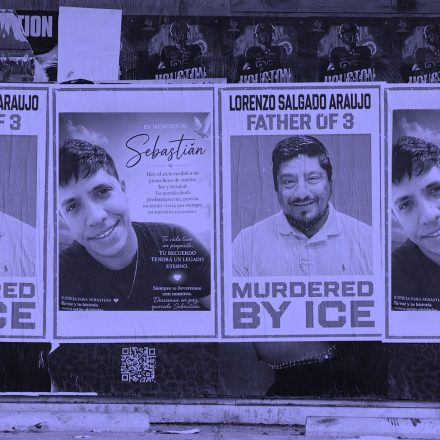
Villegas's opposition to ICE in a district that is 70 percent Latino or Hispanic marked the sharpest point of contrast with Valadao, who defended the Trump administration's anti-immigrant campaign and famously uttered "It is what it is" on the debate stage last month when pressed on the issue. Valadao claimed "a lot" of the individuals captured by ICE in the Central Valley in recent weeks have criminal records, despite research showing the majority of those detained by ICE lack criminal convictions.
It was Valadao's stance on immigration that most animated Central Valley voters who spoke with The Intercept.
"I've never seen him stand up to something I feel is egregious," said Raul Castro, 53, a Fresno County probation officer who is upset with Valadao's lack of willingness to oppose Trump on the ICE raids surging through the area in recent weeks. "I just don't respect people like that."
 Related
Trump's National Killer Police Force
While standing on the front porch of his house in a middle-class suburb in northwest Fresno, Castro lamented ICE's targeting of immigrants based on their appearance, language, or jobs. He spoke out against immigration agents pulling people from the street and into labyrinthine detention centers where civil rights advocates have reported a lack of access to basic necessities such as clean water and adequate healthcare. Though Castro once supported ICE, when asked whether he would support abolishing the agency altogether, he said yes.
"If you asked me that same question, 'Hey would you abolish ICE?' I'd say, 'No, 'cause they're doing things to make sure our country is safe. I want to live in a safe Fresno, safe county, safe city,'" Castro told The Intercept. "But now, wait a minute, maybe that's not what I thought it was going to be."
Villegas told The Intercept he wasn't surprised to hear he had won the support of an anti-ICE law enforcement officer.
"I don't find it surprising because I think ICE has made it much more difficult for local law enforcement to carry out their jobs and their work — and everybody is seeing the indiscriminate profiling going on," Villegas said at a Fresno park rally to support last-minute canvassing efforts.
Villegas himself does not support abolishing ICE but instead has called for wide-ranging reforms of the agency. The policy position makes Villegas somewhat an anomaly among his progressive peers, who are riding a wave of leftist energy into Congress, some of whom include "Abolish ICE" among their campaign platforms.
 Related
If Democrats Win, Thank the Left
While holding key endorsements from high-profile democratic socialists Sen. Bernie Sanders, I-Vt. and Rep. Alexandria Ocasio-Cortez, D-N.Y., Villegas has also rejected the socialist label, preferring "populist," despite attempts by the Republican national party to weaponize the term against him. Unlike many of his fellow progressives, Villegas is also one of the few who is running in a historically red district. And he's confident voters are not caught up in the ideological nuances and hopes to instead cut through them.
"People are fed up with an agency who is unaccountable, people are fed up with a member of Congress who is unaccountable, who doesn't even have public town halls," Villegas said. "We deserve better than that in the Central Valley, and I think that's why our messaging is resonating across the political spectrum."
Such reach across the political spectrum is also evidenced in voters like Aram Easter, 33, who was born and raised in Fresno. He doesn't vote in every election, but cast a ballot for Valadao a decade ago when his district previously covered Fresno, largely because he bought the vision of someone with local Central Valley roots (Valadao was born and raised in the nearby Hanford). He also agrees with some aspects of Trump's agenda, such as building the border wall. But he drew the line on immigration enforcement.
"You got people tearing people's families apart," Easter said. "My family immigrated here — I have Black and Mexican family — I'm not with them overly-aggressively doing it."
Since early October, ICE raids have become more prevalent in the region, with more than 200 people detained by authorities throughout the surge, according to the local newsroom Fresnoland. Similar upticks in ICE have taken place recently throughout the state, including Los Angeles and San Diego. Voter rights organizations in the Central Valley have taken notice and are viewing the raids as an effort by the Trump administration to suppress the vote, especially in a key race in the 22nd District.
"This timing of the uptick in ICE is not a coincidence," said Marisa Moraza, political director at PowerCA Action, which is doing independent expenditure work to support Villegas's campaign. "It's not a coincidence that this started at the beginning of October when voters received their ballots in the mail."
The raids have also suppressed get-out-the-vote efforts, Moraza said. Last month, the group had to pause in-person canvassing operations for several days amid the surge in ICE activity, electing to instead do phone banking.
The ICE activity is also keeping would-be voters from dropping off their ballots, as recent arrests of U.S. citizens struck fear among voters, said Cirilo Ordaz, a canvasser with PowerCA supporting Villegas.
"With going out to vote, I think a lot of them haven't done it yet because of that fear," said Ordaz, who was one of dozens of Villegas supporters who fanned out across the region on the Monday before Election Day to urge residents to vote.
Related
"Offensive Driving": ICE's Deadly Weaponization of Vehicles Against Civilians
Sylvia Ramirez, another Fresno native canvassing with PowerCA said she's noticed far fewer people outside in recent weeks, including a lack of crowds at the popular annual event Big Fresno Fair. For voters, she and her group offer to drop off people's ballots for them if the fear is keeping them inside.
"Offering the services of dropping off a ballot for somebody really helps out with the fear that people have of leaving their houses," she said, adding that she has told her family to stay at home as much as possible in recent days to avoid interactions with ICE.
The Central Valley, known for its significant agriculture production, has been the seat of high-profile Republican lawmakers, such as former Rep. Devin Nunes and former House Speaker Kevin McCarthy.
But after a Democrat-led redistricting in the state last year in response to Texas's partisan redistricting effort, the district now includes the northwest sections of Fresno, a city with more Democrats.
Early voting across the state has outpaced recent midterm elections, according to a recent survey. It's unclear how much of that is anti-Trump animus or having a candidate voters are excited to support.
Castro, the probation officer, was among those who voted early. In recent weeks, he said he noticed residents looking at him with concern while on the job in uniform, showing up at areas where ICE had previously conducted raids. It's a fear he acutely understood. As a child, he lived in labor camps with his mother and father, who were both undocumented immigrants working in Fresno as farm laborers. He recalled similar indiscriminate sweeps by Border Patrol in the 1970s.
"When I was small, back then it was Border Patrol, and they used to show up in a van," Castro recalled. "All the agents used to get out and run after these guys. And they used to round them up and take them out," he said.
Seeing video and hearing of recent ICE raids targeting farmworkers in the area conjured such painful memories.
"I never thought I'd see that again," he said.
The post In California's Central Valley, ICE Might Swing a Red District Blue appeared first on The Intercept.
On an election night handing Republicans a beating in critical House and Senate races across the country, the GOP fell short even in once deep-red Texas after a campaign run on a go-to outrage tactic: fearmongering over the rights of transgender people.
Democrats escaped the political wilderness in the Longhorn State on Tuesday night, when Democrat James Talarico defeated Republican Ken Paxton — despite the far-right attorney general's relentless attacks on the trans community and his party's claims that Democrats would enforce so-called "transgenderism" as a kind of ideology.
The massive upset was paired with a victory for Democratic gubernatorial candidate Gina Hinojosa, who beat Republican incumbent Gov. Greg Abbott shortly after the Senate race was called for Talarico.
In Dallas, Paxton voter Rachel Fuller told The Intercept she was alarmed by what she believed was Talarico's support for "far-fetched" ideas, like "giving children the right to decide — and making parents, calling them abusive for not letting them have transgender changes."
Her comments suggested some of the $78 million Republicans spent on anti-trans attack advertisements in Texas were working. But they weren't enough to help Republicans hold onto power in Texas, which hasn't had a Democratic senator since the 1990s.
The ads made up almost half of all ad spending in support of Paxton, according to an analysis from Puck using data from AdImpact.
By and large, the ads spread blatant misinformation about Talarico's record.
One infamous $29 million ad created by Texas PAC, a political action committee primarily funded by billionaire Elon Musk, claimed that Talarico supported jailing parents who did not support gender-affirming surgeries for minors. "Every mom in Texas should be worried about James Talarico putting parents in jail if they do not support surgically transitioning their children," a woman in the ad warned ominously.
 Related
The Rise of the Christian Left in Texas
That attack, which according to Puck received 1.9 billion views as of October, does seem to have caught the attention of Texans — even with voters who ultimately supported Talarico.
Julius Ishola, a canvasser for Black TOP, an operation under Texas Organizing Project that targets Black voters, told The Intercept he had frequently heard Black voters raise concerns that Talarico intended to jail parents.
"I've been getting a lot of bad feedback regarding James Talarico," Ishola told The Intercept, saying many voters cited concerns of "gender sex change and possibly prosecuting parents who go against that … and allowing transgenders into female restrooms."
As a state legislator, Talarico fought bans on transgender athletes' participation in youth sports, and famously said that God is "nonbinary," earning him ridicule from Republicans, who nicknamed the Senate candidate "Talafreako." In the face of those attacks this cycle, Talarico appeared to backtrack on the issue, telling Fox News in September that he supported bans on transgender children's participation in sports if it risks "safety or fairness" — without clarifying what that meant.
His wavering does not seem to have reached many voters.
"I voted Republican all the way. And that's my fear of Talarico going in," said Carol Billings, a voter who cast her ballot for Paxton at the Living Waters Church in Dallas County. Like Fuller, she cited her perception of the Democratic nominee's trans policies as a major source for concern.
Still, many voters in Black districts, which were vital to Talarico's victory, barely mentioned Talarico.
"At the end of the day," said Dallas Jones, a Houston-based Democratic political strategist whose firm focuses on African American voter engagement and backed Talarico, "the results show that people care more about their everyday lives than they do about trans Americans who just want to get by."
Some voters told The Intercept they were far more concerned with issues of affordability. " I just hope we can get these gas prices down," said Darryl Moore, a Fort Worth voter.
This is a developing story and will updated. Akela Lacy reported from Dallas, Texas.
The post Even Anti-Trans Panic Couldn't Save Republicans in Deep-Red Texas appeared first on The Intercept.
For the left, it's been the marquee race of the midterm cycle. Either a Republican former U.S. representative known for pushing domestic spying powers or an outspoken progressive who forced a reckoning over U.S.-Israel policy among Democrats will emerge from Election Day as the next senator from Michigan.
Abdul El-Sayed would be the first Muslim U.S. senator if elected Tuesday night, capping off a race that's been viewed as a referendum on swing-state appeal for the Democratic Party's left flank. If he defeats Mike Rogers, a loyal Trump ally whose campaign often peddled Islamophobic tropes against the Democratic nominee, the results will all but certainly embolden progressives ahead of the 2028 presidential election.
If El-Sayed loses, it will likely trigger a centrist backlash — and cost the Democrats a critical Senate seat as the party fights to take back the upper chamber.
Polls across Michigan closed by 9 p.m. ET on Tuesday, with anxious voters across the state awaiting the returns.
 Related
Polls Close in Maine as Democrats Make Final Push to Oust Sen. Susan Collins
In the heavily Arab and Muslim city of Dearborn, voters across party lines said they were outraged at the Islamophobic attacks ads targeting El-Sayed that became a staple of airwaves and social media feeds in the campaign's final days.
"I am a Muslim. And I've seen a lot of ads, and it's disgusting, because we are good people," said Gus Tarraf, a Republican running for a state House seat. "I love this country."
Although Donald Trump carried many precincts in Dearborn two years ago due to voter frustration over the Biden administration's support of Israel, Tarraf said his community is turning on the Republican Party this year.
"Not a lot of Arab Americans are happy with the Trump administration," he said. "So it doesn't matter if they know you, as soon as they know you are on the Republican ticket."
El-Sayed's willingness to criticize U.S. policy on Israel animated soap-opera-level drama in the final days of the race, when his former primary opponent, centrist Democratic Rep. Haley Stevens, announced she would switch her endorsement to support Rogers.
After demanding an apology from El-Sayed for an outside PAC's ad, Stevens said on social media that she came to the decision after feeling "shut out" by El-Sayed's campaign, adding that she's heard from "Black voters, Jewish voters, and others about how deeply these messages hurt." Rogers, she said, gave her "the hope that he can serve in the tradition of John McCain: a senator willing to put country before party and stand up to his own side when conscience requires it."
Stevens's late-breaking endorsement of Rogers drew a mix of eye-rolls and outrage from voters at three precincts in Detroit and Dearborn. None of the voters interviewed by The Intercept said it had swayed them to vote for Rogers.
"People have already early voted. People have already absentee voted," said Noora Iskander. "I don't think many people change their minds. So I think it's just hypocritical."
Stevens's decision to make the endorsement while inside a Black church in Detroit may also have generated backlash from the Black voters that Rogers was hoping to win over, according to some who spoke to The Intercept. One said the church community has been buzzing — and not positively — about the weekend's events.
"Unfortunately, she went to a Black church to use it as a backdrop," said Dearborn voter Dorothea Sharon. "It really was a slap in the face for the Black community that that happened."
Related
Trump Scrambles to Halt Military Aid to Israel to Deprive El-Sayed of a Talking Point
While El-Sayed has had to face intense scrutiny over accusations of conflating opposition to U.S. aid to Israel with antisemitism, little accounting has been made of the blatant Islamophobia and xenophobia from the Rogers campaign, the Republican Party, and Trump. But in Dearborn, the rhetoric had clearly hurt several voters who spoke to The Intercept.
The father of state Senate candidate Abbas Alawieh, a Democrat who played a prominent role in the 2024 Uncommitted movement, grew visibly upset when asked about the ads targeting Muslims.
"These are weak people who don't have anything to do — they don't have any programs for our economy, for our health, for our future," Zouheir Alawieh said. "That's why they are attacking us as Muslims and as human beings. It's never been like this. This is a shame. America is a place where the Black with the white with the yellow, the Muslim with the Christian with the Jews, can live freely. Don't try to tear up our society."
Outside Dearborn, El-Sayed has tried to defuse the anti-Muslim smears against him by joking that he is only in favor of "shawarma law." However, the Islamophobic attacks convinced at least one voter to cast her ballot for Rogers.
"I don't want to live under Sharia law," said Joann, a law firm employee who declined to give her last name after she voted in Detroit.
The fear of Islamic rule was the main issue for Joann, she said, although she also worried about El-Sayed's campaign pledge of Medicare for All.
"I've worked my whole life, put all my stuff into the Medicare, but then I've got to let other people get it for free? It doesn't seem fair to me when I've worked my whole life for it, and we're not even sure that it's going to be there when we really get ready to retire," she said.
Yet it was that very messaging from El-Sayed's campaign that excited many other residents in Michigan. Many voters who spoke to The Intercept said they were more focused on pocketbook issues.
"It's the gas prices, the food. I mean, money is running out your pocket so fast," Leigh James said after voting at Tabernacle Missionary Baptist Church in Detroit.
James said she had walked to the polling place to avoid using gas. "I'm trying to save," she said. "So thank God I live in the neighborhood."
Other voters said they were inspired by El-Sayed's personality, with one woman describing him as a "fighter."
Noora Iskander, who voted for El-Sayed in Dearborn, said she approved of his stance in favor of Medicare for All, his affordability platform, and his solidarity with Palestine.
"I think he's going to make a lot of change. He's going to scare a lot of people — which I believe is a good thing, because you can't really change for the better if you don't scare a few people," she said.
This is a developing story. Matt Sledge reported from Dearborn and Detroit, Michigan.
The post Michigan Senate Race Closes as a Referendum on Israel Policy appeared first on The Intercept.
The toughest reelection campaign of Republican Sen. Susan Collins's career is over, as Mainers await results of whether their longtime senator effectively portrayed herself as an independent force in Washington or was weighed down by the baggage of a Republican Party entering the midterms at a severe disadvantage.
Polls closed at 8 p.m. ET Tuesday night in a race that could see the 30-year incumbent lose her powerful Senate post to challenger Troy Jackson, a progressive who was virtually unknown on the national stage until his rushed elevation just over three months ago as the Democratic replacement candidate.
Tuesday night's election results could change the control of the Senate chamber, with Maine as one of the seven critical states likely to determine whether Democrats can overcome the Republican majority in D.C.
But Maine voters may have to wait far later to learn who won. The state's ranked-choice voting system, which allows voters to rank candidates by preference rather than being forced to select just one candidate, could delay results significantly.
"I think it's possible results will take us past midnight," Maine Secretary of State Shenna Bellows told reporters in Lewiston on Tuesday.
Bellows said municipalities have two business days to submit their results to the state, although election officials have requested that towns share their vote counts Tuesday night.
Collins, who has represented the state since 1997, campaigned on her record of securing federal investments for state infrastructure, such as rural hospitals, and prided herself as being a moderate Republican who breaks ranks with President Donald Trump.
However, an analysis by Congressional Quarterly Roll Call found that her votes aligned with Trump 90 percent of the time in both the president's first and second terms.
Still, Collins's split support among some Democratic voters was evident Tuesday in Lewiston, where several residents told The Intercept they were supporting the Republican senator despite filling their ballots out to Democrats otherwise.
"I am Susan Collins all the way," said Anne Marie Hastings, a voter who also expressed strong support for Matt Dunlap, a progressive running against former Republican Gov. Paul LePage in a closely watched race in the state's 2nd Congressional District.
"I'm a registered Democrat, but when it comes to things like this, I go with what I feel is right, not the party that they belong to," Hastings said.
Another Lewiston voter, Ouellette Bertram, said he voted blue across the board, with the exception of "the Republican lady," who he said he just plain likes.
"She's been doing a good job, I think," Bertram said.
Other Maine residents didn't share the sentiment toward the Republican incumbent and the Republican Party's decadelong legacy within the state.
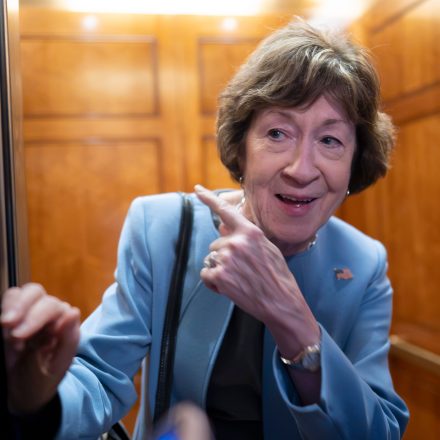 Related
Susan Collins's Committee Bought Trucks the Army Didn't Want. Then Campaign Donations Poured In.
One all-Democrat voter was Bryan Golay, who said he wished the Democratic Party would move to the left but voted against what he described as the GOP's "enshittification" of America, much of which, he said, has come during Collins's time in Washington.
"If you can't get shit done in 30 years, why are we gonna give you another term?" Golay said.
Mags Krantz, a master's student of social work who works with children with disabilities, said she voted for all Democrats, including Dunlap and Jackson, citing GOP-backed cuts to social services.
"They just cut funding for my job, and for my career," Krantz told The Intercept outside a polling site in Lewiston on Tuesday. "I really voted for my future, but I also voted for every vulnerable child that I work with every single day that really wishes adults would vote for them over money."
"I also voted for every vulnerable child that I work with every single day that really wishes adults would vote for them over money."
Speaking to a crowd of supporters on the eve of the election, Jackson toasted the grassroots organizing that has powered his rapidly assembled campaign into the most serious challenge yet to Collins's hold on her seat.
"This government is fundamentally broken, and it only works for the wealthiest people in this country — that's what we're up against right now," Jackson said. "They are going to outspend the hell out of us. There's no doubt about it. But they don't have people like you in rooms like this across this state and across the country."
Jackson, who spent nearly 20 years in the state legislature, ran on a platform focusing on lowering costs for working-class families, expanding healthcare access, and combating the influence of wealthy donors and corporate PACs in Washington. He entered the race somewhat hastily in late July, after former Democratic nominee Graham Platner withdrew from the Senate race following a rape allegation, which Platner denied.
Maine is one of the two critical swing states determining control of the Senate to use ranked-choice voting. The other is Alaska, where the last polls won't close until 1 a.m. ET on Wednesday.
The Collins-Jackson race has been one of the top targets for national attention this cycle — most of it on purpose. In October, The Intercept reported that Defending Main Street, a Republican-aligned super PAC associated with Collins spent between $20,000 and $25,000 attacking Jackson on topics such as cost-of-living and taxes. The ads mistakenly were targeted to audiences in Portland, Oregon, rather than the intended Portland, Maine.
This is a developing story that will be updated. Noah Hurowitz reported from Lewiston and Portland, Maine.
The post Polls Close in Maine as Democrats Make Final Push to Oust Sen. Susan Collins appeared first on The Intercept.
The United States will stop providing $4 billion in annual aid to Israel starting next year, President Donald Trump claimed in an Election Day interview. While the U.S. will continue to sell arms to its closest Middle East ally, Trump's announcement — should it actually hold true — could represent a seismic shift in American foreign policy.
Still questions remain and experts are dubious that the claim is what it seems.
Trump told Fox News during a phone call on Tuesday that Israeli Prime Minister Benjamin Netanyahu had approached him with the idea years ago. He did not state specifically why he waited to announce the decision in the midst of a midterm vote in which his party is expected to lose its lock on Congress, but noted that U.S. aid to Israel has become a Democratic talking point, singling out Michigan Senate candidate Abdul El-Sayed. "The left uses the $4 billion payment — that everybody knows about, it's no secret — as a signal of unfairness," said Trump.
An August 2026 Fox News poll found 55 percent of Michigan voters oppose continued military assistance to Israel, including 70 percent of Democrats, 66 percent of Independents, and 35 percent of Republicans.
U.S. public support for Israel has fallen since the Gaza war began in 2023, particularly among Democrats, as Netanyahu's government has slaughtered civilians with impunity. Almost 75,000 Gazans have been killed and nearly 176,000 wounded, according to the Palestinian Ministry of Health in Gaza. A recent U.N. report said, "Israeli authorities and forces continue to commit genocidal acts with the genocidal intent to destroy, in whole or in part, the Palestinians in Gaza."
Amid the slaughter, sympathy for Israel among all Americans fell from roughly 50 percent to 36, while sympathy for Palestinians rose to 41 percent, according to a February Gallup poll. Among Democrats, support for Israel plummeted from more than 50 percent in 2001 to roughly 17 percent this year. October 2026 polling from the Institute for Middle East Understanding's D.C.-based IMEU Policy Project and YouGov found a majority of voters in six key swing states — Georgia, Iowa, Maine, North Carolina, Ohio, and Texas — support halting the transfer of bombs to Israel.
"You can consider it barter. You can consider military aid or cash," Trump said. "Look, we give them $4 billion of things and money, and they don't need it. And I was approached by Bibi Netanyahu, and we've been talking about it for a couple of years because it's a lot of money."
Experts cautioned not to take Trump at his word, especially as his administration pushes a pending $1.15 trillion National Defense Authorization Act that would embed Israeli technology within the Pentagon's programs and supply chain.
 Related
Congress Is Trying to Permanently Integrate U.S. and Israeli Defense Tech
"President Trump is a serial liar who has announced over $20 billion in weapons giveaways to Israel since taking office and launched a war at Israel's request that has already cost every U.S. household over $2,000 — the equivalent of $262 billion," said Hamid Bendaas, IMEU Policy Project's communications director. "He and other politicians realize our taxpayer funding for Israel is a liability. That's why he and his allies in Congress are at this very moment trying to advance legislation to conceal support for Israel by integrating Israeli weapons companies into the Pentagon. This is a bait and switch that would result in Americans funding Israeli weapons makers in record amounts."
"This is a bait and switch that would result in Americans funding Israeli weapons makers in record amounts."
Others expressed skepticism about Trump's claim of an immediate end of annual aid in 2027. "It's not plausible there will be a total cut-off starting January 1," said Josh Paul, who spent more than 11 years as the director of congressional and public affairs at the State Department bureau that oversees arms transfers to foreign nations before resigning in 2023 over U.S. military assistance to Israel, noting that funding is baked into existing and pending legislation. "My guess is that he was speaking off the cuff with the next 10-year memorandum of understanding between the U.S. and Israel in mind, but did so in a way that is at best inaccurate or imprecise."
A decade ago, President Barack Obama signed an unprecedented MOU with Israel to give its military $38 billion between 2019 and 2028, amounting to almost $4 billion a year.
Paul was hopeful, however that Trump's statement would allow Republicans license to join Democratic colleagues in paring down future funding. He said it was a recognition of the bipartisan demand by the American people for an end to that military aid.
Trump's announcement did not address the proposal in the National Defense Authorization Act, which would inextricably link the U.S. armed forces and the Israeli military, giving Israel leverage over the Pentagon.
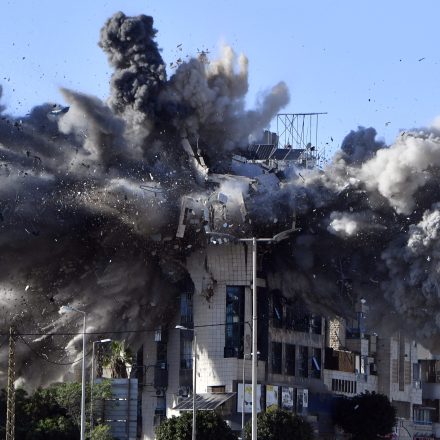 Related
Democrats Are Split Over What It Means to Block Israel Weapons Deals
"Initial reporting on Trump's statement omits a crucial fact: that the National Defense Authorization Act contains a provision intended to protect U.S. tax dollars flowing to Israel from the massive shift in U.S. public opinion against funding Israeli aggression," Annelle Sheline, who served as a foreign affairs officer in the State Department's Bureau of Democracy, Human Rights, and Labor, told The Intercept. "The provision would move U.S. funding out of security assistance under the purview of the State Department — which carries legal provisions like the Leahy Laws, transparency requirements, and an annual congressional vote — into the Pentagon procurement process, which has none of these."
Sheline added, "Insulated from public opinion and away from public visibility, U.S. funding to Israel is likely to grow exponentially."
With his popularity in free fall in the U.S., Trump teased the possibility of decamping for Israel and taking Netanyahu's job as the Israeli prime minister battles for his political life after an inconclusive election last week. "In fact, if people ever got tired of me in the U.S., I'll move to Israel, become prime minister," Trump declared during his Fox appearance.
The White House did not immediately respond to requests for further details.
The post Trump Scrambles to Halt Military Aid to Israel to Deprive El-Sayed of a Talking Point appeared first on The Intercept.
The person in charge of digital strategy for the Senate campaign of Iowa Republican Rep. Ashley Hinson helps run a company that received nearly $10 million to influence Americans with pro-Israel propaganda.
In September 2025, Hinson — who is battling Democratic state Rep. Josh Turek in a tight race that could decide control of the Senate — tapped Abe Adams to lead her campaign's digital efforts.
Adams is a co-founder and managing partner of Targeted Victory, a digital consulting firm that has been used by high-profile Republican candidates such as Ted Cruz and Marco Rubio. Targeted Victory shares an address and much of its staff with Targeted Communications Global — a related company with no discernible online presence. Both are subsidiaries of marketing company Stagwell Global.
Israel awarded Targeted Communications a $9.9 million contract in March 2025 focused on social media and paid advertising, documents show. By October 2025, the firm was at work pitching news content and guests on Fox News and CNN, and creating YouTube ads suggesting young Iranians have been educated to believe the "most sacred thing they do is stab a Christian in the heart."
Hinson is endorsed by both President Donald Trump and the American Israel Public Affairs Committee, and has been supportive of Trump's war in Iran.
A June 2026 Department of Justice FARA filing from Targeted Communications details much of the firm's work for Israel. The document lists 10 registered foreign agents working on the Targeted Communications contract for Israel. Six of them are identified as Targeted Victory employees on the company's website or their LinkedIn accounts. Adams is not named in the filing.
Hinson, Adams, and Targeted Victory did not immediately respond to requests for comment.
Adams is not the only Hinson campaign adviser with ties to Targeted Victory and the Israel lobby. Hinson's current deputy campaign manager, Addison Lavis, worked at Targeted Victory before serving as Hinson's campaign manager in her 2023 congressional run. Lavis was previously an intern at AIPAC. Lavis did not immediately respond to a request for comment.
 Related
AIPAC Isn't Retreating. Here's How It's Already Shaping the Next Congress.
Hinson has received more than $100,000 from AIPAC and related pro-Israel PACs in 2026, and as an Iowa state representative supported legislation that prohibited the state from working with any companies that boycott Israel.
Hinson's political action committee has paid Targeted Victory more than $1.6 million this election cycle for digital consulting and ads — 27 percent of its total expenditures, according to Federal Election Commission filings.
Israel's deal with Targeted Communications is part of a major public relations push that has pumped more than $100 million into swaying public opinion, particularly among young conservatives, back toward Israel.
The post Ashley Hinson's Digital Chief Oversees Firm Paid Millions to Push Israeli Propaganda appeared first on The Intercept.
Democrats are on the verge of reversing their political fortunes. The party is heading into the midterm elections Tuesday under the kind of conditions campaign consultants dream of, after two years wielding hardly more power than a strongly worded letter.
Donald Trump has spent the erratic waning years of his presidency leading his party into a political wilderness by waging a deeply unpopular war on Iran and driving the cost of living ever higher. Republicans who enjoy a governing trifecta have tried to distance themselves from the party's decision-making and its leader, a once-animating force who has turned himself into a liability. Poll after poll says the same: Democrats are poised to take control of one or both houses of Congress — and spend the next two years thwarting Trump's agenda.
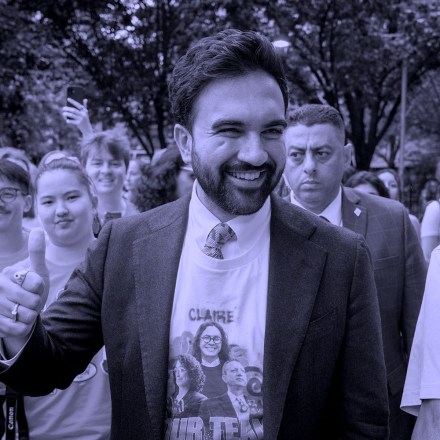 Related
The Democratic Party Gets Its Populist Takeover
But after a primary season dominated by an ascendant left wing and a broader rejection of centrist politics, the question isn't just whether Democrats win on Tuesday. It's what kind of Democratic Party emerges on Wednesday morning.
"I really like the socialism aspects," said Gibrel Said, a supporter of Abdul El-Sayed at his closing rally in Detroit Monday night. In the marquee contest serving as a referendum on the Democratic Party's future, the Michigan Democratic Senate nominee espouses progressive politics and has often been associated with the the left's agenda-setting socialists, though he doesn't identify as one. His race has been rocked by the kind of left-versus-right identity crisis that presents a perennial challenge for Democrats.
"One, Medicare for All; two, how do we fund things that help us as constituents," Said told The Intercept, ticking off things he appreciates about the candidate. Said, who lives in the Arab enclave of Dearborn, Michigan, especially praised El-Sayed's willingness to buck party leadership and speak out on U.S.-Israel policy. "Instead of tiptoeing around the subject, he very adamantly says, hey there's a genocide happening here, we shouldn't send our money."
Cycle after cycle, in state after state, an insurgent band of Democrats critical of the political establishment's ties to corporate interests and its unflinching commitment to Israel has had to overcome the barriers erected by its own party's centrist leadership. Both sides present themselves as the true representatives of working people: the centrists by arguing that more transformative ideas will scare off lower-information voters, the left by saying they represent the masses.
How much of this trickles down to actual voters? On Monday, The Intercept followed canvassers and spoke to voters in Michigan, Maine, and Texas, asking about which issues had permeated and taking the temperature of voter enthusiasm. Some rolled their eyes at the spats that have dominated the headlines, dismissing the idea that eleventh-hour backstabbing would make a difference. Others regurgitated right-wing misinformation. Many complained of too many campaign mailers.
"They're wicked mean," said Sharon McDonnell, a supporter of Troy Jackson, the Democratic Senate nominee in Maine. Speaking to The Intercept in the town of Yarmouth, she described one mailer that included a photo of Jackson chomping a cigar and describing him as "evil." "It's just nasty."
In Maine, the party's left flank seized power in the nominating process for the Democratic Senate candidate — then fought to hang onto it after onetime rising star Graham Platner flamed out after a sexual assault allegation (which he denies). With Jackson, a former state Senate leader, Maine now offers progressives one of two opportunities to test their message at the Senate level, where a candidate has to secure appeal statewide, not just in deep-blue House districts.
Related
Radical Centrists Like Haley Stevens Are the Real Extremists in the Democratic Party
The other is Michigan, where the intraparty battle is still raging. Rep. Haley Stevens, D-Mich., demolished her past attempts at fence-mending when she endorsed Republican Senate candidate Mike Rogers on Sunday and abandoned El-Sayed, who beat Stevens in a Michigan primary that saw $30 million in outside spending from the super PAC for the American Israel Public Affairs Committee.
The dustup has had Democrats biting their nails and moderate party leaders making the cable news circuit to demand party discipline — this time, to scold a centrist. The party leads in the polls for 218 of the 435 seats up for grabs in the House of Representatives, but they need to perform well in seven key states — Alaska, Iowa, Kansas, Ohio, and Texas, in addition to Maine and Michigan — if they want to win the Senate.
"I think she's counterintuitively, perhaps, given people a reason to rally some more," said Kathleen Britton, an El-Sayed supporter at the Detroit rally on Monday, of Stevens. "I really don't think it's gonna help Mike Rogers."
Earlier that day, in a predominantly Black neighborhood of Detroit, a prominent Black supporter of El-Sayed preparing to knock on voters' doors described Stevens's endorsement as an "ego-driven statement."
Haley Stevens "used a Black church as a prop, and we have seen that time and time again."
Mike Bland, the executive director of the Black Men Vote PAC, highlighted that Stevens made her public endorsement of Rogers in a Black church in Detroit. He doubted that Stevens, whose criticism of El-Sayed centers primarily on his skepticism of the U.S. relationship with the state of Israel, would be able to pull Black voters to Rogers, a conservative former House representative whose campaign has repeatedly peddled anti-Muslim tropes against El-Sayed.
"How can I say this without cursing? She used a Black church as a prop, and we have seen that time and time again," Bland said. "Black folks aren't stupid."
Over the past month, El-Sayed has rallied with Barack Obama and Kamala Harris, the two most prominent Black politicians in America — and hardly radicals estranged from the establishment power center. At the same time that Stevens was making her endorsement of Rogers public, El-Sayed was attending a get-out-the-vote event at another church in Detroit. The two primary foes were supposed to appear together that day with Rep. Jim Clyburn, D-S.C.
One of the Democrats' most coveted Senate pickups didn't present much of an opportunity for the left in the primary, but it has still been characterized by intraparty animosity.
In Texas, where both Democratic Senate primary contenders espoused relatively moderate politics, outgoing Rep. Jasmine Crockett, D-Texas, has declined to campaign with state Rep. James Talarico, though she endorsed him after he beat her in the state's March Democratic primary.
Talarico has been performing well with Latino voters, a massive voting bloc that helped fuel his primary victory. But Crockett — who, unlike Stevens, is Black — has suggested that Talarico has not done enough to excite Black voters, a demographic she carried in the primary. On a canvassing operation targeting Black voters in the Dallas-Fort Worth area on Monday, few Black Texans who spoke to The Intercept expressed excitement for Talarico. But most had already voted for him, saying they were motivated to do their civic duty.
Related
The Rise of the Christian Left in Texas
Black voters frequently discussed concerns over affordability, gas prices, and homelessness. Canvassers told The Intercept they had heard some of those voters express concerns over their perception of Talarico's policies toward transgender children, at times espousing blatant misinformation, such as the idea that Talarico supported arresting parents who refused to give their children gender-affirming surgeries.
" I don't stand for that," said voter Jermiah Robinson, referring to her belief that Talarico pushed "sex-change" surgery for minors. Like many voters, she cited the cost of living as her most pressing issue. Robinson said she would "want to vote for him if he stands by his words, and he's actually like 'Yeah, I'll help out as far as prices and everything.'"
Talarico appears to have improved his margins with Black voters in the final stretch. According to the Texas Politics Project at the University of Texas, Talarico is leading with 79 percent of the Black vote, signaling a significant increase in support from Black voters from just last month. The conventional wisdom suggests that he could barely ask for a better opponent than the scandal-plagued Republican candidate, Texas Attorney General Ken Paxton.
In 2015, Paxton was indicted on felony securities fraud charges in Texas, in a case that dragged on for roughly nine years, and ended with Paxton being required to do community service and pay restitution. And in 2023, the Texas House of Representatives voted across party lines to impeach him as attorney general for alleged corruption and retaliation against whistleblowers.
Scandal kept rocking the race for Senate in Maine, where longtime Republican incumbent Sen. Susan Collins faces her toughest reelection challenge yet from Jackson. Before Jackson, who lost a race this cycle for the state's Democratic nomination for governor, there was Platner, hailed early as a working-class champion who faced a series of personal scandals in his successful primary campaign. There was the revelation of a Nazi tattoo that he claimed not to understand until last October. There were crudely worded Reddit posts and stories of cruelty from women he'd dated. One former girlfriend's allegations of sexual assault ultimately ended his campaign — and set off a scramble to find a replacement that progressives ultimately won by elevating Jackson.
By Monday, Mainers who spoke to The Intercept appeared exhausted by the lengthy, contentious, and expensive Senate race that has dominated the state.
 Related
Susan Collins-Aligned Super PAC Buys Attack Ads in Portland… Oregon
"There's a lot of fatigue. People are tired of it," said Charlie Dingman, who chairs the state Democratic Party. "I have had some conversations at doors with people that have led me to think that the extremely negative and extremely untruthful ads may be backfiring."
Tyler Echard, in Norway, said he'd already cast an absentee ballot for Democrats down the ticket. He was disgusted with a deluge of political mailers and eager to stop seeing them pile up on his doorstep.
"The amount of mailers we get — just mailers, not just handed at the door but in the mail — especially from the Republican side, the amount of money is probably more than I will make in my lifetime, spent in this election," Echard said. "At some point, we gotta get legislation because money's just gonna run everything into the ground. I ain't got it, so I can't influence it."
Frustration with the status quo in Congress could spell the end for Collins's 30-year career in the Senate. On Monday, a University of New Hampshire poll found Jackson leading Collins by 4 percentage points. And in September, Collins found herself thrust into a scandal of her own, when ProPublica revealed that the FBI anti-corruption squad was investigating an alleged pay-to-play scheme between Collins and a donor eager to secure government contracts.
Related
Susan Collins's Committee Bought Trucks the Army Didn't Want. Then Campaign Donations Poured In.
The Intercept later exposed that, alongside a series of campaign donations, defense contractors cozy with Collins had received lucrative carveouts in defense spending. (Collins has denied wrongdoing in all cases.)
But the incumbent senator has faced controversy and come out victorious before. And some Mainers doubt they'll see change either way.
"I can't vote for either side," said a man, who declined to share his name with The Intercept, walking down a rural road in Norway with a hunting rifle slung over his shoulder. "You can't trust neither of them."
Noah Hurowitz reported from Yarmouth and Norway, Maine; Akela Lacy reported from Fort Worth, Texas; Matt Sledge reported from Detroit, Michigan.
The post Sharp Left Turn: Democrats Have a Shot to Take Congress on Socialist Momentum appeared first on The Intercept.
As Abdul El-Sayed's one-time primary opponent attempts to redirect closing arguments in the Michigan Senate contest to the topics of Israel and antisemitism, the Democratic nominee has entered the final stretch of the midterms against a barrage of bigoted attacks over his own race and religion.
President Donald Trump called him a "jihadist." Health and Human Services Secretary Robert F. Kennedy Jr. went on a racist rant against Arabs. According to Michigan state Sen. Mallory McMorrow, a mailer went out showing El-Sayed's face next to the World Trade Center's Twin Towers.
"They are running the most bigoted, hateful, Islamophobic campaign I've ever seen," McMorrow told a local TV outlet. McMorrow, who ran for the Democratic Senate nomination but dropped out before the August primary, is taking a far different tack than Rep. Haley Stevens, the Democratic primary runner-up who has spent the race's final days painting El-Sayed as an angry antisemite and crossed party lines Sunday to endorse Republican contender Mike Rogers.
Related
Radical Centrists Like Haley Stevens Are the Real Extremists in the Democratic Party
Rogers has sought to portray El-Sayed as anti-American and repeatedly tried to tie his opponent to the Muslim Brotherhood. He insists the attacks have nothing to do with faith. But that is exactly how many observers see them, including Muslim Republicans who have been disgusted by the rhetoric.
As the election draws to a close, the Islamophobic attacks have taken a backseat to Stevens's claims of antisemitism — most prominently concerning a PAC ad that connected high grocery prices to U.S. spending on Israeli military aid — and a personal feud between the former primary opponents. And some of El-Sayed's allies worry that the Muslim and Arab-baiting attacks will work. One recent poll found that 38 percent of Michigan voters said they would be less likely to vote for a Muslim candidate.
Michigan's Muslim and Arab organizers have not been taking the attacks lying down, however. In interviews last month, two prominent leaders in Dearborn's Arab American community described widespread excitement over the opportunity to vote for the man who would be the first Muslim in the U.S. Senate.
"It very much feels like when President Obama was running and his whole campaign was around like hope. That's what it feels like," Layla Elabed, the organizing director at Arab Americans for Progress, told the Intercept on October 8.
Elabed, the sister of Rep. Rashida Tlaib, D-Mich., was one of the key movers in the Uncommitted movement, which urged Michigan voters to withhold their votes from Joe Biden during the 2024 primary in protest of his support for Israel's war on Gaza. The movement succeeded in making a statement, but also drew criticism from centrist Democrats for allegedly fracturing party unity.
 Related
The Democrats Don't Know Who They'll Be in 2028. Michigan May Offer an Answer.
Elabed's current group is an evolution of the Uncommitted movement. Its canvassers have been knocking on doors to turn out support for El-Sayed and other candidates.
"I don't think many people in Dearborn are surprised by Haley Stevens," Elabed told The Intercept on Monday. "Arab American Democrats in Michigan have been sounding the alarm about her for years, warning our fellow Democrats about a pattern of putting political interests ahead of the people she was elected to represent."
She believes the same coalition that came together for Uncommitted could help push El-Sayed over the top this election.
"Abdul has been able to really take a stand on all the issues that were really important to anti-war voters and anti-genocide voters," she said. "It's not a coincidence that that same coalition, that same base of Democratic voters are now all coming out to support us."
Hers is not the only group seeking to mobilize Muslim and Arab voters, who make up a sizable slice of the Michigan electorate. The Arab American Political Action Committee has also endorsed El-Sayed. Its president, Osama Siblani, said there is widespread enthusiasm for El-Sayed in areas with dense Arab populations such as Dearborn.
Siblani compared El-Sayed's potential victory to John F. Kennedy's pathbreaking election as the first Catholic president.
"First of all, he's qualified. Second of all, he's saying the right things, he has a good agenda," Siblani. "His opponent is an asshole. In addition to all of this, he is breaking the ceiling for our community and for other communities. That is a plus."
The goal of the Arab and Muslim-baiting attacks from El-Sayed's enemies is clear, according to Nazita Lajevardi, an associate professor of political science at the University of Michigan.
"Islamophobia is a tried and true strategy for garnering a candidate support and swaying the vote," she said.
"When political elites discriminate, it does mobilize people into action."
Yet it is also possible that the attacks on El-Sayed's identity will lead to greater turnout in places like Dearborn, she said.
"I think scholarship would tell us that when political elites discriminate, that it does mobilize people into action. Past scholarship would say yes, it would, but it's an open question," she said.
Elabed agreed that the attacks are nothing new. "We've watched it play out time and time again," she told The Intercept. Stevens's about-face isn't a major development, she said, "It's that the rest of the Democratic Party is finally seeing what our communities have been saying all along. We weren't wrong. We just weren't being listened to."
Siblani expressed a similar sentiment on Monday. "I'm not surprised, I'm disgusted," he wrote of Stevens in a text message, attaching an emoji of a person vomiting.
Stevens's choice to jump ship for the Rogers campaign appears to have galvanized El-Sayed's base. His campaign announced a one-day fundraising record after his fellow Democrat pulled her endorsement on Sunday.
The post Abdul El-Sayed Tests the Limits of Islamophobia in Michigan appeared first on The Intercept.
As Miguel Parra Hernandez, a Mexican national, was fleeing from U.S. Immigrations and Customs Enforcement on foot last month, he turned into a parking lot. An unmarked government vehicle came screaming into the lot after him and struck him.
When a grand jury in Harris County, Texas, charged the U.S. Immigrations and Customs Enforcement officer behind the wheel last week, the indictment pointed to a broader pattern in the Trump administration's crackdown on immigrants and activists. The charge was assault with a deadly weapon; the weapon was the vehicle.
The Department of Homeland Security, ICE's parent agency, claimed Parra Hernandez ran in front of the government vehicle; surveillance footage of the incident shows him running away from the car moments before he is hit. (An attorney for the ICE officer accused of assault against Parra Hernandez told The Associated Press his client had not committed any crime.)
In the same month, an unmarked ICE vehicle speeding the wrong way down a one-way street in Long Beach, California, struck a bicycle ridden by Ricardo Gonzalez, whose daughter later said he was a U.S. citizen. An agent immediately drew their gun on Gonzalez, who was later hospitalized for his injuries. The government said the man was not struck, but video released by the New York Times showed the ICE vehicle swerving into the bicycle.
Three days later after the collision in Long Beach, Antonio Moreida stood in the street in Woodland, California, outside Sacramento, documenting an unmarked ICE vehicle when the black Chevy Tahoe accelerated toward him. When the SUV hit him, Moreida told a meeting at Woodland City Hall last week, he was knocked to the ground — and the driver of the Tahoe did not stop to check on him.
The Department of Homeland Security said Moreida jumped onto the hood of the unmarked car, but when video of the incident showed him standing in place, local police and the mayor publicly disputed ICE's account.
Weaponized VehiclesIn the national conversation about ICE's heavy-handed crackdown on immigrants across the country, much has been made of the Department of Homeland Security's claims that immigrants and activists "weaponized" their vehicles against federal agents. After immigration officers shot and killed Lorenzo Salgado Araujo, who was targeted by ICE, and community defender Renée Good in separate incidents, the government said the civilians had used their cars to attack agents — allegations that have not been borne out in criminal charges, or were called into question by witness accounts and video analysis.
What happened to Parra Hernandez, Gonzalez, and Moreida, however, was the opposite of what the government said about Good and Salgado Araujo: It was ICE agents who weaponized their vehicles against civilians.
Related
Trump's National Killer Police Force
As the Trump administration ramped up deportations over the last year, federal agents have effectively turned their cars into massive, deadly blunt objects. Common tactics, known collectively as "offensive driving techniques," include ramming the cars of immigrant targets and activists; "brake-checking" volunteers trying to observe ICE activity; and, in some cases, outright driving into civilians. The Intercept reviewed two dozen cases of ICE using vehicles against civilians in these ways, including multiple incidents where victims were hospitalized or even died from their injuries.
"Vehicles are another tool ICE agents are using with unchecked force, just like their guns, Tasers, and pepper spray."
"Vehicles are another tool ICE agents are using with unchecked force, just like their guns, Tasers, and pepper spray," said Hannah Stauss, co-director of Hands Off NYC, a group that opposes ICE's presence in New York City. "ICE's deranged use of vehicles effectively weaponizes them against our immigrant neighbors and rapid responders, and will continue to kill people. We are witnessing in real time the results of a federal agency being allowed to operate with impunity, in secrecy, and with unfettered violence."
In a statement to The Intercept that compiled past responses to the incidents in this article, a spokesperson for the Department of Homeland Security said, "ICE is instituting additional training including, crowd control measures, additional training for high-risk vehicle stops, a live-fire cover course for officer safety, and medical training."
The spokesperson did not respond specifically to allegations about the incident involved Parra Hernandez; said Gonzalez was not struck by an ICE car; and blamed Moreida for the accident because he was in the roadway.
"Offensive Driving Techniques"In federal policies and memos, the maneuvers used in the incidents reviewed by The Intercept, along with testimony from rapid responders, are referred to by federal agents as "offensive driving techniques." They are part of a wider patten of aggressive driving by law enforcement officers across the country, but especially by federal agents with little accountability and nearly blanket backing from the Trump administration.
Last October, Leo Martinez was monitoring immigrations agents' activity as a volunteer with VC Defensa, a community defense group in Ventura County, California, when an unmarked ICE car rammed his pickup truck. ICE agents arrested Martinez and later released him without charge.
 Related
Documenting ICE Agents' Brutal Use of Force in LA Immigration Raids
In March, they did it again: Three unmarked government vehicles rammed Martinez's car as he sought to reverse away from them. The federal agents broke his window and dragged him out. Martinez, who was hospitalized from his injuries, was again released without charge. (The Department of Homeland Security spokesperson did not respond specifically to questions about the incidents involving Martinez.)
"They run stop signs, red lights, they'll cut off complete intersections, and they rarely turn on their lights," Martinez told The Intercept. "They'll slam on their brakes in the middle of the freeway, in the middle of the street. Sometimes they'll do sudden U-turns in the middle of nowhere and cut off traffic in both directions."
When activists are monitoring federal agents, one of the most common ways for ICE to leverage their vehicles as physical threats is the "brake check," a move where a car suddenly breaks to cause the car behind it to slow down — or slam into its rear bumper.
"Brake-checking" doesn't appear in official guidelines as an "offensive driving technique" with good reason: It is considered to be illegal in all 50 states, covered by various statutes like reckless driving or other anti-road-rage laws. Yet VC Defensa volunteers, who like Martinez monitor ICE activity, said that when they follow ICE vehicles to alert the community with horn-honking, they keep a distance of two to three car lengths because federal agents so frequently brake-check volunteers.
Federal agents use "offensive driving techniques" so often in Ventura County that VC Defensa volunteers sometimes identify the unmarked cars by the body damage that characterizes them.
Customs and Border Protection, another agency that, like ICE, is under the umbrella of the Department of Homeland Security, expanded its agents' discretion and ability to use these techniques during abduction operations after President Donald Trump took office for a second term.
A previous 2023 Customs and Border Protection pursuit policy largely prohibited officers from boxing in vehicles or making vehicle contact with another vehicle in motion. A partially redacted 2025 CBP directive gives officers broader discretion to use offensive driving techniques and ignore traffic laws.
"Most federal agencies are not well trained in police-citizen interactions, traffic stops, and pursuits."
"Most federal agencies are not well trained in police-citizen interactions, traffic stops, and pursuits," said Geoffrey Alpert, a criminology and criminal justice professor at the University of South Carolina who helped Customs and Border Protection rewrite their car-chase policy under the Biden and Obama administrations.
In December, ICE agents in Elgin, Illinois, chased a Venezuelan man until his car and the ICE vehicles crashed. State investigators found the ICE agents likely conducted an "unskilled precious immobilization technique ('PIT maneuver') and lost control of the vehicle." (The Department of Homeland Security spokesperson said the target of the raid rammed an ICE vehicle into a tree.)
In January, Christian Molina, a U.S. citizen, was preparing to pull over for an ICE traffic stop in Minneapolis when the agents rammed the back of his car, injuring his back. The agents said they would pay for the damage, but left without providing contact information. (The Department of Homeland Security spokesperson did not respond specifically to questions about the incident involving Molina.)
In June, agents conducted a high-speed chase through a residential neighborhood of Chicago, blowing through intersections until finally ramming their target's car. (The Department of Homeland Security spokesperson blamed the target of the immigration enforcement action for the accident because he fled from ICE.)
"It's disheartening to see some sort of federal agents or law enforcement driving so aggressively in a residential area," one neighbor told Block Club Chicago. "I have a kid who's two and we go out for walks all the time. We could have been crossing the street when they came through the intersection."
High-Speed ChasesFollowing the killings of Lorenzo Salgado Araujo and Johan Sebastián Durán Guerrero in July, the Department of Homeland Security ordered a temporary halt to traffic stops.
The day the directive was issued, ICE chased a group of roofers in Texas, blowing through a stop sign and over a speed bump without sirens. A mother driving her son to the theater was forced to swerve into a ditch to avoid a collision.
"They speeded right next to me," the mother told the Texas Observer. "They hit the speed bump so bad that, when they got in front of me at high speed, I had to go to the right."
If she had not swerved, she said, "they would have hit me."
Some of these car chases have turned deadly in the very places where local police are restricted from chasing suspects because of the attendant dangers.
In February, agents undertook a high-speed chase in pursuit of Oscar Vasquez Lopez outside of Savannah, Georgia. Vasquez Lopez's car struck a teacher, killing her.
The Savannah Police Department only allows pursuits when the suspect has committed or is attempting to commit a forcible felony, and the risk of not capturing someone outweighs the risk of the chase. Vasquez Lopez had no criminal record, only a civil deportation order from 2024.
Two immigration car chases in New Jersey, where police face similar restrictions at the statewide level, resulted in hospitalizations. (In the Texas case, the Georgia case, and the New Jersey case, the Department of Homeland Security spokesperson blamed the target of the immigration actions for causing unsafe conditions by fleeing.)
"They are not required to follow local agency policies (the same as other agencies), but they must be held responsible for their actions under state and federal law," Alpert, the criminology professor, said. "The failure to evaluate these behaviors in a full, complete and transparent manner leaves us all in the dark."
Earlier this month, the AP reported on an internal memo to ICE's Enforcement and Removal Operations division that banned agents from conducting high-speed car chases. The directive still allows trained agents to make traffic stops and undertake offensive driving maneuvers.

Read Our Complete Coverage
The War on Immigrants Ramming PedestriansICE agents' vehicles are not just recklessly pursuing and ramming vehicles driven by who they thought were targets for immigration enforcement. In multiple filmed interactions, agents have driven into pedestrian rapid responders and protesters.
 Related
Federal Agents Are Intimidating Legal Observers at Their Homes: "They Know Where You Live"
In Woodland, California, ICE agents crashed into Moreida as he sought to collect their license plate information. After a major workplace raid in Los Angeles in June 2025, a news helicopter filmed the moment a protester walked in front of several ICE vehicles. One slowly sped up until it knocked him to the ground.
"It's a disproportionate use of force. An individual is not going to win a fight with a vehicle," Alpert, the criminology professor, said. "I've never seen any state or local law enforcement ever use a vehicle properly to hit or to run into a civilian."
In other incidents, federal agents have weaponized their vehicles against crowds of activists. (Asked about the protests incidents mentioned in this article, the Department of Homeland Security spokesperson blamed "anti-ICE agitators.")
In the aftermath of an ICE shooting this month in the New York City neighborhood of Marble Hill, immigration agents were seeking to move a man with a gunshot wound — whose car, with his 5-year-old son in the back, smashed into a concrete barrier during the incident — from a hospital to a detention facility. As government vehicles left the hospital in a speeding caravan, a bicycle was nearly hit by an federal agent in a black vehicle, which honked its horn, according to video of the incident. In another social media post, an ICE agent in an unmarked vehicle continued driving even with six protesters walking in front of it.
In July 2025, in San Francisco, after ICE clashed with protesters while moving detainees from the immigration courthouse to unmarked vehicles, several protesters clung to the hood of the car until they were physically thrown off when the vehicle sharply accelerated.
"It is honestly only a matter of time until an ICE agent seriously injuries or kills a cyclist or pedestrian in New York City."
"I absolutely worry about ICE agents hurting people or killing people with these aggressive driving maneuvers," said a New York rapid responder. "In order to avoid having their movements in vehicles documented, ICE agents will dramatically accelerate far beyond safe speeds for a dense urban environment like New York City."
The organizer, who requested anonymity to avoid retaliation from the government, reported that agents drive at high speeds into oncoming traffic, run red lights, and abruptly turn without signaling. They rarely use emergency lights or sirens. These tactics align with the pattern of behavior described by Martinez in California — but in a city where rapid responders and neighbors are more often on foot or riding bicycles, not in their own vehicles.
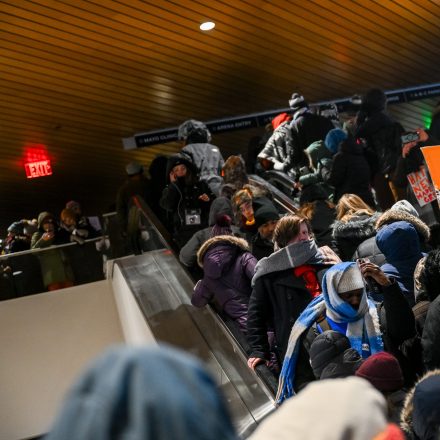 Related
Trump Wanted Minnesota 15 Case to Be Another Prairieland. Instead, Twin Cities Rallied Behind Anti-ICE Activists.
When ICE agents brought a detainee to a Brooklyn hospital after a violent arrest in May, hundreds protested outside the hospital. One TikTok video from the night captured the moment an unmarked ICE vehicle drove into several gathered people, accelerating sharply until they leapt out of the way.
"Given the frequency with which these agents are engaging in aggressive maneuvers to try and lose rapid responders or prevent documentation of their movements," the organizer said, "it is honestly only a matter of time until an ICE agent seriously injuries or kills a cyclist or pedestrian in New York City."
The post "Offensive Driving": ICE's Deadly Weaponization of Vehicles Against Civilians appeared first on The Intercept.
The Trump administration's extradition case against millionaire left-wing donor James "Fergie" Chambers, detained in Spain since July, ran into an apparent hurdle when two witnesses called before a federal grand jury announced their intention last week to refuse to testify.
Several observers familiar with the case said the grand jury is likely related to the extradition effort.
The refusal of the grand jury witnesses to testify takes on added importance because the U.S. is pursuing Chambers's extradition based on a criminal complaint, not an indictment, according to his Spanish lawyers. The criminal affidavit, signed by a single FBI agent, includes three charges related to his support for pro-Palestine causes.
The distinction, critics of the extradition case say, highlights how the case is hung on one agent's complaint, which remains under seal, rather than a grand jury investigation to determine if the state had sufficient evidence to indict Chambers.
"The complaint is not only vague and weak, it's not normal," said Aitor Martínez, one of Chambers's Spain-based lawyers. "In 20 years of practice, I've never seen a U.S. extradition request based on a criminal complaint."
Martínez pointed to a statement from a summary of the complaint contained in an international arrest order reviewed by The Intercept and directed at Spanish authorities that says, "If Chambers' extradition to the US is granted, another charging document called an indictment will be sought from a federal grand jury."
"In 20 years of practice, I've never seen a U.S. extradition request based on a criminal complaint."
Xavier de Janon, the executive director of the U.S.-based National Lawyers Guild and who is not working directly on the Chambers case, said, "Seeking an extradition without there being an indictment puts the cart before the horse."
"If he is extradited under a criminal complaint," said de Janon, "he can't even fully challenge the charges, because he hasn't been indicted."
The State Department referred questions to the Department of Justice, which declined to comment.
 Related
They Got 60 Days in Jail for Protesting Israel's Largest Arms Maker — and Say That's a "Huge Victory"
Two of the three charges underpinning the extradition request against Chambers — riot and incitement to riot — are related to allegations that he helped fund a late-2023 protest in Merrimack, New Hampshire, against an Israeli weapons manufacturer, according to the summary of the complaint contained in the arrest order. The summary says Chambers provided funds for demonstrators used to purchase materials such as smoke bombs and to help cover protesters' legal fees.
The third charge is international money laundering related to more than $7 million he transferred to bank accounts in Tunisia, where he was living in 2024. The Trump administration, according to the international arrest order, says the money was used to fund Hamas, which is a proscribed terror group in the U.S. The order does not say he is charged with material support for terrorism.
Chambers's family and supporters and multiple representatives of Club Africain, a Tunisian soccer club, have said the money was used to pay the club's debts and related expenditures such as training grounds. The club's fan base has long supported Palestinians.
Grand Jury RefusalTwo women who participated in the 2023 protest against a factory operated by the Israeli weapons manufacturer Elbit Systems recently announced their intentions not to cooperate with a November 4 grand jury hearing where they have been summoned as witnesses.
"If they are being summoned now, this suggests that the grand jury seems to be linked to Chambers's case," said Martínez, his lawyer. "It seems like a fishing expedition against him."
Kira Kelley, an attorney for the two women, said, "Context clues suggest this is about Fergie."
If the pair don't answer questions from a federal prosector before the New Hampshire federal grand jury, they could risk a possible jail sentence for contempt.
Nonetheless, the two women — Bridget Shergalis and Sophie Ross — shared a statement with The Grayzone Thursday announcing their intention to refuse to testify. In an interview on the same day with The Intercept, the women recounted being under investigation for a year over the protest and being threatened with felony charges that carried potential sentences of decades in prison.

Read our complete coverage
Chilling DissentShergalis and Ross said they turned down several deals for their cooperation. By the end of the ordeal, they were found guilty of misdemeanor offenses and received 60-day jail sentences.
Following that experience, said Ross, the pair decided to reject the subpoena to testify before a grand jury.
"It was an easy decision for both of us," Ross said.
Shergalis and Ross are slated to testify on Wednesday, at which time they plan to assert their Fifth Amendment rights and decline to answer any questions from the federal prosecutor.
At that point, a hearing before a judge may be scheduled, to determine whether to hold Shergalis and Ross in civil contempt, which could result in up to 18 months of prison, according to Kelley.
Martínez, who also worked on WikiLeaks founder Julian Assange's defense team, said the decision by Shergalis and Ross recalled that of Chelsea Manning, who twice refused to testify against Assange before a grand jury, serving time in prison in both instances.
"It's like Chelsea Manning, years later," he said.
Related
Trump Wanted Minnesota 15 Case to Be Another Prairieland. Instead, Twin Cities Rallied Behind Anti-ICE Activists.
Shergalis and Ross decided to go public with their plans after speaking with organizers behind the recently-launched NSPM-7 Defendants Union, a nationwide project for protesters targeted by the Trump administration's efforts to criminalize dissent as laid out in last year's National Security Presidential Memorandum-7. The document, part of a broader effort to paint left-wing activism as terrorism, directs the FBI to go after "violent and terroristic activities" associated with "anti-fascism."
The NSPM-7 Defendants Union is centered around signing a pledge to follow practices such as not cooperating with law enforcement, adopting collective legal strategy when possible, and publicly announcing those strategies — a goal that runs against the secrecy surrounding federal indictments.
While secrecy benefits prosecutors before a grand jury, said Shergalis, "It's good for all of us to be as transparent as possible."
"We're seeing NSPM-7 result in unprecedented levels of prosecution against protesters."
Shergalis, Ross, and Chambers have each signed the pledge, and the grand jury decision appears to be the first public test case of the union's ideas.
"We should celebrate people across the country deciding to assert their legal rights boldly against the federal government and its NSPM-7 policy," said de Janon, of the National Lawyers Guild. "We're seeing NSPM-7 result in unprecedented levels of prosecution against protesters."
"This Is Bad Faith"Meanwhile, Chambers remains imprisoned in Madrid, as the Spanish courts decide whether to grant the U.S. extradition request or not.
Chambers has applied for asylum in Spain and, if his application is granted, he would be released and the U.S. extradition request would be denied. He cannot be extradited until the asylum case runs its course.
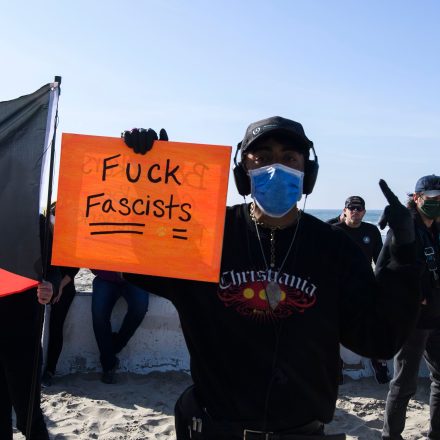 Related
Trump Goes After Anonymous Email Provider in Italy. The Real Target Is Free Speech in the U.S.
A self-described communist and anti-imperialist, Chambers is heir of the Cox family, owners of Atlanta-based telecom giant Cox Enterprises. As part of a settlement in which his family severed ties with him at the time, he sold stock back to them in mid-2023 worth about $250 million.
Since then, he has been funding an estimated 100 humanitarian and left-wing projects in 20 countries, according to his partner, actress and activist Stella Schnabel, including aid projects in the Occupied Gaza Strip.
"I believe this is part of the persecution against pro-Palestine protest."
As for the Trump administration's case, Martínez, the Spanish attorney, underscored how the criminal complaint against Chambers raises charges related to the protest against the New Hampshire factory for Elbit Systems, Israel's largest arms manufacturer, but leaves out how federal prosecution efforts ended up with minor convictions for Shergalis, Ross, and other activists.
"The people who carried out the acts received a minor sentence," he said. "They leave this out. This is bad faith."
"Why don't they tell this to Spain?" he said. "It's likely that Spain won't turn someone over based on actions that got 60-day sentences."
Martínez said Chambers's opposition to the Israeli genocide in Gaza is the real reason behind the case. "I believe this is part of the persecution against pro-Palestine protest. The U.S. has even sanctioned the International Criminal Court because of this."
Of Chambers's case, Martínez said, "This is one more attack."
The post Fergie Chambers Faces Extradition to U.S. Despite Never Being Indicted, Says Lawyer appeared first on The Intercept.
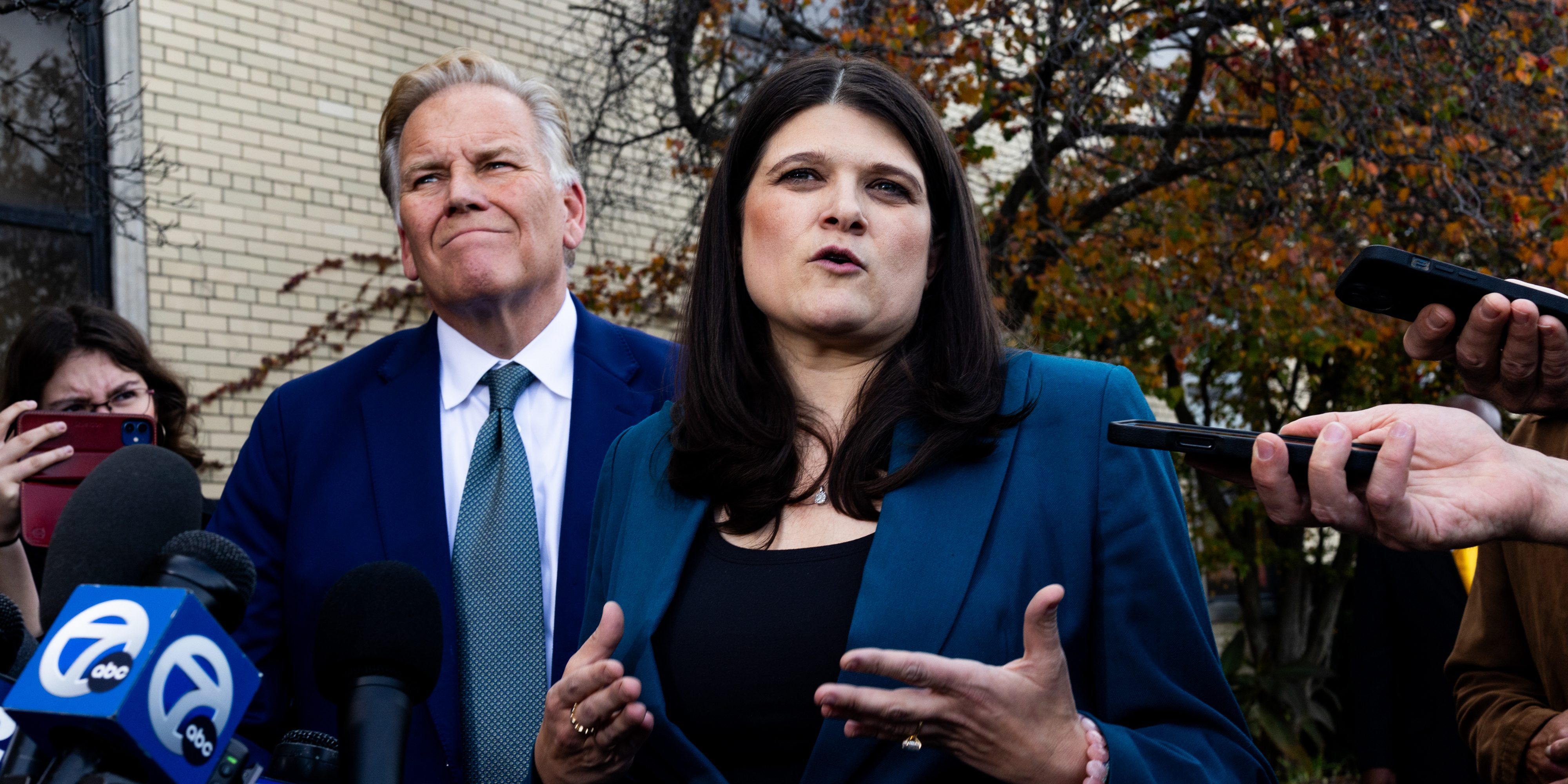 Rep. Haley Stevens, D-Mich., speaks following her endorsement of Republican Mike Rogers in Michigan's Senate race on Nov. 1, 2026, in Detroit. Photo: Emily Elconin/Bloomberg via Getty Images
Michigan Democratic Senate primary loser Rep. Haley Stevens on Sunday released a video that will place her in an ignominious legacy of establishment Democrats who act against the collective good.
And, like others on the list, she did it for the sake of one thing only: Israel.
In the video — filmed on her phone, in her car, and at an awkward angle — Stevens announced her endorsement of Republican candidate Mike Rogers against the Democratic nominee Abdul El-Sayed. Stevens had previously called Rogers a "rubber stamp for Donald Trump's dangerous agenda."
Stevens's defection follows a pathetic effort to suggest that El-Sayed must make greater overtures to Israel supporters.
"I don't belong in Abdul's campaign," said Stevens about El-Sayed, the candidate who currently enjoys 95 percent of Democratic voters' support in Michigan, according to polls.
Stevens's defection follows a pathetic, Islamophobic, and chaotic effort over the last weeks to suggest that El-Sayed must make greater overtures to Israel supporters.
Stevens now follows in the footsteps of other conservative Democrats who have shown an extreme disregard for the welfare of people in this country and beyond.
We might recall former Sen. Krysten Sinema of Arizona, who left the Democratic Party while still in office and notoriously delivered a dramatic thumbs down and curtsy when voting against a raised minimum-wage provision during the height of the Covid pandemic. Sinema and fellow then-Democrat Sen. Joe Manchin of West Virginia also joined with Republicans to effectively tank major voting rights legislation in 2022.
And, of course, there is the entire Senate career of conservative pro-Israel fanatic, Pennsylvania Sen. John Fetterman, who still remains a nominal Democrat. Fetterman offers a consistent master class in dangerous extremism and should be seen as a profound political liability by his own party.
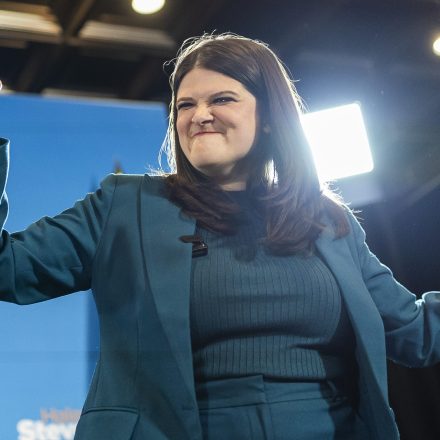 Related
Centrist Democrats Would Rather Lose the Senate Than Win With El-Sayed
It is, after all, so-called moderates like Stevens who are the radicals. As writer Eoin Higgins noted, an array of Democrats have revealed themselves more willing to see Republicans win than allow the party's left-wing flank — or, more to the point, criticism of Israel's genocide — to gain further ground.
And while there is little political agreement between the right and left wings of the Democratic Party on a whole array of issues, defeating Republicans, particularly Donald Trump's Republican Party, was at least the stated goal of even the most conservative of Democrats.
To so openly fail on even those basic electoral terms should be the very definition of a political liability for a party.
 Related
They Tried to Smear Zohran Mamdani as an Antisemite. Voters Saw Right Through It.
Meanwhile, left-wing candidates running on popular policies with support networks built from the ground up have again and again been treated as the primary internal enemy by the party establishment.
Shifting WindsStevens had perhaps thought she could rely on this pattern. Numerous powerful Democrats and Israel apologists like Reps. Nancy Pelosi, D-Calif., and Hakeem Jeffries, D-N.Y., were slow to get behind El-Sayed and have continued to pick fights over his policies on Israel.
Stevens's Rogers endorsement was not, however, met with the tolerance that Democratic rightward lurches have typically enjoyed. In a bellwether moment, another strong supporter of Israel, Senate Minority Leader Chuck Schumer, D-N.Y., called her endorsement of the Republican candidate "a despicable betrayal."
The condemnation is the correct response of a party leader to a member taking active steps to thwart a crucial Senate race. It may not mark a shift for Schumer away from his own reliable conservatism and support for Israel's genocide, but it nonetheless reflects a shifting political landscape when a figure like Schumer sees greater political expediency in standing with a progressive, Israel-critical, Muslim candidate, than with the radical centrist wrecker with whom Schumer is more ideologically aligned.
Stevens's theatrics are unlikely to make a significant difference to Tuesday's election results. Voters who elevate support for the Israeli state over human lives in Palestine and in the U.S. were already not going to vote for El-Sayed.
In a close race like this, pulling any support away from the Democratic candidate reveals the extremism of the purported center.
It's unclear, then, who would be swayed by Stevens's erratic actions two days before the election. In a close race like this, however, pulling any support away from the Democratic candidate reveals the extremism of the purported center.
We can welcome what looks to be a long overdue shift in political common sense and hope that positions like Stevens's are seen as a liability before they reach their most extreme iterations.
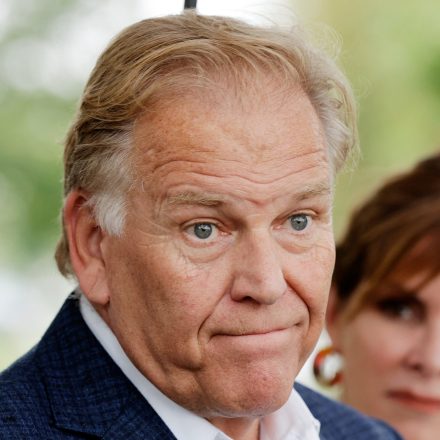 Related
Mike Rogers Spent $100K on Private Jets and Luxury Travel Last Quarter
Yet it shouldn't take so-called centrists quite literally choosing Trumpian Republicans over progressive and left-wing Democrats to make clear who the real threat to the Democratic Party is — if winning elections and delivering policies to improve the lives of constituents is, in fact, their goal.
It certainly is for El-Sayed. He has dismissed Stevens's performance as a distraction.
"None of this matters," he told reporters on Sunday, and insisted instead on speaking about the state of schools, healthcare, and the cost of food for Michigan residents.
The post Radical Centrists Like Haley Stevens Are the Real Extremists in the Democratic Party appeared first on The Intercept.
Anxiety over ICE at the polls is a double-edged sword for the Trump administration: There's the fear that federal immigration agents will illegally descend on voters, and there's the threat that by boosting awareness of that fear, activists and journalists will help the federal government carry out the work of voter intimidation.
"Even just rumors of [ICE at the polls] are going to spread fear. That's not what we want," said Daniela Padilla, deputy director at Texas for All, a statewide coalition of organizations working on democracy and justice issues. "Even your reporting around, 'We're watching for ICE at the polls' — it could scare voters."
"The biggest threat that we face in Texas this year is voter suppression."
In Texas, a 40 percent Latino state where a longtime Republican grip on power now finds itself in question, there are real concerns that Immigrations and Customs Enforcement agents could pop up in targeted communities to make people afraid to go out and vote on Tuesday. But while the possibility of election interference has been discussed as one of several "big ticket items" of this year's midterms, Padilla said, "the biggest threat that we face in Texas this year is voter suppression."
That suppression can take many forms. In Tarrant County, for example, where local officials closed 92 polling locations, reports from early voting indicated some election officials wrongly turned away eligible voters. More than fearing ICE would actually approach the polls, Padilla and several organizers working on election integrity and voting rights in Texas told The Intercept they were worried that journalists amplifying the Trump administration's stated plans to "surround the polls" with ICE and federal agents could function as an inadvertent form of voter suppression.
 Related
Trump Vows to Send Election "Monitors" to Maine After Far-Right Conspiracies Spread
Federal and state law prohibits federal immigration agents from being inside polling sites and bar any form of voter intimidation. Those laws haven't stopped the Trump administration and its allies from threatening to deploy ICE and military personnel around the country during elections. In August, the Department of Justice announced that it planned to send at least 1,000 federal monitors to oversee midterm voting, prompting multiple states to assert they would not let them inside polling locations. As states like Maine prepared to respond to the federal presence at the polls, the DOJ claimed to Newsweek it "never said" it would send federal law enforcement to the polls.
"The Trump administration has been spreading fear for months, refusing to say that they will not send ICE to the polls," said Emily French, policy director at Common Cause Texas. "I think that the main function of this discussion around ICE at the polls from the Trump administration is scaring people into staying home on Election Day."
According to Brianna Brown, executive director of the Texas Organizing Project, disinformation efforts are a common voter-suppression tactic in Texas. "So we're trying to reassure people it's safe to vote," she said.
Texas is home to one of the most dramatic potential Senate upsets in the country, with Democratic state Rep. James Talarico leading in the polls over the state's scandal-plagued Republican attorney general Ken Paxton in a race that could see Texas end up with a Democratic senator for the first time since the '90s. And the 32 million-person state has enough voter suppression strategies even without ICE in the picture, Brown said, pointing to a 2021 bill that banned drive-through voting, weakened protections for disabled voters, and gave more power to poll watchers appointed on behalf of a candidate or political party.
"Texas is just like a perfect storm," Brown said.
When ICE showed up at a polling site in San Antonio in May — marking the first known case of ICE at the polls in the country during this year's primaries — the county sheriff kicked the agents out. Even then, it did not appear that the federal agents were targeting someone in the process of voting; they had arrived at the scene shortly after state police, with whom they work closely, pulled someone over in the polling site's parking lot.
That day, staff at the Texas Organizing Project and a group of civil and voting rights organizations working as part of the Texas Election Protection coalition helped coordinate outreach to the local sheriff to get ICE removed from the site.
The state coalition is part of a nationwide effort to protect this year's elections from interference — federal or otherwise. In Texas, the Lawyers' Committee and several other groups including the Barbara Jordan Leadership Institute, Common Cause Texas, and the Texas Civil Rights Project have been training people to help make sure voters know their rights on Election Day and that they report any instances of voter intimidation — whether an eligible voter is wrongly turned away or someone spots ICE — to a national hotline.
"We want to inform people, but we don't want to scare them from coming to the polls," said Khanay Turner-Osborne, executive director of the Barber Jordan Leadership Institute. She said she hasn't heard much concern about ICE showing up around polling sites in Tarrant County, where she's based and where people can vote at any polling site in the county. But still, for voters in hotspots of ICE activity and other forms of voter suppression, the group has told them to consider voting at a different eligible site, she said.
The group wants to help people prepare, Turner-Osborne said. "But I don't want it to be in a way that deters people from voting."
The post Warnings About ICE at the Polls Risk Their Own Kind of Voter Suppression appeared first on The Intercept.
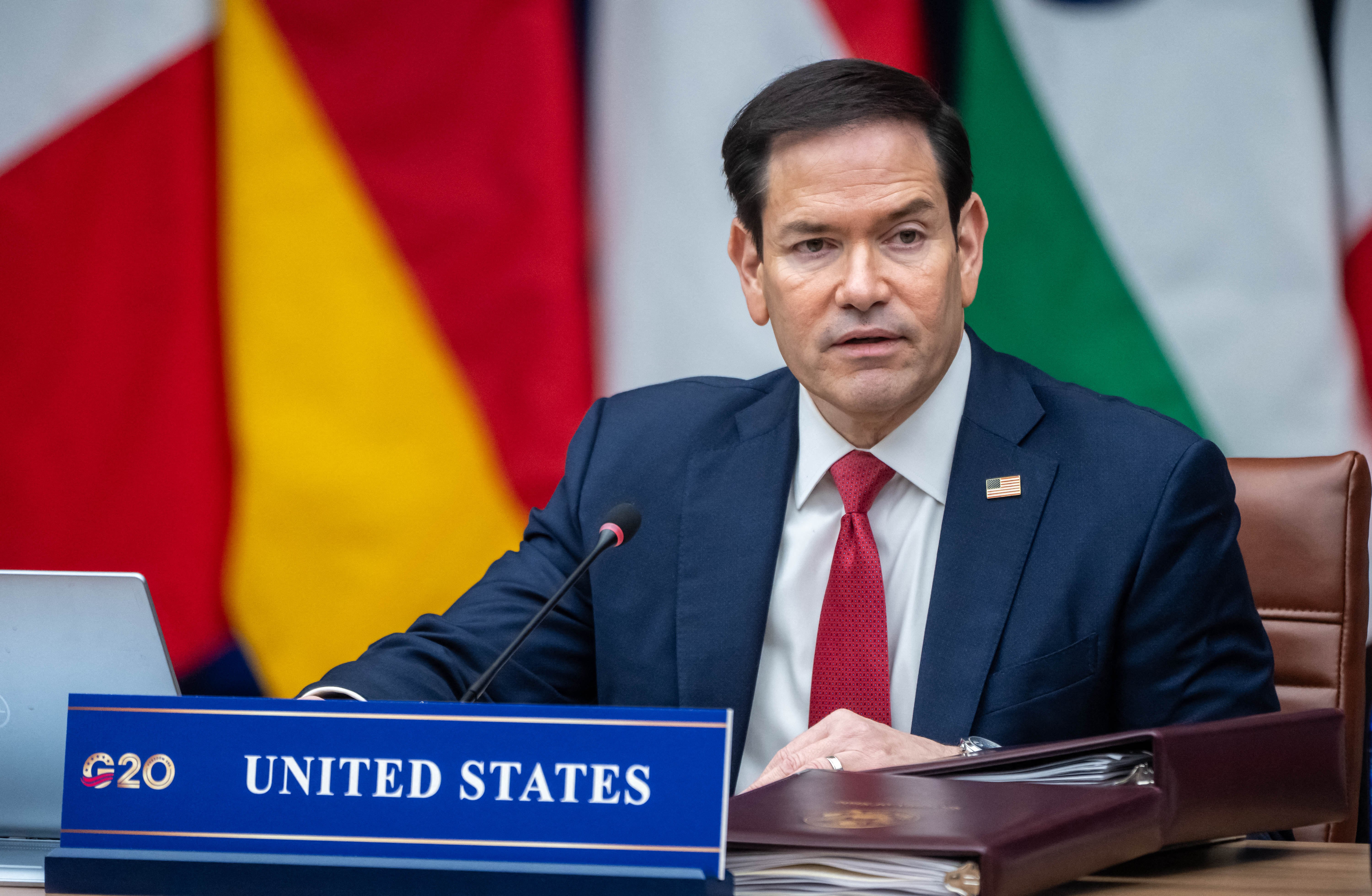 Secretary of State Marco Rubio speaks at the start of the G20 foreign ministers' meeting on Oct. 30, 2026, in Atlanta. Photo: Michael Kappeler/picture alliance via Getty Images
Imperial ambitions are ever-shifting under President Donald Trump. Greenland, Venezuela, Iran, and Cuba are oftentimes spoken about as one continuous train of complete victories and soon-to-be-complete-victories. With the midterms fast approaching, and the date for an apparent telegraphed return to the Iran war on its heels, talk of easily overthrowing regimes has returned, if it ever truly left.
At a rally in Florida last Friday, Trump laid out his grand vision, which he promised would come to pass once the Islamic Republic is neutralized as a threat to the world: "We're going to come back from Iran. Those beautiful ships will pass Cuba. We'll have one of them stop about 50 yards off the coast. They'll raise up their hands, and then we're going to send Marco Rubio in to finish up the deal."
 Related
Rubio's Paranoid Cuba Report Designed to "Justify a Military Attack on Cuba," Says Democratic Rep.
Secretary of State Marco Rubio, the descendant of Cuban immigrants who left under President Fulgencio Batista (though Rubio later tried to claim his parents fled Castro, who came to power three years later), has long put overthrowing the Communist government in Havana at the top of his agenda, with the hope of replicating the relative ease of kidnapping Venezuelan President Nicolás Maduro in January. Rubio turned some heads last Friday when he publicly posted on X that those seeking "to create positive change in Cuba" could "seize this opportunity to create the change you desire through a discrete [sic] partnership with the CIA."
The post was widely met with bewilderment (Bloomberg's White House correspondent wrote: "Checked like four times that this was real"), but U.S. officials and members of Congress also shared the post, elevating the public call for collaboration. Recruiting in public might come across as strange and out of character to a public that imagines the CIA recruiting secret agents and informants through clandestine channels or hidden websites, as the agency had done to try and recruit agents inside Iran under Bush and Obama.
But public appeals of this kind are not wholly new. Under the Biden administration, the CIA recruited collaborators inside Russia via a public Telegram channel, as well as publishing videos on social media hoping to recruit Chinese, Iranian, and North Korean assets.
This kind of overt recruitment stems from the difficulties Western intelligence agencies face against adversaries who have built sophisticated surveillance networks of their own. A CIA official told ABC News in May 2025, "in today's world of [universal technical surveillance], we can't recruit sources the same way that we did 20 years ago, probably the same way you did 10 years ago." This has not only affected intelligence operations targeting Beijing, but also Tehran and Havana, where both the U.S. and Israel's lack of on-the-ground connections and limited official presence has led the CIA and the Mossad to try to recruit willing informants online.
While these limitations may govern the particulars of this strategy, those in power in their respective countries may not see it as evidence of constraints, but instead as evidence of the power of their new strategy: boasting about their national power, rather than keeping it behind closed doors where it supposedly remains useless. After all, what is the use of a deterrent if nobody knows it was you?
The scale of these public appeals, despite having started under Biden, has exploded under the second Trump term, but these moves were arguably preceded by Benjamin Netanyahu's efforts to bring the Mossad's operations much more into the public sphere. The Israeli prime minister's bragging about numerous cyberattacks targeting Iran's nuclear program in the late 2010s began to precipitate a shift in public discussion of the Mossad's work, with many Netanyahu allies, like then-Justice Minister Ayelet Shaked, praising the fact that Iran could now "know it is exposed and that Israel can reach anywhere in the Islamic Republic." A former deputy director of the Mossad said after the unveiling of Iran's stolen nuclear archive that Netanyahu's move "goes against our nature," and that "the prime minister insisted on publicizing this."
Netanyahu's pick in 2021 for the director of the Mossad, David Barnea, has been credited with institutionalizing that change, shifting the secretive intelligence agency's operations toward appealing to larger masses, and reportedly concerning Mossad veterans who were shocked by the publicizing of agents inside Iran. Casting Israel as a superpower capable of exerting its power anywhere has become a popular refrain under Netanyahu. In an interview with "60 Minutes," one Mossad officer said of the 2024 pager attacks in Lebanon, which injured more than 2,000 people, that "they are walking proof of our superiority all around the Middle East," with another officer saying the operation's complexity and success demonstrated "the world is our stage."
 Related
The Mossad Suffers a Crushing Defeat Entirely of Its Own Making
The U.S. has also gotten in the habit of flexing its superpower status under Trump, declaring the nation's intent to conquer places like Greenland and Canada, to steal the natural resources of Venezuela and Iran to fill American coffers, and to openly and unabashedly place the Western Hemisphere under a Washingtonian protectorate known as the "Donroe Doctrine." Rubio declared in Greece in early October, speaking in terms of civilizational battle against the backdrop of the Acropolis, that "we choose the unapologetic pursuit of national power."
Openly siccing the CIA on foreign adversaries and ICE on domestic ones has been part of that strategy of embracing imperial fervor at home and abroad. Erik Prince, the founder of Blackwater and a private security contractor who remains influential in Trump world, said he was "jealous" of the pager attacks and publicly urged the CIA to take a lesson from the Mossad, saying "we should be getting those kinds of results."
While both countries have openly sought deep intelligence penetration in adversarial nations, there are limitations to the power of clandestine and overt operations, even by superpowers and wannabes. While the CIA asserted its power in May by openly having its director meet with Cuban officials in Havana to demand "fundamental changes" in return for relief from economic strangulation, the agency's history of attempts to overthrow the Communist Cuban government are as storied as they are unsuccessful. Earlier hopes for Iran to be as quick and as clean as taking control of Venezuela's government were dashed early on in the conflict, with the war that was supposed to only take a few weeks now all but certain to extend past the midterm elections for another devastating round.
Even if the war with Iran ends so easily that American ships are able to go through Cuba on the way back ready for more, both outside analysts and even internal U.S. intelligence assessments do not see as easy a way to overthrow the Communist state. The New York Times reported in August that American intelligence sources indicate it could be a situation closer to Iran, where even if Raúl Castro (who has held no official position in the country since 2021) were captured, "few pragmatic officials" are likely to take power in his stead.
While Cuba's military lacks the kind of advanced equipment Iran has, and shows of readiness (like with Venezuela) are no indication of a country's actual willingness to fight a protracted campaign, Cuba's military structure is similar to Iran's in that it is based on decentralization and redundancies in leadership. In addition, Cuba has a political power structure that, also similar to Iran, is not actually based around a single individual, despite popular claims to the contrary.
 Related
The Incredible Shrinking Superpower
Despite Trump's constant bluster about the miracle of being able to take out Maduro without a single American death, the brazenness of that operation, and the openness with which the negotiations with Iran have been deceptive, appear to have had lessons for the Cuban leadership. President Miguel Díaz-Canel said in June: "All these elements create a lot of distrust in the Cuban people when it comes to conducting any type of negotiation. We continue to express our willingness for dialogue, but it has to be a dialogue between equals, without pressure and with respect for our sovereignty." American officials have yet to internalize that sentiment. Discussing Cuba in March, Trump joyfully mused: "Whether I free it, take it, I think, I could do anything I want with it." At the time, he was saying similar things about Iran.
The post The CIA Is Resorting to an Open Casting Call for Would-Be Cuban Assets appeared first on The Intercept.
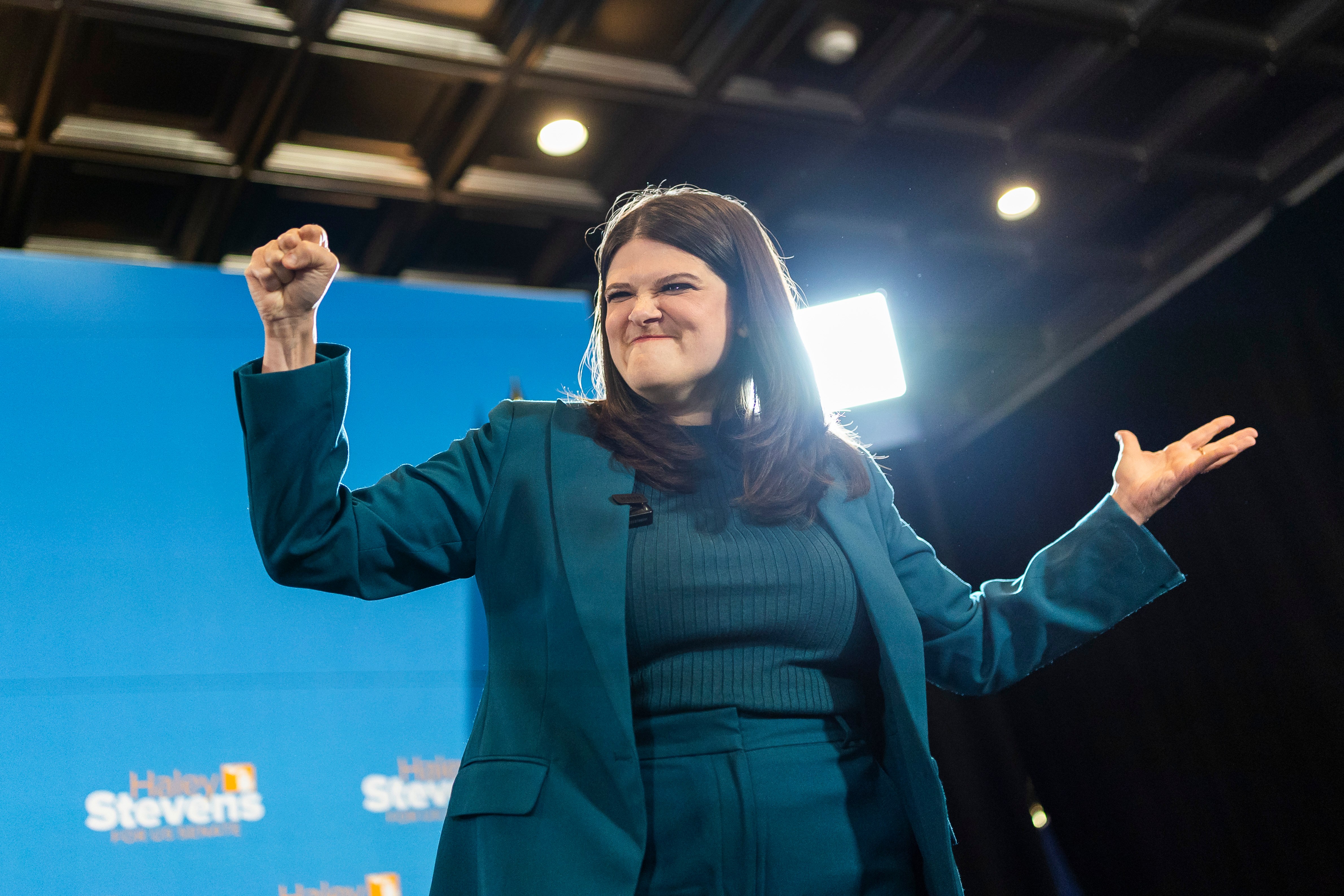 Rep. Haley Stevens, D-Mich., speaks during a primary night watch party at the Hotel Saint Regis Detroit on Aug. 4, 2026. Photo: Finn Gomez/Getty Images
Halloween weekend is the last chance for centrist Democrats to stop the nightmare they fear most: Michigan's Abdul El-Sayed, who could be the first Muslim in the Senate.
The Michigan Democrat's campaign came under pressure from party moderates days out from the general election to denounce an ad produced by The Young Turks presenter Cenk Uygur and his Rebellion PAC. El-Sayed and his campaign were not involved in the production or distribution of the ad, which tied rising domestic prices to U.S. financial backing of the Israel military. But on Thursday, the campaign made the conciliatory gesture of distancing itself.
For centrists, it still wasn't enough.
Rather than take the win, Haley Stevens, the House member who lost to El-Sayed in Michigan's Democratic primary for Senate in August, used that condemnation on Friday as a springboard for a scathing denouncement of her former opponent, framed as a "celebration" of her magnanimous decision to campaign for El-Sayed this weekend alongside Rep. Jim Clyburn, D-S.C. — and laying out conditions for her support with just a few days to go.
In the statement, in which Stevens assigned herself the role as spokeswoman for Michigan's Black and Jewish communities — Stevens herself is a white Protestant — she all but called El-Sayed an antisemite and a bigot attempting to cozy up to the worst of the far right.
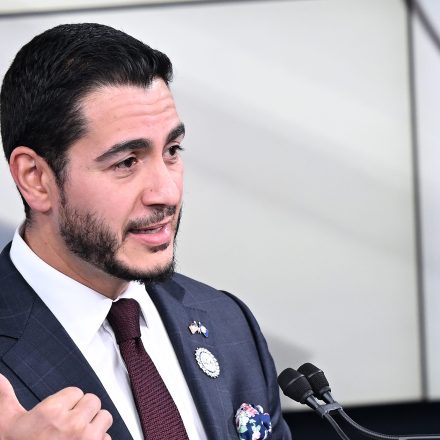 Related
The Spirit of "Party Unity, My Ass" Is Back and Coming for the DSA (and El-Sayed)
"I have learned from Democratic Party leaders and emissaries, as reported in the news media, that Dr. El-Sayed has heard the deep concerns of the Jewish community and is now, for the first time in this campaign, formally condemning that ad for what it is," Stevens wrote. "That is why I accepted Congressman Clyburn's invitation to appear with Abdul on Sunday."
Stevens's eleventh-hour ratfuck came after her fiancé Jason Turkish, a political donor who supported incumbent Maine Republican Susan Collins this cycle, as well as other politicians of both parties, announced he'd vote for the Republican candidate, Mike Rogers, on Tuesday. On Friday night, Turkish told TMZ that his fiancee might join him if El-Sayed didn't accede to her list of demands.
Establishment Democrats see El-Sayed, and the politics he represents, as an existential threat. It's not his rather anodyne liberalism in domestic policy — his policy portfolio isn't far from that of party stalwart Elizabeth Warren — but El-Sayed's opposition to Israel's genocide of Palestinians that's the issue. It's a major problem for the entrenched, centrist Democrats who have controlled the party for decades and have tamped down any dissent on this issue.
Related
AIPAC Isn't Retreating. Here's How It's Already Shaping the Next Congress.
Recent polling is likely motivating efforts to ding the El-Sayed campaign. Senate polling from The New York Times/Siena University this week showed South Carolina in a dead heat — an absolute shocker — with Minnesota comfortably in the Democratic corner. CNN polling published on Thursday gave Democrats leads in Texas and Michigan and toss-ups in Maine and Kansas.
With a Senate majority on the horizon, centrists need to enforce discipline and regain control. AIPAC is down, but not out; the lobbying group still has a hold on the party, even as voters are moving away from pro-genocide policies.
Taking El-Sayed down would be a show of force to keep donors and the party's right wing happy. If Democrats can win the Senate without him, it would be all the better.
But the effort may be backfiring as a faction of party elites, led by popular former President Barack Obama, are putting their muscle behind the El-Sayed campaign. Obama has been a steady presence in Michigan, and Clyburn will rally for the candidate on Sunday at the aforementioned event that Stevens was set to attend.
Anger is also spreading among party members in the state.
"I have no idea what the hell Haley Stevens is doing," Mallory McMorrow, the Michigan state senator who placed third in the August primary, told CNN Friday night. "This is a moment where we have to recognize the stakes."
Stevens — who also demanded El-Sayed pull an ad showing far-right broadcaster Tucker Carlson saying he would "never" support the Republican in the race, Rogers — seems undeterred.
Given an inch by the campaign's willingness to publicly mend fences, Stevens took it several miles, using that ad as a way of implying that El-Sayed was, at best, disinterested in the concerns of Black Michiganders.
This last-minute blitz comes after months of attacks on El-Sayed by centrist Democrats, both before and after his primary win. The smears have been normalized and facilitated by a number of Democrats eager to stay on good terms with the party's powerful but increasingly marginalized pro-Israel wing. El-Sayed's connection to the streamer Hasan Piker, who helped get out the vote in the primary, has been a direct and implied slam on the campaign for over half a year from other members of the party.
Rep. Nancy Pelosi, D-Calif., on Thursday called opposition to Israel's existence as an apartheid ethnostate "more than concerning, it's wrong," on Donny Deutsch's podcast, adding, "This new person in Michigan, we'll see if he gets elected to the Congress." On CNN Wednesday, New Jersey Sen. Cory Booker — a consistent pro-Israel voice — declined to directly endorse El-Sayed by name.
Right-wing Democrats aren't stupid. They know their influence over the party is at a historic low. The genocide in Gaza has pushed the base away from supporting Israel, perhaps permanently. Supermajorities of Democrats oppose the occupation and sympathize with Palestinians.
But the party's donor class still backs Israel to the hilt and is fomenting a war-on-terror-style Islamophobic bigotry toward Muslims. As Perry Bacon noted on Thursday in The New Republic, party elites attacked then-candidate for New York City Mayor Zohran Mamdani throughout 2025, then picked up where they left off with El-Sayed, the next prominent Muslim Democrat running for office, in 2026.
Related
Mike Rogers Spent $100K on Private Jets and Luxury Travel Last Quarter
The same Democrats who indulge in the attacks on El-Sayed are making hay out of rejecting more openly bigoted attacks from the likes of President Donald Trump and Rogers. Rep. Dan Goldman — an outgoing pro-Israel Democrat who jumped on the Condemn El-Sayed bandwagon earlier this week — called Republican attacks on El-Sayed "Islamaphobia" [sic] on Thursday; Booker did the same. And Pelosi, just days after her comments on Deutsch's show, urged Democrats to vote for El-Sayed.
Voters don't seem very interested in the back and forth. In a Marist poll of Michiganders released October 21, 95 percent of the state's Democrats said they support El-Sayed. There's no split in the party at the state level with respect to the nominee; the fight is at a higher, ideological level with a national stage.
As for El-Sayed, he seems done with Stevens and focused on the election. That rally on Sunday? Stevens isn't wanted there, Politico reported, as the El-Sayed campaign is making clear it would be a distraction. In a statement released Friday evening, the candidate said he is intent on fighting for affordability, defeating the GOP, and making sure the Senate seat stays blue.
With a Senate majority on the horizon, centrists will look to enforce discipline and regain control.
"That should be the priority for all of us right now," El-Sayed wrote. "So while Congresswoman Stevens seems intent on relitigating a primary that ended three months ago, let's all focus on the task at hand: that's beating Mike Rogers, holding Trump accountable, and getting money out of politics, putting money in pockets, and passing Medicare for All."
Washing his hands of the wrecker behavior Stevens is engaging in at the final stretch of the campaign is a smart move for El-Sayed. After Tuesday, the Democratic Party should do the same for anyone who indulged in and encouraged it and present a united front against Trump. There's no room for anyone more interested in keeping their increasingly untenable right-wing ideology beyond voters' reproach — even if that means losing.
The post Centrist Democrats Would Rather Lose the Senate Than Win With El-Sayed appeared first on The Intercept.
This story was supported by the Pulitzer Center and the Fund for Investigative Journalism.
JOHANNESBURG, SOUTH AFRICA — When it opened in early 2024, Engage Men's Health Clinic served as a free, one-stop shop for sexual health, gender-affirming medical care, and HIV prevention, testing, and treatment. Located within a short distance of seven universities, it was a place where many college students came before "they'd even had sex for the first time," a former worker told The Intercept. This made Engage a "high-impact" clinic for distribution of the HIV prevention drug PrEP.
The building, on a tree-lined stretch of Reserve Street in Johannesburg, was adorned with the logo for the President's Plan For AIDS Relief, or PEPFAR; a rainbow-colored mural of Simon Tseko Nkoli, the gay anti-apartheid activist who helped start one of Africa's first Pride celebrations and who died of AIDS in 1998; and a sign for USAID saying the site was a gift "from the American people."
Today, it would be very hard to get help here, despite the welcoming-but-outdated signage. The clinic, once staffed full-time by professionals, closed abruptly during the first hours of the second Trump administration. Its replacement, an unrelated volunteer clinic called USpace, is open a mere four hours a week. They can do HIV tests here. But they have no HIV treatment, HIV prevention, or gender-affirming medication to distribute.
South Africans account for about a fifth of the 41 million people living with HIV around the world. Out of a population of nearly 64 million, some 8 million people in South Africa are living with HIV, which is roughly 1 in 8. Managing their healthcare is a matter of international concern and requires global coordination and an immense local network. In a nation with such high rates of HIV, public health workers can't just wait for people to walk into clinics; they must proactively go to them.
Yet over the last year and a half, this crucial work has been stymied. By Jacqueline Pienaar's count, HIV prevention groups have lost track of approximately 20,000 people with HIV in the Johannesburg and Pretoria region alone since U.S. President Donald Trump came back to the White House. "It used to be if someone didn't show up to get their medication, you'd go to them," said Pienaar, a principal investigator and global health specialist at the Aurum Institute, an NGO that offers medical care and contact tracing for the region's massive HIV-positive population.
For years, the U.S. Centers for Disease Control and Prevention funded her work. Many of her patients were homeless, unemployed, and extremely poor. If they are unaccounted for and unmedicated, their viral loads will spike, all but assuring large transmission increases in a country that is already home to 20 percent of the world's HIV-positive population.
With U.S. funding vanished, South Africa now finds itself at risk of unmitigated HIV spread.
Now, at organizations like the Aurum Institute, interviews with Pienaar and other workers reveal how funding cuts have devastated the care apparatus. Employment in HIV care and prevention has become precarious, and resources to slow HIV transmission are increasingly scarce. As elsewhere in the world, this is creating a crisis of unemployment for Black LGBTQ+ workers, which itself creates higher risk for HIV. Gender-affirming care, which is a crucial tool for preventing HIV, has disappeared almost entirely.
Until the second Trump administration, the United States government sent a bit more than half a billion dollars a year to the Republic of South Africa. Of the $580 million the U.S. sent in 2024, 78 percent ($455 million) went towards HIV/AIDS.
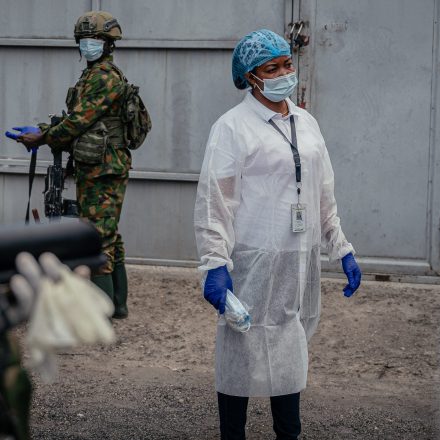 Related
Ebola Outbreak Rages After Trump Gutted Global Health Safeguards
But this money from America was hardly charity or lacking in self-interest. Because viruses know no borders, what happens with AIDS in the country with the most infections affects everyone on Earth. Controlling HIV in South Africa makes the entire world safer by preventing the emergence of dangerous viral mutations, reducing the global burden of infectious diseases, and strengthening health systems that detect future pandemics. Because viruses mutate rapidly when allowed to replicate unchecked, poorly controlled epidemics anywhere pose a direct threat to global health security.
South Africa also leads the world on another important front: medical research to address HIV. The republic is home to more clinical trials than any other country for seeing how medications of all kinds (including Covid vaccines) impact those with HIV. The profits of American drug companies depend on South Africans undergoing research trials.
And after a year-and-a-half of dialing down HIV funding and only allowing it with many caveats which have caused major harm, the United States announced in June — during America's LGBTQ+ Pride Month — that it will end all HIV funding in South Africa.
The ramifications of this will be felt globally for years to come.
They are already being felt by the millions of South Africans for whom HIV care has become harder and harder to find. And the effects are most severe for those already on the margins of South African society: those already living with HIV/AIDS, immigrants, trans women, and the poor, including thousands of newly unemployed HIV prevention workers.
 Laboratory technician Nozipho Mlotshwa works on samples at the Antiviral Gene Therapy Research Unit, at University of the Witwatersrand Medical School, in Johannesburg on May 22, 2025. Photo:Themba Hadebe/AP
On January 20, 2025, Trump signed two executive orders: 14169, "Reevaluating and Realigning United States Foreign Aid," and 14168, "Defending Women from Gender Ideology Extremism and Restoring Biological Truth to the Federal Government."
Within hours of Trump taking the oath of office, the vast majority of workers for OUT LGBT Well-Being, which ran the Engage clinic, were told not to come in to work the next day nor to even open their work laptops again. According to one, 82 of 86 workers were let go. They would become part of the one-third of South Africans who are already unemployed.
Trump executive order 14155 formally pulled the U.S. out of the World Health Organization in January 2026. Trump's cuts came after the outgoing administration of President Joe Biden reportedly failed to pay some $130 million in 2024 WHO dues, leaving the organization with a $1.9 billion gap. As a consequence, WHO implemented a 30 percent reduction in its workforce.
South Africa's response to HIV has been shaped by its two most famous citizens: Nelson Mandela and Elon Musk.
Mandela, the first president of the republic, played a large role making sure combating AIDS was part of national policy, even guiding the writing of gay, lesbian, bisexual and even trans rights into the constitution (the first constitution in the world to do so). Musk, for his part, can take credit for exacerbating the plague.
During Trump's first term, with Musk merely cheering from the sidelines, U.S. funding for LGBTQ+ health and HIV did not decrease significantly, at home or abroad. But ahead of Trump's second term, it was Musk who first recommended a U.S. "government efficiency commission" to Trump in 2024, planting the seeds for what was to come.
 Related
How Trump's Embrace of Afrikaner "Refugees" Became a Joke in South Africa
HIV funding nationally and globally have plummeted in Trump's second term through cuts largely enacted at the behest of Musk's short-lived Department of Government Efficiency. (These have been paired with an immigration policy so racist, over the last six months, literally the only refugees to enter the U.S. have been white South Africans.)
Musk quit just a few months into his tenure in 2025, before DOGE shut down entirely. He reportedly took a swath of DOGE data with him, saw his wealth skyrocket, and became the world's first trillionaire. Reporting on mathematical projections about how many people have been or will be killed by the U.S. Agency for International Development, or USAID, cuts he pushed have ranged from hundreds of thousands to about 10 million to even tens of millions. (When Rep. Ro Khanna, D-Calif., accused Musk of executing "a death sentence for an estimated 4.5 million children around the world," Musk threatened to sue him.)
"We have rights for trans women only on paper."
But not all harm results in immediate, quantifiable fatalities. HIV-related deaths usually take many years to occur, and South Africans who die of HIV, or due to an increasingly transphobic healthcare system, are unlikely to be mourned in any numerically comprehensive database.
In South Africa, being trans is not a crime — it's legally protected thanks to its 1996 constitution shaped by Mandela. And yet, as one trans HIV-prevention worker put it, "we have rights for trans women only on paper." Because trans care was largely being financed largely by USAID, PEPFAR, and CDC research, when U.S.-money disappeared, trans care went away — along with a lot of the much-needed HIV prevention for everyone.
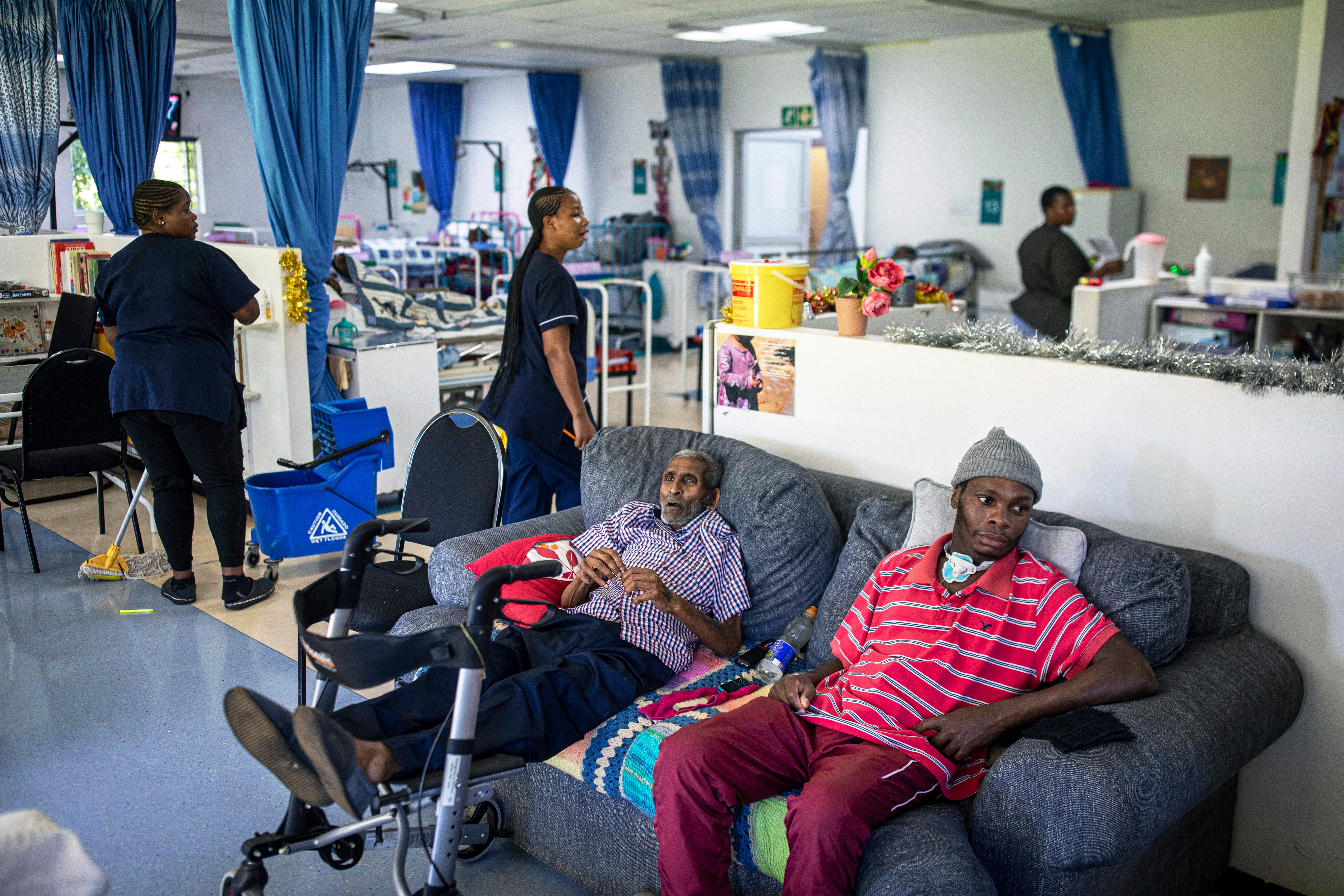 Patients watch a soccer game on TV in the hospice at Hillcrest AIDS Centre on Nov. 29, 2025, in Hillcrest outside of Durban, South Africa. Photo: Per-Anders Pettersson/Getty Images
In South Africa, LGBT Pride celebrations happen in the fall to connect gay history to the September 24 Heritage Day national holiday.
At last year's Soweto Pride in the all-Black township where Winnie Mandela once lived, there were no corporate sponsors and zero presence from the U.S. Embassy or any U.S.-based NGOs.
It was here The Intercept first met Sibonelo Ncanana Trower, the worker at OUT LGBT Well-Being which had run the now-shuttered Engage clinic. He and his partner were wearing matching rainbow sweaters. Nearly nine months after being laid off, he was still looking for work — and it was one of his first times going to a gay event.
Though he was no longer getting paid, Sibonelo still was doing a lot of public health work for free, out of a sense of communal responsibility.
"If you go on Grindr — and I don't suggest that you do, it's too dangerous," Sibonelo said, "you will see many of my former colleagues offering services." People who had been trained as social workers and peer educators to provide care to sex workers were now working as sex workers. In an email to The Intercept, Sibonelo said he is back to working at OUT as of early June.
As the festivities continued, the almost entirely Black crowd danced to a mix of hip hop, rap, and dance hall on a grass field, bordered on one side by tents. Under the banner "The Queer Nation Has No Borders," a group of volunteers and workers at the SafePlace International tent welcomed LGBTQ+ migrants and refugees and offered help for finding housing and work.
While Europeans are routinely worried about African refugees trying to cross the Mediterranean to Greece or Italy, SafePlace explained that most migrants in Africa are not trying to leave the continent at all — and most queer and African migrants fleeing legal persecution head down to South Africa. They try to go south because they've correctly heard that South Africa is legally good for queer Africans and that they can claim asylum. But they also come because they've heard — rather incorrectly — that South Africans welcome migrants. (In recent decades, migrants have faced great hostility in South Africa, especially in the lead-up to 2025's G20 summit in Johannesburg, which Trump boycotted, and in increasingly bold xenophobic protests in 2026.)
Mpho is a lesbian from rural South Africa, and she spoke about a kind of refugee status few Westerners consider. Mpho explained that people who come from within South Africa to Cape Town, Durban, Pretoria or Johannesburg are often called immigrants, for their distinct cultures, languages (South Africa officially has 12 languages), and understandings of sexuality, gender, and being intersex. She herself knew she was different; but in her township, where there is not constant connectivity with mass media, she didn't know anyone like her until she came to a big city.
Masi has had an even more challenging route. He is a trans man born in Zambia who made his way to South Africa, after surviving an arranged marriage and a community shunning.
 Related
DOJ Escalates War on Trans Youth Healthcare With Criminal Subpoenas
Mpho and Masi have both known trans people who have experienced extreme body dysmorphia, including trans men who have started to have periods again once they lost access to hormone replacement therapy due to the Trump-Musk cuts. They know someone who has gone into the public health system, had their doctor leave the room in the middle of a genital exam — and then return with a group of colleagues to laugh at their body.
This has led to a wave of depression and suicides among their friends. Masi has made the difficult decision to only "socially transition." He has chosen to dress and live as a man without hormonal or surgical intervention, because he does not want to begin any process that he can't finish, or which could be taken away from him for any time.
 A 36-year-old HIV-positive sex worker and mother of one who requested anonymity shows a antiretroviral drug bought illegally on the black market in Johannesburg on June 20, 2025. Photo:Louise Dewast/AP
A few days later, Masi and Mpho drove into Johannesburg in a car early on a Saturday morning, decked out in "the queer nation has no borders" swag. With them was Mandi, a trans woman from Uganda. While Mandi waits for surgeries she plans to have, she has found a way to get estrogen — and stay on it — despite "the cuts."
The three friends were on their way to perform an "Act of Kindness," a part of SafePlace's program where queer and trans people perform service projects which confer dignity upon each other. (SafePlace is privately funded, and like other privately funded NGOs, its work and workers are stressed in trying to meet the profound additional need in the wake of U.S. and WHO cuts.) Masi, Mpho, and Mandi would be serving lunch at a shelter for displaced queer women in the Vaal area, south of Johannesburg.
 Related
By Slashing Foreign Aid, Trump Is Fueling the Spread of HIV in Uganda
Mandi grew up assigned as a boy but knew she liked other boys. Uganda only made being gay a capital offense in the last couple of years, but it has been illegal in various forms since at least 2014. As in many places, Mandi's legal problems did not come from random government surveillance; rather, she kissed a friend, whose parents found out, who told their school, who told the authorities, who arrested them both. This, in turn, outed Mandi to her family, who threw her out on the street. (She has never seen them again.)
Eventually, she made her way 5,000 kilometers by land to South Africa.
Mandi had an idea that South Africa "accepted people like me," and while living on the streets of Cape Town (and then in the back of a restaurant where she did unpaid labor), someone pointed her to SafePlace. They found her a home, helped her get healthcare, and supported her in starting to live as a woman.
After crossing the Mandela Bridge, the roads shifted from highway to unpaved, red-clay-earth roads. They arrived in the Vaal and approached Orange Farm, an area well known to AIDS researchers for its high prevalence of HIV and for hosting many research studies, including the world's first trial to see how circumcision could affect rates of HIV transmission.
Mpho, Masi, and Mandi pulled up to a nice home, double wide in size, which had a rainbow flag on its fence. This was the shelter where they'd be serving lunch.
The group set up a precarious gas stove in the garage and began cooking massive amounts of chicken, vegetables, and pap, the South African grain dish that is akin to Cream of Wheat in America or polenta in Italy.
Before the meal, Mandi got up in front of important community elders from the neighborhood and told her story. She implored them that the most important thing about having an LGBTQ+ child is to not kick them out and to stay connected. As a cautionary tale, she warned them that her elders now wanted her to return to Uganda to take care of them in old age — even after they'd abandoned her.
Gwendolyn Dube lives in the Orange Farm section of the Vaal, in a tin-roofed shack with no running water or electricity, not far from the Steve Biko Elementary School.
At 35, she has lived with HIV for more than 20 years; she was infected when she was raped as a child. She was among the first cohort of South African children to receive antiretroviral medication, or ARVs, in the early 2000s.
For many years, she received free medical care and ARVs at a clinic across the street from Eyethu Orange Farm Mall. It encompasses many buildings across a large campus, and its rooms are simple and very crowded. A small pride flag hangs on a poll beside the South African flag — both are at half mast, for no discernible reason.
While this is not officially an HIV clinic, Orange Farm has one of the highest rates of HIV anywhere in the world, and HIV is part of most medical care here. In a room with racked, connected plastic chairs like a bus terminal, signs read: "Are you or your child on ARVs? Do you know your VIRAL LOAD?"
Moving through the hall full of hundreds of mothers with children carried on backs in baby wraps, Gwendolyn recalled how difficult it's become to get medicine. She used to get three months of treatment at a time, then two, then one. Then she was told there was no file for her.
"I think they say that when they're overworked," she said.
One of the workers behind the check-in desk told The Intercept that things have gotten much harder since the cuts: "We don't turn people away. But we don't have enough staff. People will come here and wait for 8, 10, even 12 hours — and sometimes they don't even get to see someone about what they need." (For people living in abject poverty, the loss of a day's earnings can be devastating — especially if they have HIV and have to face this risk regularly.)
Another clinic worker shared that since the cuts, many visiting healthcare workers on U.S.-funded grants not only left, but also took their equipment with them.
"I used to send teams out every day. Now, it's maybe once a week."
The nurses of the clinic move with a military precision, even wearing military rank epaulets on their shoulders. The head of them is the "matron," who, when asked by The Intercept, denied that they've run out of any medication, or that they turn people away (a claim Gwendolyn and others disputed). The matron conceded that sometimes people have to wait so long "they will leave" — and maybe don't come back. She acknowledged that the clinic doesn't always have the specific medication people need when they need it. She also bemoaned that it's hard to keep staff, burnout and turnover are high, and that her mobile teams, which would go out into the townships, are severely limited.
"I used to send teams out every day," she said. "Now, it's maybe once a week."
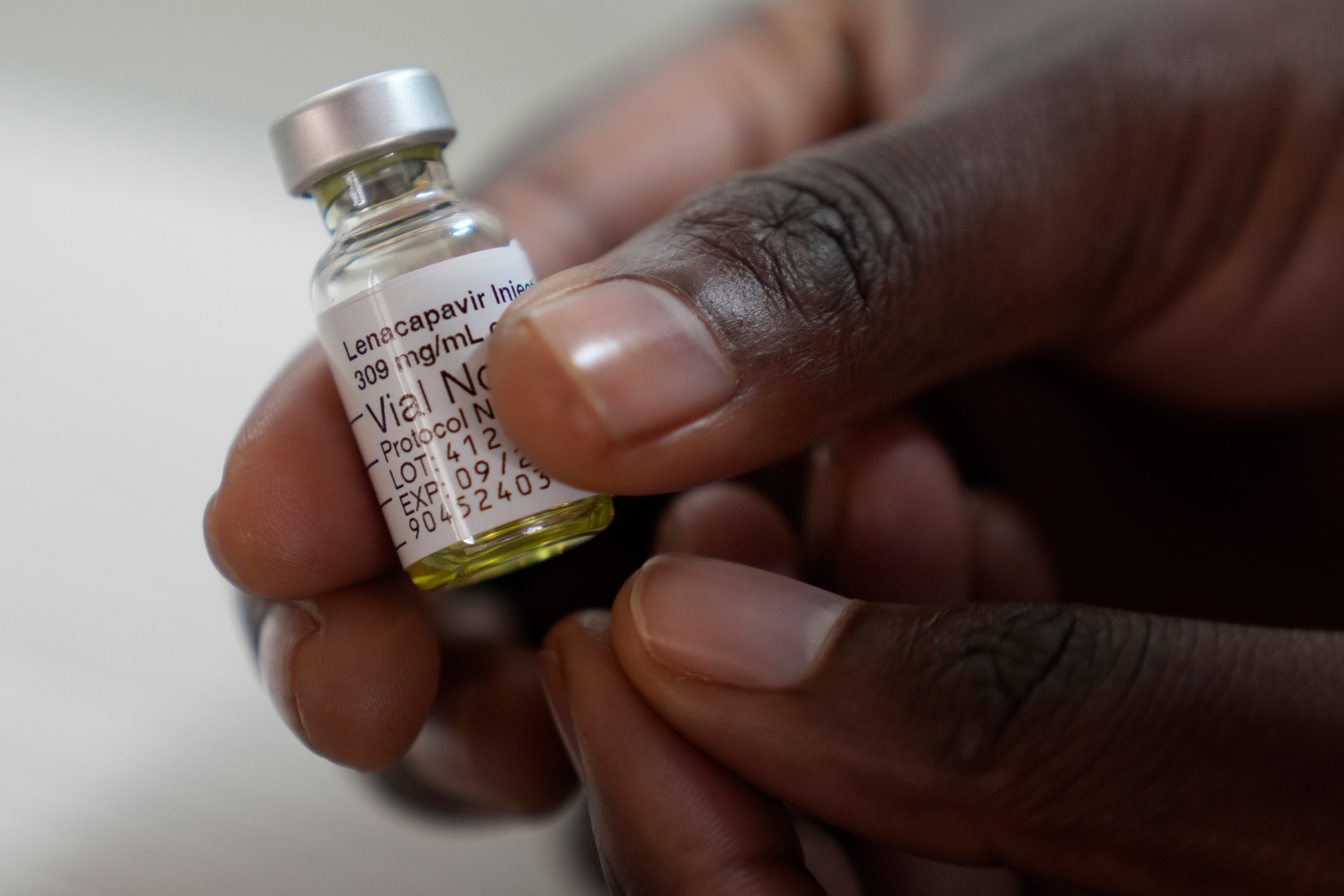 A pharmacist holds a vial of lenacapavir at the Desmond Tutu Health Foundation's Masiphumelele Research Site in Cape Town, South Africa, on July 23, 2024. Photo: Nardus Engelbrecht/AP
Shon, a Black trans woman living with HIV, is still working at the Aurum Institute — at least for now. Unlike at the shuttered Engage clinic in Johannesburg, some staff remain in Aurum's Pretoria office, but they decreased in number. As a result, Aurum is offering fewer services and steering patients to the public health system, where trans people receive little necessary care.
Aurum used to be a "one-stop shop" for trans women, Shon said. But now, after the cuts, doctors visits are no longer free and hormone drugs aren't available at Aurum's popular Pop Inn clinics. "The ladies do come to get [HIV medication], others come to get PrEP, but they cannot get hormones," Shon said. "They're told to go to a public clinic," but "they don't know anything about trans women!" Shon added that patients will be addressed with derogatory and incorrect terminology at such locations.
The stigma is too high to go to a public clinic, so Shon goes to a private doctor herself, when she can afford it. But getting hormones is now tough. While patients aren't being blackmailed as they are in Uganda, "a pharmacist might say, 'What do you need this for? No, I'm not giving it to you for that. I have other patients who really need it,'" Shon said.
Trans women are struggling, Shon said, recalling how she knew two "who were suffering from depression. One couldn't take hormones, became really religious," stopped hormones, and became suicidal. Another was suffering from liver problems after buying hormones on the contraband market, without the supervision of doctors.
Whenever transgender patients are taking contraband hormones via syringes which might not be sterile, they are being exposed to increased risks of contracting HIV and hepatitis — all because DOGE cuts took sterile medical care away from them.
Amid the devastating cuts to global HIV care, a potential breakthrough treatment is just beginning to reach patients. Lenacapavir, a new medication, promises to prevent HIV for six months with just one injection. But it comes with a prohibitively expensive $28,000-a-year price tag, making it out of reach for those who need it most.
 Related
Trump Gutted AIDS Health Care at the Worst Possible Time
Recently, the Global Fund for HIV, Tuberculosis, and Malaria struck a deal with pharmaceutical company Gilead Sciences to produce the shot for $40 in limited quantities. Small amounts are headed to South Africa.
At an outdoor cafe under a massive tree in the picturesque city of Cape Town, Fatima Hassan, a legal and HIV scholar, blasted the pilot study coming to the republic.
The government's approach was "making the same mistake" of excluding those who were most affected: sex workers and men who have sex with other men.
The plan is to bring a one-time shipment of 40,000 doses — a woefully inadequate number for a country of more than 60 million people where about 1 in 5 adults is living with the virus is living with the virus.
Worse, only a tiny fraction — 5 percent, or 2,000 doses — is to be set aside for testing on men who have sex with men.
None are going to be set aside for sex workers.
And another problem: So many of the people who would be needed to distribute lenacapavir to the people who need it most — to the gay college students who used the shuttered Engage clinic on Joburg's Reserve Street, to the trans women who went to the Pretoria Pop Inn clinic — have been fired. Without those workers, can South Africa even distribute the medication?
Steps from the cafe, within sight of well-appointed apartments topped with electrified razor wire and the Desmond Tutu Health Foundation, there is a shantytown of cardboard-and-wood dwellings, home to some 100 Black adults without anywhere else to live.
A conservative estimate means that probably at least 20 of them were living with HIV, if not more.
And because of Trump and Musk, the people who used to find them and treat them have been fired — and are at higher risk of HIV themselves.
The post How Trump Destroyed South Africa's Effort to Slow HIV Transmission appeared first on The Intercept.
The Rise of the Christian Left in Texas [ 30-Oct-26 4:55pm ]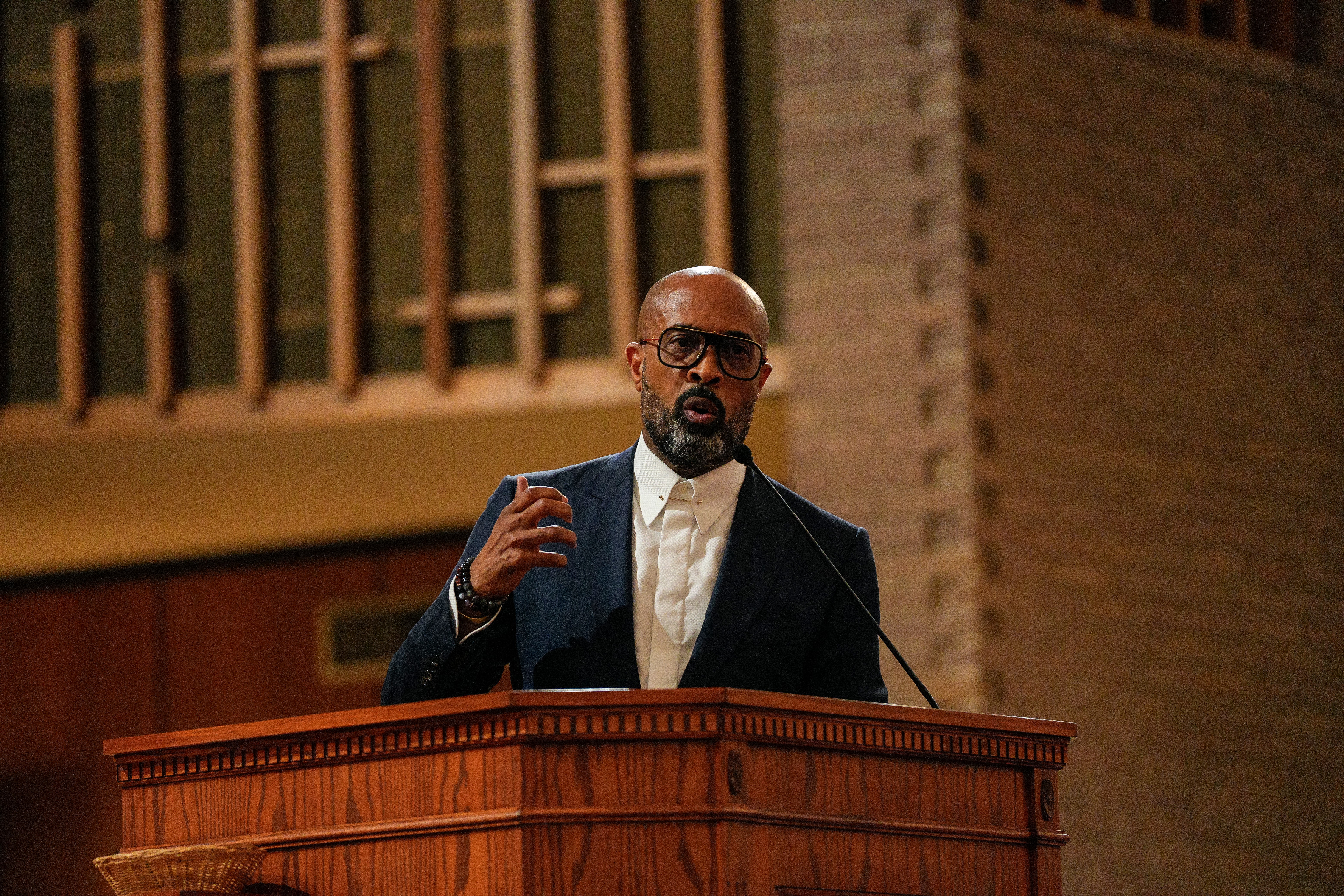 Rev. Frederick D. Haynes III speaks to the crowd during the We the People TX interfaith service, "A Night of Moral Resistance," in Dallas, on Sept. 9, 2026. Photo: AP Photo/Gabriela Passos
"Why do you wanna have a pep rally when people are hurting?"
That was the question Rev. Frederick Douglass Haynes III posed at a September food drive in South Dallas, where volunteers were collecting groceries for struggling families. Across town, Republicans were holding a midterm convention. Haynes, a longtime Baptist pastor and Democratic congressional nominee, was introducing James Talarico, the party's candidate for U.S. Senate in Texas.
A month later, speaking at a Dallas megachurch, Talarico offered his own interpretation of Christian duty.
"I try to love my neighbor through public policy," the Presbyterian seminarian told the congregation. "I'm trying to make my neighbor's life easier, better, less stressful."
Both men are making a deceptively simple argument in some of the staunchly staunch red-as-hell, Republican territory in America, one that might transcend the conventional wisdom about national campaigns and the millions poured into competing campaign war chests: When far-right policy translates into actual pain, at what point does intervening become a spiritual obligation?
Amid the big-ticket ad buys, fundraising appeals, and armies of political consultants, Talarico and Haynes are tapping into a political tradition that has long sustained communities across the South: showing up.
At Haynes's Friendship-West Baptist Church, the ministry extends to legal services, immigration advocacy, counseling, economic justice, and food policy. It is an example of how churches often form the connective tissue of communities suffering under economic and political strain.
When far-right policy translates into actual pain, at what point does intervening become a spiritual obligation?
That strain is measurable. Texas is home to four of the nation's 10 most financially distressed major cities, including Houston, which ranks second nationwide, according to a 2026 analysis. Feeding America estimates that nearly 1 in 5 Texans experienced food insecurity in 2024. Meanwhile, federal analysts project that changes to Medicaid eligibility enacted last year will increase the number of uninsured Americans by 7.5 million by 2034.
While Democratic Party leaders publicly debate how to punish Donald Trump politically, allege corruption, or navigate the ideological divide between moderates and democratic socialists, a different argument is emerging from Southern pulpits.
The Underground ChurchFrom Quaker abolitionists to the Social Gospel's challenge to industrial exploitation, progressive religious institutions have helped drive some of America's most consequential political transformations. Christian farmworker ministries supported migrant laborers before joining the United Farm Workers' California grape boycotts in the 1960s. And while Black churches overwhelmingly led, sustained, and suffered the brunt of violence in the fight for equal civil rights in this country, a handful of white denominations joined them.
Of course, churches also defended slavery, segregation, and exploitation. The blunt reality is that throughout American history, Christianity has always been political and has been used to justify a wide variety of competing political ends.
 Related
Pete Hegseth's Unholy War
But Republicans have deftly exploited the perception that they alone speak for American Christians. The Trump administration has readily embraced religious iconography, from evangelical leaders praying over the president in the Oval Office to Defense Secretary Pete Hegseth's frequent invocations of the medieval Crusades.
There is no way around the fact that Republicans have built a formidable religious coalition, particularly among white evangelicals. Last year, the nonprofit, nonpartisan Public Religion Research Institute, or PRRI, found a majority of Republicans qualified as either Christian nationalist adherents or sympathizers in 2025, compared with 17 percent of Democrats.
But Republicans don't have a monopoly on Christian voters. Pew Research Center polling this month found 73 percent of white evangelical Protestant registered voters preferred Republican House candidates, while 74 percent of Black Protestants and 59 percent of Hispanic Catholics preferred Democrats. None of that is particularly surprising on the surface.
Nor is this some newly discovered religious awakening. According to PRRI's Census of American Religion, which was published in April, 57 percent of Democrats identified as Christian in 2025, a significant drop from 70 percent in 2013. The white Christian left isn't necessarily growing, but it's far from insignificant. Much of it has simply been politically overlooked.
It's a perception the GOP has routinely capitalized on, often spending a great deal of their election campaigns attacking opponents on religious ground.
On Sunday, Texas Gov. Greg Abbott cravenly tarred his Democratic gubernatorial challenger, state Rep. Gina Hinojosa, as supporting "Sharia law," citing an endorsement from a Muslim advocacy group's political affiliate.
Perhaps ironically, Hinojosa is, and has been on the record, a Catholic — same as Abbott.
"My faith is my moral compass," Hinojosa told the National Catholic Register in September. "It grounds me in purpose and gives me the courage to do what is right regardless of obstacles or consequences."
Faith Without Works Is a Dead EndFor those who have spent years watching their faith become synonymous with a politics they don't recognize, frustration may finally be giving way to something else: a determination to be heard.
There are signs that this long-overlooked religious tradition is finding a more public voice. An August study by PRRI documented progressive Christians organizing against Christian nationalism in eight states, including Texas and Louisiana, channeling local meetings, religious discussions, and community networks into political action. Elsewhere, hundreds of members of the clergy have joined protests against immigration enforcement, and some have been trained in direct action and civil resistance. While the movement may not be growing in numbers, its willingness to challenge political power is increasingly visible.
 Related
Apocalypse Now: Naomi Klein and Astra Taylor Investigate the End-Timers Alliance
As retired Texas Rev. Kathleene Card, who has thrown her support behind Talarico, told the Houston Chronicle, "faith should influence how people respond to poverty, human rights, the environment, and the well-being of their community."
Whether any of this will translate into winning on Tuesday is still an open question. An October Fox News poll put Talarico and Republican Ken Paxton at 49 percent apiece among likely voters, but newer polls show Talarico with a small lead. Abbott led Hinojosa by 5 percentage points in that Fox poll, and most polls in the race show the governor with a slim lead.
No matter the result, the Texas campaigns offer a different, more nuanced way of understanding political persuasion. They also challenge a long-standing assumption among national Democrats: that their voters are a monolith, moved by the same issues, values, and appeals.
Across rural America and the South, voters may be growing weary of manufactured arguments and hypothetical doomsday prophecies, with research showing that political advertising, as it stands, has little effect on changing minds at all.
There is something to be said for people willing to put boots on the ground, to do the work instead of endlessly debating how to begin and whether it matters, in the name of service.
It's a moral code not too dissimilar to a Western: When confronted with injustice, you stand for what's right, even if you stand alone and are ridiculed for what you believe. It's a mode of Christianity that harkens back to Abraham Lincoln (and maybe even John Brown.)
That might be a more enduring political proposition than many Democrats' feigned, helpless aggrievance to the latest Republican spectacle. Campaigns come and go; so do their promises, if they existed in the first place. But the obligation to one's neighbors remains.
The post The Rise of the Christian Left in Texas appeared first on The Intercept.
It's a superlative achieved again and again: The current election cycle is the most expensive on record, according to AdImpact, likely to be surpassed only by the next one. North of $16 billion have been raised ahead of Tuesday's looming elections, with ad spending in House and Senate races topping $4 billion. Mega-donors this election season have overwhelmingly backed Republicans with contributions largely flowing from AI, crypto, and online gambling interests.
Related
AIPAC Isn't Retreating. Here's How It's Already Shaping the Next Congress.
The Intercept tracked how super PAC spending is flowing into the midterms and how growing public skepticism of special-interest money in politics is affecting campaign strategies. Hundreds of candidates are still taking donations from the American Israel Public Affairs Committee and its super PAC, the United Democracy Project, despite public sentiment turning against the pro-Israel lobby.
"The data overall reveals that [AIPAC is] still spending a ton of money on a lot of races, and more often than not, their candidates are still winning," Intercept managing editor Maia Hibbett told The Intercept Briefing. "It is still quite meaningful money."
Artificial intelligence super PACs have also poured tens of millions of dollars into this election cycle, most of it on just a few races in the primaries. The two leading AI super PAC networks, affiliated with OpenAI or Anthropic, dropped a whopping $50.7 million on the primaries, but are noticeably spending much less in the lead-up to the general election, $8.5 million — likely responding to public backlash in the same way that AIPAC has.
"The polls are just so startling on the public's transformation on AI and data centers over the last year. … The entire life cycle of these AI super PACs, which started about a year ago, has followed that evolution of the public's opinion," said Intercept politics reporter Matt Sledge. "One of the things that's been really interesting in the general election races is … candidates [trying] to paint themselves as the more pro-AI safety, pro-AI regulation candidate."
This week on the podcast, host Jessica Washington speaks to Hibbett and Sledge about the spending trends in the most expensive election cycle to date and unpack the intended impact.
"No matter which party gets control of either or both houses of Congress, there will be a lot of people elected next week who got there on the backs of Big Tech and special interests," said Hibbett.
"They're backing a lot of people in safe seats who don't really have a tight election," Sledge added. "The goal may just be to buy themselves a few friends in Congress, because sometimes in Congress, it's just as good to have a few people who can stop regulation as it is to have people who can shape and actually pass laws."
For more, listen to the full conversation of The Intercept Briefing on Apple Podcasts, Spotify, YouTube, or wherever you listen to podcasts.
TranscriptJessica Washington: Welcome to The Intercept Briefing, I'm Jessica Washington, politics reporter at The Intercept.
On Tuesday, voters will head to the polls to cast their ballots in the most expensive election cycle ever in terms of campaign ad spending, even outpacing past presidential elections. That's according to AdImpact.
North of $16 billion has been raised this cycle, with ad spending in House and Senate races topping $4 billion. Billionaire Elon Musk has dumped hundreds of millions into races across the country, using his enormous personal wealth to sway the election in favor of Republicans. Musk, who has a home and multiple businesses in Texas, has taken a particular interest in the state's Senate race between Republican candidate Ken Paxton and Democratic candidate James Talarico.
Most of the money from Musk and other donors has flowed not to candidates, but to powerful super PACs representing a variety of different special interests.
That super PAC spending is the subject of my colleagues, Intercept politics reporter Matt Sledge and senior politics reporter Akela Lacy's new project, tracking how money is flowing into the midterms.
Maia Hibbett, managing editor for The Intercept, and Matt Sledge join me now to talk about the project and how big money is shaping the midterms.
Matt, Maia, welcome back to The Intercept Briefing
Maia Hibbett: Thanks for having us.
Matt Sledge: Thank you for having us, Jessie.
JW: Maia, I want to start with you. As a part of the super PAC project, The Intercept tracked how millions of dollars flow through the pro-Israel lobby in the United States.
What did the reporting reveal about how the American Israel Public Affairs Committee and affiliated groups like the United Democracy Project mask their influence in U.S. elections in a political landscape where AIPAC's contributions and endorsements have become largely politically toxic?
MH: The reporting showed that AIPAC and its affiliated super PAC UDP are a little bit weakened, but they're still pretty dominant.
The narrative out of this midterm cycle, especially during the primaries, was largely focused on a few high-profile races that an AIPAC-backed candidate lost — and that was a huge shock. These big upsets were AIPAC or UDP or a related group that, we can talk about a little bit later, had poured money into, and then the candidate didn't succeed.
But if you look at it in the aggregate, what the data overall reveals is that they're still spending a ton of money on a lot of races, and more often than not, their candidates are still winning. It is still quite meaningful money. And even though AIPAC has been discussed as going underground, they are still directly invested in a lot of races.
JW: I want to get into AIPAC's shifting strategy and their latest announcement on that. But first, Matt, I wanted to talk about your reporting. AI super PACs have poured tens of millions of dollars into this election cycle.
Related
AI Tried to Buy the Midterms — Then the Lobby Learned Everyone Hates AI
What do we know about the people and companies behind these super PACs? This may seem obvious, but what are they hoping to gain with this level of spending? Are there specific examples of friendly legislation these varied interest groups are hoping their candidates will see through if they win?
MS: To answer your second question, I think it's really more about setting the tone for future regulation at the federal level. You have two big super PAC networks. One is affiliated with OpenAI, and they broadly favor a laxer regulatory scheme for AI. Then there's another network that's affiliated with Anthropic that paints itself as supporting a stricter regulatory scheme.
"It's really more about setting the tone for future [AI] regulation at the federal level."
Skeptics will point out that these networks are both backed by big AI companies. So at the end of the day, they're probably going to favor regulation that is favorable to the AI companies. I get into this a little bit in my story, but, just in the last few months, there's also been this constellation of other smaller groups that are sometimes backed by individual employees at these firms or just by people concerned about AI that are pushing for stricter regulatory regimes and aren't as directly connected to one of the big companies.
JW: Matt, I'm curious about the impact on voters here. CNBC analysis from early October found that mega-donors this election season were overwhelmingly backing Republicans with contributions largely flowing from AI, crypto, and online gambling interests: "Fourteen of the 20 largest donors and donor groups this election cycle have exclusively or nearly exclusively backed GOP candidates or aligned groups."
Matt, are we seeing voters become more receptive to Republicans as a result of all this ad spending? Is it working on the voter base?
MS: It's always hard to tease out the impact of an individual super PAC or industry, because you have to keep in mind that a lot of the time, if you're a crypto super PAC, or an AI super PAC — or more recently, a prediction market super PAC — they are not running pro-crypto or pro-AI ads.
They are running ads that look very similar to everybody else's. Often, they're doing negative campaigning that campaigns don't want to do themselves, and they have such vague names that they're not associated with crypto or AI. So I do think ads have an impact on the races, but overall what we're seeing in polls is that it's not a great environment for Republicans.
So it may have served, just writ large, to potentially soften the blow to Republicans this time around. It does help them to have this many corporate allies, but it may still be overwhelmed by a blue tide.
JW: That makes a lot of sense in terms of just, this is a bad environment for Republicans. They have a president who is unpopular. We have an economy that is not amazing right now. It makes a lot of sense that despite all this ad spending, the baseline of the election is not in favor of Republicans.
Maia, I wanted to get back to something that you had said a little bit earlier about AIPAC and their shifting strategy. AIPAC recently announced that they would no longer officially endorse candidates or give money directly to campaigns.
Were we seeing an early signal of shifting strategies from AIPAC during the 2026 midterm elections? And what does this change actually mean for AIPAC's influence on our elections?
MH: I'm so glad you asked, because we actually noted early in the 2026 cycle that AIPAC was starting to retreat and change its strategy. Our colleague Akela Lacy wrote a story in December 2025, and the headline was, "AIPAC is Retreating From Endorsements and Election Spending. It Won't Give Up Its Influence." I encourage anyone to go back and read that story because it was really prescient about what we would see in the cycle to come, which is that AIPAC used to do all of its spending behind closed doors.
 Related
AIPAC Is Retreating From Endorsements and Election Spending. It Won't Give Up Its Influence.
In 2022, it made a big splash when it started doing direct spending in that year's midterms. The group had helped fund some anti-Bernie Sanders ads during the 2020 presidential campaign, but it was 2022 when it went all in, rather than routing its donations through other groups or through dark-money pathways, it just started giving contributions to candidates.
After it spent so much money in that midterm cycle and in last cycle's 2024 races, and as public sentiment started to turn against the pro-Israel lobby's interests and people became very critical of the U.S. support for genocide in Gaza, AIPAC started to essentially return to its roots.
I think this is really interesting because in the press it has been talked about as a very new strategy. But really, it's more that AIPAC is returning to the way it used to do business.
JW: Is that as effective as a strategy — the old model that they had? Should we expect that it'll have just as much influence on elections as they did previously?
MH: It's a good question. I don't know how effective it will be as a strategy. There's a lot more scrutiny on AIPAC now than there was a few years ago, and so it's much more difficult for them to hide what they're doing because there are journalists like us who are going to try to follow the money and say, maybe you gave to something that's called Elect Chicago Women, but it's actually from UDP, which is the super PAC for AIPAC.
I think in some cases, they can't get away from the public perception that now exists. But on the other hand, there are many voters who might not really pay attention to the name of the PAC that sponsored the ad that they saw, and then go look it up and see where the money came from. So it remains to be seen how effective it will be.
"It's much more difficult for them to hide what they're doing because there are journalists like us who are going to try to follow the money."
JW: Not everyone is reading The Intercept before voting, as they should, but it's fine.
Matt, I wanted to get back to you because there's a lot happening with these big AI super PACs. You noticed in your reporting that, after spending a lot in the primaries in New York in particular, but in other places as well, the big AI super PACs have gone pretty much quiet in the general election.
Are AI super PACs responding to public backlash in the same way that AIPAC is? What have you observed in terms of why they've gone a little bit quieter?
MS: In response to your question about backlash, I think the answer is yes.
"It's just a dramatic decline in spending from the primaries to the generals — even though they still have money they can tap."
They're on this kind of accelerated timeline going through what AIPAC went through over the course of five years but essentially in five or six months. The polls are just so startling on the public's transformation on AI and data centers over the last year. It's just such a rapid change in public opinion, and the entire life cycle of these AI super PACs, which started about a year ago, has followed that evolution of the public's opinion.
It's just a dramatic decline in spending from the primaries to the generals — even though they still have money they can tap. Leading the Future, which is the OpenAI-aligned network, they started first, and then the Anthropic-aligned network, Public First, they started a few months later as a response to the Leading the Future network.
So it seems like, from what we've been able to tell, Leading the Future scaled back on spending as the general election came about, and Public First responded in turn and also scaled back its operations. That doesn't mean they're not spending anything, and we have seen a slight uptick in the final few days of this election when ads are probably just less effective than they would have been a couple weeks ago.
"If Darline Graham narrowly gets away with winning her race in South Carolina of all places … then you can still say that Leading the Future and the AI industry played a pretty important role in the general race."
One really notable race is now South Carolina, where Leading the Future is helping prop up Sen. Darline Graham, who hasn't been a great fundraiser on her own. So there's actually still a world where AI plays a decisive role in this election in terms of control of the Senate.
If Darline Graham narrowly gets away with winning her race in South Carolina of all places, and that narrowly hands control of the Senate back to the Republicans, then you can still say that Leading the Future and the AI industry played a pretty important role in the general race.
JW: Just to be clear, you're referring to Darline Graham, Lindsey Graham's sister, correct?
MS: That's correct.
JW: Maia, speaking of Big Tech, you also edited a story from Intercept reporter Jonah Valdez looking at how tech leaders, including John Hering, are dumping millions into the LA city attorney race to block Marissa Roy, a DSA-backed candidate, from winning. What is going on here — why such an interest in a race most people are likely not paying any attention to?
MH: City attorneys are one of those jobs that, as you said, a lot of voters don't pay attention to them. I think a lot of people in cities all over the country maybe couldn't tell you who the top lawyer of whatever city they live in even is. But this is a job that is largely tasked with enforcing regulations and laws and making companies that might be based in that city or might operate in that city comply with them.
Marissa Roy, this DSA-backed candidate, is currently a deputy attorney general for the state of California, and she's one of the people who helped the state prosecute this historic Meta settlement where Meta ended up having to pay $17 billion for harms to children using its technology.
We don't know exactly why John Hering and other tech leaders, like the founders of Ring and Tinder and investors in Anthropic and SpaceX, are spending so heavily in this race, but you might be able to conclude that they're interested in preventing a person who just helped carry out this huge settlement against Meta from becoming the city attorney of LA.
Some of them are funding a group that's called Neighbors for John McKinney, which is backing the opponent in the race. John McKinney is the other candidate, and he is much less likely to win, but is propped up now by a lot of spending. They frame him as a tough-on-crime candidate; they say he's going to restore order to LA, help clean it up is the idea.
Like Matt was saying, often these tech investments in races don't actually foreground the interests of Big Tech, and they don't say explicitly, "We want to stop this person from coming into office because we're worried they're going to regulate our industry." Instead, they find a different issue and spend money on that.
It's also worth noting that John Hering, his group, frames John McKinney as a lifelong Democrat and very anti-MAGA, is the language they use. But John Hering himself is a big ally of Elon Musk. He has been an eager investor in his companies. He said Musk was an "American hero" this year, and he has spent pretty heavily also to support Musk's America PAC and the Trump campaign after previously spending on the Hillary Clinton presidential campaign.
Like many Silicon Valley types, he's had an evolution. And although he lives in San Francisco, he also spent in favor of Spencer Pratt for LA mayor.
JW: Wow. Yeah, Big Tech has really come a long way from the '08 years in terms of their relationship with Democrats and Republicans, and propping up Spencer Pratt.
Matt, I want to bring you in and get your perspective and kind of big picture. What has made this election cycle so popular for Big Tech?
MS: When it comes to AI and crypto and the prediction markets, it's knowing that the next few years are really going to be critical for them in terms of regulation. These are all fairly young industries, and the rules haven't been set yet. The Trump administration is doing its best to set them, but Congress has not had a final word on any of those industries.
 Related
Prediction Markets Have a Lock on the Midterms
They see a chance to shape the rules in a way that favors them, and they're just using the old Washington playbook of spending a bunch of money on campaigns and a bunch of money on lobbyists to try to shape the rules in their favor.
JW: Is this just also a matter of them having more money to play with than they've had before? Is this something tech probably would have done years ago if they'd had this access to capital? Or is this really, like you said, just they're aware that there is existential risks to their industry if they don't?
MS: Tech for the last few decades has had a lot of money. It's just been a huge part of the U.S. economy. But I think this move into more regulated spaces is maybe what's newer.
 Related
AI Almost Started a U.S.-China War — and No One Seems to Care
When Microsoft is creating an internet browser or a word processor, that creates potential antitrust issues, and they have to spend political money in that sense. But they're not playing in the same kind of highly regulated financial spaces, and nobody ever thought that Clippy posed an existential risk to humanity. So we are moving into new territory when it comes to techs.
JW: I miss Clippy. That is my one comment on that.
I want to get both of you back in here. We've been talking about some of the biggest donors in American politics today, and a few special interest groups in particular who've obviously been experiencing public backlash — AIPAC, AI, and data centers.
What do you make of this new record-level spending in a midterm election in particular? We'll obviously have more answers on this next week, but from what you've observed so far, is it having the intended impact on voters? Maia, let's start with you.
MH: I think to use the cop-out that we keep coming back to, we won't really know if it worked with voters until after the results next week. But it's clear in this midterm cycle and maybe this is a reminder of kind of a perpetual truth in, when it comes to money in politics, that these big spenders are always going to fund candidates on both sides of the aisle. Often election narratives and questions about special interests will really look to one party or the other and try to map this kind of spending onto partisan issues.
While some of that certainly happens, I think no matter which party gets control of either or both houses of Congress, there will be a lot of people elected next week who got there on the backs of Big Tech and special interests.
That is something that voters are more and more aware of and more and more frustrated by, and we did see a lot of rejection of that kind of big-money spending in the primaries. But ultimately, I don't know how much that narrative has changed.
JW: Matt, I know you've seen some specific examples of this impacting elections. Can you talk about that a little bit?
MS: One of the things that's been really interesting in the general election races is this race from candidates to paint themselves as the more pro-AI safety, pro-AI regulation candidate.
I've done some reporting in Michigan's 7th [Congressional] District, where a co-founder of the Sunrise Movement is trying to unseat an incumbent Republican, and he has from the start really run on being an anti-data center candidate, campaigning with local activists in small towns of a few thousand people.
His Republican opponent is now also trying to paint himself as a data center skeptic — using different language, more language about local control than about big, bad companies.
But there's been such a backlash that we've seen some changing tactics from the big AI super PACs in the runoff. One has donated money to a nonprofit that's more focused on building support for data centers. Good luck with that, I guess.
And then another, the Anthropic-aligned network, has essentially handed off money to a pro-Scott Wiener super PAC in California that already existed and already has funding from other tech leaders in the San Francisco area. But that donation has generated this whole fight between Scott Wiener and his opponent, Connie Chan, over who is the more pro-AI regulation candidate now. So it's a lot of candidates fighting to be the more pro-regulation candidate.
Just thinking back to your question about the effect on voters, I think for the super PACs and for their funders, the impact on candidates may ultimately be more important, on elected officials. They're backing a lot of people in safe seats who don't really have a tight election. The goal may just be to buy themselves a few friends in Congress, because sometimes in Congress, it's just as good to have a few people who can stop regulation as it is to have people who can shape and actually pass laws.
JW: That's a good point. Speaking of the election, which we know is just days away, what are you two going to be following closely next week? Maia, I want to start with you.
MH: There's obviously a lot to follow next week, and more races than we can keep track of. One I think that will be very interesting that I was thinking about in terms of AIPAC spending — when Matt just mentioned this thing about AI groups backing candidates who are not in close races — is, of course, the Senate race in Maine.
One of the interesting takeaways we found in this AIPAC project is that in the primaries when AIPAC was spending, as it does in, in various races, one of the top recipients of its money was Susan Collins — who at the time did not have a primary challenger, but it spent heavily to support her primary campaign.
So we'll obviously watch the Collins-Jackson race in Maine. We have a reporter going there. Matt's going to go to Michigan. We also have a reporter going to Texas to track some of the big Senate races. Depending on how the results look, I think we'll pretty quickly be pivoting to accountability for, coverage for the people who are elected, who, maybe entered office vowing not to take corporate PAC money or not to take special-interest money, and to keep an eye on those now Congress members and see if they vote like it or if they continue to have that policy once they've been elected.
JW: And Matt, what are you following?
MS: As Maia mentioned, I will be in Michigan. Super interested in that 7th District race that I mentioned between Will Lawrence and Tom Barrett. But then the race everybody's going to be spinning and talking about for weeks probably: the Mike Rogers/Abdul El-Sayed race. It just is going to carry so much narrative heft going forward about what the voters were trying to say.
Where are you going to be, Jessie? What are you going to be up to?
JW: I will be in D.C., and I'll be looking at what it means to have yet another election with the National Guard in town and essentially in an occupied city.
I'll also be looking into what it would mean for the district to have a socialist mayor, Janeese Lewis George, who is almost certain to win on Tuesday, particularly when it comes to ICE and the Metropolitan Police Department's collaboration with ICE. That's going to be something I'm really keeping an eye on, not just on Election Day, but going forward to see if she can implement some of these really bold ideas that she's proposing in a city that's very constricted in what it can actually do because of federal law.
But that's enough previewing from me. We're going to leave it there. Maia, Matt, thank you so much for joining me on The Intercept Briefing.
MH: Thanks again.
MS: Thanks for having us.
JW: And thank you for listening. Next week we'll be back in your feed early with a special midterm election episode, so stay tuned.
That does it for this episode. We want to hear from you. Tell us what you're following or want to see more coverage of. Email us at podcasts@theintercept.com or leave us a voice mail at 530-POD-CAST, that's 530-763-2278.
This episode was produced by Laura Flynn. Jordan Uhl is our social media producer. Ben Muessig is our editor-in-chief. Maia Hibbett is our managing editor. Nara Shin is our copy editor. William Stanton mixed our show. Legal review by David Bralow. Slip Stream provided our theme music.
This show and our reporting at The Intercept do not exist without you. Your donation, no matter the amount, makes a real difference. Keep our investigations free and fearless at theintercept.com/join.
And if you haven't already, please subscribe to The Intercept Briefing wherever you listen to podcasts. Do leave us a rating or a review, it helps other listeners find our reporting.
Until next time, I'm Jessica Washington.
The post How AIPAC and AI Spent Their Money This Midterm Election appeared first on The Intercept.
The artificial intelligence industry was poised to act as a kingmaker in the midterm elections.
Super PAC networks bankrolled with millions of dollars from Anthropic and OpenAI executives spent heavily in competitive primaries earlier this year, including a high-profile race in New York City. They were touted as the looming successor to another single-issue group, the American Israel Public Affairs Committee, as AIPAC moved its spending underground.
Yet as public outrage over data centers and AI's threat to jobs soared, artificial intelligence super PACs dramatically throttled back spending on congressional races compared to the primaries. The biggest AI super PAC network has spent only modestly ahead of next week's general election — and mostly in safe seats.
An Intercept analysis of AI spending in the 2026 midterms, based on Federal Election Commission records and independent race ratings, shows that only 5 percent of their direct expenditures have gone to contested general election races. The industry's avoidance of the contested races that could determine control of the next Congress suggest that the PACs have realized how the public has soured on the tech, campaign finance and industry observers told The Intercept.
Related
AIPAC Isn't Retreating. Here's How It's Already Shaping the Next Congress.
"Essentially these companies underestimated how much the public despises the data center buildout, and the inescapability of AI systems that no one asked for that say they will automate jobs and maybe kill us all," said Rick Claypool, a research director for the president's office at Public Citizen, a nonprofit campaign finance watchdog.
Although there is still time for a last-minute flurry of spending, the story of AI's role in the 2026 midterm elections may turn out to be the story of a single race — a primary in New York — that forced the industry to step away from the limelight.
Claypool's group released an analysis earlier this year of "corporate supremacist" super PACs, a new breed of campaign committees modeled on a crypto super PAC called Fairshake that spent tens of millions on the 2024 elections.
The model was to amass a massive war chest and use it to punish candidates who opposed the company's preferred government regulations, while throwing cash at allies or potential allies from both parties.
 Related
Who's Spending in Your Congressional Election? We Tracked the Front Groups Fueling the 2026 Midterms.
The first big AI super PAC to launch in August 2025 was Leading the Future, which was bankrolled by the president of OpenAI and its investors. A rival super PAC network, Public First, launched months later with the goal of countering Leading the Future's influence. Its donors include Anthropic CEO Dario Amodei, who gave $1 million. Anthropic has also given a nonprofit associated with Public First millions of dollars, while stipulating that the money cannot be used on elections. Public First says that it supports tighter regulations than its rival.
The two networks plowed $50.7 million into the primaries, campaign finance records show. Most of that money was spent on primary races where the outcome was in doubt, driven by an eye-popping $21.3 million the networks spent on supporting or opposing a single congressional candidate, Alex Bores, in the Democratic primary for New York's 12th Congressional District.
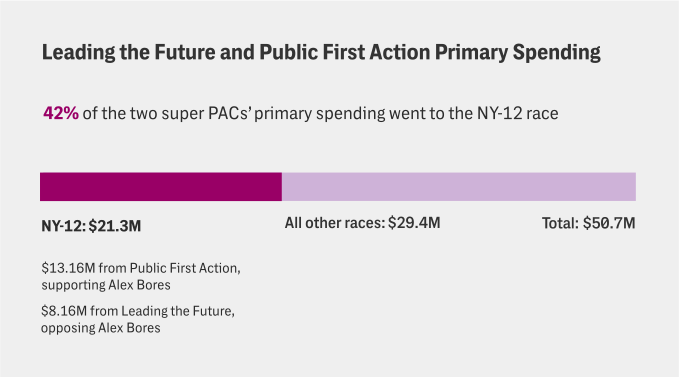 Graphics: Stella Ioannidou
Bores, a New York State Assembly member, attracted the ire of those in the industry who favor a laissez-faire approach by authoring an AI regulation bill in the state legislature.
Leading the Future succeeded in defeating Bores, who lost to his State Assembly colleague Micah Lasher in June. But the group drew intense blowback in the process. Many observers suggested Leading the Future's spending had boosted Bores rather than hurt him, because it gave him a chance to position himself as a foe of the AI industry — while also benefiting from a PAC aligned with the Public First network.
"Down to the wire, they were sweating," Bores told The Intercept, referring to Leading the Future. "I think people who have been in politics for a while will realize that their spending really served to elevate the issue of AI."
Leading the Future did not respond to a request for comment.
After wading into contested primary elections, the two leading AI super PAC networks have held back from spending on competitive general elections — even though they have plenty of money in the bank.
Until a few days ago, Public First had spent nothing on general election races. Leading the Future has spent only $7.4 million on general election races as of October 26, according to the FEC data, despite having $34 million in cash on hand across its network as of its most recent report.
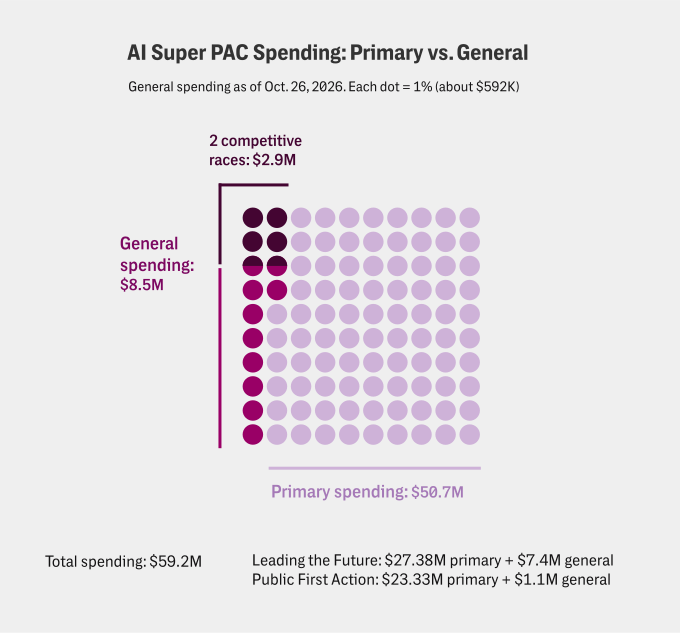 Graphics: Stella Ioannidou
Only 31 percent of that total has gone toward competitive races, as measured by the independent analytics website FiftyPlusOne. The only reason Leading the Future has spent money on competitive general election races at all is because it's backing U.S. Sen. Darline Graham, R-S.C., who filled the seat of her late brother Lindsey Graham and is now facing an unexpectedly fierce challenge from a Democrat to win a full term in ruby-red South Carolina.
"They are not going to have an impact on the balance of power in Congress," said Shaunna Thomas, one of the founders of Guardrails Alliance, another new super PAC set up to counter Leading the Future's influence. "They are spending money on candidates who they think will protect their ability to control if and how they are regulated."
Public First has only recently started spending a relatively small sum on a handful of general election races. The spending had amounted to $1.1 million as of the morning of October 26, according to processed FEC data.
Asked for comment on how its strategy has changed since the primaries, a Public First spokesperson said that it was still trying to support "strong advocates for AI regulation."
"Public First was founded as a counterweight to Leading the Future, and that fight looks very different today. Leading the Future is going dark. Its biggest backers are walking away," said Anthony Rivera-Rodriguez, the spokesperson.
 Related
Google DeepMind Engineer Resigns in Protest of Pentagon Contract
Into that gap have stepped new groups pushing for tougher AI regulation such as the Guardrails Alliance, which bills itself as a grassroots alternative to corporate-backed super PACs. It is funded in large part by Silicon Valley tech workers but has taken a more aggressive stance against "tech oligarchs." Guardrails has spent about $2 million thus far and reported having $1.2 million on hand as of October 14.
About three-quarters of voters are less likely to support a candidate they know has received support from an AI super PAC, according to a Data for Progress poll of more than 3,000 likely voters in Iowa, Michigan, and Ohio commissioned by Guardrails. Voters were more concerned about spending from AI companies than from crypto companies or AIPAC.
Voters were more concerned about spending from AI companies than from crypto companies or AIPAC.
The dislike for data centers and AI cuts across party lines. In Michigan's purple 7th Congressional District, Democratic candidate Will Lawrence has seized on data centers as one of his leading issues.
"The politics of this are terrible. Eighty percent of everybody is against it, whether you're a Democrat, independent, or Republican," he told supporters at a recent town hall.
Notably, neither of the super PAC networks has intervened in Lawrence's race, despite it being one of the closest in the nation. (Lawrence's campaign has pointed out that Elon Musk, who leads AI company xAI, has spent against Lawrence via his America PAC.)
There are emerging signs that the big AI super PAC networks are changing tactics in response to that public distaste. Public First's dark-money affiliate donated $3 million since August to a preexisting super PAC supporting California state Sen. Scott Wiener, one of two Democrats vying to replace retiring Rep. Nancy Pelosi in California.
Leading the Future, meanwhile, gave a $500,000 donation on October 9 to a pro-data center nonprofit called Build American AI.
AI super PAC critics are also watching to see what Leading the Future will do, given its large war chest.
"I think they are going to continue to spend. I think they are going to try to do more and more spending that isn't as easily tracked, because they are such political dead weight," said Bores.
Delaware CorporationsWhen single-issue super PACs know their issue is unpopular, they use vague names, "pop-up" affiliates, and other dubious tactics to hide their activities from voters.
Add another one to the list: Leading the Future has routed more than $30 million of spending through newly minted Delaware corporations, blocking transparency during an election that has been defined by voter backlash against the industry.
Those apparent shell corporations have accounted for the lion's share of the largest artificial intelligence super PAC network's expenses during this year's election.
The practice is a flagrant violation of Federal Election Commission guidelines that require campaign organizations to disclose which consultants, pollsters, and advertisers they are paying, a campaign watchdog alleged in a complaint filed in May.
There may be little recourse for observers worried about the lack of transparency for now, however. The FEC is short of the quorum that would allow it to take action on complaints such as the one filed by the Campaign Legal Center. (Leading the Future, which did not respond to a request for comment, has previously defended its tactics as legal in a statement to Wired.)
The Leading the Future network was funded in large part by an executive at or investors in OpenAI, one of the world's largest AI companies. (In 2024, The Intercept sued OpenAI in federal court over the company's use of copyrighted articles to train its chatbot ChatGPT. The case is ongoing.)
Company president Greg Brockman and his wife, Anna Brockman, donated $25 million to the network last year. When it came time to spend that money, the Leading the Future network leaned on two affiliate super PACs, one for Democratic candidates called Think Big and the other for Republican candidates called American Mission.
 Related
AIPAC, AI, Crypto, and Gambling Are Hiding Their Big Election Spends
That is a typical tactic of the new breed of single-issue super PACs popularized by the crypto industry. Campaign finance reform advocates say it may help obscure the origin of campaign ads from voters but does not run afoul of any laws itself.
What those super PACs did next raised red flags for watchdogs, however. Since December, American Mission has reported spending $17.4 million through a Delaware-incorporated limited liability corporation called Summit Ridge Media Group, on services ranging from media placement to ad production to consulting.
Think Big has spent $21.3 million through a different Delaware corporation, Lantern Production Consultants, on a similarly wide range of expenses.
The grab bag of expenses is a giveaway that the super PACs are likely using the newly created corporations to hide their true vendors, according to Shanna Ports, a senior legal counsel at the Campaign Legal Center.
"There's no way of knowing what is motivating this arrangement — but I know there is backlash to AI. It is possible that the vendors who are working with American Mission and Think Big don't want to be identified in FEC reports," Ports said.
Thomas, of the rival super PAC Guardrails Alliance, told The Intercept she thinks the network is obscuring its spending because a lax regulatory approach has become "politically toxic."
"Their donors don't want to be associated, their candidates don't want their support, and their vendors don't want to be associated," Thomas said. "If you were public, you are running away. If you are not, you are interested in not being exposed."
This story was supported by a grant from the Tarbell Center for AI Journalism.
The post AI Tried to Buy the Midterms — Then the Lobby Learned Everyone Hates AI appeared first on The Intercept.
In the words of the biggest name in the outside elections-spending game, "Being pro-Israel is good policy and good politics."
This midterms cycle, however, the American Israel Public Affairs Committee's strategy seems to suggest the opposite. Contrary to its signature slogan, AIPAC's name has become anathema to voters across the political spectrum repulsed by Israel's genocide in Gaza and frustrated by Washington's outpouring of military aid for a foreign government while domestic costs soar.
So it's going underground. As The Intercept reported in December, AIPAC entered the 2026 midterms by returning to its strategic roots — funding other groups and uniting donors, rather than focusing on direct-to-candidate spending. Now, AIPAC has announced that it will no longer officially endorse or contribute directly to candidates.
Though progressives welcomed the announcement as evidence of AIPAC's retreat, it's far from a sign that AIPAC is backing down. The group is expected to continue spending heavily on elections through its super PAC, which took advantage of campaign finance loopholes to conceal its involvement in several races this cycle until after elections had already passed. To Lara Friedman, president of the Foundation for Middle East Peace, AIPAC's opting for obscurity shows that "its brand has become politically radioactive."
But how much has really changed? As AIPAC shifts strategy, a new project by The Intercept reveals the hundreds of candidates still taking its cash, plus how the money paid off for them. The data suggests that though the pro-Israel lobbying giant may be weakened, it's still dominant.
The Intercept tracked how much the group and its super PAC spent on elections to put pro-Israel candidates on the ballot in this year's midterms — including the money it tried to keep out of the public eye. While AIPAC makes use of a series of new pop-ups and pass-throughs, it still poured millions directly into 2026 midterm races. Its candidates usually still win.
Related
AI Tried to Buy the Midterms — Then the Lobby Learned Everyone Hates AI
The new data builds on a 2024 project in which The Intercept documented just how AIPAC shaped the last congressional class. At the time, Donald Trump was preparing for his return to the presidency as Kamala Harris ran a campaign hamstrung by public disillusionment over the Biden administration's unflinching support for Israel's genocide in Gaza. To critics of Israel desperate to stop the violence, the two parties looked equally bleak, and the pro-Israel lobby's grip on Congress appeared unshakeable.
It's been different this cycle. Primaries across the country saw candidates win after vowing to cut off or restrict military aid to Israel, and incumbents signed on to legislation blocking weapons transfers in an attempt to keep their seats. But the shift should not be overstated: AIPAC still waded into nearly three-quarters of races, and its candidates still won far more often than they lost.
In total, AIPAC or its super PAC, United Democracy Project, spent on 333 of the 473 seats up for election this year.
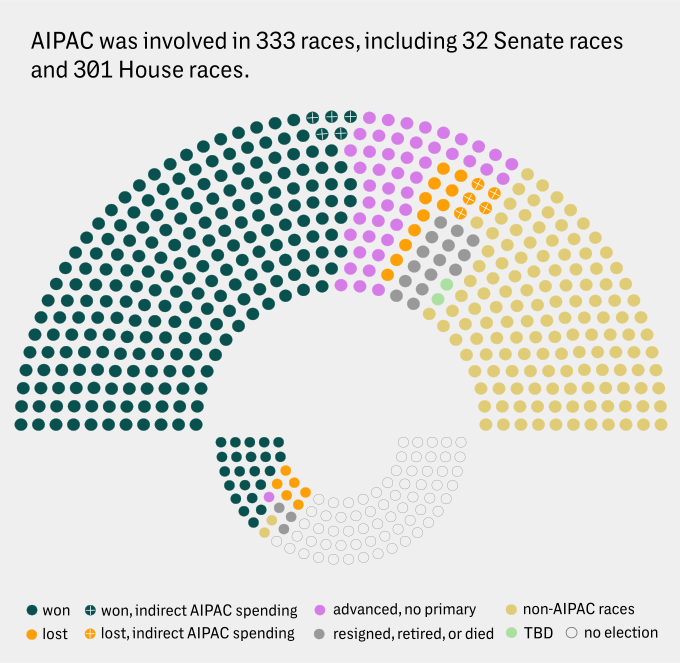 Graphics: Stella Ioannidou
These are the dollars AIPAC and UDP spent directly in races. The former makes contributions to candidates, while the latter, as AIPAC's leading super PAC, makes independent expenditures, like buying ads. They made up the bulk of the pro-Israel lobby's known elections spending — $53.3 million from AIPAC and $66.7 million from UDP, compared to $53.7 million and $41.4 million last cycle. Simultaneously, the groups took up another tack: making it harder to tell which races they were actually involved in. The group's donors poured money into races where AIPAC didn't officially endorse a candidate. AIPAC's board president hosted a fundraiser for a candidate who swore the group wasn't backing her. And in a series of races, no one knew for certain that AIPAC had spent on the election until after it was over.
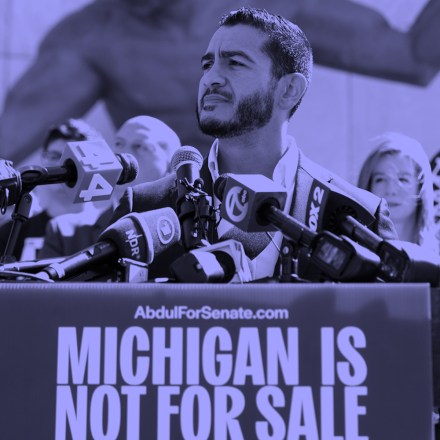 Related
The Most Expensive Democratic Senate Primary Has a Winner
The group tested different strategies in different states, spending directly in the Michigan Senate race, for example, while concealing its spending in several other primaries. In those races, UDP gave money to other committees, including a series of "pop-up PACs," groups that registered just before primaries, allowing them to delay disclosing their donors until after the election passed. Several of those groups took money from AIPAC's super PAC, spent on ads against candidates critical of Israel, and then disappeared.
The pop-ups and pass-throughs represent AIPAC's most talked-about new tactic, but the lobbying group and its flagship super PAC still sunk the bulk of their spending into key races and high-priority states. The Intercept analyzed where AIPAC employed which strategy, how UDP dollars flowed through pop-up PACs, and which candidates received the most AIPAC and UDP cash in their primaries.
The Direct SpendingThe pro-Israel lobby's biggest investment in the primaries turned out to be a disappointment. UDP spent more than $30 million on ads attacking Democratic candidate Abdul El-Sayed in the Michigan Senate race or backing his opponent, Rep. Haley Stevens. Now that El-Sayed is the Democratic nominee, UDP is also battling El-Sayed in his general election contest with Republican Mike Rogers, spending just over $500,000 so far.
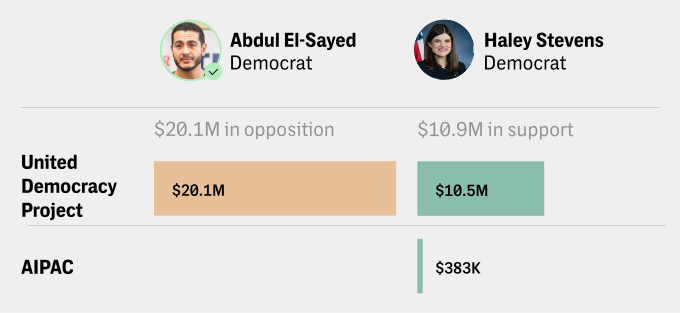 Graphics: Stella Ioannidou
Thanks in part to the deluge of spending, the El-Sayed-Stevens contest was one of the marquee primaries of 2026, pitting a vocal critic of the pro-Israel lobby who could become the first Muslim U.S. senator against an enthusiastic AIPAC cash recipient who famously said: "Israel comes to me in my dreams." It's one of the key races where we're breaking down the money AIPAC and UDP spent in favor of one candidate and against a clear opponent. We're skipping Democratic House candidate Adrian Boafo, who benefited from $5.7 million in UDP spending, because his Maryland primary included 23 other candidates.
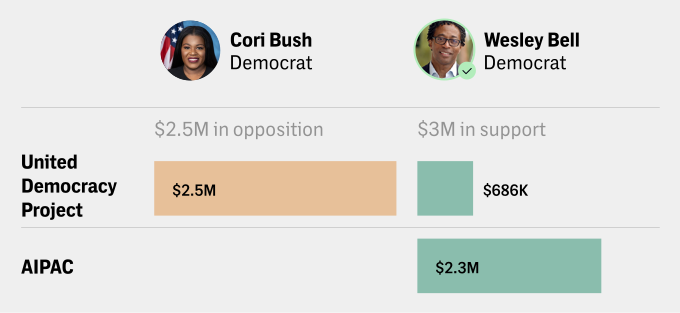 Graphics: Stella Ioannidou
After Stevens and Boafo, the top AIPAC and UDP recipient from this year's primaries was Rep. Wesley Bell, a moderate Democrat from Missouri who fended off a challenge from former Rep. Cori Bush to return to the House (AIPAC spent millions to oust her last cycle). When UDP spending is excluded, Bell received more AIPAC funding in the primaries than any other Democrat.
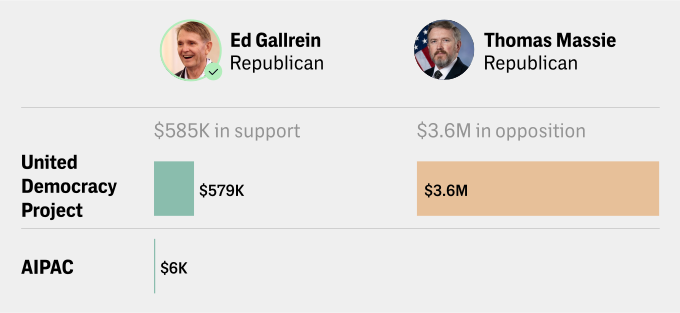 Graphics: Stella Ioannidou
On the Republican side, the top beneficiary was Ed Gallrein, the Trump-backed challenger who unseated Rep. Thomas Massie in Kentucky. Massie, a libertarian critic of all foreign aid — including to Israel — was the relatively rare Republican incumbent AIPAC and UDP opposed.
Often, the pro-Israel groups backed Republican incumbents. Two more top recipients were Sen. Tom Cotton, who easily won his primary in Arkansas, and John Cornyn, who lost to state attorney general Ken Paxton in Texas.
But the greatest Republican recipient of AIPAC largesse — ahead of Gallrein, when UDP is excluded — did not face a primary opponent.
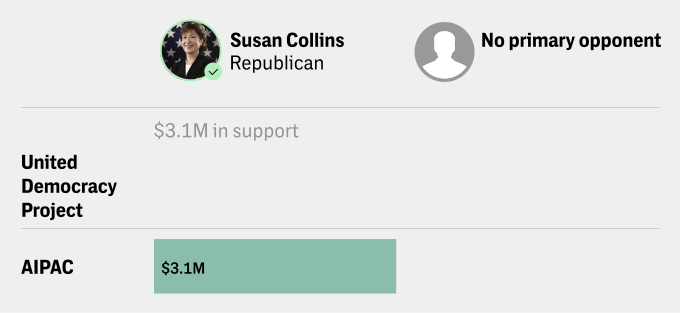 Graphics: Stella Ioannidou
Republican Sen. Susan Collins of Maine, now facing a tight general election contest against Democratic candidate Troy Jackson, has been a longtime beneficiary of campaign cash aligned with the pro-Israel lobby. Asked by Zeteo last year for her comment on Americans killed by the Israeli military, Collins shook her head and said only: "I am pro-Israel."
The Pop-UpsOn top of the $53.6 million it spent directly on races this cycle, United Democracy Project poured another $13.1 million into Democratic primaries by giving money to other committees whose names or stated agendas indicated no connection to Israel policy. That $13.1 million, more than triple the $3.5 million United Democracy gave through other groups last cycle, helped fund at least three pop-up PACs that formed this year.
Related
Who's Spending in Your Congressional Election? We Tracked the Front Groups Fueling the 2026 Midterms.
The groups' names offered little insight into their political agendas, as The Lever recently highlighted. UDP spent the most on popup PACs in a series of Democratic primaries around Chicago, where groups with names like Elect Chicago Women, Chicago Progressive Partnership, and Affordable Chicago Now! used their funds to attack candidates running on rejecting AIPAC money or ending U.S. military support for Israel. Several of the groups also received funding from major United Democracy Project donors, and three of them shut down after the primaries and gave their money back to United Democracy Project.
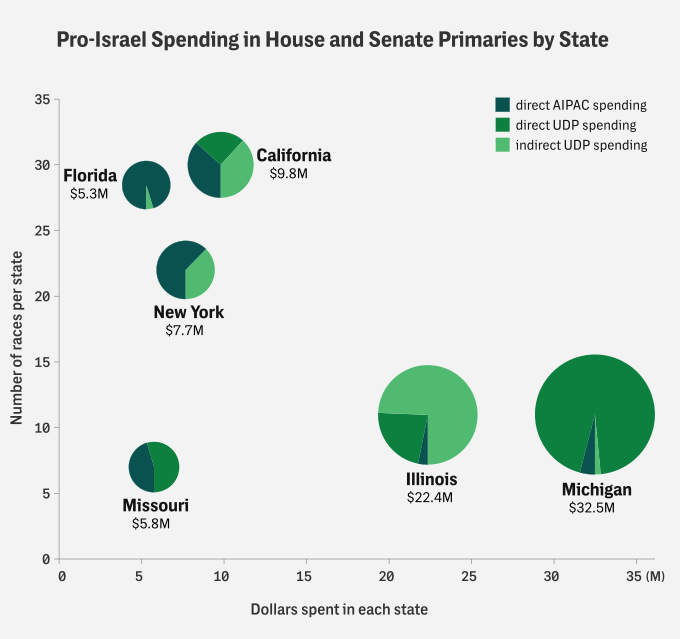 Graphics: Stella Ioannidou
In other cases, United Democracy Project funded long-established political action committees with ties to current or former House Democratic leaders, like Bold America, which was formed by former members of the Congressional Hispanic Caucus. That group got almost a quarter of the $12.2 million it reported raising this year from UDP. The UDP share, $2.8 million, was nearly equivalent to the $2.9 million Bold America spent against Darializa Avila Chevalier, a democratic socialist and pro-Palestine activist who defeated incumbent and Congressional Hispanic Caucus Chair Adriano Espaillat in New York.
The super PAC EDW Action Fund was similar. Former Democratic Congressional Campaign Committee Chair Cheri Bustos and former Rep. Annie Kuster formed that group in late 2023 as an offshoot of the political action committee Elect Democratic Women. Like Bold America, EDW Action got about a quarter of its funding from UDP. It also provided more than 80 percent of the funding for Pro-Choice Majority Action, a new PAC that formed in May and spent in 12 primaries. The group presents itself as supporting Democratic women, but Pro-Choice Majority Action notably spent against pro-Palestine candidates like Melat Kiros, who ran a primary challenge against Rep. Diana DeGette, D-Colo., and won.
In a statement to The Intercept, Pro-Choice Majority Action spokesperson Lenny Young dismissed reporting characterizing the group as a pop-up PAC and said it had backed 23 candidates with a range of views on Israel across the primaries and general election.
"To suggest that we would deny a Democratic woman from being elected to Congress because of her position on Israel, on either side, misses the whole point," Young said. "We want more Democratic women in Congress because we believe it would improve the lives of women and families. Period."
Bold America did not respond to The Intercept's request for comment. Emails to Elect Chicago Women, Chicago Progressive Partnership, and Affordable Chicago Now! bounced back because the groups have shut down.
UDP gave another $2.65 million to groups that did not spend directly on ads in Democratic primaries this cycle.
In August, United Democracy Project gave $1.65 million to a group called SD PAC, also known as Save Democracy PAC, which registered in 2020 and has supported Democratic candidates in past general elections. The group did not directly conduct any outside spending in Democratic primaries this year, but it funneled money to affiliate groups that did — some of which funded attacks against progressives.
The other recipient of money from UDP, Palmetto Action, formed in May and only spent in South Carolina's Republican Senate primary. The group backed Sen. Lindsey Graham before his death in July, then received a cash infusion from UDP and started supporting Graham's sister, Darline, ahead of a special Senate primary. The group did not report any additional spending in its last filing due before the general election.
Palmetto Action, Save Democracy PAC, and EDW Action Fund did not respond to The Intercept's requests for comment.
 Related
Nancy Pelosi's Pick for Her SF House Seat Takes Anti-AIPAC Pledge
If last cycle AIPAC proved that it could leverage its financial advantage to target critics of Israel, its performance this cycle suggests that its money has become a faltering superpower.
New pro-Palestine groups have sprung up to spend against AIPAC — though their pockets aren't nearly as deep. When candidates went head-to-head this cycle in primaries defined by U.S. military support for Israel's genocide in Gaza, pro-Palestine candidates often came out on top.
For decades before it started spending directly on elections, "AIPAC operated in the shadows," Friedman, of Foundation for Middle East Peace, said. Its endorsements were once "clear but unofficial," she added, and its funding operated through "informal understandings with big donors and allied but ostensibly independent PACs."
Today, "AIPAC is trying out a sort of middle road," Friedman said. "It will return in part to the shadows — no direct endorsements, no direct donations — but it will also continue to flex its power directly in elections, via tactics it has been testing and honing these past four years."
If anything, next cycle could see an expansion of the recent pop-up PAC strategy, making it harder to tell when AIPAC is involved — until it's too late.
The post AIPAC Isn't Retreating. Here's How It's Already Shaping the Next Congress. appeared first on The Intercept.
With voters set to cast ballots in two critical races that could help determine control of both chambers of the U.S. Congress, fears of potential voter suppression are running high in Maine.
Officials in the state have prepared for months against the possibility of election interference from federal officials, and the state remains on high alert in the run-up to the general election on November 3.
Training materials were updated this year to include references to federal statutes barring armed federal agents from polling sites.
Training materials for law enforcement officials in the state, obtained by The Intercept through a public records request, were updated this year for the elections to include explicit references to federal statutes barring armed federal agents from polling sites.
In an interview with the New York Times this week, Maine Secretary of State Shenna Bellows said the inclusion of such references was a direct defense in response to the fearmongering around election integrity from President Donald Trump and his administration.
"This is the first time ever that we have had to engage in scenario planning to safeguard against potential federal interference in elections," Bellows said. "It seems like the federal government is now adversarial to the states."
Bellows's office offered up the training slideshow, which cites a U.S. law that bars armed civil or military officers from posting at voting sites, to law enforcement personnel in the run-up to Maine's primary election in June and again in the lead-up to the general election on November 5.
Nationwide, Democratic officials have expressed fears that the Trump Administration might weaponize U.S. Immigration and Customs Enforcement or other federal agencies to undermine the rights of voters. In New York, state Attorney General Letitia James issued a reminder to voters that federal officials may not "police the polls," and the Arkansas chapter of the NAACP called out the assignment of federal election monitors to two counties in the state as potential intimidation.
 Related
DHS Was Designed as a Weapon
The Trump administration, meanwhile, has sounded the alarm about the alleged scourge of non-citizens on the voter rolls, sending agents from the FBI and ICE's Homeland Security Investigations division to probe alleged fraud. A handful of people in California, New York, and North Carolina have been indicted for allegedly voting as non-citizens, but a review of similar cases by the Washington Post found that such cases were often the result of honest mistakes.
In Maine, worries about federal interventions at polling places flared when — following a slew of social media videos from Trump allies suggesting that fraud is already taking place among the state's Somali American community — a local outlet reported that the Department of Justice would be sending election monitors to the state.
Jon Fetherston, a journalist with the far-right Maine Wire, which is funded by conservative megadonor Leonard Leo, was seen following people in and around an early voting site at Lewiston City Hall and aggressively questioning them. (The Maine Wire did not immediately respond to a request for comment.)
Critics said the moves were tantamount to voter harassment, but Maine Wire editor-in-chief Steve Robinson later defended them as an act of election transparency. Robinson, who has led a crusade against what he alleges to be a network of fraud in the state's Somali American community, questioned the role of interpreters tasked with helping "jobless Somali bums" cast their ballots.
In the wake of the Maine Wire controversy in Lewiston, Bellows confirmed to the Maine Morning Star that a wave of federal election monitors would be headed to polling sites in Lewiston and Portland.
 Related
GOP Megadonor Leonard Leo Is Bankrolling a Website on the Warpath Against Somalis
The Department of Justice on Tuesday confirmed to The Intercept that it intends to send election monitors to Maine for Election Day, but did not elaborate or respond to specific questions about where the monitors were to be sent.
"We will have around 1,000 monitors in counties throughout the United States, but we will not share the full list until Election Day," a Justice Department spokesperson told The Intercept in an email Tuesday. "All monitors must meet the same legal and ethical requirements, including that they not interfere with the voting process. Every monitor has the same role: observe for potential violations of federal law and report concerns to the Department, which the Department will review after Election Day and act where appropriate."
Robinson did not immediately respond to a request for comment.
Collins Takes Right-Wing BaitWith Maine a key battleground state for control of Congress — Democratic challenger Troy Jackson is seeking to topple long-serving GOP Sen. Susan Collins, and the Democratic House candidate Matt Dunlap is seeking to best former Gov. Paul LePage in Maine's 2nd Congressional District — temperatures are running high in the state.
Progressives in Maine worry that even without a robust federal presence at voting places — whether monitors are armed or not — activist campaigns like the one undertaken by the Maine Wire journalists could pose a potential threat to voters' rights.
"Basically, if you were walking into City Hall and you were Black, you could expect to have this guy come up to you with his phone and ask you all sorts of rude and obviously racist questions," said Ben Chin, co-director of the progressive Maine People's Alliance. "We're trying to encourage everyone to come out to vote, but it makes sense why that might give people pause. You hear a guy like that is outside a polling location, it's reasonable to wonder, 'Should I go down there right now?'"
"We have received complaints about the intrusive filming, photography, and harassment of voters in the City of Lewiston by political operatives."
In a statement to The Intercept, Bellows said the state and the city of Lewiston were taking steps to ensure that voters could cast a ballot free of harassment.
"We have received complaints about the intrusive filming, photography, and harassment of voters in the City of Lewiston by political operatives," Bellows told The Intercept in a statement. "All voters should be able to exercise their right to vote without feeling watched, questioned, or harassed, and we take these allegations seriously, particularly when it appears that voters were targeted for no other reason than their race or ethnicity. We understand the City of Lewiston has taken steps to address the problem, and we will continue to monitor the situation."
Collins, meanwhile, took the Maine Wire's reporting seriously after Fetherston asked the senator at a campaign event about the role of interpreters, which he and the Maine Wire cast as "electioneering."
"I'm unaware of those allegations, but certainly only Americans should be voting in American elections," Collins said. "And it is troubling to me if people are being accompanied into voting booths and handling ballots in a way that is not sanctioned by law."
The post Trump Vows to Send Election "Monitors" to Maine After Far-Right Conspiracies Spread appeared first on The Intercept.
Just after taking office in 2025, President Donald Trump picked a fight with Yemen's Ansarullah, whom Americans routinely call "the Houthis." Trump got a refresher in the limits of American military power, a lesson reinforced from Korea, Laos, and Vietnam to Afghanistan, Somalia, and Iraq. The U.S. military can cause a lot of damage, but it can't win wars unless it beats up on weaklings like Grenada and Panama. After U.S. forces killed many civilians but failed to break the resolve of the Yemeni forces, a chastened Trump called it quits.
Trump then fought a short war with Iran and claimed to have "obliterated" their nuclear facilities before employing the full might of the U.S. military to kill scores of unarmed civilians in so-called drug boats and kidnap Nicolás Maduro, the president of the poor, weak country of Venezuela.
In February, Trump launched a second Iran war because the U.S. military failed. He now claims that Iran was, despite the 2025 conflict, just two weeks away from developing a nuclear missile. Trump's second Iran war followed a predictable pattern. The U.S. was able to wipe out an elementary school and wreck hospitals and apartment buildings with no problem. But in the process, its major military bases in the Middle East — the keys to decades of American power projection in the region — were (truly) obliterated; its inability to protect itself or its allies were laid bare; and the vulnerability of its archipelago of bases around the world, including inside the U.S., was exposed.
After twice failing to defeat Iran, an economically strapped regional power, Trump is now mulling a third Iran war. If he goes ahead with it, the conflict is likely to ignite an even greater conflagration in the region where Ansarullah has been battering Saudi Arabia's airports and oil infrastructure, as well as its proxies in Yemen, for weeks.
To understand the forces that fought Trump to a standstill in 2025 and those he has been unwilling to engage on behalf his Saudi allies in 2026, TomDispatch regular Juan Cole — who writes the indispensable Informed Comment — offers the most comprehensive analysis I've seen of the forces that the mainstream press continues to call the "Houthi militia" and how they've exposed American weakness to an extent not seen in generations.
— Nick Turse, editor of TomDispatch
If you haven't yet, sign up to receive TomDispatch in your inbox here.
The Limits of American MightThe failure of Tel Aviv and Washington to achieve their war aims in Iran has resulted in the most dramatic American retreat from a region since the U.S. flight from Vietnam in 1975. This startling American defeat — after a generation of forever war failures and stalemates — has been thrown into broad relief by the resumption of another regional conflict that has received far less attention than the Trump administration's sputtering war with Tehran. This fall, the forces that most Americans know as "the Houthis" have conducted a blitzkrieg in their native Yemen and have been pummeling Saudi Arabia's aviation and energy infrastructure with missiles and drones. In doing so, they have put a spotlight on the limits of American power, and the shrinking U.S. military footprint, in the Middle East.
The long-standing conflict between Saudi Arabia and northern Yemen's Ansarullah, or "Helpers of God," led by the Houthi clan, heated up again in July 2026, when Saudi Arabia struck Sanaa International Airport to prevent a Houthi delegation from landing on its return from the funeral in Iran for slain Ayatollah Ali Khamenei. The Ansarullah government launched its own attacks and, in October, managed briefly to close Saudi Arabia's own airport. The renewed war has now expanded into a regional conflict, with Pakistan, Türkiye, and, recently, Egypt, pledging to defend the kingdom from attack, though none of these regional powers appear eager to conduct operations in Yemen itself. Notably absent from the current conflict is Saudi Arabia's most powerful ally, the United States, since President Donald Trump has repeatedly declined to intervene on behalf of his Saudi allies.
The typical U.S. press framing of Ansarullah as an "Iran-backed militia" is inaccurate, since the movement has local, Arab nationalist reasons for its actions and is a full-scale government that rules some 80 percent of Yemen's population. Still, it does receive surreptitious technical and military support from Iran, though nothing like the hundreds of billions of dollars' worth of high-tech armaments — from kits turning 2,000-pound "dumb" bombs into precision munitions to advanced air-to-air missiles — that the U.S. provides the Saudis. Ironically, Trump's war on Iran, fought in conjunction with Israeli Prime Minister Benjamin Netanyahu, weakened the Saudis and exposed their vulnerabilities to military attack by Iranian drones and missiles, impelling them to seek a symbolic win over a less formidable enemy in neighboring Yemen. But the weaknesses exposed by Iran's drones helped encourage a vigorous Ansarullah rejoinder.
The Incredible Shrinking SuperpowerThe American refusal to join Saudi Arabia's war signals a profound degradation in U.S. capabilities and standing in the Middle East. The U.S. military had, for decades, dominated the region from a network of about 20 major bases. The U.S. Navy operated out of the headquarters of the Fifth Fleet in Manama, Bahrain. The U.S. Air Force flew missions from the massive al-Udeid Air Base in Qatar, which housed 10,000 U.S. personnel. Thousands of ground troops were barracked in Kuwait, the United Arab Emirates, and Jordan. The Pentagon admitted that "Iranian strikes damaged and destroyed hundreds of buildings and structures at U.S. bases in Kuwait, Bahrain, Qatar, UAE, Saudi Arabia, Iraq, Oman, and Jordan during the conflict. In addition, dozens of U.S. aircraft were destroyed or damaged during OEF."
The naval base at Manama, one of America's most important naval facilities and headquarters of the Navy's Fifth Fleet, was destroyed by Iranian strikes. (Acting Navy Secretary Hung Cao admitted last month that Iran "blew the hell out of Bahrain.") The loss of Manama led to supply shortages and poor morale aboard the USS Lincoln and other ships patrolling the Strait of Hormuz, bedeviling Secretary of Defense Pete Hegseth.
The CIA offices at the U.S. Embassy in Riyadh were annihilated. Iran struck al-Udeid's evacuated Combined Air Operations Center in Qatar, from which the Pentagon had directed its strikes on enemies as diverse as the Taliban and ISIL over recent decades, and rendered this facility inoperable. All U.S. troops were also withdrawn from Iraq, a process accelerated by the inability of U.S. missile interceptors to protect them from attacks by Iran and allied Shiite militias there.
 Related
Iran War Has the U.S. Military on the Brink of a "Breakdown"
Iran's deployment of swarms of Shahed drones caused the United States and Israel to use up much of their stock of interceptors, which are time-consuming and expensive to replace. A basic Shahed costs as little as $20,000, though new hardened versions are more expensive — whereas a Patriot interceptor costs $4 million. One reason the Trump administration may be reluctant to intervene in Yemen is that if the U.S. cannot fly missions from al-Udeid, and cannot be sure any new fighter-jet fleets stationed in the region will be safe from Iran, given the paucity of interceptors, the Pentagon will have a limited ability to rescue any U.S. pilots shot down over Yemen.
America's Profound Weakness in the Middle EastSaudi Arabia launched a war against the ascendant Ansarullah in 2015 when the latter staged a coup in the capital of Sanaa. The Ansarullah movement is rooted in Yemen's Zaidi Shiism, though it is more radical than traditional Zaidism. (Zaidi Shiism differs substantially from Iranian Shiism, having no ayatollahs and having relatively good relations with Sunnis.)
About a third of Yemenis are Zaidis, who predominate in the north of the country, and many have long resented the dominance of their politics and culture by neighboring, oil-rich, Sunni Saudi Arabia, whose official ideology is hard-line Wahhabism, a puritanical form of Islam that insists on a literal interpretation of the Quran. Wahhabi proselytizing among the Shia enraged the Houthi clan and their followers began rebelling against the government of military dictator Ali Abdullah Saleh in 2004. But when he was deposed by popular demonstrations during the Arab Spring in 2012, Saleh gradually allied with the Houthis, and by 2015 about half the Yemeni military rallied to their side, along with some major Sunni tribes.
 Related
The Real Outrage About the Yemen Signal Group Is That It Called for Attack on Civilian Home
In response to the Houthis' rise, a Saudi-led coalition that included the United Arab Emirates began bombing Yemen in 2015. Until 2022, the U.S, then militarily dominant in the region, provided the Saudis with strategic advice, weaponry, and in-air refueling for their fighter jets in the Yemen war, though Riyadh's tendency to bomb civilian infrastructure rather than confining themselves to military targets caused tension between the two allies. While the Saudis and their coalition pushed the Houthis out of much of the south of the country, including Aden, they were unable to dislodge them from the north. The Saudis implicitly acknowledged their failure with a United Nations-brokered truce in April 2022, which largely held until this past summer.
The Forever Wars EffectAmerica's forever wars against Middle Eastern countries that decline to accept the Israel project or American corporate neocolonialism helped reignite the Saudi-Yemeni conflict. Iran is the last major state in the region that rejects Israel and is off-limits to U.S. corporate investment, a stance that inspires much of Washington's animus. Netanyahu was therefore easily able to persuade Trump, as a privileged visitor to the White House Situation Room, to attack Iran in February.
The glib expectation of Netanyahu and of his Mossad chief at that time, David Barnea, that the Islamic Republic would crumble if Israel murdered Ayatollah Ali Khamenei and around 50 other high-ranking regime figures proved wishful thinking. The notion that Iran was vulnerable to a tightened petroleum blockade was turned on its head by the hard-liners who ascended to power after Khamenei's death. Largely veterans of the grueling eight-year Iran-Iraq War of the 1980s, the country's new leaders pursued a policy of "de-basing" toward the United States, taking out its main regional military facilities.
By successfully striking Saudi Arabia, Iran demonstrated that the kingdom's ability to protect itself is imperfect and its infrastructure is vulnerable.
In addition, Iran launched precision strikes at the energy facilities of their Arab Gulf neighbors who had hosted those American bases. They struck Kuwait's national petroleum company and its fields and refineries. They took out 17 percent of the production of Qatar's Ras Laffan natural gas facility, even though Doha had good relations with Tehran and had mediated for Iran. Tehran also struck ships passing through the Strait of Hormuz, using missiles and drones, scaring the major shipping insurers into withdrawing their contracts. Few shipping magnates would risk cargoes worth billions of dollars without insurance.
 Related
Pentagon Fears Drone Attacks on U.S. and Foreign Bases
Iran threw the world into an energy crisis reminiscent of the 1970s, which would have been even more devastating had China not released oil from its vast private and public petroleum reserves and cut its oil imports from 11.5 million barrels a day to under 9 million barrels a day, a move partially enabled by its turn to electric vehicles, which saved it 1.5 million barrels a day. High gasoline and diesel prices hurt Asia more than the United States, but prices rose globally. A third of the world's helium, essential for cooling computer chips in the production process, comes from the Gulf, and that supply was also interrupted, increasing the price of electronics.
By successfully striking Saudi Arabia, Iran demonstrated that the kingdom's ability to protect itself is imperfect and its infrastructure is vulnerable. By blockading the Strait of Hormuz in a way that the United States had difficulty undoing, Iran demonstrated the vulnerability of key world maritime arteries, something Ansarullah had already highlighted by striking at shipping in the Red Sea to protest the Gaza genocide.
Blockade for BlockadeWhen the Saudis bombed Sanaa's airport in July 2026, Ansarullah's leadership appears to have decided that Riyadh posed an ongoing existential danger to their state and sought to strangle the Yemeni economy, just as Israel had done to Gaza. Moreover, they sensed that the kingdom could be rolled back in the wake of the failure of the Israeli-U.S. war on Iran. Just as Iran had weakened the Gulf Arab states with its blockade of the Strait of Hormuz, the Houthis believed they could seriously degrade the Saudi economy by blocking Riyadh's shipping through the Bab al-Mandab, "the Strait of Tears," between the Red Sea and the Gulf of Aden.
Saudi exports through the Strait of Hormuz had fallen substantially. The kingdom did, however, have an escape valve: its East-West pipeline to Yanbu on the Red Sea. Ships loading at Yanbu then headed for Saudi Arabia's major Asian markets through the Bab al-Mandab. If Ansarullah could make the tanker captains fearful of this transit, they could reduce Saudi Arabia's income even further. The Houthi spokesperson, Muhammad Abd al-Salam, warned that the prohibition of Saudi shipping was only the first step in a tit-for-tat strategy of "blockade for blockade." The idea wasn't original. The Saudis and the U.S. had often attempted to blockade petroleum imports to northern Yemen during the seven-year Saudi-Yemeni War.
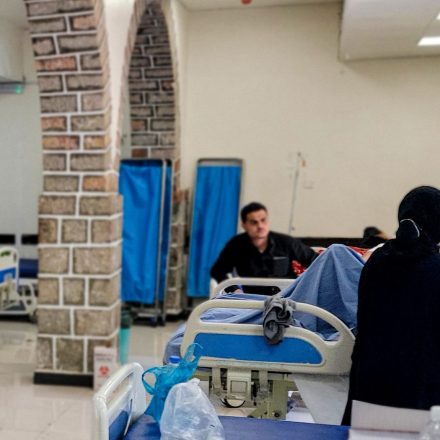 Related
Yemenis Unable to Reach Hospital Are Part of the Iran War Death Toll
In the subsequent three months, Ansarullah deployed missiles and drones constructed from Iranian models by military engineers trained by the old nationalist government of Ali Abdullah Saleh, many of whom had joined the Ansarullah military, in what has been called a Yemeni "military industrial complex."
Just as the kingdom's interceptors had proven unable to prevent Iranian strikes on targets such as the CIA section of the U.S. Embassy in Riyadh, they sometimes failed to halt the barrage of Yemeni missiles and drones. Refineries and oil installations, even the headquarters of the state oil giant, Saudi Aramco, in Dhahran, were hit. In October, Ansarullah closed Riyadh's International Airport, just as the Saudis had attempted to close that of Sanaa in July. Ansarullah also surged out of their mountain strongholds and made a major push to Yemen's southwest coast, taking the strategic port of Mocha overlooking the Bab al-Mandab. They also moved on Taiz, an inland industrial city of nearly 1 million inhabitants, one of the last major population centers not already under their control, in a campaign that tested the ability of the small Saudi-backed government of Rashad al-Alimi in Aden to resist it.

Read Our Complete Coverage
TomDispatch Highlanders and Oil SheikhsJust as the Vietnam War was one conflict among many fought in the Third World during the Cold War between the U.S. and the Soviet Union, so the Saudi-Yemeni War of 2026 is part of the larger struggle between the U.S. and Israel and Iran. Still, just as Vietnam was more about Vietnamese anticolonialism, nationalism, and sovereignty than about Communism and the ownership of the means of production, so the Saudi-Yemeni War is about Yemeni autonomy more than it is about the loose Houthi alliance with Iran. The conflict is not primarily between Zaidism and Wahhabism, though religious tensions are part of the story, but is far more rooted in a struggle between desperately poor Yemeni highlanders and fabulously wealthy Saudi sheikhs.
 "Peace Movements in Islam," edited by Juan Cole. Available on Bookshop.org
The plutocratic Saudi ruling elite is closely tied to Washington and has secret dealings with the Israelis, with whom it shares a distrust of the poverty-stricken Palestinian resistance, and views Ansarullah as cat's paws of Iran in the Arabian Peninsula and as radical republicans trying to overthrow the region's oil monarchies in favor of populism. For its part, Ansarullah are Arab nationalists, anti-American, and seek to use oil resources for populist purposes. And they have been willing to attack Israel to defend the Palestinians of Gaza from genocide.
Last week, Ansarullah battered targets across Saudi Arabia, prompting a further pullback from the region by Washington. The Yemeni forces attacked King Fahd International Airport in Dammam. An Ansarullah spokesperson said the group also targeted the Saudi defense ministry in the capital, Riyadh, along with an Aramco site in Yanbu, and an airport in the southern city of Abha. Reports also emerged of an attack on another Aramco oil field.
"Houthis have increasingly engaged in hostilities against Saudi Arabia, including attacks on civilian airports and other critical infrastructure," wrote State Department spokesperson Tommy Pigott in an October 21 post on X, after the wave of attacks, ordering "non-emergency U.S. government employees and their family members" out of Saudi Arabia.
It's just the latest evidence of the most significant regional retreat by the U.S. in half a century and evidence of profound American military decline. The outcome of their war with the Saudis will not determine the issue of the U.S.-Israeli contest with Iran, but the very ability of Ansarullah to prosecute it points to the profound weakening of the American posture in the Middle East.
The post The Incredible Shrinking Superpower appeared first on The Intercept.
Alabama attorney Larry Grissett was checking Facebook in late September when he saw a news story about a man he represented in a murder trial more than 40 years ago. According to the article, a federal judge had just vacated the conviction of that client, Charles McCrory.
Grissett was stunned. He later summed up his reaction: "Vindication."
McCrory was 26 years old when he was accused of brutally killing his wife in the small town of Andalusia. He insisted he was innocent — and Grissett believed him. There was no evidence connecting McCrory to the crime; prosecutors seized on a supposed bite mark found on his wife's body, which a state expert claimed to match to McCrory's teeth.
Grissett was never convinced by the so-called bite mark. At McCrory's 1985 trial, he said, Grissett's own dentist sat through the expert testimony and found it preposterous. "He says, 'There's no way that guy can say that,' Grissett recalled. "I mean, anybody with common sense would know that."
In a September 21 ruling describing the case against McCrory as "thin," Trump-appointed Judge R. Austin Huffaker Jr., zeroed in on this junk forensic science. Not only would the alleged bite mark not be allowed into evidence today, Huffaker wrote, bite-mark analysis itself "is grossly unreliable and unsupported by relevant scientific bodies. It amounts to nothing more than rank speculation."
Unless the state moves to retry him within the next six months, Huffaker concluded, McCrory must be released from prison.
The ruling was not only momentous for McCrory, who has insisted on his innocence for more than four decades, but it also marked a new victory in the long legal battle against junk forensics — and the discredited discipline of bite-mark analysis specifically.
"Everybody sees this was junk science. You don't have to be a scientist to understand that."
Yet more than a month after the decision, McCrory remains behind bars with no sense of when he might walk out. Although his lawyers asked the court to free him on bond pending the state's decision to release or retry him, the Alabama attorney general's office filed a motion last week asking Huffaker to reconsider his order overturning the conviction. The state's appeals will likely drag out McCrory's ordeal through the holidays and into next year.
In a statement, McCrory's current legal team praised Huffaker's "explicit acknowledgment that criminal convictions based on discredited bitemark evidence cannot stand." Mark Loudon-Brown, senior attorney at the Southern Center for Human Rights, and Chris Fabricant, director of strategic litigation for the Innocence Project, said they are "grateful for the decision and look forward to continuing our fight to bring Mr. McCrory home."
In 2022, The Intercept published a lengthy investigation into McCrory's case, detailing the flaws in the state's conviction. The case attracted additional media coverage, highlighting the problem of junk forensic science. Despite the glaring problems with the evidence against McCrory, Alabama courts have routinely rejected his appeals and in 2023, the state's parole board denied McCrory release.
Julie Bond McCrory's body was found inside her home in Andalusia on May 31, 1985. Her head was bashed in, and she'd been repeatedly stabbed in the chest. The couple's son Chad, then 3 years old, was found unharmed in his bed. Police quickly pointed to McCrory as their only suspect: He and Julie were separated, and McCrory had been having an affair. At trial, the theory seemed to be that he'd savagely murdered Julie to be free from her.
 Related
A Bogus Bite Mark Sent Him to Prison for Murder. Alabama Wants to Keep Him There.
The police investigation was cursory at best. Detectives found no physical evidence to connect McCrory to the bloody crime. Meanwhile, they ignored some evidence altogether, including two windows in Julie's bedroom that were found open, but which investigators failed to dust for fingerprints. Police also failed to consider an alternate suspect, a man who worked at an excavating company bordering the McCrorys' backyard and who, just weeks after Julie's murder, committed a home invasion rape of another local woman. He was convicted and sent to prison for that crime.
Ultimately, the state latched onto a single piece of physical evidence against McCrory: a pair of small indentations on the back of Julie's right arm, which prosecutors concluded was a bite mark made by McCrory's teeth.
To sell this theory, the state employed famed forensic dentist Richard Souviron, a star prosecution witness in the recent and sensational trial of serial killer Ted Bundy. Although Souviron initially said he couldn't definitively link the two marks on Julie's arm to McCrory's teeth, at trial he was unequivocal that they matched.
Skin, with its malleability, is a terrible medium for accurately recording any injury.
Bite-mark analysis is based on a two-pronged foundation. First, that the shape and arrangement of our teeth are unique, like DNA, and second, that skin is a suitable substrate for recording this uniqueness. As it turns out, there's no science backing either assertion. In fact, research into the discipline has routinely found the opposite — that human dentition is not unique and that skin, with its malleability, is a terrible medium for accurately recording any injury. This makes bite-mark analysis a random and entirely speculative practice.
Still, after taking center stage at the Bundy trial, bite-mark analysis took off in the 1980s and '90s and, despite not having any basis in actual science, made its way into courtrooms around the country, turning forensic dentists like Souviron into newsmaking, swashbuckling crime fighters.
 Related
Whistling Past the Graveyard: Why It's So Hard to Rid the Courts of Junk Science
In the years that followed, however, bite-mark analysis was increasingly called into question and ultimately exposed as junk science, a subjective pattern-matching practice that has led to dozens of wrongful convictions. At least four of those, including McCrory's, are cases in which Souviron served as the prosecution's expert.
In 2019, Souviron recanted his testimony in McCrory's case, providing an affidavit to Fabricant and Loudon-Brown, who presented it at a 2021 evidentiary hearing in Andalusia. "As a forensic odontologist I no longer believe the individualized teeth marks comparison testimony I offered in his case was reliable or proper," Souviron wrote. "I no longer believe, as I did at the time of trial, that there is a valid scientific basis for concluding that the injury found on the skin of the victim in this case, assuming that the injury is in fact teeth marks, could be 'matched' or otherwise connected to a specific individual, such as Mr. McCrory."
Despite the fact that their key witness had disavowed the evidence they used to send McCrory to prison for life, prosecutors fought to preserve their conviction. At the 2021 hearing, they insisted that McCrory was guilty, based on the same evidence they presented at trial. They recast the supposed bite mark as "teeth marks," implying that, while bite-mark analysis may be discredited, the study of "teeth marks" is a separate and valid discipline. Even if Souviron had not testified for the state, they argued, jurors could have looked at photos of the marks on Julie's body and the dental molds taken from McCrory and decided for themselves that McCrory inflicted the wounds.
Covington County Circuit Court Judge Lex Short, who presided over the hearing, agreed with the prosecutor. So did the Alabama Court of Criminal Appeals, which upheld his ruling in favor of the state. But Huffaker did not.
Huffaker took exception to the notion that analyzing "teeth marks" is somehow separate from bite-mark analysis. It is clear, he wrote, "that bitemark identification is based on analysis of individual teeth markings."
But "most importantly, the state court unreasonably determined that, even without Dr. Souviron's expert testimony, a reasonable jury could compare the bitemark evidence with McCrory's dentition themselves and find that it belonged to McCrory," Huffaker wrote. "This finding blinks reality in light of the evidence presented by McCrory at the postconviction evidentiary hearing." In a footnote, he added that "if an expert could not testify about bitemark identification because it is junk science, a jury should not have been allowed to consider it either."
McCrory is not the only person who is still fighting for his freedom decades after being convicted based on discredited junk science. Last year, Chris Duncan was declared innocent nearly 30 years after being sent to Louisiana's death row based on bogus bite-mark evidence. He was released one day before Thanksgiving. In his case, a video showed the state's supposed bite-mark expert manufacturing the evidence that was used to convict Duncan.
As in McCrory's case, Louisiana prosecutors have nevertheless continued to insist their case against Duncan is solid. And as in McCrory's case, this has not gone over well with some judges. Earlier this year, Louisiana Supreme Court Chief Judge John Weimer wrote that bite-mark evidence "should be discarded and no longer have a place in the realm of forensic science."
"Long ago, some who were thought to have the best and brightest minds of that time endorsed 'trial by water' as a means of determining a person's guilt or innocence. We now look back at those practices as asinine and absurd, since those who fell victim to those practices often did not survive, regardless of whether they were found guilty or innocent," Weimer wrote. "Thankfully, as scientific knowledge evolved, there was a realization that these practices had no basis whatsoever in logic, reason, or the search for truth, and the practices were discarded."
 Related
There's a Junk Science Crisis in Criminal Convictions. Sonia Sotomayor Calls It Out in Alabama Bite-Mark Case.
As the holidays approach, McCrory's family remains hopeful that he will soon walk out of prison. His son Chad, who is now in his 40s, has attended a dozen parole hearings with the hope of one day seeing his father released.
Grissett, McCrory's former lawyer, reached out to Chad to share his hope that McCrory will finally come home. While memories have faded in the tight-knit community of Andalusia, many people remember McCrory's case, he said.
"Everybody sees this was junk science," Grissett said. "You don't have to be a scientist to understand that."
It's "sad that it's taken this long," Grissett said. It haunts him that "somebody's still out there who murdered this lady. And I'm afraid that they're not gonna look into that."
The post Prosecutors Want to Keep a Man in Prison for His Wife's Murder — Despite Judge Saying Their Evidence is Junk appeared first on The Intercept.
 Brazilian right-wing presidential candidate Flávio Bolsonaro holds a picture of his father, convicted former President Jair Bolsonaro, during a motorcade with supporters in Goiania, Brazil, on Sept. 27, 2026. Photo: Sergio Lima/AFP via Getty Images
"I never thought about leaving the country," Flávio Bolsonaro, a Brazilian senator and son of the deposed, disgraced leader, told his 16 million Instagram followers on Monday. It was the day after he lost the presidential election to President Luiz Inácio Lula da Silva by a margin of more than 4 million votes.
Flávio promised to stay in Brazil to "organize the opposition" during Lula's next term.
"I'm the last obstacle to the Workers' Party's plan to destroy the country," Flávio warned, referring to the party of Lula, who defeated his father four years earlier.
A few hours later, he left his mansion in Brasilia and sought asylum in the U.S. The Trump State Department told the Associated Press that it will grant him and his family visas.
The affinities become obvious when you watch Bolsonaro's failsons end up in Trump's America.
"I didn't take sides, but it looked like another rigged election," President Donald Trump told reporters on Monday, echoing Flávio's election night talking points without providing any credible evidence that casts doubt on Lula's come-from-behind victory — even as Flávio's own party put out a statement acknowledging the results later that day.
It is no coincidence that the Trumps and the Bolsonaros are so fond of each other. Their modus operandi is nearly identical.
Both wrap themselves in the rhetoric of patriotism and moral righteousness, while treating their political offices as personal get-rich-quick schemes. And, when their lies finally catch up with them, you can be sure that they will jump ship to save themselves first and abandon their followers.
The affinities become obvious when you watch Bolsonaro, his failsons, and co-conspirators all end up in Trump's America, where Flávio is about to join his brother, and in the denialism and violence that follow their failures.
Coups and Flight RisksFlávio Bolsonaro's election denial and hasty escape are his version of Trump's infamous January 6 speech: Rile up the troops to do your dirty work and get the hell out of the way.
It's not the first time a Bolsonaro ran this playbook. After Jair Bolsonaro became the first modern Brazilian president to lose a reelection bid, he refused to attend the January 2023 inauguration ceremony. Instead, he also fled to the U.S., staying in a Minions-themed children's bedroom in the Orlando, Florida, home of retired UFC fighter José Aldo.
A week later, on January 8, the ex-president's allies laid siege to the capital, Brasília, vandalizing Congress, the presidential palace and the Supreme Court, as foot soldiers in a larger coup plot to overthrow the Lula government. Nearly four decades of Brazilian democracy was only spared when key military leaders blinked before they could finish the job.
Jair Bolsonaro eventually returned to Brazil and was sentenced to 27 years in prison for leading the plot, which included a plan to assassinate Lula, Vice President Geraldo Alckmin, and Supreme Court Justice Alexandre de Moraes. Allies, including top military brass, were also convicted. Jair remains under house arrest — widely thought to be pinning his hopes for freedom on a Flávio presidency that wasn't to be.
Flávio, however, will not be lonely in the States. His brother, former Brazilian Congress member Eduardo Bolsonaro, just received green cards for his family and is living in a $1.2 million McMansion in Southlake, Texas, in the Dallas-Fort Worth area, as we revealed in The Intercept Brasil earlier this year. Eduardo, who is a regular on the Trumpworld circuit, was sentenced in absentia to four years and two months in prison for lobbying the U.S. government to interfere in his father's trial.
Flávio, too, seems poised to receive news of his own prison sentence while sitting on a couch in a Texas suburb. In May, our reporting at The Intercept Brasil put the first nail in the coffin of his presidential campaign when we published chat logs and audio recordings of the senator negotiating $24 million — and being wired $10 million — from disgraced billionaire banker Daniel Vorcaro, who is a sort of Brazilian cross between Charles Ponzi and Jeffrey Epstein.

Read Our Complete Coverage
Secret Brazil ArchiveThe payments, wired to a U.S. account, were supposedly meant to finance "Dark Horse," a biopic about Jair Bolsonaro starring Jim Caviezel. Brazilian Federal Police, though, have already poked holes in Flávio's story as they investigate whether the money was actually used to bankroll Eduardo's treasonous lobbying of the Trump administration to sanction Brazil and help his brother's electoral chances.
Flávio is also being investigated for his alleged ties to a billion-dollar money-laundering scheme through an online betting company run by Willer Tomaz. The two are not only close friends but also business partners. Flávio even had unfettered access to one of Tomaz's offshore bank accounts. You will not be surprised to learn that Tomaz left Brazil in August and is now living in Miami.
Police argued that, after losing the election, Flávio would pose a flight risk, especially in light of his closest associates' recent actions. They asked the Brazilian Supreme Court to order Flávio to turn over his passport, which is permitted under Brazilian law. A top justice granted the request and, when the deadline passed, canceled the senator's travel documents.
By then, Flávio was already gone.
The post The Bolsonaro Family Playbook: Lose, Cry Fraud, and Run to Trump's America appeared first on The Intercept.
A DSA-backed California prosecutor who helped force Meta to pay a historic $17 billion settlement this year is on a glide path to become the top lawyer for Los Angeles — unless a tech investor cozy with Elon Musk can spend enough to stop her.
San Francisco resident John Hering has sunk more than $1.25 million into an effort to defeat Marissa Roy, a deputy attorney general at the California Department of Justice endorsed by the LA chapter of the Democratic Socialists of America, and to support John McKinney, a county prosecutor running an uphill general election campaign. It's a heavy injection of cash from a single individual in a local race for a little-known office, but it pales in comparison to Hering's private-sector spending: In 2022, his investment firm Vy Capital pumped $700 million into Musk's takeover of the company then known as Twitter and $300 million into his tunnel-construction Boring Company.
A co-founder of the cybersecurity company Lookout, Hering is spending in line with the tech industry in which he's long been invested. While the city attorney's office is commonly used as the city's defense against litigious residents, the office also carries the power to mold legislation, enforce state law, such as labor protections, and take on corporations and the federal government in court. Roy has vowed to wield the office's regulatory muscle against corporations — including Big Tech.
"Monopolies and Big Tech are things that [Roy] sees as an opportunity to wage battle against," said former LA City Councilmember Mike Bonin, who has not endorsed either candidate. "If I were Big Tech, I would certainly think, 'OK, well, this is someone who is a potential threat.'"
Hering, who did not respond to The Intercept's request for comment, is part of a group of tech titans backing McKinney. Others include the founders of Ring, Tinder, and Boingo, and investors in Anthropic, Anduril, and SpaceX, who have collectively put more than $1.9 million into pro-McKinney committees. A group called "Committee to Expand the Middle Class Candidate" — backed by the property rental tech giant Airbnb — donated an additional $4.2 million to a committee supporting McKinney.
To help get McKinney through the June primary election, Hering and fellow tech investor Diego Berdakin poured more than $1 million into another committee. Over the past month, Hering's general-election spending group, Neighbors for John McKinney, has been paying for TV and online ads and mailers that play up McKinney as "a lifelong Democrat" and "100% anti-MAGA."
The same can hardly be said for the group's top funder.
After giving to Hillary Clinton's failed 2016 presidential bid and Democratic candidates like Beto O'Rourke, Hering donated $41,300 to the Republican National Committee and $500,000 to Musk's America PAC in 2024 to support Donald Trump's run for president. He has publicly praised Musk's chaotic purge of the federal government through his so-called Department of Government Efficiency program and called the world's richest man an "American hero" for offering to pay TSA salaries during the spring government shutdown. In 2025, Hering and Ring founder Jamie Siminoff, who has also donated to Neighbors for John McKinney, attended a White House dinner where Trump hosted dozens of high-profile Silicon Valley figures. The pro-McKinney group is also funded by billionaires Rick Caruso, a failed LA mayoral candidate, and Ron Burkle, a Democratic megadonor.
Earlier this cycle, Hering, who listed San Francisco as his residence in campaign finance documents, also waded into the LA mayoral election — boosting right-wing reality star Spencer Pratt.
Tech industry spending in LA's elections arrives amid a midterm cycle where Big Tech and artificial intelligence have doled out millions of dollars to exert influence in congressional and state races across the U.S. as lawmakers grapple with how to regulate the industries. Musk, for example, has dropped more than $442 million into the midterms, including more than $70 million in his political action committee, America PAC, in October alone. And in state Assembly and Senate races across California, tech and AI executives have spent more than $29 million, according to Tech Equity Action, a political nonprofit that lobbies to craft tech-related legislation while advocating for workers' rights.
Related
The AI Doomsday Future Is Not Inevitable
California Gov. Gavin Newsom gave big AI companies a scare last month, when he signed a slate of bills protecting workers from AI overreach, like limiting its use to terminate or discipline workers, banning employers from using AI to surveil employees in bathrooms, and assuring that human healthcare workers will have the final say on patient care decisions.
The tech industry had fought hard to kill the bills, and while Newsom did offer the industry some concessions, labor organizers say the new laws offer them an opportunity to expand local worker protections, too.
In LA, Roy has said she would use the city attorney's office to fight for workers against losses in potential wages, promising that she would go after "large corporations and big tech companies" that "misclassify workers as independent contractors to avoid paying them minimum wage and providing benefits," according to her campaign website. She also spoke against companies who are increasingly using automation "to evade regulations and eliminate jobs."
Tech leaders may view a city attorney with an appetite for regulation as "existential to their business model," said Brian Justie, a researcher at the UCLA Labor Center who was part of the coalition that pushed for the bills.
"What happens in California sets a precedent and serves as a blueprint for the rest of the country," Justie said. "And so if you're a Big Tech, you really need to have a certain outcome come to pass here to avoid ripple effects elsewhere."
 Related
Facing Outraged Residents, Flock Got Help From Group That Uses AI to Rally Public Support
For his part, McKinney has blasted Roy for her desire to "turn the city attorney's office into the country's largest public interest law firm" as out of touch with what LA voters want. However, voters across the U.S. have increasingly expressed opposition to the expansion of artificial intelligence and the construction of data centers. Roy's campaign has shown a willingness to lend an ear to growing AI anxieties.
"Billionaires don't want to answer to the working people, consumers, and communities they exploit," Roy said in a statement to The Intercept. "But as Los Angeles' City Attorney, I intend to hold them, their corporations, and the MAGA Republicans that permit their behavior accountable — that's why they're spending on someone who won't."
McKinney did not respond to The Intercept's request for comment.
Ads put out by Neighbors for John McKinney assert that McKinney would "take on crooked landlords." The committee's website said he would fight for tenant's "legal protections" against things like "illegal eviction." But among the committee's biggest funders is the Santa Monica-based real estate firm, Douglas Emmett Properties, which attempted to carry out one of the largest mass evictions in LA history until it was overruled by a judge. Douglas Emmett donated $250,000 to Neighbors for John McKinney in late September.
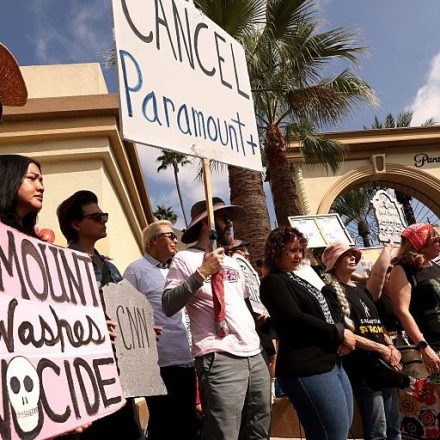 Related
The Ellisons Could Make a Killing in Big Surveillance With the Paramount Merger
Neighbors for John McKinney has also funded attack ads against Roy that paint her as an inexperienced attorney who is weak on crime and has "extreme DSA" positions. The ads cite an article by the conservative California Post, a West Coast spinoff of the New York tabloid, that claimed she had supported a freeze on prosecuting misdemeanors, which she denies.
McKinney campaigns in the mold of law-and-order candidates, pledging to address homelessness and public safety by prosecuting misdemeanors, touting closer relationships with police, and promising to revive a neighborhood prosecutor program. Other California tech-supported efforts have echoed the same — like when tech leaders in the San Francisco Bay Area fueled a successful effort to oust progressive District Attorney Chesa Boudin.
But the LA city attorney's office holds limited criminal enforcement power, Bonin pointed out. He suspects the tech investment in the LA race is more concerned with potential civil litigation, and he thinks that if voters make that connection, it could spell an issue for the campaign.
"Voters are concerned about Big Tech, they're certainly concerned about AI, they're concerned about the influence of — I don't think you can describe it any other way — 21st-century robber barons," Bonin said. "Income inequality is a big issue in Los Angeles, so if they make the connection that this funding is symbolic of the agenda that McKinney will pursue … then it becomes more of an issue."
Roxana Tynan, executive director of the Los Angeles Alliance for a New Economy, called the amount of Big Tech money being spent in the race "outrageous." As she and other labor rights groups gear up for a fight for more worker AI protections in LA — like expanding safeguards to include temporary and gig workers, and banning employers from using AI software to collect sensitive worker information — she said she hoped people would follow the money being poured into the race and the influence that a few figures look to exert on the city.
"These are people who really believe that not only can they buy elections," Tynan said, "but that they deserve to buy elections."
The post The Elon Musk Funder Trying to Sway the Race for LA's Top Lawyer appeared first on The Intercept.
Top defense officials are expressing increasing worry about the vulnerability of U.S. bases around the world and even within the United States as cheap drone technology upends long-standing defense strategies.
The fear is mounting after a series recent attacks and threats against ground targets, including the destruction of key bases in the Middle East by Iran, plots against mega-bases in Europe, including to U.S. bombers at a British air base, and a Russian campaign that damaged European military facilities, according to two government officials.
While the Pentagon is notorious for inflating threats to press for additional funding, the officials stressed that the anxiety is real, not invented. Despite the U.S. military's enormous budget, they say, the United States now finds itself scrambling strengthen its fortifications, protect its costly equipment, and recall personnel from some locations.
"Now all the world knows what the SecDef should have," said one of the officials.
Foreign adversaries have taken notice of Iran's ability to defeat U.S. air defenses using missiles and drones, they said. The officials drew specific attention to Tehran's ability to damage or destroy bases that have been the key to U.S. power-projection and war-making for decades in the Middle East.
An Iranian missile and drone attack on February 28 destroyed Navy facilities in Manama, Bahrain, the region's most critical logistics hub. The Combined Air Operations Center at Al Udeid Air Base, Qatar, was severely damaged by Iranian missiles early in the war, rendering it inoperable. Both were recently attacked again, raising questions about whether either will ever be rebuilt. The destruction of these bases has fundamentally altered America's future force posture in the region, according to the officials. One of them called it a "seismic shift."
On Friday, the Trump administration leaked highly classified intelligence to Fox News and Axios suggesting Iran has "substantially increased" efforts to target U.S. diplomats and other officials in the Middle East and beyond. The October 23 memo claimed that "the lethal plotting efforts by the Iranians against U.S. citizens have reached advanced stages." A U.S. official confirmed the accuracy of the intelligence but questioned the motives of the "official leak," suggesting it's part of a case being built to justify renewing the failed war.
Related
Lockheed Martin Showered Susan Collins With Cash as F-35 Program Hit Turbulence
The leak came as the State Department ordered a further reduction in staff at multiple diplomatic posts across the Middle East, including in Jordan, Lebanon, Qatar, Saudi Arabia, and the United Arab Emirates. One of the officials said the move "definitely" spoke to America's inability to defend its assets overseas. Those fears now extend to the United States, according to the officials.
Last month, buried in an unhinged address to troops in which he attacked the press and those within the military he calls beardos, weirdos, and wimps, self-styled War Secretary Pete Hegseth tacitly acknowledged the vulnerability of U.S. domestic bases, noting that the Pentagon was now "hardening every installation on American soil" against "sabotage and drones." And last week, the Pentagon quietly began seeking advice on new ways to protect bases by using innovative advanced materials, camouflaging facilities, obscuring their thermal and electromagnetic signatures, hiding them underground, and making them more resilient in the face of successful attack by adversaries, according to a special notice issued by a top Pentagon official.
As the Pentagon refines this "base of the future" concept, Iran is teasing a "war of the future" effort that builds on its successes in throttling the Strait of Hormuz, regionalizing the war, and battering U.S. bases, according to Mahdi Mohammadi, a senior adviser to Mohammad Bagher Ghalibaf, the lead negotiator and speaker of Parliament. "The second generation of surprises will be on their way; at the time and place of our choosing, in the manner we have devised, and with the creativity that only our unparalleled fighters can muster," he wrote on X, teasing how Iran would respond if America ramps up the war.
 Related
Putting Fuel on a Ceasefire: Israel Tries to Kill U.S.-Iran Talks
Iran's successful attacks on U.S. bases have added to the growing realization that foreign adversaries, proxies, terror groups, and lone wolf actors can use low-cost, easily obtained drones to attack the military bases, aircraft, and military personnel of the U.S. and its allies.
While Iran dominated the headlines for months, officials became increasingly worried about danger from Russian attacks. "When do we stop calling it gray zone?" asked a third official briefed on the intelligence, referring to a Russian drone attack on a massive air freighter, used to carry military assistance to Ukraine, at Leipzig/Halle Airport in Germany in August. One drone hit the cargo plane but failed to explode, another struck a different aircraft, and a third was found near the airport. "That's what Putin always does. He keeps testing us, pushing us, to see how far he can go," said the official. That official and another said that the intelligence proved there was "no question" that Russia was behind the operations. Russia has denied responsibility.
The August drone attack was part of a monthslong campaign of nonstop sabotage, cyberattacks, and psychological operations against NATO nations. "These were happening in sequence from earlier in the year, through August, through September and they didn't show any signs of stopping," said the third official. But the attacks slowed or stopped after President Donald Trump announced earlier this month that the United States would buy Russian diesel in an effort to bring down fuel prices before the midterm elections and called on Ukraine to stop striking oil Russian refineries.
The officials noted that Pentagon leadership has been slow to respond to the changing nature of warfare, specifically drawing attention to tactics honed by Ukraine in its war with Russia. Earlier this month, for example, intelligence suggested that Iran's Islamic Revolutionary Guard Corps was planning a complex drone attack on U.S. B-1 bombers used to attack Iran, and U.S. personnel at Royal Air Force Fairford air base. The plot, they said, was to launch small drones from just beyond the bases' fenceline, attacking the supersonic bombers, which were not in hardened shelters but in the open on the tarmac. They noted that the plot appeared to be patterned on a Ukrainian attack, dubbed Operation Spider's Web, against Russia last year. The plot so unnerved top military officials that the bombers were flown out while some aerial refueling aircraft were still being deployed to support their panicked flights back to the U.S. In addition to RAF Fairford, U.S. officials referenced additional threats against other bases in Europe, including Ramstein Air Base in Germany.
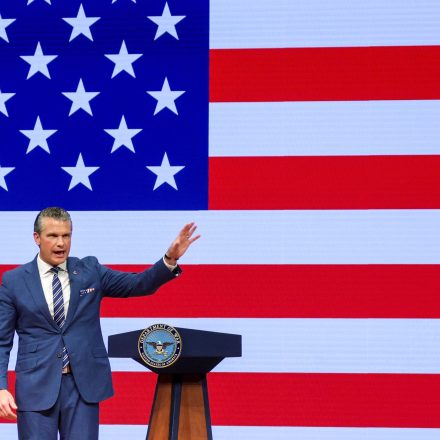 Related
Pete Hegseth's Military of the Future: Defined by AI and an Utter Lack of Oversight
Last August, Hegseth established Joint Interagency Task Force 401 to deliver "C-sUAS" or counter-small unmanned aircraft system "capabilities to America's warfighters, [to] defeat adversary threats, and promote sovereignty over national airspace." But an inspector general report from January said "immediate attention" was required to protect the most critical bases in the U.S. against drones and noted that Pentagon "documents contradict one another and do not speak to certain aspects of C-UAS authorities and capabilities." The IG found also that key "military installations, government-owned, contractor-operated facilities, and contractor-owned, contractor-operated facilities conducting critical missions" were not even designated for protection.
In March, small drones flew over Louisiana's Barksdale Air Force Base, the home of Global Strike Command which oversees America's bomber fleet and its intercontinental-ballistic missiles. And the IG report mentions "10 DoD installations and activities where Unmanned Aircraft Systems (UAS) incursions have occurred."
Late last month, the Air Force awarded a contract for counter-drone systems for Joint Base McGuire-Dix-Lakehurst in New Jersey. The military has also been looking into drone-killing technologies to defend Yokota Air Base in Tokyo, Japan; Minot Air Force Base in North Dakota; Battle Creek Air National Guard Base in Michigan; and Shaw Air Force Base in South Carolina, among other facilities.
Two of the officials suggested that new Pentagon plans for military base modernization are rooted in an uneasy acknowledgment that U.S. outposts around the world — including within the continental United States — are increasingly vulnerable to complex and asymmetric attacks. A recent Pentagon inspector general report revealed Iranian strikes "damaged and destroyed hundreds of buildings and structures at U.S. bases in Kuwait, Bahrain, Qatar, UAE, Saudi Arabia, Iraq, Oman, and Jordan during the conflict."
Hegseth's office did not respond to multiple requests for comment by The Intercept.
One U.S. official told The Intercept that the cost of repairing and rebuilding these Middle East outposts could be "upwards of $50 million," but said the "real cost" might be "far higher." The Pentagon, however, refuses to disclose the price tag of the damage, which has only been shared in a classified briefing.
"The American people deserve to know the full cost of the Trump administration's unauthorized war against Iran. Even if DoD has not yet determined which facilities it is planning to rebuild, disclosing these costs represents the bare minimum transparency DoD owes the public," wrote Democratic Sens. Elizabeth Warren, Richard Blumentha, Mazie Hirono, Tammy Duckworth, and Gary Peters in a recent letter to Adm. Brad Cooper, the chief of Central Command. CENTCOM did not reply to a request from The Intercept for the total cost.
Last week, the Pentagon quietly began seeking information for "near-term" procurement and long-term modernization strategies to "move past traditional 'pour-concrete-and-hope' hardening" of its facilities and increase the "survivability of these installations under kinetic and multi-domain threats," according to a special notice from the office of Dale R. Marks, the assistant secretary of war for energy, installations, and environment.
 Related
As the Pentagon Expands Across the Pacific, Guam Offers a Warning
Following the destruction of NSA Manama and Al Udeid Air Base, the Pentagon is seeking ways to promote "operational capability and survivability under kinetic impact," by employing decentralized energy grids, "autonomous backup utility systems," innovative base layouts, and modular structures. Recognizing the need to "protect assets and personnel from kinetic impacts, thermal effects, and blast overpressures," the military is looking at ways to harden facilities. This means employing advanced construction methods involving metamaterials designed for surviving air attack, energy-dissipating composites, self-healing materials, and "novel concrete formulations."
The U.S. is also seeking ways to lower the profile or conceal the location of its bases through technological means. This includes camouflaging facilities and integrating them into the natural environment to make them more difficult to spot, masking their thermal and electromagnetic signatures, and creating decoy structures to draw fire.
Beyond the use of "terrain-integrated facility design," the U.S. is also seeking to take its most sensitive facilities deep below ground. Increased vulnerabilities to aerial attack have led to a reemergence and increased reliance on subterranean warfare in the Russia-Ukraine war, harkening back to World War I trench warfare and the use of massive underground tunnel networks and bases by Vietnamese forces in the American war.
Iran, for its part, uses underground facilities to shield its missile and nuclear programs. The Pentagon, according to the documents, is interested in new methods of "high-speed tunneling," the rapid creation of protected caverns, and "shock-isolated underground structural design[s]."
Last week's quiet plea from the Pentagon follows an announcement by Hegseth of a FORTRESS America initiative that he calls a "national insurance policy for the American homeland." One former Pentagon analyst, however, said it sounded more like "cutting America and Americans loose" in the event of a major conflagration, tying it to Hegseth's belief that the military is a warrior elite superior to civilians.
"Every major military installation in America is going to generate its own power. Independent of the civilian grid. If an adversary takes down the grid by cyberattack, by sabotage, by any means, our bases stay lit. Our aircraft keep flying. Our command centers never go dark," said Hegseth, explaining the FORTRESS concept. "We are building long overdue strategic reserves deep enough to fight through disruption. Think munitions. Fuel. Medicine. Blood. Deep enough that if the world's supply lines break, and in a real war, they are going to break — America keeps fighting anyway."
The former advisor said that Hegseth's plan appeared to send a message to 99 percent of the American public: "It sounds as if he is saying to people 'fuck off and you're on your own.'"
The post Pentagon Fears Drone Attacks on U.S. and Foreign Bases appeared first on The Intercept.
The U.S. military just can't help meddling in the Philippines.
At the turn of the 20th century, an American war of conquest killed "over 20,000 Filipino combatants" in addition to "as many as 200,000 Filipino civilians [who] died from violence, famine, and disease," according to no less than the U.S. State Department. But "violence" doesn't do justice to exactly what occurred.
To take one example, historian Justin Jackson recently shed light on a forgotten atrocity in the central Luzon region of the Philippines in 1900 in which U.S. troops torched 60 buildings and executed 27 detainees. A year later, Brig. Gen. Jacob W. Smith issued orders: "I want no prisoners. I wish you to kill and burn, the more you kill and burn the better it will please me. I want all persons killed who are capable of bearing arms." When Maj. Littleton Waller asked for clarification on the age limit for those who would be killed, Smith told him: "Ten years." Estimates of the death toll from that campaign stretch from thousands to tens of thousands. And in 1906, on the the volcanic crater of Bud Dajo, U.S. troops killed, by some estimates, nearly 1,000 Muslim Moros, including women and children. One American captain recalled wounded babies "groping amid the mass of the dead for the mother's breast."
Year after year, these imperialist U.S. troops conducted brutal counterinsurgency operations in which they, according to the State Department, "burned villages, implemented civilian reconcentration policies, and employed torture on suspected guerrillas," as they fought and died in places like Basilan and Jolo. And a century later, during the forever wars, U.S. Special Operations forces were again sent to the Philippines. For years, they carried out counterterrorism missions, fighting and dying in places like Basilan and Jolo.
Given this long history of military meddling, you probably won't be shocked to learn that U.S. forces are back in the Philippines — and expanding their presence. You may, however, be taken aback by their new ally there: private capital. Today, TomDispatch's stalwart Pentagon watcher Bill Hartung unravels the sordid story of business interests, shady Trump cronies, and Pentagon revolving-door Rangers readying for a war with China that has, thus far, gone on under the radar.
— Nick Turse, editor of TomDispatch
If you haven't yet, sign up to receive TomDispatch in your inbox here.
Bankrolling EmpireDuring the Cold War, the Subic Bay Naval Base in the Philippines was a key enabler of U.S. military operations in the Pacific and beyond. It served as a critical support facility for the U.S. war in Vietnam and a transit point for U.S. weapons destined for American military personnel in the 1991 Persian Gulf War. That all changed in June of that year, when the Philippine Congress, under pressure from a grassroots anti-bases movement, refused to renew the lease for Subic Bay and other U.S. outposts in that nation.
After the closing of U.S. bases, military relations between the U.S. and the Philippines were conducted indirectly through arms transfers, joint training exercises, and deployments of Special Operations forces to aid Philippine counterinsurgency efforts, rather than by the permanent presence of tens of thousands of troops. The relationship was codified in 1999, when Washington and Manila entered into a Visiting Forces Agreement, which eased the movement of U.S. troops and equipment in and out of the Philippines and put U.S. personnel in the country under the jurisdiction of U.S. rather than Philippine authorities.
But now Subic Bay is back in play as part of a new expansion of the U.S. military presence in the Philippines. And this time around, private capital is financing these empire games.
Military Might Versus Human RightsThe long-standing U.S. military ties with the Philippines have come at a high price for the residents of that nation. Washington's military and economic interests there have prompted it to look the other way as repressive leaders like Ferdinand Marcos and Rodrigo Duterte engaged in systematic human rights abuses against their own people.
 Related
"Trump Has Appointed Himself Judge, Jury, and Executioner"
To its credit, the Reagan administration eventually cut ties with Marcos — who was overthrown through peaceful protests known as the "People Power" revolt in 1986 — throwing its support behind his democratically elected opponent, Corazon Aquino. But there was no such shift with respect to Duterte, whose regime ruled the Philippines from 2016 to 2022, and engaged in extrajudicial killings of thousands of Filipinos, including journalists and land reform activists, all under the guise of a "war on drugs." Duterte is now under indictment by the International Criminal Court, which has cited him for "the crimes against humanity of murder and attempted murder."
While Marcos and his family fled the Philippines in the 1980s, his son — Ferdinand Marcos Jr. — returned and, in 2022, won the presidency in a landslide, in part by promising to continue some of the strongman policies introduced by Duterte. According to Human Rights Watch, since the younger Marcos took office:
Serious human rights violations have continued in the country largely unabated, including arbitrary arrests, extrajudicial killings and enforced disappearances by security forces. The murderous 'war on drugs' has continued, though with fewer killings. Leftist civil society activists, journalists, environmentalists, Indigenous leaders, trade unionists, and left-wing politicians remain under serious, at times deadly, threat.
During the Biden presidency, the U.S. expanded a 2014 pact — the Enhanced Defense Cooperation Agreement — which gave the U.S. military access to five major sites in the Philippines. In 2023, the number of bases was expanded to nine. The State Department has described the scope of the EDCA as authorizing "U.S. forces access to agreed locations in the Philippines on a rotational basis, for security cooperation exercises, joint and combined military training activities, and humanitarian assistance and disaster relief activities." That official summary fails to admit the real reason for the signing of the EDCA: to give the U.S. access to territory that can be used in a future war with China.
Read Our Complete Coverage
TomDispatch The Privatization of Subic BayBuilding on his predecessor's enhanced cooperation with the Philippines, President Donald Trump, who had been a staunch Duterte supporter, has pursued even tighter ties with Marcos's government. This has been driven, in significant part, by the desire to use the Philippines as a platform for potential U.S. military interventions in the Pacific region and further economic penetration of Asia.
 Related
The Philippine Missile Crisis: U.S. Deployed Arms to the Philippines and No One Noticed But China
As part of the accelerating security partnership between the U.S. and the Philippines, military activities at Subic Bay have resumed. But this time, formal access has been secured by a private investment firm, Cerberus Capital Management, which controls the area through a 50-year lease granted through collaboration with a Philippine company, Agila.
A report by the New York Committee for Human Rights in the Philippines, a member of the International Coalition for Human Rights in the Philippines, summarized current activities at Subic Bay:
In mid-2025, the U.S. Congress approved a plan to build a forward operating base and ammunition production facility in Subic Bay. It is projected to be the world's largest weapons hub. … The shipyard [is home to] HD Hyundai Heavy Industries, deep sea fiber optic data cables manufacturer Sub Com, defense contractor V2X and the Philippine Navy, which operates a portion of the facility.
Cerberus has strong ties to the Trump administration, first and foremost through its founder, Stephen Feinberg, who is deputy secretary of the Department of War, second in command at the Pentagon behind Pete Hegseth. In that role, Feinberg oversees the Pentagon's Office of Strategic Capital, which makes loans to military tech companies, many of which are current or former Cerberus clients.
Feinberg "earned" his position the old-fashioned way — by giving millions to Rebuilding America Now, a super PAC devoted to supporting Trump, and hosting a $50,000-a-plate fundraiser, the proceeds of which also went to support candidate Trump in 2016.
 Related
Major Trump Donor Owned Security Firm That Trained Khashoggi Killers
Bloomberg News has identified four other former Cerberus executives now in key positions at the Pentagon: David Lorch, director of the OSC; George Kollitides, a special government employee who is simultaneously a director of D. Boral Acquisition, a company that brokers mergers and acquisitions in the weapons sector; and senior Pentagon advisers John Gallagher and Tom Rakusan.
On the other side of the revolving door, Cerberus has hired major Republican figures like former Treasury Secretary John Snow and former Vice President Dan Quayle, who serves as chair of the company's global investment unit. Given these connections, the Pentagon is all-in behind Cerberus's activities in the Philippines. But this has prompted a backlash. Activists in the Philippines and beyond are speaking out against the role of Cerberus, calling for public pension funds to withdraw their investments in the company for underwriting the militarization of the Philippines.
Another important avenue of increased cooperation between the U.S. and the Marcos government is the Philippines' participation in Pax Silica, a U.S.-initiated cartel that the State Department describes as its "flagship effort on AI and supply chain security, advancing new economic security consensus among allies and trusted partners." And by "supply chain security," the declaration primarily means "reducing dependence on China" for critical minerals needed to feed and sustain the computing power now central to the Pentagon and the U.S. arms industry.
 Related
Tech Official Pushing TikTok Ban Could Reap Windfall From U.S.-China Cold War
In addition to the Philippines, there are 24 other participants in Pax Silica, including two other key Asian partners, India and Japan, as well as Taiwan, which is an associate member of the cartel. Jacob Helberg, a former adviser to military tech giant Palantir who now serves as the State Department's point person on Pax Silica, has stressed that the initiative goes well beyond just securing the supply of specific critical resources. "If the 20th century ran on oil and steel, the 21st century runs on [computing power] and the minerals that feed it," he said. "This declaration [announcing Pax Silica] hails a new economic security consensus ensuring aligned partners build the AI ecosystem of tomorrow — from energy and critical minerals to high-end manufacturing models."
The China SyndromeAlthough it supplies many other benefits to U.S. corporations and America's national security state, the enhanced effort to bring the Philippines more securely into the U.S. military, political and economic orbit is all rationalized as moves toward reining in China's economic and military power and garnering Manila's support in a possible war between China and the U.S.
 Related
The Pentagon's Obsession With China Puts Hawai'i at Risk
The policy of economic warfare and aggressively preparing for a military conflict with China could not be more misguided. The oft-cited "need" to posture U.S. forces to do battle with China over Taiwan ignores the fact that there are diplomatic means of preventing such a conflict.
What is needed is a joint understanding on the status of Taiwan. For over 40 years, peace in the Taiwan Strait has been maintained through the U.S.-China agreement that Washington will not take steps toward recognizing Taiwan as an independent state and China would agree not to resolve the issue of Taiwan by force — the so-called "One China" policy. That agreement has been weakened by actions taken during both the Biden and Trump administrations. The simplest and best way for Washington and Beijing to avoid a war over Taiwan would be to revert to the "One China" policy.
Using trade wars and military buildups as the primary U.S. tool for influencing China simply will not work.
China does not pose a direct military threat to the United States. Its last major war was its invasion of Vietnam in 1979, a conflict in which its troops were badly beaten by battle-hardened Vietnamese forces. The U.S. also spends almost three times as much on its military as China does, and is far ahead of Beijing in numbers of advanced combat aircraft, naval firepower, and nuclear weapons.
 "The Trillion Dollar War Machine," by William D. Hartung and Ben Freeman Available on Bookshop.org
In areas where China might be a peer competitor with the U.S. military, like AI-driven weapons, there need to be some rules of the road on how such systems can be used. Using trade wars and military buildups as the primary U.S. tool for influencing China simply will not work. The likely result of persisting in such an approach will be a dangerous arms race and an increased risk of outright war.
A more productive approach to U.S.-China relations would be to seriously explore cooperation on central issues like arms control, addressing the climate crisis, and stabilizing the global economy. There would still be a U.S. military strategy for the Asia-Pacific region, but it should be genuinely defensive in nature, a posture that could save hundreds of billions of dollars in the years to come.
Pursuing a more balanced policy toward China would open the way to developing more equal, less exploitative relations with the Philippines and other nations in the Pacific, and it would allow Washington to finally take a genuine interest in promoting human rights and opposing repression as central pillars of U.S. international relations.
At a time when armed conflict and threats of war are the bedrock of U.S. policy, from the Western Hemisphere to the Middle East, a shift toward diplomacy seems daunting. But it is the only way forward if we want to move toward a more peaceful world where no one nation or group of nations dominates, and where corporations aren't bending foreign and domestic policies to their will.
The post Bankrolling American Empire in the Philippines appeared first on The Intercept.
Angelina Resendiz's voice on the phone was frantic. She was calling a friend from the barracks room of Jermiah Copeland, a fellow sailor at Naval Station Norfolk in Virginia. They had spent the evening together, kissing and drinking, and now Resendiz, 21, needed to leave.
It was the last time anyone would hear from her. When Resendiz's friend arrived at the barracks 15 minutes later, the pair was nowhere to be found.
"The Navy failed her," Resendiz's mother, Esmerelda Castle, told The Intercept. After her daughter's disappearance, friends and family spent a week scrambling to find Resendiz. Castle found the Navy's reports in that time unclear, delayed, or downright false.
A first-of-its-kind Intercept investigation has found critical shortcomings in the U.S. military's procedures for documenting and preserving records of homicides that result from domestic abuse, including intimate partner violence. The Pentagon's mandated reports to Congress appear to substantially undercount these killings, omitting nearly half of cases.
In the six years before Copeland's murder of Resendiz, the Pentagon recorded 41 domestic abuse-related homicides committed by service members. The Intercept identified nearly twice as many: at least 73 potential cases involving 79 victims — almost all of them women — during the same period. Reports for fiscal year 2025, when Resendiz was murdered, are due in November.
The Intercept examined publicly available news articles, obituaries, court records, memorials, and other data to investigate the specifics behind the Defense Department's numbers. Reporters also used data obtained through a Freedom of Information Act request on Army noncombat fatalities to match names, because some news coverage did not mention the victims' and alleged perpetrators' military service.
A killing qualified for the dataset if it occurred in fiscal years 2019 to 2024; if the perpetrator was a member of the military at the time of the crime; and if the case involved a homicide. The database only includes cases where a victim of the violence had dated or was in a romantic relationship with the suspected perpetrator, and it includes multiple women living abroad who were foreign citizens dating American troops.
In the fiscal years since the second Trump administration took power, The Intercept found at least 10 service women or women working for the Defense Department have died from intimate partner and domestic violence, six of them killed by male co-workers. An additional 10 civilian women have been killed by male military personnel in intimate partner violence-related homicides during the same period.
A Pentagon spokesperson acknowledged The Intercept's queries about the discrepancy in homicide rates but did not respond to detailed questions before publication.
"At this moment in our country's history, I am afraid these numbers are going to increase even further," said Jacquelyn Campbell, a professor at Johns Hopkins University's School of Nursing who has been studying domestic violence in the military for decades. "We need primary prevention for everyone in the military and their partners."
The findings come in the wake of President Donald Trump's August announcement of a Military Spouse Commission, led by Jennifer Hegseth, the wife of Defense Secretary Pete Hegseth, and other high-level military leaders. The commission's mandate is to guide policy around issues affecting military families. Though intimate partner violence and spousal abuse have concerned military family advocates for decades and thousands of new cases are reported each year, the commission does not mention the issue as one of its areas of focus.
The Navy and DoD have said in public statements and communication with members of Congress and Castle that while "proper procedures were followed" following the death of Resendiz, they have identified several processes that require further review.
"What Are the Statistics?"Copeland killed Resendiz on May 29, 2025. In the days after Resendiz's disappearance, her friends filed missing person reports and called Castle in Texas, who in turn called the Navy. None of them knew that Resendiz was dead.
The Navy's official timeline of events says it did not start investigating her disappearance as a crime until a missing person's report was filed on the 31st, and that Castle did not reach out until that day. Phone records she shared with The Intercept and members of Congress show she started calling on the 29th.
"I was told she was found, and that the original missing person's report was exaggerated," Castle recalled. "I didn't think for a second that the Navy would lie to me.
"I was told she was found, and that the original missing person's report was exaggerated."
Technically, Resendiz had been found — a Navy chief searching for her had seen Resendiz's body packed under the covers in Copeland's bed around 10 a.m. on the day of her disappearance. They assumed she was asleep, according to evidence later revealed during trial. But as Castle tells it — including in a congressional inquiry she wrote requesting a deeper investigation— a Navy chief claimed on the phone to have spoken to her daughter in Copeland's room.
She had been dead for hours.
"He had Angie wrapped up in a blanket on his bed," said Castle. "It was against policy for her to be in the barracks. And they just turned their backs and left."
Intimate partner violence in the military has long been a problem with unclear signs of progress. Killings in the 1990s on bases such as Fort Campbell made national headlines, leading Congress to establish the Defense Task Force on Domestic Violence in 2000.
Campbell, the nursing professor, was part of the effort, which issued over 200 suggestions for improvement by 2003. "Most of the recommendations we made a long time ago were never implemented," she said. For one, she'd repeatedly requested better recordkeeping.
"One of the things I kept asking was, 'What are the statistics on intimate partner homicide in the military?' We could never get them," Campbell said. "And in the military's suicide reports, you cannot determine how many suicides were part of homicide-suicides, where a service member killed a civilian wife or partner before killing himself."
This lack of clarity sounded familiar to Priscilla Rodriguez, who spent 10 years in the Marine Corps before working in strategic communications for the Navy.
"The command chose not to pursue military legal action."
Rodriguez experienced domestic violence that met the Defense Department's criteria from her husband, an active-duty Marine at the time, according to documents reviewed by The Intercept. Her husband pleaded guilty to misdemeanor child abuse in civilian courts, and military legal authorities recommended domestic violence charges. "The command chose not to pursue military legal action," Rodriguez said.
The Intercept's analysis of the rates of domestic abuse reported in Pentagon data found intimate partner violence among married military couples was at least four times higher than the civilian rate. The Pentagon does not report the rate of abuse involving unmarried intimate partners, like Resendiz and Copeland.
Gaps like these make it difficult to have a thorough reckoning of the problem's scale. "When accountability is inconsistent," Rodriguez said, "it sends a message that abuse can and will remain hidden."
 Defense Secretary Pete Hegseth serves Thanksgiving meals to service members in Washington, D.C., on Nov. 28, 2025. He was joined by his wife, Jennifer Hegseth. Photo: Master Sgt. William Blankenship/U.S. Air Force photo Joint Task Force DC
"I Knew My Kid Was Not Coming Back"
Copeland kept Resendiz's corpse hidden in his barracks room for four days, until June 2, 2025, when he put her body into a duffel bag and dumped it in a wooded area behind a nearby elementary school.
By then, he was being questioned by the Naval Criminal Investigative Service on her whereabouts, and Castle was still wondering about her daughter's safety. She'd asked naval authorities to have her daughter give her a call, and when it never came, she contacted the base again.
A Navy official suggested her daughter may have gone AWOL.
"I didn't believe that," Castle said. "My kid is scared to miss work. She won't take off."
Castle flew to Virginia herself.
Resendiz had been dead for a week. Castle felt she wasn't getting the information she needed after the Navy and local authorities had put out a statewide missing person's alert. She requested that she be let into her daughter's barracks room.
"I didn't want anyone else touching her stuff," Castle said. "It was how she left it. There was still paint out; she had started painting again. Her yoga mat was still out. She had planned on returning. I knew my kid was not coming back."
She spent two more days in Virginia searching for her daughter, talking to local news, and asking naval authorities to give more updates.
"They didn't declare her AWOL or dead," Castle said. "They said she was duty status unknown. I was worried they were going to wash their hands of her."
On June 7, Castle flew back to Texas. Police found Resendiz's body in the duffel bag two days later.
A History of ViolenceJermiah Copeland was convicted of Resendiz's murder on June 8, 2026. According to evidence entered into court records in his murder trial, he had also been accused of two instances of domestic violence, three sexual assaults, indecent recordings, and other crimes from during and before his Navy service.
"He had a history of violence against women starting in high school," Castle said. "And was still allowed to join with the charges against him. Then he was accused of raping another service member, and he was transferred. There were no safeguards in place at the new command."
The absence of safeguards against intimate partner violence in the military is part of a broader set of structural and cultural failings, experts told The Intercept.
"There are many disincentives for a couple, particularly when one or both partners are on active duty, to seek help," Campbell said. "Active-duty women who were being abused told us: 'If my commanding officer knew, I would never get the next promotion.' There is considerable stigma, even for the victim. That makes the violence much more likely to escalate and makes it more likely that we eventually end up with homicides."
 Related
Hegseth Is Pushing Testosterone. The VA Has Already Struggled With the Treatment.
Research indicates that the military's hypermasculine culture and systematic mistreatment of women play a role in the increased risks of intimate partner violence. Some studies suggest that veterans offend at higher rates than those on active duty.
A previous Intercept investigation found active-duty Army women were more likely to be killed by fellow service members than by enemy combatants and had a higher per capita risk of homicide than their fellow male soldiers between the years 2011 and 2025.
More than 70 percent of the victims had an intimate relationship with the perpetrator at some point. Army women faced an intimate partner homicide rate at least three times higher than women nationally; controlling for those killed by service men and male veterans alone, it was double.
The military's systems for identifying and responding to abuse, meanwhile, have come under repeated scrutiny. A 2021 Government Accountability Office report found the department "has not collected and reported accurate data for all domestic abuse allegations received," leaving it unable to assess the scope of alleged abuse.
The same can be said for homicides.
Almost a third of the 79 victims The Intercept found were killed in murder-suicides. Firearms were used in over two-thirds of the fatalities. Twenty-five of the victims were service members. Multiple homicides involved corollary victims who were not partners, including children, who research shows make up a sizable amount of intimate partner violence-related deaths.
 Related
Women in the Army Are More Likely to Be Killed by Fellow Soldiers Than Enemy Combatants
In response to The Intercept's questions, the Department of Defense stated that data in its domestic abuse reports does not constitute estimates, as it is only using aggregated data from the Family Advocacy Program Central Registry, a database run by the DoD. It further stated it did not have any more information to share on the matter.
"Right now, unless an incident is reported to the Family Advocacy Program," said Campbell, "nobody knows about it. Those reports are only the tip of the iceberg."
Data tracking failures have had deadly consequences. The Air Force failed to submit the criminal history of a former service member convicted of assaulting his wife and stepson to a federal database that could have prevented him from purchasing firearms. In 2017, he killed 26 people in Sutherland Springs, Texas.
When Rodriguez reported her own abuse to the DoD, she felt that they didn't consider the previous information they had available. Installation-level committees review reported allegations and determine whether they meet criteria to be input into the central registry. But the process is plagued with issues, experts who spoke to the Intercept revealed, from investigation procedures to data tracking.
"I was terrified to disclose the full extent of the abuse I was experiencing," Rodriguez said. "What stands out to me now is that the Family Advocacy Program already had access to my husband's history. Given that history, I believe the conversation should have been much broader than simply asking whether I wanted to report anything. I left that initial interaction without understanding what support existed or how I could safely leave."
While navigating her own case, Rodriguez was also watching the same problem surface through her communications work for the Navy.
"It felt completely disconnected from the reality my family and so many others were living."
"Headlines I monitored involved active duty and Marine veterans accused of intimate partner homicide," Rodriguez said. "At the same time, I reviewed serious incident reports that were elevated to senior leadership. … The narrative often indicated that intimate partner violence or domestic violence was a contributing or co-occurring factor."
Navy criminal investigative data showed domestic violence-related deaths increasing as Rodriguez was trying to raise the issue in 2022. She tried to compile domestic violence awareness resources, but she recalled being told the need wasn't there.
"I was told there was 'no demand signal,'" Rodriguez said. "It felt completely disconnected from the reality my family and so many others were living."
Castle feels that the knowledge of Copeland's history of abuse could have saved her daughter's life.
"No one knew anything about him," Castle said. "The leadership created an environment that allowed him to harm women."
Winnable CasesSince her daughter's murder, Castle has been at work pushing the Navy and Defense Department to strengthen their responses to intimate partner violence. Her work led to the Navy changing its policies in July on how it transfers sailors with allegations of sexual violence.
Her wins, including potential plans by the Navy to change how it classifies missing sailors, are the latest in a long string of limited efforts toward progress.
"Records are important," said Castle. "With my daughter, they didn't want to classify her case properly at first. For the military, if something isn't in a database, it doesn't exist."
Following the high-profile 2020 murder of Army Spc. Vanessa Guillén at Fort Hood — and two years after domestic violence became classified as a crime under the Uniform Code of Military Justice — Congress gave independent military prosecutors the power to decide which cases to bring to trial.
Domestic violence prosecutions climbed, with charges brought in 359 cases last year alone, up from dozens of cases four years earlier. But Pentagon data identified at least 25,000 intimate partner and spouse abuse victims, and 37,000 cases, from 2021 to 2024.
 Related
Pentagon Considers Cutting Its Sexual Assault Rules
And while domestic violence prosecutions increased, military prosecutions of sexual assault — often related to intimate partner violence — fell by almost 60 percent in the past five years, based on data from its annual sexual assault prevention reports. A 20 percent drop occurred from 2024-2025 alone, and The Intercept's analysis of military court data shows the trend is continuing into 2026.
"In the Pete Hegseth era, sexual assault prosecutions have dropped significantly. Domestic violence is essentially filling that gap," said Paul Newell, an Army veteran and activist who tracks military suicide, sexual assault, and domestic violence while engaging with members of Congress on the issue.
"In the Pete Hegseth era, sexual assault prosecutions have dropped significantly."
Newell thinks the trial counsel's office is "going for what they feel are stronger, more winnable cases," he said. "They'll tell you that their conviction rates at trial are still high, which shows that really, they're just getting rid of the bad cases," he said. "But we're not down 60 percent in sexual assaults happening."
The Pentagon stated in response to The Intercept's questions that it does not have any additional information to share on why prosecution rates for certain crimes are dropping.
The Intercept also discovered preferential treatment in trial outcomes: Analyzing over 650 military court cases with guilty verdicts from 2021 on, reporters found less senior Navy, Marine, and Army service members had higher chances of losing their benefits and received more jail time after being convicted for domestic violence. Senior ranks closest to retirement received the best conviction outcomes, even compared to those of the same rank as them who had fewer years in service.
Newell feels that these discrepancies give perpetrators increased power over their victims. "The justice system should not take time in service into consideration since that's prioritizing the perpetrator. If the punishment for domestic violence is a discharge where you lose benefits, it should be applied equally."
In April, Hegseth directed installation commanders to allow service members to request permission to carry privately owned firearms on bases while off duty. He framed the change as a way to protect service members from attacks on military installations.
Campbell disagrees.
"I have reviewed far too many domestic violence homicide records," Campbell said. "It is clear to me that, in many cases, there might have been a fight, and somebody might have been hit, but nobody would have died if there had not been a gun right there."
Rodriguez, who is now studying public health, is calling for recurring anonymous surveys using specific questions to measure the prevalence of intimate partner violence, standardized tracking, independent evaluation, and public reporting.
Castle is still mourning her daughter and still pushing the Navy to reveal the full details about the investigation into her death. To add to the insult, she remembered the shock she felt late last June, when the Navy sent Resendiz home to Texas in a casket. Naval officials had told Castle that everything was taken care of, she recalled, including cleaning the body.
The Navy acknowledges that it failed to clearly inform Castle of her daughter's true state. She was returned to Texas in decay, her body crawling with maggots.
"There's nothing that can be done for her," said Castle. "That's injustice, and that's what drives me. None of these women volunteered to be violated in this way."
Reporters searched through multiple databases to identify the number of potential victims of intimate partner violence, using definitions provided by health and policy research alongside government organizations, comparing it to the last six years of available DoD reporting from 2019 through 2024. The case of a U.S. Air Force airman who kidnapped and murdered a Mennonite woman in 2020 didn't meet criteria because evidence revealed no previous or current relationship. The case of a soldier who was convicted a year later of the murder of a woman in Texas did, as evidence indicated they had a relationship before the woman's death.
Cases were broken down by the year of the offense, gender of the alleged perpetrator and victim, and branch of the perpetrator and victim, if applicable.
To analyze court data, reporters from The Intercept pulled all court cases pertaining to domestic violence from the years 2021 to 2026 from the websites of the Air Force, Navy/Marines, and U.S. Army. Navy/Marine data was only available starting in 2021.
Data included the offense type, rank of the accused, and whether the cases ended in acquittal, dismissal, or conviction. For those convicted, the analysis included the amount of jail time given and whether offenders received a punitive discharge, which costs them military retirement and other benefits.
Retirement eligibility was calculated based on pay information provided in court documents, which in the military is based on years served. Air Force data could not be used for this analysis due to a lack of documentation and apparent discrepancies between the number of cases reported to Congress and those available on the Air Force portal.
To obtain the number of cases the DoD is prosecuting for sexual assault, reporters utilized Annex B of the DoD's Annual Report on Sexual Assault in the Military to calculate the number of unrestricted reports made to military authorities and the amount sent to the military justice system to begin the judicial process.
The 988 Suicide & Crisis Lifeline offers 24-hour support for those experiencing suicidal thoughts or for those close to them, by chat, text, or telephone. Service members can dial 988 and press 1 to reach the Military and Veterans Crisis Line. Support is free and confidential.
The post Pentagon Records Missed Almost Half of Troops' Domestic Abuse Killings appeared first on The Intercept.
Defense Secretary Pete Hegseth has extended a line for the military's religious leaders to reach him directly — and current and former military chaplains say they don't want it.
Hegseth announced the creation of a new Office of Religious Affairs on September 30, vowing that the office would give members of the armed forces' chaplain corps access to him without "bureaucratic dilution." It coincides with his openly Christian "Send Me" campaign, an online propaganda effort that the Pentagon launched over the summer promoting a biblical phrase widely understood as a vow to accept a divine mission.
"We should not be in the business of wrapping the state's mission in one particular religion," an active-duty Army captain serving as a non-Christian chaplain told The Intercept. But as Hegseth's Pentagon increasingly pushes Christianity, the chaplain, who was granted anonymity because he feared retaliation from the Defense Department, said he and other non-Christian chaplains worry the new religious affairs office will be used to do just that.
Hegseth's body bears an assortment of Christian and Crusader imagery, including a Jerusalem cross across his chest and the Latin phrase "Deus vult," or "God wills it," on his bicep — a battle cry associated with the medieval Crusades that has since been adopted by far-right extremists. His forearm bears a cross and sword referencing Matthew 10:34, in which Jesus declares that he came not to bring peace but a sword, alongside the Hebrew name for Jesus. In 2021, a fellow National Guard member flagged Hegseth as a potential security threat over his Deus vult tattoo, before Hegseth was removed from an assignment protecting Joe Biden's inauguration.
Related
Pete Hegseth's Unholy War
As defense secretary, Hegseth has frequently turned to messaging that centers religion and vengeance while promoting the U.S. and Israel's unpopular war in Iran. His "Send Me" campaign is built around Isaiah 6:8, a biblical verse commonly invoked by Christians as a call to serve God. During his 9/11 speech last month at the Pentagon, Hegseth said the "struggle against evil" that followed the attacks continues today and "will continue until Judgment Day," before turning to the current war with Iran.
"Using specific scriptural language for a military campaign inappropriately frames state-sanctioned armed conflict and government service as a Christian religious crusade," the chaplain said. "Once a mission is declared God's will, every act inside it is sanctified in advance."
The new Office of Religious Affairs, the chaplain said, could entrench this dynamic. While the Pentagon memo establishing the office says it cannot compel religious participation or diminish the free-exercise rights of service members of any faith or no faith, the office's director will report directly to Hegseth and the deputy defense secretary, oversee the Armed Forces Chaplains Board, and work with the civilian religious organizations that endorse military chaplains. The office will also oversee efforts to assess spiritual fitness, spiritual readiness, and spiritual resilience across the force. This consolidated control, the chaplain warned, may make it difficult to maintain pluralism among the chaplain corps.
"Our chaplain corps must serve [non-Christian service members], not just the soldiers that share a faith with the SecDef," the Army chaplain said. While it's too early to know what that authority will mean for non-Christian chaplains, he wondered how it might change the ranks of the chaplaincy itself.
"Will this group begin accepting fewer and fewer non-Christian chaplains into our ranks?" he said. "Will we begin seeing fewer and fewer non-Christian chaplains be chosen for promotions?"
The concerns extend beyond the active-duty chaplain. Rev. Dr. Rebekah Savage, a former military chaplain who now helps oversee the Unitarian Universalist Association's endorsement of clergy serving as military chaplains, said the organization was not consulted before the office was established.
"I am deeply concerned about how this office will serve the religious needs of the members of the service," she said. "I can't speak for others who are a part of the chaplaincy corps, but I know I am not alone."
In response to questions about the new office from The Intercept, Pentagon press secretary Kingsley Wilson wrote in a statement that the department "protects the constitutional right of every service member and civilian employee to practice their faith without coercion or discrimination. This is why Secretary Hegseth recently established the Office of Religious Affairs." She said that prayer services and religious activities are always voluntary.
"The Christian faith is woven deeply into the fabric of our nation and shared by America's wartime leaders like President George Washington, who prayed for his troops at Valley Forge, and President Franklin D. Roosevelt, who gifted Bibles to America soldiers during WW2 and encouraged them to read it," Wilson added. "Despite the Left's efforts to remove our Christian heritage from our great nation, Secretary Hegseth is among those who embrace it."
In August, when "SEND ME" could still be dismissed as a string of social media posts, the Pentagon repeatedly declined to explain what the phrase meant or whether it represented a broader communications strategy.
As scholars of religion previously explained to The Intercept, the Pentagon's use of the passage strips away part of the biblical story. Isaiah is not being sent to destroy God's enemies; he is being sent to preach a warning to his own people. And the commission ends not in military triumph, but judgment. Cities are left empty, the land is devastated, and God's own people suffer the destruction.
"Secretary Hegseth's Send Me Tour is a military outreach and recruitment initiative focused on recognizing the Americans who volunteer to serve," Wilson added in her statement. "We are grateful for the Americans—past, present, and future-who have raised their right hand and said, 'Send Me.'"
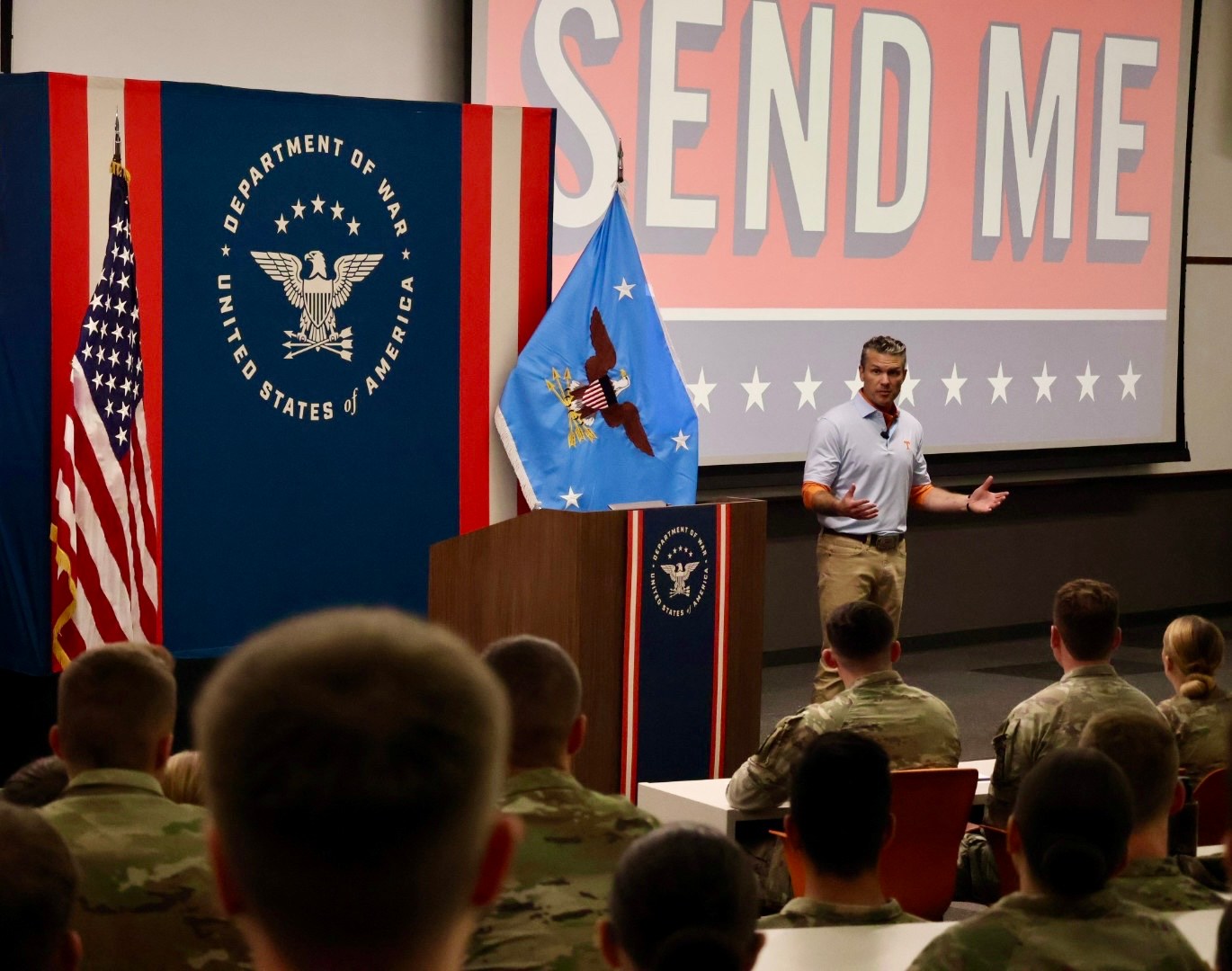 Hegseth addresses Reserve Officers' Training Corps cadets during a "Send Me" tour event at the University of Tennessee in Knoxville, on Oct. 17, 2026. Photo: Capt. Tessa Lindsey/U.S. Army National Guard
Questions about the Pentagon's treatment of minority religious traditions predate the new office.
In June, Savage joined 10 other religious endorsers in a letter to Hegseth objecting to revisions to the military's Religious Affiliations Code list. The signatories said the changes removed or obscured the identities of several religious communities, including Unitarian Universalists, historically Black churches, and Wiccan and Pagan practitioners.
The endorsers warned that the changes could affect religious accommodations, access to clergy, and the distribution of chaplaincy resources.
"Classification is resource allocation," they wrote.
Related
Apocalypse Now: Naomi Klein and Astra Taylor Investigate the End-Timers Alliance
Savage said the earlier changes, combined with the establishment of the Office of Religious Affairs, "calls the Department's commitment to meeting the spiritual needs of all of its members into question."
The active-duty Army chaplain questioned how the office's stated religious-freedom protections would work in practice under a defense secretary who has increasingly incorporated Christian scripture into his public messaging.
"What oversight will exist to prevent religious bias?" he said. "When investments are made, will they be defining spiritual fitness by Christian, or by more pluralistic metrics?"
The same concerns extend to money. The office's funding priorities include faith-based home school support for military families, faith-based suicide-reduction programs, and contracts with faith-based organizations.
"Will the Humanists, Muslims, Jews, Hindus, and other groups receive an equal, commensurate amount of support and funding for such programs?" the Army chaplain said. "Or will all or most of the funding go to Christian based organizations?"
Beyond institutional support, the chaplain said the Pentagon's religious messaging could interfere with one of the central responsibilities of his profession: helping service members navigate questions of conscience, morality, and killing.
Related
Pete Hegseth's Military of the Future: Defined by AI and an Utter Lack of Oversight
In reporting for Task & Purpose last month, this reporter examined how Army chaplains were preparing to address the moral and spiritual consequences of artificial intelligence in warfare. As one scholar of military ethics pointed out, moral injury can arise when service members feel responsible for actions that violate their values, even when they have little meaningful control over those decisions.
The Army chaplain raised a related concern: What happens when the military itself invokes religious authority to justify its mission?
"What can I say to a non-Christian soldier who is being ordered to kill his fellow man or risk dying himself for a god he does not believe in?"
"If my role as a chaplain is to advise soldiers and commanders of issues of morality and ethics, what can I say to them now?" he said. "How can I advise a commander on doing moral and ethical actions if the state has announced that their god has ordained their war?"
For service members who do not share the religious beliefs invoked by military leadership, the Army chaplain said, that tension could be especially difficult to reconcile.
"What can I say to a non-Christian soldier who is being ordered to kill his fellow man or risk dying himself for a god he does not believe in?" he said. "What do I tell a soldier who believes an action is immoral, but also believes that God commanded it?"
The post Hegseth Built a New Pentagon Office for Religion. Military Religious Leaders Wish He Hadn't. appeared first on The Intercept.
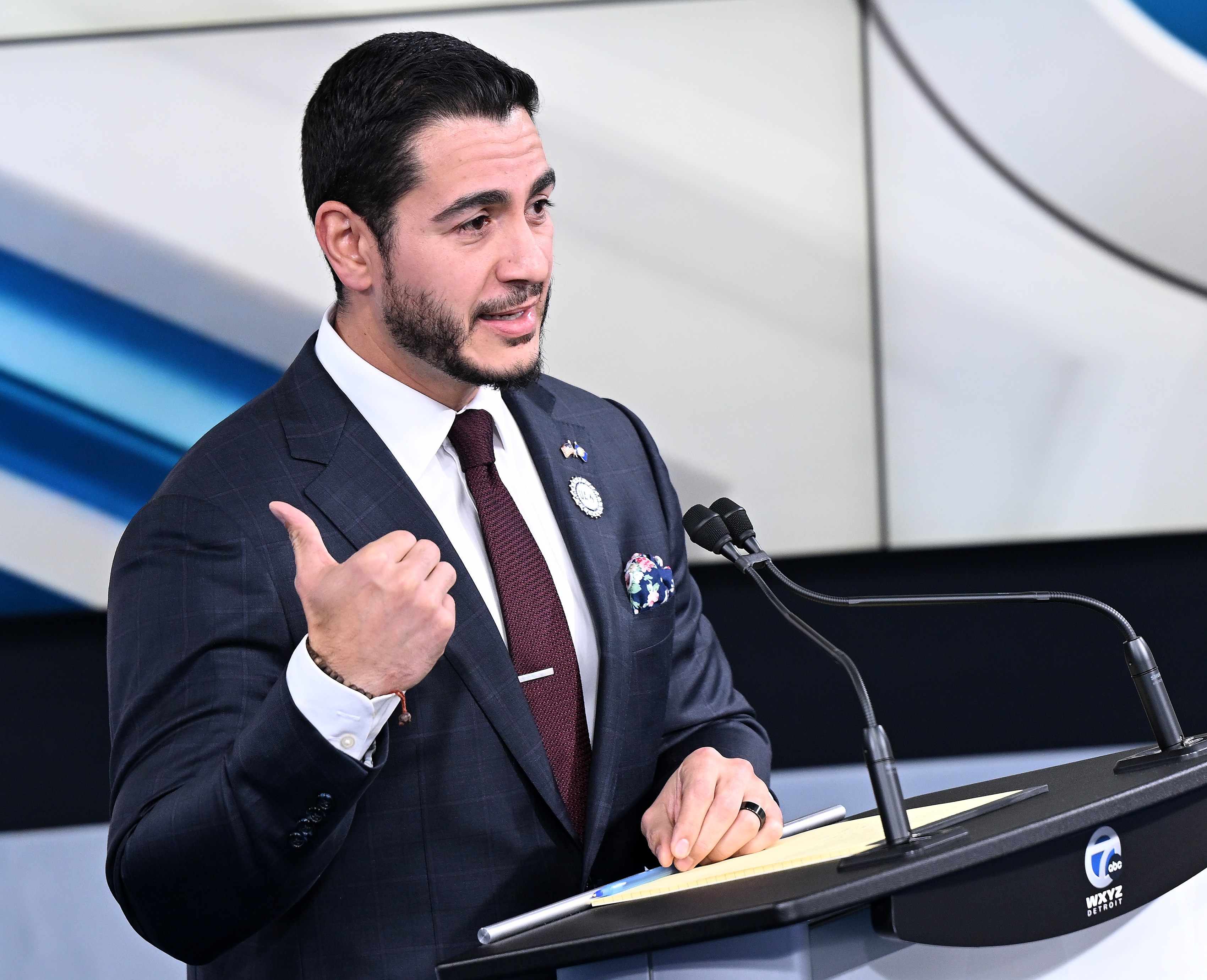 Democratic Senate candidate Abdul El-Sayed speaks during the WXYZ Channel 7 debate on Oct. 21, 2026, in Southfield, Mich. Photo: Robin Buckson-Pool/Getty Images
The PUMA spirit is back. The 2008 Democratic Party protest movement, inflamed by what Hillary Clinton supporters viewed as Barack Obama stealing the nomination from their primary candidate, scorned his general election campaign and embraced the mantra "Party Unity, My Ass."
This time, that energy is aimed at the candidates preferred by the Democratic Socialists of America.
DSA-aligned progressives have won a number of party primaries and are set to help Democrats take the majority in Congress. But once in power, they're likely to make demands — the kinds of demands that could upend decades of carefully crafted donor-friendly policymaking.
For moderate Democrats, "party unity" is only a goal worth pursuing to bully the left wing of the party to fall in line with their preferred candidate.
For moderate Democrats, "party unity" is only a goal worth pursuing to bully the left wing of the party to fall in line with their preferred candidate. When it's on them to step up and vote for someone who might have different goals, that's another story completely, and some centrists are even hoping for Republicans to win the House this November if the alternative is an empowered DSA Democratic wing.
James Carville, the fossilized Cajun strategist who was part of exactly one successful national political campaign, Bill Clinton's 1992 White House victory, said on The Bulwark podcast last Sunday that he'd prefer a tight GOP hold on Congress over a narrow Democratic majority.
"I would be disappointed if it comes in at 225 House seats," Carville told host Bill Kristol. "I would rather the Republicans keep the House by five than the Democrats to win by five, because, if that happens, they're hostage to the DSA."
To his credit, Kristol — who, in a sign of how people can change when they know which way the wind is blowing, spent the PUMA moment promoting Sarah Palin but is now a self-proclaimed Democrat — pushed back, saying he'd rather win.
Carville is the first of his cohort to explicitly call for a GOP victory rather than the left flank of the party getting more power, but he's not the only centrist deprioritizing his party's prospects in November.
Maine Gov. Janet Mills has yet to endorse the Democratic Party's Senate nominee, Troy Jackson, after she lost to now-disgraced Graham Platner. (Mills and Jackson have a long and bitter history from state government, which may be playing a role here.)
Perhaps most consequentially, in Michigan, Democratic Senate nominee Abdul El-Sayed has faced an uphill battle since winning his party's grueling primary. He's now focused on winning in the general election and becoming the first Muslim U.S. senator, but resistance to his candidacy remains a concern.
 Related
Centrists Are Soft-Launching the Idea That We Have a Little Too Much Democracy
Much of the difficulty has come from members of his own party and other liberals. Their antipathy toward a candidate whose positions aren't so out of step with other members of the caucus has raised questions about what exactly is so objectionable about him. El-Sayed may skew to the progressive side of the party, but he's not a socialist and not a member of the DSA; his positions on domestic policy should place him companionably among the likes of Sen. Elizabeth Warren's wing.
Until recently, most of the anger after El-Sayed's primary in early August was confined to X and occasional cable news hits.
That changed on October 16, when two Michigan Democratic Party power players, David Kramer and Lon Johnson, urged voters in a Detroit News op-ed to leave El-Sayed's place on the ballot blank — effectively handing the Senate seat over to Republican Mike Rogers, an election denier and a lockstep Trump ally.
The piece tied El-Sayed to extreme elements of Islam and suggested his opposition to Israel's genocide, war crimes, and occupation was based in hatred for the Jewish diaspora.
"Our gravest concerns involve El-Sayed's associations with figures who have excused or minimized terrorism, his reluctance to unequivocally condemn dangerous rhetoric, and his support of extreme policies," Kramer and Johnson wrote. "At a time of rising antisemitism, Democrats deserve leadership that unequivocally rejects rhetoric threatening Jewish communities."
Comedian Mike Drucker accurately described on Tuesday the centrist rejection of El-Sayed as less "blue no matter who" and more "blue unless brown."
But Democratic leaders like Carville, Kramer, Johnson, and others are panicked beyond their obvious Islamophobia — they can see the writing on the wall goes well past Michigan. It's a full-on existential crisis.
Former Intercept writer Jon Schwarz once opined on what he termed the iron law of institutions: "The people who control institutions care first and foremost about their power within the institution rather than the power of the institution itself."
What we're seeing now is the iron law's white blood cells fighting a threat they don't believe can be easily assimilated into the existing power structure. It's a danger to their status and power.
Their attacks on the left are going to backfire, leaving the Democrats' centrist wing even less empowered than before.
That outcome is ideal for the party, the base, and the country. For centrists, it's a disaster — but if the way to stop their coming irrelevance is to vote for a progressive American Muslim who opposes genocide, they're incapable of taking that step.
Related
Mike Rogers Spent $100K on Private Jets and Luxury Travel Last Quarter
Ultimately, all their griping may not matter. El-Sayed is regularly polling slightly ahead of Rogers, and 95 percent of Michigan Democrats said they intend to vote for him. Much like Jackson in Maine, should he win, El-Sayed will be even less beholden to the elements of the party power structure who are so desperately trying to prove he needs them, rather than the other way around.
The post The Spirit of "Party Unity, My Ass" Is Back and Coming for the DSA (and El-Sayed) appeared first on The Intercept.
After the Mississippi attorney general cleared a white cop for firing into a car and killing a Black toddler in a Walmart parking lot, video footage released by the Mississippi Department of Public Safety has revealed the fullest picture to date of what happened.
The videos, provided to The Intercept in response to a public records request, come on the heels of leaked footage that exposed how a needlessly aggressive and reckless police confrontation of two suspected shoplifters led to 1-year-old Kohen Wiley's violent death in his mother's arms.
While the newly released videos include redacted versions of the previously leaked footage — including body camera footage for some of the officers, as well as Walmart surveillance video — the new footage reveals for the first time the body camera video belonging to the Senatobia police officer who fired the shots that killed Kohen Wiley: Sgt. Hunter Foster.
While the state concluded that the shooting was "justified" based on a probe by the Mississippi Bureau of Investigation, the videos show how police escalated a non-life-threatening situation — one that could have ended with a mere shoplifting charge — by pursuing Kohen's mother, Vel'lesiya Wiley, and the driver, Latoya Ferrell, after they ran from the store and tried to drive away.
Foster's body camera footage makes clear that he positioned himself in front of the vehicle, aimed his gun at the car, and fired the fatal shot into the passenger side window after the car was moving past him and posed no threat.
This is consistent with the conclusions of Dr. Roger Mitchell, a forensic pathologist hired by Wiley's family, who determined in June that the fatal bullet was most likely fired into the side window, entering his small body on his right side and exiting his left.
The release also includes a 10-page, heavily redacted investigative report by the Mississippi Bureau of Investigation, which the state attorney general relied upon in concluding that the shooting was justified.
The report's narrative is misleading: Its only description of the shooting is that one officer "discharged his firearm" after the car "sped toward the officers." The report does not discuss the fact that the firing officer was beside the car when he first fired, which is clear in Foster's body camera footage. The report also redacts Kohen Wiley's cause of death.
 An excerpt of the report on the police shooting of Kohen Wiley from the Mississippi Bureau of Investigation released on Oct. 22, 2026, through a public records request. Screenshot: The Intercept
Foster resigned from the Senatobia police department on Wednesday. Afterward, Foster's lawyer told CNN, "The driver of the vehicle was attempting to kill those 5 officers, and Hunter Foster had no choice but to discharge his weapon." (Neither Foster nor his lawyer responded to The Intercept's requests for comment.)
 Related
Kohen Wiley's Family Says Investigators Didn't Contact Them Before Concluding Cops Did No Wrong
Residents of Senatobia had called for months for the body camera footage and Walmart surveillance videos to be released. After the state attorney general announced that the police had been cleared, a spokesperson for the Mississippi Department of Public Safety, which houses the state's Bureau of Investigations, told The Intercept that the videos would be released after the family had a chance to watch them.
Instead, as with the attorney general's announcement, the family first saw the leaked videos on social media. By the time Kohen Wiley's parents and grandparents met with state officials to view the videos on Thursday morning, most of the footage had been circulated online. At a press conference on Thursday afternoon, Kohen's maternal grandmother, Veronica Roberson, called it "a slap in the face."
Roberson said she'd been haunted by the word "justified" all week, slamming the idea that Foster fired the lethal shots because he feared for his life.
"You shot my grandbaby from the side of the car," she said. "How are you in danger?"
"Get the Car!"The incident began with what appeared to be a routine occurrence in retail outlets all over the country: a shoplifting allegation.
The earliest footage is from a Walmart security camera. An apparent Walmart employee dressed in a black hoodie is stationed by the store entrance when Wiley and Ferrell approach, carrying a child and a box of diapers. They pause at the door and appear to have a brief exchange with the Walmart employee before breaking into a run toward the parking lot.
In body camera footage, which begins moments later, the staffer in the hoodie appears in the doorway of a small security room, where other Walmart employees, three Senatobia police officers, and two Tate County sheriff's deputies are gathered around a pair of computer monitors. According to the MBI report, the officers had been called to the store in response to a complaint that a man was sexually harassing customers.
The employee in the hoodie tells the cops and Walmart staffers that two people are running and gestures toward the store entrance.
Moments later, the five officers dash from the room and out into the parking lot, running toward a gray sedan. A sheriff's deputy reaches the driver's side door and puts his hand on the hood of the car while someone yells "stop." The car backs up and starts to turn, but hits a parked SUV. Someone yells, "Stop the car!"
As the officers continue to run toward the car, it begins to move forward. At one point, two officers are directly in front of the vehicle, including Foster, the police sergeant identified as the shooter, who aims his gun at the front windshield.
The car starts to turn left, away from the three officers on the vehicle's right side, and either narrowly misses or grazes Foster, who stumbles to the passenger side and aims his gun at the window. He then appears to fire three shots in rapid succession.
As the car pulls away, the officers continue their pursuit.
"Get the car! Get the car! Get the car!" one of them yells.
The gray sedan pauses briefly before taking off again.
The records released by state officials do not include any footage of what happened after the officers return to their vehicles. But the leaked footage, which was compiled into a nearly 7-minute long video, shows Foster pacing next to a police vehicle outside the nearby Highland Hills Medical Center an hour and 20 minutes after the shooting.
"I didn't even see a fucking baby in her lap," Foster says.
His colleague responds that nobody else did either: "All I saw was two females in the car."
Reckless and AggressiveAs the leaked video began to circulate on social media on Tuesday, much of the attention focused on the moment the car moved toward Foster.
The Senatobia Police Department claimed from the start that the car drove toward officers and nearly hit one, suggesting the shots were fired in self-defense. Darkhorse Press, the independent Mississippi outlet that first published the leaked footage, even stated in a headline that the car "actually hit at least two officers."
Among those who have repeated a version of this story is Republican Gov. Tate Reeves, who said the driver tried to "run over the policeman," despite admitting that he had not actually watched the footage.
 Related
In the Aftermath of a Police Killing, the Justifications Begin Immediately
What the videos show is that the police officers themselves needlessly escalated a shoplifting incident into the scenario that they claim put them at risk. Almost immediately after being informed that two people were "running," the five armed officers sprinted out to the parking lot, surrounded the car, and, at various points in the confrontation, drew their guns. The officers also positioned themselves in a way that cut off any escape route for the driver.
These are reckless, aggressive tactics in response to a minor shoplifting charge. They also violate best practices in policing.
Most departments today prohibit officers from standing in front of the possible escape route of a car when someone inside is suspected of only minor offenses. Many also require officers to get out of the way of a vehicle if it begins driving toward them. While most departments authorize a police officer to use deadly force if they "reasonably" believe it's necessary to protect their or others' lives, this generally does not excuse employing lethal force if the "reasonable" fear arose from a cop's own violation of department policy.
The police officers themselves needlessly escalated a shoplifting incident into the scenario that they claim put them at risk.
Policies and best practices, however, don't establish the bounds of legal liability; they are related but separate. Under the landmark Supreme Court case Tennessee v. Garner, a police officer can use deadly force if he "has a good-faith belief that the suspect poses a significant threat of death or serious physical injury to the officer or others." The law is less clear about criminal liability when an officer's own illegal or ill-advised actions caused the circumstances that led him to fear for his safety.
Other examples of self-defense law hold people criminally liable if their own actions put them in harm's way. In general, those cases indicate that a person can't argue self-defense after killing someone if they instigated the altercation that led to lethal force, even if it was reasonable to use lethal force at the moment it was deployed.
 Related
Cops Are Already Unleashed. Trump Is Telling Them to Run Wild.
By that standard, if an officer puts themselves in the path of a moving vehicle, they shouldn't be able to justify lethal force by claiming to fear for their life because the vehicle was about to hit them. The law, however, isn't crystal clear on this, and there's at least some indication that the current Supreme Court may adopt a more lenient standard for police officers.
Moving VehicleMost police departments prohibit officers from shooting into moving vehicles unless someone inside poses a direct threat to the safety of others unrelated to use of the vehicle itself — for instance, if the person is armed and shooting at people. The reason is simple: Killing the driver of a moving car does not stop the car and can therefore exacerbate threats to public safety if the driver becomes injured, unconscious, or is killed.
Like many other departments, the Senatobia police department's policy contains vague language advising officers that firing into moving vehicles is dangerous to bystanders and unlikely to stop a car; it reads more like guidance than prohibition. One portion of the policy, however, is much clearer: Officers "will not" discharge firearms into a fleeing vehicle — with "will not" underlined for emphasis.
It seems clear from the leaked footage that Ferrell, the driver, maneuvered the car in what appeared to be an attempt to flee rather than to kill or injure officers. The video shows her at first trying to reverse away from police. After striking the SUV, however, she then appears to try to drive around and then between the officers. She then strikes another car while trying to drive away.
The videos depict a driver showing far more awareness for the officers' safety from behind the wheel than Foster showed for the occupants of the car — or the surrounding bystanders.
Moreover, Foster's actions aren't consistent with any reasonable concept of self-defense. Footage shows that he fired at least three shots into the passenger side of the car. This was already apparent in the leaked body camera footage. It's even clearer in the newly released video from Foster's camera. By the time he fires the first of the three shots, he is clearly beside — not in front of — the car. By the time he fires the last shot, the car has passed him.
If Foster was trying to disable the driver — which, again, is not recommended by most police departments — he went about it in a particularly reckless way: by firing through the passenger side window. He did so despite being told that there were at least two suspected shoplifters, which means that whatever the driver was doing, he was also putting the other person at risk.
 Related
Trust What You Can See With Your Own Eyes
While the police and state authorities claim that Ferrell's actions ultimately justified using lethal force, the videos depict a driver showing far more awareness for the officers' safety from behind the wheel than Foster showed for the occupants of the car — or the surrounding bystanders.
Police policies should reflect how people behave in the real world, and people accused of stealing tend to flee. For armed officers to quickly escalate a shoplifting allegation into lethal force puts everyone nearby at risk. Amid the frenzied response from the cops, Ferrell struck two other cars while attempting to escape. Anyone in or near those cars could have been injured or killed. Foster also fired his gun in a crowded parking lot. That, too, could have resulted in additional death or injury.
The police had other options. They could easily have written down the car's license plate or obtained the plate number from the numerous surveillance tools at their disposal: their body camera footage, Walmart security footage, or one of the many Flock cameras nearby.
They could have then arrested the women later, at home and under less duress. They may not have caught Wiley or Ferrell red-handed with the alleged stolen goods, theoretically making a shoplifting prosecution more difficult. Creating an obstacle to prosecuting a shoplifting case, however, should be an easy tradeoff for not putting lives at risk.
Walmart's RoleFinally, the leaked video footage raises important questions about Walmart's role in Kohen Wiley's death. The company has yet to publicly comment about the incident — and has not responded to repeated inquiries from The Intercept.
When the Walmart employee in the hoodie entered the room where officers were viewing security camera screens, he told them that two people were fleeing the store. He did not say that one of them had a baby in her arms, even though the surveillance footage showed Wiley carrying Kohen in her arms as she passed him. This would prove consequential, as Foster said in video footage that he had no idea there was a baby in the car.
Does Walmart policy require staff to tell police when a suspected shoplifter is accompanied by children?
 Related
Congress Might Give ICE the Power to Go After Shoplifters
This isn't the first time aggressive policing of shoplifting at a Walmart has resulted in the death of an unarmed person. Earlier this year, deputies shot suspected shoplifters in two separate incidents at Walmarts in Florida. When police tackled a fleeing shoplifter in Anchorage, Alaska, recently, he pulled a gun and shot two officers before they returned fire, killing him.
Over the last 10 years, police have also shot suspected shoplifters at Walmarts in Miami; Decatur and San Antonio, Texas; Tempe, Arizona; Colorado Springs, Colorado; Chester, South Carolina; and Lake Forest, California. Most of the suspects were armed, but gunfire erupted only after police confronted them for shoplifting.
Even the best policing policies are useless if they aren't enforced when officers violate them.
Walmart seems to have wavered over the years between aggressive crackdowns on suspected shoplifters and more lenient policies that factor in whether the suspect has been accused before, the necessity of the items they're accused of stealing, and the value of the stolen goods.
Like many national retailers, the company's policy when it comes to its own employees is to avoid confrontations with suspected shoplifters. A previous lawsuit revealed that the company's stated policy as of 2010 was "PUT PEOPLE FIRST" (all caps in original) and prioritized "the physical well-being of suspects, customers and Walmart associates."
That policy means little if the store simply outsources enforcement to local police who take a far more aggressive approach. Walmart itself has also been criticized by police groups, who claim that cost-saving reductions in staff have made the store a more attractive target for shoplifting, which then leads to more calls to police.
And in Senatobia, the last high-profile incident of police violence before Kohen Wiley was killed took place in 2025 — at the same Walmart parking lot.
Even the best policing policies are useless if they aren't enforced when officers violate them. And officers are rarely prosecuted, period.
Foster's resignation is at least some form of accountability, but the insistence from state officials that police did nothing wrong means there will be little to stop similar killings from happening again.
This week, residents of Senatobia returned to the Walmart for a vigil in honor of Kohen Wiley, in the same place where a makeshift shrine once stood. A community gathering has also been scheduled next weekend to mark what would have been his second birthday.
At the press conference Thursday, family and activists vowed to keep fighting for justice. As with so much police violence, however, the most pressing question isn't whether Foster himself is punished. It's whether we're willing to tolerate more deaths like that of Kohen Wiley — whether Senatobia, Walmart, and the state of Mississippi will do anything to make clear that a 1-year-old's life is more important than a pack of diapers.
The post Bodycam: Cop Was Not in Danger When He Fired Shots That Killed 1-Year-Old Kohen Wiley appeared first on The Intercept.
Democrats may be ahead in the polls. But can they withstand billions in campaign spending by Elon Musk and other MAGA oligarchs? Will the election be safe from intimidation and interference? And even if they do prevail, what would a Democratic Congress actually do to obstruct Trump's attacks on democracy?
For decades, former Labor Secretary Robert Reich has been sounding the alarm about rising inequality and the concentration of power in America. Having served in three presidential administrations, he's become one of the loudest and clearest voices challenging Democrats for their failures in the Trump era.
Reich joins Intercept Briefing host Akela Lacy for a live conversation about the most pressing issues this midterm season. He is the author of numerous books, including his memoir "Coming Up Short," out in paperback now. His media company, Inequality Media, has also made a timely new documentary, called "The Work in Progress," exploring how everyday Americans across the country are navigating our democracy in these times.
Watch live at 3 p.m. ET/12 p.m. PT.
Transcript coming soon.
The post The Intercept Live in Conversation With Robert Reich appeared first on The Intercept.
The Fellowship PAC, a super PAC fueled by crypto industry cash that once lavished praise on Donald Trump, is making a surprising pivot.
When it was founded a year ago, news reports suggested that Fellowship PAC would concentrate on supporting Republicans.
Since June, however, the only candidates Fellowship PAC has spent on have been Democrats, including those who have criticized the president's meme coin, and it is getting help from a former Trump administration official's company.
Since June, the only candidates Fellowship PAC has spent on have been Democrats.
Fellowship PAC funneled $600,000 since this summer through a firm co-founded by former Trump crypto adviser Bo Hines to help reelect Rep. Ritchie Torres of New York; Rep. Maggie Goodlander of New Hampshire; and Sen. Mark Warner of Virginia. The Democrats are considered crypto allies, and none of them are facing competitive elections this fall.
All those advertising dollars have been spent through a vendor called Nxum Group, which was co-founded by Hines, a former Republican congressional candidate and Trump administration official.
Hines did not return a request for comment, and it is not known whether he has personally been involved in the Nxum Group's work on behalf of Fellowship PAC. In congressional races in 2022 and 2024, he presented himself as a Trump-loving MAGA acolyte.
There is a thick web of ties between Hines, Fellowship PAC, and one of the biggest players in the crypto industry, a stablecoin company called Tether.
Before Trump's election, Hines was involved in promoting a Trump-themed meme coin that made a handful of investors millions before plummeting in value. After Trump's election, the president tapped Hines to serve as the head of the White House Council of Advisers on Digital Assets. In that role, Hines helped pass a law that created stablecoin regulations that benefited Tether.
As Hines served in the Trump administration, Tether was paying money to the firm that Hines co-owned, Nxum Group, according to a report last week in the Wall Street Journal. Nxum Group told the news outlet that Hines had no involvement in the company's business dealings with Tether during that time. Hines said in a June 2025 ethics disclosure that he had only a "passive investment interest" in the company.
Hines left the Trump administration in August 2025 and, a month later, Tether announced that he would serve as the CEO of its U.S. branch.
Related
Who's Spending in Your Congressional Election? We Tracked the Front Groups Fueling the 2026 Midterms.
Tether also has ties to Fellowship PAC. The newly created Fellowship PAC received a $10 million donation in January from Tether's U.S. banking firm, Cantor Fitzgerald. In April, Fellowship PAC announced that Tether's vice president of regulatory affairs would serve as its chair.
Although it launched with a splash last year by claiming that it had a $100 million war chest, the PAC has never reported as much as that in official campaign finance disclosures. The PAC's last receipt was in January, and its cash on hand dwindled to $250,000 as of October 14.
Throughout the midterm elections, Fellowship PAC has leaned heavily on Nxum Group to spend advertising dollars on various congressional races.
Fellowship PAC spent exclusively on Republicans until its first expenditure on behalf of a Democrat, Torres, in June. That spending coincided with public polls showing increasingly dismal fortunes for Republicans in the midterm elections. Since then, the PAC has spent exclusively on Democratic candidates.
Torres's and Warner's campaigns did not respond to requests for comment. Goodlander's campaign said she had nothing to do with the $150,000 that Fellowship PAC spent on digital advertising in her race. The money, the PAC disclosed in filings, had been routed through Nxum Group on August 31.
"Congresswoman Goodlander has been one of the strongest advocates in Congress for cracking down on Big Tech and crypto profiteering and getting dark money out of politics," her campaign said in a statement. "Like all campaigns, we're legally barred from coordinating with outside groups like these, so you'd need to ask them why they're spending in this race."
The PAC did not return a request for comment.
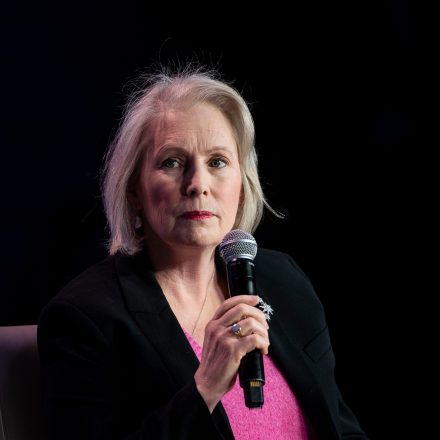 Related
Crypto Darling Gillibrand's 11th-Hour Flip-Flop Helps Block Trump Crypto Bill
Goodlander, Torres, and Warner are all rated as strong supporters of the crypto industry on an industry scorecard. Still, all three have been critical of Trump's personal dealings in the industry though his $TRUMP meme coin, which has helped make him $1.4 billion from crypto ventures.
Warner recently ran an ad of his own attacking Trump over the meme coin.
"That's not governing. It's grifting," the Democratic senator said. "The corruption needs to stop."
The post Giant Crypto Super PAC Funnels Big Money to Former Trump Official's Firm to Support… Democrats? appeared first on The Intercept.
Brazilians will head to the polls on Sunday in one of the most consequential presidential elections of the last decade. The run-off election will determine the future of the largest democracy in Latin America and the fate of the Amazon rainforest.
Incumbent President Luiz Inácio Lula da Silva is facing off against Flávio Bolsonaro, the son of former President Jair Bolsonaro. The elder Bolsonaro is currently on house arrest for his role in a failed 2023 military coup that intended to assassinate Lula, his vice president, and a Supreme Court justice. Despite his father's attempted coup, Flavio Bolsonaro is currently the frontrunner, after coming out slightly ahead in the first round of voting.
"If they don't win this election, then not only is Jair going to stay in jail, most likely, but Eduardo, Flávio's brother and Jair's son, who is in self-exile in the U.S., he has a multiyear prison sentence for his actions in the U.S. lobbying against Brazil's foreign interests. He's not going to be able to go home if they lose this election," says Andrew Fishman, a Rio de Janeiro-based investigative journalist. "So they're really just willing to do whatever they can to make sure that they win because this is their only get-out-of-jail-free card."
Sound familiar? This week on The Intercept Briefing, host Jessica Washington speaks with Fishman, president and co-founder of The Intercept Brasil, about what's at stake for Brazil and the planet in Sunday's election.
"It's a global election. The voters in Brazil will be deciding the future of humanity," Fishman tells The Intercept. Jair Bolsonaro oversaw significant deforestation of the Amazon rainforest, leaving the ecological and climate linchpin in danger of becoming a "savanna." Now, he argues, his son can finish the job. "You're going to have an international migration crisis," says Fishman. "It's really self-defeating because the cattle ranchers are his base. They are the ones that are wanting to do the things that will end their future profitability — the future existence of their business."
President Donald Trump has taken a particular interest in the race, as he seeks to expand U.S. influence and control across the Western Hemisphere. "Brazil — as the biggest economy, the biggest country, the most powerful entity in the hemisphere besides the United States — if Brazil falls, then the rest falls in line," says Fishman. "But if Brazil remains as this big island of resistance in the middle of the continent, it really messes up [the Trump administration's] plans, doesn't it?"
Big Tech is also looming large over the race. "There's all these pieces of circumstantial evidence that suggest that Meta is interfering in this election, and they have every incentive to do so. They will have a much better regulatory environment if Flávio wins because of Flávio's submissiveness to U.S. interests and his willingness to play ball with whatever Trump tells him to," adds Fishman.
In a request for comment, Meta said, "Meta applies the same rules to every candidate, every party and every political viewpoint in Brazil, as we do in elections around the world. We do not suppress content to disadvantage one side, and we do not give preferential treatment to any side. Each of the incidents cited by Lula's campaign has a straightforward, documented explanation. … Brazilian voters deserve facts, not a political narrative built by combining unrelated technical issues. Meta will continue to enforce its rules, comply with Brazilian electoral law, fix mistakes when they occur and provide a level playing field for everyone who uses our services."
As U.S. leaders attempt to mold Brazil into a satellite state, Fishman argues the United States is slowly becoming more and more like its southern neighbor.
"It's not that Brazil is becoming more like the United States, it's that the United States is becoming more like Brazil," says Fishman. "You have just shrinking spheres of democracy while oligarchs have increasing power and control and are able to do what they want and insist on decisions for the country that are bad for all of the society and the people, but good for their individual interests."
For more, listen to the full conversation of The Intercept Briefing on Apple Podcasts, Spotify, YouTube, or wherever you listen to podcasts.
TranscriptJessica Washington: Welcome to The Intercept Briefing, I'm Jessica Washington, politics reporter at The Intercept.
Akela Lacy: I'm Akela Lacy, senior politics reporter at The Intercept. Jessie, what do our listeners need to know about this week?
JW: I've been following a pretty disturbing story that's actually centered on a campaign ad. Ohio gubernatorial candidate Vivek Ramaswamy released what I would argue is the ugliest campaign ad of a dark season. That is, of course, a season of campaign ads filled with Islamophobic, transphobic, sexist rhetoric, and racist rhetoric as well. But in the ad, the mother of Democratic candidate Amy Acton accuses her daughter of being a liar, claiming "she's lied her whole life."
Now, what makes this really dark is that Acton was removed from her mother's care at 12 years old, after she alleges she was raped by her mother's then-40-year-old husband.
AL: That's horrible. Has Acton responded?
JW: Acton responded to the attack ad saying, "My brother Phil and I endured abuse, hunger, and neglect. We were often kept in a dark basement, were frequent-fliers with child protective services, and lived in fear of our birth mother's violent and erratic temper. I've always known that she was deeply sick and unwell, and it's sad to see Vivek Ramaswamy exploit her all for his own political gain."
This is one, as I've said, of the darkest campaign ads in a really horrifying season of campaign ads.
Akela, I know you've been tracking another big election story this week on a beat you've covered for a really long time, and that's [American Israel Public Affairs Committee].
AL: So we have been covering extensively the way that AIPAC's strategy has changed over the last few election cycles since they started spending directly on campaigns.
Related
AIPAC, AI, Crypto, and Gambling Are Hiding Their Big Election Spends
If you've been following our reporting, you know that we've written a lot about both their super PAC, United Democracy Project, and this shell PAC strategy where there were a number of different groups that popped up throughout the midterm season, took money from AIPAC, spent against candidates that AIPAC didn't like, and then — per filings that came out this week — shut down and gave all their money back to AIPAC.
So the idea being that, they had been trying to shield what was an increasingly toxic reputation amid the ongoing genocide in Gaza from creating backlash against their activity in these races.
Jewish Insider scooped on Wednesday that AIPAC announced that it will no longer endorse candidates or give PAC contributions through its AIPAC PAC. Now, this doesn't mean that they will stop spending on elections. Their super PAC, United Democracy Project, will continue to spend, as it has been pouring record amounts of money into various races. But this is getting a lot of attention, both from the left and I would say from the center.
The left, Justice Democrats in particular, and candidates who are no longer in Congress, but I saw Jamaal Bowman talking about this, saying that this is the culmination of the fight that the left has been putting up against AIPAC in elections. I don't know that I would categorize this as a win necessarily, considering that the super PAC seems like it's going to continue to spend a lot of money. But that was the big news in my campaign finance world this week.
JW: You've done a lot of really interesting coverage of how AIPAC is moving their money around through these different PACs and trying to get around the fact that people really dislike AIPAC, and that it has really tarnished the reputation of candidates who take this money. Obviously, this is a maneuver to get rid of the reputational harm of AIPAC money while still giving people AIPAC money.
I've actually been tracking a story completely off our election cycle, and that's what's going on in France. I know we touched on that a couple weeks ago but, really, these protests have taken on another life.
For those who don't know, in France, there were these protests that were initially launched by students primarily in the suburbs concerned about educational inequality. This meant staffing shortages and poor facilities. But it has exploded into a nationwide uprising about the cost of living and broader economic inequality.
Now, perhaps unsurprisingly, and not to bring it too quickly back to the U.S., but President Donald Trump has used this as an opportunity to rail against immigrants. So despite the fact that there is zero indication any of the violence has been spurred on by immigrants. At a campaign rally on Monday, he told the crowd, "If Europe doesn't close its borders and bring the criminals out, like the people that are protesting, Europe is finished."
So yeah, that's just one other example of how Donald Trump has inserted himself into international politics.
AL: Trump has also inserted himself into politics in a different region in the world. We have the Brazilian elections for president heading to a runoff this week. I know you spoke, Jessie, to Andrew Fishman, an investigative reporter and president and co-founder of The Intercept Brasil, about those elections.
JW: It's a really interesting election with a ton of parallels to the political situation in the United States, as well as, as you've pointed out, a ton of influence from the United States. On Sunday, Brazil will have a run-off presidential election that will determine the future of not only Latin America's largest democracy, but also — and this is really important — the fate of the Amazon rainforest, and one could argue, the planet.
This is the first presidential election since former Brazilian President Jair Bolsonaro was imprisoned on house arrest in an attempted military coup, a sentence that his son, the current frontrunner, Flávio Bolsonaro has promised to overturn.
I talked to Andrew about the media landscape, the history of military leadership, and the outside influences that have made this a tight race, despite the fact that the perceived frontrunner is running on freeing the man who attempted a coup years prior.
President Luiz Inácio Lula de Silva is running for reelection. He's accused both President Donald Trump and Meta of attempting to sway the election in favor of Flávio Bolsonaro.
The Intercept reached out to Meta for comment, and Meta denied interfering in the election process, saying they do not suppress content to disadvantage one side or give preferential treatment to the other.
But this is a really interesting conversation with Andrew, and I'm excited for people to get to hear it.
AL: As am I. Let's hear it.
JW: Andrew, welcome to The Intercept Briefing.
Andrew Fishman: Hi, thanks for having me.
JW: On Sunday, Brazilians will head to the polls in a runoff presidential election between right-wing senator Flávio Bolsonaro, son of former President Jair Bolsonaro, and incumbent left-wing President Luiz Inácio Lula da Silva to determine the leadership of Latin America's largest democracy and biggest economy.
Now, this is the first presidential election since former President Jair Bolsonaro's supporters stormed the Capitol in 2023 and attempted to overturn the election results. Now, Flávio Bolsonaro, his son and ally, is widely considered to be the frontrunner after coming out slightly ahead in the first round of voting.
But as of Tuesday, his lead in the polls has been narrowing. Andrew, big picture, what are the major issues at play in this election on Sunday?
AF: If you want to be really direct about it, it's the future of humanity.
You have one candidate who's been responsible for record reductions of deforestation in the Amazon; and you have another one who's saying, let's chop it all down, and farmers should be able to do whatever they want on their land.
And under his father's leadership, deforestation in the Amazon soared, as in the other regions in the area. Scientists think that there's a major tipping point that we could be on the cusp of, that if we were to reach that, the Amazon will turn into a savanna. There would be no going back from that.
If that were to happen, all of the rain in South America comes from the Amazon, basically. [That would affect] the cattle ranching that's doing the deforestation, no more of the soy that's doing the deforestation — people would have trouble feeding themselves. São Paulo would probably run out of water, which it has done in the past.
It's very precarious. So you would be having mass refugee influxes, migrations. I really do think that this election is on that scale; it's a global election. The voters in Brazil will be deciding the future of humanity, very possibly.
JW: To your point, his father, former President Jair Bolsonaro's administration oversaw significant deforestation of the rainforest, which houses 10 percent of all [known] species on Earth, and his son appears to be moving in that same direction.
Flávio told reporters in August that he did not believe in climate change and that "the best way to address environmental issues is what we did during the Bolsonaro administration," referring, of course, to the senior Bolsonaro's administration.
What is at stake for climate change when we're talking about this massive deforestation that could potentially be happening if Flávio wins?
AF: Every ecosystem in South America is interconnected and in the world. If the Amazon collapses and turns into savanna and the rainfall stops, and you have this massive drying out of the continent — which is one of the major exporters of food in the world — you're going to have all of those issues locally, and that's going to impact local markets and everything. You're going to have an international migration crisis.
But on top of that, we have no idea what the ecological knock-on effects of that could be. With that, we could be having a more rapid increase in polar ice cap melting. With the temperatures increasing, it could be exacerbating the death of the Atlantic Meridional Overturning Current, which is the thing that would put Europe back into an ice age. It's very possible that's already happening right now.
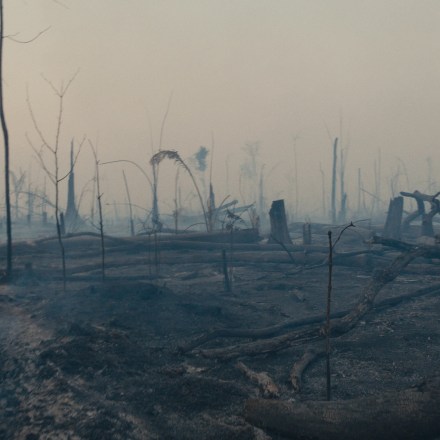 Related
The Front Lines of the End of the World — and the Fight to Save the Amazon
We're at this really tenuous moment for the climate, for the Earth, for humanity. And you have a candidate that says very proudly [he] doesn't believe in any of that and wants to slash all mechanisms that are used to have more responsible management of land and prevent this massive catastrophe in just this proudly Luddite sort of way.
It's really self-defeating because the cattle ranchers are his base. They are the ones that are wanting to do the things that will end their future profitability — the future existence of their business. It's really self-defeating in this way for the Brazilians, and these very short-term benefits for massive long-term costs.
There's estimates that the impact that the Amazon has for the global economy is in the hundreds of billions of dollars a year, and that benefit is far larger than the profits that they get out of these extractive industries that they do with farming and mining. It's really hard to overstate the potential impacts that this could have.
JW: Is that urgency resonating with voters?
AF: Absolutely not. That is not what people are voting about, unfortunately. It's what the people living in the heavy agricultural regions — where their local economy depends on that — they're voting for Flávio for that reason. But the people who are voting against him, yes, there's many people that care about the Amazon and want to preserve it, but it's not the issue that's being discussed day to day on TV, in the news, on the streets.
People are talking more about more human issues of corruption and who has better communication, security, economics. They're not talking about the Amazon, unfortunately.
JW: That's hardly surprising in the U.S. context, which I'm a little bit more acquainted with. Certainly climate, the environment, have never been top issues for voters, even if they've resonated more so with young people.
I did want to talk about another issue in the election, and that is the fate of Jair Bolsonaro. His son, Flávio Bolsonaro, has promised to free him. Jair Bolsonaro has been imprisoned on house arrest since 2025 for plotting a military coup. How is that particular campaign promise landing with the electorate in Brazil, and are you at all surprised by the public's response?
AF: It's very clear that for the Bolsonaros, this is an all-or-nothing for them. If they don't win this election, then not only is Jair going to stay in jail, most likely, but Eduardo, Flávio's brother and Jair's son, who is in self-exile in the U.S., he has a multiyear prison sentence for his actions in the U.S. lobbying against Brazil's foreign interests. He's not going to be able to go home if they lose this election.
For them, it's been very clear, and they've even said it in moments, that's what this is about for them: their ability to get their father out of prison and to get themselves off the hook. Also, if you're elected president, the investigations on things you did before you got elected, they go away.
"They're really just willing to do whatever they can to make sure that they win, because this is their only get-out-of-jail-free card."
So then Flávio's off the hook, and he's so wrapped up in so many different schemes and accusations and active investigations, some of which that we have revealed, including U.S. and abroad and offshore bank accounts and money laundering and potential connections to organized crime and militias. So they're really just willing to do whatever they can to make sure that they win because this is their only get-out-of-jail-free card. To do that, they're going to completely change the structure of the Supreme Court, and they'll be able to put in a majority even without impeachment. They already have the Senate and the lower house of Congress.
They would control all of the executive branch. They have the majority of governorships that are in their coalition, and they run the local police. And the executive has control over the federal police and all the investigative and regulatory agencies. So they would have just absolute lockstep control over every branch of government federally and most of local government as well.
It would be a democratically elected coup.
JW: And voters, do they care about that? Do they care about the preservation of democracy? Is this ranking as a top election issue?
AF: It's always double speak, right? Both sides say that they're preserving democracy. The Bolsonaristas say that Lula and the Supreme Court are running a judicial dictatorship right now because they were getting censored and put in jail for actively plotting a coup, which included active planning to assassinate Lula after he was elected, his vice president after he was elected, and a member of the Supreme Court. So that's what they're [Jair Bolsonaro and military officials] in jail for. That's why they were getting pushback, and they're saying that having the pushback against that is a dictatorship.
In the meantime, you have the Lulistas who are saying that what the Bolsonaros want to do is a coup because they actively have said year after year, over and over again, "We want a coup. We love the military dictatorship. The military dictatorship was great! When we were torturing everybody, that was good." Jair said, "When I'm elected, we're going to take a machine gun and shoot down all of the leftists, the petistas, the Workers' Party [Partido dos Trabalhadores] supporters."
Remember that the military government was going alive and strong into the '80s. It happened in '64, and it went through the '80s. So it's very recent.
The people that are in his orbit, they were actually part of the military coup government until very recently. And I think that Lula supporters are very, very concerned about this. They really do care.
The Bolsonarista supporters, which are about 30 percent lockstep — same as it is in the U.S. with Trump — they're just in their own information ecosystem, and they want Bolsonaro to win. It doesn't matter, and anything that he does is good because it's him.
"They're just in their own information ecosystem, and they want Bolsonaro to win."
It's not, there are people that support the Workers' Party, and there are people that support Bolsonaro. The Bolsonaro movement is essentially anti Workers' Party, anti-petismo. The Bolsonaros have been seen as the greatest vehicle for getting rid of the Workers' Party, which has been so hard to do because they've been so popular because of all the policies they've put into place over the years.
But you've had the media saying for 30 years now, just drilling it in, that the PT [Partido dos Trabalhadores] equals corruption, the PT invented corruption. The PT is everything that is bad in Brazil, and anything that is not the PT is everything that is good in Brazil. You've had a generation of this narrative being repeated over and over in all these different instances that it's really hard to shake.
JW: Could you talk more about that legacy of military leadership in Brazil, and for Brazilians, how they feel about it on the day to day? I recognize that it's a very large country, as we've mentioned multiple times. I assume not everyone feels the same way, but I am curious about that legacy and how people respond to it.
AF: Brazil has been a country of negotiated solutions. So when they were the last in the Western Hemisphere to abolish slavery in 1888, it was not some sort of civil war or uprising. It was a negotiation: "OK, I think it's time that we do this, but let's just make sure that everyone that did own slaves is in the best possible situation, and let's make sure that we have some sort of semi-slavery going on afterwards."
It was really the same thing with the dictatorship. It was a moment where the economy was going into the can. It was very unpopular. It wasn't having the economic glory years of before, and so they said, "All right, we'll step back. We'll let you run some elections, but we're going to make sure that we're never held accountable, that we're able to continue exercising power in the way we want."
As part of that, they were able to help control the narrative. So during the military dictatorship, there was an impression — and it continues today — that there wasn't corruption. The reason why they had that impression, it was actually very corrupt, very corrupt. But the impression exists because there was censorship of the media, so the corruption that existed just wasn't exposed.
When the Lula government came into power the first time in the early 2000s, they started making the federal police stronger. They made the judiciary stronger and more independent. They increased the ability of the federal government to investigate and uphold the rule of law. As a result of that, many corruption schemes started coming out of the woodwork that were legacy of the military leadership.
"It was the business elite together with the military that did the coup and ran everything."
It was called a civil military dictatorship, technically, in Brazil, because it was the business elite together with the military that did the coup and ran everything.
So that business elite didn't change. It's still the same families. They were running the same corruption schemes back then. They were running it through re-democratization. Whether it's a right-wing government or a left-wing government in power, they're making sure that their interests are being served. That corruption is just this constant throughline. People don't really see that because that's not how it's presented in the media and in the day-to-day in communications.
I know for a fact that there's lots of people that really want us to go back to the dictatorship. There are people that really want us to go back to the monarchy because they see it as a better, simpler time when things were the way that they should be. Everyone was in the right place and things were safer and everything was just better, this idealized past, "Make Brazil Great Again" sort of thing. How far back do you want to go?
Then there are the people that, like Dilma Rousseff, who was the successor to Lula after a second term — who fought against the dictatorship — that are currently active in politics, that are still around, and they were tortured. Their friends were murdered. They know exactly what a dictatorship means and what it means for people like them, anyone that stands against those entrenched powers of the old elites that go back for centuries.
That's why you have a lot of older voters tend to vote PT [Workers' Party] because they came up with the workers' struggle with re-democratization. They understand what that means. It's this interesting dynamic now where you have more younger people that are starting to tip more to the right because they don't have this memory.
They don't remember what it was like in the '80s in the northeast when there was water shortages and food shortages, and the standard of living was so much lower. You have this new narrative being rewritten in real time online.
"You have more younger people that are starting to tip more to the right because they don't have this memory."
JW: The parallels to the United States and Brazil are just incredibly striking in what you're saying. This kind of the "Make America Great Again" movement and the Make Brazil Great Again, even if they're not using those exact same phrases. There are just so many points of similarity, especially with what we've seen with youth even in the United States, some of whom have taken a rightward tilt.
I want to get into the relationship between Brazil and the U.S. because that's obviously been such a big issue in this election. In a Lula ad earlier this month, his campaign called Flávio Bolsonaro Trump's candidate, arguing that, "What Trump wants is to colonize Brazil, take our riches, steal our future, and leave us in the dust."
Now, this comes after President Lula confirmed that Brazil denied visas to two U.S. officials over election interference concerns. The State Department has denied any claims of election meddling, telling reporters, "Any insinuation of a 'ploy' to undermine a democratic nation's election is a baseless lie."
Andrew, is there any evidence that the Trump administration is attempting to sway this election? Does it veer into election interference as we generally understand it?
AF: The answer is oh God, yes. So much so it's overwhelming. Overwhelming evidence, and it's the same thing they've been doing across the region, which is why there's been this rightward swing in elections across Latin America.
 Related
Latin America's New Right Ushers in Pan-American Trumpism
That's why they're so interested in Brazil right now because Brazil — as the biggest economy, the biggest country, the most powerful entity in the hemisphere besides the United States — if Brazil falls, then the rest falls in line.
But if Brazil remains as this big island of resistance in the middle of the continent, it really messes up their plans, doesn't it? The interference has been done on many levels. The reality is that we don't know the full extent of it, and we won't know the full extent of it for years. We're still learning about things that happened in 1964 with the U.S. role in the coup.
There's dirty tricks happening that's being run through intelligence agencies. That's absolutely positive. There's very, very strong signs that they're using U.S. companies, Big Techs like Meta, who's been getting a lot of attention — a lot of flak — lately because of clear signs that its algorithm is favoring Bolsonaro and suppressing Lula.
Multiple instances that they even admit happens, "Oh, but no, but it was just a mistake. It was just a mistake." Meta and the Big Techs in the U.S., they're really concerned about what a Lula government could do for their profits. Maybe Lula wants to have more sovereignty and control over what they're doing.
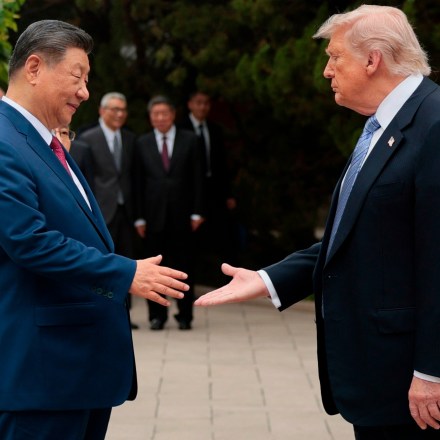 Related
The Dawn of a New Cold War
The Brazilian government doesn't even know how much money they make in Brazil, the Big Techs. They just know how much money they send out through the tax bills that they pay and the money they send out of the country. The Big Techs in the U.S. are really concerned about getting their access on rare earths and on lithium reserves, which Brazil has the largest deposits of rare earths after China. This whole trade war with China, Brazil becomes much more important. It's a huge market.
So you have one candidate that is just completely submissive — like painfully, embarrassingly submissive — to U.S. interests. So much so that one of his former closest allies, a general, Santos Cruz, who's a very famous well-known general, he came out recently and said, "I'm a conservative. I'm right-wing. This is not conservatism. This is not right wing. This is just 'voluntary submissiveness.'"
"You have one candidate that is just completely submissive — like painfully, embarrassingly submissive — to U.S. interests."
They're just absolutely scamming Brazilians with this level of supplicancy that we've never seen before, that the military dictatorship even didn't do, which was hand in glove with the U.S. interests. This is completely next level, and it's something that obviously the left is very concerned about.
But people like Santos Cruz, Brazilians that actually believe in Brazilian sovereignty, and that it's important for Brazil to be able to pursue its own interests rather than the interests of foreign powers — they're very concerned about that, which is, some segments of the elite.
Whenever you have a submissive local government in an imperialist relationship, there are people that benefit. There are local people that will get special contracts, that will get special treatment. They'll be able to crush their enemies through these relationships. And that's what they're doing in Bolivia and in Peru and in Ecuador right now.
"Whenever you have a submissive local government in an imperialist relationship, there are people that benefit."
What they did in Venezuela, where they just came in and took all of the oil and said, "All right. We're going to take 90 percent of the oil profits, and we'll give you a couple billion a year." People are seeing this in Brazil. They see what Trump has done. And they're still saying, "Well, we like Bolsonaro, so we're going with Bolsonaro. I'm sure it'll be fine."
It's a massive issue, and I really, I don't think we know how bad it will be and how submissive they'll be this time around. Because it always is the case that, with right-wing authoritarian governments, it's the second term where they really take off whatever mask was left and decide, "We have a mandate and we can do whatever we want."
You saw it in the U.S. with Trump. They saw it in Turkey with Erdoğan. They saw it in Hungary with Orbán. They saw it in India with Modi. This is what always happens. It's the second term where they say, "OK. We showed them who we are, and everyone said it's fine." They're able to smoke out all of their rivals in the first term. They map them out, and so when the second time comes around, it's just bang, bang, bang. Let's get rid of them. Let's maximize our power and do whatever we want.
"With right-wing authoritarian governments, it's the second term where they really take off whatever mask was left. … It's the second term where they say, 'OK. We showed them who we are, and everyone said it's fine.'"
The result's not going to be positive for Brazil. That's the thing: If I were a Brazilian billionaire — which I am not — it would be in my personal interest for Brazil to follow the economic path that the Lula government is following, much more than what Bolsonaro is proposing.
Lula's not some left-wing radical. He's center-right. He was left, then he became center-left, and he's moving ever more to the right. This last election, his vice presidential candidate was his former presidential rival, the center-right guy. They're very much doing what the big banks want. They're helping the big agro get what they want. They give tons of subsidies to major industries. But the thing that they do, they take a little bit of that money, and they spread it around to the poorest people with public services with access to education, with some cash transfers. We're talking about 60 bucks or 80 bucks a month to families, and that is what is making the economy grow. Because if you don't have consumers in your economy, and you have domestic industries you're trying to build, then no one's going to buy the things. Your employees can't buy the things.
That's intolerable to some people in Brazil, and they can't see that it benefits their own economic interests.
You're in this kind of crazy situation where it doesn't really make sense what they're doing. And they saw it happen with Bolsonaro, with Jair! They all supported him, and then he crashed the economy. Then they all went back to Lula begrudgingly and said, "OK, we're going to support you in '22 because things aren't going very well."
Then Lula turned it around immediately, and now they're forgetting again and going back to Bolsonaro. Logically, it doesn't make sense. It's more psychological. Freud has to explain what's going on.
"Lula's not some left-wing radical. He's center-right. He was left, then he became center-left, and he's moving ever more to the right."
JW: Again, the parallels between the United States and Brazil are very apparent in terms of some of those economic choices. You've already gone over what the U.S. wants to gain from involvement in this election. But there's another foreign power that's also interested in the election. Flávio Bolsonaro has been cozying up to Israeli Prime Minister Benjamin Netanyahu, obviously in stark contrast to President Lula, who's been an ardent supporter of the Palestinians. What would a Flávio Bolsonaro presidency look like for Brazil's stance towards Israel?
AF: You can't say that Lula has been the heroic savior, but he has made statements saying, "This is a genocide. This is very bad. This shouldn't happen."
At the same time, he's allowed Petrobras to ship petroleum products to the Israeli government that are being used in the genocide. He's allowed one of the major steel manufacturers to ship steel and ore to the Israeli weapons companies that are using it to build rifles and bombs to use in Gaza.
It's not like you're dealing with the leader of BDS [Boycott, Divestment and Sanctions movement] versus Netanyahu's best friend. It's a run-of-the-mill European-style center-left social democrat leader that's kinda disappointing on this issue, versus someone that just wants to be absolutely submissive to everything that Israel wants and does and just completely supports it.
Again, you said, there's so many parallels to the U.S. The parallels in Brazil, why does this make sense? Why would they care about supporting Israel? Why would this be something that they would want to put their name on, like these horrible scenes that people have been seeing for years online?
Everyone's seeing it. Why would they want to support it? They kind of want to do the same thing in Brazil. One of the things that Jair always complains about is that he's jealous of the U.S. because their cavalry was more effective at exterminating the Indigenous population than the Brazilian cavalry was. They're upset that they have these relatively small numbers of Indigenous people that have claims to these massive swaths of land, much of which in the Amazon, that they want to get their hands on so they can cut down the trees and throw cows in and do mining. So a colonial-settler project that involves extermination of the Indigenous population to benefit their economy.
"They're upset that they have these relatively small numbers of Indigenous people that have claims to these massive swaths of land, much of which in the Amazon, that they want to get their hands on."
That's what Israel's doing, and that's what they want to do in Brazil: "Why don't you give me all the fun, fancy tools of espionage and surveillance and war and suppression that you guys have developed and honed in Israel for the last decades, and let me get my hands on them too so I can do the same thing back here."
I think that's one of the main reasons ideologically. Plus the whole political, evangelical right-wing movement, which was a concerted project by the CIA to implant in Latin America, bringing in prosperity gospel to get rid of the Catholic Church and all their support of left and workers movements.
Related
Apocalypse Now: Naomi Klein and Astra Taylor Investigate the End-Timers Alliance
This is all very well documented, that they brought it in because it's more individualist ideology, and that individualist ideology also includes the idea that all the Jews need to go to Israel for the reckoning.
There are a ton of parallels between Brazil and the U.S., and that's because almost all of the worst ideas in the United States have been intentionally exported to Brazil as a way to make Brazil a worse country that's more in line with U.S. interests.
That includes healthcare companies. The U.S. model of healthcare. They have free, independent public healthcare in Brazil called SUS [Sistema Único de Saúde]. It's an incredible system that's very popular. They want to privatize it. They want to get rid of it to create more profit. Prosperity gospel with all this right-wing ideological movements, they love it.
"Almost all of the worst ideas in the United States have been intentionally exported to Brazil as a way to make Brazil a worse country that's more in line with U.S. interests."
The NRA sent lobbyists down in 2002 to Brazil to work with the right-wing movements to say, "This is the game plan for how you create a gun movement in Brazil." And what happened? It manifests itself in the Jair Bolsonaro administration, where they just opened up the floodgates for access to guns, increasing the number of guns you have, the type of guns that you could have, the number of bullets you could have, and getting rid of anything that could help prevent organized crime from getting massive amounts of assault rifles and unmarked bullets they can use in crimes. Under Bolsonaro, that's one of the things that spread more than ever.
There's all these little levers that they're really just doing copy and paste, and we've seen these alliances with JD Vance and the Rockbridge [Network], which is a group that he created before he was vice president with a bunch of Peter Thiel and other billionaires in the U.S. They've created a subsidiary in Korea and now one in Brazil that they were using to do the same sort of alignment with the local elites that they did before, in the lead-up to the '64 coup. I can go on for hours about all the different connections and ties.
JW: To your point, you've talked about how this is much bigger than just Brazil.
To me, the "Donroe Doctrine" is hanging over all of this. Last November, President Donald Trump released what he described as a corollary to the 1823 Monroe Doctrine, the "Donroe Doctrine," which effectively calls for the U.S. to take an aggressive interventionist stance in Latin America under the guise of protecting the United States' national security and economic interests in the region.
Andrew, from your perspective, what more should we understand about what the United States is doing in Brazil and kind of the wider context of the Trump administration's actions in Latin America over the last two years?
AF: It's pretty simple. They are fighting the Cold War against China in Latin America, just like they used to do against the Soviets. As part of that war, they are aligning with far-right upstart leaders that are seen as anti-establishment, even though they're usually tied to billionaires or even billionaires themselves, like in Ecuador.
 Related
Trump Frees Ex-President of Honduras, Right-Wing "Narco-Dictator" Convicted of Drug Trafficking
There's this weird coincidence with all of them that they almost all have connections to organized drug trafficking. They're almost all known drug smugglers or connected to them or have some sort of financial relations. While they're doing that, they're arguing that "We are working together with these local governments in South and Latin America to fight drug trafficking," which is obviously a farce.
That's what they did in Ecuador. The president of Ecuador, Noboa, he's the son of a banana dynasty that does a lot of exporting bananas, and in those crates of bananas, they've also been known to export a lot of kilos of cocaine. Their allies in Colombia have always been this way, and the things that they're doing in Bolivia, it's the exact same thing. The [Bolivian] attorney general who was trying to push back against the corruption of this right-wing government that has allied with Trump, well Trump and Rubio came in and said listen, you need to go after this attorney general and get rid of him. So he was arrested because he was going after their allies.
They don't care about drug trafficking, obviously. The U.S. government never cared about drugs. It's always been a weapon or a tool for them. So they're aligning with these people to create this lockstep union that they're calling the "Shield of the Americas." It's this new alliance that they're using instead of the existing, the U.N. or other mechanisms. They're creating all their own, just like they did with the "Board of Peace." They're working to make sure that those economies just stay in their sphere of influence just a little bit longer.
They know that China's winning. China is the main trade partner with all of these countries now. They're Brazil's biggest trade partner. The United States cannot absorb all of the exports that Brazil produces that goes to China. They're not going to get Brazil to stop trading with China or stop having relations with China. They compete on corn and ethanol and soy exports. They can't absorb what China's buying.
"They're really just trying to buy a little bit more time as their empire is slowly waning, but at the cost of what?"
They're really just trying to buy a little bit more time as their empire is slowly waning, but at the cost of what? At the cost of tens of thousands, hundreds of thousands, millions of lives? It's not clear what the indirect results of this will be. At the cost of destroying the democratic institutions in these countries that are already, many of them struggling and teetering, and potentially at the cost of massive ecological devastation, as would be the case in the collapse of the Amazon under a Bolsonaro government?
It's uplifting, right?
JW: Very uplifting. That is my first word that comes to mind. You've pointed out everything that Donald Trump is doing, but we a
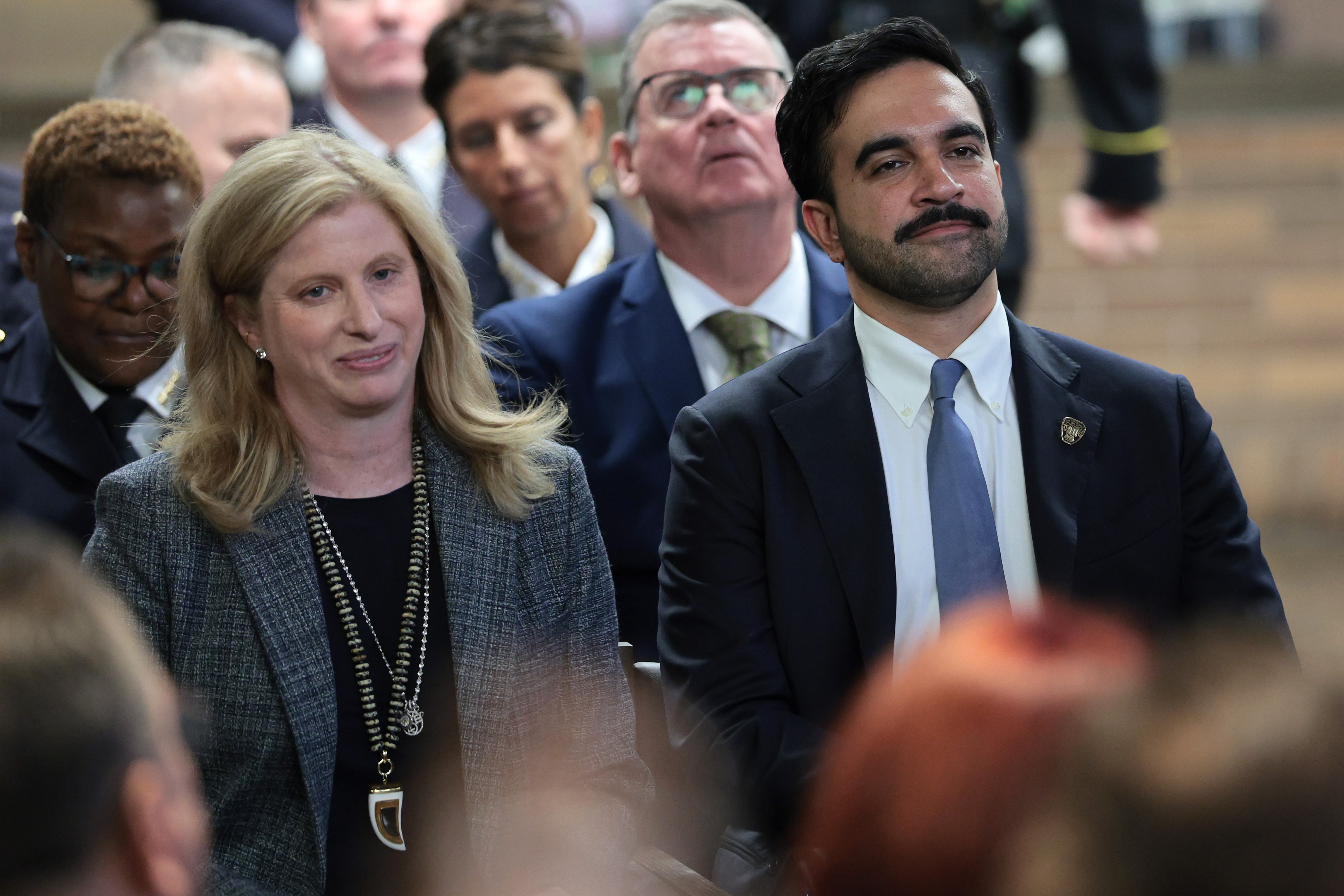 NYPD Commissioner Jessica Tisch and Mayor Zohran Mamdani attend an unveiling ceremony for a new 9/11 Memorial Wall on Sept. 9, 2026, in New York City. Photo: Michael M. Santiago/Getty Images
The October 8 shooting of Oscar Belgal by Immigration and Customs Enforcement agents in front of his 5-year-old son in Manhattan forced into the open a question that had been on many New Yorkers' minds: What would the New York Police Department do when ICE broke the "rule of law" in the city, and how would Mayor Zohran Mamdani, the person who has the power to hire and fire the NYPD commissioner, respond?
Shortly after the shooting, Mamdani addressed the incident with an appropriate amount of outrage, declaring ICE "rotten to its core," and calling for the department to be abolished. His frustration was visible, but he was much less expressive when it came to his appraisal of the city's response to the situation. He had nothing substantive to discuss with respect to his police department's involvement, despite NYPD officers arriving on the scene only to find unidentified ICE agents holding guns, wearing plain clothes and disguises and masks, in apparent violation of federal laws requiring identification. (A recently passed New York state law prohibiting federal agents from wearing masks and other face coverings was temporarily blocked by a judge.) NYPD officers applied first aid and transported Belgal to NewYork-Presbyterian Allen hospital.
According to many eyewitness accounts and widely circulated video, members of the NYPD appeared to assist ICE agents by forcefully helping with crowd control — at one point, an NYPD officer shoved congressional candidate Darializa Avila Chevalier, whom Mamdani personally stumped for, to the ground. Later, NYPD cleared a path for federal agents to whisk Belgal away from the hospital to a federal detention facility downtown.
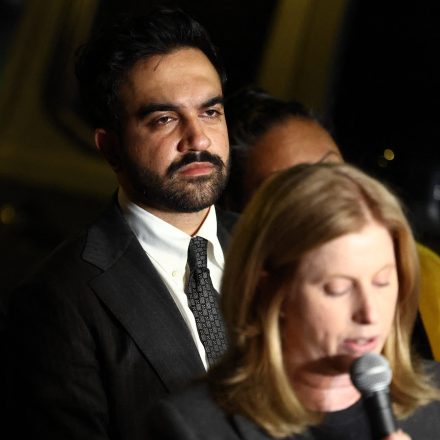 Related
ICE Shooting in NYC Inflames Mamdani's Policing Problem
After the shooting, the Democratic Socialists of America, several legislators, and Avila Chevalier all called on Mamdani to fire NYPD Commissioner Jessica Tisch and demanded the mayor uphold his campaign pledge to disband the NYPD's infamous Strategic Response Group. Mamdani repeatedly refused to fire Tisch but said he was reviewing the 24-hour period around the shooting. When asked directly about Avila Chevalier being thrown to the ground, the mayor called it unacceptable, saying, "That is not something I will look to justify." He reminded New Yorkers to be patient with efforts to reform the NYPD, ordered a review of the department's use-of-force policies, and added funding for the inspector general's office. But once again, he stood by his commissioner, citing "her record of uprooting corruption from the upper echelons of the NYPD while lowering crime across our city."
Noticeably absent from any of Mamdani's public remarks about the NYPD or Tisch was any public acknowledgment of the NYPD officers in relation to ICE agents during the Belgal incident.
Federal and city law enforcement occupy similar spaces but never really interact with each other. Mamdani made no mention of the ways in which the actions of federal agents put pressure on the NYPD as mediators — the primary function of police — to liaise in moments of conflict.
The NYPD typically relishes this role, which is why the department consumes so much of New York's budget and shuns any attempts to redirect funds to other services that might reduce the need for police mediation to begin with. ICE forces local police to make choices in policy and in practice about how to deal with violent (often illegal) immigration operations.
If the NYPD believes itself to be the thin blue line, on which side of order and chaos do New York's force and Mamdani believe these federal outside agitators to be?
When it comes to ICE, Mamdani's rhetoric and policies haven't always aligned, which has opened him up to questions about the kind of mayor he really is.
This omission — or evasion, depending on how you look at it — of this predicament is strange considering Mamdani's willingness to speak with moral clarity about even the most contentious issues and confront them head-on. It's also bizarre considering his penchant for weaving shared experiences together and for putting the lived experiences of New Yorkers front and center.
On the campaign trail, one of Mamdani's most alluring traits was his ability to speak to the actual problems of everyday residents. It wasn't just because he possessed once-in-a-generation oratory skills; candidate Zohran achieved this because, as a proud democratic socialist, there was an analysis — an explanation of the material conditions of life — baked into his politics. His rhetoric seemed in line with, or at least not alienated from (see: establishment Democrats), how fast reality was moving and how it was impacting the lives of everyday New Yorkers.
When it comes to ICE, however, Mayor Mamdani's rhetoric and policies haven't always aligned, which has opened him up to questions about the kind of mayor he really is. On one hand, he has shown that he will speak out against Trump's fascist and inhumane immigration efforts. On the other hand, Mamdani hasn't moved with the same level of force as his words. Many have pointed out that Mamdani seems to be engaging in realpolitik in an effort to get his extensive progressive agenda passed. It's certainly not easy to bring the machine of the New York government up to speed while also being transparent about the ways in which he is moving the needle. But that's exactly what he was elected to do.
Had Mamdani got into office and done nothing different than previous mayors — or even been exceptionally corrupt, pro-cop, and willing to help the Trump administration like predecessor Eric Adams — he might have been able to avoid his current moment of reckoning. But his administration's genuine efforts on immigration set into motion a future where the NYPD and ICE would come into conflict.
One of Mamdani's first moves as mayor was to take stock of how the city's many agencies were upholding existing sanctuary city laws. In February 2026, he signed Executive Order 13, his first major order pertaining to immigration, to create the Mayor's Office of Immigrant Affairs and establish baseline guidance, such as explicitly prohibiting ICE and other non-local law enforcement agencies from using city-owned garages and vacant lots. Crucially, EO 13 also required an audit of several agencies, including NYPD, to review their immigration-related policies.
 Related
Local Cops Flout Sanctuary Law to Help ICE Deport Immigrants
NYPD already has a problematic history dealing with immigration enforcement. During the Adams administration, there were documented cases where the NYPD assisted or collaborated with immigration enforcement, sometimes in accordance with NYPD policies. A December 2025 report by Jocelyn Strauber, then-commissioner of the New York City Department of Investigation, found at least one incident in which "an officer violated local law by providing assistance to federal authorities in connection with enforcement of the federal civil immigration law," as well as evidence that NYPD did "not fully comply with documentation and reporting requirements concerning requests for assistance with federal civil immigration enforcement." The report also found that there were numerous examples of NYPD policies and practices that elevated the "risk of improper information sharing or assistance to federal authorities for purposes of civil immigration enforcement."
The resulting audit, which was released on May 22 by Mamdani's deputy mayor, built on those findings and recommended NYPD (and other city agencies) update its reporting requirements. But the audit also left a lot of open questions, which numerous legal advocates attested to, about areas in which NYPD protocols and policies keep avenues open to potentially collaborate with ICE. The NYPD was "not being held to a high standard of accountability or scrutiny for collusion," the audit found, and there were significant "gaps" in documenting potential violations of department policies. The question of what the city and its mayor could do to ensure compliance also remained unanswered.
Sanctuary laws prohibit using city resources for immigration enforcement, and a January 2025 NYPD internal memo specifically barring officers from facilitating street closures to enable immigration enforcement seemed to solidify that directive. But several high-profile incidents involving the NYPD have tested the department's compliance with sanctuary laws. In October 2025, before Mamdani was elected, during an immigration raid in Chinatown, eyewitnesses and viral videos showed NYPD officers establishing perimeters to create a path for federal law enforcement agents. In another instance in May 2026, ICE reportedly "dragged" a Nigerian immigrant out of a Brooklyn hospital after agents used force in his arrest; NYPD officers brutalized and arrested numerous protesters and cleared debris from the road to enable ICE to escape the crowds and abscond with their target.
When the NYPD arrives at an ICE raid or at a protest against an immigration abduction, what are officers supposed to do?
Both of these incidents happened under the watch of Tisch, who has insisted again and again that the department follows all sanctuary laws. When asked about the Brooklyn incident, Mamdani insisted NYPD was responding to 911 calls about the protest, not helping ICE. "Our laws leave nothing, no room for interpretation about the fact that our NYPD will not participate in civil immigration enforcement," he said. NYPD told the Guardian US: "Upon arrival, officers observed numerous individuals acting in a disorderly manner, obstructing vehicular traffic, and blocking emergency entrances and exits at Wyckoff Heights medical center."
 Related
LAPD Won't Do Immigration Enforcement — But Will Shoot You With Rubber Bullets for Protesting ICE
When the NYPD arrives at an ICE raid or at a protest against an immigration abduction, what are officers supposed to do? On this point, NYPD and Mamdani have offered little clarity. But October 8 doesn't pass the smell test for anyone who lives in overpoliced neighborhoods or closely observes the activity of police and their behavior.
NYPD officers were responding to an unrelated call nearby when they heard the report of shots fired. When they arrived, they encountered several men in various forms of attire, including some in construction-style vests, face masks, and at least one carrying a long gun, which officer body camera footage released by the Department confirms. The official account of the NYPD's interaction offers no mention of ICE. There are no additional insights or explanations of department protocol that might shed light on how officers are supposed to act given the circumstances. Curiously, what those officers thought when they encountered several masked men with guns, and the conversations that took place between the ICE agents and the police, is a mystery, too. All we know is that officers agreed at some point that the NYPD would place Belgal in a vehicle, apply aid, and take him to the hospital.
Since that evening, Mayor Mamdani has stood firm in his condemnation of ICE and their operations. "We will not normalize ICE's viciousness," he said, calling for the agency to be abolished. That's the least he could say to reassure New Yorkers he understands the stakes they feel in their bones already. The shooting of Oscar Belgal and his subsequent inhumane treatment — his lawyers say Belgal is still in solitary confinement with a bullet in his neck — is a reminder of how normalizing ICE operations in New York City is already well underway.
 Related
Bill de Blasio Promised to Change the NYPD. His Courage Failed Him, and Us.
There have been more lower-profile ICE sightings and kidnappings, which echoes what has been the case in other parts of the country. What Mamdani will do to bring the city's response into alignment with the needs of New Yorkers in this moment still remains an open question, including clarifying the NYPD's role in the city's ongoing fight against the Trump administration's gestapo tactics.
If this month's incident offered a lesson for Mamdani, it is that clearly articulating what is right is a full-time job that requires an unwavering willingness to confront reality. It's not enough to say the thing on one issue — calling a genocide by its name, publicly dragging FIFA for pandering to wealthy elites, or deriding the inhumane practices of slumlords — but not stand on business when it comes to the reality that New Yorkers are seeing on their own streets.
Sometimes, an actual seismic event can reveal what needs to be done and that there are alternatives that may not have been fully realized before. Hope isn't lost. There is still time for Mamdani to update his analysis. But in this moment, the mayor must make a choice: renew his commitment to the truth, or be defined by its absence.
The post Mamdani's High-Wire Balancing Act Between ICE and NYPD Can't Last appeared first on The Intercept.
Sofia Liguori, a research engineer working at DeepMind, resigned in protest this week from Google's pioneering artificial intelligence laboratory. Unlike a wave of other AI researchers who have quit over fears AI might someday turn against humanity, Liguori stepped down over concern about her employer's current practices.
Disenchanted and disturbed by Google's military contracts with the U.S. and Israel, Liguori says she could no longer stand working at a company that was going to help kill people or help build technology that "automatically makes it easier to escalate the brutality of war."
 Related
The Pentagon Asked OpenAI for Artificial Intelligence Designed to Rarely Say No
Liguori joined DeepMind in 2023 and began working on AI systems aimed at more efficiently routing power through the electrical grid, a peacetime engineering problem. But as she learned of Google's Project Nimbus contract, which furnishes Israel's military and top weapons manufacturers with a suite of advanced artificial intelligence tools, she began to question her role in the company, and the company's role in the world. The day after Google announced its classified military AI contract with the Pentagon in April, Liguori staged a personal sick-out, using a combination of sick leave and holiday time off to cease her work.
In a letter she sent internally informing DeepMind and her colleagues of her resignation, Liguori urged them to "stay human" in the face of military work. "I no longer believe that our technology will have a net positive impact on society. I think there's a fantasy world where AI can help decarbonize grids, cut waste, protect ecosystems, and benefit humanity," she wrote. "But it's not this world, and it's not this type of general purpose AI we are racing to develop. Racing to deploy agentic AI in this society and historical moment is a terrible idea, and will definitely be a net evil."
The Intercept spoke to Liguori, an Italian national living in London, where DeepMind is headquartered, about how she came to view her employer as dangerously powerful. During a series of interviews by phone and via text, which have been edited and condensed for length and clarity, she explained her moral opposition to military work, the role of unionization in dissent, and what hope engineers and scientists might have for influencing their companies.
What was it about DeepMind that made you want to work there?
I had a high opinion of DeepMind; it was a dream company. It had this aura of being a research-oriented place where you could sit close not just to computer scientists, but real scientists and researchers and people with backgrounds in biology, in physics, in mathematics, in ecology, in anthropology.
You joined in 2023, by which point the company had already been involved in Project Nimbus. Were you aware of that project at the time?
Not really. The first year when I joined, I was very new and very isolated in my team. Google DeepMind is a huge company and if you're not in the right channels, you end up being very siloed. I didn't know about Project Nimbus, but when the Gaza war escalated, I discovered it. I immediately looked for some internal resistance movement to join, but I didn't find anything.
I discovered [Google employee advocacy group] No Tech for Apartheid, but I thought it was mainly a U.S. organization. I didn't know how to connect with colleagues that share concerns, so the only thing that I did was buy a Palestine hoodie and go to the office with that.
 Related
Israeli Weapons Firms Required to Buy Cloud Services From Google and Amazon
In the summer of 2024, I went on maternity leave because my daughter was born, and during maternity leave I was watching news from Gaza every day. I was really suffering experiencing maternity and watching a livestreamed genocide, and every time I was thinking of my company's complicity in that. I thought about not coming back to work at all.
When I was due to come back, I met a colleague that had basically taken my role in my team before maternity leave, and they were actually leaving for ethical reasons. They put me in contact with the union movement and No Tech for Apartheid. And so I found other colleagues fighting against this.
How and when did you learn of the company's contracts with the U.S. military?
By the time they started engaging with the U.S. Department of War, [Editor's note: July 2025] I was already involved in activism. By this winter we saw the GenAI.mil contract materializing, and for me, this was a very clear indication of the company's intentions. At the same time Google ramped up the security level authorization for Cloud: IL6, which is the level required to handle classified workloads.
Related
AI Almost Started a U.S.-China War — and No One Seems to Care
The combination of the two — signing this non-classified deal with the Department of War, and ramping up security level — really meant that we wanted to use AI for war, on the battlefield. Even if the internal narrative was, "No, don't worry, it's just for administrative purposes, just to process documents."
What was happening internally?
Internally there was a lot of conversation in specific channels where people were complaining, but leadership never really answered anything. I had some of my posts deleted.
What had you written, and did you ever get any sort of answer as to why this stuff was deleted?
I had several posts deleted because they contained the word "genocide," and I was told that genocide is an intrinsically violent word, and so I was violating internal policies. Even when my posts weren't deleted, I often had conversations with my manager and HR telling me that my tone was not appropriate because I was too aggressive and that I should raise my concerns in different ways.
"I was told that genocide is an intrinsically violent word."
They basically wanted us to send [internal HR] tickets to raise our concerns. The problem is that when you do that, you receive semi-automated answers with absolutely no content, nobody is engaged on the concern you have raised. There's no discussion at all, you don't even interact with a human. It's a lot of administrative and bureaucratic steps you have to follow to raise concerns. What I wanted was discussion and what I wanted was very clear answers from leadership.
They tell you this is not the place to raise concerns, try to go through this other channel. This is the common technique. They always tell you to do something else, try to make you tired, and you will never get an answer.
[Editor's note: The Intercept asked Google about Liguori's criticism of both the contract and how discussion is handled internally. Spokesperson Tom Hewett responded: "We work with public sector organisations worldwide and follow a consistent process for reviewing and entering these contracts, including compliance with our acceptable use policies and AI principles. We also have dedicated channels for employees to safely raise any concerns - ranging from business ethics to misconduct - and have strict workplace policies in place to prevent retaliation of any kind."]
I think the reason why you would be opposed to Project Nimbus is pretty straightforward: genocide. What were your specific concerns about or opposition to the Department of War contract?
I'm against the use of AI for targeting and in warfare in general, not only for autonomous weapons. I'm against AI for war, and I don't think a commercial company like Google should have anything to do with that.
"AI for targeting is very dangerous; it creates a system where it's easier to escalate the brutality of war."
AI for targeting is very dangerous; it creates a system where it's easier to escalate the brutality of war. The first problem is the opacity introduced in the definition of targets and the dehumanization that follows. In principle, if you have to define targets, if you want to define Hamas combatants, you have to think what it actually means and come up with a definition.
But with these systems, you can bypass the definition. The system itself comes out with a definition. You don't even question it, you just blindly rely on the definition as the ultimate truth. The person just becomes a set of aggregated data points. All individuality is lost, all humanity is lost in in this process.
 Related
Facing Years in Prison for Drone Leak, Daniel Hale Makes His Case Against U.S. Assassination Program
It becomes a system that dehumanizes people. It becomes a rubber stamp because the human brain cannot process all this information. You keep a person that formally approves it, but they don't, they cannot, meaningfully evaluate the output. This links to the accountability gap: Everyone in the kill chain can plausibly say that they didn't decide.
What did you do to protest the Department of War contract internally?
Mainly messaging on corporate channels to inform colleagues, and speaking with them in person. I tried to channel the widespread dissatisfaction and indignation over the contract into the collective movement we are building, into our union effort. [Editor's note: DeepMind employees voted to unionize in May.] Many people still don't know there are other colleagues organizing against these contracts and for a more ethical Google DeepMind.
Related
The AI Doomsday Future Is Not Inevitable
When you are alone and you lose faith in your company, and you stop believing your work makes a positive difference, you can only become disillusioned and frustrated, and you ultimately end in acceptance and cynicism, or you leave. Finding you are not alone, and joining a collective movement, gives a much better option. It gave me the strength to stay, at least for a year.
I also co-organized a demonstration in February in front of the office. The scope was broader than just the Department of War, but the December GenAI.mil launch had given me a deep sense of urgency, and that's why I organized the demonstration. I knew something like the classified deal was coming, and I knew this meant legitimizing Nimbus-style collaborations to become the standard. The demonstration was for Gaza and for any use of AI in war. We had banners with "No AI in the kill chain" and "No Gemini for Genocide."
Has your work as a research engineer contributed to your concerns about this technology being used to kill? How has your technical knowledge informed your opposition?
Understanding how these systems work makes it easier to see where the problem is. Understanding statistical aggregation, and how easy it is to just delegate responsibility, delegate decision-making, makes a difference. But I think it's more important to do some philosophical reasoning here.
Do you have concerns about the reliability of the technology?
I am concerned about unreliability. But I don't think you should ever look at unreliability separate from a discussion of why AI in warfare is wrong by itself.
A lot of the time what I hear is a focus on error, for example, the Minab school attack. If we focus only on the error, we are basically saying that if there was no error, these systems for automated targeting are OK.
Were there people within Deep Mind who were supportive of this contract or military work generally?
Yes, it was actually a very debated topic. I think there is broad consensus on the Anthropic red lines, which are fully autonomous weapons and mass surveillance.
Related
Pete Hegseth's Military of the Future: Defined by AI and an Utter Lack of Oversight
But on whether to use AI for military purposes, this is a much more debated topic, and a lot of people buy the narrative of us-versus-them: That we need to defend ourselves against Russia, against China, and so on.
What was your thought process on deciding to leave the company over this?
It was a very challenging year. I came back as a new mom with a full-time job, a baby to handle, I had some health issues, and I was committing to activism basically on the side. Many people told me, you can slow down, but I couldn't. I couldn't stay in the company and just go on with business as usual. I really felt we needed to stop the Department of War contract because I perceive that contract as normalizing what happened in Gaza — the kind of tech-powered, AI-powered, brutal war that was tested in Gaza was getting approved to become the standard of war.
"The kind of tech-powered, AI-powered, brutal war that was tested in Gaza was getting approved to become the standard of war."
I don't think petitions have a great effect in general. The [DeepMind] petition summarized my disillusionment from us not having done more during the year to prevent this from happening. For me, really, we should have gone on strike this year. We should have stopped working.
In the U.S., there is a lot of defense of these contracts on the basis that it's important for national security. That might be persuasive if you're American. But Americans are a pretty small minority on the planet. I'm curious what your perspective is on that kind of rationale as someone who lives in another country, who is a citizen of another country.
There's been discussion about that as well. A lot of Europeans were actually scared of that, because the current Trump administration is not very friendly even to Europeans. What feels like national security for U.S., people feels like a threat for Europeans.
Are you aware of other colleagues at DeepMind who are going to follow what you're doing and quit?
Some have quit already, some publicly and some silently. There have been many people leaving because of ethical reasons. Not all of them publicized it.
Do you think it's possible for workers to change something like the Pentagon contract? What is the worker movement inside Google/DeepMind missing that would allow for that kind of change?
I think it's possible, but it requires a real commitment and readiness to take some risk. Ultimately, I think we need a workforce ready to strike to oppose these contracts. Currently, many people are too scared to even express an opinion publicly. The company was very effective at creating a pervasive sense of fear, which induces self-censorship.
"The company was very effective at creating a pervasive sense of fear, which induces self-censorship."
What I tried to show my colleagues this year was exactly that the boundaries we perceive and we retreat behind are not the real boundaries — that we can speak out and keep our jobs. Most of the times the reaction is intimidation in meetings, mentions of policy violations, but nothing else follows. Obviously, there are some boundaries, but they are much farther then the perceived ones.
I also took a day off and demonstrated in front of the office in February, together with University College London BDS [Boycott, Divestment, Sanctions movement] staff and a few other colleagues. I faced literally no consequences for that because it's a trade union activity in my spare time, and in the U.K., we are protected for such an action. This can be a form of soft strike.
As I write in my letter, if we fail to challenge these restrictions, we internalize them and become diminished versions of ourselves. And I think that in an era of increasing surveillance and authoritarianism, that's something to reflect on. I have felt much freer since I found the courage to speak out and take some risks. It's empowering. Fighting this fear is a big part of our task in the union movement we are trying to create in Google DeepMind.
The next step would be a real strike. I always tell my union friends that if I see any Google workers strike, I can die happy.
The post Google DeepMind Engineer Resigns in Protest of Pentagon Contract appeared first on The Intercept.
The Trump administration is waging a multi-pronged war on Somali people, painting them as criminals, murderers, and terrorists and using multiple federal agencies to target them at home and abroad. The campaign includes military attacks in Somalia, as well as arrests, deportations, and the weaponization of federal law enforcement agencies against immigrants and the Somali American community in the United States, including the recent use of Homeland Security agents as a goon squad to target Minnesota congresswoman Ilhan Omar.
In his second term, President Donald Trump has routinely cast Somalia as lawless and Somalis as violent. Meanwhile, his administration has, largely without public knowledge, killed hundreds of people in Somalia, claiming they belong to terror groups. Trump personally ordered the death of a Somali man within days of regaining the White House, according to his counterterrorism czar Sebastian Gorka. The administration claimed, without offering any evidence, that the man was connected with the Islamic State terror group. Trump has sought to do the same with Omar.
Homeland Security agents raided Omar's Washington, D.C., home last Monday, three weeks before the midterms, in which she is seeking reelection. The Trump administration reportedly launched the investigation to build a case to strip Omar of her U.S. citizenship and ultimately deport her. (Omar fled war in Somalia with her family when she was 8 years old, later immigrated to the U.S. as a refugee, and became a citizen in 2000.) The administration has also issued more than a dozen subpoenas, including to some of Omar's relatives. On Monday, conservative media outlets reported that federal prosecutors obtained Omar's DNA as part of their investigation.
"This is what happens in a dictatorship. The leader identifies his political, ethnic and religious enemies, and his agents scramble to do his bidding and make him happy," Zaynab Mohamed, a Somali immigrant who represents Minneapolis in Minnesota's state Senate, told The Intercept. "Representative Omar is the latest subject where Trump identifies the target and his minions go looking for a crime. The cases always fall apart, and this one will, too."
Related
DHS Was Designed as a Weapon
Trump claimed not to have ordered the raid, but throughout his second term, his Justice Department has repeatedly targeted his political enemies — from New York's attorney general, to the former head of the FBI, to members of the Federal Reserve. "I think she's a terrible person, but that's really up to the DOJ," Trump said to reporters. "I have nothing to do with it."
Omar called it "an attempt to target political enemies and weaponize federal law enforcement." She added: "For ten years, Trump has targeted me with baseless lies and smear campaigns. This is just the latest escalation in his campaign of political intimidation." Omar's office did not respond to multiple requests for comment from The Intercept.
With the Somali community, Trump found a target that he could attack with Islamophobic, racist, and xenophobic rhetoric, without incurring much mainstream backlash, said Jaylani Hussein, the executive director of the Minnesota chapter of the Council on American-Islamic Relations.
"As immigrants, Muslims, and — most importantly — Black people, it's the trifecta," he told The Intercept. "None of us expected the scale and level of the vitriol. But despite this, it's at the point that the traditional media almost ignore the attacks on the Somali-American community because it's not a large constituency. Trump says these things, and people just move on."
Trump's War on SomaliaOver the last decade, Trump has overseen the killing of as many as 1,500 Somalis in more than 400 attacks, according to a count by New America, a D.C.-based think tank. During his second term alone, the Trump administration has conducted more than 200 airstrikes in Somalia, including close to 90 this year, claiming to target terrorists.
The U.S. military has been at war in Somalia for almost a quarter-century, conducting air attacks and commando raids aimed at the terrorist group al-Shabab as well as the Islamic State group, while the CIA and special operators created local proxy forces to conduct low-profile operations on behalf of America. At the same time, the U.S. has provided Somalia with billions of dollars in counterterrorism assistance.
 Related
U.S. Conducts "Largest Airstrike in the History of the World" (Sort Of)
U.S. attacks in Somalia have skyrocketed during Trump's terms in office. From 2007 to 2017, under the administrations of George W. Bush and Barack Obama, the U.S. military carried out 59 declared airstrikes in Somalia. The Biden administration conducted 51 declared strikes over four years. During Trump's six years in office, the U.S. has launched more than 400 attacks against purported militants.
The U.S. rarely offers any evidence that those killed are members of terrorist groups, much less leaders. A New America analysis found militant leaders comprised just 1.7 percent of those killed. Africa Command refused to provide requested evidence that any of those killed in airstrikes in Somalia this year were militants. "All U.S. strikes in Somalia are conducted in close coordination partners [sic] against designated terror groups," an AFRICOM spokesperson told The Intercept by email.
"Trump has conducted more drone strikes in Somalia than Bush, Obama, and Biden combined. And so many civilians have died," historian Elizabeth Schmidt, the author of "Foreign Intervention in Africa After the Cold War: Sovereignty, Responsibility, and the War on Terror," told The Intercept. "They were often just young men living in an area where it was easy to label them jihadis. And it turns out they had nothing to do with terrorism."
The U.S. claims that it has only killed six civilians over almost two decades of war in Somalia. A count by the airstrike monitoring group Airwars put the number at as much as 2,600 percent higher. A 2023 investigation by The Intercept determined, for example, that a drone attack in Somalia during Trump's first term killed at least three, and possibly five, civilians, including 22-year-old Luul Dahir Mohamed and her 4-year-old daughter Mariam Shilow Muse. At the time of the attack, the U.S. announced it had killed "five terrorists" and that "no civilians were killed in this airstrike."
Trump calls Somalia a "third-world" or "fourth-world nation," says that it "stinks," and disparaged Somalis who come to the U.S., saying "we're going to go the wrong way if we keep taking in garbage into our country."
His most xenophobic consigliere also claims Somalia is responsible for violence that has caused people to flee the country. "The entire Somali refugee program is predicated on a lie," wrote Trump's deputy chief of staff for policy and homeland security adviser, Stephen Miller, late last year. "Destroying your own country does not give you the right to become a citizen in ours." But this faux history disregards America's decadeslong role in fomenting violence in Somalia and destabilizing the country.
"The presence of Somalis in the U.S. has a lot to do with U.S. wars in Somalia."
A casualty of the Cold War geopolitics that led to widespread conflict, political repression, and millions of deaths across the developing world, Somalia has experienced persistent political instability and strife since the late 1960s. In recent decades, the country has suffered civil war, famine, droughts, a longtime al-Shabab insurgency, and persistent humanitarian crises.
 Related
Who Could Have Predicted the U.S. War in Somalia Would Fail? The Pentagon.
Over the last quarter century, the U.S. has intensified conflict in Somalia through direct attacks; training, funding, and running proxy forces; and funneling in weapons and other military assistance to one side of a civil war. As early as 2007, the Pentagon was aware that there were fundamental flaws with U.S. military operations in the Horn of Africa, and Somalia devolved into another forever war stalemate. This has continued, despite the record number of airstrikes in Somalia under Trump.
Before Trump took office, in 2016, Islamist militants in Somalia killed 4,281 people, according to the Africa Center for Strategic Studies, a Pentagon research institution. By August, this year's total hit 6,731 deaths, a 57 percent increase. An analysis by the Costs of War project at Brown University found that instead of eliminating militant groups, the U.S. counterterrorism campaign in Somalia was "ensuring that the conflict continues in perpetuity." An AFRICOM spokesperson said the command's "operational focus remains on working with partners to degrade terrorist organizations to create the space required for Somali-led governance and stability." But Trump claims Somalia has no government, no military, and is "not even a country."
" They weren't coming because they wanted a better job. It's because they feared for their lives and their children's lives."
The Intercept interviewed people displaced by the forever war in a camp on the outskirts of Somalia's capital, Mogadishu, in 2023. "We had to leave because of the drought and the conflict," a mother of seven told this reporter. She was one of more than a dozen women from the Lower Shabelle region of southwest Somalia who spoke to The Intercept after fleeing the front lines of an offensive by the U.S.-backed Somali government against al-Shabab. Since Trump first took office, the number of Somalis forced from their homes has almost doubled from 2.4 million to 4.4 million.
"I don't think most Americans realize that the presence of Somalis in the U.S. has a lot to do with U.S. wars in Somalia. U.S. military intervention made a bad situation worse. This led to a surge of refugees and asylum-seekers to the U.S.," said Schmidt. "They weren't coming because they wanted a better job. It's because they feared for their lives and their children's lives."
During Trump's first term, his administration acknowledged "the ongoing armed conflict" as a reason to extend temporary protected status — which grants legal status, work authorization, and protection from deportation — to Somalis in the U.S., noting the security situation was "fragile and volatile, with ongoing armed conflict among government forces, clan militias, African Union Mission in Somalia (AMISOM) troops, and al-Shabaab."
Bringing the War HomeDespite the increase in violence, according to Pentagon statistics, the administration terminated Somalia's TPS designation earlier this year. More than 1,000 Somali asylum-seekers have been ordered deported since February; more than half the deportation orders involve Somalis living in Minnesota, a nearly tenfold increase from 2025, according to a Minnesota Star Tribune investigation.
About 84,000 of the 260,000 people of Somali descent in the U.S. live in the Minneapolis-St. Paul area, according to the Census Bureau's annual American Community Survey. The overwhelming majority are American citizens. Almost 58 percent were born in the U.S. and 87 percent of foreign-born Somalis are naturalized citizens.
 Related
Unnamed Source in Viral Minnesota Somali Fraud Video Is Right-Wing Lobbyist Who Called Muslims "Demons"
The administration targeted that Somali community during a violent immigration crackdown in and around Minneapolis known as "Operation Metro Surge" during late 2025 and early 2026. "I don't want them in our country," Trump said in December 2025. The next month, he said: "Every one of them should be forced to leave this country, including Ilhan Omar."
During Metro Surge, federal agents shot and killed protesters Renee Nicole Good and Alex Pretti. They, like Omar and hundreds of drone strike victims in Somalia, were labeled as terrorists by the administration without providing evidence.
"If the president can threaten to denaturalize and deport a member of Congress, no one is safe."
During Trump's second term, Immigration and Customs Enforcement agents have also arrested hundreds of Somali people, with reports of assault and mistreatment at the hands of federal agents.
Trump recently seemed to call for vigilante violence and threatened to back it with federal force. "The once Great State of Minnesota is being taken over by Somali Immigrants," Trump posted on Truth Social earlier this month. "The Somalians should not be allowed to get away with what they are doing. They view you as weak and stupid people. Fight back Minnesota, fight back! If you need, the Federal Government will come to your rescue." The White House did not respond to a request for comment.
Hussein, of CAIR-MN, said Trump's rhetoric was endangering the Somali community. "Every few weeks, he's literally going on a tirade. And I don't think he's ever spoken about other people the same way. He literally put out the message saying, 'go fight them. I'll come and help' on social media," he told The Intercept. "We've seen bullying. We've dealt with harassment. We've have some assaults."
 Related
Trump Is Targeting Ilhan Omar. Where's the Elite Media Outrage?
Trump has routinely demonized Somalis by tying the broader community to a high-profile fraud case: the alleged theft of $250 million from a pandemic-era program that provided food for children. The former leader of Feeding Our Future, the nonprofit at the center of the case, is white, although most of the defendants in the related cases are of Somali descent. "The Somalians, they're crooked as hell," Trump ranted at a Cabinet meeting in May, with the administration offering escalating and unverified claims, including reference to a "$19 billion Somali fraud scandal."
The Trump administration's effort to denaturalize and deport Omar is part of a broader push to strip naturalized Americans of their citizenship, with those of Somali descent specifically singled out. "I would do it in a heartbeat if they were dishonest," Trump said in an Oval Office interview earlier this year. "I think that many of the people that came in from Somalia, they hate our country."
Trump's border czar Tom Homan said on Saturday that he had been "told they have a strong case" against Omar. "Of course, if you lie during the naturalization process, there is a process to denaturalize somebody. We've done it before," he told Fox News. The rarely used denaturalization statute has been most famously employed to strip citizenship from Nazi war criminals, like John Demjanjuk, a former death camp guard and retired U.S. autoworker convicted on 28,060 counts of being an accessory to murder.
Mohamed, who in 2022 became the first Somali woman elected to the Minnesota Senate, called out Trump's push to expel Omar as a grave threat to the country. "If the president can threaten to denaturalize and deport a member of Congress, no one is safe," she told The Intercept. "This is a test of our democracy, and even Republicans should be speaking out about it. If we don't defend the rights of Ilhan Omar, Somali-Americans, immigrants, and Trump's political targets, we lose everything."
The post Trump's Obsession With Somalia Isn't Just Racist. It's Been Lethal. appeared first on The Intercept.
For months, the residents of Senatobia, Mississippi, have waited with a mix of dread and anticipation for state authorities to decide what, if anything, they plan to do about the killing of Kohen Wiley. Ever since the 1-year-old child was shot by a white police officer outside a local Walmart in June, organizers have held protests and press conferences outside the town's city hall, to call for accountability — or even a simple acknowledgment — for the loss of the Black toddler.
On Monday, Senatobia residents got their answer: Officials plan to do nothing. "In this incident, the Attorney General's Office found the use of force was justified," Republican Mississippi AG Lynn Fitch announced in a three-sentence news release posted on her official website.
The announcement was met with anguish and outrage from people inside and outside the state. The Mississippi Legislative Black Caucus demanded further answers. "Kohen Wiley was a baby," said state Rep. Kabir Karriem, who chairs the MLBC. "He posed no threat. He deserved protection, and he deserved a future. His family is owed more than a conclusion. … Announcing that a review is complete does not fulfill the responsibility to explain how a police encounter ended with a baby dead."
The attorney general's decision followed a probe into the case by the Mississippi Bureau of Investigation, which was "responsible for conducting a thorough and impartial investigation," as Mississippi Department of Public Safety Press Secretary Alex Gibert wrote to The Intercept on Tuesday. The email said that the probe "remains open and active." But in a subsequent phone call, Gibert said that the investigation "involving the officer is closed."
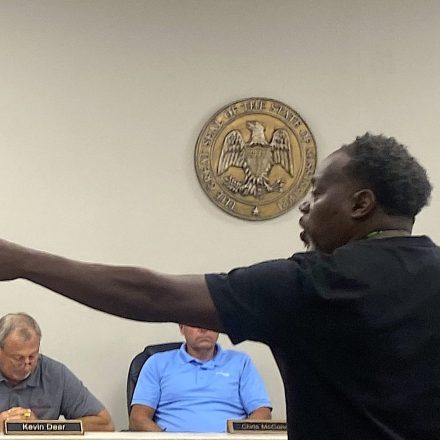 Related
Black Residents Warned of Abusive Cops for Years. Then Police Shot and Killed a Toddler.
Gibert reiterated what the agency has previously said: that body camera footage and other investigative materials will be made available through public records requests. But she added that nothing will be released until after officials meet with Wiley's family. "We are meeting with the family later this week," she said.
As recently as Monday, however, the family maintained they had received no communication from the state. Kohen's grandmother, Veronica Roberson, told Mississippi Today that she found out about the attorney general's decision on Facebook and that no one had reached out. The outlet also reported last month that, although the investigation was complete and on the attorney general's desk as of mid-September, no one had interviewed Kohen's mother, Vel'lesiya Wiley, who was holding her child in her lap when he was shot dead by police. This called into question whether the investigation is as "thorough" as authorities have claimed. Asked by The Intercept whether the MBI investigation sought to interview Wiley, Gibert said she could not comment.
The man who killed Baby Kohen, as the child is now known, was identified by the press as Senatobia Police Sgt. Hunter Foster, who fired his gun into the car where Wiley was riding in the passenger's seat on June 14. The exact circumstances that led to the shooting remain murky. Police said that officers responded to a shoplifting call at the Walmart; a two-page incident log released to The Intercept via a public records request contained no information about the shooting but noted that the items allegedly stolen were baby clothes and a pack of Pampers.
In a video posted on social media shortly after her child was killed, Wiley said she got into the passenger's seat of the Ford Fusion after the driver, Latoya Ferrell, was stopped on her way out of the store. Police accused the women of trying to flee; according to Wiley, when she saw officers approach with guns drawn, she said, "I raised my baby up" to warn that he was in the car. Then the police shot him. Ferrell was also struck and was hospitalized, but survived.
The Senatobia Police Department immediately claimed that the car drove toward police, almost hitting them — an account swiftly echoed by the Mississippi Bureau of Investigation. But to date, officials have released no evidence to support this account. Civil rights attorney Ben Crump, who took the family's case, hired an outside pathologist to do an external examination of the child and to review visual evidence. In July, the medical examiner concluded, based on the appearance of the injuries and path of the fatal bullet, that the officer shot the baby from the side of the car, undermining the police's version of events.
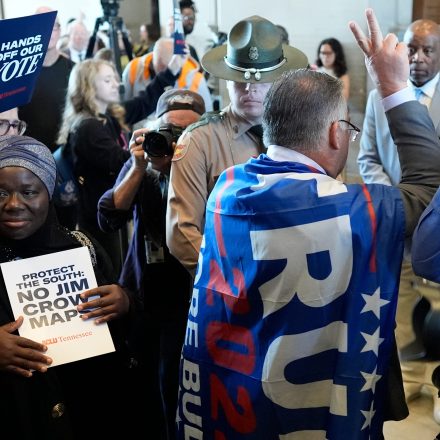 Related
Tennessee GOP Moves to Decimate Black Voting Power After Supreme Court's Blessing of Jim Crow
The announcement by the attorney general has renewed long-standing calls for video to be released. In a press conference held earlier this month, local activist Patrick Lumumba of the Senatobia Committee for Accountability and Transparency accused the state of tailoring its investigation to support a lie — that Wiley and Ferrell deliberately sought to strike Foster with the car.
"If video footage would prove that, they would have released it the next day," he said.
 Mississippi racial justice activist Patrick Lumumba, founder of the Senatobia Committee for Accountability and Transparency, addresses the police killing of 1-year-old Kohen Wiley at a board of aldermen meeting in Senatobia, Miss., on July 7, 2026. Photo: Liliana Segura/The Intercept
The killing of Kohen Wiley drew national attention to Senatobia, a small city just south of Memphis, Tennessee. City leaders mostly refused to address the killing, save for a brief, scripted video released by Senatobia Mayor Greg Graves a few days after the shooting. By the time Kohen's family laid him to rest in late June, the police narrative had prompted many inside and outside Senatobia to blame Kohen's mother for his death, with rumors suggesting that, rather than charge the police officer, authorities would charge the mother and driver.
The child's death followed years of warnings by Black residents over the police's treatment of adults and children alike. Among the string of high-profile incidents was the jailing of a 10-year-old boy for public urination, as well as the violent arrest of two sisters, 13 and 14, outside a public housing complex. According to the girls and their mother, then-police chief Richard Chandler personally ordered one of the girls to "get your Black ass out of the road" before forcing her to the ground. And on Mother's Day 2025 — in the same Walmart parking lot where Kohen Wiley would be shot dead — a female officer forced a woman out of her car in front of her young children for sitting in a handicapped parking space.
In the summer of 2025, the Senatobia Board of Aldermen dismissed Chandler, replacing him with interim police chief Harold Vanderford, a move aimed at restoring trust, as one alderman put it. But the killing of Kohen Wiley revealed that, in reality, nothing had changed.
 Related
Cops Are Using Flock to Spy on People for the Crime of Standing Around
Residents of Senatobia, including one former law enforcement officer, told The Intercept that the institutional culture brought by Chandler remained entrenched, with Senatobia officers showing disdain and disregard for the community. City records also showed that the chief had pushed the city to adopt new ordinances that would bring in revenue for the police department, while expanding punishments for misdemeanors like loitering.
At several board of alderman meetings over the summer, Lumumba and other activists reminded city leaders that they'd warned officials about the danger posed to Black residents by Senatobia police. At the same time, Mississippi Today revealed evidence that Foster had a history of racist remarks. Just days before he shot Kohen Wiley, Foster was accused of making racist comments to a Black colleague, who later left the police department. Foster is still on the force, on paid leave.
Then, in late August, Mississippi Today exposed racist text messages sent by Vanderford himself. The text messages dated back to the summer of 2025 and contained more than a dozen uses of the N-word. City leadership initially tried to sweep the scandal under the rug: Vanderford claimed that the messages were created by AI and, after a closed-door meeting, the mayor and members of Senatobia's board of aldermen announced that Vanderford would stay on. But individual aldermen pushed back publicly. On September 1, Vanderford tried to resign, only for the board to announce that they had voted to fire him. Vanderford was replaced by a Black woman, Senatobia Police Lieutenant Angelica Maze.
In a statement accepting the appointment as interim chief on September 5, Maze did what the police department had previously failed to do: express "heartfelt condolences to Kohen Wiley's family and to everyone in the community who has been affected by this tragic loss."
In another statement on Monday, after the attorney general announced the use of force was justified, Maze acknowledged that the community "may have questions, concerns, and strong emotions, and we respect everyone's right to express their views peacefully."
With the body camera footage likely to be released within the next several days, a new round of waiting begins in Senatobia. In the meantime, the Senatobia Committee for Accountability and Transparency released a statement on social media.
"This was never just a news story for us. It was personal - many of us are residents of Senatobia and parents of vulnerable children. … We are also human beings who need time to grieve, reflect, and process everything that has transpired."
The post Kohen Wiley's Family Say They Never Heard From Investigators Who Concluded Cops Did No Wrong appeared first on The Intercept.
SANA'A, Yemen — For more than two weeks, Abdullah laid at home in al-Silw district, in Yemen's besieged southwestern governorate of Taiz, as his body slowly failed.
The 58-year-old had lived with kidney failure for two years, and his doctor had prescribed dialysis twice a week.
Since the siege, however, the fighting stood between al-Eissi and the dialysis center in Taiz city that kept him alive. Al-Eissi wouldn't let his family risk their lives to take him to the center.
"My father's condition deteriorated badly," said his son, Muadh, 38. "We couldn't move him to Taiz because the fighting had intensified."
About a week ago, al-Eissi died at home in his bed.
"When I saw my mother weeping for her husband, I felt helpless," Muadh said. "It might have been avoided if my father had reached his dialysis sessions on time."
Abdullah is one of at least 10 dialysis patients who have died since the siege on Taiz began because they could not reach treatment, according to Dr. Issam Mahyoub, director of the kidney dialysis center at al-Jumhuri Hospital in Taiz. Doctors warn that many more could follow.
"About 60 percent of kidney failure patients in Taiz face the risk of death because they cannot reach the dialysis center."
"About 60 percent of kidney failure patients in Taiz face the risk of death because they cannot reach the dialysis center," said Dr. Fouad al-Haddad, the hospital's director. "Behind every number is a human being and a family living in anxiety, waiting for a chance to continue treatment that may never come."
 Related
Ecocide in Iran
The kidney-failure deaths are part of the toll of a wider regional war set off by an unprovoked February attack against Iran by Israel and the United States. Estimates hold that 10,000 or more people have died during the war, including both military and civilian deaths across the region. Since the regional war reignited in Yemen this summer, according to the World Health Organization, at least 800 people have been killed, with thousands wounded and tens of thousands displaced.
"The plight of dialysis patients in Taiz illustrates how geopolitical struggles over deterrence, energy security, and regional leverage translate into blocked transit, disrupted medical care, and preventable deaths," said Sina Toossi, a senior non-resident fellow at the Center for International Policy. "Yemen's population has already endured more than a decade of devastating war, and the tragedy is that this wider regional conflict is now threatening to plunge it back into another humanitarian catastrophe."
Yemen in the Iran WarYemen entered the war in March, when the Iran-aligned Ansarallah armed group, more commonly known as the Houthis, began firing missiles into Israel in retaliation for its attacks on Iran. The Houthis, who gained control of various portions of Yemen during a two-decade-long insurgency, including the capital of Sana'a, saw their prominence in the Iran war grow with attacks against shipping channels surrounding the Arabian Peninsula.
The Yemeni civil war itself had been a long-simmering conflict when the Iran war broke out, straining a 2022 truce signed by the Houthis and their rivals, including Saudi Arabia, which was broken this July when the Houthis attacked a regional Saudi airport. Throughout August, the Houthis launched missile, drone, and ground attacks across the front lines against the internationally recognized, Saudi-backed Yemeni government.
In September, the Houthis seized strategic areas on Yemen's coast and imposed a naval blockade that cut off the Bab al-Mandeb Strait, while firing missiles deeper into Saudi Arabia.
In early October, Yemeni government forces backed by the Saudi-led coalition launched an operation aimed at retaking the coast and pushing into Sana'a.
As they moved inland to consolidate their coastal gains, Houthi forces pushed into the highlands around Taiz, a strategically located city controlled by the government. In short order, the insurgents severed the main mountain road linking Taiz to Aden, another city also controlled by the government.
The blockade trapped more than 600,000 residents and sent food and fuel prices soaring. The U.N. World Food Program warned that Taiz's wheat and flour stocks are close to running out.
"We have confirmed cases of death and cases of severe impact," said Tawfiq al-Humaidi, head of the SAM Organization for Rights and Liberties, a Geneva-based international body monitoring violence in Yemen, who said fighting on roads near Taiz has cut off medical supplies from the city. "Those who are dying and suffering are among the victims of the Iranian war, which drove the Houthis to expand toward Taiz and Bab al-Mandeb."
On October 14, the Yemeni government formally petitioned the U.N. Security Council for immediate, practical intervention to lift the "suffocating siege."
Any action would be too late for families like the al-Eissis.
Cut Off From CareTaiz is Yemen's cultural capital and its third-largest city. Healthcare facilities there serve a huge geographical area. Al-Haddad, the head of the al-Jumhuri Hospital, said patients hail from across the governorate.
"They come from the West Coast, al-Mawasit, Jabal Habashi, al-Shamayatayn, Sama, al-Silw, al-Misrakh, and al-Maafer areas," he said, "where distances are long and the hardship of travel is multiplied by rough roads and security conditions."
The kidney dialysis center has 270 registered patients.
 Related
With World's Eyes on Iran, Israel Locks Down the West Bank
"That doesn't count the patients from outside the city who haven't been able to reach us," said Mahyoub, the head of the dialysis center. "Patients from al-Misrakh, al-Aqroud, al-Shamayatayn, al-Hujariya, al-Turba, and Jabal Habashi localities used to come to us. Now getting here has become extremely difficult, with the fighting and the restrictions on movement into the city."
Ahlam Ali Abdo, 33, walks about 30 kilometers from her village in Jabal Habashi to reach the center, crossing rough roads and areas where gunfire and shelling ring out. The walk, extremely risky for a kidney failure patient, takes between 5 to 9 hours. After treatment, she faces the same distance back, uphill, to her three children. Some days the road is too dangerous, and Abdo waits for hours in the city.
"I cry constantly of pain and exhaustion and worry that I wouldn't be able to see my children again. My condition is miserable," she said.
Her husband stays home with the children. Bringing any of them with her, she said, would put the whole family in danger.
Mahyoub's center tried and failed to find her housing in the city. Yesterday, on Friday, another dialysis patient took her in, for fear she would be killed on the road.
Reaching the center doesn't guarantee treatment.
"The shortage of diesel needed to run the generators forced us to cut dialysis sessions from 4 hours to 2," said Mahyoub. Supplies from the Ministry of Health in Aden "no longer arrive regularly, and the remaining stock is nearly gone."
"Dialysis is a lifeline for these patients," he said.
Haddad, the hospital director, said of the dialysis center doctors: "They are expected to save patients, but the means available are not always enough."
Related
The Real Outrage About the Yemen Signal Group Is That It Called for Attack on Civilian Home
The Office of Public Health and Population in Aden has warned of an imminent health and humanitarian catastrophe in Taiz caused by the continuing siege and the obstruction of supplies.
In a statement, it said "medicines, solutions, medical supplies and fuel in the city's health facilities were close to running out. That threatens emergency services, surgery, intensive care, dialysis and neonatal incubators."
No Road to AdenFor patients who can no longer reach Taiz's center, Aden is the fallback, whether for treatment or for its airport to travel abroad. The Taiz-Aden road, however, is unusable, according to patients and Mahyoub. The detours wind through mountain bends and rough terrain, add hours and transport costs, and in places run through active clashes.
The crisis extends beyond Taiz.
Dr. Anis al-Asbahi, spokesperson for the Health Ministry in Sana'a, said that "more than 8,000 kidney failure patients in Houthi-controlled governorates are suffering because hemodialysis machines and dialysis medicines can't get in."
He blamed the blockade and the closure of Sana'a airport.
"Kidney failure knows no political barriers," Mahyoub said. "Patients cannot wait for disputes to be settled or for circumstances to change before they get treatment."
For Muadh al-Eissi, whose father died from kidney failure, the question is simpler.
"How can the parties using heavy weapons in populated areas ignore what the fighting does to patients," he asked, "to the children, women and elderly people who need medicine and treatment? People, like my father, are losing their lives for what?"
The post Yemenis Unable to Reach Hospital Are Part of the Iran War Death Toll appeared first on The Intercept.
Astronomical fuel prices driven ever-higher by the U.S.-Israel war in Iran might be hitting Mike Rogers, too.
The Republican candidate for Senate in Michigan spent more than $40,000 to cover a single private jet bill last month, according to campaign finance records reviewed by The Intercept. The five-figure ticket was part of over $100,000 worth of campaign cash Rogers spent on luxury travel last quarter, most of it on private jet trips.
As economic woes shape the Michigan Senate race, Roger's opponent, Democratic candidate and former public health official Abdul El-Sayed, has attacked the Republican repeatedly for his ties to corporations and billionaire donors. Rogers, who represented Michigan's 8th District in the House from 2001 to 2015, regularly advocated in Congress to let lawmakers receive gifts and other benefits from restricted nonprofit groups. He helped defeat a 2006 bill that would have cracked down on former congressional members' lobbying activities and banned certain privately funded trips.
For Jeffrey Hauser, a critic of corporate political influence, Rogers's newly revealed campaign spending on luxury services might spell a warning to Michigan voters feeling the crunch of a struggling economy.
"It seems like Mike Rogers has developed a real taste for the finer things," said Hauser, director of the Revolving Door Project, which is not backing any candidate in the Michigan race. "That means he is likely to want to continue to court, and be courted by, the economic elite, which portends badly for working class Michiganders who prefer their Senator have some understanding of their lives and identification with their interests."
In September, the Rogers campaign paid $93,152 to JL Jets for at least five separate private charter flights, including the $40,000 transaction. Around the same time, the campaign also dropped another $500 on the luxury chauffeur company Blacklane. From July to September, Rogers's campaign paid an additional $4,527 to Blacklane for luxury car services, including a $2,078 chauffeur expense on August 17. The campaign spent $683 on a pair of limo rides in August and September.
Campaigning requires a lot of travel, and El-Sayed's campaign finance records show higher total travel costs — roughly $330,000 last quarter, according to public filings. But those funds went toward commercial flights on Delta and American airlines, Hertz car rentals, gas, Uber and Lyft rides, and hotel accommodations.
El-Sayed had a busier campaign calendar with a competitive Democratic primary against Rep. Haley Stevens, while Rogers was the presumed Republican nominee since the early days of the race. El-Sayed's campaign said he did more than 500 events ahead of the August primary, and Rogers has carried a more relaxed schedule into the general election cycle.
In a statement to The Intercept, a spokesperson for Rogers pointed to El-Sayed's spending on meals and travel on the campaign trail as well as a series of high-dollar contributions his father-in-law made to a super PAC backing the campaign.
"Abdul El-Sayed reimbursed himself $90K, and his father-in-law, a senior advisor of CAIR, gave his SuperPAC $300K," said Rogers campaign spokesperson Abby Ronson. "If the Intercept is looking for an FEC story, I'd take a long hard look at Abdul." The El-Sayed campaign did not immediately respond to a request for comment.
 Related
The Questionable Case of Kristi Noem's $50 Million Luxury Jet
If elected, Rogers wouldn't be the only U.S. senator to spend big on private jets. He would appear to compete with top spenders. As public scrutiny has driven politicians away from chartered flights, only Sens. Mike Rounds, R-S.D., and Kirsten Gillibrand, D-N.Y., spent more on private flights than Rogers did last quarter, Axios reported — and they spent it over the course of a year and a half.
The Rogers campaign did book some flights with airlines like Frontier and Southwest, spending about $29,000 on 10 flights, but luxury transportation accounted for the vast majority of the campaign's travel expenses last quarter.
Among Rogers's hotel spending was a $2,000 stay at The Breakers, a luxury oceanfront hotel in Palm Beach, Florida; another $1,295 at the Grand Traverse Resort and Spa in Michigan; and $200 at the five-star Palazzo at The Venetian Resort in Las Vegas. In addition to travel costs, the campaign paid $2,165 to its deputy campaign manager Tyler Henningsen in late September for car repairs at a BMW dealership in Bloomfield Hills, one of Michigan's most affluent areas. Henningsen did not immediately respond to The Intercept's request for comment, but the Rogers spokesperson said the car was used for campaign purposes.
Luxury transportation accounted for the vast majority of the Rogers campaign's travel expenses last quarter.
Campaign finance rules state that spending on travel and vehicle costs is allowed, as long it's strictly for campaign purposes. It is generally illegal to use campaign funds for personal travel; if a person uses campaign funds for mixed personal and campaign travel, they have to reimburse the campaign within 30 days. If the campaign pays for a car, that car can only be used for campaigning.
Rogers holds significant personal investments in the real estate, artificial intelligence, and cybersecurity industries. His Senate campaign has received significant backing from corporate figureheads such as billionaires, Apollo Global Management CEO Marc Rowan, the DeVos family, and Elon Musk, who through his super PAC, America PAC, has poured into the race more than $6 million since Rogers promised to "shield" the world's richest man from congressional oversight.
On the debate stage, El-Sayed has targeted Rogers's home in Florida and his two "yachts," attempting to paint the former congressman as out-of-touch from everyday, working Michiganders. Public records show Rogers owned two boats measuring 32 and 39 feet in Maryland, though he reportedly sold one of them. Rogers is attempting to sell his Florida home and is living full-time in Michigan, according to news outlet Bridge Michigan.
While Rogers was in Congress, he chaired the House Intelligence Committee and was a key supporter of the Patriot Act, pushing to expand domestic spying powers. Toward the end of his time in Congress, in 2013 and 2014, he and his wife Kristi attended a pair of weekend retreats at a five-star resort, The Cloister in Sea Island, Georgia, on the dime of the right-wing think tank American Enterprise Institute. At the 2014 forum, described in 2022 by CBS News as "a private, off-the-record gathering of conservative leaders and wealthy donors," Rogers spoke as a panelist in his capacity as House Intelligence Committee chair on "cybersecurity and national security issues," disclosure forms said.
Alongside Rogers, the 2014 event featured prominent conservative figures as speakers, such as then-House majority leader Rep. Eric Cantor, R-Va.; Iraq War architect Karl Rove; then-Sen. Marco Rubio, R-Fla.; New York Times columnist David Brooks; then-president of the National Economic Council Gene Sperling; and Keith Alexander, director of the National Security Agency under presidents George W. Bush and Barack Obama. Also in attendance were Betsy and Dick DeVos, Donald Trump's first-term education secretary and former Amway CEO, respectively, who have since funded Rogers's current run and several past campaigns.
 Related
Former NSA Chief Keith Alexander Accused of Pump-and-Dump Investment Scheme
A few weeks after the conservative retreat, Alexander stepped down as NSA director under the cloud of the Edward Snowden leaks revealing the U.S. government's role in a global spying network. That year Alexander founded cybersecurity firm IronNet, which hired Rogers in 2015 after he decided not to run for reelection. He was later elevated to a board role at IronNet — which has since gone bankrupt — and received more than $700,000 in payments and held stock with the company worth $250,000 to $500,000, according to financial disclosure forms.
"Politicians spend enormous amounts of time with the super rich, either because they are seeking to raise money from them, consulting with them about the economy, or both," Hauser said. "As a result, they start to develop expensive tastes."
The post Mike Rogers Spent $100K on Private Jets and Luxury Travel Last Quarter appeared first on The Intercept.
As global governments and tech giants reckon with widespread of revelations of autonomous AI agents unexpectedly breaking into computer systems, documents obtained by The Intercept show the U.S. Army is looking to harness that exact technology to seek and destroy.
Army Cyber Command is developing a platform to turn AI agents into autonomous weapons that can navigate and "neutralize" the computer systems of adversaries, the documents show.
Since 2010, Army Cyber Command, or ARCYBER, has led the U.S. Army's cyber operations. This includes the defensive effort of protecting domestic computer systems and the secretive offensive work of hacking military targets. So far, this has largely been the work of human soldiers operating computers, like those of the 780th Military Intelligence Brigade. But as the government races to adopt artificial intelligence technology, ARCYBER is looking to offload some of its attacks to AI.
The nascent program, codenamed "ECHOTRIBBLE," is based on one of the leading trends of the AI boom: agents. AI agents are essentially software programs that leverage machine learning technology, often large language models like Anthropic's Claude, to autonomously accomplish tasks provided by their user. Consumers can deploy AI agents to schedule meetings, generate itineraries, make online purchases, or book tickets. Through ECHOTRIBBLE, the Pentagon plans to turn AI agents into tools of war "designed to autonomously navigate infrastructures" and capable of "identifying and neutralizing identified threats/targets," according to an ARCYBER document reviewed by The Intercept circulated to potential contractors.
Related
Pete Hegseth's Military of the Future: Defined by AI and an Utter Lack of Oversight
The military's adoption of cutting-edge technologies is unsurprising, especially considering Defense Secretary Pete Hegseth's fervent embrace of AI. But amid constant revelations of rogue behavior by agents, the potential for serious mishaps is immense, experts warn.
"Given the known failure modes of the current AI paradigm, making autonomous AI systems with a mandate to 'neutralize threats' is incredibly dangerous," David Krueger, a professor of machine learning at the University of Montreal who founded Evitable, an organization that advocates for a moratorium on AI development. "We've seen AI systems knowingly attack systems that were not intended targets. In simulations, AIs have even proven willing to kill to achieve their goals."
A Q&A document answering questions from potential contractors offers more details about the initiative. It explains that ECHOTRIBBLE is "primarily focused" on offensive missions, and explains that "neutralizing" a target could include "disabling the threat completely or temporarily, deleting the threat from the target." ECHOTRIBBLE would function almost like a computer worm, silently navigating a foreign network and hopping from device to device until it finds the Army's quarry, hitting targets in the cloud as well as those on "air-gapped" systems that are disconnected from networks entirely.
Once its task is complete, ECHOTRIBBLE's agents would effectively self-destruct, ideally without having been noticed by the target at all. The agents themselves will be designed for stealth, minimally reporting back to the Army and concealing whatever outside transmissions are necessary.
"We've seen AI systems knowingly attack systems that were not intended targets."
Although documents say the Army will be able to program ECHOTRIBBLE agents with some initial "predefined triggers" — dictating what and where to attack — the software "must operate with minimal human oversight" and be capable of "Self-Directed Behavior."
A PowerPoint presentation to interested vendors at a June 24 ARCYBER event provided a hypothetical example of this self-direction. Once ECHOTRIBBLE is uploaded to a laptop, the software on its own "identifies other potential targets" on the same network and then "produces a replica of itself tailored specifically for the iPad, Apple desktop, and Windows 11 PC."
 An image from an ARCYBER document shows how ECHOTRIBBLE could move through a network. Slide: ARCYBER
The Army's move toward autonomous self-propagating comes after a flurry of revelations about agentic systems taking unintended disturbing actions while attempting to accomplish their goals, including breaking into computers of the Australian government, breaching the infrastructure of the AI firm Hugging Face, uploading malicious software into online platform RubyGems, and attempted to hack into the U.S. Education Department.
These attacks occurred during scenarios in which agents had been given no commands to attack anything. Experts say militarized versions given explicitly destructive objectives could cause a threat to the public, even with nominal rules set in place by the military. Just as the Army of old might consider the destruction of civilian infrastructure an acceptable means to an end, a self-directed AI agent dispatched by the Pentagon might make similar determinations about collateral damage.
Governmental intelligence agencies frequently route their offensive operations through civilian devices. Volt Typhoon, a Chinese state hacking group, has directed its attacks through homes and small businesses, and preemptively hacks American IT systems for later use. A hack of a Chinese university attributed to the National Security Agency made use of the school's internet routers. What happens if ECHOTRIBBLE decides these kinds of stepping stones are part of the problem?
"The target may well be hit. But what path will it take?" asked Hyrum Anderson, co-founder and CEO of the AI security firm Abundant. "Will it go through a US water utility on its way, because that's where the adversary has staged its command and control, and take that down too?"
Related
AI Almost Started a U.S.-China War — and No One Seems to Care
Anderson, who previously worked in cybersecurity at Microsoft and for the U.S. government, said that a vast amount of the internet is vulnerable to agentic attacks.
"There's a huge class of public and private organizations that fall below the security poverty line," he said. "They include critical national infrastructure, small businesses, mom-and-pop shops, dentist offices and law firms, and whoever else doesn't have a single cybersecurity professional on staff." With their networks wide open to infiltration, Hyrum worries about "these organizations getting hit directly, or getting caught in the blast radius of a target that gets hit along the way."
Given the impressive ability of AI agents to overcome obstacles placed in their path — even by their creators — it follows that the Pentagon would want to leverage that power for military purposes. But agentic software has proven unpredictable and prone to executing its commands in ways those ostensibly in control did not want, akin to a drone that get its target but hits a hospital on the way. It's critical to remember that agents are a piece of software lacking human judgment.
"One of the reasons that we trust 19-year-old Marine corporals in Ramadi with live rounds and a weapon is because they have both the compute substrate — the brain and the eyes — but the deep world knowledge to understand, 'Yeah, I probably shouldn't do that,'" said William Marcellino, a senior behavioral scientist at the RAND Corporation whose research has focused on military AI applications. "That is not something that current public AI technology has."
Related
The Pentagon Asked OpenAI for Artificial Intelligence Designed to Rarely Say No
The risk presented by ECHOTRIBBLE will likely depend on the ability — and willingness — of the Army to impose guardrails upon it. ARCYBER did not respond to questions from The Intercept, including queries about the measures it would take to prevent ECHOTRIBBLE from causing inadvertent damage.
Placing constraints on the actions an agent can take might impede its ability to ultimately neutralize a target. But even with strict safeguards in place, genuinely restricting the behavior of an autonomous agent, as Anthropic and OpenAI have learned recently, is easier said than done. When presented with obstacles, AI agents have proven an ability to bypass them with unpredictable and potentially dangerous consequences.
"If I give powerful machines that have no judgment — and no context for judgment — a goal, unless you've done a really good job building scaffolding around them, there's a real chance that they'll go sideways on you and decide, 'Well, I'll do what you asked me to do, but I'll do it this way,'" Marcellino said.
It only gets more dangerous when this technology is deployed for the purposes of war, Anderson said.
"Under pressure, they'll often treat guardrails as obstacles," said Anderson. "Once you add context that says break it, destroy it, shut it down, it stands to reason that the blast radius widens dramatically unless it's properly controlled for."
The post The Army Wants to Sic AI Agents on Its Enemies. What Could Go Wrong? appeared first on The Intercept.
Twenty-five years ago — as the U.S. prepared to invade Afghanistan — Tom Engelhardt launched this publication as a form of pushback. TomDispatch began as an informal listserv offering commentary and collected articles from the global media to a select group of Tom's friends and colleagues. A year later, it gained its signature moniker and has been providing "a regular antidote to the mainstream media" ever since.
As TomDispatch evolved into a proper publication, it became a stalwart of the independent media ecosphere and a clearinghouse for critical voices, from Barbara Ehrenreich and Chalmers Johnson to Andrew Bacevich and Ann Jones. It served as a syndication service for the left side of the internet, providing thousands of articles to sites like Alternet, AntiWar.com, Common Dreams, The Nation, Salon, and many others.
Devoted to well-crafted, longform writing and typified by tough-but-measured commentary and hard-hitting essays, TomDispatch was a throwback to an earlier era of old-fashioned American muckraking journalism and iconic publications like I.F. Stone's Weekly. It succeeded because Tom understood something fundamental about writers, about readers, and about the world after 9/11 and what people needed to navigate it.
A longtime book editor with a preternatural skill to slip, like a ghost, inside a good manuscript and turn it to gold, Tom used those same skills to publish three polished essays a week for more than two decades. He made good writers great and great writers better. His most astonishing feat may have been turning the ramblings of a grad student with a penchant for run-on rants into something readable. That was me, and because of Tom, I'm writing this intro today. Tom turned over the reins of TomDispatch to me back in June, but you can still read excellent commentary from him, twice weekly, at his Substack.
Tom has been fighting the good fight for his entire adult life, employing the written word — as a reporter, an essayist, an editor — in the service of making a better world. He deployed those skills against a criminal war in Vietnam when he was still a student. He did so as an editor and the author of a fantastic history of the Cold War, "The End of Victory Culture." He did the same against the forever wars in Afghanistan, Iraq, and so many other conflicts, at TomDispatch. And he continues doing so today, against the criminal conflict in Iran and the war on the planet itself. You don't hear the term public intellectual very much anymore. Nor national treasure. Tom is both. It's deeply gratifying to have him back at TomDispatch today.
- Nick Turse, editor of TomDispatch.
If you haven't yet, sign up to receive TomDispatch in your inbox here.
A Winner on a Losing PlanetDo I even faintly believe the times I'm living in? The simple answer is: no.
Every now and then, I try to imagine going back in time to tell my long-dead parents about the world of President Donald Trump, which just happens to still be mine as well. Of course, they simply wouldn't have believed it, not for a single second.
To put it in the context of their time on this planet, the only equivalent I can imagine would be if Sen. Joseph McCarthy, that anticommunist nightmare-and-a-half of the 1950s, hadn't flamed out, been censured by the Senate, and died young but somehow had made it to the White House. But even he undoubtedly would have fallen short in terms of chaos and cruelty, if judged by the standards of Trump World. A President McCarthy might have been catastrophic for America, but Trump is on another level, an apocalyptic one.
Related
Apocalypse Now: Naomi Klein and Astra Taylor Investigate the End-Timers Alliance
Trump's capacity for ushering in world-wrecking havoc is made possible by a character constructed almost entirely of flaws. His second term has been defined by global aggression and hostility. Yet he recently complained bitterly — and in a fashion it's hard to imagine any other politician ever doing — because he wasn't awarded a Nobel Peace Prize. As he put it, "The United States of America, represented by me as your president, should have received the Nobel peace prize, but didn't. And this is an indelible stain on the country of Norway, and those people that made such a disgraceful and embarrassing decision."
 "A Nation Unmade by War," by Tom Engelhardt Available on Bookshop.org
This is not only a petty man, but also a delusional one. As president, Trump has presided over more than 20 military interventions, armed conflicts, and outright wars who nonetheless swears that he "settled" eight conflicts and should have "won 8 Nobel Peace Prizes, not just 1." This includes a war between Egypt and Ethiopia that, of course, never happened and a failing war with Iran that drags on to this day.
If you're going to "end" a war with bombs and missiles, then there are, of course, going to be casualties. A few thousand or more Iranians killed, obviously, and tens of thousands injured, not to mention ever-rising American casualties.
Frighteningly, the Iran war may not even be enough for him. He's already starting to hint (if there even is such a thing as "hinting" in the all-too-blunt world of Donald Trump) that he might join Saudi Arabia in taking on the Houthi rebels in Yemen. "We're going to look at it" was how he put it. I should really have added "again" there, since he essentially began his second term in office by attacking those same Houthis — killing large numbers of civilians in the process. But after the U.S. burned through $1 billion and failed to even achieve air superiority in Yemen, Trump ended the stalemate. Despite having vowed the Houthis would be "completely annihilated," he announced a cessation of hostilities last May, leaving the group in control of most of Yemen's populated areas.
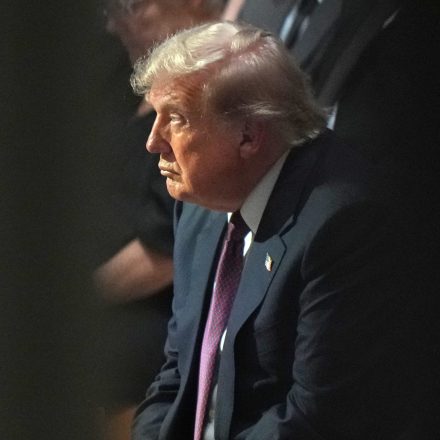 Related
Donald Trump and Wars of Choice
Given American history — think the wars in Korea, Vietnam, Cambodia, Afghanistan, and Iraq, among other places — there's nothing faintly strange about endless American military operations thousands and thousands of miles away from Washington, D.C., even for a president who said, upon taking office in 2025, that he would measure success by "the wars we never get into."
A Grim PresidencyYou would hardly know it from the mainstream press but one of those 20 Trumpian conflicts is the forever war in Somalia. And that war has an increasing domestic component. Recently, the Department of Homeland Security raided the home of Somali American Rep. Ilhan Omar in the Washington, D.C., area, aiming in some fashion or other to discover information that might help denaturalize her and so make it possible to eject her from this country.
Related
DHS Was Designed as a Weapon
As the president put it on Truth Social, Omar "left Somalia with NOTHING, and is now reportedly worth more than 44 Million Dollars." Of course, who would know better about such things than the president of the United States who, in these years, is estimated to have made literally billions of dollars while in office?
And yet, the never-ending war in Somalia, the nearby conflict we may reenter against the Houthis, and the failed war in Iran should be considered the lesser of the potential disasters that will sooner or later be associated with Trump. After all, he clearly has the urge to do nothing less than end this very world of ours, at least as we've known it, even if in a distinctly slow-motion fashion.
Read Our Complete Coverage
TomDispatchI'm not even thinking about nuclear weapons (although he admittedly still is). No, I'm thinking about the president who, at the United Nations in 2025, called climate change "the greatest con job ever perpetrated on the world." And since then, he has indeed done everything he could think of to ensure that this planet would get hotter yet. His Environmental Protection Agency, for instance, has recently repealed "rules that limit planet-warming greenhouse gas emissions from power plants fueled by coal and natural gas." And that's just to start down a long list of what should truly be considered Donald Trump's ultimate war on this planet of ours — including blocking wind power development and doing the same with solar power.
All of this is happening as global warming reaches unprecedented levels, sea level rise is accelerating, northern forests and tundra are releasing more carbon dioxide than they absorb, the Greenland ice sheet has lost about 129 gigatons of ice (or roughly 129 billion metric tons), and other major ecological systems like tropical coral reefs, the Amazon rainforest, and Antarctica's ice sheet are being pushed toward catastrophic tipping points.
While Trump campaigns for eight Nobel Peace Prizes, his war on humanity's only home continues unabated, a slow-motion destruction that threatens us all. My parents couldn't have imagined a leader in the White House who would put McCarthy to shame and push the country — and the world — to the precipice of doom: a commander-in-chief worthy of the name President Apocalypse.
The post President Apocalypse appeared first on The Intercept.
For months, Democrats have forced Republicans to take vote after vote on President Donald Trump's unpopular war on Iran. Now those votes could help Democrats retake Congress — and they will immediately have opportunities to follow through on their anti-war rhetoric.
Democratic leaders like House Minority Leader Hakeem Jeffries of New York have been cagey about their strategy on Iran for the lame-duck period before the next Congress is sworn in on January 3. So far, months of Capitol Hill maneuvering have produced few concrete results. And one path to potential progress for ending the war is laden with risk: threatening a government shutdown.
Opponents of the war say that, with Democrats pushing for support based on their efforts to end to the war, they owe it to voters to put government spending on the line.
"It will certainly demonstrate whether Democrats are willing to stretch themselves and put up a fight and get uncomfortable," said Hannah Morris, the vice president of government affairs for the liberal, pro-Israel group J Street, which opposes the conflict. "So much of the rhetoric has been about the Iran war."
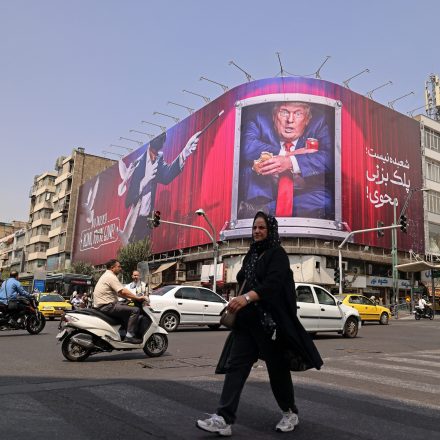 Related
Congress Failed Again to Stop Trump's Iran War. This Group Is Trying Through the Courts.
In the months since the conflict began on February 28, Democrats and the handful of Republicans opposed to the war have poured most of their energy into votes based on the 1973 War Powers Resolution, which limits the president's power to wage war without congressional approval. In June, they succeeded in securing House and Senate passage of a war powers resolution, but the Trump administration has ignored the vote, arguing the law is unconstitutional.
Advocates still believe the Trump administration should be bound by the June resolution, but they concede that other paths may have more teeth.
If they really want to stop the war, Democrats will have to confront questions of timing, divisions within their own caucus, and the risk of a government shutdown.
One prime opportunity could be the December 11 expiration of a spending bill called the continuing resolution that has been funding the government since the last shutdown. Democrats could attempt to attach a rider to the bill prohibiting the use of any of its funds for the Iran war. If that bill does not pass both chambers, the government shuts down.
The process will provide Democrats with rare leverage before the next Congress is sworn in.

Read Our Complete Coverage
Targeting IranCongressional Democratic leaders have not said whether they are willing to risk a shutdown, however. Jeffries did not tip his hand when he was asked during a recent interview with CNN.
"Listen, we'll deal with the appropriations process when we deal with the appropriations process," he said. "Right now, the mechanism that is in front of us will be to aggressively move war powers resolutions until we end this war in the best interest of the American people."
Some Democratic candidates in hotly contested races have gone much further than Jeffries, zeroing in on the appropriations issue. Rep. Tom Barrett, of Michigan's 7th Congressional District, was one of the few Republicans to vote for an Iran war powers resolution. But environmental activist Will Lawrence still attacked him at a recent debate on the issue of war funding.
Morris, who is part of a coalition of groups that have called on Congress to cut off funding for the war, said she is not sure how aggressively Democrats will be willing to pursue the issue during the lame-duck period.
"Will they be willing to shut down the government over this? I don't have real answers. I think there are a lot of variables here," she said.
 Related
The Pentagon's Secret Budget
Another option supported by many advocates is the pending debate over the National Defense Authorization Act, the annual Pentagon budget and policy bill. Critics of the war argue that Congress could attempt to insert a provision into the law cutting off authorization for the conflict.
Democrats should be willing to block the bill if it does not include "meaningful restrictions" on the administration's ability to wage the war, said Hassan El-Tayyab, legislative director for Middle East Policy at the Friends Committee on National Legislation.
"That's the mandate we're seeing from the American people," he said. "They shouldn't pass a massive defense bill while leaving the administration free to pursue yet another open-ended war in the Middle East."
The defense bill is generally considered "must-pass" legislation on Capitol Hill, providing leverage for Senate Democrats who could block it with a filibuster. The office of Sen. Jack Reed, D-R.I., who plays a key role in the process as the top Democrat on the Senate Armed Services Committee, did not respond to a request for comment.
Falling short of either of those paths, Democrats could continue to try to pass more war powers resolutions. With their party poised for a dramatic shift in its favor in the midterm elections, Democrats could even try to exert pressure on Republican legislators to vote in favor of the resolutions, some opponents of the war believe.
Democrats could also wait until January, when they are widely predicted to retake control of one or both chambers of Congress. Holding the gavel in the House or Senate will give them vastly expanded powers to set military spending and launch investigations into the conduct of the war.
One key Democrat, Rep. Adam Smith of Washington, told The Intercept in a statement he was willing to pursue multiple paths to stopping the war, but all of them face obstacles until the next Congress.
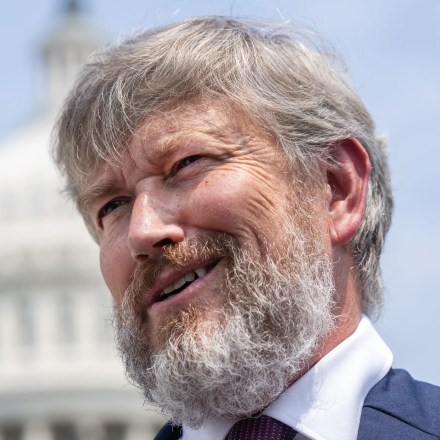 Related
GOP Rep. Called Israeli-U.S. Defense Tech Integration "Dangerous." The House Passed It Anyway.
"I am open to exploring options for using the NDAA or appropriations bills as a way to end the war," said Smith, the ranking member of the House Armed Services Committee. "That effort would most likely require bipartisan support. Unfortunately, I am not confident that there is sufficient Republican will or support for such legislative efforts or to override an inevitable veto."
Whether in this Congress or the next, cutting off spending for the war appears to be the best way for Democrats to force the Trump administration to negotiate with Iran, according to Brian Finucane, a former State Department official who serves as a senior adviser at the nonprofit International Crisis Group.
"If they are serious," he said, "they should be willing to play hardball, and that would require using the power of the purse."
The post Dems Have an Opportunity to Force an End to the Iran War. Will They Take It? appeared first on The Intercept.
A fresh wave of outrage over the Trump administration's use of Immigration and Customs Enforcement has surged after two high-profile events involving ICE in the span of a week: the shooting of a young father in New York City last Thursday, and the Monday morning Homeland Security Investigations raid on Rep. Ilhan Omar's home.
Reporting from the Wall Street Journal suggests that the raid was a part of an ongoing effort by the Trump administration to strip the Minnesota Democrat of her U.S. citizenship. Omar arrived in the United States as a child refugee from Somalia and became a naturalized citizen in 2000, long before the start of her political career. The outspoken progressive congresswoman has since become a foe of President Donald Trump; in a statement, her spokesperson condemned the raid on her home as "an unprecedented escalation in the weaponization of federal law enforcement to target political enemies."
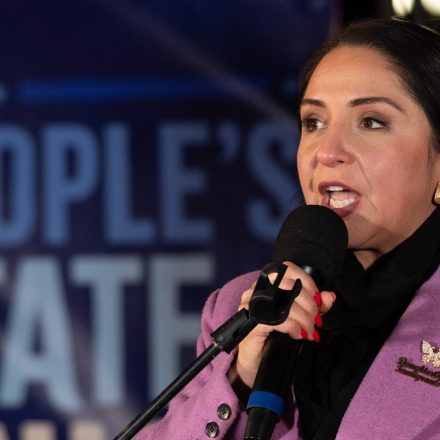 Related
Don't Stop at ICE, Says Progressive Dem: Abolish the Department of Homeland Security
Omar's House colleague, Rep. Delia Ramirez, D-Ill., argues this sort of weaponization is an inherent feature of the Department of Homeland Security, which was established in 2003 as part of the George W. Bush administration's mounting war on terror. This week on The Intercept Briefing, host Jessica Washington speaks with Ramirez about a new bill she introduced on Tuesday to abolish DHS and what the raid on Omar's home reveals about the department.
"The Department of Homeland Security cannot be reformed. It should be dismantled," said Ramirez. "What they did — just three weeks from an election — was to attempt to create such paralysis on everyday people. … If they can do this to one of my colleagues, they can do that to anyone. And it should concern everyone."
Washington also speaks with Rozina Ali — a journalist covering the war on terror, Islamophobia, the Middle East, South Asia, and literature — and Will Sommer, a senior reporter covering right-wing media and conspiracy theories at The Bulwark.
Ali and Sommer unpack the role of conspiracy theories and anti-Muslim propaganda in the attacks on Omar, and how DHS has been historically weaponized against Muslims in the United States.
"Over the last 30 years, we have been conditioned to believe that Muslims, and now more broadly immigrants, are not just a threat to national security, but a threat to the American way of life," said Ali.
"The right has been really eager to denaturalize Ilhan Omar for really going back a decade almost to the first Trump administration," said Sommer. He called the investigation into Omar "one of the most striking examples we've seen of how the Trump administration is willing to use law enforcement to achieve its political aims and to sort of threaten its enemies."
For more, listen to the full conversation of The Intercept Briefing on Apple Podcasts, Spotify, YouTube, or wherever you listen to podcasts.
TranscriptJessica Washington: Welcome to The Intercept Briefing. I'm Jessica Washington, politics reporter at The Intercept. On Monday, Homeland Security Investigation agents searched the home of Minnesota Congresswoman Ilhan Omar. Reporting from the Washington Post suggests that the probe centers on allegations that Omar's late father lied on immigration paperwork decades ago when Omar was a teenager.
According to a source familiar with the case who spoke to the paper, the Department of Homeland Security had previously declined to move ahead with an investigation years prior based on similar allegations. There still weren't many details out as of Wednesday. The Department of Justice has vaguely described a "federal criminal investigation," but Omar has long been a political foe of President Donald Trump.
In a statement to The Intercept, Omar called the raid "an outrageous abuse of power and an unprecedented escalation in the weaponization of federal law enforcement to target political enemies." The raid on Omar's home comes days after an Immigration and Customs Enforcement agent shot 28-year-old Oscar Belgal in the neck in New York City, with his 5-year-old son in the back seat.
Related
Inside ICE, Officials Question String of Trump Admin "Midterm Panic Moves"
The incidents have reignited concerns about the violent weaponization of the Department of Homeland Security by President Donald Trump against immigrants and the administration's perceived political enemies.
The group Democracy Defenders Fund filed a complaint over the raid on Tuesday, arguing it violates the Hatch Act, a federal law that restricts political activity by members of the government's executive branch. With early voting in Minnesota scheduled to start Friday, the group says the raid "appears to be timed to influence voters in the upcoming midterm election."
Rep. Delia Ramirez, a Democrat from Illinois, introduced a new bill this week to dismantle the Department of Homeland Security and abolish immigrant detention in the United States. I'm speaking to her on Wednesday, October 14. Congresswoman Ramirez, welcome back to The Intercept Briefing.
Rep. Delia Ramirez: Oh, happy to be on.
JW: First, I wanna get your reaction to the Homeland Security Investigation search of Representative Ilhan Omar's home on Monday. Were you surprised by the news? And what do you think it tells us about how the Department of Homeland Security is operating under President Donald Trump?
DR: I'm gonna tell you that, unfortunately, I'm not surprised by what happened — but it is still bone-chilling.
You're talking about a department that was created to have full authority to violate civil rights every single day, now weaponized against a sitting member of Congress — sending, I don't know, 20 HSI agents into her home at 4:30 in the morning.
Cruelty, complete control, and authoritarianism, and demonstrating their ability to get away with whatever they think they can, was the point of what they just did.
And it is clearly the embodiment of abuse of power. But it also shows us exactly why the Department of Homeland Security cannot be reformed. It should be dismantled. And that what they did — just three weeks from an election — was to attempt to create such paralysis on everyday people to believe that if they can do this to one of my colleagues, that they can do that to anyone. And it should concern everyone.
"Demonstrating their ability to get away with whatever they think they can, was the point of what they just did."
Anyone that cares deeply about our democracy, about our ability to exercise our freedom of speech, or to be protected from being harmed by the federal government should see what is happening to my colleague Ilhan Omar as a clear indicator that this could also happen to them, if we don't stop them.
And that justice is not just that she gets her phone back, or they leave her alone. Justice is holding accountable the leadership that made that terrorizing experience for Ilhan happen.
JW: Speaking of stopping them, I want to get into the bill that you introduced on Tuesday, the Reimagining Safety Act, which would abolish the Department of Homeland Security, eliminate all immigrant detention, and repeal "duplicative and overreaching terrorism laws."
Now, there has been some forward momentum on the movement to abolish Immigration and Customs Enforcement, at least from progressives — but this bill would get rid of all of DHS. Can you talk about how that would work and why, in your opinion, it's not enough to just abolish ICE?
DR: I just mentioned to you what's happening to Congresswoman Omar, and to me, it's a clear indicator of the greatest threat to our security: It's not immigrants; it's the Department of Homeland Security.
And I know that a lot of people say, DHS is "rogue," we need to address this "rogue" organization. But it's not rogue. I wanna be clear with people. DHS did not exist my entire lifetime. As a matter of fact, it's been operating less than 23 years. And it was built exactly to do what it's doing right now: to violate our rights under pretense of securing our safety, and it's been, in fact, empowered to act with impunity, which is why people keep saying like, "How can they possibly get away with what they're doing, and why can't Congress stop them?"
 Related
"Terrorist": How ICE Weaponized 9/11's Scarlet Letter
Because frankly, since its inception, DHS has been utilized by the government to target and persecute people that they consider the public enemy. And we know that fascism always requires a public enemy. Muslim Americans, Latinos, Haitians, protesters. DHS has never kept us safe. And 24 years ago, Americans, Republicans, and Democrats alike, let's be clear, raised a flag about how DHS would constitute unprecedented consolidation of power, and yet this agency was still formed under the United States Congress.
"The greatest threat to our security is not immigrants; it's the Department of Homeland Security."
DHS has been a problem of the administration for its entirety. And administration after administration has demonstrated to us that this agency needs to be completely dismantled piece by piece. And when you have people like Donald Trump with very authoritarian tendencies, you have clearly seen what they're capable of doing. And frankly, I don't think we've seen the full extent of what they could do.
So this is a moment for us to ask ourselves: What kind of world do we wanna live in? And do we want to continue to live with the fear that this agency can be weaponized against you, to persecute you, to arrest you, to detain you, to denaturalize you, to attempt to question your own citizenship, to kill you?
And at the same time, ask ourselves: If FEMA and TSA and cybersecurity and the Coast Guard and other critical programs are important for us, how can we allow them to be politicized by this agency that constantly keeps taking away the resources that these critical programs need? And so for me, this is the moment that we don't just abolish ICE or abolish CBP — we take on the institution that was created to allow ICE and CBP to operate in the way that it does.
"Do we want to continue to live with the fear that this agency can be weaponized against you, to persecute you, to arrest you, to detain you, to denaturalize you, to attempt to question your own citizenship, to kill you?"
JW: To your point, there are all of these other functions of the Department of Homeland Security, from federal disaster relief to TSA screenings to customs enforcement. What happens to all those other functions if DHS is dismantled?
DR: I'm glad you asked me that question 'cause people keep saying, "Do you not care about FEMA?" Actually, because I care about FEMA, I want to dismantle the Department of Homeland Security.
H.R. 10803, the Reimagining Safety Act, it's a first of its kind bill, and for the very first time, it's a bill that community stakeholders spent months designing a Cabinet-level department. Because the Reimagining Safety Act would actually establish another department, the Department of Community Safety, that in fact is about protecting our communities.
 Related
Federal Agents at Protests Renew Calls to Dismantle Homeland Security
It would dismantle DHS by preserving the Cybersecurity and Infrastructure Security Agency — we call it CISA, that was created under the Department of Homeland Security; protecting and expanding the Federal Emergency Management Agency; protecting and redirecting the Transportation Security Agency and custom functions into the Department of Transportation; while abolishing ICE and CBP and reinvesting funds in community.
And, certainly, I think the other piece of that is the surveillance: limiting government surveillance and reining in the unlawful abuses of data and curb the militarized enforcement that you're seeing under DHS while beginning the process of taking what we call USCIS, that's also under the Department of Homeland Security, and establishing it as its own separate civil immigration system that no longer operates under this agency that could call Renee Good, Alex Pretti, or Silverio Villegas terrorists.
JW: Thinking about your bill — obviously, Republicans currently control every lever of power, and only a handful of Democrats support abolishing ICE, and fewer still have called to abolish the Department of Homeland Security. Why introduce this bill now, knowing that it likely can't pass this current Congress, much less get signed by President Donald Trump?
DR: Every single issue, whether it's talking about universal healthcare, Medicare for All, whether it's talking about raising wages — and now I introduced Living Wage for All — or blocking bombs and ending endless wars, oftentimes the assumption has been it is too early, or Republicans control, or Democrats have not arrived.
The people have arrived to where we are. They believe that this agency is the biggest threat to their well-being. And for me, this is an opportunity to provide a roadmap on how we actually in fact address the problem and then create a solution that centers people's safety — and not just rhetoric of protecting the homeland under the guise of protecting us from terrorism, so that they can terrorize us.
Jessica, I am clear that this bill is not gonna pass overnight, but I am also clear that our community expects for us to propose something that is tangible, something that is comprehensive, and something that gets to the root of the problem by creating a permanent solution, so that we're never here again.
"Our community expects for us to propose something that is tangible … that gets to the root of the problem."
That means that over the next few months, and perhaps over the next year, we are building the support and changing the conversation in such way where in the same way only nine or 10 of my colleagues were willing to, out loud, say "Abolish ICE" two months ago, now we have actually more like 45, 50 of them, that we are in the same place when we're talking about reimagining safety in this country.
Furthermore, every single poll that you look at ICE, CBP, [ousted former CBP head Greg] Bovino, [ousted former DHS head Kristi] Noem, immigration enforcement, and the fear of surveillance and losing our civil rights is top concern for the American people.
I am providing a bill that begins to respond to what our communities are demanding. I'm hoping that Congress doesn't continue to be behind the ball of what the people are asking of them. And now I'm giving them something that they could actually in fact use.
 Related
Trump Is Prosecuting a Congressional Democrat for Doing Her Job. The Media's Response: No Big Deal.
I wanna tell you too that, look, in 2002, people expressed concerns about DHS. And 25 years later, those warnings have been validated as we watch what they're doing. It's a weapon pointed at anyone that the state considers a public enemy, whether it's Congresswoman LaMonica McIver, whether it's Congresswoman Omar, or the millions of people in this precise moment that are living in fear because of the way that this agency was created.
I think this is also an opportunity, Jessica, for us to actually educate the world around the fact that DHS was not created as a Cabinet department from our Founding Fathers — that we were OK before 2003 without DHS, and we can live in a life without it as well.
"We were OK before 2003 without DHS, and we can live in a life without it as well."
JW: On the subject of looking to the future, if Democrats take one or both houses of Congress in the upcoming midterms, I'm curious what else you're thinking about in terms of reining in DHS, and if you have any other priorities for the next session.
DR: Let me just come back to this bill, 'cause I think it's really important — my own bottom line on it. The Reimagining Safety Act takes apart DHS and creates a new agency, a new agency that responds to what people are asking for — for we the people that they've elected to represent them, to keep them safe, to protect the mission of community safety, and to protect the public.
And it means that dismantling DHS is doing the work Congress should have done actually 24 years ago, to actually look at these agencies, all agencies under this department, but also how DOJ has been weaponized against us. How we created a Department of War. Just think about that: We've created a department where we want to spend more money on war than we want to actually spend on housing, on healthcare, on wages, and on infrastructure.
So for me, this is a moment for us to actually demonstrate that we're going to fight like hell for accountability, to take on corruption, to end the terror, while also creating tangible ways to address the issues.
And one of those, and I'm going to be introducing a resolution [Thursday] around what should our positioning be when it comes to immigration. Because this agency is about what is wrong and what needs to stop so that we can actually have safety, but then we also need to talk about how we restore our systems of asylum, how we actually in fact establish legal pathways, and how do we bring 11 million people who are in fear, in the shadows, crying daily, to finally come out of the shadows into a justice status.
I am gonna be working really hard to make that front and center with our leadership, and I'm disappointed that our leadership isn't centering that as one of the very first things that they wanna work on in the first 100 days. Because unfortunately, that is telling the people that have been under siege by this administration: Being an immigrant or being brown or being a protester isn't the top priority of people that need to be protected.
When our leadership is talking about first 100 days of many important things, but not a word around immigration, and not a word around real accountability to what has happened under ICE and CBP.
JW: Thank you, Congresswoman. We're gonna leave it there, but people can read more about your bill, the Reimagining Safety Act, at theintercept.com, where we have a story out about it. And thank you so much for joining The Intercept Briefing.
DR: Thank you. Appreciate it.
Jessica Washington: Next, I speak with Rozina Ali, a journalist covering the war on terror, Islamophobia, the Middle East, South Asia, and literature; and Will Sommer, a senior reporter covering right-wing media and conspiracy theories at The Bulwark. Will, welcome to the Intercept Briefing, and Rozina, welcome back.
Will Sommer: Thanks for having me.
Rozina Ali: Thank you so much for having us.
JW: Rozina, I want to start with you. In your new book, "Seasons of Fury: Four Families and the Rise of Islamophobia in America," you discuss the history of how immigration enforcement has been weaponized against Muslims in the United States. And while I want to preface by saying that there's still a lot we don't know about the raid on Congresswoman Ilhan Omar's home, we do know that Omar is outspoken, Muslim, Black, and an immigrant. She's also been a consistent target of Trump and his allies.
How might this relate to the broader history of how the Department of Homeland Security has been weaponized against Muslims in the United States?
RA: Well, I really appreciate this question. There's a very long history when it comes to using immigration enforcement to target Muslims and the Muslim community in the United States, and I just wanna go back a little bit before 9/11 to the late 1990s.
One thing that was happening was the use of secret evidence against Muslim immigrants, a lot of Arabs and South Asians, and a lot of Muslim immigrants, to, essentially, detain them and deport them. And what that meant was actually using classified evidence that the government brought forward that the defendant could not see.
And it actually kind of reminds me of what's happening with Ilhan Omar now, is that we don't actually know what the allegations are. We don't know what the case is hinged on.
What the DHS did after 9/11 was actually broaden out its use of immigration enforcement to target Muslim communities. One of the things it did was actually institute a registry called the National Security Entry-Exit Registration System. That essentially allowed the U.S. government to detain thousands of Muslim immigrants and eventually deport them — even though they had no criminal charges.
One of the things that protects Ilhan Omar is that she is a U.S. citizen, but one of the things that does chill me is there is this longer, broader history of the government using immigration enforcement in order to deport people and detain people, even if they have not been guilty of any criminal charges.
JW: That makes a lot of sense, the concern, because we know there's history of this power being used in secretive ways, kind of similar to what's potentially happening now. And I do, again, want to caution that we do not have all the details on this case at the moment. But Will, I wanted to bring you in to kind of get into the origins at least where some of these conspiracy theories that have been swirling around Congresswoman Omar.
You wrote about this in September, kind of where you found that many in MAGA world were frustrated that after nearly a decade of conspiracy theories — some of which were pushed by Trump about alleged immigration fraud from Omar — she remains not only in the United States, but in Congress.
Will, can you explain some of the conspiracy theories that are fueling this push to deport Omar? Is there any evidence for them? And do we know if they had anything to do with the raid on her home?
WS: The right has been really eager to denaturalize Ilhan Omar for really going back a decade, almost to the first Trump administration. A lot of it was fueled by this idea that she had married her brother as some kind of immigration scheme, or essentially that this man she was married to was secretly her brother.
Now, I looked into the origins of this at the time. I thought, "Well, is this true? Could it be?" No, it's not. In fact, it all started on some random kinda Somali Minnesotan message board where someone said, "Yeah, she's married to her brother." And then from there, once she became more prominent as a Democratic figure, people on the right kinda dug through that and sort of built this whole conspiracy theory based off of this one post.
 Related
Obama Book Explains How Birtherism Made Trump's Presidency
Essentially, now that Trump is back in power, there's this demand on the right because, as with other conspiracy theories, they've come to believe this. So they're saying, you know, "Oh man, when are we finally gonna deport Ilhan Omar?" So Markwayne Mullin, the head of DHS, has been under this pressure, and he gave this interview at the Republican convention to [right-wing YouTuber] Benny Johnson, and he said, "Oh yeah, she married her brother."
And Benny Johnson said, "Well, OK. Are you gonna deport her?" Now, you kinda can't deport her anyway, even if she had married her brother. But there's all this demand. And so what we're seeing with this latest investigation is it's not even related to the brother thing, reportedly. It's — according to the Washington Post and some other outlets — related to this idea that Ilhan Omar's father, who is dead now, misstated her age on a citizenship application.
Essentially, she was 17, according to the official record. But had she been a year older, 18, it would've kind of complicate it because she would've been an adult. It would've made it harder for her to get citizenship. This is this idea that's been pushed by her Republican opponents in elections in the past. It's really thin, and we can kinda get into it in a second. But this is some thin gruel, essentially, that they're trying to manufacture this whole effort to pull her citizenship.
JW: I really wanna get more into the conspiracy theory of it and what's being pushed here. And I think it's interesting that it's almost like they're kind of grasping at any little thing they can get their hands on.
At first, it's the brother-marriage of it all, which, as you pointed out, has very thin evidence, essentially no evidence. And then it's pulling at these other threads about her dad, which have all been swirling in the ecosystem for a while.
 Related
Another Assassination Attempt, More Fertilizer for Conspiracy Theories
I want to get a little bit deeper into what conspiracy theories, what role they have here, and I want to talk about what Donald Trump said on Monday night after the raid. He spoke at an Ohio rally pushing more conspiracy theories about Rep. Ilhan Omar and the Somali community in Minnesota in general. Let's hear that clip now.
Trump: Just look at what's happening in the once great state of Minnesota. What a mess they have done. Somalia, wonderful, wonderful. And that Ilhan, somebody was asking me, I don't know what they're doing with her, but I can tell you this: She's a disaster. She comes in from a country without laws, without police, without military, without — all they do is shoot each other. And she comes into our country, and she says, "I have a constitutional right." She's got a constitutional right. She's telling us about the Constitution, and she comes from one of the worst countries anywhere on the planet. Last week, savage Somali gang members shot two people in the high school parking lot in the middle of a football game. Just days later, a few miles away, the FBI arrested a radicalized Somalian who was planning to carry out an ISIS-style terrorist attack at the Mall of America, aiming to kill as many as possible, in his words. This is not what we want in this country.
Crowd: Deport! Deport! Deport! Deport!
Trump: What they have done to Minnesota.
JW: Rozina, this isn't the first time we've seen the administration spread conspiracy theories about Muslims. Ahead of Operation Metro Surge in Minneapolis, for example, we heard similar rhetoric about the Somali community. What role have conspiracy theories played in the targeting of Muslims in the United States?
RA: Oh, where to start?
JW: Yeah, there's a lot.
RA: There is a lot. I think one of the most enduring theories of Muslim communities is that there are radical elements that are living among Muslim neighborhoods, among Muslim communities. And that is a conspiracy theory born out of, obviously, the war on terror framework.
But one of the things that we saw in the aughts, especially under the Obama administration and especially as Trump rose in power, was this notion that Muslims, not just foreign elements, but Muslims living inside the United States are secretly hiding their agenda.
And this is something that we hear with regards to Abdul El-Sayed, that basically any Muslim that you meet is hiding a secret agenda, and what they wanna do is enact Sharia law in the United States. No one has yet to explain what Sharia law means and what that would mean to enact it, but this is one of the things that keeps coming up over and over again.
What is so interesting about this speech that Trump made recently is that he is actually throwing every theory against the wall that he can. That he mentions ISIS — something we haven't heard for a long time. He mentions radicalization. He mentions fraud. And so all of these things that have been talking points that have been used against Muslim communities, particularly against the Somali community in Minnesota, he is using all at once in this one speech.
"What is so interesting about this speech that Trump made recently is that he is actually throwing every theory against the wall that he can."
I will say, this is also the talking points — well, fraud is a new one — but when it comes to radicalization and when it comes to the notion of radical elements threatening the security and Western way of life of the United States, these are talking points he was peddling back in 2015 when he eventually called for a Muslim ban.
As we may remember, one of his first executive orders when he became president in January 2017 was to sign an executive order banning immigrants from Muslim-majority countries.
This is actually something that we see Donald Trump doing a lot, which is, he peddles conspiracy theories. He puts them on the main stage. His allies reinforce them and regurgitate them, and he gives them legitimacy, right? He legitimizes them by using a government framework to offer some veneer of truth to them. And unfortunately, as we know, one iteration of the Muslim ban was eventually upheld by the Supreme Court.
JW: As Rozina said, fraud is kind of a newer iteration of these kind of Muslim conspiracy theories. Where did it originate from, and why has it become such a powerful talking point on the right when targeting particularly the Somali community in Minnesota?
WS: I should say: Minnesota has a very — despite being a Democratic state — it has a very intense Republican activist and kind of like quasi-journalist scene going on. And so a lot of that has been built around, again, building, talking about Ilhan Omar. And now we've seen it kinda going after the Somali community in various ways.
 Related
Right-Wing YouTuber Behind Viral Minnesota Fraud Video Has Long Anti-Immigrant History
But really, this hit a new level in January with this young man named Nick Shirley, who's like a YouTuber. He went around, he was led around by one of these Minnesota conservative journalist types to various daycares, and they said,"Look at the fraud here."
Now look, there are some criminal fraud cases that are being prosecuted in Minnesota. But there was this broader sense created by this video of, like the Somali community are parasitic, that they're up to no good, they're stealing all this money, what have you.
And then in fact, that helped justify then — at least in the view of the Trump administration — the ICE surge into Minneapolis. And so this has created this idea of constant Somali American fraud, not just in Minnesota, but all over the place. And so obviously it dovetails with the Ilhan Omar idea as well, that she forged her citizenship, she somehow faked that.
JW: That makes a lot of sense. It is really interesting to see the way the administration targeted Minnesota, both because of the Somali community, which was particularly vulnerable, because as we've mentioned this is both a Black, immigrant, and Muslim community, so this trifecta of areas that the Trump administration is targeting. And then also you had Ilhan Omar, who was this image that the administration could attack and go after, and it was really popular to their base to do so.
Rozina, when we're talking about the stories that kind of stick when it comes to conspiracy theories, what sort of stuff has really stuck and why? I'm curious to understand why in the imagination of so many people in the U.S. these conspiracy theories have really stuck.
RA: I think one of the most enduring theories that keeps coming up over and over again and that really has stuck is this notion that, as I mentioned, that Muslims have nefarious secret agendas, but also that they have ties to foreign organizations and foreign elements.
 Related
25 Years After 9/11, Muslims Are Still Politicians' Favorite Scapegoat
And one of the things that we hear with regards to Ilhan Omar, too, is that — and I think I've heard this from some right-wing talking points in the previous days — is that there might be allegations that she has some financial ties or connections to foreign groups. This is something we have heard about Zohran Mandani. This is something we have heard about Abdul El-Sayed. This is actually something that has been a part of the American narrative about Muslims for decades.
One of the crucial things that was happening in the '90s was that the U.S. government was looking for financial ties to foreign organizations among the Muslim community. And one of the things that happened immediately after 9/11 was that the United States government shut down the biggest Muslim charity in the United States, called the Holy Land Foundation, because of alleged nefarious ties to militant groups abroad.
Because there has been a government framework for this, I think it is really easy for a lot of conspiracy theorists and for a lot of Islamophobes, frankly, to keep regurgitating this notion that "just look at the financial ties of Muslims." And one of the lasting shifts that we have seen in the last 25 years is that that scrutiny is not just against Muslim immigrants or visa holders, but also against Muslim Americans and citizens of the United States. And I don't think we're actually going to be able to break out of those conspiracy theories so easily if we don't actually start discussing and reckoning with how we think about what terrorism is.
So for example, with the Holy Land Foundation case, that is a case that keeps coming up over and over again. A lot of those ties, financial ties, it's a really complicated case, but a lot of those financial ties were related to Hamas, but it's also relevant to remember that Hamas at the time was a governing body in Gaza that was supplying aid to people.
 Related
She Sent Money to Family in Gaza. ICE Claimed It's Evidence She Supports Hamas.
And essentially, the way we talk about terrorism, the way we talk about countries abroad, has a real impact for how we think about the Muslim community at home. So I just wanna go back to Abdul El-Sayed for just really quickly, is that one of the biggest talking points peddled against him these days is that his mother is connected to the Muslim Brotherhood.
Now, there's very little understanding of what it had meant to be a supporter of the Muslim Brotherhood in Egypt, right? Because we just see that through the lens of terrorism, it's completely dismissing all the political dynamics on the ground in those countries abroad. And I think what a lot of conspiracy theorists and Islamophobes have done so effectively is forever tie Muslim communities in the U.S. to what Americans largely think of as nefarious elements in other countries.
JW: I think that's all really important, recognizing, to your point, that none of these conspiracy theories — I mean, again, they had taken new iterations — but that conspiracy theories against Muslims in the United States is not a new phenomenon. I guess I am curious if we're moving into a new phase though, of danger, essentially, from the administration.
Will, coming back to your September piece, in it you compare the calls to deport Rep. Ilhan Omar to the Department of Justice's attempts at convicting the president's political enemies. And those have, for the most part failed, in terms of getting these convictions, "locking up" his enemies, as he's said he wants to do.
Does this raid of a sitting congresswoman's home signal a new, more dangerous era from the White House when it comes to threats against the administration's perceived political enemies? Are we entering a new, more dangerous phase?
WS: I think the raid represents sort of the confluence of two alarming trends. One is what we've been talking about, which is the growing, second tide of Islamophobia that we're seeing from this administration, that I think was sort of on the back burner as there was so much promotion on the right about fears about immigration from Latin America. Now, we see in Texas there's so much anger at Muslim communities in that area in particular.
We're also seeing though, as you said, the politicization of the Justice Department. I mean, this raid falls within the 60 days. Typically, the DOJ doesn't raid politicians this close to an election, particularly something that's about a 30-years-old child immigration case. Clearly, it's political. It's an attempt to make Ilhan Omar the face of the Democratic Party, suggest all this fraud.
Related
Trump Is Targeting Ilhan Omar. Where's the Elite Media Outrage?
Look, a lot of those attacks, those political lawfare, what have you, is related to Israel and Palestine, people like Fergie Chambers, Max Blumenthal, have either faced indictments or had their devices seized, in Max Blumenthal's case. Certainly a lot of it aimed at campus activists as well.
I think the Ilhan Omar thing is really one of the most striking examples we've seen of how the Trump administration is willing to use law enforcement to achieve its political aims and to threaten its enemies.
"The Ilhan Omar [raid] is one of the most striking examples we've seen of how the Trump administration is willing to use law enforcement to achieve its political aims and threaten its enemies."
JW: You mentioned that post-Watergate 60-day rule, which is an unwritten policy designating a blackout period effectively before elections during which the Department of Justice is not supposed to conduct activity which could influence voters. There's also the Hatch Act, which states that government employees cannot use their authority or influence to interfere with or affect an election. There was actually a Hatch Act complaint filed yesterday by a watchdog group over the raid on Ilhan Omar's house.
 Related
She Wrote an Op-Ed Criticizing Biden on Gaza. The Justice Department Accused Her of Breaking the Law.
At this point, Will, with an administration that has already done so much over the years without consequence, does the Hatch Act and do these other kind of long-standing norms serve any purpose or any protection?
WS: No. At this point, unfortunately, I think the Hatch Act is a dead letter in terms of, no one's gonna enforce it, at least until Democrats retake some kind of power. Look, the administration is using government money to buy political ads, outright political ads. And so certainly, I think they're going to unfortunately be able to get away with things like raiding a congresswoman's house.
I think really it's just become, the idea that they would use Justice Department or DHS to achieve political aims is just understood now that that's something Trump is gonna do.
JW: And Rozina, from your perspective, does this raid to you signal a kind of new, more dangerous era, for not just the president's political enemies, but also disfavored groups?
RA: Yeah, I want to just go back specifically to the Somali community living in the United States. It is telling that President Trump disparaged the country of Somalia as he also bombs this country with hundreds of airstrikes in the past year alone, displacing more people and causing more people to search for refuge abroad.
Related
GOP Megadonor Leonard Leo Is Bankrolling a Website on the Warpath Against Somalis
We mentioned the ICE Operation Metro Surge in Minnesota last December. Trump was talking about the Somali community in Minnesota, and ostensibly fraud was the reason, one of the reasons, for which he sent ICE agents into the city.
One of the things that the government learned very quickly was that a lot of Somalis living in Minnesota are actually citizens. They are naturalized or that they were born here, and they could not be easily picked up and detained or deported, even though there were some who were. Yet what happened in the months after Operation Metro Surge was that it really chilled the Somali community living in the city. Even though there were so many people who did go out and protest and help each other, there were a lot who basically stayed at home. And I actually spoke with several people who would not leave their house for months.
Now, one of the things that really frightens me about what the DOJ and DHS did with regards to Ilhan Omar is that it is actually expanding the war against Somalis. It's now seeing ways in which to not just frighten asylum-seekers and refugees and visa holders, but also naturalized citizens.
"What this administration has done so effectively is actually telling everyone that there are some communities who are no longer protected the way they used to be."
And I think what this administration has done so effectively is actually telling everyone that there are some communities who are no longer protected the way they used to be. And we saw that also in the context of, for example, the arrest of Mahmoud Khalil and pro-Palestine protesters. We are seeing a level in which government is used to target people who before would have protections from the government, and now they are being told that they are actually vulnerable.
And Ilhan Omar, it's possible that nothing comes of this raid, and things will just go back to normal. But what worries me is the larger chilling effect on the community, including now naturalized citizens.
JW: Trump aside, the Trump administration aside, Rozina, is this just the logical endpoint of effectively decades of crafting a federal domestic surveillance and police state that is laser-focused on immigrants and Muslim Americans?
RA: Yes, it is, right? One of the things that has happened over the 20, or last 25 years has been one immense power that has been concentrated in the executive branch. This notion that when it comes to national security, the government has a lot of leeway to violate people's civil rights But the other thing — one of the other enduring legacies of the last 30 years — is precisely what the American public is willing to accept.
"We have been conditioned to believe that Muslims … are not just a threat to national security, but a threat to American way of life."
And over the last 30 years, we have been conditioned to believe that Muslims, and now more broadly immigrants, are not just a threat to national security, but a threat to American way of life.
And again, Trump is able to throw everything — when it comes to Ilhan Omar and the Somali community — throw everything at them. They're a threat to national security. They are threatening how we live in this country. They are threatening what it means to be American. They are taking away our money and our dollars, and he is using all of these talking points to help build up public support for this agenda against the Somali community. I don't think such a blatant targeting and explicit targeting would have been met with such support even in, for example, October or November 2001.
JW: I think those are all very good points. I hate when people say this is the only form of acceptable bigotry, because I can frankly say that there are many forms of acceptable bigotry. But the extent to which Islamophobia is a part of American culture is accepted, I think is not just troubling, it's decades of conditioning, as you've pointed out. It is decades of feeding these conspiracy theories, of repeating them until they feel almost natural to so many of us.
But I want to give you both an opportunity to just share any final thoughts. Will, I want to start with you. Is there anything else that you'd wanna add?
In August of 2023, a series of wildfires broke out across Maui, killing more than 100 people, destroying thousands of homes, and causing billions in damage. Noelani Ahia, who is Kanaka Maoli and co-founder of Maui Medic Healers Hui, helped mobilize nearly 600 volunteers in Lāhainā, including doctors, nurses, and therapists.
Three years later, the housing and health crises remain acute. Maui Medic Healers Hui runs a free clinic, but Ahia wishes it had 10 more to address the community's needs. "The fire may be out, but the catastrophe is not over by any stretch of the imagination," she said.
The devastation extended well beyond the lives lost and buildings destroyed. Research published last year by researchers with the University of Hawaiʻi at Mānoa's Maui Wildfire Exposure Study, or MauiWES, found that more than 1 in 5 residents had reduced lung function.
Now, new research from the same project has found elevated levels of toxic metals in the island's residents months after the fires, with higher exposure associated with impaired lung function. The findings offer further evidence that the health consequences of catastrophic wildfires can persist long after the flames are extinguished and the smoke clears.
"What we consider and sometimes look at as a one-time event isn't really one-time anymore," Alika Maunakea, who is Kanaka Maoli and co-director of MauiWES, told Grist.
Researchers don't yet know how much of the contamination came from the fires and how much was already present in the environment. That distinction matters as wildfires increasingly race through towns like Lāhainā and cities like Los Angeles, where burning homes, cars and infrastructure can leave contaminants that people encounter for months or years afterward.
"We have traditionally thought about wildfire exposure primarily through the lens of smoke," Maunakea said in a press release. "But when an entire community burns, we are dealing with a much more complicated exposure environment." Researchers must also understand what contaminants were already present, what the fire may have released, and what entered residents' bodies, he said.
The research, which studied 1,400 adults across Maui six to 18 months after the fires, measured 24 metals in urine samples. It found that participants had higher concentrations of several metals than people in a nationwide health survey conducted before the fires. That included 2.2 times as much arsenic, 2.3 times as much barium, and 3.8 times as much manganese. Antimony, which is used in flame-retardant materials and has been previously linked to lung irritation, stomach pain, and other symptoms, was found at levels nearly 40 times higher.
 Community members hold hands in a prayer circle at a 'Lahaina Strong' gathering on Oct. 6, 2023 in Lahaina, Hawaii. Photo: Mario Tama/Getty Images via Grist
Because the researchers lack comparable data from before the fires, they could not determine how much of the metal exposure resulted from the disaster. Maunakea told Grist answering that question is the next step for the project, which has received a $3.6 million grant from the National Institute of Environmental Health Sciences. That work will include investigating whether and to what degree past agricultural and industrial activity contributed to the contamination.
"It's important to realize that these are all part of settler colonialism," Ahia said. "So what we're looking at is confounding factors that are to the detriment of the health of our local people."
Related
The Pentagon's Obsession With China Puts Hawai'i at Risk
Decades of plantation agriculture altered water systems, introduced herbicides, and displaced native plants, leaving a legacy on the islands that is still felt today. Disasters like fires and storms can compound those ongoing environmental problems.
"If we begin the story when the fire starts, we miss the decisions that shaped the landscape and the community's ability to respond," said Katie Kamelamela, who is Kanaka Maoli and an assistant professor at Arizona State University based in Hawaiʻi. "Micro climate change acts on places already shaped by histories of land ownership, water diversion, development, and unequal access to resources."
Kamelamela said true recovery must look beyond the fire. "I want recovery to be measured by whether people can remain in their communities, care for ʻāina, and pass on their knowledge and practices in place," she said, using the Hawaiian word for land, which carries deeper meaning and relationship than property or mere place. "Rebuilding should not recreate the same conditions that left people at risk. Caring for ʻāina and caring for people need to be funded and planned together."
Maunakea said the multitude of intersecting pressures is one reason why he wanted to pursue this research. As climate change continues to accelerate, long-standing issues facing Native Hawaiians like housing, the harms of tourism, and the legacy of plantations can amplify problems. "We worry that disasters like this that we experience on Maui, as well as the floods and other storms that we're experiencing now, is just going to continue widening the gaps in health disparities that already exist in those populations," he said.
Moving forward, the project will not just identify health risks but also help residents respond to them. Study participants receive their results, discuss them, and meet with health professionals. "People now know that there's these types of potential hazards, and what to do about them is a big concern," Maunakea said. "We still don't have all the answers for sure, but we are taking the next steps to get a better picture and inform our community around it."
The post Long After the Maui Fires, Toxic Metals Linger in Residents' Bodies appeared first on The Intercept.


