27-May-19
 Resident Advisor suggested I write an article for them about the emerging online underground, and the result was my most comprehensive (and polemical) statement on the topic to date (click here to read). It's running theme was a comparison to late-C20th punk and indie, and it went into the aesthetics of vaporwave and PC Music too. The piece appeared alongside a (controversial but, I thought, pretty brilliant) podcast by #Feelings boss Ben Aqua.
How many times has the concept of punk been redefined? Far too many to count, and besides, no one seems to want to label music any more. Even in the early '90s, barely 15 years into its life, the definition of punk had been broadened and warped in surprising directions—punk could mean naive pop, heavy metal in the charts, or even doing something yourself, whatever that might be. In a new music culture where guitars have been replaced by cracked copies of Ableton, bands have been replaced by anonymous individuals with SoundCloud accounts, and where rock as such hasn't really been on the underground agenda for years, what significance does punk still have?...
 In each of these areas, the processes and problems of the online underground were those of the punk underground in the late 20th century. Building a musical culture on SoundCloud, Bandcamp and Facebook might seem new and strange (if only due to the technology involved) or—more negatively—unimportant or a sign of decline, but these paradigm shifts have happened to the underground before, and they hint at the opportunities and difficulties of the current situation....
 Just like the classic punks, PC Music can be heard as dramatizing the decline of good taste at the hands of modernity, and in 2014 that means noble underground traditions like all that monochrome club/post-club music that rakes reverentially and melancholically through 30 years of analogue production all being displaced by digital decadence, rampant excess and fucking children. PC Music are trolling old ravers, the generation that built the hardcore continuum; they're trolling old punks and their insistence on realism. They're saying, "We might as well sound like this. In a world of gloss and accelerated desire, this is what society made us." And in this regard, they're punks...
15-Nov-17
Just like the classic punks, PC Music can be heard as dramatizing the decline of good taste at the hands of modernity, and in 2014 that means noble underground traditions like all that monochrome club/post-club music that rakes reverentially and melancholically through 30 years of analogue production all being displaced by digital decadence, rampant excess and fucking children. PC Music are trolling old ravers, the generation that built the hardcore continuum; they're trolling old punks and their insistence on realism. They're saying, "We might as well sound like this. In a world of gloss and accelerated desire, this is what society made us." And in this regard, they're punks...
15-Nov-17
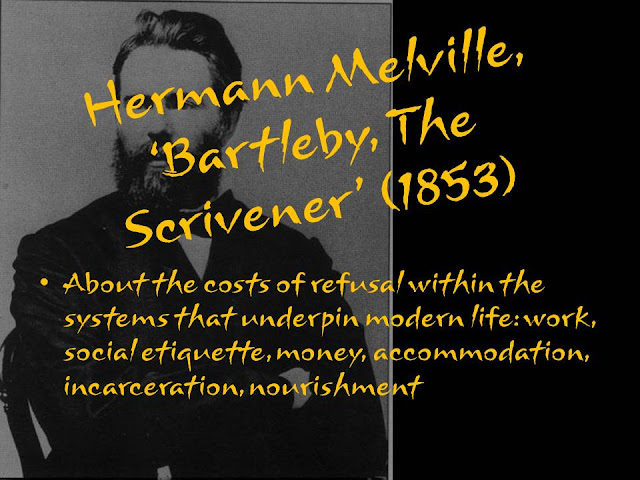
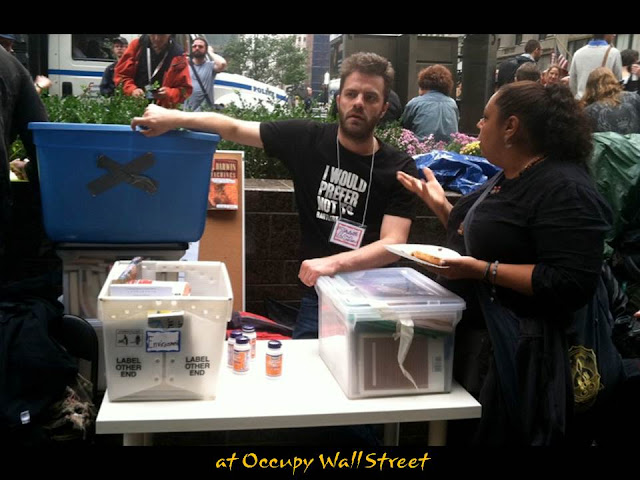
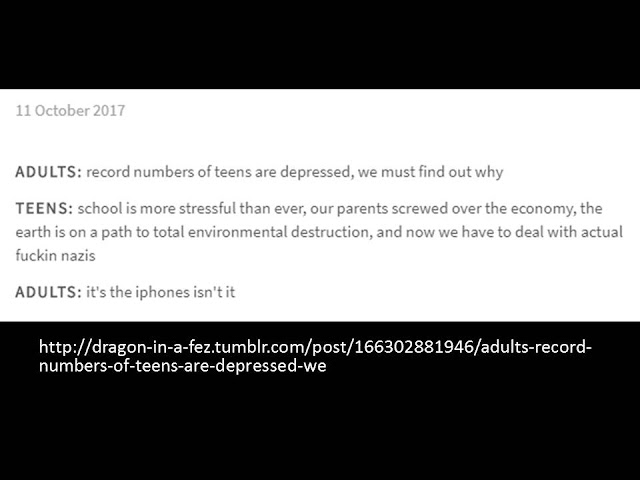
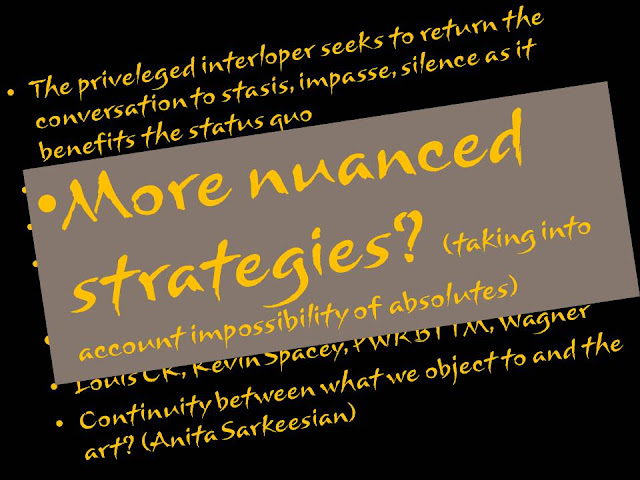
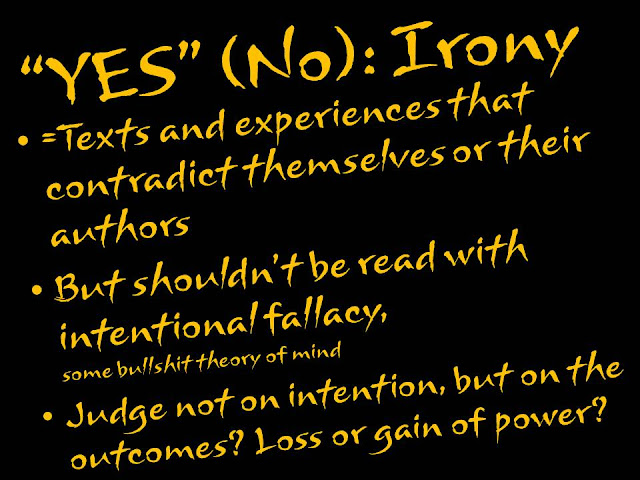
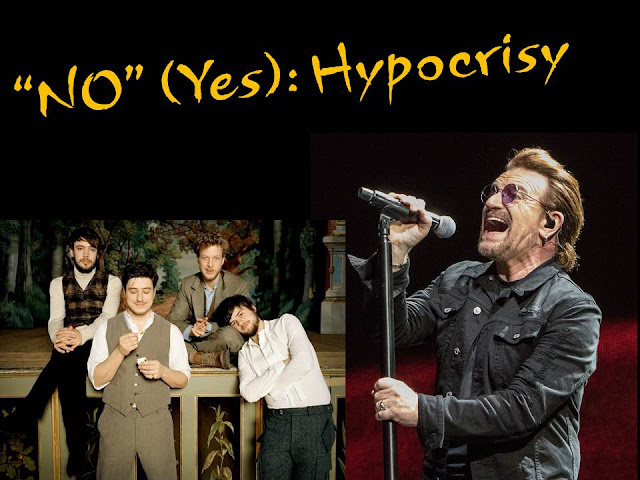
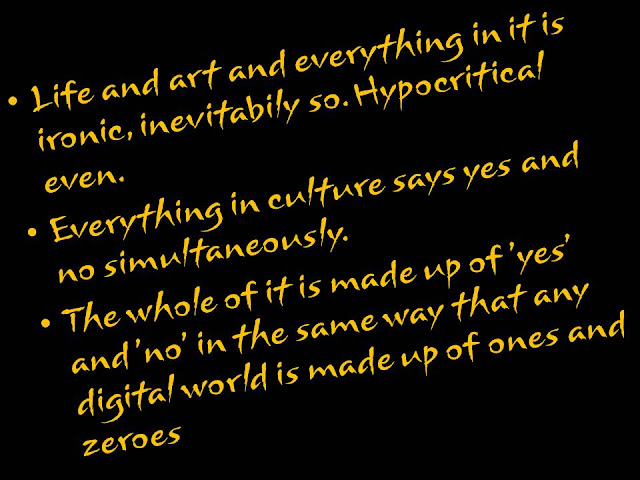
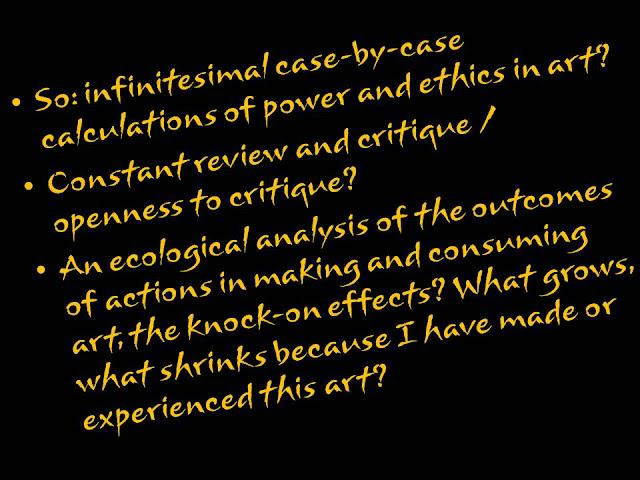
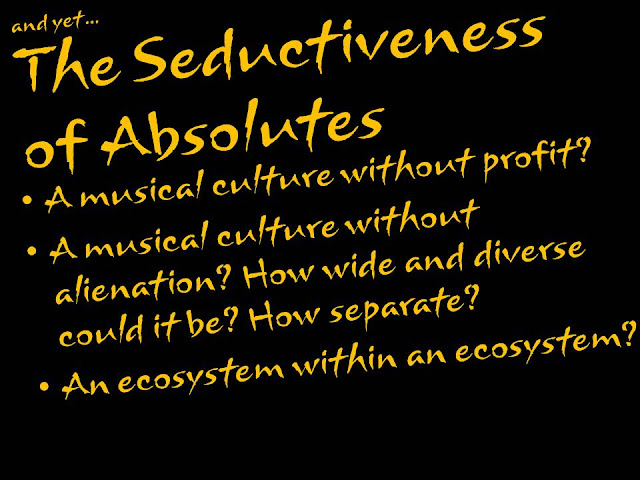
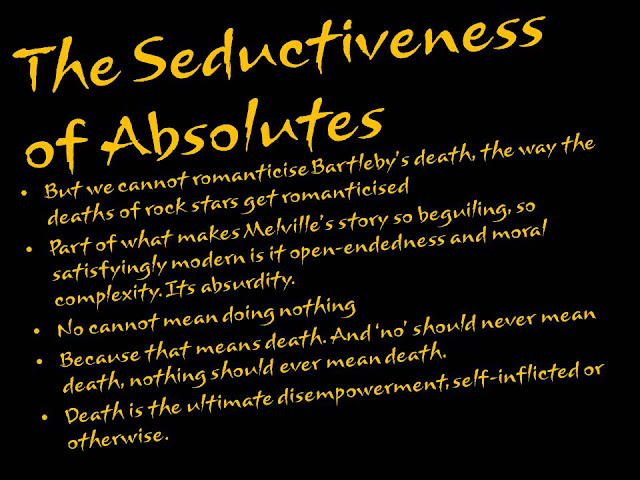
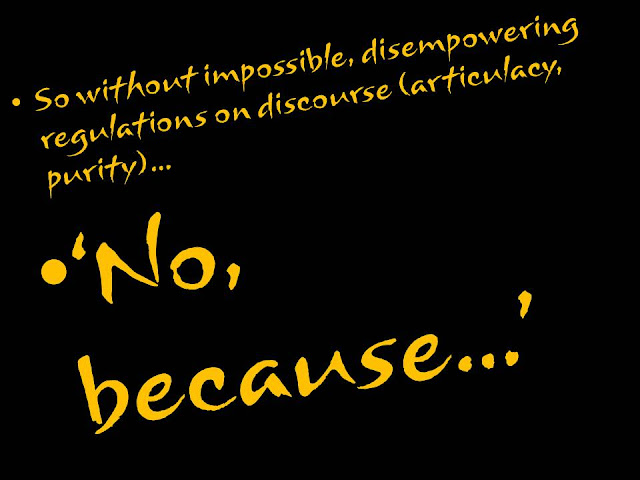
This past weekend I gave a talk about how, why and whether cultural work can refuse the various alienations of modern society / economics, as part of a panel called 'DIY or Die: Is Bartleby Dead in the Post-Digital Age?' at the No! Music Festival at Berlin's Haus der Kulturen der Welt. I don't think the event was recorded, but I thought I'd share my slides / notes on it here, if only because the HKW computer wasn't able to display my outrageous choice of font at the time.

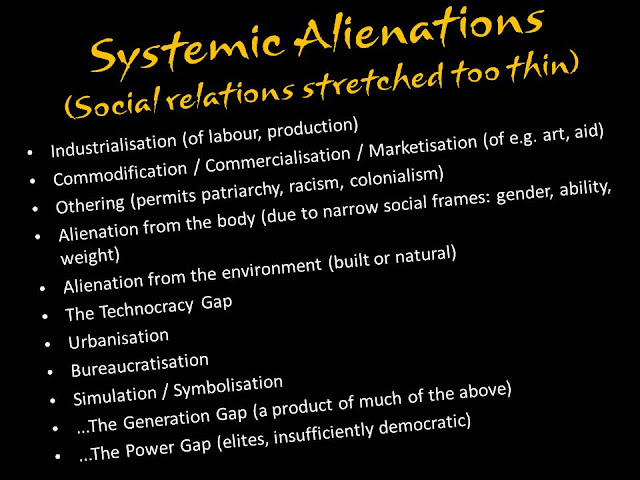
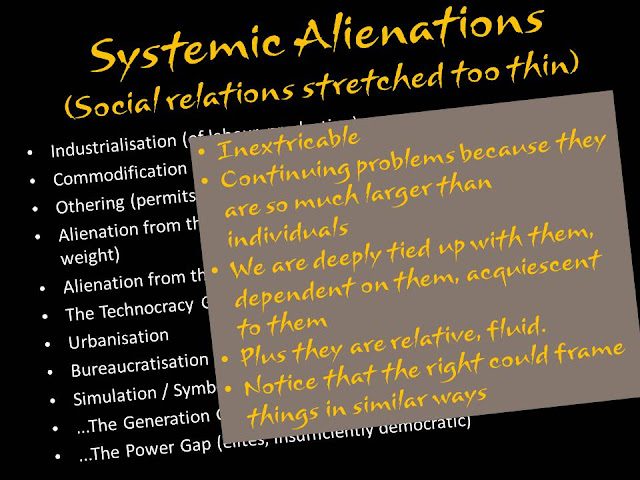
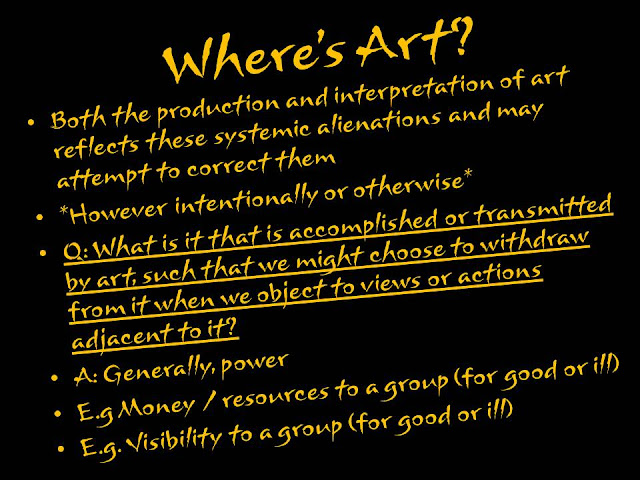
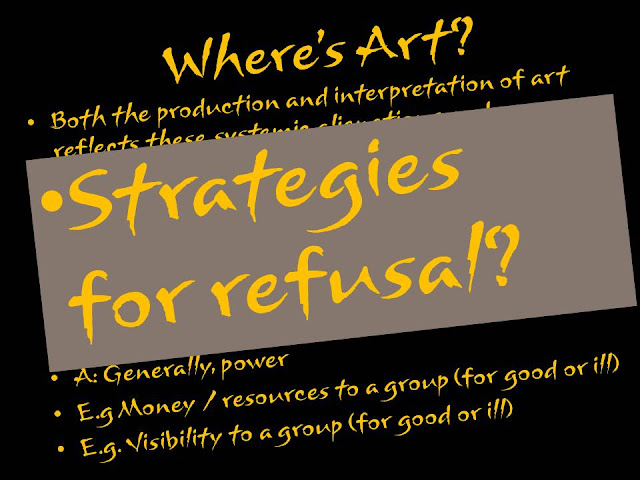


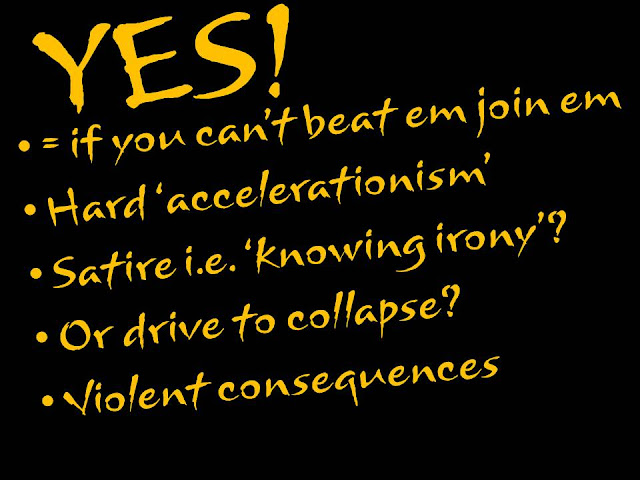
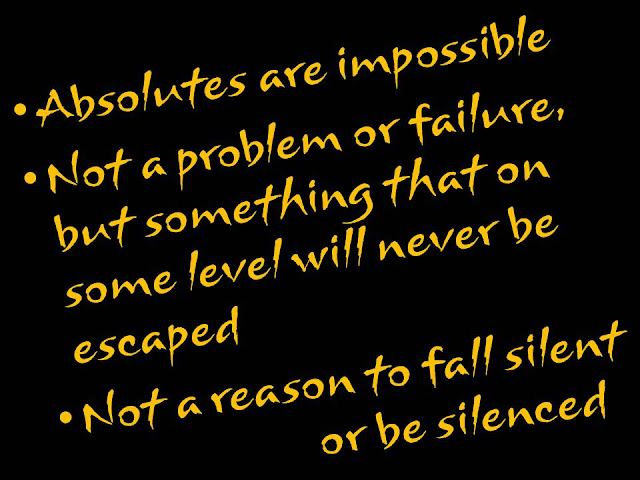
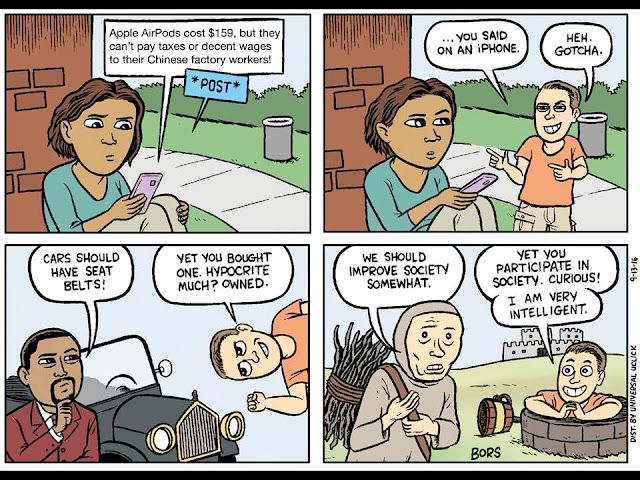
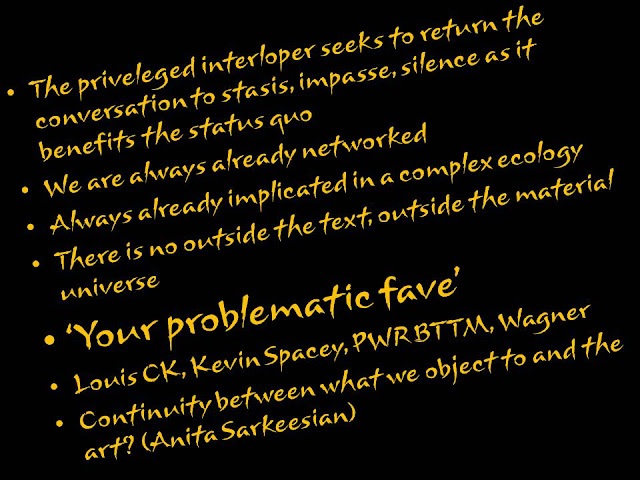 What Sarkeesian says:
14-Jul-17
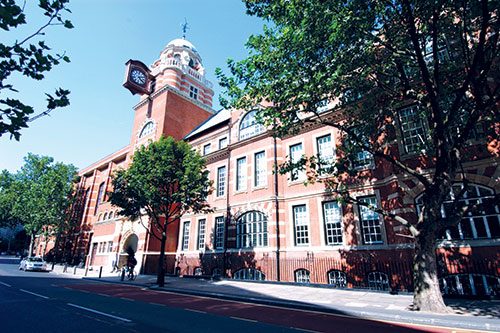 I'm helping to run and speaking at a study day in London next week, 'Is there a Musical Avant-Garde today?' Come along! We're expecting great research and lively debate, and we're most excited about having a forum for ideas of musical 'avant-gardes' (however you feel about the term) that brings together different musical and scholarly traditions.
Date: Friday 21st July, 9:45am-5pm.
Location: City, University of London, College Building, Room AG08 (entrance via St John Street, no. 280). Nearest Tube stations: Angel and Farringdon.
Keynote: Jeremy Gilbert (University of East London).
Organising panel: Alexi Vellianitis (University of Oxford), Adam Harper (City, University of London) and Rachel McCarthy (Royal Holloway).
Registration: £8 including lunch and refreshments
If you'd like to attend, click here to register
What would it mean to talk of 'progressive' music today? Applied to the past or, especially, the present, the term 'avant-garde' has largely fallen out of favour within the academy, both as a description of and an imperative for new music. Yet much contemporary music - whichever combinations of limited terms such as 'art', 'popular,' 'classical' or 'commercial' might apply to it - defines itself, if often all too implicitly, in ways most often associated with avant-garde movements: a focus on stylistic complexity and innovation, and an antagonism towards aesthetic norms and the predominant modes of political thought and practice associated with them. But can such a concept still have currency for musicologists and composers?
The aim of this Study Day is to stimulate a broad, interdisciplinary conversation about how, if at all, to talk of an avant-garde in musical cultures today. For the purposes of this conference, the term 'avant-garde' is fluid, but is broadly defined as a particular idea and praxis of a music considered more progressive than certain others.
We invite scholars and practitioners from different fields to address the ways in which musical avant-gardes today are both practiced and discursively constructed. Topics for discussion could include, but are not limited to the following:
Timetable (approximate):
09:45 Arrival and Coffee
10:00 Welcome and Introduction
10:20 Max Erwin: 'Political Music After Sound: Konzeptmusik and the Complicity of the Avant-Garde'
10:50 Alistair Zaldua: '"Small and Ugly": Critical Composition and the Avant-Garde'
11:20 Lauren Redhead: 'The Avant-Garde as Exform'
11:50 (end of first session)
13:00 Rachel McCarthy: '"The Beat Gets Closer': Post-Capitalist Potential in Girls Aloud's 'Biology'
13:30 Adam Harper: 'Object: Resistance: Underground Music Institutions, Discourse, and Representation'
14:00 (ten minute break)
14:10 Alexi Vellianitis: 'Street Culture and the Musical Avant-Garde'
14:40 George Haggett: 'Towards a Sensual Operatic Ekphrasis in George Benjamin and Martin Crimp's Written on Skin'
15:10 (ten minute break)
15:20 Jeremy Gilbert: Keynote
16:05 Plenary Session
17:00 (end)
Abstracts (in chronological order):Max Erwin: 'Political Music After Sound: Konzeptmusik and the Complicity of the Avant-Garde'This paper seeks to clarify the historical, social, and aesthetic precedents, as well as their broader implications, for New Conceptualism in general, with specific reference to the music of Johannes Kreidler, Patrick Frank, and Celeste Oram. Pursuant to this end, I examine Kreidler's work Fremdarbeit (2009) and how it deploys both veiled self-critique and a radical repositioning of artistic engagement, from autonomy to complicity. Such a complicity, I argue, is crucial for understanding the most recent developments in the musical avant-garde, wherein every critique of society/culture/politics is a priori a self-critique; or, as composer Marek Poliks recently put it, "new music 2.0 is new music about new music". I will demonstrate that this self-critical paradigm is nevertheless far from introverted, with an examination of Patrick Frank's discursive-collaborative compositions, especially the "theory-opera" Freiheit - die Eutopische Gesellschaft (2015) which has as its aim no less than the wresting of 1968-style utopia from a material/cynical exhaustion.
In addition, I aim to provide an overview of how a younger generation of New Music practitioners are grappling with the problems exposed by avant-garde culture in general and Konzeptmusik in particular. I examine Celeste Oram's works soft sonic surveillance (2015) and O/I (off/on, 2016) in terms of an attempted reconciliation between the emancipatory potential of technology and its deployment by corporate and government entities.
Keywords: New Conceptualism, Johannes Kreidler, political art, cultural theory
Alistair Zaldua: "Small and Ugly"; Critical Composition and the Avant-Garde
The quotation in the title of this talk is taken from Bruno Liebrucks description of the processes involved in progress: "The next higher step always appears small and ugly in comparison to the lower, and more completed, step."(1) In his article political implications of the material of new music(2), Mathias Spahlinger explains the concept and enactment of 'critical composition'. He seeks to define his choice of musical materials, processes, and open form, as suggestive of a political utopian ideal. Spahlinger locates this historically by describing the importance of atonality: "the appearance of atonality is the very first time in history in which an approach to composition affects all parameters, in particular the fundamental change in the relation between the parts to the whole. From this, all other parameters must follow."(3)
In Spahlinger's conception, atonality is a historical and irreversible moment where historical understanding and progress intertwine. This is a musical movement in which a vision of utopia can be suggested. Spahlinger's approach to composition is self-reflexive and autonomous; Max Paddison describes Spahlinger's aesthetic as one that lays emphasis on the "…largely structural, technical, and methodological aspects of the music itself" rather than one that continues and develops Hans Eisler's engagierte musik, or 'committed' music.(4) The final category Paddison uses to frame his response to Spahlinger's text is of "[…]composition as political praxis in the sense of the now long-standing avant-garde project of the search for the new and not-yet-known through emergent forms." Thus, the criteria of critical composition could be employed in the search for a musical avant-garde.
Open forms and emergent structures are at work in Spahlinger's little known vorschälge(5): a collection of 28 concept, or word scores. These were created for the purpose of both blurring the distinction between composer and performer and 'making the composer redundant'. This talk will examine these pieces through the lens of 'critical composition' and make some tentative suggestions as to how this avant-garde practice could be identified in more recent music.
1. "Die nächst höhere Stufe ist immer klein und häßlich, gegenüber der niedrigeren, in ihrer Vollendung." Liebrucks, B. 'Sprache und Bewusstsein', Trans. Alistair Zaldua
2. Mathias Spahlinger, 'political implications of the material of new music', trans. by Alistair Zaldua, Contemporary Music Review, Vol 34, no.2-3 (2015), 127-166.
3. "Die Atonalität ist die erste Erscheinungsform dessen, was dann alle anderen Parameter ergreift, nämlich eine grundsätzliche Veränderung des Verhältnisses der Teile zum Ganzen in der Musik. Und die anderen Parameter mussten folgen." (Translation: Alistair Zaldua), Spahlinger, M, and Eggebrecht, H. H,'Geschichte der Music als Gegenwart. Hans Heinrich Eggebrecht und Mathias Spahlinger im Gespräch', Musik-Konzepte special edition, edited by Heinz-Klaus Metzger and Reiner Riehn, Munich (2000),16
4. Paddison, M 'Composition as Political Praxis: A Response to Mathias Spahlinger', Contemporary Music Review, Vol 34 (Part 2-3), 2015, 167-175
5. Spahlinger, M. vorschälge: konzepte zur ver(über)flüssigung der funktion des komponisten, Rote Reihe, Universal Edition, UE 20070, (Vienna: 1993)
Lauren Redhead: The Avant-Garde as Exform
Peter Bürger's critique of the historical avant-garde accounts for its ineffectual nature as a movement because '[a]rt as an institution prevents the contents of works that press for radical change in society […] from having any practical effect.'(1) Bürger argues for hermeneutics to be employed as a critique of ideology,(2) as a facet of the understanding of the 'historicity of aesthetic categories'.'(3) The influence of institutions on music 1968 has served as a central part of its critique: the work concept itself seems to enshrine political ineffectiveness and the bourgeois nature of art practice that ought to be critiqued by an avant-garde. Adorno's claim that 'today the only works which really count are no longer works at all'(4) also no longer seems to apply when the relationship of work such as that produced by the so-called Neue-Konzeptualismus(5) with established musical institutions is considered.
In contrast, Bourriaud's concept of the 'exform'(6) re-conceives the avant-garde as outside of institutions and an idea of 'progress' that is aligned with a dominant capitalist ideology. The exformal is 'the site where border negotiations unfold between what is rejected and what is admitted, products and waste', and forms 'an authentically organic link between the aesthetic and the political.'(7) Progress, as part of a capitalist narrative, both creates and abhors waste. Therefore the task of the avant-garde artist is to give energy to this waste, outside of political and ideological institutions. This type of avant-garde practice functions to 'bring precarity to mind: to keep the notion alive that intervention in the world is possible.'(8) This paper explores the exform with respect to the music and art work of the British composer Chris Newman, and considers how Bourriaud's approach to re-thinking the avant-garde might apply specifically to contemporary and experimental music in the
present.
1. Peter Bürger, Theory of the Avant-Garde, trans. by Michael Shaw, Theory and History of Literature, vol. 4 (Minneapolis, MN: University of Minnesota Press, [1984] 2009), p.95.
2. ibid., p.6.
3. ibid., pp15-16.
4. Theodor Adorno, Philosophy of Modern Music, trans. by Anne G Mitchell and Wesley V Blomster (New York: Continuum, 1973), p.30.
5. cf. Johannes Kreidler, 'Das Neue am Neuen Konzeptualismus', published as 'Das Neue and der Konzeptmusik', Neue Zeitschrift für Muzik, vol. 175, no. 1 (2014), pp44-49, de/theorie/Kreidler__Das_Neue_am_Neuen_Konzeptualismus.pdf> [accessed 13.05.2017].
6. Nicholas Bourriaud, The Exform, trans. by Erik Butler, Verso Futures (London: Verso, 2016).
7. ibid., p.10.
8. ibid., p.47.
Rachel McCarthy: 'The Beat Gets Closer': Post-Capitalist Potential in Girls Aloud's "Biology"'
A recent body of Leftist socio-political theory advocates a transformational approach to post-capitalism. Inspired by Brecht's maxim 'don't start from the good old things but the bad new ones', as well as Lenin's suggestion that capitalist institutions such as banks could be re-purposed for socialist ends, writers including Jameson (2010), Williams and Srnicek (2014), and Mason (2015) posit that a future beyond capitalism must be secured not through a rupture with present society, but rather by a transformation of already-existing phenomena. Jameson identifies utopian potential in the organisational structures of Wal-Mart, while Williams and Srnicek promote accelerationism as a means of pushing through the bonds of capitalism.I suggest that the music of the mainstream pop group Girls Aloud represents an aesthetic parallel to this kind of political theory. With roots in the reality television talent show Popstars, capitalist relations of production are deeply embedded in the group's music. Yet analysis of their 2005 hit single 'Biology' demonstrates how, in deviating from the structural norms of mainstream pop, the song contains a striking kernel of utopian impulse. This is further complicated by the disturbing sense of jouissance that pervades the song's reception, whereby a 'critical' enjoyment of mainstream pop can amount to having one's cake and eating it too. Ultimately, 'Biology', like Jameson's assessment of Walmart, should be understood dialectically: neither as a regressive symbol of the evils of capitalism nor as a shining beacon of hope for a post-capitalist future, but as something in between.Adam Harper: 'Object: Resistance': Underground Music Institutions, Discourse and RepresentationHow might a sonic avant-garde go hand in hand with a progressive social ideology today? Might an enlarged set of sonic possibilities correspond to greater social representation? Taking the term 'representation' in both its political and aesthetic senses (that is, the representation of emotion, experience and so on), this paper hopes to begin to approach these questions in the light of a number of recently established collectives and institutions within underground music that explicitly provide platforms specifically for women (such as Sister, Discwoman and Objects Limited), people of certain regional or diaspora contexts (such as NON and Eternal Dragonz), or people of certain sexualities (such as KUNQ). What sort of discourse surrounds such collectives? What are their goals and are they achieving them? To what extent do they combine the musical and the social in redistributing representation?Alexi Vellianitis: 'Street Culture and the Musical Avant-Garde'This paper looks at ways in which certain metaphors or rhetorical strands linked to the musical avant-garde have been mobilised to describe interactions between new classical music and 'urban' music (grime and electronic dance musics) on the London classical concert scene since 2000. In particular, it is concerned with a fetishisation of the 'the symbolic power of street culture[, which] is often understood as authentic, defiant and vital' (Ilan, 2015). Seen as such, this symbolic power shares much with the classical avant-garde, since modernist or avant-garde status has historically been conferred on the basis that music signals 'political engagement and commitment', and is linked to and fuels 'periods of political instability, change, revolt, and revolution' (van den Berg, 2009).In order to unpack these issues, this paper focuses a number musical performances around London over the past decade: two BBC Proms concerts, in which grime was featured alongside the BBC Symphony Orchestra; and the musical activities of composer and producer Gabriel Prokofiev, whose nightclub and record label Nonclassical brings classical music to clubs throughout London, and whose orchestral music brings 'urban sounds into the concert hall' (Shave, 2011). In each case, accusations that the classical concert scene is being 'dumbed down' by featuring popular music are countered by arguments that this 'urban' popular music is in some way new, current, or vital.These concerts foreground questions about race, class, and inclusivity that have been dominant in public discourse. Is this a positive diversification of classical music culture, or just another set of appropriations of black, working-class music by white, affluent musicians? What is it about the experience of social unrest in urban areas that speaks to the political pretentions of the avant-garde? What change, if any, is being effected?George Haggett: Towards a Sensual Operatic Ekphrasis in George Benjamin and Martin Crimp's Written on SkinThere is little in Katie Mitchell's production of George Benjamin and Martin Crimp's 2012 opera Written on Skin that goes unseen: not only does the thirteenth-century plot feature an on-stage orgasm, but throat-slitting, evisceration, cannibalism, and suicide. Nevertheless, when these lurid events are painted by 'the Boy' (the heroine, Agnès's, illicit lover), the audience can never see them. Instead, during what Crimp and Benjamin term 'Miniatures', he takes out a page and, singing, describes the illumination that he has painted onto it. In so doing, he turns his pictures into uttered acts of ekphrasis, the rhetorical device through which visual art is described in detail.In asking how operatic ekphrasis can function and unpacking its potency in Written on Skin, I will do three things: 1) lift ekphrasis from its specificity to the reified, written word and into the performative realm of the sung act; 2) refer outwards from Written on Skin's Troubadour source text to locate its viscera within thirteenth-century understandings of the body; 3) analyse each miniature in turn to interrogate Benjamin's compositional responses to these conditions. Integrating the former two, I will dissect Written on Skin into four sensory organs—eyes, ears, skin, and mouths—and lodge them between Miniature analyses. My intention is to bring the body to the fore, always in pursuit of a reading that hears the body when it hears ekphrasis, and hears ekphrasis when it hears the body.
15-Jan-17
 Negativity, Not Pessimism! (RIP Mark Fisher) [ 15-Jan-17 6:59pm ]
(7D7B46C409699693BB5299F3ECF1319C).jpg) I was so shocked and upset to learn of Mark Fisher's death yesterday. For me, Mark was both an idol and, as time passed, someone I was always pleased and not a little humbled to encounter in person and sometimes share a platform with. I didn't know Mark very well personally, and being a generation younger than he was I only know second hand the milieu of the 90s and the Cybernetic Culture Research Unit at Warwick University he formed an integral part of, through its growing legacy and some of the reminiscences and thoughts of people who knew him then (Robin MacKay, Simon Reynolds and Jeremy Greenspan among them). But as someone a generation younger than Mark, I can express something about the incalculable impact he had on me, my thinking and writing, and my gratitude for the times when he actively, kindly helped me, as well as the times that were just good times.
I was so shocked and upset to learn of Mark Fisher's death yesterday. For me, Mark was both an idol and, as time passed, someone I was always pleased and not a little humbled to encounter in person and sometimes share a platform with. I didn't know Mark very well personally, and being a generation younger than he was I only know second hand the milieu of the 90s and the Cybernetic Culture Research Unit at Warwick University he formed an integral part of, through its growing legacy and some of the reminiscences and thoughts of people who knew him then (Robin MacKay, Simon Reynolds and Jeremy Greenspan among them). But as someone a generation younger than Mark, I can express something about the incalculable impact he had on me, my thinking and writing, and my gratitude for the times when he actively, kindly helped me, as well as the times that were just good times.
Mark simply changed my life. By 2009, the year I started the blogging, he was a central node in a network of bloggers, thinkers and forums that encompassed critical theory, philosophy and several areas of cultural criticism, especially of popular music. It was a conversation and a community I eagerly wanted to participate in, late and all too hot-headed though I was. As commissioning editor of Zer0 books, he fostered the growth and evolution of this network into a collective of thinkers built on diverse, self-contained and regularly powerful statements that went far.
Mark's own essay for the imprint, Capitalist Realism: Is There No Alternative? was undoubtedly one of the best of the lot. I continue to recommend it widely as one of the best, most distilled expression of today's ideological challenges. By the end of 2009, Mark had reached out to me and asked if I wanted to write for Zer0. I was 22. Infinite Music was the result two years later. He told me that I should reconsider the title I had initially proposed - 'The New New Music' (can you believe that!?) - which didn't take Mark's genius, but thank God. His faith in me - this despite my frequent and often crude HTML critiques of his positions on music - led to so many amazing opportunities and blessings for the struggling, wet-behind-the-ears critic I was.I first met Mark in person in April 2010 when we were both part of a panel discussion at London's Café OTO, a 'salon' under the auspices of Wire magazine: 'Revenant Forms: The Meaning of Hauntology'. He was warm, friendly and funny back stage, powerful, precise, provocative and funny on-stage. Someone I brought to the event who didn't know Mark and his ideas said to me 'but capitalism is the only system that works!' (this of course is precisely was Capitalist Realism describes and addresses). I believe I next saw him marching alongside thousands of students at one of the protests against the raising of tuition fees and the cutting of the university teaching budget in late 2010, an issue that inflamed and unified the blog network like nothing else, not least Mark himself.At some point in 2011 I was at a gig behind a pub at which Maria Minerva was playing. Maria had been taught by Mark during her Master's at Goldsmith's college. In an amazing moment, Maria gave a shout-out on stage to her 'professors' - I followed the direction of her outstretched arm, and there was Mark, leaning against a wall next to Kodwo Eshun. I saw him at least twice in 2013, once at a symposium at Warwick University on the Politics of Contemporary music, where I burned with envious ambition at his ability to deliver such an on-point, appropriate and funny lecture from only a small notebook. The other time was in Berlin, where I was talking about accelerationist pop for the CTM festival, Mark was there to talk about the death of rave. We walked from our hotel to the venue, had lunch, and Mark talked sympathetically and encouragingly about my career difficulties. He sat in the front row of the talk I gave. I played some of the kitschiest vaporwave as the audience came in. I'll never forget the bemused look on his face, as if he was trying to figure out what sort of a hilarious prank was being played, and whether he wanted in on it. That image of Mark is still for me the opposite end on the spectrum of vaporwave listeners to the one where vaporwave is, uncritically, 'just good sincere nostalgic vibes', and why I have no regrets about 'politicising' vaporwave (a genre that in any case owes an enormous debt to his theorising of hauntology).But for me there was another Mark as well - the formidable writer and theorist, k-punk. This voice I began to get to know in 2006, the year when he did so much to lay the foundations of hauntology (it was his invention, frankly). It was from k-punk that I learned about something called 'neoliberalism' ('what on earth has this guy got against liberalism?' I would wonder). It was from k-punk that I learned that post-modernism was not necessarily the wonderful cultural emancipation I had naively believed it to be. In fact, during these years I was mostly against k-punk. He was critical of more recent trends in electronic music, believing them a poor comparison to what the 90s had offered. This led to a fierce division between writers and bloggers that manifested not just in blogs but magazine sites and a day-long conference at the University of East London, which I attended (the first time I saw Mark in the flesh). Though we both agreed that new music was necessary, naturally his position irritated my young, idealistic self with my special music, and my own blog posts attempted to intervene in support of the new stuff. 'Loving Wonky', my first blog post to attract more than a handful of readers, was directed at k-punk implicitly throughout and at its conclusion, explicitly.This negativity that got me started, this need to talk back to the authority figure, was a testament to the power of his writing. But more so was the way he subsequently taught me as I took a closer look. In preparation for my post on hauntology, I printed out and re-read everything he'd written on or near the subject, underlining and making notes. And he convinced me of his position. He was right. I didn't want to accept his theorising of 'the end of history', thinking it merely pessimistic. His blog posts are so imaginatively, seductively, persuasively written. He's probably the most referenced person on Rouge's Foam. Then I read Capitalist Realism, and rather than the mere youthful defence of certain musics it could have been, Infinite Music became an attempt to stand with Capitalist Realism and answer k-punk's resounding call for a newfound creative imagination. Later, in 2012, it was from k-punk that I learned of accelerationism, and because of his theory that I used it to describe new forms of electronic music in 'Welcome to the Virtual Plaza.' And it wasn't only theory. Wherever I wrote about music and Mark was writing too (Wire, Electronic Beats), my writing was improved by the honour and by his raising of the bar (this was the guy who had described Michael Jackson as 'only a biotic component going mad in the middle of a vast multimedia megamachine that bore his name.')Mark isn't just the figure behind every significant thing I've done as a critic. His theory is now deeply embedded in who I am and what I say. Even the residue of the ideas I have fought against condition my thinking. I have brought his concepts home, they structure my conversations with my friends and family. Capitalist realism: describing the ideology that miserable as it is, there is no alternative to capitalism and that's just the way it is. Business ontology: the ideology that any social or cultural structure must exist as a business. His use of the concept of the Big Other - the imaginary subjectivity that holds important beliefs but may not in fact exist - has guided me through my personal response to Brexit and Trump. (By the way, I couldn't possibly summarise Mark's writing - if you haven't read it already, what are you waiting for?) Even his blackly comic image of a broken neoliberalism, as a cyclist dead and slumped over the handlebars yet continuing downhill and gathering speed, keeps coming back to me.Mark eventually became something of a role model to me. Asked what sort of space I wanted to carve out between academia and public criticism for my own career, I have often said I wanted to be a Mark Fisher. Yet as he regularly explained with his astonishing balance of passion and precision, the world as it is today, its ideologies and its institutions - it's hardly set up to encourage fringe intellectuals. I'm not sure whether he would have fully encouraged me to aspire to his career, tied so closely as he well knew to challenges of mental health (something I started to live in 2014 when, initially and like so many others, my PhD went nowhere). But he did warmly support and encourage my writing when so many people around me could only regard it with doubt.One of Mark's most abiding lessons, and for me at least the key to his writing, was something he put pithily to me at the end of an email: 'Negativity, not pessimism!' I had not appreciated the subtle but important difference the two, but then I instantly did. What a rallying call for the nightmarish 2010s. And as others have noted, it was his encouragement and optimism that was especially nourishing. It was certainly not a pessimistic new-music naysayer who wrote the final words of Capitalist Realism:
25-Aug-16
Bubblebath Episode 01 ft. Mat Dryhurst (for RBMA Radio) [ 25-Aug-16 5:04pm ]
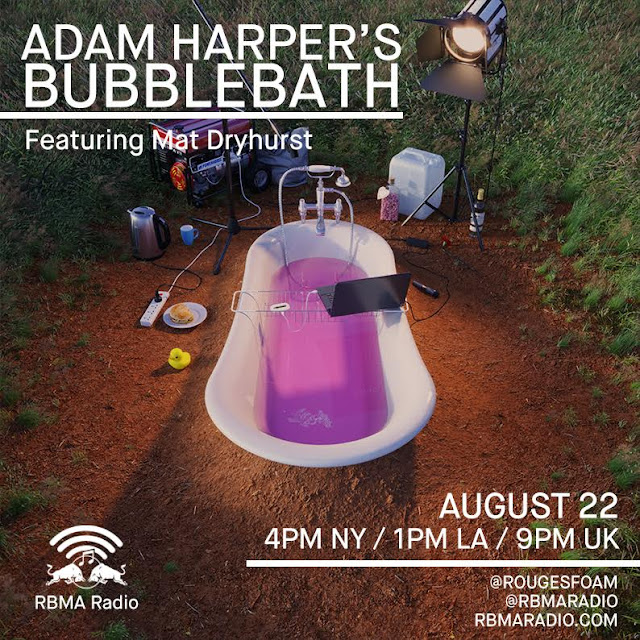 Art by Kim LaughtonThe first episode of my new monthly show for RBMA Radio aired a few days ago, and is archived here. Bubblebath is a two-hour show all recorded and edited by me, featuring new, typically lesser known tunes that I'm interested in, segments going for some deeper analysis, and interviews with various people from underground music culture. For the first show, I looked at the pseudo-humanistic style of James Ferraro's Human Story 3 and some other records, and talked to Mat Dryhurst about some of the problems facing underground culture today and his platform Saga. The playlist is below.
People in the US won't be able to listen to the archived version of the show for various legal reasons. I didn't realise that would happen and I do apologise. If that's you, you might try using a proxy server, especially with different browsers. US listeners can listen to the show live without any problems, though, so I'll make sure to forewarn people next time.
· 00:00:02 - 00:02:41 Julien - Alpha Beat - Calm (from Calm 2 https://calmdot.bandcamp.com/album/calm-2)
· 00:02:41 - 00:05:28 Alfie Casanova - 4 Play - Calm (from Calm 2 https://calmdot.bandcamp.com/album/calm-2)
· 00:05:28 - 00:10:16 NKC - Salon Room - Her Records (from Hague Basement http://store.herrecords.com/album/hague-basement)
· 00:10:16 - 00:13:03 仮想夢プラザ - 秘密 - Plus 100 Records (from Balance with Useless https://plus100.bandcamp.com/album/balance-2) (extract, background, and again throughout )
· 00:13:03 - 00:18:17 Julien - Day Racer - Orange Milk (from FACE OF GOD https://orangemilkrecords.bandcamp.com/album/face-of-god)
· 00:18:17 - 00:23:52 NV - Bells Burp - Orange Milk (from Binasu https://orangemilkrecords.bandcamp.com/album/binasu)
· 00:24:50 - 00:29:57 Easter - Leda - own Bandcamp page (from New Cuisine Part 2 https://easterjesus.bandcamp.com/track/leda)
· 00:29:57 James Ferraro - various tracks from Human Story 3 - own Bandcamp page (https://jjamesferraro.bandcamp.com/album/human-story-3) (extract, background)
· 00:32:04 - 00:37:32 James Ferraro - Individualism - own Bandcamp page (from Human Story 3 https://jjamesferraro.bandcamp.com/album/human-story-3)
· 00:39:19 - 00:40:31 John Adams - Lollapalooza - Nonesuch (from I Am Love Soundtrack) (extracts)
· 00:40:55 - 00:41:20 Steve Reich - Eight Lines Number 1 - RCA Red Seal (extract)
· 00:41:36 - 00:42:30 Aaron Copland - Allegro from Appalachian Spring - Sony Classical (from Bernstein Century: Copland) (extract)
· 00:43:05 - 00:44:32 Jeffery L. Briggs - CivNet Opening Theme - Microprose (from CivNet Soundtrack) (extract)
· 00:44:48 - 00:45:24 Oneohtrix Point Never - Problem Areas - Warp (from R Plus Seven) (extract)
· 00:45:52 - 00:46:11 Kara-Lis Coverdale - AD_RENALINE - Sacred Phrases (from Aftertouches https://sacredphrases.bandcamp.com/album/aftertouches) (extract)
· 00:46:30 - 00:47:04 Giant Claw - DARK WEB 005 - Orange Milk (from DARK WEB https://orangemilkrecords.bandcamp.com/album/dark-web) (extract)
· 00:47:25 - 00:47:51 Metallic Ghosts - University Village - Fortune 500 (from City of Ableton https://fortune500.bandcamp.com/album/the-city-of-ableton) (extract)
· 00:48:58 - 00:49:59 Torn Hawk - The Romantic - Mexican Summer (from Union and Return) (extract)
· 00:52:12 - 00:55:08 Subaeris - Shadow Portal - Nirvana Port (from Transcendent God https://nirvanaport.bandcamp.com/album/transcendent-god)
· 00:55:08 - 00:58:23 Subaeris - Beating Heart - Nirvana Port (from Transcendent God https://nirvanaport.bandcamp.com/album/transcendent-god)
· 00:59:08 - 01:01:16 Klein - Babyfather Chill - own Bandcamp page (from ONLY https://klein1997.bandcamp.com/album/only)
· 01:01:16 - 01:03:45 Klein - Make it Rain - own Bandcamp page (from BAIT https://klein1997.bandcamp.com/album/bait)
· 01:04:49 - 01:47:38 Valentin Silvestrov - Diptych - ECM (from Valentin Silvestrov: Sacred Works) various tracks from Valentin Silvestrov: Silent Songs - ECM (extracts, background)
· 01:49:09 - 01:54:25 Swimful - Atop - SVBKVLT (from PM2.5 https://svbkvlt.bandcamp.com/album/pm25)
· 01:54:25 - 01:58:45 Swimful - Bounce (Simpig Remix) - SVBKBLT (from PM2.5 Remixes https://svbkvlt.bandcamp.com/album/pm25-remixes)

24-Aug-16
'Joy 2016' (essay for 3hd festival, where I'll be in October) [ 24-Aug-16 5:12pm ]
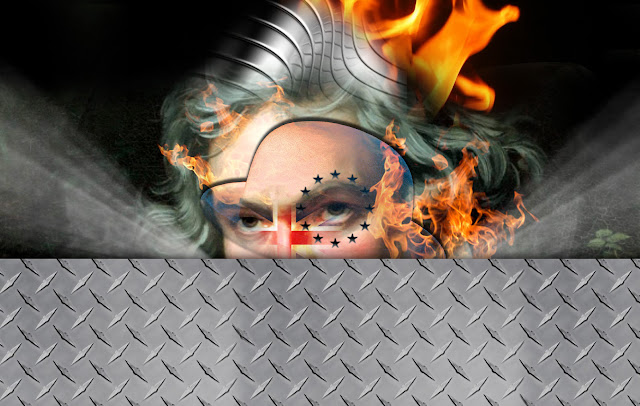 Art by Sam Lubicz3hd festival is back for its second year in Berlin this October, and its website has gone up (click here). I'll be there lecturing and participating in discussions over various aspects of their theme 'There is nothing left but the future.' In the meantime, I wrote an essay for them (click here to read it) sketching some initial thoughts about some of the problems facing musical futurism and musical sarcasm after a summer of violence and Brexit, through the lens of the 'Ode to Joy' from Beethoven's Ninth Symphony, and Wendy Carlos's electronic version of it particularly (incidentally, Jeremy Corbyn, something of a lightning rod for various kinds of political tumult whatever you think of him, recently mentioned listening to Beethoven's 5th).
Beethoven's Ode to Joy has accumulated cultural and political baggage of apparently every different kind, and, especially, in extremes. It has played the role of humanity's highest and most noble achievement and an incitement to horrifying violence both. And it is the anthem of the European Union...
Who needs dehumanising machine music when you have Trump, when you have the rise of hatred the world over?
There is an important difference, of course, between the future and the futuristic. The futuristic is a costume, a thrill, a performance, a caricature, all from within the safety of the present. The future is what actually happens to you and at some point, whoever you are, it will hurt you. What can art and music help us to do and to say before that point?
22-Feb-16
Brunel University Post-Internet Working Group, London, soon [ 22-Feb-16 3:34pm ]
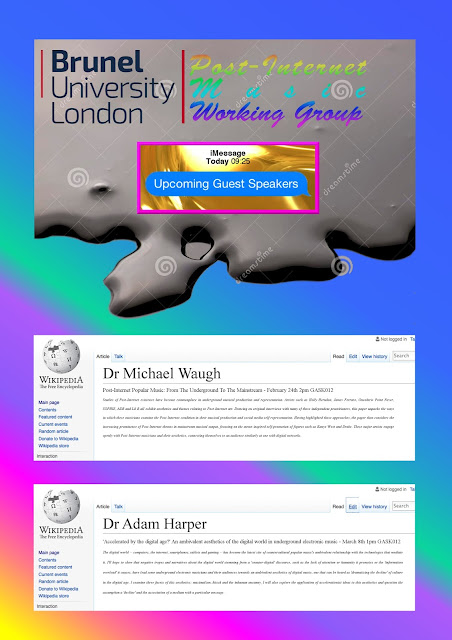 Click to enlarge and read the blurbs for each talkI'm looking forward to participating in a Post-Internet Working Group at Brunel University that'll meet on two occasions, on Feb 4th at 2pm, when Michael Waugh will be giving a talk ('Post-Internet Popular Music: From the Underground to the Mainstream'), and on March 8th at 1pm, when I will be giving a talk ('"Accelerated by the Digital Age?"An Ambivalent Aesthetics of the Digital World in Underground Electronic Music'). Why not come along for some IRL content creation? ;)
18-Dec-15
Slides from my talk at 3hd, 'What is the Musical Object in the 21st Century?' [ 18-Dec-15 8:03pm ]
Blogpost for Verso: On Music and Folk Politics [ 08-Dec-15 4:17pm ]
Click to enlarge and read the blurbs for each talkI'm looking forward to participating in a Post-Internet Working Group at Brunel University that'll meet on two occasions, on Feb 4th at 2pm, when Michael Waugh will be giving a talk ('Post-Internet Popular Music: From the Underground to the Mainstream'), and on March 8th at 1pm, when I will be giving a talk ('"Accelerated by the Digital Age?"An Ambivalent Aesthetics of the Digital World in Underground Electronic Music'). Why not come along for some IRL content creation? ;)
18-Dec-15
Slides from my talk at 3hd, 'What is the Musical Object in the 21st Century?' [ 18-Dec-15 8:03pm ]
Blogpost for Verso: On Music and Folk Politics [ 08-Dec-15 4:17pm ]
When, in Inventing the Future, Nick Srnicek and Alex Williams critique the collection of tendencies within the contemporary left they call 'folk politics,' they could also be lamenting the aesthetics that now dominates those areas of popular music that were once progressive. Whether it's underground, or 'indie,' or even happens to be in the charts, contemporary popular music routinely 'chooses the familiarities of the past over the unknowns of the future;... habitually chooses the small over the large' and 'value[s] withdrawal or exit rather than building a broad counter-hegemony'. For independent music as in folk politics, 'organisations and communities are to be transparent, rejecting in advance any conceptual mediation, or even modest amounts of complexity' and both 'emphasis[e] the local and the authentic, the temporary and the spontaneous, the autonomous and the particular'. Srnicek and Williams show that these strategies arose and achieved much in the special political circumstances of the mid-twentieth century, and again, as aesthetic strategies in popular music, they arose during the same period in the countercultural atmosphere of jazz, rock, punk and, indeed, folk musics. And for both folk politics and folk-political music, the time has come to invent what happens next...
17-Oct-15
Slides from my talk at Unsound, 'Is Accelerationism Good for the Underground?' [ 17-Oct-15 6:30pm ]
System Focus: Get To Know Gqom, South Africa's Slow-Burning Club Music [ 05-Oct-15 5:44pm ]
 The TOWNSHIPTECH logo
The latest System Focus is on dance sounds of South Africa that live online, chiefly 'gqom' with some shangaan electro and sgubhu too (click here to read). featuring: Spoek Mathambo, Nozinja, TOWNSHIPTECH, SHANGAANBANG, DJ Dino, U-Zet, Phelimuncasi, Rude Boyz, GQOM OH, Citizen Boy and DjAsinatar and the Facebook groups IGqomu, Sgubhu & Gqom Lovers, Gqomu music and Gqom Nation.
South African popular music, in its myriad forms—from choral folk group Ladysmith Black Mambazo to madcap rappers Die Antwoord—has played a huge role on the world stage for decades, and today this richly musical country boasts an ecosystem of electronic dance and club sounds that changes, spreads, and develops with an energy that can rival that of just about anywhere else you care to name...

Meanwhile, the southeastern coastal city of Durban in the KwaZuluNatal province of South Africa has been incubating a style called gqom for a few years now... It would be difficult to imagine a kind of music more different from Shangaan Electro than gqom is—it's a slow-burning, minimal and ominous style that's frequently described as "raw." Gqom fan Thandolwethu BlaqueMusiq Mseleni—who runs a group on Facebook called Sgubhu and Gqom Lovers out of King Williams Town in the Eastern Cape province—told me that qqom is "house music with broken beats, sliced vocals or chants, high tempo and mostly with no bassline."
"We grew up on it," Veezy tells me about gqom. "You know, taxis in town or everywhere in and around Durban blasting these songs that had really catchy and funny verses as well as banging hooks. Most people just hear loud bangs but, if you take time to really listen to it, you realize it's more than a created pattern—it's rhythm that syncs with fun. I like it cause it's a really huge crowd favorite in lounges and clubs to get turnt with or get the party sounded."...
 Citizen Boy is one of gqom's most creative producers. Plunge headlong into his kasimp3 uploads... featuring him and his affiliates, and you'll encounter dozens of weird and wonderful twists on the genre's template. Try the hectic "Spit Fire (Remix)," the ultra-minimal "VH HIT" with its deadpan cuíca hook, the downright evil "Natural Mafias," the alien skirmish of "Thekwini War (Mafiamix)" or the unholy croaks of "Point Magnet (Dope mix)." There there's "Deep Gqomu," a masterpiece that builds up majestically, its ethereal scales climbing ever skyward...
17-Aug-15
Response from chukwumaa [ 17-Aug-15 1:26pm ]
System Focus: The Voices Disrupting White Supremacy Through Sound [ 17-Aug-15 1:18pm ]
Citizen Boy is one of gqom's most creative producers. Plunge headlong into his kasimp3 uploads... featuring him and his affiliates, and you'll encounter dozens of weird and wonderful twists on the genre's template. Try the hectic "Spit Fire (Remix)," the ultra-minimal "VH HIT" with its deadpan cuíca hook, the downright evil "Natural Mafias," the alien skirmish of "Thekwini War (Mafiamix)" or the unholy croaks of "Point Magnet (Dope mix)." There there's "Deep Gqomu," a masterpiece that builds up majestically, its ethereal scales climbing ever skyward...
17-Aug-15
Response from chukwumaa [ 17-Aug-15 1:26pm ]
System Focus: The Voices Disrupting White Supremacy Through Sound [ 17-Aug-15 1:18pm ]
 chukwumaa and E. Jane of Philly duo SCRAAATCH. Photo by Liz BarrAugust's System Focus is on rising networks of African and Afrodiasporic artists disseminating their music in solidarity, along with some cultural context (click here to read). Featuring Chino Amobi, NON, Angel Ho, Nkisi, Serpentwithfeet, SCRAAATCH, E. Jane, chukwumaa, embaci, Brandon Covington, Elon, Butch Dawson, Kayy Drizz, Dog Food Music Group, Violence, Mykki Blanco, Psychoegyptian, Yves Tumor etc.
Back in December, angry New Yorkers gathered to sing "They Don't Care About Us" following the decision not to indict Eric Garner's killer, a police officer. The song's lyrics were written on a placard during a protest against the Ferguson police department in the wake of their fatal shooting of Michael Brown. It also provided the soundtrack to the Baltimore protests in response to the death of Freddie Gray in police custody, danced to by a Jackson impersonator amidst the chaos of helicopters and sirens... The song has recently found new layers of meaning and urgency in the context of the continuing struggle against racist police violence, now taken up by the Black Lives Matter movement... It's no wonder that African and Afrodiasporic artists are choosing to disseminate music in solidarity. In many cases, this creative decision is a strategy for dealing with the alienation that is so often a part of Afrodiasporic experience. As the London-based writer Kodwo Eshun puts it in his 2003 essay Further Considerations on Afrofuturism: "the condition of alienation, understood in its most general sense, is a psychosocial inevitability that all Afrodiasporic art uses to its own advantage by creating contexts that encourage a process of disalienation." And yet in the continuing environment of white supremacy, this creativity is routinely either erased, appropriated, or confined to narrow and fetishized aesthetic areas...
"In no uncertain terms, the Intent of NON is to run counter to current Western hyper-capitalist modes of representation and function, exorcising the language of domination through the United Resistance of policed and exotified colored bodies," NON's email continued. "At a time when national (market) state financial and political systems are tested as never before, NON shall remain committed to the militant realities and potentials of 'The NON State.' NON came into existence through the Pan-African desire for representation on our own terms." As stated on their Soundcloud page, NON artists are "using sound as their primary media, to articulate the visible and invisible structures that create binaries in society, and in turn distribute power..." SerpentwithfeetOne of the most beguiling and exciting voices to have emerged from underground music in recent times, Serpentwithfeet also appears on another track that NON reposted on their Soundcloud. Titled "Total Freedom," it finds the singer winding himself delicately around rising and falling tones, including those of an mbira. In an interview for Dazed, he discussed his self-described "PaganGospel" creed for living and said, "I am always ready to pierce things with my black-queer cutlery. I am constantly looking for ways to make my music extra gay and extra black..."
SCRAAATCH is an art and sound double act, originally from Washington DC and now based in Philadelphia, who often perform live. It consists of artists E. Jane and chukwumaa—read interviews with them here and here—and, along with the New Jersey born DJ Haram, they run the monthly Philly "club-not-club" night ATM. Also negotiating race, gender, queerness, mental illness, and the digital world in her artwork and photography, E. Jane makes sounds and edits under the names E_SCRAAATCH and Mhysa, typically with a glitchy, spectral take on R&B. Try their / her Soundcloud playlist I Have To Say No So Much Right Now, especially its magnificent title track. About their / her artwork, E. Jane said in a recent interview with The Offing, "I came to the conclusion that I am black and I am a woman, my body is thoroughly Black American and it is perceived as woman. Then I realized that means my body is not a 'safe' body. My body is an unprotected body. I started asking myself how we protect unprotected bodies? What if the body were code? What if the body were only a simulation? What if I could exaggerate how inhuman I feel?" Her partner in SCRAAATCH, chukwumaa, was born in Nigeria and "on a plane to the US the first week of [his] life." He also engages experimentally with pop as plus_c—the track "quadrille_club_bing" uses a Vine recording of "They Don't Care About Us" being sung during the Baltimore uprising, mixed into a distorted club beat and resonant tones like metal being brushed and played with a bow. He also made an installation consisting of twenty-one burner cellphones playing Beyoncé's "Flawless," which turned the song into a waterfall... Thumbnail for E_SCRAAATCH's 'I Have To Say No So Much Right Now' Chino Amobi appeared on [Blasting Voice], as did cross-U.S. artist Violence, who is soon to appear on the inaugural release of a new label founded by rapper Mykki Blanco called Dogfood Music Group. Due September 18th, the release will be a compilation titled C-ORE, featuring tracks from Violence, California's Yves Tumor, NYC rapper Psychoegyptian and Blanco himself. "We are a group of friends who have created a release that represents a slice of what we're into, our culture and what we want to show the world," Blanco has said about the collection. "People all over the world are only fed this singular image of 'African American Music' and we want to disrupt that. We all come from backgrounds outside of the black American norm, and the world deserves to see our culture as much as anything else..."
 C-ORENeedless to say, the artists mentioned here aren't the only African and Afrodiasporic artists making challenging and beautiful music in the underground, just a few constellations—there are countless more voices out there. As it has been for centuries, since the traumatic dawn of modernity, finding such voices through music is not just a leisure activity, as it is marketed to many of us. It's part of the urgent and fundamental search for self and identity in a world that not only erases that identity, or appropriates it, or predetermines it, or constrains it, or renders it fragmented and ostensibly paradoxical, but that also systematically commits physical violence upon people of that identity. This is why so many artists with minority status end up in underground music—this is why they are underground music. Fortunately, the underground can form spaces and networks where identity matters, is audible, and becomes visible.
System Focus: Why Today's Underground Club Music Sounds Cybernetic [ 17-Aug-15 12:59pm ]
C-ORENeedless to say, the artists mentioned here aren't the only African and Afrodiasporic artists making challenging and beautiful music in the underground, just a few constellations—there are countless more voices out there. As it has been for centuries, since the traumatic dawn of modernity, finding such voices through music is not just a leisure activity, as it is marketed to many of us. It's part of the urgent and fundamental search for self and identity in a world that not only erases that identity, or appropriates it, or predetermines it, or constrains it, or renders it fragmented and ostensibly paradoxical, but that also systematically commits physical violence upon people of that identity. This is why so many artists with minority status end up in underground music—this is why they are underground music. Fortunately, the underground can form spaces and networks where identity matters, is audible, and becomes visible.
System Focus: Why Today's Underground Club Music Sounds Cybernetic [ 17-Aug-15 12:59pm ]
 Celestial Trax's Ride or DieJuly's System Focus was on a particular strain of club music with a cybernetic feel, along with some incidental reflections on calling it 'club music' (click here to read). Featuring Night Slugs, Fade to Mind, Keysound Recordings, Liminal Sounds, Her Records, Sentinel, Amnesia Scanner, J.G. Biberkopf, D.J. New Jersey Drone, Track Meet, Bootleg Tapes, P4N4, Velkro, #FEELINGS, CELESTIAL TRAX, Tallesen, WDIS, Gewzer, Gronos1, Magic Fades, SPF666, Korma, Team Aerogel, Infinite Machine, Roller Truck, Tessier-Ashpool Recordings, IMAMI, Cloaka, Spurz, Kadahn, Gel Dust, Dviance, Partisan, Sharp Veins and Lit Internet. Nb/ this article should have said a bit more about the style's relationship to Jersey Club, Bmore Club and Philly Club.
There has been a slow but sure shift in the way the underground talks about one of its key areas: "dance music" has become "club music." The major reason for this is probably that it differentiates it from Electronic Dance Music (EDM), the name that, despite its generality, has come to stick more specifically to the recent explosion of big name, big crowd, big show parties held outdoors, particularly across the U.S. "Club music" is not that—it's a more intimate, enclosed environment, both in the physical spaces it describes and in the community that enters and honors those spaces, whether real or imagined...
DJ New Jersey Drone's Energy EP This kind of music was pioneered by transatlantic labels like Night Slugs, Fade to Mind, and Keysound, and mixes together rebooted ballroom/vogue house and the new wave of instrumental grime, all with a stark, hi-tech machine sheen. It was soon developed further on tight, intense and ice-cold shorter releases by artists on London's Liminal Sounds such as Brooklyn-based producer Copout, and particularly those on fellow UK label Her Records, such as DJ Double M, Sudanim, CYPHR and Kid Antoine. It's a style that is enjoyed by the sort of musicians and fans who don't like to name styles, but instead allude to hybridities of aging categories like house, techno and grime... Korma's ZGMF-X19AWhat makes this music so good to run to? It has a high tempo which keeps urging you relentlessly forward. But it's more than that. It embodies progress and athleticism in its very sound (unsurprisingly, it's the soundtrack to health goth) not in a merely beautiful way, but with a frightening dose of the sublime too. Because as in both running and culture, forward motion isn't nice, easy, or moral—it's laced with anti-humanistic pain, aggression and dissolution, crashing euphoria and dysphoria together in a bodily blur of hormones and neurotransmitters. As muscles grow and become more supple, as lungs become cleaner and the brain less resistant, so technoculture improves: motors, alloys and power supplies increase in efficiency, pixels shrink and multiply, and digital intelligence grows more independent of yesterday's humanity. Organic, machine—it's all the same in the struggle of kinetic matter. All this seems apt as I schlep my loathsome fleshform across the tarmac in a futile bid to flourish, or at least survive the oncoming war...
 Cloaka's AdaptOne particularly fascinating and powerful release is Lit Internet's Angelysium, which features collaborations with some of the producers on the _VIRALITY compilation as well as South London producer Endgame (who was in last month's tresillo column). Cinematic almost to the point of telling a story, if Angelysium ever gets into a groove, it's likely to vanish suddenly into the vast mists, giant machinery and assorted percussive enigmas. The empty spaces that characterise the stop-start textures of eski grime become yawning chasms thick with tension and potential assailants, yet also with melancholic distance.
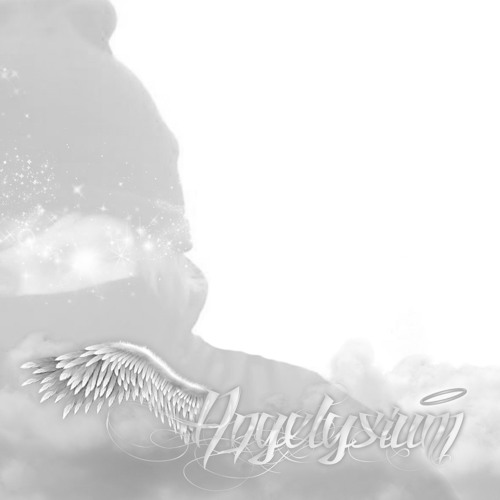 Lit Internet's AngelysiumAll this is just another reason why the category "club," while it does a lot to hone in on specific and, in many ways, desirable qualities in dance music, can only go so far. "Dance" is a more intangible, open-ended concept, something that can happen anywhere and is directly related to the body and activities like running and other forms of exercise, the body being even more intimate and present than the club that might temporarily enclose it. Dance is music that moves you.
08-Jul-15
System Focus: How A Traditional Rhythm Is Shaping Today's Most Exciting New Music [ 08-Jul-15 9:17pm ]
Lit Internet's AngelysiumAll this is just another reason why the category "club," while it does a lot to hone in on specific and, in many ways, desirable qualities in dance music, can only go so far. "Dance" is a more intangible, open-ended concept, something that can happen anywhere and is directly related to the body and activities like running and other forms of exercise, the body being even more intimate and present than the club that might temporarily enclose it. Dance is music that moves you.
08-Jul-15
System Focus: How A Traditional Rhythm Is Shaping Today's Most Exciting New Music [ 08-Jul-15 9:17pm ]
 Exclusivo by Blaze KiddJune's System Focus (click here to read) was on a loose network of producers, most of whom draw on the tresillo rhythm found in reggaeton and other musics of the African diaspora, often using grime and Spanish language too. Labels and artists featured include Blaze Kidd, Uli-K, PALMISTRY, Kami Xlo, Lexxi, Ana Caprix, EndgamE, Golden Mist Records, BLASTAH, Dinamarca, STAYCORE, Lil Tantrum, Sister, Tove Agelii, Mapalma, mobilegirl, Imaabs, ZUTZUT, Extasis Records, Morten_HD, Spaceseeds.
A simple rhythm bounces back and forth over the once vast Atlantic ocean, ever faster. It begins in Sub-Saharan Africa, but Europeans brutally pull it up by the roots—slaves bring it with them on a long journey to the Caribbean. By the nineteenth century it has become the defining element in the Afro-Cuban dance habanera, which finds its way to New Orleans where it helps form ragtime, then to South America, where it contributes to tango, and to Europe, where it becomes the most famous section of one of the era's most popular operas, Carmen. It also spreads across the Caribbean, Latin America and Africa and back again, and its descendents meet and collaborate, now using recordings and drum machines. Soon it doesn't even need to touch the water. Ricocheting off satellites and barreling down cables, it permeates the information sphere, with space and place just an interesting footnote on a Soundcloud profile...
 EndgameLondon club music (at home and abroad) has recently come to resonate in sympathy with sounds from Mexico down. And it's not just tresillo and reggaeton rhythms that are being drawn on, but the Spanish language too. South London has both a significant population of Latin American migrants and a network of producers who have been on Soundcloud for years and are very hungry for international sounds. They got together on Exclusivo, the debut mixtape of an MC of Ecuadorian heritage, Blaze Kidd, and recently, as Aimee Cliff reported for The FADER, the video for "Sniper Redux."...
Tresillo is woven throughout Palmistry's delicate and deceptively carefree fabrics. In tracks like "DROPDrip" (on his Ascención mixtape), "Protector SE5," the single "Catch" or his latest, "Memory Taffeta," it'll ride on the back of simple synths, complementing his fragile yet controlled and earnest voice and forming songs of need and tenderness...
 Palmistry One track on the Endgame EP was a remix by Dinamarca, and in turn, Endgame provided one for Dinamarca's EP, No Hay Break. "Dinamarca" is Spanish for "Denmark," but the artist Dinamarca is based in Stockholm, and his intense and attitude-filled tracks typically have a tresillo bounce, however it's distributed through the drum machine. Some of them, when the tempo is upped, even feel like they're morphing into footwork. Dinamarca is the head of the Staycore label, who just put out a brill free collection of tracks titled Summer Jams 2K15—hopefully a sign of things to come...
 Lil Tantrum is just one of the many areas of overlap between Staycore and Sister, a female-identifying-only club collective founded by the formidable Swedish artist, Tové Agelii. Agelii's own productions are gorgeously gothic and suffused with the human vox the way light shines into a cathedral. And Sister's mixes (again, all female-identifying, using productions that all involve women) are both peppered with a tresillo feel and seriously something...
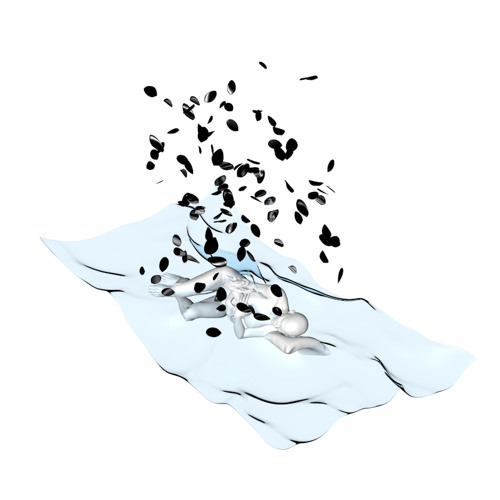 'Icesheets' by MobilegirlHailing from Santiago de Chile and one of the weirder and more futuristic exponents of grimy reggaeton, Imaabs has a great EP out on noted Mexico City underground-club label NAAFI. Another standout is Zutzut's "Yo Te Voa A Dar" on account of it delectable buzzing synth and proper passionate MC. Zutzut, from Monterray, has a truly lovely Soundcloud collection (try the digital flutes of "Otra Vez Llegue") and a self-titled dembow EP with some vogue inflections out for another Mexican label, Extasis, who have a bit of a net aesthetic and, because all is connected, have released cute speedster Xyloid too. Extasis also explored some pretty bizarre experimental grime with Norwegian producer Morten_HD and Mexico's Spaceseeds, and they too have a summer compilation (from last year). And, aha, it featured a Blaze Kidd track with a reggaeton production by Kamixlo and Uli-K.
 System Focus: What Does "Experimental Music" Even Mean Anymore? [ 08-Jul-15 9:00pm ]

What is experimental music, and what does it want from us? As a term and as a field of music-making, it's widely accepted but fits uncomfortably and is never well defined. "Experimental music" was a phrase used in the mid-twentieth-century to describe a range of ultramodernist compositional techniques as being a form of quasi-scientific research. John Cage was careful to point out that the term should apply to music "the outcome of which is not known"—that is, music with chance elements or improvisation built into it—since a composer ought to have completed all the necessary experiments before the piece was finished. And yet in everyday parlance, especially in popular music, "experimental" music has come to refer to music that seems radically unconventional, pretty weird, as if to experiment with the very building blocks of musical beauty... POPULOUS by Brood Ma [Experimental music is] involved with the building blocks that musical languages are made of. When you put it like this, it's odd to think that people find experimental music "difficult"—it's a radically simpler experience, assuming much less semiotically. And that's where experimental music's appeal lies. It reconnects you with the fundamental life of sound and music, and entices you to search for meaning in a language you cannot yet speak. You ask yourself, "What sort of subjectivity would make art like this? What does it perceive that I don't (or don't yet)?"...
 DARK WEB by Giant Claw DARK WEB is clearly and curiously unstuck: juddering, dissonant, stop-start, crazed, obsessive. It's like a robot failing at human entertainment, a rejected intermediate form generated by whatever algorithmic process then went on to produce the less uncanny Far Side Virtual, which resonated more comfortably with human needs and desires. If human music were a CAPTCHA, DARK WEB would fail it...Most striking about [Epitaph] is its empty space—enormous architectures bracketed and magnetized by harsh syncopation. The textures are modular, moving from sound object to sound object and back again; Epitaph divides up its musical world into discrete, almost warring factions...
 U.S.M! by DJWWWW DJWWWW's album U.S.M! is one of this year's most absorbing listens, restlessly assembling horrific and beguiling bouquets of musical sensations (many of which will be familiar to followers of underground music)... DJWWWW is extrapolating and caricaturing the myriad experiences of a day in digital, asking us how and why the combinations work (or not)...[Assault Suits's] own release Statue Cathalogue kickstarted the [Flamebait] label last year with its sinuous yet imposing metallic sculptures. The subsequent album by Tokyo producer Hanali is highly complex and predominantly percussive, roving through many layers of rhythm until it seems to coalesce in the bizarro club cut "10 Years or 100 Years." 10.9†01;9 by modular synth artist GOP (Geniuses Of Place) is equally rich: sizzling and glitching its way through the phone networks only to dissolve and digest what it finds...
  Aftertouches by Kara-Lis Coverdale Aftertouches weaves in all kinds of colors, many of them acoustic instruments, others eerily hinting at acoustic instruments, and others carrying all the richness of acoustic instruments yet not at all recognizable as such. She manages to do the exact same with the moods of the pieces: some are human, some eerily hint at the human, and others have all the depth of human moods but are as yet unfamiliar as such. Coverdale recently teamed up with LXV for Sirens, where their different palettes of techniques complement one another. They seem to populate each others' landscapes with the distant faces, dwellings and systems of unknown hi-tech cultures, who harvest the elements of their environment with a peace and concord we don't yet understand...
Fragments of a Scene (text for Creamcake) [ 08-Jul-15 8:32pm ]
Aftertouches by Kara-Lis Coverdale Aftertouches weaves in all kinds of colors, many of them acoustic instruments, others eerily hinting at acoustic instruments, and others carrying all the richness of acoustic instruments yet not at all recognizable as such. She manages to do the exact same with the moods of the pieces: some are human, some eerily hint at the human, and others have all the depth of human moods but are as yet unfamiliar as such. Coverdale recently teamed up with LXV for Sirens, where their different palettes of techniques complement one another. They seem to populate each others' landscapes with the distant faces, dwellings and systems of unknown hi-tech cultures, who harvest the elements of their environment with a peace and concord we don't yet understand...
Fragments of a Scene (text for Creamcake) [ 08-Jul-15 8:32pm ]
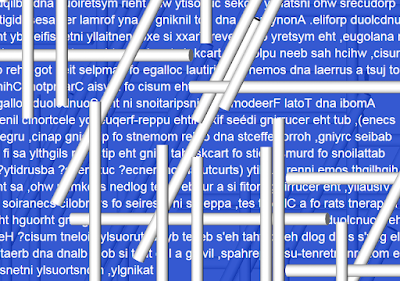 Fragments of a Scene website, designed by Jon Lucas
Amazing Berlin clubnight institution Creamcake asked me to write a text to go with an evening they were putting on in April, both to feature Brood Ma, Forever Traxx, Claude Speeed, Club Cacao, DYNOOO, Punishment of Luxury, Hanne Lippard and Britney Lopez. Click here to see the text in its originally obfuscated context with music (scroll down for a PDF), or read below.
Music is space. Music goes high and low, shallow and deep, left and right, in and out,
round and round. It goes here and there at the same time, underneath and over, it
faces in the same and in the opposite direction. It's among and alongside and between
things, it's behind and in front of things, it goes away from and towards things, it's
beyond things and quite within them. Its spatial changes map to bodies when it makes
them move, and in turn music moves according to an embodied imagination. Music is
more than sounds - at the very least it is sounds in spaces. More than that, music is
multimedia, it always means more than just sounds, it means sights, it means
proprioception, it means people. Music is a scene.
Fortunately, there are two senses in that word. A scene is a discrete moment in
theatre, a sequence on-stage with actors, script, speech, costume, props, lights,
background, gesture. Scenes are where things happen, framed both by the elevated
ground, the proscenium and by time. In a way, an entire play is a scene of scenes, and
forms a part of the wider scenes of life. This is where the other sense of the word
scene comes in. It's a term - one loaded with cultural capital, mostly that gained by
disavowing it - for musicians, fans, places, and performances (and speech, costume,
props, lights, background, gesture)clustered together, almost as if in a discrete
moment. The scene in New York in the 1960s: Andy Warhol, the Velvet Underground,
Nico and friends, one of many interconnected scenes at the time. Sometimes there's
only one scene, the scene, something to be in touch with - to be 'scene' is to be a part
of it. But the term can be used without that fancy fluff. It's usefulness comes from the
multimedia nature it inherits from theatre - a scene is never just sounds, never even
just musicians, but a network of artists in multiple mediums 'high' and 'low,' and even in
mediums that are not yet known as Art.
And scenes are difficult to piece together nowadays, especially as discrete moments
framed, like the theatre is, by certain locations in space and time. Berlin, London and
New York are still pretty good at that. But the internet has created social and aesthetic
connections that go beyond the more traditional conceptions of space and time. Don't
believe the rhetoric though: the internet has not destroyed time or space, much less
materiality. The internet is still 'in real life / IRL,' all art is still 'physical.' The aesthetics
of art and the internet, however, has been fascinated with the dilemma that it might not
be - whether that's a good thing (ushering a transcendent Utopia) or a bad thing (an
anxiety-inducing accumulation of blasphemous desires and accesses). At its best,
these two feelings occur at the same time.
What you have at Hau 2 on the 16th of April is Fragments of a Scene - in many
senses of a scene (and of fragments). The artists you will see make up something of a
scene, albeit partially: They are related in music, multimedia, social networks,
geography (to some extent), and are ultimately related by the fact that they are all
appearing tonight. They are all engaging with the modern age, which predominantly
means the digital world and its forms of expression. Yet while many artists in this vein
tend towards representation, figuration, even pastiche, these artists tend towards
abstraction and affect. Their perspective is less one of a detailed fantasy universe than
an onslaught of shapes and sensations boiling within a matrix of strong yet
indeterminate feelings.
Take Brood Ma. While there are occasional outlines of samples in James B. Stringer's
work, or the nuclear shadow of styles like grime (he's from London), at the centre is a
roiling mass of sonic shards, glittering and roaring like scales or teeth. Named after the
matriarchal figure in a culture of humanoid women with large scarabs for heads in
China Miéville's weird fiction Perdido Street Station, there is something deeply
insectoid about Brood Ma's modus operandi: biting, chewing, proliferating, attacking,
defending, all under a hard multipartite carapace filled with even weirder, visceral
matter beneath. Brood Ma works at the constituent level of sound itself, its very grains,
whipping digital codes into vortices as if they were pools of water. He distorts sounds
the way jpeg compression distorts Nature, and depixellates them, datamoshing them
until insides and outsides become part of a broader, more disorienting experience of
space.
This comes as no surprise, because James B. Stringer is part of a network of visually
trained multimedia artists coalesced around the Quantum Natives label, all long
interested in digital techniques of both sight and sound. One of the main nodes is
Stringer's friend Clifford Sage, an incredibly prolific sound-producer himself, with an
industrial synth style. At Hau 2, Sage will be providing the visuals to Stringer's
performance, both inviting us to draw some continuity across their respective fragments
of the abstracted scene.
Like many of Fragments of a Scene's artists, Forever Traxx is one of those producers
who instantly stokes curiosity with their mysterious and oblique Soundcloud profile.
Anonymous and not linking to any formal releases, digital or analogue, the mystery of
Forever Traxx is exponentially intensified by the music, which has been uploaded track
by track over the past four years. It's not just a surreal and somehow spiritual collage of
samples tied together by curiously mountainous passions (like the music of Elysia
Crampton, Chino Amobi and Total Freedom - big inspirations in the Soundcloud
collage scene), but the recurring idées fixe: lithe upper-frequency electronic lines,
babies crying, horror effects and other moments of piercing panic, urgent battalions of
drums, edits of tracks that bring the pitch up slightly as if to highlight some inner quality
(structural coherence? cuteness? absurdity?). Visually, the recurring motif is a rubbery
yet golden stickman who, as the apparent star of a ClipArt set, appears in a series of
symbolic scenarios in the Souncloud account's thumbnails and avatars. What's going
through this little guy's solid gold head, that he's beset by rapturously violent music?
He's the modern internet-user, perhaps, living a life that is both bland and breathtakingly,
monstrously intense.
Claude Speeed has explored the complexity and onslaught of the modern mindset
both as a band and as a solo electronic artist. Hailing from Scotland, his band
American Men released a dazzling EP Cool World in 2010, its crystal vistas and fractal
rhythms seeming to usher in a new decade for post-rock. Since then, Speeed has been
exploring sounds far and wide, each new Soundcloud upload an unexpected turn, from
the tweaking trance textures of 'Ambien Rave' to the roving vox of 'Clearing' and the
wailing new-Dark-Age wake of 'V (Spirit Leaves the Body)', via walls and walls of
distortion. At Fragments of a Scene, Claude Speeed will be performing with four amps
in stereo, so expect sounds so rich and intense you can taste them.
Also taking up these alpine electronic textures and inchoate drama is Club Cacao.
Another Soundcloud mystery whose account artwork competes with the music for
beauty, Club Cacao launches off from contemporary production styles from dance and
hip hop, ending up with compelling tracks like 'Go Off,' with its perfect euphoric
liberation, or the darker 'Balaclava,' an industrially twisted bounce over which a voice is
squeezed out, becoming both hilarious and terrifying.
Due to its uncanny ability to fuse disparate elements into a whole that makes a sense
one does not yet understand, but that one appreciates as the insights of a cybernetic
consciousness, DYNOOO's These Flaws Are Mine to War With was one of last year's
most interesting releases. His work has always suggested to me an emerging
intelligence, either artificial or that of the technological post-human, engaging with its
own mechanical realities as well as the curiously organic world around it. Piecing
together rainforest, desert and arctic tundra with an almost military palette of harsh
sounds and leaving it all suspended and rolling in a bubbling tank like a specimen or an
embryo, DYNOOO's conclusions could not have been reached by yesterday's
humanity, and they're as disquieting as they are beautiful.
Not to be confused with the English post-punk band active in the late 1970s and early
1980s, Punishment of Luxury is a Soundcloud experimentalist in a similar vein to
Forever Traxx, Crampton, Amobi and others. PoL creates strange yet urgent new
atmospheres for pop fragments to breathe in, as if they've suddenly been transported
to other planets. The procedure often seems to cause them to spin erratically in situ,
like broken bots in a massively multiplayer online role-playing game. Try the bizarre
union of Nicki Minaj and the Walker Brothers in 'BASSBREAKUP,' the desperate
product placement of 'BENZ BENZ BENZ,' plagued by alien anxiety, or the way the
ear's finger runs down the length of the male voice in 'TLS Male Vocal Choir Edit,' and
it's rough like a large iron nail file.
Using her voice to beckon a broader understanding of human culture and expression,
Hanne Lippard is somewhere between a poet and a performance artist. A book of her
texts, Nuances of No, was released in 2013. Her phrases often begin or end in the
same way as she accumulates concerns and information in a deceptively random
manner. These parallel the tics of language online, like the telling non-truths of
Google's autocompletes, or the attention-hijacking of sidebar advertising, or the
piecemeal, provisional conclusions of status updates. She narrates the Web 2.0 stream
of attention, but her voice is also perennially human, always seeking to elevate itself
while remaining intimate.
As she puts it, performer Bella Hager was 'torn and raised in Berlin, had to survive the
90s as a teenager.' She focused on pop divas such as Jennifer Lopez, soon feeling a
rupture between the art of being a women in music videos and the art of being a
women on the very own stage. After many years of research in different scenes, social
contexts and with different representations of gender, Bella decided to reunite with
Jenny, Britney, Christina and the rest to resolve this absurd struggle. During the first
act of appearance in Fragments of a Scene her character 'Britney Lopez' will enter
Christina Aguilera's music video to dive into the world of female pop artists in the late
90s, and will then take them into the year 2015 where a new extroverted sexuality
(Bella refers to herself as 'twerself') has left the former virginal image of the diva
behind.
Perhaps the only fair thing to say that all of these artists have in common (apart from
their appearance at Fragments of a Scene), is that they don't quite fit into the normal
distributions of creativity into particular places. Even musically, it is not entirely fitting to
call any of them merely 'producers' or 'musicians,' or to expect their work in clubs or
physical albums. And much of the time, their work is too specific, and too conversant
with the languages of pop and everyday life to feel at home in a gallery or concert hall
either. Many of them have taken the poetics of the visual and used them in a sound-led
medium, perhaps then turning back to re-incorporate the eye, which does not close as
it passes over an online account or a stage. However, nonetheless, these artists have
now carved out a space, somewhere between art and sound and music as it was
understood last century, a way to explore differences within the cohering locus of the
specific, to maintain that fragile equilibrium between novelty and similarity. Isn't that
precisely what a scene should be?
14-May-15
 This little electronica column review fell out of the latest Wire because someone else had already done a longer one. Thought I'd post it up here as it's quite a special release. Video below.
Ben Zimmerman
The Baltika Years
Software DL / 2×LP
With this archive release, Joel Ford and Dan Lopatin's Software have found something that reaches right into the core of the label's interest in the curiously soulful side of late-twentieth-century computer music. Between 1992 and 2002, Ben Zimmerman used a series of Tandy machines working with low-quality waveforms to make short sketches and suites sat everywhere between outright experimentation and vernacular tunefulness. What emerges is a meeting between Moondog and Daniel Johnson in the age of the floppy disk. Most intriguing is the timbre itself - FM synths imitating older instruments alongside samples tuned into sonically matchless keyboards, all coated in a thick oxide layer of digital lo-fi. These are wound up like music boxes and let go, spiralling forward into minimalist abstraction, character pieces or clubbier grooves (including breakbeats) as they eat through their slatted programming. Not only is the limited context intimately audible, but the varieties of mood and texture achieved within it are nothing short of inspiring.
05-May-15


 Modal Soul by NujabesOne of the greatest practitioners of drum-machine production with a more traditionally East-Asian sound is from Shanghai: Swimful Buterfly. Swimful has produced for US rappers Lil B and Main Attrakionz, and released a warmly euphoric debut album 馬路天使 (Street Angel) in 2013. Last year's follow-up, 归梦 (Return to a Dream), is even better, perfectly following that trajectory whereby a producer gets both more skilled at crafting beats and more original. It samples both Chinese and Japanese zither instruments and singing try "But Maybe". The track "Air Between Toes" even samples the song "Tsukematsukeru" from J-Pop's kawaii princess Kyary Pamyu Pamyu, transforming its torrent of soda-pop into a cooling stream of sweet mountain water...

 春夏秋冬・終 by α·PavWhat about pop? Magic Yume and Zoom Lens (who I talked to here) are two of the best places for Japanese-inspired indie pop in the online underground, and they both have everything on a continuum from laid-back dreaminess to footwork and hyperactive chiptune, showing us that cute and upbeat doesn't have to be intense. At the calmer end, Magic Yume has Tokyo Princess (東京 姫) by Ikaros イカロス (as well as plenty of downtempo beats) and Zoom Lens has Yeule, Girlfriend by Philippines artist Ulzzang Pistol, the gorgeous Paradice by LLLL, and the Yumetatsu Glider EP by Japanese artist Yoshino Yoshikawa, who's affiliated with Tokyo's richly hyperactive Maltine label.
  Yumetatsu Glider EP by Yoshino Yoshikawa
17-Feb-15
System Focus: What Health Goth Really Means [ 17-Feb-15 10:15pm ]
Yumetatsu Glider EP by Yoshino Yoshikawa
17-Feb-15
System Focus: What Health Goth Really Means [ 17-Feb-15 10:15pm ]
 Le1f photographed by Sam Bayliss Ibram After a brief hiatus, System Focus is back, this time a look at Health Goth, its roots, some of the music surrounding it, and how it represents a turn towards particular aesthetics rather than scenes / genres (click here to read it). Nonetheless there's a geographical convergence in Portland (the piece's working title was 'Health Goth, Portland Hi-Tech and the Age of the Aesthetic.'). Featuring Magic Fades, Club Chemtrail, Karmelloz, C Plus Plus and the return of Vektroid.
How about this: these days there are no scenes or genres, only "aesthetics." A scene implies a physical community in physical architectures, and as such is a fatal slur against the URL everspace and its viral lungs. A genre implies limits, intentions, rules, fixity, and—as every itchy-fingered Facebook commenter knows—is a hateful thing. Nothing exists anyways, not really, only names, only hyperlinks, only patterns that work up to a point and then need an upgrade. Backspace your tearful emojis, hypocrites, it's always been that way; it's just more obvious now that code flows through our arteries rather than squeezes of blood and other smells. But it's not homogenous out there and never will be, the online underground and the cultures tapping its magma are built on a vector field that ripples and clumps together, each blob too quick and continuous for your Dad's rock collection. An aesthetic is not an object, it's a way of looking, a way of finding beauty and sifting experiences, originating with process and behaviour rather than product, or, indeed, a journalist with a butterfly net...
 Magic Fades: Push ThruAs the Facebook group curators put it in an interview, "Health Goth is not a lifestyle, it's an exercise in aesthetics. Any publication trying to tell you that Health Goth is about working out has simply taken the two words at face value and opted for a less challenging, and extremely boring alternative." It seems to me that saying that Health Goth is gymming for goths is like saying that cyberpunk is Johnny Rotten doing spreadsheets on a Dell. Let's make something clear: in its original context of the Facebook group and the curators behind it, Health Goth is at a significant remove from music. Health Goth shouldn't be regarded as a musical genre, even if it was given its name by people operating in the online underground music community. What it is is an aesthetic, one that primarily concerns fashion...
The roots of hi-tech, and Health Goth in particular, go way back, but gained particular momentum around 2011. As the Facebook curators recognize, Health Goth is just as reflective of aesthetic trends that preceded it as it is constitutive of new ones. Surprisingly, none of the pieces I'd read on Health Goth mentioned the GHE20G0THIK club phenomenon pioneered by Venus X in NYC, which was a major force in associating pop and hip-hop with dark underground weirdness. Organized alongside Hood By Air designer Shayne Oliver (who often performed), the parties provided an early context for Fade to Mind names like Total Freedom and Nguzunguzu, and were attended by a nascent Arca...
 Karmelloz's Silicon Forest, named after the nickname for the Pacific Northwest's hi-tech industry, confirms him as one of hi-tech's best ambient artists, whose subtle work balances heavenly sweetness with the nausea of future shock, and always puts me in mind of giant vats in which amoral artificial biospheres are roused and stirred. C Plus Plus's Cearà is a rich take on a clubbier sound, catching the light of grime, vogue, house, pop and transatlantic styles as it spins eerily in a space of apparently infinite connections. Most notably perhaps, the Push Thru remix album sees the return of Vektroid, one of the key players in the development of vaporwave between 2010 and 2013 as New Dreams Ltd. and Prismcorp Virtual Enterprises. Vektroid is from Portland and the Pacific Northwest of the USA originally, and her remix of "Ecco" is palpably weighty, shifting through a range of cyborg textures in its eight minutes until it feels more like crawling through a digital wormhole or watching a short film demonstrating some horrifying artificial transformation than hearing the usual shuffling of riffs...
31-Dec-14
stuff I wrote and stuff I liked in 2014 [ 31-Dec-14 2:37pm ]
Karmelloz's Silicon Forest, named after the nickname for the Pacific Northwest's hi-tech industry, confirms him as one of hi-tech's best ambient artists, whose subtle work balances heavenly sweetness with the nausea of future shock, and always puts me in mind of giant vats in which amoral artificial biospheres are roused and stirred. C Plus Plus's Cearà is a rich take on a clubbier sound, catching the light of grime, vogue, house, pop and transatlantic styles as it spins eerily in a space of apparently infinite connections. Most notably perhaps, the Push Thru remix album sees the return of Vektroid, one of the key players in the development of vaporwave between 2010 and 2013 as New Dreams Ltd. and Prismcorp Virtual Enterprises. Vektroid is from Portland and the Pacific Northwest of the USA originally, and her remix of "Ecco" is palpably weighty, shifting through a range of cyborg textures in its eight minutes until it feels more like crawling through a digital wormhole or watching a short film demonstrating some horrifying artificial transformation than hearing the usual shuffling of riffs...
31-Dec-14
stuff I wrote and stuff I liked in 2014 [ 31-Dec-14 2:37pm ]
 Another pretty busy year for me, writing-about-music-wise. Below is a list of everything, if you're interested. Below that is a list of some releases I particularly enjoyed this year in alphabetical order. I didn't join in with any of the year-end stuff in print or online magazines this year, not because I disapprove - vaguely because I'm finding it difficult to claim I've listened to enough to make the call, and find it really difficult to compare online underground music with more traditionally distributed underground stuff within single assessments - not to mention the fact that great stuff is increasingly coming in chunks smaller and/or less official than the album. But mostly it was because I was really busy at the time all that stuff was due.
Stuff I wrote
AWALthe1$t: Empty
AyGeeTee: Imminent Orphan
bine☃: THINGS WILL BE BETTER FROM NOW ON
Brood Ma: POPULOUS
Chronovalve: Trace of Light
Conan Osiris: Silk
DYNOOO: These Flaws Are Mine to War With
E+E: The Light That You Gave Me To See You
Friendly Sneakrz: Flowers From Above
Geotic: Morning Shore (Eon Isle)
Giant Claw: Dark Web
GOP (Geniuses of Place): 10.9†01;9
Guy Akimoto: BaeBae EP
James Ferraro: SUKI GIRLZ
Karmelloz: Source Localization
Kyoka: Is (Is Superpowered)
Lockbox: Prince Soul Grenade
LXV: New World Spa
Magic Fades: Push Thru
Miami Mais: A Popcorn Diet
Nima: See Feel Reel
Old Manual: リング
Oliver Coates: Towards the Blessed Isles
Palmistry: Ascensión
Ramona Lisa: Arcadia
RAP/RAP/RAP: Killing and Matisse Graveyard
Sentinel: Hybrid
t e l e p a t h テレパシー能力者: ゲートウェイ
Untold: Black Light Spiral
18+: Trust
30-Dec-14
Review: Arca, Xen (for Electronic Beats) [ 30-Dec-14 7:38pm ]
 Did a review of Arca's brilliant Xen for Electronic Beats (click here to read). This sentence was cut:
Digital de Koonings jounce down oozing hallways dragging trains of femme paraphenalia, kawaii cenobites howl and squeal in holes, and sugared children restlessly pound plucked keyboards, enthralled in the boom of the tingling strings.
But others weren't (such as these):
Xen is a multiplicitous figure. Many tracks contain several life forms coiling around each other, each with its own sense of time and space, all crowded into the same fractious textures and struggling for expression and independence. New limbs and organs burst through the skin, feelers fly in every direction and prehensile tongues curl. Disasters of pleasure, showers of sex. The title track is an electrical injection, with strobes of percussion whipping up a club nimbus as stallions rear their heads and the wreckers come whirling and squeaking over the polished floor; at the center of it all a daughter's dancing class on a tightrope.
But other tracks are solo portraits, often keyboard improvisations. "Sad Bitch" pliés forward tentative and lonely before exploding into pirouettes and dovetailing melodies. "Family Violence" is a forest of jabbing and pointed fingers. "Promise" shudders and teeters as if shaking off an ice age, and the piano sketch "Held Apart" waits at the windowsill with memories in its big eyes. The parameters of Ghersi's self-exploration are readjusted with each track, causing constant surprise—dance beats, noise, song, cinematic strings and rave stabs all rotate the album in a space of unexpected dimensions.
 Xen artwork by Jesse Kanda
System Focus: Fandom Music Is As Underground As It Gets [ 30-Dec-14 7:30pm ]
Xen artwork by Jesse Kanda
System Focus: Fandom Music Is As Underground As It Gets [ 30-Dec-14 7:30pm ]
 Horizon's 'Confinis'Possibly the most out-there System Focus yet, this one looks at recently-emerged fandoms and the way they practice their fandom through music-making online (click here to read). It looks at Pokémon, Adventure Time, Minecraft, Homestuck and My Little Pony. There's some really unusual stuff in this one..One of the major drivers of underground music culture is sincerity. The underground seeks musicians for whom making music is an art and a passion, rather than a performance or a get-rich-quick scheme. You might have heard a lot about 'The New Sincerity' or 'post-irony,' ideas dating back to the 1980s which have been applied to music with a notable level of (usually positive) emotion and innocent frankness. But the search for sincerity goes back as far as its perceived opposites in, say, industrial capitalism go—back to the Romantics and beyond. That's not to say that all underground music culture is sincere. Irony and satire are arguably stronger than ever as the underground re-engages with hi-tech modernity, shunning the ubiquitous, twee, and now almost empty sincerities of the indie aesthetic. But to find music today made from pure positive passion alone, try an online DIY music almost completely outside the remit of the hip underground sites: the music of fandom...
Lethe Wept on Fortissimo Hall The tracks by Pengosolvent are quite unlike anything else—contemporary orchestral VGM squashed imaginatively into a jovial, frenetic and slightly disturbing blur. Try the crazy "Breaktime Over," the highly cute "Enamored Regard" (below), or the proper creepy ghost-type "Paved With Good Intentions" (belated happy Halloween)...
Intriguingly, Adventure Time is a recurring reference point for some fairly parental-advisory hip-hop—here, here, and here. Then there's Oddpauly, who raps about the attractions of the show on one of his tracks. Pauly also has a YouTube channel featuring a music video of his highlight track "Rain," and a video of him playing Minecraft while eating Fruit Rollups... The largest musical instruments in the virtual worldOne of the most visually striking fandoms online is Homestuck, an epic webcomic about some teens who inadvertently bring about the end of the world, and then get involved with these bizarre troll-like beings that are perfect to dress up as. But don't take it from me—there's a fan song to introduce you to it all... The weirdly great-looking official Homestuck Bandcamp page compiles the soundtrack (made by fans) music and more, and it tends to subtly evade genre, skipping through all kinds of sound worlds, seemingly guided more by emotion (and whatever's going on with those trolls) than form. I've been oddly mesmerized by Erik "Jit" Scheele's One Year Older and the cosmically soppy Song of Skaia.
 Artwork for 'Firefly Cloud' from Erik "Jit" Scheele's One Year OlderThe fandom has a hefty contingent of Bandcamp customers whose pony avatars can be seen lining up on the pages of the most popular albums. But the music only rarely reflects the child-like aesthetic of the show, often bringing out the darker, more romantic connotations of characters and its stories. Alongside sometimes Friedrich-like digital paintings of the relevant ponies, pony musicians regularly put weighty, grand, maximalist and very technically accomplished music. There's punk rock, happy club sounds, ambient electronic, funky song-writing, hardcore, soft rock, epic orchestral, and metal. One of the most popular artists is Eurobeat Brony, who has three volumes of hyperactive 'Super Ponybeat.' Another is TAPS, who has an ear for glitchy vocal science deriving from samples of the show: ponies fractured and suspended in enormous spaces...
 Feather's In My Mind
System Focus: High Speed Sounds to Blister Even Internet-Accelerated Brains [ 30-Dec-14 6:46pm ]
Feather's In My Mind
System Focus: High Speed Sounds to Blister Even Internet-Accelerated Brains [ 30-Dec-14 6:46pm ]
 DV-i's 'Optical Mode' in its browser context Proper packed System Focus on speed cuteness (click here to read). Kind of a follow-up to the earlier cuteness article (here). Featuring collectives such as JACK댄스, Activia Benz, Donky Pitch, STHWST, Hope Sick Cola, Mecha Yuri, Magic Yume Records and Manicure Records and artists like Guy Akimoto, DV-i, Miami Mais, Maxo, Yeongrak, Friendly Sneakrz, Onika, Ba-Kuura, Xyloid, So So In Luv, Lockbox, DZA, Doss, Yandere and more. I made a tracklist for it, but not all of it ended up in the SoundCloud playlist at the bottom of the article. Here it is in full (click the links to listen):
 Lockbox's Prince Soul Grenade What a month it's been for cuteness! The deliciously hyper-camp new aesthetic, in its element online, is most famously embodied by the PC Music label—everyone's been messaging and tweeting about them! Then recently the movement got its anthem in the form of "Hey QT" by QT, a snappy lil number which is also the official tune of a new energy drink I can't wait to taste (that's the artwork above). But QT and PC are only the cherry on top of a vast cutie pie. Not long ago, #Feelings boss Ben Aqua set the net ablaze with his Resident Advisor podcast, a celebration of cute club intensity from all over the clouds. Finn Diesel's DIS Magazine show on Rinse FM, a haven for cuteness and other flavors since May and previously featuring SOPHIE, A. G. Cook and Felicita, entered its third installment on September 25, introducing Onika and So So In Luv. And trans-national club sensation JACK댄스 has returned, this time in New York with a whole new roster of US-based cuties...
 So So in Luv: 1 + 0nlyThose high twinkly notes, that high-speed syncopation, that high helium voice. Hints of '90s hardcore rushing unrepentantly into the digital age. And the network that links JACK댄스, DIS Magazine, Ben Aqua and PC Music with labels like Activia Benz, Donky Pitch, STHWST, Hope Sick Cola, Mecha Yuri, Manicure Records and more has converged on this style from many different points of origin: jungle and hardcore, seapunk, footwork, trap, the sparkly HudMo-Rustie sound, pop, J-pop, video game music and experimental breaks. Just as chopped and screwed lethargy seems to be everywhere between beats and vaporwave, this convergence amounts to the return of speed and complexity in ways guaranteed to blister even your internet-accelerated brain...
Guy Akimoto's BaeBae EP, something of an ode to digital communication, begins with the itchy-fingered title track, which includes a demure robot lady announcing, Reality escaping me, emotions with velocity, log me on, sign me out, give me something to type about. Hype tunes, low tides, sending emails all night. Me and bae, bae and me, HDMI, USB...
 Indie Goes Hi-Tech: The End of Analogue Warmth and Cosy Nostalgia (Berlin Music Week talk) [ 30-Dec-14 5:49pm ]
At Berlin Music Week I gave a talk (video above) that summed up the wider trend behind basically everything I've written about for the past two years: 'hi-tech,' which I like to oppose to traditional indie aesthetics. It includes a summary of many of its sub-trends which looked at in past articles. The slides for the talk are below in all PowerPoint 2003's splendor.
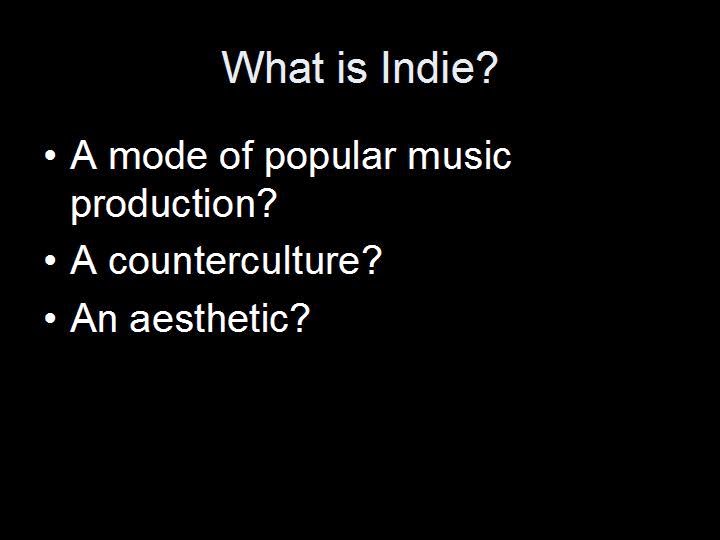
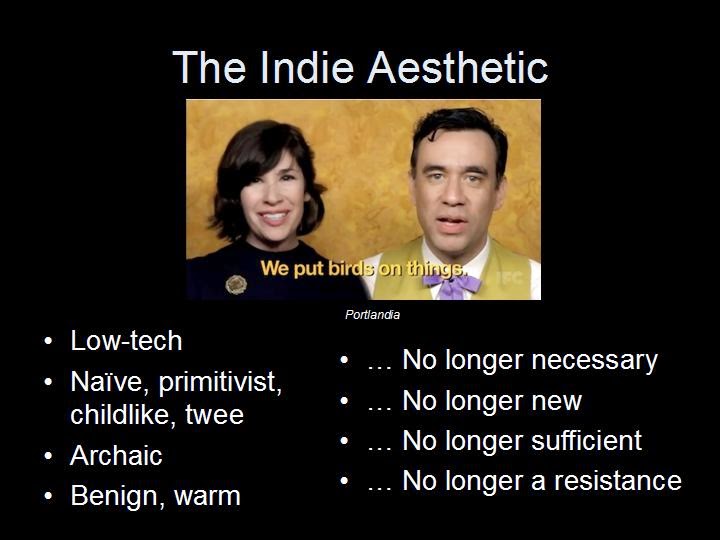
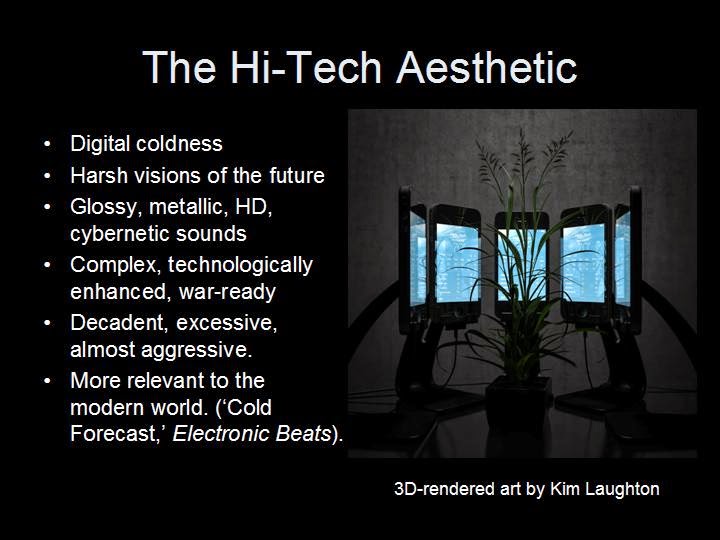
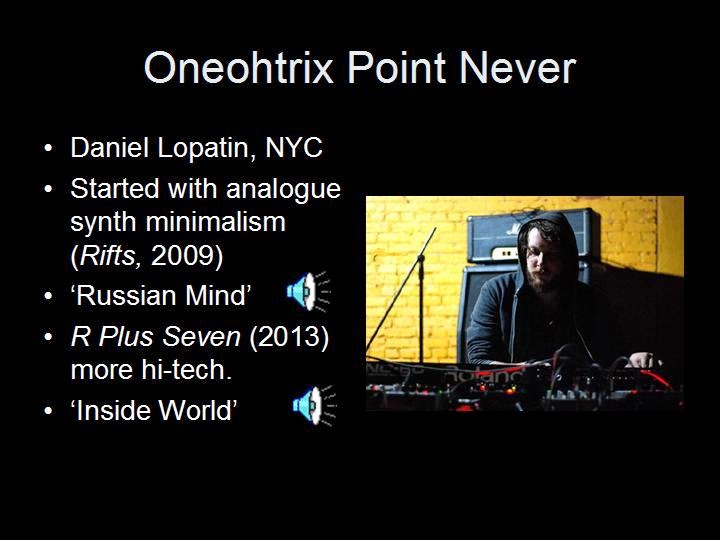
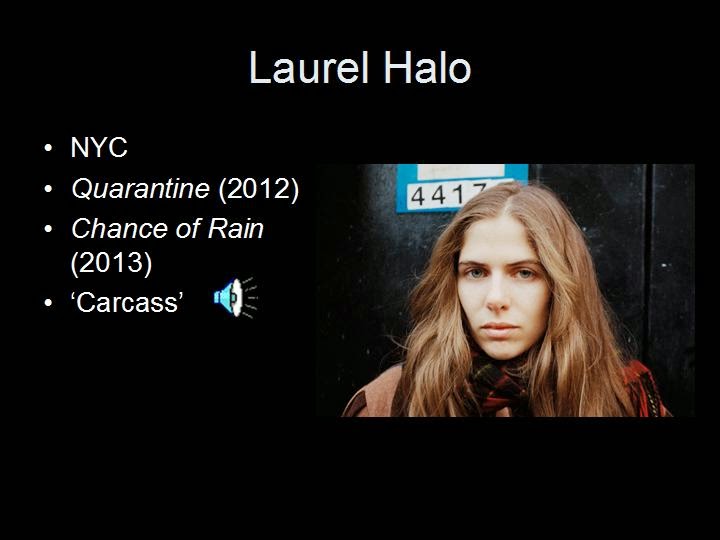
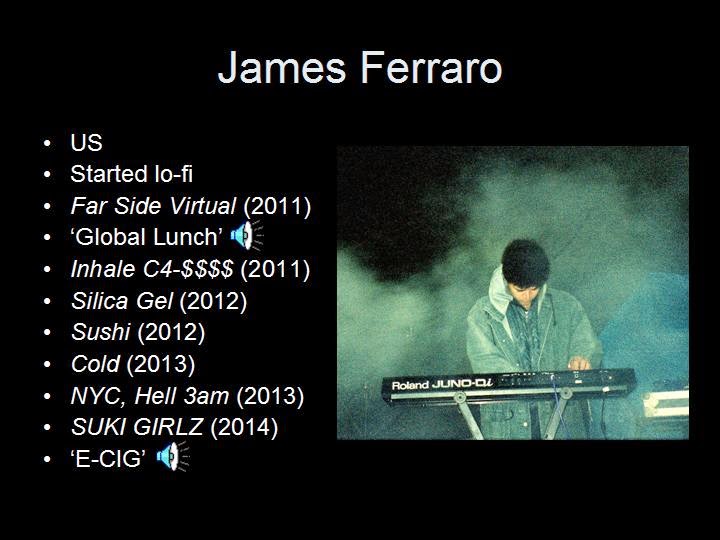
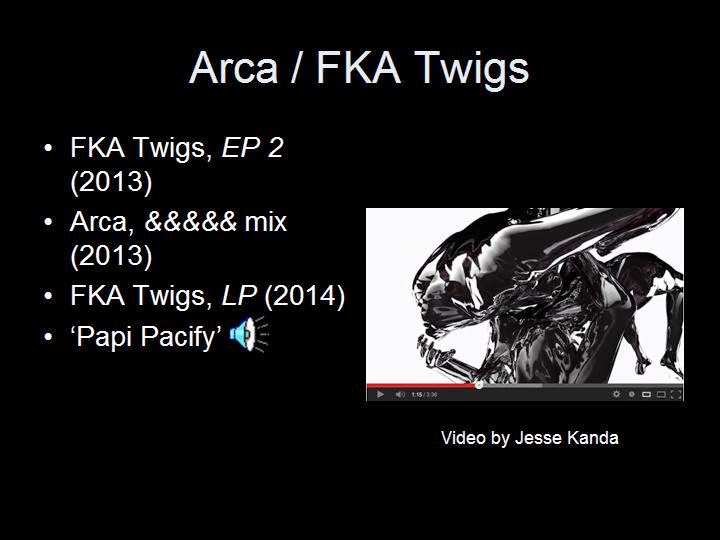
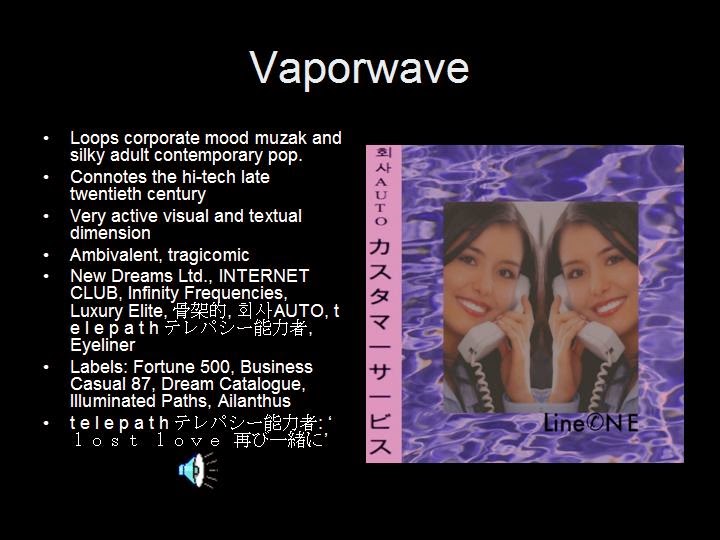
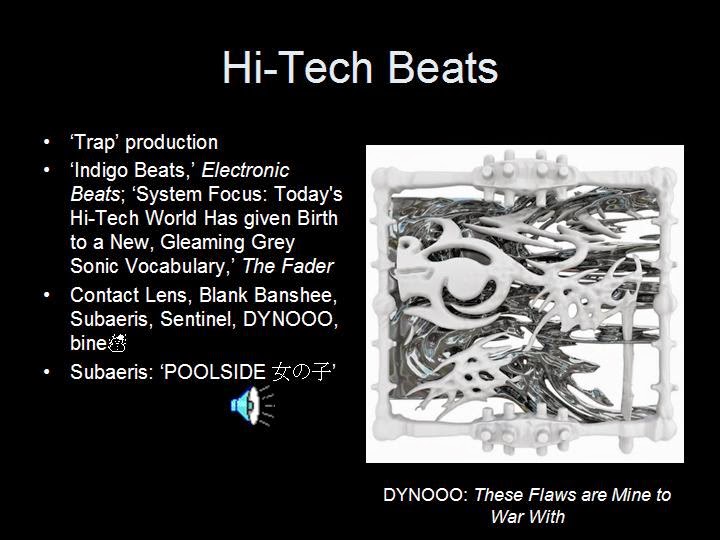
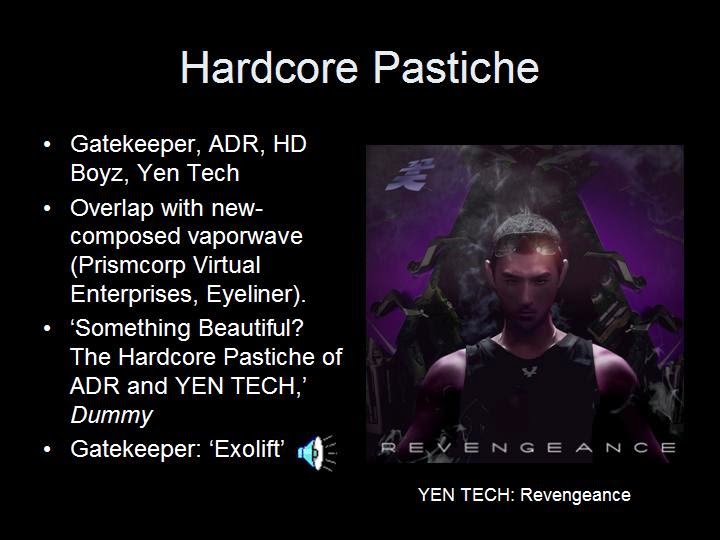
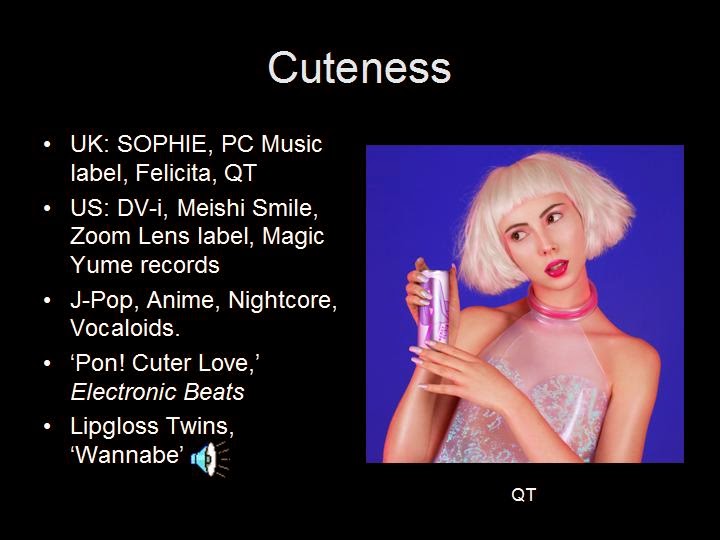
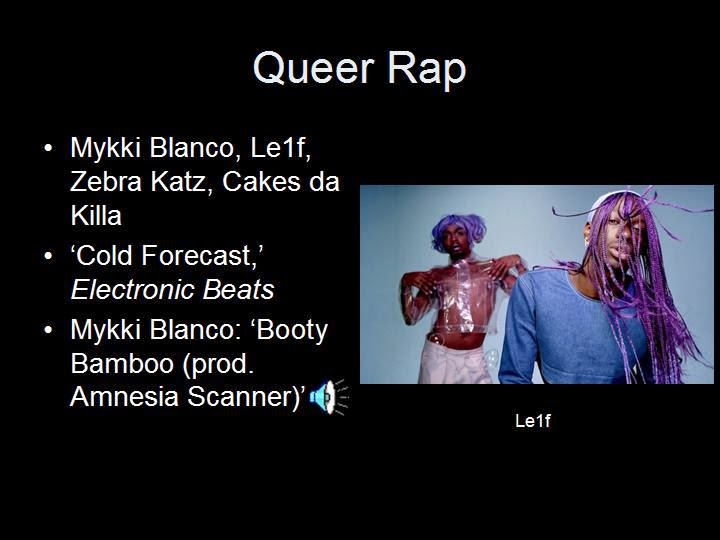
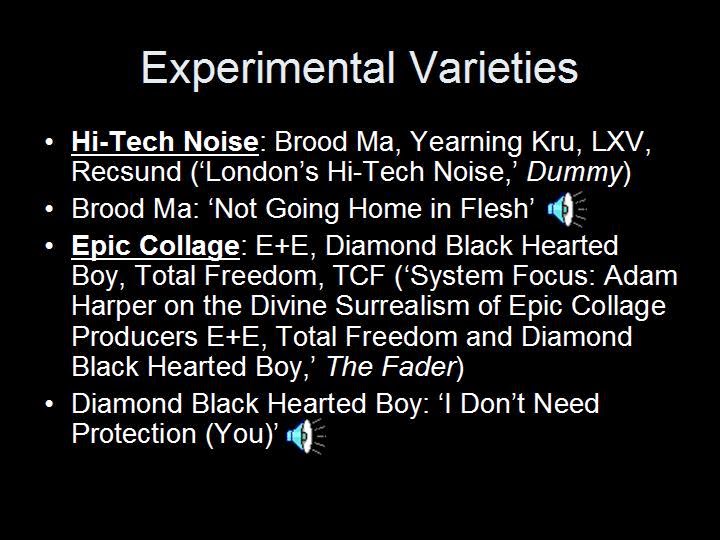
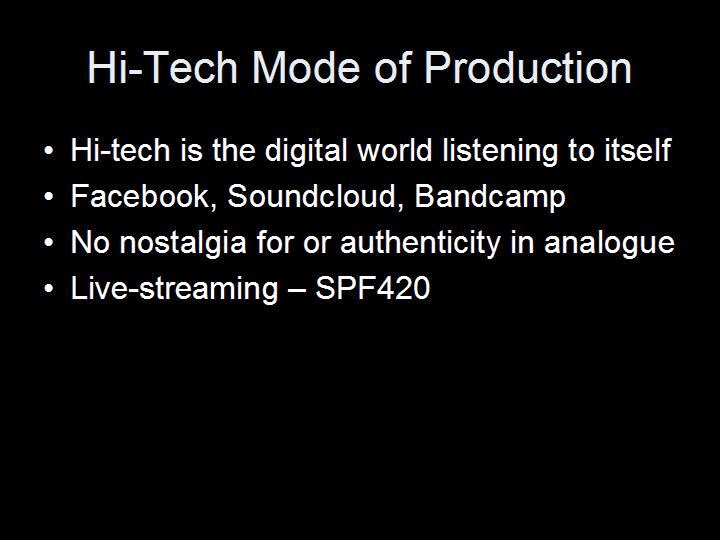
Rouge's Foam [ 30-Dec-14 3:05pm ]

The Online Underground: A New Kind of Punk? (Resident Advisor article) [ 30-Dec-14 3:05pm ]
Resident Advisor suggested I write an article for them about the emerging online underground, and the result was my most comprehensive (and polemical) statement on the topic to date (click here to read). It's running theme was a comparison to late-C20th punk and indie, and it went into the aesthetics of vaporwave and PC Music too. The piece appeared alongside a (controversial but, I thought, pretty brilliant) podcast by #Feelings boss Ben Aqua. How many times has the concept of punk been redefined? Far too many to count, and besides, no one seems to want to label music any more. Even in the early '90s, barely 15 years into its life, the definition of punk had been broadened and warped in surprising directions—punk could mean naive pop, heavy metal in the charts, or even doing something yourself, whatever that might be. In a new music culture where guitars have been replaced by cracked copies of Ableton, bands have been replaced by anonymous individuals with SoundCloud accounts, and where rock as such hasn't really been on the underground agenda for years, what significance does punk still have?...
In each of these areas, the processes and problems of the online underground were those of the punk underground in the late 20th century. Building a musical culture on SoundCloud, Bandcamp and Facebook might seem new and strange (if only due to the technology involved) or—more negatively—unimportant or a sign of decline, but these paradigm shifts have happened to the underground before, and they hint at the opportunities and difficulties of the current situation....Just like the classic punks, PC Music can be heard as dramatizing the decline of good taste at the hands of modernity, and in 2014 that means noble underground traditions like all that monochrome club/post-club music that rakes reverentially and melancholically through 30 years of analogue production all being displaced by digital decadence, rampant excess and fucking children. PC Music are trolling old ravers, the generation that built the hardcore continuum; they're trolling old punks and their insistence on realism. They're saying, "We might as well sound like this. In a world of gloss and accelerated desire, this is what society made us." And in this regard, they're punks... Slides for talk at No! Festival, HKW Berlin [ 15-Nov-17 2:11pm ]
This past weekend I gave a talk about how, why and whether cultural work can refuse the various alienations of modern society / economics, as part of a panel called 'DIY or Die: Is Bartleby Dead in the Post-Digital Age?' at the No! Music Festival at Berlin's Haus der Kulturen der Welt. I don't think the event was recorded, but I thought I'd share my slides / notes on it here, if only because the HKW computer wasn't able to display my outrageous choice of font at the time.
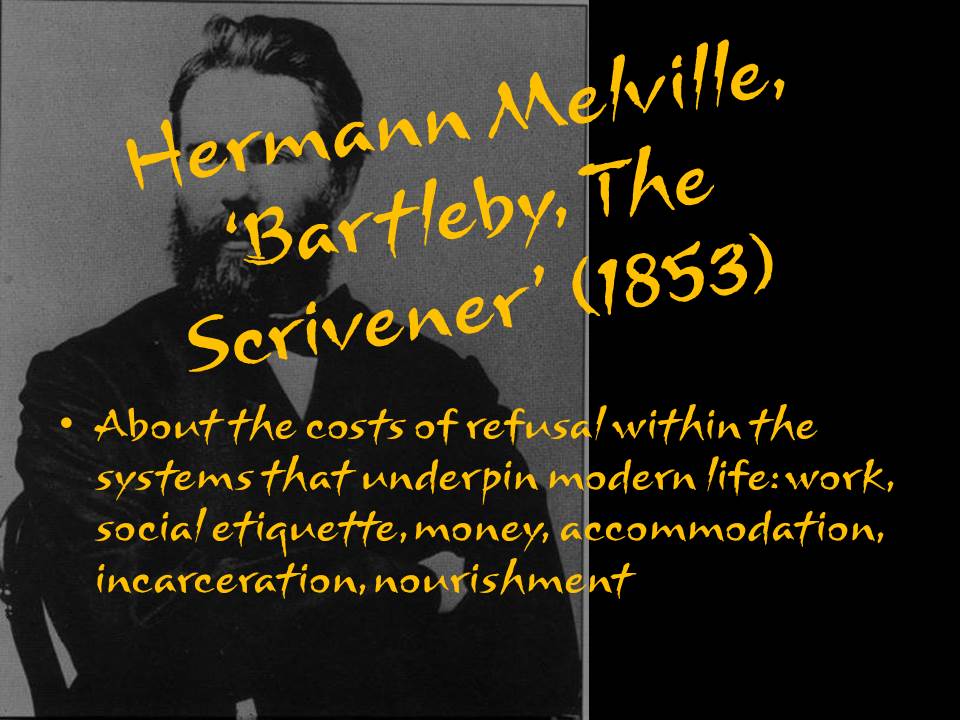
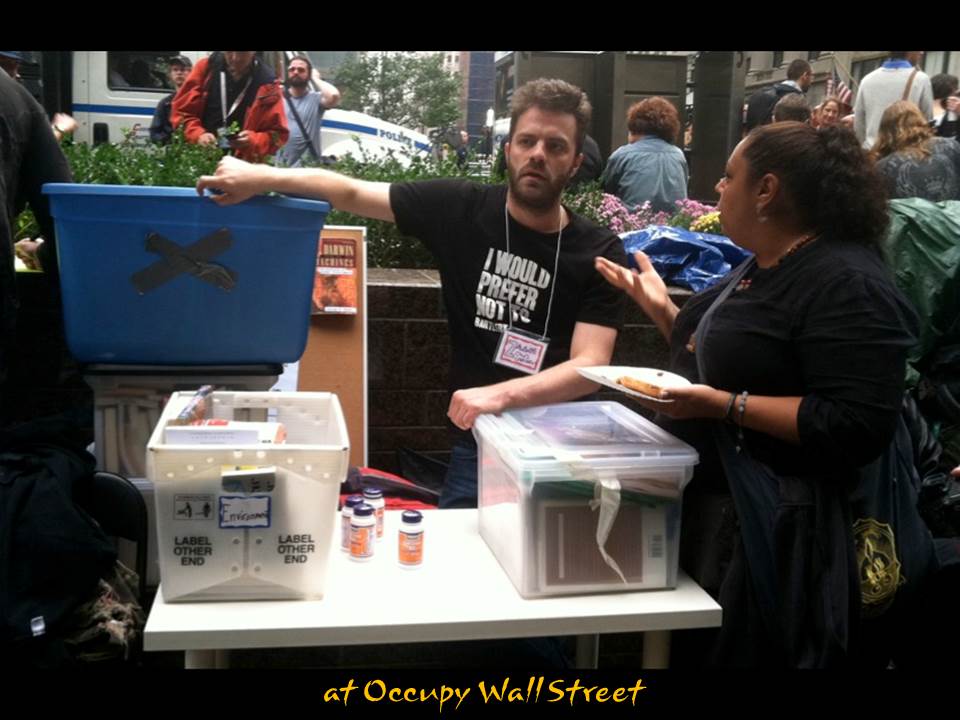

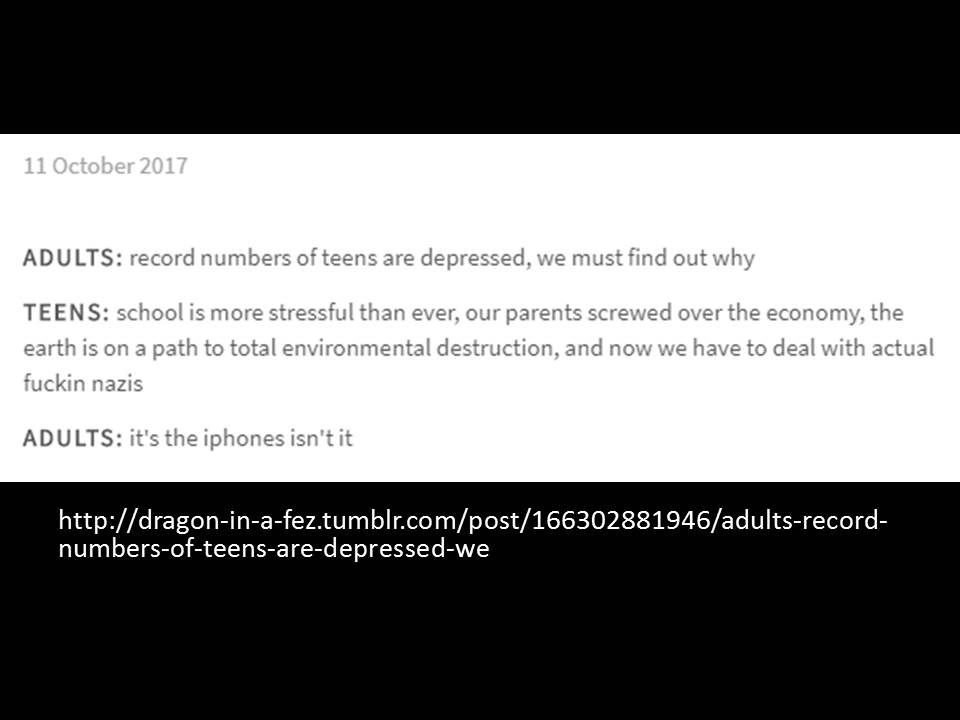
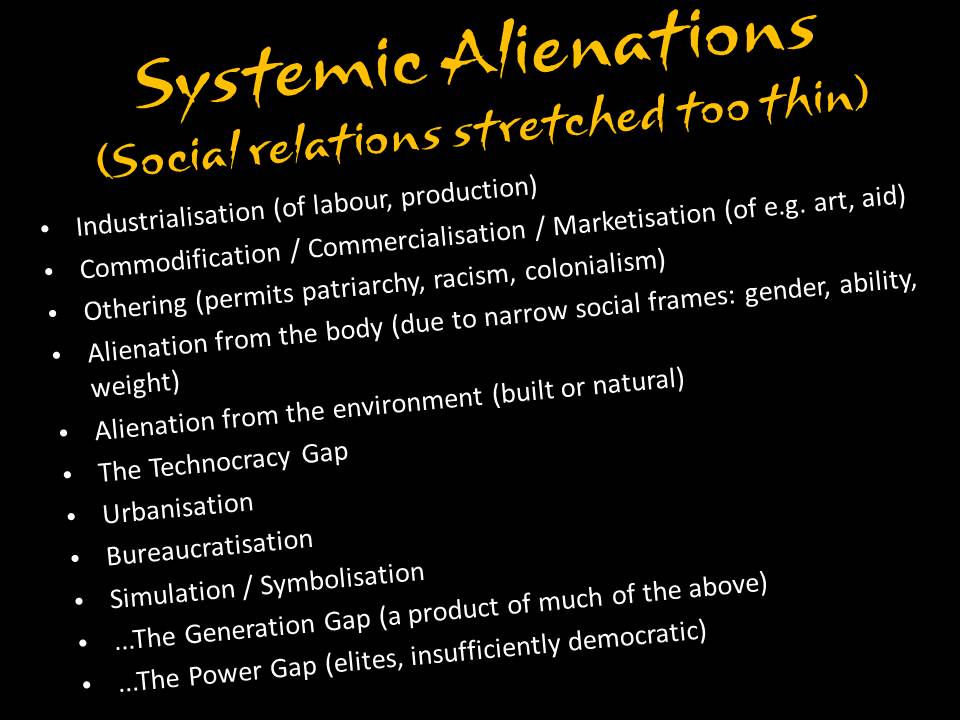
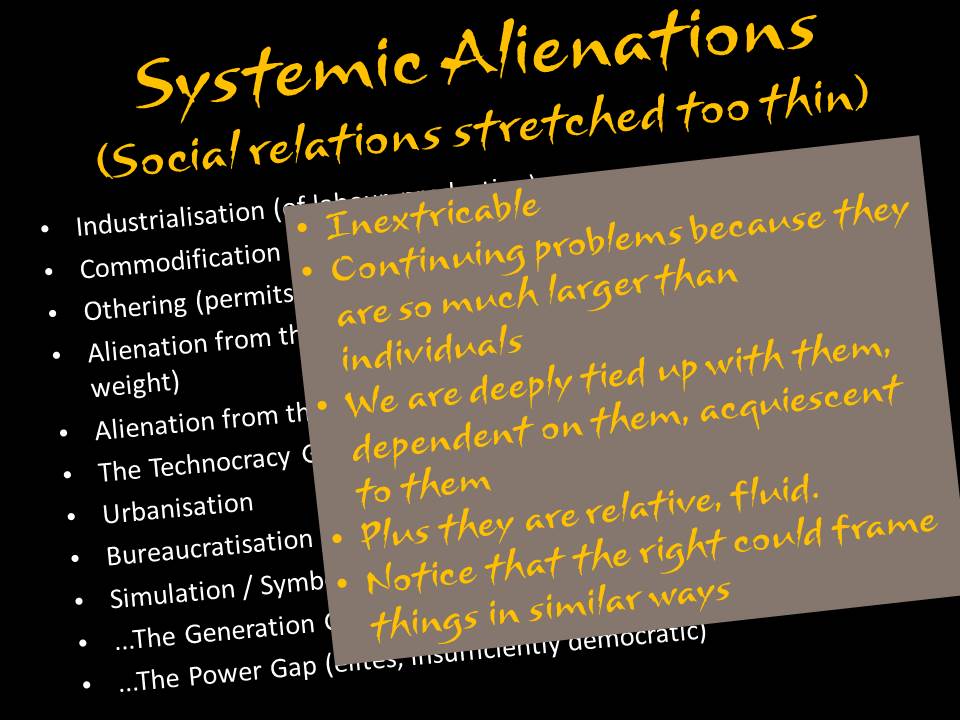




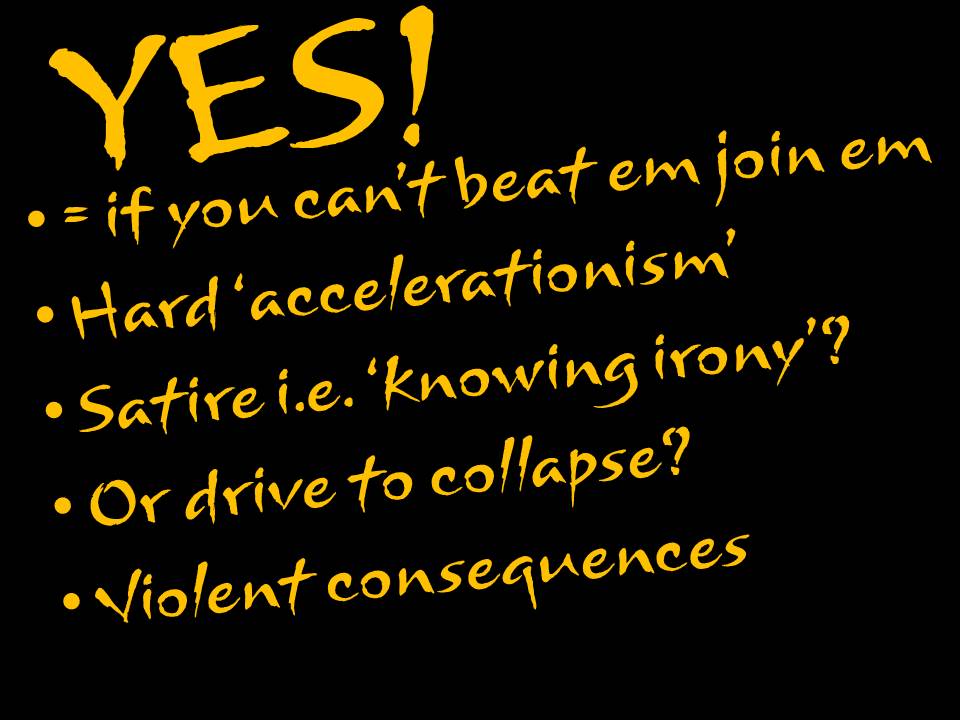
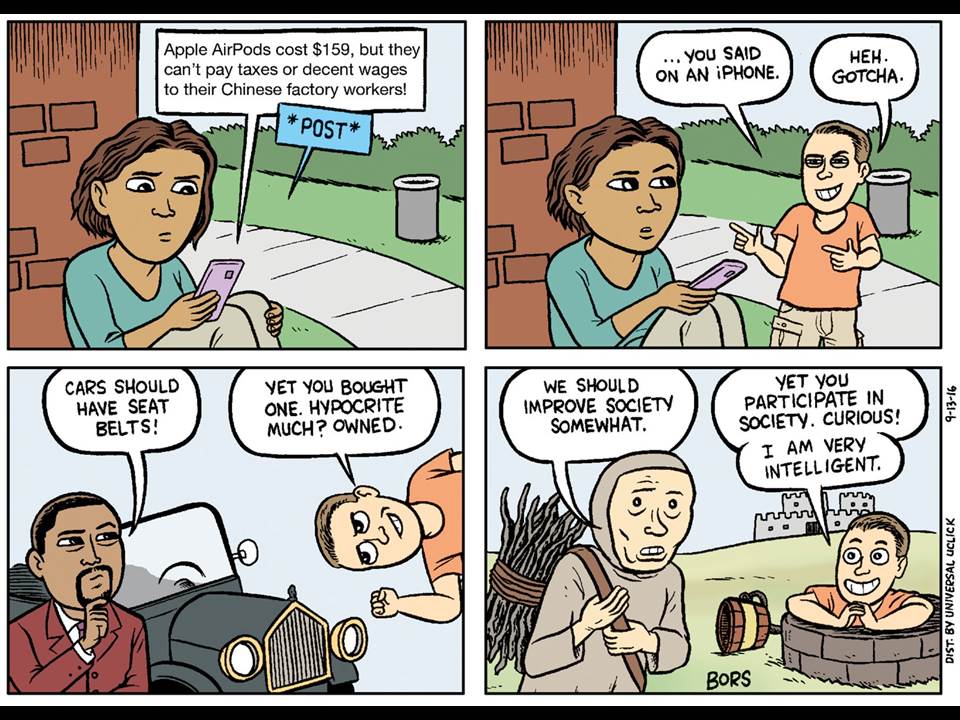
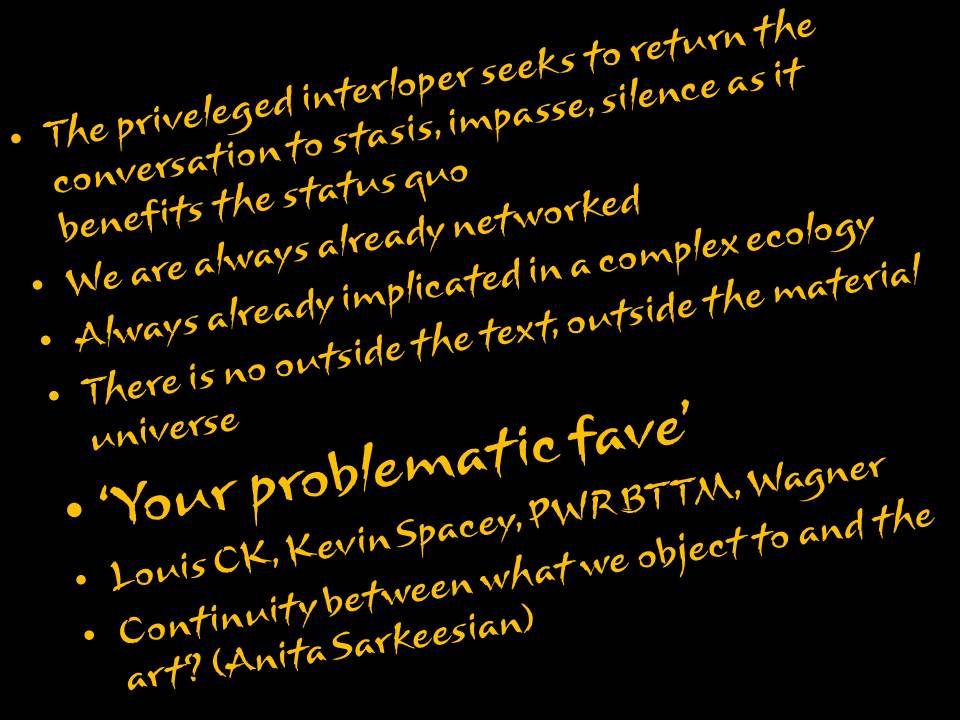 What Sarkeesian says: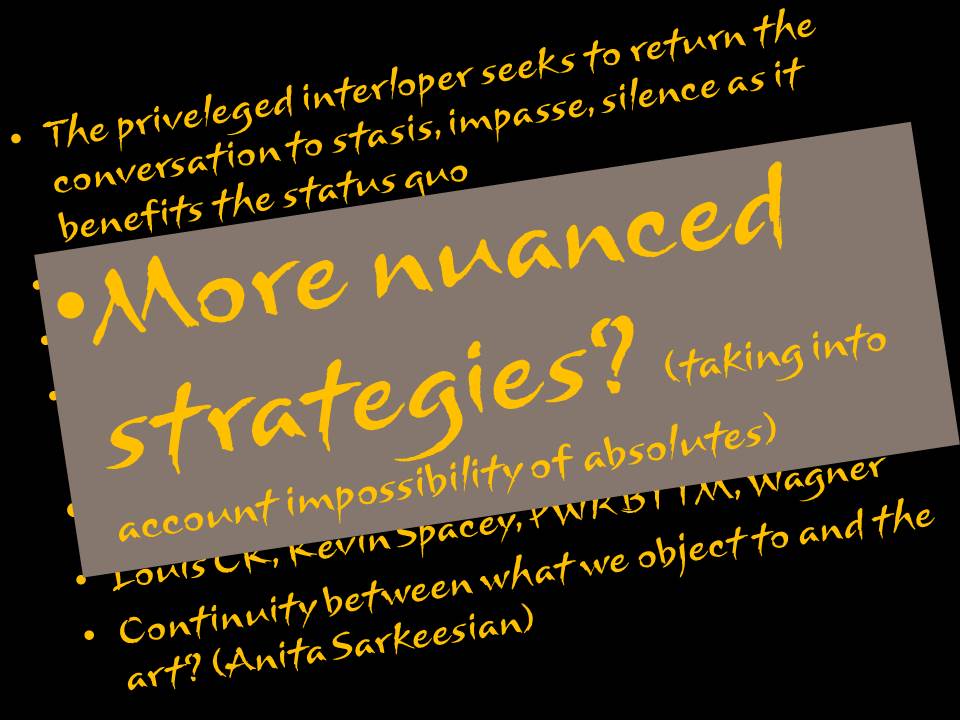
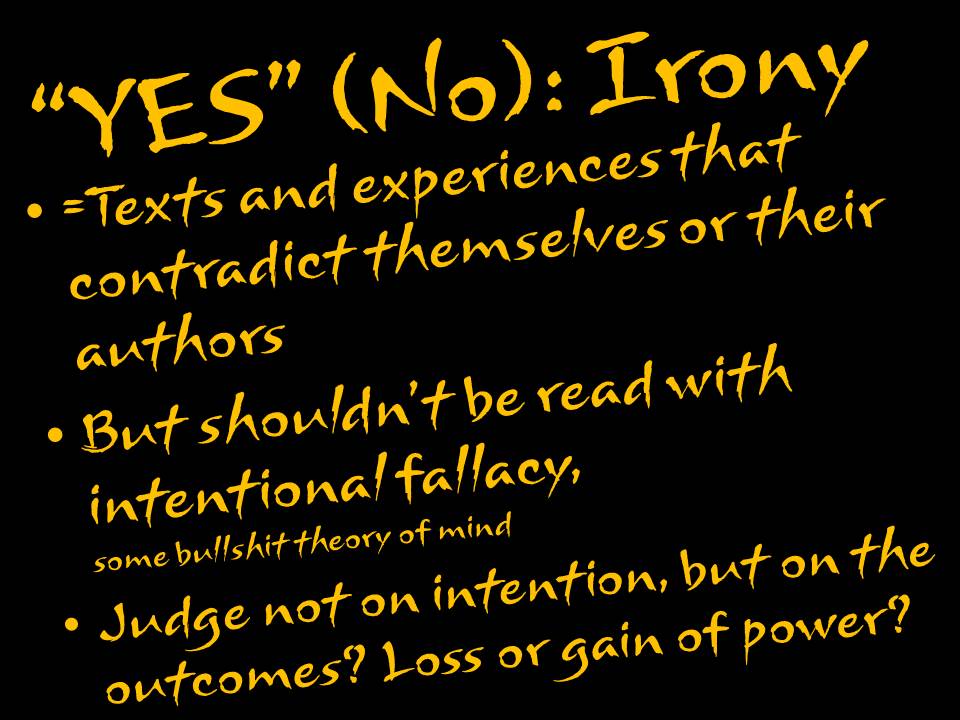
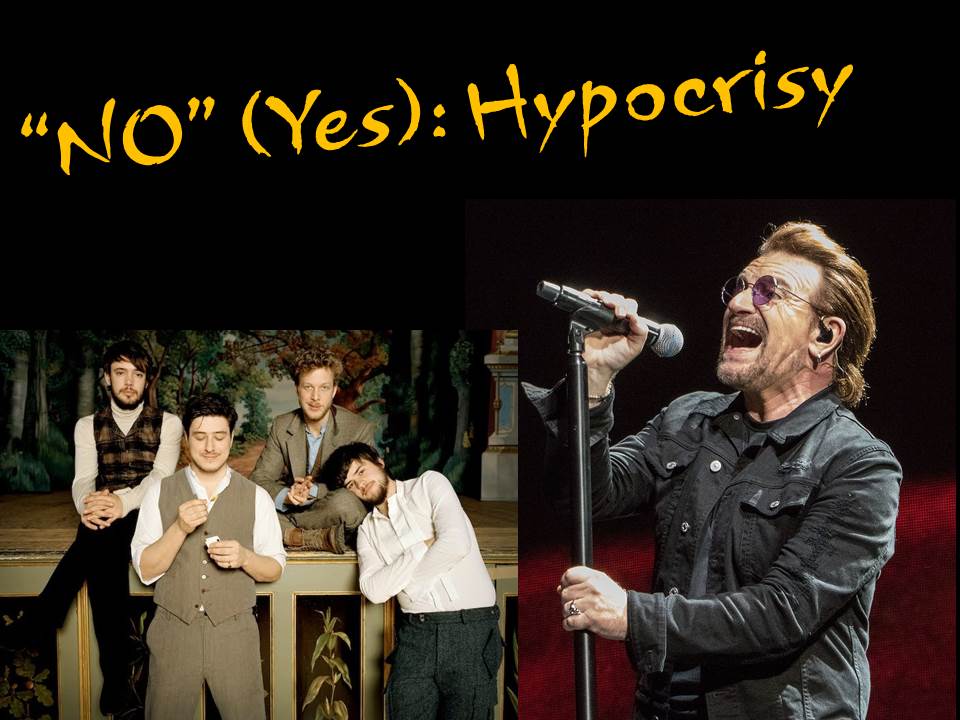
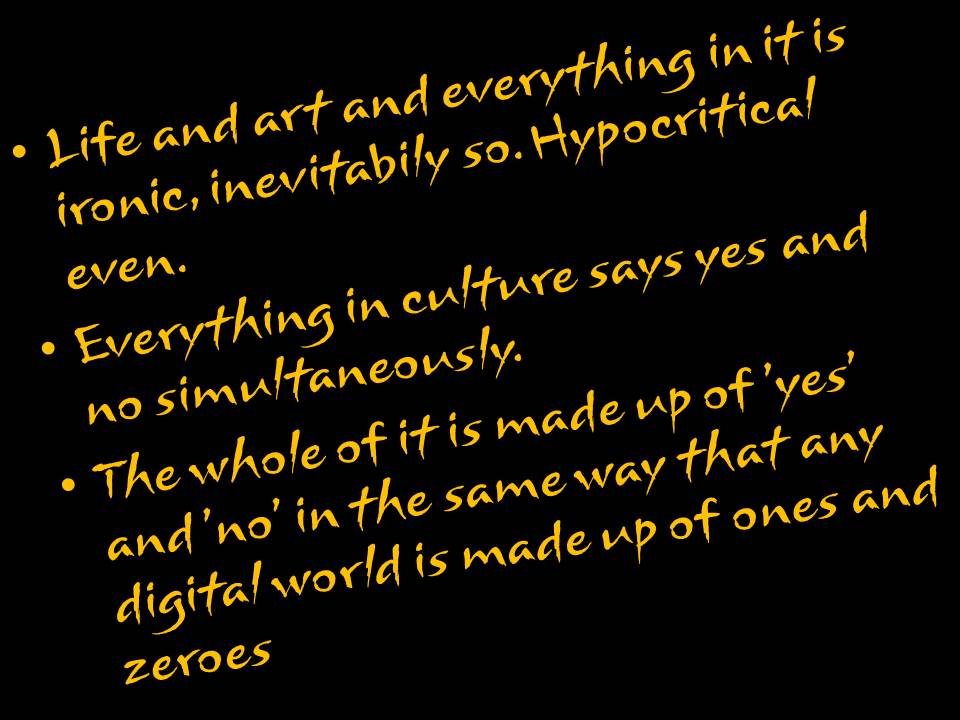
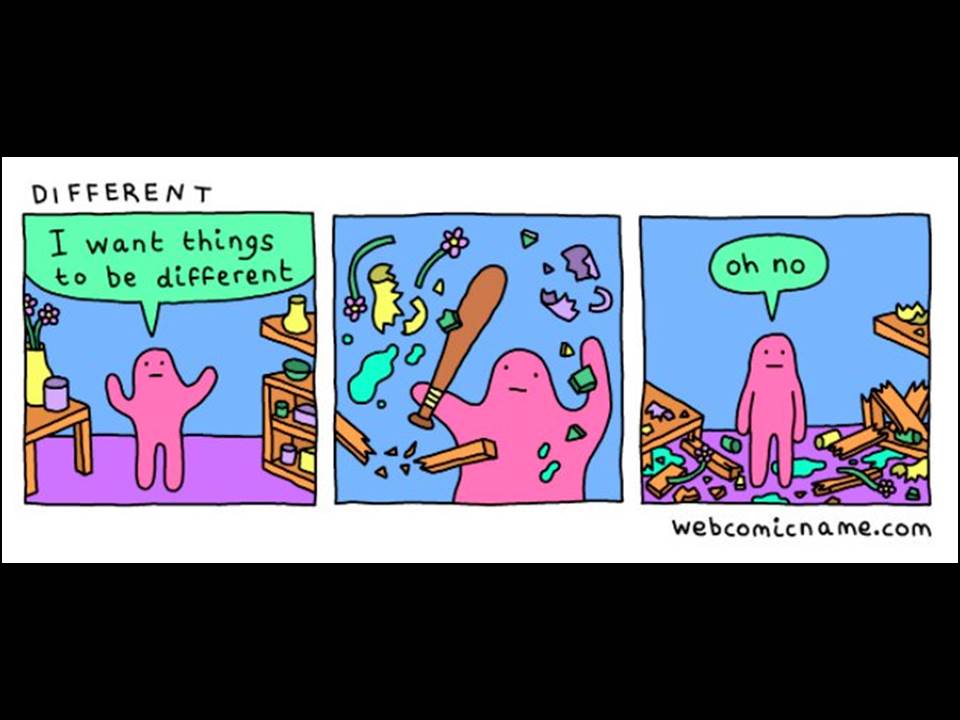
Study Day: Is There a Musical Avant-Garde Today? [ 14-Jul-17 2:26pm ]
 I'm helping to run and speaking at a study day in London next week, 'Is there a Musical Avant-Garde today?' Come along! We're expecting great research and lively debate, and we're most excited about having a forum for ideas of musical 'avant-gardes' (however you feel about the term) that brings together different musical and scholarly traditions.
Date: Friday 21st July, 9:45am-5pm.
Location: City, University of London, College Building, Room AG08 (entrance via St John Street, no. 280). Nearest Tube stations: Angel and Farringdon.
Keynote: Jeremy Gilbert (University of East London).
Organising panel: Alexi Vellianitis (University of Oxford), Adam Harper (City, University of London) and Rachel McCarthy (Royal Holloway).
Registration: £8 including lunch and refreshments
If you'd like to attend, click here to register
What would it mean to talk of 'progressive' music today? Applied to the past or, especially, the present, the term 'avant-garde' has largely fallen out of favour within the academy, both as a description of and an imperative for new music. Yet much contemporary music - whichever combinations of limited terms such as 'art', 'popular,' 'classical' or 'commercial' might apply to it - defines itself, if often all too implicitly, in ways most often associated with avant-garde movements: a focus on stylistic complexity and innovation, and an antagonism towards aesthetic norms and the predominant modes of political thought and practice associated with them. But can such a concept still have currency for musicologists and composers?
The aim of this Study Day is to stimulate a broad, interdisciplinary conversation about how, if at all, to talk of an avant-garde in musical cultures today. For the purposes of this conference, the term 'avant-garde' is fluid, but is broadly defined as a particular idea and praxis of a music considered more progressive than certain others.
We invite scholars and practitioners from different fields to address the ways in which musical avant-gardes today are both practiced and discursively constructed. Topics for discussion could include, but are not limited to the following:
- Might there be one, distinct avant-garde (as our title suggests) or many? Should there be one or many?
- How is the avant-garde politically motivated, and how does it contribute to discussions about race, class, and gender? Is it necessary that the musical avant-garde be a mouthpiece for social and political issues, or can these remain indirect, implicit?
- Is the musical avant-garde located within 'classical' or 'art' or 'popular' or 'experimental' music, or none of the above? Can we (still) locate avant-gardes within, variously, art-music, bohemian, bourgeois, academic, urban or minority cultures? Is a musical avant-garde synonymous with an 'underground,' a 'counterculture' or a 'subculture'? Is the avant-garde merely a Western concept or can it be discerned elsewhere? To what extent are all such distinctions even useful?
- What is the present relationship between avant-gardes, patronage, and institutions? Should avant-gardes avoid direct interaction with capital and other forms of social organisation, or should they embrace them? How do musical avant-gardes interact with and condition physical space? How do they relate to emerging technologies
- Ultimately: is progression in musical aesthetics a possible or desirable goal? What might we demand of a musical avant-garde, and what might it demand of us?
Timetable (approximate):
09:45 Arrival and Coffee
10:00 Welcome and Introduction
10:20 Max Erwin: 'Political Music After Sound: Konzeptmusik and the Complicity of the Avant-Garde'
10:50 Alistair Zaldua: '"Small and Ugly": Critical Composition and the Avant-Garde'
11:20 Lauren Redhead: 'The Avant-Garde as Exform'
11:50 (end of first session)
13:00 Rachel McCarthy: '"The Beat Gets Closer': Post-Capitalist Potential in Girls Aloud's 'Biology'
13:30 Adam Harper: 'Object: Resistance: Underground Music Institutions, Discourse, and Representation'
14:00 (ten minute break)
14:10 Alexi Vellianitis: 'Street Culture and the Musical Avant-Garde'
14:40 George Haggett: 'Towards a Sensual Operatic Ekphrasis in George Benjamin and Martin Crimp's Written on Skin'
15:10 (ten minute break)
15:20 Jeremy Gilbert: Keynote
16:05 Plenary Session
17:00 (end)
Abstracts (in chronological order):Max Erwin: 'Political Music After Sound: Konzeptmusik and the Complicity of the Avant-Garde'This paper seeks to clarify the historical, social, and aesthetic precedents, as well as their broader implications, for New Conceptualism in general, with specific reference to the music of Johannes Kreidler, Patrick Frank, and Celeste Oram. Pursuant to this end, I examine Kreidler's work Fremdarbeit (2009) and how it deploys both veiled self-critique and a radical repositioning of artistic engagement, from autonomy to complicity. Such a complicity, I argue, is crucial for understanding the most recent developments in the musical avant-garde, wherein every critique of society/culture/politics is a priori a self-critique; or, as composer Marek Poliks recently put it, "new music 2.0 is new music about new music". I will demonstrate that this self-critical paradigm is nevertheless far from introverted, with an examination of Patrick Frank's discursive-collaborative compositions, especially the "theory-opera" Freiheit - die Eutopische Gesellschaft (2015) which has as its aim no less than the wresting of 1968-style utopia from a material/cynical exhaustion.
In addition, I aim to provide an overview of how a younger generation of New Music practitioners are grappling with the problems exposed by avant-garde culture in general and Konzeptmusik in particular. I examine Celeste Oram's works soft sonic surveillance (2015) and O/I (off/on, 2016) in terms of an attempted reconciliation between the emancipatory potential of technology and its deployment by corporate and government entities.
Keywords: New Conceptualism, Johannes Kreidler, political art, cultural theory
Alistair Zaldua: "Small and Ugly"; Critical Composition and the Avant-Garde
The quotation in the title of this talk is taken from Bruno Liebrucks description of the processes involved in progress: "The next higher step always appears small and ugly in comparison to the lower, and more completed, step."(1) In his article political implications of the material of new music(2), Mathias Spahlinger explains the concept and enactment of 'critical composition'. He seeks to define his choice of musical materials, processes, and open form, as suggestive of a political utopian ideal. Spahlinger locates this historically by describing the importance of atonality: "the appearance of atonality is the very first time in history in which an approach to composition affects all parameters, in particular the fundamental change in the relation between the parts to the whole. From this, all other parameters must follow."(3)
In Spahlinger's conception, atonality is a historical and irreversible moment where historical understanding and progress intertwine. This is a musical movement in which a vision of utopia can be suggested. Spahlinger's approach to composition is self-reflexive and autonomous; Max Paddison describes Spahlinger's aesthetic as one that lays emphasis on the "…largely structural, technical, and methodological aspects of the music itself" rather than one that continues and develops Hans Eisler's engagierte musik, or 'committed' music.(4) The final category Paddison uses to frame his response to Spahlinger's text is of "[…]composition as political praxis in the sense of the now long-standing avant-garde project of the search for the new and not-yet-known through emergent forms." Thus, the criteria of critical composition could be employed in the search for a musical avant-garde.
Open forms and emergent structures are at work in Spahlinger's little known vorschälge(5): a collection of 28 concept, or word scores. These were created for the purpose of both blurring the distinction between composer and performer and 'making the composer redundant'. This talk will examine these pieces through the lens of 'critical composition' and make some tentative suggestions as to how this avant-garde practice could be identified in more recent music.
1. "Die nächst höhere Stufe ist immer klein und häßlich, gegenüber der niedrigeren, in ihrer Vollendung." Liebrucks, B. 'Sprache und Bewusstsein', Trans. Alistair Zaldua
2. Mathias Spahlinger, 'political implications of the material of new music', trans. by Alistair Zaldua, Contemporary Music Review, Vol 34, no.2-3 (2015), 127-166.
3. "Die Atonalität ist die erste Erscheinungsform dessen, was dann alle anderen Parameter ergreift, nämlich eine grundsätzliche Veränderung des Verhältnisses der Teile zum Ganzen in der Musik. Und die anderen Parameter mussten folgen." (Translation: Alistair Zaldua), Spahlinger, M, and Eggebrecht, H. H,'Geschichte der Music als Gegenwart. Hans Heinrich Eggebrecht und Mathias Spahlinger im Gespräch', Musik-Konzepte special edition, edited by Heinz-Klaus Metzger and Reiner Riehn, Munich (2000),16
4. Paddison, M 'Composition as Political Praxis: A Response to Mathias Spahlinger', Contemporary Music Review, Vol 34 (Part 2-3), 2015, 167-175
5. Spahlinger, M. vorschälge: konzepte zur ver(über)flüssigung der funktion des komponisten, Rote Reihe, Universal Edition, UE 20070, (Vienna: 1993)
Lauren Redhead: The Avant-Garde as Exform
Peter Bürger's critique of the historical avant-garde accounts for its ineffectual nature as a movement because '[a]rt as an institution prevents the contents of works that press for radical change in society […] from having any practical effect.'(1) Bürger argues for hermeneutics to be employed as a critique of ideology,(2) as a facet of the understanding of the 'historicity of aesthetic categories'.'(3) The influence of institutions on music 1968 has served as a central part of its critique: the work concept itself seems to enshrine political ineffectiveness and the bourgeois nature of art practice that ought to be critiqued by an avant-garde. Adorno's claim that 'today the only works which really count are no longer works at all'(4) also no longer seems to apply when the relationship of work such as that produced by the so-called Neue-Konzeptualismus(5) with established musical institutions is considered.
In contrast, Bourriaud's concept of the 'exform'(6) re-conceives the avant-garde as outside of institutions and an idea of 'progress' that is aligned with a dominant capitalist ideology. The exformal is 'the site where border negotiations unfold between what is rejected and what is admitted, products and waste', and forms 'an authentically organic link between the aesthetic and the political.'(7) Progress, as part of a capitalist narrative, both creates and abhors waste. Therefore the task of the avant-garde artist is to give energy to this waste, outside of political and ideological institutions. This type of avant-garde practice functions to 'bring precarity to mind: to keep the notion alive that intervention in the world is possible.'(8) This paper explores the exform with respect to the music and art work of the British composer Chris Newman, and considers how Bourriaud's approach to re-thinking the avant-garde might apply specifically to contemporary and experimental music in the
present.
1. Peter Bürger, Theory of the Avant-Garde, trans. by Michael Shaw, Theory and History of Literature, vol. 4 (Minneapolis, MN: University of Minnesota Press, [1984] 2009), p.95.
2. ibid., p.6.
3. ibid., pp15-16.
4. Theodor Adorno, Philosophy of Modern Music, trans. by Anne G Mitchell and Wesley V Blomster (New York: Continuum, 1973), p.30.
5. cf. Johannes Kreidler, 'Das Neue am Neuen Konzeptualismus', published as 'Das Neue and der Konzeptmusik', Neue Zeitschrift für Muzik, vol. 175, no. 1 (2014), pp44-49, de/theorie/Kreidler__Das_Neue_am_Neuen_Konzeptualismus.pdf> [accessed 13.05.2017].
6. Nicholas Bourriaud, The Exform, trans. by Erik Butler, Verso Futures (London: Verso, 2016).
7. ibid., p.10.
8. ibid., p.47.
Rachel McCarthy: 'The Beat Gets Closer': Post-Capitalist Potential in Girls Aloud's "Biology"'
A recent body of Leftist socio-political theory advocates a transformational approach to post-capitalism. Inspired by Brecht's maxim 'don't start from the good old things but the bad new ones', as well as Lenin's suggestion that capitalist institutions such as banks could be re-purposed for socialist ends, writers including Jameson (2010), Williams and Srnicek (2014), and Mason (2015) posit that a future beyond capitalism must be secured not through a rupture with present society, but rather by a transformation of already-existing phenomena. Jameson identifies utopian potential in the organisational structures of Wal-Mart, while Williams and Srnicek promote accelerationism as a means of pushing through the bonds of capitalism.I suggest that the music of the mainstream pop group Girls Aloud represents an aesthetic parallel to this kind of political theory. With roots in the reality television talent show Popstars, capitalist relations of production are deeply embedded in the group's music. Yet analysis of their 2005 hit single 'Biology' demonstrates how, in deviating from the structural norms of mainstream pop, the song contains a striking kernel of utopian impulse. This is further complicated by the disturbing sense of jouissance that pervades the song's reception, whereby a 'critical' enjoyment of mainstream pop can amount to having one's cake and eating it too. Ultimately, 'Biology', like Jameson's assessment of Walmart, should be understood dialectically: neither as a regressive symbol of the evils of capitalism nor as a shining beacon of hope for a post-capitalist future, but as something in between.Adam Harper: 'Object: Resistance': Underground Music Institutions, Discourse and RepresentationHow might a sonic avant-garde go hand in hand with a progressive social ideology today? Might an enlarged set of sonic possibilities correspond to greater social representation? Taking the term 'representation' in both its political and aesthetic senses (that is, the representation of emotion, experience and so on), this paper hopes to begin to approach these questions in the light of a number of recently established collectives and institutions within underground music that explicitly provide platforms specifically for women (such as Sister, Discwoman and Objects Limited), people of certain regional or diaspora contexts (such as NON and Eternal Dragonz), or people of certain sexualities (such as KUNQ). What sort of discourse surrounds such collectives? What are their goals and are they achieving them? To what extent do they combine the musical and the social in redistributing representation?Alexi Vellianitis: 'Street Culture and the Musical Avant-Garde'This paper looks at ways in which certain metaphors or rhetorical strands linked to the musical avant-garde have been mobilised to describe interactions between new classical music and 'urban' music (grime and electronic dance musics) on the London classical concert scene since 2000. In particular, it is concerned with a fetishisation of the 'the symbolic power of street culture[, which] is often understood as authentic, defiant and vital' (Ilan, 2015). Seen as such, this symbolic power shares much with the classical avant-garde, since modernist or avant-garde status has historically been conferred on the basis that music signals 'political engagement and commitment', and is linked to and fuels 'periods of political instability, change, revolt, and revolution' (van den Berg, 2009).In order to unpack these issues, this paper focuses a number musical performances around London over the past decade: two BBC Proms concerts, in which grime was featured alongside the BBC Symphony Orchestra; and the musical activities of composer and producer Gabriel Prokofiev, whose nightclub and record label Nonclassical brings classical music to clubs throughout London, and whose orchestral music brings 'urban sounds into the concert hall' (Shave, 2011). In each case, accusations that the classical concert scene is being 'dumbed down' by featuring popular music are countered by arguments that this 'urban' popular music is in some way new, current, or vital.These concerts foreground questions about race, class, and inclusivity that have been dominant in public discourse. Is this a positive diversification of classical music culture, or just another set of appropriations of black, working-class music by white, affluent musicians? What is it about the experience of social unrest in urban areas that speaks to the political pretentions of the avant-garde? What change, if any, is being effected?George Haggett: Towards a Sensual Operatic Ekphrasis in George Benjamin and Martin Crimp's Written on SkinThere is little in Katie Mitchell's production of George Benjamin and Martin Crimp's 2012 opera Written on Skin that goes unseen: not only does the thirteenth-century plot feature an on-stage orgasm, but throat-slitting, evisceration, cannibalism, and suicide. Nevertheless, when these lurid events are painted by 'the Boy' (the heroine, Agnès's, illicit lover), the audience can never see them. Instead, during what Crimp and Benjamin term 'Miniatures', he takes out a page and, singing, describes the illumination that he has painted onto it. In so doing, he turns his pictures into uttered acts of ekphrasis, the rhetorical device through which visual art is described in detail.In asking how operatic ekphrasis can function and unpacking its potency in Written on Skin, I will do three things: 1) lift ekphrasis from its specificity to the reified, written word and into the performative realm of the sung act; 2) refer outwards from Written on Skin's Troubadour source text to locate its viscera within thirteenth-century understandings of the body; 3) analyse each miniature in turn to interrogate Benjamin's compositional responses to these conditions. Integrating the former two, I will dissect Written on Skin into four sensory organs—eyes, ears, skin, and mouths—and lodge them between Miniature analyses. My intention is to bring the body to the fore, always in pursuit of a reading that hears the body when it hears ekphrasis, and hears ekphrasis when it hears the body.
Negativity, Not Pessimism! (RIP Mark Fisher) [ 15-Jan-17 6:59pm ]I was so shocked and upset to learn of Mark Fisher's death yesterday. For me, Mark was both an idol and, as time passed, someone I was always pleased and not a little humbled to encounter in person and sometimes share a platform with. I didn't know Mark very well personally, and being a generation younger than he was I only know second hand the milieu of the 90s and the Cybernetic Culture Research Unit at Warwick University he formed an integral part of, through its growing legacy and some of the reminiscences and thoughts of people who knew him then (Robin MacKay, Simon Reynolds and Jeremy Greenspan among them). But as someone a generation younger than Mark, I can express something about the incalculable impact he had on me, my thinking and writing, and my gratitude for the times when he actively, kindly helped me, as well as the times that were just good times.Mark simply changed my life. By 2009, the year I started the blogging, he was a central node in a network of bloggers, thinkers and forums that encompassed critical theory, philosophy and several areas of cultural criticism, especially of popular music. It was a conversation and a community I eagerly wanted to participate in, late and all too hot-headed though I was. As commissioning editor of Zer0 books, he fostered the growth and evolution of this network into a collective of thinkers built on diverse, self-contained and regularly powerful statements that went far.
Mark's own essay for the imprint, Capitalist Realism: Is There No Alternative? was undoubtedly one of the best of the lot. I continue to recommend it widely as one of the best, most distilled expression of today's ideological challenges. By the end of 2009, Mark had reached out to me and asked if I wanted to write for Zer0. I was 22. Infinite Music was the result two years later. He told me that I should reconsider the title I had initially proposed - 'The New New Music' (can you believe that!?) - which didn't take Mark's genius, but thank God. His faith in me - this despite my frequent and often crude HTML critiques of his positions on music - led to so many amazing opportunities and blessings for the struggling, wet-behind-the-ears critic I was.I first met Mark in person in April 2010 when we were both part of a panel discussion at London's Café OTO, a 'salon' under the auspices of Wire magazine: 'Revenant Forms: The Meaning of Hauntology'. He was warm, friendly and funny back stage, powerful, precise, provocative and funny on-stage. Someone I brought to the event who didn't know Mark and his ideas said to me 'but capitalism is the only system that works!' (this of course is precisely was Capitalist Realism describes and addresses). I believe I next saw him marching alongside thousands of students at one of the protests against the raising of tuition fees and the cutting of the university teaching budget in late 2010, an issue that inflamed and unified the blog network like nothing else, not least Mark himself.At some point in 2011 I was at a gig behind a pub at which Maria Minerva was playing. Maria had been taught by Mark during her Master's at Goldsmith's college. In an amazing moment, Maria gave a shout-out on stage to her 'professors' - I followed the direction of her outstretched arm, and there was Mark, leaning against a wall next to Kodwo Eshun. I saw him at least twice in 2013, once at a symposium at Warwick University on the Politics of Contemporary music, where I burned with envious ambition at his ability to deliver such an on-point, appropriate and funny lecture from only a small notebook. The other time was in Berlin, where I was talking about accelerationist pop for the CTM festival, Mark was there to talk about the death of rave. We walked from our hotel to the venue, had lunch, and Mark talked sympathetically and encouragingly about my career difficulties. He sat in the front row of the talk I gave. I played some of the kitschiest vaporwave as the audience came in. I'll never forget the bemused look on his face, as if he was trying to figure out what sort of a hilarious prank was being played, and whether he wanted in on it. That image of Mark is still for me the opposite end on the spectrum of vaporwave listeners to the one where vaporwave is, uncritically, 'just good sincere nostalgic vibes', and why I have no regrets about 'politicising' vaporwave (a genre that in any case owes an enormous debt to his theorising of hauntology).But for me there was another Mark as well - the formidable writer and theorist, k-punk. This voice I began to get to know in 2006, the year when he did so much to lay the foundations of hauntology (it was his invention, frankly). It was from k-punk that I learned about something called 'neoliberalism' ('what on earth has this guy got against liberalism?' I would wonder). It was from k-punk that I learned that post-modernism was not necessarily the wonderful cultural emancipation I had naively believed it to be. In fact, during these years I was mostly against k-punk. He was critical of more recent trends in electronic music, believing them a poor comparison to what the 90s had offered. This led to a fierce division between writers and bloggers that manifested not just in blogs but magazine sites and a day-long conference at the University of East London, which I attended (the first time I saw Mark in the flesh). Though we both agreed that new music was necessary, naturally his position irritated my young, idealistic self with my special music, and my own blog posts attempted to intervene in support of the new stuff. 'Loving Wonky', my first blog post to attract more than a handful of readers, was directed at k-punk implicitly throughout and at its conclusion, explicitly.This negativity that got me started, this need to talk back to the authority figure, was a testament to the power of his writing. But more so was the way he subsequently taught me as I took a closer look. In preparation for my post on hauntology, I printed out and re-read everything he'd written on or near the subject, underlining and making notes. And he convinced me of his position. He was right. I didn't want to accept his theorising of 'the end of history', thinking it merely pessimistic. His blog posts are so imaginatively, seductively, persuasively written. He's probably the most referenced person on Rouge's Foam. Then I read Capitalist Realism, and rather than the mere youthful defence of certain musics it could have been, Infinite Music became an attempt to stand with Capitalist Realism and answer k-punk's resounding call for a newfound creative imagination. Later, in 2012, it was from k-punk that I learned of accelerationism, and because of his theory that I used it to describe new forms of electronic music in 'Welcome to the Virtual Plaza.' And it wasn't only theory. Wherever I wrote about music and Mark was writing too (Wire, Electronic Beats), my writing was improved by the honour and by his raising of the bar (this was the guy who had described Michael Jackson as 'only a biotic component going mad in the middle of a vast multimedia megamachine that bore his name.')Mark isn't just the figure behind every significant thing I've done as a critic. His theory is now deeply embedded in who I am and what I say. Even the residue of the ideas I have fought against condition my thinking. I have brought his concepts home, they structure my conversations with my friends and family. Capitalist realism: describing the ideology that miserable as it is, there is no alternative to capitalism and that's just the way it is. Business ontology: the ideology that any social or cultural structure must exist as a business. His use of the concept of the Big Other - the imaginary subjectivity that holds important beliefs but may not in fact exist - has guided me through my personal response to Brexit and Trump. (By the way, I couldn't possibly summarise Mark's writing - if you haven't read it already, what are you waiting for?) Even his blackly comic image of a broken neoliberalism, as a cyclist dead and slumped over the handlebars yet continuing downhill and gathering speed, keeps coming back to me.Mark eventually became something of a role model to me. Asked what sort of space I wanted to carve out between academia and public criticism for my own career, I have often said I wanted to be a Mark Fisher. Yet as he regularly explained with his astonishing balance of passion and precision, the world as it is today, its ideologies and its institutions - it's hardly set up to encourage fringe intellectuals. I'm not sure whether he would have fully encouraged me to aspire to his career, tied so closely as he well knew to challenges of mental health (something I started to live in 2014 when, initially and like so many others, my PhD went nowhere). But he did warmly support and encourage my writing when so many people around me could only regard it with doubt.One of Mark's most abiding lessons, and for me at least the key to his writing, was something he put pithily to me at the end of an email: 'Negativity, not pessimism!' I had not appreciated the subtle but important difference the two, but then I instantly did. What a rallying call for the nightmarish 2010s. And as others have noted, it was his encouragement and optimism that was especially nourishing. It was certainly not a pessimistic new-music naysayer who wrote the final words of Capitalist Realism:
The long, dark night of the end of history has to be grasped as an enormous opportunity. The very oppressive pervasiveness of capitalist realism means that even glimmers of alternative political and economic possibilities can have a disproportionately great effect. The tiniest event can tear a hole in the grey curtain of reaction which has marked the horizons of possibility under capitalist realism. From a situation in which nothing can happen, suddenly anything is possible again.A big long (k-punk-quoting) blog post like the good old days. I used to apologise for them. Mark never did. I still can't wait to read his latest book.The last time I saw Mark was after Dhanveer Brar's lecture on Actress at Goldsmiths last autumn. He was talking to his friends and colleagues in the distance and still, even after all this time, I was too nervous to say hello. What a fool. I had not stopped to gather up and communicate Mark's importance to me until now, and I hope I don't make such a mistake again. What I've seen over the cybernetic systems this weekend has emphasised how important he was to so many others as well, and well beyond the world of theory too.Goodbye Mark, and thank you.
Bubblebath Episode 01 ft. Mat Dryhurst (for RBMA Radio) [ 25-Aug-16 5:04pm ]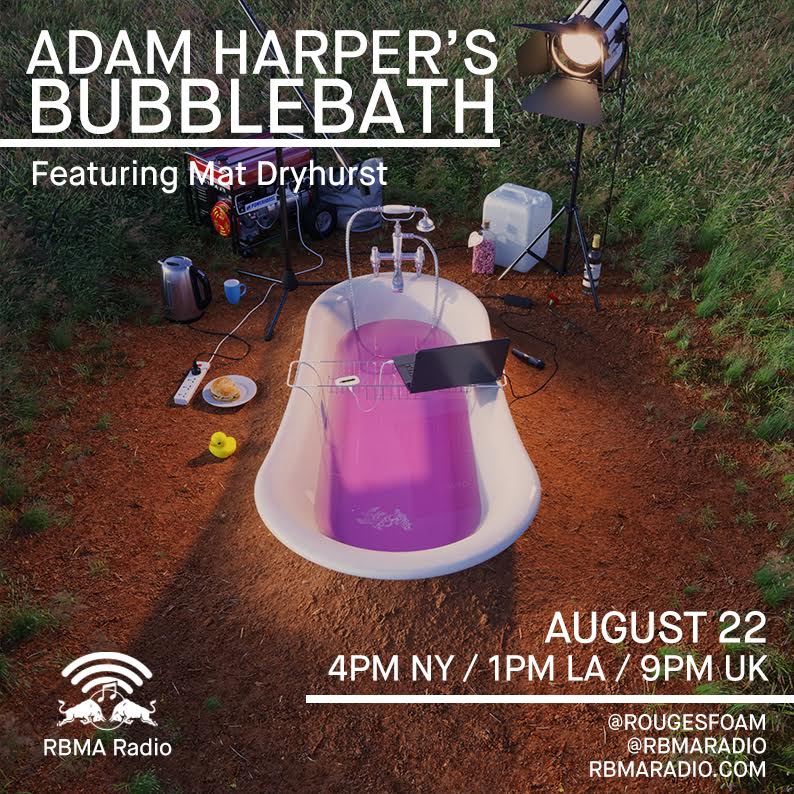 Art by Kim LaughtonThe first episode of my new monthly show for RBMA Radio aired a few days ago, and is archived here. Bubblebath is a two-hour show all recorded and edited by me, featuring new, typically lesser known tunes that I'm interested in, segments going for some deeper analysis, and interviews with various people from underground music culture. For the first show, I looked at the pseudo-humanistic style of James Ferraro's Human Story 3 and some other records, and talked to Mat Dryhurst about some of the problems facing underground culture today and his platform Saga. The playlist is below.
People in the US won't be able to listen to the archived version of the show for various legal reasons. I didn't realise that would happen and I do apologise. If that's you, you might try using a proxy server, especially with different browsers. US listeners can listen to the show live without any problems, though, so I'll make sure to forewarn people next time.
· 00:00:02 - 00:02:41 Julien - Alpha Beat - Calm (from Calm 2 https://calmdot.bandcamp.com/album/calm-2)
· 00:02:41 - 00:05:28 Alfie Casanova - 4 Play - Calm (from Calm 2 https://calmdot.bandcamp.com/album/calm-2)
· 00:05:28 - 00:10:16 NKC - Salon Room - Her Records (from Hague Basement http://store.herrecords.com/album/hague-basement)
· 00:10:16 - 00:13:03 仮想夢プラザ - 秘密 - Plus 100 Records (from Balance with Useless https://plus100.bandcamp.com/album/balance-2) (extract, background, and again throughout )
· 00:13:03 - 00:18:17 Julien - Day Racer - Orange Milk (from FACE OF GOD https://orangemilkrecords.bandcamp.com/album/face-of-god)
· 00:18:17 - 00:23:52 NV - Bells Burp - Orange Milk (from Binasu https://orangemilkrecords.bandcamp.com/album/binasu)
· 00:24:50 - 00:29:57 Easter - Leda - own Bandcamp page (from New Cuisine Part 2 https://easterjesus.bandcamp.com/track/leda)
· 00:29:57 James Ferraro - various tracks from Human Story 3 - own Bandcamp page (https://jjamesferraro.bandcamp.com/album/human-story-3) (extract, background)
· 00:32:04 - 00:37:32 James Ferraro - Individualism - own Bandcamp page (from Human Story 3 https://jjamesferraro.bandcamp.com/album/human-story-3)
· 00:39:19 - 00:40:31 John Adams - Lollapalooza - Nonesuch (from I Am Love Soundtrack) (extracts)
· 00:40:55 - 00:41:20 Steve Reich - Eight Lines Number 1 - RCA Red Seal (extract)
· 00:41:36 - 00:42:30 Aaron Copland - Allegro from Appalachian Spring - Sony Classical (from Bernstein Century: Copland) (extract)
· 00:43:05 - 00:44:32 Jeffery L. Briggs - CivNet Opening Theme - Microprose (from CivNet Soundtrack) (extract)
· 00:44:48 - 00:45:24 Oneohtrix Point Never - Problem Areas - Warp (from R Plus Seven) (extract)
· 00:45:52 - 00:46:11 Kara-Lis Coverdale - AD_RENALINE - Sacred Phrases (from Aftertouches https://sacredphrases.bandcamp.com/album/aftertouches) (extract)
· 00:46:30 - 00:47:04 Giant Claw - DARK WEB 005 - Orange Milk (from DARK WEB https://orangemilkrecords.bandcamp.com/album/dark-web) (extract)
· 00:47:25 - 00:47:51 Metallic Ghosts - University Village - Fortune 500 (from City of Ableton https://fortune500.bandcamp.com/album/the-city-of-ableton) (extract)
· 00:48:58 - 00:49:59 Torn Hawk - The Romantic - Mexican Summer (from Union and Return) (extract)
· 00:52:12 - 00:55:08 Subaeris - Shadow Portal - Nirvana Port (from Transcendent God https://nirvanaport.bandcamp.com/album/transcendent-god)
· 00:55:08 - 00:58:23 Subaeris - Beating Heart - Nirvana Port (from Transcendent God https://nirvanaport.bandcamp.com/album/transcendent-god)
· 00:59:08 - 01:01:16 Klein - Babyfather Chill - own Bandcamp page (from ONLY https://klein1997.bandcamp.com/album/only)
· 01:01:16 - 01:03:45 Klein - Make it Rain - own Bandcamp page (from BAIT https://klein1997.bandcamp.com/album/bait)
· 01:04:49 - 01:47:38 Valentin Silvestrov - Diptych - ECM (from Valentin Silvestrov: Sacred Works) various tracks from Valentin Silvestrov: Silent Songs - ECM (extracts, background)
· 01:49:09 - 01:54:25 Swimful - Atop - SVBKVLT (from PM2.5 https://svbkvlt.bandcamp.com/album/pm25)
· 01:54:25 - 01:58:45 Swimful - Bounce (Simpig Remix) - SVBKBLT (from PM2.5 Remixes https://svbkvlt.bandcamp.com/album/pm25-remixes)
'Joy 2016' (essay for 3hd festival, where I'll be in October) [ 24-Aug-16 5:12pm ]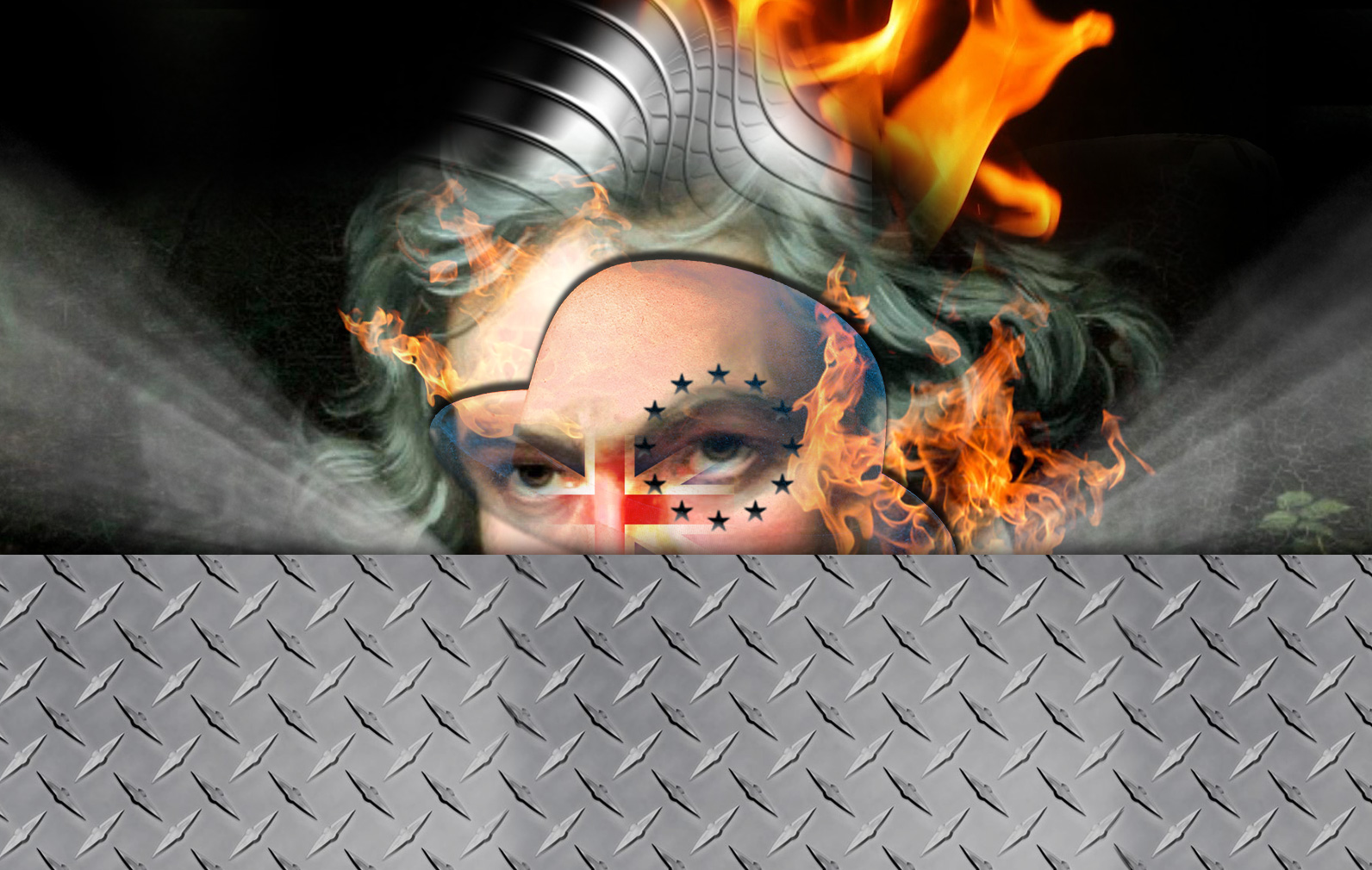 Art by Sam Lubicz3hd festival is back for its second year in Berlin this October, and its website has gone up (click here). I'll be there lecturing and participating in discussions over various aspects of their theme 'There is nothing left but the future.' In the meantime, I wrote an essay for them (click here to read it) sketching some initial thoughts about some of the problems facing musical futurism and musical sarcasm after a summer of violence and Brexit, through the lens of the 'Ode to Joy' from Beethoven's Ninth Symphony, and Wendy Carlos's electronic version of it particularly (incidentally, Jeremy Corbyn, something of a lightning rod for various kinds of political tumult whatever you think of him, recently mentioned listening to Beethoven's 5th).
Beethoven's Ode to Joy has accumulated cultural and political baggage of apparently every different kind, and, especially, in extremes. It has played the role of humanity's highest and most noble achievement and an incitement to horrifying violence both. And it is the anthem of the European Union...
Who needs dehumanising machine music when you have Trump, when you have the rise of hatred the world over?
There is an important difference, of course, between the future and the futuristic. The futuristic is a costume, a thrill, a performance, a caricature, all from within the safety of the present. The future is what actually happens to you and at some point, whoever you are, it will hurt you. What can art and music help us to do and to say before that point?
Brunel University Post-Internet Working Group, London, soon [ 22-Feb-16 3:34pm ] Click to enlarge and read the blurbs for each talkI'm looking forward to participating in a Post-Internet Working Group at Brunel University that'll meet on two occasions, on Feb 4th at 2pm, when Michael Waugh will be giving a talk ('Post-Internet Popular Music: From the Underground to the Mainstream'), and on March 8th at 1pm, when I will be giving a talk ('"Accelerated by the Digital Age?"An Ambivalent Aesthetics of the Digital World in Underground Electronic Music'). Why not come along for some IRL content creation? ;) Slides from my talk at 3hd, 'What is the Musical Object in the 21st Century?' [ 18-Dec-15 8:03pm ]
Here are the slides from my recent talk at the 3hd festival in Berlin. It was a bit more freeform, so apologies if the threads are a bit unclear from them. It was a great festival altogether, with a great line-up of performances too - there was a write-up about it on AQNB.
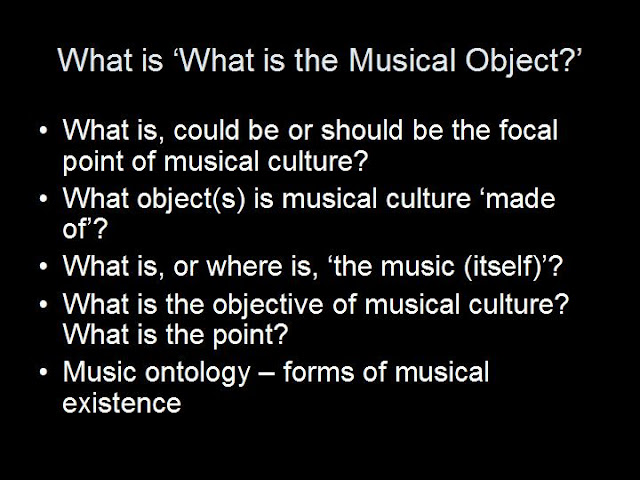
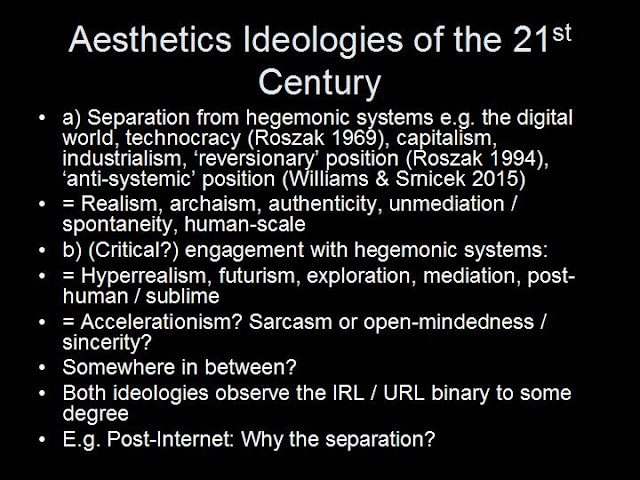

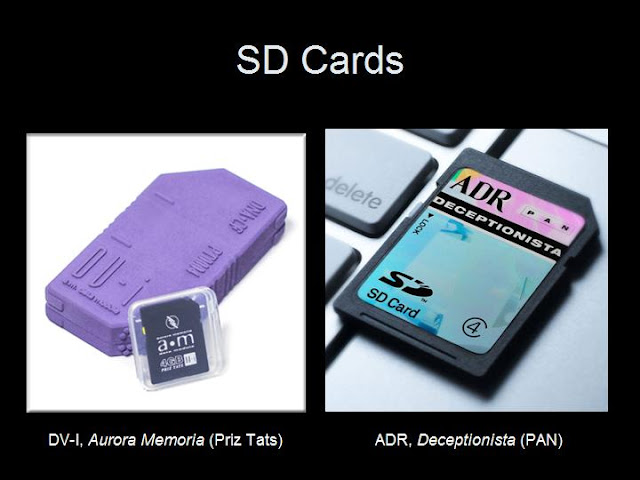
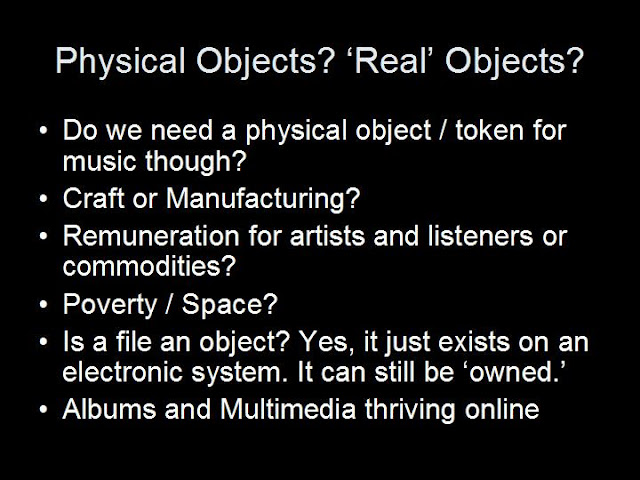
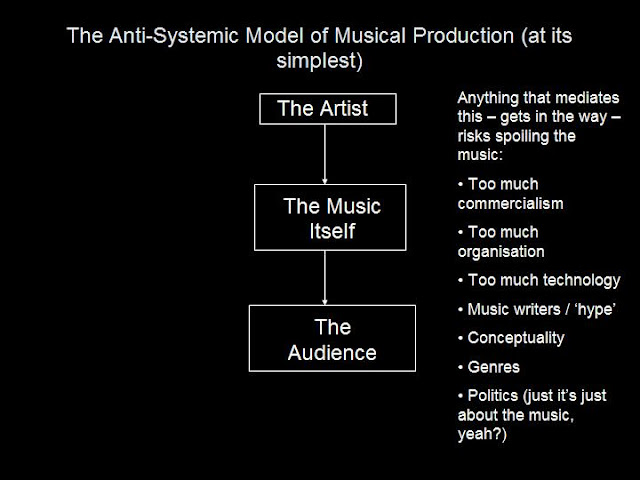
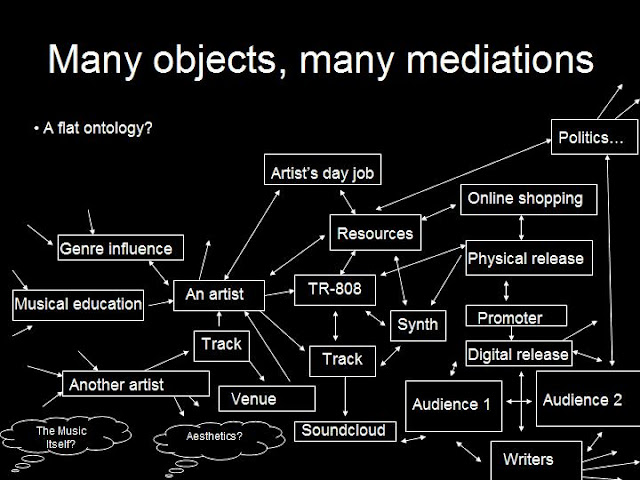
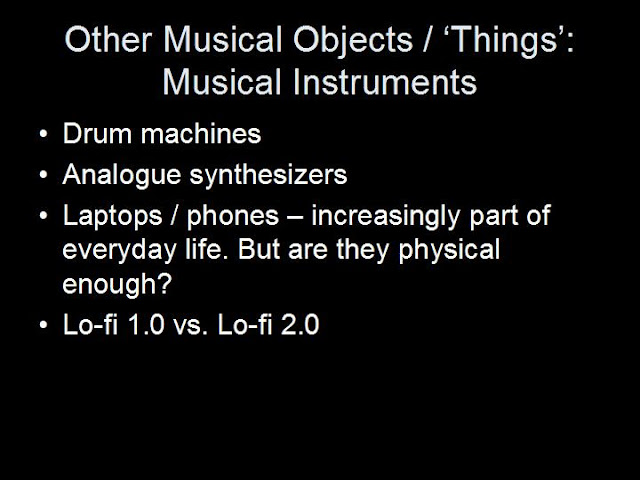
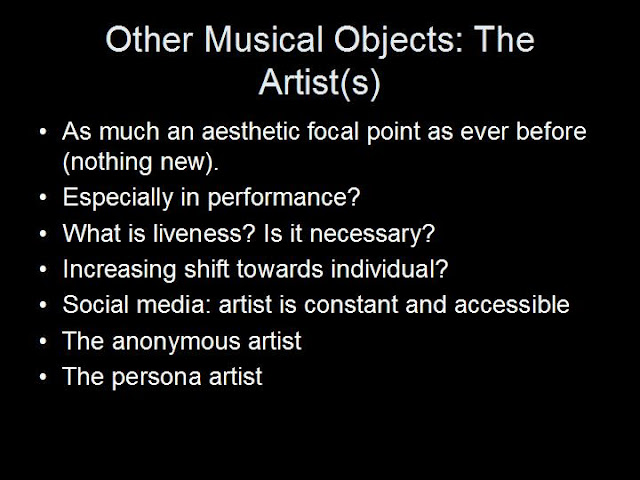
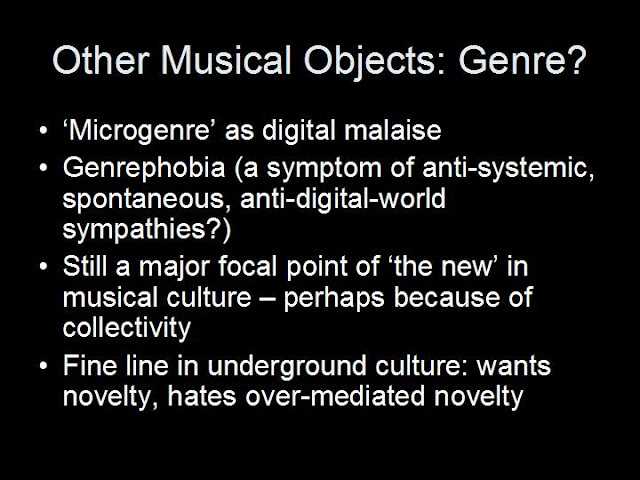
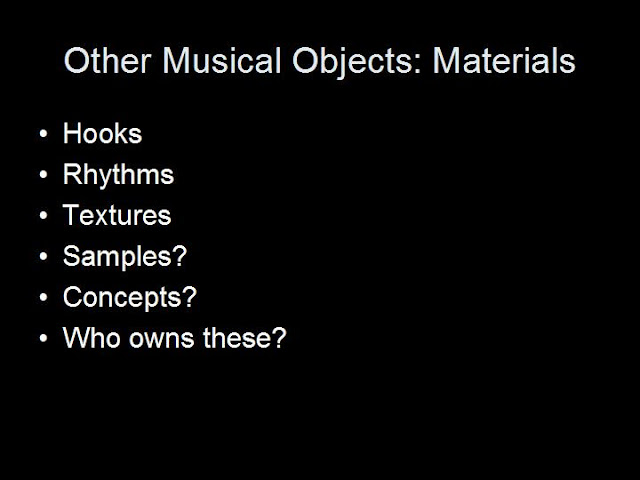
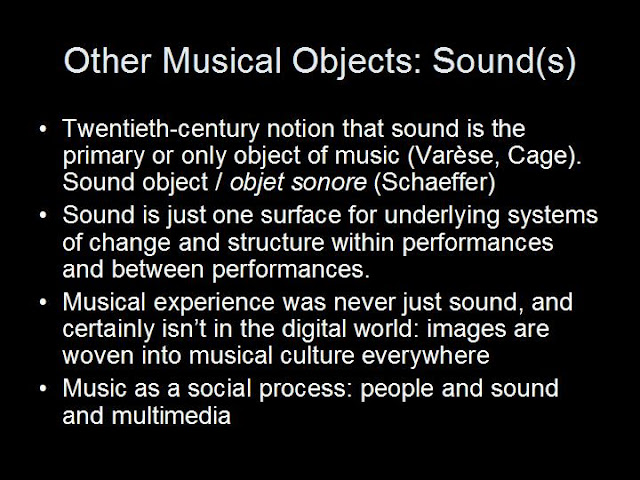
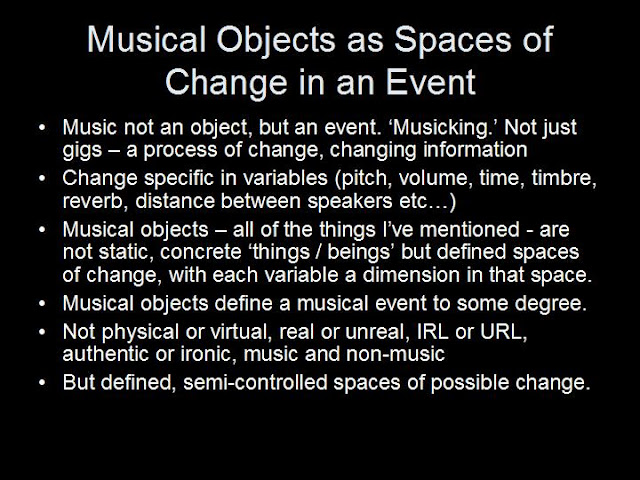
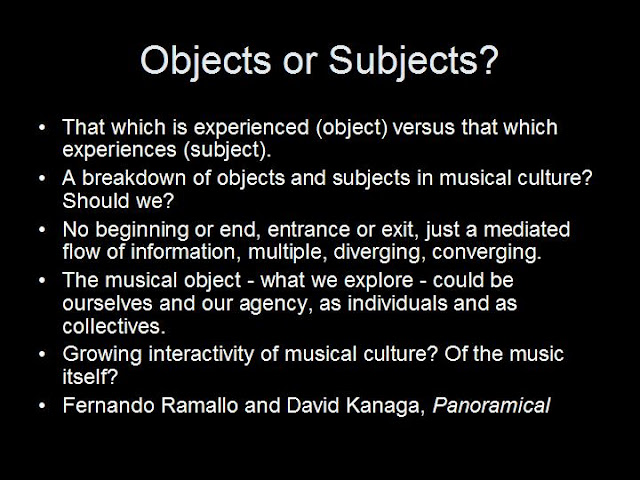
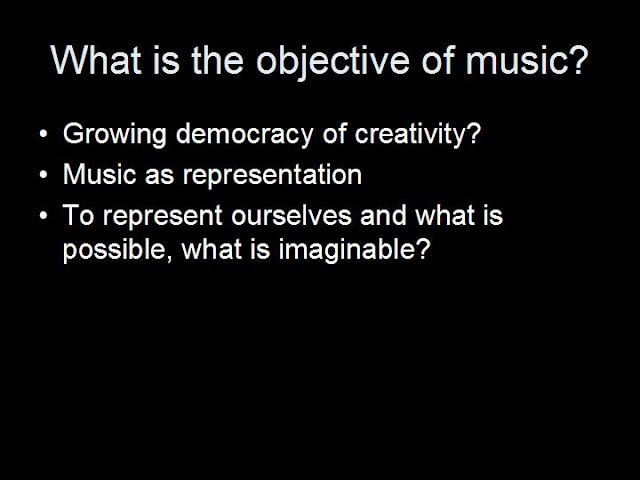
08-Dec-15
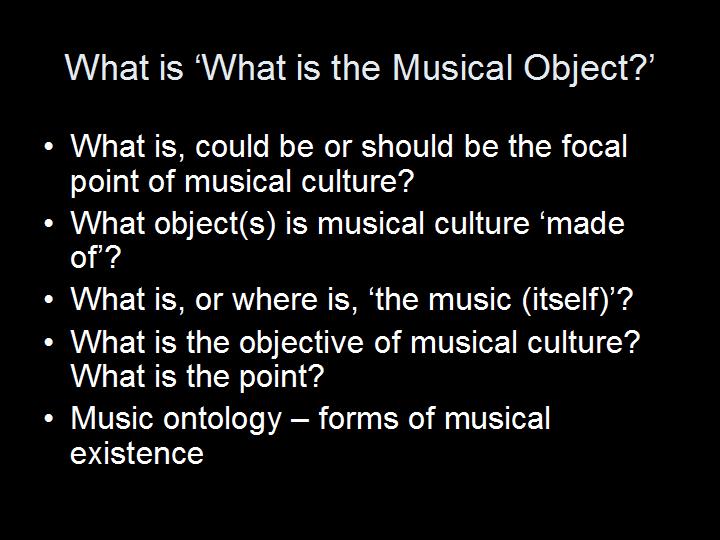
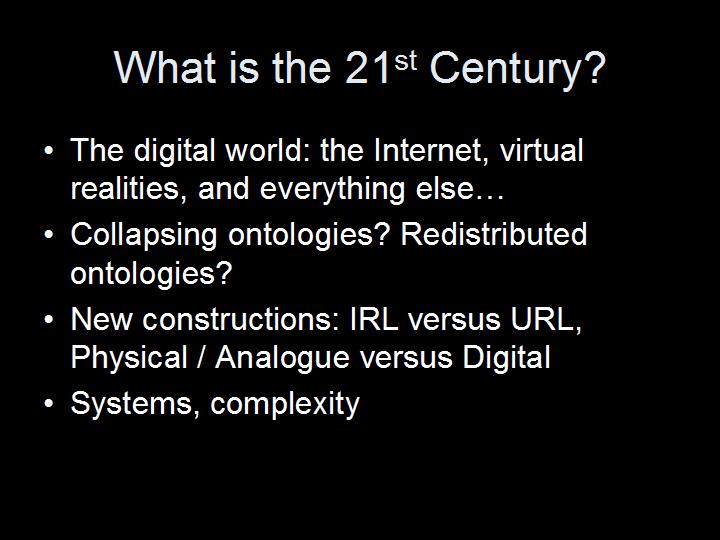
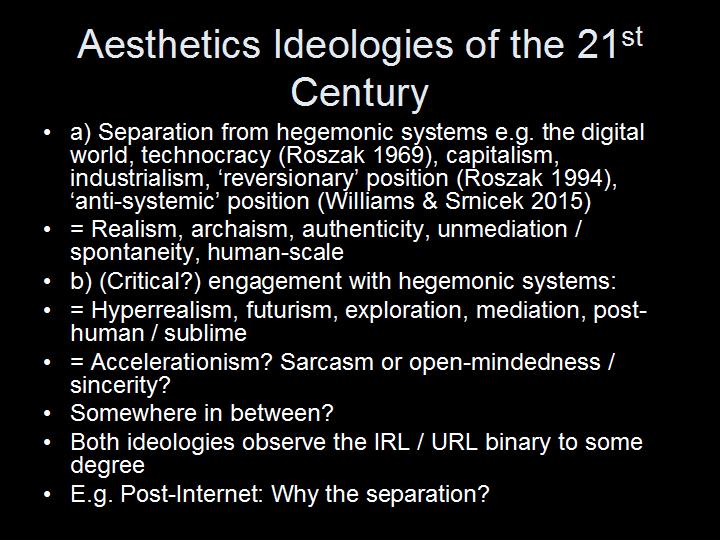
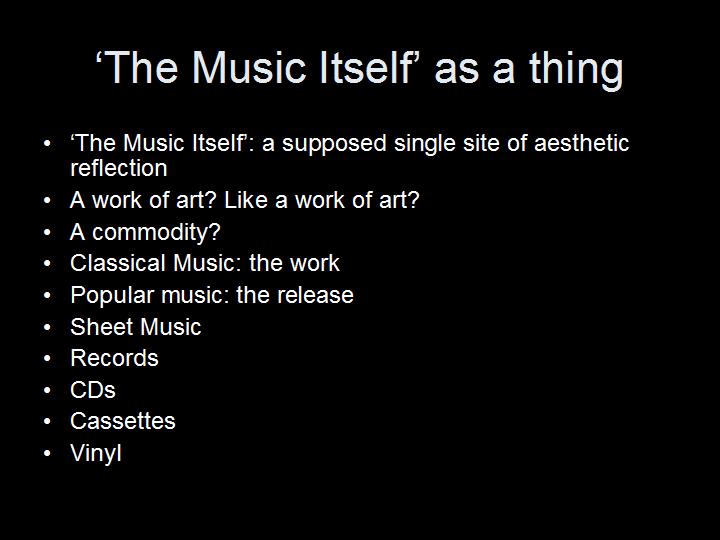

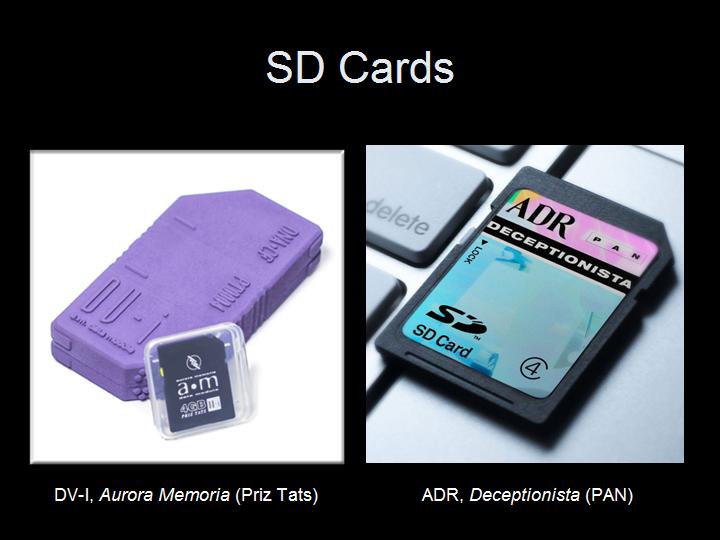
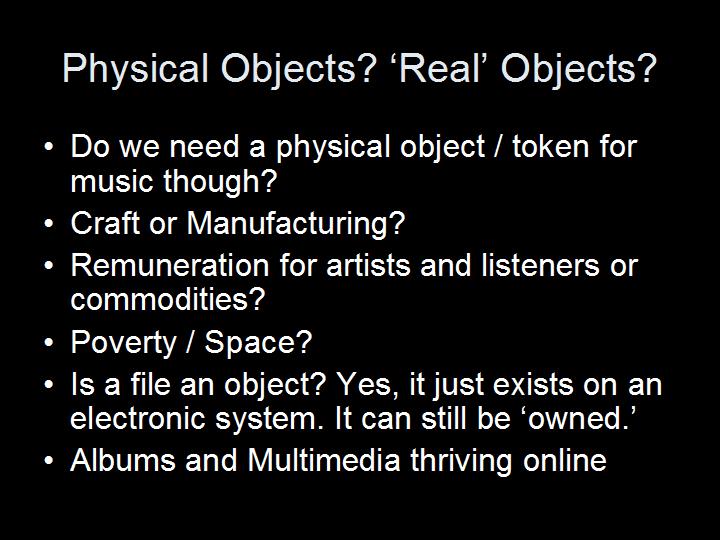
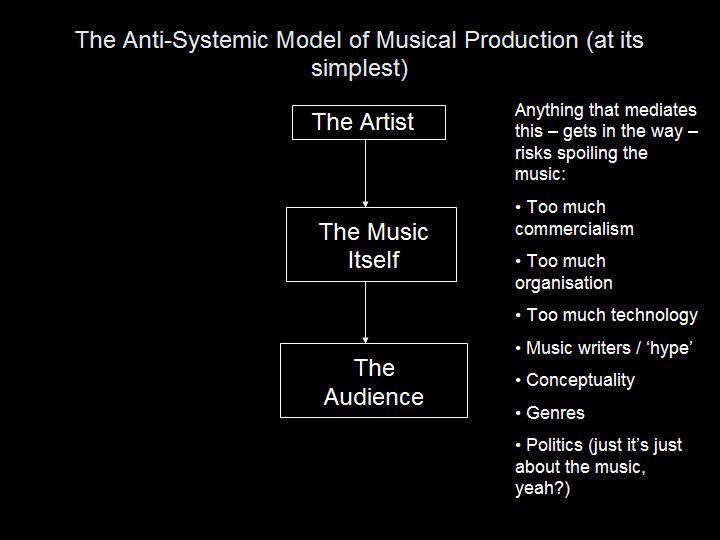
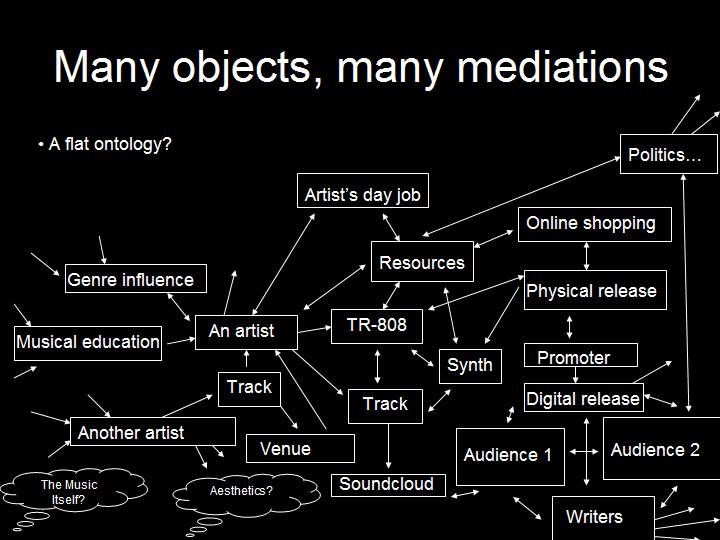
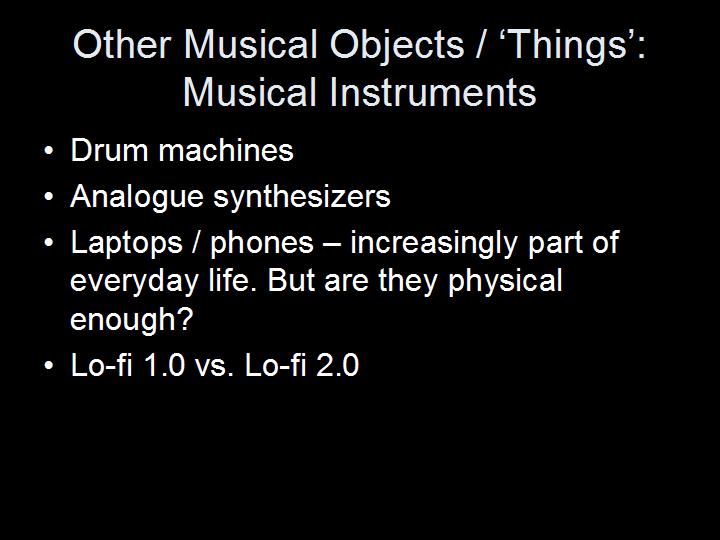
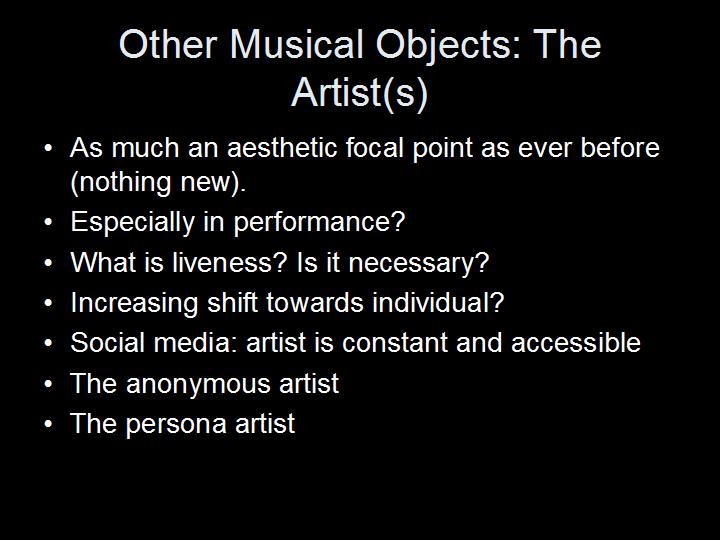
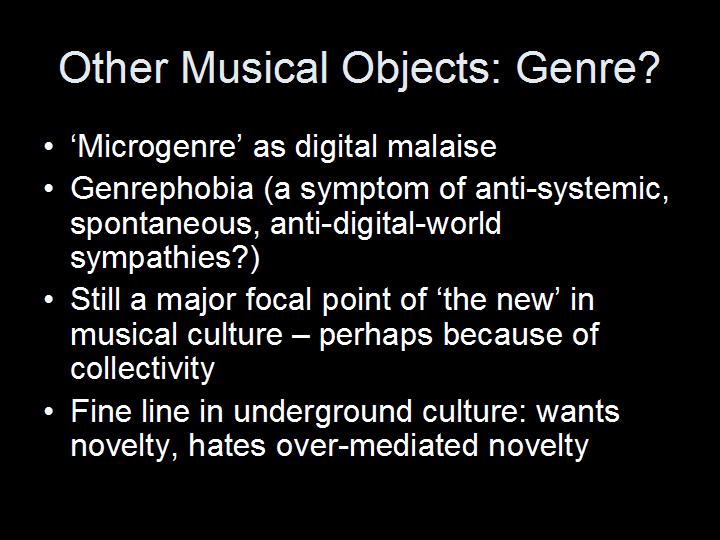
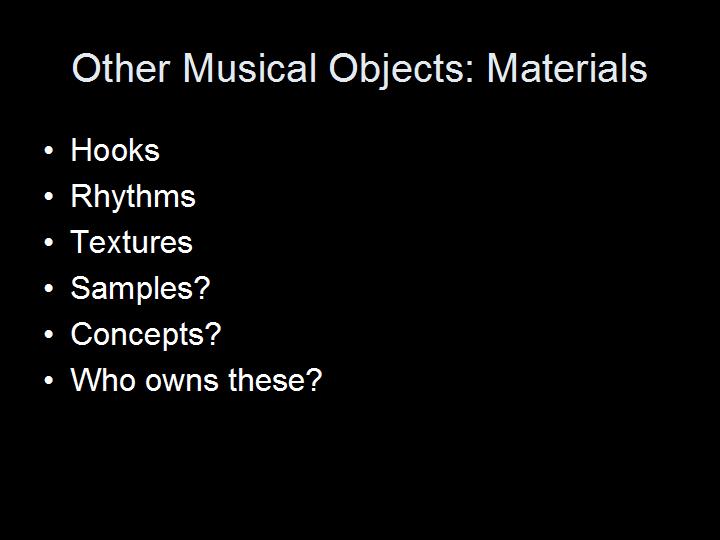
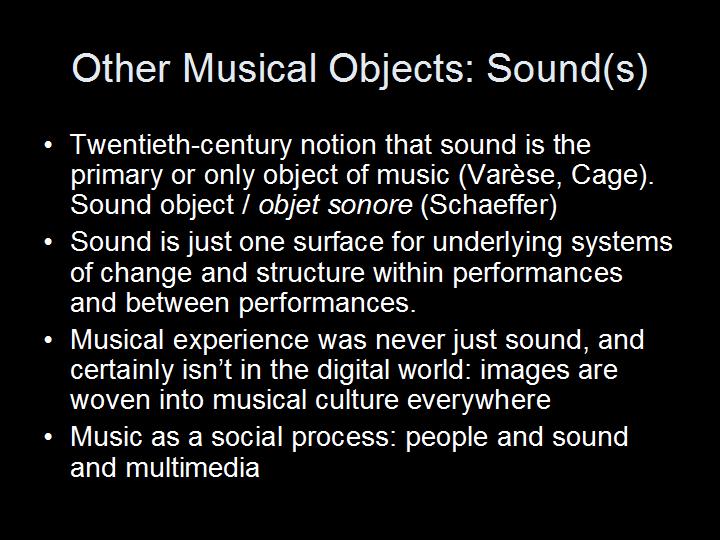
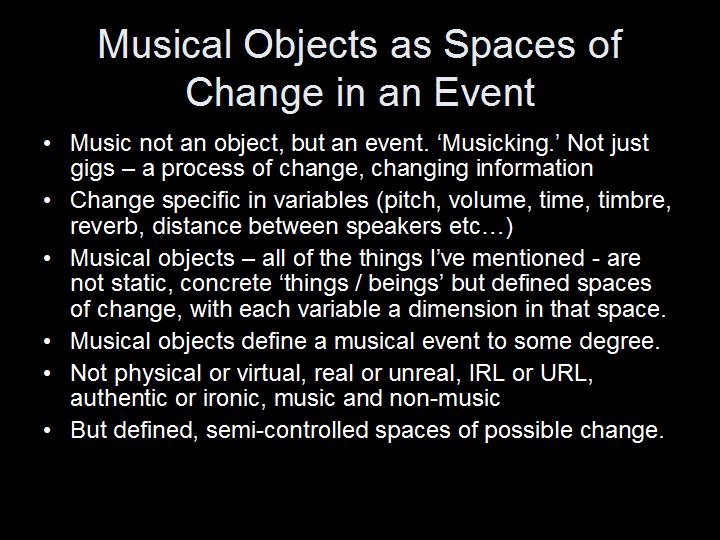
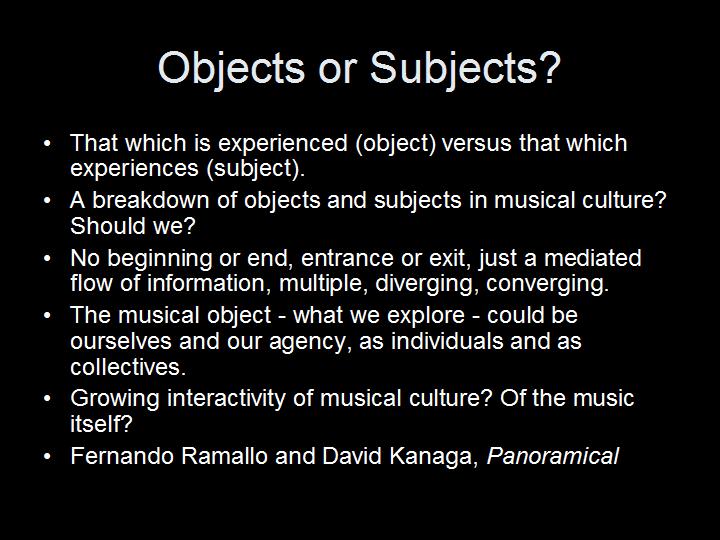
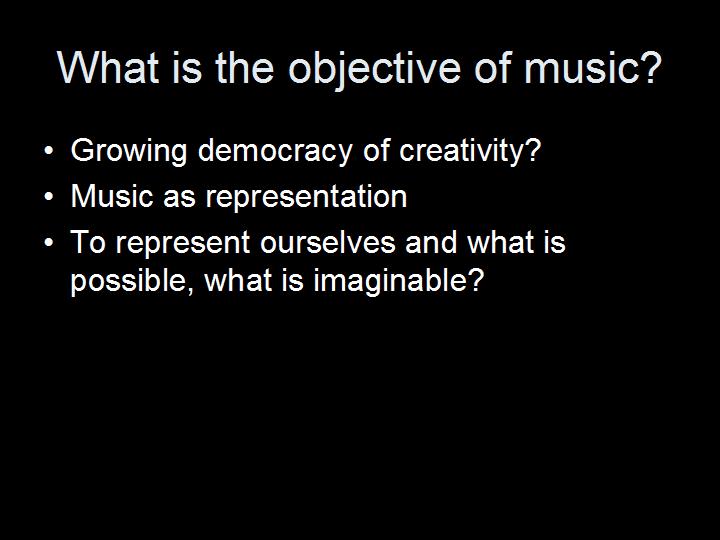 Blogpost for Verso: On Music and Folk Politics [ 08-Dec-15 4:17pm ]
When, in Inventing the Future, Nick Srnicek and Alex Williams critique the collection of tendencies within the contemporary left they call 'folk politics,' they could also be lamenting the aesthetics that now dominates those areas of popular music that were once progressive. Whether it's underground, or 'indie,' or even happens to be in the charts, contemporary popular music routinely 'chooses the familiarities of the past over the unknowns of the future;... habitually chooses the small over the large' and 'value[s] withdrawal or exit rather than building a broad counter-hegemony'. For independent music as in folk politics, 'organisations and communities are to be transparent, rejecting in advance any conceptual mediation, or even modest amounts of complexity' and both 'emphasis[e] the local and the authentic, the temporary and the spontaneous, the autonomous and the particular'. Srnicek and Williams show that these strategies arose and achieved much in the special political circumstances of the mid-twentieth century, and again, as aesthetic strategies in popular music, they arose during the same period in the countercultural atmosphere of jazz, rock, punk and, indeed, folk musics. And for both folk politics and folk-political music, the time has come to invent what happens next...
Slides from my talk at Unsound, 'Is Accelerationism Good for the Underground?' [ 17-Oct-15 6:30pm ]Yesterday I gave a talk on the history, nature, and pros and cons of accelerationism at the Unsound festival. These slights might not give you the full picture of what was said, but since they're full of quotes and references, people have asked that I upload them.
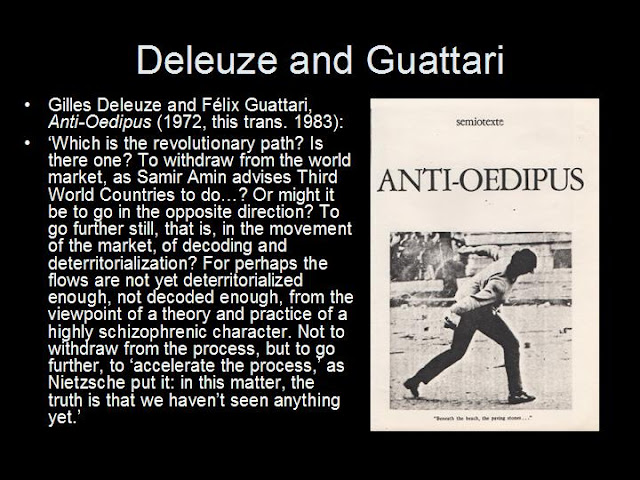
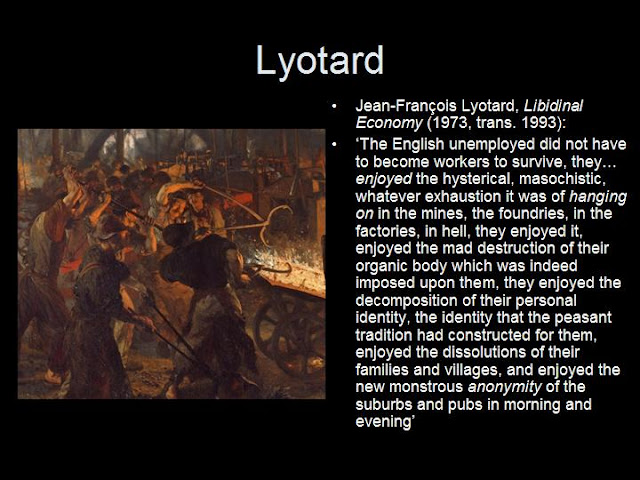
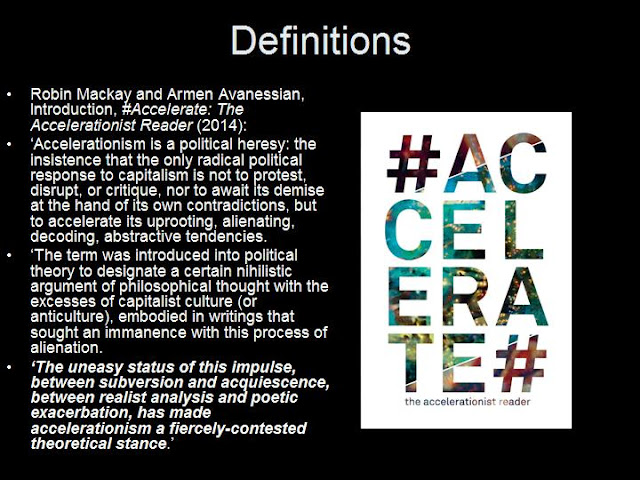
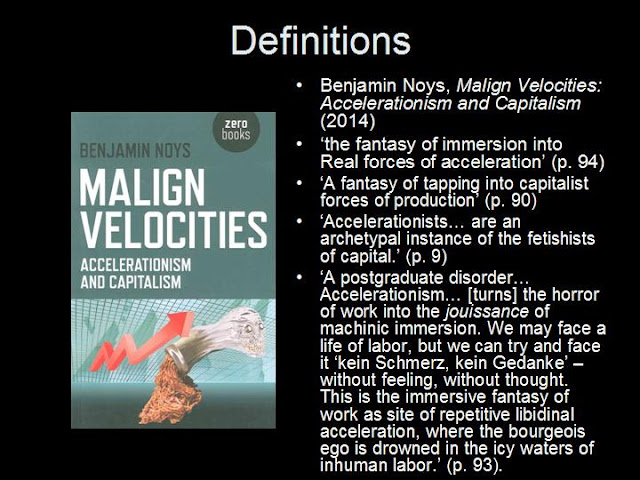
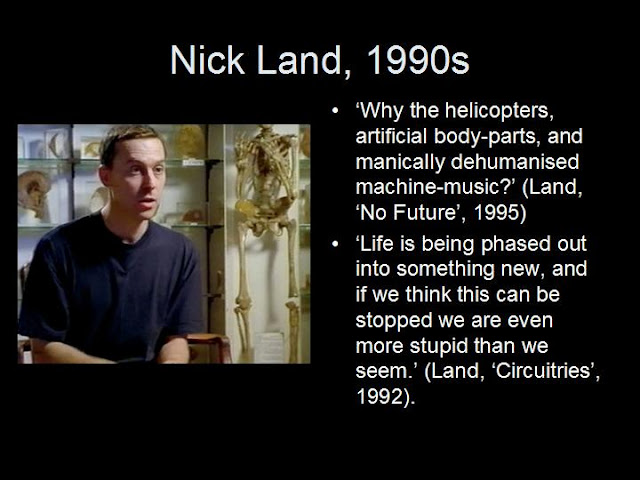
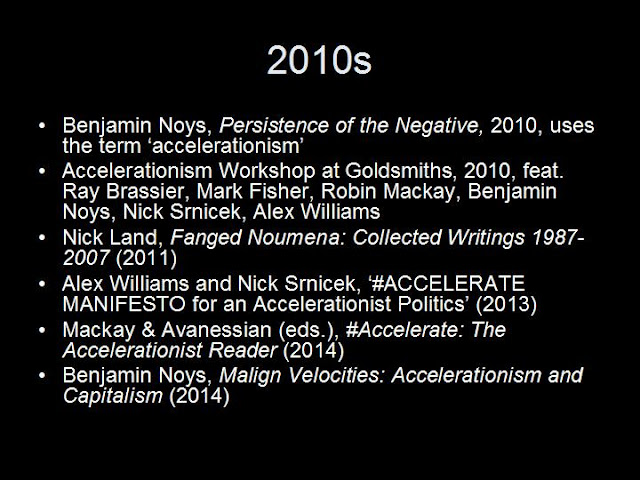
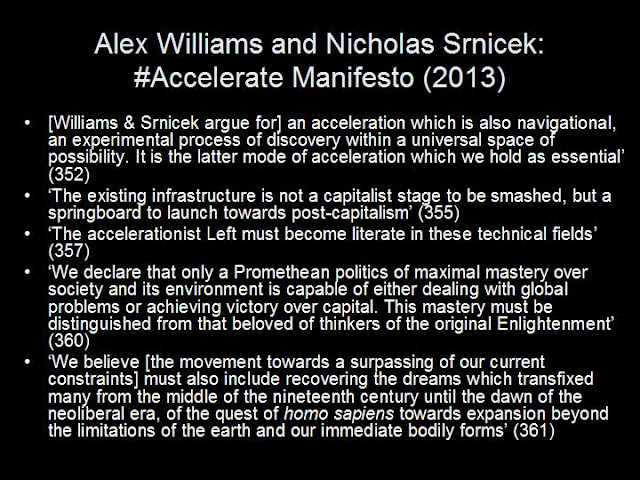
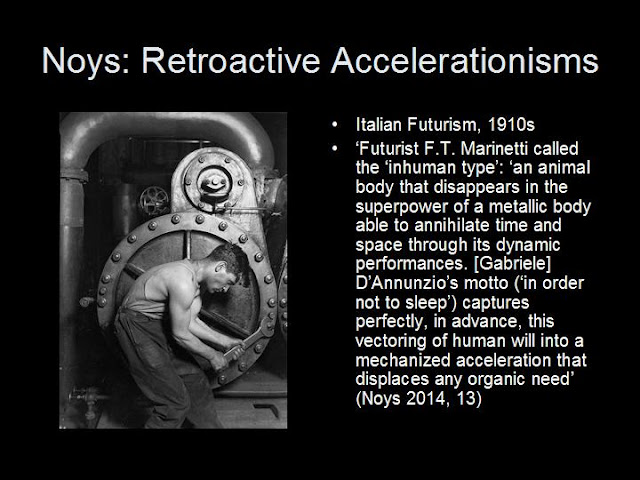
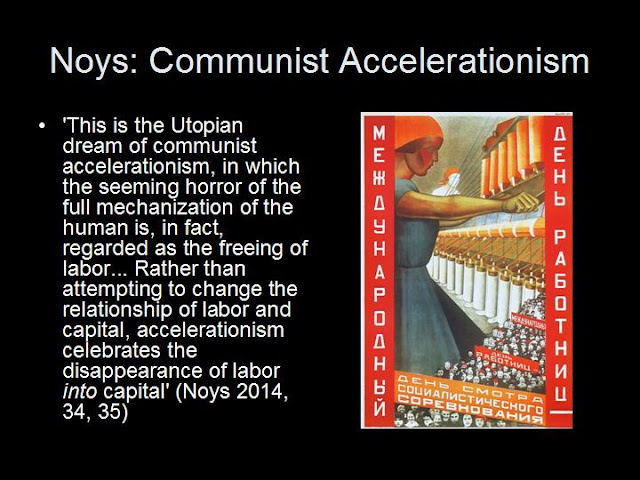
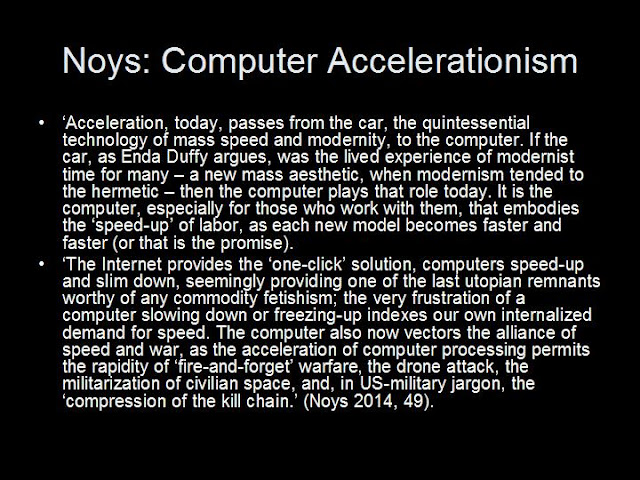
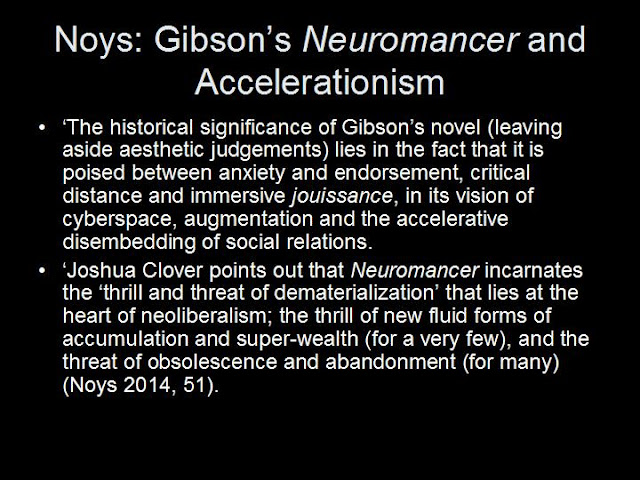
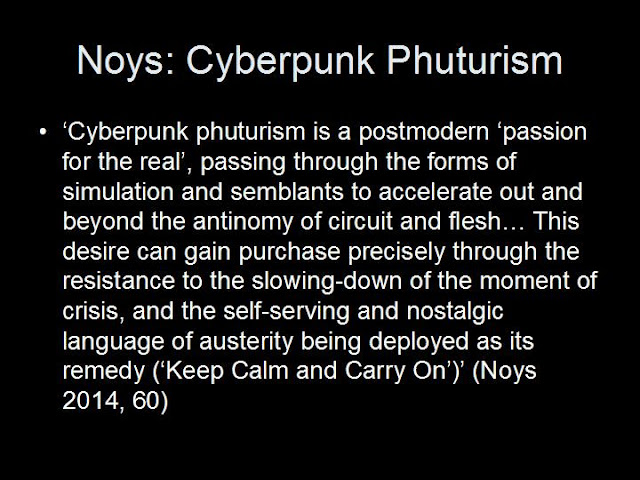

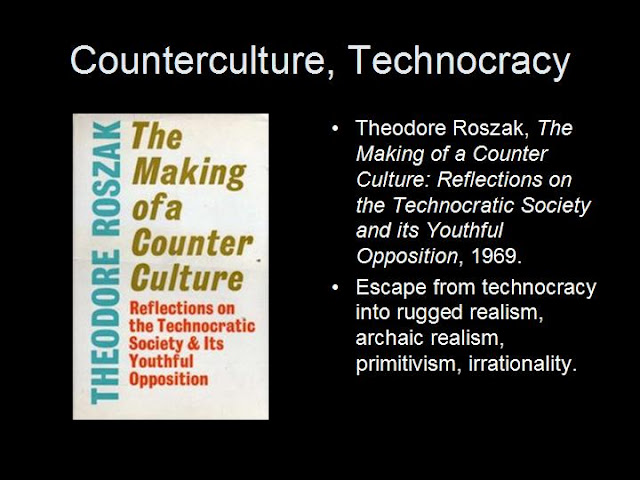

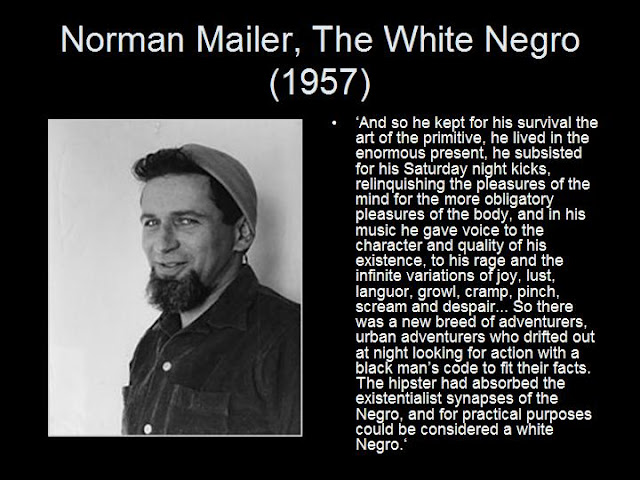

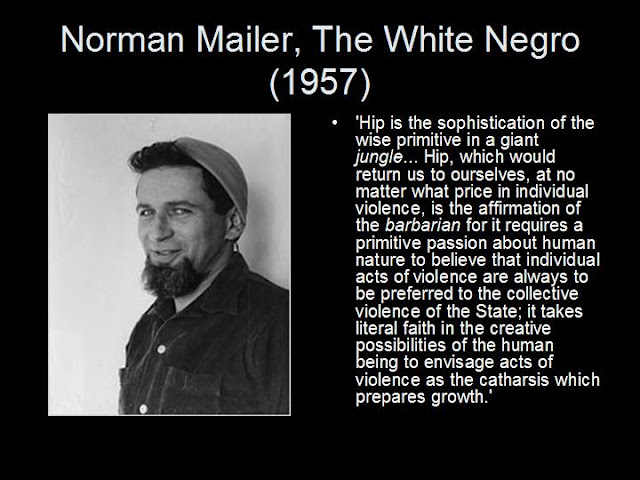
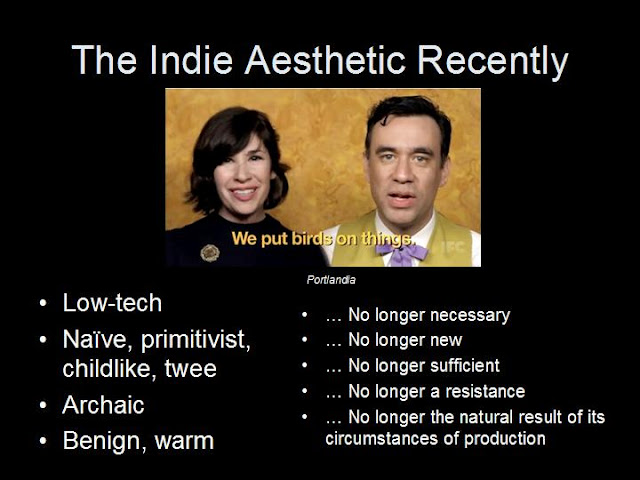
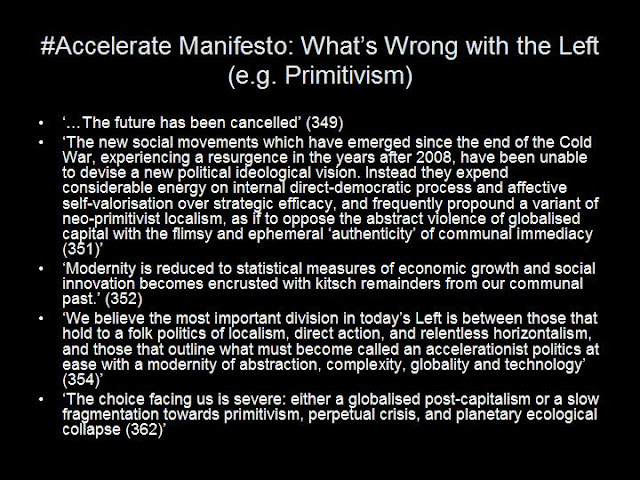

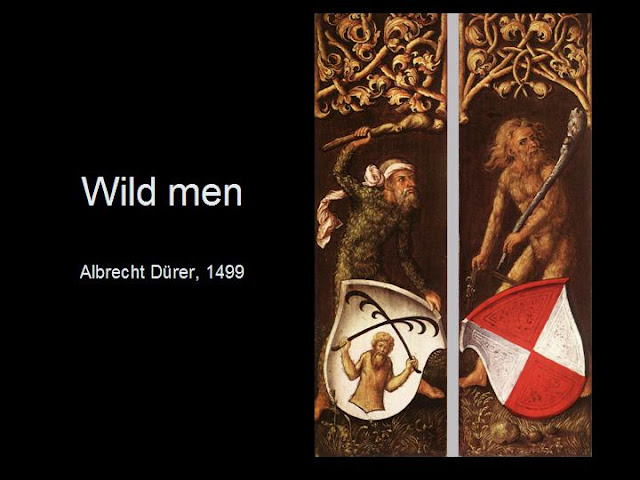
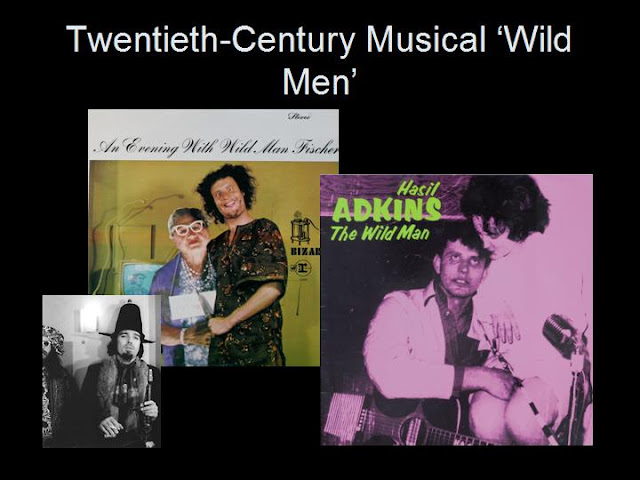
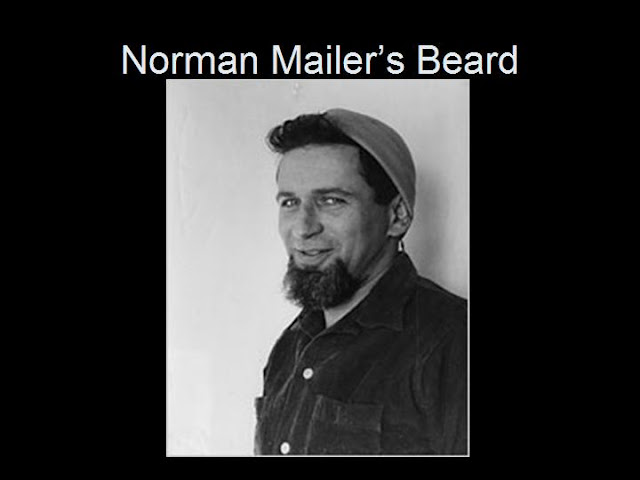
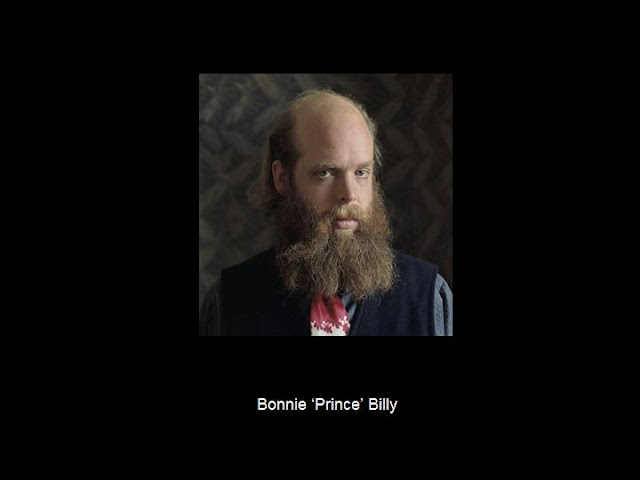
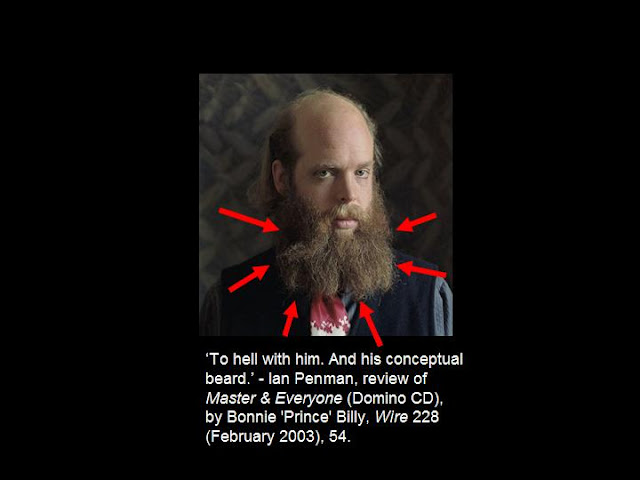

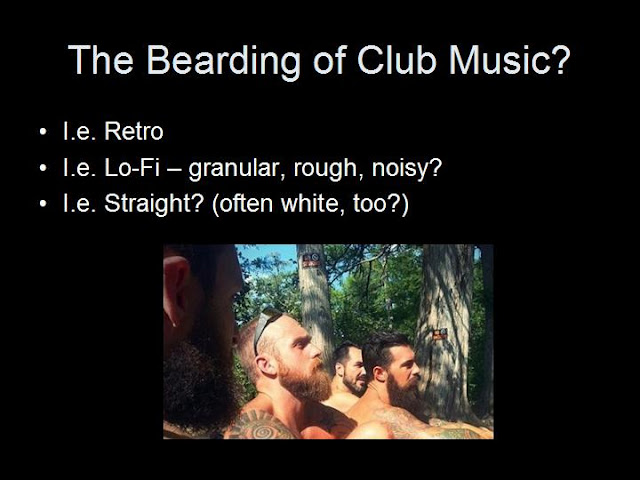
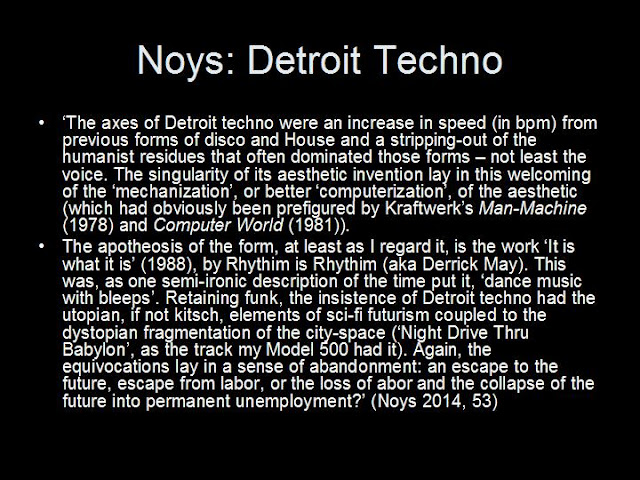

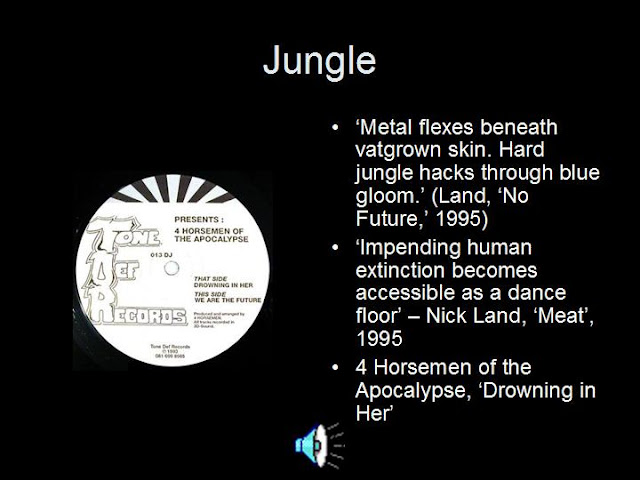
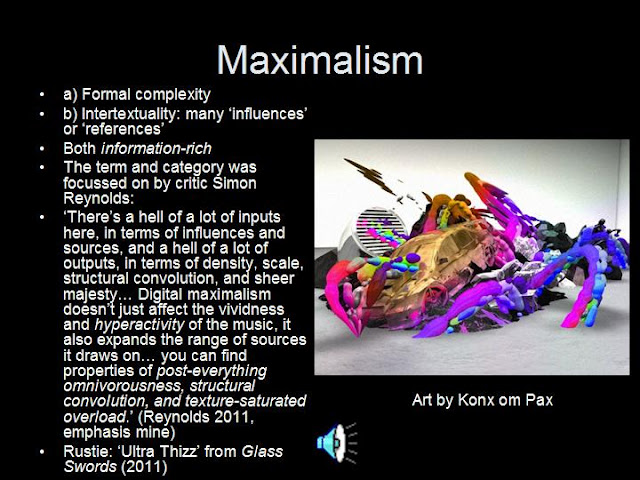
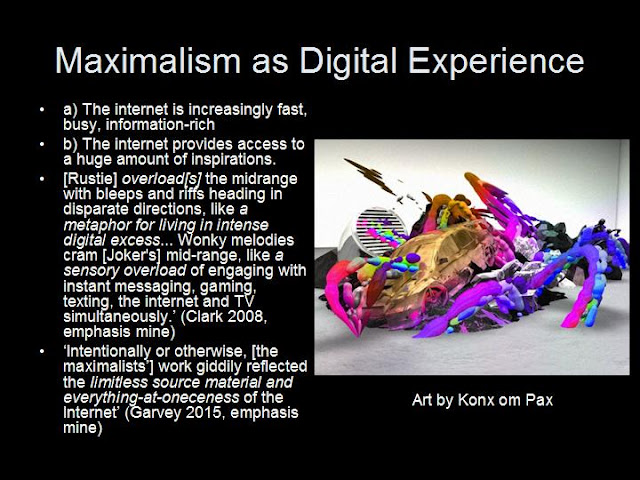
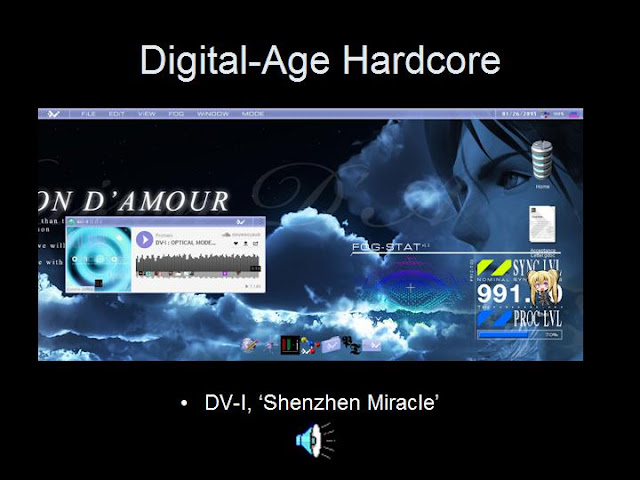
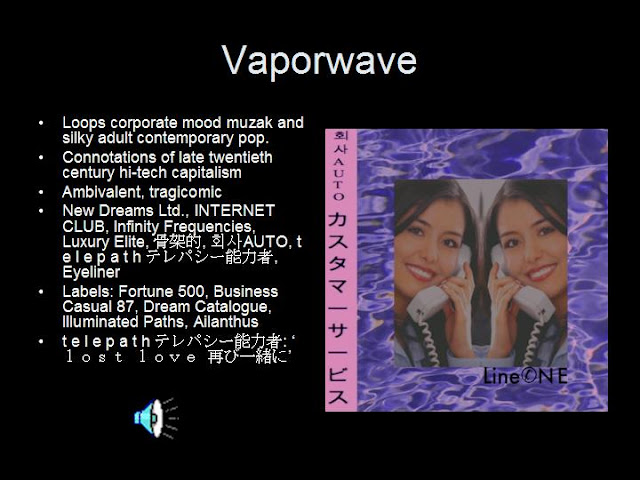
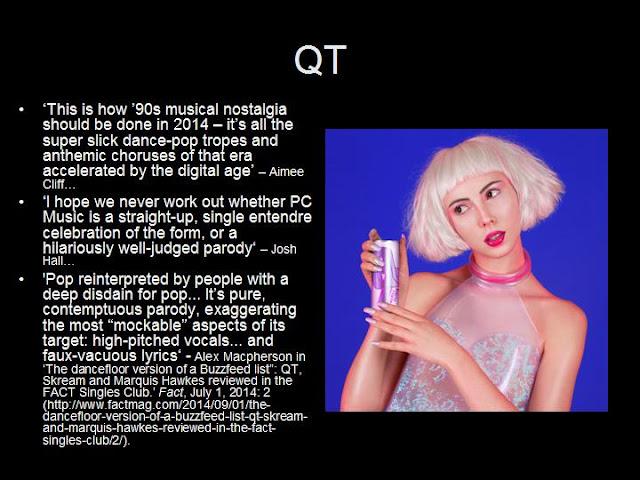
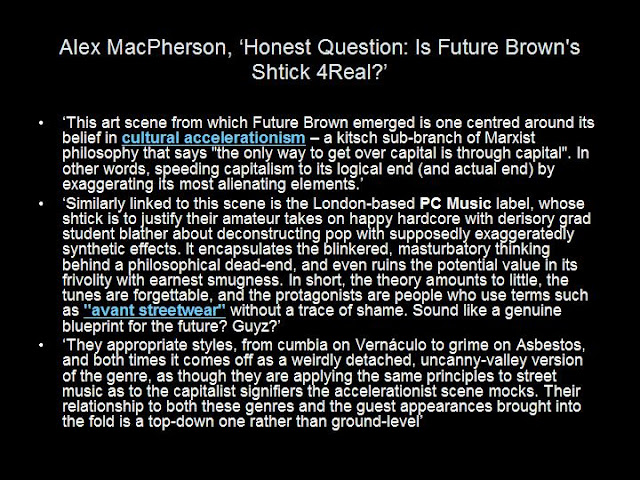
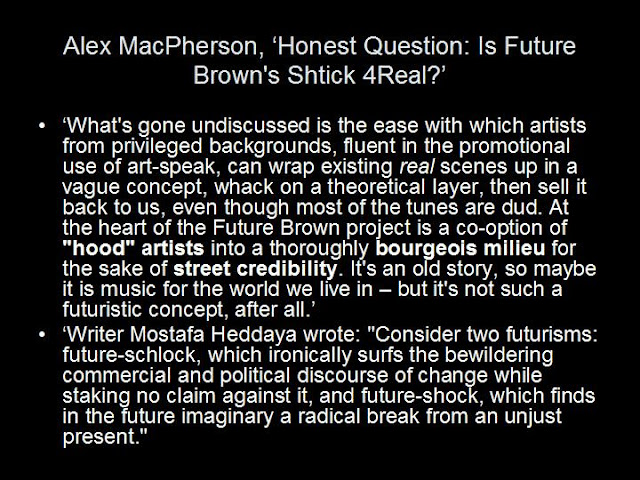
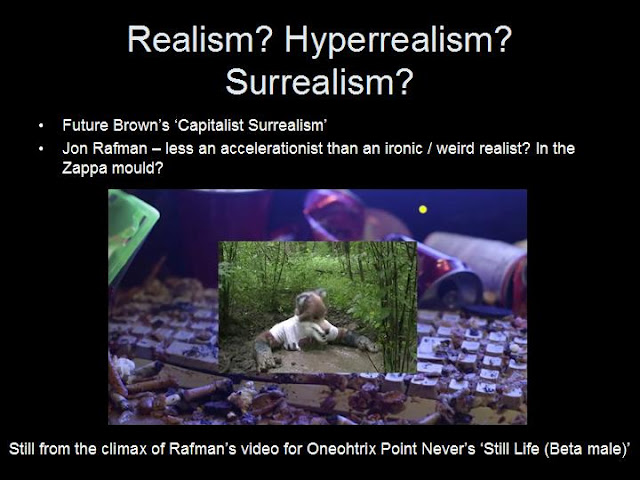
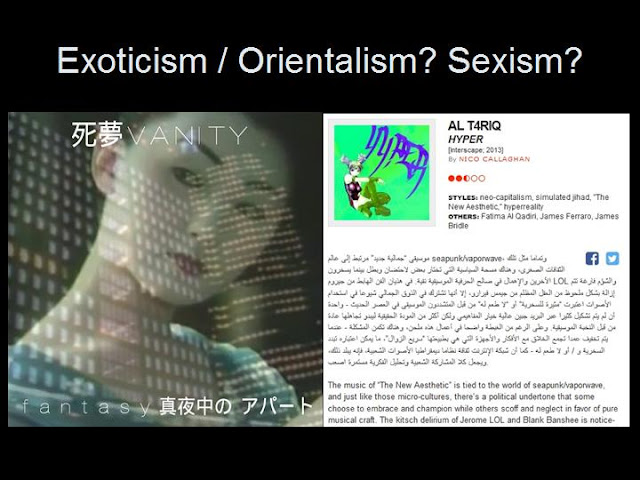
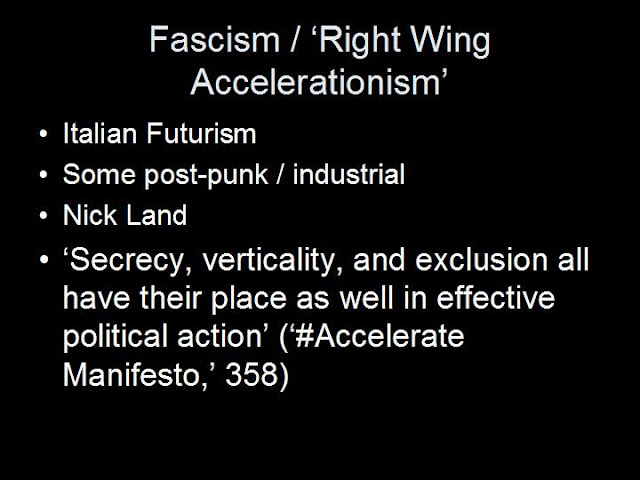
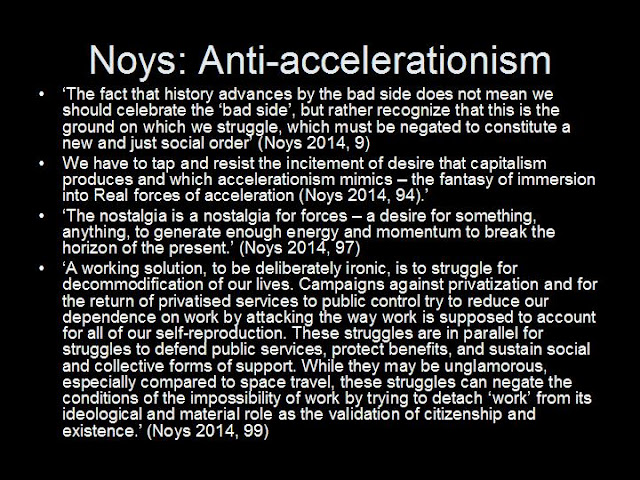
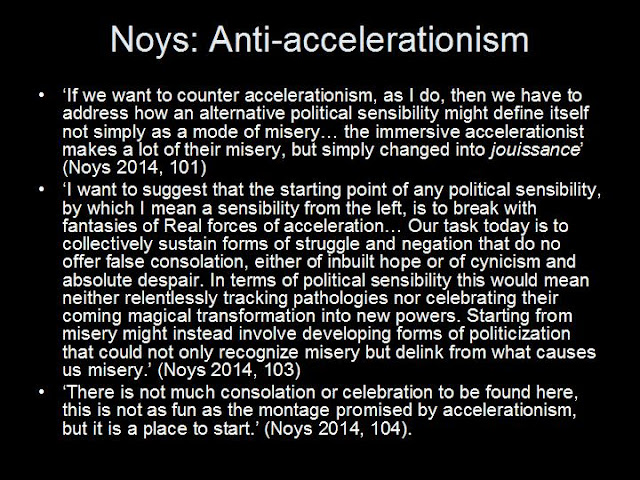

05-Oct-15
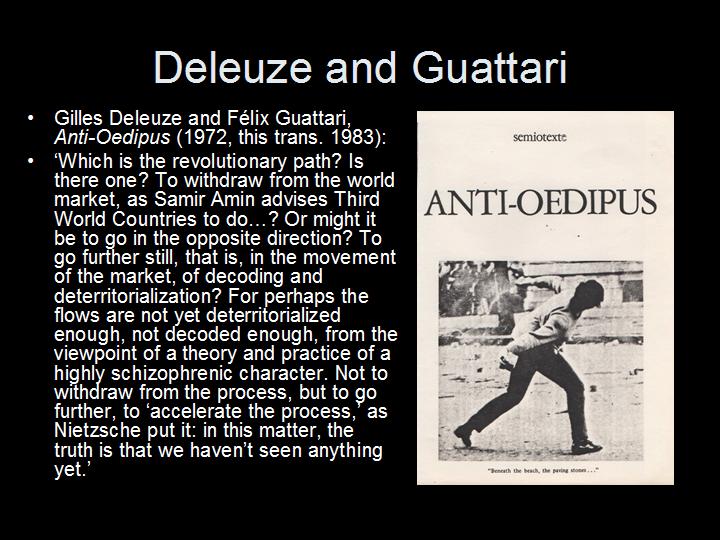
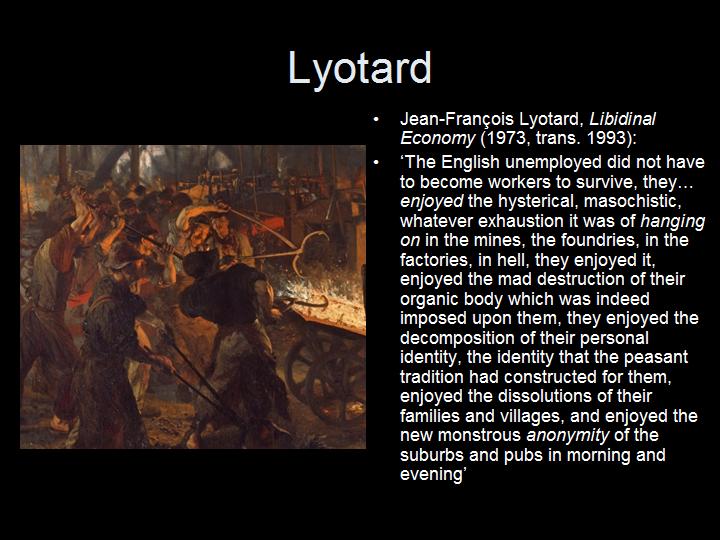
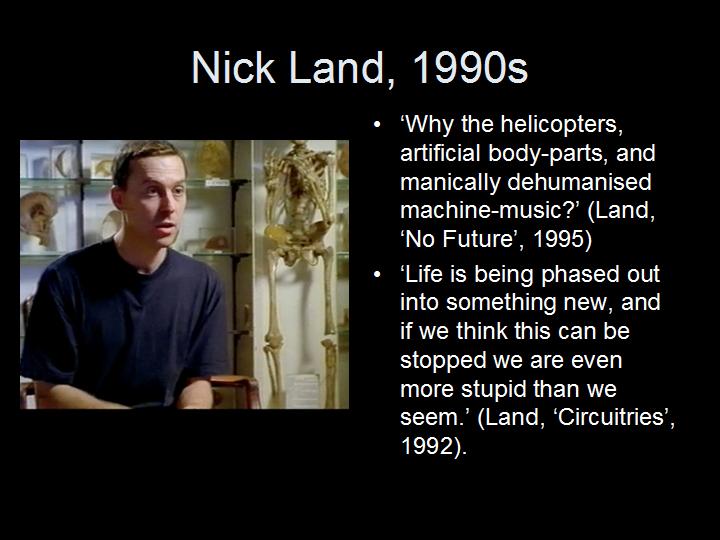
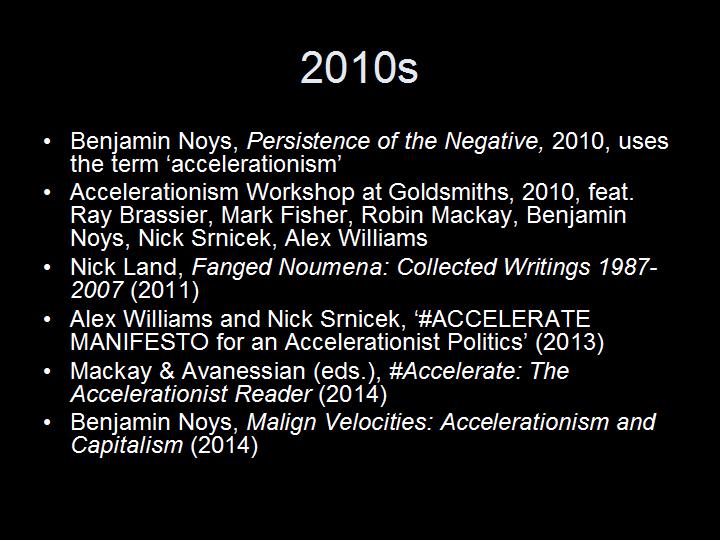
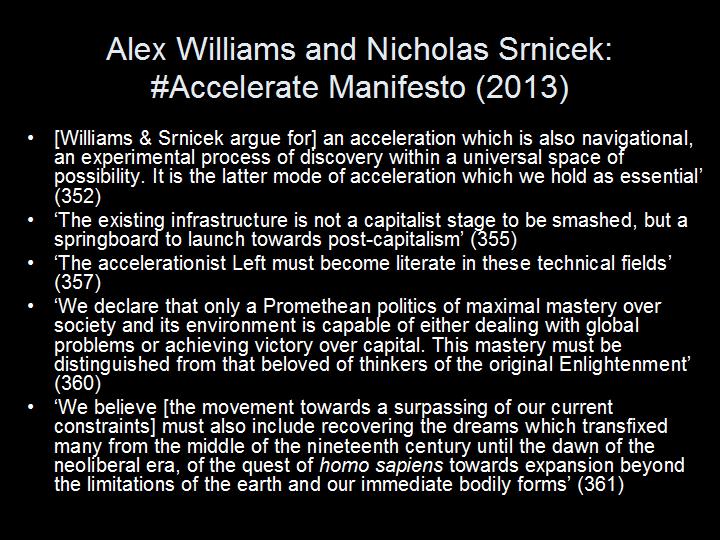
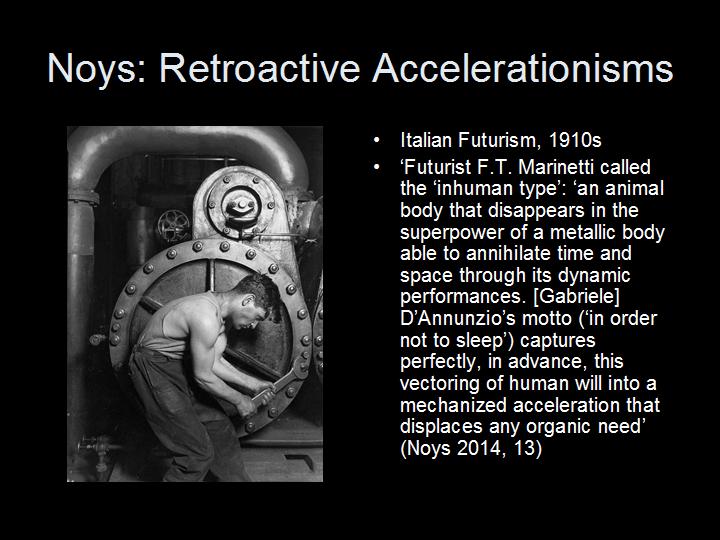
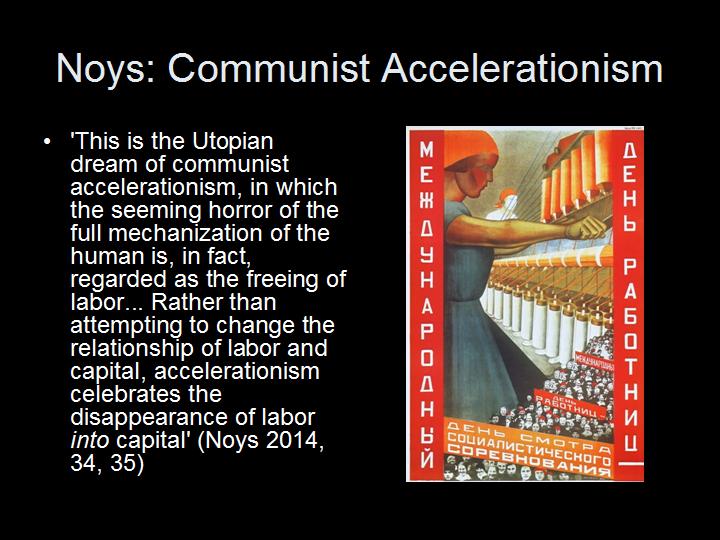

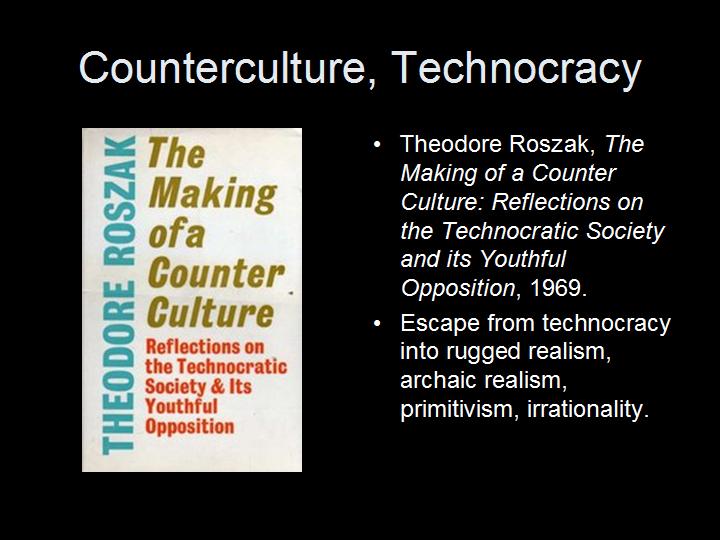

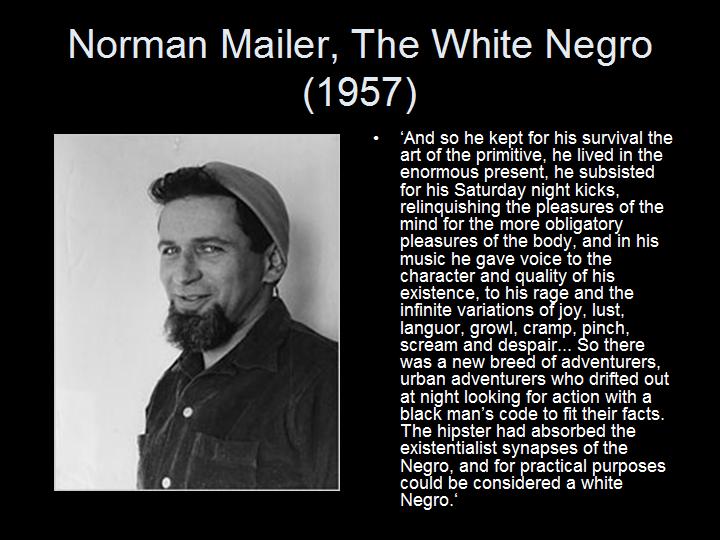

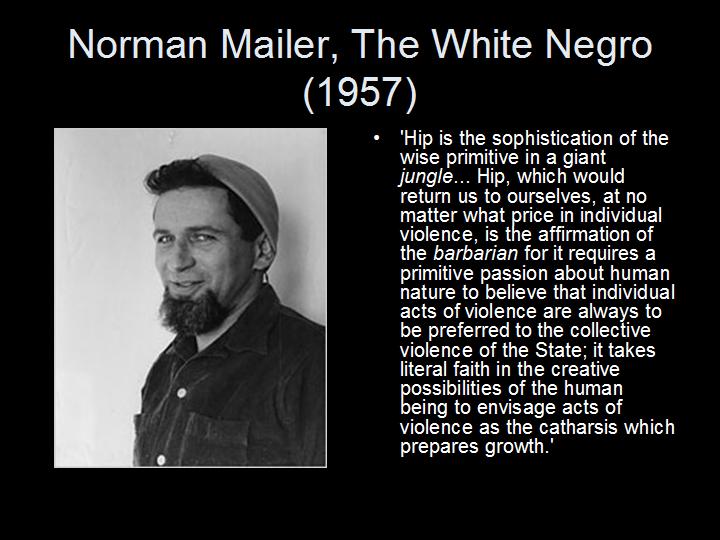
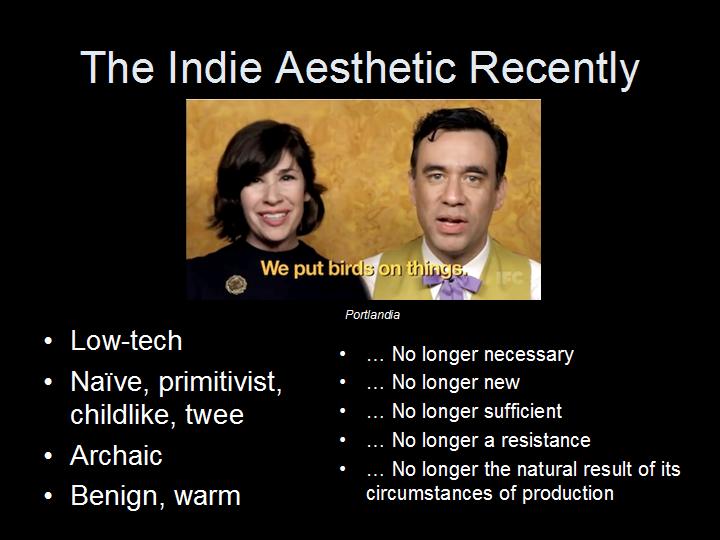
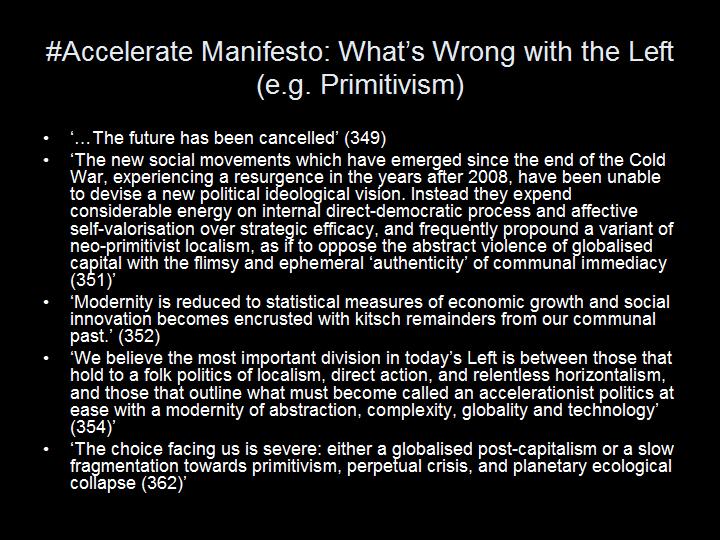

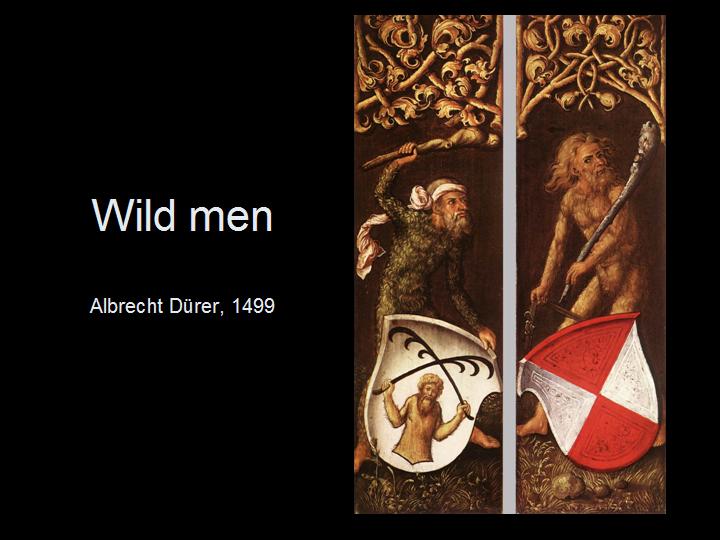
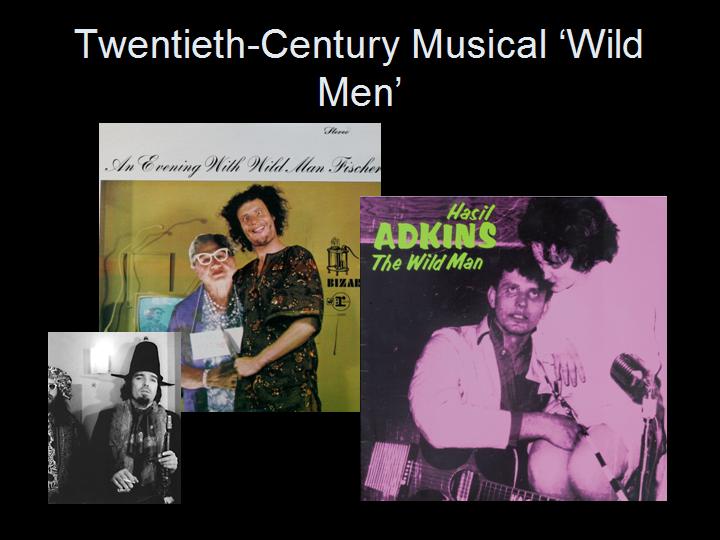
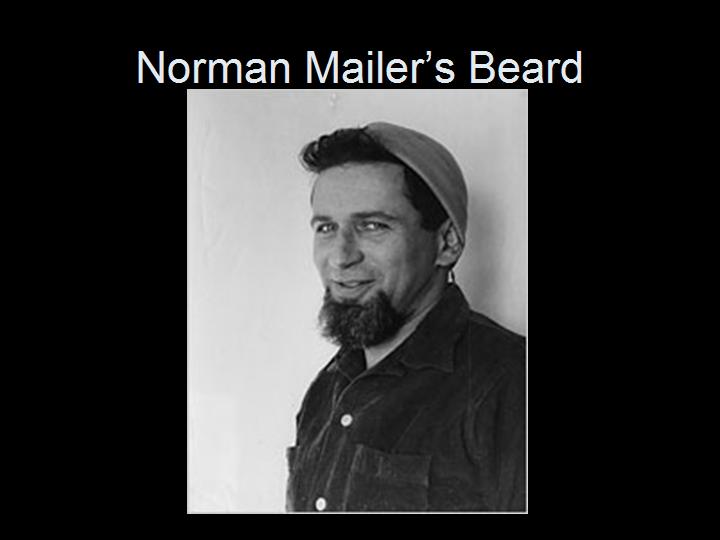
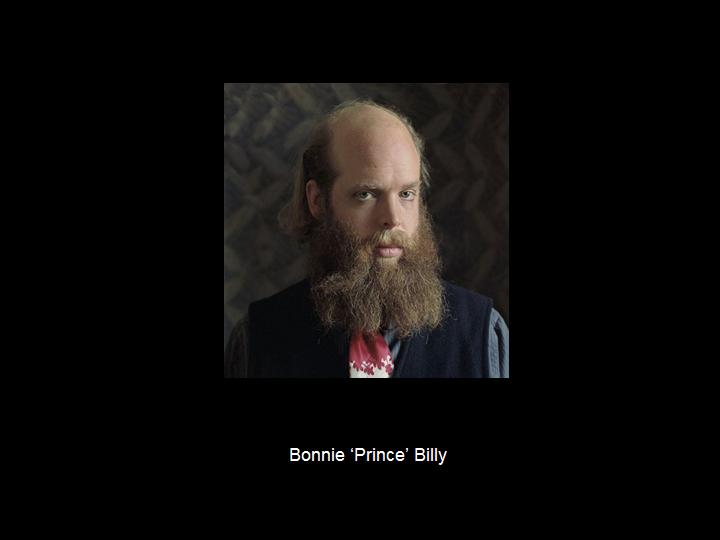
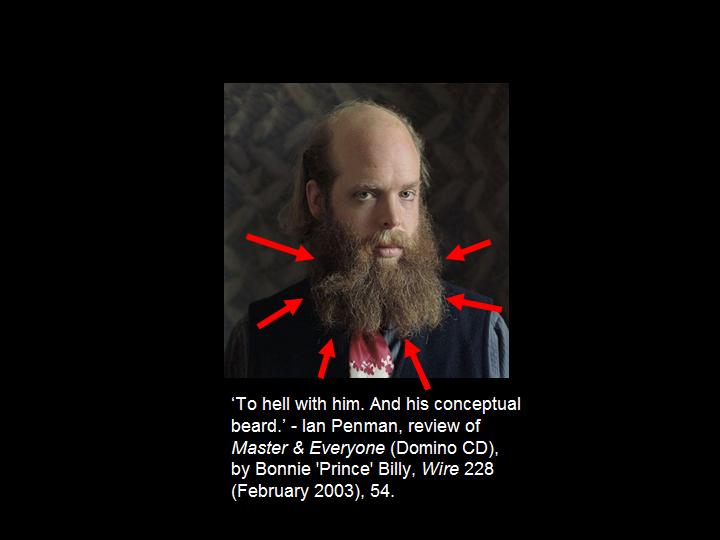

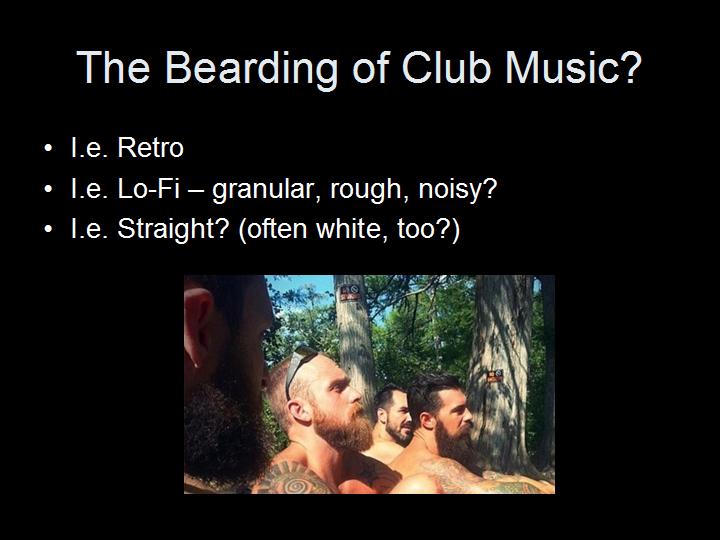

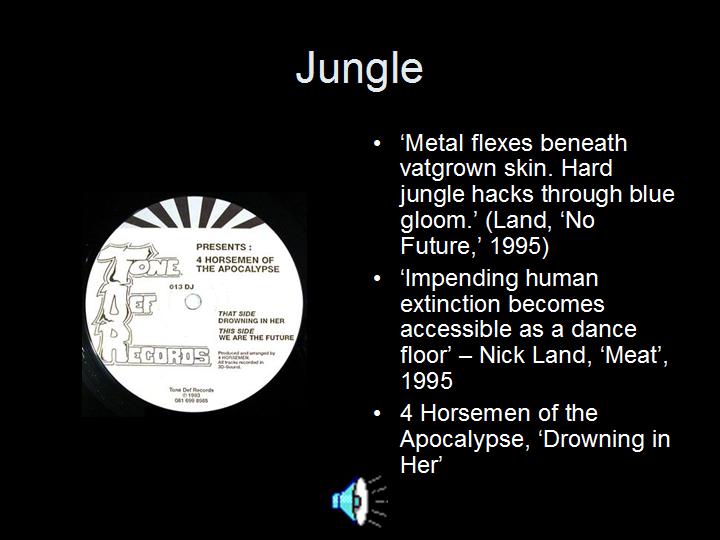
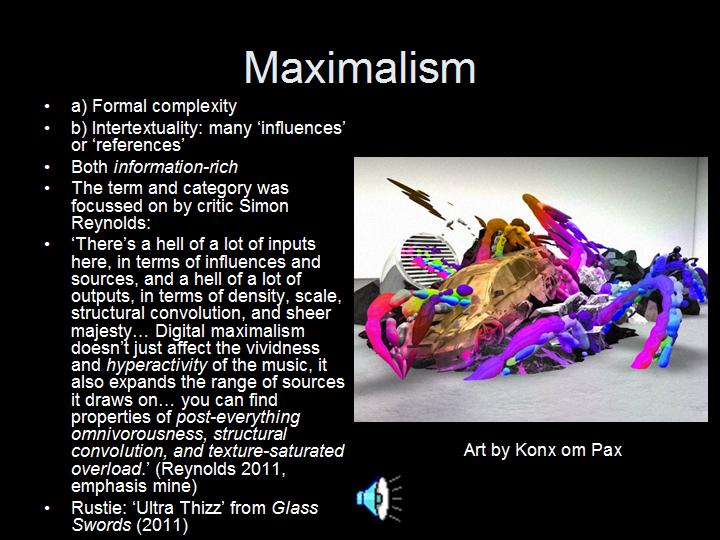
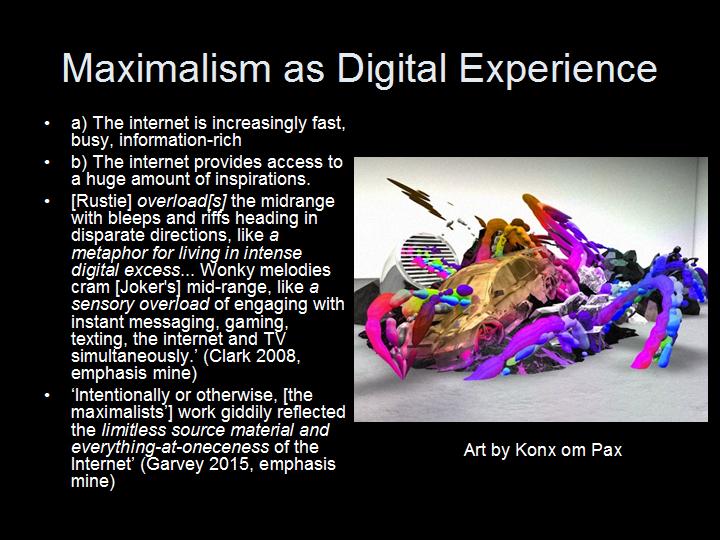
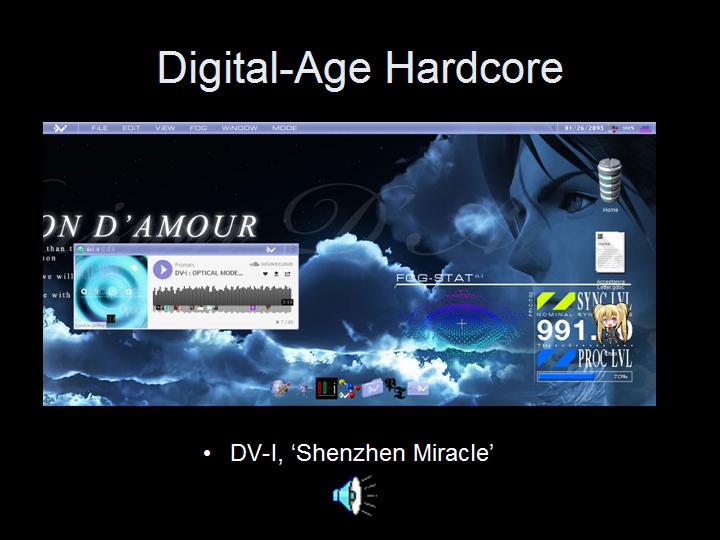
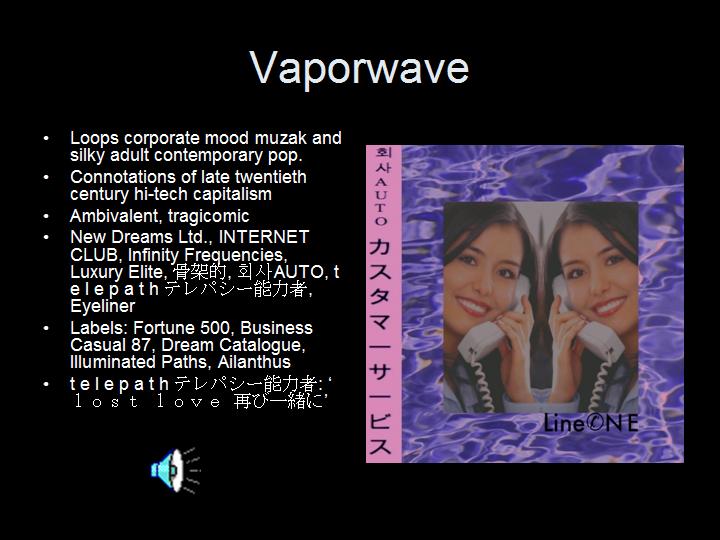
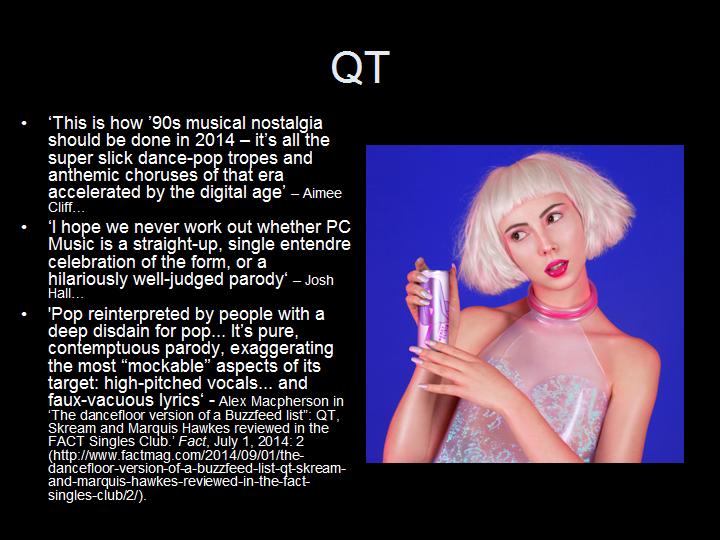
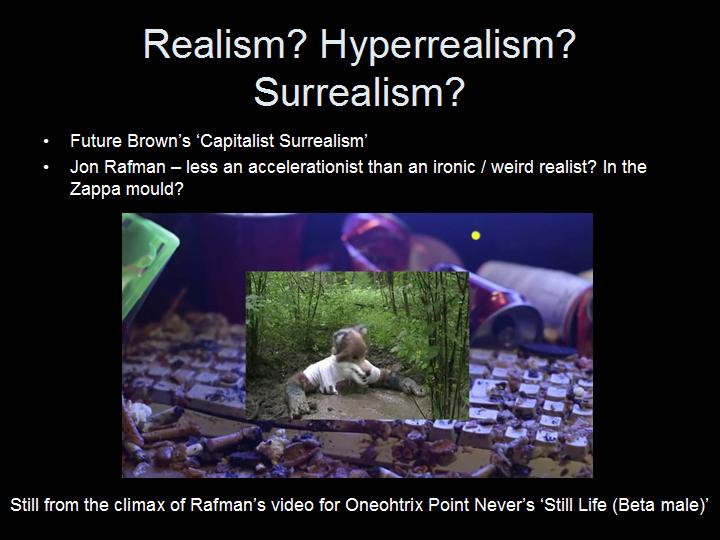
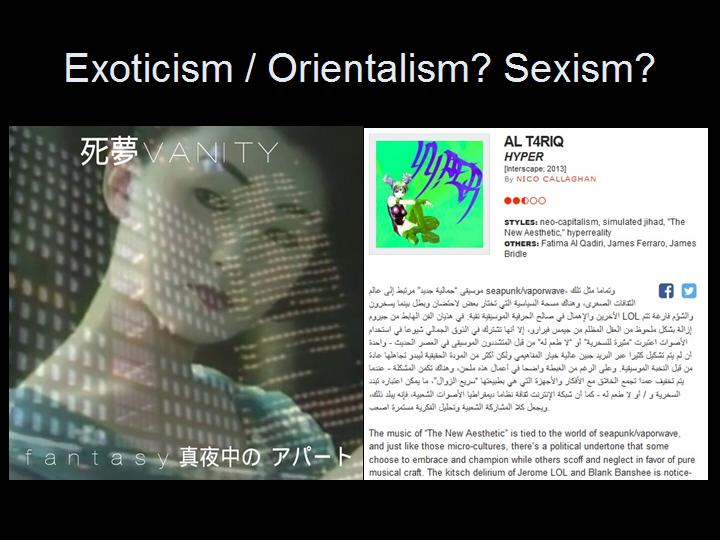
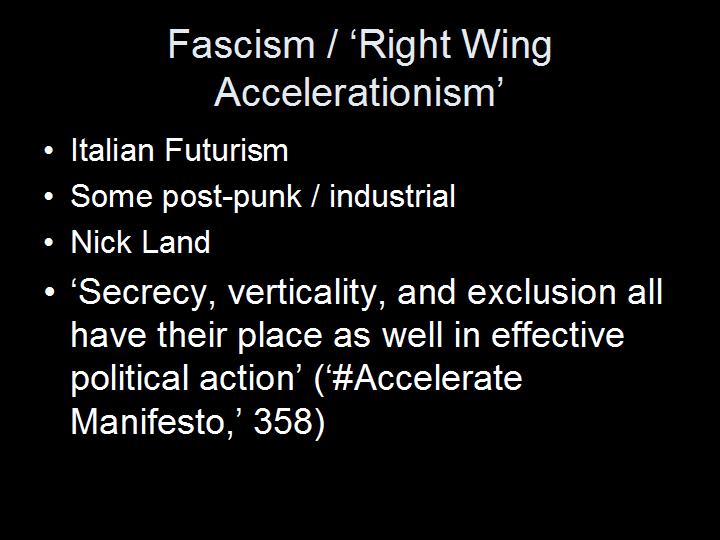
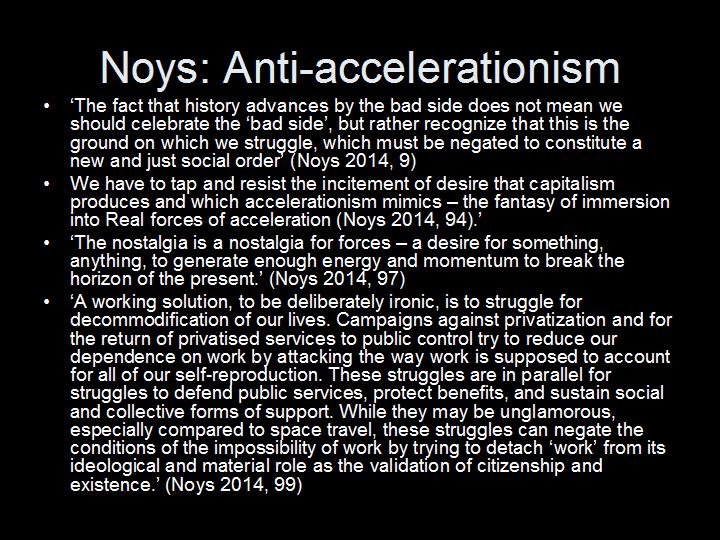
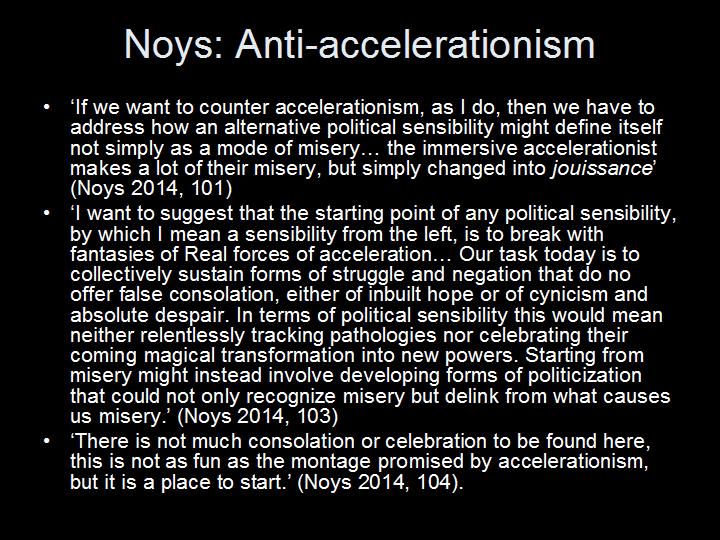
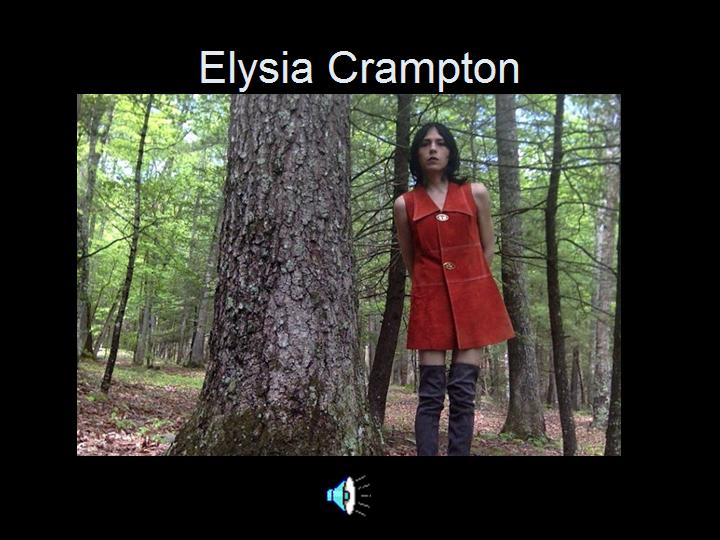
 System Focus: Get To Know Gqom, South Africa's Slow-Burning Club Music [ 05-Oct-15 5:44pm ] The TOWNSHIPTECH logo
The latest System Focus is on dance sounds of South Africa that live online, chiefly 'gqom' with some shangaan electro and sgubhu too (click here to read). featuring: Spoek Mathambo, Nozinja, TOWNSHIPTECH, SHANGAANBANG, DJ Dino, U-Zet, Phelimuncasi, Rude Boyz, GQOM OH, Citizen Boy and DjAsinatar and the Facebook groups IGqomu, Sgubhu & Gqom Lovers, Gqomu music and Gqom Nation.
South African popular music, in its myriad forms—from choral folk group Ladysmith Black Mambazo to madcap rappers Die Antwoord—has played a huge role on the world stage for decades, and today this richly musical country boasts an ecosystem of electronic dance and club sounds that changes, spreads, and develops with an energy that can rival that of just about anywhere else you care to name...
Meanwhile, the southeastern coastal city of Durban in the KwaZuluNatal province of South Africa has been incubating a style called gqom for a few years now... It would be difficult to imagine a kind of music more different from Shangaan Electro than gqom is—it's a slow-burning, minimal and ominous style that's frequently described as "raw." Gqom fan Thandolwethu BlaqueMusiq Mseleni—who runs a group on Facebook called Sgubhu and Gqom Lovers out of King Williams Town in the Eastern Cape province—told me that qqom is "house music with broken beats, sliced vocals or chants, high tempo and mostly with no bassline."
"We grew up on it," Veezy tells me about gqom. "You know, taxis in town or everywhere in and around Durban blasting these songs that had really catchy and funny verses as well as banging hooks. Most people just hear loud bangs but, if you take time to really listen to it, you realize it's more than a created pattern—it's rhythm that syncs with fun. I like it cause it's a really huge crowd favorite in lounges and clubs to get turnt with or get the party sounded."...
Citizen Boy is one of gqom's most creative producers. Plunge headlong into his kasimp3 uploads... featuring him and his affiliates, and you'll encounter dozens of weird and wonderful twists on the genre's template. Try the hectic "Spit Fire (Remix)," the ultra-minimal "VH HIT" with its deadpan cuíca hook, the downright evil "Natural Mafias," the alien skirmish of "Thekwini War (Mafiamix)" or the unholy croaks of "Point Magnet (Dope mix)." There there's "Deep Gqomu," a masterpiece that builds up majestically, its ethereal scales climbing ever skyward... Response from chukwumaa [ 17-Aug-15 1:26pm ]chukwumaa, a musician and artist who appeared in August's System Focus - headlined 'The Voices Disrupting White Supremacy Through Sound' - contacted me about framing the music as 'disrupting white supremacy.' I thought his response was important and justified, and it's posted here, [sic] and with permission:
ive been ruminating on it and its implications for a minute and come to think about the scope of the multifarious, nuanced and inventive sounds of the artists involved. I think framing it as "disrupting white supremacy" is painfully de-centering and still framing these artist in relation to whiteness in a way that is simply not explicitly expressed by any of the folks mentioned. i doubt any of the artist create this music with a sole motivation of disrupting white supremacy.
i *do* however believe the artists involved were able to develop (and continue to develop) frames of reference *outside* of whiteness. for someone whose default frame of consumption may be chiefly steeped in whiteness, this may come off as a "disruption", but thats more to do white the perceiver than the perceived. it may have been more apt to frame these musics/processes/ideas as a *departure* from musics/processes/ideas that center whiteness.
chukwumaa's work and other links can be found on Soundcloud, here.
ive been ruminating on it and its implications for a minute and come to think about the scope of the multifarious, nuanced and inventive sounds of the artists involved. I think framing it as "disrupting white supremacy" is painfully de-centering and still framing these artist in relation to whiteness in a way that is simply not explicitly expressed by any of the folks mentioned. i doubt any of the artist create this music with a sole motivation of disrupting white supremacy.
i *do* however believe the artists involved were able to develop (and continue to develop) frames of reference *outside* of whiteness. for someone whose default frame of consumption may be chiefly steeped in whiteness, this may come off as a "disruption", but thats more to do white the perceiver than the perceived. it may have been more apt to frame these musics/processes/ideas as a *departure* from musics/processes/ideas that center whiteness.
chukwumaa's work and other links can be found on Soundcloud, here.
System Focus: The Voices Disrupting White Supremacy Through Sound [ 17-Aug-15 1:18pm ]chukwumaa and E. Jane of Philly duo SCRAAATCH. Photo by Liz BarrAugust's System Focus is on rising networks of African and Afrodiasporic artists disseminating their music in solidarity, along with some cultural context (click here to read). Featuring Chino Amobi, NON, Angel Ho, Nkisi, Serpentwithfeet, SCRAAATCH, E. Jane, chukwumaa, embaci, Brandon Covington, Elon, Butch Dawson, Kayy Drizz, Dog Food Music Group, Violence, Mykki Blanco, Psychoegyptian, Yves Tumor etc.Back in December, angry New Yorkers gathered to sing "They Don't Care About Us" following the decision not to indict Eric Garner's killer, a police officer. The song's lyrics were written on a placard during a protest against the Ferguson police department in the wake of their fatal shooting of Michael Brown. It also provided the soundtrack to the Baltimore protests in response to the death of Freddie Gray in police custody, danced to by a Jackson impersonator amidst the chaos of helicopters and sirens... The song has recently found new layers of meaning and urgency in the context of the continuing struggle against racist police violence, now taken up by the Black Lives Matter movement...
It's no wonder that African and Afrodiasporic artists are choosing to disseminate music in solidarity. In many cases, this creative decision is a strategy for dealing with the alienation that is so often a part of Afrodiasporic experience. As the London-based writer Kodwo Eshun puts it in his 2003 essay Further Considerations on Afrofuturism: "the condition of alienation, understood in its most general sense, is a psychosocial inevitability that all Afrodiasporic art uses to its own advantage by creating contexts that encourage a process of disalienation." And yet in the continuing environment of white supremacy, this creativity is routinely either erased, appropriated, or confined to narrow and fetishized aesthetic areas..."In no uncertain terms, the Intent of NON is to run counter to current Western hyper-capitalist modes of representation and function, exorcising the language of domination through the United Resistance of policed and exotified colored bodies," NON's email continued. "At a time when national (market) state financial and political systems are tested as never before, NON shall remain committed to the militant realities and potentials of 'The NON State.' NON came into existence through the Pan-African desire for representation on our own terms." As stated on their Soundcloud page, NON artists are "using sound as their primary media, to articulate the visible and invisible structures that create binaries in society, and in turn distribute power..."
SerpentwithfeetOne of the most beguiling and exciting voices to have emerged from underground music in recent times, Serpentwithfeet also appears on another track that NON reposted on their Soundcloud. Titled "Total Freedom," it finds the singer winding himself delicately around rising and falling tones, including those of an mbira. In an interview for Dazed, he discussed his self-described "PaganGospel" creed for living and said, "I am always ready to pierce things with my black-queer cutlery. I am constantly looking for ways to make my music extra gay and extra black..."SCRAAATCH is an art and sound double act, originally from Washington DC and now based in Philadelphia, who often perform live. It consists of artists E. Jane and chukwumaa—read interviews with them here and here—and, along with the New Jersey born DJ Haram, they run the monthly Philly "club-not-club" night ATM. Also negotiating race, gender, queerness, mental illness, and the digital world in her artwork and photography, E. Jane makes sounds and edits under the names E_SCRAAATCH and Mhysa, typically with a glitchy, spectral take on R&B. Try their / her Soundcloud playlist I Have To Say No So Much Right Now, especially its magnificent title track. About their / her artwork, E. Jane said in a recent interview with The Offing, "I came to the conclusion that I am black and I am a woman, my body is thoroughly Black American and it is perceived as woman. Then I realized that means my body is not a 'safe' body. My body is an unprotected body. I started asking myself how we protect unprotected bodies? What if the body were code? What if the body were only a simulation? What if I could exaggerate how inhuman I feel?" Her partner in SCRAAATCH, chukwumaa, was born in Nigeria and "on a plane to the US the first week of [his] life." He also engages experimentally with pop as plus_c—the track "quadrille_club_bing" uses a Vine recording of "They Don't Care About Us" being sung during the Baltimore uprising, mixed into a distorted club beat and resonant tones like metal being brushed and played with a bow. He also made an installation consisting of twenty-one burner cellphones playing Beyoncé's "Flawless," which turned the song into a waterfall...
Thumbnail for E_SCRAAATCH's 'I Have To Say No So Much Right Now' Chino Amobi appeared on [Blasting Voice], as did cross-U.S. artist Violence, who is soon to appear on the inaugural release of a new label founded by rapper Mykki Blanco called Dogfood Music Group. Due September 18th, the release will be a compilation titled C-ORE, featuring tracks from Violence, California's Yves Tumor, NYC rapper Psychoegyptian and Blanco himself. "We are a group of friends who have created a release that represents a slice of what we're into, our culture and what we want to show the world," Blanco has said about the collection. "People all over the world are only fed this singular image of 'African American Music' and we want to disrupt that. We all come from backgrounds outside of the black American norm, and the world deserves to see our culture as much as anything else..." C-ORENeedless to say, the artists mentioned here aren't the only African and Afrodiasporic artists making challenging and beautiful music in the underground, just a few constellations—there are countless more voices out there. As it has been for centuries, since the traumatic dawn of modernity, finding such voices through music is not just a leisure activity, as it is marketed to many of us. It's part of the urgent and fundamental search for self and identity in a world that not only erases that identity, or appropriates it, or predetermines it, or constrains it, or renders it fragmented and ostensibly paradoxical, but that also systematically commits physical violence upon people of that identity. This is why so many artists with minority status end up in underground music—this is why they are underground music. Fortunately, the underground can form spaces and networks where identity matters, is audible, and becomes visible. System Focus: Why Today's Underground Club Music Sounds Cybernetic [ 17-Aug-15 12:59pm ]Celestial Trax's Ride or DieJuly's System Focus was on a particular strain of club music with a cybernetic feel, along with some incidental reflections on calling it 'club music' (click here to read). Featuring Night Slugs, Fade to Mind, Keysound Recordings, Liminal Sounds, Her Records, Sentinel, Amnesia Scanner, J.G. Biberkopf, D.J. New Jersey Drone, Track Meet, Bootleg Tapes, P4N4, Velkro, #FEELINGS, CELESTIAL TRAX, Tallesen, WDIS, Gewzer, Gronos1, Magic Fades, SPF666, Korma, Team Aerogel, Infinite Machine, Roller Truck, Tessier-Ashpool Recordings, IMAMI, Cloaka, Spurz, Kadahn, Gel Dust, Dviance, Partisan, Sharp Veins and Lit Internet. Nb/ this article should have said a bit more about the style's relationship to Jersey Club, Bmore Club and Philly Club.There has been a slow but sure shift in the way the underground talks about one of its key areas: "dance music" has become "club music." The major reason for this is probably that it differentiates it from Electronic Dance Music (EDM), the name that, despite its generality, has come to stick more specifically to the recent explosion of big name, big crowd, big show parties held outdoors, particularly across the U.S. "Club music" is not that—it's a more intimate, enclosed environment, both in the physical spaces it describes and in the community that enters and honors those spaces, whether real or imagined...
DJ New Jersey Drone's Energy EP This kind of music was pioneered by transatlantic labels like Night Slugs, Fade to Mind, and Keysound, and mixes together rebooted ballroom/vogue house and the new wave of instrumental grime, all with a stark, hi-tech machine sheen. It was soon developed further on tight, intense and ice-cold shorter releases by artists on London's Liminal Sounds such as Brooklyn-based producer Copout, and particularly those on fellow UK label Her Records, such as DJ Double M, Sudanim, CYPHR and Kid Antoine. It's a style that is enjoyed by the sort of musicians and fans who don't like to name styles, but instead allude to hybridities of aging categories like house, techno and grime...
Korma's ZGMF-X19AWhat makes this music so good to run to? It has a high tempo which keeps urging you relentlessly forward. But it's more than that. It embodies progress and athleticism in its very sound (unsurprisingly, it's the soundtrack to health goth) not in a merely beautiful way, but with a frightening dose of the sublime too. Because as in both running and culture, forward motion isn't nice, easy, or moral—it's laced with anti-humanistic pain, aggression and dissolution, crashing euphoria and dysphoria together in a bodily blur of hormones and neurotransmitters. As muscles grow and become more supple, as lungs become cleaner and the brain less resistant, so technoculture improves: motors, alloys and power supplies increase in efficiency, pixels shrink and multiply, and digital intelligence grows more independent of yesterday's humanity. Organic, machine—it's all the same in the struggle of kinetic matter. All this seems apt as I schlep my loathsome fleshform across the tarmac in a futile bid to flourish, or at least survive the oncoming war...Cloaka's AdaptOne particularly fascinating and powerful release is Lit Internet's Angelysium, which features collaborations with some of the producers on the _VIRALITY compilation as well as South London producer Endgame (who was in last month's tresillo column). Cinematic almost to the point of telling a story, if Angelysium ever gets into a groove, it's likely to vanish suddenly into the vast mists, giant machinery and assorted percussive enigmas. The empty spaces that characterise the stop-start textures of eski grime become yawning chasms thick with tension and potential assailants, yet also with melancholic distance.Lit Internet's AngelysiumAll this is just another reason why the category "club," while it does a lot to hone in on specific and, in many ways, desirable qualities in dance music, can only go so far. "Dance" is a more intangible, open-ended concept, something that can happen anywhere and is directly related to the body and activities like running and other forms of exercise, the body being even more intimate and present than the club that might temporarily enclose it. Dance is music that moves you. System Focus: How A Traditional Rhythm Is Shaping Today's Most Exciting New Music [ 08-Jul-15 9:17pm ]Exclusivo by Blaze KiddJune's System Focus (click here to read) was on a loose network of producers, most of whom draw on the tresillo rhythm found in reggaeton and other musics of the African diaspora, often using grime and Spanish language too. Labels and artists featured include Blaze Kidd, Uli-K, PALMISTRY, Kami Xlo, Lexxi, Ana Caprix, EndgamE, Golden Mist Records, BLASTAH, Dinamarca, STAYCORE, Lil Tantrum, Sister, Tove Agelii, Mapalma, mobilegirl, Imaabs, ZUTZUT, Extasis Records, Morten_HD, Spaceseeds.A simple rhythm bounces back and forth over the once vast Atlantic ocean, ever faster. It begins in Sub-Saharan Africa, but Europeans brutally pull it up by the roots—slaves bring it with them on a long journey to the Caribbean. By the nineteenth century it has become the defining element in the Afro-Cuban dance habanera, which finds its way to New Orleans where it helps form ragtime, then to South America, where it contributes to tango, and to Europe, where it becomes the most famous section of one of the era's most popular operas, Carmen. It also spreads across the Caribbean, Latin America and Africa and back again, and its descendents meet and collaborate, now using recordings and drum machines. Soon it doesn't even need to touch the water. Ricocheting off satellites and barreling down cables, it permeates the information sphere, with space and place just an interesting footnote on a Soundcloud profile...
EndgameLondon club music (at home and abroad) has recently come to resonate in sympathy with sounds from Mexico down. And it's not just tresillo and reggaeton rhythms that are being drawn on, but the Spanish language too. South London has both a significant population of Latin American migrants and a network of producers who have been on Soundcloud for years and are very hungry for international sounds. They got together on Exclusivo, the debut mixtape of an MC of Ecuadorian heritage, Blaze Kidd, and recently, as Aimee Cliff reported for The FADER, the video for "Sniper Redux."...Tresillo is woven throughout Palmistry's delicate and deceptively carefree fabrics. In tracks like "DROPDrip" (on his Ascención mixtape), "Protector SE5," the single "Catch" or his latest, "Memory Taffeta," it'll ride on the back of simple synths, complementing his fragile yet controlled and earnest voice and forming songs of need and tenderness...
Palmistry One track on the Endgame EP was a remix by Dinamarca, and in turn, Endgame provided one for Dinamarca's EP, No Hay Break. "Dinamarca" is Spanish for "Denmark," but the artist Dinamarca is based in Stockholm, and his intense and attitude-filled tracks typically have a tresillo bounce, however it's distributed through the drum machine. Some of them, when the tempo is upped, even feel like they're morphing into footwork. Dinamarca is the head of the Staycore label, who just put out a brill free collection of tracks titled Summer Jams 2K15—hopefully a sign of things to come...Lil Tantrum is just one of the many areas of overlap between Staycore and Sister, a female-identifying-only club collective founded by the formidable Swedish artist, Tové Agelii. Agelii's own productions are gorgeously gothic and suffused with the human vox the way light shines into a cathedral. And Sister's mixes (again, all female-identifying, using productions that all involve women) are both peppered with a tresillo feel and seriously something...'Icesheets' by MobilegirlHailing from Santiago de Chile and one of the weirder and more futuristic exponents of grimy reggaeton, Imaabs has a great EP out on noted Mexico City underground-club label NAAFI. Another standout is Zutzut's "Yo Te Voa A Dar" on account of it delectable buzzing synth and proper passionate MC. Zutzut, from Monterray, has a truly lovely Soundcloud collection (try the digital flutes of "Otra Vez Llegue") and a self-titled dembow EP with some vogue inflections out for another Mexican label, Extasis, who have a bit of a net aesthetic and, because all is connected, have released cute speedster Xyloid too. Extasis also explored some pretty bizarre experimental grime with Norwegian producer Morten_HD and Mexico's Spaceseeds, and they too have a summer compilation (from last year). And, aha, it featured a Blaze Kidd track with a reggaeton production by Kamixlo and Uli-K. System Focus: What Does "Experimental Music" Even Mean Anymore? [ 08-Jul-15 9:00pm ]What is experimental music, and what does it want from us? As a term and as a field of music-making, it's widely accepted but fits uncomfortably and is never well defined. "Experimental music" was a phrase used in the mid-twentieth-century to describe a range of ultramodernist compositional techniques as being a form of quasi-scientific research. John Cage was careful to point out that the term should apply to music "the outcome of which is not known"—that is, music with chance elements or improvisation built into it—since a composer ought to have completed all the necessary experiments before the piece was finished. And yet in everyday parlance, especially in popular music, "experimental" music has come to refer to music that seems radically unconventional, pretty weird, as if to experiment with the very building blocks of musical beauty...
POPULOUS by Brood Ma [Experimental music is] involved with the building blocks that musical languages are made of. When you put it like this, it's odd to think that people find experimental music "difficult"—it's a radically simpler experience, assuming much less semiotically. And that's where experimental music's appeal lies. It reconnects you with the fundamental life of sound and music, and entices you to search for meaning in a language you cannot yet speak. You ask yourself, "What sort of subjectivity would make art like this? What does it perceive that I don't (or don't yet)?"...DARK WEB by Giant Claw DARK WEB is clearly and curiously unstuck: juddering, dissonant, stop-start, crazed, obsessive. It's like a robot failing at human entertainment, a rejected intermediate form generated by whatever algorithmic process then went on to produce the less uncanny Far Side Virtual, which resonated more comfortably with human needs and desires. If human music were a CAPTCHA, DARK WEB would fail it...Most striking about [Epitaph] is its empty space—enormous architectures bracketed and magnetized by harsh syncopation. The textures are modular, moving from sound object to sound object and back again; Epitaph divides up its musical world into discrete, almost warring factions... U.S.M! by DJWWWW DJWWWW's album U.S.M! is one of this year's most absorbing listens, restlessly assembling horrific and beguiling bouquets of musical sensations (many of which will be familiar to followers of underground music)... DJWWWW is extrapolating and caricaturing the myriad experiences of a day in digital, asking us how and why the combinations work (or not)...[Assault Suits's] own release Statue Cathalogue kickstarted the [Flamebait] label last year with its sinuous yet imposing metallic sculptures. The subsequent album by Tokyo producer Hanali is highly complex and predominantly percussive, roving through many layers of rhythm until it seems to coalesce in the bizarro club cut "10 Years or 100 Years." 10.9†01;9 by modular synth artist GOP (Geniuses Of Place) is equally rich: sizzling and glitching its way through the phone networks only to dissolve and digest what it finds... Aftertouches by Kara-Lis Coverdale Aftertouches weaves in all kinds of colors, many of them acoustic instruments, others eerily hinting at acoustic instruments, and others carrying all the richness of acoustic instruments yet not at all recognizable as such. She manages to do the exact same with the moods of the pieces: some are human, some eerily hint at the human, and others have all the depth of human moods but are as yet unfamiliar as such. Coverdale recently teamed up with LXV for Sirens, where their different palettes of techniques complement one another. They seem to populate each others' landscapes with the distant faces, dwellings and systems of unknown hi-tech cultures, who harvest the elements of their environment with a peace and concord we don't yet understand... Fragments of a Scene (text for Creamcake) [ 08-Jul-15 8:32pm ] Fragments of a Scene website, designed by Jon Lucas
Amazing Berlin clubnight institution Creamcake asked me to write a text to go with an evening they were putting on in April, both to feature Brood Ma, Forever Traxx, Claude Speeed, Club Cacao, DYNOOO, Punishment of Luxury, Hanne Lippard and Britney Lopez. Click here to see the text in its originally obfuscated context with music (scroll down for a PDF), or read below.
Music is space. Music goes high and low, shallow and deep, left and right, in and out,
round and round. It goes here and there at the same time, underneath and over, it
faces in the same and in the opposite direction. It's among and alongside and between
things, it's behind and in front of things, it goes away from and towards things, it's
beyond things and quite within them. Its spatial changes map to bodies when it makes
them move, and in turn music moves according to an embodied imagination. Music is
more than sounds - at the very least it is sounds in spaces. More than that, music is
multimedia, it always means more than just sounds, it means sights, it means
proprioception, it means people. Music is a scene.
Fortunately, there are two senses in that word. A scene is a discrete moment in
theatre, a sequence on-stage with actors, script, speech, costume, props, lights,
background, gesture. Scenes are where things happen, framed both by the elevated
ground, the proscenium and by time. In a way, an entire play is a scene of scenes, and
forms a part of the wider scenes of life. This is where the other sense of the word
scene comes in. It's a term - one loaded with cultural capital, mostly that gained by
disavowing it - for musicians, fans, places, and performances (and speech, costume,
props, lights, background, gesture)clustered together, almost as if in a discrete
moment. The scene in New York in the 1960s: Andy Warhol, the Velvet Underground,
Nico and friends, one of many interconnected scenes at the time. Sometimes there's
only one scene, the scene, something to be in touch with - to be 'scene' is to be a part
of it. But the term can be used without that fancy fluff. It's usefulness comes from the
multimedia nature it inherits from theatre - a scene is never just sounds, never even
just musicians, but a network of artists in multiple mediums 'high' and 'low,' and even in
mediums that are not yet known as Art.
And scenes are difficult to piece together nowadays, especially as discrete moments
framed, like the theatre is, by certain locations in space and time. Berlin, London and
New York are still pretty good at that. But the internet has created social and aesthetic
connections that go beyond the more traditional conceptions of space and time. Don't
believe the rhetoric though: the internet has not destroyed time or space, much less
materiality. The internet is still 'in real life / IRL,' all art is still 'physical.' The aesthetics
of art and the internet, however, has been fascinated with the dilemma that it might not
be - whether that's a good thing (ushering a transcendent Utopia) or a bad thing (an
anxiety-inducing accumulation of blasphemous desires and accesses). At its best,
these two feelings occur at the same time.
What you have at Hau 2 on the 16th of April is Fragments of a Scene - in many
senses of a scene (and of fragments). The artists you will see make up something of a
scene, albeit partially: They are related in music, multimedia, social networks,
geography (to some extent), and are ultimately related by the fact that they are all
appearing tonight. They are all engaging with the modern age, which predominantly
means the digital world and its forms of expression. Yet while many artists in this vein
tend towards representation, figuration, even pastiche, these artists tend towards
abstraction and affect. Their perspective is less one of a detailed fantasy universe than
an onslaught of shapes and sensations boiling within a matrix of strong yet
indeterminate feelings.
Take Brood Ma. While there are occasional outlines of samples in James B. Stringer's
work, or the nuclear shadow of styles like grime (he's from London), at the centre is a
roiling mass of sonic shards, glittering and roaring like scales or teeth. Named after the
matriarchal figure in a culture of humanoid women with large scarabs for heads in
China Miéville's weird fiction Perdido Street Station, there is something deeply
insectoid about Brood Ma's modus operandi: biting, chewing, proliferating, attacking,
defending, all under a hard multipartite carapace filled with even weirder, visceral
matter beneath. Brood Ma works at the constituent level of sound itself, its very grains,
whipping digital codes into vortices as if they were pools of water. He distorts sounds
the way jpeg compression distorts Nature, and depixellates them, datamoshing them
until insides and outsides become part of a broader, more disorienting experience of
space.
This comes as no surprise, because James B. Stringer is part of a network of visually
trained multimedia artists coalesced around the Quantum Natives label, all long
interested in digital techniques of both sight and sound. One of the main nodes is
Stringer's friend Clifford Sage, an incredibly prolific sound-producer himself, with an
industrial synth style. At Hau 2, Sage will be providing the visuals to Stringer's
performance, both inviting us to draw some continuity across their respective fragments
of the abstracted scene.
Like many of Fragments of a Scene's artists, Forever Traxx is one of those producers
who instantly stokes curiosity with their mysterious and oblique Soundcloud profile.
Anonymous and not linking to any formal releases, digital or analogue, the mystery of
Forever Traxx is exponentially intensified by the music, which has been uploaded track
by track over the past four years. It's not just a surreal and somehow spiritual collage of
samples tied together by curiously mountainous passions (like the music of Elysia
Crampton, Chino Amobi and Total Freedom - big inspirations in the Soundcloud
collage scene), but the recurring idées fixe: lithe upper-frequency electronic lines,
babies crying, horror effects and other moments of piercing panic, urgent battalions of
drums, edits of tracks that bring the pitch up slightly as if to highlight some inner quality
(structural coherence? cuteness? absurdity?). Visually, the recurring motif is a rubbery
yet golden stickman who, as the apparent star of a ClipArt set, appears in a series of
symbolic scenarios in the Souncloud account's thumbnails and avatars. What's going
through this little guy's solid gold head, that he's beset by rapturously violent music?
He's the modern internet-user, perhaps, living a life that is both bland and breathtakingly,
monstrously intense.
Claude Speeed has explored the complexity and onslaught of the modern mindset
both as a band and as a solo electronic artist. Hailing from Scotland, his band
American Men released a dazzling EP Cool World in 2010, its crystal vistas and fractal
rhythms seeming to usher in a new decade for post-rock. Since then, Speeed has been
exploring sounds far and wide, each new Soundcloud upload an unexpected turn, from
the tweaking trance textures of 'Ambien Rave' to the roving vox of 'Clearing' and the
wailing new-Dark-Age wake of 'V (Spirit Leaves the Body)', via walls and walls of
distortion. At Fragments of a Scene, Claude Speeed will be performing with four amps
in stereo, so expect sounds so rich and intense you can taste them.
Also taking up these alpine electronic textures and inchoate drama is Club Cacao.
Another Soundcloud mystery whose account artwork competes with the music for
beauty, Club Cacao launches off from contemporary production styles from dance and
hip hop, ending up with compelling tracks like 'Go Off,' with its perfect euphoric
liberation, or the darker 'Balaclava,' an industrially twisted bounce over which a voice is
squeezed out, becoming both hilarious and terrifying.
Due to its uncanny ability to fuse disparate elements into a whole that makes a sense
one does not yet understand, but that one appreciates as the insights of a cybernetic
consciousness, DYNOOO's These Flaws Are Mine to War With was one of last year's
most interesting releases. His work has always suggested to me an emerging
intelligence, either artificial or that of the technological post-human, engaging with its
own mechanical realities as well as the curiously organic world around it. Piecing
together rainforest, desert and arctic tundra with an almost military palette of harsh
sounds and leaving it all suspended and rolling in a bubbling tank like a specimen or an
embryo, DYNOOO's conclusions could not have been reached by yesterday's
humanity, and they're as disquieting as they are beautiful.
Not to be confused with the English post-punk band active in the late 1970s and early
1980s, Punishment of Luxury is a Soundcloud experimentalist in a similar vein to
Forever Traxx, Crampton, Amobi and others. PoL creates strange yet urgent new
atmospheres for pop fragments to breathe in, as if they've suddenly been transported
to other planets. The procedure often seems to cause them to spin erratically in situ,
like broken bots in a massively multiplayer online role-playing game. Try the bizarre
union of Nicki Minaj and the Walker Brothers in 'BASSBREAKUP,' the desperate
product placement of 'BENZ BENZ BENZ,' plagued by alien anxiety, or the way the
ear's finger runs down the length of the male voice in 'TLS Male Vocal Choir Edit,' and
it's rough like a large iron nail file.
Using her voice to beckon a broader understanding of human culture and expression,
Hanne Lippard is somewhere between a poet and a performance artist. A book of her
texts, Nuances of No, was released in 2013. Her phrases often begin or end in the
same way as she accumulates concerns and information in a deceptively random
manner. These parallel the tics of language online, like the telling non-truths of
Google's autocompletes, or the attention-hijacking of sidebar advertising, or the
piecemeal, provisional conclusions of status updates. She narrates the Web 2.0 stream
of attention, but her voice is also perennially human, always seeking to elevate itself
while remaining intimate.
As she puts it, performer Bella Hager was 'torn and raised in Berlin, had to survive the
90s as a teenager.' She focused on pop divas such as Jennifer Lopez, soon feeling a
rupture between the art of being a women in music videos and the art of being a
women on the very own stage. After many years of research in different scenes, social
contexts and with different representations of gender, Bella decided to reunite with
Jenny, Britney, Christina and the rest to resolve this absurd struggle. During the first
act of appearance in Fragments of a Scene her character 'Britney Lopez' will enter
Christina Aguilera's music video to dive into the world of female pop artists in the late
90s, and will then take them into the year 2015 where a new extroverted sexuality
(Bella refers to herself as 'twerself') has left the former virginal image of the diva
behind.
Perhaps the only fair thing to say that all of these artists have in common (apart from
their appearance at Fragments of a Scene), is that they don't quite fit into the normal
distributions of creativity into particular places. Even musically, it is not entirely fitting to
call any of them merely 'producers' or 'musicians,' or to expect their work in clubs or
physical albums. And much of the time, their work is too specific, and too conversant
with the languages of pop and everyday life to feel at home in a gallery or concert hall
either. Many of them have taken the poetics of the visual and used them in a sound-led
medium, perhaps then turning back to re-incorporate the eye, which does not close as
it passes over an online account or a stage. However, nonetheless, these artists have
now carved out a space, somewhere between art and sound and music as it was
understood last century, a way to explore differences within the cohering locus of the
specific, to maintain that fragile equilibrium between novelty and similarity. Isn't that
precisely what a scene should be?
Review: Ben Zimmerman, The Baltika Years [ 14-May-15 1:58pm ]
This little electronica column review fell out of the latest Wire because someone else had already done a longer one. Thought I'd post it up here as it's quite a special release. Video below.Ben Zimmerman
The Baltika Years
Software DL / 2×LP
With this archive release, Joel Ford and Dan Lopatin's Software have found something that reaches right into the core of the label's interest in the curiously soulful side of late-twentieth-century computer music. Between 1992 and 2002, Ben Zimmerman used a series of Tandy machines working with low-quality waveforms to make short sketches and suites sat everywhere between outright experimentation and vernacular tunefulness. What emerges is a meeting between Moondog and Daniel Johnson in the age of the floppy disk. Most intriguing is the timbre itself - FM synths imitating older instruments alongside samples tuned into sonically matchless keyboards, all coated in a thick oxide layer of digital lo-fi. These are wound up like music boxes and let go, spiralling forward into minimalist abstraction, character pieces or clubbier grooves (including breakbeats) as they eat through their slatted programming. Not only is the limited context intimately audible, but the varieties of mood and texture achieved within it are nothing short of inspiring.
System Focus: If You've OD-ed On The Internet, This Music Will Save You (Soothing Sounds of East Asia) [ 05-May-15 10:09pm ]
Modal Soul by NujabesOne of the greatest practitioners of drum-machine production with a more traditionally East-Asian sound is from Shanghai: Swimful Buterfly. Swimful has produced for US rappers Lil B and Main Attrakionz, and released a warmly euphoric debut album 馬路天使 (Street Angel) in 2013. Last year's follow-up, 归梦 (Return to a Dream), is even better, perfectly following that trajectory whereby a producer gets both more skilled at crafting beats and more original. It samples both Chinese and Japanese zither instruments and singing try "But Maybe". The track "Air Between Toes" even samples the song "Tsukematsukeru" from J-Pop's kawaii princess Kyary Pamyu Pamyu, transforming its torrent of soda-pop into a cooling stream of sweet mountain water...春夏秋冬・終 by α·PavWhat about pop? Magic Yume and Zoom Lens (who I talked to here) are two of the best places for Japanese-inspired indie pop in the online underground, and they both have everything on a continuum from laid-back dreaminess to footwork and hyperactive chiptune, showing us that cute and upbeat doesn't have to be intense. At the calmer end, Magic Yume has Tokyo Princess (東京 姫) by Ikaros イカロス (as well as plenty of downtempo beats) and Zoom Lens has Yeule, Girlfriend by Philippines artist Ulzzang Pistol, the gorgeous Paradice by LLLL, and the Yumetatsu Glider EP by Japanese artist Yoshino Yoshikawa, who's affiliated with Tokyo's richly hyperactive Maltine label. Yumetatsu Glider EP by Yoshino Yoshikawa System Focus: What Health Goth Really Means [ 17-Feb-15 10:15pm ] Le1f photographed by Sam Bayliss Ibram After a brief hiatus, System Focus is back, this time a look at Health Goth, its roots, some of the music surrounding it, and how it represents a turn towards particular aesthetics rather than scenes / genres (click here to read it). Nonetheless there's a geographical convergence in Portland (the piece's working title was 'Health Goth, Portland Hi-Tech and the Age of the Aesthetic.'). Featuring Magic Fades, Club Chemtrail, Karmelloz, C Plus Plus and the return of Vektroid.How about this: these days there are no scenes or genres, only "aesthetics." A scene implies a physical community in physical architectures, and as such is a fatal slur against the URL everspace and its viral lungs. A genre implies limits, intentions, rules, fixity, and—as every itchy-fingered Facebook commenter knows—is a hateful thing. Nothing exists anyways, not really, only names, only hyperlinks, only patterns that work up to a point and then need an upgrade. Backspace your tearful emojis, hypocrites, it's always been that way; it's just more obvious now that code flows through our arteries rather than squeezes of blood and other smells. But it's not homogenous out there and never will be, the online underground and the cultures tapping its magma are built on a vector field that ripples and clumps together, each blob too quick and continuous for your Dad's rock collection. An aesthetic is not an object, it's a way of looking, a way of finding beauty and sifting experiences, originating with process and behaviour rather than product, or, indeed, a journalist with a butterfly net...
Magic Fades: Push ThruAs the Facebook group curators put it in an interview, "Health Goth is not a lifestyle, it's an exercise in aesthetics. Any publication trying to tell you that Health Goth is about working out has simply taken the two words at face value and opted for a less challenging, and extremely boring alternative." It seems to me that saying that Health Goth is gymming for goths is like saying that cyberpunk is Johnny Rotten doing spreadsheets on a Dell. Let's make something clear: in its original context of the Facebook group and the curators behind it, Health Goth is at a significant remove from music. Health Goth shouldn't be regarded as a musical genre, even if it was given its name by people operating in the online underground music community. What it is is an aesthetic, one that primarily concerns fashion...The roots of hi-tech, and Health Goth in particular, go way back, but gained particular momentum around 2011. As the Facebook curators recognize, Health Goth is just as reflective of aesthetic trends that preceded it as it is constitutive of new ones. Surprisingly, none of the pieces I'd read on Health Goth mentioned the GHE20G0THIK club phenomenon pioneered by Venus X in NYC, which was a major force in associating pop and hip-hop with dark underground weirdness. Organized alongside Hood By Air designer Shayne Oliver (who often performed), the parties provided an early context for Fade to Mind names like Total Freedom and Nguzunguzu, and were attended by a nascent Arca...
Karmelloz's Silicon Forest, named after the nickname for the Pacific Northwest's hi-tech industry, confirms him as one of hi-tech's best ambient artists, whose subtle work balances heavenly sweetness with the nausea of future shock, and always puts me in mind of giant vats in which amoral artificial biospheres are roused and stirred. C Plus Plus's Cearà is a rich take on a clubbier sound, catching the light of grime, vogue, house, pop and transatlantic styles as it spins eerily in a space of apparently infinite connections. Most notably perhaps, the Push Thru remix album sees the return of Vektroid, one of the key players in the development of vaporwave between 2010 and 2013 as New Dreams Ltd. and Prismcorp Virtual Enterprises. Vektroid is from Portland and the Pacific Northwest of the USA originally, and her remix of "Ecco" is palpably weighty, shifting through a range of cyborg textures in its eight minutes until it feels more like crawling through a digital wormhole or watching a short film demonstrating some horrifying artificial transformation than hearing the usual shuffling of riffs... stuff I wrote and stuff I liked in 2014 [ 31-Dec-14 2:37pm ]Another pretty busy year for me, writing-about-music-wise. Below is a list of everything, if you're interested. Below that is a list of some releases I particularly enjoyed this year in alphabetical order. I didn't join in with any of the year-end stuff in print or online magazines this year, not because I disapprove - vaguely because I'm finding it difficult to claim I've listened to enough to make the call, and find it really difficult to compare online underground music with more traditionally distributed underground stuff within single assessments - not to mention the fact that great stuff is increasingly coming in chunks smaller and/or less official than the album. But mostly it was because I was really busy at the time all that stuff was due.Stuff I wrote
- Pattern Recognition: Cold Forecast - a broad look at the aesthetics of coldness in recent underground music, and how it's an exploration of modernity. Ft. Egytprixx, Logos, Diamond Black Hearted Boy, Mykki Blanco and more
- Pattern Recognition: Pon! Cuter Love - on the rise of cuteness and kawaii. Ft. JACK댄스, Sophie, Kyary Pamyu Pamyu, Meishi Smile.
- Pattern Recognition: Gangnam and Beyond - selections from recent K-Pop and how it might reflect underground aesthetics.
- System Focus: The Divine Surrealism of Epic Collage - on the striking and sublime music of E+E, Diamond Black Hearted Boy, Total Freedom, TCF and more.
- System Focus: Inside the New Digital DIY Labels - a look at a handful of digital DIY labels, with interviews, ft. Illuminated Paths, Ailanthus, 1080p, Zoom Lens, Dopefish Family and Aural Sects
- System Focus: The Evolution of the Voice in the Digital Landscape - a look at the spectrum of technological uses of the voice, ft. Nima, Metallic Ghosts, Blank Banshee, vocaloids and more.
- System Focus: Today's Hi-Tech World Has given Birth to a New, Gleaming Grey Sonic Vocabulary - hi-tech dark luxury beats from bine☃, DYNOOO, Dutch E Germ, M-O-R-S-E, Sentinel, Subaeris, Weed Konducta and James Ferraro.
- Cute Computer Chaos (for Boiler Room) - the new wave of digital desire, ft. Hudson Mohawke, Oneohtrix Point Never, AG Cook, SOPHIE and more.
- System Focus: Bridging the Singular Sounds of Lisbon's Underground - I take a trip to Lisbon to investigate Portugal's underground scene and consider what it means to be local in the digital age. Ft., the AVNL and Golden Mist labels, and artists including RAP/RAP/RAP, Old Manual, Marie Dior, Conan Osiris and Lake Haze.
- The Online Underground: A New Kind of Punk? (Resident Advisor Article) - big bad polemical account of the online underground and the aesthetics it takes from its context, with running comparisons to previous generations of punk and indie. Key examples in vaporwave and PC Music.
- Indie Goes Hi-Tech: The End of Analogue Warmth and Cosy Nostalgia (Berlin Music Week Talk) - a talk tying together all the various different hi-tech sub-trends I've been writing about lately.
- System Focus: High-Speed Sounds to Blister Even Internet-Accelerated Brains - more cuteness, this time at high speed and high complexity. Ft. Guy Akimoto, DV-i, Miami Mais, Maxo, Yeongrak, Friendly Sneakrz, Onika, Ba-Kuura, Xyloid, So So In Luv, Lockbox and more.
- System Focus: Fandom Music is as Underground as it Gets - an exploration of the music made as a manifestation of fandom, and its sincerity in particular. Ft. Pokémon, Adventure Time, Minecraft (those note blocks), Homestuck and My Little Pony.
- Review of Arca's Xen (for Electronic Beats) - feverish and gooey writing on one of the year's best albums.
AWALthe1$t: Empty
AyGeeTee: Imminent Orphan
bine☃: THINGS WILL BE BETTER FROM NOW ON
Brood Ma: POPULOUS
Chronovalve: Trace of Light
Conan Osiris: Silk
DYNOOO: These Flaws Are Mine to War With
E+E: The Light That You Gave Me To See You
Friendly Sneakrz: Flowers From Above
Geotic: Morning Shore (Eon Isle)
Giant Claw: Dark Web
GOP (Geniuses of Place): 10.9†01;9
Guy Akimoto: BaeBae EP
James Ferraro: SUKI GIRLZ
Karmelloz: Source Localization
Kyoka: Is (Is Superpowered)
Lockbox: Prince Soul Grenade
LXV: New World Spa
Magic Fades: Push Thru
Miami Mais: A Popcorn Diet
Nima: See Feel Reel
Old Manual: リング
Oliver Coates: Towards the Blessed Isles
Palmistry: Ascensión
Ramona Lisa: Arcadia
RAP/RAP/RAP: Killing and Matisse Graveyard
Sentinel: Hybrid
t e l e p a t h テレパシー能力者: ゲートウェイ
Untold: Black Light Spiral
18+: Trust
Review: Arca, Xen (for Electronic Beats) [ 30-Dec-14 7:38pm ]Did a review of Arca's brilliant Xen for Electronic Beats (click here to read). This sentence was cut:Digital de Koonings jounce down oozing hallways dragging trains of femme paraphenalia, kawaii cenobites howl and squeal in holes, and sugared children restlessly pound plucked keyboards, enthralled in the boom of the tingling strings.
But others weren't (such as these):
Xen is a multiplicitous figure. Many tracks contain several life forms coiling around each other, each with its own sense of time and space, all crowded into the same fractious textures and struggling for expression and independence. New limbs and organs burst through the skin, feelers fly in every direction and prehensile tongues curl. Disasters of pleasure, showers of sex. The title track is an electrical injection, with strobes of percussion whipping up a club nimbus as stallions rear their heads and the wreckers come whirling and squeaking over the polished floor; at the center of it all a daughter's dancing class on a tightrope.
But other tracks are solo portraits, often keyboard improvisations. "Sad Bitch" pliés forward tentative and lonely before exploding into pirouettes and dovetailing melodies. "Family Violence" is a forest of jabbing and pointed fingers. "Promise" shudders and teeters as if shaking off an ice age, and the piano sketch "Held Apart" waits at the windowsill with memories in its big eyes. The parameters of Ghersi's self-exploration are readjusted with each track, causing constant surprise—dance beats, noise, song, cinematic strings and rave stabs all rotate the album in a space of unexpected dimensions.
Xen artwork by Jesse Kanda System Focus: Fandom Music Is As Underground As It Gets [ 30-Dec-14 7:30pm ]Horizon's 'Confinis'Possibly the most out-there System Focus yet, this one looks at recently-emerged fandoms and the way they practice their fandom through music-making online (click here to read). It looks at Pokémon, Adventure Time, Minecraft, Homestuck and My Little Pony. There's some really unusual stuff in this one..One of the major drivers of underground music culture is sincerity. The underground seeks musicians for whom making music is an art and a passion, rather than a performance or a get-rich-quick scheme. You might have heard a lot about 'The New Sincerity' or 'post-irony,' ideas dating back to the 1980s which have been applied to music with a notable level of (usually positive) emotion and innocent frankness. But the search for sincerity goes back as far as its perceived opposites in, say, industrial capitalism go—back to the Romantics and beyond. That's not to say that all underground music culture is sincere. Irony and satire are arguably stronger than ever as the underground re-engages with hi-tech modernity, shunning the ubiquitous, twee, and now almost empty sincerities of the indie aesthetic. But to find music today made from pure positive passion alone, try an online DIY music almost completely outside the remit of the hip underground sites: the music of fandom...Lethe Wept on Fortissimo Hall The tracks by Pengosolvent are quite unlike anything else—contemporary orchestral VGM squashed imaginatively into a jovial, frenetic and slightly disturbing blur. Try the crazy "Breaktime Over," the highly cute "Enamored Regard" (below), or the proper creepy ghost-type "Paved With Good Intentions" (belated happy Halloween)...
Intriguingly, Adventure Time is a recurring reference point for some fairly parental-advisory hip-hop—here, here, and here. Then there's Oddpauly, who raps about the attractions of the show on one of his tracks. Pauly also has a YouTube channel featuring a music video of his highlight track "Rain," and a video of him playing Minecraft while eating Fruit Rollups...
The largest musical instruments in the virtual worldOne of the most visually striking fandoms online is Homestuck, an epic webcomic about some teens who inadvertently bring about the end of the world, and then get involved with these bizarre troll-like beings that are perfect to dress up as. But don't take it from me—there's a fan song to introduce you to it all... The weirdly great-looking official Homestuck Bandcamp page compiles the soundtrack (made by fans) music and more, and it tends to subtly evade genre, skipping through all kinds of sound worlds, seemingly guided more by emotion (and whatever's going on with those trolls) than form. I've been oddly mesmerized by Erik "Jit" Scheele's One Year Older and the cosmically soppy Song of Skaia.Artwork for 'Firefly Cloud' from Erik "Jit" Scheele's One Year OlderThe fandom has a hefty contingent of Bandcamp customers whose pony avatars can be seen lining up on the pages of the most popular albums. But the music only rarely reflects the child-like aesthetic of the show, often bringing out the darker, more romantic connotations of characters and its stories. Alongside sometimes Friedrich-like digital paintings of the relevant ponies, pony musicians regularly put weighty, grand, maximalist and very technically accomplished music. There's punk rock, happy club sounds, ambient electronic, funky song-writing, hardcore, soft rock, epic orchestral, and metal. One of the most popular artists is Eurobeat Brony, who has three volumes of hyperactive 'Super Ponybeat.' Another is TAPS, who has an ear for glitchy vocal science deriving from samples of the show: ponies fractured and suspended in enormous spaces... Feather's In My Mind System Focus: High Speed Sounds to Blister Even Internet-Accelerated Brains [ 30-Dec-14 6:46pm ]DV-i's 'Optical Mode' in its browser context Proper packed System Focus on speed cuteness (click here to read). Kind of a follow-up to the earlier cuteness article (here). Featuring collectives such as JACK댄스, Activia Benz, Donky Pitch, STHWST, Hope Sick Cola, Mecha Yuri, Magic Yume Records and Manicure Records and artists like Guy Akimoto, DV-i, Miami Mais, Maxo, Yeongrak, Friendly Sneakrz, Onika, Ba-Kuura, Xyloid, So So In Luv, Lockbox, DZA, Doss, Yandere and more. I made a tracklist for it, but not all of it ended up in the SoundCloud playlist at the bottom of the article. Here it is in full (click the links to listen):- Guy Akimoto: BaeBae
- DV-i: Shenzhen Miracle
- Miami Mais: Goose
- Maxo: Hiya
- Yeongrak: estrogen
- Friendly Sneakrz: Morning
- Onika: Bffs
- Ba-Kuura: Dual Wield
- Bames: BYB (Pablo)
- Xyloid: Neptune Pool
- SO SO IN LUV: 1 + 0nly
- Lockbox: Human Makeout
- Maxo: Snow Other
- Yeongrak: shabushabu
- DV-i: Fractal Mode
- Lil Mystic: Hiryo
- Friendly Sneakrz: Restless
- WALLACE: OutAspAce
- DZA: Fluffernutter
- Lockbox: Brainhead
- Yeongrak: flowerkingdom
- Doss: Extended Mix
- Ba-Kuura: Let's Go
- Kaleidoscope: Royal Flash
- Slugabed: Pure El Nino Vibes
- Yeongrak: all i do
- Xyloid: Zephyr
- Yandere: u know
Lockbox's Prince Soul Grenade What a month it's been for cuteness! The deliciously hyper-camp new aesthetic, in its element online, is most famously embodied by the PC Music label—everyone's been messaging and tweeting about them! Then recently the movement got its anthem in the form of "Hey QT" by QT, a snappy lil number which is also the official tune of a new energy drink I can't wait to taste (that's the artwork above). But QT and PC are only the cherry on top of a vast cutie pie. Not long ago, #Feelings boss Ben Aqua set the net ablaze with his Resident Advisor podcast, a celebration of cute club intensity from all over the clouds. Finn Diesel's DIS Magazine show on Rinse FM, a haven for cuteness and other flavors since May and previously featuring SOPHIE, A. G. Cook and Felicita, entered its third installment on September 25, introducing Onika and So So In Luv. And trans-national club sensation JACK댄스 has returned, this time in New York with a whole new roster of US-based cuties... So So in Luv: 1 + 0nlyThose high twinkly notes, that high-speed syncopation, that high helium voice. Hints of '90s hardcore rushing unrepentantly into the digital age. And the network that links JACK댄스, DIS Magazine, Ben Aqua and PC Music with labels like Activia Benz, Donky Pitch, STHWST, Hope Sick Cola, Mecha Yuri, Manicure Records and more has converged on this style from many different points of origin: jungle and hardcore, seapunk, footwork, trap, the sparkly HudMo-Rustie sound, pop, J-pop, video game music and experimental breaks. Just as chopped and screwed lethargy seems to be everywhere between beats and vaporwave, this convergence amounts to the return of speed and complexity in ways guaranteed to blister even your internet-accelerated brain...Guy Akimoto's BaeBae EP, something of an ode to digital communication, begins with the itchy-fingered title track, which includes a demure robot lady announcing, Reality escaping me, emotions with velocity, log me on, sign me out, give me something to type about. Hype tunes, low tides, sending emails all night. Me and bae, bae and me, HDMI, USB...
Indie Goes Hi-Tech: The End of Analogue Warmth and Cosy Nostalgia (Berlin Music Week talk) [ 30-Dec-14 5:49pm ]At Berlin Music Week I gave a talk (video above) that summed up the wider trend behind basically everything I've written about for the past two years: 'hi-tech,' which I like to oppose to traditional indie aesthetics. It includes a summary of many of its sub-trends which looked at in past articles. The slides for the talk are below in all PowerPoint 2003's splendor.


