

the broken economic system that has enabled the Epstein Class to emerge, thrive, and create such massive cruelty, suffering and lawlessness; from Barry Ferns' video series
It just didn't make sense: Why would the tech bro oligarchy be spending trillions of dollars on AI, when there is zero business case for it ever returning any profit on that staggering investment? Why are they buying up and destroying land all over the planet and wasting a huge chunk of the world's water and electricity to build gazillions of 'data centres' which will be obsolete in five years, when the Chinese have already demonstrated that you can 'do AI' just as effectively with a fraction the investment and waste?
Why are they continuing to hype the market for AI when every competent analyst is now warning that the oligarchy's stocks are so absurdly overvalued (and constitute as much as third of the total value of all shares, on which many people are depending, especially for their retirement income) that a massive 'correction' is inevitable and will crash the markets all over the world?
Why are they giving expensive AI tools and resources away to both corporations and individual citizens, essentially for free?
And why are the 'leaders' of this cult-infested oligarchy continuing to loudly warn people that AI is horrifically, 'existentially' dangerous, and needs to be (self-)regulated and controlled by US interests?
And why have they quickly and utterly jumped into bed with Trump, doing exactly what he says and currying favour by encouraging and enabling the Trump regime's Orwellian surveillance and 'dissent management' programs?
None of it made sense. And then suddenly, I got it: There is no plan, no strategy, to make AI a viable part of the economy. There can't be, because there is no such strategy. This is as loony as Musk's outer space dreaming fantasies. This is simply the largest corporate grift in history. It's as easy as 1, 2, 3:
- Pump: Make up numbers, promise the impossible, hide liabilities in offshore numbered companies, swap money with your oligarch buds and report it as revenue by both sides. Tell gullible governments that you can give them anything later if they give you a ton of money now. Tell gullible investors that your stock is worth 400 times earnings, as Tesla's is today or 630 times earnings, as SpaceX is today (meaning the market expects these corporations will be able to double profits every year substantially forever — complete fantasyland Ponzi scheme territory). Give corporations and individuals tons of free AI applications, and embed AI into every existing corporation's systems and apps so that we all become dependent on these tools and apps, so it becomes almost impossible to do what we need to do without them.
- Lie: Terrify hapless governments and citizens by warning of the dangers of AI in 'foreign' (Chinese) hands, so they need to give oligarchs trillions to 'stay ahead' of them (they're already behind, and China has strong, enforceable safeguards against AI abuses). Scare people into believing AI "could end humanity" if the oligarchs don't work carefully, and get the money and resources to keep it under control.
- Dump: Offer IPOs at impossibly high P/E multiples, hype them to desperate investment advisors, and rake in the cash. Quietly buy back shares to reduce the companies' own stakes in the bubble. And then, when it becomes clear that this non-business will never be even vaguely profitable, tell the government it needs to nationalize (ie bail out) the entire industry because, after all, we're all dependent on it now, and we don't want foreign nations controlling it, and don't want AI 'going rogue' without oversight. And then take the money and run. Well, no, take the money, and then move into cushy executive jobs in the nationalized enterprise. Easy!
The greatest corporate grift in history. And we, the citizens and taxpayers, will pay for it. The greatest transfer of wealth to the tech bros and the rest of the Epstein Class, from everyone else. And it follows the same old fraudulent playbook that grifters have used since the dawn of the industrial revolution.
The Anthropic IPO is the test case: Are investors really so gullible that they're willing to invest hundreds of billions (giving the company a 'market cap' value of several trillions) in a company with no record of profitability and no credible plan to ever achieve profitability? Well, the answer would seem to be yes. The Epstein Class is desperate for something to put their obscene wealth into, when everything else is already absurdly overvalued because they have nothing else to plow their money into, so they're all in, especially if they know the bailout eliminates their downside risk. And the stock market journals appear to be salivating at the opportunity to sell their clients something that promises to keep the market bubble going a little longer, and are already hyping the stock to unwary clients and money managers.
Indrajit Samarajiva goes into this in a lot more detail here.
Millions of poor suckers have already invested billions in the mentally deranged Musk's insane ventures, all of which would be massive money-losers without unprecedented huge government subsidies and tax breaks. A fool born every minute, as the famous circus grifter said. Like taking candy from a baby.
Our entire global economy is teetering on the edge, and the most powerful players in the world, ready to push it over the edge, are the members of the dim-witted, blindly faithful regime of a demented, dumb-as-a-rock, incompetent and paranoid president, and a tiny corporatist cult of obscenely wealthy, self-important, close-knit, fanatic TESCREAL [please read this wikipedia article; it stands for Transhumanism, Extropianism, Singularitarianism, (modern) Cosmism, Rationalism (denoting the ideology of the rationalist community), Effective Altruism, and Longtermism] ideologues.
What could possibly go wrong?

During my long stint as a consultant to organizations large and small, I got to work with, and for, companies and branches throughout the Americas and Europe. Over that time, I observed something that astonished me: workers in the US and UK were, compared to those in the rest of the 'west', remarkably, even exceptionally docile and obedient. Under the veneer of first-name-basis casualness, hierarchy was basically never challenged and 'subordinates' never dared question what they were told by their 'superiors' to do.
I couldn't figure this out. The countries that prided themselves most as lands of opportunity, where anyone could do anything they set out to do if they worked hard enough, seemed inordinately, unnecessarily, and dysfunctionally regimented and unquestioning.
On many occasions, I witnessed American and British middle-managers nod and quietly do what they had been told to do, even though they (and I) knew full well that these directions were uninformed, misguided, and incompetent, and would lead to suboptimal results.
Why did they do this? One manager told me that American organizations are notorious for lynching middle-level staff when things go wrong, since the old-boys' network at the top can never be punished, and somebody has to be demoted, penalized, or axed when targets aren't met. He was up for a promotion, he said, and one thing he'd learned was never to rock the boat. If things go wrong (which happens often when senior execs set impossible goals for staff), you always have to be able to say "I did exactly what I was told to do."
Continental European and Latin American managers I worked with commented on this passivity often, asking me, as a Canadian, to explain it to them. I could not. I was as dumbfounded as they were. Many of them had been promoted because they brought valuable fresh thinking and challenges to old, dysfunctional ways of doing things. They were innovators. They volunteered to try different things, and they had a 'safe-to-fail space' where they could try out different ways of doing things, and get them adopted when they worked, and quietly shelved when they didn't. I was brought up in the Canadian work environment the same way. You, and the organization you work with, learn by trying things and making mistakes. Innovations that make products and workplaces better are rewarded.
Although it's carefully hidden through accounting and tax tricks, the consequence of this passivity and lack of initiative among front-line workers who know much better than the executives what customers want and need is poor performance, low productivity and a complete lack of innovation. And hence the incapacity to compete with countries where this passivity and lack of initiative are less present.
Of course, Americans and Brits aren't stupid, and heaven knows they are quick to proffer their opinions when the boss is out of earshot. So how are we to account for this apparent docility?
I would theorize that citizens of these two countries are taught, from an early age, not to think, not to challenge, not to rock the boat, and to just do what they are told. You learn from experience that you get rewarded, and get ahead, by doing that. In the rigid quasi-military hierarchies that prevail in these two countries, there is no room for questioning superiors, no space for advancing new ideas, no reward for suggesting a better way of doing things. It is dangerous to stick your neck out, or to stick out at all.
Their decrepit, dumbed-down education systems make the situation worse: Just put your head down, copy and paste what the teacher has told you is the 'right answer'. If it's not going to 'be on the exam', don't waste your time with it.
And in both countries, the Epstein Class is well-entrenched, and through political and economic control, they're becoming ever-richer and more powerful. You challenge them at your peril.
What concerns me most is that I see the same trend occurring here in Canada and in other countries in the 'west' now. Very few workplaces any longer offer a real career path if you're not related to the boss, or offer any job security or much in the way of 'employee benefits' anymore. So why should workers offer loyalty to their employers? When they know the boss will take credit for their good ideas and blame them for the boss' mistakes, why would they not just leave their hearts, souls and minds at the door when they check in to work each morning? Why take a risk for no possible reward? Why think, when it can only bring awareness of how much better things could be were it not for arrogant, incompetent bosses and broken, dysfunctional systems.
In short, I think all of us, except for those very few in the upper castes, are becoming hyper-domesticated.
The term domesticated literally means "made property of the house". Once you are property — of your employer and your country — you are theirs to do what they will with you. Your role outside the workplace is to be a compliant, uncomplaining consumer of what the Epstein Class chooses to sell you, in whatever enshittified condition and at whatever surveillance price they choose to sell it to you. In the immortal words of Jerry Michalski, a "consumer" is "a gullet whose only purpose in life is to gulp products and crap cash."
At work your role is to be obedient and do what you're told, when you're told, how you're told, in return for whatever slave wages they choose to pay you — because they control all of that. You have no say.
And in public spaces, your role is to do what the 'authorities' tell you to do — be quiet, go to work, afterwards stay home, conform, buy the awful, overpriced, distracting entertainments the Epstein Class sells you, read the approved corporate-owned media, and obey the police, the military, ICE and whatever other government paramilitaries terrorize your particular neighbourhood. Do what you're told. Including, of course, joining the military and 'giving your life for your country' — or rather, giving your life to serve the reigning castes that run it.
All the major political parties in the west are owned outright by the Epstein Class, and paid to do their bidding. So now we live under a hierarchy of ultra-rich, out-of-touch, emotionally desensitized buffoons with no front-line or real-life experience, who are as a result the most incompetent members of our entire society. This caste of clowns is replete with war criminals, grifters, con men, cult-indoctrinated tech bros, and fraudsters of every stripe, all of them perpetuating their political and economic atrocities with impunity — because they've been brought up to believe they know better than everyone else, and can do no wrong, and because their obscene wealth allows them to control everything.
And no one is seriously challenging them. The electorate is understandably disenchanted and angry — when you start getting hungry and scared, the propaganda begins to wear thin. But all that happens then is that one of the Epstein-Class-owned parties moves to curry favour with this disenchanted electorate, by talking a good and well-rehearsed story. But once elected, they continue the same criminal, elitist programs they railed against. And the other Epstein-Class-owned party's members quickly slip through the revolving door into absurdly overpaid corporate jobs, until it's their turn to rouse the unhappy rabble and return their party to political power. The fix is in.
Although it's now more pronounced than ever, this is not a new phenomenon. It's the consequence of political, social, economic and other systems that have grown too big to be manageable, and are now utterly dysfunctional, and have now been hijacked by the Epstein Class to allow them to extract everything of value for their personal use ("privatization", the final enclosure of the commons), and then run for their compounds when there's nothing left to steal. These systems are beyond fixing, reforming, or redeeming. They are collapsing, and the signs of that collapse are obvious. The Epstein Class didn't cause that collapse (at least not deliberately), they're just exploiting it.
For most of us in the 'west', there are strong incentives to deny what is happening, or just muddle along and make the best of it. When a place devolves into chaos, the creatures most at risk are the ones that are most domesticated, and hence most dependent on the collapsing systems, and the least able to cope for themselves. I can't see any country in the 'west' handling this competently (the governments of 'nation states', most of which never made sense in the first place, aren't going to last much longer in any case).
So then it will be down to local communities to self-organize and try to survive collapse. This will be awful everywhere, because most of us have none of the competencies — either the 'soft' or 'hard' skills — that are soon going to be needed to help create and self-manage sustainable, collaborative communities.
And this will be worst where the people have been hyper-domesticated. Like puppies caught in the chaos of a house fire, they are, and will be, completely helpless and dependent, waiting for others to tell them what to do, and utterly incapable of contributing in any useful way to a collaborative effort of any kind. In our atomized, individualized, isolated, disconnected modern cities, the skills of collaboration and self-organization have mostly been lost.
That is the cost of domesticated obedience: A population helplessly incapable of change, even when our survival depends on it. Just waiting for some hero, some god, anyone, to tell them what to do.
image by AI

screen shot from Patrick Lancaster video from Mariupol on the front lines of the war in Ukraine, 2022
"What a beautiful world it could be, emptied of people."
— Kezia, a character in Ray Nayler's novel Palaces of the Crow
I grew up, as I suppose most of us did in the west, believing that there were 'good guys' and 'bad guys'. No explanation was needed other than the fact that some people were just 'evil'.
As I got older, I grew increasingly skeptical of this convenient dichotomy, as I started to hear more complex explanations for world and local events, and began to realize the power of propaganda. So I started to believe instead that "we're all doing our best", and that the perpetrators of hatred and violence were just misguided. This shift occurred as my views on free will were also shifting in the face of overwhelming, if unintuitive, evidence that we have no free will.
My ideological beliefs that we are all, at heart, peaceful and compassionate creatures, and that our hatred and violence were the result of indoctrination — self-perpetuating conditioned behaviours — were able to survive this radical shift. I was able to convince myself that we are an inherently peaceful and loving species, as the laws of evolution seem to dictate that we survive best by fitting in with and collaborating with all life on Earth, as parts of a single wondrous life organism. So I ascribed our misbehaviour as being something that only arises in times of desperation and scarcity.
Still, I was increasingly skeptical. An awful lot of hatred and violence seemed to be thriving in places of relative affluence and peace. So I needed a new theory to explain this. My studies led me to learn about the unique nature of the human brain — not its size, so much as the deep entanglement of the network circuitry connecting its two hemispheres. It did, and still does, make sense that since this entanglement enables our species uniquely to imagine things and then come to believe they are real, and to attribute cause and volition to behaviours, it could serve to amplify human hatreds and make us more susceptible of violent behaviours 'acting out' that hatred. This explanation might also explain our capacity to hate and be incited to violence against abstract 'enemies' and groups of people we don't even know.
But the last few years have undermined even this fragile belief in our inherent 'goodness'. The staggering extent and degree of hatred and violence that seemingly has overwhelmed all aspects of modern human society — our political systems, our economic systems, and certainly our paranoid 'security' systems and the exploding numbers of people employed to kill, surveil, incarcerate, blame, and incite violence against others — cannot be easily explained away by mental illness caused by confused, 'entangled' brains.
Are we, this strange and powerful human species, essentially a stupid, gullible species, incapable of managing our enormous imaginations and our instinctive fear and distrust of 'others' — people not like us — to the point it is dead easy to incite us to hate and commit limitless, violent atrocities against these 'others'?
I was asking myself this question when I sat down, after months of procrastination, to read Ray Nayler's novel Palaces of the Crow, about four kids surviving in the forests of Lithuania during WW2, separated from their families, caught between the advancing German Nazis and their partisans in Eastern Europe, and the Russian Bolsheviks and their partisans in Eastern Europe. A war of everyone against everyone, everyone fighting to the last one standing against the people not like us.
But, surely, none of us, unaccustomed to living in existential fear and precarity, would ever imagine ourselves behaving in this barbaric, inhuman way! These people fighting, in wars, genocides and other acts of brutal and relentless violence all over the planet, they are people not like us, are they?
I wrote earlier about Chris Hedges' interview with Ray about the book, and linked to that interview.
In case it might inspire more people to read the book, here is the publisher's intro:
In Ray Nayler's speculative novel of the recent past, four young teens caught between Nazis and the Red Army survive winter in the woods with the help of a flock of highly intelligent crows.
Neriya, a young Jewish girl who dreams of becoming a biologist, has befriended a local flock of crows in her shtetl. Czesław is an underage Polish soldier who deserts the Red Army and runs into the freezing Lithuanian wilderness. Kezia is a Roma horse trader whose family is on the run from Soviet collectivization. As the German blitzkrieg crashes across the border in June 1941, all three are caught up in the onslaught. Along with a nameless, abandoned boy who cannot speak, they are driven into the primeval forest, where they survive by forming an unbreakable bond with one another―and with Neriya's intelligent crows, who have a magnificent secret of their own to protect.
As the war goes on, the crows warn the children of danger and help them hide from the human threats of the forest―not only the Germans but also Russian deserters, Polish partisans, fascist Lithuanian police, and the other bandits and outcasts wandering the treacherous landscape.
Ray has lived in many places where violence and death is no stranger to their people, and the book is thoroughly researched. I couldn't begin to summarize it, and would recommend it to anyone: It is without doubt the most important novel I have ever read.
But I'd like to include a few excerpts from the book, written from the different perspectives of the kids struggling to survive. They are not thoughts about war, but rather observations on other subjects that I found particularly thought-provoking:
Kezia, on the impact of learning written language for the first time (taught by Neriya): "The more the letters spoke to her, the further from her mind the madness seemed. The words, in writing like flame, had the power to organize thoughts. The writing held things together, linked different parts of her mind. The words, sentences, paragraphs, chapters, formed a structure. A scaffolding. A wall. An architecture. They had shape. They gave shape. They showed her the lines and edges of things. Defined them one from the other. Gave them their places. Not a wall. A picture. A map of the world was being drawn, in which everything was drawn into relation with everything else, and could be made sense of… All of it was related somehow. And once she could read everything she wanted, everything there was to be read, she would be able to understand how it fit together. How the whole world fit together."
Neriya, on how all creatures can 'know' only what they sense: "Butyric acid is one of the only things that the tick can sense, and so it's one of the only things that exists for it. It can't sense other things, because those things just don't exist in its world. The tick's world isn't our world. Its surroundings are the same as ours, but different things matter. And what matters is its world. Its world is limited to the things it can sense, and the things it can sense are limited to what it needs"
Kezia, in response: "I understand… I understand about the tick, yes, but I also understand my uncle now. And my father."
'Neriya', on true animal connection to others: "They had not been children, any of them. And they had not been adults. They had been the kind of human [that] survival makes. An ancient state of being, in which they were bound to others for heat, food, shelter and safety in ways the modern human had stopped recognizing. Bound together in the old ways, with every moment one of total reliance on the other. Bound in a way in which words like 'friend' or 'family' made no sense. Those were modern words made for a modern world. For civilization, which really meant a world carved out of nature like a little dollhouse. An artificial world, with the natural painted and papered away, where each person lived in their own decorated box of a room. Where distance from one another was possible and true relationship fell away."
Czesław, on the unified 'sense' that wild creatures have that humans have lost: "We like to think of ourselves as seeing parts of the world that other people miss — and so it appeals to us, this idea that there is a secret world of feeling most people are unaware of. And this idea that in the end all the senses converge for a single purpose… was interesting."
'Neriya', in response: "You told us your grandfather's theory about how animals sense their place in the physical world, and about how humans sense their place in society. But the censors removed [the latter part of the theory] from my book. They didn't want me to speak about human culture."
Czesław, elaborating: "'What your [single unified] sense is telling you', my grandfather said, [explaining why I was struggling to be a good hunter] 'is exactly where you are in relation to the rest of the world… All the tools we have for learning about the world — our vision, hearing, touch — are only parts of this one sense. And because people rely on one or another of these tools, without using them together, they fail to know where they are. But if you can learn to use your sense, all of it, together, you will always know where you are in relation to everyone and everything else'."
'Neriya', talking about how we act out our conditioning and roles in life largely for others' sake: "[I] was a part of that too. Laughing and doing everything people did when they were happy. Acting like they did. Blending in. That's what [I] told [myself]. And not wanting to spoil things, to bring others down. Pretending to be happy for the sake of those around [me], so that they would not be lonely and afraid. So that [my] own feelings would not affect them. But was that true? Or had [I] made [myself] happy by pretending to be happy?… It was impossible to tell which it was. All around [me], others had seemed happy. But were they all doing the same? Pretending to be happy for the sake of others?"
Neriya and Czesław, in conversation, on the idea that the crows might think of people as pets, for their amusement, and when necessary, look after them as such: "Why are they kind when they don't have to be?" "There has never been a 'deeper reason' for cruelty. Why would a 'deeper reason' be necessary for kindness?"
Innokentiy, writing on humans' incapacity to see the world through crows' eyes: "I make a mistake when I call what they do by the names we use. I am forced to use our human language to describe their actions. I am forced to lend them our feelings, our priorities, our structures. But I know none of this fits them. What they are doing, what they think of us, the way they see this world — all of it is a mystery that, even after decades among them I only observe from the outside. They teach, they learn, they live and die in a world that is parallel and akin to our world but is not the world we live in… My job is not to understand them. It is to keep them safe, so that they can become what they are becoming."
"Writing is about observance…a constant attentiveness to the world, the noticing of details", Ray says, in his afterword. He says he is driven to write about"animals who live on our [civilization's] damaged periphery", and all three of his books have this theme.
In the interview with Chris, Ray asserts that he continues to believe that we humans are "collaborative and peace-loving by nature". And his four young characters cling to the same belief, asserting that the soldiers and the deranged, desperate people they meet in the forest are "no longer human".
But perhaps ironically, reading this book might have finally pushed me over the tipping point to embrace the opposite belief. What if the atrocities and limitless hatreds described in this well-researched and very credible book, are our human nature?
What if what we read and hear (especially first-hand) about what is going on in Palestine, in Ukraine, and in all the other war-torn and atrocity-filled parts of the world, and in the government and corporate halls of power, isn't the aberration of people so pushed by horror and deprivation that they have become "no longer human", but rather what all of us would behave like if the immediate situation and our social conditioning enabled and encouraged it?
What if these people doing these things we so fear and abhor are not "people not like us"?
When the protagonists of Palaces of the Crow are talking hopefully at one point about what life will be like when the war ends and life returns to 'normal', it is Czesław, who was as a child a willing soldier in the Russian army, who says cautiously that war, and the horrors it manifests, "never ends" — it is who we are under the surface, and always will be. Our 'normal' is just a fragile veneer.
What happens when we come to this hideous realization? In the words of a diary writer whose singed pages the book's crows find and deliver as a gift to the kids:
"We wake to reality and the reek of fire."
"It is not of becoming the planet's wise stewards that Earth-lovers dream, but of a time when humans have ceased to matter", John Gray wrote in Straw Dogs. When I first read those words, I rejected that assertion. Even I was not that misanthropic.
But now I'm not so sure. Maybe Kezia was right: "What a beautiful world it could be, emptied of people."
A pastiche of examples of art by women that I really admire, and some thoughts about why I now find most art by women to be more interesting than most art produced by men.
This is #58 in a series of month-end reflections on the state of the world, and other things that come to mind, as I walk and hike in my local community.

"horses", acrylic on 3D papier maché (though it looks exactly like real stone), by Anne Shabason, Caledon, Ontario, from my own collection
"Women artists are still treated differently from men." — Yoko Ono
The other day in my favourite local café I found myself sitting at an adjacent table to one where a woman was doing something with one of those stylus 'pens' on her tablet computer.
Trying not to be obvious, but unable to resist glancing over because of the incredible speed at which she was moving, lifting, and repositioning the pen, I saw that she was drawing manga panels. I could not see the detail, but it was clear she was creating a graphic novel. Most of the panels were black and white, but some of them she 'inked' into full, striking colour. And each panel had an enormous amount of detail, including shading. She went back and forth working mostly from the centre of the panel, but from what I could see she didn't erase anything. She just somehow 'knew' what the finished picture would look like before she drew it.
There was no copying and pasting I could see, though it was clear that she had part of her screen showing recently-drawn panels, perhaps as a reference, as she drew each new one.
She was drawing so quickly — detailed, intricate, action-packed sketches — that every time I glanced over she was working on a new and different panel. So I timed her, and despite her precision she was spending no more than 3 minutes on a panel (4 minutes for the colour ones). Given that 'average' manga 'novels' are about 150 pages x 4 panels per page, that would mean that at that rate she'd draw the entire novel in thirty hours!
I suspect she'd story-boarded the novel in advance, and that the words were somewhere in the reference materials she glanced back at for a few seconds before moving to the next panel.
But that pace of creating very attractive art just blew me away. I did not of course interrupt her, even when I left, to ask her about it, but I was so envious! And so I have no idea who she was, though her work looked a bit like that of Mizuho Kusanagi, as in her celebrated 48-volume manga novel about a warrior princess, Akatsuki No Yona :

the cover of volume 47 of the 48-volume series Akatsuki No Yona by Japan's Mizuho Kusanagi
This got me thinking about the relationship women have with art in all its many forms.
"Nobody says 'Picasso, the Male Artist' " — Patti Smith
In recent years, my taste in all forms of art (including literature, painting and music) has slued, and skewed, strongly towards works by women. Perhaps this is because the patriarchal 'publishing' industries are now, finally, 'publishing' and promoting more works by women than by men (since research shows women produce significantly more art in almost all media, and it's arguably more competently crafted). Perhaps it's also because more women are finding a public voice through independent 'publishing', where the internet has made it accessible, so now at least I know their work exists. But perhaps it's just because, often, women just seem to have more to say through art than men do.
What's more, I'm sensing that the works by women that I most admire are mostly works that could never have been produced by a male artist.
Why is that? My guess: Different sensibilities, different experiences, different worldviews, different styles of self-expression. Greater emotional intelligence. 'Seeing' differently (the notorious 'male gaze' is absent). More humility. The 'unacceptability' of expressing ideas and opinions in spoken and written rhetoric unless it's simplified, dumbed-down and 'masculinized' (think Margaret Thatcher etc) — driving many women to use different, subtler means to communicate what they care about. All of this forged by our differently-conditioned lives.
Art has often been described as "the expression of our culture" (our shared beliefs and behaviours), and most modern cultures are, sad to say, repressive and patriarchal. Much women's art is therefore, I would argue, subversive. It challenges prevailing (male-constructed) ideologies and prevailing ways of thinking, seeing and doing things. For women artists to be seen and heard, as for other 'demographics' lacking a lot of wealth and power, it's probably not surprising that women often have to find 'workarounds' to reach their audiences, and sometimes have to use subtle means to prevent patriarchal repression and suppression of their work.

Buddha mask painting on wood by Diana Izdebski (Art By Di), Bowen Island, from my own collection
"I know excellent women artists who do original work without any response to speak of. Maybe they are used to lack of feedback." — Elaine de Kooning
"It is helpful for a woman artist not to have a husband." — Jeanette Winterson
I could write plenty about what art exactly is (I co-authored a community cultural plan that talked about this). But maybe what's more important is why we produce it. Here are some of the reasons, I think, with the first being perhaps paramount:
- to communicate and connect — in every sense of that word, including 'talking out loud' to ourselves
- to interpret and make sense — to make meaning of, and understand, what we perceive
- to reproduce and represent — the very primal urge to copy and mimic, that we do from early childhood
- to learn and develop competency — to acquire the capacity to do things well, things that are important to ourselves and the world
- to self-express — to convert what is inside our heads and bodies into something kinetic: 'I did that!'
- to represent what we imagine and to rehearse possibilities — what things might look like or how things might turn out (thanks to reader Brutus for the reminder)
- to take agency and control — to master something that we weren't sure we were capable of, be it a skill or a situation
- to say what cannot (effectively or safely) otherwise be conveyed — some overlap with the above, but the imperative to convey through art sometimes has this as its driver
- to distract — often maliciously ('oh look at that!', don't pay attention to this) or exploitatively just for profit; the business of the 'entertainment industry'
- to cope — as an outlet, a means of dealing with stress, fear, a sense of hopelessness, and even trauma
- for the simple joyful pleasure of it — art can be a form of play
Biologically, and as a consequence of our culture, chemicals course through our bodies from a very early age, compelling us to produce art. It has often been said that 'we' don't produce art; art expresses itself through us. It is more than what we do; it is part of who we are. And it is larger than us.
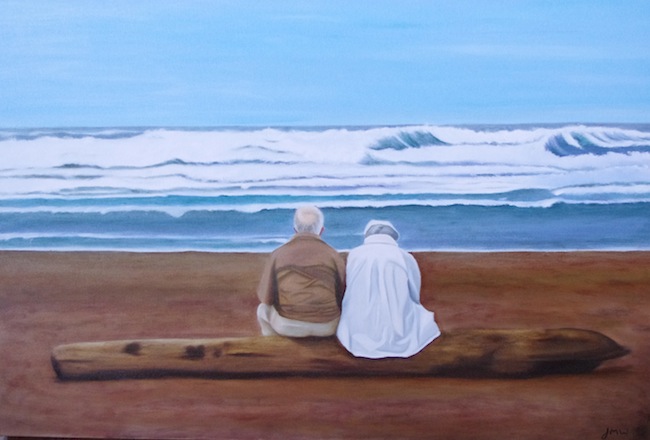
painting by Jeanette Wrenshall, Bowen Island, from my own collection
'Why are there no great women artists?' sounds as ignorant of human geography as the query 'Why are there no Eskimo tennis teams?' — Francine du Plessix Gray
Looking at the eleven reasons above why we are compelled to produce art, it is pretty easy to see why much of the art produced by women might be dramatically different from that produced by most men. Men and women generally connect and communicate differently. They have different things to say, and different reasons for having to say it. They see the world differently. They have different ideas about what is important. They have different ways of playing, of coping, of making sense of the world. There are different rules about what they are encouraged, and even permitted, to say out loud or through their art.
My friend and (when I lived on Bowen) neighbour Shari Ulrich wrote a song a few years ago about living with someone with Alzheimer's, called The Sweater, that brings tears to my eyes whenever I hear it. I can't envisage a song with its sensibilities ever being written by a man. It is just too vulnerable. Writing something like this, I think, takes a different type of courage from what most men mean by that word:
If I remember you were wearing that sweater
The first time we met — Oh, how could I forget?
I thought in that moment I could love you forever
That shy crooked smile — Or was it something you said?
And I knew I was yours, for the worst and the best
The sweater is worn now, and there's nothing much left
Like all of your memories, losing their threads
The kids will be coming to see you on Friday
Yes dear, they've grown; they have kids of their own
They'll stay in that motel, the one by the highway
Remember the one, where you hoped I would come to you
And knew I was yours, for the worst and the best
The sweater's unravelling, there's nothing much left
Like all of your memories, losing their threads
Now every day that you're farther away from me
I'm merely waiting for moments
When out of thin air, you're suddenly there
And I missed you, Oh how I miss you!
Oh, I was yours, for the worst and the best
Your sweater, I sleep with it, close to my chest
Like all of our memories
I pull at the threads
"Meanwhile, in my sleep, the freed-up me's went wild. They spray-painted the doors and windows of the banks, urinated daintily on the little mirror-cameras on the cash machines. They emptied the machines, threw the money onto the pavements. They stole the fattened horses out of the abattoir fields and galloped them down the high streets of all the small towns. They ignored traffic lights. They waved to surveillance. They broke into all the call centres. They sneaked up and down the lift-shafts, slipped into the systems. They randomly wiped people's debts for fun. They replaced the automaton machines with birdsong. They whispered dissent, comfort, hilarity, love, sparking fresh unscripted human responses into the ears of the people working for a pittance answering phones for businesses whose CEOs earned thousands of times more than their workforce. They flew inside aircraft fuselages and caused turbulence on every flight taken by everyone who ever ripped anyone else off. They replaced every music track on every fraudster's phone, iPad or iPod with Sheena Easton singing Modern Girl. They marauded into porn shoots and made the girls and women laugh. They were tough and delicate. They were winged like the seeds of sycamores. There were hundreds of them. Soon there would be thousands. They spread like mushrooms. They spread like spores. There would be no stopping them." — Ali Smith, The Human Claim
I know three women who are avid believers in and practitioners of unschooling — espousing that what happens in schoolrooms is mostly not learning, and that self-directed learning is generally a more effective way. One of these women is the poet PS Pirro, whose work I have often included in my Thoughts of the Month posts, including this piece from last year:
SHY GOD
She'll find you out walking, this shy god
who left her golden girdle on the chair
by the door, went out barefoot and unadorned,
you will not know her, it does not matter.
She speaks no language you recognize
as language, the song of the rhizosphere
in a meter out of time, the key of decay,
verse and refrain fragrant like rainwash,
she will pass you unnoticed and leave you
to walk in her lingering wake, your hum
just a bit out of tune, that's okay, she knows
you're a little shy, too, and sing your best
songs when you think no one is listening.
Another unschooler I know is Emily van Lidth de Jeude, a multi-faceted artist who lives on Bowen Island. (She tells me there is a term for self-directed learning: heutagogy: "it makes way for our minds to grow more naturally and thus more healthfully than they would on somebody else's imagined ideal trajectory".) One of her means of expression is through performance art, bringing the art she produces to life through kinetic means like film and dance. Among many other things, notably works on the protection and appreciation of the natural world, Emily has produced several works on the theme of motherhood, nurturing, and gender role models, including this remarkable dress, which I saw shortly after she produced it:

On her website she describes the dress as follows:
Used wedding gown, altered, painted and embellished to explore the choice mothers make to be the comforter/soother/carrier/carer/wearer of our babies. This reclaimed wedding gown includes a gang of painted toddlers climbing up the train, a built-in satin baby-carrier on the back, a plethora of hanging pacifiers, and a torn-open bodice from which protrudes a pregnant belly painted with the hands and face of an escaping, screaming mother.
I am a man. Now you may think I've made some kind of silly mistake about gender, or maybe that I'm trying to fool you, because my first name ends in a , and I own three bras, and I've been pregnant five times, and other things like that that you might have noticed, little details. But details don't matter. If we have anything to learn from politicians it's that details don't matter. I am a man, and I want you to believe and accept this as a fact, just as I did for many years.
You see, when I was growing up at the time of the Wars of the Medes and Persians and when I went to college just after the Hundred Years War and when I was bringing up my children during the Korean, Cold, and Vietnam Wars, there were no women. Women are a very recent invention. I predate the invention of women by decades. Well, if you insist on pedantic accuracy, women have been invented several times in widely varying localities, but the inventors just didn't know how to sell the product. Their distribution techniques were rudimentary and their market research was nil, and so of course the concept just didn't get off the ground. Even with a genius behind it an invention has to find its market, and it seemed like for a long time the idea of women just didn't make it to the bottom line. Models like the Austen and the Brontë were too complicated, and people just laughed at the Suffragette, and the Woolf was way too far ahead of its time.
So when I was born, there actually were only men. People were men. They all had one pronoun, his pronoun; so that's who I am. I am the generic he, as in, "If anybody needs an abortion he will have to go to another state," or "A writer knows which side his bread is buttered on." That's me, the writer, him. I am a man.
How could I have lived my life, for most of my 75 years, almost completely oblivious to the staggering privilege I received simply by virtue of being born male? The 'subversive' work of women artists has played an important role in making me aware of this.
Now, I am in awe. I don't pretend to even begin to understand or appreciate what it's like to be a woman in this relentlessly patriarchal, misogynistic culture. Though I suspect I could never be 'man enough' to put up with it. Had that been the fortune of my birth, I would simply have folded, I think. Given up.
I am beginning to sense that women to some extent inhabit a different world from the one men occupy. Do men and women to some extent live in utterly different cultures, alien to each other?
(Emily points out, correctly, that I'm taking a binary perspective on gender and its impact in this article; it is of course more complex than that, though there isn't space in this article to properly explore it.)
"Art that claims to be 'apolitical' is often the most revealing; it reflects what a culture considers safe, acceptable, and worth preserving… 'Political' ranges from explicit agitprop to the quiet politics of what gets preserved, what gets censored, and who gets a platform." — Maria Brito
Much has been written about whether art is 'political'. Caitlin Johnstone recently wrote:
Western artists who ignore the abuses of the western empire are taking a political position and sharing a political message. They might be singing about romance, or dancing, or the Sandman, but their actual message is, "Here are those circuses you ordered, you vapid NPCs, you mindless empire automatons, you shambling zombies consuming the flesh of the third world. Distract yourselves from the burning ecosystem, from the screams of Gaza, from the suffering of the poor and the marginalized, from the AI-assisted surveillance system they are constructing all around you right this very moment. Pretend everything's fine and capitalism is working out great for everyone. Here you go, you empty-headed human livestock, sedate yourself with some catchy rhythms while our rulers turn our world into a desert planet so a few billionaires can become trillionaires."
Real art tells the truth, and facilitates a deeper connection with reality. It pulls us into intimacy with parts of ourselves we'd been neglecting, draws attention to aspects of the human experience we'd avoided, directs us, rebukes us, inspires us, encourages us, emboldens us and reassures us as we crawl forth on our adventure across this mysterious blue planet during our short few decades between birth and death.
In a separate article, she writes:
It is a simple fact that the near entirety of human civilization has been designed by men. All around the world for thousands of years, wherever a civilization sprang up, the larger, stronger gender was naturally in a position to assert dominance over the way that civilization was run. Leadership systems were invented by men, social hierarchies were invented by men, marriage was invented by men, family structural norms were designed by men, money was invented by men, war was invented by men, and men invented religions which just so happened to have patriarchal gods who all agreed that the way men had set things up was indeed right and just.
Women were essentially property throughout most of this, and thus had very little input into how any of it was set up. Generation after generation after generation of women were born into this male-engineered society, over thousands and thousands of years, into a system so deeply and extensively normalized that it's almost impossible to imagine what our society might look like had it not been dominated entirely by men throughout its history.
The third woman unschooling champion I know is Lilia Efimova, a Russian woman now bringing up her three teenaged kids in Nederland, where the government of the day is trying to ban "home schooling" and mandate that all children attend classes. Lilia started blogging when I did, 20+ years ago. On her Facebook page, these days, she writes about her kids, their camping trips, and about her continuing grief at the loss of her partner in February 2025, young, of a brain tumour.
I've found some of her Facebook writing, in its cadence, its brutal honesty and its astonishing self-awareness, to be some of the most powerful writing I've read in a long time. With her permission, I've taken four excerpts from her recent months' postings and converted them into 'poetry', using translation software to translate some of her writing from Russian:
Learning Not To Be Strong
May 2026
Of course, I knew April and May would be like this -
out of the frying pan and into the fire.
But it's still difficult.
Perhaps I need to learn to meditate on an overgrown, neglected garden
just as I do on the mountains.
Amid deadlines postponed while I travel
and attempts to pull myself together,
the voices of the girls
rehearsing for today's concert sound meditative.
I'm rereading a post from three years ago
about the MRI results
and "the abyss whose edges I have to walk,"
and I'm a little surprised
that it was only three years ago.
It's very interesting to watch another self emerge,
periodically checking in with myself:
"Is this still me?"
June 2026
It's all business as usual:
You climb one mountain
and see a mountain range
spreading out at your feet.
You can be afraid,
you can prepare for the next difficult trek,
or you can grow wings.
July 2026
I think about the symbolism of resonances,
interweavings, events, places.
About customs at the border.
About stepping into the scary and the new.
About the ethnographic nature of experience.
About music yesterday, familiar to strangers.
About unfamiliar music today
with loved ones in an unfamiliar city.
About steps through the city and the signs it gives.
About a hedgehog
running along the cemetery fence.
About how steps, a road, a path
collide what is inside with what is outside,
unfolding experience in new ways.
August 2026
Rain starts slowly.
We were setting up the tarp almost in the dark,
just as everyone took out theirs.
We'll see in the morning if it was a smart choice or not.
It's that time of the year again.
Blossoming heather and sailing camp.
The second year without Robert.
I am kind of used to being in all of it alone.
But in those last days of August it's tough again,
seeing in the group chats
references to partners who share the load.
Sorting out schedules and train tickets,
ordering books, loading and unloading camping gear.
I am learning not to be strong.
To fall apart, to let the feelings in,
to cry it out.
To breathe out and wait
until I am ready to take the step.
The second year is different.
Quieter, gentler, lonelier.
We [women are] already foreigners. Women as women are largely excluded from, alien to, the self-declared male norms of this society, where human beings are called Man, the only respectable god is male, the only direction is up. So that's their country; let's explore our own. I'm not talking about sex; that's a whole other universe, where every man and woman is on their own. I'm talking about society, the so-called man's world of institutionalized competition, aggression, violence, authority, and power. If we want to live as women, some separatism is forced upon us: Mills College is a wise embodiment of that separatism. The war-games world wasn't made by us or for us; we can't even breathe the air there without masks. And if you put the mask on you'll have a hard time getting it off. So how about going on doing things our own way, as to some extent you did here at Mills? Not for men and the male power hierarchy — that's their game. Not against men, either — that's still playing by their rules. But with any men who are with us: that's our game. Why should a free woman with a college education either fight Machoman or serve him? Why should she live her life on his terms?
Machoman is afraid of our terms, which are not all rational, positive, competitive, etc. And so he has taught us to despise and deny them. In our society, women have lived, and have been despised for living, the whole side of life that includes and takes responsibility for helplessness, weakness, and illness, for the irrational and the irreparable, for all that is obscure, passive, uncontrolled, animal, unclean — the valley of the shadow, the deep, the depths of life. All that the Warrior denies and refuses is left to us and the men who share it with us and therefore, like us, can't play doctor, only nurse, can't be warriors, only civilians, can't be chiefs, only indians. Well so that is our country. The night side of our country. If there is a day side to it, high sierras, prairies of bright grass, we only know pioneers' tales about it, we haven't got there yet. We're never going to get there by imitating Machoman. We are only going to get there by going our own way, by living there, by living through the night in our own country.
I'm back in the local café, after a walk along the river, trying to digest all of this. On the walk I saw a woman pushing a baby carriage along the rough trail, stopping to point out the birds and the trees to her wide-eyed little girl, all dressed in pink. I saw a young woman sitting on a bench by the river reading Siddhartha. I saw three separate women jogging intently, looking wary. I saw two teenage girls walking with boys the same age. One of the girls was wearing a very short skirt, and constantly smoothing and pulling down its hem as they walked.
I do not know the secret language of women, although some of them have tried to teach me. So I don't know whether learning "not to be strong" is a means for women not to become desensitized, as so many men seem to be, or whether it's a means for them to be who they really are, instead of who others want or expect them to be. I only know I think I would like to learn not to be strong, but don't think I ever could. I don't dare.
I hope it gets easier for women artists to not (have to) be strong, to find ways to 'work around' the arrogant domains of men instead of always having to struggle to confront them. And to be artists in the way 'big strong men' can never be.
My sense of "the abyss whose edges we have to walk" is that it applies on many levels: At the macro level, it applies as we, all of us, circle an entire civilization collapsing in on itself. And at the personal level, we face it dealing with all the dangers of this beautiful, terrible, treacherous world.
And I sense that women, outrageously, must walk much closer to those edges, and face greater perils and challenges and inequities than most of us clueless and insensate males could ever imagine. I want to believe that men, with the help of women who know how to be strong and how not to be strong, can learn to appreciate what they can and must do to reduce the perils and challenges and inequities women must face.
And I hope that through art and other means, women, and all of us, can find connection, companionship, and understanding, easing our struggle a little, and finding our way, alone together, through the night.
Thanks to all of these astonishing artists, and specifically thanks to Lilia, to Emily, to PS, and to Djö, for helping me think through this rambling and incoherent post. Its many remaining faults and misunderstandings are strictly my own.
This is the fifth of a series of articles — opinionated, fanciful writings, speculations — about The World After Collapse. It draws on what I've learned about pre-civilization humans and other large-brained creatures, and speculates on how, after civilization's fall is complete — probably centuries from now — the remnants of the human species might be unrecognizably different from how we behave and think now. But they may be also 'recognizably' similar to how we know, deep down inside, we really are, and always have been. The series is not intended to provide hope, or solace, or a prediction, or least of all a pathway to change. Just a speculation about how the world, with a smaller number of us, or without us, might look long after those of us living through the fall have gone.

image by AI
Unless you've spent a lot of time studying non-human cultures, and pre-civilization human cultures, it's pretty hard to imagine future humans living in ways and with tools and 'technologies' not that different from those of any other animal, and in numbers sufficiently marginal that our final extinction, when it occurs, will probably go unnoticed by the rest of life on Earth.
All my reading about previous civilizations, and about what they've left behind, has left me with a view of our planet's future that is quite radically different from any I have heard espoused by anthropologists, archaeologists, and other students of human cultures. Specifically, I believe:
- That the collapse of our global human civilization, although well-advanced by the end of this century (to the point our way of life in 2100 will be unrecognizable to those living today), will likely take a couple of millennia to fully play out. The much simpler and smaller-scale Roman civilization took nearly three centuries to fully collapse; ours is likely to take much longer.
- Many of the tools and technologies most people consider essential to all human cultures will disappear — not because we won't be mentally capable of producing them, but because there will be no need for them. Necessity is the mother of invention. Three of those, I'm sure, will be particularly controversial for me to mention, such is the arrogance and conceit of our species of being inherently superior to, and different from, all other species: abstract language; art and music; and agriculture (including most clothing and other technologies that depend on cultivated textiles). Without them, no complex culture is possible. So there will be no complex human cultures. There will be no need for them.
Scientists who have thoroughly studied, first hand, everything we have learned about H. Neanderthalensis have argued, against howls of protest, that this successful humanoid species (at least until we aggressively exterminated them) were 'like us' — that they had language, human-like rituals (like burials), and multiple arts. Ludovic Slimak has thoroughly discredited those hopeful, wishful-thinking claims. Although they were expert crafters of tools, Neanderthals had no need for abstract language, human rituals or art. And there is no unrefuted evidence they had any of these things.
I see no reason why, in small, tribal numbers, living in areas we are naturally suited to live in (which will be few, after climate collapse), we would need to develop these technologies again. Bonobos and chimps, which are virtually genetically identical to us, with the exception of our entangled brain structures, have not developed them, and have never needed them.
And with collapse taking millennia to unfold, the enormous cost of trying to sustain these technologies will be far beyond the capacity of the struggling billions, and then just millions, to sustain, and for far longer than our memories enable us to perpetuate old learnings before they are lost.
. . . .
Back when I first started studying civilizations, complexity and collapse, I quickly got obsessed with how we might prevent, or at least mitigate, the spectacular collapse our civilization is now in the early throes of. But it didn't take long before I shifted that anxiety to thoughts of how to prepare for collapse. And how to adapt as everything falls apart.
But what we are seeing now, all around us (those who are looking, anyway), is that it's impossible to predict or forecast the trajectory of collapse, which will in any case be utterly different from place to place and over the many waves that collapse is sure to take. How can one prepare when one can have no idea what to prepare for? Or adapt to?
Of course we can learn survival skills that have been largely lost — how to grow, or find, our own food, and how to fix things. But we cannot know where we will be living as climate collapse forces billions of us to move vast distances to survive, nor can we know who we will then be living with, and what skills our migrating communities will have, and will require.
So I take some comfort knowing that, whatever we do, or don't do, during the turbulent decades and centuries ahead, will, in the long run, not matter. Whatever remnant of human society survives collapse will have no use for anything we try to save for them, or teach them. They will be utterly unlike us. Just as the Neanderthals were utterly unlike us, utterly unknowable to us, as much as we desperately seek belated kinship with them.
When I talk to people about this, they say they can't imagine a world in which humans don't communicate in languages beyond immediate urgent vocal signals. Or a world without art, music, dance, without the hunt and the harvest (prehistoric humans thrived for hundreds of millennia as non-nomadic vegetarians).
What, and who, would we be without these things, these artifacts of our very humanity?
I'd love to be able to find out, but we can only guess. The only thing we can be reasonably confident of is that they will be utterly unlike us.
I'd love to think that, therefore, they're not doomed to repeat our civilization's cruel, toxic, destructive mistakes.
But we cannot know.

I have always been a board game fan. But unlike most, I prefer games that offer interesting, unusual, and clever features, qualities, designs, and what Board Game Geek calls 'mechanics'. I avoid games that are highly competitive or encourage ganging up on other players, bluffing, or cutthroat strategies.
Back in 1969 when I was a teenager, I discovered a new British game called Galt Connect. It was (and is) a gorgeously designed game built on the 'mechanics' of dominoes, where to win you have to play the tiles you've drawn to match the patterns of the tiles already in play.
Connect was a very successful game back then, but eventually went out of print. It's been reintroduced and is now available again. I played it with my parents and friends in the '70s and later with my own kids. It has that certain quality that I think gives games endless appeal: Easy to learn but still offering great opportunity for strategy; not terribly competitive, and suitable for all ages without being either boring or too difficult for anyone to learn and win; and just basically aesthetically beautiful. You play this game with people, not against them. Playing is a bit like creating a work of art.
(This is true of quite a few more recent tile-based and map-based games, such as Labyrinth, Scotland Yard, Qwirkle, Carcassonne, and Catan, all of which I really enjoy. Along with a handful of similarly cleverly-designed games like Rummikub, Dixit (superb artwork), Pandemic, Cartographers, and Dealer's Choice Poker, they constitute the bulk of my small games collection.)
In 1984, Ravensburger released an inexpensive pictorial version of Connect, with a few changes in the tiles, called Rivers, Roads & Rails. Instead of simple subway-map-style coloured lines, this version portrays three transportation modes. The rules, which were never terribly clear or complete, remain a bit ambiguous in this version. But the basic match-the-lines-like-dominoes play remains the same, and the tile changes don't IMO make a significant difference.
A lot of adult players found the basic game too simple and slow and dependent on luck of the draw (qualities that I consider to be virtues, since I prefer a relaxed, playful game that will often accompany conversations on any number of subjects, where the winner doesn't matter). Less patient and more competitive players have suggested cutthroat rules I don't like at all.
But in order to actually make the game even longer, and less competitive, and ensure that players aren't stuck unable to play for multiple turns, and also resolve some of the ambiguities in the official rules, I've devised my own variant that I think makes the game even more interesting. The objective changes from getting rid of all of your tiles (like Uno or Rummy), to playing the most tiles on your turns, and hence contributing most to the transportation networks that the tableau of tiles represents.
For those who have acquired or do acquire the game and are interested, here are my revised rules:
- The area on which this game is played is 21 tiles by 21 tiles. (105cm squared.
- Each player selects 5 tiles, left face up so all players can see. One tile is selected at random to go in the centre; it must have 2 different sides, so different tiles can be placed against the two sides. This 'first network' is public, shared by all players.
- The youngest player plays first.
- On each turn:
(a) Draw one tile from the box. Place it face up with your other tiles.
(b) Then play as many of your tiles as you can (you must play if you can, but if you have multiple choices you have the choice of which to play, and in which order, even if that would prevent you from playing the maximum number of tiles).
(c) If you can't play any of your tiles at all, you may start a new network by placing a tile adjacent to a tile in an existing network, such that neither network is blocked from further play, and such that no road, rail or river ends at the side of another tile. If possible, you must then play additional tiles adjacent to it. If you start a new network, put one of your coloured tokens on it to show it's your network.
(d) Next, collect $1M ('construction fees') for each tile you have just played.
(e) If during your turn, you have connected two previously unconnected networks, draw three additional tiles from the box, and each owner of one of the merged networks also draws three additional tiles and collects a 'sale price' of $1M for each tile in their network. Then remove the coloured tokens to reflect the sale. The resultant merged network becomes a public network.
(f) If you have no tiles remaining (ie you play all of your tiles on your turn), draw three tiles from the box to replenish your supplies to end your turn.
(g) Turn passes to the left. - Illegal moves: In addition to all modes of adjacent tiles having to match, as in the regular game:
(a) You cannot play a tile on the outer edge of the 21×21 tile area of the game that leaves a road, rail, or river extending beyond this edge.
(b) You cannot play a tile that precludes any possible tile from being played legally adjacent to it, even if such a tile does not exist in the game. This means the board may contain a number of 'dead' zones. - When all tiles have been drawn and no further plays are possible, the game is over. Each player 'sells' their networks for $1M per tile in the network. Whoever has the most $M totalling construction fees and network sale proceeds, wins. Un-played tiles have no value.
My variant does require some easily-acquired or made additional pieces:
- A few small tokens in different colours to mark private networks
- About 20 small tokens of any colour for use on the Available Plays board (see below)
- Some play money in any denomination, with each representing $1M, to track money earned by each player (or you can just track it on a notepad)
- It speeds play if you use an Available Plays board such as illustrated below, that you amend after each turn to show the number of available places where tiles can be added of each of 7 possible types of connections. So at the start of the game, there will be just 2 tokens on this board, showing the type of tile needed to connect at each side of the starter tile. As additional networks are created, or if either of the two special three-way tiles is played, the number of available places to add tiles will increase. As dead spaces occur, the number of available places will decrease.
- As long as you have a playing surface that's at least 105cm square, you don't need a playing board, since you can simply count from the starting centre tile to ensure you haven't reached the 'edge' (10 tiles in each direction from the centre tile). If you have four of the ubiquitous and iconic IKEA LACK 21 5/8″ (55cm) square plastic tables, together they're the perfect size (and height) for playing this, and many other tile and map games. They were $9 for decades, though I understand they're a bit more now.

Last time I wrote about my favourite board games, my post prompted quite a few responses. I'd love to know what your favourite games are, and why.
[I don't often write what might be called 'diary entries', but for some reason I felt compelled to write this one. I don't keep a diary, so I had to post it here. Caveat Lector]

I seem to be losing the motivation to do things — to do most anything, really. I'm not depressed or unhappy about this, or anything, just uninterested in doing things that would seem to require considerable focus, attention, and energy. Sign of age, perhaps.
For example: I have almost entirely ceased reading fiction, and ceased watching films and televised fiction. This is partly because I don't like contrived drama (surely there's enough ghastly drama in the real world), and partly because I get no joy from reading or hearing sad stories of suffering, real or invented, especially when these stories usually strike me as lame, contrived, and unimaginative. Why does anyone like consuming the imagined misery of imagined characters? What we have come to call 'tragedy' (not its original meaning — it actually comes from the words meaning 'singing goat'!) is now perhaps best exemplified by the 'horror' genre, or the endless horrors and exaltation of human agony in that interminable "Special Victims Unit" series. Revenge as catharsis? Not for me, thanks.
Why do we subject ourselves to fictitious misery? Is it because it gives us hope for overcoming our own obstacles and suffering? Or make us feel better in relation to the poor invented victims of worse horrors? I don't understand it. My fiction is widely denounced for its lack of 'dramatic tension' and the absence of 'heroic', lovable, vulnerable characters that overcome adversity through painful struggle. Why would I want to write about people suffering misfortune, when most of the world deals with it, and worse, every day of their lives?
Maybe partly it's because I don't believe in free will, so I find all fiction quite unbelievable, though I mostly had already given up consuming fiction before I acquired that belief. The hero and the villain have no choice but to do what they do, in fiction and in real life. Why would we cheer the hero and boo the villain for things they had no control over and could not help but do?
And now, perhaps not surprisingly, I am losing my interest in writing fiction of all kinds as well, though I was never really any good at it — I'm basically incapable of separating myself from the invented characters in my writing, and I have a tendency to make my characters into one-dimensional mouthpieces for my own thoughts and beliefs, which is both tiresome and irritating for the reader. So why would I want to keep doing that? To become a 'better' writer? For what reason? For whom?
I do like coming up with ideas for stories, as long as they're clever and interesting and mercifully free of 'drama', stereotypes, and contrivances. But once I have the idea, actually writing the story is something I usually find tedious, except on rare occasions when I am able (no free will involved) to let the story go where it will, in directions that would never have occurred to me. On those occasions, I do learn something about the world, and, mostly, about myself.
So lately I've been writing lots of one-paragraph story ideas, and almost no stories. I may never write another story or poem for 'publication' (on my blog or elsewhere), partly because I'm lazy and don't especially care what anyone else thinks about my stories, but mostly because I'm just not motivated, or inspired, to put in the work. And I don't need to write them for my own consumption, since I mostly know what will happen in them without going to all the effort of turning the idea into a story. Especially when I'm not very good at writing stories anyway.
And it's largely the same with my non-fiction writing. Over the years I have come up with many good ideas that, in my biased opinion, make far more sense about what is happening and has happened in the world than almost anything philosophers and historians and scientists I have read and studied have come up with.
Yes, I know that's an arrogant statement to make, especially when I know that we all stand on the shoulders of giants in everything we do, and in everything we undeservedly get disproportionate credit for.
Some of my ideas are actually quite ingenious, I think, though they took a long time to 'suddenly' occur to me, since I'm a notoriously slow learner. Most of those brilliant ideas get crammed into my articles (and now sometimes into my songs), often again and again. Maybe that's a bit like what Cory Doctorow does with his brilliant ideas, hammering them again and again in his articles and speeches and books until their brilliance is suddenly realized by his well-deserved audience. (Maybe I'm not the only slow learner in the world.) Of course, Cory's brilliant ideas (and the brilliant terms and phrases he coins to make them memorable) are vastly more brilliant than mine.
I suppose I keep blathering on about my own modestly clever ideas just so that when someone gets incredibly famous for espousing one of them, I can at least say to myself that that was my idea, and that nobody listened to it. Not that that matters. It's good when good ideas catch on, no matter who gets credit for them, though they mostly do tend to be misconstrued or forgotten soon enough.
I do like making sense of things, especially in novel and unorthodox ways. Getting pleased with myself for doing so is my own reward for having, I think, an unusually large and practised imagination. You know — the kind of imagination that can come up with lots of interesting ideas for stories and articles, without then requiring that I actually write them.
So now I rarely read non-fiction either, since there are few novel ideas in such writing (it's mostly just opinions and lame theories, IMO), and it displays even less competence at conveying them or undertaking the simple cognitive task of identifying the implications of those ideas, beyond the 'what we all need to do as a result' crap. We live in an age of staggering imaginative poverty and even more staggering four-fold incompetence.
(The four aspects of incompetence is another of my modestly clever ideas: (1) Lacking relevant information (including history and context) on a subject, (2) lacking the necessary cognitive (critical and creative thinking) capacity, (3) lacking the deep, personal, relevant experience in applying what is known, and (4) lacking the sound mental health to put knowledge, thinking skills, and experience together to accomplish an important task. All four combine to make us quadruply incompetent to deal with the challenges and to rise to the opportunities we encounter.)
So what might I (and we) do, the diarist asks himself, knowing the absurdity of the question in light of our absence of free will? A more honest question than what 'should' or 'can' be done is perhaps what will inevitably be done as a result of our and others' conditioning. What most will do, I suspect, are things that will likely make the current insoluble predicaments we face immeasurably worse, because of our imaginative poverty and quadruple incompetence. We all do our best, but it's an endless and joyless process chronicling what that is leading to.
What I will probably do is… less. I'm pretty good at doing nothing. It's not tedious or boring to me.
Maybe I'm getting to be like most cats and dogs as they get older, content to just curl up somewhere and peer at what's apparently going on. Maybe I'm becoming equanimous and my vexatious 'self' is about to leave the scene. I should be so lucky.
More likely, maybe, I'm just content, now, with the absence, most of the time, of the anxiety and fear and anger and all those other negative emotions that have dictated and driven my actions most of my life — A life, mostly, of aversion rather than action. Most un-heroic and un-story-worthy. But when you get cornered often enough in situations that offer no escape, you eventually get worn out trying to fight, flee, or freeze. You want to just lie down and wait for whatever is going to happen.
Is that what's behind my loss of motivation? I don't know. I don't know much about anything anymore. But I'm not sad. I'm probably 'less unhappy' than I've ever been. And I'm not even really resigned or filled with acedia (another of 'my' modestly clever ideas, appropriated from Gene McCarthy, who surely stole it from the Greeks) either — though that would make for a more dramatic and compelling story of 'me'.
I'm just quite content to be here, watching this body doing and not doing what it appears to be doing and not doing.
Content for now, anyway.

"Slowly and then all at once". That's John Green's paraphrasing of Ernest Hemingway's quote in The Sun Also Rises about how change happens (though John wrote it specifically about how we fall in love). Ernest was referring to how you go bankrupt.
But it applies to many if not most types of change, large-scale and small, the way they creep up on us until we hardly notice that what we once took for granted is 'suddenly' gone. You know, like 'responsible' government, like a stable economic system, or like a healthy climate and healthy ecosystems. What we now think of as a 'natural' place would be seen as an utterly unnatural place by even a casual observer just a few generations ago. When you've never experienced or been exposed to anything else, how can you not see what exists today as being 'normal', even inevitable?
If my read of the doomscroll is correct, tracking all the systems that make up our current globalized civilization, we are now, almost all of us, in what the collapse diagram above describes as the chaos phase. Or how the movie of the same name describes change as happening: "everything everywhere all at once". Too much, too fast to keep up, or even keep track.
So the slow death-by-enshittification of the internet is now 'suddenly' visible, even obvious. The corruption and incompetence of our political leaders, and the vulnerabilities that have allowed them to 'suddenly' and irreparably break these systems, is obvious for all to see. The end of economic growth and what it portends for 'all at once' catastrophic collapse, written about for sixty years, is now kind of pretty clearly what we're in for in the coming decade.
How did we not see it all coming? Some of us did, and wrote about it, decades ago. Nothing new in that, or in the denial and intransigence that followed. And anyway. as Indrajit Samarajiva wrote about the global casino of 'prediction markets', "There's no reward for being right early".
Now those of us who were called 'collapsniks' have largely ceased to offer hopeful words and hopeless projects and 'if we only all do x' promises. Without the mandatory hope, we are listened to even less than before. And what's sure to happen (sooner, or later, slowly and then all at once) is that when the next dizzying period of chaos eases into hiatus, probably in the midst of an enduring, ghastly, and endless 2030s great depression, the pundits will be talking about 'building back' and 'returning to normal', as if anything about our civilization has ever been normal.
Then I'll just keep pointing at the above chart, at the earliest 'chaos' curve, or the 'hiatus' point before the next disintegration, and saying "Now we're here". For all that's worth.
COLLAPSE WATCH
 image by climatereanalyzer.org from NOAA/C3S data; there are no words
This month in collapse: Erik Michaels, as usual, sums up the latest news and analysis of civilization's collapse. He talks specifically about 'civilizational amnesia', in which we forget how far we've fallen already. And he also riffs on my chart of the 'four responses' to civilization's collapse.
Everything falling apart of necessity: Steven Newbury explains one of the manifestations of collapse is that, as affordable resources run out, and there's no money to maintain what's been built, or to afford anything new, corporations rely on enshittification of their products to stay profitable. Like charging the same old price for the 'new' smaller package, only it's quality not just quantity that's declining:
The widespread degradation of goods—what we might broadly call the physical 'enshittification' of the economy—is the exact opposite. It is a desperate manufacturer strategy deployed specifically to keep nominal prices from rising too fast to maintain volume. If consumers actually possessed the aggregate purchasing power to absorb higher prices, manufacturers would simply raise the price of the original, high-quality good. Instead, because the consumer is tapped out, manufacturers are forced to hollow out their products to protect margins.
Collapse: Political, social, economic: Aurélien, whose quality of analysis has been uneven of late, returns with a sober summation of the current situation: "There is no way of halting, let alone reversing, the social, political and economic decline of the West since the 1980s under anything like current conditions." He calls it "discontinuity" instead of the dreaded c-word, but it's the same diagnosis:
Thus, we are in one of those situations where we shall have to do what we can ourselves. This means districts and towns (probably not large cities), communities and local organisations: the local authority is probably going to be the last functioning unit of government. And here, of course, we run into the obvious problems: societies and families have been fractured, much official capacity has been destroyed, there are no community leaders in the traditional sense (and indeed not much in the way of communities) and entire generations have been brought up to value ruthless individualism above all other things.
LIVING BETTER

from the membrary
In praise of Guaranteed Annual Income: Lee Camp explains why, despite the overwhelming success of GAI in tests around the world, no government dares institute it.
The system no one wanted: Economist Clara Mattei argues that capitalism was never 'natural', and never particularly popular, and has only survived because the Epstein Class enforces it by overthrowing any government that dares to challenge it. In a separate interview, she explains that "inequality, austerity and the concentration of wealth are structural features rather than accidental outcomes" of capitalism.
All of Western Canada has now dumped daylight time: After years of waffling and contingent laws awaiting others to fall in line, Canada's six western provinces and territories have agreed to go it alone, scrap DST, and wait for the rest of the 'West' (most of the rest of the world has already abandoned it or never had it) to catch up.
Notorious RBG tells it like it is: A six-year-old interview with the last Supreme worthy of the adjective, reveals some of the major influences in her life and her advocacy for justice.
Raising a boy in Trump's America: Lyz Lenz describes the challenges of motherhood of sons in a country that is backsliding into patriarchal extremism.
Back from the edge of extinction: How ornithologist Jean Delacour watched dozens of bird species go extinct over five decades of work, and then fought to save one iconic species that seemed soon to follow. Watch the short video to see which species it was. Thanks to Bart Anderson for the link.
Voting is just the first step in democracy: A primer from Cory Doctorow on how New York is showing the active steps needed to create real democracy.
POLITICS AND ECONOMICS AS USUAL

yet another Trump grift scam, fleecing his dumb, unwitting followers; read Indi's exposé here
"We can overthrow any government we want.": The quote is from Kimberly Guilfoyle, the US ambassador to Greece, recently warning a Greek minister at a state dinner that what they just did in Romania, they could do to Greece or "any country we want". Who is this piece of dreck? Well, if the name isn't familiar, she's Gavin Newsom's ex-wife and Donald Trump Jr's ex-fiancée. Oh yes, she's also under investigation for influence peddling and attempted tax fraud, thanks to an investigation by the Wall Street Journal, which seems to be the only mainstream medium doing anything but transcribing government press releases anymore. Oh, and she spoke at the Jan 6 insurrection mob gathering. Can't make this shit up. (Update: Trump just fired her today.)
Maybe an extreme cage-boxing event for the opener?: Pentagon plans to "live-stream" the execution by firing squad of the man convicted in the Fort Hood shootings. Can't make this shit up either.
Canada's 'National' Newspaper calls for assassination of Canadian party leader: The execrable National Post fronted an op-ed that called on the use of ancient Jewish laws — the same ones used against former Israeli PM Yitzhak Rabin that resulted in his assassination by extremists — to "deal" with Canada's anti-war, anti-genocide NDP leader Avi Lewis. The rest of the Canadian mainstream media, with few exceptions, have failed to call for criminal action against the Post and its 'journalist' for uttering death threats and fomenting violence.
Imperialism, Militarism & Fascism: Short takes:
- Watch-out for Josh Hawley, the ambitious anti-abortion, anti-immigrant fanatic Republican Senator who cozies up to anti-corporate lefties.
- DeSantis plans to eliminate Florida property taxes for Americans, raise them for Canadians
- Common Cause sues ICE/DOJ/FBI/DHS for brutal harassment of anti-ICE photographers and observers
- Trump bribes voters pre-elections with cash if Republicans win, and sends out taxpayer-funded cash in 'pre-emptive' bribes before the mid-terms, and uses $22M in taxpayer money for Trump ads, much of it after courts explicitly prohibited it.
- US Supremes temporarily block restrictions on mail-in voting
- Appeals court blocks Trump's third-country removal program, but US Supremes could allow it to resume
- Trump promises Israel and Saudi Arabia billions in bombs "right after the election"; Carlson whistleblower reveals details
- Fetterman joins Republicans in casting deciding US Senate vote to prolong Iran war
- UN cites US actions in civilian bombings in Iran as "war crimes"; Trump and Marco Rubio respond by sanctioning the entire Criminal Court membership
- Israel building fenced "settler-only" highway through centre of West Bank
- Pankaj Mishra describes how the endless outrages of Israel, including its genocide in Gaza, its ethnic cleansing and police-assisted murders and thefts in the West Bank, and its occupations in Lebanon and Syria, have now turned the whole world against it
- The Bolivian attorney-general investigating the criminal CIA-backed Cerimedo gang organizing terror campaigns and assassinations throughout Latin America has been 'kidnapped' by armed thugs and the kidnappers claimed he was "arrested" (on trumped-up charges), apparently on the instructions of Marco Rubio
- Long blacklisted in US politics/academia for his anti-genocide views, Norm Finkelstein reveals the decades-long fanatic agenda of Zionism
- John Mearsheimer describes the view from Moscow during his recent visit
- Meanwhile, Europe's anti-Russian pro-rearmament hysteria grows louder
- And high school students in France are once again in the streets calling the country's incompetent 'centrist' government to account for its neglect of citizens, this time focused on crumbling schools and worsening education
- Mark Carney is no hero: The Canadian PM speaks very well, but does next to nothing, and his environmental policies are disastrous
- Canadian RCMP now permitted to NOT show their name on their uniforms
- Alberta government and separatists tear province apart as separation referendum headed for massive defeat
Propaganda, Censorship, Misinformation and Disinformation: Short takes:
- Good to see Macklemore's shows sold out while the genocide apologist Ed Sheeran who knuckled under to threats from Zionist event organizers has been forced to play pathetic solos to undersold auditoriums. To keep it short: Macklemore is not antisemitic. PINK is just another genocide apologist. Ed Sheeran is not a victim.
- Mike Huckabee repeats endless discredited lies about Oct 7 as he becomes the head cheerleader in the Trump admin for continuing the genocide and ethnic cleansing of Palestine.
- The Israeli publication Haaretz reports that Netanyahu had full advance notice of the Oct 7 attacks and deliberately chose not to intervene to stop them. They also reported that Hamas had offered Netanyahu the immediate release of all hostages right after the attacks in a prisoner exchange, and Netanyahu refused.
- 28 nations have condemned and threatened Iran for an alleged "terror plot" on the Fairford UK-US military base in the UK. Despite the fact that all 7 people arrested have been released without charges. The evidence? Three of them were driving trucks with gasoline tanks near the base. No explosives. No notes. No intercepted e-mails. An anonymous 'tip off'. Wonder who that might have been from? Complete denial from Iran. A total fabrication, in other words, and the 28 hapless governments and their news media as usual didn't even question its authenticity. Disgraceful warmongering.
- Daniel Dumbrell, a frequent visitor to Xinjiang who has made many friends there, talks about the anti-China propaganda machine desperately trying to counter reports of recent celebrations in the province.
Corpocracy, Enshittification, and Unregulated Capitalism: Short takes:
- Does the AI oligopoly know its bubble is about to burst, and hence is starting to press the government to 'nationalize' AI to recoup their losses from the public purse? And now banks are getting skittish about gigantic AI debt exposure and trying to offload it, as yields soar. Thanks to Chris Corrigan for the link.
- Trump Admin opens SBA benefits to medium-to-large corporations, effectively gutting the SBA's mandate to help small business compete.
- The myth of the AI that 'went rogue' (it just followed the instructions its human prompters gave it, as they were searching for ways it could be misused)
- Also from Cory, what's going to happen when the AI bubble bursts
- And more from Cory: How copyright law screws artists and only benefits the media publisher oligopolies who 'buy' the copyright.
- How the LiveNation/Ticketmaster monopoly 'flywheel' dominates and oppresses the music industry
- John Oliver rips into the monster that is UnitedHealth group
- Employee of monopolist Driscoll's berries claims they knowingly sent the ones with excessive chemical residue to Canada
- How giant corporations like Starbucks destroy local 'communities' when they shut down 'unprofitable' stores and abandon staff who have made them what they are
- The working class is worse off now than 40 years ago, and the AI Armageddon is just beginning (thanks to Paul Heft for the link)
- "Home is not an asset" — how the development industry and the government converted a right into a speculative gamble, and made renters into paupers
Power Abuse (the Patriciate/Epstein Class): Short takes:
- The millionaires (not billionaires), three million of them in the US alone, who use their wealth to pressure for changes in regulations and tax laws, and conveniently shun the limelight, hiding behind the bozo billionaires and tech bros whose arrogance and incompetence is on full public display. And between them they generate more than half of all US business income, most of it passed through to their personal corporations and personal estates, so it doesn't appear as 'corporate' income at all.
Dementia Watch: Short takes:
- The usual Trump antics: an outrageous, lunatic action, mostly quickly thereafter shrugged off and quietly reversed: The banning of major networks from the White House, then the decision to make the new extravagant 'arch' in Washington into a drone and sniper military complex, then the UN speech threatening the 'annihilation' of Iran and all its people, then his praising Musk's Grok AI for guiding him in his kidnapping of Maduro. It just goes on and on. The Time magazine interviewers who recently spoke with him talked about the massive hoard of 'tchotchkes' cluttering up much of the White House, saying "At times, Trump's train of thought was difficult to keep up with, his conversation moving in streams and eddies before circling back to familiar obsessions. He recounted conversations that sometimes sounded improbable." Improbable? No, completely bonkers.
- In a sudden reversal that caught everyone off-guard, Trump announced the purchase of emergency supplies of diesel for the US from Russia, bypassing Europe which the US had bullied into supporting anti-Russia energy embargoes (having sacrificed Europe by bombing the Russian pipeline supplying much of Europe's energy), and in the same sentence called for Ukraine to ditch Zelenskyy, blaming him for the start of the war and its "two million" deaths.
- Dishonourable mention: Pete Hegseth, demented before his time, adorned with a mass of tattoos depicting him as a warrior from the Crusades, who keeps doubling down on his utterly weird proclamations, lying about military morale (at least 8 personnel on the USS Liberty attempted suicide during their ghastly tour of duty), bragging about giving personnel testosterone injections, insisting that his War Department recruits now have "no fatties, no trannies, no beardos, no weirdos, no wimps, no radicals, just warriors", and reversing decades of diversity training designed to expand the breadth and capacity of the forces. Just deranged. And check out his latest spooky pose, showing who he gets his inspiration from (will someone please tell me this is AI?):

Department of Health Prevention: Short takes:
- JFK Jr caught accepting millions in advances and 'gifts' for writing anti-Vaxx books
- What would Medicare for All in the US entail?: Hint: It could work, but it wouldn't fix anywhere near all the problems in the dysfunctional US healthcare system. Oh, and Mexico has just announced it will introduce Medicare for All there.
- Is chemotherapy worth it? Part 1, Part 2. Short answer: in most cases, no.
- How the sugar and meat industries lobby and lie to us; eight part series (link is to the last article; links to the other 7 are listed below it).
FUN AND INSPIRATION

cartoon from Dana Variano's Felt Tip Feelings CC-BY-NC 4.0 Thanks to Kavana Tree Bressen for the link.
The dehumanizing effects of wealth, fame and power: Barry Ferns tells the first-hand story of a multimillionaire herbal supplement hawker named Steven Bartlett and how he and Barry both disgracefully and pathetically "performed" for their audiences on social media, dissing each other after hurting each other's feelings. And in a follow up, he explains why telling non-privileged young people the economy is rigged against them isn't demotivating and actually helps them succeed, while privileged motivational speakers are selling nothing but shame.
Ursula Le Guin's annotated translation of the Tao Te Ching: Free to download, perhaps the best version of the classic work ever.
You otter watch this: Marine biologist Kristyn at KPassionate has dozens of bite-sized videos each teaching you a thing or two about marine life. She also has longer videos about subjects like the accelerating pace of animal evolution.
China's national Wushu games: Martial arts meets dance as two women demonstrate what looks to be a death-defying choreography.
The best female detectives in fiction written by women: For those who like a mystery, and who understand how women often solve it differently from how men do.
Cutting off your parents: "Last month, more than 138,000 new videos that mentioned cutting off or going low-contact with parents were posted on TikTok, up more than 10-fold compared with August 2020. More than 82% of the posts were by women." It's never too late to be kind to your kids.
The adventures of bus kid: Two teachers notice a child waiting for the schoolbus at the end of their driveway on schoolday mornings, and decide to give her a place to sit. Delightful story with a lot of heart-warming chapters. Thanks to Hank and John for the link.
The rich think you're jealous of them: When really you're just irked by the unfairness of knowing that wealth is almost never really earned.
We ate them: The history of the genocide of First Nations in North America, a tale of lesser and greater barbarity, with no real "good guys".
THOUGHTS OF THE MONTH

amoeba sex, explained below and in this article from Maria Popova
From Ursula Le Guin, from The Wave in the Mind, on Communication and Dialogue:
My private model for intersubjectivity, or communication by speech, or conversation, is amoebas having sex. As you know, amoebas usually reproduce by just quietly going off in a corner and budding, dividing themselves into two amoebas; but sometimes conditions indicate that a little genetic swapping might improve the local crowd, and two of them get together, literally, and reach out to each other and meld their pseudopodia into a little tube or channel connecting them (see drawing above).
Then amoeba A and amoeba B exchange genetic "information," that is, they literally give each other inner bits of their bodies, via a channel or bridge which is made out of outer bits of their bodies. They hang out for quite a while sending bits of themselves back and forth, mutually responding each to the other.
This is very similar to how people unite themselves and give each other parts of themselves — inner parts, mental not bodily parts—when they talk and listen. (You can see why I use amoeba sex not human sex as my analogy: in human hetero sex, the bits only go one way. Human hetero sex is more like a lecture than a conversation.)
From Marge Piercy: Right to Life:
A woman is not a basket you place
your buns in to keep them warm. Not a brood
hen you can slip duck eggs under.
Not the purse holding the coins of your
descendants till you spend them in wars.
Not a bank where your genes gather interest
and interesting mutations in the tainted
rain, any more than you are.
You plant corn and you harvest
it to eat or sell. You put the lamb
in the pasture to fatten and haul it in to
butcher for chops. You slice the mountain
in two for a road and gouge the high plains
for coal and the waters run muddy for
miles and years. Fish die but you do not
call them yours unless you wished to eat them.
Now you legislate mineral rights in a woman.
You lay claim to her pastures for grazing,
fields for growing babies like iceberg
lettuce. You value children so dearly
that none ever go hungry, none weep
with no one to tend them when mothers
work, none lack fresh fruit,
none chew lead or cough to death and your
orphanages are empty. Every noon the best
restaurants serve poor children steaks.
At this moment at nine o'clock a partera
is performing a table top abortion on an
unwed mother in Texas who can't get
Medicaid any longer. In five days she will die
of tetanus and her little daughter will cry
and be taken away. Next door a husband
and wife are sticking pins in the son
they did not want. They will explain
for hours how wicked he is,
how he wants discipline.
We are all born of woman, in the rose
of the womb we suckled our mother's blood
and every baby born has a right to love
like a seedling to sun. Every baby born
unloved, unwanted, is a bill that will come
due in twenty years with interest, an anger
that must find a target, a pain that will
beget pain. A decade downstream a child
screams, a woman falls, a synagogue is torched,
a firing squad is summoned, a button
is pushed and the world burns.
I will choose what enters me, what becomes
of my flesh. Without choice, no politics,
no ethics lives. I am not your cornfield,
not your uranium mine, not your calf
for fattening, not your cow for milking.
You may not use me as your factory.
Priests and legislators do not hold shares
in my womb or my mind.
This is my body. If I give it to you
I want it back. My life
is a non-negotiable demand.
From Joseph Fasano: Rumi
In a dream I asked him
What can I do
if I can't change it

earthset from the moon, from the Artemis II crew, via NASA
David Ehrenfeld, in his 1993 book Beginning Again, forecast that the final decades before civilization's collapse would be a time of violent, destructive chaos:
The most terrifying thing about this disintegration for a society that believes in prediction and control will be the randomness of its violent consequences. The chaotic violence will include not only desperate ruthless struggles over the wealth that remains, but the last great rape of nature. What will make it worse is that, at least at the beginning, it will take place under a cloud of denial and cynical reassurances.
And as his title indicates, he was an optimist back then.
I hope his forecast for the now-dawning era of chaos and collapse turns out to be untrue, though I no longer have much hope. Everything he predicted is now occurring.
For Earth's sake, I wish and dream for collapse to progress more quickly, and to end sooner, than I dare believe. The more promptly and rapidly our species vanishes, or is at least reduced to an impotent, marginal player in life's evolution centuries or millennia from now, the better for every other form of life on the planet. They will benefit as the planet heals.
I try to imagine our planet once again flourishing with life of astonishing, delightful diversity. The world that Loren Eiseley dreamt of when he said: "After us, the dragons." A world of total aliveness, total connection, total freedom from judgement and from the dreadful wishes that things could be otherwise than just how they are.
A world where nothing is needed, where nothing "should be" or "could be" other than how it, wondrously, amazingly, is. Not a world perfect or peaceful in the impossible human sense of those words, but perfect and peaceful on its own terms. Equanimously.
A world of acceptance, of adaptation, of harmony in the original sense of the word ("everything fitting together"), belonging and flowing in ever-changing balance, as one organism.
For Earth's sake.
As James Taylor wrote:
The petal sky and the rosy dawn
The world turning on the burning sun
Sacred wet green one we live on
Gaia
Try to leave your body just to live in your mind
Leave your cold cruel mother earth behind
GaiaAs if you were your own creation
As if you were the chosen nation
And the world around you, just a rude and
Dangerous invasion
Gaia
Someone's got to stop us now
Save us from us, Gaia
No one's gonna stop us now.
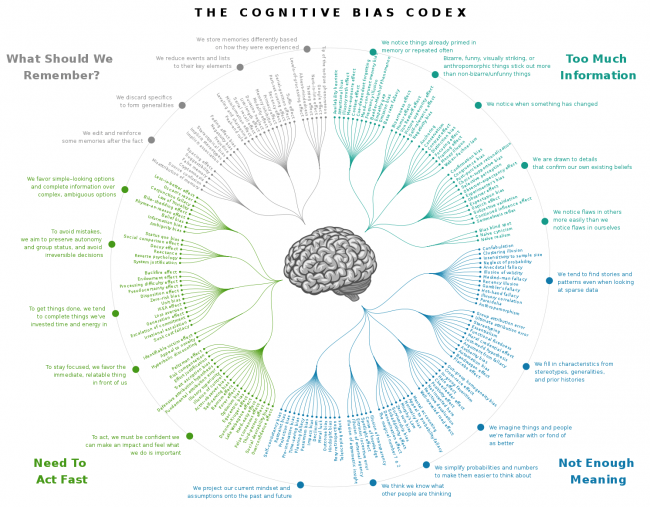
The cognitive bias codex from wikipedia (CC-BY-SA 4.0); if you want to print it out so it's legible and useful, print the original over four letter-sized pages and paste them together (my printout is taped, tellingly perhaps, over my rarely-used TV). The model was developed by John Manoogian III and refined by Buster Benson; the online version includes links by TillmanR to the wikipedia articles explaining each bias.
The adjective provenance refers to the source of something, where it came from. So provenance bias refers to the human propensity to prejudge something based on where it came from — who said it, who wrote it, who reported it, or what its source was.
It's an important concept, I think. Related to our tendency to believe what we want to believe, this bias somewhat explains the behaviour of cults and religious extremist groups, our resistance to exposing ourselves to new ideas and perspectives, our aversion to complexity, and our intolerance of difference, uncertainty and ambiguity.
Our brains are designed to (over-)simplify non-essential considerations to leave more room for issues that require more nuanced and complicated assessments. We see this in our immediate dismissal of the arguments of op-ed writers we almost always disagree with, and our refusal to even read or listen to the arguments of those we've learned, or been conditioned, to distrust — be that Vladimir Putin, Tucker Carlson, Trumpenyahu, your own personally loathed public figure, or someone in your personal life you have learned, or been conditioned by others, to distrust.
In an age of epidemic distrust and a firehose of information, this bias can easily become entrenched and over-relied upon to filter what's true and important from mere lies, propaganda, and other falsehoods. The result can easily be an echo chamber where important, new, and challenging information, ideas, and perspectives can get indefinitely ignored, to our peril. If we don't think we'll like the message, this bias can create or reinforce a pathology of denial that will prevent us from really understanding what's going on, and what needs to be done.
And what is most astonishing about this important bias is that it doesn't exist in literature or studies of biases.
How did I find it then? I asked a chatbot for some information, and in its response, it coined the term, because it was the only succinct way to label this important cognitive propensity. When I first read it, I searched everywhere for the origin of the phrase, or an equivalent phrase, and articles about it. Nothing. The phrase only appears in a few arcane applications related to geology and data parsing. The bot even admitted to having made up the term because it seemed the most appropriate way to summarize the subject. Pretty ironic, I think, given that one of our newest and fiercest provenance biases is against anything that comes from AI. Admit it — when you started to read this paragraph, didn't you immediately raise your eyebrows at me crediting an AI bot for naming an important human bias?
But surely the Cognitive Bias Codex must have some equivalent or near-equivalent biases indexed among its 188 biases? Actually, no. I searched through the whole codex, including searching for synonymous terms or concepts, and came up empty. Pretty funny that the authors of a cognitive bias index seem to have a cognitive bias against including such a concept.
I think this bias is important far beyond how we employ it (or fall victim to it) in assessing 'news' and the credibility of assertions by our immediate circles. The entire advertising and PR industry employs it in trying to coerce us into buying whatever it is selling. It will use terms like "natural-source" or "made by hand" or "esteemed/respected" to exploit our distrust of anything otherwise 'sourced'.
And now many of us are scrambling to find ways to incontrovertibly 'prove' that AI did not produce, influence or otherwise 'taint' everything we produce, lest our baby be thrown out with the proverbial bathwater. And this is going to get worse before it gets better, as the Epstein Class discovers that, just like the slightest hint of alleged sexual impropriety has sabotaged entire political and other public careers, this two-letter acronym can be used to quickly poison anything and cause potential readers/listeners to delete it without reading or listening to it at all.
The most important thing of all about this bias, I think, is our unawareness of when, why and how we fall victim to it. When I first watched the interviews that Tucker Carlson did with Putin, I was astonished that he let the man talk without baiting or berating him (for which he was of course labelled a Putin apologist). Because I had a sense (from news bites and clips) that Tucker is not very bright, and tends to have hyperbolic views and embrace conspiracy theories, my provenance bias was to assume he was an incompetent interviewer and incapable of listening. I still find him pretty tedious and uneven, but when he recently revealed the leaked Trump plans to send Israel its largest-ever shipment of bombs right after the mid-terms, not only did I pay attention, but I think he has performed an important public service that the rest of the media are too complacent or cowardly to talk about (because both US political parties and their corporate owners support the massively unpopular ongoing US-Israeli genocide and the war in Iran).
So now I'm trying, before unconsciously dismissing information, ideas and perspectives because of their source, to at least be aware of my own provenance bias. Because it's largely unconscious, this is hard to do. But then that's how all our cognitive biases become entrenched. Many of the current and historical disasters and atrocities that our species is responsible for, I think, were largely enabled because we didn't listen to the warnings and the facts, because we were predisposed to deny or disagree with them simply because of their source.


