
Formula 1 has been receiving star treatment from Apple for awhile, and now the racing series will literally be getting even bigger. Apple is partnering with IMAX to show five races from the 2026 season. The Miami Grand Prix on May 3, the Monaco Grand Prix on June 7, the British Grand Prix on July 5, the Italian Grand Prix on September 6 and the United States Grand Prix on October 25 will be aired live at select IMAX theaters in the US.
Apple landed a five-year deal for the US broadcast rights to Formula 1 last fall and there's already a dedicated channel for the car races on Apple TV ahead of the season's start. It also got the rights for a splashy feature film about the racing league, which amassed more than $630 million at the global box office, including with some IMAX screenings. It's unclear if IMAX will be paying to host more live F1 races at its theaters in future years, but it should be a fun way for fans to get the most immersive experience possible short of actually attending the racetrack.
This article originally appeared on Engadget at https://www.engadget.com/entertainment/apple-inks-deal-for-imax-screenings-of-live-formula-1-races-234003582.html?src=rssMeta is formally sectioning off Horizon Worlds, the closest thing it has to a metaverse, from its Quest VR platform, according to a new blog post from Samantha Ryan, Meta's VP of Content, Reality Labs. While the decision runs counter to Meta's original plan to own an immersive virtual world that could serve as the future home for all online interaction, it fits with the recent cuts it made to its costly Reality Labs division, and Mark Zuckerberg's public commitment to focus the company on AI hardware like smart glasses going forward.
"We're explicitly separating our Quest VR platform from our Worlds platform in order to create more space for both products to grow," Ryan writes in the blog post. "We're doubling down on the VR developer ecosystem while shifting the focus of Worlds to be almost exclusively mobile. By breaking things down into two distinct platforms, we'll be better able to clearly focus on each."
Meta has been developing mobile and web versions of Horizon Worlds in parallel with its VR app since at least 2023. Switching Worlds to being a mobile-first software platform isn't good for VR diehards, but it does make it a more natural competitor to something like Roblox or Fortnite, which also offer user-created and monetizable worlds and games. It's also a business Meta believes it can more easily scale because of its ability to connect games to "billions of people on the world's biggest social networks."
While Meta shuttered several of its own VR game studios earlier this year, it still wants to support third-party developers publishing games on its platform. The company says new monetization tools, better discoverability, a "Deals" tab and more ways for developers to talk to their customers should help make a difference. Maintaining the Quest's library of games could also be critical going forward. Business Insider reported in December 2025 that Meta was working on a gaming-focused Quest headset, and Meta CTO Andrew Bosworth confirmed earlier this February that the company still had multiple Quest devices on its roadmap.
This article originally appeared on Engadget at https://www.engadget.com/ar-vr/metas-metaverse-is-going-mobile-first-233030532.html?src=rssSlay the Spire 2 will launch in early access next month. This sequel to the hugely popular 2019 roguelike deckbuilder hits early access on Steam beginning March 5, 2026. Along with releasing the teaser trailer above, developer Mega Crit shared some details about its goals for this phase ahead of the game's official release.
"Slay the Spire requires a lot of player feedback so we can balance content, add quality of life features, and make sure the game runs without issues," the developers explained. "Early Access is also a chance for us to test experimental features, try exotic designs, identify niche problems, and helps us make sure the game is headed in the right direction." Slay the Spire 2 is expected to be in early access for a year or two, or more generally "until the game feels great."
Mega Crit has also revealed that it will be introducing a new co-op mode where up to four people can team up. This gameplay option will feature some unique cards just for multiplayer as well as some team-wide synergies.
Some of the characters from Slay the Spire will be returning for the sequel alongside new ones. For anyone who hasn't yet experienced the original game, Slay the Spire is available on iOS, including as part of Apple Arcade. It's also on consoles and PC.
This article originally appeared on Engadget at https://www.engadget.com/gaming/slay-the-spire-2-will-enter-early-access-on-march-5-210338514.html?src=rssSony is closing Bluepoint Games, the studio behind the Shadow of the Colossus and Demon's Souls remakes, Bloomberg reports. Bluepoint's last major project was God of War: Ragnarok from 2022, which it co-developed with Sony Santa Monica.
According to Bloomberg, Sony decided to shut down the studio following "a recent business review." Around 70 employees will lose their jobs as part of the studio closure, which will officially happen in March. "Bluepoint Games is an incredibly talented team and their technical expertise has delivered exceptional experiences for the PlayStation community," Sony said in a statement to Bloomberg. "We thank them for their passion, creativity and craftmanship."
Following their work on Ragnarok, Bluepoint was reportedly tasked with developing a live-service game set in the God of War universe. That title was cancelled in 2025, alongside another game from Bend Studio. In the context of Sony's other live-service failures, the decision wasn't surprising. Sony shut down the servers for multiplayer shooter Concord just two weeks after its release. Not long after, it also closed Firewalk Studios, the developer behind the game.
Bluepoint Games was originally acquired by Sony in 2021, when it seemed like the studio's expertise in remaking and remastering classic PlayStation games could be a major asset going forward. Why that changed isn't entirely clear, but Sony's mismanagement of its pivot into and out of publishing premium online multiplayer games may have played a role. Some of Sony's studios are still experimenting with live-service mechanics. Guerilla Games recently announced an online co-op game set in its Horizon universe. Destiny 2 developer Bungie is also releasing its extraction shooter Marathon in March.
This article originally appeared on Engadget at https://www.engadget.com/gaming/playstation/sony-is-shutting-down-the-studio-behind-the-demons-souls-remake-195234213.html?src=rssMeta is shutting down the standalone Messenger website, according to a company help page. The website will disappear in April, though web users will still be able to send and receive messages within Facebook.
"After messenger.com goes away, you will be automatically redirected to use facebook.com/messages for messaging on a computer," the help page reads. "You can continue your conversations there or on the Messenger mobile app."
Users will be able to restore their chat history after switching to the app by entering a PIN number. This is the same PIN that was used to initially create a backup on Messenger. It can be reset for those who simply don't have the bandwidth to remember yet another six-digit code.
Many users have expressed discontent over the decision to shut down the standalone website, according to a report by TechCrunch. This is particularly true for those who have deactivated their Facebook accounts but continued to use Messenger.
This comes just a few months after Meta shut down Messenger's standalone desktop apps. At that time, Meta directed existing users to Facebook to continue using the service and not the dedicated Messenger website. In other words, the writing has likely been on the wall since October.
Messenger has had a long and storied history. The platform first launched as Facebook Chat all the way back in 2008. Facebook Messenger became a standalone app in 2011. The company has long-tried to make Messenger a thing outside of Facebook. It removed messaging capabilities from the main Facebook app in 2014 and began directing users to the Messenger app. Meta began reintegrating Messenger back into the Facebook app in 2023 and now here we are.
This article originally appeared on Engadget at https://www.engadget.com/apps/meta-is-shuttering-messengers-standalone-website-which-is-a-thing-that-exists-191808134.html?src=rssToy Fair 2026 just wrapped earlier this week and while I would have liked to spend even more time there, I have my own kids (and all their toys and trinkets) to look after. That said, there were a ton of cool new products on display at the Javits Center in New York City that set the stage for the rest of the year, so here's a quick look at some of the most interesting releases from the largest toy show in the Western Hemisphere.
Transformers: The Movie 40th anniversary figures ($28 to $60)To celebrate the 40th anniversary of Transformers: The Movie, Hasbro is launching an apology tour to make up for traumatizing theatergoers with the death of the most beloved Autobot back in 1986. To kick things off, Hasbro is releasing a handful of new figures alongside re-releases for some popular bots including Astrotrain, Skywarp, Snarl and Shockwave. I want to give a special shout-out to the model for Kranix, which looks incredibly accurate, as if he just leapt off the movie screen. And even though his duck-billed spaceship alt-mode might look a bit awkward, I wouldn't have it any other way.
The crown jewel of the line might be a near-life-size version of The Matrix of Leadership, which measures more than 15 inches wide and even plays Stan Bush's iconic song "The Touch" with the push of a button. Unfortunately, the appeal of the Matrix is so powerful that it's already sold out, including at third-party retailers like Big Bad Toy Store, which thankfully is still taking pre-orders for the rest of the lineup after the initial stock from Hasbro dried up.
F1 Hot Wheels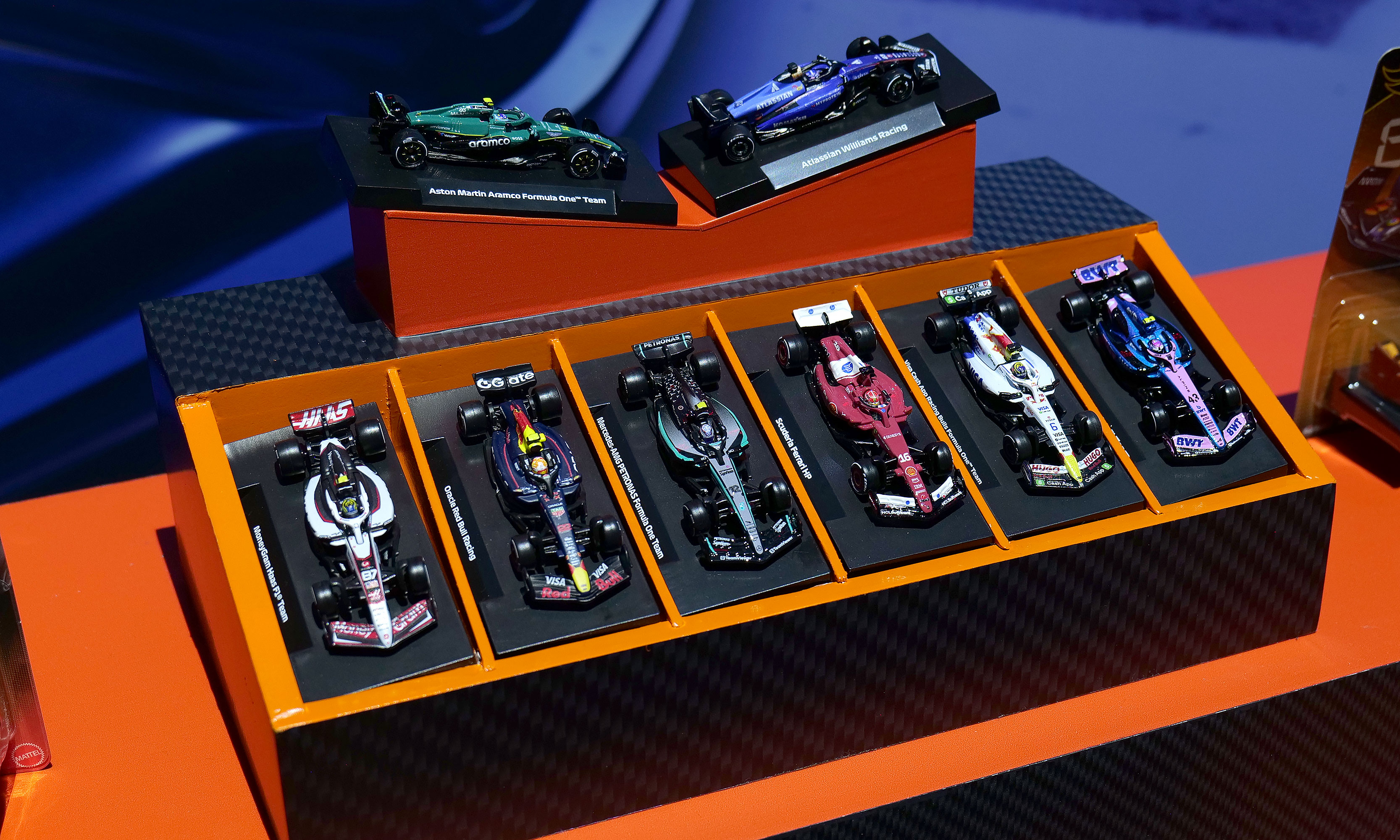 A collection of some of the new F1 Hot Wheels cars for 2026. Sam Rutherford for Engadget
Hot Wheels has big plans for 2026 including a new line of Pantone-colored cars, Brick Shop models like the Elite Series Aston Martin (which comes with its own 1:64 scale car) and a Monster Truck Mutant Chaos set with actual slime. However, I'd argue the company's new F1 offerings are the cream of the crop. Not only are there a bunch of incredibly detailed 1:64 scale racecars with metal bodies, real rubber tires and accurate livery for all the big teams, there's also a new Downhill Circuit Race course that comes with three official vehicles (Mercedes, Haas and Ferrari) featuring multiple levels and the ability to overtake or crash into other cars. If you're like a lot of Americans who have recently fallen down the F1 rabbit hole due to Netflix's Drive to Survive, these new officially licensed miniatures are sure to hit the spot.
The first five-pack set of cars is available now, with more arriving later this spring before the Downhill Circuit Race course drives by sometime this fall.
Lego Star Wars with Smart Bricks ($40 to $160) Darth Vader's TIE fighter is an all-in-one set, which means it comes included with one of Lego's Smart Bricks, which isn't true for every kit. Lego
We've been eagerly awaiting the first batch of playsets featuring Lego's nifty Smart Brick after it debuted at CES. But now that the company has detailed eight new sets featuring its latest innovation, we're even more intrigued. For me, the three standout kits are the Millennium Falcon, Luke's Red Five X-Wing and Darth Vader's TIE fighter because acting out the Death Star trench run complete with reactive lights and sounds will never get old. I also have a soft spot for the Ewok minifigs that come with the AT-ST set. Alternatively, the Mos Eisley Cantina kit seems like a great way to highlight the smart brick's ability to play music or kick out some rowdy droids. The one thing to look out for, though, is the tag on the set that says whether it's Smart Play compatible or if it's an all-in-one set, because the former will need Smart Bricks from other kits to deliver Lego's newfound interactivity.
Pre-orders for these are live now, with sets slated to ship on March 1.
All the new K-pop Demon Hunters toys The HUNTR/X Battle Rumi Deluxe Fashion Doll (right) might be my favorite of the bunch. Sam Rutherford for Engadget
Rumi, Mira and Zoey may have been the biggest breakout stars of 2025 and Mattel is looking to keep that momentum going with a ton of new toys and figures for everyone's favorite demon hunters. There are three new singing dolls that can belt out the trio's hit "Golden" at the touch of a button and a deluxe figure of Rumi complete with her Four Tiger Sword. There are also a ton of other dolls and miniatures showcasing HUNTR/X, the Saja Boys and more. The one downside is that these products aren't coming out until the fall, so you'll have to tide yourself over with other K-pop-themed products for now.
Hatchin' Yoshi ($50) If Rosalina isn't careful, Yoshi will become the biggest draw of the new Mario movie. Spin Masters
Yoshi seems poised to steal the spotlight from Rosalina in the upcoming Super Mario Galaxy Movie and this release from Spin Masters is only reinforcing the lovable green dino's aura. From inside his shell, Yoshi can burst out with his signature yell. After that, you can pat his nose to make his eyes light up or get him to rock when he's really happy. But if you want one, you're going to have to be vigilant. Pre-orders are already sold out, so you'll need to keep a close eye on retailers like Walmart when he officially goes on sale on February 20.
Thames and Kosmos SolarFlowers Not only do the SolarFlowers look great, they're educational too. Thames & Kosmos
Technically, these went on sale last month, but Thames & Kosmos' SolarFlowers caught my eye again at Toy Fair due to their combination of art and science. Available in four different styles, each kit features a model that you can build yourself or with your kids (recommended age 8+) that turns into a lasting showpiece. After putting the kinetic sculpture together, you can connect the included solar panel to bring the whole kit to life (no batteries required) and make the flowers spin for perpetual entertainment.
Honorable mentionsUpcoming Masters of the Universe figures Some upcoming figures from Mattel's line of Masters of the Universe figures. Sam Rutherford for Engadget
As someone who grew up during the 80s and 90s, I'm trying to be optimistic about He-Man's return to the big screen later this summer and Mattel's new line of figures is certainly helping. To help prime people for the movie, there's a big range of upcoming toys highlighting He-Man, Skeletor, Battle Cat and more, all of which I would have absolutely loved as a kid. Those will be available later this spring.
Fisher-Price Super Mario Little People collection Just look how cute these are. Sam Rutherford for Engadget
It's hard to gauge the excitement of toys aimed at one-year-olds when they can't read or get into Toy Fair. But as the parent of a toddler, I adore the partnership between Fisher-Price and Nintendo that has resulted in a line of Mario-themed Little People. All the big names are here, including Peach, Luigi and Bowser and there's even a couple of super cute playsets to go with them. But perhaps the best part is that a six-pack of figures and Bower's Airship costs under $25, which means your kid could be in for hours of fun without you spending a ton of money.
This article originally appeared on Engadget at https://www.engadget.com/entertainment/here-are-my-favorite-things-from-toy-fair-2026-183356720.html?src=rssRing CEO Jamie Siminoff has indicated that the company's controversial Search Party feature might not always be just for lost dogs, according to emails obtained by 404 Media. A creepy surveillance tool being used to surveil. Who could have predicted that?
"I believe that the foundation we created with Search Party, first for finding dogs, will end up becoming one of the most important pieces of tech and innovation to truly unlock the impact of our mission," Siminoff wrote in an email to staffers. "You can now see a future where we are able to zero out crime in neighborhoods. So many things to do to get there but for the first time ever we have the chance to fully complete what we started."
The Ring<->Flock partnership is even worse than imagined, it was setup to be a AI powered mass surveillance system from the start. See this email from the Ring Founder, Jamie Siminoff (https://t.co/kLbZdR6Is1) pic.twitter.com/W9TFQpriRh
— Maricopa County Libertarian Party (@LPMaricopa) February 18, 2026
The words "zero out crime in neighborhoods" are particularly troubling. It is, however, worth noting that this is just an email and doesn't necessarily indicate a plan by the company. Siminoff wrote the email back in October when Search Party first launched, which was months before the public backlash started. He did end the thread by noting he couldn't "wait to show everyone else all the exciting things we are building over the years to come."
One of those things could be the recently-launched "Familiar Faces" tool, which uses facial recognition to identify people that wander into the frame of a Ring camera. It seems to me that a combination of the Search Party tech, which uses the combined might of connected Ring cameras, with the Familiar Faces tech could make for a very powerful surveillance tool that excels at finding specific individuals.
Siminoff also suggested in an earlier email to staffers that Ring technology could have been used to catch Charlie Kirk's killer by leveraging the company's Community Requests feature. This is a tool that allows cops to ask camera owners for footage, thanks to a partnership with the police tech company Axon.
Here's that Ring #SuperBowl commercial: pic.twitter.com/1gAxIJATdz
— philip lewis (@Phil_Lewis_) February 9, 2026
Ring had planned an expansion of this program via a partnership with a surveillance company called Flock Safety. The companies canceled this partnership after a Super Bowl ad spotlighting the Search Party tool triggered public outcry. Ring didn't cite public sentiment for this decision, rather saying the integration would require "significantly more time and resources than anticipated."
Ring has responded to 404 Media's reporting, saying in an email that Search Party "does not process human biometrics or track people" and that "sharing has always been the camera owner's choice." This response did not provide any information as to what the future will hold for the company's toolset.
The organization has been friendly with law enforcement since inception. "Our mission to reduce crime in neighborhoods has been at the core of everything we do at Ring," founding chief Jamie Siminoff said when Amazon bought the company for $839 million back in 2018.
This article originally appeared on Engadget at https://www.engadget.com/big-tech/ring-could-be-planning-to-expand-search-party-feature-beyond-dogs-175805706.html?src=rssYouTube's "Ask" button is making its way to the living room. The Gemini-powered feature is now rolling out as an experiment on smart TVs, gaming consoles and streaming devices. 9to5Google first spotted a Google support page announcing the change.
Like on mobile devices and desktop, the feature is essentially a Gemini chatbot trained on each video's content. Selecting that "Ask" button will bring up a series of canned prompts related to the content. Alternatively, you can use your microphone to ask questions about it in your own words.
 The "Ask about this video" feature on desktopYouTube
Google says your TV remote's microphone button (if it has one) will also activate the "Ask" feature. The company listed sample questions in its announcement, such as "what ingredients are they using for this recipe?" and "what's the story behind this song's lyrics?"
The conversational AI tool is only launching for "a small group of users" at first. Google promises that it will "keep everyone up to speed on any future expansions."
This article originally appeared on Engadget at https://www.engadget.com/ai/youtube-is-bringing-the-gemini-powered-ask-button-to-tvs-173900295.html?src=rssRivian suggests that vehicle owners can leave their phone at home (or perhaps in a glove box) and instead control some aspects of their EV using a new Apple Watch app. With a tap of your watch, you can unlock and lock the doors, sound the alarm and vent the windows. After the digital key is set up, R1S and R1T Gen 2 owners can unlock their vehicle automatically simply by walking up to it thanks to the passive car key feature.
It's possible to set the cabin temperature and a target state of charge by turning the digital crown on an Apple Watch. You also can choose four quick controls to put front and center in the app and add a battery status indicator to your watch face if you so wish. Rivian says it will update its Apple Watch app with new features in the future.
Rivian first enabled digital car key support on Apple, Google Pixel and Samsung devices back in December. Apple started supporting digital car keys on iPhone and Apple Watch in 2020 and a boatload of automakers have adopted the tech.
This article originally appeared on Engadget at https://www.engadget.com/transportation/evs/rivian-rolls-out-an-apple-watch-app-with-vehicle-controls-and-digital-key-support-172642545.html?src=rssAt the start of the month, Elon Musk announced that two of his companies — SpaceX and xAI — were merging, and would jointly launch a constellation of 1 million satellites to operate as orbital data centers. Musk's reputation might suggest otherwise, but according to experts, such a plan isn't a complete fantasy. However, if executed at the scale suggested, some of them believe it would have devastating effects on the environment and the sustainability of low Earth Earth orbit.
Musk and others argue that putting data centers in space is practical given how much more efficient solar panels are away from Earth's atmosphere. In space, there are no clouds or weather events to obscure the sun, and in the correct orbit, solar panels can collect sunlight through much of the day. In combination with declining rocket launch costs and the price of powering AI data centers on Earth, Musk has said that within three years space will be the cheapest way to generate AI compute power.
Ahead of the billionaire's announcement, SpaceX filed an eight-page application with the Federal Communications Commission detailing his plan. The company hopes to deposit the satellites in this massive cluster in altitudes ranging between 500km and 2000km. They would communicate with one another and SpaceX's Starlink constellation using laser "optical links." Those Starlink satellites would then transmit inference requests to and from Earth. To power the entire effort, SpaceX has proposed putting the new constellation in sun-synchronous orbit, meaning the spacecraft would fly along the dividing line that separates the day and night sides of the planet.
What a data center would endure in orbitAlmost immediately the plan was greeted with skepticism. How would SpaceX, for instance, cool millions of GPUs in space? At first glance, that might seem like a weird point to get hung up on — much of space being around -450 Fahrenheit — but the reality is more complicated. In the near vacuum of space, the only way to dissipate heat is to slowly radiate it out, and in direct sunlight, objects can easily overheat. As one commenter on Hacker News succinctly put it, "a satellite is, if nothing else, a fantastic thermos."
Scott Manley, who, before he created one of the most popular space-focused channels on YouTube, was a software engineer and studied computational physics and astronomy, argues SpaceX has already solved that problem at a smaller scale with Starlink. He points to the company's latest V3 model, which has about 30 square meters of solar panels. "They have a bunch of electronics in the middle, which are taking that power and doing stuff with it. Now, some of that power is being beamed away as radio waves, but there's a lot of thermal power that's being generated and then having to be dissipated. So they already have a platform that's running electronics off of power, and so it's not a massive leap to turn into something doing compute."
The larger V3 @Starlink satellites that will deploy from Starship will bring gigabit connectivity to users and are designed to add 60 Tera-bits-per-second of downlink capacity to the Starlink network.
— SpaceX (@SpaceX) October 13, 2025
That's more than 20 times the capacity added with every V2 Mini launch on… pic.twitter.com/N0Vl9psbm3
Kevin Hicks, a former NASA systems engineer who worked on the Curiosity rover mission, is more skeptical. "Satellites with the primary goal of processing large amounts of compute requests would generate more heat than pretty much any other type of satellite," he said. "Cooling them is another aspect of the design which is theoretically possible but would require a ton of extra work and complexity, and I have doubts about the durability of such a cooling system."
What about radiation then? There's a reason NASA relies on ancient hardware like the PowerPC 750 CPU found inside the Perseverance rover: Older chips feature larger transistors, making them more resilient to bit flips — errors in processing caused most often by cosmic radiation — that might scramble a computation. "Binary ones and zeroes are about the presence or absence of electrons, and the amount of charge required to represent a 'one' goes down as the transistors get smaller and smaller," explains Benjamin Lee, professor of computer and information science at the University of Pennsylvania. Space is full of energized particles traveling at incredible velocities, and the latest GPUs are built on the smallest, most advanced processing nodes to create transistor-dense silicon. Not a great combination.
"My concern about radiation is that we don't know how many bit flips will occur when you deploy the most advanced chips and hundreds of gigabytes of memory up there," said Professor Lee, pointing to preliminary research by Google on the subject. As part of Project Suncatcher, its own effort to explore the viability of space-based data centers, the company put one of its Trillium TPUs in front of a proton beam to bombard it with radiation. It found the silicon was "surprisingly radiation-hard for space applications."
While those results were promising, Professor Lee points out we just don't know how resilient GPUs are to radiation at this scale. "Even though modern computer architectures can detect and sometimes correct for those errors, having to do that again and again will slow down or add overhead to space-based computation," he said.
Space engineer Andrew McCalip, who's done a deep dive on the economics of orbital data centers, is more optimistic, pointing to the natural resilience of AI models. "They don't require 100 percent perfect error-free runs. They're inherently very noisy, very stochastic," he explains, adding that part of the training for modern AI systems involves "injecting random noise into different layers."
Even if SpaceX could harden its GPUs against radiation, the company would still lose satellites to GPUs that break down. If you know anything about data centers here on Earth, it's that they require constant maintenance. Components like SSDs and GPUs die all the time. Musk has claimed SpaceX's AI satellites would require "little" in the way of operating or maintenance costs. That's only true if you accept the narrowest possible interpretation of what maintaining a fleet of AI satellites would entail.
"I think that there's no case in which repair makes sense. It's a fly till you die scenario," says McCalip. From an economic perspective, McCalip argues the projected death rate of GPUs in space represents "one of the biggest uncertainties" of the orbital data center model. McCalip's put that number at nine percent on the basis of a study Meta published following the release of its Llama 3 model (which, incidentally, measured hardware failures on Earth.) But the reality is no one knows what the attrition rate of those chips will be until they're in space.
Orbital data centers also likely wouldn't be a direct replacement for their terrestrial counterparts. SpaceX's application specifically mentions inference as the primary use case for its new constellation. Inference is the practical side of running an AI system. It sees a model apply its learning to data it hasn't seen before, like a prompt you write in ChatGPT, to make predictions and generate content. In other words, AI models would still need to be trained on Earth, and it's not clear that the process could be offloaded to a constellation of satellites. "My initial thinking is that computations that require a lot of coordination, like AI training, may end up being tricky to get right at scale up there," says Professor Lee.
Kessler syndromeIn 1978, a pair of NASA scientists proposed a scenario where low Earth orbit could become so dense with space junk that collisions between those objects would begin to cascade. That scenario is known as Kessler syndrome.
One estimate from satellite tracking website Orbiting Now puts the number of objects in orbit around the planet at approximately 15,600. Another estimate from NASA suggests there are 45,000 human-made objects orbiting Earth. No matter the number, what's currently in space represents a fraction of the 1 million additional satellites Musk wants to launch.
According to Aaron Boley, professor of physics and astronomy at the University of British Columbia and co-director of the Outer Space Institute, forward-looking modeling of Earth's orbit above 700 kilometers — where part of SpaceX's proposed cluster would live — suggests that area of space is already showing signs of Kessler syndrome.
While it takes less time for debris to clear in low Earth orbit, Professor Boley says there's already enough material in that region of space where there could be a cascading effect from a major collision. Debris could, in a worst case scenario, take a decade to clear up. In turn, that could lead to disruptions in global communications, climate monitoring missions and more.
"You could get to the point where you're just launching material in, and you could ask yourself how many satellites can I afford to lose? Can you reconstitute your constellation faster than you're losing parts of it because of debris?" says Boley. "That's a horrible future in terms of the environmental perspective" In particular, it would limit opportunities for humans to fly into low Earth orbit. "Could you operate in it? Yeah, but it would come with higher and higher costs," adds Boley.
"The entire world is struggling with the problem of how we safely fly multiple mega constellations," says Richard DalBello, who previously ran the Traffic Coordination System for Space (TraCSS) at the US Department of Commerce. Right now, there is no common global space situational awareness (SSA) system, and government and satellite operators are using uncoordinated national and commercial systems that are likely producing different results. At the start of the year, SpaceX lowered the orbit of thousands of Starlink satellites after one of them nearly collided with a Chinese satellite.
SpaceX has its own in-house SSA system called Stargaze, which it uses to fly its more than 7,000 Starlink satellites. According to DalBello, competing operators can receive SSA data from SpaceX, but to do so they must share their satellite position information. "Assuming data sharing, it is likely Stargaze can make an important contribution to spaceflight safety" says DalBello. "SpaceX is likely to have success with US and other commercial operators, but without the assistance of the federal government, other governments — particularly China — will likely be unwilling to share their satellite and SSA data."
According to DalBello, the Biden administration was unable to make meaningful progress on the next-generation TraCSS system, in part because Congress was initially reluctant to fund the program. Meanwhile, the current Trump administration hasn't shown interest in advancing the work that began during the president's first term.
Even if the regulatory situation suddenly changes and the world's governments agree on an international SSA system, SpaceX launching 1 million satellites along the day-night terminator would see the company effectively monopolize one of the Earth's most valuable and important orbits. Professor Boley argues we should view our planet's orbits as a resource that belongs to everyone. "Every time you put a satellite up, you use part of that resource. Now someone else can't use it."
And as Hicks points out, even a single cascade of colliding satellites would prevent that space from being used for scientific endeavors. "You would have to wait years for that debris to slowly come back into the atmosphere and burn up. In the meantime, that debris is taking up space that could be used for climate monitoring missions or any other types of missions that governments want to launch."
A blow to the atmosphereSeparately, the constant churn of Starship launches and re-entry of dead satellites would have a potentially dire impact on our planet's atmosphere. "We're not prepared for it," Boley flatly says of the latter. "We're not prepared for what's happening now, and what's happening now is already potentially bad."
According to Musk's "basic math," SpaceX could add 100 gigawatts of AI compute capacity annually by launching a million tons of satellite per year. McCalip estimates a 100-gigawatt buildout alone would necessitate about 25,000 Starship flights.
Many of the metals found in satellites, including aluminum, magnesium and lithium, in combination with the exhaust rockets release into the atmosphere, can have complicated effects on the health of the planet. For instance, they can affect polar cloud formations, which in turn can facilitate ozone layer destruction through the chemical reactions that occur on their surfaces. According to Boley, the problem is we just don't know how severe those environmental factors could become at the scale Musk has proposed, and SpaceX has provided us with precious few details on its mitigation plans. All it has said is that its plan would "achieve transformative cost and energy efficiency while significantly reducing the environmental impact associated with terrestrial data centers."
Even if SpaceX could and does go out its way to mitigate the atmospheric effects of constant rocket flights, those spacecraft still need to be manufactured here on Earth. At one of his previous roles, Hicks studied rocket emissions and found the supply chains needed to build them produce an "order of magnitude" more carbon emissions than the rockets themselves.
SpaceX plans to fly its new satellites in a sun-synchronous orbit, meaning for much of the year, they'll be sunlit. Each new Starlink generation has been larger and heavier than the one before it, with SpaceX stating in a recent filing that its upcoming V3 model could weigh up to 2,000 kilograms, up from the 575 kilograms of the V2 Mini Optimized. While we don't know the exact dimensions of the company's still-hypothetical AI satellites, they will almost certainly be bigger than their Starlink counterparts.
SpaceX has done more than most space operators to reduce the brightness of its satellites, but Professor Boley says he expects that this new constellation will be "strikingly bright" when moving through the night sky. In aggregate, he estimates they will almost certainly be harmful to scientific research here on Earth, limiting what terrestrial observatories can see.
"You're going to see them with the naked eye. You're going to see them with cameras. It's going to be like living near an airport where you see all these things flying over just after sunset and the next couple of hours after sunset," says Manley. "I don't know if I want to have my entire sunset be just a band of satellites constantly shooting overhead."
There are good reasons to make some spacecraft capable of doing AI inference. For instance, Professor Lee suggests it would make orbital imaging satellites more useful, as those spacecraft could do on-site analysis, instead of sending high-resolution files over long distances, saving time in the process. But the dose, as they say, makes the poison.
"There's a lot of excitement about the many possibilities that can be brought to society and humanity through continued access to space, but the promise of prosperity is not permission to be reckless," he says. "At this moment, we're allowing that excitement to overtake that more measured progression [...] those impacts don't just impact outer space but Earth as well."
This article originally appeared on Engadget at https://www.engadget.com/ai/orbital-ai-data-centers-could-work-but-they-might-ruin-earth-in-the-process-170000099.html?src=rssThe office of the Attorney General for West Virginia announced Thursday that it has filed a lawsuit against Apple alleging that the company had "knowingly" allowed its iCloud platform "to be used as a vehicle for distributing and storing child sexual abuse material." The state alleges this went on for years but drew no action from the tech giant "under the guise of user privacy."
In the lawsuit, the state repeatedly cites a text from Apple executive Eric Friedman, in which he calls iCloud "the greatest platform for distributing child porn" in a conversation with another Apple executive. These messages were first uncovered by The Verge in 2021 within discovery documents for the Epic Games v. Apple trial. In the conversation, Friedman says while some other platforms prioritize safety over privacy, Apple's priorities "are the inverse."
The state further alleges that detection technology to help root out and report CSAM exists, but that Apple chooses not to implement it. Apple indeed considered scanning iCloud Photos for CSAM in 2021, but abandoned these plans after pushback stemming from privacy concerns.
In 2024 Apple was sued by a group of over 2,500 victims of child sexual abuse, citing nearly identical claims and alleging that Apple's failure to implement these features led to the victims' harm as images of them circulated through the company's servers. At the time Apple told Engadget, "child sexual abuse material is abhorrent and we are committed to fighting the ways predators put children at risk. We are urgently and actively innovating to combat these crimes without compromising the security and privacy of all our users."
The case in West Virginia would mark the first time a governmental body is bringing such an action against the iPhone maker. The state says it is seeking injunctive relief that would compel Apple to implement effective CSAM detection measures as well as damages. We have reached out to Apple for comment on the suit and will update if we hear back.
This article originally appeared on Engadget at https://www.engadget.com/big-tech/west-virginia-is-suing-apple-alleging-negligence-over-csam-materials-164647648.html?src=rssLast year's Xenoblade Chronicles X: Definitive Edition was significant for a few reasons. It was the final major first-party Switch game ahead of the Switch 2's arrival in June, and the last doomed Wii U game to be granted a second life on Nintendo's infinitely more successful console. Nearly a year on, a Switch 2 update for one of the most technically impressive games Nintendo has ever published has finally arrived.
Somewhat hilariously titled Xenoblade Chronicles X: Definitive Edition - Nintendo Switch 2 Edition (you get the feeling Nintendo has started a naming convention it may come to regret here), the updated version of Monolith Soft's sprawling sci-fi RPG now supports up to 60fps performance and 4K resolution when docked to a TV.
The sprawling alien world of planet Mira, now enhanced on #NintendoSwitch2 with improved frame rates and up to 4K resolution in TV mode!
— Nintendo of America (@NintendoAmerica) February 19, 2026
Join the fight for survival in #XenobladeChroniclesX: Definitive Edition - Nintendo Switch 2 Edition, available now! pic.twitter.com/raA1XhIimC
As impressive as the Switch remake of the 2015 Wii U game was, given the frankly absurd size of its open-world setting, you could almost feel the hardware creaking under its weight every time you booted the game up, so this patch was much-needed. Unfortunately the graphical and performance enhancements aren't free for anyone who already owns the Switch version of Xenoblade Chronicles X: Definitive Edition. A $5 upgrade pack is available on the eShop, and the Switch 2 game costs $65 on its own. A physical version is also arriving on April 16.
Xenoblade Chronicles X: Definitive Edition - Nintendo Switch 2 Edition (again, won't someone please think of us writers) was the last of a number of Xenoblade Chronicles games to make its way to Switch. It's a bit different to the other entries in the series, with its hard sci-fi story, emphasis on side quests and completely seamless open world to explore. Also, stick with the game long enough and you can eventually fly around the entire planet of Mira in a giant mech, which is as fun as it sounds.
Like the other games in the series, Xenoblade Chronicles X is a standalone experience, so don't worry about jumping in if you've never played one before. The series' signature MMO-like hybrid real-time combat system takes a bit of getting used to, but it's part of what makes these games stand out from other RPG series.
The other Xenoblade games in the Switch library, which are Xenoblade Chronicles: Definitive Edition, Xenoblade Chronicles 2 and Xenoblade Chronicles 3, are yet to receive Switch 2 updates, but hopefully they'll arrive eventually too.
This article originally appeared on Engadget at https://www.engadget.com/gaming/nintendo/nintendo-announces-surprise-switch-2-version-of-sci-fi-rpg-xenoblade-chronicles-x-definitive-edition-153121689.html?src=rssA decision to ban Telegram on home soil may have backfired on the Kremlin. Last week, Russia went on a blocking spree, banning a number of Western apps in an effort to push domestic users towards Max, an unencrypted state-owned app. One of the restricted apps was WhatsApp (which was also blocked) rival Telegram, a move that drew rare internal criticism from soldiers and pro-war bloggers, with the army being heavily reliant on the cloud-based messaging service for communications.
As reported by Bloomberg, pro-Russian military channels are now complaining that the sudden Telegram blackout — coupled with Elon Musk cutting Russia's access to Starlink earlier this month — is now actively harming frontline operations. As well as being the messaging app of choice for millions of Russian civilians, soldiers also use Telegram to liaise directly on the battlefield. The government said last week that it was banning Telegram for violating national law, and that the decision was for the "protection of Russian citizens."
Bloomberg was told by senior European diplomats that the double blow of Telegram's sudden unavailability and SpaceX moving to block Russia's use of "unauthorized" Starlink terminals in Ukraine earlier this month has had a significant impact on Russian comms. Starlink's satellite coverage is particularly important for coordinating the Russian military's drone strikes, the frequency of which has seemingly been disrupted in recent weeks, giving Ukrainian forces an advantage.
Whether these developments will have a longer term effect on the tide of the conflict remains to be seen, but a Ukrainian drone operator who calls himself Giovanni has told the BBC that the Russian army has lost "their ability to control the field" in the wake of the Starlink outage. "I think they lost 50% of their capacity for offence," he said. "That's what the numbers show. Fewer assaults, fewer enemy drones, fewer everything."
This article originally appeared on Engadget at https://www.engadget.com/social-media/russias-recent-blocking-of-telegram-is-reportedly-disrupting-its-military-operations-in-ukraine-135250159.html?src=rssMeta is reportedly gearing up to enter another segment of the wearables market. According to The Information, the company is planning to release its first smartwatch sometime this year. Meta has revived its smartwatch initiative internally called "Malibu 2," The Information says, which will come with Meta AI and health tracking.
The same publication reported back in 2021 that Meta was working on a smartwatch powered by an open-source version of Android. Over the next year, more details of its possible features emerged, including reports that it had a detachable camera and that Meta was developing a model with up to three cameras. But in 2022, the company was believed to have put the project on hold to focus on other wearable devices.
The Information says the decision to pause its smartwatch project was made as part of a broader cut in spending in the Reality Labs division. If you'll recall, Meta laid off more than 1,000 employees from Reality Labs in January, because the division was hemorrhaging money. Mark Zuckerberg said during an earnings call after the layoffs started that when it comes to Reality Labs, the company was focusing most of its investment "towards glasses and wearables going forward."
At the moment, Meta's wearable products are comprised of virtual reality headsets and smartglasses. They include the Meta Ray-Bans, which are a hit in the US. Meta reportedly has four augmented reality and mixed-reality glasses in development, but it'll take some time until we see them. Based on previous reports, it pushed back the unveiling of its next mixed reality headset model codenamed "Phoenix" to early 2027.
This article originally appeared on Engadget at https://www.engadget.com/wearables/meta-reportedly-plans-to-release-a-smartwatch-this-year-121247838.html?src=rssPortable Bluetooth speakers have become an easy default for listening away from your desk or living room. They're the kind of tech you grab without thinking, whether you're heading outside, cleaning the house or packing for a weekend away. The best portable options manage to sound bigger than they look, delivering clear audio without weighing down your bag.
Battery life and durability matter just as much as sound quality now. Many modern speakers are built to survive splashes, dust and the occasional drop, while still offering quick pairing and stable connections. Some are designed for solo listening, others are meant to fill a space with music and keep going for hours.
We've tested a wide mix of portable Bluetooth speakers to see which ones are actually worth carrying around. Whether you want something small and simple or a speaker that can anchor a get-together, these are the models that stood out.
Best portable Bluetooth speakers: $200 to $450
Best portable Bluetooth speakers: $450 and higher
Factors to consider in a portable Bluetooth speaker Weather-proofing
IP ratings (Ingress Protection) are the alphanumeric indicators you often see in a product's spec sheet that define water and dust resistance. It's usually a combo of two numbers with the first indicating solid object ingress and the second being water. The former goes from 0 (no protection) to 6 (dustproof). The water-resistance rating goes from 0 (no protection) to 9 (protected against immersion and high pressure jets). When an X is used instead of a number, that means the product wasn't tested for resistance. If it's a waterproof speaker, it may have some innate resistance to solids, but there's no guarantee.
IP67 is a common rating these days indicating highly resistant and potentially rugged speakers often featured in audio products like outdoor speakers. These are safe for quick dunks in the pool or tub and should be more than OK in the rain or in the shower. They're also good options for the beach, playground and other rough environs.
Additionally, speakers with ports and a high rating will often include a tight-fitting cover over the charging or auxiliary ports. If you plan on using the ports, that may limit the product's rated ability to fend off the elements.
When looking for the best portable Bluetooth speaker, consider the IP rating and also how you plan to use your Bluetooth speaker when making your decision. It may be worth splurging on a better sounding model with a lower IP rating if you'll mostly be using it indoors, for instance.
Battery lifeThe focus of this guide is on the best portable speakers, and while "portable" can be a relative term, these devices are generally for people who are likely to find themselves far from a power outlet. These days, around 12 hours of playtime seems to be the baseline but obviously, the more battery life you can get out of a speaker, the better, especially if you plan to listen to podcasts or music on the go.
That said, be careful when looking at battery specs, as they frequently list a maximum runtime ("up to" x amount of hours). This usually means they tested at a low to mid volume. If you like your tunes loud with punchy bass, it can often end up cutting the expected usage time in half or more. Luckily, some manufacturers also list the expected hours of battery life when used at full volume and that transparency is appreciated. Bear in mind, however, that not all of the best Bluetooth speakers use the same charging port. Some support USB-C charging, while others use micro-USB, and some may even come with an adapter for added convenience.
Additionally, if your audio system or mini Bluetooth speaker also happens to have Wi-Fi connectivity, they're usually designed for always-on functionality. Unlike normal Bluetooth speakers that go to sleep after a short period without use, these will usually stay awake (to listen for your commands) and slowly run down the battery. If you're out and about, you'll want to remember to turn these speakers off manually when not in use to maximize battery life.
RangeBluetooth 5 offers better range and more reliable connectivity than its predecessors, making it a great feature to look for in the best Bluetooth speaker. That said, Bluetooth range can still be tricky. Some companies list their product's longest possible range, usually outdoors and in an unobstructed line-of-sight test environment. Other companies stick with a 30-foot range on the spec sheet and leave it at that, even though they may be running Bluetooth 4.x or 5.x. That's likely underselling the speaker's potential, but unpredictable environments can affect range and there's little point in promising the moon only to get complaints.
I've seen signal drop issues when crouching down, with my phone in the front pocket of my jeans, and barely 30 feet away from a speaker inside my apartment. I ran into this issue across several devices regardless of their listed Bluetooth connectivity range.
If you're hosting a patio party and duck inside, it's wise to keep any wireless Bluetooth speakers relatively close by just in case. It's hard to gauge what aspects of any environment may interfere with a Bluetooth signal. In general, take range specs around 100 feet or more as a perfect-world scenario.
LatencyThis is a minor mention for those out there who use a speaker for their computer output, or as a mini Bluetooth soundbar solution for setups like a monitor and streaming box. It's annoying to find that your speaker's latency isn't low enough to avoid lip sync issues. Luckily, it seems that most speakers these days don't often have these problems. Only a handful of the few dozen speakers I tried had persistent, noticeable lip-sync issues. Aside from occasional blips, all of our picks worked well in this regard.
If you plan to frequently use a speaker for video playback, look for devices with the most recent Bluetooth 5 technology and lower latency codecs like aptX. Also make sure the speaker is close to the source device as distance can be a factor. To avoid the issue altogether, though, consider getting one with a wired auxiliary input.
Extra featuresSome speakers don't just play music — they bring the party to life with built-in LED light effects and a full-on light show that syncs to your music. If you love a bit of visual flair with your tunes, it's worth checking out models that offer LED light customization options.
Sound quality also plays a huge role in picking the right speaker. The best Bluetooth speaker should deliver a balanced mix of punchy bass, clear highs and strong vocals. Many models also include customizable sound modes that let you tweak the EQ to better suit different genres — whether you're blasting EDM, listening to a podcast, or just want a more immersive experience that would impress even an audiophile.
If aesthetics matter, many models come in a tiny size that makes them extra portable, with plenty of color options to match your personal style. Whether you want a sleek black speaker or a vibrant eye-catching design, there are plenty of choices to fit your vibe.
Other portable Bluetooth speakers we tested Sonos RoamWhile there's a lot to like about the Sonos Roam, there are plenty of other Bluetooth speakers with more features and better battery life. In our review, we gave the Roam a score of 87, praising it for its good sound quality, durable waterproof design and ability to work well within an existing Sonos speaker ecosystem. But the price is just fine at $180, and we found Bluetooth speakers that offer more at lower price points. Plus, the Roam taps out at 10 hours of battery life, and all of our top picks can run for longer than that on a single charge.
Monoprice Soundstage3The Monoprice Soundstage3 offers relatively big sound at a midrange $250 price, with a variety of inputs rarely found on a portable Bluetooth speaker. The boxy, minimalist design is no nonsense, even if it's more of a less-rugged, bookshelf-styled homebody. While the speaker puts out crisp highs alongside booming lows, we found the bass can overpower the rest of the output, so it's not for everyone. And after using the speaker for many months, we also found the low-slung, poorly labeled button panel along the top can be a bit annoying to use. If you want a speaker for road trips, favor mids and highs, and plan on using physical buttons for volume control and input selections, there are better options out there.
JBL Boombox 3Fans of JBL's bluetooth speaker sound profile who want to crank up the volume, but also want a rugged and portable option, may enjoy the JBL Boombox 3. It's a decent grab-and-go speaker with a very loud output, although it's not as good as some of the loud-speaker styled options for long-throw sound and big outdoor areas. However, the price for this speaker line remains prohibitively expensive compared to other options with big sound that cover a bit more ground. If the JBL brand is your thing and you like the rugged, portable form factor, we recommend looking for discounts, or shopping around and exploring the available options including the (less portable) JBL PartyBox series.
Soundcore Motion X500Soundcore speakers have generally been good and often reasonably priced. The Motion X500 loosely falls into that category. It has a tall, metallic lunchbox vibe with a fixed handle and pumps out a respectable 40 watts of crisp, clear sound for its size. It can get pretty loud and serves up a good dose of bass, although its primarily a front-facing speaker.
There's LDAC hi-res audio support for Android users, but the main selling point on this is spatial audio. This is done through an EQ change and the activation of a small, up-firing driver. There's a slight benefit from this if you're up close and directly in front of it, but it's not a total game changer for your listening experience. The original pre-order price of $130 made it a decent option in terms of bang for your buck. But it went up to $170 at launch, making it less appealing even if it's still a good middle-of-the-road option if you want small-ish, clear and loud. If you can find one on sale for the lower price, it's definitely worth considering. There's also the larger and louder X600 ($200) if the overall concept is working for you.
Portable Bluetooth speaker FAQs How does a Bluetooth speaker work?Bluetooth technology lets devices connect and exchange data over short distances using ultra high frequency (UHF) radio waves. It's the frequency range that's carved out for industrial, scientific and medical purposes, called the 2.4GHz ISM spectrum band. This range is available worldwide, making it easy for companies to use with devices for global markets.
Bluetooth speakers include this tech, which lets them communicate with source devices like smartphones, tablets or computers in order to exchange data. The two devices pair by sharing a unique code and will work within the proscribed range for the device and Bluetooth version.
Ever since Bluetooth 4.0 was released over a decade ago, new iterations usually improve on range, use less power and offer expanded connectivity with features like multipoint (allowing more than one device to be connected at the same time, for instance).
Who should buy a Portable Bluetooth speaker?If you want to play music while you're out-and-about on something other than headphones, a portable Bluetooth speaker is probably what you want. There's a broad range of devices for all types of circumstances. Many adventurous people will want a relatively lightweight portable that's rugged enough to handle the elements while also packing enough charge to play for hours on end. Others may simply need a speaker they can move around the house or use in the backyard. In this case, you can choose larger less rugged models that may offer better sound.
This article originally appeared on Engadget at https://www.engadget.com/audio/speakers/best-portable-bluetooth-speakers-133004551.html?src=rssMark Zuckerberg took the stand Wednesday in a high-profile jury trial over social media addiction. In an appearance that was described by NBC News as "combative," the Facebook founder reportedly said that Meta's goal was to make Instagram "useful" not increase the time users are spending in the app.
On the stand, Zuckerberg was questioned about a company document that said improving engagement was among "company goals," according to CNBC. But Zuckerberg claimed that the company had "made the conscious decision to move away from those goals, focusing instead on utility," according to The Associated Press. "If something is valuable, people will use it more because it's useful to them," he said.
The trial stems from a lawsuit brought by a California woman identified as "KGM" in court documents. The now 20-year-old alleges that she was harmed as a child by addictive features in Instagram, YouTube, Snapchat and TikTok. TikTok and Snap opted to settle before the case went to trial.
Zuckerberg was also asked about previous public statements, including his remarks on Joe Rogan's podcast last year that he can't be fired by Meta's board because he controls a majority of the voting power. According to The New York Times, Zuckerberg accused the plaintiffs' lawyer of "mischaracterizing" his past comments more than a dozen times.
Zuckerberg's appearance in court also apparently prompted the judge to warn people in the courtroom not to record the proceedings using AI glasses. As CNBC notes, members of Zuckerberg's entourage were spotted wearing Meta's smart glasses as the CEO was escorted into the courthouse. It's unclear if anyone was actually using the glasses in court, but legal affairs journalist Meghann Cuniff reported that the judge was particularly concerned about the possibility of jurors being recorded or subjected to facial recognition. (Meta's smart glasses do not currently have native facial recognition abilities, but recent reports suggest the company is considering adding such features.)
The Los Angeles trial has been closely watched not just because it marked a rare in-court appearance for Zuckerberg. It's among the first of several cases where Meta will face allegations that its platforms have harmed children. In this case and in a separate proceeding in New Mexico, Meta's lawyers have cast doubt on the idea that social media should be considered a real addiction. Instagram chief Adam Mosseri previously testified in the same Los Angeles trial that Instagram isn't "clinically addictive."
This article originally appeared on Engadget at https://www.engadget.com/social-media/mark-zuckerberg-testifies-in-social-media-addiction-trial-that-meta-just-wants-instagram-to-be-useful-234332316.html?src=rssLast year Dyson introduced the PencilVac, which it immediately declared the "world's slimmest vacuum cleaner." Presumably, then, the title of world's slimmest wet floor cleaner goes to the newly unveiled PencilWash.
Promising a "lighter, slimmer and smaller solution to wet cleaning without compromising on hygiene," the PencilWash is designed to let you clean everywhere you need to with minimal hassle. Like the vacuum cleaner with which it shares the first part of its name, the handle measures just 1.5 inches in diameter from top to bottom, and the whole thing weighs little more than 2kg.
The ultra-thin design allows the cleaner to lie almost completely flat, allowing you to get into tight corners or under low furniture, where more traditionally bulky devices might struggle. Its slender proportions also make it easier to store if your home is on the smaller side.
Dyson says the PencilWash only applies fresh water to floors, and after swiftly eliminating spills and stains it should dry up pretty quickly. Its high-density microfiber roller is designed to tackle both wet and dry debris in one pass, and because it doesn't have a traditional filter, you won't have to worry about trapped dirt or lingering smells.
Above the power buttons there's a screen displaying remaining battery level, and the handle can be slotted into a charging dock when not in use.
The Dyson PencilVac will cost $349, with a release date yet to be announced.
This article originally appeared on Engadget at https://www.engadget.com/home/dyson-announces-the-pencilwash-wet-floor-cleaner-230152299.html?src=rss Gemini can now generate a 30-second approximation of what real music sounds like [ 18-Feb-26 8:44pm ]
Google has announced that using its newly incorporated Lyria 3 model, Gemini users will be able to generate 30-second music tracks based on a prompt, or remix an existing track to their liking. The new model builds on Gemini's pre-existing ability to generate text, images and video, and will also be available in YouTube's "Dream Track" feature, where it can be used to generate detailed backing tracks for Shorts.
Like some other music generation tools, prompting Gemini doesn't require a lot of detail to produce serviceable results. Google's example prompt is "a comical R&B slow jam about a sock finding their match," but after playing with Lyria 3, you can definitely get more granular about individual elements of a track — changing the tempo or the style of drumming, for example — if you want to. Outside of text, Gemini can also generate music based on a photo or video, and tracks can be paired with album art created by Google's Nano Banana image model.
Google says that Lyria 3 improves on its previous audio generation models in its ability to create more "realistic and musically complex" tracks, give prompters more control over individual components of a song and automatically generate lyrics. Gemini's outputs are limited to 30-second clips for now, but given how Google's promotional video shows off the feature, it's not hard to imagine those clips getting longer or the model getting incorporated into other apps, like Google Messages.
Like Gemini's other AI-generated outputs, songs made with Lyria 3 are also watermarked with Google's SynthID, so a Gemini clip can't as easily be passed off as a human one. Google started rolling out its SynthID Detector for identifying AI-generated content at Google I/O 2025. The sample tracks Google included alongside its announcement are convincing, but you might not need the company's tool to notice their machine-made qualities. The instrumental parts of Gemini's clips often sound great, but the composition of the lyrics Lyria 3 produces sounds alternately corny and strange.
If you're curious to try Lyria 3 for yourself, Google says you can prompt tracks in Gemini starting today, provided you're 18 years or older and speak English, Spanish, German, French, Hindi, Japanese, Korean or Portuguese.
This article originally appeared on Engadget at https://www.engadget.com/ai/gemini-can-now-generate-a-30-second-approximation-of-what-real-music-sounds-like-204445903.html?src=rss Cyberpunk platformer Replaced has once again been delayed [ 18-Feb-26 7:06pm ]The long-awaited cyberpunk platformer Replaced just got hit with a short delay. The pixel-art game was supposed to come out on March 12, but will now be released on April 14. That's just a month, which isn't that big of a deal considering this game has been on our radar for five years.
Why the delay? Developer Sad Cat Studios notes that the game is "technically finished" but the team needs a few more weeks for polish. The company says it wants the day-one release to be "polished, stable and true to the vision" of the original concept. This is something to be commended, in my opinion, given the sad state of many game launches in recent years.
— REPLACED (@REPLACEDGame) February 18, 2026
This is just the latest delay for the game. However, previous delays have been for a very good reason. The development team had to relocate from Belarus to Cyprus after Russia invaded Ukraine in 2022.
Replaced is an absolutely gorgeous-looking 2.5D platformer set in a dystopian alternative 1980s America. You play as an AI unwillingly trapped in a human body. There looks to be plenty of cinematic action, with a blurb promising a combination of "precise melee strikes with satisfying ranged attacks."
The game will be available for Xbox Series X/S, Xbox One and PC via Steam, Epic Games Store, GOG and the Microsoft Store. It'll also be a day-one Xbox Game Pass release.
This article originally appeared on Engadget at https://www.engadget.com/gaming/cyberpunk-platformer-replaced-has-once-again-been-delayed-190621246.html?src=rss Nevada sues Kalshi for operating a sports gambling market without a license [ 18-Feb-26 5:57pm ]Nevada is taking action against the rapidly growing Wild West of prediction markets. The state's gambling regulators and attorney general sued Kalshi on Tuesday. They accuse the company of bypassing Nevada law by operating a sports gambling market without proper licenses. In addition, they say Kalshi provides services to individuals under 21, which violates state law.
The lawsuit follows a federal appeals court's rejection of Kalshi's request to prevent the state from pursuing legal action. And it comes a day after the Trump administration claimed that only the federal government has the right to enforce the industry.
Prediction markets, which allow users to bet on events such as sports, political outcomes and wars, have exploded in popularity. Business Insider reports that Kalshi did 27 times as much business during this year's Super Bowl as last year's. Some of that growth has been at the expense of regulated gambling; Nevada's gambling operations did less business during this year's game.
"Kalshi has continued to dramatically expand its business, rather than attempting to maintain any kind of status quo," Nevada regulators wrote in a letter this month.
Kalshi and rival Polymarket insist that their businesses are "event contracts" and should be regulated as financial investments rather than gambling. The Trump administration, rife with conflicts of interest in this area, agrees. The Chair of the Commodity Futures Trading Commission (CFTC) filed an amicus brief on Tuesday, claiming that it alone has the authority to enforce the prediction market.
"The CFTC will no longer sit idly by while overzealous state governments undermine the agency's exclusive jurisdiction over these markets by seeking to establish statewide prohibitions on these exciting products," CFTC Chair Michael Selig wrote in a Wall Street Journal op-ed.
 Donald Trump Jr. (Photo by Olivier Touron / AFP via Getty Images)OLIVIER TOURON via Getty Images
Not coincidentally, prediction markets are a growing part of the Trump family business. Donald Trump Jr. is a paid adviser to Kalshi. He's also an investor in and unpaid adviser to Polymarket. In January, his family's social media business said it would launch its own prediction market platform.
Prediction markets have the potential to be a hotbed of insider trading. According to blockchain analyst DeFi Oasis, fewer than 0.04 percent of Polymarket accounts have captured over 70 percent of the platform's total profits, totaling over $3.7 billion.
Last month, The Guardian highlighted the case of a Polymarket user who bet tens of thousands of dollars on "yes" to the question, "Israel's military action against Iran by Friday?" Within 24 hours, Israel bombed Iran, leaving hundreds dead. The user made $128,000 on that bet. The Guardian traced the blockchain data to a wallet associated with an X account. Its location on the social platform was set to Beit Ha'shita, a northern Israeli settlement. The user later transferred their bets to two other accounts, apparently to avoid detection. In January, the accounts held 10 live bets on Israeli military strategy.
Another anonymous user made over $400,000 by betting that Nicolás Maduro would be ousted by the end of January. The bets were placed in the hours and days leading up to the US strikes on Venezuela. In another case, eight jointly owned accounts collectively generated over $161,000 by betting on the country's María Corina Machado Parisca winning the Nobel Peace Prize. The accounts' handles used names such as "fmaduro," "madurowilllose," "striketheboats" and "trumpdeservesit".
This article originally appeared on Engadget at https://www.engadget.com/big-tech/nevada-sues-kalshi-for-operating-a-sports-gambling-market-without-a-license-175721982.html?src=rss Here's what to expect at Apple's product launch event on March 4 [ 18-Feb-26 5:36pm ]Apple has scheduled a product launch event, dubbed an "Apple Experience", for March 4 at 9AM ET. The company is reportedly holding this event in NYC, London and Shanghai.
Everyone loves shiny new products, so what can we expect to see at Apple's first launch event of 2026? We don't know anything for certain, but we have plenty of educated guesses that have been sourced from industry reports and speculation from analysts.
Budget-Friendly MacBookThere have been rumors swirling that Apple is preparing to launch a cheaper alternative to the MacBook Air. Bloomberg reported on this all the way back in November. Industry rumors indicate that Apple will be stuffing this laptop with an iPhone processor, the A18 Pro, to keep the price down.
Worth pointing out the three colors from the invite are light green, blue and yellow -- which just so happen to be the colors Apple has tested the low-cost MacBook with, as I wrote yesterday. Coincidence? We shall see. https://t.co/1FFVkfw9JZ pic.twitter.com/ssKDDzdJsw
— Mark Gurman (@markgurman) February 16, 2026
It's also been suggested that this laptop will only include 8GB of RAM, which kind of flies against the company's recent stance to outfit all Macs with at least 16GB of RAM. However, that would certainly help with the cost. You might have heard about a little thing called AI that chomp chomps on all RAM it can find.
TechRadar has reported that this could be Apple's biggest laptop launch in years, with potential initial shipments hitting 8 million units. The price is likely to be somewhere in the $699 to $799 range, which is pretty nifty. However, I'd still go for an Air at $999. They are absolute workhorses.
MacBook Pro with M5 Pro and Max chipsIt's likely that Apple will release more powerful MacBook Pro models this year and the timing seems to match up. Bloomberg's Mark Gurman has suggested a March launch and the event is on March 4.
The company has already released a MacBook Pro with an M5 chip, but both the M5 Pro and Max are likely on the horizon. We could be getting new laptops outfitted with these chips in various display sizes.
There have also been reports that both of the higher-end M5 chips are getting a redesign to help improve heat dissipation and reduce defective chip rates. Additionally, the new chiplet design would allow the M5 Pro and Max to raise the total number of CPU and GPU cores. The Max is expected to have more cores than the Pro.
This idea is helped along by the fact that MacBook Pro M4 Max orders are currently delayed. This is typically the case with an outgoing model as stock dries up to make room for new releases. Also, the Pro and Max variants typically get announced in the Fall, so we are due.
New iPadsRumors have been circulating that we are about to get new iPads, including an update to the base model and the Air. The standard model, which would be the 12th-gen release, is expected to upgrade the A16 chip to an A18. This should also allow for the integration of Apple Intelligence tools, if that's your bag.
As for that iPad Air, rumors suggest an upgrade to the M4 chip from the M3. An extremely light tablet with an M4 would be fairly notable in my estimation, as only the newest iPad Pro has that chip.
iPhone 17eIt was almost exactly a year ago that Apple announced the iPhone 16e, so you know what that means. It's time for a refresh. Recent reports have suggested that an announcement regarding the iPhone 17e is imminent, so this launch event seems like as good a place as any to reveal the latest "budget-friendly" smartphone.
As for specs, Mark Gurman has suggested that it'll be getting an upgrade to the A19 chip, which is nice. Also, it could be getting MagSafe support. That sounds like an iterative upgrade, but the price is expected to remain steady at $599.
Other PossibilitiesThe following stuff is less likely, though certainly possible. There have been rumors that Apple is currently preparing a revamped Studio Display and Mac Studio desktop. The reports suggest a release sometime in the first half of the year, and March is right in the middle of that timeframe.
It's also possible that the company will reveal an upgrade to the MacBook Air with the M5 chip. Reports indicate that this is unlikely to happen during this event, but it is worth noting that the M4 Air came out in March of last year. In other words, it's a toss up.
The inclusion of Shanghai essentially rules out Siri, as expected, given the delays. https://t.co/mgNLR4qCYy
— Mark Gurman (@markgurman) February 16, 2026
What's not a toss up? You shouldn't expect anything regarding the long-anticipated Siri refresh. This looks to be a hardware event, so any software updates will likely have to wait until WWDC this summer. In any event, Engadget will be on hand to report on all of Apple's new products.
This article originally appeared on Engadget at https://www.engadget.com/computing/heres-what-to-expect-at-apples-product-launch-event-on-march-4-173612772.html?src=rss Spotify debuts SeatGeek integration for concert ticket sales [ 18-Feb-26 4:22pm ]Ticketing marketplace SeatGeek has announced a partnership with Spotify that will direct an artist's fans to its platform from the Spotify app. The integration is currently limited to a few participating venues for which SeatGeek is the primary ticket seller.
While SeatGeek is one of the largest online marketplaces for the secondary ticketing market, the company's announcement makes clear that this Spotify integration only applies to venues where it's the primary ticketing company. For now, that's just 15 US partner venues, primarily professional sports arenas like AT&T Stadium in Arlington, Texas.
Spotify has experimented with direct ticket sales in the past, but now focuses on signing on partners to integrate into the streaming experience. The company currently lists 46 ticketing partners, including Ticketmaster, AXS and others. The app also allows users to follow specific venues to be notified about upcoming concerts and events.
The world's largest music streaming service has added a glut of new features recently. One helps listeners learn more about a song, while another new addition finally added group messaging. The platform, which now boasts some 750 million monthly users, has also been trying to address AI slop in its library, although not very hard by the looks of it.
This article originally appeared on Engadget at https://www.engadget.com/entertainment/streaming/spotify-debuts-seatgeek-integration-for-concert-ticket-sales-162248870.html?src=rss Google Pixel 10a vs. Pixel 9a: What's changed and which one should you buy? [ 18-Feb-26 3:00pm ]Now that pre-orders are open for the Google Pixel 10a, it's time to see how it stacks up against last year's Pixel 9a. At first glance, the two phones look very similar, and that's not a bad thing. Google hasn't tried to reinvent its budget-friendly formula this year, sticking to the same compact design, clean software experience and camera-first approach that made the 9a such a good value.
Both phones share a lot in common, including 120Hz OLED displays, Google's Tensor G4 chip, strong computational photography and seven years of OS and security updates. The actual differences are more incremental, including a moderately brighter, tougher display, improved Extreme Battery Saver longevity, slightly faster wireless charging and the addition of Satellite SOS. Importantly, Google is keeping the starting price the same as before, with both phones coming in at $499.
On paper, the Pixel 10a doesn't dramatically rethink what an affordable Pixel should be, but it does offer meaningful upgrades for the same price. While we wait for a review unit to evaluate the Pixel 10a's day-to-day performance, here's a quick comparison of the spec sheets of the two devices to see what the new model brings.
Pixel 10a vs Pixel 9a: Design and displayThere's very little separating these two on performance. Both the Pixel 9a and Pixel 10a run Google's Tensor G4 chip with 8GB of RAM and the same storage options, so day-to-day speed should feel virtually identical. The Pixel 10a ships with Android 16 out of the box, though the 9a can be updated to the same version.
Off the bat, the Pixel 10a doesn't look dramatically different from the Pixel 9a, and that appears to be intentional. Google is sticking with the same compact, no-frills approach from the last few A-series Pixels, so you're still getting a 6.3-inch OLED panel with a smooth 60-120Hz refresh rate and a clean, understated aesthetic.
The meaningful changes show up once you dig into the display specs. The Pixel 10a upgrades the cover glass from Corning Gorilla Glass 3 to Gorilla Glass 7i, which should offer better durability against drops and scratches over time. Brightness also gets a noticeable bump. The 9a topped out at 1,800 nits for HDR content and 2,700 nits at peak, while the 10a pushes that to 2,000 nits for HDR and up to 3,000 nits at peak brightness. In practice, that should make the Pixel 10a easier to read outdoors and a bit punchier when watching HDR video.
Contrast is improved as well. The Pixel 10a's panel is rated at a contrast ratio of more than 2,000,000:1, doubling the already respectable figure on the Pixel 9a. That won't radically change how the phone looks day to day, but it should translate to deeper blacks and slightly more depth in darker scenes, especially when streaming video or browsing photos at night.
Pixel 10a vs Pixel 9a: CamerasOn paper, the Pixel 10a's camera hardware looks very familiar. Like the Pixel 9a, it uses a 48-megapixel main camera paired with a 13MP ultra-wide, and there's no dedicated telephoto lens. Image quality, color science and low-light performance should therefore be similar between the two.
Where the Pixel 10a pulls ahead is in software features. Google has added a few camera tools that aren't available on the Pixel 9a, even though the underlying hardware hasn't changed much. One of those is Camera Coach, which debuted on last year's Pixel 10 series and offers on-screen tips to help you frame shots better or adjust how you're holding the phone. The Pixel 10a also gains Macro Focus, allowing you to get much closer to small subjects like plants or textures. In our Pixel 9a review, we found the phone could capture solid close-up detail, but locking focus could be finicky at times, so a more dedicated macro mode should make those shots easier to nail.
Finally, there's Auto Best Take, which automatically picks the best expressions from a burst of photos and combines them into a single image. The feature debuted on Google's Pixel 10 lineup last year, and it's especially handy for group shots where someone always seems to blink at the wrong moment. By bringing it to the 10a, Google is extending one of its more genuinely practical AI camera tricks to a cheaper phone.
Battery life and chargingBoth the Pixel 9a and Pixel 10a use a 5,100mAh battery and support the same 23W wired charging speeds. Where the Pixel 10a does pull ahead slightly is wireless charging. The Pixel 9a tops out at 7.5W, while the Pixel 10a supports wireless charging at up to 10W when used with Qi-certified Extended Power Profile (EPP) chargers, which are designed to deliver faster wireless power than basic Qi pads. The difference isn't dramatic, but the Pixel 10a should charge a bit quicker on a compatible wireless stand when you're in a pinch.
You'll also get some extra hours in dire situations. When you activate Extreme Battery Saver, the Pixel 9a is rated for up to 100 hours, while the Pixel 10a extends that to up to 120 hours.
The Pixel 10a gets Satellite SOSThe biggest safety-related upgrade on the Pixel 10a is the addition of Satellite SOS. Because it uses a newer modem compared to the Pixel 9a's Exynos Modem 5300, it is capable of tapping satellite networks when necessary. This allows the phone to contact emergency services when you're outside of cellular or Wi-Fi coverage, which can be genuinely useful if you spend time hiking, traveling or driving in remote areas.
If you already own a Pixel 9a, there doesn't appear to be a huge reason to upgrade. Day-to-day performance may feel almost identical, since both phones use the same Tensor G4 chip, the same amount of RAM and very similar camera hardware.
That said, the Pixel 10a does make a stronger case for first-time buyers or anyone upgrading from an older Pixel. The biggest differentiator, though, is Satellite SOS — it's the one feature the Pixel 9a simply can't match due to hardware limitations. At the same $499 starting price, the Pixel 10a is, on paper, the better long-term buy if you're choosing between the two today.
Google Pixel 10a vs. Google Pixel 9a: Specs at a glanceSpec
Google Pixel 10a
Google Pixel 9a
Price
$499
$499
Processor
Google Tensor G4, Titan M2 coprocessor
Google Tensor G4, Titan M2 coprocessor
Display
6.3-inch Actua display, 1080 x 2424 pOLED at 422.2 PPI, Gorilla Glass 7i
6.3-inch Actua display, 1080 x 2424 pOLED at 422.2 PPI, Corning Gorilla Glass 3
RAM
8GB
8GB
Storage
128GB, 256GB
128GB, 256GB
Battery
5,100mAh
5,100mAh
Wireless charging
Up to 10W
Up to 7.5W
Rear camera
48MP wide, 13MP ultrawide, Super Res Zoom up to 8x
48MP wide, 13MP ultrawide, Super Res Zoom up to 8x
Front camera
13MP selfie cam
13MP selfie cam
SIM
Dual SIM (single nano SIM, eSIM)
Dual SIM (single nano SIM, eSIM)
Connectivity
Wi-Fi 6E, Bluetooth v6, NFC
Wi-Fi 6E, Bluetooth v5.3, NFC
OS
Launch with Android 16
Launch with Android 15
This article originally appeared on Engadget at https://www.engadget.com/mobile/smartphones/google-pixel-10a-vs-pixel-9a-whats-changed-and-which-one-should-you-buy-150000786.html?src=rss Google's $500 Pixel 10a smartphone arrives on March 5 [ 18-Feb-26 3:00pm ]Google debuted the Pixel 10a phone today. Pre-orders are open now and the smartphone will be available starting March 5. Although it's the new 2026 addition to the A series lineup, the Pixel 10a invites many comparisons with last year's Pixel 9a. For starters, the price is identical at $499.
Design-wise, not much as changed. The back of the phone can lay flat, which has become a hallmark of the Pixel A collection, rather than wobbling around on a bulky camera housing. The screen is still 6.3 inches with an Actua display. The phone's insides are also the same; the 10a comes with the same Tensor G4 chip and 8GB of RAM as its predecessor, and buyers have the option to upgrade to either 128GB or 256GB of storage. The phone has an IP68 rating for dust and water resistance and its display uses Corning Gorilla Glass 7i.
One of the few areas where the 10a is getting a marked upgrade is on its battery. This version claims more than 30 hours of battery life, or up to 120 under the Extra Battery Saver mode. The 10a also brings the welcome addition of proper fast charging, where a compatible charger can get the device to 50 percent battery in about 30 minutes. This addresses one of the few complaints we had about the 9a.
For the photo buffs, the Pixel 10a has a 48MP main camera and a 13MP ultrawide lens; again unchanged from the specs in the 9a. AI is also present in the new model's photography suite, with the addition of the Camera Coach resource for the first time on the A series lineup. Camera Coach uses Gemini AI models to read the scene and offer tips on getting the desired shot. The 10a also has the Auto Best Take feature for getting everyone's best side in a group shot and the Add Me tool that lets you insert yourself into a photo after the fact.
This article originally appeared on Engadget at https://www.engadget.com/mobile/smartphones/googles-500-pixel-10a-smartphone-arrives-on-march-5-150000489.html?src=rss
Pixel 10a hands-on: Google locks down the midrange phone game [ 18-Feb-26 3:00pm ]Google's A-series phones have offered some of the best value among midrange handsets for years, and after checking out the new Pixel 10a, I don't see that trend stopping anytime soon.
Let's start with the specs. Starting at just $499, you get a vivid 6.3-inch OLED screen with a 120Hz refresh rate and 3,000 nits of peak brightness, 8GB of RAM and either 128GB or 256GB of onboard storage. The phone also features a durable aluminum frame along with a stronger Corning Gorilla Glass 7i panel in front and a composite plastic back with a lovely matte finish. As a nod towards sustainability, Google says the P10a's chassis is made from 100 percent recycled material, while the rear panel comes in at 81 percent. And just like its predecessor, you still get an IP68 rating for dust and water resistance and the same battery capacity (5,100mAh) — except now it charges even faster, both wired (30 watts, up from 23) and wirelessly (10 watts, up from 5).
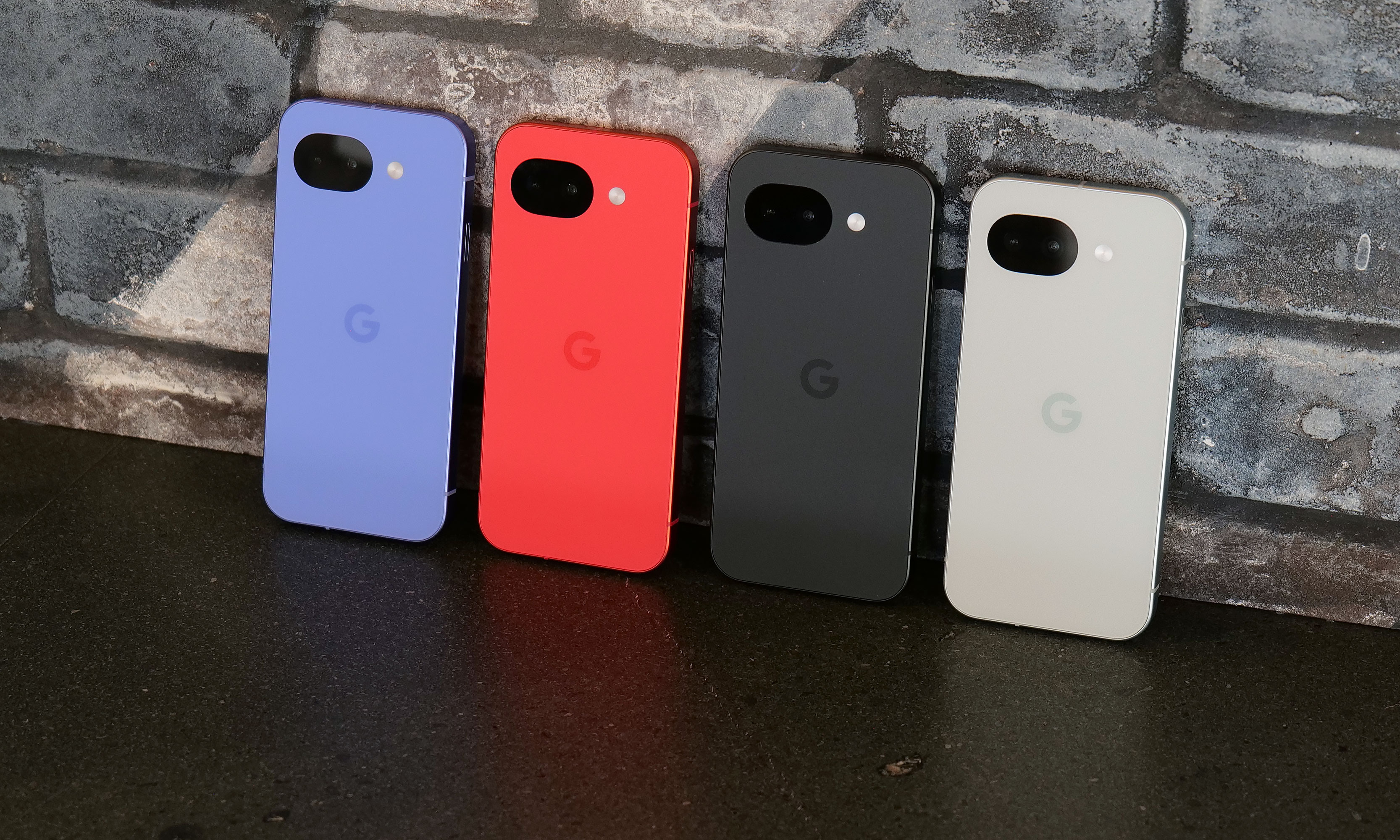 While lavender is the new hero color for the Pixel 10a, berry is the hue I'd pick. Sam Rutherford for Engadget
The one place where the Pixel 10a might come up a touch short is that unlike its more expensive siblings, it features an older Tensor G4 processor instead of the Tensor G5 chip used on the main Pixel 10 line. Google says the decision to go with an older SoC is due to budget constraints. While it might not be the first choice for gamers or power users, I've never really had an issue with the day-to-day performance of Google's recent homegrown silicon.
However, even with a one-year-old chip, Google found a way to port over three flagship features to the Pixel A series for the first time. Camera Coach uses AI to help you compose and come up with more interesting shots. Meanwhile, Auto Best Take is designed to ensure that everyone in a group shot ends up with their finest expression. Finally, Satellite SOS allows you to call for help during emergencies, even when you don't have proper cell service.
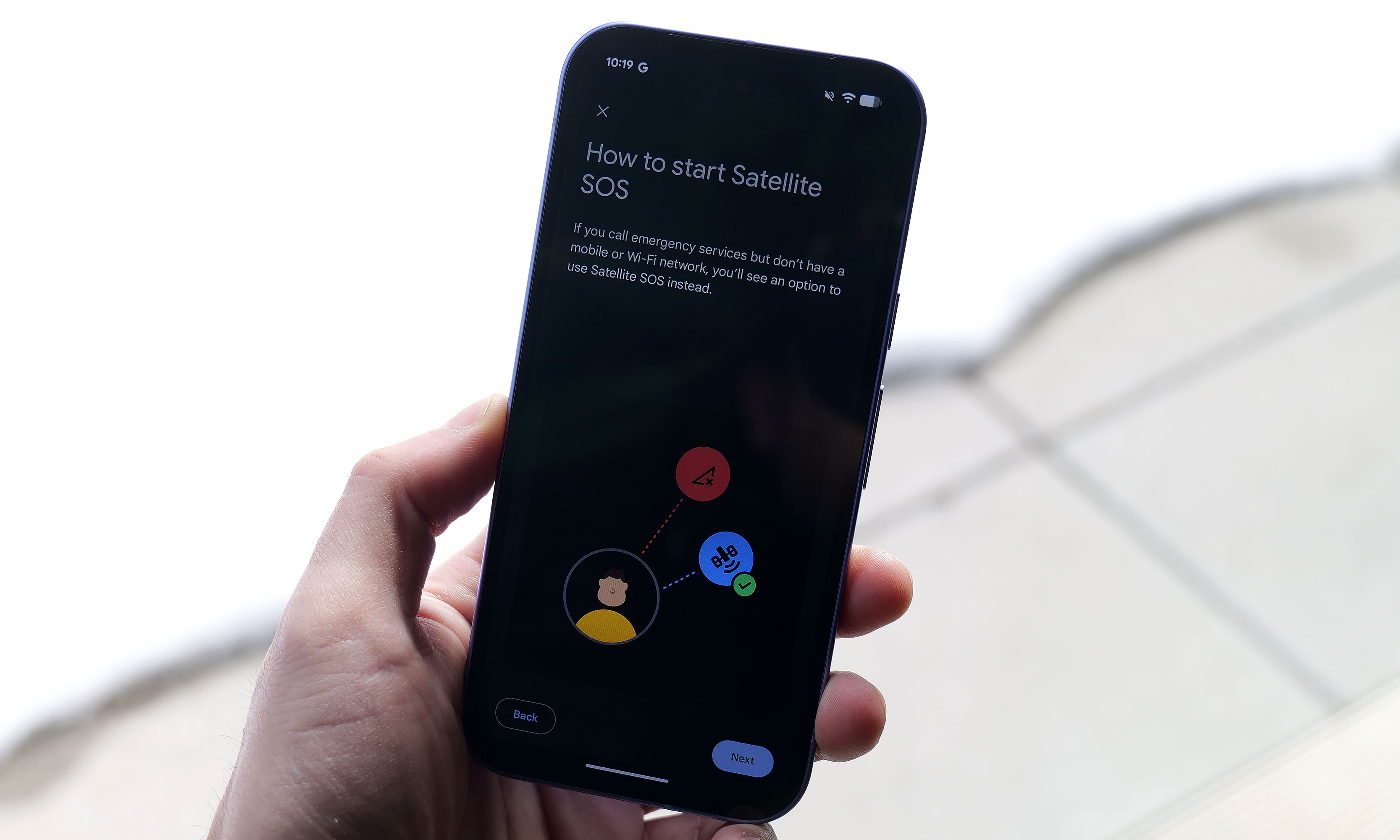 Satellite SOS support is one of three new features coming to the Google's A-series phones for the first time. Sam Rutherford for Engadget
As for its cameras, the P10a looks to be using the same sensors as before, including a 48MP main camera, a 13MP ultra-wide and a 13MP selfie shooter in front. That might be a bummer for some, but considering that the Pixel 9a offered by far the best image quality of any phone in its price bracket, I'm not that bothered. Also, it's quite likely that if Google had opted for new hardware, it may have pushed the phone above $500.
After seeing the positive response to the barely-there camera bump on its predecessor, Google leaned in and made the Pixel 10a's rear camera module completely flat, and it's my favorite thing about the phone. There's no hump or protrusions to speak of, and when combined with the rest of the phone's design, it results in a really sleek, minimalist look. Plus, after almost a decade of big and bulky camera warts on the back of phones, it's just nice seeing the Pixel 10a go the opposite direction.
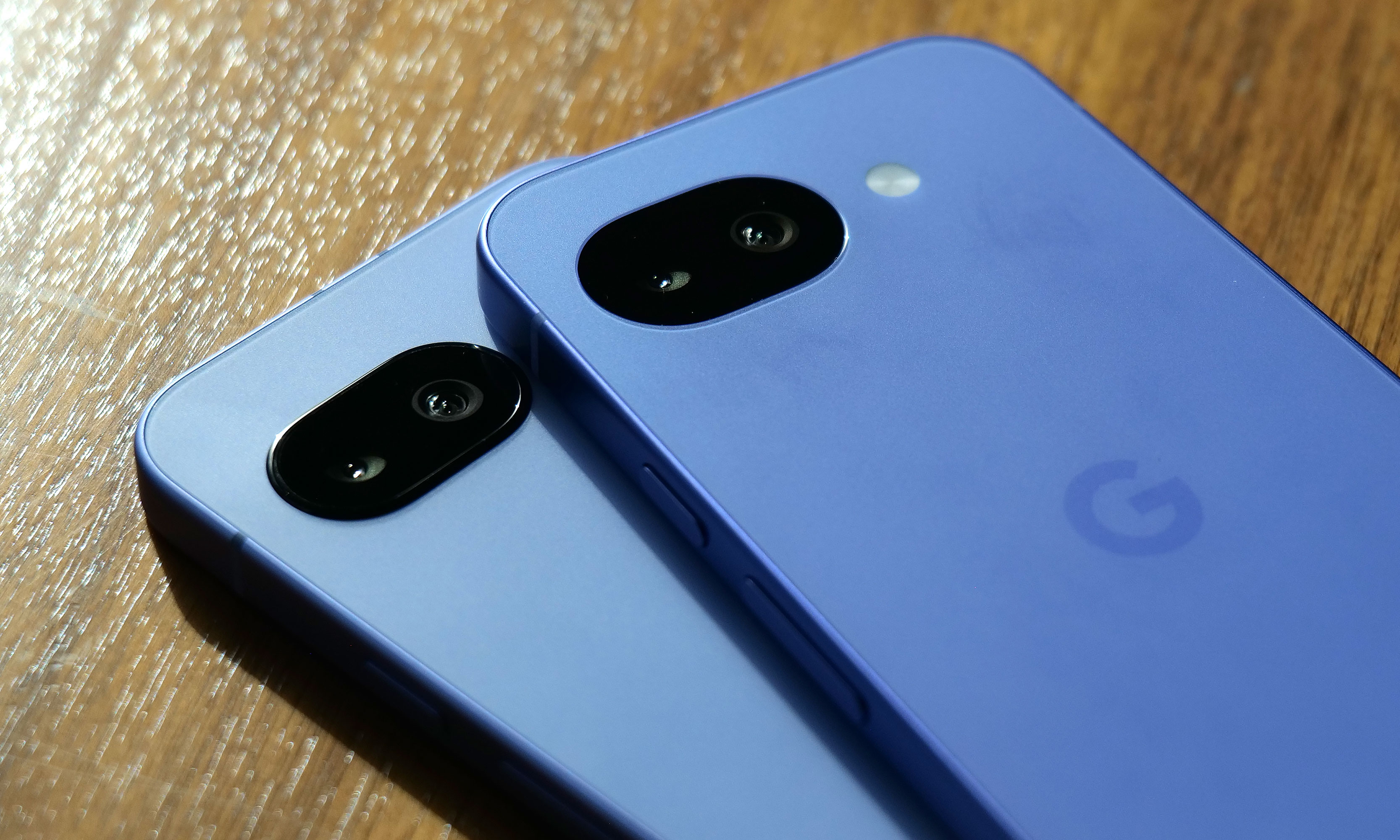 I really appreciate how Google double downed on feedback regarding the Pixel 9a's tiny camera bump (left) by making the Pixel 10a's camera (right) completely flat. Sam Rutherford for Engadget
On the flipside, my biggest complaint about the P10a is that Google didn't include Pixelsnap support (aka magnetic Qi2 compatibility). It's another feature that got cut due to cost and it's a real bummer because after introducing it on last year's main Pixel 10 line, I was hoping that it would become a standard inclusion on all Google phones going forward. Thankfully, when I asked about the lack of Pixelsnap support, Google representatives were able to confirm that there will be third-party accessory makers such as Casefinite, Dbrand and Spigen that will offer cases with built-in magnetic rings, so anyone hoping to attach magnetic peripherals will still have an avenue to do so.
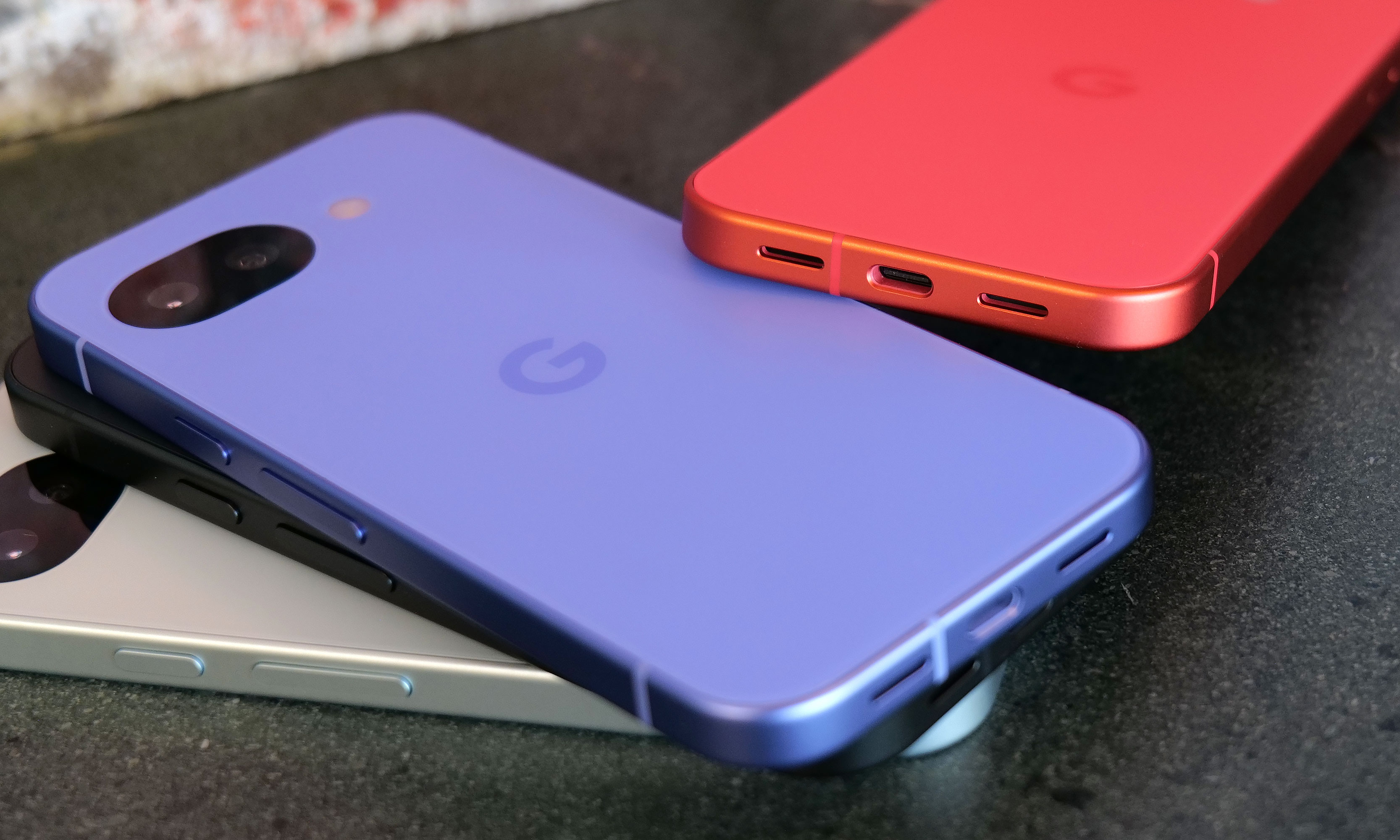 The Pixel 10a's charging speeds have been improved to 30 watts for wired and 10 watts wirelessly. Sam Rutherford for Engadget
Regardless, for Android phone owners who are in the market for a simple, no-nonsense upgrade that covers all the basics without breaking the bank, the Pixel 10a is looking like another top contender.
The Pixel 10a is available for pre-order today in lavender, berry, fog and obsidian with official sales slated for March 5.
Polestar unveils a station wagon version of the 4 [ 18-Feb-26 2:40pm ]Polestar is gearing up to launch three new models in the next two years, including a station wagon (estate or shooting brake) version of the Polestar 4 that harkens back to the company's Volvo roots. The Geely-owned Swedish company sold a record 61,000 EVs in 2025, but hopes that the new models will help it take an even bigger bite out of the market. "We want to get more volume out of a bigger cake," CEO Michael Lohscheller said.
Polestar currently offers two models in the US, the Polestar 3 and Polestar 4, both SUVs. However, the new Polestar 4 will come in two variants, one a traditional SUV as before and the other a four-door wagon-type version that combines "the space of an estate and the versatility of an SUV," Loscheller said. "It's all the good things from the current car, but it's a bit more practical." This new model is due later this year and will be built in Busan, South Korea in order to avoid US tariffs on cars built in China.
The automaker is also planning to release a new version of the Polestar 2 targeted at young buyers, though that one is unlikely to come to the US. It will be slightly longer for more passenger space and be produced in China like the current model 2.
Finally, the Polestar 7 will be a compact SUV in the same family as Volvo's EX60, set to arrive in Europe to address the fast-growing compact SUV segment. "We are convinced that we can offer customers a progressive performance-driven car for a very attractive price point, built in Europe," Lohscheller said.
The new models are designed to help Polestar hit its goal of 60 percent of EV sales worldwide by "targeting the big profit pools of the BEV segment," Lohscheller stated. Following Polestar's withdrawal from the hyper-competitive Chinese market, Europe accounts for 78 percent of its sales and the US most of the rest — but the company hopes to boost its fortunes in the latter. "People forget that the U.S. is a big EV market, especially on the east and west coasts," the CEO added. "And it will stay a big market."
This article originally appeared on Engadget at https://www.engadget.com/transportation/evs/polestar-unveils-a-station-wagon-version-of-the-4-144025505.html?src=rss Federal court rules that OpenAI must stop using the term 'Cameo' [ 18-Feb-26 12:45pm ]Cameo, the platform where celebrities sell short, personalized videos, has scored a preliminary win in a trademark lawsuit against OpenAI. A California judge has ruled that the AI company's video generation tool Sora cannot use the term 'cameo' or any variation likely to cause confusion. A temporary restraining order in the case was originally granted in November of last year.
The suit was first brought in response to a feature available within the Sora app at launch called 'Cameo' that allowed users to add any likeness to videos they generated. Cameo claimed the use of the term in this setting was likely to cause confusion and could dilute their brand. OpenAI then carried on with the feature despite the suit.
U.S. District Judge Eumi Lee ruled on Saturday that Cameo's lawsuit was likely to succeed and granted a preliminary injunction, blocking OpenAI from continuing to use the name. An OpenAI spokesperson responded to the ruling saying, "We disagree with the complaint's assertion that anyone can claim exclusive ownership over the word 'cameo,' and we look forward to continuing to make our case," according to Reuters.
This is just the latest in a string of intellectual property cases against AI companies that have accelerated as video generation capabilities have improved across the board. Rights holders of all kinds from authors and music publishers to major movie studios have taken the likes of OpenAI, Anthropic, Perplexity and others to court, seeking to protect their IP.
This article originally appeared on Engadget at https://www.engadget.com/ai/federal-court-rules-that-openai-must-stop-using-the-term-cameo-124559072.html?src=rss Tesla stops using 'Autopilot' to promote its EVs in California [ 18-Feb-26 11:25am ]Tesla has stopped using the term "Autopilot" to sell its cars in California, thereby avoiding a 30-day sales and manufacturing ban in the state. If you'll recall, a California administrative law judge ruled in December that the automaker misled consumers by using the terms "Autopilot" and "Full Self-Driving." The judge recommended the suspension, but the California DMV gave Tesla 60 days to remove any untrue and misleading language in its marketing materials. In its announcement, the DMV said Tesla has taken corrective action and has stopped using Autopilot for marketing. Prior to that, the automaker has already clarified that driver supervision is still needed with Full Self-Driving.
The judge was ruling on a complaint the DMV made back in 2022, wherein the agency accused Tesla of making and disseminating misleading statements. It argued that starting in May 2021, Tesla used deceptive marketing materials with the labels "Autopilot" and "Full Self-Driving Capability," as well as claimed that the "system is designed to be able to conduct short and long-distance trips with no action required by the person in the driver's seat." In reality, the vehicles equipped with those features "could not at the time of those advertisements, and cannot now, operate as autonomous vehicles," the DMV said.
A ban in California could have had a huge effect on the company, seeing as the state accounts for nearly a third of its sales in the country. Tesla also recently announced that it will stop the production of its Model S and X cars to turn its Fremont, California factory where they were being manufactured into a space for the production of its Optimus humanoid robots. Tesla has huge plans for Optimus and intends to start selling the robot to the public by the end of 2027.
This article originally appeared on Engadget at https://www.engadget.com/transportation/evs/tesla-stops-using-autopilot-to-promote-its-evs-in-california-112533060.html?src=rss Meta will run AI in WhatsApp through NVIDIA's 'confidential computing' [ 18-Feb-26 11:00am ]Meta just announced a deal to buy "millions" of NVIDIA Blackwell and Rubin GPUs in a new long-term partnership. As part of that, the social media giant will deploy NVIDIA's Confidential Computing for WhatsApp, "enabling AI-powered capabilities across the messaging platform while ensuring user data confidentiality and integrity."
As part of the deal, Meta committed to using NVIDIA's Confidential Computing for WhatsApp messaging to allow AI inside the app while guaranteeing user data confidentiality. That technology will let Meta secure data during computation, not just when it's being shuttled to a server. It also allows software creators like Meta or third-party AI agent providers "to preserve their intellectual property," NVIDIA wrote on a blog about the technology.
Meta will also be the first to deploy NVIDIA's Grace CPUs in a standalone way, instead of incorporating them with GPUs. They're designed to run inference and agentic workloads when running in this fashion. Meta will also be using NVIDIA's Spectrum-X Ethernet switches.
Meta announced earlier this year that it would spend up to $135 billion on AI in 2026, so it's not a surprise that a big chunk of that is going toward NVIDIA. However the numbers involved, likely in the "tens of billions" according to analysts, represent a significant expansion of the partnership between the two companies. Meta plans to build up to 30 data centers, including 26 in the US, by 2028 as part of a $600 billion commitment.
This article originally appeared on Engadget at https://www.engadget.com/ai/meta-will-run-ai-in-whatsapp-through-nvidias-confidential-computing-110002283.html?src=rss The best wireless workout headphones for 2026 [ 18-Feb-26 10:01am ]Whether you're lifting, running or squeezing in a quick session between errands, the last thing you want is a cable getting in the way or earbuds that won't stay put. The best wireless headphones make it easier to focus on your workout, but not every pair is built to handle sweat, motion and long sessions.
Fitness-focused headphones put different demands on design and performance. Secure fit, water resistance and dependable battery life matter just as much as sound quality, especially if you plan to use them outside the gym as well. Some are tuned for awareness during outdoor runs, while others aim to block distractions during intense training.
We've tested a wide range of wireless headphones and wireless earbuds that are suited for exercise, narrowing the list down to options that hold up during workouts and still work well for everyday listening. Below, you'll find our top picks, along with guidance to help you choose the right pair for how you train.
Others wireless workout headphones we tested Apple AirPods Pro 3
When it comes to running and working out, the edge that the AirPods Pro 3 have over the Pro 2, or even the top picks on our list, is built-in heart rate monitoring. That means you could go out with just your Pro 3 earbuds and your iPhone and still get heart rate information for your entire training session. But otherwise, the Pro 3 buds are just as capable as the Pro 2 when it comes to exercise. Some may prefer the soft-touch finish on our top picks to the AirPods' slick texture.
Beats Powerbeats Pro 2The Powerbeats Pro 2 are a good alternative to the Beats Fit Pro if you're a stickler for a hook design. However, they cost $50 more than the Powerbeats Fit, and the main added advantage here is built-in heart rate sensors.
Anker Soundcore AeroFit ProThe Soundcore AeroFit Pro is Anker's version of the Shokz OpenFit, but I found the fit to be less secure and not as comfortable. The actual earbuds on the AeroFit Pro are noticeably bulkier than those on the OpenFit and that caused them to shift and move much more during exercise. They never fell off of my ears completely, but I spent more time adjusting them than I did enjoying them.
JBL Endurance Peak 3The most noteworthy thing about the Endurance Peak 3 is that they have the same IP68 rating as the Jabra Elite 8 Active, except they only cost $100. But, while you get the same protection here, you'll have to sacrifice in other areas. The Endurance Peak 3 didn't blow me away when it came to sound quality or comfort (its hook is more rigid than those on my favorite similarly designed buds) and their charging case is massive compared to most competitors.
What to look for in workout headphones DesignBefore diving in, it's worth mentioning that this guide focuses on wireless earbuds. While you could wear over-ear or on-ear headphones during a workout, most of the best headphones available now do not have the same level of durability. Water and dust resistance, particularly the former, is important for any audio gear you plan on sweating with or taking outdoors, and that's more prevalent in the wireless earbuds world.
Most earbuds have one of three designs: in-ear, in-ear with hook or open-ear. The first two are the most popular. In-ears are arguably the most common, while those with hooks promise better security and fit since they have an appendage that curls around the top of your ear. Open-ear designs don't stick into your ear canal, but rather sit just outside of it. This makes it easier to hear the world around you while also listening to audio, and could be more comfortable for those who don't like the intrusiveness of in-ear buds.
Water resistance and dust protectionEven if a pair of headphones for working out aren't marketed specifically as exercise headphones, a sturdy, water-resistant design will, by default, make them suitable for exercise. To avoid repetition, here's a quick primer on durability, or ingression protection (IP) ratings. The first digit you'll see after the "IP" refers to protection from dust and other potential intrusions, measured on a scale from 1 to 6. The second refers to water resistance or even waterproofing, in the best cases. The ratings for water resistance are ranked on a scale of 1 to 9; higher numbers mean more protection, while the letter "X" means the device is not rated for protection in that regard.
All of the earbuds we tested for this guide have at least an IPX4 rating, which means there's no dust protection, but the buds can withstand splashes from any direction and are sweat resistant, but probably shouldn't be submerged. For a detailed breakdown of all the possible permutations, check out this guide published by a supplier called The Enclosure Company.
Active noise cancellation and transparency modeActive noise cancellation (ANC) is becoming standard on wireless earbuds, at least those above a certain price point. If you're looking for a pair of buds that can be your workout companion and serve you outside of the gym, too, noise cancelation is a good feature to have. It makes the buds more versatile, allowing you to block out the dull roar of your home or office so you can focus, or give you some solitude during a busy commute.
But an earbud's ability to block out the world goes hand-in-hand with its ability to open things back up should you need it. Many ANC earbuds also support some sort of "transparency mode," or various levels of noise reduction. This is important for running headphones because exercising outdoors, alongside busy streets, can be dangerous. You probably don't want to be totally oblivious to what's going on around you when you're running outside; adjusting noise cancelation levels to increase your awareness will help with that. Stronger noise cancelation might be more appealing to those doing more indoor training if they want to block out the dull roar of a gym or the guy exaggeratingly lifting weights next to you.
Battery lifeAll of the Bluetooth earbuds we tested have a battery life of six to eight hours. In general, that's what you can expect from this space, with a few outliers that can get up to 15 hours of life on a charge. Even the low end of the spectrum should be good enough for most athletes and gym junkies, but it'll be handy to keep the buds' charging case on you if you think you'll get close to using up all their juice during a single session.
You'll get an average of 20 to 28 extra hours of battery out of most charging cases and all of the earbuds we tested had holders that provided at least an extra 15 hours. This will dictate how often you actually have to charge the device — as in physically connect the case with earbuds inside to a charging cable, or set it on a wireless charger to power up.
How we test workout headphonesIn testing wireless workout headphones, I wear them during every bit of exercise I do — be it a casual walk around the block, a brisk morning run or a challenging weight-lifting session. I'm looking for comfort arguably most of all, because you should never be fussing with your earbuds when you should be focusing on working out. In the same vein, I'm cognizant of if they get loose during fast movements or slippery when I'm sweating. I also use the earbuds when not exercising to take calls and listen to music throughout the day. Many people will want just one pair of earbuds that they can use while exercising and just doing everyday things, so I evaluate each pair on their ability to be comfortable and provide a good listening experience in multiple different activities.
While I am also evaluating sound quality, I'm admittedly not an audio expert. My colleague Billy Steele holds that title at Engadget, and you'll find much more detailed information about audio quality for some of our top picks in his reviews and buying guides. With these headphones for working out, however, I will make note of related issues if they stood out (i.e. if a pair of earbuds had noticeably strong bass out of the box, weak highs, etc). Most of the wireless workout headphones we tested work with companion apps that have adjustable EQ settings, so you'll be able to tweak sound profiles to your liking in most cases.
This article originally appeared on Engadget at https://www.engadget.com/audio/headphones/best-wireless-workout-headphones-191517835.html?src=rss The best drone for 2026 [ 18-Feb-26 8:01am ]Drones are no longer just niche toys for enthusiasts. Today's models are compact, increasingly affordable and capable of capturing sharp aerial photos and video with minimal effort. Whether you're curious about flying for the first time or looking to upgrade to a more advanced camera drone, the options available in 2026 are broader and more approachable than ever.
Entry-level drones now offer features like GPS-assisted flight, return-to-home safety systems and automated shooting modes that take much of the stress out of learning to fly. Step up to more advanced models and you'll find foldable designs that travel easily, longer flight times and stabilized 4K video that holds up well beyond social media clips.
We've tested a range of drones to identify the best options across different skill levels and budgets. Whether your priority is learning the basics, capturing polished aerial footage or packing light for travel, these picks highlight the drones that offer the best balance of performance, reliability and ease of use.
What to look for in a drone Camera features
For this guide, we're looking only at drones that are basically flying cameras, so you want the best video and photo features possible. Bigger devices like DJI's Mavic 3 Pro or Air 3S carry relatively large sensors, offering superior camera quality for nighttime cityscapes or other low-light scenes. Smaller models like the Mini 4 Pro and HoverAir X1 Max use smaller camera sensors, so they aren't as good in dim light.
Field of view and minimum aperture are also important, with most drones typically having a wide-angle focal length, though a few others like the HoverAir X1 Max carry an ultrawide lens. Some models have multiple cameras including a wide and a zoom. As for aperture, lower numbers are better and allow for shooting in dim light. Most DJI models are solid in this regard, while the HoverAir models don't perform as well.
Video resolution and slow-mo are also essential camera capabilities. Most drones these days can shoot at 4K with a frame rate of at least 30 fps, though some offer 6K or even 8K at up to 30 fps. Higher-end models can shoot 4K at up to 120 fps, allowing you to slow down the action dramatically to create a cinematic look.
Other noteworthy features include log or HDR video that supports higher dynamic range, particularly in bright and sunny conditions. Finally, the camera's gimbal and stabilization are important factors to keep your footage looking as smooth as possible. Some drones have gimbals that can rotate the camera 90 degrees to give social media creators the maximum resolution for vertical formats.
Drone features: Speed, range, safety, battery life and obstacle detectionBy and large, there are two types of camera drones to consider. The first are standard drones (usually with open propellers but not always) designed to fly outside and take scenic shots. Often there's nothing to stop the props from striking skin or objects, so they can't really be used indoors or around people. Some models like the DJI Neo and Flip have prop guards that better protect bystanders and property, as well as the drone itself.
Then there's first-person-view (FPV) camera drones, which often have propeller guards and are meant to be used both indoors or outside to capture exciting footage. Standard models don't need to go particularly fast as they're mainly used to shoot fun videos for social media, but FPV drones need to move at high speeds to create excitement. Because of that speed, they're also better in breezy conditions thanks to stronger wind resistance, and they can fight gusts and return home more quickly. Acrobatic abilities (often promoted by the manufacturer in ads or packaging) are also important for FPV drones, as it allows the user to perform tricks and zip around obstacles.
Battery life is another important factor. The best drones boast a battery endurance of up to 45 minutes, while FPV drones like the Avata 2 can only fly for about half that time as they tend to be heavier and carry smaller batteries to reduce weight. As a general rule, a single battery isn't enough for any serious shooting so you'd do well to buy your drone in a kit with a few batteries and a charger.
As for range, DJI tends to dominate in this area, with its latest models able to maintain a video signal at a distance up to 20km (12.4 miles). HoverAir's models are weaker with the top-end X1 Max model limited to just 1km (0.6 miles) when using the optional beacon system. DJI also offers multiple ways to control its drones including headsets, joystick-type controllers, motion detection controllers and smartphones.
The best drones have sensors to detect obstacles in all directions. Others are limited to only avoiding obstructions coming at them from the front and some only rely on the main camera to prevent crashes. Finally, if you want to have your drone follow you around automatically, you'll need it to be able to track you around when you're vlogging, riding a bike or skiing, while also avoiding obstacles. Smooth takeoff and return-to-home features are especially valuable here for both beginners and experienced drone pilots as well.
Best drone FAQs What are the rules for owning a drone?Anyone can buy any drone, but once purchased, all drones between 250g and 25 kg must be registered with the FAA and marked with the FAA registration number. Recreational pilots with drones over 249g must pass the recreational UAS safety "TRUST" exam and carry proof of TRUST completion when flying a drone. Commercial pilots must obtain a Remote Pilot Certificate from the FAA. You must be aware of and avoid any areas with airspace restrictions, particularly around airports.
Are drones safe to fly in the city?In general, it is not legal to fly a drone within city limits over populations, as a crash from a high altitude could injure or kill someone. However, they can be flown over adjacent, non-populated areas in many cases. Here is a guide to where: https://uavcoach.com/where-to-fly-drone/
What is the average flight time of a drone?Most drones can fly for around 20-30 minutes, though some advanced models like DJI's Mavic 4 can fly up to 40 minutes or more.
This article originally appeared on Engadget at https://www.engadget.com/cameras/best-drone-120046775.html?src=rss YouTube is down for thousands of users in the US [ 18-Feb-26 2:26am ]YouTube is experiencing an outage across the United States, with users in other countries like Canada, India, the Philippines, Australia and Russia also having problems with accessing the website. The issue seems to have started at around 8PM Eastern time and reached 326,000 reports on Downdetector before starting to taper down. More users reported having issues accessing the app, but I personally lost access to the web homepage first. As of 9:22PM, users are still reporting being unable to access YouTube on Reddit.
Update, February 17, 2026, 9:26 PM ET: Updated to correct time of outage, added new countries where it's out and new reports of YouTube still being inaccessible.
This article originally appeared on Engadget at https://www.engadget.com/big-tech/youtube-is-down-for-thousands-of-users-in-the-us-020718165.html?src=rssAnyone who's been paying even a little bit of attention to tech news lately could have made a reasonable guess that AI will be a big topic at Samsung's Unpacked next week. Ahead of the event, Samsung teased some of what's to come for AI in terms of the Galaxy S26 smartphone lineup's photography tools.
The S26 phones will feature a new camera system using Galaxy AI that combines capturing, editing and sharing of photos and videos. "Users will be able to turn a photo from day to night in seconds, restore missing parts of objects in images, capture detailed photos in low light, and seamlessly merge multiple photos into a single, cohesive result," a company rep said. The video clips Samsung shared demonstrated the before and after results of using its AI tools, which will all be housed in a single app rather than needing to switch between multiple image editing programs.
Updated cameras are just part of what will be on the schedule for Samsung's big mobile showcase. The expected Galaxy S26, Galaxy S26+ and Galaxy S26 Ultra will likely have a lot of AI-centric features.
This article originally appeared on Engadget at https://www.engadget.com/mobile/smartphones/samsung-teases-mobile-ai-photography-tools-ahead-of-unpacked-233000358.html?src=rssWe'll soon get a closer look at a bunch of features and updates Google has planned for Android and its other services. The company has confirmed that Google I/O 2026 will take place on May 19 and 20. As always, Google will stream some of the keynotes and sessions for free, including the opening keynote (during which the company makes the bulk of its major I/O announcements).
Although I/O is primarily a conference for developers, it's typically where we first learn about major upcoming Android changes, which of course affect tens of millions of people. Expect a lot of news about Google's AI efforts as well, such as what's next for Gemini.
See you all at Google I/O starting May 19th! https://t.co/KgNKbb3nMu pic.twitter.com/OD6x3IYtTi
— Sundar Pichai (@sundarpichai) February 17, 2026
As has been the case for several years, Google revealed the conference's dates for 2026 after enough folks completed a puzzle on the I/O website. This year's puzzle has multiple "builds" to play through, all of which use Gemini.
They start with a mini-golf game in which a virtual caddy that's powered by Gemini offers some of the most anodyne advice imaginable. The second build is a nonogram. If you've ever played a Picross game, you'll know what to do here. It's about using logic to place tiles on a grid in order to create an image. Here, Google is using Gemini to generate "endless game boards."
The other three minigames are Word Wheel (which "leverages Gemini 3 to automate level design"), Super Sonicbot (which "uses Gemini to introduce microphone mechanics where noise controls the Android Bot's altitude") and Stretchy Cat. The latter "uses Gemini 3 as a stage designer balancing game mechanics and difficulty to create endless play."
This article originally appeared on Engadget at https://www.engadget.com/general/google-io-2026-is-set-for-may-19-and-20-200805024.html?src=rssTexas is suing Wi-Fi router maker TP-Link for deceptively marketing the security of its products and allowing Chinese hacking groups to access Americans' devices, Attorney General Ken Paxton has announced. Paxton originally started looking into TP-Link in October 2025. Texas Governor Greg Abbott later prohibited state employees from using TP-Link products in January of this year.
TP-Link is no longer owned by a Chinese company and its products are assembled in Vietnam, but Paxton's lawsuit claims that because the company's "ownership and supply-chain are tied to China" it's subject to the country's data laws, which require companies to comply with requests from Chinese intelligence agencies. The lawsuit also says that firmware vulnerabilities in TP-Link's hardware have already "exposed millions of consumers to severe cybersecurity risks."
Engadget has asked TP-Link to comment on the Texas lawsuit and Paxton's claims. We'll update this article if we hear back.
TP-Link was reportedly being investigated at the federal level in 2024 after its devices were connected to the massive "Salt Typhoon" hack that accessed data from multiple US telecom companies. Despite all signs pointing to the federal government getting ready to ban TP-Link in 2025, Reuters reports that the Trump administration paused plans to ban the company's routers in early February, ahead of a meeting between President Donald Trump and President Xi Jinping.
This article originally appeared on Engadget at https://www.engadget.com/cybersecurity/texas-ag-sues-tp-link-over-purported-connection-to-china-193802258.html?src=rssNetflix has been in the game adaptation business for a while now, but until recently most of its attention had been on adapting video games. That's still very much happening, but the streaming giant is also now buying up rights for board game IP too, with the latest being Asmodee's Ticket to Ride.
Netflix will look to greenlight a number of projects spanning TV, film and "additional formats," it wrote in a press release. The first of these will be a feature film written by Ben Mekler and Chris Amick. Ticket to Ride creator Alan R. Moon will serve as an executive producer on the project, which will be the game's first on-screen adaptation. Exactly what it will look like is not yet clear, but the internet already has plenty of theories.
Ticket to Ride is a train-themed turn-based strategy and route-building game first released over 20 years ago. Since then it has gone on to ship more than 20 million copies and has been translated into over 30 languages. It's also been given the video game adaptation treatment before.
This is actually the second of Asmodee's IP that Netflix has acquired the rights to, after announcing last year that Catan will also be making its way to screens in various forms. And it isn't just interested in scripted TV and movie opportunities. In early 2025, the company also signed a deal with Hasbro to adapt Monopoly into a TV game show.
This article originally appeared on Engadget at https://www.engadget.com/entertainment/netflix-is-adapting-the-board-game-ticket-to-ride-180505164.html?src=rssWeb designers of the world: The Automattic-owned WordPress.com is further embracing AI on its platform. On Tuesday, it expanded its one-off AI site builder into a persistent AI assistant for editing and media creation.
In the site editor, the AI assistant can help with site-wide structure and design choices. For example, you can ask the chatbot to "give me more font options that feel clean and professional or "change my site colors to be brighter and bolder." It also includes image generation and writing assistance, such as "rewrite this to sound more confident." (Who needs learning when you have automation!)
The assistant can also now be integrated into your site's media library. It can generate new images or make prompted edits to your existing ones. Examples include "update this image to be black and white" or "replace this stack of pancakes with waffles." (Just don't fake that if your business sells breakfast food, okay?) WordPress says the assistant understands your website's look and brand and can tailor the media accordingly.
WordPress also added the AI assistant to the platform's team chat, Block Notes. You can summon the chatbot from within your team chat threads.
The tool is available for WordPress.com's Business or Commerce plans. (Or, if you made your site using the AI builder, it's enabled by default, no matter which plan you use.) The feature works best with the platform's block themes; it's much more limited with classic ones. You'll find the toggle to activate the AI assistant in your site settings under the "AI tools" section.
This article originally appeared on Engadget at https://www.engadget.com/ai/wordpress-adds-an-ai-assistant-174719676.html?src=rssNetflix is streaming its very first live MMA fight on May 16. The combatants are one-time phenom Ronda Rousey and one-time actor Gina Carano. Both women have retired from the sport. Rousey left in 2016 and Carano left all the way back in 2009. In any event, they are both back for one night only.
The featherweight bout will take place inside a hexagon cage and will stream globally. It's likely Netflix had to choose two retired fighters because current stars are under contracts with various promotional entities. This fight is co-hosted by Most Valuable Productions, a promotional company started by Jake Paul.
A LEGACY SHOWDOWN
Fans of The Mandalorian and his tiny green apprentice Grogu are getting their best look yet at the duo's upcoming theatrical adventure, set for release this spring. It's hard to believe that it's been just over six years since the last Star Wars movie was released in theaters, followed by wall-to-wall coverage of so-called Star Wars Fatigue.
The newest trailer, released today, clocks in at just over two minutes long and offers some new footage and details to sink our teeth into. Picking up after the events of the Disney+ series The Mandalorian, the Empire has collapsed and Din Djarin (Pedro Pascal) and Grogu are tasked with taking out a bevy of baddies from gangsters to war criminals for the New Republic. Colonel Ward, new to the Star Wars universe and played by Sigourney Weaver, tells Djarin, "This isn't about revenge, it's about preventing another war."
Jeremy Allen White will also star in the film, as Rotta the Hutt, Jabba's son, who we briefly see battling Din Djarin in a colosseum of sorts. Notably, at one point we see Djarin on his knees before Jabba sans helmet, so we'll definitely be getting some moments of Pedro Pascal unfiltered by Beskar. Like any Star Wars adventure, we see flashes of some new creatures that our heroes will face. Most importantly, we see Grogu being downright adorable, playing with buttons on the ship, commandeering a flying bassinet, and snacking on a cookie.
The Mandalorian and Grogu hits theaters on May 22 and, according to the trailer, was shot at least in part for IMAX.
This article originally appeared on Engadget at https://www.engadget.com/entertainment/tv-movies/the-first-full-trailer-for-the-mandalorian-and-grogu-is-here-164244117.html?src=rssXbox has revealed the second batch of Game Pass additions for February. There are quite a few heavyweights in the mix this time, including Kingdom Come: Deliverance II and The Witcher 3: Wild Hunt. Let's start with what's available today, though. Xbox previously said Avatar: Frontiers of Pandora (Game Pass Ultimate and PC Game Pass on Cloud, Xbox Series X/S, handheld and PC) would arrive today, while Avowed joins the Game Pass Premium library on Cloud, Xbox Series X/S and PC on the same day it hits PS5.
There's another Game Pass addition today in the form of Aerial_Knight's DropShot (Game Pass Ultimate and PC Game Pass on Cloud, Xbox Series X/S, handheld and PC). I've been looking forward to this after digging solo developer Aerial_Knight's previous games as well as the demo.
This is a single-player skydiving FPS in which you'll have to fend off enemies to grab the only parachute. You'll use finger guns to take out the competition. Oh, and there are dragons to deal with.
Another trio of games joins the lineup on Friday, including The Witcher 3: Wild Hunt - Complete Edition (Game Pass Ultimate and Premium on Cloud and consoles). This version of the classic action RPG includes all the DLC, so it could keep you busy for quite some time. EA Sports College Football 26 (Game Pass Ultimate on Cloud and Xbox Series X/S) arrives on the same day along with the eye-catching Soulslike deckbuilder Death Howl (Game Pass Ultimate and Premium on Cloud, Xbox Series X/S, handheld and PC). That was already on PC Game Pass.
On February 24 TCG Card Shop Simulator hits Cloud, Xbox Series X/S, handheld and PC in Game Preview on Game Pass Ultimate, Premium and PC Game Pass. As the title suggests, here you'll be managing a trading card game store. Dice A Million — a day-one addition to Game Pass Ultimate and PC Game Pass on PC on February 25 — is an intriguing numbers-go-up game. It's a roguelike deckbuilder in which you'll combine dice with different abilities as well as rings with passive effects as you attempt to roll a million points.
February 26 sees the full release of Towerborne, which had been in game preview (and in early access on Steam). Xbox Game Studios is publishing this co-op action RPG from Stoic. Offline play and online co-op will be added along with more story, areas, enemies, progression features and difficulty settings. The full version of Towerborne will be available on Game Pass Ultimate, Premium and PC Game Pass across consoles, handheld and PC.
Looking a bit further ahead, two high-profile titles are coming to Game Pass Ultimate, Premium and PC Game Pass on Cloud, Xbox Series X/S and PC on March 3: Final Fantasy III and Kingdom Come: Deliverance II. The latter received several nominations at The Game Awards, including Game of the Year, and it was one of our favorite games of 2025. It follows Kingdom Come Deliverance hitting Game Pass just last week.
This article originally appeared on Engadget at https://www.engadget.com/gaming/xbox/kingdom-come-deliverance-2-and-the-witcher-3-are-coming-to-game-pass-163624685.html?src=rssSnapchat is taking a page out of Meta's handbook. The social media platform has announced it will launch creator subscriptions for users. Meta-owned Instagram and Facebook currently offer a similar feature.
On Snapchat, creator subscriptions will give users access to exclusive content across Snaps and Stories. They will also get priority replies and go ad-free on stories. Snapchat pitches the new feature as great way to give creators "freedom to experiment" and "build a recurring income stream" — all good things for keeping people on your platform.
Creators can choose exactly how much they want to charge subscribers per month. They can spread these figures out across Snapchat's recommended tiers.
Starting February 23, select US-based Snapchat creators will be able to offer subscriptions. In the US, iOS users should then be able to subscribe to their accounts. The feature should expand to Canada, France, and the UK in the coming weeks.
This article originally appeared on Engadget at https://www.engadget.com/social-media/snapchat-is-rolling-out-creator-subscriptions-152114731.html?src=rssNintendo's Virtual Boy app is now available to download on Switch and Switch 2 as part of its Nintendo Classics offering. You'll need to have a Nintendo Switch Online + Expansion Pack membership to access the launch titles, and unlike Nintendo's other retro emulators, this one also requires a dedicated accessory.
As a reminder, the Virtual Boy was a portable tabletop system released in 1995, and the first console capable of rendering stereoscopic 3D graphics. It had a facemask with a monochrome red display built onto a bipod, so rather than wearing it like a modern VR headset, you had to awkwardly push your face towards it to play games.
Once you enter the third dimension, there's no going back…#VirtualBoy - Nintendo Classics is available now on #NintendoSwitch2 and #NintendoSwitch, as part of #NintendoSwitchOnline + Expansion Pack! pic.twitter.com/2uLd8iYorB
— Nintendo UK (@NintendoUK) February 17, 2026
While undeniably innovative for the time, the console never took off (to put it gently), but Nintendo is giving anyone who missed out in the '90s a chance to experience one of the strangest experiments in its history in 2026. Aesthetically, the $100 Virtual Boy add-on is a near perfect replica of the original console, with the big difference being that rather than a built-in display, it has a slot for sliding in your Switch or Switch 2. And unlike the OG Virtual Boy, this one is also wireless.
If $100 seems a bit steep for something that'll almost certainly be collecting dust before summer rolls around, Nintendo is also selling a $25 cardboard version (unfortunately your old Labo VR headset won't work here). Both are available to buy from the My Nintendo Store.
The Virtual Boy app is launching with the following games today: 3d Tetris, Galactic Pinball, Golf, The Mansion of Innsmouth, Red Alarm, Teleroboxer and Virtual Boy Wario Land. More games will be added in the future, including Mario Clash, Mario's Tennis and Space Invaders Virtual Collection.
This article originally appeared on Engadget at https://www.engadget.com/gaming/nintendo/nintendos-virtual-boy-app-is-now-available-to-download-150705800.html?src=rssDuring the flurry of CES 2026 news at the start of the year, it might have been easy to overlook Amazon's announcement that the Fire TV user interface is getting a revamp. But that redesign is rolling out starting today for US viewers. It will be available to users as a free update.
The main visual updates for the streaming device's UI are a lot of rounded corners. But Amazon is also emphasizing speed in this new look, claiming that the improvements will offer 20 to 30 percent faster interactions. This version of the UI also makes more apps visible on the screen at a time, with up to 20 apps able to be pinned to the homescreen compared with six in the prior design. The update also has access to the Alexa+ AI voice assistant if you want to use it to pull up viewing suggestions or to organize your viewing queue.
This article originally appeared on Engadget at https://www.engadget.com/entertainment/streaming/amazons-fire-tv-redesign-is-rolling-out-today-150000988.html?src=rssApple released its new 14-inch MacBook Pro M5 in October with little fanfare. But, despite the underselling, we found the device to be a great upgrade to its predecessor and the best MacBook for creatives. Now, you can find out for yourself with less of a strain on your wallet, thanks to a big sale.
Currently, B&H has discounts available for a variety of configurations. The cheapest option is the MacBook Pro M5 with 16GB of RAM and 512GB of SSD. It's available in Space Black and Silver for $1,499, down from $1,599 — the lowest price we've seen for it. There's also a deal on the 24GB of RAM option, but the best savings are $300 off the model with 32GB of RAM and either 512GB ($1,699) or 1TB ($1,899).
We gave the 14-inch Apple MacBook Pro M5 a 92 in our October review. We were impressed with how much faster — up to 60 percent — the GPU is than with the M4. It has a 10-core GPU, 10-core CPU and 16 Neural Engine cores. Beyond that, it has an extensive battery life, lasting 34 hours and 30 minutes while playing a looping HD video. It also has an excellent design, great keyboard and an extensive port selection.
Follow @EngadgetDeals on X for the latest tech deals and buying advice.
This article originally appeared on Engadget at https://www.engadget.com/deals/apples-14-inch-macbook-pro-m5-is-up-to-300-off-131743149.html?src=rssThe European Commission (EC) has opened an investigation into low-cost fast fashion retailer Shein. EC officials are concerned about the sale of illegal products, including child sexual abuse material, as well as the potentially addictive design of its shopping experience. The Commission found fellow low-cost retailer Temu in violation of the Digital Services Act after a similar investigation last year.
The probe is being opened under the Digital Services Act, a set of EU rules governing online services. The Commission will examine how Shein drives engagement with shoppers, including using a points and rewards system, and whether the company is properly mitigating the risk of addiction via these and other features.
Algorithmic recommendation systems are another point of contention, and the Commission will ask Shein to disclose how it suggests products to users. It also says that the company must offer users a system that is not based on profiling.
The Singapore-based company has faced a great deal of scrutiny in past years on a number of fronts, including its labor practices, materials sourcing, data practices and IP infringement. Last year the Texas Attorney General opened a probe into the company's safety and labor practices amid allegations that Shein uses forced labor as well as toxic or hazardous materials.
Addictive design has been a recent priority for European regulators, with the Commission demanding that TikTok make changes to its platform after a similar probe concluded earlier this month. Algorithms have also been in focus, with the Commission recently launching a probe into how exactly X's recommendation algorithm works.
The regulatory body will now continue collecting evidence in the matter, and holds the authority within the EU to levy fines and demand changes should the platform wish to continue operations in the region.
This article originally appeared on Engadget at https://www.engadget.com/general/europe-probes-sheins-addictive-app-design-and-illegal-product-sales-125322191.html?src=rssX is facing yet another investigation into Grok's reported creation of nonconsensual sexual images on the platform. Ireland's Data Protection Commission (DPC) has announced an inquiry into X regarding the harmful, intimate images and processing of EU and EEA individuals' personal data — including children.
In an 11-day period, X generated about three million sexualized images, an estimated 23,000 of which were of children. British nonprofit, the Center for Countering Digital Hate (CCDH) announced the results of its December 29 to January 9 review last month.
Critically, the investigation will determine whether X has broken GDPR laws. "The DPC has been engaging with XIUC since media reports first emerged a number of weeks ago concerning the alleged ability of X users to prompt the @Grok account on X to generate sexualised images of real people, including children," DPC deputy commissioner Graham Doyle said, referring to X using the full title X Internet Unlimited Company (XIUC).
Doyle continued: "As the Lead Supervisory Authority for XIUC across the EU/EEA, the DPC has commenced a large-scale inquiry which will examine XIUC's compliance with some of their fundamental obligations under the GDPR in relation to the matters at hand."
The DPC's probe could have repercussions for X across the EU, while also building on similar probes in the bloc. In January, the European Commission launched an investigation into whether X has violated the Digital Services Act. It's looking into if X has properly "assessed and mitigated" Grok's risks on X, including the spread of illegal content such as the AI-generation nonconsensual sexually explicit images. Once again this includes those of children — this disturbing point can't be emphasized too much.
X claimed in mid-January that it was preventing Grok from editing photos of real people to give them revealing clothing. However, this seems far from the truth. Earlier this month, a male reporter found Grok would still put him in revealing clothing and even added visible genitalia.
This article originally appeared on Engadget at https://www.engadget.com/big-tech/eu-launches-second-investigation-into-groks-nonconsensual-image-generation-113239967.html?src=rssDon't expect the Steam Deck to be easier to get anytime soon. Valve has posted a notice on the Steam Deck page with a warning that the handheld gaming console "may be out of stock intermittently" in certain regions "due to memory and storage shortages." The company also reiterated that the more affordable Steam Deck LCD is no longer in production and will no longer be available once stocks run out. Valve started phasing out the LCD console back in December, which means the OLED handhelds are now the only choice for gamers who want to get a Steam Deck. The company's notice comes after it completely ran out of Steam Deck units a few days ago.
RAM and storage shortages are plaguing tech manufacturers due to massive demand for those components from the artificial intelligence industry. AI companies have been snapping up available memory chips and hard drives for their rapid infrastructure buildouts, leaving everyone else short. In fact, we couldn't find any deals for RAM last Black Friday, and Samsung global marketing leader Wonjin Lee warned at CES 2026 that memory price hikes are on the horizon.
Valve also had to delay the release of the Steam Machine and the Steam Frame VR headset due to industry-wide memory and storage shortages. It had intended to start shipping those devices in early 2026, but it admitted in its announcement that it has to rethink their launch date and pricing, insinuating that they could be priced higher than the company had planned,
This article originally appeared on Engadget at https://www.engadget.com/gaming/valve-admits-steam-deck-availability-is-affected-by-memory-and-storage-shortages-102913993.html?src=rssNoise is hard to escape, whether it's the hum of traffic, the buzz of a busy office or the neighbor's lawn mower starting up right when you need to focus. That's where noise-canceling headphones earn their keep. A good pair doesn't just quiet the world around you, it creates a pocket of calm so you can actually enjoy your music, podcasts or peace and quiet.
Modern noise-canceling headphones have come a long way, combining powerful ANC with clearer sound, longer battery life and smarter features like adaptive modes and multipoint connectivity. Some emphasize comfort for long flights, while others are tuned for audiophiles who want studio-level clarity.
We've tested a wide range of options to find the best noise-canceling headphones for every listener. Whether you're after something lightweight for travel or a premium set for focused work sessions, these picks deliver the sound, silence and comfort you need to tune out the chaos.
How to choose the best noise-canceling headphones for you Design
When you're shopping for the best wireless headphones, the first thing you'll need to decide on is wear style. Do you prefer on-ear or over-ear headphones? For the purposes of this guide, I focus on the over-ear style as that's what most noise-canceling headphones are nowadays. Sure, you can find on-ear models with ANC, but over-ear, active noise-canceling headphones are much more effective at blocking outside sounds since your ears are completely covered.
For gamers, there are also gaming headsets that feature noise cancellation — some even have detachable microphones, so they can double as over-ear headphones. However, for the purpose of this article, we're only going to be focusing on noise-canceling headphones rather than headsets. Look for models with a comfortable headband and memory foam ear cups to ensure you can wear them for long periods without discomfort.
Many headphones also come with a range of color options, so if aesthetics matter to you, you'll find plenty of choices beyond just black or white. Whether you're looking for something neutral or a bold pop of color, brands now offer a variety of styles to match your personal taste.
Finally, if you're planning to wear your headphones for long periods of time, it's important to pick a model with a comfortable fit. Memory foam ear cups, an adjustable headband, and lightweight materials can make all the difference during extended listening sessions. After all, great sound is only part of the equation; comfort matters just as much.
Type of noise cancellationNext, you'll want to look at the type of ANC a set of headphones offers. You'll come across terms like "hybrid active noise cancellation" or "hybrid adaptive active noise cancellation," and there are key differences between the two. A hybrid ANC setup uses microphones on the inside and on the outside of the device to detect outside noise and cancel it out. By analyzing input from both mics, a hybrid system can combat more sounds than "regular" ANC, but it does so at a constant level that doesn't change.
Adaptive ANC takes the hybrid configuration a step further by continuously adjusting the noise cancellation for changes in your environment and any leakage around the padding of the ear cups. Adaptive noise-canceling also does a better job with wind noise, which can really kill your vibe while using headphones outdoors. Some high-end headphones also support Dolby Atmos, which enhances spatial audio and makes everything from music to movies sound more immersive. For the purposes of this best headphones list, I'm only considering products with hybrid ANC or adaptive ANC setups because those are the most effective at blocking noise and improving your overall listening experience.
CustomizationYou'll also want to check to see if the ANC system on a prospective set of headphones offers adjustable levels of noise cancellation or presets. These can help you dial in the amount of ANC you need for various environments, but it can also help you save battery life. Master & Dynamic, for example, has ANC presets that provide both maximum noise blocking and more efficient cancellation that is more energy efficient. Other companies may include a slider in their companion apps that let you adjust the ANC level to your liking. Some high-end models even allow you to fine-tune the ANC for specific types of environments.
How we test noise-canceling headphonesThe primary way we test headphones is to wear them as much as possible. I prefer to do this over a one-to-two-week period, but sometimes deadlines don't allow it. During this time, I listen to a mix of music and podcasts, while also using the headphones to take both voice and video calls.
Since battery life for headphones can be 30 hours or more, I drain the battery with looping music and the volume set at a comfortable level (usually around 75 percent). Due to the longer battery estimates, I'll typically power the headphones off several times and leave them that way during a review. This simulates real-world use and keeps me from having to constantly monitor the process for over 24 straight hours.
To test ANC performance specifically, I use headphones in a variety of environments, from noisy coffee shops to quiet home offices. When my schedule allows, I use them during air travel since plane noise is a massive distraction to both work and relaxation. Even if I can't hop on a flight, I'll simulate a constant roar with white noise machines, bathroom fans, vacuums and more. I also make note of how well each device blocks human voices, which are a key stumbling block for a lot of ANC headphones.
ANC-related features are something else to consider. Here, I do a thorough review of companion apps, testing each feature as I work through the software. Any holdovers from previous models are double checked for improvements or regression. If the headphones I'm testing are an updated version of a previous model, I'll spend time getting reacquainted with the older set. Ditto for the closest competition for each new set of headphones that I review.
Other noise-canceling headphones we tested AirPods MaxApple's AirPods Max are premium, well-designed over-ear headphones that incorporate all of the best features you find on standard AirPods: solid noise cancellation, spatial audio and easy Siri access. However, their $550 starting price makes them almost prohibitively expensive, even for Apple users. There are better options available at lower prices, but if you can pick up the AirPods Max at a steep discount, they might be worthwhile for the biggest Apple fans among us.
Dyson On-TracThe On-Trac headphones have an almost infinitely customizable design, and that's what's most unique about them. The sound profile offers some nice detail, but lacks dynamic range overall. ANC is average at best and there aren't any advanced features that will make your life easier. Well, except for the hearing health monitor, which is actually handy. All told, that's not a lot for a set of $500 headphones.
Sonos AceThe Sonos Ace is an excellent debut for the company's first headphones. The combination of refined design, great sound quality and home theater tricks creates a unique formula. However, ANC performance is just okay and key functionality is still in the works for many users.
Sony ULT WearIf most headphones don't have the level of bass you desire, the ULT Wear is an option to consider. The low-end thump isn't for everyone, but there are also plenty of handy features and a refined look to make the $200 set more compelling than many in this price range.
Beats Studio ProThe Studio Pro lacks basic features like automatic pausing, and multipoint connectivity is only available on Android. Moreover, they're not very comfortable for people with larger heads. Overall sound quality is improved, though, and voice performance on calls is well above average.
Master & Dynamic MH40 (2nd gen)The MH40 are a great set of headphones if you favor crisp, clear and natural sound that isn't overly tuned. This pair showcases the company's affinity for leather and metal too, but limited customization and short battery life for non-ANC cans kept this set from making the cut.
Bowers & Wilkins Px8The company's trademark pristine sound is on display here, but the Px8 is more expensive and not nearly as comfortable as the Px7 S3.
Noble Audio FoKus ApolloWhile this is my top pick for overall sound quality in our main guide to the best wireless headphones, the ANC performance is less impressive than the Px7 S3. Bowers & Wilkins gets the nod here for its improved noise cancellation over the Px7 S2 and Px7 S2e, and its overall excellent audio quality.
Noise-canceling headphones FAQs Does noise cancellation block all noise?Noise cancellation doesn't block out all noise, though it does drastically reduce the volume of most external sounds.
Is there a difference between wired vs wireless noise-canceling headphones?In terms of sound quality, if you have two headphones — one wired and one wireless — with similar specs, the difference is going to be very minimal. However, wireless headphones offer more convenience, allowing you to move around more freely with your headphones on, which is why they often feature noise cancellation to minimize external sounds.
Does noise cancellation impact sound quality?ANC does bear some weight on sound quality, but the impact of this often doesn't outweigh the benefits. Noise cancellation reduces ambient noise, allowing a greater focus on audio detail. For audiophiles, however, there may be a small difference in sound fidelity when ANC is turned on.
This article originally appeared on Engadget at https://www.engadget.com/audio/headphones/best-noise-canceling-headphones-130029881.html?src=rssThere are just three models of Apple Watch — and $500 separates the most affordable from the premium model, with the flagship landing somewhere in between. Before the launch of the overhauled Apple Watch SE 3 in late 2025, it was pretty easy to direct most people to the Apple Watch Series 11. But with its new display and faster charging, the budget model makes a lot more sense now. There's also a case for recommending the refreshed Apple Watch Ultra 3 to diehard adventurers and outdoor enthusiasts. Here, we spell out just what differentiates the models as well as what you get when you buy any Apple Watch. Using insights gleaned from Engadget's own reviews, this guide will help you pick the best Apple Watch for you.
Best Apple Watch in 2026
What to look for in an Apple Watch
Like all Apple products, Apple Watches will only work with other devices from the brand's ecosystem. You won't be able to pair any Apple Watch to your Android phone. Note that you can pair other wearables (like a Garmin tracker or a Fitbit band) with your iPhone. There are some more features that are specific to Apple Watches and that set each of the three models apart from one another.
Chips and sensorsAll three models in the current lineup have the same S10 SiP (system in a package) chip with a four-core Neural Engine. The chip allows for on-device processing of Siri requests as well as dictation, translation, automatic workout detection and the double tap and wrist flick gestures that let you control your watch hands-free.
You get an optical heart rate sensor, temperature sensor, compass, altimeter, accelerometer, gyroscope and light sensor in every Apple Watch model, but the Series 11 and Ultra 3 have a more advanced heart monitor that in part enables the new hypertension detection feature. The two higher-end watches also have sensors that can generate an ECG and detect blood oxygen, water temperature and water depth. They also include an Ultra Wideband chip that works in conjunction with the latest AirTags to precisely find Apple's trackers.
Fall and crash detection come standard no matter which Apple wearable you pick and all support near field communication (NFC) for Apple Pay. If you opt for the cellular versions of the Series 11 or SE 3, your watch will have access to 5G networks. Cell connectivity comes standard on the Ultra 3 and the watch now also has satellite-enabled SOS, messaging and Find My abilities.
Every Apple Watch model now has an always-on display. The wide-angle OLED display on the Apple Watch 11 and Ultra 3 lets you see the always-on display from more angles. The SE can reach a maximum brightness of 1,000 nits, the Series 11 can get as bright as 2,000 and the Ultra 3 hits 3,000 nits. Both higher-end screens can dim to a single nit, making them less distracting in the dark. And the Ultra model has the added night mode feature on certain watch faces that turns the dial red to preserve your night vision.
As for case sizes, the SE 3 is available in 40 or 44mm. The Series 11 has a choice of a 42 or 46mm case. The Ultra 3 comes in just one size measuring 49mm. The SE 3 has an aluminum case in two colors (Starlight or Midnight). The Series 11 lets you pick from aluminum (in Rose Gold, Silver, Space Gray or Jet Black) or titanium (in Natural, Gold or Slate). And the Ultra 3 only comes in titanium (either Natural or Black).
Battery lifeThe Apple Watch Ultra 3 sports the biggest battery and can last for a claimed 42 hours on a charge. The Apple Watch 11 is rated to go for 24 hours and the SE 3 gets an estimated 18 hours before it needs a visit to the charger. Low power mode will get you many more hours, going for as long as 72 hours for the Ultra 3, 38 hours on the Series 11 and 32 hours on the SE 3. All three are now capable of fast charging and Apple states an 80 percent charge in 45 minutes for the SE 3 and Ultra 3 and 80 percent in 30 minutes for the Series 11.
All three Apple Watches have similar fitness tracking chops. The Activity app uses three "rings" to keep tabs on how much you're moving in a day: The Move ring tracks your active calories; the Exercise ring monitors the minutes you've spent walking, running, doing yoga and so on; and the Stand ring tells you how many hours in a day you've stood up and moved around for at least one minute.
Different internal sensors detect those activities, for example the accelerometer senses when you're moving versus sitting still, and the optical heart rate sensor judges how hard you're working out and how many calories you've burned. You can set your goals for each ring and you'll earn badges and animations when you hit them.
The Workout Buddy will work with all three watches, but you'll need to have an Apple Intelligence-enabled iPhone nearby as well as Bluetooth headphones to use it. All three can access offline maps, which could prove useful when hiking far from cellular coverage. But if going off-grid is something you plan to do often, you may appreciate the satellite connectivity of the Apple Watch Ultra 3.
SiriYou can get the weather, start a workout, identify a song and dictate a text just by asking Siri. All Apple Watch models support the Raise to Speak feature that bypasses the need to say "Hey Siri" and will instead listen for your request when you lift your wrist near your mouth.
Every Apple Watch model utilizes onboard processing of Siri requests now, too. That means executing simple requests like starting workouts and timers are quicker, as they won't need to access external networks. However, requests like sending texts or getting weather forecasts still need to communicate with Wi-Fi or cellular, so you'll need to have your phone nearby if you have a GPS-only model.
Apple declared the Series 9 with the aluminum case its first carbon neutral product. But has since dropped those claims, possibly due to legal challenges in a German court. Instead, Apple states that all three watches have been designed to "reduce environmental impact" and the company still maintains its commitment to becoming carbon neutral by 2030.
PricePerhaps the most surprising thing about the three new wearables was the lack of price increase from previous models. The Apple Watch SE still starts at $249, the Series 11 goes for $399 and up, and the Ultra 3 begins at $799. That puts a $550 difference between entry prices for the cheapest and most expensive Apple Watches.
For $250 you can get the 40mm Apple Watch SE 3 with GPS-only connectivity; adding cellular connectivity ups the price by $50. The Apple Watch Series 11 starts at $399 for the 42mm, non-cellular model in aluminum and goes as high as $749 for the 46mm titanium case (which comes with cellular). The Apple Watch Ultra 3 is $799 for a titanium 49mm case with both GPS and cellular, but the price goes up with different bands. You may also need a few Apple Watch accessories, if so, you can factor that into your purchasing decision.
Engadget has been reviewing Apple Watches since the first one came out in 2015. Since then, we've tested every subsequent model Apple has released, including the Ultra and SE models, spending at least a few days or even a couple weeks with one strapped to our wrists. During that time, we run, hit the gym, go on hikes and wear it while sleeping, all the while gauging how it tracks various metrics, integrates with the iPhone and performs every other trick Apple claims its smartwatches can do.
Since we also review smartwatches from other companies, such as Samsung's Galaxy Watches and Google Pixels, our editors can compare Apple Watches not just to previous generations, but also to other wearables on the market. Our buying guides and recommendations rely on first-hand testing by Engadget staff.
Apple Watch comparison chartProduct
Apple Watch Series 11
Apple Watch Ultra 3
Apple Watch SE 3
Release date
September 2025
September 2025
September 2025
Case sizes
42mm or 46mm
49mm
40mm or 44mm
Case material
Aluminum or titanium
Titanium
Aluminum
Display
LTPO3 OLED Always-On
LTPO3 OLED Always-On
LTPO OLED Always-on
Max brightness
2,000 nits
3,000 nits
1,000 nits
Chip
S10 SiP
S10 SiP
S10 SiP
Max battery life
24 h./38 h. low power
42 h./72 h. low power
18 h./32 h. low power
Water resistance
50 m.
100 m.
50 m.
Featured sensors
Electrical heart, optical heart (3rd gen), blood oxygen, temperature, compass, altimeter, accelerometer, gyroscope, light, depth gauge, water temp
Electrical heart, optical heart (3rd gen), blood oxygen, temperature, compass, altimeter, accelerometer, gyroscope, light, depth gauge, water temp
Optical heart (2nd gen), temperature, compass, altimeter, accelerometer, gyroscope, light
Apple Watch FAQs What are the best Apple Watch apps for fitness tracking?All three watches use the same Fitness and Workout apps to track your progress, and they all have sensors to track speed, cadence, distance and heart rate. But the Apple Watch Ultra 3 and the Apple Watch Series 11 have more sensors than the Apple Watch SE 3.
Additional tech includes an electrical heart rate sensor and a depth gauge. The two pricier watches also have a blood oxygen app and an ECG app, all of which may give you a better picture of your overall health. All three models are compatible with the AI-powered Workout Buddy from watchOS 26 (the feature also requires an AI-compatible iPhone).
Are any of the Apple Watch series waterproof?All three models are water resistant. But they can all handle immersion in water, including a swim. The Apple Watch SE 3 and Series 11 can handle a depth of up to 50 meters while the Ultra 3 can be submerged up to 100 meters.
This article originally appeared on Engadget at https://www.engadget.com/wearables/best-apple-watch-160005462.html?src=rssApple continues to double down on its Formula 1 programming, following up on the box office success of its blockbuster movie by adding a dedicated channel for the racing league to the Apple TV app. This section of the streaming service hints at some of what may be coming when the F1 season begins with the kickoff event in Australia next month. The F1 channel has placeholders for practices, qualifying and the grand prix as well as a weekend warm-up show.
Although it announced the five-year deal to host F1 broadcasts in the US back in October, we still haven't heard many specifics on how Apple's presentation of the race events will work. The channel has a section labeled "Event Schedule: Sky Sports," which suggests that Apple will show the commentary from Sky rather than providing its own hosts; ESPN took that approach during its tenure with the F1 broadcast rights. In addition to the forward-looking streams, Apple TV also has some videos with highlights from the 2025 season and a recap of the rule changes for 2026.
If you're looking to follow Formula 1 in the 2026 season, some races will be available to watch for free. However, a F1 TV Premium streaming package is now part of an Apple TV subscription, so that's likely to be the preferred ticket for serious fans. F1TV grants access to all the zooming around you could want as well as to behind-the-scenes content like driver cams and live team radios.
This article originally appeared on Engadget at https://www.engadget.com/entertainment/streaming/theres-a-dedicated-channel-for-formula-1-in-the-apple-tv-app-now-230904295.html?src=rss

