
Rode is rolling out a firmware update for its Wireless Pro and Wireless Go (third-gen) microphones to add a feature called Direct Connect, which was already available for the Wireless Micro. This allows the mics to pair with iPhones and iPads via Bluetooth without the need for a receiver. All you'll need is the Rode Capture app.
Rode said it's able to offer Direct Connect for Wireless Pro and Wireless Go without compromising "the broadcast-quality audio both wireless systems are known for." The feature still supports the option to record from two transmitters in either merged (whereby the audio blends into a single stereo track) or split (which keeps the recordings on separate channels to allow for more options in post-production) modes.
Not having to worry about setting up a physical receiver to link these mics to iOS devices could help streamline things quite a bit for creators. And I can always get behind companies adding handy features to existing products without pushing customers to buy new models. That's good for the environment, your wallet — assuming you already have one of these mics — and probably the company's reputation. An all-around positive update.
This article originally appeared on Engadget at https://www.engadget.com/audio/more-rode-mics-can-now-connect-directly-to-iphones-and-ipads-230000533.html?src=rssCall of Duty: Warzone Mobile will be no more this spring. According to Activision, servers will be taken offline for this mobile battle royale game on April 17, 2026. The shooter will remain available for current players until that date. This mobile port of the CoD battle royale mode has been on its way to a finale for the past year, with the game studio sharing in May 2025 that the title would be delisted and would not receive new content.
For any people who still want to play the military shooter on their phones, there a mobile version of the main game remains available. Call of Duty: Mobile even offers a battle royale experience, so you can get pretty close to having Warzone if you still want it. "Player passion and feedback continue to shape the future of the Call of Duty franchise, and we look forward to delivering meaningful seasonal content and updates to Call of Duty: Mobile," Activision said in announcingWarzone's mobile shutdown. Call of Duty: Warzone is still free to play on Xbox, Battle.net, Playstation and Steam.
This article originally appeared on Engadget at https://www.engadget.com/gaming/call-of-duty-warzone-mobile-will-go-offline-on-april-17-222240967.html?src=rssApple is planning a major update for its Podcasts app. The entire app is switching to the company's HTTP Live Streaming (HLS) video technology. Previously, it streamed video in various formats like MOV, MP4 and M4V.
This provides several benefits for the end user. It lets people switch seamlessly between watching and listening, in addition to offering a horizontal full display option. It'll also make both video and audio streams available to download for offline viewing. This wasn't possible with the previous streaming method, which pulled content from an RSS-like feed.
The technology integrates picture-in-picture for multitasking on products like the iPad. Finally, the updated app will automatically adjust the picture quality to ensure smooth playback in various network conditions, including both Wi-Fi and cellular.
The update will be available on most platforms, including iOS, iPadOS, visionOS and the web. It's in beta right now, but the company plans a major rollout this spring as part of the upcoming 26.4 operating systems.
This article originally appeared on Engadget at https://www.engadget.com/apps/the-apple-podcasts-app-is-switching-to-http-live-streaming-video-technology-182605612.html?src=rssThe Vatican is leaning into AI. AI-assisted live translations are being introduced for Holy Mass attendees — the holy masses if you will. The Papal Basilica of Saint Peter in the Vatican has teamed up with Translated, a language service provider, to create live translations in 60 languages.
"Saint Peter's Basilica has, for centuries, welcomed the faithful from every nation and tongue. In making available a tool that helps many to understand the words of the liturgy, we wish to serve the mission that defines the centre of the Catholic Church, universal by its very vocation," Cardinal Mauro Gambetti, O.F.M. Conv., Archpriest of the Papal Basilica of Saint Peter in the Vatican, said in a statement. "I am very happy with the collaboration with Translated. In this centenary year, we look to the future with prudence and discernment, confident that human ingenuity, when guided by faith, may become an instrument of communion."
Visitors to the Vatican will have the option to scan a QR code. They will then have access to live audio and text translations of the liturgy. It doesn't require an app and should work right on a web page.
The technology stems from Lara, a translation AI tool Translated launched in 2024. Translated claims that Lara works with the "sensitivity of over 500,000 native-speaking professional translators."
This article originally appeared on Engadget at https://www.engadget.com/ai/the-vatican-introduces-an-ai-assisted-live-translation-service-163014907.html?src=rssBloober Team has revealed Layer of Fear 3 following a Valentine's Day countdown that started at the beginning of 2026. The new chapter will include not only a game but a novel and music, the company said in a press release.
The developer revealed the new IP via a live-action teaser, with an actor reading lines from William Blake's poem, The Sick Rose. A painting then fell from the wall, and the actor then turned over an hourglass with red sand, with a tagline stating "The door won't stay closed." No gameplay or other information like the release date was revealed.
What Bloober did say, though, is that it would launch new Layer of Fear non-game content, including a novel by horror writer, poet and vocalist Marta Bijan. The company also announced that it would release the soundtracks for Layer of Fear, The Medium and Cronos both in digital and physical (CD and vinyl) editions.
The new title is likely to be eagerly anticipated given Bloober's form of late. The company recently released its Silent Hill 2 remake, Cronos: The New Dawn and a new Switch 2 Layers of Fear 2 version called Layers of Fear: The Final Masterpiece Edition. The original Layers of Fear came out back in 2016 and is considered one of the better horror titles of recent years, thanks to an expertly crafted narrative and psychedelic thrills and chills. The sequel moved to a creepy ocean liner and was equally well-received.
This article originally appeared on Engadget at https://www.engadget.com/gaming/layers-of-3-revealed-via-a-mysterious-trailer-and-poem-153021903.html?src=rssApple has lined up its first event of the year. The company has invited members of the press to an "Apple Experience" that's taking place in New York City on March 4 at 9AM ET. It hasn't yet confirmed whether it will stream the event publicly. According to MacRumors, versions of this Apple Experience will also take place simultaneously in London and Shanghai.
It seems likely that Apple will take this opportunity to unveil its latest slate of iPads and MacBooks. Bloomberg's Mark Gurman reported earlier this month that Apple was planning to make a number of hardware announcements "as early as the week of March 2."
 Apple
AppleThis is expected to include a new MacBook Air and refreshed 14- and 16-inch MacBook Pros, with the M5 Pro and M5 Max making their debuts (a MacBook Pro with the base M5 chip arrived in October). There's also speculation that Apple will announce a new entry-level MacBook that will be available in light yellow, light green, blue and pink colorways.
In addition, we may see new iPads here (or perhaps a little farther down the line), including an entry-level model with an A18 chip that's capable of supporting Apple Intelligence features. The iPad Air could be in line for an upgrade as well with the introduction of the M4 chip to that line. Apple is also expected to roll out updated versions of the Mac Studio, Studio Display and Mac mini later this year.
This article originally appeared on Engadget at https://www.engadget.com/computing/laptops/apples-next-event-is-set-for-march-4-145931890.html?src=rssFor most adventure games, the long-term goal can often focus on solving a grand mystery or chasing a lost artifact of the past. But for the upcoming Mixtape, from publisher Annapurna Interactive, it sets its sights on the misadventures of young friends enjoying their last days together before moving on. It's the type of narrative adventure game that shines a light on how good music can bring people together, and how much fun getting into trouble can be.
From developer Beethoven and Dinosaur, the Australian creative team behind The Artful Escape, Mixtape is, in many ways, a tribute to classic '90s Americana and an ode to the rebellious youth of the average suburb. I recently got to play the latest build of Mixtape and spoke with game director Johnny Galvatron about the making of their latest game. Along with sharing his favorite '80s and '90s films that helped shape his vision, he also explained how tough yet rewarding it is to make "idleness" in video games compelling.
"Idleness is hard to explore as a video game, and one of the interesting things about being a teenager is you just hang out a lot, and sometimes it just sucks," said Galvatron. "So I love that we made a game that shows that idleness."
"I think it can be a really hard balance to make something that is based on what is really a hangout film, something like Wayne's World or Richard Linklater's Dazed and Confused, but to have that be paced well and to be exciting for a video game was a real challenge."
Set in the 1990s, Rockford and her friends Slater and Cassandra prepare for one last hurrah before heading into adulthood. With Rockford deciding to make a daring move to New York City to hopefully connect with her music idol, the crew reminisces on the good times they had going for late-night fast food runs, evading the police in shopping carts, and first kisses with their crushes - and all to the tune of their favorite songs.
On the surface, Mixtape is an interactive coming-of-age story about a crew of rebellious teens, with memories serving as playable mini-games and interludes that capture their feelings at the time. But that's actually what makes this interactive trip down memory lane so compelling. These segments are presented as exaggerated memories of the past, fueled by the music of Devo, Joy Division, and Siouxsie and the Banshees. They're emotional, poignant moments for these characters, tapping into the idea of how moments from our youth seemed bigger and grander than they actually were.
One section I enjoyed playing was an interactive head-bobbing segment where the crew drove across town to get fast food. Different buttons corresponded to fist-pumping and head-bobbing actions, but there were no specific directions, so I just had to go with the flow. This scene was a great bit of comedy that showed off how goofy Rockford and her friends could get while vibing, but it was also a fun callback to films like Pulp Fiction, which used rear-projection sets to simulate car driving scenes (the memory even plays out on a film set). Another segment focused on a photo booth with Rockford and Slater, which put them in a position to capture the best or funniest shots.
But it's not all fun and games with the crew. One segment focused on the friends tossing toilet paper rolls around their school principal's home, which quickly takes a turn for the worse when one of them decides to take the blame to spare Rockford from expulsion. It's a surprisingly heartfelt and sad moment, but it also foreshadows a simmering conflict for these characters.
It's clear that Mixtape seeks to capture the experiences of a particular era, and that the developers themselves had a particular fondness for American movies and pop culture of the time. It captures the feeling of the so-called MTV generation and the intersection of media and the emotional expression of youth during this period. This is also evident in the game's use of a "mixed media, liquid television" editing style, which intercuts clips from TV shows and movies to emphasize emotional and comedic beats.. Rockford even does a Ferris Bueller-style narration for the players.
Given that video game-to-movie adaptations have never been more popular, game director Johnny Galvatron has also had some talks about a potential movie adaptation.
"Obviously, Annapurna is also a film company, and they have those kinds of connections, and let me tell you, those meetings are fun as fuck," said the director. "When people pitch you stuff, it's super cool. I would just say that, yes, I can see it coming. I would probably be totally hands-off on it."
"When you develop video games, you should be changing them to work better within the medium," he continued. "I think when they try to adhere too closely to the way a game works, that can sometimes break down. But yeah, I think if there were to be some adaptation stuff for Mixtape, probably, and I will stay clear of it."
Mixtape feels like a heartfelt tribute to the '90s. While nostalgia bait is increasingly common these days, I felt there's a much deeper message under the hood, and getting to take part in these larger-than-life days of being a young adult has really got me excited for what's to come. I'm hoping the final game will deliver an adventure where I can really savor those listless hangouts with friends.
Mixtape is set to be released on PC, PlayStation 5, and Xbox Series X|S later this year.
This article originally appeared on Engadget at https://www.engadget.com/gaming/the-creators-of-mixtape-want-to-make-a-great-hangout-video-game-140026928.html?src=rssIf you've been meaning to get a better handle on your finances, now might be a good time to try one of our favorite budgeting apps without paying full price. Monarch Money is offering new users 50 percent off an annual subscription when you use the code MONARCHVIP at checkout, bringing the cost down to $50 for a full year of access instead of the usual $100.
Monarch regularly earns a spot in our guide to the best budgeting apps thanks to its detailed tracking tools, flexible budgeting systems and collaborative features. The app lets you connect unlimited accounts, track spending and investments, set financial goals and share access with a partner, all across web, mobile and tablet apps.
Monarch Money is the kind of budgeting app that can feel a little overwhelming at first, especially when you're setting up categories, rules and recurring transactions. There's a bit of a learning curve, and some of the finer details are easier to manage on the web than in the mobile app. But once you're past that initial setup, it starts to make a lot more sense and becomes a powerful tool for keeping tabs on your finances.
Where Monarch Money really shines is in the level of detail it offers. It's built for people who want a clear, structured view of their money, not just a running list of transactions. In the budgeting section, you can see budgets versus actual spending by category, along with forecasts by month or by year. Recurring expenses can also be defined using more than just merchant names, which helps keep things accurate with less manual cleanup.
Beyond day-to-day budgeting, Monarch does a good job of showing the bigger picture. It includes visual reports and charts that make it easier to spot trends over time, plus tools for tracking net worth, investments and financial goals. Monarch can even factor in non-cash assets like your home or vehicle, pulling in estimates automatically so they appear alongside your accounts.
All of that depth won't be for everyone, but if you're willing to spend a little time getting set up, Monarch Money offers a lot of control and insight. With the current deal bringing the price down to $50 for a full year, it's a solid opportunity to try one of our favorite budgeting apps at a discount of 50 percent off and see if it fits how you like to manage your money.
This article originally appeared on Engadget at https://www.engadget.com/deals/monarch-money-deal-get-a-50-percent-off-one-of-our-favorite-budgeting-apps-120000712.html?src=rss ByteDance promises to tighten up its new AI video generator after viral Cruise vs. Pitt clip [ 16-Feb-26 11:29am ]
ByteDance released Seedance 2.0 less than a week ago and enraged artists everywhere with a viral clip AI-generated clip of Tom Cruise and Brad Pitt fighting. Unsurprisingly, the AI video-making tool has reportedly already received multiple cease-and-desist letters around copyright infringement. Now, it appears ByteDance is going to curb the new media generator's use of prohibited content.
In a statement to the BBC, ByteDance said, "We are taking steps to strengthen current safeguards as we work to prevent the unauthorised use of intellectual property and likeness by users." It added that the company "respects intellectual property rights and we have heard the concerns regarding Seedance 2.0." However, when pressed for more information on exactly how they would do this, ByteDance didn't respond.
ByteDance's vague pledge follows a cease-and-desist letter from the Walt Disney Company on Friday. Disney claimed that Seedance 2.0 uses "a pirated library of Disney's copyrighted characters from Star Wars, Marvel, and other Disney franchises, as if Disney's coveted intellectual property were free public domain clip art." Disney included example videos that included its copyrighted characters, such as Spider-Man and Darth Vader.
Paramount Skydance has also reportedly issued a cease-and-desist letter to ByteDance to stop Seedance 2.0 from using its materials, according to the BBC.
This article originally appeared on Engadget at https://www.engadget.com/ai/bytedance-promises-to-tighten-up-its-new-ai-video-generator-after-viral-cruise-vs-pitt-clip-112941384.html?src=rss The best gaming handhelds for 2026 [ 16-Feb-26 10:00am ]Handheld gaming systems aren't niche anymore. Today's devices range from compact devices built around retro emulation to full-fledged portable PCs capable of running modern AAA games. That variety is exciting, but it also makes shopping harder. The "best" gaming handheld now depends less on a single, standout device and more on how, where and what you want to play.
Some handhelds are designed for quick sessions and classic libraries, prioritizing simplicity, long battery life and pocketable designs. Others blur the line between console and PC, offering large screens, powerful chips and access to massive game libraries, often at the cost of size, price or endurance. There are even more experimental options that focus on unusual controls or intentionally limited experiences.
We've spent months testing and tracking the fast-moving handheld space to figure out which devices are actually worth your money right now. Whether you're looking for a versatile all-rounder, a premium portable gaming PC or a dedicated machine for retro games, these are the gaming handhelds that stand out in an increasingly crowded field.
Editor's note (11/7/25): A barrage of new mobile emulation handhelds have been announced since our last update, including two follow-ups to our current "best for most" pick (the Retroid Pocket 6 and the more marginally updated Retroid Pocket G2) and a new version of our "best overall" pick (the AYN Odin 3). Other competitors like Ayaneo's KONKR Pocket Fit are also on the way, and there's been a wave of new dual-screen models like the AYN Thor, Ayaneo Pocket DS and Anbernic RG DS. We think our current recommendations will still satisfy most shoppers, but since we're still working to test most of these newer devices, we wanted to give a heads-up for anyone who wants the absolute latest. In the meantime, we've added testing notes on a few other emulation-focused handhelds as well as a couple new portable PCs like the ASUS ROG Xbox Ally X.
What about the Nintendo Switch 2?
Read our full Nintendo Switch 2 review
The new Nintendo Switch 2 is already more popular than any of the handhelds above, but we haven't made it a formal pick in this guide since it exists in its own world. As one of the newest devices from the big three console manufacturers, most people aren't choosing between it and the handheld PCs or emulation devices above. The main reason to buy a Switch 2 is to play new Nintendo games, and no other device can (legally) offer that. Likewise, the Switch 2 doesn't even try to offer the flexibility of a Steam Deck, ROG Ally X or even the Retroid Pocket 5.
That said, the hardware itself is a significant upgrade over its predecessor, with dramatically improved performance, a sharper, faster and bigger 7.9-inch display, magnetic Joy-Con controllers and more storage. It's a wholly more polished take on the Switch 1's ideas.
Does that make it a must-buy right now? Unless you're worried about a tariff-induced price hike — which may not be the most outlandish fear — not really. Donkey Kong Bananza is a joy, Mario Kart World is fun enough and playing Cyberpunk 2077 on a Nintendo console is kind of surreal, but the list of true must-plays that are exclusive to the Switch 2 is still limited. That's OK — it's only been a few months. But don't feel like you must rush out and splash the cash today unless you have a serious case of Donkey Kong-induced FOMO.
Other gaming handhelds we've tested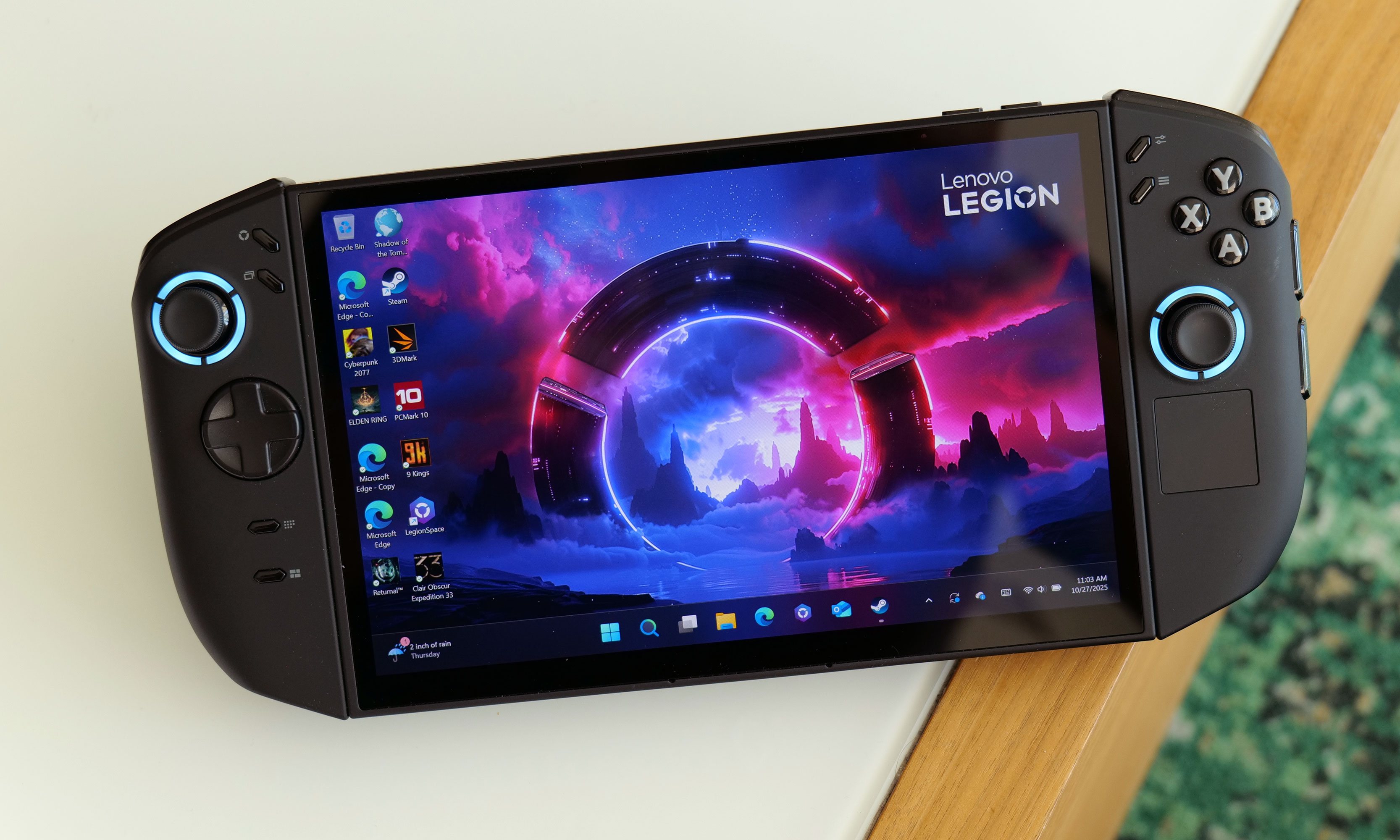 The Lenovo Legion Go 2.
Sam Rutherford for Engadget
The Lenovo Legion Go 2.
Sam Rutherford for Engadget
Note: This is a selection of noteworthy gaming handhelds we've tested, not a comprehensive list of everything we've ever tried.
Lenovo Legion Go 2The Lenovo Legion Go 2 is a capable alternative to the ROG Xbox Ally X with a mondo-sized 8.8-inch display. That screen is the main reason to consider it, as it's a vivid OLED panel that supports VRR and has a 144Hz native refresh rate. Like the Switch, it also comes with detachable controllers — one of which includes a useful touchpad for navigating Windows — plus a built-in kickstand for tabletop play.
That said, it's an absolute tank at just over two pounds, and we found it to perform a little worse than the Xbox Ally X at equal settings. It's also even more expensive, starting at $1,100 and rising to $1,350 for a config with the same Ryzen Z2 Extreme chip. It's a lovely device if you've got cash to burn — and to be fair, none of these Windows handhelds are for anyone looking for "value" — but the Xbox Ally X is a better buy for most.
The original MSI Claw was a flop, but the newer Claw 8 AI+ is much more appealing if you're willing to pay for a larger and slightly more powerful alternative to the ASUS ROG Ally X. With its Intel Core Ultra 7-258V chip and 32GB of RAM, it typically pumped out 10 to 15 percent higher frame rates than last-gen models like the ROG Ally X and Lenovo Legion Go in our testing. (Another model is available with the Ryzen Z2 Extreme chip.) Battery life is relatively strong, while its 8-inch 120Hz IPS display is plenty bright and supports VRR. There are smooth Hall effect thumbsticks and triggers, two Thunderbolt 4 ports and a built-in fingerprint sensor beyond that.
The Claw's main issue is its price: At $1,100 after recent price hikes, it's hard to justify over the ROG Xbox Ally X, which is already too expensive for most people. ASUS' handheld is lighter and easier to grip on top of that — though the Claw is thinner — and its overhauled Xbox UI, while far from perfect, is still easier to get around than MSI's Center M hub. There's a smaller 7-inch version of this handheld for $900 as well, but we haven't tested that one.
The ModRetro Chromatic is a competitor to the Analogue Pocket that can similarly play actual Game Boy cartridges via FPGA. With its premium metal frame, loud speaker, tight d-pad and beautifully bright 2.56-inch display, it's an impressive modernization of Nintendo's classic handheld. ModRetro also publishes a number of games specifically for the device, including a pretty great version of Tetris that comes bundled in the box.
However, for many, its faithfulness to the original Game Boy probably goes too far: It requires three AA batteries for power, and unlike the Analogue Pocket it doesn't support custom save states. It's also designed for Game Boy and Game Boy Color games only; it can't play any Game Boy Advance cartridges or games from other retro handhelds like Analogue's device, nor does doesn't support ROMs. For only $20 less than the Pocket, that makes it a tough sell, even if the hardware is arguably higher-quality.
There's also the lethal, autonomous elephant in the room: ModRetro is founded by Palmer Luckey, the idiosyncratic entrepreneur behind the Oculus Rift who has gone on to form Anduril Industries, a defense contractor that makes drones, surveillance systems and other AI-powered military tech. He has also espoused political views that many people — and this is the tamest way I can put this — may not be comfortable backing. We are not here to police where you can spend your money, and the Chromatic does much of what it wants to do well. Still, all of these handhelds are just so inessential, and no other option that we know of is as closely tied to an arms dealer.
The Windows 11 version of the Lenovo Legion Go S has the same relatively comfortable design and commendable 8-inch 120Hz display as the SteamOS model we highlight above. With the Z2 Go model we tested, though, its performance lags too far behind the ROG Ally X, Claw 8 AI+ and original Legion Go for something priced at $730. Windows is still clunky, too.
The Ayaneo Flip DS is a cool concept: a powerful Windows machine with a clamshell design and dual displays, sort of like a supercharged Nintendo DS. It feels sturdy, it performs roughly on par with the other Ryzen 7 7840U (or 8840U) handhelds in this guide, and its 7-inch top display is sharp, fast and bright. The second screen makes it a natural fit for emulating Wii U or 3DS games, but you could also, say, look up a guide or play a YouTube video without having to close whatever you're playing.
Unfortunately, this is more of a neat idea than a fully thought-out product. The folding design means that the joysticks have to be short and recessed, while the face buttons and d-pad are uncomfortably flat. The whole thing is overly thick and heavy, plus it runs very hot. Battery life tops out around two hours, and actually managing two displays on a Windows handheld is about as clunky as you'd expect. With prices now starting above $1,100, the Flip DS is hard to recommend unless you're (oddly) desperate for a handheld Wii U emulator. We're always happy to see more weird hardware, though.
The Ayaneo Kun is one of the more decadent Windows handhelds we've tested. With a sharp 8.4-inch display, a Ryzen 7 8840U chip, up to 64GB of RAM, up to 4TB of storage, a sizable 75Whr battery and a 54W max TDP, it's both a capable gaming device and a feasible replacement for a desktop PC. But it now starts at a pricey $999, it's huge and it suffers from the usual Windows-related issues. It also lacks VRR, and that Ryzen chip is no longer the latest and greatest. The Kun is still a fine device in a vacuum, but the ROG Xbox Ally X is a better buy. This is technically an older model for Ayaneo, too, as the company seems to launch a new handheld every other hour these days.
The Retroid Pocket Classic is another Game Boy-style vertical handheld in the vein of the Analogue Pocket, but like the other Retroid models we've highlighted, it's an Android device designed to emulate games via ROM files, not genuine cartridges. (Naturally, it can also play native Android games.) It's still far clunkier to set up and use as a result, and its overall design feels more toy-like than either the Pocket or ModRetro Chromatic.
But its Snapdragon G1 Gen 2 chip is easily powerful enough to play any classic handheld system (along with most other retro games that don't require joystick controls), while its 3.9-inch OLED display is superbly bright, sharp and colorful. The battery can last more than 10 hours when emulating lower-power systems, and Retroid sells a version with six face buttons instead of the standard four if you want to play older Sega Genesis and Saturn games in particular. The Analogue Pocket is still more premium and rewarding to use, but if you want a similar form factor and can live with the typical quirks that come with a device like this, the Classic is a good value at $129. Of the many Game Boy-style handhelds out there that solely rely on software emulation, it's the one we'd recommend first.
The Retroid Pocket Mini is essentially a smaller version of the Retroid Pocket 5. It runs on the same Snapdragon 865 chip and feels just as sturdy, but it has a smaller 3.92-inch display with a 4:3 aspect ratio. This makes it a more natural fit for older retro consoles, as you won't get the black boxes you'd see on a 16:9 display like the one on the Pocket 5. If you mainly want to emulate systems like the SNES, Sega Genesis or Game Boy Color and don't mind paying extra for a rich OLED display, it's a good little device. But the tiny screen is limiting if you ever want to play newer games, and we wish there wasn't so much empty space around the display.
This device had also generated some controversy within the retro gaming community for having persistent issues with inaccurate shaders (and for the slapdash way Retroid handled the matter). The company replaced the original model with a "V2" iteration that addresses those concerns, however.
Retroid Pocket 4 Pro and Retroid Pocket 4The 4.7-inch Retroid Pocket 4 Pro is the predecessor to the Pocket 5. Its performance isn't significantly far off the newer model, so it remains a nice value if you're determined to spend less than $200 on an emulation device. It misses out on the larger OLED display and more ergonomically-friendly design of its follow-up, however. The base Pocket 4 may also be worth a look if you want to stay under $150, but its weaker chip makes it less adept at emulating games from the PS2, GameCube and up.
The Miyoo Mini Plus is a highly affordable handheld with a well-built, Game Boy-style form factor that fits nicely with older games. Its 3.5-inch display pops for something in the $60 to $80 range, its battery lasts as long as it needs to and it can emulate consoles up to the original PlayStation without much issue. Its Linux-based software is extensively customizable, though it requires some tinkering to get it working optimally. Like many cheapo handhelds, it also lacks fast charging. Since it's from a smaller Chinese firm and isn't available at major retailers, it can also be difficult to actually buy. It's a nice choice if you want something more compact than the Retroid Pocket Classic, but that model's roomier design, more vibrant OLED panel and longer battery life makes it worth the extra cash for most people.
TrimUI BrickThe TrimUI Brick is another low-cost vertical handheld that's surprisingly well-built for an $80-ish device, thanks to its brushed metal backplate and impressive 3.2-inch IPS display. It has a weaker chip than the Retroid Pocket Classic, but it can still emulate older handheld games just fine, and its tiny frame makes it much easier to actually fit in a pocket. That said, while it has a sharper and more vivid screen than the Miyoo Mini Plus (its closest rival), the face buttons, d-pad and especially back buttons are all stiffer, and its stock UI feels similarly bootleg. (Some of the icons for different systems in the game library: "GomeBuy," "Fanicon," and "PloyStotion.") You can fix the latter with custom firmware, but Retroid's interface is easier to grok by default, and its setup process is less annoying. Most people interested in this class of device will be happier paying up for the Pocket Classic instead.
The Anbernic RG35XX Plus is another wallet-friendly vertical handheld. For about the same price as the Miyoo Mini Plus, it offers a faster chipset, more RAM and a bigger battery alongside a similarly impressive design. Its stock OS is overly sloppy and cheap-looking, however, and while its stronger chip is appreciated, it's still far behind the Retroid Pocket Classic.
The Anbernic RG35XXSP is a variant of the RG35XX Plus based on the same internals, only it apes the clamshell form factor of the old Game Boy Advance SP. That's a great design to rip off if you must pick one, and the hardware doesn't feel nearly as cheap as its (pre-tariff) price tag of $60 or so would suggest. But the software issues noted above still apply (both here and with the many other devices in the same RGXX family). We've also seen several user reports of quality control issues with the RG35XXSP's battery, which is automatically disqualifying.
Anbernic RG405MThe Anbernic RG405M is another 4:3 handheld with a 4-inch display and a pleasing metal frame. It's an OK alternative to the Retroid Pocket Mini if you want a little more screen space for less cash, but it's slower, and it lacks the Mini's OLED display. We find the Retroid's grooved back to be comfier to hold over time as well. And again, Anbernic has paused handheld shipments to America as of this writing.
The PlayStation Portal is an odd accessory that's designed to stream games from a PlayStation 5. It lacks built-in apps, so it doesn't support traditional emulation. Because it's entirely dependent on the quality of your home Wi-Fi, we can't guarantee how well it'll actually perform. It doesn't work with Bluetooth earbuds either.
The 8-inch display is fine and the DualSense-style controls are great, so PlayStation diehards who want a second screen for local PS5 streaming may see the appeal. Sony recently added the ability to stream a selection of games via the cloud, which is a step in the right direction, but you need an expensive PlayStation Plus Premium subscription to take advantage. In general, there's little here that you can't do with a smartphone and mobile game controller, so most people are better off saving their $200.
Logitech G CloudThe Logitech G Cloud would've been a great Android pick when it launched if it cost about $150 less. Its 7-inch 1080p display is bright, vibrant and generally more pleasing to look at than the panel on the AYN Odin 2, its battery lasts a good 10 to 12 hours per charge and its design is comfy to hold for hours at a time. Alas, the G Cloud still tends to retail for $300, which is just too much when the Retroid Pocket 5 offers more power at a lower price.
What to know about the gaming handheld marketYou can break down the gaming handheld market into three broad tiers. At the top, you have x86-based portable gaming PCs like the Steam Deck or ASUS ROG Xbox Ally X. These are the most powerful handhelds you can buy, as they seek to replicate the experience of a moderately specced gaming desktop. The Steam Deck runs on Linux, but most others use Windows. If you want to play modern, recently released PC games on the go (and need something stronger than a Switch), this is the type of device you'd get. They can also emulate the widest range of retro consoles. They're typically the largest and most cumbersome devices to hold, however, and their battery life can be short. Naturally, they're also the most expensive, costing anywhere from $400 to more than $1,000.
Further down on the price spectrum are "mobile handhelds" like the Logitech G Cloud or Retroid Pocket. These devices often run Android or Linux and can range from under $50 to $400-ish (before tariffs). They aren't equipped to play modern console or PC titles, but they're usually more compact than a portable PC, and you can still use them for mobile games and cloud streaming. While most are marketed toward those ends, many gamers actually buy them to emulate classic games through software like RetroArch. Getting emulators to work can be complicated, and accessing the BIOS and ROM files required to play games this way is legally murky. One lawsuit from Nintendo led to the shutdown of the most prominent Switch and 3DS emulators, for instance. (Engadget does not condone piracy.) Backing up files of games you already own for personal use only is considered more defensible, though, so for that a mobile handheld can be a more user- and wallet-friendly way to play the classics — provided you don't want to just use your phone.
We'll call the last tier "handhelds that do their own thing." This is a catch-all for things like the Switch 2 or Playdate: portable devices that run heavily customized software and aim to provide a unique gaming experience. They aren't necessarily ideal for emulation or playing the latest multiplatform titles; instead, they often have distinct game libraries. They might not have the widest appeal as a result (Switch excluded), but they're often easier for less tech-literate folks to just pick up and use.
Recent updatesNovember 2025: The ASUS ROG Xbox Ally X replaces the older ROG Ally X as our new favorite Windows gaming handheld. We've also added testing notes on the Lenovo Legion Go 2, ModRetro Chromatic and a couple of emulation-based handhelds in the Retroid Pocket Classic and TrimUI Brick. We're working to test several other recent releases for our next update, including updated versions of the Retroid Pocket 5 and AYN Odin 2.
August 2025: We've added the SteamOS version of the Lenovo Legion Go S as a new recommendation and updated our top Windows pick to reflect the upcoming release of ASUS' and Microsoft's ROG Xbox Ally devices, which will feature an overhauled Windows UI. We've also added a note on the recently released Nintendo Switch 2. We'll include testing notes on the Retroid Pocket Classic, TrimUI Brick and ModRetro Chromatic in the near future. (Note: Yours truly went on paternity leave after our last update — apologies for the delay!)
May 2025: We've tested the Retroid Pocket Flip 2 and recommended it as an alternative to the Retroid Pocket 5. We're also watching out for the first third-party devices that run SteamOS, starting with the new Lenovo Legion Go S, and the next ASUS ROG Ally device, which seems to be arriving soon based on recent leaks.
March 2025: We've edited this guide for clarity and added testing notes for the MSI Claw 8 AI+ and Lenovo Legion Go S (Windows version). Our main picks are unchanged. Looking ahead, we're keeping an eye on upcoming Windows handhelds from Acer and Ayaneo, a pair of new emulation devices from Retroid, the first third-party devices to ship with SteamOS and more machines that run on AMD's Ryzen Z2 chips, among others.
January 2025: We have a new top pick among emulation-focused handhelds: the Retroid Pocket 5. Beyond that, we've added notes on a few other devices we've tested, including the Retroid Pocket Mini and Anbernic RG35XXSP; lightly edited other blurbs to reflect changes in the market; and removed a couple write-ups for products that've been discontinued. We're also keeping an eye on new handhelds that've recently been announced or are strongly rumored to arrive in the near future, including devices from MSI and Lenovo.
August 2024: We've replaced the ASUS ROG Ally, our prior pick for the best Windows gaming handheld, with the new and improved ROG Ally X. We've also checked to make sure all availability and pricing details noted throughout the guide are accurate.
June 2024: We've updated this guide to ensure all of our recommendations are up to date, adding a note on ASUS' upcoming ROG Ally X in the process. We've also included details on two new handhelds we've tested since our previous update: the MSI Claw and Ayaneo Flip DS. Staying on top of this market is a tall task, but we're currently looking at recent noteworthy releases like the PSP-esque AYN Odin 2 Mini and the GBA-style Anbernic RG35XXSP as well.
This article originally appeared on Engadget at https://www.engadget.com/gaming/best-handheld-gaming-system-140018863.html?src=rss OpenAI has hired the developer behind AI agent OpenClaw [ 16-Feb-26 9:29am ]Recently we were introduced to OpenClaw, an AI that allows users to create their own agents to control apps like email, Spotify and home controls. Now, Sam Altman has announced that OpenAI has absorbed OpenClaw by hiring developer Peter Steinberger "to drive the next generation of personal agents," he wrote on X. Steinberger confirmed the news on his own blog. "I'm joining OpenAI to work on bringing agents to everyone. OpenClaw will move to a foundation and stay open and independent."
Steinberger was also in talks to join Meta, with both companies reportedly making offers in the "billions," according to Implicator.AI. The primary attractant was said to be OpenClaw's 196,000 GitHub stars and 2 million weekly visitors rather than its codebase.
OpenClaw became buzzy in the last few weeks thanks to its multifaceted ability to carry out tasks. People have used it to create agents that can write code, clear their inboxes, do online shopping and other assistant-like jobs. On its website, OpenClaw touts its ability to interact with popular apps and sites including WhatsApp, Discord, Slack, iMesage, Hue and Spotify.
Peter Steinberger is joining OpenAI to drive the next generation of personal agents. He is a genius with a lot of amazing ideas about the future of very smart agents interacting with each other to do very useful things for people. We expect this will quickly become core to our…
— Sam Altman (@sama) February 15, 2026
OpenClaw was recently called "Clawdbot" but Anthropic forced a name change due to similarities with its "Claude" branding. OpenClaw is often compared to Claude Code by "vibe coders" seeking to automate website development and other programming chores.
In his announcement, Altman said that "the future is going to be extremely multi-agent and it's important to support open source as part of that," adding that "OpenClaw will live in a foundation as an open source project" supported by Open AI. Steinberger, meanwhile, said that "what I want is to change the world, not build a larger company and teaming up with OpenAI is the fastest way to bring this to everyone."
This article originally appeared on Engadget at https://www.engadget.com/ai/openai-has-hired-the-developer-behind-ai-agent-openclaw-092934041.html?src=rss The best cheap phones for 2026 [ 16-Feb-26 8:00am ]A few years ago, it may have been fashionable to spend $1,000 on the latest flagship smartphone, but for most people, that's neither practical nor necessary. You don't even have to spend $500 today to get a decent handset, whether it's a refurbished iPhone or an affordable Android phone, as there are plenty of decent options as low as $160.
However, navigating the budget phone market can be tricky; options that look good on paper may not be in practice, and some devices will end up costing you more when you consider many come with restrictive storage. While we spend most of our time reviewing mid- to high-end handsets at Engadget, we've tested a number of the latest budget-friendly phones on the market to see cut it as the best cheap phones you can get right now.
What to look for in a cheap phone
For this guide, our top picks cost between $100 and $300. Anything less and you might as well go buy a dumb phone instead. Since they're meant to be more affordable than flagship phones and even midrange handsets, budget smartphones involve compromises; the cheaper a device, the lower your expectations around specs, performance and experience should be. For that reason, the best advice I can give is to spend as much as you can afford. In this price range, even $50 or $100 more can get you a dramatically better product.
Second, you should know what you want most from a phone. When buying a budget smartphone, you may need to sacrifice a decent main camera for long battery life, or trade a high-resolution display for a faster CPU. That's just what comes with the territory, but knowing your priorities will make it easier to find the right phone.
It's also worth noting some features can be hard to find on cheaper handsets. For instance, you won't need to search far for a device with all-day battery life — but if you want a phone with excellent camera quality, you're better off shelling out for one of the recommendations in our midrange smartphone guide, which all come in at $600 or less.
Wireless charging and waterproofing also aren't easy to find in this price range and forget about the fastest chipset. On the bright side, most of our recommendations come with headphone jacks, so you won't need to buy wireless headphones.
iOS is also off the table, since, following the discontinuation of the iPhone SE, the $599 iPhone 16e is now the most affordable offering from Apple. That leaves Android as the only option in the under-$300 price range. Thankfully today, there's little to complain about Google's operating system - and you may even prefer it to iOS.
Lastly, keep in mind most Android manufacturers typically offer far less robust software features and support for their budget devices. In some cases, your new phone may only receive one major software update and a year or two of security patches beyond that. That applies to the OnePlus and Motorola recommendations on our list.
If you'd like to keep your phone for as long as possible, Samsung has the best software policy of any Android manufacturer in the budget space, offering at least four years of security updates on all of its devices. Recently, it even began offering six years of support on the $200 A16 5G, which we recommend below. That said, if software support (or device longevity overall) is your main focus, consider spending a bit more on the $500 Google Pixel 9a, or even the previous-gen Pixel 8a, which has planned software updates through mid-2031.
This article originally appeared on Engadget at https://www.engadget.com/mobile/smartphones/best-cheap-phones-130017793.html?src=rssHideki Sato, who led the design of Sega's beloved consoles from the '80s and '90s, died on Friday, according to the Japanese gaming site Beep21. He was 77. Sato worked with Sega from 1971 until the early 2000s, but he's best known for his involvement in the development of the Sega arcade games and home consoles that defined many late Gen X and early millennial childhoods, starting with the SG-1000 to the Genesis, Saturn and Dreamcast.
— Beep21 (@Beep2021) February 14, 2026
Sato went on to serve as Sega's president from 2001 to 2003. In the post announcing his death, Beep21, which interviewed Sato numerous times over the years, wrote (translated from Japanese), "He was truly a great figure who shaped Japanese gaming history and captivated Sega fans all around the world. The excitement and pioneering spirit of that era will remain forever in the hearts and memories of countless fans, for all eternity." Sato's passing comes just a few months after that of Sega co-founder David Rosen, who died in December at age 95.
Terminator Zero showrunner confirms the Netflix anime has been canceled after one season [ 15-Feb-26 9:16pm ]If you've been wondering what's next for Netflix's Terminator Zero in the time since its first season, we finally have an update, and it's a bummer. Responding to a fan on social media, showrunner Mattson Tomlin said this weekend that the show has been canceled. Despite being generally well received, Tomlin noted that "at the end of the day not nearly enough people watched it."
It was cancelled. The critical and audience reception to it was tremendous, but at the end of the day not nearly enough people watched it. I would've loved to deliver on the Future War I had planned in season's 2 and 3, but I'm also very happy with how it feels contained as is. https://t.co/Dh7G6gkBF7 pic.twitter.com/dqCSXHIytg
— mattson tomlin (@mattsontomlin) February 13, 2026
Season one of Terminator Zero was released in August 2024 and focused on the events around Judgment Day — August 29, 1997, as established in Terminator 2 — and its aftermath, jumping forward to 2022, more than two decades into a war between humans and machines. In the post about the show's cancellation, Tomlin wrote, "I would've loved to deliver on the Future War I had planned in season's 2 and 3, but I'm also very happy with how it feels contained as is."
Tomlin went on to praise the marketing team in additional replies for "trying to really make the show work," as well as the hundreds of people who worked on the show. Offering a bit of insight, Tomlin wrote, "Generally speaking, anime audiences skew younger. Terminator audiences skew older. Terminator Zero asked them to meet in the middle, and they didn't in the way the corporation needed to justify the spend to continue. I'm extremely grateful to the people who have watched it."
The official Pokémon pinball machine has an animatronic Pikachu and a Master Ball plunger [ 15-Feb-26 8:49pm ]At a staggering starting price of $6,999, you have a better chance of buying a bicycle in Cerulean City than getting your hands on the official Pokémon pinball machine. The collaboration between The Pokémon Company International and Stern Pinball is undoubtedly nostalgic, letting you battle with a team that includes Bulbasaur, Charmander, Squirtle and Pikachu, as well as catch up to 182 different Pokémon, mostly from the Kanto region, with more to be added.
Besides catching 'em all and tracking your growing Pokédex on Stern Pinball's dedicated app, you can do Gym Battles in four different biomes and eventually face off against Team Rocket. The pinball machine draws a lot of inspiration from the original cartoon, including a monitor that plays clips from the show, an animatronic Pikachu, and speakers that can play the iconic theme song.
Stern Pinball developed Pro, Premium and Limited Edition models, which can cost all the way up to $12,999. For the most expensive option, you'll get one of the 750 limited edition machines that include a Master Ball plunger, a numbered plaque and a signed certificate of authenticity. For Pokémon fans that can't afford to spend that much money on a pinball machine, you can soon find them at arcades and bowling alleys instead.
This article originally appeared on Engadget at https://www.engadget.com/gaming/nintendo/the-official-pokemon-pinball-machine-has-an-animatronic-pikachu-and-a-master-ball-plunger-204915013.html?src=rss Apple may be adding a splash of color to its upcoming budget-friendly MacBook [ 15-Feb-26 7:27pm ]The hardest choice to make for building your next MacBook might be selecting a color. According to Bloomberg's Mark Gurman, Apple has tested colors including light yellow, light green, blue and pink for its next entry-level MacBook that's aimed at students and enterprise users.
Beyond the more vibrant colors, Gurman said that Apple has also trialed its classic silver and dark gray colorways for its cheaper laptop. Gurman added that not all of these six colors will make it to the final product, but Apple has recently shown it's not afraid to dip into flashier options. Apple refreshed the iMac in 2024 with a total of seven colors and swapped out the space gray option for sky blue for the latest MacBook Air.
Color choices aside, the latest rumors point to the upcoming MacBook having a price tag that's anywhere between $699 and $799. To achieve that lower price point, Apple is expected to port over its chips designed for iPhones, like the A18 Pro that we first saw with the iPhone 16 Pro Max. We're also anticipating Apple will compromise on specs, ports, or even the display, but Gurman reported that the company won't be skimping when it comes to the shell. According to Gurman, Apple will employ a new manufacturing process to craft aluminum shells for the affordable MacBook, instead of opting for a cheaper material like plastic to cut costs. We may not have to wait long to see the official colors of the budget MacBook, as Gurman reported that it will be announced during an event in March.
This article originally appeared on Engadget at https://www.engadget.com/computing/laptops/apple-may-be-adding-a-splash-of-color-to-its-upcoming-budget-friendly-macbook-192740002.html?src=rss Tesla CarPlay is coming but it's reportedly being held back by low iOS 26 adoption numbers [ 15-Feb-26 5:38pm ]We're still waiting for Apple CarPlay compatibility for Tesla EVs, but it's been pushed back thanks to a slight hitch with iOS 26, according to Bloomberg's Mark Gurman. In the latest Power On newsletter, Gurman said that Tesla's plans to adopt CarPlay have been delayed due to app compatibility issues as well as low adoption rates for iOS 26.
It's been a long wait for Tesla drivers who want CarPlay compatibility, especially since initial rumors indicated a late 2025 rollout and Bloomberg reported that Tesla was testing CarPlay in its vehicles in November. However, Gurman's latest newsletter revealed that there were some compatibility issues between Apple Maps and Tesla's in-house navigation software, which also supports the self-driving features.
To address this, Apple released an iOS 26 update that would better synchronize the two navigation apps, especially when a driver would use Tesla's autonomous driving options. Still, Tesla is reportedly concerned enough about the low adoption rates of iOS 26 to delay delivering CarPlay to its vehicles. Gurman also noted that iOS 26 adoption rates were lower than usual, but are already going up, citing Apple's latest numbers that 74 percent of all iPhones released in the last four years are running iOS 26.
There's still no official date for when CarPlay arrives in Teslas, but including the beloved in-car feature could be a way to boost sales for the company. According to the January registration estimates in the US, Tesla saw sales slip for the fourth month in a row.
This article originally appeared on Engadget at https://www.engadget.com/transportation/evs/tesla-carplay-is-coming-but-its-reportedly-being-held-back-by-low-ios-26-adoption-numbers-173812736.html?src=rssAirbnb plans to double down on artificial intelligence to improve its user experience for both guests and hosts. During a fourth-quarter earnings call, Airbnb's CEO, Brian Chesky, said the company is building an "AI-native experience" aimed at helping guests book trips, assisting hosts with their listings, and running the company more efficiently. According to Chesky, there's an AI search tool to help guests book trips that's live for a small percentage of users right now.
In a shareholder letter posted on Airbnb's website, the company said it's conducting early testing with an AI-powered search that is "focused on giving guests a more natural way to describe what they're looking for, and ask questions about the listing and location." The letter added that the AI search tool will become "a more comprehensive and intuitive search experience that extends through the trip," but the company didn't offer a definitive date on when it would be available to the public.
While it may feel like Airbnb is late to incorporating AI into its ecosystem, it introduced an AI chatbot that handles customer service requests last year. While the AI agent is only available to users in North America currently, Airbnb said that it already handles a third of customer requests without the need for human intervention, as reported by TechCrunch. Chesky also said during the earnings call that the AI chatbot would tackle "significantly more" customer tickets a year from now and that it would roll out to the rest of the world.
This article originally appeared on Engadget at https://www.engadget.com/ai/airbnb-is-testing-out-ai-search-with-a-small-percentage-of-users-203054011.html?src=rssDisney is going after another generative AI tool, accusing ByteDance and its recently released Seedance 2.0 of using its copyrighted material without permission. As first reported on by Axios, the Walt Disney Company sent a cease-and-desist letter to ByteDance, claiming the Chinese company developed its Seedance tool "with a pirated library of Disney's copyrighted characters from Star Wars, Marvel, and other Disney franchises, as if Disney's coveted intellectual property were free public domain clip art."
The letter, which was obtained by Axios, included examples of Seedance videos featuring copyrighted Disney characters, including Spider-Man, Darth Vader, Peter Griffin and more. Even though ByteDance just released Seedance 2.0 on Thursday, it's already earned praise, but also indignation from Hollywood studios, when it comes to its AI-generating capabilities.
With the strong early momentum, Seedance has already found itself in hot water with one of the largest media companies in the world. However, it's not the first time that Disney has threatened legal action against an AI company, since Character.AI received a cease-and-desist letter for the same offense in September. A few months later, Disney even accused Google of copyright infringement when training its AI models. On the other hand, Disney partnered with OpenAI in a three-year licensing agreement that allows the AI giant to generate images and videos using that highly sought-after intellectual property.
This article originally appeared on Engadget at https://www.engadget.com/ai/disney-accuses-bytedance-of-virtual-smash-and-grab-when-using-copyrighted-works-to-train-its-ai-191116136.html?src=rssNeed something new for your reading list? Here are two titles we think are worth checking out. This week, we read Aoife Josie Clements' deeply unsettling Persona, and the first issue of Bleeding Hearts, from the relaunch of the DC imprint, Vertigo.
OpenAI's GPT-4o may have survived its first brush with going offline, but it won't be as lucky this time. OpenAI has officially retired GPT-4o, the ChatGPT model that was seen as more conversational and notoriously sycophantic, on February 13. The news of GPT-4o's end was first announced in a post on the OpenAI website in January, but the discontinuation also included GPT-5, GPT-4.1, GPT-4.1 mini, and OpenAI o4-mini from ChatGPT.
It's not the first time that OpenAI has delisted GPT-4o as an option for ChatGPT. In August, the AI giant sunsetted the GPT-4o model in favor of rolling out and prioritizing the latest GPT-5 model at the time. However, a wave of user complaints led OpenAI to restore access to GPT-4o but with no guarantee that it'll be around forever.
This time around, OpenAI doesn't seem very open to preserving access to GPT-4o, especially since it'll serve only a small portion of the user base. The company wrote on its website that "the vast majority of usage has shifted to GPT‑5.2, with only 0.1 percent of users still choosing GPT‑4o each day." On top of that, OpenAI is facing several wrongful death lawsuits that specifically mention the GPT-4o model. Despite the two weeks of notice before GPT-4o's last day online, there is still a vocal group of users mourning the loss of their AI boyfriends and even calling for OpenAI to open-source their preferred model.
This article originally appeared on Engadget at https://www.engadget.com/ai/openai-has-officially-retired-the-controversial-gpt-4o-model-181553067.html?src=rssThe Crew-12 mission, SpaceX's 20th human spaceflight, launched at 5:15 AM Eastern on February 13 from Cape Canaveral in Florida. It's expected to dock with the International Space Station today, February 14, at 3:15 PM, and you can watch the event below as it happens. By the time the mission's Dragon capsule docks with the ISS, it will have traveled approximately 34 hours since lift off. Inside are NASA astronauts Jessica Meir and Jack Hathaway, European Space Agency's Sophie Adenot and Roscosmos cosmonaut Andrey Fedyaev.
The four spacefarers are joining the three remaining passengers onboard the ISS after Crew-11 flew back to Earth a month earlier than planned. If you'll recall, NASA made the decision to cut their mission short after one of the crew members had a medical issue that instruments on the ISS aren't capable of diagnosing. While the crew member was stable, the agency decided to bring the whole mission home out of an abundance of caution.
Crew-12 will be staying on the ISS for eight months and will conduct a number of scientific experiments, including ones related to human health and ones meant to advance technologies for future missions to the moon and Mars. They will study how pneumonia-causing bacteria can lead to long-term heart damage, for instance, and will also look into how a person's physical characteristics can affect blood flow during spaceflight. NASA's live coverage for the docking starts at 1:15 PM.
This article originally appeared on Engadget at https://www.engadget.com/science/space/watch-the-nasa-spacex-crew-12-mission-dock-with-the-iss-180000450.html?src=rss Homeland Security has reportedly sent out hundreds of subpoenas to identify ICE critics online [ 14-Feb-26 1:52pm ]The Department of Homeland Security (DHS) has reportedly been asking tech companies for information on accounts posting anti-ICE sentiments. According to The New York Times, DHS has sent hundreds of administrative subpoenas to Google, Reddit, Discord and Meta over the past few months. Homeland Security asked the companies for names, email addresses, telephone numbers and any other identifying detail for accounts that have criticized the US Immigration and Customs Enforcement agency or have reported the location of its agents. Google, Meta and Reddit have complied with some of the requests
Administrative subpoenas are different from warrants and are issued by the DHS. The Times says they were rarely used in the past and were mostly sent to companies for the investigation of serious crimes, such as child trafficking. Apparently, though, the government has ramped up its use in the past year. "It's a whole other level of frequency and lack of accountability," Steve Loney, a senior supervising attorney for ACLU, told the publication.
Companies can choose whether to comply with the authorities or not, and some of them give the subject of a subpoena up to 14 days to fight it in court. Google told The Times that its review process for government requests is " designed to protect user privacy while meeting [its] legal obligations" and that it informs users when their accounts have been subpoenaed unless it has been legally ordered not to or in exceptional circumstances. "We review every legal demand and push back against those that are overbroad," the company said.
Some of the accounts that were subpoenaed belong to users posting ICE activity in Montgomery County, Pennsylvania on Facebook and Instagram in English and Spanish. The DHS asked Meta for their names and details on September 11, and the users were notified about it on October 3. They were told that if Meta didn't receive documentation that they were fighting the subpoena in court within 10 days, Meta will give Homeland Security the information it was asking for. The ACLU filed a motion for the users in court, arguing that the DHS is using administrative subpoenas as a tool to suppress speech of people it didn't agree with.
In late January, Meta started blocking links to ICE List, a website that lists thousands of ICE and Border Patrol agents' names. A few days ago, House Judiciary Committee member Jamie Raskin (D-MD) also asked Apple and Google to turn over all their communication with the US Department of Justice to investigate the removal of ICE-tracking apps from their respective app stores.
This article originally appeared on Engadget at https://www.engadget.com/big-tech/homeland-security-has-reportedly-sent-out-hundreds-of-subpoenas-to-identify-ice-critics-online-135245457.html?src=rss How to customize your iPhone home screen with iOS 26 [ 14-Feb-26 1:00pm ]Apple has steadily expanded home screen customization on the iPhone over the past few years, and iOS 26 continues that trend with more visual control over app icons. Building on the changes introduced in iOS 18, the latest update lets you resize icons, remove app labels, apply system-wide color tints and make icons translucent using Apple's new Liquid Glass design language.
Most of these options live in one place: the Customize menu, which appears after entering edit mode on the home screen. While iOS still doesn't allow total freeform icon placement or third-party icon packs without shortcuts, the tools Apple provides are now flexible enough to dramatically change how an iPhone looks and feels. This guide walks through how to customize app icons and layouts using the options available in iOS 26, with a focus on icon size, color, appearance and arrangement.
How to customize your iPhone home screenAll home screen customization starts the same way.
Go to the Home Screen.
Touch and hold an empty area of the Home Screen background until the apps begin to jiggle.
Tap Edit in the top left corner, then select Customize from the menu.
A customization panel appears along the bottom of the screen. Changes made here apply across all home screen pages at once, rather than on a per-page basis.
From the Customize menu, you can:
Adjust icon size
Change appearance (e.g., Dark)
Make icons translucent with a clear look
Add a color tint to icons and widgets
One of the simplest changes in iOS 26 is also one of the most visually impactful. From the Customize menu, tap the icon showing two app squares of different sizes. This switches the home screen to Large App Icons mode.
When large icons are enabled, app labels disappear entirely and the icons themselves expand to fill more of the grid. This creates a cleaner look and makes apps easier to tap, particularly on iPhone models with larger screens. The tradeoff is that fewer icons fit on each screen and spacing between rows becomes more pronounced.
To revert to standard icons with labels, repeat the steps and tap the same button again.
iOS 26 offers four icon appearance styles: Default, Dark, Clear and Tinted. These options are available from the top row of the Customize panel. From the Customize panel, you can tap the sun icon across all options in the top left-hand corner to toggle wallpaper dimming. This generally makes app icons and labels easier to read.
The Default option keeps icons looking as the developers intended, with no system-wide color or transparency applied.
Selecting Dark applies a darker background to supported app icons and widgets. Apple's own apps fully support this mode, and some third-party apps do as well, though many retain their original colors. When Dark is enabled, iOS can also dim the wallpaper slightly, which may help reduce power usage on OLED displays.
The Clear option enables translucency across all apps on the Home Screen. This removes all color but retains app labels. The layered, frosted-glass effect changes depending on the background image. Clear icons can be paired with Light, Dark or Auto styles using the options along the bottom of the Customize panel.
Tinted mode allows all supported app icons and widgets to take on a single color scheme. After selecting Tinted, color and saturation sliders appear at the bottom of the screen. Adjusting these changes the hue applied across icons, creating a uniform look that can range from subtle pastels to high-contrast monochrome themes.
If you want a specific color from your iPhone's wallpaper, select the eyedropper tool, then tap and hold while dragging the cursor across the screen until you land on your chosen color. Like the Clear option, you'll be able to select from Light, Dark or Auto when adjusting the Tinted settings.
The Auto option allows icons to switch between light and dark appearances based on system-wide light or dark mode.
How to arrange apps around the home screenApp placement works the same way it did before iOS 26, but the visual changes introduced by larger icons and spacing make layout choices more noticeable.
Apps can be rearranged by accessing an empty space on the Home Screen, then tapping and holding until the apps start jiggling. From here you can drag icons to new positions. The grid remains fixed, meaning icons cannot overlap or be placed freely, but there is more flexibility in how empty space is used.
Icons can be clustered toward the bottom of the screen, aligned to one side or arranged to frame a wallpaper. With large icons enabled, the gap between the dock and the first row of apps becomes more pronounced, but it cannot be filled with additional icons.
Changes apply across all home screen pages, so reorganizing one page does not affect icon size or appearance on another.
What iOS 26 still doesn't allowDespite expanded customization, some long-standing limitations remain. iOS 26 does not support per-app icon color selection, custom icon packs without shortcuts or freeform icon placement outside the grid. Icon appearance settings apply globally, not per page or per app.
Widgets, lock screen customization and focus mode filters add additional layers of personalization, but those tools sit outside the scope of the home screen Edit menu.
iOS 26 gives iPhone users more control over the look of their home screen than ever before, even if Apple's approach remains structured. By combining icon resizing, appearance modes and careful app arrangement, it's possible to create a layout that feels cleaner, more personal and easier to use without relying on workarounds.
This article originally appeared on Engadget at https://www.engadget.com/mobile/smartphones/how-to-customize-your-iphone-home-screen-with-ios-26-130000798.html?src=rss Relooted, Reanimal and other new indie games worth checking out [ 14-Feb-26 12:00pm ]Welcome to our latest roundup of what's going on in the indie game space. A whole bunch of compelling games arrived this week, and Sony dropped some news about more that are on the way to PS5 and other platforms during its State of Play stream on Thursday.
For one thing, I didn't have a prequel for Neva, one of my favorite games of the last few years on my bingo card. I'm very much looking forward to checking out that DLC next week.
It's really neat that Motion Twin and Evil Empire — the studios behind Dead Cells and its expansions, respectively — are getting to make a proper Castlevania game. While it might not be developing many games in-house anymore, giving external studios the chance to run with its franchises is a very smart move on Konami's part. Not least because we're getting a Silent Hill game set in Scotland as well.
I've had Big Walk on my radar since the game was first shown off at The Game Awards a couple of years back. This is a co-op multiplayer game from Untitled Goose Game studio House House and publisher Panic in which you'll go on adventures with your friends and help each other through puzzles and other challenges using voice, text chat and gestures. You can just hang out with your buds and watch the sunset or put their binoculars into the ocean too.
Expect Big Walk to arrive later this year on PS5 (including as a Monthly Game for all PS Plus members), Steam and Epic Games Store. There will be support for cross-platform play between PS5 and PC.
Also, Remedy Entertainment is technically an indie studio. As such, I can mention here that I cannot wait for Control Resonant, which is probably going to break my brain with all the perspective shifting Remedy showed off in the gameplay trailer.
New releasesAs with any successful heist, planning and execution are equally paramount in Relooted. Setting things up properly before hightailing it out of a museum with artifacts reminds me a bit of Teardown albeit without all the voxel destruction. But Relooted is a lot more than that.
It's an anti-colonialist story in which parkour enthusiast Nomali and her crew take back African artifacts (all of which exist in real life) from Western museums. I did encounter some performance issues while playing on PC, but that didn't take too much away from the enjoyable, in-the-moment action and having to adjust escape routes on the fly when things go awry. Nor did the framerate drops detract one bit from the important story that South African studio Nyamakop is telling here.
Relooted is out now on Steam, Epic Games Store and Xbox Series X/S. It typically costs $15, but there's a 10 percent discount on Steam until February 24. It's available on Game Pass Ultimate and PC Game Pass.
Little Nightmares and Little Nightmares 2 developer Tarsier Studios is back with another slice of atmospheric horror. In Reanimal, two siblings set out to save their missing friends and escape from an island they once called home. However, they'll have to face a litany of dangers, including a lot of creepy creatures.
I haven't played Reanimal yet, but the various trailers have have always grabbed my attention. It's out now on Steam, PS5, Xbox Series X/S and Nintendo Switch 2 for $40.
Reanimal has single-player, couch co-op and online co-op modes. A friend pass that allows you to invite a pal to play with you online at no extra cost should be available soon.
Mewgenics had been in the works for a very long time before it arrived this week. It was initially announced in 2012 when co-developer Edmund McMillen was still part of Super Meat Boy studio Team Meat. After years of Mewgenics being in development hell amid McMillen focusing on projects such as The Binding of Isaac: Rebirth, he's finally seen the game through with the help of longtime collaborator Tyler Glaiel.
This is a turn-based strategy roguelike in which players breed cats and then take kitties with wild mutations and blends of powers into combat. There's a lot to explore and discover here. McMillen and Glaiel claim the main campaign runs for over 200 hours. Having more than 10 character classes (each with 75 unique abilities), more than 900 items and hundreds of bosses and enemies could well ensure that things stay fresh enough to justify that run time.
Reviews have largely been positive for this one, though the humor didn't click for some critics. Mewgenics is out now on Steam. It usually costs $30, but you can save $3 if you buy it by February 24.
Rogue Point is a co-op shooter for up to four players that's worth paying attention to, in large part because it's from the team behind Black Mesa, the fan remake of Half-Life. It's now available in early access on Steam, typically for $20, though there's a 15 percent discount until February 26.
This appears to be in the vein of tactical shooters like Ubisoft's Tom Clancy games. There are objective-based missions and a Counter-Strike-style economy for unlocking and upgrading gear. While there are only four maps as things stand, Crowbar Collective has implemented a system that randomizes the layouts to keep things fresh.
UpcomingSteam Next Fest is almost upon us. Many developers and publishers are preparing to release demos for their games, but some are arriving ahead of the event, such as one for Starship Troopers: Ultimate Bug War! The demo is a blast and it feels like the kind of retro Starship Troopers shooter I wish we'd had in the late '90s.
I really enjoy Helldivers 2, which takes a lot of inspiration from Starship Troopers. In turn, this game draws from Helldivers 2, with features like tossing a flare to tell a support craft to send gear down to the planet's surface. I just wish the mech was a bit more fun and effective to use.
If you would like to know more about this game from Warhammer 40,000: Boltgun developer Auroch Digital and publisher Dotemu, you can check out the demo on Steam. Starship Troopers: Ultimate Bug War! is coming to Steam, GOG, PS5, Xbox Series X/S and Nintendo Switch 2 on March 16.
A demo for a line-based puzzle title called Rope popped up on Steam this week ahead of the full game's arrival in April for about $3.50. The aim is to connect ropes of the same color to clear them. More rules will be introduced over time to make the game more challenging.
While Rope looks charming enough, I mainly wanted to include it in this week's roundup because I thought developer Ikuo's comments in the press release were quite lovely.
"My games are neither flashy nor extravagant. Instead, I focus on preserving the essence of play. Like hide‑and‑seek or tag — simple rules that draw you in until you forget the time," Ikuo said. "Rope brings that timeless spirit of play into a modern puzzle game. It is intuitive, endlessly replayable and quietly absorbing. I aimed to create a small, understated experience that stays with players long after they put it down. I hope this game leaves even a small impression on someone's heart."
The Mermaid Mask is a project that SFB Games put on the backburner after another one of their games became a hit (that would be Crow Country, which was one of our favorite games of 2024).
This point-and-click puzzle game is the latest installment in the long-running Detective Grimoire series. A teaser trailer doesn't give away too much, but I do enjoy what we see of the hand-drawn 2D animation here.
Here's hoping this is a worthy follow-up to Tangle Tower, an Apple Arcade game we enjoyed very much. We'll find out for sure when The Mermaid Mask lands on PC and consoles this summer. In the meantime, you can check out an updated demo that just hit Steam ahead of Next Fest.
The premise of The Stairwell is practically identical to that of The Exit 8. You walk through a small, contained scene multiple times. If everything looks okay, keep walking forward. If something is out of the ordinary, you turn around. Just try not to miss many anomalies. Rather than walk through corridors as in The Exit 8 (the film adaptation of which looks pretty promising), The Stairwell sees you going up or down a seemingly infinite tower as you try to reach the goal.
This anomaly game, which is from Hidden Palace, has been on Steam since last year. It's coming to PS5 on February 19. Expect jump scares.
Let's wrap things up for this week with an arcade game that requires just two inputs: one button to turn left, and another to veer right. You can't control the speed of your craft in Ship v Maze. All you can do to avoid crashing and ending your run is to react quickly enough to steer your ship through various obstacles. It's all about putting your reflexes to the test.
Ship v Maze is from Cosmic Droplet (aka solo developer Frederic Vanmol), It'll hit Steam on April 2 for $4. A demo is available now.
This article originally appeared on Engadget at https://www.engadget.com/gaming/playstation/relooted-reanimal-and-other-new-indie-games-worth-checking-out-120000234.html?src=rssKilling Satoshi, an upcoming biopic about the elusive creator of Bitcoin, will reportedly rely heavily on artificial intelligence to generate locations and adjust actors' performances, Variety reports. The film was announced in 2025 as being directed by Doug Liman (The Bourne Identity, The Edge of Tomorrow) and starring Casey Affleck and Pete Davidson in undisclosed roles, but its connection to overhyped technology was previously understood to begin and end with cryptocurrency.
According to a UK casting notice viewed by Variety, the producers of Killing Satoshi reserve the right to "change, add to, take from, translate, reformat or reprocess" actors' performances, using "generative artificial intelligence (GAI) and/or machine learning technologies." No digital replicas will be created of performers, but it sounds like plenty of other AI-driven tweaks are on the table. The production's use of AI will also extend to the setting of its shoots, per Variety's source. Killing Satoshi will be shot on a "markerless performative capture stage" and things like backgrounds and locations will be entirely generated by AI.
You guess is as good as mine as to why a film about blockchain technology needs to be filmed this way, but Doug Liman has been connected with plenty of unusual projects in the past, including a rumored Tom Cruise film that was supposed to film on the International Space Station. Killing Satoshi will be far less practical in comparison, and walking a much finer line of what's acceptable in the entertainment industry.
A major sticking point in SAG-AFTRA's 2023 contract negotiations was guaranteeing protections for actors who could be replaced by AI. Equity, the union representing actors in the UK, is currently negotiating protections for members that are concerned that AI could be used to reproduce their likenesses and voices and let studios use them without their consent.
This article originally appeared on Engadget at https://www.engadget.com/entertainment/tv-movies/bitcoin-biopic-starring-casey-affleck-to-use-ai-to-generate-locations-and-tweak-performances-210657775.html?src=rssAn upcoming update to Steam includes a helpful improvement to game reviews. As part of the Steam Client Beta update Valve released on February 12, users will now be able to attach information about their hardware specifications when they post a new game review or update an old one.
It's not uncommon to find negative reviews that complain about a game's performance, information that's hard to draw a conclusion from without knowing what kind of hardware the reviewer is using. With specs attached, the usefulness of complaints becomes a little bit easier to gauge. A game's sales performance and discoverability on Steam is heavily influenced by its review average, a data point Steam users sometimes manipulate for reasons unconnected to the quality of a game. Provided reviewers actually attach their specs — at least in the beta, the feature is entirely optional — Valve's mercurial reviews ecosystem could end up becoming more nuanced overall.
Alongside the new option in reviews, Valve is also experimenting with a way for users to share "anonymized framerate data" with the company. When framerate sharing is enabled, "Steam will collect gameplay framerate data, stored without connection to your Steam account but identified with the kind of hardware you are playing on," Valve says. The feature is specifically focused on devices running SteamOS, Valve's Linux-based operating system for the Steam Deck and some third-party handhelds. The extra information could help the company's attempts to improve game compatibility using software like Proton.
The beta update also includes bug fixes, and a tweak to how Valve collects feedback about whether a game should be Deck Verified. Now when Steam prompts you to confirm whether you agree with a game's rating, if you disagree, you can provide a reason as to why.
This article originally appeared on Engadget at https://www.engadget.com/gaming/pc/valves-latest-steam-beta-lets-you-add-your-pcs-specs-to-game-reviews-195038078.html?src=rssThe forthcoming Nintendo Virtual Boy accessory for Switch and Switch 2 can play VR-supported games, as reported by Video Games Chronicle. There are four available games to play, including Super Mario Odyssey, Super Smash Bros Ultimate, The Legend of Zelda: Breath of the Wild and Captain Toad: Treasure Tracker.
These aren't new VR builds of the games, rather they are the versions previously released for the Nintendo Labo VR set. This was a kit for the original Switch that allowed users to build a cardboard VR headset, among other items.
However, this is very good news for Switch 2 owners as Labo creations generally don't work with Nintendo's shiny new console. So this is the only way to experience the VR versions of the aforementioned four games. It's also worth noting that the Switch 2 upgrade for Breath of the Wild still includes the VR mode.
There are some caveats. The Virtual Boy accessory is available to purchase as a hardware unit or in cardboard. The cardboard version is much cheaper, at $25, and is actually the preferred method for playing these games in VR.
That's because the hardware version sits on a stand, like the original Virtual Boy, making it harder to move one's head around. The cardboard headset is free from those constraints. The hardware also includes red filters over the lenses, to better mimic the original experience, but these can be removed.
However, the hardware version is better for playing actual Virtual Boy games, as they were designed for a static headset resting on a table. You'll have to decide if that trade-off is worth $100. It's also worth noting that Virtual Boy games will not work with the original Labo VR headset, which is a bummer for OG Switch fans.
Both versions of the Virtual Boy accessories will be available on February 17, which is the same day several of the retro console's games head to the Nintendo Switch Online + Expansion Pack subscription service. They can be purchased at the My Nintendo Store. We got a chance to try the headset and came away fairly impressed, though noted that the revamped accessory is "just as eccentric and ungainly as the original was three decades ago."
For those wondering what all the fuss is about, the Virtual Boy was an actual console released by Nintendo all the way back in 1995. It was one of the first mass-market VR devices and, as such, was decades ahead of the curve. It was cumbersome, the games were only in red and there was nothing by way of motion control. Americans only got 14 games before the console was discontinued.
This article originally appeared on Engadget at https://www.engadget.com/gaming/nintendo/nintendos-virtual-boy-accessory-lets-you-play-vr-mario-and-zelda-on-switch-2-172138483.html?src=rssYou've seen this movie before: A disheveled man (Sam Rockwell) busts into a restaurant, threatening to blow up the joint unless a crew of people joins him. Like Groundhog Day, he's been through this countless times before, and he immediately starts recounting otherwise unknowable details to convince the diner patrons. Like 12 Monkeys, he's from the future — the timely twist in Good Luck, Have Fun, Don't Die is that, rather than a world-ending virus, he needs help preventing a humanity-ending AI from being born.
Good Luck is more of a primal scream than a thoughtful articulation about where everything went wrong. There's a bit of "old man yells at cloud" energy here (director Gore Verbinski is 61, and screenwriter Matthew Robinson is 47), but it fits the film's satirical tone. Looking around at the world today, who doesn't wish they could warn their past selves about the tech industry and the new ruling class it helped breed.
Rockwell's character eventually wrangles a ragtag crew of future saviors: Mark and Janet (Michael Pena and Zazie Beetz), a married couple of high school teachers; Susan (Juno Temple), a distraught mother; and Ingrid (Haley Lu Richardson), a sad woman wearing a princess dress. There's also Asim Chaudhry's Scott, who mostly serves as comic relief, but doesn't get any real backstory like the others.
Good Luck wastes no time fleshing out its present near-dystopia in episodic chapters. It turns out Mark and Janet are also on the run from smartphone-obsessed high schoolers, who spend their days scrolling through endless TikTok-like feeds. Susan is forced to confront a horrific situation around her son (I won't get into specifics here, but it's a distinctly American phenomenon). And Ingrid is literally allergic to Wi-Fi and smart devices, which makes it hard to fit into the modern world.
Each of these scenarios play out like mini Black Mirror episodes. Everything is heightened to the absurd, and all the problems can be traced back to unchecked technological encroachment and capitalism. Nothing subtle there. The glimpses of an apocalyptic future are even less so — all we see are destroyed cities, people trapped in VR headsets (which place them in an AI-generated reality) and robots hunting down anti-AI humans.
 Sam Rockwell in Good Luck, Have Fun, Don't Die.Briarcliff Entertainment
Good Luck is at its best when it's simply having fun. As Rockwell and crew make their way to their final destination — a child who is about to invent true AI — they encounter pig-faced assassins, Stepford-esque parents and an adorably horrific kaiju. Even when faced with half-baked scripts, Verbinski always manages to impress visually (think back to the creepiness of The Ring, or the wildly entertaining set pieces in Pirates of the Caribbean). That's as true as ever here, where the final scene evokes the hyper-tech chaos of Akira.
As much as Good Luck, Have Fun, Don't Die, evokes classic sci-fi, it still can't hold a candle to the sheer terror of seeing AI unleash a nuclear bomb in Terminator 2. And despite its zanines, it doesn't reach the madcap heights of Gilliam's Brazil or 12 Monkeys. But if you're sick of having AI products shoved down your throat, and you think the notion of "true AI" is a farce, it's a fun way to channel your rage.
This article originally appeared on Engadget at https://www.engadget.com/entertainment/tv-movies/good-luck-have-fun-dont-die-rails-against-ai-in-style-154437854.html?src=rssMeta has backed away from highly controversial facial recognition tech in its products and services before, but seemingly not so far that it isn't willing to have another crack at it. A new report from The New York Times claims Mark Zuckerberg's company wants to add facial recognition to its lineup of branded smart glasses at some point this year.
The NYT spoke to four anonymous people with knowledge of Meta's plans, who told the publication that the feature is codenamed "Name Tag" internally. As you'd expect, it would let people wearing Meta-powered Oakley or Ray-Ban glasses identify people and "get information about them" using AI.
Such technology naturally carries huge privacy and ethical risks, which is reportedly why Meta was hesitant to unveil Name Tag at a conference for the blind last year. It also may have shelved plans to include facial recognition in the first version of its smart glasses, which launched in 2023.
In an internal memo from Meta's Reality Labs viewed by the NYT, Meta said that the current political instability in the US presents a good opportunity for it to push ahead with its plans. "We will launch during a dynamic political environment where many civil society groups that we would expect to attack us would have their resources focused on other concerns," it said.
With the smart glasses market expected to become more competitive in the coming years, Meta seemingly believes facial recognition would give it an edge on rival products from the likes of OpenAI. As for how it would work, the company is considering its options. It could recognize people the wearer is already connected to via one of Meta's apps, or potentially display information from public Instagram accounts. The NYT's sources said that universal facial recognition, effectively allowing you to look up the identity of anyone you walked past, would not be possible.
Meta shut down Facebook's Face Recognition system, used when tagging people in photos, in 2021, following widespread public backlash over privacy concerns. Three years later, it brought it back, this time as a tool for Instagram and Facebook designed to detect scam ads that use the faces of celebrities and other public figures. Last year Meta rolled out the feature beyond the US, so Facebook and later Instagram users in the UK, Europe and South Korea could also use it on their accounts.
This article originally appeared on Engadget at https://www.engadget.com/ai/meta-is-reportedly-working-to-bring-facial-recognition-to-its-smart-glasses-144721330.html?src=rssEvery once in a while, a product comes along that sparks a bit of joy in our jaded hearts. This is what happened with the Kodak Charmera, a $30 tiny toy camera that was nearly impossible to get ahold of in the first couple of months after its release, selling out immediately over waves of blind box restocks. Despite the gimmick of it all, the Charmera was just too cute for some of us to resist, and we sprang when they finally started becoming more readily available.
A few of us on the Engadget team have one now, and even with all of its shortcomings, we kind of love this thing. Here's what two of our writers think about it.
Lately, it feels like a chore to carry around a full-frame mirrorless camera. My Nikon definitely feels like the right tool to precisely capture a moment in time with fast autofocus and plenty of image resolution. Other times, that perfect moment is more casual, like catching up with friends over dim sum or killing time while you're snowed in at a cabin in Vermont. In these cases, there's no reason to carry around a hulking camera and lens to snap a flawless photo that I have to edit later. Instead, something light, discreet and playful feels like the right tool for the occasion.
 Jackson Chen for Engadget
That's where the Kodak Charmera comes in. It's a toy camera with a 35mm lens with a fixed f/2.4 aperture and a 1/4-inch sensor. In other words, the photos this thing takes are about equivalent to what you would get with a crappy flip phone from the 2000s that also plays Snake.
Kodak is clearly trying to wring out the longing for nostalgia within all of us, and has nailed it with the Charmera, which is even inspired by its old-school disposable Fling cameras. It's definitely not as good as the smartphone in your pocket, but there's something disarming about snapping a quick shot with a tiny block of plastic that's lighter than your keys.
Playing around with the Charmera for a few weeks gave me a healthy reminder that the sillier and more transient parts of life don't need the technical prowess of an expensive camera. Obviously, the Chamera produces photos of terrible quality at 1.6 megapixels and can't really capture anything fast-moving or in low light, but it's undeniably fun and hard to resist shooting with. And sometimes, you and your friends are just doing wildly unserious things and you want a camera that matches that energy.
— Jackson Chen, Contributing Reporter
Every time I pull out the Kodak Charmera in public to snap a few pictures, I'm immediately met with a barrage of questions and squeals of delight from full-grown adults: "What is that?"; "Is that a camera?"; "Does it really take pictures?"; "Can I see it?" It is the kind of accessory that doubles as a conversation starter, an effect that's turned out to be as joyous as taking pictures with the camera itself. I've been trying really hard to spend less time on social media and my phone in general lately, and having a two-inch camera clipped to me has made for a pretty fun shift in how I document the day-to-day.
As the resurgence of compact digital cameras has shown us, a lot of people are yearning for a time of simpler tech — when we had personal devices that could do useful things, like take decent photos and connect us to our friends, but didn't consume our lives entirely. Companies like Camp Snap have shaped their entire brands around recapturing that magic, and some consumers have shown that they're willing to sacrifice in areas like image quality in exchange for a taste of it, too. The Kodak Charmera isn't the kind of product you go into purchasing with high expectations. It is clearly a toy that is only going to be capable of so much.
 Cheyenne MacDonald for Engadget
As Jackson noted, the low-resolution 1,440 x 1,080 pictures look about on par with those you'd have taken on a flip phone 15 or 20 years ago. In the right lighting conditions with a clearly defined subject, they're not so bad. But selfies, portraits and nature photos will generally look washed out. It can record videos too — and you should set similarly low expectations for these.
Despite all that, I've been pleasantly surprised by how much I'm enjoying the Charmera experience. Its crunchy photos are just good enough to feel like they're successfully preserving a moment in time. And being so tiny, it's really convenient to bring everywhere. It even came with me to CES. The Charmera takes a microSD card (sold separately), allowing for tons of storage and easy transferring. There are a bunch of built-in filters you can apply, too, which have been fun to play around with.
If I want high-quality photos, this isn't the camera I'm going to reach for. But it's great for low-stakes situations when all I care about is taking some pictures I can look back on fondly later. Consider me charmed. — Cheyenne MacDonald, Weekend Editor
Meta went to court this week in two major trials over alleged harms facilitated by its platform. In New Mexico, the state's attorney general has accused the company of facilitating child exploitation and harming children through addictive features. In a separate case in Los Angeles, a California woman sued the company over mental health harms she says she suffered as the result of addictive design choices from Meta and others.
In both cases, Meta has disputed the idea that social media should be considered an "addiction." On the stand this week, Instagram chief Adam Mosseri said that social media isn't "clinically addictive," comparing it to being "addicted" to a Netflix show.
In opening statements in the New Mexico trial, Meta's lawyer Kevin Huff went further. He told the jury that "social media addiction is not a thing" because it's not in the Diagnostic and Statistical Manual of Mental Disorders (DSM), the handbook used by mental health professionals in the US.
"According to the American Psychiatric Association, they don't recognize the concept of social media addiction in the same way as addiction to drugs and alcohol," Huff said during opening arguments that were broadcast by Courtroom View Network. "What you see on the screen is what's called the DSM, which is basically the official manual for recognized mental disorders. The American Psychiatric Association studied this and decided that social media addiction is not a thing."
But the American Psychiatric Association (APA) has never said that social media addiction doesn't exist. The organization provides information and resources about social media addiction on its website. "Social media addiction is not currently listed as a diagnosis in the DSM-5-TR—but that does not mean it doesn't exist," the APA said in a statement to Engadget.
Dr. Tania Moretta, a clinical pyschophysiology researcher who has studied social media addiction, agrees. "The absence of a DSM classification does not mean that a behavior cannot be addictive, maladaptive or clinically significant," she told Engadget. That argument, she said, "reflects a misunderstanding" of how psychiatry professionals define and classify conditions. "Diagnostic manuals formalize scientific consensus; they do not define the boundaries of legitimate scientific inquiry. Many maladaptive behaviors and clinically significant symptom patterns are studied and treated well before receiving official classification."
Meta's critics have long claimed that the company has profited from addictive features that hook children and teens. The trials in Los Angeles and New Mexico are just the start of several court battles over the issue. The social media company is also facing a high-profile trial with school districts in June, and lawsuits from 41 state attorneys general.
Moretta said that social media addiction is a field that requires more study, but that there is already evidence that it can have harmful effects on some people. "At present, from a scientific perspective, there is documented evidence that social media use disorder is associated with both psychophysiological alterations, including changes in reward/motivational and inhibitory/regulatory systems, and clinically significant negative impacts on functioning (e.g., sleep disturbances, psychological distress, impairment in social, academic, or occupational domains)," she said. "The key question is not whether all social media use is addictive, but whether a subset of users exhibits patterns consistent with behavioral addiction models and whether specific platform design features may exacerbate vulnerability in predisposed individuals."
Both trials are ongoing and expected to last the next several weeks. In New Mexico, jurors have already heard from former employee turned whistleblower Arturo Bejar and former exec Brian Boland, both of whom have publicly criticized the company for not prioritizing safety. In Los Angeles, Mosseri's testimony has wrapped up, but Meta CEO Mark Zuckerberg is expected to testify next week. The trials will also feature extensive internal documents from Meta, including details about the company's own research into the mental health impacts of its platform on young people.
This article originally appeared on Engadget at https://www.engadget.com/social-media/meta-really-wants-you-to-believe-social-media-addiction-is-not-a-real-thing-130000257.html?src=rssOne good thing about virtual private networks (VPNs) is that when they don't work, the problem is almost always solvable without technical training. Although it's aggravating when your VPN randomly drops your connection, the chances are good that you can handle the issue yourself without getting tech support involved.
If your VPN is repeatedly disconnecting from the server, I recommend dealing with the problem immediately. When you have your kill switch on as good cybersecurity habits dictate, VPN drops will kick you off the internet. Without that feature enabled, it'll expose your real identity and location online. That's not a big deal if you're just aiming to, say, stream an international sporting event, but it could be an existential issue if you're using the VPN as a workaround against government censorship. Either way, you can address the issue by working through the eight troubleshooting steps below and checking whether they've solved your problem.
8 reasons your VPN keeps disconnectingI've organized these root causes in ascending order of how much effort the solution takes. Try the easier fixes before moving on to the more complex or expensive ones.
1. You're using the VPN on too many devices at onceMost VPNs limit the number of devices you can connect at the same time on a single subscription. Some services, like Surfshark, claim to offer unlimited simultaneous connections, but they'll still cut you off if they see signs of abuse. Generally, you can install the VPN on as many devices as you like; it just can't be actively running on more than the limit.
If you're trying to connect to the VPN on a new device and it repeatedly disconnects, check how many other phones, computers or smart TVs it's already running on. Pay attention to devices where you have the VPN set to auto-connect on startup, as you may have missed that it's running. Disconnect from the VPN on one of those devices and try again on the new one.
2. Your VPN server is slow or overloadedThe problem often rests with the VPN server you're trying to connect to. Providers regularly shut down servers for routine maintenance. Sometimes, a server is technically online, but it's under such a heavy user load that it can't maintain a connection. It's also possible that the server is so physically far away from you that the connection keeps timing out.
In cases like these, the answer is simple: use another server. Pick a different server by disconnecting the VPN and reconnecting to the same location. If the new server has the same problems, try another location, assuming you don't need an IP address in a specific country.
3. You're using an unstable VPN protocolAs I explained in my article on how a VPN works, a VPN protocol is the set of instructions at the heart of everything a VPN does. Not all protocols are the same. For example, OpenVPN over TCP prioritizes speed over connection stability, causing more frequent disconnections. It's also possible for certain networks to block some VPN protocols but not others (see #8).
If changing servers didn't help your unstable connection, try switching protocols. WireGuard, OpenVPN over UDP and IKEv2 are best for stability. You can almost always find the protocol options in the Settings page of your VPN app.
4. Power-save settings are interferingA VPN almost always runs in the background. In some cases, a device's battery saver settings might shut down the VPN to stop the battery from draining. See if turning off power-save mode stops your VPN from disconnecting randomly (and maybe plug in your device while you're at it).
5. Your internet connection isn't stableYour VPN needs to pass traffic through an ISP like any other online app — it just encrypts that traffic first. If you don't have a good internet connection, you won't have a good VPN connection. When you notice your VPN randomly disconnecting, check whether you have problems with your home internet connection. Resetting your modem by turning it off for at least 10 seconds may solve the problem, but you can also just wait for your internet to improve with time.
6. Another program is interfering with the VPNOther security programs are a frequent cause of VPN disruptions. If you connect to an office VPN, for example, you likely won't be able to have a personal VPN running at the same time. Likewise, if you use an antivirus program or have a firewall on your device, it may be blocking your VPN from connecting. See if you can configure the firewall to allow traffic through a port used by a VPN protocol.
7. Your software is out of dateIf none of the fixes have worked so far, you can often solve your connection problems by updating all the software involved. For optimal security, you should be installing updates the moment they're available anyway, so this will protect you even if it doesn't directly solve your VPN problem.
Update your VPN client and your operating system, then try connecting again. If you're still having problems, try updating your router. You can reach its control panel by entering its default IP address into the URL bar of your browser. Update it as well, then try once more.
8. Your network or ISP is blocking VPN trafficThere's a chance that your problem originates with your network or ISP, not on the VPN or any device you own. Some networks, especially at offices and schools, automatically block any VPN traffic they detect. These restrictions can even be imposed by entire countries, most infamously in China.
Should this turn out to be your problem, turn on any obfuscation features that may be built into your VPN. Using an obfuscated protocol, connect to a server outside the location being censored, then use the internet as normal. This will be much more difficult if you're in a country where VPNs are illegal or restricted, but there's still hope — if you can safely send an email, contact a VPN provider and ask if they'll send you a configuration directly. Proton VPN is one company that's officially willing to do that.
If you still find your VPN disconnecting mid-session, you may have a rare problem that doesn't show up on this list. Contact your VPN's support staff and do what they recommend. If possible, chat with a live support technician so you can tell them what you've already tried.
This article originally appeared on Engadget at https://www.engadget.com/cybersecurity/vpn/why-does-my-vpn-keep-disconnecting-130000620.html?src=rssA few days ago, a Redditor posted in the community for DoorDash drivers that they received an offer to close a Waymo vehicle's door. The job paid a guaranteed fee of $6.25 with a $5 extra on top of it after the DoorDasher verifies that it has been completed. Waymo has confirmed to 404Media and TechCrunch that, yes, it is indeed paying Dashers to shut the doors of its self-driving cars. And it makes sense because, well, there's nobody to do it otherwise if a passenger accidentally leaves it open.
The Alphabet subsidiary and DoorDash told the publications that it's currently running a pilot program in Atlanta, wherein if one of its vehicle's doors is left ajar, nearby Dashers are notified. Waymo's self-driving vehicles can't leave if one of its doors remains open, so the company is framing the program as a way to enhance its fleet's efficiency. Waymo told 404Media that the program started earlier this year and that payments are structured to ensure "competitive and fair compensation for Dashers."
To note, this isn't the first time the two companies have teamed up. In October 2025, Waymo's self-driving cars became a delivery option for DoorDash customers in Phoenix, Arizona. To get a Waymo delivery, customers will have to choose "opt in to autonomous delivery" during checkout and to physically retrieve their order from the car's trunk when it arrives.
This article originally appeared on Engadget at https://www.engadget.com/transportation/doordashers-are-getting-paid-to-close-waymos-self-driving-car-doors-122711640.html?src=rssThreads users have complained about its recommendation algorithm since the dawn of time 2023. Users even started writing posts addressed to the algorithm, specifying the topics they wanted to see more of. Now, that's part of the system: Users can write a post that begins with "dear algo" to adjust their preferences, officially.
For example, you could write: "Dear algo, show me more posts about sous vide recipes." You can also ask to see fewer posts about topics you don't want to see, like "Dear algo, stop showing me posts about air fryers." You can even retweet other users' "dear algo" posts to have those topics reflected in your feed. "Dear algo" posts will work for Threads users in the US, UK, Australia and New Zealand, with more countries coming "soon."
— Mat Smith
The biggest stories in tech you might have missed.
The first Control Resonant gameplay trailer shows a sideways NYC
The next Metal Gear Solid remaster collection arrives this summer
With a bigger focus on the Moon, Elon Musk is making some wild new plans. According to audio heard by The New York Times, Musk said xAI needed to build an AI satellite factory on the Moon with a gigantic catapult to launch the satellites into space. Sometimes you just want to be the Bond villain.
"You have to go to the Moon" to build the required AI capabilities, Musk told employees. "It's difficult to imagine what an intelligence of that scale would think about, but it's going to be incredibly exciting to see it happen." Such a catapult would certainly need to be powerful — though the Moon has only one-sixth Earth's gravity, the minimum escape velocity required for orbit is still around 3,800 mph, or five times the speed of sound. That's currently possible with electromagnetic railguns, but the satellites would have to withstand that force.
Pokémon Pokopia is cosy AFStardew Valley + Animal Crossing X Pokémon. TMANintendo
In a bid to distract from a lot of things, Nintendo's new Pokémon game is a gently paced game where, instead of playing as a generic trainer, you take control of a sole Ditto.
As a Ditto, you can transform into other Pokémon, though the process is sort of incomplete, meaning you can only learn one skill from the monsters you befriend. Instead of using tools, you can transform into other Pokémon (like Lapras or Dragonite) to use their abilities to traverse obstacles or shape the world around you.
Sony WF-1000XM6 headphones reviewFacing tougher competition. TMAEngadget
Sony unveiled the latest entry in its best wireless earbud series, the WF-1000XM6, featuring yet another redesign, both inside and out. Once again, strong features and audio performance remain, but competition from all sides is tougher than ever. As Billy Steele explains in his review, if you want the strongest active noise cancellation, that will be Bose's QuietComfort Ultra Earbuds. If the best sound quality is your goal, the Technics AZ100 is your best bet in this price range. I'll also mention Sennheiser's Momentum True Wireless 4, which offers great sound quality, respectable ANC and a comfier fit than the M6. The WF-1000XM6 is available now for $330.
This article originally appeared on Engadget at https://www.engadget.com/general/the-morning-after-meta-turned-threads-algorithm-complaints-into-an-official-feature-121500663.html?src=rssThere's a new AAA John Wick game coming with Keanu Reaves portraying the main character both in voice and likeness, Lionsgate and Saber Interactive announced. Currently untitled, it's in development for PS5, Xbox Series X and S, and PC, and will be a single-player third-person experience designed for "mature" audiences. So far, there's no release date.
"The new single-player third-person action game will combine John Wick's unparalleled, adrenaline-fueled 'gun-fu' fighting style with Saber's proven reputation for creating thrilling gaming experiences that leave players craving more," the companies said in an announcement post. They added that franchise director Chad Stahelski and star Keanu Reeves are both involved in the game's production, with Reeves reprising his character's look, voice and more.
The story is original and "addresses a significant time in John Wick's life," according to the game's director Jesus Iglesias. It will include both familiar film characters and new ones created for the game. As for gameplay, it will offer "a hard-hitting gun-fu combat system, jaw-dropping camerawork, intense driving experiences, cinematic storytelling, and a bold range of atmospherically immersive environments," the team said.
Saber Interactive is the developer behind Warhammer 40,000: Space Marine 2 and is also developing the upcoming titles Jurassic Park: Survival and John Carpenter's Toxic Commando. It will be the first John Wick game since John Wick Hex, which came out in 2019 but was recently delisted.
This article originally appeared on Engadget at https://www.engadget.com/gaming/theres-a-new-john-wick-game-on-the-way-103900064.html?src=rssThe right accessories can make your iPhone feel more capable and more personal. Whether you want to protect your phone, improve your photos or stay powered during a long day out, there are plenty of accessories that can make a real difference. MagSafe gear has opened the door for new chargers, stands and mounts, while portable batteries and compact lenses can upgrade your everyday routine.
We tested a range of products to find the best iPhone accessories that offer practical benefits for both new and older models.
This article originally appeared on Engadget at https://www.engadget.com/computing/accessories/best-iphone-accessories-140022449.html?src=rss
Marvel Tōkon: Fighting Souls was first announced last year as a tag fighting game feature superheroes including Captain America, Ms Marvel and Spider-Man, with a launch sometime in 2026. We expected more details to be revealed at Sony's State of Play yesterday and indeed they were. The game will arrive August 6 on PS5 and PC and include the Unbreakable X-Men's Storm, Magik, Wolverine, and Danger.
The trailer teases each character's fighting style, with Magik and Wolverine using a more in-your-face melee fighting style. Storm and Danger, meanwhile, offer more diverse attack abilities, with Storm manipulating wind and lightning and Magik deploying sorcery skills. We also saw a team-based finisher attack with all four characters joining forces to unleash a flurry of attacks. The trailer also revealed that Marvel Tōkon: Fighting Souls will offer an Episode Mode with a "new form of storytelling adapted for a modern video game format" that marries Manga with American comics.
MARVEL Tōkon: Fighting Souls launches on August 6, 2026 for PS5 and PC. Pre-orders open February 19, 2026 at the PlayStation Store and PC storefronts. It will be sold in three versions: the $60 Standard Edition, $85 Digital Deluxe Edition (includes the full game, all pre-order incentives, a Year 1 Characters and Stage Pass) and Howard the Duck and Cosmo. Finally, the $100 Ultimate Edition includes all the preceding, plus costumes for Storm, Captain America, Doctor Doom, Iron Man, and Spider-Man, along with an Animated Chromatic color unlock for all 20 launch characters.
This article originally appeared on Engadget at https://www.engadget.com/gaming/marvel-tokon-fighting-souls-lands-on-ps5-and-pc-august-6-with-x-men-in-tow-095235773.html?src=rssDeath Stranding 2: On the Beach will be available on PC starting on March 19, Kojima Productions has announced at State of Play. The studio worked with Dutch video game developer Nixxes Software, which Sony acquired in 2021 to help bring PlayStation games to PCs. The sequel to the first Death Stranding is set in Australia almost a year after the events of the original game. It still features a post-apocalyptic world inhabited by strange creatures, and you'll still control Sam Porter Bridges to connect survivors in the continent to the chiral network communications system.
Kojima Production says the PC version of the game will come with a bunch of improvements, will work with NVIDIA, AMD and Intel Upscaler and FrameGen, and will have uncapped framerates. It will support 4K gaming and will come with support for ultrawide monitors with 21:9 aspect ratio, as well as for super ultrawidescreen monitors with 32:9 aspect ratio for PC. When it comes to audio, the PC version of the game supports 3D audio via Dolby Access and DTS Sound Unbound, as well as Windows Sonic for headphones. You can play using a mouse and a keyboard if you wish, but you can also play with a DualSense controller.
You'll be able to pre-purchase Death Stranding 2: On the Beach starting today for $70 on Steam or Epic Games and receive extra in-game items. The Digital Deluxe edition, which comes with more in-game extras, will set you back $10 more.
This article originally appeared on Engadget at https://www.engadget.com/gaming/pc/death-stranding-2-for-pc-arrives-on-march-19-095157946.html?src=rssAt Sony's State of Play yesterday, developer Nomada Studio revealed a DLC prequel to its gorgeous and award-winning puzzle platformer Neva. Entitled simply Neva: Prologue, it tells the story of how Alba and her wolf companion Neva met, while introducing new gameplay mechanics, locales and challenges.
"In Neva: Prologue, players follow Alba as she chases a trail of white butterflies deep into the corrupted swamps, only to discover a frightened wolf cub, lost and alone," Nomada writes. "To survive, Alba must earn the cub's trust and guide them both through the blighted wetlands and the dark forces that stalk them."
The developer adds that Neva: Prologue is designed to be experienced after completing the main game. It adds three new locations, "each featuring unique gameplay mechanics, alongside new enemies and intense boss encounters." Completionists will also get five hidden challenge flowers.
In her review of the original game, Engadget's Jessica Conditt found Neva "faultless" thanks to the exquisite swordplay and intuitive platforming action, along with the "stunning" world composed of "lush forests, sun-drenched valleys, soaring mountains and twisting cave systems." Neva: Prologue will released as a standalone DLC on February 19.
This article originally appeared on Engadget at https://www.engadget.com/gaming/a-neva-prequel-is-arriving-next-week-081239628.html?src=rssAir fryers have gone from novelty appliances to everyday kitchen staples surprisingly fast. They're quick to heat up, easy to use and well suited to everything from frozen snacks to roasted vegetables and simple desserts. For many people, they've replaced the oven for smaller meals, cutting down on cook time without adding extra cleanup.
The category has also expanded well beyond basic basket-style models. Some air fryers are designed for small kitchens or single servings, while others offer larger capacities and preset cooking modes for roasting, reheating or dehydrating. After testing a wide range of machines, the Instant Vortex Plus continues to stand out for its reliable performance, straightforward controls and consistently good results.
Below, we've gathered the best air fryers you can buy right now across different sizes and price points. Whether you're replacing an older unit or trying one for the first time, these picks focus on appliances that are easy to live with and deliver crisp food without the need for deep frying.
What does an air fryer do?
Let's clear one thing up first: it's not frying. Not really. Air fryers are more like smaller convection bake ovens, ones that are often pod-shaped. Most work by combining a heating element and fan, which means the hot air can usually better crisp the outside of food than other methods. They often reach higher top temperatures than toaster ovens - which is part of the appeal.
For most recipes, a thin layer of oil (usually sprayed) helps to replicate that fried look and feel better. However, it will rarely taste precisely like the deep-fried or pan frying version when it comes out of the air fryer basket. Don't let that put you off, though, because the air fryer, in its many forms, combines some of the best parts of other cooking processes and brings them together into an energy-efficient way of air fryer cooking dinner. Or breakfast. Or lunch.
Buying guide for air fryers Convection ovensYou can separate most of these machines into two types of air fryers, and each has different pros and cons. Convection ovens are usually ovens with air fryer functions and features. They might have higher temperature settings to ensure that food crisps and cooks more like actually fried food. Most convection ovens are larger than dedicated air fryers, defeating some of the purpose of those looking to shrink cooking appliance surface area. Still, they are often more versatile with multiple cooking functions, and most have finer controls for temperatures, timings and even fan speed.
You may never need a built-in oven if you have a decent convection oven. They often have the volume to handle roasts, entire chickens or tray bakes, and simply cook more, capacity-wise, making them more versatile than the pod-shaped competition.
The flip side of that is that you'll need counter space in the kitchen to house them. It also means you can use traditional oven accessories, like baking trays or cake tins, that you might already own.
Pod-shaped air fryersPod-shaped air fryers are what you imagine when you think "air fryer." They look like a cool, space-age kitchen gadget, bigger than a kettle but smaller than a toaster oven. Many use a drawer to hold ingredients while cooking, usually a mesh sheet or a more solid, non-stick tray with holes to allow the hot air to circulate. With a few exceptions, most require you to open the drawer while things cook and flip or shake half-cooked items to ensure the even distribution of heat and airflow to everything.
That's one of a few caveats. This type of air fryer typically doesn't have a window to see how things are cooking (with only a few exceptions), so you'll need to closely scrutinize things as they cook, opening the device to check progress. Basket-style air fryers also generally use less energy - there's less space to heat - and many have parts that can be put directly into a dishwasher.
Some of the larger pod-shaped air fryers offer two separate compartments, which is especially useful for anyone planning to cook an entire meal with the appliance. You could cook a couple of tasty chicken wings or tenders while simultaneously rustling up enough frozen fries or veggies for everyone. Naturally, those options take up more space, and they're usually heavy enough to stop you from storing them in cupboards or shelves elsewhere.
As mentioned earlier, you might have to buy extra things to make these pod fryers work the way you want them to. Some of the bigger manufacturers, like Philips and Ninja, offer convenient additions, but you'll have to pay for them.
Beyond the strengths and weaknesses of individual models, air fryers are pretty easy to use from the outset. Most models come with a convenient cooking time booklet covering most of the major foods you'll be air frying, so even beginners can master these machines.
One of the early selling points is the ability to cook fries, wings, frozen foods and other delights with less fat than other methods like deep frying, which gets foods the crispiest. As air fryers work by circulating heated air, the trays and cooking plates have holes that can also let oil and fat drain out of meats, meaning less fat and crisper food when you finally plate things up. For most cooking situations, you will likely need to lightly spray food with vegetable oil. If you don't, there's the chance that things will burn or char. The oil will keep things moist on the surface, and we advise refreshing things with a dash of oil spray when you turn items during cooking.
Most air fryers are easy to clean - especially in comparison to a shallow or deep fryer. We'll get into cleaning guidance a little later.
With a smaller space to heat, air fryers are generally more energy-efficient for cooking food than larger appliances like ovens. And if you don't have an oven, air fryers are much more affordable - especially the pod options.
There are, however, some drawbacks. While air fryers are easy enough to use, they take time to master. You will adjust cooking times for even the simplest types of food - like chicken nuggets, frozen French fries or brussels sprouts. If you're the kind of person that loves to find inspiration from the internet, in our experience, you can pretty much throw their timings out of the window. There are a lot of air fryer options, and factors like how fast they heat and how well distributed that heat is can - and will - affect cooking.
There's also a space limitation to air fryers. This is not a TARDIS - there's simply less space than most traditional ovens and many deep fat fryers. If you have a bigger family, you'll probably want to go for a large capacity air fryer - possibly one that has multiple cooking areas. You also might want to consider a different kitchen appliance, like a multicooker, sous vide or slow cooker to meet your specific cooking needs.
You may also struggle to cook many items through as the heat settings will cook the surface of dishes long before it's cooked right through. If you're planning to cook a whole chicken or a roast, please get a meat thermometer!
Best air fryer accessoriesBeyond official accessories from the manufacturer, try to pick up silicone-tipped tools. Tongs are ideal, as is a silicon spatula to gently loosen food that might get stuck on the sides of the air fryer. These silicone mats will also help stop things from sticking to the wire racks on some air fryers. They have holes to ensure the heated air is still able to circulate around the food.
Silicone trivets are also useful for resting any cooked food on while you sort out the rest of the meal. And if you find yourself needing oil spray, but don't feel like repeatedly buying tiny bottles, you can decant your favorite vegetable oil into a permanent mister like this.
We're keeping clean up simple here. Yes, you could use power cleaners from the grocery store, they could damage the surface of your air fryer. Likewise, metal scourers or brushes could strip away the non-stick coating. Remember to unplug the device and let it cool completely.
Remove the trays, baskets and everything else from inside. If the manufacturer says the parts are dishwasher safe - and you have a dishwasher - the job is pretty much done.
Otherwise, hand wash each part in a mixture of warm water, with a splash of Dawn or another strong dish soap. Use a soft-bristled brush to pull away any crumbs, greasy deposits or bits of food stuck to any surfaces. Remember to rinse everything. Otherwise, your next batch of wings could have a mild Dawn aftertaste. Trust us.
Take a microfiber cloth and tackle the outer parts and handles that might also get a little messy after repeated uses. This is especially useful for oven-style air fryers - use the cloth to wipe down the inner sides.
If Dawn isn't shifting oily stains, try mixing a small amount of baking soda with enough water to make a paste, and apply that so that it doesn't seep into any electrical parts or the heating element. Leave it to work for a few seconds before using a damp cloth to pull any greasy spots away. Rinse out the cloth and wipe everything down again, and you should be ready for the next time you need to air fry.
How to find air fryer recipesBeyond fries, nuggets and - a revelation - frozen gyoza, there are a few ways to find recipes for air-fried foods. First, we found that the air fryer instruction manuals often have cooking guides and recipe suggestions for you to test out in your new kitchen gadget. The good thing with these is that they were made for your air fryer model, meaning success should be all but guaranteed. They are often a little unimaginative, however.
Many of the top recipe sites and portals have no shortage of air fryer recipes, and there's no harm in googling your favorite cuisine and adding the words "air fryer" on the end of the search string. We've picked up some reliable options from Delish, which also has a handy air fryer time converter for changing oven and traditional fryer recipes. BBC Good Food is also worth browsing for some simple ideas, as is NYT Cooking, with the ability to directly search for air fryer suggestions. Aside from that, you can also grab plenty of cookbooks from your local bookshop with lots of recipes that you can use in your favorite air fryer.
And if you have a killer recipe or unique use for your air fryer, let us know in the comments. What's the air fryer equivalent of the Instant Pot cheesecake? We're ready to try it.
How we test air fryersWe put each air fryer we test through its paces by cooking a variety of foods in it including raw proteins like fish and chicken, raw vegetables like potatoes and cauliflower and frozen snacks like mozzarella sticks. We attempt to use each cooking method that the machine has pre-programmed, and when possible, follow a couple of recipes in any provided recipe booklets that come with the air fryer. We also clean the cooking basket and all other removable components as many times as possible, and will put those components into a dishwasher if they claim to be dishwasher-safe. We also make note of how loud the machine is when using different cooking settings and how warm the surrounding area becomes.
This article originally appeared on Engadget at https://www.engadget.com/home/kitchen-tech/best-air-fryers-133047180.html?src=rss Ring calls off partnership with police surveillance provider Flock Safety [ 13-Feb-26 3:17am ]Ring has canceled its partnership with Flock Safety, after receiving backlash for running a Super Bowl ad touting its Search Party feature. If you'll recall, Ring revealed back in October 2025 that it was entering a partnership with the surveillance company, which would make it possible for law enforcement to ask smart doorbell owners for videos captured by their devices. In its announcement, the company said that the "planned Flock Safety integration would require significantly more time and resources than anticipated." The decision to call off the partnership was mutual, Ring added, and Flock Safety's integration was never launched. Apparently, no Ring customer footage was ever sent to Flock.
Under the partnership, law enforcement agencies using Flock's Nova platform or FlockOS would have been able to use Ring's Community Requests to ask for doorbell videos from users. They would have been asked to specify the location and timeframe of the incident, as well as provide a unique investigation code and the details about what is being investigated. Their requests would then be forwarded to relevant users, who could choose to share footage from their doorbell. Ring said the whole process would have been anonymous and optional.
Ring was known to have shared security cam videos to law enforcement without a court order or the device owner's consent at least 11 times in the past. In 2024, however, it seemed to have walked back its police-friendly stance and said that it would stop sharing videos with the police without a warrant. This alliance with Flock would have marked a return to police collaboration after the company distanced itself from law enforcement.
While Ring's official reason was that the Flock partnership would need more resources than expected, it's worth noting that the company recently got flak for its Super Bowl Search Party ad. Ring touted it as a way to find lost dogs by using its cameras' AI to identify pets running across their field of vision and then pooling feeds together to identify missing pets. While Search Party isn't new and was announced last year, the ad sparked concerns about surveillance and how the tech could be misused, leading users to disable the feature for their cameras altogether.
This article originally appeared on Engadget at https://www.engadget.com/home/ring-calls-off-partnership-with-police-surveillance-provider-flock-safety-031717605.html?src=rssDuring its State of Play livestream on Thursday, Sony revealed the first PlayStation Plus Game Catalog addition for February and it's a doozy. Marvel's Spider-Man 2 (PS5) will finally websling its way onto the Game Catalog on February 17.
Marvel's Spider-Man 2 was released in October 2023, and Insomniac's third Spidey game is the the best of the bunch. You can play as both Peter Parker and his protégé Miles Morales. Each Spidey has his own skill tree and moveset to master.
Traversing New York (with a lot more of it explorable than in previous entries) has never felt better thanks to the addition of the wingsuit, while the set pieces are frequently breathtaking. Marvel's Spider-Man 2 remains one of the PS5's flagship games, and with Marvel's Spider-Man: Remastered and Miles Morales already on the Game Catalog, Extra and Premium subscribers can now play the whole series while they wait for Insomniac's Wolverine game to arrive later this year.
Sony later revealed the full PS Plus Game Catalog lineup for February on the PlayStation Blog. It includes Neva (PS4 and PS5), a stunning 2D platformer that's pretty much an interactive fairytale. Engadget's Jessica Conditt opened her review of the game by saying she had "absolutely nothing negative to say" about it, which is surely about as effusive as a recommendation can get. (A paid expansion that acts as a prequel is on the way next week too.)
The other titles coming to the PS Plus Game Catalog on February 17 are:
Test Drive Unlimited Solar Crown (PS5)
Season: A Letter to the Future (PS4 and PS5)
Monster Hunter Stories 2: Wings of Ruin (PS4)
Monster Hunter Stories (PS4)
Venba (PS5)
Echoes of the End: Enhanced Edition (PS5)
Rugby 25 (PS4 and PS5)
PS Plus Premium members will have an extra game to play on PS4 and PS5 in the form of Disney Pixar Wall-E. This version was originally released in 2008 for the PlayStation 2.
Looking further ahead, Tekken Dark Resurrection will be available to Premium subscribers in March. Premium members will be able to play the original Time Crisis on their PS5 with gyro controls in May, which sounds fun. Also, Big Walk, a multiplayer game from Untitled Goose Game developer House House, will be available on all three PS Plus tiers when it debuts later this year.
Update February 12, 6:43PM ET: Added the full list of PS Plus Game Catalog titles for February.
This article originally appeared on Engadget at https://www.engadget.com/gaming/playstation/the-ps-plus-game-catalog-additions-for-february-include-marvels-spider-man-2-232459779.html?src=rssLast year marked 20 years since God of War hit the PlayStation 2 and kicked off one of gaming biggest franchises. Now, at the tail end of that 20th anniversary celebration, Sony's Santa Monica Studio has announced two new project. First, and most significantly, the original God of War trilogy from the PS2 and PS3 is being remade for the modern era.
There's no footage of it yet — the developer says that they're "very early in development," so we likely won't see or hear much about this for a while. But given renewed interest in God of War thanks to the excellent two Norse games from 2018 and 2022 (not to mention the upcoming Amazon series), it makes sense to revisit these classics.
God of War and God of War II were released for Playstation 2 in 2005 and 2007, respectively, while the third of the Greek trilogy hit PlayStation 3 in 2010. The third game was also remastered for the PS4. But it's safe to say that while the first two games are classics for their era, they also really show their age in some gameplay spots. Hopefully the remake will smooth out those rough edges. (Who else has nightmares in the Hades level near the end of the first game? Not just me, right?)
While we won't see the remakes for a while, there is a new God of War-inspired game out right now: God of War Sons of Sparta. It was developed by Mega Cat Studios, a developer known for its love of retro games — it even still releases games for the SNES and Genesis.
Given their pedigree, it's no surprise that Sons of Sparta has vibes of classic 2D action/platformer games. It's apparently canon for the series and takes place in Kratos' youth while he trains with his brother. It obviously looks nothing like the other God of War games — but the combat and monsters shown off in the trailer definitely feel right at home in the series.
Perhaps the most fun part of all this is that it's available today for $30. While Sons of Sparta looks like a fun curio for God of War fans, it'll only go so far towards whetting our appetite for that remake series. Might I suggest binging some Valhalla in the meantime?
This article originally appeared on Engadget at https://www.engadget.com/gaming/playstation/god-of-war-is-getting-a-remake-trilogy-and-a-new-retro-inspired-action-game-is-out-today-234056618.html?src=rssComing off the success of Slient Hill f, which moved the series' psychological horror to the Japanese countryside, Konami, Annapurna Interactive and developer Screen Burn Interactive have chosen a foggy island as the setting for Silent Hill: Townfall.
The first gameplay trailer for Townfall, introduced during Sony's latest State of Play, follows Simon Ordell, a man who keeps mysteriously waking up in the water off the coast of the empty island town of St. Amelia. In the trailer, Simon hides from monsters, peers at a portable television, swings a fire axe, and deals with the psychological turmoil typical of a Silent Hill protagonist, all in first person, one of the unique twists of this new game.
Silent Hill: Townfall was originally announced alongside Silent Hill f and the remake of Silent Hill 2 in 2022. The game is developed by Screen Burn Interactive (formerly known as No Code), the creators of Observation and Stories Untold. Konami will share more details about Townfall's gameplay and story in an upcoming Silent Hill Transmission presentation later today.
Silent Hill: Townfall is coming to PlayStation 5 in 2026.
This article originally appeared on Engadget at https://www.engadget.com/gaming/playstation/silent-hill-townfall-takes-the-series-trademark-fog-to-an-eerie-coastal-community-233324897.html?src=rssVolume two of the Metal Gear Solid: Master Collection will arrive on August 27, publisher Konami announced today during Sony's latest State of Play presentation. The bundle will feature 2008's Metal Gear Solid 4: Guns of the Patriots, the HD remaster of 2010's Metal Gear Solid: Peace Walker and a selection of bonus content, including Metal Gear: Ghost Babel, which was originally released for Game Boy Color in 2000. All told, that's a smaller selection of games than Konami made available with Vol. 1 of the Master Collection, but Metal Gear fans will be excited nonetheless, if only for the fact it will mark the first time MGS4 will be officially playable on a platform other than the PlayStation 3.
That it has taken Konami nearly two decades to release the conclusion of Solid Snake's story on more systems has to do with the nature of the game as a PS3 exclusive. MGS4 took extensive advantage of the console's unique Cell architecture, a fact that made it difficult (and expensive) proposition to port to more recent x86-based systems. In recent years, it's been possible to emulate the game on a powerful PC, but not everyone has that kind of hardware.
Metal Gear Solid: Master Collection Vol.2 will be available on PS5. For now, Konami has not announced other platform availability, but the previous instalment was also available on PC, Nintendo Switch and Xbox.
This article originally appeared on Engadget at https://www.engadget.com/gaming/playstation/the-next-metal-gear-solid-remaster-collection-arrives-this-summer-231711005.html?src=rssIt's been less than three months since we got our first look at Control Resonant, the sequel to Remedy's mind-bending, third-person adventure that introduced us to Jesse Faden and the Federal Bureau of Control. At today's State of Play event, we got to see the first extended bit of gameplay from Control Resonant — and the combat looks as inspired as ever, though the setting is completely new.
As we learned in December, the next Control games doesn't focus on Jesse Faden; instead, you'll primarily play as her brother Dylan who Jesse was trying to find for much of the first game. Dylan's out in a warped version of New York City trying to track the game's Resonant creatures that are responsible for whatever calamity has taken place. We knew this already, but the change of setting from the Bureau of Control building into the more open city setting should go a long way towards making this game feel fresh.
Dylan's capabilities are also completely different than what we saw from Jesse in the original. There's a much bigger emphasis on melee combat, as Dylan has a shapeshifting weapon called the Aberrant. You can switch from hammer to blades to other various forms, much in the way that Jesse's firearm in the first game could morph between different types of guns.
But the thing that stood out the most to me in the brief preview was the way that NYC completely disobeyed the laws of physics. Buildings and streets would just head into the sky at 90-degree angles — and Dylan's powers let him completely which surface is the "ground" for him.
There's still no firm release date for Control Resonant, but that's not unreasonable — the game was only announced a few months ago. Remedy says they're still on target to launch in 2026. And, at the end of today's PlayStation blog post, they promise that "things are going to get weirder." Just what I was hoping for!
This article originally appeared on Engadget at https://www.engadget.com/gaming/playstation/the-first-control-resonant-gameplay-trailer-shows-dylan-defying-physics-in-a-sideways-nyc-224746545.html?src=rss Mina the Hollower resurfaces with a spring 2026 release window [ 12-Feb-26 10:43pm ]Sony's first State of Play stream of the year included an update on Mina the Hollower, the latest title from Shovel Knight studio Yacht Club Games. It's now slated to arrive sometime this spring. The developer initially planned to release the retro-style action-adventure platformer on Halloween last year, but delayed it to "to apply some final polish and balancing to make the game truly shine."
While Mina the Hollower didn't make its original Halloween release date, at least the new demo, which will be available for a limited time, is getting a eerily timed debut. It'll hit PS5 tomorrow i.e. Friday, February 13. Y'know… Friday the 13th?
This article originally appeared on Engadget at https://www.engadget.com/gaming/playstation/mina-the-hollower-resurfaces-with-a-spring-2026-release-window-224327165.html?src=rss Kena: Scars of Kosmora is coming out later this year [ 12-Feb-26 10:40pm ]When it launched in 2021, Kena: Bridge of Spirits was an early example of the graphical power of the PS5 thanks to its Pixar-adjacent animation and over-the-top effects. Based on a surprise trailer at Sony's latest State of Play, it seems like its sequel, Kena: Scars of Kosmora, could up the ante when it launches later this year.
Scars of Kosmora follows spirit guide Kena to a mysterious island called Kosmora, where a powerful spirit breaks her staff and forces her to embrace a new style of spirit guiding (and presumably a collection of new game mechanics). Like the first game, Scars of Kosmora looks to be filled with lush visuals and cute Spirit Companions, but also a surprising amount of boss battles. Developer Ember Lab's new trailer heavily emphasizes the game's updated combat, which seems like it'll play a big role in the sequel.
According to a post on the PlayStation Blog, it sounds like manipulating the elements will also be a major focus. "We've added new elemental gameplay to bring strategy and depth when facing the threats of Kosmora," developer Ember Lab says. "These new combat skills, elemental infusions and use of your Spirit Companions will be key to overcoming challenging encounters and epic boss fights."
Kena: Scars of Kosmora is coming to PlayStation 5 and PC in 2026.
This article originally appeared on Engadget at https://www.engadget.com/gaming/playstation/kena-scars-of-kosmora-is-coming-out-later-this-year-224006963.html?src=rss Ghost of Yotei's multiplayer expansion arrives March 10 [ 12-Feb-26 10:38pm ]Ghost of Yotei's forthcoming Legends multiplayer expansion will arrive early next month, Sony announced today during its latest State of Play presentation. As in Ghost of Tsushima, you'll be able to play the mode with up to three other people online. Players can each choose from one of four classes — samurai, archer, mercenary and shinobi — who excel in different combat scenarios. All four classes can wield a katana and bow, but then they also have access to special weapons and skills. For example, the samurai can wield the odachi, giving them a sweeping move set against groups of enemies. You'll need to use teamwork and your class's abilities to take down demonic versions of the Yotei Six.
The mode will arrive alongside the game's 1.5 patch, and will be free for all Ghost of Yotei owners. At launch, players can look forward to three different mission types. In survival, you'll be tasked with fighting off increasingly difficult enemies. In story mode, meanwhile, you and one other player will need to complete a series of 12 missions to unlock the expansion's incursion mode, which will see you siege a fortress belonging to a member of Yotei Six. At first, there will be four strongholds for players to conquer, with a later April patch adding the final bosses.
This article originally appeared on Engadget at https://www.engadget.com/gaming/playstation/ghost-of-yoteis-multiplayer-expansion-arrives-march-10-223842684.html?src=rss

