
Buying a good budget phone can be a challenge. High-end handsets continue to get more features, but on the other end of the spectrum, there are only so many things you can skimp on before a device becomes too compromised. With the Galaxy A17, Samsung is trying to balance both sides of that equation with something that sports a solid design, a bright screen, decent cameras and respectable battery life for just $200. And despite some flaws, the company has succeeded at making a capable phone that fits into almost every budget.
Design and display
The Galaxy A17 does a good job of demonstrating how all plastics aren't the same. Despite having a polycarbonate frame and back, the phone never feels cheap. Everything from its buttons to its camera module feels nice and tight. The optical image stabilization system used for its rear shooters rattles, though that's something even $1,000 flagships suffer from, so it's not a big deal. Some small concessions for cost savings include a teardrop cutout for its front selfie cam and a small chin beneath its display, but considering its price, they're very forgivable. There's also only a single mono speaker and instead of an in-screen fingerprint sensor, Samsung built one into the power button on its side. Though for some, the latter might actually be a bonus.
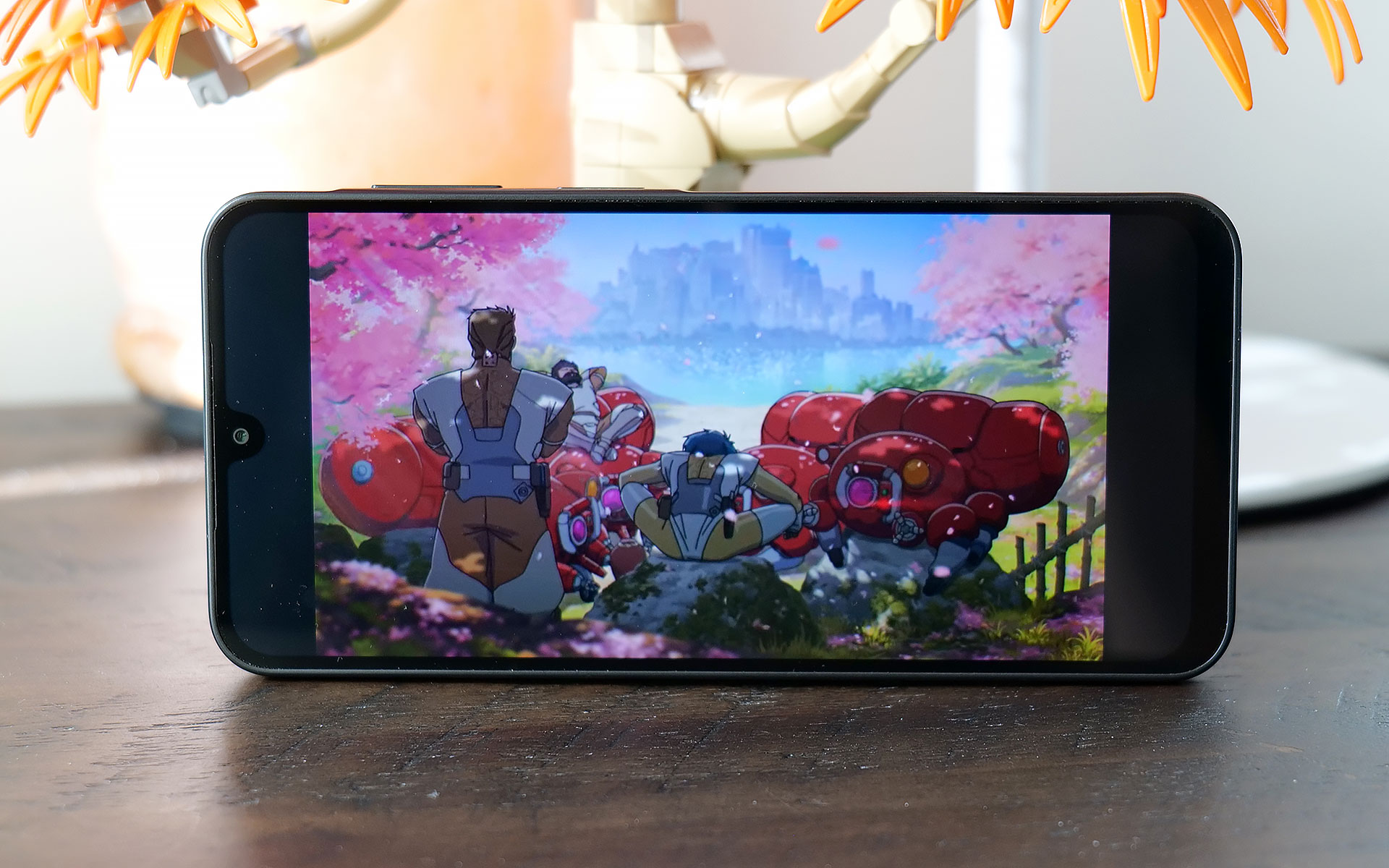 The Galaxy A17's 6.7-inch OLED display is one of the phone's best components thanks to solid brightness and a 90Hz refresh rate.
Sam Rutherford for Engadget
The Galaxy A17's 6.7-inch OLED display is one of the phone's best components thanks to solid brightness and a 90Hz refresh rate.
Sam Rutherford for Engadget
Meanwhile, one thing the A17 has that you don't get on high-end handsets anymore is a microSD card slot (that's shared with its SIM tray) for expandable storage. This gives you a cheap way to increase the phone's base 128GB of space and considering how rare this is nowadays, it's another win for people looking for a truly affordable device.
The Galaxy A17's screen is also surprisingly nice for its price, as it sports a 6.7-inch OLED display with up to 800 nits of brightness. Granted, its refresh rate tops out at 90Hz instead of the 120Hz you get on more expensive fare. But once again, considering how much it costs, I'm not complaining. Especially when you remember that base iPhones were still saddled with 60Hz panels as recently as 2024.
PerformanceOne area where budget phones often struggle is performance because skimping on RAM or the processor can save manufacturers a lot of money. And while the Galaxy A17 is generally fine considering its price bracket, I really wish Samsung had opted for a slightly newer chip. The phone comes with just 4GB of RAM (though there are slightly pricier versions with more), 128GB of onboard storage and an Exynos 1330 SoC, the latter of which is nearly three years old.
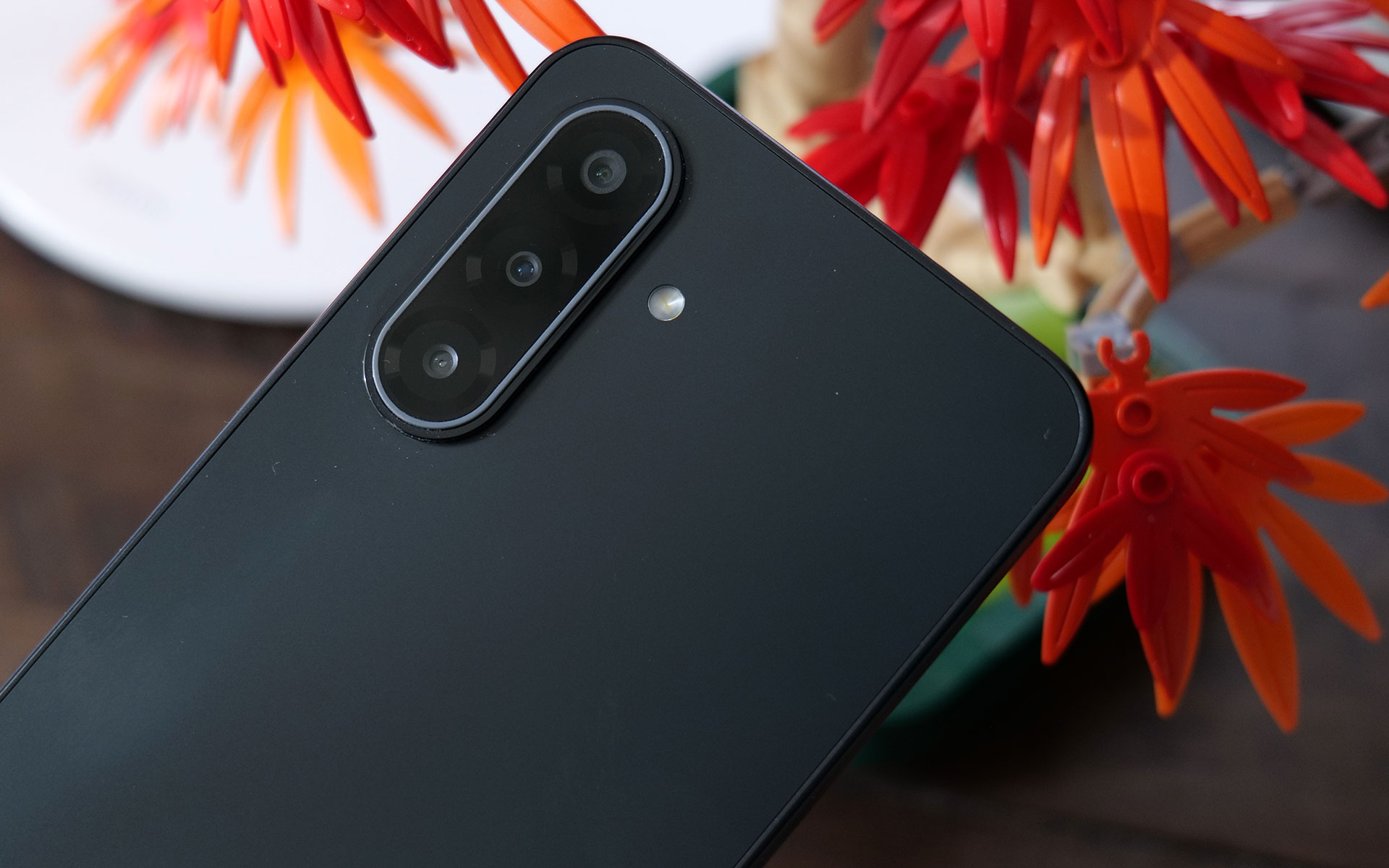 The Galaxy A17 comes with three rear cameras, but its really more like two because one of those is a 2MP macro cam.
Sam Rutherford for Engadget
The Galaxy A17 comes with three rear cameras, but its really more like two because one of those is a 2MP macro cam.
Sam Rutherford for Engadget
At first, I was really worried because during the initial setup, the phone was a laggy, stuttery mess. Thankfully, after signing in, giving the phone some time to download updates in the background and making sure all of its apps were up to date, performance improved significantly. To be clear, this thing still isn't a speed demon and when you're multitasking or quickly switching between heavy apps, you may notice some slowdown. I also wish touch input felt a bit more responsive because sometimes when you tap an icon, there's a small delay before anything happens. But thankfully, it's relatively minor, and in most situations, the phone is snappy enough.
CamerasThe A17 comes with a 13-megapixel selfie camera and three rear shooters, though in practice it's really more like two because one of those is a 2MP macro cam, which doesn't get much use unless you take a lot of up-close photos. That said, the phone takes better pictures than you might expect given its price. In well-lit conditions, both its 50MP main and 5MP ultrawide cams don't give you much to complain about. Images look sharp and sport vivid colors.
However, in low-light situations, there's an obvious difference in quality between the A17 and more expensive midrange phones like Pixel 9a. In a shot of some fruit in my dimly lit kitchen, the A17's pic looks soft and features washed-out colors compared to what Google's phone produced. Then, when I went outside and snapped a photo of a car still buried after the recent snowstorm, textures on the slush in the road, along with various highlights and shadows looked worse in the A17's images. So while the phone can hold its own, camera quality is still one of the biggest reasons you might want to consider upgrading to a more expensive handset.
Battery life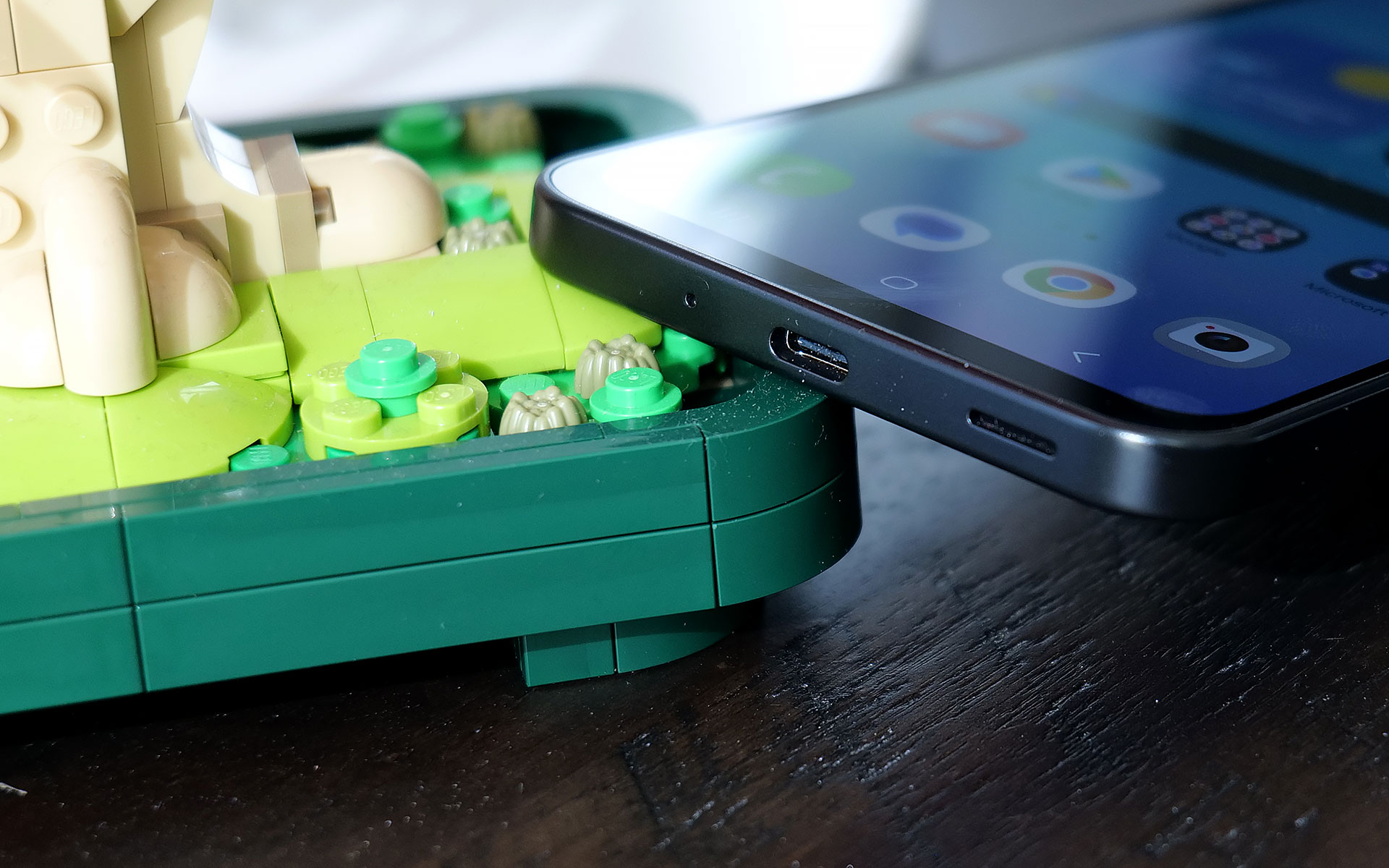 The bottom of the Galaxy A17 features the phone's USB-C port and its single, mono speaker.
Sam Rutherford for Engadget
The bottom of the Galaxy A17 features the phone's USB-C port and its single, mono speaker.
Sam Rutherford for Engadget
For a phone with a 5,000mAh battery and a low-power chip, the Galaxy A17 didn't last quite as long as I expected. On our local video rundown test, it lasted just over 23 hours (23:08), which is decent, but also five hours less than the Pixel 9a (28:04). On the other hand, its wired charging speed of 25 watts is more than enough. Just don't be surprised when you plop it on a wireless charging pad and nothing happens because the phone doesn't support that.
Wrap-upIf you are hard-capped at $200, the Samsung Galaxy A17 is a surprisingly impressive device. It's got a solid build, decent cameras with a handful of different lenses, respectable battery life and even a built-in microSD card slot for extra storage. You even get six years of OS and security updates, which is significantly longer than almost all of its similarly-priced rivals. And while its performance could be smoother, it's not laggy enough to get truly bothered about on a phone this affordable.
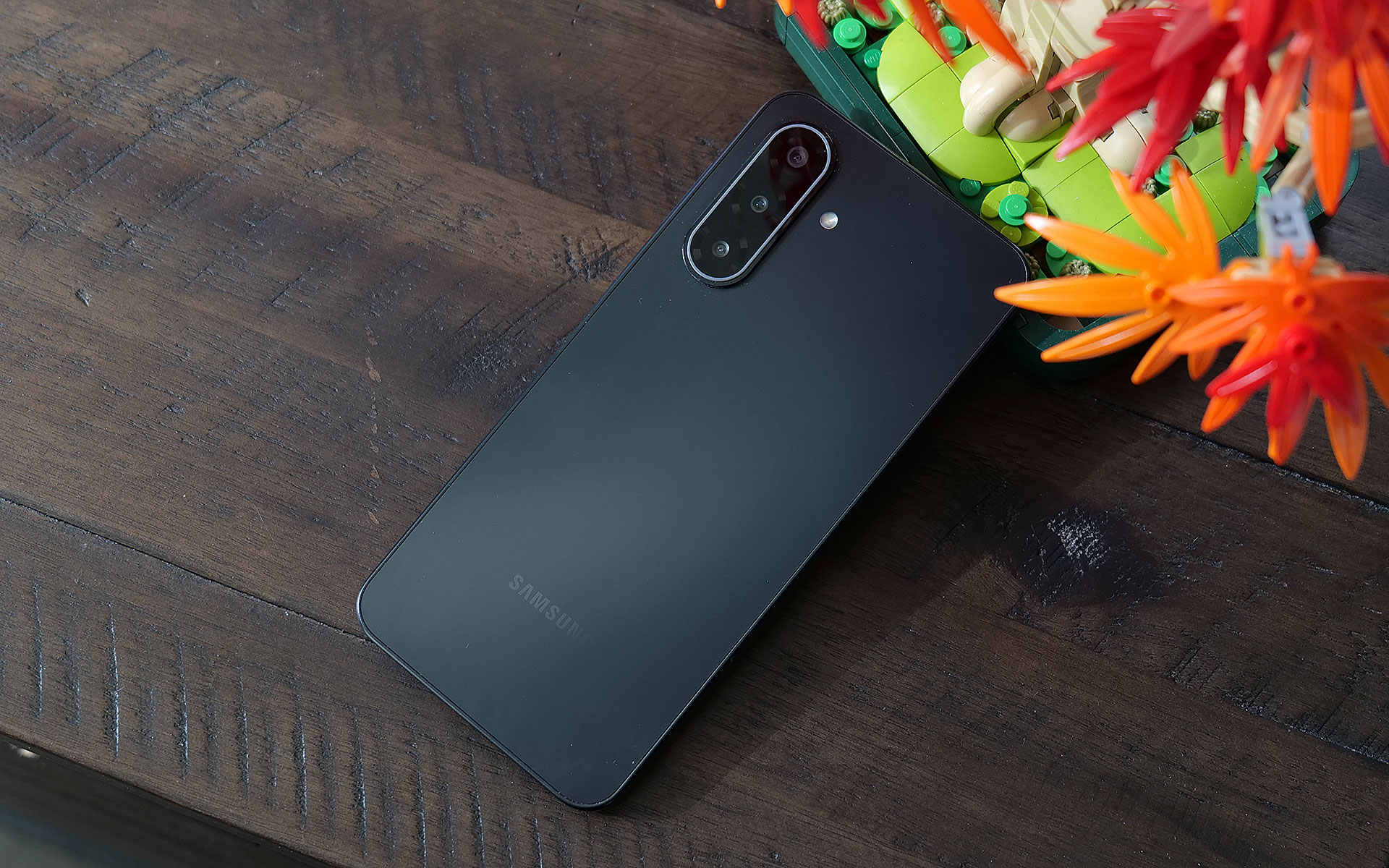 Even though the Galaxy A17 is made out of plastic, the phone still doesn't feel cheap.
Sam Rutherford for Engadget
Even though the Galaxy A17 is made out of plastic, the phone still doesn't feel cheap.
Sam Rutherford for Engadget
For those with wiggle room in their gadget allowance, I would seriously consider looking at a version with 8GB of RAM, which is just $30 more. Alternatively, the Pixel 9a remains my favorite Android phone when it comes to value for money and it's $399 (down from its launch price of $499). But if money is tight, the Galaxy A17 delivers everything you need without blowing up your budget.
This article originally appeared on Engadget at https://www.engadget.com/mobile/smartphones/samsung-galaxy-a17-5g-review-a-respectable-and-affordable-android-option-190000154.html?src=rss ROG made a gaming headset for audiophile nerds [ 02-Feb-26 6:47pm ]
ASUS ROG just announced the Kithara gaming headset, which is a device intended to bring "audiophile-grade sound" to gaming. It was developed in conjunction with manufacturer HiFiMan, a company that specializes in high-end audio devices.
The Kithara is the company's first open-back planar magnetic gaming headset. ROG says it was designed to please gamers who "demand absolute clarity, precision and realism." The headphones feature 100mm planar magnetic drivers that have been "tuned specifically for gaming."
The company says this results in a wide frequency response, low distortion and a "level of detail that reveals subtle positional cues such as footsteps, reloads and distance movement." ROG boasts that these audio cues remain distinct even during moments of chaotic gameplay, potentially making the headphones a great choice for competitive gamers.
The open-back design allows for clear separation across bass, mids and treble, which should also make the headphones great for listening to music. It features a full-band boom microphone with a high signal-to-noise ratio. There are separate signal paths for audio and microphone inputs, which significantly reduces crosstalk.
The headphones have been built for maximum versatility, so there's a balanced headphone cable with swappable plugs. They support various connection types, including 3.5mm, 4.4mm and 6.3mm. They also ship with a USB-C to dual 3.5mm adapter.
These are gaming headphones, so comfort is also a priority. The metal frame features an adjustable fit and there's a multi-layer padded headband and two sets of interchangeable ear cushions. The ROG Kithara headphones are available now and cost $300.
This article originally appeared on Engadget at https://www.engadget.com/audio/headphones/rog-made-a-gaming-headset-for-audiophile-nerds-184737937.html?src=rss OpenAI brings its Codex coding app to Mac, with new multi-agent abilities included [ 02-Feb-26 6:31pm ]Since last spring, OpenAI has offered Codex. What started life as the company's response to Claude Code is becoming something more sophisticated with the release of a new dedicated macOS app. At its most basic form, Codex is a programming agent capable of writing code for users, but now it can also manage multiple AI assistants that can work together to complete more complex tasks.
OpenAI gives an example of how this could work in practice. The company used Codex to create a Mario Kart-like racing game, complete with a selection of different playable cars, eight tracks and a collection of powerups players can use against the competition. For a single AI agent, generating a game from scratch, with all the needed visual assets, would be a tough ask, but Codex was able to complete the task because it could delegate the work of making the game to different models with complementary capabilities.
For example, it turned to GPT Image for the visual assets, while a separate model simultaneously coded the web game. "It took on the roles of designer, game developer and QA tester to validate its work by actually playing the game," OpenAI says of the process.
If that sounds complicated, OpenAI has tried to make it more approachable with a section of the app titled Skills. The feature bundles "instructions, resources, and scripts so Codex can reliably connect to tools, run workflows, and complete tasks according to your team's preferences," the company explains. "The Codex app includes a dedicated interface to create and manage skills. You can explicitly ask Codex to use specific skills, or let it automatically use them based on the task at hand."
As you might imagine, Codex can also automate repetitive tasks. A dedicated Automations section of the app allows you to schedule tasks, which the software will complete in the background. "At OpenAI, we've been using Automations to handle the repetitive but important tasks, like daily issue triage, finding and summarizing CI failures, generating daily release briefs, checking for bugs, and more," the company said.
The release of the Codex macOS app comes as AI startups explore what a group of AI agents working in parallel can accomplish. At the start of the year, Anysphere, the company behind Cursor, found it was possible to build a working web browser from scratch using such an approach, though it did encounter problems along the way.
For a limited time, OpenAI is making Codex available to ChatGPT Free and Go users so they can see what's possible with this new software. At the same time, the company is doubling rates for Plus and Pro subscribers.
This article originally appeared on Engadget at https://www.engadget.com/ai/openai-brings-its-codex-coding-app-to-mac-with-new-multi-agent-abilities-included-183103262.html?src=rss A developer turned Wikipedia into a social media-style feed [ 02-Feb-26 5:49pm ]While it's important to stay informed about what's going on in the world, endlessly scrolling through your social media feeds and absorbing what's likely to be a largely negative influx of information can't be great for your mental wellbeing. Perhaps with an eye on stopping you from doomscrolling, developer Lyra Rebane created Xikipedia, a social media-style feed of Wikipedia entries.
The web app algorithmically displays info from Simple Wikipedia. "It is made as a demonstration of how even a basic non-[machine learning] algorithm with no data from other users can quickly learn what you engage with to suggest you more similar content," the Xikipedia landing page reads. "No data is collected or shared here, the algorithm runs locally and the data disappears once you refresh or close the tab."
You can opt to see entries from certain categories (including custom ones) and you can like "posts," each of which is a summary of the relevant Simple Wikipedia entry. Liking a post makes it more likely for posts from the same category, parent categories and linked articles to appear in your feed, Rebane explained.
You can click or tap on a post to visit the full article. It's important to note that, since Xikipedia pulls text and images from random articles, you'll probably see some NSFW material if you scroll for long enough, so be warned. You'll also likely need to wait a beat for Xikipedia to load its 40MB of data.
As someone who has a bookmark that takes me to a random Wikipedia article whenever I click it, I love the idea of Xikipedia. The Simple English Wikipedia has more than 278,000 articles, so there are hundreds of thousands of posts available to scroll through. However, it doesn't seem to be updated as often as the main version of Wikipedia. The discography section of one musician's page I ended up on was missing their two most recent albums. Still, it's worth treating this like Wikipedia proper: as a starting point for discovering new things (sort of in the tradition of StumbleUpon).
This article originally appeared on Engadget at https://www.engadget.com/apps/a-developer-turned-wikipedia-into-a-social-media-style-feed-174924280.html?src=rss Grok, which maybe stopped undressing women without their consent, still undresses men [ 02-Feb-26 5:07pm ]It looks like Grok is still being gross. Elon Musk says his chatbot stopped making sexualized images without a person's consent, but The Verge recently discovered this is not entirely true. It maybe (and I say maybe) stopped undressing women without their consent, but this doesn't seem to apply to men.
A reporter with the organization ran some tests with Grok and found that the bot "readily undresses men and is still churning out intimate images on demand." He confirmed this with images of himself, asking Grok to remove clothing from uploaded photos. It performed this task for free on the Grok app, via the chatbot interface on X and via the standalone website. The website didn't even require an account to digitally alter images.
The company recently said it has taken steps to "prevent the Grok account from allowing the editing of images of real people in revealing clothing such as bikinis." However, the reporter had no problem getting the chatbot to put him in "a variety of bikinis." It also generated images of the subject in fetish gear and in a "parade of provocative sexual positions." It even generated a "naked companion" for the reporter to, uh, interact with.
He suggested that Grok took the initiative to generate genitalia, which was not asked for and was visible through mesh underwear. The reporter said that "Grok rarely resisted" any prompts, though requests were sometimes censored with a blurred-out image.
This controversy started several weeks ago when it was discovered that Grok had generated millions of sexualized images over a period of 11 days. This includes many nonconsensual deepfakes of actual people and over 23,000 sexualized images of children. This led to investigations in both California and Europe. X was actually banned in both Indonesia and Malaysia, though the former has since lifted that ban.
X claimed it has "implemented technological measures" to stop this sort of thing, but these safeguards have proven to be flimsy. In other words, the adjustments do stop some of the more obvious ways to get Grok to create deepfakes, but there are still methods to get around this via creative prompting.
It's also worth noting that journalists asking for a comment on the matter get slapped with an autoreply that reads "legacy media lies." Going with the fake news thing in 2026? Yikes.
This article originally appeared on Engadget at https://www.engadget.com/ai/grok-which-maybe-stopped-undressing-women-without-their-consent-still-undresses-men-170750752.html?src=rss The best board games to gift and play this year [ 02-Feb-26 5:01pm ]It's become cliche to say that we live in a golden age of board games, but to paraphrase the great stoic philosopher Andy Bernard, it's great to know you're in the good old days before you've left them. Great titles are still coming out by the thousands every year, from crowd-pleasing party games to genre-bending, theme-heavy Euros. Whether the gamer in your life is looking for a mind-warping challenge, a fun evening with friends or something in-between, we've got new releases or old favorites they'll love.
Best board games to gift and play
Check out the rest of our gift ideas here.
This article originally appeared on Engadget at https://www.engadget.com/the-best-board-games-to-gift-and-play-this-year-125529271.html?src=rss Blizzard's quality assurance workers finally have a union contract [ 02-Feb-26 4:26pm ]Almost three years after starting the bargaining process with Microsoft, quality assurance workers at two Blizzard locations have ratified a union contract. The agreement covers 60 workers at Blizzard Albany and Blizzard Austin.
The agreement includes guaranteed pay increases across the three years of the contract, assurances that workers will be given fair credits and recognition on games that ship, discrimination-free disability accommodations, restrictions on crunch (i.e. mandatory overtime) and "protection to immigrant workers from unfair discipline and loss of seniority while streamlining legal verification." Stronger rules around the use of AI are included in the contract as well.
"At a time when layoffs are hitting our industry hard, today is another big step in building a better future for video game workers at every level," Blizzard Albany quality analyst Brock Davis said in a statement. "For quality assurance testers, this contract provides us wages to live on, increased job security benefits and guardrails around artificial intelligence in the workplace."
As with other unions in Microsoft's game divisions, the Blizzard QA workers organized with the Communications Workers of America. This marks the third union agreement at Microsoft after ZeniMax and Raven Software workers ratified contracts last summer. Several other Blizzard divisions have unionized within the last year, including the cinematics team, Overwatch developers and a unit that works on Diablo.
This article originally appeared on Engadget at https://www.engadget.com/big-tech/blizzards-quality-assurance-workers-finally-have-a-union-contract-162614979.html?src=rss The Apple Watch Series 11 is back on sale for $299 [ 02-Feb-26 3:16pm ]Whether you're one of the few people still keeping up with New Year's resolutions or just want an upgraded smartwatch, now is a good time to get an Apple Watch. Currently, the Apple Watch Series 11 is on sale for $299, down from $399. The 25 percent discount brings the 2025 model back down to its record-low price.
We named the Apple Watch Series 11 as our choice for best smartwatch overall. It scored a 90 in our review thanks to its 24 hours-plus of battery life and a thin, light design that's easy to wear. It also offers new health metrics, including Apple's hypertension alerts system and Sleep Score.
The Apple Watch Series 11 deal is available on the 42mm case with a small/medium band. It also only includes GPS and four colorways: the Jet Black and Space Gray aluminum cases with a Black sport band, the Rose Gold aluminum case with a Light Blush sport band and the Silver aluminum case with a Purple Fog sport band.
Check out our coverage of the best Apple deals for more discounts, and follow @EngadgetDeals on X for the latest tech deals and buying advice.
This article originally appeared on Engadget at https://www.engadget.com/deals/the-apple-watch-series-11-is-back-on-sale-for-299-151616498.html?src=rss Stranger Things: Tales From '85 hits Netflix on April 23 [ 02-Feb-26 3:04pm ]While the main series might be over, Netflix is far from done with Stranger Things. The first spin-off to hit the streaming service will be Stranger Things: Tales From '85. The company had said that the animated show would arrive sometime this year and now, alongside a new trailer, it confirmed a release date of April 23.
The trailer is a bit of an odd watch given that Stranger Things wrapped up only a month ago. Going from that to this animated style with a whole new voice cast is jarring, but a fun gag at the end of the clip taps into certain misconceptions the audience might have.
Stranger Things: Tales From '85 is set during the winter between seasons 2 and 3 of the original show. After Eleven closes the gate to the Upside Down, some nasties from the other dimension still persist in our heroes' world. The trailer doesn't give too much away on the story front otherwise, but there's a suitably hairy moment involving a circular saw.
The latest iPad mini is $100 off right now [ 02-Feb-26 2:09pm ]We've finally made it to February, but, with the ongoing long nights, you might want a pick-me-up to get you through the rest of winter. Take the Apple iPad mini with the A17 Pro chip, which is on sale for $400, down from $500. Its small size is perfect for cozying up on the couch or to use on your daily commute.
Apple released this iPad mini in late 2024 and it was a solid update. We gave it an 83 in our review thanks to the power of its A17 Pro chip and that it comes with a minimum of 128GB of storage. The model currently on sale comes with 128GB, Wi-Fi and all four color options: Blue, Purple, Space Gray and Starlight.
We named the Apple iPad mini our favorite compact iPad — though, to be fair, its only competitor is itself. Still, it's a good iPad with an 8.3-inch Liquid Retina display, Apple Intelligence and 12MP Wide back and 12MP Ultra Wide cameras. For 20 percent off, it's a great option for a light, useful way to entertain yourself through the rest of winter and beyond.
Check out our coverage of the best Apple deals for more discounts, and follow @EngadgetDeals on X for the latest tech deals and buying advice.
This article originally appeared on Engadget at https://www.engadget.com/deals/the-latest-ipad-mini-is-100-off-right-now-140900983.html?src=rss TikTok says it's 'back to normal' after winter storm-related outages [ 02-Feb-26 11:48am ]TikTok is finally "back to normal" in the US after days of technical issues and outages tied to winter storms. Less than a week after companies like Oracle took ownership of TikTok's domestic operations, the platform faced a major power outage when one of its primary US data center sites — run by Oracle — got taken down by the storm.
The problems started last Monday, January 26, when TikTok announced it was working on a "major infrastructure issue" and warned of bugs, time-out requests, missing earnings, and more. The next day TikTok shared that progress has been made but there were still some issues. It added, "Creators may temporarily see '0' views or likes on videos, and your earnings may look like they're missing. This is a display error caused by server timeouts; your actual data and engagement are safe."
Then, yesterday, February 1, TikTok claimed the problem was straightened out and that users shouldn't experience any more related issues. "We're sorry about the issues experienced by our U.S. community. We appreciate how much you count on TikTok to create, discover, and connect with what matters to you," the platform stated in its update. "Thank you for your patience and understanding."
A number of US users have uninstalled TikTok in response to its new ownership and technical issues. Some users also claimed that TikTok was censoring what they could post or what others saw. For instance, The Guardian reports that many people faced issues sharing videos about ICE agents killing Alex Pretti and general anti-ICE content.
On January 26, analytics firm Sensor Tower told CNBC that uninstalls of the app had increased by over 150 percent during the five days since its change in ownership, when compared to the three months before. At the same time, independent app and competitor UpScrolled saw a surge in downloads.
This article originally appeared on Engadget at https://www.engadget.com/apps/tiktok-says-its-back-to-normal-after-winter-storm-related-outages-114848212.html?src=rss The best noise-canceling earbuds for 2026 [ 02-Feb-26 10:00am ]Noise-canceling earbuds have become an everyday essential for a lot of people, whether you're trying to survive a noisy commute, concentrate in a shared workspace or just carve out a little quiet time. Advances in active noise cancellation and audio processing mean today's best earbuds do a much better job of cutting through background noise, without forcing you to move up to bulky over-ear headphones.
The latest models also balance sound quality with convenience, offering stable Bluetooth connections, comfortable fits and battery life that can last through a full day with help from their charging cases. From premium options with the strongest ANC to more affordable picks that still get the basics right, there's no shortage of solid choices depending on what you value most.
How to choose the best noise-canceling earbuds for you Design
Most true wireless earbuds these days have a "traditional" design that's a round bud that fits in your ear canals. However, there are some variations on the formula in terms of shape, size and additional fitting elements. Some companies include fins or fit wings to help hold their in-ear earbuds in place while others opt for an over-the-ear hook on more sporty models. You'll want to pay attention to these things to make sure they align with how you plan to use them. Also consider overall size and weight since those two factors can impact the fit. A less-than-ideal seal due to a weird fit will affect the performance of active noise-canceling earbuds.
Type of noise cancellationNext, you'll want to look at the type of ANC a set of earbuds offer. You'll see terms like "hybrid active noise cancellation" or "hybrid adaptive active noise cancellation," and there are key differences between the two. A hybrid ANC setup uses microphones on the inside and the outside of the device to detect ambient noise. By analyzing input from both mics, a hybrid system can combat more sounds than "regular" ANC, but it's at a constant level that doesn't change.
Adaptive ANC takes the hybrid configuration a step further by continuously adjusting the noise cancellation for changes in your environment and any leakage around the padding of the ear cups or ear tips. Adaptive ANC is also better at combating wind noise, which can really kill your vibe while using earbuds outdoors. For this top pick list of the best noise-canceling earbuds, I'm only considering products with hybrid ANC or adaptive ANC setups because those are the most effective at blocking noise in noisy environments.
CustomizationYou'll also want to check to see if the ANC system on a prospective set of earbuds offers presets or adjustable levels of noise reduction. These can help you dial in the amount of ANC you need for various environments, but it can also help save battery life. Master & Dynamic, for example, has ANC presets that either provide maximum noise-blocking or prioritize energy efficiency. Other companies may include a slider in their companion apps that let you adjust the ANC level.
How we test noise-canceling earbudsThe primary way we test earbuds is to wear them as much as possible. I prefer to do this over a one-to-two-week period, but sometimes deadlines don't allow it. During this time, I listen to a mix of music and podcasts, while also using the earbuds to take both voice and video calls.
Since battery life for ANC earbuds is typically 6-10 hours, I drain the battery with looping music and the volume set at a comfortable level (usually around 75 percent). When necessary, I'll power the headphones off during a review without putting them back in the case. This simulates real-world use and keeps me from having to wear them for an entire day.
To test ANC performance specifically, I use the earbuds in a variety of environments, from noisy coffee shops to quiet home offices. When my schedule allows, I also use them during air travel, since plane noise is a massive distraction to both work and relaxation. Even if I'm not slated to hop on a flight, I simulate a constant roar with white noise machines, bathroom fans, vacuums and more. I also make note of how well earbuds block human voices, which are a key stumbling block for a lot of ANC setups.
I also do a thorough review of companion apps, testing each feature as I work through the software. Any holdovers from previous models are double-checked for improvements or regression. If the earbuds I'm testing are an updated version of a previous model, I'll spend time getting reacquainted with the older set, and revisit the closest competition as well.
This article originally appeared on Engadget at https://www.engadget.com/audio/headphones/best-noise-canceling-earbuds-150026857.html?src=rssTo see a film the way the creators intended, you really need a projector. A good one can show a bright, sharp image up to 250 inches in size for an immersive experience that no TV can match — and usually at a much lower price. Plus, they're great for immersive gaming with consoles and PCs.
Thanks to companies like Anker and Valerion, projectors are starting to be seen as a must-have item for cinephiles and outdoor party screenings alike. That means there are a wide variety of choices, ranging from classic ceiling-mounted models to battery-powered projectors you can take on a camping trick. You can also choose from dozens of ultra short throw (UST) models for a more TV-like installation.
But compared to TVs, projectors remain a bit more confusing for a majority of buyers. This guide will fill you in on important details to consider like brightness, type (classic, portable and ultra short throw) and other factors to help you choose the best model for your setup.
Some projectors are for serious cinephiles, projecting sharp 4K video with HDR brightness and hyper realistic colors to a large screen. Others are bright enough to replace your TV for sports or gaming, and some low-cost portable models can be set up for camping or outdoor fun. That's why we've divided this guide into several categories to help you find the right one.
What to consider when buying a projector
For a deep dive on projector technology check my previous explainer, but there are few key things to keep in mind. What will the projector mainly be used for? What type of room will it be used in? And how big of an image do you want? You'll also see a variety of specifications that may be confusing, so here are a few to consider and what they mean.
Brightness and contrastBrightness is measured in ANSI lumens; the brighter the projector, typically the more expensive it will be. 1,500-2,500 lumens is good for darkened rooms, 3,000-4,000 lumens allows you to see with some ambient light and 4,000+ lumens is bright enough to use in direct sunlight. High contrast is important for detail, because projectors are more sensitive to things like ambient light and reflections.
Laser projectors offer the most brightness and they are entering the mainstream with models costing well under $2,000. Below that, you're looking at projectors with bulbs. Aside from brightness, laser projectors have an advantage in that the light source lasts 10,000 hours or more, compared to 2,000 hours maximum for bulb projectors.
DLP vs LCDDigital light processing units (DLPs) used by Optoma, BenQ, LG and others allow bright 4K images. The negative is that they can produce a "rainbow" effect, or red/blue/green artifacts that affect some viewers more than others. LCDs are used mainly by Epson, but also Sony and Sanyo. Those are often brighter, more color accurate and don't produce rainbow effects, but are also more expensive and susceptible to image degradation over time.
ResolutionIf you want a true 4K projector, beware: only expensive models have native 4K resolution (many movie theaters still use 2K projectors for various reasons). However, most DLP projectors and some LCD models can use pixel-shifting to attain 4K resolution.
HDR and color accuracyProjectors can't produce anywhere close to the amount of light required to qualify as true HDR. Rather, they use a technique called tone mapping to fit the entire HDR gamut into a lower brightness range. That said, many projectors can display millions of colors, with some models surpassing the color accuracy of TVs and monitors.
UST vs. classicClassic projectors and screens can be mounted on the ceiling so they're great if you have no floor space. They can also project a larger video for a truly cinematic experience. UST projectors mount on the floor right next to the screen so they can take the place of a TV. They don't beam as big an image but are generally brighter, sharper and more expensive. For best results, they require special screens.
Ceiling mounting requires some work and don't forget to budget for a bracket and any necessary long cables, including extra power for a Google Chromecast or other streaming device. UST projectors require less labor, but getting the image perfectly square can still be surprisingly time-consuming. As for fan noise, some projectors (usually cheaper DLP models) generate more than others.
OpticsFor more flexibility with location and image size, ceiling mounted projectors need a good zoom range. Lens shift, meanwhile, is used if the projector is mounted higher or lower relative to the screen than recommended by the manufacturer. Otherwise, you might have to use a "keystone correction" to digitally stretch part of the image, resulting in distortion or artifacts. Also, keystore correction may not work in gaming modes for some models.
Gaming and streamingIf you're interested in a projector for gaming, look up the refresh rate and input lag figures. Some projectors offer good numbers in that regard (240Hz and <20 ms, respectively), but others designed for home entertainment have very poor input lag and refresh rates at just 60 Hz. If it's streaming you want, be sure to pick a model either with built-in Google TV or a bundled streaming dongle.
ScreensShould you project onto a wall, roll-down screen, fixed screen or ambient light rejecting (ALR) screen? The choice depends largely on the room and what kind of projector you have. Roll down screens take up no space as they're ceiling mounted, fixed screens can be moved easily and ALR models are perfect in rooms with a lot of ambient light.
Best projector FAQs Are 4K projectors better?Yes, because higher resolution is more noticeable on larger screens, so 4K is particularly useful with projectors since they beam images up to 200 inches in size. That being said, brightness and contrast are more important.
Is a projector better than a TV?Projectors can provide a more immersive experience thanks to the large screen, but they're not necessarily "better." Since you usually have to dim the lights with a projector, TVs are superior for everyday use.
Is 2000 lumens bright enough for a projector?Yes, 2000 lumens is easily bright enough, even with some ambient light in the room. However, the image will still be hard to see with the windows open on a bright day.
Should I get a 4K or 1080p projector?That depends on your budget and needs. If your budget is below $1,000, look for a 1080p projector with the best brightness and contrast. Between $1,000-$2,000, you'll need to weigh whether brightness or 4K resolution is most important. Above that, choose the brightest 4K projector you can afford.
What are the best projectors in daylight?The best projectors in daylight are ultra short throw (UST) models, as they have the brightest and sharpest image. However, they generally cost more than $2,000.
Do you need a screen for a better projector experience?Technically, you don't need a screen to use a projector — any light-colored, smooth wall can work in a pinch. But if you want to get the most out of your projector, a screen can make a difference. Projector screens are designed to reflect light evenly and enhance contrast, so colors look more vibrant and the picture appears sharper. With a screen, you'll notice darker blacks and brighter colors, which can give a real boost to your movie nights or gaming sessions. So while you can absolutely enjoy a projector without one, a screen can make the experience feel a bit more like your own personal theater.
Should I buy a portable or home projector?It depends on how and where you plan to use it. If you want a projector you can easily move around, bring to friends' houses or set up indoors or outdoors easily, a portable projector is a great choice. They're usually smaller, lightweight and often have built-in speakers and batteries, making them convenient for on-the-go use.
On the other hand, if you're looking for a more permanent setup for a home theater or living room, a home projector might be the way to go. Home projectors tend to be more powerful, with higher resolution and brightness, which gives you that crisp, cinema-quality experience. They're ideal if you have a dedicated space and don't mind leaving it set up in one spot.
This article originally appeared on Engadget at https://www.engadget.com/home/home-theater/best-projectors-123004354.html?src=rss Apex Legends won't be playable on Nintendo Switch after its next season [ 01-Feb-26 9:41pm ]Apex Legends developer Respawn said it's ending Nintendo Switch support for the game this summer, with the release of Season 30. After that point, it'll work with the Switch 2 and all other currently supported platforms, but not the original Switch. "Season 29 will be the final update for Apex Legends on Nintendo Switch," the team wrote in a post on X.
Hey legends, we want to share an important update about Apex Legends on the Nintendo Switch.
— Apex Legends (@PlayApex) January 30, 2026
Season 29 will be the final update for Apex Legends on Nintendo Switch. Future seasons of Apex Legends will continue to be available on Nintendo Switch 2.
- Starting August 4, 2026…
The change will take place on August 4, 2026, so Switch players still have several months left to enjoy Apex Legends on the console and make preparations for their shift to a different platform, if they plan to do so. "All players progress, purchases, and earnings are tied to their individual EA accounts," Respawn said. "Everything that has been earned or purchased, including Apex Coins and cosmetics, will carry over to Nintendo Switch 2, even if you purchase Nintendo Switch 2 after August 4, 2026."
The Switch 2 undoubtedly offers a better playing experience for Apex Legends than the earlier model, but the news is still a blow for current Switch 1 players who didn't have plans of upgrading any time soon. Apex Legends first came to Switch in 2021, two years after the game's launch on other platforms.
This article originally appeared on Engadget at https://www.engadget.com/gaming/nintendo/apex-legends-wont-be-playable-on-nintendo-switch-after-its-next-season-214153353.html?src=rss Apple is already thinking about its second foldable iPhone, and it may be a clamshell [ 01-Feb-26 8:23pm ]We may not have a concrete release date for the first foldable iPhone, but Apple may already be looking into a smaller device that will follow it up. According to Bloomberg's Mark Gurman, Apple is exploring a "square, clamshell-style foldable phone," with the caveat that this potential device is "far from guaranteed to reach the market" and only "under consideration" right now.
If this eventually leads to a smaller foldable iPhone, that means Apple believes it can compete against existing options on the market, including Samsung's latest Galaxy Z Flip 7 and Motorola's revamped Razr foldable. Gurman's report also signaled that Apple may be very optimistic about the success of its first foldable iPhone, which is rumored to be released sometime later this year, and wants to have follow-up plans ready to capitalize on the potential demand generated.
It's not the first time that we've heard of a clamshell foldable iPhone, since a previous report from The Information revealed that Apple created prototypes in this form factor. On the other end of the spectrum, Gurman's Power On newsletter mentioned that Apple is considering a larger foldable that opens like a book. Previously, Gurman said that Apple considered a foldable that's more akin to the size of an iPad. However, the company ran into issues developing such a large device and may be delaying a potential launch to 2029, according to Gurman.
This article originally appeared on Engadget at https://www.engadget.com/mobile/smartphones/apple-is-already-thinking-about-its-second-foldable-iphone-and-it-may-be-a-clamshell-202312700.html?src=rss Apple's online store now lets you build a new Mac exactly the way you want [ 01-Feb-26 7:04pm ]Just like buying a new iPhone through Apple's online store, you now select each spec of your new Mac device when purchasing through the website. As first spotted by MacWorld, Apple updated its online configuration tool for purchasing a Mac. Compared to the previous design that allowed you to pick between several prebuilt options, the new configurator lets you choose one spec after another instead.
It's not a major difference compared to choosing between preconfigured options, but interested buyers have more customization since they can select the color, display, chip, memory, storage and even power adapter. The updated page also gives customers the option to add pre-installed apps, like Final Cut Pro or Logic Pro, to their new Mac.
The updated configuration design might hint towards the expected release of the upgraded MacBook Pros. According to MacWorld, there are rumors that Apple will offer the M5 Pro and M5 Max chips with more flexibility that lets you choose how many CPU and GPU cores you want. As reported by Bloomberg's Mark Gurman, the latest MacBook Pro could be queued up for a release alongside macOS 26.3, which has a release cycle between February and March.
This article originally appeared on Engadget at https://www.engadget.com/computing/laptops/apples-online-store-now-lets-you-build-a-new-mac-exactly-the-way-you-want-190430251.html?src=rss Indonesia is lifting its ban on Grok, but with some conditions [ 01-Feb-26 5:53pm ]Grok is once again available in Indonesia, after the country lifted its ban on the AI chatbot that was seen generating millions of sexualized deepfakes, thousands of which included children. The country's Ministry of Communication and Digital Affairs released a statement earlier today, which said X is allowed to resume service in Indonesia but will be subject to monitoring for any future violations.
According to the Indonesian government agency, X provided a letter that detailed several implemented measures that prevent the misuse of its Grok chatbot. Alexander Sabar, the ministry's director general of digital space supervision, said in the statement that the agency will test the new measures on an ongoing basis and will ban Grok again if it's found spreading illegal content or violating the country's laws regarding children.
The issue dates back to earlier this year, when Indonesia, along with Malaysia and the Philippines, banned the AI chatbot after it was found producing sexually explicit deepfake images of women and children without their consent in response to user requests. Later that month, the Philippines lifted its ban on Grok, followed by Malaysia doing the same just a couple of days after. Similar to Indonesia, Malaysian authorities said they will continue to monitor Grok and threatened more enforcement actions if the AI chatbot repeats its past offenses. Beyond the bans, Grok is also facing investigations from California's attorney general and the UK's media regulator concerning the same issue.
This article originally appeared on Engadget at https://www.engadget.com/ai/indonesia-is-lifting-its-ban-on-grok-but-with-some-conditions-175305634.html?src=rss How to replace your AirTag battery [ 01-Feb-26 1:00pm ]Apple's AirTag is designed to run quietly in the background, helping you keep track of everyday items like keys, bags and luggage. Unlike many small trackers, an AirTag doesn't need to be charged. Instead, it uses a standard replaceable coin cell battery that typically lasts around a year, depending on usage.
When the battery runs low, your iPhone will alert you. Replacing it is a simple process that takes just a few minutes and doesn't require any tools. This guide explains how to tell when your AirTag battery needs replacing, which battery to use and how to swap it safely.
How to replace the battery in your AirTagReplacing the battery only takes a few steps.
Hold the AirTag with the polished stainless steel side facing up.
Press down firmly on the metal battery cover and rotate it counterclockwise. Continue turning until the cover stops moving.
Lift off the cover and remove the old battery.
Insert a new CR2032 battery with the positive (+) side facing up. Once the battery is seated correctly, the AirTag will emit a brief chime, confirming that power has been restored.
Place the battery cover back onto the AirTag. Align the three small tabs on the cover with the matching slots on the AirTag body.
Press down gently and rotate the cover clockwise until it stops. The cover should sit flush with the AirTag and feel secure once locked into place.
No pairing or setup steps are required after replacing the battery. Your AirTag will automatically reconnect to your Apple ID.
When to replace your AirTag batteryYour iPhone will automatically notify you when an AirTag battery is running low. The alert appears as a notification and doesn't interrupt tracking, but it's a good idea to replace the battery quickly to avoid losing location updates.
If you're unsure whether your AirTag battery needs replacing, open the Find My app, tap the Items tab and select your AirTag. If a message appears under the AirTag name stating "Low Battery", you'll know it needs replacing. If no message appears, it's safe to assume the battery level is fine for now. AirTags don't have a screen or any other battery indicator, but Apple does show a battery percentage for AirTags in the FindMy app. The low battery warning is the only signal Apple provides before replacement becomes necessary.
What to do if your AirTag doesn't make a soundIf you don't hear a sound after inserting the new battery, remove it and check that it's oriented correctly with the positive side facing up. You should also secure the back cover onto the AirTag as well, to see if the chime sounds after that.
If the battery is oriented properly and still doesn't trigger a sound, try a different CR2032 battery. AirTag uses a CR2032 lithium 3V coin battery, a common type available at most electronics stores, supermarkets and pharmacies. Some batteries, particularly those with thick coatings, may not make consistent contact. Apple suggests looking for packaging that states "Compatible with AirTag." Once a working battery is installed, the AirTag should resume normal operation immediately.
How often should you replace your AirTag batteryMost AirTag batteries last about a year under typical use. Frequent use of Precision Finding, sound playback or location updates may reduce battery life. iOS will notify you before the battery is fully depleted, so there's no need to replace it preemptively unless you're preparing for long-term travel or storage.
Used coin batteries should not be thrown in household trash. Many retailers and recycling centers accept lithium batteries for proper disposal. Check local recycling guidelines for battery drop-off locations. Storing used batteries in a secure container until they can be recycled helps reduce the risk of accidental contact or ingestion.
Replacing an AirTag battery is one of the simplest maintenance tasks Apple devices require. With a readily available battery and no tools involved, most users can complete the process in under a minute. As long as you pay attention to low battery notifications and follow basic safety precautions, your AirTag should continue tracking your belongings reliably with minimal effort.
This article originally appeared on Engadget at https://www.engadget.com/computing/accessories/how-to-replace-your-airtag-battery-130000463.html?src=rss NVIDIA is still planning to make a 'huge' investment in OpenAI, CEO says [ 31-Jan-26 8:55pm ]NVIDIA CEO Jensen Huang told reporters that the company will "invest a great deal of money" in OpenAI's latest funding round, according to Bloomberg, after The Wall Street Journal on Friday reported that the two companies were rethinking a previous $100 billion deal that hasn't "progressed beyond the early stages" of negotiations. Speaking to reporters in Taipei this weekend, Huang reportedly said it could be "the largest investment we've ever made."
NVIDIA and OpenAI jointly announced in September that NVIDIA would be investing up to $100 billion in OpenAI to build 10 gigawatts of AI data centers. The companies said then that they were targeting the second half of 2026 for the first phase of the project to go online. Citing sources familiar with the discussions, The Wall Street Journal reported that Huang has highlighted privately that the agreement was nonbinding and has criticized OpenAI's business approach as lacking discipline.
According to Bloomberg, however, Huang called the report's claims "nonsense," and told reporters on Saturday, "I believe in OpenAI. The work that they do is incredible. They're one of the most consequential companies of our time." But, Bloomberg reports, he said NVIDIA's investment in this funding round wouldn't come near $100 billion.
This article originally appeared on Engadget at https://www.engadget.com/ai/nvidia-is-still-planning-to-make-a-huge-investment-in-openai-ceo-says-205521528.html?src=rss Ayaneo's Pocket S Mini has the perfect aspect ratio for revisiting classic console games [ 31-Jan-26 8:39pm ]There may be plenty of gaming handhelds out there, but there aren't many horizontal options that let you play childhood favorites in the original 4:3 aspect ratio. To address that gap, Ayaneo launched a premium option with the Pocket S Mini. As a "true 4:3 retro handheld," the Pocket S Mini won't have those pesky vertical black bars whenever you're emulating video games from the CRT television era.
Handhelds like the Anbernic RG405M and even Ayaneo's own Pocket Air Mini already offer a 4:3 aspect ratio, but the Pocket S Mini presents a more high-end build with a full metal frame and a glass front panel. The 4.2-inch LCD screen has a resolution of 1,280 x 960 and is flanked by Hall effect joysticks with RGB lighting, Hall effect triggers and "crystal-textured" buttons. Inside, the Pocket S Mini runs on a Snapdragon G3x Gen 2 chip and is powered by a 6,000mAh battery.
Unlike most of Ayaneo's other devices, the Pocket S Mini isn't being done through a crowdfunding campaign. It's already available on Ayaneo's website with a starting early bird price of $319 for either the Obsidian Black or Ice Soul White options with 8GB of memory and 128GB of storage. As usual, the Retro Power colorway will only be available with the highest specs of 16GB of memory and 512GB of storage, starting at $479. We're not sure when Ayaneo will end early bird pricing, but the prices will eventually jump to between $399 and $559 for retail pricing.
This article originally appeared on Engadget at https://www.engadget.com/gaming/ayaneos-pocket-s-mini-has-the-perfect-aspect-ratio-for-revisiting-classic-console-games-203926701.html?src=rss OnlyFans is reportedly in talks to sell a 60 percent stake to a San Francisco investment firm [ 31-Jan-26 7:18pm ]OnlyFans is looking to cash out once again, but this time in a deal that would value it at several billion dollars less than a potential sale that previously fell through. As reported by TechCrunch, the online platform known for subscription-based pornographic content is in talks to sell a majority stake to Architect Capital, an investment firm based in San Francisco.
According to the report, the proposed deal includes $3.5 billion in equity and $2 billion in debt, which values OnlyFans at $5.5 billion. TechCrunch also reported that Architect Capital and OnlyFans are currently in exclusive talks, where the website's owner can't negotiate with other potential buyers for a certain amount of time.
With no set timeline yet for the deal, the deal is far from an official closing. Last year, OnlyFans' owner Leonid Radvinsky was also negotiating with another investment firm, Forest Road Company, to sell the platform. Although that deal never went through, the talks leading up to the sale valued OnlyFans at a much higher $8 billion. The London-based website, which still doesn't want to be known as just a porn site, is still growing and reported a nine percent increase in gross revenue for its 2024 fiscal year, earning more than $7.2 billion.
This article originally appeared on Engadget at https://www.engadget.com/social-media/onlyfans-is-reportedly-in-talks-to-sell-a-60-percent-stake-to-a-san-francisco-investment-firm-191842666.html?src=rss SpaceX wants to launch a constellation of a million satellites to power AI needs [ 31-Jan-26 5:56pm ]Elon Musk and his aerospace company have requested to build a network that's 100 times the number of satellites that are currently in orbit. On Friday, SpaceX filed an application with the Federal Communications Commission (FCC) to launch a million satellites meant to create an "orbital data center." This isn't the first time we're hearing of Musk's plans to build an orbital data center, as it was mentioned by company insiders following the news that the CEO was reportedly preparing to take SpaceX public.
According to the filing spotted by PCMag, this data center would run off solar power and deliver computing capacity for artificial intelligence needs. SpaceX is requesting to "deploy a system of up to one million satellites to operate within narrow orbital shells spanning up to 50 km each," as detailed in the filing. According to SpaceX's filing, "orbital data centers are the most efficient way to meet the accelerating demand for AI computing power" since they use "solar power with little operating and maintenance costs."
To give some scale of the astronomical number of satellites SpaceX is asking for, the company recently hit a milestone of the 11,000th Starlink satellite launched. There aren't as many in orbit since the satellites can run into issues, but an unofficial website that tracks Starlink stats claims there are more than 9,600 satellites in orbit as of January 30, 2026. The FCC is likely to whittle down the amount that SpaceX is asking for in its filing, as the federal agency has done in the past. Earlier this month, the FCC approved SpaceX's request to deploy 7,500 more Starlink satellites, following another 7,500 launched in 2022. However, it's much less than the nearly 30,000 amount that SpaceX first asked for in 2020.
This article originally appeared on Engadget at https://www.engadget.com/science/space/spacex-wants-to-launch-a-constellation-of-a-million-satellites-to-power-ai-needs-175607771.html?src=rss Blue Origin is pausing its space tourist flights to work on lunar landers for NASA [ 31-Jan-26 2:30pm ]Blue Origin plans to put a focus on the development of its human lunar capabilities, so it won't be sending tourists to space for at least the next two years. That means we won't be seeing any New Shepard launches for quite some time. Blue Origin is one of the companies NASA chose to develop human landing systems for its Artemis program, along with SpaceX. Specifically, it will work on landers for the Artemis III and Artemis V missions.
The company was originally contracted to build the human landing system that would transfer astronauts from NASA's Gateway station to the moon's South Pole region for the Artemis V mission. But last year, NASA asked Blue Origin to design an alternative lander for Artemis III after SpaceX experienced delays due to Starship's failed tests. Artemis III is expected to be the first crewed moon landing mission of the program, and the Trump administration wants it to happen before the end of the president's term.
New Shepard takes tourists to suborbital space, where they experience a few minutes of weightlessness before the spacecraft makes its way back to Earth. Jeff Bezos was one of the passengers on New Shepard's first tourist flight back in 2021. Since then, it has flown and landed 37 more times and carried 98 passengers to the Karman line, including Katy Perry and William Shatner.
This article originally appeared on Engadget at https://www.engadget.com/science/space/blue-origin-is-pausing-its-space-tourist-flights-to-work-on-lunar-landers-for-nasa-143000058.html?src=rss How to turn on hypertension alerts on Apple Watch [ 31-Jan-26 1:00pm ]Apple has steadily expanded the Apple Watch's health monitoring features over the years, moving beyond fitness tracking into areas that can offer early insight into potential medical concerns. One of the most recent additions is hypertension alerts, which are designed to notify users when their blood pressure trends are elevated over time. While Apple Watches cannot directly measure blood pressure, this feature can still play a useful role in highlighting patterns that may be worth discussing with your doctor. Here, we'll explain what hypertension alerts do, how they work and how to enable and manage them on the Apple Watch.
What hypertension alerts doHypertension alerts are designed to identify long-term trends that may indicate elevated blood pressure. Instead of relying on a traditional cuff measurement, the Apple Watch analyzes a combination of health data collected over a 30-day period, including heart rate, movement patterns and other contextual information stored in the Health app. Using this data, the system looks for sustained changes that align with patterns commonly associated with hypertension.
If your Apple Watch detects a trend suggesting elevated blood pressure over an extended period, it'll send you a notification. These alerts are not intended to diagnose hypertension or replace medical testing. Instead, they serve as an early signal that something may have changed and that you may want to seek further monitoring or professional advice.
Apple emphasizes that hypertension alerts are designed for users who have not already been diagnosed with high blood pressure. Instead, they are meant to raise awareness rather than confirm a condition.
Who can use hypertension alertsHypertension alerts require a compatible Apple Watch model (Apple Watch Series 9 or later, or Apple Watch Ultra 2 or later) paired with a supported iPhone (iPhone 11 or later). The feature also depends on recent versions of watchOS and iOS, as it relies on updated health algorithms and background data analysis. To use hypertension alerts you must be 22 years of age or older, not be pregnant and not have been diagnosed with hypertension. You also need to ensure that your Apple Watch's Wrist Detection feature is turned on.
To receive meaningful alerts, your Apple Watch needs sufficient data. This means wearing the watch regularly, including during sleep if sleep tracking is enabled, and keeping health details such as age, sex, height and weight up-to-date in the Health app. The system uses long-term trends, so alerts will not appear immediately after enabling the feature.
How to turn on hypertension alertsHypertension alerts are managed through the Health app on the paired iPhone. The feature cannot be enabled directly from the watch itself. During setup, the Health app will ask for confirmation that the user has not been diagnosed with hypertension. It may also prompt a review of health details such as date of birth and biological sex, as this information helps improve the accuracy of trend analysis.
To get started, open the Health app on the iPhone paired with the Apple Watch. From the main Health screen, tap your profile in the top corner. Select Health Checklist from the available Features. Next, you'll need to tap Hypertension Notifications, confirm your age and whether or not you've ever been diagnosed with hypertension. Tap Continue and follow the on-screen prompts for information on how the notifications work. Once you have done this, tap Done and you'll be all set.
Once enabled, the feature runs automatically in the background. There is no need to manually start monitoring or interact with the feature daily.
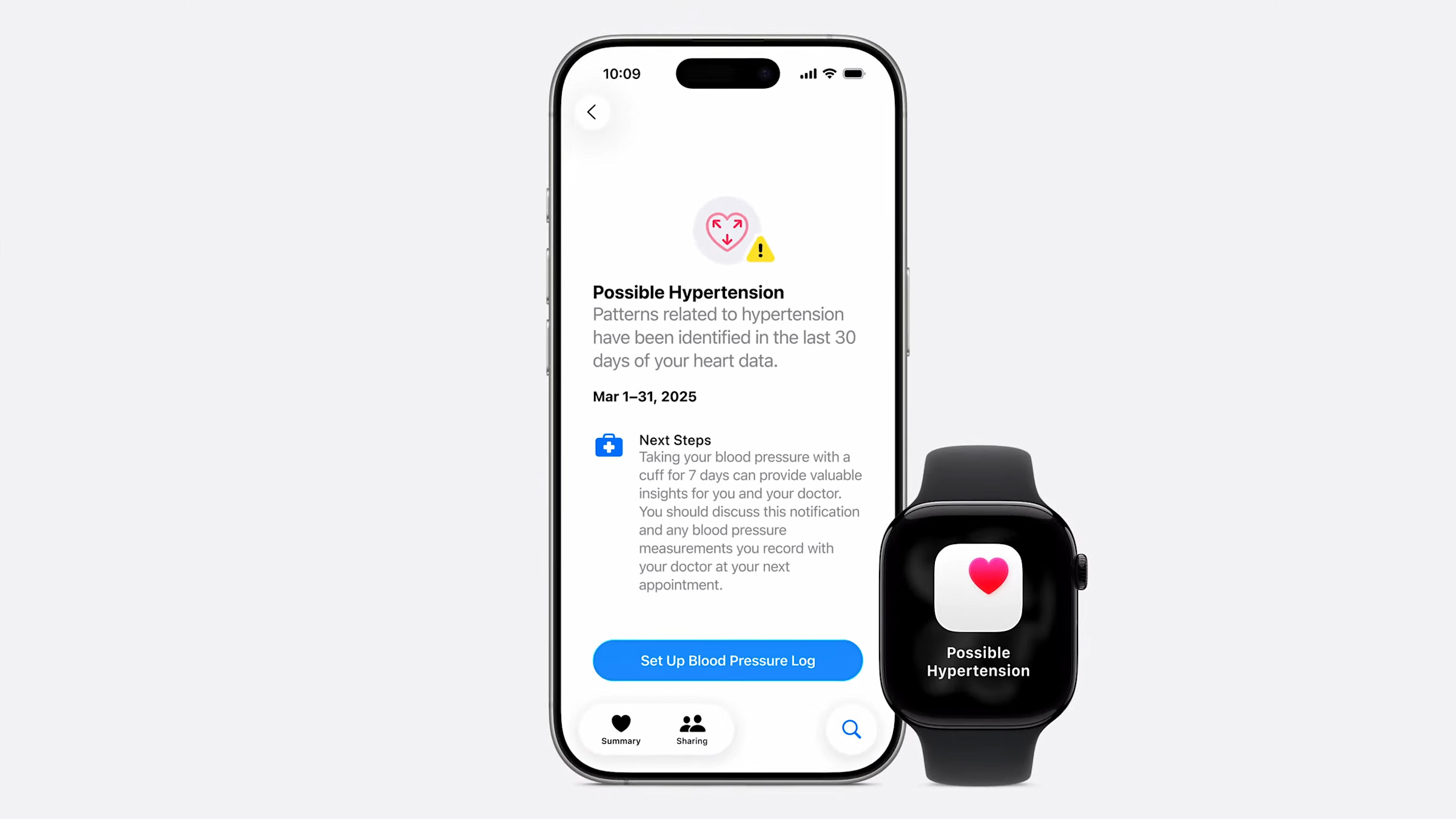 The new apple watch series 11 can help identify hypertensionAppleManaging notifications and alerts
When hypertension alerts are turned on, notifications appear on both the Apple Watch and the paired iPhone. These alerts typically explain that a long-term trend suggesting elevated blood pressure has been detected, along with guidance on next steps.
Users can manage how and when these notifications appear by adjusting notification settings for the Health app. This includes choosing whether alerts appear on the lock screen, in Notification Center or as time-sensitive notifications on Apple Watch.
Health data related to hypertension alerts can be reviewed at any time in the Health app. While Apple Watch does not display a specific blood pressure number, users can view contextual information and educational material explaining what the alert means and what actions may be appropriate.
How hypertension alerts can helpHypertension often develops gradually and may not cause noticeable symptoms in its early stages. Because of this, many people are unaware of elevated blood pressure until it is identified during a routine medical check.
Hypertension alerts can let you know of subtle changes that might have otherwise gone unnoticed. For some users, an alert may prompt earlier conversations with a doctor, additional blood pressure monitoring at home or lifestyle changes such as adjustments to diet, activity or sleep habits.
It is important to treat these notifications as informational rather than diagnostic. Apple Watch does not provide specific blood pressure readings and cannot confirm hypertension on its own.
What to do if you receive an alertReceiving a hypertension alert does not mean that there is an immediate medical emergency. Apple recommends using the alert as a prompt to pay closer attention to your cardiovascular health.
Many users choose to follow up by measuring blood pressure using a traditional cuff at home or by scheduling a check with a healthcare professional. A doctor can provide proper testing, diagnosis and guidance based on clinical measurements and individual risk factors.
It is also worth reviewing lifestyle factors that can influence blood pressure, such as physical activity levels, sleep quality, stress and diet. Apple Watch can already help track many of these areas, which may provide useful context when discussing health concerns with a professional.
Limitations to keep in mindHypertension alerts are not available in all regions and may be subject to regulatory approval. The feature also requires consistent Apple Watch use over time to generate reliable trend data.
Most importantly, the Apple Watch does not measure blood pressure directly. The alerts are based on correlations and trends rather than direct readings, which means they should not be used as a substitute for medical equipment or professional care.
This article originally appeared on Engadget at https://www.engadget.com/wearables/how-to-turn-on-hypertension-alerts-on-apple-watch-130000090.html?src=rss Highguard, a hyperpop arena shooter and other new indie games worth checking out [ 31-Jan-26 12:00pm ]Welcome to our latest roundup of what's going on in the indie game space. There are tons of interesting games out this week. But first, there's been some discourse around the Nintendo Switch version of Dispatch, which arrived this week as well.
On other platforms, there's an option to censor genitalia and other explicit content, but that's not present in the Switch version. Instead, such content is censored by default, with black rectangles covering up characters' bits and someone flipping the bird. Noises that suggest sexual pleasure are said to be toned down too.
"We worked with Nintendo to ensure the content within the title met the criteria to release on their platforms, but the core narrative and gameplay experience remains identical to the original release," developer AdHoc told EuroGamer. Nintendo later said in a statement to GoNintendo that it "requires all games on its platforms to receive ratings from independent organizations and to meet our established content and platform guidelines. While we inform partners when their titles don't meet our guidelines, Nintendo does not make changes to partner content. We also do not discuss specific content or the criteria used in making these determinations."
There are other games available for the Switch and Switch 2 that feature nudity and explicit content. There have long been hentai games on the eShop, while mainstream games like The Witcher 3 and Cyberpunk 2077 (we know all about the dongs in that one) still include explicit content on Nintendo platforms. So it's a bit of a strange one, and AdHoc and Nintendo didn't exactly clear things up with their statements.
There's been speculation that AdHoc censored the game to comply with rules in Japan (Cyberpunk 2077 is censored there too) and that it opted to have just one version of the game available globally on Nintendo platforms. All the same, it's a curious situation that's resulted in a lot of discourse. But there's been another indie game that's been a source of even more chatter this week...
New releasesHighguard is a 3v3 raid shooter from Wildlight Entertainment, a team that includes a bunch of former Apex Legends and Titanfall developers. It broke cover at The Game Awards in December when it was the final reveal of the night but that first trailer wasn't great.
As it turned out, TGA creator and host Geoff Keighley was a friend of the devs and after trying Highguard, he wanted to include it in the show. Wildlight cobbled together a trailer, but that disrupted the studio's long-standing plans to reveal and release the game simultaneously — a strategy that worked wonders for Apex Legends (though that game had the might of EA behind it).
After revealing Highguard, Wildlight effectively went radio silent until a release day showcase on Monday to detail just what the game is and how it works. That seems to have been a mistake given the review bombing and strange vendetta some developed against it. Highguard went live on Monday and Wildlight published a whole bunch of YouTube videos revealing the game's features. Spreading those out between TGA and this week could have tempered expectations.
In any case, I've played a few rounds of Highguard and mostly enjoyed my time with it so far. It's a blend of hero shooter and MOBA. As you might expect for a game from Apex and Titanfall veterans, the weapons feel well-tuned and the gunplay is snappy. There's a lot going on and the maps are far too big for just six players. It's fun enough, but I don't think it's a game that's going to break my Overwatch obsession. Riding into battle on the back of a bear feels pretty great, though. You can play Highguard for free on Steam, PS5 and Xbox Series X/S.
I really wanted to like Don't Stop, Girlypop! more than I did. I'd been looking forward to it for a while, as the promise of a Doom Eternal-style arena shooter with chaotic hyperpop-inspired visuals seemed like a great blend. Don't get me wrong, I adore the aesthetic and the soundtrack is spot on thanks to some cracking songs from Sarah Wolfe, Xavier Dunn and Candice Susnjar. I just wish it was as fun to play as it is to look at and listen to.
The visual clutter and fast pace sometimes makes it hard to spot enemies and the narrative doesn't really hang together, as much as the developers have salient points to make about the exploitation of finite resources. The core gameplay idea here is that the faster you move, the more damage you deal and more you heal. The game has its own take on a bunny hop called a wave hop that boosts your speed, but felt like it slowed me down because of the complex combination of inputs (jump, ground pound, jump, dash). That also caused my hand to cramp up very quickly.
I do love the customization here. Slapping rhinestones and baby sharks onto my weapons was delightful. The game's take on a gravity gun is fun too. So while Don't Stop, Girlypop! — from Funny Fintan Softworks and publisher Kwalee — didn't fully land for me, there are some aspects I like a whole lot. It's out now on Steam for $20 (there's a 10 percent launch discount until February 5).
We're been looking forward to Cairn for a while around these parts, so it's heartening to see that it debuted to broadly positive reviews. This one from The Game Bakers is the latest in a string of climbing adventures, such as the lovely Jusant. So if Alex Honnold's recent free solo climb up a skyscraper has inspired you to ascend something very large without really posing a risk to your wellbeing, Cairn might be what you're looking for.
Cairn is out now on PS5 and Steam for $30. There's a 10 percent launch discount on Steam until February 12, and until February 13 on PS5 if you're a PS Plus member.
Every trailer I've seen for Steel Century Groove has made me smile, so you can bet I'll be jumping into this when I have a chance. It's a rhythm game with Pokémon-style RPG elements in which you take control of a robot in dance battles. There's some original and licensed music to boogie along to and you can load in your own MP3s (you can bank on me loading some Electric Callboy tracks into this game). Steel Century Groove will create procedurally-generated choreography and charts for your custom songs. You can manually adjust the BPM too.
This debut title from solo developer Sloth Gloss Games is out now on Steam for $20. There's a 10 percent launch discount until February 11. There's a demo available, and progress from there carries over into the full game.
Rosday's Wanderling is a roguelike platformer with no combat. You have eight attempts to acquire the gear and learn the knowledge you need to pass each dungeon. Scour for loot and buy upgrades from the shop before night falls to help you on your way. You can place markers to help you remember where you've been.
Runs are said to be short at between 20 and 30 minutes. The visuals remind me a bit of Celeste too. You can check out Wanderling on Steam now for $8 (a 10 percent discount brings the price down to $7.20 until February 2).
I can't help but admire Strange Scaffold (Clickolding, I Am Your Beast, Co-op Kaiju Horror Cooking) and the rate at which it releases games. The latest one is Space Warlord Baby Trading Simulator.
It's a stock market sim in which you speculate on the future success or failures of the "simulated lives of babies." You can "short that baby" if you choose as you try to make gains. In a timeline where prediction markets allow you to speculate on just about anything (listen to this week's episode of the Engadget Podcast to learn more about that), gambling on the future of babies doesn't seem that farfetched.
Space Warlord Baby Trading Simulator — which is set in the same world as Space Warlord Organ Trading Simulator — is out now on Steam. It'll normally cost $20, but there's a 15 percent discount until February 12. Strange Scaffold is also bringing the game to Xbox Series X/S in the near future.
I Hate This Place is an isometric survival game based on the eponymous comic book series by Kyle Starks and Artyom Topilin. The game retains a comic book aesthetic and it has '80s horror movie-style inflections.
The way that noise is visualized is pretty interesting here. Onomatopoeic words will pop up and you'll see color-coded footsteps — useful when you're trying to be stealthy. Crafting is a key aspect of the game as well.
I Hate This Place — from Rock Square Thunder, Broken Mirror Games and Skybound Entertainment — is out now on Steam, PS5, Nintendo Switch and Xbox Series X/S. The regular price is $30 and there's a 20 percent launch discount on some platforms.
I can't find a trailer for this on YouTube, unfortunately, but Rebadge caught my eye this week as well. It's a puzzle platformer from Yuumayay, who appears to be a 17-year-old solo developer. Your character carries badges that allow them to carry out actions like moving and jumping. Other badges include "affected by gravity" and "destroys on contact." Here's the trick: you can throw a badge and lose the associated ability, but then you can apply the trait to something else in the world.
It's a neat idea that draws from the playbooks of games like Baba Is You. Rebadge typically costs $8, but there's a 15 percent launch discount.
UpcomingMoon Beast Productions is a studio formed by several of the creators of Diablo and Diablo II. This week, it revealed gameplay for its first title, Darkhaven, which is a fantasy isometric action RPG in the vein of (you guessed it) Diablo. You'll be able to play this one solo or with friends, and there are PvP elements. Darkhaven has procedurally generated, destructible worlds along with "massive events that threaten your entire world."
The gameplay shown in the trailer looks a bit rough, but it's still early days. In fact, Moon Beast is planning a Kickstarter campaign for Darkhaven. There's no release window as yet, but you can wishlist it on Steam.
Box or Void is a puzzle game that clearly takes some inspiration from Sokuban and Snake. Here, though, gameplay takes place across two planes. You'll switch between positive and negative space — obstacles on one side turn into pathways on the other. You'll alter the level layouts by pushing boxes.
This one from Dumen Games has an intriguing premise. There's no release date as yet for Box or Void, but a demo with 32 levels (about a fifth of what will be in the full game) dropped this week on Steam.
If there's a game that's billed as Dredge meets Wall-E, that's going to be enough to sell me. Describe it as a "petroidvania" and call it Good Boy, and I'm definitely in.
This is a creature-collecting Metroidvania from Observer Interactive and publisher Team17 in which pups are reincarnated as space rovers. I could not dig that premise more. Good Boy is expected to hit Steam later this year.
This article originally appeared on Engadget at https://www.engadget.com/gaming/highguard-a-hyperpop-arena-shooter-and-other-new-indie-games-worth-checking-out-120000874.html?src=rss NASA used Claude to plot a route for its Perseverance rover on Mars [ 30-Jan-26 8:31pm ]Since 2021, NASA's Perseverance rover has achieved a number of historic milestones, including sending back the first audio recordings from Mars. Now, nearly five years after landing on the Red Planet, it just achieved another feat. This past December, Perseverance successfully completed a route through a section of the Jezero crater plotted by Anthropic's Claude chatbot, marking the first time NASA has used a large language model to pilot the car-sized robot.
Between December 8 and 10, Perseverance drove approximately 400 meters (about 437 yards) through a field of rocks on the Martian surface mapped out by Claude. As you might imagine, using an AI model to plot a course for Perseverance wasn't as simple as inputting a single prompt.
As NASA explains, routing Perseverance is no easy task, even for a human. "Every rover drive needs to be carefully planned, lest the machine slide, tip, spin its wheels, or get beached," NASA said. "So ever since the rover landed, its human operators have painstakingly laid out waypoints — they call it a 'breadcrumb trail' — for it to follow, using a combination of images taken from space and the rover's onboard cameras."
To get Claude to complete the task, NASA had to first provide Claude Code, Anthropic's programming agent, with the "years" of contextual data from the rover before the model could begin writing a route for Perseverance. Claude then went about the mapping process methodically, stringing together waypoints from ten-meter segments it would later critique and iterate on.
This being NASA we're talking about, engineers from the agency's Jet Propulsion Laboratory (JPL) made sure to double check the model's work before sending it to Perseverance. The JPL team ran Claude's waypoints through a simulation they use every day to confirm the accuracy of commands sent to the rover. In the end, NASA says it only had to make "minor changes" to Claude's route, with one tweak coming as a result of the fact the team had access to ground-level images Claude hadn't seen in its planning process.
"The engineers estimate that using Claude in this way will cut the route-planning time in half, and make the journeys more consistent," NASA said. "Less time spent doing tedious manual planning — and less time spent training — allows the rover's operators to fit in even more drives, collect even more scientific data, and do even more analysis. It means, in short, that we'll learn much more about Mars."
While the productivity gains offered by AI are often overstated, in the case of NASA, any tool that could allow its scientists to be more efficient is sure to be welcome. Over the summer, the agency lost about 4,000 employees - accounting for about 20 percent of its workforce - due to Trump administration cuts. Going into 2026, the president had proposed gutting the agency's science budget by nearly half before Congress ultimately rejected that plan in early January. Still, even with its funding preserved just below 2025 levels, the agency has a tough road ahead. It's being asked to return to the Moon with less than half the workforce it had during the height of the Apollo Program.
For Anthropic, meanwhile, this is a major feat. You may recall last spring Claude couldn't even beat Pokémon Red. In less than a year, the company's models have gone from struggling to navigate a simple 8-bit Game Boy game to successfully plotting a course for a rover on a distant planet. NASA is excited about the possibility of future collaborations, saying "autonomous AI systems could help probes explore ever more distant parts of the solar system."
This article originally appeared on Engadget at https://www.engadget.com/ai/nasa-used-claude-to-plot-a-route-for-its-perseverance-rover-on-mars-203150701.html?src=rss Rivian made an electric ambulance for Grey's Anatomy [ 30-Jan-26 7:43pm ]America's once-promising EV transition may have taken a U-turn, but at least some in Hollywood are trying to do their part. Rivian partnered with Grey's Anatomy to make a custom electric ambulance for the long-running series.
The ambulance is a modified version of Rivian's Commercial Van. The custom "vanbulance" serves a dual purpose: preventing on-set exhaust fumes (which could harm the cast and crew) and integrating a green storyline. "As an added benefit, the elimination of engine noise brought a welcome quiet while cameras were rolling," Rivan wrote in a blog post.
 Among other modifications, it has rear double doors instead of a roll-up one.Rivian
The vehicle includes some production-specific touches. Its walls and roof panels are removable, allowing cameras to reach angles required for interior shots. In addition, Rivian replaced the standard van's rear roll-up door with double doors while adding a side entry to the cargo area. The company also added custom lighting and an exterior wrap reading "Seattle Emergency Response Services."
The team consulted with the Huntington Beach Fire Department and the Los Angeles Fire Department to inform the interior layout. "Their feedback was invaluable to understand how first responders actually use their vehicles," Rivian wrote.
 At least Hollywood's fictional worlds are transitioning to electric.Rivian
The Hollywood Reporter notes that the electric ambulance debuted in the November 13, 2025, episode of Grey's Anatomy. However, it was featured more prominently in Thursday's episode — hence Rivian choosing this week to highlight it.
This article originally appeared on Engadget at https://www.engadget.com/transportation/evs/rivian-made-an-electric-ambulance-for-greys-anatomy-194358967.html?src=rss Sundance doc 'Ghost in the Machine' draws a damning line between AI and eugenics [ 30-Jan-26 6:06pm ]The Sundance documentary Ghost in the Machine boldly declares that the pursuit of artificial intelligence, and Silicon Valley itself, is rooted in eugenics.
Director Valerie Veatch makes the case that the rise of techno-fascism from the likes of Elon Musk and Peter Thiel is a feature, not a bug. That may sound hyperbolic, but Ghost in the Machine, which is built around interviews with philosophers, AI researchers, historians and computer scientists, leaves little room for doubt.
If you've been following the meteoric rise of AI, or Silicon Valley in general, Veatch's methodical deconstruction of the technology doesn't really unearth anything new. The film begins with the utter failure of Microsoft's Tay chatbot, which wasted no time in becoming a Hitler-loving white supremacist. It retreads the environmental impacts of AI datacenters, as well as the ways tech companies have relied on low-wage workers from Africa and elsewhere to improve their algorithms.
But even I was surprised to learn that we can trace the impact of eugenics in tech all the way back to Karl Pearson, the mathematician who pioneered the field of statistics, and who also spent his life trying to quantify the differences between races. (Guess who he believed was superior.) His legacy was continued by William Shockley, a co-creator of the transistor, an avowed white supremacist who spent his later years espousing (now debunked) theories around IQ and racial differences.
 An early robot toy.Valerie Veatch for "Ghost in the Machine"
As a Stanford engineering professor, Shockley fostered a culture of prioritizing white men over women and minorities, which ultimately shaped the way Silicon Valley looks today. His line of thinking could have had an influence on John McCarthy, the Stanford researcher who coined the term "artificial intelligence" in 1955,
With roots like that, Elon Musk — known to spout bigotry online, foster a reportedly racist work environment at Tesla and throw the occasionaly few Nazi salute — looks less like an anomaly than part of a pattern. Ghost in the Machine asks a simple question: How can we trust men like this (and it's almost always men that look like Musk) with our future?
Through its many interviews, which include the likes of AI researcher Dr. Emily Bender, historian Becca Lewis and media theorist Douglass Rushkoff, Ghost in the Machine paints the rise of AI as a fascistic project that aims to demean humans and establish the techno-elite as our de facto rulers. Given how much our lives are already dominated by gadgets and social networks from companies that have pioneered addictive engagement over user safety, it's easy to imagine history repeating itself with AI.
Ghost in the Machine doesn't leave any room for considering potential benefits around AI, which could lead proponents of the technology to dismiss it as a hit-job. But we're currently at the apex of the AI hype cycle, after Big Tech has invested hundreds of billions of dollars on this technology, and after it has spent years shoving it down our throats without proving why it's actually useful to many people. AI should be able to withstand a bit of criticism.
Ghost in the Machine is available to view at the Sundance Film Festival's website and streaming apps from today through the end of Sunday, February 1st.
Samsung Galaxy Unpacked 2026: The Galaxy S26 lineup and everything else we expect [ 30-Jan-26 5:49pm ]Samsung's 2025 was filled with new foldables, an ultra-thin new form factor and the launch of Google's XR platform. After making some announcements at CES 2026, the company is expected to host its first Galaxy Unpacked of the year in February to introduce the Galaxy S26 lineup.
Engadget will be covering Galaxy Unpacked live, and we'll most likely have hands-on coverage of Samsung's new smartphones soon after they're announced. While we wait for an official invite, here's everything we expect Samsung will introduce at the first Galaxy Unpacked event of 2026.
What is Unpacked 2026 taking place?But first, when is Unpacked going to happen? A recent image shared by leakster Evan Blass indicated Unpacked should be taking place on "February 25 2026." Blass has a long history of credible leaks, which means this date is all but confirmed, and the main questions remaining would be — what time and in what timezone? We're still waiting on Samsung for the official details, which should include answers to those questions.
Galaxy S26, S26+ and S26 Ultra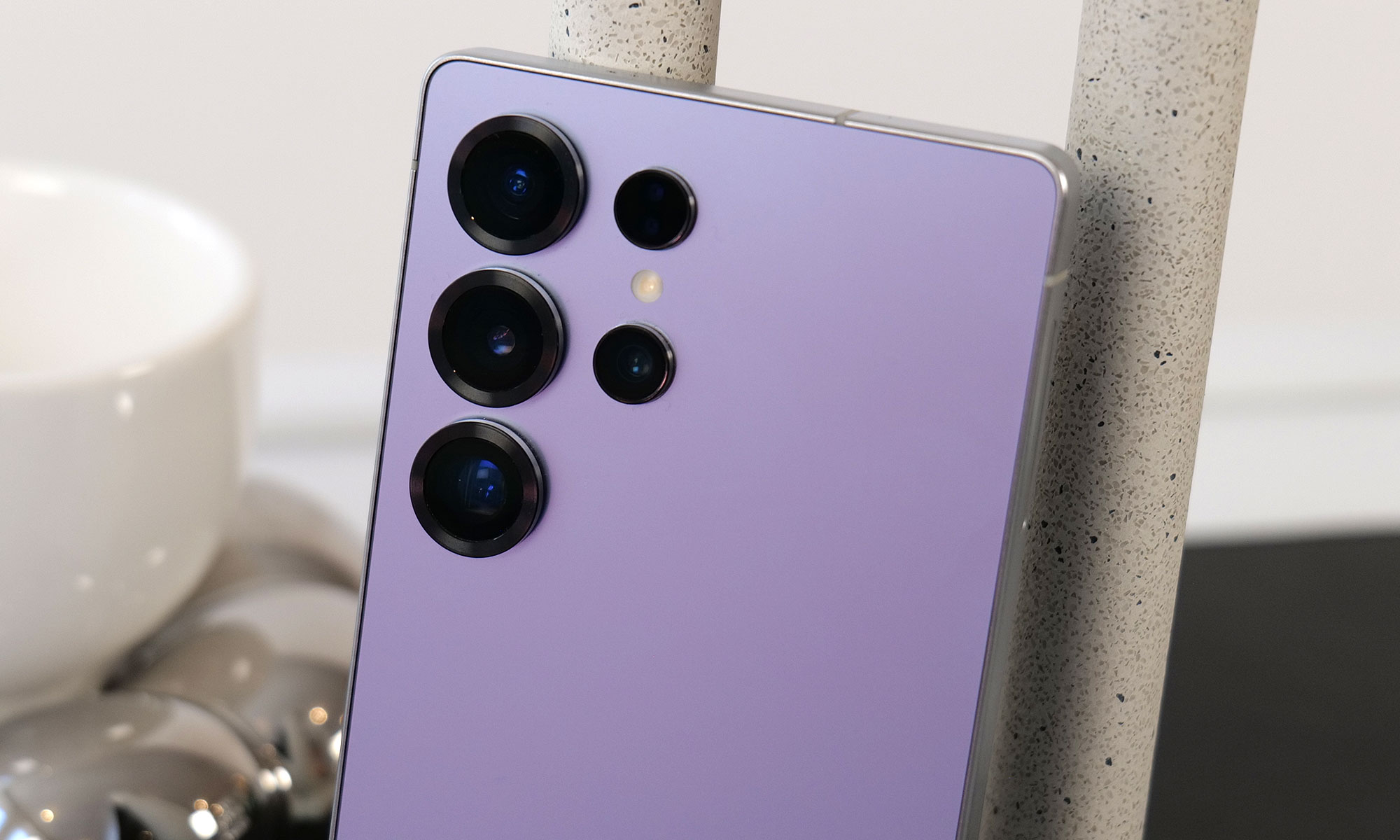 Samsung Galaxy S25 Ultra hands-on photoPhoto by Sam Rutherford/Engadget
Samsung's restrained approach to updating its phones will likely continue with the Galaxy S26. Based on leaked images of the new lineup, the company is not expected to radically reinvent the look of the Galaxy S26, Galaxy S26+ or Galaxy S26 Ultra, and instead will stick with a similar design to what it used on the Galaxy S25. The phones will have a flat front screen and frame, with rounded corners and cameras housed in a vertical pill-shaped plateau on the back. Unlike Apple's move from the iPhone 16 Pro to the iPhone 17 Pro, the biggest difference here will likely be internal components like the screens, chips and camera sensors Samsung uses.
Qualcomm's new Snapdragon 8 Elite Gen 5 chip is expected to be in all Samsung Galaxy S26 phones, though Korean news site Yonhap News reports Samsung's relatively new Exynos 2600 chip could be used in some phones in the lineup depending on the region, a strategy Samsung has deployed in the past. Either way the new phones should be more performant than the previous generation, and in the case of the models with the Snapdragon 8 Elite Gen 5, particularly good at on-device AI processing.
I have compiled the most accurate comprehensive parameter comparison of Galaxy S25, S25+ and Galaxy S26、 S26+. Which one do you want to buy? pic.twitter.com/aQpoSvYjOz
— Ice Universe (@UniverseIce) November 29, 2025
One notable difference between the Galaxy S26 and the Galaxy S25 could be the phone's screen. The new phone will reportedly feature a 6.3-inch FHD+ display according to specs shared by leaker Ice Universe, which makes it ever so slightly larger than the 6.2-inch display used on the Galaxy S25. The S26 will also allegedly come with 12GB of RAM, either 256GB or 512GB of storage and a slightly larger 4,300mAh battery. Samsung isn't changing the cameras on the entry-level phone, though: leaks suggest it'll feature the same 50-megapixel main camera, 12-megapixel ultrawide, 10-megapixel 3x telephoto and 12-megapixel selfie camera as the previous generation. Changes appear to be even more minor on the Galaxy S26+. Other than the new Snapdragon chip, the phone will reportedly feature the same 6.7-inch FHD+ screen, 4,900mAh battery, 12GB of RAM and the same camera array used on the base Galaxy S26.
The difference between the Galaxy S26 Ultra and Galaxy S25 Ultra is reportedly a bit clearer. According to Android Headlines, the new phone's cameras will be slightly more raised, and stand out thanks to a new metallic finish. Samsung may also switch back to using an aluminum frame on the Galaxy S26 Ultra, after using titanium frames on both the Galaxy S24 and S25 Ultras. Most importantly, to make the phone actually support Qi2 rather than only technically work with the standard when a case is attached, rumors suggest Samsung will remove the S Pen digitizer layer in the phone and adopt a new method for accepting stylus input. It's not clear what that new method will actually be, but it could let the Galaxy S26 Ultra more easily work with Qi2 accessories without losing its stylus.
Galaxy Buds 4 Galaxy Buds 3 Pro in case.Engadget
Samsung released the Galaxy Buds 3 and 3 Pro in 2024, with a major redesign that brought them much more in line with Apple's AirPods. The Galaxy Buds 4 and Buds 4 Pro Samsung is rumored to be announcing soon won't necessarily change that, though they will feature a more compact case and less angular stems, according to leaked images from the Samsung Tips app.
Support for head gestures to accept and decline calls, a feature Apple includes on the AirPods Pro 3 and AirPods 4, is also rumored to work on both versions of the new Galaxy Buds. SamMobile reports the Galaxy Buds 4 and 4 Pro may also ship with a new Ultra Wideband chip that will make them easier to find with Google's Find Hub network.
Galaxy Z Trifold Yes, the TriFold has a crease, two in fact. But they still don't ruin the experience. Sam Rutherford for Engadget
Samsung announced the Galaxy Z TriFold in late 2025 without firm details of when the new smartphone-that-folds-into-a-tablet would be available in North America. That info came on January 27, when the company announced the TriFold would be available in the US on January 30, for a whopping $2,900. Considering we've already seen the device in person at CES 2026 and people are most likely to have had a chance to look at, if not buy the foldable for themselves by the time Unpacked rolls around, we don't expect Samsung to spend too much time dwelling on it, if at all.
Galaxy S26 Edge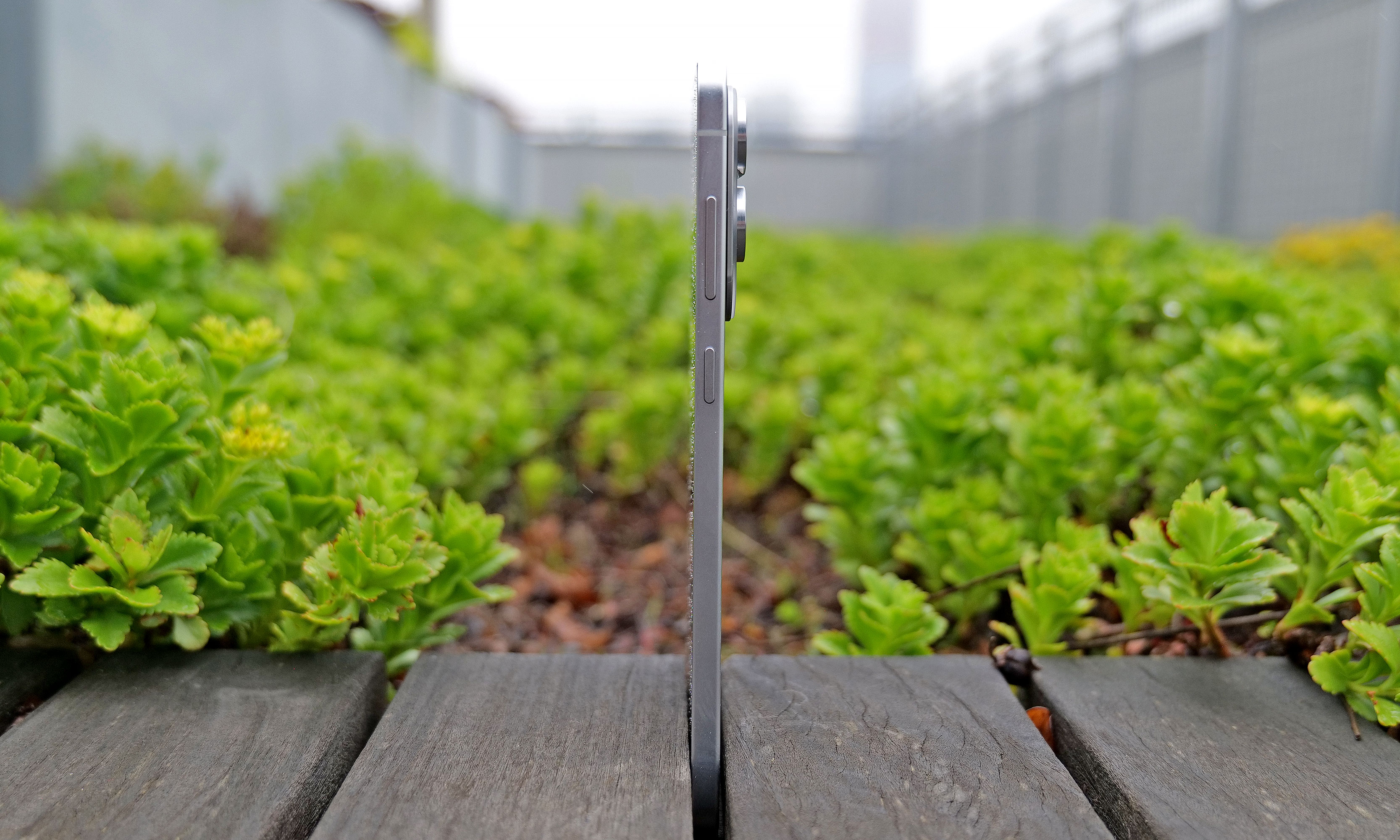 At just 5.8mm thick, the Samsung Galaxy S25 Edge is one of the thinnest smartphones ever made. Sam Rutherford for Engadget
When the Galaxy S25 Edge was announced in 2025, it seemed possible that Samsung could replace its "Plus" smartphone with a unique form factor, just like Apple has opted to do with the iPhone Air. There have been conflicting reports on the matter, but it seems like Samsung will not be doing that with the Galaxy S26 Edge.
Instead, the smartphone will reportedly remain another option, much like foldables are for customers not swayed by Samsung's traditional smartphones. The Galaxy S26 Edge is rumored to feature a slightly different design than last year's model, according to Android Headlines, with a large rectangular camera plateau that's reminiscent of Google's Pixel phones, and the raised oval Apple used on the iPhone Air. Beyond that, the phone is also expected to be ever so slightly thinner at 5.5mm than the 5.8mm Galaxy S25 Edge.
Bixby and other AI featuresSamsung already acts as a first place Google can show off new AI features for Android, but the company is reportedly exploring other AI partnerships, too. In June 2025, Bloomberg reported that Samsung was nearing a deal with Perplexity to integrate its AI-powered search engine across OneUI and its homegrown mobile browser. Perplexity already has a deal with Motorola on its Razr phones, so the only thing that would make a deal with Samsung unusual is the close relationship the company already has with Google.
The company also accidentally announced a new version of its Bixby AI assistant, which will likely also be integrated with Perplexity and could serve as an alternative to Google Gemini. Both a new Bixby and a deeper integration with Perplexity seem like natural new software features to show off at Galaxy Unpacked.
Update, January 27 2026, 11:55AM ET: This story has been updated to reflect the latest news around the Galaxy Z TriFold's price and availability in the US.
Update, January 30 2026, 12:45PM ET: This story has been updated to include the latest leaks on the possible dates for Unpacked 2026.
This article originally appeared on Engadget at https://www.engadget.com/mobile/smartphones/samsung-galaxy-unpacked-2026-the-galaxy-s26-lineup-and-everything-else-we-expect-130000999.html?src=rss Sonos home theater gear is up to 20 percent off ahead of Super Bowl LX [ 30-Jan-26 5:40pm ]Like many other companies during Super Bowl season, Sonos is discounting its home theater gear. Today, you can save $130 on the Beam (Gen 2) soundbar, bringing its price down to $369. You'll also find deals on the flagship Arc Ultra Soundbar, Sonos subwoofers, and more.
The Sonos Beam is the company's sub-$500 soundbar. Engadget's pick for the best midrange model, the compact speaker has impressive sound for its size. Part of that is its Dolby Atmos support. Although the soundbar lacks upward-firing speakers, it uses software tricks to compensate. Audio timing and frequency adjustments make sound seem to come from the side or slightly above.
One of the biggest drawbacks is that the Beam only has one HDMI port. Regardless, that compromise may be easier to accept at Beam's current $369 than at its usual $499.
Several more home theater speakers are included in Sonos's sale. If you have a loftier budget for a soundbar, there's the Arc Ultra. Typically $1,099, it's now $899. The company's pair of subwoofers is included as well. You can get the Sub Mini for $399 (down from $499) or the Sub 4 for $759 (from $899).
Although they aren't explicitly sold as home theater products, the Era 100 ($179) and Era 300 ($379) are also included in the sale. The portable Move 2 isn't discounted individually, but you will find it in a couple of bundles. You can check out the sale page for the complete list.
This article originally appeared on Engadget at https://www.engadget.com/deals/sonos-home-theater-gear-is-up-to-20-percent-off-ahead-of-super-bowl-lx-174053619.html?src=rss The best cheap VPN in 2026 [ 30-Jan-26 5:00pm ]When talking about the best VPNs, I frequently warn about the dangers of trusting free VPNs without verifying them. Although there are a few free VPNs worth recommending, many other free providers are ineffective, malicious or looking to profit off their users (or sometimes all three). Even the best free VPNs work a lot better once you subscribe and access their full service.
This can be frustrating if you want to enjoy the benefits of a VPN but don't have the budget for yet another subscription. To help you out, I put together a list of the best paid VPN services you can get cheaply. Every name on the list comes with my full recommendation — I'll never recommend a VPN that doesn't protect you, no matter how affordable.
Before I get started, I want to define "cheap," since VPNs often bamboozle the customer with muddled pricing schemes. Most providers have long-term subscription plans with big discounts, and many of them compensate by making their monthly plans more expensive. On this list, I'll recommend services with cheap subscriptions for both the short and long term, plus one favorite that balances both.
Other VPNs we tested with good deals
A couple of VPNs have decent pricing options attached to worthy services but weren't quite strong enough to make the list. Both these services get my hearty recommendation; they're just hard to justify as "cheap."
ExpressVPNExpressVPN recently switched to a multi-tier pricing model. The Basic pricing tier gets you complete VPN service but doesn't include the full set of features. The best price on that is $78.18 for 28 months, which works out to $2.79 per month. Although that sounds great, it's more expensive than both Surfshark and CyberGhost at the same duration and renews at the even higher price of $99.95 per year ($8.33 per month).
Still, as I wrote in my full ExpressVPN review, it's an outstanding service overall. Thanks to its sensible app layouts and focus on doing simple tasks well, I find it especially good for introducing beginners to what a VPN can do.
NordVPNNordVPN is another provider that I gave a relatively positive review. I really like its boundary-pushing features, especially the various types of highly specialized servers. Its pricing isn't bad, exactly, but even the Basic level is more expensive than just about everyone else at every duration. NordVPN's fast download speeds and wide server network make it worthwhile for lots of users, but it's hard to recommend to people on a budget.
What to look for in a good cheap VPNLooking for an affordable VPN is the same as looking for any kind of VPN; it just requires more care. The worst VPNs usually present themselves as free, but there's also a fair number of mediocre options that think low prices have to mean a mediocre service. If you want to use a VPN but don't have much extra cash, take some additional care in a few areas of your search.
First, don't subscribe to a VPN — or even download any of its apps — if you haven't verified its security. To do that, start by checking what experts have to say about it. If a VPN is truly unsafe, chances are high that somebody has already sounded the alarm. You can also check the list of protocols the VPN offers. If it's anything other than OpenVPN, WireGuard or IKEv2, do a deep dive to make sure it's using worthwhile encryption.
If you've verified that the VPN isn't a virus, check to see if it has a free trial or a guaranteed money-back period. This will give you some risk-free time to do hands-on tests. Our article on how we test VPNs includes several tests you can run on your own computer, phone or tablet. Check the VPN's speed, make sure it has the server locations you need and look for anything that might be leaking your real IP address.
Read the VPN's privacy policy and make sure you're comfortable with how much information it saves. Some VPNs emphasize privacy more than others. Finally, before your free trial or refund period expires, make sure to double-check on the pricing structure of the VPN you're choosing — it's possible that it will only be cheap for the first subscription period.
This article originally appeared on Engadget at https://www.engadget.com/cybersecurity/vpn/best-cheap-vpn-170000957.html?src=rss The first season of Amazon's Fallout show is now free on Youtube [ 30-Jan-26 4:29pm ]Fallout's second season is coming to a close, and it's been well worth the wait. But if a reluctance to add yet another subscription to your streaming rotation means you haven't watched Amazon's surprisingly excellent adaptation yet, you might be interested to know that the company is currently releasing season one for free on the Prime Video YouTube channel.
Whether driven by Amazon wanting even more people to watch what has become one of its biggest TV success stories, or a move that speaks to how few people are actually signed up for Prime Video, it's good news for anyone who hasn't seen the show yet. Fallout's first season did a great job of taking everything that's great about the long-running post-apocalyptic RPG series and weaving it into a wildly entertaining live-action show, elevated by excellent performances from Ella Purnell as a hopelessly naive but endearingly optimistic vault-dweller, and Walton Goggins as the Ghoul.
Amazon is currently adding a new episode each day ahead of next week's season two finale, presumably hoping a whole new set of fans hop straight into that once they're done. But here's the catch: you only have until February 11 to watch the whole lot. After that, the show will be for Prime Video subscribers only once again.
And that isn't the the only Fallout freebie up for grabs right now. Between now and February 5, Bethesda's MMORPG, Fallout 76, is free-to-play on Xbox and PC, while PlayStation players have until February 4. Fallout 76 first launched in 2018, and as a fully multiplayer-focused game it represented a new direction for the series. It was, to put it bluntly, a bit of a mess for quite a while, but Bethesda has never abandoned the title or its player-base, and if you have Fallout on the brain, this is the perfect opportunity to see how it's looking in 2026.
This article originally appeared on Engadget at https://www.engadget.com/entertainment/streaming/the-first-season-of-amazons-fallout-show-is-now-free-on-youtube-162920615.html?src=rss How to watch the 2026 Grammy Awards: TV channel, start time, where to stream, nominations list and more [ 30-Jan-26 3:00pm ]The 2026 Grammy Awards honor music's biggest achievements of the year, and some of the biggest stars on the planet are nominated this year. Kendrick Lamar leads the way with nine nominations, including for Record and Song of the Year for "luther," his collaboration with SZA. Other top nominees this year include Lady Gaga, Jack Antonoff, and Cirkut with seven nominations apiece, and Bad Bunny, Sabrina Carpenter, and Leon Thomas, who have six. The 2026 Grammy Awards will be hosted by comedian Trevor Noah, who also happens to be a nominee this year in the Best Audio Book, Narration & Storytelling category.
The 2026 Grammys will take place at Crypto.com Arena in Los Angeles, and the broadcast will air this Sunday, Feb. 1, at 8PM ET/5PM PT on CBS, streaming live on Paramount+ (for Premium subscribers only). The 2026 Grammy Awards Premiere Ceremony — where the majority of the Grammys are actually awarded — will take place earlier that same day, from 3:30PM ET/12:30PM PT, and streams live free on YouTube.
Here's how to watch the 2026 Grammy Awards live this Sunday.
When are the 2026 Grammy Awards?The 68th Grammy Awards will be held this Sunday, Feb. 1, 2026.
Grammys start timeThe Grammy Awards live TV broadcast begins at 8PM ET/5PM PT. It's scheduled to run until 11:30PM ET.
Prior to the main broadcast, the 2026 Grammy Awards Premiere Ceremony (this is where you can watch the awards for categories like Musical Theater, Americana, Reggae, Metal, Gospel and more) will take place from 3:30PM ET/12:30PM PT. The Grammys Premiere Ceremony will stream live for free at live.GRAMMY.com and on YouTube.
Grammy Awards TV channelThe 68th Grammy Awards will air on CBS and stream live on Paramount+ for Premium subscribers. The awards show will also be available the following day on demand for Paramount+ Essential subscribers.
How to watch the Grammys without cableHow to watch the 2026 Grammys free
Who is performing at the 2026 Grammy Awards?
Among this year's Grammy's performers are Justin Bieber, Sabrina Carpenter, Album of the Year nominees Clipse and Pharrell Williams, and every Best New Artist nominee, including Addison Rae, Alex Warren, KATSEYE, Leon Thomas, Lola Young, Olivia Dean, SOMBR, and The Marías.
This year's In Memorium honoring artists we've lost this year will include a musical tribute from Reba McEntire, Brandy Clark and Lukas Nelson, a performance from Ms. Lauryn Hill in honor of D'Angelo and Roberta Flack, and an Ozzy Osbourne tribute from artists like Post Malone, Andrew Watt, Chad Smith, Duff McKagan, and Slash.
Who is hosting the Grammys this year?Trevor Noah will return to host the Grammys for the sixth and final year.
Who is presenting at the 2026 Grammys?While the full list of Grammys presenters has yet to be released, we do know that Harry Styles and Doechii will be presenting.
Grammy Awards new categoriesThis year's Grammys will see the return of the award for Best Album Cover (after 53 years!). This year, the category of Best Country Album will now be split into two awards: Best Contemporary Country Album and Best Traditional Country Album.
Grammys eligibility windowThe 2026 Grammy Awards will recognize music released from August 31, 2024 to August 30, 2025.
2026 Grammy nominationsHere are the nominees for the 68th Grammy Awards.
Album of the YearBad Bunny — Debí Tirar Más Fotos
Justin Bieber — Swag
Sabrina Carpenter — Man's Best Friend
Clipse, Pusha T & Malice — Let God Sort Em Out
Lady Gaga — Mayhem
Kendrick Lamar — GNX
Leon Thomas — Mutt
Tyler, the Creator — Chromakopia
Bad Bunny — "DtMF"
Sabrina Carpenter — "Manchild"
Doechii — "Anxiety"
Billie Eilish — "Wildflower"
Lady Gaga — "Abracadabra"
Kendrick Lamar feat. SZA — "Luther"
Chappell Roan — "The Subway"
Lady Gaga — "Abracadabra"
Doechii — "Anxiety"
ROSÉ & Bruno Mars — "APT."
Bad Bunny — "DtMF"
HUNTR/X (EJAE, Audrey Nuna, REI AMI) — "Golden"
Kendrick Lamar feat. SZA — "Luther"
Sabrina Carpenter — "Manchild"
Billie Eilish — "Wildflower"
Olivia Dean
KATSEYE
The Marías
Addison Rae
sombr
Leon Thomas
Alex Warren
Lola Young
Justin Bieber — "Daisies"
Sabrina Carpenter — "Manchild"
Lady Gaga — "Disease"
Chappell Roan — "The Subway"
Lola Young — "Messy"
Justin Bieber — Swag
Sabrina Carpenter — Man's Best Friend
Miley Cyrus — Something Beautiful
Lady Gaga — Mayhem
Teddy Swims — I've Tried Everything But Therapy (Part 2)
Bon Iver — Sable, Fable
The Cure — Songs of a Lost World
Tyler, the Creator — Don't Tap the Glass
Wet Leg — Moisturizer
Hayley Williams — Ego Death at a Bachelorette Party
Deftones — Private Music
HAIM — I Quit
Linkin Park — From Zero
Turnstile — Never Enough
YUNGBLUD — Idols
Clipse, Pusha T & Malice — Let God Sort Em Out
GloRilla — Glorious
JID — God Does Like Ugly
Kendrick Lamar — GNX
Tyler, the Creator — Chromakopia
GIVĒON — Beloved
Coco Jones — Why Not More?
Ledisi — The Crown
Teyana Taylor — Escape Room
Leon Thomas — Mutt
Kelsea Ballerini — Patterns
Tyler Childers — Snipe Hunter
Eric Church — Evangeline vs. The Machine
Jelly Roll — Beautifully Broken
Miranda Lambert — Postcards From Texas
Charley Crockett — Dollar a Day
Lukas Nelson — American Romance
Willie Nelson — Oh What a Beautiful World
Margo Price — Hard Headed Woman
Zach Top — Ain't In It for My Health
Dan Auerbach
Cirkut
Dijon
Blake Mills
Sounwave
Amy Allen
Edgar Barrera
Jessie Jo Dillon
Tobias Jesso Jr.
See the full list at Grammy.com.
This article originally appeared on Engadget at https://www.engadget.com/entertainment/streaming/how-to-watch-the-2026-grammy-awards-tv-channel-start-time-where-to-stream-nominations-list-and-more-150015179.html?src=rss Engadget Podcast: What do prediction markets like Kalshi cost us? [ 30-Jan-26 2:31pm ]Somehow, we live in a world where people can bet on practically anything using sites like Polymarket and Kalshi. In this episode, Devindra and Engadget Senior Reporter Karissa Bell dive into the world of prediction markets. How did we get here? And is endless betting having an effect on the real world? Also, we chat about the new American version of TikTok, which stumbled during its first weekend with a litany of errors and reported censorship.
Subscribe!TopicsWho's going to buy the Samsung Galaxy Z Tri-fold for $2900? - 1:18
Tesla is killing off the Model X and S lines to focus on its Optimus robot moonshot - 6:46
Amazon plans to cut 16,000 jobs and close its grocery stores in another round of restructuring - 10:45
Most of the UK will lose access to Pornhub in a fight over age verification and privacy - 21:16
Internal messages from Meta about Instagram being 'a drug' for teens could be bombshell evidence at trial - 26:59
What are prediction markets and why are they suddenly so popular? - 32:11
As TikTok US stumbles, users ask 'is it server problems or censorship?' - 46:55
Around Engadget - 59:11
Pop culture picks - 1:01:23
Hosts: Devindra Hardawar and Karissa Bell
Producer: Ben Ellman
Music: Dale North and Terrence O'Brien
Sony A7 V review: Awesome speed and photo quality [ 30-Jan-26 1:00pm ]Sony A7 series camera launches are eagerly anticipated by camera lovers, as those models are typically a showcase for the company's latest imaging tech. The new A7 V is a great example of that: it's equipped with Sony's new 33-megapixel partially-stacked sensor — the most advanced in any midrange full-frame mirrorless model.
The A7 V's resolution is higher than rivals like Panasonic's S1 II and the Nikon Z6 III in this category while matching Canon's R6 III. However, Sony trumps the latter with a faster sensor that promises lower rolling shutter distortion in electronic mode. Sony also boasts that it offers the highest dynamic range of any of its cameras to date.
Unlike Canon with the R6 III, Sony didn't bend over backwards to accommodate creators, though. Video resolution is limited to 4K, and the A7 V lacks any RAW video capability, compared to 7K and RAW for Canon's latest model. All of that means the A7 V may be great for some buyers, but fall short for others.
Design and handlingLike other recent Sony cameras, I didn't find the A7 V comfortable to hold for long periods of time. That's because the grip, while deep, is a bit short and too small for large hands. At the same time, it has harder exterior materials than Canon's cameras and is a bit heavier than the A7 IV at 1.53 pounds (698 grams) compared to 1.45 pounds (653 grams) for its predecessor.
The handling makes up for the lack of comfort, though. It has two dials for the primary controls (shutter speed and aperture), along with a third for exposure compensation. There's a dual dial with a shooting mode on top and video/photo/S&Q below, plus a rear joystick, rear dial and nine buttons. The main controls fell nicely to my hands, which made camera control a cinch.
The A7 V has the same well-organized menu system as other recent Sony models and it's easy to customize dials, buttons and quick menus to your liking. Overall, Sony's menus are now among the best, and functions are easier to access than on Canon's R6 III, for example.
The 3.69-million dot EVF display is relatively sharp and on par with the R6 III, but falls short of 5.76-million-dot EVF on the significantly cheaper Nikon Z6 III. The 3.2-inch rear display fully articulates as before, but it also tilts now, so I was able to easily shoot from high and low angles. It's also slightly bigger and has 2.1 million dots, up from 1.65 million dots on the A7 IV.
The A7 V has a dual-slot card system with two SD UHS II slots and a faster CFexpress Type A slot. However, Type A CFexpress cards are less than half as fast as the CFexpress B cards used in other cameras. The A7 V includes a full-sized HDMI port for external display, 3.5mm mic and headphone ports, and two USB-C ports — one for charging and one for 10Gbps data transfers. Battery life is decent with up to 630 shots on a charge or 100 minutes of continuous 4K 30 fps capture. The camera isn't constrained much by temperature limits, as I was able to shoot 4K 30p video for 90 minutes straight with no issues.
PerformanceThe 33MP partially-stacked sensor has made a big difference in the A7 V's speed and autofocus accuracy. It can now hit 30 fps blackout-free RAW burst speeds with the electronic shutter (with autofocus and auto exposure enabled), compared to an anemic 10 fps with the A7 IV. That makes it a surprisingly good choice for sports and wildlife photography, or just shooting fast-moving kids or pets. Speeds drop to 10 fps in mechanical shutter mode, which is on par for this category.
 ISO 6400, f/2.8, 1/40th
Steve Dent for Engadget
ISO 6400, f/2.8, 1/40th
Steve Dent for Engadget
Rolling shutter distortion is only an issue when shooting super fast subjects like airplane propellers or golf swings. And unlike Canon's R6 III and other rivals, the A7 V maintains full 14-bit RAW quality during electronic shutter bursts instead of dropping to 12-bit RAW, which allows for higher dynamic range.
As you'd expect with Sony, autofocus is fast and extremely accurate, delivering the best in-focus hit rate of any camera in this price range. When tracking moving subjects like bikes, birds or kids, I rarely saw a blurry shot. This applied even in tricky lighting and chaotic situations with multiple subjects. The A7 V also nailed auto exposure and auto white balance, even when I shot at dusk with a mix of indoor and outdoor lighting.
Sony's latest AI features make it easy to track nearly anything. Face, eye and body tracking are supported for people, and you can also follow animals, birds, insects, cars, trains and airplanes. The AI has been trained to track people in any position, even if they're partially obscured or disappear in the frame. This proved to be convenient when I shot street photos in crowds with a specific subject in mind.
This does bring up one sore point with the A7 V. When using third-party lenses, the burst rate speeds drop from 30 fps to 15 fps. In addition, you may not be able to use some lenses at all in AF-C (continuous) mode without applying a firmware update.
In-body stabilization is improved significantly over the A7 IV from 5.5 to 7.5 stops with compatible lenses, but falls short of all rivals that hit at least eight stops. Still, I was comfortably able to shoot at shutter speeds as low as a half second handheld without any camera blur.
Image qualityPhoto quality is where the A7 V shines. Dynamic range is superior to rival cameras, both in the real world and specialized testing. This is due to Sony's latest dual gain output tech that combines two ISO levels at once integrated with the new 33MP partially-stacked sensor (when using the mechanical shutter).
I noticed this when taking photos at twilight in several of Paris' squares. After shooting a statue against a bright sky, I was able to extract noise-free shadow detail from RAW files and easily adjust bright areas. When shooting ducks in water that reflected a bright sky, I saw similarly high levels of detail in both dark and bright picture areas. There is one thing to keep in mind, though: As Photons to Photos noted, there's a slight drop in dynamic range below ISO 1,000 when using the electronic shutter.
Should you need even more detail and dynamic range, Sony's new Composite RAW feature that's borrowed from the A9 III combines four, eight, 16, or 32 RAW images to reduce noise and improve image quality. I used it to photograph some high-contrast scenes on a sunny Paris day and it dramatically reduced noise, but isn't a good option for moving subjects.
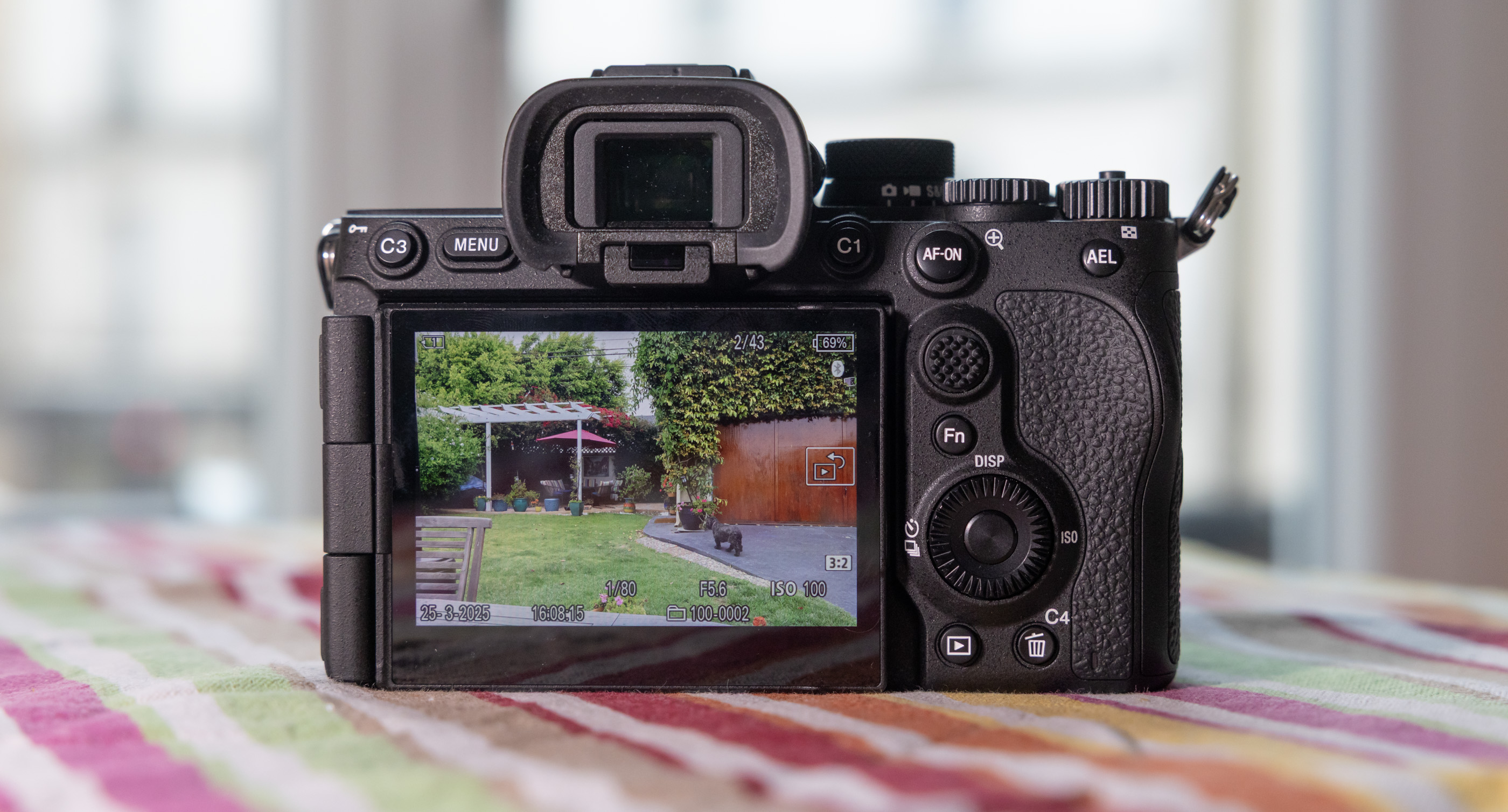 Sony's A7 V has plenty of manual controls for easy operation
Steve Dent for Engadget
Sony's A7 V has plenty of manual controls for easy operation
Steve Dent for Engadget
JPEGs look great straight out of the camera with excellent detail, though noise reduction can be a bit excessive at high ISOs. Sony's color science has improved over the last model, so colors are accurate and the magenta-hue issues seem to be largely resolved. However,I still find Canon's cameras capture more accurate skin tones.
The A7 V is a low-light marvel, with relatively noise-free photos all the way up to ISO 12,800 and usable shots at ISO 25,600. What's remarkable is that the A7 V beats all its 24MP rivals in this regard, despite the nearly 50 percent higher resolution.
Sony added a new "Compressed RAW HQ" mode with the A7 V, designed to deliver better compressed RAW quality while keeping files smaller than "Lossless RAW." Note that this new mode is not currently supported by Adobe Lightroom, so I'd avoid using it for now.
Video Sony's A7 V can take sharp video but doesn't stand up against rivals.
Sony
Sony's A7 V can take sharp video but doesn't stand up against rivals.
Sony
Two or three years ago, the A7 V would have been fine for video but not in 2026. While all its rivals are embracing internal RAW video at 6K or 7K, Sony is sticking with 10-bit 4K MP4 at up to 60 fps, or 4K 120 with an APS-C crop. The video is oversampled from a 7K sensor size so it's very sharp though, and S-Log3 is available to boost dynamic range.
Sony likely thinks that creators using this camera will mostly shoot 4K MP4 (as I do), so it didn't feel that RAW was a must. However, users who do need the benefits of RAW — like minimal degradation when editing, flexible white balance and improved dynamic range — can't even do external RAW capture. The 4K max resolution and lack of open gate 3:2 is also a downside for creators who like to reframe shots in post or output to social media.
With that all said, you can capture high-quality 10-bit 4K 60 fps video with the A7 V. The S-Log3 Cine/S-Log 3 option and high data rate 4:2:2 HS video provide flexibility in post, letting you easily correct over- or under-exposed video or tweak colors. As with photos, color accuracy is nearly on par with Panasonic and other rivals. Shooting in low-light is a breeze, especially when you know that noise levels will be minimal even at high ISO speeds.
Sony has some extra video tricks like focus breathing compensation that eliminates zooming when focusing from a near to a far subject. And the A7 V comes with a new AI Auto Framing mode, which recognizes and crops in on humans, keeping them centered in the frame. I was able to keep subjects centered (while stabilizing the shot) as long as I didn't move the camera excessively.
Autofocus is just as excellent for video as photos, with the same level of speed and accuracy. AI-powered autofocus supports all the same modes (people, animals, etc.) and usually nails focus of human or animal eyes, like when I captured footage of some ducks and dogs.
Video stabilization is also very good, just behind Panasonic's S1 II and ahead of the Canon R6 III. In regular optical-only mode, it removes shaking from handheld video without too much movement. When you engage the "Active" mode, it adds electronic stabilization with a small crop for panning or tilting, and "Dynamic Active" lets you walk with surprisingly smooth results. Rolling shutter is rarely an issue for most types of shooting, including walking, unless you really whip the camera around. The lack of rolling shutter skew also makes it easier to apply stabilization in post with Adobe Premiere or DaVinci Resolve.
Wrap-up ISO 800, f/2.8, 1/500th
Steve Dent for Engadget
ISO 800, f/2.8, 1/500th
Steve Dent for Engadget
The A7 V is an incredible camera for photography, with speeds, autofocus accuracy and image quality ahead of rivals, including the Canon R6 III, Panasonic S1 II and Nikon Z6 III.However, Sony isn't keeping up with those models for video. The A7 V is missing RAW, native resolution and open gate capture, all of which can be found on the aforementioned cameras. That makes it hard to recommend for serious video users or creators who use full-frame open gate to export high-quality vertical video.
There's one intangible, though. I enjoyed taking pictures with the A7 V more than other cameras I've tested lately because of the AF accuracy and image results. For anyone who wants a fast, reliable and easy-to-use camera for photography, I can't recommend it enough. For video creators, though, I'd look at Canon's R6 III, the Panasonic S1 II, or if you're on a budget, Nikon's Z6 III.
iPhone Fold rumors: Everything we know so far, including the leaked design [ 30-Jan-26 1:00pm ]Apple has yet to announce a foldable iPhone, but after years of speculation, the outlines of what's often referred to as the iPhone Fold are starting to come into focus. Multiple analysts and leakers now agree that Apple is targeting a late-2026 launch window for its first foldable phone, positioning it as a premium flagship rather than a niche experiment.
As with all pre-launch Apple products, nothing here is official. Plans can change, features can be dropped and timelines can slip. Still, recent reports paint the clearest picture yet of how Apple might approach a foldable iPhone and how it plans to differentiate itself from rivals like Samsung and Google.
Below is a roundup of the most credible iPhone Fold rumors so far, covering its possible release timing, design, display technology, cameras and price. We'll continue to update this post as more rumors and details become available.
When could the iPhone Fold launch?Rumors of a foldable iPhone date back as far as 2017, but more recent reporting suggests Apple has finally locked onto a realistic window. Most sources now point to fall 2026, likely alongside the iPhone 18 lineup.
Mark Gurman has gone back and forth on timing, initially suggesting Apple could launch "as early as 2026," before later writing that the device would ship at the end of 2026 and sell primarily in 2027. Analyst Ming-Chi Kuo has also repeatedly cited the second half of 2026 as Apple's target.
Some reports still claim the project could slip into 2027 if Apple runs into manufacturing or durability issues, particularly around the hinge or display. Given Apple's history of delaying products that it feels aren't ready, that remains a real possibility.
What will the iPhone Fold look like?Current consensus suggests Apple has settled on a book-style foldable design, similar to Samsung's Galaxy Z Fold series, rather than a clamshell flip phone.
When unfolded, the iPhone Fold is expected to resemble a small tablet like the iPad mini (8.3 inches). Based on the rumor mill, though, the iPhone Fold may be a touch smaller, with an internal display measuring around 7.7 to 7.8 inches. When closed, it should function like a conventional smartphone, with an outer display in the 5.5-inch range.
CAD leaks and alleged case-maker molds suggest the device may be shorter and wider than a standard iPhone when folded, creating a squarer footprint that better matches the aspect ratio of the inner display. Several reports have also pointed to the iPhone Air as a potential preview of Apple's foldable design work, with its unusually thin chassis widely interpreted as a look at what one half of a future foldable iPhone could resemble.
If that theory holds, it could help explain the Fold's rumored dimensions. Thickness is expected to land between roughly 4.5 and 5.6mm when unfolded, putting it in a similar range to the iPhone Air, and just over 9 to 11mm when folded, depending on the final hinge design and internal layering.
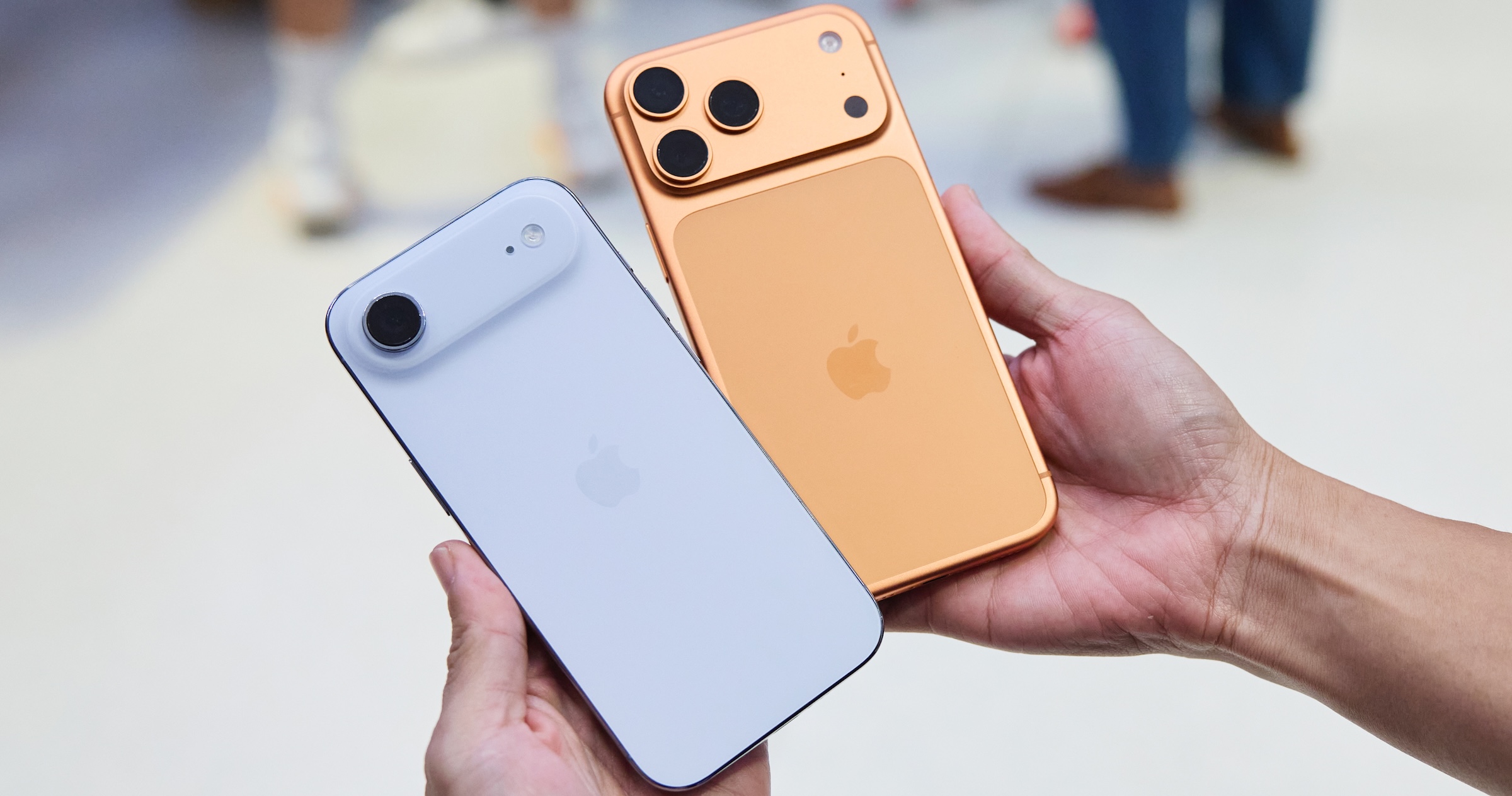 iPhone 17 Pro, iPhone AirEngadgetDisplay and the crease question
The display is arguably the biggest challenge for any foldable phone, and it's an area where Apple appears to have invested years of development.
Multiple reports say Apple will rely on Samsung Display as its primary supplier. At CES 2026, Samsung showcased a new crease-less foldable OLED panel, which several sources — including Bloomberg — suggested could be the same technology Apple plans to use.
According to these reports, the panel combines a flexible OLED with a laser-drilled metal support plate that disperses stress when folding. The goal is a display with a nearly invisible crease, something Apple reportedly considers essential before entering the foldable market.
If Apple does use this panel, it would mark a notable improvement over current foldables, which still show visible creasing under certain lighting conditions.
Cameras and biometricsCamera rumors suggest Apple is planning a four-camera setup. That may include:
Two rear cameras (main and ultra-wide, both rumored at 48MP)
One punch-hole camera on the outer display
One under-display camera on the inner screen
Several sources claim Apple will avoid Face ID entirely on the iPhone Fold. Instead, it's expected to rely on Touch ID built into the power button, similar to recent iPad models. This would allow Apple to keep both displays free of notches or Dynamic Island cutouts.
Under-display camera technology has historically produced lower image quality, but a rumored 24MP sensor would be a significant step up compared to existing foldables, which typically use much lower-resolution sensors.
iPhone Fold's hinge and materialsThe hinge is another area where Apple may diverge from competitors. Multiple reports claim Apple will use Liquidmetal, which is a long-standing trade name for a metallic glass alloy the company has previously used in smaller components. While often referred to as "liquid metal" or "Liquid Metal" in reports, Liquidmetal is the branding Apple has historically associated with the material.
Liquidmetal is said to be stronger and more resistant to deformation than titanium, while remaining relatively lightweight. If accurate, this could help improve long-term durability and reduce wear on the foldable display.
Leaks from Jon Prosser also reference a metal plate beneath the display that works in tandem with the hinge to minimize creasing — a claim that aligns with reporting from Korean and Chinese supply-chain sources.
Battery and other componentsBattery life is another potential differentiator. According to Ming-Chi Kuo and multiple Asian supply-chain reports, Apple is testing high-density battery cells in the 5,000 to 5,800mAh range.
That would make it the largest battery ever used in an iPhone, and competitive with (or larger than) batteries in current Android foldables. The device is also expected to use a future A-series chip and Apple's in-house modem.
PriceNone of this will come cheap, that's for certain. Nearly every report agrees that the iPhone Fold will be Apple's most expensive iPhone ever.
Estimates currently place the price between $2,000 and $2,500 in the US. Bloomberg has said the price will be "at least $2,000," while other analysts have narrowed the likely range to around $2,100 and $2,300. That positions the iPhone Fold well above the iPhone Pro Max and closer to Apple's high-end Macs and iPads.
Despite years of rumors, there's still plenty that remains unclear. Apple hasn't confirmed the name "iPhone Fold," final dimensions, software features or how iOS would adapt to a folding form factor. Durability, repairability and long-term reliability are also open questions. For now, the safest assumption is that Apple is taking its time and that many of these details could still change before launch.
This article originally appeared on Engadget at https://www.engadget.com/mobile/smartphones/iphone-fold-rumors-everything-we-know-so-far-including-the-leaked-design-130000516.html?src=rss DeepSeek reportedly gets China's approval to buy NVIDIA's H200 AI chips [ 30-Jan-26 1:00pm ]The Chinese government has given DeepSeek its approval to purchase NVIDIA's H200 AI chips, according to Reuters. ByteDance, Alibaba and Tencent have also reportedly received permission from Beijing to buy a total of 400,000 H200 GPUs. Reuters says Chinese authorities are still finalizing the conditions they're imposing on the companies to be able to proceed with their orders, so it may take a while before they're able to receive their shipments. In addition, NVIDIA CEO Jensen Huang told reporters that his company has yet to receive orders from the aforementioned firms and that he believed China is still finalizing their licenses.
In December 2025, the US government allowed NVIDIA to sell its second-best H200 processors to vetted Chinese companies in addition to its H20 model in exchange for a 25 percent tariff on those sales. China previously dissuaded local companies from purchasing NVIDIA's H20 chips, but it recently agreed to import hundreds of thousands of H200 units after Huang's visit to the country. While Chinese companies are striving to rely on local manufacturers, such as Huawei and Baidu, for AI chips, NVIDIA's technology is still more advanced. The H200 is only second to NVIDIA's B200 and is around six times more powerful than the H20.
China's National Development and Reform Commission is the agency in charge of determining the conditions Chinese companies have to meet in order to buy H200 units. Stateside, DeepSeek's purchase could lead to questions from authorities. As Reuters notes, a lawmaker has just accused NVIDIA of helping DeepSeek develop AI models that were subsequently used by the Chinese military.
This article originally appeared on Engadget at https://www.engadget.com/ai/deepseek-reportedly-gets-chinas-approval-to-buy-nvidias-h200-ai-chips-130000933.html?src=rss The Morning After: The Nex Playground channels the spirit of Xbox's Kinect [ 30-Jan-26 12:15pm ]You might not have heard of the Nex Playground, but it's a tiny gaming system built entirely around Kinect-like games. With its camera and computer vision processing, the $249 Nex Playground can track up to four players as effectively as Microsoft's old Xbox motion tracker, according to Engadget's Devindra Hardawar.
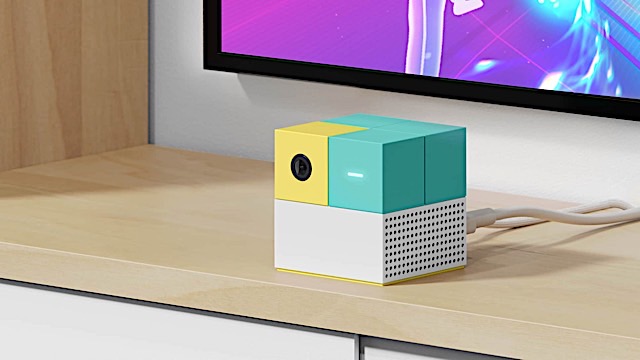 NEXNEX
The hardware is cute and well-designed, there are plenty of games, and it works offline. The only issue is the ongoing subscription needed to access most games. Check out our full review to learn more.
— Mat Smith
The biggest stories you might have missedSamsung Galaxy Unpacked 2026: Everything we think the company will unveil
Native Instruments enters insolvency proceedings, leaving its future uncertain
Mark Zuckerberg says Reality Labs will (eventually) stop losing so much money
Even if demand for Optimus is still unknown.
 TMATesla
Tesla is going to wrap up production of its Model S and X EVs next quarter, CEO Elon Musk has announced. It's less of a major shift for the company than it sounds: The newer Model 3 and Y now make up the bulk of the company's sales. Tesla delivered over 1.5 million Model 3 and Y vehicles but sold under 450,000 Model S and X units. Musk added that Tesla's long-term goal is to manufacture 1 million Optimus robots in the current Model S and X production space.
Snap makes its AR glasses into a separate businessIt'll still be under the umbrella of Snap.
Snap's augmented reality glasses business will now be its own company called Specs Inc. It'll still be fully owned by Snap, though. The company has been trying to figure out ways to raise outside money for its AR glasses to better compete with Meta, which has a lot more money to spend on development. Earlier this week, Mark Zuckerberg said his Reality Labs will (eventually) stop losing so much money as it doubles down on AI glasses and shifts away from virtual reality. According to the Meta boss, the company's smart glasses sales "more than tripled" in 2025.
How can Snap's Specs match the might of Meta? Well, its next pair will apparently be lighter, smaller and more capable than its older smartglass model, which was pretty dev-focused. One request: make them not look awful.
The best TV deals ahead of Super Bowl 2026Maybe it's time for an upgrade.
Hosting a Super Bowl party? Maybe you've been thinking about replacing an aging set, or you're itching for a full refresh of your home theater setup — either way, if you're looking for a good deal on a new TV, we've got you covered. TV prices steadily decrease after a new model comes out. The 2026 TV models were announced at CES and are expected to arrive this year, making now a good time to look for discounts on 2025 sets. Aside from the holiday shopping season, this is one of the best times of the year to save on a TV — it's like the manufacturers know there's a Super Bowl.
This article originally appeared on Engadget at https://www.engadget.com/general/the-morning-after-the-nex-playground-channels-the-spirit-of-xboxs-kinect-121500965.html?src=rssTo find the best power bank out there, I tested more than 60 portable chargers and batteries from big brands like Anker, Belkin, UGreen and Mophie — as well as from smaller players such as Biolite, Nimble and Satechi. I tested the batteries on a number of devices including iPhones, Galaxy phones, an iPad, a MacBook and even my ereader and a PlayStation controller. If you just want a brick that can charge anything, go for Anker's 25kmAh Laptop Power bank. It has two built-in USB-C cables, a massive capacity and super fast charging speeds. But if that's not quite what you're looking for, you can check out our other picks for the best power banks below.
Best power banks for 2026
What to look for in a portable battery pack Battery type
Nearly every rechargeable power bank you can buy (and most portable devices) contain a lithium-ion battery. These beat other current battery types in terms of size-to-charge capacity, and have even increased in energy density by eight fold in the past 14 years. They also don't suffer from a memory effect (where a battery's lifespan deteriorates due to partial charges).
Flying with portable batteriesYou may have heard about lithium ion batteries overheating and catching fire — a recent Hong Kong flight was grounded after just such a thing happened in an overhead bin. Current restrictions implemented by the TSA still allow external batteries rated at 100Wh or less (which all of our recommendations are) to fly with you, but only in your carry-on luggage — they can't be checked.
Recently, Southwest Airlines was the first in the industry to take that rule one step further. Now, flyers on that airline must keep power banks in clear view when using them to recharge a device. If the portable charger isn't actively in use, however, it can stay in your carry-on bag in the overhead bin.
CapacityPower bank manufacturers almost always list a battery's capacity in milliamp hours, or mAh. Smaller batteries with a 5,000mAh capacity make good phone chargers and can fill a smartphone to between 50 and 75 percent. Larger batteries that can recharge laptops and tablets, or give phones multiple charges, can exceed 25,000mAh and we have a separate guide that covers that entire category.
Unsurprisingly, the prices on most batteries goes up as mAh capacity increases, and since batteries are physical storage units, size and weight go up with capacity as well. If you want more power, be prepared to spend more and carry around a heavier brick.
You might think that a 10,000mAh power bank could charge a 5,000mAh phone to 100 percent twice, but that's not the case. In addition to simple energy loss through heat dissipation, factors like voltage conversion also bring down the amount of juice that makes it into your phone. Most manufacturers list how many charges a battery can give a certain smartphone. In our tests, 10,000mAh of battery pack capacity translated to roughly 5,800mAh of device charge. 20,000mAh chargers delivered around 11,250mAh to a device, and 25,000mAh banks translated to about 16,200mAh of charge. That's an average efficiency rate of around 60 percent.
WirelessWireless charging, whether through a bank or a plugged-in charging pad, is less efficient than wired connections. But it is convenient — and in most cases, you can carry around and use your phone as it refills with a magnetically attached power bank.
Power banks with wireless charging are far better than they once were. Just a couple years ago, the ones I tested were too inefficient to recommend in this guide. When batteries adhering to the Qi2 wireless charging standard started arriving in 2023, performance markedly improved.
To gain Qi2-certification, a device has to support speeds of up to 15 watts and include magnetic attachment points. The MagSafe technology on iPhones were once the only handsets that were Qi2-compatible, but now Google's Pixelsnap tech brings both the higher speed and magnetic grip to Pixel 10 phones. Samsung may follow up with its own version in future releases.
The latest wireless charging standard, Q12 25W, is supported by the new iPhone 17 phones as well as the Google Pixel 10 Pro XL. Battery packs that are Qi2 25W-enabled are starting to hit the market as well, and the Ugreen MagFlow was the first on the scene.
PortsUSB-C ports can deliver faster charges than USB-A ports, and most of the portable chargers we recommend here have Type-C connections. But Type-A jacks are still handy if you need to use a specialized cable for a certain device (my camera's USB-A to micro USB cable comes to mind).
There's also variation among USB-C ports. Larger banks with more than one port will sometimes list different wattages for each. For example, a bank with three ports may have two 65W ports and one 100W port. There will also be at least one in/out port on the bank, which can be used to charge the battery itself or to deliver a charge to your device. Wattages and in/out labels are printed right next to the port — and always in the tiniest font possible (remember, your phone is an excellent magnifying glass if you ever have trouble reading them).
As with standard wall chargers, the port's wattage will determine what you can charge. A phone will happily charge off a 100W connection, but a 15W plug won't do much for your laptop. And remember, the cable has to match the maximum wattage. A cable rated for 60W won't deliver 100W speeds.
Luckily, some of the best power banks include a built-in USB-C cable. That'll not only ensure you have the right cord, it's one less thing you have to remember to bring along.
Design
Once, most rechargeable batteries were black with a squared-off, brick-like design, but now they come in different colors and shapes with attractive finishes and detailing. While that doesn't affect how they perform, it's a consideration for something you'll interact with regularly. Some portable power banks include extra features like MagSafe compatibility, a built-in wall plug or even a kickstand. Nearly all have some sort of indicator to let you know how much available charge your power bank has left, usually expressed with lighted pips near the power button. Some of the newer banks take that a step further with an LED display indicating remaining battery percentage.
How we test best power banksFirst, I considered brands Engadget reviewers and staff have tried over the years and checked out customer ratings on retail sites like Amazon and Best Buy. Then, I acquired the most promising candidates and tested them in my home office.
For testing, I used each battery to charge both an iPhone and an Android phone, as well as an iPad and a MacBook Pro for the larger portable chargers. I let the devices get down to between zero and five percent and charged them until the devices were full or the power bank died.
For reference, here are the battery capacities of the device I've used for testing over the years:
iPhone 11: 3,110 mAh
iPhone 14 Plus: 4,325 mAh
iPhone 15: 3,349 mAh
iPhone 16: 3,561*
Galaxy S22 Ultra: 4,855mAh
iPad Air: 7,729mAh
16-inch M1 Pro MacBook Pro: 27,027mAh
*The iPhone 17 has a slightly larger battery at 3,692mAh
I continuously update this guide as companies release new products.
Other power banks we testedHere are a few picks that didn't quite make the cut, but are worth mentioning.
Belkin Stage PowerGripIf you're into iPhonography, this clever accessory could be worth a look. Belkin's Stage PowerGrip is a 9,300mAh power bank that has both a wireless charging pad and built-in cable. But it's also a Bluetooth shutter with a quarter-inch tripod thread. The design resembles a standard digital camera and provides a sturdy grip once you magnetically attach your phone (make sure you're either using a MagSafe case or no case to ensure a solid connection).
The shutter is conveniently placed and the remote speed was quick enough to capture the cute things my cat was doing. The accessory can even act as a stand while it charges in either landscape or portrait orientation. As a power bank, it's slow, taking about two hours to get my iPhone 16 from three to 98 percent, but it has enough juice for a full refill plus a little more, which could help if you're out taking pictures all day.
Anker MagGo for Apple Watch power bankThe Anker MagGo for Apple Watch power bank combines a 10K battery with a built-in USB-C cable and a pop-up Apple Watch charger. I didn't formally test it as it's a little too niche, but it deserves a mention for saving my keister on two occasions. Driving to a hike, my watch told me it was down to 10 percent. Thankfully, I had this and could refill the watch before I got to the trailhead. Later, on an interstate trip, I realized the travel charging station I'd brought was a dud. This kept my watch alive for the week I was away. It does a good job simply charging a phone via the handy on-board cable, too. But for those with an Apple Watch, it's extra useful.
HyperJuice 245WHyper's massive-but-sleek brick is one nice looking power bank. The HyperJuice 245W packs a hefty 27,000mAh capacity, enough to refill my tester phone about four times and get a MacBook Pro from near-dead to 75 percent. It only has USB-C ports, but you at least get four of them. USB-C only is probably fine for most situations, but a USB-A port would be nice for charging the occasional older peripheral. The 245 wattage is pretty high for a power bank and it was indeed speedy. It filled a Samsung Galaxy S24 Ultra in just over an hour. But it's the same price and capacity as our Mophie Powerstation pick for laptop banks, and that one has a better variety of ports. Hyper's battery is also comparable to Anker's laptop battery, which is cheaper, has built-in cables and has nearly the same capacity. Plus, that bank is just as swanky looking.
EcoFlow Rapid magnetic power bankI was curious to try out the first power bank from EcoFlow, a company that primarily makes larger power stations and whole-home backup batteries. The first offering in the brand's Rapid series is a Qi2-enabled magnetic charger with a 5,000mAh capacity. It looks quite nice with shiny silver accents and soft-touch grey plastic on the MagSafe-compatible front. There's a little pull-out leg that sturdily displays your phone as it charges and the attached USB-C cable lets you refill devices directly, then tucks out of the way when it's not in use. But it didn't outperform our top pick in the MagSafe category, in terms of both charging speeds and the amount of charge delivered.
Mophie Snap+ Powerstation MiniThe Mophie snap+ Powerstation Mini is terribly well-built. It feels premium with a rubberized contact point for the MagSafe charging pad and a stand that runs the entire width of the bank itself, making it extra sturdy. It's compact, too, but only carries a 5,000mAh capacity, which gets you a partial charge on most newer or larger phones. Our current MagSafe/iPhone pick has double the capacity, a stand and a digital display — for just $20 more than the Powerstation Mini.
Power bank FAQs What's the difference between a portable power bank and a portable charger?A slew of terms are used to describe power banks, including portable batteries, portable chargers, external battery packs and even, somewhat confusingly, USB chargers, which is what wall chargers are often called. They all mean the same thing: a lithium ion battery that stores a charge so you can refill a smartphone, tablet, earbuds, console controller, ereader, laptop, or just about any other device with its own built-in, rechargeable battery.
There's little difference between the terms, so the specs you'll want to pay attention to are capacity (expressed in mAh), size and weight so you can find the right balance between recharging what you need and portability.
Power stations, on the other hand, are distinct. These are bigger units (often around the size of a car battery) that can be used to charge multiple devices multiple times, but notably, they can't be taken on airplanes.
Does fast charging actually ruin your battery?Not exactly. The real enemy of a battery's longevity is heat. The faster you charge a battery, the more heat is generated. Modern phones have features that keep the battery cool while charging, like physical heat shields and heat sinks, as well as software features that slow down processes that generate too much heat. Phone manufacturers are keen to promote a phone's fast-charging abilities, so they had to figure out ways to make faster charging work.
While there aren't long-term studies on what fast charging does to a phone, a study on EV batteries (which use the same general concept of charged lithium ions flowing from one side of the battery to the other, absorbing or releasing a usable charge) showed a very slight decrease in capacity over time with only fast charging — though what actually made a larger difference was how hot the battery itself was, due to ambient temperatures, when it was charged.
In short, fast charging could be slightly harder on your battery than normal charging. But the safeguards most smartphones have make that difference fairly negligible. To really ensure you're optimizing charging capabilities, limit your phone's heat exposure overall.
Can you use a power bank for all your devices?That depends on the size of the bank and the size of your device's battery. A small 5,000mAh battery isn't strong enough to charge laptops, but a portable charger with a 20,000mAh capacity will give your computer a partial refill. You also have to consider port compatibility. If your device has a USB port, you'll be able to easily find a cable to connect it to a battery. If your device has a more unique port, such as a DC port, you won't be able to use a battery. Devices with an AC cable and plug can be charged, and sometimes powered (such as in the case of a printer or speaker), by larger laptop batteries with AC ports.
This article originally appeared on Engadget at https://www.engadget.com/computing/accessories/best-power-bank-143048526.html?src=rssManaging your finances doesn't have to be a headache — especially with the right budgeting app at your fingertips. Whether you're trying to track everyday spending, save for a big purchase or just keep a closer eye on your subscriptions, there's an app that can help. With Mint shutting down, plenty of users have been looking for the best budget apps to replace it, and luckily there are plenty of solid alternatives.
From AI-powered spending trackers to apps that break down your expenses into easy-to-follow categories, the best budgeting tools help you take control of your money without the hassle of spreadsheets. Some focus on automating savings, while others give you a deep dive into your finances with powerful analytics and custom reporting. If you're still searching for the right Mint alternative, check out our guide to the best budgeting apps to replace Mint to find the best fit for your needs.
If you're not sure where to start, we've rounded up the top budgeting apps to help you track spending, save smarter, and stick to your financial goals.
Other budgeting apps we tested PocketGuard
PocketGuard used to be a solid free budget tracker, but the company has since limited its "free" version to just a free seven-day trial. Now, you'll have to choose between two plans once the trial is over: a $13 monthly plan or a $75 annual plan. When I first tested it, I found it to be more restricted than NerdWallet, but still a decent option. The main overview screen shows you your net worth, total assets and debts; net income and total spending for the month; upcoming bills; a handy reminder of when your next paycheck lands; any debt payoff plan you have; and any goals. Like some other apps, including Quicken Simplifi, PocketGuard promotes an "after bills" approach, where you enter all of your recurring bills, and then PocketGuard shows you what's left, and that's what you're supposed to be budgeting: your disposable income.
Although PocketGuard's UI is easy enough to understand, it lacks polish. The "accounts" tab is a little busy, and doesn't show totals for categories like cash or investments. Seemingly small details like weirdly phrased or punctuated copy occasionally make the app feel janky. More than once, it prompted me to update the app when no updates were available. The web version, meanwhile, feels like the mobile app blown up to a larger format and doesn't take advantage of the extra screen real estate. Ultimately, now that the free tier is gone, it just doesn't present the same value proposition as it once did.
How we test budgeting appsBefore I dove in and started testing out budgeting apps, I had to do some research. To find a list of apps to try out, I consulted trusty ol' Google (and even trustier Reddit); read reviews of popular apps on the App Store; and also asked friends and colleagues what budget tracking apps (or other budgeting methods) they might be using for money management. Some of the apps I found were free and these, of course, show loads of ads (excuse me, "offers") to stay in business. But most of the available apps require paid subscriptions, with prices typically topping out around $100 a year, or $15 a month. (Spoiler: My top pick is cheaper than that.)
All of the services I chose to test needed to do several things: import all of your account data into one place; offer budgeting tools; and track your spending, net worth and credit score. Except where noted, all of these apps are available for iOS, Android and on the web.
Once I had my shortlist of six apps, I got to work setting them up. For the sake of thoroughly testing these apps, I made a point of adding every account to every budgeting app, no matter how small or immaterial the balance. What ensued was a veritable Groundhog Day of two-factor authentication. Just hours of entering passwords and one-time passcodes, for the same banks half a dozen times over. Hopefully, you only have to do this once.
Budgeting app FAQs What is Plaid and how does it work?Each of the apps I tested uses the same underlying network, called Plaid, to pull in financial data, so it's worth explaining what it is and how it works. Plaid was founded as a fintech startup in 2013 and is today the industry standard in connecting banks with third-party apps. Plaid works with over 12,000 financial institutions across the US, Canada and Europe. Additionally, more than 8,000 third-party apps and services rely on Plaid, the company claims.
To be clear, you don't need a dedicated Plaid app to use it; the technology is baked into a wide array of apps, including all of the budgeting apps listed in this guide. Once you find the "add an account" option in whichever one you're using, you'll see a menu of commonly used banks. There's also a search field you can use to look yours up directly. Once you find yours, you'll be prompted to enter your login credentials. If you have two-factor authentication set up, you'll need to enter a one-time passcode as well.
As the middleman, Plaid is a passthrough for information that may include your account balances, transaction history, account type and routing or account number. Plaid uses encryption, and says it has a policy of not selling or renting customer data to other companies. However, I would not be doing my job if I didn't note that in 2022 Plaid was forced to pay $58 million to consumers in a class action suit for collecting "more financial data than was needed." As part of the settlement, Plaid was compelled to change some of its business practices.
In a statement provided to Engadget, a Plaid spokesperson said the company continues to deny the allegations underpinning the lawsuit and that "the crux of the non-financial terms in the settlement are focused on us accelerating workstreams already underway related to giving people more transparency into Plaid's role in connecting their accounts, and ensuring that our workstreams around data minimization remain on track."
Why did Mint shut down?When parent company Intuit announced in December 2023 that it would shut down Mint, it did not provide a reason why it made the decision to do so. It did say that Mint's millions of users would be funneled over to its other finance app, Credit Karma. "Credit Karma is thrilled to invite all Minters to continue their financial journey on Credit Karma, where they will have access to Credit Karma's suite of features, products, tools and services, including some of Mint's most popular features," Mint wrote on its product blog. In our testing, we found that Credit Karma isn't an exact replacement for Mint — so if you're still looking for a Mint alternative, you have some decent options.
What about Rocket Money?Rocket Money is another free financial app that tracks spending and supports things like balance alerts and account linking. If you pay for the premium tier, the service can also help you cancel unwanted subscriptions. We did not test it for this guide, but we'll consider it in future updates.
This article originally appeared on Engadget at https://www.engadget.com/apps/best-budgeting-apps-120036303.html?src=rssApple shared its latest quarterly financial results today and the news is once again very, very good for the Cupertino company. The quarter ending December 27, 2025 marked "the best-ever quarter" for iPhones, which generated a record high revenue of nearly $85.27 billion for the business. Apple doesn't disclose the number of devices sold any more, but even with the prices for many of its latest generation of smartphones surpassing $1,000 a pop, that's still got to be a heck of a lot of iPhones.
"The demand for iPhone was simply staggering," CEO Tim Cook said on the conference call to discuss the results. "This is the strongest iPhone lineup we've ever had and by far the most popular."
That wasn't the only massive number in the earnings report. Services revenue also logged its biggest quarter yet, growing 14 percent over the same period last year to reach just over $30 billion. It was also Apple's biggest quarter to date for total revenue, which was nearly $143.76 billion for the already fabulously wealthy company.
This article originally appeared on Engadget at https://www.engadget.com/mobile/smartphones/apple-just-reported-its-best-ever-quarter-for-iphone-sales-234135513.html?src=rssThe National Center for Missing and Exploited Children said it received more than 1 million reports of AI-related child sexual abuse material (CSAM) in 2025. The "vast majority" of that content was reported by Amazon, which found the material in its training data, according to an investigation by Bloomberg. In addition, Amazon said only that it obtained the inappropriate content from external sources used to train its AI services and claimed it could not provide any further details about where the CSAM came from.
"This is really an outlier," Fallon McNulty, executive director of NCMEC's CyberTipline, told Bloomberg. The CyberTipline is where many types of US-based companies are legally required to report suspected CSAM. "Having such a high volume come in throughout the year begs a lot of questions about where the data is coming from, and what safeguards have been put in place." She added that aside from Amazon, the AI-related reports the organization received from other companies last year included actionable data that it could pass along to law enforcement for next steps. Since Amazon isn't disclosing sources, McNulty said its reports have proved "inactionable."
"We take a deliberately cautious approach to scanning foundation model training data, including data from the public web, to identify and remove known [child sexual abuse material] and protect our customers," an Amazon representative said in a statement to Bloomberg. The spokesperson also said that Amazon aimed to over-report its figures to NCMEC in order to avoid missing any cases. The company said that it removed the suspected CSAM content before feeding training data into its AI models.
Safety questions for minors have emerged as a critical concern for the artificial intelligence industry in recent months. CSAM has skyrocketed in NCMEC's records; compared with the more than 1 million AI-related reports the organization received last year, the 2024 total was 67,000 reports while 2023 only saw 4,700 reports.
In addition to issues such as abusive content being used to train models, AI chatbots have also been implicated in several dangerous or tragic cases involving young users. OpenAI and Character.AI have both been sued after teenagers planned their suicides with those companies' platforms. Meta is also being sued for alleged failures to protect teen users from sexually explicit conversations with chatbots.
This article originally appeared on Engadget at https://www.engadget.com/ai/amazon-discovered-a-high-volume-of-csam-in-its-ai-training-data-but-isnt-saying-where-it-came-from-224749228.html?src=rss Elon Musk's SpaceX and xAI are reportedly holding merger talks [ 29-Jan-26 9:17pm ]Two Elon Musk companies are reportedly planning to merge. On Thursday, Reuters reported that SpaceX and xAI are holding merger talks ahead of a planned IPO. Part of their plan is to launch AI data centers into space (but unfortunately, only as far as Earth's orbit).
Last week, it was reported that Musk planned to take SpaceX public despite having once said it wouldn't happen until the company had a presence on Mars. Now, the IPO could happen as early as this year. Shares of xAI would reportedly be exchanged for shares in SpaceX under the merger. Reuters reports that two entities were set up in Nevada on January 21 to facilitate the deal.
If the idea of two Musk companies becoming one sounds familiar, that's because it happened less than a year ago. In March 2025, xAI bought X, putting Grok (known for nonconsensual "nudifying" images) and X (infamous for being a far-right hellscape) together under one unholy roof.
The latest idea Musk is pitching is blasting AI data centers off into space. At last week's gathering of the rich and powerful in Davos, Switzerland, he said, "The lowest cost place to put AI will be in space. And that will be true within two years, maybe three at the latest." The idea is that data centers in orbit could harness solar power and reduce cooling costs. However, industry analysts and executives consider it a risky bet, questioning whether the savings would warrant the massive investment. If or when the AI bubble bursts, the plan could go down in flames — if not literally, then figuratively.
This article originally appeared on Engadget at https://www.engadget.com/big-tech/elon-musks-spacex-and-xai-are-reportedly-holding-merger-talks-211740150.html?src=rss Publishers are blocking the Internet Archive for fear AI scrapers can use it as a workaround [ 29-Jan-26 8:40pm ]The Internet Archive has often been a valuable resource for journalists, from it's finding records of deleted tweets or providing academic texts for background research. However, the advent of AI has created a new tension between the parties. A few major publications have begun blocking the nonprofit digital library's access to their content based on concerns that AI companies' bots are using the Internet Archive's collections to indirectly scrape their articles.
"A lot of these AI businesses are looking for readily available, structured databases of content," Robert Hahn, head of business affairs and licensing for The Guardian, told Nieman Lab. "The Internet Archive's API would have been an obvious place to plug their own machines into and suck out the IP."
The New York Times took a similar step. "We are blocking the Internet Archive's bot from accessing the Times because the Wayback Machine provides unfettered access to Times content — including by AI companies — without authorization," a representative from the newspaper confirmed to Nieman Lab. Subscription-focused publication the Financial Times and social forum Reddit have also made moves to selectively block how the Internet Archive catalogs their material.
Many publishers have attempted to sue AI businesses for how they access content used to train large language models. To name a few just from the realm of journalism:
The New York Times sued OpenAI and Microsoft
The Center for Investigative Reporting sued OpenAI and Microsoft
The Wall Street Journal and New York Post sued Perplexity
A group of publishers including The Atlantic, The Guardian and Politico sued Cohere
Penske Media sued Google
The New York Times and the Chicago Tribune sued Perplexity
Other media outlets have sought financial deals before offering up their libraries as training material, although those arrangements seem to provide compensation to the publishing companies rather than the writers. And that's not even delving into the copyright and piracy issues also being fought against AI tools by other creative fields, from fiction writers to visual artists to musicians. The whole Nieman Lab story is well worth a read for anyone who has been following any of these creative industries' responses to artificial intelligence.
This article originally appeared on Engadget at https://www.engadget.com/ai/publishers-are-blocking-the-internet-archive-for-fear-ai-scrapers-can-use-it-as-a-workaround-204001754.html?src=rss Waymo begins service at San Francisco International Airport [ 29-Jan-26 7:29pm ]As fans and media prepare to descend on the Bay Area for Super Bowl LX, what does a high-tech city like San Francisco do? Why, call in the robotaxis, of course. On Thursday, Alphabet's Waymo began offering fully autonomous rides at San Francisco International Airport (SFO).
There are some limits. For now, SFO access is restricted to "a select number of riders." However, access will gradually expand over the coming months. The service is also limited to the SFO Rental Car Center (pickups and drop-offs) at launch. Waymo says it will expand to other airport locations, including terminals, "in the future."
The San Francisco Standard notes that SFO is now the third airport in Waymo's repertoire. The San Francisco launch follows the company's service at Phoenix Sky Harbor and San Jose Mineta. As for the Bay Area, Waymo now serves more than 260 square miles in the region.
Unfortunately, this isn't Waymo's only appearance in the news this week. On Wednesday, the company said one of its robotaxis struck a child, who sustained minor injuries. The incident took place on January 23 in Santa Monica. The National Highway Traffic Safety Administration (NHTSA) has opened an investigation.
This article originally appeared on Engadget at https://www.engadget.com/transportation/evs/waymo-begins-service-at-san-francisco-international-airport-192913050.html?src=rss Apple acquires Q.ai for a reported $2 billion [ 29-Jan-26 7:00pm ]Apple has acquired Israel-based startup Q.ai, a move that could provide a much-needed boost to the tech giant's capabilities in artificial intelligence. Although Apple has not disclosed terms of the deal, sources told Financial Times that the arrangement is reportedly valued at nearly $2 billion. If that figure is accurate, the Q.ai acquisition marks Apple's second largest acquisition to date, followed by its purchase of Beats for $3 billion back in 2014.
Johny Srouji, Apple's senior vice president of hardware technologies, said in a statement that Q.ai "is a remarkable company that is pioneering new and creative ways to use imaging and machine learning." Apple hasn't shared any specifics about how it plans to leverage the startup, but its past work indicates the possibility of Apple moving deeper into AI-powered wearables. "Patents filed by Q.ai show its technology being used in headphones or glasses, using 'facial skin micro movements' to communicate without talking," the Times reported.
The startup's founding team, including CEO Aviad Maizels, will join Apple as part of the deal. This acquisition marks Maizels' second sale to Apple; he previously founded a three-dimensional hearing business called PrimeSense that Apple bought back in 2013.
For several months, many tech insiders have speculated that an acquisition might be Apple's best path forward to catching up in the AI race. In the company's Q3 earnings call in July 2025, CEO Tim Cook acknowledged that "We're open to M&A that accelerates our roadmap." A deal like this one could eventually lead to Apple developing its own fully in-house AI chatbot rather than relying on a competitor like Google to power artificial intelligence in its Siri assistant.
This article originally appeared on Engadget at https://www.engadget.com/big-tech/apple-acquires-qai-for-a-reported-2-billion-190017949.html?src=rss Music publishers sue Anthropic for $3 billion over 'flagrant piracy' [ 29-Jan-26 6:54pm ]A group of music publishers led by Concord Music Group and Universal Music Group are suing Anthropic, according to a report by Reuters. The suit accuses the AI company of illegally downloading more than 20,000 copyrighted songs, including sheet music, lyrics and compositions.
These songs were then allegedly fed into the chatbot Claude for training purposes. There are some iconic tunes named by Universal in the suit, including tracks by The Rolling Stones, Neil Diamond and Elton John, among many others. Concord is an independent publisher that handles artists like Common, Killer Mike and Korn.
The publishers issued a statement saying that the damages could amount to more than $3 billion. This would make it one of the largest non-class action copyright cases in US history.
"While Anthropic misleadingly claims to be an AI 'safety and research' company, its record of illegal torrenting of copyrighted works makes clear that its multibillion-dollar business empire has in fact been built on piracy," the lawsuit says.
The suit was filed by the same legal team as last year's Bartz v. Anthropic case. The music publishers say they found that Anthropic had been illegally downloading thousands of songs during the discovery process of that suit.
For the unfamiliar, the Bartz v. Anthropic case ended with an award of $1.5 billion to impacted writers after it was found that the company had illegally downloaded their published works for similar training purposes. The terms of that agreement dictated that the 500,000 authors involved in the case would get $3,000 per work. The $1.5 billion looks like a big number, but not so much when broken down like that. Also, Anthropic is worth around $350 billion.
In the Bartz case, Judge William Alsup ruled that it was legal for Anthropic to train its models on copyrighted content but not legal to acquire that content via piracy. We'll have to wait and see how this new suit shakes out. The legal precedent here seems to suggest that if Anthropic would have just spent a buck on each copyrighted song, then they'd be in the clear. That's an odd distinction when it comes to building an entire company around snatching up copyrighted content, but whatever.
This article originally appeared on Engadget at https://www.engadget.com/ai/music-publishers-sue-anthropic-for-3-billion-over-flagrant-piracy-185459358.html?src=rss Google's Project Genie lets you generate your own interactive worlds [ 29-Jan-26 6:36pm ]This past summer, Google DeepMind debuted Genie 3. It's what's known as a world world, an AI system capable of generating images and reacting as the user moves through the environment the software is simulating. At the time, DeepMind positioned Genie 3 as a tool for training AI agents. Now, it's making the model available to people outside of Google to try with Project Genie.
To start, you'll need Google's $250 per month AI Ultra plan to check out Project Genie. You'll also need to live in the US and be 18 years or older. At launch, Project Genie offers three different modes of interaction: World Sketching, exploration and remixing. The first sees Google's Nano Banana Pro model generating the source image Genie 3 will use to create the world you will later explore. At this stage, you can describe your character, define the camera perspective — be it first-person, third-person or isometric — and how you want to explore the world Genie 3 is about to generate. Before you can jump into the model's creation, Nano Banana Pro will "sketch" what you're about to see so you can make tweaks. It's also possible to write your own prompts for worlds others have used Genie to generate.
One thing to keep in mind is that Genie 3 is not a game engine. While its outputs can look game-like, and it can simulate physical interactions, there aren't traditional game mechanics here. Generations are also limited to 60 seconds, as is the presentation, which is capped at 24 frames per second and 720p. Still, if you're an AI Ultra subscriber, this is a cool opportunity to see the bleeding edge of what DeepMind has been working over the past couple of years.
This article originally appeared on Engadget at https://www.engadget.com/ai/googles-project-genie-lets-you-generate-your-own-interactive-worlds-183646186.html?src=rss How to watch the 2026 Super Bowl: Patriots vs. Seahawks channel, start time, where to stream and more [ 29-Jan-26 5:57pm ]Drake Maye and the New England Patriots face Sam Darnold and the Seattle Seahawks at Super Bowl LX, which will be held at Levi's Stadium in Santa Clara, CA this year. For those of you who don't have your calendars blocked off already, the game is on February 8, with kickoff scheduled for 6:30 p.m. ET.
Like all other Sunday Night Football games this season, the championship game will be broadcast on NBC, and will stream live on Peacock. (Oh, and in case the Super Bowl isn't enough for you, you can catch coverage of the Winter Olympics all morning and after the football game on NBC, too!) Here's everything you need to know to tune in to Super Bowl LX on February 8, including the game channel, where to stream, and who's performing at halftime.
How to watch Super Bowl LX
Date: Sunday, Feb. 8, 2026
Time: 6:30 p.m. ET
TV channel: NBC, Telemundo
Streaming: Peacock, DirecTV, NFL+ and more
2026 Super Bowl game timeThe 2026 Super Bowl is set to begin at 6:30 p.m. ET/3:30 p.m. PT on Feb. 8, 2026.
2026 Super Bowl game channelThe 2026 Super Bowl will air on NBC, with a Spanish-language broadcast available on Telemundo.
2026 Super Bowl teams:The New England Patriots and the Seattle Seahawks will play in the 2026 Super Bowl.
Where is the 2026 Super Bowl being played?The 2026 Super Bowl will be held at Levi's Stadium in Santa Clara, CA, home of the San Francisco 49ers.
What teams are playing in the 2026 Super Bowl?The teams for the 2026 Super Bowl will be determined after the AFC and NFC Championship games are played on Sunday, Jan. 25. You can keep tabs on the post-season playoff bracket here.
How to watch the 2026 Super Bowl without cableYou can stream NBC and Telemundo on platforms like DirecTV and Hulu + Live TV, both of which are among Engadget's choices for best streaming services for live TV. (Note that Fubo and NBC are currently in the midst of a contract dispute and NBC channels are not available on the platform.) The game will also be streaming on Peacock and on NFL+, though with an NFL+ subscription, you're limited to watching the game on mobile devices.
Who is performing at the 2026 Super Bowl halftime show?
Bad Bunny, who holds the title as the most-streamed artist in the world, will be headlining the 2026 Super Bowl halftime performance. You can expect that show to begin after the second quarter, likely between 8-8:30 p.m. ET. Singer Charlie Puth will also be at the game to perform the National Anthem, Brandi Carlile is scheduled to sing "America The Beautiful," and Coco Jones will perform "Lift Every Voice and Sing."
Where to buy tickets to the 2026 Super Bowl:Tickets to the 2026 Super Bowl are available on third-party resale platforms like StubHub and Gametime.
Find tickets on Stubhub Find tickets on Gametime More ways to watch Super Bowl LX
This article originally appeared on Engadget at https://www.engadget.com/entertainment/streaming/how-to-watch-the-2026-super-bowl-patriots-vs-seahawks-channel-start-time-where-to-stream-and-more-175759610.html?src=rss
Maingear's latest retro gaming desktop takes you back to the Quake era [ 29-Jan-26 5:49pm ]Maingear is back with another nostalgia-fueled gaming PC. The Retro98 may look like it's made for playing Quake while you wait for The Phantom Menace trailer to drop. But on the inside, the beige box is powerful enough to slay today's most demanding AAA games. "You're not going to find this PC at your local Radio Shack," Maingear promises.
If you're at least middle-aged, the Retro98's exterior is instantly familiar. The hand-built tower includes an LED fan-speed display, a working turbo button and a power-lockout key. Sticking with the nostalgic motif, its front I/O is hidden behind the Maingear logo. I can already hear The Beastie Boys' "Intergalactic" playing in the background.
Fortunately, you won't be limited to 1998 games. (Dope as they are.) It has up to a Ryzen 9 9950X3D processor, GeForce RTX 5090 graphics, 64GB Kingston Fury RAM and 4TB Kingston FURY Renegade NVMe Gen5 SSD. The maxed-out version (described by Maingear as "unapologetically overkill") even includes open-loop liquid cooling.
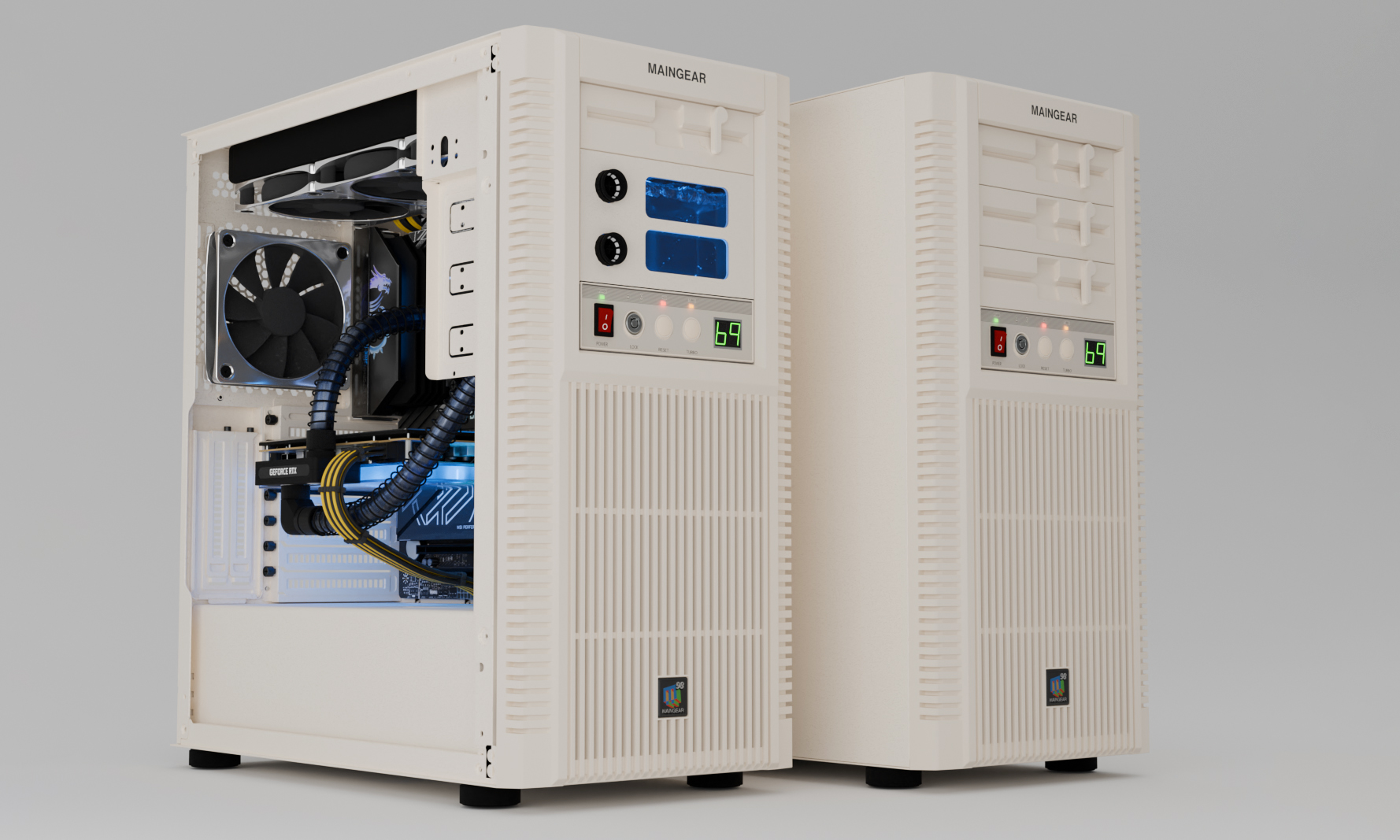 The Retro98 starts at $2,500 and goes all the way up to $9,799.Maingear
Now for the bad news. As you might expect from a retro novelty PC like this, you'll have to pay a pretty penny. The base model (Intel Core Ultra 7 265K / NVIDIA GeForce RTX 5070) costs $2,499. There are two other standard tiers, priced at $3,499 and $4,999. Finally, the open-loop-cooled "Alpha" build is a whopping $9,799. Hey, those aren't 1998 prices!
The Retro98 also has an extremely limited run. Maingear is producing only 32 standard units and six alpha units. The company says it won't bring this build back once those sell out. However, there is a workaround for tinkerers: Since it's based on the SilverStone FLP02 tower PC case, you could grab one of those and build your own.
Those wealthy and nostalgic enough to take the plunge can order the Retro98 today from Maingear's website.
This article originally appeared on Engadget at https://www.engadget.com/gaming/pc/maingears-latest-retro-gaming-desktop-takes-you-back-to-the-quake-era-174958445.html?src=rss

