
Apple is no longer launching an AI service that can "replicate" a doctor and act as a personal health coach, according to Bloomberg's Mark Gurman. The company has reportedly scaled back the unannounced initiative in recent weeks, following a recent organization reshuffling wherein services chief Eddy Cue took over the health division.
While Apple has never officially announced the AI health coach, it was reported last year that the company was working on developing the service that has been unofficially dubbed Health+. It was supposed to be able to help users track food and correct workout forms using their iPhone's camera, as well as to recommend lifestyle changes based on users' health data. Apple even reportedly produced videos for the service, including ones explaining medical conditions and some training guides.
Cue reportedly wanted Apple to move faster and be more competitive when it comes to its health-focused products, seeing as the most well-known names in the field like Oura are already offering a lot of compelling features on their iOS apps. He didn't think Apple's plans could compete, Bloomberg said.
Instead of rolling out an AI health coach as a whole package, Apple will instead release the individual features it has developed to its Health app over time. The videos it shot and the capability to make recommendations based on user data could be available early this year. Apple is also reportedly working on an AI health chatbot to answer wellness questions. It's just an interim solution, however, and the company's goal is to let its reported upcoming Siri chatbot handle those inquiries in the future.
This article originally appeared on Engadget at https://www.engadget.com/ai/apple-reportedly-axed-its-planned-ai-health-coach-133000941.html?src=rssIf you haven't heard, there's now a social network for AI: Moltbook, a site that purportedly features AI agents talking to each other. That includes OpenClaw, a personal AI agent (formerly called Clawdbot and Moltbot) that's open source and free for anyone to run on their systems. In this episode, Devindra and Senior Reporter Karissa Bell discuss the rise of these services, and the potential future that AI agents may have for all of us.
Subscribe!TopicsWhat is Moltbook and OpenClaw? - 1:31
Anthropic reinforces its commitment against ads with Super Bowl ad spots - 19:32
SpaceX acquires xAI and plans for a mega IPO - 27:08
Alexa + rolls out free for all Amazon Prime subscribers - 33:36
Around Engadget: Reviews of the New AirTag and Switch Virtual Boy - 44:12
Working on - 46:34
Pop culture picks - 49:24
Hosts: Devindra Hardawar and Karissa Bell
Producer: Ben Ellman
Music: Dale North and Terrence O'Brien
TikTok's signature features that hooked users around the world are its algorithm and endless scroll. Now, though, the European Union has called those aspects of the app illegal and may order the company to alter them.
"Today, the European Commission preliminarily found TikTok in breach of the Digital Services Act for its addictive design," the EU's regulator said in a press release. "This includes features such as infinite scroll, autoplay, push notifications, and its highly personalized recommender system." It said that TikTok failed to put up safeguards to ensure that those "addictive" features don't "harm the physical and mental wellbeing of users," including minors.
"For example, by constantly 'rewarding' users with new content, certain design features of TikTok fuel the urge to keep scrolling and shift the brain of users into 'autopilot mode'. Scientific research shows that this may lead to compulsive behaviour and reduce users' self-control," the regulators stated.
TikTok's current parental controls and features to limit screen time are insufficient, the Commission added, and TikTok may need to modify them. The platform may also be required to limit its infinite scroll and adjust its recommendation algorithms.
The EU Commission will give TikTok an opportunity to rebut the findings and the company said would use "any means available" to challenge them. "The commission's preliminary findings present a categorically false and entirely meritless depiction of our platform," the company told The New York Times in a statement.
Europe opened its wide-ranging investigation against TikTok in February 2024 and has already found the company at fault for its data sharing practices and advertising transparency. If found guilty of violating the DSA, TikTok faces a fine up to six percent of its annual worldwide turnover.
This article originally appeared on Engadget at https://www.engadget.com/social-media/eu-says-tiktok-uses-addictive-design-and-must-change-131738425.html?src=rssThe Last of Us series co-creator Craig Mazin is teaming with Hasbro Entertainment to create an HBO series based on the popular (and spicy) Baldur's Gate 3 game, Deadline reported. The show will be simply be called Baldur's Gate and the story will resume where Baldur's Gate 3 left off. Mazin will reportedly have full creative control and act as co-creator, writer, executive producer and showrunner.
"It is a dream come true to be able to continue the story that [Baldur's Gate 3 developer] Larian and Wizards of The Coast created," Mazin said in a statement. "I am a devoted fan of DnD and the brilliant way that Swen Vincke and his gifted team adapted it. I can't wait to help bring Baldur's Gate and all of its incredible characters to life with as much respect and love as we can."
Larian, which won't be making the Baldur's Gate 3 sequel, said it wasn't involved in the creation of the show. However, Larian CEO Swen Vincke said that to his knowledge, Mazin is a "big fan" of the game and even requested to visit the studio (Mazin told Deadline that he has put about 1,000 hours into the game).
Mazin is best known for co-creating the Emmy-winning limited series Chernobyl as well as The Last of Us. The latter was widely praised for its first season but critics and fans were mixed on season 2, which deviated a bit more from the corresponding game.
The show will reportedly feature familiar and new characters, but no other details have been released. A Baldur's Gate 4 game is not currently in development, so the series creators will have no source material to draw from. That gives them a lot of freedom, but also puts the storytelling onus fully on Mazin and his team of writers. Wizards of the Coast story head Chris Perkins will reportedly act as a consultant on the show to ensure it doesn't stray from its DnD origins.
A free trial to a virtual private network (VPN) can mean a few different things. Several of the best VPNs let you try them out without paying. A rare few, and only one on this list, let you try them without submitting payment information at all. Some VPNs have forever free plans that let you use them indefinitely without paying, as long as you're OK with some limits.
For the most part, though, your best chance to test a VPN for free is to pay for a subscription. Then, if you don't like the service, you can get your money back before the refund guarantee expires. This takes a bit more work, and some services have very tight turnarounds. However, it'll get you the most time with the most complete version of the VPN.
With that out of the way, let's talk about the best VPN free trials for each definition of "free trial." I'll start with VPNs that actually have free trials, most of which require a payment method and only work on mobile devices. The next section lists the best forever free plans. Finally, I'll share instructions for how to use a VPN money-back guarantee as a free trial.
Best VPN forever free plans
Using VPN money-back guarantees as free trials
Although VPN free trials are great when you can get them, you'll enjoy a lot more flexibility by taking advantage of refund guarantees. Almost every provider has a money-back guarantee that doesn't require you to prove a specific problem. You'll probably have to deflect some upselling attempts before you actually get the refund, but most policies do promise you all your money back, with no pro-rating.
I like to download VPNs on their one-month plans so I can put the full service through my usual battery of tests. A 30-day money-back guarantee grants you enough time to learn whether you can use the VPN long-term. If you don't like the service, the standard method for getting a refund is to get in touch with customer support on the VPN provider's help page.
This article originally appeared on Engadget at https://www.engadget.com/cybersecurity/vpn/best-vpns-with-free-trials-130000435.html?src=rssNordVPN is offering a significant discount on its two-year plans, with 70 percent off its Complete tier and up to 78 percent off overall. For the Complete tier, the deal brings the total cost down to $130 for 24 months
NordVPN regularly appears on Engadget's list of the best VPN services thanks to its wide server network, strong security tools and consistent performance across devices. NordVPN's latest promotion puts one of its most comprehensive plans at a price that undercuts many competing premium VPN subscriptions.
The Complete tier includes full access to NordVPN's core VPN service, which encrypts internet traffic and masks a user's IP address to help protect online activity on public Wi-Fi networks and at home. Subscribers can use the service on multiple devices, including phones, tablets, laptops and smart TVs, with apps available for major operating systems. It also includes access to NordPass (more on that below), an ad blocker and 1TB of cloud storage. You'll find similar discounts on all of NordVPN's other plans: Basic, Plus and Prime.
Beyond the basics, NordVPN offers features like threat protection to help block malicious websites and trackers, as well as specialty servers designed for added privacy or faster performance in specific scenarios. In our NordVPN review, the service was praised for its evolving feature set and overall reliability, even as the VPN market becomes increasingly competitive.
Engadget regularly tracks VPN pricing trends and this offer compares favorably with other current promotions. It also appears alongside NordVPN deals featured in Engadget's ongoing roundup of the best VPN discounts available right now, which compares offers from multiple major providers.
Those looking for additional security tools may also want to note that NordVPN's Complete plan bundles in extra services beyond the VPN itself. One of those is NordPass, the company's password management app. NordPass is also discounted as part of a separate promotion, if you're primarily looking for a password manager rather than a VPN. The Premium tier is currently 50 percent off, bringing the price down to $36 for two years. NordPass Premium adds features such as cross-device password syncing, secure password sharing and breach monitoring, which alerts users if stored credentials appear in known data leaks.
Both offers are available for a limited time, though Nord has not specified an end date for the promotion. If you're still unsure whether NordVPN is right for you, it offers a 30-day money-back guarantee, so you can change your mind and get a full refund.
This article originally appeared on Engadget at https://www.engadget.com/deals/two-years-of-nordvpns-complete-plan-is-70-percent-off-123000301.html?src=rss
 The Morning After: The Switch is officially Nintendo's most popular console ever [ 06-Feb-26 12:15pm ]
With over 155 million sold, Nintendo's Switch is officially the company's biggest console hit ever. It's been a long road to surpassing the DS, which reached 154 million consoles over its seven-year lifespan. The Switch, meanwhile, is a year shy of its 10-year anniversary.
We've seen the original console, the non-hybrid Lite and the OLED versions of the Switch over the decade, but despite being replaced by Switch 2, the original is still selling at a strong pace: 1.36 million units in Q3. Just think how many Joy-Cons it sold/replaced?
Next goal: try to be the best-selling console of all time. Currently, that's the PlayStation 2.
Nintendo is just shy of five million units to go.
— Mat Smith
The biggest stories you might have missedExplained: Moltbook, the social network for AI agentsAre they talking about us behind our backs?
 TMATMA
Moltbook is a "digital petri dish," a Reddit-style forum populated entirely by AI agents that post, follow and even gossip about their owners in dedicated submolts. Built using vibe coding, it's a surreal experiment in autonomous socialization — though there's no shortage of user-data security flaws. Is Moltbook a profound look at the dead internet theory or just a very loud AI echo chamber? Or something in the middle? Karissa explains it all. (Sorry, Karissa.)
Nintendo's Virtual Boy is a niche slice of gaming history.Lean in.
 TMAEngadget
Nintendo's worst-selling console was probably the Virtual Boy. It sold less than 800,000 units, with only 22 games in Japan and 14 in North America. And it didn't even have the guts to launch in Europe or Australia.
But Nintendo doesn't care. It's brought the Virtual Boy back, baby, as an add-on for the Switch 2, in all its red monochrome '90s-tech glory. And we finally got to test it.
It even includes the original bipod, which you use to prop it up and lean into it. Yes, you still can't just wear the thing like modern VR headsets. The Switch 2 console, sans Joy-Cons, then slides in, acting as display, battery and processor.
It seems more of a historical nod than anything else. This is pretty much 30-year-old VR tech, as-is. But… I still want one as a gaming objet d'art. A hundred bucks is a fair chunk of change for that, though. Read on for our full impressions.
Surprise! Google teases the Pixel 10aPre-orders open later this month.
 TMAGoogle
Google posted a teaser video revealing its new entry-level smartphone, the Pixel 10a, in a lovely lilac colorway. We don't know much more, however. You can see it's another dual-camera Pixel, with that same flush body — which I like. (How does that already seem retro?)
Leaks suggest a 6.3-inch display and a large 5,100 mAh battery. It otherwise looks and seems like the Pixel 9a, although Google promises that there's "more in store." Last year's A-series launched at $500 — will this land at a similar price? You can pre-order the Pixel 10a on February 18.
AMD suggests a 2027 launch for next-gen XboxShouldn't Microsoft be saying this?
AMD CEO Lisa Su revealed on the company's latest earnings call that Microsoft's development of an Xbox with a semi-custom SOC from AMD is "progressing well to support a launch in 2027." Maybe Microsoft can chase that best-selling console crown too?
This article originally appeared on Engadget at https://www.engadget.com/general/the-morning-after-the-switch-is-officially-nintendos-most-popular-console-ever-121500738.html?src=rss The best mesh Wi-Fi systems of 2026 [ 06-Feb-26 10:00am ]If your Wi-Fi struggles to reach every corner of your house, it's probably not your internet plan that's the problem. A single router can only do so much, especially in larger spaces or homes with thick walls. That's where the best mesh Wi-Fi system comes in, replacing one overworked router with a Wi-Fi mesh network designed to deliver high-speed coverage across your entire home.
A whole home mesh Wi-Fi setup uses multiple nodes that act as shared access points, spreading your connection more evenly and reducing slowdowns as you move from room to room. Compared to basic range extenders, mesh systems handle traffic more intelligently, balance bandwidth between devices and usually offer easy setup through companion apps. Many support dual-band Wi-Fi and newer standards, making them better suited for households full of phones, laptops, TVs and smart home devices.
We've tested today's leading mesh systems to see which ones actually deliver consistent speeds and reliable coverage. Whether you're trying to eliminate dead zones in a small apartment or blanket a large, multi-floor house with fast, stable Wi-Fi, these are the mesh systems worth considering.
What to look for in a mesh Wi-Fi system
Linksys' CEO Jonathan Bettino told Engadget why mesh systems are an "advancement in Wi-Fi technology" over buying a single point router. With one transmitter, the signal can degrade the further away from the router you go, or the local environment isn't ideal. "You can have a small [home], but there's thick walls [...] or things in the way that just interfere with your wireless signal," he said.
Historically, the solution to a home's Wi-Fi dead zone was to buy Wi-Fi range extenders but Bettino said the hardware has both a "terrible user experience" and one of the highest return rates of any consumer electronics product. Mesh Wi-Fi, by comparison, offers "multiple nodes that can be placed anywhere in your home," says Bettino, each acting as an access point that works together as part of a whole home mesh Wi-Fi system.
Rather than having one main router in your home, having a "router in every room" is the biggest selling point for mesh Wi-Fi given how reliant we all are on the internet. Each node is in constant contact with each other, broadcasting a single, seamless network to all of your connected devices. There's no separate network for the 2.4GHz and 5GHz bands, just a single name that you connect to.
It's a good time to buy a mesh Wi-Fi system since the latest standard, Wi-Fi 6E, represents a big leap in the technology. Matt MacPherson, Cisco's Chief Technology Officer for Wireless, said Wi-Fi 6E is a big "inflection point," using much more of the wireless spectrum than its predecessors. "If you're using that spectrum with a Wi-Fi 6 [device]," he said, "you're going to get significant gains [in speed.]"
MacPherson added Wi-Fi 6E will likely "carry you for a long time" thanks to the fact its "top throughputs now typically exceed what people can actually connect their home to." In short, with a top theoretical per-stream speed of 1.2 Gbps, Wi-Fi 6E is fast enough to outrun all but the fastest internet service.
What do all these Wi-Fi numbers and letters mean?I'm sorry folks, we need to get boringly technical for one paragraph, but I promise you it's worth it.
Wi-Fi is governed by International Standard IEEE 802.11, and every few years a letter gets added onto that name when the technology evolves and improves. Until 2019, routers were sold under their IEEE name, leaving users to pick through the word soup of a product labeled 802.11 b/g/a/n/ac and so on.
Mercifully, wiser heads opted to rebrand the letters as numbers, so rather than 802.11 b/g/a/n/ac, we have Wi-Fi 1, 2, 3 4 and 5. Right now, we're in the middle of one of those Wi-Fi generations, with most of the gear on sale right now supporting either Wi-Fi 6 or Wi-Fi 6E.
What's the difference between Wi-Fi 6 and Wi-Fi 6E?Wi-Fi uses chunks of the radio frequency spectrum, with Wi-Fi 6 using the 2.4GHz and 5GHz bands to pump data around. In fact, back in the old days, it was likely your home router would offer you the choice of the 2.4GHz or the 5GHz network, as separate bands to access. These days, all of the spectrums are tied together as one thing, and Wi-Fi 6E has the added ability to use the 6GHz band as well. That's a big chunk of extra wireless real estate that isn't as cluttered up as the 2.4 and 5GHz bands.
You're going to talk about wireless frequencies now, aren't you.Each Wi-Fi band had tradeoffs, because the slower radio frequencies have greater range but less speed. 2.4GHz signals will travel a long way in your home but aren't quick, while 6GHz is blisteringly fast but can be defeated by a sturdy brick wall. A lot of Wi-Fi-enabled gear you own, like smart home products, only use the 2.4GHz band because the range is better and it's a lot cheaper. But it means that the band is also overcrowded and slow, making it great for your doorbell and robovac, but lackluster for Twitch streaming.
So, what am I looking for?Right now, the market is full of mature Wi-Fi 6 and 6E devices, and most new systems available to buy are capable of taking advantage of the faster speeds they offer. This guide focuses on Wi-Fi 6E gear since it's what we think it's more than enough to satisfy almost everyone's at-home Wi-Fi needs.
What about Wi-Fi 7?We're now seeing the first generation of Wi-Fi 7 devices available to buy, but we don't recommend you do so immediately. The Wi-Fi 7 standard is still so new that there's little to no reason for you to rush out and buy one for your home. The hardware is tremendously expensive and while Wi-Fi 7 will, eventually, offer some great benefits over 6E, it's not as transformative an upgrade as 6E. Not to mention, Wi-Fi 7 is so new that almost none of your home's devices will be able to take advantage of its big-ticket features. I'd estimate you won't need to worry about upgrading to Wi-Fi 7 for at least five years, if not longer.
Range and speedAll Wi-Fi routers boast a theoretical broadcast range and a theoretical top speed, and in some cases external antennas to boost signal directionality — but these figures don't mean much. After all, manufacturers can't control your ISP's real speed, the materials and layout of your home or where you put your Wi-Fi gear. Raw speed isn't everything, either, and you likely need less peak speed than your provider advertises. What matters more is consistent bandwidth and stable performance throughout your entire home. After all, Netflix needs just 15 Mbps to push a single 4K video stream to your home. As cool as it is to say you've got all these hundreds of Mbps, factors like latency and reliability are far more crucial to a happy internet life. And unless you have Gigabit internet that can reach speeds of up to 1 Gbps, you won't need a mesh router that offers that spec.
BackhaulMesh Wi-Fi systems work by connecting every hardware node to a single wireless network, letting them all communicate with each other. Imagine four people in a busy, noisy restaurant all trying to order their dinner from a weary staff member, all at once. Now imagine, while this is going on, that four more people at that same table are also trying to tell a funny anecdote. It's no surprise that it might take a long time for the right information to reach its intended destination.
To combat this, higher-end mesh routers offer dedicated wireless backhaul, allowing nodes to communicate without eating into the high-speed bandwidth your devices rely on. So rather than everyone talking at once in the same space, the conversations are essentially separated, reducing the invisible clutter in the air. Because there's less confusing cross-chatter, everything moves faster, offering a significant performance boost to those systems.
ConnectivityThese days, even your washing machine can have a wireless connection, but that doesn't mean you should ignore the joys of wired internet. No matter how fast Wi-Fi is, a hard line will always be faster, and wired connections can significantly improve Wi-Fi mesh network performance when used for backhaul. Plenty of routers can also use these hard connections as backhaul, eliminating further wireless clutter.
It's convenient for spread-out systems and power users, but it will mean running more wires through your home. The most common standard is Cat 5e, or gigabit ethernet which, unsurprisingly, has a top speed of 1 Gigabit per second (Gbps). Since Ethernet cables are backward compatible, you should be able to easily find one that works with your system. However, to get the most out of your mesh routers, it's worth investing in an Ethernet cable that meets the standard your router uses — if it's Cat 5e, use a Cat 5e cable. You can check your router's specs via the manufacturer's website to be sure.
Flexibility and scalabilityMesh routers enable you to add (or subtract) modules from your home network to suit your needs. D-Link's Alan Jones said users should "check how scalable the prospective product is" before you buy. This sense of scale doesn't just apply to the number of nodes on the network, but how many simultaneous connections it can handle.
It's also worth looking at ASUS' AiMesh products, which can combine mesh Wi-Fi gear and its standard "spider" Wi-Fi routers. If you've got a tricky part of your home, you can bolt on an ultra-power standalone Wi-Fi router to a compatible mesh.
PlacementMesh networks replace one big piece of hardware with a series of identical nodes that you scatter around your home, each acting as a shared access point to maintain coverage throughout the entire home. You connect one to your modem (usually over ethernet), and then scatter the rest around the place for the best coverage. A good rule of thumb is to place each node no more than two rooms away from the last one, rather than sticking them at the far ends of your home.
Bear in mind, every physical obstacle between a Wi-Fi node, its siblings and your devices will hurt your overall performance. You should aim to place them, at the very least, at waist height on furniture in open air, without too many obstructions. The reason many mesh Wi-Fi products are designed to look like an inoffensive white doodad is so you don't feel compelled to hide them behind your TV.
Other mesh Wi-Fi router systems we tested Amazon Eero Pro 7Eero built its reputation on easy to use yet powerful mesh systems that offer a lot of good in a relatively small and affordable package. Setup is effortless, the app running things is clean and simple, and you get the added benefit of backwards compatibility with older hardware. Sadly, the issue with every Eero system is that so many basic management features, like parental controls, are paywalled behind the company's Eero Plus subscription for $100 a year.
Amazon Eero 6EEero Pro 6E is an "easy" device, the sort a total novice can set up on their own and thrive with for years on end. There's little brainwork required to get things set up, and the app has a clean UI with plenty of hand-holding. But, as with the Eero Pro 7, the fact that so many basic management tools are paywalled irks me, especially since you can get plenty of them for free with Google's rival offering.
Netgear Orbi 960The Orbi 96T0 (RBKE963) is Netgear's flagship mesh Wi-Fi product, which the company calls the "world's most powerful Wi-Fi 6E system." It's also one of the most expensive consumer-level kits on the market, setting you back $1,499.99 for a three pack. It's a fantastic piece of gear, but it's worth saying that the subset of people who could, would or should buy it remains far smaller than you might expect. Ultimately, I feel that if you're paying luxury prices, you should expect a luxury product. There were plenty of times during testing that I went looking for a feature that was either only available via the web client, or behind a paywall. While, yes, much of your cash is going to the superlative hardware, but for this sort of money, the fact you have to pay extra for some table-stakes features is insulting. If you're looking for a new Wi-Fi system and aren't prepared to spend almost $1,500, it's worth considering our other top picks for the best Wi-Fi routers and mesh systems.
How we test Wi-Fi routersMy home covers around 2,200 square feet across three stories with the office on the third floor. It's relatively long and thin, with the living room at the front of the house, the kitchen at the back and the three bedrooms on the first floor. Its age means there are a lot of solid brick walls, old-school lathe and plaster as well as aluminum foil-backed insulation boards to help with energy efficiency. There are two major Wi-Fi dead zones in the house: The bathroom and the third bedroom behind it, since there's lots of old and new pipework in the walls and floors.
For mesh routers with two nodes, I place the first in my living room, connected via ethernet to my cable modem with the second on the first floor landing in the (ostensible) center of the house. For three-node sets, the third goes in my kitchen, which I've found is the optimal layout to get the bulk of my house covered in Wi-Fi. Fundamentally, my home poses enough challenges that if it succeeds here, it stands a very good chance of succeeding in your place.
Each mesh is judged on ease of setup, Wi-Fi coverage, reliability, speed and any additional features that it advertises. I look at how user-friendly each companion app is from the perspective of a novice rather than an expert given you shouldn't need to be a network engineer to do this sort of thing. Tests I do include checking for dead zones, moving from room to room to measure consistency of connectivity and streaming multiple videos at once to replicate common usage patterns.
Mesh Wi-Fi system FAQsThis is the section of our mesh Wi-Fi buyer's guide where we talk about the stuff that most people just glide past. If you're not familiar with technology, it can be intimidating if people talk about these things as if you're expected to already know. So here's a very simple, very basic rundown of some of the stuff you might have missed in very basic terms.
What's the difference between a Wi-Fi router and a mesh router?A Wi-Fi router is a box that usually sits close to wherever the internet comes into your home and pumps out information over radio waves. A mesh router, meanwhile, is a set of smaller devices, one of which sits next to your internet connection while the rest are scattered around your home. A single Wi-Fi router is great if your home is small, your needs aren't too demanding, or if your home doesn't have many radio-blocking obstructions that mean those signals can't reach every corner of your home. But, much like standing next to a radio transmitter and then walking away from it in a straight line, after a while, the signal will degrade.
That's the problem a mesh system is designed to solve, since it will take the signal from your modem and pump to the other mesh devices, known as nodes, in your home. That way, instead of having one big router in one part of your home, you have several small ones that ensure you have good Wi-Fi connectivity all over. It also helps ensure that there's no risk of dropping your connection as you move around — a mesh router system makes it easy to, for instance, walk from room to room watching Netflix and know you won't miss a single frame.
What's the difference between a Wi-Fi extender and a mesh system?Oh boy. Wi-Fi extenders, or repeaters, are small devices designed to push Wi-Fi a little further than your Wi-Fi router can stretch. They're cheap, compact and often come in the form of little boxes that sit on your plug sockets with the hope of pushing Wi-Fi to a signal-sparse corner of your home. They are, and I can't put this delicately enough, often a big pile of rubbish and are often not worth your time. Especially since the price of mesh routers has fallen to within most people's budgets.
What is a wireless backhaul?As we explained above, mesh Wi-Fi systems work by connecting every hardware node to a single wireless network, letting them all communicate with each other. Imagine four people in a busy, noisy restaurant all trying to order their dinner from a weary staff member, all at once. Now imagine, while this is going on, that four more people at that same table are also trying to tell a funny anecdote. It's no surprise that it might take a long time for the right information to reach its intended destination.
To combat this, higher-end mesh routers offer dedicated wireless backhaul; a slice of the spectrum for node-to-node communication. So rather than everyone talking at once in the same space, the conversations are essentially separated, reducing the invisible clutter in the air. Because there's less confusing cross-chatter, everything moves faster, offering a significant performance boost to those systems.
Is it better to hard wire instead of using a mesh Wi-Fi system?This is a great question that doesn't have a simple answer.
It is (almost) always preferable to connect devices with a wire, in this case Ethernet, than to use Wi-Fi. The speeds are faster, it's more reliable and your data is less vulnerable to the slings and arrows of the laws of physics. Hell, I spent about a year trying to work out how to build an iPhone to Ethernet connector back in the bad old days of Wi-Fi.
But your ability to do so depends on your level of DIY skills and / or how much money you want to spend on contractors. Wiring your home for Ethernet if you don't have the infrastructure already can be a costly and time-consuming process. Particularly if you don't want ugly wires running along your baseboards and under your carpets or across your hardwood floors.
If you're building your own home or can do some serious DIY, then hard wiring is a fantastic thing to have. It goes wonderfully hand-in-glove with mesh networks too, since you'll be able to hook up your nodes to the network for even better speeds.
But if I'm honest, advances in Wi-Fi technology mean I'd only go for hard wiring if I really believed I needed the sort of speed it offers. Unless you're a Twitch streamer running your own 24/7 content studio, it's probably overkill.
When we started renovating our 140-year-old home, I had Ethernet installed in the living room, the master and second bedroom and in my office, all at the front of the house. I can't use it for my mesh since I'd need to put the wiring through the middle of the house. If I ever had the wiring done again, I would do so as I know I'll instantly see a meaningful improvement in both my connection speed and reliability. But I wouldn't spend several thousand pounds to have it done just for the sake of it.
This article originally appeared on Engadget at https://www.engadget.com/home/smart-home/best-mesh-wifi-system-130028701.html?src=rss NordVPN review 2025: Innovative features, a few missteps [ 05-Feb-26 9:42pm ]When we say that NordVPN is a good VPN that's not quite great, it's important to put that in perspective. Building a good VPN is hard, as evidenced by all the shovelware VPNs flooding the market. NordVPN may not be perfect, but it's easily top-five caliber and excels in certain use cases.
First, the bad: NordVPN's apps could all stand to undergo a little more quality control, with elements distracting from other elements and inconsistent designs from platform to platform. At least one of its FAQ pages directly contradicts itself. And while all the server locations could unblock Netflix, the one in Nigeria still showed U.S. content, indicating that our real location might have leaked.
However, there's a lot of good to balance that out. Speeds are fantastic and we saw no other hint of any kind of leak. Its server network is expansive and not overly reliant on virtual locations. The vast majority of servers are ideal for unblocking foreign websites. The real draw, though, is the extra features, including the innovative and flexible Meshnet, plus a malware blocker that acts more like a full antivirus and forward-looking quantum resistant encryption.
Editor's note (9/24/25): We've overhauled our VPN coverage to provide more detailed, actionable buying advice. Going forward, we'll continue to update both our best VPN list and individual reviews (like this one) as circumstances change. Most recently, we added official scores to all of our VPN reviews. Check out how we test VPNs to learn more about the new standards we're using.
Table of contents
Check out a summary of our NordVPN review in the table below.
Category
Notes
Installation and UI
Connections happen quickly and features are easy to use on all platforms
UI sometimes gets in the way; map screens can be clunky and apps come with unnecessary notifications
Surprisingly, the best UI may be in the browser extension
Speed
Extremely fast download speeds with only a 6.4-percent average drop
Good latencies on nearby servers, but farther ones have some lag
Fast upload speeds, but losses spiked in a few locations
Security
Uses acceptable protocols with uncracked encryption
NordWhisper obfuscated protocol recently implemented on Windows, Android and Linux
No DNS, WebRTC or IPv6 leaks on five test servers
Pricing
Best plan is the 2-year Basic for $81.36, or $3.39 per month
Basic gives you the complete VPN
If you get a multi-year plan, be sure to manually renew in order to keep the promotional rates
Bundles
Plus tier adds advanced malware protection and NordPass password manager
Complete plan adds NordLocker cloud storage
Prime tier adds ID theft protection and insurance features
Privacy policy
NordVPN does not log user activity on the VPN, a policy backed up by several third-party audits
However, it does log potentially identifiable device information unless you opt out in settings
Some concerning liberties taken in the overall Nord policy, but no documented malfeasance
Virtual location change
Four out of five test servers unblocked Netflix three times running, including virtual India location
Location in Nigeria got into Netflix, but didn't change available titles
Server network
153 server locations in 117 countries and territories
Server network is about 40 percent virtual, including all locations in Africa
Features
Extra servers grant additional privacy (double VPN, Onion over VPN, obfuscation) or specific optimizations (P2P, dedicated IP)
Threat Protection blocks dangerous domains and the Pro upgrade has some antivirus capability
Dark Web Monitor reports to you when any sensitive information has appeared on clandestine leak sites
Presets let you activate several settings with one click
Post-quantum encryption is nice, but not necessary yet
Kill switch is a useful safety feature on all apps
Split tunneling by app on Windows and Android, and by URL on browser extensions
Customer support
Written FAQs, live chat and email support
Live chat connected to an expert human within a minute
FAQs are poorly organized and contain some conflicts, but well-written on average
Background check
NordVPN is headquartered in Panama, while its parent company Nord Security is based in the Netherlands
2018 theft of public keys was a mistake, but NordVPN did almost everything right in response
Claims of law enforcement collaboration are overblown — NordVPN will comply with requests, but that doesn't mean they'll have information to provide
Installing, configuring and using NordVPNNordVPN's biggest strengths are its speeds and the range of options it puts at your fingertips. User experience is important, but it's not quite as front-and-center as it is with ExpressVPN and Proton VPN. Here's how the apps run on all the major platforms.
WindowsThe Windows app is the first instance of NordVPN's UI being not bad enough to complain about, but not good enough to be considered excellent. The initial connection process is a little slow, and it's far easier to connect than it is to disconnect (click the power button while connected to shut the VPN off). The map takes up space that would have been better allocated to the server list.
The minor problems continue in the settings list, which makes the mistake of not keeping all its tabs visible in the window — if you open one, you have to click back to the main menu to reach another page. The pages themselves are easy to use; it's just a bit clunkier than it could have been.
MacSetup is swift and easy on Mac, but the full NordVPN interface is a little awkward. The vast majority of the main window is taken up by a large map, which is mostly useless. There's no way to zoom out to see the whole world, and you can't choose between servers in each country unless you zoom way in. The server list on the left-hand side is almost always more useful.
The preferences panel is better. All the tabs come with clear explanations of their function, and are laid out so the menu is always visible, unlike the Windows app. The gear icon at the bottom includes its own set of tabs that encompass most of the common functions, including changing your VPN protocol, activating the kill switch and setting the VPN to automatically connect on untrusted networks.
AndroidNordVPN on mobile can be described in much the same way as its desktop apps: generally great, occasionally getting in its own way. On Android, the map screen is much more helpful. It's expandable to the entire world and allows you to choose between servers within a country. On the other hand, the important settings are buried in the Profile tab, and the app notifies you about your "security score" to pressure you into activating certain settings.
To find the general settings page on Android, tap the bottom-right Profile tab and scroll down. Except for Threat Protection, which has its own tab on the main window, every feature is located here. It's probably necessary to keep the main app from getting cluttered, but still mildly frustrating.
iOSThe NordVPN iOS app resembles a compressed version of the macOS client, for better or worse. As with Android, most of its features are in the bottom-right Profile tab. It works well most of the time, but often feels slightly cumbersome. There's a bit too much on the screen, and a bit too much of the stuff has nothing to do with the VPN's core function.
As an example, you can't log into your account within the app — you have to load your Nord account page in a web browser. Forced app switching is a design choice that truly needs to die. That said, VPN connections happen quickly. If you tend to simply leave your VPN active, you probably won't notice any of this stuff.
Browser extensionsMost VPN browser extensions consist of the same features on a smaller scale, and NordVPN's — on Chrome, Firefox and Edge — are no exception. They are important for one reason, though: they're the only way to split tunnels by URL and the only split tunneling at all on macOS and iOS. Despite being more compact, they're also easy to use, making for an excellent quick-start VPN solution.
All VPNs slow down your average browsing speeds by adding extra steps into the connection process. When we test speed, we're looking for the VPN to drag as little as possible on your unprotected speeds. Download speed will be the most important stat for most users, since that determines how fast web pages load and how quickly videos can buffer.
Latency is important for live connections like video chats, games and live streaming. Latency increases with distance — in the test below, data packets were sent to the remote server, then back to our home network. Upload speeds likewise influence your live two-way communications and are also vital for torrenting. Let's see how NordVPN performs on all three metrics.
Server location Latency (ms) Increase factor Download speed (Mbps) Percentage drop Upload speed (Mbps) Percentage drop
Unprotected (Portland, OR, USA) 22 -- 59.20 -- 5.86 --
Seattle, WA, USA (Fastest) 44 2x 57.21 3.4 5.62 4.1
New York, NY, USA 177 8x 56.90 3.9 5.60 4.4
Stockholm, Sweden 371 16.9x 55.94 5.5 5.63 3.9
Istanbul, Turkey 411 18.7x 53.02 10.4 5.78 5.9
Hong Kong 350 15.9x 56.18 5.1 5.72 2.4
Johannesburg, South Africa 602 27.4x 53.26 10.0 5.67 3.3
Average 326 14.8x 55.42 6.4 5.54 4.0
To summarize: NordVPN's download speeds are the fastest we've seen and its upload speeds and latency tie with the best. Downloads only dropped by an average of 6.4 percent across the globe and readings were mostly consistent — the servers in question performed much the same in each test. We even threw in Turkey and South Africa, two locations that commonly cause problems, but NordVPN still kept the drop to 10 percent.
Latency is more a product of physical distance than VPN infrastructure, but you can still see differences between services. When tested on a similar range of locations, ExpressVPN and Proton VPN both kept average latencies under 300 ms. NordVPN's average came out to 326 milliseconds, though we should note that its latency increased less than Proton's on the closest server.
Upload speeds declined an average of four percent, but there were a few anomalously high readings in Istanbul that skewed those numbers up. Without that location, NordVPN's upload rates would also have been the industry's current best.
NordVPN security testNo matter how well-built a VPN looks from the outside, there are several ways its security can fail. The most common problems are outdated protocols with weak encryption, failing to block IPv6 traffic or inadvertent leaks from sending DNS requests outside the encrypted tunnel. We'll start by looking for those common leak sources, then check whether NordVPN's encryption might be failing in less traceable ways.
VPN protocolsA VPN protocol is a set of rules used to get data quickly and safely from your device to a VPN server and back, even while that data is encrypted. Different protocols are connected with different encryption algorithms and can impact the speed, security and stability of your connection.
When testing VPN security, the first step is to see if it's using any protocols like PPTP that are outdated and crackable, or homebrewed protocols with unclear security. NordVPN users have four options for protocols: OpenVPN, IKEv2 (not available on Mac or iOS), NordLynx and NordWhisper (available on Windows, Android and Linux only).
OpenVPN and IKEv2 are both standard protocols you'll find on most VPN providers. Both use various strengths of the Advanced Encryption Standard (AES), with OpenVPN defaulting to AES-256 and IKEv2 to AES-128. OpenVPN can be set to UDP (faster but less stable) or TCP (more reliable but slower). So far, so secure.
NordLynx is unique to NordVPN, but it's not that far off the beaten track — it's just WireGuard with extra security. WireGuard normally works by saving a stable IP address for each connection, which raises the very slight risk of exposing a user. NordLynx adds a second layer of abstraction that means those stable addresses are never revealed. Since NordVPN strongly recommends it for most situations, we used it for all our tests in this review.
Finally, there's NordWhisper, a new protocol introduced in early 2025 that disguises your VPN traffic as normal web traffic to evade blanket web blocks. It's likely to be slower than the other protocols, so don't use it unless everything else has been blocked. We also don't recommend counting on it too much in general — large-scale censorship technology, like the Great Firewall of China, tends to rely on blocklists of known VPN servers, whose identity NordWhisper can't disguise.
Leak testOur first order of business was to check five test servers to see if they leaked our real IP address — staying away from the ones in the speed test in order to get as comprehensive a picture of NordVPN's security as possible. With help from ipleak.net, we found all five to be free of the three major types of leaks.
DNS leaks occur when a VPN sends DNS requests (in short, how your browser knows which websites to show you) outside its encrypted tunnel. By default, NordVPN uses its own private DNS servers, which our tests showed to effectively prevent leaks.
WebRTC leaks are caused by real-time communication protocols sending information outside the VPN, which may reveal your real IP address. NordVPN is consistently successful at keeping WebRTC inside the tunnel, but you can have your browser block it if you're still worried.
IPv6 leaks happen when a VPN only blocks IPv4 traffic and lets v6 through. NordVPN automatically blocks IPv6 traffic while it's active, so an IPv6 leak is all but impossible.
Although that's all great news, it is still possible for leaks to occur without a clear explanation, so we ran one final test on NordVPN.
Encryption testWireshark is a program that captures detailed images of information sent over a device's internet connection. Even though our tests showed NordVPN to be free of leaks, we wanted to inspect it at the most granular level. Using WireShark, we recorded the traffic sent to an unencrypted HTTP site, before and after connecting to each NordVPN test server.
Every server showed the same pattern: readable plaintext before, encrypted ciphertext after. If there is a security flaw remaining in NordVPN, it's unlikely to be relevant to the overwhelming majority of users.
How much does NordVPN cost?NordVPN's pricing structure looks convoluted at first, but it's much simpler than it appears. A Basic subscription gets you full VPN functionality, and all the other tiers just add more features. If all you need is a VPN, you only need to concern yourself with the left side of the table below.
The best deal for a Basic NordVPN subscription, which lets you connect to NordVPN with up to 10 devices at once, costs $81.36 for two years when you pay upfront ($3.39 per month). One year of the same plan costs $59.88 in advance ($4.99 per month) or $12.99 for one month at a time. The table below shows the complete cost; for more information on plans above Basic, see "side apps and bundles" in the next section.
Plan 1-month cost 1-year cost 2-year cost
Basic $12.99 $59.88 ($4.99/month) $81.36 ($3.39/month)
Plus $13.99 $71.88 ($5.99/month) $105.36 ($4.39/month)
Complete $14.99 $83.88 ($6.99/month) $129.36 ($5.39/month)
Prime $17.99 $107.88 ($8.99/month) $177.36 ($7.39/month)
The longer plans save money, but be careful: if you let them expire, you'll automatically renew at the more expensive one-year plan. Enough customers claim to have been auto-renewed at the higher rate that they've launched a class-action lawsuit against NordVPN, accusing the company of deceptive pricing practices and making renewals too difficult to cancel. A NordVPN PR rep said they could not comment on ongoing legal action, "other than to state that we are and always have been very clear about the recurring nature of our services." No court date has been set so far.
That said, there's a fairly straightforward workaround in the meantime: To prevent the auto renewal, log out of your NordVPN account, then sign up for a discounted plan again using the same email. As long as you do this before your subscription expires, your new account should link to your old one, keeping you subscribed at the introductory rate.
Free trials and refundsEvery NordVPN plan comes with a 30-day money-back guarantee. If you cancel and request a refund before 30 days are up, you'll get the full cost back. The only way to try it for free without paying is to get the app on Android, where there's a seven-day trial through the Google Play Store.
NordVPN side apps and bundlesNordVPN is part of a larger family of Nord Security products, which you can save money on if you need more than one. We won't review all of them here, but for reference, here's everything you'll get from the higher subscription tiers.
Basic: VPN on 10 devices, specialty servers, DNS ad-blocking, Meshnet
Plus: All Basic features, plus malware scanning, extra scam blocking, tracker blocking, NordPass password manager, data breach scanner
Complete: All Plus features, along with 1TB of NordLocker encrypted cloud storage
Prime: All Complete features, plus NordProtect features like dark web monitoring, credit monitoring, ID theft insurance and extortion insurance
Another tier called Ultra includes a subscription to Incogni, a data removal service run by Nord's partner Surfshark. The Ultra bundle is only available in certain countries, since NordVPN is still testing it; users outside the test countries can still add Incogni service at checkout. There also used to be a NordVPN family plan, but it seems to have been eliminated after Nord expanded the devices per subscription to 10.
You can get a dedicated IP address on NordVPN to ensure you have the same IP every time you connect. This lets you configure remote firewalls to let you through while you're connected to the VPN. A dedicated IP costs $8.99 per month, $70.68 for a year ($5.89 per month) or $100.56 for two years ($4.19 per month).
The NordVPN pricing page lists access to a Saily eSIM plan as a perk, though mysteriously, none of the existing plans seem to include it yet. A lot of VPNs are expanding into the eSIM space, so this may change soon.
Close-reading NordVPN's privacy policyA VPN privacy policy isn't just empty words — it's a contract between the provider and its users. If a service openly defied its own policy, it could be sued for false advertising. VPNs tend to sneak loopholes into their privacy policies instead of flouting them outright; these loopholes can shed light on how the provider actually views your privacy.
We combed through NordVPN's privacy policy to see whether it tries to take any such liberties. The policy has two parts: the general Nord Security policy and an addendum specific to NordVPN.
General Nord privacy policyThis policy applies to all Nord Security apps. It's impossible to create an account without a valid email address, but you can use a separate email masking service to make that anonymous. The policy also explicitly says that your email address will be added to a marketing mailing list, though you can opt out. Irritating, but not a privacy risk in itself.
We're more concerned about the later statement that it may process data without the user's consent "under the legal basis of our or third parties' legitimate interest." This clause covers some cases we'd agree are legitimate, such as identifying people who launch cyberattacks from NordVPN servers. But Nord also considers it "legitimate interest" to process your personal data "to improve or maintain our services and provide new products and features."
Reached for comment, a NordVPN representative said that using personal data in this way "generally involves aggregated, depersonalized or technical information." That's somewhat reassuring, but the "generally" leaves a bit too much wiggle room. Ideally, we'd prefer that personal data exist wholly in the "consent only" section.
The section on sharing your data with third parties only lists "some of" the service providers who may receive your information. Among these are Google Analytics, which is known to store personal data on U.S. servers — all of which are potential security risks in the age of DOGE. Other unnamed "third parties" are involved in targeting ads at users of Nord websites.
The NordVPN representative said that "since some partners, such as payment processors, can vary by region or specific service and may change over time depending on our operational needs, we do not publish a fixed list." They added that all third parties are "contractually required to handle personal data in accordance with applicable laws and industry standards."
We aren't using this to condemn Nord; many of these practices are fairly standard in the VPN industry. But it's important to know about all the potential leakage points before trusting your deepest secrets to any company.
NordVPN specific policiesThe NordVPN privacy policy doesn't add much atop the general Nord notice. It does track session activity connected to your username to make sure you're staying within the 10-device limit, but it automatically deletes these logs 15 minutes after you disconnect. The logs also don't include your IP address or the addresses of VPN servers you used.
The only real problem we found is that NordVPN apps collect information about your activity on the app by default. This doesn't include information about your browsing habits, but it does include unique traits that could conceivably be used for "device fingerprinting" — in which a third party can deduce a user's identity through clues about their device. You can turn this off in the General settings.
A NordVPN spokesperson told us that the data collected is "not personally identifiable," and that the company takes "deliberate steps to strip out anything that could be linked back to a specific person." This presumably means the data is aggregated so it only shows general trends, not any one device's activity. That's a lot less risky, but we still recommend switching the setting off.
Third-party privacy auditsNordVPN has passed five independent audits of its privacy policy so far, most recently from Deloitte in late 2024. Annoyingly, you can only read the entire report by logging into a Nord account, but it at least doesn't have to be a paid account.
The audit found that NordVPN was following its own no-logs policy. Specifically, the Deloitte Lithuania investigators concluded that "the configuration of IT systems and management of the supporting IT operations is properly prepared, in all material respects in accordance with the NordVPN's description set out in the Appendix I." (Appendix I of the report is identical to NordVPN's privacy policy.)
Can NordVPN change your virtual location?You'll be most interested in this section if you mainly use a VPN to change their location for streaming. To see if NordVPN could unlock new streaming libraries, we picked a new batch of five test servers, then logged onto Netflix. Since Netflix tries to block all VPN servers to prevent copyright issues, our first question was whether we'd get through at all.
Our second question: would connecting to a NordVPN server actually change what Netflix library we saw? It should, given that NordVPN seems leak-proof, but thoroughness demands we check anyway. Here's what we found.
Server location Netflix unblocked? Content changed?
Canada Yes Yes
Argentina Yes Yes
Germany Yes Yes
India Yes Yes
Nigeria Yes No
Four out of five locations worked perfectly. On a Canadian server, we were able to stream Star Trek: The Next Generation, which left American Netflix years ago. The Argentine server gave us access to something called Pasion de Gavilanes, which we'd never heard of but sounds great.
The only problem was Nigeria. We tested it several times, connected to multiple different Nigerian locations, but saw our American Netflix library every time. We then ran a leak test on Nigeria, which wasn't one of our security test locations, and found it to be working normally. It's hard to say what happened, especially since the Nigeria server doesn't appear to be virtual, but we can confirm that it wasn't working.
Investigating NordVPN's server networkNordVPN has servers in 153 cities in 117 countries. Out of all total options, 62 are virtual locations (about 40 percent), where the server is really located somewhere else. This makes it possible to get servers into more places, but depending on your actual location relative to the server, it may perform differently than you expect.
Virtual locations have allowed NordVPN's server network to grow quite extensive, with lots more locations in South America, Africa and Asia than the industry standard. Check out the distribution in the table.
Region Countries and territories with servers Total server locations Total virtual server locations
North America 15 36 12
South America 10 10 6
Europe 48 57 11
Africa 10 10 10
Middle East 7 7 4
Asia 24 26 18
Oceania 3 7 1
Total 117 153 62 (40.5 percent)
The relatively low proportion of virtual locations (nearly identical to that of ExpressVPN) is a good sign, as it means NordVPN has been growing its server network thoughtfully. Some VPNs — looking at you, HMA — inflate their server lists as a marketing point without seriously considering what it takes to maintain such a large network. That thankfully doesn't seem to be the case here.
Extra features of NordVPNHere's everything you get with a NordVPN app other than the VPN itself. There's a lot going on here, so we'll limit ourselves to a sketch of each feature.
Specialty serversAs soon as you load NordVPN, you'll see a list of special servers near the top of the right-hand column. We'll go over each of them in order.
Dedicated IP: As discussed in the bundles section, a dedicated IP address costs extra. With this, you'll always connect with the same IP, which is private to you alone. It may be worth the price if you find yourself getting asked for CAPTCHAs a lot more while connected to NordVPN — though for what it's worth, that didn't happen to us.
Double VPN: This sends your connection through a second VPN server before it reaches your ISP. The second server is your apparent location. There are 10 endpoints to choose from. As you might imagine, your internet will run slower with two VPN servers in the mix, so only use this if you seriously need security.
Obfuscated servers: These are only available on OpenVPN. Obfuscation can help you get around firewalls that seek out and block VPN traffic. If you can't get online with NordVPN when you're on a certain network, obfuscated servers might work.
Onion Over VPN: After encrypting your data as normal, these servers send it through several nodes of the Tor network, granting you the total anonymity of onion routing while keeping you safe from malicious relays. It's available in two locations, Netherlands and Switzerland, and — like double VPN — is best used only when you need the utmost privacy.
P2P: NordVPN only allows torrenting on its peer-to-peer servers, but fortunately, it's got P2P servers in 114 countries — only three fewer than it has in total. NordVPN keeps your download and upload speeds very fast on average, so you shouldn't have trouble torrenting from any location.
Meshnet is NordVPN's most unique and exciting feature by a long shot. By logging into the same NordVPN account on multiple devices, you can connect those devices directly through a NordLynx tunnel without needing a NordVPN server in between.
Essentially, you're using your own devices as VPN servers — obviously not great for privacy, but amazing for accessing web services in other countries. While two devices are connected, you can transfer files between them through the NordLynx tunnel. You can even invite friends and use their devices.
Threat ProtectionNordVPN has two levels of antivirus: Threat Protection and Threat Protection Pro. The former is a simple DNS filter that stops your browsing from loading unsafe web pages while NordVPN is active. It's the highest level available on Android, iOS and Linux, or on any Basic subscription.
Threat Protection Pro, which Plus subscribers or higher can set up on Windows and Mac, can work even when you aren't connected to a NordVPN server. It acts more like a standalone antivirus by scanning downloaded files for malware, and can even block trackers. Basic Threat Protection (without Pro) can block some trackers by filtering out domains known to use them, but doesn't block the trackers directly.
Dark Web MonitorWhile active, Dark Web Monitor continually searches known data breach dump sites on the dark web and notifies you if it ever finds your account email address. If you get that notification, change any passwords associated with the address. With a Prime subscription, you can also have it search for your phone number, social security number or other financial information.
PresetsPresets let you set up one-click VPN connections with a desired group of settings, a lot like Proton VPN's Profiles. NordVPN comes pre-loaded with presets that optimize for "Downloads," "Speed" and "Browsing," which sounds to us like the same thing three times.
More usefully, you can create presets for particular countries, then add website shortcuts that will appear once you've connected. You could, for example, set one that connects to a specific location, then add a shortcut to a streaming site available in that location.
Post-Quantum encryptionExperts widely believe that quantum computers will eventually make our current encryption algorithms obsolete, but there's almost no consensus on when that will actually happen — except that it hasn't happened yet. Knowing that, NordVPN's "post-quantum encryption" feature comes across as a bit premature, but it's reassuring that someone is thinking about it.
Having said that, we don't recommend using post-quantum encryption yet. It works by layering one of the known quantum-proof encryption standards on top of a standard NordLynx session, which makes your VPN connection slower and more erratic. Until we can verify a real quantum cyberattack, post-quantum encryption is a needless precaution.
Kill switchA kill switch cuts off your internet the instant you lose your connection to a NordVPN server. This protects you in case a server unexpectedly fails, and as a side benefit, prevents you from connecting to any fake VPN servers. You should keep the kill switch on at all times.
Split tunnelingSplit tunneling is available on NordVPN's Windows and Android apps (and Android TV by extension), along with its browser extensions. On Windows and Android, it splits by app: you can determine which apps get online through the VPN and which go unprotected. The browser extensions let you split by URL, so the VPN only protects certain sites.
NordVPN customer support optionsNordVPN's apps link directly to its online help center. As always, we went in with a specific question in mind: whether the basic level of Threat Protection could block trackers, and if so, what kind. We found the categories on the written support page difficult to parse, especially the troubleshooting section — would the average user appreciate the difference between "app issues," "connection issues" and "errors"?
We correctly guessed that our question would be under "Using NordVPN -> Features," but the introductory article on Threat Protection and Threat Protection Pro was buried at the bottom of the list. Unfortunately, that made things more confusing, as this article says that Threat Protection (not Pro) both does and doesn't block trackers. In NordVPN's favor, however, using the search bar brought us instantly back to that article without any confusion.
The live support experienceUsing NordVPN's live chat was a smooth and reassuring experience. From the time we decided to ask directly, it took us less than a minute to connect with a real person, who quickly cleared up the confusion and promised to update the confusing support page (we'll check back to see if they actually do).
One other option is an email support form, which can be found both on the website and in the help sections of NordVPN apps. This is best for complex problems that require screenshots to explain, and promises a response within 24 hours.
NordVPN background checkNordVPN was founded in 2012. Launching with its desktop apps, it moved to iOS and Android in 2016, then added apps for browser extensions and smart TVs. Its developer, Nord Security, has no parent company, and its history is relatively uncontroversial. We've documented two notable incidents below, plus more about Nord Security's operations.
Headquarters and ownershipNord Security was founded in Lithuania, and maintains offices there. Although Nord Security is registered in Amsterdam, NordVPN operates under a separate license in Panama, which makes any data requests subject to Panama's courts.
Finland server breachThe first serious incident in NordVPN's history began in March 2018, when unidentified hackers managed to steal three private keys from one of Nord's data centers in Finland. Researchers didn't notice the leak until October 2019, well after the stolen keys had expired, but NordVPN's encryption was still technically vulnerable for several months.
We say "technically," because it was really only the outer layer of encryption — and even if they'd broken through it all, the hackers would only have seen browsing activity, not usernames, passwords or anything else sensitive. If anything, NordVPN's response actually makes us trust it more. It ended its relationship with the contractor who ran the Finnish data center and revamped its policies to eliminate the kind of negligence that led to the breach.
X's latest Community Notes experiment allows AI to write the first draft [ 05-Feb-26 9:06pm ]X is experimenting with a new way for AI to write Community Notes. The company is testing a new "collaborative notes" feature that allows human writers to request an AI-written Community Note.
It's not the first time the platform has experimented with AI in Community Notes. The company started a pilot program last year to allow developers to create dedicated AI note writers. But the latest experiment sounds like a more streamlined process.
According to the company, when an existing Community Note contributor requests a note on a post, the request "now also kicks off creation of a Collaborative Note." Contributors can then rate the note or suggest improvements. "Collaborative Notes can update over time as suggestions and ratings come in," X says. "When considering an update, the system reviews new input from contributors to make the note as helpful as possible, then decides whether the new version is a meaningful improvement."
We're launching something new: Collaborative Notes
— Community Notes (@CommunityNotes) February 5, 2026
The idea: when you request a note, AI drafts one — then the community refines it together through ratings and suggestions. You can watch it get better in real time.
It's a whole new way for the public to work with AI — and each… pic.twitter.com/U7eBOLdsh7
X doesn't say whether it's using Grok or another AI tool to actually generate the fact check. If it was using Grok, that would be in-line with how a lot of X users currently invoke the AI on threads with replies like "@grok is this true?"
Community Notes has often been criticized for moving too slowly so adding AI into the mix could help speed up the process of getting notes published. Keith Coleman, who oversees Community Notes at X, wrote in a post that the update also provides "a new way to make models smarter in the process (continuous learning from community feedback)." On the other hand, we don't have to look very far to find examples of Grok losing touch with reality or worse.
According to X, only Community Note Contributors with a "top writer" status will be able to initiate a collaborative note to start, though it expects to expand availability "over time."
This article originally appeared on Engadget at https://www.engadget.com/social-media/xs-latest-community-notes-experiment-allows-ai-to-write-the-first-draft-210605597.html?src=rss Everything we know about Valve's new Steam Machine [ 05-Feb-26 8:04pm ]The Steam Machine is back from the dead. Not as a Valve-supported program for manufacturers to create living room PCs, but instead a home console sibling to the Steam Deck. Valve introduced its second attempt at ruling the living room in a surprise hardware announcement in November 2025, and paired the new Steam Machine with a new Steam Controller and a wireless VR headset it calls the Steam Frame. Since the announcement, as is often the case with Valve, some details remain elusive, however.
While we wait for the release of the company's new hardware lineup in 2026, and more information straight from the horse's mouth, here's everything we know about the hardware, software and price of the Steam Machine.
What's the Steam Machine's hardware like?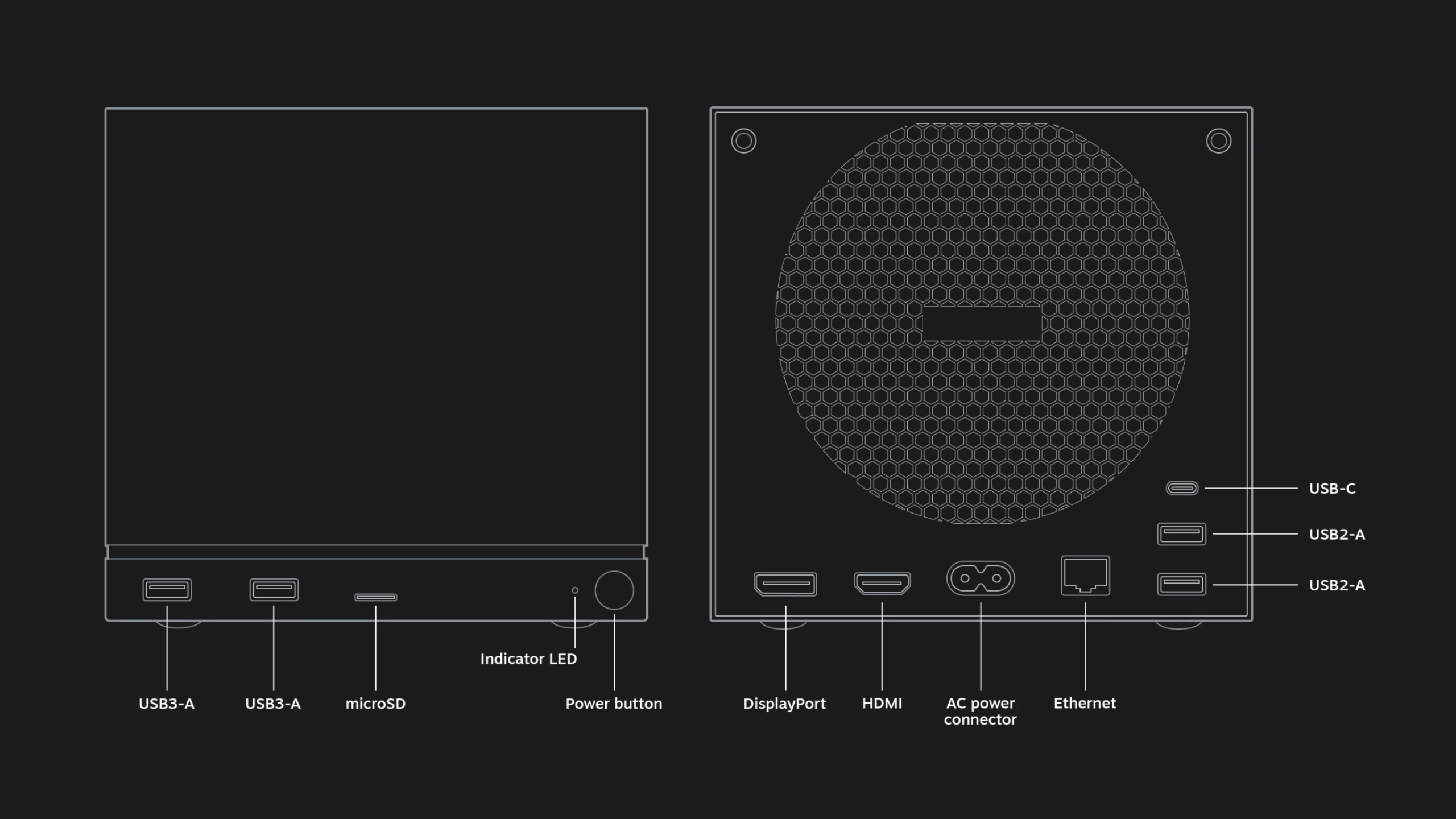 Valve
ValveLike the Steam Deck, the Steam Machine is utilitarian and bespoke. The PC is a black, 5.98 x 6.39 x 6.14 inch (152 x 162.4 x 156mm) box, with ports and a grille for a fan in the back and a removable faceplate and customizable LED light strip in the front. Inside, Valve says the Steam Machine features a "semi-custom" AMD Zen 4 CPU with six cores and up to 4.8GHz clock speeds, and a "semi-custom" RDNA3 AMD GPU, along with 16GB DDR RAM, 8GB GDDR6 VRAM and either 512GB or 2TB of storage.
While these specs make the Steam Machine more powerful than the aging Steam Deck (which shipped in 2022 with its own custom AMD chip) Valve has been careful not to oversell the capabilities of the box. In a blog post, the company said that "the majority of Steam titles play great at 4K 60FPS" using AMD's FidelityFX Super Resolution (FSR) frame generation and upscaling technology, but some titles require more upscaling than others, and it "may be preferable to play at a lower framerate with [variable refresh rate] to maintain a 1080p internal resolution."
In a hands-on preview of the Steam Machine, Digital Foundry expressed concern with what Valve's claims and the device's stated specs could mean for future performance. "The decision to opt for 8GB of GDDR6 memory has been proven to be a limiting factor on many modern mainstream triple-A games and falls short of the maximum VRAM pools and memory bandwidth available on both Xbox Series X and base PS5," Digital Foundry writes.
The Steam Machine supports Bluetooth 5.3, Wi-Fi 6E and includes an integrated 2.4GHz adapter for the new Steam Controller. In terms of port selection, there's DisplayPort 1.4 and HDMI 2.0 inputs for connecting the box to external monitors and TVs, four USB-A ports (divided between two USB 2.0 ports and two USB 3.2 Gen 1 ports) and one USB-C port on the back.
Engadget will have to try out the Steam Machine to really know what it's capable of, but there's nothing to suggest it couldn't be as flexible as the Steam Deck, especially with more power to play with.
What games will be able to run on the Steam Machine? Valve
ValveAny game that runs on SteamOS, Valve's Linux-based operating system, will run on the Steam Machine, provided the device's technical specs will support it. For games running natively on Linux, the Steam Machine will download the Linux version. For Windows games and everything else, it'll be able to use Steam's built-in Proton compatibility layer to translate games to Linux, just like the Steam Deck does.
Proton is developed by both Valve and CodeWeavers, the team behind the macOS compatibility app CrossOver. Valve's compatibility layer translates a game's API calls and other software features into something Linux understands, essentially tricking the game into thinking it's running on Windows when it isn't. Proton has worked remarkably well so far, in some cases helping some PC games run more efficiently on Linux than they do on Windows, but it does have some limitations. Because some anti-cheat software doesn't support Linux, many competitive multiplayer games aren't playable on SteamOS. Valve hopes the Steam Machine will help change that.
"While [the] Steam Machine also requires dev participation to enable anti-cheat, we think the incentives for enabling anti-cheat on Machine to be higher than on Deck as we expect more people to play multiplayer games on it," Valve told Eurogamer. "Ultimately we hope that the launch of Machine will change the equation around anti-cheat support and increase its support."
To help users find what games work well on the Steam Machine, Valve plans to expand its program for verifying games on the Steam Deck to include the Steam Machine and Steam Frame. Valve looks at things like controller support, the default resolution of the game, whether or not it requires a separate launcher and whether the game and its middleware work with Proton to determine a game's rating. Then the company sorts games into four categories: Verified (where the game works with Steam hardware at launch), Playable (where a user might have to make modifications to run smoothly), Unplayable (where some or all of the game doesn't function) and Unknown.
According to an announcement Valve sent to developers, games that were Verified for the Steam Deck will automatically be verified for the Steam Machine. The system is helpful, but far from definitive — some Unplayable games are in fact playable — which is why online, community-run databases like ProtonDB fill in the gaps with more granular information.
How much will the Steam Machine cost and when will it launch?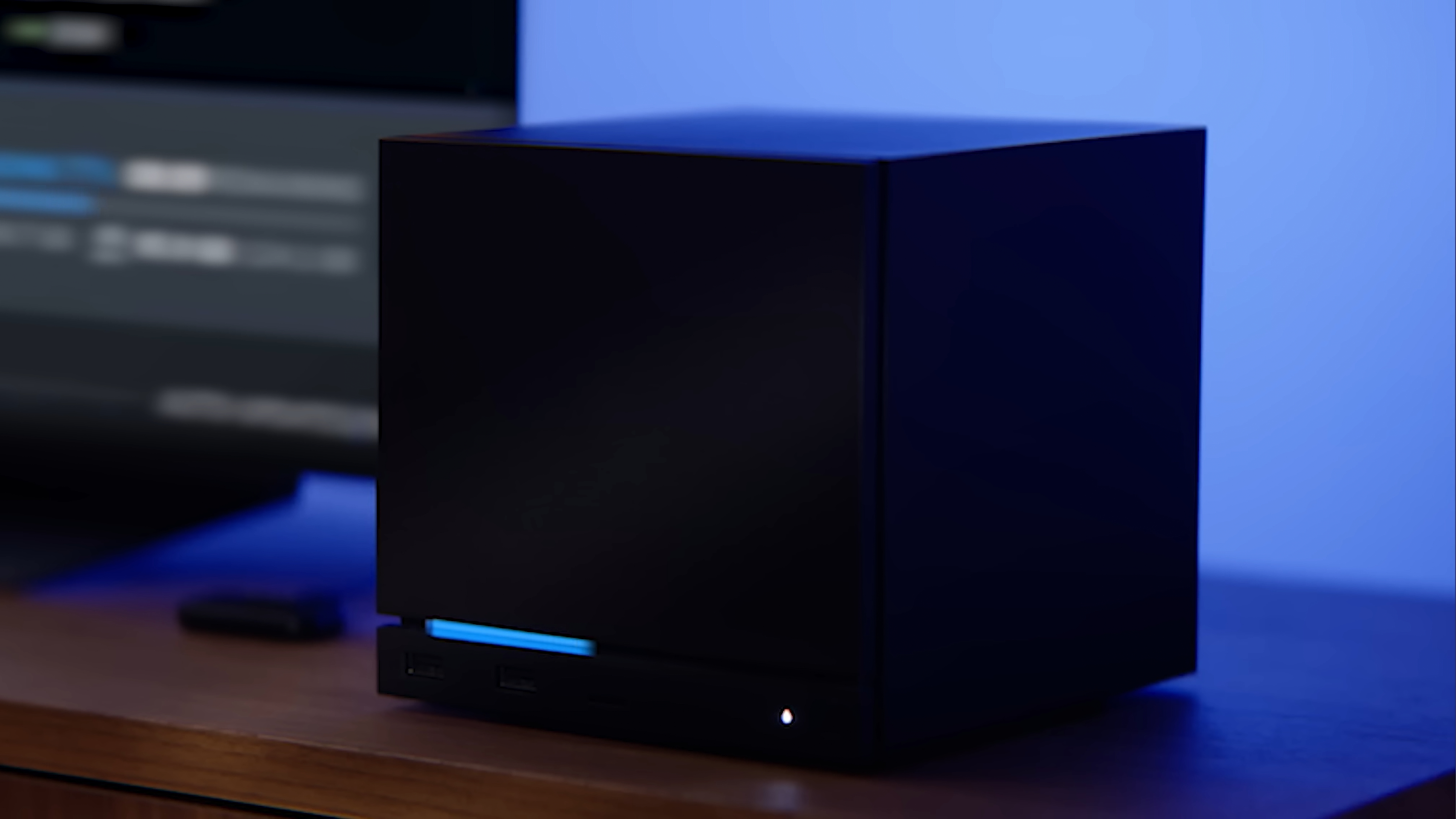 Valve
ValveValve hasn't announced a price or a release date for the Steam Machine or any of its new hardware. In terms of price, however, the company has suggested it might not be a deal in quite the same way the $399 Steam Deck LCD was. Valve designer Pierre-Loup Griffais told The Verge that the "Steam Machine's pricing is comparable to a PC with similar specs" and that its price would be "positioned closer to the entry level of the PC space" but be "very competitive with what you a PC you could build yourself from parts."
That means the Steam Machine will likely cost more than the $499 PS5, and that the rising costs of memory could make it even more expensive. Valve has already publicly admitted that memory and storage shortages are affecting its plans. In February, the company said that it was delaying the launch of its hardware (though it still hopes to ship in the first half of 2026) and rethinking pricing, particularly around the Steam Machine and Steam Frame, because of the "limited availability and growing prices" of critical components like RAM.
The changes Framework had to make to the pricing of the Framework Desktop are an illustrative example of the position Valve is in. Framework pitched its compact desktop PC as being great for gaming, with an AMD Ryzen AI Max chip (originally meant for gaming laptops) and a minimum of 32GB of RAM that lets it run games at 1440p. The company originally sold the base configuration of the Framework Desktop for $1,099, but announced in January 2026 that it would now cost $1,139 due to the rising cost of RAM. The price situation got even worse for configurations with more RAM. A Framework Desktop with 128GB of RAM now costs $2,459.
The blame for rising costs lies squarely with the AI industry, whose demand for RAM has led to the collapse of consumer RAM brands and a dearth of true deals on the in-demand component. At this point, PC makers have no solution to the problem other than riding the shortage out and raising prices. Valve clearly isn't immune to those same issues.
That doesn't rule out the company offering its Linux PC at multiple different price points, or in some kind of bundle deal with multiple pieces of new Steam hardware. But it does mean that the Steam Machine will likely be priced like a premium device. Same for the Steam Controller and Steam Frame. In the case of the Frame, UploadVR reports that Valve wants to sell the headset for less than the $1,000 Valve Index, but that doesn't mean it won't be significantly more expensive than the $300 Meta Quest 3S.
What accessories will work with the Steam Machine? Valve
ValveThe Steam Machine is designed to work with a variety of different Bluetooth controllers and other wireless accessories, and also whatever you can plug into its multiple USB-A ports and single USB-C port. With a built-in 2.4GHz Steam Controller dongle inside the Steam Machine, Valve's controller should be an ideal option for controlling games, particularly because of its multiple control options, like touchpads and gyroscopes. Support for Steam Link, Valve's tech for streaming PC games over local wireless, means you can also send games from a Steam Machine to the Steam Deck, Steam Frame or the Steam Link app and play them there.
This article originally appeared on Engadget at https://www.engadget.com/gaming/pc/everything-we-know-about-valves-new-steam-machine-200458817.html?src=rss Prime members can play Alan Wake 2 for free on Luna [ 05-Feb-26 7:35pm ]If you haven't yet played Alan Wake 2, here's your chance to immerse yourself in its terrors for free. Prime members can play it this month on Amazon's Luna cloud gaming service at no additional charge.
The "fantastic" Alan Wake 2 oozes "psychedelic terror," as Engadget's Jessica Conditt put it in our review. The 2023 horror-survival game uses a dual-protagonist motif, alternating between the lost author Wake and the stoic FBI agent Saga Anderson. It "tells a twisted, serpentine story of paranormal murder, shifting realities and demonic possession, with two brooding investigators at its core." Not a bad way to sublimate the all-too-real horrors of life in 2026.
The Order of Giants DLC for Indiana Jones and the Great Circle also arrives on Luna this month. Ditto for Disney Universe, a knockoff of the Lego game franchise starring the Mouse's IP.
Setting Luna aside, Amazon also has downloadable PC games that Prime members can claim for free this month. Starting today, you can snag the Borderlands spinoff Tiny Tina's Wonderlands from the Epic Store. Later this month, you can also claim the highly rated strategy title Total War: Attila (Epic Store, Feb. 26).
You can check out Amazon's announcement post for the complete list.
This article originally appeared on Engadget at https://www.engadget.com/gaming/prime-members-can-play-alan-wake-2-for-free-on-luna-193509728.html?src=rss Meta is giving its AI slop feed an app of its own [ 05-Feb-26 7:22pm ]Meta is developing a standalone app for Vibes, its feed of AI-generated videos, according to reports from TechCrunch and Platformer. Vibes was introduced as a feature in the Meta AI app in September 2025. Similar to OpenAI's Sora app, Vibes lets users prompt Meta AI to create TikTok-style vertical videos.
"Following the strong early traction of Vibes within Meta AI, we are testing a standalone app to build on that momentum," Meta said in a statement. "We've seen that users are increasingly leaning into the format to create, discover, and share AI-generated video with friends. This standalone app provides a dedicated home for that experience, offering people a more focused and immersive environment. We will look to expand the app further based on what we learn from the community."
Meta has yet to share specific numbers for how many people actually use Vibes, but the company does claim that Meta AI usage has continued to grow since Vibes launched. Breaking the feature out into its own app could allow Meta to add more functionality without cluttering the existing Meta AI app. The company believes AI-generated content will be the next big source of engagement on platforms, and said in an October 2025 earnings call that it planned to push more AI images and videos into its recommendation algorithm. A dedicated app for creating videos like Vibes could be one way Meta hopes to do that.
As Meta's main competitor in the burgeoning field of AI-first social media, OpenAI has continued to iterate on its Sora app, adding ways for characters and pets to cameo in videos, and signing a deal with Disney to allow users to generate content with Disney characters. Considering the company has licensed celebrity likenesses in the past, it doesn't seem impossible that Meta could pursue similar deals. Whatever happens, AI-generated videos appear like they'll be increasingly inescapable.
This article originally appeared on Engadget at https://www.engadget.com/ai/meta-is-giving-its-ai-slop-feed-an-app-of-its-own-192208200.html?src=rss Project Hail Mary is getting its own LEGO set [ 05-Feb-26 7:11pm ]The upcoming science fiction film Project Hail Mary is getting a LEGO set. This is fascinating because LEGO typically makes sets based on long-standing franchises like Star Wars and Harry Potter. Project Hail Mary doesn't even hit theaters until March 20.
It's not an entirely new IP. The movie is based on a 2021 book written by Andy Weir, the same author behind The Martian. It's cool to see a LEGO set based on something more contemporary than its usual fare.
The 830-piece set looks pretty nifty. It includes a replica of The Hail Mary spaceship in all of its glory, complete with minifigures of teacher-turned-astronaut Ryland Grace and his ultra-cute alien buddy that the whole world will likely fall in love with once the film hits.
The set also comes with a functional display stand and a crank that moves the components around to simulate centrifugal gravity. The minifigures can even be arranged to recreate an iconic scene from the book and, likely, the movie.
LEGO's Project Hail Mary set is available for preorder right now and costs $100. It ships on March 1, giving fans around 20 days to build it before the movie hits theaters.
The film involves a reluctant astronaut attempting to solve a mystery as to why the sun is dying. It stars Ryan Gosling and is directed by Phil Lord and Chris Miller, the duo behind the Spiderverse films and, incidentally, The LEGO Movie.
This article originally appeared on Engadget at https://www.engadget.com/entertainment/tv-movies/project-hail-mary-is-getting-its-own-lego-set-191106809.html?src=rssThe US Central Intelligence Agency is ending one of its popular services, The World Factbook. Over the decades, this reference has provided readers with information about different countries and communities around the world. The post from the CIA announcing the news didn't provide any information about why it will stop offering The World Factbook. The agency was subject to the same buyouts and job cuts that decimated much of the federal workforce in 2025, so maybe this type of public-facing tool is no longer a priority.
This reference guide was first published in 1962 as The National Basic Intelligence Factbook. That original tome was classified, but as other government departments began using it, an unclassified version for the public was released in 1971. It became a digital resource on the CIA website in 1997.
This article originally appeared on Engadget at https://www.engadget.com/big-tech/the-cia-stops-publishing-the-world-factbook-184419024.html?src=rssNintendo capped off today's partner-focused Nintendo Direct with a flurry of Bethesda-related announcements, but arguably the most interesting game of the showcase appeared right at the start.
First announced at the beginning of the year, Orbitals is a two-player puzzle adventure game in which you and your co-op partner play as the intergalactic explorers Maki and Omura, on a mission to save their home in the stars from an incoming cosmic storm. Gameplay-wise, Orbitals looks like it's at least partly inspired by the likes of It Takes Two and Split Fiction, but really what really stands out here is the 90s anime-inspired visuals.
The game is absolutely dripping in style, and somehow looks just as good in motion as it does in cutscenes. Describing it as a playable Saturday morning cartoon is getting into cliche territory, but Orbitals really nails its aesthetic.
It will be a tall order for any game like this to clear the impossibly high bar for creative co-op gameplay that Josef Fares' Hazelight Studios has set in recent years, but Orbitals looks like it could be worth experiencing for its visuals alone.
Nintendo has managed to nab this one as a Switch 2 exclusive, which you can either play locally or online, and thanks to the console's GameShare feature, only one person needs to own the game for the latter.
Orbitals arrives at some point during summer 2026.
This article originally appeared on Engadget at https://www.engadget.com/gaming/nintendo/the-switch-2-exclusive-co-op-adventure-orbitals-launches-this-summer-180657892.html?src=rssJLab just released a gigantic pair of headphones that doubles as a Bluetooth speaker. The Blue XL headphones are ridiculously oversized, making them headphones in name only. I don't even think Andre the Giant could've comfortably worn these suckers.
Unless you have a mythically large head, these are basically "headphone speakers." The idea is to drape them around your neck and stream tunes for all to hear. Though you could also pop them on a table or something. I prefer my Bluetooth speakers to be speaker-shaped, but maybe that's just me.
As for the internals, they feature 30W of power and two 2.5-inch drivers, along with two 2.5-inch radiators. This is obviously more power than what's demanded by headphones because, again, these are actually speakers. JLab says they'll get around 20 hours of use per charge, which is a decent metric.
There's another use case here. They could make a mighty fine accessory in a "person wearing comically oversized headphones" Halloween costume. The price is actually right for a gag gift. The Blue XL headphones cost $99. These were first announced at a recent college football game, but everyone assumed it was a joke because they were gold and the company said they cost $120,000.
This article originally appeared on Engadget at https://www.engadget.com/audio/jlabs-comically-oversized-headphones-are-not-an-april-fools-prank-174338833.html?src=rssWith gaming becoming an ever-smaller part of NVIDIA's lucrative business, the company reportedly won't bother releasing new graphics cards this year. The Information reported on Thursday that NVIDIA has pushed back its plan to release an update to the RTX 50 line in 2026. This would be the first time in three decades that the company hasn't launched new gaming chips. The culprit? Why, AI, of course.
AI demand has driven the current memory chip shortage, throwing the consumer electronics industry out of kilter. Many product prices are expected to rise (as if tariffs hadn't already done enough damage there). And the scarcity of memory chips has made components that rely on them, including GPUs, nearly impossible to find. Even the auto industry isn't spared.
Facing those constraints, NVIDIA, which made its bones on graphics chips for PCs and gaming consoles, is essentially brushing off that demographic. The Information notes that in the first nine months of 2022, NVIDIA's gaming GPUs made up 35 percent of its total revenue. During that same period in 2025, only around 8 percent came from gaming components. In addition, NVIDIA's AI chips have much higher profit margins: 65 percent vs. 40 percent for graphics cards.
That means gamers, already hard-pressed to find last year's RTX 50 series, likely won't get the expected "Super" version in 2026. On top of that, The Information says the delay will also push back NVIDIA's next-gen graphics card (likely "RTX 60"). That component was initially expected to begin mass production at the end of 2027.
But hey, at least you can shop (and view ads!) in ChatGPT, have a talk with your Gmail inbox and record everything the people around you say. Who needs games anyway, right?
This article originally appeared on Engadget at https://www.engadget.com/gaming/pc/nvidia-reportedly-wont-release-new-graphics-cards-this-year-173002651.html?src=rssIt can be tough to find a good gift for tech obsessives. Since they keep up with the latest releases, they probably already have the new high-profile gadgets out there. Luckily, Engadget staffers keep their eyes peeled all year long for the truly unique stuff. We travel to CES, attend product launches, cover major and minor tech events — we also can't help but buy ourselves any zany, clever, addictive or productive tech we happen to stumble across. In short, we've got some ideas about good gifts for tech nerds (which we are).
Best tech gifts and gadgets
Check out the rest of our gift ideas here.
This article originally appeared on Engadget at https://www.engadget.com/computing/the-best-tech-gifts-and-cool-gadgets-for-2026-140052977.html?src=rssVPNs have a mixed reputation, primarily because you can use the technology to hide your location and identity on the internet. Even the best VPNs can be used to conceal crimes and make the perpetrators harder to track. Fortunately, most of the world's governments (at least for now) recognize that VPNs are just technology that can be used for good or ill.
That means VPNs are legal in almost every country in the world. The countries that do restrict VPNs tend to be those where internet freedoms are already curtailed, like Russia, China, Iran and North Korea. There are distinct gradations between those nations, though. And the days of worry-free VPN access elsewhere in the world is starting to show cracks: Currently free jurisdictions — including the UK, France and even several US states — are now considering bans.
Is it legal to use a VPN?The answer is almost always yes. In every country except the ones listed in the next section, there are no legal penalties for visiting a VPN website, downloading a VPN or connecting to a VPN server.
In the last few years, however, some countries that were once beacons of online liberty have started considering bans. This is part of a chain reaction that started with age verification laws for websites deemed harmful to children, most prominently the UK's Online Safety Act. Once everyone realized that anyone could circumvent the OSA by using a VPN server in another country, UK politicians began trying to ban VPNs as well. The same thing is currently happening in France. In the US, Wisconsin and Michigan are both proposing age verification laws and VPN bans.
For now, though, none of these VPN bans have passed into law. Some have been defeated by the coordinated efforts of activists, including one Swiss proposal that would have forced Proton VPN to relocate.
In countries that do ban or restrict VPN usage, the laws can take several forms. Some countries have made all VPNs unlawful to use. Others only allow VPNs approved by the government — approval which usually comes from agreeing to share information with law enforcement. In some other countries, it's legal to use a VPN, but you'll face extra penalties if you use one to commit a crime. I'll go through all these categories in the next section.
Where are VPNs illegal?This section is a complete list of countries where using a VPN is a legal risk. If a country isn't on this list, you can assume it's safe to use a VPN. Even nations with bad internet freedom scores, like Saudi Arabia and Indonesia, often don't have anti-VPN laws to avoid scaring off international business.
One more important note is that anti-VPN laws are much more likely to be enforced against locals than foreigners. I'm not saying you should tempt fate, just noting that there are very few cases of a traveler being prosecuted in another country solely for using a VPN.
Countries where VPNs are totally bannedVPNs are completely outlawed in four countries. Three of them — Belarus, Turkmenistan and North Korea — are isolated authoritarian regimes that restrict internet freedoms as part of nationwide crackdowns on all civil and political liberties. Iraq, while slightly more liberal overall, banned VPNs in 2014 in an attempt to kick the Islamic State off the internet. Twelve years later, the ban remains in place.
Uganda is a special case. In 2018, the African nation enacted the world's first social media tax, which the government called necessary to raise funds but which was criticized as a backhanded assault on free speech. VPNs can get around the tax, so Ugandan internet service providers (ISPs) are required to block VPN traffic. However, there's no law on the books against using a VPN, so as long as you bring a service with obfuscation (like NordVPN) you're good to go.
Countries where only approved VPNs are allowedMore common than banning VPNs altogether is restricting VPN usage to those approved by the government. This lets the powers that be grant limited VPN access to businesses for economic reasons, while also being able to yank it away as a method of control. It also means VPNs with a license to operate are likely to report data or install surveillance backdoors.
The nations that handle VPNs this way are China, Russia, Iran, Venezuela, Bahrain, Myanmar, Pakistan, India, Turkey and Oman. These countries don't ban all VPNs, but target popular providers with intermittent crackdowns and threats.
China in particular uses the so-called Great Firewall, the world's most sophisticated suite of censorship technologies, to prevent its citizens from even visiting the homepages of VPN companies. If you plan to travel in China and want to maintain access to the outside world, download a VPN before you go — and remember that using it while there will technically put you in violation of the law.
Russia is a textbook case of a selective VPN ban, with businesses allowed to use approved VPNs and everyone else left to scramble against periodic mass blocks. Turkey's autocratic government has also tried to crack down on VPN usage by blocking VPN sites, but clumsy implementation has left a lot of holes, allowing Instagram and other social media to remain a free speech lifeline for Turks.
Countries with extra penalties for using VPNs to view blocked websitesIn a few countries, it's legal to use any VPN, but against the law to use them for illegal activities. You might say, "Duh, I'm aware that breaking the law is illegal," but there is a meaningful difference — some crimes are crimier than others. Just like you'll get a much harsher sentence if you rob someone with a weapon, you'll face steeper penalties for using a VPN to view content the government is trying to block. Countries that operate like this include Vietnam, Egypt and the UAE.
Potential future VPN bansToday, a number of countries once considered free and tolerant are proposing wide-ranging age verification laws, usually for reasons that boil down to "think of the children!" If enacted — as the UK's Online Safety Act has shown — they effectively offer a choice between two equally unacceptable alternatives: Live with a censored version of the internet, or get broader access only once you sacrifice your online anonymity.
VPNs are the easiest and most direct workaround to this rising tide of censorship, which is why those same governments have them in their legislative crosshairs. The threat of enforcement chills free activity in a connected world where enforcers can't be everywhere at once.
For now, laws against VPN usage are still largely vague, inconsistent and unevenly applied. As citizens, we can work to make our voices heard and fight against these initiatives before they become law. In the meantime, you may well want to get install your VPN of choice on as many devices as possible — and get your other cybersecurity ducks in a row while you're at it.
This article originally appeared on Engadget at https://www.engadget.com/cybersecurity/vpn/are-vpns-legal-170000878.html?src=rssOur review of the new AirTag went up yesterday, and that involved testing the new Precision Finding feature on Apple Watches. In the process, I found the setup to be confusing and counterintuitive, and was relieved to discover it wasn't just me. If, like me, you've been trying to set up Precision Finding on your Apple Watch for the AirTag you've just unboxed and attached to a precious belonging, here are the exact steps to take.
First, make sure your Apple Watch is compatible with the feature. That means verifying you're using the Series 9 or later (you would have bought it in or after 2023) or the Ultra 2 and newer. Then, go to the Watch app on your phone and do the following to make sure you've received the latest software update that adds the functionality.
Tap General.
Press Software update.
Make sure the page says you are running watchOS 26.2.1. If not, tap Install Now.
If you need to download the software, make sure your watch is on its charging cradle. Even though my Apple Watch Series 11 was fully charged, I was still told to make sure it's connected to power and had at least 50 percent of juice left for the software to install. After a few minutes, my watch restarted and the app said it was updated to the newest version of watchOS.
Now that you have the right hardware and software, you can set up Precision Finding. I assume you've already connected the new AirTag to the iPhone that's linked to your watch (and if you haven't, make sure to do that).
This was the part of the process that confused me. Instead of opening the Find Items app on the watch, Precision Finding for the new AirTag actually exists as a shortcut in the Control Center. Here are the steps to add it there:
Open the Control Center by pushing the button below the dial on the side of the watch.
Scroll all the way to the bottom and press "Edit."
Push the + button at the top left of the screen.
Scroll down and tap Find Items.
Press Find AirTag, then tap Choose. You should see the new AirTag you've linked to your account here.
Select the AirTag you want to precisely find.
Drag the icon to whichever position you prefer within the Control Center.
Hit Done.
Now, whenever you want to locate your item, you can pull up the Control Center, press this button and the Precision Finding interface will appear, showing how far away it is. You can also push the button on the bottom right of this screen to get the AirTag to ring, guiding you to where your item is.
This article originally appeared on Engadget at https://www.engadget.com/computing/accessories/how-to-use-your-apple-watch-to-precisely-find-your-new-airtag-164922731.html?src=rssAfter celebrating its fifth anniversary earlier this month, the tough-as-nails survival Viking game Valheim is coming to Switch 2 this year. Initially launched as a Steam Early Access game in 2021, Valheim lets you team up with up to nine other players online as you explore a procedurally generated open world inspired by Norse mythology.
Whether playing alone or with your Viking pals, survival depends on crafting the right gear, building shelters and prevailing in punishing combat encounters. The ultimate aim of the game is to kill various gods dotted around the game's different biomes to be deemed worthy of entering Valhalla. But you can ignore the bosses if you'd rather focus on collecting recipes and cooking up banquets for your fellow bearded adventurers.
If I'm being brutally honest, the Switch 2 version of Valheim doesn't appear to be much of a looker in the announcement trailer, but it's technically still an early access game at the time of writing, and you do get support for mouse controls and HD Rumble 2 on Nintendo's console.
After debuting on PC, Valheim later made the jump to Xbox and will also launch on PS5 later this year. There's currently no release date for that or the newly announced Switch 2 port, but they could arrive at the same time to coincide with the game hitting 1.0.
Valheim was announced during today's third-party-focused Nintendo Direct, in which a bunch of Bethesda games were also confirmed for Switch 2 in 2026.
This article originally appeared on Engadget at https://www.engadget.com/gaming/valheim-is-coming-to-switch-2-this-year-164159284.html?src=rssFinal Fantasy 7 Rebirth is heading to the Switch 2 on June 3. The news was dropped at this morning's Nintendo Direct livestream. This is the second part of the FF7 remake-a-palooza. The first installment, Final Fantasy 7 Remake Intergrade, was released for Nintendo's console on January 22. Only a six month wait between chapters? Sony fans had to wait four years.
For the uninitiated, Final Fantasy 7 Rebirth remakes the middle portion of the PS1 classic Final Fantasy 7. The graphics are, obviously, quite different, but so is the gameplay. This isn't exactly the JRPG you remember, with a real time action system instead of turn-based mechanics.
This is a full port of the PS5 game, further proving that the Switch 2 is a capable little machine. It's certainly pretty to look at, as proven by the trailer. As an aside, the port is also coming to Xbox Series X/S on the very same day.
Now that all of the major consoles will soon be home to both current FF7 remakes, we can join in solidarity as we wait for the third and final installment. Yeah, that's right. A JRPG from 1997 requires three gigantic remakes. We don't even know when the third one is coming out, but rumors suggest 2027.
Today's Nintendo Direct also revealed that a bunch of Bethesda games are heading to the Switch 2, including Fallout 4: Anniversary Edition on February 24, Indiana Jones and the Great Circle on May 12 and The Elder Scrolls IV: Oblivion Remastered sometime later in the year.
This article originally appeared on Engadget at https://www.engadget.com/gaming/nintendo/final-fantasy-7-rebirth-comes-to-switch-2-on-june-3-163009481.html?src=rssHorizon is one of PlayStation's biggest franchises at this point. Alongside Horizon Zero Dawn and Horizon Forbidden West, there are a bunch of spin-off games. Joining them is Horizon Hunters Gathering, a co-op action game that original Horizon developer Guerrilla is making for PlayStation 5 and PC. We've known since 2022 that the studio was working on a Horizon multiplayer game.
Here, you'll be able to team up with a couple of friends to hunt killer machines, Monster Hunter style. Guerrilla says it's designing the hunts to be challenging and replayable. "Combat is tactical, reactive, and deeply skill-based, building on the tactical precision of the Horizon games while embracing the dynamics of team play," game director Arjan Bak wrote on the PlayStation Blog. The game also has a more stylized look compared with the more grounded visuals of the mainline games.
Horizon Hunters Gathering has multiple game modes. In Machine Incursion, you'll battle waves of machines plus a tough boss. Guerrilla is pitching Cauldron Descent as a longer, multi-stage mode with a series of chambers to work through. These will contain things like battles with machines and "hidden doors that promise power and reward for teams prepared to open them."
There's a roster of characters to choose from that will expand over time. Each hunter has their own melee or ranged weapons and playstyles. The game has a roguelite perk system too, through which you'll be able to shape your hunter's build on each run, and you can select a class that alters their abilities. There's a social hub where you can customize your characters, visit shops, upgrade your gear and assemble a team for a mission.
Guerrilla says Hunters Gathering is canonical to the Horizon universe. It has a narrative campaign with "new mysteries, characters and threats." You'll be able to play through the story with bots or with friends in co-op. The studio says it will add more adventures over time.
There'll be support for cross-play and cross-progression between PS5 and PC. Guerrilla says it'll have more to share about the game in the coming months, but you won't necessarily need to wait a long time to try it out. The first closed playtest will take place later this month. You can sign up through the PlayStation Beta Program.
This article originally appeared on Engadget at https://www.engadget.com/gaming/playstation/guerrilla-reveals-horizon-hunters-gathering-a-co-op-action-spin-off-for-ps5-and-pc-162058264.html?src=rssThe digital publishing platform Substack has told some of its users that their data was stolen in a security breach. The affected account holders had their email addresses and phone numbers scraped in a hack that occurred in October 2025.
In an email posted on Bluesky, Substack CEO, Christ Best, said the company became aware of the breach on February 3, which involved an "unauthorized third party to access limited user data without permission." While internal metadata was also shared in the hack, Best said that credit card numbers and other financial details were not. No passwords were obtained either.
As well as apologizing to Substack users, the company's CEO also said in the email that the security vulnerabilities have now been addressed. "We are conducting a full investigation, and are taking steps to improve our systems and processes to prevent this type of issue from happening in the future," he said. Best added that there is no evidence that any of the stolen data is being "misused," but advised the affected account holders to be wary of suspicious emails or text messages they may receive.
The newsletter platform has not disclosed how many accounts were hacked, but Bleeping Computer reported that a database allegedly containing 697, 313 stolen data records from Substack was leaked on the hacking forum BreachForums.
This article originally appeared on Engadget at https://www.engadget.com/cybersecurity/substack-ceo-informs-users-of-a-data-breach-151113809.html?src=rssTodd Howard made a surprise appearance at the end of Thursday's Nintendo Direct Partner Showcase to share updates about a few Bethesda Game Studios that are coming to Nintendo Switch 2 this year. The first of those is Fallout 4: Anniversary Edition, which will hit the console on February 24.
This version of Fallout 4 debuted on PC, Xbox and PlayStation in November. It includes the base game and all DLC, as well as Creation Club mods. It'll land on Switch 2 just a few weeks after the second season of the Fallout TV show wrapped up. A Switch 2 version was previously announced, but we didn't have a release date until now.
In a few months — on May 12, to be exact — you'll be able to play the fantastic Indiana Jones and the Great Circle on your Switch 2 (a port of that game for Nintendo's system was also announced last year). And then, later this year, The Elder Scrolls IV: Oblivion Remastered will arrive on the console. Let's just hope Bethesda has properly optimized that for Switch 2.
Of course, these aren't the first Bethesda games to land on Nintendo systems. The Elder Scrolls V: Skyrim has long been available for the Switch. A Switch 2 version arrived in December.
This article originally appeared on Engadget at https://www.engadget.com/gaming/nintendo/fallout-4-and-indiana-jones-and-the-great-circle-get-switch-2-release-dates-150023624.html?src=rssAspiring Starlink competitor Logos Space Services has secured FCC clearance to launch more than 4,000 broadband satellites into low Earth orbit by 2035, as reported by Space News. Under FCC regulations, the company must deploy half of the approved amount within the next seven years.
The company is headed by its founder, Milo Medin, a former project manager at NASA as well as a former vice president of wireless services at Google. The company has been raising money since it opened its doors in 2023 and reportedly hopes to deploy its first satellite by 2027. Logos' planned low Earth orbit constellation would beam high-speed broadband internet to customers worldwide, including government and enterprise users, much like Starlink.
While the satellite broadband market is growing, Starlink remains the biggest player by far. The European Space Agency estimates there are just over 14,000 functioning satellites currently in orbit and we know that roughly 9,600 of them are a part of the Starlink constellation. The SpaceX subsidiary recently asked the FCC for clearance to launch a million satellites, though in reality, the FCC will likely trend closer to the 7,500 it approved on the last go-around. The ESA says it expects 100,000 satellites to be in orbit by 2030.
This article originally appeared on Engadget at https://www.engadget.com/science/space/a-potential-starlink-competitor-just-got-fcc-clearance-to-launch-4000-satellites-143905076.html?src=rssThe 2026 Milan Cortina Winter Olympics begin this week, and this year's Opening Ceremony promises to be one for the ages. The three-hour event will feature performances from Mariah Carey and Andrea Bocelli, 3,000 athletes participating in the Parade of Nations, and not one but two Olympic cauldrons being lit. (One at Milan's Arco della Pace, since Milan will serve as the main hub for this year's Games, and the other in the Alpine city of Cortina d'Ampezzo, where events like skiing will take place.) The festivities are all happening this Friday, Feb. 6, and will air on NBC — you can tune in live on Friday afternoon starting at 2 p.m. ET, or wait for the primetime broadcast at 8 p.m. ET.
If you want to tune in to the 2026 Milan Cortina Olympics Opening Ceremony, we've got you covered. Here's all the info you need to watch, including what channel it's on, the broadcast schedule, and who will be there.
How to watch the Opening Ceremony at the 2026 Winter Olympics
Date: Friday, Feb. 6
Time: Airs live from 2-5 p.m. ET, primetime re-air from 8-11 p.m. ET
Location: San Siro Stadium, Milan
TV channels: NBC
Streaming: Peacock, DirecTV, NBC.com, and more
Where can I stream the Opening Ceremony at the 2026 Winter Olympics?How to watch the 2026 Opening Ceremony on TV:
There will be two broadcasts of the 2026 Milan Cortina Winter Olympics Opening Ceremony this Friday. You can tune in live from 2 p.m. - 5 p.m. ET on Friday afternoon, or catch the encore broadcast from 8 p.m. - 11 p.m. ET that night. Both broadcasts will air on NBC, which is available with DirecTV, Hulu + Live TV, and more.
With a live TV streaming service subscription or cable package, you can also catch all of NBC and Peacock's Olympics coverage on NBC.com and via NBCOlympics.com or the NBC App, just by logging in with your provider.
How to watch the Opening Ceremony in Milan without cable:
You can watch the Opening Ceremony live or on-demand on Peacock. If you already subscribe to a live TV streaming service or cable package, you should also be able to catch all of Peacock's Olympics coverage on NBC.com, NBCOlympics.com and the NBC app.
Who is hosting the Winter Olympics Opening Ceremony?
Sportscaster Terry Gannon will be hosting coverage of the 2026 Winter Games Opening Ceremony. Also appearing at the Opening Ceremony will be former Olympic snowboarder Shaun White, and NBC Olympics primetime host Mike Tirico will also participate remotely from San Francisco, where he'll be pulling double duty covering the Olympics and prepping to call Super Bowl LX.
Who is performing at the 2026 Winter Olympics Opening Ceremony?Mariah Carey will headline the Opening Ceremony, and the event will also include a performance from iconic Italian tenor Andrea Bocelli. Actress Sabrina Impacciatore (The Paper, The White Lotus) and pianist Lang Lang, will also perform. And viewers will also get to see the nearly 3,000 Olympic athletes participating in the Parade of Nations.
Where is the 2026 Olympics Opening Ceremony being held?The 2026 Winter Olympics Opening Ceremony will be held at Milan's San Siro Stadium, home to football clubs AC Milan and Inter Milan. The Opening Ceremony will actually be one of the final events held at San Siro Stadium, it's set to be demolished some time after the Games end.
More ways to watch the 2026 Winter Olympics Opening Ceremony
This article originally appeared on Engadget at https://www.engadget.com/entertainment/streaming/how-to-watch-the-opening-ceremony-at-the-2026-milan-cortina-winter-olympics-143529451.html?src=rss
The Bundeskartellamt, or the Federal Cartel Office of Germany, has prohibited Amazon from continuing its practice of using mechanisms to control the prices charged by sellers on its platform in the country. Germany's competition regulator explained that the company uses "various price control mechanisms" to review prices set by third-party Markerplace sellers. If the website deems a specific listing's pricing as too high, it allegedly removes the listing altogether or prevents it from being prominently displayed in the Buy Box section that lets you quickly purchase items. If those listings aren't removed completely, they're banished to less prominent sections like in the "See all buying options" and the "Other sellers on Amazon" lists. This reduced visibility could "lead to significant losses in sales" for sellers.
Amazon was found to have engaged in anti-competitive practices, because the company itself runs its own retail business and sells goods on the platform. That makes third-party sellers, which make up for 60 percent of the items sold on the website, direct competitors. Cartel Office president Andreas Mundt said Amazon must only be allowed to influence competitors' pricing "in the most exceptional cases," such as "in the event of excessive pricing." He didn't specify what the agency views as "excessive pricing," but he said allowing the company to continue its current practices will give it the power to "control the price level on the trading platform according to its own ideas." He also said that Amazon could use its mechanisms "to compete with the rest of the online retail sector outside"of its own website. Amazon's interference could lead to third-party sellers "no longer being able to cover their own costs, forcing them out of the Marketplace," he added.
Rocco Bräuniger, Amazon's country manager for Germany, told Bloomberg that the company will appeal the ruling and will continue operating as usual. "Amazon would be the only retailer in Germany forced to highlight non-competitive prices for customers," he said. "This makes no sense for customers, sales partners, or competition." He also asserted that the office's decision will throttle innovation in the European Union.
Amazon has been under scrutiny in Europe for years now. Back in 2022, it pledged not to use private sellers' data to compete with them in the Marketplace in the EU. It also promised to give sellers "equal treatment" when ranking them in the Buy Box section.
"The Bundeskartellamt considers this systematic interference in the Marketplace sellers' freedom to set their own prices to constitute an abuse under the special provisions for large digital companies (Section 19a(2) of the German Competition Act (GWB)) as well as a violation of the general abuse provisions under Section 19 GWB and Article 102 TFEU," the agency wrote. "…In these proceedings, the Bundeskartellamt has worked closely with the European Commission, which is responsible for enforcing the EU Regulation on contestable and fair markets in the digital sector (Digital Markets Act)."
The agency is slapping Amazon with a fine due to those violations, but the $70 million penalty it's asking for is merely partial payment based on the economic benefits the company enjoyed from its alleged anti-competitive behaviors. According to the Bundeskartellamt, the identified antitrust violations are still ongoing, so Amazon may have to pay more.
This article originally appeared on Engadget at https://www.engadget.com/big-tech/amazon-germany-fined-70-million-for-influencing-third-party-marketplace-pricing-140000588.html?src=rssLast week, a new social network was created and it's already gone very, very viral even though it's not meant for human users. I'm talking, of course, about Moltbook, a Reddit-like platform that's populated entirely by AI agents.
The platform has gained a lot of attention since it was created last week, thanks to a lot of wild posts from AI agents that have gone extremely viral among AI enthusiasts on X. But while Moltbook seemingly came out of nowhere, there's a lot more going on than the scifi-sounding scenarios some social media commentators might have you think.
What is Moltbook and where did it come from?Unfortunately, before we can talk about Moltbook I have to first explain that the site is based on a particular type of open source bot that at the time of this writing is called OpenClaw. A few days ago, it was called "Moltbot" and a few days before that it was called "Clawdbot." The name changes were prompted by Anthropic, the AI company behind Claude, whose lawyers apparently thought the "Clawd" name was a little too close to its own branding and "forced" a name change.
ExpressVPN is launching a new cybersecurity suite consisting of four standalone products: a password manager called ExpressKeys, a masked email relay called ExpressMailGuard, an encrypted AI platform called ExpressAI and an app called Identity Defender that monitors public information for any threats to your identity. All four apps are being rolled into ExpressVPN's existing multi-tiered pricing structure.
ExpressKeys and ExpressMailGuard have officially launched and are now available to subscribers. Identity Defender launches for U.S. customers only on February 26. ExpressAI was originally planned to launch today, but ExpressVPN decided yesterday to hold it back in order to refine the experience. Its new launch date remains to be determined.
ExpressKeys and Identity Defender are based on existing products, but they're being relaunched for the new suite. ExpressKeys replaces ExpressVPN Keys, the password manager formerly controlled from the ExpressVPN app. By separating password management into its own app, ExpressVPN hopes to be able to update it more quickly without needing to ship a whole new version of the VPN. Everyone who currently has an Advanced or Pro subscription with ExpressVPN Keys will see it automatically replaced with ExpressKeys.
Identity Defender is only available in the United States, and so far only to users who created their accounts after October 28, 2024. Available for Advanced and Pro subscribers, Identity Defender consists of a data removal service, an identity theft insurance policy and a set of crawlers that scan for any suspicious activity around your personal information. Like ExpressKeys, it's transitioning from an integrated VPN feature to a standalone app.
ExpressMailGuard is a service for creating burner email addresses. If you're not comfortable handing over your real email address when creating a new account, you can use MailGuard to generate a fake address that forwards all email to your real inbox. If one of your aliases starts getting a lot of spam, you can cut off its access. It's managed through a separate dashboard that will be available to all ExpressVPN subscribers.
ExpressAI is an AI platform that saves all user-inputted data on strictly encrypted servers. It's apparently end-to-end encrypted, doesn't use your prompts to train its model and never saves uploads on persistent memory. It also has guardrails against processing harmful requests.
All these apps are in line with ExpressVPN's usual ethos. They're not innovations; all four can be easily compared to existing products. Instead, like the VPN itself — which rode this model to a spot on my best VPN list — they're focused on performing unsexy tasks well. The ability to bundle them with an ExpressVPN subscription should make them appealing to customers who are already fans of the core VPN product.
This article originally appeared on Engadget at https://www.engadget.com/cybersecurity/vpn/expressvpn-launches-four-new-standalone-apps-140000686.html?src=rssYou will have to wait a bit longer before you can buy a Steam Machine — and you may have to pay more for one, too. Valve had intended to release the console-style SteamOS-powered device in early 2026, and AMD CEO Lisa Su just claimed that the company was on track to start shipping it soon. But in a new post detailing the latest updates for its upcoming Steam products, Valve has revealed that while it's still aiming to start selling the console in the first half of the year, it has yet to decide on concrete pricing and a launch date for it. The release of Valve's upcoming Steam Frame VR headset and controller will be delayed, as well.
Valve was hoping to be able to announce pricing and launch dates by now. The company cited industry-wide memory and storage shortages, which have grown since the Steam devices' announcement, as the culprit for the delay. It explained that it has to rethink their exact shipping schedules and pricing due to the limited availability and the rising prices of those components. "We will keep you updated as much as we can as we finalize those plans as soon as possible," Valve wrote. As The Wall Street Journal recently reported, the artificial intelligence industry has been hoovering up manufacturers' available memory chips and hard drives for its infrastructure developments. That has led to shortages for other industries, like PCs and phones.
The Steam Machine is a compact cube-like PC for gaming powered by a semi-custom AMD CPU and GPU. Valve said during its announcement that it has "roughly six times the horsepower" of the Steam Deck and can support 4K gaming at 60 FPS with FSR. In the new post, Valve said that majority of Steam titles played great at those settings during testing, though some required more upscaling than others and may fare better when played at a lower framerate to maintain a 1080p resolution. It also revealed that you will have easy access to the Machine's SSD and memory if you want to upgrade them. Meanwhile, the Steam Frame is a wireless, standalone VR headset that can play both PC and Android games.
This article originally appeared on Engadget at https://www.engadget.com/gaming/pc/valve-pushes-back-steam-machine-launch-due-to-storage-and-memory-shortage-133000103.html?src=rssSony has now shipped 92.2 million PlayStation 5 consoles in total around the world, but sales were down sharply over the holiday season compared to last year. In its latest earnings report, the company said it shipped eight million PS5s during its key third quarter, 1.5 million (16 percent) lower than in the same period last year. The gaming division still made more profit, though, thanks to a boost in software sales and a low yen.
Sony's first two quarters this fiscal year saw an increase in PS5s sold, so the holiday decline is a bit surprising. That said, sales during the same period the previous year were an outlier at 9.5 million units sold, far and away its best period since the console went on sale in November 2020.
Software sales, however, were exceptional in Q3 this year. Sony sold 97.2 million games compared to 95.9 million the year before, and boosted digital sales to 76 percent, up 2 percent year-over-year. Sony said it also saw a record 132 million monthly active users on the PlayStation Network. New games on the horizon for PS5 include Resident Evil Requiem (February 27), Avowed (February 17) and Bungie's Marathon (March 5).
With PS5 sales down a bit, it does raise the question of when the company's next console is coming. The PS4 went seven years before being replaced, but given continued strong sales, high RAM prices and recent hardware updates, analysts figure that the PS5 is likely to have a longer life cycle. When the PS6 does arrive, however, it could offer triple the performance of the PS5.
This article originally appeared on Engadget at https://www.engadget.com/gaming/playstation/sonys-holiday-ps5-sales-dropped-16-percent-compared-to-last-year-130000476.html?src=rssThe 2026 Super Bowl between the New England Patriots and the Seattle Seahawks will air on NBC this Sunday, Feb. 8. The game will also stream on Peacock. If you don't have NBC over the air and don't subscribe to Peacock, there are still ways to watch Super Bowl LX — and Bad Bunny's history-making halftime show — for free. Here's how to tune in.
How to watch Super Bowl LX free:
Date: Sunday, Feb. 8
Time: 6:30 p.m. ET
Location: Levi's Stadium in Santa Clara, Calif.
TV channel: NBC, Telemundo
Streaming: Peacock, DirecTV, NFL+ and more
2026 Super Bowl game channelSuper Bowl LX will air on NBC. A Spanish-language broadcast is available on Telemundo.
How to watch the 2026 Super Bowl for freeYou can stream NBC and Telemundo on platforms like DirecTV and Hulu + Live TV; both offer free trials and are among Engadget's choices for best streaming services for live TV. (Note that Fubo and NBC are currently in the midst of a contract dispute and NBC channels are not available on the platform.)
What time is the 2026 Super Bowl?
The 2026 Super Bowl kicks off at 6:30 p.m. ET/3:30 p.m. PT on Sunday, Feb. 8. Green Day will be performing a pre-game special starting at 6 p.m. ET.
Who is playing in the Super Bowl?The AFC champions, the New England Patriots, will play the NFC champions, the Seattle Seahawks.
Where is the 2026 Super Bowl being played?The 2026 Super Bowl will be held at Levi's Stadium in Santa Clara, Calif., home of the San Francisco 49ers.
Who is performing at the 2026 Super Bowl halftime show?Bad Bunny is headlining the 2026 Super Bowl halftime performance. You can expect that show to begin after the second quarter, likely between 8-8:30 p.m. ET. Green Day will perform a pre-game show starting at 6 p.m. ET. If you're tuning in before the game, singer Charlie Puth will perform the National Anthem, Brandi Carlile is scheduled to sing "America the Beautiful," and Grammy winner Coco Jones will perform "Lift Every Voice and Sing."
More ways to watch Super Bowl LX
This article originally appeared on Engadget at https://www.engadget.com/entertainment/streaming/how-to-stream-the-2026-super-bowl-for-free-patriots-vs-seahawks-time-where-to-watch-and-more-124512202.html?src=rss
Surfshark's One plan is heavily discounted right now, with an 87-percent discount on the two-year package, plus three extra months. The promo price comes out to $2.29 per month, or $62 for the first 27 months.
We've generally liked Surfshark as a straightforward, speedy service for everyday use, and it's one of the picks in our guide to the best VPNs. In our Surfshark review, we found it delivered excellent speeds overall and reliably unblocked Netflix across most of our test servers, which makes this long-term deal worth a look if you want a VPN deal that also includes extras like antivirus, breach alerts and private search.
In our Surfshark review, the VPN stood out for its excellent performance and approachable design, especially for people who want strong protection without constantly tweaking settings. During testing, it delivered some of the fastest speeds we've seen from a major VPN, with average download speeds dropping by just over five percent worldwide. Upload speeds also held up well, making it a solid option for streaming, browsing and everyday use. We gave Surfshark an overall score of 87 out of 100 and called it one of the best VPNs for casual users.
This deal focuses on the Surfshark One plan, which bundles the VPN with a suite of extra security tools. In addition to the VPN itself, you get Alternative ID for masking your email and personal details, antivirus protection, breach monitoring through Surfshark Alert and a private search engine. It also supports unlimited simultaneous device connections, so you can protect all of your devices with a single subscription.
Right now, the Surfshark One plan is discounted by 86 percent, bringing the price down to $67 total for two years plus three extra months. That works out to $2.49 per month for the first 27 months, billed upfront, with a 30-day money-back guarantee if you change your mind.
If you want to compare it against other top services before committing, you can also check out our full Surfshark VPN review and our best VPN guide to see how it stacks up. We'll be keeping our best VPN deals roundup updated regularly, too.
This article originally appeared on Engadget at https://www.engadget.com/deals/surfshark-vpn-deal-get-up-to-87-percent-off-two-year-plans-123000066.html?src=rssI have a love-hate relationship with Spotify that might just be leaning more towards love today. While I struggle with some of the company's choices about the type of content it allows on its platform, I have always had a soft spot for its Wrapped roundups and the monthly audiobook hours included with my Premium subscription. For those like me, Spotify's news today will likely enhance the appeal of its audiobook offerings. It's announcing a partnership with Bookshop.org — which lets indie bookstores sell their wares online through a unified platform — allowing users to buy physical books from within its app, and launching a new Page Match feature that helps sync your progress across the physical books you read and the audiobooks in Spotify's catalog. Also, the audiobook recap feature that summarizes the plot so far is expanding to Android this spring, following its iOS debut (in beta form) last fall.
Page Match is coming to all places where Spotify's audiobooks are available, starting with the English language titles in its 500,000-strong library. Meanwhile, you can access Bookshop within the Spotify app in the US and the UK, where Bookshop operates.
Though I'm thrilled that this will mean easier and greater support of independent bookstores in those areas, I'm more excited by the prospect of Page Match, which I previewed at a recent launch event in the company's offices in New York. I'm the sort of person who reads the same title in its ebook, physical and audio forms. (I often wish that a purchase of a physical book came with free ebook and audio versions, but that's besides the point.)
While Kindles currently do a decent job of getting you to your latest page read across various devices, switching between, say, Martha Wells' All Systems Red on Spotify and the paperback copy is not quite as easy. With Page Match, though, that should get a lot easier.
How does Spotify Page Match work?When you get access to the feature (which is rolling out today), you'll find the Page Match button under the title of each audiobook. You'll have to first look up the book on Spotify and tap into its full chapter list to find this, which means the book you want to use has to be one of the hundreds of thousands in the company's library. Then, tap the green "Scan to listen" button if you're looking to move over to the audio version or "Scan to read" below it if you're switching over to a hard copy instead.
Whichever you pick, you'll need to enable access to your device's camera and then scan the page of the book you're on. This should work on ereaders as well, and appears to be using some form of optical character recognition to match the part of the book to its audio counterpart.
If you're scanning to listen, the process is fairly straightforward. Once you've placed the page in the viewfinder, the app will quickly jump to that very spot in the chapter track. I'll note that it was hard for me to confirm whether this actually worked during my first demo, since I never felt like I found the words being spoken on the page I was looking at. In this case, it was Lights Out: An Into Darkness novel by Navessa Allen, and I mostly felt like the narration had simply gone past the page I was on, rather than a complete failure. Subsequent attempts with other books, like Stephen King's It, were more effective.
Things get a bit trickier when you're trying to move from audio book to the paper (or ereader). After pressing "Scan to read," you'll need to place a page in front of the camera and wait for it to tell you to move forward or backward. Ideally, you'd already know more or less where you were, so you won't have to flip too many pages.
In my demo, because we were a few chapters too far from where we paused in the early part of It, there was a lot more page-turning required to get to the right spot. What I found helpful was the progress bar at the bottom of the screen, which highlighted the correct location and how far away we were from it. The instructions "Move forward" and "Move back" were clear and came up in a timely manner. When we finally landed on the right page, the screen highlighted the specific lines on the page to start from, too.
I have to caveat this with the observation that there were a few starts and stops during my demo, which were resolved once I established a solid internet connection. And though "Scan to read" did eventually work as promised, there was a bit of flipping around that seemed to be part of the process, which might be tedious and not quite the magical experience some might expect.
The good news is that Spotify seems to already be working on even more features to make it easier to read physical books in tandem with listening to audiobooks. The company said it sees "the future of reading as one that's personalized, flexible, and built to move fluidly across formats and moments. Page Match is an early example of how Spotify is helping shape that future at scale. "
This article originally appeared on Engadget at https://www.engadget.com/entertainment/spotifys-page-match-seamlessly-swaps-between-real-books-and-audiobooks-120000819.html?src=rssFast chargers are no longer a nice-to-have item. With phones, tablets, laptops and wearables all competing for outlets, the right charger can make a difference in how quickly you get back to full power without worrying about overheating or long-term battery wear. Since many devices now ship without a power brick, choosing a charger with the right compatibility, ports and charging technology is just as important as raw speed.
Today's best fast chargers are designed to handle multiple devices at once, whether that's a phone, laptop, AirPods or even an Apple Watch. Many models combine Type-C ports with a USB-A charger option to support older cables like a Lightning cable, while newer designs focus on multi-port chargers that can intelligently distribute power across everything you plug in. Brands like Anker continue to refine their designs, with compact options such as an Anker charger that's easy to toss in a bag but powerful enough for everyday use.
With so many wattages, port layouts and standards to consider, finding the best fast charger depends on how and where you charge. Whether you want a simple wall adapter, a travel-friendly option or a desktop hub built to power everything at once, this guide breaks down our top picks for 2026.
What to consider before buying a fast charger
Before you start looking at specific chargers, it's critical to determine three things: how many devices do you need to charge, how much power do they require and whether or not you're planning on traveling with any of them. This is especially true if you're charging a mix of devices that still rely on a Lightning cable alongside newer USB-C gear.
The reason for the first question is simple. If you only need to charge a single device, like an iPhone or Android phone, it's cheaper and usually more space-efficient to get a lower-wattage phone charger with one port instead of two or three. Next, it's critical to figure out how much electricity your gadgets need because it doesn't make sense to buy a power brick that pushes out more juice than your device can actually use. This may sound a bit tricky, but most major manufacturers will list a product's max charging speeds in its tech specs, which is typically denoted by a specific wattage (15W, for example) or a quick-charge rating.
Unfortunately, very powerful or large laptops like gaming notebooks can suck a ton of juice (more than 140 watts), which means they may rely on more traditional power adapters with barrel plugs. This may result in them not being compatible with universal chargers. Some of these PCs may also support charging over USB-C, so even if a specific adapter can't deliver its full power draw, it can still send over some energy — but it will do so at a slower rate compared to the laptop's included charger. To get the best performance, using a fast charging cable, such as a USB-C cable, can make a big difference in maintaining consistent power delivery.
For frequent travelers, size and weight are often important considerations, because the bigger and heavier a charger is, the more annoying it will be to lug around. You'll also want to think about other factors like support for international plugs, which can be a big help to anyone who regularly visits other countries. If you're already traveling with power banks or a charging station, choosing a compact GaN charger can help streamline your gear.
Finally, you'll want to figure out if your smartphone uses a proprietary charging standard or if it's compatible with the USB Power Delivery spec (USB PD). For example, the OnePlus 13's included SuperVOOC power adapter can send up to 100 watts to the phone. However, if you use a generic USB-PD charger, speeds top out at 45 watts. That's still pretty quick, but not nearly as fast as OnePlus' brick — and the same applies to devices with super fast charging support. Also, make sure your charging cable and connector are up to spec, as lower-quality accessories can bottleneck speeds or contribute to overheating during fast charging.
Fast charger FAQs What is GaN?When looking for chargers, you may notice that some are marked as GaN, which stands for gallium nitride. This is an important distinction because, when compared to older adapters that use silicon switches, GaN-based devices support increased power efficiency and output, allowing manufacturers to create more compact bricks that run cooler and support higher wattages.
Depending on the specific power output, GaN adapters can be 30 to 50 percent smaller and lighter than silicon-based alternatives. That might not sound like much, but when they're sitting in a bag alongside a laptop and a half dozen other accessories you might have, cutting down on excess bulk and weight goes a long way.
Do fast chargers affect battery life?Technically yes, because the process of sending a ton of watts into a gadget and potentially generating additional heat while doing so can decrease battery health over time. That said, modern devices and chargers use various protocols to ensure temperatures and power levels stay within preset limits — in large part to avoid damaging the product or creating a safety risk. At a base level, simply charging a gadget regardless of speed will cause degradation over time (nothing stays perfect forever, you know?). So as long as you use compatible chargers and cables, the impact of fast charging is generally quite negligible.
What's the difference between a fast charger and a regular charger?There isn't a single generally accepted definition of fast charging. However, with power adapters capable of sending as little as five watts or less, it's important to know how much juice your device is getting, especially if you need to recharge something quickly. So depending on who you ask (particularly when it comes to smartphones), any charger that can push out more than 15 to 18 watts is generally considered to be "fast." That said, with some phones capable of receiving more than 100 watts and up to 240 watts for some laptops, it's more important than ever to consider what devices you own before buying a new fast charger.
This article originally appeared on Engadget at https://www.engadget.com/computing/accessories/best-fast-chargers-140011033.html?src=rssCameras had an interesting year in 2025, with the launch of some long-delayed models like Sony's 61MP RX1III, wholly original cameras (the Fujifilm X Half and Sigma BF) and much anticipated updates like the Sony A7 V and Canon R6 III. All told, there were 27 new cameras launched last year that joined the 20 new models on the market from 2024.
Those ranged from compacts to mirrorless to very high-end models, with every price range included. The question is, which one is right for the type of videography or photography you do? Whether you're an aspiring action or wildlife photographer, an extreme sports junkie or a content creator, we'll help you find the perfect camera to match your budget and requirements.
Mirrorless is the largest camera category in terms of models available, so it's the best way to go if you're looking for something with the most advanced features. Canon and Nikon recently announced they're discontinuing development of new DSLRs, simply because most of the advantages of that category are gone, as I detailed in a video. The biggest selling feature of a mirrorless camera is the ability to change lenses depending on the type of shooting you want to do.
Best action camera or gimbal camera
The most important features to look for in an action cam are image quality, stabilization and battery life. GoPro has easily been beating all rivals recently in all those areas, but DJI has taken a lot of its business with the Osmo Pocket 3 gimbal camera.
Best compact camera
This category has fewer cameras than it did even a few years ago and many models are older, as manufacturers focus instead on mirrorless models. However, I'm still a big believer in compact cameras. They're a noticeable step up from smartphones quality-wise, and a lot of people will take a compact traveling or to events when they'd never bother with the hassle of a DSLR or mirrorless camera.
Compacts largely have type 1-inch sensors, but a few offer larger options, particularly Fujifilm's XF-100V. Another popular model, Sony's XV-1, is primarily aimed at content creators looking to step up. In any case, desirable qualities include image quality, a fast lens, relatively long zoom, flip-out display, good battery life, a high quality EVF, decent video and good pocketability.
What to consider before choosing a camera
Smartphones might get better for video and photos every year, full cameras still have an edge in many ways. The larger sensors in mirrorless cameras let more light in, and you have a wide choice of lenses with far superior optics. Dedicated cameras are also faster for shooting things like sports or wildlife, offer superior video for content creators and create more professional results.
Sensor sizeThere are a few key things to consider to get the most out of a camera. The first is sensor size: in general, the larger the sensor, the better (and usually more expensive) the camera.
Full frame is the largest sensor size for mainstream cameras, and it's available on models like the new Panasonic S9, the Nikon Z III and Canon EOS R5 II. At a size equivalent to 35mm film (36 x 24mm), it offers the best performance in terms of image quality, low-light capability and depth of field. But it's also very expensive and finicky. While bokeh looks incredible at an aperture of f/1.4, the depth of field is so razor thin that your subject's eyebrow might be in focus but not their eye. This can also make shooting video difficult.
The next size category is APS-C (around 23.5 x 15.6mm for most models and 22.2 x 14.8mm for Canon), offered on Fujifilm's X Series lineup, the Canon R10, the Sony ZV-E10 II and the Nikon Z50. It's cheaper than full frame, both for the camera body and lenses, but still brings most of the advantages like decent bokeh, high ISOs for low-light shooting and relatively high resolution. With a sensor size the same as movie cameras, it's ideal for shooting video, and it's easier to hold focus than with full-frame cameras.
Micro Four Thirds (17.3 x 13mm), a format shared by Panasonic and Olympus, is the next step down in sensor size. It offers less bokeh and light-gathering capability than APS-C and full frame, but allows for smaller and lighter cameras and lenses. For video, you can still get reasonably tight depth of field with good prime lenses, but focus is easier to control.
The other common sensor size is Type 1 (1 inch), which is actually smaller than one inch at 12.7 x 9.5mm. That's used mostly by compact models like Sony's ZV-1 vlogging camera. Finally, action cameras like the GoPro Hero 11 and DJI's Osmo 3 have even smaller sensors (1/1.9 and 1/1.7 inches, respectively).
AutofocusFor photographers, another key factor is autofocus (AF) speed and accuracy. Most modern mirrorless cameras have hybrid phase-detect AF systems that allow for rapid focus and fast burst speeds. The majority also offer AI features like eye-detect AF for people and animals, which locks in on the subject's eyes, face or body to keep them in focus. However, some models are faster and more reactive than others.
DisplaysThe electronic viewfinder (EVF) and rear display are also crucial. The best models have the sharpest and brightest EVFs that help you judge a shot before taking it. For things like street photography, it's best to have as bright and sharp a rear display as possible, so it's easy to see your subject and check focus in all manner of lighting conditions. You may also want a screen that flips out rather than just tilting, too.
LensesDSLRs and mirrorless cameras let you change lenses, but you're stuck with what's built into a compact camera. While that's great for portability, a single lens means you're going to sacrifice something along the way. The Fujifilm X100V, for instance, has a fast but fixed 35mm-equivalent f/2.0 lens and no zoom. The Sony RX100 V has a 24-70mm zoom, but it's slower at the telephoto end (f/2.8) and less sharp than a fixed focal (prime) lens.
When choosing a lens for a mirrorless camera, you'll need to consider the focal or zoom length, along with the minimum aperture. Smaller numbers like f/1.4 for a prime lens or f/2.8 for a zoom are best, as they let you work in darker environments and maximize background blur to isolate your subject. However, those lenses are more complex and thus more expensive.
Video recordingWhen it comes to video, there are other factors to consider. Some cameras combine or skip over pixels (line skipping or pixel binning) for video recording, which is not ideal because it can reduce sharpness. Better cameras tend to read out the entire sensor and then "downsample" to improve video sharpness (camera manufacturers don't often say if video is pixel binned, but will say if it's downsampled). Another important factor is sensor speed, as slower sensors tend to have more rolling shutter that can create a "jello" effect that skews video.
In addition, how's the battery life? How do you like the handling and feel? How long can you shoot before the camera heats up or stops? Does it support 10-bit HDR video? Is there a microphone and/or a headphone jack? (If you record a lot of interviews, it's preferable to have both.) How's the video autofocus? All of these things play a part in your decision.
This article originally appeared on Engadget at https://www.engadget.com/cameras/best-cameras-151524327.html?src=rssCanon released its first PowerShot camera back in 1996 with a 0.5-megapixel sensor, helping kickstart the digital photo revolution. To celebrate that 30-year anniversary, the company has unveiled a Limited Edition version of its still-popular PowerShot G7 X III compact camera. It has a few unique touches but is otherwise the same as the original model released nearly seven years ago.
The limited edition model has a new "graphite" color with a knurled front ring designed to exude "luxury and quality," Canon wrote. It also carries 30 year anniversary logo printed on the body "to create a special feeling suitable for limited edition models," the company added in the most Canon-y way possible.
 Canon's Limited Edition PowerShot G7 X III compact cameraCanon
As a reminder, the G7 X III was one of the first cameras announced specifically as a model for vloggers, thanks to its ability to shoot vertical video for Instagram. It features a 20.1MP sensor, flip-up 3-inch touchscreen, 24-100mm f/1.8-2.8 zoom lens and a microphone input. It supports 4K 30 fps video with no cropping and can shoot 1080p at 120 fps. The piece de resistance is direct streaming to YouTube directly over Wi-Fi, then a new thing but now a common feature. It originally retailed for $749.
The G7 X III had been in short supply until recently, but used models became popular with influencers several years ago and started selling way above list price. Possibly because of that viral fame, Canon announced in August 2025 that it was increasing production and the G7 X III started returning to stock a few months later priced at $880.
 Canon's Limited Edition PowerShot G7 X III compact cameraCanon
The Limited Edition G7 X III is selling for a lot more than that at $1,299, though it does come with a limited edition Peak Design cuff wrist strap and 32GB SD card. If you want to one-up the influencers and grab one, shipping will start in April 2026.
Along with the camera, Canon announced a pair of interesting new RF-mount full-frame lenses. The first is the ultra wide angle RF 14mm f/1.4 L VCM prime model priced at $2,599, promising bright, high quality optics. The other is a very interesting $1,899 RF7-14mm f/2.8-3.5 L Fisheye STM zoom lens with up to a 190 degree perspective at the widest setting.
This article originally appeared on Engadget at https://www.engadget.com/cameras/canon-unveils-a-limited-edition-version-of-its-popular-g7-x-iii-compact-camera-040000700.html?src=rssWithout meaningful deterrents, Big Tech companies will do what's profitable, regardless of the cost to consumers. But a new bipartisan bill could add a check that would make them think twice, at least in one area. On Wednesday, Senators Ruben Gallego (D-AZ) and Bernie Moreno (R-OH) introduced legislation that would require social platforms to crack down on scam ads.
The Safeguarding Consumers from Advertising Misconduct (SCAM) Act would require platforms to take reasonable steps to prevent fraudulent or deceptive ads that they profit from. If they don't, the Federal Trade Commission (FTC) and state attorneys general could take civil legal action against them.
 The bill's sponsors, Ruben Gallego (L) and Bernie MorenoRuben Gallego (Bluesky) / Bernie Moreno
The backdrop to the SCAM Act is a Reuters report from last November. Meta reportedly estimated that up to 10 percent of its 2024 revenue came from scam ads. The company is said to have calculated that as much as $16 billion of its revenue that year was from scams, including "fraudulent e-commerce and investment schemes, illegal online casinos and the sale of banned medical products."
Making matters worse, Meta reportedly refused to block small fraudsters until their ads were flagged at least eight times. Meanwhile, bigger spenders were said to have accrued at least 500 strikes without being removed. Executives reportedly wrestled with how to get the problem under control — but only without affecting the company's bottom line. At one point, managers were told not to take any action that could cost Meta more than 0.15 percent of its total revenue. (See what I mean about needing meaningful deterrents?)
According to the FTC, Americans' estimated total loss from fraud in 2024 (adjusted for underreporting) was nearly $19 billion. An estimated $81.5 billion of that came from seniors.
"If a company is making money from running ads on their site, it has a responsibility to make sure those ads aren't fraudulent," Sen. Gallego said in a statement. "This bipartisan bill will hold social media companies accountable and protect consumers' money online."
"It is critical that we protect American consumers from deceptive ads and shameless fraudsters who make millions taking advantage of legal loopholes," Moreno added. "We can't sit by while social media companies have business models that knowingly enable scams that target the American people."
This article originally appeared on Engadget at https://www.engadget.com/big-tech/bipartisan-scam-act-would-require-online-platforms-to-crack-down-on-fraudulent-ads-210316594.html?src=rssMaking a good digital picture frame should be easy. All you need is a good screen and an uncomplicated way to get your favorite photos onto the device. Combine that with an inoffensive, frame-like design and you're good to go.
Despite that, I can tell you that many digital photo frames are awful. Amazon is positively littered with scads of digital frames and it's basically the 2020s version of what we saw with knock-off iPods back in the 2000s. There are loads of options that draw you in with a low price but deliver a totally subpar experience that will prompt you to shove the thing in a drawer and forget about it.
The good news is that you only need to find one smart photo frame that works. From there, you can have a pretty delightful experience. If you're anything like me, you have thousands of photos on your phone of friends, family photos, pets, vacation spots, perhaps some lattes or plates of pasta and much more. Too often, those photos stay siloed on our phones, not shared with others or enjoyed on a larger scale. And sure, I can look at my photos on my laptop or an iPad, but there's something enjoyable about having a dedicated place for these things. After all, there's a reason photo frames exist in the first place, right? A great frame can help you send photos to loved ones and share cherished memories with friends and family effortlessly. I tested out seven smart photo frames to weed through the junk and find the top picks for the best digital frames worth buying.
What to look for in digital picture frames
While a digital photo frame feels like a simple piece of tech, there are a number of things I considered when trying to find one worth displaying in my home. First and foremost was screen resolution and size. I was surprised to learn that most digital photo frames have a resolution around 1,200 x 800, which feels positively pixelated. (That's for frames with screen sizes in the nine- to ten-inch range, which is primarily what I considered for this guide.)
But after trying a bunch of frames, I realized that screen resolution is not the most important factor; my favorite photos looked best on frames that excelled in reflectivity, brightness, viewing angles and color temperature. A lot of these digital photo frames were lacking in one or more of these factors; they often didn't deal with reflections well or had poor viewing angles.
A lot of frames I tested felt cheap and looked ugly as well, which isn't something you want in a smart device that sits openly in your home. That includes lousy stands, overly glossy plastic parts and design decisions I can only describe as strange, particularly for items that are meant to just blend into your home. The best digital photo frames don't call attention to themselves and look like an actual "dumb" frame, so much so that those that aren't so tech-savvy might mistake them for one.
Perhaps the most important thing outside of the display, though, is the software. Let me be blunt: a number of frames I tested had absolutely atrocious companion apps and software experiences that I would not wish on anyone. One that I tried did not have a touchscreen, but did have an IR remote (yes, like the one you controlled your TV with 30 years ago). Trying to use that with a Wi-Fi connection was painful, and when I tried instead to use a QR code, I was linked to a Google search for random numbers instead of an actual app or website. I gave up on that frame, the $140 PixStar, on the spot.
Other things were more forgivable. A lot of the frames out there are basically Android tablets with a bit of custom software slapped on the top, which worked fine but wasn't terribly elegant. And having to interact with the photo frame via touch wasn't great because you end up with fingerprints all over the display. The best frames I tried were smart about what features you could control on the frame itself vs. through an app, the latter of which is my preferred method.
Another important software note: many frames I tried require subscriptions for features that absolutely should be included out of the box. For example, one frame would only let me upload 10 photos at a time without a subscription. Others would let you link a Google Photos account, but you could only sync a single album without paying up. Yet another option didn't let you create albums to organize the photos that were on the frame — it was just a giant scroll of photos with no way to give them order.
While some premium frames offer perks like unlimited photos or cloud storage, they often come at a cost. I can understand why certain things might go under a subscription, like if you're getting a large amount of cloud storage, for example. But these subscriptions feel like ways for companies to make recurring revenue from a product made so cheaply they can't make any money on the frame itself. I'd urge you to make sure your chosen frame doesn't require a subscription (neither of the frames I recommend in this guide need a subscription for any of their features), especially if you plan on giving this device as a gift to loved ones.
How much should you spend on a digital picture frameFor a frame with a nine- or ten-inch display, expect to spend at least $100. Our budget recommendation is $99, and all of the options I tried that were cheaper were not nearly good enough to recommend. Spending $150 to $180 will get you a significantly nicer experience in all facets, from functionality to design to screen quality.
Digital frames FAQs Are digital photo frames a good idea?Yes, as long as you know what to expect. A digital picture frame makes it easy to enjoy your favorite shots without printing them. They're especially nice for families who want to display new photos quickly. The key is understanding the limitations. Some frames have lower resolution displays or need a constant Wi-Fi connection to work properly, so they're not a perfect replacement for a high-quality print on the wall. But if you want a simple way to keep memories on display and up to date, they're a solid choice.
Can you upload photos to a digital frame from anywhere?Most modern digital frames let you do this, but it depends on the model. Many connect to Wi-Fi and use apps, cloud storage or email uploads, so you can add photos from your phone no matter where you are. Some even let family members share directly, which is great for keeping grandparents updated with new pictures. That said, a few budget models only work with USB drives or memory cards, so check how the frame handles uploads before buying.
Georgie Peru contributed to this report.
This article originally appeared on Engadget at https://www.engadget.com/home/smart-home/best-digital-frame-120046051.html?src=rssHot on the heels of AGDQ in January, Games Done Quick is hosting its second speedrunning event of the year, Back to Black 2026, starting tomorrow, February 5. The four-day event is organized by Black in a Flash and is raising money for Race Forward, a nonprofit that works across communities to address systemic racism.
Back to Black is timed to the start of Black History Month and highlights the deep bench of talent in the Black speedrunning community. A few runs, like ones for Hades II, Donkey Kong Country and Silent Hill 4, were teased when Back to Black 2026 was announced last year. The full schedule has plenty of other runs worth checking out, though, like a co-op run through Plants vs Zombies: Replanted on February 5 or an Any% run of The Barbie Diaries: High School Mystery on February 6.
Back to Black 2026 will be live on Games Done Quick's Twitch and YouTube channels from Thursday, February 5 through Sunday February 8.
This article originally appeared on Engadget at https://www.engadget.com/gaming/games-done-quicks-back-to-black-2026-event-kicks-off-tomorrow-194147068.html?src=rssRoblox launched an open-source AI model that generates 3D objects on the fly early last year and now that toolset is getting a massive boost. The platform has introduced a model that whips up "4D" objects. I put 4D in quotes because it doesn't actually allow access to the fourth dimension, but rather lets users make interactive 3D objects via prompts.
As suggested, these aren't static 3D models. They are fully functional and interactive objects that move and react to players. The beta toolset can't be used to make anything, as it's rather limited for now. There are just two templates for users to choose from. Folks can make cars and solid 3D objects, like a box or a sculpture.
The cars are fully driveable, however, and are made from five separate parts. The parts work independently of one another, allowing for spinning wheels and opening doors. The company says the physics should be accurate, so prepare for a whole lot of user-generated racing games.
There's already a game on the platform that uses the 4D tools called Wish Master. It lets players generate cars, planes and all kinds of other stuff.
As for those limited templates, Roblox says it plans to eventually let creators make their own but didn't release a timetable for this. It also says it is developing technology that will generate 3D models based on a reference image.
Today's open beta comes after Roblox found itself at the center of lawsuits and investigations related to child safety. This led the company to implement mandatory facial verification to access chat, which has reportedly not been going very well. Some countries have actually banned the platform in an effort to protect children.
This article originally appeared on Engadget at https://www.engadget.com/gaming/robloxs-4d-creation-toolset-is-now-available-in-open-beta-191510664.html?src=rssBlizzard is running a series of showcases for several of its major franchises and on Wednesday, it was time for Overwatch to step up to the plate. That's Overwatch, by the way, and not Overwatch 2. The studio is formally nixing the number from the game's name.
"Overwatch is more than just a digit: it's a living universe that keeps growing, keeps surprising, and keeps bringing players together from around the world," the Overwatch team said in a statement. "This year marks a huge turning point in how the development team envisions the future of Overwatch, so we are officially dropping the '2' and moving forward as Overwatch."
Blizzard made a big hullabaloo about Overwatch 2 being a sequel to the original game when it went live in October 2022 as part of a shift to a free-to-play model. There were a ton of major changes, not least a format switch from 6v6 to 5v5, with one tank being dropped from each team — a contentious decision that has been walked back with the return of 6v6 modes.
The grand vision Blizzard originally had for Overwatch 2 never quite came together. The studio canceled its planned hero missions, which were going to have RPG-like talent trees and long-term progression, but it carried some of that DNA over to the Stadium mode.
We only got one round of co-op story missions as well. That paid expansion reportedly sold poorly, leading Blizzard to scrap work on the player vs. environment elements of Overwatch to focus on the competitive player vs. player modes.
Over the last couple of years, though, Blizzard really seems to have steadied the ship. Overwatch is arguably in the best shape it's been in for a long time.
This is shaping up to be a big year for Overwatch. May will mark its 10th anniversary (I have to imagine the team has something significant planned for that). Blizzard laid out much of the roadmap for 2026 during the Overwatch Spotlight showcase. We won't have to wait long at all to see significant changes to the game.
New heroes Blizzard Entertainment
When the next season goes live on February 10, it will be the biggest update to Overwatch at least since the Stadium mode and perks system went live last year, and arguably since the dawn of the Overwatch 2 era. That's partly because Blizzard is adding five new heroes to the mix all at once next week.
One of those is a character that the studio said in 2017 it had experimented with but ultimately, um, scratched. Jetpack Cat is alive after all, and is coming to Overwatch in a matter of days.
This is a support hero with a permanent flight ability who can "tow" an ally — providing a speed boost while healing them. Jetpack Cat's ultimate ability sees the kitty diving into the ground to knock down enemies and tether the closest one to them. It's called Catnapper, which is delightful. Also, the hero's primary weapon is called Biotic Pawjectiles, so I adore Jetpack Cat already. It's fun to see weird Wrecking Ball-type characters coming to Overwatch again.
 Blizzard Entertainment
The other new heroes joining the fray next week are Domina (a zone-control tank with "long-range precision"), damage dealer Emre (a "fast‑paced, mobile soldier archetype with conflicting identity due to cybernetic modification"), Mizuki (a support who can throw a hat to heal allies) and Anran (a high-mobility hero who deals fire damage and can self-resurrect with their ultimate).
As with Jetpack Cat, the latter of those is aligned with the Overwatch faction. You can try Anran out starting February 5 as part of a hero trial. The other three have ties to the villainous Talon organization. Expect another hero to join the fray every couple of months this year as each new season gets under way. That means more heroes will be added to Overwatch in 2026 than in any year since the game's debut.
A "story-driven era" Blizzard Entertainment
The next season spells the beginning of what Blizzard is calling a "new story-driven era" for Overwatch, starting with a year-long narrative arc called The Reign of Talon. All of the lore, heroes, events and so on that emerge over the next 12 months will be tied to the rise of Talon.
The studio says this is the "the first fully connected annual storyline in Overwatch history." A new arc will begin next year with Season 1 of 2027 (Blizzard is resetting the season counter when The Reign of Talon begins).
Elsewhere, each role will be split into sub-roles, and the heroes in each will share a passive ability. For instance, "initiator" tanks heal more while they're in the air, several damage heroes can detect enemies that are below half health through walls after damaging them and some supports have excess ultimate charge that carries over after you use their most powerful ability.
Also on the way soon is a "meta event" called Conquest. This is billed as a faction war between Overwatch and Talon that will run for five weeks, with dozens of loot boxes and other rewards (such as some legendary Echo skins) up for grabs.
 Blizzard Entertainment
Blizzard has overhauled the Overwatch interface too, with updated menus, a new hero lobby, a notification hub and the promise of faster navigation. Stadium will have some updates, such as refreshed ability icons and recommended builds based on global data that will be updated between rounds. Vendetta is joining that mode's roster as well.
Along with all the new heroes and other updates, a Hello Kitty collaboration will run for two weeks starting on February 10 with themed cosmetics for several heroes. Lots of other cosmetics are in the pipeline, including Crimson Wolf weapon skins you can unlock using competitive points, and rainy day and Valentine's items. Shop items from the last six seasons are going into loot boxes, while mythic cosmetics for Mercy, Juno and Mei will be available in Season 1.
 Blizzard Entertainment
Looking further ahead, a Nintendo Switch 2 version of Overwatch will arrive alongside Season 2, which will start in April. Some heroes will be getting their second mythic skins, including Ana and Genji. Genji, Hanzo and Sojourn will have mythic weapon skins in the coming months. Two new maps, including a Japan Night one, for the main modes are coming, along with the return of post-match accolades.
There's so much on the way for my go-to game. I don't know how I'm going to be able to take a long-enough break from Overwatch to play cool indies ever again.
This article originally appeared on Engadget at https://www.engadget.com/gaming/overwatch-will-drop-the-2-as-jetpack-cat-and-four-other-heroes-arrive-on-february-10-184500327.html?src=rssWhen X's engineering team published the code that powers the platform's "for you" algorithm last month, Elon Musk said the move was a victory for transparency. "We know the algorithm is dumb and needs massive improvements, but at least you can see us struggle to make it better in real-time and with transparency," Musk wrote. "No other social media companies do this."
While it's true that X is the only major social network to make elements of its recommendation algorithm open source, researchers say that what the company has published doesn't offer the kind of transparency that would actually be useful for anyone trying to understand how X works in 2026.
The code, much like an earlier version published in 2023, is a "redacted" version of X's algorithm, according to John Thickstun, an assistant professor of computer science at Cornell University. "What troubles me about these releases is that they give you a pretense that they're being transparent for releasing code and the sense that someone might be able to use this release to do some kind of auditing work or oversight work," Thickstun told Engadget. "And the fact is that that's not really possible at all."
Predictably, as soon as the code was released, users on X began posting lengthy threads about what it means for creators hoping to boost their visibility on the platform. For example, one post that was viewed more than 350,000 times advises users that X "will reward people who conversate" and "raise the vibrations of X." Another post with more than 20,000 views claims that posting video is the answer. Another post says that users should stick to their "niche" because "topic switching hurts your reach." But Thickstun cautioned against reading too much into supposed strategies for going viral. "They can't possibly draw those conclusions from what was released," he says.
While there are some small details that shed light on how X recommends posts — for example, it filters out content that's more than a day old — Thickstun says that much of it is "not actionable" for content creators.
Structurally, one of the biggest differences between the current algorithm and the version released in 2023 is that the new system relies on a Grok-like large language model to rank posts. "In the previous version, this was hard coded: you took how many times something was liked, how many times something was shared, how many times something was replied … and then based on that you calculate a score, and then you rank the post based on the score," explains Ruggero Lazzaroni, a pHD researcher at the University of Graz. "Now the score is derived not by the real amounts of likes and shares, but by how likely Grok thinks that you would like and share a post."
That also makes the algorithm even more opaque than it was before, says Thickstun. "So much more of the decisionmaking … is happening within black box neural networks that they're training on their data," he says. "More and more of the decisionmaking power of these algorithms is shifting not just out of public view, but actually really out of view or understanding of even the internal engineers that are working on these systems, because they're being shifted into these neural networks."
The release has even less detail about some aspects of the algorithm that were made public in 2023. At the time, the company included information about how it weighted various interactions to determine which posts should rank higher. For example, a reply was "worth" 27 retweets and a reply that generated a response from the original author was worth 75 retweets. But X has now redacted information about how it's weighing these factors, saying that this information was excluded "for security reasons."
The code also doesn't include any information about the data the algorithm was trained on, which could help researchers and others understand it or conduct audits. "One of the things I would really want to see is, what is the training data that they're using for this model," says Mohsen Foroughifar, an assistant professor of business technologies at Carnegie Mellon University. "if the data that is used for training this model is inherently biased, then the model might actually end up still being biased, regardless of what kind of things that you consider within the model."
Being able to conduct research on the X recommendation algorithm would be extremely valuable, says Lazzaroni, who is working on an EU-funded project exploring alternative recommendation algorithms for social media platforms. Much of Lazzaroni's work involves simulating real-world social media platforms to test different approaches. But he says the code released by X doesn't have enough information to actually reproduce its recommendation algorithm.
"We have the code to run the algorithm, but we don't have the model that you need to run the algorithm," he says.
If researchers were able to study the X algorithm, it could yield insights that could impact more than just social media platforms. Many of the same questions and concerns that have been raised about how social media algorithms behave are likely to re-emerge in the context of AI chatbots."A lot of these challenges that we're seeing on social media platforms and the recommendation [systems] appear in a very similar way with these generative systems as well," Thickstun said. "So you can kind of extrapolate forward the kinds of challenges that we've seen with social media platforms to the kind of challenges that we'll see with interaction with GenAI platforms."
Lazzaroni, who spends a lot of time simulating some of the most toxic behavior on social media, is even more blunt. "AI companies, to maximize profit, optimize the large language models for user engagement and not for telling the truth or caring about the mental health of the users. And this is the same exact problem: they make more profit, but the users get a worse society, or they get worse mental health out of it."
The Pixel 10a is official, though details are limited. On Wednesday, Google posted a teaser video showing the mid-range phone dancing around colorful backgrounds. You can pre-order the Pixel 10a on February 18.
Google hasn't yet revealed the phone's specs. In the short video, we can see a blue model that's virtually indistinguishable on the outside from the Pixel 9a. And alleged leaks point to a phone with few changes on the inside. That (unconfirmed) list includes a 6.285-inch display, dual rear cameras (48MP wide and 13MP ultra-wide) and a 5,100mAh battery.
The teaser's tagline appears to be an attempt to assure Pixel fans that there will, in fact, be meaningful upgrades. "A phone with more in store, in store soon," it reads. Hopefully, its pricing and specs will be "in store" for us soon as well.
In the meantime, you can visit the Google Pixel website to register for more info.
This article originally appeared on Engadget at https://www.engadget.com/mobile/smartphones/you-can-pre-order-the-pixel-10a-on-february-18-180712018.html?src=rss
Anthropic has announced that its chatbot Claude will remain ad-free. This is in direct contrast to rival company OpenAI, which recently brought ads to ChatGPT for many users.
The company says that "including ads in conversations with Claude would be incompatible" with the chatbot becoming a "genuinely helpful assistant for work and for deep thinking." The reasoning here is rather simple. People tend to share personal details with chatbots, for better or for worse, and getting ads based on that stuff would be creepy. Imagine asking for mental health advice and getting an ad for St. John's wort or something.
Anthropic notes that other conversations "involve complex software engineering tasks, deep work or thinking through difficult problems. The appearance of ads in these contexts would feel incongruous—and, in many cases, inappropriate."
The company said that integrating advertising would "work against" the Claude Constitution, which counts "being generally helpful" as a core principle. "Introducing advertising incentives at this stage would add another level of complexity. Our understanding of how models translate the goals we set them into specific behaviors is still developing; an ad-based system could therefore have unpredictable results," it writes in a blog post.
There are some real world concerns here. AI companies gobble up all money in sight and the returns haven't exactly been stellar. Ads are an easy way to recoup some of that investment, which is likely why OpenAI went that route. Engadget reached out to Anthropic to inquire about any kind of forthcoming financial hurdles that could force it to change course. A representative pointed to today's blog post and said it's "all the information we have to share at this time."
We do know that Anthropic remains committed to commerce-based agentic AI. It said it will "continue to build features that enable our users to find, compare or buy products, connect with businesses and more."
This article originally appeared on Engadget at https://www.engadget.com/ai/anthropic-says-it-wont-bring-ads-to-claude-unlike-rival-chatgpt-171243642.html?src=rssThe most hyped tech is often also the most expensive: flagship smartphones, ultra-powerful gaming laptops, immersive VR headsets and the like. But it would be wrong to assume that those are the only pieces of technology worth gifting. You don't have to drain your wallet to get someone a cool gadget that will both be useful and make their lives easier. There are more solid, affordable gadgets out there now more than ever, but that also means you'll discover some junk along the way. We've collected our favorite pieces of tech under $25 that make great gifts and help you to stick to a budget.
Best gifts under $25
Check out the rest of our gift ideas here.
This article originally appeared on Engadget at https://www.engadget.com/computing/accessories/the-11-best-gifts-under-25-for-2026-140042019.html?src=rssYou can find a lot of good deals for Presidents' Day, but to say it's a tech-deal boon would be an overstatement. The best Presidents' Day deals are usually on mattresses, appliances and furniture, but you can find some decent tech sales thrown in as well. This year, Presidents' Day comes right after Valentine's Day and Super Bowl 2026, which means there are even more chances to save as sales and discounts overlap. If you're looking for a new streaming device, a fresh iPad or an upgraded vacuum so you can enter the spring-cleaning season properly, we have you covered. These are the best President Day sales on tech we could find this year.
Presidents' Day deals under $50
Roku Streaming Stick Plus 2025 for $24 (40 percent off): This is one of the most affordable ways to get 4K streaming on almost any TV set. The dongle has a sleek design, it comes with handy remote that can also control your TV's power and volume and the device gives you access to Roku's TV operating system, which has tons of ways to watch free content.
Anker Nano 45W USB-C charger for $30 ($10 off): Anker's latest 45W charger has a small smart display on it that can show you real-time charging stats. It's compact design is great for travel, as are its foldable prongs.
Blink Mini 2K+ — 2 cameras for $45 (50 percent off): Blink's latest plug-in security cameras support 2K video and improved audio quality. Like previous versions, these cameras have two-way talk, motion alerts and support for Alexa voice commands.
TurboTax Deluxe for $45 (44 percent off): While it pains us to recommend Intuit's software, it may be the best (and cheapest) option for some this tax season — particularly those who don't qualify for Free File.
Anker Nano 5K ultra-slim magnetic power bank for $46 (16 percent off): This Qi2 power bank measures less than a half inch thick and snaps onto the backs of the latest iPhones for wireless charging. Its 5K capacity will be enough to top up your phone when it's close to empty, preventing you from searching for a charger or outlet.
Presidents' Day deals on Apple devices
Apple iPhone Air MagSafe battery pack for $79 (20 percent off): This magnetic power bank will add up to 65 percent additional battery charge to the iPhone Air, but note that it only works with Apple's new, ultra-slim smartphone. We've tested plenty of others that also work with other iPhone and smartphone models.
Apple Watch Series 11 for $299 ($100 off): The latest flagship Apple Watch has excellent performance, a boosted battery life and a lightweight design that you can comfortably wear all day long — and even into the night to track sleep.
iPad mini (A17 Pro ) for $399 ($100 off): The updated iPad mini runs on the A17 Pro chip for improved performance, plus it has an 8.3-inch Liquid Retina display, a 12MP ultra wide camera with Center Stage, USB-C charging and compatibility with the Apple Pencil Pro.
Beats Studio Pro for $170 (51 percent off): Beats updated these cans to have improved sound quality, and you can really hear the difference from models that came before it. These headphones also have solid Transparency mode, good voice performance and USB-C audio.
Beats Solo 4 headphones for $130 (35 percent off): These on-ear headphones support spatial audio and dynamic head tracking, and they have up to 50 hours of battery life. The "fast fuel" feature allows them to get up to five hours of playback time with just a quick 10-minute power-up.
More Presidents' Day deals on tech
Disney+ and Hulu bundle (one month) for $10 ($3 off)
Shark Steam & Scrub steam mop for $125 (22 percent off)
Levoit LVAC-200 cordless vacuum for $150 (25 percent off)
Google Pixel Buds Pro 2 earbuds for $179 (22 percent off)
Roku 55-inch 4K smart TV for $248 (29 percent off)
Sonos Beam Gen 2 soundbar for $369 ($130 off)
Sony WH-1000XM6 headphones for $398 (13 percent off)
Anker Nebula Capsule 3 projector for $540 (28 percent off)
Hisense 75-inch QD7 Mini-LED 4K smart TV for $548 (16 percent off)
DJI Mini 3 Fly More Combo drone bundle for $575 (20 percent off)
Google Pixel 10 Pro for $899 (18 percent off)
Sony 55-inch Bravia XR8B 4K smart TV for $998 (9 percent off)
This article originally appeared on Engadget at https://www.engadget.com/deals/presidents-day-sales-2026-the-best-tech-deals-from-apple-sony-roku-and-others-163000379.html?src=rssEgyptian regulators have banned Roblox, a popular children's video game, Bloomberg reports. The nation's Supreme Council for Media Regulation is coordinating with the National Telecommunications Regulatory Authority on the decision to ensure its enforcement.
The state-owned outlet reported that Senator Walaa Hermas Radwandid had proposed regulation of the platform to "protect children's moral and educational values." The senator outlined his concerns with the nature of the Roblox platform, including the ability to communicate directly with strangers as well as "potential psychological and behavioral effects on young users." In a statement to Bloomberg, Roblox stated that it has "built rigorous safeguards that go beyond those of many other platforms."
Egypt joins others including Iraq, Algeria, Saudi Arabia and the UAE that have banned or heavily restricted the US-based gaming platform; Turkey and Russia also enacted blanket bans on Roblox recently, citing the "promotion of homosexuality" and "LGBT propaganda."
Roblox has a significant presence in the Middle East and North Africa (MENA) region. The company's most recent economic impact report claims it added $15 million to total GDP across Egypt, Saudi Arabia, Morocco, Qatar and the UAE between 2021 and 2024.
Roblox recently tightened its age verification requirements for certain in-game features following pressure from numerous US state attorneys general over child safety, though the new system is reportedly a mess.
All of this comes against the backdrop of globally internet restrictions, especially for social media services. A raft of nations including Australia, Spain and Denmark have moved to ban social media entirely for children.
This article originally appeared on Engadget at https://www.engadget.com/gaming/egypt-to-block-roblox-for-all-users-161343443.html?src=rss

