19-Feb-26
 Day Out [ 18-Feb-26 7:00am ]
D is for Downham [ 16-Feb-26 7:00am ]
Three coin puzzles [ 15-Feb-26 11:00am ]
Decimal Day [ 15-Feb-26 12:55am ]
New bus shelters [ 08-Feb-26 7:00am ]
David Bowie Centre [ 07-Feb-26 7:00am ]
Dull transport news [ 06-Feb-26 8:00am ]
ABC map [ 06-Feb-26 1:00am ]
The Class 230 battery trial [ 01-Feb-26 8:00am ]
The Count 2026 [ 01-Feb-26 1:00am ]
Day Out [ 18-Feb-26 7:00am ]
D is for Downham [ 16-Feb-26 7:00am ]
Three coin puzzles [ 15-Feb-26 11:00am ]
Decimal Day [ 15-Feb-26 12:55am ]
New bus shelters [ 08-Feb-26 7:00am ]
David Bowie Centre [ 07-Feb-26 7:00am ]
Dull transport news [ 06-Feb-26 8:00am ]
ABC map [ 06-Feb-26 1:00am ]
The Class 230 battery trial [ 01-Feb-26 8:00am ]
The Count 2026 [ 01-Feb-26 1:00am ]
 For twenty-three consecutive Februaries on diamond geezer I've kept myself busy by counting things. Ten different counts, to be precise, in a stats-tastic 28-day feature called The Count. You therefore won't be surprised to hear that I intend to do exactly the same again this year, indeed you'd be more surprised if I didn't. Expect to read a post of comparisons and contrasts at the end of the month.
I kicked off this annual exercise back in 2003 which means I already have over two decades of thrilling historical data to analyse and this'll be a 24th datapoint. Here's my selected list of ten countables for February 2026.
Count 1: Number of visits to this blog (Feb 2025 total: 97446) [↑4% on 2024]
Count 2: Number of comments on this blog (Feb 2025 total: 764) [↓11%]
Count 3: Number of words I write on this blog (Feb 2025 total: 38040) [↓3%]
Count 4: Number of hours I spend out of the house (Feb 2025 total: 161) [↑7%]
Count 5: Number of nights I go out and am vaguely sociable (Feb 2025 total: 4) [↑33%]
Count 6: Number of bottles of lager I drink (Feb 2025 total: 4) [↑4]
Count 7: Number of cups of tea I drink (Feb 2025 total: 126) [↑2%]
Count 8: Number of trains I travel on (Feb 2025 total: 163) [↓38%]
Count 9: Number of steps I walk (Feb 2025 total: 427000) [↓6%]
Count 10: The Mystery Count (Feb 2025 total: 0) (again)
I've also been counting something in January, which is how many days I set foot in each of the London boroughs.
Enf
7 Harr
7Barn
7Hari
7WFor
7 Hill
7Eal
7Bren
7Cam
7Isl
7Hack
7Redb
7Hav
7 Hou
7H&F
7K&C
7West
7City
7Tow
31New
28B&D
7
Rich
7Wan
7Lam
7Sou
7Lew
7Grn
7Bex
7 King
7Mer
7Cro
7Bro
7 Sut
7
In a 31-day month that is ridiculous behaviour, sorry. We ascertained earlier that some of you have never been to Havering, Sutton, Barking & Dagenham and/or Harrow, but I've been to all of them exactly seven times since the start of the year! I like to do something mammoth in January - in 2024 it was riding every bus route and in 2025 it was visiting every z1-3 station - so 2026 is fairly tame by comparison. But rest assured I will not be keeping this up into February, it's time to count other things instead.
31-Jan-26
TfL FoI requests in January 2026 [ 31-Jan-26 7:00am ]
Bridge quiz [ 30-Jan-26 6:00pm ]
30-Jan-26
deej's bus spot
It's been another super Superloop Saturday and the channel's been out on the decks! Woop to the SL11, the big red express rocking the hood from North Greenwich to Abbey Wood.

Head to TikTok for all the reels of buses driving past and the full-length route videos, also more shots of buses driving past and route videos in the opposite direction. We got you covered!
Bit sad the Mayor didn't rock up but seems he only does weekdays. Not even Bus Aunty made an appearance. But BusTokker09 was there, also Jings, Markie, Rizzo, Dr Kilt, Denzel, the Carshalton Crew, Axeman Joe and some excitable 8 year-olds with their dads. Check out all their channels too, goes without saying.
I can't lie, the worst thing was they didn't even send the right vehicles.

What we expect on Day One is a pristine fleet in red and white, fully branded. What we got was old red Wrightbus Eclipse Geminis drafted in to cover for the lack of NB4Ls. These vehicles had plates like BG59FXD and BV10WVG which makes them 2010 vintage, so hardly the gleaming start Sadiq promised. Like Rizzo said, "Man these vehicles are older than I am!" Our first bus was so ancient that the driver had to hop out of his cab to try and nudge the front door open.
Thing is, the SL11 is due to run with electric double decks. But they're not arriving until later in the contract so the plan was to stopgap with New Routemasters instead, recently turfed off the SL3. But even they're not ready so instead we got doddery diesels making up at least 80% of the fleet. I don't think I saw more than three Boris Buses in SL11 livery all day. "Who even was Boris?" asked Rizzo, "the Mayor has only ever been Khan in my day."
Obvs we waited long enough to catch a proper SL11 with the white top and red bottom. When it came it had the proper blobby diagram on the side, also maps inside for the SL11 and N472 which is the nightbus version. But we were only on board for two minutes going nowhere before the driver chucked everyone off. I didn't hear why because like everyone I had my chunky headphones on. So we all piled off and had to get a scuzzy old bus instead, and someone from a rival crew got the front seat and that was my westbound reel wrecked.

Best thing about the SL11 is how often it is. The old 472 was only every ten minutes but this is every six, and ten an hour is massive! It means you're never far away from catching one, unless you're at a stop where it doesn't stop in which case you could be proper far away. It also meant there was none of the usual Day One riots as all us hormonal spotters piled onto the same top deck, because there was so many top decks to go round. Great vibes!
Bus statz by Jings The SL11 is the most frequent Superloop route!
every 6 minutes: SL11
every 8 minutes: SL4
every 10 minutes: SL8
every 12 minutes: SL1, SL2, SL3, SL5, SL9, SL10
every 15 minutes: SL6, SL7
The SL11 is the most 5th most frequent TfL bus route!
every 5 minutes: 18, 38, W7
every 5-6 minutes: EL1
every 6 minutes: 29, 41, 86, 158, 207, SL11, W3
every 6-7 minutes: 5, 73, 137, 141, 279
I can't lie, a lot of the SL11s were mostly empty. Every six minutes does seem well generous, even for shoppers piling from Thamesmead to Woolwich. But it was proper great to sail past all the stops in Thamesmead North where the 472 used to stop and the SL11 doesn't. Ha we watched them put their arms out, and ha we whizzed straight past. It's their own fault for living near a bus stop they should have realised might be skipped one day.
Also the roadworks between Charlton and Woolwich are pretty rad. There's like a mile and a half of orange barriers and narrow carriageways, also lorries and diggers, also long wide trenches where unhelpful street furniture used to be. It's all so cyclists can have a safer ride, also Markie on his e-scooter. But it means 18 months of nasty disruption, no cap, and that totally slowed the bus down.
But it was still pretty fast. Jings says the 472 used to take an hour off-peak and the SL11 is now timetabled for more like three-quarters. We actually did North Greenwich to Abbey Wood in 37 minutes flat, although that's before everyone in southeast London climbed in their cars and drove to the shops so we imagine it was slower later.

Disappointingly no freebies. In the old days the jobbers in pink tabards appeared on day 1 and handed out maps and advice, even pin badges. Rizzo has all the pin badges on his rucksack. This time nothing, not even a smiling nod towards the bus because I guess TfL is skint now.
Anyway you don't want words you want vids, better still vids to an urban beat with occasional words superimposed on top. All our favourite streams are on our own channels, including the full ride and the one Tokker sped-up after filming buses turning into the stand. Sorry for the five minutes of glare when LTZ1851 was driving into the sun, but we had to include it for completeness. If you're proper old, like over 30, you might also want to look at the photos the greyhairs with big lenses spent all day taking.
We don't yet know when the gang will next be together IRL, no firm info for the SL12's yet been spilled. But see you probably over Easter for a ride to the godforsaken estuary edge in Rainham, all faithfully recorded in portrait mode and watched by almost ten of you. Bring on the Havering Loop!
diamond geezer [ 19-Feb-26 7:00am ]

Pershore [ 19-Feb-26 7:00am ]
Gadabout: PERSHORE
Pershore is a small market town in Worcestershire and one of several fictional candidates for Borchester in The Archers. It's not quite in the Cotswolds, more the Vale of Evesham, a floodably fertile plain much favoured by market gardeners (as we saw yesterday). The river hereabouts is the Avon, as in Stratford-upon-, which was very much overspilling earlier in the week and thus limiting exploration potential somewhat. But I still got around to see many of the town's finest features, most of which you could list under the headings 'abbey', 'river' and 'Georgian'. [Visit Pershore] [town map] [18 photos]

abbey
Pershore's Saxon monastery got the full Abbey upgrade in the 12th century when the Normans piled in. Alas the building suffered several subsequent catastrophes including two fires, the collapse of the north transept and Henry VIII, so what's left is a stunted building that ought to be larger. The tower was saved by local townspeople after the Dissolution, also the quire where the monks sang which was reformulated into a nave, also the south transept. But the surviving chunk is still impressive enough and also free to wander round, that is once you've stopped admiring it from outside.

The nave has intricate ploughshare vaulting, also carved stone roof bosses which would look even more splendid had the Victorians not decided to 'clean' them by washing off the brightly coloured paint. The transept has effigy-topped tombs of abbots and crusaders nobody's quite sure of the name of. The bookstall has a particularly wide collection of cards for 80th, 90th and 100th birthdays, though not 20ths and 30ths hinting at the age of the congregation. The truly unique feature interior is the bell-ringing platform which is a cube-shaped chamber suspended 30m off the ground inside the tower, propped up only by four horizontal supports. It was added by George Gilbert Scott and can only be accessed via two spiral staircases, a walkway through the roof, a squeeze through a narrow passage and a see-through iron staircase down into the cage. Safer to just look up.

The abbey is surrounded by Pershore's only proper park and watched over by an iron horse. The Warhorse Memorial Sculpture was created by a local blacksmith, is made from recycled horseshoes is meant as a tribute to all the fallen animals across two worldwide conflicts. It was unveiled in 2019 (in pouring rain) and since then Armistice ceremonies have also been attended by a lot of poppy-clad folk on horseback. A few other sculptures are scattered around the wider site, my favourite being Peter Inchbald's two-sided Moon Goddess in St Andrew's Gardens (even if I'm not sure how the lunar disc can have a crescent hole).
river
The Avon rules life in Pershore which is why you can't see it from the town centre. Locals worked out centuries ago it was safest to live on the slightly higher land alongside and let their long gardens stretch down to the river because it didn't matter if they flooded. Pershore is also the sole bridging point for miles, the earliest wooden crossing finally replaced in stone in the 15th century after the Abbot got washed away and drowned. The five-arched sandstone bridge is a rare medieval survivor, although the central span had to be rebuilt after Royalist troops ineptly destroyed it while fleeing from Parliamentarians during the Civil War. The narrow span proved increasingly impractical for road traffic so a proper concrete span was built alongside in 1926, but you can still walk across the jaggedy original as a short deviation from the main road. Even during flooding, blimey.

I once passed under this bridge on a canal boat but you couldn't possibly do that at the moment because river levels are too high. Instead I watched an inexorable flow of brown water rushing through the central arch with maybe a metre's headroom, and understood why additional 'flood arches' had been built to either side to help ease peak flow. Normally this is a peaceful picnic spot with a footpath leading out across the meadows, and whilst the tables remained safely dry the path was a washout with substantial bankside undergrowth submerged beneath the water. It got worse than this in 2024 and far worse in 2007, the Avon occasionally capable of regional paralysis. But even at current levels the adjacent bridges at Eckington and Fladbury become impassable, and the Environment Agency employ flap-down yellow signs in the town centre to point to the diversions.

It could be worse were it not for the Avon Meadows Community Wetland a mile upriver. After the floods in 2007 additional water storage was carved out of the grass and several large reed beds dug as part of one of the UK's first urban sustainable drainage schemes. Not only does it do its job but it looks good too, doubles as a nature reserve and is intriguing to explore. I reached the boardwalk without too much trouble, stepping out through head-high reeds past a pair of inquisitive swans and a dipping pool. But the ground beyond was sodden, then decidedly underwater, so best come any time other than a wet winter if you want to see the river's edge where it should be, at its best.
Georgian
Pershore brands itself as a Georgian town and retains a very impressive run of period houses down the main street. They kick off abruptly by the Toll House on Bridge Street, where carts and coaches were once charged sixpence to cross the Avon if they were drawn by three horses, and which is currently on the market for £¼m. Further up the road The Star is a former coaching inn, The Angel contains salty Tudor boating timbers and The Brandy Cask used to be a wool warehouse. One of the most unusual buildings used to be The Three Tuns Hotel, hence the twiddly Regency ironwork, and has a plaque saying the future Queen Victoria stayed here overnight in 1830. It's now the town's most metropolitan pub and has been renamed after Claude Choules, the oldest combat veteran of the First World War, who was born in Bridge Street in 1901 and died in Australia at the record-breaking age of 110.

Some of the finer buildings don't have quite the pedigree you'd expect. The local arts centre (called Number 8) was created inside the innards of the former Co-op and now has raked seating. The Town Hall doesn't dazzle because it was originally commissioned as a post office, which to be fair is a decent size when you're only administering to a population of of 8500. Upstairs is where you'll find the town's museum, the Pershore Heritage Centre, although it only opens between Easter and October so I never got to see the Diamond Jubilee spade, the model train cabinet or the Titanic survivor's hat. But possibly the greatest surprise is that the large Georgian townhouse at the very start of Bridge Street is the home of former punkstress Toyah Willcox.

The Birmingham-born singer first grew to love the area when her parents bought a boat at nearby Wyre Marina, spending most of their weekends afloat. She moved here properly in 2002 along with husband Robert Fripp, King Crimson's offbeat guitarist, and has been known to kayak round her back garden if the river's high enough. You can catch a glimpse inside their quirky home by watching some of the couple's effusive Sunday lunch videos, seemingly recorded in the kitchen. Nobody can say It's A Mystery why she bought this pivotal property, it's because she loves living bang opposite the heart of a genuine market town. Alas these days Broad Street only looks like a marketplace once a month when stalls replace the usual stripe of car park so I didn't see it at its best, also the temporary traffic lights outside Tesco led to far too many queueing vehicles in many of my photographs.
Wychavon
Pershore is the administrative centre of Wychavon, largest and most southeasterly of the six Worcestershire districts. Though the town's much smaller than Droitwich and Evesham it's also more central, hence the council decided to build their Civic Centre here in 1991. With local government reorganisation imminent Wychavon's days are numbered, and I wonder how long it'll take this quirky name to disappear off signs, buildings and bins.

plums
Dip into the basket of market garden produce and you'll find Pershore is best known for its plums. Legend says a publican called George Crook discovered the famous Yellow Egg plum while walking through Tiddesley Woods in 1827 and within a few years it was being farmed widely in the area. Then in 1877 a Diamond/Prolific cross created the Pershore Purple, and these days a multitude of varieties are grown locally. Several plum-themed pubs and tearooms can be found in the town, but to get truly stoned best visit on August Bank Holiday weekend to experience the annual Plum Festival at which the mascots Prunella (purple) and Eggbert (yellow) invariably make an appearance.
station
Pershore station is a big disappointment, a single track halt served by hourly trains whose buildings were all demolished in the 1960s before the line was ultimately reprieved. It's also a mile and a half from the town centre with barely any bus connections, indeed officially in the neighbouring village of Pinvin, and surrounded not by houses but a large industrial estate. On the bright side it has a nice heritage sign in bold block capitals and Sir John Betjeman once wrote a poem about it, but otherwise substandard in every way.
» 18 photos of Pershore on Flickr
18-Feb-26
Pershore is a small market town in Worcestershire and one of several fictional candidates for Borchester in The Archers. It's not quite in the Cotswolds, more the Vale of Evesham, a floodably fertile plain much favoured by market gardeners (as we saw yesterday). The river hereabouts is the Avon, as in Stratford-upon-, which was very much overspilling earlier in the week and thus limiting exploration potential somewhat. But I still got around to see many of the town's finest features, most of which you could list under the headings 'abbey', 'river' and 'Georgian'. [Visit Pershore] [town map] [18 photos]
abbey
Pershore's Saxon monastery got the full Abbey upgrade in the 12th century when the Normans piled in. Alas the building suffered several subsequent catastrophes including two fires, the collapse of the north transept and Henry VIII, so what's left is a stunted building that ought to be larger. The tower was saved by local townspeople after the Dissolution, also the quire where the monks sang which was reformulated into a nave, also the south transept. But the surviving chunk is still impressive enough and also free to wander round, that is once you've stopped admiring it from outside.
The nave has intricate ploughshare vaulting, also carved stone roof bosses which would look even more splendid had the Victorians not decided to 'clean' them by washing off the brightly coloured paint. The transept has effigy-topped tombs of abbots and crusaders nobody's quite sure of the name of. The bookstall has a particularly wide collection of cards for 80th, 90th and 100th birthdays, though not 20ths and 30ths hinting at the age of the congregation. The truly unique feature interior is the bell-ringing platform which is a cube-shaped chamber suspended 30m off the ground inside the tower, propped up only by four horizontal supports. It was added by George Gilbert Scott and can only be accessed via two spiral staircases, a walkway through the roof, a squeeze through a narrow passage and a see-through iron staircase down into the cage. Safer to just look up.
The abbey is surrounded by Pershore's only proper park and watched over by an iron horse. The Warhorse Memorial Sculpture was created by a local blacksmith, is made from recycled horseshoes is meant as a tribute to all the fallen animals across two worldwide conflicts. It was unveiled in 2019 (in pouring rain) and since then Armistice ceremonies have also been attended by a lot of poppy-clad folk on horseback. A few other sculptures are scattered around the wider site, my favourite being Peter Inchbald's two-sided Moon Goddess in St Andrew's Gardens (even if I'm not sure how the lunar disc can have a crescent hole).
river
The Avon rules life in Pershore which is why you can't see it from the town centre. Locals worked out centuries ago it was safest to live on the slightly higher land alongside and let their long gardens stretch down to the river because it didn't matter if they flooded. Pershore is also the sole bridging point for miles, the earliest wooden crossing finally replaced in stone in the 15th century after the Abbot got washed away and drowned. The five-arched sandstone bridge is a rare medieval survivor, although the central span had to be rebuilt after Royalist troops ineptly destroyed it while fleeing from Parliamentarians during the Civil War. The narrow span proved increasingly impractical for road traffic so a proper concrete span was built alongside in 1926, but you can still walk across the jaggedy original as a short deviation from the main road. Even during flooding, blimey.
I once passed under this bridge on a canal boat but you couldn't possibly do that at the moment because river levels are too high. Instead I watched an inexorable flow of brown water rushing through the central arch with maybe a metre's headroom, and understood why additional 'flood arches' had been built to either side to help ease peak flow. Normally this is a peaceful picnic spot with a footpath leading out across the meadows, and whilst the tables remained safely dry the path was a washout with substantial bankside undergrowth submerged beneath the water. It got worse than this in 2024 and far worse in 2007, the Avon occasionally capable of regional paralysis. But even at current levels the adjacent bridges at Eckington and Fladbury become impassable, and the Environment Agency employ flap-down yellow signs in the town centre to point to the diversions.
It could be worse were it not for the Avon Meadows Community Wetland a mile upriver. After the floods in 2007 additional water storage was carved out of the grass and several large reed beds dug as part of one of the UK's first urban sustainable drainage schemes. Not only does it do its job but it looks good too, doubles as a nature reserve and is intriguing to explore. I reached the boardwalk without too much trouble, stepping out through head-high reeds past a pair of inquisitive swans and a dipping pool. But the ground beyond was sodden, then decidedly underwater, so best come any time other than a wet winter if you want to see the river's edge where it should be, at its best.
Georgian
Pershore brands itself as a Georgian town and retains a very impressive run of period houses down the main street. They kick off abruptly by the Toll House on Bridge Street, where carts and coaches were once charged sixpence to cross the Avon if they were drawn by three horses, and which is currently on the market for £¼m. Further up the road The Star is a former coaching inn, The Angel contains salty Tudor boating timbers and The Brandy Cask used to be a wool warehouse. One of the most unusual buildings used to be The Three Tuns Hotel, hence the twiddly Regency ironwork, and has a plaque saying the future Queen Victoria stayed here overnight in 1830. It's now the town's most metropolitan pub and has been renamed after Claude Choules, the oldest combat veteran of the First World War, who was born in Bridge Street in 1901 and died in Australia at the record-breaking age of 110.
Some of the finer buildings don't have quite the pedigree you'd expect. The local arts centre (called Number 8) was created inside the innards of the former Co-op and now has raked seating. The Town Hall doesn't dazzle because it was originally commissioned as a post office, which to be fair is a decent size when you're only administering to a population of of 8500. Upstairs is where you'll find the town's museum, the Pershore Heritage Centre, although it only opens between Easter and October so I never got to see the Diamond Jubilee spade, the model train cabinet or the Titanic survivor's hat. But possibly the greatest surprise is that the large Georgian townhouse at the very start of Bridge Street is the home of former punkstress Toyah Willcox.
The Birmingham-born singer first grew to love the area when her parents bought a boat at nearby Wyre Marina, spending most of their weekends afloat. She moved here properly in 2002 along with husband Robert Fripp, King Crimson's offbeat guitarist, and has been known to kayak round her back garden if the river's high enough. You can catch a glimpse inside their quirky home by watching some of the couple's effusive Sunday lunch videos, seemingly recorded in the kitchen. Nobody can say It's A Mystery why she bought this pivotal property, it's because she loves living bang opposite the heart of a genuine market town. Alas these days Broad Street only looks like a marketplace once a month when stalls replace the usual stripe of car park so I didn't see it at its best, also the temporary traffic lights outside Tesco led to far too many queueing vehicles in many of my photographs.
Wychavon
Pershore is the administrative centre of Wychavon, largest and most southeasterly of the six Worcestershire districts. Though the town's much smaller than Droitwich and Evesham it's also more central, hence the council decided to build their Civic Centre here in 1991. With local government reorganisation imminent Wychavon's days are numbered, and I wonder how long it'll take this quirky name to disappear off signs, buildings and bins.
plums
Dip into the basket of market garden produce and you'll find Pershore is best known for its plums. Legend says a publican called George Crook discovered the famous Yellow Egg plum while walking through Tiddesley Woods in 1827 and within a few years it was being farmed widely in the area. Then in 1877 a Diamond/Prolific cross created the Pershore Purple, and these days a multitude of varieties are grown locally. Several plum-themed pubs and tearooms can be found in the town, but to get truly stoned best visit on August Bank Holiday weekend to experience the annual Plum Festival at which the mascots Prunella (purple) and Eggbert (yellow) invariably make an appearance.
station
Pershore station is a big disappointment, a single track halt served by hourly trains whose buildings were all demolished in the 1960s before the line was ultimately reprieved. It's also a mile and a half from the town centre with barely any bus connections, indeed officially in the neighbouring village of Pinvin, and surrounded not by houses but a large industrial estate. On the bright side it has a nice heritage sign in bold block capitals and Sir John Betjeman once wrote a poem about it, but otherwise substandard in every way.
» 18 photos of Pershore on Flickr
Day Out [ 18-Feb-26 7:00am ]I bought a cheap rail ticket in a sale at the start of the year, keeping my fingers crossed that 17th February would be a fine day. Thankfully it was so I've just come back from a fine day out. Normally at this point I'd tell you all about it but I got back quite late and there wasn't time. I will tell you all about it but for now let me tell you about the journey, not because it was interesting but because I haven't been on enough long journeys recently.
0615: It's always a relief when your alarm clock goes off at the right time on a day trip. It'd be all too easy to set it wrong and sleep in and miss your train, wasting all that money you spent seven weeks ago.
0645: It's always a balancing act putting just enough into a rucksack (food, reading material, thermos) but not so much it weighs you down all day.
0655: Don't touch the barrier with your usual card, it doesn't work this early.
0700: It's always a relief when the tube's running properly on a day you've bought a special rail ticket, so you are going to get to the departure station in time and won't be wasting all that money you spent seven weeks ago.
0705: The bloke sitting opposite gets out his smoking paraphernalia to prepare a roll-up, then drops his bag and spills poundsworth of tobacco all over the carriage floor, then scoops most of it back into his bag and prepares a tarnished roll-up.
0745: I asked for a forward-facing window seat. Instead they reserved me a backward-facing seat unaligned with any window. All that lovely scenery out there and I'm staring at a grey bulkhead with a thin sliver of outside.
0810: The guard is selling a standard ticket to a tourist who's boarded without buying one. That ticket costs them £93 return, which is five times what I paid and he's only going half as far.
0820: Denise does an announcement apologising for the limited catering, She's prioritising first class and the rest of us won't get a full service until the last fifteen minutes of the train's journey when the crew changes over.
0840: Most of the passengers on board pile off, so I take the opportunity to sneak into a proper window seat - that's better.
0841: A young lad boards the train and dives into the viewless seat I just vacated, despite there now being loads of other spare seats. Fool, I think, but over the next hour he never takes his eyes off his phone so he's missing nothing.

0900: When I booked this ticket, aiming for a riverside town, the weather was sub-zero and wintry. Since then it's rained almost non-stop and the landscape outside the window is now seriously flooded, all overspilled rivers and underwater meadows and puddled fields. Doesn't bode well for later.
0900: A second ticket check, but this time it's civilians in tabards doing a 'ticket audit'.
0930: I'm wearing walking boots, but maybe I should have brought wellies.
0945: The guard walks down the platform holding a quiche.
0950: I've got a lot of reading done.
I then walked around Town One for three hours. Only one road was so flooded that I had to turn round and go back the way I came. I surprised a birdwatcher in a purple anorak. I saw plenty of snowdrops. I did not see the famous pop star. The lady in the Tourist Information Office was lovely. The bridge was quite something. I noted that 'large cod' in the local chippie is only £8.90 so we're being fleeced in London. I spotted the pub I didn't go to in 1984.

1300: I caught the bus from Town One to Town Two. Fares outside London are still £3, mostly. The next stops were announced very loudly, and quite early.
I then walked around Town Two for three hours. Only one path was so flooded that I had to turn round and go back the way I came, but a lot were very muddy. I heard a lot of birdsong. The lady in the Tourist Information Office was brusque. I noted that 'large cod' in the local chippie is only £8.95 so we're being fleeced in London. I chatted to a man called Robert who said the flooding was worse yesterday. I didn't spot the newsagent where I bought a copy of Record Mirror in 1984.
1700: The return trip wasn't especially noteworthy.
The last time I was in the area was 40 years ago, just after leaving university. I'd somehow made some cool friends there, one of whom lived in Hillingdon and one of who lived on a farm outside Town One. So First Friend and I decided to drive out to the farm and surprise Second Friend, mainly because we only had an address not a telephone number so couldn't warn him in advance. First Friend was so cool he had a Rover 800 and had been employed to steward at the final Wham! concert two weeks earlier. It was a three hour drive and on the way we stopped off so First Friend could buy some Insignia gel and I could buy Second Friend a Toblerone as a thankyou. We also stopped off at a local phonebox to ring Directory Enquiries, but the number they gave us turned out to be Second Friend's gran so wasn't much use.

Second Friend was extremely surprised to see us, lumbering around the farm in his wellies near the polytunnels. We joined in with the day's work in the top field which involved sitting on the back of a tractor-pulled contraption and planting savoy cabbages. Sorry, we put some of them in upside-down. After 24 rows we went switched jobs and picked some courgettes, then hitched a ride back to the farmhouse on the back of a truck. Second Friend's mum was very pleased to see us and served up cake and raspberries, I think pleased her son had genuinely made some friends. We overscrutinised the contents of his bedroom, sat round the Aga in the kitchen and got an invite to his sister's next big party. For a surprise visit it all went surprisingly well, plus when we finally got home I was able to give my Dad seven courgettes and a savoy cabbage. I sometimes wonder if my social life peaked right there.
17-Feb-26
0615: It's always a relief when your alarm clock goes off at the right time on a day trip. It'd be all too easy to set it wrong and sleep in and miss your train, wasting all that money you spent seven weeks ago.
0645: It's always a balancing act putting just enough into a rucksack (food, reading material, thermos) but not so much it weighs you down all day.
0655: Don't touch the barrier with your usual card, it doesn't work this early.
0700: It's always a relief when the tube's running properly on a day you've bought a special rail ticket, so you are going to get to the departure station in time and won't be wasting all that money you spent seven weeks ago.
0705: The bloke sitting opposite gets out his smoking paraphernalia to prepare a roll-up, then drops his bag and spills poundsworth of tobacco all over the carriage floor, then scoops most of it back into his bag and prepares a tarnished roll-up.
0745: I asked for a forward-facing window seat. Instead they reserved me a backward-facing seat unaligned with any window. All that lovely scenery out there and I'm staring at a grey bulkhead with a thin sliver of outside.
0810: The guard is selling a standard ticket to a tourist who's boarded without buying one. That ticket costs them £93 return, which is five times what I paid and he's only going half as far.
0820: Denise does an announcement apologising for the limited catering, She's prioritising first class and the rest of us won't get a full service until the last fifteen minutes of the train's journey when the crew changes over.
0840: Most of the passengers on board pile off, so I take the opportunity to sneak into a proper window seat - that's better.
0841: A young lad boards the train and dives into the viewless seat I just vacated, despite there now being loads of other spare seats. Fool, I think, but over the next hour he never takes his eyes off his phone so he's missing nothing.
0900: When I booked this ticket, aiming for a riverside town, the weather was sub-zero and wintry. Since then it's rained almost non-stop and the landscape outside the window is now seriously flooded, all overspilled rivers and underwater meadows and puddled fields. Doesn't bode well for later.
0900: A second ticket check, but this time it's civilians in tabards doing a 'ticket audit'.
0930: I'm wearing walking boots, but maybe I should have brought wellies.
0945: The guard walks down the platform holding a quiche.
0950: I've got a lot of reading done.
I then walked around Town One for three hours. Only one road was so flooded that I had to turn round and go back the way I came. I surprised a birdwatcher in a purple anorak. I saw plenty of snowdrops. I did not see the famous pop star. The lady in the Tourist Information Office was lovely. The bridge was quite something. I noted that 'large cod' in the local chippie is only £8.90 so we're being fleeced in London. I spotted the pub I didn't go to in 1984.
1300: I caught the bus from Town One to Town Two. Fares outside London are still £3, mostly. The next stops were announced very loudly, and quite early.
I then walked around Town Two for three hours. Only one path was so flooded that I had to turn round and go back the way I came, but a lot were very muddy. I heard a lot of birdsong. The lady in the Tourist Information Office was brusque. I noted that 'large cod' in the local chippie is only £8.95 so we're being fleeced in London. I chatted to a man called Robert who said the flooding was worse yesterday. I didn't spot the newsagent where I bought a copy of Record Mirror in 1984.
1700: The return trip wasn't especially noteworthy.
The last time I was in the area was 40 years ago, just after leaving university. I'd somehow made some cool friends there, one of whom lived in Hillingdon and one of who lived on a farm outside Town One. So First Friend and I decided to drive out to the farm and surprise Second Friend, mainly because we only had an address not a telephone number so couldn't warn him in advance. First Friend was so cool he had a Rover 800 and had been employed to steward at the final Wham! concert two weeks earlier. It was a three hour drive and on the way we stopped off so First Friend could buy some Insignia gel and I could buy Second Friend a Toblerone as a thankyou. We also stopped off at a local phonebox to ring Directory Enquiries, but the number they gave us turned out to be Second Friend's gran so wasn't much use.
Second Friend was extremely surprised to see us, lumbering around the farm in his wellies near the polytunnels. We joined in with the day's work in the top field which involved sitting on the back of a tractor-pulled contraption and planting savoy cabbages. Sorry, we put some of them in upside-down. After 24 rows we went switched jobs and picked some courgettes, then hitched a ride back to the farmhouse on the back of a truck. Second Friend's mum was very pleased to see us and served up cake and raspberries, I think pleased her son had genuinely made some friends. We overscrutinised the contents of his bedroom, sat round the Aga in the kitchen and got an invite to his sister's next big party. For a surprise visit it all went surprisingly well, plus when we finally got home I was able to give my Dad seven courgettes and a savoy cabbage. I sometimes wonder if my social life peaked right there.
Lunar triple [ 17-Feb-26 7:00am ]
Today is Shrove Tuesday, Chinese New Year and the start of Ramadan.

How unusual is that?
Very unusual, obviously.
But also perhaps not ridiculously improbable because all three special days are connected to the moon.
And if a new moon crops up in mid-February it's going to be a possibility.
Let's start with Chinese New Year.
The Chinese calendar follows these two basic rules:
• Months start on the day of a new moon (Beijing time).
• The 11th month always contains the winter solstice.
The 12th month thus starts on the first new moon after the winter solstice.
That's the last month of the year.
So Chinese New Year is always the second new moon after the winter solstice.
This can be any date between 21st January and 20th February.
And that's the easy one.
Shrove Tuesday is the day before Lent, i.e. the day before Ash Wednesday.
It always occurs 47 days before Easter.
The gap is six weeks and five days, always from a Tuesday to a Sunday.
Easter Day can fall anywhere between 22nd March and 25th April.
So Shrove Tuesday can be any date between 3rd February and 9th March.
Chinese New Year and Shrove Tuesday can thus only overlap in the period 3rd February to 20th February.
i.e. you need a late Chinese New Year and an early Easter.
Specifically Easter has to fall between 22nd March and 8th April.
If Easter is 9th April or later then Shrove Tuesday and Chinese New Year don't mix.
But if Easter is before 9th April, it's not unlikely they overlap.
That's because Chinese New Year is the day of a new moon, and Easter is the Sunday after a full moon.
That gap from new moon to full moon is 1½ lunar months, or 44 days.
And if the 47th day happens to be a Sunday that's when the coincidence happens.
16-Feb-26
How unusual is that?
Very unusual, obviously.
But also perhaps not ridiculously improbable because all three special days are connected to the moon.
And if a new moon crops up in mid-February it's going to be a possibility.
Let's start with Chinese New Year.
The Chinese calendar follows these two basic rules:
• Months start on the day of a new moon (Beijing time).
• The 11th month always contains the winter solstice.
The 12th month thus starts on the first new moon after the winter solstice.
That's the last month of the year.
So Chinese New Year is always the second new moon after the winter solstice.
This can be any date between 21st January and 20th February.
And that's the easy one.
This yearOK, on to pancakes.
The winter solstice fell on 21st December 2025.
The new moon on 20th December didn't count.
The first new moon after the winter solstice was on 19th January 2026.
The second new moon after the winter solstice is on 17th February 2026.
Which is today - Kung hei fat choi!
Shrove Tuesday is the day before Lent, i.e. the day before Ash Wednesday.
It always occurs 47 days before Easter.
The gap is six weeks and five days, always from a Tuesday to a Sunday.
Easter Day can fall anywhere between 22nd March and 25th April.
So Shrove Tuesday can be any date between 3rd February and 9th March.
Chinese New Year and Shrove Tuesday can thus only overlap in the period 3rd February to 20th February.
i.e. you need a late Chinese New Year and an early Easter.
Specifically Easter has to fall between 22nd March and 8th April.
If Easter is 9th April or later then Shrove Tuesday and Chinese New Year don't mix.
But if Easter is before 9th April, it's not unlikely they overlap.
That's because Chinese New Year is the day of a new moon, and Easter is the Sunday after a full moon.
That gap from new moon to full moon is 1½ lunar months, or 44 days.
And if the 47th day happens to be a Sunday that's when the coincidence happens.
This year
D is for Downham [ 16-Feb-26 7:00am ]LONDON A-Z
D is for Downham
For my next alphabetical visit to unsung suburbs we're off to Downham, an enormous LCC estate built 100 years ago to rehouse escapees from city slums. It sprawls across 500 undulating acres at the southern end of the borough of Lewisham (plus a sliver of Bromley), a web of interwar avenues with a fair few trees intertwined. The east side's near Grove Park station and the west side mostly untroubled by trains, so a rather harder commute, which may be why the place is mostly off-radar. It took me an hour and a half to circumnavigate yesterday and I was utterly soaked by the end, more like Pissing Downham, so when viewing the gloomy photos remember it doesn't always look like this.

Until 1924 all this was just two farms off the main road between Catford and Bromley. As perfectly undeveloped land it drew the attention of the London County Council seeking sites for overspill estates in southeast London, spurred on by government funding, so they bought up Holloway Farm and Shroffolds Farm and brought the diggers in. The first turf was cut in 1924, the King turned up for a public opening in 1927 and the whole place was finished in 1930 which isn't bad for a brand new suburb with six thousand homes. As no previous settlement existed the new estate was obsequiously named after Lord Downham, Chairman of the LCC. Houses were pleasant but lowly, generally two-storeys and run together into brick terraces of four or more, but a world away from what the new tenants had left behind. They loved the bathrooms, back gardens and semi-rural setting - definitely better than being sent to Becontree - and paid their 12 shilling rent with pride.

Planners essentially had a blank canvas and drew lines on their maps with gusto. A swooshing spine road called Downham Way linked the existing main roads to either side of the estate, this wide enough for trams, with a web of backstreets added beyond. Shops were eventually added at each end with a lesser parade in the centre, ten schools were liberally scattered and every Christian denomination got its own church. Greenspace was retained where appropriate, with the hilltop preserved as part a long sausage-shaped recreation ground. But it took a long time for some of these promised facilities to actually get built which wasn't ideal for a rapidly burgeoning population, and several early residents grew tired of the isolation and moved away. [1930s map]

A good place to start might be The Downham Tavern, the single watering hole at the heart of the estate, which with such a large catchment to serve was briefly the world's largest pub. Its monumental brick exterior contained two saloons, a public lounge, a beer garden, a 'lunchroom' and 34 bedrooms packed upstairs, all finished off with a dance hall nextdoor. It's said the two longest bars were both 45 feet long, which would help explain how the pub got a licence to serve 1200 people. Alas by the 1990s it was beyond refurbishment so Courage sold it to the Co-op who built a supermarket in the car park, then demolished the pub to create a larger car park. As part of the deal they built a rather smaller pub in the corner of the site, barely characterful apart from a squat wooden clocktower, and in 2024 even that dubious establishment closed down. Peering in you can almost imagine the tables set for Sunday lunch with Sky football blaring, if only it weren't actually Sunday lunchtime and patently obvious no cleaner's been inside for months.

Across the street were once Downham Baths and Downham Library, now combined as Downham Health and Leisure Centre. Lewisham council consolidated local services into one megahub 20 years ago, and whilst their intent was efficiency the resulting facility has all the aesthetic appeal of a recreational warehouse. Keep walking up the slope to reach the all-weather pitches, which I can confirm were thoroughly defeated by yesterday's cloudburst and firmly locked. And beyond that the hilltop opens out to reveal a grand vista looking across repetitive rooftops towards the Crystal Palace ridge and all the way round across Bromley. I don't think you can see the City from the summit of Durham Hill but I confess visibility yesterday was very poor, also paths are few and far between and I wasn't willing to squidge across the grass from the community orchard towards the broken bench and check fully.

But traipsing around Downham mainly involves an awful lot of residential streets. The finest face onto linear greens planted with mature trees, but most are part of long residential chains in brick (and occasionally pebbledash). They're nothing special but the architects did imbue them with sufficient variety to add character, perhaps a teensy porch or a geometric flourish in the masonry, though never a bay window or a garage, it being the 1920s rather than the 1930s. The local contours inevitably add more visual interest. What stands out is the uniformity of the living space within, this being an egalitarian estate where nobody got a one-bedder and nobody got four, just homes fit for the families of wartime heroes. The lack of parking spaces does mean most people have to park in the street, but equally those streets are capacious enough and don't feel too clogged.

One of the more dubious chapters in Downham's history involves the 'class wall' at the foot of Valeswood Road on the Lewisham/Bromley boundary. Back in February 1926 the developer of the adjacent estate resented the arrival of a council estate alongside his private development so built a seven-foot wall topped with broken glass across the top of Alexandra Crescent. It meant cutting off direct access to the local park but it also kept the plebs out so was deemed social necessary. Shamefully the wall remained in place until 1950, neither council willing to step in, and only a need for fire engine access finally reopened residents' convenient shortcut to Bromley town centre. All you'll find here now is the derelict shed of the Downham Gardens Guild, no longer dispensing horticultural supplies every Sunday, and some slightly nicer houses than anyone in Downham got.

You might know Downham from the Capital Ring, specifically the start of section 3. This swoops in across the railway to pass the fire station... hang on no, Boris Johnson closed that in 2014 and it's been replaced by a long block of flats (a true 3-storey rarity round here). Next comes the Total Garage... hang on no, it's now Shell and with a whopping phone mast planted by the car wash. But beyond that everything's much as it ever was, including the other local recreational highlight which is the Downham Woodland Walk. This ¾-mile path zigzags round the back of umpteen houses and was originally a field boundary, hence all the mature trees. It's a bit of a rustic mirage because only this narrow strip got saved, but still a pleasant stroll and the best place locally to walk a dog. Yesterday however weather conditions were so atrocious that I met nobody for 15 minutes, bar a sporty Dad who'd brought his son to the playing fields for a kickabout only to find the gate locked so they drove straight home.

So comprehensively was Downham developed 100 years ago that it's rare to come across anything substantially new. One of the most jolting intrusions is a massive crescent-shaped wedge resembling either a driving range and/or an electric heater, this the result of a secondary school rebuild in 2005. But generally there isn't anything left to replace, just streets and streets of dependably average houses with modest back gardens in an appreciably green setting. It's no Garden City, as one local journalist optimistically wrote in 1930, but many Londoners would happily swap their stunted flats for a basic dwelling with a front door and proper neighbours. We don't build Downhams any more, London no longer has room, but a lot more large tracts of bogstandard social housing wouldn't go amiss.
10 things I didn't manage to shoehorn into the narrative: The Go Go Cobblers, a chip shop called Rock'N'Roe, the Greenwich Meridian, the somewhat elongated frontage of St Barnabas, the Spring Brook, Downham's slightly rounded streetsigns, Glenda Jackson's son's eye, the meandering 336 bus, His Glory Arena, the Glenbow Road traffic filter.
Suggested title for clickbait journalists cannibalising today's blogpost: The Secret Suburb Where You Can Buy A Co-op Limited Edition Spicy Tuna Sandwich On The Site Of The World's Largest Pub
Ds I considered going to but didn't: Dartmouth Park, Dormers Wells, Drayton Green, Ducketts Green, Ducks Island, Dudden Hill
15-Feb-26
D is for Downham
For my next alphabetical visit to unsung suburbs we're off to Downham, an enormous LCC estate built 100 years ago to rehouse escapees from city slums. It sprawls across 500 undulating acres at the southern end of the borough of Lewisham (plus a sliver of Bromley), a web of interwar avenues with a fair few trees intertwined. The east side's near Grove Park station and the west side mostly untroubled by trains, so a rather harder commute, which may be why the place is mostly off-radar. It took me an hour and a half to circumnavigate yesterday and I was utterly soaked by the end, more like Pissing Downham, so when viewing the gloomy photos remember it doesn't always look like this.
Until 1924 all this was just two farms off the main road between Catford and Bromley. As perfectly undeveloped land it drew the attention of the London County Council seeking sites for overspill estates in southeast London, spurred on by government funding, so they bought up Holloway Farm and Shroffolds Farm and brought the diggers in. The first turf was cut in 1924, the King turned up for a public opening in 1927 and the whole place was finished in 1930 which isn't bad for a brand new suburb with six thousand homes. As no previous settlement existed the new estate was obsequiously named after Lord Downham, Chairman of the LCC. Houses were pleasant but lowly, generally two-storeys and run together into brick terraces of four or more, but a world away from what the new tenants had left behind. They loved the bathrooms, back gardens and semi-rural setting - definitely better than being sent to Becontree - and paid their 12 shilling rent with pride.
Planners essentially had a blank canvas and drew lines on their maps with gusto. A swooshing spine road called Downham Way linked the existing main roads to either side of the estate, this wide enough for trams, with a web of backstreets added beyond. Shops were eventually added at each end with a lesser parade in the centre, ten schools were liberally scattered and every Christian denomination got its own church. Greenspace was retained where appropriate, with the hilltop preserved as part a long sausage-shaped recreation ground. But it took a long time for some of these promised facilities to actually get built which wasn't ideal for a rapidly burgeoning population, and several early residents grew tired of the isolation and moved away. [1930s map]
A good place to start might be The Downham Tavern, the single watering hole at the heart of the estate, which with such a large catchment to serve was briefly the world's largest pub. Its monumental brick exterior contained two saloons, a public lounge, a beer garden, a 'lunchroom' and 34 bedrooms packed upstairs, all finished off with a dance hall nextdoor. It's said the two longest bars were both 45 feet long, which would help explain how the pub got a licence to serve 1200 people. Alas by the 1990s it was beyond refurbishment so Courage sold it to the Co-op who built a supermarket in the car park, then demolished the pub to create a larger car park. As part of the deal they built a rather smaller pub in the corner of the site, barely characterful apart from a squat wooden clocktower, and in 2024 even that dubious establishment closed down. Peering in you can almost imagine the tables set for Sunday lunch with Sky football blaring, if only it weren't actually Sunday lunchtime and patently obvious no cleaner's been inside for months.
Across the street were once Downham Baths and Downham Library, now combined as Downham Health and Leisure Centre. Lewisham council consolidated local services into one megahub 20 years ago, and whilst their intent was efficiency the resulting facility has all the aesthetic appeal of a recreational warehouse. Keep walking up the slope to reach the all-weather pitches, which I can confirm were thoroughly defeated by yesterday's cloudburst and firmly locked. And beyond that the hilltop opens out to reveal a grand vista looking across repetitive rooftops towards the Crystal Palace ridge and all the way round across Bromley. I don't think you can see the City from the summit of Durham Hill but I confess visibility yesterday was very poor, also paths are few and far between and I wasn't willing to squidge across the grass from the community orchard towards the broken bench and check fully.
But traipsing around Downham mainly involves an awful lot of residential streets. The finest face onto linear greens planted with mature trees, but most are part of long residential chains in brick (and occasionally pebbledash). They're nothing special but the architects did imbue them with sufficient variety to add character, perhaps a teensy porch or a geometric flourish in the masonry, though never a bay window or a garage, it being the 1920s rather than the 1930s. The local contours inevitably add more visual interest. What stands out is the uniformity of the living space within, this being an egalitarian estate where nobody got a one-bedder and nobody got four, just homes fit for the families of wartime heroes. The lack of parking spaces does mean most people have to park in the street, but equally those streets are capacious enough and don't feel too clogged.
One of the more dubious chapters in Downham's history involves the 'class wall' at the foot of Valeswood Road on the Lewisham/Bromley boundary. Back in February 1926 the developer of the adjacent estate resented the arrival of a council estate alongside his private development so built a seven-foot wall topped with broken glass across the top of Alexandra Crescent. It meant cutting off direct access to the local park but it also kept the plebs out so was deemed social necessary. Shamefully the wall remained in place until 1950, neither council willing to step in, and only a need for fire engine access finally reopened residents' convenient shortcut to Bromley town centre. All you'll find here now is the derelict shed of the Downham Gardens Guild, no longer dispensing horticultural supplies every Sunday, and some slightly nicer houses than anyone in Downham got.
You might know Downham from the Capital Ring, specifically the start of section 3. This swoops in across the railway to pass the fire station... hang on no, Boris Johnson closed that in 2014 and it's been replaced by a long block of flats (a true 3-storey rarity round here). Next comes the Total Garage... hang on no, it's now Shell and with a whopping phone mast planted by the car wash. But beyond that everything's much as it ever was, including the other local recreational highlight which is the Downham Woodland Walk. This ¾-mile path zigzags round the back of umpteen houses and was originally a field boundary, hence all the mature trees. It's a bit of a rustic mirage because only this narrow strip got saved, but still a pleasant stroll and the best place locally to walk a dog. Yesterday however weather conditions were so atrocious that I met nobody for 15 minutes, bar a sporty Dad who'd brought his son to the playing fields for a kickabout only to find the gate locked so they drove straight home.
So comprehensively was Downham developed 100 years ago that it's rare to come across anything substantially new. One of the most jolting intrusions is a massive crescent-shaped wedge resembling either a driving range and/or an electric heater, this the result of a secondary school rebuild in 2005. But generally there isn't anything left to replace, just streets and streets of dependably average houses with modest back gardens in an appreciably green setting. It's no Garden City, as one local journalist optimistically wrote in 1930, but many Londoners would happily swap their stunted flats for a basic dwelling with a front door and proper neighbours. We don't build Downhams any more, London no longer has room, but a lot more large tracts of bogstandard social housing wouldn't go amiss.
10 things I didn't manage to shoehorn into the narrative: The Go Go Cobblers, a chip shop called Rock'N'Roe, the Greenwich Meridian, the somewhat elongated frontage of St Barnabas, the Spring Brook, Downham's slightly rounded streetsigns, Glenda Jackson's son's eye, the meandering 336 bus, His Glory Arena, the Glenbow Road traffic filter.
Suggested title for clickbait journalists cannibalising today's blogpost: The Secret Suburb Where You Can Buy A Co-op Limited Edition Spicy Tuna Sandwich On The Site Of The World's Largest Pub
Ds I considered going to but didn't: Dartmouth Park, Dormers Wells, Drayton Green, Ducketts Green, Ducks Island, Dudden Hill
Three coin puzzles [ 15-Feb-26 11:00am ]Three coin puzzles
1: Place a coin in each box (or leave it empty) so that the totals across and down are correct.
3p 5p 10p
8p ?-1p2p5p ?-1p2p5p ?-1p2p5p
6p ?-1p2p5p ?-1p2p5p ?-1p2p5p
4p ?-1p2p5p ?-1p2p5p ?-1p2p5p
2: There are three ways to give change for a 5p coin. (11111|2111|221)
How many ways are there to give change for a 10p coin?
(and, for increasingly harder questions, a) a 20p coin? b) a 50p coin? c) a £1 coin?)
3: What's the greatest amount you can have in coins and not be able to give change for a £5 note?
1: Place a coin in each box (or leave it empty) so that the totals across and down are correct.
3p 5p 10p
8p ?-1p2p5p ?-1p2p5p ?-1p2p5p
6p ?-1p2p5p ?-1p2p5p ?-1p2p5p
4p ?-1p2p5p ?-1p2p5p ?-1p2p5p
2: There are three ways to give change for a 5p coin. (11111|2111|221)
How many ways are there to give change for a 10p coin?
(and, for increasingly harder questions, a) a 20p coin? b) a 50p coin? c) a £1 coin?)
3: What's the greatest amount you can have in coins and not be able to give change for a £5 note?
Decimal Day [ 15-Feb-26 12:55am ]55 years ago, on Decimal Day, we went from this...

...to this...

Here's how.
1961: Government sets up the Committee of the Inquiry on Decimal Currency. Farthing withdrawn.
1962: Bank of England urges the committee to retain the pound as the main unit in any decimal system.
1963: Committee reports. They propose 100 new pennies to the pound, with coins to be ½ 1 2 5 10 20.
1966: Government proposes to adopt the changes. Decimal Currency Board established. Five-year changeover period begins. Public competition to design the new coins.
1967: Parliament approves the Decimal Currency Act 1967. Coins will be ½ 1 2 5 10 50 (not 20). Nearly 9,000 million coins will be needed. The minor unit will be the new penny (symbol p). Production of pre-decimal coins ceases.
1968: 5p and 10p coins introduced (identical in size to the existing shilling and florin). Souvenir sets of ½p, 1p, 2p, 5p and 10p coins issued in advance of wider circulation.
1969: Old halfpenny withdrawn. 50p coin introduced, the world's first seven-sided coin. "Use it just like a 10/- note".
1970: Half crown withdrawn. Ten-shilling note withdrawn. Massive public information campaign underway (posters, films, songs, TV adverts, booklets, conversion tables, TV programmes)
15th February 1971: Decimal Day, or D-Day. 2p, 1p and ½p coins become legal tender. Banks switch immediately. British Rail and London Transport switch a day early. Most shops show prices in old and new money. Shops continue to accept payment in old coins but always issue change in new coins. Twelve low-value definitive stamps released.
1971: Old penny and thruppeny bit (3d) withdrawn six months later.
1973: First commemorative coin - the European Economic Community accession 50p (with nine clasped hands).
1980: Sixpence (2½p) withdrawn, nine years later than originally anticipated. [1551-1980]
1981: Announcement that a £1 coin will be introduced.
1982: Seven-sided 20p coin introduced. Intention is to reduce the weight of the coins in your pocket. The word "NEW" dropped from newly-minted coins (e.g. the 10p inscription changes from "NEW PENCE" to "TEN PENCE").
1983: £1 coin introduced.
1984: ½p coin ceases to be legal tender [1971-1984, the first decimal withdrawal]
1988: £1 note withdrawn. [1797-1988]
1990: Smaller 5p coin introduced. Original 5p coin (and shilling) demonetised. [1548-1990]
1992: Smaller 10p coin introduced. 1p and 2p coins now made of plated steel rather than bronze.
1993: Original 10p coin (and florin) demonetised. [1849-1993]
1994: Coinage review proposes introduction of bimetallic £2 coin.
1997: Smaller 50p coin introduced.
1998: £2 coin introduced.
1998: Original 50p demonetised. [1969-1998]
2005: Coinage redesign commissioned by the Royal Mint.
2007: New set of coins introduced based on heraldic designs. No numerical values shown.
2011: 5p coins now nickel-plated steel rather than cupro-nickel.
2011: 10p coins now nickel-plated steel rather than cupro-nickel.
2017: 12-sided £1 coin introduced to reduce counterfeiting. Original £1 coin withdrawn six months later. [1983-2017]

2023: New set of coins with animal designs to mark King Charles' reign. Salmon 50p and bee £1 coins enter circulation.
2024: No new coins ordered by the Treasury from The Royal Mint this year.
2025: Oak-leaf 5p coin enters circulation.
2026: Dormouse 1p, red squirrel 2p, capercaillie 10p, puffin 20p and floral £2 coins not yet in general circulation.
Value Diameter Thickness Weight Introduced £228.4mm2.50mm12.0g1998 £123.4mm2.80mm8.75g2017 50p27.3mm1.78mm8.00g1997 20p21.4mm1.70mm5.00g1982 10p24.5mm1.85mm6.50g1992 5p18.0mm1.70mm3.25g1990 2p25.9mm2.03mm7.12g1971 1p20.3mm1.65mm3.56g1971
2027 onwards: tbc. No current plans to withdraw any existing coins, or cash in general.
14-Feb-26
...to this...
Here's how.
1961: Government sets up the Committee of the Inquiry on Decimal Currency. Farthing withdrawn.
1962: Bank of England urges the committee to retain the pound as the main unit in any decimal system.
1963: Committee reports. They propose 100 new pennies to the pound, with coins to be ½ 1 2 5 10 20.
1966: Government proposes to adopt the changes. Decimal Currency Board established. Five-year changeover period begins. Public competition to design the new coins.
1967: Parliament approves the Decimal Currency Act 1967. Coins will be ½ 1 2 5 10 50 (not 20). Nearly 9,000 million coins will be needed. The minor unit will be the new penny (symbol p). Production of pre-decimal coins ceases.
1968: 5p and 10p coins introduced (identical in size to the existing shilling and florin). Souvenir sets of ½p, 1p, 2p, 5p and 10p coins issued in advance of wider circulation.
1969: Old halfpenny withdrawn. 50p coin introduced, the world's first seven-sided coin. "Use it just like a 10/- note".
1970: Half crown withdrawn. Ten-shilling note withdrawn. Massive public information campaign underway (posters, films, songs, TV adverts, booklets, conversion tables, TV programmes)
15th February 1971: Decimal Day, or D-Day. 2p, 1p and ½p coins become legal tender. Banks switch immediately. British Rail and London Transport switch a day early. Most shops show prices in old and new money. Shops continue to accept payment in old coins but always issue change in new coins. Twelve low-value definitive stamps released.
1971: Old penny and thruppeny bit (3d) withdrawn six months later.
1973: First commemorative coin - the European Economic Community accession 50p (with nine clasped hands).
1980: Sixpence (2½p) withdrawn, nine years later than originally anticipated. [1551-1980]
1981: Announcement that a £1 coin will be introduced.
1982: Seven-sided 20p coin introduced. Intention is to reduce the weight of the coins in your pocket. The word "NEW" dropped from newly-minted coins (e.g. the 10p inscription changes from "NEW PENCE" to "TEN PENCE").
1983: £1 coin introduced.
1984: ½p coin ceases to be legal tender [1971-1984, the first decimal withdrawal]
1988: £1 note withdrawn. [1797-1988]
1990: Smaller 5p coin introduced. Original 5p coin (and shilling) demonetised. [1548-1990]
1992: Smaller 10p coin introduced. 1p and 2p coins now made of plated steel rather than bronze.
1993: Original 10p coin (and florin) demonetised. [1849-1993]
1994: Coinage review proposes introduction of bimetallic £2 coin.
1997: Smaller 50p coin introduced.
1998: £2 coin introduced.
1998: Original 50p demonetised. [1969-1998]
2005: Coinage redesign commissioned by the Royal Mint.
2007: New set of coins introduced based on heraldic designs. No numerical values shown.
2011: 5p coins now nickel-plated steel rather than cupro-nickel.
2011: 10p coins now nickel-plated steel rather than cupro-nickel.
2017: 12-sided £1 coin introduced to reduce counterfeiting. Original £1 coin withdrawn six months later. [1983-2017]
2023: New set of coins with animal designs to mark King Charles' reign. Salmon 50p and bee £1 coins enter circulation.
2024: No new coins ordered by the Treasury from The Royal Mint this year.
2025: Oak-leaf 5p coin enters circulation.
2026: Dormouse 1p, red squirrel 2p, capercaillie 10p, puffin 20p and floral £2 coins not yet in general circulation.
Value Diameter Thickness Weight Introduced £228.4mm2.50mm12.0g1998 £123.4mm2.80mm8.75g2017 50p27.3mm1.78mm8.00g1997 20p21.4mm1.70mm5.00g1982 10p24.5mm1.85mm6.50g1992 5p18.0mm1.70mm3.25g1990 2p25.9mm2.03mm7.12g1971 1p20.3mm1.65mm3.56g1971
2027 onwards: tbc. No current plans to withdraw any existing coins, or cash in general.
The Mayer Parry Bridge [ 14-Feb-26 7:00am ]
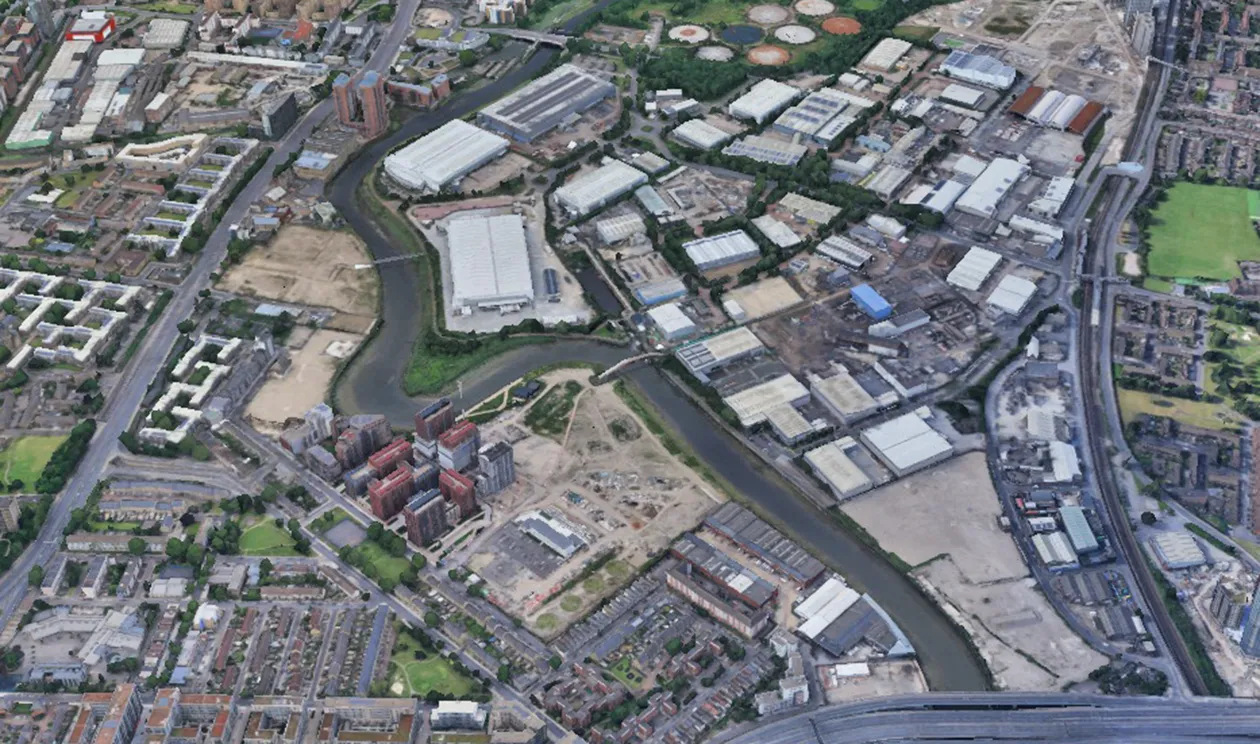
The Lower Lea Valley has long suffered from significant disconnect, both along and across. It still isn't possibly to walk down the river between Bromley-by-Bow and Canning Town without diverting into a manky industrial hinterland. And it still isn't possible to cross the river for over a mile between Bow Locks and the A13, this despite thousands of new homes being built in the locality. Now finally a connecting bridge might actually be built, although I've said that before so any confidence may be utterly misplaced.

The latest development is a joint project between Tower Hamlets and Newham because a bridge has to involve them both. It's called the Mayer Parry Bridge and is one of five tentative crossings the councils put forward for levelling-up funding in 2021. At the time the intention was to focus on the Lochnagar Bridge instead, a footbridge roughly halfway down the disjoint mile. It has planning consent but not full funding, also still no sign of developers building any of the proposed flats on the west side, so that's been mothballed in favour of something deliverable. The Mayer Parry Bridge has thus been promoted from option 2 to option 1, and if all goes to plan construction could begin next year. Where the red line is.

(the other crossings that look like footbridges only carry cables, so ignore those)
On the Tower Hamlets side the bridge launches off from the corner of the old Poplar Gasworks, which is currently being transformed into 2800 homes. One day the entire squarish plot will be covered, but for now only the west corner has flats. On the Newham side the bridge lands in the corner of what before 2022 was the Mayer Parry scrap metal recycling yard, since cleared out. It too is to be redeveloped, indeed the groundworks have already started. Annoyingly these two sites aren't opposite each other, the remainder of the riverside occupied by industrial units and business estates, so the cunning bit is to make the bridge cross the river on a diagonal. Across here.

This is the view from the A13 bridge, an unpleasant roar that those on the Poplar side have to cross if they want to get to Canning Town station. The Mayer Parry Bridge, if built, would provide many with a quicker and more pleasant shortcut. Down below is the seriously tidal end of the River Lea, known as Bow Creek, held back at the highest tides behind a floodwall of corrugated metal. You can see a huge crane is already on site marking out the land ready for the laying of foundations. The new development will be called Crown Wharf, will have 800 flats and is presented as "a fantastic opportunity for Newham to densify around a major transport interchange." Four riverside towers are planned and you already know exactly what they'll look like, but feel free to click here to confirm.
What really surprised me is what's planned for the far end of the site between the flats and the start of the Mayer Parry Bridge. It's an absolutely massive data centre, to be precise an 80MW Hyperscale Data Centre, designed by Foster and Partners no less. To fit the space it needs to be over 70m tall, already cut down from 90m during the planning process, with separate blocks containing plant, data halls, heat recovery and water processing. It's the perfect spot for one of the largest data centres in the UK because The London Internet Exchange, a key global switch-house, is just across the river. Even so, blimey, the rundown urban backwoods of Bidder Street will never look the same again.

As for the landing point on the west bank, it takes a very long time to turn a gasworks into housing. Poplar's gasholders were disassembled as long ago as 2017, then during lockdown I watched as remediation works eventually gave birth to the first few residential skeletons. Thus far only two blocks are complete and two more part-sold, with the developers planning a "Special Lunar New Year Open House Weekend" which tells you all you need to know about the intended purchasers. It feels strange to be able to walk into what was once heavily contaminated land, past boards promoting swimming pools and spa rooms for residents, down generic walkways that could be any new housing development in London.

The Mayer Parry Bridge landing site is screened off and entirely inaccessible, it being part of Phase 3 whereas we're still only on Phase 1. You can however walk down to the river's edge because that's where they located the Sales Office, inexplicably crunching across hundreds of purple shells scattered across the promenade. From the gull-splattered rail you can then look out towards another development shooting up on the far side of a mudflat meander, also two more locations where nobody can afford to build a footbridge. Without a crossing it takes 30 minutes to walk to the opposite bank rather than potentially two.

A consultation event for the Mayer Parry Bridge is taking place on Tuesday between 9am and 2pm at a cafe on the Poplar side. I would have gone but I'm out of town that day so feel free to interrogate the staff on our behalf and report back. I'm particularly interested in the great unmentioned subject in all the online collateral which is whether the footpath along the Lea gets completed at the same time as the bridge. There's already a mothballed promenade beyond Cody Dock so all that was ever needed was an onward connection through the old scrap metal yard, and seemingly the bridge connection delivers that too. What a brilliant outcome that would be, for locals, cyclists and long distance ramblers alike.
The intention is for construction to begin on the Mayer Parry Bridge in 2027, with the slender diagonal span opened to the public in 2029. But as I said we've been here before and nothing's happened, even with all parties onside, so it wouldn't surprise me if I'm still writing about utter inaccessibility in the Lower Lea Valley in 2030 and beyond.
13-Feb-26
1993: Lea Valley Walk follows the Limehouse Cut to the Thames because the last mile is inaccessibleHere's a map I showed you in 2019, since when nothing has changed connectivitywise. There are still no extra bridges across the river and the 'Coming Soon' along the river never happened.
2000s: Half-mile dead-end riverfront promenade opens opposite Bow Locks
2009: Plans for linear Leaside park and riverside path (the 'Fatwalk')
2012: Cody Dock opens, connecting dead end to industrial estate
2016: Fatwalk renamed the Leaway (but remains unbuilt)
2016: Ramp opens linking Twelvetrees Bridge to Lea towpath
2019: Cycle ramp opens beside A13 underpass
2021: Funding for new Lochnagar Bridge (but no subsequent action)
The latest development is a joint project between Tower Hamlets and Newham because a bridge has to involve them both. It's called the Mayer Parry Bridge and is one of five tentative crossings the councils put forward for levelling-up funding in 2021. At the time the intention was to focus on the Lochnagar Bridge instead, a footbridge roughly halfway down the disjoint mile. It has planning consent but not full funding, also still no sign of developers building any of the proposed flats on the west side, so that's been mothballed in favour of something deliverable. The Mayer Parry Bridge has thus been promoted from option 2 to option 1, and if all goes to plan construction could begin next year. Where the red line is.
(the other crossings that look like footbridges only carry cables, so ignore those)
On the Tower Hamlets side the bridge launches off from the corner of the old Poplar Gasworks, which is currently being transformed into 2800 homes. One day the entire squarish plot will be covered, but for now only the west corner has flats. On the Newham side the bridge lands in the corner of what before 2022 was the Mayer Parry scrap metal recycling yard, since cleared out. It too is to be redeveloped, indeed the groundworks have already started. Annoyingly these two sites aren't opposite each other, the remainder of the riverside occupied by industrial units and business estates, so the cunning bit is to make the bridge cross the river on a diagonal. Across here.
This is the view from the A13 bridge, an unpleasant roar that those on the Poplar side have to cross if they want to get to Canning Town station. The Mayer Parry Bridge, if built, would provide many with a quicker and more pleasant shortcut. Down below is the seriously tidal end of the River Lea, known as Bow Creek, held back at the highest tides behind a floodwall of corrugated metal. You can see a huge crane is already on site marking out the land ready for the laying of foundations. The new development will be called Crown Wharf, will have 800 flats and is presented as "a fantastic opportunity for Newham to densify around a major transport interchange." Four riverside towers are planned and you already know exactly what they'll look like, but feel free to click here to confirm.
What really surprised me is what's planned for the far end of the site between the flats and the start of the Mayer Parry Bridge. It's an absolutely massive data centre, to be precise an 80MW Hyperscale Data Centre, designed by Foster and Partners no less. To fit the space it needs to be over 70m tall, already cut down from 90m during the planning process, with separate blocks containing plant, data halls, heat recovery and water processing. It's the perfect spot for one of the largest data centres in the UK because The London Internet Exchange, a key global switch-house, is just across the river. Even so, blimey, the rundown urban backwoods of Bidder Street will never look the same again.
As for the landing point on the west bank, it takes a very long time to turn a gasworks into housing. Poplar's gasholders were disassembled as long ago as 2017, then during lockdown I watched as remediation works eventually gave birth to the first few residential skeletons. Thus far only two blocks are complete and two more part-sold, with the developers planning a "Special Lunar New Year Open House Weekend" which tells you all you need to know about the intended purchasers. It feels strange to be able to walk into what was once heavily contaminated land, past boards promoting swimming pools and spa rooms for residents, down generic walkways that could be any new housing development in London.
The Mayer Parry Bridge landing site is screened off and entirely inaccessible, it being part of Phase 3 whereas we're still only on Phase 1. You can however walk down to the river's edge because that's where they located the Sales Office, inexplicably crunching across hundreds of purple shells scattered across the promenade. From the gull-splattered rail you can then look out towards another development shooting up on the far side of a mudflat meander, also two more locations where nobody can afford to build a footbridge. Without a crossing it takes 30 minutes to walk to the opposite bank rather than potentially two.
A consultation event for the Mayer Parry Bridge is taking place on Tuesday between 9am and 2pm at a cafe on the Poplar side. I would have gone but I'm out of town that day so feel free to interrogate the staff on our behalf and report back. I'm particularly interested in the great unmentioned subject in all the online collateral which is whether the footpath along the Lea gets completed at the same time as the bridge. There's already a mothballed promenade beyond Cody Dock so all that was ever needed was an onward connection through the old scrap metal yard, and seemingly the bridge connection delivers that too. What a brilliant outcome that would be, for locals, cyclists and long distance ramblers alike.
The intention is for construction to begin on the Mayer Parry Bridge in 2027, with the slender diagonal span opened to the public in 2029. But as I said we've been here before and nothing's happened, even with all parties onside, so it wouldn't surprise me if I'm still writing about utter inaccessibility in the Lower Lea Valley in 2030 and beyond.
Grange Hill [ 13-Feb-26 7:00am ]
One Stop Beyond: Grange Hill
In this series I'm taking the train one stop beyond the Greater London boundary, getting off and seeing what's there. Today that means Grange Hill, one stop beyond Hainault on the Central line shuttle. The station's barely outside London, indeed the boundary runs immediately behind the southbound platform, as a small bulge of Essex nudges unnecessarily into the capital. I should say up front that the iconic children's drama was never set here, indeed Grange Hill's only school is a primary, but if you walk to the far side of the suburb you eventually end up in Birds of a Feather.

Grange Hill was originally an isolated hamlet around a crossroads on the edge of Hainault Forest. North to Chigwell, east to Chigwell Row, south to Barking Side and west to Woodford Bridge, just to get your bearings. There was once a 15th century manor called the Grange and there is still is a hill, hence Grange Hill. Alas nothing pre-20th-century survives except a triangular green by the crossroads, complete with grubby village sign and minimal shrubbery. One of the old pubs took a direct hit from a parachute mine in 1941 and is now a Shell garage, and the other was sold off to developers in its 240th year and has been replaced by a block of flats.

What wrought the greatest change around here was inevitably a railway. The Fairlop loop opened in 1903 crossing open countryside to link Woodford to Ilford, with Grange Hill station slightly better used than lonely Hainault. A doodlebug took out the original station building in 1944, hence the somewhat utilitarian flatroofed design. But the platforms only needed a new canopy so remain some of the most evocative on the Underground, complete with twiddly green columns with the letters GER entwined in the ironwork. Services were transferred to the extended Central line in 1947 and this was finally the trigger for a considerable burst of housebuilding locally - private developers to the west and an LCC estate to the east.

Grange Hill is one of three wards under the jurisdiction of Chigwell Parish Council, and closer you get to Chigwell proper the larger the houses get. Along Hainault Road the neighbours appear to be having some kind of blingiest gate competition, black and gold twiddles preferred, shielding sizeable detached homes and parking for several vehicles. Step back off the main road and the houses are more typically postwar, from half-timbered semis to gabled four-bedders, but still on the large side as befits the Essex fringe. Fontayne Avenue was one of the first additions and has a thick strip of hedge down the middle of the road, like some kind of suburban dual carriageway sloping down towards open farmland views. The bungalow at 22 Dacre Gardens is called Llamedos, and yes we see what you did there.

A decent parade of shops ascends from the station with estate agents and beauty salons perhaps over-represented. This being Chigwell South the local cafes tend to be either pink or cottage green, and a tiny chihuahua will meet you at the door of the Naked Lounge if you pop in for spa treatment or microblading. Obviously there's a florist, who with Valentine's Day imminent have erected a gazebo of blooms on the pavement and wrapped pink ribbons all around the pedestrian crossing. The top row of newspapers in the rack outside the Manor supermarket kicks off with the Daily Telegraph and continues Times, Sun and Daily Mail. It also has a slot for the Jewish Chronicle while the cafe nextdoor promotes Hot Salt Beef, so yes there is a synagogue up the hill, recently refurbished with funds from a local businessman and renamed the Lord and Lady Sugar Community Hall.

Grange Hill's most conspicuous church is St Winifred's, built in 1935 as a chapel of ease because traipsing all the way to Chigwell proper every Sunday wasn't ideal. Something about the building looks a bit off, perhaps the sparse tower with its painted black crosses, or more likely the fact it was cheaply built in brick then coated with cement. The local cemetery is more recent, accessed at the far end of the delightfully-named Froghall Lane which appropriately enough is a dead end. Here the parish council oversees a long sliver of land with a tranquil rural outlook, employs on-site groundsmen and charges a £40 release fee if your car gets locked in overnight. The oldest grave I could find is from the 1970s and the latest is marked only by Charlie's floral tributes, as yet unfaded. Looking on the back of the headstones I spotted one with the extra epitaph He Lived He Laughed He Loved, and I hope this isn't a trend that'll spread.

The cemetery is the only part of Grange Hill beyond the railway, this being the official boundary of the Green Belt. The tracks run in a cutting all the way to Chigwell, bar a brief section where the Edwardian engineers had to burrow through the spur of a hill. The Grange Hill Tunnel is only 237m long making it the shortest in regular service on the Underground and takes just 12 seconds to whizz through aboard a train. It's also perfectly straight as you can clearly see from the bridge outside the station, also the caged footbridge on the opposite side accessed up a muddy path from the corner of Wycliffe Gardens. Just be aware that if you want to see a train pass through they only run every 20 minutes, this because Grange Hill is the 3rd least used station on the Underground, beaten only by the next two stations up the line.

But if there's one worth seeing round here it's probably the Limes Farm Estate, that is assuming postwar housing is your thing. In the late 1960s Chigwell Urban District Council belatedly decided they ought to build a lot of council houses and picked an as yet undeveloped slope abutting the edge of Redbridge where most Essex residents would never see it. The architects had a field day, starting by drawing a single-exit loop road and then adding a maze of large apartment blocks and crisscrossing townhouses in the centre. The flats form three large U-shaped blocks facing a central car park, each of the trio distinguished by red, yellow or green detailing. The houses have timber, brick or chunky pebbledash exteriors and separate rows of garages. And just for a laugh they numbered them all 2-634 Limes Avenue round one side and 1-731 Copperfield round the other, which must make deliveries a nightmare.

The finest feature is the green wedge that tumbles down the centre of the estate, a bit squidgy at present but creating an attractive backdrop to urban life. A slim concrete footbridge connects the top of the estate to the summit of the hill where a bench has been plonked with views towards Docklands and Kent. The estate's parade has only four shops, and currently offers just takeaways or nice nails while a crew of refrigeration experts rips the interior out of Londis. Residents must be hoping the Post Office reopens soon. There's an underlying sense of isolation here, as tends to happen when a community is a developmental afterthought, with only a few short alleyways linking Limes Farm to earlier streets. But slip through to the south and you instantly enter cul-de-sacs with Redbridge bins, then it's barely five minutes to Hainault station, because that's how close to London a One Stop Beyond can be.
12-Feb-26
In this series I'm taking the train one stop beyond the Greater London boundary, getting off and seeing what's there. Today that means Grange Hill, one stop beyond Hainault on the Central line shuttle. The station's barely outside London, indeed the boundary runs immediately behind the southbound platform, as a small bulge of Essex nudges unnecessarily into the capital. I should say up front that the iconic children's drama was never set here, indeed Grange Hill's only school is a primary, but if you walk to the far side of the suburb you eventually end up in Birds of a Feather.
Grange Hill was originally an isolated hamlet around a crossroads on the edge of Hainault Forest. North to Chigwell, east to Chigwell Row, south to Barking Side and west to Woodford Bridge, just to get your bearings. There was once a 15th century manor called the Grange and there is still is a hill, hence Grange Hill. Alas nothing pre-20th-century survives except a triangular green by the crossroads, complete with grubby village sign and minimal shrubbery. One of the old pubs took a direct hit from a parachute mine in 1941 and is now a Shell garage, and the other was sold off to developers in its 240th year and has been replaced by a block of flats.
What wrought the greatest change around here was inevitably a railway. The Fairlop loop opened in 1903 crossing open countryside to link Woodford to Ilford, with Grange Hill station slightly better used than lonely Hainault. A doodlebug took out the original station building in 1944, hence the somewhat utilitarian flatroofed design. But the platforms only needed a new canopy so remain some of the most evocative on the Underground, complete with twiddly green columns with the letters GER entwined in the ironwork. Services were transferred to the extended Central line in 1947 and this was finally the trigger for a considerable burst of housebuilding locally - private developers to the west and an LCC estate to the east.
Grange Hill is one of three wards under the jurisdiction of Chigwell Parish Council, and closer you get to Chigwell proper the larger the houses get. Along Hainault Road the neighbours appear to be having some kind of blingiest gate competition, black and gold twiddles preferred, shielding sizeable detached homes and parking for several vehicles. Step back off the main road and the houses are more typically postwar, from half-timbered semis to gabled four-bedders, but still on the large side as befits the Essex fringe. Fontayne Avenue was one of the first additions and has a thick strip of hedge down the middle of the road, like some kind of suburban dual carriageway sloping down towards open farmland views. The bungalow at 22 Dacre Gardens is called Llamedos, and yes we see what you did there.
A decent parade of shops ascends from the station with estate agents and beauty salons perhaps over-represented. This being Chigwell South the local cafes tend to be either pink or cottage green, and a tiny chihuahua will meet you at the door of the Naked Lounge if you pop in for spa treatment or microblading. Obviously there's a florist, who with Valentine's Day imminent have erected a gazebo of blooms on the pavement and wrapped pink ribbons all around the pedestrian crossing. The top row of newspapers in the rack outside the Manor supermarket kicks off with the Daily Telegraph and continues Times, Sun and Daily Mail. It also has a slot for the Jewish Chronicle while the cafe nextdoor promotes Hot Salt Beef, so yes there is a synagogue up the hill, recently refurbished with funds from a local businessman and renamed the Lord and Lady Sugar Community Hall.
Grange Hill's most conspicuous church is St Winifred's, built in 1935 as a chapel of ease because traipsing all the way to Chigwell proper every Sunday wasn't ideal. Something about the building looks a bit off, perhaps the sparse tower with its painted black crosses, or more likely the fact it was cheaply built in brick then coated with cement. The local cemetery is more recent, accessed at the far end of the delightfully-named Froghall Lane which appropriately enough is a dead end. Here the parish council oversees a long sliver of land with a tranquil rural outlook, employs on-site groundsmen and charges a £40 release fee if your car gets locked in overnight. The oldest grave I could find is from the 1970s and the latest is marked only by Charlie's floral tributes, as yet unfaded. Looking on the back of the headstones I spotted one with the extra epitaph He Lived He Laughed He Loved, and I hope this isn't a trend that'll spread.
The cemetery is the only part of Grange Hill beyond the railway, this being the official boundary of the Green Belt. The tracks run in a cutting all the way to Chigwell, bar a brief section where the Edwardian engineers had to burrow through the spur of a hill. The Grange Hill Tunnel is only 237m long making it the shortest in regular service on the Underground and takes just 12 seconds to whizz through aboard a train. It's also perfectly straight as you can clearly see from the bridge outside the station, also the caged footbridge on the opposite side accessed up a muddy path from the corner of Wycliffe Gardens. Just be aware that if you want to see a train pass through they only run every 20 minutes, this because Grange Hill is the 3rd least used station on the Underground, beaten only by the next two stations up the line.
But if there's one worth seeing round here it's probably the Limes Farm Estate, that is assuming postwar housing is your thing. In the late 1960s Chigwell Urban District Council belatedly decided they ought to build a lot of council houses and picked an as yet undeveloped slope abutting the edge of Redbridge where most Essex residents would never see it. The architects had a field day, starting by drawing a single-exit loop road and then adding a maze of large apartment blocks and crisscrossing townhouses in the centre. The flats form three large U-shaped blocks facing a central car park, each of the trio distinguished by red, yellow or green detailing. The houses have timber, brick or chunky pebbledash exteriors and separate rows of garages. And just for a laugh they numbered them all 2-634 Limes Avenue round one side and 1-731 Copperfield round the other, which must make deliveries a nightmare.
The finest feature is the green wedge that tumbles down the centre of the estate, a bit squidgy at present but creating an attractive backdrop to urban life. A slim concrete footbridge connects the top of the estate to the summit of the hill where a bench has been plonked with views towards Docklands and Kent. The estate's parade has only four shops, and currently offers just takeaways or nice nails while a crew of refrigeration experts rips the interior out of Londis. Residents must be hoping the Post Office reopens soon. There's an underlying sense of isolation here, as tends to happen when a community is a developmental afterthought, with only a few short alleyways linking Limes Farm to earlier streets. But slip through to the south and you instantly enter cul-de-sacs with Redbridge bins, then it's barely five minutes to Hainault station, because that's how close to London a One Stop Beyond can be.
Old school blogging [ 12-Feb-26 7:00am ]
When this blog started I wrote a lot less, included far fewer photos, didn't go exploring much and discussed topics of limited importance. What if I tried that again now?
Thursday, February 12, 2026
 Hasn't it been really wet recently? It's rained in London every day this month so far, though January 31st was dry so it's only 12 consecutive damp days. According to my favourite weather site at Hampstead we've already had more than the average rainfall for February and it's only the 12th of the month, and that's on top of a January that delivered 175% of normal rainfall. Apparently we've only had ten dry days this year and half of them were over a month ago.
As for cloud there have only been six sunny hours so far this month, which is grim, whereas four days in the first week of January had seven hours each. The UK climate is often perversely atypical in one way or another so we can't read too much into this, but in good news Secret London says "Londoners Are Set To Face Rainy Weather Every Day For The Next Two Weeks" so it's sure to clear up soon.
Thursday, February 12, 2026
Winter Olympics since 1924
1924-481952-681972-881992-062010-262030+ Europe442321 Americas112111 Asia00112
The longest distance between consecutive Winter Olympics: Vancouver to Sochi (9553 miles)
The shortest distance between consecutive Winter Olympics: Garmisch-Partenkirchen to St Moritz (145 miles)
Thursday, February 12, 2026
I was heading west on the Elizabeth line yesterday when the lady next to me tapped me on the shoulder and asked "Does this train go to Terminal 5?" No it doesn't, I said, it goes to Terminal 4. She seemed quite flustered by this news. I told her she should stay on and change at Terminal 2 but that went straight over her head. "It doesn't go to Terminal 5?" she said, more in shock than as a question. She was a smiley well dressed soul, at a guess Italian, and the intricacies of the Elizabeth line were beyond her comprehension. Just stay on, I said, and change at Heathrow. "I stay on to the end?" she asked, and I had to say no again because it's a right faff getting to T5 if you accidentally end up at T4 and don't know what you're doing. She looked even more tense and looked at me as if to say "I don't understand what's going on." I tried to show her the tube map on my phone, but the tube map at Heathrow is a complex knot combining two lines and that didn't help either. She tried asking again and I told her I had to get off the train at Bond Street but she should stay on to Heathrow and change there. "But it doesn't go to Heathrow T5?" she asked and I had to say no because it didn't, just stay on the train. She followed me onto the platform.
I wanted to point her towards to a T5 train on the departures screen but annoyingly there wasn't one. They only run direct every half hour and just our luck there wasn't one on the board. Instead I pointed at the next T4 train and specifically the yellow text saying "change at T2&3 for T5" but that didn't register either. I don't think she understood the concept of changing trains so the more I pointed the more confused she got. Her linguistic ability to ask a question seemed pretty good but her comprehension of my explanations less so. I hoped to be able to direct her to a helpful member of staff on the platform but annoyingly there weren't any. Bond Street is supposed to be the station where you alight to alert staff about accessibility needs out west but there was nobody to ask, not even on the concourse at the foot of the escalators. I eventually found a line diagram on the wall and pointed at T2, T4 and T5 to show how the line branched, but that only baffled her more. Get the next Heathrow train, I said, the train that says T4, then change later. She smiled, still baffled, and turned to ask another passenger on the platform "Will this train go to T5?" Yes, he said, even though it wouldn't, and that was the matter settled.
I wandered off defeated by my inability to help, and wondered what would happen as the lady's journey progressed. Would she get on the T4 train only to ask someone else "Does this go to T5?" and get off again. Would she find some other good Samaritan further down the line who'd explain everything satisfactorily? Would she consult an app and suddenly everything would become clear? Would she ride to the end of the line at T4 not T5 and collapse in a gibbering emotional heap? Or would she hang around on the platform at Bond Street for so long that a T5 train would eventually appear and all would be well? Some days the London transport system is just too baffling to explain, even if you get lucky and happen to ask someone who knows what they're talking about.
Thursday, February 12, 2026
Aren't Arsenal doing well at the moment? They could of course still balls it up but six points clear in February is pretty good, plus it's only Brentford tonight, plus Tottenham are basically imploding, plus Wigan are bound to be a doddle in the Cup. Also Arteta has been saying all sorts of meaningful things like "We have to focus on ourselves" and "Let's put all the energy into what we do" and "We have to be able to adapt" and "The players' qualities are the most important thing" and "You have to win a lot of games", and when you're being managed by a tactical genius like that nothing can stop you.
Thursday, February 12, 2026
 I got a hyacinth for Christmas, essentially a bulb on a jar, and left it behind the curtains with some water to do its thing. According to the instructions you're supposed to leave it for 10-12 weeks but it's already burst into flower so I've shifted it to my windowsill instead. Unfortunately the thick stem is really floppy and keeps leaning over and I'm really struggling to keep it upright. I've tried turning the bulb, I've tried attaching an elastic band and I've tried resting it against a giant bobbin but it keeps slipping and leaning over anyway. My latest brainwave is to blutak a green Berol pen to the windowframe so it sticks out, then rest the hyacinth on that, but I'm not convinced it'll ever stay put for more than an hour or two.
Anyone else have problems with floppy hyacinths and know how best to keep one upright?
Thursday, February 12, 2026
fivelinks
• The Motorway Simulator from roads.co.uk (M1/M23/M25/A1(M), also A23/A720)
• The Anagram tube map (which went viral this week 20 years ago)
• Londonist Time Machine goes for a detailed walk along the North Bank from Westminster to the Tower
• 1 hour of Badger Badger Badger (from Weebl's Stuff)
• A Totally Objective Ranking of Every UK Local Authority Logo
Thursday, February 12, 2026
 2026 means local council elections in London and the early collateral is already piling into my letterbox. The Greens left a card saying they'd called, with a handwritten "Sorry we missed you". They've also sent Issue 1 of 'Bow East News', which to be fair contains very little about Bow East and is more about the three candidates. One's a research scientist, one's a legal assistant and one is the Head of Public Affairs and Communications for a Palestine Rights organisation. Labour's candidate for Mayor of Tower Hamlets also came round, got no response and left a leaflet but that's more a survey about what I want rather than what he's offfering. Nothing yet from the Liberal Democrats or Conservatives or Aspire but the election is still three months off, plus Aspire don't need support from my ward to sweep the board again and reinstate the innately dubious Lutfur Rahman as Mayor. Watch this space.
Thursday, February 12, 2026
The joy of old-school blogging is that it doesn't take long to write. All of the above took only three hours whereas a typical 2026 blogpost can take much longer than that, not to mention all the time taken out and about doing research. No outdoor travels were required for any of the above, other than a train journey I was making anyway and an incident that was all over in five minutes flat. It just wasn't possible to go exploring midweek in 2003 when I had a job, plus I also had a busy social life so blogging had to be something it was possible to dash off between removing my tie and vanishing out the door for a beer. I dashed out the door again last night so a blogpost done and dusted before 7pm was an absolute godsend. Also when you write about stuff that happened to you or stuff you saw online there's no need to do any research because it's not about facts and nobody can pick holes. Normal service will be restored soon with an in-depth visit to somewhere historically intricate or an extensive takedown of some embryonic transport project but in the meantime I hope a dose of meaningless minutiae satisfied sufficiently.
11-Feb-26
Thursday, February 12, 2026
Hasn't it been really wet recently? It's rained in London every day this month so far, though January 31st was dry so it's only 12 consecutive damp days. According to my favourite weather site at Hampstead we've already had more than the average rainfall for February and it's only the 12th of the month, and that's on top of a January that delivered 175% of normal rainfall. Apparently we've only had ten dry days this year and half of them were over a month ago.
As for cloud there have only been six sunny hours so far this month, which is grim, whereas four days in the first week of January had seven hours each. The UK climate is often perversely atypical in one way or another so we can't read too much into this, but in good news Secret London says "Londoners Are Set To Face Rainy Weather Every Day For The Next Two Weeks" so it's sure to clear up soon.
Thursday, February 12, 2026
Winter Olympics since 1924
1924-481952-681972-881992-062010-262030+ Europe442321 Americas112111 Asia00112
The longest distance between consecutive Winter Olympics: Vancouver to Sochi (9553 miles)
The shortest distance between consecutive Winter Olympics: Garmisch-Partenkirchen to St Moritz (145 miles)
Thursday, February 12, 2026
I was heading west on the Elizabeth line yesterday when the lady next to me tapped me on the shoulder and asked "Does this train go to Terminal 5?" No it doesn't, I said, it goes to Terminal 4. She seemed quite flustered by this news. I told her she should stay on and change at Terminal 2 but that went straight over her head. "It doesn't go to Terminal 5?" she said, more in shock than as a question. She was a smiley well dressed soul, at a guess Italian, and the intricacies of the Elizabeth line were beyond her comprehension. Just stay on, I said, and change at Heathrow. "I stay on to the end?" she asked, and I had to say no again because it's a right faff getting to T5 if you accidentally end up at T4 and don't know what you're doing. She looked even more tense and looked at me as if to say "I don't understand what's going on." I tried to show her the tube map on my phone, but the tube map at Heathrow is a complex knot combining two lines and that didn't help either. She tried asking again and I told her I had to get off the train at Bond Street but she should stay on to Heathrow and change there. "But it doesn't go to Heathrow T5?" she asked and I had to say no because it didn't, just stay on the train. She followed me onto the platform.
I wanted to point her towards to a T5 train on the departures screen but annoyingly there wasn't one. They only run direct every half hour and just our luck there wasn't one on the board. Instead I pointed at the next T4 train and specifically the yellow text saying "change at T2&3 for T5" but that didn't register either. I don't think she understood the concept of changing trains so the more I pointed the more confused she got. Her linguistic ability to ask a question seemed pretty good but her comprehension of my explanations less so. I hoped to be able to direct her to a helpful member of staff on the platform but annoyingly there weren't any. Bond Street is supposed to be the station where you alight to alert staff about accessibility needs out west but there was nobody to ask, not even on the concourse at the foot of the escalators. I eventually found a line diagram on the wall and pointed at T2, T4 and T5 to show how the line branched, but that only baffled her more. Get the next Heathrow train, I said, the train that says T4, then change later. She smiled, still baffled, and turned to ask another passenger on the platform "Will this train go to T5?" Yes, he said, even though it wouldn't, and that was the matter settled.
I wandered off defeated by my inability to help, and wondered what would happen as the lady's journey progressed. Would she get on the T4 train only to ask someone else "Does this go to T5?" and get off again. Would she find some other good Samaritan further down the line who'd explain everything satisfactorily? Would she consult an app and suddenly everything would become clear? Would she ride to the end of the line at T4 not T5 and collapse in a gibbering emotional heap? Or would she hang around on the platform at Bond Street for so long that a T5 train would eventually appear and all would be well? Some days the London transport system is just too baffling to explain, even if you get lucky and happen to ask someone who knows what they're talking about.
Thursday, February 12, 2026
Aren't Arsenal doing well at the moment? They could of course still balls it up but six points clear in February is pretty good, plus it's only Brentford tonight, plus Tottenham are basically imploding, plus Wigan are bound to be a doddle in the Cup. Also Arteta has been saying all sorts of meaningful things like "We have to focus on ourselves" and "Let's put all the energy into what we do" and "We have to be able to adapt" and "The players' qualities are the most important thing" and "You have to win a lot of games", and when you're being managed by a tactical genius like that nothing can stop you.
Thursday, February 12, 2026
I got a hyacinth for Christmas, essentially a bulb on a jar, and left it behind the curtains with some water to do its thing. According to the instructions you're supposed to leave it for 10-12 weeks but it's already burst into flower so I've shifted it to my windowsill instead. Unfortunately the thick stem is really floppy and keeps leaning over and I'm really struggling to keep it upright. I've tried turning the bulb, I've tried attaching an elastic band and I've tried resting it against a giant bobbin but it keeps slipping and leaning over anyway. My latest brainwave is to blutak a green Berol pen to the windowframe so it sticks out, then rest the hyacinth on that, but I'm not convinced it'll ever stay put for more than an hour or two.
Anyone else have problems with floppy hyacinths and know how best to keep one upright?
Thursday, February 12, 2026
fivelinks
• The Motorway Simulator from roads.co.uk (M1/M23/M25/A1(M), also A23/A720)
• The Anagram tube map (which went viral this week 20 years ago)
• Londonist Time Machine goes for a detailed walk along the North Bank from Westminster to the Tower
• 1 hour of Badger Badger Badger (from Weebl's Stuff)
• A Totally Objective Ranking of Every UK Local Authority Logo
Thursday, February 12, 2026
2026 means local council elections in London and the early collateral is already piling into my letterbox. The Greens left a card saying they'd called, with a handwritten "Sorry we missed you". They've also sent Issue 1 of 'Bow East News', which to be fair contains very little about Bow East and is more about the three candidates. One's a research scientist, one's a legal assistant and one is the Head of Public Affairs and Communications for a Palestine Rights organisation. Labour's candidate for Mayor of Tower Hamlets also came round, got no response and left a leaflet but that's more a survey about what I want rather than what he's offfering. Nothing yet from the Liberal Democrats or Conservatives or Aspire but the election is still three months off, plus Aspire don't need support from my ward to sweep the board again and reinstate the innately dubious Lutfur Rahman as Mayor. Watch this space.
Thursday, February 12, 2026
The joy of old-school blogging is that it doesn't take long to write. All of the above took only three hours whereas a typical 2026 blogpost can take much longer than that, not to mention all the time taken out and about doing research. No outdoor travels were required for any of the above, other than a train journey I was making anyway and an incident that was all over in five minutes flat. It just wasn't possible to go exploring midweek in 2003 when I had a job, plus I also had a busy social life so blogging had to be something it was possible to dash off between removing my tie and vanishing out the door for a beer. I dashed out the door again last night so a blogpost done and dusted before 7pm was an absolute godsend. Also when you write about stuff that happened to you or stuff you saw online there's no need to do any research because it's not about facts and nobody can pick holes. Normal service will be restored soon with an in-depth visit to somewhere historically intricate or an extensive takedown of some embryonic transport project but in the meantime I hope a dose of meaningless minutiae satisfied sufficiently.
Sponsored froth [ 11-Feb-26 7:00am ]
TfL are certainly fickle when it comes to alcohol.
Last month it was Heineken but now it's Guinness.
Cheers?

The latest ad-splash is a week-long campaign for Guinness, specifically the new brewery experience in Covent Garden which the King opened just before Christmas. Two tube stations have had a makeover, one minimally and the other more map-based. And while one aspect of the campaign is creatively brilliant, overall it's just an expensive tourist attraction overselling itself.
Here's the clever bit.

Eleven Northern line maps at Tottenham Court Road station have been 'inverted' so the line is white and the background is black, thus resembling a pint of Guinness with a white frothy top. Where the stairwells meet the platform it looks like two pints side by side. Full marks to the creative team for that idea.
It can't be a coincidence that the TfL blog sprang into rare action yesterday with a post entitled Commercial Partnerships at TfL: A balancing act. It asserts that commercial income is an essential part of TfL's wider strategy to grow and diversify revenue. It recognises they haven't always got it right ("Following the Burberry activation at Bond Street, which created some unintentional customer confusion, we reviewed and improved our approach"). And it lists three guiding qualities every time an activation like this goes live. Only one is a positive - raising money - whereas the other two are essentially 'we promise not to muck up'.

Yes they've changed some roundels, don't they always? Three on each platform have been swapped, a gold harp substituting for the red circle. Yes they've plastered a few corridors and slapped some Guinness ads up an escalator. Yes they've used black and gold along the top of the platform, though only partially. Yes there is a small toucan perched in the ticket hall, in fact two if you look carefully. No they haven't touched the Elizabeth line, not as far as I saw, because why waste extra money unnecessarily? And yes there is a large exhortation just before you leave the station to go and sample "The Home of Guinness in London", so I did.

And here's the stupid thing, Tottenham Court Road isn't the closest station to the Guinness Brewery. It isn't even the closest Northern line station, which is Leicester Square, but 95% of the marketing budget has still been spent here. The closest station is actually Covent Garden and all that has is half a dozen roundels - hardly any statement at all - but I guess the last thing TfL wants is more tourists at the deep awkward station with the busy lifts. Instead it's a 9 minute walk from Tottenham Court Road to the brewery, as the smallprint up the escalators attests, and that's assuming you know which convoluted way to go.
The Guinness Open Gate Brewery is an oddly-unfocused attraction tucked behind the streets of Covent Garden. It's partly based in historic buildings around Old Brewery Yard but also sprawls along an access corridor to a separate piazza, filling whatever floors the developers could get their hands on. Guinness was never brewed here, despite what the heritage murals might hint, and indeed isn't brewed here now. Instead the on-site microbrewery team explore "the new frontier of beer flavours", "from classic cold lagers to innovative low-percentage brews and sours with a tropical twist", "brewed to bubble at the centre of your conversations". If you manage to find a bar where they sell proper Guinness, it's all shipped in from Ireland.

And they'd rather you didn't just come for a Guinness but were tempted by alternative purchases. The most prominent door leads to a restaurant where £14 gets you a sausage and £6 a side of chips, while a more expensive seafood restaurant lurks upstairs. A portentous stairwell leads to a basement events space available for hire. If you hang around the main yard after the tables have been set out a black van will sell you a bespoke pie with a smidgeon of Guinness in the gravy. Don't try looking for a pub, there is no pub, all the better to help pay off the £73m development costs.
A separate building, opposite where Stanford's map shop ended up, hosts the experiential part of the experience. Here you can book tours to view the non-Guinnesses being brewed, take part in a tasting session and in the final room try your hand at pulling the perfect pint. I imagine the finale is seriously Insta-friendly ("come on Jason, don't let it all froth up") and that drinking said pint occupies a fair proportion of the 90 minute tour duration. Meanwhile downstairs is a Guinness store specialising in merch rather than beer, should you genuinely have need of a branded umbrella, branded beermat, limited edition tank top or weird designer creation invented for the sake of it. The supposed must-have is a personalised glass with the engraving carried out on site by faux heritage staff wearing black and gold braces, and the whole place reeks of the fundamentally unnecessary.

I'm not averse to a Guinness souvenir, my fridge is bedecked with a tortoise magnet purchased 25 years ago at the St James's Gate Brewery in Dublin. But that felt like a proper tour whereas this is just windowdressing masquerading as heritage with a price tag to match, not so much celebrating a beer as pimping a brand. And that's also why Guinness have splashed themselves across a busy tube station this week, a siren call to the neo-proletariat to visit WC2 for an extended black and white experience. Londoners won't be getting lower tube fares as a result but some marketing executives will be very happy, and that's the only pure genius frothing up here.
10-Feb-26
Last month it was Heineken but now it's Guinness.
Cheers?
The latest ad-splash is a week-long campaign for Guinness, specifically the new brewery experience in Covent Garden which the King opened just before Christmas. Two tube stations have had a makeover, one minimally and the other more map-based. And while one aspect of the campaign is creatively brilliant, overall it's just an expensive tourist attraction overselling itself.
Here's the clever bit.
Eleven Northern line maps at Tottenham Court Road station have been 'inverted' so the line is white and the background is black, thus resembling a pint of Guinness with a white frothy top. Where the stairwells meet the platform it looks like two pints side by side. Full marks to the creative team for that idea.
It can't be a coincidence that the TfL blog sprang into rare action yesterday with a post entitled Commercial Partnerships at TfL: A balancing act. It asserts that commercial income is an essential part of TfL's wider strategy to grow and diversify revenue. It recognises they haven't always got it right ("Following the Burberry activation at Bond Street, which created some unintentional customer confusion, we reviewed and improved our approach"). And it lists three guiding qualities every time an activation like this goes live. Only one is a positive - raising money - whereas the other two are essentially 'we promise not to muck up'.
• Revenue generation - aiming to infuse colour and fun into the network while generating essential incomeThe inverted map is certainly accessible, indeed arguably clearer than the normal black on white. The only branding is a small harp beside the name of one station, assuming passengers will make the Guinness connection for themselves. Tellingly they've had to add a drinkware.co.uk URL at the bottom of the map, even at the bottom of the Central and Elizabeth line diagrams in the ticket hall, lest the tiny harp drive you to drink.
• Customer clarity - carrying out essential planning to ensure no customer is ever confused or misdirected
• Accessibility - embedded at every stage of planning and delivery, so no customer is disadvantaged
Yes they've changed some roundels, don't they always? Three on each platform have been swapped, a gold harp substituting for the red circle. Yes they've plastered a few corridors and slapped some Guinness ads up an escalator. Yes they've used black and gold along the top of the platform, though only partially. Yes there is a small toucan perched in the ticket hall, in fact two if you look carefully. No they haven't touched the Elizabeth line, not as far as I saw, because why waste extra money unnecessarily? And yes there is a large exhortation just before you leave the station to go and sample "The Home of Guinness in London", so I did.
And here's the stupid thing, Tottenham Court Road isn't the closest station to the Guinness Brewery. It isn't even the closest Northern line station, which is Leicester Square, but 95% of the marketing budget has still been spent here. The closest station is actually Covent Garden and all that has is half a dozen roundels - hardly any statement at all - but I guess the last thing TfL wants is more tourists at the deep awkward station with the busy lifts. Instead it's a 9 minute walk from Tottenham Court Road to the brewery, as the smallprint up the escalators attests, and that's assuming you know which convoluted way to go.
The Guinness Open Gate Brewery is an oddly-unfocused attraction tucked behind the streets of Covent Garden. It's partly based in historic buildings around Old Brewery Yard but also sprawls along an access corridor to a separate piazza, filling whatever floors the developers could get their hands on. Guinness was never brewed here, despite what the heritage murals might hint, and indeed isn't brewed here now. Instead the on-site microbrewery team explore "the new frontier of beer flavours", "from classic cold lagers to innovative low-percentage brews and sours with a tropical twist", "brewed to bubble at the centre of your conversations". If you manage to find a bar where they sell proper Guinness, it's all shipped in from Ireland.
And they'd rather you didn't just come for a Guinness but were tempted by alternative purchases. The most prominent door leads to a restaurant where £14 gets you a sausage and £6 a side of chips, while a more expensive seafood restaurant lurks upstairs. A portentous stairwell leads to a basement events space available for hire. If you hang around the main yard after the tables have been set out a black van will sell you a bespoke pie with a smidgeon of Guinness in the gravy. Don't try looking for a pub, there is no pub, all the better to help pay off the £73m development costs.
A separate building, opposite where Stanford's map shop ended up, hosts the experiential part of the experience. Here you can book tours to view the non-Guinnesses being brewed, take part in a tasting session and in the final room try your hand at pulling the perfect pint. I imagine the finale is seriously Insta-friendly ("come on Jason, don't let it all froth up") and that drinking said pint occupies a fair proportion of the 90 minute tour duration. Meanwhile downstairs is a Guinness store specialising in merch rather than beer, should you genuinely have need of a branded umbrella, branded beermat, limited edition tank top or weird designer creation invented for the sake of it. The supposed must-have is a personalised glass with the engraving carried out on site by faux heritage staff wearing black and gold braces, and the whole place reeks of the fundamentally unnecessary.
I'm not averse to a Guinness souvenir, my fridge is bedecked with a tortoise magnet purchased 25 years ago at the St James's Gate Brewery in Dublin. But that felt like a proper tour whereas this is just windowdressing masquerading as heritage with a price tag to match, not so much celebrating a beer as pimping a brand. And that's also why Guinness have splashed themselves across a busy tube station this week, a siren call to the neo-proletariat to visit WC2 for an extended black and white experience. Londoners won't be getting lower tube fares as a result but some marketing executives will be very happy, and that's the only pure genius frothing up here.
Six other things to see in Southgate [ 10-Feb-26 8:00am ]
Six other things to see in Southgate
(that's old Southgate by The Green, not the upstart civic centre by the tube station)

1) Village stocks!
Time was when every village had its stocks for punishing local miscreants by chucking stuff at them, indeed a statute in 1351 insisted on it. Such behaviour is now deemed unacceptable and has been since 1872 when stocks were last used in anger in Berkshire, but who's to say they'll never come back into use. Southgate's alas aren't the original because those went missing during WW2 and are instead a Coronation gift in 1953, themselves heavily restored in 2002 because the oak had rotted heavily. Other London locations with stocks include Havering-atte-Bower, Ickenham and anywhere else someone might know about.
2) A nice fingerpost!
Everyone loves a good fingerpost and Southgate Green has an excellent one. It marks the junction of the A1003 and the A1004, two distinctly minor A roads, and dates from an era when quarter miles were still a significant distance measurement. One finger points towards New Southgate which is very much not old Southgate like what this is. From my wanderings I'd say there are far more nice fingerposts in north London than south, notably in the boroughs of Enfield and Barnet, and I wonder if future generations with satnavs will one day wonder why we ever needed to know where towns are.

3) Blue Plaques!
Rarely have I been more disappointed by a blue plaque than the inscription on the cottage at 40 The Green. As I got closer I saw it read 'In 1881 this house became the first seat of local government in Southgate', and sorry but the separation of Southgate from the Edmonton Board of Health is not an exciting heritage fact. Of more interest is the plaque down the road marking the house where Benjamin Waugh lived in 1884 when he founded the NSPCC. Admittedly Waugh was honorary director under Lord Shaftesbury as Chairman, and admittedly the NSPCC was founded at Mansion House rather than here, and admittedly Waugh's house has been demolished and replaced by a bank which is now a nursery, but it's still more interesting than the blue plaque at number 40.
4) A Very Old Pub!
The Cherry Tree has had the plum spot opposite The Green for over 300 years. The former coaching inn now has Victorian brick frontage and a Mock Tudor porch but at its heart is a much earlier timber-framed building. If you ever need a dull fact about Southgate, be aware that the Loyal Adelaide Lodge of Manchester Unity of Oddfellows held their meetings here for over 100 years. Until last year it was a proper pub but then Mitchells & Butlers turned it into a generic brasserie called Brown's, not Ye Olde Cherry Tree, and local drinkers were nonplussed. A Telegraph journalist even published an article subtitled "The 17th-century inn has lost all of its character, with no chance of a decent cask ale or even an interesting bottle", and if nothing else a grey hard-to-read inn sign has since been added bearing the proper name.

5) That postwar typeface
You see a lot of that nice 1950s typeface around Southgate Green, the slanting serif much used on postwar buildings, for example on this block of flats and on this sign referencing H Miller & Sons, longstanding Plumbers and Decorators. But what precisely is it called? I went down a font-based wormhole and it turns out there are lots of very similar styles including Stymie Bold Italic, Clarendon Bold Italic, Profil, Egyptian Italic and Festival Egyptian (an official style of the Festival of Britain). But I'm not sure any of these perfectly match the As and Os I saw here in Southgate, so maybe I'll just go on calling it That Nice 1950s Typeface and at least you'll still know what I mean.
6) Dionysus!
Pre-Crossrail if you wanted fried sustenance at the end of a West End night out you stopped by Dionysus, the Greek chippie in the prime corner spot outside Tottenham Court Road station. Many's the hangover quelled by one of their special kebabs or salty bags. But in January 2009, in advance of station redevelopment, they were sadly forced to close. As I blogged at the time, "I watched as staff gutted the interior, then piled sinks and ovens into the back of a hired van and drove off to start anew elsewhere." Well, likely that elsewhere was Southgate because here they are in a smart cafe with the precisely same logo above the door. Given they were "established 1969" this may alternatively be the original Dionysus and TCR was merely a branch, but if you ever fancy a nostalgic takeaway then head straight to N14.
(that's old Southgate by The Green, not the upstart civic centre by the tube station)
1) Village stocks!
Time was when every village had its stocks for punishing local miscreants by chucking stuff at them, indeed a statute in 1351 insisted on it. Such behaviour is now deemed unacceptable and has been since 1872 when stocks were last used in anger in Berkshire, but who's to say they'll never come back into use. Southgate's alas aren't the original because those went missing during WW2 and are instead a Coronation gift in 1953, themselves heavily restored in 2002 because the oak had rotted heavily. Other London locations with stocks include Havering-atte-Bower, Ickenham and anywhere else someone might know about.
2) A nice fingerpost!
Everyone loves a good fingerpost and Southgate Green has an excellent one. It marks the junction of the A1003 and the A1004, two distinctly minor A roads, and dates from an era when quarter miles were still a significant distance measurement. One finger points towards New Southgate which is very much not old Southgate like what this is. From my wanderings I'd say there are far more nice fingerposts in north London than south, notably in the boroughs of Enfield and Barnet, and I wonder if future generations with satnavs will one day wonder why we ever needed to know where towns are.
3) Blue Plaques!
Rarely have I been more disappointed by a blue plaque than the inscription on the cottage at 40 The Green. As I got closer I saw it read 'In 1881 this house became the first seat of local government in Southgate', and sorry but the separation of Southgate from the Edmonton Board of Health is not an exciting heritage fact. Of more interest is the plaque down the road marking the house where Benjamin Waugh lived in 1884 when he founded the NSPCC. Admittedly Waugh was honorary director under Lord Shaftesbury as Chairman, and admittedly the NSPCC was founded at Mansion House rather than here, and admittedly Waugh's house has been demolished and replaced by a bank which is now a nursery, but it's still more interesting than the blue plaque at number 40.
4) A Very Old Pub!
The Cherry Tree has had the plum spot opposite The Green for over 300 years. The former coaching inn now has Victorian brick frontage and a Mock Tudor porch but at its heart is a much earlier timber-framed building. If you ever need a dull fact about Southgate, be aware that the Loyal Adelaide Lodge of Manchester Unity of Oddfellows held their meetings here for over 100 years. Until last year it was a proper pub but then Mitchells & Butlers turned it into a generic brasserie called Brown's, not Ye Olde Cherry Tree, and local drinkers were nonplussed. A Telegraph journalist even published an article subtitled "The 17th-century inn has lost all of its character, with no chance of a decent cask ale or even an interesting bottle", and if nothing else a grey hard-to-read inn sign has since been added bearing the proper name.
5) That postwar typeface
You see a lot of that nice 1950s typeface around Southgate Green, the slanting serif much used on postwar buildings, for example on this block of flats and on this sign referencing H Miller & Sons, longstanding Plumbers and Decorators. But what precisely is it called? I went down a font-based wormhole and it turns out there are lots of very similar styles including Stymie Bold Italic, Clarendon Bold Italic, Profil, Egyptian Italic and Festival Egyptian (an official style of the Festival of Britain). But I'm not sure any of these perfectly match the As and Os I saw here in Southgate, so maybe I'll just go on calling it That Nice 1950s Typeface and at least you'll still know what I mean.
6) Dionysus!
Pre-Crossrail if you wanted fried sustenance at the end of a West End night out you stopped by Dionysus, the Greek chippie in the prime corner spot outside Tottenham Court Road station. Many's the hangover quelled by one of their special kebabs or salty bags. But in January 2009, in advance of station redevelopment, they were sadly forced to close. As I blogged at the time, "I watched as staff gutted the interior, then piled sinks and ovens into the back of a hired van and drove off to start anew elsewhere." Well, likely that elsewhere was Southgate because here they are in a smart cafe with the precisely same logo above the door. Given they were "established 1969" this may alternatively be the original Dionysus and TCR was merely a branch, but if you ever fancy a nostalgic takeaway then head straight to N14.
The Minchenden Oak [ 10-Feb-26 7:00am ]
Yesterday I went in search of one more extremely old tree.
And this time I headed to Southgate (in Enfield).
The Minchenden Oak (800? years old)
Middlesex was once awash with country seats and one of these was Minchenden House, just along the ridge from Arnos Grove. It was built in the 1660s and passed through a succession of gentry before one particular daughter married above herself becoming the Duchess of Chandos. The house had a classical pillared dome, a premier location on The Green and was said to have one window for every week of the year. The estate was sold off in 1853 to the neighbouring brewing tycoon in an attempt to stall the advance of suburban housing, a fate which befell his amalgamated 300 acres in 1928, and today the Arnos Grove estate smothers the slopes above the Pymmes Brook. Minchenden House may have been demolished but locals campaigned to save the enormous medieval oak round the back of the parish church so that's still here, and huge, and tad on the secret side.

To find the Minchenden Oak look for the brick archway down Waterfall Road, inconveniently labelled Minchenden Oak Garden on a small copper plaque. What lies beyond is a small space barely 30m wide with lawn and shrubbery, also paved paths that don't quite go anywhere and on the far side a whopping ancient oak tree. It has a gnarled bulbous trunk like some great cloven leg, and a fairly scraggly top with several thick upright branches that end with an abrupt cut. It's hard to reach a ripe old age with all your bits intact, thus the Minchenden Oak has been fighting a long battle against nature and gravity. Two limbs succumbed to a storm in 1899, others later needed propping up, then in 2013 considerable decay was discovered within the timber and fifteen tonnes of wood had to be lopped off to protect the central trunk. It's hard to square the current tree with the 1873 claim that it had the largest canopy of any tree in England (38m across and 'still growing') but still an impressive sight.


The Minchenden Oak is a warning that great old trees don't always survive, and a triumph in that much of it somehow has. But how much better to have seen it at its zenith in the 19th century, long before suburbia turned up, a tree that was already ancient when the first rich man built a house here.
09-Feb-26
And this time I headed to Southgate (in Enfield).
The Minchenden Oak (800? years old)
Middlesex was once awash with country seats and one of these was Minchenden House, just along the ridge from Arnos Grove. It was built in the 1660s and passed through a succession of gentry before one particular daughter married above herself becoming the Duchess of Chandos. The house had a classical pillared dome, a premier location on The Green and was said to have one window for every week of the year. The estate was sold off in 1853 to the neighbouring brewing tycoon in an attempt to stall the advance of suburban housing, a fate which befell his amalgamated 300 acres in 1928, and today the Arnos Grove estate smothers the slopes above the Pymmes Brook. Minchenden House may have been demolished but locals campaigned to save the enormous medieval oak round the back of the parish church so that's still here, and huge, and tad on the secret side.
To find the Minchenden Oak look for the brick archway down Waterfall Road, inconveniently labelled Minchenden Oak Garden on a small copper plaque. What lies beyond is a small space barely 30m wide with lawn and shrubbery, also paved paths that don't quite go anywhere and on the far side a whopping ancient oak tree. It has a gnarled bulbous trunk like some great cloven leg, and a fairly scraggly top with several thick upright branches that end with an abrupt cut. It's hard to reach a ripe old age with all your bits intact, thus the Minchenden Oak has been fighting a long battle against nature and gravity. Two limbs succumbed to a storm in 1899, others later needed propping up, then in 2013 considerable decay was discovered within the timber and fifteen tonnes of wood had to be lopped off to protect the central trunk. It's hard to square the current tree with the 1873 claim that it had the largest canopy of any tree in England (38m across and 'still growing') but still an impressive sight.
"Its boughs bending to the earth, with almost artificial regularity of form and equidistance from each other, give it the appearance of a gigantic tent; with verdant draperies, drawn up to admit the refreshing breezes that curl the myriads of leaves which form altogether a mass of vegetable beauty and grandeur, scarcely to be equalled by any other production of the same nature in the kingdom. It is a magnificent living canopy, impervious to the day."(Sylva Britannica, 1826)The Minchenden Oak Garden was officially opened on 12th May 1934 in a ceremony involving the local choir and various borough dignitaries, including two hymns and the singing of Psalm 23. The garden screams 1930s with its rustic stone pillars and low decorative walls, as if a magnificent tree wasn't sufficient in itself, and has a small sunken terrace at one end with a broken pedestal in the centre. In a lovely touch the benches around the garden are made from wood removed from the tree in 2013, these replacing a seat that once circled the great trunk because nobody's allowed that close any more. Even the surround of the main information board comes from the old oak, ditto an arty selection of sliced stumps where a small group of children might sit.
The Minchenden Oak is a warning that great old trees don't always survive, and a triumph in that much of it somehow has. But how much better to have seen it at its zenith in the 19th century, long before suburbia turned up, a tree that was already ancient when the first rich man built a house here.
Four very old trees [ 09-Feb-26 7:00am ]
Yesterday I went in search of four extremely old trees.
You find them in the strangest places.
Barney, the Barn Elms plane (270? years old)
The London plane (Platanus x hispanica) is the capital's most common tree despite being non-native - a hybrid of American sycamore and Oriental plane. It proven particularly resilient to polluted air, the peeling bark an ideal way to shed contaminants, thus planes have been planted along many an avenue since the 18th century. London's tallest plane is also believed to be its oldest, a proper girthy specimen at Barn Elms, and to find it you have to wander into a huge sports ground and hunt for the leftover patch of woodland in the middle.

Barn Elms is seriously busy on a Sunday morning as a steady stream of parents arrive in the car park to deliver their offspring to multifarious sporting activities. They hop out of their 4×4s and tie their boots before dashing off to football, rugby, tennis, lacrosse, pickleball or whatever, scattering to one of umpteen pitches across the 52 acre site. Ignore them and walk out past the changing rooms and cinder track to an unmarked gate by the fishing lake. Beyond is a rectangular scrap of woodland just large enough to get lost in, and at its centre a taller tree than all the rest which is Barney the Barn Elms plane.

It has the knobbly flaking trunk planes are known for, also bulbous protrusions aplenty as a result of centuries of growth. Stomp across the undergrowth and you can actually touch it, also walk right around it, staring upwards to where the trunk divides into elegant multiplicity. In its highest branches I saw native birds not yet embarked on their spring courting, also squawking green parrots bringing the ancient plane right up to date. I had wondered if winter was the ideal season to be visiting an old tree, but had I come later in the year I'd only have heard the birds and would never have appreciated the plane's majestic silhouette.

Only when I got home did I discover that the maze of muddy paths I'd been following was really the site of a former mansion and its landscaped garden. Barn Elms was originally a Tudor hideaway accessible only by river, the estate purchased in 1750 by Sir Richard Hoare, a wealthy banker and former Mayor of London. He planted a fine avenue of trees down to the river and also (it's believed) this plane tree, the species then very much an innovative peculiarity. The Hoares moved out in 1827 when the opening of Hammersmith Bridge caused a main road to divide their land, and a disastrous fire in 1954 led to demolition of their former manor. Now only Barney lives on, 35m tall and 8½m around, in glorious woody isolation.
The Fulham Palace Holm Oak (500? years old)
Across the river, but annoyingly half an hour away on foot, are the grounds of Fulham Palace. This has been the official home of the Bishop of London for over 1300 years, so is thus perhaps the ideal place to find some very old plants. Nobody's quite sure when this holm oak was planted but it's likely to have been by Bishop Grindal (1553-1559), a budding botanist who grew grapes for royalty and introduced the tamarisk to England. A Mediterranean-sourced specimen planted just outside the Tudor walled garden would have been right up his street, and it continues to grow today roped off behind signs reading 'Protect our 500 year old Holm Oak'.

The holm oak is Quercus ilex, or holly-leaved oak, hence this tree's currently smothered with leaves and your average oak is not. Its age is apparent from the multi-stemmed trunk with huge twisting branches, many of them propped up to prevent premature collapse. The tree appears to erupt from the ground in several places and is best seen from the path, not the adjacent lawn where a burst of leaves and a separate tree get in the way. It's believed to be Britain's oldest surviving holm oak, or at the very least England's, and if you give it a few weeks it'll be surrounded by a fine fringe of crocuses too.
The Charlton Mulberry (416? years old)
Across town behind a greengrocers in Charlton Village is another ridiculously old tree doing its best to live on. The location makes more sense if you walk round the corner to the library where the full glories of Charlton House can be seen, a large Jacobean manor in a prime hilltop spot. The mulberry tree is tucked away in the corner of the gardens below the Summer House on a path many parkgoers follow, thus securely fenced off to prevent over-curious interaction and scrumping of the berry harvest in August. It's believed to date to 1608 when the great house was built, which would also match with James I's plea to the gentry to plant mulberries to boost the silk industry.

One thing this old tree has in abundance is signs telling you what it is. The oldest is now cracked in half and makes the bold statement that this was the first mulberry planted in England, which I don't believe can be the case, although it is now the most ancient in London. Alongside is a green plaque confirming this to be one of the Great Trees of London, a list initially compiled by a charity after the Great Storm, then given published credence in a Time Out Guide. A third plaque confers the even greater honour of being one of Fifty Great British Trees appointed for the Queen's Golden Jubilee in 2002, only two of which were in London. The most unnerving board tells you all about black and white mulberries but is printed on a mirror, eek. And the most informative panel is old enough to remember when Charlton House's tearoom was the Mulberry Cafe (who baked mulberry pasties in season), but I see it's now called Frilly's instead.
The West Wickham Oak (800? years old)
Finally to a suburban street in West Wickham, the quintessential Bromley suburb. Woodland Way lies just south of the shops and is lined by a typical string of attractive white-fronted semis, you'd think of no great longevity whatsoever. But the tree that pokes out between number 30 and number 32 is enormous, and at this time of year a great branching mass completely out of scale to the rest of the street.

Usually you find such monsters in parks or in the grounds of former stately homes, but this one's remarkable for being at the bottom of someone's back garden. 2 Southcroft Avenue is a redbrick detached house accessed via an alleyway, and because its garden backs onto Woodland Way the tree gets to dominate the street. I found a photo taken at time the house was last sold, in 2010, and the back garden's just a scrappy lawn with a small garage and a monster oak tree at the far end. A plaque out front confirms that this is the West Wickham Oak, another of the Great Trees of London, and one look at the thickness of the trunk confirms this is no ordinary tree.

Allegedly it's 800 years old, or at least that's what it says on Wikipedia, but I don't have a copy of the Time Out Guide nor can I find any official confirmation online. All I can tell from old maps is that the tree was originally on the edge of a large field, nothing obviously manorial, and must have been retained circa 1938 when the developers turned the surrounding land into housing. I'd thus treat the 800 year claim with a dose of scepticism, just as I don't believe Wikipedia's 1680 date for the Barn Elms plane either, indeed tree longevity claims are often wild guesses given credence by being repeated endlessly online. But what is for sure is that this West Wickham oak is a fabulous ancient outlier, and now I want to come back in the spring and admire its full flush of towering green.
Other seriously old London trees
» The Totteridge yew (2000 years old?)
» The Minchenden Oak, Southgate (800 years old?)
» The Royal Oak, Richmond Park (750 years old?)
» The Master Oak, Bentley Priory (500 years old?)
08-Feb-26
You find them in the strangest places.
Barney, the Barn Elms plane (270? years old)
The London plane (Platanus x hispanica) is the capital's most common tree despite being non-native - a hybrid of American sycamore and Oriental plane. It proven particularly resilient to polluted air, the peeling bark an ideal way to shed contaminants, thus planes have been planted along many an avenue since the 18th century. London's tallest plane is also believed to be its oldest, a proper girthy specimen at Barn Elms, and to find it you have to wander into a huge sports ground and hunt for the leftover patch of woodland in the middle.
Barn Elms is seriously busy on a Sunday morning as a steady stream of parents arrive in the car park to deliver their offspring to multifarious sporting activities. They hop out of their 4×4s and tie their boots before dashing off to football, rugby, tennis, lacrosse, pickleball or whatever, scattering to one of umpteen pitches across the 52 acre site. Ignore them and walk out past the changing rooms and cinder track to an unmarked gate by the fishing lake. Beyond is a rectangular scrap of woodland just large enough to get lost in, and at its centre a taller tree than all the rest which is Barney the Barn Elms plane.
It has the knobbly flaking trunk planes are known for, also bulbous protrusions aplenty as a result of centuries of growth. Stomp across the undergrowth and you can actually touch it, also walk right around it, staring upwards to where the trunk divides into elegant multiplicity. In its highest branches I saw native birds not yet embarked on their spring courting, also squawking green parrots bringing the ancient plane right up to date. I had wondered if winter was the ideal season to be visiting an old tree, but had I come later in the year I'd only have heard the birds and would never have appreciated the plane's majestic silhouette.
Only when I got home did I discover that the maze of muddy paths I'd been following was really the site of a former mansion and its landscaped garden. Barn Elms was originally a Tudor hideaway accessible only by river, the estate purchased in 1750 by Sir Richard Hoare, a wealthy banker and former Mayor of London. He planted a fine avenue of trees down to the river and also (it's believed) this plane tree, the species then very much an innovative peculiarity. The Hoares moved out in 1827 when the opening of Hammersmith Bridge caused a main road to divide their land, and a disastrous fire in 1954 led to demolition of their former manor. Now only Barney lives on, 35m tall and 8½m around, in glorious woody isolation.
The Fulham Palace Holm Oak (500? years old)
Across the river, but annoyingly half an hour away on foot, are the grounds of Fulham Palace. This has been the official home of the Bishop of London for over 1300 years, so is thus perhaps the ideal place to find some very old plants. Nobody's quite sure when this holm oak was planted but it's likely to have been by Bishop Grindal (1553-1559), a budding botanist who grew grapes for royalty and introduced the tamarisk to England. A Mediterranean-sourced specimen planted just outside the Tudor walled garden would have been right up his street, and it continues to grow today roped off behind signs reading 'Protect our 500 year old Holm Oak'.
The holm oak is Quercus ilex, or holly-leaved oak, hence this tree's currently smothered with leaves and your average oak is not. Its age is apparent from the multi-stemmed trunk with huge twisting branches, many of them propped up to prevent premature collapse. The tree appears to erupt from the ground in several places and is best seen from the path, not the adjacent lawn where a burst of leaves and a separate tree get in the way. It's believed to be Britain's oldest surviving holm oak, or at the very least England's, and if you give it a few weeks it'll be surrounded by a fine fringe of crocuses too.
The Charlton Mulberry (416? years old)
Across town behind a greengrocers in Charlton Village is another ridiculously old tree doing its best to live on. The location makes more sense if you walk round the corner to the library where the full glories of Charlton House can be seen, a large Jacobean manor in a prime hilltop spot. The mulberry tree is tucked away in the corner of the gardens below the Summer House on a path many parkgoers follow, thus securely fenced off to prevent over-curious interaction and scrumping of the berry harvest in August. It's believed to date to 1608 when the great house was built, which would also match with James I's plea to the gentry to plant mulberries to boost the silk industry.
One thing this old tree has in abundance is signs telling you what it is. The oldest is now cracked in half and makes the bold statement that this was the first mulberry planted in England, which I don't believe can be the case, although it is now the most ancient in London. Alongside is a green plaque confirming this to be one of the Great Trees of London, a list initially compiled by a charity after the Great Storm, then given published credence in a Time Out Guide. A third plaque confers the even greater honour of being one of Fifty Great British Trees appointed for the Queen's Golden Jubilee in 2002, only two of which were in London. The most unnerving board tells you all about black and white mulberries but is printed on a mirror, eek. And the most informative panel is old enough to remember when Charlton House's tearoom was the Mulberry Cafe (who baked mulberry pasties in season), but I see it's now called Frilly's instead.
The West Wickham Oak (800? years old)
Finally to a suburban street in West Wickham, the quintessential Bromley suburb. Woodland Way lies just south of the shops and is lined by a typical string of attractive white-fronted semis, you'd think of no great longevity whatsoever. But the tree that pokes out between number 30 and number 32 is enormous, and at this time of year a great branching mass completely out of scale to the rest of the street.
Usually you find such monsters in parks or in the grounds of former stately homes, but this one's remarkable for being at the bottom of someone's back garden. 2 Southcroft Avenue is a redbrick detached house accessed via an alleyway, and because its garden backs onto Woodland Way the tree gets to dominate the street. I found a photo taken at time the house was last sold, in 2010, and the back garden's just a scrappy lawn with a small garage and a monster oak tree at the far end. A plaque out front confirms that this is the West Wickham Oak, another of the Great Trees of London, and one look at the thickness of the trunk confirms this is no ordinary tree.
Allegedly it's 800 years old, or at least that's what it says on Wikipedia, but I don't have a copy of the Time Out Guide nor can I find any official confirmation online. All I can tell from old maps is that the tree was originally on the edge of a large field, nothing obviously manorial, and must have been retained circa 1938 when the developers turned the surrounding land into housing. I'd thus treat the 800 year claim with a dose of scepticism, just as I don't believe Wikipedia's 1680 date for the Barn Elms plane either, indeed tree longevity claims are often wild guesses given credence by being repeated endlessly online. But what is for sure is that this West Wickham oak is a fabulous ancient outlier, and now I want to come back in the spring and admire its full flush of towering green.
Other seriously old London trees
» The Totteridge yew (2000 years old?)
» The Minchenden Oak, Southgate (800 years old?)
» The Royal Oak, Richmond Park (750 years old?)
» The Master Oak, Bentley Priory (500 years old?)
New bus shelters [ 08-Feb-26 7:00am ]Friday's big TfL press release was about bus shelters.
TfL trials new bus shelter designs at 27 locations across London
TfL is running a 12-month trial on new bus shelter designs to improve accessibility, safety and customer experience
It said that improvements include "better lighting and seating, priority spaces, a more sustainable modular construction approach, a new roof design, more robust anti-vandalism materials and CCTV". It said the trial began at the end of January and will run for 12 months. And it said the 27 locations would span Barking & Dagenham, Bexley, Camden, Croydon, Hackney, Havering, Hillingdon, Kingston-upon-Thames, Lambeth, Southwark, Wandsworth and Westminster, but it didn't say where any of the shelters were.
Thankfully when they sent the press release to trusted partners they attached three photos, one of which showed a bus shelter in situ beside an existing bus stop. And thankfully when Time Out regurgitated the words they included a big version of the photo so I could zoom in on the name of the stop, and so I've been to have a look.
And it looks good.

This is a new shelter in place at bus stop SB opposite Southwark station. I should have guessed it'd be here because this is the closest bus stop to TfL HQ on Blackfriars Road and they like to do a lot of their prototyping here. It's a lot easier to check how the trial's going if you can simply pop out and look, rather than having to troop out to Sidcup or wherever.

The thing passengers are most likely to notice are the seats. Normally they're red ribbed plastic but here they're polished wood, which instantly adds a touch more class. At one end are two distinct seats - again an innovation - one of which says 'This is a priority seat'. You would of course hide the sign by sitting down, but hopefully your conscience would be pricked if anyone in genuine need turned up. Alongside is a thin bench which I can confirm slopes gently forwards, so even if you're a very short thin homeless sleeper you're still going to roll off.

The roof is swooshy and red all the way round, not just at the ends. This flash of red should make the bus shelter easier to identify from a distance. The ends are thicker still, ensuring they stand out more. And crucially they allow the name of the bus stop to be written in larger letters than before, also aiding accessibility. I walked down the road to a normal bus shelter in an attempt to compare the two end designs, hopefully standing the same distance away each time. It's definitely an improvement.

The lighting inside the shelter is considerably brighter than before. Normally you wouldn't be able to tell mid-morning but yesterday was so damp and gloomy that the lights had come on, adding a homely glow to the interior. It's probably LED-based, collectively glowing through a mesh of tiny circles inside a long glowing strip. Better illumination is clearly a boon at night, especially with the safety of vulnerable passengers in mind, but also makes it easier for drivers to see if anyone's waiting so is doupleplus good.

As for information this particular stop still has a Countdown display so TfL aren't backing away from those. Yes there are electronic adverts on both sides of the panel at the far end but that's the case with a normal shelter too, plus they help fund the installation of a shelter in the first place. Alas what nobody's yet got round to adding here is a spider map, despite other bus stops on Blackfriars Road having one, but it is totally par for the course for maps to be an afterthought.

The shelter looks more vandalproof without being clumsily robust. The supporting poles seem a tad thicker. An extra metal bar connects the poles just below the roof. The roundel-patterned glass is likely stronger than usual. And because the roof slopes a little more it should be harder to lob things up there permanently, although I don't mean that as a challenge.

Importantly not all the trial bus shelters will look exactly like this. According to the press release "two different designs and four different configurations of features will be used to test the new approach, ensuring a broad range of criteria can be assessed throughout". CCTV is mentioned and I couldn't see any cameras here, so maybe that's part of Design Number Two. Reference is also made to "a dedicated waiting space", presumably for wheelchairs and pushchairs to line up better with the middle doors, and maybe that's part of the alternative design too.
We have no clues as to the other 26 locations, other than names of boroughs, so tracking them down would be extremely difficult. I did however hit gold by spotting a truck with a crane just up the road on the other side of TfL HQ. A team of three men were busy dismantling the existing shelter at Stamford Street, two of them up portable scaffolding wielding power tools. They had the roof off and lying on the ground, the innards already on the back of the truck and were preparing to disconnect the Countdown display. I note that the double-sided ad panel remains in place throughout the replacemet process, only the rest of the shelter has to be switched.

Before you get carried away, the trial is a mere drop in the ocean and is unlikely to crop up on any of your journeys. There are 14,000 bus shelters across London and only 27 are being tweaked, which is less than 0.2% of the overall total. Also there are 19,000 bus stops, only three-quarters of which have bus shelters, which lowers the percentage still further to 0.14%. TfL recognise how low this is.

Whatever, keep your eyes peeled and you might just spot a trial bus shelter somewhere, in which case do come back and tell us where it is. It wouldn't surprise me if researchers pop out over the forthcoming year and ask passengers at these stops what they think, joining feedback from disability focus groups, the RNIB, the Suzy Lamplugh Trust and London TravelWatch. And come 2027 or beyond we may start seeing more bus shelters that look like this, which would be nice, but only when they need replacing, repairing or if funding comes through to pay for new ones so don't get your hopes up prematurely.
For comparison purposes: [usual shelter design] [trial shelter design]
07-Feb-26
TfL trials new bus shelter designs at 27 locations across London
TfL is running a 12-month trial on new bus shelter designs to improve accessibility, safety and customer experience
It said that improvements include "better lighting and seating, priority spaces, a more sustainable modular construction approach, a new roof design, more robust anti-vandalism materials and CCTV". It said the trial began at the end of January and will run for 12 months. And it said the 27 locations would span Barking & Dagenham, Bexley, Camden, Croydon, Hackney, Havering, Hillingdon, Kingston-upon-Thames, Lambeth, Southwark, Wandsworth and Westminster, but it didn't say where any of the shelters were.
Thankfully when they sent the press release to trusted partners they attached three photos, one of which showed a bus shelter in situ beside an existing bus stop. And thankfully when Time Out regurgitated the words they included a big version of the photo so I could zoom in on the name of the stop, and so I've been to have a look.
And it looks good.
This is a new shelter in place at bus stop SB opposite Southwark station. I should have guessed it'd be here because this is the closest bus stop to TfL HQ on Blackfriars Road and they like to do a lot of their prototyping here. It's a lot easier to check how the trial's going if you can simply pop out and look, rather than having to troop out to Sidcup or wherever.
The thing passengers are most likely to notice are the seats. Normally they're red ribbed plastic but here they're polished wood, which instantly adds a touch more class. At one end are two distinct seats - again an innovation - one of which says 'This is a priority seat'. You would of course hide the sign by sitting down, but hopefully your conscience would be pricked if anyone in genuine need turned up. Alongside is a thin bench which I can confirm slopes gently forwards, so even if you're a very short thin homeless sleeper you're still going to roll off.
The roof is swooshy and red all the way round, not just at the ends. This flash of red should make the bus shelter easier to identify from a distance. The ends are thicker still, ensuring they stand out more. And crucially they allow the name of the bus stop to be written in larger letters than before, also aiding accessibility. I walked down the road to a normal bus shelter in an attempt to compare the two end designs, hopefully standing the same distance away each time. It's definitely an improvement.
The lighting inside the shelter is considerably brighter than before. Normally you wouldn't be able to tell mid-morning but yesterday was so damp and gloomy that the lights had come on, adding a homely glow to the interior. It's probably LED-based, collectively glowing through a mesh of tiny circles inside a long glowing strip. Better illumination is clearly a boon at night, especially with the safety of vulnerable passengers in mind, but also makes it easier for drivers to see if anyone's waiting so is doupleplus good.
As for information this particular stop still has a Countdown display so TfL aren't backing away from those. Yes there are electronic adverts on both sides of the panel at the far end but that's the case with a normal shelter too, plus they help fund the installation of a shelter in the first place. Alas what nobody's yet got round to adding here is a spider map, despite other bus stops on Blackfriars Road having one, but it is totally par for the course for maps to be an afterthought.
The shelter looks more vandalproof without being clumsily robust. The supporting poles seem a tad thicker. An extra metal bar connects the poles just below the roof. The roundel-patterned glass is likely stronger than usual. And because the roof slopes a little more it should be harder to lob things up there permanently, although I don't mean that as a challenge.
Importantly not all the trial bus shelters will look exactly like this. According to the press release "two different designs and four different configurations of features will be used to test the new approach, ensuring a broad range of criteria can be assessed throughout". CCTV is mentioned and I couldn't see any cameras here, so maybe that's part of Design Number Two. Reference is also made to "a dedicated waiting space", presumably for wheelchairs and pushchairs to line up better with the middle doors, and maybe that's part of the alternative design too.
We have no clues as to the other 26 locations, other than names of boroughs, so tracking them down would be extremely difficult. I did however hit gold by spotting a truck with a crane just up the road on the other side of TfL HQ. A team of three men were busy dismantling the existing shelter at Stamford Street, two of them up portable scaffolding wielding power tools. They had the roof off and lying on the ground, the innards already on the back of the truck and were preparing to disconnect the Countdown display. I note that the double-sided ad panel remains in place throughout the replacemet process, only the rest of the shelter has to be switched.
Before you get carried away, the trial is a mere drop in the ocean and is unlikely to crop up on any of your journeys. There are 14,000 bus shelters across London and only 27 are being tweaked, which is less than 0.2% of the overall total. Also there are 19,000 bus stops, only three-quarters of which have bus shelters, which lowers the percentage still further to 0.14%. TfL recognise how low this is.
Alongside the trial of new shelter designs, additional bus shelters will be introduced at locations that previously had no provision. Approximately 20 new Landmark London shelters are being installed at some of the network's highest demand stops, many of which have not had a shelter before. 11 refurbished shelters are being redeployed across the network to further improve waiting conditions for customers at unsheltered stops.You could read that as great news, or you could note that adding 31 bus shelters at unsheltered stops is a complete drop in the ocean, not even enough for one extra per borough.
Whatever, keep your eyes peeled and you might just spot a trial bus shelter somewhere, in which case do come back and tell us where it is. It wouldn't surprise me if researchers pop out over the forthcoming year and ask passengers at these stops what they think, joining feedback from disability focus groups, the RNIB, the Suzy Lamplugh Trust and London TravelWatch. And come 2027 or beyond we may start seeing more bus shelters that look like this, which would be nice, but only when they need replacing, repairing or if funding comes through to pay for new ones so don't get your hopes up prematurely.
For comparison purposes: [usual shelter design] [trial shelter design]
David Bowie Centre [ 07-Feb-26 7:00am ]This is the 11000th post on diamond geezer.
David Bowie Centre
Location: V&A East Storehouse, 2 Parkes Street, E20 3AX [map]
Open: 10am - 6pm (until 10pm on Thursdays and Saturdays)
Admission: free
Two word summary: Starman's hoard
Five word summary: documenting David's life and creativity
Website: vam.ac.uk/exhibitions/david-bowie-centre
Time to set aside: half an hour
When the V&A Storehouse opened in the Olympic Park in May last year, one corner of the 2nd floor wasn't open. The David Bowie Centre's door was finally unlocked in mid-September but, to regulate numbers, you had to book a free slot in advance. Finally on Tuesday the requirement to plan ahead was removed and now anyone can wander in and admire the creative ephemera of a boy from Brixton. Oh! You Pretty Things.

David planned ahead keeping decades of cuttings, papers, props and costumes, then bequeathing his 90,000 item archive to the V&A. They decided the best place for it was their new Storehouse at Hackney Wick with its acres of storage space, filling racks with stacks and stacks of boxes. Only 159 items made the cut for display, at least in the initial selection, but other objects can be booked in advance for your hands-on perusal in a separate lab alongside. When I walked in yesterday a woman was examining two of David's gold discs, her hands carefully covered by a pair of purple disposable gloves, and when I walked out later the frames were being packed respectfully away.

The first glass cabinet contains Fan art, shoes and instruments, which it has to be said is not a typical museum category. They couldn't really kick off with anything other than a jacket with a Ziggy Stardust slash, archive number 1972.2035.0025. As with every other item in the V&A Storehouse it doesn't have an information label but yes it is the real thing designed by Freddie Burretti in red lamé for David's most iconic tour. Alongside are glam platform shoes, gold boots and some kind of guitar, and whilst they're all lovely to look out you'll only know precisely what they are if you notice the QR code, get your phone out and scan for a catalogue. I don't think I saw a single visitor do this with any of the exhibits in the Centre, merely staring with ignorant admiration, so essentially all the V&A's descriptive curatorship is going to waste. The QR link leads to this index, should you want to dig down deeper for yourself.

The main space is extremely tall and divided into two halves, one with shelves and the other with ten tall glass-fronted displays. Within are an eclectic selection of things to admire and things to read, notionally themed but you'd never really guess. Some of the suits are fabulous, for example an Alexander McQueen Union Jack concoction, a lurex jumpsuit and a narrow-waisted turquoise number as seen in the video for Life on Mars. I was less drawn to the photographs, perhaps because images are more easily shared and all you're seeing is a print, although they do form a considerable proportion of what's on show. But I did love the many manuscripts scribbled in David's handwriting and somehow saved through the years, including sheet music for Fame and (omg yes) the lyrics for Heroes as they were first written in black pen on a sheet of torn red graph paper.

Items are often symbolic of culture at the time, for example an electronic Stylophone used on Space Oddity (1969), an East German entry permit (1977) and a Yahoo! Internet Life Online Music Award (2000). The cabinet for the Glass Spider tour is topped off by the gold resin wings Bowie wore on stage in 1987, again not that most people staring up at them would have realised. A couple of the displays focus on artists who worked with Bowie rather than the man himself, which although emblematic of high esteem did feel overly tangential when space here is so limited. But I did love David's rejection letter from Apple Records dated 15th July 1968 ("The reason is that we don't think he is what we're looking for at the moment") and also a reference written by his father a few years earlier, perceptively noting "It is impossible to get him to relax and once having made up his mind to do something nothing will stop him in his effort to make a good job of it".

The opposite wall is stacked high with boxes, all labelled but closed. A few items are available for you to flick through in flappy plastic folders on the study table in front. High above are 21 iconic costumes hung on a looping rail, but all inside sturdy plastic wrappers so you can't see much of them, only read some text explaining what they are. And on the wall is a huge screen playing Bowie videos and live performances, which a large proportion of the visitors were watching rather than studying the actual objects. It does provide the best soundtrack you'll ever hear in an exhibition space but equally you could just sit at home and watch most of these on YouTube, plus they'd be in the proper landscape format rather than lopped-off portrait.

One thing which struck me while looking round was how a single Londoner was being celebrated on such a great scale. Imagine being deemed so important that a national museum chooses to celebrate your work with a named gallery. Imagine them taking ownership of tens of thousands of items relating to your career development. And imagine people standing reverently in front of some post-its you scrawled on for a project you never realised! Who keeps everything from their early scribblings to later artistic paperwork, who has sufficient space to stash it all away and who also has the nerve to consider the nation might think it worth saving? Personally I have enough old papers that that V&A could easily fill a cabinet with several formative childhood works, were I ever to be deemed a key national icon, but instead the contents of my spare room will all be heading down the tip after I'm gone. Such is the rarity of genuine Fame.

The visitors yesterday were a mix of older folk who experienced the magic first time around, and were maybe transformed by it, and youths too young to remember anything. It seemed a particularly popular destination for middle class family groups, say 60-something parents and 30-ish offspring, each thrilled to be pointing things out to each other. The entire crowd at the V&A Warehouse are those with culture on their mind, barely a Brexit voter amongst them, because why hang out at Westfield when you could enrich your artistic credentials up the road in E20. A sign outside the David Bowie Centre warns that visitors may be held outside if the room exceeds capacity, so this weekend may not be the most convenient time to visit. But it's well worth a look when you have the time, in both Sound and Vision, very much Hunky Dory, as Boys Keep Swinging.
This has been the 11000th post on diamond geezer.
1000 2000 3000 4000 5000 6000 7000 8000 9000 10000 11000
06-Feb-26
David Bowie Centre
Location: V&A East Storehouse, 2 Parkes Street, E20 3AX [map]
Open: 10am - 6pm (until 10pm on Thursdays and Saturdays)
Admission: free
Two word summary: Starman's hoard
Five word summary: documenting David's life and creativity
Website: vam.ac.uk/exhibitions/david-bowie-centre
Time to set aside: half an hour
When the V&A Storehouse opened in the Olympic Park in May last year, one corner of the 2nd floor wasn't open. The David Bowie Centre's door was finally unlocked in mid-September but, to regulate numbers, you had to book a free slot in advance. Finally on Tuesday the requirement to plan ahead was removed and now anyone can wander in and admire the creative ephemera of a boy from Brixton. Oh! You Pretty Things.
David planned ahead keeping decades of cuttings, papers, props and costumes, then bequeathing his 90,000 item archive to the V&A. They decided the best place for it was their new Storehouse at Hackney Wick with its acres of storage space, filling racks with stacks and stacks of boxes. Only 159 items made the cut for display, at least in the initial selection, but other objects can be booked in advance for your hands-on perusal in a separate lab alongside. When I walked in yesterday a woman was examining two of David's gold discs, her hands carefully covered by a pair of purple disposable gloves, and when I walked out later the frames were being packed respectfully away.
The first glass cabinet contains Fan art, shoes and instruments, which it has to be said is not a typical museum category. They couldn't really kick off with anything other than a jacket with a Ziggy Stardust slash, archive number 1972.2035.0025. As with every other item in the V&A Storehouse it doesn't have an information label but yes it is the real thing designed by Freddie Burretti in red lamé for David's most iconic tour. Alongside are glam platform shoes, gold boots and some kind of guitar, and whilst they're all lovely to look out you'll only know precisely what they are if you notice the QR code, get your phone out and scan for a catalogue. I don't think I saw a single visitor do this with any of the exhibits in the Centre, merely staring with ignorant admiration, so essentially all the V&A's descriptive curatorship is going to waste. The QR link leads to this index, should you want to dig down deeper for yourself.
The main space is extremely tall and divided into two halves, one with shelves and the other with ten tall glass-fronted displays. Within are an eclectic selection of things to admire and things to read, notionally themed but you'd never really guess. Some of the suits are fabulous, for example an Alexander McQueen Union Jack concoction, a lurex jumpsuit and a narrow-waisted turquoise number as seen in the video for Life on Mars. I was less drawn to the photographs, perhaps because images are more easily shared and all you're seeing is a print, although they do form a considerable proportion of what's on show. But I did love the many manuscripts scribbled in David's handwriting and somehow saved through the years, including sheet music for Fame and (omg yes) the lyrics for Heroes as they were first written in black pen on a sheet of torn red graph paper.
Items are often symbolic of culture at the time, for example an electronic Stylophone used on Space Oddity (1969), an East German entry permit (1977) and a Yahoo! Internet Life Online Music Award (2000). The cabinet for the Glass Spider tour is topped off by the gold resin wings Bowie wore on stage in 1987, again not that most people staring up at them would have realised. A couple of the displays focus on artists who worked with Bowie rather than the man himself, which although emblematic of high esteem did feel overly tangential when space here is so limited. But I did love David's rejection letter from Apple Records dated 15th July 1968 ("The reason is that we don't think he is what we're looking for at the moment") and also a reference written by his father a few years earlier, perceptively noting "It is impossible to get him to relax and once having made up his mind to do something nothing will stop him in his effort to make a good job of it".
The opposite wall is stacked high with boxes, all labelled but closed. A few items are available for you to flick through in flappy plastic folders on the study table in front. High above are 21 iconic costumes hung on a looping rail, but all inside sturdy plastic wrappers so you can't see much of them, only read some text explaining what they are. And on the wall is a huge screen playing Bowie videos and live performances, which a large proportion of the visitors were watching rather than studying the actual objects. It does provide the best soundtrack you'll ever hear in an exhibition space but equally you could just sit at home and watch most of these on YouTube, plus they'd be in the proper landscape format rather than lopped-off portrait.
One thing which struck me while looking round was how a single Londoner was being celebrated on such a great scale. Imagine being deemed so important that a national museum chooses to celebrate your work with a named gallery. Imagine them taking ownership of tens of thousands of items relating to your career development. And imagine people standing reverently in front of some post-its you scrawled on for a project you never realised! Who keeps everything from their early scribblings to later artistic paperwork, who has sufficient space to stash it all away and who also has the nerve to consider the nation might think it worth saving? Personally I have enough old papers that that V&A could easily fill a cabinet with several formative childhood works, were I ever to be deemed a key national icon, but instead the contents of my spare room will all be heading down the tip after I'm gone. Such is the rarity of genuine Fame.
The visitors yesterday were a mix of older folk who experienced the magic first time around, and were maybe transformed by it, and youths too young to remember anything. It seemed a particularly popular destination for middle class family groups, say 60-something parents and 30-ish offspring, each thrilled to be pointing things out to each other. The entire crowd at the V&A Warehouse are those with culture on their mind, barely a Brexit voter amongst them, because why hang out at Westfield when you could enrich your artistic credentials up the road in E20. A sign outside the David Bowie Centre warns that visitors may be held outside if the room exceeds capacity, so this weekend may not be the most convenient time to visit. But it's well worth a look when you have the time, in both Sound and Vision, very much Hunky Dory, as Boys Keep Swinging.
This has been the 11000th post on diamond geezer.
1000 2000 3000 4000 5000 6000 7000 8000 9000 10000 11000
Dull transport news [ 06-Feb-26 8:00am ]Dull transport news
If you want a weekly summary of rail-related transport news, Ian Visits and London Reconnections have you covered every Friday. I'm here with a much less interesting round-up of London's less newsworthy dregs, most of them not even about trains.
If you want a weekly summary of rail-related transport news, Ian Visits and London Reconnections have you covered every Friday. I'm here with a much less interesting round-up of London's less newsworthy dregs, most of them not even about trains.
ABC map [ 06-Feb-26 1:00am ]These are all the As, Bs and Cs I mentioned in yesterday's post.

Addington
Addiscombe
Albany Park
Aldborough Hatch
Aldersbrook
Aperfield
Ardleigh Green
Arkley Barnes Cray
Bedfont
Belmont
Belmont
Belvedere
Berry's Green
Blackfen
Botany Bay
Brentham
Brompton
Brook Green Carterhatch
Chase Cross
Chelsfield
Childs Hill
Clayhall
Coldblow
Colham Green
Coney Hall
Coombe
Corbets Tay
Cranford
Cudham
Perhaps you know where all/most/some/none of them are.
05-Feb-26
Addington
Addiscombe
Albany Park
Aldborough Hatch
Aldersbrook
Aperfield
Ardleigh Green
Arkley Barnes Cray
Bedfont
Belmont
Belmont
Belvedere
Berry's Green
Blackfen
Botany Bay
Brentham
Brompton
Brook Green Carterhatch
Chase Cross
Chelsfield
Childs Hill
Clayhall
Coldblow
Colham Green
Coney Hall
Coombe
Corbets Tay
Cranford
Cudham
Perhaps you know where all/most/some/none of them are.
ABC [ 05-Feb-26 7:00am ]
LONDON A-Z
I'm three letters into my alphabetical romp through London's unsung suburbs and already suffering from buyer's remorse. Yes I've picked three intriguing locations so far, but just think where I could have gone instead.
For A I considered Albany Park but decided against because I'm trying, where possible, to avoid places with stations. I could have blogged interestingly about Addiscombe or Addington, but both have tram stops which makes them too well known. I was tempted by Arkley but I'd blogged its semi-visible windmill and water tower before. I could have run with Ardleigh Green but wasn't sure I could get enough words out of it. I definitely considered Aperfield but it's debatable where it stops being Biggin Hill. In the end I plumped for Aldborough Hatch and I'm pretty content with that choice. But I very very nearly went to Aldersbrook because it's the epitome of a large off-the-radar settlement.
A is for Aldersbrook
About 5000 people live in Aldersbrook, a Redbridge suburb that's easy to define because it's entirely surrounded by grassland. To the south are Wanstead Flats, to the north is Wanstead Park and to the east is the River Roding, or rather a smaller stream with a name you can probably guess. The Alders Brook is a mile-long braid of the Roding, a thinner wigglier tributary that rejoins the main river near Ilford Bridge. On the neighbouring meadows a manor house was well established in Tudor times, then demolished to make way for Aldersbrook Farm, then sold off to the City of London who planned to build an enormous cemetery instead. That's still here and still enormous, also an amazing place to walk around, and its gothic gates are the first thing you see if approaching Aldersbrook from Manor Park.
If this had been a proper A-Z post I'd have gone into more detail about the backhistory, but it isn't so let's move on.

The Aldersbrook estate was built between 1899 and 1910 and has barely expanded since, so rigidly have the City of London protected the integrity of Wanstead Flats. The original landowner decreed that all the housing be of "villa-style", thus to walk around the estate today is to experience the peak of Edwardian suburbia, a web of splendid avenues where every home is bedecked with intricate flourishes. The luckiest residents still have geometrical ceramic pathways leading to a fanlit door, also recessed porches with decorative tiling to dado level, also moulded plasterwork around decorative sash windows. But it's the porches that stand out most, many topped with fiddly carved timber or ornate cast iron, and I'm sorry I can only show you two in my photos because by no means all the outdoor flourishes look like this.
To see more there's always Streetview, but easier just to scan through the Conservation Area design guide instead.

Few public facilities were provided for residents of Aldersbrook, and definitely not a pub, although this was the era when places of worship were still deemed important so even the Baptist church has a significant spire. A single parade of shops exists in the southeast corner which until recently offered a chippie, off-licence, salon and various cemetery hangers-on. I was shocked to see they've all been decanted in favour of two knocked-through units, one of which opened as a Tesco Express before Christmas while the other remains unlet. Aldersbrook Library is a lowly hut, supposedly once the old farm's dairy, and only intermittently-open. But if it's a sit-down coffee you seek then your sole option appears to be the legendary Wanstead Tea Hut beside the lake in the park, although they don't bother in bad weather and Tesco's Costa machine isn't quite the same.
There's also a Greggs at the Esso garage (where the original farm used to be), but that's no premier coffee experience either.

It's not all Edwardian delight round here, and the further west you go the more modern flats appear. East Ham council used to run a large children's home behind Woodlands Avenue and when that closed the site was redeveloped as three-storey flats, screamingly Sixties in design. Considerable Eighties filler lies behind, these the only residents with their own designated parking spaces. And at Blake Hall Crescent is the famous Aldersbrook Lawn Tennis Club, a long sliver of all-weather courts not yet back in full operation. You can watch the tennis action from the three bus routes that skirt Aldersbrook, but no public transport ventures into the Edwardian interior so you may never have seen how appealingly off-piste it is You lucky residents, you have a little treasure here.
But I didn't write about Aldersbrook, I wrote about Aldborough Hatch, so that was merely the potted version.
There was an even greater embarrassment of riches for B. The split-level oddity that is Belvedere. The ancient extremity of Bedfont. The inner hoods of Brook Green and Brompton. One of the two vastly-different Belmonts. The near Dartford-ness of Barnes Cray. The A40-adjacent Brentham Garden Suburb. The teensy hamlet of Berry's Green. In the end I went for the Bexley trio of Blackfen, Blendon and Bridgen. But I was also seriously tempted to take you to the isolated highlands of Enfield and the outlier that is Botany Bay...
B is for Botany Bay
If London had a sensible northern border that wasn't the M25, Botany Bay would be in Hertfordshire. It sits adrift on a high road called the Ridgeway with a river valley on each side, roughly halfway between Potters Bar and Enfield. It's so remote that its name does indeed come from the Australian penal colony at Botany Bay, its location amid the Elizabethan hunting ground of Enfield Chase deemed notably inaccessible. As a minor hamlet it still only has about 200 residents strung out in very mixed housing along the main road. Some live in old brick cottages, others in bungalows, villas, semis and bespoke detacheds, all added as and when. There's even a smart rustic cul-de-sac that could have been the first flourishings of broader development but plainly wasn't, this still a tiny island in a sea of Green Belt.

Pubs: 1. The Robin Hood has been here since 1904, a large faux-timbered roadside inn with a car park to match. Food is very high on the agenda, the twin boards out front currently promoting Sunday roasts and a special Valentine's experience featuring Jamie Cullis from 8pm. The village highspot, it would seem.
Shops: 1. But not a convenience store, instead the farm shop at Botany Bay Farm ('where London meets the country™'). I confess the large sign saying HAND MADE SAUSAGES AND LOCALLY PRODUCED HAM AND BACON properly tempted me, also the jar of sparkly rainbow drops by the till, but villagers and drive-by patrons may better appreciate the range of breads, preserves, cakes and juices.
Alpaca Experiences: 1. Botany Bay Farm diversified into alpacas in 2024, its herd of ten tame trotters available for 40 minute trekking sessions most weekends. Rest assured that only the farm's Longhorn cattle end up in the shop as meat, the alpacas are instead shorn to produce knitted snoods, gloves and beanies.

Cricket Clubs: 1. Botany Bay's cricket club was founded in 1899 and was a founder member of the Middlesex League. To my eye the pitch looks sloping, which is perhaps why nobody scored a century here until 1937.
Rugby Clubs, Petanque Clubs, Darts teams and MG Owners Clubs: 1 of each, all based at the cricket club.
Jazz nights: 2. Trad on Tuesdays and modern on Thursdays, again at the cricket club who certainly know how to diversify. Tonight it's Liane Caroll, 'the phenomenal pianist and vocalist' (and a regular at Ronnie Scott's) who'll be performing over supper.
Bus routes: 1. The 313 provides a regular 20 minute service to towns with proper shops and services, and also offers an amazing view of undulating rural fields from its upper deck (but only if you come on a day when it isn't raining).
As for the letter C I went with Cranford but could have gone with Carterhatch, Chase Cross, Chelsfield, Childs Hill, Clayhall, Coldblow, Colham Green, Coney Hall, Coombe, Corbets Tay or Cudham, a truly bumper selection of outliers. Think you know London? There's always so much more to discover and I've got a long way to go yet.
04-Feb-26
I'm three letters into my alphabetical romp through London's unsung suburbs and already suffering from buyer's remorse. Yes I've picked three intriguing locations so far, but just think where I could have gone instead.
For A I considered Albany Park but decided against because I'm trying, where possible, to avoid places with stations. I could have blogged interestingly about Addiscombe or Addington, but both have tram stops which makes them too well known. I was tempted by Arkley but I'd blogged its semi-visible windmill and water tower before. I could have run with Ardleigh Green but wasn't sure I could get enough words out of it. I definitely considered Aperfield but it's debatable where it stops being Biggin Hill. In the end I plumped for Aldborough Hatch and I'm pretty content with that choice. But I very very nearly went to Aldersbrook because it's the epitome of a large off-the-radar settlement.
A is for Aldersbrook
About 5000 people live in Aldersbrook, a Redbridge suburb that's easy to define because it's entirely surrounded by grassland. To the south are Wanstead Flats, to the north is Wanstead Park and to the east is the River Roding, or rather a smaller stream with a name you can probably guess. The Alders Brook is a mile-long braid of the Roding, a thinner wigglier tributary that rejoins the main river near Ilford Bridge. On the neighbouring meadows a manor house was well established in Tudor times, then demolished to make way for Aldersbrook Farm, then sold off to the City of London who planned to build an enormous cemetery instead. That's still here and still enormous, also an amazing place to walk around, and its gothic gates are the first thing you see if approaching Aldersbrook from Manor Park.
If this had been a proper A-Z post I'd have gone into more detail about the backhistory, but it isn't so let's move on.
The Aldersbrook estate was built between 1899 and 1910 and has barely expanded since, so rigidly have the City of London protected the integrity of Wanstead Flats. The original landowner decreed that all the housing be of "villa-style", thus to walk around the estate today is to experience the peak of Edwardian suburbia, a web of splendid avenues where every home is bedecked with intricate flourishes. The luckiest residents still have geometrical ceramic pathways leading to a fanlit door, also recessed porches with decorative tiling to dado level, also moulded plasterwork around decorative sash windows. But it's the porches that stand out most, many topped with fiddly carved timber or ornate cast iron, and I'm sorry I can only show you two in my photos because by no means all the outdoor flourishes look like this.
To see more there's always Streetview, but easier just to scan through the Conservation Area design guide instead.
Few public facilities were provided for residents of Aldersbrook, and definitely not a pub, although this was the era when places of worship were still deemed important so even the Baptist church has a significant spire. A single parade of shops exists in the southeast corner which until recently offered a chippie, off-licence, salon and various cemetery hangers-on. I was shocked to see they've all been decanted in favour of two knocked-through units, one of which opened as a Tesco Express before Christmas while the other remains unlet. Aldersbrook Library is a lowly hut, supposedly once the old farm's dairy, and only intermittently-open. But if it's a sit-down coffee you seek then your sole option appears to be the legendary Wanstead Tea Hut beside the lake in the park, although they don't bother in bad weather and Tesco's Costa machine isn't quite the same.
There's also a Greggs at the Esso garage (where the original farm used to be), but that's no premier coffee experience either.
It's not all Edwardian delight round here, and the further west you go the more modern flats appear. East Ham council used to run a large children's home behind Woodlands Avenue and when that closed the site was redeveloped as three-storey flats, screamingly Sixties in design. Considerable Eighties filler lies behind, these the only residents with their own designated parking spaces. And at Blake Hall Crescent is the famous Aldersbrook Lawn Tennis Club, a long sliver of all-weather courts not yet back in full operation. You can watch the tennis action from the three bus routes that skirt Aldersbrook, but no public transport ventures into the Edwardian interior so you may never have seen how appealingly off-piste it is You lucky residents, you have a little treasure here.
But I didn't write about Aldersbrook, I wrote about Aldborough Hatch, so that was merely the potted version.
There was an even greater embarrassment of riches for B. The split-level oddity that is Belvedere. The ancient extremity of Bedfont. The inner hoods of Brook Green and Brompton. One of the two vastly-different Belmonts. The near Dartford-ness of Barnes Cray. The A40-adjacent Brentham Garden Suburb. The teensy hamlet of Berry's Green. In the end I went for the Bexley trio of Blackfen, Blendon and Bridgen. But I was also seriously tempted to take you to the isolated highlands of Enfield and the outlier that is Botany Bay...
B is for Botany Bay
If London had a sensible northern border that wasn't the M25, Botany Bay would be in Hertfordshire. It sits adrift on a high road called the Ridgeway with a river valley on each side, roughly halfway between Potters Bar and Enfield. It's so remote that its name does indeed come from the Australian penal colony at Botany Bay, its location amid the Elizabethan hunting ground of Enfield Chase deemed notably inaccessible. As a minor hamlet it still only has about 200 residents strung out in very mixed housing along the main road. Some live in old brick cottages, others in bungalows, villas, semis and bespoke detacheds, all added as and when. There's even a smart rustic cul-de-sac that could have been the first flourishings of broader development but plainly wasn't, this still a tiny island in a sea of Green Belt.
Pubs: 1. The Robin Hood has been here since 1904, a large faux-timbered roadside inn with a car park to match. Food is very high on the agenda, the twin boards out front currently promoting Sunday roasts and a special Valentine's experience featuring Jamie Cullis from 8pm. The village highspot, it would seem.
Shops: 1. But not a convenience store, instead the farm shop at Botany Bay Farm ('where London meets the country™'). I confess the large sign saying HAND MADE SAUSAGES AND LOCALLY PRODUCED HAM AND BACON properly tempted me, also the jar of sparkly rainbow drops by the till, but villagers and drive-by patrons may better appreciate the range of breads, preserves, cakes and juices.
Alpaca Experiences: 1. Botany Bay Farm diversified into alpacas in 2024, its herd of ten tame trotters available for 40 minute trekking sessions most weekends. Rest assured that only the farm's Longhorn cattle end up in the shop as meat, the alpacas are instead shorn to produce knitted snoods, gloves and beanies.
Cricket Clubs: 1. Botany Bay's cricket club was founded in 1899 and was a founder member of the Middlesex League. To my eye the pitch looks sloping, which is perhaps why nobody scored a century here until 1937.
Rugby Clubs, Petanque Clubs, Darts teams and MG Owners Clubs: 1 of each, all based at the cricket club.
Jazz nights: 2. Trad on Tuesdays and modern on Thursdays, again at the cricket club who certainly know how to diversify. Tonight it's Liane Caroll, 'the phenomenal pianist and vocalist' (and a regular at Ronnie Scott's) who'll be performing over supper.
Bus routes: 1. The 313 provides a regular 20 minute service to towns with proper shops and services, and also offers an amazing view of undulating rural fields from its upper deck (but only if you come on a day when it isn't raining).
As for the letter C I went with Cranford but could have gone with Carterhatch, Chase Cross, Chelsfield, Childs Hill, Clayhall, Coldblow, Colham Green, Coney Hall, Coombe, Corbets Tay or Cudham, a truly bumper selection of outliers. Think you know London? There's always so much more to discover and I've got a long way to go yet.
C is for Cranford [ 04-Feb-26 7:00am ]
LONDON A-Z
C is for Cranford

For my third alphabetical visit to unsung suburbs we're off to Cranford, once described as "one of the smallest and prettiest villages in Middlesex" and today absolutely none of those things. It lies on the River Crane, fairly obviously, and straddles the boroughs of Hillingdon and Hounslow (though mostly the latter). What tarnished Cranford was mass transit, first a main road, then a bypass, then a motorway, then the expansive environs of Heathrow which encroach just across the river. A few treasures remain but you do have to look quite hard, and best bring boots because it's muddy out there. [14 photos]

Cranford started out as a few cottages near a crossing over the River Crane. The main road west from London passed this way, a couple of miles beyond the important coaching hub of Hounslow, becoming safer and more strategically important after being turnpiked in 1717. The bridge here needed rebuilding in 1776, then was widened and strengthened in 1915 to cope with a greater volume of traffic. The stone parapet displays the arms of the county of Middlesex, who were dead proud of it, and also marked the dividing line between the parishes of Cranford and Bedfont. These days the Bath Road carries so many vehicles that unbroken barriers have been built down the central reservation, so impenetrable that it took me five minutes to cross from one side of the bridge to the other. The A4 essentially divides Cranford in two with pedestrians very much an afterthought, although there is a subway with authentic prewar signage if you walk as far as the roundabout.

If you've ever driven through Cranford you'll know it as the place with the turrets. Most of the rest of the main street is drab but in the middle of Berkeley Parade is an extraordinary cluster of fairytale towers surrounding the central crossroads. They have crow-stepped gables and pointy tops in Scottish Baronial style and were added to the shopping mix by E B Musman in 1930. At the foot of the towers are gorgeous wooden doors leading to twin flats above, although like much of the parade they look like they've seen better days. A busy carwash blocks the best view to the south but this just adds to the overall idiosyncrasy. Alas the northeast turrets were demolished in the 1960s to be replaced by anodyne flats whereas the northwest pair have been more elegantly absorbed into a hotel. It's notionally a 4-star Hilton but its signs were taken down recently because sssh, the clientele are now mostly migrants.

The rest of the main road is a mix of local services and airport filler, including boxy budget hotels for those whose flight plans require an overnight stay. The Moxy looks tackier than the Ibis, though it's a close call. Heathrow-edge development has been inexorable here with what used to be the White Hart now a drive-in KFC and the village pond the site of a chunky office block that now hands out degrees from the University of Derby. Bullish optimism can be the only reason behind naming a business Sublime Solicitors, ditto the nextdoor Jolly Cafe. Meanwhile the old flatroofed Cranford Library has just been closed so that a sparse collection of books can be shifted down the road into what the council describes as a Community Hub. Activities provided include money management advice, Storytime and 'all ages mindful colouring' (but it's closed on Wednesdays, so don't all rush).

Thankfully there is an older heart to suburban Cranford, a lengthy High Street which wiggles off the Bath Road opposite Tesco Express. It includes a few Edwardian cottages at the southern end and further up a converted stable block beside a proper listed Victorian villa with stone dogs guarding the door (alas extremely well hidden by shrubbery). But the real treat is a cylindrical brick hut dating back to pre-police days in 1838 which is one of only two parish lock-ups remaining in London. Drunks and thieves would have been confined overnight in dark cramped conditions before being turned over to a magistrate, highway robbery being a particular issue in the locality. The lock-up cuts a strange sight on the verge outside a block of flats, and could perhaps be mistaken for a bin store were it not for the information board placed out front when it was renovated in 2017. Full marks to Hounslow and the Heritage of London Trust.

Far less impressive is the church of Holy Angels, a geometric redbrick building built in 1970 to replace a previous church twice destroyed by arson. It was still in use as a place of worship until fairly recently but you can plainly see damp patches and peeling strips on the exterior, also metal panels securely affixed where all the windows and doors have been sealed up. The parish website confesses "As a result of bad design and sub standard construction at the time of building, Holy Angels is now closed. We await the outcome of discussions concerning the building", thus the congregation now has to troop off to another church we'll get to later. The Catholic church nextdoor is also oddly polygonal but thankfully had a different architect so remains in one piece, if locked away to restrict regular access.

The second road to despoil rural Cranford was The Parkway, a dual carriageway added in 1959 to bypass Cranford, Hayes and Yeading. Alas it sliced straight through the top of the High Street taking out a couple of big villas, and today the old road abruptly meets a seething airport feeder where pedestrians have a choice between several pushbuttons or a ridiculously long footbridge. On the far side is Cranford's only pub, The Queen's Head, which claims to be "the first pub in England to be granted a Spirits Licence" although the current building's a very '30s rebuild. Across the road The Jolly Gardeners initially looks like it might still serve pints but no, it closed 15 years ago and has morphed into a shabby home that still advertises hot food and Taylor Walker cask ales in increasingly decrepit gold lettering.

Cranford has a second historic nucleus to the northwest but to get there you need to cross the River Crane and there are no good options. To the north of Cranford Bridge is an older arched bridge used by drivers as a cut-through to Harlington, but much too narrow to be safely used by pedestrians. The London Loop prefers to cross Berkeley Meadows and then hug the river through Cranford Park, where I stared at the quagmire by the entrance gate and decided against. More direct is Avenue Park, essentially a cluster of playgrounds leading to a vast sodden meadow, which has a single footbridge at the very far end but is sadly devoid of any tarmacked means of getting there. The only all-weather route is a lengthy walk alongside the thunderous Parkway to a turnoff by a motorway junction, or of course to drive, which is likely how most parishioners get to church these days.

Cranford Park was once the site of two medieval manors controlled by the Knights Templar and Hospitaller, one moated and the other taking advantage of raised land beside the River Crane. In 1618 the combined estate was bought by a courtier of James I and later passed into the hands of the Earls of Berkeley who used it as their summer seat. Alas in 1944 their vacated manor house was demolished along with half the stable block, although the east wing of equine stalls survives and looks unexpectedly magnificent as well as magnificently unexpected. If you visit only one building in Cranford this is the one you should see. Also intact is London's oldest ha-ha - an unobtrusive boundary ditch visible from only one side - although several bricks on the corner have recently been dislodged so if anyone reading this works for Hillingdon council you might want to get that sorted. A visitor centre used to sit atop the old cellars but that burned down and construction of its replacement appears to have stalled, indeed its windows are already smashed, so you'll need to bring your own refreshments.

Immediately adjacent is St Dunstan's Church, Saxon in origin and medieval at heart. These days it's very much High Anglican so all Masses and Benedictions rather than Communions and chumminess, and likely smells it too. The churchyard is full of old graves and surrounded by memorial tablets packed onto the perimeter wall. At the far end facing sideways is the memorial to much-loved comic Tony Hancock whose ashes were scattered here, but marginally outside the burial ground because his death was a suicide. It jolts somewhat to see he predeceased his mother. And less than 100m away is the third road to sever Cranford which is the M4 motorway which was squeezed through a narrow gap between church and council estate in the early 1960s. Junction 3 was carved out of Crane-side woodland to link with The Parkway, diverting the river and allowing parishioner access through the St Dunstan's Subway. Look one way and you could still be on a country estate, look the other and convoys of articulated lorries are rumbling towards Slough. Poor Cranford... and there's one more blight to come.

Houses in south Cranford have the misfortune to be directly on the Heathrow flightpath and less than a mile from the end of the northern runway. I was fortunate on my visit that planes were taking off from the southern runway so any noise pollution was merely a semi-intrusive whine. But the pattern alternates delivering a regular stream of decelerating jet engines roaring low over the houses in Waye Avenue, either before or after 3pm, ensuring there are few less appealing streets to live anywhere in the capital. Residents foresaw this problem in 1952 and got a civil servant to agree that planes would never take off over Cranford, only land, except in times of exceptional need. The so-called Cranford Agreement was never legally ratified but has held sway ever since, even though the Coalition government decided they'd like to end it. Plans for a third runway have since muddied the waters and more crucially the airport's not yet built sufficient taxiways to enable mass eastbound take-offs from the northern runway. But one day the gentlemen's agreement will fail and Cranford will be crisscrossed not just by two dual carriageways and a motorway but also a horrendous flighpath... so if you're visiting, come before then.
03-Feb-26
C is for Cranford
For my third alphabetical visit to unsung suburbs we're off to Cranford, once described as "one of the smallest and prettiest villages in Middlesex" and today absolutely none of those things. It lies on the River Crane, fairly obviously, and straddles the boroughs of Hillingdon and Hounslow (though mostly the latter). What tarnished Cranford was mass transit, first a main road, then a bypass, then a motorway, then the expansive environs of Heathrow which encroach just across the river. A few treasures remain but you do have to look quite hard, and best bring boots because it's muddy out there. [14 photos]
Cranford started out as a few cottages near a crossing over the River Crane. The main road west from London passed this way, a couple of miles beyond the important coaching hub of Hounslow, becoming safer and more strategically important after being turnpiked in 1717. The bridge here needed rebuilding in 1776, then was widened and strengthened in 1915 to cope with a greater volume of traffic. The stone parapet displays the arms of the county of Middlesex, who were dead proud of it, and also marked the dividing line between the parishes of Cranford and Bedfont. These days the Bath Road carries so many vehicles that unbroken barriers have been built down the central reservation, so impenetrable that it took me five minutes to cross from one side of the bridge to the other. The A4 essentially divides Cranford in two with pedestrians very much an afterthought, although there is a subway with authentic prewar signage if you walk as far as the roundabout.
If you've ever driven through Cranford you'll know it as the place with the turrets. Most of the rest of the main street is drab but in the middle of Berkeley Parade is an extraordinary cluster of fairytale towers surrounding the central crossroads. They have crow-stepped gables and pointy tops in Scottish Baronial style and were added to the shopping mix by E B Musman in 1930. At the foot of the towers are gorgeous wooden doors leading to twin flats above, although like much of the parade they look like they've seen better days. A busy carwash blocks the best view to the south but this just adds to the overall idiosyncrasy. Alas the northeast turrets were demolished in the 1960s to be replaced by anodyne flats whereas the northwest pair have been more elegantly absorbed into a hotel. It's notionally a 4-star Hilton but its signs were taken down recently because sssh, the clientele are now mostly migrants.
The rest of the main road is a mix of local services and airport filler, including boxy budget hotels for those whose flight plans require an overnight stay. The Moxy looks tackier than the Ibis, though it's a close call. Heathrow-edge development has been inexorable here with what used to be the White Hart now a drive-in KFC and the village pond the site of a chunky office block that now hands out degrees from the University of Derby. Bullish optimism can be the only reason behind naming a business Sublime Solicitors, ditto the nextdoor Jolly Cafe. Meanwhile the old flatroofed Cranford Library has just been closed so that a sparse collection of books can be shifted down the road into what the council describes as a Community Hub. Activities provided include money management advice, Storytime and 'all ages mindful colouring' (but it's closed on Wednesdays, so don't all rush).
Thankfully there is an older heart to suburban Cranford, a lengthy High Street which wiggles off the Bath Road opposite Tesco Express. It includes a few Edwardian cottages at the southern end and further up a converted stable block beside a proper listed Victorian villa with stone dogs guarding the door (alas extremely well hidden by shrubbery). But the real treat is a cylindrical brick hut dating back to pre-police days in 1838 which is one of only two parish lock-ups remaining in London. Drunks and thieves would have been confined overnight in dark cramped conditions before being turned over to a magistrate, highway robbery being a particular issue in the locality. The lock-up cuts a strange sight on the verge outside a block of flats, and could perhaps be mistaken for a bin store were it not for the information board placed out front when it was renovated in 2017. Full marks to Hounslow and the Heritage of London Trust.
Far less impressive is the church of Holy Angels, a geometric redbrick building built in 1970 to replace a previous church twice destroyed by arson. It was still in use as a place of worship until fairly recently but you can plainly see damp patches and peeling strips on the exterior, also metal panels securely affixed where all the windows and doors have been sealed up. The parish website confesses "As a result of bad design and sub standard construction at the time of building, Holy Angels is now closed. We await the outcome of discussions concerning the building", thus the congregation now has to troop off to another church we'll get to later. The Catholic church nextdoor is also oddly polygonal but thankfully had a different architect so remains in one piece, if locked away to restrict regular access.
The second road to despoil rural Cranford was The Parkway, a dual carriageway added in 1959 to bypass Cranford, Hayes and Yeading. Alas it sliced straight through the top of the High Street taking out a couple of big villas, and today the old road abruptly meets a seething airport feeder where pedestrians have a choice between several pushbuttons or a ridiculously long footbridge. On the far side is Cranford's only pub, The Queen's Head, which claims to be "the first pub in England to be granted a Spirits Licence" although the current building's a very '30s rebuild. Across the road The Jolly Gardeners initially looks like it might still serve pints but no, it closed 15 years ago and has morphed into a shabby home that still advertises hot food and Taylor Walker cask ales in increasingly decrepit gold lettering.
Cranford has a second historic nucleus to the northwest but to get there you need to cross the River Crane and there are no good options. To the north of Cranford Bridge is an older arched bridge used by drivers as a cut-through to Harlington, but much too narrow to be safely used by pedestrians. The London Loop prefers to cross Berkeley Meadows and then hug the river through Cranford Park, where I stared at the quagmire by the entrance gate and decided against. More direct is Avenue Park, essentially a cluster of playgrounds leading to a vast sodden meadow, which has a single footbridge at the very far end but is sadly devoid of any tarmacked means of getting there. The only all-weather route is a lengthy walk alongside the thunderous Parkway to a turnoff by a motorway junction, or of course to drive, which is likely how most parishioners get to church these days.
Cranford Park was once the site of two medieval manors controlled by the Knights Templar and Hospitaller, one moated and the other taking advantage of raised land beside the River Crane. In 1618 the combined estate was bought by a courtier of James I and later passed into the hands of the Earls of Berkeley who used it as their summer seat. Alas in 1944 their vacated manor house was demolished along with half the stable block, although the east wing of equine stalls survives and looks unexpectedly magnificent as well as magnificently unexpected. If you visit only one building in Cranford this is the one you should see. Also intact is London's oldest ha-ha - an unobtrusive boundary ditch visible from only one side - although several bricks on the corner have recently been dislodged so if anyone reading this works for Hillingdon council you might want to get that sorted. A visitor centre used to sit atop the old cellars but that burned down and construction of its replacement appears to have stalled, indeed its windows are already smashed, so you'll need to bring your own refreshments.
Immediately adjacent is St Dunstan's Church, Saxon in origin and medieval at heart. These days it's very much High Anglican so all Masses and Benedictions rather than Communions and chumminess, and likely smells it too. The churchyard is full of old graves and surrounded by memorial tablets packed onto the perimeter wall. At the far end facing sideways is the memorial to much-loved comic Tony Hancock whose ashes were scattered here, but marginally outside the burial ground because his death was a suicide. It jolts somewhat to see he predeceased his mother. And less than 100m away is the third road to sever Cranford which is the M4 motorway which was squeezed through a narrow gap between church and council estate in the early 1960s. Junction 3 was carved out of Crane-side woodland to link with The Parkway, diverting the river and allowing parishioner access through the St Dunstan's Subway. Look one way and you could still be on a country estate, look the other and convoys of articulated lorries are rumbling towards Slough. Poor Cranford... and there's one more blight to come.
Houses in south Cranford have the misfortune to be directly on the Heathrow flightpath and less than a mile from the end of the northern runway. I was fortunate on my visit that planes were taking off from the southern runway so any noise pollution was merely a semi-intrusive whine. But the pattern alternates delivering a regular stream of decelerating jet engines roaring low over the houses in Waye Avenue, either before or after 3pm, ensuring there are few less appealing streets to live anywhere in the capital. Residents foresaw this problem in 1952 and got a civil servant to agree that planes would never take off over Cranford, only land, except in times of exceptional need. The so-called Cranford Agreement was never legally ratified but has held sway ever since, even though the Coalition government decided they'd like to end it. Plans for a third runway have since muddied the waters and more crucially the airport's not yet built sufficient taxiways to enable mass eastbound take-offs from the northern runway. But one day the gentlemen's agreement will fail and Cranford will be crisscrossed not just by two dual carriageways and a motorway but also a horrendous flighpath... so if you're visiting, come before then.
More lists [ 03-Feb-26 7:00am ]
25 lists
• Gastronomic world records broken in 1971: 437 clams in 10 minutes, 1lb unpipped grapes in 86 seconds, 12 whole lemon quarters in 162 seconds, 60 pickled onions in 15 minutes 12 seconds, 1 quart of milk in 6 seconds, 2 pints of beer drunk while upsidedown in 45 seconds
• Herbs in The Herbs: Parsley, Dill, Sage, Sir Basil, Lady Rosemary, Constable Knapweed, Bayleaf, Aunt Mint, Mr Onion, The Chives, Tarragon
• The year in various calendars: AM 5786, AD 2026, AM 1742, AH 1447, BS 1432, SH 1404
• Archers characters who've appeared in more than 200 episodes in the 2020s: Alice 332, Susan 268, Tracy 261, Emma 260, Helen 248, Lillian 241, Kirsty 238, Lynda 237, Brian 234, Jazzer 233, Fallon 228, George 223
• Things I bought 40 years ago today: 3 pairs of white socks, 'Happy Birthday' banner (reduced in closing down sale), 2 birthday cards, stamps, soluble asprin.
• Refreshment outlets in the Millennium Dome: Acclaim, AMT Espresso, Aroma, Bakers Oven, Costa, Great American Bagel Factory, Harry Ramsdens, Hot Bites, Internet Exchange, Juicepiration, Main Square Cafe, Meridian Cafe, McDonalds, New Covent Garden Soup Co, Mezzanine Cafe, Opa John's Famous Wrolls, Street Bites, t.fresh, Trade Winds Food Court, World Bites, Yo! Sushi
• Letters that appeared half as often on Smarties lids: q, z
• The shortest films to win an Oscar for Best Picture: Annie Hall (1h33m), Marty, Hamlet, The Broadway Melody, The Artist, The Lost Weekend, Casablanca, The French Connection, It Happened One Night, Kramer vs Kramer (1h45m)
• Paris Métro stations that opened on 3rd February: Billancourt, Marcel Sembat, Pont de Sèvres
• Departments on the ground floor at Grace Brothers: Perfumery, Stationery and leather goods, Wigs and haberdashery, Kitchenware and food
• Sponsors of the Rugby League Challenge Cup: State Express, Silk Cut, Kellogg's Nutrigrain, Powergen, Leeds Met Carnegie, Tetley's, Ladbrokes, Coral, Betfred
• Words you can make out of squirrel: lurers, quires, risque, rulers, squire, squirl, surlier
• Unlikely Batman Exclamations: Holy Armadillos! Holy Chocolate Eclair! Holy Interplanetary Yardstick! Holy Knit One Purl Two! Holy Mashed Potatoes! Holy Priceless Collection Of Etruscan Snoods! Holy Reverse Polarity! Holy Tuxedo!
• Vegetarian restaurants in Rutland: Castle Cottage Cafe, Don Paddy's, Hitchen's Barn, Jashir, Sarpech, Soi, The Blonde Beet, The Mad Turk
• English constituencies where over 98% of the population is white: Torridge and Tavistock, Whitehaven and Workington, North Northumberland, Tiverton and Minehead, Penrith and Solway, North Norfolk, Thirsk and Malton, Easington, Bridlington and The Wolds, Bishop Auckland, Staffordshire Moorlands
• Crevasse fields in Queen Maud Land: Hamarglovene, Jutulgryta, Jutulpløgsla, Kråsen, Styggebrekka, Trollkjelen, Ulendet
• London museums that closed in the last 10 years: British Dental Association Museum, City of London Police Museum, Clowns Gallery Museum, Firepower!, Greenwich Heritage Centre, Jewish Museum, London Motor Museum, London Motorcycle Museum, Museum of Army Music, Pollocks Toy Museum, Royal London Hospital Archives
• 5 things I did 25 years ago today: downloaded songs off Napster, loitered on IRC, drove to Essex, watched marmalade bubble, performed surprisingly well in a remembered digits test
• Anagrams of SI units: Adrian, twat, coolbum, nemesis, slate, sluices, yarg, restive
• Years I've been alive that aren't UK dialling codes: 01965, 01966, 01973, 01976, 01979, 01990, 01991, 01996, 01998 and all subsequent years
• Stations opened in the last three years: Reading Green Park, Marsh Barton, Thanet Parkway, Portway Park & Ride, Headbolt Lane, Brent Cross West, East Linton, Leven, Cameron Bridge, Ashley Down, Ashington, Seaton Deleval, Newsham, Blyth Bebside, Beaulieu Park
• Words that are animals backwards: doc, flow, god, kay, lee, mar, reed, stab, star, sung, tang, tarps
• Daily newspapers, cheapest first: i, Mail, Sun, Star, Express, Mirror, Times, Guardian, Telegraph, FT, Racing Post
• Watch With Mother shows broadcast on Tuesdays: Andy Pandy, Bizzy Lizzy, Trumpton, Mary Mungo & Midge, Bagpuss, Mr Men, Bod, Thomas, How Do You Do!
• Tetley teabag pack sizes: 1, 20, 25, 40, 50, 75, 80, 100, 120, 160, 200, 240, 250, 400, 420, 440, 600, 800, 1100, 1540
15 lists but I'm not telling you what they are (before 10am) (one guess each)
• ✅A: La Paz, Quito, Bogotá, Addis Ababa, Thimphu, Asmara, Sanaa, Mexico City, Tehran
• ✅B: Sunday Girl, I Don't Like Mondays, Freaky Friday, Funky Friday, Saturday Night, Saturday Night At The Movies
• ✅C: H, Be, F, S, Mn, Kr, Ir, Gd, Tl, Fm
• ✅D: Nathaniel, Nerissa, Nestor, Nicanor, Norfolk, Northumberland, Nurse, Nym
• E: Sirius, Canopus, Rigil Kentaurus, Arcturus
• ✅F: Samuel, Kings, Chronicles, Corinthians, Thessalonians, Timothy, Peter, John
• ✅G: Happy, Funny, Bounce, Nonsense, Skinny, Mischief, Brave
• ✅H: Andorra, Belgium, Denmark, Liechtenstein, Luxembourg, Monaco, Netherlands, Norway, Spain, Sweden, UK
• ✅I: Apple Jack, Captain Cody, Choco, Fab, Freak Out, Jack of Diamonds, Jelly Terror, Jungle Jim, Lemon and Lime Squeeze, Mivvi, Orange Maid, Red Devil, Score, Smash, Zoom
• ✅J: Cindery, Cobmarsh, Foulness, Great Cob, Havengore, Hedge-end, Horsey, Lower Horse, Mersea, New England, Northey, Osea, Pewit, Potton, Rushley, Skipper's, Wallasea
• ✅K: 109, 127, 157, 197, 353, 359, 367, 433, 439, 463
• ✅L: Switzerland, Norway, Austria, Bosnia and Herzegovina (as Yugoslavia)
• M: Northamptonshire, Milton Keynes, Central Bedfordshire, Dacorum, Three Rivers, Hillingdon, Slough, Windsor & Maidenhead, South Oxfordshire, Cherwell
• ✅N: Antlia, Ara, Caelum, Carina, Circinus, Corona Australis, Corona Borealis, Crater, Crux, Eridanus, Fornax, Horologium, Libra, Lyra, Mensa, Microscopium, Norma, Octans, Pictor, Puppis, Pyxis, Reticulum, Sagitta, Scutum, Sextans, Telescopium, Triangulum, Vela
• ✅O: Central Park Tower, Chongqing International Land-Sea Center, KK100, Trump International Hotel and Tower
5 lists I hope you'll provide
• ?????:
• ?????:
• ?????:
• ?????:
• ?????:
02-Feb-26
• Gastronomic world records broken in 1971: 437 clams in 10 minutes, 1lb unpipped grapes in 86 seconds, 12 whole lemon quarters in 162 seconds, 60 pickled onions in 15 minutes 12 seconds, 1 quart of milk in 6 seconds, 2 pints of beer drunk while upsidedown in 45 seconds
• Herbs in The Herbs: Parsley, Dill, Sage, Sir Basil, Lady Rosemary, Constable Knapweed, Bayleaf, Aunt Mint, Mr Onion, The Chives, Tarragon
• The year in various calendars: AM 5786, AD 2026, AM 1742, AH 1447, BS 1432, SH 1404
• Archers characters who've appeared in more than 200 episodes in the 2020s: Alice 332, Susan 268, Tracy 261, Emma 260, Helen 248, Lillian 241, Kirsty 238, Lynda 237, Brian 234, Jazzer 233, Fallon 228, George 223
• Things I bought 40 years ago today: 3 pairs of white socks, 'Happy Birthday' banner (reduced in closing down sale), 2 birthday cards, stamps, soluble asprin.
• Refreshment outlets in the Millennium Dome: Acclaim, AMT Espresso, Aroma, Bakers Oven, Costa, Great American Bagel Factory, Harry Ramsdens, Hot Bites, Internet Exchange, Juicepiration, Main Square Cafe, Meridian Cafe, McDonalds, New Covent Garden Soup Co, Mezzanine Cafe, Opa John's Famous Wrolls, Street Bites, t.fresh, Trade Winds Food Court, World Bites, Yo! Sushi
• Letters that appeared half as often on Smarties lids: q, z
• The shortest films to win an Oscar for Best Picture: Annie Hall (1h33m), Marty, Hamlet, The Broadway Melody, The Artist, The Lost Weekend, Casablanca, The French Connection, It Happened One Night, Kramer vs Kramer (1h45m)
• Paris Métro stations that opened on 3rd February: Billancourt, Marcel Sembat, Pont de Sèvres
• Departments on the ground floor at Grace Brothers: Perfumery, Stationery and leather goods, Wigs and haberdashery, Kitchenware and food
• Sponsors of the Rugby League Challenge Cup: State Express, Silk Cut, Kellogg's Nutrigrain, Powergen, Leeds Met Carnegie, Tetley's, Ladbrokes, Coral, Betfred
• Words you can make out of squirrel: lurers, quires, risque, rulers, squire, squirl, surlier
• Unlikely Batman Exclamations: Holy Armadillos! Holy Chocolate Eclair! Holy Interplanetary Yardstick! Holy Knit One Purl Two! Holy Mashed Potatoes! Holy Priceless Collection Of Etruscan Snoods! Holy Reverse Polarity! Holy Tuxedo!
• Vegetarian restaurants in Rutland: Castle Cottage Cafe, Don Paddy's, Hitchen's Barn, Jashir, Sarpech, Soi, The Blonde Beet, The Mad Turk
• English constituencies where over 98% of the population is white: Torridge and Tavistock, Whitehaven and Workington, North Northumberland, Tiverton and Minehead, Penrith and Solway, North Norfolk, Thirsk and Malton, Easington, Bridlington and The Wolds, Bishop Auckland, Staffordshire Moorlands
• Crevasse fields in Queen Maud Land: Hamarglovene, Jutulgryta, Jutulpløgsla, Kråsen, Styggebrekka, Trollkjelen, Ulendet
• London museums that closed in the last 10 years: British Dental Association Museum, City of London Police Museum, Clowns Gallery Museum, Firepower!, Greenwich Heritage Centre, Jewish Museum, London Motor Museum, London Motorcycle Museum, Museum of Army Music, Pollocks Toy Museum, Royal London Hospital Archives
• 5 things I did 25 years ago today: downloaded songs off Napster, loitered on IRC, drove to Essex, watched marmalade bubble, performed surprisingly well in a remembered digits test
• Anagrams of SI units: Adrian, twat, coolbum, nemesis, slate, sluices, yarg, restive
• Years I've been alive that aren't UK dialling codes: 01965, 01966, 01973, 01976, 01979, 01990, 01991, 01996, 01998 and all subsequent years
• Stations opened in the last three years: Reading Green Park, Marsh Barton, Thanet Parkway, Portway Park & Ride, Headbolt Lane, Brent Cross West, East Linton, Leven, Cameron Bridge, Ashley Down, Ashington, Seaton Deleval, Newsham, Blyth Bebside, Beaulieu Park
• Words that are animals backwards: doc, flow, god, kay, lee, mar, reed, stab, star, sung, tang, tarps
• Daily newspapers, cheapest first: i, Mail, Sun, Star, Express, Mirror, Times, Guardian, Telegraph, FT, Racing Post
• Watch With Mother shows broadcast on Tuesdays: Andy Pandy, Bizzy Lizzy, Trumpton, Mary Mungo & Midge, Bagpuss, Mr Men, Bod, Thomas, How Do You Do!
• Tetley teabag pack sizes: 1, 20, 25, 40, 50, 75, 80, 100, 120, 160, 200, 240, 250, 400, 420, 440, 600, 800, 1100, 1540
15 lists but I'm not telling you what they are (before 10am) (one guess each)
• ✅A: La Paz, Quito, Bogotá, Addis Ababa, Thimphu, Asmara, Sanaa, Mexico City, Tehran
• ✅B: Sunday Girl, I Don't Like Mondays, Freaky Friday, Funky Friday, Saturday Night, Saturday Night At The Movies
• ✅C: H, Be, F, S, Mn, Kr, Ir, Gd, Tl, Fm
• ✅D: Nathaniel, Nerissa, Nestor, Nicanor, Norfolk, Northumberland, Nurse, Nym
• E: Sirius, Canopus, Rigil Kentaurus, Arcturus
• ✅F: Samuel, Kings, Chronicles, Corinthians, Thessalonians, Timothy, Peter, John
• ✅G: Happy, Funny, Bounce, Nonsense, Skinny, Mischief, Brave
• ✅H: Andorra, Belgium, Denmark, Liechtenstein, Luxembourg, Monaco, Netherlands, Norway, Spain, Sweden, UK
• ✅I: Apple Jack, Captain Cody, Choco, Fab, Freak Out, Jack of Diamonds, Jelly Terror, Jungle Jim, Lemon and Lime Squeeze, Mivvi, Orange Maid, Red Devil, Score, Smash, Zoom
• ✅J: Cindery, Cobmarsh, Foulness, Great Cob, Havengore, Hedge-end, Horsey, Lower Horse, Mersea, New England, Northey, Osea, Pewit, Potton, Rushley, Skipper's, Wallasea
• ✅K: 109, 127, 157, 197, 353, 359, 367, 433, 439, 463
• ✅L: Switzerland, Norway, Austria, Bosnia and Herzegovina (as Yugoslavia)
• M: Northamptonshire, Milton Keynes, Central Bedfordshire, Dacorum, Three Rivers, Hillingdon, Slough, Windsor & Maidenhead, South Oxfordshire, Cherwell
• ✅N: Antlia, Ara, Caelum, Carina, Circinus, Corona Australis, Corona Borealis, Crater, Crux, Eridanus, Fornax, Horologium, Libra, Lyra, Mensa, Microscopium, Norma, Octans, Pictor, Puppis, Pyxis, Reticulum, Sagitta, Scutum, Sextans, Telescopium, Triangulum, Vela
• ✅O: Central Park Tower, Chongqing International Land-Sea Center, KK100, Trump International Hotel and Tower
5 lists I hope you'll provide
• ?????:
• ?????:
• ?????:
• ?????:
• ?????:
Unblogged January [ 02-Feb-26 7:00am ]
31 unblogged things I did in January

Thu 1: I kicked off 2026 watching the fireworks on Croxley Green, a decent seven minute display which it felt like the entire village had come out to watch. "They don't do anything like this in Watford," said the lad behind me. Inevitably it ended with a technicolour bang and Sweet Caroline. I was home by 2am.
Fri 2: Time to make a start on the 50th volume of my diary. Expressed my anticlimactic disappointment at the 75th anniversary episode of the Archers.
Sat 3: The snowline in Sydenham almost perfectly matches the Lewisham/Bromley border, suggesting only outer London got sprinkled.
Sun 4: Hurrah, Counterpoint is back in the Radio 4 quiz slot ending months of obvious filler. But they've recorded it without a studio audience so it sounds a tad flat, also the questions suddenly appear very skewed towards recent music. In one programme I heard no questions about any music over 100 years old until the final five minutes. Where did the classical go?

Mon 5: There's a creepy ad campaign all over the tube at the moment urging people to pay £20 for a blood test (do you have low testosterone, might your other half have low testosterone? what if you were tired because you had low testosterone?). The cheap price up front is in the hope you do have low testosterone and they can flog you treatments from £99 a month, without you stopping to think that maybe you should just ask your NHS doctor instead.
Tue 6: Took down my Christmas cards. I still have no idea who sent one of them because the inside of the card was empty, the postmark was illegible and I didn't recognise the handwriting on the envelope.
Wed 7: Gosh, we haven't had a week this cold since (checks) the second week of January last year.
Thu 8: Bugger, not again.
Fri 9: The website streetmap.co.uk appears to have vanished. I used it in yesterday's post to show where Aldborough Hatch is but I couldn't do the same again now because the site's not there. This is annoying because I've used Streetmap's OS mapping and street name searches for decades, and really annoying because there are now thousands of Streetmap links in my blogposts that no longer work. Such is instant digital obsolescence.

Sat 10: The view of St Paul's from King Henry's Mound in Richmond Park has been entirely wrecked by the 42-storey Manhattan Loft Gardens in Stratford. Admittedly it was wrecked 10 years ago but I may not have looked through the telescope since then because there's usually a queue.
Sun 11: A radio programme you might enjoy from Michael Rosen's series Word of Mouth: The Story of A-Z, an alphabetical odyssey - where did all our letters come from and how have they changed over time?
Mon 12: On my all 33 boroughs journey I reached Southfields just as council workmen arrived to take down the local Christmas tree. This felt terribly late, even on an Orthodox timeline.
Tue 13: Something in Vietnam has accessed my blog over 30,000 times today making it the busiest ever day on diamond geezer by a factor of 2. However my usual stats package has filtered it out, confirming it's really just a dead average Thursday.
Wed 14: In my post about the Alexander Fleming Laboratory Museum I wrote "A lot of us wouldn't be here (or have been born at all) without antibiotics". Too right, said my Dad. He told me he had peritonitis as a teenager which, without Fleming's discovery of penicillin, could very easily have resulted in neither of us being here now (and me not at all).

Thu 15: A team of council workmen have spent months digging up the pavement along the A12 between the Bow Roundabout and Tesco and laying nice new slabs. I take this public realm investment as a sign that the ridiculous plan to add a major road junction here has been abandoned, hurrah.
Fri 16: People have noticed that Streetmap is missing and are suggesting alternatives that show genuine OS mapping. The best I've seen so far are sysmaps.co.uk (which is properly linkable) and maps.the-hug.net (which doesn't zoom in all the way). However I have no confidence that either would still be around in five years time, let alone 20.
Sat 17: Round the corner from Turnham Green station is a rustic restaurant with an old sign outside saying Wine and Mousaka Restaurant, and I was surprised to discover it really is called Wine and Mousaka.
Sun 18: ...and the Native Hipsters have released a new album called Wild Campfire Singalongs (lead single Too Many Chefs). If you enjoyed their seminally weird "There Goes Concorde Again" from 1980, this may be for you. It's only £2 for a digital download, £9 for a limited edition CD or you can simply listen to the sour low-fi album on Bandcamp.
Mon 19: I went out after dark to see if I could see the Northern Lights, convinced there was indeed an eerie red glow in the sky over Stratford, but it turned out to be illumination from the Orbit reflecting off low cloud.

Tue 20: The rack of leaflets in my local Tesco no longer includes programmes for the Norwich Playhouse (95 miles away) but does now include a stack of glossy 'Discover Rutland' tourist brochures (90 miles away).
Wed 21: I received an email from my mobile phone provider telling me they were moving my plan "to our latest pounds and pence terms. In future, your price change won't be affected by inflation, so you'll know exactly how much it will increase each year." My next price rise will thus be £2.50, which they're very much hoping I won't notice is 12% and thus hugely more than the 2% they added last year. Little weasels.
Thu 22: A 'Board of Peace' packed with the world's worst dictators in a blatant attempt to sideline the UN should be an idea from an Austin Powers film, not real life. And we're only a quarter of the way through Trump's term...
Fri 23: Well the Traitors was fun, wasn't it? Actual watercooler television and we get precious little of that. It just goes to show that if convincing liars stick together they can win big (see also yesterday).
Sat 24: I thought the Royal Mail was supposed to have stopped Saturday deliveries. By contrast I now seem to get most of my post on Saturdays and barely anything at any other time. It's a poor show whatever.
Sun 25: I've been shocked by the widely varying prices for a single Creme Egg this year.

• Asda 70p
• Tesco 85p (or 75p with a Clubcard)
• My local newsagents £1.09
• TJ Jones in Watford £1.25
• WH Smith at Euston £1.29
• WH Smith at Heathrow T5 £1.49!
Mon 26: My blogpost about the 100th anniversary of television has turned out to be one of my five most-read posts ever, gaining a global audience, mainly it seems because barely anybody else in medialand noticed the anniversary.
Tue 27: The Bulletin of the Atomic Scientists has revealed the 2026 Doomsday Clock time and it's 85 seconds to midnight, down from 89 seconds to midnight. This may be the closest the world's ever been to Armageddon, in their expert opinion, but after the year we've just had I'd have expected them to nudge us even closer.
Wed 28: My 7 visits to Waltham Forest this month, if you're interested, were 4th Jan) Lea Bridge, 7th) Leyton, 12th) Blackhorse Road, 18th) Walthamstow, 23rd) Blackhorse Road, 24th) Leytonstone, 28th) Olympic Park
Thu 29: I'm going to be a great uncle! This is very exciting news, the start of a whole new generational cycle. I wish there was a more important-sounding term than 'great uncle', but the baby will have two proper uncles so maybe I'm more distant than I thought.
Fri 30: Today I finished off my last mince pie, bought from the reduced shelf after Christmas. Admittedly the best before date was 18 January but it tasted great and it's only eight months before I can stock up again.

Sat 31: Prize for the most obtuse roadworks sign goes to this yellow riddle outside Northolt station.
01-Feb-26
Thu 1: I kicked off 2026 watching the fireworks on Croxley Green, a decent seven minute display which it felt like the entire village had come out to watch. "They don't do anything like this in Watford," said the lad behind me. Inevitably it ended with a technicolour bang and Sweet Caroline. I was home by 2am.
Fri 2: Time to make a start on the 50th volume of my diary. Expressed my anticlimactic disappointment at the 75th anniversary episode of the Archers.
Sat 3: The snowline in Sydenham almost perfectly matches the Lewisham/Bromley border, suggesting only outer London got sprinkled.
Sun 4: Hurrah, Counterpoint is back in the Radio 4 quiz slot ending months of obvious filler. But they've recorded it without a studio audience so it sounds a tad flat, also the questions suddenly appear very skewed towards recent music. In one programme I heard no questions about any music over 100 years old until the final five minutes. Where did the classical go?
Mon 5: There's a creepy ad campaign all over the tube at the moment urging people to pay £20 for a blood test (do you have low testosterone, might your other half have low testosterone? what if you were tired because you had low testosterone?). The cheap price up front is in the hope you do have low testosterone and they can flog you treatments from £99 a month, without you stopping to think that maybe you should just ask your NHS doctor instead.
Tue 6: Took down my Christmas cards. I still have no idea who sent one of them because the inside of the card was empty, the postmark was illegible and I didn't recognise the handwriting on the envelope.
Wed 7: Gosh, we haven't had a week this cold since (checks) the second week of January last year.
Thu 8: Bugger, not again.
Fri 9: The website streetmap.co.uk appears to have vanished. I used it in yesterday's post to show where Aldborough Hatch is but I couldn't do the same again now because the site's not there. This is annoying because I've used Streetmap's OS mapping and street name searches for decades, and really annoying because there are now thousands of Streetmap links in my blogposts that no longer work. Such is instant digital obsolescence.
Sat 10: The view of St Paul's from King Henry's Mound in Richmond Park has been entirely wrecked by the 42-storey Manhattan Loft Gardens in Stratford. Admittedly it was wrecked 10 years ago but I may not have looked through the telescope since then because there's usually a queue.
Sun 11: A radio programme you might enjoy from Michael Rosen's series Word of Mouth: The Story of A-Z, an alphabetical odyssey - where did all our letters come from and how have they changed over time?
Mon 12: On my all 33 boroughs journey I reached Southfields just as council workmen arrived to take down the local Christmas tree. This felt terribly late, even on an Orthodox timeline.
Tue 13: Something in Vietnam has accessed my blog over 30,000 times today making it the busiest ever day on diamond geezer by a factor of 2. However my usual stats package has filtered it out, confirming it's really just a dead average Thursday.
Wed 14: In my post about the Alexander Fleming Laboratory Museum I wrote "A lot of us wouldn't be here (or have been born at all) without antibiotics". Too right, said my Dad. He told me he had peritonitis as a teenager which, without Fleming's discovery of penicillin, could very easily have resulted in neither of us being here now (and me not at all).
Thu 15: A team of council workmen have spent months digging up the pavement along the A12 between the Bow Roundabout and Tesco and laying nice new slabs. I take this public realm investment as a sign that the ridiculous plan to add a major road junction here has been abandoned, hurrah.
Fri 16: People have noticed that Streetmap is missing and are suggesting alternatives that show genuine OS mapping. The best I've seen so far are sysmaps.co.uk (which is properly linkable) and maps.the-hug.net (which doesn't zoom in all the way). However I have no confidence that either would still be around in five years time, let alone 20.
Sat 17: Round the corner from Turnham Green station is a rustic restaurant with an old sign outside saying Wine and Mousaka Restaurant, and I was surprised to discover it really is called Wine and Mousaka.
Sun 18: ...and the Native Hipsters have released a new album called Wild Campfire Singalongs (lead single Too Many Chefs). If you enjoyed their seminally weird "There Goes Concorde Again" from 1980, this may be for you. It's only £2 for a digital download, £9 for a limited edition CD or you can simply listen to the sour low-fi album on Bandcamp.
Mon 19: I went out after dark to see if I could see the Northern Lights, convinced there was indeed an eerie red glow in the sky over Stratford, but it turned out to be illumination from the Orbit reflecting off low cloud.
Tue 20: The rack of leaflets in my local Tesco no longer includes programmes for the Norwich Playhouse (95 miles away) but does now include a stack of glossy 'Discover Rutland' tourist brochures (90 miles away).
Wed 21: I received an email from my mobile phone provider telling me they were moving my plan "to our latest pounds and pence terms. In future, your price change won't be affected by inflation, so you'll know exactly how much it will increase each year." My next price rise will thus be £2.50, which they're very much hoping I won't notice is 12% and thus hugely more than the 2% they added last year. Little weasels.
Thu 22: A 'Board of Peace' packed with the world's worst dictators in a blatant attempt to sideline the UN should be an idea from an Austin Powers film, not real life. And we're only a quarter of the way through Trump's term...
Fri 23: Well the Traitors was fun, wasn't it? Actual watercooler television and we get precious little of that. It just goes to show that if convincing liars stick together they can win big (see also yesterday).
Sat 24: I thought the Royal Mail was supposed to have stopped Saturday deliveries. By contrast I now seem to get most of my post on Saturdays and barely anything at any other time. It's a poor show whatever.
Sun 25: I've been shocked by the widely varying prices for a single Creme Egg this year.
• Asda 70p
• Tesco 85p (or 75p with a Clubcard)
• My local newsagents £1.09
• TJ Jones in Watford £1.25
• WH Smith at Euston £1.29
• WH Smith at Heathrow T5 £1.49!
Mon 26: My blogpost about the 100th anniversary of television has turned out to be one of my five most-read posts ever, gaining a global audience, mainly it seems because barely anybody else in medialand noticed the anniversary.
Tue 27: The Bulletin of the Atomic Scientists has revealed the 2026 Doomsday Clock time and it's 85 seconds to midnight, down from 89 seconds to midnight. This may be the closest the world's ever been to Armageddon, in their expert opinion, but after the year we've just had I'd have expected them to nudge us even closer.
Wed 28: My 7 visits to Waltham Forest this month, if you're interested, were 4th Jan) Lea Bridge, 7th) Leyton, 12th) Blackhorse Road, 18th) Walthamstow, 23rd) Blackhorse Road, 24th) Leytonstone, 28th) Olympic Park
Thu 29: I'm going to be a great uncle! This is very exciting news, the start of a whole new generational cycle. I wish there was a more important-sounding term than 'great uncle', but the baby will have two proper uncles so maybe I'm more distant than I thought.
Fri 30: Today I finished off my last mince pie, bought from the reduced shelf after Christmas. Admittedly the best before date was 18 January but it tasted great and it's only eight months before I can stock up again.
Sat 31: Prize for the most obtuse roadworks sign goes to this yellow riddle outside Northolt station.
The Class 230 battery trial [ 01-Feb-26 8:00am ]In a peculiar act of recycling, a tube train from the 1970s was relaunched in West London yesterday but not on the tube, and everyone said how cutting edge it was. [10 photos]

This is a Class 230 train with pioneering battery-charge capability, finally entering passenger service on the GWR branch line between Greenford and West Ealing. It's a very short line and also woefully underused, indeed its three intermediate stops are all among London's least-used stations. Nobody'll ever invest money in electrification here so GWR's plan is to electrify the train instead, running off a regularly recharged on-board battery. If it works here it could work on their other short diesel-operated branches in the southwest, boosting the railway's green credentials, and it seems to work here because they've finally let passengers on board.

These three carriages were once to be found shuttling back and forth on the District line. After being decommissioned ten years ago several units were bought up by Adrian Shooter's company Vivarail, which planned to reuse the bodywork to create modern electric trains. They managed to send five sets to the Isle of Wight, five to the Welsh Borders and three to Bedfordshire but underestimated the complexities of the operation and went bust in 2022. GWR then took on some of the units and have been using one set here at Greenford to conduct their battery charging trial, kicking off as long ago as March 2024. You might thus have seen it packed with measuring equipment and engineers but never passengers, not until yesterday when the line was suddenly busier than it'd ever been for years.

The Greenford branch is ideal for a trial because it's been completely separate from other scheduled service since 2016 when they lopped off the Paddington end for Crossrail. It's also twelve minutes end-to-end which means a half-hourly service can be operated with just one train, which is good because just one train is what they've got. Most of the brief turnaround at each end is taken up by the driver walking down the platform from one cab to the other. But GWR's cunning plan has been to also use the 3½ minutes spent at West Ealing to rest the train on specially adapted rails and fast-charge its on-board battery. With an extra boost every half an hour the train need never run out of juice and can continue to rattle back and forth all day. GWR staff were a bit worried on Day One because unusually high passenger loadings were delaying the train by 1½ minutes, thus shortening the recharge time, but the batteries coped admirably and still "had days in them", from what I overheard.

When rolling stock makes its debut a certain crowd turns up. There are the devoted Must-Be-On-The-First-Trainers, which was a pain yesterday because the debut was at 5.30am. There are the Men Who Work In Rail, here to see what their competitors are up to. There are the Excitable Children, also the Quiet Men Sitting By Themselves, also the People Who Still Believe In Using A Camera. There are the Overenthusiastic Teenagers talking to each other loudly or approaching strangers and asking "did you know this used to be D Stock?", oblivious to the fact that everyone present knows. There are the Droning Pessimistic Men who've heard that the doors slam with a nasty clunk, oh yes listen to that, they're going to break soon aren't they? There are sometimes Documentary Makers You Must Have Seen On TV, here to refresh their rail credentials. And there are always Content Creators Insistent On Filming Everything For Immediate Upload Accompanied By A Woefully Unengaging Commentary, often accompanied by an entourage, so best keep out of their way as they pass.

It's easiest to recognise the train's former tube incarnation from outside. The bodywork still has that memorable District line shape, if part-disguised with a coat of GWR's drab dark green and a big yellow flash on the front. Also the doors are still those single-leaf sliding things, both slow and narrow, which is one reason why the S Stock's dwell time was a big improvement. Step inside the clinically white carriages and you have to look much harder, what with new flooring, forward-facing comfy seats and tables and power points added underneath. Yes those telltalle large windows are still there, but not the overhead grabrails, plus now there are bins and a chunky toilet carved out of the middle carriage. An unusual difference is that the doors closest to the driver's cabs are permanently out of service, or rather 'for Emergency Use only', so don't wait there if you intend to alight.

Along with dozens of others I went for a battery-driven ride from West Ealing to Greenford. I may have done this more than once. The route curves away from the Great Western mainline and passes over a level crossing inside the local rail depot, then dives through an artificial tunnel underneath a council estate. Some of the stations are so close together that the "We are now approaching Castle Bar Park' announcement plays before the doors have fully closed at Drayton Green. Local residents who would normally catch the train on a Saturday were bemused to see a completely different train approaching, and even more surprised to have to search for a seat. Most of the journey is completely straight, including a lengthy viaduct over the A40 and River Brent, then at the northern end the track finally curls upwards to terminate between the Central line platforms at Greenford. And repeat.

For now the battery train is only making an appearance on Saturdays. Come midweek and you'll get the usual 2-car diesel and on Sundays the service never runs at all. Also be warned that Saturdays 14th February, 28th February and 7th March are off the cards due to engineering possessions involving West Ealing sidings. Also be aware that if the train has technical difficulties the usual train is sitting waiting on standby so can be resuscitated at a moment's notice. But if you want to experience District line déjà vu in a groundbreaking FastCharged train then next Saturday should be ideal, plus you won't have to suffer such large crowds of First Day hangers-on. And who know, battery trains might well turn out to be the long-term future on non-electrified lines, and then you can tell your grandchildren that you remember going on the first one through the anodyne suburbs of Ealing back in 2026.
This is a Class 230 train with pioneering battery-charge capability, finally entering passenger service on the GWR branch line between Greenford and West Ealing. It's a very short line and also woefully underused, indeed its three intermediate stops are all among London's least-used stations. Nobody'll ever invest money in electrification here so GWR's plan is to electrify the train instead, running off a regularly recharged on-board battery. If it works here it could work on their other short diesel-operated branches in the southwest, boosting the railway's green credentials, and it seems to work here because they've finally let passengers on board.
These three carriages were once to be found shuttling back and forth on the District line. After being decommissioned ten years ago several units were bought up by Adrian Shooter's company Vivarail, which planned to reuse the bodywork to create modern electric trains. They managed to send five sets to the Isle of Wight, five to the Welsh Borders and three to Bedfordshire but underestimated the complexities of the operation and went bust in 2022. GWR then took on some of the units and have been using one set here at Greenford to conduct their battery charging trial, kicking off as long ago as March 2024. You might thus have seen it packed with measuring equipment and engineers but never passengers, not until yesterday when the line was suddenly busier than it'd ever been for years.
The Greenford branch is ideal for a trial because it's been completely separate from other scheduled service since 2016 when they lopped off the Paddington end for Crossrail. It's also twelve minutes end-to-end which means a half-hourly service can be operated with just one train, which is good because just one train is what they've got. Most of the brief turnaround at each end is taken up by the driver walking down the platform from one cab to the other. But GWR's cunning plan has been to also use the 3½ minutes spent at West Ealing to rest the train on specially adapted rails and fast-charge its on-board battery. With an extra boost every half an hour the train need never run out of juice and can continue to rattle back and forth all day. GWR staff were a bit worried on Day One because unusually high passenger loadings were delaying the train by 1½ minutes, thus shortening the recharge time, but the batteries coped admirably and still "had days in them", from what I overheard.
When rolling stock makes its debut a certain crowd turns up. There are the devoted Must-Be-On-The-First-Trainers, which was a pain yesterday because the debut was at 5.30am. There are the Men Who Work In Rail, here to see what their competitors are up to. There are the Excitable Children, also the Quiet Men Sitting By Themselves, also the People Who Still Believe In Using A Camera. There are the Overenthusiastic Teenagers talking to each other loudly or approaching strangers and asking "did you know this used to be D Stock?", oblivious to the fact that everyone present knows. There are the Droning Pessimistic Men who've heard that the doors slam with a nasty clunk, oh yes listen to that, they're going to break soon aren't they? There are sometimes Documentary Makers You Must Have Seen On TV, here to refresh their rail credentials. And there are always Content Creators Insistent On Filming Everything For Immediate Upload Accompanied By A Woefully Unengaging Commentary, often accompanied by an entourage, so best keep out of their way as they pass.
It's easiest to recognise the train's former tube incarnation from outside. The bodywork still has that memorable District line shape, if part-disguised with a coat of GWR's drab dark green and a big yellow flash on the front. Also the doors are still those single-leaf sliding things, both slow and narrow, which is one reason why the S Stock's dwell time was a big improvement. Step inside the clinically white carriages and you have to look much harder, what with new flooring, forward-facing comfy seats and tables and power points added underneath. Yes those telltalle large windows are still there, but not the overhead grabrails, plus now there are bins and a chunky toilet carved out of the middle carriage. An unusual difference is that the doors closest to the driver's cabs are permanently out of service, or rather 'for Emergency Use only', so don't wait there if you intend to alight.
Along with dozens of others I went for a battery-driven ride from West Ealing to Greenford. I may have done this more than once. The route curves away from the Great Western mainline and passes over a level crossing inside the local rail depot, then dives through an artificial tunnel underneath a council estate. Some of the stations are so close together that the "We are now approaching Castle Bar Park' announcement plays before the doors have fully closed at Drayton Green. Local residents who would normally catch the train on a Saturday were bemused to see a completely different train approaching, and even more surprised to have to search for a seat. Most of the journey is completely straight, including a lengthy viaduct over the A40 and River Brent, then at the northern end the track finally curls upwards to terminate between the Central line platforms at Greenford. And repeat.
For now the battery train is only making an appearance on Saturdays. Come midweek and you'll get the usual 2-car diesel and on Sundays the service never runs at all. Also be warned that Saturdays 14th February, 28th February and 7th March are off the cards due to engineering possessions involving West Ealing sidings. Also be aware that if the train has technical difficulties the usual train is sitting waiting on standby so can be resuscitated at a moment's notice. But if you want to experience District line déjà vu in a groundbreaking FastCharged train then next Saturday should be ideal, plus you won't have to suffer such large crowds of First Day hangers-on. And who know, battery trains might well turn out to be the long-term future on non-electrified lines, and then you can tell your grandchildren that you remember going on the first one through the anodyne suburbs of Ealing back in 2026.
The Count 2026 [ 01-Feb-26 1:00am ]For twenty-three consecutive Februaries on diamond geezer I've kept myself busy by counting things. Ten different counts, to be precise, in a stats-tastic 28-day feature called The Count. You therefore won't be surprised to hear that I intend to do exactly the same again this year, indeed you'd be more surprised if I didn't. Expect to read a post of comparisons and contrasts at the end of the month.
I kicked off this annual exercise back in 2003 which means I already have over two decades of thrilling historical data to analyse and this'll be a 24th datapoint. Here's my selected list of ten countables for February 2026.
Count 1: Number of visits to this blog (Feb 2025 total: 97446) [↑4% on 2024]
Count 2: Number of comments on this blog (Feb 2025 total: 764) [↓11%]
Count 3: Number of words I write on this blog (Feb 2025 total: 38040) [↓3%]
Count 4: Number of hours I spend out of the house (Feb 2025 total: 161) [↑7%]
Count 5: Number of nights I go out and am vaguely sociable (Feb 2025 total: 4) [↑33%]
Count 6: Number of bottles of lager I drink (Feb 2025 total: 4) [↑4]
Count 7: Number of cups of tea I drink (Feb 2025 total: 126) [↑2%]
Count 8: Number of trains I travel on (Feb 2025 total: 163) [↓38%]
Count 9: Number of steps I walk (Feb 2025 total: 427000) [↓6%]
Count 10: The Mystery Count (Feb 2025 total: 0) (again)
I've also been counting something in January, which is how many days I set foot in each of the London boroughs.
Enf
7 Harr
7Barn
7Hari
7WFor
7 Hill
7Eal
7Bren
7Cam
7Isl
7Hack
7Redb
7Hav
7 Hou
7H&F
7K&C
7West
7City
7Tow
31New
28B&D
7
Rich
7Wan
7Lam
7Sou
7Lew
7Grn
7Bex
7 King
7Mer
7Cro
7Bro
7 Sut
7
In a 31-day month that is ridiculous behaviour, sorry. We ascertained earlier that some of you have never been to Havering, Sutton, Barking & Dagenham and/or Harrow, but I've been to all of them exactly seven times since the start of the year! I like to do something mammoth in January - in 2024 it was riding every bus route and in 2025 it was visiting every z1-3 station - so 2026 is fairly tame by comparison. But rest assured I will not be keeping this up into February, it's time to count other things instead.
TfL FoI requests in January 2026 [ 31-Jan-26 7:00am ]20 things we learnt from TfL FoI requests in January 2026
1) Not all insulated pots are made of porcelain, some are Glass Reinforced Plastic.
2) When a "stand on both sides of the escalator" trial was attempted at Holborn station in 2016, the flow of customers increased by up to 30%. However when staff resources were withdrawn from the foot of the escalators, "customers reverted to the behavioural norm and queued to stand on the right with a minority walking on the left".
3) There are currently no plans to charge for the use of the Woolwich Ferry.
4) In the last financial year, the total revenue received for gambling advertising on bus shelters was £1,010,718 (up from £587,290 the previous year).
5) Twenty Bakerloo line trains per hour can be safely reversed at Queen's Park. At peak times nine trains per hour continue northbound.
6) There is a business case for decreasing the frequency of route 310 to 1 bus per hour and a business case to withdraw the service. However these options are not being progressed at this stage due to expected stakeholder opposition. (multiple recent bus route analyses here)
7) The most used tram stops outside central Croydon are Wimbledon, Mitcham, Therapia Lane, Ampere Way and Beckenham Junction. The least used, by some distance, are Avenue Road and Coombe Lane.
8) If the Overground were to take over Great Northern suburban rail routes out of Moorgate, the existing rolling stock would be retained and yes, the lines would be added to the tube map.
9) Last year TfL received 18,363 applications for their graduate programme. Approximately 650 applicants were shortlisted and 172 job offers were made.
10) The LGBTQ+ pedestrian crossing lights at Trafalgar Square have been removed as part of the LED retrofit programme. LEDs are around five times more energy-efficient than standard lamps and have a significantly longer lifespan, helping to improve reliability and reduce maintenance. Unfortunately, as the LGBTQ+ signals were a bespoke design when originally installed, there is currently no equivalent LED version available that can be used as a direct replacement. (hey journalists, look, here's an actual news story for you)

11) A passenger on the Metropolitan line contacted TfL to complain about a Poem on the Underground called Goldfinch because it contained the lines 'THIS WINTER'S DAY PRICKS LIKE CHAFF' and 'I'LL COCK MY HEAD'. They would have changed the offending words to something more family-friendly.
12) Superloop route SL4 (through the Silvertown Tunnel) is used by an average of 5300 passengers on Saturdays and 4500 on Sundays.
13) South Kenton station has been unstaffed since 9 January due to safety issues. A persistent ceiling leak has caused visible weakening of the structure. With continued rain the risk of the ceiling falling has increased. This has meant that it is unsafe for staff to be in the office.
14) The Elizabeth line entrance gate at Bond Street station facing Hanover Square had been closed as the mechanism for opening and closing the gates was faulty. Works to put the gates back into service were completed in the week ending 13 December and passengers no longer have to use the side gates.
15) There are no plans to run a Superloop service to Bluewater.
16) There are approximately 14,000 cameras in London Underground stations and 7,500 cameras onboard the trains. CCTV footage is stored for at least 14 days, with a number of stations holding recordings for at least 31 days.
17) The most popular stops on Bakerloop servce BL1 are Lewisham Clock Tower westbound and Waterloo Road eastbound. Overall, passenger totals are 7% higher eastbound than westbound.
18) A z1-9 annual Travelcard costs 38% more than it did ten years ago and 63% more than 15 years ago.
19) TfL lose no revenue due to the Freedom Pass because the settlement with London Councils comprises the costs of providing the scheme and the revenue forgone. The revenue forgone for 2024/25 was £260m.
20) The eleven tube stations with cross-platform interchanges between different lines are Acton Town, Baker Street, Barons Court, Euston, Finchley Road, Finsbury Park, Hammersmith, Mile End, Oxford Circus, Stockwell and Wembley Park.
Bonus FoI 1
Have you ever wondered how many pocket-size paper tube maps are printed? Well, it's currently 8 million a year although 10 years ago it was 30 million! Here's a graph.

TfL currently print an initial allocation of 4 million maps per year, printing more later if a top-up is required. The total cost of manufacturing 4 million copies is around £80,000. Updating the artwork generally only costs around £1000. Maps are packed in boxes of 3000. When a print run takes place two boxes are sent to all zone 1 stations and one box to all zone 2-9 stations. The initial shipment to stations totals 1,110,000 copies with the remainder held at the warehouse.
Also don't read too much into that very high bar at the start of the graph. 2016 was an unusual year with three separate tube map editions (January 2016, June 2016, December 2016). Also June 2016 was the time they mucked up the tram fare zone at Morden and had to do a complete reprint, binning the entire first run.
Bonus FoI 2
Someone asked "I would like to request the ridership figures for each TfL bus route in the 2024-2025 financial year, broken down by Oyster, Contactless, different Zip Card age groups, Orange Freedom Pass, Blue Freedom Pass, other ENCTS, etc.". A spreadsheet has been provided.
I can thus tell you that these are the most used bus routes by payment type.
12% of passengers use Freedom Passes (9% elderly, 3% disabled) and another 4½% use 60+ Oyster cards.
9% of passengers swipe a Bus Pass, 9% use a Zip card and 6% still use a Travelcard.
77% of passengers on school buses pay with a Zip card and 10% with a contactless card.
45% of passengers on nightbuses pay with a contactless card and only 1½% with a Zip card.
There's also a column in the spreadsheet headed 'Button Push', which I believe refers to passengers with non-electronic passes or boarding without paying. There were 129.5 million button pushes in this particular year, i.e. 7% of all passengers, although I believe this is a blanket estimate so don't read too much into how much lost revenue it represents.
1) Not all insulated pots are made of porcelain, some are Glass Reinforced Plastic.
2) When a "stand on both sides of the escalator" trial was attempted at Holborn station in 2016, the flow of customers increased by up to 30%. However when staff resources were withdrawn from the foot of the escalators, "customers reverted to the behavioural norm and queued to stand on the right with a minority walking on the left".
3) There are currently no plans to charge for the use of the Woolwich Ferry.
4) In the last financial year, the total revenue received for gambling advertising on bus shelters was £1,010,718 (up from £587,290 the previous year).
5) Twenty Bakerloo line trains per hour can be safely reversed at Queen's Park. At peak times nine trains per hour continue northbound.
6) There is a business case for decreasing the frequency of route 310 to 1 bus per hour and a business case to withdraw the service. However these options are not being progressed at this stage due to expected stakeholder opposition. (multiple recent bus route analyses here)
7) The most used tram stops outside central Croydon are Wimbledon, Mitcham, Therapia Lane, Ampere Way and Beckenham Junction. The least used, by some distance, are Avenue Road and Coombe Lane.
8) If the Overground were to take over Great Northern suburban rail routes out of Moorgate, the existing rolling stock would be retained and yes, the lines would be added to the tube map.
9) Last year TfL received 18,363 applications for their graduate programme. Approximately 650 applicants were shortlisted and 172 job offers were made.
10) The LGBTQ+ pedestrian crossing lights at Trafalgar Square have been removed as part of the LED retrofit programme. LEDs are around five times more energy-efficient than standard lamps and have a significantly longer lifespan, helping to improve reliability and reduce maintenance. Unfortunately, as the LGBTQ+ signals were a bespoke design when originally installed, there is currently no equivalent LED version available that can be used as a direct replacement. (hey journalists, look, here's an actual news story for you)
11) A passenger on the Metropolitan line contacted TfL to complain about a Poem on the Underground called Goldfinch because it contained the lines 'THIS WINTER'S DAY PRICKS LIKE CHAFF' and 'I'LL COCK MY HEAD'. They would have changed the offending words to something more family-friendly.
12) Superloop route SL4 (through the Silvertown Tunnel) is used by an average of 5300 passengers on Saturdays and 4500 on Sundays.
13) South Kenton station has been unstaffed since 9 January due to safety issues. A persistent ceiling leak has caused visible weakening of the structure. With continued rain the risk of the ceiling falling has increased. This has meant that it is unsafe for staff to be in the office.
14) The Elizabeth line entrance gate at Bond Street station facing Hanover Square had been closed as the mechanism for opening and closing the gates was faulty. Works to put the gates back into service were completed in the week ending 13 December and passengers no longer have to use the side gates.
15) There are no plans to run a Superloop service to Bluewater.
16) There are approximately 14,000 cameras in London Underground stations and 7,500 cameras onboard the trains. CCTV footage is stored for at least 14 days, with a number of stations holding recordings for at least 31 days.
17) The most popular stops on Bakerloop servce BL1 are Lewisham Clock Tower westbound and Waterloo Road eastbound. Overall, passenger totals are 7% higher eastbound than westbound.
18) A z1-9 annual Travelcard costs 38% more than it did ten years ago and 63% more than 15 years ago.
19) TfL lose no revenue due to the Freedom Pass because the settlement with London Councils comprises the costs of providing the scheme and the revenue forgone. The revenue forgone for 2024/25 was £260m.
20) The eleven tube stations with cross-platform interchanges between different lines are Acton Town, Baker Street, Barons Court, Euston, Finchley Road, Finsbury Park, Hammersmith, Mile End, Oxford Circus, Stockwell and Wembley Park.
Bonus FoI 1
Have you ever wondered how many pocket-size paper tube maps are printed? Well, it's currently 8 million a year although 10 years ago it was 30 million! Here's a graph.
TfL currently print an initial allocation of 4 million maps per year, printing more later if a top-up is required. The total cost of manufacturing 4 million copies is around £80,000. Updating the artwork generally only costs around £1000. Maps are packed in boxes of 3000. When a print run takes place two boxes are sent to all zone 1 stations and one box to all zone 2-9 stations. The initial shipment to stations totals 1,110,000 copies with the remainder held at the warehouse.
Also don't read too much into that very high bar at the start of the graph. 2016 was an unusual year with three separate tube map editions (January 2016, June 2016, December 2016). Also June 2016 was the time they mucked up the tram fare zone at Morden and had to do a complete reprint, binning the entire first run.
Bonus FoI 2
Someone asked "I would like to request the ridership figures for each TfL bus route in the 2024-2025 financial year, broken down by Oyster, Contactless, different Zip Card age groups, Orange Freedom Pass, Blue Freedom Pass, other ENCTS, etc.". A spreadsheet has been provided.
I can thus tell you that these are the most used bus routes by payment type.
18: most used by Oyster PAYG, 60+ Oyster and Bus Passes (and overall)51% of bus passengers pay full fare (38% contactless, 13% Oyster).
149: most used by contactless payment cards
158: most used by holders of Travelcards
5: most used by holders of 16+ Zip cards
279: most used by holders of child Zip cards
207: most used by holders of an elderly Freedom Pass
29: most used by holders of a disabled Freedom Pass
12% of passengers use Freedom Passes (9% elderly, 3% disabled) and another 4½% use 60+ Oyster cards.
9% of passengers swipe a Bus Pass, 9% use a Zip card and 6% still use a Travelcard.
77% of passengers on school buses pay with a Zip card and 10% with a contactless card.
45% of passengers on nightbuses pay with a contactless card and only 1½% with a Zip card.
There's also a column in the spreadsheet headed 'Button Push', which I believe refers to passengers with non-electronic passes or boarding without paying. There were 129.5 million button pushes in this particular year, i.e. 7% of all passengers, although I believe this is a blanket estimate so don't read too much into how much lost revenue it represents.
Bridge quiz [ 30-Jan-26 6:00pm ]TfL Business Plan 2026-2030 [ 30-Jan-26 7:00am ]
Earlier this week TfL launched its latest Business Plan setting out what it hopes to achieve over the next four years. The last time they published a four-year Business Plan was nine years ago, the hiatus because intermediate governments weren't willing to agree a long-term funding deal. Now we can finally look forward to the near future with a reasonable degree of certainty, at least for now.

According to the Mayor, these are the TfL highlights for 2026-2030.
I've been through the 69 page document to see what Londoners can look forward to. In the summary that follows I've missed out anything due to complete in 2026, also anything I consider a bit dull.
Milestones
» 20,000 homes "in the pipeline"
» 6000 zero-emission buses
» 3500 traffic signals with bus priority
» 100% of electricity from renewable sources
» 95km of additional cycle routes
» 265 new pedestrian crossings
By 2030
» 40% of Londoners to live within 400m of the strategic cycle network (currently 29%)
» Fare evasion at 1.5% or less (currently 3.5%)
» Contribution of fares to TfL's income expected to rise from 51% to 59%.
Bus
» Introduce Superloop services SL13, SL14 and SL15 in 2027
» Introduce bus priority corridor between Woolwich and Abbey Wood (via Thamesmead) by 2029
» Progress a new publicly owned bus company for London
Fares
» "Explore how fares innovation could provide even greater value for customers with loyalty and reward schemes"
Stations
» Start work on DLR extension to Thamesmead in 2027 (but won't open before the early 2030s)
» Complete new entrance at Elephant & Castle by 2028
» Add six new escalators at Pontoon Dock by 2028
» Step-free access at Leyton in spring 2027 (no further stations confirmed after this)
» "Progress work" at Surrey Canal (i.e. the usual bugger all)
Woolly train stuff
» "Make the case for" the West London Orbital project, the Bakerloo line extension and Crossrail 2
» Aspire to absorb Great Northern suburban rail route into the Overground (Moorgate → Welwyn Garden City and Stevenage via Hertford North)
Rolling stock
» New train fleet introduced on the Piccadilly line (the first train "within the next 12 months")
» New train fleet introduced on the DLR (first three trains already withdrawn from service awaiting supply chain solution)
» Introduce fleet of 24 new trams (with the potential to replace all 36)
» Introduce 10 new Elizabeth line trains to increase frequency in central and west London
» Complete overhaul of entire Central line fleet by 2029 (only three so far)
» Complete signalling upgrades on Metropolitan and District line (project began 2016)
Oh god no
» "Introduce next-generation corridor wraps on the Elizabeth line and a dramatic revamp of Waterloo station's travelator to deliver high-impact, contextually relevant creatives that immerse and inspire Londoners as they move through the city"
My main takeaway from scouring the document is that the next four years are going to be a bit dull. We get new fleets of trains on the Piccadilly line and DLR, but all later than originally anticipated. We get nice improvements here and there but no new completed infrastructure, only an underwhelming DLR extension not yet in operation by 2030. What's more in 2029 Britain is likely to elect a London-hating government that seeks to yank all TfL's aspirations into reverse, so make the most of this lacklustre set of priorities because it's as good as we're going to get.
29-Jan-26
According to the Mayor, these are the TfL highlights for 2026-2030.
• New affordable housing and jobs with the DLR extension to Beckton Riverside and ThamesmeadThe first of those won't be done by 2030, sorry. A lot of these are just "we're going to make things safer", which I'd hope is always the case. A lot of what's in the plan is 'things intended to happen in early 2026' because predicting the immediate future is easier than long-term. Also almost all of it is 'things already announced' so don't expect fresh wows. What we're really getting here is intent and aspiration, not certainty and assurance, so a lot of "we will move towards" and "work progressing" which could ultimately mean nothing.
• Modernising the Tube
• Cutting congestion
• Improving safety and accessibility
• High-quality walking and cycling infrastructure
• Eliminating road death and serious injury
I've been through the 69 page document to see what Londoners can look forward to. In the summary that follows I've missed out anything due to complete in 2026, also anything I consider a bit dull.
Milestones
» 20,000 homes "in the pipeline"
» 6000 zero-emission buses
» 3500 traffic signals with bus priority
» 100% of electricity from renewable sources
» 95km of additional cycle routes
» 265 new pedestrian crossings
By 2030
» 40% of Londoners to live within 400m of the strategic cycle network (currently 29%)
» Fare evasion at 1.5% or less (currently 3.5%)
» Contribution of fares to TfL's income expected to rise from 51% to 59%.
Bus
» Introduce Superloop services SL13, SL14 and SL15 in 2027
» Introduce bus priority corridor between Woolwich and Abbey Wood (via Thamesmead) by 2029
» Progress a new publicly owned bus company for London
Fares
» "Explore how fares innovation could provide even greater value for customers with loyalty and reward schemes"
Stations
» Start work on DLR extension to Thamesmead in 2027 (but won't open before the early 2030s)
» Complete new entrance at Elephant & Castle by 2028
» Add six new escalators at Pontoon Dock by 2028
» Step-free access at Leyton in spring 2027 (no further stations confirmed after this)
» "Progress work" at Surrey Canal (i.e. the usual bugger all)
Woolly train stuff
» "Make the case for" the West London Orbital project, the Bakerloo line extension and Crossrail 2
» Aspire to absorb Great Northern suburban rail route into the Overground (Moorgate → Welwyn Garden City and Stevenage via Hertford North)
Rolling stock
» New train fleet introduced on the Piccadilly line (the first train "within the next 12 months")
» New train fleet introduced on the DLR (first three trains already withdrawn from service awaiting supply chain solution)
» Introduce fleet of 24 new trams (with the potential to replace all 36)
» Introduce 10 new Elizabeth line trains to increase frequency in central and west London
» Complete overhaul of entire Central line fleet by 2029 (only three so far)
» Complete signalling upgrades on Metropolitan and District line (project began 2016)
Oh god no
» "Introduce next-generation corridor wraps on the Elizabeth line and a dramatic revamp of Waterloo station's travelator to deliver high-impact, contextually relevant creatives that immerse and inspire Londoners as they move through the city"
My main takeaway from scouring the document is that the next four years are going to be a bit dull. We get new fleets of trains on the Piccadilly line and DLR, but all later than originally anticipated. We get nice improvements here and there but no new completed infrastructure, only an underwhelming DLR extension not yet in operation by 2030. What's more in 2029 Britain is likely to elect a London-hating government that seeks to yank all TfL's aspirations into reverse, so make the most of this lacklustre set of priorities because it's as good as we're going to get.
Why somewhere looks like it does [ 29-Jan-26 7:00am ]
Have you ever stopped and wondered why somewhere looks like it does?
I stopped here randomly yesterday and thought just that.
This is planet Earth at 51°32'24"N, 0°8'35"E.
(otherwise known as Hedgemans Road in Dagenham)
Why does it look like this?

» There are houses because humans need shelter.
» There are roads so traffic can drive around.
» There are pavements so pedestrians can avoid traffic.
» It's not a jungle because we're not in the tropics.
But that's all a bit generic.
Why specifically does it look like this?
» There's a huge city here rather than agricultural land because London became the capital of Britain many centuries ago due to its strategic location on the Thames estuary facing mainland Europe.
» There's suitable building land here because the underlying geology is river deposits atop a layer of solid clay.
» There are houses here because they were built in 1925 prior to the introduction of the Green Belt.
» There are no fields here because they were built over to create the Becontree estate.
» Becontree became housing thanks to section 41 of the Housing, Town Planning, &c. Act 1919 which stated that "where the London County Council are satisfied that there is situate within the area of a metropolitan borough land suitable for development for housing, the county council may submit a scheme for the approval of the Local Government Board for the development of such land to meet the needs of districts situate outside the area of such borough".
» The Housing, Town Planning, &c. Act 1919 came into being because Christopher Addision was elected MP for Shoreditch in 1918, became Minister for Housing and pushed for much improved social housing because "you cannot expect to get an A1 population out of C3 homes".
» The estate got the go-ahead on 18 June 1919 because the London County Council's Standing Committee on the Housing of the Working Classes resolved to build 29,000 dwellings within 5 years, of which 24,000 were to be at Becontree which at the time was a vast undeveloped site with good rail connections.
Fair enough, but why specifically does it look like this?
Why is Hedgemans Road long and straight and precisely here?
» Hedgemans Road is one of the key spine roads added to the Becontree estate in the mid 1920s to support the growth of an emerging estate.

» At its eastern end Hedgemans Road followed an old footpath across the fields from Gale Street to a pub on Church Elm Lane, on a direct line to Dagenham village.
» It's a straight road because it runs close and parallel to a railway, which is straight.
» The railway is straight because in the 1880s the London, Tilbury & Southend Railway built a direct line east via Upminster as a shortcut to skip the previous estuarine route via Tilbury.
If the railway had been built on a different alignment, or Dagenham's 13th century church had been located somewhere slightly different, Hedgemans Road wouldn't quite go this way.
And why do the houses look like they do?
» The houses look like this because they were part of 'Dagenham section 6', the sixth neighbourhood to be developed on the Becontree Estate.
» Plans for 3- and 4-bed cottages in Section 6 were designed by the London County Council Architects department at County Hall and signed off by G. Topham Forrest, Chief Architect, on 11th February 1925.
» If I'd taken my photograph quarter of a mile further down the road the houses would have been in section 6a instead, approved on 10th November 1925, thus slightly younger and slightly different.
I know all that because I found a webpage showing the estate's original hand-drawn plans because the internet is brilliant.
» The original houses are still here because all Hitler's bombs landed elsewhere.
» There are a variety of porches because Margaret Thatcher introduced Right to Buy for council houses in 1980.

» There's a park here, slotted into a 60m gap in the long row of houses, because the Gores Brook passes under the road and even in the 1920s they knew not to build on a flood plain.
» There's a traffic island here because there's a park here because there's a river here.
» There are cars parked on the pavement because car parking wasn't a priority in the 1920s so the council have subsequently tarmacked over the original grass verges.
» There's a bus shelter because route 145 has been coming this way since 17th February 1937.
» There's a sign on the lamppost saying "Warning to buses - Low Trees" because a double decker got its roof sliced off half a mile up the road in 2024.
» There are lampposts because a previous local authority believed it was important for residents to be safe after dark.
» There are street signs high on the lampposts because that's a very 'Borough of Barking & Dagenham' thing.
Fundamentally...
» Hedgemans Road is habitable because the climate is maritime temperate.
» It's habitable because it lies above the current sea level (nine metres above, for now...)
» It's habitable because it's not covered with ice because the last Ice Age ended 11,000 years ago.
» It's habitable because world superpowers have never exploded a significant number of nuclear weapons in anger.
» It's habitable because our planet has a breathable atmosphere.
» It's habitable because life evolved 3¾ billion years ago.
» It's habitable because rocks coalesced around a metal core orbiting the Sun 4½ billion years ago.
And yes that's a bit specious, if entirely true.
But mainly Hedgemans Road is here because former fields beside a convenient railway line proved the ideal solution to rehousing London's poorest after WW1.
Have you ever stopped and wondered why somewhere looks like it does?
I stopped here randomly yesterday and thought just that.
This is planet Earth at 51°32'24"N, 0°8'35"E.
(otherwise known as Hedgemans Road in Dagenham)
Why does it look like this?
» There are houses because humans need shelter.
» There are roads so traffic can drive around.
» There are pavements so pedestrians can avoid traffic.
» It's not a jungle because we're not in the tropics.
But that's all a bit generic.
Why specifically does it look like this?
» There's a huge city here rather than agricultural land because London became the capital of Britain many centuries ago due to its strategic location on the Thames estuary facing mainland Europe.
» There's suitable building land here because the underlying geology is river deposits atop a layer of solid clay.
» There are houses here because they were built in 1925 prior to the introduction of the Green Belt.
» There are no fields here because they were built over to create the Becontree estate.
» Becontree became housing thanks to section 41 of the Housing, Town Planning, &c. Act 1919 which stated that "where the London County Council are satisfied that there is situate within the area of a metropolitan borough land suitable for development for housing, the county council may submit a scheme for the approval of the Local Government Board for the development of such land to meet the needs of districts situate outside the area of such borough".
» The Housing, Town Planning, &c. Act 1919 came into being because Christopher Addision was elected MP for Shoreditch in 1918, became Minister for Housing and pushed for much improved social housing because "you cannot expect to get an A1 population out of C3 homes".
» The estate got the go-ahead on 18 June 1919 because the London County Council's Standing Committee on the Housing of the Working Classes resolved to build 29,000 dwellings within 5 years, of which 24,000 were to be at Becontree which at the time was a vast undeveloped site with good rail connections.
Fair enough, but why specifically does it look like this?
Why is Hedgemans Road long and straight and precisely here?
» Hedgemans Road is one of the key spine roads added to the Becontree estate in the mid 1920s to support the growth of an emerging estate.

» At its eastern end Hedgemans Road followed an old footpath across the fields from Gale Street to a pub on Church Elm Lane, on a direct line to Dagenham village.
» It's a straight road because it runs close and parallel to a railway, which is straight.
» The railway is straight because in the 1880s the London, Tilbury & Southend Railway built a direct line east via Upminster as a shortcut to skip the previous estuarine route via Tilbury.
If the railway had been built on a different alignment, or Dagenham's 13th century church had been located somewhere slightly different, Hedgemans Road wouldn't quite go this way.
And why do the houses look like they do?
» The houses look like this because they were part of 'Dagenham section 6', the sixth neighbourhood to be developed on the Becontree Estate.
» Plans for 3- and 4-bed cottages in Section 6 were designed by the London County Council Architects department at County Hall and signed off by G. Topham Forrest, Chief Architect, on 11th February 1925.
» If I'd taken my photograph quarter of a mile further down the road the houses would have been in section 6a instead, approved on 10th November 1925, thus slightly younger and slightly different.
I know all that because I found a webpage showing the estate's original hand-drawn plans because the internet is brilliant.
» The original houses are still here because all Hitler's bombs landed elsewhere.
» There are a variety of porches because Margaret Thatcher introduced Right to Buy for council houses in 1980.
» There's a park here, slotted into a 60m gap in the long row of houses, because the Gores Brook passes under the road and even in the 1920s they knew not to build on a flood plain.
» There's a traffic island here because there's a park here because there's a river here.
» There are cars parked on the pavement because car parking wasn't a priority in the 1920s so the council have subsequently tarmacked over the original grass verges.
» There's a bus shelter because route 145 has been coming this way since 17th February 1937.
» There's a sign on the lamppost saying "Warning to buses - Low Trees" because a double decker got its roof sliced off half a mile up the road in 2024.
» There are lampposts because a previous local authority believed it was important for residents to be safe after dark.
» There are street signs high on the lampposts because that's a very 'Borough of Barking & Dagenham' thing.
Fundamentally...
» Hedgemans Road is habitable because the climate is maritime temperate.
» It's habitable because it lies above the current sea level (nine metres above, for now...)
» It's habitable because it's not covered with ice because the last Ice Age ended 11,000 years ago.
» It's habitable because world superpowers have never exploded a significant number of nuclear weapons in anger.
» It's habitable because our planet has a breathable atmosphere.
» It's habitable because life evolved 3¾ billion years ago.
» It's habitable because rocks coalesced around a metal core orbiting the Sun 4½ billion years ago.
And yes that's a bit specious, if entirely true.
But mainly Hedgemans Road is here because former fields beside a convenient railway line proved the ideal solution to rehousing London's poorest after WW1.
Have you ever stopped and wondered why somewhere looks like it does?
Crystal Palace Subway [ 28-Jan-26 7:00am ]
The news for people in a hurry
Crystal Palace has an amazing subway. Wow, just look at those pillars! All this lies just beneath the main road where you can't see it. Actually you can see it at monthly open days and there was one yesterday. A lot of people walked round and took lots of photos and went wow. The results of Stage 1 of the restoration project are certainly impressive.

The news for retired people
Doing much on Tuesdays? Thought not. Well now you can fill your gaping weekday void with a trip to the amazing Crystal Palace Subway. You'll need to book a free ticket online before you go so hopefully your inkjet printer still works. It's in Crystal Palace very close to the bus station. The opening hours are 11am-1pm so don't worry, you can use your freebie travelcard to get here. Sorry no lifts, but the two long staircases do have handrails. The Crystal Palace Park Trust are painfully aware that the site isn't step-free and are trying to do something about it, but squeezing lifts into a heritage Victorian structure is both expensive and administratively difficult. Also no refreshments, but given there are no toilets that's probably just as well.
The news in bullet points
• 1865 Subway opens • 2019 Subway funding secured
• 1954 Subway closes • 2024 Staircases restored
• 1955+ Subway decays • 2024 Courtyard covered over
The news for people scrolling endlessly downwards

The news for rail geeks
Crystal Palace (Low Level) station was opened by the WEL&CPR on 10th June 1854 to cater for traffic to the newly relocated Crystal Palace. Services were operated by the LBSCR. Pax faced a steep climb to reach the summit of Sydenham Hill so the LCDR promoted the CPSLJR to construct a branch from Peckham Rye via Nunhead to a new terminal station above the park. Crystal Palace (High Level) station opened on 1st August 1865 with four platforms optimised for mass arrivals, linked via subway to the main attraction. The station was renamed Crystal Palace High Level and Upper Norwood on 1st November 1898. In 1925 the branch was electrified as part of an SR scheme with trains operating every 20 minutes to Holborn Viaduct. Traffic dropped considerably after the palace was destroyed by fire 1936 and the spur line closed permanently on 20th September 1954, since when nothing of any interest has happened.

The news for photographers
The subway is patently photogenic. You really can't go wrong with a symmetrical Byzantine-style fan-vaulted ceiling with tiled brick pillars. It's really all a case of where to stand to frame the perfect shot. Arguably you want orthogonal for the perfect horizontal composition but arguably an oblique shot across multiple pillars works best. Almost certainly you want the better-lit eastern flank unless you prefer the more atmospheric gloom of the west side. Landscape rather than portrait, obviously. But oh my word trying to get the money shot is frustrating! In an appalling lapse of protocol other people are allowed to walk around the subway willy-nilly and they're forever getting in the way. You line up an appealing angle and then some imbecile lumbers into shot and lingers, ruining everything. Your viewfinder may look clear but there's always some berk ready to stick an arm in or, worse still, the appearance of a group of dodderers with no realisation that you'd really like them to move on. Why do tourist attractions insist on allowing commoners with smartphones into photogenic spaces without impressing on them the importance of holding back for the professionals?

The news for clickbait
Secrets don't come much bigger than a creepy crypt in Crystal Palace that literally nobody has heard of. What on earth am I going on about, right? Well, folks - grab yourselves a cuppa, make yourselves comfy, and allow me to explain. The Crystal Palace Subway is an actual subway that connects a station that isn't there any more to a glass palace that isn't there any more, how bonkers is that! Whiskery Londoners would once take day trips here, rather than heading to The Picturesque Market Town Near London That Has Just Been Named The Most Desirable Place To Live In Britain. And to cross the main road they used a subway that looks like a caliphate's brothel from Mission Impossible 5, exiting via secret tunnels that amazingly are still there! Who knew?

The news for event organisers
Got a wedding coming up, or a drinks reception in need of a unique setting? Then why not consider the Crystal Palace Subway, the newly-renovated heritage space not just on the edge of zone 3 but technically under it too. This unique event platform was formerly a fleeting underpass for Victorian daytrippers but because it's got an amazing roof it accidentally creates the perfect all-weather venue for your next bespoke gathering. Admittedly the impressive end is quite dark and leaks a bit, but it's OK because big money has been spent on a new roof over the outside bit so you could comfortably host a concert or a cocktail party here now. Book today!

The news for would-be volunteers
Open days at the Crystal Palace Subway rely on the goodwill of members of the Friends of Crystal Palace Subway and the Crystal Palace Park Trust. Join them and you too could attend in a coloured tabard, guiding visitors towards points of interest and explaining the sites history over and over again. You could also get involved in the ongoing renovation project, perhaps raising funds or maybe trying to work out where the water ingress is coming from (as was pretty obvious during yesterday's downpours). It's generous amazing people like this who improve the cultural fabric of our capital and give the rest of us somewhere pretty to photograph for fifteen minutes. Next opportunity 17th February... which is another Tuesday sorry.
Crystal Palace has an amazing subway. Wow, just look at those pillars! All this lies just beneath the main road where you can't see it. Actually you can see it at monthly open days and there was one yesterday. A lot of people walked round and took lots of photos and went wow. The results of Stage 1 of the restoration project are certainly impressive.
The news for retired people
Doing much on Tuesdays? Thought not. Well now you can fill your gaping weekday void with a trip to the amazing Crystal Palace Subway. You'll need to book a free ticket online before you go so hopefully your inkjet printer still works. It's in Crystal Palace very close to the bus station. The opening hours are 11am-1pm so don't worry, you can use your freebie travelcard to get here. Sorry no lifts, but the two long staircases do have handrails. The Crystal Palace Park Trust are painfully aware that the site isn't step-free and are trying to do something about it, but squeezing lifts into a heritage Victorian structure is both expensive and administratively difficult. Also no refreshments, but given there are no toilets that's probably just as well.
The news in bullet points
• 1865 Subway opens • 2019 Subway funding secured
• 1954 Subway closes • 2024 Staircases restored
• 1955+ Subway decays • 2024 Courtyard covered over
The news for people scrolling endlessly downwards
The news for rail geeks
Crystal Palace (Low Level) station was opened by the WEL&CPR on 10th June 1854 to cater for traffic to the newly relocated Crystal Palace. Services were operated by the LBSCR. Pax faced a steep climb to reach the summit of Sydenham Hill so the LCDR promoted the CPSLJR to construct a branch from Peckham Rye via Nunhead to a new terminal station above the park. Crystal Palace (High Level) station opened on 1st August 1865 with four platforms optimised for mass arrivals, linked via subway to the main attraction. The station was renamed Crystal Palace High Level and Upper Norwood on 1st November 1898. In 1925 the branch was electrified as part of an SR scheme with trains operating every 20 minutes to Holborn Viaduct. Traffic dropped considerably after the palace was destroyed by fire 1936 and the spur line closed permanently on 20th September 1954, since when nothing of any interest has happened.
The news for photographers
The subway is patently photogenic. You really can't go wrong with a symmetrical Byzantine-style fan-vaulted ceiling with tiled brick pillars. It's really all a case of where to stand to frame the perfect shot. Arguably you want orthogonal for the perfect horizontal composition but arguably an oblique shot across multiple pillars works best. Almost certainly you want the better-lit eastern flank unless you prefer the more atmospheric gloom of the west side. Landscape rather than portrait, obviously. But oh my word trying to get the money shot is frustrating! In an appalling lapse of protocol other people are allowed to walk around the subway willy-nilly and they're forever getting in the way. You line up an appealing angle and then some imbecile lumbers into shot and lingers, ruining everything. Your viewfinder may look clear but there's always some berk ready to stick an arm in or, worse still, the appearance of a group of dodderers with no realisation that you'd really like them to move on. Why do tourist attractions insist on allowing commoners with smartphones into photogenic spaces without impressing on them the importance of holding back for the professionals?
The news for clickbait
Secrets don't come much bigger than a creepy crypt in Crystal Palace that literally nobody has heard of. What on earth am I going on about, right? Well, folks - grab yourselves a cuppa, make yourselves comfy, and allow me to explain. The Crystal Palace Subway is an actual subway that connects a station that isn't there any more to a glass palace that isn't there any more, how bonkers is that! Whiskery Londoners would once take day trips here, rather than heading to The Picturesque Market Town Near London That Has Just Been Named The Most Desirable Place To Live In Britain. And to cross the main road they used a subway that looks like a caliphate's brothel from Mission Impossible 5, exiting via secret tunnels that amazingly are still there! Who knew?
The news for event organisers
Got a wedding coming up, or a drinks reception in need of a unique setting? Then why not consider the Crystal Palace Subway, the newly-renovated heritage space not just on the edge of zone 3 but technically under it too. This unique event platform was formerly a fleeting underpass for Victorian daytrippers but because it's got an amazing roof it accidentally creates the perfect all-weather venue for your next bespoke gathering. Admittedly the impressive end is quite dark and leaks a bit, but it's OK because big money has been spent on a new roof over the outside bit so you could comfortably host a concert or a cocktail party here now. Book today!
The news for would-be volunteers
Open days at the Crystal Palace Subway rely on the goodwill of members of the Friends of Crystal Palace Subway and the Crystal Palace Park Trust. Join them and you too could attend in a coloured tabard, guiding visitors towards points of interest and explaining the sites history over and over again. You could also get involved in the ongoing renovation project, perhaps raising funds or maybe trying to work out where the water ingress is coming from (as was pretty obvious during yesterday's downpours). It's generous amazing people like this who improve the cultural fabric of our capital and give the rest of us somewhere pretty to photograph for fifteen minutes. Next opportunity 17th February... which is another Tuesday sorry.
Watford's Heritage Trail [ 27-Jan-26 7:00am ]
A Nice Walk: Watford's Heritage Trail (1 mile)
Sometimes you just want to go for a nice walk, nothing too taxing, well-connected, municipal-focused, mixed heritage, excellent retail opportunities, refreshment-adjacent, no hilly bits, a bit of a stroll, won't take long. So here's a recently-curated heritage walk down Watford High Street, nowhere near enough to make a day of it but a nice walk all the same.
Either download the leaflet before you go or check the excellent information boards by the Pond and St Mary's Church.

At least one of the 17 stops made me go "hang on, what?!", and I used to live here.
Watford's Heritage Trail

1) Watford Town Hall
A fine Art Deco town hall built for the new municipal borough in the late 1930s. The architect was Charles Cowles-Vosey (who also designed the very similar Friern Barnet Town Hall). The long brick façade includes a concave curve that faced the town's focal roundabout, then rather smaller, and on top is a lantern clock tower. The building is still closed for lengthy upgrade works which plan to open up surplus office space to community use. One day the Museum of Watford will reopen inside, and on it drags.
EastEnders used to use the Town Hall to double up as courtrooms and as a register office.
2) The Colosseum
Originally the Assembly Rooms, this has long been Watford's premier music venue. Recently reopened after a lengthy refit and is looking rather splendid. Coming soon, Jason Donovan, Suzi Quatro and Justin from The Darkness. Its acoustics are nationally renowned, hence it was used to record the soundtracks to the Sound of Music, Star Wars and Lord of the Rings.
Of all the performances I've seen here, Captain Pugwash probably beats The Spinners.
3) Watford Central Library
Of 1928 vintage and feels it inside, although there's now a cafe in a side room which has yanked it into the 21st century a bit. Street art combo MurWalls have painted a whopping head and shoulders of Sir Elton John on the side.
They don't have Watford's Heritage Trail leaflets, alas, but they do have activity sheets for children to follow along.
4) The Peace Memorial
Comprises three copper statues - 'To The Fallen', 'Victory' and 'To The Wounded'. The plinthed trio is splendidly evocative despite being designed by a sculptor from Oxhey, this because Mary Bromet had been a student of Auguste Rodin. They used to stand outside the Peace Memorial Hospital but were shifted round the back of the town hall after road widening in 1971.
The Peace Memorial Hospital oversaw the town's health from 1925 to 1985 and whipped off my toenail in 1973. It's now the Peace Hospice.

5) The Pond
The one feature generations of Watfordians would recognise. Once a natural pond at the top of the High Street where horses and market animals would drink. More recently a stepped ornamental pool shallow enough to revel in should Watford FC ever win anything. Very much a pigeon magnet.
Behind is the vacated Pryzm nightclub, formerly Top Rank, Bailey's, Paradise Lost, Kudos, Destiny and Oceana.
6) Monmouth Place
This fine multi-chimneyed building was built in 1928 and these days houses restaurants and bars. It's obviously Mock Tudor, but what's not obvious is that the herringbone brickwork is Genuine Tudor, the materials having been rescued from Cassiobury House (built 1546, demolished 1927).
The grounds of Cassiobury House, once the seat of the Earl of Essex, now form glorious Cassiobury Park.

7) Monmouth House
I'd always thought this was just another Tudorbethan row of shops but no, it's a 400 year-old Grade II listed building! It was commissioned in the 1620s by Sir Robert Carey, Earl of Monmouth, while he was living nearby at Moor Park. Carey was a courtier when Elizabeth I was on her deathbed and it was he who rode to Scotland to tell James VI he was also now James I. His widow moved here in 1639, and her downstairs rooms now host an Italian restaurant, slime parties and stainless steel cookware demonstrations.
Look out for the fire insurance mark above Fratelli's awning.
There's then a quarter-mile jump from the Pond cluster to the St Mary's cluster. Personally I would have included the late medieval timber-framed shop that houses Jackson's jewellers, also the late Georgian bank that's now Five Guys restaurant, also Gibson Butchers (home of the famous Gibsons sausages as seen on Celebrity Ready Steady Cook), but for some reason the trail skips all those.

8) Anthony Joshua Gold Letter Box
After the 2012 Olympics sixty postboxes were painted gold to commemorate the achievements of local champions. Anthony grew up on the Meriden Estate in Garston, was educated in Nigeria and Kings Langley Secondary School, and triumphed over other Olympians in the super heavyweight class./
This is one of three postboxes commemorating gold medals in boxing, the others being in Hull and Leeds.
12) St Mary's Parish Church
This flint and stone church is Watford's oldest surviving building, being substantially 15th century. It has a Hertfordshire-type tower with a turret and lead spirelet, also bells that bong every quarter hour. Visitors are welcome to potter inside, with the main interest being two substantial 17th century tombs in the Essex Chapel, all ruffs, marble drapery and pointy beards.
The churchyard is Watford's largest central open space, and the next five are all found there.
15) St Mary's Square Millennium Feature
A new town centre square opened here on a raised platform in December 1999. At each corner is a pillar topped by two sculpted faces. According to a plaque these represent 'different aspects of Watford and five twin towns and their Festivals', which must have made sense at the time but the intended meaning has swiftly dissipated.
Watford's twin towns are Mainz, Pesaro, Nanterre, Novgorod and Wilmington. I went on German exchange to the first of these.

10) Fig Tree Tomb
St Mary's churchyard has several stonking old tombs, this one the focus of a legend that drew many Victorian sightseers to Watford. It's said an atheist buried here had claimed that if God existed a tree would germinate inside their tomb. A fig tree duly grew up from the tomb dislodging the lid, attracting the aforementioned pilgrims, until the cold winter of 1963 finally killed it off.
The tomb was restored in 2013 so you'd never guess any of this.
11) Gravestone of George Doney
George was captured in Gambia in the 1760s, sold into slavery and brought to Cassiobury House where he spent 44 years as a servant. He's believed to have been well thought-of and well treated, but lived only two years as a free man after slavery was abolished in 1807.
It's believed George is the black servant pictured in the unfinished painting Harvest Home by JMW Turner.
13) Elizabeth Fuller's Free School
Opened in 1704 as a charitable enterprise, Elizabeth's school was "For the teaching of 40 poor boys & 14 poor girls of Watford in good literature & manners". The school continued after her death thanks to carefully planned endowments and broadened its education, eventually leading to the creation of Watford Grammar School for Girls in 1907 and Watford Grammar School for Boys in 1912. I only went to one of these, so thanks Liz!
The old school building is currently occupied by Office On The Hill who specialise in leasing out deskspace in listed buildings.
14) Bedford Almshouses
Yet more ridiculously old buildings in a town many people believe to be a modern creation. This row of timber and plaster almshouses was built in 1590 for "8 poor women to be chosen from Watford, and from Langley & Chenies in Buckinghamshire". Following centuries of continuous occupation they were nearly demolished in 1928, but saved when townspeople collected sufficient funds for repairs.
It took until the 1960s for the sculleries to be made into kitchenettes, and until the 21st century before residents got showers and baths.

16) Hornet Sculpture
The trail doesn't go to Vicarage Road but it does include this giant wasp added at the foot of Queens Road in 2001. Watford FC gained the nickname The Hornets after they switched to a yellow and black strip in 1959.
Had the sculpture been added earlier I suspect it would have scared the willies out of me when I went into what was then Woolworths, now McDonalds, for coloured pens and pick'n' mix.
17) Atria Centre
Watford's huge town centre mall opened in 1990 as the Harlequin Centre, a double decker monster than now stretches round to what used to be Charter Place. M&S are still here but John Lewis have long since scarpered, their once prestigious space now occupied by Dunelm, Poundland, Peacocks and B&M. New owners renamed the mall intu Watford in 2013, which everyone hated but thankfully they went bust and it was renamed atria Watford, and people also hated that so last year the council saw sense and renamed it the Harlequin again.
The trail finishes here, and I certainly had my eyes opened in a couple of places. Thanks Watford, thanks for everything.
Sometimes you just want to go for a nice walk, nothing too taxing, well-connected, municipal-focused, mixed heritage, excellent retail opportunities, refreshment-adjacent, no hilly bits, a bit of a stroll, won't take long. So here's a recently-curated heritage walk down Watford High Street, nowhere near enough to make a day of it but a nice walk all the same.
Either download the leaflet before you go or check the excellent information boards by the Pond and St Mary's Church.
At least one of the 17 stops made me go "hang on, what?!", and I used to live here.
Watford's Heritage Trail
1) Watford Town Hall
A fine Art Deco town hall built for the new municipal borough in the late 1930s. The architect was Charles Cowles-Vosey (who also designed the very similar Friern Barnet Town Hall). The long brick façade includes a concave curve that faced the town's focal roundabout, then rather smaller, and on top is a lantern clock tower. The building is still closed for lengthy upgrade works which plan to open up surplus office space to community use. One day the Museum of Watford will reopen inside, and on it drags.
EastEnders used to use the Town Hall to double up as courtrooms and as a register office.
2) The Colosseum
Originally the Assembly Rooms, this has long been Watford's premier music venue. Recently reopened after a lengthy refit and is looking rather splendid. Coming soon, Jason Donovan, Suzi Quatro and Justin from The Darkness. Its acoustics are nationally renowned, hence it was used to record the soundtracks to the Sound of Music, Star Wars and Lord of the Rings.
Of all the performances I've seen here, Captain Pugwash probably beats The Spinners.
3) Watford Central Library
Of 1928 vintage and feels it inside, although there's now a cafe in a side room which has yanked it into the 21st century a bit. Street art combo MurWalls have painted a whopping head and shoulders of Sir Elton John on the side.
They don't have Watford's Heritage Trail leaflets, alas, but they do have activity sheets for children to follow along.
4) The Peace Memorial
Comprises three copper statues - 'To The Fallen', 'Victory' and 'To The Wounded'. The plinthed trio is splendidly evocative despite being designed by a sculptor from Oxhey, this because Mary Bromet had been a student of Auguste Rodin. They used to stand outside the Peace Memorial Hospital but were shifted round the back of the town hall after road widening in 1971.
The Peace Memorial Hospital oversaw the town's health from 1925 to 1985 and whipped off my toenail in 1973. It's now the Peace Hospice.
5) The Pond
The one feature generations of Watfordians would recognise. Once a natural pond at the top of the High Street where horses and market animals would drink. More recently a stepped ornamental pool shallow enough to revel in should Watford FC ever win anything. Very much a pigeon magnet.
Behind is the vacated Pryzm nightclub, formerly Top Rank, Bailey's, Paradise Lost, Kudos, Destiny and Oceana.
6) Monmouth Place
This fine multi-chimneyed building was built in 1928 and these days houses restaurants and bars. It's obviously Mock Tudor, but what's not obvious is that the herringbone brickwork is Genuine Tudor, the materials having been rescued from Cassiobury House (built 1546, demolished 1927).
The grounds of Cassiobury House, once the seat of the Earl of Essex, now form glorious Cassiobury Park.
7) Monmouth House
I'd always thought this was just another Tudorbethan row of shops but no, it's a 400 year-old Grade II listed building! It was commissioned in the 1620s by Sir Robert Carey, Earl of Monmouth, while he was living nearby at Moor Park. Carey was a courtier when Elizabeth I was on her deathbed and it was he who rode to Scotland to tell James VI he was also now James I. His widow moved here in 1639, and her downstairs rooms now host an Italian restaurant, slime parties and stainless steel cookware demonstrations.
Look out for the fire insurance mark above Fratelli's awning.
There's then a quarter-mile jump from the Pond cluster to the St Mary's cluster. Personally I would have included the late medieval timber-framed shop that houses Jackson's jewellers, also the late Georgian bank that's now Five Guys restaurant, also Gibson Butchers (home of the famous Gibsons sausages as seen on Celebrity Ready Steady Cook), but for some reason the trail skips all those.
8) Anthony Joshua Gold Letter Box
After the 2012 Olympics sixty postboxes were painted gold to commemorate the achievements of local champions. Anthony grew up on the Meriden Estate in Garston, was educated in Nigeria and Kings Langley Secondary School, and triumphed over other Olympians in the super heavyweight class./
This is one of three postboxes commemorating gold medals in boxing, the others being in Hull and Leeds.
12) St Mary's Parish Church
This flint and stone church is Watford's oldest surviving building, being substantially 15th century. It has a Hertfordshire-type tower with a turret and lead spirelet, also bells that bong every quarter hour. Visitors are welcome to potter inside, with the main interest being two substantial 17th century tombs in the Essex Chapel, all ruffs, marble drapery and pointy beards.
The churchyard is Watford's largest central open space, and the next five are all found there.
15) St Mary's Square Millennium Feature
A new town centre square opened here on a raised platform in December 1999. At each corner is a pillar topped by two sculpted faces. According to a plaque these represent 'different aspects of Watford and five twin towns and their Festivals', which must have made sense at the time but the intended meaning has swiftly dissipated.
Watford's twin towns are Mainz, Pesaro, Nanterre, Novgorod and Wilmington. I went on German exchange to the first of these.
10) Fig Tree Tomb
St Mary's churchyard has several stonking old tombs, this one the focus of a legend that drew many Victorian sightseers to Watford. It's said an atheist buried here had claimed that if God existed a tree would germinate inside their tomb. A fig tree duly grew up from the tomb dislodging the lid, attracting the aforementioned pilgrims, until the cold winter of 1963 finally killed it off.
The tomb was restored in 2013 so you'd never guess any of this.
11) Gravestone of George Doney
George was captured in Gambia in the 1760s, sold into slavery and brought to Cassiobury House where he spent 44 years as a servant. He's believed to have been well thought-of and well treated, but lived only two years as a free man after slavery was abolished in 1807.
It's believed George is the black servant pictured in the unfinished painting Harvest Home by JMW Turner.
13) Elizabeth Fuller's Free School
Opened in 1704 as a charitable enterprise, Elizabeth's school was "For the teaching of 40 poor boys & 14 poor girls of Watford in good literature & manners". The school continued after her death thanks to carefully planned endowments and broadened its education, eventually leading to the creation of Watford Grammar School for Girls in 1907 and Watford Grammar School for Boys in 1912. I only went to one of these, so thanks Liz!
The old school building is currently occupied by Office On The Hill who specialise in leasing out deskspace in listed buildings.
14) Bedford Almshouses
Yet more ridiculously old buildings in a town many people believe to be a modern creation. This row of timber and plaster almshouses was built in 1590 for "8 poor women to be chosen from Watford, and from Langley & Chenies in Buckinghamshire". Following centuries of continuous occupation they were nearly demolished in 1928, but saved when townspeople collected sufficient funds for repairs.
It took until the 1960s for the sculleries to be made into kitchenettes, and until the 21st century before residents got showers and baths.
16) Hornet Sculpture
The trail doesn't go to Vicarage Road but it does include this giant wasp added at the foot of Queens Road in 2001. Watford FC gained the nickname The Hornets after they switched to a yellow and black strip in 1959.
Had the sculpture been added earlier I suspect it would have scared the willies out of me when I went into what was then Woolworths, now McDonalds, for coloured pens and pick'n' mix.
17) Atria Centre
Watford's huge town centre mall opened in 1990 as the Harlequin Centre, a double decker monster than now stretches round to what used to be Charter Place. M&S are still here but John Lewis have long since scarpered, their once prestigious space now occupied by Dunelm, Poundland, Peacocks and B&M. New owners renamed the mall intu Watford in 2013, which everyone hated but thankfully they went bust and it was renamed atria Watford, and people also hated that so last year the council saw sense and renamed it the Harlequin again.
The trail finishes here, and I certainly had my eyes opened in a couple of places. Thanks Watford, thanks for everything.
TV100 [ 26-Jan-26 1:00am ]
Television is 100 years old today.
And it was born here, above an Italian cafe in Soho.

The man who first demonstrated television was John Logie Baird, a former engineering apprentice from Helensburgh. And although there are other places that can plausibly claim to be TV's birthplace, including a terraced street in Hastings, a hill in north London and Selfridges, most people agree that the decisive moment was a demonstration given to journalists in Frith Street on 26th January 1926.
Baird might never have made it to London had he not been a sickly boy. When WW1 broke out he wanted to enlist but was refused due to ill health, so took a job with the Clyde Valley Electrical Power Company helping to make munitions instead. In 1923 he moved to the south coast for the good of his health because it had a warmer climate, renting rooms at 21 Linton Crescent in Hastings. Here the first television signal transmitting equipment was constructed, with component parts including a hatbox, tea chest, darning needles and bicycle light lenses. The first image to be transmitted was the shadow of a St Johns Ambulance medal with a distinctive spiky outline, an item still on display at Hastings Museum. But his tinkering proved dangerous, and although a 1000-volt electric shock thankfully resulted in nothing worse than a burnt hand, his landlord duly asked him to vacate the premises.

Baird moved to London in November 1924 in the hope of showing off his burgeoning invention, setting up a workshop in the attic at 22 Frith Street. Amongst those who dropped by was Gordon Selfridge who invited Baird to give demonstrations of his device in the Palm Court during his store's upcoming Birthday Week celebrations. He gave three shows a day to long queues of spectators, each invited to peer down a funnel at outlines of shapes transmitted from a separate device a few yards away, including a paper mask which Baird would make 'wink' by covering the eyehole. At this stage Baird's 'Televisor' was still electro-mechanical, the images formed by spinning discs with doubled-up lenses and perforated rectangular holes. But spectators were impressed, and Baird earned a much-needed £60 to plough back into his enterprise.
By October 1925 Baird had honed his processes sufficiently to be able to transmit an image with gradations of light and shade. Initially he used a ventriloquist's dummy called Stooky Bill, this because it had greater contrast than a human face and also because it wouldn't be harmed by intense heat or possible exploding glass. Later, somewhat over-excitedly, he invited a 20 year-old office worker called William Taynton to come upstairs and become TV's first human subject. William wasn't keen but an appearance fee of half a crown persuaded him to pick through a jungle of wires, sit in front of blazing hot lamps and stick his tongue out, for just long enough that Baird exclaimed "I've seen you, William, I've seen you. I've got television at last!" When the time came for a blue plaque to be unveiled outside 22 Frith Street in 1951, it was William they invited back to do the honours.

Then on 26th January 1926 came the first official demonstration to members of the press. Journalists and guests from the Royal Institution were invited into Baird's workshop in small groups and first shown the dummy on screen, then each other's faces transmitted from a separate room. Only one visitor got too close to the discs and ended up with a sliced beard. Most of those present weren't especially impressed and failed to realise the significance of what they'd just seen, but The Times followed up with a short article two days later.

These days 22 Frith Street is home to retro cafe Bar Italia. It's been owned and run by the Polledri family since 1949, a coffee-squirting dynasty who also run the Little Italy restaurant nextdoor. The stone floor was laid by their uncle Torino, a terrazzo mosaic specialist, and the counter was one of the first in London to be graced by an original Gaggia machine. Once a magnet for mods on scooters Bar Italia has attracted many famous names over the years, notably Rocky Marciano whose huge poster has pride of place behind the counter. You could thus celebrate today's centenary with an espresso and a slice of pizza in the photo-bedecked interior, or risk sitting outside below the neon sign with a froth and cheesecake combo.
Number 22 also displays a Milestone plaque erected by The Institution of Electrical Engineers citing "the world's first public demonstration of live television". Below is a much newer plaque citing this as an accredited World Origin Site. I first saw one of these inside the Alexander Fleming Laboratory Museum earlier in the month, earned for the discovery of penicillin, but whereas that was designated WOS 0001 the invention of television only ranks 0037. I believe they're unveiling it officially at 2pm this afternoon, even though it was perfectly visible over the weekend.

Baird was a highly driven inventor and entrepreneur and went on to develop prototypes for all sorts of forward-looking formats. In 1927 he came up with 'Phonovision' (image recordings onto 78 rpm gramophone records) and 'Noctovision' (infra-red TV). In 1928, amazingly, he demonstrated both colour television and stereoscopic (3D) television. His ultimate aim was television broadcasting via the BBC, beginning experimental transmissions of 30-line television in 1930 and delivering the first outside broadcast (from the Derby) in 1931, not that anyone was yet watching.
But in 1932 EMI started to provide serious competition, developing their own pioneering electronic television camera called the Emitron. The government's Television Advisory Committee ultimately recommended that both Baird's 240-line mechanical system and Marconi-EMI's 405-line electronic system be developed as alternatives for the proposed new London television station. And so it was that when broadcast TV first launched at Alexandra Palace on 2nd November 1936 the two systems alternated one week each... Baird second.

It rapidly became clear that the Marconi system was far superior and Baird's was dropped after just three months. Baird also suffered when his studios were burned in the fire that destroyed the Crystal Palace, and his company went into receivership when all TV broadcasting was suspended at the start of WW2. He carried on inventing at home in Sydenham, vastly improving his system for colour television, until his laboratory was made unusable by bomb damage. Alas ill health caught up with him and he died after a stroke at the age of 57, just one week after the BBC restarted television broadcasts in 1946. You can't see his final home in Bexhill because it was replaced by a block of flats in 2005, but Baird does have an impressive number of plaques across central London and SE26.
It's not always easy being first, and after early televisual success John Logie Baird saw his star wane and fade. But it's still him we remember for making possible one of the key transformative inventions of the 20th century, even though barely anyone watched his first efforts. It took ten years to get from Stooky Bill to BBC TV's opening night, then another two decades before the widespread adoption of TV sets in British households and two more until colour television took hold. But 100 years on almost all of us have a TV set at home and effectively another in our pocket, and all because a Scotsman came to London and cleverly spun some discs.
And it was born here, above an Italian cafe in Soho.
The man who first demonstrated television was John Logie Baird, a former engineering apprentice from Helensburgh. And although there are other places that can plausibly claim to be TV's birthplace, including a terraced street in Hastings, a hill in north London and Selfridges, most people agree that the decisive moment was a demonstration given to journalists in Frith Street on 26th January 1926.
Baird might never have made it to London had he not been a sickly boy. When WW1 broke out he wanted to enlist but was refused due to ill health, so took a job with the Clyde Valley Electrical Power Company helping to make munitions instead. In 1923 he moved to the south coast for the good of his health because it had a warmer climate, renting rooms at 21 Linton Crescent in Hastings. Here the first television signal transmitting equipment was constructed, with component parts including a hatbox, tea chest, darning needles and bicycle light lenses. The first image to be transmitted was the shadow of a St Johns Ambulance medal with a distinctive spiky outline, an item still on display at Hastings Museum. But his tinkering proved dangerous, and although a 1000-volt electric shock thankfully resulted in nothing worse than a burnt hand, his landlord duly asked him to vacate the premises.
Baird moved to London in November 1924 in the hope of showing off his burgeoning invention, setting up a workshop in the attic at 22 Frith Street. Amongst those who dropped by was Gordon Selfridge who invited Baird to give demonstrations of his device in the Palm Court during his store's upcoming Birthday Week celebrations. He gave three shows a day to long queues of spectators, each invited to peer down a funnel at outlines of shapes transmitted from a separate device a few yards away, including a paper mask which Baird would make 'wink' by covering the eyehole. At this stage Baird's 'Televisor' was still electro-mechanical, the images formed by spinning discs with doubled-up lenses and perforated rectangular holes. But spectators were impressed, and Baird earned a much-needed £60 to plough back into his enterprise.
By October 1925 Baird had honed his processes sufficiently to be able to transmit an image with gradations of light and shade. Initially he used a ventriloquist's dummy called Stooky Bill, this because it had greater contrast than a human face and also because it wouldn't be harmed by intense heat or possible exploding glass. Later, somewhat over-excitedly, he invited a 20 year-old office worker called William Taynton to come upstairs and become TV's first human subject. William wasn't keen but an appearance fee of half a crown persuaded him to pick through a jungle of wires, sit in front of blazing hot lamps and stick his tongue out, for just long enough that Baird exclaimed "I've seen you, William, I've seen you. I've got television at last!" When the time came for a blue plaque to be unveiled outside 22 Frith Street in 1951, it was William they invited back to do the honours.
Then on 26th January 1926 came the first official demonstration to members of the press. Journalists and guests from the Royal Institution were invited into Baird's workshop in small groups and first shown the dummy on screen, then each other's faces transmitted from a separate room. Only one visitor got too close to the discs and ended up with a sliced beard. Most of those present weren't especially impressed and failed to realise the significance of what they'd just seen, but The Times followed up with a short article two days later.
Members of the Royal Institution and other visitors to a laboratory in an upper room in Frith-Street, Soho, on Tuesday saw a demonstration of apparatus invented by Mr. J.L. Baird, who claims to have solved the problem of television. They were shown a transmitting machine, consisting of a large wooden revolving disc containing lenses, behind which was a revolving shutter and a light sensitive cell. It was explained that by means of the shutter and lens disc an image of articles or persons standing in front of the machine could be made to pass over the light sensitive cell at high speed. The current in the cell varies in proportion to the light falling on it, and this varying current is transmitted to a receiver where it controls a light behind an optical arrangement similar to that at the sending end. By this means a point of light is caused to traverse a ground glass screen. The light is dim at the shadows and bright at the high lights, and crosses the screen so rapidly that the whole image appears simultaneously to the eye. (The Times, 28th January 1926)
These days 22 Frith Street is home to retro cafe Bar Italia. It's been owned and run by the Polledri family since 1949, a coffee-squirting dynasty who also run the Little Italy restaurant nextdoor. The stone floor was laid by their uncle Torino, a terrazzo mosaic specialist, and the counter was one of the first in London to be graced by an original Gaggia machine. Once a magnet for mods on scooters Bar Italia has attracted many famous names over the years, notably Rocky Marciano whose huge poster has pride of place behind the counter. You could thus celebrate today's centenary with an espresso and a slice of pizza in the photo-bedecked interior, or risk sitting outside below the neon sign with a froth and cheesecake combo.
Number 22 also displays a Milestone plaque erected by The Institution of Electrical Engineers citing "the world's first public demonstration of live television". Below is a much newer plaque citing this as an accredited World Origin Site. I first saw one of these inside the Alexander Fleming Laboratory Museum earlier in the month, earned for the discovery of penicillin, but whereas that was designated WOS 0001 the invention of television only ranks 0037. I believe they're unveiling it officially at 2pm this afternoon, even though it was perfectly visible over the weekend.
Baird was a highly driven inventor and entrepreneur and went on to develop prototypes for all sorts of forward-looking formats. In 1927 he came up with 'Phonovision' (image recordings onto 78 rpm gramophone records) and 'Noctovision' (infra-red TV). In 1928, amazingly, he demonstrated both colour television and stereoscopic (3D) television. His ultimate aim was television broadcasting via the BBC, beginning experimental transmissions of 30-line television in 1930 and delivering the first outside broadcast (from the Derby) in 1931, not that anyone was yet watching.
But in 1932 EMI started to provide serious competition, developing their own pioneering electronic television camera called the Emitron. The government's Television Advisory Committee ultimately recommended that both Baird's 240-line mechanical system and Marconi-EMI's 405-line electronic system be developed as alternatives for the proposed new London television station. And so it was that when broadcast TV first launched at Alexandra Palace on 2nd November 1936 the two systems alternated one week each... Baird second.

It rapidly became clear that the Marconi system was far superior and Baird's was dropped after just three months. Baird also suffered when his studios were burned in the fire that destroyed the Crystal Palace, and his company went into receivership when all TV broadcasting was suspended at the start of WW2. He carried on inventing at home in Sydenham, vastly improving his system for colour television, until his laboratory was made unusable by bomb damage. Alas ill health caught up with him and he died after a stroke at the age of 57, just one week after the BBC restarted television broadcasts in 1946. You can't see his final home in Bexhill because it was replaced by a block of flats in 2005, but Baird does have an impressive number of plaques across central London and SE26.
It's not always easy being first, and after early televisual success John Logie Baird saw his star wane and fade. But it's still him we remember for making possible one of the key transformative inventions of the 20th century, even though barely anyone watched his first efforts. It took ten years to get from Stooky Bill to BBC TV's opening night, then another two decades before the widespread adoption of TV sets in British households and two more until colour television took hold. But 100 years on almost all of us have a TV set at home and effectively another in our pocket, and all because a Scotsman came to London and cleverly spun some discs.
Woop to the SL11 [ 25-Jan-26 7:00am ]
deej's bus spot
It's been another super Superloop Saturday and the channel's been out on the decks! Woop to the SL11, the big red express rocking the hood from North Greenwich to Abbey Wood.
Head to TikTok for all the reels of buses driving past and the full-length route videos, also more shots of buses driving past and route videos in the opposite direction. We got you covered!
Bit sad the Mayor didn't rock up but seems he only does weekdays. Not even Bus Aunty made an appearance. But BusTokker09 was there, also Jings, Markie, Rizzo, Dr Kilt, Denzel, the Carshalton Crew, Axeman Joe and some excitable 8 year-olds with their dads. Check out all their channels too, goes without saying.
I can't lie, the worst thing was they didn't even send the right vehicles.
What we expect on Day One is a pristine fleet in red and white, fully branded. What we got was old red Wrightbus Eclipse Geminis drafted in to cover for the lack of NB4Ls. These vehicles had plates like BG59FXD and BV10WVG which makes them 2010 vintage, so hardly the gleaming start Sadiq promised. Like Rizzo said, "Man these vehicles are older than I am!" Our first bus was so ancient that the driver had to hop out of his cab to try and nudge the front door open.
Thing is, the SL11 is due to run with electric double decks. But they're not arriving until later in the contract so the plan was to stopgap with New Routemasters instead, recently turfed off the SL3. But even they're not ready so instead we got doddery diesels making up at least 80% of the fleet. I don't think I saw more than three Boris Buses in SL11 livery all day. "Who even was Boris?" asked Rizzo, "the Mayor has only ever been Khan in my day."
Obvs we waited long enough to catch a proper SL11 with the white top and red bottom. When it came it had the proper blobby diagram on the side, also maps inside for the SL11 and N472 which is the nightbus version. But we were only on board for two minutes going nowhere before the driver chucked everyone off. I didn't hear why because like everyone I had my chunky headphones on. So we all piled off and had to get a scuzzy old bus instead, and someone from a rival crew got the front seat and that was my westbound reel wrecked.
Best thing about the SL11 is how often it is. The old 472 was only every ten minutes but this is every six, and ten an hour is massive! It means you're never far away from catching one, unless you're at a stop where it doesn't stop in which case you could be proper far away. It also meant there was none of the usual Day One riots as all us hormonal spotters piled onto the same top deck, because there was so many top decks to go round. Great vibes!
Bus statz by Jings The SL11 is the most frequent Superloop route!
every 6 minutes: SL11
every 8 minutes: SL4
every 10 minutes: SL8
every 12 minutes: SL1, SL2, SL3, SL5, SL9, SL10
every 15 minutes: SL6, SL7
The SL11 is the most 5th most frequent TfL bus route!
every 5 minutes: 18, 38, W7
every 5-6 minutes: EL1
every 6 minutes: 29, 41, 86, 158, 207, SL11, W3
every 6-7 minutes: 5, 73, 137, 141, 279
I can't lie, a lot of the SL11s were mostly empty. Every six minutes does seem well generous, even for shoppers piling from Thamesmead to Woolwich. But it was proper great to sail past all the stops in Thamesmead North where the 472 used to stop and the SL11 doesn't. Ha we watched them put their arms out, and ha we whizzed straight past. It's their own fault for living near a bus stop they should have realised might be skipped one day.
Also the roadworks between Charlton and Woolwich are pretty rad. There's like a mile and a half of orange barriers and narrow carriageways, also lorries and diggers, also long wide trenches where unhelpful street furniture used to be. It's all so cyclists can have a safer ride, also Markie on his e-scooter. But it means 18 months of nasty disruption, no cap, and that totally slowed the bus down.
But it was still pretty fast. Jings says the 472 used to take an hour off-peak and the SL11 is now timetabled for more like three-quarters. We actually did North Greenwich to Abbey Wood in 37 minutes flat, although that's before everyone in southeast London climbed in their cars and drove to the shops so we imagine it was slower later.
Disappointingly no freebies. In the old days the jobbers in pink tabards appeared on day 1 and handed out maps and advice, even pin badges. Rizzo has all the pin badges on his rucksack. This time nothing, not even a smiling nod towards the bus because I guess TfL is skint now.
Anyway you don't want words you want vids, better still vids to an urban beat with occasional words superimposed on top. All our favourite streams are on our own channels, including the full ride and the one Tokker sped-up after filming buses turning into the stand. Sorry for the five minutes of glare when LTZ1851 was driving into the sun, but we had to include it for completeness. If you're proper old, like over 30, you might also want to look at the photos the greyhairs with big lenses spent all day taking.
We don't yet know when the gang will next be together IRL, no firm info for the SL12's yet been spilled. But see you probably over Easter for a ride to the godforsaken estuary edge in Rainham, all faithfully recorded in portrait mode and watched by almost ten of you. Bring on the Havering Loop!
Romford, Essex [ 24-Jan-26 7:00am ]
Reform's newest MP, Andrew Rosindell, will be on the BBC's Politics London programme tomorrow morning. And according to a preview clip the MP for Romford will say this...

Andrew has always been an Essex boy at heart, despite being born a year after his beloved borough of Romford was absorbed into Greater London. Hence he's been fighting a one-man battle to get Havering absorbed back into Essex ever since becoming an MP in 2001, pleading with all the governments of the day to let them back in. His latest wheeze was an adjournment debate last May entitled Havering Borough and Essex Devolution, a valiant attempt to take advantage of upcoming administrative reorganisation and whisk Romford out of London's orbit altogether.
The Minister for Local Government and English Devolution threw polite cold water on the proposals, pointing out that plans for reorganisation are restricted to the shire counties and Romford isn't in one.
London would look different.

A huge lump would be chopped off London's eastern edge, reducing the area of the capital by 7%. The easternmost point in London would become the Dartford Creek flood barrier rather than a muddy field far beyond the M25. London would be five miles narrower than before. One-sixth of London's Green Belt would vanish overnight.
London would lose 260,000 residents, reducing its population by just 3%. It'd become a younger city, a more left wing city and a less white city. A greater proportion of its residents would rent. It might also become a happier city because the moaners had left.
Havering becoming an independent borough would remove a large hospital from London, also a windmill, 18 secondary schools, seven miles of motorway and three Parkruns.
Havering would no longer have to follow what Andrew calls the Mayor's woke agenda. It'd remove the borough from ULEZ which would please its drivers no end. Residents would also no longer have to pay the Mayor of London's precept, currently £490 for a Band D property, but might end up paying more to a devolved authority once the rest of London's support was removed.
And what would TfL do? They'd still carry on running trains here, just as they operate trains in Herts, Bucks and Essex. But it'd look odd if they carried on supporting the Liberty line, given that the runt of the Overground would be entirely outside London. Also there'd be thirteen bus routes expelled entirely into Essex (165, 193, 248, 252, 256, 294, 346, 365, 370, 372, 375, 496, 498), none of which TfL would be obligated to operate and which a new Essex authority might not feel able to support. Havering's bus network could significantly deteriorate.
The London Loop would need redrawing, condensing the last four sections into a shortcut down the Rom valley.
The Freedom Pass (and 60+ Oyster) would no longer apply to Havering. That'll be why Andrew pre-emptively introduced the Transport for London (Extension of Concessions) Bill in Parliament last year. This would "Require Transport for London to enable any local authority in England which is served by a Transport for London route, or by a route to which a TfL concessionary scheme applies, to opt into concessionary fare schemes, including the Freedom Pass." Obviously it stands no chance, but a later Reform government could definitely push it through just to piss London off, so watch this space.
Finally, people who go on and on and on about Romford being in Essex would finally shut up because it would be.

Of course we're unlikely to get a new national government before 2029, so Andrew potentially getting his own way is a long way off. Also local government reorganisation in Essex should have been completed by then and nobody's going to want to do it again. Also the next City Hall election will have taken place a year earlier and the new Mayor might no longer be a Labour bogeyman.
It's never going to happen, Andrew's administrative wet dream will not manifest in real life. But imagine if it did. Residents of Havering might find out they lose more than they gain, and Londoners might be delighted to see the back of them.
One of the things I'm passionate about is Havering, which is my borough, not being tied to the Mayor of London, and I would like Havering to be more of an independent borough, and Nigel has said to me that Havering would have that choice, so we could actually be independent from Sadiq Khan, the Mayor of London and the City Hall bureaucracy, so I'm really keen on that.Well of course he'd say that.
Andrew has always been an Essex boy at heart, despite being born a year after his beloved borough of Romford was absorbed into Greater London. Hence he's been fighting a one-man battle to get Havering absorbed back into Essex ever since becoming an MP in 2001, pleading with all the governments of the day to let them back in. His latest wheeze was an adjournment debate last May entitled Havering Borough and Essex Devolution, a valiant attempt to take advantage of upcoming administrative reorganisation and whisk Romford out of London's orbit altogether.
Now is the time to consider Havering's future. With devolution for what is termed Greater Essex now being implemented, this must surely be the right moment to examine a change that would give the people of Romford, Hornchurch, Upminster and Rainham hope that we could be part of something that better suits our local needs and goes with the grain of our historical identity.Evidence he presented to Parliament included:
» My house has a Romford, Essex RM1 postcode.QED.
» My home telephone number has a Romford, Essex 01708 dialling code.
» The church where I was christened and confirmed falls within the diocese of Chelmsford, Essex.
» Essex county cricket club is our local cricket team, and we support it strongly.
» Romford football club are part of the Essex senior football league.
» Romford golf club is part of the Essex Golf Union.
» Our local bowling clubs for Romford, Gidea Park and Hornchurch all fall under the Essex County Bowling Association.
» The Bedfords Park visitor centre in the historic Essex village of Havering-atte-Bower is managed by Essex Wildlife Trust.
» Our water supply comes from Essex and Suffolk Water.
The Minister for Local Government and English Devolution threw polite cold water on the proposals, pointing out that plans for reorganisation are restricted to the shire counties and Romford isn't in one.
It is currently not envisaged that the boundaries of Greater London will be changed, or that the proposed Greater Essex mayoral combined county authority will be expanded, although the latter would be possible at a later date should it be locally desired and should statutory tests be met. (Jim McMahon)But imagine a future in which a Reform government takes power and a Reform government is keen to please a Reform MP with his greatest desire. What might be the consequences if Romford, Rainham and Upminster were no longer in London?
London would look different.
A huge lump would be chopped off London's eastern edge, reducing the area of the capital by 7%. The easternmost point in London would become the Dartford Creek flood barrier rather than a muddy field far beyond the M25. London would be five miles narrower than before. One-sixth of London's Green Belt would vanish overnight.
London would lose 260,000 residents, reducing its population by just 3%. It'd become a younger city, a more left wing city and a less white city. A greater proportion of its residents would rent. It might also become a happier city because the moaners had left.
Havering becoming an independent borough would remove a large hospital from London, also a windmill, 18 secondary schools, seven miles of motorway and three Parkruns.
Havering would no longer have to follow what Andrew calls the Mayor's woke agenda. It'd remove the borough from ULEZ which would please its drivers no end. Residents would also no longer have to pay the Mayor of London's precept, currently £490 for a Band D property, but might end up paying more to a devolved authority once the rest of London's support was removed.
And what would TfL do? They'd still carry on running trains here, just as they operate trains in Herts, Bucks and Essex. But it'd look odd if they carried on supporting the Liberty line, given that the runt of the Overground would be entirely outside London. Also there'd be thirteen bus routes expelled entirely into Essex (165, 193, 248, 252, 256, 294, 346, 365, 370, 372, 375, 496, 498), none of which TfL would be obligated to operate and which a new Essex authority might not feel able to support. Havering's bus network could significantly deteriorate.
The London Loop would need redrawing, condensing the last four sections into a shortcut down the Rom valley.
The Freedom Pass (and 60+ Oyster) would no longer apply to Havering. That'll be why Andrew pre-emptively introduced the Transport for London (Extension of Concessions) Bill in Parliament last year. This would "Require Transport for London to enable any local authority in England which is served by a Transport for London route, or by a route to which a TfL concessionary scheme applies, to opt into concessionary fare schemes, including the Freedom Pass." Obviously it stands no chance, but a later Reform government could definitely push it through just to piss London off, so watch this space.
Finally, people who go on and on and on about Romford being in Essex would finally shut up because it would be.
Of course we're unlikely to get a new national government before 2029, so Andrew potentially getting his own way is a long way off. Also local government reorganisation in Essex should have been completed by then and nobody's going to want to do it again. Also the next City Hall election will have taken place a year earlier and the new Mayor might no longer be a Labour bogeyman.
It's never going to happen, Andrew's administrative wet dream will not manifest in real life. But imagine if it did. Residents of Havering might find out they lose more than they gain, and Londoners might be delighted to see the back of them.
Where in London? [ 23-Jan-26 4:00pm ]
Where in London?
(the very hard picture quiz)
Bronze award ✅

Silver award ✅

Gold award ✅

Bronze award ✅
Silver award ✅
Gold award ✅
A post from 2009 [ 23-Jan-26 7:00am ]
My local council website isn't as up-to-date as it could be.
This is the page on public transport in Tower Hamlets.

The first sentence, fair enough.
Checking the Tower Hamlets website via the Wayback Machine, it seems Christmas 2009 is when the guff about iGoogle and MySpace was added.
I therefore assert that the text on this page of the Tower Hamlets website hasn't been updated for over 16 years.
I wonder if anyone can find anything older (and similarly out-of-date) on this or any other local government website.
This is the page on public transport in Tower Hamlets.

The first sentence, fair enough.
Tower Hamlets is well connected with its tube, bus and train links across the borough to the City and the West End.But then...
It is also served by the Docklands Light Railway (DLR) - the only fully accessible railway in the UK - and is home to City Airport.City Airport is in Newham, not Tower Hamlets. Nobody's checked this for a while.
Check before you travel made easier by TfLNobody says "computers and mobiles" any more, this is quite old.
Jubilee line passengers can now receive the latest travel news direct to their computers and mobiles by signing up for travel alerts and weekend-closure-emails from the Transport of London website.
The site also gives details of longer term line and station closures, as well as tools to help passengers 'grab' live content for their personalised iGoogle homepage, Facebook or MySpace profile, blog or website.Nobody mentions iGoogle or MySpace profiles any more either. iGoogle was a thing between May 2005 and November 2013. MySpace is still a thing but slumped in general public perception in 2009, having launched in 2003. As for TfL providing widgets to personalise blogs and websites, that stopped years ago too.
The drive comes as work to improve the Jubilee line is set to continue over the Christmas holiday period.And that should properly help date this page. The Jubilee line had multiple closures in December 2005 to aid the introduction of seven carriage trains, also a full line closure for three days after Christmas in 2009.
Checking the Tower Hamlets website via the Wayback Machine, it seems Christmas 2009 is when the guff about iGoogle and MySpace was added.
I therefore assert that the text on this page of the Tower Hamlets website hasn't been updated for over 16 years.
I wonder if anyone can find anything older (and similarly out-of-date) on this or any other local government website.
B is for Blackfen, Blendon and Bridgen [ 22-Jan-26 7:00am ]
LONDON A-Z
For my second alphabetical visit to unsung suburbs we're off to Bexley, appropriately enough, where three Bs are strung out along two miles of road beyond Eltham. Blackfen, Blendon and Bridgen were still hamlets 100 years ago, then the building of Rochester Way and railway electrification triggered substantial residential growth. The A2 now hugs all three close, hence a local reliance on car culture, but I buzzed from one B to the next on foot instead.

B is for Blackfen

Blackfen is the largest of the three, inasmuch as its possible to divide up the amorphous suburban sprawl hereabouts. The name means 'dark-coloured marshy district', which is hardly a ringing endorsement but originally all this was woodland and farmland rather than real estate to flog. A few cottages existed near what's now the main crossroads and also a pub, The Woodman, which opened to serve rural drinkers in 1845. It'd be plausible to believe the current building was the original were it not for the date on the front, 1931 being the year development ignited locally. So keen were the owners to maintain trade that they built the new pub behind the old one before demolishing it, which has proved fortuitous because there's now room for an enormous beer terrace out front plus a row of timber sheds sponsored by Beavertown.
The pub's owners have renamed it George Staples Sidcup, this because George Staples was the original publican in 1845 and because nobody's heard of Blackfen.

Blackfen has a lengthy run of shops, one end a proper redbrick parade circa 1938 and the other a more motley assortment of independent businesses. The motor trade features heavily should you need a used white van or alloy wheels, also haircare and schoolwear should your littl'un need togging out. The busiest cafe appears to be inside the Community Library, which is as it should be. Shops which provide an insight into the local population include a pie and mash shop, two funeral directors and Tonics!, a self-professed retro menswear shop for former mods, scooterists, skins, casuals or rudeboys. My favourite throwback is 1950s bakery J Ayre, not just because they display an 01 telephone number on the exterior but because they still bake gypsy tarts, and if BestMate ever needs a lift I drop in and buy him some from his childhood local. He also remembers when the Co-op was a Safeway, indeed Bexley's first large superstore, but not when it was the Odeon cinema before that.
So quickly was Wellington Parade erected that they didn't wait to demolish all of Mr Gwillim's cottage, which is why you can still see its roof perched atop Bulldog Windows and Oscar's chippy.

If it still feels relatively quiet round here that's because urban planners chose not to add a junction to the A2 when the dual carriageway was upgraded in 1969. This calms the local streets somewhat, of which Days Lane is a repurposed country lane and Wellington Avenue one of the first new roads. It's a very Bexley thing that most houses have a garage round the back accessed via a lowly communal drive, the lack of garages up front allowing the developers to fit more houses in. At the heart of all this is The Oval, an eye-shaped green faced on one side by a lengthy Mock Tudor shopping parade. It's one of my favourite outer suburban foci, a genuinely attractive retail curve providing a desirable focus for the surrounding neighbourhood. It's also great for local branding, hence includes the Oval Cafe, Oval Brasserie, Oval Fish Bar, Oval Pet Centre and Oval Village convenience store.
A road behind The Oval is called The Triangle, should I ever be looking for a series of geometric streets to review.

Blackfen's such a 1930s construct that it contains only four locally-listed buildings, and just one of these is over 100 years old. My favourite is the small concrete block behind the bus stop at the foot of Wellington Avenue which has a periscope-like metal vent protruding from its roof. It's actually an air raid shelter, and I'd hope there's a much larger space beneath the verge because you'd barely get two bunkbeds inside what's visible. Note the brief brick wall erected just in front of the entrance, a simple insurance policy that would have helped shield those inside from direct blast damage. Also locally-listed is the rare Edward VIII pillar box at the eastern end of Tyrell Avenue, accessed via a thin concrete footbridge across the tarmac chasm of East Rochester Way. The folk whose semis face the A2 direct have deliberately chosen Blackfen's shortest straw.
If you're local (or just interested), Blackfen Past and Present is an excellent online resource that puts most London suburbs to shame.
B is for Blendon

Heading east Blackfen blends invisibly into Blendon, Bexley not being a borough that erects neighbourhood signs. The name originally means "the farm of the people who live by the dark water", again suggesting there's something a bit gloomy about the groundwater round here. Blendon does have a junction onto the A2 so is inherently more car-focused, including two roundabouts, a Shell garage and a large Audi showroom. Most conspicuous is what looks like an abandoned chapel but is actually a small cottage with a spire on top, a folly first plonked here in the 1760s on the edge of Danson Park. It was designed by Capability Brown to cap the view across the lake from the big house, but that line of sight's now blocked off by three rows of houses and a dual carriageway leaving Chapel House looking somewhat forlorn.
The dry cleaner at number 266 retired last year and her son is reopening the premises as a micropub called The Dog House in the spring.

The other out-of-place building by the roundabout is a turrety cottage, recently sold. This used to be the West Lodge for a large crenelated villa, Blendon Hall, built in 1763 as a country retreat set in extensive landscaped grounds. In 1929 the estate was inevitably sold off for housing, and because nobody wanted to buy the mansion in the middle it was demolished four years later. Walking the 88 acres today you'd never guess these upmarket avenues were once a rich man's parkland, although the twin lines of linden trees at the foot of The Avenue are actually a leftover from a path linking the Boat House to the Bath House. As for the lakes, formed by damming a local stream, they've since been filled in and replaced by two dippy cul-de-sacs called Beechway and The Sanctuary. Whilst virtually all of the houses here are big semis the estate also includes a few art moderne anomalies, one pair curved and the other not, and why on earth did they not build more than four of these architectural beauties?
In 2007 a small hole opened up in a garden on Beechway, and when an archaeological team went down they found a narrow waterproof chamber that once ran the full length of the Hall.

B is for Bridgen
The last of the trio, and least well-known, is Bridgen. Like Blackfen and Blendon it was originally a small hamlet, and it must still exist because TfL once produced a bus spider map for it. In its day it would have been a brief run of cottages where the road climbs a sudden rise, and still forms a noticeable break in the continuum of 1930s semis. One building looks like it was formerly a shop, one cottage displays a plaque dated 1827 and the flinty hall at the top of the hill is Bridgen's old infant school. Again there used to be a Georgian mansion here (a "handsome and spacious" pile called Bridgen Place) and again no trace remains because the estate's been turned over to housing. As for the pub on the corner, this started out in the 17th century as the Anchor and Cable, became the Blue Anchor in the 18th and is now just The Anchor. Alas in 1928 it was completely rebuilt because the Dartford Brewery realised a yokel-hole was totally inappropriate for hundreds of suburban incomers, so these days they serve smothered steak and spirits rather than a slice of Stuart history.
One particular inn sign once led locals to nickname the pub The Snake and Pickaxe.

There is a bridge in Bridgen where the road to Bexley Village crosses the River Shuttle, a brief span originally called Gad Bridge. You can still slip off the road here and follow the river into what's left of Bexley Park Woods, passing what I consider to be southeast London's finest earthy meanders. Amid the trees on the north bank, best approached in sensible footwear, is a slab-topped concrete culvert out of which flows the half-mile Bridgen Stream. That's the buried river which once fed the lakes back at Blendon Hall, and here's where it joins the Shuttle which earlier drained the lower slopes of Blackfen. These three Bs really are connected and not just by road, by water too.
The 132 bus also passes through Blackfen, Blendon and Bridgen, should you want to experience all of this in seven minutes flat.
For my second alphabetical visit to unsung suburbs we're off to Bexley, appropriately enough, where three Bs are strung out along two miles of road beyond Eltham. Blackfen, Blendon and Bridgen were still hamlets 100 years ago, then the building of Rochester Way and railway electrification triggered substantial residential growth. The A2 now hugs all three close, hence a local reliance on car culture, but I buzzed from one B to the next on foot instead.
B is for Blackfen
Blackfen is the largest of the three, inasmuch as its possible to divide up the amorphous suburban sprawl hereabouts. The name means 'dark-coloured marshy district', which is hardly a ringing endorsement but originally all this was woodland and farmland rather than real estate to flog. A few cottages existed near what's now the main crossroads and also a pub, The Woodman, which opened to serve rural drinkers in 1845. It'd be plausible to believe the current building was the original were it not for the date on the front, 1931 being the year development ignited locally. So keen were the owners to maintain trade that they built the new pub behind the old one before demolishing it, which has proved fortuitous because there's now room for an enormous beer terrace out front plus a row of timber sheds sponsored by Beavertown.
The pub's owners have renamed it George Staples Sidcup, this because George Staples was the original publican in 1845 and because nobody's heard of Blackfen.
Blackfen has a lengthy run of shops, one end a proper redbrick parade circa 1938 and the other a more motley assortment of independent businesses. The motor trade features heavily should you need a used white van or alloy wheels, also haircare and schoolwear should your littl'un need togging out. The busiest cafe appears to be inside the Community Library, which is as it should be. Shops which provide an insight into the local population include a pie and mash shop, two funeral directors and Tonics!, a self-professed retro menswear shop for former mods, scooterists, skins, casuals or rudeboys. My favourite throwback is 1950s bakery J Ayre, not just because they display an 01 telephone number on the exterior but because they still bake gypsy tarts, and if BestMate ever needs a lift I drop in and buy him some from his childhood local. He also remembers when the Co-op was a Safeway, indeed Bexley's first large superstore, but not when it was the Odeon cinema before that.
So quickly was Wellington Parade erected that they didn't wait to demolish all of Mr Gwillim's cottage, which is why you can still see its roof perched atop Bulldog Windows and Oscar's chippy.
If it still feels relatively quiet round here that's because urban planners chose not to add a junction to the A2 when the dual carriageway was upgraded in 1969. This calms the local streets somewhat, of which Days Lane is a repurposed country lane and Wellington Avenue one of the first new roads. It's a very Bexley thing that most houses have a garage round the back accessed via a lowly communal drive, the lack of garages up front allowing the developers to fit more houses in. At the heart of all this is The Oval, an eye-shaped green faced on one side by a lengthy Mock Tudor shopping parade. It's one of my favourite outer suburban foci, a genuinely attractive retail curve providing a desirable focus for the surrounding neighbourhood. It's also great for local branding, hence includes the Oval Cafe, Oval Brasserie, Oval Fish Bar, Oval Pet Centre and Oval Village convenience store.
A road behind The Oval is called The Triangle, should I ever be looking for a series of geometric streets to review.
Blackfen's such a 1930s construct that it contains only four locally-listed buildings, and just one of these is over 100 years old. My favourite is the small concrete block behind the bus stop at the foot of Wellington Avenue which has a periscope-like metal vent protruding from its roof. It's actually an air raid shelter, and I'd hope there's a much larger space beneath the verge because you'd barely get two bunkbeds inside what's visible. Note the brief brick wall erected just in front of the entrance, a simple insurance policy that would have helped shield those inside from direct blast damage. Also locally-listed is the rare Edward VIII pillar box at the eastern end of Tyrell Avenue, accessed via a thin concrete footbridge across the tarmac chasm of East Rochester Way. The folk whose semis face the A2 direct have deliberately chosen Blackfen's shortest straw.
If you're local (or just interested), Blackfen Past and Present is an excellent online resource that puts most London suburbs to shame.
B is for Blendon
Heading east Blackfen blends invisibly into Blendon, Bexley not being a borough that erects neighbourhood signs. The name originally means "the farm of the people who live by the dark water", again suggesting there's something a bit gloomy about the groundwater round here. Blendon does have a junction onto the A2 so is inherently more car-focused, including two roundabouts, a Shell garage and a large Audi showroom. Most conspicuous is what looks like an abandoned chapel but is actually a small cottage with a spire on top, a folly first plonked here in the 1760s on the edge of Danson Park. It was designed by Capability Brown to cap the view across the lake from the big house, but that line of sight's now blocked off by three rows of houses and a dual carriageway leaving Chapel House looking somewhat forlorn.
The dry cleaner at number 266 retired last year and her son is reopening the premises as a micropub called The Dog House in the spring.
The other out-of-place building by the roundabout is a turrety cottage, recently sold. This used to be the West Lodge for a large crenelated villa, Blendon Hall, built in 1763 as a country retreat set in extensive landscaped grounds. In 1929 the estate was inevitably sold off for housing, and because nobody wanted to buy the mansion in the middle it was demolished four years later. Walking the 88 acres today you'd never guess these upmarket avenues were once a rich man's parkland, although the twin lines of linden trees at the foot of The Avenue are actually a leftover from a path linking the Boat House to the Bath House. As for the lakes, formed by damming a local stream, they've since been filled in and replaced by two dippy cul-de-sacs called Beechway and The Sanctuary. Whilst virtually all of the houses here are big semis the estate also includes a few art moderne anomalies, one pair curved and the other not, and why on earth did they not build more than four of these architectural beauties?
In 2007 a small hole opened up in a garden on Beechway, and when an archaeological team went down they found a narrow waterproof chamber that once ran the full length of the Hall.
B is for Bridgen
The last of the trio, and least well-known, is Bridgen. Like Blackfen and Blendon it was originally a small hamlet, and it must still exist because TfL once produced a bus spider map for it. In its day it would have been a brief run of cottages where the road climbs a sudden rise, and still forms a noticeable break in the continuum of 1930s semis. One building looks like it was formerly a shop, one cottage displays a plaque dated 1827 and the flinty hall at the top of the hill is Bridgen's old infant school. Again there used to be a Georgian mansion here (a "handsome and spacious" pile called Bridgen Place) and again no trace remains because the estate's been turned over to housing. As for the pub on the corner, this started out in the 17th century as the Anchor and Cable, became the Blue Anchor in the 18th and is now just The Anchor. Alas in 1928 it was completely rebuilt because the Dartford Brewery realised a yokel-hole was totally inappropriate for hundreds of suburban incomers, so these days they serve smothered steak and spirits rather than a slice of Stuart history.
One particular inn sign once led locals to nickname the pub The Snake and Pickaxe.
There is a bridge in Bridgen where the road to Bexley Village crosses the River Shuttle, a brief span originally called Gad Bridge. You can still slip off the road here and follow the river into what's left of Bexley Park Woods, passing what I consider to be southeast London's finest earthy meanders. Amid the trees on the north bank, best approached in sensible footwear, is a slab-topped concrete culvert out of which flows the half-mile Bridgen Stream. That's the buried river which once fed the lakes back at Blendon Hall, and here's where it joins the Shuttle which earlier drained the lower slopes of Blackfen. These three Bs really are connected and not just by road, by water too.
The 132 bus also passes through Blackfen, Blendon and Bridgen, should you want to experience all of this in seven minutes flat.
21 unhelpful lists [ 21-Jan-26 7:00am ]
21 unhelpful lists
Pub quizzes in Rutland
Sunday: The Royal Duke, Oakham (1st Sunday of the month); The Old Pheasant, Glaston (last)
Monday: The Catmose Club, Oakham; The Fox, North Luffenham
Tuesday: The George & Dragon, Seaton (1st); The White Lion, Whissendine (1st); The Crown, Uppingham (alternate)
Wednesday: The Grainstore, Oakham (1st); The Hornblower, Oakham (1st); The Wheatsheaf, Oakham (3rd); Royal Oak, Duddington (last), The Sun Inn, Cottesmore (last)
Thursday: The Plough, Greetham; The Black Bull, Market Overton (last); The Vaults, Uppingham (last); The Horse & Jockey, Manton (occasional)
England's least busy motorways: M181, M45, M49, M48, M50, M180, M58, M271, M67, M69
Times when 'London will be hit by five days of snow' according to Time Out
27th January: starting at 6am on Tuesday until 9am
27th/28th January: from 10pm and go on until 9am on Wednesday
29th January: from 12am until 10am
29th/30th January: watch out for the white stuff from 11pm on Thurs night until 10am
31st January/1st February: one final flurry from 11pm on Saturday lasting until 9am on Sunday
The largest settlements in Greenland by population
20,000: Nuuk
4000-6000: Sisimiut, Ilulissat
2000-4000: Qaqortoq, Aasiaat, Maniitsoq
1000-2000: Tasiilaq, Uummannaq, Narsaq, Paamiut, Nanortalik, Upernavik
Aircraft that entered passenger service 50 years ago today: Concorde (LHR → BAH, CDG → GIG)
Number 1 albums whose titles were 5 letters or less
1960s: Help
1970s: Ram, Hello, Tusk
1980s: Duke, Sky 2, Dare, Shaky, Fame, War, True, Touch, Alf, So, Bad, Faith, Blast, Wild
1990s: Doubt, Seal, Stars, Diva, Up, Jam, Suede, Janet, Very, Come, Songs, Pulse, Life, Older, Load, K, Spice, Glow, Blur, Pop, Ultra, Blue, Five
2000s: Rise, Play, Crush, Music, Kid A, Iowa, The ID, Fever, Let Go, G4, X&Y, Ta-Dah, Magic, Konk, Forth, JLS, Echo
2010s: Lungs, Loud, MDNA, Sing, Ora, Babel, Red, Home, AM, Prism, Girl, Stars, III, Title, Views, Blond, Walls, Human, Now, Si, Love, Amo, Lover, Kind
2020s: Calm, Edna, Disco, Weird, WL, Sour, Donda, FTHC, Crash, We, XXV, N K-Pop, Guts, I/O, Tangk, Yummy, Gary, Brat, GNX, Music, Koko, More, Idols, Play
21st century years with 53 Mondays: 2001, 2007, 2012, 2018, 2024, 2029, 2035, 2040, 2046, 2052, 2057, 2063, 2068, 2074, 2080, 2085, 2091, 2096
Presenters of over 200 episodes of Play School
Still with us: Carol Chell, Johnny Ball, Chloe Ashcroft, Miranda Connell, Fred Harris, Don Spencer, Lionel Morton, Carol Ward, Carol Leader, Floella Benjamin, Stuart McGugan, Derek Griffiths, Ben Thomas
No longer with us: Rick Jones, Brian Cant, Julie Stevens, Sarah Long
Atolls of the Chagos Islands: Blenheim Reef, Diego Garcia, Egmont Islands, Great Chagos Bank, Peros Banhos, Salomon Islands, Speakers Bank
Radio 1 weekday daytime DJ lineups
1967: Tony Blackburn, Pete Murray, Jimmy Young, Simon Dee, Dave Cash, Pete Brady, Don Moss, David Symonds
1976: Noel Edmonds, Tony Blackburn, Paul Burnett, David Hamilton
1986: Mike Read, Simon Bates, Gary Davies, Steve Wright, Bruno Brookes
1996: Chris Evans, Simon Mayo, Lisa I'Anson, Nicky Campbell, Mark Goodier
2006: Chris Moyles, Jo Whiley, Colin & Edith, Scott Mills
2016: Nick Grimshaw, Clara Amfo, Scott Mills, Greg James
2026: Greg James, Rickie & Melvin and Charlie, Matt & Mollie, Katie & Jamie
Anagrams of Scottish cities: Owlgags, Hungerbid, Rebeaned, Denude, Rimfunneled, Neversins, Threp, Tingirls
Countries whose flags are formed of equal stripes
2 horizontal: Indonesia, Monaco, Poland, Ukraine
3 horizontal: Armenia, Austria, Bulgaria, Estonia, Gabon, Germany, Hungary, Lithuania, Luxembourg, Netherlands, Russia, Sierra Leone, Yemen
3 vertical: Andorra, Belgium, Chad, Côte d'Ivoire, France, Guinea, Ireland, Italy, Mali, New Caledonia, Nigeria, Peru, Romania, Saint Barthelmy, Saint Martin
4 horizontal: Mauritius
Most popular names for pets
Cats: Luna, Bella, Milo, Simba, Nala, Oreo, Willow, Tigger, Daisy, Loki
Dogs: Poppy, Luna, Bella, Daisy, Teddy, Milo, Ruby, Rosie, Alfie, Buddy
London boroughs I've shagged in: Barnet, Camden, Croydon, Hackney, Lambeth, Newham, Islington, Tower Hamlets, Waltham Forest, Westminster
Crisp brand launches
1968: Quavers, Pringles
1970: Wotsits
1971: Chipsticks, Hula Hoops
1973: Ringos
1974: Skips
1975: Frazzles
1976: Discos, Squares
1977: Monster Munch
Zone 2 stations without TfL services: Brixton, Deptford, Drayton Park, East Dulwich, Essex Road, Herne Hill, Loughborough Junction, North Dulwich, Nunhead, Putney, Queenstown Road (Battersea), South Bermondsey, St Johns, Wandsworth Town
Most profitable UK companies
1990: BT, BP, Shell, British Gas, Hanson, BAT, Grand Metropolitan, ICI, Glaxo, BTR
2025: Shell, BP, HSBC, Tesco, Lloyds, Unilever, AstraZeneca, Rio Tinto, Vodafone, J Sainsbury
Months by length
28 or 29 days: February
30 days: April, June, September, November
30 days 23 hours: March
31 days: January, May, July, August, December
31 days 1 hour: October
Scottish monarchs (1057-1603): 6 Jameses, 3 Alexanders and Roberts, 2 Malcolms and Davids, and 1 Donald, Duncan, Edgar, John, Margaret, Mary and William
First trains on weekdays
Circle: 0439 Hammersmith - Aldgate
Piccadilly: 0449 Osterley - Heathrow T4
District: 0442 Ealing Common - Ealing Broadway
Central: 0456 Loughton - Epping
Metropolitan: 0500 Wembley Park - Baker Street
Hammersmith & City: 0502 Barking - Hammersmith
Jubilee: 0505 Wembley Park - Stratford
Northern: 0512 East Finchley - Mill Hill East
Bakerloo: 0515 Stonebridge Park - Harrow & Wealdstone
Victoria: 0521 Seven Sisters - Brixton
Waterloo & City: 0600 Waterloo - Bank
26 MPs elected in the 1826 General Election: Clinton James Fynes Clinton, William Tyrwhitt-Drake, Thomas Tyrwhitt-Drake, Thomas Assheton Smith II, Wilson Aylesbury Roberts, Horace Beauchamp Seymour, Charles Kemeys Kemeys Tynte, Fulk Greville Howard, Peregrine Cust, Edmund Pollexfen Bastard, Sir Denham Jephson-Norreys, Samuel Trehawke Kekewich, Major-General Frederick Ponsonby, Charles Delaet Waldo Sibthorp, William Huskisson, Frank Frank, Gibbs Crawfurd Antrobus, Lancelot Shadwell, Abel Rous Dottin, Wadham Wyndham, Bingham Baring, Dugdale Stratford Dugdale, Masterton Ure, Pownoll Bastard Pellew, Sir John Poo Beresford, Horace Twiss
Pub quizzes in Rutland
Sunday: The Royal Duke, Oakham (1st Sunday of the month); The Old Pheasant, Glaston (last)
Monday: The Catmose Club, Oakham; The Fox, North Luffenham
Tuesday: The George & Dragon, Seaton (1st); The White Lion, Whissendine (1st); The Crown, Uppingham (alternate)
Wednesday: The Grainstore, Oakham (1st); The Hornblower, Oakham (1st); The Wheatsheaf, Oakham (3rd); Royal Oak, Duddington (last), The Sun Inn, Cottesmore (last)
Thursday: The Plough, Greetham; The Black Bull, Market Overton (last); The Vaults, Uppingham (last); The Horse & Jockey, Manton (occasional)
England's least busy motorways: M181, M45, M49, M48, M50, M180, M58, M271, M67, M69
Times when 'London will be hit by five days of snow' according to Time Out
27th January: starting at 6am on Tuesday until 9am
27th/28th January: from 10pm and go on until 9am on Wednesday
29th January: from 12am until 10am
29th/30th January: watch out for the white stuff from 11pm on Thurs night until 10am
31st January/1st February: one final flurry from 11pm on Saturday lasting until 9am on Sunday
The largest settlements in Greenland by population
20,000: Nuuk
4000-6000: Sisimiut, Ilulissat
2000-4000: Qaqortoq, Aasiaat, Maniitsoq
1000-2000: Tasiilaq, Uummannaq, Narsaq, Paamiut, Nanortalik, Upernavik
Aircraft that entered passenger service 50 years ago today: Concorde (LHR → BAH, CDG → GIG)
Number 1 albums whose titles were 5 letters or less
1960s: Help
1970s: Ram, Hello, Tusk
1980s: Duke, Sky 2, Dare, Shaky, Fame, War, True, Touch, Alf, So, Bad, Faith, Blast, Wild
1990s: Doubt, Seal, Stars, Diva, Up, Jam, Suede, Janet, Very, Come, Songs, Pulse, Life, Older, Load, K, Spice, Glow, Blur, Pop, Ultra, Blue, Five
2000s: Rise, Play, Crush, Music, Kid A, Iowa, The ID, Fever, Let Go, G4, X&Y, Ta-Dah, Magic, Konk, Forth, JLS, Echo
2010s: Lungs, Loud, MDNA, Sing, Ora, Babel, Red, Home, AM, Prism, Girl, Stars, III, Title, Views, Blond, Walls, Human, Now, Si, Love, Amo, Lover, Kind
2020s: Calm, Edna, Disco, Weird, WL, Sour, Donda, FTHC, Crash, We, XXV, N K-Pop, Guts, I/O, Tangk, Yummy, Gary, Brat, GNX, Music, Koko, More, Idols, Play
21st century years with 53 Mondays: 2001, 2007, 2012, 2018, 2024, 2029, 2035, 2040, 2046, 2052, 2057, 2063, 2068, 2074, 2080, 2085, 2091, 2096
Presenters of over 200 episodes of Play School
Still with us: Carol Chell, Johnny Ball, Chloe Ashcroft, Miranda Connell, Fred Harris, Don Spencer, Lionel Morton, Carol Ward, Carol Leader, Floella Benjamin, Stuart McGugan, Derek Griffiths, Ben Thomas
No longer with us: Rick Jones, Brian Cant, Julie Stevens, Sarah Long
Atolls of the Chagos Islands: Blenheim Reef, Diego Garcia, Egmont Islands, Great Chagos Bank, Peros Banhos, Salomon Islands, Speakers Bank
Radio 1 weekday daytime DJ lineups
1967: Tony Blackburn, Pete Murray, Jimmy Young, Simon Dee, Dave Cash, Pete Brady, Don Moss, David Symonds
1976: Noel Edmonds, Tony Blackburn, Paul Burnett, David Hamilton
1986: Mike Read, Simon Bates, Gary Davies, Steve Wright, Bruno Brookes
1996: Chris Evans, Simon Mayo, Lisa I'Anson, Nicky Campbell, Mark Goodier
2006: Chris Moyles, Jo Whiley, Colin & Edith, Scott Mills
2016: Nick Grimshaw, Clara Amfo, Scott Mills, Greg James
2026: Greg James, Rickie & Melvin and Charlie, Matt & Mollie, Katie & Jamie
Anagrams of Scottish cities: Owlgags, Hungerbid, Rebeaned, Denude, Rimfunneled, Neversins, Threp, Tingirls
Countries whose flags are formed of equal stripes
2 horizontal: Indonesia, Monaco, Poland, Ukraine
3 horizontal: Armenia, Austria, Bulgaria, Estonia, Gabon, Germany, Hungary, Lithuania, Luxembourg, Netherlands, Russia, Sierra Leone, Yemen
3 vertical: Andorra, Belgium, Chad, Côte d'Ivoire, France, Guinea, Ireland, Italy, Mali, New Caledonia, Nigeria, Peru, Romania, Saint Barthelmy, Saint Martin
4 horizontal: Mauritius
Most popular names for pets
Cats: Luna, Bella, Milo, Simba, Nala, Oreo, Willow, Tigger, Daisy, Loki
Dogs: Poppy, Luna, Bella, Daisy, Teddy, Milo, Ruby, Rosie, Alfie, Buddy
London boroughs I've shagged in: Barnet, Camden, Croydon, Hackney, Lambeth, Newham, Islington, Tower Hamlets, Waltham Forest, Westminster
Crisp brand launches
1968: Quavers, Pringles
1970: Wotsits
1971: Chipsticks, Hula Hoops
1973: Ringos
1974: Skips
1975: Frazzles
1976: Discos, Squares
1977: Monster Munch
Zone 2 stations without TfL services: Brixton, Deptford, Drayton Park, East Dulwich, Essex Road, Herne Hill, Loughborough Junction, North Dulwich, Nunhead, Putney, Queenstown Road (Battersea), South Bermondsey, St Johns, Wandsworth Town
Most profitable UK companies
1990: BT, BP, Shell, British Gas, Hanson, BAT, Grand Metropolitan, ICI, Glaxo, BTR
2025: Shell, BP, HSBC, Tesco, Lloyds, Unilever, AstraZeneca, Rio Tinto, Vodafone, J Sainsbury
Months by length
28 or 29 days: February
30 days: April, June, September, November
30 days 23 hours: March
31 days: January, May, July, August, December
31 days 1 hour: October
Scottish monarchs (1057-1603): 6 Jameses, 3 Alexanders and Roberts, 2 Malcolms and Davids, and 1 Donald, Duncan, Edgar, John, Margaret, Mary and William
First trains on weekdays
Circle: 0439 Hammersmith - Aldgate
Piccadilly: 0449 Osterley - Heathrow T4
District: 0442 Ealing Common - Ealing Broadway
Central: 0456 Loughton - Epping
Metropolitan: 0500 Wembley Park - Baker Street
Hammersmith & City: 0502 Barking - Hammersmith
Jubilee: 0505 Wembley Park - Stratford
Northern: 0512 East Finchley - Mill Hill East
Bakerloo: 0515 Stonebridge Park - Harrow & Wealdstone
Victoria: 0521 Seven Sisters - Brixton
Waterloo & City: 0600 Waterloo - Bank
26 MPs elected in the 1826 General Election: Clinton James Fynes Clinton, William Tyrwhitt-Drake, Thomas Tyrwhitt-Drake, Thomas Assheton Smith II, Wilson Aylesbury Roberts, Horace Beauchamp Seymour, Charles Kemeys Kemeys Tynte, Fulk Greville Howard, Peregrine Cust, Edmund Pollexfen Bastard, Sir Denham Jephson-Norreys, Samuel Trehawke Kekewich, Major-General Frederick Ponsonby, Charles Delaet Waldo Sibthorp, William Huskisson, Frank Frank, Gibbs Crawfurd Antrobus, Lancelot Shadwell, Abel Rous Dottin, Wadham Wyndham, Bingham Baring, Dugdale Stratford Dugdale, Masterton Ure, Pownoll Bastard Pellew, Sir John Poo Beresford, Horace Twiss
Rosindell to Reform [ 20-Jan-26 7:00am ]
London has its first Reform MP.
Because Andrew Rosindell was never your normal Conservative.

This is Andrew's constituency HQ in Romford.
It's called Margaret Thatcher House and it's in Western Road, just behind the Mercury Mall.
Outside are four big posters of Andrew, two plaques and five flags. Andrew is a self-confessed flag fanatic and Chair of the Flags and Heraldry All-Party Parliamentary Group, so it's no surprise to see a proliferation of poles outside the building. Two Union Flags hang from the building itself while the central red, white and blue is flanked by a St George's cross and the flag of Essex. Andrew is 100% convinced that Romford should be in Essex, even though it hasn't been since before he was born, and last year spoke lengthily in Parliament proposing that "Havering Belongs in Essex - Not Greater London". Andrew also loves to use the coat of arms of the long-defunct Municipal Borough of Romford so it appears on his poster amid the flags... and also in pride of place above the front door.

Margaret Thatcher came to open the building on 17th March 2005 after the previous Tory HQ burnt down. She was described on the day as "a bit frail", but still got stuck in with a shovel to plant a tree in Coronation Gardens. The blue plaque by the door isn't official, it says Romford Conservative Association around the edge, but it does describe our former PM as The Rt. Hon. The Baroness Thatcher of Kesteven L.G. O.M. F.R.S. because it's a very Andrew thing to be properly correct about official titles. Also the opening day just happened to be Andrew's birthday, which I doubt was a coincidence, and last March his constituency colleagues threw him a special St Patrick's Day party at which he danced to Steps in front of several portraits of the Iron Lady. They won't be hosting one again.
As yet the posters of Andrew haven't been removed because it takes time to react to a sudden defection. Andrew's done a much swifter job on his own website, however, which he took down yesterday and it now redirects to his page at parliament.uk. Here's some of what you're missing.

It's very Rosindell to write M.P. as a proper abbreviation.
It's very Rosindell to include two Union Flags and a St George's Cross.
It's very Rosindell to include the coats of arms of the Municipal Borough of Romford, Hornchurch Urban District and Essex.
And it's exceptionally Rosindell to include the names of 14 places within the constituency drilling down to increasingly archaic settlements.
These are the geographical extremes of Andrew's constituency, namely Havering-atte-Bower, Ardleigh Green, Crowlands and an unnamed neighbourhood near St Leonard's Hamlet.

The photos show...
N) a proud village sign draped with a backward England flag
E) a throwback bakery with a window full of warm sausage rolls
W) a glum pebbledash terrace with a flat on the market for £235,000
S) a house on Acacia Avenue with a recently-erected double-flagged flagpole
This is potential Reform territory on all fronts.
The big question is how many other London constituencies might switch to Reform too. The latest poll suggests seven more are currently on track to flip to Farage, all of them in outer east or southeast London.
Labour → Reform
Barking
Bexleyheath & Crayford
Dagenham & Rainham
Eltham & ChislehurstConservative → Reform
Hornchurch & Upminster
Old Bexley & Sidcup
Orpington
No General Election is due for three years and an awful lot could happen before then, plus don't underestimate the impact of tactical voting. More likely perhaps is that another Conservative MP will defect, what with the political momentum currently running that way, rather than risk being voted out further down the line. Andrew Rosindell may not be the last London MP to shake Nigel Farage's hand outside Westminster, but he always looked the most likely to defect and oh look, he now has.
Because Andrew Rosindell was never your normal Conservative.
This is Andrew's constituency HQ in Romford.
It's called Margaret Thatcher House and it's in Western Road, just behind the Mercury Mall.
Outside are four big posters of Andrew, two plaques and five flags. Andrew is a self-confessed flag fanatic and Chair of the Flags and Heraldry All-Party Parliamentary Group, so it's no surprise to see a proliferation of poles outside the building. Two Union Flags hang from the building itself while the central red, white and blue is flanked by a St George's cross and the flag of Essex. Andrew is 100% convinced that Romford should be in Essex, even though it hasn't been since before he was born, and last year spoke lengthily in Parliament proposing that "Havering Belongs in Essex - Not Greater London". Andrew also loves to use the coat of arms of the long-defunct Municipal Borough of Romford so it appears on his poster amid the flags... and also in pride of place above the front door.
Margaret Thatcher came to open the building on 17th March 2005 after the previous Tory HQ burnt down. She was described on the day as "a bit frail", but still got stuck in with a shovel to plant a tree in Coronation Gardens. The blue plaque by the door isn't official, it says Romford Conservative Association around the edge, but it does describe our former PM as The Rt. Hon. The Baroness Thatcher of Kesteven L.G. O.M. F.R.S. because it's a very Andrew thing to be properly correct about official titles. Also the opening day just happened to be Andrew's birthday, which I doubt was a coincidence, and last March his constituency colleagues threw him a special St Patrick's Day party at which he danced to Steps in front of several portraits of the Iron Lady. They won't be hosting one again.
As yet the posters of Andrew haven't been removed because it takes time to react to a sudden defection. Andrew's done a much swifter job on his own website, however, which he took down yesterday and it now redirects to his page at parliament.uk. Here's some of what you're missing.
• Andrew's interest in politics started from a young age, joining the Conservative Party at the age of fourteen. He was elected Chairman of the Romford Young Conservatives at sixteen and went on to become a Councillor for the Chase Cross Ward in 1990.Even in 2002 Andrew was being described "a right-wing populist", so it's not hard to see why he might have switched to Reform. It is a tad self-serving though, having been elected as Romford's Conservative MP at every election since 2001 and now suddenly jumping ship to the right-wing party furthest ahead in local polls. Seemingly the straw that broke the camel's back is the ongoing controversy over handing back the Chagos Islands, but not the fact the government are doing it, just that the Conservatives aren't doing enough to stop them.
• Andrew belonged to a small group of Conservative 'Spartans', who voted against the Brexit Withdrawal Agreement each time it was put before the House.
• "I recently conducted an MP's Opinion Poll, receiving responses from over 400 residents in the Romford constituency. An impressive 94% of participants voted in favour of granting Havering independence from City Hall. This is a clear mandate from our community, signaling the desire for change and self-determination."
• Known as one of Westminster's most patriotic M.P.s, Andrew has always believed the Union Flag should be proudly flown from all public buildings across the U.K.
• "The 'woke' agenda has made its way into so many of our national institutions, businesses, the Church, our media and universities. I believe it is time to address this, which is why I am launching the Romford 'Woke Watch' initiative - a platform designed for local people to voice their concerns and combat this growing self-loathing by an elite minority."
• In 2022, he launched a campaign to play the National Anthem on BBC every evening, unfortunately they have not done so yet but GB News now play it at 6am each morning before live programming commences.
However, the time has come to put country before party. The failure of the Conservative Party both when in government and more recently in opposition to actively hold the government to account on the issue of Chagossian self-determination and the defence of British sovereignty, represents a clear red line for me.Also I note that even at the 2024 election, Andrew was promoting himself with a leaflet that made no mention of the Conservative party.
It's very Rosindell to write M.P. as a proper abbreviation.
It's very Rosindell to include two Union Flags and a St George's Cross.
It's very Rosindell to include the coats of arms of the Municipal Borough of Romford, Hornchurch Urban District and Essex.
And it's exceptionally Rosindell to include the names of 14 places within the constituency drilling down to increasingly archaic settlements.
These are the geographical extremes of Andrew's constituency, namely Havering-atte-Bower, Ardleigh Green, Crowlands and an unnamed neighbourhood near St Leonard's Hamlet.
The photos show...
N) a proud village sign draped with a backward England flag
E) a throwback bakery with a window full of warm sausage rolls
W) a glum pebbledash terrace with a flat on the market for £235,000
S) a house on Acacia Avenue with a recently-erected double-flagged flagpole
This is potential Reform territory on all fronts.
The big question is how many other London constituencies might switch to Reform too. The latest poll suggests seven more are currently on track to flip to Farage, all of them in outer east or southeast London.
Labour → Reform
Barking
Bexleyheath & Crayford
Dagenham & Rainham
Eltham & ChislehurstConservative → Reform
Hornchurch & Upminster
Old Bexley & Sidcup
Orpington
No General Election is due for three years and an awful lot could happen before then, plus don't underestimate the impact of tactical voting. More likely perhaps is that another Conservative MP will defect, what with the political momentum currently running that way, rather than risk being voted out further down the line. Andrew Rosindell may not be the last London MP to shake Nigel Farage's hand outside Westminster, but he always looked the most likely to defect and oh look, he now has.
Hydration [ 19-Jan-26 8:00am ]
Three blokes sat opposite me on the train yesterday, 40-ish, off to the other side of London. And just after they sat down they each opened a bottle of water. One had a bottle of San Pellegrino and the other two each had a bottle of Smart Water whose caps they released with their teeth. I wouldn't normally mention this except that every few minutes throughout the journey they drank a small sip, then another, then another, and I wondered "why are some people so fixated on regular hydration?"
At a later station I looked around the platform and at least half the waiting passengers were carrying a bottle of water. Several were carrying nothing apart from a bottle of water, as if it's the sole essential when they travel. Some had their bottle tucked into the pocket of a bag or rucksack so it was always available. The well-planned ones had refillable bottles, often fairly expensive-looking, but the majority were carrying a plastic bottle they'd either brought with them or bought along the way. I checked the vending machine on the platform and it contained far more bottles of water than any other drink, so plainly this stuff sells.
And as yet another teenager lifted yet another container of clear liquid to their lips I thought "can these people really not go very long without a sip of water?"

You don't need to drink water frequently, I checked. What you do need to do is drink enough.
It might be from companies that make bottled water in an attempt to sell you more of it. It might be that some people are overly keen to keep thirst at bay. It might be a commonplace misreading of "regularly" for "frequently". It might come from marketing campaigns with a full-on 'hydration' focus in an attempt to make their product feel more essential. It might be that people find comfort in swigging water in much the same way that a cigarette or vaping settles them. It might just be because everyone else is doing it.
Obviously you can not drink for several hours and suffer no ill effects. An hour's abstinence is perfectly fine, even four or five hours without a drop touching your lips because you're getting on with your life. Overnight we drink nothing for ages while we're asleep and nobody recommends setting the alarm for 4am for a quick glug.
And yet sippy people are everywhere, clutching their bottles and entirely beholden to the contents. But why?
At a later station I looked around the platform and at least half the waiting passengers were carrying a bottle of water. Several were carrying nothing apart from a bottle of water, as if it's the sole essential when they travel. Some had their bottle tucked into the pocket of a bag or rucksack so it was always available. The well-planned ones had refillable bottles, often fairly expensive-looking, but the majority were carrying a plastic bottle they'd either brought with them or bought along the way. I checked the vending machine on the platform and it contained far more bottles of water than any other drink, so plainly this stuff sells.
And as yet another teenager lifted yet another container of clear liquid to their lips I thought "can these people really not go very long without a sip of water?"
You don't need to drink water frequently, I checked. What you do need to do is drink enough.
» The government recommends that people should aim to drink 6 to 8 cups or glasses of fluid a day.You also need to drink regularly enough to avoid dehydration, thirst and darker urine.
» National guidance is that you should drink around 6-8 glasses a day (roughly 1-5-2 litres).
» As a guide, the government recommends 6 to 8 cups or glasses a day.
» Adults need to drink around 1.5-2 litres of fluid a day.
» The key is to start drinking in the morning and continue to do so regularly throughout the day.These aren't rigid rules, and some people with health issues may need to drink more.
» Make sure you have enough things available to drink throughout the day.
» Remember to drink regularly to keep thirst at bay.
» The more exercise you do, the more you'll need to drink.But although I can find plenty of advice that carrying water with you is a good idea, I can't find anything that suggests you need to sip from it frequently. Where did this idea come from that taking little swigs every few minutes is the healthy thing to do?
» You may need to drink more fluids if you're pregnant or breastfeeding.
» Older people often don't drink enough.
It might be from companies that make bottled water in an attempt to sell you more of it. It might be that some people are overly keen to keep thirst at bay. It might be a commonplace misreading of "regularly" for "frequently". It might come from marketing campaigns with a full-on 'hydration' focus in an attempt to make their product feel more essential. It might be that people find comfort in swigging water in much the same way that a cigarette or vaping settles them. It might just be because everyone else is doing it.
Obviously you can not drink for several hours and suffer no ill effects. An hour's abstinence is perfectly fine, even four or five hours without a drop touching your lips because you're getting on with your life. Overnight we drink nothing for ages while we're asleep and nobody recommends setting the alarm for 4am for a quick glug.
» When I was at school all we had to drink each day was a small beaker of water with our lunch, and we all turned out fine.Were it summer the risk of dehydration might be tangible but it's mid-January for heaven's sake, suggesting bottle-carrying is a reflex action rather than a necessity. It ought to be possible to go without for a few hours, say while travelling from one building with a tap to another building with a tap, rather than effectively being addicted to swallowing on the way.
» I went out for seven hours yesterday and drank nothing, and sure the first thing I did when I got home was get a drink but where's the harm?
» People who keep popping into shops for water are no healthier than those who don't, just poorer.
» The human race didn't die out before the concept of hydration was invented, do get a grip.
And yet sippy people are everywhere, clutching their bottles and entirely beholden to the contents. But why?
Route 472 RIP [ 19-Jan-26 7:00am ]
It's time to kill off another London bus route.
London's next dead bus
472: North Greenwich to Abbey Wood
Location: southeast London, outer
Length of journey: 9 miles, 40 minutes
The 472 is one of London's 100 busiest bus routes and carries 6 million passengers a year. It dies this weekend. It's run from North Greenwich to Thamesmead since the Jubilee line extension opened in 1999, and was extended to serve Crossrail at Abbey Wood in 2022. It has five days left.
It's being replaced in its entirety by a new Superloop route, the SL11. Previous Superloop launches have included renumberings of existing routes and reductions in frequency for parallel routes, but this is the first time an entire route's been killed off. It is true that the SL11 will follow the same route as the 472, one twiddle round Woolwich town centre excepted. But because it's an express service it won't be stopping everywhere, skipping 25 of the 472's existing stops, and if one of those is your local you're about to see a worse bus service than before.

I listed 20 downsides to the new arrangements last March when the SL11/472 consultation first launched so won't plough through them again. But I have been out for a last ride with a list of the about-to-be-extinguished stops, so can bring you a list of the places that are due to suffer most when the 472 is deleted.
Also hello to the muppets who put up route change posters at affected bus stops. They've put up two, one with details of new route SL11 and the other warning "Route 472 will not run". But nowhere on either of the posters have they mentioned the key fact that the SL11 is essentially identical to the 472, just with several stops missed out.

The 472 poster includes the advice "During the daytimes please use alternative bus routes including routes 177, 180, 229, 244 and 401." Alternative routes might also include the SL11 but they haven't mentioned that, nor shown it on the map, just a lot of tangled coloured lines for the aforementioned five routes. There is some smallprint on the map which says "New Superloop express route SL11 serves some stops previously served by route 472" but that's not as explicitly helpful as it could be.
Ideally they could have made different posters for different stops en route with targeted advice rather than broad waffle. At the very least they should have made two different posters - one to display at stops the SL11 will still call at and another for everywhere it won't. But TfL's Map Generation Department only bothers to make one variant these days and slaps it up everywhere, either because they're cash-strapped or because they can't be bothered to inform the public properly.
London's next dead bus
472: North Greenwich to Abbey Wood
Location: southeast London, outer
Length of journey: 9 miles, 40 minutes
The 472 is one of London's 100 busiest bus routes and carries 6 million passengers a year. It dies this weekend. It's run from North Greenwich to Thamesmead since the Jubilee line extension opened in 1999, and was extended to serve Crossrail at Abbey Wood in 2022. It has five days left.
It's being replaced in its entirety by a new Superloop route, the SL11. Previous Superloop launches have included renumberings of existing routes and reductions in frequency for parallel routes, but this is the first time an entire route's been killed off. It is true that the SL11 will follow the same route as the 472, one twiddle round Woolwich town centre excepted. But because it's an express service it won't be stopping everywhere, skipping 25 of the 472's existing stops, and if one of those is your local you're about to see a worse bus service than before.
I listed 20 downsides to the new arrangements last March when the SL11/472 consultation first launched so won't plough through them again. But I have been out for a last ride with a list of the about-to-be-extinguished stops, so can bring you a list of the places that are due to suffer most when the 472 is deleted.
(between North Greenwich and Charlton station it's all good, the SL11 only skips three stops)The SL11 will be a strange limited stop bus, sometimes stopping almost everywhere and sometimes stopping barely at all. For many it should mean faster journeys but my commiserations if you live along one of the skipped bits because you won't be cheering next weekend. Expect some very pissed off Charltonites and Thamesmeaders next week, and excited smiles from everyone else whizzing straight past.
Charlton to Woolwich: Inexplicably the SL11 will skip eleven stops between Charlton station and Woolwich station, a distance of two miles. It's great if you want an express journey but less good inbetween where the number of buses per hour drops from 21 to 15. It's much worse if you're travelling to/from North Greenwich because only the 180 does that, hence a cut from 11 buses an hour to just 5. Also there are cycleway-related roadworks along this entire stretch until spring 2027 so good luck trying to run an express service through that.
(between Plumstead and West Thamesmead it's all good, the stops are already a long way apart and the SL11 stops everywhere)
Thamesmead Town Centre: Impractically the SL11 will skip the stop closest to where all the shops are. It'll still stop before and after, but from next week the stop closest to Aldi and Iceland won't be served by any buses heading round the outer Thamesmead loop.
East Thamesmead: The 472 currently stops five times around the loop in the eastern half of Thamesmead. But the SL11 will only stop once, at the very far end, which is great if you live there and a right pain if you don't. Those not fortunate enough to live near Eastgate are about to lose their sole quick connection to Woolwich and North Greenwich, and will also see a 58% cut in direct buses to Abbey Wood station (from 12 buses an hour to 5).
Also hello to the muppets who put up route change posters at affected bus stops. They've put up two, one with details of new route SL11 and the other warning "Route 472 will not run". But nowhere on either of the posters have they mentioned the key fact that the SL11 is essentially identical to the 472, just with several stops missed out.
The 472 poster includes the advice "During the daytimes please use alternative bus routes including routes 177, 180, 229, 244 and 401." Alternative routes might also include the SL11 but they haven't mentioned that, nor shown it on the map, just a lot of tangled coloured lines for the aforementioned five routes. There is some smallprint on the map which says "New Superloop express route SL11 serves some stops previously served by route 472" but that's not as explicitly helpful as it could be.
Ideally they could have made different posters for different stops en route with targeted advice rather than broad waffle. At the very least they should have made two different posters - one to display at stops the SL11 will still call at and another for everywhere it won't. But TfL's Map Generation Department only bothers to make one variant these days and slaps it up everywhere, either because they're cash-strapped or because they can't be bothered to inform the public properly.
Hanger Hill [ 18-Jan-26 7:00am ]
Stumbling into... Hanger Hill
An occasional series in which I miss a bus, decide to walk to the next stop but then spot something interesting in a place I've not been to before.
Hanger Hill is an actual hill in north Ealing with a crest 70m above sea level. Ealing Broadway's more like 35m, for comparison. The name comes from the Old English word hangra meaning a wooded slope. There used to be a big mansion at the summit called Hanger Hill House, built in 1790 and home to local landowners the Wood family. When they moved away a gelatine entrepreneur's son moved in - Sir Edward Montague Nelson - who in 1901 became Ealing's first Mayor. The house then became the clubhouse for the local golf course but was demolished in the 1930s as part of a swish estate repurposing the fairways for housing. Nothing to see here.
The country lane crossing Hanger Hill was called Hanger Lane, indeed still is, although it's no longer a sylvan rural backwater but a seething stretch of the North Circular. Such are the differences a century makes. At the foot of the northern slope is the concrete maelstrom of the Hanger Lane roundabout, also the subway-infested Hanger Lane station, but today's post is more interested in what's up top. I understand the view's quite good but to see over the trees and rooftops it helps to be on the top deck of a bus and as I said I missed mine, so saw nothing.

What first drew my attention was Hanger Hill Park, mainly because it had a lot of contours and some impressively varied old trees. Normally when you find diverse conifers in a scenic setting it means this was once a rich man's garden, but in this case it's just because Ealing Borough Council took their landscaping duties seriously when they opened the park in 1905. The hilltop ridge has acidic sandy soil so was deemed ideal for leylandii and giant redwoods, whereas oaks were better suited to the clay at the foot of the slope. The newest addition to the park is Hanger Hill Tiny Forest, a brief arc of assorted saplings now just over one year old. There are about 40 such mini-woods across London designed to encourage wildlife, community engagement and children's curiosity, hence the benches here can double up as an outdoor classroom.

A substantial portion of the park is occupied by the Hanger Hill outpost of the London Footgolf Centre. This used to be a pitch and putt course but the 18 undulating holes are now used for sequentially kicking a football around (1755 yards, par 65) because that's a sport these days. They say it's ideal for birthday parties, stag dos, corporate team building and school trips, but by the looks of it the target audience is sporty 20-somethings who'd otherwise be playing football and/or golf. The 'clubhouse' is an ugly retro hut with no indication whatsoever of opening times, just a lot of boards advertising the ice creams they'd sell should the building ever be unlocked. Checking the website you can't book online you can only ring up, and it seems if you simply turn up with your own football for a guerilla round in midwinter nobody will notice and you can save £12.

Hillcrest Road is well named and dominated by what looks like a lofty watchtower. It's not, although there was once a lookout here called Mount Castle Tower (supposedly Elizabethan) which in the 1780s was used by the Anglo-French Survey as the northernmost vertex of a trigonometric chain linking London to Paris. It survived as a tearoom until 1881 when it was demolished to make way for Fox's Reservoir, a storage facility named after the Chairman of the Grand Junction Waterworks Company (Edwin G Fox) who officiated at the opening ceremony. A considerably larger reservoir was built across the road in 1889, boosting the burgeoning suburbs of Ealing by delivering a clean water supply, hence the water tower that dominates the skyline. Still there, still doing its job.

Fox's Reservoir was drained in 1943 to prevent German bombers using it as a highly reflective nocturnal navigation aid. The council duly bought the space (and the surrounding ancient woodland) and it's been a nature reserve since 1991, providing a contrasting adjunct to Hanger Hill Park. Being flat it's ideal for sports pitches so if you turn up on a Saturday morning it'll be swarming with footballers from Acton Ealing Whistlers, the local youth football club. An ancient track called Fox Lane runs alongside, while a former field-edge footpath called West Walk runs quarter of a mile downhill towards the throbbing metropolis around Ealing Broadway station. Look, the first crocuses are already emerging, winter must have turned a corner.

I thought I'd seen it all at this point so planned to escape on a 226 bus. It's Hail and Ride around here, but when I stuck my arm out the driver totally ignored me leaving me adrift at the top of Mount Avenue. And that's when I stumbled upon this extraordinary house name. Wow, I thought, here are two neighbours who really don't get on.

Let's call the disputing parties X and Y. Mr X moved into Mount Avenue in 2014, buying up a plot behind the main row of houses to build a modern home. In 2016 he wanted to add a new garage so Mr and Mrs Y let him knock down part of their back fence on the understanding he'd put it back later. He didn't, so 10 months later they went ahead and rebuilt the fence themselves. Mr X was livid, convinced the new fence was six inches closer than it should have been. He accused the Ys of erecting the fence on top of his drainage pipe, they accused him of laying his pipe on their land in the first place, and both sides embarked on a legal slanging match accusing each other of trespass.
By the time the case reached court in February 2020 Mr and Mrs Y had spent £10,000 in related costs and Mr X had spent £60,000 on legal fees. If you find your neighbour aggravating it clearly helps to be a millionaire property developer with bottomless pockets. I haven't been able to determine the outcome of the case because it seems the media only reported on the trial, not the verdict, but I can tell you that the sign saying 'Boundary Dispute House' appears in the front garden of Mr and Mrs Y. The neighbours on the right of the photo weren't part of the dispute, although one of their upper windows is emblazoned with weird distrustful signs so goodness knows what's going on there. Also if you try to check on Google Street View it turns out this entire section of Mount Avenue is missing, so perhaps give thanks that you don't live anywhere as furiously litigious as this.
You really never know what you'll stumble upon if you miss your bus.
An occasional series in which I miss a bus, decide to walk to the next stop but then spot something interesting in a place I've not been to before.
Hanger Hill is an actual hill in north Ealing with a crest 70m above sea level. Ealing Broadway's more like 35m, for comparison. The name comes from the Old English word hangra meaning a wooded slope. There used to be a big mansion at the summit called Hanger Hill House, built in 1790 and home to local landowners the Wood family. When they moved away a gelatine entrepreneur's son moved in - Sir Edward Montague Nelson - who in 1901 became Ealing's first Mayor. The house then became the clubhouse for the local golf course but was demolished in the 1930s as part of a swish estate repurposing the fairways for housing. Nothing to see here.
The country lane crossing Hanger Hill was called Hanger Lane, indeed still is, although it's no longer a sylvan rural backwater but a seething stretch of the North Circular. Such are the differences a century makes. At the foot of the northern slope is the concrete maelstrom of the Hanger Lane roundabout, also the subway-infested Hanger Lane station, but today's post is more interested in what's up top. I understand the view's quite good but to see over the trees and rooftops it helps to be on the top deck of a bus and as I said I missed mine, so saw nothing.
What first drew my attention was Hanger Hill Park, mainly because it had a lot of contours and some impressively varied old trees. Normally when you find diverse conifers in a scenic setting it means this was once a rich man's garden, but in this case it's just because Ealing Borough Council took their landscaping duties seriously when they opened the park in 1905. The hilltop ridge has acidic sandy soil so was deemed ideal for leylandii and giant redwoods, whereas oaks were better suited to the clay at the foot of the slope. The newest addition to the park is Hanger Hill Tiny Forest, a brief arc of assorted saplings now just over one year old. There are about 40 such mini-woods across London designed to encourage wildlife, community engagement and children's curiosity, hence the benches here can double up as an outdoor classroom.
A substantial portion of the park is occupied by the Hanger Hill outpost of the London Footgolf Centre. This used to be a pitch and putt course but the 18 undulating holes are now used for sequentially kicking a football around (1755 yards, par 65) because that's a sport these days. They say it's ideal for birthday parties, stag dos, corporate team building and school trips, but by the looks of it the target audience is sporty 20-somethings who'd otherwise be playing football and/or golf. The 'clubhouse' is an ugly retro hut with no indication whatsoever of opening times, just a lot of boards advertising the ice creams they'd sell should the building ever be unlocked. Checking the website you can't book online you can only ring up, and it seems if you simply turn up with your own football for a guerilla round in midwinter nobody will notice and you can save £12.
Hillcrest Road is well named and dominated by what looks like a lofty watchtower. It's not, although there was once a lookout here called Mount Castle Tower (supposedly Elizabethan) which in the 1780s was used by the Anglo-French Survey as the northernmost vertex of a trigonometric chain linking London to Paris. It survived as a tearoom until 1881 when it was demolished to make way for Fox's Reservoir, a storage facility named after the Chairman of the Grand Junction Waterworks Company (Edwin G Fox) who officiated at the opening ceremony. A considerably larger reservoir was built across the road in 1889, boosting the burgeoning suburbs of Ealing by delivering a clean water supply, hence the water tower that dominates the skyline. Still there, still doing its job.
Fox's Reservoir was drained in 1943 to prevent German bombers using it as a highly reflective nocturnal navigation aid. The council duly bought the space (and the surrounding ancient woodland) and it's been a nature reserve since 1991, providing a contrasting adjunct to Hanger Hill Park. Being flat it's ideal for sports pitches so if you turn up on a Saturday morning it'll be swarming with footballers from Acton Ealing Whistlers, the local youth football club. An ancient track called Fox Lane runs alongside, while a former field-edge footpath called West Walk runs quarter of a mile downhill towards the throbbing metropolis around Ealing Broadway station. Look, the first crocuses are already emerging, winter must have turned a corner.
I thought I'd seen it all at this point so planned to escape on a 226 bus. It's Hail and Ride around here, but when I stuck my arm out the driver totally ignored me leaving me adrift at the top of Mount Avenue. And that's when I stumbled upon this extraordinary house name. Wow, I thought, here are two neighbours who really don't get on.
Let's call the disputing parties X and Y. Mr X moved into Mount Avenue in 2014, buying up a plot behind the main row of houses to build a modern home. In 2016 he wanted to add a new garage so Mr and Mrs Y let him knock down part of their back fence on the understanding he'd put it back later. He didn't, so 10 months later they went ahead and rebuilt the fence themselves. Mr X was livid, convinced the new fence was six inches closer than it should have been. He accused the Ys of erecting the fence on top of his drainage pipe, they accused him of laying his pipe on their land in the first place, and both sides embarked on a legal slanging match accusing each other of trespass.
By the time the case reached court in February 2020 Mr and Mrs Y had spent £10,000 in related costs and Mr X had spent £60,000 on legal fees. If you find your neighbour aggravating it clearly helps to be a millionaire property developer with bottomless pockets. I haven't been able to determine the outcome of the case because it seems the media only reported on the trial, not the verdict, but I can tell you that the sign saying 'Boundary Dispute House' appears in the front garden of Mr and Mrs Y. The neighbours on the right of the photo weren't part of the dispute, although one of their upper windows is emblazoned with weird distrustful signs so goodness knows what's going on there. Also if you try to check on Google Street View it turns out this entire section of Mount Avenue is missing, so perhaps give thanks that you don't live anywhere as furiously litigious as this.
You really never know what you'll stumble upon if you miss your bus.
Dull Saturday [ 17-Jan-26 7:00am ]
You'll have lots of interesting things to do because it's Saturday, so I don't need to be interesting here.
The barber shop at the Bow Roundabout has moved.
Billy's Barbers used to be underneath Sky View Tower facing away from the road.
It's now underneath City West Tower facing the roundabout.
The new shop is significantly more visible.
I expect business will be brisker.

Background
» The Capital Towers development opened in 2017. The apartments in its 34- and 14-storey towers were sold mainly to foreign investors. At the time I wrote "At ground level are half a dozen commercial spaces which could be used as offices or presumably as shops. Given that the only retail successes within five minutes walk are a McDonalds drive-thru and a tiny corner shop, I don't rate their chances of being rented out.... but we'll see."
» In 2023 the first unit to be occupied by a shop was Sky Local, a convenience store under the tallest tower. Then came Current Wigs, an artificial hair emporium occupying unit 3 underneath the smaller tower. Then came Billy's Barbers.
» Billy's Barbers leased a unit that can't be seen from the road and which hardly anyone walked past. You'd only spot it if you lived here or were trying to take a minimal shortcut to Cooks Road. The shop was often empty, but Omar and Ali did sometimes seem to have a clientele.
» This was Billy's Barbers' third shop (other branches are in Stratford and on the Isle of Dogs).
» The prime unit facing the roundabout was first occupied in May 2024 by a dry cleaners. At the time I wrote "The new shop is called Gold Dry Cleaner, a name announced in red letters stuck somewhat wonkily above the door, and appears to consist of a bloke and a few machines in a mostly empty room." I didn't rate their chances of success, not least because their windows were emblazoned with spelling errors.
» A few months ago Gold Dry Cleaner moved out.
» This week Billy's Barbers moved in.

Observations
» The shop's much more visible, especially to anyone walking round the roundabout or heading down to the Lea towpath.
» The doorway is seriously unwelcoming but it's early days yet.
» They've moved the original signage from round the corner which means the street number in the corner is now wrong (it says 8, it should be 6).
» They haven't yet moved the table football table out of the old unit, nor the microwave oven.
» If anyone's thinking of taking out a lease on the old rear-facing unit I'd strongly advise against. comments
This is a 467 bus at Meadowview Road in Ewell.
The bus runs hourly and no other routes stop here.
So I wondered how many London bus stops only get an hourly service.

Obviously Ewell isn't in London so this doesn't count.
Indeed only 30% of the route is in London.
Indeed the 467 is proportionately TfL's least Londony bus (as previously blogged).
There is a very short stretch of the 467 in Chessington where the 467 is the sole bus route, but the only bus stops are in Surrey.
So we can discount the 467.
The TfL bus routes with an hourly frequency (or worse) are: 146, 375, 385, 389, 399, 467, H3, R5, R8, R10, U10, W14.
If we check all the sections where these are the only bus routes, we can make a definitive list.
(I've ignored school buses and mobility buses)
London bus stops with an hourly service (or less)
146: Keston Church, Holwood Farm, New Road Hill, Farthing Street, North End Lane
375: Chase Cross, Bower Park School, Kilnwood Lane, Bower House, Havering Green, Samantha Mews, Dame Tipping School, Liberty Cottages
385: (Hail & Ride only)
389: Underhill
399: St Albans Road, Hadley Green, Dury Road, Hadley Wood Station
467: (all outside London)
H3: (Hail & Ride only)
R5/R10: Pratts Bottom
R8: (Hail & Ride only)
U10: Ickenham Station, Neats Acre, Field Way, Woodville Gardens
W14: The Forest, Eagle Pond, Elmcroft Avenue, Woodford Station, Spencer Close, Hillside Close, Heronway, Bush Road comments
London has many dull plaques, but I think this might be the most inconsequential.

It appears on platform 1 at Surbiton station.
And it "remembers" the news kiosk.
It was clearly a nice news kiosk but there's nothing about what it looked like, nor why it was important, nor who ran it, nor why it might have been special. We do discover it dated from 1940, closed in 2016 and ended up in Wareham on the Swanage Railway. But the plaque entirely underplays anything that may or may not have been remarkable, it just doesn't say.

The news kiosk used to be here in front of the refreshment room (now a Nero Express cafe). The wall has photos of swirly milky coffees and this plaque, and I do wonder how many people ever look at it. Maybe they do and think "ah yes, the Surbiton News Kiosk" with a nostalgic sigh, but I've never seen anyone do it.
In case you're interested I've done some digging...
• I've found a photo of the kiosk here.
• I've also found a photo of the kiosk when it was open.
• The newsagent from 2010 to 2016 was John Greig, who'd previously worked at Taylor News outside the station.
• John waved goodbye to kiosk life so he could take up a new job as a platform supervisor at Effingham Junction.
• John blamed several factors for damaging his business: i) the rent on his kiosk being raised, ii) a Sainsbury's opening on the station forecourt, iii) free Metro newspapers.
• In its heyday the kiosk sold 300 Daily Mails every morning, but by 2016 that was down to 25.
• In 2016 the top selling newspapers were 1) The Sun, 2) The Times, 3) Daily Mail, 4) Daily Telegraph, 5) The Guardian
• In 2007 the kiosk was rebranded 'R. Glass' when it appeared briefly in the film Harry Potter and the Half Blood Prince.
• SW Trains wanted to demolish the kiosk to make more room for passengers at the foot of the stairs.
• I haven't found a photo of the kiosk at Wareham station.
The barber shop at the Bow Roundabout has moved.
Billy's Barbers used to be underneath Sky View Tower facing away from the road.
It's now underneath City West Tower facing the roundabout.
The new shop is significantly more visible.
I expect business will be brisker.
Background
» The Capital Towers development opened in 2017. The apartments in its 34- and 14-storey towers were sold mainly to foreign investors. At the time I wrote "At ground level are half a dozen commercial spaces which could be used as offices or presumably as shops. Given that the only retail successes within five minutes walk are a McDonalds drive-thru and a tiny corner shop, I don't rate their chances of being rented out.... but we'll see."
» In 2023 the first unit to be occupied by a shop was Sky Local, a convenience store under the tallest tower. Then came Current Wigs, an artificial hair emporium occupying unit 3 underneath the smaller tower. Then came Billy's Barbers.
» Billy's Barbers leased a unit that can't be seen from the road and which hardly anyone walked past. You'd only spot it if you lived here or were trying to take a minimal shortcut to Cooks Road. The shop was often empty, but Omar and Ali did sometimes seem to have a clientele.
» This was Billy's Barbers' third shop (other branches are in Stratford and on the Isle of Dogs).
» The prime unit facing the roundabout was first occupied in May 2024 by a dry cleaners. At the time I wrote "The new shop is called Gold Dry Cleaner, a name announced in red letters stuck somewhat wonkily above the door, and appears to consist of a bloke and a few machines in a mostly empty room." I didn't rate their chances of success, not least because their windows were emblazoned with spelling errors.
» A few months ago Gold Dry Cleaner moved out.
» This week Billy's Barbers moved in.
Observations
» The shop's much more visible, especially to anyone walking round the roundabout or heading down to the Lea towpath.
» The doorway is seriously unwelcoming but it's early days yet.
» They've moved the original signage from round the corner which means the street number in the corner is now wrong (it says 8, it should be 6).
» They haven't yet moved the table football table out of the old unit, nor the microwave oven.
» If anyone's thinking of taking out a lease on the old rear-facing unit I'd strongly advise against. comments
This is a 467 bus at Meadowview Road in Ewell.
The bus runs hourly and no other routes stop here.
So I wondered how many London bus stops only get an hourly service.
Obviously Ewell isn't in London so this doesn't count.
Indeed only 30% of the route is in London.
Indeed the 467 is proportionately TfL's least Londony bus (as previously blogged).
There is a very short stretch of the 467 in Chessington where the 467 is the sole bus route, but the only bus stops are in Surrey.
So we can discount the 467.
The TfL bus routes with an hourly frequency (or worse) are: 146, 375, 385, 389, 399, 467, H3, R5, R8, R10, U10, W14.
If we check all the sections where these are the only bus routes, we can make a definitive list.
(I've ignored school buses and mobility buses)
London bus stops with an hourly service (or less)
146: Keston Church, Holwood Farm, New Road Hill, Farthing Street, North End Lane
375: Chase Cross, Bower Park School, Kilnwood Lane, Bower House, Havering Green, Samantha Mews, Dame Tipping School, Liberty Cottages
385: (Hail & Ride only)
389: Underhill
399: St Albans Road, Hadley Green, Dury Road, Hadley Wood Station
467: (all outside London)
H3: (Hail & Ride only)
R5/R10: Pratts Bottom
R8: (Hail & Ride only)
U10: Ickenham Station, Neats Acre, Field Way, Woodville Gardens
W14: The Forest, Eagle Pond, Elmcroft Avenue, Woodford Station, Spencer Close, Hillside Close, Heronway, Bush Road comments
London has many dull plaques, but I think this might be the most inconsequential.
It appears on platform 1 at Surbiton station.
And it "remembers" the news kiosk.
It was clearly a nice news kiosk but there's nothing about what it looked like, nor why it was important, nor who ran it, nor why it might have been special. We do discover it dated from 1940, closed in 2016 and ended up in Wareham on the Swanage Railway. But the plaque entirely underplays anything that may or may not have been remarkable, it just doesn't say.
The news kiosk used to be here in front of the refreshment room (now a Nero Express cafe). The wall has photos of swirly milky coffees and this plaque, and I do wonder how many people ever look at it. Maybe they do and think "ah yes, the Surbiton News Kiosk" with a nostalgic sigh, but I've never seen anyone do it.
In case you're interested I've done some digging...
• I've found a photo of the kiosk here.
• I've also found a photo of the kiosk when it was open.
• The newsagent from 2010 to 2016 was John Greig, who'd previously worked at Taylor News outside the station.
• John waved goodbye to kiosk life so he could take up a new job as a platform supervisor at Effingham Junction.
• John blamed several factors for damaging his business: i) the rent on his kiosk being raised, ii) a Sainsbury's opening on the station forecourt, iii) free Metro newspapers.
• In its heyday the kiosk sold 300 Daily Mails every morning, but by 2016 that was down to 25.
• In 2016 the top selling newspapers were 1) The Sun, 2) The Times, 3) Daily Mail, 4) Daily Telegraph, 5) The Guardian
• In 2007 the kiosk was rebranded 'R. Glass' when it appeared briefly in the film Harry Potter and the Half Blood Prince.
• SW Trains wanted to demolish the kiosk to make more room for passengers at the foot of the stairs.
• I haven't found a photo of the kiosk at Wareham station.
Bazalgette Embakment [ 16-Jan-26 7:00am ]
In the 1860s Joseph Bazalgette built a huge tunnel within the Victoria Embankment to help solve London's sewage crisis. 150 years later engineers decided it needed urgent backup and set about building the Tideway Tunnel. One of the key sites was at Blackfriars Bridge where the Fleet sewer overspilled into the Thames at times of heavy flow, repeatedly damaging London's eco-credentials. A huge worksite thus had to be built in the heart of the City, the proposed solution an offshore wedge which could later be transformed into a new public space. When I wrote about the plans in 2016 the intention was for the extra three acres to open in 2022 with the 14 mile tunnel fully flushed by 2023. In fact the Tideway Tunnel first flowed last February and the additional public realm at Blackfriars only opened earlier this week. It's called the Bazalgette Embankment, and I have taken far too many photos of it. [25 photos]

It's enormous, indeed the largest single structure built into the River Thames since Bazalgette's initial work, and if you stand on Waterloo Bridge you can easily see how much it sticks out. Better to approach from Blackfriars Bridge however, partly because you get a much closer top-down view but also because a new staircase finally reconnects the pavement to the embankment below. They really want you to come down here and enjoy the new public realm, which makes a nice change after almost a decade of not being able to walk along this side of the riverbank at all. On the descent you can get up close to the floral ironwork beneath the main span and then, before you enter the Embankment proper, go peek at the massive bobbly intervention underneath the bridge. The Fleet used to emerge here from a piddly sluice but the entire riverbed's now been capped to ensure no brown sludge ever escapes again.

This is the thin end of the wedge so also the least decorous, but there are still several odd-shaped benches where you can rest and take in the riverside ambience. Part of the space is being taken up by a long pedestrian ramp descending from above and this has created an extensive undercroft sealed off by unpolished metal panels. A set of public toilets has been tucked away in the centre - yet to open - but the remainder is a mysterious secret lair from which workmen pushing barrows occasionally emerge. The ramp up top is a more tempting entrance for most visitors, passing a totem with all the project's background info before stepping down directly onto a long planted terrace. This maze of beds includes 71 young trees and its design is supposed to 'reference the path of the lost River Fleet' from woodland to meadow to marsh, although I confess I couldn't see it myself.

Scattered around the Embankment are five large black sculpted forms called The Stages, created by Nathan Coley. They're varied, dark and slabby, in some cases sheer surfaces and elsewhere something you can actually walk on. They also have names, so the thin pillar near the bridge is Kicker, the pair beside the river wall are Twins and the longest wiggle is Zigzag. The tallest sits in a stepped pool and is called Waterwall, so I assume it's meant to double up as a dribbly cascade for children's summer frolics. Best not imagine the actual liquid barrelling underneath on its way to Beckton Sewage Works. I liked the basalt quintet more before I read the associated artbolx (including claims that the 'playful and interactive assembly' creates a 'lyrical happenstance'), but they integrate well and I concur that the larger platforms could indeed double-up as a venue for cultural programming.

Along the former Embankment wall are several bronze lions with large mooring rings in their teeth. They're 1868 originals by Timothy Butler and line a mile of river, encouraging the urban legend that if the water level ever reaches the lions' mouths then London will flood. It won't happen here because they've been relocated from Bazalgette's original walls, but this has provided a rare opportunity to get up close to a leonine London icon rather than simply staring down from above. The uppermost lion has been nicknamed 'Roary' whereas the others await comical christening. Check the side of the westernmost lion for the plaque unveiled by King Charles when he visited in May to mark the tunnel's completion. The row of electronic bollards alongside has not yet had to be raised because the pavement connection remains a fenced-off worksite while final snagging works continue.

At the broad swooshy end of the Embankment the scale of the engineering becomes clearer. There's easily enough space here for an audience to watch a small performance or for stalls to be set-up for some organised event, even to play five-a-side kickabout. Look down and the reason for the lack of intermediate infrastructure should become clearer, it's because the paving is liberally scattered with rectangular access covers. They're needed because this public realm is really just useful camouflage for an awful lot of critical pipework above the main shaft, hence the phenomenal number of recessed slabs - I lost count around 70. The ribbed rotunda on the nearside has too small a diameter to cover the invisible drop shaft and according to original plans was intended to house a control cabin, but will perhaps end up as the inevitable cafe.

The western tip is where you'll find three twisty columns, more grey than black, a signature artwork also found at other Tideway sites along the Thames. They're actually ventilation shafts - best not think for exactly what - and their edges are inscribed with hard-to-read lines from commissioned verse by Dorothea Smartt. Ridiculously the poems are only available as graphics on the Tideway's website 'due to artistic restriction and copyright', whereas anyone can stand beside the sculpt-trumpets and read "The Furious Fleet flows red with Roman blood, Boudica battles bravely." Meanwhile alongside this poetic trio is a small raised terrace, large enough only for a few tables, and also a dead end so its purpose appears to be as a viewing platform. Maybe it'll be cappuccinos only later.

The Bazalgette Embankment is a welcome addition to the City of London's longstanding lack of public open space and a cunning solution to the problem of how to hide a former construction site in plain sight. It's also a veritable trip hazard throughout with so many steps, seated areas and changes of level around the central flat piazza that I anticipate a regular slew of accidents. I suspect the Embankment will look at its finest on a sunny day but I loved the glistening sheen created during yesterday's horrendous rain, weather which fortuitously discouraged other visitors and permitted me to create an album of essentially vacant photographs. Also I understand there's only one more of these riverside protrusions yet to open to the public, so when King Edward Memorial Park in Stepney joins the throng I should probably go out and catalogue all seven.
» 25 photos of the Bazalgette Embankment
It's enormous, indeed the largest single structure built into the River Thames since Bazalgette's initial work, and if you stand on Waterloo Bridge you can easily see how much it sticks out. Better to approach from Blackfriars Bridge however, partly because you get a much closer top-down view but also because a new staircase finally reconnects the pavement to the embankment below. They really want you to come down here and enjoy the new public realm, which makes a nice change after almost a decade of not being able to walk along this side of the riverbank at all. On the descent you can get up close to the floral ironwork beneath the main span and then, before you enter the Embankment proper, go peek at the massive bobbly intervention underneath the bridge. The Fleet used to emerge here from a piddly sluice but the entire riverbed's now been capped to ensure no brown sludge ever escapes again.
This is the thin end of the wedge so also the least decorous, but there are still several odd-shaped benches where you can rest and take in the riverside ambience. Part of the space is being taken up by a long pedestrian ramp descending from above and this has created an extensive undercroft sealed off by unpolished metal panels. A set of public toilets has been tucked away in the centre - yet to open - but the remainder is a mysterious secret lair from which workmen pushing barrows occasionally emerge. The ramp up top is a more tempting entrance for most visitors, passing a totem with all the project's background info before stepping down directly onto a long planted terrace. This maze of beds includes 71 young trees and its design is supposed to 'reference the path of the lost River Fleet' from woodland to meadow to marsh, although I confess I couldn't see it myself.
Scattered around the Embankment are five large black sculpted forms called The Stages, created by Nathan Coley. They're varied, dark and slabby, in some cases sheer surfaces and elsewhere something you can actually walk on. They also have names, so the thin pillar near the bridge is Kicker, the pair beside the river wall are Twins and the longest wiggle is Zigzag. The tallest sits in a stepped pool and is called Waterwall, so I assume it's meant to double up as a dribbly cascade for children's summer frolics. Best not imagine the actual liquid barrelling underneath on its way to Beckton Sewage Works. I liked the basalt quintet more before I read the associated artbolx (including claims that the 'playful and interactive assembly' creates a 'lyrical happenstance'), but they integrate well and I concur that the larger platforms could indeed double-up as a venue for cultural programming.
Along the former Embankment wall are several bronze lions with large mooring rings in their teeth. They're 1868 originals by Timothy Butler and line a mile of river, encouraging the urban legend that if the water level ever reaches the lions' mouths then London will flood. It won't happen here because they've been relocated from Bazalgette's original walls, but this has provided a rare opportunity to get up close to a leonine London icon rather than simply staring down from above. The uppermost lion has been nicknamed 'Roary' whereas the others await comical christening. Check the side of the westernmost lion for the plaque unveiled by King Charles when he visited in May to mark the tunnel's completion. The row of electronic bollards alongside has not yet had to be raised because the pavement connection remains a fenced-off worksite while final snagging works continue.
At the broad swooshy end of the Embankment the scale of the engineering becomes clearer. There's easily enough space here for an audience to watch a small performance or for stalls to be set-up for some organised event, even to play five-a-side kickabout. Look down and the reason for the lack of intermediate infrastructure should become clearer, it's because the paving is liberally scattered with rectangular access covers. They're needed because this public realm is really just useful camouflage for an awful lot of critical pipework above the main shaft, hence the phenomenal number of recessed slabs - I lost count around 70. The ribbed rotunda on the nearside has too small a diameter to cover the invisible drop shaft and according to original plans was intended to house a control cabin, but will perhaps end up as the inevitable cafe.
The western tip is where you'll find three twisty columns, more grey than black, a signature artwork also found at other Tideway sites along the Thames. They're actually ventilation shafts - best not think for exactly what - and their edges are inscribed with hard-to-read lines from commissioned verse by Dorothea Smartt. Ridiculously the poems are only available as graphics on the Tideway's website 'due to artistic restriction and copyright', whereas anyone can stand beside the sculpt-trumpets and read "The Furious Fleet flows red with Roman blood, Boudica battles bravely." Meanwhile alongside this poetic trio is a small raised terrace, large enough only for a few tables, and also a dead end so its purpose appears to be as a viewing platform. Maybe it'll be cappuccinos only later.
The Bazalgette Embankment is a welcome addition to the City of London's longstanding lack of public open space and a cunning solution to the problem of how to hide a former construction site in plain sight. It's also a veritable trip hazard throughout with so many steps, seated areas and changes of level around the central flat piazza that I anticipate a regular slew of accidents. I suspect the Embankment will look at its finest on a sunny day but I loved the glistening sheen created during yesterday's horrendous rain, weather which fortuitously discouraged other visitors and permitted me to create an album of essentially vacant photographs. Also I understand there's only one more of these riverside protrusions yet to open to the public, so when King Edward Memorial Park in Stepney joins the throng I should probably go out and catalogue all seven.
» 25 photos of the Bazalgette Embankment
Wenzel's [ 15-Jan-26 7:00am ]
I was in Brentwood yesterday and walked past a Wenzel's bakery in the main street. Oh they're in Essex now, I thought. When Wenzel's started up they were very much a northwest London thing, but I've seen a lot more of their bakeries elsewhere recently. How have they spread this far?

So I drew some maps.
I've been meaning to do this for a long time.
The first Wenzel's bakery was opened by Peter Wenzel in Sudbury Hill in 1975. This became the epicentre of the expanding Wenzelverse. But at the time it was just a single shop with no aspiration towards dough domination.
It's hard to determine how and when the chain first expanded, but there are ways to dig back. It seems Wenzel's first launched a website in 2008 - all very minimal - and by searching back within the Wayback Machine I can see what the store list was.
So just the 11 stores in 2008.
Here they are on a map.
 >
>
Wenzel's is very much a northwest London bakery at this point, with the majority of stores in or around Harrow along the arms of the Metropolitan line. The original Sudbury Hill store is the black star at the bottom of the map. The only real outlier is on Watford High Street in Hertfordshire. It's taken the brand over 30 years to get to this point, and if you'd never been to the northwestern suburbs you'd never have noticed them.
Let's jump ahead to 2016, ten years ago.

There are now 34 Wenzel's bakeries, still with a Metropolitan line focus but now with a greater spread beyond. The business has crept closer to central London with stores in Wembley, plus a bold move into a unit inside Baker Street station. To the south the three lone wolves are Greenford, West Ealing and Yiewsley. To the northeast there's a new cluster around Edgware and a distant store in Radlett. And to the northwest there's Rickmansworth and also Little Chalfont, the first Wenzel's beyond the M25. It's a statement of intent...
On to 2021, five years ago.

That's quite an expansion! There are now 72 Wenzel's bakeries, essentially a doubling, as the chain exerts its dominance over northwest London. There's been a spread into north London, also a nudge closer to the centre. Proper Home Counties outposts now exist in High Wycombe, Aylesbury, Luton and Stevenage. However nothing's opened south of the M4, also Wenzel's is still avoiding east London where rival chain Percy Ingle has just gone bust.
The Essex star isn't in Chigwell or Loughton but in Debden, which is much more target audience. There are also two further eastern stores I've had to chop off my map, one in Romford and the other in Brentwood. It turns out the Wenzel's I saw yesterday has been there for a while, indeed it opened exactly five years ago in January 2021.
It's now 2026 and blimey.

There are now 111 branches, very much no longer confined to the old Middlesex stomping ground. The bakery has now reached commuter towns like Basingstoke, Billericay and Basildon, even Guildford and Woking, in its search for fresh markets to tap.
But what I've not shown you are the additional dozen openings that lie off the edge of even this expanded map, for example the northernmost Wenzel's is now in Northampton. More extraordinarily they've opened bakeries along the south coast in Portsmouth and Southampton, even Bournemouth and Poole, almost 100 miles from the original store in Sudbury Hill. Many of these farflung extras are actually in out of town retail parks rather than on high streets, thus catering for a somewhat different clientele. You can check the spread on my summary Google map, it's got all these branches on.
Finally here's the map I really wanted to draw - the expansion of Wenzel's 1975 → 2008 → 2016 → 2021 → 2026.

This is a bakery chain on the up, both expanding its coverage and also filling in the gaps. No wonder Peter Wenzel received an official Outstanding Contribution to the Baking Industry accolade at the Baking Industry Awards last year.
There's still a lot further Wenzel's could spread, so if you haven't seen the orange bakery in your town yet it might be on its way. But I note that London south of the Thames appears to be resolutely and deliberately out of bounds (which reminds me, I really should draw some Coughlans maps one day).
So I drew some maps.
I've been meaning to do this for a long time.
The first Wenzel's bakery was opened by Peter Wenzel in Sudbury Hill in 1975. This became the epicentre of the expanding Wenzelverse. But at the time it was just a single shop with no aspiration towards dough domination.
It's hard to determine how and when the chain first expanded, but there are ways to dig back. It seems Wenzel's first launched a website in 2008 - all very minimal - and by searching back within the Wayback Machine I can see what the store list was.
Our stores are in Pinner, Northwood, Joel Street, Harrow, Rayners Lane, Sudbury, North Harrow, Wealdstone, South Harrow, Ruislip and Watford.Joel Street is in Northwood Hills, if you were wondering.
So just the 11 stores in 2008.
Here they are on a map.
>Wenzel's is very much a northwest London bakery at this point, with the majority of stores in or around Harrow along the arms of the Metropolitan line. The original Sudbury Hill store is the black star at the bottom of the map. The only real outlier is on Watford High Street in Hertfordshire. It's taken the brand over 30 years to get to this point, and if you'd never been to the northwestern suburbs you'd never have noticed them.
Let's jump ahead to 2016, ten years ago.
There are now 34 Wenzel's bakeries, still with a Metropolitan line focus but now with a greater spread beyond. The business has crept closer to central London with stores in Wembley, plus a bold move into a unit inside Baker Street station. To the south the three lone wolves are Greenford, West Ealing and Yiewsley. To the northeast there's a new cluster around Edgware and a distant store in Radlett. And to the northwest there's Rickmansworth and also Little Chalfont, the first Wenzel's beyond the M25. It's a statement of intent...
On to 2021, five years ago.
That's quite an expansion! There are now 72 Wenzel's bakeries, essentially a doubling, as the chain exerts its dominance over northwest London. There's been a spread into north London, also a nudge closer to the centre. Proper Home Counties outposts now exist in High Wycombe, Aylesbury, Luton and Stevenage. However nothing's opened south of the M4, also Wenzel's is still avoiding east London where rival chain Percy Ingle has just gone bust.
The Essex star isn't in Chigwell or Loughton but in Debden, which is much more target audience. There are also two further eastern stores I've had to chop off my map, one in Romford and the other in Brentwood. It turns out the Wenzel's I saw yesterday has been there for a while, indeed it opened exactly five years ago in January 2021.
It's now 2026 and blimey.
There are now 111 branches, very much no longer confined to the old Middlesex stomping ground. The bakery has now reached commuter towns like Basingstoke, Billericay and Basildon, even Guildford and Woking, in its search for fresh markets to tap.
But what I've not shown you are the additional dozen openings that lie off the edge of even this expanded map, for example the northernmost Wenzel's is now in Northampton. More extraordinarily they've opened bakeries along the south coast in Portsmouth and Southampton, even Bournemouth and Poole, almost 100 miles from the original store in Sudbury Hill. Many of these farflung extras are actually in out of town retail parks rather than on high streets, thus catering for a somewhat different clientele. You can check the spread on my summary Google map, it's got all these branches on.
Finally here's the map I really wanted to draw - the expansion of Wenzel's 1975 → 2008 → 2016 → 2021 → 2026.
This is a bakery chain on the up, both expanding its coverage and also filling in the gaps. No wonder Peter Wenzel received an official Outstanding Contribution to the Baking Industry accolade at the Baking Industry Awards last year.
There's still a lot further Wenzel's could spread, so if you haven't seen the orange bakery in your town yet it might be on its way. But I note that London south of the Thames appears to be resolutely and deliberately out of bounds (which reminds me, I really should draw some Coughlans maps one day).
The Alexander Fleming Laboratory Museum [ 14-Jan-26 7:00am ]
The Alexander Fleming Laboratory Museum
Location: St Mary's Hospital, Praed Street, W2 1NY [map]
Open: 10am - 1pm (Mon-Thu only)
Admission: free
Two word summary: antibiotic genesis
Five word summary: where Fleming spotted lifesaving mould
Website: imperial.nhs.uk/about-us/what-we-do/fleming-museum
Time to set aside: less than an hour

A lot of us wouldn't be here (or have been born at all) without antibiotics. The first of these was penicillin, discovered by Alexander Fleming at St Mary's Hospital in Paddington on 3rd September 1928. That's his laboratory on the second floor, in the protruding bay beside the main entrance just above the brown plaque. This tiny room is part of a museum devoted to telling the story of both discovery and discoverer, a very small museum that's essentially a hospital stairwell and a few rooms off it, which since 2023 has been free to enter. If you can get in.
Alexander Fleming was born in Ayrshire in 1881, not far from Kilmarnock, and moved to London in 1895 to take up a job as a shipping clerk. In a quirk of fate an uncle died and left him a bequest which allowed him to enrol at medical school. In a quirk of fate he joined St Mary's teaching hospital mainly because it had a good water polo team. Fleming did outstandingly well in his studies and was all set to become a surgeon but no vacancy was available, so in a quirk of fate accepted a temporary post in the Inoculation Department. He loved the work so stayed on, and twenty years later a carefully observed quirk of fate would make his name.

The entrance to the museum is a brown door just behind the hospital's ornamental gates. You have to press the button alongside to gain access, chatting via a semi-intelligible intercom to one of the volunteers upstairs. It's a very stiff door so might not open easily even after they've triggered the release (expect similar tugging issues on the way out). Entry is via an evocatively institutional stairwell tiled in green and ivory which curls upwards towards reception, and which is shared with maternity services because this is a working building. A volunteer will then lead you up one further flight to the room where the discovery took place. Be aware there's no lift, it being impractical to adapt an authentic listed building to modern accessibility standards.
During WW1 Fleming spent time at a military hospital in France where he observed how many injured amputees died for want of an effective antiseptic, so focused on this area of research when he returned to Paddington. His first great success came in 1921 when he observed that mucus wiped from his nose dissolved bacteria on a petri dish. It turned out this was because it contained our body's own natural antiseptic, also found in tears and egg white, which Fleming named lysozyme. He was very proud of this discovery, even much later in his career, but lysozyme didn't help cure the fiercest germs and so his search went on.

The second floor room where the discovery took place has been restored as it would have been in 1928 with dishes, brown bottles, stoppered test tubes and a microscope, all arrayed along a wooden bench in front of the window. Looking down Fleming would have been able to watch the traffic passing on Praed Street, and today you can additionally see a pharmacy in the shop opposite which feels particularly appropriate. A separate cabinet in the corner of the room contains medals, awards and other congratulatory ephemera from later in Fleming's life. You can't get right up close to the bench because only the volunteer gets to cross the divide and tell you all about it, then helpfully answer your questions. The room is also subject to the museum's widespread 'No photography' policy which is why I can't show you what it looks like.
On the crucial day in 1928 Fleming had been away for the summer and, fortuitously, some of his earlier dishes hadn't been cleared away. One showed unusual patterns where a mould on one side of the dish had inhibited the spread of staphylococcus on the other. Nobody's quite sure where the spore came from, only that it floated in randomly on the air, quite possibly from the fungi-focused laboratory downstairs. "That's funny," said Fleming to his junior colleague Merlin Price, a Welshman who arguably spotted the peculiarity first. The secretion was initially called 'mould juice' and Fleming tested it on a few of his colleagues to see if it cleared up their infections. It proved encouragingly lethal to certain microbes and not to humans, but also very hard to isolate and stabilise so the groundbreaking work essentially stalled.

After breathing in the atmosphere of the laboratory the volunteer will lead you up to the screening room on the third floor and press play on a ten minute film. This tells the full Fleming story complete with archive footage, including a speech Sir Alex gave in the presence of the Duke of Edinburgh on the 25th anniversary of the discovery. I learned a lot but the flickering presentation had all the nostalgic quality of a film I might have been shown in a science lesson on a wheeled-in telly, so I sat through the black and white credits to see when it was made. It turned out to be a 1993 production, the same year as the stairwell was turned into a museum with the aid of money from the drugs giant SmithKline Beecham, who plainly haven't been back to update it since.
In 1938 researchers from Oxford University were drawn to Fleming's work, initially via his discovery of lysozyme, but soon realised that penicillin could be considerably more useful. Howard Florey and his colleagues were eventually able to test it on a few critically injured patients and reverse their infections, but couldn't generate enough supplies to ultimately prevent their deaths. It being wartime the team needed to turn to America for the means to mass produce penicillin on commercial terms, and by 1944 it was being used on the front line to save countless lives. Fleming, Florey and a biochemist on the team called Ernst Chain were jointly awarded the Nobel Prize for Medicine in 1945 "for the discovery of penicillin and its curative effect in various infectious diseases".

The final room is 'the exhibition', a circuit of 19 information boards telling the whole story from Fleming's birth to the present day, assuming the present day is 1993. It's highly informative and all the better for lacking the flashy screens and sparse text that would likely be the presentational style were the display ever redone. The central section explains how bacterial resistance has always been an issue and how scientists have attempted to keep pace, initially by attaching cunningly similar but non-identical molecules to the penicillin nucleus. But essentially the exhibition is a celebration of the ground-breaking discovery made downstairs when a sequence of quirks of fate led a former water polo player to spot a mould that helped make medicine hugely safer.
After your visit don't head round the corner for a proud pint in the Sir Alexander Fleming pub because it's closed.

Also I can confirm there's no real need to troop down to the Chelsea Embankment to see the blue plaque on Fleming's home at 20a Danvers Street, although I did anyway and got very wet in the process.

If you really do want to track down Fleming's legacy then a trail leaflet has been produced complete with several maps. But it's probably best to stick to the museum itself where the curator and associated volunteers do a fine job of explaining what they can in an outdated space where history was made... on that bench there, just up the road from Paddington station.
Location: St Mary's Hospital, Praed Street, W2 1NY [map]
Open: 10am - 1pm (Mon-Thu only)
Admission: free
Two word summary: antibiotic genesis
Five word summary: where Fleming spotted lifesaving mould
Website: imperial.nhs.uk/about-us/what-we-do/fleming-museum
Time to set aside: less than an hour
A lot of us wouldn't be here (or have been born at all) without antibiotics. The first of these was penicillin, discovered by Alexander Fleming at St Mary's Hospital in Paddington on 3rd September 1928. That's his laboratory on the second floor, in the protruding bay beside the main entrance just above the brown plaque. This tiny room is part of a museum devoted to telling the story of both discovery and discoverer, a very small museum that's essentially a hospital stairwell and a few rooms off it, which since 2023 has been free to enter. If you can get in.
Alexander Fleming was born in Ayrshire in 1881, not far from Kilmarnock, and moved to London in 1895 to take up a job as a shipping clerk. In a quirk of fate an uncle died and left him a bequest which allowed him to enrol at medical school. In a quirk of fate he joined St Mary's teaching hospital mainly because it had a good water polo team. Fleming did outstandingly well in his studies and was all set to become a surgeon but no vacancy was available, so in a quirk of fate accepted a temporary post in the Inoculation Department. He loved the work so stayed on, and twenty years later a carefully observed quirk of fate would make his name.
The entrance to the museum is a brown door just behind the hospital's ornamental gates. You have to press the button alongside to gain access, chatting via a semi-intelligible intercom to one of the volunteers upstairs. It's a very stiff door so might not open easily even after they've triggered the release (expect similar tugging issues on the way out). Entry is via an evocatively institutional stairwell tiled in green and ivory which curls upwards towards reception, and which is shared with maternity services because this is a working building. A volunteer will then lead you up one further flight to the room where the discovery took place. Be aware there's no lift, it being impractical to adapt an authentic listed building to modern accessibility standards.
During WW1 Fleming spent time at a military hospital in France where he observed how many injured amputees died for want of an effective antiseptic, so focused on this area of research when he returned to Paddington. His first great success came in 1921 when he observed that mucus wiped from his nose dissolved bacteria on a petri dish. It turned out this was because it contained our body's own natural antiseptic, also found in tears and egg white, which Fleming named lysozyme. He was very proud of this discovery, even much later in his career, but lysozyme didn't help cure the fiercest germs and so his search went on.
The second floor room where the discovery took place has been restored as it would have been in 1928 with dishes, brown bottles, stoppered test tubes and a microscope, all arrayed along a wooden bench in front of the window. Looking down Fleming would have been able to watch the traffic passing on Praed Street, and today you can additionally see a pharmacy in the shop opposite which feels particularly appropriate. A separate cabinet in the corner of the room contains medals, awards and other congratulatory ephemera from later in Fleming's life. You can't get right up close to the bench because only the volunteer gets to cross the divide and tell you all about it, then helpfully answer your questions. The room is also subject to the museum's widespread 'No photography' policy which is why I can't show you what it looks like.
On the crucial day in 1928 Fleming had been away for the summer and, fortuitously, some of his earlier dishes hadn't been cleared away. One showed unusual patterns where a mould on one side of the dish had inhibited the spread of staphylococcus on the other. Nobody's quite sure where the spore came from, only that it floated in randomly on the air, quite possibly from the fungi-focused laboratory downstairs. "That's funny," said Fleming to his junior colleague Merlin Price, a Welshman who arguably spotted the peculiarity first. The secretion was initially called 'mould juice' and Fleming tested it on a few of his colleagues to see if it cleared up their infections. It proved encouragingly lethal to certain microbes and not to humans, but also very hard to isolate and stabilise so the groundbreaking work essentially stalled.
After breathing in the atmosphere of the laboratory the volunteer will lead you up to the screening room on the third floor and press play on a ten minute film. This tells the full Fleming story complete with archive footage, including a speech Sir Alex gave in the presence of the Duke of Edinburgh on the 25th anniversary of the discovery. I learned a lot but the flickering presentation had all the nostalgic quality of a film I might have been shown in a science lesson on a wheeled-in telly, so I sat through the black and white credits to see when it was made. It turned out to be a 1993 production, the same year as the stairwell was turned into a museum with the aid of money from the drugs giant SmithKline Beecham, who plainly haven't been back to update it since.
In 1938 researchers from Oxford University were drawn to Fleming's work, initially via his discovery of lysozyme, but soon realised that penicillin could be considerably more useful. Howard Florey and his colleagues were eventually able to test it on a few critically injured patients and reverse their infections, but couldn't generate enough supplies to ultimately prevent their deaths. It being wartime the team needed to turn to America for the means to mass produce penicillin on commercial terms, and by 1944 it was being used on the front line to save countless lives. Fleming, Florey and a biochemist on the team called Ernst Chain were jointly awarded the Nobel Prize for Medicine in 1945 "for the discovery of penicillin and its curative effect in various infectious diseases".
The final room is 'the exhibition', a circuit of 19 information boards telling the whole story from Fleming's birth to the present day, assuming the present day is 1993. It's highly informative and all the better for lacking the flashy screens and sparse text that would likely be the presentational style were the display ever redone. The central section explains how bacterial resistance has always been an issue and how scientists have attempted to keep pace, initially by attaching cunningly similar but non-identical molecules to the penicillin nucleus. But essentially the exhibition is a celebration of the ground-breaking discovery made downstairs when a sequence of quirks of fate led a former water polo player to spot a mould that helped make medicine hugely safer.
After your visit don't head round the corner for a proud pint in the Sir Alexander Fleming pub because it's closed.
Also I can confirm there's no real need to troop down to the Chelsea Embankment to see the blue plaque on Fleming's home at 20a Danvers Street, although I did anyway and got very wet in the process.
If you really do want to track down Fleming's legacy then a trail leaflet has been produced complete with several maps. But it's probably best to stick to the museum itself where the curator and associated volunteers do a fine job of explaining what they can in an outdated space where history was made... on that bench there, just up the road from Paddington station.
33 boroughs in one day [ 13-Jan-26 7:00am ]
Yesterday I told you I'd been to every London borough twice this year.
Here's my updated map.
Enf
3 Harr
3Barn
3Hari
3WFor
3 Hill
3Eal
3Bren
3Cam
3Isl
3Hack
3Redb
3Hav
3 Hou
3H&F
3K&C
3West
3City
3Tow
13New
9B&D
3
Rich
3Wan
3Lam
3Sou
3Lew
3Grn
3Bex
3 King
3Mer
3Cro
3Bro
3 Sut
3
And that's because I visited every single London borough yesterday.
I have never before visited all 33 boroughs in one day.
I rode 28 trains, two trams and two buses.
I ventured outside the station gateline in all cases.
It took a long time.
As usual I invite you to guess how long it took before I reveal all.
Fortuitously it was a whole number of hours, so you have a decent chance.

I started my All Boroughs Odyssey in Romford.
Hour 1
0:00 Just by standing outside Romford station I can tick off HAVERING (1).
0:06 Chadwell Heath is an excellent station for borough-visiting. The ticket hall is in REDBRIDGE (2) and the pavement outside is in BARKING & DAGENHAM (3)
0:28 I continue west via Crossrail to Forest Gate which is in NEWHAM (4). The smell of baked goods from the Hovis factory is very pleasant. It's only a short walk up the road to Wanstead Park to join the Suffragette line.
0:48 A simple switch at Blackhorse Road, stepping out into WALTHAM FOREST (5) to admire the black horse mosaic. Then disaster strikes - the Victoria line is part suspended and the next train is 30 minutes away! The platform is full of confused passengers wishing a member of station staff would make a useful announcement. The next train is now 39 minutes away! An automated message urges everyone to take care because surfaces may be wet. The next train is now 32 minutes away! (thankfully the display was lying and the next train was only 3 minutes away, but phew that could have wrecked everything)
0:56 Everyone changing between tube and rail at Tottenham Hale has to step out through a gateline into HARINGEY (6). It's been a profitable first hour.
Hour 2
1:14 ENFIELD (7) is the first annoying borough requiring an 'out and back' train journey. But I've got very lucky with timings because a half-hourly train to Meridian Water is due. The new station is still surrounded by empty space containing hardly any flats.
1:32 The Victoria line remains buggered but I can still get a train to Finsbury Park. This is in ISLINGTON (8), and simply by crossing two roads I can spend a few seconds in HACKNEY (9).
1:42 All change at Highbury & Islington for the Mildmay line. Grrr, it's a maximum 9 minute wait.

Hour 3
2:12 Alight at Brondesbury because that's in BRENT (10).
2:13 Cross the road because that's in CAMDEN (11). Then cross back and catch a 189 bus to Cricklewood.
2:20 Great, that's done BARNET (12). Now all I need is a quick bus to Willesden Town, five minutes max.
2:21 Aaaagh the 460 bus is on diversion. The announcement doesn't say where to and dinging the bell to alight has no effect. Oh god we're going back towards where I just came from. I check an app and it turns out the diversion is an extra two miles because of a burst water main. The bus would eventually have reached Willesden Town but thankfully I manage to persuade the driver to drop me at Kilburn instead. Bullet dodged.
2:54 Finally up the Metropolitan line to Harrow-on-the-Hill in HARROW (13).
Hour 4
3:05 Switch from a Watford train to an Uxbridge train. I have to go as far as Eastcote to enter HILLINGDON (14), one of today's tougher boroughs.
3:15 I just missed a Piccadilly line train at Eastcote so I have to wait for the next one at Rayners Lane.
3:39 Acton Town is another useful borough-ticking station because immediately outside is EALING (15) and just round the corner is HOUNSLOW (16).
3:55 Hammersmith, obviously, is in HAMMERSMITH & FULHAM (17). Hurrah, I'm finally halfway and it's only taken four hours.

Hour 5
4:06 RICHMOND (18) is a bit of a pain, so I've chosen to visit it by walking across Hammersmith Bridge and then straight back again, all on foot.
4:24 District line to Earl's Court, walk out onto the street to get KENSINGTON & CHELSEA (19). Then re-enter station and walk straight onto a Wimbledon train, perfect.
4:43 Nip out at Southfields to get WANDSWORTH (20). I could have nipped out at East Putney but I was at the front of the train.
4:53 A productive run ends at Wimbledon for MERTON (21). Now for the last annoying 'out and back'.
Hour 6
5:05 KINGSTON (22) can't be done on a TfL train so I've boarded a Hampton Court train to New Malden. The high street still has poppies on some lampposts.
5:37 And back to Wimbledon to catch the tram, which is by far the easiest way to visit SUTTON (23). I pick Beddington Lane but could have picked Therapia Lane instead.
5:53 The tram is obviously ideal for CROYDON (24), in this case West Croydon. I've got lucky because a Southern train to Victoria is in the platform.

Hour 7
6:15 Up the very long staircase at Crystal Palace for BROMLEY (25), then back down the very long staircase for an Overground train.
6:30 I've got lucky again because another Southern train is right behind us, so nip out at Forest Hill for LEWISHAM (26), then nip back in.
6:54 I've reached London Bridge just as the rush hour begins, but thankfully everyone's going the other way. That's SOUTHWARK (27) done and only six more boroughs to go.
Hour 8
7:05 An easy one-stop ride to Waterloo East, then a bit of a hike to neighbouring Waterloo to get LAMBETH (28). I'd prefer to catch the Waterloo & City line but unfortunately I still have to go to Westminster first.
7:15 One stop on the Sponsored Lager line takes me to Embankment (where yes they've fixed the incorrect map). Poke my head briefly above ground for WESTMINSTER (29).
7:32 Change from the Northern line to Crossrail at Tottenham Court Road and hop along to Farringdon. The quickest way up to the CITY OF LONDON (30) is at the Barbican end.
7:42 What I should have done at Canary Wharf is stop and come up for air. But I've already been to TOWER HAMLETS (31) because I live there, so I awarded myself a free pass for that one.
7:58 The Elizabeth line terminates at Abbey Wood which is convenient because the station straddles my last two boroughs. The street outside is in BEXLEY (32), and if you walk just round the corner before the Post Office you enter GREENWICH (33). And that's a two minute walk so my All Boroughs Odyssey has taken eight hours precisely.

I'm sure eight hours is beatable although I wasn't aiming for a record, just hoping to get to the finish. It was a 'slippery surface' day across the London transport network anyway. I nearly had very bad luck with line closures and bus diversions but on the whole my planned route worked out pretty well, with only a few changes of plan when an unexpected train offered a fresh alternative. Also I walked seven miles, climbed the equivalent of 70 flights of stairs and read two-thirds of a novel so I wasn't completely wasting my time.
I don't recommend trying to visit every London borough in one day because it's a bit knackering and ultimately pointless. But I have now completed an extraordinary achievement, and best of all I have no need to ever do it again.
Here's my updated map.
Enf
3 Harr
3Barn
3Hari
3WFor
3 Hill
3Eal
3Bren
3Cam
3Isl
3Hack
3Redb
3Hav
3 Hou
3H&F
3K&C
3West
3City
3Tow
13New
9B&D
3
Rich
3Wan
3Lam
3Sou
3Lew
3Grn
3Bex
3 King
3Mer
3Cro
3Bro
3 Sut
3
And that's because I visited every single London borough yesterday.
I have never before visited all 33 boroughs in one day.
I rode 28 trains, two trams and two buses.
I ventured outside the station gateline in all cases.
It took a long time.
As usual I invite you to guess how long it took before I reveal all.
Fortuitously it was a whole number of hours, so you have a decent chance.

I started my All Boroughs Odyssey in Romford.
Hour 1
0:00 Just by standing outside Romford station I can tick off HAVERING (1).
0:06 Chadwell Heath is an excellent station for borough-visiting. The ticket hall is in REDBRIDGE (2) and the pavement outside is in BARKING & DAGENHAM (3)
0:28 I continue west via Crossrail to Forest Gate which is in NEWHAM (4). The smell of baked goods from the Hovis factory is very pleasant. It's only a short walk up the road to Wanstead Park to join the Suffragette line.
0:48 A simple switch at Blackhorse Road, stepping out into WALTHAM FOREST (5) to admire the black horse mosaic. Then disaster strikes - the Victoria line is part suspended and the next train is 30 minutes away! The platform is full of confused passengers wishing a member of station staff would make a useful announcement. The next train is now 39 minutes away! An automated message urges everyone to take care because surfaces may be wet. The next train is now 32 minutes away! (thankfully the display was lying and the next train was only 3 minutes away, but phew that could have wrecked everything)
0:56 Everyone changing between tube and rail at Tottenham Hale has to step out through a gateline into HARINGEY (6). It's been a profitable first hour.
Hour 2
1:14 ENFIELD (7) is the first annoying borough requiring an 'out and back' train journey. But I've got very lucky with timings because a half-hourly train to Meridian Water is due. The new station is still surrounded by empty space containing hardly any flats.
1:32 The Victoria line remains buggered but I can still get a train to Finsbury Park. This is in ISLINGTON (8), and simply by crossing two roads I can spend a few seconds in HACKNEY (9).
1:42 All change at Highbury & Islington for the Mildmay line. Grrr, it's a maximum 9 minute wait.
Hour 3
2:12 Alight at Brondesbury because that's in BRENT (10).
2:13 Cross the road because that's in CAMDEN (11). Then cross back and catch a 189 bus to Cricklewood.
2:20 Great, that's done BARNET (12). Now all I need is a quick bus to Willesden Town, five minutes max.
2:21 Aaaagh the 460 bus is on diversion. The announcement doesn't say where to and dinging the bell to alight has no effect. Oh god we're going back towards where I just came from. I check an app and it turns out the diversion is an extra two miles because of a burst water main. The bus would eventually have reached Willesden Town but thankfully I manage to persuade the driver to drop me at Kilburn instead. Bullet dodged.
2:54 Finally up the Metropolitan line to Harrow-on-the-Hill in HARROW (13).
Hour 4
3:05 Switch from a Watford train to an Uxbridge train. I have to go as far as Eastcote to enter HILLINGDON (14), one of today's tougher boroughs.
3:15 I just missed a Piccadilly line train at Eastcote so I have to wait for the next one at Rayners Lane.
3:39 Acton Town is another useful borough-ticking station because immediately outside is EALING (15) and just round the corner is HOUNSLOW (16).
3:55 Hammersmith, obviously, is in HAMMERSMITH & FULHAM (17). Hurrah, I'm finally halfway and it's only taken four hours.
Hour 5
4:06 RICHMOND (18) is a bit of a pain, so I've chosen to visit it by walking across Hammersmith Bridge and then straight back again, all on foot.
4:24 District line to Earl's Court, walk out onto the street to get KENSINGTON & CHELSEA (19). Then re-enter station and walk straight onto a Wimbledon train, perfect.
4:43 Nip out at Southfields to get WANDSWORTH (20). I could have nipped out at East Putney but I was at the front of the train.
4:53 A productive run ends at Wimbledon for MERTON (21). Now for the last annoying 'out and back'.
Hour 6
5:05 KINGSTON (22) can't be done on a TfL train so I've boarded a Hampton Court train to New Malden. The high street still has poppies on some lampposts.
5:37 And back to Wimbledon to catch the tram, which is by far the easiest way to visit SUTTON (23). I pick Beddington Lane but could have picked Therapia Lane instead.
5:53 The tram is obviously ideal for CROYDON (24), in this case West Croydon. I've got lucky because a Southern train to Victoria is in the platform.
Hour 7
6:15 Up the very long staircase at Crystal Palace for BROMLEY (25), then back down the very long staircase for an Overground train.
6:30 I've got lucky again because another Southern train is right behind us, so nip out at Forest Hill for LEWISHAM (26), then nip back in.
6:54 I've reached London Bridge just as the rush hour begins, but thankfully everyone's going the other way. That's SOUTHWARK (27) done and only six more boroughs to go.
Hour 8
7:05 An easy one-stop ride to Waterloo East, then a bit of a hike to neighbouring Waterloo to get LAMBETH (28). I'd prefer to catch the Waterloo & City line but unfortunately I still have to go to Westminster first.
7:15 One stop on the Sponsored Lager line takes me to Embankment (where yes they've fixed the incorrect map). Poke my head briefly above ground for WESTMINSTER (29).
7:32 Change from the Northern line to Crossrail at Tottenham Court Road and hop along to Farringdon. The quickest way up to the CITY OF LONDON (30) is at the Barbican end.
7:42 What I should have done at Canary Wharf is stop and come up for air. But I've already been to TOWER HAMLETS (31) because I live there, so I awarded myself a free pass for that one.
7:58 The Elizabeth line terminates at Abbey Wood which is convenient because the station straddles my last two boroughs. The street outside is in BEXLEY (32), and if you walk just round the corner before the Post Office you enter GREENWICH (33). And that's a two minute walk so my All Boroughs Odyssey has taken eight hours precisely.
I'm sure eight hours is beatable although I wasn't aiming for a record, just hoping to get to the finish. It was a 'slippery surface' day across the London transport network anyway. I nearly had very bad luck with line closures and bus diversions but on the whole my planned route worked out pretty well, with only a few changes of plan when an unexpected train offered a fresh alternative. Also I walked seven miles, climbed the equivalent of 70 flights of stairs and read two-thirds of a novel so I wasn't completely wasting my time.
I don't recommend trying to visit every London borough in one day because it's a bit knackering and ultimately pointless. But I have now completed an extraordinary achievement, and best of all I have no need to ever do it again.
All the boroughs [ 12-Jan-26 7:00am ]
Last year, you may remember, I went to every London borough at least 40 times.
Here's how I'm doing so far in 2026.
Enf
2 Harr
2Barn
2Hari
2WFor
2 Hill
2Eal
2Bren
2Cam
2Isl
2Hack
2Redb
2Hav
2 Hou
2H&F
2K&C
2West
2City
2Tow
12New
8B&D
2
Rich
2Wan
2Lam
2Sou
2Lew
2Grn
2Bex
2 King
2Mer
2Cro
2Bro
2 Sut
2
It's only 12th January and I've been to every borough at least twice.
That is very good going.
What's more I've been to every borough exactly twice.
(other than Tower Hamlets where I live and Newham which I live five minutes from)
This is arguably the greater achievement.
It took some doing.
For example I'd been to Southwark, Lewisham and Bromley twice by 3rd January, then wasn't allowed to go back again.
For example this weekend I still had nine outer London boroughs to visit but had to get there without setting foot in an inner London borough.
n.b. my rules for visiting a borough are that I have to set foot in it - standing on a station platform or riding through on transport don't count.
My 2026 visits include a tour of SE26, both ends of the 222 bus route, the London New Year Parade, exploring Aldborough Hatch, a yomp across Richmond Park, riding the Waterloo & City line and visits to Arnos Grove, Barking, Belvedere, Colindale, Haggerston, Morden, New Malden, North Greenwich, Northwick Park and Upminster. I like to travel.
And at the other end of the scale there are Londoners who haven't been to all the London boroughs, not even once.
I wonder if that's you.
special comments box
I AM A LONDONER AND THERE ARE BOROUGHS I'VE NEVER BEEN TO comments Your most unvisited: Barking & Dagenham, then Havering, then Bexley, then Sutton
It'd be hard never to have visited Westminster, Camden or the City of London. If you've walked along the South Bank you've done Lambeth and Southwark, if you've crossed Tower Bridge you've done Tower Hamlets, if you've done the museums you've done Kensington & Chelsea, if you've been to Battersea Power Station you've done Wandsworth and if you've shopped at Westfield you've done Newham and/or Hammersmith & Fulham. Further out if you've been to Wembley you've done Brent, if you've flown from Heathrow you've done Hillingdon, if you've visited Richmond Park or Hampton Court you've done Richmond, if you've been to Wimbledon you've done Merton and if you've been to Greenwich you've obviously done Greenwich.

But some boroughs are much easier to miss. Havering's so far east most Londoners have no need to visit. Harrow and Enfield are easily skippable if you live south of the river, similarly Kingston and Bexley if you live north. Barking & Dagenham seemingly has nothing to entice visitors from further afield. A lot of Londoners couldn't tell you where Redbridge or Sutton are, let alone think of a reason to go. There are all sorts of reasons why peripheral boroughs might go unvisited, even after several decades of living in the same city.
My hunch is that Bexley, Harrow, Havering and Sutton are the boroughs least visited by other Londoners, but we'll see if your comments back that up.
I wasn't always the roaming globetrotter I am now, indeed when I introduced my random jamjar feature in 2004 I was in some cases breaking new ground. Even so I'd been to most of the boroughs before I moved to London, aided by growing up at the end of the Metropolitan line and having family in Croydon, Waltham Forest and Enfield. A concert at Crystal Palace took care of Bromley, a wedding in Fulham ticked off Hammersmith & Fulham and a rail replacement bus must have delivered Havering. I couldn't tell you which was the last of the 33 boroughs I eventually visited but it wouldn't surprise me if it was Sutton, dullest of the suburbs.
Obviously most Londoners go about their days without giving a damn where the borough boundaries are. You have to be a bit of an administrative nerd to know that crossing the Old Street roundabout takes you from Islington into Hackney or that one side of Kilburn High Road is Camden and the other in Brent.
But some people do deliberately go out to visit the lot. In 2018 Ollie O'Brien did all 33 boroughs by bike and train in 9 hours 25 minutes and wrote up his exploits here. David Natzler went one better and placed artwork at all the triple points, the places where three boroughs touch, and Richard Gower has a fabulous photographic summary of the results. Maybe you went out and did something alternatively specific, or at least kept track of your travels over a longer period of time.
special comments box
I KNOW I HAVE DEFINITELY BEEN TO ALL 33 LONDON BOROUGHS comments special comments box
I'M NOT A LONDONER BUT I KNOW WHICH BOROUGHS I'VE NEVER BEEN TO comments
For all other comments, including "I'm not sure which boroughs I've never been to", please use the ordinary comments box at the end of the post.
It's obviously entirely unnecessary to have visited all the London boroughs but, as I hope I've made clear over many years, the suburbs contain much that's fascinating so if you've never been you're missing out. Maybe this should be the year that you fill in your gaps - even Barking & Dagenham and Sutton have their moments! It shouldn't take long unless you've been extraordinarily parochial, indeed some of us have been to all 33 twice in twelve days flat.
Here's how I'm doing so far in 2026.
Enf
2 Harr
2Barn
2Hari
2WFor
2 Hill
2Eal
2Bren
2Cam
2Isl
2Hack
2Redb
2Hav
2 Hou
2H&F
2K&C
2West
2City
2Tow
12New
8B&D
2
Rich
2Wan
2Lam
2Sou
2Lew
2Grn
2Bex
2 King
2Mer
2Cro
2Bro
2 Sut
2
It's only 12th January and I've been to every borough at least twice.
That is very good going.
What's more I've been to every borough exactly twice.
(other than Tower Hamlets where I live and Newham which I live five minutes from)
This is arguably the greater achievement.
It took some doing.
For example I'd been to Southwark, Lewisham and Bromley twice by 3rd January, then wasn't allowed to go back again.
For example this weekend I still had nine outer London boroughs to visit but had to get there without setting foot in an inner London borough.
n.b. my rules for visiting a borough are that I have to set foot in it - standing on a station platform or riding through on transport don't count.
My 2026 visits include a tour of SE26, both ends of the 222 bus route, the London New Year Parade, exploring Aldborough Hatch, a yomp across Richmond Park, riding the Waterloo & City line and visits to Arnos Grove, Barking, Belvedere, Colindale, Haggerston, Morden, New Malden, North Greenwich, Northwick Park and Upminster. I like to travel.
And at the other end of the scale there are Londoners who haven't been to all the London boroughs, not even once.
I wonder if that's you.
special comments box
I AM A LONDONER AND THERE ARE BOROUGHS I'VE NEVER BEEN TO comments Your most unvisited: Barking & Dagenham, then Havering, then Bexley, then Sutton
It'd be hard never to have visited Westminster, Camden or the City of London. If you've walked along the South Bank you've done Lambeth and Southwark, if you've crossed Tower Bridge you've done Tower Hamlets, if you've done the museums you've done Kensington & Chelsea, if you've been to Battersea Power Station you've done Wandsworth and if you've shopped at Westfield you've done Newham and/or Hammersmith & Fulham. Further out if you've been to Wembley you've done Brent, if you've flown from Heathrow you've done Hillingdon, if you've visited Richmond Park or Hampton Court you've done Richmond, if you've been to Wimbledon you've done Merton and if you've been to Greenwich you've obviously done Greenwich.

But some boroughs are much easier to miss. Havering's so far east most Londoners have no need to visit. Harrow and Enfield are easily skippable if you live south of the river, similarly Kingston and Bexley if you live north. Barking & Dagenham seemingly has nothing to entice visitors from further afield. A lot of Londoners couldn't tell you where Redbridge or Sutton are, let alone think of a reason to go. There are all sorts of reasons why peripheral boroughs might go unvisited, even after several decades of living in the same city.
My hunch is that Bexley, Harrow, Havering and Sutton are the boroughs least visited by other Londoners, but we'll see if your comments back that up.
I wasn't always the roaming globetrotter I am now, indeed when I introduced my random jamjar feature in 2004 I was in some cases breaking new ground. Even so I'd been to most of the boroughs before I moved to London, aided by growing up at the end of the Metropolitan line and having family in Croydon, Waltham Forest and Enfield. A concert at Crystal Palace took care of Bromley, a wedding in Fulham ticked off Hammersmith & Fulham and a rail replacement bus must have delivered Havering. I couldn't tell you which was the last of the 33 boroughs I eventually visited but it wouldn't surprise me if it was Sutton, dullest of the suburbs.
Obviously most Londoners go about their days without giving a damn where the borough boundaries are. You have to be a bit of an administrative nerd to know that crossing the Old Street roundabout takes you from Islington into Hackney or that one side of Kilburn High Road is Camden and the other in Brent.
But some people do deliberately go out to visit the lot. In 2018 Ollie O'Brien did all 33 boroughs by bike and train in 9 hours 25 minutes and wrote up his exploits here. David Natzler went one better and placed artwork at all the triple points, the places where three boroughs touch, and Richard Gower has a fabulous photographic summary of the results. Maybe you went out and did something alternatively specific, or at least kept track of your travels over a longer period of time.
special comments box
I KNOW I HAVE DEFINITELY BEEN TO ALL 33 LONDON BOROUGHS comments special comments box
I'M NOT A LONDONER BUT I KNOW WHICH BOROUGHS I'VE NEVER BEEN TO comments
For all other comments, including "I'm not sure which boroughs I've never been to", please use the ordinary comments box at the end of the post.
It's obviously entirely unnecessary to have visited all the London boroughs but, as I hope I've made clear over many years, the suburbs contain much that's fascinating so if you've never been you're missing out. Maybe this should be the year that you fill in your gaps - even Barking & Dagenham and Sutton have their moments! It shouldn't take long unless you've been extraordinarily parochial, indeed some of us have been to all 33 twice in twelve days flat.
Your age in days [ 11-Jan-26 7:00am ]
But what if we did count our ages in days rather than years? 22223
It's a bit of a science fiction concept, a personal chronometer that ticked over every morning adding one to your lifespan (or worse ticked down towards a menacing zero).
If we did count in days then roughly speaking you'd go to school at 2000, move up to secondary school at 4000, become an adult around 6000, leave university at 8000, start your mid-life crisis at 15000, retire at 25000, hope to live into your 30000s and get a greetings card from the King at 37000.
In reality it'd be entirely impractical, far too reliant on arithmetic and rounding. But what if we did count our ages in days rather than years?
5000 days: Thursday 16th November 1978
Hurrah I am finally a fiveager! Open my presents before school, I get five books and a new briefcase. Arrive early and go to choir practice. Graham looks sad because he's 14 years old today but nobody celebrates that kind of thing. In double English we have to take it in turns to talk into a tape recorder while a mysterious lady visitor watches. At break my classmates give me the bumps - thankfully not all 5000 of them, they get bored after about 30. In French we do vocabulary about Metro stations (sorry, stations de métro). In History Dr Wise is away so all we do is colour in a map of the American War of Independence.

In Science we have a physics test on light. At lunchtime we celebrate my big day by buying ice cream cornets from the van at the gate. My so-called friends have already scuffed my briefcase. Maths is SMP Book 3 Chapter 8 - Linear Programming. I skip orchestra after school because it's time for my big 5000th birthday party. Mark, Andrew and Nicholas have been invited. Mum made the cake - the candles are very fierce! After everyone goes home I do my history homework and watch The Bionic Woman. Then I stick the little stickers onto my new radio ready for the big frequency switchover next week. Then I have a bath and then I go to bed.
10000 days: Saturday 25th July 1992
Today's the day I finally reach five figures! Celebrated big time last night with beers and barbecued venison sausages at the Olde Coach House Inn in Ashby St Ledgers. Woken around 10am with a cup of tea, a bowl of cornflakes and a glass of orange juice, but not a kiss because of morning breath. My first relationship has now reached week three and all the signs are it's going great! Ok so last night was restricted to cuddles rather than anything more climactic and OK maybe I shouldn't have dated a smoker. Also it's a shame our prospective plans for the big day are suddenly wiped out by the comment "ah right, now I've got to get on", bringing our weekend rendezvous to an abrupt close. But at least I get driven home to Bedford where my offer of a cuppa is turned down in favour of "an urgent trip to Sainsbury's", and yes this is all going great.
My brother rings with birthday wishes and says his girlfriend has just moved in - it seems our parents took the news well! Then nip out to buy a newspaper and a bag of chips liberally doused in vinegar, certainly a birthday lunch to remember. For my big party Steve has organised an amateur pop quiz at his terraced house in Luton. We watch the opening ceremony of the Barcelona Olympics while we wait for the other contestants to arrive and the wine box to defrost. I end up in the team with Mike and Hazel and we are soon three thousand points behind, mainly because I've taken the narcissistic decision to leave my glasses at home so the video questions are a blur. But the day's really all about the big ten thousand, even if I suspect it could have gone a lot better than it did.
15000 days: Monday 3rd April 2006
No rest for my birthday, it's a new week at work and I have to be in by 8am. Damn, the boiler's being temperamental so my hot water's not working and I have to make do with a kettle. Before my commute's finished I've read the Media section in the paper, which isn't bad for rush hour on the Central line. Prior to starting today's proper work I'm called into the new boss's office and told I have to alter Peter's contract. He won't like it! The other team are apparently still stuck in flooded Prague. There's no milk so we can't have any tea which puts a sour taste on the day. Our foursome in the canteen is joined by a senior colleague for a change so thankfully we don't end up talking about [Melon] and [Peach] as usual, instead we reminisce about school science lessons. Everyone's clubbed together and bought me a birthday card, which is nice of them but you only get a decent present on the day you leave.
After work I walk to the Visit Scotland office to try to pick up some brochures about the Outer Hebrides but they don't have any. Back home I'm annoyed when upstairs get their noisy electric guitar out again. I'm still getting lots of extra visitors to the blog after my kitten-based April Fool on Saturday. And I'm still trying to rescue the data off my hard drive which died in February but the recovery software keeps getting stuck on 48%. My brother and his wife who moved in 5000 days ago have postponed today's intended trip to Legoland with the kids. Hurrah BBC4 is repeating Dr Who and the Green Death, the one with the giant squirty maggots. I hope my boiler gets fixed in the next fortnight because it would be ridiculous if my next bath was in San Francisco (and you wouldn't want to have sat next to me on the plane).
20000 days: Wednesday 11th December 2019
A proper celebration today as I finally hit my twenties. My god I feel old! After breakfast I iron five shirts because you have to wear a collar where we're going, but I end up wearing none of them. Meet BestMate and his parents at the station and take the tube to Westminster. We're booked for lunch at the Peers' Dining Room in the Houses of Parliament because they open it up to mere plebs when the House is suspended during an election campaign. Still knife-edge between Boris and Jeremy, it could go either way tomorrow. We queue through security, then leave our coats on a rack in the corridor outside the Library. The staff are exceptionally courteous, calling us m'lord or m'lady even though they know we're just commoners taking advantage of an electoral gap. Pre-dinner gins cost under £3 as befits a subsidised public institution.

The dining room is a sumptuous L-shaped space with the original off-yellow herringbone wallpaper designed by Augustus Pugin. The menu is British with the emphasis on regional ingredients, conjured up onto the plate in modern style. I kick off with salmon on a disc of pressed cucumber floating in assorted creams and dollops, then move on to a half-plate of confit Aylesbury duck. Dammit, should have ordered the haunch of venison. It's a little odd to have to ask to go to the toilet, but wandering willy-nilly through the corridors of power isn't allowed so every loo visit has to be escorted. Had this been a Bexley restaurant my apple tart would have come with gaudy birthday sparklers rather than a ganache, and the meal concluded with a singsong rather than a tray of petit fours. We depart in agreement it's been an truly excellent experience and wonder who the British public will be voting onto the green benches tomorrow.
25000 days: Friday 19th August 2033
Creak out of bed and open all the windows because it's been tropically warm again all night. Today should be the day my state pension finally kicks in but I'm not hopeful of seeing any money after the Fujitsu software was crippled by another Russian cyber attack last month. Only one birthday card to open - my auntie insists on sending something physical even though a third class stamp now costs £4.90. Not much hope of getting a birthday request on the BBC National Service because the breakfast show's fully automated these days. Enjoy a couple of slices of The People's Loaf and then walk into Stratford because it's quicker than waiting for a bus. Every lamppost is emblazoned with a Stars and Stripes. Check out the library which is selling off all its surplus stock, then catch the Churchill line home. Hopefully the bins might be emptied soon.
A video message from the doctor's surgery congratulates me on becoming eligible for free NHS treatment, and if I agree to pay a subscription I should get seen before the end of the year. The British Care Service has also sent an application form for one of its fully automated care hostels, the perfect solution to the lack-of-migrants crisis. Treat myself to an ice lolly to cool off in this endless summer heat, one that thankfully didn't thaw during last week's power cut. BestMate apologises he won't be able to drive round because his Volkswagen bricked after a software update. Still no news from Japan where the AI network has gone rogue again. Fire up the air fryer for a celebratory fish substitute fillet - I'm fairly sure I can afford fifteen minutes of electricity just this once. How much easier life was 20000 days ago when the worst of my worries were a few spots and a scuffed briefcase.
30000 days: Sunday 28th April 2047
Let's not tempt fate...
It's a bit of a science fiction concept, a personal chronometer that ticked over every morning adding one to your lifespan (or worse ticked down towards a menacing zero).
If we did count in days then roughly speaking you'd go to school at 2000, move up to secondary school at 4000, become an adult around 6000, leave university at 8000, start your mid-life crisis at 15000, retire at 25000, hope to live into your 30000s and get a greetings card from the King at 37000.
In reality it'd be entirely impractical, far too reliant on arithmetic and rounding. But what if we did count our ages in days rather than years?
5000 days: Thursday 16th November 1978
Hurrah I am finally a fiveager! Open my presents before school, I get five books and a new briefcase. Arrive early and go to choir practice. Graham looks sad because he's 14 years old today but nobody celebrates that kind of thing. In double English we have to take it in turns to talk into a tape recorder while a mysterious lady visitor watches. At break my classmates give me the bumps - thankfully not all 5000 of them, they get bored after about 30. In French we do vocabulary about Metro stations (sorry, stations de métro). In History Dr Wise is away so all we do is colour in a map of the American War of Independence.
In Science we have a physics test on light. At lunchtime we celebrate my big day by buying ice cream cornets from the van at the gate. My so-called friends have already scuffed my briefcase. Maths is SMP Book 3 Chapter 8 - Linear Programming. I skip orchestra after school because it's time for my big 5000th birthday party. Mark, Andrew and Nicholas have been invited. Mum made the cake - the candles are very fierce! After everyone goes home I do my history homework and watch The Bionic Woman. Then I stick the little stickers onto my new radio ready for the big frequency switchover next week. Then I have a bath and then I go to bed.
10000 days: Saturday 25th July 1992
Today's the day I finally reach five figures! Celebrated big time last night with beers and barbecued venison sausages at the Olde Coach House Inn in Ashby St Ledgers. Woken around 10am with a cup of tea, a bowl of cornflakes and a glass of orange juice, but not a kiss because of morning breath. My first relationship has now reached week three and all the signs are it's going great! Ok so last night was restricted to cuddles rather than anything more climactic and OK maybe I shouldn't have dated a smoker. Also it's a shame our prospective plans for the big day are suddenly wiped out by the comment "ah right, now I've got to get on", bringing our weekend rendezvous to an abrupt close. But at least I get driven home to Bedford where my offer of a cuppa is turned down in favour of "an urgent trip to Sainsbury's", and yes this is all going great.
My brother rings with birthday wishes and says his girlfriend has just moved in - it seems our parents took the news well! Then nip out to buy a newspaper and a bag of chips liberally doused in vinegar, certainly a birthday lunch to remember. For my big party Steve has organised an amateur pop quiz at his terraced house in Luton. We watch the opening ceremony of the Barcelona Olympics while we wait for the other contestants to arrive and the wine box to defrost. I end up in the team with Mike and Hazel and we are soon three thousand points behind, mainly because I've taken the narcissistic decision to leave my glasses at home so the video questions are a blur. But the day's really all about the big ten thousand, even if I suspect it could have gone a lot better than it did.
15000 days: Monday 3rd April 2006
No rest for my birthday, it's a new week at work and I have to be in by 8am. Damn, the boiler's being temperamental so my hot water's not working and I have to make do with a kettle. Before my commute's finished I've read the Media section in the paper, which isn't bad for rush hour on the Central line. Prior to starting today's proper work I'm called into the new boss's office and told I have to alter Peter's contract. He won't like it! The other team are apparently still stuck in flooded Prague. There's no milk so we can't have any tea which puts a sour taste on the day. Our foursome in the canteen is joined by a senior colleague for a change so thankfully we don't end up talking about [Melon] and [Peach] as usual, instead we reminisce about school science lessons. Everyone's clubbed together and bought me a birthday card, which is nice of them but you only get a decent present on the day you leave.
After work I walk to the Visit Scotland office to try to pick up some brochures about the Outer Hebrides but they don't have any. Back home I'm annoyed when upstairs get their noisy electric guitar out again. I'm still getting lots of extra visitors to the blog after my kitten-based April Fool on Saturday. And I'm still trying to rescue the data off my hard drive which died in February but the recovery software keeps getting stuck on 48%. My brother and his wife who moved in 5000 days ago have postponed today's intended trip to Legoland with the kids. Hurrah BBC4 is repeating Dr Who and the Green Death, the one with the giant squirty maggots. I hope my boiler gets fixed in the next fortnight because it would be ridiculous if my next bath was in San Francisco (and you wouldn't want to have sat next to me on the plane).
20000 days: Wednesday 11th December 2019
A proper celebration today as I finally hit my twenties. My god I feel old! After breakfast I iron five shirts because you have to wear a collar where we're going, but I end up wearing none of them. Meet BestMate and his parents at the station and take the tube to Westminster. We're booked for lunch at the Peers' Dining Room in the Houses of Parliament because they open it up to mere plebs when the House is suspended during an election campaign. Still knife-edge between Boris and Jeremy, it could go either way tomorrow. We queue through security, then leave our coats on a rack in the corridor outside the Library. The staff are exceptionally courteous, calling us m'lord or m'lady even though they know we're just commoners taking advantage of an electoral gap. Pre-dinner gins cost under £3 as befits a subsidised public institution.
The dining room is a sumptuous L-shaped space with the original off-yellow herringbone wallpaper designed by Augustus Pugin. The menu is British with the emphasis on regional ingredients, conjured up onto the plate in modern style. I kick off with salmon on a disc of pressed cucumber floating in assorted creams and dollops, then move on to a half-plate of confit Aylesbury duck. Dammit, should have ordered the haunch of venison. It's a little odd to have to ask to go to the toilet, but wandering willy-nilly through the corridors of power isn't allowed so every loo visit has to be escorted. Had this been a Bexley restaurant my apple tart would have come with gaudy birthday sparklers rather than a ganache, and the meal concluded with a singsong rather than a tray of petit fours. We depart in agreement it's been an truly excellent experience and wonder who the British public will be voting onto the green benches tomorrow.
25000 days: Friday 19th August 2033
Creak out of bed and open all the windows because it's been tropically warm again all night. Today should be the day my state pension finally kicks in but I'm not hopeful of seeing any money after the Fujitsu software was crippled by another Russian cyber attack last month. Only one birthday card to open - my auntie insists on sending something physical even though a third class stamp now costs £4.90. Not much hope of getting a birthday request on the BBC National Service because the breakfast show's fully automated these days. Enjoy a couple of slices of The People's Loaf and then walk into Stratford because it's quicker than waiting for a bus. Every lamppost is emblazoned with a Stars and Stripes. Check out the library which is selling off all its surplus stock, then catch the Churchill line home. Hopefully the bins might be emptied soon.
A video message from the doctor's surgery congratulates me on becoming eligible for free NHS treatment, and if I agree to pay a subscription I should get seen before the end of the year. The British Care Service has also sent an application form for one of its fully automated care hostels, the perfect solution to the lack-of-migrants crisis. Treat myself to an ice lolly to cool off in this endless summer heat, one that thankfully didn't thaw during last week's power cut. BestMate apologises he won't be able to drive round because his Volkswagen bricked after a software update. Still no news from Japan where the AI network has gone rogue again. Fire up the air fryer for a celebratory fish substitute fillet - I'm fairly sure I can afford fifteen minutes of electricity just this once. How much easier life was 20000 days ago when the worst of my worries were a few spots and a scuffed briefcase.
30000 days: Sunday 28th April 2047
Let's not tempt fate...
22222 [ 10-Jan-26 2:22am ]
Today I am 22222 days old.
Thanks for all your cards.

An ideal ride to celebrate would be the 222 to Tooting.

Unfortunately the 222 doesn't go to Tooting so I went to Uxbridge instead.
Route 222: Hounslow to Uxbridge
Location: London west, outer
Length of bus journey: 11 miles, 55 minutes
The 222 has been running between Hounslow and Uxbridge since I was 2222 days old. It heads west along the Bath Road towards Heathrow, then diverts north through Sipson and West Drayton. If it terminated at the airport then it would be the 222 to Terminal 2 but alas no, so 222 to Uxbridge will have to do.
Like half a dozen other routes the 222 starts in Hounslow High Street just outside the bus garage. The road's full of diverse convenience shops so it'd be easy to stock up on durian, fresh fish or fragrant country sausage before you board, but thankfully nobody has. Instead we head off round the back of the shops, pedestrianisation having won out over traffic hereabouts, narrowly missing a pensioner fleeing from the rear of the Treaty Centre. Planes roar regularly overhead. We pick up plenty of passengers at Bell Corner, just past the rebuilt pub and boarded-up Chinese restaurant. A milestone in the wall outside The Mulberries asserts that we are ten miles from Hyde Park Corner. A burst water main at the next crossroads means all the traffic coming the other way has been diverted, but thankfully we dodged that bullet.

The first of the three stations on this journey is heptagonal Hounslow West, the pre-Heathrow terminus of the Piccadilly. The shops opposite have a particularly Asian flavour, including an eggless bakers, a vegetarian restaurant and a yellow window from which warm naans are dispensed. Nobody has yet taken down the glittering Christmas tree occupying several parking spaces outside Sabba Supermarket. We skirt a grass verge doubling up as a pigeon sanctuary, then spin past a drive-in McDonalds to join the A4. The Waggoners Roundabout is named after a former pub, now a lowbrow hybrid of bar, banqueting suite and hotel rooms. Next up is Cranford, a suburb I don't want to say too much about in case I choose it as my alphabetical choice next month (although be warned, the word 'drab' may occur a lot).
By crossing the River Crane we enter the borough of Hillingdon, just as the perimeter of Heathrow Airport comes into view. This northern edge is completely dominated by places to park and sleep, most notably ugly capacious hotels with no architectural merit whatsoever. Interspersed are restaurants where global travellers can dine while staying over before an early morning flight, even a huge bowling alley taking advantage of a trapped temporary population. I imagine purgatory looks similar. We've been following a bus on route 111 for the last mile, another of London's triple-digit routes, but things really hit the jackpot at Nene Road where the bus stop displays tiles for 111, 222 and 555. I understand route 555 hasn't stopped here since it was cut back to Hatton Cross in August but until someone at TfL notices then what we have here is an extraordinary triple triple.

The 222 bears off the main road at the Esso garage as the sole route the serve the village of Sipson. This was once a quiet backwater surrounded by market gardens until the arrival of Heathrow Airport scarred it, specifically the M4 spur carved alongside. Once across the motorway the pebbledash houses begin and so do the St George's flags, one from every lamppost, because someone with antagonistic intent has been busy. Sipson proves mostly charmless other than its three pubs, one of which is tastefully half-timbered, one of which is now an Indian restaurant and one of which is bedecked with winter lights and plastic flowers as if the landlord didn't quite know when to stop. Revised plans for Heathrow expansion have reprieved the village but the third runway is due to end barely 300m from the main street sending planes roaring directly across Sipson's rooftops, and that'd properly wreck the place.
A monumental Holiday Inn dominates the north end of the village with all the charm of a Stalinist prison, then we duck beneath the actual M4. There are even scrappy red crosses here, hanging limp under the viaduct, so comprehensive is the flagging hereabouts. And it doesn't stop there, it continues along Cherry Lane where someone's additionally draped ten enormous flappers over a fence facing a primary school playing field. I get to stare at them for a full two minutes because the driver picks this spot to "regulate the service", less than ten minutes after he's done the same thing outside the Radisson hotel. Several silent curses are uttered. We then proceed through the outer reaches of West Drayton past its chippie, burial ground and boxing club. It's a joy to see the cupola on top of the newel turret at 13th century St Martin's church because nothing for the last half hour has been nearly as old.
It's all now northbound, first past the lowly library and then into West Drayton's main shopping street. I struggle for a while with the name of a cafe called B☕tties before correctly concluding that the graphic of a mug represents a U rather than any less salubrious vowel. The 222 makes a special effort to turn into the forecourt of the station, a brief turnaround tightly sandwiched between purple trains and the Grand Union Canal. By crossing the railway we're now officially in Yiewsley, its high street somehow bolted on to West Drayton's to form an extra-lengthy chain of shops. I don't want to say too much about Yiewsley because it's very likely to be my alphabetical choice at the end of the year, but I will confirm this is the third consecutive paragraph with flags hanging from every lamppost and they show no sign of stopping yet.

The 222 is the sole bus route through the obscure suburb of Cowley Peachey, which from the top deck appears to be mostly cul-de-sacs and retail parks. Brown signs point towards Packet Boat Marina and Little Britain Lake, the braided River Colne being the dominant landscape feature. Beyond Cowley's bowls club the High Road morphs into a very underwhelming High Street - minor highlight the Karma Lounge - and then with less than ten minutes remaining the driver decides to pause and regulate the service again. It's his third two minute pause (appropriately summarised 2-2-2), and all the more annoying for being entirely unnecessary. We wait just long enough that a U5 swings in from the University and picks up everyone our delay might plausibly have helped, and only then does our jobsworth driver head off behind him. If you want to piss off a busful of passengers, this is how you do it.
Something astonishing happens as we pass The Crown - the flags on lampposts suddenly cease. There's been either a Union Jack or St George's cross on virtually every lamppost FOR THE LAST FOUR MILES, and because I travel widely I can confirm no other part of the capital comes even close. A few flags could have been the work of a patriot but this concerted effort feels more like deliberate weaponisation, a disruptive attempt to make Hillingdon's considerable ethnic minority feel ubiquitously uncomfortable. We plough ahead on the unadorned approach to Uxbridge, the roadsigns increasingly focused on ULEZ and car parking, before several severe office blocks herald the edge of the town centre. We hear the announcement "222 to Uxbridge" for possibly the 22nd time (it still sounds odd), and the driver eventually pulls up at the final stop opposite the bus station bang on schedule.

222, toot toot.
Thanks for all your cards.

An ideal ride to celebrate would be the 222 to Tooting.
Unfortunately the 222 doesn't go to Tooting so I went to Uxbridge instead.
Route 222: Hounslow to Uxbridge
Location: London west, outer
Length of bus journey: 11 miles, 55 minutes
The 222 has been running between Hounslow and Uxbridge since I was 2222 days old. It heads west along the Bath Road towards Heathrow, then diverts north through Sipson and West Drayton. If it terminated at the airport then it would be the 222 to Terminal 2 but alas no, so 222 to Uxbridge will have to do.
Like half a dozen other routes the 222 starts in Hounslow High Street just outside the bus garage. The road's full of diverse convenience shops so it'd be easy to stock up on durian, fresh fish or fragrant country sausage before you board, but thankfully nobody has. Instead we head off round the back of the shops, pedestrianisation having won out over traffic hereabouts, narrowly missing a pensioner fleeing from the rear of the Treaty Centre. Planes roar regularly overhead. We pick up plenty of passengers at Bell Corner, just past the rebuilt pub and boarded-up Chinese restaurant. A milestone in the wall outside The Mulberries asserts that we are ten miles from Hyde Park Corner. A burst water main at the next crossroads means all the traffic coming the other way has been diverted, but thankfully we dodged that bullet.
The first of the three stations on this journey is heptagonal Hounslow West, the pre-Heathrow terminus of the Piccadilly. The shops opposite have a particularly Asian flavour, including an eggless bakers, a vegetarian restaurant and a yellow window from which warm naans are dispensed. Nobody has yet taken down the glittering Christmas tree occupying several parking spaces outside Sabba Supermarket. We skirt a grass verge doubling up as a pigeon sanctuary, then spin past a drive-in McDonalds to join the A4. The Waggoners Roundabout is named after a former pub, now a lowbrow hybrid of bar, banqueting suite and hotel rooms. Next up is Cranford, a suburb I don't want to say too much about in case I choose it as my alphabetical choice next month (although be warned, the word 'drab' may occur a lot).
By crossing the River Crane we enter the borough of Hillingdon, just as the perimeter of Heathrow Airport comes into view. This northern edge is completely dominated by places to park and sleep, most notably ugly capacious hotels with no architectural merit whatsoever. Interspersed are restaurants where global travellers can dine while staying over before an early morning flight, even a huge bowling alley taking advantage of a trapped temporary population. I imagine purgatory looks similar. We've been following a bus on route 111 for the last mile, another of London's triple-digit routes, but things really hit the jackpot at Nene Road where the bus stop displays tiles for 111, 222 and 555. I understand route 555 hasn't stopped here since it was cut back to Hatton Cross in August but until someone at TfL notices then what we have here is an extraordinary triple triple.
The 222 bears off the main road at the Esso garage as the sole route the serve the village of Sipson. This was once a quiet backwater surrounded by market gardens until the arrival of Heathrow Airport scarred it, specifically the M4 spur carved alongside. Once across the motorway the pebbledash houses begin and so do the St George's flags, one from every lamppost, because someone with antagonistic intent has been busy. Sipson proves mostly charmless other than its three pubs, one of which is tastefully half-timbered, one of which is now an Indian restaurant and one of which is bedecked with winter lights and plastic flowers as if the landlord didn't quite know when to stop. Revised plans for Heathrow expansion have reprieved the village but the third runway is due to end barely 300m from the main street sending planes roaring directly across Sipson's rooftops, and that'd properly wreck the place.
A monumental Holiday Inn dominates the north end of the village with all the charm of a Stalinist prison, then we duck beneath the actual M4. There are even scrappy red crosses here, hanging limp under the viaduct, so comprehensive is the flagging hereabouts. And it doesn't stop there, it continues along Cherry Lane where someone's additionally draped ten enormous flappers over a fence facing a primary school playing field. I get to stare at them for a full two minutes because the driver picks this spot to "regulate the service", less than ten minutes after he's done the same thing outside the Radisson hotel. Several silent curses are uttered. We then proceed through the outer reaches of West Drayton past its chippie, burial ground and boxing club. It's a joy to see the cupola on top of the newel turret at 13th century St Martin's church because nothing for the last half hour has been nearly as old.
It's all now northbound, first past the lowly library and then into West Drayton's main shopping street. I struggle for a while with the name of a cafe called B☕tties before correctly concluding that the graphic of a mug represents a U rather than any less salubrious vowel. The 222 makes a special effort to turn into the forecourt of the station, a brief turnaround tightly sandwiched between purple trains and the Grand Union Canal. By crossing the railway we're now officially in Yiewsley, its high street somehow bolted on to West Drayton's to form an extra-lengthy chain of shops. I don't want to say too much about Yiewsley because it's very likely to be my alphabetical choice at the end of the year, but I will confirm this is the third consecutive paragraph with flags hanging from every lamppost and they show no sign of stopping yet.
The 222 is the sole bus route through the obscure suburb of Cowley Peachey, which from the top deck appears to be mostly cul-de-sacs and retail parks. Brown signs point towards Packet Boat Marina and Little Britain Lake, the braided River Colne being the dominant landscape feature. Beyond Cowley's bowls club the High Road morphs into a very underwhelming High Street - minor highlight the Karma Lounge - and then with less than ten minutes remaining the driver decides to pause and regulate the service again. It's his third two minute pause (appropriately summarised 2-2-2), and all the more annoying for being entirely unnecessary. We wait just long enough that a U5 swings in from the University and picks up everyone our delay might plausibly have helped, and only then does our jobsworth driver head off behind him. If you want to piss off a busful of passengers, this is how you do it.
Something astonishing happens as we pass The Crown - the flags on lampposts suddenly cease. There's been either a Union Jack or St George's cross on virtually every lamppost FOR THE LAST FOUR MILES, and because I travel widely I can confirm no other part of the capital comes even close. A few flags could have been the work of a patriot but this concerted effort feels more like deliberate weaponisation, a disruptive attempt to make Hillingdon's considerable ethnic minority feel ubiquitously uncomfortable. We plough ahead on the unadorned approach to Uxbridge, the roadsigns increasingly focused on ULEZ and car parking, before several severe office blocks herald the edge of the town centre. We hear the announcement "222 to Uxbridge" for possibly the 22nd time (it still sounds odd), and the driver eventually pulls up at the final stop opposite the bus station bang on schedule.
222, toot toot.
Bakerl0.0 [ 09-Jan-26 7:00am ]
Minutes of the TfL Brand Partnership Committee
January 2026
Chair: I hear you've clinched a new tube line sponsorship deal, Magda. Do spill.
Magda: Yes we're super-pleased with this one, it's a European brewery and they want to sponsor the Bakerloo line.
Secretary: What?! The creaky line with the graffitied carriages and Britain's oldest passenger trains?
Magda: That's the one. I told you we were chuffed.
Chair: So what's the branding? What's the cunning creative idea?
Magda: It's double zero.

Secretary: Wow, that is so clever... actually no, I don't get it.
Magda: Oh sillychops don't you ever go out to bars these days? It's a beer darling.
Chair: I'm not sure we should be promoting beer in such a cavalier fashion, even for lots of money.
Magda: Oh heavens it's not a proper beer, it's non-alcoholic. Nobody's going to get even slightly tipsy from this.
Secretary: People actually pay to drink beer with no alcohol in?
Magda: Of course! Nobody wants to be Nobby-No-Mates ordering orange juice! Far cooler to buy to be seen drinking the right brand without any of the squiffy after-effects.
Chair: Oh and it's January so everyone's on a teetotal health kick at the moment! Magda you are brilliant.

Magda: What we've done, obviously, is taken the brand's zero-point-zero moniker and incorporated it into the line name.
Secretary: Presumably they'd have paid less if we'd offered them Waterl0.0 & City?
Magda: Quite, plus bankers are really only interested in spread-betting and crypto, not piss-weak lager.
Chair: I see you've branded some stations too.

Magda: Of course! Everyone loves it when we rename stations!
Secretary: They don't actually. Remember the Burberry Street fiasco? That set back the cause of station sponsorship by decades.
Magda: But we've been clever here. Waterl0.0 is essentially exactly the same as Waterloo. Not even an international tourist would be confused. Creativity always finds a way!
Minion: But how does Oxf0.0rd Circus work? There aren't two consecutive o's, only one, that's incredibly contrived.
Magda: We loved it, the client loved it! Who cares if if makes no practical sense, it's all about the social buzz!

Secretary: Just the two stations though? You didn't add Harr0.0w & Wealdstone, Kent0.0n or N0.0rth Wembley.
Magda: Oh gosh no, why waste money on cash-strapped Londoners beyond zone 3!
Chair: Please say you haven't replaced all the signs along the entire Bakerloo line.
Secretary: Heavens no, we only ran amok at eight central stations. You only need a small presence to amplify the brand message, no need to spaff the cash more than strictly necessary.
Chair: I hope there are modified roundels.

Magda: It wouldn't be a viral campaign without modified roundels! Just half a dozen at each affected station... no need to go over the top.
Secretary: What the hell does 'Proud partner of Bakerl0.0' mean?
Magda: It's just brandspeak darling. It means we're chuffed they've given us hundreds of thousands of pounds for a few temporary vinyls, and what marketing executive wouldn't be proud of that?
Chair: I imagine the platforms at Waterl0.0 look quite something.

Magda: We're particularly proud of Waterl0.0. It pushes the creative envelope about as far as possible before some killjoy complains.
Secretary: They may have a point. Isn't this just tacky money-grubbing desperation dressed up as creativity?
Magda: I don't understand why anyone moans about our bold tube sponsorship deals. After all it helps keep fares down!
Secretary: It very much doesn't, they're still going up 5.8% in March.
Magda: Where's the harm? They're absolutely loving it on TikTok.

Minion: You do realise that map's wrong, don't you?
Magda: Sorry what? This campaign has been creatively polished to perfection.
Minion: But there's an error on the line diagram.
Magda: No there can't be, all the marketing supremos checked it.
Minion: An actual mistake which someone might have noticed if they had a basic knowledge of public transport rather than brand strategy.
Magda: I'm not seeing it.
Minion: You've got Kilburn Park and Maida Vale round the wrong way.
Chair: Oh god that's seriously embarrassing.
Minion: It should be Warwick Avenue... Maida Vale... Kilburn Park... Queen's Park.
Magda: We'll leave it. After all, all publicity is good publicity!

Secretary: It worries me that schmoozing brands takes priority over accurate passenger information these days.
Magda: Oh come on, accurate passenger information has been well down the TfL agenda for yonks. Think of the money!
Chair: I vote we open a bottle of non-alcoholic beer in celebration. Cheers!
January 2026
Chair: I hear you've clinched a new tube line sponsorship deal, Magda. Do spill.
Magda: Yes we're super-pleased with this one, it's a European brewery and they want to sponsor the Bakerloo line.
Secretary: What?! The creaky line with the graffitied carriages and Britain's oldest passenger trains?
Magda: That's the one. I told you we were chuffed.
Chair: So what's the branding? What's the cunning creative idea?
Magda: It's double zero.
Secretary: Wow, that is so clever... actually no, I don't get it.
Magda: Oh sillychops don't you ever go out to bars these days? It's a beer darling.
Chair: I'm not sure we should be promoting beer in such a cavalier fashion, even for lots of money.
Magda: Oh heavens it's not a proper beer, it's non-alcoholic. Nobody's going to get even slightly tipsy from this.
Secretary: People actually pay to drink beer with no alcohol in?
Magda: Of course! Nobody wants to be Nobby-No-Mates ordering orange juice! Far cooler to buy to be seen drinking the right brand without any of the squiffy after-effects.
Chair: Oh and it's January so everyone's on a teetotal health kick at the moment! Magda you are brilliant.
Magda: What we've done, obviously, is taken the brand's zero-point-zero moniker and incorporated it into the line name.
Secretary: Presumably they'd have paid less if we'd offered them Waterl0.0 & City?
Magda: Quite, plus bankers are really only interested in spread-betting and crypto, not piss-weak lager.
Chair: I see you've branded some stations too.
Magda: Of course! Everyone loves it when we rename stations!
Secretary: They don't actually. Remember the Burberry Street fiasco? That set back the cause of station sponsorship by decades.
Magda: But we've been clever here. Waterl0.0 is essentially exactly the same as Waterloo. Not even an international tourist would be confused. Creativity always finds a way!
Minion: But how does Oxf0.0rd Circus work? There aren't two consecutive o's, only one, that's incredibly contrived.
Magda: We loved it, the client loved it! Who cares if if makes no practical sense, it's all about the social buzz!
Secretary: Just the two stations though? You didn't add Harr0.0w & Wealdstone, Kent0.0n or N0.0rth Wembley.
Magda: Oh gosh no, why waste money on cash-strapped Londoners beyond zone 3!
Chair: Please say you haven't replaced all the signs along the entire Bakerloo line.
Secretary: Heavens no, we only ran amok at eight central stations. You only need a small presence to amplify the brand message, no need to spaff the cash more than strictly necessary.
Chair: I hope there are modified roundels.
Magda: It wouldn't be a viral campaign without modified roundels! Just half a dozen at each affected station... no need to go over the top.
Secretary: What the hell does 'Proud partner of Bakerl0.0' mean?
Magda: It's just brandspeak darling. It means we're chuffed they've given us hundreds of thousands of pounds for a few temporary vinyls, and what marketing executive wouldn't be proud of that?
Chair: I imagine the platforms at Waterl0.0 look quite something.
Magda: We're particularly proud of Waterl0.0. It pushes the creative envelope about as far as possible before some killjoy complains.
Secretary: They may have a point. Isn't this just tacky money-grubbing desperation dressed up as creativity?
Magda: I don't understand why anyone moans about our bold tube sponsorship deals. After all it helps keep fares down!
Secretary: It very much doesn't, they're still going up 5.8% in March.
Magda: Where's the harm? They're absolutely loving it on TikTok.
Minion: You do realise that map's wrong, don't you?
Magda: Sorry what? This campaign has been creatively polished to perfection.
Minion: But there's an error on the line diagram.
Magda: No there can't be, all the marketing supremos checked it.
Minion: An actual mistake which someone might have noticed if they had a basic knowledge of public transport rather than brand strategy.
Magda: I'm not seeing it.
Minion: You've got Kilburn Park and Maida Vale round the wrong way.
Chair: Oh god that's seriously embarrassing.
Minion: It should be Warwick Avenue... Maida Vale... Kilburn Park... Queen's Park.
Magda: We'll leave it. After all, all publicity is good publicity!
Secretary: It worries me that schmoozing brands takes priority over accurate passenger information these days.
Magda: Oh come on, accurate passenger information has been well down the TfL agenda for yonks. Think of the money!
Chair: I vote we open a bottle of non-alcoholic beer in celebration. Cheers!
A is for Aldborough Hatch [ 08-Jan-26 7:00am ]
LONDON A-Z
In this alphabetical series I'll be visiting places in London I haven't blogged about before, ideally unsung settlements that fly below the radar. They may have been mentioned in passing but they've never been the focus of a single post because I've never wandered around in detail before. I'm starting off in Redbridge with a semi-engulfed village on the edge of Fairlop Plain, and if you've never heard of it don't say the signs weren't there.

A is for Aldborough Hatch
For centuries Hainault Forest covered five square miles with dense woodland ideal for deer hunting. Around the perimeter were several entrances with wicket gates, or hatches, with Aldborough Hatch the fastest access for carousings at the Fairlop Oak. In 1851 Parliament passed "An Act for disafforesting the forest of Hainault in the county of Essex" which permitted the destruction of the vast majority of the woodland and its transformation to agricultural use. Many were aghast at this wanton privatisation and would later mount a much more successful defence of neighbouring Epping Forest.

As part compensation the Crown agreed to fund a new parish church on Aldborough Hatch Lane, at the time serving a small local congregation from a string of farms and manor houses. They also contributed a unique building material, namely chunks of Portland Stone from the original Westminster Bridge which had just been demolished in favour of a stronger replacement. The church was called St Peter's in honour of the Collegiate Church of St Peter at Westminster, better known as Westminster Abbey. You can't get inside unless the Reverend Kate's unlocked, but you can admire the squat turrety spire and wander round a dense churchyard packed with Alberts, Sidneys and Queenies. The parish hall alongside hosts murder mystery evenings and the 1st Aldborough Hatch Scouts, while at the far end is a well-tended Memorial Garden part-paid-for by Tesco Bags For Life (despite the supermarket having no local outpost).

St Peter's sits bang on the edge of the Green Belt so if you head north it feels like you're walking down a country lane. In reality it's mostly gravel pits behind the hedges, the largest protected by further fences and signs warning of deep cold water. The Fairlop Quarry Complex is vast and still partly operational while the rest rewilds. An unmarked gate on the right leads to Aldborough Hall Nature Reserve, in essence a long path trapped behind a hedge to keep the longhorn cattle in, and also a dead-end because public rights of way aren't plentiful hereabouts. Aldborough Hall Farm survives but now limits itself to geese and peacocks; it also claims to host the closest Caravan and Motorhome Club pitch to central London. Nextdoor is the village pub, the Dick Turpin, although there's no evidence the highwayman ever visited and it's now a Miller & Carter Steak House (which likes to pretend it's in Ilford).

The lane continues past farm machinery and grazing horses to a sharp right-hand bend where the pavement gives out. The white gate ahead marks the aforementioned entrance to Hainault Forest, the actual Aldborough Hatch, but since 1956 has been the entrance to an isolated equestrian centre. Although they welcome riders they don't make it obvious their driveway is the start of a permissive path, so yes you can lift the latch and walk round the back of the stables to cross the site. It's all very paddocky out here with smells to match, though thankfully frozen underfoot at present so not the hoofed mudbath it looks like it often is. The bridleway crosses further quarry workings, tightly padlocked, and then emerges somewhere just as remote but entirely different.

This huge open space is Fairlop Waters Country Park, formerly RAF Fairlop because a flat expanse of deforested land was ideal for aerial wartime manoeuvres. It's since been quarried and partly refilled so is fun to sail on, but this is the side furthest from the car park so less recreationally blessed. One all-weather footpath weaves through nature reserves and round scraped lakes but all the rest is open country with a web of grassy paths. Much of the adjacent land used to be a golf course but this hasn't reopened since the pandemic so Redbridge council have advanced plans to increase the extent and opportunities in the country park. It'd just be nicer for the residents of Aldborough Hatch if it was easier for them to get here because connections are both paltry and well dodgy underfoot.

In total contrast, turn right out of the churchyard and it's suburbia all the way. A wedge of avenues bears off from the original Aldborough Hatch Lane, this the Aldborough Grange estate laid out by a company called Suburban Developments Limited in the early 1930s. The majority are gabled, some are pebbledashed and most can't officially be called semi-detached because they're all joined together. Along the main artery just one house dates back to the 19th century, a small stand-out villa, while others are set back further than you'd expect behind a long shrubbery that used to be the village pond. A small enclave of townhouses was squeezed in behind the vicarage much later on, and I love the non-specific plaque that simply states 'This stone was laid by Maureen in March 1965 to initiate the development of this estate'.

What originally triggered the despoliation of Aldborough Hatch was the A12, here known as Eastern Avenue, which carved through what was then open countryside in the 1920s. Here engineers followed the alignment of a rustic backroad called Hatch Lane and transformed it into a dual carriageway, the only hint of former times being a line of trees on the central reservation. Ideally you don't want to live in one of the houses facing the maelstrom, you want to live one street back for a quieter life with excellent road connectivity. However only the A12 gets a bus service because TfL have never deigned to send a small bus round the backroads, condemning many in Aldborough Hatch to live beyond the usual 400m threshold. This includes residents on Oaks Lane, the wiggling boundary road whose residents still look out onto hedgerows, paddocks and the last remaining farmhouse.

The suburb has only two shops, both very similar convenience stores and inexplicably nextdoor to each other. It does however have a whopping primary school, a 1930s monster in brick with two end turrets and a central clocktower, also frequented by kids from across the arterial in Seven Kings. Where Aldborough Hatch stops is geographically dubious, especially the further southwest you go and the houses become a tad less aspirational. The long parade of shops, the mosque and the high school all address themselves instead as Newbury Park, this because they abut the railway and what dominates hereabouts is a Central line station. You know the one, it's got this magnificent postwar bus station outside...

...and could very easily have been called Aldborough Hatch instead, in which case you'd all have heard of it.
In this alphabetical series I'll be visiting places in London I haven't blogged about before, ideally unsung settlements that fly below the radar. They may have been mentioned in passing but they've never been the focus of a single post because I've never wandered around in detail before. I'm starting off in Redbridge with a semi-engulfed village on the edge of Fairlop Plain, and if you've never heard of it don't say the signs weren't there.
A is for Aldborough Hatch
For centuries Hainault Forest covered five square miles with dense woodland ideal for deer hunting. Around the perimeter were several entrances with wicket gates, or hatches, with Aldborough Hatch the fastest access for carousings at the Fairlop Oak. In 1851 Parliament passed "An Act for disafforesting the forest of Hainault in the county of Essex" which permitted the destruction of the vast majority of the woodland and its transformation to agricultural use. Many were aghast at this wanton privatisation and would later mount a much more successful defence of neighbouring Epping Forest.
As part compensation the Crown agreed to fund a new parish church on Aldborough Hatch Lane, at the time serving a small local congregation from a string of farms and manor houses. They also contributed a unique building material, namely chunks of Portland Stone from the original Westminster Bridge which had just been demolished in favour of a stronger replacement. The church was called St Peter's in honour of the Collegiate Church of St Peter at Westminster, better known as Westminster Abbey. You can't get inside unless the Reverend Kate's unlocked, but you can admire the squat turrety spire and wander round a dense churchyard packed with Alberts, Sidneys and Queenies. The parish hall alongside hosts murder mystery evenings and the 1st Aldborough Hatch Scouts, while at the far end is a well-tended Memorial Garden part-paid-for by Tesco Bags For Life (despite the supermarket having no local outpost).
St Peter's sits bang on the edge of the Green Belt so if you head north it feels like you're walking down a country lane. In reality it's mostly gravel pits behind the hedges, the largest protected by further fences and signs warning of deep cold water. The Fairlop Quarry Complex is vast and still partly operational while the rest rewilds. An unmarked gate on the right leads to Aldborough Hall Nature Reserve, in essence a long path trapped behind a hedge to keep the longhorn cattle in, and also a dead-end because public rights of way aren't plentiful hereabouts. Aldborough Hall Farm survives but now limits itself to geese and peacocks; it also claims to host the closest Caravan and Motorhome Club pitch to central London. Nextdoor is the village pub, the Dick Turpin, although there's no evidence the highwayman ever visited and it's now a Miller & Carter Steak House (which likes to pretend it's in Ilford).
The lane continues past farm machinery and grazing horses to a sharp right-hand bend where the pavement gives out. The white gate ahead marks the aforementioned entrance to Hainault Forest, the actual Aldborough Hatch, but since 1956 has been the entrance to an isolated equestrian centre. Although they welcome riders they don't make it obvious their driveway is the start of a permissive path, so yes you can lift the latch and walk round the back of the stables to cross the site. It's all very paddocky out here with smells to match, though thankfully frozen underfoot at present so not the hoofed mudbath it looks like it often is. The bridleway crosses further quarry workings, tightly padlocked, and then emerges somewhere just as remote but entirely different.
This huge open space is Fairlop Waters Country Park, formerly RAF Fairlop because a flat expanse of deforested land was ideal for aerial wartime manoeuvres. It's since been quarried and partly refilled so is fun to sail on, but this is the side furthest from the car park so less recreationally blessed. One all-weather footpath weaves through nature reserves and round scraped lakes but all the rest is open country with a web of grassy paths. Much of the adjacent land used to be a golf course but this hasn't reopened since the pandemic so Redbridge council have advanced plans to increase the extent and opportunities in the country park. It'd just be nicer for the residents of Aldborough Hatch if it was easier for them to get here because connections are both paltry and well dodgy underfoot.
In total contrast, turn right out of the churchyard and it's suburbia all the way. A wedge of avenues bears off from the original Aldborough Hatch Lane, this the Aldborough Grange estate laid out by a company called Suburban Developments Limited in the early 1930s. The majority are gabled, some are pebbledashed and most can't officially be called semi-detached because they're all joined together. Along the main artery just one house dates back to the 19th century, a small stand-out villa, while others are set back further than you'd expect behind a long shrubbery that used to be the village pond. A small enclave of townhouses was squeezed in behind the vicarage much later on, and I love the non-specific plaque that simply states 'This stone was laid by Maureen in March 1965 to initiate the development of this estate'.
What originally triggered the despoliation of Aldborough Hatch was the A12, here known as Eastern Avenue, which carved through what was then open countryside in the 1920s. Here engineers followed the alignment of a rustic backroad called Hatch Lane and transformed it into a dual carriageway, the only hint of former times being a line of trees on the central reservation. Ideally you don't want to live in one of the houses facing the maelstrom, you want to live one street back for a quieter life with excellent road connectivity. However only the A12 gets a bus service because TfL have never deigned to send a small bus round the backroads, condemning many in Aldborough Hatch to live beyond the usual 400m threshold. This includes residents on Oaks Lane, the wiggling boundary road whose residents still look out onto hedgerows, paddocks and the last remaining farmhouse.
The suburb has only two shops, both very similar convenience stores and inexplicably nextdoor to each other. It does however have a whopping primary school, a 1930s monster in brick with two end turrets and a central clocktower, also frequented by kids from across the arterial in Seven Kings. Where Aldborough Hatch stops is geographically dubious, especially the further southwest you go and the houses become a tad less aspirational. The long parade of shops, the mosque and the high school all address themselves instead as Newbury Park, this because they abut the railway and what dominates hereabouts is a Central line station. You know the one, it's got this magnificent postwar bus station outside...
...and could very easily have been called Aldborough Hatch instead, in which case you'd all have heard of it.


