
 Speed Read: A Supercharged Suzuki Flat Tracker and More [ 18-Jan-26 5:06pm ] Wintergroen: A Candy-Green Triumph Bonneville from the Netherlands [ 17-Jan-26 2:57pm ] Bavarian Beasts: 7 of our favorite BMW R18 Customs [ 16-Jan-26 4:41pm ] Revealed: The 2026 Harley-Davidson CVO Street Glide ST and Road Glide ST [ 15-Jan-26 8:52pm ] Royal Flush: 5 of our Favorite Royal Enfield Continental GT 650 [ 14-Jan-26 7:00pm ] Billy's Bike: A 1973 Honda CB750 Four Brought Back from the Brink [ 14-Jan-26 5:11pm ] Parallel Twin Perfection: 6 of Our Favorite Triumph Choppers [ 12-Jan-26 7:00pm ] Speed Read: A Yamaha R5 Two-Stroke Café-Racer and More [ 11-Jan-26 7:19pm ] Edelweiss: A Harley Softail Deuce Chopper by One Way Machine [ 10-Jan-26 6:00pm ]

Three "Rights" listed in the London Bus Drivers Bill of Rights —
- The Right to a safe work schedule without any forced overtime or loss of pay
- The Right to a decent and proper rest break in the working day
- The Right to be treated with dignity and respect by our employers, TfL and the public
— underscore the extent to which the system in which TfL negotiates, agrees and enforces its Bus Performance Contracts is broken. But there's something deeply broken about a Public Surface Transport System the compels its own workers to be complacent about Fatigue even before they start the job.
Among TfL's Bus Contractors a Fatigue-inducing Practice of forcing new Bus Drivers to sign away their right to a legal 48-hour working week has been quietly normalised. Drivers are compelled to give up this right—not after settling in and understanding the full implications of the job—but on Day One, during their Induction.
And the form they're made to sign leaves no room for debate.
This sounds reasonable at first glance, but if you bother to take a closer look, the cracks in the façade will quickly appear. The form doesn't ask for consent — it assumes it. There is no box to tick "NO," no space provided for the Driver to object and no explanation is provided for what this 'agreement' actually means in practice. It is a pre-written obligation that's disguised as a choice. And the timing? Just as the hopeful new recruit walks into the job for the first time."As an Employee of [INSERT TfL BUS OPERATOR NAME HERE] , I agree of my own free will and individual choice to opt out of the average maximum working week of 48 hours contained within the Working Time Regulations 1998. If you wish to withdraw from this agreement, please speak to the Trainer on your Induction."
This document doesn't only reflect bureaucratic complacency: it is coercion wearing a smile.
The Illusion of "Free Will" to choose Working Hours.
The document's phrasing is deliberate: "I agree of my own free will and individual choice." This is legal theatre. A performance designed to bypass the spirit of worker protections by putting the burden of refusal on the most vulnerable: new Bus Driver hires.
This form: which asks New Bus Driver Hires to opt out of the legal 48-hour weekly working limit is given to the prospective employee before he or she even officially starts, usually a few days or a week ahead of his or her induction day. On Induction Day, the Operators assiduously check if all pre-employment forms—including this one—are completed and signed. If anything is missing, your application may be paused or even stopped altogether. For some documents, Bus Operators might offer assistance. But with this one, the approach is more blunt: "Sign it, and if you want to opt back in later, sort it out after you've started."
"I understand that this agreement will continue unless I decide to terminate it by giving four weeks notice in writing addressed to my Operations Manager."
In plain English: if you don't want to agree now, you're either out of the running — or locked in for four weeks of whatever hours the company demands—with no guarantees of ever receiving a manageable schedule.
This is not informed consent. This is institutional pressure hiding behind a paper shield.
A Legal Loophole Becomes Standard Operating Procedure.The Working Time Regulations 1998 were designed to protect workers from burnout and exploitation. At their heart is the 48-hour average weekly limit — a safeguard for both physical and mental health. But these regulations include an "opt-out" clause that employers can use — provided the worker consents.
And therein lies the catch. Consent should be both informed and voluntary. But in TfL's dark corner of the UK transport industry, consent is to a signature at the end of a line you cannot edit. It has become so normalised that many Drivers no longer question it. They simply accept that if they want the job, they sign the form — and brace themselves for 50, 55, or even 60-hour weeks, often with unpredictable shifts and only the bare minimum of legal rest between them.
No Perks. No Overtime Pay. No Choice.
A Broken Industry Founded Upon Broken Promises.
Bus driving is already one of the most demanding jobs in London. Drivers manage thousands of passengers a day, navigate unpredictable traffic, deal with verbal abuse and threats, and are still expected to maintain perfect punctuality despite impossible schedules. It's no wonder the industry is facing a recruitment and retention crisis.
And yet, instead of addressing these systemic issues — poor pay, long hours, safety risks, understaffing — TfL's solution has been to permit its Bus Contractors to lean harder on the people who show up every day. This opt-out form is a symptom of a deeper systemic disease: tt reveals how TfL contracts its Bus Contractors to treat time, energy, and health as infinite resources that they can consume without human costs so that Bus Users are satisfied and Bus Companies are profitable. The opt-out form shows how easily "choice" becomes manipulation when the power dynamics are skewed entirely in favour of the unaccountable. And this form proves that exploitation doesn't start after a London Bus Driver gets behind the wheel: it starts the moment he or she is handed a pen.
The Fight for Change Begins with Awareness.
If the Mayor and TfL are serious about fixing London's well-evidenced record of failing Bus Safety Performance, they must start with Transparency. The Mayor and TfL must prevent Bus Contractors from pretending that this opt-out form is a fair agreement. They must stop Bus Operators from assigning "free will" to Bus Drivers decision to sign it when they know it's anything but. And the Mayor, TfL and the Bus Operators must stop expecting workers to sacrifice their wellbeing in Silence. London's 'world leading' Public Bus Network only runs because of its Drivers. Without them, the city doesn't move. The least these Drivers deserve is respect: and that starts with giving them a real choice about their working hours, not a rubber stamp that condemns them to a working life hobbled by Fatigue.
When 'Protection' Becomes Permission.
The pressure for Bus Drivers to sign the opt-out of a 48-hour week is a systemic fact, and the implications upon Working Conditions are serious: yet it appears Unite has complacently allowed this opt-out clause to thrive without any challenge.
No formal objection. No legal pushback. No 'grassroots' campaign from Unite to demand a restructured, transparent opt-in system.
If Unite truly represented the interests of its Bus Workers, it would demand:
- That all Working Time Agreements present a real choice: with a clear 'yes or no' checkbox.
- That opting in or out does not affect Bus Workers' Job Offers or Career Progression.
- That Bus Drivers can challenge unrealistic rotas without the fear of being disciplined or isolated by their managers.
When Unite the Union—the very institution that's meant to stand up for London's Bus Workers—has complacently accepted the Employer's line for decades, then something is deeply broken...and unjust.
The reality: before a London Bus Driver even starts up an engine, he or she is already being asked to surrender a fundamental workplace right: not through open dialogue, but through a form that's presented to him or her as a perfunctory formality.
The message is clear: if you want the job, you'll play by the rules that are already well stacked against you. And if those rules exhaust you, or endanger your well-being or others in your bus or on the road? That's your fault: you've already signed away your leverage.
What makes the current situation worse is the silence from those who should be shouting the loudest. A Union that turns a blind eye, or worse, plays along, isn't protecting anyone. It's simply helping to keep TfL's contracted 'Killing Machine' running day-in, day-out.
This isn't about paperwork: it's about power. And until the Mayor and TfL start asking the right questions—and demanding real accountability from Bus Operators and Unite the Union—Bus Drivers will keep being pressured to drive fatigued and powerless to change things.
And increasing numbers of lives and livelihoods will be lost as a result of a Franchised Public Bus Operation—under the complete control of the Mayor of London—that refuses to make Driver Welfare and Public Safety a Priority.
Dear Caroline Russell,
RE: The Mayor's 7 May 2025 Response to the London Assembly's 13 February 2025 London Bus Driver 'Bill of Rights' Petition
Kindly note that I am forced to write to you anonymously because the poor TfL Bus Safety Performance and Bus Driver Working Conditions issues I highlight publicly here today might get me fired from my job as a TfL Bus Driver. In any case, this bit of public reporting of my concerns about the Mayor's and TfL's poor safety oversight of London's Contracted Bus Operation will certainly get me disciplined, and my family and I cannot risk that.
I note the Mayor responded to your 13 February 2025 Submission of our Bill of Rights Petition (letter attached) on 7 May 2025.
Since you put yourself at the front of our 29 January 2025 Bill of Rights March from Victoria Station to Parliament, you know what 'Rights' we are demanding, i.e.,—
1. The Right to a safe work schedule without any forced overtime or loss of pay
2. The Right to a decent and proper rest break in the working day
3. The Right to drive a safe and well-maintained vehicle
4. The Right to clean, serviced toilet and rest facilities on all bus routes
5. The Right to report safety concerns without fear of retribution from TfL or employers
6. The Right, when seriously ill and covered by a doctor's note, to not be harassed into coming into work until fit to do so
7. The Right to relevant and timely safety training
8. The Right to drive without being forced to answer radio messages and texts from Controllers whilst in motion
9. The Right to have all company rules in writing and clearly displayed
10. The Right to be treated with dignity and respect by our employers, TfL and the public
11. The Right to Working Air Cooling in our cabs in the summer heat
12. The Right to Working Heaters in our cabs in the cold of winter
Because our lived experience proves that (a) we do not have these Rights and (b) we have no remedies to invoke when we are denied them by our employers, we are asking that they be inscribed into TfL's Framework Bus Contract so that the Rights are unambiguously established and will apply universally to all London Bus Drivers in a single, publicly-accessible document that the (1 January 2016) TfL Framework Bus Contract represents.
If you had the opportunity to scrutinise Deputy Mayor Seb Dance's 11 May 2025 Response to Bus Driver Activist Kevin Mustafa's 10 December 2024 Letter or any one of the Mayor's Responses to Questions 2025/0580 to 2025/0592 provided to Keith Prince AM from 28 February -12 March 2025, you'll see that the Mayor's 7 May 2025 Response to you is just the same regurgitation of the fact-free gaslighting that he, his Deputy and TfL have been dishing out since the Mayor's 21 January 2025 Response to Question 2025/0089 from Thomas Turrell AM.
Kindly note that even a cursory scrutiny of the Mayor's official reason for rejecting the Bill of Rights, i.e—
"Many aspects of the proposed 'Bus Drivers' Bill of Rights' are already covered by existing agreements, actions or legislation."
—will reveal City Hall's repeated refusals lack any granular evidence to support them.
Why?
Because even a little scrutiny of what appears to be a hastily-assembled collection of factoids that purport to evidence the existence of the Bill of Rights, negates City Hall's and TfL's ill-conceived assertion that these Rights exist at all.
Based on our lived experience as London Bus Drivers and thousands of facts on the public record thanks to dozens of Freedom of Information Requests, at least two London Assembly Transport Committee Investigations (2017 and 2024) and hundreds of Mayor's Questions since 2011, we are confident that "arm-waving" statements from City Hall and TfL like—
"Relevant legislation includes, but is not limited to, the Health and Safety at Work Act (1974), the Workplace (Health, Safety and Welfare) Regulations (1992), Working Time Regulations (1998), Management of Health and Safety at Work Regulations (1999), and the Equality Act (2010)."
and
"Further regulation is provided by the need for all bus operating companies to hold a valid Public Service Vehicle Operator Licence and to adhere to requirements set by the Traffic Commissioner and administered by the Driving and Vehicle Standards Agency (DVSA)."
and so on...
— are intended solely to confuse the London Assembly and the public.
Will the London Assembly assiduously scrutinise all these statements from the Mayor, his Deputy and TfL?
"already covered by existing 'agreements'"
- What agreements?
- Between what parties?
- Where are these agreements recorded and available for public scrutiny?
- Which "Right" or "Rights" contained in the Bill of Rights do these agreements to which the Mayor refers establish?
- To which specific clause in which specific "agreements" can a London Bus Driver refer when he or she is denied the "Right" or "Rights" founded upon said agreement(s)?
- Do all these alleged agreements to which the Mayor refers apply uniformly across all of London's Bus Contractors and treat all London Bus Drivers equally?
"already covered by existing...'actions'"
- What—exactly—is an "action"?
- Where are said "actions" recorded, between whom are they agreed, and to whom do they apply?
- Are these "actions" published and available for public scrutiny?
- Which "Right" or "Rights" contained in the Bill of Rights do these "actions" to which the Mayor alludes establish?
- To which specific clause in which specific "actions" can a London Bus Driver refer when he or she is denied the "Right" or "Rights" founded upon said "action(s)"?
- Do these "actions" apply uniformly across all of London's Bus Contractors and treat all London Bus Drivers equally?
If the Mayor continues to refuse to provide documentary evidence to support his claim about all the alleged "actions" he claims establish the existence and application of the Bill of Rights for all London Bus Drivers, isn't the Mayor merely gaslighting the London Assembly?
"already covered by existing...'legislation'"
- The Mayor cites various legislative acts but does not reference specific clauses, why?
- Which "Right" or "Rights" contained in the Bill of Rights does this said legislation establish?
- To which specific clause in which specific legislation can a London Bus Driver refer when he or she is denied the "Right" or "Rights" founded upon said legislative act(s)?
- If Bus Drivers are being denied Rights guaranteed by Legislative Acts, aren't TfL Bus Contractors breaking the law?
- If the Mayor of London, as TfL Chair, is permitting TfL Bus Contractors to break the law, isn't he just an accomplice?
If the Mayor continues to refuse to provide documentary evidence to support his claim about all the "legislation" that establishes the existence and application of the Bill of Rights for all London Bus Drivers, isn't the Mayor gaslighting you? More importantly—if what the Mayor has stated is true and can be backed up by evidence—is he knowingly permitting TfL Bus Contractors to break the law?
As you know well, the Bill of Rights we're demanding derive directly from the lived experiences of London Bus Drivers. The Mayor claims we already enjoy them, but he refuses to cite:
(a) the Specific Clauses of the any Existing Agreements, Actions or Legislation that Guarantee London Bus Drivers those Rights
and, more importantly—
(b) the Specific Remedies available to Bus Drivers when we are denied them.
As a publicly-elected official whose sole purpose is to scrutinise the Mayor of London and the institutions over which the Mayor has authority, we believe it is incumbent upon you and the London Assembly to reject the Mayor's contemptuous response and subject it to some meaningful scrutiny.
The penultimate paragraph of the Mayor's letter to you—
"TfL encourages any London bus driver who feels his or her rights are being infringed to raise their concerns with their employer, their union, or TfL directly. This can also be done via an anonymous reporting system, The Confidential Incident Reporting & Analysis Service, which is available to all drivers."
—should provide you with some encouragement that being on 'the right side of history' on Bus Safety occasionally bears fruit.
On 17 September 2014, your Green Party Predecessor Darren Johnson asked Mayor Boris Johnson a simple question about Bus Safety—
Unlike Tube Drivers, the drivers of buses in London do not have access to a Confidential Incident Reporting & Analysis System (CIRAS), where employees can confidentially register individual concerns about work colleagues, working practices, and other activity which presents a safety hazard, or fails to apply good systems of risk management with the assurance that these safety concerns will be investigated by an independent body. Will you immediately order TfL to make subscription to CIRAS a condition of continuing to be an approved supplier for TfL London bus contracts and other related services?
And the argument put forward by Mayor Boris Johnson to reject Darren Johnson AM's reasonable request —
There are already robust systems for reporting and investigating safety issues and incidents across the bus network. Assurance is provided by audits of operator reporting and investigating procedures, as well as regular reviews of reported data. All London bus operators have their own established procedures in place.
— seems remarkably (and contemptuously) similar to Mayor Sadiq Khan's to you on 7 May.
As I suspect you already know, after further campaigning from Darren Johnson joined by Assembly Members from the Liberal Democrat (Caroline Pidgeon AM) and Conservative Parties (Richard Tracey AM, Victoria Borwick AM), Mayor Boris Johnson was shamed into extending Confidential Safety Incident Reporting to TfL Bus Drivers in January 2015 and—after TfL delayed (obstructed?) implementing the Mayor's order for a year—CIRAS was officially extended to Bus Drivers by TfL at its cost in January 2016.
Given the dozens of Mayor's Questions about the Bill of Rights Conservative Assembly Members Keith Prince AM, Neil Garratt AM and Thomas Turell AM have put forward since we started the Bill of Rights Campaign at TfL Headquarters on 5 November 2024, and additional questions from Liberal Democrat AM Hina Bokhari, from my simple Bus Driver's perspective it would appear that you've got at least a quorum of Assembly Members that would support you putting a Bill of Rights Motion in front of the Assembly for a debate and a vote.
To be honest, we are disappointed by the fact that, since 29 January 2025, you haven't been inspired to (a) ask any Mayor's Questions about the Bill of Rights or (b) present a Bill of Rights Motion to allow all Assembly Members from all Parties to reveal their public positions about our reasonable demands. Now, more than ever, we need you to work with other London Assembly Members to pressure the Mayor to stop gaslighting the London Assembly about the Bus Drivers Bill of Rights. Your predecessor Darren Johnson's success in obtaining Confidential Safety Incident Reporting for London Bus Drivers against Mayoral and TfL's public gaslighting is a good example of the kind of "about-face" that's possible when both facts and common sense are on your side.
Given the fact that 2024 saw a doubling of 2023's number of people killed 'in or by a bus' , the Mayor's Vision Zero 'ambition' for that chilling number to be 'zero by 2030' appears to be nothing more than a virtue-signalling fantasy. Much like the Confidential Safety Incident Reporting for London Bus Drivers that the Mayor of London and TfL once vociferously opposed but now are publicly cheerleading, we believe that the the Bill of Rights we're demanding is just common sense that the Mayor and TfL will come around to embrace when the public narrative they've been pushing is revealed, as it was with Confidential Incident Safety Reporting for London Bus Drivers, to be manifestly incorrect.
You marched at the head of our procession to Parliament on 29 January 2025.

You met us in front of City Hall on 13 February 2025 to receive our Bill of Rights Petition.

We look forward to you to continue supporting us in our efforts to convince the Mayor about the lethality and negligence of his and TfL's public rejection of the London Bus Driver Bill of Rights.
Lives and Livelihoods are stake here: we continue to expect that you'll remain on the 'right side of history' on the London Bus Drivers Bill of Rights. The facts, common sense, and London Bus Drivers are on that side too.
Yours sincerely,
—An Anonymous London Bus Driver


London Bus Alliance
c/o Michael Roberts, Chief Executive, London TravelWatchcc: Mayor of London; Transport Commissioner; Deputy Mayor for Social Justice and Communities, London Victims' Commissioner; Walking and Cycling Commissioner; TfL Board Secretariat; TfL SSHR Panel Secretariat; London Assembly Transport Committee Members; House of Commons Transport Committee Members; Sharon Graham - Unite the Union; Eddie Dempsey - RMT Union; Gary Smith - GMB Union; Barry Gardiner-MP; Sian Berry - MP, Gareth Bacon - MP, Tom Kearney (@comadad); London Bus Alliance Members
Attachment: London Bus Alliance Letter to TfL (13 May 2025)
Dear Mr. Roberts,
RE: Improving London's Bus Services
We are writing to you because you serve as Chief Executive of London TravelWatch, the sponsor of the London Bus Alliance and the initiator of a 13 May public letter (attached, for ease of reference) addressed to Lorna Murphy, Director of Buses at Transport for London (TfL).
By means of introduction, we represent the London Bus Drivers Bill of Rights Campaign, an independent group of London Bus Drivers, the very people delivering the service about which London TravelWatch and London Bus Alliance's Members have had so much to comment over the years.
To be frank, we are dismayed by the contents of your letter and the "research" which it references——which only highlights the issue of slow bus journey times in London—because it fails to make any mention of the—
a) Well-evidenced and long-known Poor Working Conditions of London's Bus Drivers;b) Poor Operational Safety Performance of London Buses
We Bus Drivers know that these Poor Working Conditions are a direct result of "Institutionally Unsafe" Excess Waiting Time/Mileage-based Financial Performance Incentives that have been embedded in TfL Bus Contract Performance Incentives since 2001. Because TfL's Bus Contractors are only paid for the time their buses are being driven by us and—at that—only when we are compelled to meet contracted Timeliness Targets, TfL has designed a public bus franchise model we know does not put safety first. Why? Because all the system's financial rewards flow solely from the timely performance targets that the London Bus Alliance obviously feels are paramount to all others, Safety and Bus Driver Wellbeing included.
Since London TravelWatch claims to represent the interests of London's Public Transport Users, surely you know that TfL's own published data reveals that, since 2014—
- An average of 3 people a day have been hospitalised from a preventable Bus Safety Incident, at least one of which involves a Bus Collision;
- About every 5-6 weeks, someone has been killed in a preventable Bus Safety Incident, mostly from Bus collisions. In 2024, there was such a death every 3 weeks.
- For the past decade, 1 in 10 Deaths from Road Traffic Incidents in London has involved a TfL Bus. Based on TfL's published data it also appears that, Based on 2024's preliminary figures, we believe that chilling ratio shrank to 1 in 7. Do you agree with me that is an appalling level of lethality for public service vehicles that represent less than 1 percent of the total number of vehicles driving on London's streets at any given time?
- Since this Mayor was elected, over 100 people have been killed in preventable Bus Safety Incidents, 70% from collisions.
On Tuesday, 5 November 2024, London Bus Drivers organised a March and Rally to TfL Headquarters to demand that the Mayor and TfL immediately endorse a London Bus Workers' Bill of Rights:
1. The Right to a safe work schedule without any forced overtime or loss of pay 2. The Right to a decent and proper rest break in the working day 3. The Right to drive a safe and well-maintained vehicle 4. The Right to clean, serviced toilet and rest facilities on all bus routes 5. The Right to report safety concerns without fear of retribution from TfL or employers 6. The Right, when seriously ill and covered by a doctor's note, to not be harassed into coming into work until fit to do so 7. The Right to relevant and timely safety training 8. The Right to drive without being forced to answer radio messages and texts from Controllers whilst in motion 9. The Right to have all company rules in writing and clearly displayed10. The Right to be treated with dignity and respect by our employers, TfL and the public11. The Right to Working Air Cooling in our cabs in the summer heat 12. The Right to Working Heaters in our cabs in the cold of winter
By incorporating the Bus Drivers' Bill of Rights in TfL's Framework Contract for Bus Services, the Mayor would have restored the time that lethal Bus Contract Incentives have taken away from London's Professional Bus Drivers to perform their jobs safely and with duty of care.
On 11 March 2025, Seb Dance, London's Deputy Mayor for Transport, formally rejected the Bill of Rights, to which I responded on 28 April (cf. That TfL's Franchised Bus Operation is "Institutionally Unsafe" is a fact, Mr. Dance!). In my response to the Deputy Mayor, kindly note the closing paragraph—
"We are calling on you and the Mayor to meet with a delegation of Bus Drivers and Campaign Representatives in a Public Forum—like the London Assembly or House of Commons Transport Committees—to agree (a) a timeline where TfL will to write the Bus Drivers' Bill of Rights into its Framework Bus Contract and (b) how TfL plans to enforce and monitor these Rights being respected and adhered to by its Franchised Bus Operators This meeting will need to be televised and recorded for public scrutiny. We are not asking for what already exists. We are demanding what has never been delivered by TfL, its Franchised Bus Contractors or Unite the Union: a Safe, Respectful, Transparent and Accountable Working Environment for those who keep London moving on the UK's largest and longest-running Franchised Public Bus Network."If City Hall, the London Assembly and/or the Commons Transport Committee deign to host the Bus Safety Public Forum we've requested—as of today, we've not had any acknowledgement from any one of these public institutions—we'd obviously welcome representatives of London TravelWatch and the London Bus Alliance to be included in the discussion. You might be interested to know that a respected and highly-effective transport campaign group—the London Cycling Campaign (LCC)—spoke in favour of our Bill of Rights demands on 5 November 2024. If your publicly-funded organisation could be motivated to follow and research our concerns—like the LCC has done for years—we believe you'd come to a similar humane conclusion.
Let us be clear: there will be no improving London's "Bus Passenger Experience" without first improving the Bus Driver Experience, and the Mayor of London has publicly stated he's not planning to do that. In rejecting our reasonable Bill of Rights demands, the Mayor's provided us with the explanation that TfL giving London's Bus Drivers a safe system in which to work would "mean diverting resource away from delivering further improvements to London's bus services to the potential detriment of both staff and customers." Perhaps your organisations can explain how TfL guaranteeing—inter alia—that its Bus Drivers will have—
- Access to Toilets at the end of every Bus Route;
- Bus Cabs below 40c in the summer and above Freezing in the winter; and
- Working Schedules and Rotas that don't Ensure Driver Fatigue
As you are now aware, London's twenty-thousand-plus bus drivers serve as the foundation of TfL's bus service, yet their welfare is ignored in all discussions about the future of London's Buses and, surprisingly, Vision Zero: in our view, London TravelWatch, the London Bus Alliance and the Mayor of London are equally—and perhaps wittingly—ignorant in this regard.
Accordingly, we are calling on London TravelWatch and all stakeholders in the London Bus Alliance to:
- Publicly Acknowledge the crucial role of London Bus Drivers in London TravelWatch's and London Bus Alliance's future publications and/or public discussions about improvements to London's Bus Services;
- Assure the Public that they—like the LCC—recognise the direct link between Bus Driver Working Conditions and Bus Safety Performance;
- Campaign Publicly for the Mayor to write the London Bus Drivers' Bill of Rights into TfL's Framework Bus Services Contract.
Since this is a public letter, we look forward to your public reply.
Yours sincerely,
Kevin MustafaOn behalf of the London Bus Drivers Bill of Rights Campaign
Bill of Rights Petition:https://www.change.org/p/mayor-of-london-write-the-bus-drivers-bill-of-rights-into-bus-contracts-now


cc: Mayor of London; Transport Commissioner; Deputy Mayor for Social Justice and Communities, London Victims' Commissioner; Walking and Cycling Commissioner; TfL Board Secretariat; TfL SSHR Panel Secretariat; London Assembly Transport Committee Members; House of Commons Transport Committee Members; Sharon Graham - Unite the Union; Eddie Dempsey - RMT Union; Gary Smith - GMB Union; Barry Gardiner-MP; Tom Kearney (@comadad)
Dear Mr. Deputy Mayor,
Thank you for your delayed 11 March 2025 response (attached) to my 10 December 2024 Open Letter to the Mayor of London urging him to act immediately in support of the London Bus Drivers' Bill of Rights Campaign.
That TfL's franchised Surface Transport Operation is "institutionally unsafe", is not an "assertion": it is a fact evidenced by (a) Justice Fraser's 27 July 2023 Sentencing Remarks (b) thousands of pages of documents released through Mayor's Questions and Freedom of Information Requests and—most importantly—(c) the lived experiences of thousands of Bus Drivers who work today in conditions that compromise their safety, dignity, health and wellbeing. It is also evidenced by TfL's own published Bus Safety Performance Data, which clearly shows that 2024 was the most lethal year from preventable Bus Safety Incidents since 2009.
The existence of Legislation, Policies and various London-wide and Local Agreements which touch upon the issues raised by the Bus Drivers Bill of Rights, as you've outlined, is not in dispute. But please allow me be clear: it is TfL's longtime failure to (a) monitor the enforcement and/or (b) permit the outright ignorance—of the protections offered from these by the holders of London's Bus Franchise Contracts that serves as the catalyst for this long-overdue Campaign. While TfL and its Chair do nothing but gaslight the public, Bus Drivers report well-evidenced unsafe conditions brought about by, inter alia, Excessive Fatigue, Unsafe Scheduling, Poor or No Access to Welfare Facilities, Broken Speedometers, Defective Mirrors and a Toxic Culture in which Bus Drivers who raise safety concerns are victimised or disciplined by their employers. Our concerns do not arise from rare events: they are frequent systemic problems that cannot be brushed aside by the City Hall with references to existing frameworks over which TfL—as London's sole public bus franchise contractor—claims it has control but clearly chooses not to have any accountability.
The Bill of Rights is not theoretical wishlist: it's reasonable and practical response developed solely by London Bus Drivers to a broken system—
London Bus Drivers' Bill of Rights
1. The Right to a safe work schedule without any forced overtime or loss of pay 2. The Right to a decent and proper rest break in the working day 3. The Right to drive a safe and well-maintained vehicle 4. The Right to clean, serviced toilet and rest facilities on all bus routes 5. The Right to report safety concerns without fear of retribution from TfL or employers 6. The Right, when seriously ill and covered by a doctor's note, to not be harassed into coming into work until fit to do so 7. The Right to relevant and timely safety training 8. The Right to drive without being forced to answer radio messages and texts from Controllers whilst in motion 9. The Right to have all company rules in writing and clearly displayed10. The Right to be treated with dignity and respect by our employers, TfL and the public11. The Right to Working Air Cooling in our cabs in the summer heat 12. The Right to Working Heaters in our cabs in the cold of winter
If the protections we demand you claim are already in place for Bus Drivers were working in practice, there would be no need for this Campaign. But they are not—and the rising anger among London's Bus Drivers makes that clear.
You cite TfL's engagement with Unite. While that relationship is important, it cannot be used as a shield against the voices of drivers themselves, who are constantly proving to us that their concerns are not being heard or addressed by anyone, include those within Unite structures who are empowered to act. Our Campaign has emerged from the ground up because the existing mechanisms you cite as mitigants have obviously—and perhaps deliberately?—failed to deliver any meaningful positive change for decades.
On TfL Surface Trasport, Vision Zero will remain an empty slogan until the people responsible for delivering it—London's Bus Drivers—are (a) Provided with the Rights, Protections, and Working Conditions to which you already agree they are entitled and (b) Protected by having those Rights reflected in TfL's Framework Bus Services Contract. TfL acting on our Demand is not a matter of Public Relations: it is a matter of Public Safety on which TfL is clearly failing.
We are calling on you and the Mayor to meet with a delegation of Bus Drivers and Campaign Representatives in a Public Forum—like the London Assembly or House of Commons Transport Committees—to agree (a) a timeline where TfL will to write the Bus Drivers' Bill of Rights into its Framework Bus Contract and (b) how TfL plans to enforce and monitor these Rights being respected and adhered to by its Franchised Bus Operators This meeting will need to be televised and recorded for public scrutiny. We are not asking for what already exists. We are demanding what has never been delivered by TfL, its Franchised Bus Contractors or Unite the Union: a Safe, Respectful, Transparent and Accountable Working Environment for those who keep London moving on the UK's largest and longest-running Franchised Public Bus Network.
I look forward to your response.
Kindly note that I have copied the Mayor, some relevant City Hall and TfL Executives, the London Assembly and Commons Transport Committee Members and some UK Bus Workers' Union leaders to this email.
Yours sincerely,
Kevin MustafaCampaign Lead, Bus Drivers' Bill of Rights Campaign


It is an honour to be invited to address the 82nd RMT Bus Workers' National Industrial Organising Conference (NIOC).
This is the fourth Conference I've attended since 2019 and it's a pleasure to be in Exeter as your guest this morning. For those of you who don't know me, I'm a self-employed London businessman who, in my free time, campaigns to improve Transport for London's "institutionally unsafe" Franchised Bus System, which, in my view, is precisely the Negligent Public Bus Contracting Model this Government will take nationwide if its Buses Bill passes unamended through the House of Commons.
At last year's pre-election NIOC at Cleethorpes, I asked a question:
Will Labour Unions make Labour's "Better Buses" Plans 'better' for Bus Workers and Public Safety?
Since the Government's Buses Bill has just completed its passage through the House of Lords after having the only amendments that dealt with improving safety and Bus Driver Working Conditions rejected by the Minister, I regret to inform you all that the answer to that question today is a resounding No. Please note that these 4 rejected Amendments were proposed by a single Cross-Party Lord—Lord Hampton. Since no substantive Amendments intended to improve Bus Driver Working Conditions or Safety were proposed, co-sponsored by or even supported by Labour Party Lords, after all the excellent Resolutions I've seen passed by RMT Bus Worker NIOCs over the years, what just didn't happen in the Lords on the Government's Buses Bill provokes one to ask: just exactly who does the RMT think its friends are in Westminster?
As it passes from the Lords to the Commons, the Government's Buses Bill is, as of today, silent about the many concerns about Bus Safety and Poor Working Conditions these conferences have raised year after year. However, if the RMT and other Bus Workers' Labour Unions mobilise quickly, the Government's Buses Bill doesn't have to be silent about improving Bus Safety and Bus Driver Working Conditions.
I think we can all agree that the Government's Bus Services [No. 2] Bill is an important piece of legislation. We all hope it will herald a significant increase in the provision of public bus services across the country. But it is also an important bill in terms of the nature of those bus services and, whether they will—as a first priority—be safe and permit Bus Drivers to perform their jobs exercising Duty of Care for their passengers and other road users.
With this goal in mind, prior to the Buses Bill entering the Lords, Lord Hampton consulted with several London Bus Drivers, former TfL Board Director and Safety Panel Chair, Michael Liebreich and myself, to propose 4 Amendments that would begin to address the Bill's silence on Bus Safety and the Poor Bus Driver Working Conditions.
The 4 Amendments were as follows—
Amendment 1. Confidential Safety Reporting — that any Bus Operator running a Public Bus Service enabled by the Bill be subscribed to a Confidential Safety Reporting Scheme like CIRAS or its equivalents. Thanks to a campaign I initiated in 2014, TfL agreed to fund CIRAS to extend its contracted Bus Drivers access to CIRAS in early 2016.During the debates that took place in the Lords from mid-December until earlier this month, the Government's Junior Transport Minister—Lord Peter Hendy—claimed to welcome interventions on matters of safety from the Lords, yet, he, on behalf of the Government, still rejected all of Lord Hampton's Safety Amendments.
Amendment 2. Bus Safety Incident Reporting — that any Public Transport Authority (PTA) taking control of its Public Bus Services through franchising or direct ownership will be obligated to publish its Bus Safety Performance Data every quarter. Thanks to my successful campaigning backed by Conservative, Liberal Democrat and Green Party London Assembly Members, TfL has been reluctantly publishing its Bus Safety Performance Data since 2014.
Amendment 3. Bus Driver Hours — that the Working Hours of Bus Drivers should conform to those of UK Lorry Drivers. Amendment 4. Safety Qualifications of Public Transport Authority Officials — that any Public Transport Authority Official made responsible for Franchising Public Bus Services under the Act will possess basic IOSH and/or NEBOSH certifications.
Why?
After all, Transport for London—the largest and longest-running PTA Bus Franchise Operation in the United Kingdom-has—please allow me to repeat myself—funded its contracted Bus Drivers' access to Confidential Safety Reporting—specifically CIRAS—since 2016, and TfL has published granular Bus Safety Incident Data every Quarter since 2014.
During the debates in the Lords, Lord Hendy even mentioned that, following London's good example, both Transport for Greater Manchester (TfGM) and Transport for Wales (TfW) have subscribed to the Confidential Safety Incident Reporting Service, CIRAS. The Minister did not make it clear if those PTAs' prudent actions applied to Bus Drivers, and I'd recommend RMT verify the Minister's public statement. Do TfGM's and TfW's subscriptions to CIRAS, like TfL's, apply to these PTAs' contracted Bus Drivers? This is not a minor point: for years, TfL offered its Tube and Train Drivers access to CIRAS, but, alarmingly, TfL did not extend its CIRAS subscription to cover its contractors' Bus and Tram Drivers.
The Minister also mentioned that, following London's good example—and, I hasten to add, only following direct pressure from RMT Bus Branch Secretary Lee Odams—TfGM apparently now publishes its Bus Safety Performance Data. Again, I think it'd be worth the RMT's time to investigate the veracity of Lord Hendy's public statement, because I can't find any Bus Safety Performance Data on both the TfGM and BEE Network websites.
So why did the Junior Transport Minister, on behalf of the Government, reject the inclusion of (a) Confidential Safety Reporting for Bus Drivers and (b) Compelling Local Authorities to publish Bus Safety Performance data into its Buses Bill?
On driver hours, a lorry driver in the UK is restricted to 90 hours of driving in a two-week period, but bus drivers in the UK are permitted (and often do) 130 hours. How can this number of hours behind the wheel be safe?
As for mandatory safety qualifications for those handing out and managing franchises, these are not expensive or time-consuming courses—in fact many of our trade unions offer them to members for free. So why not ensure that those Local and Regional Council Authorities contracting, managing and enforcing the Bus Franchises this Bill will make possible will be trained in the safety implications of their work?
Why are Lord Hendy and the Government so reluctant to support having long-established best safety practices long in place in the Rail, Air and Maritime Sectors appear in the Buses Bill?
Well, the new bus services that will be rolled out across the country are to be based on the London Bus Franchise Model. But the fact is—and as I've underscored every time I've addressed these events—the London Bus Franchise Model has a chronic and well-evidenced safety problem.
Last year, at least 16 people were killed 'by or on' London public buses in preventable safety incidents (mostly crashes, the balance from onboard falls), the highest figure since 2009.
 Chart: Courtesy of Michael Liebreich
TfL's death-by-bus figure is certainly higher: the STATS19 data produced by the Met Police and published by the DfT does not include deaths inside buses or on private land, such as bus garages or depots. Transport for London keeps its own figures for the number of people actually killed 'on or by a bus'—which are higher—but for its own—untransparent—reasons, TfL fails to reconcile its actual bus fatality data with STATS19's undercount.
Nonetheless, from the data TfL's been compelled to publish, we know:
- Since 2014, about 1 in 10 deaths on the roads of London have involved TfL buses, a fleet that constitutes—corrected for mileage buses cover—about 1 percent of the vehicles on London's roads at any time.
- International benchmarking undertaken by Imperial College consistently finds London in the lowest third of comparators for bus safety every year, suggesting that London has been— for years—the worst Bus Safety Performer in Europe.
- In 2023 and based on STATS19 (undercount) data, TfL says that there were 258 people killed and seriously injured by buses in London—that is 258 families put through unimaginable trauma. Trust me, I know personally what that entails. In 2017, TfL says that there were 259 people killed and seriously injured by buses in London. After 6 years of a Vision Zero Programme much-touted by Lord Hendy's boss, the Senior Minister of Transport Heidi Alexander when she served as London Mayor Sadiq Khan's Deputy Mayor for Transport from 2018-2021, TfL's own published data shows, despite a reduction in total Bus Mileage, Buses and Bus Drivers, casualties from Preventable Bus Safety Incidents are now higher today than when Mayor Khan took office in 2016.

NB: TfL put the dotted line there to distract you...2024 TfL Bus Deaths are 77% higher than 2022!
Thanks to the data transparency that my public campaigning has forced on the UK's largest and longest running PTA Bus Franchiser, for every Injury reported on TfL's Franchised Bus Network since 2014, we know the Date, Location (by Borough), Bus Route, Bus Operator, Bus Garage of Operator involved in the incident, the Severity of the Injury and also the Sex, Age Group and Transport Mode of the Victim.
While TfL's published Bus Casualty data does not represent a perfect or even necessarily complete set of preventable casualties "by or on a TfL bus" for over the past decade, it is still substantially more robust than anything the DfT collects or publishes about Casualties from Preventable Bus Safety Incidents. Nonetheless, the flawed undercount the DfT chooses to publish should still ring alarm bells for us.
Based on the DfT's published data, Buses and Coaches kill pedestrians at a substantially higher rate than either these vehicles' numbers or presence (i.e., mileage run) on UK roads would predict. For the period 2019-2023—the last period for which DfT has published data—
- Buses and Coaches have killed, on average, about 20 pedestrians per year;
- Buses & Coaches have accounted for 3.4% of Total Pedestrian Fatalities in the United Kingdom but only account for 0.34% of the total number of vehicles in the UK and only 0.57% of the total vehicle miles in the UK;
- Accordingly, based on analysis of DfT's published data—Bus & Coach Lethality is 10 times higher than what these vehicles numbers on the road would predict and more than 5 times higher when these vehicles presence is corrected for their mileage;
Lord Hampton's Amendment would have made publishing of 'TfL-style' granular Bus Safety Performance Data about every UK public bus a legal obligation for any PTA adopting the London Bus Franchise Model, but Lord Hendy, on behalf of the Government, opposed it.
Why?
Well, I suspect it's because the London Bus Franchise Model was, essentially, created and perfected under Lord Peter Hendy's leadership when he served as TfL's Managing Director for Surface Transport (2001-2006) and then as London's Commissioner of Transport (2006-2015). A bus contracting system that I think can safely be called the Minster's 'Legacy' is a Bus Franchise Model that financially rewards bus companies for vehicle-miles driven ("mileage"), timeliness and speed, but not for safety, while failing to ensure decent working conditions for drivers.
It's a bus contracting system that produces these poor safety outcomes through faulty design, a system described by former TfL Board Director and Safety Panel Chair Michael Liebreich as "institutionally unsafe". London Bus Drivers' categoric rejection of this unsafe model is evidenced today in their increasingly-public demands for the Mayor to amend TfL's Framework Bus Contract to include a Bus Drivers Bill of Rights that, I think we'd all agree, are just human rights.
London Bus Workers' Bill of Rights
1. The Right to a safe work schedule without any forced overtime or loss of pay2. The Right to a decent and proper rest break in the working day3. The Right to drive a safe and well-maintained vehicle4. The Right to clean, serviced toilet and rest facilities on all bus routes5. The Right to report safety concerns without fear of retribution from TfL or employers6. The Right, when seriously ill and covered by a doctor's note, to not be harassed into coming into work until fit to do so7. The Right to relevant and timely safety training8. The Right to drive without being forced to answer radio messages and texts from Controllers whilst in motion9. The Right to have all company rules in writing and clearly displayed10. The Right to be treated with dignity and respect by our employers, TfL and the public11. The Right to Working Air Cooling in our cabs in the summer heat 12. The Right to Working Heaters in our cabs in the cold of winter
I note that two Resolutions that will be voted at this Conference directly address the Bus Drivers Bill of Rights and, if these are passed, I know London's Bus Drivers would very much appreciate RMT's public support for their demands for the Mayor to amend TfL's Framework Bus Contract to include these Rights.
During the Buses Bill debates in the Lords, Lord Hendy repeatedly claimed that the DVSA and the Traffic Commissioners provide adequate safety regulation of bus operators and services.
Let us examine the Minister's claim: the DVSA's remit does not cover bus operations or operators: it licenses vehicles and drivers. The Traffic Commissioners do licence bus operators, but their total annual budget, nationwide, amounts to less than £1.8 million. Simply put, Transport Commissioners have no resources to undertake bus crash investigations, and no resources to engage with the bus industry on safety improvements. In their latest annual report, the Traffic Commissioners admit to failing on seven out of the twelve measures in their Service Level Agreement, and they describe the difficulty in recruiting and retaining staff. To me, it appears that the Transport Commissioners represent a demoralised and failing service, and I would encourage the RMT to ask MPs to scrutinise the Government's position with direct reference to Lord Hendy's recent statements to the Lords.
If the Government had really wanted to turn this catastrophic situation around—other than increasing the budget of the Traffic Commissioners by an order of magnitude—a good starting point would have been for the Government to have supported including Lord Hampton's Four Amendments, i.e,—
(i) Confidential Safety Reporting; (ii) Timely and Accurate Safety Data Publishing by PTAs; (iii) Limiting bus driver hours; and, (iv) Ensuring Public Officials those designing, awarding and enforcing bus franchise contracts had safety qualifications
—in its Buses Bill.
However, after listening carefully to the debate, and considering Lord Hendy's summary rejections of Lord Hampton's 4 Safety Amendments, I think you'll agree with me that that this Government must use its Buses Bill to go much further on Bus Safety.
There is currently no independent national agency that's responsible for investigating Public Bus Crashes, and for a Public Transport Mode, that makes the UK Bus Sector's lack of independent safety oversight 'worst in class'. Rail has the Rail Accident Investigation Branch. Air has the Air Accidents Investigation Branch. Shipping has the Marine Accident Investigation Branch. Bus crashes are investigated by the bus operators themselves, unless someone is killed, in which case the Police and Coroners step in, but their interest is only in establishing liability. There is no systematic learning from bus crashes, aimed at improving bus safety year by year.
Let me give you a recent example of how systemic learning from bus crashes is being missed. Recently, the mainstream media was filled with reports about the trial and conviction of a 76-year-old London Bus Driver for killing an 83 year-old pedestrian in near Woolwich Arsenal Tube in September 2021. Thanks to the Bus Casualty Data TfL has published since 2014, we know that the incident occurred on 11 September 2021 and involved a Route 291 Bus operated by Go Ahead London under franchise to TfL.
The press coverage of the trial reported that the jury was told —
'Traffic collision experts concluded that the Bus Driver began turning while his view was obscured by another bus'
and "a pillar inside the bus also created a blind spot but the driver could have moved his head and upper body to look around it".
You got that right?
- a "turning bus"
- "obscured vision"
- a "pillar inside the bus" that "create a blind spot" that required the driver "to move his head and upper body to look around it" to see a pedestrian crossing the road in a designated pedestrian crossing.
- the unrelenting pressure from iBus Controllers on the Bus Driver to be timely and fast
- the Driver might haven't had access to a toilet for hours;
- the well-evidenced possibility that this 76 year-old driver might have been suffering from fatigue;
After the press reports about the Bus Driver's trial, Keith Prince asked the Mayor to identify (a) the make and model of the Bus "with the blind spot" involved and (b) how many of this model were now serving in London's Franchised Bus Fleet. The Mayor was transparent enough to identify the exact make and mode of the bus—an ADL Enviro400—but he refused to provide the actual number serving in TfL's fleet, instead 'sign-posting' Keith to a useful page on the TfL Website that contained comprehensive data about TfL's Bus Fleet.
After accessing the data on that page, I understand why the Mayor was reluctant to provide this information directly to the Assembly Member:
Out of the total fleet of TfL Buses (8776), 2819 (32%) are ADL Enviro400s, so we know that 1-in-3 TfL Buses have the same Blind Spot that allowed Go Ahead London Bus Driver to kill a pedestrian on 11 September 2021. Looking more closely at London's Bus Fleet Data, 4901 (56%) of TfL Bus Fleet are ADL Enviro Models (i.e., 200 or 400), so I'd presume the "blind spot" is a feature of the older ADL models (200s) too. On this basis, I think it's logical to deduce that more than half of London's Bus Fleet have the same Blind Spot that appears to have been a causal factor in a London Bus Crash that killed a pedestrian in September 2021.
Sentencing the Bus Driver at the Old Bailey last month, the BBC reports the Judge said the incident was a "momentary error" and 76 year-old Bus Driver did not intend to hurt, let alone kill, the 83 year-old pedestrian. The Bus Driver was then convicted of causing death by careless driving and sentenced to 15 months' custody, suspended for two years, 12 days of rehabilitation activity and was disqualified from driving for three years. A London Bus Driver will spend his remaining few years on earth being punished after being blamed for killing someone as the result of a known systemic safety problem.
In principle, an Independent Crash Investigator would have identified the known Blind Spot—found in over half of the Buses in London's Franchised Bus Fleet today—decades ago after the first similar crash involving that Bus Model. That Independent Investigator's report would have identified the Blind Spot as a systemic issue that required immediate mitigation and that, no doubt, would have inspired further investigations as to how a known safety hazard was deliberately designed into a British public bus. Instead, because there was no blame-free Independent Investigation—as would been conducted the Rail, Air or Maritime sectors—this known danger is now present in over half of London's Franchised Bus Fleet and will continue to be ignored as it has been for decades. Without an Independent Bus Crash Investigator, a Bus Driver was blamed for—just like in the Croydon Tram Crash—an "accident waiting to happen". In my honest opinion, the RMT would be well advised to explore Lord Hendy's and London Bus Executives' connection to that "institutionally unsafe" Surface Transport Operation too. An acorn does not fall from the tree.
Since TfL's casualty data published since 2014 shows an average of at least 1 person a day is sent to the hospital from a Bus Collision, lethal crashes like that 11 September 2021 fatal collision are inevitable. Before we allow the Commons to pass a bill that proliferates new London-style bus services around the country, we should be mandating the appointment of independent inspectors to investigate any death involving a bus, with a view to learning from each and every one and eliminating their causes.
There is already a good recent Parliamentary precedent for such prudent action. Under the Automated Vehicles Bill 2024, the Secretary of State was mandated to appoint inspectors to investigate autonomous vehicle incidents. These vehicles, and hence incidents involving them, don't even exist yet. But bus crashes do exist and, as we have seen, they already take a terrible toll in terms of killed and seriously injured.
Lastly, unions should be pushing to make it illegal for any PTA to enter into a Bus Franchise Contract with a bus operator that includes explicit financial rewards for timeliness and speed or penalties for late operation or excess wait time. These are the contracts TfL has had in place with its Bus Franchises since 2001 and they are obviously lethal. TfL's Bus Franchise Contracts—which pressurise Bus Drivers to drive at speeds beyond those that traffic conditions comfortably allow—only sometimes adjusted for the need for smooth driving, stops and time to provide mandated levels of service for wheelchair users and others of restricted mobility—are "institutionally unsafe". In other words, it doesn't matter how well-meaning or well-trained its participants may be, these Bus Franchise Contracts are inevitably going to result in deaths and serious injuries.
I am pleased to see all 4 of Lord Hampton's Amendments have appeared as Resolutions to be voted on at this year's NIOC.
I note that a recent RMT Press release reported that 80% of Bus Workers surveyed wanted access to a confidential Incident Reporting System.
I am also pleased to see a Resolution here today calling for RMT's Executive "to actively campaign for the creation of an Independent Bus Crash Investigation Unit based on the models that have served the Rail, Air and Maritime Sectors for decades."
I'd also like to highlight that same RMT recent press release reported that 90% of Bus Workers surveyed support the creation of an independent bus accident investigation branch, similar to that which exists in rail.
If these 5 Resolutions are passed today—and I hope they will be—the RMT faces a massive challenge to get these 5 Amendments into the bill because, based on Lord Hendy's actions in the Lords, a Labour Party Government with a 157-seat majority actively opposes seeing substantive Bus Safety and Safe Bus Driver Working Conditions Protections in its Buses Bill.
In this regard, an action in by Lord Hampton in the Lords might just provide us with some limited hope that opposing the Government's 'negligent' position on Bus Safety can win. At the Bill's final stage in the Lords—and I assume motivated by the Government's continued rejection of his 4 Amendments—Lord Hampton proposed a fifth Bus Safety Amendment—
"Implementing a Vision Zero programme" "The Secretary of State must work with bus service providers, trade unions, professional bodies, and appropriate training institutions to implement a Vision Zero programme within the bus sector, modelled on best practice in the industry, with the aim of eliminating serious injuries in the course of bus operations."
Although Lord Hendy swiftly indicated the Government's opposition to this Amendment, Lord Hampton insisted upon a vote, and it won by a safe margin of 240 to 148. Note: not a single Labour Peer voted in favour of Lord Hampton's "Implementing a Vision Zero programme" Amendment.
So, for now—and no thanks to the Labour Party—"Safety" does appear on the face of the Buses Bill in a Vision Zero Amendment that, unlike Lord Hampton's 4 rejected Safety Amendments, doesn't really commit a reluctant Government to do anything substantive. I will be very curious to see how a Labour Government that is clearly opposed to defending Public Safety and Bus Driver Working Conditions in its Buses Bill will attempt to kill this "Implementing a Vision Zero programme" Amendment in the Commons.
Given Lord Hendy's role (a) in overseeing the creation of the 'institutionally unsafe' Bus Franchise System that we have endured in London since 2001 and (b) in pushing his Government's intention to get this Bill on the statute books as quickly as possible, I have no doubt that the RMT Executive will face highly-choreographed resistance from Senior Transport Minister Heidi Alexander and Junior Transport Minister Peter Hendy to dissuade even Labour Party MPs who should know better from supporting these 5 Amendments that put Safety on the face of the Government's Buses Bill.
It is imperative that RMT join with other Bus Workers' Unions to make as much noise as they can about London's Poor Bus Safety Performance record and well-evidenced Poor Bus Driver Working Conditions and let the UK public know that the well-evidenced Safety Scandal that is TfL longest-running Franchised Bus System represents a stark warning of what will happen across the country if Labour MPs fail to compel their Government to put protecting Public Safety and Bus Driver Working Conditions on the face of their Government's Buses Bill.
The RMT's 25 March press release—"Underpaid, Overworked, Ignored—RMT members demand urgent reform for bus industry"—is an excellent start. But letters, briefing notes and requests for meetings with Labour MPs who expect your union funds to help win their seats need to be sent from the RMT now. The RMT's best chance to "urgently reform the bus industry" lies in its ability to convince a majority of Labour MPs to go against their Ministers and Party and get 5 Amendments—
- Confidential Safety Reporting
- Bus Safety Incident Reporting
- Limiting Bus Driver Working Hours
- Safety Qualifications of PTA Officials
- Creation of Independent Bus Crash Investigation Branch
As London's well-documented and painful experience proves, lives and livelihoods will depend on the RMT's success in preventing this Labour Government from Nationalising London's Negligent Bus Franchise Model.
Thank you for your time.
Tom Kearney
#LondonBusWatch
E: comadad1812@gmail.com
Twitter: @comadad
Bluesky: @comadad.bsky.social
Got the frame far enough along to install the upper A-arms and dummy shocks (Half travel length). Next steps: Finishing the frame with a lot of triangulation and finishing the steering system. The lower suspension arm (Left side) is laterally located by Watt's linkages (Not shown) to the right side lower tube. Two wheel drive and two wheel steering in the 21st century requires a far different design approach - 19th century technology doesn't work.

Another surprise video - wasn't involved with the production - still glad to see it out there. Has the typical mix of enthusiastic comments and stupid comments:
Next one should be more fun when it's done - no other reason to do it...
From: Kevin Mustafa
Subject: Urgent Concerns Regarding Bus Safety and Driver Fatigue
Date: 23 March 2025 at 10:31:17 GMT
To: Lorna Murphy - TfL Director of Buses <lornamurphy@tfl.gov.uk>, Andy Lord - TfL Commissioner <AndyLord@tfl.gov.uk>
Cc: Tom Kearney, Neil Garratt <Neil.Garratt@london.gov.uk>, Keith Prince <Keith.Prince@london.gov.uk>, Caroline Russell <caroline.russell@london.gov.uk>, peter skinner <skinnerzboy@yahoo.co.uk>, Lorraine Bus Driver <lorraine.robertsoniz@hotmail.com>, "bishopmi@me.com" <bishopmi@me.com>, James Rossi <jamesrossi268@outlook.com>, Michael Liebreich <michael@liebreichassociates.com>, "billofrights@hotmail.com" <billofrights@hotmail.com>
Dear Lorna , Andy
I am writing to formally raise serious concerns regarding ongoing safety issues within the London bus network, particularly related to unsafe buses and increasing levels of driver fatigue. These issues pose a direct threat to both passengers and drivers, and Transport for London (TfL) must take immediate action to address them.Bus Safety Concerns
London bus drivers are consistently being asked to operate vehicles that are not fit for service. Reports of faulty brakes, malfunctioning speedometers, defective doors, and steering issues are regularly ignored or dismissed by operators. Drivers who refuse to take out unsafe buses under Section 44 of the Employment Rights Act 1996 are facing disciplinary action, creating a culture where safety is sacrificed for operational convenience.
TfL must enforce stricter compliance measures and hold operators accountable for putting unsafe buses on the road. A public transport system that prioritizes profit over safety is not acceptable.
Driver Fatigue and Its Dangers
Fatigue is another critical issue that is being ignored at an operational level. Long shifts, inadequate recovery time, and high-pressure scheduling mean that drivers are regularly behind the wheel while physically and mentally exhausted. Scientific research and real-world incidents confirm that fatigue is as dangerous as driving under the influence—yet TfL continues to allow scheduling practices that put drivers and passengers at risk.
We demand the following immediate actions:
1. A full, independent review of bus safety procedures, ensuring that vehicles with mechanical faults are not allowed on the road.
2. Stronger protections for drivers refusing unsafe buses, ensuring that they are not penalized for prioritizing safety.
3. A comprehensive fatigue management plan, including limits on excessive working hours and mandatory recovery time between shifts.
4. An urgent review of shift patterns and scheduling practices, to ensure they align with TfL's duty of care towards its workforce.
TfL must recognize that bus safety and driver welfare are not negotiable. A failure to act will only lead to more incidents, more risk to passengers, and further damage to the reputation of London's public transport system.
I request a formal response outlining TfL's position on these issues and the steps being taken to address them. I look forward to your urgent attention to this matter.
Best regards,Kevin Mustafa
London Bus Lead Safety CampaignerMob 07950257398Bill of Rights Petition:https://www.change.org/p/mayor-of-london-write-the-bus-drivers-bill-of-rights-into-bus-contracts-now

Michael Liebreich stopping traffic at London Bus Drivers'
Bill of Rights March to Parliament Square (29 January 2025)
Are you a Londoner? Do you ever come to London on business or for leisure, or as a tourist? Then this post is for you.
You might find the sight of a red London bus reassuring. You should find it terrifying. In an annual benchmarking study carried out by Imperial College, London scores consistently in the lowest tercile for safety, probably the least safe bus system of any major European city.
I was on the board of TfL and chaired the Safety Panel, and I know why: the system under which TfL contracts out bus services to private companies is "institutionally unsafe". Payment is tied entirely to the number of passenger route miles and to keeping up with the bus in front.
As congestion has increased and inflation has eaten bus company margins, pressure on bus drivers to speed has increased. Drivers work in conditions none of us would accept: lack of toilets, overheated cabs in summer; frozen cabs in winter; pressure to drive extra shifts up to 13-days in a row; insufficient time between shifts; and so on.
The Mayor and TfL have tried to deflect attention from all this, and from its impact on safety, but the data does not lie. As you can see from the attached chart, in 2024 there were 16 preventable deaths involving TfL buses - the highest number since 2009, Boris Johnson's first year as Mayor, despite bus journeys in London declining 17% over that period.

In 2017, as part of Vision Zero, Sadiq Khan announced that no one would be killed on or by a London bus by 2030. He has only been on track during the pandemic years, when London's buses ran reduced services. On current trend he will fail by a country mile.
Why does this matter today, and what can you do?
First, London bus drivers are campaigning for TfL and the bus companies to adopt, promote and enshrine in contracts a 12-point Bus Drivers Bill of Rights. There should be nothing controversial about it - all are basic rights that any decent person would want drivers to have. I feel so strongly about this, I have marched with the drivers, alongside Unite the Union. Everyone should sign their petition here.
Secondly, as it stands, the "Better Buses Bill" that the government is pushing through Parliament right now, would extend the "institutionally unsafe" London bus franchise model across the country. If you worry about London's appalling bus driver working conditions and pressure to speed leading to the same safety outcomes nationwide, please write to your MP, demanding that safety be put at the heart of the Bus Services [No. 2] Bill.
- Demand regular, timely, independently audited safety data across all bus services in the UK.
- Demand a guarantee of decent working conditions for drivers: toilets, access to a confidential whistleblower service, and the rest of the Bus Driver Bill of Rights.
- Demand an independent investigator for bus crashes in the UK, as we have RAIB for rail crashes and the AAIB for aircraft crashes.
You can find your MP here.
—Michael Liebreich
Originally Posted by the author on LinkedIn (19 Feb 2025). Published here with the author's permission.
Michael Liebreich served on the Board of Transport for London (2012-18) and as the Chair of the Board's Safety, Sustainability and Human Resources Panel (2016-18).
All Eyes On Yellow: Donhou Bicycles Utility Bike [ 04-Jul-23 1:00am ]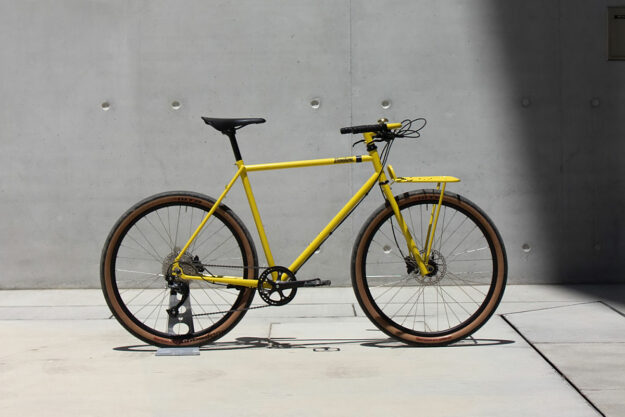
The 2023 Tour de France kicked off last weekend but while the rest of the world can’t seem to see past the maillot jaune riding the latest carbon fiber creation, we’ve only got eyes for Donhou Bicycles’ sunflower-hued Utility Bike.

Tom Donhou has, quite literally, set up shop in Athens: the Donhou Store is his retail therapy where, alongside a fully equipped frame building workshop, he purveys a curated collection of sustainable cycling products — including their Utility bIke.

The exceptionally-versatile Utility Bike is offered as a frame set (which includes frame, fork and handle bar/stem combination), a complete bike or a custom build. The geometry is optimised for a front load, yet is still lively and stable riding unloaded and carefree.

Built from strong and dependable Reynolds 525 tubing, it has all the rack and mudguard mounts you’d require — even a kickstand mount. ISO disc mounts are standard and horizontal dropouts mean you can run it single speed or geared.

Donhou Bicycles has deservedly won numerous awards over the years from all the big shows, and all that experience has been poured into their Utility Bike. This is one bike to do it all, from commuting around town to a leisurely grande boucle around France.
Head to the Donhou Bicycles website for prices and ordering information.

The post All Eyes On Yellow: Donhou Bicycles Utility Bike appeared first on The Spoken.
1. London accounts for about one half of UK Bus Journeys and one quarter of the UK's Bus Fleet.
Source: DfT
2. TfL Buses are ten times more lethal than their presence on London's roads would predict; since 2014, 1 in 10 RTC Fatals and 1 in 10 Pedestrian Deaths in London have involved a TfL bus.
Sources: Mayor of London; TfL; London Assembly
3. TfL's sole metric of bus contract performance is a time-based "Excess Waiting Time"/Headway calculation that independent benchmarking shows London—
- in the highest tercile of its 'world city' peers for Bus Punctuality and Profitability per Bus;
- in lowest tercile of its 'world city' peers for safety (collisions per km);
- London has the least safe public bus system of any major European city.
Sources: Mayor of London; TfL; London Assembly; Imperial College
4. TfL has never conducted any analysis or safety risk assessment of its (a) Bus Franchise Model, (b) Bus Contract Financial Incentives or the (c) iBus System it uses to measure contract performance
Sources: Mayor of London, TfL; London Assembly
5. Bus Driver Fatigue is a well-evidenced systemic problem, with the latest independent study showing 1 in 3 bus drivers reporting a near-miss due to fatigue and 1 in 6 Bus Drivers having fallen asleep at the wheel while driving a bus;
Sources: Mayor of London; TfL; London Assembly; Loughborough University
6. Bus Collisions (2016-2023) - London averages of over 26,000 collisions annually (2023: over 28,000 - so, getting worse) from which —
- about 1200 people are hospitalised per year
- 1 person is killed about every month (2024).
- 80 to 100 people are sent to hospital per month from Preventable Bus Safety Incidents (80% Collisions, 20% Onboard Trips & Falls), 20 of these victims with serious and/or life-changing injuries;
- People killed and seriously injured from Bus Safety Incidents (80% Collisions, 20% Onboard Trips & Falls) are now higher than 2016 despite a) the total number of bus miles has fallen b) the total number of bus users has fallen (c) the total number of buses in London's contracted bus fleet has fallen (d) the total number of Bus Drivers has fallen (e) since 2016, the Mayor of London has announced 3 'world leading' Bus Safety Programmes and a Vision Zero Programme.
Sources: Mayor of London; TfL; London Assembly
7. 25% of London Bus Routes don't have a toilet at 1 end for Bus Drivers.
Sources: Mayor of London; TfL; London Assembly
8. TfL has agreed with Bus Operators and Unite the Union that Bus Drivers don't need a toilet on any route round trip that lasts up to 150 minutes - this was agreed without a single bit of data (i.e, Human Factors Study, HSE Risk Assessment).
Sources: Mayor of London; TfL; London Assembly
9. TfL has evidence of (at least) 12 million (est.) Annual Bus Speeding incidents on file that it does not share with the Police; From January 2017 to January 2024, nearly half (44%) the Bus Collision Deaths occurred in 20mph (or less) zones.
Sources: Mayor of London; TfL; London Assembly
10. Since January 2016, more than 1 pedestrian per month has been injured by a TfL Bus hitting them in a zebra or pelican crossing.
Sources: Mayor of London; TfL; London Assembly
11. Since 1 April 2015, an average of 6 people per month (2022-23: 8 per month- getting worse) have been injured after being struck by a Bus Wing Mirror.
Sources: Mayor of London; TfL; London Assembly
12. TfL received the highest Health & Safety Fine ever in July 2023 for HSE Failures on the Croydon Tram, a contracted surface transport operation that was founded, managed and monitored by TfL's Bus Executives.
Sources: Department of Justice; Mayor of London; TfL; London Assembly; Press Reports
13. While Sadiq Khan has been Mayor, 16 Pedestrians have been killed or seriously injured while in Traffic "Refuges";
Sources: Mayor of London; TfL; London Assembly
14. TfL does not report Law-Breaking by Bus Drivers to the Metropolitan Police for, inter alia—
- Running Red Lights
- Speeding
Sources: Mayor of London; TfL; London Assembly
15. TfL Bus Drivers had the highest rate of death (per 100 thousand) from Covid-19 for any UK Profession (that includes Doctors, Nurses and Healthcare workers)—
- Over Two-Thirds of the TfL Bus Drivers who died from Covid-19 did so after the first Lockdown;
- TfL data shows Bus Drivers were still dying from Covid-19 through 2022, after which it stopped collecting this information;
- TfL has never requested any of its Bus Operators to provide a Covid-19 Garage Risk Assessment.
Sources: Mayor of London; TfL; London Assembly; University College London
Notes to Sources:
1. Analysis of published DfT Data—
In March 2023, 30,154 buses were operated by local bus services in England, with 8,788 of them in London
2. Analysis Data Extracted from TfL's "Casualties in London" Reports; DfT Annual Bus Statistics; TfL "Travel in London" Reports; London Assembly Investigations; Mayor's Questions
"Buses contracted to Transport for London (TfL) constitute approximately 2% of total motorized road traffic in Greater London. This includes all buses, not just TfL-contracted ones, but TfL buses dominate the category."
"The percentage of TfL buses in total traffic has seen fluctuations over the years. In 2019/20, buses constituted about 1.2% of motorized road traffic in Greater London. This percentage dropped significantly during the pandemic in 2020/21 to 0.4%, reflecting reduced public transport usage. By 2022/23, the percentage had rebounded to around 1.5%. This indicates a recovery trend but still not reaching pre-pandemic levels."
3. Mayor's Questions, TfL's published Bus Performance Data, Internal Bus Operator Communications
5 Year Data (2015-2019)
5. http://content.tfl.gov.uk/bus-driver-fatigue-report.pdf
6. https://tfl.gov.uk/corporate/publications-and-reports/bus-safety-data
12. https://www.judiciary.uk/wp-content/uploads/2023/07/R-v-TfL-270723.pdf
15. https://content.tfl.gov.uk/initial-assessment-of-london-bus-driver-mortality-from-covid-19.pdf;

Finally got to that stage of frame fabrication where I could prop it up and fit check it. Sitting on a bike project for the first time is an important milestone - it's no longer just endless work toward an impossibly distant goal - it's strong motivation to see it roll for the first time (Next milestone) and test ride it (Last milestone).
Normally, I tack weld the entire frame assembly together, fit check it during some stage of that, then finish weld it (Including capping open tube ends) when there's nothing left to add. This time, some tubes had to be trimmed, capped, and finish welded before continuing on with the next operations. So off the bench it came, work was done, and, well, there it is,
The primary frame structure is done now - time to finish connecting the dots with some triangulation. According to the scale, this frame looks like it will weigh just over half of the last one. The suspension is already done - still have to make the steering system before I have a finished roller. I have no idea when I'll reach that milestone, but it is that much closer to getting there.
By email and blog post
10 December 2024
Sadiq Khan, Mayor of London and TfL Chair
City Hall
Kamal Chunchie Way
London E16 1ZE
cc: Transport Commissioner; Deputy Mayor for Transport; Deputy Mayor for Social Justice and Communities, London Victims' Commissioner; Walking and Cycling Commissioner; TfL Board Secretariat; TfL SSHR Panel Secretariat; London Assembly Transport Committee Members; Tom Kearney (@comadad)
Dear Mr. Mayor,
On 3 December I received a response (below) to my 29 October Open Letter (TfL's 'Safety Scandal' will be your Legacy! An Open Letter to the Mayor of London from Kevin Mustafa) from your Deputy Seb Dance that confirmed to me that both TfL and you appear to be incapable of showing either the compassion or the concern that are urgently required to reform TfL's "institutionally unsafe" Bus Operation.
In order to ensure that TfL Bus Drivers are provided with working conditions that will allow them to drive safely and with duty of care, as Mayor of London and TfL Chair, you have both the legal authority and statutory responsibility to incorporate the London Bus Drivers' Bill of Rights into London's Framework Bus Services Contract. But your longstanding refusal to honour the previous Mayor's 1 February 2016 commitment to "update TfL's bus contracts to include new safety incentives" within "three months" confirms that both Bus Drivers' and the public's safety are not your priorities.
Frankly speaking, I know that London's Bus Drivers believe that your refusal to replace TfL's "Time is Money" Bus Contract incentives with those that protect Bus Driver Working Conditions is a betrayal of the principles upon which the Labour Party and the union movement that created it are founded. I am convinced that your failures to act as a prudent and responsible TfL Chairman have cost the lives of at least (now) 87 people in preventable Bus Safety Incidents, as well as 76 Bus Drivers from Covid-19 during your time in office. While your allies in the London Labour Party ignore TfL's Safety Scandal, London's Bus Drivers will not be letting you and your Deputy bamboozle them with the kind of gaslighting so evident in your Deputies' public statements over the years.
And we will not stop until you (a) write The London Bus Drivers' Bill of Rights into TfL's Framework Bus Contract and (b) ensure these commonsense actions are undertaken by TfL and its Bus Contractors without delay.
Yours sincerely,
Kevin Mustafa
Attachment 1: London Bus Drivers' Bill of Rights
Attachment 2: 3 December 2024 Letter from Deputy Mayor, Transport
London Bus Drivers' Bill of Rights
1. The Right to a safe work schedule without any forced overtime or loss of pay
2. The Right to a decent and proper rest break in the working day
3. The Right to drive a safe and well-maintained vehicle
4. The Right to clean, serviced toilet and rest facilities on all bus routes
5. The Right to report safety concerns without fear of retribution from TfL or employers
6. The Right, when seriously ill and covered by a doctor's note, to not be harassed into coming into work until fit to do so
7. The Right to relevant and timely safety training
8. The Right to drive without being forced to answer radio messages and texts from Controllers whilst in motion
9. The Right to have all company rules in writing and clearly displayed
10. The Right to be treated with dignity and respect by our employers, TfL and the public
11. The Right to Working Air Cooling in our cabs in the summer heat
12. The Right to Working Heaters in our cabs in the cold of winter


One of over Ten Thousand TfL Bus Crash Survivors since 18 December 2009 (Photo: Tom Edwards)
Remember Remember the 5th of November.
Thanks to you London Bus Drivers, I know I sure will.
Back on 18 September 2013, I attended a meeting here in Palestra House initiated by Victoria Borwick AM and hosted by the then-MD for Surface Transport, Leon Daniels, now a Director of TfL Bus Contractor RATP.
At that meeting, Daniels proudly announced that the reason why TfL's management of London's Public Bus Services was so successful was because its Bus Contracts work on a single overriding principle that "Time is Money", which guaranteed faster and more reliable bus journey times for London's Bus Users.
Thanks to Victoria Borwick's successful lobbying of Mayor Boris Johnson, we now have over ten years of published TfL Bus Safety Performance Data that clearly indicates how those "Time is Money" Contracts are doing—
- An average of three people a day are hospitalised from a preventable Bus Safety Incident, at least one of which is a collision;
- About every five to six weeks, someone is killed in a preventable Bus Safety Incident, mostly from collisions;
- For the past decade, one of every ten Deaths from Road Traffic Collisions in London has involved a TfL Bus.
- For the past decade, one of every Deaths of Pedestrians from Road Traffic Collisions in London has involved a TfL Bus.
- Since this Mayor was elected, at least eighty-seven people have been killed in preventable Bus Safety Incidents, mostly collisions.
- This year, over 1 person per month has been killed in a preventable Bus Safety Incident, mostly collisions.
But London's Bus Users are happy that London Buses are frequent and reliable and—quite often— too fast.
The people in the building behind us don't often advertise the lethal trends contained in TfL's published data, but—at long last— London's press is starting to take an interest.
In addition to the Mayor's "Vision Zero" Programme, TfL also crows about the at least four 'world leading' Bus Safety initiatives it's announced since 2016. But since TfL's own published data reveals that the number of people killed and seriously injured from preventable bus safety incidents is now higher than when this Mayor took office in May 2016, it's clear to anyone who bothers to pay attention that none of TfL's 'world leading' Bus Safety programmes are working.
Why?
Because the "Time is Money" Financial Incentives in TfL's "Quality Incentive [Bus] Contracts" haven't changed since they were first rolled out by TfL in the summer of 2001.
And because Headway and Mileage still serve as the only performance metrics in TfL's "Time is Money" Bus Contracts, it doesn't take a rocket scientist to figure out if TfL is financially incentivising its Bus Contractors to prioritise Headway and Mileage—while their Buses share roads with increasing numbers of cars, lorries, cyclists, pedestrians and scooters—that London Bus Drivers' ability to drive with duty of care is, frankly, impossible.
And TfL blame the Victims and Bus Drivers for the tens of thousands of preventable Bus Safety Incidents that are the inevitable result of "Time is Money" Bus Contract Incentives.
Inevitable?
Yes! Inevitable.
You see? Bus Operators have long told us that sixty percent of the cost of running a bus is the cost of the Driver.
In the "Time is Money" Bus Contract environment that has prevailed in London since 2001, any money earned by the Bus Operator, and any time saved to make the Bus System more efficient, is "time" that is being robbed from the Bus Driver to do his or her job safely and with duty of care.
- Not enough time to use the loo.
- Not enough time for recovery on stand time.
- Not enough time to conduct first use checks.
- Not enough time to ensure that all passengers are seated safely before departing.
- Not enough time spent at a Bus Stop to pick up a passenger in a wheelchair.
- Not enough time spent at home with family, de-stressing, resting or sleeping.
The Framework Contract TfL uses today is dated 1 January 2016.
That means TfL's Bus contracts are silent about—
- all the TfL's 'world leading' Bus Safety Initiatives the Mayor of London's announced since 1 February 2016.
- Vision Zero.
But these Bus Contracts are very loud about "Time is Money".
London's Poor Working Conditions and London's ghastly record of Bus Safety Performance will never change until this Mayor puts an end to TfL's "Time is Money" Contracts. Just like the previous Mayor of London promised to do 'over the next three months' on 1 February 2016.
In fact, the twelve simple "Rights" shown in the London Bus Driver Bill of Rights—
1. The Right to a safe work schedule without any forced overtime or loss of pay
2. The Right to a decent and proper rest break in the working day
3. The Right to drive a safe and well-maintained vehicle
4. The Right to a clean, serviced toilet and rest facilities on all bus routes
5. The Right to report safety concerns without fear of retribution from TfL or employers
6. The Right, when seriously ill and covered by a doctor's note, to not be harassed into coming into work until fit to do so
7. The Right to relevant and timely safety training
8. The Right to drive without being forced to answer radio messages and texts from Controllers whilst in motion
9. The Right to have all company rules in writing and clearly displayed
10. The Right to be treated with dignity and respect by our employers, TfL and the public
11. The Right to Working Air Cooling in our cabs in the summer heat
12. The Right to Working Heaters in our cabs in the cold of winter
—provide perfect evidence of the fact that TfL Bus Contracts have been taking the time away from London's Professional Bus Drivers that's required to perform their jobs safely and with duty of care, and converting that time (i.e., "money") saved into profits for Bus Operators.
The Bill of Rights being demanded by London Bus Drivers are just Human Rights that TfL's "Time is Money" Bus Contracts have taken away from them just so London's Buses are convenient for Bus Users.
And now London Bus Drivers have decided that the "time" for being abused by these "Time is Money" Bus Contracts must end NOW.
It's about time.
It's always been about time.
Thank you for your time today.

TfL: Time's Up on Dangerous Bus Contact Incentives!
By email and blogpost
Elly Baker, Chair
London Assembly Transport Committee
City Hall
Kamal Chunchie Way
London E16 1ZE
1 November 2024
cc: London Assembly Transport Committee Members, Tom Kearney #LondonBusWatch
RE: 5 November London Bus Drivers' Protest at TfL Headquarters - Open Letter
With the support of Unite the Union, on Tuesday, 5 November I will join many London Bus Drivers in a march and demonstration at TfL Headquarters to hold Sadiq Khan to account for the 'Safety Scandal' that has resulted in the deaths of at least 86 people from Bus Safety Incidents and 76 London Bus Drivers from Covid-19 while he has served as TfL Chair and Mayor of London.
We are demanding that TfL and the Mayor immediately accept a London Bus Drivers' 'Bill of Rights' that I've attached for your information and review.
While I still await your direct response my 26 June Open Letter, if you study the Bill of Rights and what I have requested the Transport Committee to investigate, i.e.—
- The Contradiction between TfL's Bus Contract Timeliness Incentives and Speed Limits;
- TfL's Refusal to Require Independent Bus Crash Investigations;
- TfL's Failure to conduct Risk and/or Human Factors Assessments of Bus Driver Working Conditions that are known to have a direct impact upon Safety Performance.
—you might appreciate that Bus Drivers are not going to wait months or years until the Transport Committee deigns to get around to scrutinising TfL and the Mayor for creating and maintaining working conditions where we cannot operate our vehicles safely and with duty of care.
I am pleased Unite the Union is supporting this entirely London Bus Workers'-initiated Direct Action next week. If you lead the Transport Committee to investigate the issues I raised in my 26 June Open Letter, you will discover why our grassroots protest is so necessary.
I await your direct reply to my 26 June Open Letter.
Yours sincerely,
Lorraine Robertson
Attachment: London Bus Drivers' Bill of Rights
London Bus Drivers' Bill of Rights
1. The Right to a safe work schedule without any forced overtime or loss of pay
2. The Right to a decent and proper rest break in the working day
3. The Right to drive a safe and well-maintained vehicle
4. The Right to clean, serviced toilet and rest facilities on all bus routes
5. The Right to report safety concerns without fear of retribution from TfL or employers
6. The Right, when seriously ill and covered by a doctor's note, to not be harassed into coming into work until fit to do so
7. The Right to relevant and timely safety training
8. The Right to drive without being forced to answer radio messages and texts from Controllers whilst in motion
9. The Right to have all company rules in writing and clearly displayed
10. The Right to be treated with dignity and respect by our employers, TfL and the public
11. The Right to Working Air Cooling in our cabs in the summer heat
12. The Right to Working Heaters in our cabs in the cold of winter
By email and blog post
29 October 2024
Sadiq Khan, Mayor of London and TfL ChairCity Hall
Kamal Chunchie Way
London E16 1ZE
cc: Transport Commissioner; Deputy Mayor for Transport; Deputy Mayor for Social Justice and Communities, London Victims' Commissioner; Walking and Cycling Commissioner; TfL Board Secretariat; TfL SSHR Panel Secretariat; London Assembly Transport Committee Members; Tom Kearney (@comadad)
Dear Mr. Mayor,
With the support of Unite the Union, at 1100 on Tuesday, 5 November I will be leading London Bus Drivers in a march from Unite the Union's Regional London Office in Islington down to TfL Headquarters on Blackfriars. When we arrive at Palestra House, we will demonstrate to hold you and TfL to account for the 'Safety Scandal' that has resulted in the deaths of at least 86 people from Bus Safety Incidents and 76 London Bus Drivers from Covid-19 while you have served as TfL Chair and Mayor of London.
I woke up to your 'Safety Scandal' in Spring 2020, while I was working as a Bus Driver Driver for a Singapore-based London Bus Contractor. While my colleagues across London fell ill and died from Covid-19, I couldn't help but notice that Company Managers and TfL officials, had effectively, vanished.
I've since learned that, in April 2020, while—
- my employer had already distributed masks in February to its transport employees in Singapore; and,
- TfL was already distributing masks to its own employees;
—TfL was telling Unite the Union "masks not necessary". I've also learned TfL never requested copies of Covid-19 Risk Assessments from its Bus Contractors.
Like many other Bus Drivers, I am convinced that my colleagues had the highest rate of deaths from Covid-19 in the United Kingdom in April 2020 because of your and TfL's well-evidenced failures to use the powers you had—and had already exercised to protect TfL employees—to save London's Bus Drivers.
Since that traumatic time, I've had the opportunity to—
- to speak with TfL officials in person about their failure to protect Bus Drivers during Covid;
- exchange letters with your Deputy Mayor about the "Culture of Fear" TfL permits on its contracted Bus Operation which prevents Bus Drivers reporting their well-founded concerns about safety problems to their managers or TfL;
- be gaslighted by you about Poor Bus Driver Working Conditions on James O'Brien's "Speak to Sadiq",
Like you, I've also had the opportunity to read—
- your responses to hundreds of Mayor's Questions about Bus Safety (dozens of which were submitted on my behalf);
- three London Assembly Transport Committee Bus Safety Investigations;
- three 'world leading' Bus Safety Programme announcements by TfL;
- your own "Vision Zero" announcement
—and I 'm convinced that your and TfL's constant refrain that, for Buses, "Safety is TfL's first priority" is just a lie you've made for media consumption.
Why?
Because TfL's latest Framework Contract for Bus Services in London—dated 1 January 2016—has zero requirements for safety performance—
- TfL Bus Contracts contain nothing about 'world leading' Bus Safety Programmes
- TfL Bus Contracts contain nothing about Vision Zero
But TfL Bus Contracts contain everything about the absolute requirement for London Buses to run On Time, Frequently and Efficiently for the convenience of London's Bus Users and for the benefit of Bus Operator Shareholders.
Perhaps that explains why—
- the number of people killed and injured by Buses is higher now than when you took in May 2016;
- so many of my colleagues fell ill snf died from Covid-19;
- TfL chooses to mislead Londoners about the actual number of people killed and injured in preventable Bus Safety Incidents;
- Bus Drivers report that Driver Fatigue, Lack of Toilet Dignity and Unsafe Bus Cab Temperatures are more prevalent today than ever before;
- Bus Drivers today must demand the basic human rights shown in the London Bus Drivers' Bill of Rights I've attached for your information and immediate approval.
Please look closely at the Rights London Bus Drivers require today so that they can drive safely and with duty of care on London's increasingly congested-roads.
As TfL Chair since May 2016, aren't you the least bit ashamed that Bus Drivers even feel compelled to march to TfL Headquarters on 5 November to demand these Human Rights to work safely on a contracted Bus Operation that reports to you?
If you continue to refuse London Bus Drivers this Bill of Rights, TfL's Safety Scandal will be your Legacy.
Yours sincerely,
Kevin Mustafa
Attachment: London Bus Drivers' Bill of Rights
London Bus Drivers' Bill of Rights
1. The Right to a safe work schedule without any forced overtime or loss of pay
2. The Right to a decent and proper rest break in the working day
3. The Right to drive a safe and well-maintained vehicle
4. The Right to clean, serviced toilet and rest facilities on all bus routes
5. The Right to report safety concerns without fear of retribution from TfL or employers
6. The Right, when seriously ill and covered by a doctor's note, to not be harassed into coming into work until fit to do so
7. The Right to relevant and timely safety training
8. The Right to drive without being forced to answer radio messages and texts from Controllers whilst in motion
9. The Right to have all company rules in writing and clearly displayed
10. The Right to be treated with dignity and respect by our employers, TfL and the public
11. The Right to Working Air Cooling in our cabs in the summer heat
12. The Right to Working Heaters in our cabs in the cold of winter
Elly Baker, ChairLondon Assembly Transport CommitteeCity HallKamal Chunchie WayLondon E16 1ZE23 September 2024
cc: London Assembly Transport Committee, Members and Staff
Good Morning Elly Baker,
I received the attached letter from you as Transport Committee Chair "responding to your email from 26 June 2024" on 19 July via a Committee Staffer.
As you know, my 26 June email to you and the Committee simply contained a link to an Open Letter from former TfL Bus Driver Lorraine Robertson: acting on Lorraine's express instructions, I was pleased to post her letter on my blog and email the link to you and the Committee on 26 June.
Although I intend to respond publicly to your 19 July letter to me in due course, kindly note it's been over two months and Lorraine Robertson still awaits your response to the issues she requested the Transport Committee to investigate, namely—and quoting directly from her 26 June Open Letter—
- The Contradiction between TfL's Bus Contract Timeliness Incentives and Speed Limits;
- TfL's Refusal to Require Independent Bus Crash Investigations;
- TfL's Failure to conduct Risk and/or Human Factors Assessments of Bus Driver Working Conditions that are known to have a direct impact upon Safety Performance.
Yours sincerely,
Tom Kearney#LondonBusWatch T: ddddddddddddddE: comadad1812@gmail.comTwitter: @comadad Blog: www.saferoxfordstreet.blogspot.co.uk 2018 Winner, Community Hero Award — The Johns Hopkins University Alumni Association2016 Winner, Transport - Sheila McKechnie Foundation SMK Campaigners Award
.jpg)
.jpg)
London Assembly Transport Committee
City Hall
Kamal Chunchie Way
London E16 1ZE
cc: London Assembly Transport Committee, Members and Staff
Dear Elly Baker,
RE: Open Letter - Assisting the Inevitable Independent Inquiry about the Safety of the London Contracted 'Bus Market' Model
Congratulations on your re-election to the London Assembly and your selection to serve as Chair of the Transport Committee. You may recall that we had a chance to meet on 14 December 2021 when I gave evidence as a veteran TfL Bus Driver for the Transport Committee's Investigation of the Mayor's Vision Zero Programme.
While you're busy considering your Committee's plan-of-work for the coming four years, I'd like to call your attention to some Transport Committee scrutiny that I believe that might be required in the nearest future, specifically to assist that requested in Resolution 6 carried unanimously by the RMT National Industrial Organising Conference of Bus Workers on 28 April 2023:
Resolution 6: Independent Inquiry about the Safety of the London Contracted 'Bus Market' Model
"That this RMT National Bus Workers Industrial Organising Conference calls upon the RMT N.E.C. to support and campaign for an independent inquiry about the safety of the London Contracted Bus Market Model that is being adopted by other UK cities. This conference notes that, while London's Contracted Bus Market Model is being adopted by other cities and regions throughout the UK, the London Assembly and independent campaigners have published well evidenced reports showing that TTL's contracted bus operation is as described by a former TfL board member and safety panel chair in evidence submitted to the London Assembly in 2020, "Institutionally unsafe".
Over the 5 year period from 2016-2021, from collisions involving a TfL bus, an average of two people per day have been sent to hospital and 1 person has been killed every four to six weeks, an egregious bus safety performance record that places London in the lowest quartile for bus safety performance when independently benchmarked to its world city peers. Added to this appalling bus safety performance record is the fact that during the COVID pandemic, drivers died at twice the rate as expected based on age, ethnicity and home post code.
Based on the London Model's well evidenced poor safety performance record, this conference calls upon the RMT N.E.C. to ask the House of Commons to launch an independent Inquiry of the systematic safety problems associated with TfL's Contracted Bus Market Model."Although your colleague on the Transport Committee, Keith Prince AM, brought this important Resolution to the Mayor's attention in May 2023, Sadiq Khan's non-committal response coupled with the lack of news from Westminster or City Hall about any Independent Inquiry suggests that what RMT's Bus Workers requested in 2023 remains unconsidered by the public officials vested with the powers to do it.
However, with the Labour Party's imminent national election victory and its Manifesto committing a Labour Government to 'build on the work of Labour mayors' to give 'new powers for local leaders to franchise local bus services'—I believe that the Safety Performance of London's Bus Franchise Model will become the focus of a lot of scrutiny, if not from City Hall, certainly from Westminster and the national press.
Why?
Because, as you most certainly already know—
- London is home to the largest franchised Bus Operation in the United Kingdom: TfL Bus Franchise Contracts account for 50 percent of UK Bus Journeys conveyed by 25 percent of the country's Bus Fleet;
- On 11 April 2024, Labour's shadow transport secretary, Louise Haigh MP set out the party's plans for a better bus network across England, with a promise— "to allow every community across the country to take back control of local bus services"—and specifically cited London as a model;
- In the words of former TfL Board Director and Safety Panel Chair Michael Liebreich, TfL's Bus Franchise Model is "Institutionally Unsafe";
- Since 2007, TfL's own published data shows that—year-on-year—London buses have accounted for 10% of all of London's road fatalities and about 10% of all pedestrian fatalities in London despite Buses' presence on the road over this period having declined from constituting about 3% to about 1% of all vehicles on the road at any given time;
- TfL's sole measure of bus contract performance is a time-based "Excess Waiting Time" calculation which Independent benchmarking shows London—
- in the highest tercile of its 'world city' peers for Bus Punctuality and Profitability per Bus;
- in lowest tercile of its 'world city' peers for safety (collisions per km): based on this published independent annual benchmark data, London appears to have the least safe bus system of any major European city;
- TfL has never conducted a safety risk assessment of the Bus Franchise Model or its Bus Contract Financial Incentives;
- 1 in 5 of the London Bus Drivers surveyed by Loughborough University (2017) indicated that they had to fight sleepiness at least 2-3 times a week, and about 1 in 4 had a 'close call' due to fatigue in the past 12 months;
- For decades, TfL's contracted Bus Operation has averaged over 26,000 Bus collisions annually—in 2023, TfL recorded over 28,000—from which
- about 1200 people are injured every year;
- 1 person is killed about every six weeks;
- 80 to 100 people are sent to hospital every month from Preventable Bus Safety Incidents (80% Collisions, 20% Onboard Trips & Falls), over 20 of these victims with serious and/or life-changing injuries;
- Over one quarter of London Bus Routes don't have a toilet for Bus Drivers at one end of the route;
- TfL has agreed with Bus Operators and Unite the Union that Bus Drivers don't need a toilet on any route round trip that lasts up to 150 minutes — this 'criteria' was agreed without a Human Factors or Risk Assessment;
- TfL has evidence of (at least) 12 million (est.) Annual Bus Speeding incidents on file that it does not share with the Police;
- Since January 2016, more than 1 pedestrian per month has been injured by a TfL Bus hitting them in a zebra or pelican crossing;
- Since 1 April 2015, an average of 6 people per month (2022-23: 8 per month- getting worse) have been injured after being struck by a Bus Wing Mirror;
- TfL received the highest Health & Safety Fine ever in July 2023 for HSE Failures on the Croydon Tram, a contracted surface transport operation that was founded, managed and monitored by TfL's Bus executives;
- Transport for London (TfL) does not require the bus operating companies to share copies of their risk assessments covering activities within their garage environments. This includes any that were created or updated as a result of Covid-19.
- despite the facts that—
- the total number of bus miles in London has declined;
- the total number of bus users in London has declined;
- the total number of buses in London's contracted bus fleet has declined;
- the total number of Bus Drivers in London has declined, and,
- since 2016, the Mayor of London has announced 3 'world leading' Bus Safety Programmes and a Vision Zero Programme;
—the number of people killed and seriously injured from Bus Safety Incidents are now higher than 2016.
To get ahead of the national press and Westminster, I would strongly advise you urgently to lead the Transport Committee to build upon the evidence and conclusions found in the London Assembly's March 2024 "Bus, Tram and Tube Safety" Investigation and perhaps focus on three specific areas highlighted in Appendix 1 of that investigation—
- The Contradiction between TfL's Bus Contract Timeliness Incentives and Speed Limits;
- TfL's Refusal to Require Independent Bus Crash Investigations;
- TfL's Failure to conduct Risk and/or Human Factors Assessments of Bus Driver Working Conditions that are known to have a direct impact upon Safety Performance;
If you choose to lead such an urgent investigation as Chair of the London Assembly Transport Committee, kindly note that I will, once again, be pleased to contribute evidence as a veteran London Bus Driver. If you choose not to lead such an investigation, then those who inevitably will do so can find my open letter on the public record.
Yours sincerely,
Lorraine RoberstonLondon Bus Driver (Retired)
8 More Minutes... [ 20-Apr-24 10:08pm ]

I am grateful for the opportunity to once again address the RMT's Bus Worker National Industrial Organising Conference. I congratulate its organisers and RMT Union on celebrating this important conference's 81st year.
Since this is the third National Conference in which I've been honoured to share my transport research with members since 2018, I'd like to follow up with you all on a resolution that was put forward last year by the Nottinghamshire & Derbyshire Branch and passed by members which called upon "the House of Commons Transport Committee to launch an Independent Inquiry of the Systemic Safety Problems associated with Transport for London's 'Contracted Bus Market' Model."
What progress has the union made on putting this Resolution into effect?
If the answer is "none", I'd like to underscore why such an Independent Inquiry is critical today and to provide you with some encouragement—and perhaps some useful data—to ensure that such an Independent Inquiry is conducted, if not by the Commons Transport Committee, then perhaps by the RMT or the broader UK Trade Union movement.
The 2017 Bus Services Act gave devolved regional authorities the right to contract public Bus Services from private Bus Operators under terms and conditions written, negotiated and enforced by these local authorities, something London's Mayor has been doing through TfL since 2000. As you know, the London Bus Franchise Model was recently adopted by Manchester's Mayor Andy Burnham, much to the acclaim of the national press, the Labour Party and its supporters.
In fact, yesterday's Labour Party "Better Buses" announcement by its Shadow Transport Secretary reaffirms its support for the London Bus Franchise Model, e.g. —
"Where bus franchising is in place, in London and Greater Manchester, buses have thrived."
— and further promises—"to allow every community to take back control of their buses by removing barriers that currently limit bus franchising powers only to metro mayors."
As I have concluded from investigating London's long experience of having Mayoral control over Bus Services, buses "thriving" really means that the politicians who oversee London's public bus network put Bus Passengers' convenience ahead of everyone else's safety, including Bus Drivers' and other Road Users', pedestrians' especially.
The London Bus Franchise Model is "Institutionally Unsafe"
London's quarter-century experience with Mayoral control of the bus public network has shown that, essentially, Bus Passengers only care if their Bus is Cheap, Convenient and Timely.
For decades, that 'Holy Trinity' has served as TfL's overwhelming priority in its contracting of Bus Services in London, a city which accounts for about 50% of UK Bus Journeys and 25% of the country's Bus Fleet.
The fact that these cheap, convenient and timely London Buses—
- share the roads with growing numbers of other road users—increasingly on two wheels and their feet —who have a right to consider their journey just as important as Bus Users';
- impose negative externalities like pollution, particularly from the majority of London Buses running on diesel: a whopping 77 percent of TfL's Contracted Bus Fleet run solely on diesel (45 percent) or are diesel hybrids (32 percent), which will continue to pollute for decades;
- because of their size and mass, carry a much higher risk of death and serious injury from crashes, which is borne out by the fact that TfL buses—about 2% of total traffic—have been involved in 1 in about every 10 of all London road fatalities since 2007. Note: in June 2016, TfL's (now Chief Safety Officer) told the Parliamentary Advisory Council for Transport Safety "Buses are four times more likely to be involved in a KSI collision with a pedestrian than would be expected for their share of traffic"—and TfL's published data reveals that people killed or seriously injured (KSI) from Bus Collisions have increased since 2016.
— rarely register on most Bus Users', TfL and Bus Company Bosses' and London politicians' radar screens.
As a result of the London Bus Franchise Model's contract priorities, the Bus System's Operational Safety Performance and Driver Working Conditions have suffered because if London's Mayors and local politicians actually made these a priority, they'd find themselves in direct conflict with a longstanding systemic principle that "Time is Money" which has long served as the only public bus service performance metric in London that matters. TfL's sole measure of public Bus Contract Performance is for its Bus Contractors to stick to the costs based on running times they've contractually agreed with TfL.
Remember: 60% of the cost of running a public Bus is the Driver, so there is a systemically-reinforced disincentive for TfL and its contractors to add any extra bus drivers to routes where any new or emerging reality conflicts with (a) costs and (b) profits directly tied to already-contracted Bus Service Performance levels. Instead, TfL and its Bus Operators choose to put pressure on Bus Drivers to compensate for what former TfL Board Director and Safety Panel Chair Michael Liebreich has evidenced is an "Institutionally Unsafe" contractual arrangement. And this pressure means Bus Drivers work while fatigued, distracted by System Controllers and frequently exceed the legal speed limit just so that their Bus Operator employer can meet TfL's contracted timeliness and availability targets.
Under the London Bus Franchise Model, making Bus Drivers pay for TfL's and Bus Operators' lethal contract priorities is called "efficiency". And any Mayor who claims to be contracting a public bus operation from for-profit Bus Companies more 'efficiently' for passengers who, at the time same, is not increasing fares or local taxes to fund this 'improvement', means that all this new efficiency is being funded by reductions to your pay and through degrading working conditions which have a direct impact on your safety performance.
From my own experience underpinned by over a decade of research (all in the public domain), I know that the London Bus Franchise Model is both big business for Bus Operators and lethal for both Bus Workers and the general public. Since I began my research after recovering from critical injuries sustained in a Bus Crash in 2009, TfL's published data reveals that over 150 people have been killed and thousands have been seriously injured from preventable Bus Safety Incidents, the vast majority of these casualties generated from collisions. Since the current Mayor was elected in May 2016, at least 77 people have been killed from preventable Bus Safety Incidents, over three quarters of which were from collisions.
A recently issued cross-party London Assembly Transport Committee Investigation—its third since 2017—continued to highlight the same problems with the London Bus Franchise Model evidenced in the Assembly's previous investigations, i.e, Driver Fatigue, Lack of Toilet Dignity, and Pressure to meet TfL's contracted timeliness and availability targets. Despite the London Mayor's announcement of 3 'world leading' Bus Safety Programmes and a Vision Zero Programme since 2016, the number of people killed and injured in Bus Safety Incidents in London is higher today than when the first of these Safety Programmes was announced on 1 February 2016. Seeing that London's total Bus Fleet Size, Bus Mileage, and the actual number of both Bus Users and Bus Drivers have all shrunk since 2016, London Buses' negative safety trend is especially alarming. By all metrics of systemic safety, the London Bus Franchise Model is a manifest failure.
Since I'm limited for time, please allow me to detail only a few of these systemic failures:
- Bus Collisions: despite the fact that London has fewer Buses, Bus Drivers and fewer Bus Miles run, Bus Collisions are now higher today than they were than when the present Mayor was elected in 2016. In 2023, TfL recorded over 70 Bus Crashes per day. TfL's annual tally for Bus Crashes now exceeds the number of London Bus Drivers: that's more than 1 recorded crash per London bus driver per year. Since 2018, when London's Bus System Performance has been compared to its global 'world city peers', the city regularly appears in the quartile having the highest bus "collisions per km". I would wager London is the only European city to occupy this dubious place in the international benchmarking tables year-after-year.
- Preventable Bus Safety Incident Injuries: Total Injuries generated from Preventable Bus Safety Incidents—the vast majority from collisions, but increasing numbers of passenger trips and falls onboard—are now higher than they were than when the present Mayor was elected. Since 2016, an average of 3 people a day are sent to hospital from Preventable Bus Safety Incidents and, about every 6 weeks, someone has been sent to the morgue. Remember: London has fewer Buses, Bus Drivers and fewer Bus Miles run than when the present Mayor was elected, so every bus, every bus mile, and every public bus journey is now more dangerous today than it was when the current "Vision Zero" Mayor was elected.
- Bus Collision Investigations: in sharp contrast to the Rail, Air, and Maritime Sectors, Transport for London entrusts its Bus Contractors to carry out their own crash investigations. In fact, the Mayor has rejected all recommendations by London Assembly Members to establish an Independent Bus Crash Investigation Branch for London. The peculiar fact that TfL allows its Bus Contractors to investigate their own crashes was recently raised in the House of Lords by Lord Hampton. I hope that this scrutiny by Lord Hampton is a leading indicator that Westminster might take a greater interest in the known safety failings of the London Bus Franchise Model.
- Bus Driver Fatigue: even though there is plenty of published evidence proving Bus Driver fatigue is chronic problem throughout the London Bus Operation and the Mayor has full authority to act to take meaningful and immediate action to mitigate it, the Mayor has refused to compel TfL to redesign London Bus Contracts to ensure that Bus Operators aren't financially-incentivised to enforce Fatigue-Inducing Rosters, Rotas and Working Practices.
In fact, it is quite telling that, despite (a) the Mayor's announcements of 3 'world leading' Bus Safety Programmes, Vision Zero and (b) TfL incurring the largest Health and Safety Fine ever for Surface Transport Safety failings in July 2023, TfL's Framework Bus Contract has not changed since it was last updated in January 2016.The 2017 Loughborough Bus Driver Fatigue Report found that "stress and mental overload whilst driving" and "time pressure" from, inter alia, "headway" contributed to a working environment where 1 in 5 of the London Bus Drivers surveyed by Loughborough indicated that they had to fight sleepiness at least 2-3 times a week, and about 1 in 4 had a 'close call' due to fatigue in the past 12 months.
- Yet, in response to a question about the relationship between "Rest Day Working and Bus Safety Incidents" from London Assembly Member Neil Garratt in February 2023, the Mayor confirmed:
"The type of shift being worked at the time of an incident is not information that is routinely captured as part of the bus operator's initial incident reporting to Transport for London (TfL)."
- In a response to a question about TfL's 'Bus Fatigue Management Working Group' from London Assembly Member Keith Prince in October 2023, the Mayor confirmed that this group meets in secret, has no published minutes or agendas and does not include any representatives of bus drivers or the public.
- University College London's March 2021 Phase 2 Consulting Report about London Bus Driver Deaths from Covid-19 concluded and recommended—"Fatigue is a pre-existing issue for some bus drivers, with some evidence that COVID-19 infection and lockdown has contributed to this. Action, already being taken following previous research into factors contributing to tiredness, should be enhanced to address any new issues arising from the pandemic, following a short-term review of shift lengths, patterns and rotas"—Yet, despite repeated questioning from Keith Prince AM since 2021, the Mayor recently confirmed that TfL has yet failed to conduct a ""short term review of shift lengths, patterns and rotas" over three years after this recommendation was made.
If "True ignorance is not the absence of knowledge, but the refusal to acquire it" then the Mayor's and TfL's apparent witting ignorance about the causes and effects of Fatigue among London Bus Drivers is, in my honest opinion, grossly negligent.
- Lack of Toilet Dignity: TfL is responsible for ensuring that its contracted Bus Drivers have access to toilets while working and we know that 1 in 4 London Bus Routes lack Bus Driver Toilets at one end. The Mayor says that this lack of Toilet Dignity has been agreed with London Bus Workers only-recognised union, Unite, but neither the Mayor nor Unite will provide a copy of that agreed criteria. The Mayor recently revealed that this 'longstanding' criteria has never been subjected to a 'human factors' risk assessment.
- Hot Cabs: even though he has full powers to act, the Mayor refuses to ensure that TfL Bus Contractors' will not force London Bus drivers "to drive - and will also suffer no consequences from their employer for refusing to drive - any London bus with a cab temperature that exceeds that for safe transport of livestock in the UK." Last summer, Bus Drivers were regularly recording 40c in their cabs yet the Mayor refuses to inform the public what happened to the Bus Driver that newspapers reported had passed out in the bus cab from the heat and subsequently crashed.
- Lack of Corporate Governance on Safety (1): the Mayor refuses to invite representatives of the public and Bus Workers to attend the Safety Bus Meetings TfL convenes every quarter with its Bus Contractors. If Bus Drivers aren't in the room where TfL decides safety policy with its contractors, then London Bus Safety Policy's happening without them. If Labour's going to give all local authorities the right to franchise Bus Services, Bus Workers need to be in the room where safety policies are negotiated, agreed, implemented and monitored. In London's Bus Franchise Model, the Mayor ensures they aren't.
- Lack of Corporate Governance on Safety (2): despite TfL being responsible for 100% of their revenue, the Mayor refuses to mandate that each Bus Contractor that supplies Bus Services to TfL appoint a Bus Worker Representative to the board. If Labour's going to give all local authorities the right to franchise Bus Services, Bus Workers need to be in the board rooms where those contracts are negotiated, agreed, implemented and monitored. Again, in London's Bus Franchise Model, the Mayor ensures they aren't.
- Covid-19: 4 Years Ago last month, we had just entered a National Covid Lockdown. You probably don't need to be reminded that London Bus Drivers had the highest Covid-19 death rate of any class of UK workers. What you probably don't know is that TfL ordered the distribution of PPE to its own staff drivers on 9 April 2020 while, on the same day, it told Unite Bus Drivers' representatives that "masks are not needed". Two-Thirds of the London Bus Workers that TfL records as having died from from the virus did so in the two years after lockdown. Might the Mayor's failure to order TfL's Bus Operators to provide PPE for London Bus Workers when TfL was providing it for its own staff drivers help to explain why they continued to die from Covid-19 in 2021 and 2022?
- Failure to Conduct Covid-19 Risk Assessments: In December 2021, the Mayor confirmed "Transport for London (TfL) does not require the bus operating companies to share copies of their risk assessments covering activities within their garage environments. This includes any that were created or updated as a result of Covid-19." The Mayor admits that TfL chooses to be wittingly ignorant about its Bus Contractors' Safety Practices? In my view, that Mayor's response captures the essence of the manifest safety failure of the London Bus Franchise Model in a nutshell.
Making "Better Buses" Better for Bus Workers and Public Safety
Taking advantage of the Freedom of Information rights we all have in the UK, I have voluntarily generated a vast amount of detailed evidence about the safety failings of the London Bus Franchise Model which is all available in the public record, i.e.,—
- Dozens of FOI Requests
- Hours of recorded public testimony by London Bus Drivers, Politicians and Experts
- Hundreds of Mayors's Questions
- Thousands of Pages of Evidence
- Hundreds of Thousands of Bus Safety Data Points
All this data evidences how lethal the London Bus Franchise Model has been for Bus Drivers and the public, especially pedestrians young and old, male and female. Perhaps the Labour Party will be gratified to know that the London Bus Franchise Model is an 'equal opportunity killer'?
With the near certainty of a crushing Labour Party victory in the impending National Election and that Party's promise to devolve bus contracting to local authorities, I can assure you that—warts and all—the London Bus Franchise Model will be coming to a local authority near you.
If TfL's quarter-century experience contracting out Bus Services to Bus Contractors is any guide, when Labour does roll out the London Bus Franchise Model nationwide, then RMT Bus Workers should be prepared to combat—
- Contracted Punctuality, Availability and Convenience Targets taking priority over Bus Safety Performance
- Excluding Bus Workers from Decision-making about Bus System Safety
- Excluding Bus Workers from Decision-making about Bus System Contract Priorities
- Lower Wages and Longer Hours
- Shorter Rest Breaks
- Lack of Toilet Dignity
- Dangerously Hot Bus Cabs
- Absence of Transparent Decision-making about Safety Policies that affect directly affect Bus Driver Working Conditions
- Lack of Transparency about Bus Contract Incentives, Bus Safety Performance and Local Government relationships with Bus Contractors
- Pressure to meet contracted bus timetables that prioritise passenger convenience over operational safety
- Public Authorities failing to collect key Bus Safety Performance Data
- Public Authorities hiding Bus Safety Performance Data from public scrutiny
- And lots more people killed and seriously injured from preventable Bus Safety Incidents
When I started looking for London's Public Bus Safety Performance Data from my hospital bed in February 2010, there was absolutely none to found anywhere in the public domain. Today, London is probably globally unique for the sheer volume of Bus Safety Data Performance Data TfL publishes: that transparency is entirely due to my voluntary campaign and the support my relentless efforts have received in London from (a) Conservative, Liberal Democrat and Green Assembly Members, (b) scores of Bus Drivers and (c) the Battersea and Wandsworth TUC and, nationally, from the RMT and GMB unions. You'll note that I've not mentioned either the Labour Party nor its largest funder Unite the Union in my 'shout-out' because, aside from some thoughtful outreach from Labour MP Matt Western 5 years ago, I've not heard anything from either in the 14 years I've been researching Bus Safety Performance in London.
Lee Odams, RMT Vice Secretary Nottinghamshire & Derbyshire Bus Branch and Secretary of RMT National Industrial Organising Conference of Bus Workers discovered the value of having publicly-available data ready-to-hand when Manchester announced it was 'taking back control' of its Bus Network last year. Shortly after the October 2023 announcement, 2 pedestrians were killed in Bus Collisions about which Transport for Greater Manchester (TfGM)'s Director of Bus Stephen Rhodes had this to say:
"We are concerned by the unusually high number of incidents involving buses over recent days, which is far above what we might normally see on any given week".
But Lee knew that statement didn't ring true because in 2019 he sent Freedom of Information Requests to every council in the United Kingdom asking each to provide him with exactly the same Bus Safety Performance Data that TfL has published every quarter since 2014. And just like 90% of UK Councils that sent Lee a response, TfGM didn't have any Bus Safety Incident Data. And because Lee had a signed May 2019 letter from TfGM in hand stating explicitly—"...bus services in Greater Manchester are run by commercial services and they do not share this information with TfGM"— Lee was able to send Mayor Andy Burnham a copy of this evidence in an open letter asking if the Mayor of Manchester would compel TfGM commit to the publishing the same Bus Safety Data TfL publishes.
In December 2023, Lee received a response to his open letter where TfGM indeed committed to publishing Manchester's Bus Safety Performance Data "in the future", but until we see anything in print, these are still only fine words. To be honest, I'm not reassured that TfGM decided that publishing Bus Timeliness Data took priority over its being transparent about its buses' operational safety performance, but it would appear that, just as in London, bus punctuality is the only metric Bus Passengers care about. I wonder if any Bus Workers (or their unions) were in the room when TfGM's new contracted Bus Punctuality metrics were decided?
I am pleased that this Conference has a Resolution encouraging Mayor Andy Burnham to force TfGM to keep its promise to make Manchester's Bus Safety Performance Data public. However, without (a) London being forced to publish Bus Safety Performance data after years of voluntary campaigning by me and (b) Lee Odams embarrassing Mayor Burnham and TfGM publicly by publishing its 2019 FOI response to him, I'd wager neither of the UK's two leading cities where the Mayors oversee Bus Contracts would have done anything. Manchester still hasn't.
Meanwhile, Labour has promised to put forward a 'Better Buses Bill' as soon as it gets into power. We will need a lot of "Lee Odamses" in many local and regional authorities throughout the UK to ensure that all the new authorities contracting bus services will, at a minimum, be as transparent about Bus Safety Performance as London and—at some point in the future—Manchester. Will Labour's 'Better Buses Bill' compel Regional Mayors and Local Authorities who contract public Bus Services through franchises collect and publish their contracted Bus Operations' Safety Performance Data for public scrutiny on a regular basis?
Now that the London Bus Franchise Model is no longer a question of "if" but "when" it will be implemented by a local authority near you, it is imperative that the RMT Union fully appreciates how its adoption by Regional and Local Political Leaders vested with the same executive authority enjoyed by London's Mayor will impact upon its members' working conditions, wages, general well-being and public safety. It's useful to note that the English words for "politics" and "policies" share the same root. And since we live in a democracy and have Freedom of Information rights, as RMT members and Bus Drivers Paul McDonnell, Lee Odams, Theresa Emerson, Lorraine Robertson, and Kevin Mustafa have known for years, there's no reason why RMT Bus Workers need to wait to receive permission from anyone before launching 'independent inquiries' of their own. So that Labour's "Better Buses" politics stands a chance of producing Bus Franchise polices that are actually better for Bus Workers and public safety, labour unions urgently need to launch more of those Independent Inquiries. And I'll be pleased to assist them if they do.
Thank you for your time.
Tom Kearney
#LondonBusWatch
E: comadad1812@gmail.com
Twitter: @comadad

via Email and Blog Post
From: kevin mustafa Subject: Wake up BBC! TfL's still putting "Miles" ahead of "Lives"! An Open Letter to Tom Edwards, BBC Transport CorrespondentDate: 24 January 2024 at 11:24:31 GMTTo: tom edwardsTom Edwards, Transport CorrespondentBBC London NewsBBC Broadcasting HousePortland PlaceLondon W1A 1AA
Dear Tom Edwards,
By way of introduction, I am the London Bus Driver you interviewed anonymously in January 2021 about the high death rate of TfL Bus Drivers from Covid-19 ("Bus Drivers say they feel "miles" being put ahead of "lives").
I studied your report from 21 January 2024 ("Passengers frustrated by bus that does not stop") about your BBC Colleague Paul Moss's unsatisfactory experiences with Route 18 Buses with great interest. Because your news report was entirely based upon (a) Mr. Moss's anecdotal evidence (b) Mr. Moss's recollections from speaking at some point with 'one inspector', and (c) some boilerplate comments made by a unprepared functionary in Transport for London's PR department, I thought it might be helpful for you to have a Bus Driver's perspective on the obvious systemic safety issues evoked by your report.
Since three statements you chose to publish—
- "Mr Moss says he spoke to one inspector who said it was because the bus drivers are under pressure to make up time on the route, so they skip stops."
- "The ticket inspector said the schedule is too tight," he says."
- "And the drivers have been told, 'if you're late , if you don't have time', and these were the inspector's words, 'then just go go go'."
—confirm to me (at least) that the 'Institutionally Unsafe' foundations of TfL's contracted Bus Operation are in plain sight (at least to that TfL inspector and the BBC), please permit me to help you to connect the dots your report manifestly failed to do.
With 20mph, Intelligent Speed Adaptation and Increasing Congestion, TfL's Contracted Bus Schedules aren't fit-for purpose.
On 14 December 2021, in response to a question about speed limits and Bus Time Tables from Siân Berry AM, Bus Driver Lorraine Robertson told the London Assembly Transport Committee
"The problem that we have with speed limits as a bus driver is that we drive to a timetable, what is called a headway. Now that we are coming across roads that have the 20mph speed limit, our timetables have not been changed to take into consideration that we are going 10mph less, doing 20mph as opposed to 30mph. That is a problem that we are having."
Following Lorraine's comments, a review of Mayor's Questions since February 2022 will show that Neil Garratt AM has been valiantly trying to compel the Mayor and TfL to admit that there's an obvious disconnect between 'too tight' schedules and the pressure these put on Bus Drivers "to make up time on the route" in a city with much more traffic where the Mayor and the Boroughs have widely extended 20mph limits since 2020. For example, this exchange between Neil and Mayor Khan from 12 October 2023 nicely captures the Mayor's utter failure to comprehend the consequences of these trends, some of which TfL's catalysed.
With Vision Zero, having Timeliness serve as TfL's only Bus Contract Performance Metric is not safe for Drivers, Passengers or other Road Users
Because London Bus Users like the BBC's Mr. Moss consistently tell TfL and its political supporters that the only issue that matters to them is that London Buses run on time and fast, the only performance metric TfL and its Bus Contractors use—regardless of increasing congestion and numbers of vulnerable road users in London—is Bus Timeliness measured by Excess Waiting Time ("Headway") that Bus Operators and TfL have maintained "almost like a religion" since the summer of 2001.
Since TfL's contracted Bus Operation is entirely focused on Bus Drivers keeping to time, anything that takes time out of that operation—like Rest Breaks, Toilet Breaks, Meal Breaks, Congestion, Road Works, Driving Safely to Road Conditions, not Speeding, Paying Heed to Vulnerable Road Users, Ensuring passengers with special needs can board and get into place safely—puts additional pressure on Bus Drivers to, as you stated in your report, 'make up time on the route.' To avoid harassment and punishment by Bus Operators, Bus Drivers are incentivised to cut corners on safety to meet contracted timetable targets and they are regularly disciplined if they don't. That is not a safe working culture and exactly what Bus Drivers feel complelled to do to "make up time on the route" is precisely what the BBC should have been investigating for the past couple of decades.
In my half-decade as a Bus Driver, Bus Users were only happy when I arrived and left on time and drove them to where they wanted to go quickly. Bus Users didn't care if I was forced to drive while fatigued, or sick, or distracted or stressed: in fact, they never asked. The mantra of London's Bus Users is clear: as long as their Bus is on time and gets them to the place where and when they want it, that's the only thing that matters. And Safety? Look at the Bus Contract Incentives and TfL's published Bus Casualty Data: Safe Operating Conditions for London Bus Drivers are simply not on Bus Passengers', TfL's or Bus Operators' radar screen. It's always been "Go! Go! Go"! So why has the BBC never investigated TfL's Dangerous Bus Contract Incentives?
After experiencing years of conditions getting worse for me as a London Bus Driver and then surviving the unique hell of Covid, my only meeting with TfL's Safety and Bus Bosses convinced me that—with bureaucrats like that in charge—things could only get worse. And they have. Fatigue, Stress, Poor Working Conditions, Lack of Toilet Dignity, Lack of Air Conditioning and Heat in Bus Cabs, Low Wages—just ask any honest London Bus Driver—everything's been getting worse. For decades, it appears that Bus Drivers and Londoners are and have been—literally, dying—just so London's public buses don't inconvenience the "Mr. Mosses" of this city. The Times has published a number of articles about the dangerous time-based incentives embedded into DPD Drivers' contracts: perhaps your next report might investigate TfL's?
Please listen to my January 2021 Interview again: What has changed?
During our January 2021 interview, you'll hear me say "it's miles over lives. A lot of the time you feel that all TfL and the Operators want to do is keep the buses moving at whatever cost". A few months after our anonymous interview, after 5 years as a proud London Bus Driver I decided to quit after I had a Teams Meeting on 10 June 2021 with TfL's Chief Safety Officer and TfL's Head of Bus Business organised by Keith Prince AM with help from volunteer Bus Safety Campaigner Tom Kearney. Frankly, after witnessing all the deaths and experiencing the sickness that resulted from TfL's, the Bus Operators' and Unite the Union's, in my view,—incompetence—during the Pandemic, that Teams Meeting confirmed to me how out-of-touch TfL's officers were about London Bus Drivers' dangerous working conditions. So, after that meeting I made up my mind to quit the Buses and go public in order to draw attention to TfL's "Institutionally Unsafe" contracted Bus Operation. On that note: why has the BBC never investigated why TfL was handing out PPE to its own driver employees on the same day (9 April 2020) TfL was telling Unite the Union 'masks were not needed' for London Bus Drivers?
I came to London Buses from a profession where I already had acquired extensive professional safety training: in fact, carrying out Risk Assessments was part of my previous job. To be honest, even with what I saw on the Buses before Covid—e.g, Drivers falling asleep at the wheel, Engineers telling Bus Drivers to "carry on" after calling in while Hazard Lights were flashing and major systems were failing, being rushed while carrying out first-use checks by garage bosses, Bus Drivers being harassed or sacked because they complained about known-but-unresolved safety problems—the most unsafe experience I ever had as a London Bus Driver is when we started to get sick and die from Covid-19 in Spring 2020. In January 2021, I told you "miles" were more important than "lives" on TfL Buses. Since our last discussion, TfL's own published data reveals that Bus Mileage has decreased while total Bus Casualties have increased to a higher level than they were in 2016. Will the BBC ever investigate why, after the announcement of Vision Zero and three 'world leading' Bus Safety Programmes since 1 February 2016, Bus Safety Performance in London has declined?
I hope you'll refer this note the next time you decide to publish a story about TfL Bus Performance. Or better yet—it's been over three years—just give me call! You won't have to make me anonymous and at least you'll have interviewed one London Bus Driver. For transparency, public interest and information for my fellow Bus Workers (including those driving on Route 18 whom I'm certain are enduring some extra pain as a result of your—in my experienced view—ill-informed BBC story), kindly note that I've already published this email as an Open Letter on Tom Kearney's blog.
Yours sincerely,
Kevin Mustafa
Former London Bus Driver, volunteer Bus Workers' Activist
Mr. Andy Burnham, Mayor of Greater Manchester
Greater Manchester Combined Authority
Tootal Buildings
56 Oxford Street
Manchester M1 6EU
E: the.mayor@greatermanchester-ca.gov.uk
Cc: Stephen Rhodes, Director of Bus, stephen.rhodes@tfgm.com; Martin Shier, Bus Network Performance Manager martin.shier@tfgm.com
26 October 2023
Dear Mayor Burnham,
RE: When will Transport for Greater Manchester (TfGM) publish Bus Safety Performance Data?
As a veteran Bus Driver and Vice Secretary of RMT's Nottinghamshire and Derbyshire Branch, I applaud your success in making Greater Manchester the first public bus operation to be brought under local council control using its powers granted under by the Bus Services Act 2017. As someone who has long campaigned on for improving Working Conditions for Bus Drivers and Bus Safety, I am encouraged by the 'world class safety standards' that TfGM's Bee Network promises 'will be delivered across bus' under your leadership.
Your historic achievement is obviously being closely watched (and applauded) by the UK Labour Party whose Shadow Transport Secretary Louise Haigh recently told the Guardian: "Labour would offer all local areas the chance to franchise bus services, in a similar way to Transport for London, which would give them the power to set routes and fares and remove poor providers."
However, imagine my surprise to read a recent Manchester Evening News headline "Shock after week of carnage on the buses as bosses share concern over 'unusually high number' of crashes" which described how two pedestrians had been killed in one week by Public Buses in Greater Manchester. In that same article, a quote from TfGM's Director of Bus Stephen Rhodes (copied) caught my eye—
"We are concerned by the unusually high number of incidents involving buses over recent days, which is far above what we might normally see on any given week".
Your successful acquisition of "Transport for London" powers and the substance of Mr. Rhodes's public statement have inspired me to post this Open Letter today.
Inspired by London Businessman and Bus Crash Survivor Tom Kearney's keynote address to the 76th Annual RMT Union National Busworkers Conference ("Transparency, Accountability and Leadership can fix the UK's Poor Bus Safety Culture"), on 3 May 2019 I sent this Freedom of Information Request to Transport for Greater Manchester (TfGM):
"Since 2014, Transport for London (TfL) has published Bus Safety Incident Data on its website every quarter (https://tfl.gov.uk/corporate/publications-and- reports/bus-safety-data). The data publishes shows injuries by Bus Route, Operator and Borough supported by a dataset containing all this information made available for public scrutiny. Accordingly, I would like to make a Freedom of Information Request for Transport for Greater Manchester to provide me with a spreadsheet displaying the Bus Safety Incident Data for the period 1 January -30 March 2019 showing:
1. Date of Incident 2. Bus Route3. Local Name of Operator
4. Operator Group Name (if applicable)
5. Bus Garage/Depot
6. Injury Description (Fatality, Serious/Minor Injury - Taken to Hospital, MinorTreated at Scene)7. Victim's Sex
8. Victim's Age
9. Incident Event Type (Collision, Fall, Assault, other)
10. Victim Category (Passenger, Pedestrian, Cyclists, 3rd Party Vehicle, Bus Driver, other)"
The disappointing response I received five days later from TfGM stated:
"We do not hold any recorded information in relation to your request. Since bus deregulation in 1986, bus services in Greater Manchester are run by commercial services and they do not share this information with TfGM. Bus services in London were never affected by deregulation. TfL runs a franchising system which allows them to collate and publish this data."Since you now have the "TfL" powers and—at least as far as Greater Manchester's Bus Safety Performance is concerned—Mr. Rhodes obviously knows what a "normal" week looks like, when can the public expect to see the information I requested in May 2019 published at least every quarter on TfGM's Website?
I look forward to your reply.
Yours sincerely,
Lee Odams
Vice secretary Nottinghamshire & Derbyshire Bus Branch and Secretary of RMT National Industrial Organising Conference of Busworkers
Hanging from my ceiling over my desk, for many years, was my first 2WS/2WD experimental electric recumbent bike. While staring at it, I wondered why a video wasn't produced as soon as it was done. Then it hit me: It was built and ridden about 3 years before YouTube was launched! It was designed and built almost a quarter century ago! It also hadn't been ridden in 8 years - time to take it down, dust it off, and give it a fresh set of tires and batteries! The paint exhibits some wear and tear, but, well, so do I:
The inspiration behind this concept was written almost a third of a century ago - articles by Kevin Cameron about breakthroughs that could overcome performance limitations of current race bike design: Beyond Telescopic Forks, Cycle, January 1987 and Two-Wheel Steering, Cycle World, February 1992.


...and that's all of it. So far...
Taking the first 2WS/2WD out for a ride was very satisfying - the real world provides far better answers than the entire media (Social or otherwise) to the question: "I wonder what it's like to ride?"

At a meeting of the London Assembly Transport Committee on 27 September 2023, Keith Prince AM asked TfL to 'come clean' about what decisions it took about a Safety Audit that TfL was finalising at the time Sandilands occurred to be (a) cancelled (b) kept from the RAIB Investigation and (c) removed from the public record.
Here is my annotated informal transcript of Keith Prince's statement (a formal record of which will no doubt be published on the London Assembly site in due course)—
"From evidence TfL has provided through numerous Mayor's Questions and FOIs, when the Sandilands Tragedy occurred on 9 November 2019, these facts are known—
- TfL was putting the final touches on Internal Audit 16767 ("Trams Management of Operational Risk") which had already concluded First Group "Adequately Controlled" Operational Risk on the Croydon Tram."

- "Hours after the crash, one of the Auditors sent an email to the Head of Audit which stated
- "As soon as I heard the news this morning my thoughts were, my audit is going to be more high profile"
- "Incidentally, the Derailment RA [Risk Assessment] was last reviewed on November 2013, so is one overdue for review"

- "Despite being asked for this Audit twice by the RAIB Investigators (on 24 November 2016 and 24 January 2017), Internal Audit 16767 was never provided by TfL to the RAIB and IA 16767 is nowhere to be found in TfL's Audit and Assurance Committee Records."

- "Despite being—on 9 November 2016 and in the words of TfL's auditor— "more high profile", TfL appears to have deleted IA 16767 from the public record" .
"In the evidence TfL's provided to the Assembly, I have possession of a completely blacked-out letter which I believe explains why TfL a) decided to not provide IA 16767 to the RAIB and b) remove IA 16767 from the public record." (NB: the Blacked-Out Correspondence relates to the 24 January 2017 Request for IA 16767 from the RAIB Investigator).

"Since (a) TfL and First Group have already received the largest Health and Safety fine in history and (b) the Sandilands families may seek to overturn the Inquest Verdict of "Accidental Death" will TfL:
1) Publish the Contents of the Blacked-Out Letter that TfL released in its much-delayed response to Question 2019/17340?
2) Publish a link to the evidence TfL made available in its response to Question 2019/17340 on the GLA Mayor's Question Time Site? I know for a fact that this evidence has been published online by a concerned member of the public — why not publish the Question 2019/17340 evidence on the GLA site and stop giving the impression TfL's trying to hide something?"
%20copy%20p1.jpg)
"I am determined to lead the most transparent, engaged & accessible administration London has ever seen"
—Sadiq Khan, Mayor of London, 7 May 2016
.jpeg)
"Transport for London leads the way on bus safety" exclaimed the headline of an Opinion piece penned by Tom Cunnington, TfL's Director of Bus Business Development that recently appeared in the news site and publication Route One ("Number One for Coach, Bus & Minibus"). While Tom Cunnington's PR placement highlighted all of TfL's good intentions surrounding its two decades-long 'roll-out' of Intelligent Speed Assistance (ISA) to its contracted Bus Fleet, when you think about, the TfL executive merely parrots the words TfL has been using for many years while conveniently forgetting that New York City did lots of the same stuff TfL claim as "a first" twenty-odd years ago.
But let's not get bogged down in the details, there's plenty of time for that!
Though, before we start, let me introduce myself: I've had over thirty years experience in the bus industry, top-to-bottom, and while I will try not to befuddle you with tech and bus lingo, ask virtually any Bus Driver the same questions and—with only a few months in the industry—he or she will give you the same sort of feedback, if not with the same level of detail.
If there is anything that needs clarifying I will endeavour to help out, but I'll also try to keep this as simple as I possibly can.
So without further ado, let's get going.
Let's look at Tom Cunnington's published remarks:
"We welcome the work on improving bus safety by Stagecoach East on the Cambridgeshire Guided Busway, but its use of the retarder with Intelligent Speed Assistance (ISA) in the UK is not a "first"."
Sounds impressive doesn't it? But how do you think this system works?
"Bus Safety" is the buzzword here—you'd imagine that using this would mean that buses were "safer" because "every journey matters"—but how exactly have buses been made "safer"?
Because I do hope Tom Cunnington will explain how...
"Transport for London's Bus Safety Development team has been working with London Bus Operators, manufacturers, and suppliers like Actia for several years, and led the way with trials of the technology on urban buses."
Again, lots of big words designed to make you think that Safety's a huge priority! An entire team dedicated to bus safety development, working with operators, manufacturers and suppliers...for several years even!
Let's conveniently disregard the recent London Assembly discussion about the long-standing problem of Lack of Air Conditioning (A/C) in Bus Drivers' cabs—and how TfL will need to commission a complete redesign of the bus to make A/C work. Bus Drivers working in unsafe hot conditions in Bus Cabs has been an an issue since at least 2006 when TfL mandated that all buses must have Bus Cab A/C fitted to its contractors' vehicles. Today A/C is fitted, it just doesn't work in most cases because TfL didn't insert the word 'working' next to 'installed' in its requirement! We'll leave the long sad story of Bus Cab A/C for another thread, but please keep this in mind: the difference between TfL announcing that some new 'safety' technology will be 'installed' but not insisting—contractually—that the technology is actually 'working' suggests that TfL's ability to monitor implementation of 'safer' technologies like ISA (and A/C!) is compromised from the start. I do wonder if that systemic fault is intentional?
But I digress...let's get back to the to the blog!
How many Bus Operators was Tom Cunnington talking about? Where do TfL and they have these "discussions"? Behind closed doors would be a good guess and certainly appears to be true.
But when you realise that the ISA trials were done by Volvo on their buses, it doesn't sound as impressive does it?
"ISA formed part of our 2019 Bus Safety Standard, and has been mandatory on all new buses in London since then. Through a combination of retrofit and new, Stagecoach in London has over 500 buses fitted with Actia systems that limit the bus' speed through the retarder, with a further 1800 at the other London operators."
OK. Let's assume the Mayor is correct and that a total of 3280 buses in TfL's total fleet (about 36% of the total) do have ISA fitted by now. Let me tell you this fact though: this may reflect the situation on paper, but the reality is far from that.
Let's first take this "2019 Bus Safety Standard" (that, in fact, TfL announced in October 2018): one of the things it includes is a pedal camera in the Driver's footwell, because there were too many instances of 'pedal confusion'—again, on paper—that led to many crashes, some of them fatal. Nothing to do with runaway buses where there was a fault, oh no, the "blame the Driver for everything" mantra is strong here.
Let's also look at that repeated word "retarder". The retarder is the electromagnet that's in the "gearbox" to help slow the bus down when the brakes are applied, to give a smoother braking feel to the passengers rather than to rely solely on the foundation brakes where you have the brakes working on their own. When the retarder fails, you can't use the bus as it takes so much more stopping that you can literally put your foot through the floor and it still doesn't stop. So the use of the word retarder here is not just incorrect, it's for something altogether completely different.
The actual method of the ISA is explained in his next paragraph, which, again, sounds great, but we'll take a closer look at it.
"This system uses a digital speed map which can be regularly updated as speed limits are changed, and because it does not rely on mapping the individual routes, it also works when the buses change garages, run out of service, and even on rail replacement."
The system TfL describes sounds wonderful, but dig a little deeper and it soon starts to fall apart.
- The digital speed map is designed by the Bus Operator.
- It is updated by the Bus Operator.
- The limits are changed by the Bus Operator.
You guessed it! the Bus Operator.
You may be asking "But why would TfL fit such a system and then not use it as it is designed to be used?"
And here is the rub that neither Tom Cunnington nor TfL will be rushing to write to Route One about.
TfL pay to have the ISA system fitted and then let the Bus Operator run it. And as the recent Sandilands tram investigation showed us, this kind of "hands-off" contractual arrangement is—quite literally—'an accident waiting to happen'.
Imagine—if you will—the very basics of how TfL operates: TfL pay a Bus Operator a set sum of money to operate a bus service—based on contract targets such as service intervals, i.e., how often a bus is going to turn up. These contracted time targets have historically meant that the same numbers of buses will run at the same frequency.
But we already know that buses are running around faster than they should because the Drivers are late (or they need to use the facilities, or there are too many passengers, or someone has parked in a bus lane, or it's raining, or there's a Y in the day etc....). So when 20mph speed limits are imposed across the board, the bus time tables don't change and the Drivers are expected to make those same bus journeys at the same frequency and—get this—at the same speed. And if there is an accident—"e.g, the Driver was driving too fast to meet the contracted timetable, we have held a meeting and he's been sacked, that's the end of that" (assuming you ever find out this is what's happened because, as we all know, these meetings are held behind closed doors and not independently reviewed or scrutinised, so anything could happen and it all gets brushed under the carpet and the public knows nothing).
Now imagine TfL's limited the buses' speed, and—all of a sudden—those contracted buses can't get to where they need to go in time and the Bus Drivers can't make any of that time up by speeding because ISA means they can't: TfL will have to add more buses to the system—which costs money. So it would appear that TfL are more than happy to turn a blind eye to the ISA systems not being switched on by the Bus Operators: it's a win-win...except for Safety, of course.
And because there is no one there from TfL to monitor if the technology is actually 'working', TfL does nothing when Bus Operators disable ISA—so their Bus Drivers can speed to meet TfL's contracted Timeliness and Availability targets.
Officially though, TfL have now incorporated speed checking into the ticket machine since TfL went "module-less" a few years ago, so much so that TfL has the capacity to identify every single Bus that's broken the speed limit—by Operator, by Depot, by Route, by Bus and even by the Driver. Moreover, TfL now sells access to this Speed Data to the Bus Operators, with the knowledge that the Bus Operators are required to show at least 3 months of continuous late running before TfL will consider altering any contract's route timings. And despite seeing all that evidence of unsafe speeding by Bus Drivers who are incentivised by TfL to meet the route timings embedded in these contracts, TfL may still decide it doesn't want to adjust those contracted route timings to reflect reality/improve safety.
So you got this, right?
- The Bus Driver speeds to make up time and keep to the Bus Operators' contracted Timeliness and Availability targets;
- Despite the obvious disconnect between the contracted targets and the reality of driving conditions the route, TfL doesn't change the route timing;
- if the Driver has an accident, the Bus Operator disciplines the Driver for speeding;
- Bus accidents 'happen', people are killed and seriously-injured, Bus Drivers are disciplined (or fired).....and nothing changes.
Meanwhile, Tom Cunnington prattles on:
"We have also introduced ISA that stops the bus from accelerating beyond the speed limit on 1150 Euro VI Volvo hybrid buses, using the less agile route-based mapping and geofencing for each route the buses will travel on - as described by Paul Halford."
Remember a little way back when TfL were citing the Bus Safety Standard it introduced in October 2018?
Well, even before that, there's a set limit to how fast buses can accelerate from a standing start, and it's been getting lower and lower over the years.
This is fine from a passenger safety point of view—no one wants granny to fall over and break her hip—but it's not at all helpful when you are crawling along in traffic, pulling out at a roundabout, pulling away from the lights—ie., all the things a Bus Driver needs to do during the course of a normal working day behind the wheel.
And from a Bus Driver's perspective, it's a stress-inducing madness—
- you lose more time than you would (time that you can't afford to lose because you'll be dropping back later and later)
- the newer bus in front of you, which is even slower (but 'safer'), is also running late, and backing up the route—
- and then the iBus Controller is on every Bus Driver's case complaining to each how they're ruining the service.
Can you see how the "real life" experience of a London Bus Driver is so far removed from the computer-generated perfect world of sound bites and "look at how great we are!" propaganda proffered to the public from TfL's 'higher-uppers' like Tom Cunnington?
That's before you discover that Volvo set up the ISA system in, I think, 2016 and it took years for that tech to be incorporated into the other types of buses.
I could complicate things by explaining how wide a variety of vehicles are deployed by Contractors on the London Bus Fleet. I could confuse you even further by explaining how the mechanicals of the bus can be made by one manufacturer and the body by another—this is why there was no standard Covid Screen 'protection' that TfL claimed was fitted: some companies used sellotape, while others used shower screens! Here again, the difference between 'installed' and 'working' probably made a huge difference to human lives and livelihoods.
As you can see, there's a 'reality gap' that separates Mr. Cunnington's few simple 'pats-on-the-back' paragraphs from what ISA really means for London's Bus Drivers and the public.
I could have expanded this Guest Blog to tens times the length, so, please bear with me while I continue to expose how far out of touch TfL and its Bus Operators remain with those of us here working on the coal face every day.
Stay safe. See you soon!
—Bus Driver V0
From: Members Correspondence <MembersCorrespondence@tfl.gov.uk>
Sent: Thursday, July 27, 2023 1:01:52 PMTo: Members Correspondence <MembersCorrespondence@tfl.gov.uk>
Subject: Update from Transport for London
Good afternoon
I'm writing to let you know that the sentencing hearing of TfL and Tram Operations Limited (TOL) by the Office of Rail and Road (ORR) concluded today in connection with the 2016 Sandilands tragedy. The ORR prosecuted TfL and TOL for an offence under the Health and Safety at Work, etc Act 1974. TfL and TOL pleaded guilty at the earliest opportunity. TfL and TOL were ordered to pay fines.
TfL Commissioner, Andy Lord, Lilli Matson, Chief Safety Health and Environment Officer, Glynn Barton, Chief Operating Officer and Mark Davis, General Manager for London Trams were present throughout the three day hearing and were deeply moved and saddened hearing the devastating impact of the tragedy on those who were injured and the families of those who lost their lives.
On behalf of TfL we apologise for this tragedy and for the pain, distress and suffering that all those affected have endured and continue to endure. None of us can begin to appreciate the enormity of the loss suffered by the families and friends of Dane Chinnery, Donald Collett, Robert Huxley, Philip Logan, Dorota Rynkiewicz, Philip Seary and Mark Smith or the impact on the lives of the many who suffered injury. Every passenger on the tram that morning entrusted their safety to us but we failed them and for that we are truly sorry. We remain committed to providing support to anyone who needs it.
We accepted responsibility promptly and we did everything possible to ensure the right support was quickly in place to help all those affected. Since 2016, we have delivered an extensive programme of major industry-leading safety improvements to the tram network. We have worked closely with the independent Rail Accident Investigation Branch (RAIB) and the ORR to introduce a new safety regime and implement all measures that were applicable to our tram network. Alongside TOL, we have been at the forefront of implementing innovative technology on the Croydon tram network to address the RAIB's recommendations and to improve safety for customers and staff. This includes implementing speed restrictions, additional signage for drivers, measures to improve visibility, measures to combat driver fatigue and distraction, an automated braking system, and improved emergency evacuation procedures and risk assessments.
We continually review our network and work with the wider tram industry to ensure we are running the safest possible service for our customers - and to ensure that such a tragedy can never happen again.
Kind regards
Kirsten
Kirsten
Government Relations
Transport for London
The 2WS/2WD system for the next racer is assembled and on the bench!


The engine is out of the donor bike. It is smaller in every dimension, 5 lbs. lighter, and over twice the horsepower of the EX500 engine in the last racer.

The engine goes up on the bench as soon as the left side gets cut down - have to make room for the front wheel drive belt by removing the stator (Done), turning down the alternator rotor (Done), and cutting down the alternator cover (Done). The starter remains.
Speaking of engine weights, a number of engines have gone across my shop scale over the years:
Kawasaki KX500 - 60 lbs.Kawasaki EX500 - 126 lbs.Ducati 999S - 153 lbs.H-D 883 4 speed - 185 lbs.H-D 1340 Evo 5 speed - 215 lbs.Honda CBX - 215 lbs.KTM 890 - 121 lbs.
This is the first bike project of mine where the frame wasn't built first. The 2WS/2WD system was challenging enough to get the drive and suspension designed and built first - what a friend calls the fancy bracket which holds it all together (The "Frame") designs itself and gets built next. Building the frame last delays that motivating milestone: Sitting on it for the first time and imagining what it must be like to ride while making silly engine noises.

Watching a pile of components grow while hoping the TI-36X button pusher entered the right numbers so they'll all bolt together the first time is a little stressful. Going from idea to geometry to drawing to fabrication to final assembly to testing is an intense path to travel; creation and motion makes life more like living. Sometimes work, no matter how fun the results might be, is still work - the potential reward sometimes seems eternally distant to the point of despair. Burnout!
After a demanding day at work, even more work out in the shop doesn't sound like my idea of fun. But why not just take a break, go out to the shop, crank up the Bluetooth speaker, and relax? Oh look - there's the "To Do" list on the markerboard - it never loses arguments. Might as well go clean off the mill table for the next job since we're out here. Then square up and bolt down the vise. Go ahead and center that part, stick the probe in the spindle, and zero out the DRO - that forgotten playlist on the speaker is far from over and I forgot how much I liked that - I hope the neighbors like it as well. Since you know where you are, pilot drill it, then get the boring head in the spindle and the boring bit trued up. I'll bet that first pass cuts right! Hey, the calculator says there's only 9.1 passes left! Now get the identical part for the other end loaded for tomorrow, but why not give it a head start this time? Oh look - that one's also done now! Now I get to do one of my favorite things: Erase that nagging line from the "To Do" list off the markerboard. Winning!
And that is happening a lot more now. And when the frame gets done, I'll still get to sit on it. This time, testing it will happen a lot sooner after that....
When the decision was made to build the last racer, the first 3 thoughts went through my head:
- This is going to be a lot of work.
- This should be a lot of fun when it is done.
- This is going to generate a lot of stupid comments.
2) It was. More fun than anybody else knows!!!
3) Far less than I expected in the real world - virtually none, really - then there's Facebook:
- Low CG motorcycles are hard to balance - ever try balancing a short broom?
- That's just a copy of the Gurney Alligator!
- You'll die if you crash or run into something!
- All those ball joints and rods kill steering feel!
- The rider can't see where he's going on the track!
- Can't properly stand on the pegs whilst riding over bumps!
- KANEDA!
2) Considering the liquid cooled twin cylinder engine, 2 wheel steering, no steering head, virtual hub center steering front suspension, remote mount handlebar, and reclined seat and rider position, there are more differences than similarities. OK: The 'Gator was the only recumbent motorcycle to get any decent coverage in this country from the legacy motorcycle media.
3) Crashed at medium speed early 2013 - crashed at high speed later 2014 - didn't die either time, as far as I can remember. And if you are colliding with stationary objects at the track, well, you're doing it wrong - roadracing in this century is not for you.
4) No, they do not. Or at least they don't if teflon lined rod ends are kept out of the system. Even quite a bit of play is better than a little bit of binding - the play will only be noticeable when parked - while cornering, there is a load on the handlebars (That's where feedback comes from!) taking up any play that might exist, leaving that crucial front end feel completely intact.
Front end feel comes from changes in the steering load - a little change means a lot. NOTHING kills that feel more than having the rider's weight on the handlebars while trail braking. With a recumbent motorcycle, the handlebars are just that - bars for the hands - the level of feedback from the front end is amazing if there is enough trail to provide it. Hub center steered front ends often need less trail for stability, which also makes the steering lighter, but that also reduces front end feel - something too often blamed on "All those linkages".
Another change in perception comes from the effects of stiction - a binding telescopic fork functionally feels rigid and "Transmits" feedback very clearly. A rigid fork also loses traction very easily. What too many perceive as "Signal" from the front end is actually "Noise". It is too easy to confuse the absence of noise with a loss of signal, when in fact, the lowest level signals were always lost under a high noise threshold.
Speaking of feel: Nothing else provides a better level of feedback than a riding position that spans the wheelbase - any change in traction and/or yaw shift is immediately felt.
5) Yes, my line of sight while riding straight and level is quite a bit lower than usual - yes, that changes one's perspective quite a bit - one gets over it very quickly with some seat time. But when leaned over, my line of sight is no lower than usual - look at how high the rider's helmet is from the track when he's dragging his elbows. If you ever need to sit up higher to see where you're going on the track, again, you're doing it wrong - roadracing in this century is not for you.
6) Functional suspension works better. And if that's not good enough, try riding on a paved racetrack instead.
7) Akira references really are fun! A friend made me really cool race team logo from "Bartkira" many years ago. The movie bike is wonderful art for fictional anime/manga, but, sadly, terrible design for the real world. But unlike too many hopelessly unfinishable Akira copies, my old racer was finished, tested, raced, and it worked.

Yes, I terminated my Facebook account several months ago. The Venn diagram for "People who talk a lot on Facebook" and "People who do a lot in the real world" has virtually no overlap. Only in social media is ignorance considered a uncorrupted form of wisdom. I prefer the real world. Try it, you'll like it.
One area I find a great deal of enthusiasm online comes from what I call the "Enthusiast Motorcycle Media" (As opposed to the "Clickbait Motorcycle Media" and "Legacy Motorcycle Media). More about all that happy stuff was published in a fun interview at Bike-urious - thanks, Abhi!
The racer has spent almost 3 years in the workshop, welcoming me every time I walk in the door. While it still is an unusually amusing sight, it isn't doing me a whole lot of good. The original plan of parking it in our living room seemed like an increasingly bad idea - a split level mid-century house, oddly enough, isn't optimized for motorsports displays. So, what about loaning it to a museum, so others can marvel/point and laugh at it? Why not? So a call was made to a Big Motorcycle Museum in Alabama - the word "Loan" didn't get finished before the other end of the line snapped back a snotty "We only accept donations - on OUR terms - NO LOANED MOTORCYCLES!". Oh, really: Not at my current net worth.
So the next call went out to the nearby St. Francis Motorcycle Museum. I asked if they were interested in displaying an experimental homebuilt roadracer. They said they would be interested if it is something different - is it . . . different?
Last night, the racer was loaded up in the van and rolled into their front door this morning. Would the spot between the ELR and unmolested R90/6 be OK? Oh, yes.

The museum opened up in 2016 - it isn't on the usual internet lists of motorcycle museums, or at least not yet. It is run by enthusiasts - and it shows. No idea how long my old racer will be there - if all goes well, I'll retire not too many years from now and it'll end up in someone else's living room, office, or . . . museum.
In the mean time, the next racer is in that stage where lots of work has been done, but it doesn't look that way - just an increasing spread of small parts waiting to become one big part. Boring, indeed.
That's one of the wheel uprights - one of two welded assemblies of 6 machined tubes each that gets finish machined after welding. It is far more work than the similar bolted-up solid aluminum one at the back of the last racer, but the new ones weigh less than half and look a lot better (Yes, that matters!). A fiber wound forging would look even better and weigh even less - not happening with the resources at hand. The last racer's rolling chassis assembly weighed 290 lbs - if the next one can get down to 170 lbs, we'll be in great shape.
When the decision was made to build the last racer, the first 3 thoughts went through my head:
- This is going to be a lot of work.
- This should be a lot of fun when it is done.
- This is going to generate a lot of stupid comments.
2) It was. More fun than anybody knows (Test rides were offered, but . . . never meet your heroes...).
3) Far less than I expected - but everyone knows how Facebook really works:
Frequently Posted Comments (FPC):
- Low CG motorcycles are hard to balance - ever try balancing a short broom?
- That's just a copy of the Gurney Alligator!
- You'll die if you crash or run into something!
- The rider can't see where he's going on the track!!!!!
2) Except for the liquid cooled twin cylinder engine, 2 wheel steering, no steering head, virtual hub center steering front suspension, remote mount handlebar, and laid back seat and rider position, yeah, man - no difference at all - like total rip-off, dude...
Most of those 'Gators are in museums or collections now - none of them were club raced on the track. That said, it was the first and last recumbent motorcycle to get any decent coverage from the legacy motorcycle media, so that's all that many understand. That has to change, eventually...
3) Crashed twice - once at medium speed, and again at high speed - didn't die either time, as far as I can remember. And if you're at risk of colliding with stationary objects at the track, well, find another sport - roadracing is not for you.
4) Yes, my line of sight while sitting upright is quite a bit lower than normal - yes, that changes one's perspective quite a bit - one gets over it very quickly with some seat time. But when leaned over, my line of sight is no lower than the normal - look at how high off the track the rider's helmet is when he's dragging his elbows. If you need to sit up higher and see where you're going on the track, again, go find another sport - roadracing is not for you.
I've found the best response to such nonsense on Facebook was to leave it - far too much noise - no real benefit to anything I'm doing in the real world, where I prefer to live, work, build, and best of all, race.
One of the big challenges for the next racer was building an engine with my own crankcases. The built and fully developed engine was expected to weight under a 100 lbs and produce over a 100 hp. The initial engine build is the relatively quick, cheap, and easy part - the development is where time, money, and work can be challenging. All of that isn't entirely necessary any more - the recent KTM 890 engine fills the design requirements reasonably well. A KTM Duke 890 has just rolled in the shop, and a lot of the previous donor engines and parts have been sold to help pay for some of it. This project was about a year behind schedule - this moves things forward quite a bit! Absolutely no changes are required for the rest of the motorcycle. A 4-stroke twin provides greater opportunities for racing in clubs that accommodate real purpose-built race bikes.
The 2-stroke engine design that I had in mind would still be a good project and would have made for a good story, but other than being a different way of doing the same thing, it wouldn't have done anything better than the above 890 engine. That said, while lap times and all that don't care about "The Story", the most intriguing racing motorcycles have at least one good Story behind them beyond the score chart. I don't believe that racing is strictly about the racer and not the motorcycle, otherwise we could just dispense with the expense of those unnecessary machines and just race without the burdening the racer with equipment: Running barefoot and naked! No, that's really not my idea of fun, either
Oh yes - that 2-stoke engine: Modern casting methods could result in a far lighter engine than any backyard foundry can render. Something simple, cheap, and easy to work on with over 100 hp and under 50 lbs will take a real design and development team and facilities - it could still happen, but it won't be one man's story.In the mean time, work is still in progress. Ever wonder what a 2WD motorcycle differential looks like? The inner (Rear wheel) pulley is solidly mounted to the spool - the outer (Front wheel) pulley is mounted to the spool with a one way clutch bearing. The spool itself mounts in the drive arm and is chain driven by the engine.
Before tearing down the KTM, it'll require some break-in mileage. It is the first "Normal" motorcycle I've ridden since race school, early 2012. It seems like a shame to take apart a perfectly good bike (I really like the Duke 890 an awful lot!), but the next racer should make it all worth it!
Shake Down Street: State Bicycle Co & The Grateful Dead Klunker [ 20-Apr-21 5:45pm ]
You gotta hand it both partners in this collaboration: both State Bicycle Co. and The Grateful Dead have smashed it out of the Golden Gate Park with this smokin’ klunker and a psychedelic range of accessories.

Coincidentally, the collection dropped today: 4/20 also being a celebration of cannabis culture. Fun fact: one of the original Waldos was a roadie for the Dead’s bassist Phil Lesh.

Oh man, if we weren’t already hooked on klunker kulture, this one hits that high point of history when cycling’s counter-culture took to the hills.

The klunker is available in two guises: our favorite is featured here, emblazoned with Dead iconography, and a goddamn bottle opener on the seat tube.

There’s a beautiful black version too, decorated with the Dead’s ‘Dancing Bears’ icons, although don’t get us started on the accompanying apparel and accessories.

The list is long but, needless to say, our favorite is the 4/20 bar ends. And we’re a sucker for the tie-dyed jerseys. And saddles. And bar tape. Oh, man. This is one bike I’d like to take on a long, strange ride.
See more on the SBC website.

The post Shake Down Street: State Bicycle Co & The Grateful Dead Klunker appeared first on The Spoken.
Straight Up Layup: ENVE's New Custom Road Program [ 12-Apr-21 5:45pm ]
It finally happened: ENVE, our favorite composite component maker has announced the commencement of its own custom frame program — and while the name and livery might be one of the most uninspiring yet, the bare bones are looking beautiful.

The addition of the ‘Custom Road’ to the catalog was a logical next step for ENVE who, up till now, has stuck mainly to the production of wheelsets, forks, and finishing kits.

It’s made-in-the-USA with completely custom geometry from a versatile molding kit and will be available in Race (up to 25-31mm wide tires) and All Road (29-35mm) modes.

The integrated frame and finishing kit are what I'm most stoked about. It's an ethos that hearkens to the LOOK 795 and even further back to that of the French constructeurs.

Inside ENVE’s one-piece, SES AR Bar/Stem Combo is Chris King’s new AeroSet™ headset that allows the cabling to be routed straight down through the bars and frame.

A complete comes with SRAM Red or Force AXS, Shimano Dura-Ace or Ultegra Di2 and disc brake drivetrains only. Frame-only is also an option, as is a custom travel case.

Custom paint? Oh yes: four templates, two finishes, and thirty-eight colors. Pick one. I’d love one, but could I please have it in raw carbon so I can admire its construction?
Head to ENVE for more information and pricing:

The post Straight Up Layup: ENVE’s New Custom Road Program appeared first on The Spoken.
L'automne Tourer: Marc's Fall Fat Bike By Victoire Cycles [ 08-Apr-21 5:45pm ]
Not many would choose a fatbike as a first choice of vehicle to take on a long distance tour, but it depends on what type of terrain you intend to tackle. Marc traversed a good chunk of Europe to realize a fatbike was his ideal carriage.

Marc’s list of conquered countries include France, Spain, Portugal, the United Kingdom, Italy, Belgium, Holland, Iceland, Sri-Lanka, Morocco, Mauritania and half of Africa.

All of his travels had been aboard a touring bicycle, but a new cheap fat bike changed the game, awarding the ability to float over everything from fesh-fesh to deep snow.

He destroyed that cheap fat bike, but he was working as a mechanic and, subsequently, frame builder at a Parisian travel bike brand before accepting the same role at Victoire.

He’s been working at the Auvergne workshop for two years now, developing his dream bike that’s now a reality. It’s stout enough to handle Marc’s 120kg frame and 5″ tires.

Orange HOPE components flash like autumn leaves against the camouflage paint, which took thirty hours of sanding, priming, painting and clear-coating to apply.

Marc intends to ride the 2021 Grande Traversée du Massif Central à VTT aboard his new Victoire before returning to Iceland to ride from Akureyri to Reykjavik. But meanwhile he’s carousing around the Puy-de-Dôme region that surrounds the Victoire workshop.

The post L’automne Tourer: Marc’s Fall Fat Bike By Victoire Cycles appeared first on The Spoken.
Fast And Fizzy: Falconer Cruiser by Blue Lug [ 07-Apr-21 5:45pm ]
It’s been two years since Cameron Falconer blew me away with the fat-tyred mini-velo dirt shredder he built for a Japanese customer. This new lemon sherbet cruiser again proves Falconer’s focus on fabricating insanely fun and functional bikes.

Cameron can build you a rock-solid roadie or a sure-footed back road tourer, but he also has a reputation as the go-to builder if you’re after something, well, a little different.

Travis of Paul Components contracted Cameron to build him a klunker-inspired mountain bike — the grandparent of the modern MTB — and there are others, too.

Building up freaky pedal-powered ensembles that break out of boxes is something Japan’s Blue Lug bike shop is also famous for, which they did with this new cruiser.

Like Travis’ Falconer, the components are almost all made in the USA. The headset, cranks and bash guard, freewheel and chain ring were made by White Industries.

Paul Components manufactured the Boxcar stem, hubs, brake levers, Klamper brakes and the Tall and Handsome seat post. Nitto made the handlebars.

My favorite detail is the 1990 Selle Italia Flite saddle — another complete juxtaposition to the overall perceived style of bike but, for some, it’s kinda the Holy Grail of saddles. Classy and iconoclastic, just how we like it.

The post Fast And Fizzy: Falconer Cruiser by Blue Lug appeared first on The Spoken.
Life In The Green Lane: Sven 650b+ Explorer [ 01-Jan-21 4:30pm ]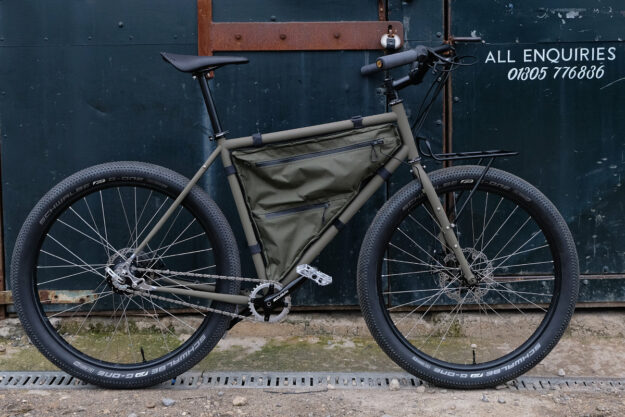
It’s been a strange last few months but, if anything, they have proven that bicycles really are the best form of release from a locked-down lifestyle. This 650b+ Explorer from Dorset’s Sven Cycles is the ultimate escape plan — and it could be yours.

The Explorer is one model in Sven’s Semi-Bespoke range, developed by Darron and the team to carry you away from a world of nervous crowds, masks and sanitiser, offering the best form of social distancing possible.

The heart of the Explorer is a TIG welded Reynolds 921 stainless steel frame, dressed in matte green military paint with Paragon Rohloff dropouts. It’s fronted by a thru-axle Columbus unicrown fork with all the necessary mounts.

There’s a Rohloff Speedhub in the rear and a SON 28 Dynamo in the front, surrounded by stealthy WTB KOM Light rims, Sapim Race spokes and Schwalbe G-One rubber. Yes, that’s a custom matching X-Pac frame bag by Spoked UK.

There’s a HOPE headset up top with a Jones H-Bar and a black Brooks Cambium. A pair of TRP Spyke brakes haul everything up and the drivetrain consists of Middleburn cranks and chainrings.

Sven Cycles’ portfolio of previous work reveal a true passion for craft and innovation. The Explorer is a noble steed, like every bike manufactured by the Dorset workshop, one that epitomises the spirit of adventure and the desire to commune with the outdoors.

This one in particular was built for a customer but as a result of these ‘unprecedented’ times, it is now up for sale. With this spec it has a retail value of more than £6,000 but is being offered for a substantially lower amount — head to the website to find out more.
Sven Cycles Website | Facebook | Instagram

The post Life In The Green Lane: Sven 650b+ Explorer appeared first on The Spoken.
According to the social media single track vehicle dynamics authorities (Do-Little Talk-a-Lots and Stale Cliché Curators, the lot of them), I'm doing everything wrong! They don't know what I'm doing, so clearly I must not know what I'm doing, either! Appeal of authority gets far more approval from the uninvolved!
Modern motorcycle design has evolved itself into a corner - they can't go accelerate or decelerate any harder without flipping, or corner any harder without running out of clearance. Any changes to one or more areas to improve one aspect will result in an overall loss of performance. Tires are optimized to accelerate or brake, not both, leading to cooling events. Suspension has to be optimized for load transfer extremes. All the above leads to both slow roll response and high polar inertia about the longitudinal axis. And that results in terrible aerodynamics. ALL of the above problems can be successfully addressed IF you discard the original configuration and derive a functionally superior configuration that isn't recognizable.
Here are the old problems (And causes):
- Stoppies (High CG, short WB)
- Wheelies (High CG, short WB)
- Lean angle limitations (Oversized rear tires)
- Roll rate limitations (High CG)
- Suspension sub-optimization (High CG, short WB)
- Tire sub-optimization (High CG, short WB)
- Aerodynamic sub-optimization (High CG, short WB)
- Long WB, low CG, linked brakes
- Long WB, low CG, 2WD
- 2WS, appropriate tire selection
- 2WS, low CG
- Long WB, low CG
- 2WD, 2WS, linked brakes, long WB
- Long WB, low CG
1. Pretty obvious, really. If load transfer under braking can't flip the bike, then there must still be some load on both tires. The lower the CG, the less load transfer, and the more both wheels will do the work. It also means that trail braking will be a lot more effective as the tire's loads transfer from braking to cornering.
2. Also obvious. Pretty much opposite of the above, just a lot more difficult to implement with internal combustion engines. The solution to that problem will be addressed later...
3. Not obvious, at least with the 2WS part. The tire part ought to be obvious: With 2WD and linked brakes, a big fat rear tire is no longer necessary or even desirable. A narrow tire at both ends provides enough footprint area.
With 2WS, the cornering forces become much less perpendicular to the CG, reducing lean angle quite a bit (Simple trigonometry, if you must). If 2WS were taken to an extreme, changing the vehicle into a purely 2-tracked vehicle known as a "Di-cycle", NO lean angle involved in cornering. That isn't practical for obvious reasons, but steering the rear wheel in the same direction of the turn at any ratio much over 25 % contributes to the same effect, thus reducing lean angle.
Both the narrower rear tire and 2WS effects greatly offset the negative effects of lower CG on lean angle. No, this isn't in any of the books. Yet.
4. Not as obvious as it ought to be, sort of: Obviously, the reduced polar moment both makes changing lean angle easier and. importantl, makes stopping changes to the lean angle easier. Less obviously, the lower the CG, the greater the lean angle changes with displacement of the contact patch relative to the CG. 2WS normally wouldn't help at all with a high CG in that regard, since most of the effort in counter-steering is exerted in overcoming wheel inertia - but with the lower CG and increased displacement effect, countersteering becomes a LOT faster with the same effort.
5. Extreme load transfer is no longer happening, which means that a suspension range and rate to accommodate those extremes is no longer required. And with less suspension travel comes less sag under cornering, thus improving ground clearance and allowing an even lower CG. Lower CG and long WB, and less travel also means drastically reduced chassis pitching to bump response, acceleration, and braking, resulting in far greater chassis stability. And greater chassis stability reduces the appeal of pointlessly playing around with dive/squat/"Anti(x)" geometry.
6. With 2WD, linked brakes, 2WS, low CG, and long WB, both tires are working all the time. There are no "Break times" for cooling down then requiring warming back up to optimum temperature. And since extreme load transfer isn't happening anymore, much lower tire pressures (With the obvious benefit of a larger footprint) are both possible and desirable without incurring stability and control issues. Having interchangeable front and rear wheels and tires is a welcome benefit. I doubt that existing tires are close to optimized for such implementation, but the choice of racing slick tires with different compounds and carcass stiffness is a huge help.
7) Obvious: Much lower frontal area results in less drag. Really. No kidding.
The rationale (And obvious physics) behind all 7 points above have guided the design of my next racer. All 7 points are necessary, if not convenient, to work. I'm not going to go any faster by attempting to minimize existing problems with current configurations - I want to go a LOT faster by completely eliminating those problems with a completely new application.
No, not all 7 points need to be applied to less demanding recumbent (AKA, "FF") motorcycles, any more than the old van I use to haul the racer to the track needs to be optimized for track use, either. And, no, I don't expect said social media authorities to accept them either - they are too invested in rationalizing their lazy design choices and gossiping - I'm never going to see any of them or their work at any race track.
So, what else is it good for? Well, electric motorcycles exhibit a LOT of functional shortcomings relative to their internal combustion relatives. Horseless carriages were terrible cars - gasless motorbikes make terrible motorcycles. But a lightweight streamlined low CG, 2WS, 2WD one would solve range, speed, cost, packaging, and weight issues while providing uncommonly high comfort, performance and protection - right now. Truly effective regenerative braking is only possible with that configuration. With 2WS and 2WD - and smart steering control - it would be possible at a stop to steer both wheels to the side to some degree and balance the bike without human intervention - no dippy outriggers necessary. And park it by lowering it all the way onto an integrated stand. Wind gust response would be counteracted by that smart 2WS. Etc... - the design and dynamic potential is mind-blowing. None of that is in the books, or gossiped about by said intellectually paralyzed "Social media authorities". Yet.
In the mean time, work is progressing nicely on the next racer. Got questions? You know how to reach me. Got gossip? You know where to go.
The Bike at the End of the Universe: Gloria's Rogers Bespoke [ 13-Nov-20 4:45pm ]
Six years ago in Adelaide during the Tour Down Under we had the pleasure and honour of meeting local frame builder JR of Rogers Bespoke and photographing his first build. Today we feature what may be his last custom bicycle — for his fiancé Gloria.

The TDU is the first leg of the UCI World Tour, held in Adelaide’s searingly-hot summer. Hardly a holiday for the pros. It is for fans, though, who converge on the South Australian capital to enjoy a weekend of racing and to celebrate the cycling community.

In January during the Tour Ebenezer Place in downtown Adelaide is the place to meet. It’s a small strip of cafés and small shops which, in 2014, included the Treadly Bike Shop — the best LBS in South Australia and a hub for the local scene.

It was outside Treadly that I met James Alderson by his moniker JR. Or rather, I met Proto, his first handmade frame, a matte black track frame with a gold retro-inspired downtube logotype. Even standing still, the bike silently screamed like a Hemi-6.

Over the years since, we’ve featured many of JR’s builds and admired the finish of his frames, from the cyclocross bike that was a collaborative work with artist Sam Songailo, a tourer built for Sam Neeft of Treadly, to the production-style Ronin bikes.

There are more than a few Ronin riding around today underneath highly impressed owners. The quality of construction is up there with the world’s best handmade steel road-riding frames and, what’s more, they’re Australian-made.

James recently made the decision to move on from the custom frame building scene and sold off all of his tooling to focus on other avenues. He didn’t call his enterprise Rogers Bespoke for nothing — he’s hinted at work in the motorcycle arena.

Today we’re honoured to feature the last Rogers to leave the workshop, built for none other than his partner Gloria, who James will be marrying in less than two weeks. It’s to replace her own faithful steed and will carry her for many more years of commuting.

Gloria rode her last bike everyday for eight years, so JR built her something that will withstand heavy duty riding. It’s a utilitarian but comfy commuter with 32c Panaracer rubber, mounts for fenders, a 1×11 SLX groupset and Chris King and Thomson hardware.

The paint, however, ain’t utilitarian, it’s out of this world. It’s a pearl bomb effect applied by motorbike painter Daniel Stone, who painted every one of JR’s frames bar two. As far as I’m concerned, and I’m sure Gloria will agree, this is where dreams come from.
The Spoken would like to congratulate Gloria and James on their engagement and wish them good luck for the future!
Follow Rogers Bespoke on Instagram for updates. Big thanks to James Raison for the amazing photos.

The post The Bike at the End of the Universe: Gloria’s Rogers Bespoke appeared first on The Spoken.
Posts here will be as frequent as usual (I.e., seldom) - progress pictures will get posted on My Instagram page.
After the Quail event, Jason Cormier at Odd Bike asked me for an article on the racer project and some of the background - that gave me a good excuse to explain a little how I got to this point and a little more about where I'm going. It's been a fun experience so far, which made it a lot of fun to write. Thanks, Jason!
All of the custom ordered parts have arrived: Connecting rods, crank pin, and hybrid Kawasaki KX500/Ducati 999 primary gear (All from England), Poly Chain GT 8 mm pulley stock (For final drive), and 56 mm Lectron downdraft carburetor (For feeding 706 cc crankcase displacement). And then there's the one and only part I just pulled off the last racer that goes on the next one - it's a part that's getting a lot harder to find.
The engine casting will have to work well with the 2WD final drive arm, so those get designed and built together - after that, the frame and 2WS system pretty much fall into place. The big plan for the bodywork is to have as little as possible, as simple as possible, and as cheap and easy to replace, vinyl wrap, and install as possible - wasting time and money on ugly over-styled plastic that gets vinyl wrapped anyway seems really stupid to me, especially for a racer, where bodywork is considered a consumable item, like tires, safety wire, collarbones, etc...
More later...
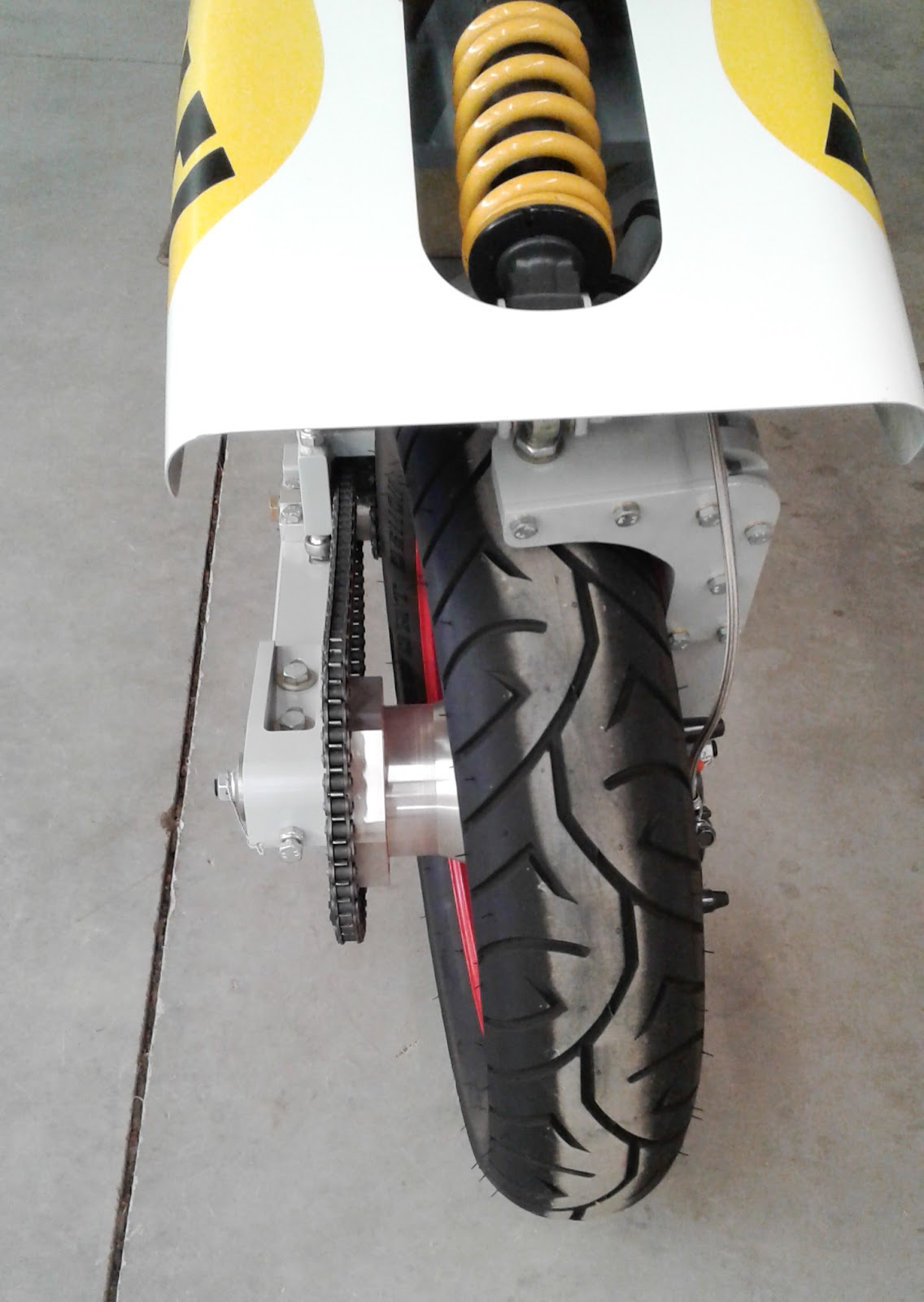
My favorite thrill is pinning the throttle after the apex of T3 at HPR, especially with an untested bike. My second favorite thrill is getting an idea out of my head and turning it into a design before making it real, loading it into the van, and taking it to the track. The next racer is into that "Second favorite" stage. The details are a lot different than the first racer, with a few exceptions. The shocks will end up in the same area, and the upper A-arms and single sided steered upright will return at both ends (With vastly lighter and better looking design and fabrication). I'm really excited about the design of the lower suspension arm - it is VERY exotic and unique (One arm for both wheels) - it solves all of my prior 2WS/2WD design nuisances and headaches.
Another good thrill is having a photo pass for MRA events and shooting video. While nothing beats the view of the race from a race bike, being able to wander around the track and scout out vantage points for capturing the action is about as close as anyone else can get. A lot of my footage made it into the MRA's Award Banquet video - thanks for the credit!
Getting the shop together and tooled up is still in progress. All of the lighting and outlets were removed and replaced. A heater should be installed very soon. Real machine tools have been moved in. As always, good help is necessary for rigging heavy machines!
There's a LOT of work in the shop to be done in 2019. And MRA racing action to shoot at HPR with a new camera this upcoming season well.
T3 awaits...
Top video: Jeremy Alexander
Hello…is this thing on? It’s been quite a while, but some of you may still be subscribed to the old RSS feed (is that still a thing?). If you do somehow find this post, I want to let you know that I just started posting again on the @bicycledesign Instagram account. I plan to update Instagram primarily going forward, but the Twitter and Facebook accounts will remain active too (mainly just auto-posting from Instagram).
Who knows… I may even start occasionally posting on the blog again too. I am sure that it would take quite a bit of time to rebuild the community after three years away, but I really do miss it, so the effort might be worthwhile. I don’t want to get ahead of myself though. For now. I’ll just see how it goes resurfacing on social media. I hope that you will follow along… and maybe even contribute some of your ideas and designs.


