
 System Focus: High Speed Sounds to Blister Even Internet-Accelerated Brains [ 30-Dec-14 6:46pm ]
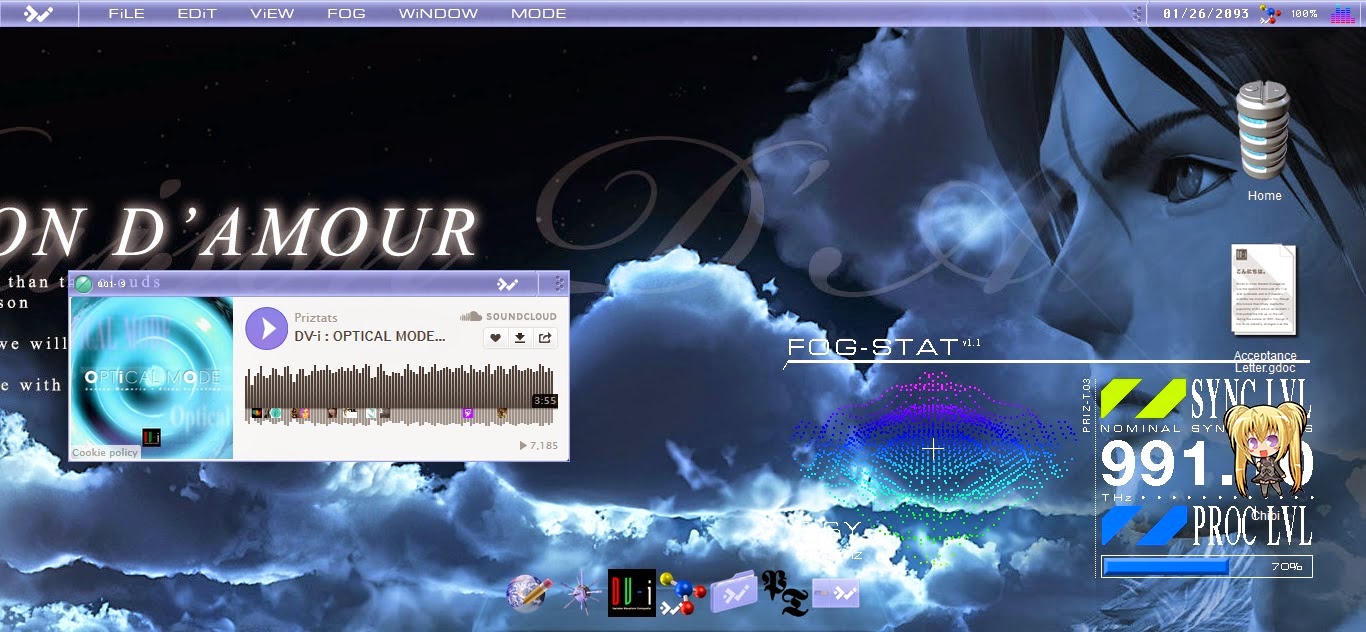 DV-i's 'Optical Mode' in its browser context Proper packed System Focus on speed cuteness (click here to read). Kind of a follow-up to the earlier cuteness article (here). Featuring collectives such as JACK댄스, Activia Benz, Donky Pitch, STHWST, Hope Sick Cola, Mecha Yuri, Magic Yume Records and Manicure Records and artists like Guy Akimoto, DV-i, Miami Mais, Maxo, Yeongrak, Friendly Sneakrz, Onika, Ba-Kuura, Xyloid, So So In Luv, Lockbox, DZA, Doss, Yandere and more. I made a tracklist for it, but not all of it ended up in the SoundCloud playlist at the bottom of the article. Here it is in full (click the links to listen):
- Guy Akimoto: BaeBae
- DV-i: Shenzhen Miracle
- Miami Mais: Goose
- Maxo: Hiya
- Yeongrak: estrogen
- Friendly Sneakrz: Morning
- Onika: Bffs
- Ba-Kuura: Dual Wield
- Bames: BYB (Pablo)
- Xyloid: Neptune Pool
- SO SO IN LUV: 1 + 0nly
- Lockbox: Human Makeout
- Maxo: Snow Other
- Yeongrak: shabushabu
- DV-i: Fractal Mode
- Lil Mystic: Hiryo
- Friendly Sneakrz: Restless
- WALLACE: OutAspAce
- DZA: Fluffernutter
- Lockbox: Brainhead
- Yeongrak: flowerkingdom
- Doss: Extended Mix
- Ba-Kuura: Let's Go
- Kaleidoscope: Royal Flash
- Slugabed: Pure El Nino Vibes
- Yeongrak: all i do
- Xyloid: Zephyr
- Yandere: u know
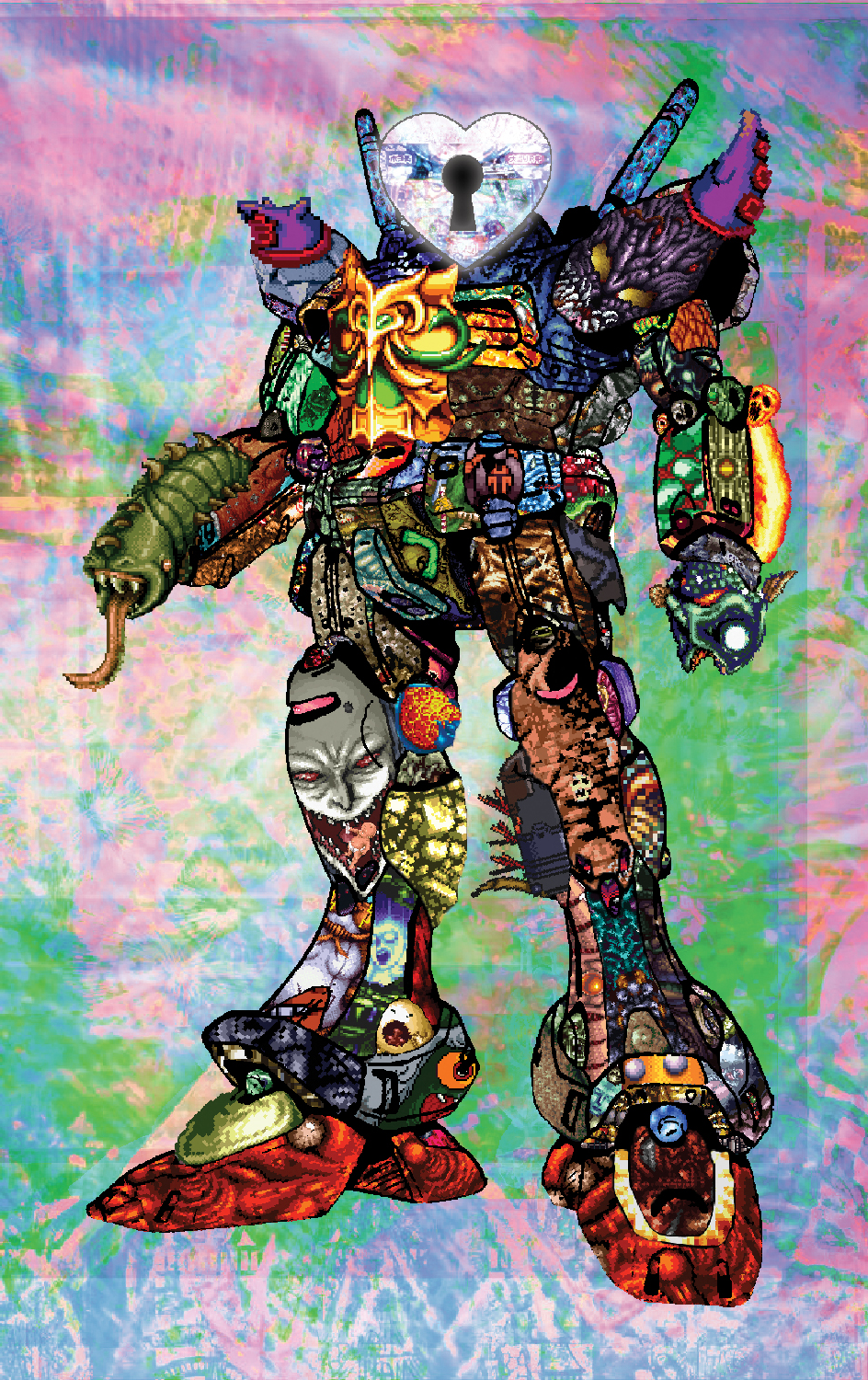 Lockbox's Prince Soul Grenade What a month it's been for cuteness! The deliciously hyper-camp new aesthetic, in its element online, is most famously embodied by the PC Music label—everyone's been messaging and tweeting about them! Then recently the movement got its anthem in the form of "Hey QT" by QT, a snappy lil number which is also the official tune of a new energy drink I can't wait to taste (that's the artwork above). But QT and PC are only the cherry on top of a vast cutie pie. Not long ago, #Feelings boss Ben Aqua set the net ablaze with his Resident Advisor podcast, a celebration of cute club intensity from all over the clouds. Finn Diesel's DIS Magazine show on Rinse FM, a haven for cuteness and other flavors since May and previously featuring SOPHIE, A. G. Cook and Felicita, entered its third installment on September 25, introducing Onika and So So In Luv. And trans-national club sensation JACK댄스 has returned, this time in New York with a whole new roster of US-based cuties...
 So So in Luv: 1 + 0nlyThose high twinkly notes, that high-speed syncopation, that high helium voice. Hints of '90s hardcore rushing unrepentantly into the digital age. And the network that links JACK댄스, DIS Magazine, Ben Aqua and PC Music with labels like Activia Benz, Donky Pitch, STHWST, Hope Sick Cola, Mecha Yuri, Manicure Records and more has converged on this style from many different points of origin: jungle and hardcore, seapunk, footwork, trap, the sparkly HudMo-Rustie sound, pop, J-pop, video game music and experimental breaks. Just as chopped and screwed lethargy seems to be everywhere between beats and vaporwave, this convergence amounts to the return of speed and complexity in ways guaranteed to blister even your internet-accelerated brain...
Guy Akimoto's BaeBae EP, something of an ode to digital communication, begins with the itchy-fingered title track, which includes a demure robot lady announcing, Reality escaping me, emotions with velocity, log me on, sign me out, give me something to type about. Hype tunes, low tides, sending emails all night. Me and bae, bae and me, HDMI, USB...
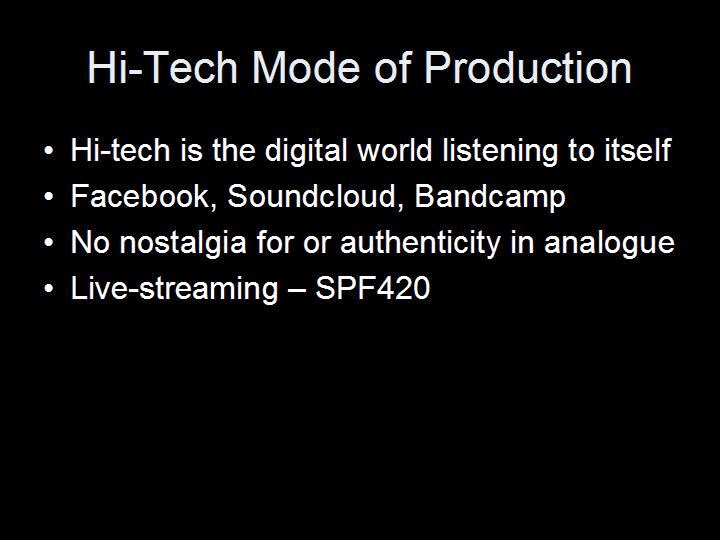
 Indie Goes Hi-Tech: The End of Analogue Warmth and Cosy Nostalgia (Berlin Music Week talk) [ 30-Dec-14 5:49pm ]
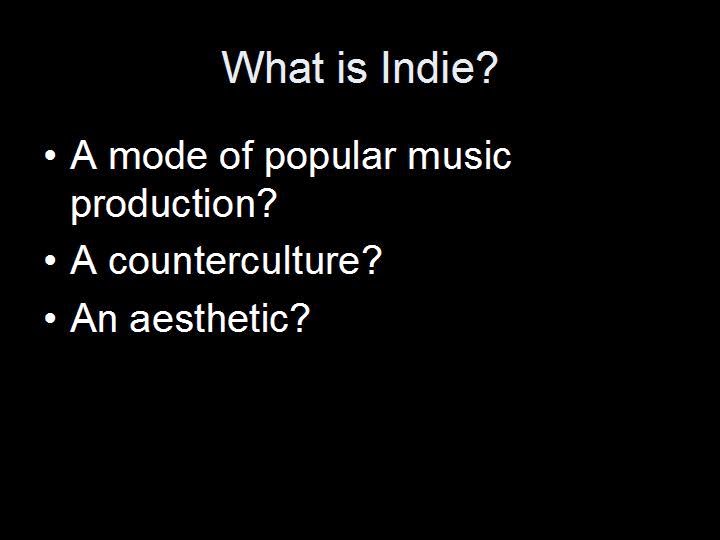
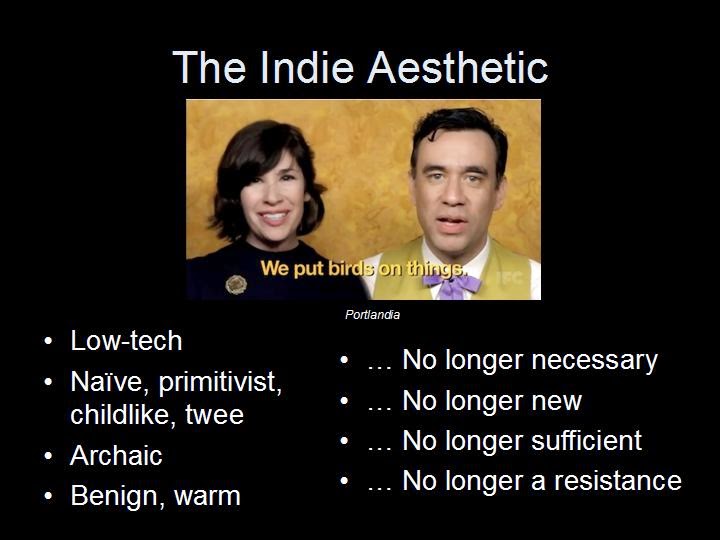
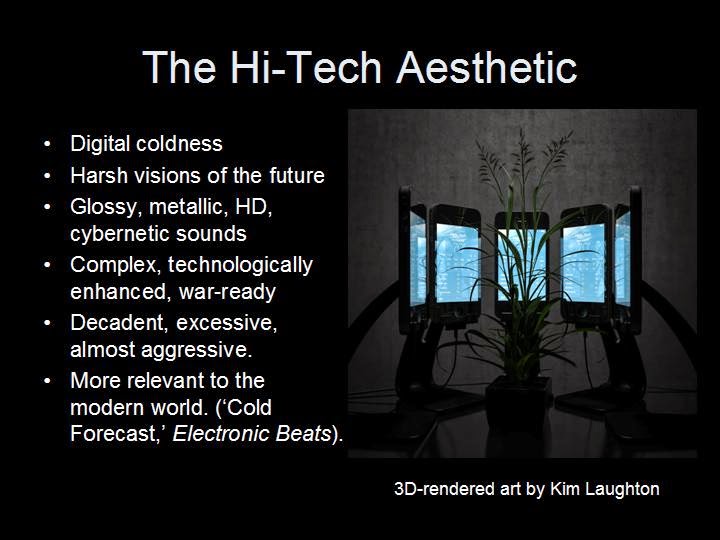
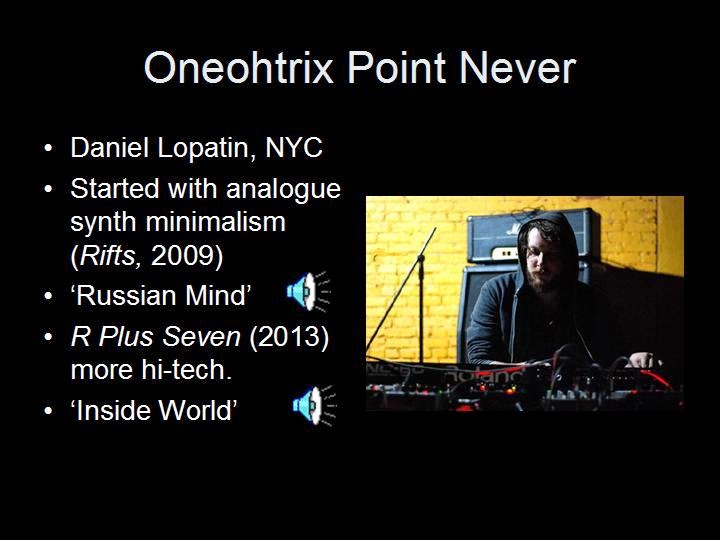
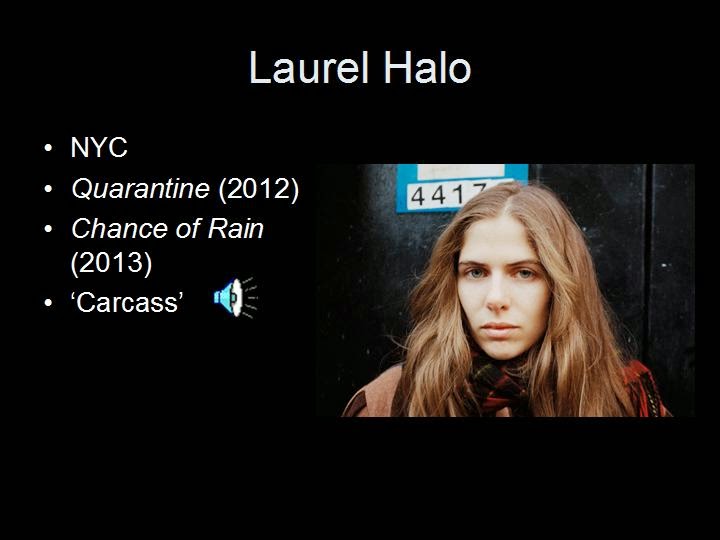
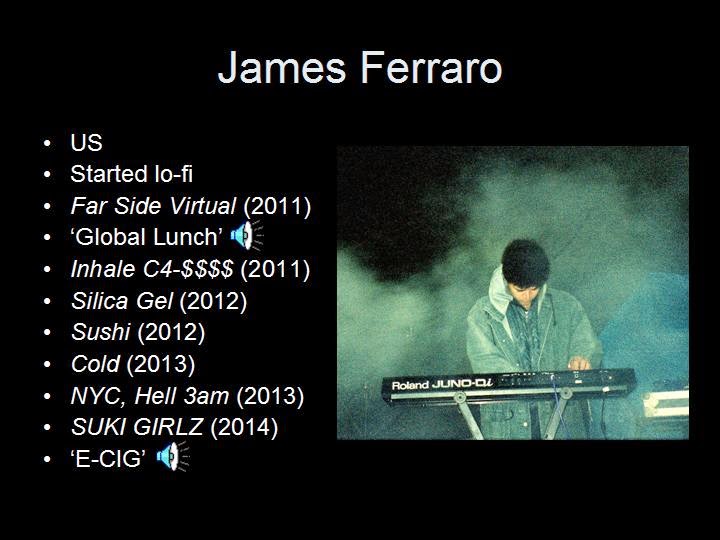
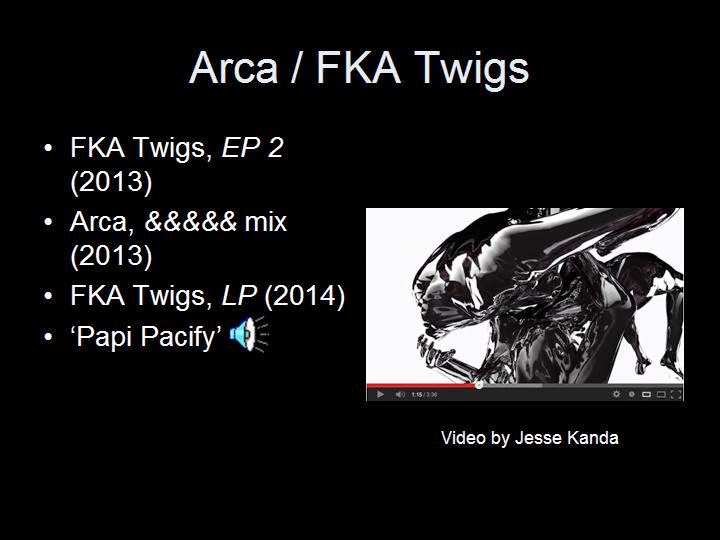
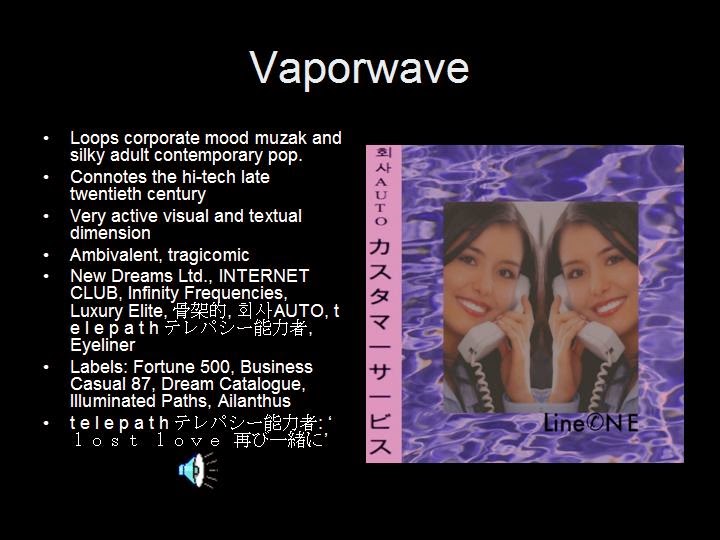
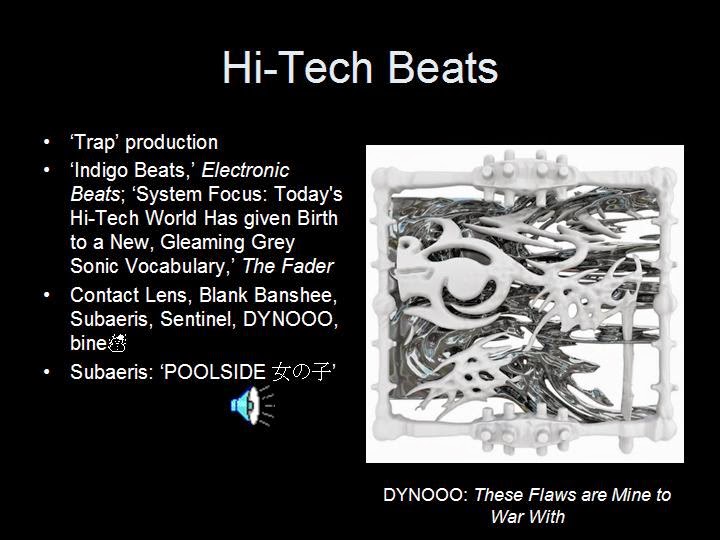
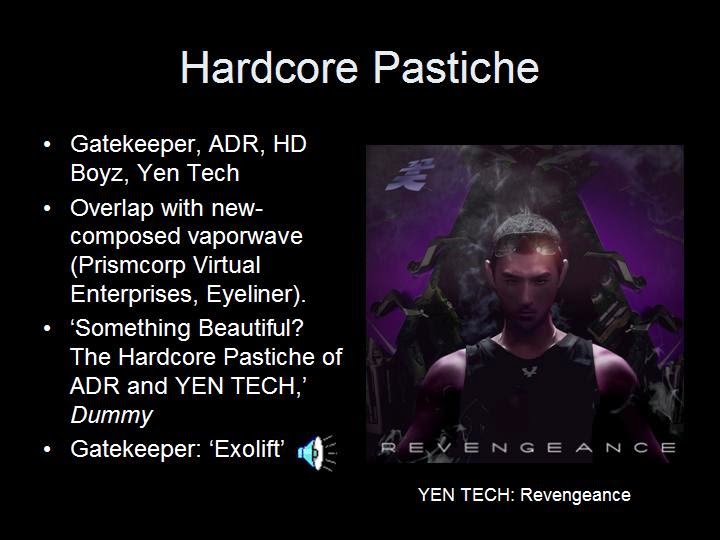
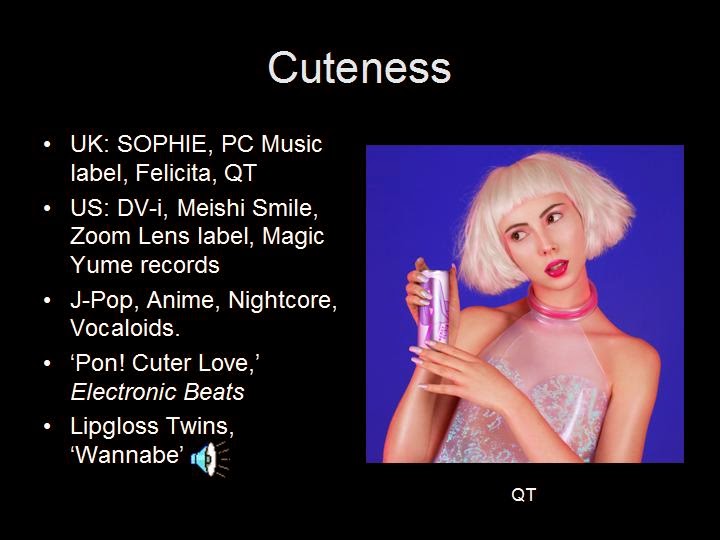
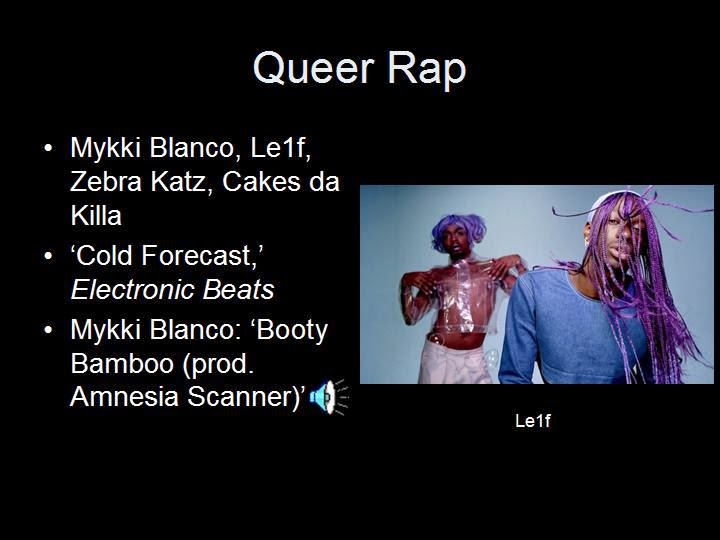
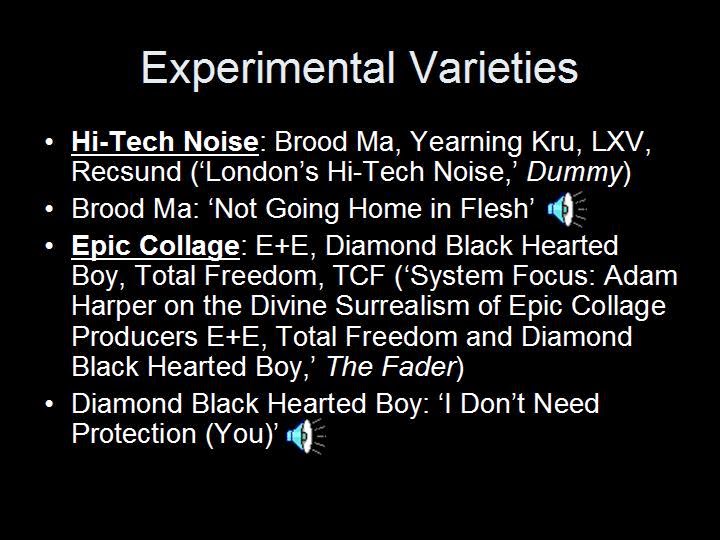
At Berlin Music Week I gave a talk (video above) that summed up the wider trend behind basically everything I've written about for the past two years: 'hi-tech,' which I like to oppose to traditional indie aesthetics. It includes a summary of many of its sub-trends which looked at in past articles. The slides for the talk are below in all PowerPoint 2003's splendor.
 POSTSTEP 2014 [ 04-Oct-14 10:37am ]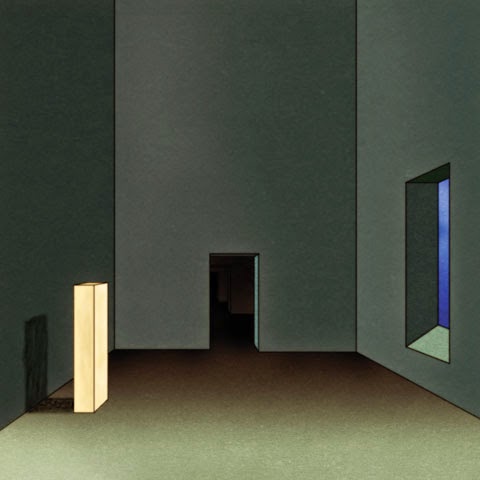
The decline was already evident last year - plenty of great records came out, but the sense of constant surprise and opening of endless new possibilities was somehow gone. Rather than continuing the restless drive for even further explorations into the unknown, the best music was mostly exploring the already established new possibilities in further detail - which is obviously not a bad thing in itself, it's just a bad sign when that is most of what's going on. Furthermore, the few examples of something really strange and previously unheard that the year didproduce, were new and unheard because of unique oddball approaches, and not because they discovered fertile new areas open for all: On D'zzzz, Misty Conditions took the rhythmic dementia of the best footwork (but luckily none of the clichéd "street"-samples that always come off as lame and regressive), and used it to create a murky, 21st century scrap heap music all their own. En2ak's 3 got rid of (almost) all of the down tempo and alternative-hip-hop vestiges that made his two previous albums a bit too uneven to be completely convincing, and instead he embraced a kind of playful para-rave, where elements of bitstep, Rustie-style maximalism and even stadium-EDM didn't-quite-coalesce into quirky, almost pop-like microforms.
Though far more minimal and understated, Coco Bryce's Club Tropicana also offered a weird hodgepodge of melodic miniatures - 8bit-mangled pseudo-skweee, electroid dream step and zomby-arpeggiated break beat-contraptions -, while David Kanagas soundtrack for the experimental video game DYADdissolved its miniatures into a liquid kaleidoscope, where fragments of melody and rhythm constantly melted and merged into a colourful virtual goo. Even further gone into the digital ether, the spindly, transparent voicescapes on Co La's Moody Coup seemed to have lost any connection to organic reality or known musical forms, much like on R+7, where Oneohtrix Point Never finally completed the process of eliminating the last traces of synth pastiche, and instead offered an eerie, transparent non-space, that seemed equally untouched by both human hand and human mind.

The last three sort of belong to the entropic camp, at least when it's made wide enough to include the whole "new synth"/virtual dreampop/vapourwave crossover area - Adam Harper territory, basically. Though not as uniquely strange and of-its-own-kind as Kanaga, Co La and Oneohtrix, there's much, much more of this stuff to choose from, but most of it I'm only tangentially interested in - there's a lot of potential and some great creations (in 2013, Ikonika and The-Drum made a couple of good contributions in the "new synth"-camp), but far too often it'll end up as eighties pastiches, or dull indietronica, or slightly off-kilter atmospheric pop. It's a fine line - on one side we'll find someone like Minerva, who have never really been able to convince me that she's more than a dreampop/synthpop-hybrid, but then on the other side there's Fatima al Qadiri, sounding exactly as strange, new and otherworldly as you could hope for. Her long awaited debut LP for Hyperdub, Asiatisch, is among the 2014 highlights so far - by no means a sino grime pastiche (as the concept might lead you to believe), but rather a much more ethereal beast, a transparent and unreal maze of slowly morphing, digitally rendered dream-fragment simulacra.
In some ways Asiatisch could be the ultimate Adam Harper-album, bridging the slightly vaporwave-leaning part of the new synth territory with the current wave of abstract, atmospheric "cryo-grime", which was one of the few successful examples of something resembling a broader movement within the 2013 poststep landscape, where it perhaps reached its apex with Logo's Cold Mission. A completely alien, empty and groovelesssly stuttering beatscape, it didn't actually sound like grime at all - not even like the cold, grey instrumentals of early Plasticman or Mark One. If anything, it was the aesthetic of Jam City's Classical Curves taken to its logical conclusion, a trail followed by many others in 2013, and source of some of the best EP-releases in a year where that format seemed in decline.
Highlights in this department were Rabit's Double Dragon, Mssingno's Mssingno and Wen's Commotion, the latter followed in 2014 by Wens debut album Signals, which sort of took a few steps backwards towards a - slightly - more warm, groovy and full sound. While definitely containing some brilliant tracks (as well as a few fillers - an EP would have been better), it does seem like a regressive development, but perhaps it's not really possible to take cryo grime further after Cold Mission. You could certainly argue that the best developments of the style in 2014 (Filter Dread, Air Max '97, Beneath, Mock the Zuma) have pretty much gone entirely into omni-experimental "beat music", the monochrome, inorganic art music that is Adam Harpers current favourite soundcloud-and-bandcamp-zeitgeist. Clearly related, yet much more ground breaking and unique, SD Laika's debut LP That's Harakiri has mostly been classified as a kind of "avant-grime", but pretty much remain unclassifiable, a claustrophobic stress-scape of bizarre digital debris, asymmetrically twitching march-rhythms, and disturbing, dirty-yet-clinically-synthetic sounds - basically one of the greatest, strangest and unfathomably newest records of 2014.

The only slight drawback of That's Harakiri is a few tracks, like "Meshes" or "Remote Heaven", where the ugly, punishing harshness seem to almost regress into a kind of minimal techno - a problem that is not uncommon for many current practitioners of beats-experimentalism. The root of this may be Actress, whose minimalism occasionally fell back into some of the most unimaginative repetitive art-techno clichés, and far too much music did the same in 2013 - an even more annoying tendency than the countless, dreadfully pretty dream pop/trip hop-hybrids. And even worse, hitherto brilliant poststep practitioners suddenly decided to make boring minimal crap, perhaps the electronic equivalent of a rock musician going back to the "mature" "essence" of "song writing". The worst offender in this respect was Montgomery Clunk, who made one of the greatest, maddest EPs of 2012 with Mondegreen, but in 2013 minimalized his name to Clnk and released an album of tasteful, restrained and deeply dull dub techno - not unlike that on Single Point Edge's SPE album, which the otherwise peerless Rwina-label for some reason released in 2013. Also disappointing was Egyptixx, who followed 2011s brilliant Bible Eyes with A/B Till Infinity, an album that seemed to consist almost entirely of not-that-interesting ambient interludes, mixed with a couple of excursion into pounding, pointless techno, and Dam Mantle, who haven't made much recently, but the little we've got - mostly remixes and tracks on split EPs - seem to be stuck in a minimal-house-with-slightly-more-lively-percussion groove, light years away from the brilliance he used to be capable of.
Going back to "serious 4/4-techno" is of course nothing new in the arty end of dubstep - it was pretty much what people like 2562, Scuba and Shackleton did back before arty dubstep had really become post dubstep yet - but it's always sad to see a straightforward regression. Luckily, a lot of poststep artist still moved forward in 2013, even if it was mostly within the territory of already well-defined frontiers. Some of these included the maximalist hypergrime that took Rusties Glass Swords as a starting point and ran amuck with it, the expansion of footwork into a more and more deranged form of head music, and still-going-on-outside-the-limelight styles like skweee and bitstep. The hyper-maximal stuff was perhaps a bit of a hangover from 2012, and was best in the beginning of 2013, where Slugabeds Activia Benz-label released brilliant EPs like 813's Recolor and Eloq's C'mon, occasionally reaching the same level of ridiculous, sugar-overdose madness as Montgomery Clunks aforementioned Mondegreen . Since then, the style has been slightly in decline, a symptom perhaps being that Activia Benz apparently has given up on vinyl and now apparently is a digital-only label. The best attempts at actually doing something new with a maximalist approach have more or less been from the trapified wobble camp, which in 2013 delivered some good EPs in in the intersection of populist EDM-bombast and weird avant-brostep; good examples being Joney's Illowhead or Blue Daisy/Unknown Shapes Used to Give a FK. As for 2014, Rusties much anticipated follow up to Glass Swords, the messy Green Language, doesn't really seem like a convincing revitalisation of the style.
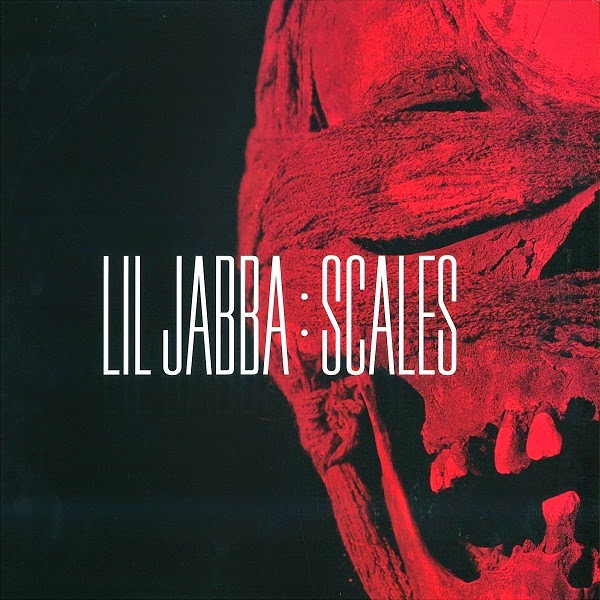
With footwork, the hype is also slowly fading, it's not really the new thing anymore, and with the death of DJ Rashad, just as he was beginning to get the attention he deserved, the scene also lost its most obvious figurehead. Rashad's first Hyperdub-album, Double Cup, was released shortly before his death, and was anticipated as sort of the definitive footwork statement, but sadly it wasn't quite the milestone it was supposed to be. On the other hand, 2013 also gave us Lil Jabba's Scales, arguably the best footwork album yet (second perhaps only to DJ Diamond's Flight Muzik), where the jittery rhythms turned weirdly cold and arrested, creating a claustrophobic atmosphere further enhanced by murky drones and demented, oppressive-yet-catchy fanfare-melodies.
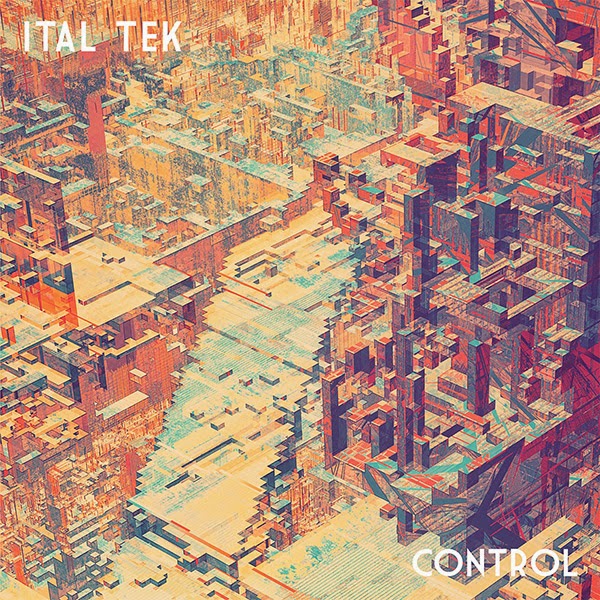
Also worth mentioning was Hade+Dwfl's The Healthiest Man in Chicago, which, despite being a bit uneven, did have some brilliantly weird tracks on it, and Ital Tek, who continued to expand on the hybrid style developed on his 2012 Nebula Dance-album. He benefited from working with much shorter formats - the EP Hyper Real and the mini-LP Control - where his super smooth production style and the lack of attention grabbing melodic material didn't create the same problem of sameness as on a full length album. Especially Control had just the right balance between ideas and length, atmospheres and inventive structures, and it's probably his best release so far. His 2014-EP Mega City Industry pretty much follows the same path, but still works as great little entity in its own right.
Footwork is only in the first phase of losing its status as the new hip style; for bitstep this happened years ago. The "golden age" was approximately from 2009 to 2011, which is a long time ago by today's standards, but nevertheless, surprisingly many of the best releases in 2013 could be classified as either bitstep or, in cases like Zomby and Desto, bitstep-derived. The latter's Emptier Streets is mostly a kind of somnambulist ghost-trap, containing only a few scattered remnants of the archetypical "bit"-signifiers (angular arpeggio-patterns, diced computer game sounds), but it also comes off as an obvious, almost logical development - the empty, spectral city where harder, rave-aligned poststep goes to die. Equally haunted, but clearly bitstep proper, Clouds double EP USB Islandssounded like the (mini)-album Dam Mantle or Darkstar should have made, which means that it's obviously one of the very best poststep releases of 2013. In a way it's the perfection of bitstep-as-entropic/psychedelic-melancholia, like wandering further and further into a dark maze of hopelessness and despair, all stumbling, fractured beats, seasick laments and cascades of vertigo-inducing 8bit-debris.
In the opposite, more wild and colourful end of bitstep, 96wrlds mini-LP Private Language and Eprom's Halflife both offered diverse curio cabinets of popular club-forms turned into grotesque and lopsided, yet still oddly groovy, monsters. Especially Halflife, as a follow up to 2012s not-completely-successful Metahuman, was pretty much exactly the album you'd hope Eprom would make - bare boned, raw and wonderfully ugly, containing both brutally rave-oriented behemoths and completely bizarre experiments, as well as a few more relaxed pieces - which were thankfully as unpolished and direct as the rest of the album. I could be wrong, but it seems to me like Halflife was done much faster and in a much more intuitive manner than its predecessor, and is all the better for it.
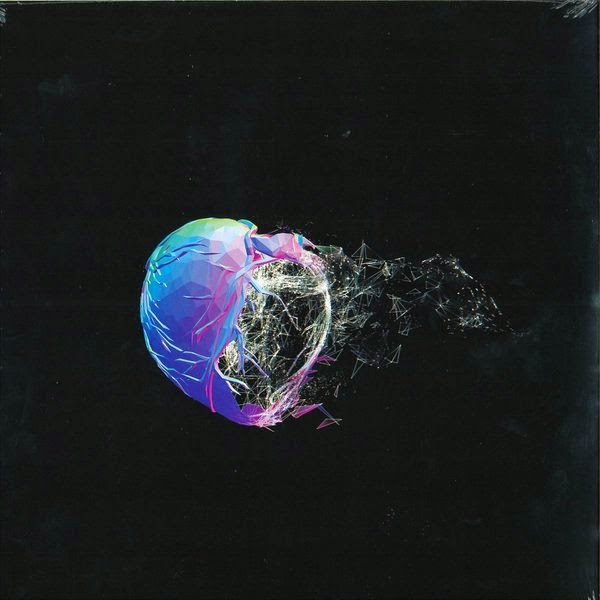
Perhaps DKSTR's mini-LP Pleasures should be classified as bitstep as well - it definitely contains a lot of the aforementioned "bit-signifiers" - but in any case, it was the best skweee-release of 2013, and probably the best since the wonder year of 2010. Ever since the brief media-interest of approximately 2009-2010, skweee has lived even more outside of the limelight than bitstep, yet the style just keep going, and each year there seem to come at least a couple of great releases, showing that it's still worth keeping an eye on. In the case of Pleasures - apparently by a new skweee-recruit - it feels almost like a rebirth. All the best skweee-elements - the baffling syncopations, the raw, deliberately synthetic sounds, the abrupt, counter-intuitive melodies - seem intensified, turned up to eleven, and further enhanced by an onslaught of hysteric 8bit-shrapnel - an instant skweee-classic!
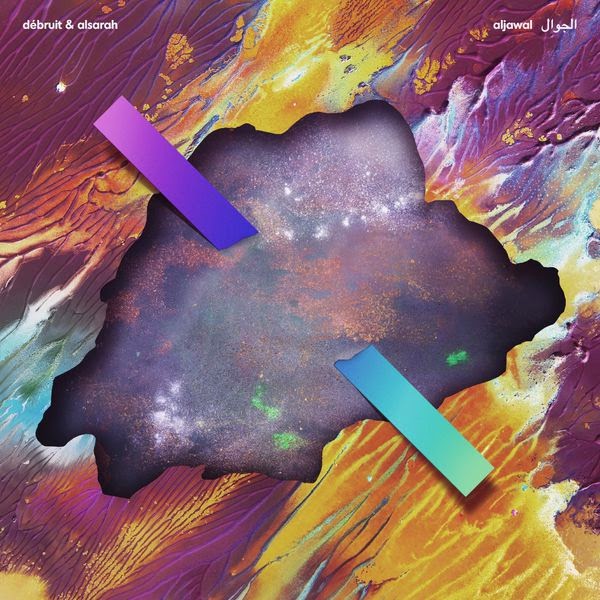
In 2013 Pleasures was pretty much in a skweee-league of its own, but that said, the debut LP of one of the oldest skweee-practitioners, Easy & Center of the Universe, was definitely also worth checking out. Easy & C.O.U. is the prime exponent of "ethno skweee", and on Aryayek Machine the fusion of rubbery square wave-funk and middle eastern elements had never worked better. It might seem a bit regressively organic compared to the futuristic madness of DKSTR, but on its own terms it's a brilliant combination, sort of the skweee equivalent of Débruit - who happened to release a pretty great album in 2013 as well. A collaboration with Sudanese singer Alsarah, Aljawal was also a meeting of organic and synthetic, but Débruits production was as colourful and inventive as ever, and seemed further inspired by the plenty of opportunity for vocal science offered by Alsarah.
All in all, it should be obvious that 2013 was indeed a brilliant year for poststep-releases - there's even a few great ones that I haven't been able to fit in yet, but which definitely should be mentioned: Nguzunguzu made one of their best so far with the mini-LP Skycell, Burial made his most interesting release since Untruewith Rival Dealer, and Pascäal gave new life to the original Burial-sound by turning it into irresistibly catchy, heartbreakingly sad and yet weirdly bright and colourful pop-step on Fragile. So far - despite some really great releases, some promising ones on their way, and an apparent resurge of great new EPs - 2014 doesn't seem nearly as great. But then, in all fairness, that's probably also how I felt same time last year. A lot can still happen. But in the end, that's not the point. There's at least 20-25 EPs and albums from 2013 that I wouldn't be without, records that didn't sound like they could belong in any other era than this, and more than half of them still radiated the utter newness that has been so thrilling the last five years, still held the future promise. Perhaps there will be as many records of the same calibre when 2014 ends, but again - that's not the point.
The point is that all this is living on borrowed time, running on a hitherto unimagined reservoir of energy that was detected sometime around 2007, and unexpectedly erupted two years later. We shouldn't expect it to go on forever, and the transformation from out-of-control frontline research to slightly-refining-discoveries-already-made will happen as gradually and almost unnoticed as it did in the mid-nineties, the early eighties, the early or mid-seventies (depending on how you regard prog), etc. Except - this time it doesn't even seem like most of the people involved have even recognised it as a golden age, so perhaps they won't notice that anything's gone afterwards? It does leave a lot of questions. How did the original energy materialise, seemingly out of nowhere and in spite of all those people saying that it didn't exist - couldn't exist - and even now, saying that it never even did exist, that nothing have happened during the last ten years that haven't just been a regurgitation of all the real innovation that (of course) happened when they were young. Which leads us to the next question: Why was the energy never recognised? Even the ones who participated didn't seem to think of it as a connected thing - or a whole lot of connected things -, there was never really a movement, a common feeling of moving in specific, ground breaking new directions - even though that was what they did - and never any struggles as to which new directions ought to be followed. Everyone was left to their own devices.
These questions will take some time to answer, time I don't have right now. Obviously, it all has something to do with the time we're living in, a time where movements just aren't supposed to happen, and where the ability to recognise something new has been purged to such a degree that most people refuse to recognise it even if it's staring them in the face. Hopefully, I'll have the time to go into further detail later.
OASIS BOOK REVIEW ROUND-UP [ 17-Jul-14 9:47pm ]First up, David Stubbs wrote an excellent long-form review essay in Review 31 under the lyrically apposite title: On the Crest of a Wave. It's a great piece of prose in its own right, and contains the seeds of a longer argument DStubbs is developing all about (I think) 1996 as the pivotal year in recent cultural history.
Next, under another great title (Are Oasis Socialists?) VICE's Noisey blog published an interview I did with Josh Hall (also, incidentally, another top-notch writer - see for example here). The VICE copy-editing leaves much to be desired, but once you've waded through the typos there's some very valuable stuff in there, particularly about the Left and heritage.
Most bizarrely of all, perhaps, I managed to get Oasis into this week's TLS. Yes, that's right, the Times Literary Supplement has actually gone and fucking reviewed my book about Definitely Maybe. The piece is relatively short and isn't available online if you're not a subscriber. What's more, it was written by Joe Charlton, one of the two or three people from my Northumberland comprehensive school with even a shred of influence in the contemporary British culture-sphere. But still. The fucking TLS. What would Liam Gallagher make of that, I wonder?
Finally, and most importantly, my intellectual soulmate Rhian E. Jones has written a cracking essay over at Velvet Coalmine, which glances at the Oasis book, but is really just a spot-on summary of everything that matters most in the world right now. Praise her, with great praise.
Oh, also, there's that psychogeographical tour of Manchester thing on the Bloomsbury blog I mentioned in the last post.
There may yet be more to come, you never know.
DEFINITELY DEFINITELY DEFINITELY OUT NOW [ 15-Jul-14 10:39am ]The launch is this Wednesday, 16 July, at 7.30 at the Peckham Pelican, Peckham. I'll read a short extract from the introduction to the book, and the inimitable David Stubbs will play some 1994 tunes. Everyone is welcome and there's no ticketing.
Extracts from the book have been published at ...
Stereogum
Flavorwire
+ The Quietus
Bloomsbury's 33 1/3 blog is also publishing some associated features this week as part of "Oasis Week".
First up: my short autobiographical take on the album. I barred first person from the text proper for various stylistic and political reasons, but thought it might be nice to do a brief sketch all about ALEX NIVEN for the sake of scene-setting, empathy, identification, all that shite. Later this week there will be a Video Vault feature nodding at the album's influences and a psychogeographical tour of Manchester featuring Maine Road, Mr Sifter, and Adolphe Valette.
More to follow on reviews, talks &c.
AT TIME'S LIGHT THRONGED MERIDIAN [ 20-May-14 9:52am ]
Seeing as I was one of the interviewees for the piece by Andy Beckett that started the whole fuss on Saturday, here's some of my thoughts about both the article and the response to it ...
Firstly, some notes about the format of the piece. My contribution was to be interviewed by Andy over the phone some six or seven months ago. The conversation lasted about an hour, and although a part of me was initially sceptical about the fact of the article being written by someone from [evil voice] The South, I was impressed by Andy's intelligence, inquisitiveness, and above all, his sympathy - arising, I think, out of his own socialist beliefs and certain of his life experiences - in highlighting the profound social and economic difficulties the north-east has faced in recent years, difficulties that have often been occluded and even ridiculed in the mainstream media. Inevitably, in the final version of the article, my comments had been whittled down to two or three short quotations (which are, by the way, kind of embarrassingly ungrammatical - proof of their spontaneous, extemporised origins I think).
I fully expected this to happen and nothing in the piece misrepresented my feelings in any way. At the same time, of course there was a hell of a lot of stuff that I mentioned in that 1-hour phone conversation that didn't make it into the final cut.
On the one hand, I'm tempted to to follow incumbent politician Chi Onwurah's lead by claiming that the choice of quotations and the overall thrust of the article was selective, that there was a lot of more positive stuff mentioned in the interview with Andy that wasn't used in the published version. I could go on about how I think the north-east is the greatest place on earth (I do), talk about how desperate I am to get back there (4 unsuccessful job applications this year and another pending), reel off soundbites for the sake of balance about the growth of tech start-ups in the region, moderate increases in house prices, the fact that Newcastle's nightlife is still thriving, the continued outstanding creative achievements of the area's sons and daughters, how wonderful the landscape is, and so on and so forth.
All this stuff is true, but to be honest, I'm not writing a tourist industry brochure or massaging PR for the Nissan car factory. Besides, as the ever trenchant Ross Lewis pointed out on Twitter: "You can love the best of a place and also be ashamed of it and try and change the worst aspects".
I don't want to speak for Andy Beckett, but I should imagine there are a couple of reasons why his article was not entitled "The North-East of England: Some Pros and Cons" or "A Rounded Portrait of a Part of the Country That is Essentially Quite Similar to Everywhere Else".
The first, obviously, is that no editor would have published it and no reader would have bothered to read it through to the end. Outside the world of corporate hospitality literature and marketing hyperbole, articles about a particular subject will of necessity take a specific line of argumentation, and the Guardian piece was in my opinion an entirely fair-minded exploration of the (factually indisputable) notion that the north-east has suffered in recent years from socio-economic decline. If this premise was subsequently simplified on a superficial level by headlines, choice of images, pull-quotes, the Detroit parallel, etc, then that's the nature of journalism, and it's surely not all that difficult to see beyond this paraphernalia in order to see the nuances of the discussion contained in the actual text. Accusations of a "hatchet job" are laughable, and should be rejected out of hand by anybody with any sense.
The second reason I think for the critical angle taken in the piece is that criticism of the way recent political history has unfolded to the detriment of certain parts of the country are much-needed. If I knew the Detroit analogy would be used in the quite the way it was, I might have been more wary of deploying it in conversation with Andy. But then again, I think the parallel is pretty apt (though of course only partially so), because Detroit is the archetypal example of a post-industrial city/region that has suffered very badly over the last three decades - in a broadly similar way to the NE - from the neoliberal double whammy of deindustrialisation and massively reduced social spending.
I think that anyone who cares about the north-east is likely to feel a sense of anger about the fact that it has, inarguably, suffered in certain concrete statistical ways in the post-Thatcher period. Nitpicking about the finer points of the Detroit analogy seems to me pretty foolhardy in light of the essential connection between working-class Western cities that have been continually passed over in the race to liberate the market and bolster the wealth of the super-rich in the last three decades. (Moreover, looked at another way, as someone pointed out on Facebook, isn't being compared to Detroit - cradle of Motown, Eminem, MC5, and Iggy Pop - quite a bit better than being compared to Croydon?)
I have sympathy with some of the defensive reactions to the Guardian piece. Perhaps there's always something slightly questionable about being told by an outsider that the place you live might have problems, and its a natural human reaction to respond to such claims with proclamations of local pride and useful additions to the discussion that try to provide examples of north-eastern resilience and ingenuity in the face of social and economic marginalisation.
But I think a better way to react to the article than trumpeting local success stories and worrying hysterically about how negative PR might deter capitalist investment (which I'm going to go out on a limb here by suggesting might not necessarily be a plausible or even a worthwhile solution to the problems faced by the vast majority of north-easterners), is to use the example of the way the region has been shafted by the London-based institutions of the English Establishment over the last few years as fuel for political anger and constructive determination to change things. The former ultimately plays into the hands of the Tories, while the latter offers the hope of something much more valuable.
There are way more than 100 reasons why it's great up north, but right now offering a coherent, organised alternative to the south-east and its capitalist mega-city is not one of them.
It could be.
 LONDON RADICAL BOOK FAIR, 2014 [ 08-May-14 11:40am ]
Myself and the incomparable Tamar Shlaim will be hosting the Zero stall 10-5.
Blog here. Come doon.

Greg's answers are here. My nominees are sensational cultural critic/fiction writer Rhian E. Jones and an as yet uncomfirmed international celebrity chef.
What am I working on?
At the moment I'm waiting for a couple of books to come out, and tying together some other ideas in the hope that they'll coalesce into a new project. There's an essay for Glasgow quarterly The Drouth about the Anglo-Scottish borders which will hopefully come out around the time of the independence referendum: a Yes vote is looking increasingly likely so I think we have to start thinking seriously now about what will happen to the North of England after Scottish secession. Aside from another, more academic essay about Ezra Pound's late poetry, I'm trying to work out how to corral my willfully disparate output into a single book about something or other. I've done two short-ish books now so something a bit bigger would be good. The poetry is ongoing too, and sporadic, as poetry tends to be - the latest accretion is here.
How does my work differ from others of its genre?
Following on from the last question, I think one of my biggest preoccupations is trying to work out what genre is best for saying the things that need to be said at this moment in time. I think it's quite a strange period for art in general and countercultural art in particular - lots of the old forms and genres are a bit lost, a bit enervated, and we're awaiting some sort of social development that will re-organise culture in a way that will give a bit more shape to the way we experience art collectively. At the moment the culturescape is a kind of Darwinian sludge pit, with lots of competing individuals and not much agreement about the underlying point of it all. I think that both the big strength and the big weakness of my writing is that it's not yet quite committed to one genre, but hopefully interesting because it's trying to think about how you might create a new genre that's responsive to the spirit of the age and anticipatory about the big societal bang - whatever it may be - that's just around the corner. Maybe something like lyric criticism or lyric non-fiction would be a good term for it. And I think with poetry, similarly: lyric realism or something like that.
Why do I write what I do?
Look, I'm just doing what I'm doing do and if anyone else likes it ... Only joking. I'm trying to say a handful of things that I think are important - I don't really have a problem with that fundamental bedrock. It's more the stuff about genre and form and positioning, and of course trying to persuade people to publish that's the hard part.
How does my writing process work?
I don't really have a set method, partly because, like most people, I live and work pretty precariously with very little routine or long-term job security. When I get a book project to work on it's quite liberating, and I try to work for five hours a day, morning to afternoon, five days a week, until the book's done, if I can. More than that and your concentration starts to slip. I tend to write in short, closely worked-on chunks of 500-700 words at a time and keep the editing at the end to a minimum. Poetry is obviously very different - short bursts followed by continual revisions, sometimes over many years, mainly tied up with the issues of publication and cultural positioning outlined above.
FREUD, CHRIST, MARX & THE BROTHERS GALLAGHER: A 300-WORD PRAYER [ 17-Apr-14 1:30pm ]Whatever else Oasis were, there is no doubt that they embodied, in their early days, a kind of religious fervour, channelling a quasi-spiritual urge Sigmund Freud once characterised as oceanic consciousness (a "feeling … of being indissolubly bound up with the whole of the world outside of oneself"). Oasis's great achievement was to advocate a spiritualised form of collectivism in a neoliberal society where such practices had been outlawed. Just ten years after the Miners' Strike, Definitely Maybe suggested that maybe, just maybe, the spiritual core of working-class identity had not been purged completely by Thatcher and her radically individualist regime, that solidarity and towering hope could be put back at the centre of British pop culture by a heroic project of melodic forcefulness and blind belief. The tragedy, of course, was that Oasis quickly became paid-up members of the Thatcherite music industry establishment they had once reviled. But this makes their original mission statements all the more poignant - indeed, sometimes unbearably so.
Live Forever condensed Oasis's radical working-class spiritualism into a raggedly glorious pop song about eternal life built around one of the most affecting lyrics in pop history: "maybe you're the same as me / we see things they'll never see / you and I are gonna live forever". Buried in this fragment is a kind of Christian Marxism - it is easier, after all, for a camel to pass through the eye of a needle than for a rich man to enter the kingdom of heaven. But perhaps more important than Live Forever's impassioned belligerence is its belief in a visionary togetherness that can unite people when they realise, in a moment of leaping bewilderment, that they are unequivocally the same as each other. This special kind of grace has many epithets - comradeship, friendship, solidarity, brotherhood - but perhaps its most familiar name for religious believers and humanists alike is love.
 DEFINITELY MAYBE 33 1/3 [ 15-Apr-14 11:54am ]
Apparently some North American readers are beginning to receive copies. Here's one pictured with a first edition of Dostoevsky's Brothers Karamazov (thanks to the estimable David Soud for this):

(By the way, this is uncannily apt, as there's a quotation from the Brothers K on my epigraph page - if that seems incongruous, well, it's not, and I will tell you for why if you ask me.)
The media campaign is also up on the rails ...
Here's a comment piece published in the Guardian this weekend, which gives a hyper-condensed summary of the book's argument.
Meanwhile, a handful of speaking events have been scheduled, with more to follow. At the moment these are:
26 June, 2014, Rough Trade East, Brick Lane, London. Q&A with fellow 33 1/3 authors Pete Astor (Richard Hell's Blank Generation) and Darran Anderson (Serge Gainsbourg's Histoire de Melody Nelson).
14-17 August, 2014, Green Man Festival, Glanusk, Wales. Q&A with Agata Pyzik (author of the excellent Poor But Sexy). Details tbc.
1 October, 2014 (exact date tbc), Foyles, Charing Cross Road, London. Legacy of Britpop panel discussion featuring Owen Hatherley (author of Uncommon: An Essay on Pulp) and Rhian E. Jones (author of Clampdown: Pop-cultural Wars on Class and Gender).
More details as and when they come in. And if you'd like a review copy, or want to open high-level negotiations for an event/reading, do get in touch via the email address on the sidebar.
SENSE AND SECTIONALITY [ 02-Apr-14 9:56am ]
Reading Sterne's Sentimental Journey, I'm struck by how much its ethical guidebook for the haute bourgeoisie resembles our own RaceSexualityGender doxa. In both cases, morality is abstracted - and pseudo-systematised - through a series of jargon terms for the initiated. Whereas we have PoC, intersectionality, trigger warning, mansplaining, brocialism, the eighteenth century had sentiment, sensibility, nature, decorum, sympathy, etc.
In both cases, ethics becomes a kind of manneristic exercise to be perfected if one is to acquire maturity and attain the degree of cultivation required for social advancement (in the eighteenth century - the church, the court, the judiciary, the army; in our own time - academia, politics, the commentariat, and indeed any profession - ie. the vast majority - in which social liberalism is preached while the most punitive form of neoliberal economics is practiced).
The weakness of both systems is their largely performative aspect - using the appropriate terminology and adopting the correct standpoint today with regard to, say, sexuality, is precisely equivalent to eighteenth-century displays of sensibility (the gentleman doffing his cap or handing the young lady his handkerchief at exactly the right moment). The point is that these are what we might call courtly gestures - largely superficial acts of performance that attract applause and approbation in the short term and in the social foreground but do not extend substantially into the realm of actual social organisation. Indeed, in most cases, the former actively stands in for the latter.
SUBLIMATION OF THE SOAR PT.3 [ 23-Mar-14 9:58pm ]Dream swelling soar here
HOW HAS CAPITALISM GOT AWAY WITH THE FINANCIAL CRISIS, AND WHY IS POLITICS SCARED OF IDEAS? [ 19-Mar-14 2:41pm ]Event info: Wednesday 19th March, 6.30pm - 8.30pm, Committee Room 8, House of Commons
RUINED MILLS OF LEEK, A BALLAD [ 27-Feb-14 1:05pm ]
We drove by the ruined mills of Leek
In the dead time of the year
When the land had become like a faded song
We could no longer hear.

Down where the mouldering sandstone world
Of the Potteries blends with the weeds,
Where the warehouses echo with wandering winds
And the loneliness gathers in beads,

Where the powerful cling to their juggernaut arks
And the cities are sunken and bare,
I was someone who failed like a tumbling tower
On the edge of a kingdom of air.

I was someone who failed like a light going out
In a dream on the edge of sight
Because some men are made for the palace of bliss
And some men are made for the night.

We drove by the ruined mills of Leek
In the last days of the year
And the land was as quiet as a faded song
We could no longer hear.
MORE SUBLIMATION OF THE SOAR [ 03-Feb-14 7:10pm ]Man called Futurebound ffs.
INTERSECTIONALITY OF THE GUT [ 23-Jan-14 7:47pm ]
There's been a lot of debate about intersectionality recently. But all too often, it seems to me, what's being termed intersectionality is little more than a classic ascetic-deconstructive manoeuvre, a way of saying: okay, your argument is all very well and good, but you haven't given sufficient attention to x, and here's a more sophisticated, more rigorous turn of the screw, and another, and so on ad infinitum. Some might view this positively, as dialectical ratiocination, or simply a necessary way of conducting intelligent debate. But right now, in the current moment, in the context of the omnishambles that is the contemporary left, I think these sorts of movements are invariably negative and paralysing. What is more (and I think this is partly why it took me so long to understand what intersectionality actually is), what's being left out a lot of the time is the "inter" part of the formulation. Invocations of the intersectional credo are most often made along the lines of emphasising - either explicitly, or implicitly through the virulence of their expression - the interests of a single section, a single ideological category. Debate then gets swallowed up by warring capitalised mega-interests - Anti-Racism, Anti-Sexism, Anti-Homophobia, and so on - which of course very few people in their right minds (on the left at least) would ever really consciously oppose, but which have a tendency to be deployed in the context of frequently absurdist melodramas of debate in which people who are quite obviously in general agreement become violently opposed to each other on grounds of super-subtle sectional difference.
How, then, can intersectionality be used more positively? I think that, when we look at something like the above picture, we all know instinctively, and with a visceral certainty that relegates debate to the level of relative meaninglessness. Yes, the picture tells us, this person is undoubtedly racist. But she is also anti-feminist, pro-capitalist, and (literally) perched on the pinnacle of a system in which the labour of millions is used to furnish the airbrushed propaganda of new neoliberal Tsars and Tsarinas who differ from their pre-twentieth century predecessors only in a smattering of infinitesimal ways. The really effective response to this picture should not be banal cries of racism of the kind that we hear from the liberal press (and which Zhukova can try to refute on the grounds that she, as a bien pensant social-liberal-of-sorts, is interested in sponsoring "anti-racist" artworks). Rather, horrors like this should provoke the counterposition of a holistic, socialist, ethical critique in which anti-racism scarcely has to be invoked because it is so obviously an integral part of a wider anti-capitalist, anti-hierarchical critique. Real intersectionality must mean the integration of sectional interests until they need to be emphasised only in rare instances, and in a spirit of solidarity and empathy. If we can't grasp this and act on it before getting sidetracked into endless deconstructive caveatising, then the left really is doomed to repeat the failures of last half-century, if it even makes it through the next decade.
POSTMODERNIST REDUX [ 16-Jan-14 10:05pm ]There's a lot of very tasty stuff there, and the article is strongest I think in pointing to a sort of endemic, half-unconscious historicism right across the board in music writing from Rolling Stone to The Wire.
However, I don't quite get the conclusion:
So, the lesson of Cage, Eno, and now vaporwave, Belbury Poly, and even (if read critically) Daft Punk is that history need not be conceived of as an endless hurtling into the future. Indeed, the important thing about these musics is that they not only concern history, but assume a critical position in relation to it — they both critique certain conceptions of history and offer new ones.
Firstly, there's the obvious fact that a group like Belbury Poly is surely the epitome of retromania in its hauntological mode (and I don't buy the argument in the piece that it "makes us question our sense of nostalgia" - maybe it can, but to do so you have to run it pretty hard against itself, because I reckon most people get off on the nostalgia way more than they enjoy the implicit critique).
Also, and relatedly, I'm not sure from these examples (and from the examples of Malevich and Duchamp) what is being held up as a more positive kind of art. In fact, it seems to me - and the authors' use of the word "timeless" is a tell-tale sign here - that what is being avowed is essentially a very specific mid-twentieth century lineage of postmodernist art, the high-art canon of the last few decades of post-modern, post-ideological neoliberal orthodoxy if you like. "Black Square" and 4'33" were indeed modernistic steps forward of a kind, but they were also endpoints for modernism itself, transition works that helped to usher in the postmodern period (of which "retromania" is merely a latter-day extenuation).
As such, and taken together with the argument against time viewed as an "endless hurtling into the future", I don't really see that anything is ultimately said in the article beyond a restatement of the end of history ethos that the retromania argument takes as a starting point of its diagnosis.
What seems to be being rejected is the idea that art/music can make active, purposive social interventions that impinge upon democratic forward-movements, and I'm afraid we've had more than enough of that sort of thing for way too long now.
THE SUBLIMATION OF THE SOAR [ 14-Jan-14 2:17pm ]
I was geet pleased to write the first Quietus Essay. File under: Strains of Tentative Futurism in 2010s Pop!
Hopefully there's more good stuff to come in this new series.
2013 POP [ 31-Dec-13 11:47am ]10. Sky Ferreira, "You're Not the One"
9. Miley Cyrus, "We Can't Stop"
8. Lana Del Rey, "Summertime Sadness" (Cedric Gervais Remix)
7. Pusha T, "Numbers on the Board"
6. Taylor Swift, "I Knew You Were Trouble"
5. Naughty Boy, "La La La"
4. Duke Dumont feat A*M*E, "Need You (100%)"
3. Rizzle Kicks, "Lost Generation"
2. Lorde, "Royals"
1. Chvrches, "Gun"
Trendier addenda:
INTROS [ 29-Dec-13 11:13am ]THE SPOKEN WORD RALLYING CRY
THE ANOMALOUSLY GOOD DIAMOND-IN-THE-ROUGH FRAGMENT
THE STATEMENT-RIFF
THE SEPARATE MINI-SONG
THE CORRECT USE OF THE BLUES JAM (AS OPPOSED TO STICKING IT IN THE MIDDLE/END OF THE TRACK)
THE GARAGE BAND UNCOVERS PRIMITIVIST MAGIC
THE INDISPUTABLE
(Carl has already nabbed it, but great minds etc ...)
NOTES ON ITV'S LUCAN [ 12-Dec-13 2:49pm ]
There's quite an interesting political thread running through it, too. Christopher Eccleston is deliciously demonic as gambling club owner John Aspinall. An unusual amount of script space is given over to Aspinall's Randian dialogues full of references to Alpha Males, biological determinism, the survival of the fittest, the importance of accepting the growth of an inferior underclass, and all that shite. He's basically a walking Adam Curtis theory, a right-wing crank grumbling about the power of "the Miners" in social-democratic post-war Britain, a sinister Blimp full of embittered determination to reassert what he calls the "natural order". Of course, the character is all the more shady because his views will become depressingly mainstream some ten years after the early-seventies moment that provides the backdrop to Lucan's narrative.
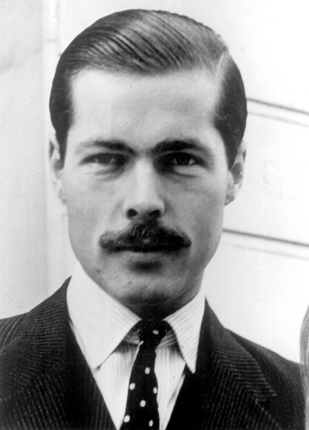
Another interesting thing is the way this class narrative is synthesised with a powerful feminist argument. Egged on by Aspinall's reactionary Alpha Male spiel, Lord Lucan starts to intimidate his wife Veronica - mentally and physically - in an attempt to get her committed so he can win custody of his children. Fortunately, this is the progressive early seventies rather than the Downtonite 1920s, so the courts decide in favour of the independent, sound-of-mind woman against the imperious, bullying aristo. The tragedy is that the working-class nanny who has supported Veronica in the run-up to the trial is bludgeoned to death by a crazed Lucan at the end of the first episode.
The symbolism here - of a brutal, quasi-Darwinian patriarchy reasserting its authority after a period of "effeminate" egalitarianism - is not difficult to grasp. The unheimlich contemporary relevance - bearing in mind certain recent uber-Darwinian pronouncements of the British Conservative Party - is also striking.
And then you realise who Aspinall's step-nephew is:

There can be no more denying it ...
The conspiracy theory is the true realist art form of the twenty-first century.
 2013 in Music - Pt. 2 [ 31-Dec-13 5:33pm ]
Right at the tail end of 2012, a thread was started on the music forum I frequent, dissensus, calling for a discussion on "Shuffling / House Music / Cutting Shapes", referring to the shuffling/shape shifting/cutting shapes dance style which had taken the capital by storm - essentially a revamped charleston, or a take on the kind of fancy foot-work that proper dancers have been doing to house music since it began - and the deep tech house music pushed by DJs like Mark Radford and Majesty which these shufflers were dancing to.
I clocked the thread, watched a few of the videos, listened to a few of the tracks, thought the dance was good fun and the music alright but a bit pedestrian, and then basically didn't give it any serious thought for the next half year. Because why would I need to when jackin existed and it was a gift from the EDM gods, a music that could have been custom made for me considering how exactly it hit all my raving-erogenous zones, with a thriving club scene and massive tunes coming out faster than I could keep track of?
Yet as the summer wore on and I found myself having to search harder and harder for less and less jackin trax, I began looking elsewhere for tunes to fill my sets and I thought I'd give "shuffle house", as I thought it was called (it is not, it's called deep tech), another look. Credit where credit is due, "give another look" meant "give another look through the dissensus thread", and it's simply the case that without that thread, and without the advocacy of posters like Continuum and Trilliam in particular, I would have never clocked the sound (clocked it from Tokyo? are u mud??), I would have never clocked the big tunes, and the second half of 2013 might have been spent in total musical/existential crisis mode, rather than gleefully exploring a whole new genre's worth of beats and bass and #danger.
One of the first deep tech tunes I "got". Total scene anthem, crowds singing all the words sort of flex. Wicked vocal and lovely rolling bassline, very easy to see how this fits into a UK tradition of tuneful bass bangers.
Whereas with jackin I was hooked at the first donk, with deep tech it took me half a year to get from "I don't like it", to "I don't really like it, but some of the tunes are alright for warming up jackin with", to "I don't really like most of it, but some of the tunes are big, still", to "I like it, but it's not very original" to finally just admitting "fuck it, I really like it".
If that sounds like a lot of umming and erring over a few tunes, then I'll justify my caution by saying that, deep and tech house has been, in a very tangible way, ruining my nights out in London for the last 2 years. This is not some inverse hipster snobbery about the inherent superiority of British urban dance musics compared to european house music (though duuuuuh, that music sucks and our music is great), but I mean I have been to countless club nights across the capital where the DJ I liked has stopped playing, and the next DJ would come on and start playing some fucking boring standard house music, and on a visceral level I would stop having fun, would no longer want to dance, would want to go home.
(I remember one party in particular where Marcus Nasty had been playing a jackin set, smashing up di place, me and my mates feeling jolly with a couple of pints and a spliff in us and having a great time. The next DJ comes on, we're not really paying attention, he wheels a track, we sit up to take notice, the track drops, it's some tedious deep house bullshit, my mate Becky says "this sounds like... HOUSE music!" and we down our pints and leave...)
Another one of the first tunes I was feeling. Though it's difficult to identify a single sonic innovation there is a certain swagger and menace to the track that has been absent from house music for a long time now. Spooky ghost noises, sleazy/chugging bassline, an almost breaks-y shuffle and complexity to the rhythm section, and a fuck off massive second drop all speak of its UK origins.
It took me half a year to realise that deep tech is not simply deep or tech house, although the ridiculousness of that sentence does belie the slight undead quality to UK rave music as we go full circle on the 25th anniversary of acid house...
Like Lorenzo with jackin, the birth of London deep tech can almost be entirely attributed to one person - Mark Radford. Whereas Lorenzo's path to jackin involved slowing down a UK genre - bassline - to house tempo, Radford's "innovation" such that it was one, was to see the UK tuffness immanent in the best of Euro and US deep and tech house, but crowded out by the filler:
"I'd go to raves and hear 3 hours worth of music, and out of them 3 hours of music there might have been 3 tunes that I thought "if someone put a set together, of all that sort of music, they're gonna kill it", I did, I killed it!"
Radford's own story is the perfect example of the hardcore continuum theory - which states a genealogical and scenelogical affinity that runs through nearly every major UK underground dance music from the time of acid house through to the present day, and is proof positive that this deep tech stuff fits into that lineage.
"I've been through every genre of what you could possibly say is the London dance scene. Started off back in the early days with, like, the acid house raves, then I got into jungle, drum & bass, then moved on to garage when I felt that drum & bass had lost a lot of its soul, then the same thing happened with garage, so I moved onto soulful house and then where I am now, with like the deep tech stuff.
In the same video he talks about a marriage of "mad noises" and "groove" that is more or less the perfect summary of what it is that holds genres as disperate as hardcore, jungle, garage, UK funky, bassline, jackin and deep tech together.
Interestingly, there are more or less three separate groups of producers who all come to deep tech from very different backgrounds, but all contribute to it being more that just deep house in very different ways:
1. Old Dons
One of the most interesting thing about deep tech is the prevalence of old dons, guys who've been through every hardcore genre like Mark Radford, and many more who had their moment many years back, and have found deep tech the perfect forum for their comebacks. The list is kind of astounding, from garage you have Ed Case and Sticky and from jungle you have Bizzy B(!?!!) Best of the lot however are Martin Ikin, a G making hardcore back in 92, and darkside, breakstep/dubstep pinoeer Darqwun/Oris Jay making tunes under the name of RS4.
Marin Ikin's deep tech sound can be heard best on the magnificent, Nightmares On Wax sampling Nothing To Fear:
Old hardcore vocal samples, deep, subbass heavy rolling jackin basslines, a bleeps and bloops that flicker like vague memories of the entire history of UK dance music - watch for the Soft Cell - Tainted Love bleeps at the drop. A masterful blend of the bouncing, raw-danceability of deep house music, with the sonic debris of UK rave music, this was one of my tracks of the year, and one of the tracks which taught me how to stop worrying and love deep tech.
Even better is RS4, which is no surprise considering just how sick Darqwun was back in the day (Said the Spider, top dubstep tracks), but what is somewhat surprising is that a figure so foundational in early dubstep, but only really remembered among the DJs he influenced and not the massive at large, managed to reinvent himself to be so thoroughly relevant in 2013, using his years of production practice to show up all the young upstarts.
Essentially every track track he's released or previewed on his soundcloud has been pure fire, with killer remixes of Walk On By and L.F.O but for my money, the best of them are his remixes of Soulstar's Locked On You and Sia's Little Man.
(This version unfortunenly cuts out before the wicked second drop, but you can hear a longer version here for now from about 7:30 into this mix - http://podcast.dgen.net/rinsefm/podcast/MarkRadford071213.mp3)
If Martin Ikin's tracks meet somewhere between house and hardcore, Locked On You strips the house elements down to a mere skeletal structure, 4x4 scaffolding to build his monster darkcore riddim. For Locked On You sounds like nothing more than that moment around 93 when hardcore turned to the darkside, the drugs stopped working and euphoria quickly turned to its opposite. Panic attack synth stabs, an undulating, slimy bass lines, militaristic rolling snare drums and haunting synth strings which sound like they're about to snap all made this one of the spookiest tracks of the year, and one of the best.
Equally sick is the "monster remix" of Little Man, a classic garage vocal rerubbed on pure darkside 2013/2014 flex.
This one's a proper scene anthem and got wheeled twice - once for each drop - when it got dropped at Scala on Boxing Day. Though it might sound restrained compared to the exuberance of the original, it throbs with a compacted energy, like jungle slowed way way down, and grows on you slowly. By the time the swamp monster squelches come in, there's not a hand in the rave not bussin gun fingers.
2. The Bandwagon
Another major source of deep tech producers comes not from such old veterens, but producers from recently extant scenes which have been loosing their zeitgeist luster - grime and funky primarily, but more recently from bassline and jackin too.
Of the grime guys, it's Black Ops' Charmzy who's been making the biggest moves for me with his Shape Shifting EP, specifically the icey cold Dirty Disco:
http://www.beatport.com/track/dirty-disco-original-mix/4541389
The biggest contingent however come from funky, who's death was intimately tied up with deep tech's rise, and who can be said to have bequeathed this new scene not just a large number of DJs, producers and MCs, but also much of its clubbing infrastructure, and perhaps the entirety of its audience.
Carnao Beats was one of the earliest defectors, having been edging his funky towards a deeper sound as early as 2011 with his VERY cleverly named Deep-ception EP http://www.beatport.com/track/infected-by-house-original-mix/206353/, before switching decisively to the deep tech sound in 2012. With a number of releases out on Audio Rehab, half of his tunes being scene anthems, and being a mainstay at deep tech raves from London to Leicester, Carnao represents one of those figures who was a bit tangental in one scene - funky - but has become central to another.
His sound is defined by mental, polyrhythmic, almost acid house basslines, with a distinctively 80s, electro vibe to his drums. His hit rate is high, but my favorite tracks are the hypnotic, shuffle-tastic, bleepy and bassy H.O.U.S.E
And the recent top-40-hit-by-any-other-name Gone in the Morning, with the ever shape shifting Donao, who's also jumped from funky to deep tech right on schedule
Also from the funky diaspora is Tazer, producer of the house-music-for-people-who-hate-house-music masterpiece, the slow-fast, Notorious BIG sampling Wet Dollars
An absolute anthem in the scene, this got played about 4 or 5 times at each deep tech party I went to in December. It's difficult to pin down just what it is exactly that makes this track go so goddamn hard, but there's some magic in the percussion section for sure, with those memetic ravey woodblock stabs that linger in the body hours after hearing them on a system. One of my favorite tracks of the year, if you don't get this one, then you won't get deep tech.
My favorite crossover artist of the bunch though is Arun Verone, the new deep tech alias for bassline/UK B badman DJ Pantha, coming hot off the heels of his jump to jackin last year, which produced some stone cold bangers:
With his deep tech stuff Arun Verone has brought some of that bassline/jackin rowdiness, and has brought the full force of his knowledge of big, bouncy basslines to bare on the house template, making for a much needed anecdote to the sometimes-too-serious vibe and aesthetic of the deep tech scene.
With only a couple of free downloads and hardly any official releases to his (new) name yet, the best way into Verone's stuff is through his mixes:
And it's a lucky coincidence that he happens to be one of the scene's best DJs, with a proper grimey cutting and chopping, wheelups, fast mixes, constant energy-vibe-hype-flex to his sets. (For what it's worth though, the quality of DJing in deep tech as a whole is infinitely better than in jackin, where apart from Marcus Nasty, there isn't a really top class DJ among them, though the best of their producers, IE Lorenzo, is objectively the greatest UK producer of the last half decade - seriously, name anyone who comes close...)
Vocal hooks a-plenty, wompy, warpy wobblers, sharp plasticy drums and a certain reek of noir/dread that hovers over his sounds like old skunk make his sounds a perfect entry point into deep tech from other UK genres, and give all of his tunes that vital edge.
3. Young Blood
The last major group of artists keeping deep tech gully and UK is the new school of producers for whom deep tech is their first foray into UK rave music, for whom DJs like Mark Radford and Majesty were their path into the music and who come to it, consequentially, unburdened with and largely uninterested in the long history of house music, and questions of how house music 'should sound'.
This perhaps represents the largest group of the three, with many of the artists of Radford's essential-listening Audio Rehab label, seemingly having no name to speak of in any genres before the current deep tech wave.
This group would seem to include massive-in-the-scene names like Playtime Productions:
(check the hip hop meets house in East London vibez on this one, and the wobbles)
And Lance Morgan:
(Absolutely love the noir swagger on this one, perfect music for driving around London at night)
As well as some very recent debuts such as Truce:
And indeed, a whole new Audio Rehab imprint, +Recordings dedicated to highlighting the work of new producers exclusively, starting with the 'ard-as-fuck debut from the Area 8 boys, which sounds, of all things, like Pulse X at house tempo
Cutting Shapes
So, having got over my initial distaste at the name and the music's proximity to deep house - I've never liked a music more that has verged on music I dislike so much - I think the quality of music speaks for itself. If you're not listening to deep tech, then you're missing out on a lot of the best music in the UK at the moment, and that's never a good idea.
Getting into the music slowly over the year, as a DJ, miles removed in Japan, I was lucky enough to experience it in its proper context, in a rave, when I was back in the UK over Christmas. First, DJing it out at 02:31 in an absolutely mental night which started when my plane got in from Tokyo around 4 in the afternoon, getting a lift from Heathrow back home from #Mum (big up!), shaving, showering, burning my CDs/USBs, wistfully looking at my bed and thinking it looked GREAT, then grabbing my 17 year old brother, rushing to Euston and grabbing the 9:05 to Birmingham where it just so happened that a group of 4 girls - deep tech ravers - were VERY publicly taking balloons, talking about Arun Verone and Lance Morgan, and running house which sounded EXTRA deep on their tinny mobile phone speakers, before getting into Birmingham New Street, hitting the Rainbow, and playing the 12-1 warm up slot with a set of 90% deep tech to a crowd of about 5-600 people and absolutely tearing the place down if I do say so myself, which, you know, I do.
My other experiences were at a couple of club nights over Christmas, House Passion at Scala on Boxing Day, and Rhythm N Funk at Dukes the weekend before New Years.
I had been curious to see deep tech music in a rave for a long time, and was interested to see how the club experience of the music that was taking over London compared to 02:31 and the jackin scene in Birmingham. Unfortunately, but not really surprisingly, neither event even came close to the standard vibes of 02:31 on an off week, let along their big blow out, monthly 10:31 specials. But it's not really a fair comparison, because I've never been to any rave ever which is nearly as good as 02:31. If you're into bass music, it's probably the greatest event on the planet right now.
But on their own terms, both House Passion and Rhythm N Funk were good, really damn good in fact, the best party experiences I've had in London for a long long time. Both had sound issues - Scala's a live music venue and it had a live music soundsystem, all the low frequencies were there, but it was not exactly a bodily experience. Rhythm N Funk had a MAJOR problem for half the night, the problem being that the sound man at Duke was a prick and had the limiter set insanely low, so that you really couldn't hear any sub frequencies at all. If by some insane coincidence the sound guy from Duke reads this - fuck u thnx. It got sorted at the end of the night, and was a bit of a lesson in how this music is of course, UK bass music and needs rasclart bass.
Both were very vibezy. The crowd was a bit older than 02:31 (average age, say, 26 as opposed to 21) and blacker (maybe ~60% to 02:31's ~10%). Both had a mixed crowd, mostly quite street, with plenty of those new-school house band wagon not-hipsters-but-still-wearing-Raybans sorts, with a spattering of proper cockneys shouting OI OI and FUCK OOOORRRFFFF at the big drops. Plenty of people on MDMA, but not particularly a communal loved up vibe - more like drug/music induced personal hypnosis. Skunk smoke everywhere. Most importantly, EVERYONE was dancing, shuffling, cutting shapes, going #ham. It was wicked to see, some really great moves, and it looked like it must be loads of fun to be able to do it to the music, which compliments it really well. Actually felt like a bit of a prick for wearing a t-shirt not a shirt, and not being able to shuffle.
Would definitely recommend that anyone in London checks out some of the raves, because to my mind you're unlikely to find better vibes or better music in any other scene in the capital.
Back to the Future
So in short, after a year of being aware of the music, and 6 months of actively attempting to get into I end 2013 and begin 2014 big into deep tech and excited about what the future holds. Which is good, because if I didn't like the stuff I think I'd be in a very bleak place musically right now.
That said, it doesn't move me like jackin at its best did, and there remain legitimate criticisms of the sound, least not the question of its novelty and innovation. For while the questions of "is it really its own sound?" and "Isn't it just deep house music?" have been answered ("yes", "no") the question of "is there anything new here?" is still open.
For all it's many qualities - darkness, toughness, danceability big badbwoy basslines, hip hop vox, diva vox, slinky riddims, fact that it's an actual massive scene people are raving to - there really isn't anything about the sound you can call totally unique to deep tech or totally new. Though there's something future about it in terms of spaceaged sounds, cold minimalism, tech-noises, it's a sort of Robocop-retro futurism, with a massively strong 80s influence running through the sound. This is hardly a bad thing, as it's great to hear those old 80s synths and bleeps and drums brought into a new context, but it does feel like the hardcore continuum going back to its roots rather than opening new horizons of possibility.
We're living in retromania, and the fight for the future remains more important than ever, there is a point where if you don't compromise a bit, you're either going to end up listening to experimental but vibeless wank (see "poststep", or don't), or just not enjoying anything at all.
For me, the fact that dark, trippy rave music is taking over London again - and looks poised to infect the heart of the mainstream like no genre since garage - is reason enough to be hopeful for 2014.
Tokyo, you've got the rhythm in you
Though I've gone on these last two posts about the state of UK rave, the truth is that I spend most of 2013 in Tokyo. It wouldn't be right not to end with a shout out to some of the incredibly talented musicians I've had the privilege to get to know this year.
Pakin - Probably the most important grime MC in East Asia
First up is my mate Pakin (パ禁)which is short for 中途半端 chuuto hanpa 禁止 Kinshi - which means "being halfhearted/half-arsed is forbidden" or "don't fuck about". An old school hip hop head with a massively knowledge of JP-hop hop, he got into grime nearly 10 years ago by reading about Dizzee Rascal in a magazine. One of the hardest working guys I know - in the context of the fickle Tokyo nightlife scene, his event Gum has been running bi-monthly without fail for 5 years and recently had its 30th event - and also one of the safest. I've seen his MC skills grow sharper and sharper in the year I've known him and seen him doing his best to promote an authentic Japanese grime culture, teaching hip hop MCs about wheelups, and encouraging them to pass the mic and spit over DJs grime sets.
His hard work has paid off with a number of collaborations with Birmingham's Dark Elements crew (including the likes of Devilman and Darx), cumulating in him going up to Brum when he was visiting me over the summer and recording this:
Seiho feels rave
Though there are many talented DJs and producers out in Japan, it's often said that the Japanese are better technicians than innovators and not many have a uniquely Japanese sound. I think this is racist as shit - the idea of Asians as hyper rational, lacking soul, orientalist bullshit - even though many Japanese would say the same thing and it is true that many Japanese artists judge their own success via its proximity to a Western source material.
Seiho however is a true original, fusing sugary sweet J-pop influences with rave, trap, footwork, trance, hardcore, and anything bright and euphoric in his own productions, and DJing with a controller and midi keyboard, adding live piano vamps, speeding up and slowing down songs to double or halftime, dressed in mental-stylish-mental combos of colours and patterns while dancing like a maniac and singing along to his own stuff. He's wicked basically.
Part2Style have more dubs than you
Part2style are purveyors of "future ragga". Doing exactly what it says on the tin, they're sets consist of dancehall, dub, dubstep, grime, jungle, dnb, footwork, garage, and house , everything and everything as long as it's got a strong ragga vibe. Their mixing and selection is sick, reaching deep in the bag for old gems and pulling up new tracks which haven't been rinsed out. Nearly everything they play is an exclusive dub, with some absolutely massive names giving them a shout out including General Levy on their dubplate of Incredible. Their sets are packed full of energy with super authentic ragga-style MCing, and I've never not seen them mash up the daaaarnce. Regulars at Outlook Festival, and booked to play Fabric later this year, they might just be the first Japanese DJs to break the UK. Watch the fuck out.
Frankly$ick has more grime than you
Not /strictly/ Japanese although 100% fluent in the language and poised to be out in Tokyo for, I dunno, the next decade or something, he gets to be on this list because he's such a fixture of the Tokyo bass scene. DJing a bit of everything, but specialising in grime and bassline, he's one of the most technically on-point DJs I know, and the only person I can think of who still puts in the legwork, crate digging, hitting up producers - big and small - to get exclusives, and overall hustling like mad to keep his sets full of gully, future, non-wishy-washy-seapunk-Visionist-eskiwank up-to-date grime music. A DJ who'll have you reaching over the booth and asking "what the fuck is thiiiiiis?????" he's $ick and you should check him out.
2014
This last year was the first in recent memory where I literally could not keep up with everything I wanted to. Trap, footwork, UK 130 shit, and pop were all popping off, and I simply did not have time to get as into Miley Cyrus as I wanted to. Every just focussing on the current UK house stuff took me so long that I'm now publishing my 2013 list in the second week of the new year lol.
But it's probably a good sign, though economically, socially and politically, the world's probably more bleak now than at any other point in my lifetime, musically we're living in times of abundance. If you can't get excited by that then you're doing it all wrong.
2013 in Music - Pt. 1 [ 30-Dec-13 4:45pm ]Pt. 1 House & Bass all in one place
It's very difficult for me to talk objectively about music this year. It's been a year defined by both moving closer towards and further away from the musical scene of action for me.
Moving closer, though jackin was my obsession for much of 2012, it was NYE 2013 when I first actually got to hear the music in its proper context, had one of the best raving experiences of my entire life, and began a love affair with 02:31, the Rainbow and Birmingham which has seen me go back another 4 times this year, including two 02:31 raves I had the privilege of DJing.
Moving away, literally, in March I moved to Japan, where I plan on living for the next few years. In Tokyo I've made some amazing friends, met a lot of very talented DJs and producers, been to some wicked nights out and have had an great time getting involved in the Bass scene out there. But yet, Tokyo's not London, there is no massive, there is no sense that musical activity is plugged into the lives of tens of thousands of people around the nation, there is no sense of the history which everyone with more than a passing interest in raving in the UK knows almost innately, there is no sense that any of it really matters, because to 99.999% of Japanese people, it doesn't.
Still, I had a fantastic 2013, and if you can forgive that my vision is necessarily partial, unreliable both for standing too close to the sun (nearly half my weekends in the UK this year have been spent at 02:31 exclusively), and too far away (the biggest party I've seen in Japan had 200 people... It was sick!) then I hope you'll find me thoughts and feelings and not-feelings worth a read.
02:31/Brum/Jackin
As anyone who read my yearly round-up last year, or basically had any sort of contact with at all knows, jackin was the single sound that defined 2012 for me. The first half of 2013 saw me grow even closer to music, ushering in the new year at 02:31 and going back again and again at every opportunity I've had.
My obsession with the music itself continued on a similar level to 2012 for much of the year, as the scene continued to dash out banger after banger after banger at an insane pace. Indeed, lining up the top 10 or 20 jackin tracks of 2012 and 2013, you could even make the argument that jackin improved this year.
Some of the tracks/vibez/flavours/artists I've been feeling this year are:
DARKNESS2013 was the year jackin did what we all wanted it to and went over to the dark side. Brent Kilner had been pushing his own dark, dubstep/dnb influenced take on jackin since last year's 02:31 anthem Too BadThis year he continued in the fine style, and it's really difficult to whittle down out of so many banging tracks (Too Bad VIP, Kelis's Milkshake refix, Dizzee's Old Skool refix etc etc.). So honestly, go over to his soundcloud, pick a track and random, and be treated to a darkside bass banger. Best of the bunch however has to be the very recent refix of Skeng, an inspired mix which speaks to Kilner's background in dubstep, is hard as f$$$ck and is just a few more follows on Kilner's soundcloud away from becoming a free download, so support the cause and follow him!
2013 also saw Lorenzo on a darker tip, most notably in his tracks with Pete Graham, starting with the half-step, screwface, "dark and creepy" Dorothy's Forest
And getting progressively weirder and wobblier with the likes of Dorothy's Armpit/Wom, Chu Ba Ka, The Twlight Zone and Who Dat.
Chris Gresswell, one half of the pioneering jackin crew Screwface, really came into his own this year, with a stream of twisted bassline bangers, including a likkle dubplate he did for me of the 2-step classic Stone Cold ;)
But nowhere was he spookier than with Silent Hill, sampling from the horror movie of the same name, complete with eery twinkle noises, whipcracking sharp drums, deep rolling bass and two wicked drops.
Come over to the dark side? Yeah alright then.
B list jackin
For me, one of the joys of jackin at it's best was the sense that there was so much energy, so much quality to the scene that even the second tier of tracks - tracks by artists who pop up and disappear again, tracks dashed out on bigtunes with no sort of promo or bloghype, tracks you might rinse for a month obsessively but that are unlikely to be considered classics or even remembered in a few years time - even these tracks are sick.
As the year went on and jackin turned increasingly professional, with tracks signed to record labels. drawn out release schedules and artists imposing stricter quality control/brand management to their releases, this B-list jackin suffered massively for it. We released that this abundance of B-list jackin, the ability to go on to bigtunes and find 10 tracks which were good enough to bang out in a club - if not necessarily good enough to have played at your funeral - was vital to the health of the scene as a whole.
So this goes out to the B-list.
This following one's actually a remix of some bate EDM tune, which I only realised after hearing the original in a connivence store in Tokyo.
Massive hardcore/euphoric vibes on this one. This track really sums up that thing I love about jackin where it rehabilitates fatally cheesy vocals, where you're left wondering during the build what the hell you're listening to and how the producer's ever going to redeem themselves, and then it drops and you do a nasty bassface and cop it into your bigtunes cart right there.
97 plays on soundcloud, but was my song of the month earlier the year, duppying a number of my first DJ sets in Japan
Some dude called Phatfunk, who made this track and no others that I can remember. Wicked dancehall vocal from a DJ Zinc track, and absolutely love the slowed down donk bassline.
Hybrid Theory
Hands down the debut artist of the year, Brummy duo Hybrid Theory exploded onto the scene way back in January with 0483 and have put out nothing but bangers since.
Their sound encapsulates the blend of speed garage warps + bassline wobble + house beats + magical mystery ingredient that defines jacking, and they come with a toughness and grit that counterbalances the cheese and pop tendencies of other jackin artists.
Their soundcloud reads like a best of list for jackin this year, with track names like So High, Higher, Mind Games and Drop to the Max likely to set off screwfaces on anyone who's heard them in a club. Though choosing a favorite out of all of those basslines and beats feels nearly impossible, two special mentions have to be given to the wobbling stomper that is Screened for having one of the best second drops of the last half decade:
And the anthemic remix of Decibel's Skank featuring Flow Dan:
This track had me skanking round my room for nearly an hour when I first clocked it, even bussin' a cheeky selfie video of the massive screwface it induced. It's the gift that keeps on giving, 'dropping' about 3 times before settling into an un-fuck-withable blend of slinky 4x4 drums, owl bassline, and grime vocals. Top 5 tune of the year, and would be number 1 grime x jackin crossover if Cause & Affect hadn't upped the levs later on...
Nigurr
Number 2 breakthrough artist of the year. If Hybrid Theory is a genius producer, likely to be making waves for a long time to come, the South African(!?!?!) Niggur (a name which makes talking about the guy obviously hugely problematic for white people...) is rather only a good producer with a genius formula - namely putting bate, singalong hip hop and r&b vocals on top of You Want Me-style, deep and dirty, bouncy house beats.
Shake Dat
"Shake dat ass for me, shake dat ass for me" - it might not be clever, but it is big.
You Want Me Too
Perfect name for a track which basically acts as the sequel to Nick Hannam ft. Tom Zanetti's mega anthem You Want Me, sampling the classic Cassie track U & Me and guaranteed to get gyals and guys #emotional on the dancefloor.
Cause & Affect/Lorenzo
Yet despite new tallent entering the scene, no one came close to challenging Lorenzo's reign supreme over all that is jackin, either in his original productions with Kane as Cause & Affect, or engineering for countless other producers.
2013 was a big one for Cause & Affect as a duo, seeing their track Don't Like To Do That released on the massive Dirtybird label, with tours taking them everywhere from London to Ibiza to San Francisco. It also saw their productions getting better and better.
Pushing the bass line as hard and far as it could go was Kamikaze, the name being an 'o so subtle statement of intent as to its impact on the dancefloor:
Coming like an 8 bar grime tune, with the same bassline played out in turns between a metallic, saber-toothed sin-wave bassline bass line and a jackin-owl-bass which sounds like someone's been handing out M-kat in an aviary, this was my go to dj tune for when I was mashed and just wanted to take things a bit nasty throughout the year.
On a completely different flex was the C&A remix of Stanton Warriors' (lol yes I know, bare with me) Cut Me Up, a spangling metamodern, back-to-the-future mashup of 'ardcore and 'ouse and bass.
It builds with a near era-perfect replication of a 92/93 hardcore-jungle build - piano vamps, diva voxs, rolling breaks, thundering reese bass, with only its too-clean production values to give its real age away - but drops in pure 2k13 ruffneck jackin style.
Best of the bunch was Battle, an absolute monster riddim featuring vocals from the Newham Generals, all the little orchestral/cinematic frills and trills that fill the C&A soundscape, and a rudebwoy bass line which can't help but make you pull a face like someone farted nearby. A sick tune that got us all very gassed at the possibilities of the grime x jackin crossover
Though much of Lorenzo's best work was in collaboration with other artists (though one never really knows what percent is Loz's input, you suspect sometimes that he basically just makes the whole damn track).
Particularly strong this year was his work with Tom Garnett, which resulted in the wonderfully tracky P.A.R.T.Y featuring party-hard lyrics from Tom Zanetti and a womping bass line which sums up everything jackin does best:
Perhaps winning the award for 'most inspired sampling' (last year's prize obviously had to go to Loz's refix of Running Up That Hill...) was Trouble
Which bounces along nicely until drop in the middle, where it smoothly slips into the original version of Woman Trouble by the Artful Dodger ft. Craig David. I can't conceptualise the human who would not be left beaming, singing along and bouncing around like a mad eejat when this kicks in. This has been one of the anthems of the year for me, played by me or someone else at nearly every party I've been to in Tokyo this year. It's the sheer will-to-pleasure that everyone who 'get's' jackin, gets.
The closest thing the scene had to a runnaway anthem in the vein of You Want Me this year was Darlin' a Lorenzo engineered Sleepin Is Cheatin' track featuring the lethargic and louche, day-after-a-night-taking-too-many-drugs crooning of Tom Zanetti.
With an almost-professional video feature TZ's adorable little son bussin moves in a warehouse, this was the jackin tune with staying power: I've heard it at least 3 times at every 02:31 event I've been to since it was released. It's also the only jackin tune I can think of that's crossed over, getting some serious play in deep-tech raves, radio sets and mixtapes too. Slow, druggy, donky, sick.
Track of the year!!!
Finally, both in the sense of coming at the end of this too long (sorry!) rundown, and being the last major jackin track of the year - released earlier in December - is Up To No Good, a masterful rework of an old hardcore track done alongside the ever ravey Ill Phill
I could pick it apart and look at how every single element is perfectly engineered to to get UK ravers gassed as #f$$ck - but really it's just the best build and drop of the whole year - and then it insanely generously repeats the trick with the best build and 2nd drop of the whole year. A massive anthem, and for what it's worth my track of 2013.
Jacked out?
So, given that I've just spend a lot of words and way too many soundcloud embeds (sorry about that slow computer/internet users...) gassing about 2013 jackin, you might think that the scene is in rude health. The unfortunate truth is however, that over 80% of the tracks listed here came out in the first half of the year. Since the summer, things have really, reaaaally slowed down.
A large part of this would be down to the increasing professionalization of the genre. Whereas it used to be that a track would be previewed on soundcloud, a within the month it would be up for download on bigtunesmp3, now the vibe is, a track gets previewed on soundcloud, it gets signed to a minor record label whose sole act of promotion seems to be getting the track on beatport, and then you wait 6-9 months till you can get hands on it, with none of the producers willing to give the track as a promo because it's signed.
Though this false scarcity and label-support obviously makes sense from the standpoint of the individual producer, on a scene-wide level it acts as a major drain of energy, an aura killer, and has destroyed that scene you had earlier on in the scene's lifespan that there was just so much going on, so much creativity at work, that a producer would release a track a month because they could.
But if producers being more careful with there tracks was a cause of decline, it may also be the case that there simply was less energy, less momentum, less ideas floating about as the jackin brand exerted a weaker and weaker pull on tallent compared to house proper.
For much of the year even - to be honest, especially - among its biggest producers and DJs, you could not find anyone willing to defend, define, or even use the word jackin to refer to the bassline derived house sounds coming from Brum/Leeds.
When 02:31 got a weekly show on Rinse FM, they used the platform not to push jackin, but to push their own brand of 'house & bass' (which is the exact same thing but a million times less informative). As Lorenzo, Hannah Wants, Tom Shorterz have built well deserved profiles for themselves in the national scene, and have found themselves subject to interviews and magazine features, the words "house", "bass", and "house & bass" fly thick and fast, while there is no mention of jackin, the scene they made and that made them.
Chatting to Kane from Cause & Affect, he says the affiliation with house is due to having an eye on the long term - having seen jungle, garage, bassline etc. fall by the wayside, he would rather exert his efforts for the scene that never dies - house music. Of course, while house music never dies, neither does is come to define an era, or expand the possibilities of what is meant by dance music like those UK genres which shine too bright and die too fast.
Ultimately, I can't but see the abandonment of jackin as a name and genre to rally around as a massive shot in the foot - from the bottom of my heart wishing Lorenzo and co all the best in making a name for themselves in the massive, 30 year old, international house scene - but seeing this as less likely, and the rewards in fact lesser, than the patient work of building jackin as its own scene and having the mainstream come to them (ala 2-step).
For this reason, though 2013 was a great year for jackin, it truly saddens me to say, I reckon it will be its last. As the summer wore on and the weeks since I had bought anything from bigtunes piled up, I began looking elsewhere for tunes to fill my record bag and for that little hit of future. My search led me back to my hometown, and ironically given my dispair at jackin's direction, back to house.
Continued in Part 2
2012 in Music [ 27-Dec-12 5:20pm ]Yo, this blog post will be in two sections, Part I dealing with my own personal year-in-music, and the second a more critical look at some of the major musical trends this year.
PART I
2012 was a good year! Started the year doing a dissertation/parring it in Cambridge and finish it as a graduated real human about to move to Japan for the next few years :O
On a personal musical level it's been interesting as well. Though I've been out raving less than in 2011, this was the year I really pushed myself with DJing and began to develop a (very small) name for myself. As I say, my first couple of terms at Cambridge were a big parr, and it was bedroom DJing that made most days bearable, so I did a lot of it (big up my neighbour Leeana for her tolerance!!). Coupled with getting far, far better technically, my residency slots with Rudimental and Voodoo Rave, and later on in the year, my slot on Innacity FM, gave me space to develop a sound and the motivation to constantly hunt for new music to keep things fresh. I can now say "I am a DJ" without feeling like a wanker.
As a punter, a few of my major moments came on the dance floor - Champion dropping Mosquito at Cable, Beneath's whole set at Rudimental, Manny and J-Cush slaughtering the dance in Brooklyn - but just as often came from intimate moments with friends - discovering Call Me Maybe at Jambie's Jubilee BBQ,
And a very high, very magic May Week evening listening to Will Saul's old Fact mix by Mill pond with good friends.
But in true 2012 fashion, the defining musical moment of my year, my epiphany/I-have-seen-the-future/I-like-music-again/this-is-why-I-rave moment, came not in collective euphoria on the dance floor, but in the atomised setting of my dorm room on headphones, when I clocked Marcus Nasty's jackin podcast, thus instigating the most exciting 6 months in music I've ever had. More of that below.
PART II - TRENDS
'UK Bass' AKA post-dubstep, AKA intelligent zzzzfest AKA HOUSE MUSIC… AGAIN!!!!!
Hessel Audio, Hypderdub, Hemlock, Night Slugs etc. Are all banished to the 'boring until proven exciting' corner.
how do u even dance to this I don't even
For London producers working under the 'Bass' umbrella this year, not a single gun finger was busted. Postmodernism has not treated UK dance music well, and the atemporal, internetty, vybless music coming from the capital - a mush of vaguely dubsteppy bass, house rhythms, washy synths, 808s and AALIYAH SAMPLES MADE BORING HOW DO U EVEN DO THAT?!?!? - has lost all sense of FWD progression and all sense of fun.
This is literally Pearson Sound pressing the 'make Pearson Sound track' button on Logic. Dead-Out.
One notable exception to this rule has been the output of Keysound records, and Dusk and Blackdown's Rinse sessions. Here a sense of teleology has been sculpted by the curation of a tight aesthetic - dark, grimey, jungalistic, syncopated rave music:
Yet otherwise there was next to zero signs of life here. Wake me up when London artists stop talking like critical theorists and when somebody, anyone makes a BANGER. Until then Fuck u-K bass.
UK FUNKY 2007-2012 RIP
Well it had a good run; maintaining a sense of cohesion and progression, constantly putting out great tunes, and balancing light and dark elements for a good five years, even as it was loosing support to the most stale of deep and tech-house for three of them.
2012 even saw a number of great funky releases, notably from Beneath, who's combo of dank 2006-dubstep dread vybez with ass-shaking tribal soca-flavored skank riddims make him a sub-genre unto himself.
DANK
Mosquito by Redlight's Lobster Boy alias is possible one of the greatest funky tunes ever, and gets a special mention for providing my most memorable and documented rave moment of the year:

Champion's one of the best DJs in the country, and his Crystal Meth EP showcased the gully possibilities of entwining funky even further with grime.
Still, though the massive left funky in 2009, for a few years still there was a constant stream of great music being made by people like Roska, Lil Silva, Cosmin TRG, Swing Ting etc. By summer 2012 that stream had truly dried up. UK FUNKY R I P
EUPHORIA
Not so much a movement as a feeling.
This year, we climaxed.
100% of humanity has climaxed to this song
We've gone up up up up up uuuuup.
And we wailed where have you been all my life.
Yes. Yes yes yes.
TEKLIFE OR NO LIFE
Imagine what music/culture would be like right now if footwork didn't exist? It's a truly depressing thought. For musical modernists, footwork is pretty much all that that stands between us and the end of history. There is quite literally no other movement across the arts - music, literature, visual culture - that is more radical, more important right now.
Yet the radical rhythmic/music-structural disjuncture that footwork represents is a large part of why the original sound itself has been limited in popularity to the Chicago demographic that created it and the global avant-hipster class who live for that future rush.
Where its influence has spread, it has spread in watered down forms - from UK bass to trap. The fact that the for the first time in musical history the UK has responded to an American innovation by tempering it:
And not by roughing it up:
Is in itself a telling sign of the relative decline of the London based hardcore contiuum vis-a-vis ghetto America.
This year was a particularly great one for footwork, and once again the Teklife crew of Chicago fought off new pretenders and reasserted their place at the top of the footwork food chain.
The undeniable king of footwork is and remains DJ Rashad, who this year helped to launch the Lit City label to showcase the best of the Teklife massive. The first album on the imprint, Welcome To The Chi, showed footwork reaching a new stage of maturity and production values, and showed it turning outwards towards the world by incoperating influences as diverse at Jungle and Grime:
The dreadest track on the album, We Trippy Mane, brought footwork at it's most avant-'ard, evoking the minimal grime instrumentals of Alias and Wiley:
Back in the summer I was privileged enough to make a trip to Chicago to witness a footwork battle in a closed-off shop front down on 87th street. The vibe was insane - dark outside, bright florescent lighting inside, no drinks or drugs (just lots of soda), fuck off pounding sub-bass, a circle of dancers kicking their limbs at speeds your eyes can't register, DJ Spinn MCing like a total joker, and 200 tracks just like this - the dark, minimal, brutal ones they call battle trax - mixed deftly by DJ Earl. It was like witnessing the limits of human cultural expression expanding before my eyes.
Fellow Teklife badman Traxman also killed it this year with his Da Mind of Traxman over at Planet Mu, which engaged the rhythmic NOW of footwork in a dialogue with black America's musical history - namely jazz, funk, and disco.
Planet Mu were also responsible for a number of the other footwork highlights this year, particularly the scholarly undertaking that was Bangs & Works Vol 2 - which showcased footwork in all its wonderful diversity
And they brought us the dancefloor duppying experiments, the metamodern mashup of Jungle/Juke/Jukle/jUKe/Foot & Bass with Dream Continuum's Reworkz e.p.
The experiment worked and it remains to offer a fascinating path out of the UK's dancefloor malaise and a good answer to the question of how to deal with an import scene like Chicago footwork. Here's to more of it in 2013.
Jackin AKA Jackin House AKA Jackin Bass AKA "bouncey wobbly mucky in ya face catty phat beats (real house music)" AKA THANK FUCK NOW I LIKE MUSIC AGAINN!!!!!
Anyone who's friends with me on facebook, or who's held a conversation with me over the last 6 months will know wot music won 2012 for me. Ever since clocking Marcus Nasty's 6th of June Rinse podcast, northern/midlands jackin house has made up the vast majority of the music I listen to, buy, think about and DJ.
Never since getting into music have I been so interested by a current scene that old music ceased to grab my attention, but since Jackin my DJ sets have gone from predominantly old school Garage retro-fare to 80% traxs from the last month or so. Every month brings out as much good music as I was used to getting in half a year. It is quite simply the most exciting thing happening in British music, and if you disagree, you're wrong.
What is jackin? Jackin is what happened when the police shut down all the bassline raves up north and all the bassline ravers, DJs and producers started going to house events, and eventually, started making house music.
Bassline RIP
From house jackin got its "neck snapping" 4x4 riddim, defined by propulsive open high hats and straight forward snares. From house, jackin got its slower BPMs (124-130, with the sweet spot at 126), and from house jackin got its sense of 'cool', 'sexy'.
From bassline, jackin got its penchant for big, mellifluous diva vocals, good-times-toasting MC patter and cheeky pop bootlegs. Most importantly, from bassline jackin got its bass: big, bolshy bass; bass that overpowers the other elements; bass that would be turned away at the door at classy house events.
But those these elements - snappy 4x4 beats, cheesy, crowd pleasing vocals, oversized bass lines - are the core of jackin, there's more to it than that. At its best Jackin is kitchen-sink UK house, in the tradition of Basement Jaxx and Groove Armada, both of whom have been serviced with the jackin treatment to great effect.
More than that Jackin is a topography of a specifically Northern British dance tradition - evoking everything from bassline to Northern soul, via organ house, speed garage, happy hardcore, donk and jungle, and at times reaching to a pan-UK pop history which includes 2-step garage, dubstep, and the imported RnB and hip hop American hits that topped the charts here.
The difference between this music history in a blender and the internetty mush I decry in London-centric UK Bass, is that Jackin is the response to a specific Northern tradition, it's not a random assortment of influences gathered from soundcloud and youtube (thought the artists are all very much plugged in, the music disseminated through 2k12 digital channels), but local influences absorbed into the music through a regional IRL scene, and absorbed through the memory of other local scenes. Simply put, jackin is exactly what you'd expect Northern rave music to sound like in 2k12, and it's strong because of its basis in The Real.
Apart from this Jackin succeeds where UK Bass fails not only because it takes itself far less seriously:
The Anchorman sample ALONE here cements jackin as the true heir to 'ardcore
But because it is a scene which corresponds to a sound. Whereas if you say a song sounds like UK bass I have 0% idea what you might be referring to - in regards to its rhythmic pattern, its sound pallet etc. - if you tell me a song has a jackin bass then I know what to expect from the bass line. This is a sign of the scenius at work - a creative community that is stronger because its members share good ideas, not one in which such a premium is given to individual expression that there's no sense of collective purpose.
I've seen this drop do things to people...
Specifically, jackin doesn't just have a sound, but it has a new sound, a sonic innovation, in what I call its hollow-donk-warp-owl-bass.
Check at 1:14
Reliable sources tell me that the sound was one hidden away under layers of midrange in bassline, and that the innovation here consists of bringing it to the forefront, giving it space, and making it "cooler". The sound is made by taking a speed garage warp:
2:05
Then ramping up the attack, and filtering it through high-end, spacey/contemporary F-X. If dubstep innovated by giving the sub-bass some space, and then through its wobble, jackin runs with these innovations and furthers them by making the bassline carry the melody, wobbly arpegiated melody.
It's space aged shit, and its impact upon the body in the dance is like nothing else before.
Tracks which meant a lot to me in particular include Tom Shorterz - We Are The Stars
Garage to the future, this track perfectly evokes that moment in 1995/1996 when the Brits first tried their hands at American garage house - labels like Nice and Ripe, Confetti etc. but it updates this pallet for a 2k12 sensibility. The track is glorious and euphoric throughout, but something rather magic happens at 2:45 when the female MC and organ sounds come in.
Donkie Punch n Lorenzo - Snapbacks & TattoosTo pick just a single Lorenzo tune would be to commit a great violence, and indeed, if you look at the tracks throughout this list the tag '& Lorenzo' appears again and again. Lorenzo, one half of Cause & Affect is without a doubt the greatest producer of the year. Lending his engineering skills to countless collaborations which populate and dominate the bigtunesmp3 best selling charts, as well as his work with C&A, I count no less than 41 tracks this year in my iTunes folder, of which perhaps 30 are total classics. There has not been a producer with this kind of hit rate since Wiley, or perhaps the DMZ guys if you're being generous. The year wouldn't have been the same without him.
Majestic - Let's Go Back (Cause & Affect remix)The first track on the Marcus Nasty mix, the track which started it all, the track that was so good I had to wheel it about 10 times before I could bring myself to move on to the next track. This one's a true collaboration between Majestic's nostalgic vocals and C&S's futuristic production. It starts with one of the most perfect build ups in dance music, going from the shuffling two-step, filling in with the thudding 4x4 bass drum, before pausing to build and then.... and then that drop. SNM
TUNE OF THE YEAR: Nick Hannam & Tom Garnett ft. Tom ZanettiNo competition - no single song got wheeled as much, got as much play on my iPod, made me and my friends smile so hard or gave me more faith in UK dance music's ability to revitalise itself.
The tune combines Nick Hannam's signature sound - deep, haunting, crisp-yet-murky, silly-yet-sexy - with Tom Zanetti's cool, bubbling, pure-Leeds-vybzin vocals, and that Said Ama sample. It sounds great at its native 124 bpm or pitched up to a ravey 132, on a poor quality pirate stream or a massive club system.
This is the perfect British pop song. Perfect. If there was any justice in the world this would have been number 1 in the charts, sung at school discos, sodcasted from people's Blackberries at the back of the bus, wheeled up and sung along to at raves across the country.
It helped make this year the best year I can remember for music. And just to reiterate, 2012 was a great year in music. Let's push the sound and make 2013 even better.
Happy New Year! XXX
Jack to the Future [ 26-Jun-12 2:39am ]So there's this big thing happening Up North called Jackin House and standandarly the southern blogaratti haven't clocked it at all.
Jackin House, or more commonly, just Jackin (also known as/near interchangable with Electroline) is basically Electro House mashed together with Bassline at about 130 bpm, with strong influences from Speed Garage and 2-step, a bit of Dubstep and Funky, and even traces of Jungle thrown in. The other way to think about it is that Jackin is to Electro House what UK Funky is to Funky House. Either way, what most seperates it from international Electro is the presence of MCs toasting over the top of it in the vybezy, bubbling vein of old skool garage, but the truth is it runs on a spectrum, ranging from a whole-lot-of-shite that's little more than Electro House + MCs to some stuff which is far more interesting and nuum'y.
Jackin is kind of a big deal. Marcus Nasty, Godfather/Don of UK Funky has up and jumped ship:
(This is THE Jackin mix to get to know) Leed's main man Tom Zanetti has about as many Facebook fans as Joy Orbison (29,274 vs. 33,478), and in many cities across the North, Bassline is out and Jackin is in. This is a new twist, a new chapter in the 25 year history of the hardcore continuum, yet it's been getting no recognition or love from any of the usual suspects. This seems like critical neglect.
To be fair to the bloggers, Jackin has any number of things going against it. For one the name's been taken, like, 25 years ago. Jackin shouldn't even be a genre name, it's an adjective: a type of house that jacks, which you can jack to. Popularly understood, it refers to hard hitting dancefloor Chicago trax from the 80s, which makes searching for information about this new northern stuff really difficult.
The second thing is how it bleeds into other genres at all edges, with barely any solid core to grip on to. Simon Reynolds has spoken before of this 'plausibile deniability', whereby as dance genres increasingly seek out the space between existing poles of influence rather than exploring new zones of sonic possibility, it becomes increasingly easy to deny that there's any meaningful difference between, say, Tech-Step and Neuro Funk; Jackin and Electro. Combined with this is a 'whachucallit' syndrome, where on bigtunesmp3 (a dedicated online retailer for the stuff, and from where I'm sitting down Saaf, something of its mecca) every tune is tagged mulitiple times as both Jackin and Electroline, Warper, House, Bass, and Funky, befitting the fact that Jackin is as of yet a space where many influences combine without any new sound to call all its own.
Finally is the matter of just what a parr how much of it is. Bigtunesmp3 is flooded with painfully poorly produced tunes amounting to little more than bait Electro House with some swag northern MC toasting on top of it. It's barely its own thing and most of it's shite; why would you pay attention to this scene?
Because this is nuum shit, that's why! It's a scene filling the gap left by the decline of Bassline, listened to by northern nuumy contingent of multi-racial livin-for-the-weekend ravers.
Musically it's most obvious link to the nuum is the presence of MCs toasting over the top in the champagne and good times vein or Jungle/Garage/Funky/Bassline rather than the darkside verbal pyrotechnics of Grime. But on top of this sonically, at its best it brings together the most winsome elements of the nuum's 20 something years of history in a manner neither pastiche or hauntological, but true to the spirit of rave. Tracks with a bassline/dubstep wobble are called 'wobblers'. Tracks using the Double 99/187 Lockdown Speed Garage bass warp are, fittingly, called 'warpers'. It mixes a 4x4 bounce with the shuffly Dem 2 high hats, bringing the swing and at times traces of Funky in the snares. It's got the vocal science of 2-step (see the Burkie tune above) and some tunes, like this one even bring the Ragga chat and Amen break of Jungle. On top of all these sonic signifiers are other promising signs of 'nuumental activity, not least the surfeit of cheeky pop tune bootlegs:
Though all too commonly, it lies too close for comfort to the Electro sphere of influence, it's clear that Jackin is the latest chapter in the history of the Hardcore Continuum, a summary of which now runs: Hardcore - Jungle - DnB - Speed Garage - 2-step - Grime - Dubstep - Bassline - Funky - Jackin.
And though as of yet Jackin doesn't have a sound all of its own (though that steely, hollow warpy bass is pretty distinctive), there's no reason that it can't develop one. For now, it might be fair to call Jackin one of the first Metamodernist dance scenes, neither straight forwardly postmodern/revivalist nor jetting off into a modernist future, a tension perfectly encapsulated by the first tune of the Marcus Nasty mix (A remix of Majestic's Let's Go Back, but I'm DESPERATELY searching for an ID if anyone's got it).
It starts with a skippy 4x4 garage beat while Majestic spits about the jokes old days of cheap McDonalds and Garage Raves in the early 2000s, untill he gets to these lines:
We can't go back,
That's in the past when I reminisce now
Bring on the future, here for the day,
I'll be making music come what may.
I don't come from the Old Skool,
But I got to big up the Old Skool,
Reminiscing for times when I was younger,
To this day I still got the hunger.
And it breaks into a cavernous, space-age-shiny j-j-jackin bass riff destined for insta-wheelup and total dance duppiage. Jack to the Future? Yeah, alright then.
P.S. Big up my fellow Voodoo ravers, my boys Frankly $ick and Jack Jambie. They got me into this shit, and they're killer DJs each of them. #crewlove
RUFF HOUSE: Part 1 [ 03-Mar-12 11:48am ]Big debates going on ATM about the state of the scene.
Some people think that a return to first principals - in Dance music, this means House - is just what the doctor ordered for the Dubstep scene, and that the space where 'UK Bass' - a vom inducing term that tries to hide that we don't got a sound at the moment - and House collides is a particularly fertile one. I think it probably makes House a bit more interesting and UK music a fuck lot more boring.
But also, I don't see why there's any need for it to happen, when around 2006 Grime producers cottoned onto American and European Funky House - like this:
And rather than subtly incorporate a few UK influences around the edges of this, totally transformed it into something hard, gully and ridiculously fun, bringing it into an amazing tradition of hyper energetic, multi-cultural UK dance music that reaches back through Grime, Dubstep and Garage all the way to Jungle and Rave. UK Funky. This post is basically a 'fuck me, UK Funky was/is/can be so good! LOOK HOW GOOD IT IS.
This time round I'm going to be focusing on the darker, ruffer stuff from 2007-2010. What was great about UK Funky though is the way it mixed this harder aesthetic with loads of amazing gyal tunes, big poppy vocal numbers and kept the ideas of light/dark, male/female, pop song/dj tune gloriously in tension, so I'll look at some of the other strands + the more recent output from the scene in later posts.
Atari Teenage Riot [ 09-Aug-11 9:49pm ]Those who seek to probe the causes of these outbursts beyond shouting 'thuggishness' (say it aloud over and over again) are charged with the difficulties of articulating the questions of blame and causality and potential plans of action to be drawn from these.
Seeing the enormity of this task, I thought I'd restrict myself to trying to answer the question 'what about these protests is political'. The question is not 'are these protests political'. I'm a Marxist. Of course they are. But they are not political in the sense that most liberals/lefties have argued so far.
The argument runs like this:
"I understand that there are legitimate concerns with police brutality and cuts to youth services etc. But there are people out there who are just using this as an excuse to get a new TV".
This forms a neat parallel with what was said of the student protests:
"I'm against tuition fees but some people are just using these protests as an excuse to smash shit".
But these riots are not the student protests, and though the Left was right to challenge the division of 'good' and 'bad' protesters then, they are wrong not to see that there is a big difference between the vigil for Mark Duggan and the mass looting taking place across the country. The latter are far more 'political'.
The idea is meant to be that there are some people with legitimate political concerns re: police and poverty and that there are others who are 'stupid', 'greedy', 'selfish', with no higher motive than acquiring a new pair of Nikes. Every society everywhere has some people who are willing to clash with police, who are willing to risk jail for their political beliefs. But what the fuck does it say about our society that there are so many with no higher motive than acquiring a new pair of Nikes? What does it say about our society that there are so many who would have no guilt in stealing them?
I wouldn't mind getting a PS3 for free. But I could never steal one. For one I'd feel guilty, because stealing goes against social conventions and society's treated me well. And secondly, I'd be scared, because I'm part of that tiny minority who are privileged enough to have received an expensive education providing the skill-set and the networks/networking skills and all the life opportunities that arise from that. If I were to steal a TV and get caught doing so, it would fuck up those opportunities. Clearly my life is too good for looting to be worth it.
The majority of people have something that means that the risk of prison or social exclusion for stealing a £50 pair of shoes isn't worth it. You don't need loads of money for the algebra not to add up. A caring family might be your dissuasion. Your religion. Your diploma course. Your part time job. That tune you're working on in Reason. Some of us have every reason, and most of us have a few, to think "should I go riot? Nah". The people out at night on the High Streets of Britain now, have none.
The left have talk much of 'simmering anger', this is certainly one component in the mix of social unrest, but what about simmering boredom? The question on people's lips is 'why are these people rioting', but perhaps the question should be 'why wouldn't they'?
Politicians can't see any political message to be drawn from the eruption into the public consciousness of thousands of people around the country with so little stake in society, so little to loose, so little to do with a long hot summer and no EMA, no spending money, no youth centres to do anything in that they're willing to risk jail time for the thrill of a firebomb and a new TV. If they want to see an end to #londonriots11 and avoid #londonriots12 they better look a bit closer
Fucking Voodoo Magic, Man [ 06-Jul-11 10:45pm ]
!!!!@1111?!11

come 2 this this this this this this this this this
U NO IT MAKES SENSE.
Definitely come, you've got nothing better to do and there's nowhere else in London you're going to hear any Juke or Bassline in the next 6 months xxx
Abandoned Ship (The future of British Bass) [ 25-Mar-11 3:26pm ]The future of the Hardcore Continuum is secured.
This Unfolds (10 reasons to see Four Tet this Friday 25th @Plastic People) [ 22-Mar-11 3:51pm ]9 >>
8 >>
7 >>
6 >>
5 >>
4 >>
3 >>

2 >>
1 >>
 Wut (Fashion tips for the Far-Left) [ 09-Jan-11 6:02pm ]
At its worst fashion is vacuous and self-obsessed. The Fashion Industry is notoriously cut-throat and bitchy. Fashion marketing is perhaps the worst culprit in the "YOU ARE WORTHLESS/UGLY - BUY OUR SHIT AND YOU WILL BE WORTHY/PRETTY" line of work. This, combined with the size-zero culture of the cat-walk can probably take the majority of the blame for the heart-wretching rise in anorexia and other eating disorders in the developed world. High Street fashion has its brutal sweat-shops. High End fashion has its fur. To judge someone for their clothing seems to be the most brazen example of book/cover and is riddled with the risk of enforcing cultural stereotypes and classist prejudices. The very concept of fashion itself - that something is 'in' one day and 'out' the next - seems like it was concocted by evil genius/idiot to rape the planet for the lulz of it. It enforces destructive and archaic gender roles. Yes, with a list of crimes like this it would seem like it was duty of the Left to find fashion guilty and revert to Anarcho-Primativism/German nudism. Which I'm not wholly opposed to
However, fashion is important. In fact, to define 'important' narrowly, fashion and architecture are the most important of arts in that they are both the only completely unavoidable arts in modern society. Everyone wears clothes, and every street has buildings. Fashion weighs heavier in our cultural memory than perhaps anything else. If you think of the 60s, you see hippies in floral dresses and tie-dye whatever. Think of the 70s and you see flares and punks. Think of the Japanese and you either see terrifying panda-girls or geisha and samurai. Think of the Mexicans and you see sombreros. Considering the aesthetic ubiquity and social significance of fashion I would rather say that it is the duty of the Left to firstly understand fashion and to ultimately appropriate it for our own ends.
I think the first step to defending fashion is simply to recognise that some people really really love it. The number of lefties in the world of music is probably disproportionate to their numbers in the general population, so when I talk about a passion for music I think it's a language most of us can understand. The world of work and our pop-culture at large are incredibly alienating. In the workplaces of our regimented jobs there is no community, and as mass-culture becomes ever more commodified it provides no space for individual expression. We get the isolation of individualism but the conformity of communalism. 8 hour routine jobs then 6 hours shit TV then bed then death. The people who are best able to survive in today's world are those who have something they truly love to escape to. You can call this escapism, you can work it into the framework of John Holloway's Crack Capitalism, or Hakim Bey's theory of Temporary Autonomous Zones, you can even get old-skool and Marxy and talk about religions and opiates. Religion no longer matters to anyone, but music does, and the important thing to remember is that if somebody's leg has just been cut off you sure as fuck don't take away their opiates! Playing in a band is a very obvious way of creating the space for the best of communalism and individualism, but I would argue too that a real love for the listening of music is a qualitatively different thing to the mere consumption of it. And in the same way my life is richer and more meaningful for debates about the difference between 4x4 and Speed Garage and piecing together the roots of Burial back into old Foul Play and El-B tracks, people's souls have been saved, not only by the creative/colaborative act of designing clothes, but by recreating outfits from old films and perusing 50 vintage shops in search of the perfect cardigan. And in the same way Dubstep moves beyond necessary escape-route into a revolutionary weapon when it's used to soundtrack kettle-breaking, a good suit takes on a new political baggage when the person inside it abuses policemen with Byron. You can't get away with smashing a Starbucks unless everyone's dressed in all-black.
I think this last point relates to the notion of fashion and tribalism. Though fashion can be an individual act of playfulness, it almost always has a social role in projecting an image to others. It's for this reason that I think it's misguided to think that those who spend a lot of effort on their clothes are necessarily narcissistic, as a carefully constructed costume can just as much mean "I'm making an effort for you". But regardless, an interesting element of fashion is its role as a social signifier stating one's membership of a group. When we talk of teen tribes we mean groups of young people who wear similar clothes and hang out with each other. Fashion is not the only thing that defines these groups, music, drug choice and all sorts of rituals play their part, and so we can be pretty sure that the kids in one corner of the canteen in the hoodies listen to grime and the kids in the other in Nirvana hoodies and baggie jeans listen to, well, Nirvana. This seems like a negative thing. There are often tensions between the groups that can escalate into violence, it seems a means to divide people of the same class background and with the same material interests. If Socialists are to reject Nationalism, we should surely reject all fashion tribalism, right? But to me there is probably something more healthy about people organizing themselves around communities based upon shared interests and tastes rather than the wholly arbitrary divisions of the nation state. Socialists may call for the abolition of the nation state, but we certainly shouldn't call for the abolition of cultural and regional diversity. And one of the most inspiring things about this recent Student Movement is that is has brought together pretty art-school students in fur coats with indie kids and revolutionary Rastafari and grime'eads from council estates all in the same place at the same time fighting for the same thing. And it's the presence of all these different fashion cultures that allows us to talk of a broad coalition and not just a big interest group. Of course, when crunch-time comes, people must know that their true loyalty is to the struggle and class solidarity and not their tribe, but to the extent that class solidarity is achieved then I think the spaces of aesthetic nationhood can be a breeding ground for communalist sentiment and cultural-assertion and the diversity this brings is only a good thing.
The final topic I was to address is fashion and class relations. It would seem like the easiest criticism of what I have said so far is that it is incredibly class-coded and that it's all very well for me as a posh Socialist to talk about how great clothes are but that many people just don't have the money to dress well or the time to think about it. Yes, Fashion is incredibly class-coded and clothes are one of the most instant tip-offs of someone's wealth and status. Of course single mothers with 3 kids who are living on the appallingly inadequate welfare state don't have the means to be fashion conscious, which is to say nothing of the developing world where so many of our cheap-clothes are sweat-shoppingly sweat-shopped. Nor is any of this is to deny that beauty is in the eye of the beholder and that different cultures and classes have different notions of taste. However I reckon that class barriers to fashion are less now than they have ever been, that the class-coding of fashion is something that can be manipulated and played with, and that just because many people can't afford to dress as they like it doesn't mean they shouldn't be able to.
In fashion as in politics the internet has seriously eroded many of the old hierarchies and power structures. Blogs are able to prove that what the big fashion magazines say is 'in' or 'out' bares no relation to what people actually like to wear. Street photography means that anyone with the ability to put together a creative and unusual outfit can show it to millions of people without having to be spotted looking like a stick-insect and working up through the fashion industry. On a rather less technological front, the rise of second hand/charity shop/vintage fashion - through predictable gentrified and co-opted into fancy overpriced shops, like all good things - has made interesting clothes from throughout the ages widely available and highly affordable, seriously damaging the Tax-Dodging-Top-Shopping-Next-Oligarchy's ability to make everyone look the same. Furthermore, owing largely to Labour's (too-few, too-meager) wealth redistribution schemes, perhaps most notably EMA, millions of kids for the first time in their life have had the money to go out and buy some nice clothes. Incidentally, when people say we should replace the EMA with something more targeted like free transport for the 16-19s and free school books, the answer is no, we should supplement EMA with such schemes, we're not fighting for a world in which everyone has just the bare material necessities, but one in which people can actually enjoy their lives. Some of my most fashionable friends are those on the dole and conversely, as a student in Cambridge, I can assure everyone that money does not buy taste. Fashion in the abstract then, is less exclusive than ever.
However, in as far as clothes still do tell a tale of class and fortune I think there are radical opportunities for subversion and assertion. I think we feel uncomfortable with the culture of fake Burberry not just out of some Kunderian concept of totalitarian kitsch, but also because it reveals how deeply the poison Thatcherite notion that 'we're all middle class now' has permeated into the working class. Likewise as mentioned before, there is something tragic about gentrification, about the ability of capitalism and the ruling classes to steal the most vibrant elements of working class culture, package it, and sell it back to them for a profit. Hence £3 cardigans from Portobello Market going for £50 down the road in Notting Hill and John Lewis selling pink/punk baby t-shirts. For Punk, of course, was a working class culture which beautifully displayed the subversive potential of fashion. It inverted dandyism and said 'what ever you say is ugly we say is pretty' and genuinely created a moral panic and rupture in the social fabric of Britain. I think we need a punk for the 21st Century. I also think we need to learn from Caroline Lucas. Caroline Lucas is one of the top-5 radical voices in Parliament (others: Jeremy Corbyn, John McDonnell, somebody help me out here). The Green Party advocates for a maximum wage and the nationalisation of transport, yet she wins votes from Conservatives. This is no doubt because she is highly intelligent and a brilliant advocate of the cause, but it is also because she is able to articulate radical policies while not seeming like a radical. This is partly because she wears a nice suit. The problem with New Labour is that they thought "this country is full of Right Wing reactionaries who read The Daily Mail, we can never win an election on a platform of Social Democracy, what we have to do is publicly espouse Right Wing reactionary policies and sneak whatever scraps of progressivism we can under the table to the dog/working class while nobody's watching". Really they should have realised that nobody believes in anything anyway and people will vote for an 80% upper rate of taxation and the abolition of the army if they're told to by somebody reasonable sounding in a nice suit. We need more Socialists in nice suits.
The final argument is that in a world where people are dying every day of curable diseases and the wealth divide is ever increasing, it is frivolous and exclusionary to care about fashion. The problem with this is it borrows the language of the mushy centre, the Social Capitalists who say that pushing for revolution in a world where there are so many problems in the here and now is dangerous and delusory. Don't join a revolutionary party, just give to Oxfam. We can have a revolution once we've dealt with Africa. Of course this is a fallacy. While accepting that of course charity keeps people alive within a brutal system, if you don't work to destroy the system itself and put something better in its place then there will always be unnecessary deaths. In parallel to this, fashion, music, art, are all in fact more important than feeding the poor. Bare with me, I'm going to get a bit Wilde here. We want a world in which everyone has enough food to survive, a roof over their heads, freedom from aggression, clean water, free education, free high-quality health-care. But we don't want this for it's own sake. The fact is this is simply the starting point for something much, much better. Feeding Indian children in 2011 is 100% necessary, and it's also a complete waste of time and effort. Nobody should have to dedicate their life, their altruism and energy to feed the poor, because we should have a system where the equal and just allocation of goods takes place as a matter of course. It is not a lack of resources and technology that causes hunger, but an unequal distribution of them. When we have a system of equal distribution in place, the human mind will be free to focus on far more challenging, far more creative, far more fulfilling things. Like fashion.
I started writing this when thinking about the stereotype image of the scruffy Left. Then thinking about the partial truth of that image. Then I thought about the the wicked-cool Marxists who own the vintage shop at 295 Portobello Road. Then I saw this post on a friend's fashion blog And the more I thought about it the more I realized how everyone I know involved in fashion in some way is pretty right-on, and there must be something to it. The occupations are amazing spaces were all voices are listened to equally regardless of gender, sex, party political background, race, class, and regardless of if you're decked out in a sharp suit or an old "Hostky for Trotsky" t-shirt (these don't exist, but I want them to). But within the Left at large, on a lot of internet discussion there's been a vibe of hostility towards students in suits and anyone who looks a bit middle class. This can been seen in some of the nasty and overly personal sniping at (and not the justified 'no enemies on the left' tactical critique of) Laurie Penny from Far-Left or the language of the debate around Charlie Gilmour and his outburst of patriotism. This is A Bad Thing™. I would never try to imply that those who just aren't interested in fashion should be, and I would never try to dictate my own personal aesthetics on anyone else. But I argue that the term 'Fashionable Leftist' is not a contradiction in terms nor a hypocrisy. If we can excuse his old-fashioned notions of gender and his technophobia, I'd like to bring in some William Morris. In his fantasy piece of the Socialist utopia - 'News From Nowhere' - everyone spends their time writing poetry, carving tobacco pipes and making and sharing beautiful clothes. I dig.
Open Your Mind - Foul Play [ 30-Dec-10 4:03pm ]Emily Davis' notion that a "coalition of social-democrats and democratic-socialists" would constitute some sort of broad front is risible. So too is her Godwin baiting claim that "[Communists'] views are comparable to Fascism" in what is meant to be an article about left wing unity. The centre-left and the far-left can and must work together. Here are a couple of reasons why:
1) We share the same goals.
I am a Revolutionary Socialist, but I'm not a very revolutionary personality. Violence kind of scares me and I tend towards searching for practical solutions for immediate issues. If I believed that legislation and changing social attitudes could result in a global Norway; If I believed that reforming capitalism to purge it of its worse excesses could end with Zimbabwe having full employment on a 35 hour work week with a generous paternity and maternity leave system in place, then I would be a Social Democrat. Unfortunately I'm convinced that this isn't the case. The capitalistic economic system is a totality that absorbs and neutralizes dissent. This is why something radical like the post-Stonewall LGBT Rights movement ends up in the position today where its biggest public cause is the fight to allow LGBT people access to the reactionary institution of marriage. This is why seemingly permanent gains in people's living conditions, brought about by the welfare state, are in retreat across the developed world, even in the Nordic countries. Though the word 'revolution' seems big and scary, at its most basic it just refers to the need to change the basis of the economy away from one in which the market allocates goods and dictates price towards something different.
2) We need each other.
To look at Europe, the countries with the strongest and largest far-left organizations are those with strong centre-left traditions. A Marxist systemic analysis of the inevitable failure and end of capitalism, though objectively correct, is certainly less able to capture the public imagination than a pragmatic call of "let's raise wages". A strong centre-left provides a certain level of class-consciousness and the narrative of asserting one's rights which the far-left requires. But this relationship goes both ways. The Soviet Union was a Very Bad Thing™. But we in the developed world also owe the Social Democratic gains of the post-war to its existence. If it wasn't for the threat of this alternative economic system which completely did away with their class as a whole, the ruling classes of the Western World would not have so easily made the concessions of the welfare state that they did. It is significant that it is after the fall of the Berlin Wall that we see the rise of the 'Third Way' among the mainstream left, the Thatcherite pact with the devil pledging "there is no alternative". It takes a strong revolutionary current to scare the ruling classes into reformism.
Their are other benefits that we westerly comrades bring to the movement that the centre-left would do well not to forget. Our tradition and experience of direct action, our ability to get feet on the ground for demonstrations, our strong presence in the trade union movement and our ability to put students and workers in direct contact. I may disagree with the means of Social Democracts as ultimately ineffectual, but I would also hope to engage in productive dialogue in the spirit of solidarity and not aim to exclude them from the movement. To suggest that it was my place or Emily Davis' to decide who's in and who's out would run contrary to any notion of democracy. Social or otherwise.
Top ten tunes to kettle-break to [ 26-Dec-10 7:01pm ]Another defining feature of this culture has been its almost total lack of political consciousness. Despite its roots in the self-assertion of the most marginalised sections of British society, despite the fact that the music itself is dark, anarchic and avant-guard to the extreme, despite how much energy and passion goes into the creation and expansion of this music (check this for an example of the insane lengths people went to to set up pirate radio stations), despite an explicitly combative stance to 'the mainstream', despite its energy and innovation deriving from the collectivity of the 'scenius' (good ideas are generated randomly, spread rapidly, with no question originality or providence) rather than the auteurship of select genius individuals, despite it's hyper-modernist dedication to progression - moving forward, the scene was never overtly political.
This has been to the immense detriment of the Left. Politics happens when an intellectual understanding of what is wrong combines with an emotional impetus and arrives at the anger to act. Culture, for many, is this emotional impetus. It's a love of cultural traditions that makes Nationalism such a potent and WHY WONT YOU DIE persistent force in the face of its obvious, objective falsehood. But culture is also at the heart (as opposed to the head) of the best movements of the Left. Thatcher killed off the mining industry - that was so economically successful that it subsidized the rest of nationalised British industry - because it supported a way of life and culture that was antithetical to her plan of creating an island state of island people. That this large body of angry self-organised, self-consiously outcast, intimidatingly creative people never in a moment of bass endued madness decided to leave the club and clobber and burn down the buildings of Parliament Square, is a waste of potential and talent on a (failed) apocalyptic scale.
But something new happened in November. While 5,000 of us assembled outside of the TORYHQ at Millbank, kids with boomboxs blasted out wub-wubbing dubstep and bmttsttskkattskatsskabmttsbmkatsts of Drum and Bass. It worked really well and ever since British Bass music has been a recurring feature of the student protests, often brilliantly accompanied by live drum groups. The most radical music to come from Britain since Punk is finding its place within radical politics. This is proof of the novelty of our movement. When the drop comes in we charge. Smash the window in time with the bass.
But there is one problem. The kids with the speakers - their taste is shit. Richard Dawkins help the university student who thinks they know better than the sixth-formers, who thinks they can lead the way for those living life on the edge of this governments axe, but I will allow myself the patronizing tone - not an older and wiser-political entity, but of a massive geek - when I say, wipe the Pendulum and Rusko from your Protest Playlist, and try out a couple of these:
DJ Crystal - Warpdrive - 1993
Omigosh, this is the sort of tune which makes one baffled to think of how the Hardcore Continuum didn't achieve the revolution. The beats talk of destruction, the melody of creation.
DJ Tango - Think Twice - 1994
It's dark. Play this. Set off flares. Confuse Police.
KMA Productions - Cape Fear - 1996
The squelching bass kind of reminds me of a crowd pushing and being pushed. The 4x4 beat keeps you pushing. I also think you'd get points for get battoned to garage.
Photek - Smoke Rings -1997
Photek - Smoke Rings at Hype Machine
Makes you want to hit things while writhing on the floor. Which come to think of it isn't especially wise considering the police's medieval cavalry tactics of late. Maybe it will help you violently roll away.
ES Dubs - Standard Hoodlum Issue (Z Bias mix)
Wriggle right past the police line.
Vex'd - Angels - 2005
Scary.
Burial - South London Boroughs - 2005
I think this is a good one for those times when you've been re-kettled on a bridge 5 minutes after leaving the last one.
Distance - Traffic - 2006
The ravey high parts sound like the sound of sirens come, the bassy roars sound like wolves or bears or something.
Code 3 - Response Call - 2010
For plotting.
Jack Sparrow feat. Ruckspin - Dread 2010
I'm pretty sure the vacuum-scuffle-boom sounds the right temp for heave hoing a metal fence.
Bonus Track (not British, not Bassy) for those who like their riots with 20 minute build ups:
Godspeed You! Black Emperor - Providence - 1998
------------------------
Bibliography of others talking about music and politics
Simon Reynolds (coined the phrase Hardcore Continuun, started all of this, is the most ravey of the academics and the most academic of the ravers - this blog is essentially 90% ripped off him)
An early Wire article of his
A pre-protest blog on the failure of the 'Nuum to politicize
BBC Article on dubstep and protest
An [incorrect] counter point
Counter-counter-point/wider view (Good article~)
Standard Hoodlum Issue 2010 (Reflex action like a snake) [ 11-Dec-10 7:20pm ]This question has calmly exploded - like Erik Satie played through Notting Hill Carnival sound systems, or rather N.W.A. on a harp - through the halls of at least 34 universities these last few weeks. Thursday will require some more discussion before we can even bring it to a temperature check. I can't tell if we're standing at the beginning of The Revolution or at the end of an Autonomist LARP.
Like many students around the country I have been in occupation. Across the country we have learned how to clap silently and facility a democratic meeting. We have learned how to communicate with the media and how to get favorable coverage. We have learned how to form and break blockades, how to avoid arrest and what to do if arrested. In a matter of weeks some have gone from apolitical to articulate class warriors, for others of us stale debates of anarchism vs. socialism, consensus discussion making vs. democratic centralism, revolution vs. reform left the pages of unread journals and unvisited websites and became living and lived-in discussions which reached into reality.
For me it felt like a completely new movement. It starts with Milbank, where we showed what we were fighting against, which directly lead into the occupation movement, where we showed what we were fighting for. Then one realises that the hand signals have been used in anarchist circles since the dawn of time, that many of the more experienced occupods cut their teeth at Climate Camp, and that sit ins have been going on for generations. But if it's not a wholly new movement it is at least a brand new moment. It is the voice of our generation that bellows out of the same megaphones. When I am optimistic it is because the signs saying "Down with this sort of thing!" and "Fine then, I'll just become a prostitute" tell us the ironic and detached Generation Y has got the message on Facebook, 'liked' Revolution and then got the bus down to actually do something. When I am ecstatic it is because I hear dubstep and drum'n'bass (even if our 6th form comrades' taste in both is overly bate) soundtracking kettle-breaking and see that AT LONG FUCKING LAST the hardcore continuum is fusing with radical destructive/emancipatory politics. The reason the media is finding it so difficult to characterize this movement is because it contains all the contradictions and aesthetics of our generation as a whole. It is anarchy for gleeks and grime-heads. Despite either not being alive, or being too concerned with watching the Power Rangers and not eating broccoli to have noticed the last Tory administration, whether passed down through folklore, or simply existing in the collective unconscious, we all know what dangerous reactionaries they are. We just express it mostly using the word 'dickhead'. Roots'n'future innit. I digress, this text won't be kettled.
The occupation is the best week of my life. Cambridge under snowfall and Solidari-tree on stand, it's also the most Christmassy I've felt since before Christmas stopped being OHMYFUCKINGGODITSCHRISTMASINONLYONEMONTHAAAAAAAH and started being like, oh yeah cool, presents and food are nice. The occupation ends but I've still got a bit of that trouser-pissingly excited vibe about Thursday. Everyone else in the country would have been in occupation, doing the same training, having the same conversations and pulling the same stunts. We've built bridges with the Trade Union movement, with teachers and charity workers, absolutely everyone will be there supporting us. And last time they said there would be 20 thousand and there were 52, this time there should be 100 thousand of us on the streets of London. At least. The movement had learned it's lessons and was going to avoid being kettled by conducting hundreds of autonomous actions all around the capital. The vote wouldn't go through, because no Tory MP would be able to make it to Parliament. Be realistic - demand the impossible! And I did.
What's the difference between a highly prominent and vocal set of non-leaders, and a set of elected leaders with limited powers? The whole world. And the presence of the latter at THE OTHER OCCUPATION we stayed the night in (we'll occupy anything) was the first sign of trouble. With the NUS calling for a national day of pillow fights (Note: Health and Safety legislation forbids the use of actual pillows) against cardboard cut-outs of nasty mean-faced Lib-Demmy-wemmies and a scheduled cry-in after the vote had passed, it was up to ULU, one of the most militant (read: cool) student unions in the country to actually organize a protest which involved protesting. The Cambridge plan, in as much as EFF ESS YOO EFF ESS YOO counts as a plan, was to cause some trouble with a small group (50-100?) in the morning (popping Tory tires, shutting down major London arteries etc) in the morning, before joining the big ULU march in the afternoon. The Facebook event had after all, called on us to 'shut down London'. There were not 50-100 people willing to wake up before 8 in order to plan an attack on some politically or economically significant target. There were not 300 odd autonomous affiliation groups able to target every Tory MP in London and stop them getting to Parliament. There was the main ULU march on Parliament, then the diverted LSE march on Parliament. Parliament square is a kettle fest. It's a square, and it's right outside Parliament. *sigh*
So we joined the ULU march, because that's where we said we'd meet people. And we shouted and we marched. And we marched right past the police when they were blocking roads they didn't want us to march down. It's not an occupation when you rent the room, and it's not a protest if you go where they tell you. Listen guys, pass it on, when the police say turn left, we go straight forwards, on to Buckingham Palace, past the police line. This protest won't be kettled. Moment of truth, moment of truth, wedge-formation CHARGE! A small scuffle, 30 of us get pushed around a bit by the police, thousands behind us march gormlessly leftwards. People have been talking a lot about disappointment. Disappointment at police brutality. Disappointment at student violence. For me the real disappointment was at the passivity of the majority. It's not an occupation if you rent the room, and it's not a protest if you go where they tell you. A demonstration or political march is affective because it's a break in the all-encompassing narrative of capitalism. The public space of Oxford street is only public if you want to shop. If you started selling things you'd be breaking licensing laws. If you started leafleting you'd be told to move on out the way to the designated charity recruitment zone outside the computer shops at Tottenham Court Road and book a saturday afternoon. When you stand alone and start wailing into a loudspeaker on Oxford Street, you are breaking the narrative that PUBLIC SPACES ARE FOR SHOPPING. You are making a statement that they are for wailing too. When you march you are saying that this is not just a commercial space, but it is a political space too (or in other words, it is not just a space for capitalist politics, but for revolutionary politics too). But marches are now normal. You can book yourself a slot in the marching time-table. You may march on this day between these times and on these streets provided you fill in the forms and get them in promptly. This was the failure of 1968, that capitalism absorbed protest and now we talk about A REVOLUTION IN THE WAY WE DO DISH WASHING. 1,000,000 marched peacefully against the Iraq War and the total affect was to allow Bush to say to Blair that they were invading in order to give the Iraqi people the same rights to protest as we enjoy in the West. FACEPALM. 52 thousand students marched on the 24th of November this year, smashed a building owned by a man worth £5 billion, and suddenly the very foundations of parliamentary democracy seem shook. It's not a protest if you go where you're told, it's not a protest if THE DAILY MAIL likes it.
We scuffle with police here and there, they're offish and thugish. They're on their high horses already. We're unable to get into the Department of Business Innovation and Skills, we're unable to get into the Lid Dem HQ. Should we join the Parliament Square kettle? Apparently it's jokes. Except it's not a kettle yet, apparently. As we walk in each and every one of us is told that we can exit at Whitehall if we want to. I now don't know if this was true, and I don't know if this makes a difference. But at the time it meant we had joined the mass of people, it was indeed jokes, we could leave at any time, so we might as well eat our kettle-snacks now. Digestives digested. Funny isn't it, one minute ago we were breaking through police lines, now we're having lunch. Oh shit, oh shit, stand up, stand up. The students started it. The police had been offish and thuggish all day, there had been isolated incidents here and there but at 14:00 in the north-west corner of Parliament Square, the students started it. They charged with pre-made kettle breakers, and threw paint bombs and flares. Having been lied to later in the day about being allowed out of one corner of the Square when this wasn't the case, perhaps the exit at Whitehall was non-existant too, but from where I stood I saw a group of students trying to break out of a kettle that was not a kettle.
Within the activist community direct action is often planned using affiliation groups. When one is going on a protest and there is any chance of confrontation or disorder, it is simply common sense to find a 'buddy' who will watch your back and have you watch theirs. Pairs of buddies form larger blocs of affiliation groups, connected by a shared level of militancy. A pair of buddies who don't mind taking a horse hoof to the face for the cause would not affiliate with a pair who are more comfortable writing polite letters to their MP. It's a good system which gets things done. Yet activism entails on-the-job political morality and self-character judgement. I look at friends I know better in the context of cups of tea together and film nights. And I wonder how far will they go, and how far will I go, and they don't know, and neither do I. I'd rather not take a battontotheface thankyouverymuch if it could be avoided, but perhaps I could muster that courage if surrounded by people I trust absolutely and knew that by doing so I was helping the protest, that in doing so I was facilitating the storming of Parliament of Buckingham Palace. That day, when from where I stood I saw a group of students trying to break out of a kettle that was not a kettle, I could not muster that courage. One should chose one's battles, and I felt that battle stupidly chosen.
In stark terms, at 14:00 in the north-west corner of Parliament Square, there was no need to charge the police. But the police were charged, by 15-20 year olds who's physical standing might be best understood by the sign saying "I'm only here to get out of P.E!" And the police, in their Storm Trooper armor, with their bone-breaking batons charged back. They smacked teenagers in the face. They pulled their horses back only to gallop them forwards onto and into the crowd. A friend of a friend got her collarbone trampled. What is this shit, medieval? People standing 3 meters in front of me have already told in far more harrowing detail than I could relate the depths of police brutality, more blow-by-blows, each of which telling the story of how the state exists to protect the status-quo and private property and not it's citizens. But I was paralyzed between bewilderment at our charging, and disgust at the police's.
From that point on this was a kettle that was a kettle. Sweet thinking by the way, locking all of those people you feel to be so dangerous in a square housing a bunch of buildings of immense national importance. From that point on it was also a kettle that was an occupation. For those cold hours, we owned Parliament Square, and with graffiti stating 'education is right' and 'make the bankers pay', more political wisdom was told outside the seat of government in a day than had been spoken inside it for a generation. We build bonfires to stay warm, and set of fireworks to keep ourselves entertained, and the merry spirit, not so much of May 1968, but more of November 1605, filled the winter air. Soon we gathered to hear the result of the vote. There was no big announcement, there was no collective booing or tears. Despite what the media say, the news of 21 individuals betraying their voters and dooming future generations to a deeper social divides, less art, less historical conscience, more debt, worse education, less education, this news dispersed slowly "did you hear", "apparently", and there was no reaction. What should have followed was a banshee scream of rage, and then a round of "THIS FIGHT - GOES ON" while a group formed a wedge to push through the police line surrounding Parliament while the rest of the crowd backed them up. 30,000 people marched on Parliament, and only 30 of us thought to get it. We turned around and the crowd was gone, more than half was orderly queuing up to leave.
A day's march, a shrug then a pub and a pint and a pat on the back does not a mass movement make.
Many of the more militant elements had already charged through police lines out of kettle and were off generating THE BEST DAILY MAIL HEADLINES EVER elsewhere. A huge queue formed in the north-west corner. People lined up one by one, one head per five minutes. I think had the attack on the treasury not occurred I, perhaps some of my comrades too might have gone home crying that night. The attack on the treasury reaffirmed my faith in the movement. People still cared, people are still angry, people are not done yet. The rhetoric goes "this is only the beginning", the people attacking the treasury affirmed this. The treasury was sacked, police vans stood on, and the actors in these dramas bowed and left the stage. It is nearly 21:00 and the only people left are those who chose to passively wait in the queue and those who were sticking around to see what would happen. The police have not been voluntarily letting anyone out at all for an hour now, many in the queue don't believe this when they are told. The police then tell people that they have to leave on the other side of the Square. There is no way out on the other side of the Square. When we return to see why they won't let us leave, they have assmebled into a line and have begun marching across the Square, sweeping away the riff-raff. Westminster Bridge is now open to leave, or rather you must rush towards Westminster Bridge of face the police baton. Over 7 hours after they first kettled us into Parliament Square we are told we are finally free to leave. We march, we sing. We have to, because it's so, so cold. But of course the police have no intention of letting us off that bridge. Around 2 thousand of us are re-kettled on a wind-swept bridge for over two December hours.
Over those two hours, the police created 2 thousand radicals. We started with chants of "NO IFS NO BUTS NO EDUCATION CUTS" and ended up with "NO JUSTICE, NO PEACE, FUCK THE POLICE". Kettling is an anti-democratic tactic designed to break your spirit and make you regret ever opposing the government. It is a collective punishment designed to make you feel guilty for being near people engaged in direct action. And as an aside, property damage is direct action and it is not violence - windows don't bleed. It is brutal, I think of the pensioners with lung conditions who joined us in solidarity, the school-children who didn't know how to get home at that late hour and had school the next day. Sure enough, despite our singing and dancing, our trying to keep spirits high, by the time they tauntingly started letting people leave one by one by one, drip drip drip, I was frigid and dejected, not revolutionary. As we left one evil fucker made snide remarks to each of of such as "thanks for coming", "hope you enjoyed your stay", "come back any time". Seeing now the depth and breadth of fury at the police, the widespread loss of belief and respect in this countries Parliamentary institutions, and the fear and anger brewing at all the spending cuts, I will stay optimistic that this movement can overcome its timidity and say "we'll take you up on your offer, dickhead"
Buck and Bury [ 11-Nov-10 3:37pm ]So spoke The DAILY MAIL and thus it was so, and thus it ever was. 52,000 students woke up before daybreak, on a freezing November morning. We packed into coaches from all corners of our pointy and many cornered island to exercise our democratic rights. We're all fucking terrified. This does not look like normal politics. This does not look like an economic debate between the Keyensians and the Neo-Liberals. This looks like an attack on all things good about our country. Without a word in anyone's manifesto, the NHS's finances are to be given to a bunch of doctors with as much clue on the running of budgets as I have on open-heart surgery. Backdoor privatization. Changes in housing benefit mean that soon London, and not long after the rest of the South, will be a "No poor people" zone. A Britain of Comptons and Beverly Hills. EMA, which insured many hundreds of thousands of students could stay in school where they previously had to have quit at 16 to get a job: Cut. Disability benefits: Cut. Child support for the working class: Cut. And University, the furnace room of social mobility, degrees, the ticket to a reasonable wage, is to cost £9,000 a year. Nine Fucking Thousand Pounds A Fucking Year. Fuck.
We're all fucking terrified, we're all angry, and we want somebody to listen. We want somebody to make this stop. 52,000 students arrived in London with a message: Make this stop.
--------------------------------------------------------------------------
The protest started slowly. Are we marching yet? It was slow because so many more people than expected showed up. 52,000, the single biggest demonstration in the country since the Stop the War March of 2003. Who were these people? To be sure the usual lot were here. Socialists of all different flavors were out in force, giving out placards and selling Lenin's critique of the German Social Democratic Party and soliciting signatures for causes and stuff. There were undoubtedly more socialist placards than socialists. But what about the lovies? Why won't the media mention the lovies? British protests are meant to be full of students in £1 German khaki jackets and rainbow beanies. Of course, the protest was full of students in £1 German khaki jackets and rainbow beanies. But what was notable was that they were accompanied by pretty fresh-face girls in (faux?) fir jackets and vintage skirts. Pretty fresh-faced boys in skinny jeans and pointy shoes. And they giggled. And then they shouted. They would try to start a shout, but would end up giggling. But they'd join in the chorus of shouts all the same. They shouted and the students in £1 German Jackets and rainbow beanies, and the kids in trackies and hoodies, and the kids from universities you've never heard of, and the 60 year old mature students, and the parents with their sons and daughters all shouted. We all shouted and giggled, because calls of "WHEN I SAY NICK CLEGG YOU SAY DICKHEAD - NICK CLEGG - DICKHEAD - NICK CLEGG - DICKHEAD - NICK NICK NICK CLEGG - DICK DICK DICKHEAD" were meant to be shouted and were funny.
Parents and children aside, the majority had little to personally gain from being here. We're in uni already. We're sorted. This was altruism in action. And this was the single thing that connected the most diverse and motley crew of bodies to descend upon the capital in an age: We were all better than the people sat at home eating crisps and disapproving of us. We all woke up early and marched in the cold (the beautiful, sunny cold, it must be said) because we care about our younger brothers and sisters, and the young we don't even know.
AH WE'RE MOVING WE'VE MOVING THANK FUCK I'M COLD. There's only so much that shouting DICKHEAD can warm you up after all. So we got going. We bantered with the police along the way. Cars and Lorries honked their horns in approval of people doing something. The builders applauded from the scaffolding and bid us to cheer, and we cheered.The guys in morph suits baffled. Girls in quiche school uniforms recycled their Halloween blood (the death of education - geddit?). We posed for tourists' cameras. Brass bands played. As did the bagpipes. It was a festival of political passion. It was a truly 21st century protest - with our phones and cameras we were the participants and the journalists. Me and a friend once argued about the soul of our age. I said we were an apathetic lot, we were too ironic to be passionate about anything, too detached to call for change. He said I aught to reserve judgment and there was revolutionary potential, threads of radicalism within the culture of these times. But I finally caught a glimpse of what it means to be a revolutionary - scrap that - a human in 2010. We are the generation holding signs saying "Down with this sort of thing" and "Can't we all just get along?" while shouting "NO IFS NO BUTS NO EDUCATION CUTS".
We passed by Parliament - turn and face them, nicely nicely, two fingers up - "NICK CLEGG DICKHEAD", "NO EDUCATION CUTS", "TORY SCUM", all very good, moving along now. We passed by a lot of buildings. Millibank, what's this one? "It's the place where politicians have their lunch I think?" "No no, it's the Tory Party HQ". Turn and face them, nicely nicely, two fingers up "TORY SCUM" "WHEN I SAY CUT BACK YOU SAY FIGHT BACK - CUT BACK - FIGHT BACK - CUT BA-". And then there was a commotion. You hear cheers, so you cheer, you see people rushing in one direction, so you rush. Some students had pushed through into the Lobby and were having a sit-in.
---------------------------------------------------------------
It began with a sit-in. The majority of us were outside, cheering the sitters on, because sit-ins are a good thing, are a part of the tradition of non-violent direct action. If anyone tells you the majority of student who could make out what was going on (and you must never underestimate the numbers of people who did not, who's presence was an act of inquiry) did not support the sit-in, they'd be lying. So we waited outside. When the police rushed in and overstepped the mark as they had done against anti-fascists at EDL marches, as they had done at the G20, were were going to be their outside, supporting those sitting inside. We waited outside because this is where action seemed to be, and because we all expected that there was safety in numbers. We built a bonfire, because we could, and we were excited, and it was fucking cold. We shouted at the windows. Why? Sure enough, the good vibes, the message of passion for protecting the futures of the young, changed when we entered the citadel, the epicentre of this destructive force of "cuts' that is killing our institutions and the social fabric of this nation. What had been a message of "Fuck These Cuts" had soured, curdled by that strange decades-old toxin that lurks in the air of the Left that says "Fuck Tories. This was regrettable, we should have restrained our impulses and kept on message, we shouldn't have forgotten the good vibes of solidarity and altruism that brought us all there in the cold in the first place. But this was not the only reason we stood outside, burning things and shouting. Deep in the back of our minds, deep in the back of our minds, their was still that mixture of fear and frustration and sadness that called out "BUT WHY? BUT WHY?"
They are so patently wrong and we are so patently right. Cutting the deficit in the midst of economic uncertainty, with no international export market and the lowest inflation rates in God knows how long is so patently wrong, while supporting the economy by investing in infrastructure, education and research is so patently right. Cutting rates of business taxes, and allowing giant multi-nationals to get away with not paying their taxes, allowing bankers in charge of an unprofitable business to give themselves FUCKPENDOUS bonuses is so patently wrong, while taxing our untaxed rich to pay for public services is so patently right. The idea that doubling, tripling university fees will not stop poor students from going to university is so patently wrong, whereas our fear that class divides will undoubtedly worsen and harden are so patently right. So we stood outside, waiting, because deep down we were hoping that somebody would come out of that building and go
- "Actually, I'm so sorry, what the fuck were we thinking? We'll sort this out right away, don't worry about the mess, and would you like a cup of tea for your troubles?"-
Because when we are so right, what else could we hope for?
So the NUS told us to move on, and we ignored them. And then we got bored and left of our own accord and checked out the ending rally. Seriously, who the fuck is Aaron Porter, or any of these NUS bureaucrats, and why do they think we want to hear them talk? If you want people to come you've got to have some star names. I'm sure Tony Benn would have been up for it. Where was Ed Milliband? So we quickly grew bored of the shout-outs over the loudspeakers "Thanks to all you guys from Reading University coming down, you've been faaaab! And a big thank to all of those who made it from Brighton University, you've been..." and would wander back to the Millibank to see what was happening. And there were drums and there was dancing and there was shouting and there were many students seeing what was happening, and there were some dickheads throwing stuff and getting booed and a window had been smashed.
-----------------------------------------------------------
We get the bus and leave. Ish. The bus is of course and hour and a half late and we were of course an hour and a half cold. On the bus I check the news on my phone. Student Riots. Violence Overshadows Protest. Tory HQ Stormed. Of fucking course that's what the media would take from all of this. 52,000 people get off their arses and come to London to make their voices heard. "This isn't going to win public support" the papers say. I've got a joke: What do we you call 52,000 diverse and passionate people who march on London to protest in favor of a vital public service? Not "the public" that's for sure. That honorable title goes to those at home, complaining. It's a crying shame that some police officers got hurt. It's a crying shame that a minority within a minority within the protest threw things at the police. The TWAT who threw a fire extinguisher from the roof deserves jail time for endangering lives and the cause. It's also a crying shame that all this gets the headlines, while the sheer numbers, the sheer diversity, normality of the protesters, and the protesters' cause and arguments get shafted aside. But then, thus it was so, and thus it ever was, The protest would either go down as violent rampage, or it would go down as a page 7 filler piece. The urge to appease the right wing media proved the down fall of Labour, and is an urge that must be fought all the way.
I won't shed tears for a broken window and the employment opportunities it provides for window repairers, but I truly fear what will happen to our country if this government does not heed yesterday's message.
Spring has come! [ 04-Jun-10 2:23pm ]And in the interim I've been and done all sorts of things, updating this blog not being one of them. Sorry about that. Anyway I'll try to update more frequently with thoughts and words and stuff, but for the mean time I thought I should start making a dent in the hundreds of photos I'd like to share by welcoming a hot Japanese summer with photos from the height of Japanese Spring. As always click the photos for a big version not cut up by silly blogger.com.
Enjoy xxx







Philosopher







One of my favorite photos I've ever taken~


These were taken at Ninanji (Ninan Temple) where I went with my wonderful Ma' and Sis'
KOREA [ 06-Mar-10 5:17pm ]That is all.
What is the right way? [ 26-Feb-10 3:47pm ]Why haven't I been blogging? Well the short version is simply that life as a student is very different to life as a traveler, and as the latter one is constantly doing new things, going new places and has their camera on them at all times - traits conductive to bloggification, whereas as the former tales of adventuring you want to post to friends and relatives halfway across the world are rather less frequent. That and I suppose I've fallen out of the habit.
But an update, some musings, some photos and thoughts: you know how it goes.
I'm on my spring holiday and will be until April the 8th. It has been Christmas and New Years and my 20th Birthday since I last wrote here properly. Can I technically say I've not written here for a decade? I'm going to Korea for a week in a couple of weeks. I'm revising for the Japanese Level Proficiency Test (JLPT) Level 2 to sit in June, the qualification which would let me work in a lot of Japanese companies. It's all pretty good.
Things are good partly in reaction to how bad, or at least boring they were earlier this winter. Japan is known for being a society which delegates seasonal changes a lot of cultural and emotional significance. I think I talked in an earlier post a bit about Waka, the Japanese poetic form from which Haiku would eventual spring, whose subject matter mostly consists of courtiers crying because they like flowers. If I were to romanticise the situation, it was a case of tapping into these deep wells of cultural riches and finding the desolation of winter too much for this poor aristocratic soul to bare and partook in that ancient Japanese tradition of hikikomori (引き蘢り), retreat for the tragic ways of this floating world. In actuality I got lazy, found the cold too unwelcoming, and apart from some lovely big get-togethers on Christmas and New Years, wasted away my winter break in my room, missing the short hours of daylight and not even getting any work done.
Returning to school was a fair bit better, but after a few weeks of lessons it was then exam time, but the exams being neither difficult, significant, or interesting enough to justify "crunch time" or "getting my act together", nor quite easy enough to simply ignore and take as them come, they were mostly a slightly annoying time of either doing a bit of work and begrudging it, or not working and thinking I should be. Oh, apart from a 5 page report on a subject of our choosing (as long as it contained statistics) we had to write in Japanese. I naturally set myself the title "Is Japan really a conservative nation" and wrote in the best, most academic Japanese of my life, remembering the nerdy satisfaction of hard work paying off that I've not felt in too long.
But anyway, I'm on holiday now. The weather's been slowly getting better, and we had our first day of real, beautiful warmth and sun for months just today. And with the thawing of winter comes too the thawing of my soul, or something? Rather than any big adventures just yet it's more been a case of enjoying Kyoto, seeing friends and actually doing a bit of work. It's amazing how pleasant actually doing some work can be when you're A) not told what to do and B) Working in a peng Japanese cafe with a friend while eating cheesecake and drinking too much coffee.
This as far as thing's get roughly chronologically, here are some things and thoughts.
It is not the year 2010 and I am now 20. These things are related in that they both happened recently and I think the latter might have caused the former. Back in December there were a lot of naughty (ooh err)/naughties retrospectives on everything from music to politics. It's quite an interesting idea that, summing up a decade, and it says something interesting about humanities inner geek/superstition that we attribute real significance and identity to a 10 year block of time (think 'The 20s' or 'Swingin' Sixies') that by all rights should be no more significant than a car's meter going from 999 to 1,000 miles. But the interesting themes which seemed to come up in a lot of articles were the related one's of the rise of the internet and the decentralisation of our collective cultural lives. It's certainly true that you can't put a particular image to the 2000s, like hippies to the 60s, or latex and the 80s. But it is interesting that all of groups continue to live on and even grow today, where like-minded rocker-billies or Neo Nazis, or Friend's Fanatics or Furries can meet on a forum, arrange and annual conference in Norfolk and get together for some old fashioned wearing leather/racism/sarcastic setences in sarcastic voices ending in the word "NOOTTT!!!"/having sex while dressed in animal costumes. With the mainstream belonging to whichever specialist group has the plurality for 2 weeks and the sub-culture replacing culture. Apart for the consensus on the death of consensus, was the consensus that the decade was shite. Lefties talked about Iraq, and the fact that the government has less and less control over the actions of big capital and more and more control over the lives of their people. Rightys just thought there were too many Blacks and Poles about. But whether it was because teenagers were becoming out of control and drinking too much at ex-church-strip-cubs, or because teenagers were so boring and didn't know how to party like we did in the 70s, whether because we bombed two Middle Eastern countries too many or one (Iran) too few, there was a heart warming consensus that the last 10 years where shite and we're glad to move onto the next lot.
I'm sorry, but being the decade I went from a quasi-fetus at 10, to a fully functioning real-boy-human-being-adult-all-around-man-about-the-town-and-gallant-extraordinary at 20, that was /my/ ten years and I'll kindly have you leave them be. Which is to say simply that in the macro-cultural-social overview of an era, it can be easy to forget the micro, as in, the people who live through it. Whether on nor the decade was any 'good' or not is completely irrelevent where I'm standing, as it was essentially the period of time in most of my life has taken place.
Which reminds me WAAAAAAAAAAAH I'M TWENTY NOW. Allow not being a teenage. 10 years ago I was 10, in 10 years I'll be 30, I'm practically dead. Apologies to anyone over the age of 21. I SUUPOOOOSE there is the fact that every year since the age 15 has been unquantifiable and near unbelievably better than the last. But shhh, I'd never let a good opportunity for an existentialist crisis go to waste ^ ^
Wheelup, cut, next topic.
One of the reasons I think I've been finding it hard to blog is my lack of big insights into Japan. The dedicated among you might know that this is my 4th Japan Blog since I was 16, and they have all contained a similar mush of comments on Japanese culture and more straight forward travelogue. By now, all of the big, bloggable realizations about Japan that have hit me and I've wanted to share I have, or at least am so used to that I'm no longer conscious of them. Instead a lot of what I've discovered this year, and a lot of the joy of this year is in the language, little discoveries of how a word can be used in different and interesting ways, or what an element of grammar says about the thinking behind it, or some ghetto localism, things which delight the inner grammar geek in me I never knew existed but who's charm I can only share with the other people studying this language and definitely do not want to bore you guys with. That or things I pick up campaigning and working with the homeless, little tragedies or outrages, moments of connection, stories I would like to be telling but need the right level of polemic desire and thematic approach to do so.
Which brings me to two things, the first being that yes, I'm still campaigning, every week when possible and it's just about the one thing (outside school) I've ever done this long without wanting to give up or slack off on. The second is that I'm pretty sure I'm loosing the ability to speak English. Hanging around other British Japanese Studies students when not with Japanese friends, we can all speak a nice Japlish, weaving in and out of the two languages and realising that there are some things Japanese can say with the exact perfect nuance, with the right sounds, so clearly, which are difficult or non-existent in English and vice-versa. But when it comes to this blog, or writing messages to my friends I find that unlike in Japanese, where the equivalent terms are casual and easy to use, you can't just drop a "from here on", or "by all means", or "in this manner" into an English sentence, can you?
Anway, that's words, here are some pictures.
Woah, actually, here are over 70 pictures o___o
I've been mostly eating good food:





(TINY EXPENSIVE COFFEE)

In good cafes:



And these cafes are in some cities:
Like Kyoto:





(This is a playground inside a temple)

And Osaka:







But sometimes in Kyoto there is nature:











(That's the Kyoto International Conference Center, where the Kyoto Protocol was signed and saved humanity from it's own grievous indulgences... ish)

And sometimes there are night times:


(Though sometimes at night time Kansai comedian's are stripped and thrown into rooftop jacuzzis)




And sometimes there are silly pictures of me:


And sometimes there are miscellaneous:






And that's about it. See you next time, hopefully a bit sooner~
ラッブアンドピース!
RUBBUANDDOPIISU
xxx
URGENT BREAKING NEWS [ 21-Jan-10 3:57pm ]Owing to the good offices of Mr. Tea Warrior (茶武さん)I now have a name in Chinese (meaning literary Japanese) characters.
Dominic Lucas Morris, A.K.A Dominiku Morisu is now Domu Morisu, as in:
怒武 森守"Angry warrior, protect the forest"
I'd say that's about the best name an eco-socialist could hope for~
xxx
The Little Mermaid [ 14-Dec-09 7:33am ]These ills are many and they are harsh. They are also indisputable, the leaked East Anglia Emails may show some poor professional morality on the behalf of a few scientists but they do not prove a conspiracy. Indeed, none of the claims of the climate change deniers stand up to the facts, and none disprove the research, supported by /Every single national and international scientific body - "With the release of the revised statement by the American Association of Petroleum Geologists in 2007, no remaining scientific body of national or international standing is known to reject the basic findings of human influence on recent climate change".
And for those who think that it's all an argument about plastic bags and polar bears, I would urge you to think of it as a problem with food. Africa will obviously be hard hit, but so too will Dear old Blighty... A fact which not even The Daily Mail(!) contests. But yes, the Polar Bears and Eskimos are fucked too.
I do not write this to moralise, or to nag, and certainly the last thing I want to encourage is at attitude of "we're all screwed anyway, so what's the point". The only reasonable attitude anyone can take to any of the problems with the world today, be it poverty, human rights, climate change or whatever, is that things are bad, but through human agency and action they can be made better.
So a simple request. In the next week, while the Copenhagen conference is still ongoing, make an action, any action, in solidarity with the campaign to avert climate change. It makes a difference, it was not the benevolence of our politicians that has given Britain world leading emissions targets and laws, but the action of many.
Make a donate to Friends of the Earth, where your input will currently be doubled.
Or any other great eco-charity, like Greenpeace, Campaign against Climate Change.
Join Plane Stupid, and partake in their protests, or just keep an open eye out for any events in your area, you never know what you might stumble into (see below).
Sign a petition calling our government into action... Sign two!
Use the power of the market and sign up to Sandbag, and ensure that Europe's emissions pledges are realized, not just promised.
Join 10:10 and do your best to cut your Carbon emissions by 10% in the year 2010, a goal supported by everyone from leftist campaigner George Monbiot to David Cameron and the Tory front bench.
Write to your MP and express to them your concern for climate change and get them to explain in detail their policy on it. If their reply is not adequate, write again and tell them so.
Change your energy supplier to Ecotricy, the only supplier in Britain who use every penny you pay them to build /new/ windmills and increase our supply of renewable energy.
There is a lot one can do. I ask that now, during this conference in Copenhagen that you do so.
Bonus pictures: protest can be sexy:



 I'm getting a tattoo of my name in the Japanese alphabet. [ 01-Dec-09 2:07pm ]
However, I have been thinking of late about ways to write my name in Japanese.
Japanese has 3 syllabaries: Hiragana, Katakana and Kanji. The first two are purely phonetic, with Hiragana being the system used mostly for grammatical constructions and basic words and Katakana being the system used for foreign words and sound affects (and sometimes it is used like typing in ALL CAPITALS in English). Kanji is borrowed from Chinese and is the system where characters hold both sound and meaning. This is used for the majority of the Japanese vocabulary, including names.
Most non-Asian foreigners write their names in Katakana, trying to best aproximate their name within the narrow constraints of the Japanese limited phonetic range. My name in Japanese comes out as Dominiku, written
ドミニク
. My friends Frankie and Sam come out as Furankii and Samu,フランキー
サム
But a few rare foreigners chose to write their name in Kanji, giving it meaning and making it look more Japanesey. A well known example is that of the foreigners rights activist, the ex-David Aldwinkle and current Arudou Debito. Which is a name which looks like
有道 出人, which literally translates as "Exist Road Leave Person" and which he translates as "a person who has a road and goes out on it". This is kind of cool? But mostly really annoying. Like his activism is kind of pretty necessary, but he's mostly a confrontation self-righteous wasteman with a persecution complex.
But anyway, I've been playing around with the same thing. Sam has managed to come up with 茶武, which means "Tea Warrior". For Frankie we've come up with 腐乱鬼- "Decomposing Goblin" or my own hippy variation, 不乱気- "Non-violent Energy".
So now to Dominiku. Sigh. Within my name there is a stark 'niku' - 肉- "Meat", or even more depressingly a near percet match with 'minikui' - 醜い- "Ugly". Compounded with the fact that "Do" can act as "Very", it doesn't start off promising. Right, round 1:
何味肉or going upmarket, 何魅肉- respectfully "What flavour meat?" and "How charming meat!"
Right then. I have been restricting myself with one thing. The majority of Japanese names are 2 characters long, all though a fair few are 3. Four is just not the done thing. So I can struggle on playing with Do, Mi, and Niku (In which case I should probably do away with meat in favour of 難- "Hardship, Difficulty") or I can concede artistic defeat and break it into the unweildy Do, Mi, Ni and Ku...
To be continued! xxxx
Den lille Pige med Svovlstikkerne [ 29-Nov-09 7:11pm ]--------------
These are the first few sentences of Hans Christian Andersen's 'The Little Match Girl', which you can read in full here. I first read it in Belgium on the recommendation of my friend Heathcote and I have just translated the first few paragraphs of it for my written expression class homework. The post's going to weave in and out of a few themes, so stay alert, and if your attention wains, the important bit's under the stars~
As you know, and as the logo of this blog regularly reminds, I have been campaigning with the Communist Party of Japan. Everyday in the newspapers we are presented with politics as political, that is, the ins and outs of party politics, what Cameron said about Brown, which policies are directed to which voter block, which way the polls are pointing. Far more interesting to me is the relationship between politics and culture, and indeed it is very likely that my dissertation next year will explore Japanese modernist literature through the lens of Zizekian cultural criticism to explore the underlying messages and politics or the Japanese liberal intelligentsia on the brink of Japan's decline into Fascism. And I get pleanty of high brow academic politics with the JCP, whether it's discussing constitutional systems, the differing international meanings of Trotskyism or whether Japan truly experienced 'democracy' before the war. But as a person who is prone to thinking too much, to over-rationalising things, to neglect the practical in favour of the theoretical, I am grateful to the JCP for awakening in me that relationship which is so often overlooked, but yet is the most essential, which is that between politics and people.
Every Saturday, from 10PM to around 11:30 the JCP, together with the wider 反費困 - Anti Poverty Campaign go to the south side of Kyoto station and give food and clothes to the homeless. I've been going the last couple of weeks and intent to go whenever possible. It is a practical, humanitarian ethos that the JCP have revealed time and again in the short time I've campaigned with them. Beyond feeding the homeless, they conduct 'labour consolations' with young people around Japan, where they interview people on the streets, give advice about finding employment, accessing welfare or joining unions. This also entails getting people to fill in questionnaires about their employment situation (or lack thereof...) which are relayed to the welfare office so that welfare and employment policy can better meet the people on the street's needs. JCP city meetings are just as likely to what a certain homeless person likes to eat, or safe places for someone to get changed, as they are to talk about policy and election campaigns. The only other political party who dealt with issues in such a grassroots way that I can think of (though as a strictly non-violent party the JCP would surely dismiss the comparison) is the Black Panther Party and their Free Breakfast for Children program which attempted prove the worth of socialist ideology with a working example of a socialised distribution scheme aimed at alleviating hunger in the poor.
Yesterday was the first time I got to meet some of the homeless people the party devote so much attention to. One old man sleeping inside the station was doing better that some others. He had a wife and son in the city, but for reasons he doesn't speak he can't return to them. Owing to his life long work at a nearby market, he had something of a pension and basic health-care coverage. For this, he is still homeless. Another old man has traveled the world, speaks very decent English and still dreams of starting his own business in Hong Kong. For this, he is still homeless. And this seems like as good a place as any to jump into the Japanese welfare system. -
What is readily apparent to foreigners, and widely known about Japan is that it is a hierarchical society with much emphasis placed on one's vertical relationship to one's superiors and inferiors. What is less widely known among the lay-person is that there is also a horizontal axis known as 'in-group, out-group'. This social structure is (traditionally, and it must be stressed that Japan is a country of 130 million people with huge internal cultural and personal variation) so ingrained that it is evident in the grammar of the language, where the Worker A of Company A speaks to Boss A with respectful language that show's the boss' superior position, but when he meets worker B of Company B, Worker A will talk about Boss A with humbling language, because in the face of an outsider, Company A operates and one unit, one in-group regardless of the hierarchy within it. To do otherwise is not simply a faux-pas but is actually grammatically incorrect.
These relations are repeated in the economic structure. The first barrier against poverty is company welfare. This is the security system that ensures that those who work stable, full time, unionised jobs will, in return for working all out for long hours, be looked after, financially, legally, whatever. This privatised welfare system served Japan very well during the boom years, but now more and more people are working unsteady, part time, un-unionsed jobs, where they can be fired at a day's notice and have nothing in the way of a pension or health coverage.
Where company welfare fails, what is known as family welfare is often expected to pick up the slack. Here is where people borrow money from, or move in with parents, aunts and uncles, brothers and sisters.
If you have a good job, and you have a good family, you are in the in-group. But as the presence of these English speaking, well educated homeless people shows, in this economic climate, people who were once 'in' have found themselves 'out' and this is where public welfare must step in. Increasingly the government is willing to play a role in protecting those who need it most. Though health-care isn't free (it is a universal system with the patients paying 1/3 of the costs), there is assistance for the poorest. Across the nation is the Living Assistance scheme, which provides the very poorest with a variety of monies for everything from money to buy nappies, to money to pay the rent. Kyoto, being a progressive city, holds days where free health care and check ups are given along with other services. Kyoto's pitiful 18 shelter beds are in fact comparatively high, and the city has negotiated a deal with a hotel with high vacancies to put the homeless up for free in these harsh winter months. All of this takes money, which is paid for by taxes. I have not met any 'welfare scrounges', rather simply people who's very sustenance depends on the public pocket and who are either physically unable to work, or simply unable to find work because they are old. Similarly, behind the tabloids' frequent stories about those who abuse the system, the vast majority of recipients of welfare in Britain are people who would work if they could or if there were any jobs to be found. Food for thought when complaining about taxes.
One can see the system for it's failures and successes. For the welfare offered, there are those who are unable to receive it. Some people literally are unable to walk all the way to the welfare office. Some people find it impossible to wade through the characteristically Japanese bureaucracy involved. Still more are unwilling to take the Living Assistance because of personal pride - an emotional response perhaps difficult to understand for Westerners but beautifully conveyed in the Studio Ghibli classic - Grave of Fireflies. It was touching to see the cycle of one man volunteering with us who had himself been a recipient of the Living Assistance, had got himself an apartment and now works with the Anti Poverty Campaign convincing others that there's no shame in accepting help. But for those who have slipped through all other layers of protection, the JCP and Anti Poverty Campaign are there providing hot rice balls and soup, blankets and socks.
*******************************************************************
Kyoto has very quickly become very cold. The Japanese boast that Japan, unique among nations, has four distinct seasons. Obviously the existence of the four words 'winter, spring, summer, autumn' bare no relation to this theory of Japanese-exceptionalism at all. But sure enough, right on schedule, a mere few days before the first of December the temperature drops to see-your-breath-in-the-air-and-3-jumpers-cold. There is an old woman called Noriko-san who sleeps in front of Kyoto Station. She's tiny and walks very slowly, when she walks, is very quiet but has a sense of humor and know what she likes and what she doesn't. She doesn't like being around people and is reluctant to take up the offer to stay in this hotel for free, though there is progress and week by week we push, we can only hope. She is talked about often and fondly among the volunteers and in official meetings. We gave her soup and rice balls, and her t-shirt and jumper not being anywhere near enough, wrapped her in 3 blankets. She looked sweet as could be, more blanket than body, and as one volunteer said, a lot like a snowman. Warm fuzzy feelings abound, this is what it feels like to save the world.
And then Iida-san, leader of the Kyoto Youth and Student section of the JCP, my go to guy in the party, in the midst of a lot of "isn't it cold" talk drops it. "Isn't it? She could die."
I cycled back home, nose running, scarf wrapped up to the mouth, looking forward to my heated room. She doesn't have a heated room. None of them do. She could die.
So this is my Christmas Appeal -
To my friends in Kyoto I like to get any old items of clothing, or perhaps more realistically a bit of money to buy as many Uniqlo HeatTeq clothes, and blankets as possible to ensure that this winter none of Kyoto's homeless have to die of the cold.
To my friends and family in Britain, I ask you to think of the homeless, and the millions in horrendously substandard housing around the country and donate whatever you can to Shelter, who are a ridiculously brilliant charity who's services are especially needed over these next few months.
If my story's not convinced you, go back to the top and read Andersen's, it's only short, honest.
Big love, sleep safe, tight, and warm.
xxxxxx
Topic unknown, author unknown [ 23-Nov-09 4:13pm ]for all men, I alone plumb
the depths of misery.
The sadness resides, it seems,
not in autumn but in me.
----------------------
That is poem 185 of the Kokin Wakashu (The Anthology of New and Old Poems), a 10th century classic of Japanese poetry (which you can read in Engish translation h-h-h-h-here)! The first few sections of the collection are organized by season, with a vague 'narrative' of familiar seasonal events, such as the arrival of certain birds, or the blooming of certain flowers, to give it a sense of direction.
Pervading the collection is a sense of 物の哀れ - mono no aware, which roughly translates as the 'pathos of things' but refers to the tragic beauty in the fact that all things fade. In the Japanese cultural psyche, this feeling is strongly linked with spring cherry blossoms and autumn leaves, which are ssen as all the more beautiful for their brevity. It's a phrase that is loaded with both Orientalist and Nihonjinron connotations, in the case of the former exemplifying how different the Japanese are to other nations, and to how effeminate, pre-modern they are, in the case of the latter proving how different the Japanese are to other nations, and to how much more sensitive, aesthetically refined they are. Few practicing Japanologists would use the phrase without heavy doses of irony or self-awareness (My literature teacher responded to a friend using the term regarding a Japanese film by drawing his fingers into a gun and shooting himself) but it's definitely apparent in everything from the canonical texts of modern Japanese literature to comedy coming-of-age anime/ It's an aspect of Japanese culture I find very attractive, as a person who can feel nostalgia for events as they're unfolding, or even experience nostalgia in anticipation of events that haven't yet happened. But anyway, this is pre-ample, the starting poem is especially, gloriously miserable, and here are some photos of Kyoto being pretty.
I accidentally cycled into a temple and found this sunset.






View from the first train after a night out in Osaka.

紅葉 - Momiji, Autumn leaves, on an amazing day out to the Kyoto Botanical Garden.
























What am I like?

Enjoy! But also cry a bit, and then you too can be mono no aware.
xxx
I'm not racist but... [ 25-Oct-09 6:29am ]Well, no, you might not be racist, but you are wrong. Furthermore, you're feeding the underlying sentiments that cause racism and that allow the BNP to prosper as they do today.
---------
As I'm sure any of you with English connections know, the leader of Britain's far right BNP party, Nick Griffin, was given a spot on BBC's Question time a couple of days ago. You can watch the episode in full here. Lots has been said about whether or not is was right for the Beeb to let him on. I think that the BBC had to treat him like the leader of a party with voters in the millions, though one could question whether Question Time was the right program and other such things. On balance, I'm sure some potential BNP-voters/ex-BNP voters were turned off by his holocaust denial, his obscene and outlandish claim that he shared the platform with a leader of a - not "totally non-violent", as he's been quoted, but more ridiculously - "almost totally non-violent" KKK sect, and all us liberal sorts feel good seeing him get the beating he deserved, but this has brought him more publicity than he could have dreamed and having got our vitriol out of the way, brings the BNP one step closer to the political mainstream.
But anyway, we all know the BNP are racist reactionary prick fucks. What really concerned me was the attitude of some of the audience members and the Labour and Conservative panelists on the show. An audience member asked if the recent rise of the BNP could in part be blamed on the Labour government's immigration policies. This audience member clearly meant "The BNP's recent rise is due to the Labour government's immigration policies". Jack Straw from the Labour party obviously said, that no, it's not Labour's fault, of course there are worries about immigration, but we're dealing with them, for example, for actually example of what he actually said as an actual good thing "asylum number have come down to around a third of where they were". Really! That's great Jack! I'm so glad to know that out country is housing 66% less people seeing relief from poverty, despotism, human rights abuse, racial, sexual and homophobic discrimination, genocide, etc. The other parties didn't agree, Labour haven't "done enough" about immigration, the BNP are popular because our immigration policies are too relaxed.
Watch the video, and observe the tone and language of the debate, and you will see what all of this amounts to. "The BNP are crazy racists, you don't need to vote for them, our parties are sensibly racist". When we cave in to 'tough on immigration' talk, we support the narrative that racism is based on. So let me start with the single preposition that will allow us to defeat this noxious ideology:
Britain does not have an immigration problem.
Of course, this is over simplified. Racism, for example, is a problem that plagues immigrants, and thus counts as a problem to do with immigration. There are others. I could go into sexism and homophobia in the Islamic community for example. Maybe I will explore it. But as middle class white people, as the majority of the readers of this blog certainly are, we've got more than enough blame on our hands to need scapegoats. So here I present the problems and not-problems of immigration.
Race - Not a problem. The one thing all the mainstream parties all agreed on is that the color of your skin bares no relation on one's nationality or character. The arguments of "scientific racism" have long since been annihilated, and anyone who thinks that race determines anything more than skin colour and a couple of hereditary diseases here and there can kind get the hell off my blog and out of my life. In fact, race only means anything when someone is treated different because of their skin colour. But this is where race issues become issues of...
Culture - We've got some problems. Regarding language, I think there is a strong humanitarian and anti-racist argument for compulsorily English lessons. I don't care if a person looks different, eats different food, and has celebrates different festivals to me. But obviously it's a breeding ground for mutual hostility when two people literally can't understand what the other is saying. And of course this doesn't exclude the fact that we Brits are by and large lazy when it comes to language learning and need a dollop of humility and perhaps a large dose of grammar cramming. Nor does it exclude the fact that more native English speakers should learn minority languages to facilitate English language teaching, and we should offer language teaching universally to those who settle in this country. But when multi-culturalism suggests we can co-exist without a common language I think it works against itself.
The second cultural concern I would raise is that of religious values. Quite frankly, the attitudes of large swaths of Islam towards women and sexual minorities are repulsive to me and have no place in this country or any decent society. But then quite frankly, I feel same way about the attitudes of large swaths of Christianity. Stick Judaism in there for good measure, but also include Jewish attitudes to Palestinians in their list of religious extremism. And you essentially find that in the modern world we have a religious problem, not an Islamic one. If we are to condemn certain immigrant attitudes towards women and sexual minorities, and indeed we must, the we must do so for a position of moral authority. Nick Griffin is not allowed to express disgust at Islamic treatment of women because he is the leader of a sexist party - we all remember that "rape is like force feeding a woman chocolate cake" line. And of course he's no defender of gay rights, which he finds "really creepy". But then, papers such as The Sun and The Daily Mail, which love to morally condemn Islam while presenting a 1950s vision of Britain in which most women stay at home in the kitchen and gays stay in the closest where they belong. The only position to condemn sexism and homophobia is from one of moral consistency that codemns racism and islamaphobia at the same time.
And one final cultural point about the loss of British culture. Let me just start with a couple of facts before moving to the argument proper. Where we have urban ethnic ghettoisation it is because white people move to the suburbs leaving immigrant communities in the city centres. And yet, this is happening less and we are statistically living in ever more diverse areas. To repeat, people of different racists are ever more living nearer each other. Furthermore, the 'ethnic group' that is increasing most rapidly in percentage terms is that of 'mixed race'. Far from the race war scenarios presented in the tabloids, our country is one where more and more people of different racial backgrounds are choosing to spend their lives with each other.
So is English culture dying off? In some ways, the answer is an obvious yes. But the culprits by and large happen to be rich white men (and one special rich white woman).
Immigrant culture is flourishing in this country, and English culture of an older sort (I will not here talk about 'native' or 'indigenous', but certainly diverse and traditional) is waning. In many ways we're quite happy about this, we're all glad about the culinary riches brought by Britain's immigrant communities, and most 'English' kids willingly choose to hiphop over English folk because they prefer it.
But regardless, English culture is not waning /because/ of a flourishing immigrant culture, but rather the immigrant culture does so well because the grounds on which the traditional cultures of these isles stood on have been dug from beneath them. Our culture has been thoroughly commercialized.
Since the 1970s and Thatcher's neo-liberal revolution, we have been fed an ideology that says that everything has its price, and it it doesn't turn a profit it's not worth making. The indigenous culture of the mining towns in the North was smashed in the name of this neo-liberal experiment. Whatever the economic justification (the mines, were in fact, profitable and subsidized other sectors of British industry), strong, proud local communities were destroyed in the pursuit of profit and a torn social fabric and institutional poverty remains today - the breeding grounds for BNP supporters. Our country, once the "land of shop keepers" has become the land of cashier. Where once stood hundreds of local shops producing unique cheeses, hand made shoes, home baked cakes, we now have out-of-town shopping centers and ubiquitous Topshops. So if you're concerned about local, English culture, you'd do better boycotting Tescos than the local kebab shop. Is it any wonder that immigrant communities would seek to preserve their own cultures when our relentless drive for profit has decimated what used to be England?
And just a quick point about those two great defenders of British culture, The Times and The Sun, owned by the Australian Rupert Murdoch. These papers consistently pit themselves as the enemies of two of the genuinely praise-worth British institutions, the BBC and NHS.
And to top it off, if we want to get rebuilding anything approximating a traditional culture any time soon, we best get over ourselves and start integrating better into the European Union. The EU is consistently portrayed as an enemy to national sovereignty and a threat to English culture. Bullshit. The EU has support for local cultures as one of it's founding goals. Through EU monies we have seen an increase in language teaching in Welsh and Scotch Gaelic. We also see initiatives such as the European Capital of Culture, recently awarded to Liverpool, which sees money directed to support local arts and communities.
If this section has seemed winded its way a bit too widely over too much information I apologize, but if there's one theme I hoped linked this all together is that what we perceive to be cultural issues are often in fact...
Economic - Racism, as with all prejudices, exists because it benefits capitalism for it to exist. When a poor white person's energies are spent attacking a poor black person, they are both distracted from the cause of their poverty. When poor white voters in the American south vote Republican because they dislike gays, they vote for a party who will cut the funds going towards their education and health care. When the white British working class complain that immigrants get a head start in the queue for social housing (this is simply not true), they ignore the fact that the problem isn't brown people taking social housing that should be going to white people, but rather more simply, there's not enough social housing! And Labour are fine with this because it means they can announce polices that promise that immigrants will not get a head start on social housing (they already don't!), rather than having to pledge money to build the social housing this country desperately needs.
Our country has a lot of immigrants because other countries are poor. Other countries are poor partly because of British government policy that ties third world debt reduction to privatization of third world assets and infrastructure, the profit of which ends up in the hands of the rich which the Africans are still unable to feed themselves. If we want less immigrants from Africa and India (and I will here accept the argument that as a small Island, immigration must slow down /eventually), the only humane way of achieving this is not with the stick that imposes harsh immigration laws for those seeking to enter Britain, but with the carrot that reduces poverty around the world and makes economic migration (as opposed to cultural migration or migration for marriage and the the like) a thing of the past.
If we are to support 'British' culture, then we must repudiate our fetishism of profit. The starts with support for cultural institutions such as theaters that can not survive on a for-profit basis, and ends with rolling back corporate Britain, urban planning that protects local businesses, a taxation and regulation regime that cuts the biggest companies back to size, and political reform that takes power away from these monied interests and puts it into the hands of local communities.
If we are to repudiate racism, we can not do so by accommodating it. Racism, sexism, homophobia and all other discrimination must be tackled together, and must be tackled with the awareness that they share a common route in dividing the oppressed peoples of the world against each other to the benefit of the ruling classes. The representatives of the major parties did their best to show Nick Griffin as the racist leader of the racist party that he is, and landed some good blows, but their attacks rang hollow for one reason. They are all representative of capitalist parties. And the only consistent way to stand against racism and for local communities is to stand against capitalism and for socialism.
Papa's got a brand new bag [ 21-Oct-09 5:05pm ]Is "Ohayo" in Japanese, and you say it at any time of day, because apparently "Konnichiwa" is just for nerds. This and other fun facts below!
Hey! As is becoming usual, it's been a while. I'm afraid I've lost the ability to write balanced prose, so I shall move from last post's polemic to photographic phluff. One of the things I've not been doing in Kyoto is campaign work, not quite yet, in terms of practicalities, I'm afraid rather more petty bourgeois concerns of job-hunting and the like have distracted me, but high on the to-do list is to use my contacts in the JCP and to get active!
A drawn out recap of what I've been up to since I've last written about, you know, being in Japan.
My dad came to visit! Wow, that was a little while ago now. It was only for a few days but they were fairly packed and it was a lot of fun. He's got a pretty interesting perspective on the place, having spent a lot of time here in the 80s, and beyond it simply being nice to see him, it felt like he was glad for the change of pace after a very long business trip.
We went to a gig of one of my favorite Japanese bands, Mama!Milk in an amazing gritty live house:
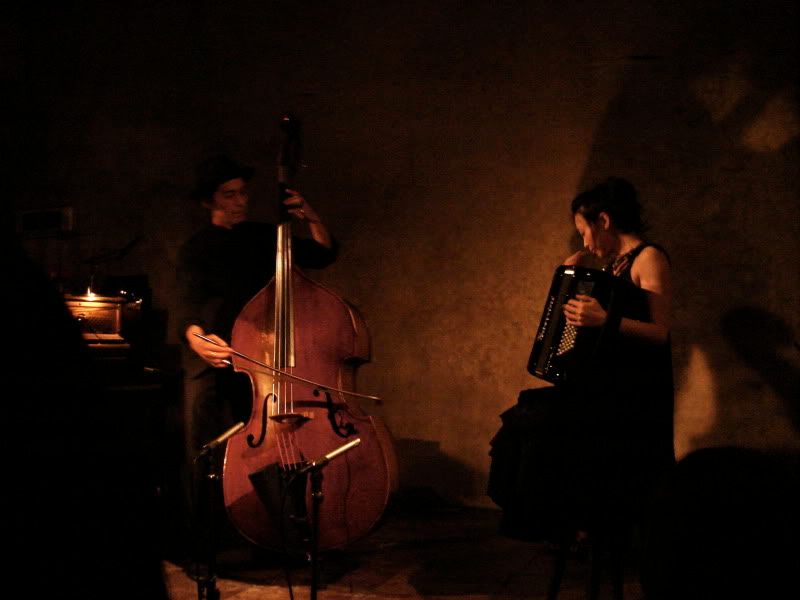
I found something about the accordion player unbelievably sexy, is the accordion known as sexy instrument? It should be!
Another day we hung out in Osaka:

Got Takoyaki:
Then got the train to Kobe for a public bath (one just goes with it, it's Japan) and some Kobe Beef:

I've said it before and I will say it again, Kobe beef is one of the greatest physical experiences to be had on the planet. We should all cut back on meat (especially beef), because it takes tons (literally!) of water and grain to feed a cow which could and should be used to feed people. But back in day, when people lived on subsistence farming, and the only time they would eat beef is when their cows reached the end of their milk producing lives, you can bet they enjoyed their beef as much as I enjoy the marbley delights of Kobe.
I show these pictures to my friends. He was well received. One friend said he looked like a suave film villain, another (girl) just said how young he looked. Pa, I think you've still got it~


In other news, I'm getting close to having a job! I've got an interview for a private English teaching organization on Sunday, and if all goes well I'll be getting between 3000-4000 Yen and hour for a one-on-on conversation class, which at the current exchange rates works out to between 10 and 12 billion pounds (£19-26).
But mostly I've not been up to news, I've been up to life. I now have a routine, and it's one which works pretty well.
A Day in the life of me.
I go to school at 9, EVERYDAY. I have lessons until 12:15. I eat lunch at the cafeteria then waste time chatting with friends for an hour or so, before either going and doing a practical job/looking around town, or go home and nap for a few hours. Then there's the early evening, at which point it goes like this:




Udon, Donuts and free refill coffee, Donuts and free refill coffee, free refill cofee, meanwhile, homework! Home by 12/1, chatting till friends until 2/3, go to sleep, then a healthy, happy 5/6 hours later, I wake up. The student life~
But essentially, Kyoto's just a really cool place:




Oh, actually, one last thing:
 ?
?...
 !
!!
!!!!!!!
!!!!!!!!!!!!!!!!
!!!!!!!!!!!!!!!!!!!!!!
Night night!
!!!!!!!!!!!!!!!!!!!!
Why I am so wise [ 10-Oct-09 7:08am ]Japan needs more pride visa-vi the West and more humility visa-vi the East. Japan needs to assert itself against America and heed to the fears of China and Korea.
I was thinking about fat, ugly white guys dating sexy skinny Japanese girls. This is neo-colonialism. Literally, I swear down. Now, love is subjective, sure. But objectively, these girls are wrong. These guys might make lots of jokes, but they're not funny. They're only here because they can't get girls back home. Obviously, I'm really great, so this doesn't apply to me. But the fact is, as a westerner in Japan, one does, or can, feel like a big shot. People assume you're interesting, you can strike up a conversation with anyone and they'll appreciate it. One gets so much good attention as a white person in Japan. White people who say they experience racism are wrong: they are merely experiencing bad vibes brought about by being bad people.
Now the fact of the matter is that it is wrong to make assumptions about people based on their race or nationality and I fight for a society without the irrational and invented notion of what we call the 'nation state', but within existing perimeters, there is a truism in the fact that most of the white people in Japan think that the Japanese are cooler than them, and part of the reason is that the Japanese are indeed cooler than most of the white people in Japan.
The Japanese are too quick to heap praise on foreign actors, bands, films, whatever, without taking enough credit for or pride in her own cultural achievements (and this is not to talk simply ikebana and haiku, which do get a fair bit of attention, but rather Japan's modern literature, film, music, whatever - her culture which influenced by foreign culture and deserves to influence foreign culture).
But pretty Japanese girls dating fat white guys, cool Japanese kids listening to uncool British indie, these share common roots with the fact that Japanese foreign policy is merely a subsection of American foreign policy. Since Commodore Perry's arrival on big black ships in 1852, Japan has more often that not taken a highly subservient position to the West. This results in the world's second (but-soon-to-be-third-if-not-forth) largest economy having on the most cursory influence on world affairs.
This subservience to the West is closely related to Japan's chauvinism towards the East. Surely at least part of Japan's rough-handed attitude towards her weaker neighborhoods is due to her powerlessness within the old powers. At the turn of the century Japan was told to colonize or be colonized. She has been through periods of both and now enjoys the position of being emasculated from one side while making powerless imperial noises at the other.
Japan is at her worst when she is in this position. Her support for America leads her to aid the invasions of Iraq and Afghanistan. Her imperial pretensions lead her to deny or play down the horrendous war crimes she inflicted on the peoples of Asia. And these positions support each other in a vicious circle. People often talk about the "national conservatism" of the Japanese people. Japanese conservatism is not natural: it is socially and politically engineered. In the Pre-War period, the education system raised generations of soldiers willing to die for the Emperor. In the immediate Post-War period American policy killed the emerging, vibrant Japanese Left in it's cradle by funded the conservative Liberal Democratic Party who were in power (with less than one year's exception) from 1955 until this years election. The LDP consisted of many people in positions of power in the war years. Many of these people's sons and grandsons remain in the party. While LDP members public play around either side of the line of historic sensitivity, many implicitly or covertly support the actions of the out and out Far-Right.
Japan's tight relations with America have fostered a political climate that keeps Japan distant from Asia, while her distance from Asia keeps her dependent on America.
But with the election of a new government things look positive. Though there are many gaping faults in the new government's policies (like their plans to cut the number of seats rewarded by PR, which would certainly reduce the influence of the Japanese Communist Party and the Social Democrats) and questions about their ability to enact even their best of policies (calls of change can ring hollow from a party packed with ex-members of their opposition) It seems things are on the right track. The new Prime Minister Yukio Hatoyama wrote an opinion piece for the New York Times. Conservative commentators called crazy and a communist. He's neither. Within this promising article he asks the key question - "How can we put an end to unrestrained market fundamentalism and financial capitalism, that are void of morals or moderation, in order to protect the finances and livelihoods of our citizens?" - and makes a key, though blindingly obvious, observation - "I believe that the East Asian region, which is showing increasing vitality, must be recognized as Japan's basic sphere of being". In fact, he's even been floating the idea of an EU-esq Asian Union. Though his plans of monetary union are highly unlikely, great Asian co-operation is clearly at the front of his thinking and, hopefully facilitated of a final exorcism of Japan's imperial ghosts, it is neigh on inevitable
A Japan based around Asia will be one with greater self-confidence and greater liberalism, less imperial hubris. But I also think this has progressive implications for the whole world. While on human rights, democratic rights, workers rights, America is clearly a better place than China, on they key moral, scientific, economic challenge of our lifetimes, China is now a more progressive force than America.
If North Korea is a failed state in feeding its own people, America is failed state in securing future provisions of food for the whole of humanity. America is failed state on climate change. With the vital Copenhagen Conference on Climate Change 58 days away, the chances to get a comprehensive global deal on climate change, one that will prevent run-away global warming and the immense /human/ suffering and death that this would cause, is getting smaller and smaller. (If you want to get involved, a good place to start would be here). America is playing petty politics with (literally!) hundreds of millions of people's lives. China is calling a spade a spade. America with her lopsided democracy gives god fearing climate deniers in Kansas and Wyoming, with their few millions citizens (but two senators each) a veto over the fate of the planet. China, with her dictatorship and reverence for science is ready to push through the necessary Carbon Cutting measures without having to worry about the public opinion of the stupid.
The world needs to start bullying America into doing her part to salvage a planet we can all live on from the wreack caused by her capitalism. Britain should jump ship to Europe. Japan should jump ship to Asia.
(Oh, I spent three days writing this. Which is definitely not an plea for you comment it or anything).
NEW POSTSTEP ALBUMS [ 11-Dec-13 11:11am ]The most significant sign of the waning momentum is probably that, even though there actually isjust as much new poststep coming out as before, the majority of it is horribly dull and regressive, mostly stuff from the "bass"-department (pointless, polite and painfully tasteful house, really), as well as the awful hybrid of downtempo, synth-pop and dreampop-step (James Blakes lame spawn). There's so much of this crap clogging up poststeps veins that the records that actually dopush forward and continue the future drive of the last three years, doesn't make the impact they ought to. This is particularly clear when looking at EPs: This used to be the frontier where the maddest, strangest and most powerfully forwardthinking stuff crystallised, dedicated and determined to be more than just soundcloud or bandcamp-data, yet still with a freshness and restless vision that too often got slightly diluted when the artists got around to making "proper" albums.
Sure, there's a ton of new poststep EPs, but they're mostly in the aforementioned house department, and I suppose this means that the EP format to some degree is returning to its traditional role as anonymous club tool containers rather than the exciting mini-LP-as-stylistic-laboratory approach of the last couple of years. For the first time in poststep history, albums are now where things are primarily happening. Hyperdub in particular seems to be taking the lead, having done a Warp and transformed into - mostly - an album label, with a recognisable roster of big poststep players. Which is altogether the trend: The major names, having been around for some time, now increasingly seem to try and build a career around massive, "significant" albums.
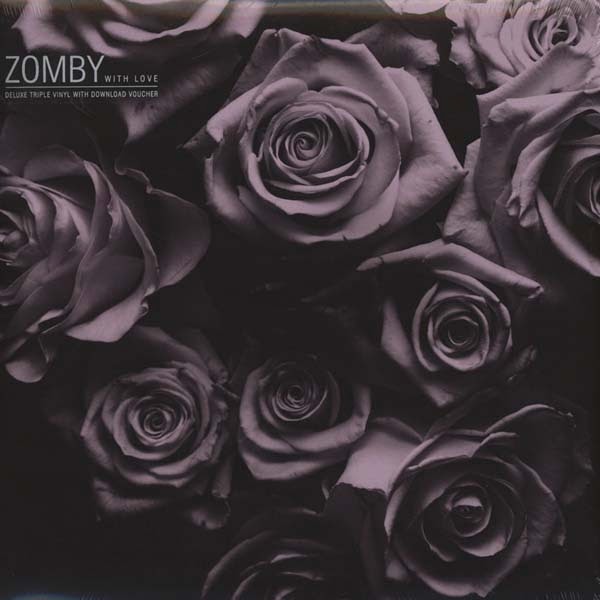
Poststeps first real album artist was Burial, but he has, paradoxically, only made EPs for the last six years. Next to him, the biggest name around is Zomby, whose second album, With Love, was probably one of the most anticipated poststep album of 2013. Well, if Slugabeds Time Team wasn't quite the great album it could havebeen because of its clumsy and unnecessary huge-bordering-on-the-bloated-format, that is nothing compared to this double album/triple vinyl monstrosity, packaged in a ridiculously big and impractical gatefold cover that doesn't really look neither impressive nor luxurious, but just takes up a grotesque amount of space on your table or shelf, like a huge lump of unmanageable cardboard covered in oh so stylish black roses.
Now I'm actually quite tolerant of overblown magnum opus albums packed in extravagant boxes, but only when the content is sufficiently ambitious and well-considered to pull it off. Exai was the first Autechre-album I've bought in many years, and more than anything that was because of its bulky proportions, not despite of them. Even though the cover design of that box is deadly dull (a classic Autechre-design you could say), the box format fits like a glove because this is a couple of electronic veterans going all in, giving you so much stuff to get lost in that the album seems like a world in itself - as the best box sets should do. The point is: that is not exactly what Zomby does on With Love. Had he actually delivered an overwhelming treasure trove of riches, perfectly crafted compositions forming a breathtaking whole, or a maze of brilliant new ideas going in all sorts of strange directions, then there'd be some sense in presenting it like some grand statement. However, it's pretty much just a big heap of the usual not-quite-finished and often rather samey tracks in the well-established Zomby-styles.
You could say that that's just how Zomby works - his tracks have always been rough sketches, suddenly cutting of when he didn't feel like doing more with them, and I've nothing against that approach per se, rough and sketchy compositions can be fine and fascinating, and for some producers that might simply be how they do their best stuff and keep it fresh. I can't say whether Zomby's simply incapable of developing simple ideas to more fully rounded compositions, or whether his just too lazy or self satisfied to do so, but it has pretty much always been what he does, and that is not really a problem when his sketches really are fresh and highly original, even when they feel like unfinished doodling. However, if that's what you do, it comes off as pretty ridiculous when you pile up a huge, hardly sorted mess of those unfinished doodlings, wrap it in a big pompous luxury-package like it was a 20-year anniversary-re-release of some canonised "masterwork", and price it accordingly. Buying such a thing, you'd at least expect the composer to be able to work out how to sustain and develop the potential in a really promising idea, rather than just letting it go round in circles a few times and then cutting it off when it becomes clear that he has to put some effort into bringing it to a conclusion. At the very least you'd expect that the most one-dimensional ideas would be the ones to be cut off after the shortest time, rather than going on far beyond their welcome, while the tracks with the most potential, detail and layers, wouldn't be stopped before you had the chance to fully take them in and appreciate them. And you certainly wouldn't expect a lot of tracks being slightly different takes on the same idea.
I'm well aware that this is how Zomby makes his music, that doesn't prevent him from making amazing tunes (even if it prevents them from being even more amazing), but I sure wish he would work with a format that would fit that modus operandi. A short, sharp and trimmed single-LP with the best tracks from With Love would have been a killer - his best so far and perhaps the album of the year. In its current shape, it seems more like denial, an attempt to hide that what he does is essentially (and brilliantly) unfinished doodling, as if a puffy, extravagant packaging would somehow elevate the tracks to more than that. The effect is the opposite - the samey, unfinished quality sticks out much more than it needed to, had the tracks been placed in more straightforward surroundings actually reflecting the music. And it's a shame, because there's no denying that Zomby is still making great music, even when apparently not putting much effort into it, it's still unique, instantly recognisable as him, and often as ghostly unreal as it's immediately moving. He's just making it much harder to appreciate.
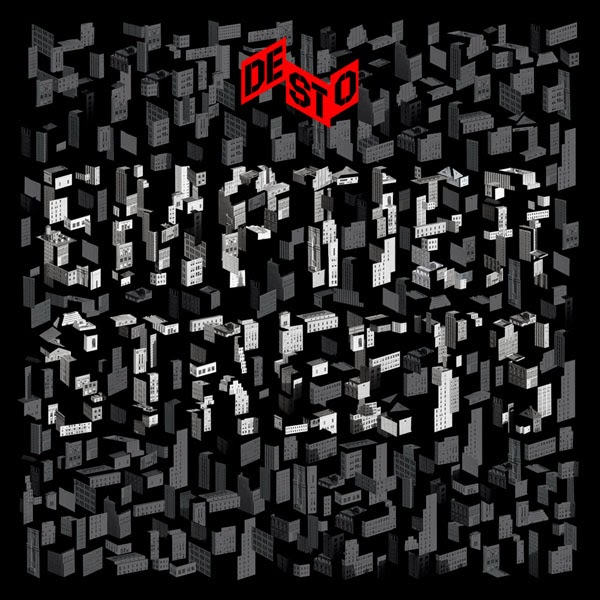
On the plus side, this time Zomby for once doesn't spread out a few tracks, with the playing time of a long EP or short LP, on more sides of vinyl than they in any reasonable way need, as with the Zomby-EP, One Foot Ahead of the Other and Dedication. With Love could easily have been a double rather than a triple, but here it's Mostly because it's just too long and contains too many tracks. To get an idea of how a more restrained approach could have worked out, you could compare With Love with Desto's Emptier Streets, which generally comes off as a better album, even though the tunes on it perhaps aren't as clearly original or memorable as Zombys. Pretty much working with a singular vision, but also sharpening this vision into a compact, equally singular wholse, Emptier Streets is much more immediately powerful and convincing than self-consciously "big" records like Time Team or With Love, even if the tracks, in themselves, are more unique on those.
Previously, Desto had a slightly more raw and ravey sound, but with Emptier Streets he's more in the tradition of Distances My Demons and Nosaj Things Drift: Heavy, noisy dancefloor forms (here elements of trap-step and vestiges of bit-step) are weirdly inverted, all movements slowed down as if taking place in a glazed, sub zero ghost world. There's plenty of bittersweet melodies and weird beats, but they're so submerged in the brittle and unreal overall flow that you hardly notice them at first - everything seems to blur into one long somnambulist nightwalk through a deserted and strangely intangible city. The result is something that almost, in a way, seems to be conceived as a kind of "classic IDM"-style album - a cerebral, atmospheric "alternative" to a cruder popular form - but nevertheless consisting of stylistic ideas and ambiguous structures that would pretty much be inconceivable without the last four years of poststep development. And - as it's the case with more or less all the best poststep, practically the definition actually - it manages to transform the cruder popular form into odd art without losing its essence, something that "classic IDM" almost never managed to pull off.
Emptier Streets is a strong contestant for album of the year, but you can't completely deny that there's an element of poststep coming full circle to it - after the relentless drive towards the unknown of the last three years (the structural madness and colourful futurism of bitstep, hyper grime, skweee and Rustie-style maximalism), we're back at the end-of-history-hopelessness and dead-city-meditations of Burial, Distance and Nosaj Thing. Not that those elements ever really disappeared as a strong undercurrent in poststep, but now they more or less seem to be back as the central theme - the future as an insubstantial phantom, constantly out of reach and slipping through our fingers, rather than something going on here and now. This is also the case with Waltons debut album Beyond: the sharp and twisted hypergrime that was the best parts of his previous EPs have almost completely disappeared, and instead we get an album of twitchy late night grooves and dislocated vocal fragments - i.e. pretty much the elements that characterized the earliest strain of burialesque poststep. Not that it's a backward-looking album exactly, there's mostly a strange, inorganic angularity to the grooves that is much more in line with Jam Citys brilliant Classical Curves from last year than with standard funky or retro-garage (despite the generous amount of awful soul samples which the album really could have done without). On its best tracks Beyond is indisputably original and forward-thinking, but the overall feel is nevertheless like a return to the defeatist zombie-futurism of the earliest poststep.
Interestingly, this is to some degree reversed with Aerotropolis, the second album from Ikonika. She seemed like one of the absolute poststep figureheads back in 2011, but since then a lot of the original buzz surrounding her has disappeared, and this is perhaps mirrored in the more "classic" electronic sound of the album, which still goes for the futurist spirit and attitude, but through a music that is nevertheless much less future-sounding than before. This does not mean - as some have suggested - that Aerotropolis is retro music as such: Despite using a very eighties-specific sound palette, it doesn't really sound at all like the eighties house and freestyle that was allegedly the inspiration. Rather, it's still very clearly Ikonika, the melodies are pretty much shaped the same weird way as on Contact, Love, Want, Have, they're just combined with more straightforward beats and less spiralling arcade-sounds. Conceptually, it's sort of an experiment in counterfactual history, imagining how she could have twisted the raw materials of an earlier era into a different future path, and as such it's part of a larger trend of "new synth" - electronic music that seems to reject the acid/rave-revolution as the point where everything really got started, and rather see the essence of electronic music as the floating future-worlds of earlier eighties and seventies synth, whether through direct imitation (as with a lot of the "experimental electronics" - bordering the entropic camp - going on right now), or through a complete reimagining of classic synth futurism - a bit like how the new pop-groups tried to resurrect a golden, anti-rockist pop aesthetic of producer-vision and song writing as craft.
The "new synth" approach is present in different parts of poststep and with poststep-related players, such as Fatima al Qadiri, the early Laurie Halo of Hour Logic, and especially Kuedo on Severant, which is perhaps the closest relative to Aerotropolis: Both albums are basically a completely current electronic music masquerading as classic synth-nostalgia rather than the other way round. Where Severant was sort of an amazing world by itself, though, Aerotropolis is less strikingly original, as well as more uneven quality-wise. "Beach Mode" is a horrible attempt to make vocal pop, and tracks like "Mr Cake" and "Eternal Mode" come off as failed experiments with Rustie-ish maximalism, completely lacking the twisted mania that makes Rustie so great. Still, all those tracks are at the beginning of Aerotropolis, and as soon as you get past them, it's mostly a great album, sometimes even brilliant. Perhaps too classy and polished to be among the absolute frontline this year, but still an odd and fascinating time-out-of-joint-exercise in alternate futurology.

The-Drums Contact could also be seen as belonging in the "new synth" department, yet it manages to reach the ideal of a truly new synth music - a reactivation of a pre-rave future-rush through a completely new and current aesthetic - so smoothly and effortlessly that it basically feels timeless, rather than either "new" or "retro". It's all slowly drifting sci fi-soundscapes full of cosmic loneliness and longing, but first and foremost created through endless layers of corroded-yet-ethereal voice manipulations - one of the key elements defining poststeps sound of now. Still, it's done with such lightness and elegance that it somehow doesn't feel as futuristic as it is. Contact doesn't hit you in the face with bizarre sounds and structures, which I guess is why Adam Harper consider it slightly backwards-looking and eighties-sounding, though I can't find much in it that sounds even remotely like it's referencing anything from the past, and even when it does, I think it's mostly superficial - some timbres and effects will eventually appear when you're orchestrating with vocal samples to the degree that is happening here, but except for the odd isolated shade of a sound here and there, I simply can't hear how it should be reminiscent of Art of Noise or Depeche Mode in any way. Perhaps Harper is only thinking in production terms, but then the argument becomes really silly - if you're unable to create something new using older tools and approaches, then a lot of stuff that we're usually considering groundbreaking would automatically be regressive.
I do agree with Harper that Contact eventually feels a bit more familiar than The-Drum's previous stuff, but I think the problem is mostly the well known one for albums with this kind of music: It goes on for too long, and becomes too samey. I don't hear an overall downsizing of futuristic vision compared to the Sense Net-EP (if anything, Heavy Liquid is their real masterpiece in purely futuristic terms), Contact pretty much tries to develop the Sense Net-vision to a larger format, and it mostly succeeds. It's just that the format would have gained by not being quite as large; it drags on and lose focus towards the end, and especially the vocal driven title track is horribly pedestrian, while the closing "Mantra" is the only time where I think Harper is right about the album sounding like it could have been a eighties sci fi-score - it does sound much like some Vangelis tracks, especially parts of Blade Runner and The City. So, yeah, Contact could have been shaped better, but it's nevertheless one of the most convincing experiments in envisioning a truly new cosmic sci fi-music I've heard so far - so convincing, that it doesn't even sound like an experiment at all!

The albums from Zomby, Desto, Walton, Ikonika and The-Drum are only a fragment of poststeps album-output his year, and some of the very best ones have come long since I started this piece many months ago, or have been made by much less known artists (well, perhaps not les known than Desto I guess, who I mostly included here for the contrast with Zomby. As so often before I had planned to get this done much earlier - it's not a 2013 survey, but rather a closer look at records that I think show the shift from EP-oriented experimentalism to a focus on "significant albums". There's other albums that would fit this idea in one way or another - DJ Rashads Double Cup as footworks final integration into album oriented poststep, or Om Units massive crossover-exercise Threads - but I never got around to including them, they came too late in the year, and didn't quite manage to convince me as much as even Ikonika and Walton did, despite their obvious flaws.
It has been tempting to just give up the original idea and turn this piece into a "best-of-postetep-2013" list instead, but then it would most likely have gone completely out of hand, and I'd rather deal with posteps 2013-merits - or lack thereof - until sometime after the year has actually ended. But just if anyone's looking for tips for the Christmas shopping: the best of 2013 definitely include these: Eprom's Halflife, En2ak's 3, Co La's Moody Coup, Lil' Jabba's Scales, Clouds' USB Island, 96wrld's Private Language, Ital Tek's Control, and Eloq's C'MON. Some are albums, some are EPs, some are perhaps something in between, but all are great. More about that, and about other good stuff, some time next year. Probably.
Exploring the poststep map - outskirts and enclaves [ 04-Jul-13 3:34pm ]This does not mean that you can make a complete step by step analogy between the two, but you can use the comparison to get a better understanding of what's going on right now, not least because it - hopefully - makes it clear, that this music should not be seen through the tired old "scenius/'numm" lens that have been used to judge dance/rave music for so long. Poststep is not scenius 'nuum music. If that's the only kind of contemporary electronic music you care about, well, fair enough, but then just leave it at that, it's not this musics fault that it doesn't fit your framework for judging something else. Which is where the post punk analogy becomes useful: How well would most of our beloved post punk fare if it was judged by the same "dance music"-rulebook that poststep is looked down at for not following? Not very well I'd say, post punk was certainly not "scenius" in the way the usual 'nuum ideals (acid, 'ardcore, jungle, 2step, gabber) were. On the contrary, most of it was self consciously intellectual, brainy, pretentious and elitist, often having formal deconstruction as an end in itself (being weird for the sake of it). Deriding poststep for these sins - i.e. for not living up to the noble, time honoured tradition of the 'nuum - is just like deriding post punk for not being real rock'n'roll. In both cases, the "inauthenticity" is the point, or at least a big part of it.
Given that poststep is not a specific sound or style, but instead a collection of related aesthetic strategies, most of all united by the drive to go on creating something strange and weird and unheard rather than accepting the general retromanic imperative of the times, one obvious problem do arise - and one that you will also face if you're trying to give a full, coherent description of post punk as well: Where does poststep stop and everything else going on right now begin? There's other forms of experimental music around right now, stuff that has some sort of relation to rave/dance-history, yet isn't exactly poststep - much like there was still highly experimental rock-in-opposition-style avant prog going on in the post punk years, as well as free jazz and an industrial-sounding electronics-and-sound-collage scene (Conrad Schnitzler and related travellers of the more abstract ends of krautrock). Those scenes couldn't really be called post punk - and weren't considered post punk - yet they shared a lot of aesthetic elements and the overall sensibility prevailing in post punk - the scenes even overlapped to some degree: Avant-canterbury-veterans like Robert Wyatt and Henry Cow/Fred Frith participated in the post punk milieu, while post punk artists like Pere Ubu and The Raincoats eventually approached a quirky, surreal prog style from the opposite direction; similarly with the new wave and electro-pop experiments of Czukay, Dinger and Schnitzler on one side, and the krautrock-fetish of Throbbing Gristle and Nurse With Wound on the other; or John Zorn mingling with John Lurie and no wave - with Bill Laswell/Material somewhere in the middle.
The boundaries are similarly blurry when it comes to poststep: it's often rather unclear whether some current sound or style can be considered a part of the intermingled poststep ecosystem, or whether it's part of something else. A direct stylistic element of dubstep have nothing to do with it, just like there wasn't any stylistic elements of punk rock in, say, Ike Yard, Laurie Anderson or Young Marble Giants, it's something more vague, a sense of approach and attitude, of overall vision, and as a result, one persons poststep map may vary deeply from that of the next one. Personally, I prefer to make it very wide, while allowing huge parts of it to have separate identities of their own - much like industrial and synth pop are their very own things, with their own histories, while simultaneously being parts of the general post punk story.

Back in my first poststep piece I already touched some of the obvious grey areas as I tried to list all the distinct styles coexisting. One very straightforward example is what I called post hop, basically Flying Lotus-derived/J Dilla-esque downtempo hip hop gone weird and broken - sometimes hauntologically crumbling, sometimes elastically wobbly, sometimes 8 bit-colourful. The big question is where to draw the line between standard neo-downtempo and the real deal: How "weird" should it be to be more than just dull stoner-hop? There's no 100% clear border, some artists oscillate between regressive mush and brain melting brilliance from one record - if not track - to the next, and a lot of them annoyingly seem to have reached a style somewhere in-between; slightly twisted or ghostly, but not so much as to scare away the vast hordes of "blunted beats" consumers (and getting a piece of the cloud rap cake as well, perhaps?). These are the most irritating; they're sort of part of the whole poststep thing, but not so much that they're really contributing anything relevant; rather, they're cluttering up that end of things.
With such unclear criteria and half baked practitioners, is "post hop" really (a part of) poststep at all, then? Well, given the polymorphous nature of poststep, I'd say it is, pretty much in the same way that synth pop "was" (a part of) post punk. Synth pop was also a bit of an unclear case: it sometimes had just the right amount of futuristic sheen and angular funk to belong to the greater programme, but it was just as often a part of the most regressive end of the new pop movement, closer to straightforward new wave power pop or smooth neo soul balladeering. Both synth pop and post hop mix forward-thinking contemporary impulses (electro funk/disco and industrial-derived "subversivenes" in synth-pop; hauntological beat-decomposition and hyper-arpeggiated bitstep in post hop) with backward-looking elements that are, paradoxically, considered radical and edgy (producer-as-mastermind/pop-as-luxury-product, soul sophistication, cosmic-era sci fi synth-scapes, beat collages). The point is: Much of the synth pop/new romantics-movement couldn't really be called post punk at all, it was rather related to/intersecting with the British avant glam/art pop/mod tradition in much the same way as with post hop and downtempo, and yet, those parts that utilised post punk techniques and ideas to actually built something unmistakeably new eventually determined how we think of the style, i.e. very much as a crucial part of what made that era revolutionary. Of course, synth pop had the advantage that it was pop, and that making hits therefore was a crucial part of the game, so the best of it is still remembered as a sort of breakthrough-phenomenon. Post hop, being a much more esoteric and introspective affair, haven't got that pow-effect in its favour, but its greatest practitioners nevertheless makes it as crucial a part of the current poststep movement as synth pop was of post punk.
Another style being "part-of-poststep-yet-its-own-thing" that I talked about in the first piece was skweee, and it's still brilliantly occupying this interzone. Back then I compared it with industrial, because industrial was also a genre that was a more or less isolated scene in its own right, but I'm not sure that comparison is all that fair, if for no other reason, then because skweee is simply a much better, and much more genuinely inventive from of music than the first wave (i.e. the post punk-era) of industrial ever was. As a post punk analogy, I'm increasingly thinking that the San Francisco scene is much more fitting, with its cartoony-creepy absurdist humour and grotesquely twisted stylistic elements from older musical forms, more or less foreign to rock (lounge/cabaret, childrens music). Skweee is equally weird, with an apparently fun-and-colourful sound that nevertheless seems oddly wrong and unsettling, its juicy synth-funk beats and quirky computer game melodies having an alien and inorganic quality. It doesn't sound the least like anything from the San Francisco "freak scene", but that's the point: It's the freakiness they share, the love of the grotesquely twisted and insidiously bizarre, rather than an actual sound.
That an analogy only goes so far (as I've stressed again and again), though, is made clear by the fact that outside of the shared "freakiness", the comparison of post punk San Francisco and poststep Scandinavia is not very obvious: The San Francisco sound was mostly down to a few really big key players (basically The Residents, Tuxedomoon and Chrome), which to some degree shared an approach, but otherwise had their own personal sound. Skweee, on the other hand, is actually a great example of a "micro-scenius" genre. Even though there clearly are some indisputable leading names with recognizable takes on the style (Danial Savio, Limonious, Mesak), they're not 100% unique entities in the way three big San Franciscans were. Instead, there's a collective development within skweee; new names are joining and everyone's swapping ideas and contributing, and it's skweee as an overall sound that is idiosyncratic and unique and wonderfully twisted, and which occupies a place as crucial to poststeps jumbled cornucopia, as the San Francisco freaks were to post punk as a whole.
As for the "micro-scenius" angle, an even more obvious example is of course juke/footwork, something where I'm still on the fence as to whether it's actually a part of (the broadest possible interpretation of) poststep as a vast genre-conglomerate, or whether it's a completely isolated anomaly that just happen to have influenced poststep proper in a big way. You could point out that footwork is the result of a long localized development endemic to - and completely dependent on - a specific Chicago tradition, and that it's exactly this isolation, this lack of influence from the global club community in general, and the London continuum in particular, that makes it special. On the other hand, something similar could be said of some of the most self contained and locally based post punk scenes, like Cleveland/Akron, Sheffield or No Wave. The last one is particularly interesting, because it actually seems analogous to footwork in some obvious respects - even though it's obviously very different in others.
The roots of no wave and footwork - performance art/free jazz in one case, dance battles/ghetto house in the other - were quite different from the overall post punk/poststep movements, and yet both eventually became associated with those larger movements because they shared the overall attitude and approach. They both resemble outright avant garde in their sonic extremism and almost dysfunctional abstraction, but at the same time they're too visceral and primitivistic to really be "proper" art stuff. To begin with I thought of footwork simply as dance cultures equivalent to actual free jazz, in a lot of ways that seemed an appropriate analogy - footwork taking pure intuitive "body music" all the way into complete abstraction/fruitless extremism-for-the-sake-of-it, in much the same way free jazz took pure intuitive "head music" to the same lengths. Now that the scene has been noticed by the global beat-cognoscenti, though, some producers seems to work towards a broader, less hyper-functional style, in a way approaching something that resembles the same kind of fusion/hybrid-footwork that the worldwide poststep milieu is getting more and more obsessed with. And since no one would probably say that what DJ Rashad, Young Smoke or DJ Diamond is doing with footwork isn't "real footwork", it's perhaps misleading to think of the style simply as the ultra abstract original version, apparently there's actually a lot more room for complex and polymorphous structures than it seemed at first.
Consequently, footwork is perhaps, in the end, simply another part of the huge poststep family, an exciting new development going on right now, among many other exciting new developments going on right now, sometimes fusing with them or influencing them, sometimes being influenced by them, and sometimes just going its own way. Well, perhaps. I'm still not sure whether footworks relationship with poststep is more like the one no wave had with post punk, or like the one free jazz had (given that both comparisons are not eventually completely ridiculous, of course). In either case, the huge amount of footwork-influenced poststep fill up a place within poststep as well-established and diverse as the countless forms of post punk that took elements from performance art or free jazz, and used them for their own ends - Blurt, Rip Rig + Panic, late Pere Ubu, early Cabaret Voltaire etc.
The most intriguing and problematic poststep/not poststep area is what I last time called the "ghostly end of things - the grey area where poststep meld with hauntology and other post techno/post everything deconstruction strategies". Actually, this end of things is probably even more broad and unclear than that, it could in theory be opened up to including stuff like Time Attendant, Bee Mask, Oneothrix Point Never or Ekoplekz, even though they all belong to an older, well established tradition, that mostly have remained completely indifferent to the dubstep revolution. I wouldn't really classify any of those artists as poststep, but the kind of "experimental electronics" that they represent certainly intersects with stuff that I definitely do think belong to poststep. Again, there's a very useful analogy to be found in post punk, and that is industrial. While industrial was definitely a part of post punks overwhelming impact - one of the many things happening simultaneously that, collectively, generated the feeling of out-of-control innovation and creativity pouring out of open floodgates - most of it was also its very own, isolated thing, grown out of an older and well-established experimental tradition, with multiple and tangled roots going from psychedelia and fluxus through the beatniks and all the way down to dada and surrealism - if not even further back. Industrial, and in particular the "defining" first generation (TG, Nurse With Wound, Whitehouse, SPK, Boyd Rice), was much more a product of that tradition and mindset than a reflection of the post punk times. Industrial would most likely have happened even if the rest of post punk - or punk, for that matter - hadn't, it just wouldn't have had the same exposure, and would have been a smaller, less noticed cult thing.
It's worth noticing, that as industrial evolved, the name eventually covered more and more stylistic ground, without any unifying stylistic elements: The only connection between, say, Whitehouse, Nocturnal Emissions, Death in June, Test Dept. and Klinik, is one of aesthetic taste and approach, stylistically they're different things. There's plenty of industrial sub-genres of course (noise, dark ambient, neo folk, ebm), as far from each other as they're from other kinds of music, and yet they're somehow all lumped together under the larger "industrial"-label, simply because of the shared attitude (self importantly "dark and serious", the belief that you're one deep and hard motherfucker because you're wallowing in gore, sexual "taboos" and the nastiest elements of human nature). Unfortunately, there isn't yet a handy label connecting all the parts of poststep making up its equivalent to industrial, which is a reason why it's hard to figure out what is what. A huge part of it, probably the majority, could, in one way or another, be classified as a part of the hauntology movement, but hauntology is a completely different beast as far as I can see, a conceptual approach a bit like the obsession with occult/magick/ritualistic practises that weirdly pervades much of industrial, without being in any way identical to it. (Is hauntology perhaps the occultism of futurism/modernism? Sort of makes sense, doesn't it?)
Anyway, to make things easier, I'll cook up a name for all this stuff, even if it'll probably end up being as unused as "poststep" or "bitstep". Since pretty much all of this music is working with a sneaking disintegration of voices and rhythms, slowly dissolving and degrading sounds and structures, I'd say the connecting characteristic is one of entropy as an aesthetic element, and hence I offer entropic, entropica or entropical. The idea is not just to connect entropy and hauntology, but also entropy and tropical and exotica, hinting that this stuff isn't necessarily dark or pallid, the chaos and disintegration of structure could just as well be seen as unstoppable polymorphous growth, the run amok tropical jungles of Ballards drowned world. Also, the entropic approach is first and foremost an approach, not a style, and while it seems a defining characteristic for entropic artists like Howse, Ital or Hype Williams, those artists are also quite dissimilar, much like the industrial artist were. And more importantly, the entropic approach isn't just an "entropical" thing, it's a set of techniques that have been around for a long time and which just happen to appeal to a lot of poststep producers in a lot of different ways (just like with industrials collage/cut up/ritual improvisation-techniques). It is techniques being used by obvious entropica producers as well as some from completely different poststep areas (bitstep, posthop), and quite a lot of artists that are close-to-but-not-quite-entropic - again mirroring post punk/industrial where artists like Factrix, Ike Yard or (early) Pere Ubu were either seen as, or pretty much sounded like, they could have been part of the "official" industrial program, but nevertheless weren't.
Perhaps the most interesting part of the entropical/industrial analogy is that, even though both "genres" have come up with some brilliant and highly original music, they also contain some of the most regressive, backward-looking and retromanic elements of the larger contexts to which they belong, poststep and post punk. In both cases the point is deconstruction and subversion rather than innovation, and in both cases that goal is reached by using well known (if perhaps, at times, obscure) experimental traditions and techniques from the past, rather than creating something new ex nihilo. Even though the techniques were often used and combined in original ways, and even though the endless focus on "extreme" sickness and depravity somehow creates a defining feel for most industrial, there isn't much of the music that haven't been heard before if you're aware of different kinds of far out psychedelia, avant garde (futurism, musique concrete, cut up collages, atonality, free improvisation), and, especially, krautrock (did the first generation of industrial ever do anything hadn't already been done - and much better - by Cluster, Schnitzler, Faust and Tangerine Dream?). Furthermore, the styles that eventually developed directly out of industrials first wave were often pure retro stuff, mixing sixties pop, folk and psych with some "pagan" and "ritualistic" elements (already to some degree a part of sixties folk/psychedelic-counter culture). Not until the second generation, with Einstürzende Neubauten and EBM, did industrial culture actually invent something new.
The elements going into entropic resemble those going into industrial in that they're a weirdly mixed bag of pure experimental traditions (techniques of voice and sound manipulation found in anything from Stockhausen to the kind of minimal techno made more for art galleries than dancefloors), the weird indietronica intersection of electronic and dreampop (i.e. stuff like Boards of Canada, Mira Calix and Oval-derived dream-glitch, something that seems completely foreign to poststep, much like TGs elements of folk and cosmic psychedelia must have seemed to post punk), and not least the whole hypnagogig/hauntology-scene, that at least some entropica-artists seems to be deeply tied with. Interestingly, where industrial often didn't do much more than recycle the ideas of deeply original predecessors, entropica often do the opposite: They somehow manage to get something original and new out of something - like hypnagogig or hauntology - that is at heart about recycling old stuff.
Despite inspiring countless followers, the original industrial scene was composed of a few key players, whereas with entropica, there's a huge amount of smaller names, again more of a scenius thing going on. Yet, I'd say that there actually IS one very obvious key act, seeming at least almost as central and definitive as Throbbing Gristle was for industrial, and that is Hype Williams. Highly conceptual, often with a deliberately "provocative" (if not "subversive") agenda of "deconstructing" music as such, they seem more like an art project than an actual music group, and not least: their music is rarely as interesting or original as all the concepts and rhetoric suggests. Just like with Throbbing Gristle, Hype Williams seem mostly to use well known tricks and techniques, just used so "badly" (deliberately raw and sloppy) that it somehow comes of more weird and radical than it actually is. Like with Throbbing Gristle, Hype Williams music is nowhere near as good as their reputation would make you think, and even though it does occasionally reach a fascinating strangeness-on-the-brink-of-total-disintegration, their records - when heard as wholes - just come off a bit flat and underwhelming.
Even though they're not going to be seen as wreckers of civilisation (as nobody will anymore), Hype Williams have nevertheless managed to create a sound so woozy and lo-fi that talk about it being a pointless form-over-content-exercises or the emperor's new clothes actually come up - and I guess that's something of an achievement at a time when nothing otherwise seems able to be considered "too much" in this respect - perhaps a greater achievement than TGs scandals which happened at a time where it was still pretty easy to create shock and outrage. On the other hand, I doubt that Hype Williams will leave quite as great a legacy as Throbbing Gristle, because the interesting thing is that after they split, the projects that came out of TG actually made much better music than the mother group ever did (in particular Chris & Cosey, though Psychic TV were also often great, and Coil did the dark ambient thing better - even though they also made a lot of much less interesting stuff). So far, none of what I've heard from the solo projects of either Dean Blunt or Inga Copeland seem even remotely as promising.

As for the entropic part of poststep as a whole, the output so far has been much better than what the first generation of industrial came up with, perhaps because Hype Williams, despite being the most clearly identifiable figurehead, have not really been seen as a model or direct inspiration for the rest of the scene. Acts like Hav Lyfe or Lukid are clearly related to the Hype Williams sound (though both do it much better IMO, and Lukid also did it earlier), but then there's records like Co La's Moody Coup, an alien sound world where weird beats and disembodied voices fill hyper real CGI-vistas with digital spirits and inorganic tribal rhythms, or The-Drum's Heavy Liquid, weaving labyrinthine voice-scapes into intricate and constantly morphing, yet surprisingly melodic, machine structures. And the more I listen to Ital, the less I understand why he's sometimes said to make retro house; there's certainly some elements of chill out/ambient house in his music, but the way they're mangled and disintegrated makes it something new and strange, and reminds me most of all of the equally disorienting and decaying way Cabaret Voltaire mangled elements of sixties garage and psych on some of their early tracks. Would anyone call the early Cabaret Voltaire retro garage-punk?
There's plenty of cases where it's unclear where entropica stops and other forms of poststep begin, as well as where it simply stops being poststep at all, and once again this is much like with industrial. There's the whole American Fade To Mind/Time No Place-scene (Nguzunguzu, San Gabriel, Fatima Al Qadiri), often overlapping with the Hippos In Tanks-crew and certainly sharing some characteristics with Co La or The-Drum. Is that entropica? Was Ike Yard or Implog industrial? Or Mark Stewart, Monoton or Dome? They sure sounded"industrial". And then there's the dreamy end of things, mostly centred round the Tri Angel-label and artists like Howse, Holy Other or Balam Acab, reimagining dream pop as gaseous voice-labyrinths, a bit like how industrial reimagined folk as occult ritual music. What about the brilliant new James Ferraro-LP Sushi? Unlike the deconstructive low fi/pomo-approach of most of his earlier stuff, this has a truly new and strange feel, related to both the unreal digital brightness of Nguzunguzu and Qadiri as well as the hazy dreamstates of Hype Williams. Fays equally brilliant (though much different) DIN LP is similarly caught between two worlds. Lots of weird voice science, but much more strict, spiky rhythms than with the rest of the entropics, and an almost pop-ish feel. And speaking of stricter rhythms - Actress does seem to fit in here somewhere as well - there's certainly much of the hazy, disintegrated feel central to entropica in his music, even if the overall structure could just as well be click/glitch/minimal techno.

Things get messy when you try to map the entropic part of poststep, but industrial was equally messy, something that just happened to happen at the same time as post punk, without sounding - in its purest forms - much like what people usually think of as "post punkish". And it's worth noticing, that industrial was probably the only part of post punk that truly survived and thrived as the rest of the scene either collapsed or went "new pop"/goth rock. Perhaps because industrials constituting musical parts were older, perhaps more "universally" experimental than the other techniques flourishing in post punk, and therefore less tied to that specific era. The very same could be said about entropicas constituting elements, and in both cases this is probably also why both industrial and entropica doesn't seem as fresh, overwhelming and relevant as the rest of post punk/poststep. And perhaps why entropica recently seems to make up a larger and larger part of good poststep, all while the activity on the rest of the scene have been slightly declining the last six months. If poststeps high tide is turning, it makes sense that the more universally appealing experimentalism of entropica will be what is going to remain, as industrial kept going in the mid eighties. The more familiar, agreeable forms of weirdness always win in the end I guess. The big question is whether the entropic milieu will be able to come up with stuff as inventive and groundbreaking as what the second industrial generation also had to offer: Will entropica get its own Einstürzende Neubauten, or will it eventually create a bridge to a completely new future, as with EBM? Here's hoping.
EP MANIA [ 03-Jan-13 8:04am ]
Now, there's no doubt that a lot of the really massive stylistic innovations are being made within these online communities, and that if you ever had the time to check it all, you might find the greatest, most unbelievable and futuristically potent music right now, lurking in those bottomless depths. But in the end, developing a lasting relationship with anything in that ever morphing audiomaze seem impossible, you're always on the move, always checking new stuff. Perhaps this is why, even though the frontline seems to be the online communities, records are still released - and lots of them, even! Of course, releasing records doesn't magically create an impact in the world outside the underground subcultural circels. The fact that Dam Mantels Purple Arrow made it to vinyl did not make it noticed by a generation, it didn't make it the kind of unavoidable Unknown Pleasures-like milestone that it should have been. There's certainly a sense in which the physical records are pretty much preaching to the converted: Mostly they're pressed in extremely limited numbers - less than 500, perhaps only 200 most of the time - and sold exclusively to those already down with the programme. If we only consider the records, the musical revolutions captured on them are only heard by an extremely small elite - for some of them just a couple of hundred people worldwide - those dedicated to the cause and ready to put both time and money into it.
At this point it's worth noticing a couple of things: 1) Even though the records are pressed in such small numbers, it doesn't necessarily say anything about how "unheard" this music is overall, since so much of its audience is in the purely digital domain. 2) Even if it isunheard, it doesn't mean that it isn't as innovative or groundbreaking modern as, say, the big post punk names. Huge parts of post punk were these small do-it-yourself communities of dysfunctionally radical experiments, and with poststep, that's simply how the major part of the scene works. The circles where this stuff makes an impact are small, but it doesn't mean that the impacts themselves, regarding the depth of inventiveness and originality, are small. There's this line of thinking within music (rock?) criticism, where socio-cultural resonance is considered the main parameter of importance - or rather, where a lack of socio-cultural resonance is seen as a criterion for deeming music irrelevant. I've always considered that line of thinking extremely dull and inhibiting. It's wonderful when really great stuff also seem to have a huge socio-cultural impact, but just because wilful obscurity and lack of commercial success doesn't equate art or brilliance, it doesn't mean that the reverse is automatically the case. And really; if we were to judge, say, Pere Ubu, This Heat or The Contortions in terms of socio-cultural impact, we could pretty much discard them right away. They might have had a slightlylarger impact than most current underground poststep artists, but they're still wilfully obscure underground avant-gardists, and today pretty much unknown to all but a small elite of post punk scholars. Their greatness came from their bloody minded and elitist drive to completely dismantle musical structures - to move forwards into even more expressive fields in David Thomas words. The same thing is going on with the best of poststep, and that is definitely "enough" to make it awe inspiring - and worth our attention.

Anyway, to get back on track: You might feel inclined to ask why they even bother releasing vinyl when there's so few who'll know - or care - about it - let alone buy it. I think most of these microlabels are happy if they just break even, and they seem like basically vanity projects, which I actually think is sort of right, in a sense, though there's much more substance to it than just "vanity". I think the whole reason lies precisely in the insubstantiality and incomprehensibility of the digital storage networks. It might not necessarily be a conscious reasoning, but nevertheless it's almost like a direct attempt to give the music an element of longevity, of recognisable substance - proving that it exist by incarnating it in physical form. For a long time, the continued existence of vinyl - at least in the electronic department - was considered a DJ-thing. It was made because DJs bought it, used it and wanted it. This is hardly the case anymore - the number of DJ using vinyl seems dwindling, and is mostly concentrated around particularly minimal/functional styles where the whole point is to see a DJ manipulate DJ tools that are pretty uninteresting in themselves. Even though the poststep vinyl is pressed in extremely small numbers, I really doubt that they're all bought by DJs (I, at least, am not a DJ, and I buy a lot of them). How many DJs even play that these styles?
So, while vinyl is becoming more and more irrelevant as a part of DJing, it's nevertheless still being made, even with a style like poststep, that doesn't seem to have much use for it, being mostly an online community, and much less DJ-centered than dubstep proper - or techno or house for that matter. Of course, there's also the audiophile argument, and I'm sure that's part of it for many buyers as well, but it seems to me that it's more of an afterthought - after all, no one under thirty is really an audiophile nowadays; it's not like the poststep audience isn't using the online networks as the prime source. Vinyl must have more to offer than just supposedly superior sound quality to still be around. Rather, it's a way of showing that this stuff - considered unfocused and aimless dabbling by the larger (rock-centered or retromania-informed) critical narrative - is not just that; that it's felt and created to be important, to mean something. That it's worth using both money (when music is otherwise considered free) and, perhaps even more significant, time on it (self releasing records is a lot of cumbersome work and trouble). Of course, this does not make it important or world shattering in itself (just like self released post punk records weren't necessarily great just by the effort put into self releasing them), but it does show that these people think and care more about their music than they're supposed to by the overall hyperstasis-narrative, and certainly more than they have to if that narrative was 100% right.

One of the greatest things about the continued vinyl presence in poststep is that the records being made are increasingly leaving the dull 12" format - which dominated dubstep proper (as it did with grime and 2step and jungle and most other functionalist dance forms) - behind. This is in itself a strong indication that the records aren't just made for the DJs, who are usually supposed to be the ones who want the widest, loudest grooves, but more importantly, it's sort of reinventing the EP as a powerful medium in its own right. There have been times before where most of the interesting action was happening on EPs, especially the early days of rave, where few managed to actually release albums (and rarely made anything good when they did), and EPs made it possible to nevertheless release records that could be heard as a whole, with room for variety and experiments. And right now, we're not only living in the richest, most overwhelming time since the early nineties when it comes to music overall, we're also living in an incredible golden age of the EP format. I don't think its potential have ever been used so brilliantly before.
A very practical thing about the EP format is that it allows producers to make extended and integrated collections of tracks without falling into the many traps that the album represent when it comes to electronic dance music. As it's well known, there's a long history of techno/rave/trance/house/etc.-artists failing miserably when tackling the challenge to make albums. Partly, this was because an album was seen as a "challenge" at all, rather than just a collection of good tracks. For some reason albums were suddenly considered something that had to be "grand statements", or had to cover all bases (a little ambient, a little jungle, a little acid etc., all of it stylistic exercises), or had to have huge crossover appeal (endless guests and pointless vocalists). It was never really explained why this had to be, but eventually it became sort of a self fulfilling prophecy, everybody talking about how rave genres wasn't really album music, making it seem practically impossible to succeed without some sort of Gordian-knot-solving. But with EPs that problem isn't really there anymore, nobody expects an EP to be the Sergeant Peppers of post dubstep, or to have guest vocals from every trendy indie singer who wants to seem relevant.

Personally, even though it's obvious that "the album" have always been something rave styles have had trouble with, I've never bought the idea that rave music is by definition not album music. The trouble with rave-albums have other roots, one of them clearly being that major labels (or the artists themselves?) didn't really think instrumental albums would sell to a sufficiently large audience, and hence the guest star plague started. But I think an equally disastrous element simply was the time rave music happened to break through - i.e. when CDs were thought to be the future, or at the very least the future of albums. Of course, ever since the late sixties, "the album" had already been redefined as something increasingly "important", but with the CD it didn't just have to be some sort of integrated whole, it also had to be bloody long, and even more so when the inflated length and the amount of extra stuff was pushed as a reason to eventually give up on vinyl and go all CD. This almost automatically made albums from the early nineties and onwards worse than albums from the previous decades, not because the quality of the music as such had diminished (au contraire, IMO), but simply because they - even when they didn't fall into the aforementioned traps - simply were longer than they had to be, and often contained some filler material that previous generations wouldn't have needed to include.
There's obviously no need to think of albums in these terms anymore, now that we're living in an age where the CD seems to be on the way to the dustbin of history, and "albums" are becoming just clusters of tracks that are not fettered by the limitations of physical media. Nevertheless, the mindset sort of remains, releasing an album is still seen as some sort of event, and this is why EPs are so refreshing, and where the most amazing stuff is happening. It's worth noticing that back in the fifties and sixties, albums were short. So short, actually, that they'd hardly count as albums now - often closer to 30 than 40 minutes. And now, EPs are sort of moving towards the same format, but from the opposite direction. To begin with, most poststep was still 12" territory, EPs were rarely longer than four tracks, and a lot of them had the incredibly annoying three track format popular in a lot of dubstep. But now, six or seven tracks are not unusual, often with playing times of more than 25 minutes, and full picture sleeves are more and more common (in itself showing the level of dedication to the physical media - usually you'll have to press at least 500 records to get a picture sleeve, otherwise you'll have to come up with some creative (and time consuming) way to have it made). All this is effectively making these EPs mini albums rather than singles with some additional filler tracks, and certainly, they're very often clearly meant to be heard that way as well.

Personally I think it would be wonderful if this development eventually would make the poststep producers completely ditch not just the faulty "grand statement"/crossover-understanding of albums, but also the stupid "DJ friendly" vinyl formats (albums as double/triple EPs/12"s), and expand the EPs to actual small (and affordable) albums - LPs, really, rather than "albums" as they've been defined by the CD. To some degree this is actually already happening - labels like Keysound and Time No Place seem to be thinking in LPs this way, as is much of the skweee scene. And Planet MU released at least some of their newer albums (Kuedo, Last Step, Ital Tek) as LPs rather than double EPs. Still, though, it doesn't yet seem like a step people are ready to take (or perhaps have considered taking at all), so all the more reason to praise the EPs, small wonders in their own right as many of them are, and released in staggering amount throughout these last couple of years.
In you want to know where the crucial poststep is happening you'll have to follow the EPs. For a start, there's something like four or five labels really leading the way, followed by a cluster of more uneven ones. Forget Hotflush and Hessle Audio and Skull Disco and (yikes) Apple Pips and all those labels - they were the boring part of poststep to begin with, and they certainly haven't become more relevant recently. Hyperdub have not completely lost it, I guess, but they're also moving in directions which - interesting as they sometimes are - are only tangentially related to the exiting things going on right now. No, the holy trinity - poststeps Moving Shadow/Suburban Base/Reinforced (as misleading as that comparison is in many ways) - is Rwina, Lowriders Recordings and DonkyPitch. Slowly, these three have moved from being upstart outsiders to being the most consistently amazing sources of poststep in 2011-2012. Right now Rwina is the absolute powerhouse, and my theory is that it has a lot to do with the fact that it started as a more rave-oriented dubstep outlet, fusing playful wobble with wonky structures and 8 bit weirdness. This bitstep element is still a part of the overall Rwina profile, but recently they've gone in all sort of bizarre directions, branching out to wider trends in the overall poststep scene (mangled footwork and trap deconstructions, ghostly soundscapes) as well as housing some of the strangest and most astoundingly unique names right now.
The two greatest releases of 2012 were two Rwina EPs: Jameszoos Faaveelaa and Krampfhafts First Threshold. I was extremely sceptical about Faaveelaa to begin with, the title seemed to suggest MIA-ish ghetto beat tourism in full effect, but I was pleasantly surprised - utterly amazed, actually - by some of the most bizarre, dysfunctional beat contraptions I've ever heard, wonderfully free from any kind of attempted street level authenticity or borrowed exoticism. Rather, Jameszoo takes the poststep hallmark of stumbling, lopsided beats and dizzy, hypersynthetic sounds to hitherto unheard, near nauseous extremes. Every bit as bizarre and absurd and absolutely new as anything poststep has come up with before. As for Krampfhaft, he's basically just going a step further from his great Making Magic EP from last year, creating an even more otherworldly amalgam of warm cosmic drifts and febrile hyper-bubbling riffs. On "Cork", "Twin Prime" and "In a Dream" he turns the icy minimal stutter-structures of Anti-G's awesome avant bubbling style into baroque maximalism, while "Marram" and "Bones" are sort of futuristic torch songs, all inorganically shiny alien surfaces, yet oddly touching.
Krapfhaft and Jameszoo were the best of Rwinas offerings this year, but their other releases were also pretty great. Desto has been a part of poststep almost from the very beginning, but 2012s No Sleep was his best so far, all cascading bitstep ballads with roots in the Zomby-aesthetic, but also expanding it in directions Zomby never really explored. The opposite approach is found on Defts Masquerade, which is pretty much drawing from all over the hipster beats map (much like I feared Jameszoo would do), with elements of footwork, trap and funky, but he still somehow managed to make them all work together as a polymorphous hybrid rather than a forced show of eclecticism. The amalgam of trap/footwork and the general poststep aesthetic (queasy, dizzy-dreamy soundscapes, rhythmic non-linearity) was by far the biggest trend in poststep this year, and as such Deft was probably the one instance where Rwina seemed to do the same as everybody else, rather than changing the rules - even if Deft was one of the better examples of this trend (which, in itself, and rather surprisingly, actually produced much better and much more original music than it, on paper, looked like it ever should have).

Hot on the heels of Rwina were Donky Pitch and (especially) Lowriders Recordings, two labels that practically started the same way: Each started in 2010 with an EP by Ghost Mutt in some combination (split/remix) with Slugabed, showcasing the 2010 bitstep sound at its best. However, Lowriders have since spread out to a wide variety of poststep styles, all while becoming more ambitious with the formats (longer and longer EPs, picture covers, even cassettes). Donky Pitch, on the other hand, are sticking with simple white cardboard sleeves, as well as a stylistic combination of Rustie-ish para-electroid bombast and melancholy downtempo bitstep. Rusties Glass Swords album was the most dominant force in the beginning of 2012 - before the footwork mania broke through - and I think it's great that Donky Pitch made room for those who wanted to go on exploring the potential of that sound, twist it into much stranger, almost unrecognizable shapes - such as Keyboard Kid 206 on The Transition or The Range on Disk - rather than follow the newest fad. And the last Donky Pitch release of 2012, Arp 101 and Elliott Yorkes Fluro Black, showed that the bitstep madness from just two years ago can still sound fresh.
With Lowriders, going in all sort of directions meant that not everything was equally successful, but they did come up with some brilliant releases, such as Halps Tic Tac Toe (containing some of the same dutch madness as Krampfhaft and Jameszoo, but combined with some of the slightly more "conventional" Rustie/footwork-inspired elements), Alephs Fourteen Dreams per Night (intricately convoluted beats, glittering bleepscapes, ghostly hollow atmospheres), and especially Doshys Electrophilic, somehow twisting incredibly rigid and minimal beat structures into something ridiculously slinky and bombastic. Strands Slam Funk! was more problematic - it did contain a couple of wonderfully raw bitstep gems, but sadly also some cringeworthy electro funk-pastiches. Equally uneven was the compilation EP Power Shuffles vol.1, an early attempt to chart the growing footwork fever. Now there's definitely some amazing examples of footwork insanity taken-one-step-further on it (in particular Leatherfaces "Watch Me Do My Thang" and Motëms "Work"), but also some rather pointless stylistic exercises, and several tracks that are basically run-of-the-mill IDM with slightly jittery beats underneath.
Almost up there with Rwina, Donky Pitch and Lowriders was Civil Music. Though they've released as much good music recently as at least the last two, this highly prolific label is also a bit too diverse - stylistically as well as quality-wise. Artists like Darling Farah (minimal dub techno), Kotchy (oldschool downtempo beatscapes) and Brassica (retro disco) seems to place Civil Music among the retromanic "we-like-anything-as-long-as-it's-good" electronic labels, and some of their best know poststep acts (Drums of Death, Om Unit) are rarely that interesting or original. However, they also released great EPs like Xliis twisted rave-step kaleidoscope Neon High, or Pixelord and Kuhns Supaplex and Kings, swirling reinterpretations of footwork as cosmic clockwork contraptions. I'd say both Pixelord and Kuhn were better and much more fascinating before they decided jump the work-wagon, but they do also show what can be done with the style without losing its sense of urgency, or resorting to pastiche. All that said, Civil Music actually made their greatest contribution to poststep this year through albums, but more about them later.
Completing the top 5 of poststep labels we have Error Broadcast. They started out mostly as a downtempo label, but with a good sense of the "post hop" end of that scene, i.e. the end that also sort of belong to the overall poststep mess (they released Shlohmos debut EP Shlo-Fi, for example). Since then they've spread out extremely far, and not always in equally successful directions (i.e. more housey things like B-Ju), but all the same they sometimes come up with totally unexpected, almost indescribable records. This year it was Montgomery Clunks Mondegreen EP, which was just the kind of constantly morphing, dis-and-reintegrating freak-neo-rave that Hudson Mohawke would love to make, but is far too self consciously clever-ironic to come up with. Pretty great was also OLs Body Varial, which managed to fuse frantic footwork beats with hollow-eyed, almost burialesque slow mo-atmospherics in a way that made it seem like they'd never been apart to begin with.

The top 5 is only the tip of the EP iceberg of course; in 2012 there also came lot of great EPs from many other places - whether it was new labels yet too small and sporadic to seem really established, or relatively big labels from completely different areas opening up to poststep - far too many to mention in detail. A couple of personal favourites include the complex, sprawling neon-doomstep of Bit-Tuners Signals (Hula Honeys), the muffled dream-juke of Howses Lay Hollow(Tri Angle), and The-Drums Heavy Liquid (Audraglint), a hallucinatory maze of vocal fragments, slow motion beats and gloopy melodies, sort of recreating the feelthat made Burial so great, but from a completely different starting point, and as a result sounding very different. You could say that The-Drum is the greatest so far coming from the American micro-continuum that also include the likes of Kingdom, Egyptrixx and Nguzunguzu - the last of which released no less than two great EPs this year: Warm Pulse (Hippos in Tanks) and Mirage (Time No Place) - though the last is actually a physical rerelease of a digital release from 2010 (there's the vinyl idealism again). Miage is one of those rare examples of how inventive and weird house-leaning poststep actually can be, while Warm Pulse is going into even more abstract and ethereal territories, somewhat reminiscent of Fatima Al Qadiri or a less abrasive Jam City.
In addition to the favourites, some further honorary mentions: Computer Jays Savage Planet Discotheque vol.1 (Weirds Science) as probably the best and most forward thinking 2012-example of Californian sci fi post hop (the Flying Lotus, Free the Robots etc. tradition), the ellipsoid ethno-step of Fresh Touchs The Ethiopian (Angular), Pixelord doing what he does best - stumbling somnambulist bitstep - on Keramika (Hit and Hope), and Hudson Mohawke X Lunices TNGHT (Warp), which is actually quite good even if it isn't as great as it has been hyped up to be, let alone compared to what other people have done in this area in 2012 (i.e. Montgomery Clunk and several of the Rwina/Donky Pitch/Lowriders-acts). There's still a scene for experimental, complex grime (what I called "hypergrime"), and this is also an EP-thing (when it gets physical release at all), some of the best examples this year being Slackks highly unorthodox Raw Missions (Local Action), as well as Noaipres complex, but sadly much less noticed Noaipre (Ho Tep). And then there was the skweee scene, back in full effect in 2012 after a slightly inactive 2011. Here six track EPs/mini-LPs was where the most interesting things came out, either by scene veterans like Daniel Savio and Mesak (Valiant and Holtiton, both on Laton), or relative newcomers like Lazercrotch (Lazercrotch on Poisonous Gases) or Yöt (Bitch Bender on Raha & Tunteet). Oh, and Burial released his best since Untrue, the 30 minute EP/mini LP Kindred.

Now, I didn't really plan for this piece to be a "best of 2012-thing", but I guess the way it's gotten out of hand, and the fact that the year is over by now, means that it's become one nevertheless. Hence, and even though my main point is that the EPs are the ones to get first and foremost, I suppose I should get into the albums as well. Because in 2012 there was also released more poststep albumsthan ever before. As mentioned earlier, "the album" still represents a problem to most poststep producers, and as a result, most of the ones that were made this year weren't quite as good as the EPs that preceded them. This was especially the case with four highly anticipated - at least by me - debuts, all of which disappointed, albeit to very different degrees: Slugabeds Time Team (Ninja Tune), Dam Mantles Brothers Fowl (Notown), Eproms Metahuman (Rwina), and Debruits From the Horizon (Civil Music).
It shouldn't be surprising that I had unreasonably high expectations for Slugabeds debut album; after all, it was pretty much his Ultra Heat Treated EP that finally woke me up to just how world shattering a force poststep was, and could be. That said, given that the two EPs preceding it, after he went from Planet MU to Ninja Tune, both showed a mellowing of his style, towards an altogether more warm and welcoming sound, I was prepared that Time Team probably wouldn't be the further development from Ultra heat Treated that I had hoped for. Still, it could have had at least some tracks developing his more harsh, splintered and far-out side. It hadn't. The wildest and most fractured track was the title track from his first Ninja Tune EP, Moonbeam Rider. So yeah, I was massively disappointed when hearing the first clips, I even considered not buying it at all. Eventually I gave in, though, and I'm glad I did, because even though there's a lot of irritation things about it, and even though it's nowhere nearly as good as it could have been - not even as good as it at least should have been, as a showcase for a softer, more relaxed Slugabed - it's nevertheless still a great, deeply original album, mostly not sounding like anything ever made before. But it takes some time getting into.
My eventual approach, my excuse (to myself) for buying it after all, was yet another comparison with the post punk period. I wasn't old enough to care much about music during the post punk years, and consequently I've come to many of the records somewhat higgledy piggledy, or even "backwards". The first record I heard by Pere Ubu was Song of the Bailing Man, the first by Ultravox was Vienna, and the first by Tuxedomoon was Ship of Fools. Heck, for a long time I only knew the reformed Wire of the late eighties. And I loved those records, and still do as a matter of fact. As probably the only person in the world I like Song of the Bailing Man as much as Modern Dance and Dub Housing, or Ship of Fools as much as Half Mute (though the Foxx-era Ultravox rules supreme, obviously). However, had I discovered the music in real time, blown away by Modern Dance and Half Mute as they were released, I would most likely have felt the same sort of disappointment that a lot of post punkers apparently (and to me, bizarrely) felt with Song of the Bailing Man (I don't really know how people felt about the later Tuxedomoon, but clearly, a "mellowing" had happened there as well). And even though I prefer the early Ultravox, I'm still thrilled by most of Vienna, in a way I perhaps wouldn't be had I been betrayed by them "going commercial" in real time. Well, you could say that Slugabed is both going in the direction of Song of the Bailing Man with Time Team - a lighter, more quirky/absurdist sound - as well as "going commercial" to the degree that it is possible within this style: closer to the stoned down tempo grooves preferred by most Ninja Tune fans (I suppose), and even an electro house-ish single ("Sex", perhaps his least original and interesting track ever).
Had I heard Time Team first, on its own terms, might I not have grown to love it in much the same way as Song of the Bailing Man, even though I subsequently discovered the real, revolutionary deal? I'll never know, but even though I doubt that Time Team would ever had felt as great to me - it has quite a lot of flaws that The Bailing Man doesn't - it definitely has a unique and wonderful charm all its own, and manages to turn the terrifyingly fractured pixel topologies of his earlier tracks into gentler, more dreamy-disoriented shapes. Most of the time, anyway. Because, as I said, it does indeed have some problems, and they mostly come from Time Teams particular format, i.e. from his trying to come to terms with "the album". First of all, it is, paradoxically, a shame that the album is released by Ninja Tune, because that's a label specializing in extravagant luxury packages appealing to vinyl-philes. Meaning, in this case, that the vinyl version is a triple EP, with two discs containing the actual album and an extra one of bonus material - much of which is actually better than several of the "official" tracks.
In any case, the consequence is that the album is a huge, heavy and pretty clumsy object, practically demanding to be a colossal work of art. But as it's usually the case with those records, it just means that it's too long, with its triple format getting annoying and unnecessary rather than luxurious or awe inspiring. Not least because of its second problem: There's a couple of not so great tracks - in particular "Unicorn Suplex" and the aforementioned "Sex", where Slugabed seem pretty ordinary, without the weird structures that makes even his more laid back music strange and fascinating. In addition to that, there's two tracks from previous EPs, which didn't really need to be included, so all in all, the album could easily been trimmed down to an EP/mini-LP, OR it could have contained the best - if not all - of the bonus tracks without having to put them on a separate disc. Heck, I'd say all the best could be distilled on a single LP, compact and straightforward, and as light as his new direction suggests, and it would have been a killer, without a single superfluous second, and definitely the best album of the year - because when he's really good, his new style is still thatgood. Ah well. Time Team is still a brilliant album, it has this sunny, lightheaded feel that makes his asymmetrical beats and fractal pixel-webs seem as warm and soothing as they seemed hostile and disorienting before. And tracks like "New Worlds", "Mountains Come out of the Sky", "Climbing a Tree" and "Make a Wish" are quite simply astonishing, beautiful. So yeah, as much as it disappointed me and wasn't what it should have been, we're still talking of one of the very best albums of 2012 (perhaps the second best).
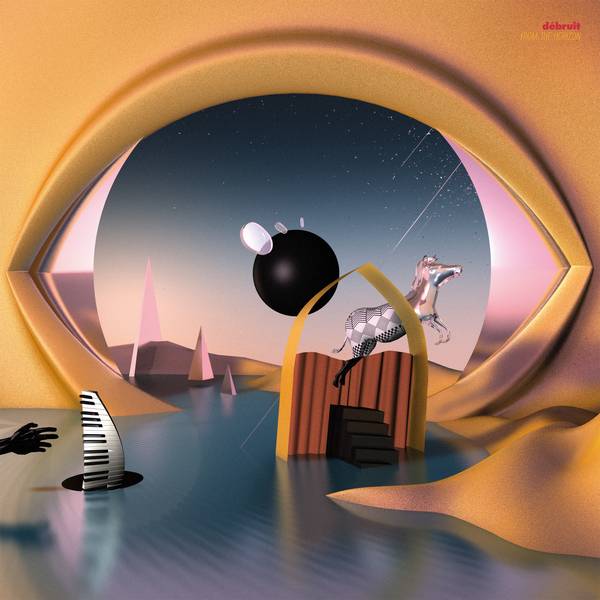
Much more problematic is Dam Mantles Brothers Fowl. Here I was practically as excited as with Time Team, and perhaps even more so, given that Dam Mantles EPs have been consistently great. Perhaps his last before the album wasn't quite as mindblowing as his first two, but almost nothing could be, and it was certainly amazing by anybody else's standards - merciless forbidding and sorrowful ghoststep, as deeply moving as the best of Burial, yet pretty much unlike anything else on the poststep scene. How did he go from that to the cosy feel-good-melancholia of Brothers Fowl, not really substantially different from most by-the-numbers downtempo out there? Again I bought it, with pretty much the same excuses as with Time Team, but this time it didn't really help, and even though Brothers Fowl is perfectly listenable, it never clicked or seemed remotely relevant. Here, later Tuxedomoom would definitely be the most obvious comparison, given the jazzy elements and overall smooth, "sophisticated" sound. Or perhaps The Raincoats Moving, which I (probably even more alone in this than with Pere Ubu) actually think is their best, (slightly ahead of Odyshape and much better than the first), period. After all, Moving is jazzy, slightly "backwards looking" (it's basically folk-inflicted canterbury-prog, innit), smooth and full sounding - just like Brothers Fowl.
But it doesn't work: Both the Tuxedomoon of Ship of Fools and You, and The Raincoats of Moving, still had deeply original ideas, and even though Brothers Fowl douse a few synthetic sounds and abruptly arranged samples, it's all made to fit discretely and tastefully into the overall mood of slick, harmless "sophistication". In other words; the few original elements it does contain are ironed out, nothing seems strange or unexpected. And even that could perhaps be acceptable if only the actual compositions were better; after all, the final step elevating Moving to be the masterpiece that it is, is the incredible uniqueness and quality of its songs, and Dam Mantle have certainly shown himself more than capable in that direction, with amazing tracks like "Grey", "Two Women" and "Not a Word". On Brothers Fowl, however, the tracks are just too goddamn polite and anonymous to make any lasting impression. Sure, as mentioned before, it's a listenable album, I can listen to it on its own terms and it seems OK - as downtempo goes, you might even say it's one of the better offerings - but I'd never have heard it several times, or have bought it, or taken any time to think about it, if it wasn't for those EPs that preceded it.

With Debruits From the Horizon, you could once again say that a sort of mellowing out had happened, but this time it was not as much towards a more smooth and laid back sound, but rather towards a more organic and human sound, with less of the insane, hyper-angular syncopations that made his previous music so fascinating, so shockingly new. Instead, the album was much more based on a traditional afro/ethno-funk aesthetic (including lots of talkbox), and contained much more fluid, straightforward rhythms, anchored by African samples that more or less created the entire structure of the tracks, rather than being cut into sharp blasts of ethno weirdness as on previous Debruit EPs. So once again not the blast it should have been, though in all fairness it's still a really weird and original album - especially the last half -, and in many ways as brilliant and unique a reimagining of ethno-funk as many post punkers with similar inspirations.
My disappointment with Eproms Metahuman is perhaps a little surprising, given that I've never quite followed him with the same interest as many other poststeppers. Not that his EPs weren't good - they're excellent examples of the wobbly end of bitstep - it's just that many other producers seemed more crucial in that respect (Slugabed most of all, of course). However, I heard that Metahuman was on its way exactly while I was still really disappointed with Time Team, and I guess I sort of hoped that Eprom - who often seemed more raw and brutal (if not quite as far out) than Slugabed - would do things right, and make the uncompromised bitstep masterpiece that Time Team wasn't. It didn't quite happen that way, and it's also a pretty unfair way to meet the album. In many ways, Metahuman is a brilliant album, and if I forget my personal expectations it's certainly close to being one of the best. And when it doesn't quite make it, it's once again exactly because it tries so hard to be "the album". Eprom wants to show us that he's both capable of twisted, bleepy harsh-step ("Prototype", "The Golden Planet", "Needle Trasher") as well as moody sci fi atmospherics ("Honey Badger", "Floating Palace", "Raytracing"), and that's all right, he is capable, and comes up with some awesome takes on both. What he doesn't quite manage, unfortunately, is to turn this into a much longer and more coherent package, i.e. "the album". Metahuman is coherent all right, but it's primarily because it's pretty samey-sounding most of the time. "Tunes" have never been Eproms strong side, what makes his music memorable is the formal inventions - sound and structures - and he doesn't seem to have had enough ideas in that department to fill a full 45 minutes. I wouldn't say that there are tracks on Metahuman that are bad as such, but several of them seem a bit anonymous/filler-ish, and a "mini album" approach could have worked wonders. I'd still say it's among the ten best albums of 2012, but as with Time Team, a more sharp format would have made it a candidate for the very best.
And what, then, was, the best album of 2012? To my surprise that happened to be Starkeys Orbits (Civil Music), which came out not much more than a month ago. His 2008 debut album, Ephemereal Exhibits, was quite good, but suffered a bit from the same kind of "samey-ness" as Metahuman, and the follow up Ear Drums and Black Holesseemed like the typical attempt to simultaneously cover all bases and make cross over pop, resulting in the equally typical overlong mess. Subsequent EPs also contained an annoying mix of ace hypergrime and bitstep on the one hand, and lame indetronica on the other, and as a result I'd pretty much written him off. Hence my surprise, for what a return to form Orbits is, totally getting it right where both Ephemereal Exhibits and Metahuman didn't. It oscillates between soft/atmospheric and hard/ravey - often within single tracks - and he's got exactly the wealth of ideas, futuristic originality and melodic depth necessary to make that simple dichotomy work for 55 minutes. It's also interesting that he's only very sparsely using either 8 bit elements or the collapsing rhythmic structures that makes most ravey/wobbly bitstep so insane, instead he seems to use grime as a starting point, taking the bizarre, angular fanfare-riffs and inorganic syncopations far into the hysterical - often almost getting close to Krampfhafts psycho-bubbling sound. A huge part of Orbits is simply everything I could ever have hoped "hypergrime" would turn into, but in addition to that, the more "cosmic" tracks approach the sci fi synth-aesthetic in a way that works just as brilliantly as, say, Kuedo, and yet is Starkeys very own. Orbits is thrillingly futuristic in both vision and execution.
As for other great albums this year, it's worth mentioning a couple of debuts that were positive surprises, though mostly because I didn't have great expectations for them to begin with: Jam City have always been one of the better Night Slugs-acts, but that's not saying that much in my book, and I haven't been particular overwhelmed by him. However, with Classical Curves he completely abandoned the house vestiges and explored an unapologetically inorganic, "vibeless" soundworld - and was all the better for it! It was all shiny, slick, synthetic surfaces, and in that way you couldprobably say that there was some small relation to Rusties maximalist sound, but where Rustie is often silly, colourful and hysterical, Jam City was cold and empty, with an almost ballardian twist. Not exactly music that "touches" you, but it was nevertheless deeply fascinating, and perhaps the strangestalbum this year.
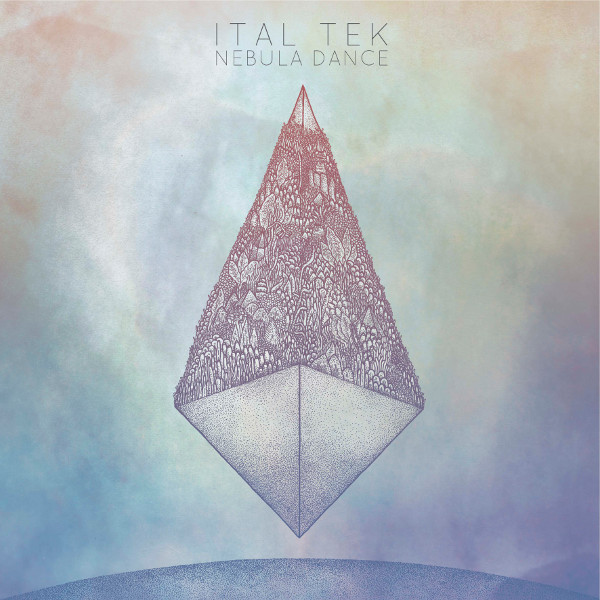
Another artist that never quite impressed me before was Distal, but with Civilization(Tectonic) he made one of 2012 most convincing footwork-based (and trap-based too I guess) poststep offerings. It was probably a bit too long and uneven ("the album" again), and sometimes the use of "authentic"-sounding "ghetto" vocal samples got annoyingly close to parody/pastiche, but mostly it was brilliant exactly because it didn't try to be wild, raw, street-real dancefloor music. Rather, it took the element of abstraction within those styles and ran with them, turned them into increasingly bizarre shapes. Rather than just sprinkling some footwork over a stale IDM-dish to spice it up, Distal, when he's best, dissects the sound completely, and then reassemble it in ways that doesn't really sound like anything else around.
If Civilization came up with some of the most refreshingly strange footwork deformations this year, but just didn't work equally well all the time, the most consistent deconstruction of the style was probably Ital Teks Nebula Dance (Planet MU), which was in many ways an heir to Kuedos Severant: Panoramic and bittersweet synth music made strangely unstable by alien rhythms. Nebula Dancehad a bit more going on in the beat department, the tracks were often extremely dizzy and jittery, but on the other hand, the melodies were rarely memorable - an old Ital Tek problem, which also means that it was a good move to make this album substantially shorter and more focused than the previous one. You could argue that it's still close to simply being too nice and smooth, with all sounds blending in endless digital reverb, but in the end it works, perhaps because the way it manages to incorporate the footwork rhythms seems so obvious; the end result doesn't really sound like footwork at all, or like some other style superficially decorated by footwork, it's its own, fully integrated thing.
The more club-tinged part of poststep - the area where things have become more and more house/funky-oriented lately -, actually also delivered a couple of surprisingly good albums: San Gabriels Wolfe (Time No Place) was almost like a colourful party version of Nguzunguzu (though some parts were a bit too "funny" for their own good), while Dusk+Blackdowns Dasaflex (Keysound), despite a couple of tracks suffering from some of the most cringeworthy funky clichés around, also managed to fuse elements of grime and funky in a way that seemed both charmingly lightheaded and almost playfully futuristic. Diametrically opposite this light and elastic music, Lorns Ask the Dust (Ninja Tune) made the already extremely dark and sorrowful sound of his 2010 LP Nothing even more dark and sorrowful. Together with the Bit-Tuner EP it was pretty much the ultimate amalgam of "ghoststep" and old fashioned doomstep, and basically just building on a style that has been pretty well established for several years now; yet rarely done this good. One of the years' most overpowering albums, actually, even though it's probably a bit too pompous for some.
The "ghostly" end of things - i.e. the grey area where poststep meld with hauntology and other post techno/post everything deconstruction strategies, was generally very active this year, and makes me wonder where poststep stops and the larger experimental strategies right now take over. That'll have to be a question for another time; for now, I'll just mention 2012s best albums from this interzone: Offshores first (and, sadly, last) LP Bake Haus seemed a bit of mess to me to begin with; unfinished sketches, run-of-the-mill beats and an overall melancholia that often sounded almost like indietronica. Not my kind of thing and not exactly futuristic. But nevertheless, Bake Haus just worms itself into your brain in its own haunting, desolate way, and I find it really hard to put my finger on why it works. Lukids Lonely at the Top, the first of his albums to really get me, is similarly difficult to figure out. Dreamy decay-ology of the kind I normally find a bit too dreamy and gaseous, but here it's got just the right edge. Finally, I guess the two Ital-albums Hive Mind and Dream On (both Planet MU) sort of belong here, even though most would probably say they represent a kind of psychedelic retro house. Well, perhaps they do, but the disorienting, kaleidoscopic sound and the weird, grooveless use of half dissolved samples is totally "now", as far as I'm concerned.
OK, so more than enough for now. I planned that this should have been all about the EPs, and yet I ended writing more about the albums. Perhaps I'm still caught up in the idea of "the album" myself. Ah well.


