20-Feb-18
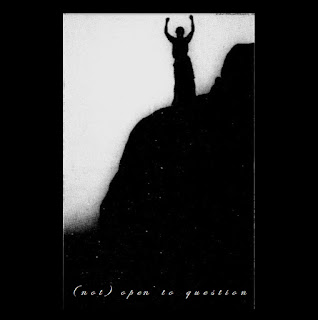
Whilst the New Year may be open to question the quality of the work on this album is not. Furthermore, you're invited by the label to make your own additions to these tracks, the first layer 'is created within the collaboration of MƩCHΔNICΔL ΔPƩ and Les Horribles Travailleurs', so the challenge is set, although this is very much in the spirit of collaboration rather than competition. As always, the bar is set high here but why not (re) create? Remake/remodel (should be a Roxy Music title...oh, it is?). 'You are invited to finish this soundwork by altering\adding layers etc. to the first layer, which can be downloaded from Bandcamp'. As it stands it's very good.
09-Jan-18
Let's start the New Year with a whimper...@',mn,mn,qwwwwwhhhhhhhhherrrr'
Fact is this year's going to be the one that sees the downfall of the music industry due to it's incessant gnawing of itself like a doped-up rabid labradoodle, foaming as it very slowly chews its own leg off and keeps going as far as it can reach until it's stinking innards spool out across everything but don't worry, you will be immune to the putrid, poisonous substance due to years of injecting the antidote in the form of JS Bach, James Brown, Bernard Parmegiani and other names involving capital 'B', or 'L', or 'D'...how about 'D'? Don Cherry, Defunkt...that's enough, that's the ABC of it, your alphabetically registered pantheon of ....music people...the countermeasure to all the crap...
On the subject of letters...
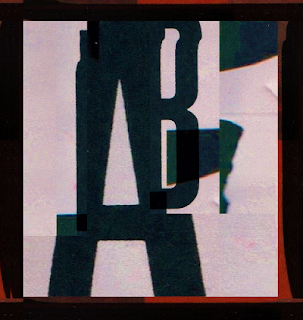
That one's called AB...there's more of my art over here
Whatever...or, actually, all my art work this year will be part of a series called So What...why? I reckon it's the most common response.
In 2018, though, let's not be blase about things, least of all what we love the most and what we make...
01-Jan-18
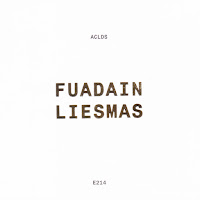
Under the radar, off the map...such terms hardly do justice to Chris Douglas' non-place in the what we might call 'the music world', even the 'underground electronic' version. No surprise then that Fuadain Liesmas has not, to my knowledge, appeared in any end-of-the-year charts. As Dalglish, O.S.T. and Scald Rougish, Douglas has persisted in making music for any reason but the desire for publicity or, perhaps, praise. Not that I believe he wouldn't welcome recognition. Searching for reviews of this album I've found no mention other than on this blog and, of course, Boomkat (because their job is to try and sell music).
Describing the carefully crafted sounds here would be a challenge for most would-be critics, yet that's no reason for it's apparent invisibility; many writers are better equipped than me to talk about 'abstract' sound and do so regularly. Nonetheless, here I am...on the edge of...reviewing what eludes easy categorisation.
Negin Giv, being just 30secs long, might be a good place to start (and end?) since it is, in microcosm a snapshot of Douglas' methodology....his ability to...punch holes in ...the space-time continuum...? If I improvise, forgive me. Free-flowing word scrambles might suit talk of Jazz, but Fuadain Liesmas being so meticulously composed I feel duty-bound to attempt the same in writing. And fail.
OT-IntVxEs 1 is typical of what goes on here, which is not to suggest that it's all predictable from the outset (only in...approach to sound). Rather, I mean, in creating melancholic (?) tones which in other hands would signal mere ambient eternal drift somnambulism, Douglas scatters brittle components throughout. No sleeping here. No daydreaming 'bliss'. Only on Hrm Clng or Dtn#09_Ed do we find what feels like a place of rest, albeit one derived from an afterlife (?). After what? This is life, in all it's restless, skittish, uncertain gravity.
Perhaps ambiguity renders such albums unpopular; not 'difficult listening' - that, surely, is in the ear of the beholder. Albums that gain attention often shout something, even if in a thoroughly minimalist, quiet fashion. Is the popularity of Ambient a result of what many perceive to be a politically turbulent world? An escape from that madness? As if the world has ever been stable. Whatever, the thing to do is make music which speaks of either 'the street', or technological trickery in the service of an adrenaline boost. Songs, naturally, are always in favour. Fuadain Liesmas offers no such musical certainties. It's neither flash nor pleasingly serene. Ultimately, I can only say 'It is what it is'. You can get a taste from the stream below, but to fully savour what Chris Douglas has created, I suggest you buy the CD from here.
26-Dec-17

RTomens, 2016
WHAT? forgive me. I dunno. WHEN? last year. I mean, this year, 2017. In PC world nobody's memory works so I must consult this blog, scroll back in time (one day everyone will have mental bookmarks implanted, won't they?) to see which albums might be consideredmemorable worth mentioning in a round-up...
So here goes...
Broken Ground - Christian Bouchardreview

Structures And Light - Group Zeroreview
Sacred Horror In Design - Sote review
Mnestic Pressure - Lee Gamble
review
Some People Really Know How To Live - Shit and Shine
review

Hesaitix - M.E.S.H
review
Fuadain Liesmas - Aclds
review forthcoming

Monika Werkstatt - Various
review
A Little Electronic Milky Way Of Sound - Roland Kayn (this didn't even make the Wire charts!?)
review
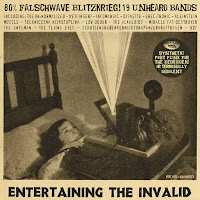
Entertaining The Invalid - Various
review
12-Dec-17

Texture, abstraction, atmosphere...mood music for the apocalypse in your head. Who is not enduring small (or large) psychotic trauma on a daily basis? It's the modern world...in which other modern people go about their business, answering 'it' with just a 'sigh'.
COMA †‡† KULTUR
Pay what you want but somehow you will pay it all, (play it all) back...
08-Dec-17

All The Marks Of Identity Are Swept Away, RTomens, 2017
Wonder why...I'm not myself of late...
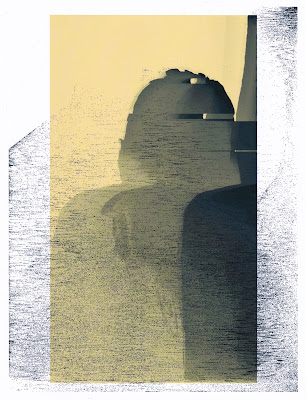
Self-Portrait, RTomens 2017
STARVE LIVING ARTISTS INTO SUBMISSIONDO NOT SHOP
06-Dec-17
 Art: Monk's Mood - Tribute To Thelonious Monk [ 06-Dec-17 6:14pm ]
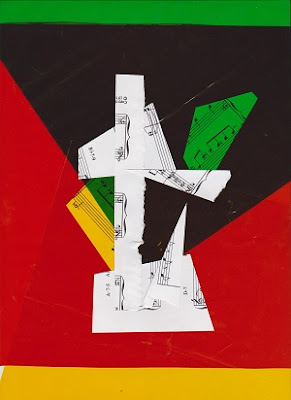
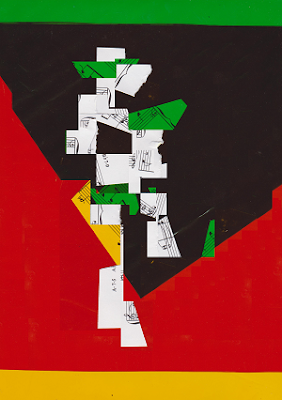
RTomens, 2017 Three art works from a series I made in honour of Thelonious Monk. The music is taken from his tune, Monk's Mood.
RTomens, 2017
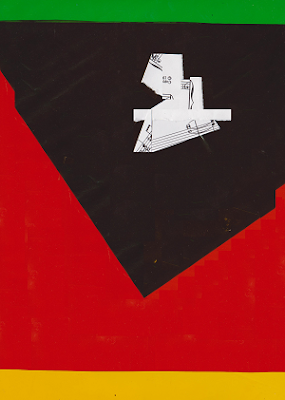
RTomens, 2017
30-Nov-17
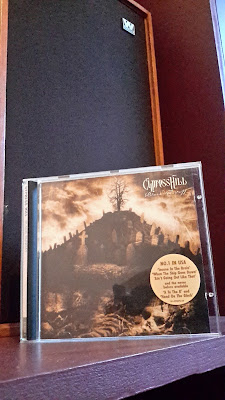
So another CD chariddy shop bargain, Cypress Hill's Black Sunday for a quid - whoo-eee! I had this on vinyl too when it came out - then - what happened?
Remember when hip-hop was big? Remember when Public Enemy were fresh after the old first wave - like dangerous music, like grabbing the torch from The Last Poets and Gil Scott-Heron bad - eh? Yes. Then, well, not quite then, but a few years after the second wave, maybe even the third, hip-hop got out of control worldwide MASSIVE - didn't it? Like many a street sound before it soon every square on the block was into this thing whilst debates about how good it was for the black community and folks at large, what with all that swearing, cop-killing, female-disrespecting, money-idolising, gang-glorifying lyrical splurge - all of which only endeared it to youth and gangsters, naturally. The bigger hip-hop got, the smaller my interest. What this says about me may be that I'm a snob who reacts against popularity, or simply prefers movements when they're fresh? What? Which?
Here's an album that went Triple platinum in the U.S - fuck! I knew Cypress Hill were popular but...only just saw that stat on Wikipedia. I remember loving Black Sunday when it came out, like millions of others - it had the juice - got the juices flowing - but that was then - how would it sound 24 years later? How about BRILLIANT! tHAT'LL DO. sHOCK. tHERE WAS ALWAYS SOMETHING ABOUT b-rEAL'S VOCALS THAT WERE DIFFERENT AND STILL SOUND THAT WAY, AS IF HE'S PERMANENTLY, YES, INSANE IN THE MEMBRANE AND HAMMERING AT YOUR WINDOW TO TELL YOU ALL ABOUT IT. Whoops, caps lock - which rhymes with 'Glock, funnily enough.
In retrospect it's easy to hear how Cypress Hill got so big and so rich. The samples are choice, the mixing is absolutely perfect with the breaks in your face and somehow this album insists that you succumb, not through lyrical force so much as vocal/rhythmic dynamism. It's not original (when did that ever get you rich?). If anything, it's stereotypical of hip-hip subject matter (violence, drugs, bragging) - yet - yet - after the first four tracks you're slaughtered! Putty in their hands. Well, I was, again.
29-Nov-17
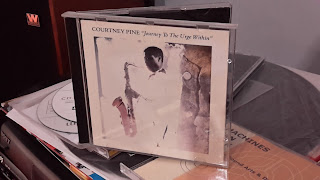
Courtney Pine's debut album for a quid? Couldn't resist. Of course I owned the vinyl when it came out, which was 1986...and Courtney was our Coltrane - he was! We could only watch in awe as our man, a young black man, in a suit, delivered his version of what was then contemporary Jazz..in London Town! He was slimmer then - we all were. He was also the only one to make the cover of the NME. Well how has it aged? Fine, to my surprise. As We Would Say sounds particularity good. OK, in the writing stakes he was no Wayne Shorter or Coltrane, but after 31 years and in the context of all that went before Journey To The Urge Within holds its own with no small help from the likes of Julian Joseph on piano, Gary Crosby's bass and Mark Mondesir's drumming.
So today I came across an interview Pine conducted with David Bowie in 2005, asking him about the influence of Jazz in his life. Turns out our David had some impressive names to drop. I'd never heard Bowie talking about Jazz before but I've often wondered if he got the 'Wham bam thank you mam' line in Suffragette City from the Charles Mingus track. It's more likely he nicked it from the Small Faces tune of that name, of course.
To continue the Mingus connection, when asked for the one Jazz tune that really moves him, Bowie goes for Hog Callin' Blues from the album that Wham Bam Thank You Ma'am was also on, Oh Yeah. A man of taste! This also happens to be one of LJ's favourite tunes. Just listen to Roland Kirk tearing the roof off the studio...
28-Nov-17

Pure (sun sound) pleasure from Modern Harmonic and how clever of them to collate Sun Ra's 'exotica'. For those not familiar with Sun Ra any sampling of tracks from here will be a surprise if they had him down as too 'crazy'. They may even wonder what all the fuss is about but to miss Ra in these moods is to ignore their worldly 'ancient' and thoroughly justified inclusion in the Arkestral sound collage. Essential.

Accelerated Destruction, RTomens, 2017
This along with other art prints is available now in my shop
22-Nov-17

How much more 70s/80s cassette culture can we take? - loads! it seems. And why not? There's much pleasure to be had from the beneath-the-underdog bedroom synthesists; the chancers, non-game- changers, radical visionary lunatics and nerds with attitude.
'Nuclear fuel breeds nuclear war/The politics of power/ Rotten to the core' - it's Missing Persons and Rotten To The Core, one of the treats on this superb collection, which illustrates many angles taken by the Lost of Tape Land. PCR's Myths of Seduction and Betrayal (Extract) is another gem. Human Flesh, Urbain Autopsy are names that tell of the Cronenbergian body mutation fixation of the times, when perhaps the recently-evolved opportunity to integrate mind and machine bred obsession with cybernetic mutation. Who knows.
Cassette-sharing sites are popular now but for obvious technical reasons the sound quality is usually poor so this is a welcome chance to hear hi-resolution lo-fi emissions from the vast cavern of underground cassette culture.
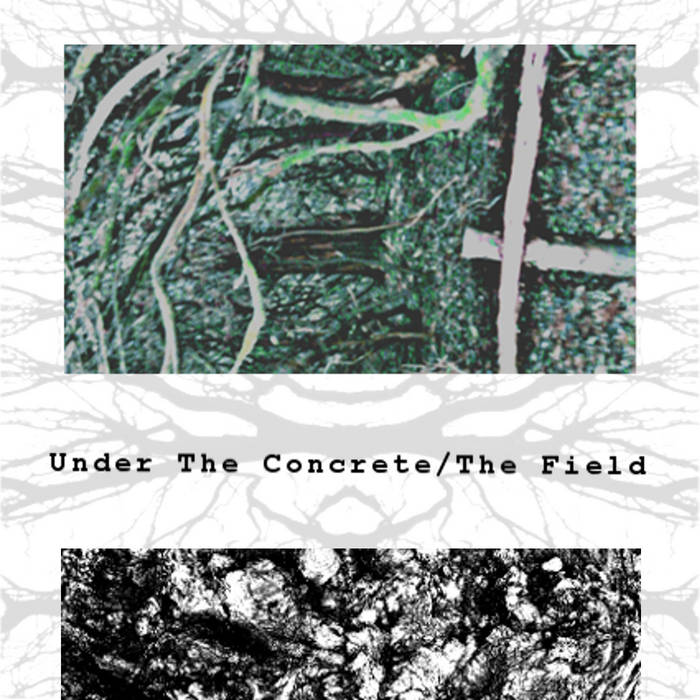
Beneath the concrete field, the beach? Perhaps not. Here, at least, is a contemporary collection worthy of your attention. Material by Mark of Concrete/Field, remixed by various folk, most of whom have remodelled original sounds in a very interesting way. Descent's Freebase has great depth, a build-up of tension pressure that's all the better for never actually being released. AMANTRA's Scorched Earth Policy wouldn't sound out of place on the Underground Cassette comp - I mean that as a compliment. Kek-W got A Fax from Philip Glass (great title), well, I suppose a few people did in the 80s - anyway, as always, KW's work is spot-on/interesting, as is Libbe Matz Gang's Tratamento de Enxaquecas, like death metal machine music! Very good comp.

Windows To The SoulBEFORE I GO, A PLUG FOR MY ART PRINTS, WHICH ARE NOW AVAILABLE FOR PURCHASE HERE
21-Nov-17
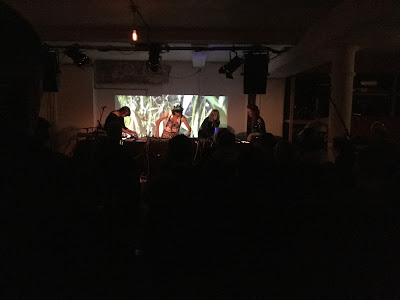
Oh, yes, it's Ladies' Night
And the feeling's right
Oh, yes, it's Ladies' Night
Oh, what a night (oh, what a night)...
...Monika Werkstatt at Cafe Oto - yes, what a night! You don't need me to tell that electronic music is a male-dominated world (which part isn't? bingo?), just like Rock, but unlike that traditionally macho realm of phallic axe-wielding at first glance there should be no reason for electronic music being a (mostly) men-only domain, until you start thinking about stereotypical male gadget obsession and the historical culturally-enforced tradition of DIY (inc tinkering with electronics).
Issues surrounding all that (not bingo or DIY) were discussed in the Q&A. An interesting point was raised about how women are expected to be 'brilliant' whereas it's OK for men to be 'all right'. The conclusion was that women should be allowed to be 'all right' too. The issue of expectations aside, pure percentage stats dictate that there's a lot more average male performers in electronic music simply because they dominate.
Politics aside, if it's possible to lay them aside and see the performers as just that (perhaps there's an irony there in rightfully demanding equality, ie not just being viewed as 'female artists', whilst presenting an all-female collective - tricky) with nothing to prove Monika Werkstatt proved it. It was an evening of seductive, passionate, humorous, powerful music, each of the four players performing two songs before a collective session finale. All four were present on stage throughout and it was entertaining just watching their individual reactions to what the performer was doing.
Before the collective, support came from London's La Leif, who brought beats and bass fit to shake Cafe Oto's foundations with a very tough set.
The first of MW to perform was Sonae, whose subtle, richly-textured ambient sounds set a good tone...
Then Barbara Morgenstern ('Queen Of Harmonies') delivered two superb songs, the power of which was amplified times 10 in a 'live' context...
Watch out, it's Pilocka Krach, surely the prankster in the pack, giving us all a good slap with her stomping Electro-Power-Pop! Do you like the beat? Yes, I did!
Finally in solo form, 'the boss', Gudrun Gut, organiser of the whole collective and legendary figure on the scene for years.
The quartet session was as intriguing as you'd expect from four diverse artists with their very own styles, working together intuitively, in the spirit of improvisation, just don't call it 'Improv', Gudrun's ambiguous about that scene and I don't blame her. As she said, it's something you can hate yet be drawn to at the same time. There's nothing to hate about Monika Werkstatt. Do check the collective album. It's an essential release from this year. As an encore, the joint was jumping to Who's Afraid Of Justin Bieber? Here's a brief video I took...
Oh what a night!
20-Nov-17

Improvising to tape loops may sound implausible, or rather, contrary to the spirit of Improv, but who cares about that, eh? Not you. So here's saxophonist Colin Webster doing just that and the combination of his chops and repetitive sounds works very well. You can almost hear Webster thinking 'What shall I do with this?' in the unaccompanied sections, which adds to the intrigue. Being capable of creating many varied sounds from his horn, Webster has no trouble finding the 'right' tone for each loop (well, perhaps he did, but the released versions all succeed).
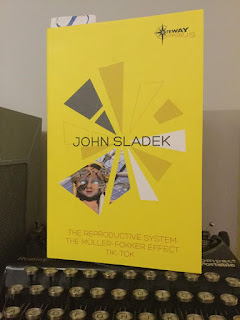
On impulse I called in Daunt Books today to see what sci-fi they had. I asked the girl if they had a section for it, she said they didn't because they 'specialised in travel'. "What about space travel?" I asked..."I know," she replied, almost smiling...
Bought this John Sladek collection the other day, having decided to read more science-fiction. The genre has promised more than it's delivered as far as my needs in recent years are concerned. Those needs have changed since I started reading sci-fi a long time ago, of course.
After the early-teen experience of space adventures I progressed to the biggies such as Asimov and co.. It wasn't until the late-70s and discovering William Burroughs that my view of the genre changed completely; in short, he ruined it regarding everyone else, except JG Ballard, who I still rate highly and read regularly. That's no coincidence considering Ballard's opinion of Burroughs despite their very different writing styles.
Burroughs even gets a mention on page 79 of this Sladek collection from a stoned character trying to get to Morocco. Published in '68, the first novel, The Reproductive System, reflects the era in a good way rather than a 'dated' fashion, covering paranoia, anti-authoritarian, secret agent, science-gone-mad cynicism in the spirit of adventure that reminds me of both Michael Moorcock's Jerry Cornelius and Wilson and Shea's Illuminatus! Trilogy. So far so good and since I will finish it that's a recommendation from someone who's a serial non-finisher (life's too short, isn't it?)
TTFN
19-Nov-17
Space Age print / Flying Saucers Are Hostile / Starship Troopers / Shit & Shine - That's Enough / Felix Kubin - Takt der Arbeit [ 19-Nov-17 3:37pm ]
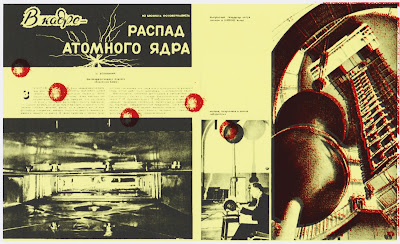
RTomens, 2017
More of my art here
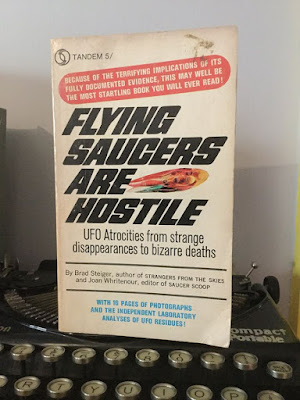
1967 1st edition
You've been warned - 'YOU DARE NOT ALLOW YOURSELF TO IGNORE IT!' (from the back cover).
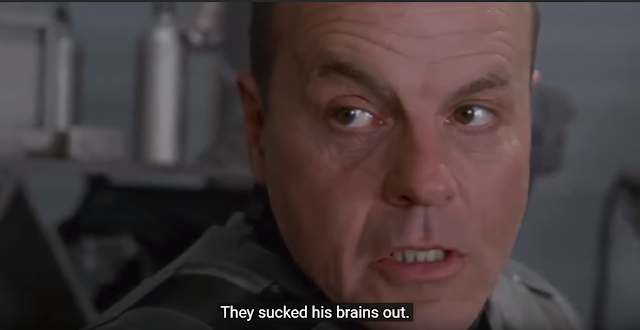
Flying saucers are hostile, so too are the alien bugs in Paul Verhoeven's Starship Troopers - "The only good Bug is a dead Bug!". It's 20 years old and re-watching it I confess to enjoying it even more than the first time. That's a 'confession' because revelling in a film filled with square-jawed, squeaky clean heroes out for military death or glory to bombastic soundtrack sounds like hell as a film, but that's the point. ST is pumped up and primed as a trashy action film whilst constantly undermining everything it superficially celebrates. It's very sheen is as sickening as the site of a bug ripping a soldier limb-from-limb. It's gung ho writ large but gets booby trapped at every turn. Verhoeven knew what he was doing but did it so well that few could see the subversive irony through all the flying limbs and phoney machismo.

In a way Shit & Shine like to play with machismo (note the cover) - perhaps they really are macho men. But there's an 'ironic' edge to most everything they do and their latest, That's Enough, is no exception - 'Do you know the way to the garden party?' - the EPs filled with samples, a long one opening the opening title track, which you've probably heard by now. The Worst continues playing with the sample idea - the judges on American Idol? Subversion, like ST, is embedded in the per-usual nasty grooves - that must be Simon Cowell sampled - we might think that's enough of that talent contest shit but it just seems to keep rolling and so too, thankfully, do Shit & Shine.
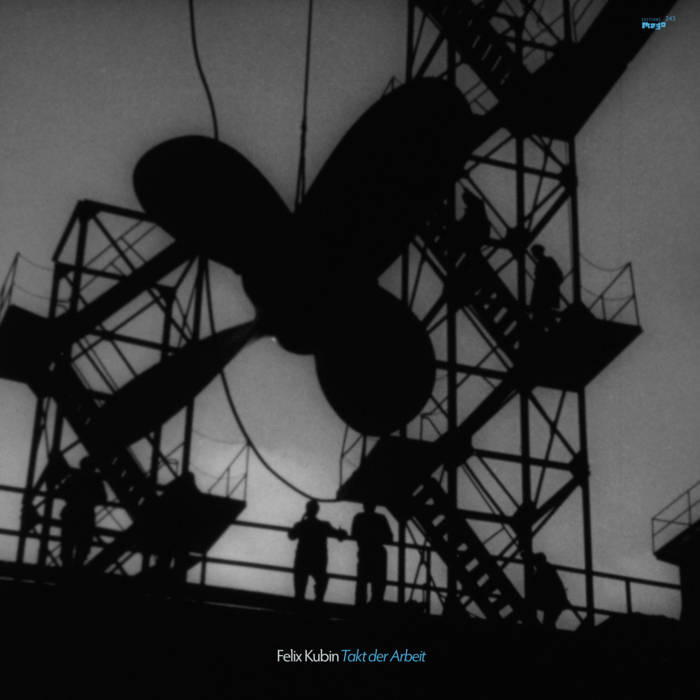
Do they still make musical geniuses? What do you reckon? Whoever 'they' are - parents of musically gifted kids who rise above being mere talented? What? Anyway, Felix Kubin: as Mark E Smith said 'Check the guy's track record' - it's impressive, to say the least. Here he is with Takt der Arbeit, four soundtracks to educational and industrial 16mm films about work. Is this a return to the fascist/imperial/dictatorship reflected in Starship Troopers? Is that what Work is?
Track one has a militaristic slant (those drums) echoing the regimentation of both machine and human operators but here Kubin brilliantly orchestrates the components into something that sounds part friendly info film soundtrack, part chaotic depiction of factory-frazzled minds. Geburt eines Schiffes has the mood of Soviet-era proletariat-powered propaganda so strong you can see the workers marching towards you over the horizon, shirt-sleeves rolled over bulging biceps. Hold on, I got carried away with that idea. The actual mood is one of a huge industrial-age factory gradually coming to life with the roar, clank and hiss of machines complete with triumphant music heralding the brave new era of man-made mechanical wonders - or hell, since the overriding atmosphere is actually one of foreboding and tragedy. Martial Arts continues the work-til-you're-musclebound theme but Kubin continually breaks things down (a musical spanner in the works). The group Kubin works with add essential components to the EP; the human element in what could have been just another 'industrial record' in other, less creative hands. Release date was supposedly Nov 17th but as I write it's not yet out so keep an eye on Editions Mego. Don't miss it.
17-Nov-17

Briggflatts by Basil Bunting is one of the great poems of the twentieth century. However, it has not always occupied a prominent place in discussions of modern poetry. The reasons for this are complex, and have largely to do with a range of contentious biographical and historical factors (such as the marginal status of modernism in the UK and Bunting's own variable reputation). Another factor, the poem's supposed difficulty, requires some qualification. Briggflatts is a dense, carefully wrought high-modernist work. As with other poems in this bracket (The Waste Land, The Cantos, The Maximus Poems) it repays diligent close reading and re-reading. But it is arguably more vital (and, dare I say it, accessible) than those works, and can in fact be appreciated pretty well by first-time readers. As a teacher of undergraduate students over the last few years, I have found that Part 1 in particular lends itself very well to group reading and seminar discussion: indeed, the first section of Briggflatts seems to me to serve as a far better introduction to modernist poetry in a pedagogical context than a work like The Waste Land, with its copious and contested layers of allusion. It does help, it is true, to have a skeleton key to unlock some of the key features of Briggflatts. But I think the really essential facts about the poem can be summarised in a relatively modest space. The following brief guide to the poem should hopefully provide a good foundation for first-time readers. I have tried to shine light on the basic subjects and structures of Briggflatts, without diminishing its music and magic.AN, 2017
Part 1
Season: Spring
Phase of Bunting's life: Childhood
Location: Northern England
Part 1 is the most immediate and tightly structured in the poem. Twelve stanzas, each of thirteen lines, sketch an idealised panorama of Northumbria (in Bunting's poetic vocabulary this meant pretty much the whole of Northern England). The verse here is emphatically musical, foregrounding alliteration, assonance and internal rhyme, with a stark rhyming couplet at the end of each stanza to draw it to a close. In one sense, this is pure sound evoking a pastoral idyll and it should be enjoyed as such: Bunting himself said that readers (or listeners) shouldn't try too hard to uncover 'meaning' beneath the musical surface of his verse. At its simplest, this whole section is an extension of the song of the bull ('Brag, sweet tenor bull') in the first line.
However, that is not quite the whole story; there is also a definite realist narrative here. Bunting is recalling a childhood 'holiday romance' with a girl called Peggy, which took place in the early 1910s in Brigflatts (the correct spelling), a tiny village in the North Pennines. Rawthey is a river; Garsdale, Hawes and Stainmore are nearby locations; the stonemason and miners are local characters. Part 1 is therefore the beginning of a process of remembering real things, literally the first chapter in an autobiography. Deeper history also comes to the surface with the first, brief appearance of the Viking warrior and sometime ruler of Northumbria Eric Bloodaxe, killed in battle on Stainmore around 954AD. This enigmatic darker image or 'tone' prepares the way for the mournful conclusion to part 1. Spring ends, the natural presences begin to die and rot, and somehow—we never quite find out why or how—the poet's idyllic love affair with Peggy is 'lain aside' and forgotten.
Part 2
Season: Summer
Phase of Bunting's life: Early adulthood to early middle age
Locations: London; North Sea; Italy; North Pennines; Middle East; Mediterranean
Part 2 is by some distance the longest in the poem. In stark contrast to the chiselled stanzas of part 1, part 2 is an eclectic collage of clashing poetic fragments, perhaps intended to mirror the immature, evolving state of Bunting's mind throughout his wandering 20s and 30s. We start with an intentionally dramatic change of location, from the idealised North to artificial, money-obsessed London (Bunting is nodding at similar depictions of the capital in Wordsworth's Prelude). From this point onward there are continual geographical shifts (again, this is a recollection of real events in Bunting's early life). We are treated to a short tour around 1920s Bloomsbury bohemia (lines 1-23), a jaunt along the Italian coast and mountains (most of the middle of part 2 from 'About ship! Sweat in the south') and finally to a more obscure conclusion that includes flashes of the Middle East, where Bunting spent the latter part of World War II ('Asian vultures riding on a spiral column of dust') and generalised Mediterranean references—as well as spending the early 1930s in Italy, Bunting returned there during and after the war as a soldier and intelligence agent. In between these biographical fragments, more indirect passages and mythical subjects jostle in typical high-modernist fashion. The Bloodaxe narrative is treated more fully: we see Eric cruelly commanding a longship in the North Sea ('Under his right oxter …') and then dying a horrifically violent death back in the Pennines in the first great climax of the poem (the long passage beginning 'Loaded with mail of linked lies'). Paralleling this episode, Bunting nods in the final lines of the section at the Ancient Greek myth of Pasiphae, who gave birth to the Minotaur after an encounter with a bull sent by the sea-god Poseidon (note the subject rhyme with the bull at the start of the poem).
As well as being a sometimes chaotic—though often beautiful—record of the frustrations of Bunting's early adulthood, part 2 is also the place where the underlying moral of Briggflatts is first advanced. Put very simply: human beings cannot control the world, they must find a way to co-operate and co-exist with it. As Bunting put it (far more eloquently) in his 'Note on Briggflatts': 'Those fail who try to force their destiny, like Eric; but those who are resolute to submit, like my version of Pasiphae, may bring something new to birth, be it only a monster.'
Part 3
Season: n/a
Phase of Bunting's life: n/a
Locations: Edge of the world; Northumbrian arcadia
Part 3 is outside the main structure of the poem: it refers neither to a season nor to a specific period in Bunting's life. Nevertheless, Bunting intended it to be the climax of the narrative. In musical terms this is the 'loudest', most forcefully expressed part of the poem, the place where the moral first hinted at in part 2 is affirmed in a dramatic 'big reveal'. The section is based on an episode from the medieval Persian epic poem Shahnameh, which includes a portrayal of the Greek leader Alexander the Great (356-323BC). In Shahnameh, Alexander journeys with his troops to the mountains of Gog and Magog at the edge of the world. At the summit he leaves his men behind and encounters an angel (Bunting has him played by the Biblical figure 'Israfel') who is poised to blow a trumpet to signal the end of the world. There is some ambiguity in Bunting's retelling of this legend. What exactly happens to Alexander on the mountain? Why does Israfel 'delay' in blowing the trumpet? What sort of divine intervention is at play here? Yet the underlying moral is clear. Alexander tries to conquer the world and reach the limits of experience, but in doing so he is ultimately returned back to the ground, to his homeland (for Alexander this was Macedonia, but Bunting describes it here as a kind of Northumbrian arcadia). Lying dazed in the moss and bracken after his fall from the mountain, he encounters the hero of Briggflatts, the slowworm (actually a snake-like lizard) who advises him to lie low, be patient, persistent and mindful of the beauty of his surroundings.
This is the most abstract moment in the poem, but there are also clear parallels here and throughout part 3 with Bunting's biography. The opening passages of the section caricature greedy, powerful people who obstruct creativity and make life a literal shitty nightmare. As a struggling poet for much of his life, Bunting had built up some resentment towards these establishment 'turd-bakers', such as the businessman and newspaper owner Lord Astor ('Hastor'). The overall narrative shape of part 3 also mimics the curve of Bunting's middle years: after spending much of the 1940s in Persia (poring over works like Shahnameh) he returned in the 1950s to Northumberland, the homeland from which he would eventually write Briggflatts.
Part 4
Season: Autumn
Phase of Bunting's life: Late middle age
Locations: North Yorkshire; Lindisfarne; Tynedale
Part 4 is the shortest section in Briggflatts, and is best viewed (or heard) as a penultimate, minor-key movement resembling those in pieces of classical music (Bunting called Briggflatts a 'sonata'). You don't need to follow this musical analogy too closely, but it might be worth spending some time looking at the way Bunting weaves together different textures and 'themes' in the second half of part 4.
Aside from its musical properties, part 4 is also notable for its elegiac subjects. It begins with allusions to the sixth-century poet Aneirin (the correct spelling), whose most famous work Y Gododdin describes the Battle of Catterick and its aftermath in North Yorkshire around 600AD. The purpose of this allusion is twofold. Firstly, Bunting is nodding at what is in effect the first Northumbrian poem (although Aneirin was a 'Welsh' poet, we should remember that the Welsh or Britons lived in Northumbria prior to the Anglo-Saxon arrivals of the fifth and sixth centuries). In terms of the realist dimension, there may also be a glance here at the war and destruction Bunting witnessed in the mid-twentieth century (we are now, chronologically, up to the 1940s-1950s). More personally, the litany of death and decay segues eventually into a recollection of the lost love affair with Peggy. In some of the most moving lines in the poem, Bunting says 'goodbye' to his memories of Peggy as he settles down to lonely old age in post-war Northumberland.
But there is some light in the gloom. Aside from the redemptive music of the baroque composer Domenico Scarlatti, we also encounter the Northumbrian Renaissance of the seventh and eighth centuries (a dramatic 'rebirth' following the violent period marked by events like the Battle of Catterick). Among other achievements, this cultural upsurge produced the Lindisfarne Gospels (celebrated in the gorgeous passage beginning 'Columba, Columbanus …'), a beautiful illuminated book created in part to celebrate the life of the Northumbrian saint Cuthbert, who appears here as the (positive) mirror image to the (negative) portrait of Eric Bloodaxe in part 2. Aside from his Northumbrian pedigree, Bunting gives Cuthbert a starring role because he reputedly 'saw God in everything'. In line with the moral of Briggflatts, Cuthbert was a quiet hero living on the margins of society who loved nature without seeking to control it.
Part 5
Season: Winter
Phase of Bunting's life: Old age
Locations: North Northumberland, Farne Islands
If part 4 was mostly tragic notes with a brief major-key interlude, part 5 is the opposite. Like the final movement of a symphony, this is a resounding conclusion to the poem ('years end crescendo') although it ends with a sad diminuendo.
In musical verse that often recalls the 'Sirens' episode in Joyce's Ulysses, Bunting revisits the idyllic landscape of part 1 (the powerful opening syllable 'Drip' recalls part 1's 'Brag'). But now that he is an old man the perspective is different. We have moved from the mountains in springtime to the Northumberland coast in winter, where the sea speaks of finality and the end of a journey. Having accepted the need to be patient and respect human limitations in the face of nature, it is now possible to appreciate the precious details of life: rock pools, a spider's web, the lapping of the ocean, the way birds fly in harmony, the skill of shepherds in handling sheep dogs, the inexplicable wonder of the night sky. There is a kind of spiritual idealism here, and this conclusion is certainly upbeat and effusive in some ways, with the faint suggestion of a happier ending to Bunting's life than was predicted in part 4.
Part 5 is on the whole concerned with images in themselves rather than any more complex symbolism, but the line 'Young flutes, harps touched by a breeze' may just carry a hint of the optimism Bunting felt in the mid-1960s, when he was 'rediscovered' by younger poets and finally became a celebrated literary figure. However, there is still the nagging sense of tragedy that has persisted throughout Briggflatts. As the stars shine out over the Farne Islands, where St Cuthbert once lived and worshipped, Bunting remembers Peggy for the last time, and awaits a final 'uninterrupted night'.
Coda
The Coda is a fragment composed prior to the rest of the poem, which Bunting rediscovered and welded on at the last minute. It is a condensed summary of the key philosophical motifs in the previous sections: the power of music, the impermanence of all creation, the impossibility of knowing everything. Tellingly, the poem ends with a question mark (this is a work of literature that proclaims its own uncertainty and inability to conquer the world with language). For all that, one thing is certain in the end: as Bunting once remarked, Briggflatts is 'about love, in all senses'.
15-Nov-17
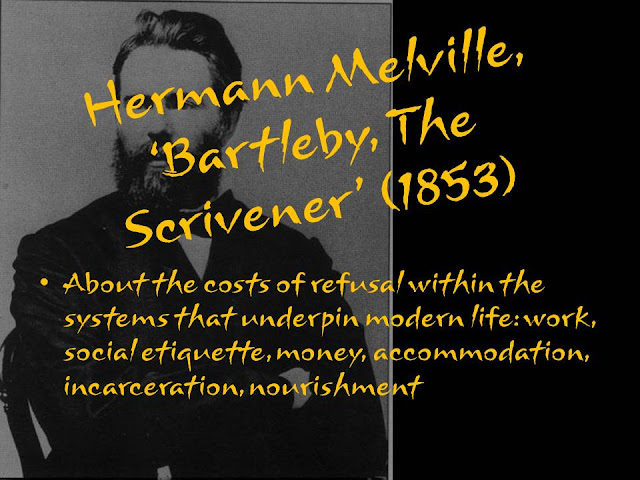
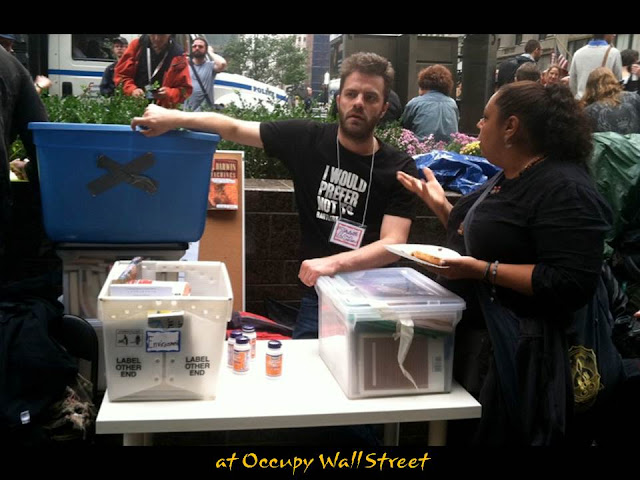
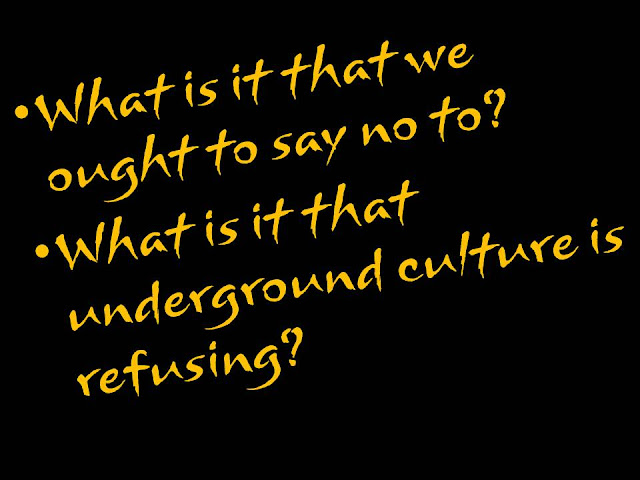
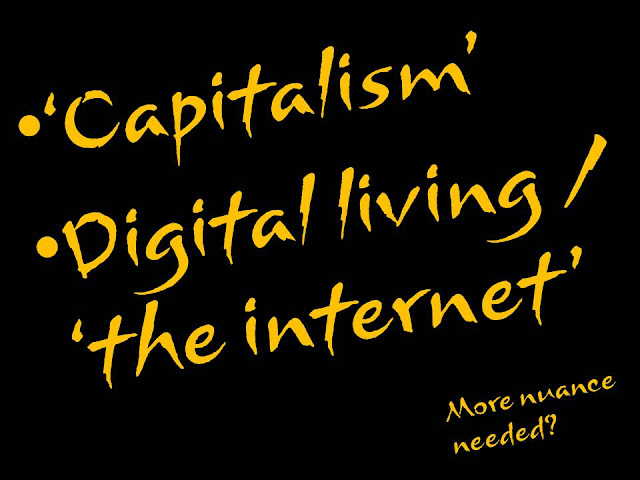
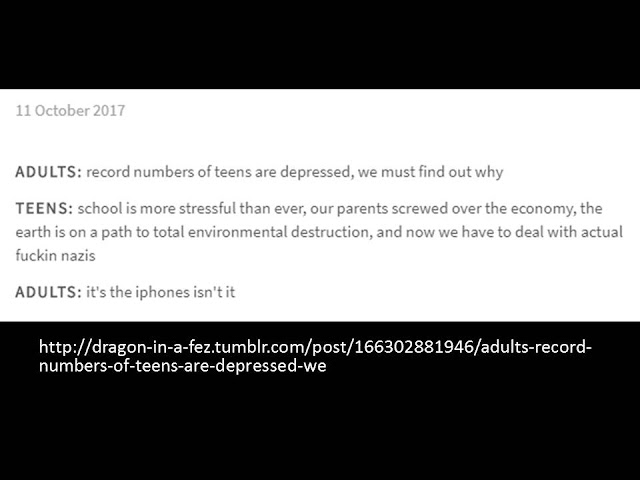
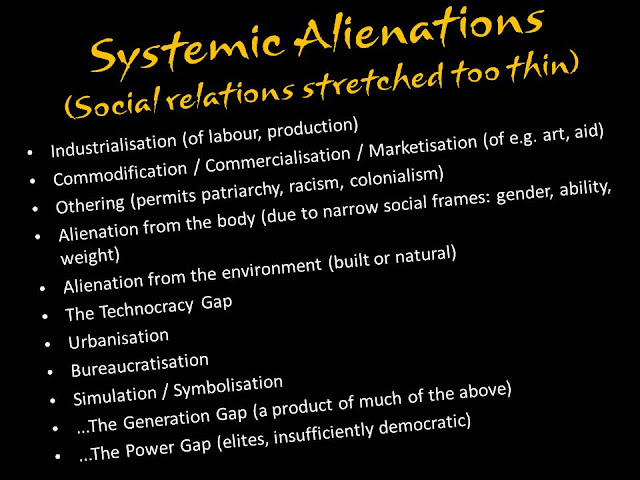
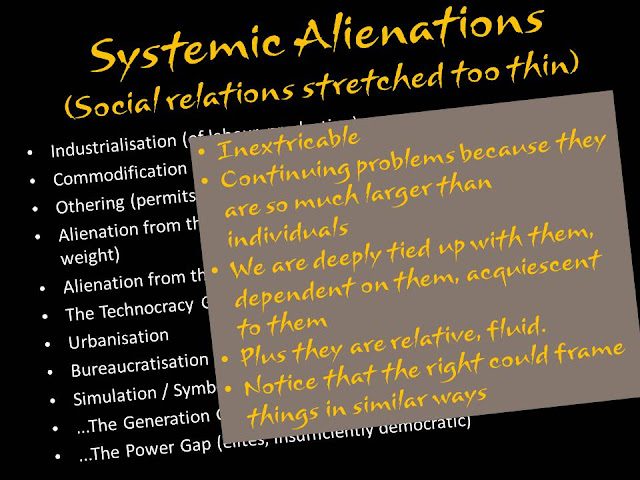
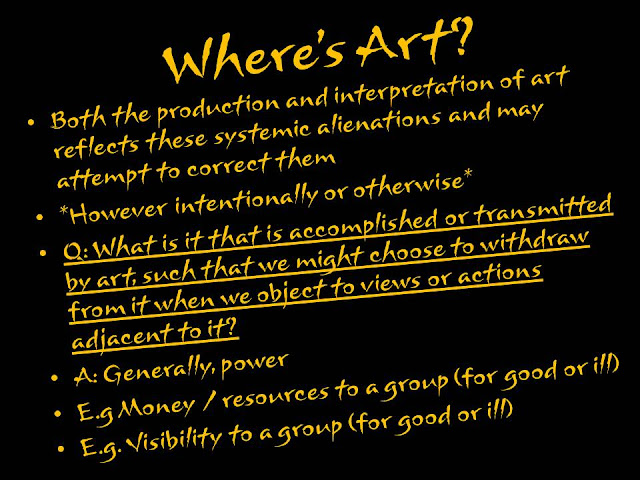
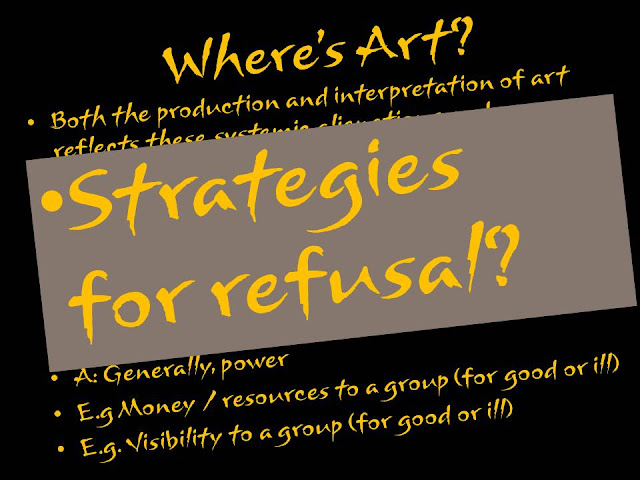
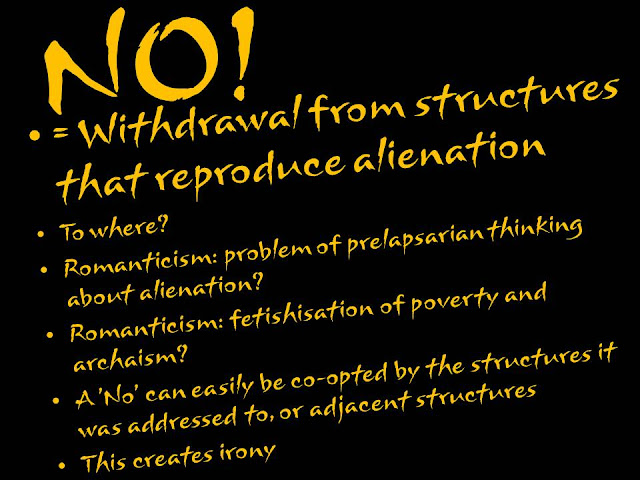
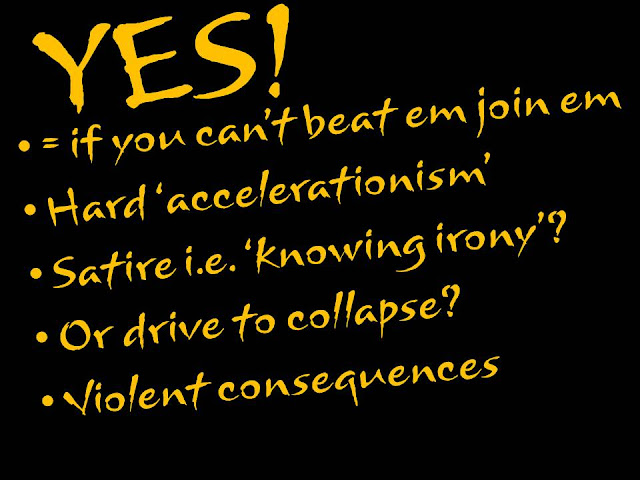
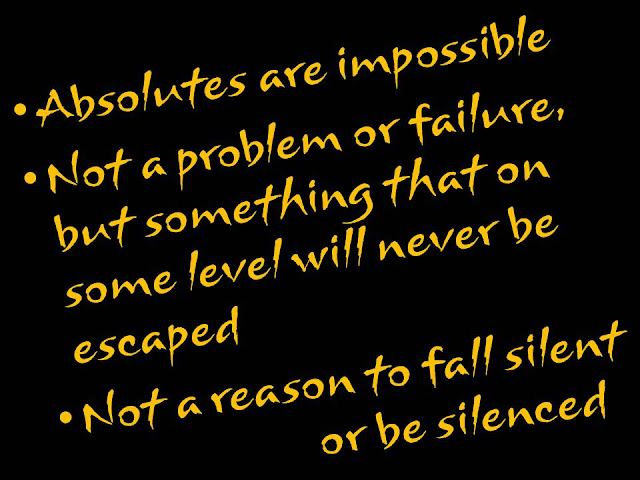
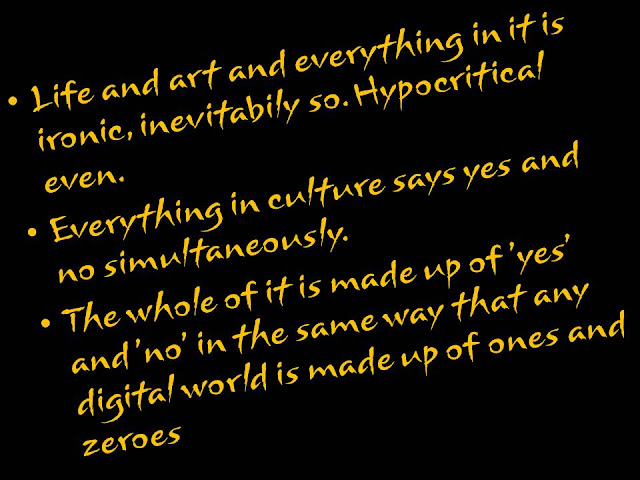
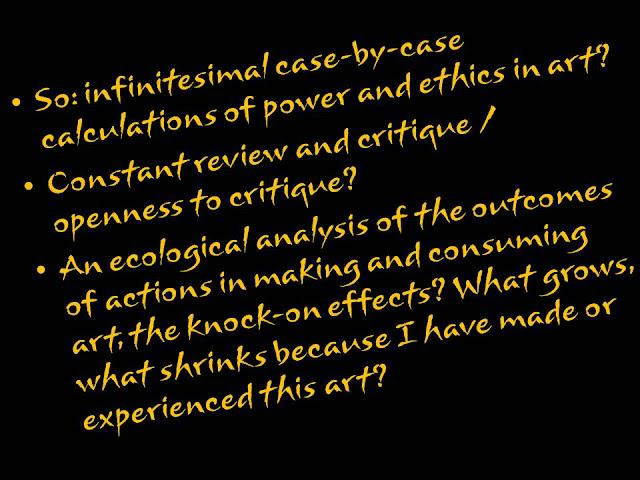
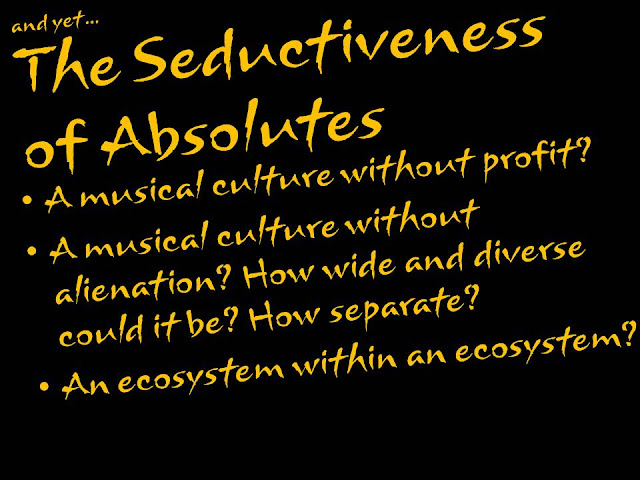
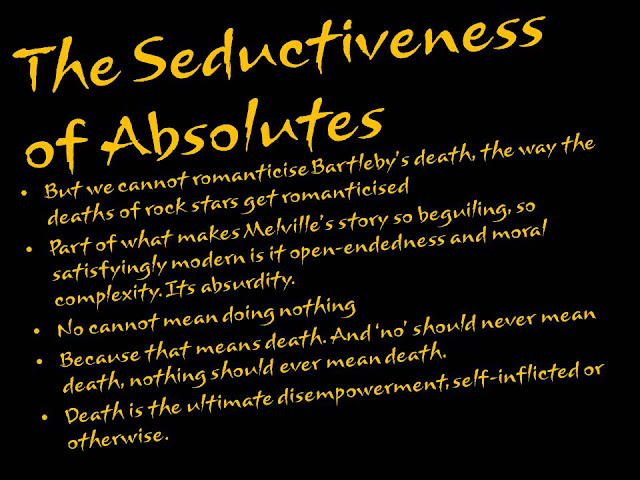
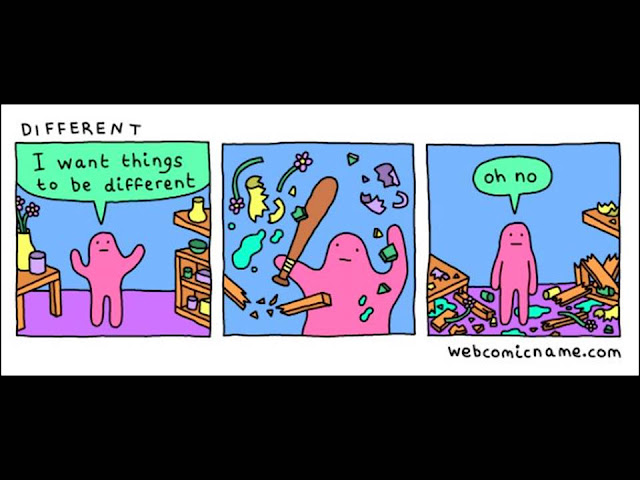
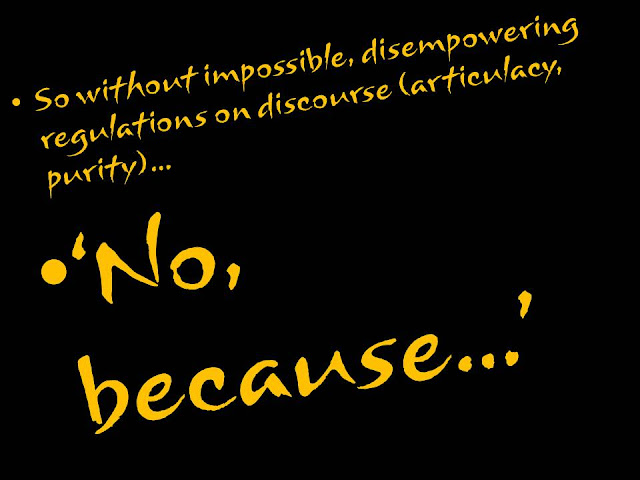
This past weekend I gave a talk about how, why and whether cultural work can refuse the various alienations of modern society / economics, as part of a panel called 'DIY or Die: Is Bartleby Dead in the Post-Digital Age?' at the No! Music Festival at Berlin's Haus der Kulturen der Welt. I don't think the event was recorded, but I thought I'd share my slides / notes on it here, if only because the HKW computer wasn't able to display my outrageous choice of font at the time.


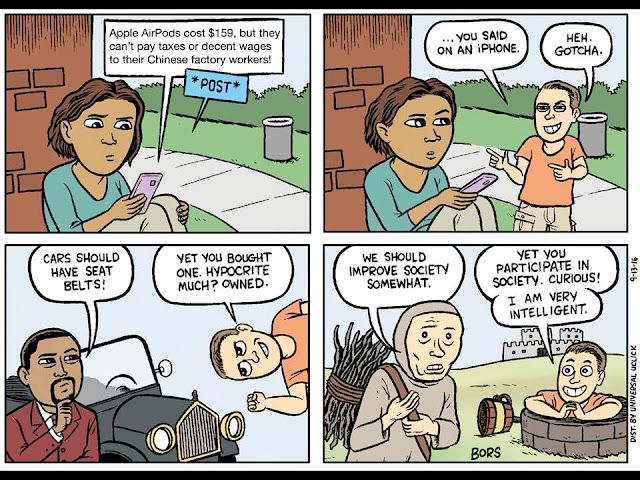
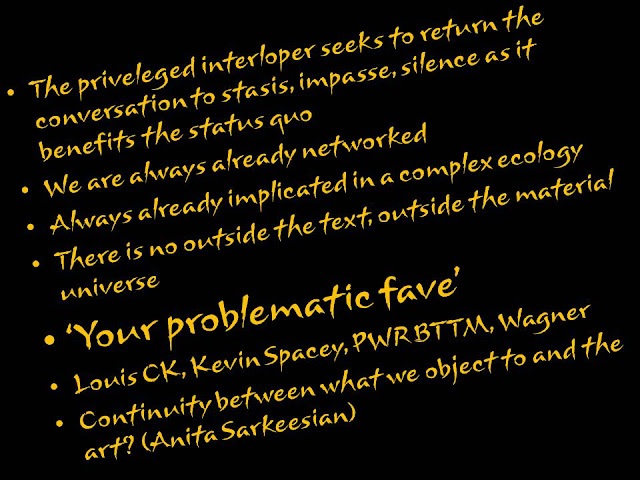 What Sarkeesian says:
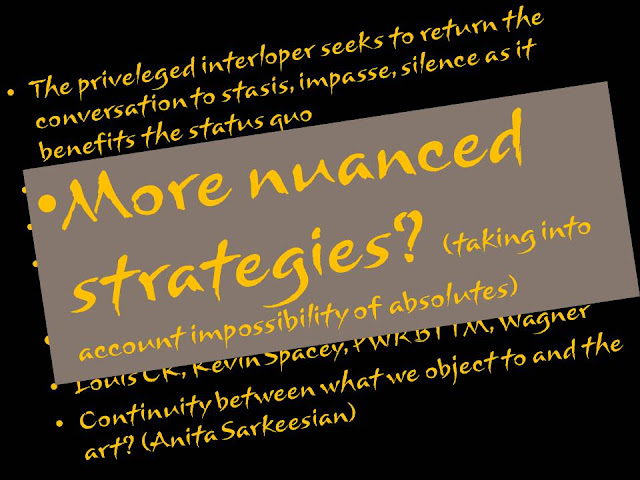
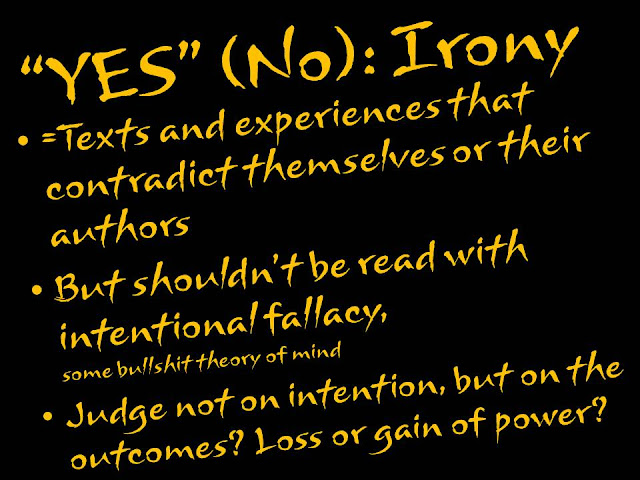
14-Nov-17
M.E.S.H. - Hesaitix [ 14-Nov-17 6:06pm ]
M.E.S.H. must be an acronym for something but I haven't bothered finding out what - Making Electronic Shit Happen? - that's probably it. James Whipple does make shit happen - good shit - detailed, interesting electronic shit like Hesaitix. Listening to Mimic just now I kept thinking someone was outside my window, rustling about and banging something so I got up to look and heard that sound again, from the speaker. Whipple's a spook in the speakers, spiriting sounds like...like you can't say what, except for the tolling of bells on Blured Cicada I...and now he's playing ping pong with Robert Henke (you know that sound?), who must be a spiritual brother of sorts, a forebearer, you might say. The difference being the beat, absence of the regular Tech motor Henke uses; instead, more irregular, as on 2 Loop Trip. But whatever messing around there is, he keeps a feeling of movement...the percussion on Search. Reveal is one outstanding aspect of a proper shapeshifting intergalactic gro-o-o-o-ver - yes it is! Whipple maps the space-sound continuum brilliantly, singing the body and brain electric. Damned good.
10-Nov-17
A Fistful Of Dollars [ 10-Nov-17 5:21pm ]
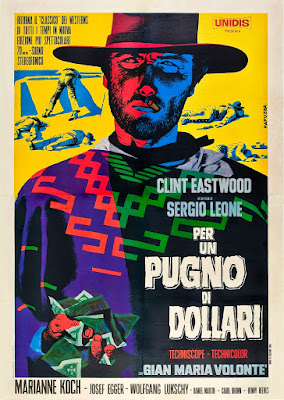
Bought a Clint Eastwood Spag Western box set a few weeks ago but only started watching it recently, beginning, (chrono)logically, with A Fistful Of Dollars. I thought they were due reappraisal, having not watched one all the way through for many years.
One of several things that struck me was the sound, which I only learnt the other day was dubbed on afterwards, thus explaining why every 'clip-clip' of the horses' hooves, jangle of bits and clomp of boots on boards seemed heightened, to the fore. Then the laughter; throughout bad guys spend a lot of time laughing. At times, it's as if some are high on something. The framing of some shots, of course, Leone's recognised for that now, so I wondered why this film, apparently, got such a luke-warm reception from critics. Couldn't they see the artistry involved? Perhaps they were blinded by the amount of gun smoke. If not exactly hailed as a bone fide 'classic' today, this and the subsequent ones are at least rightly hailed as unique.
One other thing that struck me was the similarity between the scene where The Man With No Name is getting his (swollen) eye in again, the shot of his gun hand as he practices to the sound of a militaristic drum beat by Morricone instantly brought to mind Travis Bickle firing to a similar beat by Bernard Herrmann. I may have imagined it, but as you know that military-style drum runs through the Taxi Driver theme.
One astonishing scene is the massacre of the Baxter clan. Leone doesn't depict this in a normal fashion, but hammers home the brutality with almost as many shots of the slayers as bullets they fire. It plays out relentlessly.
By coincidence it's Ennio Morricone's birthday today. The score for A Fistful Of Dollars is great, of course, although as regular readers will know when it comes to playing Morricone scores I favour his Giallo work. Watching the film reminded me of reggae artists' obsession with Spaghetti Westerns, often resulting in hilarious Jamaican/Mexican dialogue. So by way of honouring Morricone, I'm opting for one of those instead of anything by 'Il Maestro'. Featuring adapted dialogue from the film, the now famous coffin joke...
01-Nov-17
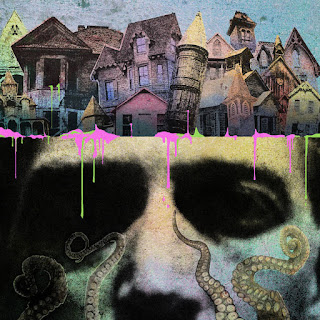
Post-Halloween horror treat for you from I Monster: H.P.Lovecreaft read by Dolly Dolly (David Yates) - what's not to like? The musical accompaniment features students at Leeds Beckett University and is pitched just right, avoiding hauntology cliches, opting instead for a blend of dark electronics and even motorik rhythm. Yates' delivery is, as you'd expect, absolutely perfect. Time to throw another log on the fire, light a candle or two and watch the shadows flicker as your skin crawls. Superb. Available as cassette or download here.
03-Aug-17
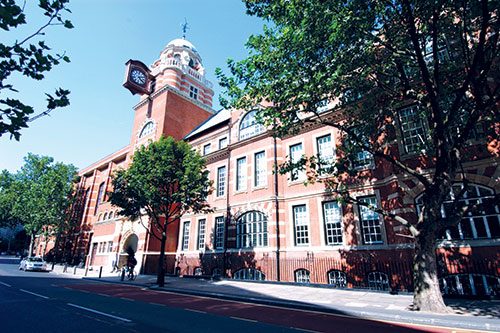 I'm helping to run and speaking at a study day in London next week, 'Is there a Musical Avant-Garde today?' Come along! We're expecting great research and lively debate, and we're most excited about having a forum for ideas of musical 'avant-gardes' (however you feel about the term) that brings together different musical and scholarly traditions.
Date: Friday 21st July, 9:45am-5pm.
Location: City, University of London, College Building, Room AG08 (entrance via St John Street, no. 280). Nearest Tube stations: Angel and Farringdon.
Keynote: Jeremy Gilbert (University of East London).
Organising panel: Alexi Vellianitis (University of Oxford), Adam Harper (City, University of London) and Rachel McCarthy (Royal Holloway).
Registration: £8 including lunch and refreshments
If you'd like to attend, click here to register
What would it mean to talk of 'progressive' music today? Applied to the past or, especially, the present, the term 'avant-garde' has largely fallen out of favour within the academy, both as a description of and an imperative for new music. Yet much contemporary music - whichever combinations of limited terms such as 'art', 'popular,' 'classical' or 'commercial' might apply to it - defines itself, if often all too implicitly, in ways most often associated with avant-garde movements: a focus on stylistic complexity and innovation, and an antagonism towards aesthetic norms and the predominant modes of political thought and practice associated with them. But can such a concept still have currency for musicologists and composers?
The aim of this Study Day is to stimulate a broad, interdisciplinary conversation about how, if at all, to talk of an avant-garde in musical cultures today. For the purposes of this conference, the term 'avant-garde' is fluid, but is broadly defined as a particular idea and praxis of a music considered more progressive than certain others.
We invite scholars and practitioners from different fields to address the ways in which musical avant-gardes today are both practiced and discursively constructed. Topics for discussion could include, but are not limited to the following:
Timetable (approximate):
09:45 Arrival and Coffee
10:00 Welcome and Introduction
10:20 Max Erwin: 'Political Music After Sound: Konzeptmusik and the Complicity of the Avant-Garde'
10:50 Alistair Zaldua: '"Small and Ugly": Critical Composition and the Avant-Garde'
11:20 Lauren Redhead: 'The Avant-Garde as Exform'
11:50 (end of first session)
13:00 Rachel McCarthy: '"The Beat Gets Closer': Post-Capitalist Potential in Girls Aloud's 'Biology'
13:30 Adam Harper: 'Object: Resistance: Underground Music Institutions, Discourse, and Representation'
14:00 (ten minute break)
14:10 Alexi Vellianitis: 'Street Culture and the Musical Avant-Garde'
14:40 George Haggett: 'Towards a Sensual Operatic Ekphrasis in George Benjamin and Martin Crimp's Written on Skin'
15:10 (ten minute break)
15:20 Jeremy Gilbert: Keynote
16:05 Plenary Session
17:00 (end)
Abstracts (in chronological order):Max Erwin: 'Political Music After Sound: Konzeptmusik and the Complicity of the Avant-Garde'This paper seeks to clarify the historical, social, and aesthetic precedents, as well as their broader implications, for New Conceptualism in general, with specific reference to the music of Johannes Kreidler, Patrick Frank, and Celeste Oram. Pursuant to this end, I examine Kreidler's work Fremdarbeit (2009) and how it deploys both veiled self-critique and a radical repositioning of artistic engagement, from autonomy to complicity. Such a complicity, I argue, is crucial for understanding the most recent developments in the musical avant-garde, wherein every critique of society/culture/politics is a priori a self-critique; or, as composer Marek Poliks recently put it, "new music 2.0 is new music about new music". I will demonstrate that this self-critical paradigm is nevertheless far from introverted, with an examination of Patrick Frank's discursive-collaborative compositions, especially the "theory-opera" Freiheit - die Eutopische Gesellschaft (2015) which has as its aim no less than the wresting of 1968-style utopia from a material/cynical exhaustion.
In addition, I aim to provide an overview of how a younger generation of New Music practitioners are grappling with the problems exposed by avant-garde culture in general and Konzeptmusik in particular. I examine Celeste Oram's works soft sonic surveillance (2015) and O/I (off/on, 2016) in terms of an attempted reconciliation between the emancipatory potential of technology and its deployment by corporate and government entities.
Keywords: New Conceptualism, Johannes Kreidler, political art, cultural theory
Alistair Zaldua: "Small and Ugly"; Critical Composition and the Avant-Garde
The quotation in the title of this talk is taken from Bruno Liebrucks description of the processes involved in progress: "The next higher step always appears small and ugly in comparison to the lower, and more completed, step."(1) In his article political implications of the material of new music(2), Mathias Spahlinger explains the concept and enactment of 'critical composition'. He seeks to define his choice of musical materials, processes, and open form, as suggestive of a political utopian ideal. Spahlinger locates this historically by describing the importance of atonality: "the appearance of atonality is the very first time in history in which an approach to composition affects all parameters, in particular the fundamental change in the relation between the parts to the whole. From this, all other parameters must follow."(3)
In Spahlinger's conception, atonality is a historical and irreversible moment where historical understanding and progress intertwine. This is a musical movement in which a vision of utopia can be suggested. Spahlinger's approach to composition is self-reflexive and autonomous; Max Paddison describes Spahlinger's aesthetic as one that lays emphasis on the "…largely structural, technical, and methodological aspects of the music itself" rather than one that continues and develops Hans Eisler's engagierte musik, or 'committed' music.(4) The final category Paddison uses to frame his response to Spahlinger's text is of "[…]composition as political praxis in the sense of the now long-standing avant-garde project of the search for the new and not-yet-known through emergent forms." Thus, the criteria of critical composition could be employed in the search for a musical avant-garde.
Open forms and emergent structures are at work in Spahlinger's little known vorschälge(5): a collection of 28 concept, or word scores. These were created for the purpose of both blurring the distinction between composer and performer and 'making the composer redundant'. This talk will examine these pieces through the lens of 'critical composition' and make some tentative suggestions as to how this avant-garde practice could be identified in more recent music.
1. "Die nächst höhere Stufe ist immer klein und häßlich, gegenüber der niedrigeren, in ihrer Vollendung." Liebrucks, B. 'Sprache und Bewusstsein', Trans. Alistair Zaldua
2. Mathias Spahlinger, 'political implications of the material of new music', trans. by Alistair Zaldua, Contemporary Music Review, Vol 34, no.2-3 (2015), 127-166.
3. "Die Atonalität ist die erste Erscheinungsform dessen, was dann alle anderen Parameter ergreift, nämlich eine grundsätzliche Veränderung des Verhältnisses der Teile zum Ganzen in der Musik. Und die anderen Parameter mussten folgen." (Translation: Alistair Zaldua), Spahlinger, M, and Eggebrecht, H. H,'Geschichte der Music als Gegenwart. Hans Heinrich Eggebrecht und Mathias Spahlinger im Gespräch', Musik-Konzepte special edition, edited by Heinz-Klaus Metzger and Reiner Riehn, Munich (2000),16
4. Paddison, M 'Composition as Political Praxis: A Response to Mathias Spahlinger', Contemporary Music Review, Vol 34 (Part 2-3), 2015, 167-175
5. Spahlinger, M. vorschälge: konzepte zur ver(über)flüssigung der funktion des komponisten, Rote Reihe, Universal Edition, UE 20070, (Vienna: 1993)
Lauren Redhead: The Avant-Garde as Exform
Peter Bürger's critique of the historical avant-garde accounts for its ineffectual nature as a movement because '[a]rt as an institution prevents the contents of works that press for radical change in society […] from having any practical effect.'(1) Bürger argues for hermeneutics to be employed as a critique of ideology,(2) as a facet of the understanding of the 'historicity of aesthetic categories'.'(3) The influence of institutions on music 1968 has served as a central part of its critique: the work concept itself seems to enshrine political ineffectiveness and the bourgeois nature of art practice that ought to be critiqued by an avant-garde. Adorno's claim that 'today the only works which really count are no longer works at all'(4) also no longer seems to apply when the relationship of work such as that produced by the so-called Neue-Konzeptualismus(5) with established musical institutions is considered.
In contrast, Bourriaud's concept of the 'exform'(6) re-conceives the avant-garde as outside of institutions and an idea of 'progress' that is aligned with a dominant capitalist ideology. The exformal is 'the site where border negotiations unfold between what is rejected and what is admitted, products and waste', and forms 'an authentically organic link between the aesthetic and the political.'(7) Progress, as part of a capitalist narrative, both creates and abhors waste. Therefore the task of the avant-garde artist is to give energy to this waste, outside of political and ideological institutions. This type of avant-garde practice functions to 'bring precarity to mind: to keep the notion alive that intervention in the world is possible.'(8) This paper explores the exform with respect to the music and art work of the British composer Chris Newman, and considers how Bourriaud's approach to re-thinking the avant-garde might apply specifically to contemporary and experimental music in the
present.
1. Peter Bürger, Theory of the Avant-Garde, trans. by Michael Shaw, Theory and History of Literature, vol. 4 (Minneapolis, MN: University of Minnesota Press, [1984] 2009), p.95.
2. ibid., p.6.
3. ibid., pp15-16.
4. Theodor Adorno, Philosophy of Modern Music, trans. by Anne G Mitchell and Wesley V Blomster (New York: Continuum, 1973), p.30.
5. cf. Johannes Kreidler, 'Das Neue am Neuen Konzeptualismus', published as 'Das Neue and der Konzeptmusik', Neue Zeitschrift für Muzik, vol. 175, no. 1 (2014), pp44-49, de/theorie/Kreidler__Das_Neue_am_Neuen_Konzeptualismus.pdf> [accessed 13.05.2017].
6. Nicholas Bourriaud, The Exform, trans. by Erik Butler, Verso Futures (London: Verso, 2016).
7. ibid., p.10.
8. ibid., p.47.
Rachel McCarthy: 'The Beat Gets Closer': Post-Capitalist Potential in Girls Aloud's "Biology"'
A recent body of Leftist socio-political theory advocates a transformational approach to post-capitalism. Inspired by Brecht's maxim 'don't start from the good old things but the bad new ones', as well as Lenin's suggestion that capitalist institutions such as banks could be re-purposed for socialist ends, writers including Jameson (2010), Williams and Srnicek (2014), and Mason (2015) posit that a future beyond capitalism must be secured not through a rupture with present society, but rather by a transformation of already-existing phenomena. Jameson identifies utopian potential in the organisational structures of Wal-Mart, while Williams and Srnicek promote accelerationism as a means of pushing through the bonds of capitalism.I suggest that the music of the mainstream pop group Girls Aloud represents an aesthetic parallel to this kind of political theory. With roots in the reality television talent show Popstars, capitalist relations of production are deeply embedded in the group's music. Yet analysis of their 2005 hit single 'Biology' demonstrates how, in deviating from the structural norms of mainstream pop, the song contains a striking kernel of utopian impulse. This is further complicated by the disturbing sense of jouissance that pervades the song's reception, whereby a 'critical' enjoyment of mainstream pop can amount to having one's cake and eating it too. Ultimately, 'Biology', like Jameson's assessment of Walmart, should be understood dialectically: neither as a regressive symbol of the evils of capitalism nor as a shining beacon of hope for a post-capitalist future, but as something in between.Adam Harper: 'Object: Resistance': Underground Music Institutions, Discourse and RepresentationHow might a sonic avant-garde go hand in hand with a progressive social ideology today? Might an enlarged set of sonic possibilities correspond to greater social representation? Taking the term 'representation' in both its political and aesthetic senses (that is, the representation of emotion, experience and so on), this paper hopes to begin to approach these questions in the light of a number of recently established collectives and institutions within underground music that explicitly provide platforms specifically for women (such as Sister, Discwoman and Objects Limited), people of certain regional or diaspora contexts (such as NON and Eternal Dragonz), or people of certain sexualities (such as KUNQ). What sort of discourse surrounds such collectives? What are their goals and are they achieving them? To what extent do they combine the musical and the social in redistributing representation?Alexi Vellianitis: 'Street Culture and the Musical Avant-Garde'This paper looks at ways in which certain metaphors or rhetorical strands linked to the musical avant-garde have been mobilised to describe interactions between new classical music and 'urban' music (grime and electronic dance musics) on the London classical concert scene since 2000. In particular, it is concerned with a fetishisation of the 'the symbolic power of street culture[, which] is often understood as authentic, defiant and vital' (Ilan, 2015). Seen as such, this symbolic power shares much with the classical avant-garde, since modernist or avant-garde status has historically been conferred on the basis that music signals 'political engagement and commitment', and is linked to and fuels 'periods of political instability, change, revolt, and revolution' (van den Berg, 2009).In order to unpack these issues, this paper focuses a number musical performances around London over the past decade: two BBC Proms concerts, in which grime was featured alongside the BBC Symphony Orchestra; and the musical activities of composer and producer Gabriel Prokofiev, whose nightclub and record label Nonclassical brings classical music to clubs throughout London, and whose orchestral music brings 'urban sounds into the concert hall' (Shave, 2011). In each case, accusations that the classical concert scene is being 'dumbed down' by featuring popular music are countered by arguments that this 'urban' popular music is in some way new, current, or vital.These concerts foreground questions about race, class, and inclusivity that have been dominant in public discourse. Is this a positive diversification of classical music culture, or just another set of appropriations of black, working-class music by white, affluent musicians? What is it about the experience of social unrest in urban areas that speaks to the political pretentions of the avant-garde? What change, if any, is being effected?George Haggett: Towards a Sensual Operatic Ekphrasis in George Benjamin and Martin Crimp's Written on SkinThere is little in Katie Mitchell's production of George Benjamin and Martin Crimp's 2012 opera Written on Skin that goes unseen: not only does the thirteenth-century plot feature an on-stage orgasm, but throat-slitting, evisceration, cannibalism, and suicide. Nevertheless, when these lurid events are painted by 'the Boy' (the heroine, Agnès's, illicit lover), the audience can never see them. Instead, during what Crimp and Benjamin term 'Miniatures', he takes out a page and, singing, describes the illumination that he has painted onto it. In so doing, he turns his pictures into uttered acts of ekphrasis, the rhetorical device through which visual art is described in detail.In asking how operatic ekphrasis can function and unpacking its potency in Written on Skin, I will do three things: 1) lift ekphrasis from its specificity to the reified, written word and into the performative realm of the sung act; 2) refer outwards from Written on Skin's Troubadour source text to locate its viscera within thirteenth-century understandings of the body; 3) analyse each miniature in turn to interrogate Benjamin's compositional responses to these conditions. Integrating the former two, I will dissect Written on Skin into four sensory organs—eyes, ears, skin, and mouths—and lodge them between Miniature analyses. My intention is to bring the body to the fore, always in pursuit of a reading that hears the body when it hears ekphrasis, and hears ekphrasis when it hears the body.
06-Jul-17
Garrett David [ 06-Jul-17 3:54pm ]
Ross From Friends [ 05-Jul-17 1:11pm ]
Chaos In The CBD [ 05-Jul-17 1:08pm ]
Blondes [ 03-Jul-17 10:04am ]
Playlist - June [ 03-Jul-17 9:56am ]
Grant [ 01-Jul-17 11:08am ]
Grant totally blew me away with his album cranks and the even earlier one the acrobat as well. Two heavyweight deep house albums. So glad to see he is back on lobster t. for a new release. Cannot wait for this one.
09-May-17
Playlist - April [ 01-May-17 10:01am ]
Octo Octa [ 29-Apr-17 6:08pm ]
Mood J [ 27-Apr-17 5:06pm ]
Baltra [ 27-Apr-17 5:00pm ]
Beacon [ 27-Apr-17 6:54am ]
No Moon [ 26-Apr-17 2:24pm ]
Keysound Rinse FM March 2017 show ft Ganesa [ 01-Apr-17 12:48pm ]
Negativity, Not Pessimism! (RIP Mark Fisher) [ 15-Jan-17 6:59pm ]
(7D7B46C409699693BB5299F3ECF1319C).jpg) I was so shocked and upset to learn of Mark Fisher's death yesterday. For me, Mark was both an idol and, as time passed, someone I was always pleased and not a little humbled to encounter in person and sometimes share a platform with. I didn't know Mark very well personally, and being a generation younger than he was I only know second hand the milieu of the 90s and the Cybernetic Culture Research Unit at Warwick University he formed an integral part of, through its growing legacy and some of the reminiscences and thoughts of people who knew him then (Robin MacKay, Simon Reynolds and Jeremy Greenspan among them). But as someone a generation younger than Mark, I can express something about the incalculable impact he had on me, my thinking and writing, and my gratitude for the times when he actively, kindly helped me, as well as the times that were just good times.
I was so shocked and upset to learn of Mark Fisher's death yesterday. For me, Mark was both an idol and, as time passed, someone I was always pleased and not a little humbled to encounter in person and sometimes share a platform with. I didn't know Mark very well personally, and being a generation younger than he was I only know second hand the milieu of the 90s and the Cybernetic Culture Research Unit at Warwick University he formed an integral part of, through its growing legacy and some of the reminiscences and thoughts of people who knew him then (Robin MacKay, Simon Reynolds and Jeremy Greenspan among them). But as someone a generation younger than Mark, I can express something about the incalculable impact he had on me, my thinking and writing, and my gratitude for the times when he actively, kindly helped me, as well as the times that were just good times.
Mark simply changed my life. By 2009, the year I started the blogging, he was a central node in a network of bloggers, thinkers and forums that encompassed critical theory, philosophy and several areas of cultural criticism, especially of popular music. It was a conversation and a community I eagerly wanted to participate in, late and all too hot-headed though I was. As commissioning editor of Zer0 books, he fostered the growth and evolution of this network into a collective of thinkers built on diverse, self-contained and regularly powerful statements that went far.
Mark's own essay for the imprint, Capitalist Realism: Is There No Alternative? was undoubtedly one of the best of the lot. I continue to recommend it widely as one of the best, most distilled expression of today's ideological challenges. By the end of 2009, Mark had reached out to me and asked if I wanted to write for Zer0. I was 22. Infinite Music was the result two years later. He told me that I should reconsider the title I had initially proposed - 'The New New Music' (can you believe that!?) - which didn't take Mark's genius, but thank God. His faith in me - this despite my frequent and often crude HTML critiques of his positions on music - led to so many amazing opportunities and blessings for the struggling, wet-behind-the-ears critic I was.I first met Mark in person in April 2010 when we were both part of a panel discussion at London's Café OTO, a 'salon' under the auspices of Wire magazine: 'Revenant Forms: The Meaning of Hauntology'. He was warm, friendly and funny back stage, powerful, precise, provocative and funny on-stage. Someone I brought to the event who didn't know Mark and his ideas said to me 'but capitalism is the only system that works!' (this of course is precisely was Capitalist Realism describes and addresses). I believe I next saw him marching alongside thousands of students at one of the protests against the raising of tuition fees and the cutting of the university teaching budget in late 2010, an issue that inflamed and unified the blog network like nothing else, not least Mark himself.At some point in 2011 I was at a gig behind a pub at which Maria Minerva was playing. Maria had been taught by Mark during her Master's at Goldsmith's college. In an amazing moment, Maria gave a shout-out on stage to her 'professors' - I followed the direction of her outstretched arm, and there was Mark, leaning against a wall next to Kodwo Eshun. I saw him at least twice in 2013, once at a symposium at Warwick University on the Politics of Contemporary music, where I burned with envious ambition at his ability to deliver such an on-point, appropriate and funny lecture from only a small notebook. The other time was in Berlin, where I was talking about accelerationist pop for the CTM festival, Mark was there to talk about the death of rave. We walked from our hotel to the venue, had lunch, and Mark talked sympathetically and encouragingly about my career difficulties. He sat in the front row of the talk I gave. I played some of the kitschiest vaporwave as the audience came in. I'll never forget the bemused look on his face, as if he was trying to figure out what sort of a hilarious prank was being played, and whether he wanted in on it. That image of Mark is still for me the opposite end on the spectrum of vaporwave listeners to the one where vaporwave is, uncritically, 'just good sincere nostalgic vibes', and why I have no regrets about 'politicising' vaporwave (a genre that in any case owes an enormous debt to his theorising of hauntology).But for me there was another Mark as well - the formidable writer and theorist, k-punk. This voice I began to get to know in 2006, the year when he did so much to lay the foundations of hauntology (it was his invention, frankly). It was from k-punk that I learned about something called 'neoliberalism' ('what on earth has this guy got against liberalism?' I would wonder). It was from k-punk that I learned that post-modernism was not necessarily the wonderful cultural emancipation I had naively believed it to be. In fact, during these years I was mostly against k-punk. He was critical of more recent trends in electronic music, believing them a poor comparison to what the 90s had offered. This led to a fierce division between writers and bloggers that manifested not just in blogs but magazine sites and a day-long conference at the University of East London, which I attended (the first time I saw Mark in the flesh). Though we both agreed that new music was necessary, naturally his position irritated my young, idealistic self with my special music, and my own blog posts attempted to intervene in support of the new stuff. 'Loving Wonky', my first blog post to attract more than a handful of readers, was directed at k-punk implicitly throughout and at its conclusion, explicitly.This negativity that got me started, this need to talk back to the authority figure, was a testament to the power of his writing. But more so was the way he subsequently taught me as I took a closer look. In preparation for my post on hauntology, I printed out and re-read everything he'd written on or near the subject, underlining and making notes. And he convinced me of his position. He was right. I didn't want to accept his theorising of 'the end of history', thinking it merely pessimistic. His blog posts are so imaginatively, seductively, persuasively written. He's probably the most referenced person on Rouge's Foam. Then I read Capitalist Realism, and rather than the mere youthful defence of certain musics it could have been, Infinite Music became an attempt to stand with Capitalist Realism and answer k-punk's resounding call for a newfound creative imagination. Later, in 2012, it was from k-punk that I learned of accelerationism, and because of his theory that I used it to describe new forms of electronic music in 'Welcome to the Virtual Plaza.' And it wasn't only theory. Wherever I wrote about music and Mark was writing too (Wire, Electronic Beats), my writing was improved by the honour and by his raising of the bar (this was the guy who had described Michael Jackson as 'only a biotic component going mad in the middle of a vast multimedia megamachine that bore his name.')Mark isn't just the figure behind every significant thing I've done as a critic. His theory is now deeply embedded in who I am and what I say. Even the residue of the ideas I have fought against condition my thinking. I have brought his concepts home, they structure my conversations with my friends and family. Capitalist realism: describing the ideology that miserable as it is, there is no alternative to capitalism and that's just the way it is. Business ontology: the ideology that any social or cultural structure must exist as a business. His use of the concept of the Big Other - the imaginary subjectivity that holds important beliefs but may not in fact exist - has guided me through my personal response to Brexit and Trump. (By the way, I couldn't possibly summarise Mark's writing - if you haven't read it already, what are you waiting for?) Even his blackly comic image of a broken neoliberalism, as a cyclist dead and slumped over the handlebars yet continuing downhill and gathering speed, keeps coming back to me.Mark eventually became something of a role model to me. Asked what sort of space I wanted to carve out between academia and public criticism for my own career, I have often said I wanted to be a Mark Fisher. Yet as he regularly explained with his astonishing balance of passion and precision, the world as it is today, its ideologies and its institutions - it's hardly set up to encourage fringe intellectuals. I'm not sure whether he would have fully encouraged me to aspire to his career, tied so closely as he well knew to challenges of mental health (something I started to live in 2014 when, initially and like so many others, my PhD went nowhere). But he did warmly support and encourage my writing when so many people around me could only regard it with doubt.One of Mark's most abiding lessons, and for me at least the key to his writing, was something he put pithily to me at the end of an email: 'Negativity, not pessimism!' I had not appreciated the subtle but important difference the two, but then I instantly did. What a rallying call for the nightmarish 2010s. And as others have noted, it was his encouragement and optimism that was especially nourishing. It was certainly not a pessimistic new-music naysayer who wrote the final words of Capitalist Realism:
20-Dec-16
Keysound Rinse FM Christmas Special December 2016 [ 20-Dec-16 4:46pm ]
Keysound show Rinse FM November 2016 [ 01-Dec-16 11:17pm ]
I think it really gripped me when it went black.
Then just legs and...
I like this. Feels like a tape some kids find and decide to play in the old VCR in the cabin that they've rented for the weekend.
I don't know anything else about this band / person but I'm gonna start digging now...
21-Oct-16
Rinse FM Keysound show tracklists Summer - Autumn 2016 [ 21-Oct-16 5:05pm ]
Valerie [ 09-Sep-16 1:33pm ]
Bubblebath Episode 01 ft. Mat Dryhurst (for RBMA Radio) [ 25-Aug-16 5:04pm ]
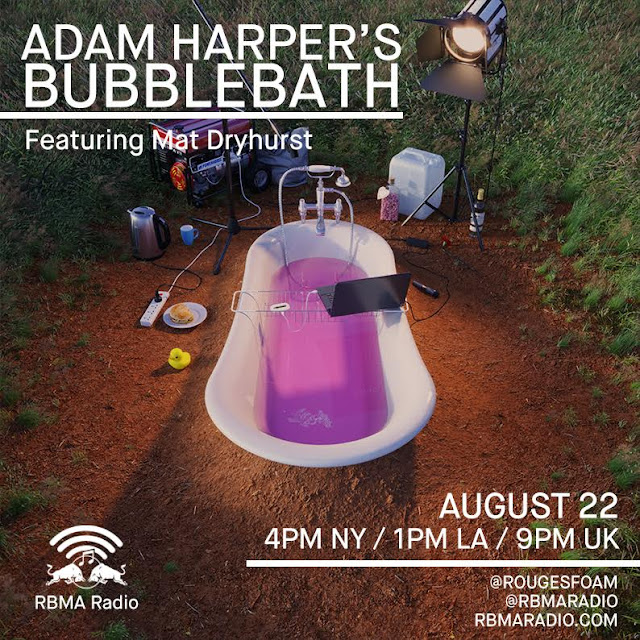 Art by Kim LaughtonThe first episode of my new monthly show for RBMA Radio aired a few days ago, and is archived here. Bubblebath is a two-hour show all recorded and edited by me, featuring new, typically lesser known tunes that I'm interested in, segments going for some deeper analysis, and interviews with various people from underground music culture. For the first show, I looked at the pseudo-humanistic style of James Ferraro's Human Story 3 and some other records, and talked to Mat Dryhurst about some of the problems facing underground culture today and his platform Saga. The playlist is below.
People in the US won't be able to listen to the archived version of the show for various legal reasons. I didn't realise that would happen and I do apologise. If that's you, you might try using a proxy server, especially with different browsers. US listeners can listen to the show live without any problems, though, so I'll make sure to forewarn people next time.
· 00:00:02 - 00:02:41 Julien - Alpha Beat - Calm (from Calm 2 https://calmdot.bandcamp.com/album/calm-2)
· 00:02:41 - 00:05:28 Alfie Casanova - 4 Play - Calm (from Calm 2 https://calmdot.bandcamp.com/album/calm-2)
· 00:05:28 - 00:10:16 NKC - Salon Room - Her Records (from Hague Basement http://store.herrecords.com/album/hague-basement)
· 00:10:16 - 00:13:03 仮想夢プラザ - 秘密 - Plus 100 Records (from Balance with Useless https://plus100.bandcamp.com/album/balance-2) (extract, background, and again throughout )
· 00:13:03 - 00:18:17 Julien - Day Racer - Orange Milk (from FACE OF GOD https://orangemilkrecords.bandcamp.com/album/face-of-god)
· 00:18:17 - 00:23:52 NV - Bells Burp - Orange Milk (from Binasu https://orangemilkrecords.bandcamp.com/album/binasu)
· 00:24:50 - 00:29:57 Easter - Leda - own Bandcamp page (from New Cuisine Part 2 https://easterjesus.bandcamp.com/track/leda)
· 00:29:57 James Ferraro - various tracks from Human Story 3 - own Bandcamp page (https://jjamesferraro.bandcamp.com/album/human-story-3) (extract, background)
· 00:32:04 - 00:37:32 James Ferraro - Individualism - own Bandcamp page (from Human Story 3 https://jjamesferraro.bandcamp.com/album/human-story-3)
· 00:39:19 - 00:40:31 John Adams - Lollapalooza - Nonesuch (from I Am Love Soundtrack) (extracts)
· 00:40:55 - 00:41:20 Steve Reich - Eight Lines Number 1 - RCA Red Seal (extract)
· 00:41:36 - 00:42:30 Aaron Copland - Allegro from Appalachian Spring - Sony Classical (from Bernstein Century: Copland) (extract)
· 00:43:05 - 00:44:32 Jeffery L. Briggs - CivNet Opening Theme - Microprose (from CivNet Soundtrack) (extract)
· 00:44:48 - 00:45:24 Oneohtrix Point Never - Problem Areas - Warp (from R Plus Seven) (extract)
· 00:45:52 - 00:46:11 Kara-Lis Coverdale - AD_RENALINE - Sacred Phrases (from Aftertouches https://sacredphrases.bandcamp.com/album/aftertouches) (extract)
· 00:46:30 - 00:47:04 Giant Claw - DARK WEB 005 - Orange Milk (from DARK WEB https://orangemilkrecords.bandcamp.com/album/dark-web) (extract)
· 00:47:25 - 00:47:51 Metallic Ghosts - University Village - Fortune 500 (from City of Ableton https://fortune500.bandcamp.com/album/the-city-of-ableton) (extract)
· 00:48:58 - 00:49:59 Torn Hawk - The Romantic - Mexican Summer (from Union and Return) (extract)
· 00:52:12 - 00:55:08 Subaeris - Shadow Portal - Nirvana Port (from Transcendent God https://nirvanaport.bandcamp.com/album/transcendent-god)
· 00:55:08 - 00:58:23 Subaeris - Beating Heart - Nirvana Port (from Transcendent God https://nirvanaport.bandcamp.com/album/transcendent-god)
· 00:59:08 - 01:01:16 Klein - Babyfather Chill - own Bandcamp page (from ONLY https://klein1997.bandcamp.com/album/only)
· 01:01:16 - 01:03:45 Klein - Make it Rain - own Bandcamp page (from BAIT https://klein1997.bandcamp.com/album/bait)
· 01:04:49 - 01:47:38 Valentin Silvestrov - Diptych - ECM (from Valentin Silvestrov: Sacred Works) various tracks from Valentin Silvestrov: Silent Songs - ECM (extracts, background)
· 01:49:09 - 01:54:25 Swimful - Atop - SVBKVLT (from PM2.5 https://svbkvlt.bandcamp.com/album/pm25)
· 01:54:25 - 01:58:45 Swimful - Bounce (Simpig Remix) - SVBKBLT (from PM2.5 Remixes https://svbkvlt.bandcamp.com/album/pm25-remixes)

24-Aug-16
'Joy 2016' (essay for 3hd festival, where I'll be in October) [ 24-Aug-16 5:12pm ]
 Art by Sam Lubicz3hd festival is back for its second year in Berlin this October, and its website has gone up (click here). I'll be there lecturing and participating in discussions over various aspects of their theme 'There is nothing left but the future.' In the meantime, I wrote an essay for them (click here to read it) sketching some initial thoughts about some of the problems facing musical futurism and musical sarcasm after a summer of violence and Brexit, through the lens of the 'Ode to Joy' from Beethoven's Ninth Symphony, and Wendy Carlos's electronic version of it particularly (incidentally, Jeremy Corbyn, something of a lightning rod for various kinds of political tumult whatever you think of him, recently mentioned listening to Beethoven's 5th).
Beethoven's Ode to Joy has accumulated cultural and political baggage of apparently every different kind, and, especially, in extremes. It has played the role of humanity's highest and most noble achievement and an incitement to horrifying violence both. And it is the anthem of the European Union...
Who needs dehumanising machine music when you have Trump, when you have the rise of hatred the world over?
There is an important difference, of course, between the future and the futuristic. The futuristic is a costume, a thrill, a performance, a caricature, all from within the safety of the present. The future is what actually happens to you and at some point, whoever you are, it will hurt you. What can art and music help us to do and to say before that point?
Include Me Out [ 20-Feb-18 4:11pm ]

Where The Action Is... [ 20-Feb-18 4:11pm ]
10-Jan-18
Various - (not) open to question [ 10-Jan-18 5:55pm ]
Whilst the New Year may be open to question the quality of the work on this album is not. Furthermore, you're invited by the label to make your own additions to these tracks, the first layer 'is created within the collaboration of MƩCHΔNICΔL ΔPƩ and Les Horribles Travailleurs', so the challenge is set, although this is very much in the spirit of collaboration rather than competition. As always, the bar is set high here but why not (re) create? Remake/remodel (should be a Roxy Music title...oh, it is?). 'You are invited to finish this soundwork by altering\adding layers etc. to the first layer, which can be downloaded from Bandcamp'. As it stands it's very good.
New Year: So What [ 09-Jan-18 4:47pm ]
Let's start the New Year with a whimper...@',mn,mn,qwwwwwhhhhhhhhherrrr'
Fact is this year's going to be the one that sees the downfall of the music industry due to it's incessant gnawing of itself like a doped-up rabid labradoodle, foaming as it very slowly chews its own leg off and keeps going as far as it can reach until it's stinking innards spool out across everything but don't worry, you will be immune to the putrid, poisonous substance due to years of injecting the antidote in the form of JS Bach, James Brown, Bernard Parmegiani and other names involving capital 'B', or 'L', or 'D'...how about 'D'? Don Cherry, Defunkt...that's enough, that's the ABC of it, your alphabetically registered pantheon of ....music people...the countermeasure to all the crap...
On the subject of letters...
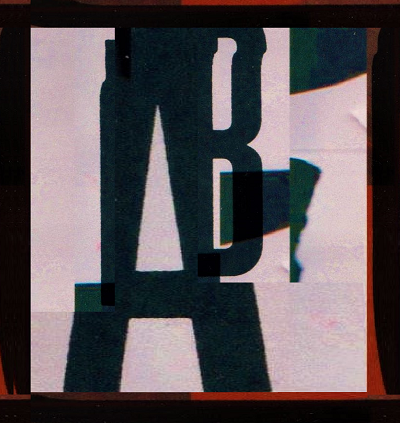
That one's called AB...there's more of my art over here
Whatever...or, actually, all my art work this year will be part of a series called So What...why? I reckon it's the most common response.
In 2018, though, let's not be blase about things, least of all what we love the most and what we make...
Blackdown [ 1-Jan-18 11:36pm ]
The case for and against vinyl in 2018 [ 01-Jan-18 11:36pm ]
The case for vinyl in 2018
Less is more
We live in an era of abundance. Choice, choice and if that's not enough choice, yet more choice. Within a couple of clicks from your smart phone's home screen there is more music than you can listen to in your lifetime, or even in a thousand lifetimes. If that's the case where the hell do you start? After all we mostly don't want to listen to
28-Dec-17
leaving earth [ 28-Dec-17 3:20pm ]
a futile resistance? [ 28-Dec-17 3:20pm ]
Some time ago Simon Reynolds did a quite long (especially with the endless youtube clips) piece in response to the last one I wrote, with some interesting points - some of them in the comments - and I've wanted to make a response for quite some time, but got sidetracked by real life as so often before. So, as a not-exactly-exiting post step-year is nearing its end, I'll try and write something before it all gets completely forgotten - if that is not already too late.
As expected, he didn't buy that the poststep stuff is as great as I'm claiming it is. The interesting thing in this respect is the claim that he actually has tried (as stated in the comments), but it just doesn't click. In a way this takes the problem to a different level, not about poststep per se, but about how we react to music, what it means for someone to really get something, and not least: whether really feeling, or not feeling, something, is really an argument for its merit or lack thereof? Personally, there's a lot of stuff I know I ought to like, but that just doesn't do anything for me; which seems pointless and uncommunicative (in the derogatory sense Reynolds is using here - I certainly find some deliberately uncommunicative music deeply fascinating). Something like Velvet Underground could be a good example. All right-thinking people seem to agree that this is simple the most important and amazing rock music ever made, but nevertheless, it leaves me completely cold. Sure, it's mildly interesting when I'm listening to it, but not to a degree where I'm not also slightly bored, and afterwards, I have no wish to ever hear them again. That doesn't mean that I can't see its historical importance - tons of stuff I love (krautrock, post punk, noise rock and dreampop) are deeply indebted to VU, might not even have existed without them. But just because something is revolutionary on a technical level, it doesn't make it the best example of the trend it started. The noise/avant garde-element is still very rudimentary and one-dimensional (not enough Cale), and Lou Reed's song writing is mostly just dull. And yet, even though I've tried "getting" Velvet Underground for many years, and still barely remembers any of it, I'll accept that they are, in a way, "objectively good", I just don't find them subjectively good. I'll grant that they have an important place in the historical archives. There's just many other parts of those archives that I'd much rather like to spend my time with. Such as the best post step, which as far as I see it, isn't just subjectively good, but truly objectively good as well.
The question then is: by what objective criteria? Well, most likely not by how influential it has been (probably the best argument for VUs "importance"), as I doubt most of it will have much influence at all. But then, I think most of us have favourite records that have had very limited subsequent impact, and which we yet would consider truly "good" by some other criteria. Most obviously, I think it should be about originality - creating musical structures that have not been heard before, and yet truly is "structures" (which is what makes it work as music, makes it relatable and fascinating), rather than just pure randomness. But already there's a problem here, because judging if something "has been heard before" or creates a "relatable structure" certainly involve some quite subjective elements. One person's deeply engaging structural originality is the next one's empty indulgence, and as I talked a lot about last time, it's highly relative how "new" something will sound to different people. That said, it seems that Reynolds is acknowledging that there is some formal newness going on in post step, it's just that, as he doesn't connect with the music, then obviously something else must be amiss (and there has to be something wrong with it when he's not feeling it - much like I just tried to explain what is "wrong" with Velvet Underground, because it doesn't seem to be satisfactory that it's simply be a matter of taste whether you're getting something that is "objectively good" or not).
So what is missing, according to Reynolds? Sort of the usual rockish suspects, I guess: Social energy, functionality (being useful), viscerality, bursting-into-the-world, smashing-up, cutting loose, "brocking out". I think there's a least two questions to consider here - 1: why should it be a problem that these elements are absent? And furthermore - 2: are they actually absent? Or rather, in what way can we determine that they're absent, except whether we simply feel them being there?
As for the first question, one of the returning themes in my writings on post-step is that I think it's a huge fallacy to measure it by a 'nuumologically calibrated brock-o-meter. The social chemistry of cutting-loose-on-the-dancefloor is notthe point of this music - or at least most of it -, and saying that it is lacking in this department is a bit like saying sixties electro-acoustic avant garde is "lacking" the passionate social interaction of tango or waltz. I mean, it certainly doesn't have that element, but then, it's not really something it ought to have. It's not that I disagree with the point that "with dance music you want to be getting your rocks off", but most post-step is simply not meantto be heard as dance music - not supposed to belong to the same continuum as Foghat and Slipmatt, but rather - if anything - the same as Subotnick and Schnitzler, Mouse on Mars and The Black Dog. Or, I'd say, as Chrome and Wire. Because once again I think post punk is the obvious analogy - do post punk belong in the cerebral "listening" department that Reynolds have no problem with in itself, or as part of the "brock continuum" that he identifies as running from garage rock all the way through punk and rave to present day hip hop? Post punk is conspicuously absent from his long youtube brock-list, with the quite rock-ish Killing Joke as the only example. Which is not to say that you couldn't find a few more brocking post punkers if you wanted to, but wasn't it exactly the whole pointof most post punk to question and deconstruct that very (b)rockist "essence". Huge swathes of it was self-consciously arty and cerebral, deliberately esoteric and dysfunctional. Sure, a lot of them worked with groove-based black music, and had a lot of physical propulsion (as do a lot of post-step), but there was almost always a mind game element as well, they were never really "cutting loose" in the same way as 'nuum music and "pure" rock, funk or disco is, if for no other reason than it was always articulated, always subservient to some larger artistic goal (trance-states, confrontation, subversion, ritual).
Well, some might point out, doesn't goals like "confrontation" or "ritual" - even though they might be self-consciously constructed - show a strive for social energy and interaction, exactly the kind of thing that is lacking in post-step? And with that I would, at least mostly, agree. It just doesn't mean that post punk is "brock" music. Rather, it shows that social energy can take many other forms than just "getting your rocks off" on the dancefloor. I think placing post punk in the 'nuum would require a lot of creative shoehorning, but then again, I don't see any reason it should be there. Of course, it isn't straight up ethereal "brain music" either, there's still very much a physicality to it - if anything, I would say it's a part of both those worlds (and therefore not really belonging to any of them). And I would say it's the same with post-step. Which gets us to the second question.
Not only do I not have a problem with post-step not belonging to the 'nuum, it's even been one of my points all the time that it's the wrong lens to view it through. But does that mean that there's no visceral element to it, no "cutting loose" or "bursting-into-the-world"? Absolutely not. I must say that Reynolds inability to feel the visceral energy of post-step - and it does seem to have been a point of his right from the start - is really strange to me, because that was exactly what pulled me into it in the first place, what made me a believer. I did not - as suggested in the comments of the Energy Flash post - have to force myself to believe. What I did was accepting that here was something worthy of belief, without the safety net of post modern doubt and constant how-new-or how-good-is-it-really-questioning, saving me from having to defend what I love, and being ridiculed for claiming - how absurd, how naïve - that here is again something worthy of history. But I obviously wouldn't have accepted it if the music wasn't so overwhelming in the first place - and what overwhelmed me to begin with wasn't the more subtle and understated forms (of which there is many), because those are always easier to reject as "just more moody head music" - its originality doesn't demand your attention like the heavier stuff.
How anyone can listen to early poststep tracks like Slugabeds "Gritsalt", Suckafish P. Jones' "Match Set Point", or Eproms "Shoplifter", without getting blown away by the sheer physical force, the explosive energy, the visceral freshness, that is a mystery to me. After all, a lot of the first post-step (and especially what I've called bitstep) was pretty much a reaction to the challenge of wobble - not a "turning back" to "true dubstep" or neo-2step (aka funky), though there sure as hell were a lot of that crap too. Instead, the bitsteppers seemed to ask what the next step after wobble should be - how could you take this music even further out, make it even more mad and grotesque. It was pretty clear that it couldn't be done with just more convoluted twists of the wobble bass itself, the limit had been reached there (and as a result, big wobble producers moved into much more melodic, EDM-crossover territory), so instead post-step producers added cascades of multicoloured sound splinters, absurd syncopations and mangled structures, like treacherous vortices pulling you in several different directions simultaneously - and always with massive force.
The best bitstep delivered on wobbles promise, transforming it from a potential dead end to a gateway into a new world. And when it had opened my ears to the strange and wonderful new things going on, I discovered plenty of other forms of post-step that was equally unique and amazing, even though the brilliance wasn't as in-your-throat-energetic as with bitstep. Though indeed there weremany other forms of hyper-physical post-step too, sometimes even downright groovy (at least for a definition of groovy that includes something as weird as Can - as Reynolds' brockout list does) - the brutally twisted cyberfunk of Debruit and a lot of skweee had a massive, propulsive power, while the freaked out maximalism like DZA, 813 and Eloq is among the most over the top explosive stuff I've ever heard, and avant-trap like TNGHT, Krampfhaft and the later Starkey should be able to work a dancefloor as effectively as any classic rave music. Heck, despite being incredibly cold and dysfunctional, a lot of the current "cybermaximalism" (like Brood Ma, Wwwings and Amnesia Scanner), is also deeply visceral music.
So, I've proved my point then? After all, I've just claimed that a lot of post-step does indeed have a highly physical quality, bursting into the world with undeniable force, so obviously it does! Except... what do I base that claim on? On the fact that I feel it - to me it's undeniable. But to others, not so much, just like there's a lot of stuff that doesn't affect me the way others claim it should. And there's people who never felt rave music, or punk and post punk for that matter, found it empty and cynical, the surrounding subcultures destructive and pointless. In other words: if some music simply doesn't do anything for me, I know that this gut reaction isn't really an argument for it not being any good, I need some more objective way to measure it. But if that measuring device - say, how viscerally enticing it is - itself depends upon a gut level reaction, I'm back where I started. I guess this is why rock critics often use so much time on lyrics, more or less becoming ersatz literary critics, because words are slightly more concrete and tangible than timbres and harmonic structures. Perhaps the sociological angle used by many critics is useful in the same manner - giving them something "real" to deal with, and offering an easy measuring device: If music is worthwhile, it makes a socio-cultural impact - and if doesn't, it's not. Of course, by that standard you'd need some way to explain why, say, Celine Dion isn't more worthwhile than Xenakis or Sun Ra.
That said, this is indeed the point where I think something is lacking with post-step - it hasn't created an active, socially transformative (sub)-culture. That I agree with, but what I doesn't buy is that this is because the music in itself doesn't have what it takes to build such a social structure. A main point from my last post was that nothing could built something like that now, the social-media-mediated reality we inhabit makes it impossible, except as in the form of virtual subcultures, existing online, of which there's as many as you could wish for. They just don't have any transformative power. Or at least not the ones based on music, the physical manifestations of which - concerts, clubs, festivals - simply seem like extensions of the socially networked existence. I don't see any actual socially transformative musical subcultures going on anywhere, and I don't think it's possible anymore. Young people still go out, and a lot of post-step is indeed played at hipster festivals, where there's some social interaction and bonding going on. But no feeling of any chance of changing anything through music - or in any other way for that matter. The modern bohemians into experimental electronics - graphic designers moving from city to city in Europe and the US - might make enough to live sort-of-comfortably with this drugs-and-music hobby, yet they never seem to have any hope or dreams of achieving anything more than that.
Take grime - I think most would agree that the first generation had the shocking formal newness and the burning will necessary to create a truly powerful, reaching-beyond-itself subculture - and yet, it didn't really happen. Countless online 'nuum-connoisseurs clearly wanted it to be the next big thing, but it never got beyond cult status, and was first taken over by dubstep, later by the experimental second wave that seems to have given up all ambitions of moving beyond small, web based communities. In the end, I don't think any form of music will be able to be truly socially transformative in the world we currently live in, no matter how full of energy or how much it wants to. Had jungle never existed, and was then invented out of the blue today, I sincerely doubt it would have more impact than anything going on in post-step, or anything else. It could just as well be called yet another empty show of technical trickery with nothing expressed through it. Because if people are so desensitized that they're immune to the mad dynamics of the best bitstep, I can't see why jungles explosive rhythms should make a bigger impact. No matter how wild and physically powerful, if there isn't a receptive context, the social ignition isn't going to happen. And I think it's really the lack of this kind of "context" - a "practising community" (i.e "a way of life") grown organically around the music, and vice versa - that's the reason Reynolds doesn't relate to post-step. But then again, isn't this something we especiallyexpect from genres like rock, dance and rave? We don't usually diss the electro-acoustics for not having built a subculture of functionality and social practice around their music.
So where does that leave us? With a form of music which is as good as it's gonna get under the current conditions. And that is really, really good, as soon as you're able to accept that you're not going to get any kind of youth movement so potent that it actually makes an impact on society, as with rave and sixties rock. But you do get music that is an incredibly powerful reflection of our current conditions - and as such it's also music that is indeed having a lot released through it. Not pleasant things, mind you, but in its own way very true and overwhelming emotions. You could ask what the point of physically propulsive music is if people aren't going to use it in a social context. Now I'm not really sure this kind of post-step actually isn't used at some underground parties, but even if it's not, the viscerality is still crucial, because it reflects the psycho-somatic aspect of our supposedly purely cerebral online existence: the way it mangles our sense of time, place and identity, wears our body down and traps us in an everchanging maze of stimuli which renders us helpless and nauseas, the way the brightly coloured entertainment-fractal is simultaneously silly and terrifying, an exhilarating joyride with a sinister, insidious core of instability and uncertainly constantly lurking under the surface. To create this feeling, these strains of post-step do indeed need a to deliver a physical punch.
Now, I don't know how many of these producers consciously went for this reality-fracturing effect, for all I know they could just have wanted to create the sickest, most colourfully synthetic party music around, and then simply followed the music's logic all the way into the candy coloured nightmare zone. You can be a vessel for the zeitgeist without being aware of it. With the many strains of post-step that are more dark and atmospheric - directly revelling in the neurosis and hopelessness beneath the surface - the feeling of disintegration and entropic decay often seem to be a much more conscious thing, descended from the whole "death of rave"/end of history-discourse around Burial. Here, the lack of visceral force is part of the whole point of what is being expressed. Its impact is purely on the emotional level - but it's certainly still there, at its best as strange, disorienting and sometimes downright spellbinding as any, say, Young Marble Giants, Tuxedomoon or early Cabaret Voltaire. Which again brings us back to post punk: Unlike rave and sixties rock, post punk and post-step doesn't express a victorious belief in owning the future; rather, it's the sound of desperate resistance against a world where the very possibility of hoping for a better future is being increasingly crushed.
With post punk the resistance could still - and indeed, mostly did - happen through physical social interaction. With post-step it has moved to the virtual sphere, and the "resistance" is happening almost entirely on the art-for-arts-sake level. Some might say that isn't much, but considering that current music is not supposed to be able to do more than mix and re-contextualize pre-existing elements, that art is simply seen as a vehicle for tastes and opinions, I'd say it's actually incredible that something as original and overwhelming in its distillation of the zeitgeist is even existing. Never alone in the soul-destroying web of constant social media, yet isolated and paralyzed, people still dream of strange new worlds never heard before, still want to invent thrilling, absurdly twisted musical structures even if they seem to have no "purpose", still manage to create ominous musical forms that capture the essence of the very condition that should render them incapable of creating anything of any relevance at all. That such a wealth of invention is still possible, still being made, despiteall the forces opposing it (including the creators doubt in their own relevance), well to me that's at least as amazing as people coming up with good stuff under deeply fertile conditions. That stuff as inventive and vibrant as the best post-step mange to even exist now seems like an act of defiance. That it's one of the only places where I can still feel the spark of creative resistance - in a way, relevance - is all the more reason to cherish it. But of course, you'd have to be able to feel that vibrancy, otherwise, well...
After all, what do I know - to me most contemporary rap is completely pointless and with as much relevance and "promise of freedom" as contemporary metal. Or musicals. All something that command social energies and make a lot of people feel something on a gut level - just not me.
...
I think this is going to be the last post-step piece of mine for some time. Have I exhausted the subject? Well, on the level of these long think pieces then yes, I guess I have - even if I still feel like elaborating, I'm already starting to repeat some things from last time. But I'm not exhausted with poststep. Sure, as for new releases, 2017 hasn't been impressive, and I suspect last year was simply a last spasm, or perhaps even the beginning of a different, more static era. Yet, I'm still listening to the older post-step records almost all the time, still not tired of it. So, what I'd perhaps like to do is to go more into some of my favourites, trying to - to use Reynolds' term - incite, making the greatness and expressive power of the music directly relatable, rather than arguing its relative newness in the larger historical context, as I've mostly been doing so far. I have a half baked theory that the lack of messianic writing about specific tracks or records is at least a part of why it's impossible to create the same level of excitement about new music as in previous eras. Back then, when it could take a long time before you were even able to listen to a reviewed record, inventive descriptions in good music writing became a part of how you heard the music, part of its greatness - sometimes the music couldn't live up to the incredible imagery, but ideally, the writing made great music even better, made you hear it in a way that convinced you of its greatness. Now, all you get is a bunch of youtube clips that you'll skip through, unimpressed. I don't think any real incitement can happen that way. I think "forcing" people to use their imagination about music makes that music more vibrant, and makes the relationship with it deeper. So that's what I'll try to do, perhaps, some time. For now, though, I need a break from thinking about post-step (if not from listening to it), and I've had one or two other things lined up for a long time, before I suddenly got caught up in this whole post-step thing, so perhaps it's time to look at them.
As expected, he didn't buy that the poststep stuff is as great as I'm claiming it is. The interesting thing in this respect is the claim that he actually has tried (as stated in the comments), but it just doesn't click. In a way this takes the problem to a different level, not about poststep per se, but about how we react to music, what it means for someone to really get something, and not least: whether really feeling, or not feeling, something, is really an argument for its merit or lack thereof? Personally, there's a lot of stuff I know I ought to like, but that just doesn't do anything for me; which seems pointless and uncommunicative (in the derogatory sense Reynolds is using here - I certainly find some deliberately uncommunicative music deeply fascinating). Something like Velvet Underground could be a good example. All right-thinking people seem to agree that this is simple the most important and amazing rock music ever made, but nevertheless, it leaves me completely cold. Sure, it's mildly interesting when I'm listening to it, but not to a degree where I'm not also slightly bored, and afterwards, I have no wish to ever hear them again. That doesn't mean that I can't see its historical importance - tons of stuff I love (krautrock, post punk, noise rock and dreampop) are deeply indebted to VU, might not even have existed without them. But just because something is revolutionary on a technical level, it doesn't make it the best example of the trend it started. The noise/avant garde-element is still very rudimentary and one-dimensional (not enough Cale), and Lou Reed's song writing is mostly just dull. And yet, even though I've tried "getting" Velvet Underground for many years, and still barely remembers any of it, I'll accept that they are, in a way, "objectively good", I just don't find them subjectively good. I'll grant that they have an important place in the historical archives. There's just many other parts of those archives that I'd much rather like to spend my time with. Such as the best post step, which as far as I see it, isn't just subjectively good, but truly objectively good as well.
The question then is: by what objective criteria? Well, most likely not by how influential it has been (probably the best argument for VUs "importance"), as I doubt most of it will have much influence at all. But then, I think most of us have favourite records that have had very limited subsequent impact, and which we yet would consider truly "good" by some other criteria. Most obviously, I think it should be about originality - creating musical structures that have not been heard before, and yet truly is "structures" (which is what makes it work as music, makes it relatable and fascinating), rather than just pure randomness. But already there's a problem here, because judging if something "has been heard before" or creates a "relatable structure" certainly involve some quite subjective elements. One person's deeply engaging structural originality is the next one's empty indulgence, and as I talked a lot about last time, it's highly relative how "new" something will sound to different people. That said, it seems that Reynolds is acknowledging that there is some formal newness going on in post step, it's just that, as he doesn't connect with the music, then obviously something else must be amiss (and there has to be something wrong with it when he's not feeling it - much like I just tried to explain what is "wrong" with Velvet Underground, because it doesn't seem to be satisfactory that it's simply be a matter of taste whether you're getting something that is "objectively good" or not).
So what is missing, according to Reynolds? Sort of the usual rockish suspects, I guess: Social energy, functionality (being useful), viscerality, bursting-into-the-world, smashing-up, cutting loose, "brocking out". I think there's a least two questions to consider here - 1: why should it be a problem that these elements are absent? And furthermore - 2: are they actually absent? Or rather, in what way can we determine that they're absent, except whether we simply feel them being there?
As for the first question, one of the returning themes in my writings on post-step is that I think it's a huge fallacy to measure it by a 'nuumologically calibrated brock-o-meter. The social chemistry of cutting-loose-on-the-dancefloor is notthe point of this music - or at least most of it -, and saying that it is lacking in this department is a bit like saying sixties electro-acoustic avant garde is "lacking" the passionate social interaction of tango or waltz. I mean, it certainly doesn't have that element, but then, it's not really something it ought to have. It's not that I disagree with the point that "with dance music you want to be getting your rocks off", but most post-step is simply not meantto be heard as dance music - not supposed to belong to the same continuum as Foghat and Slipmatt, but rather - if anything - the same as Subotnick and Schnitzler, Mouse on Mars and The Black Dog. Or, I'd say, as Chrome and Wire. Because once again I think post punk is the obvious analogy - do post punk belong in the cerebral "listening" department that Reynolds have no problem with in itself, or as part of the "brock continuum" that he identifies as running from garage rock all the way through punk and rave to present day hip hop? Post punk is conspicuously absent from his long youtube brock-list, with the quite rock-ish Killing Joke as the only example. Which is not to say that you couldn't find a few more brocking post punkers if you wanted to, but wasn't it exactly the whole pointof most post punk to question and deconstruct that very (b)rockist "essence". Huge swathes of it was self-consciously arty and cerebral, deliberately esoteric and dysfunctional. Sure, a lot of them worked with groove-based black music, and had a lot of physical propulsion (as do a lot of post-step), but there was almost always a mind game element as well, they were never really "cutting loose" in the same way as 'nuum music and "pure" rock, funk or disco is, if for no other reason than it was always articulated, always subservient to some larger artistic goal (trance-states, confrontation, subversion, ritual).
Well, some might point out, doesn't goals like "confrontation" or "ritual" - even though they might be self-consciously constructed - show a strive for social energy and interaction, exactly the kind of thing that is lacking in post-step? And with that I would, at least mostly, agree. It just doesn't mean that post punk is "brock" music. Rather, it shows that social energy can take many other forms than just "getting your rocks off" on the dancefloor. I think placing post punk in the 'nuum would require a lot of creative shoehorning, but then again, I don't see any reason it should be there. Of course, it isn't straight up ethereal "brain music" either, there's still very much a physicality to it - if anything, I would say it's a part of both those worlds (and therefore not really belonging to any of them). And I would say it's the same with post-step. Which gets us to the second question.
Not only do I not have a problem with post-step not belonging to the 'nuum, it's even been one of my points all the time that it's the wrong lens to view it through. But does that mean that there's no visceral element to it, no "cutting loose" or "bursting-into-the-world"? Absolutely not. I must say that Reynolds inability to feel the visceral energy of post-step - and it does seem to have been a point of his right from the start - is really strange to me, because that was exactly what pulled me into it in the first place, what made me a believer. I did not - as suggested in the comments of the Energy Flash post - have to force myself to believe. What I did was accepting that here was something worthy of belief, without the safety net of post modern doubt and constant how-new-or how-good-is-it-really-questioning, saving me from having to defend what I love, and being ridiculed for claiming - how absurd, how naïve - that here is again something worthy of history. But I obviously wouldn't have accepted it if the music wasn't so overwhelming in the first place - and what overwhelmed me to begin with wasn't the more subtle and understated forms (of which there is many), because those are always easier to reject as "just more moody head music" - its originality doesn't demand your attention like the heavier stuff.
How anyone can listen to early poststep tracks like Slugabeds "Gritsalt", Suckafish P. Jones' "Match Set Point", or Eproms "Shoplifter", without getting blown away by the sheer physical force, the explosive energy, the visceral freshness, that is a mystery to me. After all, a lot of the first post-step (and especially what I've called bitstep) was pretty much a reaction to the challenge of wobble - not a "turning back" to "true dubstep" or neo-2step (aka funky), though there sure as hell were a lot of that crap too. Instead, the bitsteppers seemed to ask what the next step after wobble should be - how could you take this music even further out, make it even more mad and grotesque. It was pretty clear that it couldn't be done with just more convoluted twists of the wobble bass itself, the limit had been reached there (and as a result, big wobble producers moved into much more melodic, EDM-crossover territory), so instead post-step producers added cascades of multicoloured sound splinters, absurd syncopations and mangled structures, like treacherous vortices pulling you in several different directions simultaneously - and always with massive force.
The best bitstep delivered on wobbles promise, transforming it from a potential dead end to a gateway into a new world. And when it had opened my ears to the strange and wonderful new things going on, I discovered plenty of other forms of post-step that was equally unique and amazing, even though the brilliance wasn't as in-your-throat-energetic as with bitstep. Though indeed there weremany other forms of hyper-physical post-step too, sometimes even downright groovy (at least for a definition of groovy that includes something as weird as Can - as Reynolds' brockout list does) - the brutally twisted cyberfunk of Debruit and a lot of skweee had a massive, propulsive power, while the freaked out maximalism like DZA, 813 and Eloq is among the most over the top explosive stuff I've ever heard, and avant-trap like TNGHT, Krampfhaft and the later Starkey should be able to work a dancefloor as effectively as any classic rave music. Heck, despite being incredibly cold and dysfunctional, a lot of the current "cybermaximalism" (like Brood Ma, Wwwings and Amnesia Scanner), is also deeply visceral music.
So, I've proved my point then? After all, I've just claimed that a lot of post-step does indeed have a highly physical quality, bursting into the world with undeniable force, so obviously it does! Except... what do I base that claim on? On the fact that I feel it - to me it's undeniable. But to others, not so much, just like there's a lot of stuff that doesn't affect me the way others claim it should. And there's people who never felt rave music, or punk and post punk for that matter, found it empty and cynical, the surrounding subcultures destructive and pointless. In other words: if some music simply doesn't do anything for me, I know that this gut reaction isn't really an argument for it not being any good, I need some more objective way to measure it. But if that measuring device - say, how viscerally enticing it is - itself depends upon a gut level reaction, I'm back where I started. I guess this is why rock critics often use so much time on lyrics, more or less becoming ersatz literary critics, because words are slightly more concrete and tangible than timbres and harmonic structures. Perhaps the sociological angle used by many critics is useful in the same manner - giving them something "real" to deal with, and offering an easy measuring device: If music is worthwhile, it makes a socio-cultural impact - and if doesn't, it's not. Of course, by that standard you'd need some way to explain why, say, Celine Dion isn't more worthwhile than Xenakis or Sun Ra.
That said, this is indeed the point where I think something is lacking with post-step - it hasn't created an active, socially transformative (sub)-culture. That I agree with, but what I doesn't buy is that this is because the music in itself doesn't have what it takes to build such a social structure. A main point from my last post was that nothing could built something like that now, the social-media-mediated reality we inhabit makes it impossible, except as in the form of virtual subcultures, existing online, of which there's as many as you could wish for. They just don't have any transformative power. Or at least not the ones based on music, the physical manifestations of which - concerts, clubs, festivals - simply seem like extensions of the socially networked existence. I don't see any actual socially transformative musical subcultures going on anywhere, and I don't think it's possible anymore. Young people still go out, and a lot of post-step is indeed played at hipster festivals, where there's some social interaction and bonding going on. But no feeling of any chance of changing anything through music - or in any other way for that matter. The modern bohemians into experimental electronics - graphic designers moving from city to city in Europe and the US - might make enough to live sort-of-comfortably with this drugs-and-music hobby, yet they never seem to have any hope or dreams of achieving anything more than that.
Take grime - I think most would agree that the first generation had the shocking formal newness and the burning will necessary to create a truly powerful, reaching-beyond-itself subculture - and yet, it didn't really happen. Countless online 'nuum-connoisseurs clearly wanted it to be the next big thing, but it never got beyond cult status, and was first taken over by dubstep, later by the experimental second wave that seems to have given up all ambitions of moving beyond small, web based communities. In the end, I don't think any form of music will be able to be truly socially transformative in the world we currently live in, no matter how full of energy or how much it wants to. Had jungle never existed, and was then invented out of the blue today, I sincerely doubt it would have more impact than anything going on in post-step, or anything else. It could just as well be called yet another empty show of technical trickery with nothing expressed through it. Because if people are so desensitized that they're immune to the mad dynamics of the best bitstep, I can't see why jungles explosive rhythms should make a bigger impact. No matter how wild and physically powerful, if there isn't a receptive context, the social ignition isn't going to happen. And I think it's really the lack of this kind of "context" - a "practising community" (i.e "a way of life") grown organically around the music, and vice versa - that's the reason Reynolds doesn't relate to post-step. But then again, isn't this something we especiallyexpect from genres like rock, dance and rave? We don't usually diss the electro-acoustics for not having built a subculture of functionality and social practice around their music.
So where does that leave us? With a form of music which is as good as it's gonna get under the current conditions. And that is really, really good, as soon as you're able to accept that you're not going to get any kind of youth movement so potent that it actually makes an impact on society, as with rave and sixties rock. But you do get music that is an incredibly powerful reflection of our current conditions - and as such it's also music that is indeed having a lot released through it. Not pleasant things, mind you, but in its own way very true and overwhelming emotions. You could ask what the point of physically propulsive music is if people aren't going to use it in a social context. Now I'm not really sure this kind of post-step actually isn't used at some underground parties, but even if it's not, the viscerality is still crucial, because it reflects the psycho-somatic aspect of our supposedly purely cerebral online existence: the way it mangles our sense of time, place and identity, wears our body down and traps us in an everchanging maze of stimuli which renders us helpless and nauseas, the way the brightly coloured entertainment-fractal is simultaneously silly and terrifying, an exhilarating joyride with a sinister, insidious core of instability and uncertainly constantly lurking under the surface. To create this feeling, these strains of post-step do indeed need a to deliver a physical punch.
Now, I don't know how many of these producers consciously went for this reality-fracturing effect, for all I know they could just have wanted to create the sickest, most colourfully synthetic party music around, and then simply followed the music's logic all the way into the candy coloured nightmare zone. You can be a vessel for the zeitgeist without being aware of it. With the many strains of post-step that are more dark and atmospheric - directly revelling in the neurosis and hopelessness beneath the surface - the feeling of disintegration and entropic decay often seem to be a much more conscious thing, descended from the whole "death of rave"/end of history-discourse around Burial. Here, the lack of visceral force is part of the whole point of what is being expressed. Its impact is purely on the emotional level - but it's certainly still there, at its best as strange, disorienting and sometimes downright spellbinding as any, say, Young Marble Giants, Tuxedomoon or early Cabaret Voltaire. Which again brings us back to post punk: Unlike rave and sixties rock, post punk and post-step doesn't express a victorious belief in owning the future; rather, it's the sound of desperate resistance against a world where the very possibility of hoping for a better future is being increasingly crushed.
With post punk the resistance could still - and indeed, mostly did - happen through physical social interaction. With post-step it has moved to the virtual sphere, and the "resistance" is happening almost entirely on the art-for-arts-sake level. Some might say that isn't much, but considering that current music is not supposed to be able to do more than mix and re-contextualize pre-existing elements, that art is simply seen as a vehicle for tastes and opinions, I'd say it's actually incredible that something as original and overwhelming in its distillation of the zeitgeist is even existing. Never alone in the soul-destroying web of constant social media, yet isolated and paralyzed, people still dream of strange new worlds never heard before, still want to invent thrilling, absurdly twisted musical structures even if they seem to have no "purpose", still manage to create ominous musical forms that capture the essence of the very condition that should render them incapable of creating anything of any relevance at all. That such a wealth of invention is still possible, still being made, despiteall the forces opposing it (including the creators doubt in their own relevance), well to me that's at least as amazing as people coming up with good stuff under deeply fertile conditions. That stuff as inventive and vibrant as the best post-step mange to even exist now seems like an act of defiance. That it's one of the only places where I can still feel the spark of creative resistance - in a way, relevance - is all the more reason to cherish it. But of course, you'd have to be able to feel that vibrancy, otherwise, well...
After all, what do I know - to me most contemporary rap is completely pointless and with as much relevance and "promise of freedom" as contemporary metal. Or musicals. All something that command social energies and make a lot of people feel something on a gut level - just not me.
...
I think this is going to be the last post-step piece of mine for some time. Have I exhausted the subject? Well, on the level of these long think pieces then yes, I guess I have - even if I still feel like elaborating, I'm already starting to repeat some things from last time. But I'm not exhausted with poststep. Sure, as for new releases, 2017 hasn't been impressive, and I suspect last year was simply a last spasm, or perhaps even the beginning of a different, more static era. Yet, I'm still listening to the older post-step records almost all the time, still not tired of it. So, what I'd perhaps like to do is to go more into some of my favourites, trying to - to use Reynolds' term - incite, making the greatness and expressive power of the music directly relatable, rather than arguing its relative newness in the larger historical context, as I've mostly been doing so far. I have a half baked theory that the lack of messianic writing about specific tracks or records is at least a part of why it's impossible to create the same level of excitement about new music as in previous eras. Back then, when it could take a long time before you were even able to listen to a reviewed record, inventive descriptions in good music writing became a part of how you heard the music, part of its greatness - sometimes the music couldn't live up to the incredible imagery, but ideally, the writing made great music even better, made you hear it in a way that convinced you of its greatness. Now, all you get is a bunch of youtube clips that you'll skip through, unimpressed. I don't think any real incitement can happen that way. I think "forcing" people to use their imagination about music makes that music more vibrant, and makes the relationship with it deeper. So that's what I'll try to do, perhaps, some time. For now, though, I need a break from thinking about post-step (if not from listening to it), and I've had one or two other things lined up for a long time, before I suddenly got caught up in this whole post-step thing, so perhaps it's time to look at them.
Include Me Out [ 28-Dec-17 11:30am ]
Aclds - Fuadain Liesmas [ 28-Dec-17 11:30am ]
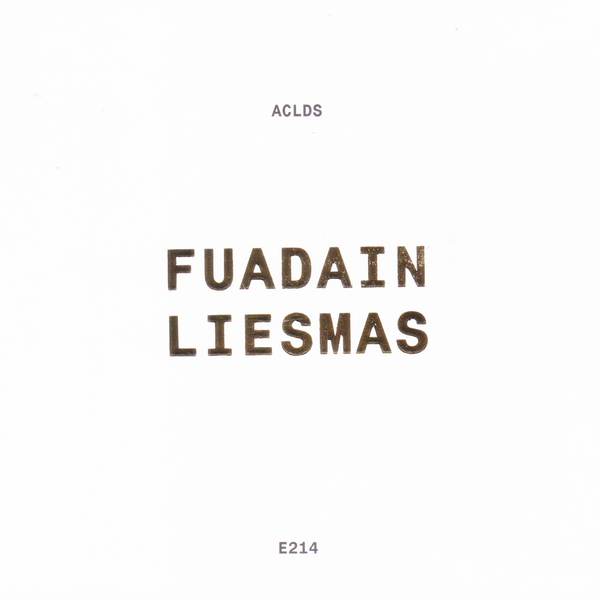
Under the radar, off the map...such terms hardly do justice to Chris Douglas' non-place in the what we might call 'the music world', even the 'underground electronic' version. No surprise then that Fuadain Liesmas has not, to my knowledge, appeared in any end-of-the-year charts. As Dalglish, O.S.T. and Scald Rougish, Douglas has persisted in making music for any reason but the desire for publicity or, perhaps, praise. Not that I believe he wouldn't welcome recognition. Searching for reviews of this album I've found no mention other than on this blog and, of course, Boomkat (because their job is to try and sell music).
Describing the carefully crafted sounds here would be a challenge for most would-be critics, yet that's no reason for it's apparent invisibility; many writers are better equipped than me to talk about 'abstract' sound and do so regularly. Nonetheless, here I am...on the edge of...reviewing what eludes easy categorisation.
Negin Giv, being just 30secs long, might be a good place to start (and end?) since it is, in microcosm a snapshot of Douglas' methodology....his ability to...punch holes in ...the space-time continuum...? If I improvise, forgive me. Free-flowing word scrambles might suit talk of Jazz, but Fuadain Liesmas being so meticulously composed I feel duty-bound to attempt the same in writing. And fail.
OT-IntVxEs 1 is typical of what goes on here, which is not to suggest that it's all predictable from the outset (only in...approach to sound). Rather, I mean, in creating melancholic (?) tones which in other hands would signal mere ambient eternal drift somnambulism, Douglas scatters brittle components throughout. No sleeping here. No daydreaming 'bliss'. Only on Hrm Clng or Dtn#09_Ed do we find what feels like a place of rest, albeit one derived from an afterlife (?). After what? This is life, in all it's restless, skittish, uncertain gravity.
Perhaps ambiguity renders such albums unpopular; not 'difficult listening' - that, surely, is in the ear of the beholder. Albums that gain attention often shout something, even if in a thoroughly minimalist, quiet fashion. Is the popularity of Ambient a result of what many perceive to be a politically turbulent world? An escape from that madness? As if the world has ever been stable. Whatever, the thing to do is make music which speaks of either 'the street', or technological trickery in the service of an adrenaline boost. Songs, naturally, are always in favour. Fuadain Liesmas offers no such musical certainties. It's neither flash nor pleasingly serene. Ultimately, I can only say 'It is what it is'. You can get a taste from the stream below, but to fully savour what Chris Douglas has created, I suggest you buy the CD from here.
The Poetic Revolution [ 26-Dec-17 5:00pm ]
17-Dec-17
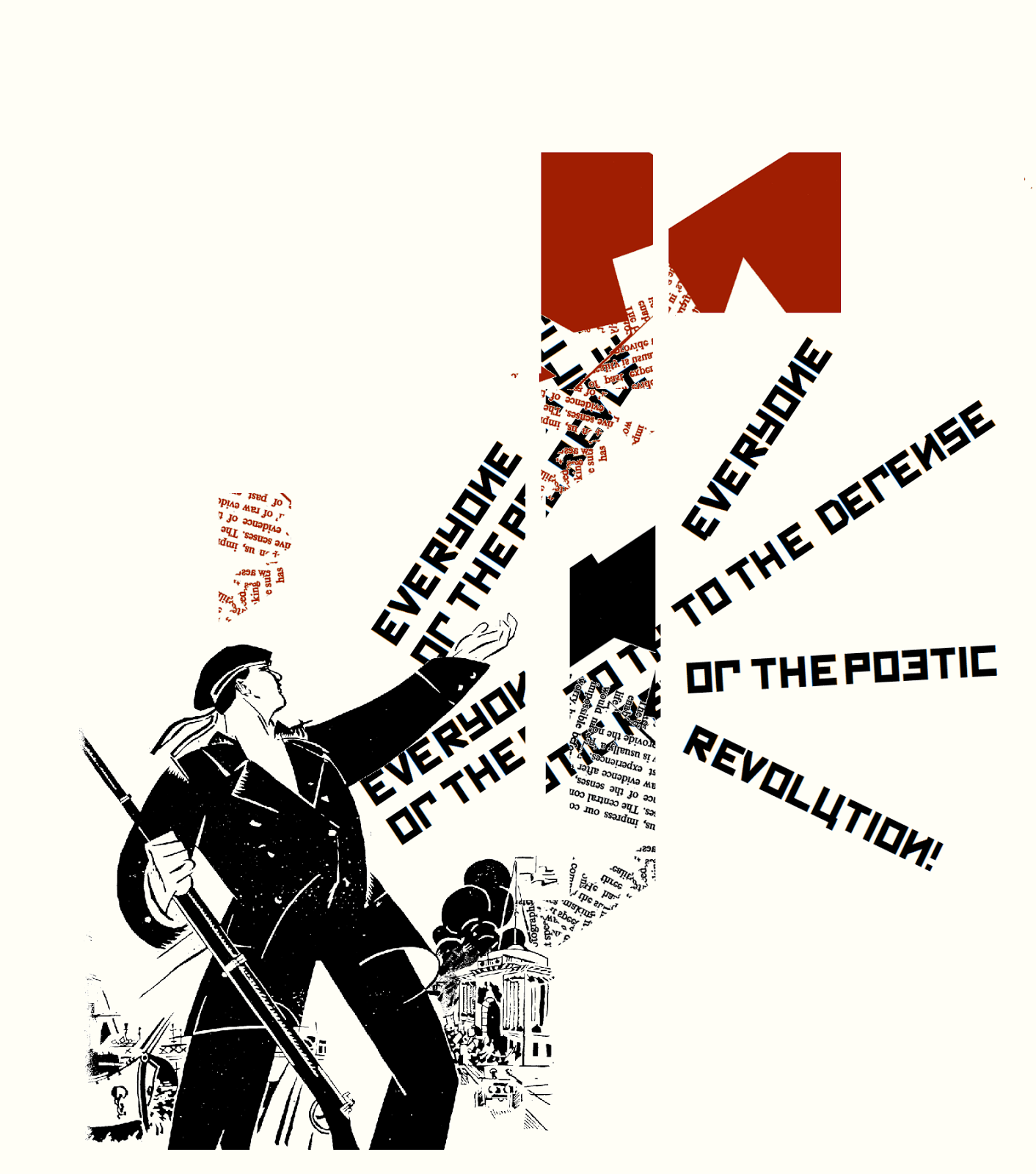
2017: Albums of the (y)Ear [ 17-Dec-17 3:52pm ]

RTomens, 2016
WHAT? forgive me. I dunno. WHEN? last year. I mean, this year, 2017. In PC world nobody's memory works so I must consult this blog, scroll back in time (one day everyone will have mental bookmarks implanted, won't they?) to see which albums might be considered
So here goes...
Broken Ground - Christian Bouchardreview
Structures And Light - Group Zeroreview
Sacred Horror In Design - Sote review
Mnestic Pressure - Lee Gamble
review
Some People Really Know How To Live - Shit and Shine
review
Hesaitix - M.E.S.H
review
Fuadain Liesmas - Aclds
review forthcoming
Monika Werkstatt - Various
review
A Little Electronic Milky Way Of Sound - Roland Kayn (this didn't even make the Wire charts!?)
review
Entertaining The Invalid - Various
review
Collaborative Soundworks by Les Horribles Travailleurs / MƩCHΔNICΔL ΔPƩ [ 12-Dec-17 5:10pm ]
Texture, abstraction, atmosphere...mood music for the apocalypse in your head. Who is not enduring small (or large) psychotic trauma on a daily basis? It's the modern world...in which other modern people go about their business, answering 'it' with just a 'sigh'.
COMA †‡† KULTUR
Pay what you want but somehow you will pay it all, (play it all) back...
Collage / King Tubby / Underground Resistance / Self-Portrait [ 08-Dec-17 3:58pm ]

All The Marks Of Identity Are Swept Away, RTomens, 2017
Wonder why...I'm not myself of late...
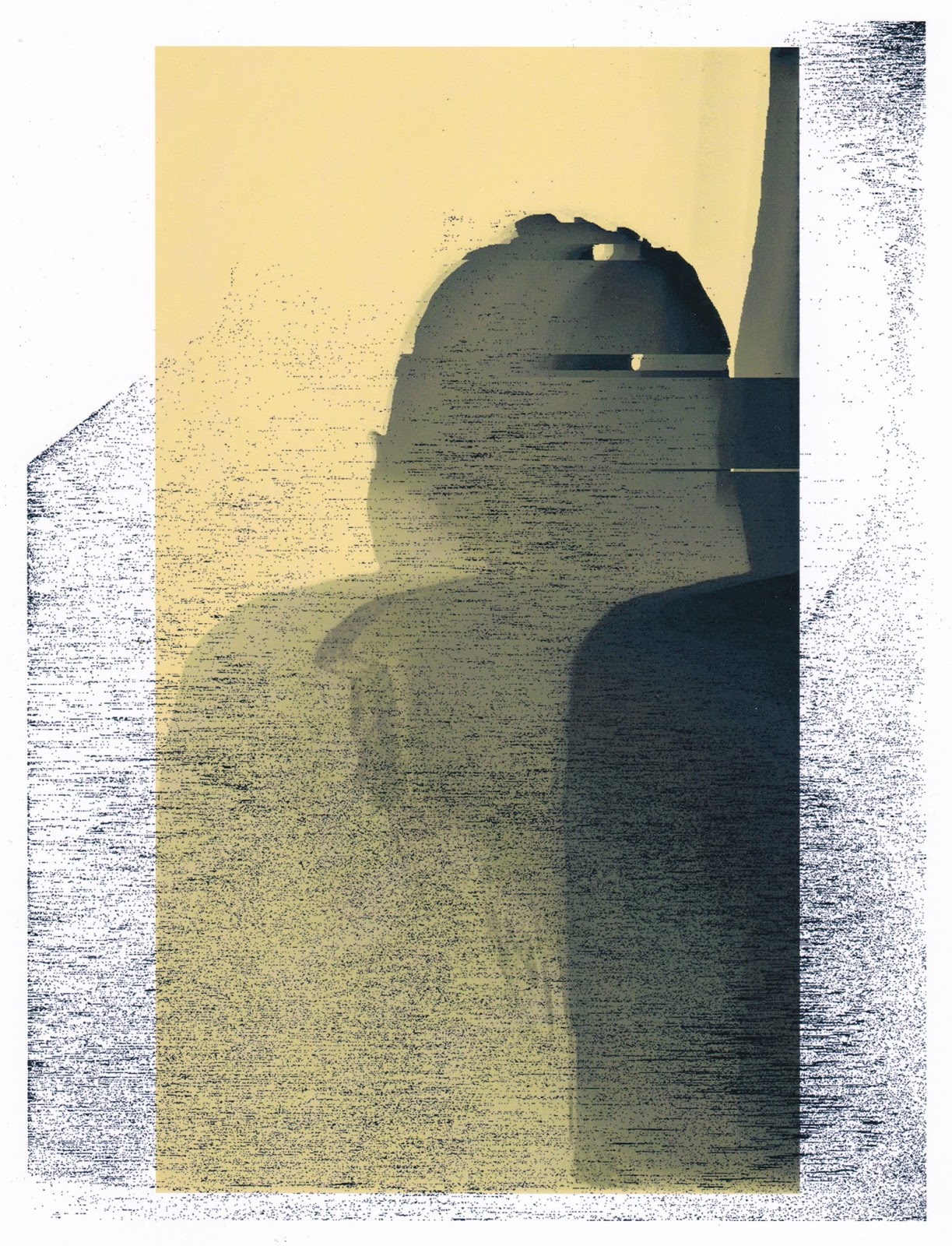
Self-Portrait, RTomens 2017
STARVE LIVING ARTISTS INTO SUBMISSIONDO NOT SHOP
Art: Monk's Mood - Tribute To Thelonious Monk [ 06-Dec-17 6:14pm ]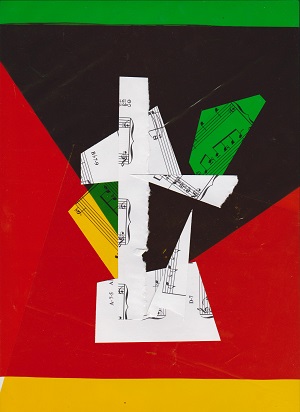
RTomens, 2017 Three art works from a series I made in honour of Thelonious Monk. The music is taken from his tune, Monk's Mood.
RTomens, 2017
RTomens, 2017
Insane In The Membrane (Again) With Cypress Hill [ 30-Nov-17 4:10pm ]
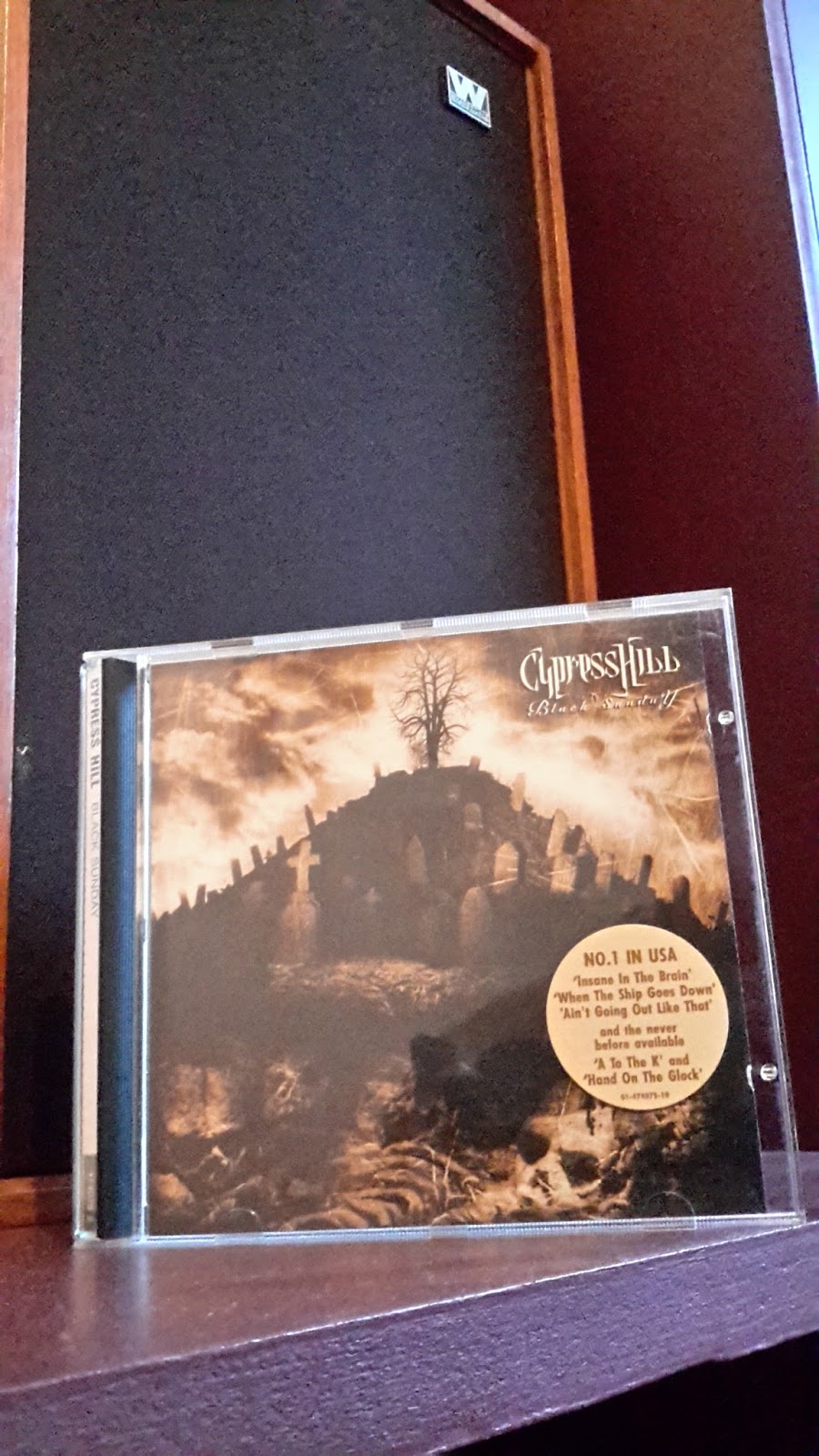
So another CD chariddy shop bargain, Cypress Hill's Black Sunday for a quid - whoo-eee! I had this on vinyl too when it came out - then - what happened?
Remember when hip-hop was big? Remember when Public Enemy were fresh after the old first wave - like dangerous music, like grabbing the torch from The Last Poets and Gil Scott-Heron bad - eh? Yes. Then, well, not quite then, but a few years after the second wave, maybe even the third, hip-hop got out of control worldwide MASSIVE - didn't it? Like many a street sound before it soon every square on the block was into this thing whilst debates about how good it was for the black community and folks at large, what with all that swearing, cop-killing, female-disrespecting, money-idolising, gang-glorifying lyrical splurge - all of which only endeared it to youth and gangsters, naturally. The bigger hip-hop got, the smaller my interest. What this says about me may be that I'm a snob who reacts against popularity, or simply prefers movements when they're fresh? What? Which?
Here's an album that went Triple platinum in the U.S - fuck! I knew Cypress Hill were popular but...only just saw that stat on Wikipedia. I remember loving Black Sunday when it came out, like millions of others - it had the juice - got the juices flowing - but that was then - how would it sound 24 years later? How about BRILLIANT! tHAT'LL DO. sHOCK. tHERE WAS ALWAYS SOMETHING ABOUT b-rEAL'S VOCALS THAT WERE DIFFERENT AND STILL SOUND THAT WAY, AS IF HE'S PERMANENTLY, YES, INSANE IN THE MEMBRANE AND HAMMERING AT YOUR WINDOW TO TELL YOU ALL ABOUT IT. Whoops, caps lock - which rhymes with 'Glock, funnily enough.
In retrospect it's easy to hear how Cypress Hill got so big and so rich. The samples are choice, the mixing is absolutely perfect with the breaks in your face and somehow this album insists that you succumb, not through lyrical force so much as vocal/rhythmic dynamism. It's not original (when did that ever get you rich?). If anything, it's stereotypical of hip-hip subject matter (violence, drugs, bragging) - yet - yet - after the first four tracks you're slaughtered! Putty in their hands. Well, I was, again.
Courtney Pine Revived & Bowie Talkin' All That Jazz [ 29-Nov-17 6:09pm ]
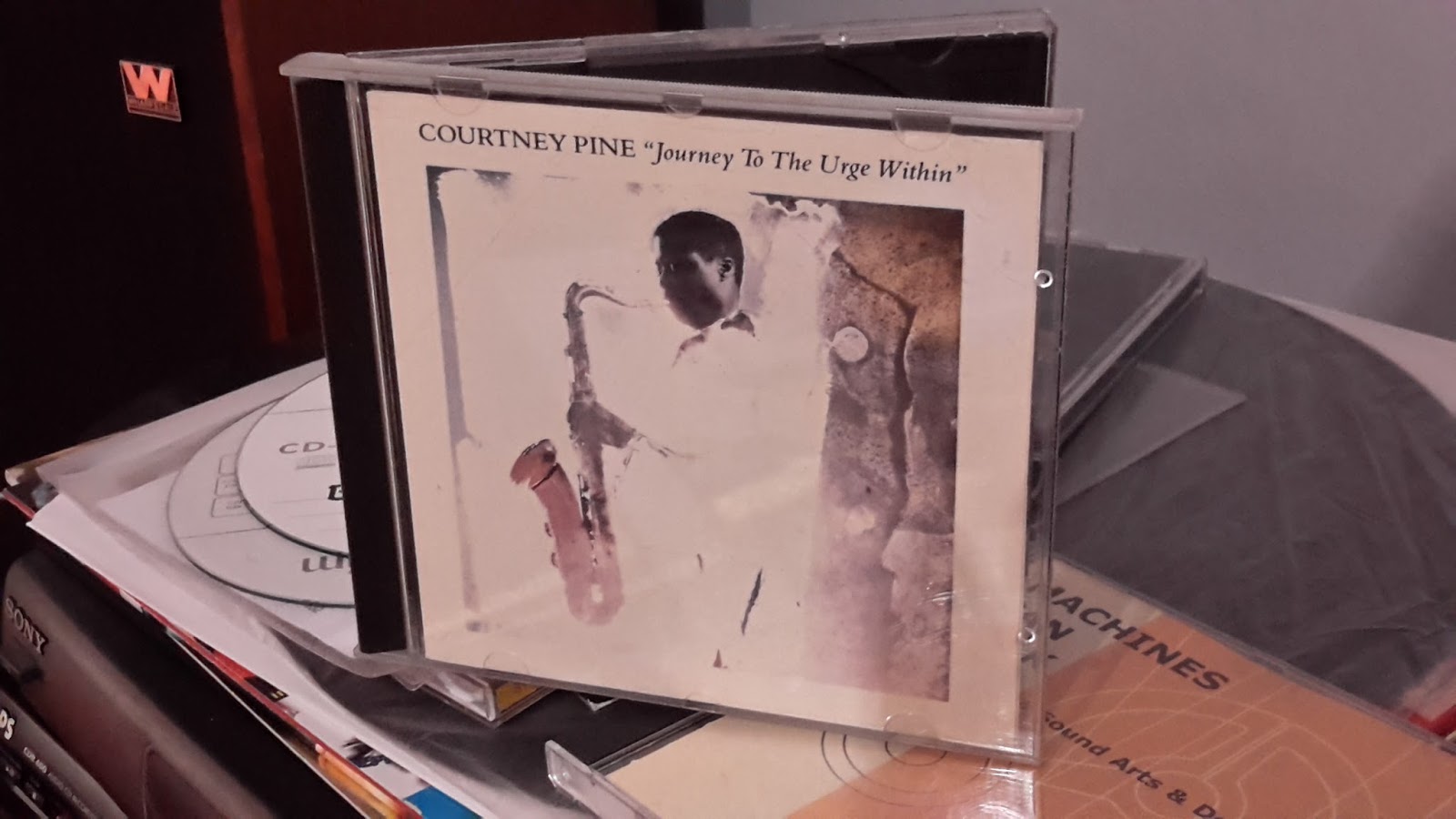
Courtney Pine's debut album for a quid? Couldn't resist. Of course I owned the vinyl when it came out, which was 1986...and Courtney was our Coltrane - he was! We could only watch in awe as our man, a young black man, in a suit, delivered his version of what was then contemporary Jazz..in London Town! He was slimmer then - we all were. He was also the only one to make the cover of the NME. Well how has it aged? Fine, to my surprise. As We Would Say sounds particularity good. OK, in the writing stakes he was no Wayne Shorter or Coltrane, but after 31 years and in the context of all that went before Journey To The Urge Within holds its own with no small help from the likes of Julian Joseph on piano, Gary Crosby's bass and Mark Mondesir's drumming.
So today I came across an interview Pine conducted with David Bowie in 2005, asking him about the influence of Jazz in his life. Turns out our David had some impressive names to drop. I'd never heard Bowie talking about Jazz before but I've often wondered if he got the 'Wham bam thank you mam' line in Suffragette City from the Charles Mingus track. It's more likely he nicked it from the Small Faces tune of that name, of course.
To continue the Mingus connection, when asked for the one Jazz tune that really moves him, Bowie goes for Hog Callin' Blues from the album that Wham Bam Thank You Ma'am was also on, Oh Yeah. A man of taste! This also happens to be one of LJ's favourite tunes. Just listen to Roland Kirk tearing the roof off the studio...
Sun Ra & His Arkestra - Sun Ra Exotica / Art Print [ 28-Nov-17 5:45pm ]
Pure (sun sound) pleasure from Modern Harmonic and how clever of them to collate Sun Ra's 'exotica'. For those not familiar with Sun Ra any sampling of tracks from here will be a surprise if they had him down as too 'crazy'. They may even wonder what all the fuss is about but to miss Ra in these moods is to ignore their worldly 'ancient' and thoroughly justified inclusion in the Arkestral sound collage. Essential.

Accelerated Destruction, RTomens, 2017
This along with other art prints is available now in my shop
80s Underground Cassette Culture Volume 1 / Various Artists - Under The Concrete / The Field / My Art Prints [ 22-Nov-17 3:42pm ]
How much more 70s/80s cassette culture can we take? - loads! it seems. And why not? There's much pleasure to be had from the beneath-the-underdog bedroom synthesists; the chancers, non-game- changers, radical visionary lunatics and nerds with attitude.
'Nuclear fuel breeds nuclear war/The politics of power/ Rotten to the core' - it's Missing Persons and Rotten To The Core, one of the treats on this superb collection, which illustrates many angles taken by the Lost of Tape Land. PCR's Myths of Seduction and Betrayal (Extract) is another gem. Human Flesh, Urbain Autopsy are names that tell of the Cronenbergian body mutation fixation of the times, when perhaps the recently-evolved opportunity to integrate mind and machine bred obsession with cybernetic mutation. Who knows.
Cassette-sharing sites are popular now but for obvious technical reasons the sound quality is usually poor so this is a welcome chance to hear hi-resolution lo-fi emissions from the vast cavern of underground cassette culture.
Beneath the concrete field, the beach? Perhaps not. Here, at least, is a contemporary collection worthy of your attention. Material by Mark of Concrete/Field, remixed by various folk, most of whom have remodelled original sounds in a very interesting way. Descent's Freebase has great depth, a build-up of tension pressure that's all the better for never actually being released. AMANTRA's Scorched Earth Policy wouldn't sound out of place on the Underground Cassette comp - I mean that as a compliment. Kek-W got A Fax from Philip Glass (great title), well, I suppose a few people did in the 80s - anyway, as always, KW's work is spot-on/interesting, as is Libbe Matz Gang's Tratamento de Enxaquecas, like death metal machine music! Very good comp.

Windows To The SoulBEFORE I GO, A PLUG FOR MY ART PRINTS, WHICH ARE NOW AVAILABLE FOR PURCHASE HERE
Monika Werkstatt at Cafe Oto [ 21-Nov-17 3:30pm ]
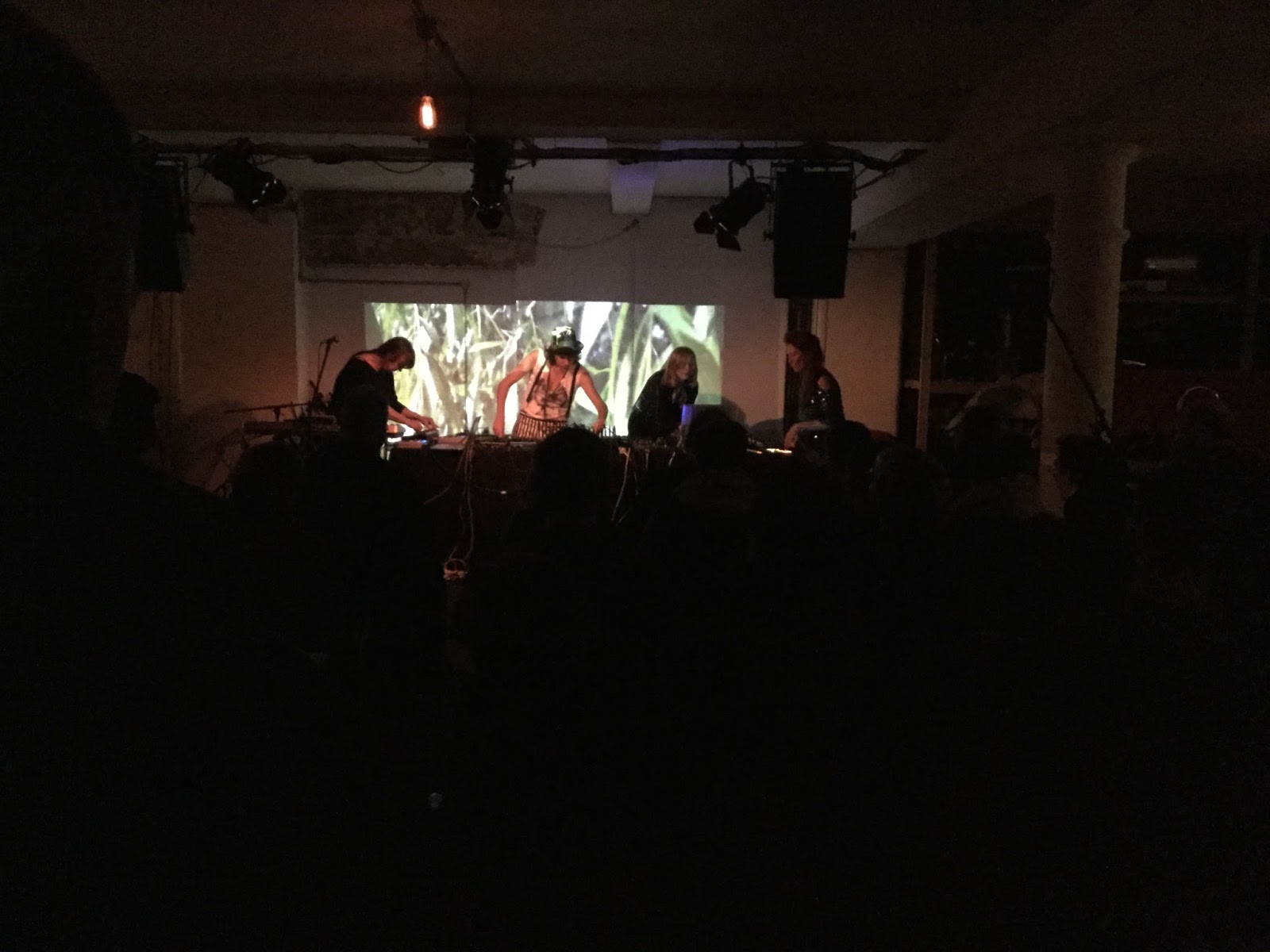
Oh, yes, it's Ladies' Night
And the feeling's right
Oh, yes, it's Ladies' Night
Oh, what a night (oh, what a night)...
...Monika Werkstatt at Cafe Oto - yes, what a night! You don't need me to tell that electronic music is a male-dominated world (which part isn't? bingo?), just like Rock, but unlike that traditionally macho realm of phallic axe-wielding at first glance there should be no reason for electronic music being a (mostly) men-only domain, until you start thinking about stereotypical male gadget obsession and the historical culturally-enforced tradition of DIY (inc tinkering with electronics).
Issues surrounding all that (not bingo or DIY) were discussed in the Q&A. An interesting point was raised about how women are expected to be 'brilliant' whereas it's OK for men to be 'all right'. The conclusion was that women should be allowed to be 'all right' too. The issue of expectations aside, pure percentage stats dictate that there's a lot more average male performers in electronic music simply because they dominate.
Politics aside, if it's possible to lay them aside and see the performers as just that (perhaps there's an irony there in rightfully demanding equality, ie not just being viewed as 'female artists', whilst presenting an all-female collective - tricky) with nothing to prove Monika Werkstatt proved it. It was an evening of seductive, passionate, humorous, powerful music, each of the four players performing two songs before a collective session finale. All four were present on stage throughout and it was entertaining just watching their individual reactions to what the performer was doing.
Before the collective, support came from London's La Leif, who brought beats and bass fit to shake Cafe Oto's foundations with a very tough set.
The first of MW to perform was Sonae, whose subtle, richly-textured ambient sounds set a good tone...
Then Barbara Morgenstern ('Queen Of Harmonies') delivered two superb songs, the power of which was amplified times 10 in a 'live' context...
Watch out, it's Pilocka Krach, surely the prankster in the pack, giving us all a good slap with her stomping Electro-Power-Pop! Do you like the beat? Yes, I did!
Finally in solo form, 'the boss', Gudrun Gut, organiser of the whole collective and legendary figure on the scene for years.
The quartet session was as intriguing as you'd expect from four diverse artists with their very own styles, working together intuitively, in the spirit of improvisation, just don't call it 'Improv', Gudrun's ambiguous about that scene and I don't blame her. As she said, it's something you can hate yet be drawn to at the same time. There's nothing to hate about Monika Werkstatt. Do check the collective album. It's an essential release from this year. As an encore, the joint was jumping to Who's Afraid Of Justin Bieber? Here's a brief video I took...
Oh what a night!
Colin Webster vs Tape Loops / John Sladek [ 20-Nov-17 5:30pm ]
Improvising to tape loops may sound implausible, or rather, contrary to the spirit of Improv, but who cares about that, eh? Not you. So here's saxophonist Colin Webster doing just that and the combination of his chops and repetitive sounds works very well. You can almost hear Webster thinking 'What shall I do with this?' in the unaccompanied sections, which adds to the intrigue. Being capable of creating many varied sounds from his horn, Webster has no trouble finding the 'right' tone for each loop (well, perhaps he did, but the released versions all succeed).
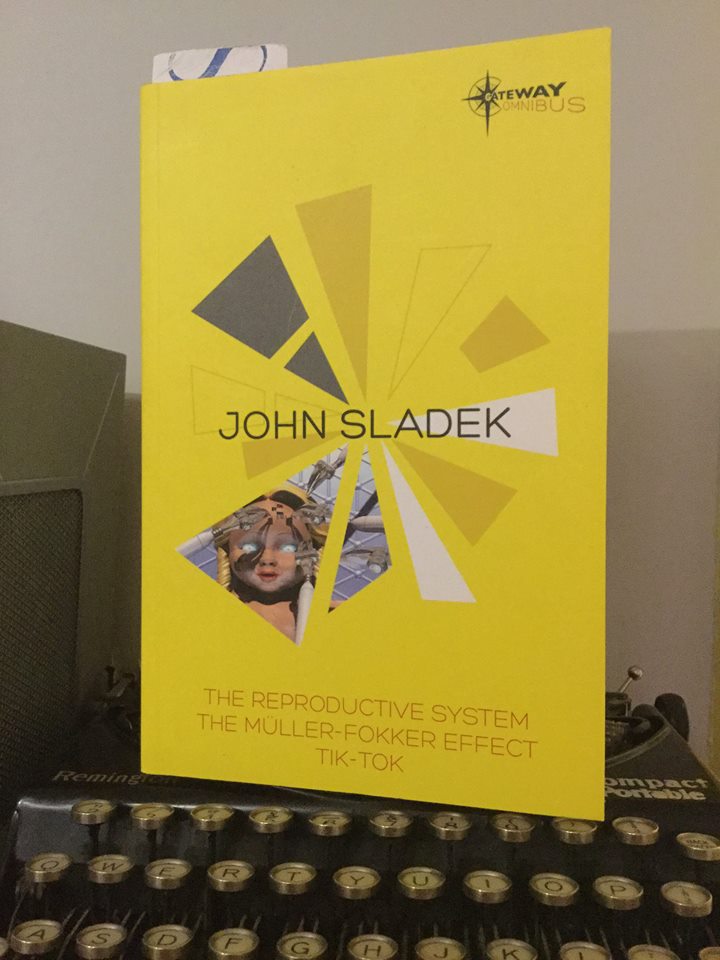
On impulse I called in Daunt Books today to see what sci-fi they had. I asked the girl if they had a section for it, she said they didn't because they 'specialised in travel'. "What about space travel?" I asked..."I know," she replied, almost smiling...
Bought this John Sladek collection the other day, having decided to read more science-fiction. The genre has promised more than it's delivered as far as my needs in recent years are concerned. Those needs have changed since I started reading sci-fi a long time ago, of course.
After the early-teen experience of space adventures I progressed to the biggies such as Asimov and co.. It wasn't until the late-70s and discovering William Burroughs that my view of the genre changed completely; in short, he ruined it regarding everyone else, except JG Ballard, who I still rate highly and read regularly. That's no coincidence considering Ballard's opinion of Burroughs despite their very different writing styles.
Burroughs even gets a mention on page 79 of this Sladek collection from a stoned character trying to get to Morocco. Published in '68, the first novel, The Reproductive System, reflects the era in a good way rather than a 'dated' fashion, covering paranoia, anti-authoritarian, secret agent, science-gone-mad cynicism in the spirit of adventure that reminds me of both Michael Moorcock's Jerry Cornelius and Wilson and Shea's Illuminatus! Trilogy. So far so good and since I will finish it that's a recommendation from someone who's a serial non-finisher (life's too short, isn't it?)
TTFN
Space Age print / Flying Saucers Are Hostile / Starship Troopers / Shit & Shine - That's Enough / Felix Kubin - Takt der Arbeit [ 19-Nov-17 3:37pm ]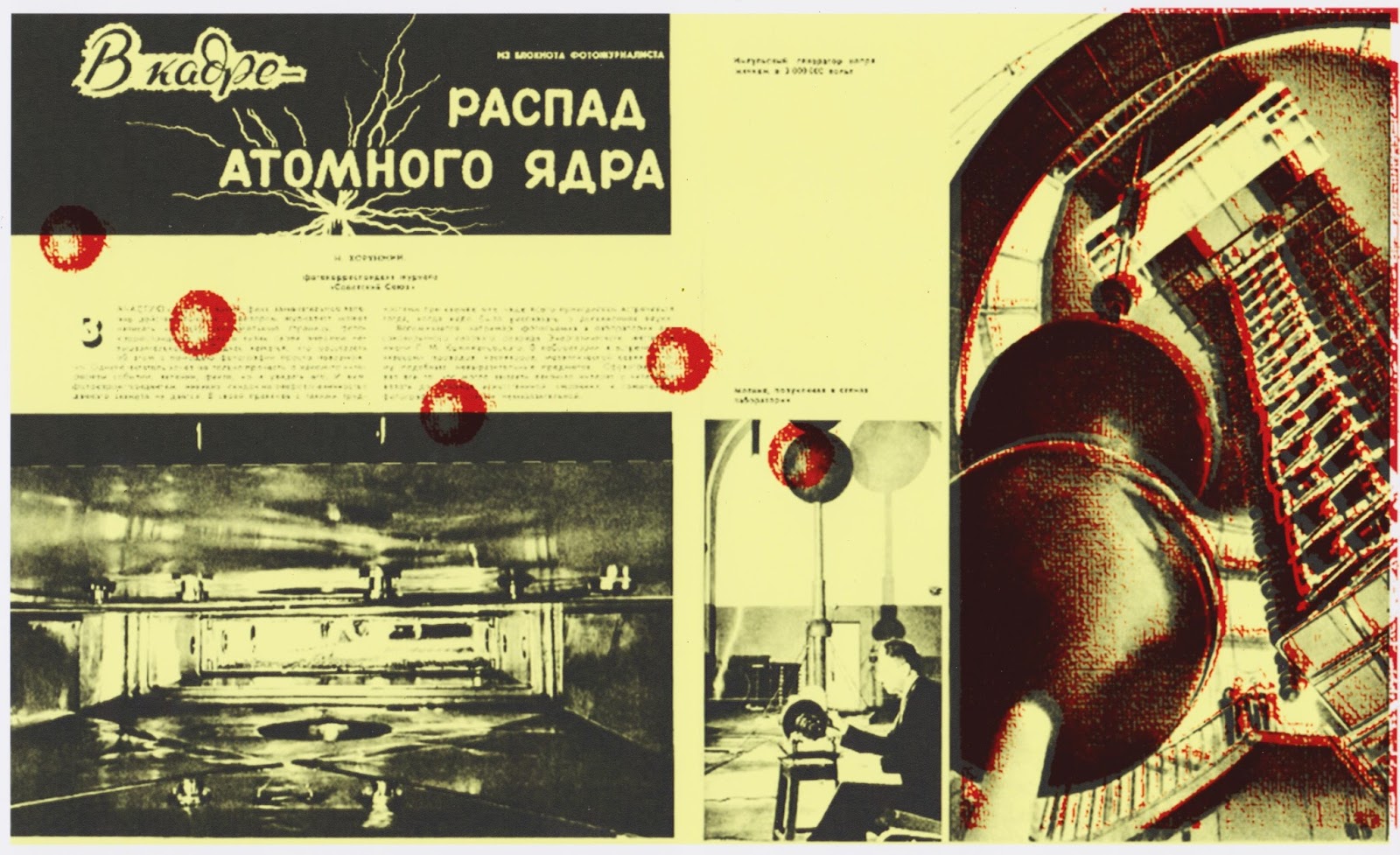
RTomens, 2017
More of my art here
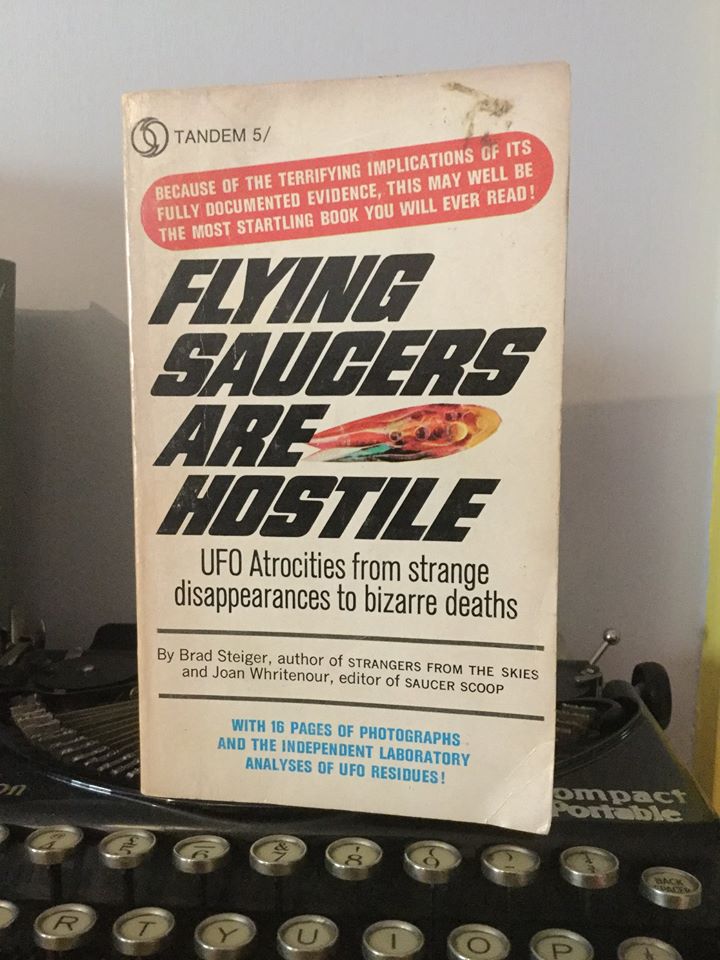
1967 1st edition
You've been warned - 'YOU DARE NOT ALLOW YOURSELF TO IGNORE IT!' (from the back cover).
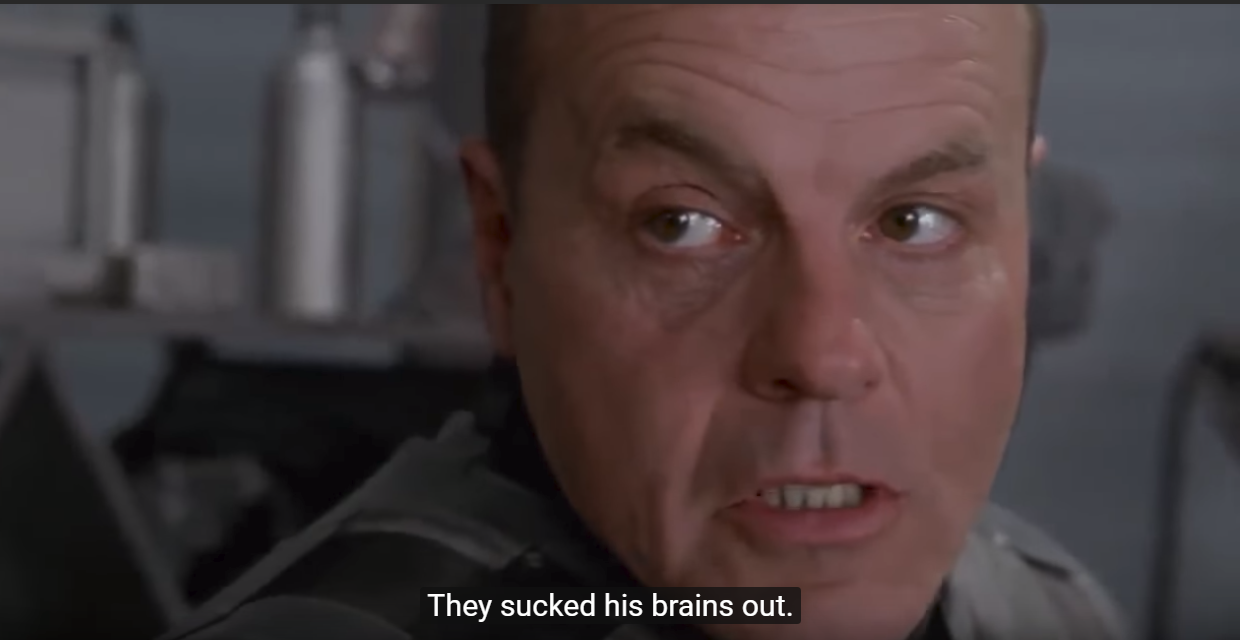
Flying saucers are hostile, so too are the alien bugs in Paul Verhoeven's Starship Troopers - "The only good Bug is a dead Bug!". It's 20 years old and re-watching it I confess to enjoying it even more than the first time. That's a 'confession' because revelling in a film filled with square-jawed, squeaky clean heroes out for military death or glory to bombastic soundtrack sounds like hell as a film, but that's the point. ST is pumped up and primed as a trashy action film whilst constantly undermining everything it superficially celebrates. It's very sheen is as sickening as the site of a bug ripping a soldier limb-from-limb. It's gung ho writ large but gets booby trapped at every turn. Verhoeven knew what he was doing but did it so well that few could see the subversive irony through all the flying limbs and phoney machismo.
In a way Shit & Shine like to play with machismo (note the cover) - perhaps they really are macho men. But there's an 'ironic' edge to most everything they do and their latest, That's Enough, is no exception - 'Do you know the way to the garden party?' - the EPs filled with samples, a long one opening the opening title track, which you've probably heard by now. The Worst continues playing with the sample idea - the judges on American Idol? Subversion, like ST, is embedded in the per-usual nasty grooves - that must be Simon Cowell sampled - we might think that's enough of that talent contest shit but it just seems to keep rolling and so too, thankfully, do Shit & Shine.
Do they still make musical geniuses? What do you reckon? Whoever 'they' are - parents of musically gifted kids who rise above being mere talented? What? Anyway, Felix Kubin: as Mark E Smith said 'Check the guy's track record' - it's impressive, to say the least. Here he is with Takt der Arbeit, four soundtracks to educational and industrial 16mm films about work. Is this a return to the fascist/imperial/dictatorship reflected in Starship Troopers? Is that what Work is?
Track one has a militaristic slant (those drums) echoing the regimentation of both machine and human operators but here Kubin brilliantly orchestrates the components into something that sounds part friendly info film soundtrack, part chaotic depiction of factory-frazzled minds. Geburt eines Schiffes has the mood of Soviet-era proletariat-powered propaganda so strong you can see the workers marching towards you over the horizon, shirt-sleeves rolled over bulging biceps. Hold on, I got carried away with that idea. The actual mood is one of a huge industrial-age factory gradually coming to life with the roar, clank and hiss of machines complete with triumphant music heralding the brave new era of man-made mechanical wonders - or hell, since the overriding atmosphere is actually one of foreboding and tragedy. Martial Arts continues the work-til-you're-musclebound theme but Kubin continually breaks things down (a musical spanner in the works). The group Kubin works with add essential components to the EP; the human element in what could have been just another 'industrial record' in other, less creative hands. Release date was supposedly Nov 17th but as I write it's not yet out so keep an eye on Editions Mego. Don't miss it.
THE FANTASTIC HOPE [ 17-Nov-17 12:47pm ]
A BRIEF GUIDE TO BASIL BUNTING'S BRIGGFLATTS FOR FIRST-TIME READERS [ 17-Nov-17 12:47pm ]

Briggflatts by Basil Bunting is one of the great poems of the twentieth century. However, it has not always occupied a prominent place in discussions of modern poetry. The reasons for this are complex, and have largely to do with a range of contentious biographical and historical factors (such as the marginal status of modernism in the UK and Bunting's own variable reputation). Another factor, the poem's supposed difficulty, requires some qualification. Briggflatts is a dense, carefully wrought high-modernist work. As with other poems in this bracket (The Waste Land, The Cantos, The Maximus Poems) it repays diligent close reading and re-reading. But it is arguably more vital (and, dare I say it, accessible) than those works, and can in fact be appreciated pretty well by first-time readers. As a teacher of undergraduate students over the last few years, I have found that Part 1 in particular lends itself very well to group reading and seminar discussion: indeed, the first section of Briggflatts seems to me to serve as a far better introduction to modernist poetry in a pedagogical context than a work like The Waste Land, with its copious and contested layers of allusion. It does help, it is true, to have a skeleton key to unlock some of the key features of Briggflatts. But I think the really essential facts about the poem can be summarised in a relatively modest space. The following brief guide to the poem should hopefully provide a good foundation for first-time readers. I have tried to shine light on the basic subjects and structures of Briggflatts, without diminishing its music and magic.AN, 2017
Part 1
Season: Spring
Phase of Bunting's life: Childhood
Location: Northern England
Part 1 is the most immediate and tightly structured in the poem. Twelve stanzas, each of thirteen lines, sketch an idealised panorama of Northumbria (in Bunting's poetic vocabulary this meant pretty much the whole of Northern England). The verse here is emphatically musical, foregrounding alliteration, assonance and internal rhyme, with a stark rhyming couplet at the end of each stanza to draw it to a close. In one sense, this is pure sound evoking a pastoral idyll and it should be enjoyed as such: Bunting himself said that readers (or listeners) shouldn't try too hard to uncover 'meaning' beneath the musical surface of his verse. At its simplest, this whole section is an extension of the song of the bull ('Brag, sweet tenor bull') in the first line.
However, that is not quite the whole story; there is also a definite realist narrative here. Bunting is recalling a childhood 'holiday romance' with a girl called Peggy, which took place in the early 1910s in Brigflatts (the correct spelling), a tiny village in the North Pennines. Rawthey is a river; Garsdale, Hawes and Stainmore are nearby locations; the stonemason and miners are local characters. Part 1 is therefore the beginning of a process of remembering real things, literally the first chapter in an autobiography. Deeper history also comes to the surface with the first, brief appearance of the Viking warrior and sometime ruler of Northumbria Eric Bloodaxe, killed in battle on Stainmore around 954AD. This enigmatic darker image or 'tone' prepares the way for the mournful conclusion to part 1. Spring ends, the natural presences begin to die and rot, and somehow—we never quite find out why or how—the poet's idyllic love affair with Peggy is 'lain aside' and forgotten.
Part 2
Season: Summer
Phase of Bunting's life: Early adulthood to early middle age
Locations: London; North Sea; Italy; North Pennines; Middle East; Mediterranean
Part 2 is by some distance the longest in the poem. In stark contrast to the chiselled stanzas of part 1, part 2 is an eclectic collage of clashing poetic fragments, perhaps intended to mirror the immature, evolving state of Bunting's mind throughout his wandering 20s and 30s. We start with an intentionally dramatic change of location, from the idealised North to artificial, money-obsessed London (Bunting is nodding at similar depictions of the capital in Wordsworth's Prelude). From this point onward there are continual geographical shifts (again, this is a recollection of real events in Bunting's early life). We are treated to a short tour around 1920s Bloomsbury bohemia (lines 1-23), a jaunt along the Italian coast and mountains (most of the middle of part 2 from 'About ship! Sweat in the south') and finally to a more obscure conclusion that includes flashes of the Middle East, where Bunting spent the latter part of World War II ('Asian vultures riding on a spiral column of dust') and generalised Mediterranean references—as well as spending the early 1930s in Italy, Bunting returned there during and after the war as a soldier and intelligence agent. In between these biographical fragments, more indirect passages and mythical subjects jostle in typical high-modernist fashion. The Bloodaxe narrative is treated more fully: we see Eric cruelly commanding a longship in the North Sea ('Under his right oxter …') and then dying a horrifically violent death back in the Pennines in the first great climax of the poem (the long passage beginning 'Loaded with mail of linked lies'). Paralleling this episode, Bunting nods in the final lines of the section at the Ancient Greek myth of Pasiphae, who gave birth to the Minotaur after an encounter with a bull sent by the sea-god Poseidon (note the subject rhyme with the bull at the start of the poem).
As well as being a sometimes chaotic—though often beautiful—record of the frustrations of Bunting's early adulthood, part 2 is also the place where the underlying moral of Briggflatts is first advanced. Put very simply: human beings cannot control the world, they must find a way to co-operate and co-exist with it. As Bunting put it (far more eloquently) in his 'Note on Briggflatts': 'Those fail who try to force their destiny, like Eric; but those who are resolute to submit, like my version of Pasiphae, may bring something new to birth, be it only a monster.'
Part 3
Season: n/a
Phase of Bunting's life: n/a
Locations: Edge of the world; Northumbrian arcadia
Part 3 is outside the main structure of the poem: it refers neither to a season nor to a specific period in Bunting's life. Nevertheless, Bunting intended it to be the climax of the narrative. In musical terms this is the 'loudest', most forcefully expressed part of the poem, the place where the moral first hinted at in part 2 is affirmed in a dramatic 'big reveal'. The section is based on an episode from the medieval Persian epic poem Shahnameh, which includes a portrayal of the Greek leader Alexander the Great (356-323BC). In Shahnameh, Alexander journeys with his troops to the mountains of Gog and Magog at the edge of the world. At the summit he leaves his men behind and encounters an angel (Bunting has him played by the Biblical figure 'Israfel') who is poised to blow a trumpet to signal the end of the world. There is some ambiguity in Bunting's retelling of this legend. What exactly happens to Alexander on the mountain? Why does Israfel 'delay' in blowing the trumpet? What sort of divine intervention is at play here? Yet the underlying moral is clear. Alexander tries to conquer the world and reach the limits of experience, but in doing so he is ultimately returned back to the ground, to his homeland (for Alexander this was Macedonia, but Bunting describes it here as a kind of Northumbrian arcadia). Lying dazed in the moss and bracken after his fall from the mountain, he encounters the hero of Briggflatts, the slowworm (actually a snake-like lizard) who advises him to lie low, be patient, persistent and mindful of the beauty of his surroundings.
This is the most abstract moment in the poem, but there are also clear parallels here and throughout part 3 with Bunting's biography. The opening passages of the section caricature greedy, powerful people who obstruct creativity and make life a literal shitty nightmare. As a struggling poet for much of his life, Bunting had built up some resentment towards these establishment 'turd-bakers', such as the businessman and newspaper owner Lord Astor ('Hastor'). The overall narrative shape of part 3 also mimics the curve of Bunting's middle years: after spending much of the 1940s in Persia (poring over works like Shahnameh) he returned in the 1950s to Northumberland, the homeland from which he would eventually write Briggflatts.
Part 4
Season: Autumn
Phase of Bunting's life: Late middle age
Locations: North Yorkshire; Lindisfarne; Tynedale
Part 4 is the shortest section in Briggflatts, and is best viewed (or heard) as a penultimate, minor-key movement resembling those in pieces of classical music (Bunting called Briggflatts a 'sonata'). You don't need to follow this musical analogy too closely, but it might be worth spending some time looking at the way Bunting weaves together different textures and 'themes' in the second half of part 4.
Aside from its musical properties, part 4 is also notable for its elegiac subjects. It begins with allusions to the sixth-century poet Aneirin (the correct spelling), whose most famous work Y Gododdin describes the Battle of Catterick and its aftermath in North Yorkshire around 600AD. The purpose of this allusion is twofold. Firstly, Bunting is nodding at what is in effect the first Northumbrian poem (although Aneirin was a 'Welsh' poet, we should remember that the Welsh or Britons lived in Northumbria prior to the Anglo-Saxon arrivals of the fifth and sixth centuries). In terms of the realist dimension, there may also be a glance here at the war and destruction Bunting witnessed in the mid-twentieth century (we are now, chronologically, up to the 1940s-1950s). More personally, the litany of death and decay segues eventually into a recollection of the lost love affair with Peggy. In some of the most moving lines in the poem, Bunting says 'goodbye' to his memories of Peggy as he settles down to lonely old age in post-war Northumberland.
But there is some light in the gloom. Aside from the redemptive music of the baroque composer Domenico Scarlatti, we also encounter the Northumbrian Renaissance of the seventh and eighth centuries (a dramatic 'rebirth' following the violent period marked by events like the Battle of Catterick). Among other achievements, this cultural upsurge produced the Lindisfarne Gospels (celebrated in the gorgeous passage beginning 'Columba, Columbanus …'), a beautiful illuminated book created in part to celebrate the life of the Northumbrian saint Cuthbert, who appears here as the (positive) mirror image to the (negative) portrait of Eric Bloodaxe in part 2. Aside from his Northumbrian pedigree, Bunting gives Cuthbert a starring role because he reputedly 'saw God in everything'. In line with the moral of Briggflatts, Cuthbert was a quiet hero living on the margins of society who loved nature without seeking to control it.
Part 5
Season: Winter
Phase of Bunting's life: Old age
Locations: North Northumberland, Farne Islands
If part 4 was mostly tragic notes with a brief major-key interlude, part 5 is the opposite. Like the final movement of a symphony, this is a resounding conclusion to the poem ('years end crescendo') although it ends with a sad diminuendo.
In musical verse that often recalls the 'Sirens' episode in Joyce's Ulysses, Bunting revisits the idyllic landscape of part 1 (the powerful opening syllable 'Drip' recalls part 1's 'Brag'). But now that he is an old man the perspective is different. We have moved from the mountains in springtime to the Northumberland coast in winter, where the sea speaks of finality and the end of a journey. Having accepted the need to be patient and respect human limitations in the face of nature, it is now possible to appreciate the precious details of life: rock pools, a spider's web, the lapping of the ocean, the way birds fly in harmony, the skill of shepherds in handling sheep dogs, the inexplicable wonder of the night sky. There is a kind of spiritual idealism here, and this conclusion is certainly upbeat and effusive in some ways, with the faint suggestion of a happier ending to Bunting's life than was predicted in part 4.
Part 5 is on the whole concerned with images in themselves rather than any more complex symbolism, but the line 'Young flutes, harps touched by a breeze' may just carry a hint of the optimism Bunting felt in the mid-1960s, when he was 'rediscovered' by younger poets and finally became a celebrated literary figure. However, there is still the nagging sense of tragedy that has persisted throughout Briggflatts. As the stars shine out over the Farne Islands, where St Cuthbert once lived and worshipped, Bunting remembers Peggy for the last time, and awaits a final 'uninterrupted night'.
Coda
The Coda is a fragment composed prior to the rest of the poem, which Bunting rediscovered and welded on at the last minute. It is a condensed summary of the key philosophical motifs in the previous sections: the power of music, the impermanence of all creation, the impossibility of knowing everything. Tellingly, the poem ends with a question mark (this is a work of literature that proclaims its own uncertainty and inability to conquer the world with language). For all that, one thing is certain in the end: as Bunting once remarked, Briggflatts is 'about love, in all senses'.
Rouge's Foam [ 15-Nov-17 2:11pm ]
Slides for talk at No! Festival, HKW Berlin [ 15-Nov-17 2:11pm ]
This past weekend I gave a talk about how, why and whether cultural work can refuse the various alienations of modern society / economics, as part of a panel called 'DIY or Die: Is Bartleby Dead in the Post-Digital Age?' at the No! Music Festival at Berlin's Haus der Kulturen der Welt. I don't think the event was recorded, but I thought I'd share my slides / notes on it here, if only because the HKW computer wasn't able to display my outrageous choice of font at the time.
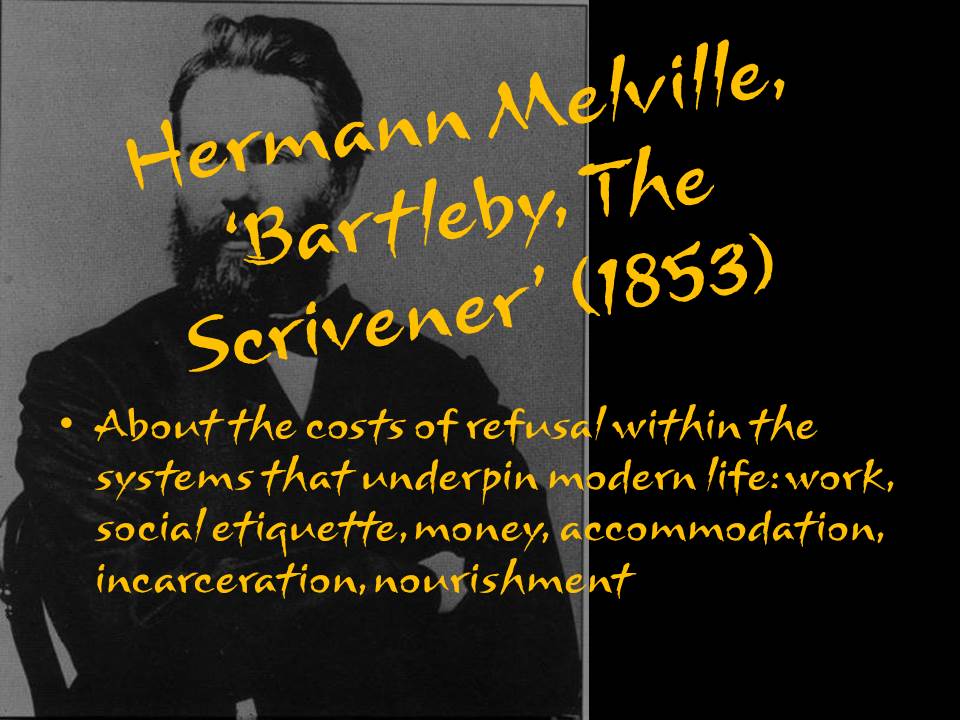
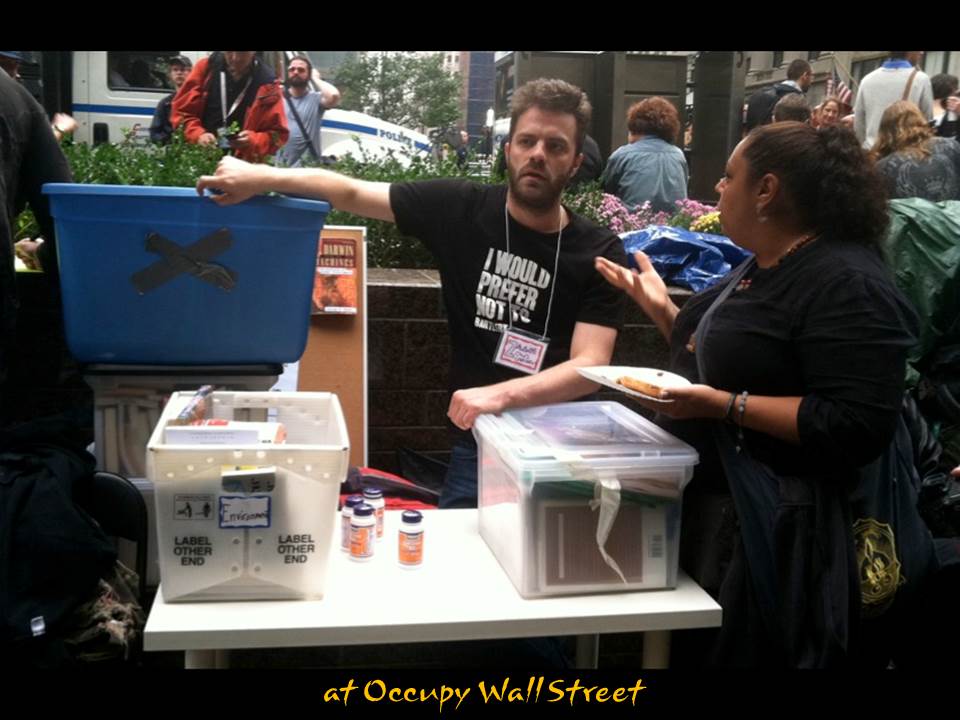

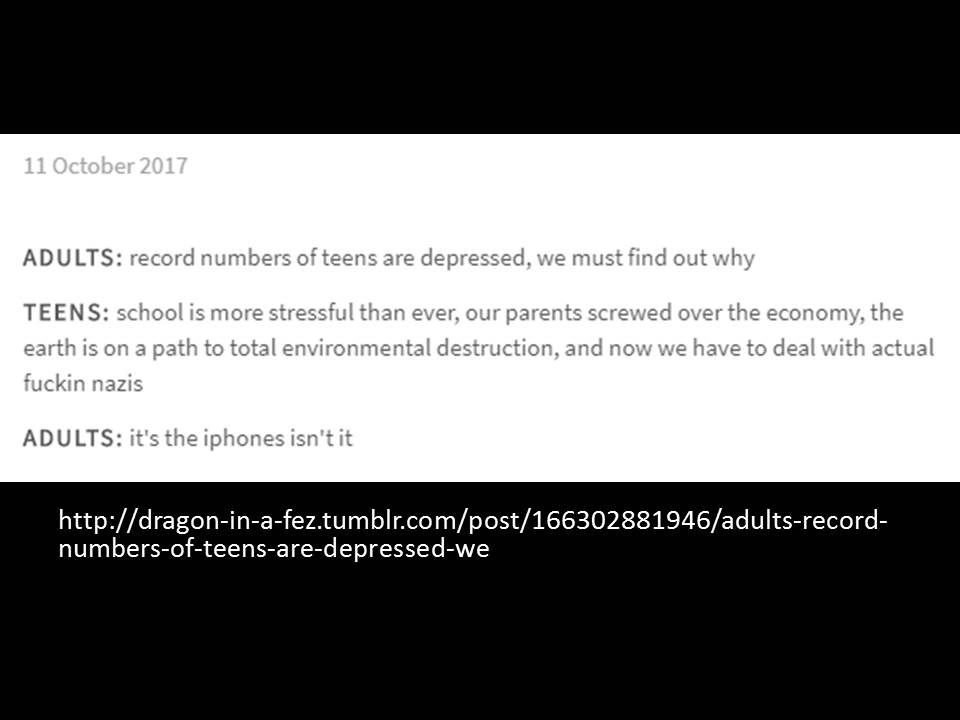
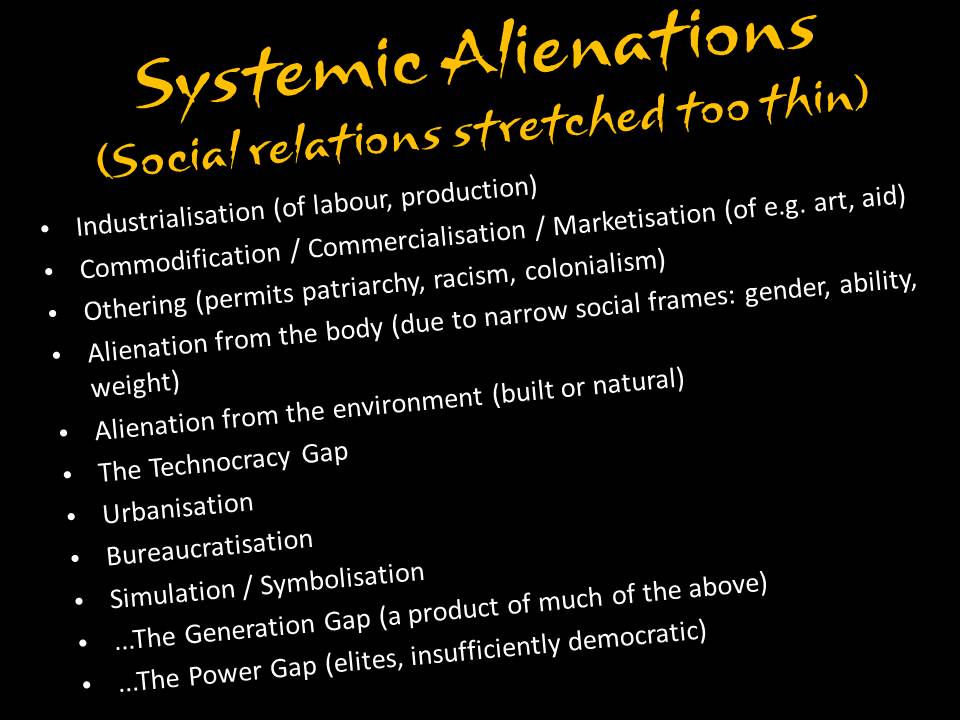
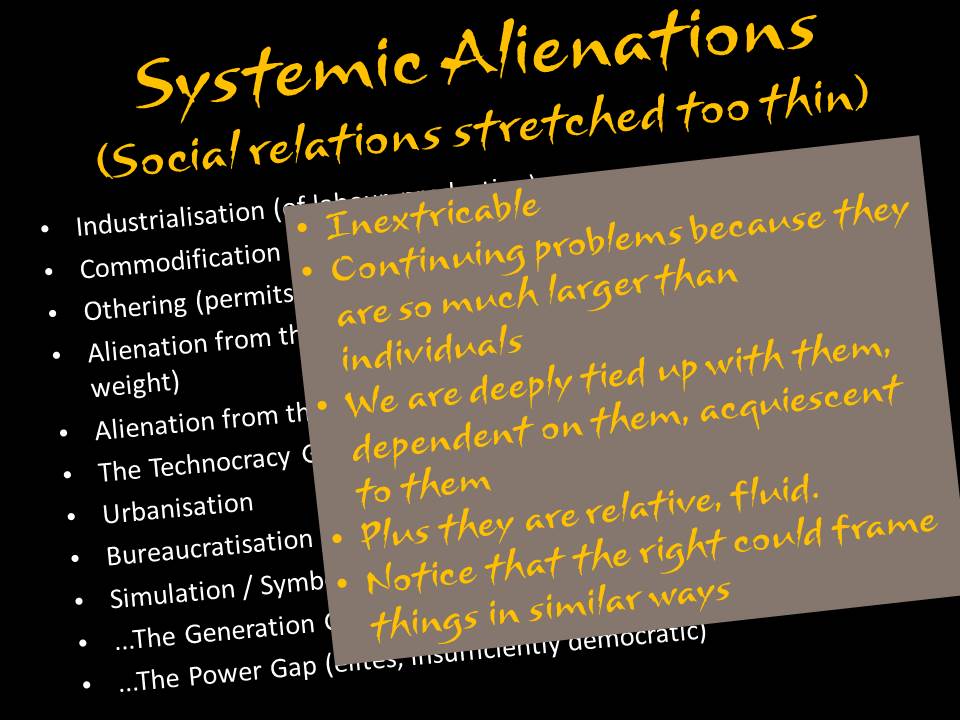


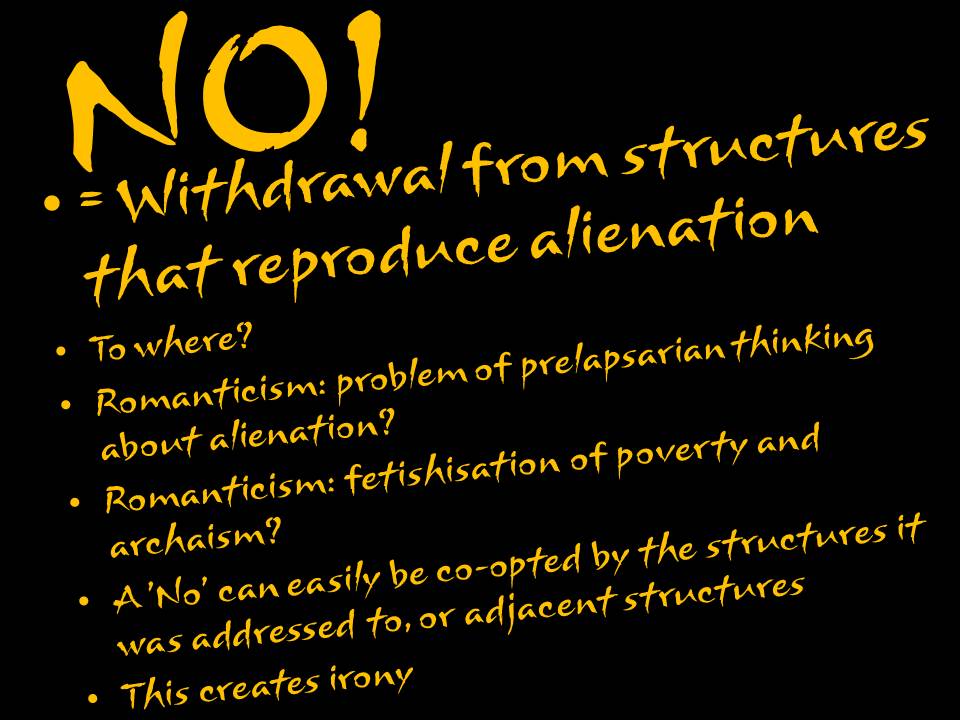

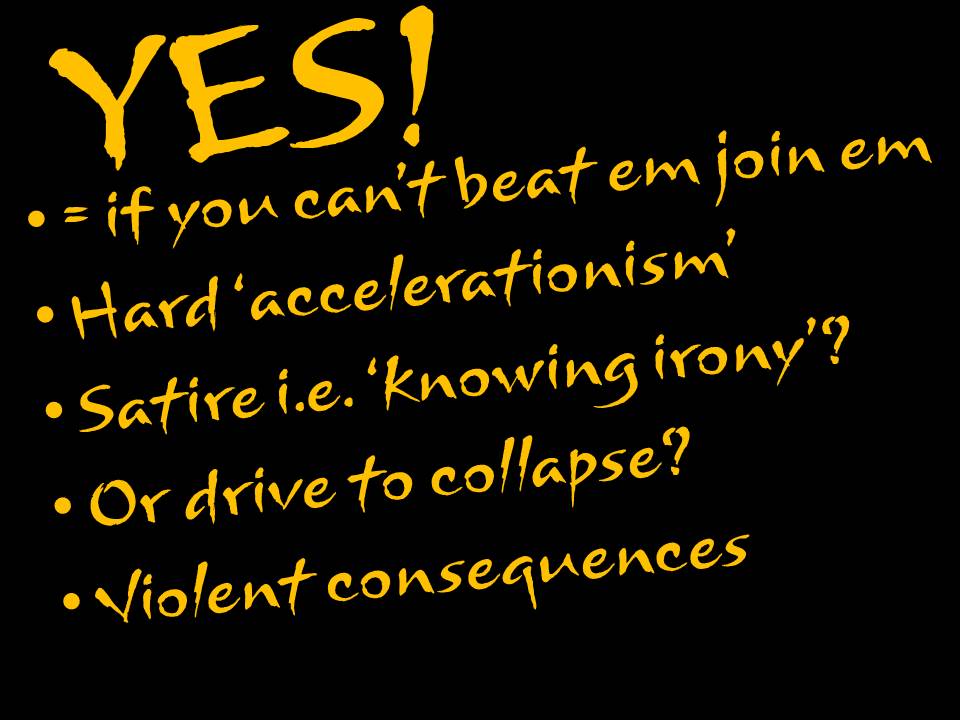
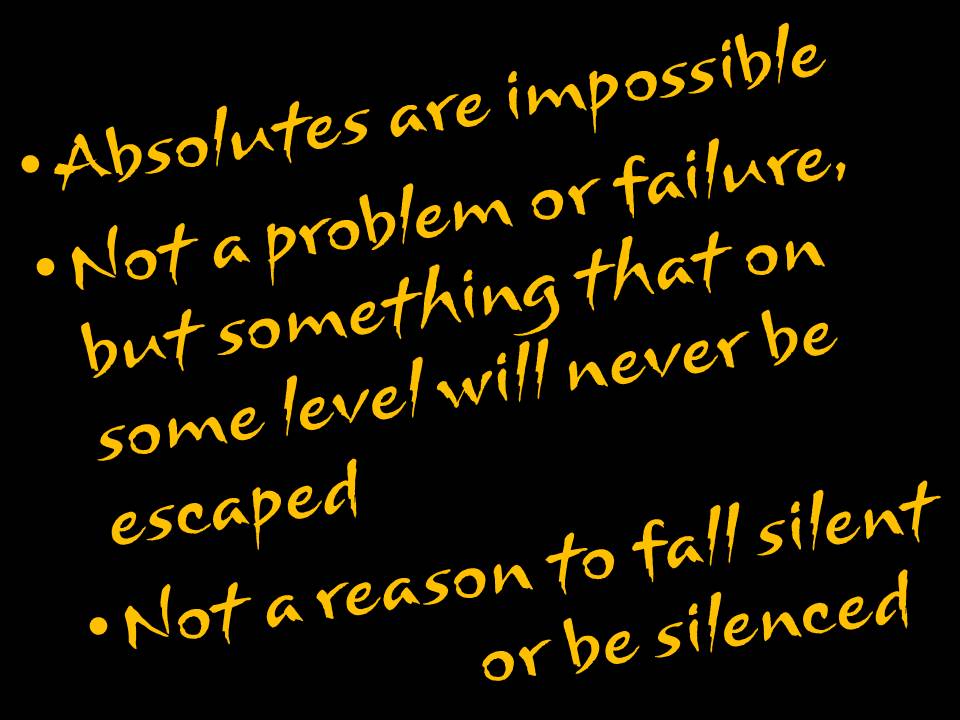
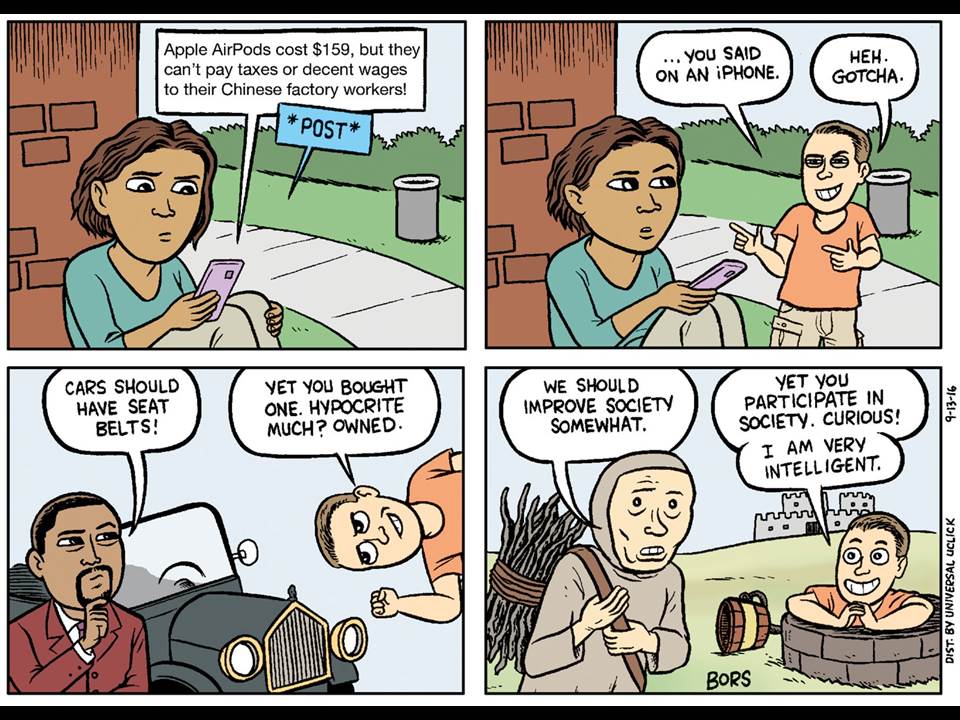
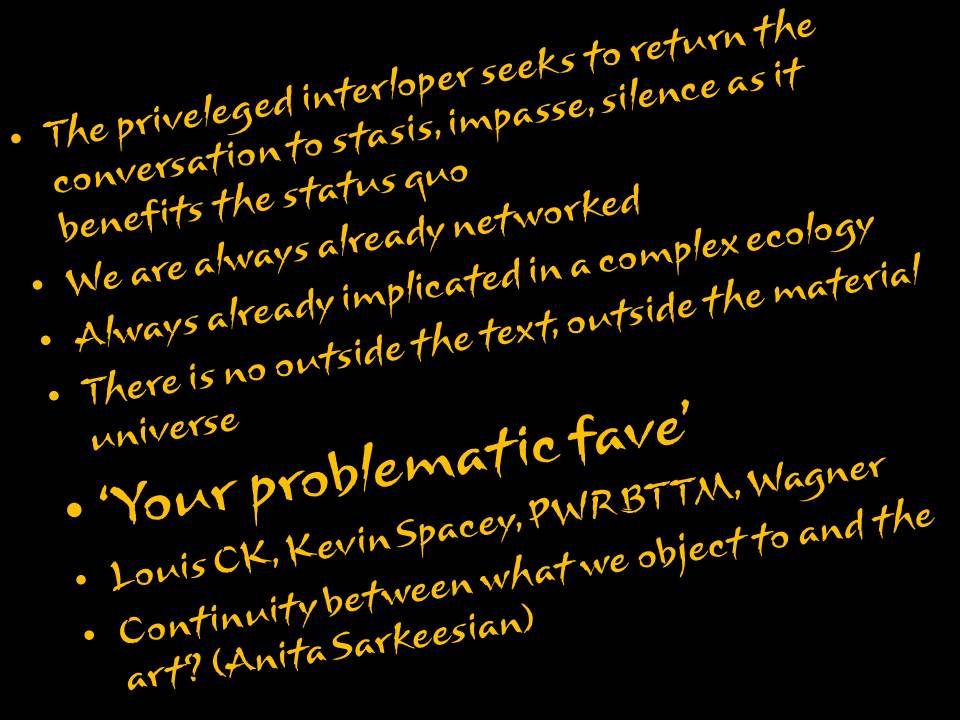 What Sarkeesian says:
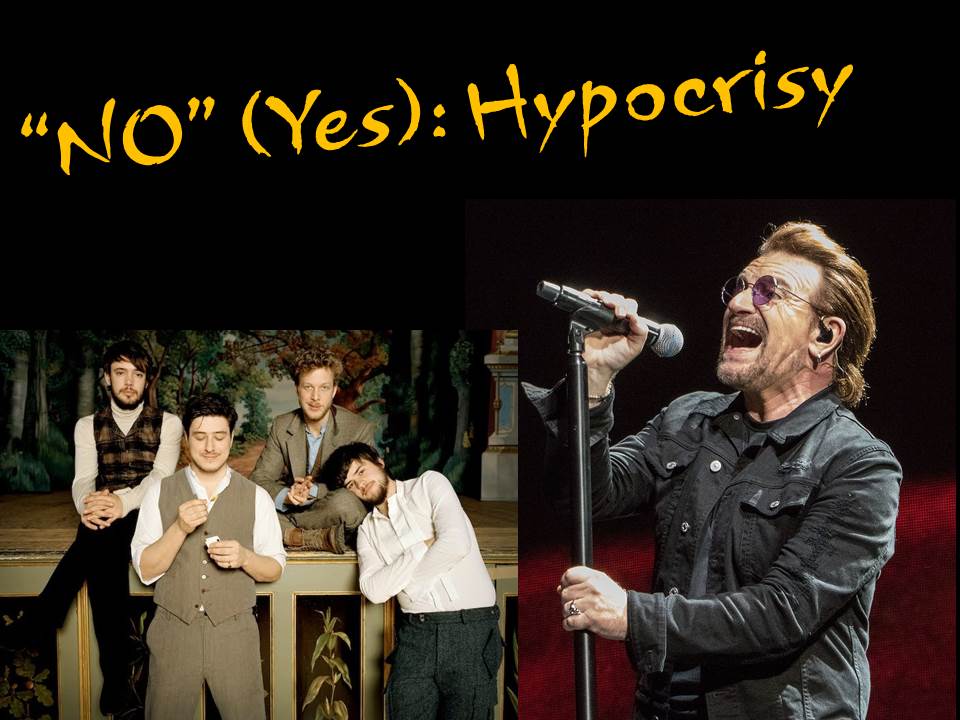
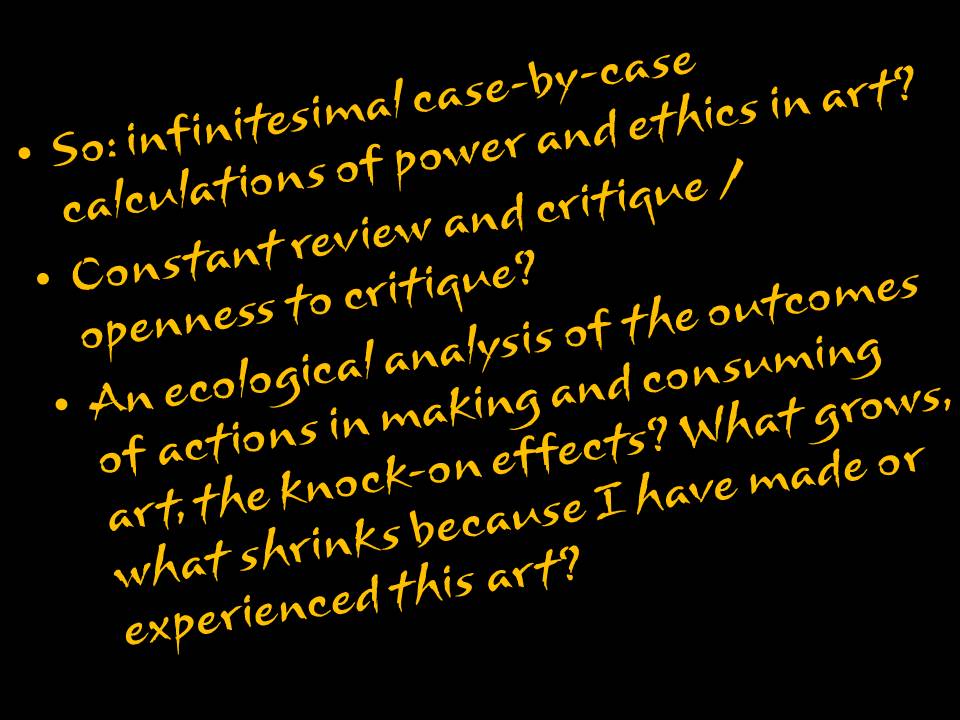
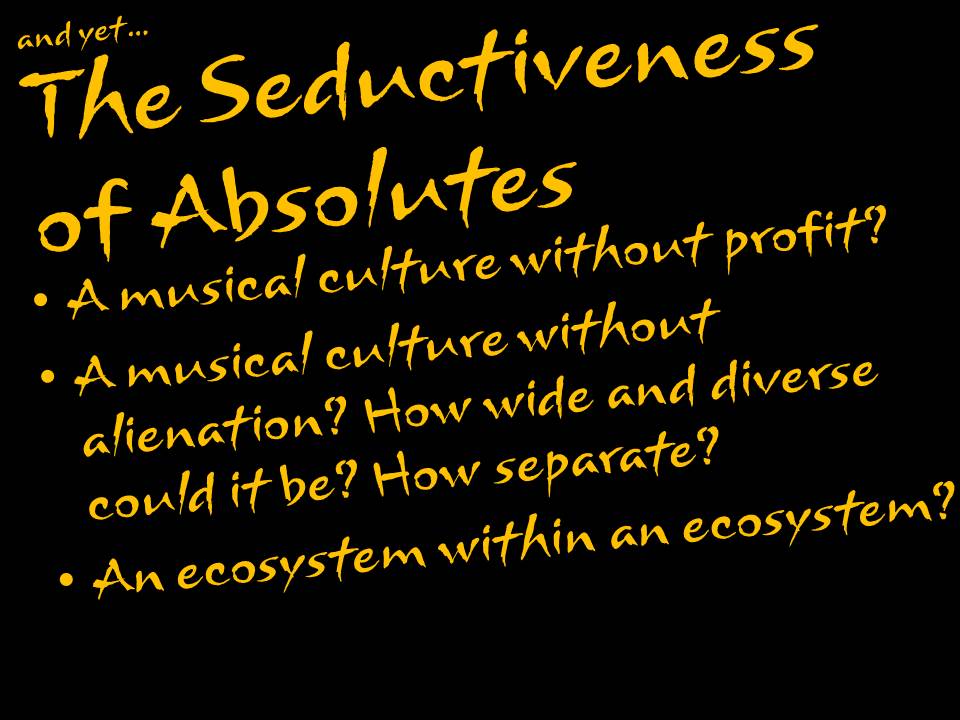
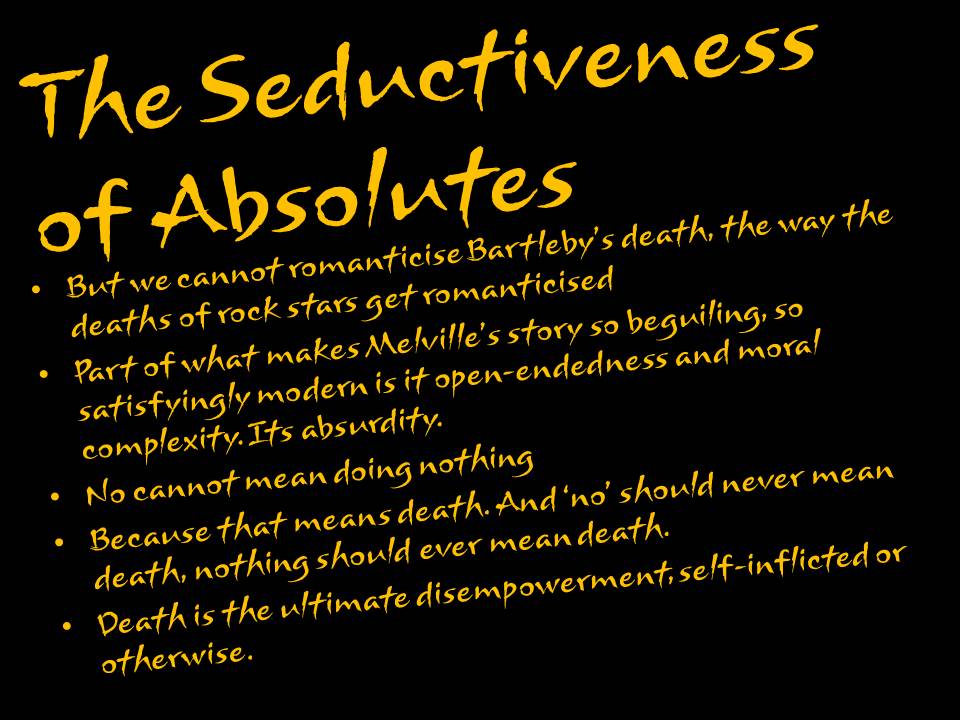
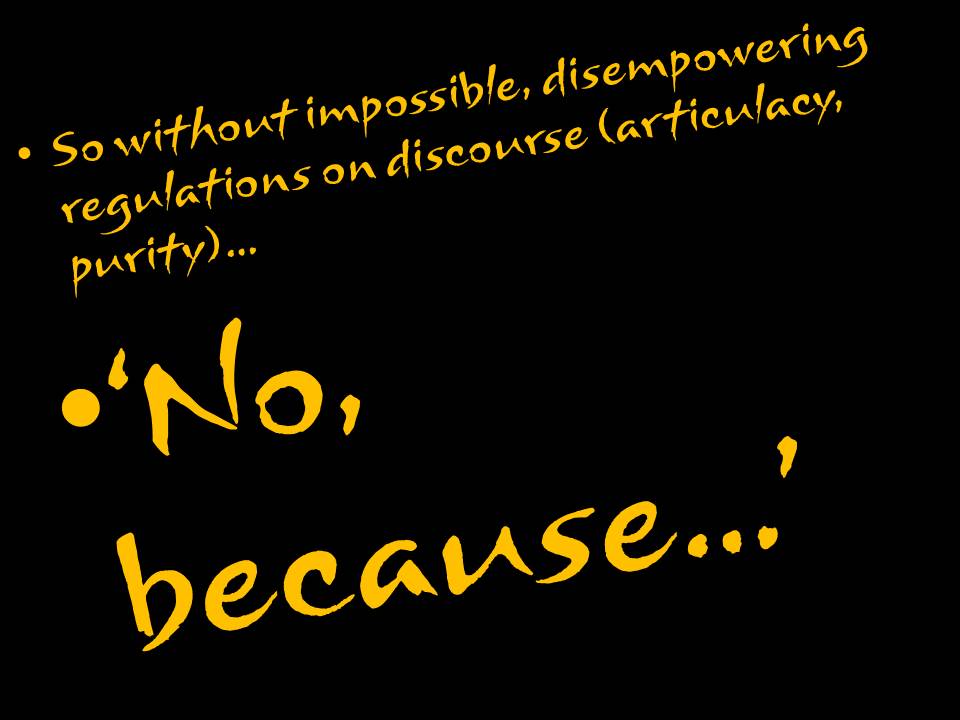
Include Me Out [ 14-Nov-17 6:06pm ]
M.E.S.H. - Hesaitix [ 14-Nov-17 6:06pm ]
M.E.S.H. must be an acronym for something but I haven't bothered finding out what - Making Electronic Shit Happen? - that's probably it. James Whipple does make shit happen - good shit - detailed, interesting electronic shit like Hesaitix. Listening to Mimic just now I kept thinking someone was outside my window, rustling about and banging something so I got up to look and heard that sound again, from the speaker. Whipple's a spook in the speakers, spiriting sounds like...like you can't say what, except for the tolling of bells on Blured Cicada I...and now he's playing ping pong with Robert Henke (you know that sound?), who must be a spiritual brother of sorts, a forebearer, you might say. The difference being the beat, absence of the regular Tech motor Henke uses; instead, more irregular, as on 2 Loop Trip. But whatever messing around there is, he keeps a feeling of movement...the percussion on Search. Reveal is one outstanding aspect of a proper shapeshifting intergalactic gro-o-o-o-ver - yes it is! Whipple maps the space-sound continuum brilliantly, singing the body and brain electric. Damned good.
A Fistful Of Dollars [ 10-Nov-17 5:21pm ]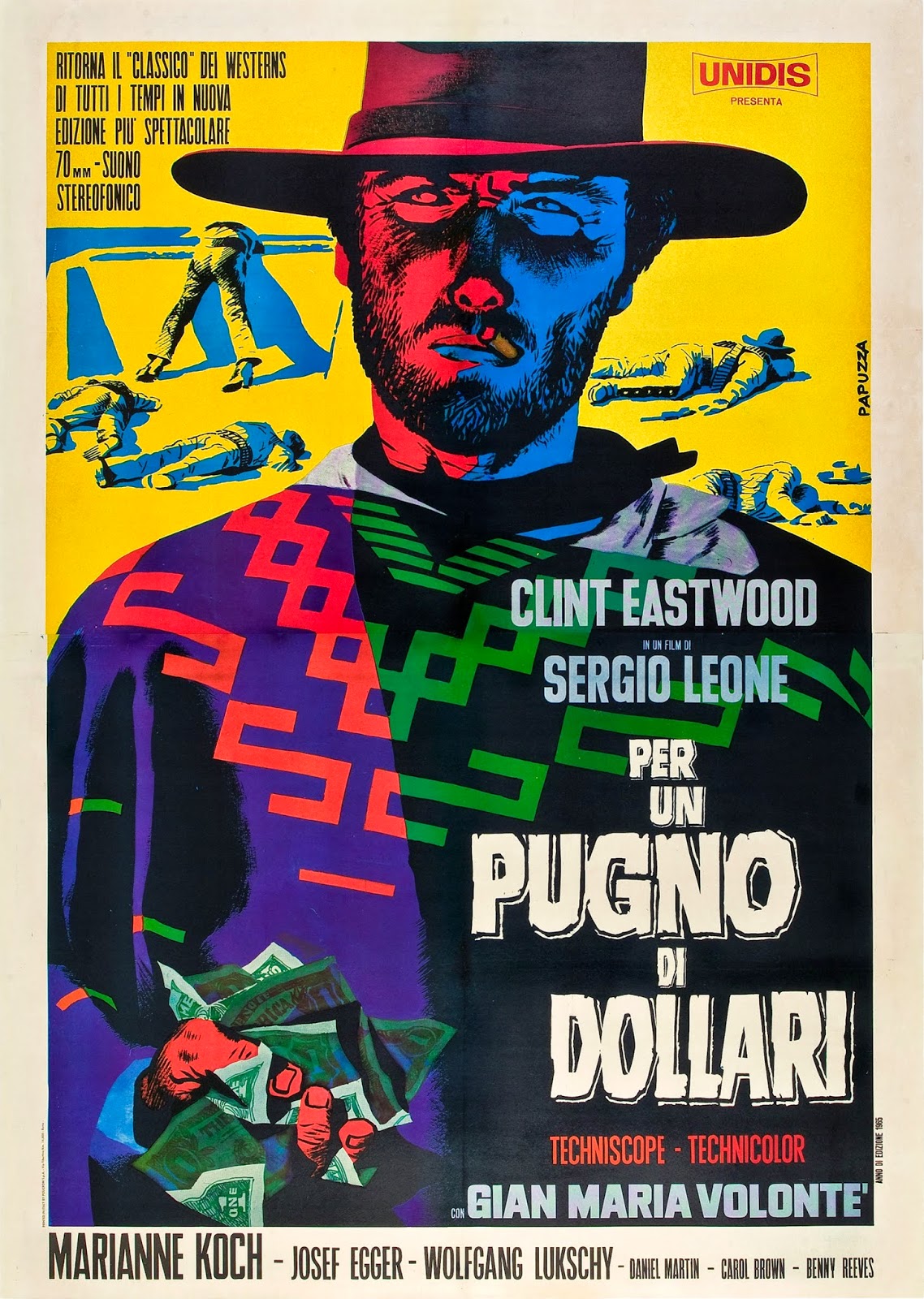
Bought a Clint Eastwood Spag Western box set a few weeks ago but only started watching it recently, beginning, (chrono)logically, with A Fistful Of Dollars. I thought they were due reappraisal, having not watched one all the way through for many years.
One of several things that struck me was the sound, which I only learnt the other day was dubbed on afterwards, thus explaining why every 'clip-clip' of the horses' hooves, jangle of bits and clomp of boots on boards seemed heightened, to the fore. Then the laughter; throughout bad guys spend a lot of time laughing. At times, it's as if some are high on something. The framing of some shots, of course, Leone's recognised for that now, so I wondered why this film, apparently, got such a luke-warm reception from critics. Couldn't they see the artistry involved? Perhaps they were blinded by the amount of gun smoke. If not exactly hailed as a bone fide 'classic' today, this and the subsequent ones are at least rightly hailed as unique.
One other thing that struck me was the similarity between the scene where The Man With No Name is getting his (swollen) eye in again, the shot of his gun hand as he practices to the sound of a militaristic drum beat by Morricone instantly brought to mind Travis Bickle firing to a similar beat by Bernard Herrmann. I may have imagined it, but as you know that military-style drum runs through the Taxi Driver theme.
One astonishing scene is the massacre of the Baxter clan. Leone doesn't depict this in a normal fashion, but hammers home the brutality with almost as many shots of the slayers as bullets they fire. It plays out relentlessly.
By coincidence it's Ennio Morricone's birthday today. The score for A Fistful Of Dollars is great, of course, although as regular readers will know when it comes to playing Morricone scores I favour his Giallo work. Watching the film reminded me of reggae artists' obsession with Spaghetti Westerns, often resulting in hilarious Jamaican/Mexican dialogue. So by way of honouring Morricone, I'm opting for one of those instead of anything by 'Il Maestro'. Featuring adapted dialogue from the film, the now famous coffin joke...
I Monster (feat Dolly Dolly) - A Dollop Of HP [ 01-Nov-17 5:30pm ]
Post-Halloween horror treat for you from I Monster: H.P.Lovecreaft read by Dolly Dolly (David Yates) - what's not to like? The musical accompaniment features students at Leeds Beckett University and is pitched just right, avoiding hauntology cliches, opting instead for a blend of dark electronics and even motorik rhythm. Yates' delivery is, as you'd expect, absolutely perfect. Time to throw another log on the fire, light a candle or two and watch the shadows flicker as your skin crawls. Superb. Available as cassette or download here.
leaving earth [ 3-Aug-17 10:47pm ]
hidden reflections of a dysfunctional world [ 03-Aug-17 10:47pm ]
If a golden age of musical originality and innovation happens and no one builds a movement and narrative around it, did it actually create anything new? Did it even happen? The last 5-8 years I've done my best to argue for and document the existence of a golden age of deeply original, shockingly new electronic music being made in the wide field opened by dubstep - hence using the overall term poststep. Apparently, though, very few seem to feel the same way. Arguably people like Adam Harper or Joe Muggs are to some degree on the same page, but mostly the consensus is that for the last, what is it now, 20 years I think, electronic music (as well as all other music) has been stranded in an endless wasteland of not being the ideal, shock-of-the-new-delivering frontier of cultural innovation.
First and foremost, this considered a symptom of the postmodern "end of history" declared by neo-liberalism. If the dizzying development of music during the 20th century is the very manifestation the human spirits thirst for the future, its visionary will-to-re-imagen, to grow and develop, then the lack of anything new, the endless, retromanic harking back to older forms for inspiration, obviously expose our current inability to imagine any alternatives - let alone a future being different from the present. But in that case, shouldn't we perhaps expect music to start moving again, now that the end of history is clearly over - indeed, shouldn't this already have happened? As far as I can tell, it hasn't. Or rather: In the last couple of years, music hasn't begun to move forward any bit more than it has done the previous 5-10 years. The twist, of course, is that I happen to be one of the few people who think, within electronic music at least, that those 5-10 years actually offered a cornucopia of musical invention, originality and brilliance fully on par with the progressive period of late sixties/early seventies or the post punk years, and close even to the early nineties golden age of rave-derived electronic music.
With last year being a kind of return to form for the poststep musical frontline, after a couple of years with a slight lull, I'm not quite sure if the golden age is still going on, or just offered a last outburst, but the interesting thing is that this doesn't change how things are seen, or can be seen. If you're in the camp arguing that everything is completely, retromanically stuck and doing nothing but recycling the past, then I see nothing happening now - and that hasn't already been happening the years before - that should make you change that point of view: Music hasn't suddenly started to be a way for todays youth to address and tackle the graveness of the times, despite living in a world that is seemingly falling apart. If, on the other hand, you've thrilled to the amazing stuff created from, say, 2008 to 2015, then you could still get just as thrilled in 2016. Perhaps this is a clue to what is going on: Not just that the feeling of being in a golden age or in a wasteland can be how the same music is simultaneously interpreted by different people, but also that these divergent interpretations might seem just as valid to both parties even though the zeitgeist is changing violently. You'd think it would change everything - that's how it's supposed to go - but apparently not.
So why is that? Well, there's obviously many different layers to this, but I think crux of it all is that something is indeed missing: Not the ability to create new and inventive stuff, but the ability to recognise new stuff - somehow were getting more and more unable to feel the thrill of the new, even when directly confronted with it, and as a part of this: We seem unable to construct the surrounding narrative of innovation and upheaval necessary for this. Which is why we're not getting that narrative even now, when it would seem bound to pop up. Remember how it was possible for a lot of people to take even grunge as some kind of forward-pushing "movement", despite being largely a media construct, and practically consisting entirely of reheated rock leftovers? Even if there weren'tany even remotely new music around now, it certainly seems like it should be possible to construct narratives of boundary-pushing musical subcultures in the current political climate - but alas, it hasn't happened, even with actual boundary-pushing music around.
The narrative of endless retro-stagnation has become so internalized that it's a self-fulfilling prophecy by now - the very lack of anything truly new is pretty much presented as established fact by most leading critics, of which the best, most convincing are most likely Simon Reynolds and the sadly late K-punk. With the latter, cultural stagnation was an integral part of his Capitalist Realism-analysis, and it certainly makes sense: In a culture unable to even imagine the world being different, how is it possible to create something new? If a culture has completely internalised the notion that all it can do is pick n mix the riches of the past, how can it do otherwise? Well, first of all, I think it's pretty clear that a lot of electronic artists actually don't accept that recombining previous innovations is all they can do. Instead, they're often very actively looking for strange new openings, trying to make something "fresh" The way hordes of hipster beatmakers immediately and eagerly tried to utilise (and twist) the innovations of more "authentically" grown styles like wobble, footwork and trap, clearly shows the thirst for something novel, and the sheer, almost exhibitionistic delight many producers took in creating unrestrained-bordering-on-dysfunctional musical weirdness suggests that it was crucial for them to pledge allegiance to electronic music's heritage as the frontline of innovation.
If anything, I think many of the producers of what I've been calling poststep were fighting a desperate battle to prove that they were indeed still making new things, not least because they were constantly told not only that they weren't - as old farts have always told young turks creating genuinely new stuff - but, more crucially, that they simply couldn't, that it was historically impossible! And as a result, you often get the impression that they didn't even believe themselves that what they were doing was as amazing as it was, they never got into celebratory mode, never rode a crest of victorious excitement. Instead they constantly had to fight, never able to prove to the retrologists that they were creating the shockingly new, and consequently, they were never allowed to feel that what they did was exactly that. But, you might say, if it really wasso great, shouldn't they simply be able to not care what the old farts were thinking? Well, this is where I think the suffocating effect of the end-of-history mindset sets in - I'm not questioning that it's there -, it's just that its result is not in an inability to create something new, it results in an inability to recognise and believe in newness, to be exited by it and letting it ignite a broader, culturally significant movement.
At this point, I suppose I should probably try to back up my claim that an abundance of thrilling newness actually was created during the last 5-10 years. How do you really determine how "new" or inventive a piece of music is - after all, even though I hear some music this way, many others clearly don't, so it's obviously not enough just to listen and say whether you think it "sounds new". Specifically, Reynolds actually did listen to some of the stuff I've been raving about, but even though he did find some of it exciting, he couldn't "quite hear" the formal originality that had been blowing me away, deeming it basically just a combination of existing things. Obviously, the sensitivity to whether music has reached mutational escape velocity can be very differently calibrated, but the question is why?
A possible critique of Reynolds is he is obviously, at least to some degree, a man with a theory he wants to support - if his conclusion is already that things are not moving anywhere, he might very well scrutinise anything supposedly delivering something new, deliberately looking for the recognisable, pre-existing elements (which all music obviously contain), while at the same time underrating the things that are different from post forms. I suppose this is why it took him so long to recognise the new thing going on in dubstep, for years maintaining that nothing really was going on, until it eventually became undeniable with full on wobble. Similarly, his critique of the new wave of "art grime" seems weirdly to mirror "real punk" evangelists moaning about middle class art wannabees not keeping it real, making pretentious (and, I'd certainly say, "superficially jagged and challengingly ugly") art rock - as he himself describes in Rip It Up, where he's fully on the art-wankers side. But grime shouldn't be abstract or emotional or have any other kind of arty pretentions, because the style is by definition meant to be raw, functional backing tracks for MCs delivering its one true essence - its street cred approved will to succeed, to break in to the pop mainstream and take over. Heaven forbid that anyone would think of doing anything different with this music.
All that said, I think it's not so much a matter of deliberately ignoring evidence contrary to the retromania hypothesis, but more of being a victim of the same internet glut that is usually seen as the reason young people can't create anything new: Having all of music available all the time, they're simply stunned by too much inspiration, as well as by the feeling that everything has been done before. But why shouldn't the same be the case with critics? If by 1980 all you had heard before had been mainstream rock and pop, it would be easy to get blown away by Pere Ubu, DNA, Cabaret Voltaire and the early Scritti Politti, thinking it must be the most insanely inventive, radical stuff ever. If, on the other hand, you were already familiar with Conrad Schnitzler, Faust, Henry Cow and the early Red Krayola, then you could certainly say that the new stuff of the post punk years wasn't really that new - that is was a combination, not a direction/mutation. I'm not saying post punk wasn't an amazing cornucopia of invention and originality, but it certainly must seem much more mind blowing and shockingly new if you haven't heard the predecessors. Personally, I clearly remember being deeply underwhelmed when I finally got around to hearing Throbbing Gristle and Suicide - often not easy stuff to obtain in pre-internet days. As someone well acquainted with Schnitzler, Schulze and sundry electronic avant garde, these legendary artists sounded slightly poor and uninspired by comparison.
This is further illustrated by the way K-Punk use music to argue for the overwhelming cultural stasis under capitalist realism, here taken from "The Slow Cancellation of the Future"-essay: ...faced with 21st-century music, it is the very sense of future shock which has disappeared. This is quickly established by performing a simple thought experiment. Imagine any record released in the past couple of years being beamed back to, say, 1995, and played on the radio. It's hard to think that it will produce any jolt in the listener. On the contrary, what would be likely to shock our 1995 audience would be the very recognisability of the sounds: would music really have changed so little in the next 17 years? Contrast this with the rapid turnover of styles between the 1960s and the 90s: play a jungle record from 1993 to someone in 1989 and it would have sounded so new that it would have challenged them to rethink what music was, or could be.
I think there's both a correct and an incorrect assumption here, with correct one probably being the best demonstration of why I think the overall conclusion is misleading. First the incorrect one: It is simply not right that you could take any record from 2012 and play it in 1995 and it wouldn't sound weird, new or unrecognisable. There was nothing in 95 that sounded like what Jameszoo, Starkey, Montgomery Clunk or Jam City were doing in 2012 - to take just a small selection of that year's most original posstep riches. But, some might counter, all that is just, like, updated IDM or hipster club-music - not essentially different from the original strands of IDM and experimental techno already developed by 1995. Well, perhaps, but only in the same way that post punk was basically just updated fringe art rock and avant garde electronics - not essentially different from the original strands of astringent prog, kraut and cut up experimentalism. In both cases, you can identify the tradition and the predecessors - if you know them - but that doesn't mean that things are the same, or that it isn't blindingly obvious that this is new stuff. You can find lots of dysfunctionally weird beats and mangled soundscapes in nineties IDM, but again: None of them sounds even remotely like the fractured syncopations and hyper-coloured structures of the aforementioned 2012-artists. Or at least, if anyone does, I've certainly never heard them.
Of course, you could probably take most current or 2012 mainstream pop records and they wouldn't seem particularly weird in 1995, just as you could take a lot of different underground music - both rock and electronic - and it would be almost the same in 2012 as in 1995. But then again, you could also beam back the majority of mainstream 1993 pop, as well as a huge selection of underground music (indie rock, chill out/ambient, house, early minimal techno), and it would be readily recognised by the people of 1989. Heck, a lot of it would certainly make people 17 years earlier wonder how so little could have changed. Just like the forefront of the current deliberately-trying-to-be-new stuff is more or less unknown to the vast majority, so was most jungle and rave music in 1993, to say nothing of the most out-there post punkers in their heyday. It's connoisseur stuff. Sure, sometimes it really crosses over into wider audiences, and most people will know about it, but it doesn't mean they listen to it regularly, let alone feel any particular future buzz (rather, it's often something like: "is this absurd noise really what people call music these days?!").
I happen to work with a lot of teenagers, and there's a contingent of them into electronic music, which basically means the omnipresent EDM-trap-sound. This is perhaps the most recognisable current trend - even something a lot of people seem to know about - and not something anything sounded like in 1995. It just doesn't mean that it's what everybody is into or acknowledges as "the new thing". By far the majority of the teenagers are basically into rock and pop, r'n'b or metal - just like they've always been - and just like they were in 1993! Sure, everybody knew about techno back them, but most people (perhaps except some places in Germany) sure didn't care for it. Where I came from, there was an OK rave underground, but it was miniscule compared to something like the indie rock underground or the metalheads. Even now, when people talk about what happened the nineties, the talk about either eurodance, or, if it's supposed to be "real music", goddamn grunge. And when jungle broke through shortly after, it was hardly even recognised outside of England. Perhaps if you lived in London, you could feel that you were living through an incredible golden age of invention, but the rest of the world didn't notice until it filtered out through adverts and David Bowie.
To feel that you're living in an age of exhilarating future shock, you have to be both open to the shock of the new, and you have to actually encounter it. Certainly, a lot of people encountered jungle in it's heyday, but even more people didn't, and if they did, it was only fleetingly, and not something that made them think of the first half of the nineties as a pinnacle of musical innovation. However, the point is - and this is where K-Punk was definitely, unquestionably right - the first half of the nineties was a pinnacle of musical innovation. It's just that to see it, you have to focus on the places where that innovation was taking place. And if you're part of that place - even if it's only as an observer -, you're most likely not even aware that you're focussing on something most people doesn't see or care about. Yet, when you do focus, when you're aware of the unbelievable speed and wildness of the evolution going on, its magnitude is overwhelming.
Which is exactly why K-Punk's example is correct, but also misleading with regard to the argument he's making, because nothing is really comparable with the incredible, Cambrian-explosion-like blast of creativity that in just a few years brought forth just jungle, but also bleep, gabber, trance and first generation IDM. But jungle is of course the ultimate example of hyper-accelerated musical evolution, of something so shockingly new and unprecedented that it's practically unrecognisable. Well, to be fair, even without following the development of jungle in real time, when I eventually heard it I could certainly hear that it came from Prodigy-style break beat rave, which again I could recognise as being somehow based on sped up hip hop beats. But that doesn't change how unbelievably, unquestionably new and forward-thinking jungle truly sounded (the early Prodigy too, come to think of it) at the time, for someone thirsting for the newest, most futuristic music around.
It shouldn't be surprising that the musical developments of the last 20 years are not on the same level as what is arguably the greatest eruption ever of musical innovation, in the shortest possible time. Heck, the 20 years from, say, 1965 to 1985, doesn't really compare. Sure, an amazing shitload of innovation took place, but was anything really as jarring, as incredibly different from anything going on before, as jungle or gabber? Well probably many would disagree, but then, the point simply is: The poststep innovations made from something like 2009 to 2014 were maybe not as great as those made in the first half of the nineties, but that is a bar so high that not passing it is absolutely not a proof that nothing exhilaratingly new happened. To return to my favourite comparison: The post punk years yielded an amazing amount of newness, but almost all of it within already established traditions of experimental rock - just like poststep has come up with an equally overwhelming abundance, and almost all of it within established traditions of experimental electronics. Even if we take everything going on in account, including electro and full blown wobble-EDM, neither the postpunk nor the poststep era delivered anything as radically new and game-changing as the inventions of the early nineties rave scene.
What the most inventive post punk and poststep had in common, is that a lot of it was self-conscious experimentalism, art-for-arts sake, weirdness as a goal in itself. And listening to the music, I simply can't hear any evidence that postpunk was more successful on those terms than poststep. Take the most original postpunk creations, whether in terms of pure, extreme abstraction (say, No New York or Voice of America), or in making wild innovations workable components of highly listenable new pop hybrids (say, Remain in Light or Chairs Missing), and I'd like to know what actual musical elements made them more new and revolutionary, compared to the experimental music that came before, than the Zomby ep, Sich Mang's Blwntout, Slugabed's Ultra Heat Treated or Krapfhaft's First Threshold. That the post punk classics are seen as more successful on those terms, though, is abundantly clear. The four mentioned postpunk records are considered classics, and know to everyone interested in rock and pop history. The four poststep records are virtually unknown. But rather than drawing the conclusion that then they obviously didn't offer anything sufficiently original or interesting to make them milestones, can anyone actually point out the in-originality? What previous music is sounding so alike these poststep records - i.e. much more alike than the postpunk artist were alike their predecessors - that you could argue they're just making small adjustments to or combinations of already established forms? I can't find it, and instead I think it's more relevant to search for a reason for why the originality of poststep is unacknowledged, than to claim that it simply isn't there.
Perhaps the history known to future generations will only be the history written by the winners, but the history written while it is happening is also written by the believers - who might eventually become winners, determining how we understand the past. Rock history is a prime example; once seen as primitive, juvenile trash, its history is now considered an important subject with its own priesthood of serious critics. And, paradoxically, the believers who eventually became winners - critics like Bangs and Christgau - reversed the values so that the juvenile primitivism became the hallmark of rock authenticity, what separated the "good taste" of true rock from what is ridiculed as tasteless, self-important trash, like prog, goth or stadium rock. In the postpunk heyday, though, that was still a revolution in progress, and if you weren't part of the theoretical front line (like the British music magazines), you might not even have noticed the fights going on. New pop might have reached the national charts, but how many "ordinary people" - i.e. not music nerds -living in the post punk years had actually heard about The Fall or The Raincoats, Pere Ubu or The Contortions? Even Joy Division was mostly a cult group (though the cult was certainly huge), as they remain today, even despite critics talking about them like it's an established, scientific fact that they were bigger than The Beatles, and at least as important - much like Nick Cave, who apparently, in their minds, is the pinnacle of human culture.
When I recently read some old issues of a local film magazine, during the postpunk years also covering music, its rock critics acknowledged that, sure, some slightly new things were going on, but they clearly weren't thinking they were living in some golden age of unrivalled innovation. All rock music was analysed and understood through the lens of what had gone before, and was more or less classified within established traditions, developed in the sixties and early seventies. They had the same music available as the believers of the British music mags, and yet, they weren't feeling shocked by the new, even though it was staring them in the face. Had the believers not existed, would we, today, recognise postpunk as golden age? And even though everybody now recognises some "important" central names - Joy Division, Talking Heads, Throbbing Gristle, The Human League - would people interested in rock history recognise those groups as just the most recognisable trendsetters in the otherwise amazingly complex, interwoven cultural upheaval described in Rip It Up, if it wasn't for an über-believer like Reynolds? And interestingly, while Reynolds' believing sort of managed to change the focus of dance music history from singular, crossover-prone artists to the runaway inventiveness of intensity-seeking rave scenes, that shift still only happened within dance music fandom. Mainstream (popular) music journalists are still centred around "authentic rock history", and still don't recognise that anything really happened in nineties rave culture. Sure, they'll grant that a whole heap on new dance genres emerged, but how "new" were they really when they were constructed from samples of old music? And besides, it was just dance music, just flashy fads, not dealing with important issues of the human condition - such as being an angsty, horny teenager - like rock music.
To those not invested in music, postpunk was no more an age of future shock than the present. The majority of mainstream music journalists most likely recognise it as such, and yet they don't see the golden age of rave music, K-Punks crown example, as a time of particularly future shocking music. The believers, of course, know that it was, but so far, their cause hasn't won, hasn't shaped mainstream music history. Is it because there aren't enough of them? I don't think so, it seems all kinds of nineties underground dance music has huge web communities. But perhaps that is exactly the problem: Everyone can find a group of likeminded fans, but as a result there's no need to fight for the cause in a broader public framework. Before the internet, you had to become a believer and fight publicly for the stuff you loved, if you wanted to see it succeed and prosper, and if you wanted to find anyone to share your passion. Column inches were limited, so if you didn't push your favoured genre, they would go to lesser, unworthy contestants. Now, the problem is the reverse; you can write endlessly about whatever you want - as I've been doing here - and it will make no difference. Who has time to explore, let alone discuss, unfamiliar stuff anymore, when there's already a near infinite amount of discussion available about the things you already love?
I think it's pretty obvious that this is a part of the reason why poststep doesn't have the believers necessary to make its incredible abundance of invention and originality recognised. There's no need to be zealous when you apparently are able to reach your goal - find the community and recognition you seek - right away. But it's not the whole reason, because shouldn't a poststep believer have a bigger goal than that? Shouldn't the current producers have the same zeal to conquer the world and let everyone know that they are the future as the rave and postpunk (and prog and rock) believers had? Regardless of whether the stuff you make actually do change the world in any significant way, you should still be convinced that it will, that it has to. This is missing now, and the reason it's easy to think nothing new is truly happening - poststep producers (and fans) should by all means be backed by an unyielding belief that the music they love IS the future, IS the most out there, radical, new shit around, but they simply don't. The end-of-history narrative is so internalised, the ubiquitous presence of the past so suffocating, that they're simply unable to believe. When you see reviews of new electronic records, you'll very often have the critic trying to excuse that the music isn't some kind of completely unheard new genre created ex nihilo, say that 'yes, it is admittedly built upon elements of this or that genre, but yet it isn't just a rehash of past stuff, because there's these original touches here and there'.
Now there's obviously plenty of records that are indeed just recycled older styles with a more or less insignificant veneer of contemporary hipness, but the strange thing is that this need to explain that something actually is delivering something new is even felt when dealing with stuff that, by all reasonable accounts, are indeed deeply original and forward-thinking - I've done it myself plenty of times. Remember how Kuedo's Severant was basically considered a retro record, its claim to newness only slightly redeemed by its use of footwork and trap-elements. Despite the Vangelis influence being very clear, though, Severant didn't really sound like anything made before - the fusion of cosmic synthscapes and miniaturized ghetto beats perhaps worked so seamlessly that it didn't grab you throat by its strangeness, but it was nevertheless deeply original, as the countless records using it as the blueprint for further developments demonstrates. Compare with something like A Kiss in the Dreamhouse. The influence from psychedelic rock on that is very clear indeed, yet, as far as I know, postpunk critics didn't feel any need to defend it from being seen as a retro record. Similarly with the afro funk and juju-elements on Remain in Light, they were seen as a part of what made that record a milestone of innovation, and not as a recombination of already known music. All these records are brilliantly using elements of older music to develop something equally original, and yet when we talk about Severant (and several other poststep records just as brilliantly utilising fragments of the past) we for some reason focus on "using older music" and feel a need to excuse it (unless we want to draw the conclusion that it's nothing new, of course), while with the postpunk records "developing something original" is the main thing, and that it is done using older forms doesn't seem to be a problem.
Why is that? Partly, there's the problem of musical omniscience - the use of "exotic" sound-sources seems a lot less exotic when you're familiar with them, having all the music of the past both available and greedily consumed (there's not really "forbidden zones" like with postpunk, where the use of different kinds of hippie music might seem extremely original to the casual listener, simply by not being recognised). When you have seen the building blocks, you can't really unsee them, and unlike postpunk, poststep is probably very rarely functioning as a gateway to unknown musical riches, because the listeners are pretty much on the same omniscient level as the producers when it comes to those riches. But more importantly, the end-of-history-mindset simply doesn't allow us to believe that we're part of a conquering movement, able to change anything.
In the late sixties/early seventies, you could believe that it was possible to transform all of society in a fully positive, utopian way, and music both reflected and embodied that. When we reach punk and postpunk it's horribly clear that that hope had been completely crushed by reactionary forces, and instead we got a movement that was still trying to transform and confront society openly, but now more like a sort of resistance, subverting and destabilising the existing order from below, rather than trying to convince it nicely from above - and again, this is reflected and embodied by the music. With rave, it is clear that this strategy didn't work either, and now the only option left to do something actively for a better world is creating short lived parallel societies, unbound by the rest of the world, but also unable to transform it in any way - the TAZ as defeated escapism. Still, the music reflecting and embodying this was by no means less inventive than the previous era's music of victory and resistance.
Since then, even this last refuge of belief in the transformative power of music and culture has dissolved, and even though the supposed liberal-capitalist utopia at the end of history - which never really fulfilled its promises in the first place - is now falling apart all around us, the belief in an alternative, in the ability to act, remains largely absent. And the music reflects and embodies this - you can create an endless stream of strangeness and newness, and build worldwide connoisseur communities around it, but it's all build within a parallel virtual dimension that is not only no threat or alternative to the established world order, but rather a product of it. If you want to create any kind of community around music, there seem to be no way around the online mirror maze, which will eventually absorb and assimilate anything, turning it into just another random fragment in its entertainment-and-self-surveillance-fractal.
This is the conditions under which poststep is produced, and in that light, it's a true expression of our schizophrenic, bipolar zeitgeist - its fractured structures either dissolving into entropic decay or juxtaposing absurd, hyper-agitated angles, its unreal soundscapes either summoning the hopelessness and sorrow of dead futures, or unfolding ultra-coloured, nausea-inducing stimulation-overdoses. Equally a dazzling spectacle of alien shapes and inventions, and a terrifying premonition of the reality of decay and emptiness hidden behind infinite layers of entertainment and distraction, the best of poststep offers not a music to build the belief of an alternative around, but rather a reflection of the condition under which the very ability to construct such an alternative is non-existent.
When Reynolds say that what is missing is postpunks "expressive intent andcommunicative urgency" or first-generation-grimes "social expression" and"individual hunger", he's basically right. If that's the kind of excitement you're seeking from new music, nothing is going to deliver it. But then again, if your reference points were established in the sixties and early seventies, and you'd expect forward-thinking music to be an optimistic force, imagining positive futures, punk and postpunk probably didn't deliver the excitement you were craving (I think Bill Martin's brilliant book on prog, Listening to the Future, is a good example of this mindset). And if you're expecting music of social importance to actively try and engage directly with the course of society, then certainly rave could very much seem more like escapism than something igniting your social excitement. If social urgency and individual hunger is the only parameters to deem music interesting and relevant, then it has definitely been diminishing returns since the early seventies. You have sort of ensured that nothing will probably be really exiting anytime soon, and that times are as dire as you'd like to think - which of course they are, only not in a way that makes truly exciting music impossible. Also in this respect, the retromanic mindset is a self-fulfilling prophecy.
In the end, I guess the feeling of having been stuck for twenty years can be justified. During that time there hasn't really been a musical movement to believe in in the all-consuming, righteous way where you could convince yourself that you were part of a future unfolding in advance, being swept away by a huge contingent of people - or at least a contingent certainly feeling huge, much huger than it most likely actually is - collectively knowing that they're transforming the world around them through the power of art and imagination. Having felt this way during the nineties rave explosion, I can certainly feel the lack of a musical development so powerful that it's greater than its parts, making it seem important to be alive just to be a part of it. Nothing has really been on that level afterwards - the first wave of grime was promising, but didn't quite deliver a punk-like shock to music that many hoped for; dubstep almost got there, fulfilling its promise by turning into the inescapable noise of wobble - so undeniably original and so successful that for a few years it seemed unstoppable, known by everyone, even if they mostly hated it. Then it sputtered out, like punk, and was followed - also like punk - not by a new genre, but rather by a polymorphous patchwork of weirdness and invention, the sprawl of fluctuating, overlapping para-genres that I collectively called poststep.
While wobble might have shortly recreated the intensity and run-amuck excitement of rave, it didn't recreate rave's overall sense of tearing down an old, dead regime and collective beginning the establishing of a new order, and it didn't include the sense of explosive potential for social transformation that punk passed on to postpunk. As a result, even though poststep was deeply invigorated by dubstep's success, impregnated by an overload of ideas and evolutionary potential, it didn't establish a social excitement and individual hunger around this incredible surge of creative energy. Eventually neither poststep itself nor the dubstep movement preceding it had the ability to transform the ingrained outlook of people living through these times, not matter how much shockingly new material it delivered. I'd dare say that had jungle, or rave, or acid, or postpunk, or prog, or psychedelia, or rock'n'roll, been happening for the first time now, it would not have fared any better. All of those musical revolutions happened in times where some sort of belief was possible, although it had to be redefined as time progressed. The music didn't feel transformative because it delivered a future shock - it was delivering a future shock because it happened at a time where people were still able to be shocked.
Perhaps the lack of social urgency is felt as a bigger problem by the generations that has actually been living through previous communal golden ages, than by the generation creating most of poststep today. It's obvious that many of them really want to create something truly new and original, and feel frustrated by the overall consensus that what they're doing is not really breaking any new ground. They might actually be much more conscious than anyone before, about whether what they're doing is new or not, simply by being met by much higher standards of "newness". And yet, just as they might strive for innovation at some points, they often seem just as satisfied with creating facsimiles of old styles, finely crafted pastiches and educated deconstructions. It's probably that, more than anything, that makes people of the generations before wary of acknowledging them any true inventiveness - if you've always associated the creation of the new with the creators utter dedication to that newness, to the future heralded by it, then the way contemporary producers just treat innovation as some sort of aesthetic game to play among many others, rather than a matter of life, death and social transformation, must give you the impression that they're not really up to it. What I think it shows is that even though poststep producers might long just as much for future shock as anyone before them, they're not longing for a socially transformative community build around it. Not because they don't want to be as dedicated to their art as previous generations, but simply because they're unaware that it can have that power, having never experienced the feeling before. To those who hasexperienced it, the sociological aspect is missing, and they draw the conclusion that the music just isn't sufficiently new, because otherwise it obviously should have created the same social investment in its fans and creators as rave or postpunk did.
The poststep producers most likely don't feel this lack, having grown up in a world where music simply doesn't play that role anymore. But to us who have experienced music in that way, something obviously is missing, our addiction to the future rush comes as a package where the transformative power of truly forward-thinking music should be a given. Always looking for more newness, yet each year harder to convince now we've heard it all, constantly suspicious and demanding hard proof, asking ourselves 'is this really it, the new thing, worthy of my belief in it?', rather than simply giving in and revelling in the brilliance in front of us. We long so much to be overtaken by a new musical revolution, yet dare not believe in it unless we know for certain that we'll get exactly what we long for, the whole package just like last time. So in 2010, when I finally realised that there wasn't just an unusual amount of unusually fresh sounding new music around, but that rather what seemed like a veritable tidal wave of the stuff, coming from all sorts of strange directions, it wasn't easy coming to terms with what was going on, because this unexpected arrival of a new golden age, suddenly realising I was in the middle of it, wasn't anything like I'd expected, there wasn't cries of triumph all over the place - heck, grime and dubstep had been much closer in this respect -, everything was sort of going on independently in small hidden pockets, you had to know it was there and connect the dots.
Yet, it became clear to me that if I didn't accept this as the hidden cornucopia it was, I was simply going to miss it - the golden age was there, but I had to decide to believe in it, suspend the disbelief that had been building ever since the original golden age of rave just sort of fizzled out, so that I was subsequently always conscious about whether something was it or not. And - as soon as I did accept the bounty before me, heard it with fresh ears, it became every bit as overwhelming and future shocking as I could have hoped for. On the purely musical level of course - the sociological level never followed, and it became clear that it didn't have to for the music to be as radically new and inventive as that of earlier, more socially extrovert eras. I could just try and figure out why, all while thrilling to an embarrassment of riches unknown to those who did not let themselves be taken over.
That's where I am now, drawing the conclusion that music can be overwhelmingly, undeniably original and ground breaking without being tied into a socially urgent movement and narrative. Which should not really come as a surprise when I've been deeply compelled by the sheer futuristic strangeness of older electronic music years before rave demonstrated to me that there could actually be a thriving community around something that radically post human. Or for that matter, when I've always been into all sorts of pretentious avant-garde stuff with almost no audience - and certainly with no care for an audience -, simply because I find ridiculous musical weirdness fascinating. And yet, the impact of experiencing the rave years first hand somehow rewired me to think that a future shock in purely musical terms wasn't really relevant without a accompanying impact in the "real world". Well, it would obviously be more amazing if it did include that dimension, but now I know that it doesn't have to to blow me away, that even under conditions stifling to musical evolution, music still evolves, and as a reflection of those very conditions, it perhaps turn even more weird and convoluted than it would otherwise have been.
So, despite what is missing, I do consider myself lucky: not ending like the rock journalists that missed rave. By recognising that a golden age of poststep was going on around me, and subsequently going all in, trying to catch as much as possible, gave me five of the most exiting years of new, ground breaking music I've ever lived through, all being made right here and right now, an exuberant buffet of excitement and surprise that I wouldn't have dared to even dream of when dubstep started taking off in the mid noughties. Whereas those explaining away every new exhilarating thing as lacking either in content (not really new enough) or context (no social combustion around it), well, they just got five more disappointing years of nothing exiting happening. At least, hopefully, people will one day be able to discover the riches the same way I discovered the riches of postpunk - long after the fact. If not, it'll be their loss.
14-Jul-17
First and foremost, this considered a symptom of the postmodern "end of history" declared by neo-liberalism. If the dizzying development of music during the 20th century is the very manifestation the human spirits thirst for the future, its visionary will-to-re-imagen, to grow and develop, then the lack of anything new, the endless, retromanic harking back to older forms for inspiration, obviously expose our current inability to imagine any alternatives - let alone a future being different from the present. But in that case, shouldn't we perhaps expect music to start moving again, now that the end of history is clearly over - indeed, shouldn't this already have happened? As far as I can tell, it hasn't. Or rather: In the last couple of years, music hasn't begun to move forward any bit more than it has done the previous 5-10 years. The twist, of course, is that I happen to be one of the few people who think, within electronic music at least, that those 5-10 years actually offered a cornucopia of musical invention, originality and brilliance fully on par with the progressive period of late sixties/early seventies or the post punk years, and close even to the early nineties golden age of rave-derived electronic music.
With last year being a kind of return to form for the poststep musical frontline, after a couple of years with a slight lull, I'm not quite sure if the golden age is still going on, or just offered a last outburst, but the interesting thing is that this doesn't change how things are seen, or can be seen. If you're in the camp arguing that everything is completely, retromanically stuck and doing nothing but recycling the past, then I see nothing happening now - and that hasn't already been happening the years before - that should make you change that point of view: Music hasn't suddenly started to be a way for todays youth to address and tackle the graveness of the times, despite living in a world that is seemingly falling apart. If, on the other hand, you've thrilled to the amazing stuff created from, say, 2008 to 2015, then you could still get just as thrilled in 2016. Perhaps this is a clue to what is going on: Not just that the feeling of being in a golden age or in a wasteland can be how the same music is simultaneously interpreted by different people, but also that these divergent interpretations might seem just as valid to both parties even though the zeitgeist is changing violently. You'd think it would change everything - that's how it's supposed to go - but apparently not.
So why is that? Well, there's obviously many different layers to this, but I think crux of it all is that something is indeed missing: Not the ability to create new and inventive stuff, but the ability to recognise new stuff - somehow were getting more and more unable to feel the thrill of the new, even when directly confronted with it, and as a part of this: We seem unable to construct the surrounding narrative of innovation and upheaval necessary for this. Which is why we're not getting that narrative even now, when it would seem bound to pop up. Remember how it was possible for a lot of people to take even grunge as some kind of forward-pushing "movement", despite being largely a media construct, and practically consisting entirely of reheated rock leftovers? Even if there weren'tany even remotely new music around now, it certainly seems like it should be possible to construct narratives of boundary-pushing musical subcultures in the current political climate - but alas, it hasn't happened, even with actual boundary-pushing music around.
The narrative of endless retro-stagnation has become so internalized that it's a self-fulfilling prophecy by now - the very lack of anything truly new is pretty much presented as established fact by most leading critics, of which the best, most convincing are most likely Simon Reynolds and the sadly late K-punk. With the latter, cultural stagnation was an integral part of his Capitalist Realism-analysis, and it certainly makes sense: In a culture unable to even imagine the world being different, how is it possible to create something new? If a culture has completely internalised the notion that all it can do is pick n mix the riches of the past, how can it do otherwise? Well, first of all, I think it's pretty clear that a lot of electronic artists actually don't accept that recombining previous innovations is all they can do. Instead, they're often very actively looking for strange new openings, trying to make something "fresh" The way hordes of hipster beatmakers immediately and eagerly tried to utilise (and twist) the innovations of more "authentically" grown styles like wobble, footwork and trap, clearly shows the thirst for something novel, and the sheer, almost exhibitionistic delight many producers took in creating unrestrained-bordering-on-dysfunctional musical weirdness suggests that it was crucial for them to pledge allegiance to electronic music's heritage as the frontline of innovation.
If anything, I think many of the producers of what I've been calling poststep were fighting a desperate battle to prove that they were indeed still making new things, not least because they were constantly told not only that they weren't - as old farts have always told young turks creating genuinely new stuff - but, more crucially, that they simply couldn't, that it was historically impossible! And as a result, you often get the impression that they didn't even believe themselves that what they were doing was as amazing as it was, they never got into celebratory mode, never rode a crest of victorious excitement. Instead they constantly had to fight, never able to prove to the retrologists that they were creating the shockingly new, and consequently, they were never allowed to feel that what they did was exactly that. But, you might say, if it really wasso great, shouldn't they simply be able to not care what the old farts were thinking? Well, this is where I think the suffocating effect of the end-of-history mindset sets in - I'm not questioning that it's there -, it's just that its result is not in an inability to create something new, it results in an inability to recognise and believe in newness, to be exited by it and letting it ignite a broader, culturally significant movement.
At this point, I suppose I should probably try to back up my claim that an abundance of thrilling newness actually was created during the last 5-10 years. How do you really determine how "new" or inventive a piece of music is - after all, even though I hear some music this way, many others clearly don't, so it's obviously not enough just to listen and say whether you think it "sounds new". Specifically, Reynolds actually did listen to some of the stuff I've been raving about, but even though he did find some of it exciting, he couldn't "quite hear" the formal originality that had been blowing me away, deeming it basically just a combination of existing things. Obviously, the sensitivity to whether music has reached mutational escape velocity can be very differently calibrated, but the question is why?
A possible critique of Reynolds is he is obviously, at least to some degree, a man with a theory he wants to support - if his conclusion is already that things are not moving anywhere, he might very well scrutinise anything supposedly delivering something new, deliberately looking for the recognisable, pre-existing elements (which all music obviously contain), while at the same time underrating the things that are different from post forms. I suppose this is why it took him so long to recognise the new thing going on in dubstep, for years maintaining that nothing really was going on, until it eventually became undeniable with full on wobble. Similarly, his critique of the new wave of "art grime" seems weirdly to mirror "real punk" evangelists moaning about middle class art wannabees not keeping it real, making pretentious (and, I'd certainly say, "superficially jagged and challengingly ugly") art rock - as he himself describes in Rip It Up, where he's fully on the art-wankers side. But grime shouldn't be abstract or emotional or have any other kind of arty pretentions, because the style is by definition meant to be raw, functional backing tracks for MCs delivering its one true essence - its street cred approved will to succeed, to break in to the pop mainstream and take over. Heaven forbid that anyone would think of doing anything different with this music.
All that said, I think it's not so much a matter of deliberately ignoring evidence contrary to the retromania hypothesis, but more of being a victim of the same internet glut that is usually seen as the reason young people can't create anything new: Having all of music available all the time, they're simply stunned by too much inspiration, as well as by the feeling that everything has been done before. But why shouldn't the same be the case with critics? If by 1980 all you had heard before had been mainstream rock and pop, it would be easy to get blown away by Pere Ubu, DNA, Cabaret Voltaire and the early Scritti Politti, thinking it must be the most insanely inventive, radical stuff ever. If, on the other hand, you were already familiar with Conrad Schnitzler, Faust, Henry Cow and the early Red Krayola, then you could certainly say that the new stuff of the post punk years wasn't really that new - that is was a combination, not a direction/mutation. I'm not saying post punk wasn't an amazing cornucopia of invention and originality, but it certainly must seem much more mind blowing and shockingly new if you haven't heard the predecessors. Personally, I clearly remember being deeply underwhelmed when I finally got around to hearing Throbbing Gristle and Suicide - often not easy stuff to obtain in pre-internet days. As someone well acquainted with Schnitzler, Schulze and sundry electronic avant garde, these legendary artists sounded slightly poor and uninspired by comparison.
This is further illustrated by the way K-Punk use music to argue for the overwhelming cultural stasis under capitalist realism, here taken from "The Slow Cancellation of the Future"-essay: ...faced with 21st-century music, it is the very sense of future shock which has disappeared. This is quickly established by performing a simple thought experiment. Imagine any record released in the past couple of years being beamed back to, say, 1995, and played on the radio. It's hard to think that it will produce any jolt in the listener. On the contrary, what would be likely to shock our 1995 audience would be the very recognisability of the sounds: would music really have changed so little in the next 17 years? Contrast this with the rapid turnover of styles between the 1960s and the 90s: play a jungle record from 1993 to someone in 1989 and it would have sounded so new that it would have challenged them to rethink what music was, or could be.
I think there's both a correct and an incorrect assumption here, with correct one probably being the best demonstration of why I think the overall conclusion is misleading. First the incorrect one: It is simply not right that you could take any record from 2012 and play it in 1995 and it wouldn't sound weird, new or unrecognisable. There was nothing in 95 that sounded like what Jameszoo, Starkey, Montgomery Clunk or Jam City were doing in 2012 - to take just a small selection of that year's most original posstep riches. But, some might counter, all that is just, like, updated IDM or hipster club-music - not essentially different from the original strands of IDM and experimental techno already developed by 1995. Well, perhaps, but only in the same way that post punk was basically just updated fringe art rock and avant garde electronics - not essentially different from the original strands of astringent prog, kraut and cut up experimentalism. In both cases, you can identify the tradition and the predecessors - if you know them - but that doesn't mean that things are the same, or that it isn't blindingly obvious that this is new stuff. You can find lots of dysfunctionally weird beats and mangled soundscapes in nineties IDM, but again: None of them sounds even remotely like the fractured syncopations and hyper-coloured structures of the aforementioned 2012-artists. Or at least, if anyone does, I've certainly never heard them.
Of course, you could probably take most current or 2012 mainstream pop records and they wouldn't seem particularly weird in 1995, just as you could take a lot of different underground music - both rock and electronic - and it would be almost the same in 2012 as in 1995. But then again, you could also beam back the majority of mainstream 1993 pop, as well as a huge selection of underground music (indie rock, chill out/ambient, house, early minimal techno), and it would be readily recognised by the people of 1989. Heck, a lot of it would certainly make people 17 years earlier wonder how so little could have changed. Just like the forefront of the current deliberately-trying-to-be-new stuff is more or less unknown to the vast majority, so was most jungle and rave music in 1993, to say nothing of the most out-there post punkers in their heyday. It's connoisseur stuff. Sure, sometimes it really crosses over into wider audiences, and most people will know about it, but it doesn't mean they listen to it regularly, let alone feel any particular future buzz (rather, it's often something like: "is this absurd noise really what people call music these days?!").
I happen to work with a lot of teenagers, and there's a contingent of them into electronic music, which basically means the omnipresent EDM-trap-sound. This is perhaps the most recognisable current trend - even something a lot of people seem to know about - and not something anything sounded like in 1995. It just doesn't mean that it's what everybody is into or acknowledges as "the new thing". By far the majority of the teenagers are basically into rock and pop, r'n'b or metal - just like they've always been - and just like they were in 1993! Sure, everybody knew about techno back them, but most people (perhaps except some places in Germany) sure didn't care for it. Where I came from, there was an OK rave underground, but it was miniscule compared to something like the indie rock underground or the metalheads. Even now, when people talk about what happened the nineties, the talk about either eurodance, or, if it's supposed to be "real music", goddamn grunge. And when jungle broke through shortly after, it was hardly even recognised outside of England. Perhaps if you lived in London, you could feel that you were living through an incredible golden age of invention, but the rest of the world didn't notice until it filtered out through adverts and David Bowie.
To feel that you're living in an age of exhilarating future shock, you have to be both open to the shock of the new, and you have to actually encounter it. Certainly, a lot of people encountered jungle in it's heyday, but even more people didn't, and if they did, it was only fleetingly, and not something that made them think of the first half of the nineties as a pinnacle of musical innovation. However, the point is - and this is where K-Punk was definitely, unquestionably right - the first half of the nineties was a pinnacle of musical innovation. It's just that to see it, you have to focus on the places where that innovation was taking place. And if you're part of that place - even if it's only as an observer -, you're most likely not even aware that you're focussing on something most people doesn't see or care about. Yet, when you do focus, when you're aware of the unbelievable speed and wildness of the evolution going on, its magnitude is overwhelming.
Which is exactly why K-Punk's example is correct, but also misleading with regard to the argument he's making, because nothing is really comparable with the incredible, Cambrian-explosion-like blast of creativity that in just a few years brought forth just jungle, but also bleep, gabber, trance and first generation IDM. But jungle is of course the ultimate example of hyper-accelerated musical evolution, of something so shockingly new and unprecedented that it's practically unrecognisable. Well, to be fair, even without following the development of jungle in real time, when I eventually heard it I could certainly hear that it came from Prodigy-style break beat rave, which again I could recognise as being somehow based on sped up hip hop beats. But that doesn't change how unbelievably, unquestionably new and forward-thinking jungle truly sounded (the early Prodigy too, come to think of it) at the time, for someone thirsting for the newest, most futuristic music around.
It shouldn't be surprising that the musical developments of the last 20 years are not on the same level as what is arguably the greatest eruption ever of musical innovation, in the shortest possible time. Heck, the 20 years from, say, 1965 to 1985, doesn't really compare. Sure, an amazing shitload of innovation took place, but was anything really as jarring, as incredibly different from anything going on before, as jungle or gabber? Well probably many would disagree, but then, the point simply is: The poststep innovations made from something like 2009 to 2014 were maybe not as great as those made in the first half of the nineties, but that is a bar so high that not passing it is absolutely not a proof that nothing exhilaratingly new happened. To return to my favourite comparison: The post punk years yielded an amazing amount of newness, but almost all of it within already established traditions of experimental rock - just like poststep has come up with an equally overwhelming abundance, and almost all of it within established traditions of experimental electronics. Even if we take everything going on in account, including electro and full blown wobble-EDM, neither the postpunk nor the poststep era delivered anything as radically new and game-changing as the inventions of the early nineties rave scene.
What the most inventive post punk and poststep had in common, is that a lot of it was self-conscious experimentalism, art-for-arts sake, weirdness as a goal in itself. And listening to the music, I simply can't hear any evidence that postpunk was more successful on those terms than poststep. Take the most original postpunk creations, whether in terms of pure, extreme abstraction (say, No New York or Voice of America), or in making wild innovations workable components of highly listenable new pop hybrids (say, Remain in Light or Chairs Missing), and I'd like to know what actual musical elements made them more new and revolutionary, compared to the experimental music that came before, than the Zomby ep, Sich Mang's Blwntout, Slugabed's Ultra Heat Treated or Krapfhaft's First Threshold. That the post punk classics are seen as more successful on those terms, though, is abundantly clear. The four mentioned postpunk records are considered classics, and know to everyone interested in rock and pop history. The four poststep records are virtually unknown. But rather than drawing the conclusion that then they obviously didn't offer anything sufficiently original or interesting to make them milestones, can anyone actually point out the in-originality? What previous music is sounding so alike these poststep records - i.e. much more alike than the postpunk artist were alike their predecessors - that you could argue they're just making small adjustments to or combinations of already established forms? I can't find it, and instead I think it's more relevant to search for a reason for why the originality of poststep is unacknowledged, than to claim that it simply isn't there.
Perhaps the history known to future generations will only be the history written by the winners, but the history written while it is happening is also written by the believers - who might eventually become winners, determining how we understand the past. Rock history is a prime example; once seen as primitive, juvenile trash, its history is now considered an important subject with its own priesthood of serious critics. And, paradoxically, the believers who eventually became winners - critics like Bangs and Christgau - reversed the values so that the juvenile primitivism became the hallmark of rock authenticity, what separated the "good taste" of true rock from what is ridiculed as tasteless, self-important trash, like prog, goth or stadium rock. In the postpunk heyday, though, that was still a revolution in progress, and if you weren't part of the theoretical front line (like the British music magazines), you might not even have noticed the fights going on. New pop might have reached the national charts, but how many "ordinary people" - i.e. not music nerds -living in the post punk years had actually heard about The Fall or The Raincoats, Pere Ubu or The Contortions? Even Joy Division was mostly a cult group (though the cult was certainly huge), as they remain today, even despite critics talking about them like it's an established, scientific fact that they were bigger than The Beatles, and at least as important - much like Nick Cave, who apparently, in their minds, is the pinnacle of human culture.
When I recently read some old issues of a local film magazine, during the postpunk years also covering music, its rock critics acknowledged that, sure, some slightly new things were going on, but they clearly weren't thinking they were living in some golden age of unrivalled innovation. All rock music was analysed and understood through the lens of what had gone before, and was more or less classified within established traditions, developed in the sixties and early seventies. They had the same music available as the believers of the British music mags, and yet, they weren't feeling shocked by the new, even though it was staring them in the face. Had the believers not existed, would we, today, recognise postpunk as golden age? And even though everybody now recognises some "important" central names - Joy Division, Talking Heads, Throbbing Gristle, The Human League - would people interested in rock history recognise those groups as just the most recognisable trendsetters in the otherwise amazingly complex, interwoven cultural upheaval described in Rip It Up, if it wasn't for an über-believer like Reynolds? And interestingly, while Reynolds' believing sort of managed to change the focus of dance music history from singular, crossover-prone artists to the runaway inventiveness of intensity-seeking rave scenes, that shift still only happened within dance music fandom. Mainstream (popular) music journalists are still centred around "authentic rock history", and still don't recognise that anything really happened in nineties rave culture. Sure, they'll grant that a whole heap on new dance genres emerged, but how "new" were they really when they were constructed from samples of old music? And besides, it was just dance music, just flashy fads, not dealing with important issues of the human condition - such as being an angsty, horny teenager - like rock music.
To those not invested in music, postpunk was no more an age of future shock than the present. The majority of mainstream music journalists most likely recognise it as such, and yet they don't see the golden age of rave music, K-Punks crown example, as a time of particularly future shocking music. The believers, of course, know that it was, but so far, their cause hasn't won, hasn't shaped mainstream music history. Is it because there aren't enough of them? I don't think so, it seems all kinds of nineties underground dance music has huge web communities. But perhaps that is exactly the problem: Everyone can find a group of likeminded fans, but as a result there's no need to fight for the cause in a broader public framework. Before the internet, you had to become a believer and fight publicly for the stuff you loved, if you wanted to see it succeed and prosper, and if you wanted to find anyone to share your passion. Column inches were limited, so if you didn't push your favoured genre, they would go to lesser, unworthy contestants. Now, the problem is the reverse; you can write endlessly about whatever you want - as I've been doing here - and it will make no difference. Who has time to explore, let alone discuss, unfamiliar stuff anymore, when there's already a near infinite amount of discussion available about the things you already love?
I think it's pretty obvious that this is a part of the reason why poststep doesn't have the believers necessary to make its incredible abundance of invention and originality recognised. There's no need to be zealous when you apparently are able to reach your goal - find the community and recognition you seek - right away. But it's not the whole reason, because shouldn't a poststep believer have a bigger goal than that? Shouldn't the current producers have the same zeal to conquer the world and let everyone know that they are the future as the rave and postpunk (and prog and rock) believers had? Regardless of whether the stuff you make actually do change the world in any significant way, you should still be convinced that it will, that it has to. This is missing now, and the reason it's easy to think nothing new is truly happening - poststep producers (and fans) should by all means be backed by an unyielding belief that the music they love IS the future, IS the most out there, radical, new shit around, but they simply don't. The end-of-history narrative is so internalised, the ubiquitous presence of the past so suffocating, that they're simply unable to believe. When you see reviews of new electronic records, you'll very often have the critic trying to excuse that the music isn't some kind of completely unheard new genre created ex nihilo, say that 'yes, it is admittedly built upon elements of this or that genre, but yet it isn't just a rehash of past stuff, because there's these original touches here and there'.
Now there's obviously plenty of records that are indeed just recycled older styles with a more or less insignificant veneer of contemporary hipness, but the strange thing is that this need to explain that something actually is delivering something new is even felt when dealing with stuff that, by all reasonable accounts, are indeed deeply original and forward-thinking - I've done it myself plenty of times. Remember how Kuedo's Severant was basically considered a retro record, its claim to newness only slightly redeemed by its use of footwork and trap-elements. Despite the Vangelis influence being very clear, though, Severant didn't really sound like anything made before - the fusion of cosmic synthscapes and miniaturized ghetto beats perhaps worked so seamlessly that it didn't grab you throat by its strangeness, but it was nevertheless deeply original, as the countless records using it as the blueprint for further developments demonstrates. Compare with something like A Kiss in the Dreamhouse. The influence from psychedelic rock on that is very clear indeed, yet, as far as I know, postpunk critics didn't feel any need to defend it from being seen as a retro record. Similarly with the afro funk and juju-elements on Remain in Light, they were seen as a part of what made that record a milestone of innovation, and not as a recombination of already known music. All these records are brilliantly using elements of older music to develop something equally original, and yet when we talk about Severant (and several other poststep records just as brilliantly utilising fragments of the past) we for some reason focus on "using older music" and feel a need to excuse it (unless we want to draw the conclusion that it's nothing new, of course), while with the postpunk records "developing something original" is the main thing, and that it is done using older forms doesn't seem to be a problem.
Why is that? Partly, there's the problem of musical omniscience - the use of "exotic" sound-sources seems a lot less exotic when you're familiar with them, having all the music of the past both available and greedily consumed (there's not really "forbidden zones" like with postpunk, where the use of different kinds of hippie music might seem extremely original to the casual listener, simply by not being recognised). When you have seen the building blocks, you can't really unsee them, and unlike postpunk, poststep is probably very rarely functioning as a gateway to unknown musical riches, because the listeners are pretty much on the same omniscient level as the producers when it comes to those riches. But more importantly, the end-of-history-mindset simply doesn't allow us to believe that we're part of a conquering movement, able to change anything.
In the late sixties/early seventies, you could believe that it was possible to transform all of society in a fully positive, utopian way, and music both reflected and embodied that. When we reach punk and postpunk it's horribly clear that that hope had been completely crushed by reactionary forces, and instead we got a movement that was still trying to transform and confront society openly, but now more like a sort of resistance, subverting and destabilising the existing order from below, rather than trying to convince it nicely from above - and again, this is reflected and embodied by the music. With rave, it is clear that this strategy didn't work either, and now the only option left to do something actively for a better world is creating short lived parallel societies, unbound by the rest of the world, but also unable to transform it in any way - the TAZ as defeated escapism. Still, the music reflecting and embodying this was by no means less inventive than the previous era's music of victory and resistance.
Since then, even this last refuge of belief in the transformative power of music and culture has dissolved, and even though the supposed liberal-capitalist utopia at the end of history - which never really fulfilled its promises in the first place - is now falling apart all around us, the belief in an alternative, in the ability to act, remains largely absent. And the music reflects and embodies this - you can create an endless stream of strangeness and newness, and build worldwide connoisseur communities around it, but it's all build within a parallel virtual dimension that is not only no threat or alternative to the established world order, but rather a product of it. If you want to create any kind of community around music, there seem to be no way around the online mirror maze, which will eventually absorb and assimilate anything, turning it into just another random fragment in its entertainment-and-self-surveillance-fractal.
This is the conditions under which poststep is produced, and in that light, it's a true expression of our schizophrenic, bipolar zeitgeist - its fractured structures either dissolving into entropic decay or juxtaposing absurd, hyper-agitated angles, its unreal soundscapes either summoning the hopelessness and sorrow of dead futures, or unfolding ultra-coloured, nausea-inducing stimulation-overdoses. Equally a dazzling spectacle of alien shapes and inventions, and a terrifying premonition of the reality of decay and emptiness hidden behind infinite layers of entertainment and distraction, the best of poststep offers not a music to build the belief of an alternative around, but rather a reflection of the condition under which the very ability to construct such an alternative is non-existent.
When Reynolds say that what is missing is postpunks "expressive intent andcommunicative urgency" or first-generation-grimes "social expression" and"individual hunger", he's basically right. If that's the kind of excitement you're seeking from new music, nothing is going to deliver it. But then again, if your reference points were established in the sixties and early seventies, and you'd expect forward-thinking music to be an optimistic force, imagining positive futures, punk and postpunk probably didn't deliver the excitement you were craving (I think Bill Martin's brilliant book on prog, Listening to the Future, is a good example of this mindset). And if you're expecting music of social importance to actively try and engage directly with the course of society, then certainly rave could very much seem more like escapism than something igniting your social excitement. If social urgency and individual hunger is the only parameters to deem music interesting and relevant, then it has definitely been diminishing returns since the early seventies. You have sort of ensured that nothing will probably be really exiting anytime soon, and that times are as dire as you'd like to think - which of course they are, only not in a way that makes truly exciting music impossible. Also in this respect, the retromanic mindset is a self-fulfilling prophecy.
In the end, I guess the feeling of having been stuck for twenty years can be justified. During that time there hasn't really been a musical movement to believe in in the all-consuming, righteous way where you could convince yourself that you were part of a future unfolding in advance, being swept away by a huge contingent of people - or at least a contingent certainly feeling huge, much huger than it most likely actually is - collectively knowing that they're transforming the world around them through the power of art and imagination. Having felt this way during the nineties rave explosion, I can certainly feel the lack of a musical development so powerful that it's greater than its parts, making it seem important to be alive just to be a part of it. Nothing has really been on that level afterwards - the first wave of grime was promising, but didn't quite deliver a punk-like shock to music that many hoped for; dubstep almost got there, fulfilling its promise by turning into the inescapable noise of wobble - so undeniably original and so successful that for a few years it seemed unstoppable, known by everyone, even if they mostly hated it. Then it sputtered out, like punk, and was followed - also like punk - not by a new genre, but rather by a polymorphous patchwork of weirdness and invention, the sprawl of fluctuating, overlapping para-genres that I collectively called poststep.
While wobble might have shortly recreated the intensity and run-amuck excitement of rave, it didn't recreate rave's overall sense of tearing down an old, dead regime and collective beginning the establishing of a new order, and it didn't include the sense of explosive potential for social transformation that punk passed on to postpunk. As a result, even though poststep was deeply invigorated by dubstep's success, impregnated by an overload of ideas and evolutionary potential, it didn't establish a social excitement and individual hunger around this incredible surge of creative energy. Eventually neither poststep itself nor the dubstep movement preceding it had the ability to transform the ingrained outlook of people living through these times, not matter how much shockingly new material it delivered. I'd dare say that had jungle, or rave, or acid, or postpunk, or prog, or psychedelia, or rock'n'roll, been happening for the first time now, it would not have fared any better. All of those musical revolutions happened in times where some sort of belief was possible, although it had to be redefined as time progressed. The music didn't feel transformative because it delivered a future shock - it was delivering a future shock because it happened at a time where people were still able to be shocked.
Perhaps the lack of social urgency is felt as a bigger problem by the generations that has actually been living through previous communal golden ages, than by the generation creating most of poststep today. It's obvious that many of them really want to create something truly new and original, and feel frustrated by the overall consensus that what they're doing is not really breaking any new ground. They might actually be much more conscious than anyone before, about whether what they're doing is new or not, simply by being met by much higher standards of "newness". And yet, just as they might strive for innovation at some points, they often seem just as satisfied with creating facsimiles of old styles, finely crafted pastiches and educated deconstructions. It's probably that, more than anything, that makes people of the generations before wary of acknowledging them any true inventiveness - if you've always associated the creation of the new with the creators utter dedication to that newness, to the future heralded by it, then the way contemporary producers just treat innovation as some sort of aesthetic game to play among many others, rather than a matter of life, death and social transformation, must give you the impression that they're not really up to it. What I think it shows is that even though poststep producers might long just as much for future shock as anyone before them, they're not longing for a socially transformative community build around it. Not because they don't want to be as dedicated to their art as previous generations, but simply because they're unaware that it can have that power, having never experienced the feeling before. To those who hasexperienced it, the sociological aspect is missing, and they draw the conclusion that the music just isn't sufficiently new, because otherwise it obviously should have created the same social investment in its fans and creators as rave or postpunk did.
The poststep producers most likely don't feel this lack, having grown up in a world where music simply doesn't play that role anymore. But to us who have experienced music in that way, something obviously is missing, our addiction to the future rush comes as a package where the transformative power of truly forward-thinking music should be a given. Always looking for more newness, yet each year harder to convince now we've heard it all, constantly suspicious and demanding hard proof, asking ourselves 'is this really it, the new thing, worthy of my belief in it?', rather than simply giving in and revelling in the brilliance in front of us. We long so much to be overtaken by a new musical revolution, yet dare not believe in it unless we know for certain that we'll get exactly what we long for, the whole package just like last time. So in 2010, when I finally realised that there wasn't just an unusual amount of unusually fresh sounding new music around, but that rather what seemed like a veritable tidal wave of the stuff, coming from all sorts of strange directions, it wasn't easy coming to terms with what was going on, because this unexpected arrival of a new golden age, suddenly realising I was in the middle of it, wasn't anything like I'd expected, there wasn't cries of triumph all over the place - heck, grime and dubstep had been much closer in this respect -, everything was sort of going on independently in small hidden pockets, you had to know it was there and connect the dots.
Yet, it became clear to me that if I didn't accept this as the hidden cornucopia it was, I was simply going to miss it - the golden age was there, but I had to decide to believe in it, suspend the disbelief that had been building ever since the original golden age of rave just sort of fizzled out, so that I was subsequently always conscious about whether something was it or not. And - as soon as I did accept the bounty before me, heard it with fresh ears, it became every bit as overwhelming and future shocking as I could have hoped for. On the purely musical level of course - the sociological level never followed, and it became clear that it didn't have to for the music to be as radically new and inventive as that of earlier, more socially extrovert eras. I could just try and figure out why, all while thrilling to an embarrassment of riches unknown to those who did not let themselves be taken over.
That's where I am now, drawing the conclusion that music can be overwhelmingly, undeniably original and ground breaking without being tied into a socially urgent movement and narrative. Which should not really come as a surprise when I've been deeply compelled by the sheer futuristic strangeness of older electronic music years before rave demonstrated to me that there could actually be a thriving community around something that radically post human. Or for that matter, when I've always been into all sorts of pretentious avant-garde stuff with almost no audience - and certainly with no care for an audience -, simply because I find ridiculous musical weirdness fascinating. And yet, the impact of experiencing the rave years first hand somehow rewired me to think that a future shock in purely musical terms wasn't really relevant without a accompanying impact in the "real world". Well, it would obviously be more amazing if it did include that dimension, but now I know that it doesn't have to to blow me away, that even under conditions stifling to musical evolution, music still evolves, and as a reflection of those very conditions, it perhaps turn even more weird and convoluted than it would otherwise have been.
So, despite what is missing, I do consider myself lucky: not ending like the rock journalists that missed rave. By recognising that a golden age of poststep was going on around me, and subsequently going all in, trying to catch as much as possible, gave me five of the most exiting years of new, ground breaking music I've ever lived through, all being made right here and right now, an exuberant buffet of excitement and surprise that I wouldn't have dared to even dream of when dubstep started taking off in the mid noughties. Whereas those explaining away every new exhilarating thing as lacking either in content (not really new enough) or context (no social combustion around it), well, they just got five more disappointing years of nothing exiting happening. At least, hopefully, people will one day be able to discover the riches the same way I discovered the riches of postpunk - long after the fact. If not, it'll be their loss.
Rouge's Foam [ 14-Jul-17 2:26pm ]
Study Day: Is There a Musical Avant-Garde Today? [ 14-Jul-17 2:26pm ]
 I'm helping to run and speaking at a study day in London next week, 'Is there a Musical Avant-Garde today?' Come along! We're expecting great research and lively debate, and we're most excited about having a forum for ideas of musical 'avant-gardes' (however you feel about the term) that brings together different musical and scholarly traditions.
Date: Friday 21st July, 9:45am-5pm.
Location: City, University of London, College Building, Room AG08 (entrance via St John Street, no. 280). Nearest Tube stations: Angel and Farringdon.
Keynote: Jeremy Gilbert (University of East London).
Organising panel: Alexi Vellianitis (University of Oxford), Adam Harper (City, University of London) and Rachel McCarthy (Royal Holloway).
Registration: £8 including lunch and refreshments
If you'd like to attend, click here to register
What would it mean to talk of 'progressive' music today? Applied to the past or, especially, the present, the term 'avant-garde' has largely fallen out of favour within the academy, both as a description of and an imperative for new music. Yet much contemporary music - whichever combinations of limited terms such as 'art', 'popular,' 'classical' or 'commercial' might apply to it - defines itself, if often all too implicitly, in ways most often associated with avant-garde movements: a focus on stylistic complexity and innovation, and an antagonism towards aesthetic norms and the predominant modes of political thought and practice associated with them. But can such a concept still have currency for musicologists and composers?
The aim of this Study Day is to stimulate a broad, interdisciplinary conversation about how, if at all, to talk of an avant-garde in musical cultures today. For the purposes of this conference, the term 'avant-garde' is fluid, but is broadly defined as a particular idea and praxis of a music considered more progressive than certain others.
We invite scholars and practitioners from different fields to address the ways in which musical avant-gardes today are both practiced and discursively constructed. Topics for discussion could include, but are not limited to the following:
- Might there be one, distinct avant-garde (as our title suggests) or many? Should there be one or many?
- How is the avant-garde politically motivated, and how does it contribute to discussions about race, class, and gender? Is it necessary that the musical avant-garde be a mouthpiece for social and political issues, or can these remain indirect, implicit?
- Is the musical avant-garde located within 'classical' or 'art' or 'popular' or 'experimental' music, or none of the above? Can we (still) locate avant-gardes within, variously, art-music, bohemian, bourgeois, academic, urban or minority cultures? Is a musical avant-garde synonymous with an 'underground,' a 'counterculture' or a 'subculture'? Is the avant-garde merely a Western concept or can it be discerned elsewhere? To what extent are all such distinctions even useful?
- What is the present relationship between avant-gardes, patronage, and institutions? Should avant-gardes avoid direct interaction with capital and other forms of social organisation, or should they embrace them? How do musical avant-gardes interact with and condition physical space? How do they relate to emerging technologies
- Ultimately: is progression in musical aesthetics a possible or desirable goal? What might we demand of a musical avant-garde, and what might it demand of us?
Timetable (approximate):
09:45 Arrival and Coffee
10:00 Welcome and Introduction
10:20 Max Erwin: 'Political Music After Sound: Konzeptmusik and the Complicity of the Avant-Garde'
10:50 Alistair Zaldua: '"Small and Ugly": Critical Composition and the Avant-Garde'
11:20 Lauren Redhead: 'The Avant-Garde as Exform'
11:50 (end of first session)
13:00 Rachel McCarthy: '"The Beat Gets Closer': Post-Capitalist Potential in Girls Aloud's 'Biology'
13:30 Adam Harper: 'Object: Resistance: Underground Music Institutions, Discourse, and Representation'
14:00 (ten minute break)
14:10 Alexi Vellianitis: 'Street Culture and the Musical Avant-Garde'
14:40 George Haggett: 'Towards a Sensual Operatic Ekphrasis in George Benjamin and Martin Crimp's Written on Skin'
15:10 (ten minute break)
15:20 Jeremy Gilbert: Keynote
16:05 Plenary Session
17:00 (end)
Abstracts (in chronological order):Max Erwin: 'Political Music After Sound: Konzeptmusik and the Complicity of the Avant-Garde'This paper seeks to clarify the historical, social, and aesthetic precedents, as well as their broader implications, for New Conceptualism in general, with specific reference to the music of Johannes Kreidler, Patrick Frank, and Celeste Oram. Pursuant to this end, I examine Kreidler's work Fremdarbeit (2009) and how it deploys both veiled self-critique and a radical repositioning of artistic engagement, from autonomy to complicity. Such a complicity, I argue, is crucial for understanding the most recent developments in the musical avant-garde, wherein every critique of society/culture/politics is a priori a self-critique; or, as composer Marek Poliks recently put it, "new music 2.0 is new music about new music". I will demonstrate that this self-critical paradigm is nevertheless far from introverted, with an examination of Patrick Frank's discursive-collaborative compositions, especially the "theory-opera" Freiheit - die Eutopische Gesellschaft (2015) which has as its aim no less than the wresting of 1968-style utopia from a material/cynical exhaustion.
In addition, I aim to provide an overview of how a younger generation of New Music practitioners are grappling with the problems exposed by avant-garde culture in general and Konzeptmusik in particular. I examine Celeste Oram's works soft sonic surveillance (2015) and O/I (off/on, 2016) in terms of an attempted reconciliation between the emancipatory potential of technology and its deployment by corporate and government entities.
Keywords: New Conceptualism, Johannes Kreidler, political art, cultural theory
Alistair Zaldua: "Small and Ugly"; Critical Composition and the Avant-Garde
The quotation in the title of this talk is taken from Bruno Liebrucks description of the processes involved in progress: "The next higher step always appears small and ugly in comparison to the lower, and more completed, step."(1) In his article political implications of the material of new music(2), Mathias Spahlinger explains the concept and enactment of 'critical composition'. He seeks to define his choice of musical materials, processes, and open form, as suggestive of a political utopian ideal. Spahlinger locates this historically by describing the importance of atonality: "the appearance of atonality is the very first time in history in which an approach to composition affects all parameters, in particular the fundamental change in the relation between the parts to the whole. From this, all other parameters must follow."(3)
In Spahlinger's conception, atonality is a historical and irreversible moment where historical understanding and progress intertwine. This is a musical movement in which a vision of utopia can be suggested. Spahlinger's approach to composition is self-reflexive and autonomous; Max Paddison describes Spahlinger's aesthetic as one that lays emphasis on the "…largely structural, technical, and methodological aspects of the music itself" rather than one that continues and develops Hans Eisler's engagierte musik, or 'committed' music.(4) The final category Paddison uses to frame his response to Spahlinger's text is of "[…]composition as political praxis in the sense of the now long-standing avant-garde project of the search for the new and not-yet-known through emergent forms." Thus, the criteria of critical composition could be employed in the search for a musical avant-garde.
Open forms and emergent structures are at work in Spahlinger's little known vorschälge(5): a collection of 28 concept, or word scores. These were created for the purpose of both blurring the distinction between composer and performer and 'making the composer redundant'. This talk will examine these pieces through the lens of 'critical composition' and make some tentative suggestions as to how this avant-garde practice could be identified in more recent music.
1. "Die nächst höhere Stufe ist immer klein und häßlich, gegenüber der niedrigeren, in ihrer Vollendung." Liebrucks, B. 'Sprache und Bewusstsein', Trans. Alistair Zaldua
2. Mathias Spahlinger, 'political implications of the material of new music', trans. by Alistair Zaldua, Contemporary Music Review, Vol 34, no.2-3 (2015), 127-166.
3. "Die Atonalität ist die erste Erscheinungsform dessen, was dann alle anderen Parameter ergreift, nämlich eine grundsätzliche Veränderung des Verhältnisses der Teile zum Ganzen in der Musik. Und die anderen Parameter mussten folgen." (Translation: Alistair Zaldua), Spahlinger, M, and Eggebrecht, H. H,'Geschichte der Music als Gegenwart. Hans Heinrich Eggebrecht und Mathias Spahlinger im Gespräch', Musik-Konzepte special edition, edited by Heinz-Klaus Metzger and Reiner Riehn, Munich (2000),16
4. Paddison, M 'Composition as Political Praxis: A Response to Mathias Spahlinger', Contemporary Music Review, Vol 34 (Part 2-3), 2015, 167-175
5. Spahlinger, M. vorschälge: konzepte zur ver(über)flüssigung der funktion des komponisten, Rote Reihe, Universal Edition, UE 20070, (Vienna: 1993)
Lauren Redhead: The Avant-Garde as Exform
Peter Bürger's critique of the historical avant-garde accounts for its ineffectual nature as a movement because '[a]rt as an institution prevents the contents of works that press for radical change in society […] from having any practical effect.'(1) Bürger argues for hermeneutics to be employed as a critique of ideology,(2) as a facet of the understanding of the 'historicity of aesthetic categories'.'(3) The influence of institutions on music 1968 has served as a central part of its critique: the work concept itself seems to enshrine political ineffectiveness and the bourgeois nature of art practice that ought to be critiqued by an avant-garde. Adorno's claim that 'today the only works which really count are no longer works at all'(4) also no longer seems to apply when the relationship of work such as that produced by the so-called Neue-Konzeptualismus(5) with established musical institutions is considered.
In contrast, Bourriaud's concept of the 'exform'(6) re-conceives the avant-garde as outside of institutions and an idea of 'progress' that is aligned with a dominant capitalist ideology. The exformal is 'the site where border negotiations unfold between what is rejected and what is admitted, products and waste', and forms 'an authentically organic link between the aesthetic and the political.'(7) Progress, as part of a capitalist narrative, both creates and abhors waste. Therefore the task of the avant-garde artist is to give energy to this waste, outside of political and ideological institutions. This type of avant-garde practice functions to 'bring precarity to mind: to keep the notion alive that intervention in the world is possible.'(8) This paper explores the exform with respect to the music and art work of the British composer Chris Newman, and considers how Bourriaud's approach to re-thinking the avant-garde might apply specifically to contemporary and experimental music in the
present.
1. Peter Bürger, Theory of the Avant-Garde, trans. by Michael Shaw, Theory and History of Literature, vol. 4 (Minneapolis, MN: University of Minnesota Press, [1984] 2009), p.95.
2. ibid., p.6.
3. ibid., pp15-16.
4. Theodor Adorno, Philosophy of Modern Music, trans. by Anne G Mitchell and Wesley V Blomster (New York: Continuum, 1973), p.30.
5. cf. Johannes Kreidler, 'Das Neue am Neuen Konzeptualismus', published as 'Das Neue and der Konzeptmusik', Neue Zeitschrift für Muzik, vol. 175, no. 1 (2014), pp44-49, de/theorie/Kreidler__Das_Neue_am_Neuen_Konzeptualismus.pdf> [accessed 13.05.2017].
6. Nicholas Bourriaud, The Exform, trans. by Erik Butler, Verso Futures (London: Verso, 2016).
7. ibid., p.10.
8. ibid., p.47.
Rachel McCarthy: 'The Beat Gets Closer': Post-Capitalist Potential in Girls Aloud's "Biology"'
A recent body of Leftist socio-political theory advocates a transformational approach to post-capitalism. Inspired by Brecht's maxim 'don't start from the good old things but the bad new ones', as well as Lenin's suggestion that capitalist institutions such as banks could be re-purposed for socialist ends, writers including Jameson (2010), Williams and Srnicek (2014), and Mason (2015) posit that a future beyond capitalism must be secured not through a rupture with present society, but rather by a transformation of already-existing phenomena. Jameson identifies utopian potential in the organisational structures of Wal-Mart, while Williams and Srnicek promote accelerationism as a means of pushing through the bonds of capitalism.I suggest that the music of the mainstream pop group Girls Aloud represents an aesthetic parallel to this kind of political theory. With roots in the reality television talent show Popstars, capitalist relations of production are deeply embedded in the group's music. Yet analysis of their 2005 hit single 'Biology' demonstrates how, in deviating from the structural norms of mainstream pop, the song contains a striking kernel of utopian impulse. This is further complicated by the disturbing sense of jouissance that pervades the song's reception, whereby a 'critical' enjoyment of mainstream pop can amount to having one's cake and eating it too. Ultimately, 'Biology', like Jameson's assessment of Walmart, should be understood dialectically: neither as a regressive symbol of the evils of capitalism nor as a shining beacon of hope for a post-capitalist future, but as something in between.Adam Harper: 'Object: Resistance': Underground Music Institutions, Discourse and RepresentationHow might a sonic avant-garde go hand in hand with a progressive social ideology today? Might an enlarged set of sonic possibilities correspond to greater social representation? Taking the term 'representation' in both its political and aesthetic senses (that is, the representation of emotion, experience and so on), this paper hopes to begin to approach these questions in the light of a number of recently established collectives and institutions within underground music that explicitly provide platforms specifically for women (such as Sister, Discwoman and Objects Limited), people of certain regional or diaspora contexts (such as NON and Eternal Dragonz), or people of certain sexualities (such as KUNQ). What sort of discourse surrounds such collectives? What are their goals and are they achieving them? To what extent do they combine the musical and the social in redistributing representation?Alexi Vellianitis: 'Street Culture and the Musical Avant-Garde'This paper looks at ways in which certain metaphors or rhetorical strands linked to the musical avant-garde have been mobilised to describe interactions between new classical music and 'urban' music (grime and electronic dance musics) on the London classical concert scene since 2000. In particular, it is concerned with a fetishisation of the 'the symbolic power of street culture[, which] is often understood as authentic, defiant and vital' (Ilan, 2015). Seen as such, this symbolic power shares much with the classical avant-garde, since modernist or avant-garde status has historically been conferred on the basis that music signals 'political engagement and commitment', and is linked to and fuels 'periods of political instability, change, revolt, and revolution' (van den Berg, 2009).In order to unpack these issues, this paper focuses a number musical performances around London over the past decade: two BBC Proms concerts, in which grime was featured alongside the BBC Symphony Orchestra; and the musical activities of composer and producer Gabriel Prokofiev, whose nightclub and record label Nonclassical brings classical music to clubs throughout London, and whose orchestral music brings 'urban sounds into the concert hall' (Shave, 2011). In each case, accusations that the classical concert scene is being 'dumbed down' by featuring popular music are countered by arguments that this 'urban' popular music is in some way new, current, or vital.These concerts foreground questions about race, class, and inclusivity that have been dominant in public discourse. Is this a positive diversification of classical music culture, or just another set of appropriations of black, working-class music by white, affluent musicians? What is it about the experience of social unrest in urban areas that speaks to the political pretentions of the avant-garde? What change, if any, is being effected?George Haggett: Towards a Sensual Operatic Ekphrasis in George Benjamin and Martin Crimp's Written on SkinThere is little in Katie Mitchell's production of George Benjamin and Martin Crimp's 2012 opera Written on Skin that goes unseen: not only does the thirteenth-century plot feature an on-stage orgasm, but throat-slitting, evisceration, cannibalism, and suicide. Nevertheless, when these lurid events are painted by 'the Boy' (the heroine, Agnès's, illicit lover), the audience can never see them. Instead, during what Crimp and Benjamin term 'Miniatures', he takes out a page and, singing, describes the illumination that he has painted onto it. In so doing, he turns his pictures into uttered acts of ekphrasis, the rhetorical device through which visual art is described in detail.In asking how operatic ekphrasis can function and unpacking its potency in Written on Skin, I will do three things: 1) lift ekphrasis from its specificity to the reified, written word and into the performative realm of the sung act; 2) refer outwards from Written on Skin's Troubadour source text to locate its viscera within thirteenth-century understandings of the body; 3) analyse each miniature in turn to interrogate Benjamin's compositional responses to these conditions. Integrating the former two, I will dissect Written on Skin into four sensory organs—eyes, ears, skin, and mouths—and lodge them between Miniature analyses. My intention is to bring the body to the fore, always in pursuit of a reading that hears the body when it hears ekphrasis, and hears ekphrasis when it hears the body.
Music For Beings [ 6-Jul-17 3:54pm ]
Garrett David [ 06-Jul-17 3:54pm ]All i can say is that i Love Garrett David's music. So happy to see there is a upcoming release on Distant Hawaii.
05-Jul-17
Ross From Friends [ 05-Jul-17 1:11pm ]Oh. Ross From Friends is back with a deep rhythmic release on Magicwire. So looking forward to this one. It sounds mad.
Chaos In The CBD [ 05-Jul-17 1:08pm ]In Chaos In The CBD and Jon Sable we trust. So nice to see another one coming from these guys.
You can always trust theses guys.
03-Jul-17
You can always trust theses guys.
Blondes [ 03-Jul-17 10:04am ]So nice to hear BLONDES are back. Following up their amazing album swisher. They have the same love from me as Teengirl Fantasy. Love them New Yorkers.
Playlist - June [ 03-Jul-17 9:56am ]15 tracks collected throughout June. Got some really good ones there. If you don't know what to listen to. You can always listen to this to get inspired.
01-Jul-17
Grant [ 01-Jul-17 11:08am ]
Grant totally blew me away with his album cranks and the even earlier one the acrobat as well. Two heavyweight deep house albums. So glad to see he is back on lobster t. for a new release. Cannot wait for this one.
Frank & Tony [ 09-May-17 9:49am ]
Frank & Tony are back with a new ep and it's inspired by DaRand Land, which also include DaRand Land. So why am i so hooked on Frank & Tony, well the depth in their music is so speaking to me it turns me bonkers. I love their music.
01-May-17
Playlist - April [ 01-May-17 10:01am ]So here is the playlist for April. Oh enough said really, you just need to listen to all theses great tracks.
29-Apr-17
Octo Octa [ 29-Apr-17 6:08pm ]This release by Octo Octa is so great. New Paths is such a great tune! Octo Octa's 4 release in a short amount of time. And such quality. I love Octo Octa.
27-Apr-17
Mood J [ 27-Apr-17 5:06pm ]So Lobster Theremin never sleeps. So an imprint of Lobster Theremin is back with a release from this aussie. Two disco tracks and two on the deeper side. A perfect mix. I'm gonna keep my ears open when it comes to Mood J.
Baltra [ 27-Apr-17 5:00pm ]So Baltra is back with a release and it got a swedish touch to it. DJ Seinfeld is remixing Baltra.
So exciting.
So exciting.
Beacon [ 27-Apr-17 6:54am ]I have been a fan of these guys since they got me hooked on their 2 first ep's and an amazing first album. But they kind of lost me around their second album but now i think we are back on track again and this song is so good. Looking forward to hear what more they got coming.
26-Apr-17
No Moon [ 26-Apr-17 2:24pm ]So stoked about this release from No Moon, the guy with not to long ago released an ep on X-kalay. One amazing release from No Moon. Following up with this release on great MÖRK.
17-Apr-17
leaving earth [ 17-Apr-17 10:46am ]
poststep still standing [ 17-Apr-17 10:46am ]
At the end of 2015 it seemed like the golden age of poststep was fading fast, so it was quite a surprise that 2016 turned out to be one of the best poststep years ever, perhaps, in terms of completely exhilarating new releases, second only to the peak year 2010. Sure, 2016 didn't have the overwhelming abundance of weirdness and newness that made the years 2009-2013 so incredible, the constant presence of multiple fronts of innovation each developing its own amazing sound. Rather, most things were just further developments of the two already established frontiers of new electronic experimentalism (in contrast to the many older forms of electronic experimentalism still going on - IDM/glitch, dark avant-ambient, minimal techno/industrial noise hybrids etc.), namely abrasive, icy-digital maximalism and various takes on weird hyper-grime, from the neon coloured to the almost vaporwave-weightless. More or less, this was also the main developments in 2015, but in a scattered way that gave the impression of lingering pockets of resistance rather than a frontline moving forward. In 2016, though, that was exactly what happened: The amount and versatility of brilliant new releases made it hard to keep up with just the very best of them.
It actually leaves me confused, as I had already prepared to think of poststep as something that had run its course, and all that was left was to analyse the remains in further depth, figuring out what it was all about and why it didn't get the recognition it deserved. Now, the problem is even more complex, because this unexpected bouncing back seems pretty unprecedented - looking back at other golden ages, the pattern should be that once the rot has set in, it's only going to be diminishing returns from then on. Sure, slight resurgences happen, but only after the golden era is over - that's why it's resurgences, a conscious effort to keep the dream alive that pays off for a while. In retrospect, that's what something like breakcore was, and why it never felt completely convincing as a new development, and perhaps that's also what dubstep was until it unexpectedly turned into wobble and horrified the original true believers. With post dubstep, though, all the great new stuff coming out in 2016 felt like powerful, necessary unfoldings of developmental paths still far from exhausted, rather than attempts to keep poststep going through refining (like with early dubstep) or hybridization (breakcore). And who would try to do that anyway? If there's any "true believers" in poststep, they're rare, nonpartisan and probably has completely different opinions on what constitutes the great stuff and the golden age. But then again, perhaps this is exactly why the style was able to come back in 2016: It had no idea it was finished, because it wasn't even aware it existed in the first place. Which once again brings us back to the question of what the hell post step was and why it didn't get a whole generation exhilarated to be living through such incredible times, musically. Recently I've come further towards thinking this problem through, and hopefully I'll get around to writing it all down soon. Meanwhile, here's a belated "best of 2016" list - heaps of incredible stuff that everyone should own:
Fatima al Qadiri: Brute (Hyperdub)
In terms of formal innovation, Brute didn't add much to the style Qadiri established with the Desert Strike-ep, but instead it offered plenty of what you could call emotional innovation, creating a truly terrifying slow motion-vision of a world falling apart, permeated by supressed fear and violence lurking just below a surface of ghostlike exhaustion. Each time I listen to it, it seems to become more overwhelming and ominously prophetic. In a league of its own really.
Foodman: EZ Minzoku (Orange Milk)
Also in a league of its own, but a completely different beast, this album exists in its own disturbing grotesque-comical unreality. At times resembling a swarm of cartoon microbes skittering about, writhing and mutating in a sonic petri dish, at times exhibiting an oddly compelling - albeit also thoroughly bizarre and alien - sense of groove and melody, but first and foremost simply not sounding like something a human mind could ever have created, or even imagined.
Darq E Freaker: ADHD (Big Dada)
Where most experimental grime is ethereal and atmospheric, this amazing EP twists and exaggerates all the most euphoric and deliberately synthetic grime elements into unrecognizable mutant shapes. As explosive, colourful and hyperactive as old Hyper on Experience-records.
Murlo: Odyssey (Mixpak)Every bit as original and relentlessly inventive as Darq E Freaker, yet also a completely different, much more playful and quirky take on hyper-coloured neo-grime. The melodic structures are as odd and unpredictable as they're catchy, and the overall sound is deeply inorganic in the most compelling way, like a virtual playground overrun by living, neon-coloured plastic toys - fascinating and slightly insidious.
Ískeletor: Lurker (Blacklist)To some degree working within a mini-tradition of raw and ugly experimental grime - where we have previously found Filter Dread, SD Laika and Acre - but also making it much more loose, loud and visceral. Refreshingly different in a year where most forms of post dubstep were dominated by polished digital sounds and shiny virtual surfaces.
Wwwings: Phoenixxx (Planet MU)Infusing cyber-maximalism with a weird sense of para-organic grittiness and unusual melodic twists - often making it downright catchy or touching -, Phoenixxx is simultaneously a disturbing reflection of a fractured present, as well as a deep sci fi-experience that sounds like rave music made a thousand years from now, by war machines faithfully continuing humanity's carnage long after humanity itself has been wiped out.

Amnesia Scanner: AS EP (Young Turks)In many ways inhabiting the same post human virtual space as Wwwings, but making it even more brutally mangled, at times almost doomcore-heavy, and at the same time taking it in a much more bizarre and surreal direction. Deeply fascinating in its utter strangeness and sheer originality.
Brood Ma: Daze (Tri Angle)As for gloomy cyber-soundscapes, Brood Ma was probably the purest and most fully fledged of 2016s many virtual maximalists. Perhaps not being quite as strange and forward-sounding as Wwwings and Amnesia Scanner, Daze nevertheless worked brilliantly as an integrated, atmospheric whole - claustrophobic, apocalyptic, and yet often surprisingly beautiful.
DJ NJ Drone: Syn Stair (Purple Tape Pedigree)Taking digital maximalism to the most abrasive, pummelling extreme, Syn Stair is pretty much an endless staccato structure of hydraulic stutter-beats and hyper-digital rave sounds processed into ear-slicing treble-terror. With only the slightest, most dysfunctional hints of melody or groove, this is one ugly, brutally inorganic record - and it's all the more fascinating for it.
NA: Cellar (Fade to Mind)Appropriately named, this is dark, dank and slimy underground-tunnel-grime, at times recalling the gloomy imperial marches of early dubstep, or even PCP-style doomcore, but recreated fully within the current hyper-inorganic, cyber-maximalist aesthetic.
Halp: Polar (Golden Mist)Clearly building on the compositionally complex and subtly orchestrated ghost-grime of Fatima al Qadiri, but adding a hearty dose of the twitchy hydraulic rhythms usually associated with the Jam City/Brood Ma/Rabit-lineage of cybernetic maximalism. A very obvious hybrid, in other words, but one that works brilliantly.
Loom: European Heartache (Gob Stopper)Oscillating between crass, hyper coloured intensity and melancholic beatless ambience, this EP not only span the furthest extremes of experimental grime - it somehow also manages to make them complementary elements of a broader sci fi-vision.
Rushmore: Ours After (Trax Couture)Weightless trap and new age grime at its most floaty, airy and almost impossibly lithe. The affected emo-vocals of the title track are hard to stomach, but the rest of the album has just the right transparent, untouched-by-human-hand quality to give it a genuine - albeit discrete - futuristic sheen.
Yamaneko: Project Nautilus (Local Action)Consisting almost entirely of icy bleep-patterns glittering like pixilated crystals in an endless empty blackness, Projet Nautilus is as cold and bleak as the most puritan minimal techno, yet also inflicted with an original sense of abrupt, weirdly structured melody - the last traces of grime in what has now become something completely different.
Ash Koosha: |AKA| (Ninja Tune)Containing some of the most captivating melodic material of 2016, |AKA| often seems like a hybrid of "new synth" (Oneotrhrix Point Never et al.), glitchy EDM and dreamy indietronica. Still, it's all filtered through an entropic poststep-prism of digtial ghost sounds and disintegrating structures, creating a feel that is simultaneously contemporary and sort of timeless.
Lolina: Live in ParisThe kind of broken aural dreamscape that shouldn't really sound "new", using well known elements like messy rudimentary beats and minimally palpitating sequencers, manipulated samples and aloof narration. Nevertheless, it's put together in such a thoroughly weird and idiosyncratic way that it's almost impossible to describe, simply not sounding like anything you've heard before.
Patten: Psi (Warp)Combining a hazy sense of loss and sadness with blurry elements of rave and club music, Psicould perhaps be seen as belonging to the ongoing hauntological trend of "rave deconstruction". The actual result is a much stranger beast, though, like an AI trying to recreate what we used to think the future would sound like, based on assorted scraps and fragments found in decaying memory banks. Cod futurism gone so awry that it's actually sounding genuinely weird and futuristic.
Sinistarr: Naine Rouge (Exit)Where most recent footwork mutations have tried to make the style more intricate and atmospheric, Sinistarr takes it in the opposite direction, back to the original raw febrility and then further into something even more weird and twitchy visceral, with the hackneyed ghetto clichés thankfully absent.
Zomby: Ultra (Hyperdub)Despite being perhaps a couple of tracks too long, Ultra contain lots of brilliant music, often pushing the patented Zomby-style in slightly new directions, and offering a bleaker, more splintered and icy cold take on the sound. Makes it clear that he's still a force to be reckoned with, and at this point perhaps the most enduring of the original poststep key players.
Debruit: Debruit & Istanbul (ICI) Usually Debruit's ethnotronic funk is bright and playful, but this time he's both darker and more introverted, and the sound more raw and organic (and, unfortunately, traditional) - which makes sense, given that it's a collaboration with a bunch of Turkish musicians, recorded on location in Istanbul. Intense and timely stuff, if perhaps not as uniquely Debruit-ish as before.
01-Apr-17
It actually leaves me confused, as I had already prepared to think of poststep as something that had run its course, and all that was left was to analyse the remains in further depth, figuring out what it was all about and why it didn't get the recognition it deserved. Now, the problem is even more complex, because this unexpected bouncing back seems pretty unprecedented - looking back at other golden ages, the pattern should be that once the rot has set in, it's only going to be diminishing returns from then on. Sure, slight resurgences happen, but only after the golden era is over - that's why it's resurgences, a conscious effort to keep the dream alive that pays off for a while. In retrospect, that's what something like breakcore was, and why it never felt completely convincing as a new development, and perhaps that's also what dubstep was until it unexpectedly turned into wobble and horrified the original true believers. With post dubstep, though, all the great new stuff coming out in 2016 felt like powerful, necessary unfoldings of developmental paths still far from exhausted, rather than attempts to keep poststep going through refining (like with early dubstep) or hybridization (breakcore). And who would try to do that anyway? If there's any "true believers" in poststep, they're rare, nonpartisan and probably has completely different opinions on what constitutes the great stuff and the golden age. But then again, perhaps this is exactly why the style was able to come back in 2016: It had no idea it was finished, because it wasn't even aware it existed in the first place. Which once again brings us back to the question of what the hell post step was and why it didn't get a whole generation exhilarated to be living through such incredible times, musically. Recently I've come further towards thinking this problem through, and hopefully I'll get around to writing it all down soon. Meanwhile, here's a belated "best of 2016" list - heaps of incredible stuff that everyone should own:
Fatima al Qadiri: Brute (Hyperdub)
In terms of formal innovation, Brute didn't add much to the style Qadiri established with the Desert Strike-ep, but instead it offered plenty of what you could call emotional innovation, creating a truly terrifying slow motion-vision of a world falling apart, permeated by supressed fear and violence lurking just below a surface of ghostlike exhaustion. Each time I listen to it, it seems to become more overwhelming and ominously prophetic. In a league of its own really.
Foodman: EZ Minzoku (Orange Milk)
Also in a league of its own, but a completely different beast, this album exists in its own disturbing grotesque-comical unreality. At times resembling a swarm of cartoon microbes skittering about, writhing and mutating in a sonic petri dish, at times exhibiting an oddly compelling - albeit also thoroughly bizarre and alien - sense of groove and melody, but first and foremost simply not sounding like something a human mind could ever have created, or even imagined.
Darq E Freaker: ADHD (Big Dada)
Where most experimental grime is ethereal and atmospheric, this amazing EP twists and exaggerates all the most euphoric and deliberately synthetic grime elements into unrecognizable mutant shapes. As explosive, colourful and hyperactive as old Hyper on Experience-records.
Murlo: Odyssey (Mixpak)Every bit as original and relentlessly inventive as Darq E Freaker, yet also a completely different, much more playful and quirky take on hyper-coloured neo-grime. The melodic structures are as odd and unpredictable as they're catchy, and the overall sound is deeply inorganic in the most compelling way, like a virtual playground overrun by living, neon-coloured plastic toys - fascinating and slightly insidious.
Ískeletor: Lurker (Blacklist)To some degree working within a mini-tradition of raw and ugly experimental grime - where we have previously found Filter Dread, SD Laika and Acre - but also making it much more loose, loud and visceral. Refreshingly different in a year where most forms of post dubstep were dominated by polished digital sounds and shiny virtual surfaces.
Wwwings: Phoenixxx (Planet MU)Infusing cyber-maximalism with a weird sense of para-organic grittiness and unusual melodic twists - often making it downright catchy or touching -, Phoenixxx is simultaneously a disturbing reflection of a fractured present, as well as a deep sci fi-experience that sounds like rave music made a thousand years from now, by war machines faithfully continuing humanity's carnage long after humanity itself has been wiped out.

Amnesia Scanner: AS EP (Young Turks)In many ways inhabiting the same post human virtual space as Wwwings, but making it even more brutally mangled, at times almost doomcore-heavy, and at the same time taking it in a much more bizarre and surreal direction. Deeply fascinating in its utter strangeness and sheer originality.
Brood Ma: Daze (Tri Angle)As for gloomy cyber-soundscapes, Brood Ma was probably the purest and most fully fledged of 2016s many virtual maximalists. Perhaps not being quite as strange and forward-sounding as Wwwings and Amnesia Scanner, Daze nevertheless worked brilliantly as an integrated, atmospheric whole - claustrophobic, apocalyptic, and yet often surprisingly beautiful.
DJ NJ Drone: Syn Stair (Purple Tape Pedigree)Taking digital maximalism to the most abrasive, pummelling extreme, Syn Stair is pretty much an endless staccato structure of hydraulic stutter-beats and hyper-digital rave sounds processed into ear-slicing treble-terror. With only the slightest, most dysfunctional hints of melody or groove, this is one ugly, brutally inorganic record - and it's all the more fascinating for it.
NA: Cellar (Fade to Mind)Appropriately named, this is dark, dank and slimy underground-tunnel-grime, at times recalling the gloomy imperial marches of early dubstep, or even PCP-style doomcore, but recreated fully within the current hyper-inorganic, cyber-maximalist aesthetic.
Halp: Polar (Golden Mist)Clearly building on the compositionally complex and subtly orchestrated ghost-grime of Fatima al Qadiri, but adding a hearty dose of the twitchy hydraulic rhythms usually associated with the Jam City/Brood Ma/Rabit-lineage of cybernetic maximalism. A very obvious hybrid, in other words, but one that works brilliantly.
Loom: European Heartache (Gob Stopper)Oscillating between crass, hyper coloured intensity and melancholic beatless ambience, this EP not only span the furthest extremes of experimental grime - it somehow also manages to make them complementary elements of a broader sci fi-vision.

Rushmore: Ours After (Trax Couture)Weightless trap and new age grime at its most floaty, airy and almost impossibly lithe. The affected emo-vocals of the title track are hard to stomach, but the rest of the album has just the right transparent, untouched-by-human-hand quality to give it a genuine - albeit discrete - futuristic sheen.
Yamaneko: Project Nautilus (Local Action)Consisting almost entirely of icy bleep-patterns glittering like pixilated crystals in an endless empty blackness, Projet Nautilus is as cold and bleak as the most puritan minimal techno, yet also inflicted with an original sense of abrupt, weirdly structured melody - the last traces of grime in what has now become something completely different.
Ash Koosha: |AKA| (Ninja Tune)Containing some of the most captivating melodic material of 2016, |AKA| often seems like a hybrid of "new synth" (Oneotrhrix Point Never et al.), glitchy EDM and dreamy indietronica. Still, it's all filtered through an entropic poststep-prism of digtial ghost sounds and disintegrating structures, creating a feel that is simultaneously contemporary and sort of timeless.
Lolina: Live in ParisThe kind of broken aural dreamscape that shouldn't really sound "new", using well known elements like messy rudimentary beats and minimally palpitating sequencers, manipulated samples and aloof narration. Nevertheless, it's put together in such a thoroughly weird and idiosyncratic way that it's almost impossible to describe, simply not sounding like anything you've heard before.
Patten: Psi (Warp)Combining a hazy sense of loss and sadness with blurry elements of rave and club music, Psicould perhaps be seen as belonging to the ongoing hauntological trend of "rave deconstruction". The actual result is a much stranger beast, though, like an AI trying to recreate what we used to think the future would sound like, based on assorted scraps and fragments found in decaying memory banks. Cod futurism gone so awry that it's actually sounding genuinely weird and futuristic.
Sinistarr: Naine Rouge (Exit)Where most recent footwork mutations have tried to make the style more intricate and atmospheric, Sinistarr takes it in the opposite direction, back to the original raw febrility and then further into something even more weird and twitchy visceral, with the hackneyed ghetto clichés thankfully absent.
Zomby: Ultra (Hyperdub)Despite being perhaps a couple of tracks too long, Ultra contain lots of brilliant music, often pushing the patented Zomby-style in slightly new directions, and offering a bleaker, more splintered and icy cold take on the sound. Makes it clear that he's still a force to be reckoned with, and at this point perhaps the most enduring of the original poststep key players.
Debruit: Debruit & Istanbul (ICI) Usually Debruit's ethnotronic funk is bright and playful, but this time he's both darker and more introverted, and the sound more raw and organic (and, unfortunately, traditional) - which makes sense, given that it's a collaboration with a bunch of Turkish musicians, recorded on location in Istanbul. Intense and timely stuff, if perhaps not as uniquely Debruit-ish as before.
Blackdown [ 1-Apr-17 12:48pm ]
Keysound Rinse FM March 2017 show ft Ganesa [ 01-Apr-17 12:48pm ]Dusk + Blackdown Keysound Rinse FM March 2017 show ft Ganesa
Special Request "Stairfoot Lane Bunker" [forthcoming Houndstooth]
Suda "Inner Monologue" [Her Records]
AlexAugier "TFG Track 4" [unreleased]
? "Detour" ? [unreleased]
Trilla P "Exciter" [unreleased]
Krotone "System Check" [unreleased]
Lack "Get A Grip" [unreleased]
Grievious angel "Wicked Sound (Yak Remix)" [Black Beacon Sound]
14-Mar-17
Keysound show Rinse FM Feb 2017 tracklist [ 14-Mar-17 9:04pm ]
**Dusk + Blackdown Rinse FM Feb 2017 Keysound show**
Naaahhh "Blooz" [Blackest Ever Black]Naaahhh "My Theme" [Blackest Ever Black]Vern & Milla "Intro riff" [Unreleased]Logos & Mumdance "Cafe del Mar" [Different Circles]Sega Bodega "Ess B (Intro)" [Crazy Legs]Glot "Flaga" [unreleased]Sega Bodega "Strings In April" [Crazy Legs]Isslund "Erotic Weakness" [Unreleased]Ahadadream "Bamboo
25-Jan-17
Keysound show rinse FM Jan 17 tracklist [ 25-Jan-17 12:16am ]
Keysound show rinse FM Jan 17
Good Lads "Marger Evil remix"
Fujin "Expanse"
Glot "Ruinous"
Yamaneko "Shadow Temple Early" [Different Circles]
Blackdown "Keysound Sessions Anthem [feverish weightless mix]" [Keysound Recordings]
Sharp Veins "Already Bones"
Blackdown "Halcyon Skies"
Glot "Vitriol Bile Pt. 2"
Jett Chandon "Julia"
Jam City "Direct Drums" [Night Slugs]
Mr. Mitch "Dru (Part 2)" [
15-Jan-17
Rouge's Foam [ 15-Jan-17 6:59pm ]
Negativity, Not Pessimism! (RIP Mark Fisher) [ 15-Jan-17 6:59pm ]I was so shocked and upset to learn of Mark Fisher's death yesterday. For me, Mark was both an idol and, as time passed, someone I was always pleased and not a little humbled to encounter in person and sometimes share a platform with. I didn't know Mark very well personally, and being a generation younger than he was I only know second hand the milieu of the 90s and the Cybernetic Culture Research Unit at Warwick University he formed an integral part of, through its growing legacy and some of the reminiscences and thoughts of people who knew him then (Robin MacKay, Simon Reynolds and Jeremy Greenspan among them). But as someone a generation younger than Mark, I can express something about the incalculable impact he had on me, my thinking and writing, and my gratitude for the times when he actively, kindly helped me, as well as the times that were just good times.Mark simply changed my life. By 2009, the year I started the blogging, he was a central node in a network of bloggers, thinkers and forums that encompassed critical theory, philosophy and several areas of cultural criticism, especially of popular music. It was a conversation and a community I eagerly wanted to participate in, late and all too hot-headed though I was. As commissioning editor of Zer0 books, he fostered the growth and evolution of this network into a collective of thinkers built on diverse, self-contained and regularly powerful statements that went far.
Mark's own essay for the imprint, Capitalist Realism: Is There No Alternative? was undoubtedly one of the best of the lot. I continue to recommend it widely as one of the best, most distilled expression of today's ideological challenges. By the end of 2009, Mark had reached out to me and asked if I wanted to write for Zer0. I was 22. Infinite Music was the result two years later. He told me that I should reconsider the title I had initially proposed - 'The New New Music' (can you believe that!?) - which didn't take Mark's genius, but thank God. His faith in me - this despite my frequent and often crude HTML critiques of his positions on music - led to so many amazing opportunities and blessings for the struggling, wet-behind-the-ears critic I was.I first met Mark in person in April 2010 when we were both part of a panel discussion at London's Café OTO, a 'salon' under the auspices of Wire magazine: 'Revenant Forms: The Meaning of Hauntology'. He was warm, friendly and funny back stage, powerful, precise, provocative and funny on-stage. Someone I brought to the event who didn't know Mark and his ideas said to me 'but capitalism is the only system that works!' (this of course is precisely was Capitalist Realism describes and addresses). I believe I next saw him marching alongside thousands of students at one of the protests against the raising of tuition fees and the cutting of the university teaching budget in late 2010, an issue that inflamed and unified the blog network like nothing else, not least Mark himself.At some point in 2011 I was at a gig behind a pub at which Maria Minerva was playing. Maria had been taught by Mark during her Master's at Goldsmith's college. In an amazing moment, Maria gave a shout-out on stage to her 'professors' - I followed the direction of her outstretched arm, and there was Mark, leaning against a wall next to Kodwo Eshun. I saw him at least twice in 2013, once at a symposium at Warwick University on the Politics of Contemporary music, where I burned with envious ambition at his ability to deliver such an on-point, appropriate and funny lecture from only a small notebook. The other time was in Berlin, where I was talking about accelerationist pop for the CTM festival, Mark was there to talk about the death of rave. We walked from our hotel to the venue, had lunch, and Mark talked sympathetically and encouragingly about my career difficulties. He sat in the front row of the talk I gave. I played some of the kitschiest vaporwave as the audience came in. I'll never forget the bemused look on his face, as if he was trying to figure out what sort of a hilarious prank was being played, and whether he wanted in on it. That image of Mark is still for me the opposite end on the spectrum of vaporwave listeners to the one where vaporwave is, uncritically, 'just good sincere nostalgic vibes', and why I have no regrets about 'politicising' vaporwave (a genre that in any case owes an enormous debt to his theorising of hauntology).But for me there was another Mark as well - the formidable writer and theorist, k-punk. This voice I began to get to know in 2006, the year when he did so much to lay the foundations of hauntology (it was his invention, frankly). It was from k-punk that I learned about something called 'neoliberalism' ('what on earth has this guy got against liberalism?' I would wonder). It was from k-punk that I learned that post-modernism was not necessarily the wonderful cultural emancipation I had naively believed it to be. In fact, during these years I was mostly against k-punk. He was critical of more recent trends in electronic music, believing them a poor comparison to what the 90s had offered. This led to a fierce division between writers and bloggers that manifested not just in blogs but magazine sites and a day-long conference at the University of East London, which I attended (the first time I saw Mark in the flesh). Though we both agreed that new music was necessary, naturally his position irritated my young, idealistic self with my special music, and my own blog posts attempted to intervene in support of the new stuff. 'Loving Wonky', my first blog post to attract more than a handful of readers, was directed at k-punk implicitly throughout and at its conclusion, explicitly.This negativity that got me started, this need to talk back to the authority figure, was a testament to the power of his writing. But more so was the way he subsequently taught me as I took a closer look. In preparation for my post on hauntology, I printed out and re-read everything he'd written on or near the subject, underlining and making notes. And he convinced me of his position. He was right. I didn't want to accept his theorising of 'the end of history', thinking it merely pessimistic. His blog posts are so imaginatively, seductively, persuasively written. He's probably the most referenced person on Rouge's Foam. Then I read Capitalist Realism, and rather than the mere youthful defence of certain musics it could have been, Infinite Music became an attempt to stand with Capitalist Realism and answer k-punk's resounding call for a newfound creative imagination. Later, in 2012, it was from k-punk that I learned of accelerationism, and because of his theory that I used it to describe new forms of electronic music in 'Welcome to the Virtual Plaza.' And it wasn't only theory. Wherever I wrote about music and Mark was writing too (Wire, Electronic Beats), my writing was improved by the honour and by his raising of the bar (this was the guy who had described Michael Jackson as 'only a biotic component going mad in the middle of a vast multimedia megamachine that bore his name.')Mark isn't just the figure behind every significant thing I've done as a critic. His theory is now deeply embedded in who I am and what I say. Even the residue of the ideas I have fought against condition my thinking. I have brought his concepts home, they structure my conversations with my friends and family. Capitalist realism: describing the ideology that miserable as it is, there is no alternative to capitalism and that's just the way it is. Business ontology: the ideology that any social or cultural structure must exist as a business. His use of the concept of the Big Other - the imaginary subjectivity that holds important beliefs but may not in fact exist - has guided me through my personal response to Brexit and Trump. (By the way, I couldn't possibly summarise Mark's writing - if you haven't read it already, what are you waiting for?) Even his blackly comic image of a broken neoliberalism, as a cyclist dead and slumped over the handlebars yet continuing downhill and gathering speed, keeps coming back to me.Mark eventually became something of a role model to me. Asked what sort of space I wanted to carve out between academia and public criticism for my own career, I have often said I wanted to be a Mark Fisher. Yet as he regularly explained with his astonishing balance of passion and precision, the world as it is today, its ideologies and its institutions - it's hardly set up to encourage fringe intellectuals. I'm not sure whether he would have fully encouraged me to aspire to his career, tied so closely as he well knew to challenges of mental health (something I started to live in 2014 when, initially and like so many others, my PhD went nowhere). But he did warmly support and encourage my writing when so many people around me could only regard it with doubt.One of Mark's most abiding lessons, and for me at least the key to his writing, was something he put pithily to me at the end of an email: 'Negativity, not pessimism!' I had not appreciated the subtle but important difference the two, but then I instantly did. What a rallying call for the nightmarish 2010s. And as others have noted, it was his encouragement and optimism that was especially nourishing. It was certainly not a pessimistic new-music naysayer who wrote the final words of Capitalist Realism:
The long, dark night of the end of history has to be grasped as an enormous opportunity. The very oppressive pervasiveness of capitalist realism means that even glimmers of alternative political and economic possibilities can have a disproportionately great effect. The tiniest event can tear a hole in the grey curtain of reaction which has marked the horizons of possibility under capitalist realism. From a situation in which nothing can happen, suddenly anything is possible again.A big long (k-punk-quoting) blog post like the good old days. I used to apologise for them. Mark never did. I still can't wait to read his latest book.The last time I saw Mark was after Dhanveer Brar's lecture on Actress at Goldsmiths last autumn. He was talking to his friends and colleagues in the distance and still, even after all this time, I was too nervous to say hello. What a fool. I had not stopped to gather up and communicate Mark's importance to me until now, and I hope I don't make such a mistake again. What I've seen over the cybernetic systems this weekend has emphasised how important he was to so many others as well, and well beyond the world of theory too.Goodbye Mark, and thank you.
Blackdown [ 20-Dec-16 4:46pm ]
Keysound Rinse FM Christmas Special December 2016 [ 20-Dec-16 4:46pm ]Dusk + Blackdown mix
Blackdown "Hackney Vandal Patrol"
Blackdown "Halcyon Skies"
Koast & Blackdown "More Drumz, More Rollage"
Blackdown "Somewhere Else"
Blackdown "Untouchable"
Rollage vol.1: WDYM?! (rollage VIP)
Dusk + Blackdown "Clueless"
Blackdown & Nico Lindsay "No Affiliation (Keysound Sessions Anthem 8bar vocal mix)"
Dusk + Blackdown "Peng One Two VIP"
Blackdown "Keysound Sessions
02-Dec-16
Keysound show Rinse FM November 2016 [ 01-Dec-16 11:17pm ]Dusk + Blackdown Rinse Nov 16
Alexx A-Game x Swing Ting "A-Game Everyday" (Master) [Swing Ting]
Rider Shafique "I-Dentity" [Young Echo]
Blackdown "Keysound Sessions Anthem (Feverish Weightless mix)" [unreleased]
Kyo x Daffy "Metroid (Devil Mix)" [unreleased]
Vern & Milla "Yoshimitsu" [unreleased]
Om Unit "Hidden Dread" [forthcoming Cosmic Bridge]
LKD Beats "Arctic" [unreleased]
Orson "
25-Oct-16
An Idiot's Guide to Dreaming [ 25-Oct-16 11:50am ]
Chicklette [ 25-Oct-16 11:50am ]
I think it really gripped me when it went black.
Then just legs and...
I like this. Feels like a tape some kids find and decide to play in the old VCR in the cabin that they've rented for the weekend.
I don't know anything else about this band / person but I'm gonna start digging now...
Blackdown [ 21-Oct-16 5:05pm ]
Rinse FM Keysound show tracklists Summer - Autumn 2016 [ 21-Oct-16 5:05pm ]Dusk & I have done tracklists for every one of our Rinse shows since 2007. I do this because I want the new producers we find to get discovered & recognised.
Lost dubs is all well and "elusive" or "ephemeral" or whatever, but in a world of more music being made or published than we each could listen to in any one lifetime, cutting some signal through the noise matters. At least, it matters
09-Sep-16
An Idiot's Guide to Dreaming [ 9-Sep-16 1:33pm ]
Valerie [ 09-Sep-16 1:33pm ]Not that one.
Here's Thighpaulsandra, whose Golden Communion record is starting to worm its way into my life. This one, goes all over the place and through a lot of his influences: from Kevin Ayers, to Julian Cope and onto Coil. It's not a blend as much as a spread... this track doesn't know what it wants to be and is all the better for it.
Yeah. Song-writing needs more of this hopeless dilettantery. It's full of fun and frolics; lets in light and shade equally, feels earnest and heartfelt and honest in its appreciation of others.
25-Aug-16
Here's Thighpaulsandra, whose Golden Communion record is starting to worm its way into my life. This one, goes all over the place and through a lot of his influences: from Kevin Ayers, to Julian Cope and onto Coil. It's not a blend as much as a spread... this track doesn't know what it wants to be and is all the better for it.
Yeah. Song-writing needs more of this hopeless dilettantery. It's full of fun and frolics; lets in light and shade equally, feels earnest and heartfelt and honest in its appreciation of others.
Rouge's Foam [ 25-Aug-16 5:04pm ]
Bubblebath Episode 01 ft. Mat Dryhurst (for RBMA Radio) [ 25-Aug-16 5:04pm ]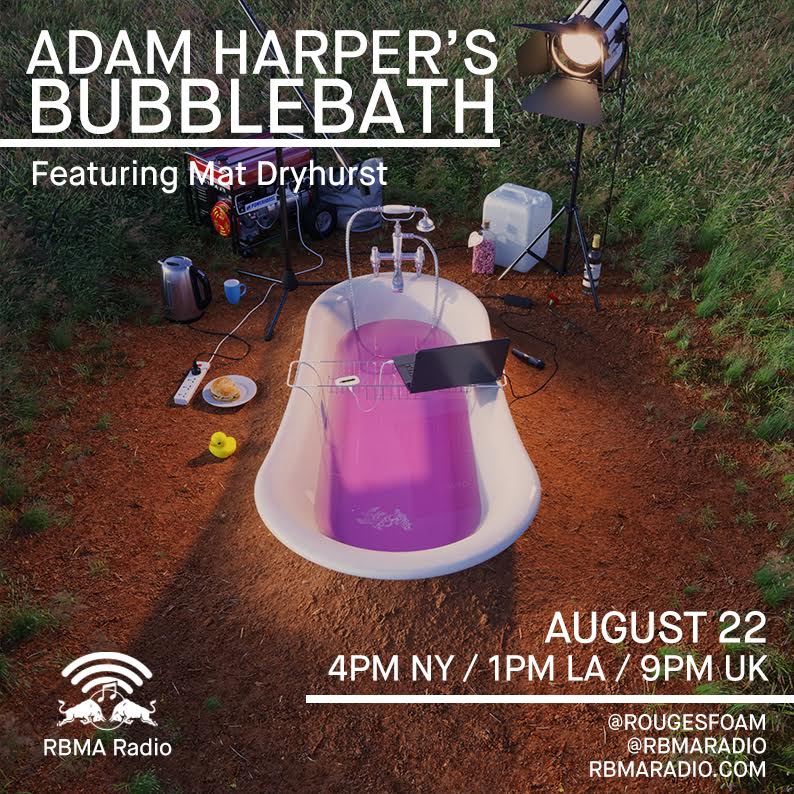 Art by Kim LaughtonThe first episode of my new monthly show for RBMA Radio aired a few days ago, and is archived here. Bubblebath is a two-hour show all recorded and edited by me, featuring new, typically lesser known tunes that I'm interested in, segments going for some deeper analysis, and interviews with various people from underground music culture. For the first show, I looked at the pseudo-humanistic style of James Ferraro's Human Story 3 and some other records, and talked to Mat Dryhurst about some of the problems facing underground culture today and his platform Saga. The playlist is below.
People in the US won't be able to listen to the archived version of the show for various legal reasons. I didn't realise that would happen and I do apologise. If that's you, you might try using a proxy server, especially with different browsers. US listeners can listen to the show live without any problems, though, so I'll make sure to forewarn people next time.
· 00:00:02 - 00:02:41 Julien - Alpha Beat - Calm (from Calm 2 https://calmdot.bandcamp.com/album/calm-2)
· 00:02:41 - 00:05:28 Alfie Casanova - 4 Play - Calm (from Calm 2 https://calmdot.bandcamp.com/album/calm-2)
· 00:05:28 - 00:10:16 NKC - Salon Room - Her Records (from Hague Basement http://store.herrecords.com/album/hague-basement)
· 00:10:16 - 00:13:03 仮想夢プラザ - 秘密 - Plus 100 Records (from Balance with Useless https://plus100.bandcamp.com/album/balance-2) (extract, background, and again throughout )
· 00:13:03 - 00:18:17 Julien - Day Racer - Orange Milk (from FACE OF GOD https://orangemilkrecords.bandcamp.com/album/face-of-god)
· 00:18:17 - 00:23:52 NV - Bells Burp - Orange Milk (from Binasu https://orangemilkrecords.bandcamp.com/album/binasu)
· 00:24:50 - 00:29:57 Easter - Leda - own Bandcamp page (from New Cuisine Part 2 https://easterjesus.bandcamp.com/track/leda)
· 00:29:57 James Ferraro - various tracks from Human Story 3 - own Bandcamp page (https://jjamesferraro.bandcamp.com/album/human-story-3) (extract, background)
· 00:32:04 - 00:37:32 James Ferraro - Individualism - own Bandcamp page (from Human Story 3 https://jjamesferraro.bandcamp.com/album/human-story-3)
· 00:39:19 - 00:40:31 John Adams - Lollapalooza - Nonesuch (from I Am Love Soundtrack) (extracts)
· 00:40:55 - 00:41:20 Steve Reich - Eight Lines Number 1 - RCA Red Seal (extract)
· 00:41:36 - 00:42:30 Aaron Copland - Allegro from Appalachian Spring - Sony Classical (from Bernstein Century: Copland) (extract)
· 00:43:05 - 00:44:32 Jeffery L. Briggs - CivNet Opening Theme - Microprose (from CivNet Soundtrack) (extract)
· 00:44:48 - 00:45:24 Oneohtrix Point Never - Problem Areas - Warp (from R Plus Seven) (extract)
· 00:45:52 - 00:46:11 Kara-Lis Coverdale - AD_RENALINE - Sacred Phrases (from Aftertouches https://sacredphrases.bandcamp.com/album/aftertouches) (extract)
· 00:46:30 - 00:47:04 Giant Claw - DARK WEB 005 - Orange Milk (from DARK WEB https://orangemilkrecords.bandcamp.com/album/dark-web) (extract)
· 00:47:25 - 00:47:51 Metallic Ghosts - University Village - Fortune 500 (from City of Ableton https://fortune500.bandcamp.com/album/the-city-of-ableton) (extract)
· 00:48:58 - 00:49:59 Torn Hawk - The Romantic - Mexican Summer (from Union and Return) (extract)
· 00:52:12 - 00:55:08 Subaeris - Shadow Portal - Nirvana Port (from Transcendent God https://nirvanaport.bandcamp.com/album/transcendent-god)
· 00:55:08 - 00:58:23 Subaeris - Beating Heart - Nirvana Port (from Transcendent God https://nirvanaport.bandcamp.com/album/transcendent-god)
· 00:59:08 - 01:01:16 Klein - Babyfather Chill - own Bandcamp page (from ONLY https://klein1997.bandcamp.com/album/only)
· 01:01:16 - 01:03:45 Klein - Make it Rain - own Bandcamp page (from BAIT https://klein1997.bandcamp.com/album/bait)
· 01:04:49 - 01:47:38 Valentin Silvestrov - Diptych - ECM (from Valentin Silvestrov: Sacred Works) various tracks from Valentin Silvestrov: Silent Songs - ECM (extracts, background)
· 01:49:09 - 01:54:25 Swimful - Atop - SVBKVLT (from PM2.5 https://svbkvlt.bandcamp.com/album/pm25)
· 01:54:25 - 01:58:45 Swimful - Bounce (Simpig Remix) - SVBKBLT (from PM2.5 Remixes https://svbkvlt.bandcamp.com/album/pm25-remixes)
'Joy 2016' (essay for 3hd festival, where I'll be in October) [ 24-Aug-16 5:12pm ] Art by Sam Lubicz3hd festival is back for its second year in Berlin this October, and its website has gone up (click here). I'll be there lecturing and participating in discussions over various aspects of their theme 'There is nothing left but the future.' In the meantime, I wrote an essay for them (click here to read it) sketching some initial thoughts about some of the problems facing musical futurism and musical sarcasm after a summer of violence and Brexit, through the lens of the 'Ode to Joy' from Beethoven's Ninth Symphony, and Wendy Carlos's electronic version of it particularly (incidentally, Jeremy Corbyn, something of a lightning rod for various kinds of political tumult whatever you think of him, recently mentioned listening to Beethoven's 5th).
Beethoven's Ode to Joy has accumulated cultural and political baggage of apparently every different kind, and, especially, in extremes. It has played the role of humanity's highest and most noble achievement and an incitement to horrifying violence both. And it is the anthem of the European Union...
Who needs dehumanising machine music when you have Trump, when you have the rise of hatred the world over?
There is an important difference, of course, between the future and the futuristic. The futuristic is a costume, a thrill, a performance, a caricature, all from within the safety of the present. The future is what actually happens to you and at some point, whoever you are, it will hurt you. What can art and music help us to do and to say before that point?


