

I love this assessment, from the Egyptian leftist Qussay Samak's article "The Politics of Egyptian Cinema," in Merip Reports No. 56 (April 1977). Get it via JSTOR here.

I attended Swarthmore College in 1968-69 and tried to get into Philly as often as the budget and time would allow to see shows. The Spectrum was a big arena with a revolving stage (!). Weird, but at least it gave us a chance to see these bands, and at affordable prices.
The order for this event was: Credence, The Dead, Iron Butterfly, Sly and Steppenwolf. My memory is that Sly put on the most exciting show. I think for me the attractions were The Dead and Steppenwolf ('Born to Be Wild' was a great hit of summer '68). The Dead were not playing in there proper element, and of course their set was way shorter than the usual. (Alas, this was the only time I ever saw the Dead, or any of the others for that matter.) Iron Butterfly of course we all scorned and thought were way overblown. I guess Steppenwolf was good but I have no memory of them. Nor of Creedence, who were known at the time chiefly for their single, "Suzie Q." They may have played "Proud Mary," which was released shortly after the concert.
Here's a review of the concert, from the Wilmington Delaware Morning News, on Dec. 9. There is much to comment on about the review, but let's just say that where I agree with it is (1) The Dead were not impressive (2) the sound was shitty and (3) Sly & Co. were terrific.

"Aswan Dam. We are loyal to our friends and always help them in a brotherly unmercenary way." Soviet poster, 1970s. Source here.
The effect of the Aswan Dam on Nubians, one elderly Nubian told me in the late 90s: "Have you heard of the atom bomb dropped on Hiroshima? The Aswan Dam was our Hiroshima bomb."

From the New Yorker, June 13, 2022, an article on Chile's new leftist president, Gabriel Boric. Read it here.
The last video shown yesterday (June 13) at the House January 6 hearings featured several insurrectionists explaining that they were present at the Capitol that day because Trump had called them to it. I think this is the last of the insurrectionists interviewed. I noticed that he was wearing a kufiya, but didn't manage to get my camera out in time to take a picture. Luckily my very alert friend Tim did, and he sent this photo to me.


Bekkaoui: Morocco-born, Dutch citizen.
I've written rather extensively about the push by the Palestinian rebels to impose kufiyas on Palestinian males at the height of the 1936-39 revolt, in fall 1938. And I just came across another story about those events, courtesy Zeina Ghandour's A Discourse on Domination in Mandate Palestine: Imperialism, Property and Insurgency (Routledge 2010). This is from her interview with Said Hassan Me'ary, originally from the village of Sha'b, in the Acre district, found on page 113.

I very much like this photo of a Nubian (I presume) kid looking at the photo welcoming USSR Premier Nikita Krushchev on his May, 1964 visit to Egypt. (I apologize for not keeping a record of where I grabbed this from.) I visited Aswan with my family that same year, in November. Here's a photo.


I checked YOOX, 8PM, Midiskirts online just now, and this item no longer seems to be available.
As is often the case, someone sent this to me (thanks, can't remember who did!), and it took some time for me to get around to posting.

In Berlin the popo are keeping a close watch on kufiya wearers.
The kufiya, they seem to have determined, is a sign of anti-Semitism.
(posted May 20, 2022)


 Drowned in Sound's 21 Favourite Albums of the Year: 2020 [ 27-Dec-20 8:04pm ]
 If you head over to our new Substack newsletter, you can read much more about these records, see a longer list, and keep in touch with DiS by subscribing - as from January I'm sending out weekly album recommendations.
There was no poll involved in creating this list. It's just my personal favourite, the ones that cut the deepest.
As the lone voice of the site nowadays, these were the records that were stuck on repeat on our ghost-ship... and I hope you find a new favourite from these (as that's the only point of listing season, right?!)
21) Jehnny Beth - To Love Is To Live
20) Angel Olsen - Whole New Mess
19) Princess Nokia - Everything is Beautiful
18) Nine Inch Nails - Ghosts V: Together & Ghosts VI: Locusts
17) Kate NV - Room for The Moon
16) Polly Scattergood - In This Moment
15) The Big Moon - Walking Like We Do
14) Sarah Davachi - Cantus, Descant
13) Daniel Avery & Alessandro Cortini - Illusion of Time
12) Fiona Apple - Fetch The Bolt Cutters
11) Juanita Stein - Snapshot
10) Moses Sumney - græ
9) Perfume Genius - Set Fire To My Heart Immediately
8) Julianna Barwick - Healing Is A Miracle
7) Mary Lattimore - Silver Ladders
6) Phoebe Bridgers - Punisher
5) Agnes Obel - Myopia
4) I Break Horses - Warnings
3) Laura Marling - Song For Our Daughter
2) Hayley Williams - Petals for Armor
1) G⬛⬛ M⬛⬛⬛⬛⬛⬛ - ⬛⬛⬛ ⬛⬛⬛⬛⬛⬛
Drowned in Sound to return as a weekly newsletter [ 08-Sep-20 12:39pm ] Don't call it a comeback... actually, do!
This is Sean Adams, the founder of Drowned in Sound.
Firstly, I'm sorry for the radio silence on this site for the last 18 months or so. I wrote a goodbye message a few times but didn't have the heart to publish it. It felt too final to say farewell.
As you may have seen on our social channels or in the media (even Billboard reported on our demise!), we decided to "pause" publishing due to what you could call financial constraints. Or to put it another way... our advertising revenue went from being an inhabitable house on a hillside to the entire cliff crumbling into the sea, hitting every rock on its way in... the camera slowly zoomed in as the debris was ravaged by the waves... and the director lingered on the shot for far longer than was necessary.
However, just before the end credits started rolling, we shared news that we managed to keep our "infamous" forums going.
I just wanted to offer a MASSIVE heart-felt thank you (THANK YOU!) to everyone who made a donation and continues to help keep the lights on and our community alive. It costs $600 a month due to the continued popularity of this free service, and every £1 you can spare makes a huge different. Learn more about how you can help with a regular or one-off contributoion, here.
Anyway...
What's this newsletter...?Drowned in Sound turns 20 on October 1st, so to mark the occasion and to keep the flame of the site alive, I'm starting a newsletter. Or rather, going back to DiS' roots, as before the site started, it was my personal newsletter under the guise of The Last Resort, featuring my incoherent teenage ramblings about Muse's first demo and stuff like that.
In this new newsletter, you can expect a mixture of my personal recommendations and hopefully cogent and coherent reflections on the last 20 years of music, alongside some gems from our archive, playlists, and recommend reads around the web. It's also quite likely I'll fail to resist sharing cat photos and existential memes...
Plus I'll likely drop in some bits about the class of 2021 too. I've posted a few reminders of DiS' past over on https://drownedinsound.substack.com, which will soon become easy to find on our homepage.
Without further ado... you can subscribe for free here:
To ensure it stays celebratory and doesn't get too self-indulgent, I've also decided to set up a slightly more personal newsletter in parallel, which ties in with the current Unhappy Hour strand of the monthly DiS radio show mixing together the two best flavours of music: melancholy and mellow. If that sad cocktail sounds of interest, here's the first edition about mittens, mezcal, and Lykke Li.
Sorry! I don't want your emailsThat's fair enough. Who needs another email in their inbox?! All of the posts will be available online and promoted on our social channels.
If you're not already, you can follow us/me on Twitter, Facebook, and Instagram.
More news soon...
Bye for now,
Sean xo
Lykke Li's Sadness Is A Blessing [ 06-Sep-20 3:05pm ] DiS founder launches new Unhappy Hour newsletter & playlist series to go with the monthly Drowned in Sound radio show (more info below).
Here's the first edition to give you a taste of what's to come.
SubscribeSometimes I like to walk in the rain.
Headphones are a must for me on any walk (sorry, nature!) and from a lot of research, I can confirm that there's nothing more perfect than Lykke Li on a drizzly day. Pick any of her four albums on a day where it's less like tears are falling from heaven and closer to that feeling of walking through a dragon's breath. It. Is. Perfection.
If you're so inclined, you may feel at one with the cloud when 'Sadness is a Blessing' makes its final descent. It's one of those snow globe crescendos that swirls but also feels motionless amid a flood of emotion. Still, like a changing tide.
On 'Sadness... ' Motown rimshots snap beneath the lines "sorrow, the only lover I've ever known..." which hangs in the air, holding out its hand for the follow up "sorrow the only lover I can call my own..." Its mitten strings untangle as Lykke slowly pirouettes into "sadness is my boyfriend, oh sadness I'm your girl." It's such a killer line. I'd assume I'll one day meet someone who has it as a tattoo - if I haven't already!
If you're reading this and have never heard this song or haven't let its fug sprawl around you for a while, I don't mind if you feel compelled to run off and listen to it right away.
I've also made it track one on the playlist that will accompany these Unhappy Hour missives: subscribe here.
Still with me? I won't go on for much longer, promise... Let's get back to walking in a misty wood with sad piano laments overpowering the mulch underfoot... Whilst Lykke may have tried to fool us by opening her most recent album with with an all-lowercase string-nest entitled 'hard rain', there's just something about her music that feels more omnidirectional than that. Hard and heavy and oppressive her music is not. It's such more pervasive and powerful than that.
Perhaps it's the way her voice plumes around the microphone. Her gasps often left in the final edits. Gusts of humanity. Sighs in various stages of ecstasy and exasperation. It's perhaps in the textures created in the space between her exhalations and the microphone where Lykke Li's magic illuminates. It's that filled void that a listener shares in headphones and it feels intensely intimate, even though there's a distant cool gloom to everything Lykke does.
Many say that photography is the art of capturing light. Sound is the vibration of air, which makes the best producers electrocardiographers, capturing the pulse of someone's heart and soul. I say this because there's something about the way Lykke makes the air move that hits so different to almost anyone else. Listening to her voice live or on almost anyone's track, whether it's her recent sad banger hit with Mark Ronson or a resurrected tune with Royksopp, there's an unmistakable pause, like the air skids to a stop... rubber and smoke sprawls in super slow motion. Shards of glass erupt and glitter as they spray...
I'm aware a male rock critic describing a woman's voice at any greater length would be creepy (if it isn't a bit already). However, the medium is often the message but not always because sometimes the message is "I lay in silence, the silence talks... my heart keeps pulling in the wrong decision." Imagine if you not only wrote that line but it became a mainstream hit. On Spotify 'Late Night Feelings' has had 67 million plays - yes, sixty-seven MILLION! And only a third of of them were me...
It's maybe not even her best lyric. Not that it's a competition but from the crystallisation of reluctance "when everybody's dancing, I don't want to..." to "sex, money, feelings, die, baby don't you cry..." there are too many contenders for the shimmering crown of melancholic bliss. It's little wonder she's gone from the top of the Hype Machine back in the mid-noughties to working with David Lynch and forcing time to standstill during Twilight (soundtracks which REALLY deserve a serious reappraisal at some point for the cultural impact they've had). It's for all these reasons and more she's christening this newsletter for lovers of wonderfully miserable music.
The irony of all of this of course is that the meaning of Lykke's name in Swedish is "happiness, good fortune" and yet it's from moments of unhappiness that she's made enough to fund her own mezcal business (it's called Yola Mezcal and I can 1000% confirm it's one of the best brands) and carry on making it drizzle in our hearts for decades to come.
Until next time...
Keeeeeep cryyyyiiiing!!
Sean xo
P.S. Yes, I have clocked that as someone who as a teenager named a website "Drowned in Sound" that this drizzle and rain talk is another watery metaphor too far. What can I say? "Lonely rivers sigh..."
Here's the link to the Lykke Li: An Unhappy Hour Spotify playlist, which is hopefully well worth one hour and 13 minutes of your life at some point. Maybe on an autumnal walk.
Do let me know what you think of the tracks and this newsletter or the Unhappy Hour radio show via Twitter @seaninsound or Insta.
Further ReadingOne of Lykke Li's first interviews was Drowned in Sound's DiScover feature back in 2008. Loved this bit "sometimes I'm so fragile and weak, but other times not at all. It's almost as if I have this much stronger spirit inside that I can't imagine ever failing me - 'cause if it did, I can't even begin to imagine how I'd live. So I'd say it's more about my own different personalities and that struggle." Read the full piece here.
VOGUE on How Yola Jimenez Is Making Mezcal With Women's Empowerment in Mind.
NME's Andrew Trendell's interviewed Lykke Li on how heartbreak, hip hop and lots of mezcal helped 'So Sad So Sexy' come to life.
CONSEQUENCE OF SOUND spoke to Lykke Li about what "Lynchian" means.
The Unhappy Hour: Radio ShowYou can stream recent editions of the show on Mixcloud for free. Tune in to hear 2 hours of mellow and miserable music every 4 weeks, hosted by me, Sean Adams, the founder of the Drowned in Sound website.
Glastonbury 2019 preview playlist + ten alternative must sees [ 17-Jun-19 9:11pm ] Yes, we've kind of shut up shop. But we have some pre-hiatus commitments to honour, and Drowned in Sound is off to Worthy Farm again this year for arguably the world's biggest festival. Rather than just preview the big acts (you know who The Killers are, right?) we thought that we would do a list of ten things to do that capture the holistic spirit of the festival for you to discover if you are going for the first time, or for those who have been before and just want to spread their wings a little further.
First, though, a playlist, to get you in 'the mood'
10 alternative must dos at the Glastonbury Festival
Step back in time at The Rocket Lounge
When the headline acts finish at Glastonbury, the party is only just beginning. For many people, the late night entertainment in the South-East 'Naughty Corner' is their actual highlight of the festival. And with good reason - the sheer number of extraordinary venues for clubbing with a unique visual and experiential twist is beyond compare. However, one of my favourite late night areas is a little Fifties-themed bar and diner located in The Unfairground, just as you come into the late night area. It's a place you can step away from the festival and dance all night to early rock and roll classics, alongside excellent sets from live blues, R&B and rock and roll bands. This year's line-up includes the terrific Son of Dave, New York Brass Band and Pronghorn. It may be one of the smaller late-night areas but it's one not to be forgotten, which is the reason I make sure I visit it at least once a year.
Block9 and NYC Downlow - Apocalyptic DiscoOn the other hand, if you want the truly huge and awe-inspiring late night experience at Glastonbury, there are few things to beat Block9. Set amongst a gigantic post-apocalyptic cityscape with trains embedded in buildings and gouts of flame bursting out everywhere, you can find the fantastic NYC Downlow with brilliant disco-inflected sets from the likes of Prosumer, The Black Madonna and Erick Morello. It's easy to get lost for a whole evening here, then to come out only to be staggered again by the sheer visual drama of the venue. Seriously, even if you don't come to stay for the music you simply have to see Block9, especially given that this year they are doing an interactive visual artwork based on post-truth and the 'fake news' era.
The Crow's NestRight at the top of the whole festival - past The Park stage and up a treacherous hill (which has claimed many in the mud, including myself) is one of Glastonbury's true hidden gems - The Crow's Nest. Run by those lovely chaps from Heavenly Records, this tiny venue sits at the highest point of the whole festival, affording tremendous views across the whole site and arguably the best point to get the sheer scale of the whole festival. Not only that, but there is a cracking little bar there and the venue plays host to a series of secret gigs throughout the whole weekend. Rumours are usually flying about but the actual line-up doesn't get announced until the day itself, and even then there is usually a tantalising 'special guests' mentioned on there.
The Rabbit HoleSlightly further down the hill, just at the top of the Park Stage is one of the hardest places to locate in the actual festival. My advice is to look for the rabbit, though the actual entrance to the venue only opens at night and at an undetermined time. Queues can be long to get in, but once you have scampered - Alice in Wonderland-style - through a tunnel, you find yourself in a surreal, psychedelic environment where costumed characters serve you gin from teapots and DJs and live bands keep you entertained. It takes a specific effort to track it down and get in (and if you don't at first succeed; try, try, try again is my tip!) but once there, you have an experience like no other.
Brothers and West HoltsOnce I have unpacked my tent and sorted out my temporary home for the weekend, my first port of call is the Brothers Cider bar by the West Holts stage. I don't know why, but it's just a tradition I have. But there is something magical about that first drink of the festival being some damn strong and damn sweet pear cider as the flags flicker in the breeze and the hum of humanity and the chatters of excitement start to build. Even better is having the chance to hear some glorious world music and hip-hop on the West Holts stage over the weekend - possibly my favourite overall stage at the festival. Headliners this year include Jon Hopkins, Wu Tang Clan and Janelle Monae (who played one of the best gigs I've ever seen on this stage in 2011) but also keep an eye out for the excellent Mauskovic Dance Band, Hollie Cook. The Turbans, Lizzo, Slowthai and Jeff Goldblum. Yes, THAT Jeff Goldblum!
Pilton Palais Cinema TentThough the sheer amount of music makes your head spin at Glastonbury (and there is never enough time to see everything you want) there are occasionally moments where you need to take a couple of hours out to recover your senses and reset your compass. And one of my favourite places to do this is at the Pilton Palais Cinema Tent. Located up at the north-east corner of the site Near Pedestrian Gate C, it is a rough-and-ready tent (no chairs, bring your own) but it continually plays both new and classic films throughout the festival starting from the Wednesday. Impressively, they tend to have films still currently out at the cinema including this year where they have Dexter Fletcher's magnificent Rocketman, as well as going beyond that with a unique preview of Jim Jarmusch's The Dead Don't Die and a Bohemian Rhapsody singalong. Also on this year are Monty Python's Life of Brian, Pulp Fiction, Run Lola Run and Avengers: Endgame. Watch out for special guests introducing the films too - one of my most magical Glastonbury moments was having Studio Ghibli's incandescent My Neighbour Totoro introduced in 2016 by Tilda Swinton. If you need a break from the madness, this is the place to go…
Healing and Craft Fields…or maybe here instead? Located over the railway track and up towards the south-east of the site is a stunning area that encapsulates the origins of the festival as a meeting for travellers and hippies. Set over two fields are a series of craft workshops with such things as blacksmithery, woodwork, basket weaving, arts and crafts and jewellery making that allow you to take part in traditional crafts and to learn about trades handed down through generations. Cross over into the next field and you will find areas for meditation, yoga workshops, massage tents, tepees and a strong focus on themes of environmentalism and caring for the planet. It has a stunning sense of calm and quiet about it to the point where you can almost forget that the biggest festival in the world is going on around you, but it is wonderful for clearing the head and soul after a heavy night on the cider. Also make the time to visit the Stone Circle adjacent to it, but don't expect any peace there - it is a raucous gathering for drummers, party-goers and the chemically charged over the whole weekend, but the sight of it is worth seeing at least once over the weekend.
Lost Horizon SaunaOk, Glastonbury is often muddy. And though there are showers at the Kidz Field and the Greenpeace stage, they can have long queues. So most of the time, you just accept that… let's just say, you won't be at your freshest over the weekend. Big deal, we're all in the same boat. But if you do want something a little different or if you cannot go another day without being clean - body and soul - then the Lost Horizon Sauna is one of the most unique experiences you can have at the festival. Located at the top of the tepee field, it is an oasis of calm and tranquillity where you can shower, have a sauna and plunge pool and relax in a jacuzzi whilst drinking herbal tea and smoothies, all to the sound of acoustic acts. It is an additional cost of £15 per person and it can be a trek if you are on the other side of the site, but it is something you will never forget and a couple of hours that leave you feeling like a completely different person. Plus, the general ethos is that clothes=bad there, so you find everyone wandering around in the nude generally. And being naked whilst looking down at the festival below brings you that bit closer to the original hippie energy of its earliest days.
Greenpeace Stage DJ SetsThe Greenpeace area is located just to the left of the rail track as you head towards the South East corner and often I've taken a detour and ended up staying all night. The reason is that the Greenpeace stage is one of the best places in the festival to spend the evening. By day they have countless excellent displays and talks on preserving the planet, often with enormous animatronic figures of whales and polar bears, as well as a skatepark and some of the best food in the festival. By night, the place comes alive with DJs and special guests. Those announced to play there in 2019 include Norman Jay, Oh My God! It's the Church, Crazy P, Rob Da Bank, She Drew the Gun, Boy Azooga and Elvana - Elvis Fronted Nirvana (who really have to be seen to be believed). But also watch out for special guest late-night DJ sets. Thom Yorke has rocked up there in the past and in 2017, Jarvis Cocker played one of the most memorable DJ sets I've ever seen, including making the whole place go utterly ballistic when he dropped 'Stayin' Alive'. Day and night, it's the beating heart of the twin-faces of environmental activism and music that underpins the whole ethos of the festival.
See One Big Pyramid SetOk. I know that the stock response to anyone moaning about the headline names on the Glastonbury line-up is 'but there is so much more to see than just the main stage' but there really is nothing on earth like a proper Pyramid Stage gig that truly catches fire. The sheer scale of the crowds, the knowledge that you are being watched across the globe and the absolute sense of camaraderie is something that you really have to experience at least once during the festival. From Jay Z slaying the doubters in 2008, to the raw brilliance of Neil Young and the transcendent spiritual experience that was Blur's astonishing set in 2009, to Stevie Wonder in 2010, Arcade Fire in 2014 and Radiohead in 2017, The Pyramid Stage has given some of the finest headline shows of my time going to festivals. And you don't have to see a headliner there to get the magic - I can think of Scissor Sisters and Shakira in 2009, B.B. King in 2011, Elvis Costello in 2013, The Libertines, Burt Bacharach and Patti Smith in 2015 and being utterly magnificent during the daytime. And that's without the famous "Legends" slot which frequently brings one of the biggest crowds of the weekend - Tom Jones with the hits in 2009, Dolly Parton owning it in 2014, Lionel Richie impeccably bringing the sun in 2015 and Barry Gibb and Chic bringing a tremendous party in 2017. However much you might prefer the music on the other stages, try to get to at least one Pyramid Stage show over the weekend to experience the unique spell that a show on that scale can bring.
Photo by Gary Wolstenholme
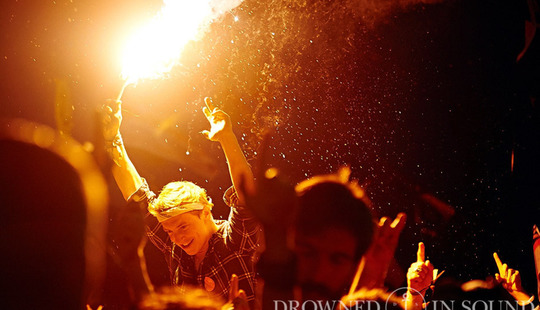 A Different Kind Of Weird: dEUS on The Ideal Crash [ 29-May-19 9:43am ] For once, Tom Barman is apprehensive. Not about tonight's dEUS show, but the two-hour DJ set he's been booked to play at the official after party. "What has happened in the past is this miscommunication with people," he explains as we lounge on a terrace in the late afternoon sunshine. "They expect me to play rock, and then I play electro." Electro? "Yeah, deep house, techno, drum'n'bass, indie house, glitch, trap, whatever you want. It's just fucking dance music. But then they ask for R&B, so I tell them to go to the supermarket, where you can hear R&B twenty-four-seven. Nothing against R&B by the way, but I just don't play it, you know?"
Nothing is ever straightforward in the world of dEUS, but for once they're taking pause to celebrate their legacy and the love fans have for the album that's come to define them. March saw the 20th Anniversary of The Ideal Crash, and alongside the now de riguer re-mastered re-issue - complete with demos, B-sides, and rarities - they decided to tour it, playing all ten tracks in full and in order, followed by an assortment of their other greatest hits. Tonight is the second of three sold-out shows in Utrecht - they also have eight in a row at Brussels' Ancienne Belgique alongside dates all across Europe and a summer of festival action. In total they'll play 34 concerts, quite an impact for something that was initially conceived as more of a low key jaunt.
"A gift," says Barman of the reaction, but then The Ideal Crash has always stood out as being special. The title, taken from the Alain de Botton novel Essays In Love, references the personal turmoil Barman and violinist and keyboardist Klaas Janzoons were going through - both were dealing with serious heartbreak - but also the difficulty that came with replacing two original members. The band decamped to Spain for over a year and, despite various tensions simmering in the background, their time in Ronda, a dramatic old mountaintop town famous for the Puente Neuvo stone bridge where their management had bought a hotel, proved fruitful.
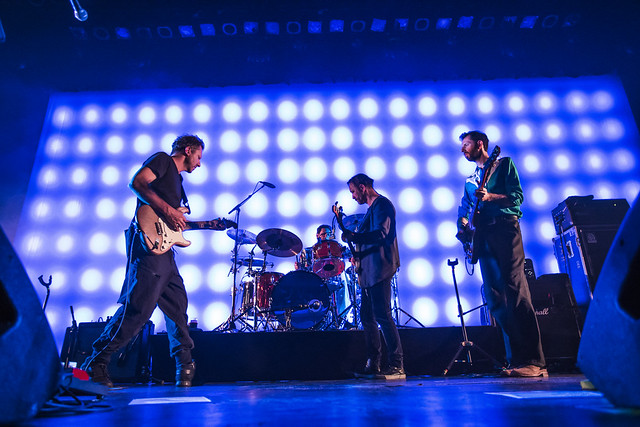
They returned with a record where every song goes in a different direction, delighting, exploring, and confounding expectation at every turn. The Ideal Crash was also the point where dEUS left behind the chaos and the skewed mix of styles that had made their early releases vibrate with energy. Gone were the skeletal blues, howling guitars, and crashing, angry slabs of noise, and in place of Beefheart, Zappa, Tom Waits, and the jazz greats, inspiration was taken instead from Air, Beck, and Mercury Rev's "Deserters Songs". But despite being somewhat more rounded, it remained unmistakably dEUS - "Just a different kind of weird," according to Barman.
This softer, more mature sound was supposed to help dEUS break the mainstream but, exhausted and on edge from years on the road and internal strife, the stress of the subsequent tour broke the band instead. All five retreated to normal life, and by the time they properly reconvened five years later, their sound - and lineup - had changed once again. Yet The Ideal Crash has endured, both in terms of its influential legacy and as the moment in time where they chose greatness on their own terms, and trusted their instincts; "We were so proud of it when we finished, we just knew," says Barman.
"You just make albums, and you work, and then twenty years later you find out a particular one really meant something to people," he adds. "I'm just happy to hear those songs still stand up." They certainly do; to witness some middle-aged fans defiantly lose their shit to 'Instant Street', 'Everybody's Weird', and the title track is to realise just how affecting dEUS' music really was and, despite little commercial success, how far and wide it spread. Such realisations are also behind a documentary they're filming on tour, one that will feature the life stories of their fans more than the band themselves.
"I wanted dEUS to be a vehicle for people to talk about their own lives over the past twenty years, to talk about something that's nothing to do with us," he explains about the plan he conceived just before the tour. "I think it can become something really sweet and personal, something very special." There's little doubt that, in keeping with their cultural impact and near thirty-year career, it'll turn out to be something very special indeed.
DiS: I know you're not particularly big fans of nostalgia and the like. When did you start thinking about doing this for The Ideal Crash?
Tom Barman: About a year ago, but we don't really see it as nostalgia. It's more a gift to people who see it as nostalgia, which is basically the people in the room; the fans. I can speak for Klaas too; we don't have the feeling that we're making an extra effort, that it's like: "Oh, look at us playing those old songs." You know, four or five of those songs are on our setlist anyways.
So to us, this feels like a gift, and a gift that gives us something too, which is love - people are listening and enjoying it. Sorry, it sounds so corny, but that's the way I see it now after fifteen shows. Nostalgia doesn't even come into the equation.
And everyone agreed? Everyone was like: "Yeah, let's do this! Let's tour the album!"?
TB: Yeah. I think they asked for it for Worst Case Scenario too [their debut album, which was released in 1994].
Klaas Janzoons: This one is a nice one to deal with. With Worst Case Scenario, I don't think we'd be able to play songs like 'Mute'.
TB: 'Mute' or 'Shake Your Hip'.
Those would be a bit trickier I imagine.
KJ: We have songs on that album [Worst Case Scenario] that we've never played, so this one works. It is strange for us to play the same set every night though.
TB: But we enjoy it.
KJ: Yeah, we enjoy it too. In the beginning, I was a bit afraid of how it was going to be, but then we have these dancers...they give it this extra thing. It's like a piece of theatre almost. So it's not exactly the same every time, and you look forward to the point when they come on. It's nice.
TB: A punter in Austria put it really spot on. He said: "Knowing beforehand..." - and I don't know if he read it on the Internet or I said it on stage, like we're going to play it from one to ten - but he said: "a kind of calm came over me, and it made me doubly capable of just enjoying it because I knew what was going to happen." And I agree that that would be kind of boring to build your career on, doing that every time, but for one tour, I went like: "Gee, thank you. I never saw it that way, and that makes sense." It's like: "I know what's going to come, give it to me, I'm here, I'm listening." And that's it - there's kind of zen quality to that.
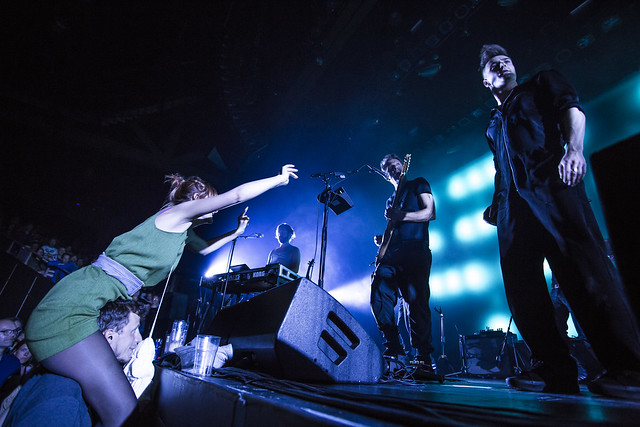
Have you been surprised by the reaction to it? Because you're now adding more and more dates, right?
TB: There's like five, maybe six added on, yeah. But I am surprised, in a good way. You know, you just make albums, and you work, and then twenty years later you find out a particular one really meant something to people. The confessions that we're doing, the documentary - I haven't seen any yet but I hear the stories, and they are proof of that.
I was also genuinely surprised because it's a very raw album, it's a very harsh album at times. So, when people come [to the shows], and they're thirty-two, and they go "I was twelve when this came out", you go "Woah!"
I always find it kind of ironic that with these classic album reissues, a lot of the time the response and the acclaim is way bigger second time around. And probably more lucrative as well.
TB: Well, we could have played and toured more [at the time], but as you know Craig [Ward] was leaving the band…More lucrative? Probably. In Belgium yes, because eight times at Ancienne Belgique is five times more than the three times we did it [in 1999]. But this is a small tour really. And as Klaas keeps on repeating, and rightfully so, back in 1999 that was some tour. So it's not like this is way bigger or anything - it was pretty big back then too.
KJ: The old albums are more popular in general, so people are more willing to come to concerts of the old stuff.
Touring classic albums has become a thing though. Alongside the re-issues and special editions.
TB: It is a fad, but when you're in it, it feels right. As long as you don't do it for two years straight.
KJ: I think it's normal because it's a part of people's lives, so it's a nostalgic thing for them. Even if we make our best album ever now, people will always want to hear those old songs; maybe more than the new ones. That's how it is with all bands that have a long career.

Looking back at the 18 months or so you had in Spain writing and recording, what are your memories and recollections of that time?
TB: For me, mostly good. Klaas had a bit of a dark period, which he will gladly talk about.
KJ: Of course. Half living in Spain at that age was like paradise, all the songs and the beautiful, old, historic city.
It is a beautiful part of the world.
KJ: And the nature is incredibly beautiful. At that age, being able to do that, like a holiday slash work thing? A lot of people at that age are still in a day job, so it was fantastic. But it had its downside. I lost my girl at that time because I was away half the time; that's how life goes, but that was pretty hard for me.
Being far from home and family is never easy at the best of times.
KJ: Yeah. I did suffer sometimes with a bit of homesickness.
TB: Homesickness or melancholy. But I loved it! Of course, there were moments where things weren't great, you know? But the kind of lovesickness I felt was before we went to record. That happened in 2007, so for me, it was just cleansing. And also, I discovered myself to be getting more and more interested in the production side and listening to takes. That side of recording was new to me.
What else was new was confessional lyrics, digging into yourself and getting it out of your own life. There used to be kind of a stew on the first two records - a stew of personal things, things that I'd stolen, experimental stuff, experimental poetry, and suddenly I just went like...It just flooded out of me. So, for many reasons, it was a very exciting time.

Which song on the record is your personal favourite?
TB: 'Let's See Who Goes Down First'.
KJ: Which is a funny thing, because I remember having to fight for that song to be on the album!
TB: Yeah. But it was...it came a long way. How we play it now, I love it, especially because it's like dEUS in a nutshell. It starts very poppy, and carefree, yet ends in sheer fucking existential agony. [Laughs] Which, I think, kind of sums us up.
Related to that, do you have a favourite lyric? Or a line where you feel you nailed whatever it was that you were trying to express
Tom: Yeah, from 'Magdalena'. "But I'm feeling good / And if you don't exist / You're still one illusion / That I can't resist". That line. That sums it up because that's basically what love is — kind of a beautiful illusion.
Having seen the show a few times now, I've been really struck how faithfully you've managed to recreate all the songs. Was that quite hard to do on a technical level, like getting all the guitar tones right for every single song and easily flipping from one to the next?
TB: Oh yes! But all because I'm not from the school who thinks that the best versions are the ones you do after you record the album. I go with the best version on the album. Meaning, you work hard on that, you get it right, so why change it? You fucking already worked a year and a half to get it like that, why would you change it? You could have different accents, and you can make things longer - which we do by the way - but we're an art rock band, meaning it's not like a blues or jazz band where that was the spur of the moment thing and then on stage, in The Hague or in fucking New York, it's going to be something completely different.
We are not that. We are building layers of stuff that we worked on and sweated on, so when it's there, we are happy with it, and that's the way we are going to play. That's how I see it.
You have a new guitarist now [Bruno de Groote, who joined early last year, replacing Mauro Pawlowski], and three members who weren't around when you made this album as well.
TB: Bruno had a big job, but the others have listened to the record a lot over the last ten years or so. I mean, for some songs, I had to study it again, just like Klaas had to or Steph [Misseghers, drummer]. You know, 'Let's See Who Goes Down First', we hadn't played that for eighteen years, so there you go.
But those parts are the way they are, and you make things longer, you make an intro longer…we've changed 'Magic Hour' a bit. We have a new ending for 'Let's See Who Goes Down First'. That's just a luxury you take because you enjoy playing it so much so you think: "Let's make it longer and make it even more exploding at the end. With Viking shouts. [Shouts]"
It works, though.
TB: It's my favourite moment!
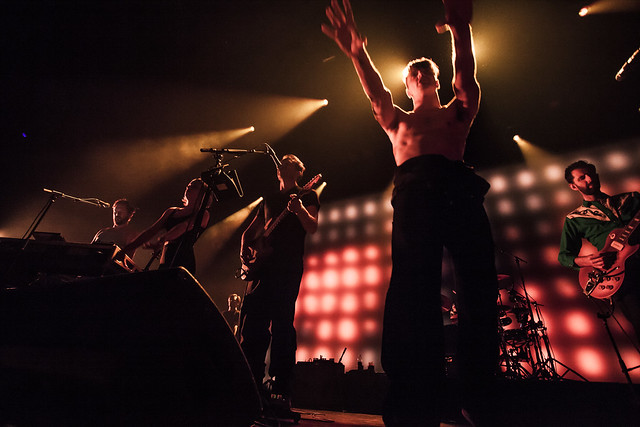
I'm intrigued by the dancers and the theatrical aspect to the show, which I know is something you dabbled with early on in your career.
TB: We dabbled a lot! In the video for 'Turnpike', and of course for 'Instant Street'.
But, it's still like: "Oh wow, they've got dancers!"
TB: It was my idea twenty years ago, but it was Steph's idea now. He went: "How about the dancers?" And I went: "Man, that's insane, we can't afford that." But the idea stuck. And then I came up with the idea, why don't we ask Ann [Van de Broek, choreographer and artistic director] who was there twenty years ago? She's a great woman, she's a great choreographer, and she has a network. So we thought: "Why don't we work - for financial reasons, mostly, but also for the excitement and that homegrown kind of thing - with locals?" And it still cost us quite an amount of money, but it's worth it because as Klaas says, it's like this fresh influx of talent.
And it's great for the fans. By now, people know because they've seen something on YouTube or whatever, but a lot of people are still surprised and going: "What the hell's going on?"
You have just one dancer touring with you, right?
TB: Just one, just Nik [Rajsek]. He's always drilling the locals.
So in every city, you've got a new set of dancers?
TB: Yeah. Basically, we have Anne - she is the moon. Then we have two satellite choreographers; one who travels with us - Nik - and a second satellite in every city. Let's call him number three. Number three picks the students, and he drills them a day before we arrive, and on the day itself when we play. And that's it.
That must add a certain element of excitement, like with every new crew you're not quite sure exactly how it's going to go.
TB: Well, that's Nik's stress of course, but Nik is very professional. And especially because he was thrown into this bus with twelve strangers and he was accepted, he was cool, he was fun.
KJ: We are almost a community, you know? Just from this tour.
TB: Actually, I'm gonna have a hard time doing without in the future, but that's where it's related. Maybe we won't do without.
Maybe you can always have dancers.
TB: Yes, now we have the network. The network is sorted.
I'm also intrigued by the idea behind the documentary that you're doing around the tour.
TB: Well, so are we!
Because you don't want anyone talking about the band or the music per se. It's just about their own lives over the last twenty years, right?
TB: That's what I'm saying, but people end up doing that anyway, so you can shout as much as you like, "We don't want you to talk about that!" But people show up for that reason, so they have particular memories that they want to share. I haven't seen any of it, but I think this is the kind of documentary that will make itself, in the sense that those confessions are going to drive where it goes. But I just wanted dEUS to be a vehicle for lives.
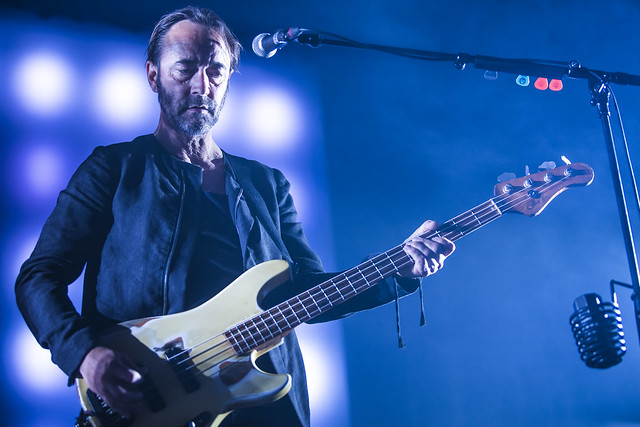
For people's stories of life and love?
TB: Yeah, but I mean people come there, they talk about something that's nothing to do with us; about how they met their wife, why they got divorced, whatever. dEUS is just a vehicle for what we are going to have as stories. I think we're going to intercut that with exciting live footage as well, but that's just a half page 'Note of Intent'; the rest we'll have to see.
KJ: People talk to us, and that's where we mentioned the nostalgia thing coming up. When people come and talk to us after the show, they always go: "You can't believe how much that album meant to me!" and then tell us about their lives. So, this is actually just what they are doing to us all the time. The good idea is to record it, because you can't believe the things they say. And it's not about us - our music was just the vehicle.
TB: It's also embracing the fact of getting older, and you as a band with your audience. And it can become something very sweet, and hopefully not too...you know? I'm not going to edit it because I might censor things that may be good. It may become something really sweet and personal, with us as the motor for it, the propeller.
Do you have like a working title for it?
TB: Yes. Only 'Cause Of Love: Confessions To dEUS. That's a line from 'Put The Freaks Up Front'.
I was chatting to Fleur [Boonman, the film director and documentary maker] in London the other night, and she said that some of the stuff she'd recorded already was incredible.
TB: That's what it is. They all start talking about dEUS, then Fleur tries to lead it to being about them, and they either take the bait or they don't - you're not going to force people. But maybe some stuff about the band is also nice. That's why I'm not going to be involved in it, because if somebody says something really beautiful and flattering about the band, I might say: "Oh, come on. That's a bit much!" you know?
But maybe it is really beautiful, and maybe it is time to embrace that. dEUS documentaries have always been, if I may say so myself, brutally fucking honest about the fights, about the commercial underachievement, and all that negative stuff. Bands usually paint the nicest picture, but we were always the champions of: "look how fucked up we are." Maybe it's time to have something really nice, that's all I'm saying.
I think you deserve that.
TB: Yeah well, we'll see. We'll see.
The Ideal Crash (20th Anniversary Edition) is out now via Universal Music Belgium. For more information about dEUS, including current tour dates and ticket info, please visit their official website.
All Photo Credits: Joao MB Costa
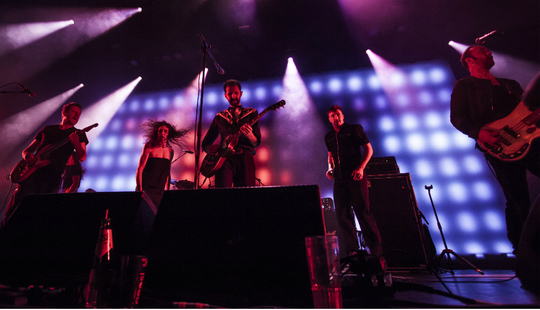 Way Out East: DiS Does Sharpe Festival 2019 [ 21-May-19 12:59pm ] Amidst the many panels and workshops at Bratislava's Sharpe Festival, one stood out. Titled "Good-hearted Promotion or Downright Spam", it looked at the role of PR in the digital age and how artists - and, indeed, labels and journalists - could benefit from the services of a seasoned professional. A key issue for many in attendance was how to break through online noise, and how to achieve traction - and exposure - beyond their own borders. There is, of course, no easy answer. "Be truthful in your art and your message," says Poland's Gabriela Szuba, a promoter and booking manager. "Work hard…and be good!" adds Richard Foster, PR manager at Rotterdam's WORM and acclaimed journalist, a somewhat self-evident exhortation but one that rings true.
And yet the sad reality is that for many bands - not just the ones performing here - neither of those things are guarantees of success. Nothing is. Sharpe draws the majority of its artists from Eastern and Central Europe but despite the talent on show - and we witness some incredible sets - a viable, sustainable career in music seems to be an almost impossible dream for many; virtually everyone we talk to has a day job or side hustle to pay the bills. One can't shake the feeling that if some of these acts hailed from Hackney or Williamsburg they'd have a fighting chance but when you're from, say, Ljubljana or Kiev, an indifferent shrug from the West is a more likely reaction (unsurprisingly, only two UK publications have bothered to make the trip).
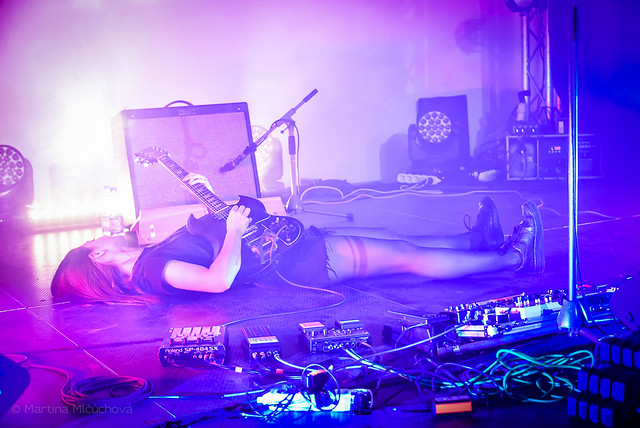
It's a shame as most of the artists playing are significantly better than the trust fund kids and cool haircut brigade that clog up many Ones To Watch and Hot Lists in the UK. Inventive too, with Ukrainian duo Ptakh_Jung being a case in point. Their dark swirls of noise blend elements of post-rock, electronica, and ambient soundscapes, and are backed by arresting, futuristic visuals. It's all very cinematic and dystopian - a bit Aphex-Twin-meets-Ennio-Morricone - and the sensory overload they conjure is impressive. More than anything, you get the sense they've thought deeply about their music and what they want to convey; the slow build tension and intricate layers sound like the fruits of countless hours spent honing and tweaking.
Slovakia's own Möbius are another band whose music literally demands attention. Their instrumental doom/stoner sludge hybrid rock is Sun O))) levels of loud, and extremely heavy; just like Stephen O'Malley, the guitarist employs huge amounts of low end and reverb to create great slabs of noise that shake you to your very bones. "Evokes images of huge caverns slowly collapsing around you," says one comment on their Bandcamp page, an apt description for a band playing songs called 'Eternal Weeping In Agonies' and 'All Who Drink From The Abyss Experience Complete Oblivion'. And while there is an enveloping, crushing quality to the sound, a sonic death grip that draws you in gradually to its colossal embrace, there's also some groove buried in the murk; not for them endless repetition or noise for it's own sake.

Market, a five-piece hailing from Prague, have pursued the cerebral route, blending a dizzying array of styles and motifs into something that could be labelled improvisational jazz indie. Elements of rock, hip hop, Zappa and Beefheart stick out, while the vocals recall King Krule's woozy, stream-of-consciousness thoughts on love and romance. It's an intoxicating brew, with enough solid ideas to make the more outré moments - the quintet frequently swap instruments; some songs stop and start inexplicably - seem more like avant-garde exuberance than fatal flaws. It's refreshing at least to see a band dare to fail with some big ideas and the chops to execute them, rather than simply adding the odd flourish to standard indie fare and thinking they're clever.
That being said, there are also plenty of bands at Sharpe following more traditional paths and doing a mighty fine job of it. Austrian duo MOLLY walk the line between shoegaze and dreamy, ambient pop, effortless switching between soaring, sky-high guitars and quiet grace. "Glittering" is a good way to describe their music; some of their riffs positively shimmer, while even the noisier moments are done with subtlety and beauty. Melby, from Sweden, deal in breezier fare, their airy, semi-psychedelic folk-pop an enchanting way of opening proceedings on the Friday night. They run through most of their debut record, None of this makes me worry, and it's easy to see why various blogs have been charmed by the Stockholm-based quartet.
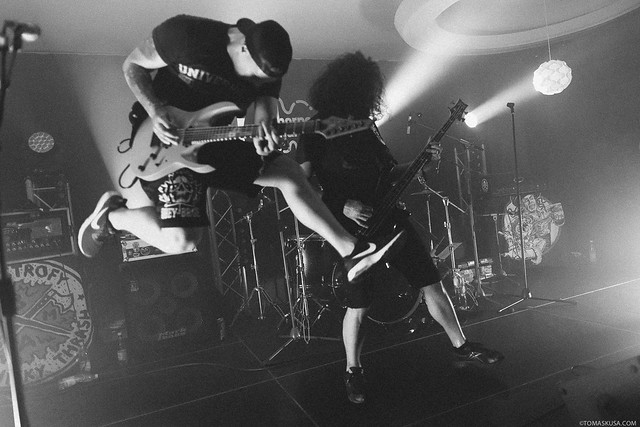
Question is, what comes next? How do indie bands like this evolve their sound and get bigger and better without losing whatever it was that made them noteworthy to begin with? Slovenia's Koala Voice are a band who've wrestled with precisely this conundrum. Three albums in, their carefree indie pop sounds a little grittier, a little rougher around the edges. There's a punkier, more boisterous attitude to their work now, but it suits them; the new material sounds like a band freed from the constraints of trying to second guess what might be successful and just having a blast.
Such a description could also be applied to Bristol's SCALPING, who deliver a pulverising late-night Friday set and look like they love every minute of mayhem they serve up. Ostensibly a live techno-punk band, they've also been pegged as being "challengingly innovative". Certainly, there's nothing standard about their screaming techno, squelching bass, and post-rock time signatures; throw in some math rock swagger and you've got apocalyptic and insanely catchy bangers that sound like Factory Floor trying out blackened post-punk. It's intense and mesmerizing in equal measure, and helped along by arresting, Blade Runner-style visuals projected onto the backdrop.
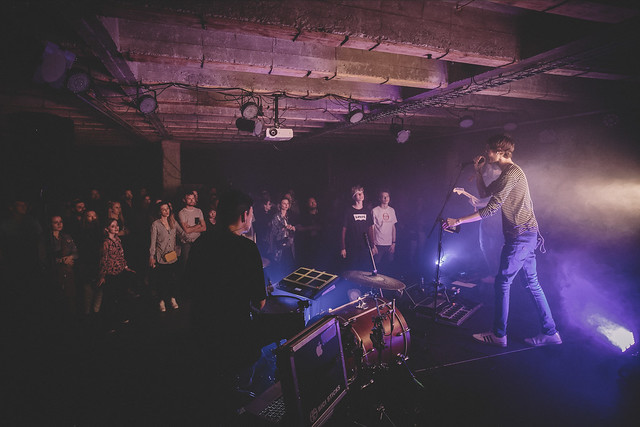
Tucked away in a side room - officially designated as The Library - one can discover a quieter side of Sharpe. Sponsored by Sofar Sounds, a series of special guests play short acoustic sets to a seated audience; the hook is the artists are not announced in advance. However, we're lucky enough to be tipped off that local heroes The Ills - a band we've been championing for a number of years now - will be performing, so we nab a front-row seat early for this rare event.
Their soaring post-rock soundscapes translate surprisingly well to acoustic guitars, the power of their riffs replaced by delicacy and nimbleness. Songs still have a euphoric quality, but the melodies - and the sheer prettiness - of some of the guitar lines really stand out. If someone was unfamiliar with their work, they'd be hard pushed to guess that this was not their normal modus operandi - they really are that good. A highlight is 'I Am My Own Weakness, Darling', taken from recent record Disco Volante / Mt. Average - aided on vocals by another local, Dominik Prok of 52 Hertz Whale, it's a dark, brooding tale, Prok stalking through the audience, singing a capella.

It's a poised, serene twenty-minutes, and a lesson for anyone reluctant to step outside their comfort zone. It's also one of the best sets we witness all weekend, topped only by another band we've championed before, Rotterdam's The Sweet Release Of Death. Late on Saturday they deliver a taut, fizzing thirty-minute blast that's as powerful and energetic as anything we witness. 'Post Everything' highlights everything that makes them great; earworm riffs, spacious, sky-high arpeggios, and motorik drums defiantly build into a swirling crescendo that cuts out just as it threatens to spin out of control; one part noise-pop, two parts post-punk.
New track 'Sway', taken from their forthcoming record, is precisely the sort of anthem that needs to be experienced ear-bleedingly loud, a shattering song that nonetheless has an infectious groove buried amid the maelstrom. And through all this there's vocalist and bassist Alicia Breton Ferrer, a stoic, deadpan presence, the calm amid the storm. It's as tight as I've seen them; not a moment or note is wasted, their whip-smart new material sounding lean and streamlined.

As with many of the artists playing here, they deserve wider acclaim than they'll probably get - certainly, they're every bit the equal of those in the UK riding the coattails of punk rock's surge in popularity. They wouldn't be out of place halfway up the bill at All Points East say, or Primavera Sound - as for some of the nonsense hyped here, well, it makes you wonder why such bands bother. Sharpe is an event that aims to redress this balance, and after two editions, its ethos and credentials are beyond reproach - they really do know their music out here. The hope is that more and more people - and the industry at large - will start paying attention and cast their ears eastwards, for if it's quality they're after, rich rewards await.
Sharpe Festival takes place in Bratislava, Slovakia, at the end of April. For more information about the festival, including dates and tickets for the 2020 edition, please visit their official website.
Photo Credit Banner (The Sweet Release Of Death): Ondrej Irša
All Other Photos: Credit As Indicated
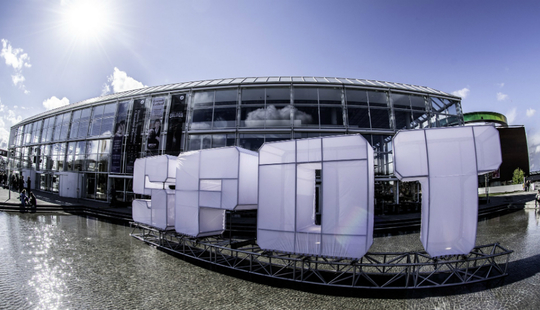
 25 years of SPOT Festival: DiS Picks Its Best 11 [ 21-May-19 10:34am ] May being the month of showcase events, DiS headed over to the city of Aarhus in Denmark for SPOT Festival. Celebrating its 25th anniversary this year, SPOT has firmly established itself as one of the leading events of its kind. Attracting a global audience of fans and delegates along with an array of the best musical talent Scandinavia has to offer, it's become known as the Nordic South By Southwest for a good reason.
Taking place across numerous venues in and around the city over the first weekend in May, we found ourselves veering off the beaten track in search of hidden gems as well as focusing on the more traditional venues. Such exploration led us to a recording studio, a bowling alley, a late night cabaret bar, a gazebo on the market square, and the city's dockland area (several times), formerly home to its industrial heartland.
With such a diverse selection of artists to choose from and less than forty-eight hours in which to do so, here are eleven of the best acts we saw over the course of the weekend.

Aage Hedensted Kinch has been a mainstay of the Danish underground music scene for a number of years now having played in numerous bands and been a go-to person for overseas touring acts looking for shows. However, his current outfit Catch The Breeze might just be his finest outlet to date.
Playing in a tiny gazebo at the Klosterport on the city's market square, his band make an incendiary racket that brings curious passers-by to the front of its entrance (there is no stage as such) in droves, including two highly intoxicated characters that threaten to steal the show courtesy of the Bez style dance moves they throw throughout the set.
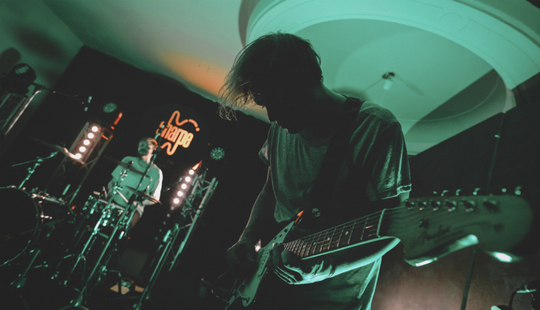
As the name suggests, Catch The Breeze make a beautiful noise that sits between classic early 90s shoegaze and the more recent Krautrock-infused spate of neo-psychedelia that's had a resurgence in recent years. Playing a set of material almost exclusively taken from last year's excellent Glow, they're an early revelation that sets the scene (and indeed, the standard) for the next two days.
ColliderCollider are a very interesting band, not least due to the fact their music is so spontaneous and makes them impossible to compartmentalize or categorise. Musically they're like the centre point of an axis created by My Bloody Valentine, The Raincoats and Jethro Tull, as unimaginable as that may seem. Hailing from Copenhagen, the four-piece have worked and played with Thurston Moore and that tutelage has served them well if their forty-five minutes long set is anything to go by.
Woozy, reverb-laden guitars fill the mix while Marie Nyhus Janssen and Troels Damgaard-Christensen's swooning harmonies have an air of Bilinda Butcher and Kevin Shields about them. However, proceedings take an unexpected discourse when Janssen whips out the saxophone and flute at regular intervals to create post-punk, jazz-tinged odysseys. Suitably aided and abetted by the taut rhythm section of Mikkel Trojborg Fink and Johan Polder, their sense of unpredictability is what makes them such a breath of fresh air and ultimately, captivating outfit.
Dark TimesOslo based trio Dark Times have been around for the best part of a decade and yet, as with many of the band's visceral contemporaries, now seems the right time more than ever for the world to hear their wares.
Having put out their first recordings in 2011 before releasing debut LP Give three years later, it's been an uphill struggle for one of Norway's most outspoken, feminist punk bands. Nevertheless, 2018's excellent follow-up Tell Me What You Need - released on Norwegian independent Sheep Chase Records - has undoubtedly put them on the map, and deservedly so, as both their performances at SPOT evidently highlight.
DiS was particularly impressed by their mid-afternoon slot for Tapetown at Lydhavnen recording studios near the city's docklands. Blasting through ten songs in just under half an hour, we're suitably reminded of Bikini Kill, Action Pact, Dirt and Vice Squad in equal measures.
D/Troit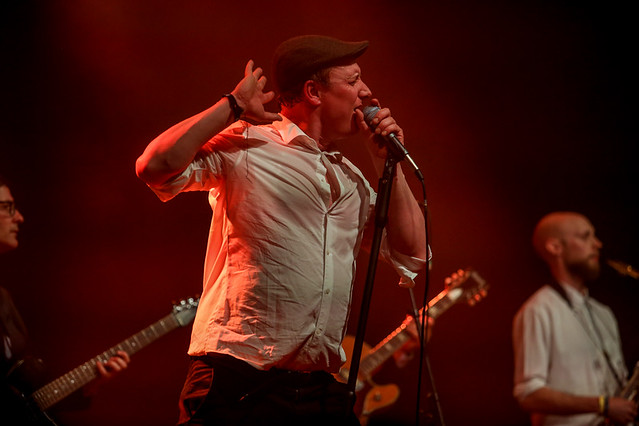
We've been long-standing fans of D/Troit and in particular, their label Crunchy Frog Recordings for a number of years now. 2019 also marks the 25th anniversary of the label's existence and having been a pivotal heart of Denmark's independent music scene, it's heartwarming to see so many people turn out for their birthday afterparty at Sway.
Imagine a collaboration between The Blues Brothers and Searching For The Young Soul Rebels era Dexy's Midnight Runners and you're somewhere near D/Troit's ballpark. Funk driven blues and soul are the names of the game here, and their high energy set understandably fills the dancefloor and indeed part of the stage too.
Energetic frontman Toke Bo Nisted is a focal point, his soulful voice and exquisite dance moves rightly earning the plaudits, while drummer Stefan Cannerslund Andersen is a machine of sorts, keeping time throughout the band's set and more often than not, becomes the driving force in each of their ten, deftly delivered numbers.
Linn Koch-EmmeryStockholm based singer-songwriter Linn Koch-Emmery might just be the finest Swedish musical export this decade. You may remember Linn's twin sister Lea from the vastly underrated Kid Wave, formerly signed to Heavenly Recordings. Linn's musical lineage is of a similar trajectory but aims even more directly for the jugular, which is just the tonic on this cold and windy Saturday night.
Playing a nine-song set of no-nonsense indie rock that's partially indebted to the golden age of Creation Records and 4AD - we pick out a couple of glorious moments in 'Forever Sounds' and 'Waves' for instance that remind us of Teenage Fanclub and The Breeders respectively - but has both eyes firmly fixated on the future. She's another revelation that will surely become a household name over the coming months.
MankindWhen things go wrong they go spectacularly wrong, as was the case with Mankind earlier in the day. Travelling from their native Stockholm by road in singer Arthur Onion's car, it breaks down en route leaving bass player Fredrik Diffner stranded in the process. Most bands would have just given up at that point yet instead of feeling sorry for themselves, Mankind borrowed a friend's vehicle and arrived at SPOT slightly later than scheduled.
Which, as it happens, turned out to be the best thing they could possibly do. Despite being bassless, their Saturday teatime set at Lydhavnen as part of the Tapetown Sessions was delivered impeccably considering it was mostly improvised around what they could play being a member down.
Frontman Onion has an air of Mac DeMarco or Ty Segall about him, particularly in his vocal delivery while songs like 'Ghost' and 'My Luck Will Change' convey a playfulness reminiscent of Deerhunter or Room On Fireera Strokes, which explains why producer Gordon Raphael is so keen to work with them.
TearsHaving emerged from the same garage punk scene as Yung (whose Mikkel Silkjaer Holm plays drums with them this evening), Tears make an unholy racket that's frenetic yet also gratifyingly endearing in its execution.
Regulars on the Aarhus circuit for a number of years now, Tears is essentially the brainchild of Jeppe Gronbaek, a musical chameleon of sorts whose output ranges from furious post-punk to melancholic guitar ballads, sometimes during the same couplet.
Unsurprisingly playing to a large crowd as part of the Shordwood Records event at Knud's Kiosk in the heart of Aarhus' docklands area, even the arrival of snow (YES SNOW! IN MAY!) throughout their set doesn't deter the raucous excitement both on and off stage as band and crowdsurfers brave the weather conditions over yonder to engage in the time of their lives.
The Broken BeatsKim Munk is something of a local legend around these parts, having formed The Broken Beats twenty years ago. Over that time, they've also had almost as many members as The Fall, with a staggering 56 musicians having passed through their ranks since 1999!
They've also put out six albums and constantly toured around Europe while Munk has written musical pieces for theatre, film, and fellow artists as well as playing in any number of other bands on the side. So it shouldn't come as too much of a surprise that he's a bit of a perfectionist when it comes to combining his music with live performance.
Which serves us well for this intimate MTV curated show in the extremely plush Scandic Hotel. Having recently signed to Target Records with four single releases planned for later this year, The Broken Beats' set combined old and new material that reminded us of Pulp, The Divine Comedy, or even Scott Walker at his most sophisticated.
The Entrepreneurs
Having first witnessed The Entrepreneurs, a Copenhagen-based trio, at 2016's Roskilde Festival, it's heartening to see how far they've progressed in the three years since. While the rough and ready elements that stood out during that Roskilde performance remain an omnipresent feature of the band's make-up, they've added a polished sheen that should stand them in good stead for their inevitable sojourn into international territories.
February's ace debut LP Noise & Romance fully encapsulated their nascent fusion of elegant songwriting and experimental noise rock, but it's in a live setting where everything really clicks. Playing in a seated auditorium might not seem like the ideal setting, particularly when the aversion is to stand up and throw one's self around like a loon from the off, yet there's something quite beguiling about these surroundings. Not least because they're undoubtedly a sign of things to come, for on this form, The Entrepreneurs trajectory can only lead one way and that is upwards.
A simply majestic performance from one of Denmark's finest bands.
Twin DiveThe word "potential" is often overused when it comes to art and music, but in this case, it merely illustrates the tip of the iceberg. Initially a duo comprised of Robert Jancevich (vocals and guitar) and Ragnard Gudmunds (drums), the addition of Charlotte Mortensen on bass two months has added a whole new dimension to what Twin Dive describe as their "cosmopolitan rock and roll" sound.
Playing the Klosterport on Friday afternoon, their set also coincides with a torrential downpour, yet that doesn't deter a stream of punters and onlookers from staying put until the bitter end. Musically, their output veers between Band Of Skulls and The Kills territory to heavier moments when we're reminded of Smashing Pumpkins or Screaming Trees.
Recent single 'Joy Will Follow' understandably receives a hero's reception, but with more 45s set to follow throughout the course of the year, we're predicting big things for this Aarhus-based trio in the none distant future.
ZRNFormerly known as Zeroine, this duo - now going by ZRN - have been on our radar for a long time. Ever since 2014's excellent 'Animous' single in fact, so it's been a long wait to finally get to witness them in the flesh.
Playing an experimental noise set this evening, Stine Beck and Christian Sindling Soendegaard's potent mix of drones, electronic beats, and fuzz pedal infused guitar proves a laconic cocktail for those who've veered off the beaten track to witness their performance at the tiny Studio 02K on Sydhavnen in the city's docklands.
People sit on the floor cross-legged while shards of noise build then eclipse around them. It's a dazzling sonic melange so aptly fitting for this kind of setting. Let's hope another five years don't pass before we meet again.
SPOT Festival takes place early every May, in Aarhus, Denmark. For more information about the festival, including dates and tickets for the 2020 edition, please visit their official website.
Photo Credit Banner: Morten Rygaard
Catch The Breeze Photo Credit: Per Bergmann
D/Troit and The Entrepreneurs Photo Credit: Tricia Yourkevich

This killer remix of Georgias 24 Hours made by Sofia Kourtesis has been making my weekend. Its one of the greatest remixes i have heard in a long, long time. Check it out, and listen some more to Sofia Kourtesis.
Georgia · 24 Hours (Sofia Kourtesis Remix)

Julianna Barwick makes gorgeous ambient electronic music. If you like mood music for a clear skied starfilled night or just a sunrise on a clear blue morning sky Julianna's music is just perfect.
Julianna Barwick · Inspirit

So Ninja Tune roster doesn't sleep for sure, Romare has a new brilliant single out from the upcoming album "Home" that is to be released during later on this summer. Listen and enjoy.
Romare · Sunshine (Edit)
Fire in the hall, Jayda G is on the on pure fire with this upcoming single "both of Us". Such a massive groove to this tune. Looking forward to this Ep.
Jayda G · Both Of Us

A short brief message and straight up conversation Aquilotto put the amazing ep SKY++ on bandcamp. As a sunny warm day it is this Friday, go check out bandcamp for some nice cloud pop.
aquilotto · Romeo

Khruangbin are awesome.

박혜진 Park Hye Jin got really hyped for the release If U Want It and then have also been involved with works of Baltra. Cool girl, definitely worth a check, she is pure fire. Upcoming release on Ninja Tune is set for later on this year.
By all the Dj names that starts with Dj, Dj Boring was one of the first that has was mentioned during the start of the golden era of the lo-fi house genre and all the Dj names. But Dj Boring has always been a favourite. This is for Fridays living room dancing.
Getting familiar with Divine Interfaces music first lead me on a more beat and chill inspired kind of electronic music. While this new Divine Interface touches more of a hazy lo-fi slow-mo House. I like where Drew Biggs is headed. Album is coming. Be alert.
I have always had a soft spot for Canadian music and dreamy pop. Tide Riders debut "Minus Touch" is such a catchy pop tune i have been listening to it a lot. I sure hope there is more to come.
Kllo did floor me with their latest brilliant single "Still here", i recommend a listen to this Aussie duo. A little more laid back but lush and gorgeous this one. Im so thrilled to hear the album coming later on this year.
So I remember back in 2012 I've first heard the lovely duo Southern Shores.
I remember falling in love with the sounds reminding me very much of the Swedish west coast sound. So happy to see they are back. It is really the sound I need this year.
CASCINE · Southern Shores - Estrisa
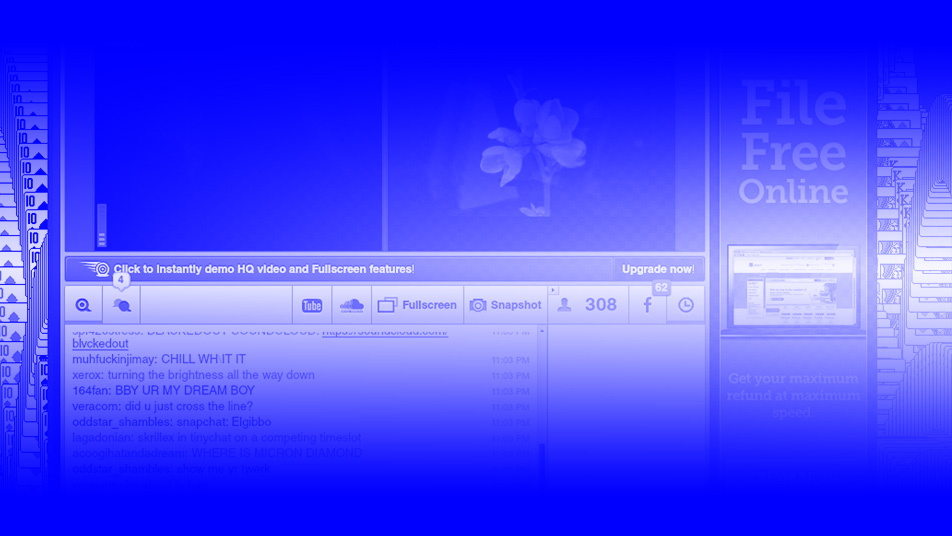 Resident Advisor suggested I write an article for them about the emerging online underground, and the result was my most comprehensive (and polemical) statement on the topic to date (click here to read). It's running theme was a comparison to late-C20th punk and indie, and it went into the aesthetics of vaporwave and PC Music too. The piece appeared alongside a (controversial but, I thought, pretty brilliant) podcast by #Feelings boss Ben Aqua.
 How many times has the concept of punk been redefined? Far too many to count, and besides, no one seems to want to label music any more. Even in the early '90s, barely 15 years into its life, the definition of punk had been broadened and warped in surprising directions—punk could mean naive pop, heavy metal in the charts, or even doing something yourself, whatever that might be. In a new music culture where guitars have been replaced by cracked copies of Ableton, bands have been replaced by anonymous individuals with SoundCloud accounts, and where rock as such hasn't really been on the underground agenda for years, what significance does punk still have?...
 In each of these areas, the processes and problems of the online underground were those of the punk underground in the late 20th century. Building a musical culture on SoundCloud, Bandcamp and Facebook might seem new and strange (if only due to the technology involved) or—more negatively—unimportant or a sign of decline, but these paradigm shifts have happened to the underground before, and they hint at the opportunities and difficulties of the current situation....
 Just like the classic punks, PC Music can be heard as dramatizing the decline of good taste at the hands of modernity, and in 2014 that means noble underground traditions like all that monochrome club/post-club music that rakes reverentially and melancholically through 30 years of analogue production all being displaced by digital decadence, rampant excess and fucking children. PC Music are trolling old ravers, the generation that built the hardcore continuum; they're trolling old punks and their insistence on realism. They're saying, "We might as well sound like this. In a world of gloss and accelerated desire, this is what society made us." And in this regard, they're punks...
When rock'n'roll began it certainly didn't seem like album music either, it was dance music driven by singular hits, and it needed to come up with a way to make albums work as albums, a way to piece them together as wholes rather than just containing a few hits and a lot of fillers. And eventually this got worked out, the "fillers" evolved from fast attempts to reinvoke the hit formula over and over, to an open space for trying out a variety of different types of stuff, without necessarily trying to make hits. Not that it always worked, but there never really seemed to be a constant question of "how to translate rock music into album music" - the solution just sort of developed by itself and now appears to be an intuitive understanding. If you're setting out to make a rock album, a bunch of songs of different kinds, and it doesn't work, it's not because you haven't squared the album circle, it's simply because your material isn't good enough. With rave music - well, with the whole post acid electronic scene, really - that never got to be the case. It wasn't just a matter of making good stuff, you also had to make a proper album context for it.
So why didn't rave music find a way to turn into album music, if it wasn't simply because it was too ecstatic, too lost-in-the-here-and-now-of-the-dancefloor-experience, to make sense outside of that context? I think there's several reasons: First of all, and unlike rock, "electronic dance music" never really lost its identity as "dance" music - which is why I'm using that rather clunky name for it, rather than simply calling it "rave" or "techno", both of which have much more specific meanings for a lot people. This is something that the older generation of rock critics embraced wholeheartedly, because it meant that they could dismiss it as mere faddish functionality - not something you'd really need to pay attention to, let alone try to understand on a deeper level, because it didn't have a deeper level, it was just about stupid fun on the dancefloor and nothing more. And sadly, a lot of rave insiders fully accepted this traditional, rock derived idea of musical substance (authenticity, narrative), and took it as a badge of honour that rave didn't contain any of that. Rather than figuring out how to understand and describe the music on its own terms, the easy option was to stay in the reservation and just use it as a defence: Yeah, you old farts don't understand it because you have to experience it in the context of the dancefloor and the lights and bass and the drugs, to get it - it can't work on its own, so of course it doesn't sound good at home. As if there wasn't plenty of people who did listen to it at home, or got it fine without the drugs'n'dancefloor-context (I'm one of them, and I've got several friends for whom it worked just as well).
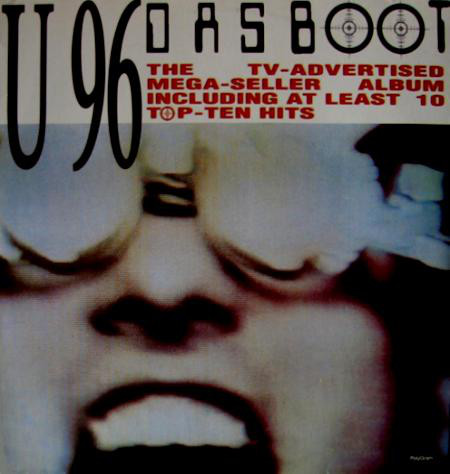
That one of the most common umbrella terms for everything from deep house to eurodance to hardcore techno is simply "dance music", is exactly the problem - suggesting not just that it's music that can be used for dancing (unlike rock or jazz or hip hop?), but rather that it's the only use, that listening to it is pointless. This leads directly to the second reason that rave never fully managed to turn into album music, namely the split between electronic "dance music" and electronic "listening music". The "electronic listening music" was seen as the obvious way to approach the album market, because albums are, after all, something you "listen to". As a result, far too much of this stuff deliberately avoided everything that had made rave music so great - the brutally inhuman machine structures, the raw synthetic sounds, the harsh viscerality - in favour of a polished and pleasing mood music that too often came of strangely regressive compared to the dancefloor-stuff. I remember that the whole "ambient"-movement seemed inexplicable and disappointing to me at the time - not because I didn't like ambient, but exactly because I already knew it well: Ambient was an old style by the nineties, and it appeared to me such a ridiculously regressive move to go back to that just when something as radically new and exciting as rave and techno was happening, I couldn't understand why anyone from the electronic scene would rather look back just when electronic music was at its most revolutionary peak ever, let alone how they could claim that something as safe and well-established as ambient was a new front line.
Not that the ambient/"electronic listening music" camp didn't produce some really good stuff, they certainly delivered their share of the brilliant and incredibly inventive music that made the first half of the nineties such a golden age, but there was also a huge amount of it that sounded as tame and regressive as you'd expect from a movement that used a return to decades old contemplative mood music as the "mature" and "sophisticated" response to the not-just-music of the kids. Most of all, though, both parts suffered from this divide, as it meant that almost everything was forced into one of the two options, and the synthesis needed to make it work as versatile album music never really materialized - the "listening" albums all too often ended up as far too long "mind journeys", lacking the straightforward buzz and urgency of rave, while the pure rave albums either became collections of hits+fillers, trying to repeat a successful formula over a whole album, or tried to create variation through awful "rave ballads" or annoying guest vocalists.
The need for variation was worsened by the third obstacle for rave as album music: That rave just happened to break through at a time where everybody thought that the CD had won over vinyl, especially as the album format of the future. Even though rave and techno probably were the most resilient vinyl strongholds of the nineties, they still subscribed to the logic of vinyl = singles and CDs = albums. The consequence was that far too many electronic albums from this time were simply too long for their own good - the 74 available minutes of the CD became a standard that you were expected to fill out, whether you had the material or inspiration for it - there were even buyers who felt "cheated" if they didn't get their "money's worth" (apparently it was of less importance if the music was any good, as long as they got more of it). As a result of the 74 minutes as the default album length, just making a collection of straightforward rave tracks became a much more problematic option.
The pioneering "album rock" of the sixties had the great advantage that no one expected it to exceed forty minutes (and even thirty minutes or less was perfectly acceptable and far from unusual), which meant that even relatively single-minded rock or pop albums rarely dragged on for too long and became monotonous. It's hard to imagine that most classic rock albums would have gained much by being twice as long - even if the hypothetical extra material was as good as the original stuff, it seems likely that the end result would eventually become to samey. The sharp and precise format of the classic rock LP simply meant that even more-or-less one trick ponies could get away with presenting a handful of slightly different variations of the one trick. In the CD age that approach became increasingly problematic, and releasing an album started to be seen more and more as some sort of "project", something that had to show ambition, versatility and the ability to envision - as well as fill - a vast canvas. Which is all in all not the most obvious way to go when doing a "rave" album.
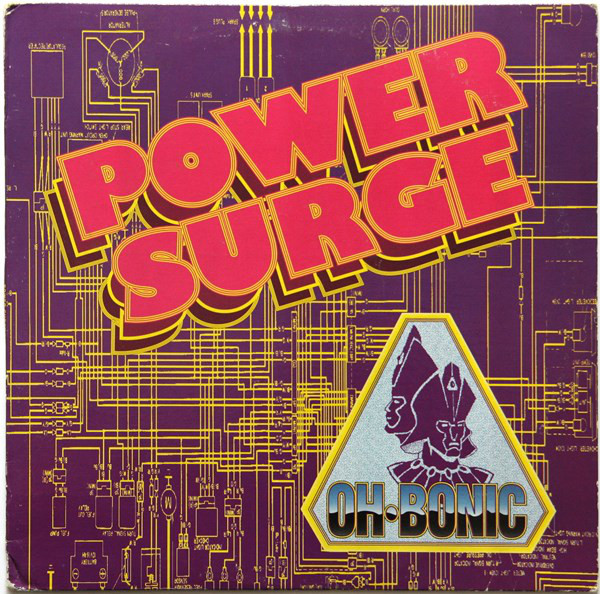
One solution to this problem was focusing on EPs for straightforward rave/techno/hardcore-releases. Rather than having to live up to the expectations of "the album", you could simply do 4-6 tracks that were good enough to stand on their own, yet with sufficient variation and ideas among them for the record to work as a whole. Effectively hijacking 12" singles and turning them into the rave scenes equivalent of the "classic", "handful of songs" rock album, the early nineties was a golden age for the EP format. As for actual albums, though - rave albums as well as those with a deliberate "listening-oriented" ambient/IDM-approach (which also had their troubles with the 74 minutes) -, the problem was never really solved. Or rather, the best solutions seemed more to be down to pure "luck" - that is, simply having enough good and sufficiently varied material to pull of not doing anything but more of the same (i.e. the same "luck" that made many straightforward rock albums work, except that much more luck was needed in the CD age) - or some unique visionary twist that would only work with the specific style and approach of the artist coming up with it (this was of course more often the case with the IDM-leaning stuff - in the rave department, very few even remotely succeeded with this trick).
So, no one managed to invent a universally workable way to build albums out of rave music, but there was a lot of attempts, and a lot of them was actually really good - even if the majority was basically failures. Perhaps this is why I find them fascinating: The possibility of finding a good one isn't big, but it's all the more rewarding, and unexpected, when it happens. The overview below is almost certainly far from complete, I'm sure there's some obscurities, and perhaps even some obvious ones I'm unaware of, but I've tried to include as much as possible. I'm only looking at stuff that I consider "rave", which basically means music that is not trying to be deliberately "underground" and "clubby", i.e. no minimal techno, proto-IDM, deep or progressive house etc. - as well as stuff like straightforward bleep or acid. What I'm after is artists that either got to make albums because the already had hits, or made music that showed that they clearly tried to make hits, all while still staying within actual rave and techno (unlike crossover eurodance/pop like 2 Unlimited, Snap, Technotronic and their ilk). Which basically means that it's mostly within the breakbeat 'ardcore/Belgian techno/proto trance-spectrum, even though there's obviously some grey areas here and there. To avoid those as much as possible, I've also restricted myself to the years 1990-1992, because after that point, most artists had either chosen a specific subgenre path (jungle, trance, gabber), or they'd abandoned rave all together (there was some exceptions, of course, I'll look into some of the more interesting ones in the end of this list).
THE BRITISH SCENE: I've grouped the albums according to the regional scenes, starting with the British, which perhaps had the largest amount and broadest variety of rave albums. The breakbeat sound was almost uniquely British (a few continental producers used it occasionally, but basically as a deliberately added "British flavour"), and in retrospect, we think of it as being what early British rave music was, laying the foundation for jungle. But as we'll see, there was a lot more going on.
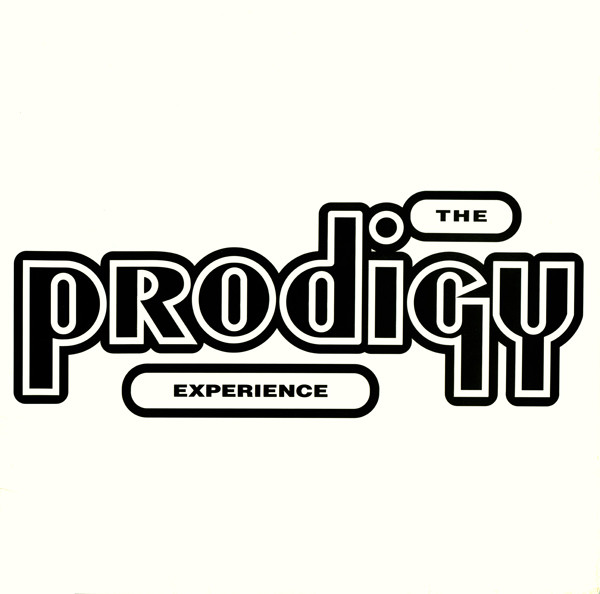
The Prodigy: Experience (1992)Pretty much the gold standard of rave albums, this is exactly how it should be done - presuming you've got the endless supply of explosive energy and inventive ideas that Liam Howlett had at this point. Despite being pretty much all hyper intense break beat 'ardcore from start to finish, Experience simply has so much going on, such an abundance of rhythmic-melodic twists and turns, that it never seems even remotely samey or single minded. It's only a slight exaggeration to say that every moment of Experience is a highlight, at the very least there's never any part of it that come off as uninspired filler material, and it's especially amazing how the tracks constantly morph and change direction - no part of them ever get a chance to grow dull or predictable before they're suddenly taken over by a new, insanely catchy hook leaping out of the speakers, taking the intensity and excitement to a new level. You'd think that this could become too much, but the greatest achievement of the album is perhaps that the sheer originality and freshness of the riffs and the way the tracks are structured, enables it to keep up that insane level of hyperactivity without ever getting exhausting or monotonous. There's the one more "experimental" track, "Weather Experience", which is perhaps not quite as memorable as the rest, but it still has enough jittery drive to not feel out of place. And the rest - well, whether it's stone cold classics like "Hyperspeed", "Charly", "Out of Space" and "Everybody in the Place", or tracks made especially for the album like "Jericho", "Wind it Up" or "Ruff in the Jungle Bizness", each of them is pretty much a mini breakbeat masterpiece in its own right, all while forming a whole that is even greater than the sum of its parts. It's hard to imagine it done better than this! Altern8: Full on - mask hysteria (1992)Much in the same vein as Experience, albeit still with some vestiges of Archer and Peats background in acid house/detroit techno/bleep (of which there were no traces in Howletts sound), and generally considered the lesser album. Which it is. It's not so much that it's closer to the hits-and-fillers-formula, it's rather that neither the hits (quite numerous, actually) nor the fillers are nowhere as good as The Prodigys hits and fillers. Most of the tracks are still pretty good, but they're also more or less standard run-of-the-mill breakbeat 'ardcore. Lots of catchy riffs and nice samples, and thankfully it never goes into crossover dance territory, so all in all not bad at all, it just doesn't really blow your mind, and in the end the genericness do get a bit longwinded in just the way that Experience so impressively manage to avoid. It definitely would have benefited from being a couple of tracks shorter. That said, it's perhaps a bit unfair to criticise it for not being of the same calibre as the definitive masterpiece of the form, and had Experience not existed, Full On - Mask Hysteria might be remembered as the purest album destillation of breakbeat rave: Far from perfect, but with plenty of the lumpen throw-away quality and cheap synthetic excitement that is all part of the charm.
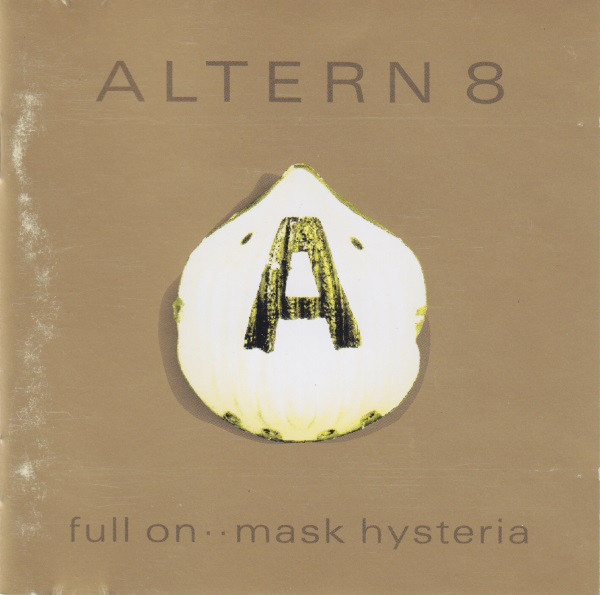
Urban Hype: Conspiracy to Dance (1992)While Full On is better than its reputation, this is pretty much the platonic ideal of getting it wrong when it comes to British breakbeat rave. Known mostly for the novelty "toytown" hit "A Trip to Trumpton", you'd think Urban Hype would, at least partially, go for a playful and "tasteless" approach a la The Prodigy, but instead most of the tracks seems to aim for a slightly more "deep" vibe, or the most anonymously bland rave-pop-by-numbers combination of italo piano and soul divas. On tracks like "Relapsed" and "The Dream", the rave elements are still sufficiently raw and ecstatic to drown out the worst sirupy samples and keep them at least pretty exiting in the moment, but with "The Feeling", "Embolism" and "Living in a Fantasy", it's unfortunately the other way round, and they leave no other imprint on the memory than a slight nausea. And while the "deeper" tracks actually have some potential - especially "Teknologi part 2" and "Emotion" strike a good balance between groove, melody and atmospherics - for some reasons the lame divas and pianos are also tacked on here, as if Urabn Hype didn't actually believe that they would work as more moody pieces after all, and eventually ruining them in the process.
Shades of Rhythm: Shades (1991)Shades of Rhythm were unusually prolific on the album front, although a lot of the same tracks appeared on 1989's Frequency, 1991's Shades and 1992's The Album. Where the last one was pretty much just a slight update of Shades, Frequency is in a more rough, house/acid-derived bleep'n'breaks style, and not quite rave yet - despite the presence of the hits "Homicide" and "The Exorcist". In any case, I guess Shades is the "classic" Shades of Rhythm album, but unfortunately it gets it wrong in much the same way as the Urban Hype-album. There are some good tracks on it - in addition to the aforementioned hits there's also heavy bleep'n'breaks workouts like "The Scientist" and "666 - the no. of the bass" - but then there's also the archetypical potentially-great-but-ruined-by-soul-diva-sugar-coating of "Sweet Sensation", as well as far, far too much horrible soul-jazzy deep house-ish dreck like "Shakers", "The Sound of Eden" and "Lonely Days, Lonely Nights", making it a bit of an endurance test listening to the album as a whole.
The Hypnotist: Let Us Pray - the complete hypnotist 91-92 (1992)Refreshingly devoid of crossover dance and soulful "deepness", this is pretty much a collection of straightforward rave singles with a few unreleased tracks added, and drawing on both the continental brutalist sound as well as British breakbeats. While this is obviously a good thing, Let Us Pray unfortunately doesn't work quite as well as it could have, because even though none of the tracks are bad, a lot of them are also sort of generic and samey, and as a result it isn't able to stay exciting for the 80-minute playing time. Too many tracks follow the same minimally surprising structure, and lack the wellspring of original ideas and hooks that made Liam Howlett able to pull off an hour of the same hectic sound without ever getting boring. That said, and despite missing "The Ride" - arguably his greatest track ever -, there's plenty of classics here ("House is Mine", "Hardcore you know the score" and "God of the Universe" to name a few), and as such it works pretty great as a collection, an archival overview of Caspar Pounds contribution to rave music. It's just not something that it makes much sense to listen to as a whole. Had it been trimmed down to half the length, it could have been really great, but as it is, the sharp blast of the Hardcore ep is a much better suggestion for the definitive Hypnotist record.
Rhythmatic: Energy on Vinyl (1992)A wonderfully compact and straightforward little album - basically an EP extended to an eight track mini LP -, and more or less getting it right where Urban Hype and Shades of Rhythm got it wrong: There's plenty of stylistic variety, stretching from full on rave mania to more atmospheric sparseness, but it never degenerates to mainstream dance or tasteful, tedious "deepness", and it's never just doing styles-by-numbers. This might actually be the best thing about it - there's elements of breakbeat 'ardcore, bleep'n'bass, Belgian techno and even some house/Detroit vestiges here and there (it is on Network), but it's all mixed up into unique, constantly morphing concoctions, doing all sorts of weird and unexpected tricks and twists and never really being one single thing - except that it's all, in one way or another, rave music, pulsing with synthetic energy and jittery intensity. Sure, there's a few elements I could do without (the rapper on "Nu-Groove", the few examples of soul divas, i.e. the usual suspects), but exactly because the tracks change and evolve all the time, those elements never get stuck long enough to become annoying. Energy on Vinyl is one of the greatest overlooked gems of the early British rave scene.
N-Joi: Live in Manchester (1992)Despite being some of the most successful hitmakers on the British rave scene, N-Joi didn't release a proper album until 1995, the rather tame and polished, progressive-housey Inside Out, long after the heyday of their original signature sound. They did make this brilliant "live" mini-LP, though, a just-short-of-30-minutes non-stop barrage of breaks, hooks and buzzing riffs that seems like a much better shot at finding an effective rave album formula than most proper rave albums. Reputedly an after-the-fact studio reconstruction, Live in Manchester creates a cheap laboratory-facsimile of the "real" thing, a buffet of one-dimensional, yet thrillingly synthetic, empty rave calories.
Eon: Void Dweller (1992)Every time I start listening to this, I immediately think it's going to be a brilliant album, which is hardly surprising, given that it takes off with three of Eons catchiest tracks - "Bakset Case", "Inner Mind" and "Fear" - , all offering an abundance of exiting riffs and samples, as well as a highly original sound somewhere between the dominating rave of the day and a kind of proto big beat, as you might expect from something that involves J. Saul Kane. So why doesn't the album stay brilliant? Well, it's not just that the majority of the rest of the tracks are a bit more laid back and atmospheric (with a few exceptions, i.e. "Spice"), it's more that this means that they're less intent on being exciting, and the resulting slightly lower quota of wild sounds and samples draws your attention to the fact that the compositions in themselves haven't that much to offer - there aren't any really memorable hooks or melodies, or exiting structural ideas. Not that there has to be, of course, it's still an original and enjoyable album in many ways, it just doesn't grab the attention all the way as it should, and would have benefitted highly from being two or three tracks shorter.
Shut Up and Dance: Dance Before the Police Comes (1991)Ragga Twins: Reggae Owes Me Money (1991)Rum & Black: Without Ice (1991)I've talked about Ragga Twins and SUAD before, and they only tangentially belong here, given that rave elements only appear as parts of a broader, cross over-hybrid sound with an emphasis on vocals. There's some quite ravey tracks on them for sure, but there's even more where the rap is the main thing, and though enjoyable (well, mostly SUAD, I've never been completely convinced by the twins I must admit), neither Dance Before the Police Comes or Reggae Owes Me Money really work as rave albums. In comparison, Without Ice is a much "purer" album, in that it's pretty much proto breakbeat darkcore from start to finish. Not that it makes it one dimensional, there's both energetic rave, more sparse and gloomy atmospherics, as well as a lot of tracks that combine a bit of both. As such, I suppose it could have been great, but unfortunately, there's really not a lot of ideas in each of the many, many tracks - there's some good and interesting sample choices (Sakamoto, lots of Art of Noise), and the breaks are often treated so that they have a great, synthetic edge to them, but in the end, all tracks more or less just consist of a couple of simple, interchanging loops. It can sound great in smaller doses, but with a 50 minute playing time it eventually becomes a bit of a drag, where it's difficult to tell the tracks apart.
THE GERMAN SCENE: Despite being the only rave scene with a size and variety comparable to the British, early German rave has always been a bit overshadowed by its Belgian contemporaries, which had a few more hits of a broader, international impact. They do have a lot in common - in particular the EBM and new beat-elements, but in Germany that became even more pronounced and electroid, reflecting the importance of the early Frankfurt scene and its roots in new wave and industrial. Still, there's also many other elements present.
Time to Time: Im Wald der Träume (1991)Equal parts rave euphoria, EBM/synth wave-coldness and infantile German humour, Im Wald der Träume is still as charming and paradoxical as the first time I wrote about it. As much an absurdist deconstruction as perhaps the purest distillation of rave silliness around, it's an unique and wonderfully bizarre artefact from a time where it was still pretty open what rave could and should be - there isn't really anything else like it.
Twin EQ: The Megablast (1991)Much like Rhythmatics Energy on Vinyl, and as mentioned elsewhere, this is a short and intense LP that very much sound like it was slapped together in a hurry (as I'm sure it was, the Lissat/Zenker-duo was hyper-productive back then), and it contain no recognizable classics, yet it's all the more charming for it. In addition to plenty of buzzing riffs and stomping beats, there's also 8-bit elements ("Hardcore Keyboard") and even weird machinic acid ("Enjoy"), but in the end it all has a sort of clunky functionality that suggests that this was made by people who were fully aware that they were churning out soulless rave fodder, and just decided to have fun with it, revelling in the cheap, inauthentic-synthetic aesthetic.
Interactive: Intercollection (1992)Interestingly, and despite obviously trying to build on their previous hits, the debut album from Lissat and Zenkers most successful and well know project was not nearly as convincing as the practically forgotten Twin EQ-LP. In addition to "Who is Elvis", the first and most likely biggest in what would eventually become a series of gimmicky novelty-hits, many of the tracks here were minor hits on the early German rave scene, and exhibit the typical combination of EBM-coldness and Belgian brutalism (with new beat as the mediating factor). Arguably, the more minimal and restrained approach of this sound didn't work in Interactives favour, they didn't let loose with as many deliciously synthetic sounds and raw ideas as on The Megablast, though that is not to say that there isn't some pretty great tracks on The Intercollection - "The Techno Wave", "No Control" and "Dance Motherfucker" are all brilliant examples of the style - they just dolose some immediate freshness as they go on. The albums biggest problem, though, and the reason it isn't nearly as good as it could have been, is the fillers, which don't really offer much - again unlike The Megablast, which pretty much was nothing but exciting fillers.
Westbam: A Practising Maniac at Work (1992)Westbam is an interesting character in German rave history; one of its most successful and enduring DJs, figurehead and main brain behind the massive, epoch-defining Mayday mega raves, yet at the same time having a somewhat unusual background, more resembling the British DJ-tradition, raised on hip hop and proto-house, than the typical German EBM/new beat-route. Already a bit of a veteran in 1992, his previous two albums were more in a clear hip house-vein, and it would seem obvious that he would go into breakbeats when going full on rave with A Practising Maniac at Work, but instead, at least to some degree, he approached the more straightforwardly bruising, linear sound domineering the continental dancefloors at the time. Not that we're talking full on Belgian brutalism, there's still hip house vestiges and plenty of uplifting breaks and samples, but rather you get a kind of fusion between these elements and the harder, more cyber-cubist stuff. This actually makes it a somewhat original album, though not a very consistent one - some of the more housey and/or eclectically experimental tracks, like "Acid Snail Invasion" and "Street Corner", just goes nowhere. Westbam is definitely best when he's clearly trying to make fast paced dancefloor functionality or straight up anthems, and he is able to make invigorating and somewhat cheesy rave fodder if he wants to, but here there's a bit too little of that to make a really powerful album. It's still enjoyable, the boring stuff is not too dominant and there's thankfully no cringeworthy dance-crossover attempts, but as a pure rave album, it's too uneven.
U96: Das Boot (1992)I love the humour of the cover hyperbole: "The TV-advertised mega-seller album including at least 10 top-ten hits". Das Boot contain exactly ten tracks, with several clearly being fillers, included only to reach a playing time of at least a short album. But clocking in at slightly over 40 minutes is actually a benefit here - U96 doesn't have that many ideas, so the fast pace of the whole thing means that some weaker elements (mostly) doesn't become annoyances. As a result, this is definitely one of the best cashing-in-on-a-one-hit-wonder albums of the entire rave era. In addition to some actually convincing examples of slow and dreamy "atmospheric fillers", including an odd yet oddly charming "Moments in Love"-pastiche, Das Boot is basically abrasive Belgian brutalism tinged with a few whiffs of the colder, EBM-derived German sound, and except for the misnamed "Ambient Underworld", which could have been good but is completely ruined by lame rap and a histrionic soul sample - it delivers just the kind of great "more-of-the-same"-rave tracks that you usually hope for with this kind of album, but far too rarely get.
Time Modem: Transforming Tune (1992)By far the best album based on the EBM-derived rave sound, and basically just one of the greatest, most consistent and convincing solutions to the whole rave album conundrum. Eventually, at least on the shorter and more condensed vinyl version, it's only 50% rave tunes, with the rest being atmospheric mood tracks, but the two elements frame each other so brilliantly that it all just seems like a whole, simultaneously a blinding rave album that works as pure listening experience, and a sort of futuristic concept album that just happen to work as blinding rave music as well. The softer tracks are interesting in that they're not really excursions into already established moody electronics, like ambient or soft house, but mostly a further mutation of the elements used in the harder rave-tracks - epic chorus-pads, fanfare-like melody riffs, driving EBM sequencer-bass -, all turned dreamy and melancholically introverted. The bittersweet ambiguity is obviously a part of Time Modem's EBM/new wave-genes, and even permeates the rave tracks, most brilliantly on "Welcome to the 90's", the pinnacle of, and key to, the album. Over hectically opulent, yet mercilessly focused rave, an aloof voice embody naïve early nineties cyber-futuristic excitement, with sentences like "we don't need the sun anymore" and, as far as I can hear; "greed is the means to success", but countered by what sound like movie samples in German, shouting bitterly about the horrible state of the world, including the phrase "es ist alles luege" ("it is all lies"). I get the impression that Transforming Tune reflect the ambivalence felt by rave artists coming from older EBM/industrial-derived techno - on the one hand swept away by the hope and celebratory spirit of rave as the soundtrack to the future and a unified Germany, on the other hand still influenced by EBMs dystopian, cyber-punk view of technology. This seems further supported by the closing track "Space and Time", sort of a defeatist hymn to isolation and alienation through technology, with a melancholy girls voice uttering phrases like "take the headphone and flow away, want to be one with my sound" and "cannot forget my reality, eternally apart and loneliness" - a heartbreakingly precise prediction in many ways, and the perfect way to end an album that successfully manages to be invigorating rave, ambiguous electronic mood music, and conceptual futurism all at once! A lost gem if ever there was one.
 New Scene: Waves (1992)Coming from the same scene as Time Modem, but with the EBM and new/cold/dark-wave elements much more dominant, this is only full-on rave music on two tracks - "Sucken" and "PSG 22" - while the rest is somewhere between proto trance and the same sort of slowly drifting, atmospheric not-quite-ambient that was also found on Transforming Tune. The more streamlined, dark and restrained sound makes Wavesa contemplative experience rather than a rave album, but I think it's still worth including here, not just because it pretty good on its own terms, but also because it represent a strange and unique alternative way to turn techno into home listening music, completely different from the path taken by the IDM and ambient scenes, and in many ways not really sounding like anything else: Beneath the dark and dreamy surface, the underlying structures of the tracks - the way they're built - is still clearly recognisable as early nineties continental rave techno. O: From Beyond (1992)The first album from one Martin Damm, who would eventually release countless records of almost all kinds of hardcore, rave and techno, under a plethora of pseudonyms like Biochip C, Search and Destroy and The Speed Freak. Though there aren't many remnants of it on his later releases, he started out in much the same EBM/new beat/electro-based area of continental rave as Time Modem and New Scene, and From Beyond is also a combination of old school German rave, proto trance and epic synthscapes. It's a bit on the long side, with a few less-than-inspired tracks, which I guess could partly be blamed on the fact that, unlike Transforming Tune and Waves, this is a CD-only release, and therefore doesn't benefit from being trimmed down to a more focused single LP, as those albums were. Still, there's a lot of really good stuff here, and especially the atmospheric synth tracks have an endearingly-dated period charm, though many would probably find their swelling pads and cod-epic melodies too much. Personally, I find this aspect of the album fascinating - as with the two previous ones, a glimpse of a completely forgotten road not travelled.
 Space Cube: Machine & Motion (1992) A bit of an outsider here, Space Cube started out making more ravey tracks, and are often remembered as one of the few early German rave acts to use breakbeats, but on the debut album Machine and Motion, they worked with a lot of different elements, including pounding techno and drifting acid, as well as - unfortunately - quite a bit of house, foreshadowing Ian Pooleys later career. The result is simultaneously varied and somewhat more "pure" than most records on this list - as in "not cheesy" and "closer to proper dark'n'deep minimal techno". Which eventually makes it a bit too "nice" and anonymous to my ears. There's some really good tracks on it, such as the 80Aum/T99-ish brutalist "Disruptive" and the UR-acid-spacey "Forbidden Planet", but as a whole there's too much good taste and relaxed smoothness for it to be really convincing as a rave album. Perhaps it could be seen as a good example of how there still weren't any clear genre borders at this time, and how an album from the rave/techno-scene could contain many different styles and ideas, and on those terms I guess it has merit - many of the softer tracks are not bad at all - but I'd still much rather listen to an album one dimensional "rave fodder" than this exercise in well-crafted style and diversity.
THE BELGIAN/DUTCH SCENE: It's strange that Belgium usually gets all the credit here, because the infamous brutalist sound was as much the responsibility of Dutch producers - several of the classics that are by convention considered Belgian (like Human Resource or 80 Aum) were indeed Dutch. Of course, the Belgians didhave the EBM and especially new beat-scenes to draw on, which could explain why - when it came to albums - they seemed a bit more prolific. In the end, though, the rave made in the two countries was generally so similar that it makes little sense separating them, which actually is a bit strange, considering that the Dutch producers had roots in hip hop and italo disco, rather than new beat/EBM, and eventually went on to create gabber, while the Belgian producers more or less disappeared from the techno map subsequently.
Human Resource: Dominating the World (1991)According to some guy on discogs, this was actually released prior to "Dominator" becoming the huge hit that it was, making it a very odd thing on this list: An album that produced a classic track, rather than being produced to cash in on an already established classic. Given the title, though, they were at the very least aware of the tracks potential, but in addition to that, there's actually a lot of quality stuff present here, especially in the beginning, with inventive and well produced, slightly more atmospheric (but still highly invigorating) tracks like "The Joke" and "Faces of the Moon". Unfortunately, much like Eons Void Dweller, as the album goes on the tracks become less interesting - still very well constructed, but more or less lacking really memorable hooks or sounds, or the general raw power usually associated with the Belgian sound that "Dominator" played such a big part in developing. Furthermore, remixes of "The Joke" and "Dominator" - nice as they are - makes the album longer than it had to be, and the lack of new ideas on the second half becomes even more obvious.
LA Style: The Album (1992)Of all the one hit rave wonders, LA Style had the biggest challenge with creating an album, and sadly, they weren't up for that challenge at all. Not only was "James Brown is Dead" the biggest and most iconic of all the brutalist hits, it was also based on such an idiosyncratic and immediately recognisable riff that it was pretty much impossible to expand upon it - it was painfully clear how the countless clones that sprouted overnight tried to recreate the exhilaration of the fanfare blast, and you'd recognise this right away. "James Brown is Dead" is simply impossible to take any further (the sound alone - it actually managed to give the impression of realizing the old joke: make everything lounder than everything else!), and it might seem a bit like a novelty-track in this way, but don't get me wrong; it's arguably the greatest rave track ever exactly because of this - rather than a "gimmick", it's a singular stroke of genius. And how do you cash in on that, without repeating yourself ad nauseam? Well, don't ask LA Style, because that's just what they did - pretty much every single track on The Album recycles the "James Brown"-riff in one form or another. At best it gets more baroque and exaggerated, as on "LA Style Theme" - though that track could pretty much be called a "James Brown is Dead"-remix -, other times it regress back into something slightly more italo-piano-ish, and far far too often there's added a hearty dose of the most generic early nineties dance rap-and-soul imaginable. A few moments have merit, but only when they're repeating what was already perfect on "James Brown is Dead" - that single is still all the LA Style you need, and nothing is added here that changes that.
T99: Children of Chaos (1992)Next to "James Brown is Dead" and "Dominator", T99s "Anasthasia" is probably the greatest belg-core hit of all time, but unfortunately the album based on it isn't much better than the two previous ones. It's not for lack of trying, though, as T99 clearly wants to make a varied and coherent whole, rather than just a bunch of "Anasthasia"-clones. Now, a bunch of "Anasthasia"-clones would probably have been a lot better than this mess of crossover rave and more or less successful attempts to make laid back tracks, but the latter actually dohave some merit, Patrick De Meyer and Oliver Abbeloos are excellent craftsmen and they know how to create a good tune with good futuristic sounds at low speeds as well (despite some annoyingly "musical" elements like the nauseating sax sample on "After Beyond"). The biggest problem on Children of Chaos is the insufferable amounts of tacked on vocals - the usual lame rapping and cringeworthy soul divas - that render otherwise brilliant rave tracks like "Maximizor", "Cardiac" and "Nocturne" almost unlistenable. And it's really a shame, for had the album kept to just raw synthetics, and perhaps scaled down the amount of atmospheric tracks slightly while developing some of the shorter rave sketches a bit, this could really have been the Belgian rave album. But then, you could say something similart about most of these.
Quadrophonia: Cozmic Jam (1991)Prior to his succes with T99, Oliver Abbeloos also had a couple of hits together with Lucien Foort as Qadrophonia. Containing many of the classic Belgian elements - exhilarating blasts of raw angular bombast - as well as a surprising amount of breakbeats, Cosmic Jam unfortunately also contain extremely dated rapping on all tracks but a few short interludes. I guess this was a conscious choice, trying to give them a bit more personality (much like with added vocalists of 2 Unlimited) bit it completely ruins what could otherwise have been a pretty good - if perhaps a bit long - rave album.
Pleasure Game: Le Dormeur (1991)Le DormeurI've talked about before, and though it still has its flaws - most tracks are slightly abbreviated, and there's a couple of somewhat uninspired "ambient" fillers - it also remains one of the most straightforward and convincing of the early nineties rave albums. Actually, of the Belgian albums, only one was better, and interestingly, that was made more or less by the same people.
DJ PC: 100%(1992)While DJPC was fronted by DJ Patrick Cools, the production team behind the project included Pleasure Games Jacky Meurisse and Bruno Van Garsse - both coming from the EBM/new beat-outfit SA42 - and with 100% they made the ultimate Belgian rave record, the album that Human Resource or LA Style or T99 should have made. Some tracks are better than others, but even when they're a bit too gimmicky ('Return of Tarzan', 'Di Da Da, Di Da Di Da Da'), or ridiculously bombastic-by-the-numbers ('Control Expansion'), they're still super effective, focused and exhilaratingly brutal. And the best tracks are just incredibly good, all ugly angular machine music, relentless mentasm madness, and not a guest vocalist or smooth'n'laid back track in sight.
Hypp & Krimson: Rave Sensation (1991)Containing tracks released under six different names, this is sometimes listed as a compilation. Everything is produced by the duo of Jeff Vanbockryck and Patrick Claesen, though, with different collaborators here and there. We get the instrumental versions for a couple of Miss Nicky Trax productions, well known Ravebusters-classics "Mitrax" and "Power Plant" (though for some reason the latter is accredited to Hypp & Krimson)showing their roots in new beat, and in addition several unknown (to me) gems in the same vein, like "Torsion", "Dreams Forever" (as Code Red) and "Liquid Empire" (as Cold Sensation) - heavy rave fodder that isn't all that inventive or catchy, but makes up for it with precision-locked efficiency. The weakest part is the more floaty, atmospheric offerings - one of the Nicky trax and the not very aptly named "Rave Banging" - they're not exactly bad, just pretty uninspired, and they do create a couple of dull drops in the overall energy flow. As a result, Rave Sensation doesn't completely live up to its name, but it's not too far off either, and certainly one of the more consistent of the belgian albums.
Holy Noise: Organoized Crime (1991) Perhaps the greatest of the Dutch rave producers, Holy Noise was where DJ Paul got his first real success with tracks like "The Nightmare" and especially "James Brown is Still Alive!!", his riposte to LA Style, before he became a key player on the emerging gabber scene. As such, he's one of the only Benelux producers to have a noteworthy career after the rave heyday, as well as perhaps the most obvious link between gabber and the early brutalist rave sound. Organoized Crime is one of the better lowland albums, even though it sort of disappoints because it could easily have been so much better. While no tracks are bad as such, and several are really great, there's also a couple that are a bit too mediocre - in particular more minimalist ones like "House Orgasm" and "The Noise", and since the album is much longer than it has to be, it just becomes a bit exhausting overall. If the two aforementioned tracks were kicked out, as well as one of the two versions of "Get Down Everybody", we'd have an absolute classic here, one for the rave album top ten. Instead, we get something that do contain a lot of good stuff, but eventually looses its steam before you're through.
OTHERS: Two (or perhaps rather two and a half) other local scenes needs mentioning, being big enough to eventually produce full length rave albums (that I've heard of). Yet they're very different - the Italians produced endless amounts of generic (and often brilliant) rave fodder, a variant of the brutalist sound more or less infused with elements of italo disco and italo house, while the rave proper produced by the American scene seemed like maverick attempts to participate in what was going on in Europe, rather than a reflection of an overall American sound. Finally, the odd Spanish "makina"-scene was arguably closest to the early German rave, with EBM and new wave still very clearly present.
Moby: Moby(1992)This amazing LP will be a bit of a surprise to anyone only familiar with the later emo-Moby - or anyone who think "Go" is representative of his early style. What you get is a tour de force of almost perfect rave intensity, with "Go" and the closing "Slight Return" being the only softcore tracks. Sure, the first half is by far the best, and there's a house piano here and a soul sample there that you could certainly do without, but there's only a few of these (and let's be fair - even The Prodigys Experience had a couple), and they're not prominent enough to do any real damage to what is otherwise a brilliant collection of tracks, action packed with jittery ideas, catchy sequencer riffs and dynamic twists and turns. Whether it's near-claustrophobic EBM-ish tightness ("Yeah", "Have You Seen My Baby"), strings'n'acid-driven brightness ("Help Me to Believe"), or explosive, unhinged rave-insanity (pretty much all of side A), none of the tracks are bad - and some of them are simply among the very best of the era. This is pretty much the only Moby album you need - but if you're after early nineties rave then you really do need it (and who'd have thought you really needed any Moby at all?). As rave-albums-that-works-as-albums go, Mobyis among the very best.
Oh-Bonic: Power Surge (1992)A brilliant little album that sadly seems to be completely forgotten. As far as I can figure out, Oh-Bonic was basically Omar Santana, who has followed a long and pretty weird trajectory through electronic dance music: Starting out as a part of Cutting Records early electro/house famil, and eventually ending up (last time I checked, anyway) producing bizarre "patriotic gabber" in the wake of 9.11 - presumably distancing himself from his earlier New York Terrorist-moniker, which I guess didn't seem that funny anymore. In between, however, there was both a more ordinary gabber/hardcore phase (much in the typical Industrial Strength/Brooklyn vein), as well as an earlier phase of awesome, brutalist rave - with Power Surge as the crowning achievement. Here, all the most obvious and effective rave elements are supercharged by generous inspiration - every track is jam packed with ideas and variation, constantly shifting and adding small electrifying details - as well as a knack for catchy riffs. Much like the early Prodigy in this respect, actually. The only downside is the tacked-on rap that makes a couple of otherwise excellent tracks seem cringeworthily dated - in one case made even worse by a liberal dose of soul diva samples. With the rest of the album being so pure in its super synthetic sound design, these attempts at adding a human emotional element just makes it seem much more mundane and backwards-looking. Not so much, though, that Power Surge isn't still a small gem in the same vein as Energy on Vinyl and The Megablast, well worth tracking down.
Digital Boy: Futuristik (1991)Digital Boy: Technologiko (1991)With two albums in one year, Digital Boy was one of the most prolific of the Italian producers, and probably the closest we get to a household name from that scene. In a lot of ways I really want to like the ambitious Futuristik double LP, it has a lot going for it: A good title and a ridiculous cover, a couple of really good, catchy rave tracks, and some unexpected oddball moments (a bleep'n'bass-ish xylophone-riff here, a playful rip off of Speedy J's 'Pullover' there, a live track that actually sounds live). And while there's also a lot of more uninspired, clumsy fillers that doesn't quite reach escape velocity, there's only a few tracks that are really awful (especially "Touch Me", a horrid attempt at a kind of smooooooth hip house torch song). The problem is that it just goes on for such a long time, which means that the mediocre stuff that would be acceptable in smaller doses on a more focused album, eventually becomes the defining character here, and rather than being invigorating like the best rave should be, it kind of loses all momentum in the long run. Luckily, Technologiko gets it right - a super condensed eight track mini-LP that just deliver functional rave fodder in the most hook-filled, simple and electrifying way. None of the tracks are lost classics, but there's no real duds either: They all work the formula brilliantly, and like The Megablast, Energy on Vinyl or Power Surge, the result is a record that captures raves single-minded, disposable hyper-excitement perfectly, exactly by having no other ambition than being a short, one-dimensional energy blast.
Bit-Max: Galaxy (1992)Pretty much as concentrated italo-techno as it gets: Generic-yet-explosive rave tools by a bunch of virtually unknown producers (the only ubiquitous one on the album being one Maurizio Pavesi), overdosing on all the most effective euro-rave elements (mentasm stabs, hypnotic EBM arpeggios, bombastic fanfare blasts - though, thankfully, no pianos), with half of it sounding suspiciously like something you've heard somewhere before. And - of course - there's several otherwise brilliant tracks that are ruined by relentless diva samples, which prevent Galaxy from being up there with the very best. But there's still plenty of good stuff to make it highly recommended to anyone into golden era rave at its most gloriously mercenary.
Teknika: Yo No Pienso en la Muerte (1991)This is the only example I've got from the Spanish "makina"-scene, basically a local take on EBM-influenced rave in the same vein as German acts like Time Modem and 'O'. I suppose there's a lot more out there, but at least for albums, I've not located any others (not that I've tried that hard, it must be said). In any case, it's an effective mini LP, where most tracks deliver a relentlessly propulsive, slightly more minimal and machinic version of the aforementioned German sound. A couple of melancholic tracks are thrown in for variety, sounding somewhat dated, but in a charming way - sort of instrumental "minimal wave" rather than the floating, complex mood pieces that the German acts were doing. A nice little album that holds together very well.
AFTERTHOUGHTS: By 1993, "rave" as an overall term had more or less disappeared, or rather, had split up into fully self sufficient and clearly distinct niches like darkcore/proto-jungle, trance, gabber/happy hardcore or even "techno", which had hitherto been an overall term used for pretty much all the rave forms, but now suddenly became more and more synonymous with pounding minimal functionalism. Still, there were some producers left who in one way or another continued making "rave" at a time where there wasn't really a scene for non-specialized rave any more. Whether they simply were a bit too slow following the changing landscape, just had some tracks left that would have been perfectly up to date a year prior, or deliberately tried to create a continuation of the general, all-encompassing rave spirit, I find these out-of-time rave albums fascinating, and deserving some mention. Indeed, some of them are truly brilliant in their own right.
GTO: Tip of the Iceberg (1993)In many ways a very sympathetic album, wrapping the classic "old faves + some new fillers"-formula in a pan-stylistic, almost meta-rave "unite-the-scene"-concept, at a time when the rave scene was busy splitting up. We more or less get everything from piledriving gabber and hardcore over cold, monolithic trance to softer, more housey tracks, sometimes with an almost bleep'n'bass-feel. The weird thing is how none of this sounds quite right, but rather like someone decided to make trance or gabber, rather than growing it organically from within a scene. This certainly gives Tip of the Iceberg an original sound, but it also means that it doesn't really manage to create the feel of rave-distilled-in-album-form that it seems to aim for. In particular, there's an awkward minimalistic restraint to it, at odds with the cutting-loose-and-going-mental effect you'd usually expect with these styles. This goes for the sound design - strangely polished and empty even in the raw'n'ruff hardcore tracks - as well as the compositions, where there aren't that many ideas or really memorable hooks around. It eventually becomes a problem for an album as long as this. In smaller doses - like side B with its metal machine gabber, or the more hit-oriented side C -, it's quite enjoyable, but as a whole, and especially with the two somewhat uninspired and monotonously minimal closing tracks, Tip of the Iceberg gets a bit tiring. Which is a shame for a record that so deliberately and head-on try to solve the rave-album-problem. That said, it remains refreshingly odd.
Sonic Experience: Def til Dawn (1993)An unabashed "meta rave" effort, where raw and ruff breakbeat tracks are interlaced with sound clips from open air raves (mostly police confrontations). The clips are sort of charming, I guess, but they do make the LP feel more like a kind of "historic document", rather than simply a great collection of generic-yet-invigorating 'ardcore at its most unpolished - which is basically what it is. But perhaps what Def til Dawn shows is that by 1993 this sound was already seen as something to look back upon nostalgically, as things had moved much further ahead. A great snapshot of an era that was over almost as soon as it had started.
Sonz of a Loop da Loop Era: Flowers in My Garden (1993)Just a mini-LP, but worth including here as it's the closest we get to a Sonz of Loop da Loop Era-album. Perhaps its shortness is an advantage, as all six tracks capture Danny Breaks at his b-boy derived best, filled to the brink with jittery riffs and hyperkinetic breaks (more proto big beat than 'ardcore on "Breaks Theme pt. 1", but still great), with no time to fall into any of the traps so many others fall into when having to deliver a full album. Flowers in My Garden might not be as catchy and relentless as Experience, but it's a pure distillation of 'ardcore at its most un-assumedly loose and playful.
Criminal Minds: Mind Bomb (1993)
The flipside to Sonz of a Loop's silly and colourful sound, Mind Bomb is a much more raw and aggressive take on 'ardcore. There's quite a lot of slightly (for its time) backwards-looking techno-elements, as well as plenty of proto-jungle, just not dominant enough for it to actually be jungle (unlike, say, Bay B Kane's Guardian od Ruff or A Guy Called Gerald's 28 Gun Badboy, which are arguably just on the other side of the divide - perhaps not fully developed jungle yet, but still closer to jungle than to breakbeat rave). None of the tracks are super memorable or lost gems, but neither are any of them bad - they're hectic, rough and hard-hitting examples of generic hip hop-influenced 'ardcore of the kind where the genericness is a crucial element, and as such it is perhaps the most "authentic" example of this music in album form.
'Can you imagine Doobie in your funk?' - George Clinton
'You fake the funk / Your nose got to grow' - Bootsy Collins
I like my Funk uncut, but who doesn't? However, around 1978, a funny thing happened; white kids extracted seminal fluids from the recently deceased corpse of Punk and spiked everyone's drinks with it at the mutant disco. The bands born of that experiment wouldn't be content to play Funk lite or heaven forbid 'blue-eyed soul'. Oh no. This was a different beast altogether. But I'm getting ahead of myself...
Time is a trick of the mind, as Rip Rig & Panic once suggested, so I'm here in 2018 listening to music that's 30 years-old but actually inspired by music that was 10 years-old then. Geddit? There were a bunch of lads living close to the eye of the 'Madchester' storm but not about to embrace the whole Summer of Love, E'd-up, Rave on scenario, as stated in this lyric: 'no way ( i'm getting laid back )\ there's no way I'm getting laid back, I'm going to attack attack attack attack attack!\ e-sucking teepee heads' (No Way / E-Sucking TeePee heads). Too young for Punk but keen on Funk, Jazz, Improv and more, they conjured up the spirit of '78, the one that had some contorting themselves and their music into shapes formed by Punk, Free Jazz, Dub and, er, 'experimental' Rock.
At a time when white music lacked 'attack' (the E-ffect) but dabbled in the 'baggy' version of Dance music or a straight-up take on Techno, Stretchmarks got themselves into another, 1978 state of mind. You could say that, like E-heads (tee-pee heads), they were escaping reality, but who can blame them? Me, I was coming down after a decade of discovering Jazz whilst dancing to Rare Groove and Hip-Hop. At my Soho cellar bar club, a friend would tell me of the chemicals he'd ingested and describe 'the scene' but I thought 'never mind the Balearics', what about Public Enemy?
Anyway, here on The Stretch m-ARKhives are a set of tunes never released at the time. 1988 wasn't the place for them and today? Yes. Why not? We can all do the time warp. It's...fun? To an old fart like me who still treasures Defunkt or The Pop Group above most contemporary bands it's a treat anyway. As the world edged towards becoming a zone of zero funkativity in 1978 what The Pop Group followed by Rip Rig & Panic along with James Chance then Defunkt did was a blast. Little did I know that Defunkt's Joseph Bowie had a brother, Lester, would provide such a source of pleasure in the next decade, or that the creator of the very words 'Rip Rig & Panic' (Roland Kirk) would do the same. One door (Punk) closed, another (Jazz) creaked open a few years later.
Sorry, but I can't help referring to my musical past, it's so intertwined with that of Stretchmarks. Despite and because of the clear influences, this is a fascinating release. All the relevant names I've mentioned are fed into the sound. No Wavers DNA are also in the, um, DNA, as in Arto Lindsay-style guitar. What marks them out as very British, dare I say, are the 'eccentric' lyrics. 'lets get weird, lets get weird, lets get weird in my kidney shaped swimming pool.' (Let's Get Weird) for instance, reminds me very much of a satirical bite Jason Williamson spits out for Sleaford Mods. Likewise, in a nonsensical fashion: 'twighlight or dawn, i'm yawning at the sudden similarity.\ lobster or prawn , i'm certainly no Jaques Cousteau when it comes to the sea.' (Puddle of Love).
Free-form, funky, raw and ridiculous, Stretchmarks proved it was possible to fake the Funk without fear of serious nose growth. I'm enjoying this album very much and that's no lie. The CD with bonus tracks is worth getting if only for Cosmic String and No Reason. You can buy it and the vinyl version on the Bandcamp page. Band member Matt Wand's words are also, as always, worth reading.
Logical Progression (LTJ Bukem) / Logical Regression (25 Years of Goldie Oldies) [ 01-May-18 3:36pm ]
The best thing about Good Looking records was that because most started in an ambient fashion they made mixing easy for someone like me, who never learnt beat mixing when I was a DJ. I preferred to join the thematic/style dots, as befitted an eclectic DJ.
To say that was 'the best thing' isn't strictly true, of course. I only did so in order to reel out an old story from the days of mobile DJs which, I assume, still exist. In the mid-70s a friend once knocked at my door and asked if I wanted to go into the DJ-ing game with him. I was interested until he told me the cost of the turntables. So he went ahead anyway and on one night declared over the microphone that the best thing about the Elvis record he'd just played were the scratches at the end. Not that he was a proto-Christian Marclay-type sonic experimentalist or anything; he simply wanted to wind up the Teddy Boys in the hall.
No, I'm not that old, but you'll have to take my word for the fact that in 1977 Teddy Boys still existed. There were frequent running battles between them and Punks down the King's Road. His comments sparked another battle between those two tribes on that night. He asked us if we'd stand in front of his speakers to protect them, which we did. Luckily, both the Punks and Teds were more intent on damaging each other.
22 years later, how have Good Looking records aged? That's what I wondered, staring at the 99p double CD, LTJ Buken presents Logical Progression, in the charity shop this morning. At that price, I could find out the answer. Also in the shop was Radiohead's OK Computer, for even less, 69p, yet despite being tempted I couldn't even part with that measly sum in order to satisfy my curiosity regarding what many consider to be a 'classic'. Whenever I've seen Radiohead performing on TV they've annoyed the hell out of me. Having passed up on OK Computer at that price, I shall never know if I can find anything worthwhile in it. Yes, I could go to YouTube, but cannot be arsed.
I did buy a few Good Looking singles at the time (1996) but preferred labels with more bite, like Metalheadz or No U-Turn. Bukem brought a kind of sophistication to the Drum'n'Bass scene, not that others didn't try to do the same, just that he made a mission out of it. All these tunes are polished to a high sheen. I'm on the verge of saying 'you can't polish a turd' but that would be a little harsh. My problem with a lot of these tunes now is the very thing that marked them out as Good Looking records in the first place; that gloss and, in places, 'soul' crooning all over the shop. I confess that the desire to have repeat phrases run through Jungle and D&B tunes gets on my nerves now. At the time I would have forgiven it if the drum and bass were hard enough.
So I've run through both discs and my only, admittedly weak (sorry) opinion is that a lot of the tracks are OK, running to good when the rhythm gets going. It's kind of D&B Easy. To many, I know, that will translate as 'classical', especially those thinking themselves too smart for ruffneck tunes featuring gangsta/JA vocal samples (just my kind of thing!).
Talking of Metalheadz, 25 Years of Goldie (Unreleased And Re-Mastered) was a Record Store Day release (limited copies available at a later date) and right from the opening bass on Rufige Kru's I Walk The Dog you get that feeling, the one you had back in the day, the tingle of anticipation....then...here come the drumz! - and the incessant, ominous future noize splicing your brain - you know, the way Goldie and co. did. Rob Playford & Goldie's Shadow VIP is a corker too, the la-la-la-la vocal (?) enhancing what is already a demented percussion workout with trademark chainsaw bass flipping it into the realms of a psychotic treat which segues nicely into Rider's Aftermath wherein that vocal mutates into a mechanised refrain whilst Playford and Goldie proceed to beat you into a bloody pulp (and you love it). Although you're either helpless flat on the floor or jumping around the room by now (possibly even middle-aged Junglists can still do that) Stormtroopa delivers the coup de grâce, rewinding your mind (if not body, though you wish it were true) to times when you could and did go mental to Metalheadz records.
There seems to be little left to say about John Coltrane or Miles Davis, although such is our (human) nature plenty of prose about them will no doubt pour out until the end of the world. I was going to 'review' Miles Davis & John Coltrane - The Final Tour: The Bootleg Series, Vol. 6, but thought better of it, then thought differently again and so on...
...my head bounced to and fro as if I was an audience member at one of these gigs, assuming Coltrane had that effect, which he surely did. Today we're oh-so-wise about What Happened Next but it's not hard to imagine, having closed off retrospective wisdom, how shocking Coltrane's playing was in 1960...
...it's even shocking now in the context of a band tour under the name of a legend playing standards and future classics from Kind Of Blue to all intents and purposes supposedly not 'just' but no more than a 'cool' god playing Modern Jazz but...
...what happens, no-one could predict. What happens is a draft of things to come not just from Coltrane but a generation of iconoclasts out to smash what used to be Jazz into pieces, albeit very large pieces in the form of 20-minute voyages of discovering just how far they could go when blowing and in the process alienating many Jazz-lovers, just as Miles Davis would do towards the end of the 60s with Bitches Brew...
...talking of which, on this tour, at times, Coltrane manages to make Miles Davis sound like The Past, no mean feat, although it's easy to exaggerate what happened. The fact is Coltrane was in a bad mood most of the time and wanted out; the sound of a prisoner sawing at his shackles doesn't always make for comfortable listening but neither does most of what he would unwittingly unleash in the form the The New Thing...
...some of the crowd at the Paris gig definitely weren't happy, as we can hear by the whistling when, having briefly dipped back into the theme on All Of You Coltrane goes way off-message and to those without the ability to see into the future may well have sounded as if he'd lost the plot completely like an amateur in a cutting contest...
...what Davis thought during the process is anyone's guess but 'Muthafucker!' is one good guess. He had, after all, suggested Coltrane try taking the horn out of his mouth when he told his boss he didn't know when to stop, but the Free thing would be very much about not stopping, or more to the point, not being concerned about neatly tying up a tune (what tune?) in the tradition of improvising as it was known up until the 60s when through a hunger for taking a magical mystery tour Afrocentric blacks and radical whites engaged in a process of developing what would become known as just Improv, rather than 'improvisation', thus, ironically, shortening a word but considerably lengthening the nature of the beast unleashed by the likes of Cecil Taylor, Ornette Coleman and the UK's own Joe Harriott who, it must be said, deserved more than he got in terms of recognition and, to be frank, lifetime, but instead is a cult figure in musical history, unlike Coltrane, who despite living for 6 years less than Harriott had the drive, ideas, connections etc to make more incredible music than most tenor players could manage should they live forever and there was tough competition, not that he was in competition except regarding polls; the likes of Sonny Rollins and Wayne Shorter who, having 'scrambled eggs' with Art Blakey's Jazz Messengers was called up for duty in Davis' next Great Band, which set a pace of their very own whilst others took to roaming Free range, which Davis had no interest in or respect for therefore making the wild electric storm blown up by him in the late-60s ironic, eh?
Did I blow for too long with that sentence? Oh well, consider it a homage...
Album: Sonae - I Started Wearing Black [ 16-Apr-18 3:48pm ]
Sonae started wearing black some time ago - I'm not sure that's a good thing but I defer to her right to do so - me, I don't like black or wear it, except shoes for work. The negative connotations are obvious, although that aside, without a care for what it may suggest, black is popular, mainly in the office. People are lazy, knowing that anything goes with black. I understand. If your base sartorial colour is actually a colour, you have to work on the rest of the outfit. The problems of life...
Meanwhile, Sonae's music on I Started Wearing Black is not quite as Dark as the title suggests, without being cheery either. Personally I'm wary of cheerful people. I think they must be a bit simple, but at the same time, envy (a little) their ignorance-is-bliss state of existence. I don't know what shiny happy people listen to (Beyonce?), but it's probably not this kind of music. Among the highlights is Dream Sequence (with Gregor Schwellenbach). Except there's nothing 'high' about it; instead, a beautiful quasi-orchestral feeling of a half-remembered dream. On this and throughout, Sonae loads the track with atmosphere courtesy of concrete-type sound. She has mastered the art of texture to the point where it becomes an art form, as opposed to a cheap easy route to supposed 'haunting' auras, hauntology-by-numbers.
Thankfully, when she decides to use a beat, it doesn't sound like a tokenistic nod towards feeling obliged to liven things up but, as in the case of the title track, an organic evolution, executed with taste. The stripped back metallic beat, when it comes, is even more effective on White Trash Rouge Noir. Quality product.
There comes a time when you really have no interest in such things as 'Junglepussy In the city centre of Ghent, in northwest Belgium' (Quietus headline today). This time comes earlier in some people's lives than others. To say I have only just arrived at that point as I near 60 would be a lie. For a few years now (how many, I cannot count because a gradual development has no definite beginning) I have had such thoughts when faced with contemporary music news.
I could lay the blame, not on Mame, but J.S.Bach; to be precise, his cello suite No.4, which I started playing half an hour ago. It took less than a minute for me to think what all great music is capable of making us think, namely: "This is superior to everything" (except the relatively few other truly great pieces of music I own). The subject in the back of my mind is how middle-aged listeners relate to contemporary music, not that which inhabits the narrow specialist field they may still explore should they be interested in contemporary music, but the 'contemporary' as covered by the larger sites.
Unfortunately, even defining 'contemporary music' is not as simple as it once was, in the olde days when vinyl was all we had. That cassette-only album (but on Bandcamp) your Noise-making friend released recently is still, basically, contemporary music. But the fact that it will not even register on supposed indie-minded sites means that, by inhabiting the very furthest margins, it is beyond being recognised in the contemporary field.
Pop music may not be aimed at my age group but that does not stop those within the demographic occasionally (or even frequently) blowing their tops about the state of modern Pop. Within most of us there's a trip mechanism liable to be set off at any time by the mere appearance on screen of a modern Pop star as, say, part of of newspaper's front page. Watching coverage of Glastonbury is asking for trouble, yet sometimes we do so to reaffirm prejudices.
We know that musical appreciation is subjective but that doesn't prevent us from making 'definitive' statements sometimes, by which I mean statements which we are convinced are correct, 100%, no question. This is problematic if one tries comparing say, Slade to Ed Sheeran. Both made/make music for teeny boppers. The thing here is that one made music for me, when I was a teeny bopper, which immediately makes Slade better. Ed Sheeran will be better, in 30 years time, for those who love him now, than whoever kids worship then. Apologies for stating the obvious but part of this process must inevitably be the laying out of facts in order to try and find a truth.
As I said to friend in a pub recently, the only chance contemporary music has of trumping what's gone before is by using new technology in such a way as to truly make something new. But it is only those who have 'heard it all before' who must endure that curse/blessing. Yes, we saw Bowie's first Top of the Pops appearance when it happened and we watched the Sex Pistols 'live' on the Bill Grundy Show. Perhaps we also felt the rush of Jungle when it was new and so on. Such experiences taint us terribly, partly because they are firmly placed in the museum of groundbreaking Musical Events. Those who place them there will be from various generations, of course. Older (than me) people will have seen Bill Hayley's first UK tour, Dylan's first electric set and so on.
What irks some of us, after a few decades, is the site of further additions to that hall of fame. It's as if we have the right to lock the doors of that museum when we think there can be no more worthy additions. One case that springs to mind is is the 90s 'Cool Britannia' phenomenon. I remember well that neither Blur nor Oasis were thought of as actually groundbreaking, original or sensational by seasoned veterans of the listening game. The former were 'mockney' jokes, the latter, Beatles imitators. With some catchy tunes. You don't need me to tell you that for many they too are now deemed worthy nominees for the Hall of Fame. Well, they're already in there.
As far as the professional music press goes it serves them to maintain a continuum of Great Music for obvious reasons. People's earnings depend on it. This is no cynical conspiracy by 'old' editors, but simply a matter of employing young writers and letting them be enthusiastic about all that music which sounds fresh because to them it is despite easily available evidence to the contrary.
Although we have the potential for rational thinking, we humans are prone to being irrational. You've noticed? Rational thought and logic aren't easily applied to music. It takes a very cool head to be rational about all this. But isn't music supposed, among other attributes, to arouse a degree of passion? The very thing about the music we love is most likely to blow rational thinking away. There are few greater sounds, for instance, than a Charlie Parker solo. Agreed? Of course not, unless you also happen be a fan.
Perhaps, when all is said and done, talking/writing about music is a futile exercise. Here on Include Me Out I've written a great deal about music yet I could not begin to describe/explain what it is about a Charlie Parker solo that is so very special. Professional Jazz critics could explain it technically, but no more define the mysterious thrill than I can.
I may think them 'wrong' but I enjoy hearing friends declare a Frank Zappa album to be mind-blowingly brilliant. What worries me more (here's the crux) is seeing the same comment tagged onto a Level 42 album on YouTube. OK, they were a random choice, of course. It would be easier to say Kanye West. Or a contemporary Pop group, but I couldn't name one. Do Pop groups still exist, or are they a dead breed, replaced by solo artists? Is it time for bingo yet, nurse?
My final point is that I'm as capable as any idiot of declaring modern music (within the general field) to be RUBBISH!...
...(Starts shouting) I SAW PARLIAMENT/FUNKADELIC, ORNETTE COLEMAN, THE ART ENSEMBLE OF CHICAGO (original line-up), THE CLASH (SUPPORTED BY THE SPECIALS) AND THE THE RAMONES! I WAS THERE WHEN THE ZIGGY STARDUST ALBUM, ROXY MUSIC'S DEBUT AND 'NEVER MIND THE BOLLOCKS' WERE RELEASED! I DANCED TO THE FIRST 12" DISCO RECORDS! (Internal editor: "Stop, this could go on for ages"). AND YOU EXPECT ME TO GET EXCITED ABOUT MODERN MUSIC???!!! IT'S LIKE VISITING THE SOUTH OF FRANCE THEN BEING FORCED TO LIVE IN BLACKPOOL!
You see how easy it is? To return to J.S.Bach, as he once said: If I decide to be an idiot, then I'll be an idiot on my own accord. The best I can do it restrain myself as often as possible.
Thank you
Whilst the New Year may be open to question the quality of the work on this album is not. Furthermore, you're invited by the label to make your own additions to these tracks, the first layer 'is created within the collaboration of MƩCHΔNICΔL ΔPƩ and Les Horribles Travailleurs', so the challenge is set, although this is very much in the spirit of collaboration rather than competition. As always, the bar is set high here but why not (re) create? Remake/remodel (should be a Roxy Music title...oh, it is?). 'You are invited to finish this soundwork by altering\adding layers etc. to the first layer, which can be downloaded from Bandcamp'. As it stands it's very good.


