
 Collected: Vol 8 [ 22-Feb-25 5:44pm ]
This album from last year, but only recently made available digitally. I picked Glow World up on vinyl originally and have been spinning it consistently since. A masterclass in detailed world-building, it has to be one of my prized vinyl purchases of late. Everyone knows Rod Modell, but I am sure some people may not have realized that Taka Noda, also released under a dub moniker, Mystica Tribe on Silent Season for a few years. The two make a perfect duo on this timeless record.
And just as you think we'd exhausted the Modell treasure trove in the past few months, he just released another LP of sublime icey textures on 'Northern Michigan Snowstorms'. The sub-zero chillout room from one of Michigan's most renowned immersive techno producers.
Single Cell Orchestra - Single Cell OrchestraOur upcoming release from Monoparts couldn't be further from the sound on this album, but in a twisted rabbit hole way, posting about Olga's upcoming album on Instagram led me to this overlooked classic when asking for people's favorite trip-hop tracks. I love it when older 90s albums crop up on the corners of Bandcamp. For a new platform, I am always dubious of finding gems when hitting the search bar. Silent Cell Orchestra is the perfect capsulation of the freedom of sound and styles found across albums in an era when feelings beat genres.
ESP Institute XV - I Active, II Passive, III Unobtanium [L.A. WILDFIRE FUNDRAISER]There have been a few amazing LA fire fundraiser comps released in the past month or so, and I am sure many of you managed to wrap your ears around the 'For LA' comps, which are a no-brainer of epic proportions within the ambient producer realm.
This one from ESP Institute, however, took me by surprise. I mean, where do you even start? 90 tracks from a label that is consistently pushing genre boundaries and coming up with some defining albums (those early Lord of The Isles, as just one example). I debated doing an entire collected post with 5 of my favorite tracks at one point.
After giving this a spin in its entirety as I hopped around the house and car, it's the type of album you could listen to all day long and always find new moments. The sequencing is subtle but definitely considered. You find your ears pricking up to a beautiful new sound every two tracks or so. My choice track is by the vinyl digger officianado, Chee Shimizu, presenting a truly uplifting Balearic sunset vibe on Zeze... save this one for the summer.
OK, just two more choice cuts then…
Band Ane - Anish MusixMost of you know I love the playful IDM vibes of artists such as LJ Kruzer, Freescha and ISAN. It's been a while since any of those have produced any new music of note, and it's rare to stumble across something that evokes similar feelings nowadays. I don't know why though. Twenty years later, is it all just too serious now? Has the innocence in electronic music just disappeared? Is it not cool to create playful melodies anymore?
I can't remember how this album by Danish artist Band Ane, ended up on my wishlist to purchase, it might have been playing on the Deep Space radio station. An innocent album of whimsical, melodic IDM that takes you back to the early 00's.
Voice Actor, Squu - Lust (1)Listening to Voice Actor's debut on Stroom felt like a voyeuristic snapshot of personal photographs. Abstract, minimal, field recordings, vocal shards- you never knew the twist it was going to take from track to track. Now the enigmatic Stroom label return with Voice Actor alongside 'Squu', (who I know very little about -perhaps on purpose, as the only profile I can find is this Soundcloud).
Squu brings a dubby and trippy metallic sheen to Voice Actor's fragmented musings, turning the abstract, into an almost danceable, yet much more listenable epilogue.
Find these albums and many more over on my Bandcamp Collection.
Collected: Vol 7 [ 18-Feb-25 10:12pm ]Volume 7 is an ASIP artist-related special; on the odd chance you missed some of the amazing records put out by our small extended world of producers. I was thinking of maybe starting a new rating system for ASIP alumni - something along the lines of "How Annoyed I Am ASIP Didn't Release This Out Of Five."
Alex Albrecht - Someday SaraAlex Albrecht on Anjunadeep wasn't on my 2025 bingo card, but listening now, it makes complete sense. Alex's sensibility and stewardship of —quite simply— feel-good music can be heard through his ambient field recordings all the way to the warm-up dance floor. Anjuna veers towards the more accessible side of things, of course, so here Alex has dialed up the beats, but kept consistent with the organic instruments and storied pianolines.
If you liked his release here on ASIP, imagine this record as Disc Two (Evening) versus our Disc One (Daytime) to put it in 90's Trance Compilation verbiage.
Abul Mogard & Rafael Anton Irisarri - Live at Le Guess Who?Guido and Rafael's 2024 collaboration, Impossibly Distant, Impossiblt Close, is the most fitting album title I've ever encountered. Listening to it on headphones was a revelation—an immense soundscape unfolding while the smallest details surfaced with startling clarity. Naturally, experiencing this record of the duo playing live is just as mesmerizing.
Also, Berliners, please note our very own Lihla will be performing at the same show as these two greats on March 20th… don't miss!
Yagya - VorShawn Reynaldo (First Floor) recently featured this album in his newsletter, and his short review pretty much hit the nail on the head. Something along the lines of- and I may be paraphrasing here with my own POV- 'dub techno is getting pretty popular again, but no-one does it better than some of the overlooked OGs'. Well, Yagya is one of the OGs, and on Vor, he returns to his purest manifestation. Bellowing clouds of dubby warmth take you right back to the tin shed pitter-patter vibe of Rigning, with more confident flourishes to be found after years of perfecting his style.
Deepchild - BelovedRick Bull swings from banging techno to swirling moods of ambiance over on his Bandcamp, so it's hard to know when to dive in if you only enjoy one of the two (luckily, I enjoy both!) 'Beloved' is a similar vibe to his vocal approaches on his ASIP release 'Mycological Patterns', and in a textured Burial-esque way, can be even more engrossing and intriguing at points.
Markus Guentner - Black DahliaMarkus has been getting some amazing and well-deserved praise for his new album on Affin, Black Dahlia. You don't need to ask me, his #1 fan if it's any good… But those who listen to Markus' music are a special breed in today's overbearing world. His music and sound design are truly enveloping, and great rewards can be found if attention is given from front to back. Black Dahlia is a precious reminder of this attentive listening approach, as Markus has taken an even more metallic and experimental approach to his usual widescreen world-building - it's not all comfort in there, but the reward is just the same.
Jo Johnson - Alterations 1: UnbrokenJo is up there with some of the masters of synthesizer minimalism, but instead of pioneering the sound in the 70's, she's keeping the atmospheric and dystopian side of this music well and truly alive. And I mean that in a positive light, of course. Much darkness can be found in her compositions, but she is never overbearing to the point of negativity. It was her delicate approach alongside Hilary Robinson that made their 9128 release so glorious, and once again, this record is another class in session.
No embed enabled on this one, so head on over and dive in.
Find these albums and many more over on my Bandcamp Collection.
isolatedmix 129 - Rosillon [ 03-Feb-25 10:50pm ]
You could say ASIP has brought me closer to 'my people' over the years—those with a deep, almost obsessive appreciation for all things ambient and electronic. The ones who love this music, who show up at the same gigs, who get so inspired by the sounds and stories that they start paving their own.
Based in Rotterdam, Rosillon is one of those people. Co-founder of the electronic music platform Embodiment, he's been a long-time listener and supporter of ASIP. At his core, he's just another music obsessive, choosing to share his passion through mixes and curated events—the kind of person who keeps music culture moving forward, regardless of genre or scale. Last November Rosillon had the pleasure to play for the first edition of ZERØBPM, a 18 hour non-stop ambient/meditation experience in a church in the Netherlands. And his previous mixes have cropped up for the brilliant Deep Breakfast series, as well as the Korean collective, Vurt.
I don't typically accept submissions for the isolatedmix series, but his vinyl-only mix landed in a way that many don't. And when he shared the story behind it, it perfectly captured how music like this isn't just heard—it's experienced, absorbed, and ultimately, passed on. Listening back and reading his inspiration, it reminded me of the exact mindset I experienced when picking a name for this endeavor, A Strangely Isolated Place.

Places of inspiration for Rosillon's mix
~
" Last summer, during my travels through Bulgaria, I found myself deeply inspired by the landscapes, and the sense of remoteness that each place evoked. As soon as I returned home, I aimed to translate these experiences into sound.
This mix is the result of that, a sonic exploration of isolation, both physical and emotional. The concept behind this set revolves around the idea of 'isolated places', not just in the geographical sense, but also within the mind. These are the places that trigger emotions, memories, and introspection. Places shaped by sound aesthetics that speak directly to the imagination. With this in mind, I carefully selected tracks that embody these feelings, crafting a mix that serves as both an escape and a reflection.
The mix unfolds as a metaphor for the experiences we gather during our journeys. It begins at an airport, a symbolic starting point that sends the listener on their way. From there, the music takes you through a collage of progressively more obscure destinations, each transition serving as a portal to another isolated place.

Places of inspiration for Rosillon's mix
Some transitions are smooth and fluid, while others are abrupt and disorienting, mirroring the unpredictability of travel itself. As the mix progresses, it immerses the listener in various emotional landscapes, reflecting the highs and lows that come with discovering unfamiliar territory.
Near the end, a vocal announcement signals that the gate is closing, marking the inevitable conclusion of the journey. The bittersweet nostalgia of leaving behind an enriching experience is captured in a track featuring glitching sounds layered over a field recording of an airport.

astrangelyisolatedplace · isolatedmix 129 - RosillonHowever, just as in real life, the end of a trip brings with it a renewed appreciation for the lessons learned and the memories made. In the closing section of the mix I wanted to embrace this sentiment, offering a positive and empowering conclusion.
It reminds us that every journey, whether to distant lands or within ourselves, leaves a lasting impact, shaping our perspective in ways we may not fully grasp until we return home. I hope this mix transports you to your own isolated places, allowing you to lose yourself in the journey and find meaning in the sounds along the way."
- Rosillon
Listen on Soundcloud the ASIP Podcast or the 9128.live iOS and Android app
Tracklist (vinyl only)
01. The Black Dog - M1 [Dust Science Recordings]
02. Rod Modell - Ghost Lights B-side [Astral Industries]
03. Inhmost - In The Bay [re:st]
04. 3.11 - Dissolve in Patience [PRS]
05. Box5ive - Rough Sleeper [co:clear]
06. 3.11 - Hard Copy [PRS]
07. Alva Noto - Confidential Information 1 [Noton]
08. Off The Sky - Ahurani [re:discovery records]
09. Xenia Reaper - 23724 [INDEX:Records]
10. William Selman - Farther Off Among The Foaming Black Rocks [Mysteries Of The Deep]
11. Pontiac Streator & Mister Water Wet - Angelus Spit [Motion Ward]
12. TIBSLC - Hypertranslucent [Sferic]
13. Quiet Places - Side B [A Strangely Isolated Place]
14. The Black Dog - Lounge [Dust Science Recordings]
15. Alva Noto - HYbr:ID Ectopia Field 1 [Noton]
~
Rosillon Soundcloud | Instagram
Embodiment Soundcloud | Instagram
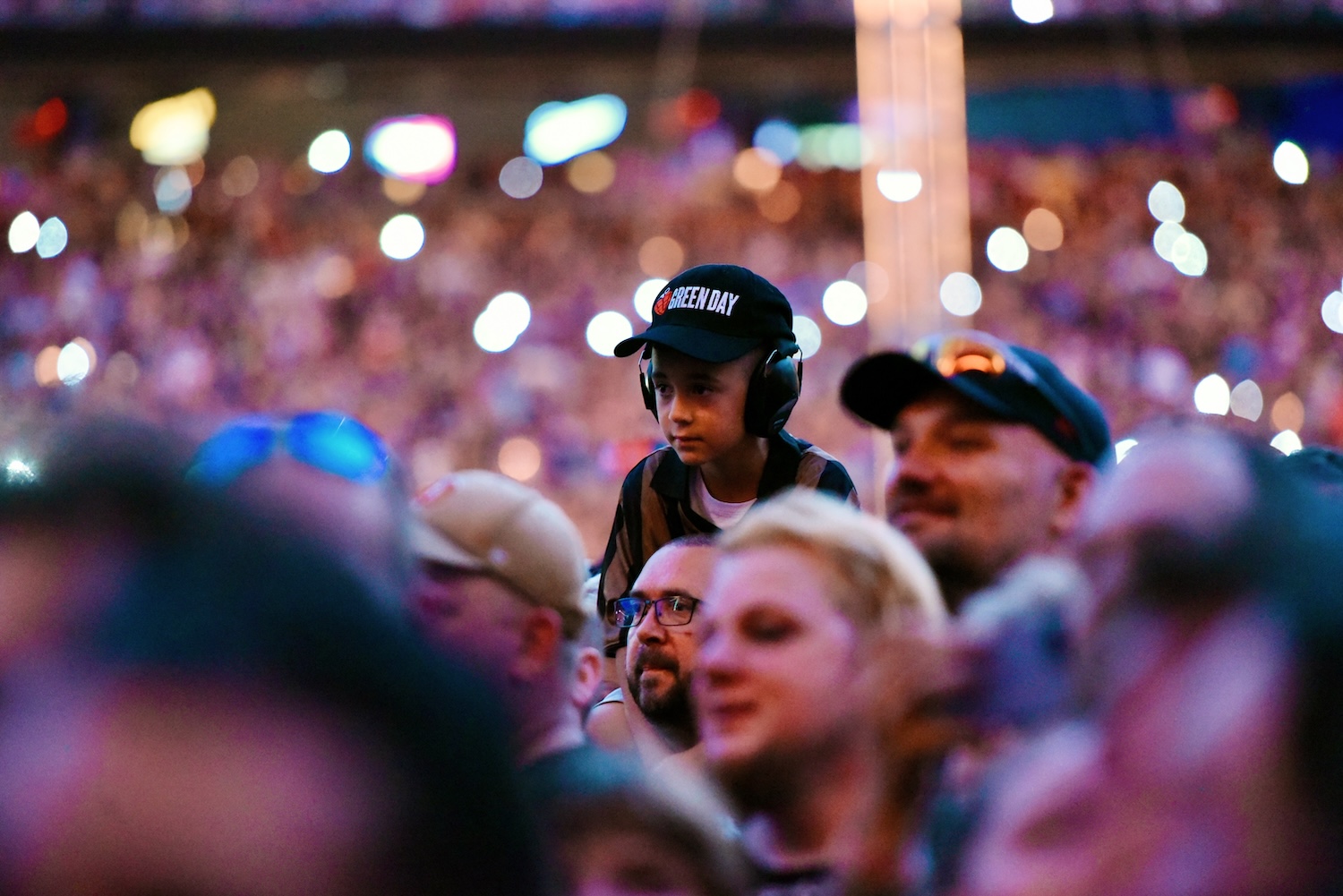
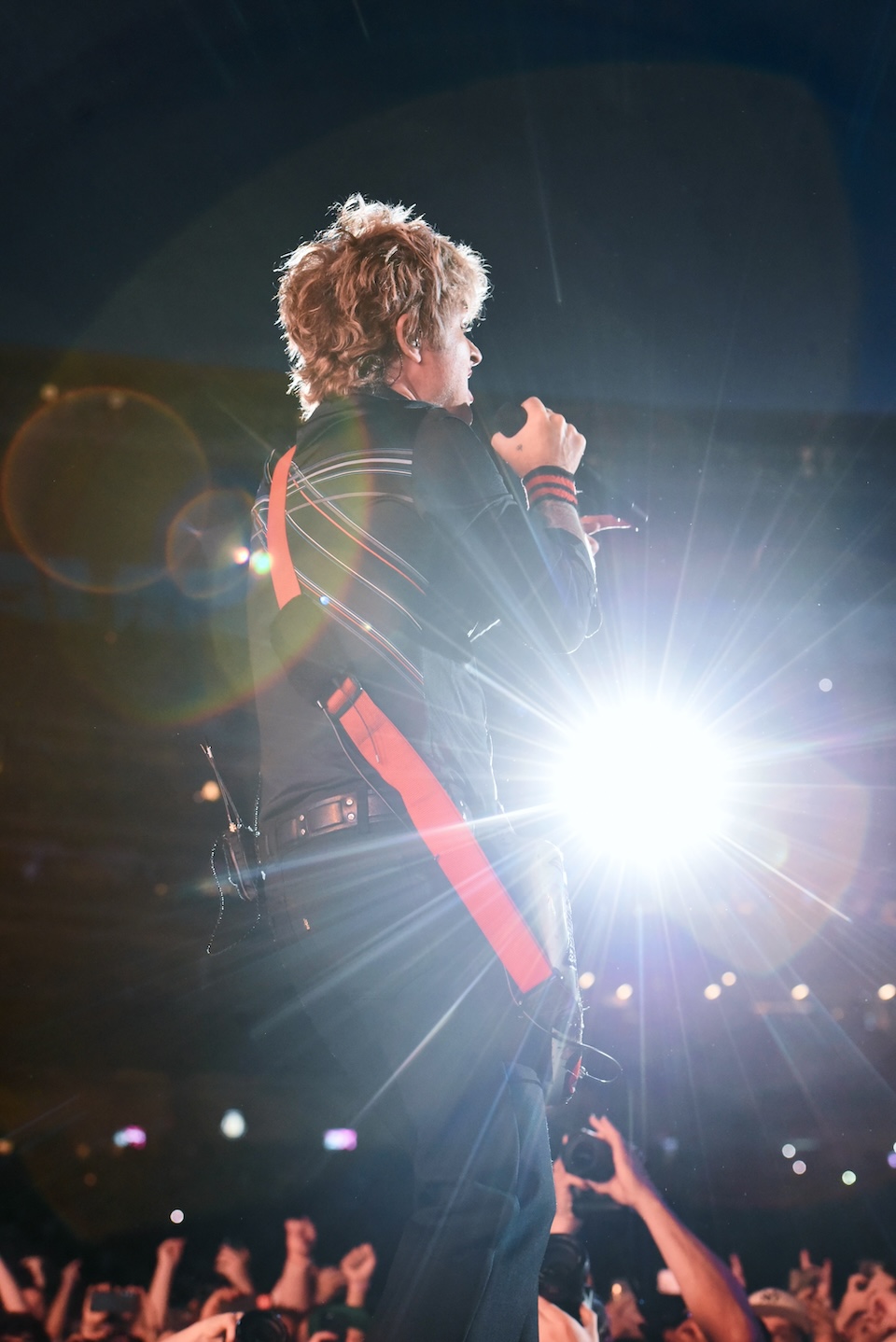
 Green Day AceClassic Albumsat Target Field [ 19-Aug-24 7:03am ]
Words + Photos ANDREW PARKS
If there was ever any doubt as to the staying power of Green Day, it was obliterated before the punk band even hit the stage at Target Field in downtown Minneapolis on Saturday night. Aside from the obvious — a stadium that felt much fuller than it had for a fierce Smashing Pumpkins set — there was no denying the sudden energy spike as Queen and The Ramones had their biggest hits (“Bohemian Rhapsody” and “Blitzkrieg Bop”) blasted the way they would be at a proper baseball game.
By splitting the difference between pogo-oriented punk and operatic rock, Green Day wasn’t just ensuring a grand entrance. They also seemed to be tipping their dye jobs toward the two divergent forces (grand ambition and true grit) that informed their biggest albums: 1994’s diamond-tipped Dookie and 2004’s Broadway-bound American Idiot LP.
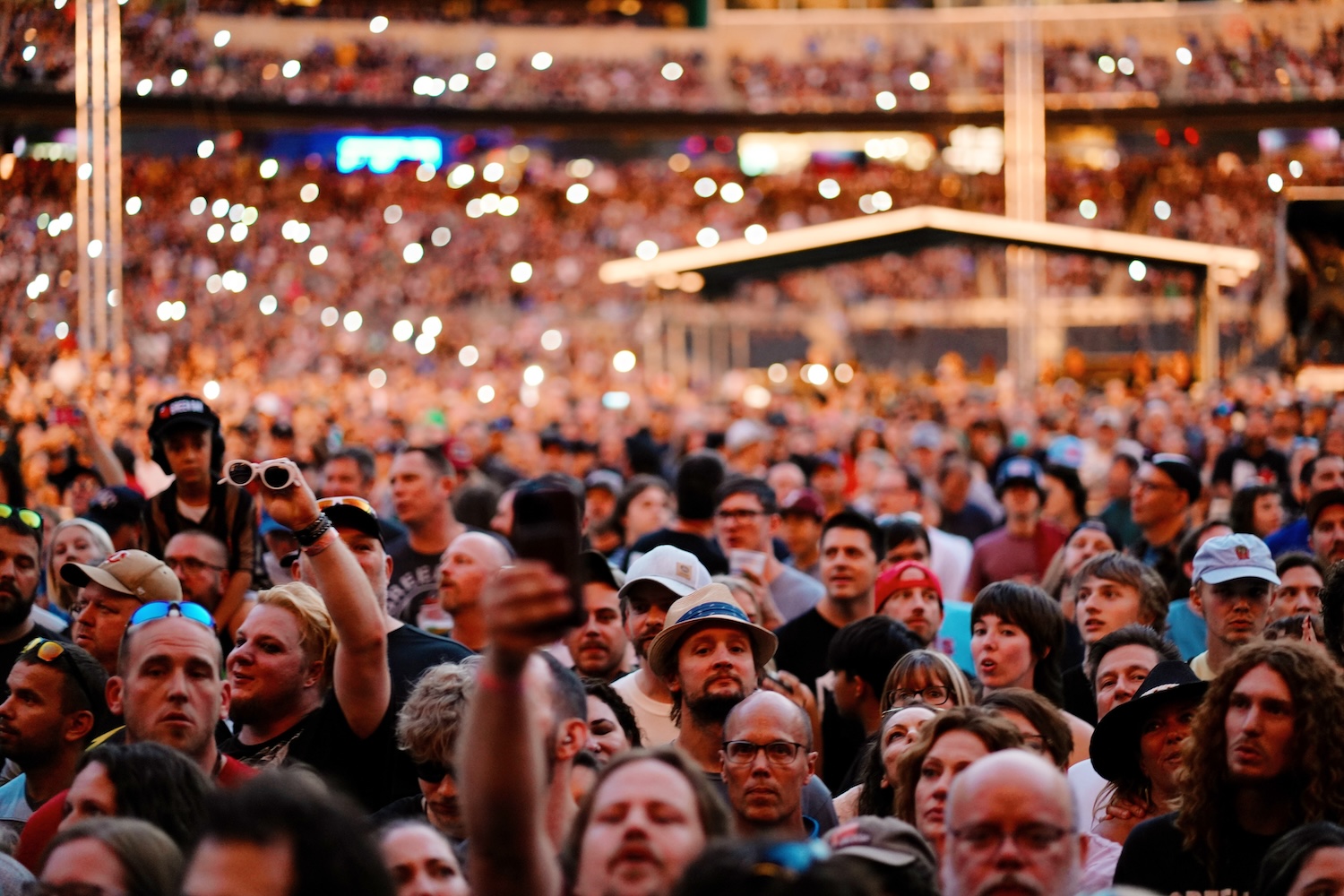
You read those years right; much like Woodstock’s mud-caked pivot towards the mainstream (arguably Green Day’s breakthrough moment), Dookie recently turned 30. And American Idiot, well, it’s old enough to drink in every country but ours. They’ve both aged as well as the band, too — as likely to drive nearly 40,000 people wild as they’ve ever been.
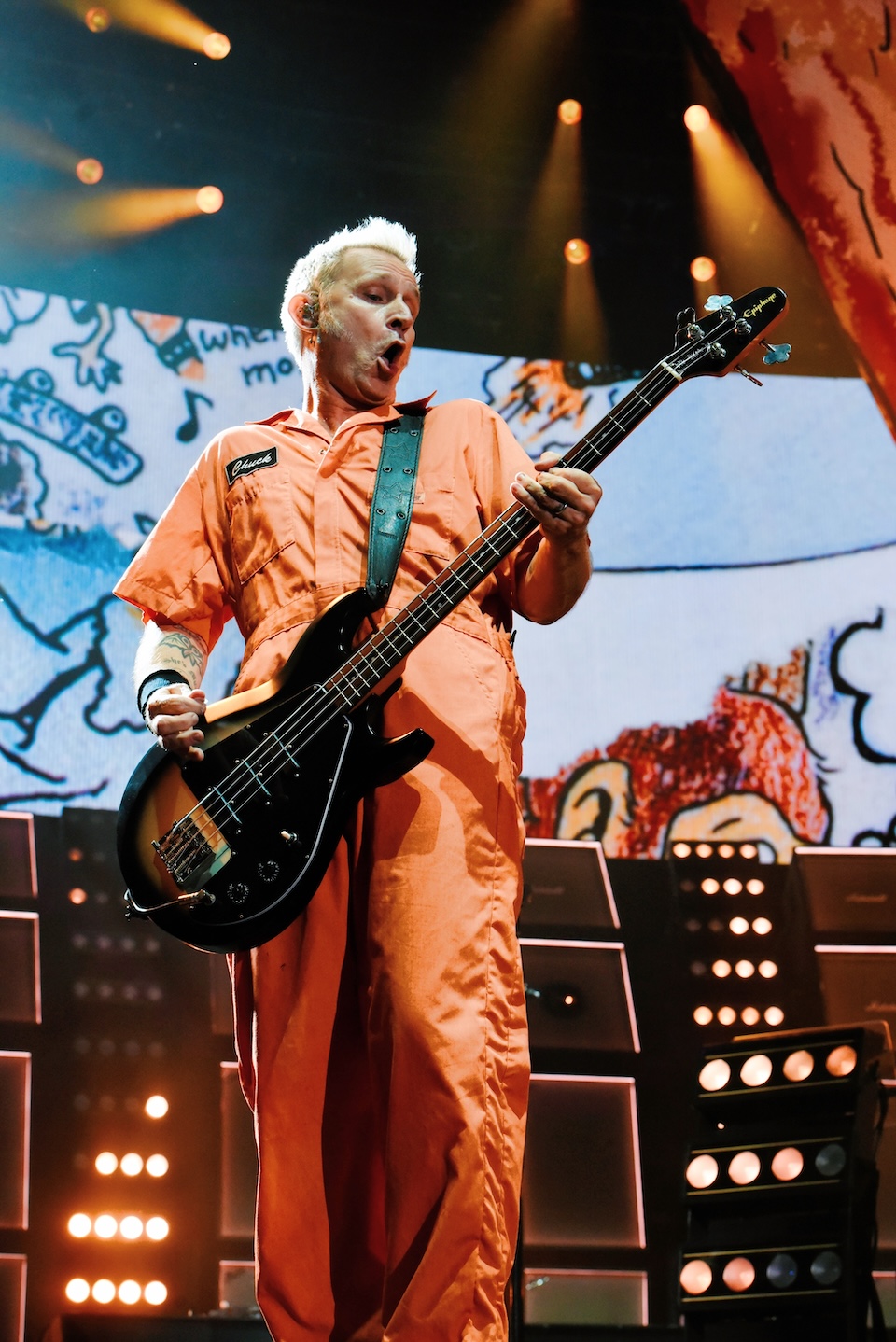
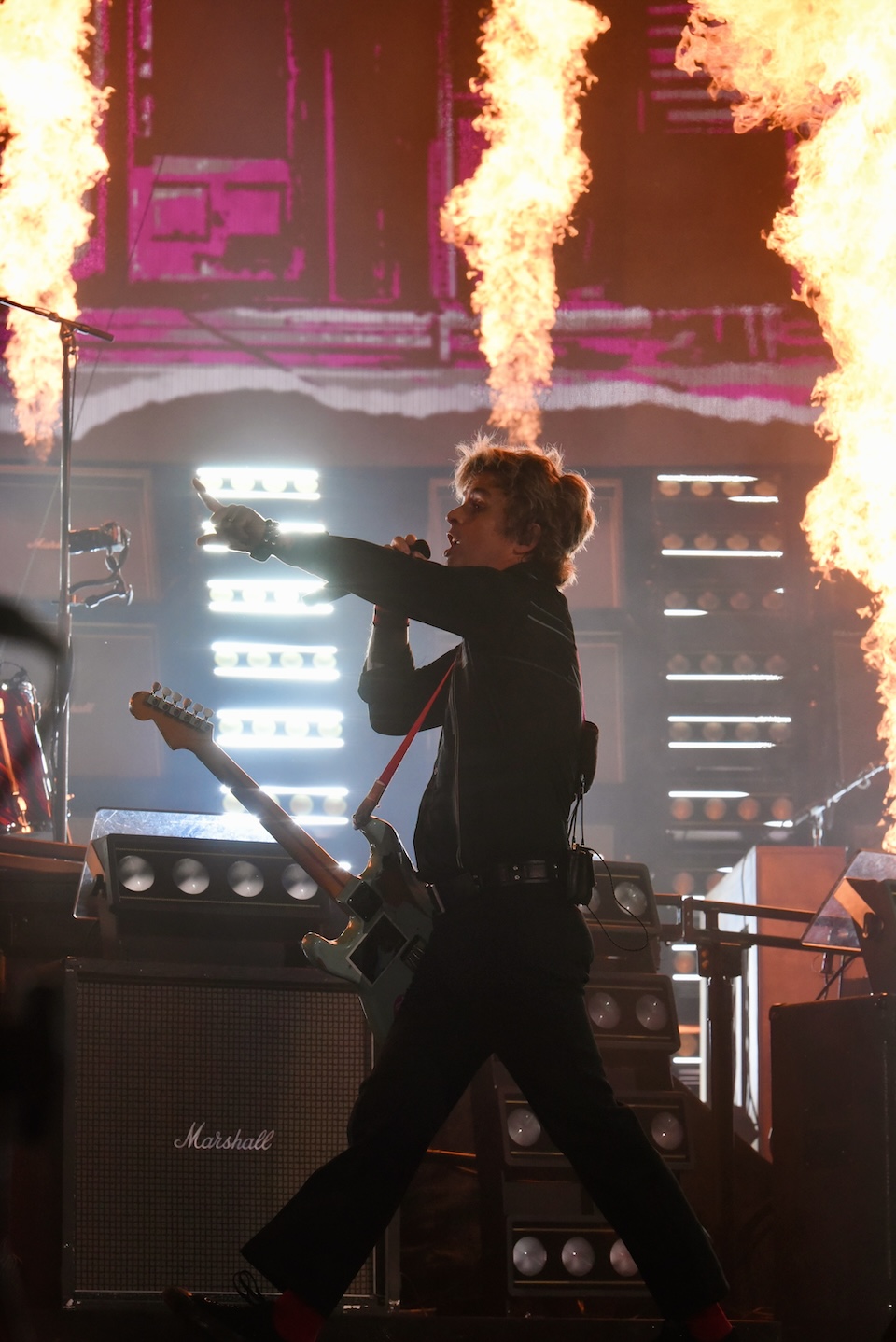
Maybe even more so considering their original fanbase is in full-on nostalgia mode, and the group can now afford to punctuate their many overlapping hooks and melodies with dynamic light displays, towering backdrops, and fire-spewing speaker cabinets. All while barely taking a breather despite having played both albums in full, along with a handful of other hits (“Know Your Enemy,” “Brain Stew,” the song that said goodbye to Seinfeld).
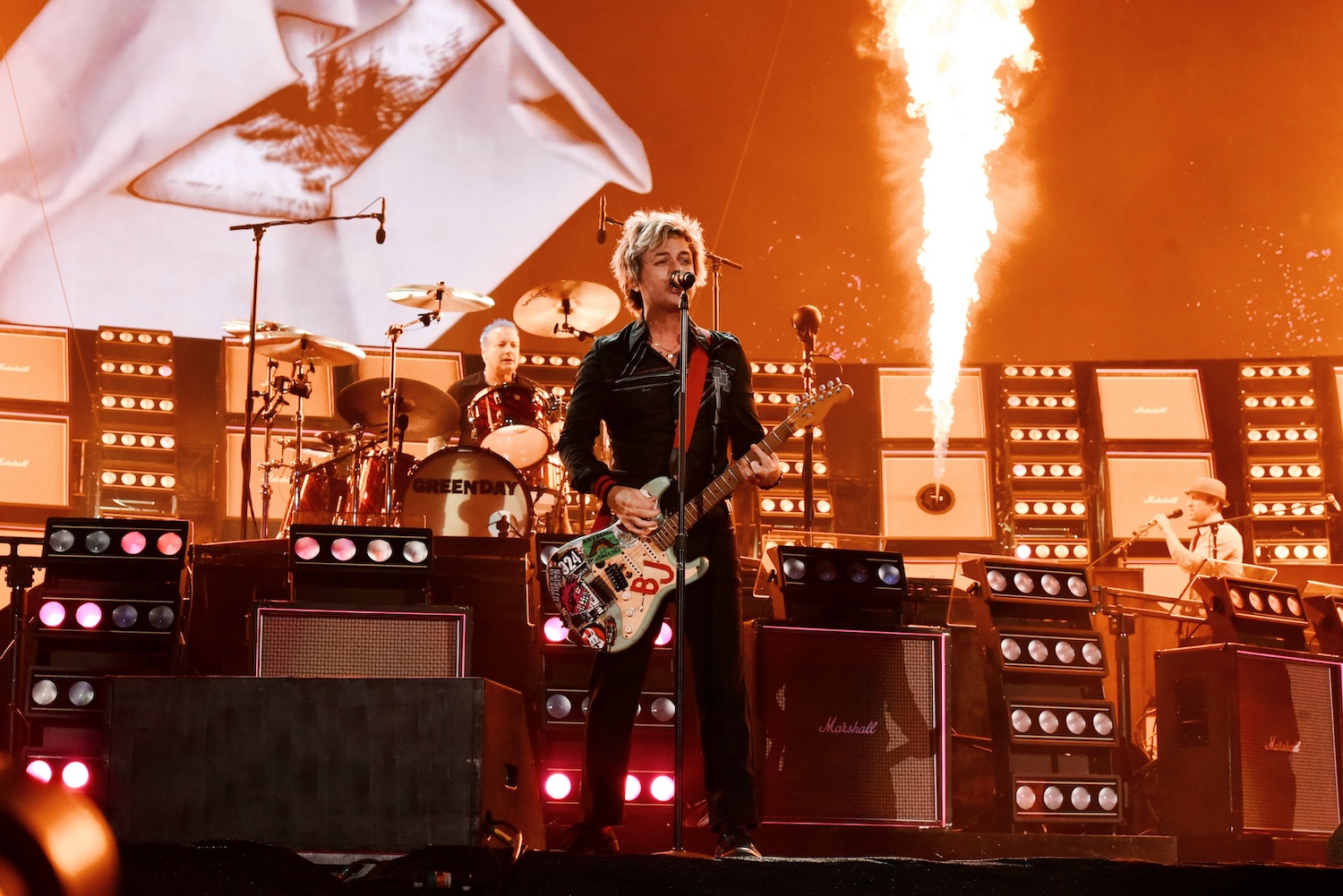
As for where American Idiot‘s political bent falls in a far more contentious year than the one that gave George W Bush another go, frontman Billie Joe Armstrong had this to say: “We need unity! And this is fucking unity tonight!”
Then, after quickly squashing any Democrat vs. Republican discussions, he added, “This isn’t even a party tonight…. It’s a celebration! I want you to scream out for joy; are you ready?”

They were all night, to be honest. Thanks to absurdly tight performances by The Linda Lindas, Rancid, and the Pumpkins — a band long criticized for bloat, cramming 13 crackly originals and one cacophonous U2 cover into a one hell of a power hour — a concert that started at the ungodly hour of 5:30 and ended close to 11 never felt that way.
More like a reminder of what made the MTV era and shows like 120 Minutes so vital in the days before digital music. Or as Rancid guitarist/vocalist Lars Frederiksen said before launching into a lovely rendition of “Ruby Soho,” “Thanks for the last 33 years…. If there’s none of you, there’s no us.”


 Collected: Vol 6 [ 02-Feb-25 7:51pm ]
There are a few LPs I have been hunting down for a long time now, and the original Dreamfish 2LP is up there. I've never seen it in the wild, and a Bandcamp comment suggests only 500 copies were originally pressed back in 1993. Silent State is slowly working through some of the most majestic titles from this era, and now Dreamfish is up for reissue, with preorders on Feb 7th. Read this interview I did with Nils from Silent State a while back who is on a mission to share more from the Namlook estate.
Snad - BubblescopeI've been on a Smallville kick recently - well, probably since the Joe Davies album reminded me they exist, and they constantly churn out some of the best house music going. This latest one from Snad was playing in Passenger Seat Records in Portland when I asked what it was… of course, it turned out to be on Smallville. A lovely slice of dubby relaxing house music to float away to. The B-side, the standout.
Kiln - Seltzer BoaEvery year since 2021, Kiln has offered up a single through Bandcamp on January 1st, as a sonic snapshot of their groovable electronics. Many will know of this group through their releases on Ghostly, defining a specific sound that is perhaps the most organic and instrumental way possible to approach the listenable side of early IDM. Look out for more from Kiln arriving very soon….cough cough.
PFM - Equilibrium VIPIt's not often you get an unreleased gem from one of the kings of atmospheric / liquid drum'n bass making an appearance on Bandcamp. PFM has been dropping a bunch of singles on his own bandcamp in recent years (often deleting the releases once people have downloaded them), but looks like this one is set to stay, with a vinyl press to boot.
Roller.
Simon Littauer - ModularEveryone hates on Instagram for many reasons, but once in a while, if you follow bunch of music nerds, it presents you with… more music nerds, jamming in front of their expensive rigs. Most sound as you'd expect, but Simon Littauer's got a knack for intertwining some absolutely beautiful pads and melancholy amongst the complex analog glitch and breaks. This album is name your price right now, too.
Find these albums and many more over on my Bandcamp Collection.
RIP Geoff Nicholson [ 24-Jan-25 2:58am ]Well, if the last few weeks in LA have not been traumatizing enough - and then we've had the hideousness of the inauguration and unfolding horror of the first few days of Trump: The Return... on top of all that, there's also been a flurry of sad-making deaths.
Saddest for me was learning that the writer Geoff Nicholson had gone. I didn't know Geoff well - but he was a fellow Brit expat in Los Angeles and on the occasions we ran into each other socially, I really enjoyed talking with him. I have been meaning to pick up his tomes on walking and on suburbia - and now have the spur.
The book of Geoff's I have read and returned to repeatedly over the years is Big Noises. One of his earliest books - his first non-fiction effort - and I believe the only one he wrote about music.
Here's something short I wrote about Big Noises for a side-bar to an interview I'd done for some magazine or other (can't remember which, can't recall when). They asked me to enthuse about three music books I loved but which were a bit forgotten. Below that blurb is a longer piece in which Geoff and Big Noises pops up in the context of guitar solo excess.
BIG NOISES by GEOFF NICHOLSON
Big Noises (1991) is a really enjoyable book about guitarists by the novelist Geoff Nicholson. It consists of 36 short "appreciations" of axemen (and they're all men; indeed, it's quite a male book but quite unembarrassed about that). These range from obvious greats/grates like Clapton/Beck/Page/Knopfler to quirkier choices like Adrian Belew, Henry Kaiser, and Derek Bailey. Nicholson writes in a breezy, deceptively down-to-earth style that nonetheless packs in a goodly number of penetrating insights. I just dug this out of my storage unit in London a couple of months ago and have been really enjoying dipping into it.
Flash of the Axe: Guitar Solos
from Excess All Areas issue on musical maximalism, The Wire, September 2019.
I can distinctly remember the first time I let myself enjoy a guitar solo. 1983, I'm at a party, "Purple Haze" comes on - I just went with Jimi, surrendered to the voluptuous excess. There was a sense of crossing a boundary within myself, like sexual experimentation, or trying a food that normally disgusts you.
You see, growing up in the postpunk era, we were all indoctrinated with less-is-more. Exhibitions of virtuosity were frowned upon. Folklore told us of a time before punk, a wasteland of 12-minute drum solos and other feats of "technoflash" applauded by arenas full of peons grateful to be in the presence of their idols. Minimalism wasn't just an aesthetic preference but a moral and ideological stance: an egalitarian levelling of rock's playing field, letting in amateurs with something urgent to say but barely any chops. Gang of Four went so far as to have anti-solos, gaps where the lead break would have been. Postpunk was an era of amazingly inventive guitarwork, but even the most striking players, like Keith Levene, were not guitar-heroes in the "Clapton Is God" sense. The guitar was conceived as primarily a rhythmic or textural instrument. An example of how the taboo worked for punk-reared ears: David Byrne's unhinged guitar on "Drugs" sounded fabulous, but Adrian Belew's extended screech on "The Great Curve" made me flinch.
There was a sexual politics aspect to postpunk's solo aversion: the guitar, handled incautiously, could be a phallic symbol. Willy-waving nonsense was resurging with the New Wave of British Heavy Metal. Bands like Iron Maiden were competing for the hearts and minds of youth. So if you supported the DIY feminist-rock revolution represented by the likes of Delta 5 (tough-girls and non-thrusting males united), you made a stand against masturbatory displays of mastery. Solos were, if not outright fascist, then certainly reactionary throwbacks to guitar-as-weapon machismo.
In those days, on the rare occasions I liked anything Old Wave - Blue Oyster Cult's "(Don't Fear) The Reaper," say - the solo would be something to grimly wait through until the good stuff resumed (the Byrdsy verses). Then came Jimi, triggering a rethink. Another key moment in punk deconditioning came ironically courtesy of one of the class of 1977: Television, who I also heard for the first time in 1983. Where Hendrix's "Purple Haze" solo lasts just 20 seconds, Tom Verlaine's in "Marquee Moon" is a four-minute-long countdown to ecstasy. Its arc is unmistakably a spiritualized version of arousal and ejaculation, building and building, climbing and climbing until the shattering climax: an extraordinary passage of silvery tingles and flutters, the space of orgasm itself painted in sound.
The mid-Eighties was coincidentally when the idea of the guitar-hero began to be tentatively rehabilitated within post-postpunk culture, from the Edge's self-effacing majesty to underground figures like Meat Puppets's Curt Kirkwood, who channeled the spectacular vistas and blinding light of the desert into his playing. Then came Dinosaur Jr.'s J. Mascis and his phalanx of foot-pedals, churning up - on songs like "Don't"- not just an awesome racket, but solos that were sustained emotional and melodic explorations. In interviews, Mascis namedropped long-forgotten axe icons like James Gurley of Big Brother and the Holding Company. Paul Leary and his band Buttholes Surfers signposted their influences more blatantly: even if Hairway to Steven's opener hadn't been titled "Jimi", its blazing blimps of guitar-noise would've reminded you of "Third Stone From the Sun".
This kind of winking, irony-clad return to pre-punk grandiosity was the rage in underground rock as the Eighties turned to Nineties. But where Pussy Galore covered (with noise-graffiti) the entirety of Exile on Main Street, that band's Neil Hagerty, in new venture Royal Trux, stepped beyond parody towards something more reverent and revenant. The pantheon of guitar gods - Neil Young, Keith Richards, Hendrix - inhabited ghost-towns-of-sound like "Turn of the Century" and "The United States Vs. One 1974 Cadillac El Dorado Sedan". But the effect was more like time travel than channeling - the abolition of a rock present that Trux found unheroic.
As a young critic during this period, I tried to stage my own abolition, a transvaluation that erased the now stale and hampering postpunk values I'd grown up with and ushered in a new vocabulary of praise: a maximalist lexicon of overload and obesity. Revisionist expeditions through the past were part of this campaign. When Lynyrd Skynyrd's "Freebird" had been inexplicably reissued as a single in 1982 and became a UK hit, I could not have imagined anything more abject. But reviewing a Lynyrd box in 1993, I thrilled to the swashbuckling derring-do of that song's endless solo, a Dixie "Marquee Moon" whose slow-fade chased glory to the horizon.
This was the final stage of depunking: the enjoyment of lead guitar as pure flash. At a certain point in rock history, solos ceased to have an expressive function and became a self-sustaining fixture, existing only because expected. Soon I found myself taking pleasure in such excrescences of empty swagger as John Turnbull's solo in Ian Dury's "Reasons To Be Cheerful." I even started looking forward to Buck Dharma's spotlight turn in "(Don't Fear) The Reaper".
^^^^^^^^^^^^^^^^^^^
Apart from a few academic studies of heavy metal, a surprising dearth of serious critical attention has been paid to the guitar solo. The exception that springs to my mind is the novelist's Geoff Nicholson's Big Noises, a collection of pithy appreciations of thirty-six notable guitarists, ranging from obvious eminences like Jimmy Page to cult figures like Allan Holdsworth and Henry Kaiser. But although Nicholson is insightful and evocative when it comes to a particular player's style or sound, and generally revels in loudness and in-yer-face guitar-heroics, he rarely dissects specific solos. Perhaps it is simply very hard to do without recourse to technical terms. At the same time, the mechanics of "how" do not actually convey the crucial "what"—the exhilarating sensations stirred in the unschooled listener.
Why does the discrete spectacular display of instrumental prowess get such short shrift from rock critics? Partly it's because of the profession's bias towards the idea of communication—seeing music as primarily about the transmission of an emotion, a narrative, a message or statement. Prolonged detours into consideration of sheer musicality is seen as a digression, or even as decadent. I think another factor behind this disinterest in or distrust of the guitar solo is a lingering current of anti-theatricality - the belief that rock is not a form of showbiz, that it has higher purposes than razzle-dazzle or acrobatics. A guitar solo is like a soliloquy, but one that is all sound and fury, signifying nothing (or nothing articulable, anyway). It's also similar to an aria, that single-voice showcase in opera, the most theatrical of music forms. Adding to the distaste is the way that guitar soloing is typically accompanied by ritualized forms of acting-out: stage moves, axe-thrusting stances, "guitar-face." This makes the whole business seem histrionic and hammy, an insincere pantomime of intensity that's rehearsed down to every last grimacing inflection rather than spontaneously felt; an exteriorized code rather than an innermost eruption.
How would you start to formulate a critical lexicon to defend, or at least, understand, this neglected aspect of rock? In the past, I've ransacked Bataille's concept of "expenditure-without-return", seeing a potlatch spirit of extravagance at work in the sheer gratuitousness of sound-in-itself. That in turn might connect the soloist's showing-off to an abjection at the heart of performance itself - the strangeness of exposing one's emotions and sexuality in front of strangers. Another resource might be queer theory and camp studies, especially where they converge with music itself, as in Wayne Koestenbaum's book about opera, The Queen's Throat. The guitar hero could be seen, subversively, as a diva, a maestro of melodramatics.
The ultimate convergence of these ideas would be Queen - the royal marriage of Freddie Mercury's prima donna preening and Brian May's pageant of layered and lacquered guitars. Queen's baroque 'n' roll made my flesh crawl as a good post-punker, but as a no-longer solo-phobe, I've succumbed to their vulgar exquisiteness. From the phased filigree of "Killer Queen" to the kitsch military strut of "We Will Rock You", May's playing is splendour for splendour's sake - a peasant's, or dictator's, idea of beauty. Anti-punk to the core, and perhaps the true and final relapse of rebel rock into show business.
The Cure (1992) [ 16-Jan-25 7:42pm ]THE CURE
Pulse, June 1992
by Simon Reynolds
Robert Smith sits alone at the office of Fiction, the U.K. label of the Cure, the band he formed at age 17 and has led for a decade and a half since. It's a rare opportunity to meet one-on-one with the group's vocalist, songwriter and sometimes-guitarist; determined to promote the idea that "The Cure Is A Band," all of Smith 's recent encounters have seen him flanked by his cohorts: drummer Boris Williams , guitarists Porl Thompson and Perry Bamonte , and longest serving Cure member, bassist Simon Gallup
Tonight the ageless Smith , who's wearing eyeliner but no trace of lipstick, looks somewhat drained after a five hour session with his accountant, doubtless administering the lucre generated by the Stateside success of the Disintegration album and the "best of" compilation Standing on a Beach/Staring at the Sea. After years as a cult icon, the Cure is now a big band, but without the coarsening and adherence to formula that such mass popularity usually requires.
The Cure began in 1976 as the Easy Cure, then a trio, spurred into being by punk's do it yourself fervor. The groups 1979 debut, Three Imaginary Boys, lay somewhere between power pop and the edgy, art-punk-minimalism of Wire and Siouxsie and the Banshees, the latter of whom Chris Parry signed to Polydor before starting his Fiction label, with the Cure as its flagship. (With a few early singles tagged on, the debut is titled Boys Don't Cry in the US, where the groups albums are available on Elektra/Fiction, unless otherwise noted.) With Seventeen Seconds (1980) and Faith (1981), the Cure's tormented angst-rock garnered an intensely devout cult following. By Pornography (1982), the group's music had reached a peak of morbid introspection that many found impenetrable. After this high-point of alienation Smith veered toward pop with the vaguely dance-oriented Lets Go To Bed and The Walk singles. But it was only with 1983's Lovecats that the Cure really got a handle on the joie de vivre of pure pop. A singles collection, Japanese Whispers (Fiction/Sire in the US), marked the breakthrough.
Thereafter, the Cure's albums - The Top (1984), The Head on the Door (1985) and Kiss Me Kiss Me Kiss Me (1987) - explored both life's dark side and its light-hearted aspects; stylistically, the group shed the oppressively homogenous sound of its angst era for a kaleidoscope of psychedelic, art-rock and mutant pop textures. Disintegration(1989) was a slight return to the morose Cure of the early 80's, but that didn't prevent the first single Love Song, from reaching number two on the US charts. By the end of the decade the Cure had sold over eight million records worldwide without ever having settled into a predictable career trajectory or losing its innate combustibility. As Smith once put it, If I didn't feel the Cure could fall apart any minute, it would be completely worthless.
Despite Smith and his group's contrary nature, much of the new album Wish , is surprisingly in sync with the British alternative state-of-art - not that Robert Smith 's ever been afraid to be affected by the pop climate (remember the New Order tribute/pastiche of Inbetween Days from Head On The Door ?). But on Wish it sounds like he's been listening closely to the British movement of "shoegazers" or "The Scene That Celebrates Itself", and in particular to Ride and My Bloody Valentine (both bands for which he professed admiration). You can hear it in the super saturated Husker Du meets Hendrix maelstrom of End, in the oceanic iridescence of From The Edge Of The Deep Green Sea, and in the gilded, glazed guitar mosaics of High and To Wish Impossible Things, all of which vaguely resemble shoegazers like Slowdive and Lush. The Cure has made these kinds of noises before (indeed, a number of shoegazers have been influenced by Smith 's group and Siouxsie and The Banshees). But it hasn't made them for a while, and never in such a timely fashion.
"I definitely think it would have been a totally different record if we'd had the same songs but recorded them at the time of Disintegration," Robert Smith agrees. But he says it was actually recording the wah-wah tempest of Never Enough (the only new song on the group's 1990 remix album, Mixed Up) that made the Cure want to be a guitar band again.
According to Smith , when keyboard player Roger O'Donnell slipped out of the group after the Disintegration tour, the Cure decided to replace him with another guitarist, Perry Bamonte . "Porl Thompson 's always been very guitar oriented, he's got loads of old guitars and amps and he's always very worried about his sound. In the past he's probably been restrained by the group and by the way I've always liked things to be very minimal. But this times everyone's played out a bit more. Because we didn't have a keyboard player, no one was really bothered with working out keyboard parts. On Disintegration there were all these lush synthesizer arrangements, but this time we tried to do it mostly with guitars. We also had in mind the way it feels live, to play as a guitar band; its so much more exciting."
The new album is a stylistic mixed bag, whereas Disintegration was a more uniform, emotionally and musically: a steady wash of somber sound and mood. Wish spans a spectrum of feelings from giddy euphoria to deep melancholy, from bewilderment to idyllic nonchalance.
"Disintegration was less obviously varied as this album," says Smith , "but there were songs like Lullaby, Love Song, Fascination Street, that were nothing to do with the rest of the album. But overall there was a mood slightly...downered. Even on Lullaby there was a somber side to it. Whereas on this album there are some out-and-out jump in the air type songs."
Some of Wish's songs are fairly legible, like the poignant Apart, which deals with the desolation that comes when a gulf inexplicably opens up between lovers. Others are harder to fathom. "End beseeches, "please stop loving me, I am none of these things, but it's not clear if the plea's addressed to the Cure fans, Smith 's wife, to a friend...
"It's kind of a mixture", says Smith . "In one sense, its me addressing myself. It's about the persona I sometimes fall into. On another level, it's addressed to people who expect me to know things and have answers - fans, and on a personal level, certain individuals. And it has a broader idea, to do with the way you fall into a way of acting that isn't really true, but because it's the easy path, it just becomes habitual even though it's not really the way you want to be. Sometimes whole relationships are based on these habits. It goes beyond my circumstances as a star, because I think a lot of people put on an act. I think I had it at the back of my mind when I wrote the song that when it came to performing it live, it would remind me that I'm not reducible to what I am doing. I do need reminding, because it's got to the scale where I could quite happily fall into the rock star trip. It might seem like its quite late in the day for it to all go to my head, since we've been going so long, but the success has reached the magnitude where it's insistent and insidious.
On End, Smith also bemoans the fact that all my wishes have come true. It must be something that he's felt at several points in his career: been there, done that... so what now? .
"Any desires I have left unfulfilled," says Smith, "are so extreme that there's no chance of them ever happening. I would really love to go into space, I always have since I was little, but as I get older, it's less and less likely that I'd pass the medical! The only things that I wish for are the unattainable things. Apart from that, I don't really have strong desires, except on behalf of other people. Generally, peace and plenty. My wishes are more on a global level. To Wish Impossible Things Is specifically about relationships. The notion of Three Wishes, all though history, has this aspect where if you wish for selfish things, it backfires on the third wish. But wishes never seem to take in the notion of wishing for other people, general wishes, or wishes about interacting with other people. In all relationships, there's always aching holes, and that's where the impossible wishes come into it"
"Doing the Unstuck: seems to be about disconnecting from the hectic schedules from productive life, and drifting in innocent blissful indolence. It's something Smith wishes he could do more often.
"I was going to say that my biggest wish was not to have to get up in the morning, and that's not strictly true, but there are days when I feel like that. It's like watching models saying that they've got a glamorous life, and then you find out that they can't eat what they want, they can't drink, they have to get up at five in the morning and get to bed by nine at night, and the truth is that they don't do anything glamorous at all except walk up and down the catwalk and wander about in front of cameras. It's one of those myths that modeling is glamorous, because it looks like glamour. And sometimes I think to myself ,'I'm free, I don't have to get up', but that's not the case cos I'm always doing something. Sometimes there are days where I refuse to do my duties. And I think there should be moments in everyone's lives where they take that risk and say 'Oh fuck it, I'm not prepared to carry on functioning'. I suppose that's a feeling you would associate with being in the Cure. Unstuck is about throwing your hands in the air and saying, 'I'm off'. But then again there is a thread running through the Cure that's all about escapism."
In fact, a lot of what the Cure is about is a refusal, or at least a reluctance, to grow up, to desire to avoid all the things (responsibility, compromise, sobriety) that come with adulthood. Despite being a very big business, at the heart of the Cure is a spirit of play.
"I met some people recently," says Smith, "and I guessed really wildly and inaccurately about their age. I thought they were in their forties, but they were only two years older than me, in their mid-30's. They'd passed across the great divide. Some of it's to do with having children. I don't see why they can't continue being like a kid. Obviously you change as you grow old, you become more cynical, but there are people that manage to avoid that. I know a couple people that are still quite a bit older than me, but are still genuinely excited by things; they do things and really get caught up in them. Children can do that, get caught up in non-productive activity, but its harder and harder to do that as you get older. At least, not unless you take mind- altering substances, of course!"
Robert Smith grew up in Crawley, a quintessentially English suburb. And the Cure's following has always consisted of that handful of lost dreamers in every suburban small town, that together make up a vast legion of the unaffiliated and disillusioned, who dream of a vague "something more" from life but secretly deep down inside know they will probably never get it. The Cure has always had an escapist, magical mystery side to their music, but the other half of its repertoire has been mope rock, forlorn and mournful for the lost innocence of childhood, and the prematurely foregone possibilities of adolescence.
Smith himself, however, is not so sure that the Cure represents lost dreams for lost dreamers; he's reluctant to reduce Cure fans to a type.
"I think our audience has now got so diverse where it seems weird to talk in general terms about what we represent to them. The Cure is liked by some people that I don't even like! There's people who like us just because we do good pop singles like High. There's other people who'd die for the group. When it gets to that level, people who are really caught up in the band,it's frightening to be a part of it, because I know that we don't understand anything better than those people. We represent different things to different things to different people, even from country to country. Even to different sexes and to different age groups. Polygram commissioned a survey of Cure fans, because I've had this long running argument with record companies about what constitutes our audience. The companies believe the media representations of the Cure audience as all dressed in black, sitting alone in their bedrooms, being miserable. And they were shocked at the actual breadth of the Cure audience. I don't know what we represent to them. I don't even know what the Cure represents to me! If we hadn't had the good songs throughout our history, to back up our attitude, we wouldn't have gotten this far. All that stuff about what we mean to our fans is too muddled to unravel really. We are a very selfish group. We don't worry about what we represent."
But perhaps its this very self-indulgence that is part of the Cure's appeal. Most people are obliged to forego following their whims and fancies, are forced to be responsible and regular. Perhaps the Cure represents a life based on exploring your own thoughts, exploring sounds, being playful. Smith thinks this might be true of its hardcore audience, the people who like us past a certain age. But at heart, he's wary of dissecting the what is exactly it is that the Cure's following get out of the group, or why they're so devoutly loyal.
"Maybe too much emphasis is placed on our hardcore fans. I feel sometimes like I'm crusading on behalf of something, and that this is going to pin me down to something that I'd ultimately resent. I've been through that with Faith and Pornography, people wanting me and the Cure to stand for something." Smith 's referring to his early-80's status as Messiah for the overcoat-clad tribe of gloom and doomers. "All that nearly drove me round the bend and I don't need any encouragement."
Part of Robert Smith 's appeal, at least to the female half of the Cure following, has always been his little lost boy aura. Bright girls dream of a boy who does cry, who's vulnerable, sensitive, even though few find one. Even now he still seems more like a "boy" than a "man". (Smith has just turned 33, Wish was released on his birthday, April 21)
"I was faced by this dilemma with the lyrics of Wendy Time on the album. It's the first time I've used the word 'man' in relationship to myself in a song. So it is seeping through into music. Five years ago, the line in question would have been 'the last boy on earth.' I've always been worried about doing music past the age of 30, about how to retain a certain dignity. The vulnerable, lost little boy side of my image is gradually disappearing, if it isn't gone already. But the emotional side of the group will never disappear, I'm in the unusual position of having four very close male friends around me in this group; I don't feel the slightest bit of inhibition around them. I've got more intimate as I've got older."
Around the time of Disintegration, Robert Smith declared," I think we're still a punk band. It's an attitude more than anything".
The history of the last 15 years of British rock has been a series of disagreements about what exactly that attitude was. Groups have gone on wildly different trajectories - from ABC to the Style Council to the Pogues to the KLF- in pursuit of their cherished version of what punk was all about.
"Living in Crawley, travelling up to London to see punk gigs in 1977", reminisces Smith, "what inspired me was the notion that you could do it yourself. The bands were so awful I really didn't think, 'if they're doin it, I can do it'. It was loud and fast and noisy, and I was at the right age for that. Because of not living in London or other big punk centers, it wasn't a stylistic thing for me. If you walked around Crawley with safety pins, you'd get beaten up. The risked involved didn't seem to make sense. So luckily there aren't any photos of me in bondage trousers. I thought punk was more a mental state.
"The very first time we played at our school hall, we bluffed our way in by saying we were gonna play jazz-fusion, then started playing loud fast music. And that made us a punk band, so everyone hated us and walked out, but we didn't care cuz we were doin what we wanted. I suppose that all punk means to me is: not compromising and not doing things that you don't want to do. And anyone who follows that is a punk, I guess. But then, that could make Phil Collins punk, if he's genuinely into what he does!"
The Cure was never a threat; its particular effect was more on the level of mischief or mystery. Groups who start out making grand confrontational gestures tend to buckle rather quickly and turn into transvestites. But the Cure has endured by being elusive, indeterminate, unpredictable. It's sold a lot of records but it has never pandered.
"We've never really been bothered with confronting people. We've gradually become more accepted, just 'cos we've been around for so long. We've upset a lot of people in the business 'cos we've shown that you can do things exactly how you want and be successful. Most confrontational gestures are so shallow that they're laughable. The KLF carrying machine guns at the British record industry awards - you just have to look at the front page of any newspaper to put that kind of gesture in proper perspective. There should be confrontation in pop, but I think the people doing it often believe they are achieving a lot more than they actually are. The premeditated, Malcolm McLaren idea of confrontation is lamentable. Things are only really threatening if someone does something for it's own sake and it happens to upset people. The only time we've come close to that is the Killing an Arab debacle."
That song was grossly misconstrued as racist by sections of the US media. In fact, it was inspired by Camus' novel The Stranger, the story of a nihilistic young man in French colonial Algeria, who, involved in an altercation with a native, chooses to pull the trigger out of sheer fatalistic indifference. Embroiled in unwanted controversy, Smith was obliged to defend himself, denouncing his accusers as Philistine bigots. "For a couple of days we made the national news in America. And it was the last thing in the world I wanted to get caught up in. Debating Camus on US cable television was totally surreal."
The Cure hasn't been subversive so much as topsy-turvy: by cultivating its capacity for caprice and perversity, it's managed to remain indefinable.
"It's very difficult, having been around so long; a persona builds up around you that's continually reinforced despite your attempts to break away from it. It's like trying to fight your way out of papier-mache; There's always people sticking bits of wet newspaper to you all the time. I conjure up in my mind figures like Jim Kerr [of Simple Minds] or Bono, and I always have an image of what they represent. It might be really far away from the truth, but they're trapped in it. I often hear people say or read things about me and the group and they are completely at odds with how I think about us. We do things from time to time that are mischievous, and in the videos we play around with caricatures of ourselves. But at other times, we're not really mischievous: That implies that we're doing things for nuisance value, and we never have. We can't win really: we're either considered a really doomy group that inspires suicides or a we're a bunch of whimsical wackos. We've never really been championed or considered hip, and so we've never been treated as a group that stands for something, like, say Neil Young or the Fall have. Which I'm glad about, but the downside is that we're dismissed as either suicidal or whimsical."
For all Smith 's belief that the "attitude" has been a constant, the Cure didn't really draw much from the punk, apart from the initial impetus to do-it-themselves. Punk's main influence on the Cure was minimalism, a distaste for sonic excess. Hence, the clipped crisp power pop of Boys Don't Cry, the terse, translucent, bleakly oblique Seventeen Seconds. When the Cure tried to develop musically, while still inhibited by punks less-is-more aesthetic, the result was the grey draze of Faith and the angst - ridden entropy of Pornography - some of the most dispirited and dehydrated music ever put to vinyl. But once the Cure stepped out of the fog of post-punk production and into the glossy light of Love Cats, it wasn't long before the group became what it always essentially was, an art-rock group, maximalist rather than minimalist, indulgent rather than austere. And then came the over-ripe, highly strung textures of The Top and Head on the Door, the sprawling art-pop explorations of Kiss Me, Kiss Me, Kiss Me, the lush luxurious desolation of Disintegration.
The truth is that punk rock was just a blip, a brief interruption, in the perennial tradition of English art-rock. Robert Smith was once described by the Aquarian Weekly as "the male Kate Bush", which is probably going way too far, but it does highlight the way the Cure enjoys the English art- rock blessing/curses of eccentricity, self-consciousness, stylization, preciousness. Above all, the Cure has always been a literate band. Smith is a voracious reader. Recent input includes Stendhal ("very trying"), Blaise Cendrars ("very peculiar"), the poems of Catullus ("very ribald"). And Nietszche.
"I just read Ecce Homo, which he wrote at the end of his life, when he was going mad. It's Nietszche summing up his life and his work, and it's pretty disturbing, by the end he's majestically deluded. I also read a book about Nietszche and that era. I didn't realize that his sister founded New Germania in Paraguay. She took 82 perfect Aryan specimens and attempted to found the new super race. The colony is now virtually extinct, because there was so much inter-breeding over four generations.
"I try and combat this feeling that I'm missing out on something very fundamental to life that I should have by now realized, by reading ferociously. And I still come to books that have been recommended to me by people I consider wise, and I always wonder "have I missed the point, or is this something I knew anyway". I think it's really worrying, getting older and not really knowing anything more intellectually. I don't think I know any more than when I was 15, except on an experiential level. I only know things that I wish I didn't know. But I never really craved wisdom. I enjoy the discussions we have in the group. Everyone's well read. The discussions can soar sometimes".
Which leads on to another set of polarities that Robert Smith oscillates between. On one hand, he's arty and literate; on the other, he's very much 'an ordinary bloke', partial to beer, soccer, Indian food, soap operas.
"I don't think its two sides to my character; its all me. In the group we have quite intense emotional conversations about things. At the same time, we can go to the pub and get so drunk that I don't remember how I got home, but I don't feel bad about it later; I don't think it doesn't fit with how I'm supposed to be. Equally, I wouldn't feel embarrassed if someone asked me what I was reading at the studio, and I said Love by Stendhal. I never feel guilty about either end of the spectrum. I object to people who only exist to go down to the pub, or people who think 'oh no, you can't watch football, its just a pack of men kicking a ball 'round a field.' I would feel weird excluding one aspect 'cos I felt it wasn't appropriate. It's all me."
recycled as
The Cure: Robert Smith's Wish List
Christmas 1992 issue of Melody Maker (19 December 1992)
by Simon Reynolds
Fifteen years on, The Cure are post-punk's hardy perennial. Of all their peers, they're virtually alone in making it to stadium level without pandering or becoming a grotesque self-parody. And 1992 was another great year for the band, with the mega-selling Wish album and a mammoth world tour. In a rare solo conversation, Robert Smith talks about 'Wish', about The Cure's following, about the pressures of being at the helm of a Post-Punk Institution, and his own status as an icon.
ON 'WISH' AND BEING INFLUENCED BY YOUNG BLOODS LIKE MBV AND RIDE
"I definitely think it would have been a totally different record record if we'd had the same songs but recorded them at the time of Disintegration. But it was actually doing 'Never Enough' for Mixed Up that made us want to be a guitar band again. Porl Thompson's always been very guitar-oriented, he's got loads of old guitars and amps, and in the past, he's probably been constrained by the way I've liked things to be very minimal. But for Wish everyone played out a bit more. We also had in mind the way it feels live to play as a guitar band, it's so much more exciting. The album does sound current in one way, but in another way it sounds timeless. Because a lot of the references are to earlier incarnations of The Cure. 'Friday I'm In Love' reminds me of 'Boys Don't Cry'. That old-fashioned Beatles craft of the perfect pop song."
ON 'END', AND THE LINE 'PLEASE STOP LOVING ME, I AM NONE OF THESE THINGS'
"In one sense, it's me addressing myself. It's about the personal sometimes fall into. On another level, it's addressed to people who expect me to know things and have answers - fans, and on a personal level, certain individuals. And it has a broader idea, to do with the way you fall into a path, it just becomes habitual even though it's not really the way you want to be. Sometimes, whole relationships are based on these habits. It goes beyond my circumstances as a star, because I think a lot of people put on an act. I think I had it in the back of my mind when I wrote the song that when came to performing it on the tour, it would remind me each night that I'm not reducible to what I'm doing. I do need reminding. Because it's got to the scale now where I could quite happily fall into the rock star trip. It might seem like it's quite late in the day for it to go to my head, since we've been going so long, but our success has reached the kind of magnitude where it's insistent and insidious."
ON 'TO WISH IMPOSSIBLE THINGS'
"I do sometimes wonder 'What is there left for me to do?' At the same time, I never really had the burning ambition to achieve what I supposedly achieved. So it's more of a general feeling that there only appears to be so much you can experience. And a feeling of wanting to have the courage to break away from what I'm doing, with which I'm comfortable. I think maybe I should do something I don't feel confident about, to try to get back that sense of danger. But then I wonder if I really miss that danger. Do I really want to sacrifice my happiness for the chance of experiencing more, when I've already jeopardised my entire life many times just for the sake of experiencing things?
"Any desires I have left unfulfilled are so extreme there's almost no chance of them happening. But I would really love to go into space, I always have since I was little, but as I get older, it's less and less likely I'd pass the medical! The only things I wish for are the unattainable things. Apart from that, I don't really have strong desires, except on behalf of other people. Generally, peace and plenty. My wishes are more on a global level. 'To Wish Impossible Things' is specifically about relationships. The notion of three wishes, all through history, has this aspect where, if you wish for selfish things, it backfires on the third wish. But wishes never seem to take in the notion of wishing for other people, general wishes or wishes about interacting with other people. In all relationships, there are always aching holes, and that's where the impossible wishes come into it."
ON 'DOING THE UNSTUCK'
"I was going to say that my biggest wish was not to have to get up in the morning, and that's not strictly true, but there are days when I feel like that. It's like watching models saying that they've got a really glamorous life, and then you find that they can't eat what they want, they can't drink, they have to get up at five in the morning and go to bed by nine at night, and the truth is that they don't do anything glamorous at all except walk up and down the catwalk and wander about in front of cameras. It's one of those myths, but modeling is glamorous, because it looks like glamour. And sometimes, I think to myself I'm free, I don't have to get up, but that's not the case cos I'm always doing something. Sometimes there are days when I refuse to do my duties. And I think there should be moments in everyone's lives where they take that risk and say 'Oh, fuck it, I'm not prepared to carry on functioning.' I suppose that's a feeling you wouldn't really associate with being in The Cure. But then again there is a thread running through The Cure that's all about escapism."
ON NOT WAITING TO GROW UP
"I met some people recently and I guessed really wildly and inaccurately at their age. I thought they were in their forties, but they were only two years older than me, in their mid-thirties. They'd passed across the great divide. Some of it's to do with having children. It has a very definite effect. A good effect, for some, but it does bring with it a sense of responsibility. I don't know what it is, but it's inherent in more people that it's not. People seem to want to grow up. And when they have children, they play with their kids, and it reminds them how it was to be young. But when they have to answer the door, they revert to being grown-up. I don't see whey they can't continue being like a kid. Obviously you change as you grow old, you become more cynical, but there are people who manage to avoid that. I know a couple of people who are quite a bit older than me, but they are still genuinely excited by things. They do things and really get caught up in them. Children can do that, get caught up I on-productive activity, but it's harder and harder to do that when you get older. At least, not unless you take mid-altering substance, of course!"
ON THE CURE'S FOLLOWING
"I think our experience has now got so diverse that it seems weird to talk in general terms about what we represent to them. The Cure are liked by some people I don't even like! There's people who like us just because we do good pop singles like 'High'. There's other people who'd die for the group. When it gets to that level, people who are really caught up in the band, it's frightening to be part of it, because I know that we don't understand life better than those people. We represent different things to different people, even from country to country. Even to different sexes and to different age groups. Polygram commissioned a survey of Cure fans, because I've had this long-running argument with record companies about what constitutes our audience. The companies believe the media representation of The Cure audience as all dressed in black, sitting alone in their bedrooms, being miserable. And they were shocked at the actual breadth of the Cure audience. I don't know what we represent to them. I don't even know what The Cure represents to me! If I considered us in those terms, what we stand for, I'd be very wary about putting a song like 'Friday I'm In Love' on the album. We are a very selfish group."
ON THE BURDEN OF BEING AN ICON
"I feel sometimes like I'm crusading on behalf of something, and that is going to pin me down to something that I'd ultimately resent. I've been through that with Faith and Pornography, people waiting for me and The Cure to stand for something. All that nearly drove me round the bend. And I don't need any encouragement.
ON HIS 'LITTLE BOY LOST' APPEAL, AND STILL FEELING MORE LIKE A BOY THAN A MAN, EVEN AT THE AGE OF 33
"'Wendy Time' is the first time I've used the word 'man' in relationship to myself in a song. So it is seeping through into the music. Five years ago, the line in question would have been 'the last boy on earth'. I've always been worried about doing music past the age of 30, about how to retain a certain dignity. The vulnerable, 'little boy lost' side of my image is gradually disappearing. I'm in the unusual position of having four very close male friends around me in this group, I don't feel the slightest bit of inhibition around them. I've got more intimate as I've got older."
ON HOW THE CURE ARE STILL A PUNK BAND
"Living in Crawley, traveling up to London to see punk gigs in 1977, what inspired me was the notion that you could do it yourself. The bands were so awful I really did think 'If they're doing it, I can do it'. It was loud and fast and noisy, and I was at the right age for that. Because of not living in London or the other big punk centers, it wasn't a stylistic thing for me. If you walked around Crawley with safety pins you'd get beaten up. The risks involved didn't seem to make sense. So luckily there aren't any photos of me in bandage trousers. I thought punk was more a mental state.
"The first time we played in our school hall, we bluffed our way in by saying we are gonna play jazz-fusion, then started playing loud, fast music. And that made us a punk band, so everyone hated us and walked out, but we didn't care cos we were doing what we wanted. I suppose all that punk means to me is: not compromising and not doing things that you don't want to do. And anyone who follows that is a punk, I guess. But then, that could make Phil Collins punk, if he's genuinely into what he does!
"We've never really been bothered about confronting people. We've gradually become more accepted, just cos we've been around so long. We've upset a lot of people in the business cos we've shown that you can do things exactly how you want and be successful. Most confrontational gestures were so hollow that they're laughable. The KLF carrying machine guns at the British record industry awards - you just have to look at the front pages of any newspaper to put that kind of gesture in proper perspective.
There should be confrontation in pop, but I think people doing it often believe they're achieving a lot more than they actually are. The premeditated, Malcolm McLaren idea of confrontation is lamentable. Things are only really threatening if someone does something for its own sake and it happens to upset people. The only time we've even come close to that is the whole 'Killing An Arab' debacle. For a couple of days we made the national news in America. And it was the last thing in the world we wanted to get caught up in. Debating Camus on US cable television was totally surreal."
ON TRYING TO STAY AN ENIGMA
"It's very difficult, having been around for so long, a persona builds up around you that's continually reinforced despite your attempts to break away from it. It's like trying to fight you way out of paper mache, there's always people sticking bits of wet newspaper to you all the time. I conjure up in my mind figures like Jim Kerr or Bono, and I always have an image of what they represent. It might be really for away from the truth, but they're trapped in it. I often hear people say of write books about me and the group and they're completely at odds with how I think about us.
We do things from time to time that are mischievous, and in the videos we play around with caricatures of ourselves. But at other times, we're not really mischievous: that implies that we're doing things for nuisance value, and we never have. We can't win really: we're either considered a really doomy group that inspires suicides or we're a bunch of whimsical wackos. We've never really been championed or been hip, and so we've never really been treated as a group that stands for something, like say, Neil Young or The Fall have.
"It comes back to the idea that The Cure image is the non-image. We've been through every extreme, like the phase where we were sort of faceless in an archetypal early '80s way. Then four years later I was being slagged off for wearing too much make-up. Ultimately I can't take it too seriously. Through reading so many record reviews, I'm always staggered at the difference between what I'm listening to and what the critic thinks it's all about.
ON BEING A BOOKWORM
"I try and combat this feeling that I'm missing out on something very fundamental to that I should by now have realised, by reading ferociously. And I still come to the end of books that have been recommended to me by people I consider wise, and I always wonder 'Have I missed the point, or is this something that I knew anyway? I think it's really worrying, getting older, and not knowing anything more intellectually. I don't think I know anything more intellectually. I don't think I know anything more than when I was 15, except on experimental level. I only know things that I wish I didn't know. But I've never really craved wisdom. I enjoy the discussions we have in the group, everyone's well-read, the discussions can soar sometimes."
ON HIS SPLIT-PERSONA - HALF ART-ROCKER, HALF ORDINARY BLOKE
"I don't think it's two sides of my character, it's all of me. In the group, we have quite intense, emotional conversations about things. At the same time, we can go to the pub and get so drunk that I can remember how I got home. But I don't feel bad about it later, I don't think it doesn't fit with how I'm supposed to be. Equally, I wouldn't feel embarrassed if someone asked me what I'm reading at the studio, and I said Love by Stendhal.
I object to people who revel in either end of the spectrum and ignore the other aspect. People who only exist to go home the pub, of people who think 'Oh no, you can't watch football, it's just a pack of men kicking a ball around a field.' I would feel weird excluding one aspect cos felt it wasn't appropriate. It's all me."
Monoparts / Soothsayers (ASIPV052) [ 14-Jan-25 12:11am ]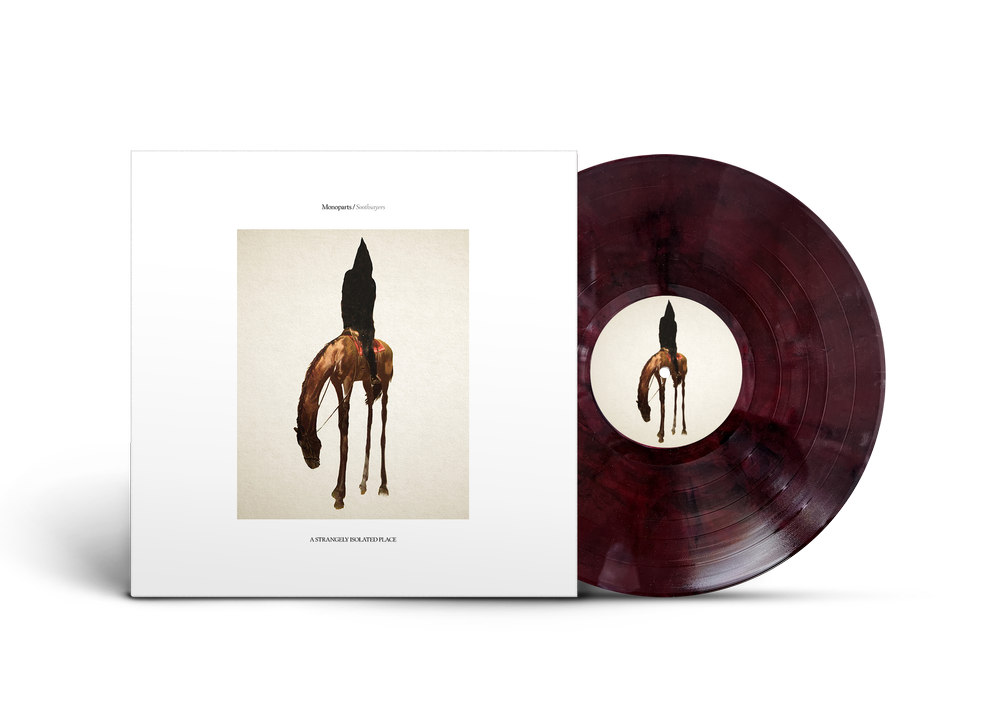
Our first release of 2025 was announced today, featuring our very own Olga Wojciechowska, (Infinite Distances (2019), Unseen Traces (2020), and the 2022 collaboration with Scanner), alongside Tomasz Walkiewicz.
The Monoparts project was sent to me as unreleased material a few years back by Olga, and it was spoken of as something that would never see the light of day, due to the duo going their own ways.
It was put into rotation on 9128.live, and since then, I grew to love it so much, I made the steps to secure it as a release on ASIP.
In a dramatic departure, Olga unveils a new and unexpected side, debuting her haunting vocals—a delicate, spellbinding performance that recalls the golden era of trip-hop, and comparisons to the sounds pioneered by Tricky, Massive Attack, and Martina Topley-Bird.
"This album is like becoming one with the earth itself—feeling the rawness of the wood, tasting the earth in your mouth, and sensing the presence of ancient spirits. The music carries a deep, primal energy, like being part of the forest, with creatures watching you from the shadows." - Olga Wojciechowska
To complete the journey, ASC lends his signature touch with a stunning drum'n'bass reinterpretation, amplifying the album's nostalgic essence. Soothsayers emerges as a spellbinding ode to times gone by, in more ways than one.
Featuring artwork by Moon Patrol, with mastering and lacquer by Andreas LUPO Lubich, Soothsayers will be available on 12" maroon smoke-colored vinyl and Bandcamp on February 28th. Preorder is now available on Bandcamp and Space Cadets, with more stores to follow soon.
Save the Monday 24th for our listening party over on Bandcamp. RSVP here.
Is there room in the obituary for some bitchery? (Bowie, bye bye) [ 06-Jan-25 5:55pm ]A 2018 piece for Stanford Live on Bowie's death and the art of the eulogy.
The night that the news went out that David Bowie had died, I was just finishing a book in which he was the central figure. On January 10th 2016, I was literally on the last pages of my glam rock history Shock and Awe when Twitter told me that this towering pop figure had fallen.
A mixture of emotions muddied my mind. Having labored for three years on the book, I felt like I had an unusual intimacy with Bowie, as if I truly understood his motivations - specifically that ache of emptiness that drove him in search of a succession of cutting edges, a desperate hunger for new ideas to kindle the creative spark within him. At the same time, having reached the end of my book, I felt oddly detached, as if I had finished with Bowie, or even - in some superstitious way - finished him off.
Born in Great Britain, but a resident of America since 1995, for me Bowie's passing was further entangled with growing feelings of nostalgia: he'd loomed over the Seventies, my childhood, just like the Beatles had dominated the Sixties. Bowie's songs were a perpetual presence on U.K. radio; his face appeared regularly on TV, especially on the weekly pop show Top of the Pops. From the entrancing strangeness of "Space Oddity", through the homoerotic intimations of "John, I'm Only Dancing", to the cross-dressing subversions of the promo video for "Boys Keep Swinging", Bowie had not only always been there, he'd always been startling. For many people across the world, but particularly for those who grew up in the U.K. during that era, Bowie's sudden non-existence felt like a part of the sky had suddenly vanished.
More ignoble thoughts intruded amid the grief. I did think, selfishly, "damn, there's going to be a flood of Bowie-related books rush-written, to compete with my own tome, over which I've toiled so diligently and protractedly." There was annoyance too, as it became clear that despite my exhaustion I would have to resume work immediately and write an extra closing essay to round off the book.
Ending Shock and Awe with Bowie peeved me because one intention starting out had been to put the man in his place just a little: I aimed to contextualise Bowie, reconstruct the culture and the rock music discourse out of which he'd emerged, while also elevating other artists now semi-forgotten but who at the time were considered his contemporaries and artistic equals (as well as often selling many more records than him, in fact). I hadn't wanted my history to become his story - but here was Bowie upstaging everyone again, insisting on being the last word, or at least the last subject for my words, in the Book of Glam.
Talking about upstaging - Bowie's death coincided with the Golden Globes, which meant that he knocked all the winners off the front page worldwide, outshone the world's stars with his own supernova. Including Lady Gaga - the figure who'd done her darnedest to be the Bowie of the 21st Century, and that night had won a trophy for her turn in American Horror Story.
As I returned reluctantly to my computer, I pondered how to approach the daunting task of summing up a man's life and work. All around, online and in print, teemed thousands of public tributes and private testimonials - a fiesta of remembrance, in which professional writers and fans alike competed to find fresh perspectives and idiosyncratic angles. Especially because my essay would have a longer shelf life, it felt like I should attempt to speak not just for my own feelings but for the larger community of people who had been affected by Bowie's existence. There were many notes being sounded in those weeks immediately after his death, but a prominent leitmotif was gratitude, tinged with self-congratulation. A sentiment crystallized sharpest in the widely circulated statement, mistakenly attributed to the actor Simon Pegg: "if you're sad today, just remember the Earth is over four billion years old and you somehow managed to exist at the same time as David Bowie." As is so often the case with the passing of a pop-culture icon - think of Prince - it felt like people were mourning themselves by proxy, coming to terms with the fading of their own time, and holding fast to the consoling belief that they lived through an exceptional era.
I decided to approach the essay as a eulogy, written on behalf of the gathered grieving, yet I would also try for something almost impossible: a honest eulogy. In other words, I would aim to be true to the insights about his character, motivations, influence and legacy that had emerged through writing the book (a verdict more ambivalent than you might expect) while still transmitting a sense of awe that someone so strange and ambitious could have moved within the humble domain of pop music. A sense of how improbable it all was, really - and how unlikely to happen again, despite the wishful efforts of figures like Gaga, or Kanye West, or Janelle Monae, to achieve something equivalent in terms of art-into-pop impact.
The root meaning of the word eulogy in Ancient Greek is "speak well." The funeral oration is meant to be a song of praise, and that means it almost inevitably becomes a whitewash, a lick of paint covering over the cracks and fault-lines. The death of someone is not the best time for airing the whole truth about that someone. Instead, just like the cosmetically-enhanced face of the dearly departed at an open-casket funeral, you are trying to fix the final and lasting image of that person as seen in their very best light. The mortician and the eulogist are in the same business really.
Amid the collective outpouring of grief and gratitude for Bowie's sonic and style innovations, his personae shifts and image games and the sheer drama of a career played out on the stage of the mass media, there was understandably scant inclination for a close examination of less wholesome or impressive sides of his work. Like that alarming phase in the mid-Seventies during which Bowie talked in fascist terms of the need for a strong leader and called for an anti-permissive crackdown on liberal decadence. Or all those credulous and indiscriminate flirtations with magic and mysticism that ran through much of his life (again reaching an unsightly climax in the cocaine-crazed years circa 1974-76). People likewise didn't dwell much on the long period during which Bowie's Midas touch failed him: the years of the "Blue Jean" mini-film, the Glass Spider tour, Labyrinth, Tin Machine and the beard… A period that if you were being honestly harsh constituted (give or take the occasional quite cool single) an unbroken desert of inspiration and direction that lasted two whole decades: 1983 to 2013, from the last bars of Let's Dance to the first of The Next Day. I distinctively remember that through much of that time, Bowie dropped away not just as figure who frequented the pop charts or commanded attention, but even as a reference point, something that new bands would cite as a model or touchstone.
It makes sense that the least compelling phases or most questionable aspects of Bowie's life wouldn't figure in the immediate post-mortem reckoning. Speaking ill of the recently dead is not a good look. But something of Bowie's complexity - his flaws and his follies- got written out with the concentrated focus on his genius achievements, personal charm, and acts of generosity.
Maybe it's my age, but I'm sure I can't be alone in feeling that important pop cultural figures are dying off at an accelerated rate. Then again, perhaps this is an illusion created by the sheer overload of coverage triggered by each passing: the internet and social media create so much opportunity and space for remembrance, and the profusion of outlets fuels a competition to offer ever more forensically deep or differently angled takes on the departed artist. There seems to be a widespread compulsion felt by civilians as well as professional pundits to make an immediate public statement: the news goes out that an icon has gone and Facebook teems with oddly official-sounding bits of writing that often read like obituaries with a slight first-person twist.
Sometimes I've felt that people protest a little too much about their intense relationship with the extinguished star. Where did all these people come from with their lifelong and surprisingly deep acquaintance with the oeuvre of Tom Petty? Who knew there were people who bothered with the three George Michael albums after 1990's Listen With Prejudice Vol.1? And surely I'm not the only one out there who - while fully cognizant and wholly respectful of the world-historical eminence of Aretha Franklin - only ever owned her Greatest Hits and - if I'm honest - really only ever craves to hear "I Say A Little Prayer"?
The truth of pop for most people, I suspect, is that we use the music to soundtrack our lives, but in a fairly fickle, personal-pleasure attuned way, and - apart from a few formative exceptions, the kind of teen infatuations that shape worldviews - we seldom engage with the totality of an artist's work and life. Tom Petty, for me, boils down rather brutally to the urge to turn up the volume when "Free Falling" and "Don't Come Around Here No More" come on the radio (in other words, he's on the same level as The Steve Miller Band and Bachman-Turner Overdrive). Unfair or not, George Michael reduces to a couple of nifty Wham! singles plus "Faith" and "Freedom! '90". A few moments of unreflective pleasure in the lives of millions of casual listeners is no small achievement, although it wouldn't have been enough for these guys, who craved to be Serious Artists on the level of those they venerated: Dylan and the Byrds, for Petty… someone like Stevie Wonder or Prince, for Michael. No amount of earnest reassessment or auteurist reappraisal could persuade me to dig deep into their discographies for those lost gems tucked away on Side 2 of a late-phase album.
You'll get no argument from me about Bowie, of course: career doldrums and dodgy opinions aside, he's as major an artist as rock has produced, worthy of taking as seriously as anybody (which is why the fascist flirtations and the half-baked occultism are troubling, as opposed to something you'd laugh off in a lesser figure). And Bowie also did what almost no fatally ill or otherwise declining pop star has ever managed, which is to go out on an artistic high. Beyond their musical daring and desperate expressive intensity, Blackstar and the videos for "Lazarus" and the title track made for a fitting last statement because of the sheer care that went into them. This was so utterly characteristic of Bowie and the way he went about things. Who among us - facing the final curtain, sick in body and frail of spirit - could have summoned the obsessive energy and psychic strength to meticulously craft their artistic farewell to the world? Who, confronting oblivion, would have been so concerned about how they looked and sounded at the end? Only Bowie.
As I found writing Shock and Awe, the beginning of Bowie's public life was faltering, a series of false starts and fumbled career moves. It took Bowie eight years of dithering and stylistic switches to really become a star. In contrast, the closing of his career was immaculately executed. What some sceptics always regarded as his core flaws - cold calculation, excessive control - triumphed at the end. Bowie organized a grand exit so elegant that it fixed forever our final image of him, rendering all eulogies superfluous.

Very quiet in the parish at the moment. The rotten weather isn't helping.
On the way home after walking the dog over the fields, coming back along Icknield Way, I did spy a bit of commotion: some new arrivals in the village! An American family moving into Hazeldene, that big house on the corner of Penfold Lane. A grey-haired fellow huffing and puffing great plumes of breath into the cold air as he lugging into the house what appeared to be an endless succession of boxes crammed with vinyl records, "Don't see many of those these days," I commented cheerily - receiving, for my pains, just a scowl. I shall return at a less-trying time, with a copy of this newsletter and some mince pies.
But talking of vinyl records, parish stalwart Ian Hodgson has a new Moon Wiring Club long-player.

Yes, that's right - the LP has an equine concept.
There's also a new artwork approach - dropping the usual MWC style for watercolour painting.
Says Ian, "I wanted to steer away from those rinsed-into-the-ground Folk Horror tropes, so gave the whole album a (very) loose Undead Dressage feeling (lots of movement)"
Sound-wise, this is reflected in a switch from the marshy, ambient quease vibe to a brisker, starker sound that coats the beats in ample spooky space. "Funky" is not a word that generally springs to mind when you think of Moon Wiring Club - unless in its other meaning of fusty and unventilated. But listening to the crisply syncopated beats of Horses In Our Blood, I kept thinking of The Meters.On the Hodgson mood board for this project: The Residents's "Jambalaya", the sound design and production design of spaghetti westerns (in particular the Klaus Kinski Gothic Western And God Said to Cain and Matalo! ) and acid westerns (like The Hired Hand).
And there was I thinking the inspiration came from the unfortunate incident at last year's gymkhana.
There's a whole backstory to the record.
Another fine offering from MWC - buy it here.
^^^^^^^^^^^^^^^^^^^
Talking of horses.... at the Horse Hospital in London this Sunday afternoon, there will be an event called Dismal 1970s, involving parishioners Stonecirclesampler and Travis Elborough, along with telly scholar Sophie Sleigh-Johnson and neo-pulp writer Tim Wells. It is described as "an afternoon of festive-ish words, moving pictures and performances dedicated to the decade of Smash instant potato, public information films and Evans the Arrow". More details about times and tickets here.
Stonecirclesampler - also known as Luke J Murray, the figure behind The Iceman Junglist Kru and various other haunty entities working in mutations of nuum and drill and wotnot - has produced a "special limited edition Dismal 1970s cassette... a super short run only available to attendees" orderable with tickets and to be collected at the event.

Dismal 1970s participant Sophie Sleigh-Johnson has a new book out via Repeater.

Now it was only recently, wasn't it, that I remarked upon the under-acknowledged intersection between hauntology and British comedy.
Here's a whole book inspecting that area: "a sometimes comedic field report that charts an esoteric code hidden within the twin poles of 1970s sitcoms Rising Damp and The Fall and Rise of Reginald Perrin. Outlining how past cultural patterns condensate and repeat through technology, time is shown to be a damp condensation seeping through the centuries and out onto the telly. Interspersed with the author's own photographs, prints, Holsten Pils cans, local newspaper entries and carrier bags, as well as a whole host of other characters, the work seems an antiquarian's conceit that takes time travel as a metaphoric methodology. This is not media studies; more an allegory of all reality as (tele)visual recorded history, excavating the strata of haunted technology from which the fragile band of code comprising our sense of time is briefly emitted. Drawing connections between incidents of ancient and popular culture, from Mark E. Smith's lyric— "They say damp records the past"—to Rising Damp's (meta)physical structure of decay, the book finds damp's temporal power manifest in everything from alchemy, mysticism, and parish folklore to pulp, Time Team, darts, the local newspaper and, of course, the sitcom. Merging the vast with the parochial, the occult with the comedic, Code: Damp tunes into the weird demands of damp as a time-traveling material at the intersections of comedy, myth and technology, taking all three as serious resources to better (dis)orient the ground we stand on."
Here's a warm endorsement from David Tibet of Current 93 renown: "LUCIFER ON THE BUSES! Code: Damp is one of the strangest books I have read. As well as one of the most evocative, lateral, sidereal... an unspellable jewel."
More endorsements and the opportunity to purchase here
^^^^^^^^^^^^^^^^^^^^^^^
Another addition to the racks at the local library (note the new reduced opening hours: Monday, Wednesday, Friday, and plus Saturday 10 am to noon). Of course you may prefer to support the author by picking up a copy at Book Nook or order directly from Headpress.

Release irrationale:
William Burns's Ghost of an Idea: Hauntology, Folk Horror, and the Spectre of Nostalgia examines the use and effect of nostalgia in the Horror and Hauntological realms. It asks why these genres hold such a fascination in popular culture, often inspiring devoted fanbases. From Candyman to The Blair Witch Project, and Dark Shadows to American Horror Story, are the folk horror and found footage phenomena significant artistic responses to political, social, and economic conditions, or simply an aesthetic rebranding of what has come before? How has nostalgia become linked to other concepts (psychogeography, residual haunting) to influence Hauntological music such as Boards of Canada or The Caretaker? What can the 'urban wyrd' or faux horror footage tell us about our idealized past? And how will these cultures of nostalgia shape the future?
Combining the author's analysis with first-hand accounts of fans and creators, Ghost of an Idea offers a critical analysis of our cultural quest to recognize, resurrect, and lay to rest the ghosts of past and present, also summoning up those spectres that may haunt the future.
Table of Contents
Introduction: The Seductive Liar, or Are We What We Used to Be?
Chapter 1: Today is Tomorrow's Yesterday: The Philosophy of Nostalgia
Chapter 2: The Yearning to Return: Folk Horror and Nostalgia
Chapter 3: The Illusionary Precipice: Found Footage and Nostalgia
Chapter 4: The Longing of the Permanently Lost: Franchise Nostalgia
Chapter 5: An Ethereal Composition of Disjointed Memories: Nostalgia as Catalyst for the New
Chapter 6: The Vice of the Aged: Do They Still Got It or Living Off Past Glories?
Chapter 7: The Enemy of Truth: Is Nostalgia Counter-Revolutionary?
^^^^^^^^^^^^^^^^^^^^^^
And finally, Estonian exchange student Mart Avi has a new release out, a collaboration with his countryman Ajukaja, bearing the rather sombre title Death of Music.

You can hear it and buy it here.
It's really excellent. To me it has the feel of a classic "new pop" album - in the lineage of Lexicon of Love / Sulk / Penthouse and Pavement - but a new pop album if it had been somehow made after the 1990s. Perhaps in 2001 - the way it folds in rhythmic ideas from hardcore continuum genres and other dance styles of the 1990s - reminds me a bit of Truesteppers, in moments at least. But the songfulness and the soulfulness - along with the wayward perceptions and intellectual edge - come more from a Scott Walker or Billy Mackenzie sort of place.It's a double album too - a meaty listen that doesn't flag on the quality front.
Release irrationale:
Certain albums hit like howling bullets at pivotal moments, tearing open the face of music to reveal hidden sonic muscles and fusing them back into something both strangely familiar and yet entirely unrecognisable. We believe this is one of those records."
The double album Death of Music delivers 16 crooked vocal pops, some ruthless, others unexpectedly disarming. In some songs, Ajukaja & Mart Avi function like a two-headed saurus swinging its spiky tail to shady pop-house smackers. In others, Ajukaja's serene organ licks descend into subterranean caverns, allowing Avi to float to the surface on their wavelengths and turn his voice into billions of extinct moths, enslaved by the moonlight's pull. There are songs that face destruction and those that seek to prevent it.
One kykeon rap goes, "If you die before you die, then when you die, you don't die!". Ajukaja & Mart Avi have embraced this notion to create new music that allows them to thrive in the algorithmic wasteland. 13 years in the making, these 66 minutes are packed with lifetimes of truths you didn't know you needed to know. They are Ajukaja & Mart Avi - two against death.
Forever Not-Now [ 02-Dec-24 7:29pm ] Back from the Dead Boys [ 29-Nov-24 7:23pm ]
A reanimated Dead Boys, with Cheetah Chrome on vocals - the record company decides the vocals need something else, so they use AI to "dust" it with some quintessence of Stiv Bators.

I remember Cleopatra from the '90s when packages would regularly arrive through the post, generally occasioning disappointment or disbelief. (Okay they did put out some good Krautrock - Manuel Gottsching stuff). But mostly they established a micro-market as a non-retirement home for twilight -career industrial and Goth acts . So this is a logical development. For the diehard fans who can't get enough, for whom death of the principals is not an obstruction or obstacle for appetite.
punk is dad [ 24-Nov-24 8:23pm ]This made me chuckle

This made me frown

I'm still enough of a believer to find it defiling to have a version of "Sex Pistols" treading the boards without Johnny Rotten....
Other bands that go the prosthetic singer route, I'm not so bothered.
Well, there's one and half others on the same Glasgow punkstalgia lineup that are doing that - The Stranglers, sans Hugh Cornwell, with a younger-than-the-others singer (younger-than-the-others - what am I talking about? Only Jean-Jacques Burnel remains from the original line-up, what with Jet Black and Dave Greenfield now departed).
And then Buzzcocks are the 'half' insofar as Diggle (I assume) is singing the Shelley-sung songs as well as the smaller number he originally sang.
^^^^^^^^^^^^^^^^^^^^
Talking of "punk is dad", I had a "rave is dad" experience the other night - went to see Orbital in LA. They were playing the first two albums - with an intermission in between - and so if you think about it that would necessarily largely draw a crowd who remembered those records from the early '90s - thirty years ago. So we are talking fiftysomethings for the most part.
Wasn't quite Cruel World levels of haggard, but yes a lot of baldness, bellies, and time-creased faces on show. You sensed a lot of memory-rushes triggered but that not being quite enough to galvanize manic dancing in the old style.
Some of the bar staff and the sound guy behind the mixing desk seemed on the grizzled, elderly side too. Perhaps veteran promoters and rave-scene people
Surely in their early '60s themselves, the brothers Hartnoll were great - well, some of the material back then was a tad middling, but the killer stuff, fantastic. Triffic lights and lasers and projections too - that is something that has advanced in leaps and bounds since back in the day. They got a very warm reception and seemed to be touched by it.
This must be the fourth - or possibly fifth - time I've seen Orbital live, but the last time would have been back in the mid-90s.
The very first time - when they were then almost alone in being able to play techno live - was the late 1991 rave conversion experience that I describe in the intro to Energy Flash. Well, the whole night really as opposed any specific deejay or group that played - the audience's dancing and demeanor as much as the music and lights. But Orbital certainly were a component of the baptismal immersion in a new culture.
Then the following year, I traipsed down to Sevenoaks for an interview and they showed me my very first glimpse of the silver box - I don't think they let me twiddle the knobs myself but they showed how to work the 303.
^^^^^^^^^^^^^^^^
Punk-gets-parental is not really news - I can remember when we were still in NYC and Kieran was little (so early 2000s), some of his pre-school friends's mums had a hobby band, playing punk rock. And then a few years later, at my brother's kids's elementary school in Silverlake, at a school fair or fund-raiser, a there was this band of dads entertaining the assembled with punk cover versions.
And of course there's that thing of tiny T-shirts with the Pistols or Ramones or Clash that the parents would get their kiddies to wear.
Just watched Blitz (ooh but it's clunky) and there was the surprise of Paul Weller playing the little evacuee boy's grandfather - silvery hair swept back in the 1940s style, face lined with ridges. He looks distinguished, though, as an old gent,
.jpg)

 RIP Shel Talmy [ 16-Nov-24 10:15pm ]
One of the odd things about the social media era is becoming "friends" with musical legends and cult figures that you've never met. Musicians you've interviewed and interacted with in real life - that's one thing, that makes sense. But I get a little shiver when I see a name like Annette Peacock or Andy Ellison (of John's Children renown) pop up in my feed.
One such Facebook friend that for the life of me I can't work out how I acquired was Shel Talmy, producer of a great number of classic singles of the 1960s, including works that I find impossibly exciting: the obvious anthems by The Kinks and The Who, stuff by The Creation, and above all The Easybeats's "Friday On My Mind". I think of the sound Talmy shaped as quintessentially English, even though he was himself an American living in Britain. (Much the same applies to Joe Boyd). Most of the groups Talmy produced were British, I believe (or Australian, as with the Easybeats). Somehow Shel was able to tap into, activate, direct, and realise a uniquely English form of musical violence.

I never actually interacted with Shel, which now seems like a shame. But I did enjoy the detailed accounts of producing particular tracks that he posted on Facebook, always titled "The Blueprint Of...". Over the years I have written about a bunch of things he worked on, but I don't think his name ever got mentioned therein - remiss of me perhaps - but at any rate here they are gathered below, a sort of belated reparations, or salute.
Talmy is one of the prime architects of this syndrome I broach below (extracted from this longer piece on British Rock Greatness). Again, somewhat ironic given that he was a Yank
... by the early '60s, a difference had become audible — a contoured clarity to the riff structures hitherto only heard in Eddie Cochran (who produced his own records, and was much bigger in the U.K. than in America). "Shakin' All Over," by Johnny Kidd & the Pirates, is the first British rock 'n' roll record to match America while also sounding different. This stark, almost diagrammatic quality carries on through the Kinks and mod groups like the Eyes, on to Led Zeppelin, Free and the Groundhogs, and beyond them to Wire and Gang of Four. It almost feels like you see the music as much as hear it; compare this lucidity with the organic, live-sounding quality of so much American rock — the marauding murk of the Stooges on Fun House, for instance.
Perhaps British rock feels less "organic" because we've never had an organic relationship with the music or its sources in blues and country. These sounds arrived like invasive visitations, and bear connections to indigenous forms like traditional folk or music hall that are chiefly musicological and twice-removed. It's as if this inherently distanced perspective on rock gave British artists a unique vantage point, and an advantage. Hearing rock 'n' roll primarily as recordings first and foremost, rather than as live music, made a difference. As their precursors had with jazz and blues imports, British rock 'n' roll fans studied the records, playing them over and over and isolating specific bits of performance. (This studious approach no doubt contributed to the remarkable lineage of British guitar heroism.) In the U.K., the record is the primary text, what a live performance is trying to realize and replicate; in America, it's the other way around.

Thoughts on "Friday On My Mind" and "the blow out":
With the rave as working class blowout idea, I always come back to this 1966 song by The Easybeats, "Friday On My Mind", a thrilling anatomy of the working-class weekender life cycle of drudgery, anticipation and explosive release. It's written from a Sixties mod perspective, the 60-hour weekend, but it foreshadows Northern Soul's speedfreak stylists, to disco's Saturday-night fever-dreams and jazz-funk's All Dayers and Soul Weekends, and onto rave and EDM. Every kind of dance culture in which pills are used to intensify leisure time to the utmost, but then it's back to the 9 to 5.
This is the key verse --
Do the five day grind once more
I know of nothin' else that bugs me
More than workin' for the rich man
Hey! I'll change that scene one day
Today I might be mad, tomorrow I'll be glad
'Cause I'll have Friday on my mind
And then there's the chorus
Tonight I'll spend my bread, tonight
I'll lose my head, tonight
I've got to get to night
Monday I'll have Friday on my mind
Musically the verses have this sort of tick-tocking tension, like the treadmill of workaday time, as he waits for the big blowout of the weekend (the euphoric chorus). It's two different kinds of time: chronos versus kairos
Lyrically the key line is "hey! I'll change that scene one day" - I find it incredibly poignant - it could just mean "one day I'll get started on my career / start a business and I'll be the rich man / boss" or it could mean "one day me and the rest of the proletariat will organise at the site of the means of production and there'll be a revolutionary transformation in political economy, no more rich men, no more bosses"
But it's clear that he's so caught up in this nightlifestyle that he'll never get around to either the individual or collective escape route
I tend to see the essence of rave (and its precursors) as dissipatory
But (like a lot of music in different ways) it points towards an unalienated life - one that it can't actually make real in the outside world, but can only institute in the small areas of space and time it can command
Of course, the troubling thought is that the momentary release of the ecstatic all night dance is actively working against the total and permanent change he and everyone else should be working for (and which would necessarily involve more drudgery and deferment of gratification in favor of the long term goal - duty for the future being the essence of political involvement)
The here-and-now utopia / TAZ is taking away the possibility of a soon-to-come PAZ (permanent autonomous zone)
Almost sixty years after "Friday On My Mind", we're no nearer to overhauling the work/leisure structures of industrial society. Instead, all that rage and frustration is vented through going mental at the weekend ('Tonight, I'll spend my bread / Tonight, I'll lose my head'), helped along by a capsule or three of instant unearned euphoria.
Flowered Up's "Weekender" film is an update of this notion of the blow out cycle as counter-revolutionary. It's totally mod - indeed directly influenced by Quadrophenia, the mod revival movie of 1979 - indeed there's a sample of the Phil Daniels character's rant about how they can take his office drone job and stick it up their arseholes. In Quadrophrenia, the key scene of disillusionment for the mod protagonist as played by Phil Daniels, is when he comes across the scene's leading Face - the coolest of the cool - in his civilian life, where he is a porter in a posh hotel, a flunky ordered around by rich men...
Another song about the blow out - there's a verse about "going to the disco" in this otherwise gritty funk-blues song about how tough life is economically by the great Johnny 'Guitar' Watson, the king of "proletarian funk"
Got to go to a disco
Throw your troubles away
Dance to the music
That the DJ's play
And then the lights come on
Like you knew they would
Go home and face the music
That don't sound to good
Stuff on The Who and mod from an essay entitled "Buttoned Up" - about buttoned up shirt style, wouldyabelieve?
The violence of the Mods as they rampaged against the Rockers was on one level simply righteous disgust for their abject opposite. But mod style itself could be seen as having an inherent undercurrent of violence. First, there was the symbolic violence of dressing sharper than your social superiors ("powerful people -- businessmen in suits, take their clothes, retain your identity" as Ian Page of mod revival band Secret Affair put it). But also a kind of imploded violence: the neurotic fastidiousness of dress and grooming was a sort of voluntarily worn strait-jacket, a near-masochistic set of constraints and rules.
This stringent regime, stoked and sharpened by amphetamines, virtually demanded some kind of release, a breaking free. That could take the form of mayhem (as with the war with the rockers) or through theatricalized disorder. Which is where the Who came in: a band designed by mod philosopher Pete Meaden, the group's manager in their early days. Meaden deliberately shaped the Who to appeal to the existing Mod subculture, which until then had been based not around following bands but dancing to records, imported soul and R&B.
Rock 'n' roll had triggered violence before (with the cinema seat slashing done by Teddy Boys driven into a frenzy of excitement by the first rock'n'roll movies to arrive in Britain). But it had never really represented violence musically or enacted it onstage. The Who's sound was white R&B so amped-up and amphetamine-uptight it came apart at the seams: Keith Moon's free-flailing cymbal crashes and tom rolls, Pete Townshend's slashed and scything powerchords, John Entwhistle's bass-lunges. A sound expressive not of sexual desire but of an unrest at once social and existential. Mod was fundamentally asexual: as Pearce notes, mods "simply were not interested. They were.... too self-absorbed.... Mods were free, clear of emotional ties. They rejected peer pressure to pair off." The boys dressed and danced to impress other boys, not to attract girls. Amphetamines also had something to do with it, suppressing sex drive along with the other needs and appetites of the organism (such as food and sleep). Speed creating a sexless intensity, a plateau state of arrested orgasm that the mods, revealingly, called "blocked".
The pent-up pressure had to blow somehow, though, and mod's latent violence was dramatized by Moon and Townshend in their climactic orgies of instrument-smashing : supposedly inspired by art-school student Townsend's encounter with Gustav Metzger's auto-destructive art, but really the orgasmic release that mod music, mod psychology, mod neurology urgently required. In the immediate aftermath of "My Generation", "I Can't Explain", "Anyway Anyhow Anywhere", and the other early Who singles, young bands like The Eyes, The Creation and John's Children picked up on the band's loudness and distortion and recorded a a series of 1966-67 singles that fans and collectors subsequently have come to call "freakbeat": mod tipping into a jagged, edge-of-chaos frenzy under the influence of speed and LSD. The strange blend of menace and feyness in songs like The Eyes's "When The Night Falls" and "My Degeneration", John's Children's "A Midsummer Night's Scene" and "Desdemona" simmered with a spontaneous combustibility that was uniquely English, rooted in the characteristic native psychology of neurotic uptightness and lashing-out rage.
John Entwistle / The Who, "My Generation" (Brunswick single, 1965)
Rock 'n' roll had triggered violence before, but up until The Who it had never really represented violence musically* or enacted it onstage. Think of words like "mayhem" and "destruction" in connection with that band and the first things that spring to mind are Keith Moon's free-flailing drums and Pete Townshend's scything powerchords. (Not forgetting those climactic orgies of instrument-smashing). But on "My Generation" John Entwistle supplies more than his fair share of the savagery. Often described as lead bassist to Townshend's rhythm guitarist, on this late 1965 single, his is the loudest instrument (with the possible exception of Moon's cymbals).
For the first minute "Thunderfingers", as his bandmates nicknamed him, churns and grinds as relentlessly and remorselessly as a gigantic tunnel-boring drill. Then, outrageously, he takes the solo and slashes a rent in the song's fabric with a down-diving flurry of notes at once fluidly elegant and brutishly in-your-face. This is generally regarded as the first bass solo in recorded rock, and as such, it's a mixed portent. Entwistle would immediately attempt to reprise the shock effect on the Who's debut album with the bass-dominated instrumental "The Ox" and over the years he became an increasingly ostentatious player, peaking with the verging-on-Pastorius floridity of Quadrophenia's "The Real Me" (much admired in the technical guitar magazines).
But in the immediate aftermath of "My Generation", young bands like The Eyes, The Creation and John's Children picked up not on the sophistication (beyond their capabilities, anyway) but the loudness, distortion, and menace. Amping up the jagged, edge-of-chaos frenzy, they recorded a series of 1966-67 singles that fans and collectors today know as "freakbeat". Mod, as a musical form as opposed to a subcultural style, represented a uniquely English contribution to rock: the sound of frustration and neurosis, tension and explosive release. In their own way, for a moment there in the mid-Sixties the Who were as radical as the Velvet Underground. Certainly, as far as Britain is concerned, punk starts here. Entwistle can even be seen as a forefather of postpunk's "lead bassists", or at least the aggressive hard-rocking sort, such as Jean-Jacques Burnel and Peter Hook. Indeed Hooky actually bought some of the Ox's bass guitars in the estate sale after his 2002 death.
* Actually I would semi-retract that - Bo Diddley's sound, all rhythm and noise, is joyously violent.
VARIOUS ARTISTS, Nuggets II: Original Artyfacts From the British Empire & Beyond
Lenny Kaye's 1972 anthology Nuggets was a rock archivist's masterstroke, a feat of canon rewriting that deposed the post-Sgt Pepper's aristocracy and elevated the forgotten garage punks of the mid-Sixties, from The Seeds to Chocolate Watchband. Rhino's 1998 four-CD update of Nuggets dramatically expanded the original double LP. Now this latest instalment extends the Nuggets premise beyond the USA to encompass the one-hit-wonders and never-wozzers of mid-Sixties Britain: that all-too-brief golden age of amphetamine-cranked R&B and mod-on-LSD that's roughly bookended by "My Generation" and Cream's Disraeli Gears. Just the names of these long-lost groups--Dantalion's Chariot, Wimple Winch, Rupert's People, The Idle Race--induces a contact high, before you even play the discs.
Back then, singles made their point and left. This short'n'sweet succinctness allows the compilers to cram 109--that's one hundred and nine--tracks into four discs. Here's just a handful of gems. Tintern Abbey's "Vacuum Cleaner", with the saintly-sounding David MacTavish singing a proto-Spacemen 3 love-as-drug/drug-as-God lyric ("fix me up with your sweet dose/now I'm feeling like a ghost"), splashy cymbals, and a billowing solo of controlled feedback. Them's "I Can Only Give You Everything": Van in I'm-A-Man mode, awesomely surly and swaggering. The Sorrows's "Take A Heart": a Brit-Diddley locked groove of tumbling tribal toms and spaced-out-for-intensified-effect guitar-riffs. The Eyes's "When The Night Falls" takes that drastic use of silence and suspense even further: powerchords like Damocles Swords, caveman tub-thumping, tongues-of-flame harmonica, and an insolent you-done-me-wrong/go-my-own-way vocal. Fire's "Father's Name Was Dad," a classic misunderstood teen anthem: society gets the blame and the kid surveys Squaresville from a lofty vantage, cries "I laugh at it all!"
One group stands out as a "why?-why?!?-were-they-never-MASSIVE?" mystery. Not The Creation, and not The Action--both had terrific songs but were a little characterless. No, I'm talking about John's Children's. Their two offerings here are astoundingly deranged, the monstrously engorged fuzzbass like staring into a furnace, the drums flailing and scything like Keith Moon at his most smashed-blocked. "Desdemona" features the then shocking chorus "lift up your skirt and fly", daft lines about Toulouse-Lautrec painting "some chick in the rude" plus the stutter-bleat of a young Bolan on backing vox. "A Midnight Summer's Scene" captures mod sulphate-mania on the cusp of mutating into flower power acid-bliss: it's a febrile fantasy of Dionysian mayhem in an after-dark park, maenad hippy-chicks with faces "disfigured by love", strewing "petals and flowers," prancing the rites of Pan.
John's Children's merger of cissy and psychotic highlights the major difference between American garage punk and British "freakbeat" (as reissue label Bam Caruso dubbed it for their illustrious Rubble compilation series). The Limey stuff is way fey compared with the Yanks. You can hear a proto-glam androgyny, a "soft boy" continuum that takes in Barrett and Bolan, obviously, but also the queeny-dandy aristocrat persona of Robert Plant. At the same time, because these bands were schooled in R&B and played live constantly, the music has a rhythmic urgency and aggressive thrust that gradually faded over subsequent decades from the psychedelic tradition (think of Spiritualized's drum-phobic ethereality). This, though, was music for dancing as much as wigging out.
Nuggets II isn't solid gold. There's a slight surfeit of boppy shindig-type rave-ups and sub-Yardbirds blues that just ain't bastardized enough. Personally I crave more tunes with truly over-the-top guitar effects, aberrant bass-heavy mixes, phased cymbals, drastic stereo separation, and other psych-era cliches. The "British Empire" part of the subtitle allows in Australia's The Easybeats (godstars for the duration of "Friday On My Mind") while the "Beyond" pulls in groovy Latin American acid-rockers Os Mutantes. But to be honest, a lot of the Commonwealth-and-beyond stuff just ain't that hot. And inevitably one could compile another 2-CDs out of heinous ommissions. Forget the quibbles, though, this box is a treasure chest of vintage dementia.
THE WHO
3O YEARS MAXIMUM R&B
For a while there, it seemed that The Who had dipped out of rock memory, become a band that virtually no one even thought about. They seemed to have the same relation vis-a-vis the eternally cool and current Beatles & Stones that, say, Deep Purple have to Sabbath & Zep: massive then, monstrously uninfluential thereafter. In recent years, though, The Who have slowly seeped back as a reference point, what with Urge Overkill's "Live At Leeds" sharp-dressed rifferama and the mod iconography of groups at diverse as Flowered Up, These Animal Men, Blur, D-Generation, and Primal Scream (that ad for 'Rocks' featuring Keith Moon).
Personally, I find there's something resolutely unloveable about The Who, although why I'm not sure. Pete Townshend's mid-life crisis and endless maudlin' musings on lost youth? Roger Daltrey's voice, face, and fish-farm? Just the FACT (I haven't heard 'em) that John Entwhistle released FIVE solo LP's? Perhaps the real reason is the boy-ness of The Who cult (and of their legacy, The Jam, Secret Affair etc). Somehow it's obvious that way fewer women cared about The Who than The Stones, Beatles or even Led Zep.
Still, I love the mod-psych bands who never made it--The Eyes, John's Children, The Creation--so I can't logically refute the thrill of "I Can't Explain", "Anyway Anyhow Anywhere", "Substitute". At their 1965/66 height, The Who's white R&B is so amped-up and amphetamine-uptight it's coming apart at the seams. "My Generation" remains as naffly irresistible as Steppenwolf's equally naive "Born To Be Wild"; Moon's ramshackle surf-drums, exploding everywhichway like Mitch Mitchell of the Experience, Townshend's slash-and-scald rhythm guitar, Entwhistle's bass-lunges and Daltrey's speed-freak stutter, all add up to an immaculately chaotic enactment of mod's "smashed, blocked" aggression, its rage-to-live and hunger for action.
With the arrival of psychedelia, The Who toyed with the era's fashionable tropes of androgyny ("I'm A Boy"'s Frank Spencer scenario, where mummy won't admit he's not a girl), and regression (the fey "creepy-crawly" terrors of "Boris The Spider"). There were gems here (the effete all-wanked-out vocals of the masturbation ode "Pictures Of Lily"), but mostly The Who's acid-phase is unusually unappetising. "I Can See For Miles" turns mod misogny into visionary paranoia, and the swooping phased guitars of "Armenia" thrill, but the pallid, fey vocals of this period are pretty pukey.
Then the bombast begins in earnest. Daltrey quickly swells into the least likeable white R&B singer this side of Joe Cocker, while Townshend's songs bloat up like houses with too many extensions. The Who's progressive aspirations are all on the level of structure rather than playing or texture (which remained coarse R&B); the result is a horrid fusion of prog-rock and pub rock. So, apart from "Tommy"'s one genuinely hymnal aria ("See Me Feel Me") and the just-about-takeable epic-ness of their post-counterculture allegory "Won't Get Fooled Again", a long blank void ensues--one whose continuance seemed increasingly mercenary as the Seventies proceed. Even at their most haggard, The Stones could re- ignite with the lubricious raunch of a "Start Me Up". The Who's equivalent twilight hit is "You Better You Bet", a song with only one fan in the entire world, Taylor Parkes, and only then for the most perverse, "it's so bad, it's.... really MINDBOGGLINGLY bad" of reasons.
"30 Years Maximum R & B"? Break that down, and it works out at roughly 4 and a half years of adolescent intensity and two and a half decades of graceless middle-age.
Scroll on [ 02-Nov-24 4:53pm ]A little souvenir of a terrible year... something I wrote about doomscrolling for Sasha Frere-Jones end-of-year writer round-up, looking back over 2023 and looking ahead to 2024, which has been even more "how can this be reality?!?" than I could have imagined.
Hoping for some hopescrolling come Tuesday night....
^^^^^^^^^^^^^^^^^^^^^^^^^^
It was a year of doomscrolling. Like the year before. And like next year.
Sometimes, when trying to explain affect theory to my students, I use doomscrolling as an example of a uniquely contemporary affect. It didn't exist - and then it did.
For sure, there's always been bad news. But it arrived in defined chunks and at punctual intervals - TV news, radio at the top of the hour. Only a massive crisis like 9/11 or Katrina would result in rolling round the clock coverage - and even then, you could walk away from that.
To get the doomscroll effect in the past, you'd have to take a load of newspapers and chop them up and stick on some kind of homemade carousel rigged up out of chicken wire and spindles. And even then it would not approach the inexhaustible, endless-onwardness of the doomscroll,
The chyron, that Times Square tickertape at the bottom of the news channel screen, was a foretaste, an augury of doomscrolling. But it was easier to ignore, and it didn't have the personalized, algo-attuned quality of doomscroll, the way it learns what detains your gaze and churns up choice items tailor-made to agitate you.
Think about how this timesuck lifefuck invention affects your breathing rhythms, your posture (hunched, clenched), your endocrinal system - and how that builds up as neurological wear and tear, a stress load.
But think also about how those on the opposite side of the ideological spectrum from where you sit - on any issue, any conflict currently raging - are also being pumped full of this shit nonstop, forcefed fear and tension. It explains a lot.
For sure, now and then there'll be a spate of hopescrolling - unexpectedly positive developments, better than expected election results. But mostly the mode is doomscroll - feeding your inexplicable craving for the alarming, the upsetting, the enlargement of feelings of impotence and despair.
Feeding you the illusion of keeping on top of things when actually you're sinking deeper and deeper.
2023 was the year of doomscrolling. Same as last year. 2024 will be worse - worse beyond the wildest nightmares.
^^^^^^^^^^^^^^^^^^^
Follow up on the blog about Bob Dylan as the Original Doomscroller
RIP Phil Lesh [ 28-Oct-24 4:04pm ]Never became a Deadhead, but there's the odd moment on the records, and then there's "Dark Star"
There's also the electro-acoustic side project Seastones, the creation of Ned Lagin, but Lesh's contribution and encouragement clearly crucial.
Below is
a/ bit on the Dead from an essay on psychedelia for a Liverpool exhibition
b/ a bit on Grateful Dead and Deadhead culture from Retromania
c/ my interview with John Oswald about his Grayfolded project based on 100s of different live versions of "Dark Star"
Ethan Hein does close analysis of "Dark Star" and recommends some great versions
Here's a playlist of "Dark Star" renditions I made on Tidal
I rather like this ridiculously non-singular studio version they put out as a single
Call me soft in the head but I've always rather liked this other single - an actual hit, Top 10 Billboard!
Grateful Dead and the SF Sound
Unlike the British psychedelic groups, the SF bands had gone straight from folk to acid-rock without any intervening period playing rock'n'roll or R&B. As a consequence, the feelgood groove that the UK groups retained through all the studio malarkey was absent. Yet despite its lack of grounding in R&B, the SF acid-rock bands uniformly emphasized the importance of dancing. It's no coincidence that the scene was born in former ballrooms like the Fillmore and the Avalon. This was a particular form of dance--unpaired and asexual, a sacred frenzy of undulant gestures. This freeform dance matched The Grateful Dead's "search for the form that follows chaos," as guitarist Jerry Garcia characterized it.
Capturing the fugitive "magic" of their live jamming in the studio would prove an abiding problem for the Grateful Dead. Shortly before making their first album, Garcia warned, "We're not a recording band. We're a dance band." After a disappointing debut, the Dead veered to the opposite extreme and embraced the sound-sculpting potential of the studio. Painstakingly stitching together live tapes with studio experimentation, 1968's Anthem of the Sun drew heavily on the avant-classical training of bassist Phil Lesh and pianist Tom Constanten, both of whom had studied under Luciano Berio at Mills College in Oakland, California. "We were making a collage," recalled Garcia. "It had to do with an approach that's more like electronic music or concrete music, where you are actually assembling bits and pieces towards an enhanced non-realistic representation." Compared with the phonographic feats of the Beatles or Hendrix, though, Anthem is a pretty mild experience, with an "organic" quality that mostly feels like a plausible real-time musical event (unlike the Beatles' "A Day In The Life." say). The Dead quickly reverted to their original go-with-the-flow improvisational model, as documented on an endless series of live albums. Jefferson Airplane, likewise, made a couple of gestures at musique concrete--the freak-out track "A Small Package of Value Will Come To You, Shortly," the electronic foray "Curinga"--but their records generally closely replicated their live sound.
.... Paralleling the Deadhead subculture that surrounded the Grateful Dead all through the Seventies, Eighties and Nineties, the rave scene created a sense of ecstatic tribalistic community. Like Dead shows, each rave constructed a "temporary autonomous zone" in which drugs could be experienced in the most audio-visually conducive environment imaginable. The acid house played at the raves couldn't have sounded further from the Dead's meandering country-rock, but it had exactly the same function. As journalist Burton H. Wolfe put it in the 1960s, this was music designed "to blow the mind and provide action sound for dancing."
DEADHEADS
THE LIVING DEAD
On the face of it, it's difficult to think of anything more distant from Mod and Northern Soul than the Deadheads, that tie dye tribe who followed the Grateful Dead on their arena tours all through the Seventies, Eighties and early Nineties. The turn to psychedelia in the mid-Sixties was precisely what turned off many mods and led to Northern Soul. It's easy to imagine a Northern Soul or Secret Affair fan's disgust at the Deadhead's sense of "style": the long straggly hair and face-fuzz, the cut-off-shorts and loose flowing garments with their unappetizing mix of garish colors and Whole Earth-y shades of brown. The Dead's music--all meandering guitar solos, rootsy grooves, weak whitebread harmonies--could hardly have been more offensive to the mod sensibility.
Still, there are a surprising number of parallels between Northern Soul and the Deadhead scene. Both are style tribes whose members travelled on pilgrimages to particular clubs or one-off events, "temples of sound" where they congregated to create an ecstatic ritual space. At the Dead's long arena shows and the Northern Soul all-nighters loud music and drugs meshed to overwhelm listeners and transport them to a collective high. Dead shows were famous for the ripples that traversed the crowd-body in response to certain shifts in the music. As journalist Burton H. Wolfe observed, the Dead's music was "action sound for dancing" just as much as it was head music designed to "blow the mind". A different kind of dancing, for sure, to the fastidious steps and acrobatic twirls on display at Northern nights. Freeform and fluid, Deadhead dancing was the continuation of the "freaking-out" style that emerged in 1960s San Francisco at former ballrooms like the Fillmore and the Avalon as well as at the Be-Ins and similar triptastic happenings. Orgiastic yet asexual, this sacred frenzy of undulant gestures matched The Grateful Dead's "search for the form that follows chaos," as guitarist Jerry Garcia characterized it. But like Northern Soul, the Dead's concert audience was mostly on its feet, moving and grooving.
The main thing that the Deadheads and Northern Soul have in common is their fixation on a particular moment in the Sixties, keeping it alive in defiance of the passage of pop historical time. Neither scene was really retro, but rather an example of subcultural persistence. "Keeping the faith" is the central principle in both fan cultures. So too is an emphasis on community--a sense of togetherness defined against the mainstream, that unlucky majority who aren't in the know. As the Dead's Tom Constanten put it, "Back in the sixties, there was a great sense of community, and I think a lot of the energy and the steam, the wind in the sails of the Grateful Dead phenomenon is from that community." There are even parallels between Northern Soul and the Deadheads in terms of the way a rhetoric of anti-commercialism was combined with a bustling entrepreneurial activity, as with the markets for handcrafted goods (hemp bracelets, jewelry, tie-dyed clothes) and Dead memorabilia that sprang up in the parking lots outside the arenas where the Dead played, which aren't that far removed from the record dealers selling and swapping rare soul singles at the Northern Soul all-nighters. In both scenes there was also a bustling illegal trade going on rather less openly: amphetamines and barbituarates with Northern, and at Deadhead shows, marijuana, "doses" ( LSD), and other psychedelics like peyote, mushrooms and MDMA.
All this parking lot activity was as much part of the total experience of a Dead show as the band's performance. These outdoor bazaars, teeming with backpack-lugging peddlers and gaudily daubed, Merry Prankster-style micro-buses and vans, offered a kind of nomadic surrogate for Haight-Ashbury circa 1967-69. And they had the same upsides and downsides. Familiar faces that you'd see at every show, people passing around the pipe and sharing stuff with strangers, an atmosphere of trust and tranquility…. But also rip-off deals, scam artists, hardcore drug casualties, kids flipping out on bad trips.
Deborah J. Baiano-Berman, who's both an academic and a Deadhead, characterizes the band's following as a "moral community" and argues that Dead's concerts allow their fans "to live out their interpretation of a hippie-like communal value system, based primarily on freedom, experimentation, solidarity, peace, and spontaneity." Inside the auditorium, the crowd created the atmosphere as much as the band or the lighting crew. The emphasis on tie-dye and clashing colours, the painted faces and beads, turned the whole shimmying, swaying audience into a paisley ocean, a spin-art kaleidoscope. Baiano-Berman points out that almost nobody sits at their assigned seats in the concert hall: they move out into the aisles and dance, drift around the auditorium, settling in different places, creating an effect of "incessant movement and circulation". To an audience sensitized on drugs like LSD, which intensifies peripheral vision, to be in the midst of this flickering multitude is entrancing and magical.
Another aspect of Deadhead culture that's about communality and circulation is tape trading. From very early on Deadheads started recording shows, a practice that was first tolerated by the band and then encouraged, with the Grateful Dead making provisions for a special area at each of their shows for tapers. There was a huge demand for cassette recordings of the band's shows, in part because the Grateful Dead's official studio albums were airless affairs that failed to capture the electricity of the band in full improvisational flow. Deadhead culture's communal ethos meant that if anyone requested a tape, the taper had to make them a copy. Tapers also got into trading recordings with other tapers in different parts of the country. All that resulting excessive documentation and redundancy anticipated aspects of today's retro culture, like the multiple clips of the same gig videoed on cellphones and uploaded to YouTube.
The taping phenomenon has a paradoxical aspect. The angle on the Dead has always been that you really had to see them live to "get it": you needed to experience the flow of the moment, the pure quicksilver magic of Garcia's soloing as it rippled out into the cosmos. Taping the shows attempts to capture that evanescent beauty but in the process goes against the "be here now" spirit of psychedelia. Indeed the tapers became obsessed with recording quality. Instead of dancing and getting lost in music, they would spend the show crouched beside their tape recording equipment, constantly adjusting the recording levels (sometimes listening to the show through headphones plugged into the machine) or repositioning the microphones. They'd admonish dancing Deadheads for bumping into the equipment or chatting too loudly on the periphery of the taper's sections. Like the dad with a videocamera welded into his eye socket at his kid's birthday party, the tapers were not fully present; they missed, partially at any rate, the very event they were attempting to save for eternity.
The fact that obsessively stockpiling audio documentation of the live Dead is so central to the Deadhead subculture seems to resonate with its deepest impulse: to freeze-frame History and artificially keep alive an entire era, the late Sixties. The Deadhead scene is a preservation society. Or perhaps it was actually a reservation, a zone of cultural territory set aside for an outcast tribe. The gentle frenzy of the Deadheads is a ghost dance: an endangered, out-of-time people willing a lost world back into existence.
JOHN OSWALD
The Wire, 1995
by Simon Reynolds
There are two different schools of sampling. For some (A Guy Called Gerald, The Young Gods, Techno-Animal), there's a fierce conviction (50 percent aesthetic, 50 percent legal anxiety) that all samples must be masked, all sources rendered unrecognisable. This is the modernist school of sampladelia: digital technology as a crucible for sonic alchemy, musique concrete made easy as pie. I have a lot of sympathy for this ethos, but there's a sense in which this approach reduces the sampler to a synthesiser, and thereby misses what is truly idiomatic to the machine: taking the known and making it strange, yet still retaining an uncanny, half-recognisable trace of the original's aura.
Canadian musician/producer John Oswald falls into the second, postmodern camp. Sampling, or as he prefers to term it, "electroquoting", is a highly self-conscious practice that allows him to interrogate notions of originality, copyright, signature and 'the death of the author'. Long before the sampler became available, he was using more cumbersome, time-consuming techniques of tape cut'n'splice to create his famous if seldom heard Mystery Lab cassettes. But he really made a name for himself in 1989 with the Plunderphonics CD, which caused a major ruckus, sonically and institutionally, with its digital vivisections of songs by The Beatles, Elvis, Dolly Parton, Michael Jackson, Glenn Gould etc. Despite the fact that 'Plunderphonics' was distributed on a non-commercial, non-profit basis, the Canadian Recording Industry Association, acting on behalf of its clients CBS and Michael Jackson, threatened Oswald with litigation. He was forced to destroy the master-tapes and all remaining CD's. 700 remain in circulation, while the intrigued can get bootleg copies from a number of Copyright Violation Squads (see end-note).
Since then Oswald has mostly confined his plunderphonic escapades to cases where his reworkings have been solicited, like his de- and re-constructions of songs by The Doors and Metallica, amongst others, for a limited release CD celebrating the 25th Annivesary of Elektra Records. An exception was "Plexure" (released on John Zorn's Avant label), where Oswald cannibalised the entire audiorama of contemporary pop'n'rock in one fell swoop. The result--5000 songs 'composited' into a 20 minute frenzy of crescendos, choruses, screams, powerchords, etc--is a bit like Napalm Death with samplers.
Last year, at the invitation of the Grateful Dead, Oswald plunderphonized that band's most famous and far-out song "Dark Star", producing the double-CD "Grayfolded". The first disc, "Transitive Axis" came out last year; now the second half, "Mirror Ashes" has been added, and the whole 'Grayfolded' package is being made widely available, following the unexpectedly warm reception 'Transitive' received from the Deadhead community (50,000 copies sold!).
Entering the Dead's legendary vaults, where recordings of virtually every performance they ever made are stacked, Oswald spent 21 days listening to 100 versions of 'Dark Star', and extracted 40 hours of improvisatory material. The original plan was to create just one disc, but Oswald soon realised he had enough good stuff for two. 'Transitive' and 'Mirror' each took three months of painstaking digital labour to construct. The results are astonishing. Whereas the iconoclasm (literally idol-smashing) of 'Plunderphonics' was patently audible, 'Grayfolded' is true to the spirit of the Dead: the nine tracks of 'Transitive', in particular, form one seamless, fluent monster-jam, and sounds almost like a plausible real-time event with the Dead in unusually kosmik form. Although Oswald's techniques allow Garcia, Weir, Lesh et al to jam with their own doppelgangers across a 25 years timespan, the digital methodology doesn't really draw attention to itself on the first disc (it gets a bit more outre on "Mirror Ashes", though).
One of the ironies of "Grayfolded" is that Oswald wasn't exactly a Deadhead when he embarked on the project. "I enjoyed 1969's 'Live/Dead', especially 'Dark Star', and might have heard the odd C&W song or 'Truckin'', but I basically didn't listen to them for twenty five years," he admits over the phone from his Toronto office. "But I found what I expected in the vaults--all kinds of great things were happening in concert. I also went to two Dead shows. The first was in Oakland, their home town, and I thought 'well, this is not great improvising', but it was fascinating sociologically, in so far as there's this relationship between an extremely active, fertile audience and a very untheatrical musical experience onstage. A year later I went to another show in New York, and found that musically it was quite satisfying, almost like a completely different band. So I started to respect the idea that an audience would follow this band looking for these good concerts. I had got one out of two, a good ratio."
In the lysergic daze of late '60s acid-rock, the Dead did weird studio-as-instrument stuff on early albums like 'Anthem of the Sun' and 'Aoxomoa', But today one associates the Dead with a keep-it-live, jam-a-long mess-thetic, possibly because their legacy is godawful American neo- tie-dye bands like Blues Traveller, Phish, etc. Was there a sense in which Oswald was making a case for digital music as the new psychedelia, and making up for the Dead's abandonment of the studio's possibilities?
Actually, no. "The technique of this record--using computers, digital transfers and stuff--is really incidental to the illusion I'm trying to present. People would tell me to stop listening to the tapes and go to a concert, 'cos live it's a totally different thing. And I thought what constitutes this other 'thing'? It's obviously not in the band itself, cos there's no theatricality. Maybe it's 'cos there's so much drugs in the air! What I found at the concerts is there's a give and take between the audience and band, there are audience surges triggered by certain things the band do, or by the lighting, which is very subtle and directs the visual attention back onto the audience every so often. I thought 'well, we're not going to soak the CD cover in acid, so how can I achieve what I think everybody desires--a record that captures this feeling that Dead concerts are magic?' So I did things that are unnatural, like have a young Jerry Garcia sing with an old Jerry, or have an orchestra of multiple Dead musicians, all in order to pump up the sonic experience so that at certain points you think: 'What's happening? Have the drugs kicked in?'".
These paradoxical sensations--a real-time, flow-motion band suddenly transfigured and transcendentalized--were created via an array of intensely artificial and finickety techniques. Like 'folding', whereby Oswald took similar material from different concerts and layered them up, achieving a density similar to the effect Phil Spector got from having several pianos playing the same chords. "For instance, on "Transitive Axis" I took a really nice 12 minute duet between Phil Lesh and Jerry Garcia, trimmed out redundant ideas and folded it down to three minutes. Yet it still feels like a duet. Using a computer, it's easy to take something from later in a musical sequence and slide it in earlier, superimposing it on a different track of the mix. I used to do that in my earlier analog days but it was much harder to do it accurately. With computers, I can move things by a millisecond 'til they fit exactly in the rhythmic pocket, so you still have the 'feel' of a band.
"After the first disc, Lesh said he would have liked to hear even more folding, and in response I took the entirety of 'Transitive Axis' and folded it 14 times. This created 16, 384 layers and squeezed 60 minutes into 2 seconds! It sounds like a feedback rush or a jet engine, and I slipped it into "Cease Tone Beam" on the second disc. It's a bit like that JG Ballard idea that in the future people will listen to Wagner operas that have been compressed from four hours to a few seconds, but still have the flavour, like a whiff of perfume."
"Cease Tone Beam" itself is Oswald's plunderphonia at its most extreme. From the ' drumspace' sections of Dead shows, which often segue into 'Dark Star', Oswald took a minute and a half fragment of ultralow-end percussion timbre, generated on Mickey Hart's custom-made aluminum beam. Oswald slowed it down 16 times into a protracted sub-aural seism, over which he layered progressively shorter, less-slowed down swatches of percussion that went up in ratios (2, 4, 8) that generated a simple armonic relationship. The result, at once ethereal and chthonic, other- and under-wordly, is the missing link between avant-grunge unit The Melvins and Eno's "On Land".
Oswald doesn't really know how the Grateful Dead feel about "Grayfolded". Ex-keyboard player Tom Constanten did send him a thank-you note, but the death of Jerry Garcia left the rest of the guys "pretty preoccupied". Diehard Deadheads responded extremely well to "Transitive Axis", but the more anti-naturalistic "Mirror Ashes" has stirred the first charges of 'heresy!'. Oswald's favourite reaction is "from a guy on the Internet who wrote that Grayfolded makes him cry, because it encapsulates 25 years of Garcia, and it's unreal in a way that gave him a very visceral sensation of it being a ghost."
Ghosts of Phil
Garcia's death does shine a peculiar light on the whole project, in so far as it suggests that a kind of involuntary immortality for artists may soon become widespread. Oswald has shown that a sympathetic ear can 'play' another artist's aesthetic like an instrument. (Of course Luddites like Lenny Kravitz and Oasis have effectively already done the same thing, vis-a-vis Hendrix and Lennon/McCartney, by writing new songs in another's old style). But what's to stop an unsympathetic, money-motivated ear doing the same thing? In the future, will artists copyright their 'soul-signature' and then sell it to the highest bidder to be exploited after their demise? Fond of visual and filmic analogies, Oswald mentions that the movie business has been trying to devise ways of taking dead stars and creating simulations of them to play new parts. The mind boggles....
In addition to plunderphonic activity, Oswald works as a producer, where he deploys unique ecording techniques like his Orbital Microphone Navigational Imaging Via Echotronic Radio Stereo Eccentricity, aka OMNIVERSE (a mic' with the aural equivalent of a zoom lens, enabling it to do a 'tracking shot' down the entire length of a piano string). He also writes pieces for orchestra, and, as we speak, is putting the finishing touches to a stage production involving 22 choreographers "none of whom know what the others are doing". Finally, and strictly as a hobby, he plays sax in a quintet confusingly called The Double Wind Cello Trio. On the plunderphonic front, Oswald has a backlog of classical music related stuff to release, and he's about to embark on a massive opus that will somehow "encapsulate this first century of music recording history that is about to come to an end".
From artist Laura Harling:
The Legacy: Joe Biden displays his legacy while Palestinian children beg for food. Link to Laura Harling's excellent gallery, here.
haunty ha-ha, haunty peculiar [ 01-Oct-24 6:08am ]
Sometime ago, Vic Reeves posted this on Twitter - if I remember right, it's artwork for a tour poster that was never used.
Immediately I flashed on Martin Parr's Boring Postcards book.

And then I thought of the graphic that Julian House cooked up for my big Wire piece on Hauntology.

And then the album art of second-wave hauntologists Warrington-Runcorn New Town Development Plan

And this got me thinking about the proximity of hauntology and comedy - more precisely, a certain strain of British comedy...
Now, on account of some of the write-ups the H-zone gets - the droves of dissertations even now being written on this area - it's easy to come away with a sense of H-ology as this rather sombre and gloomy thing. Especially if you go with the Fisher-ian take with its focus on Burial / The Caretaker and things adjacent like Disintegration Loops and The Sinking of the Titanic and all that. Lost futures, decaying memory, cultural entropy et cetera.
But, as anyone who really knows the area knows - and who has a wider sense of what it is - hauntology is actually riddled and addled with whimsy and macabre humour. When you listen to and look at the graphic presentation of what I consider to be the canonic core - Ghost Box, Mordant Music / eMMplekz, Moon Wiring Club, Position Normal - comedy runs through the whole thing.
And I'm not just talking the album art and the song titles and the samples - rather often the music itself has an antic air.
(Same goes for the sources too actually: whatever else it is, The Wicker Man is also a comedy).
(Think also of the "sinister camp" flavor of The Prisoner.... Kafkaesque yet absurdly English.... deliciously over-thesped)
(Or the Dr. Phibes movies)
So partly it's to do with the source material... and partly the proximity to pastiche and parody in a lot of the work... and then there's the element of retro-satire in something like Scarfolk, or the early records by The Advisory Circle.
I made this point in the sleevenote for the Ghost Box tenth-birthday compilation In A Moment:
One of the things some people don't seem to get about Ghost Box - and perhaps they're thrown off by the name - is that this isn't meant to be some hair-raising, soul-harrowing trip into necromantic darkness. It's much gentler than that, a twisting or tinting of the everyday. Softly spooky, sweetly creepy, Ghost Box enfolds the listener in a cosy unease. It's umheimlich you can live with, live inside. No, we are not dealing with Gothshit or pierced-dick second-wave industrial shlock here. Yes, humour is involved: in the artwork, the song titles, the fabric of the sound itself, with its queer mix of solemn and jaunty. A humour of a particular poker-face kind that reminds me of old dear comrades from long-ago campaigns of mischief and obfuscation. That's a personal resonance, but it illustrates a wider public fact: the existence of an Anglo-Surrealist continuum that crops up repeatedly across the generations, based each time around slightly different constellations of esoteric erudition and arcane research.
So anyway, all this got thinking about it from the other side - what about actual comedy on the telly that has haunty undercurrents? Britcoms that are fellow travelers with Ghost Box et al. Way back when, there was Victor Lewis-Smith's Buygones for Club X on Channel 4 - these were standalone mini-programmes (later a newspaper column) focused on obsolete gadgets and quaint appliances, once-popular toys, fads, and foodstuffs, dead media and forgotten TV personalities, etc etc... Things like the Spirograph, candy cigarettes, the Stylophone, Frank Bough ... An early example of retro-futurism.
Then there was Vic Reeves' Big Night Out.
Now I must admit, when I saw the first episodes I disliked it intensely (see the negative review at the end). But about six shows in, I realised my grave error - the moldy-old all-too-English stagnant pdor that I initially found suffocating was actually the source of its musty genius (The Smell of Reeves and Mortimer indeed). I don't know if it is quite hauntology but it nourished itself on similar decaying culture-matter.
Then, by the early 2000s, we have Look Around You, series 1 and series 2 - quasi-pedagogic retro-TV that could not be more congruent with the Hauntology Project. There's even an episode about ghosts!
"in today's modern world"
What else?
Blue Jam, in moments (there was an album on Warp wrapping blackest-ever-black humorous sketches in creepy ambient IDM)
More recently, some of the episodes of Inside No. 9 are straight out of the H-zone. There's one, "Mr King", that is very much ripping off The Wicker Man.
The Mighty Boosh had retro-fantasia aspects that connects to that side of hauntology that imagines musical counterfactuals and alternative history trajectories for pop.
I also think of The Detectorists as on the outskirts of hauntology… not quite bucolic horror but a sense of the past inside the present...
Whoever did these fake Penguin / Pelican / Puffin paperback covers for The Detectorists is picking up on the same thing I am...


Not having lived in the UK for the last 30 years or so, I have missed much. So I decided to ask a few people who might have a better sense.
Neil Quigley of KilkennyElectroacoustic Research Laboratory grew up in Ireland but has been exposed to much of this stuff. He told me that Reeves & Mortimer were actually a formative influence on what he does, especially their later stuff (which I had never heard of) like The Weekenders and Catterick, describing them as "tonal companions to Scarfolk and more like art school projects than the prime time TV stuff they did"
Neil also pointed me towards Garth Marenghi's Dark Place - another one I'd never heard of.
He also mentioned Lars Von Trier's The Kingdom as a non-Brit counterpart
And This Morning with Richard Not Judy (again, never heard of it)
I also quizzed Bob Fischer of The Haunted Generation / Mulgrave Audio
He pointed to a series called Mammoth and said "there was enough in there to make me wonder if he was
a Ghost Box fan".
^^^^^^^^^^^^^^^^^^^
And here's my Vic Reeves pan - I think it hones in on an essence that is proto-hauntology and in that sense the review provides a hauntology critique long before any one in the 2000s mounted their critiques of it - the need for some force of newness to blast open the windows, let the stuffy air out
 An Alternative to the Present [ 30-Sep-24 6:34pm ]
From the early '80s, I think.
19th Century DIY versus 20th Century DIY: cylinder home recordings, pirate radio tapes + adverts [ 29-Sep-24 5:00am ]
Luke Owen of Death Is Not The End just recently put out a really interesting release: Making Records: Home Recordings c. 1890-1920 - a collection of DIY home recordings, transferred from blank and repurposed brown and black wax cylinders, dating back to the early years of widespread phonographic technology, from the late 1890s and first couple of decades of 20th Century. In the words of David Giovannoni, whose collection is the source of this material: "For the first time in human history we could take sonic selfies, audio snapshots with friends, and aural portraits of loved ones. Our phonographs captured the sounds of everyday life, both silly and serious: the baby's squalling, Johnny's naughty joke, Grandma's favorite hymn as only she could sing it, our letters to loved ones in foreign lands...."
In honor of yet another fascinating Death Is Not The End release, here's my piece on an earlier archival triumph - Pirate Radio Adverts 1984-1993 Vol. 1 .... followed by my liner note for Pause for the Cause, aka Vol. 2 of the Pirate Radio Adverts compilation series.... followed by my interview with Luke about the project as previously Q-and-A'd at Blissblog.... followed by a bonus piece about my cherished pirate radio tapes originally done for The Wire.
^^^^^^^^^^^^^^^^^^^^
Save and Rave! How A Compilation of Pirate Radio Adverts Captures a Lost Britain
director's cut, The Guardian, Feb 16 2021
"Have you got that record that goes ah-woo-ooo-ooh-yeah-yeah?" It's a scene familiar to anyone who spent time in a hardcore rave record shop in the 1990s - a punter asking for a tune they've heard on pirate radio or at a rave but they don't know the title, so they mimic the riff or sample-hook hoping that someone behind the counter can recognise it. A relic of pre-Shazam life, the ritual is preserved in an advert for Music Power Records aired on the pirate station Pulse FM in 1992. Nick Power, owner of the Harringay, North London shop, recalls that no matter how mangled the customer's rendition, "nearly always, you'd be able to identify the exact record they were looking for."
In the advert, Power himself plays the roles of both sales assistant and punter (pinching his nose to alter his voice). Now, almost 40 years later, the comic skit commercial has been resurrected on London Pirate Radio Adverts 1984-1993 Vol. 1, the first of a pair of compilations pulled together by audio archivist Luke Owen.
Released via his label Death Is Not The End, Vol. 1 is available digitally at a name-your-price rate and for £7.50 as a limited-edition cassette tape - a cute echo of the format on which pirate listeners captured transmissions of hardcore and jungle. Back then, most fans pressed 'pause' when the ad break started, which means that surviving documents of the form are relatively scarce. But what once seemed ephemeral and irritating have subsequently acquired period charm and - for some - collectability.
Owen started Death Is Not The End in 2014 as a label and NTS radio show that trawled much further back in the 20th Century to scoop up early gospel and obscure blues. But early last year, he put out Bristol Pirates, tapping his own teenage memories of that city's 1990s radioscape. The adverts loomed in his nostalgic reveries with particular vividness: "they were infectious and endearingly DIY… some of them memorable to the point of fever loops. I can still remember one or two word for word". Owen sees "pirate radio broadcasts" in general as "archival folk music" that fits perfectly logically alongside the field recordings and Jamaican doowop he'd earlier reissued. "They are raw, impromptu and communal musical experiences."
Pirate MCs and DJs often described an upcoming ad break as "a pause for the cause" - an annoying but necessary interruption, because the revenue funded the station's operation. But the ads were useful to listeners, alerting them to raves and club nights. Promoters likewise depended on the pirates as the primary means of reaching their market, along with flyers left in record shops.
Author of London's Pirate Pioneers, Stephen Hebditch says that pirate radio - once a middle-class hobby - had by the late Eighties become "urban enterprise for the people most excluded from the legitimate media system… London reggae labels in particular put a lot of money into the pirates. Then when acid house came along promoters were splashing out a fortune on the stations linked to the rave scene". Some of this revenue covered the costs of replacing radio equipment seized by the authorities. But larger pirate operations could "make back the cost of losing a transmitter in just a few hours of broadcasting".
Although demonized by the government and news media as gangsters of the airwaves, the pirates were genuine community stations, playing music marginalized by mainstream broadcasters. The pirates represented minority populations - most obviously Black British, but other ethnicities too, like Greek-Cypriot Londoners. That's Nick Power's background, so he was tickled to hear a Greek-language ad for a Willesden Green beauty salon on London Pirate Radio Adverts Vol. 1. On Vol.2, out in early February, a similar one for a Harrow Road kebab house sits alongside ads for the Peckham jungle club Innersense at the Lazerdrome and for Chillin' FM's ravers dating service.
Death Is Not The End's compilations could be seen as a haunted audio cartography of a disappearing London. But that sounds a bit ghostly and elegiac: more crucially, these pirate adverts are joyous mementos of enterprising fun, young people grabbing good times at the outer edge of the law.
Sleevenote for Pause for the Cause: London Rave Adverts 1991-1996, Vol. 2
2022
Back in the early '90s, whenever the pirate radio MC announced "a pause for the cause", I usually pressed pause on my cassette recorder. That's something I would regret years later, when ad breaks had become cherished mementos of the hardcore rave era. Luckily, back in the day I often left the tape running while I went off to do something else. So a fair number of ad breaks got captured accidentally for my later delectation. Not nearly enough, though. So in recent years I started combing through the immense number of pirate radio sets archived on the internet. Sometimes the tracklists would note "ad break" or "ads", helping to narrow the search. But often I'd just stumble on a bunch in the middle of a pirate show preserved on YouTube or an oldskool blog. A few of my original unintended "saves" and latterday "finds" are included in this wonderful collection by audio archaeologist Luke Owen. It's the latest in his series of compilations of UK pirate radio advertisements, with this volume focusing on the audio equivalent of the rave flyer: MCs breathlessly hyping a club night or upcoming rave, listing the lineup of deejays and MCs, boasting about hi-tech attractions like lasers and projections, mentioning prices and nearest landmarks to the venue, and occasionally promising "clean toilets" and "tight but polite security" ("sensible security" is another variation). Some of these ads are etched into my brain as lividly as the classic hardcore and jungle tunes of that time. (Most rave ads incorporate snippets of current music, of course - big anthems and obscure "mystery tracks" alike). Names of deejays ring out like mythological figures: who were Shaggy & Breeze, Kieran the Herbalist, Tinrib, Food Junkie? Putting on my serious hat for a moment, I think these ads are valuable deposits of sociocultural data, capturing the hustling energy of an underground micro-economy in which promoters, deejays and MCs competed for a larger slice of the dancing audience. But mostly, they are hard hits of pure nostalgic pleasure, amusing and thrilling through their blend of period charm, endearing amateurism, and contagiously manic excitement about rave music's forward-surge into an unknown future. The best of these ads give me a memory-rush to rival the top tunes and MC routines of the era.
— Simon Reynolds, author of Energy Flash: A Journey Through Rave Music and Dance Culture.
Chat with audio archivist Luke Owen about the Pirate Radio Adverts project:
How did you get interested in pirate radio in general and in pirate radio adverts in particular?
I began tuning in to pirate radio from my early teens in Bristol in the late 90s - there was a lot of action on the dial back then and I was sucked in. It was a portal into the drum and bass/Full Cycle stuff happening in the city when I was too young for the clubs, and it also nurtured my love of reggae, dub and Bollywood soundtracks at a relatively young age. The ads were often infectious and endearingly DIY, and some were memorable to the point of fever loops, I can still remember one or two word for word.
I came upon the Pirate Radio Archive website a couple of years back, and there I found a trove of recordings from across the 80s and 90s through which I could transport myself back in time to some of those broadcasts I had been brought up on. I had been running Death Is Not The End since 2014 as a record label and NTS radio show focused mostly on "deep digs" into early gospel/blues/folk, field recordings and various archival finds. Coming across these recordings I was immediately stuck by the desire to do something with them, and put together a mixtape for the Blowing Up The Workshop mixblog and subsequently released it on DINTE as a cassette. It was a bit of a left-turn for the label perhaps, but being both archival and field recordings I thought it fit. I'm interested in "folk music" having a broader contemporary remit, and what it can mean in context. To me, recordings like these pirate radio broadcasts can represent archival folk music of sorts - they are raw, impromptu and communal musical experiences.
For me, the appeal of them is multi-leveled - there's nostalgia, there's period charm, there's the amateur nature of them, some of the comedy ones are genuinely funny… But I also think they provide a valuable and historically important archive of subculture and British 'lifeworlds', especially minority populations (e.g. you have the Greek salon ad on Vol 1 ).
Yes, a lot are hilarious and some to the point of being genuinely a bit unhinged in places... A big part of the uniqueness of pirate radio is in the ads I think - it reflects the alternative culture through the lens of local business and events in a way that often contrasts with the staleness of "commercial" radio as much as the music itself. The whole thing often just seems to thrive on amping up the madness a bit, because they can. The London Pirate Radio Adverts collection was also intriguing from a local history perspective. I've always been interested in the changing landscape of areas, the previous lives of buildings, music venues, long gone record shops etc. By chance a lot of the adverts I collected for this happen to be for clubs and bars in places in South East London and East London that I've come to know quite well since moving here in the mid-noughties so that's another facet of it for me. Also, Immigrant communities making use of pirate radio as a means to supply an essential community service is an inherent element to pirate radio as a whole I think.
I like also the range. You have the slick-aspiring ads (with a tiny bit of Smashy + Nicey about the patter, quite common with pirate deejays before '92 when it got a lot more ruffneck and hooligan in vibe - or they'll hire that voiceover guy that also appeared in cinema adverts, the one with the incredibly deep voice, he pops up a few times on your tapes). And then the much more amateurish efforts.
Redd Pepper? I'm never quite sure whether it's him or an imitator... He sure must have gotten a lot of work around this time regardless. There's another guy who seems to have been the voiceover guy for a large portion of reggae & dancehall/soundclash events in the past couple decades (this is him @ 5.40 on Side A) and is still going strong. I'm going to do my best to track him down, I think I might have a friend of a friend who hired him for an ad once.
I think there's sometimes a conscious effort to get someone with a posh accent (or affecting one) for some of the dances that are billing themselves as classy & exclusive affairs. Then you've got some hilariously oddball voices, and a really bad Scouse impression that I have no idea what it's trying to achieve! I think pirate radio in general is prone to jokes and reference points that only the small group of listeners (or more likely mates of the station and the DJs) are "in" on, and this can bleed through to the ads as much as the chatter.
They often seem to like putting FX on the voice.
Yes, the use of delay on pirate radio station voiceover and adverts seems to be a point of reference that's bled in from sound system culture. I think it also helps the adverts "pop" and the feedback has the handy effect of papering over cracks where they may often sound too muddy and amateurish otherwise. I've also added tape delay here and there to aid with the transitions from one track to the next - the idea was initially for this to have the flow of a mixtape as much as possible.
Most of the ads on pirates were for raves, clubs, records shops, occasionally a compilation or a 12 inch release … But it's interesting that quite a few of them are for non-music-related businesses - there's one I came across for a bakers, you'll get ones for hairdressers or a restaurant. Or on Vol. 1 the shop fittings ad for Trade Equip and the one for Fidel's Menswear.
In a way I find the non-music related ads as some of the most intriguing and charming. It shows that the stations were often genuinely part of a thriving localised economy, and not just for soundheads. It seems a bit mad to think of a small high-street business advertising on the radio these days, and I suppose with the advent of social media marketing we're probably seeing the last of small businesses in print advertising to a large degree - it's just not attractive as you don't get to monitor the traffic it's generating and target your audience down to the minutiae, but it leaves a document of that business that can be preserved from a local history perspective (whereas when a business folds their online presence will likely disappear with it).
Even on the music history level alone, though, they are valuable - there's a sort of established history of rave where certain legendary clubs get mentioned over and over (Rage, Labrynth, Innersense) and the same applies to the raves, labels, record shops. But these ads capture just how many clubs, raves etc there were, in all different parts of London or UK… many that have been forgotten or only ran for a short while. And there are addresses, times, prices mentioned.
Yes, the provision of full addresses, and often bus routes and the general specifics for the clubs and venues always gives me a pang of nerdy excitement. The addition of local landmarks, "under this flyover", "next to Tescos" etc. gives me extra info with which I can go sleuthing on Streetview and look at the ghost of the club mentioned in the advert (and for extra nerdery I can swipe backward in time on street view to see it's former guises too).
The raver's dateline courtesy Chillin FM advert is very interesting and surprising!
Yes I was surprised to come across so many ravers datelines! I wonder if this is something you had come across before? Hooking up and meeting potential partners never struck me as a priority to pilled-up ravers but I must be mistaken... It was relatively before my time, and I suppose it's easy to be swayed by the dominant narrative of early rave being a drug-fuelled oasis away from meat-market bars & clubs, but there was clearly a market for it! I can't help being reminded of Father Ted's priest chatback line whenever I hear it, also.
I think you mentioned in that Crack interview how most people paused the tape when the ads came on… so there's a limited number of ad breaks that have survived intact.
Yeah I guess it makes sense that the music is what the majority of the listeners are there for, and the ads can do one - or indeed be edited out later. The sources I had were pretty much all online, so I suppose you could say that a portion of those who have ripped/digitized their tapes didn't stop their recordings when the ads came on, and rather they have cropped them out in the process. But in general it's the same principle as to when you would record a TV show on VHS - a waste of valuable magnetic tape space.
What number did you accumulate before you started winnowing them down?
Maybe 100 total? It's been a bit of a blur to be honest. At some point I think I was losing it a bit.
It's good that you have ads that aren't just rave / hardcore / jungle, but others kind of music that were big then - like mellow house and progressive house etc.
It's easy to imagine pirate radio as exclusively a place for jungle, hardcore, reggae and dancehall etc. but yes it's refreshing. I particularly am interested in the popularity of rare groove and how that fits into the mix. The Under 18s Disco advert strikes me for it's mix up of styles - 'ragga, house, rap & swing'.
What is your favorite ad out of all the ones on the two cassettes? Or top 2 or 3.
I think probably the Videobox rental shop is up there, it's the faux dialogue that just makes me smile. The Rolls Royce & A Big House in 89 is just fantastic for the list of celebrities who have "been invited", and that you simply need to go into your local hairdresser for £1 tickets.

PIRATES OF THE AIRWAVES
The Wire, 2008
By Simon Reynolds
Easily the most precious sonic artifacts in my possession are the tapes I made of London pirate radio shows in the early Nineties. Everything else is replaceable, albeit in some cases at considerable effort and expense. But these ardkore rave and early jungle tapes are almost certainly irrecoverable: given the large number of stations active then, the sheer tonnage of 24 hours/Friday-Saturday-Sunday broadcasting, and the drug-messy non-professionalism of the DJ-and-MC crews of those days, it's highly likely my recording is the only documentation extant of any given show.
In which case, if only I'd used higher quality cassettes! Before I got wise, I'd tape over unwanted advance tapes from record labels: since the radio signal could often be poor, buying chrome blanks seemed a waste . Plus, in those early days, I wasn't doing it out of some archival preservationist impulse. Like a lot of ravers I was just taping to get hold of the music, something hard to do otherwise because deejays rarely identified tunes. Later I'd discover that many were dubplates that wouldn't be in the shops for months anyway; in some cases, they were test pressing experiments that never got released at all. I was taping simply to have the music to play through the week when the pirates mostly dropped off the airwaves, and in 1993, when I spent large chunks of the year in New York, I took the tapes with me to keep the rave flame burning during my exile.
These relics of UK rave's heyday are editions-of-one because they're mutilated by my spontaneous editing decisions: switching between stations repeatedly when a pirate show's energy dimmed, or the DJ dropped a run of tracks I'd taped several times already; cutting off arbitrarily when I couldn't stay awake any longer, or dwindling into lameness because I'd left the tape running and went off to do something else. In the early days I often pressed 'pause' when the commercial breaks came on, something I now regret because those that survived are among my absolute favourite bits. With their goofy, made-on-the-fly quality, the ads for the big raves and the pirate station jingles contribute heavily to the dense layering of socio-cultural data and period vibes that make these tapes so valuable.
The crucial added element to these tapes, something you don't get from the original vinyl 12 inches played in isolation or even from the official DJ mix-tapes and mix-CDs of the era, is life. In two senses: the autobiographical imprint of my personal early Nineties, someone hurled disoriented into the vortex of the UK rave scene and still figuring it out, but also the live-and-direct messiness of deejays mixing on the fly and using whatever new tunes were in the shops that week, of MCs randomizing further with their gritty and witty patter. The tapes are capsules of a living culture. Something about the mode of transmission itself seems to intensify the music, with radio's compression effect exaggerating hardcore's already imbalanced frequency spectrum of treble-sparkly high end and sub-bass rumblizm. Pirate deejays, typically mid-level jocks or amateurs, also took more risks than big-name DJs crowd-pleasing at the mega-raves. Playing to a home-listening or car-driving audience, the DJs mixed with an edge-of-chaos looseness and squeezed in some of the scene's odder output rather than just sticking to floor-filling anthems.
Oh, they're not all pure gold, these tapes. Many shows stayed stuck at "decent" or slumped outright into "tepid". But the ones that ignited… ooh gosh! The vital alchemical catalyst was invariably the MC. On some sessions, it's like a flash-of-the- spirit has possessed the rapper, as electrifying to the ears as a first-class Pentecostal preacher or demagogue; you sense the MC and the decktician spurring each other to higher heights. It tends to be the lesser knowns that thrill me most: not the famous big-rave jungle toasters like Moose or Five-O but forgotten figures like OC and Ryme Tyme, who forged unique styles that melded the commanding cadences and gruff rootsiness of U-Roy-style deejay talkover with the chirpy hyperkinesis of nutty rave, or collided barrow boy argy-bargy with B-boy human beatboxing. Some of these tapes I know so well that the tracks are inseparable from the chants and the chatter entwined around the drops and melody-riffs; years later when I finally worked out what the mystery tunes were and bought them, they sounded flat without that extra layer of rhythmatized speech thickening the breakbeat broth.
1992 to 1994, ardkore to darkcore to jungle, is the prime period for me. I seldom revisit the drum and bass years, when things got serious; things pick up again with the poptastic re-efflorescence of UK garage and 2step, when the number of London pirates resurged to its highest level. Grime is an odd one: I've got masses of tapes, and there's masses more to be found archived on the web, but the emergence of the MC as a capital A artist strikes me as a mixed blessing. With one eye on their career prospects (an album deal) the MCs increasingly came in with pre-written verses, reams of carefully crafted verbiage dropped with little regard to how it fit the groove. Pirate MCs always had an arsenal of signature catchphrases and mouth-music gimmicks, but with grime a vital element of ad-libbing improvisation got severely diminished. So excepting some 2002 tapes from grime's protozoan dawn, I've not got the same attachment or affection as I do for the classic rave sets.

Oddly, I've rarely found people who shared my obsession to anything like the same degree: a handful of collector-traders, and a guy called DJ Wrongspeed, whose fantastic Pirate Flava CD collaged the best bits from his now defunct Resonance FM series based around re-presenting pirate radio broadcasts. Often I've come across people who'll talk enthusiastically about recording the pirates "back in the day," only to reveal they'd long since taped over the cassettes, left them in the car to curdle in the heat, or just lost them. Aaaaargh!
But as a quick web search reveals, pirate tape fiends are out there lurking, and not just ones obsessed with the London-centric hardcore continuum: there's online archives and merchants for the original pirate radio of the 1960s (stations anchored in international waters or occupying abandoned offshore military forts) and sites dedicated to the land-based pirates of the Seventies and Eighties and to the Eighties hip hop mix-shows broadcast by London's pre-rave pirates. In terms of my particular addiction, you can find ardkore, jungle and UK garage sets archived at old skool sites, or offered for trade or sale; on various rave, drum'n'bass and dubstep message boards you'll come across individuals sharing huge caches of vintage transmissions. The pirate penchant seems to be a minority taste within the larger niche market for DJ mix-tapes of the sort recorded through the sound board at the big commercial raves and then sold commercially through specialist record stores. People have been selling or swapping dupes of these sets for a dozen years at least (nostalgia for 1990-92 set in as early as 1996!). Today, an original Top Buzz mix-tape circa 1992, say, might fetch sixty pounds on Ebay. Strangely, from my point of view anyway, old skool fanatics generally prefer the slickly-mixed official releases to the vibe-rich but erratic pirate tapes; a lot of people just don't like MCs, it seems. But if, like me, you dig the brink-of-bedlam atmosphere of the pirate set, or are just curious to cop an in-the-raw feel of what it was like in those crazed days, seek out these online deposits of delirium:
http://www.hardscore.com/radiosets.htm
A sizeable cache of 1989-97 shows, mostly from the London area.
http://www.londonpirates.co.uk/TouchdownAudio.htm http://www.londonpirates.co.uk/DonAudio.htm
Sets from two of my favourite stations of the 1992-93 "golden age"
http://www.yorkshirejunkies.co.uk/music-pirate-radio-recordings.php
Massive archive of broadcasts from Sheffield, Leeds, Bradford, York, Huddersfield, Hull and other North of England stations, 1992 - 2006
http://www.tapesgalore.co.uk/prtapes.htm
Huge selection of pirate tapes, albeit for sale rather than download.
RIP Fredric Jameson [ 22-Sep-24 5:53pm ]The grand old man of Marxisty critique made it to 90.
Here below: a review of Jameson's magnum opus Postmodernism, or, the Cultural Logic of Late Capitalism that the Observer let me do when I was barely more than a baby.
Postmodernism is a thick, dense slab of a book. My favorite Jamesons are the slimmer efforts: A Singular Modernity: Essay on the Ontology of the Present and Fables of Aggression: Wyndham Lewis, the Modernist As Fascist (literally light reading compared to Postmodernism and benefiting from its monographic focus on a single figure). Archaeologies of The Future: The Desire Called Utopia and Other Science Fictions really ought to be right up my street but despite a couple of attempts I always come to a half halfway through. It is amazing how widely and deeply read Jameson was in s.f. - not just its New Wave or respectably literary exponents, but swathes of the hard-science and early 20th Century pulp stuff too. Evidence of a misspent youth?
FREDRIC JAMESON
Postmodernism, or, the Cultural Logic of Late Capitalism
The Observer, 1991
by Simon Reynolds
With this book Fredric Jameson sets himself a daunting task. His aim is to define the postmodern Zeitgeist - arguably a contradiction in terms, since one defining characteristic of the "postmodern condition" is its lack of a sense of itself as 'zeitgeist' or 'era'. Jameson manfully seizes these and other contradictions with both hands: his project is to root a rootless culture in its economic context, to systematise a condition that is hostile to systems, and to historicise a phenomenon whose main effect is the waning of historical consciousness. But then, as a Marxist, Jameson retains an oldfashioned commitment to lucidity and overview. "Closure" (coming to conclusions, actually saying something) holds no special terror for him.
What Jameson has to say is of an analytical rather than judgemental nature. He doesn't take sides because he doesn't see postmodernism as an option, a fad or genre to affirm or repudiate. Rather, it's the unavoidable condition of late Twentieth Century existence, the cultural air that we breathe. In Marxist terms, postmodernism is the "superstructure" generated by the economic base of "late capitalism," (multinational corporations, mass media, information technology). Modernism was the "emergent" culture of an age when modernisation was still incomplete, and there remained a backdrop of peasant simplicity and aristocratic decadence against which a cultural vanguard could dramatise itself, with its idea of the artist as prophet and the work of art as a monument to the future. Postmodernism arose when the modernisation process was complete, and nature was superceded by the media. The new no longer seems that new; a sort of nostalgia without anguish (inconceivable to modernism) becomes possible, as exemplified by the rapid turnover of period revivals in film, fashion and pop music.
For Jameson, postmodernism represents a seismic shift in our very concepts of space, time and self. Modernism was the expression of the bourgeois subject (the grand auteur, the angst-ridden individual). Postmodernism creates a new kind of decentered subject, "a mere switching center for all the networks of influence" (Baudrillard). The media's "endless barrage of immediacy" destroys perspective, invades our consciousness and erodes the individual's ability to formulate a point of view. In art, modernism's themes of authenticity and meaning give way to pastiche and a fascination for the surface image; emotional affect is superceded by freefloating euphoria and sublime vacancy. Van Gogh is replaced by Warhol.
Jameson's provocative argument is that this new decentered subjectivity is a kind of schizophrenia. Unencumbered by past memory or future projects, the schizo inhabits a perpetual present that is intensified to an unbearable degree. The experience of space and of the vivid materiality of the world is enhanced at the expense of temporal consciousness. This heightened sense of here-and-now has been long the goal of the mystic or drug fiend, but for those who can't return to focused, productive consciousness (the schizophrenic and, increasingly, postmodern man), the experience is one of ego-shattering disorientation.
But this postmodern "hyperspace" is, argues Jameson, precisely the emergent terrain of late capitalism, with its fax machines, cable TV, satellite link-ups and data networks. To apprehend our place in this new totality of global capitalism, we need to evolve a new kind of consciousness, which he likens to that of the alien in The Man Who Fell To Earth, who can watch 50 TV channels at once, or SF writer William Gibson's cyberpunks, who inhabit a computer-generated "virtual reality". Despite his guarded enthusiasm about much of postmodernism's cultural output (video installations with their flow of images that resist being reduced to a single meaning, buildings like Los Angeles' Westin Bonaventure hotel), Jameson sheds Marxist tears for some of the casualties of postmodern theory. In particular, he mourns the postmodern rejection of "totalizing" theories, and of the notion of a "lost totality" (the alienation-free existence which Utopian politics seeks to recover). Advocates of postmodernism claim that these concepts lead ineluctably to totalitarianism (the Gulag, Pol Pot, the hubris of social engineering). But Jameson clings to the conviction that without totalizing concepts, the individual cannot understand his relationship to the system of late capitalism, and thus loses any political agency.
Jameson's solutions are suggestive if somewhat sketchy. He deftly turns the TV addict's practice of "channel-switching" into a metaphor for what he calls "transcoding". A sort of postmodern version of the dialectic, this involves pick-n-mixing world views and combining their partial glimpses of the Big Picture. Jameson also calls for a new science of "cognitive mapping", whose task is to plot the disorientating globalism of late capitalism (financial speculation in Tokyo or London can wreak havoc on peasant life in Paraguay), and coordinate local struggles against it. In other words, before you can do anything, you must first get your bearings. Postmodernism might be a calamity for oldstyle revolutionary politics, but Jameson concludes that the globalisation of capitalism will spawn a new international proletariat with forms of resistance we can scarcely imagine.
This "light at the end of the tunnel" is tentative and hard-won. Throughout Postmodernism, Or, The Cultural Logic Of Late Capitalism, Jameson painstakingly follows every lead and takes on every conceivable objection to his ideas. He really works for the few glimmers of hope that he allows himself. Oscillating between the intoxication of the latest postmodern theories and the sobriety of the Marxist tradition, Jameson confirms my belief that the most lucid and productive analyses of postmodernism have come from those who are hostile or at least deeply ambivalent about its implications.
RIP Fredric Jameson [ 22-Sep-24 6:14pm ]"The future fades away as unthinkable or unimaginable, while the past itself turns into dusty images and Hollywood-type pictures of actors in wigs and the like." - Fredric Jameson, 2015
"The return to history everywhere remarked today… is not a return exactly, seeming rather to mean incorporating the 'raw material' of history and leaving its function out, a kind of flattening and appropriation"
-- Fredric Jameson, Postmodernism, or The Cultural Logic of Late Capitalism, 1991
"Randomly and without principle but with gusto cannibalizes all the architectural styles of the past and combines them in overstimulating ensembles.... the 'historicism' of the new painting [enables] its secession from a genuine history or dialectic of stylistic evolution, 'frees' it to recover painting styles... as a sort of objet trouve... an omnipresent and indiscriminate appetite for all the styles and fashions of a dead past"
Fredric Jameson, Postmodernism, or the Cultural Logic of Late Capitalism, 1991
"A gleaming science-fictional stasis in which appearances (simulacra) arise and decay ceaselessly…. The supreme value of the New and of innovation, as both modernism and modernization grasped it, fades away against a steady stream of momentum and variation that at some outer limit seems stable and motionless… Where everything now submits to the perpetual change of fashion and media image, nothing can change any longer…. If absolute change in our society is best represented by the rapid turnover in storefronts…. it is crucial to distinguish between rhythms of change inherent to the system and programmed by it, and a change that replaces one entire system by another one altogether"
-- Fredric Jameson, Postmodernism or, The Cultural Logic of Late Capitalism, 1991
"[Spectrality is that which] makes the present waver: like the vibrations of a heat wave through which the massiveness of the object world--indeed of matter itself--now shimmers like a mirage."--Fredric Jameson
Test Dept - The Unacceptable Face of Freedom - Bishop's Bridge Railway Depot - Melody Maker April 5 1986 [ 17-Sep-24 7:49am ] Oasigue [ 12-Sep-24 4:12am ]

Saw this around and about and so much wanted it to be real - to be an actual existing, gigging tribute band - that I have not done due diligence, in terms of checking it is not just anAI whimsy.
If it is real, then it this the birth of a new genre of tribute group - the hybrid tribute band?
Any other known examples of this kind of retro mash-up?
^^^^^^^^^^^^^
I liked Sigue for the duration of that first single.
But then it quickly got tragic.
Since October 7 there has been a steady stream of reports about the kufiya: their growing use and visibility, and, in response, efforts to squelch or silence or even arrest people for wearing them. I'm too overwhelmed to keep a full accounting, but occasionally I will try to post about the phenomenon. Here's one incident. Layla is a grad student in Social Work at Columbia, very active on Twitter/X and elsewhere.

Interesting film, "Palestine Red Crescent Society" (1979, dir. Monica Maurer and Samir Nimer). Filmed in 1978 in Lebanon, it examines the development and the work of the PRCS. Its work encompasses not just pre-natal health and "normal" medical functions, but also the treatment of the wounded and the rehabilitation clinics that handle those mutilated or left handicap by periodic Israeli attacks and the Lebanese Civil War. Attacks on Palestinian health infrastructure did not start in Gaza in 2023....
 Why Music Journalism Matters in 2024 [ 05-Feb-24 5:19pm ]
 You might have noticed that Drowned in Sound has been on a reflective pause since 2019.
We've been pondering and perfecting what a fully rejuvenated DiS would look like in the years to come. The good news? We're so (slowly coming) back!
While we're still shaping our grand revival for 2024/25, we're thrilled to add to our much-loved podcast and independent label releases, a brand-new newsletter.
Starting now, expect a weekly dose of DiS in your emails.
There will be a monthly pile of music recommendations in your inbox. Alongside new essays and an internet digest of things to see, read and hear.
The newsletter, available on our revamped site, will feature two free editions per month (including one packed with must-hear music) and two exclusive editions for our valued supporters.
Each month, we'll also showcase a guest essay alongside an extended piece by me - Sean Adams, founder of Drowned in Sound, at your service since October 2000.
Our vision? To commission 50 thought-provoking essays and articles next year, while continuously enhancing our podcast.
Then what? We might even dive into the world of print magazines, as we sense the "vinyl moment" for journals is just around the corner.
Sign up at drownedinsound.org and browse some of our recent bits and bobs.


 This is an AP wire photo that I purchased off of ebay a couple years back. I don't know whether the photo ever showed up in any news report on the event. A group of Americans, I don't think belonging to any particular organization, put on this event, a two-day march to Sidon. The following year they organized another march, from Sidon to Tyre. (That's me in the middle, with the headband.) I was too involved in marriage preparations to go. The following spring, 1975, no march was organized, it was the early days of the civil war.
Two things I notice here: (1) the woman next to me (whose name I forget) is wearing a kufiya, reminding me that expats in Beirut would do this in the early 70s, and (2) I'm carrying a plastic bag from the Rebeiz record store, one of the two best record stores in Beirut at the time. It should be noted that the march proceeded just a few days after Israeli special forces entered West Beirut and assassinated three PLO officials: Muhammad al-Najjar, Kamal Adwan, and Kamal Nasser.
This is an AP wire photo that I purchased off of ebay a couple years back. I don't know whether the photo ever showed up in any news report on the event. A group of Americans, I don't think belonging to any particular organization, put on this event, a two-day march to Sidon. The following year they organized another march, from Sidon to Tyre. (That's me in the middle, with the headband.) I was too involved in marriage preparations to go. The following spring, 1975, no march was organized, it was the early days of the civil war.
Two things I notice here: (1) the woman next to me (whose name I forget) is wearing a kufiya, reminding me that expats in Beirut would do this in the early 70s, and (2) I'm carrying a plastic bag from the Rebeiz record store, one of the two best record stores in Beirut at the time. It should be noted that the march proceeded just a few days after Israeli special forces entered West Beirut and assassinated three PLO officials: Muhammad al-Najjar, Kamal Adwan, and Kamal Nasser.At the Grammys last night, jazz bassist and singer Esperanza Spalding (double nominee)
showed her support for the Palestinians by donning a kufiya.

Also: poet Aja Monet, up for Best Spoken Word Poetry Album, carried a watermelon clutch.

and...boygenius wore arists4ceasefire pins.

And finally, Annie Lennox gave a shoutout for #ceasefire

October 7 and its aftermath have produced multiple kufiya spottings, and a fair bit of news coverage. I've been too overwhelmed by the events to get on the blog to write about it. I will try to make more of an effort in future, but all I can promise is dribs and drabs. This represents some housekeeping, in fact, a photo that has been on my hard drive for some time but never managed to post.
John Lennon spent some time in Bermuda in 1980. A friend sent me this photo, found on reddit. The description says only this: "new release photo, on deck, Bermuda June 1980." Do we presume then that John was on some yacht, and needed to cover himself from the sun, or protect himself from the wind. And why did he use a kufiya? Kufiyas were starting to become somewhat common street wear in US urban areas by the early eighties, as I've written about elsewhere, so I guess it was simply something he came across in New York City, where he lived. That's all I've got! Check out the photo:

My book chapter, "The Kufiya," published in Asef Bayat and Linda Herrera, Global Middle East: Into the Twenty-First Century, University of California Press, 2021, is now available here, as a pdf.
Note that there is even a kufiya on the cover of the book! (On the shoulders of Edward Said, from a mural.)
Note too that if you search this blog there is lots of kufiya/kaffiyeh/keffiyeh content.

My 1992 article, "Seeing Double: Palestinian-American Histories of the Kufiya," published in Michigan Quarterly Review 31(4): 557-577, can now be found here, as a pdf. It also appeared in the Michigan Quarterly Review's 60th anniversary issue--60(1): 341-362 in 2021.
 Caural Shares a DizzyingMixtape of Mashed-up"Holograms" [ 13-Jul-23 5:42pm ]
Photo ALEX MASTOON
It’s hard to believe now that loop conductors like Flying Lotus and Four Tet headline festivals and high-cap venues, but the early ’00s was dominated by truly underground tracks within the sprawling hip-hop scene and cutting-edge electronic community. While DJ Shadow and other crate-digging, sample-threading producers broke through to a broader audience on the backs of waning trends like trip-hop and downtempo, difficult-to-pin-down artists like Prefuse 73, Daedelus, and El-P shaped their respective sounds in relative obscurity on such dearly missed imprints as Chocolate Industries, Mush and Definitive Jux.
“Just like skateboarding,” says Zachary Mastoon, “we early beat-makers were a community of weirdos finding ourselves — punks exploring, falling down, scraping our arms and knees — and not too many people gave a shit about it.”
That’s one of the reasons why Mastoon offed his Caural alias in 2009, only to reemerge in recent years with new music for a generation raised on Adult Swim and Low End Theory. Not to mention plenty of social media platforms that cultivate subcultures on the same playing field as pop music.
With his second EP of the year on the way soon (Thank Your Demons, due out September 1 on Caural’s own Prism92 imprint), we asked the Hudson Valley-based producer to share an exclusive mix and look back on his entire career, including his formative years as an jazz musician, Asphodel intern, and Teenage Mutant Ninja Turtles character (no, really)….
Let's start with a little background. What's one of your earliest memories of connecting with music on a deeper level?
My earliest memories of music were forged on monolithic IMF speakers my father had set up in our living room. I would sit and stare at the art on these gatefold jackets of whatever vinyl was spinning on the turntable, and it was in this way that the connection between sound and visuals was first made for me. I utterly fell in love with music as this all encompassing, visceral experience.
Was anyone else in your family involved with music or the arts, or did your parents simply have a killer record collection?
My mom was a painter and grew up playing the piano; we had an out-of-tune Gulbransen in between those speakers that I'd bang on as a kid. It was always a running joke in our family that — despite his taste — my audiophile dad was tone deaf. He had been going to jazz sets in his hometown of Chicago since his teens, and my mom brought all types of rock, classical and opera into the mix, so their vinyl collection was eclectic and amazing. Aside from early MTV, the records I grew up listening to were an enormous inspiration for me.
Was Transmission your first proper music project? How did you first cross paths with Stuart Bogie and the rest of that band?
I grew up across the street from Stuart, and he was my first and best friend before I could really walk or talk. When I was 3, my uncle bought me a drum set to piss off my parents, and I had a Casio PT-80 and acoustic guitar when I turned 6. So, as soon as we were able, Stuart and I would record music together in my basement. We called ourselves The Ultraviolets.
From these early tapes on through junior high, it was just the two of us. We did a concert in Joshua "Kit" Clayton's basement when I was in eighth grade as Stuart and His Neighbor, but Stuart soon met Andrew Kitchen (our drummer) in marching band, who then recruited his friend Eric Perney to quickly learn and play bass.
Transmission (which my mother named as a joke) became a more formal incarnation of our joint musical trajectory.
You guys were skateboard buddies too, right? Can you talk a little bit about how it was a major bridge to discovering everything from punk to hip-hop in the pre-Spotify days?
As kids in the suburbs — especially in the early ’80s — we had no real exposure to hip-hop outside of movies like Beat Street and Breakin', but skateboarding had small reflections of its spirit; there was movement, visuals (the graphics on the boards, and the imagery in magazines like Thrasher and Transworld), fashion, and a like-minded community exploring an art form.
I knew skaters who liked punk, rap and metal, and I knew skaters who listened to new wave and house. Ultimately, skate culture was less a gateway to certain genres than it was to a sense of belonging. It told us it was okay to be different, and it instilled a fearlessness that informed our lives as artists. After all, you can't really be afraid to fuck yourself up if you are going to do it right.
Was there any skate video in particular that exposed you to a ton of rad music?
Honestly, it's funny. I remember watching Bones Brigade (I was 7 years old), but I don't remember any music.
I do remember Thrashin' having a Circle Jerks song and an awkward performance by the Red Hot Chili Peppers, but I wasn't running out to go buy those tapes quite yet.
Did you originally think you were going to be an experimental / jazz musician rather than a solo producer?
When I was really young, I was kinda just hoping to be a guitarist in a rock band. I guess the desire to be a producer sprung from wanting more out of live performance, but the fact is that collaboration always leads to something greater than I could ever dream up myself, especially in jazz and improvisational music.
What was your major at Wesleyan? Studying under Anthony Braxton must have been eye-opening to say the least….
I studied jazz guitar at Wesleyan, but left for NYU about a month into my second semester. Anthony Braxton was beyond influential. His “Materials of Jazz Improvisation” class was crucial for me as an artist, but it was less about his music than his imaginative notation and philosophy.
He was my faculty advisor, and I remember telling him the courses I was planning to take in addition to solo guitar and gamelan orchestra: astronomy, Buddhism, and a class on African-American literature. He looked at me dead in the eyes, laughed, and said, “Wonderful, it’s all music!”
You interned at Asphodel in the late '90s — right around the time they were working with everyone from Diamanda Galas to DJ Spooky. What did you take away from that experience on both a creative and professional level? Did it make you want to double down on your own work?
In 1997, I found We’s As Is album at a record store, and it absolutely blew me away; it still does. The fact that the folks at Asphodel saw my gushing email and invited me on board absolutely changed my life. Creatively, working there opened me to the idea of dismissing genre altogether while still maintaining a cohesive sound and approach.
Professionally, I was meeting artists, DJs, and just hearing so much music I wouldn’t have heard otherwise. It was truly another extension of my education, and drove me to start "square-pushing" myself.
Was one of the things you liked about sampling / producing music that it gave you the freedom to be a one-man band in a way?
Oh absolutely. In junior high, I fell in love with the music of My Dad Is Dead, and actually sent him a typewritten letter. At the time, he was doing everything himself, and I asked him how; he actually responded to me! This was in the late ’80s, when my little sampler didn’t yet exist and making records alone was far more expensive and complicated, but his album The Taller You Are, The Shorter You Get showed me it was possible, and I couldn’t wait…
My earliest memory of discovering your music was reading a Turntable Lab recommendation for Stars On My Ceiling in 2002. I feel like that was a very special time — a turning point for turntablism, underground hip-hop, and instrumental beats. In a lot of ways, labels like Chocolate Industries and Mush set the stage for everything from Alpha Pup to Brainfeeder to the club night that brought it all together: Low End Theory. I know this is a complicated, loaded question, but what's your perspective on that time period and how things evolved between your early albums and Mirrors For Eyes, your last proper Caural LP?
I truly agree that time was special, and it’s more than just my own nostalgia and gratitude for having been a part of it.
When I started using the Yamaha SU700 in 1999, I admit I was being experimental for experimentation’s sake. Listening back now to my first record on Toshoklabs — yeah, it was fucking weird. But I think the more I explored, the more I was able to find my own voice. We all did, and it’s magical that it happened: people using machines to take music apart and rebuild it again had such wildly different results, and spawned so many directions in music.
Being on a label like Chocolate Industries where Prefuse 73 would remix my material, or my name would be next to Souls of Mischeif, Tortoise, El-P or Mos Def? As someone just starting out, I felt I had already made it. And the connection with the Los Angeles scene was immediate for me as well. I was in touch with Teebs on MySpace early on, and Ras G would come to my first shows out there and stand right in front.
Spinning records at Sketchbook (a precursor to Low End Theory) also changed what I wanted to hear, and took my music to a new place. Take (now Sweatson Klank) brought the night to NYC, and he and I would take turns playing the weirdest bangers we could find to sometimes empty rooms. This was not yet popular music!
So, from album to album, there was a natural evolution for me in tandem with the scene itself. I don’t think Mirrors For Eyes is my favorite or even best album, but I can map out how and why I got there.
Why did you decide to largely step away from Caural in 2009? Did it feel like that kind of music had hit its peak on some levels, as new generations began to discover artists through MP3 blogs rather than magazines?
A lot of things were happening simultaneously to be honest. As the sound grew in popularity, the proliferation of new tools to make it — along with the internet to spread it — oversaturated everything. To me, the "beat scene" absolutely peaked and imploded, and everyone started sounding the same.
Personally, I was also feeling limited by the very tool that once gave me so much freedom. With the single exception of "Sorry, Underground Hip-Hop Happened Ten Years Ago," I was a stubborn dinosaur who rejected the idea of using a computer to continue on. As someone who grew up playing guitar and drums, I needed an instrument to be tactile and real, not colorful, impersonal blocks on a screen.
I was performing on my sampler live along with another Chicago producer named K-Kruz (this material was later compiled as Handmade Evil) but, when it was eventually stolen from my apartment, I was just like, fuck it.
Was Handmade Evila reaction to the digital turn beat-driven music has taken in recent years — a way to show you can make killer tracks with nothing but a Yamaha SU700 and an MPC?
As a perk for a Boy King Islands Kickstarter, I compiled lost demos and alternate takes of songs for our supporters; this collection was released a few years later by Youngbloods as Pastels. Anyway, digging through sketches on my hard drive inspired me to do the same for Caural, but the music that truly stuck out for a coherent release was the last live recordings before things were brought to a close in 2009.
Maybe it was an unintentional fuck you to what I thought I was leaving behind forever, but instead it became a record of a time I'd look back on fondly.
One artist who showed how big this kind of music could be was DJ Shadow. He actually dropped his last record in the style of Endtroducing… (The Private Press) the same year as Stars on My Ceiling. Looking back now, does it feel like heady, sample-driven beats hit a peak around that time in terms of its potential and audience?
Yes and no. I remember Endtroducing… first coming out, and it was wonderful. A lot of those early Mo’ Wax and Ninja Tune records had a clear route from hip-hop instrumentals, but with added freedom to stretch out since they were made without an MC in mind.
The more we got away from loops and appropriating larger motifs from others, the more expansive our possibilities became, but we needed that time to get where we are now.
Before we get into your other projects, I've gotta ask: How did you end up landing a voiceover gig for Teenage Mutant Ninja Turtles? Are you psyched about the new movie from a nostalgic standpoint since it appears that Seth Rogen grew up with those characters as well?
Haha, oh man. I had done a lot of acting growing up, and when I told my dad I wanted to major in acting at NYU, he said, "What are you going to minor in — 'Do you want fries with that?'" So, those dreams were dashed for a time.
When I moved back to Brooklyn, a friend of a friend was doing work in cartoons and gave me tips on how to make a demo. I landed a pilot at 4Kids Entertainment that went nowhere, but when I was recording my lines, one of the producers approached me to read for another character on another show. And so I became Dr. Chaplin on Teenage Mutant Ninja Turtles.
To be honest, my sister was more a fan of the half-shelled heroes than I was, but props to Seth Rogen for giving it another life in theaters!
Did you launch Prism92 in 2013 to give yourself more creative freedom and a platform for projects outside Caural?
Prism92 became the de facto imprint for really anything I was doing and releasing myself. Prism was an art gallery where I grew up in Evanston that doubled as an all ages venue for high school bands like mine. It was where we all cut our teeth and sold our tapes, and it was a fertile ground for dreaming. It shut down at the end of 1991, and so in naming my little label Prism92, I meant to symbolize the next phase of those dreams, however they took shape.
Speaking of, what's the story with Original Ultraviolets? Was it the main collaborative outlet for you and Stuart between the '80s and early '00s?
So The Ultraviolets was our duo beginning when I was 6, and we had a handful of recordings scattered across cassettes mostly lost or taped over by Bogie's brother. I also accidentally taped over an entire catalog of our material thanks to auto reverse on a friend's tape deck….
Anyhow, Transmission enveloped us in high school and continued without me in Ann Arbor and San Francisco with Colin Stetson, but Stuart and I would always mess around with different ideas, including his short-lived Egyptian Brain Surgery project. When I moved back to Brooklyn in 2003, Stuart opened his Williamsburg apartment to me while he was on tour with Antibalas. When he'd drop back in town, we'd press record on new material for fun on a Tascam 8 track, with vocals in the bathroom and any instruments set-up in our cramped railroad living room.
Through Google, we found there was another band called The Ultraviolets, but we were named 20 years before! Thus, The Original Ultraviolets. For its release, I did final mixes years later from the original reel-to-reels, and scoured unmarked cassettes in the Bogie family's basement for our childhood's surviving music.
Boy King Islands has a similar back story right — a duo (with Jason Hunt, in this case) with roots that reach back into the '90s?
I met Jason in 1991 when he was playing in a different band on the same bill as Transmission. He and his bandmates joined us on horns for our first recording and a handful of shows, but they were really doing their own rock thing. When Transmission left me behind for college – and Jason and his pals kicked out their singer Billy Melody – I stepped in, and we largely did a live hip-hop thing inspired by The Roots.
Years later – after becoming Diverse's backing band and recording an album that was thankfully shelved – I was living with Jason in Evanston. This was now 2002. Numero Group's co-founder Rob Sevier was running a small label called Wobblyhead, and approached me about doing a My Bloody Valentine cover for a seven inch series he was putting together. Well, I enlisted Jason on some additional guitar, and that song – “The Girl With The Stained Glass Eyes” – became the first Boy King Islands song.
What made you want to start working on Caural material again?
Honestly I can thank my wife Alex. In many ways, she turned me back into myself.
How did you and Alex meet? When did you start discussing the ideas that would become Word is Bond?
Our story is crazy — you ready? So, I was Busdriver's touring DJ for a couple of years and, as was customary at the time, I was his top MySpace friend. Well, Alex's brother told her to check him out cause we were soon gonna play Miami with Deerhoof and Harlem Shakes. In doing so, she saw my photo, and added me. This was late 2006.
The venue for the performance changed and we never met, but years later, I saw her on a little MySpace status feed and reached out. This began a digital courtship that turned into a long-distance relationship, a couple breakups, and a magical marriage.
We began collaborating on videos a couple years in, but Word Is Bond was entirely her baby. I stepped in to help with the screenplay, ghost-write raps, produce, cast and compose.
Is homophobia something you witnessed firsthand throughout your years as a producer, and a big reason why you felt the need to help tell that story?
As a heterosexual cis male growing up in the ’80s, homophobia was nothing but normalized. The "f" word was casually tossed around in movies; people played a game called "smear the queer" in elementary school; I knew absolutely no one until college who came out; and frankly I had never been exposed to anything outside of my standard vanilla crushes on girls.
As I grew up, luckily my eyes opened wider, and suddenly I was like, “Woah, none of this is cool.” Whether it was on the screen, on the radio, or in person, the utter machismo "no homo" bullshit became such an ignorant and unfunny joke, and now the veil has been removed on so much more of the hatred driving us apart.
Alex's brother and many of her friends are in the LGBTQ+ community and, as her partner, I was happy to support both her vision in bringing their stories to life, and strengthening my own empathy as an ally.
Did working on Word is Bond — seeing how well Alex’s visual language melded with your music — lead to your work on "Us in Octaves"?
A: Alex and I do nearly everything together. We used to butt heads a little more when we met thirteen years ago, but now we may as well share a brain. So, when she had an idea for another music video for me, it was an immediate yes.
What's the back story behind “Us in Octaves”, the two-part music video you’re unveiling soon?
When we left Los Angeles in 2019, we were working full-time in film in the Hudson Valley. I finally had time to return to music late that fall, and “Ceremony” was the first song I finished. We met a dancer at a screening of Word Is Bond in Harlem, and he and his friend were the original two man cast set to shoot in March of 2020. We all know what happened then.
Two years later, when we escaped upstate New York and were ready to revisit the idea, everything changed. She and I brought on a fantastic DP named Jaan Utno who worked with us as a gaffer on Word Is Bond and, in the casting process, she found muses in Madison Wada and Robyn Ayers.
Our shot list was enormous, and it was the most art department-heavy project we did together. So when she started editing, it naturally became a two-part story: there was just too much to say.
Are you planning on doing a full movie together at some point?
I am already helping her develop a feature script…. Stay tuned!
Dakou sounds like a natural progression of your work as Caural and a live musician. Did it feel like dipping your toes back into a world you sorely missed, making another EP (Thank Your Demons) come together even more naturally?
Thank you! Dakou, Thank Your Demons, and material I am working on now for a full length next year all feel like I have picked up where I left off, but as a fuller and changed person. All along, I had been relegating styles and even instruments to different projects and aliases. Maybe because I feared they wouldn't fit together?
Whatever the case, in returning to music — honestly through Alex kindly forcing me to soundtrack Word Is Bond — I realized that my sound is less a style to put in a box than it is me using everything I have to articulate whatever comes through me.
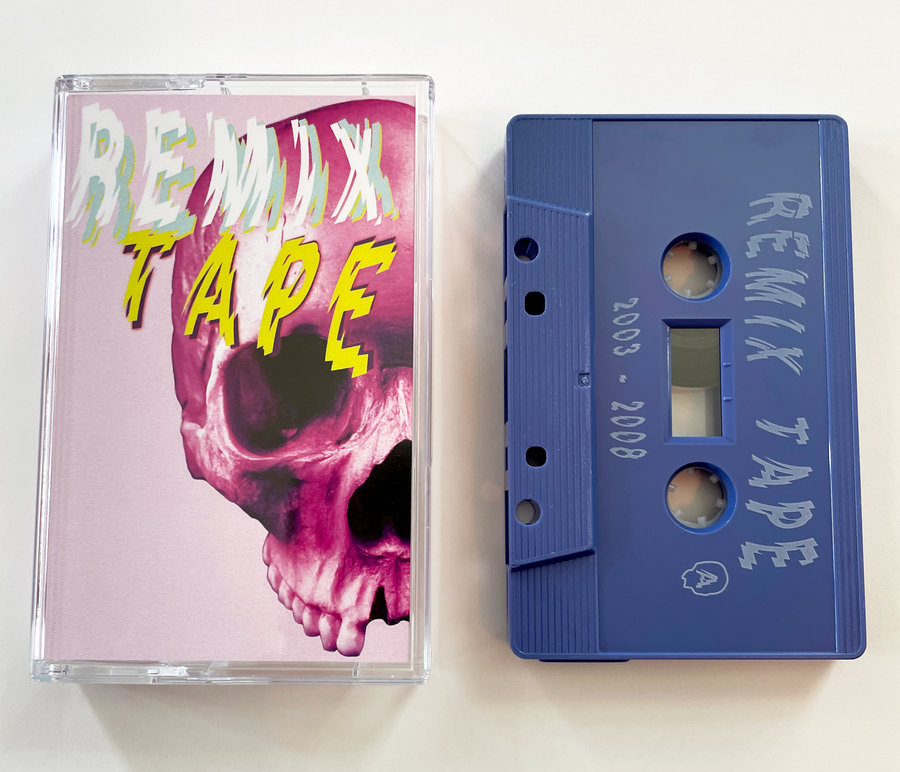
You also released a digital version of your remix compilation last month. Does that feel like the final word on a very specific period of your solo career?
Oh yes! Remix Tape — also released as a limited cassette — compiles almost all of the remixes I made between 2003 and 2008. I left off an embarrassing one unknowingly done at the wrong speed for Miho Hatori, but most everything else that wasn't already stolen for another one of my releases made the cut.
A lot of energy went into these works and often pulled me away from my own material, so in hindsight this collection feels like a lost album.
What can we expect from you next? Is another solo album on the way at some point, or are you more interested in pursuing a film composer path right now?
A little bit of both to be honest. Life has constantly pulled me in different directions, and I have always gone towards what feels best. I am finishing a sound mix on a short documentary right now, and am eager to get back to work on my next album. I will say that I've become a lot more intimately involved with the art around my music lately, so I aim to continue more of a multi-disciplinary approach to any and all of this.
Let's say someone has never heard your music before. What are five tracks that best represent the range of your work as both a solo and collaborative artist, and why?
1. Caural, “Sorry, Underground Hip Hop Happened Ten Years Ago”
This exercise in OCD levels of organization and collage got me invited to a speaking engagement at Princeton (woo!), and was the craziest shit I have ever done. Like, ever. I took well over 400 samples of the word "yo" from across my rap albums, and spent a couple of months painstakingly building each Frankenstein measure of the song. All of my music as Caural involves intense sound editing, organization, and collage, but this piece is really a broken magnifying glass held to my process.
2. Caural, “Transition Suite Part 2: Papillon”
A tune I made with the dueling saxophones of Stuart Bogie and Colin Stetson for Mirrors For Eyes. I've always loved the way this turned out. It feels live, and was also one of the few times I used my own electric guitar on a Caural track.
3. Boy King Islands, “I Talk To The Wind”
I worked at a second record label in the early 2000s: Coup D'Etat (J-Live, Paul Barman, Rasco, etc.). My then boss, Howard Wulkan, asked me to watch his cat Pokey in his Manhattan duplex one weekend. He had a studio in the basement, and I cranked out the vocals, guitars and bass for this tune in a day; I recorded the drums back in Chicago, and Jason's wife Beth played the almost imperceptible Rhodes. It's one of my favorite (mostly) solo things I've done in the rock realm, and I'm embarrassed to admit that – until hearing King Crimson's original – I thought that Opus 3 wrote this song.
4. Caural, “Clear Vinyl”
Still one of my most streamed songs 20 years later, likely because of its inclusion in a skate video backing the street skate pioneer Rodney Mullen. I loved making this rock song out of almost entirely shoegaze samples. It snaps, if I do say so myself.
5. Caural, “Enneagram”
I still love drum & bass. When I was touring with Busdriver, I played a version of his song "Wormholes" in double-time with the famous Amen break (if you don't know it, it's basically the electric guitar to the rock music of jungle). Enneagram – a completely live, improvised drum & bass tune in this spirit – stands out for me as an example of the hardware sampler as a live instrument.
Finally, tell us about the “Holograms” mix you made for us. In a lot of ways, it feels like a reflection of everything we just discussed — a full-circle journey of someone who's been greatly impacted by music on a personal and creative level for decades….
In curating “Holograms” — almost all imaginary collaborations meant in some cases to be slightly absurd — I joined together main themes from my so-far two releases this year. The first — from the spirit of Dakou ("cut out") — was to highlight inspirations of mine: crate-dug gems I wanted to place within a framework of hip-hop. I have found there are such through lines connecting grooves across genres, and for someone to stumble across mangled cassettes with no context of their history or culture — as was the case in China that spawned the title Dakou — music presents itself as itself, leaving the listener to draw their own connections.
The second theme came from Remix Tape, and from that time in my musical life. Some of these tracks were on constant rotation in my early DJ sets, while others were ideas never brought to fruition — either by me, or in some cases by colleagues of mine. But in layering them with acapellas, I also wanted to give a nod to the mashup: an enormous fad of the time which was fun and endearing while simultaneously just kinda horrible. But in a positive light, I think of remixes themselves as holograms: the meshing of waves (in this case, sound) creating a version of the object impossible without the other.
Music is math, isn't it?
TRACKLISTING:1. We – Flutesque – Incursions In Illbient (Asphodel)
1. 1991 – High-End – High Tech High Life (Opal Tapes)
1. (Christian Ministry Truck Stop Tape Intro)
1. Miles Davis – Gingerbread Boy – Miles Smiles (Columbia)
1/2. Aaliyah – Rock The Boat (Acapella) – Aaliyah (Blackground Records)
2. GB – The Roman numeral 3 – Absence of Color Phase I & II (Sound In Color)
3. Dimlite – Last Repetitions Piece/Lorraine For The World – Cookie & Brownie EP 3 (Astrolab)
3. Beastie Boys – Body Movin' (Acapella) – Hello Nasty (Capitol)
3. (Excerpt from Dirty Thoughts – Documentary)
4. Slum Village – Look of Love – Fantastic Vol. 1 (Counterflow)
5. Dabrye – Hyped Up Plus Tax (Outputmessage Remix) – Payback (Ghostly)
6. Painted Cakes – Moving On – Painted Cakes (Self-Released)
7. Push Button Objects – 360 Degrees (Beatapella) – 360 Degrees Remixes (Chocolate Industries)
7. Clipse – Wamp Wamp (What It Do) (Acapella) – Wamp Wamp (What It Do) (Star Trak Entertainment)
7. Herbie Hancock – Sleeping Giant – Crossings (Warner Bros)
8. Ammoncontact – Let The Rhythm Mysticism – Dublab Presents: In The Loop 3 (Plug Research)
8. Ford & Lopatin featuring Tamaryn – Flying Dream (Acapella) – Snakes/Flying Dream (Mexican Summer)
9. Ramsey Lewis – My Love For You – Funky Serenity (Columbia)
9. Opus 3 – It's A Fine Day (Acapella) – It's A Fine Day (PWL International)
10. Kutmah – Warm Like The Sunshine – Warm Like The Sunshine (Poo-Bah Records)
11. Knxwledge – thedaysbefore – Buttrskotch (Leaving Records)
11. Stevie Wonder – Tuesday Heartbreak – Talking Book (Motown)
12. Danny Breaks – The Jellyfish – Another Dimension (Alphabet Zoo)
12. Missy Elliot – Get Ur Freak On (Acapella) – Get Ur Freak On (Elekrtra)
13. Collin Walcott – Prancing – Cloud Dance (ECM)
13. Nas – It Aint' Hard To Tell (Acapella) – It Ain't Hard To Tell (Columbia)
13. Kraftwerk – The Robots – Man Machine (Capitol)
14. Sea Level – Midnight Pass – Cats On The Coast (Capricorn Records)
14. Quincy Jones – Midnight Soul Patrol – I Heard That!! (A&M Records)
15. Diverse featuring Lyrics Born – Explosive (Caural Remix – Instrumental Version) – Remix Tape (2003 – 2008) (Prism92)
15. Mobb Deep – Shook Ones Pt. 2 (Acapella) – Shook Ones Pt. 2 (Loud Records)
16. (Excerpt from Busdriver live at Irving Plaza – unreleased)
16. John Klemmer – Poem Painter – Barefoot Ballet (ABC Records)
17. Caural – One Day It'll All Make Cents (unreleased)
18. Jean Luc-Ponty – Imaginary Voyage Part IV – Imaginary Voyage (Atlantic Records)
19. K-Kruz – Slip Away – Time EP (Organik Recordings)
19. Mos Def – Mathematics (Acapella) – Ms. Fat Booty / Mathematics (Rawkus Records)
20. Sweatson Klank – Not The Same – Collage Dropout (Self-Released)
21. Jeff Beck – The Golden Road – There And Back (Sony)
Eluvium Shares the StoriesBehind (Whirring Marvels In) Consensus Reality [ 26-May-23 4:40am ]Rather than let a debilitating level of arm and shoulder pain get in the way of his latest Eluvium LP, Matthew Cooper found a way to meld traditional melodies with electronic flourishes and ragged algorithms. Not to mention appearances by members of the American Contemporary Music Ensemble (better known as ACME), Golden Retriever and the Budapest Scoring Orchestra.
In the following exclusive feature, Cooper takes a long, in-depth look in the mirror and reveals the musical and conceptual roots of the entire record, from singing resonators to the eternal struggle between man and machine — something that’s hit new heights in recent years, for better or for worse….
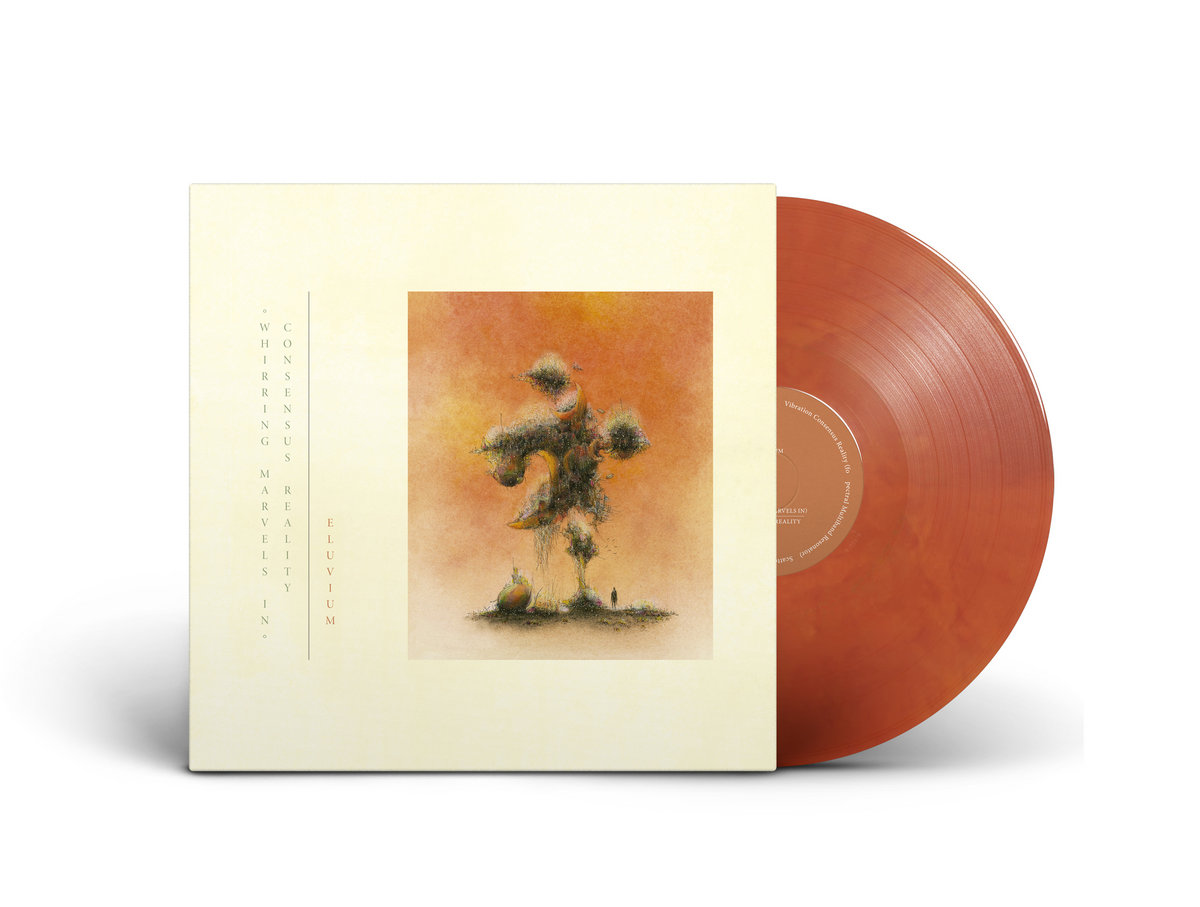 “Escapement”
An escapement is a mechanism in a timepiece that catches and releases at a set amount in order to mark time passing. I was attracted to employing this theme of the machinery that marks our personal slow march towards decay and considered the clock as an early form of robotics.
An escapement is also the term used for a mechanism in a piano that pulls the hammer back into place after it hits the string. Thematically, it was nice that the term also referenced the keyboard — at which so much of my writing is done.
Yet with this album, I would have to somewhat leave this method of writing behind in search of other forms of composition. Allowing myself to open up to more modern musical technology and compositional methods in order to navigate my own body showing its own signs of time…. Specifically the slow and frustrating healing of a shoulder injury.
“Swift Automatons”This music is meant to offer a snapshot of an ever-continuous speeding up of the automation and machinations of things from post-birth of the clock to now and beyond, the many mutations of the robotic, and the effect it has on us and perhaps our evolution. I like to think of it as a sort of "industrial revolution" theme.
Many layers of violin parts had to be recorded to get this piece to work which I reinforced with synths and pianos to get things as pointed and quickly shifting as possible. Ben Russell was kind enough to indulge trying to make it happen and I'm incredibly thankful for his patience and agility and energy.
"Vibration Consensus Reality(for Spectral Multiband Resonator)"
This was probably the first piece of music written for the album and perhaps the center from which everything else was built. The music was written freehand around the "singing" of a particular resonator I was working with at the time.
Ben Russell returns with the violin parts and Ben Shafer on horn duties. At the very end, you can hear the violinist catching his breath from the performance of the final passage. I'd cut it from the violin part and scooted it further down the recording to be deleted but ultimately forgotten to pull it out of the recording while mixing it.
When I heard it again it surprised me and I decided it conveyed something special and human and decided to keep it in. I half-joked with Ben about crediting him with "breathing" on the record, which he thought was a funny thing to be credited for.
It is quite possibly my favorite piece of music I've ever written. The resonator singing makes me think of the HAL9000 a little bit, but I consider the music around it to be very human and emotive, and in that way it feels like a gentle duet between human and machine.
"Scatterbrains"The title of this piece is meant to be suggestive of a mass inability to think straight brought on by an unending consumption of media and information. A miasma of varying thoughts that don't quite tie together in any sensible manner.
Its origins actually come from visits to a shelter of trees on the edge of a precipice that I visit regularly with my dog. There are eagles usually nesting there and the wind howls through it often. The wind is such a peaceful presence and I've thought of how it feels as though it takes my thoughts away and scatters them out across the land below, leaving me mindless and at rest.
The music is a mixture of these two considerations. Jonathan Sielaff was kind enough to perform the bass clarinet solo for this recording. He brought a beautiful touch to it.
"Phantasia Telephonics"The first half of this piece was written using somewhat traditional synthesizer and sequencer techniques and automation, and applying similar methods to the piano. The second half was written with a focus on the Make Noise René (named after René Descartes, a philosopher who is known for his "mind / body problem", which is reflected in the device's "Cartesian" mapping of a sequencer). The outgoing sequence was run through a shifting tape delay to create a reflection of itself which is scattered, shattered, and refracted.
By design, this is the only track on the album performed entirely by synthesized and virtual instrumentation. (There are no orchestral instruments implemented.) It might perhaps seem an odd thing to do (and may even be impossible to tell for many), but I wanted this to be a point in the album where reality becomes more disoriented (within its overarching technology / human narrative) and try to invite an internal discussion of what is real / not real, important / unimportant in a creative experience. And what that, in turn, meant to me (and possibly other listeners).
Choosing to keep it entirely synthesized instrumentation seemed like an interesting way to implement this. The track was also a compositional turning point for what methods were being employed in writing the album due to the physical constraints I had been experiencing with my left shoulder and arm. So in some ways, I think I wanted to pay homage to this.
I'm not sure if it was purely for self-satisfaction or some form of intentional personal bemusement, but initially I did not intend to tell anyone about this. Instilling purposeful quiet brokenness, perhaps?
“I'm naturally drawn towardsworking things until they tie together
in strange, unique ways”
I wanted this album to have a lot of conceptual and mechanical push and pull and blending between what we deem "technology" and what we would consider more "human". Or perhaps simply "natural", or even "reality". This piece is meant to act as a bit of a doorway towards this breaking point, narratively speaking. Whereas the tracks that came before are suggestive of a more rudimentary or primitive mechanical world (and our harnessing of those mechanics), this track leans towards things starting to be a bit more confusing.
At least, this is what I tell myself. I really don't know if any of this matters or translates to the listener. I just do it because I enjoy puzzling out things like this and searching for ways that make all these parts come together into a particular form and narrative. I'm naturally drawn towards working things until they tie together in strange, unique ways and complete a specific narrative. It probably makes things more complex than they need to be, but the mixture seems to stimulate a pleasing variety of thoughts.
 Photo by Jeannie Lynn Paske
"The Violet Light"
Photo by Jeannie Lynn Paske
"The Violet Light"
Ben Russell appears again here to beautifully translate the violin lines. I think this piece was, in part, originally a sketch for a film score I'd worked on. We'd ended up using something else instead. Then it kept popping back into my life, shuffling itself into randomized playlists on my computer. So I started messing with it and adding to it until it eventually morphed into this piece.
This title is a reference to the color of the sky in T.S. Eliot's The Waste Land. The "violet hour" is the sun setting and most would suggest a poetic representation of fading away. To me, this imagery inspired thoughts of not just an individual growing old, but also perhaps humanity itself.
"Void Manifest"The main musical theme from “Void Manifest” had been a work in progress for quite a while, but it just felt like something that no matter how much it was worked on just wasn't fitting into the musical or narrative world of this album. I couldn't figure out the missing thread until one day while out walking and listening I heard a secondary theme present itself to me in a repetitive syllabic motif.
It occurred to me this could be a voice. I began looking for language to use for the lyrical content and decided it would be interesting to algorithmically pull words from the years of notes of jumbled and scribbled down notions, ideas, theories and concepts that I had been considering while working on the album, which had become a bit of a maddening blend of sought after meanings, inspirations and various discourse.
Charlotte Mundy gracefully agreed to work with me to create the vocal recordings, which involved a mixture of singing and other noises. Her willingness and openness was a godsend, and her translation of the work made it truly come alive.
"Clockwork Fables"This track is a return to musical phrases originally presented in "Phantasia Telephonics". It was developed from meddling around with that theme and composed for player-piano. The title is a reference to my narrative suggestion from the beginning of the album being considered from a perspective of old stories from a long time ago… a melody for "old-timey stuff".
“Mass Lossless Interbeing”This piece originates from a sketch I created for a gallery installation. The interactive installation was a somewhat awkwardly held together and unique use of technology, presented in a manner to be interacted with one on one and allowing a space for the viewer to find tranquility within themselves.
It was later reconstructed for orchestra and electronics, and presented here as a representation of the wanting we tend to try to fulfill with technology. The title speaks to the concept of coding representing our connectedness with all things. A bit of a mixture of both purity in genuine emotion and tongue-in-cheek snake oil.
There is a tiny moment right at the end that I took from my sessions with Charlotte where she was making various vocal screams and screeches and noises and one of them sounded almost like an internet dial-up sound to me. It seemed like a nice touchstone to finish the piece.
“A Floating World Of Demons”I have no idea why but I’ve always pictured giant robotic creatures and people working in harmony during a harvest across acres of farmland. A strange blend of the paintings of Jean Giraud and Jakub Ró?alski. The title is meant to suggest a dream-like world of immeasurable beauty and wonder, slowly being destroyed by its inhabitants. It is also a nod to a Carl Sagan book.
"Endless Flower""Endless Flower" is essentially a paean for the universe, intertwined with the beckoning of the human spirit. The orchestra is blended with layers of synths all playing the same lines together. The piano notes are performing inhumanly fast.
If you listen carefully you can hear Charlotte and I both screaming at the end. The piece is inspired by a deep yearning to forever push forward in search of a source of our indescribable feelings that resonate within all of us. A glimpse of our harnessing of technology (with its inherent risks) in this search. A song for a never-ending love affair with life itself, no matter how strange.
Bikini Kill SlayPalace Theatre [ 24-Apr-23 2:44pm ]Words + Photos ANDREW PARKS
“Bikini Kill was very difficult,” Kathleen Hanna said in a self-titled interview a decade ago. “Not just because the four of us have very different personalities; the reception we got was very confusing. People either loved us or hated us in a way that bordered on violence.”
Elsewhere in the conversation, Hanna elaborated on how and why the band came to an abrupt end in 1997: “It started feeling like it was ramping up to the point that some crazy person was going to shoot me onstage. I felt like everybody expected me to be this über-confident feminist and write these anthems, but I didn't really know who I was anymore.”

What a difference two decades has made — at least in terms of how the punk-rock pioneers are viewed by the general public. While they received a disturbing amount of death threats and backhanded compliments during their mid-’90s heyday, Bikini Kill are now revered as the high water mark of the riot grrrl movement they helped shape beginning with their self-released demo Revolution Girl Style Now. Its prickly halfway point (“This is Not a Test”) sounded like a lit match sandwiched in between a stormy “New Radio” and “Don’t Need You” at Palace Theatre last Thursday night. One that’s about to be tossed into a tall pile of dry wood dusted in gasoline, as thousands of fans step towards the flames.
Which makes perfect sense given the State of Things. As Hanna pointed out several times throughout the 90-minute show — their first in St. Paul since the Clinton administration — Bikini Kill’s reunion isn’t a nostalgia trip so much as a necessary call for us all to fight a world on fire together. Hanna and her instrument-swapping bandmates (co-founders Kathi Wilcox and Tobi Vail, along with touring guitarist Sara Landeau) don’t just sound like a well-oiled war machine these days. Their raw message of self-reliance and female empowerment in the face of a faltering patriarchy is as relevant as it’s ever been.

Which isn’t to say that Hanna and Vail — the band’s sometime lead singer, who stepped in to slay tracks like “I Hate Danger,” “Tell Me So” and “Hamster Baby” — tried to draw a dividing line between Us and Them with 25 songs that snake and snarl around hooks that get straight to the heart of the matter. If anything, Bikini Kill are determined to spark an intergenerational stand against all the forces that are wary of true progress.
That includes anyone who has written off Generation Z as lazy, entitled or lacking substance. Hanna was particularly incredulous while recalling that common refrain out loud, giving fans born after the band’s first rodeo credit for educating her on matters of intersectionality and demanding more from an establishment that continues to fail us in more ways than one.
In that way, this show’s warm and welcoming vibe proved we’re all rebel girls now — no matter what age, gender or group. Turns out we all need each other, after all.

New Radio
This Is Not a Test
Don’t Need You
Alien She
Feels Blind
I Hate Danger
In Accordance to Natural Law
Carnival
Resist Psychic Death
I Like Fucking
Capri Pants
Outta Me
For Only
DemiRep
Reject All American
Jigsaw Youth
Sugar
Rah! Rah! Replica
Hamster Baby
Tell Me So
Magnet
Lil’ Red
Suck My Left One
ENCORE:
Double Dare Ya
Rebel Girl
 patten Shares the SequelTo His Atomoxetine Mix [ 24-Apr-23 1:47pm ]
Considering how conceptual and one-of-a-kind Damien Roach’s latest patten LP is — Mirage FM is the first album made from text-to-audio AI samples — it shouldn’t come as a surprise that his Needle Exchange debut is a waking dream as well. We’re talking a wide-ranging set that somehow connects the dots between everything from Jesus Piece and Roy Davis Jr. to Ariana Grande and Actress.
Here’s what the London producer had to say about “TimeSwamp,” the long-awaited sequel to his mind-altering Dummy mix from a decade ago:
The second of an open series started in 2013. The first one went out 10 years ago via Dummy Magazine. I'm into the idea of an osmosis between things distilled to the exact point of contact. Like the lightest but most precise & radically transformative touch possible. Beware, all those who enter the TimeSwamp.
Solange – Cranes In The Sky (2016)
My Bloody Valentine – To Here Knows When (1991)
Burial – South London Boroughs (2016)
Fleetwood Mac – Everywhere (1987)
Drexciya – Bang Bang (1997)
Thomas Mapfumo – Shumba (1981)
Jesus Piece – Lucid (2018)
Roy Davis Junior – Gabriel (1996)
Flanafi – CP2YSA (follow it back) (2022)
JPEGMAFIA – DD Form 214 (2018)
Simon and Garfunkel – For Emily, Whenever I May Find Her (Live) (1969)
Diptera – Silver (2018)
Steve Reich – Tehillim I. Psalms 19:2-5 (1981)
George Benson – Give Me The Night (1980)
Death Grips – Bubbles Buried in This Jungle (2016)
Voice Actor – Blip (2022)
Tirzah (feat. Coby Sey) – Devotion (patten RE-EDIT [Unreleased]) (2020)
Brooke Candy – Cum (SOPHIE remix) (2019)
Cocteau Twins – Fifty-Fifty Clown (1990)
Messiaen – Éclairs sur l'au-delà; XI (1991)
Actress – Purple Splazsh (2010)
Ariana Grande – Shut Up (2020)
Kleenex – Nighttoad (1977)
Dif Juz – Love Insane (1985)
Philip Glass – Floe (1982)
Jeff Mills – Gamma Player (1995)
Jaylib – Champion Sound (2003)
Sade – Love Is Stronger Than Pride (1995)
Joe Jackson – Stepping Out (1982)
Autechre – V-PROC (2003)
Jai Paul – Vibin' (2019)
Mr. G – Daily Prayer (2012)
BADBADNOTGOOD – In Your Eyes (feat. Charlotte Day Wilson) (2016)
Frank Ocean – Little Demon (feat Skepta, Arca remix) (YouTube rip) (2019)
Huerco S. – Plonk VI (2022)
Egyptian Hip Hop – Strange Vale (2012)
Hani Rani – F Major (2020)
Chaka Khan – I Feel For You (1984)
Dimzy – Always Win (2018)
Helen – Motorcycle (2015)
Four Tet – And They All Look Broken Hearted (2003)
Jim O'Rourke – And I'm Singing (2001)
Tyler, The Creator – She (2011)
Arthur Russell – Lucky Cloud (1986)
Battles – Race Out (2007)
St. Vincent – The Party (2009)
Goldie – Inner City Life (1994)
Nirvana – Negative Creep (1989)
Grouper – Call Across Rooms (2014)
Oval – Bloc (1998)
Chynna – Practice (2017)
The xx – Fantasy (2009)
Stereolab – Cybele's Reverie (1996)
Kelis – Milkshake (2003)
Jane Birkin – Jane B (1969)
John Williams – The Fortress of Solitude (1978)

Watch it here.
This is courtesy the FaceBook page (which I hope you can access) of the Archives Numérique du Cinéma Algérien, who say about it:
"Alors voici un document extrêmement rare et inédit sur internet: il s'agit d'un large extrait d'un scopitone de Cheikha Remitti tourné très probablement au début des années 1970 et dans lequel elle interprète le morceau "Aïn Kahla".Nous sommes très heureux de partager avec vous ce document qui nous parait tout à fait exceptionnel.Si vous reconnaissez le lieu de tournage n'hésitez pas à nous l'indiquer. S'agit-il de l'ouest algérien, d'un village du nord marocain, difficile à dire... MAJ 22h08 : le film aurait été tourné à Debdou à l'est du Maroc, un grand merci à Nehams Ta pour la recherche

RIP my old pal Otis Grand (on left), who passed away on June 7in London. Me in the middle, on vocals, on the right, Walid Boustany. We got our start playing 'unplugged,' in 1973. then got a full, electrified group going called Bliss Street Blues Band. On harmonica, George Bisharat, AKA Big Harp George. Bass: Todd/Craig Lichtenwalner. Drums, Raja Kawar.
Then we dispersed, Otis ended up in London, eventually started his own band, and was such a prodigious talent that he was voted 'Best UK Blues Guitarist' seven years running (1990-1996) by the British Blues Connection magazine. (After 7 years, his name was retired.) He issued lots of recordings, they are easy to track down. I'll have more to say about Otis in future.

This is an amazing song (found on Nash's 1973 album, Wild Tales) that I only just learned about, thanks to a brilliant book I recently finished, We Gotta Get Out of This Place: The Soundtrack of the Vietnam War, by Doug Bradley & Craig Werner. Graham Nash actually attended the Winter Soldier Investigation organized by the Vietnam Veterans against the War (VVAW) in Jan-Feb 1971, where he witnessed this testimony from Scott Camil: "I was a sergeant attached to Charley 1/1...My testimony involves burning of villages with civilians in them, the cutting off of ears, cutting off of heads, torturing of prisoners, calling of artillery on villages for games, corpsmen killing wounded prisoners, napalm dropped on villages, women being raped, women and children being massacred."
If you've not seen the Winter Soldier movie, you must, it is essential. Check it out here.
Handsome BoyModeling SchoolReveal New Album,Music To Drink Martinis To [ 27-Feb-23 5:10am ]Handsome Boy Modeling School have quietly released their first batch of new material in nearly two decades. Now streaming via your favorite DSP and featuring guest spots from Justin Warfield and Emi Meyer, “How Does It Feel?” and “Case Study” are taken from Music To Drink Martinis To, a long overdue mini-LP underwritten by the Louisville brand Ford’s Gin.
No really; you can buy it alongside a bottle now.
To be honest, the pairing makes perfect sense. Prince Paul and Dan the Automator’s tongue-in-cheek project has always had a man-about-town bent — a sound that was deeply sartorial years before men’s fashion was democratized by style blogs, street photographers and Instagram.
Or as Prince Paul said in a rare interview a few years ago, “We were wearing Euro fitted suits back in the '90s, when everybody else was wearing baggy clothes. Now everybody's wearing fitted suits! That's why we're thinking of bringing the school back. People gotta get back to the basics of handsomeness."
Pedro Vian & ManaCollide on Cascades,Experimental Set [ 06-Feb-23 5:59am ]Words + Mix PEDRO VIAN + MANA
Our mix reflects the same attitude we had during the recording of Cascades. We put our broad taste in music together in one constant flow of sensitiveness and melancholic hyperbole….
Sofie Birch & Antonina Nowacka – Behind The Hill
Holy Similaun – Mode Det Flios On
Kenji Kawai – Street Of Hallucination
Curd Duca – singing stone ( pythagorean )
Bellucci – Can Be scary
Riccardo Sinigaglia – Urbana 1987
Christos Chondropoulos – First Love Fereter
Silvia Kastel – Spoons
Mana – Eye To Eye
Laila Sakini – Fleur D'Oranger ( Rise )
Autumn Fair – Halloween In The Garden
Hiroshi Yoshimura – Water Music
Valentina Magaletti – A Queer Anthology of Drums
African Head Charge – Family doctoring
Benjamin Lew – Profondeurs des eaux des laques
Carmen Villain – CV x Actress
Characi – Jim O'Rourke 6 Seconds Over Sheffield Mix
Nuno Canavarro – BLU TERRA
Duma – Cape to Cairo
Pedro Vian and Mana recently dropped their first record on Modern Obscure Music / Lucia Dischi. Stream it in full below, and look out for a rare live appearance from the duo on March 23 in Berlin.
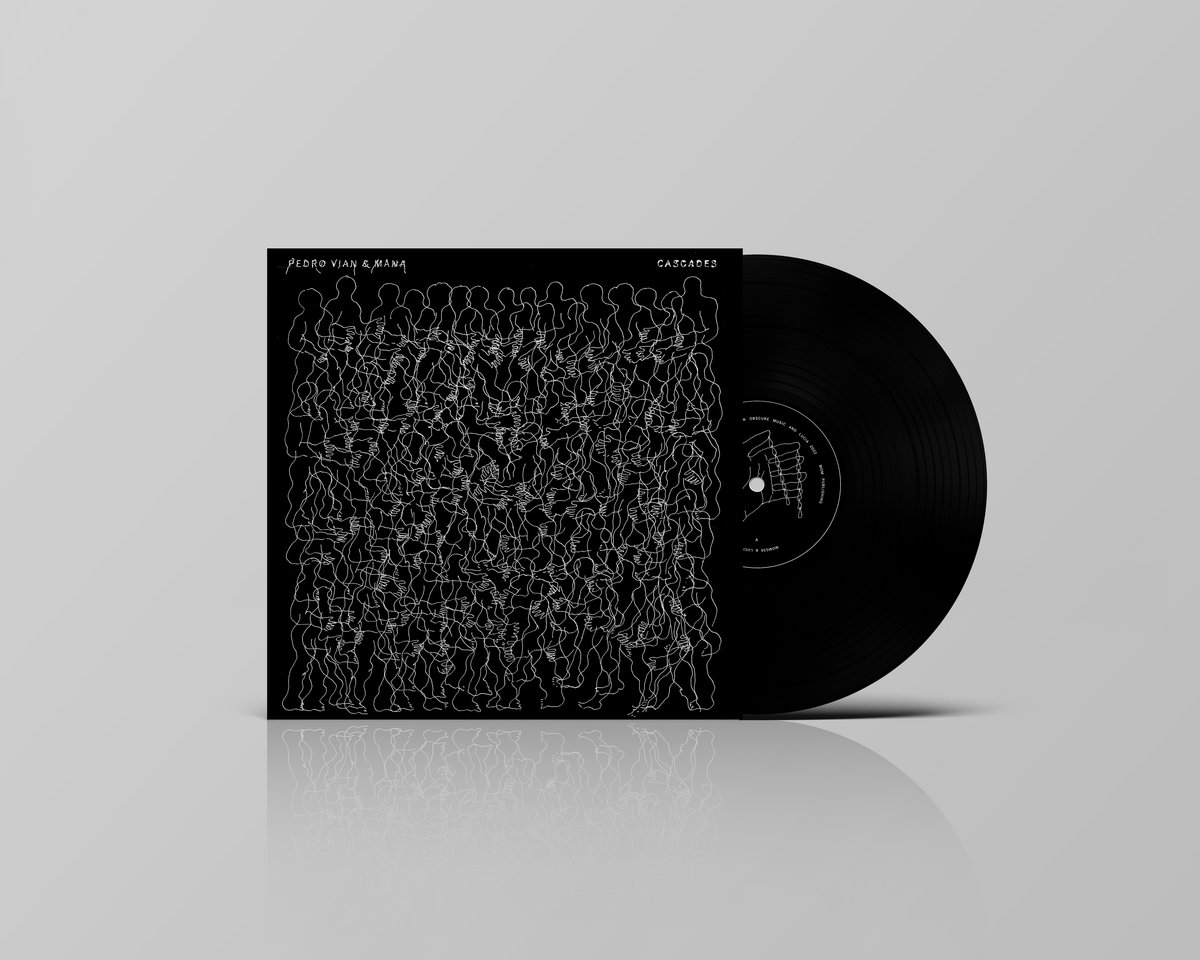 Rival Consoles Makes Us aRestless Techno Mix [ 06-Feb-23 5:23am ]
Words + Mix RYAN LEE WEST
Photo DAN MEDHURST
With this mix, I wanted to explore the kind of techno that I love and listen to at home. Tracks which are slightly industrial and stark, yet addictive and upbeat.
I generally like techno to have proper urgency and momentum to it — with quite heavy synths — but I also love contrasts, so I included enough warmth and playfulness across different genres to keep things unpredictable and joyful.
Datasette – mechanical advantage
Randomer – Running dry
Schwefelgelb – wie viel haut
Skee Mask – Korarchaeota
Joy Orbison – 2m3 2U
Delay grounds – Marcelo's whistle
Thomas R – moon roof
Blawan – Justa
Modeselektor – mean
Schwefelgelb – einer macht den twist
Kangding Ray – superverde
Leon Vynehall – sugar slip (the lick) sheds sugarDUB remix
Tensal – back to Birmingham
Daphni – cherry
Delay grounds – wood building
Max William – resilience
Caterina Barbieri – At your gamut
Rival Consoles’ latest Erased Tapes LP, ‘Now Is’, is streaming in full below along with several other key selections from the London producer’s back catalog.
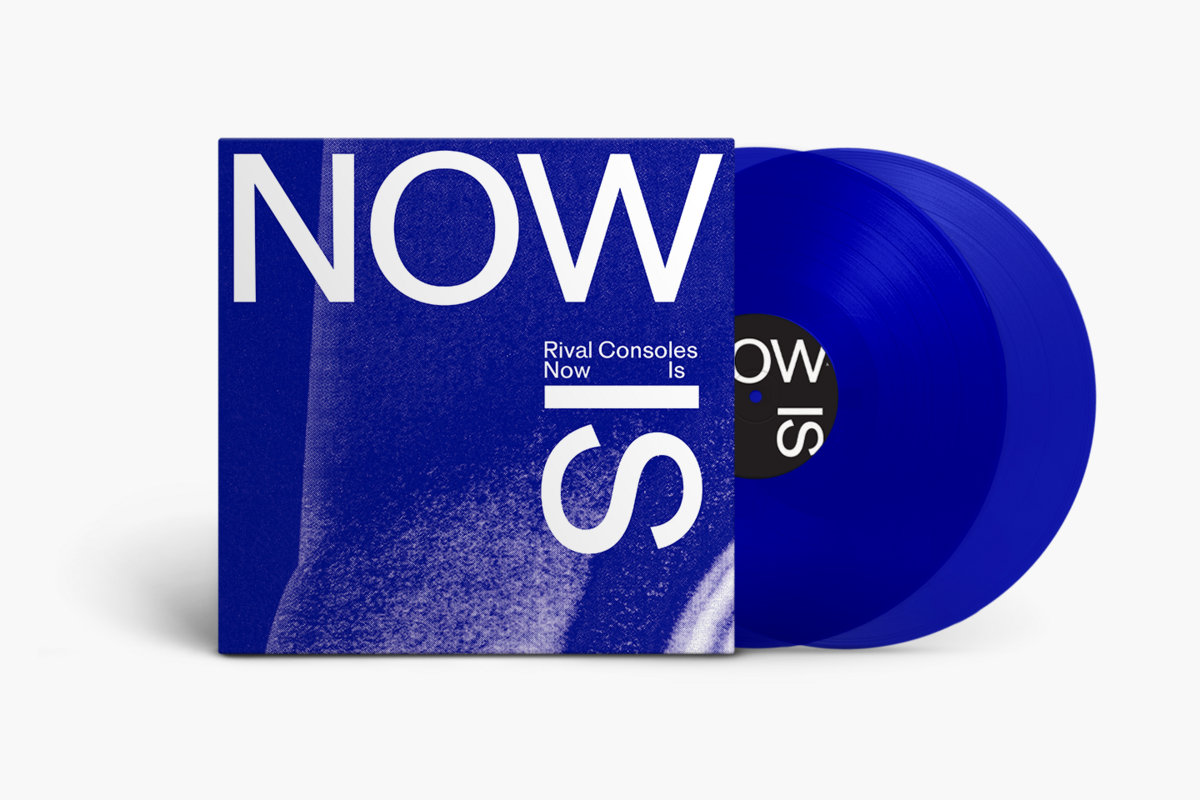
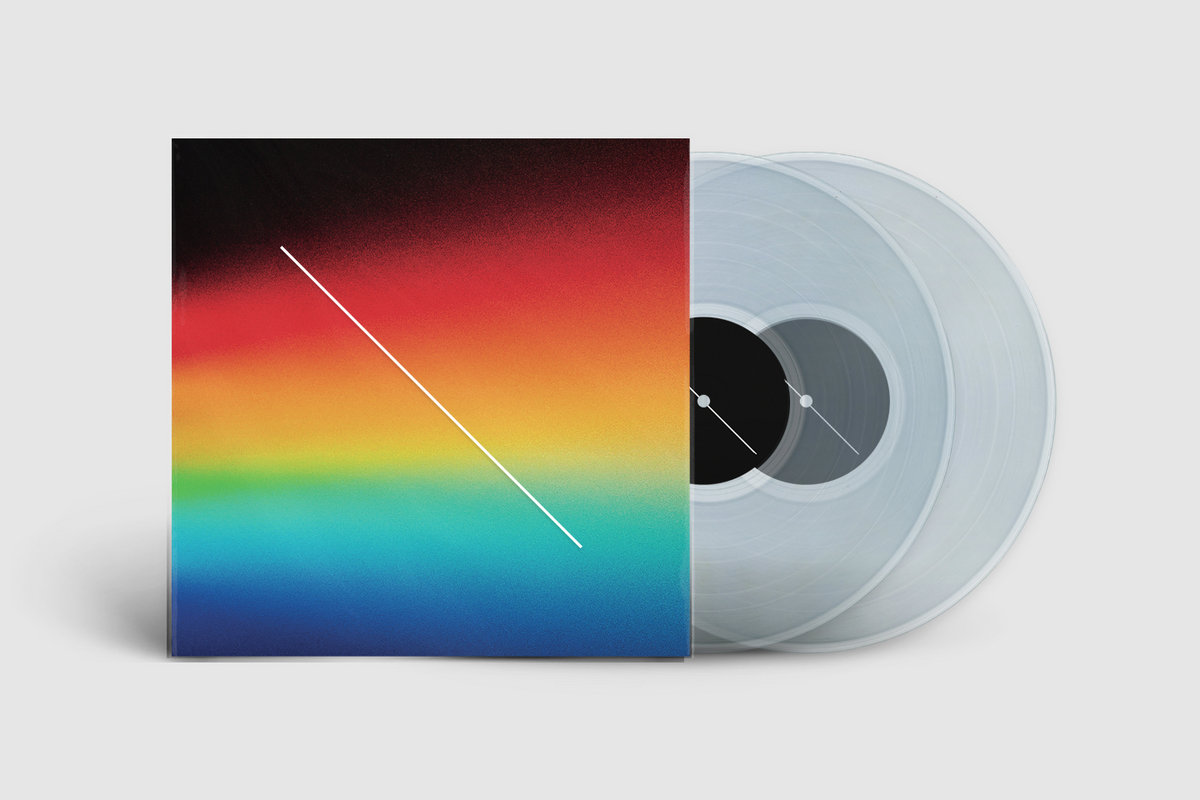

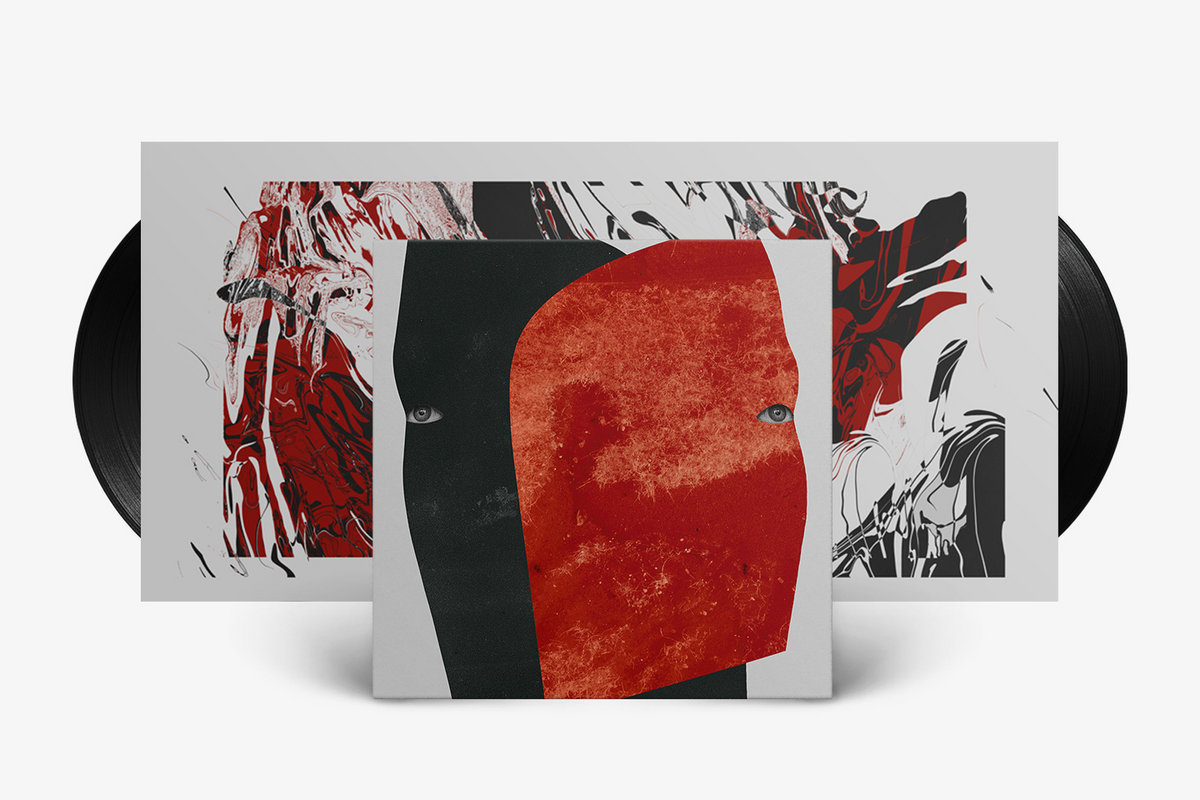
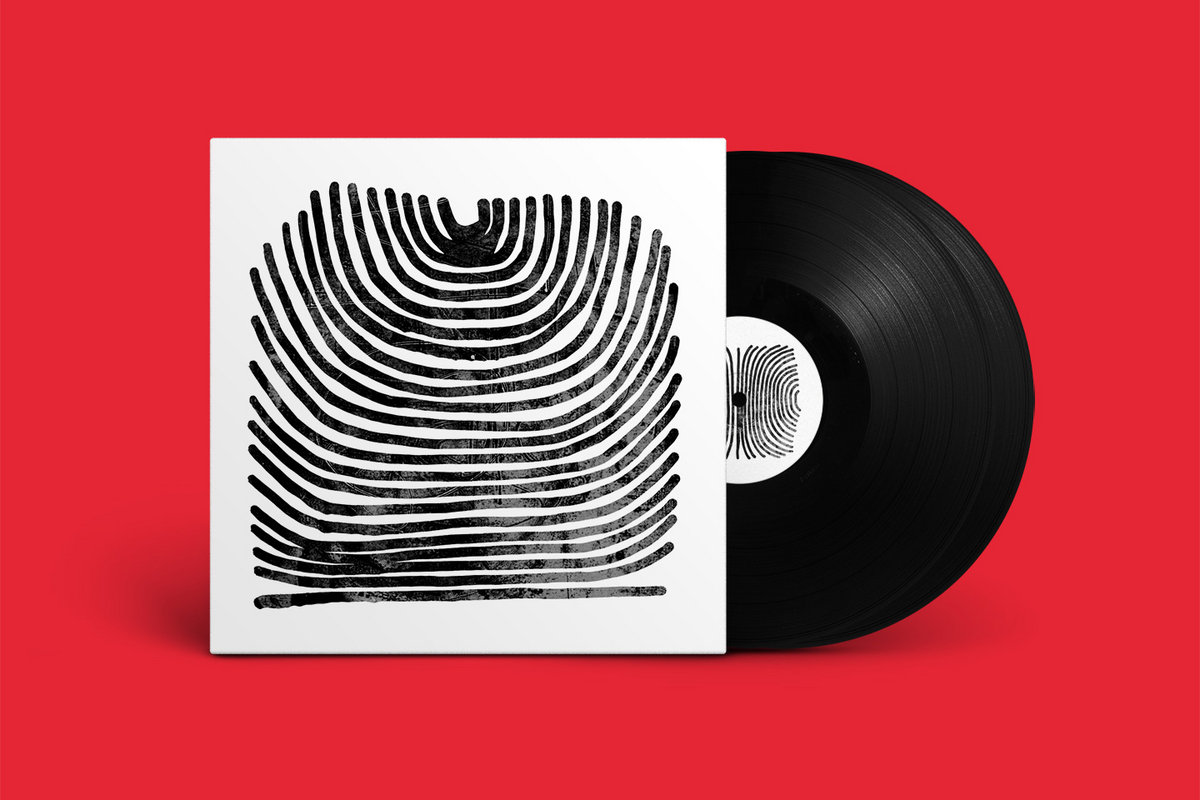 !K7 Shares a Short DocOn Theo Parrish'sDetroit Forward Mix [ 29-Nov-22 8:31pm ]
When Theo Parrish sat down to curate and sequence his contribution to !K7’s iconic DJ-Kicks series, he treated its 19 tracks as a fully invested survey of the city that’s as much a part of him as music itself.
“Detroit creates, but rarely imitates,” Parrish says in his track notes, “Why? We hear and see many from other places do that with what we originate. No need to follow. Get it straight.
He continues, “In the Great Lakes there's always more under the surface — more than what appears to penetrate the top layer of attention and recognition. What about those that defy tradition? Those that sidestep the inaccurate definitions often given from outside positions? This is that evidence. Enjoy.”
To help put his sprawling 90-minute set in perspective, here is a 15-minute film that shares the stories behind a few of its exclusive songs……
 FaltyDL On… The SongsThat Shaped Him, FromDJ Shadow to Frank Zappa [ 11-Nov-22 4:29pm ]
Soundtrack of Our Lives is a recurring feature where we ask our favorite artists to process their past via their favorite records. On deck this week: FaltyDL, the elusive producer who just released a doozy of a record (A Nurse to My Patience) that’s been described as his “biggest departure yet”….
The Record I Most AssociateWith 'A Nurse to My Patience'
I immersed myself in a few artists while recording this album. Talking Heads, The Cure, Brad Laner, Muzz…. To be honest I listened to folks who ended up featuring on my album. I also wrote Stay Close to Music (Transgressive, 2022) for Mykki [Blanco] simultaneously, so that may be the closest thing emotionally to my album for me.
Over the years, one thing has become apparent: I have zero idea when my muse will show up. The best I can do is listen to a lot of music and hope to get inspired.
The Record I RightfullyJudged By Its Cover
Headless Heroes of the Apocalypse (Atlantic, 1971) by Gene McDaniels. I bought this album first on CD at Cutlers Music in downtown New Haven, where I am from. They didn't have any ‘listening stations’, so it was a purchase purely because of the cover and the name. I knew this album had a power to it just by looking at it.
I later came to find out its status as a holy grail of samples for hip-hop. You will just put a track on and go, ‘That's from this song?!’ And Gene's attitude toward sampling was elevated. He loved being sampled and repurposed. Very rare for his generation.
The Record That Made MeWant to Be a Musician
Frank Zappa’s Freak Out! (Verve, 1966). I don't think I understood the record or even liked it very much, but it sure impressed my dad. When my dad, a psychiatrist, would put on a record and look so passionately astounded by the music, it was pretty clear how much he respected musicians. If I could become a professional musician he might just be that proud of me.
Of course he would have liked whatever I did, but it was fuel for years. He wanted to be a movie critic and write poetry, but took the 'easy' route by becoming a doctor. What? I fully understand how difficult it is to be a full-time musician and TBH, it's probably harder than going to school for a number of years.
The Record That Made MeWant to Become a Producer
Endtroducing (Mo’ Wax, 1996). I couldn't understand the drums on this album as a kid. I had no concept of chopping up breaks. I thought DJ Shadow was just an incredible drummer! I had to figure out what he was doing. I opened for him years later and handed him a thumb drive of tunes. Was very full circle.
The Record I've Bought ForFriends Because It's That Good
Amen Andrews vs Spac Hand Luke (Rephlex, 2006). I've bought four copies of this record and gifted three. I told Luke [Vibert] how much I liked it and he gave me all this unreleased Amen Andrews, some of which I ended up releasing on my label Blueberry Records!
I don't know what gifting an album looks like in 2022. No one I know plays records anymore. Maybe I just make a friend a playlist?
 The Record I Wish I'd Written
There are so many, but my head will explode if I allow myself to get that competitive. I have to realize that no one can do what anyone else does quite the same. And there is no correct way to do something and no right or wrong either. Work on a tune for 10 years or 10 minutes; it's still a unique object with loads of meaning. Plus version one always has the best energy!
The Record ThatNearly Drove Me to Tears
Listening back to Silver Jews makes me cry. With the hindsight of knowing what David Berman was going through, it’s just so sad. Their music sounds like a pure transfer of energy. Most of his lyrics are just him dissing himself. It's kind of wild.
I hope to be that transparent with my songwriting at some point, but keep it together mentally and stay healthy. There has to be a connection there.
The Record ThatDrove My Parents Crazy
Squarepusher’s Go Plastic (Warp, 2001) coincided with a new stereo in my childhood room. It broke my parents’ brains. Over and over again that record shared my house.
The Record I PlayAt Least Once a Week
While recording my album, and basically through the entire first year of the pandemic, I didn't stop listening to the debut album by a band called Muzz. I had collaborated with the singer Paul Banks on a track for my album, and he had just released this new project. It hit a chord in me I hadn't tickled in years. No one was going to clubs really so it fit perfectly in my morning routine in the studio. Light shining in, hot coffee, and this album got me through many months.
There are two or three lyrics on that album which send me into my feelings pretty hard. "Don't call me stupid." "Picking up work in the city." I dunno; it just really made me feel understood in some way? I think that's the best thing music can do. Just make you feel seen.
FURTHER LISTENING
Drowned in Sound is back! [ 06-Mar-23 9:31pm ] Did you miss us?
Back in 2019, Drowned in Sound hit pause and archived this site.
In the meantime, our community has remained active here here.
But we've made a return, that's a little different than before.
You can keep up to date with what we're doing by signing up to our free Substack newsletter.
What's New?We're calling a the new era of Drowned in Sound an "audio publication" because it's a magazine-style podcast, with a singles club on our independent label, which acts a bit like a magazine cover mount.
The PodcastOur podcast was originally launched back in 2005 and won a few awards, so it's really exciting to finally reboot it. You'll find season one of the podcast wherever you get your podcasts (Spotify | Apple | Etc.), looking at the foundations and future of the music industry, speaking to a range of experts.
The Independent LabelOur singles club previously launched the careers of a range of artists including Bat for Lashes, Kaiser Chiefs, Emmy the Great, Martha Wainwright and more.
The 2023 edition of the club kicked off with Faith Vern from DiS-favourites PINS, under the guise of The Faux Faux, with the menacing, smokey, 'Cold Hearted Woman'.

Predictably I think, this is exactly the form a lot of the criticisms of the piece have taken. Lots of the contra comments on Facebook and Twitter have adopted exactly that "tone ... as if they were a schoolteacher marking a child's work, or a psychiatrist assessing a patient" MF identifies.
People have tended to refer to the Vampires' Castle piece using words like "crude" or "incoherent". Then there's this slightly noxious piece (which, with its link to a photoshopped caricature, verges on character assassination). The starting point of the critique here is that "the reasons given [by MF in the Vampires' Castle article] ... do not lead to the conclusions he offers", that "it does not follow its own stated reasons". In other words, the teacher steps in to reprimand the pupil who hasn't polished his argument just-so.
FFS, the article is actually called "B-grade politics"!
Here again: "... a case of someone who's read a bit of philosophy and theory but simply doesn't understand the subtlety of the claims advanced therein."
And here: "What I would recommend Fisher is to do some reading". [sic]
Stepping outside of the internecine left for a moment, right-wing blogger Harry Mount made a very similar move earlier this month when he tried to discredit the "spoilt and childish" Russell Brand. Apparently, Brand's big problem in his journalistic writing is his overuse of "long, Latinate words that desperately scream 'I'm clever' at the reader". So according to Mount, Brand should "grow up" and "get a little more Anglo-Saxon" in his writing. These are highly contentious issues of style, about which there has been much debate for aeons. But Mount offers his maxim (Anglo-Saxon words=good, Latinate prose=bad) with the absolute authority of the High Tory schoolmaster.
Very different examples, but I think they're evidence of exactly the sort of imperious "reprimanding" tendency the Vampires' Castle conceit is trying to expose and challenge.
Very honored to have been asked to contribute to this great volume, to be published, inshallah, in October. Look for it! My chapter is entitled: "Rai, World Music, and Islam." More details here.


