
 "The cracked music archivist" [ 26-Jul-25 12:11am ]
Kieran Press-Reynolds, in his Pitchfork column Rabbit Holed, interviews "Music Place, the bonkers archivist fighting against the sterility of music rec hubs today, creating a cursed but beautiful 'breadcrumb trail' across scenes and languages"

London Life cover, 31 December 1966
London Life was a mid-1960s what's on magazine that for a little while replaced the Tatler to reflect a shift away from conservative posho style guide towards a more socially democratic swingin' London - tellingly by the end of the 1960s it had reverted to its former name and to being a conservative posho etc.
'Discotheques' were included in the listings, still quite a new phenomenon in UK so with the helpful explanation that these were 'Informal nightclubs and restaurants with dancing, usually to gramophone records. Some discothèques feature musicians from time to time'. Most of these don't sound too appetising, a lot of gambling and no doubt overpriced drinks (overpriced for the time - a goldfinger cocktail at the Hilton for 35p sounds very reasonable now!). Still wouldn't mind a time machine to check out the Flamingo or to see Francoise Hardy at the Savoy in January 1966.

London Life, 29 January 1966
And what of Samantha's in New Burlington Street, described in 1966 as 'London's first psychedelic club' promising to 'create atmosphere with machines' for people who 'want to be taken out of their minds as if they had taken LSD'. All with a talking dummy called Samantha and a dancefloor with 'powerful strobe lighting, which throws malevolent screens of speckled rays over the dancers' while 'a projector in the ceiling imprints vivid coloured slides over the contorted bodies of the music seekers'.

London Life, 12 November 1966

Melody Maker, November 18, 1989
BLACK SABBATH
The Complete 70's Replica CD Collection 1970-78
(Sanctuary Records)
Uncut, 2001
by Simon Reynolds
The mystery of the riff--so crucial to rock, so oddly neglected by critics. Or perhaps not so strangely, given that riffs are almost impossible to write about: just try explaining why one monster-riff slays you where another one fails to incite. Riffs just seem to bypass the aesthetic faculties altogether and go straight to the gut. A killer riff is by definition simplistic--which is why self-consciously sophisticated rock tends to dispense with them altogether in favor of wispy subtleties. Riff-based music seems lowly, literally "mindless" because it connects with the lower "reptilian" part of the cerebral cortex which governs flight-or-flight responses, the primitive emotions of appetite, aversion, and aggression.
Talking of reptiles, Black Sabbath--perhaps the greatest riff factory in all of rock---irresistibly invite metaphors involving dinosaurs. For a group that wielded such brontosauran bulk, though, Sabbath were surprisingly nimble on their feet. Listening to this box-set, which comprises all eight albums of the classic Ozzy-fronted era, I was surprised how fast many of their songs were, given the Sabs' reputation as torpid dirgemeisters for the downered-and-out.
Even at their most manic, Sabbath always sound depressed, though. Rhythmically as much as lyrically, Sabbath songs dramatise scenarios of ordeal, entrapment, affliction, perseverance in the face of long odds and insuperable obstacles. Tony Iommi's down-tuned distorto-riffs--essentially the third element of the awesome rhythm section of Bill Ward and Geezer Butler--create sensations of impedance and drag, like you're struggling through hostile, slightly viscous terrain. Joe Carducci, Sabbath fiend and theorist supreme of rock 's "heavy" aesthetic, analyses about how bass, drums, and guitar converge to produce "powerfully articulated and textured tonal sensations of impact and motion that trigger hefty motor impulses in the listener." But let's not discount Ozzy's role: his piteous wail is one-dimensional, sure, but it sounds utterly righteous in this abject context. And he's effectively touching on forlornly pretty ballads like "Changes" too.
With a few exceptions (Lester Bangs, notably) the first rock-crit generation abhorred Sabbath. Criticism typically lags behind new art forms, appraising it using terminology and techniques more appropriate to earlier genres. So the first rock critics, being postgraduates in literature, philosophy, and politics, treated songs as mini-novels, as poetry or protest tracts with tasteful guitar accompaniment. Expecting rock to get ever more refined, they were hardly gonna embrace Sabbath's crude putsch on Cream, which stripped away all the blues-bore scholarship and revelled in the sheer dynamics of heaviosity. Riff-centered rock--Zep, Mountain, ZZ Top, Aerosmith---was received with incomprehension and condescension. But while Seventies critical faves like Little Feat and Jackson Browne have sired no legacy, over the long haul Sabbath's originality and fertility have been vindicated by the way their chromosones have popped up in US hardcore (Black Flag/Rollins were massively indebted), grunge (Nirvana = Beatles + Sabbath x Pixies), and virtually every key phase of metal from Metallica to Kyuss/Queens of the Stone Age to Korn. Sabbath are quite literally seminal.
Sabbath dressed like hippies: check the groovy kaftans and loon pants in the inner sleeve photos of these CDs, which are miniature simulacra of the original gatefold elpees. And they clearly hoped to contribute to the post-Sgt Pepper's progressive tendency: hence pseudo-pastoral interludes like the flute-draped "Solitude," an idyll amidst Master of Reality's sturm und drang. But critics deplored them as a sign of rock's post-Sixties regression , mere lumpen bombast fit only for the moronic inferno of the stadium circuit, and as a symptom of the long lingering death of countercultural dreams. In retrospect, with Sixties idealism seeming like a historical aberration, Sabbath's doom 'n' gloom seems more enduringly resonant, tapping into the perennial frustrations of youth with dead-end jobs from Coventry to New Jersey: headbanging riffs and narcotic noise as a cheap-and-nasty source of oblivion. Sabbath's no-future worldview always becomes extra relevant in times of recession, like the economic down-slope looming ahead of us right now. Looking back, the much-derided Satanist aspects seem relatively peripheral and low-key, especially compared with modern groups like Slipknot. In old TV footage of Sabbath, the group seem almost proto-punk, their sullen, slobby demeanour recalling The Saints on Top of the Pops. There's little theatrics, and the music is remarkably trim and flatulence-free.
But then no one really goes on about Iommi's solos, do they? The riffs are what it's all about, and Sabbath's productivity on that score is rivalled only by AC/DC. "Sweet Leaf", "Iron Man", "Paranoid", "Children of the Grave," "Wheels of Confusion", the list goes on. So we're back with the mystery.... just what is it that makes a great riff? Something to do with the use of silence and spacing, the hesitations that create suspense, a sense of tensed and flexed momentum, of force mass motion held then released. If I had to choose one definitive Sabbath riffscape, I'd be torn between the pummelling ballistic roil of "Supernaut" and "War Pigs", whose stop-start drums are like slow-motion breakbeats, Quaalude-sluggish but devastatingly funky. "War Pigs" is that rare thing, the protest song that doesn't totally suck. Indeed, it's 'Nam era plaint about "generals gathered... like witches at black masses" has a renewed topicality at a time when the military-industrial death-machine is once more flexing its might.
^^^^^^^^^^^^^^^^^^^
This is my favorite
I remember this came on the radio once when we were in the car. I turned up the volume and started air-drumming to those great breakbeat-like rolls. And then - a second after Ozzy's voice came in, like it was the final straw - this indignant voice piped up from the back seat: "This is the WORST music in the world!!!". Kieran, aged 11, sounding genuinely appalled. I drily replied, "no, this is in fact one of the most purely powerful pieces of recorded rock, actually". He wasn't having it.
Mind you, I would probably have felt the same at his age.
Well, more to the point, I felt the same when I was about 18. Not based on any deep exposure. Passing hearing of "Paranoid". Mostly just postpunk indoctrination, high-minded disapproval of all things metal.
Then two things changed my mind: I read that Black Flag were fans of Black Sabbath, which explained the grueling dirge of "Damaged I"
And then my friend Chris Scott played me one of their albums - maybe the Greatest Hits. "Iron Man" was the one that turned my head around.
And then "War Pigs".
Over time I've come to really like the dreamy hippie-ish side to Sabbath
What were they going for here? Santana? Something from the San Francisco scene?
It actually reminds me a bit of "Maggot Brain" by Funkadelic
And then this pretty instrumental
And this is a beautiful ballad
^^^^^^^^^^^^^^^^^
The first time I paeaned Sabbath was indirectly, via the greatest of their epigones: Saint Vitus

January 16 1988
Discovered much later that Born Too Late - which is not only epigonic but an analysis of the epigone mindstate - was produced by Joe Carducci. Whose analysis of "heavy" is unbeaten - check this piece, spun off Rock and the Pop Narcotic but not an extract, with some great probing into the Sabbath riff-and-rhythm engine.
And who opined that "Supernaut" is the most physically dynamic and potent example of recorded rock
I could have sworn I spoke to one of Saint Vitus on the phone for a piece on STT and its late 80s splurge out into heavy, proggy, jammy-bandy expansiveness - but all I can find is this small patch of exaltation, quote-free

Another Sabbath-related speck of writing is this piece on the unfortunately named 1000 Homo DJs aka Al Jourgensen who covered "Supernaut". He does address the isssue of the name in the conversation.

How weird to think I spoke to Mr Ministry on the phone
I wonder what Mr Carducci would have made of this cover? I'm sure he would have disapproved of the inelastic rhythm section (a drum machine?) and diagnosed it as a typically top-heavy misunderstanding of rock music - taking it to be all about attitude rather than phatitude. Literally top-heavy: all noise and distorted vox, no bottom. Fatally lite and devoid of heaviness.
In that sense almost as bad as British things like The Cult and Grebo.
He would further have diagnosed the Wax Trax thing as bound up with a fatal Chicago failing of Anglophilia - projecting to London to bypass New York.
I have strayed far from Ozzy...
Repeated exposure on the radio here in LA over the years has made me a fan of this, even though it's clean frantic high-energy style is a million miles from the Sabbath dirge style.
I'm sure Carducci thought this was a terrible waste of Ozzy's wail.
Lover's jungle!
Yeah yeah I know "Uptown Ranking'" is not Lovers
It's more like Swaggers
Why on earth would you wanna dirge this out? What a silly man he is


When I wrote this snider review of the dirty old man's memoir I'd clean forgotten that if nothing else he had made the best Stone-involved record of the last - well now it would 3 and a half decades - but in 1990 just a decade.
This and "Start Me Up", the last great actual Rolling Stones record, were released the same year.
A tribute-ary of History [ 12-Jul-25 4:43pm ]Field Music are one of those bands I don't have much of a fix on - I'd sort of mentally filed them as the kind of group Pitchfork habitually gives a good review to, alongside I dunno The Microphones / Mount Eerie
(Actually looking into it they've had some pretty mixed reviews from P-Fork and they seem like are more like a British Dirty Projectors if anything).
At any rate, not sure I've ever knowingly heard Field Music but this morning I read a poignant account about how in order to make ends meet as a band they've opened up a sideline as a Doors tribute band.
After getting a disapproving response from a fan, one of the brothers involved wrote this rebuttal / rationale:


Streaming is one of the main culprits when it comes to the non-viability of being a professional musician. Here's an interesting piece from Ryan Dombal at Hearing Things (the new magazine venture by a bunch of former Pitchfork people) on why they have decided to have no more truck with Spotify (mostly the truck seems to have been doing article-related playlists through them). Instead they are having truck with Apple and Tidal.
I subscribe to Tidal, having grown addicted to their superior audio as an erstwhile contributor given a complimentary sub - nice while it lasted). I do have a vestigial Spotify account, which I never use as a daily listener. But because a bunch of playlists based around books of mine are up there I don't really want to close it down - the links are still out there in the printed books.
Still, perhaps going forward though I should only do playlists through Tidal and Apple (I believe you don't have to subscribe to Tidal to listen it, just put up with the ads - same as with Spotify. Don't know about Apple). Or even do a playlist through YouTube, which has the added enhancement of visuals a lot of the time.
None of these places are recompensing musicians the way they used to be and should be. But they don't seem to be actively Satanic to quite the same extent.


Spin, October 1998
VARIOUS ARTISTS
Nuggets II: Original Artyfacts From the British
Empire & Beyond
Uncut, 2001
Lenny Kaye's 1972 anthology Nuggets was a
rock archivist's masterstroke, a feat of canon rewriting that deposed the post-Sgt Pepper's aristocracy and
elevated the forgotten garage punks of the mid-Sixties, from The Seeds to
Chocolate Watchband. Rhino's 1998 four-CD update of Nuggets
dramatically expanded the original double LP.
Now this latest instalment
extends the Nuggets premise beyond the USA to
encompass the one-hit-wonders and never-wozzers of mid-Sixties Britain: that
all-too-brief golden age of amphetamine-cranked R&B and mod-on-LSD that's
roughly bookended by "My Generation" and Cream's Disraeli Gears. Just the names of
these long-lost groups--Dantalion's Chariot, Wimple Winch, Rupert's People, The
Idle Race--induces a contact high, before you even play the discs.
Back then, singles made their point and left. This short 'n' sweet succinctness
allows the compilers to cram 109--that's one hundred and nine--tracks
into four discs. Here's just a handful of gems.
Tintern Abbey's "Vacuum Cleaner", with the saintly-sounding David MacTavish singing a proto-Spacemen 3 love-as-drug/drug-as-God lyric ("fix me up with your sweet dose/now I'm feeling like a ghost"), splashy cymbals, and a billowing solo of controlled feedback.
Them's "I Can Only Give You Everything": Van in I'm-A-Man mode, awesomely surly and swaggering.
The Sorrows's "Take A Heart": a Brit-Diddley locked groove of tumbling tribal toms and spaced-out-for-intensified-effect guitar-riffs.
The Eyes's "When The Night Falls" takes that drastic use of silence and suspense even further: powerchords like Damocles Swords, caveman tub-thumping, tongues-of-flame harmonica, and an insolent you-done-me-wrong/go-my-own-way vocal.
Fire's "Father's Name Was Dad," a classic misunderstood teen
anthem: society gets the blame and the kid surveys Squaresville from a lofty
vantage, cries "I laugh at it all!"
One group stands out as a "why?-why?!?-were-they-never-MASSIVE?" mystery.
Not The Creation, and not The Action--both had terrific songs but were a little characterless.
No, I'm talking about John's Children's. Their two offerings here are astoundingly deranged, the monstrously engorged fuzzbass like staring into a furnace, the drums flailing and scything like Keith Moon at his most smashed-blocked.
"Desdemona" features the then shocking chorus "lift up your skirt and fly", daft lines about Toulouse-Lautrec painting "some chick in the rude" plus the stutter-bleat of a young Bolan on backing vox.
"A Midnight Summer's Scene" captures mod
sulphate-mania on the cusp of mutating into flower power acid-bliss: it's a
febrile fantasy of Dionysian mayhem in an after-dark park, maenad hippy-chicks
with faces "disfigured by love", strewing "petals and
flowers," prancing the rites of Pan.
John's Children's merger of cissy and psychotic highlights the major difference
between American garage punk and British "freakbeat" (as reissue
label Bam Caruso dubbed it for their illustrious Rubble
compilation series). The Limey stuff is way fey compared with the Yanks. You
can hear a proto-glam androgyny, a "soft boy" continuum that takes in
Barrett and Bolan, obviously, but also the queeny-dandy aristocrat persona of
Robert Plant.
At the same time, because these bands were schooled in R&B
and played live constantly, the music has a rhythmic urgency and aggressive
thrust that gradually faded over subsequent decades from the psychedelic
tradition (think of Spiritualized's drum-phobic ethereality). This, though, was
music for dancing as much as wigging out.
Nuggets II isn't solid gold.
There's a slight surfeit of boppy shindig-type rave-ups and sub-Yardbirds blues
that just ain't bastardized enough. Personally I crave more tunes with truly
over-the-top guitar effects, aberrant bass-heavy mixes, phased cymbals, drastic
stereo separation, and other psych-era cliches.
The "British Empire" part of the subtitle allows in Australia's The Easybeats (godstars for the duration of "Friday On My Mind") while the "Beyond" pulls in groovy Latin American acid-rockers Os Mutantes.
But to be honest, a lot of the Commonwealth-and-beyond stuff just ain't that hot. And inevitably one could compile another 2-CDs out of heinous omissions. Forget the quibbles, though, this box is a treasure chest of vintage dementia.
^^^^^^^^^^^^^
Pointedly not reviewed: Nuggets 3, which was a selection of 80s-onwards garage revivalism.
Hauntology Made Easy [ 06-Jul-25 12:01am ]
Product description:
Hauntology - a massive 3.2Gb of organic electronic music samples from acclaimed composer and producer Si Begg. The library is full of amazing abstract, melodic and percussive loops as well as weird effects, sweeps and tonal textures.
Via Dissensus's 0Bleak in this thread
Here is what Si Begg says about the library:
The aim of this library was to make a range of usable tools that could create the electronic sounds I heard and loved as a kid. Whether it be the quirky off-beat bleeps and bloops of Delia Derbyshire at the BBC Radiophonic Workshop, the dystopian soundscapes of John Carpenter or the early film scores by the likes of Tangerine Dream, these are the sounds that soundtracked many of my favourite films and TV shows, scaring and delighting me in equal measure. Often these kinds of recordings were made on a shoestring budget with idiosyncratic equipment that would drift in tuning or distort unexpectedly, but these are the very faults and errors that gave them such character and I've tried not to make things too "perfect" or clean to retain that feel. The sounds have been culled from a variety of sources, old reel to reel tapes of my own early experiments, more recent sessions using half broken, dusty old synths with crackling pots and experiments with circuit bent effects units. They are raw, untamed electronics, curated into a fully usable format to add some organic textures to what can, sometimes be a sterile experience with modern computer based recordings.
Ironies abound... "raw, untamed" sounds served up to you on a "curated", easy-to-use platter, a palette of "dusty" sounds you can use de-sterilize your recordings
Seem to remember enjoying some of Si Begg's tunes in the late 90s - quirky, glitched-out, proto-wonky, with whimsical titles like "Blue Arsed Fly"
Seems to have been doing soundtracks in recent years


1891 - Concert and Ball at the Commonweal Club, 273 Hackney Road, E2

1898 - Soiree and dance at the Athenaeum Hall, 73 Tottenham Court Road organised by the Freedom Group

1899 same venue, American Anarchist Emma Goldman along with the Slavonic Tambouritza Quartet

1908 - concert and social at the the Socialist Hall, Wimbledon on behalf of veteran anarchist Frank Kitz

1909 - Concert and Ball at the Workers Friend Club and Institute, 165 Jubilee Street E1 - Arbeter Fraint ("Worker's Friend") was a Yiddish language anarchist paper associated with Rudolf Rocker.

1913 - Anarchist Education League social and dance at Central Labour College, Penywern Road SW5 (Earls Court) with palmistry and games as well as dancing
(these flyers and many other treasures to be found in the Max Nettlau papers at the Institute for Social History online archive)
isolatedmix 133 - Pentagrams Of Discordia [ 30-Jun-25 6:32pm ]
Somewhere between tape hiss and transmission error, Pentagrams Of Discordia have been quietly assembling fragments of forgotten broadcasts, reel-to-reel experiments, and dusty rhythm boxes into something that might resemble a memory.
The elusive trio work collectively, in analog shadows, and their fingerprints are embedded deep within this mix. Much of the material you'll hear is unreleased- looped, spliced, and sequenced exclusively for this set. It's both a showcase of their sound, and an enigma; a nodding towards certain iconic duos and chill-room auteurs without ever tipping fully into homage.
Their isolatedmix is the kind of journey that begins with no particular destination, meandering across shortwave frequencies, roadside daydreams, and the occasional flickering motel sign. A collage of found melodies, distorted lullabies, and cracked-lens nostalgia - less a DJ set and more a shared hallucination.
"Expect unreleased gems, spectral edits, and glitchy whispers from forgotten projects: each track chosen not just for sound, but for how it haunts. A guided descent into the vaults, stitched with care, mischief, and just enough distortion" - PoD.
astrangelyisolatedplace · isolatedmix 133 - Pentagrams Of DiscordiaListen on Soundcloud, the ASIP Podcast or the 9128.live iOS and Android app.

'The Well Hung art exhibition' is a celebration of queer occult-themed art downstairs at Atlantis bookshop by the British Museum in London.


(spot Austin Spare original)

Exhibition closes 5 July 2025

Belated RIP... there's been a lot going on...
You have to wonder about these two great Californians, Sly Stone and Brian Wilson, dying the week that troops are sent into LA. "I've seen enough... I'm outta here".
Today, it's the government that's rioting...
At the bottom you will find my circa 1990 review of the first-time-on-CD reissue of There's A Riot Goin' On, rather in the shadow of the Greil Marcus reading in Mystery Train
It remains a fantastic album, but I must say the stuff that means the most to me these days is the classic run of uplifting smash singles: "Dance To the Music", "Everyday People", "Stand!", "Everybody Is a Star", "Hot Fun in the Summertime", "Thank You Falettinmebe Mice 'Elf Agin"....
Sly and the Family figure in a class I teach on the cartoon continuum.
See, rather than Staggerlee, what I think of when I hear "Everyday People" is Sesame Street.
I did some research into whether the "scooby dooby doo" in "Everyday People" predates Scooby-Doo the kids cartoon show but it turns out the catchphrase goes back a decade-plus earlier (some say Sinatra came up with it).
Given what's going on in this country (the Confederacy winning a stealth war), it's really painful to listen to this stuff - the hopefulness hurts!
Then there is this - an ecstasy of anguish, bitter but still reaching for a transcendence of division...
Future blues (is he putting the guitar through a talk box)
This must be one of the most sonically radical Number 1 singles ever
Another favorite, wonderfully covered by S'Express
SLY & THE FAMILY STONE
There's A Riot Goin' On
(Edsel CD reissue)
Melody Maker, 1990?
The definitive reading of There's A Riot Goin' On is to be found in Greil Marcus' Mystery Train. Marcus invokes the folkloric figure of Staggerlee as the prototype of the superfly guy for whom criminality signifies total possibility. Breaking all the rules, Staggerlee escapes the fate (servitude, anonymity, death) assigned blacks by a white supremacist society, and wins it all -women, wealth, drugs, a court of sycophantic hangers-on. Staggerlee is the cultural archetype that connects Robert Johnson to Jimi Hendrix to Sly to the gangster rappers of today.
Smashing racial boundaries with an image and sound that merged bad-ass funk and hippy freak-out, Sly Stone triumphed with a secular gospel of affirmation, expressed in songs like "Everybody Is A Star", "Stand!", "Thank You Falettinme Be Mice 'Elf Agin". In 1970, like Staggerlee, Sly had it all. But suddenly, at the height of his fame, the euphoria soured; Sly disappeared into a miasma of drug
excess, unreliability and paranoia. It was from this mire that There's A Riot Goin' On emerged in late 1971.
Although the title alluded to the bitter racial conflict of the time, Riot was really about an interior apocalypse. The utopian hunger that fired Sly's music ultimately had to choose between two options: insurrection or oblivion. As Marianne Faithful once put it: "drugs kept me from being a terrorist... either I was going to have to explode out into violence or implode." Death or dope are ultimately Staggerlee's only destinations. According to Marcus, Riot defines "the world of the Staggerlee who does not get away...who has been trapped by limits whose existence he once would not even admit to, let alone respect".
Riot turns the Sly Stone persona inside out, inverts all the life-affirming properties of the Family's music. The sound of Riot is deathly dry, drained of all the joy and confidence that once fueled its fervour. This is funk-as-prison: locked grooves that simulate the impasses and dead ends faced by Afro-Americans. To get into this music requires, in Marcus' words "a preternatural sharpening of the senses". Submit to the sensory deprivation, and you come alive to the psychotic detail, the electrifying nuances of the playing and the vocal harmonies.
This totally wired sound has everything to do with the conditions under which "Riot" was recorded: a coked-out frightmare,with Sly and co staying up 4 nights at a time, the air thick with paranoia, everyone carrying guns. Being strung-out has a lot to do with Sly's vivid-yet-cryptic imagery and unearthly vocals: the sound of a soul in tatters, teetering on the edge of the void. The slurred, ragged rasp of "Africa Talks To You", the decrepit yodel of "Spaced Cowboy", are unnerving enough. But try the disintegrated death throes of "Thank You For Talkin' To Me Africa" for a glimpse of someone at the threshold of the human condition. A rewrite of "Thank You Falettinmebe Mice 'Elf Agin", this song turns the original's upful swagger into agonised intertia: the sound of going nowhere slow. Sly spits out the chorus with bitter, exhausted irony. The self-expression incarnated by Sly's persona is exposed as an act, a role he can no longer sustain, but a pantomime in which his audience would gladly cage Sly so that he might continue to live out their fantasies. The allusion to "Africa" hints that the fight for blacks to feel at home in America has succumbed to despair. Sly dreams of fleeing to the safe arms of the mother(land).
Riot set the agenda for early Seventies black pop, inspiring the ghetto-conscious soul of "Papa Was A Rolling Stone" et al. Sly, meanwhile, was all burnt-out, unable either to resurrect his pre-Riot poptimism or continue to dwell on the negative. For how can you turn eternal exile into a home? But Riot still burns, cold as ice.

Taking the cartoon continuum thing into consideration, I find this comical now rather than harrowing
On The Corner is surely a reply, a nod of the hat, almost imitation
KILN / Lemon Borealis (ASIPV053) [ 13-Jun-25 2:53pm ]


After following their lush analog output via Ghostly International in recent years, I couldn't be more excited to present an album by KILN here on ASIP. By way of an entry point to anyone new to the trio of Hayes, Marrison & Rehberg, think more electronic worlds of Christian Kleine, Bitstream, Freescha, ISAN et al, all captured as live performances, combined with micro-field recordings and further saturated with color and texture…
A big thank you to Sam Valenti IV for connecting our two worlds.
~
KILN return with an opulent new display of hue and swing on Lemon Borealis, a sumptuous gallery of dazzling motifs that display a finely hewn concoction of visual tones and vital pulse.
Across its 12 cuts, this collection utilizes a fresh process of condensing immersive sprawl into compact, punchy and colorful sound. Using aspects of live performance, beatmaking and waveform sculpting, the troika of Kevin Hayes, Kirk Marrison and Clark Rehberg III create evocative and invigorating dioramas, continuing to surprise and enchant listeners after over thirty years into their collaboration.
Deep in waves of Hi-meets-Lo Fi, KILN delivers a panchromatic daymark arranged to biochemically align and stimulate your personal syntax, forging a tapestry of sonic reveries ranging from the aquarium-on-fire radiance of DrnkGrlfrnd, a garden groove of field-recorded percussion in Maplefunk Diptych, to the sizzling guit-noise whiteout of Deacon Rayhand.
Their eighth album, and first for A Strangely Isolated Place, on Lemon Borealis, KILN expands upon the long-explored themes of mosaic texture, subtle melancholy, eroded consonance, and vivid cadence to reveal yet another aperture to their unique magnetic universe.
Lemon Borealis is available on 12" Transparent Yellow Smoke vinyl and digital on July 18th. Mastered and cut by Andreas Lupo Lubich, and featuring artwork by KILN.
isolatedmix 132 - Matt Xavier: Psilocybin Therapy Protocol v1.22a [ 12-Jun-25 5:32am ]
Matt Xavier has been a friend of mine for many years now. A fellow music obsessive and trusted voice when it comes to all things ambient, techno, and beyond, we finally managed to meet in person while I lived in Los Angeles, and we stayed connected over music ever since.
We've swapped stories about pressing vinyl and running labels, and he was the reason I first crossed paths with Joel Mull (Damm) at one of his gatherings held at a beautiful Topanga home. It was a serendipitous moment that still echoes today.
A proponent for the deeper layers found in music, Matt has since become a practician, ambassador and pioneer for psychedelic soundtracking. Along the way, Matt would share tracks from ASIP and other labels that were impacting and guiding his private sessions, and informing his grand masterpiece we present to you today. After moving away from California, he dove head-first into his practice, and we exchanged many texts discussing his ambition to publish a book about his unique experience and include an accompanying mix on ASIP.
His new book, 'The Psychedelic DJ: A Practical Guide to Therapeutic Music Curation and Psilocybin-Assisted Therapy', is a groundbreaking manual for anyone looking to bridge sound and healing. Whether you're a clinician, a DJ, or just someone who knows the power of a well-placed track, Matt's work will likely reframe how you think about music's role in inner journeys.
His isolatedmix is a fully formed and accompanying 'Protocol', which is an example of one of his many guided sessions, referred to as "therapeutic DJing." Psilocybin Therapy Protocol v1.22a, distills his craft and evolution in this practice for us all to dip into at a surface level, providing a peek into what are very personal worlds prepared for his clients.
Alongside the mix, Matt joins us for a deep-dive interview, discussing his new book, his transition from rave culture to guided sessions, his real-time curatorial method and how music, when chosen with care, can become a tool for transformation.
astrangelyisolatedplace · isolatedmix 132 - Matt Xavier: Psilocybin Therapy Protocol v1.22aListen on Soundcloud, the ASIP Podcast or the 9128.live iOS and Android app.
~
Tracklist | Bandcamp Playlist to support the featured artists
1. Jon Hopkins - 1/1 Singing Bowl (Ascension)
2. Marconi Union - Weightless Part 1
3. Neel, Voices From The Lake - Planatia
4. Helios - Penumbra
5. 36 & awakened souls - Take Me By The Hand (awakened souls - Acid Dream Version)
6. poemme - awning ~ under the willow tree
7. zakè (扎克) - 000607053 OTS3 [Solar]
8. awakened souls & From Overseas - Migration
9. awakened souls & From Overseas - Certainty Of Tides
10. 36 & awakened souls - Passing Dreams
11. Desert Dwellers - Lotus Garden Spaces
12. Disneynature Soundscapes - Jellyfish Atmosphere (BATHROOM BREAK)
13. Endless Melancholy - When I'm With You
14. Archivist - Photosensitive
15. Jens Buchert - Milano
16. Endless Melancholy & Black Swan - Forever In A Moment
17. Gelka - Ambient Impressions Vol 2 Mashup feat. FredAgain/NilsFrahm/Fejká
18. Lav - Collaborative Survival
19. Unknown - SMD_60_Bb_Oceanic_FX_Long_Surf EDITED
20. Lisa Bella Donna - Crystal Mountains (Matt Xavier EDIT)
21. Alucidnation - Skygazer
22. Wagogo Treeboga - Dream on
23. Poemme (Ed Harrison) - Out (Poemme remix)
24. John Beltran - Lose You
25. John Beltran - I Can Chase You Forever
26. Bluetech - Resonating Heart
27. Chicane - Early
28. Synkro - Midnight Sun (Helios remix)
29. Synkro - Movement
30. Carbon Based Lifeforms - Clouds
31. LF58 - Evocazione/Contatto/Risveglio
32. Tylepathy & Liquid Bloom - Interbeing (Tylepathy Remix)
33. Federico Durand - El pequeño zorro colorado
34. alucidnation - All at Sea
35. Slow Meadow - Upstream Dream
36. Endless Melancholy - Expand
37. Orbital - Belfast (ANNA Ambient Remix)
38. Slow Meadow - Fake Magic Is Real
39. Helios - Halving The Compass (Rhian Sheehan Remix)
40. Lusine Icl - Stones throw
41. Slow Meadow - Pareidolia
42. Jon Hopkins - Immunity
~
Interview with Matt Xavier, Integrated Psychedelics
Author of The Psychedelic DJ: A Practical Guide to Therapeutic Music Curation and Psilocybin-Assisted Therapy [Buy Paperback] [Buy hardcover]

ASIP: You come from a place of passion, DJing, and running labels. What impacted or influenced the shift into the psychedelic space with music?
Matt: I've been passionate about pairing music with life since I was very young, but I especially remember the very first time I ever stepped onto a dancefloor in 1993 at NASA, the legendary rave club in downtown New York City. From that point on, I knew I just had to be involved. I started throwing raves, and eventually became a psychedelic DJ during what I still believe was the most influential time in dance music history. The 90s were a hedonistic blast, especially our groundbreaking psychedelic trance events at the Shelter, but such debauchery also came with some downsides.
I ended up burning out at the turn of the millennium and went sober from 2000 to 2003. That time helped me fall back in love with myself, but I also fell out of love with New York. I moved to LA to be near my friends in Moontribe, who I'd gotten close with in the late 90s. That chapter in LA led to years of nightclub events, DJ sets, and running our techno label, Railyard Recordings. They were wildly fun times, but honestly, LA's backstage rat race wore me out. Financially, it didn't really hold up either, so I knew I had to make a change and find something that could carry me, and possibly a family, into the next chapters of my life.
In 2009, I decided to go back to school to become a counselor. I'd had a ton of personal experience with therapy by then, mostly from working through childhood trauma and recreational or problematic drug use during my teenage years. I worked full time as an addiction counselor during the oxycontin and heroin epidemic of the 2010s, and by 2015 the burnout was getting hard to manage. That's when I decided to revisit psychedelics but this time intentionally, and with a more therapeutic approach.
A few years later, the burnout finally caught up with me. I reached out to a friend who was a therapist working on the MDMA studies at a local university, and they pointed me toward the growing psychedelic integration community. The first time I walked into that space, it felt like home. Not just because it reminded me of my work as a group therapist, but also because of my deep history with psychedelics from the 90s rave and psy-trance scenes. It was a perfect match.
I immediately started seeking training and built out a private practice focused on integration work. That quickly evolved into guiding with psychedelics and music. And at some point, my wife pointed out that I hadn't actually quit DJing like I thought I had back in 2017. I was just doing it differently. I wasn't playing to or seeking crowds anymore. I was DJing for one person at a time, what I've always called an "audience of one." And the sets I've played in that context have, in many ways, offered more meaning and healing than anything I ever experienced on a dancefloor.

Caught catching up in the garden with Matt's new book
ASIP: I'm aware this type of practice can come across as very "hippy-dippy shit", but you approach it through a serious music background. Can you explain, for anyone new to this how your approach differs from the stereotypical approach?
Matt: Oh wow, I totally get that. It's understandable. Psychedelics still get looked at through the lens of "hippy-dippy shit," especially because of everything that happened in the 60s and 70s, and how effectively the government programmed society to see psychedelics as ridiculous or unserious. And to be fair, some of that reputation was well earned, and that goes for the ridiculous fashion and antics of ecstasy-rolling ravers of the 90s too.
The way psychedelics were presented during both counterculture movements didn't exactly help make them look medicinal or appealing to the average person. Hopefully the intentional, therapeutic, research-based approaches being taken these days are starting to change that narrative across the board.
As for the stereotypical approach... I'm honestly not even sure what that means anymore, because my colleagues and I all work in such different ways, sometimes radically different. But if we're talking about my approach, and what I lay out in the book, I'd say it's more intentional, more clinical, and more therapeutic, with aspects of spirituality mixed in. It's not recreational, though there's nothing wrong with recreating oneself, and it's definitely not counterculture or political.
The focus of my practice is helping clients safely explore psychedelics to address whatever they're working through when they arrive. That means looking at both conscious and unconscious drives, in a space that's safe and clinically informed. I do a full screening and assessment before we begin to make sure someone's a good fit. Then we do two or three 90-minute prep counseling sessions, and eventually a full journey day, which usually includes a nine-hour arc with a four-hour live DJ set to support their experience.
It's a serious, detailed, and thorough process that also leaves space for enjoyment, if that's what the client needs.
ASIP: As you mentioned, you're approaching it differently from a lot of other psychedelic guides. You're actively DJ'ing, curating music live during these journeys. Can you talk about your process more?
Matt: Yeah, one of the things I kept seeing in this field were guides who would just pull playlists off Spotify and hit play, hoping the client would be okay with it... and then being shocked when neither the client nor the guide were satisfied. I was never interested or willing to take that chance. And thanks to my background as a DJ, I didn't have to.
That's where I started developing something I now call Therapeutic Music Curation. It's a practice where music is treated like medicine, just like any other consciousness-altering substance. I think of each track as a sonic compound. I collect them, listen to them in different states, get to know their traits, and figure out how they might support a particular client's intention.
Then I build a rough arc based on what we've uncovered during screening and preparation, and align the music to the qualities of the first four stages of the psilocybin experience — the hike, the climb, the summit, and the descent. It's kind of like an internal therapeutic mountain-climbing expedition, with mushrooms and music doing their magic..
If you want to compare it to DJing, it's a lot like prepping your record box before you head to the club. You have a general idea of what might work based on the space, the sound system, the time slot, and the vibe. But as any DJ knows, once you walk in and feel the room, all your plans can go out the window. That's where the magic, and the real skill, comes in.
That moment of adaptation is what I call Psychedelic Soundtracking, the real-time adjustment of the "set" based on what's actually happening in the room, emotionally and energetically. I'm watching how the client is presenting. Are they crying? Laughing? Silent? Restless? I'm also tracking my own reactions in the field, and using all that information to shape both the sound and the music in response. That's the head and the heart of it.
Therapeutic Music Curation is the prep. Psychedelic Soundtracking is the execution. And together, that's what I call Therapeutic DJing, the intentional use of music before, during, and after the session to support the client's inner process and healing.
ASIP: What does the onboarding process you mention look like?
Matt: Psychedelics are incredibly powerful tools that should be used safely and wisely, preferably by trained professionals, shamans, or experienced psychonauts. To prevent unwanted harm, it's essential to screen all prospective clients before welcoming them into my practice. That process helps both the client and me figure out if we have rapport, and whether we're a good fit to work together in such a vulnerable capacity.
Equally important, and maybe even more so, is assessing who isn't a good candidate for this work. That includes people with certain mental health conditions like bipolar I, schizophrenia, psychosis, borderline personality disorder, or active substance use disorder. I also screen for physical issues that could complicate things, like heart conditions, stroke history, seizures, asthma, and so on. Ruling out those risks is essential, both ethically and for the client's safety, and mine.
The screening usually happens weeks before the first prep session. Once we begin, we work closely for a few weeks leading up to the journey, and then again afterward for integration. The client isn't the only one stepping into a vulnerable space, we're both doing that. Trust and safety are non-negotiable.
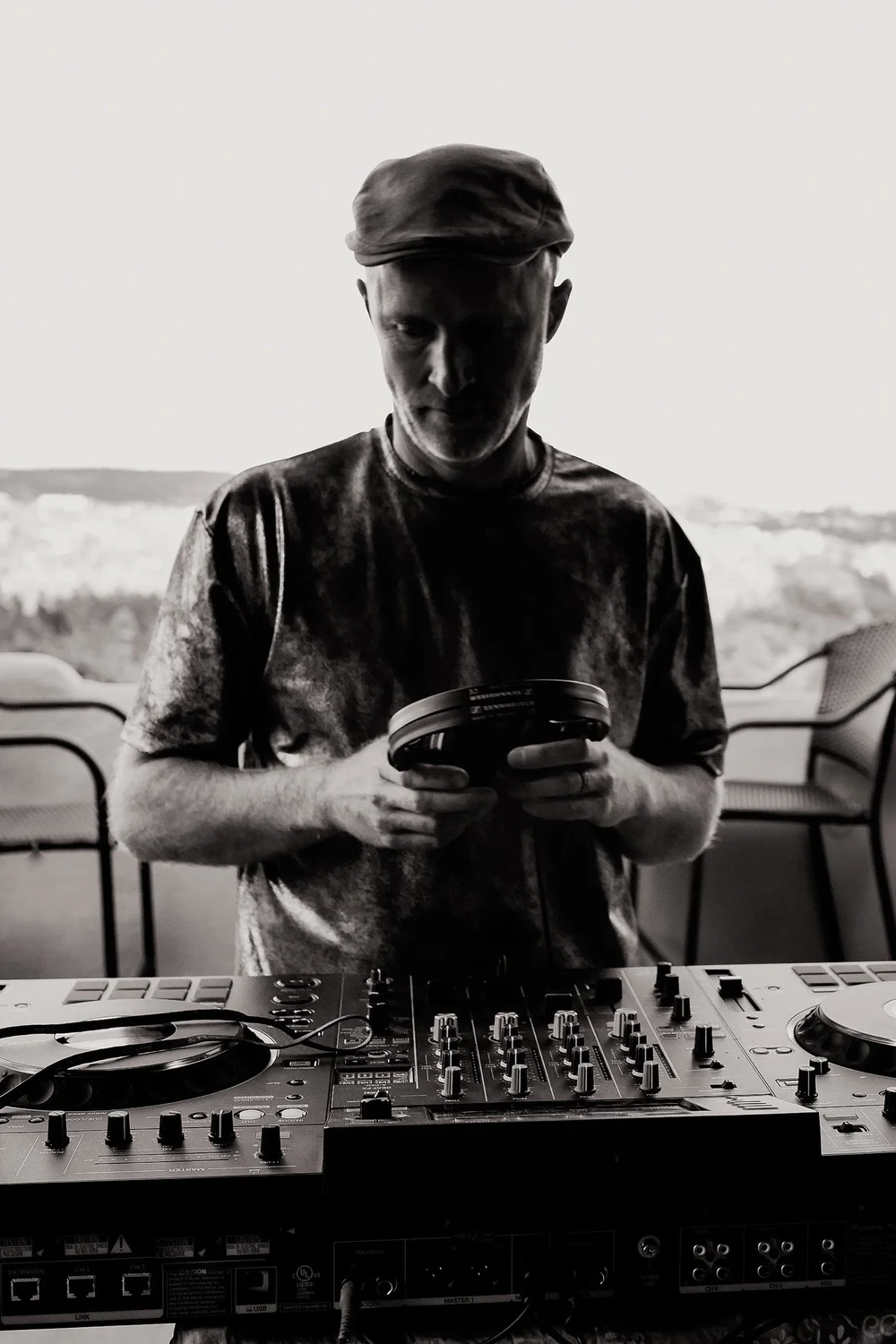
ASIP: How do you react as a "DJ" during the session? How are you reading the client in the moment?
Matt: Like I said earlier, I call that part Psychedelic Soundtracking. It's the live, real-time response to what's unfolding in the room. It's how I adjust the music and the energy of the setting based on how the client is showing up, through their words, their silence, or their emotional state.
I might sketch out a rough plan beforehand similar to filling my record box, but as we learned in traditional counseling, I try not to arrive with a fixed agenda. That kind of rigidity can pull you out of attunement. You might miss what's actually happening in the moment. So I see it more like a choose-your-own-adventure book. The client's experience shows us what page to turn to next, and I meet them there musically, just like we do on the dance floor.
ASIP: What are the emotional or energetic markers from beginning to end of your sessions, and how do you approach curating for those?
Matt: At the beginning, during what I call the "Hike", or what others might call the onset, things are usually quiet and restful. The client is often meditating or simply lying still, waiting for the effects to come on. The music is subtle and grounding, the kind of sound that helps you settle in and feel safe, like you're approaching basecamp.
Then comes the "Climb," which is where the medicine starts ramping up. This is when emotions begin bubbling up such as crying, laughing, yawning, trembling, shifting around. That's when I start slowly increasing the energy, emotionality, or psychedelic quality of the music. But it's not about pushing, it's about supporting the rising effects and helping them make the climb toward the peak.
Next is the "Summit," the peak. This is when the medicine is at full strength, and ego dissolution can happen. For some clients, it's a storm of emotion. For others, it's total stillness. Either way, I usually pull the music way back during this time. There's a kind of reverence in that moment that I try to honor. The music becomes very spacious. I leave room for the imagination to soar.
After the peak, we enter the "Return," or descent. This is when the medicine begins to lose strength and agency starts coming back online. Clients might begin to move again, process what just happened, or begin noticing what's unfolding as they slowly return to their senses. The music reflects that with something melodic and comforting, often with a feeling of homecoming. This is a great phase for what I call "music for remembering." It helps the client begin to make sense of what they just experienced.
ASIP: Can you explain the different types of music you use, and what mixtures or styles usually work best and what doesn't?
Matt: Ah, the notorious genre question. Well, I've got a soft spot for the classics such as trippy electronic ambient from the '90s chillout universe, modern neoclassical with lush synths, psychedelic downtempo, and a lot of expansive, cinematic soundscapes. But for me, it's less about genre and more about emotion and visual enhancement. I lean into music that has emotional depth and visual texture. I need to feel it in my body and see it in my mind. It has to stir something, whether that's ache, awe, release, or some associated memory.
One thing I've noticed — and this might surprise some of the more minor-chord-leaning dancefloor DJs out there — is that I often use major chords and melancholic sublimation in sessions. You can hear this approach in Psilocybin Therapy Protocol 1, which I describe more as "The Light." This protocol is typically used in early sessions, especially with new clients. The music holds a tone of beauty, grace, and uplift, not in a naive or saccharine way, but in a way that gently invites the heart to open. It's music that's both sad and beautiful. Sublimative. It doesn't deny pain, it transforms and resolves it.
This kind of music resonates with the core human paradox: the struggle and the gratitude of being alive at the same time. For many clients, especially early on, that emotional tone helps them soften into the experience. It creates a container where the nervous system can feel safe enough to let go. It's the sound of surrender, not force.
On the other hand, Psilocybin Therapy Protocol 2, which I call "The Shadow," leans into darker, heavier, more introspective psychedelic material with minor chords, tension, and the kind of raw emotionality that meets people deep in their grief, anger, regret, or trauma. These tracks are often used with experienced journeyers or when a client is ready to confront deeper material. It's still intentional, it's not "dark for the sake of dark", but it meets the psyche where it's at, and it creates a necessary counterbalance to the more major-leaning, sublimative compositions that I've found effective for therapeutic work.
What doesn't work for me is dry "psy-muzak" that lacks energy or sizzle. Music should ignite the senses, spark curiosity, and take you somewhere unexpected. I avoid tracks that feel too safe or lack depth, intensity, or psychedelic flavor. I'm especially mindful of overly dark, twisted, or unnecessarily heavy beat-driven material (unless specifically requested), as it can easily overwhelm or distract in such an intimate, emotionally open therapeutic space. Keep in mind, this is all highly subjective.
At the end of the day, I'm not choosing music to impress a crowd, I'm choosing it to support the transformation of that audience of one that I previously mentioned. That inspires very different selections than what you'd hear in more underground circles. And that means trusting the emotion more than the genre.
ASIP: Can you share a track or a moment in a set that continues to resonate with you, something you've returned to again and again?
Matt: Yeah, a few come to mind from Audio Protocol 001. For the onset stage, "Take Me By The Hand (Awakened Souls - Acid Dream Version)" by 36 & Awakened Souls. Cynthia's vocals and James's 303 lines are just... divine! It hits that emotional place where people often start crying, not out of sadness, but from that deep inner shift that happens when the medicine starts to open the heart.
Then around the two-hour mark, often when a booster might be kicking in, I'll bring in something like "Out (Poemme Remix)" by Ed Harrison or "Iliad" by Malibu. Those tracks are pure sublimation: sad but beautiful. They hold sorrow and hope in the same breath, and that kind of emotional container really helps people process what's surfacing.
During the descent phase of Protocol 1, I mix "Expand" by Endless Melancholy with the ANNA remix of "Belfast" by Orbital. That pairing was originally inspired by a live session with a client years ago, and the reaction was incredibly powerful, it even brought me to tears. It still gives me chills to this day whenever a session calls for it. Together, those two tracks feel like a triumphant return, a kind of emotional homecoming. And that ANNA remix of Orbital's classic Belfast really hits those "music for remembering" nostalgia buttons.
And that's the goal, not just to bring someone back, but to bring them back home, with self-reflection, meaning, and celebration.
ASIP: There's a lot of talk about "set and setting." What do people often overlook when preparing for, or recovering from, a journey? What are people most surprised about?
Matt: The number one surprise is always how different the journey ends up being from what they expected. People say they have no expectations but of course they do. We all do. And then the medicine shows them something totally unexpected. Sometimes they're shocked by how powerful it is. Other times, they're amazed at how safe or courageous they feel when they assume they'd be terrified.
That's always my favorite moment: when someone realizes they've reconnected with a part of themselves they forgot was even there. That's the real magic.
In terms of preparation, a lot of people forget to start living the life they want on the other side. They wait for the journey to fix them. But I encourage clients to start having conversations with their future selves to ask, "What should I be doing now to get ready for who I'm becoming?" It's like tending the garden before the rains come. You clear the weeds, loosen the soil, and plant the seeds of intention. Then the medicine knows where to land.
And then there's the basic stuff: avoiding alcohol, stepping back from news and social media, doing breathwork, staying mindful. These small choices really do help the nervous system prepare to navigate the psychedelic space.
Post-journey, people often think the afterglow will last forever. It won't. The high wears off. Life gets lifey again. That's why integration is crucial. Psychedelics aren't a fix. They plant seeds, but you still have to water them.
We go over all of this in the screening and prep sessions. The journey is just one part of the process, but it's everything around it that makes it sustainable.

Matt Xavier (center), Joel (2nd from left) and I with friends at one of Matts parties in Topanga. Photo by Jill Sutherland.
ASIP: We've previously talked in depth about how the practice of curating music as a guide is hard to protect, people can copy your sets or your tracklists, for example. So what makes a guide special beyond musical choice?
Matt: It's true that in this day and age, you can't really guard your IP like we did back in the day such as covering our records to fend off curious trainspotters. Everyone has access to the same tracks now, and artists are getting paid less and less as streaming takes over. So spreading the word is essential to the growth of the artists who make the music we use in sessions. That's part of the reason I'm so vocal about giving credit to the artists I use and directly supporting them whenever possible.
But what really makes a guide special isn't just the music. It's how you show up. It's your ability to attune. To sense what's needed. To recognize that music, like a psychedelic, is a medicine. And that your presence, your pacing, your sensitivity, all of that becomes part of the treatment.
A guide needs to know how to work with both the music, the moment and the psyche. They need to understand trauma. To regulate their own nervous system. To hold space for whatever shows up, whether it's grief, rage, laughter, silence, or pure cosmic awe.
And honestly, I think anyone doing this work should have at least some training in counseling or psychology. It doesn't have to be academic, but you need to understand how the human psyche works and how to guide and counsel someone who is trusting you with their most vulnerable states. Otherwise, you'll be unprepared when the real material surfaces, and you can unintentionally do harm.
ASIP: What are some of the most enlightening, unexpected, or just fun outcomes of your sessions you've seen over the years?
Matt: I love that question. There are so many. The most enlightening thing, for me, is just the privilege of sitting with someone who's opening themselves up that deeply. It's sacred, and it never ceases to amaze me. To be trusted in that way, to be invited into that kind of vulnerability, it still humbles me every time.
There've been moments where people just erupt in tears, and five minutes later they're laughing uncontrollably. I remember one session in particular, which I wrote about in the book, where the client went from deep sorrow and grief into a spontaneous outburst of joy. I followed him musically, moving from "Forever In A Moment" by Black Swan & Endless Melancholy, and then dropped a custom edit of Junkie XL's "Intergalactic Space Travel." The energy exploded with color, and that supported him into full catharsis. I followed that with a beatless track called "Lunar Landscape" by Sacred Seeds to help him land again and integrate that emotional purge. He said afterward it was one of the most cathartic experiences of his life.
Or a more recent session, where the client arrived saying they were excited and had prepared to go deep. From the start, they kept asking me to turn the volume up, and if you know the Adam Audio S3V monitors, you know they can get proper loud. I was stunned at how clearly the client knew what they needed, not just to enjoy the music and the experience, but to actually break through something. I remember giggling to myself as they kept yelling for more volume. It was wild, and totally inspiring! Not only did it help them push through their own blockages, it helped me realize I'd built up some of my own limitations around what's "allowed" in a session.
Sure enough, the volume amplified the psychedelics and helped them access deeper levels of release. Like the client, I was deeply humbled.
And that's the thing, to be allowed to witness these kinds of moments, to be part of it in any way, I don't take it lightly.
ASIP: What advice or recommendations would you give to any DJ who wants to apply some principles of your practice to their own sets, maybe in more intimate or personal settings?
Matt: First and foremost, move slowly. Get properly trained, and do your own deep work before guiding others. Study psychology, counseling, trauma and, of course, psychedelics and psychedelic guiding. Understand what it truly means to hold space, and know your own limits. This will help you recognize who you can, and shouldn't, be working with.
Curate your therapeutic medicine bag. Go through your music library and pull out the tracks that have helped you in difficult moments, the ones that comforted you, inspired you, and made you feel more human. Find the intimate instrumental pieces you turn to when you're alone. These are the sounds that will serve as sonic tools in your practice.
This isn't a dancefloor so don't get caught up in beatmatching; focus instead on emotion and vision. Learn every nuance of your tracks, their qualities, moods, and shifts. Know which ones calm, which ones activate, which ones expand, resolve, or which ones are trippy. Think about how each song might align with different phases of a psychedelic journey, and allow yourself to experiment with the fun of soundtracking the various moments of your life.
Above all, recognize the sacredness of this work. When someone enters a psychedelic state, they are profoundly open, and you hold responsibility for their safety. The music, medicine, and counsel you provide can either support their healing or add to their struggle. That weight should never be taken lightly.
As the saying goes, "Go slow and dose low. You can always take more, but you can't take less." Stay humble. Don't set out to save the world before you know what you're doing. Listen deeply to your music, your medicines, and most importantly, your clients. Because in the end, they are trusting you with the most vulnerable parts of themselves, and that is truly an honor in this lifetime.
~
May/June 2025.
Matt Xavier | Website | Soundcloud | Instagram


An antifascist prisoner in pre-trial detention in Hungary has begun a hunger strike. Maja T. was extradited from Germany in June 2024 accused of taking part in an alleged attack on neo-Nazis at the far-right 'Day of Honour' commemoration in Budapest in 2023. They have been held in solitary confinement ever since - seemingly due to them identifying as non-binary.
Budapest Antifascist Solidarity Committee has published Maja's statement:
'My name is Maja. Almost a year ago, I was unlawfully extradited to Hungary. Since then I have been held here in inhumane prolonged solitary confinement. Yesterday, on 4 June 2025, a decision was to be made on my application to be transferred to house arrest. This decision was postponed. The last applications for transfer to house arrest were rejected. I am no longer prepared to endure this intolerable situation and wait for decisions from a justice system that has systematically violated my rights over the last few months. I am therefore starting a hunger strike today, 5 June 2025. I demand that I be transferred back to Germany, that I can return to my family and that I can take part in the trial in Hungary from home.
I can no longer endure the prison conditions in Hungary. My cell was under video surveillance 24/7 for over three months. I had to wear handcuffs outside my cell at all times for over seven months, sometimes even in my cell, whether I was shopping, making Skype calls or during visits.

The prison guards inspect my cell every hour, even at night, and they always switch on the lights. I have to endure intimate body searches, during which I have to undress completely. Visits took place in separate rooms, where I was separated from my family, lawyers and official representatives by a glass partition. During cell checks, the prison guards left a complete mess behind. The structural conditions prevent me from seeing enough daylight. The tiny courtyard is made of concrete and is spanned by a grid. The temperature of the shower water cannot be regulated. My cell is permanently infested with bedbugs and cockroaches. There is no adequate supply of balanced and fresh food.
I am also in prolonged solitary confinement. I had no contact with any other prisoners for almost six months. To this day, I see or hear other people for less than an hour a day. This permanent deprivation of human contact is deliberately intended to cause psychological and physical harm. That is why the European Prison Rules of the Council of Europe provide for 'at least two hours of meaningful human contact per day'. That is why 'prolonged solitary confinement', the confinement of a prisoner for at least 22 hours a day for more than 15 days, is considered inhumane treatment or torture according to the United Nations' Nelson Mandela Rules. Here in Hungary I am buried alive in a prison cell and this pre-trial detention can last up to three years in Hungary.

I should never have been extradited to Hungary for these reasons. The Berlin Court of Appeal and the LINX special commission of the State Criminal Police of Saxony planned and carried out the extradition, deliberately bypassing my lawyers and the Federal Constitutional Court. On 28 June 2024, a few hours after my extradition, the Federal Constitutional Court ruled that I could not be extradited for the time being. On 6 February 2025, it ruled that my extradition was unlawful. Since then, none of those responsible have been held accountable. There has been no justice for me so far.
With my hunger strike, I also want to draw attention to the fact that no more people should be extradited to Hungary. Zaid from Nuremberg, who is acutely threatened with extradition to Hungary, is currently in particular need of this attention. I declare my solidarity with all anti-fascists who are being persecuted in the Budapest case'.

'Anitfascism is self-defence'


A 'Soli Rave' for Maja in Berlin, November 2024

Colin Jerwood, 1962-2025
Sorry to hear about death of Colin Jerwood, lead singer with Conflict. I saw them at various places in the 1980s including Thames Poly, the Ambulance station (Old Kent Road) and Bowes Lyon House in Stevenage. A band of contradictions sometimes to be sure (what was that about using the SAS 'Who dares wins' logo never mind some later stupid remarks) but in those 1980s days nobody else could express our rage against the machine quite like them and they played countless benefits. As Crass slowed down there was a period in which they were the leading band in the anarcho-punk scene as it headed from pacifism to class war, giving lots of bands their first releases on their Mortarhate label including several great compilations.

Conflict - To a Nation of Animal Lovers (I used to have poster from this on my wall)
I think it's fair to say that Colin wasn't all talk either, I believe he was active in the Animal Liberation Front at one time and not averse to getting stuck in to fascists. In Ian Glasper's anarcho punk book there's an account of what happened at the seminal 1982 gig at the Zig Zag squat in Westbourne Park, where Crass, The Mob and other bands played. According to Andy Martin from The Apostles, who also played that day, a group of right wing skinheads turned up with the result that; "this Asian lad - he was probably the only audience member not of white Caucasian origin - was being brutally kicked and punched by all these fascist thugs… that's right five onto one. And what were the other members of the 500-strong audience doing while this was happening? They had formed a wide circle around the scene and watched in play out… that's right, these anarchist pacifist rat-bags stood and watched five fascists beat up a 15-year-old Asian boy… In case you're wondering what happened next, yes, we did surge forward to come to the lad's aid, but before we could involve ourselves, both Penny and Andy (yes, from Crass) had jumped between us and grabbed the two biggest skinheads, and shoved them to one side of the hall. Colin Jerwood of Conflict confronted the others with less reasonable force, and threatened to put them all in hospital. Those three fascists virtually wet their knickers at the prospect' (The Day the Country Died: a history of anarcho-punk 1980-1984).
This flyer is from what may have been last time I saw them, at Clarendon Ballroom in Hammersmith playing for anti-apartheid in 1986, others mentioned on the flyer include Icons of Filth, Exit Stance and Liberty

 todos - Kilchurn Session XVIII [ 21-May-25 8:12pm ]
Eighteen sessions in, and somehow, todos still manages to unearth mixes that astound.
Kilchurn Session XVIII arrives as a continuation of a conversation we've been having for over a decade, threading forgotten film cues, elusive ambient B-sides, and left-behind downtempo sketches into a two-hour séance.
If you've followed the Kilchurn Sessions from the beginning, or todos' end of year ASIP label mixes, you'll know they're less about progression and more about excavation: digging through his deeply considered music memory, looping time in on itself, through careful and unexpected edits, seamless blends, and the most considered mix sequencing possible.
Listen on Soundcloud the ASIP Podcast or the 9128.live iOS and Android app
todos · Kilchurn Session XVlllTracklist:
Akira Rabelais - 'Du côté de chez Swann - Il y a bien des années ... dans le silence du soir' (edit)
Field Kit, Hannah Von Hubbenet & John Gurtler - 'Downward Rising'
Sophia Loizou - 'Anima' (edit)
Junkie Digital - 'In Transit'
Jani R - 'Eyes Eluding'
Vivian Koch - 'Lil Birdy Starts to Fly Again'
Mifune - 'Many People'
Marc Spieler - 'Selflove'
Before Tigers - 'Look At Me' (edit)
Marcibagoly - 'We're Flying'
SVLBRD - 'Solstice' (edit)
D J 1 9 8 6 一 九 八 六 - 'N O S T A L G I A '9 2'
Simone Giudice - 'Ghiaccio' / Patricia Wolf - 'Distant Memory'
Sierra Romeo - 'Promiza'
Savvas - 'Elysian' (ambient mix)
Savvas - 'Elysian' (original mix)
PJS - 'Forest'
Cremallier - 'Activity'
Bop - 'Hiding'
Trudge - 'Berserk' / Suso Sáiz - 'Inside The Egg'
Simone Giudice - 'Passione'
Holy Other - 'Lieve'
Marcibagoly - 'Jet Stream'
MPU101 - 'nurMKS30' (edit) / Tim Exile - 'A Little Bit More' (edit)
HAAI - 'Be Good'
James Holden - 'In The End You'll Know'
LCD Soundsystem, live, a week ago, Bowery Ballroom…
… was more exciting than I'd thought. Came with minimal expectations really (a guy and a synth and a drum machine?) and was ambushed by the physical full-band force of it. The sheer rockfunk. Shades at times of the Contortions, Happy Mondays, even a hint of Stooges attack. An American Lo-Fidelity Allstars? As well as a fine flesh-and-blood drummer there was a percussionist (who knew a cowbell could be so exciting?) who doubled as a guitarist; another guitarist (or was it a bassist? ) plus a chick on synth/tech. The singer (is that the guy who used to front Six Finger Satellite? He's pudged out a bit) wore an Oxford University T-Shirt. But underneath the obligatory irony, the masking metacasm, something seemed to be burning, a real deal HOWL, a scorching sense of "we mean it man" (although what the meaning might actually consist of remained unclear--the yearning to mean itself against all the heavily stacked odds, the over-acculturation that is a generational curse?). Not a massive fan of "Losing My Edge" (the weakest moment here anyhow) I couldn't have been more surprised. In the end, I suppose I didn't really know what to make of it--the best possible outcome.
from Blissblog Friday, October 17, 2003
LCD Soundsystem
LCD Soundsystem
(DFA)
Blender, 2005
As co-founder of New York's painfully hip record label DFA, James Murphy of LCD Soundsystem specializes in fusing dance groove and punk attack. The label's trademark raw-yet-slick sound first made waves in 2002 with the dancefloor success of The Rapture's "House of Jealous Lovers," which Murphy co-produced with DFA partner Tim Goldsworthy. Next came the first LCD single, "Losing My Edge," the hilarious lament of an aging hipster who feels eclipsed by youngsters with even more esoteric reference points. Included here on a bonus CD that gathers up all three of the group's excellent early singles, "Losing" sets the emotional template for a good chunk of LCD's debut full-length. Several of the best tunes are inspired by Murphy's love-hate relationship with music: his struggle between wanting to be cool and feeling the very impulse is absurd and loathsome, between his attachment to rock's heritage and his equally powerful urge to rip it all up and start again. Out of all these clashing emotions emerges a prime contender for Best Album of 2005.
Too omnivorously eclectic to operate as a period stylist, Murphy weaves together beats and sounds from the last 25 years of dance music. There's a heavy slant towards early Eighties mutant disco--spiky Gang of Four rhythm guitar, punkily funky basslines that aren't computer-programmed but played on an electric bass. But there's also more recent flavors from house and hip hop. "Too Much Love," a brilliantly eerie song about overdoing the party potions and nightclubbing, pivots around a grating synth noise that whimpers like a burned-out brain, while the Suicide-like "Thrills" rides an utterly contemporary and boombastic groove inspired by Missy Elliott's "Get UR Freak On."
Sonically, LCD Soundsystem is near-immaculate, then. But what really pushes this record into the realm of genius is the double whammy of Murphy's witty lyrics and wonderfully tetchy vocals. "On Repeat" expresses the ennui of the seasoned scenester who watches the new groups reshuffling the old poses, while "Movement" is a feedback-laced diatribe about modern music: "it's like a culture, without the effort, of all the culture/it's like a movement, without the bother, of all of the meaning." As for Murphy's singing, he's not got a big voice, but its dry, irritable texture suits the songs's themes of exhaustion and exasperation. He also does a cute David-Byrne-doing-Al-Green falsetto on "Disco Infiltrator" and resurrects the choral serenity of Brian Eno's early solo albums on the closing "Great Release".
Spotting the sources is bonus fun (for those whose brains are wired like that, anyway). But the glory of LCD Soundsystem is the way the music sounds like an entity not a collage, its manifold and disparate influences melding to form a seductive--if clearly deeply conflicted--self.
DFA / LCD Sound System
Groove magazine, 2005
For the last three years, DFA has been on a mission to make New York City live up to its own legend--"to be what it should be," as the label's co-founder James Murphy puts it. DFA's spiritual ancestors are early Eighties Manhattan labels like ZE, 99 and Sleeping Bag, pioneers of sounds like "punk-funk" and "mutant disco" that mixed dance culture's groove power with absurdist wit, dark humor and rock'n'roll aggression. The DFA sound flashes back to times and places when NYC's party-hard hedonism seemed to have both an edge and a point--Mudd Club, Hurrah's, Danceteria, Paradise Garage--but it rarely feels like a mere exercise in retro-pastiche.
The label's initial batch of vinyl-only singles in 2002--most famously "House of Jealous Lovers" by The Rapture and "Losing My Edge" by LCD Soundsystem--resurrected the idea of dance music spiked with punk attitude. Before long everybody was clamoring for a dose of DFA cool. Murphy, 34, and his English-born partner Tim Goldsworthy, 32, were touted as Superproducers, indieland's equivalent to the Neptunes. "Yeah I was the punk-funk Pharrell Williams," laughs Murphy. "Which makes me Chad, I guess" adds Goldsworthy.
Janet Jackson phoned DFA and suggested collaborating, saying she wanted to do something "raw and funky" like "Losing My Edge." Amazingly, DFA sorta kinda forgot to follow up the call. Duran Duran were also interested in getting DFA's magic touch. Most surreally, Goldsworthy and Murphy spent an afternoon in the studio with Britney Spears. "That was weird," says Goldsworthy. "Won't do that again. No offence to her--she's lovely. Got a foul mouth, though!" The brief session came to nothing, through lack of common musical ground. "When we work with people, we hang out, listen to records, share stuff," says Murphy. "But with Britney we soon discovered we had absolutely no way of communicating. She didn't know anything that we knew. I was excited when the idea was first broached, because I thought maybe there's something Britney wants to do, and it's fucking burning a hole in her, and we can find out what it is. And the collaboration could be embarrassing, a failure, but that's fine. But I think she's someone that's very divorced from what she wants to do, there's been a set of performance requirements on her for such a long time, such that how would she even know what she wanted to do? And we never had time to found out anyway, because it was like, 'she's available for four hours on Wednesday, write a song'. There's no way you can kid yourself you can make something real in those circumstances."
After these lost encounters with "the big time", DFA consciously backed away from the opportunities being thrust their way. "You stop returning phone calls, people get bored of you real quickly!" laughs Murphy. Instead, they concentrated on building up their own operation. The stance is bearing fruit now, with a freshly-inked global distribution deal between DFA and EMI. The first release under this new arrangement was the recent and highly impressive three-CD collection of DFA works so far, Compilation #2. It's now followed by the brilliant debut album from LCD Soundsystem, which is James Murphy's own group.
Murphy and Goldsworthy originally met in inauspicious circumstances, as hired help for Irish deejay/producer/soundtrack composer David Holmes, who was making his Bow Down To The Exit Sign album in Manhattan. Murphy did the engineering, Goldsworthy did the programming. The location was Murphy's West Village of Manhattan recording studio (now DFA's basement sound-lab). It didn't take long for the two technicians to suspect they were making most of the creative decisions. "Tim and I were forced to create a dialogue about how to make sounds, because there was just this vague cloud of ideas coming from Holmes," says Murphy, gesturing to the back of the studio, where Holmes sat during the recording process. "Tim and I found we could talk about the most subtle sonic things. Say, with Suicide, we could talk about the space between the two different organ sounds, or the lag between the organ playing and the drum machine beat, the way the two instruments don't lock together. Or we could talk about how earnest Alan Vega's Elvis-like vocal performance is, and how could we get that same quality out of the bass--a feeling that's earnest and embarrassing but saved by being actually totally for real."
Taking breaks from the recording grind, Goldsworthy and Murphy bonded further during Saturday night missions of full-on clubbing. Which is when Murphy, hitherto a typical indie-rock guy, had his dance music E-piphany. "Yeah, it's an unheard of story, isn't it?" he laughs. "A person who only listens to rock goes off, does a mountain of Ecstasy, and gets converted to dance music".
The same thing had happened to Goldsworthy over a decade earlier, as an indiepop fan who got swept up in the UK's Ecstasy-fueled acid house revolution circa 1988. "I went from wearing an anorak and National Health spectacles into shaving my head and dancing in a field for eight hours!" In the Nineties, Goldsworthy, like a lot of people, followed a vibe shift towards more chilled-out drugs (heavy weed) and moody, downtempo sounds, picking up especially on the music coming out of the early Nineties Bristol scene (very near where he grew up in the West of England). With his schoolfriend James Lavelle, Goldsworthy co-founded the trip hop label Mo Wax, whose whole aesthetic owed a huge amount to Massive Attack's epochal 1991 album Blue Lines. Goldsworthy and Lavelle also made atmospheric and increasingly over-ambitious music as the pivotal core of UNKLE, a sort of post-trip hop supergroup that called upon diverse array of collaborators (ranging from DJ Shadow to Radiohead's Thom Yorke) on albums like Psyence Fiction. It's this background in "soundtrack for a non-existent movie" music that led to Goldsworthy becoming the programming foil for David Holmes. Which ultimately led to him coming to Manhattan and meeting Murphy.
Goldsworthy had been through the whole dance culture experience and, like a lot of people, grown sick and tired of it. Murphy, a die-hard indie-rock/punk-rock guy, had always "loathed dance music. I thought it was all disco or C& C Music Factory. I didn't know anything about it and didn't want to know anything about it. I'd really come up through the Pixies, the Fall, Sonic Youth, My Bloody Valentine, and all the Chicago noise punk stuff like Big Black." And in truth, when the two of them went out clubbing in New York while working on the Holmes record, there wasn't much going on in dance culture to counter either Goldsworthy's disillusion or Murphy's prejudice. The Manhattan scene was moribund. Goldsworthy had come to New York, a city that loomed large in his imagination because of hip hop and house, with high expectations and was very disappointed. "I was shocked, it was so bad. You couldn't dance anywhere," he says, referring to Mayor Bloomberg's crackdown on bars that had DJs spinning but didn't have the expensive "cabaret license" that nightclubs need to get to make it permissible for their patrons to wiggle their butts in time to the music. "It was fucking awful."
Beyond the specific malaise of Manhattan clubland, dance music at the close of the Nineties was going through a not very compelling phase. It was neither pushing fearlessly forward into the future with huge leaps of innovation like it had done for most of the Nineties, nor did it have that edge-of-anarchy madness that characterized the rave scene in its early days. The superclubs were slick and soul-less. And technique-obsessed and genre-purist DJs had squeezed out an awful lot of vibe. By the start of the new millennium, the new generation of hipster youth in New York and London had little interest in club culture, which seemed safe, passe and altogether lacking in cutting-edge glamour. These young cool kids were looking to guitar bands again, groups with stage moves and charismatic hair, from the Strokes to the Yeah Yeah Yeahs.
Murphy and Goldsworthy decided to rescue dance music from "McDepth--that McDonald's version of 'deep', where there's nothing there", Murphy explains. The duo cite everything from glitchy laptop musicians to Tortoise-style post-rock to post-Blue Lines Massive Attack as examples of bogus profundity, chin-stroking pretentiousness, and terminal boredom. Revealingly, Murphy's MDMA revelation didn't occur listening to whatever passed for an Ecstasy anthem in those days (Rolando's "Jaguar," say). No, the DJ dropped The Beatles' "Tomorrow Never Knows"--one of his all-time favorite tunes--at exactly the point "when the drug was peaking" in his nervous system. And that gave Murphy the idea of "throwing parties and playing better music--like "Loose" by the Stooges--than what dance culture was offering at that time". Taking the name DFA--short for Death From Above, and originally the tag under which Murphy did infamously loud sound mixing for rock bands--they started throwing irregular parties in New York, based around the notion of bridging the considerable gap between Donna Summer and The Stooges. Soon, tired of endlessly playing their staple fare like Can and Liquid Liquid, the duo decided to make their own "dance-punk" tracks to spin.
"House Of Jealous Lovers" was their first stab. Dance distributors picked up the single purely for the house remix by Morgan Geist from cognoscenti-approved outfit Metro Area. "We'd heard his track 'Atmosphreak' and thought it was amazing," recalls Murphy. "One of the Rapture's friends, Dan, was room mates with Morgan, and so we asked if he'd do a remix and he very kindly did one really cheap. It was only because of Morgan's remix that anyone took it--the dance distributors would often identify it in their orders as being by Morgan Geist." Ironically, and fatefully, it was DFA's original discopunk version that eventually took off.
"House of Jealous Lovers" arrived with perfect timing to catch the breaking wave of dancefloor taste shift towards edgy angularity--not just the rediscovery of Eighties groups like ESG and A Certain Ratio, but the emergence of neo-postpunk bands like !!!, Liars, Erase Errata, and Radio Four (whom DFA also produced). But while The Rapture's slashing guitar and slightly-constipated, white-boys-getting-down funk bass flash you back to 1979 and UK agit-funk outfits like Gang of Four and Delta 5, Murphy & Goldsworthy's production supplied the kind of pumping, monolithic regularity that made the track fully contemporary. "There were indie bands already coming through doing that kind of rickety, Delta 5-style punk-funk, but we wanted to make records that house DJs would actually play," says Murphy. "We had a big talk with The Rapture about that Mr Oizo track 'Flat Beat', the bassline in that tune. In 2000, when we were making 'House of Jealous Lovers', 'Flat Beat' was just about the only dance track around that was memorable. It was a tune you could remember, it fucked killed on the dancefloor, and it had incredible low end. So our attitude was, 'Jealous Lovers' has to compete in that context. So we filtered the bass a lot, did a couple of layers of hi-hats and reversed them, took the drummer's playing and chopped it up." The drummer himself came up with the cowbell, which eventually became a kind of DFA trademark. "House of Jealous Lovers" became a huge success on all kinds of different dancefloors. Some commentators regard it as the best single of the decade so far. It's certainly one of the most significant.
DFA's signature sound mixes Goldsworthy's computer wizardry and Murphy's background of engineering and playing in rock bands (DFA's remixes typically feature his drumming, bass, and sometimes guitar). Two different kinds of knowledge mesh perfectly: Murphy's expertise at getting great drum sounds and capturing live "feel", Goldsworthy's digital editing skills and vast sample-hound's knowledge of recorded music acquired during his Mo Wax days. Both guys look their respective parts. Slender, softspoken, and diffidently English in a way that often, he says, gets him mistaken for gay, Goldsworthy seems like someone at home with delicate, intricate work--a century ago, you might have assumed from his intent, bespectacled gaze and fastidious manner that he was an engraver or watch-maker. Wearing a Taos ski resort T-shirt and brown corduroy pants, the slightly pudgy and much more boisterous Murphy looks like your archetypal American indie-rock studio rat.
After a low-key spell in late 2003/early 2004--a steady flow of fine but not exactly throat-grabbing releases, from The Juan Maclean, Delia Gonzalez & Gavin Russom, and Black Dice--DFA came back strong in the last few months of 2004 with two of their most exciting singles yet. Pixeltan's "Get Up/Say What" is classic DFA discopunk, simultaneously raw and slick, while "Sunplus" by J.O.Y.--a Japanese outfit helmed by K.U.D.O, Goldsworthy's Tim 's former partner in UNKLE, and featuring guest vocals from Yoshimi P-We of the Boredoms--beautifully updates the thorny, fractured postpunk funk of LiLiPUT and The Slits. Like most DFA releases, these tracks came out as vinyl 12 inches. But don't fret if you've got no turntable--you can also find them on Compilation #2. Attractively packaged with the label's trademark minimal design, the box set pulls together everything that wasn't on their first, not wholly satisfactory compilation, throws in a terrific bonus mix CD executed by Tim Goldsworthy and Tim Sweeney, and altogether showcases a formidable body of work. Two highlights are Liquid Liquid's "Bellhead," a brand-new DFA recording of an old song by one of their Eighties postpunk heroes, formerly on the legendary 99 Records label, and the 15 minute disco-delic journey-into-sound that is "Casual Friday" by Black Leotard Front (an alter ego for Gonzalez and Russom).
And now there's the second release under the global distribution deal with EMI, the debut album from LCD Soundsystem, which people are already talking about as a contender for best album of 2005. In the studio, LCD is basically a James Murphy solo project with occasional help from friends who drop by, and some spiritual guidance from Goldsworthy. Live, though, LCD swells into a proper band, and a surprisingly powerful one, its sheer rock-funk force bringing to mind at various points Happy Mondays, the Lo-Fidelity Allstars, and The Stooges gone disco.
Released not long after "House Of Jealous Lovers", LCD's debut single "Losing My Edge" was the first indication that DFA weren't just a pair of capable remixers, but that there was in fact a whole sensibility, aesthetic, and ethos behind the label, as well as a groovy retro-nuevo sound. Sung by Murphy, the song is the plaint of a cool hunter type--a musician, or DJ, or record store clerk, or possibly all three--who's agonizingly aware that he's slipping, as younger kids outdo his esoteric knowledge with even more obscure reference points. "I'm losing my edge to the Internet seekers who can tell me every member of every good group from 1962 to 1978," the character whines. "To the art-school Brooklynites in little jackets and borrowed nostalgia for the unremembered eighties". The aging hipster's claims of priority and having been first-on-the-block get more and more absurd: "I was there in 1974 at the first Suicide practices in a loft in New York City/I was working on the organ sounds with much patience… I was the first guy playing Daft Punk to the rock kids/I played it at CBGB's… I was there in the Paradise Garage DJ booth with Larry Levan/I was there in Jamaica during the great sound clashes/I woke up naked on the beach in Ibiza in 1988."
As well as being a hilarious auto-critique of hipsterism, "Losing My Edge" obliquely captured something of the pathos of the modern era. All this massive ever-accumulating knowledge about music history, the huge array of arcane influences and sources available thanks to the reissue industry and peer-to-peer filesharing, all the advantages we have today in terms of technology and how to get good sounds, have resulted in a kind of a kind of crisis of "well made" music, where producers are scholars of production, know how to get a great period feel, yet it seems harder and harder to make music that actually matters, in the way that the music that inspired them mattered in its own day. "Record collection rock" is my term for this syndrome, although the malaise is just as prevalent in dance culture (look at the perennial return of the 303 acid bass, each time sounding more exhausted and unsurprising).
"Losing My Edge" was very funny, but also poignant. Murphy agrees. "It's incredibly sad. It took people a while to pick up on that. At first they were like, 'ha! You got 'em', like it was just a satire on hipsters. What's truly sad, though, is that the initial inspiration for it was from my deejaying in the early days of DFA, playing postpunk and an eclectic mix of dance and rock. And suddenly everybody started playing that kind of mixture, and I thought 'fuck, now it's a genre and I'm fucked, I'm not going to get hired'. My response was, "I was doing this first," and then I realized that was pathetic, that I was this 31 year old hipster douchebag. So at the end of "Losing My Edge," that's why there's the long list of bands-- Pere Ubu, Todd Terry, PIL, the Fania All-Stars, the Bar-Kays, Heldon, Gentle Giant, the Human League, Roy Harper, Sun Ra, on and on--'cos in the end that's what my attitude reduced to, just running around trying to yell the names of cool bands before anybody else!". He says that a big part of DFA's attitude is that "we definitely try to shoot holes in our own cool as fast as we can, because being cool is one of the worst things for music." He cites DFA's disco-flavored remix of Le Tigre's "Deceptacon" as an example, its softness representing a deliberate swerve from the obvious punk-funk sound that DFA were known for.
"Beat Connection", the even more impressive flipside to "Losing," was also a meta-music statement, with Murphy accusing everyone on the dancefloor of colluding in lameness. "Everybody here needs a shove/Everybody here is afraid of fun/It's the saddest night out in the USA/Nobody's coming undone." He explains that this was inspired by his and Goldsworthy's experience of the "really uptight" New York club scene at the tail-end of the Nineties. When Murphy compares his lyrical approach to The Stooges--"really simple, repetitive, quite stupid"--he hits it on the nail. "Beat Connection" is dance culture's counterpart to The Stooges 1969 classic "No Fun." Which was probably the very first punk song--indeed the Sex Pistols did a brilliant cover version of it.
When people talk about LCD Soundsystem and DFA, though, the word that comes up isn't punk rock so much as postpunk--Public Image Ltd (the band John Lydon formed after the Pistols broke up), Gang of Four, Liquid Liquid, etc. Murphy originally got into this era of music when he was working as sound engineer and live sound mixer for Six Finger Satellite, an abrasive mid-Nineties band who were precocious--indeed premature--in referencing the postpunk period well before it became hip again circa 2001. In a 1995 interview with me, Six Finger Satellite were already namedropping late Seventies outfits like Chrome and This Heat. They also recorded an all-synth and heavily Devo-influenced mini-album, Machine Cuisine, as a sideline from their more guitar-oriented, Big Black-like albums. "Going on tour with Six Finger Satellite was one of those super fertile times in my life in terms of finding out about music," recalls Murphy. "They were like 'do you know about Deutsche Amerikanishce Freundschaft? Do you know about Suicide?', and they dumped all this knowledge on me while we were driving around the country from gig to gig. This was a few years before I met Tim, which was itself another very fertile and immersive period in terms of new music." The Six Finger Satellite connection endures. DFA act The Juan Maclean is actually Six Finger guitarist John Maclean, making Kraftwerk-like electronica.
"Losing My Edge" b/w "Beat Connection" was followed by two more excellent LCD singles, "Give It Up" b/w "Tired" and "Yeah" (which came in a "Crass version" and a "Pretentious Version" and managed to make the 303 acid-bass sound quite exciting, against all the odds). These six early single tracks are collected on the bonus disc that comes with the debut LCD Soundsystem album. Running through a lot of the CD--particularly songs like "Movement" and "On Repeat"-- is that same meta-musical rage you heard in "Losing" and "Beat": a poisoned blend of a desire for music to be revolutionary and dangerous, along with a defeatist, crippled-by-irony awareness that the age of musical revolution may be long past. "Movement," the single, fuses the sentiments of "Losing My Edge" and "Beat Connection", with Murphy surveying the music scene and pointing the finger--"it's like a culture, without the effort, of all the culture/it's like a movement, without the bother, of all of the meaning"--and then confessing to being "tapped", meaning exhausted, sapped of energy and inspiration. Although the sentiment could apply just as equally to dance culture, Murphy says the song is specifically a reaction to all the talk of guitar rock making a comeback, "all the inanity that gets bandied about as rock journalism. It's a complete rip of fashion journalism--'the high waisted pant is BACK'. Like that's supposed to mean something. I mean, I hope you don't go around hearing 'abstract expressionism is BACK! and HOTTER than EVER!' in art mags."
"On Repeat" is yet another LCD song about the ennui that comes when you're been into music for a long time: the awareness of the cycles repeating, the eternal return of the same personae and poses, archetypes and attitudes, reshuffled with slight variations. "That attitude is where I'm coming from all of the time," says Murphy. "The lyric referring to 'the new stylish creep'--that's me! The song is about hating what you are, and that giving you strength to hate everything else. It's weird. I love music so much that I want to drown it forever. Destroy everything."
You can hear these conflicted emotions in Murphy's singing voice. It has a weird tetchy texture that evokes a mixture of exasperation and fatigue, sounds at once spirited and dispirited. Murphy says that's an accurate reflection of how he feels when he's recording vocals. "It murders me. I hate hearing my own stupid voice in the headphones, with all the singerly bits and false poses. I sometimes have to sing things over and over until I hate the song, until there's no posy vocal bits in there that make me cringe. That song, 'On Repeat,' in particular was hell to do. But in the end I like it. Or at least I feel like I can stand behind it". In terms of that frayed, worn-out quality to LCD vocals, Murphy says "I usually compress the shit out of the vocal with a VCA compressor, which is really brutal. And I try to mix them so that the frequencies are like "Mother of Pearl" by Roxy Music or "Poptones" by PiL".
Yet for all the lyrical and vocal notes of disillusionment and frustration running through LCD Soundsystem, the music itself is full of exuberance and playfulness, a delight in the sheer pleasures and possibilities of sound. "Too Much Love," which seems to be a song about drug burn-out and excessive nocturnal socializing, features an awesome grating synth-whine that makes me think of a serotonin-depleted brain whimpering on the Tuesday after a wild weekend. Another standout track, "Disco Infiltrator" nods to Kraftwerk with its imitation of the eerie synth-riff from 1980's "Home Computer." It's not a sample but a recreation, says Murphy. "It just an ascending chromatic scale, really. It's not rocket science!" The track also features some sweet semi-falsetto singing from Murphy that sounds like David Byrne circa Talking Heads' Remain In Light. "It's just my shitty soul voice," laughs Murphy. "Al Green has a beautiful soul, so that's what you hear coming through in his voice. My soul is absolute rubbish, so that's what comes out!"
The closing "Great Release" seems like a homage to Brian Eno's song-based albums like Taking Tiger Mountain By Strategy and Another Green World. "Actually, it's Here Comes the Warm Jets-era Eno," laughs Murphy. "It's not a homage, though--I hate that word. No, I just like the type of energy that some Eno/Bowie stuff got, and some of the space of Lou Reed stuff, like 'Satellite of Love'. Some journalist got kind of stroppy with me about that song, and all I could think was, 'is there seriously some problem with there being too many songs that use sonic spaces similar to early Eno solo work? I mean, is this really something we need to talk about before it gets out of control?!?'". I WISH I had that problem. Or is the problem just me--that I'm not being original enough? Because if it is, then let's just dump rock in the fucking ocean and call it a day, because I'm doing the best I can for the moment!"
Best of all is "Thrills," in which Murphy comes off like Iggy Pop singing over a track that fuses The Normal's "Warm Leatherette" with Suicide's "Dance," over a fat bassline not a million miles from Timo Maas. Actually, Murphy says, the inspiration for the bass-and-percussion groove is Missy Elliott's "Get Yr Freak On". "I made the original version of 'Thrills' right when that came out. I loved that era of mainstream hip hop, it was a free-for-all. And just the bass of it."
Of course, all these comparisons and reference points only underscore the point I earlier made in reference to "Losing My Edge": the poignancy of living in a "late" era of culture, the insurmountable-seeming challenge of competing with the accumulated brilliance of the past and creating any kind of sensation of new-ness. "Yeah, that is kind of tattooed on my stomach," says Murphy, referring to this pained awareness of belatedness. He acknowledges that "great influences do not a great record make". And yet despite all the odds, the LCD album is a great record.
When I mention the American literary critic Harold Bloom's concept of "anxiety of influence"--which argues that "strong" artists suffer from an acute sense of anguish that everything has been done before, and that makes them struggle against their predecessors in a desperate Oedipal attempt to achieve originality--Murphy flips out. "It's hilarious that you say this--I mention Bloom's anxiety theory pretty regularly in interviews! This is the shit I've been screaming about for years. Learning and progress has always been based on learning from the past. Real originality never comes from trying to defeat the past right out of the gate. It's a spark of an individual idea caused by the love/hate relationship between a "listener" and the "sound". I love music, and it inspired me at first to copy it, then to be ashamed of copying it, then to make music in "modes" (genres) while trying to pretend they were original, then finally making music with a purpose--which for me was dance music. It made people dance. It was no longer just music to make you look cool and feel like you were part of something you admire.
"I don't feel like I'm in any danger of making 'retro' music, but at the same time, there are things about the ways various people who've come before me did things that I prefer greatly to the way 'modern' things are done. I use a computer. I edit and do all sorts of modern shit, but there are things I consciously do that were done in songs I love from before me."
As much as love, though, it's hate that inspires LCD Soundsystem in equal measure. "I hate the way bands stand on stage, the gear they use, the crew they hire to tune their tedious guitars, the love they have for their special 'guitar amp, the belief in their fragile, phoney little singer who's a fucking sham. They are not and will never be Iggy Pop. Neither will I, or my band, but we know it, and we're trying our fucking best to be the LCD Soundsystem. Complete with its laundry list of influences, failures and idiocies. At least you go onstage knowing that, good or bad, no one is like you."
* * * * *
Many labels never survive the initial hype storm of being hip. Murphy recalls a peculiar, uncomfortable phase when "we kept seeing magazines with profiles of DFA, but we weren't really releasing anything at the time." Now, though, he's thankful that "we're not ascendant anymore. At this point we're kind of cruising along. And it's nice. It doesn't feel like it's out of our control anymore."
And what about New York, the city whose mythos is so central to DFA? Is it living up to its own reputation at the moment? "It's a great city, but people get lazy here," says Murphy. "So we and a few other people we think of as allies, we go into phases of trying to punch the city into being interesting, Then we go home for a couple of months and hang out with our wives and cook. And then it's like, 'okay, time to go out punching again'. And it's getting to be about that time again. For a while, we were like 'oh fuck them, let them live in their filth of terrible parties, shitty DJs, just doing the same thing'. See I can't go to these parties where people play records that are sent to them by promoters 'cos they're genre djs, part of a genre. I've always loathed that. And then I found myself in that situation again," Murphy sighs, referring to the way DFA gets lumped together with Black Strobe and Trevor Jackson of Playgroup/Output, the way genre-crossing becomes its own kind of genre. "That's not what I signed up for, you know? I didn't leave indie rock to end up back in indie rock!"
House of Zealous Rockers: DFA
by
Simon Reynolds
Village Voice October 26, 2004
When was the last time we had a great New York indie record label? Think about it. Not just a company that happens to be based here, but one with a roster of local artists, one whose whole vibe 'n' vision is bound up with the mythos of New York City. You'd probably have to go back to the early '80s, the era of punk-funk and mutant-disco imprints like ZE, 99, and Sleeping Bag. Today's only real contender is DFA. For the last three years, DFA has been on a mission to make this city live up to its own legend—"to be what it should be," as DFA co-founder James Murphy puts it. The DFA sound flashes back to places and times when NYC's party-hard hedonism seemed to have both an edge and a point—Mudd Club, Paradise Garage—but never feels like an exercise in retro pastiche.
The label's initial batch of vinyl-only singles in 2002—most famously "House of Jealous Lovers" by the Rapture—resurrected the idea of dance music spiked with punk attitude. Before long, everybody was clamoring for a dose of DFA cool. Murphy and his English-born partner, Tim Goldsworthy, were touted as superproducers, indieland's equivalent to the Neptunes. Janet Jackson phoned them and suggested collaborating (amazingly, DFA kinda sorta forgot to follow up the call.) Most surreally, they spent an afternoon in the studio with Britney Spears. "That was weird," says Goldsworthy. "Won't do that again. No offense to her—she's lovely. Got a foul mouth, though!" The brief session came to nothing, through lack of common musical ground. "When we work with people, we hang out, listen to records, share stuff," says Murphy. "But with Britney we had absolutely no way of communicating. She didn't know anything that we knew."
After this lost encounter with "the big time," DFA consciously backed away from the opportunities being thrust its way. "You stop returning phone calls, people get bored of you real quick!" laughs Murphy. Instead they concentrated on building up their own operation. The stance is bearing fruit in the last months of 2004, with a freshly inked global-minus-America distribution deal with EMI and an impressive three-CD collection of DFA works so far, Compilation #2, out this week. Early next year the second release under this new arrangement will be the debut album from Murphy's own group LCD Soundsystem.
Murphy and Goldsworthy originally met in inauspicious circumstances, as hired help for DJ-producer David Holmes, who was making one of his "soundtrack for a nonexistent movie"-type albums in Manhattan. Murphy did the engineering, Goldsworthy did the programming. The location was Murphy's West 13th Street recording studio (now DFA's sound lab). It didn't take long for the two technicians to suspect they were making most of the creative decisions. "Tim and I were forced to create a dialogue about how to make sounds, because there was just this vague cloud of ideas coming from Holmes," says Murphy, gesturing to the back of the studio.
Taking breaks from the recording grind, the two sound boys bonded further during Saturday-night missions of full-on clubbing. Which is when Murphy, hitherto a typical indie-rock discophobe, had his dance music E-piphany. "Yeah, it's an unheard of story, isn't it?" he laughs. "A person who only listens to rock goes off, does a mountain of E, and gets converted to dance music." Revealingly, though, it was hearing the Beatles' "Tomorrow Never Knows" at exactly the point "when the drug was peaking" that gave Murphy the idea of "throwing parties and playing better music—like 'Loose' by the Stooges—than what dance culture was offering at that time."
At the close of the '90s, technique-obsessed and genre-purist DJs were squeezing all the vibe out of club culture, in the process driving the next generation of hipster kids back to rock bands with stage moves and charismatic hair. Murphy and Goldsworthy decided to rescue dance music from "McDepth—that McDonald's version of 'deep,' where there's nothing there," Murphy explains, citing everything from glitchy laptop musicians to Tortoise-style post-rock as culpable. Taking the name DFA—short for Death From Above, and originally the tag under which Murphy did infamously loud sound mixing for bands like Six Finger Satellite—they started throwing irregular parties based around the notion of bridging the considerable gap between Donna Summer and the Stooges. Soon, tired of endlessly playing their staple fare like Can and Liquid Liquid, the duo decided to make their own "dance-punk" tracks to spin.
"House of Jealous Lovers" was their first real stab. Dance distributors picked up the single purely for the house remix by Morgan Geist (from cognoscenti-approved outfit Metro Area). But it was DFA's original disco-punk version that eventually took off, timed perfectly for the dancefloor taste shift toward edgy angularity (not just the rediscovery of '80s groups like ESG and A Certain Ratio, but the emergence of neo-post-punk bands like !!! and Radio 4). But while the Rapture's slashing guitar and slightly constipated, white-boys-getting-down funk bass flash you back to Gang of Four and Delta 5, Murphy and Goldsworthy's production supplied a pumping, monolithic regularity that made the track fully contemporary. "There were indie bands already coming through doing that kind of rickety punk-funk, but we wanted to make records that house DJs would actually play," says Murphy. "So we filtered the bass a lot, did a couple of layers of hi-hats and reversed them, took the drummer's playing and chopped it up."
DFA's signature sound mixes Goldsworthy's computer wizardry with Murphy's background of engineering and playing in rock bands (DFA's remixes typically feature his drumming, bass, and sometimes guitar). Two different kinds of knowledge mesh perfectly: Murphy's expertise at getting great drum sounds and capturing live "feel," Goldsworthy's digital editing skills and vast sample-hound knowledge of recorded music (acquired during his trip-hop days as co-founder of Mo Wax and member of that label's supergroup UNKLE). Both guys look their respective parts. Slender, soft-spoken, and diffidently English in a way that often, he says, gets him mistaken for gay, Goldsworthy seems like someone at home with delicate, intricate work—a century ago, you might have assumed from his intent, bespectacled gaze and fastidious manner that he was an engraver or watchmaker. Wearing a Taos ski resort T-shirt and brown cords, the slightly pudgy and much more boisterous Murphy looks like your archetypal Amerindie studio rat.
After a low-key spell—a steady flow of fine but not exactly throat-grabbing releases, from the Juan Maclean, Delia Gonzalez & Gavin Russom, and Black Dice—DFA has come back strong this fall with two of its most exciting singles yet. Pixeltan's "Get Up/Say What" is classic DFA disco-punk, simultaneously raw and slick, while "Sunplus" by J.O.Y.—a Japanese outfit helmed by K.U.D.O, Goldsworthy's former partner in UNKLE, and featuring guest vocals from Yoshimi P-We of the Boredoms—beautifully updates the thorny, fractured funk of LiLiPUT and the Slits. Like most DFA releases, these tracks came out as vinyl 12-inches. But don't fret if you've got no turntable—you can also find them on Compilation #2. The box set pulls together everything that wasn't on the first, not wholly satisfactory anthology, throws in a bonus mix CD, and altogether showcases a formidable body of work. One previously unavailable highlight is Liquid Liquid's "Bellhead," a brand-new recording of an old song by one of DFA's '80s post-punk heroes.
Many labels never survive the initial hype storm of being hip. Murphy recalls a peculiar, uncomfortable phase when "we kept seeing magazines with profiles of DFA, but we weren't really releasing anything at the time." Now, though, he's thankful that "we're not ascendant anymore. At this point we're kind of cruising along. And it's nice. It doesn't feel like it's out of our control anymore."
^^^^^^^^^^^^^^^^^^^^^^^
Strangely I've never been able to get into the later LCD albums, which people from the generation just below mine swear by. "All My Friends" and all that. Perhaps because the disparate influences are more successfully emulsified? So that it sounds like fully achieved atemporality rather than a collage on the edge of congealing?
This all feels so far back in time, long long ago, even more long ago than the original postpunk era .... twas strange to learn recently that my youngest, unborn at the time of writing these pieces, is a fan of LCD Soundsystem and actually saw them live not so long ago.,,,,

'For Peace!' is an interesting exhibition at Four Corners gallery in Bethnal Green, based around material from the archive at MayDay Rooms. The focus is very much on the more radical end of peace and anti-militarist movements - not simply calling for an absence of conflict but challenging the existence of the military and the state's weapons of mass destruction which tick along beneath the radar of mainstream political discourse. Was anybody ever asked for instance whether we wanted a continuing massive US military base at Lakenheath in Suffolk?
From this perspective the efforts of the Greenham Common and Faslane peace camps set up in the 1980s are seen as central, installing themselves at what is perhaps the real heart of the state - less Whitehall than the fenced off compounds behind which it accumulates its missiles.

Abolish War! - Greenham common women's peace camp
.JPEG)
The Faslane peace camp was set up in 1982 at the Royal Naval base in Scotland that is home to Britain's nuclear weapons-armed submarines
There is archive material from the direct action end of the 1950s/60s movement against the bomb (Committee of 100 and Spies for Peace) and from some less well known 1980s/90s activists such as those who opposed the 'nuclear colonialism' of testing sites and weapons bases.

'The peasants are revolting Ma'am' - a group of women protestors described in the Sun as a '15-strong feminist brigade' climbed over the wall into Buckingham Palace grounds in 1993 in solidarity with the Western Shoshone people whose land in the Nevada Desert was used as a testing ground for American and British nuclear weapons.

'Women working for a nuclear-free and independent Pacific' - a 1980s benefit at the Old White Horse in Brixton (later Brixton Jamm). The Rongelap survivors were those still living with the radioactive aftermath of the 1950s H Bomb tests in the Pacific.
There is also an emphasis on solidarity movements such as the Troops Out Movement who campaigned for British withdrawal from Ireland from the 1970s to the 1990s

1980s Southwark Troops Out Movement meeting - SNOW venue refers to 'Squatters Network of Walworth'

Campaign for Nuclear Disarmament against Trident missiles and a flyer for the 1983 'Festival for the Future' in Bristol
For Peace! at Four Corners from 9 to 24 May 2025
Mikkel Rev / Journey Beyond (ASIP043) [ 16-May-25 6:36pm ]
Following Mikkel Rev's debut album on the label in 2023, 'The Art Of Levitation', the Norwegian artist returns with Journey Beyond, a selection of tracks demonstrating his innate ability to conjure the most atmospheric trance music, irrespective of BPM.
Journey Beyond was created from an extensive set of tracks sent to the label that were initially sequenced as two shorter EPs. With the first offering a slower 80bpm trance style, and the second EP, a classic ~130bpm trance style. However, over time, with tracks swapping in and out, ASIP had the idea to create a mixed version, progressing through the tracks and increasing bpm's, showcasing Mikkel's ability in bridging euphoric worlds - and a style that is often reserved for Mikkel's live performances amongst the forest raves held as part of the Ute Collective in Norway.
Classic trance and the art of a DJ mix have been influential to ASIP since the label's inception, making this release and the process of creating it a true reflection of how Mikkel and the label come together to define the end output.
Featuring artwork by Ventral Is Golden and mastered by James Bernard, the album is available now on Bandcamp to preorder for just $1, with full release following next Friday and a Bandcamp listening party the day before (Thursday 22nd, 11am PST).
When Mates Make Books [ 04-May-25 12:50am ]
Brutalism / Botany interface [ 02-May-25 8:56pm ]

This whole Brutalism thing has gotten a bit of out of hand now.... they are scraping the barrel bottom, I think.
Mind, you, these photographs are cool in a J.G. Ballard, The Drowned World, London-gone-tropical kind of way..


Via Hoxton Mini Press which fairly places it as a product (cute little logo though)
Talking about Brutalism... what did people make of The Brutalist? I watched it on the airplane, which is ridiculous - seat-back screen versus the widescreen, Dolby-sound grandeur of imagery and music that it is all about. Despite these reductions, I was really into it until about two-thirds of the way through when a plot twist occurs that seemed ludicrous and after that the whole thing seemed to cop out, or crap out....
A past gone mad, part 397 [ 29-Apr-25 12:08am ]
Glenn Gregory subbing
Named after Bowie's worst single (at least of the 1970s... he surely out-did it in the post-Let's Dance era)
Marc Almond, Clem Burke (RIP), Glen Matlock, and Gary Kemp have been accomplices in the past.
Reef? Replenish? There's a market for a 30th Anniversary tour?!? Tour, meaning multiple dates around the country!
(I cannot even remember who Reef ever were in the first place)

The Gang of 2 celebrate Entertainment!'s 45th anniversary - actually the 46th, but who's counting...
40th Anniversary of what? The Wedding Present's existence? That silhouette figure composited out of album covers.....
Rounding out this round-up....
Goodness, a mega box set of Swing Out Sister's second phase career, when pop success was quite a long way back in the rear view mirror....
SWING OUT SISTERCertain Shades Of Limelight27 June 20258CD

Swing Out Sister Celebrate Their Sophisticated Sound with New 8CD Box Set: Certain Shades Of Limelight
Cherry Red Records proudly announces the release of Certain Shades Of Limelight, a beautifully curated 8CD box set celebrating the vibrant and soulful evolution of iconic British pop sophisticates Swing Out Sister. Spanning the years 1994 to 2004, this definitive collection captures a golden decade of musical exploration, refinement, and reinvention.
Old Is The New New [ 27-Apr-25 2:39am ]
This boutique front snapped on a recent jaunt to London - or was it taken in NYC? - at any rate, their slogan "Old Is The New New" reminded me of a London vintage store called Pop Boutique that I once spied, whose pitch to consumers was:
"Don't follow fashion. Buy something that's already out of date."
But the pro-vintage sentiment above has an eco-fashion tinge - recycling garments is not only cool and requires a sophisticated eye, a finely-tuned sensibility - but it might just be planet-saving too.
C.f. the campaign against fast fashion, the ultra-wasteful turnover of trends and outfits, as campaigned against by Farmer Alex (with his "Slowing Down Fashion" documentary of a few years ago) among others.

Melody Maker, June 18 1986

David Thomas at the first Carrot Festival, Warsaw, Poland - Melody Maker April 18 1987


Pere Ubu at the second Carrot festival in Budapest, Hungary


Melody Maker, April 2 1988

Finally, in 2002, I got to meet the great man. I was in the U.K. for the summer to research Rip It Up and Start Again - after various unsuccessful efforts, I got a call rather peremptorily summoning me to Brighton the next day. Bird in hand, I thought - I hastened down there with some hastily prepared questions. The encounter was one of the more cantankerous interviews I've done - but in some ways that it made more interesting than a straightforward "here's how we formed, then we made our first record" type data-dollop. We got into debating the history and philosophy of rock - class dynamics - America versus England. A rather bristly, frictional dialogue. We were in a pub near the sea front and at a certain point, he said, "I'm going to talk to my friends" and went over to a barstool and chatted to an old geezer with a dog. I went for a slash and then on the way back, I thought, "Shall I say goodbye? Nah!". Caught the train back. So not the most cordial of encounters, but I'm glad I did it. And whoever said visionary geniuses had to be sufferable?
Below is the tided-up Q and A of our chat.
I read this memoiristic essay by Charlotte Presler about Cleveland in the Seventies and she said that everybody in the scene was from an upper middle class background. Or even upper class.
"I'm not sure who was from upper class, but certainly we're all from very strong middle class families. My dad was a professor. I had an academic upbringing and certainly an academic path was indicated. I was extremely bright, in the top one percent in my class."
Presler also said that most of the people weren't actually musicians primarily, that they came to it from other areas, like art or writing. Did you ever toy with other art forms apart from music?
"Nothing else particularly interested me. I was always interested in sound, and then shortly after that I became interested in rock music, and ever since I haven't been interested in doing anything else. Everything else is an inferior byproduct along the evolutionary path to rock music, which is the only true artform. We were all taken with the expressive capabilities of sound and rock music was the form that was making the most inventive and expressive use of that medium.
Is it true that the first album you bought was Trout Mask Replica by Captain Beefheart?
"No--the first album I bought was Zappa's Uncle Meat, then I bought Hot Rats. Then Trout Mask and Strictly Personal. All this was within about three weeks. The gang I hung around with in high school was really into Uncle Meat. "
Beefheart was a protégé of Zappa's at that point?
"In Zappa's version of history, yeah! We liked Uncle Meat because we were in high school and in high school you're into Surrealism and Dadaism. Uncle Meat was making use of interesting sounds. Zappa never moved beyond that, his appeal was always directed at high school students. Absolutely Free was all that hippy stuff--we weren't particularly taken by that. Hippy was pretty passé even then. We were two or three years post-hippy, and that two or three years was pretty significant. We felt hippies were pretty useless as any sort of social happening."
Zappa's always struck me as kinda cynical and sneery, whereas Beefheart seems more… humanist, maybe. Not a misanthrope.
"Beefheart was certainly much more angular. We liked hard music. Or at least I did. I was more Midwestern oriented--I liked MC5, Stooges, and all that Sixties garage stuff like Question Mark and The Music Machine. Beefheart is very close to that sort of approach.. At that time if you were looking for electronic sounds there was Terry Riley, Beaver & Krause, Silver Apples, and all the German stuff. All of that was a component of bands like MC5. There's always been a relationship between hard Midwest groove rock and pure sound. So it was natural for us to do that."
So is that the genesis of "avant-garage" as a concept? The Stooges started out doing abstract noise stuff with a Fluxus/Dada edge, using vacuum cleaners and the like. Then they turned into a primal hard rock band. They got less experimental as they went along.
"Avant garage was much later. We got tired of not having a pigeonhole so in 1979, one of our friends was doing an art exhibition at Cleveland Stadium of garages--literally a collection of fronts of garages. I don't know how he got them. He might have even called it the Avant-Garage Exhibition. . We thought that was a good name so we stole it, but only because we got tired of all the silly labels. This thing of pigeonholing and calling things by generic names is in rock terms a fairly recent event. In our formative years nobody did that, which is why nobody thought it was that weird that Jimmy Hendrix opened for the Monkees. The last time I saw the Stooges they were opening for Slade. This notion of the latest trend was always a fabrication of the English punk movement. When our parents or friends would ask what kind of music we played we'd say, 'we're kind of underground'. Which mean only that we couldn't play and nobody came to see us. And then everybody was also into film, so in early 1977 somebody started talking about it as New Wave. But we always saw ourselves in the mainstream tradition of rock music."
So you didn't particularly like the term "New Wave"?
"It's an Anglo-European obsession with being new. We knew we were different."
Oh, so Ubu weren't motivated particularly by that proto-punk sort of disgust with what rock had degenerated into during the early Seventies?
"Not at all. This is more or less an invention of the punk music press. The early Seventies was one of the highlight periods in rock music. There was more innovation between 1970 and 1974 than ever before. There wasn't this narrow vision that has come to characterize things since. The only frustration was that we couldn't get gigs. Only the copy bands were getting any jobs, the cover bands. But then after we stopped whining and moaning, we figured there are tons of bars, so there must be somewhere we could play. Then we got off our butts and found this wretched little sailor's dive in an industrial part of town, the Pirate's Cove. And started playing there.
So what makes the early Seventies the peak of rock creativity as far as you're concerned?
"Eno. Amon Duul and Neu!. Kevin Ayers, The Soft Machine. The Incredible String Band. The Stooges' Funhouse. John Cale. Things were beginning to move and accelerate. Maybe people didn't notice it underneath all the other stuff, but it was moving. Sabbath was too derivative of the blues. There's a real difference between Midwestern rock and that kind of heavy rock. It's really night and day. Midwestern rock is all based on a flowing riff pattern, not a ba-domp-ba-domp. We liked groove rock that had the minimum of changes in it. Tom Herman's famous defining line was that he judges guitar parts by how little he has to move his fingers. That's a pretty Midwestern concept.
If the first half of the Seventies was so great, though, why was there a need for punk?
"I may exaggerate because so many people dump on it."
Cleveland was supposed to have extremely progressive taste--to have the largest concentration of adventurous listeners in between the East Coast and the West Coast. How come?
"Marc Bolan was considered in Cleveland to be conceptual art, because of the sickness of his world view and the weird envelope of sound he was working with. All his teen girlie stuff seemed to be very conceptual because nobody in his right kind would do it seriously. There's always been a struggle in Cleveland, a dynamic between the Midwestern oriented people and the Anglophile people. West Siders are always Anglophile. They're all Eastern European immigrants, Lithuanian and Hungarian and Polish. Cleveland was the largest Hungarian-speaking city outside of Budapest for decades. These Eastern European immigrants were, working class, white socks, accordions and so on, and that was of course considered to be the uncool side of town. And we were on the East Side where all the liberals and the blacks were. East Side was considered to be the coolest part of town, but of course as time went on I discovered that in fact the West Side was cooler! I don't know what made them Anglophiles. It's not my problem! But the Kinks and Syd Barrett were just massive on the west side of Cleveland, and the Bowie stuff. The East Side tended to be more black people and English people. The black people were into black music and the whites tended toward Velvet Underground, MC5, and Zappa. The thing that bound the two sides of the city was The Velvet Underground--that was the current, the universal language. Everybody understood the Velvets, and we on the East Side were particularly Velvets orientated. The East Side was much harder."
Was Cleveland as grim and industrial in those days as the legend has it?
"I suppose so, but we didn't sit there saying, 'Gee, this is grim'. The river caught fire once--so? It's a heavy industrial town. The mayor's hair caught fire in the Seventies but nobody ever tells you about that."
So where did the bohemian, or nonconformist, or unusual people gather?
"Cleveland was a town of record stores. That's why it was the birthplace of rock music in 1951. Alan Freed was in a record shop, the same shop that everyone in Ubu ended up working in at one time or another: Record Rendezvous. He noticed all these white kids getting off on 'race records' so he started doing hops. Everybody who was in a band worked at a record store and all the record stores competed against each other to have the most complete catalogues. To have everything of everything. There was a lot of specialized interest. That's why the worldwide Syd Barrett Appreciation Society was in Cleveland. There were these strong cliques of people. It was a real hothouse environment. There was only 100 people—musicians, girlfriends, sound guys who were your friends—and everybody knew what you were doing. Everybody was competing to be the best. There weren't any places to play, so your reputation would be based on the five shows a year you could play somewhere. Which meant that everyone was very well-rehearsed. The Electric Eels, who everyone thought were totally anarchistic—well, they were indeed totally anarchistic, but they rehearsed too. Way more than any similar band would have. Everyone took it pretty seriously."
The Drome--that was the hippest record store of all of them, right?
"It was the store that picked up on the beginnings of the English punk stuff and the weird American stuff like the Residents and MX-80. John Thompson, who owned it, was extremely supportive of local bands. He'd have bands play in his store.. The other stores were owned by fifty year old men, so none of them had the same focus, or they were stuck in the hippy thing. Johnny was really into used car commercials and he'd build these television gameshow sets—he was totally nuts. We lived together for a long time and the whole house was violent pink and festooned with gameshow sets and cut-out characters.. He had a very modern, American vision of things—that's where the concept of Datapanik came from. Johnny and I came up with that in 1976, this doctrine about Data Panic where all information had become a drug-like substance, in and of itself meaningless, and the only thing that mattered was data flow. I have to admit immodestly these ideas were far ahead of their time."
So he was one of those catalyst figures, who don't make music themselves but they foster and direct the energy.
"Robert Wheeler, who's our current synthesizer player, and is a generation younger than me, told me he went into Drome when he didn't know about anything and he picked up our single "30 Seconds Over Tokyo". This is just when it had first come out. And Johnny said, 'you can buy that for $1.50 but instead you could take that $1.50 and go see the band play tonight at the Pirate's Cove.' This was his attitude—and this bad commercial vision was the reason for the Drome's downfall a few years later. Johnny would rent this radio theater, the WHK auditorium--an old radio theater from the 1930s that had been abandoned and was on the edge of the ghetto. And this was where the first Disasterdromes took places--shows he'd put on with Ubu, Devo, Suicide, and other bands from other towns. He said the motto is, 'We call it disaster so nothing can go wrong'. Bums and winos would be coming in and lurking in the shadows. Somebody lit fire to the sofa. Stuff was always going wrong and people were always complaining to him. After the first one like that he decided to call it Disasterdrome, so you won't be disappointed. Free the consumer from the burden of anticipation. 'No, it's not going to be any good, it's going to be a disaster'. They were extremely popular."
You were one of the few members of Pere Ubu who never lived in the Plaza, the building co-owned by Allen Ravenstine?
"I lived with a girlfriend there--it was her place. Everybody who lived there was a writer, an artist or a musician. It was the red light street on the edge of the ghetto. The ghetto started one street over. It wasn't scary, but you had to be careful, you couldn't wander around blithely at night."
Early on you went by the name of Crocus Behemoth!
"I had a girlfriend who was in the Weathermen or the White Panthers or something. She was very much taken with the Detroit MC5 thing. All the people on the fringe of the political underground always had pseudonyms. At the time I was writing for a local paper, Scene, and I was writing a whole lot, so I had a bunch of pseudonyms., The way they'd come up with pseudonyms was they'd just open up a dictionary and put their finger on a word, so she opened a dictionary and put her finger on Crocus and then on Behemoth. That was the name for the writing I did that was most popular so I was sort of known by that."
What kind of writing was it?
"I was a rock critic. Endless bands, endless reviews. I didn't have any theories--some things I liked and some things I didn't like. Eventually I got to be thinking, if I'm so smart I can do this--music--better. And I did. I didn't have any dreams of being a rock critic--I became a writer because I'd dropped out of college and I knew this guy who'd been at the college paper who was the editor of Scene, so I got a job doing art layout. Then they needed somebody to copyedit. Soon I was rewriting so much of the stuff they said we can all save ourselves some time if you just review the stuff yourself. I had no particular desire. It was just a job I could get."
Calling the band Pere Ubu… you were a big fan of Alfred Jarry?
"Not a big fan. I'm aware of what he did. All that Dada and surrealist stuff is the stuff you do in high school. After high school it doesn't have much relevance to anything. Jarry's theatrical ideas and narrative devices interested me."
Didn't you have this thing called the Theory of Spontaneous Similitude that was related to Pataphysics?
"Maybe. Spontaneous Similitude just grew out of a joke, although I suppose it has a serious core. You could complete the phrase, "I am like…" with the first thing that comes into your head and it still makes sense. Which is not much of an idea but it has a certain relationship to the Surrealists and Dadaists. For human beings there's no alternative to meaning. That's the serious point of it: there is no such thing as non-meaning for humans, so if you say "I am like…" and fill it in with anything, a listener will make some sense out of it because there is no alternative. That's clearly the foundational element of sound as an artistic force. Any sound you hear, there is no alternative but to figure it out."
Wasn't there a kind of split down the middle of Ubu between the weirdo "head" elements (your voice and Ravenstine's synth), which were kind of un-rock, and the more straight-slamming physicality of what the guitar, bass and drums were doing, which rocked hard?
"Why is there a split? You want there to be a split but there isn't one. How many minutes ago did we talk about the genesis of the Midwestern sound? That it's a combination of pure sound elements and hard rock. We don't see that they're separate. This is a corollary of the inability of most foreigners to understand the nature of rock music. You want this separation of what you would call pop versus what you would call serious art. There wasn't a separation as far as we were concerned. We liked Marc Bolan as much as we liked Lou Reed,. One wasn't intrinsically more serious than the other. This idea of pop versus art was alien to us."
So you thought what you did would be embraced and you'd end up on Top Forty radio?
"We thought we were the mainstream. That's not the same as being popular. What we were doing was mainstream, what the Rolling Stones and Toto were doing was weird and experimental—40 or 50 year old men going on about teenage girls. That's weird. What we were doing was aspiring to a mature fully-realized artistic form that spoke for ordinary people and their lives."
Oh, so the idea of being deliberately esoteric or avant-garde had no interest, was redundant, as far as you were concerned?
"We were making popular music. That's why we did singles. Whether people liked it or not was not our problem. In the pure, platonic meaning of the word, we were pop."
Well, Ubu were pretty popular at one point, I guess.
"Nah, nobody's ever liked us."
But in the UK, around the first couple of albums and tours, you had droves of people coming to the shows. There was a big buzz about Ubu in 1978.
"Only because of herd mentality. That's not cynical, it's realistic. We were on the edge of being popular but we were fundamentally incapable of being popular, because we were fundamentally perverse and uninterested. This is the strength of our upbringing. This is why all adventurous art is done by middle class people. Because middle class people don't care. 'I'm going to do what I want, because I can do anything else better and make more money than this'. If you sit down and make a list of the people you consider to be adventurous in pop music, I'd bet you lots that the vast majority of them are middle class."
What about the Beatles?
"Do you really think The Beatles were working class? Really? The Beatles were not working class. The Rolling Stones…. Sit down and make a list."
Well I agree with you to the extent that the traditional slant of looking at rock as an essentially working class thing… it's not total bunk, but it has been woefully exaggerated thing. Art students and university students have always played a big part in rock history. At least from 1963 onwards.
"The notion of street credibility is a recent aberration. It's all designed to create commercial niche markets. Since punk this compartmentalization has been designed to aid advertising executives to target their products at the market. That's not what music and art is about."
So presumably you had no time for the Clash going on about tower blocks and kids on the street.
"That's alien stuff. That's your problem. All this is nothing to do with rock music. It has to do with the aberrations of European social structures. To do with a guy wanting to sell clothes. From the beginning punk rock was designed as a commercial exercise to create a market. This is the reason why it's weird when it came to America, because what was going on in America was things like Television, Pere Ubu, The Residents, MX-80. It was operating on a totally different level than the Sex Pistols. Our ambitions were considerably different than the Sex Pistols. Our ambitions were to take the art form and move it forward into ever more expressive and mature fields, with the goal of creating the true language of human consciousness. To create something worthy of William Faulkner and Herman Melville. What was the damn ambition of the Sex Pistols?"
But don't you think a lot of rock music is about baseness and vulgarity?
"It's about vulgarity if you think ordinary people are vulgar. I don't think so. I think the poetry of the ordinary man is great. If you believe that art forms or social progress must be frozen in aspic and maintained at its adolescent, easily manipulated stage, then sure you're right. But there are a lot of us who feel folk music should aspire and evolve to greater things. The best way of keeping something manipulable is keeping it at its adolescent stage. Because adolescents are the most gullible sons of bitches on the entire planet. You can get a kid to do anything. So if you want marketing, yeah, let's keep it all about how blue jeans and spiky hair is going to make you different. If you want that kind of world—that's the world you got. Punk music won. But that's not what we were trying to do. We exist in a different place. One of us lives in a real world and one of us lives in a fantasy world. Well maybe you live in the real world and we live in a fantasy world, or maybe we live in the real world. It's a question of what you want and what you get.
"There's all sorts of kinds of music and ways people appreciate music. To some people it's nothing more than a soundtrack to a mating ritual. To others it's a language of poetry and vision. Not everybody has to pursue poetry and vision through the same medium. Some understand things visually or conceptually. The world would be an unpleasant place if Pere Ubu was the only kind of music you could listen to, because frankly it's hard work sometimes and that's the way we make it, so that it's hard. I don't sit around listening to our music, it's impossible. Because it requires you to sit there and listen submit to it, and to be engaged in it. It doesn't make good background music."
I get the distinct sense that you don't much care for the English approach to rock, but at the same time Pere Ubu were much better received in the UK.
"Only because of the size of the country. I think the English are the most civilized of all the Europeans. They're responsible for most good stuff. But you wouldn't have this confusion if we were talking about reggae or Chinese folk music. Nobody would in their right mind argue an English band could play African tribal music as well as African tribal people. So where do you get this idea that English people can play rock music--the folk music of America-- in any authentic way? Some years ago a magazine paid me to go to Siberia to see what was going on and I met [Russian rock critic] Artemis Trotsky. He said, 'The most ordinary amateur garage band in America has more authenticity and fire and soul than the most adventurous band from England because they're playing the music of their blood.'"
Hmmm, do you really think rock music is folk music? It's so heavily filtered through the mass media. Bands learn from recordings much more than from their geographical neighbours. It's mass culture, not community music. Folk music doesn't change that much or that fast, whereas look how insanely rapidly rock mutated and diversified in just a couple of decades.
"Both your points are baloney. Folk music is passed from one generation to another. It doesn't matter if the medium of its passing is a record, the nature of it is that it's a passage. And involved in any folk music is a series of common themes and obsessions. Well that's certainly true of rock music, where people write songs that are continuations of other people's themes. Images are created---seminal things like Heartbreak Hotel. That image has possessed writers endlessly from the moment it was heard. I've written probably a dozen songs based on Heartbreak Hotel. Read Greil Marcus's Mystery Train, it's all about this passing on of communal images. The notion of being down by the river, the railroad, the worried man. The worried man stretches back hundreds of years. 'Worried Man Blues' by the Carter Family from 1920 probably has roots back in Babylonia. You're confused by the commercial exploitation of the medium, which has nothing to do with the reality of the its function. Because a folk music is of the people. In any bar you can find ordinary musicians playing rock music of such high quality that it puts to shame stuff from other countries. That's because it's in their blood."
Americans don't have a "blood"! The USA is an unsuccessful melted melting pot.
"Yes we do. Only recently since Oprah Winfrey and the doogooders have taken over has it been less successfully melted. I would argue that, compared to everybody else, it's totally melted. It has to do with the New World versus the Old World, disposing of the Old World's nationalistic and socialistic prejudices. This notion that you reject the past and throw yourself into the modern, into the future, is at the same time the strength and the weakness of America. Once Edison invented the phonograph, Elvis was only a matter of time. Edison invented rock music, he created the magnetic age in which we still live. Robert Johnson wouldn't have been anything without a microphone--music became intimate, you could create quiet songs, the singer could be perceived as a mortal individual with hopes and dreams. All this is fundamental to the creation of rock music. Also fundamental is the American landscape. It's a music of perspective and space. That's why all rock has to do with the car. In Europe they had iambic pentameter, in America they had the automobile. All of sudden the ordinary man had a poetic vehicle."
But wasn't there a period when Pere Ubu itself tried to break with rock'n'roll? Starting with New Picnic Time and intensifying with the Art of Walking and Song of the Bailing Man, it got pretty abstruse and un-rock.
"We got abstract, but you're assuming that everything has to say exactly the same all the time. The road has no end. The road is a Moebius strip. We're obsessed with not repeating ourselves. One of our abstract albums might have been us looking at a glass from the bottom, but if you're going to know what a glass is then at some point you're going to have to look at it from that perspective. One album that everyone considers abstract —Art of Walking—was to create an image of water going down a drain. The idea was to define the meaning of the song by coloring in everything but the thing you're talking about. We're obsessed with always pushing it, looking at the bottom of the glass. But you don't want to look at the bottom of the glass if you want a pop career. Well we don't care. We're middle class. We don't care. We're free."
There was a point in the later Pere Ubu where you imagery shifted from "industrial" to pastoral.
"That's not Pere Ubu, that's my solo work. That was because people came along and said you write songs about cars. I'm a perverse sort of person so I'll say, 'Okay, I'll write a bunch of songs about pedestrians and call my band The Pedestrians'. I'm going to do whatever I want. I always look for the other side of the coin. Whatever everybody is saying is true is probably not. It's never let me down."
On the Art of Walking, you have that line about "the birds are saying what I want to say". Have you ever listened to Oliver Messaien? He did all these symphonies based on his transcriptions of bird songs.
"I don't pay attention to instrumental music. Music exists for the singer. The only exception is the instrumental in the middle of a show where the singer can get a drink and go to the bathroom. That's the sole purpose of instrumentals."
That's bit of a limited view--I mean, oops, there goes most of jazz, nearly all classical, a fair bit of African music…
"Yeah. Because those were inferior evolutionary forms. Since Thomas Edison invented rock the whole point of music is the singer…. I'm a contrarian, I'm going to stick to my own silly path."
Have you never been interested in doing abstract stuff with your voice?
"I did that a lot in the beginning—that's why you can't hear anything I'm singing because I was totally obsessed with the abstract. I had all sorts of rules I would follow because I was obsessed with not ripping off black music. Like Brian Wilson, I wanted to create a white soul music. I had rules where I would refuse to bend a note or extend a syllable past one beat. Until I realized I'd made my point, and it was limiting to keep going. I like there to be words and meaning."
I think you once said that Pere Ubu became obsessed with not repeating Dub Housing, the second album?
"No, we're obsessed with not repeating ourselves in general. But this particular incident occurred after Dub Housing. Our manager was very successful, he had just signed up Def Leppard. And he said to us, 'All you have to do is repeat the same album two or three times and you'll be stars.' And I said, 'What if we can't repeat it? What if we don't know what we did? What if we don't want to?'. And our big time manager said, 'As long as you make good albums you'll get signed. But you'll never be successful'. Our eyes all lit up and we said, 'That sounds pretty good!'"
The demonstration started in Parliament Square but soon overspilled it as there wasn't room for the growing crowd.

It finished with speeches in a crowded St James Park (the first time I've been in a demo in this Royal Park).

Along the way there was a river of creative signs and chants, plus a little mobile sound system pumping out gabber and drum & bass. Anyone who thinks that the Supreme Court represents any kind of final settlement of this issue can forget it. Things are just getting started...


see previously: In defence of Billy Bragg and trans rights
isolatedmix 131 - Illuvia: Mauna Kea [ 19-Apr-25 4:03am ]
There's a certain feeling that creeps in when listening to Illuvia. A delicate suspension between rhythm and atmosphere, where the weight of a breakbeat never overwhelms the stillness it moves through.
Since debuting as Illuvia on ASIP with Iridescence of Clouds back in 2021, Ludvig Cimbrelius has steadily carved out his own temporal rift in the world of ambient and jungle- a sound that sidesteps nostalgia and instead uncovers a forgotten future buried deep in the recesses of our collective memory.
With such a history on the label going back to our earliest of releases and our 7th vinyl press (as Purl, alongside Lav) it may not feel like it, but this is actually the first time Ludvig has appeared on an isolatedmix, despite the close ties and inspiration of this Portals mix from God Is No Longer A DJ.
Both across his latest release, Earth Prism, and Iridescence of Clouds, he introduced a world of ambient lovers to weightless pads combined with chopped breaks, barely tethered to gravity, and melodies that seemed to shimmer. It was both an echo of something familiar and an entirely new dialect, not strictly jungle, not wholly ambient, not liquid in the traditional sense, but unmistakably Illuvia.
This new mix is a continuation of those worlds. Or maybe a glance sideways into a parallel one. Illuvia's approach has always been about restraint and resonance: every snare hit is softened by reverb, every progression feels like it's been carved out of silence.
For those who have followed his trajectory through ASIP and beyond, this is another precious window into Ludvig's meticulous and emotive world. And for those new to it, welcome.
Embed Block Add an embed URL or code. Learn more~
Illuvia: 'Mauna Kea'
When preparing to leave what has been my home for the past three years and setting sail towards a different continent, I realized that some of the old hard-drives I have been carrying around would not make the trip with me. A move like this one marks a new beginning; when it comes to my music, I usually attempt to go through what I can easily access in my archives and feel out what calls for being salvaged and shared in some form. The rest will remain disconnected from the digital cloud, destined to slowly disintegrate (perhaps to be dug up by archeologists in some distant future?).
In my search, I discovered the first demo tracks I had sent to Ryan back in 2019, as well as a track called 'Where Clouds Dissolve Into Sky' - the first idea I took down for Illuvia's debut on ASIP. That title eventually morphed into the album name, while the track itself remained a beautiful idea that didn't quite reach all the way. It had something special, just like the raw demo versions that were either refined or completely reimagined on their way to release.
After collecting the ones that felt too radiant to fade, I began to feel for ways that these odd pieces could flow together into a continuous mix - and naturally an Isolatedmix as most of them were directly or indirectly connected to my albums on ASIP. Slowly, a path emerged, leading deeper into the heart of Illuvia. In the process, I couldn't hold back impulses to add some new layers and bending a few of the tracks pretty far from the shapes I had found them in - all to make things flow together more cohesively.
When listening to the first version of 'Mauna Kea', I was surprised by how alive it all felt to me, and decided that I wanted to try to compile this work as an album too, dispersing more of the tracks and alternate versions that didn't find a place in the mix. I had hoped to complete both renditions of this retrospective before taking off, but I ran out of time, and so the album version might come along later. For now, I am happy to be able to share this continuous 78 minute trip through the ambient clouds and elemental beats of Illuvia.
- Ludvig (Istanbul, March 2025)
astrangelyisolatedplace · isolatedmix 131 - Illuvia: 'Mauna Kea'Listen on Soundcloud the ASIP Podcast or the 9128.live iOS and Android app .
Tracklist:
01. Via I (Dream Fragment)
02. Where Clouds Dissolve Into Sky
03. Nirmala Sundari
04. Abyssal Plains
05. Mauna Loa
06. A New Tomorrow (Origin)
07. Mauna Kea
08. Light Within Shadow
09. Snow Melt From My Heart
10. State of Emergence (Origin)
11. Violet Rays
12. Chiara (Intro)
This mix is also available as a release on Illuvia's Bandcamp page to enjoy in high quality download formats and individual tracks, including a limited CDr run.
An homage to CCO with Christian Kleine's new album and a limited 7" lathe cut [ 18-Apr-25 5:37pm ]
Christian Kleine's Electronic Music From The Lost World 1998-2001 Vol.2 is out today on gatefold pink 2LP. But not to overshadow this moment, we also have another special item as part of this release dropping shortly...
I probably don't need to wax lyrical about the impact and role of City Centre Offices in my journey. You can connect the dots easily given the name and artists on the label, and go deeper with my interview with Thaddi Herrmann.
Outside of the artists and genre-defining output, the 7" releases from the label were undoubtedly one of the biggest influences on my obsession with vinyl and the DIY aesthetic. Minimal in design, striking colors and cute random stickers made these 7"s an instant collectible - although at the time, they probably felt much more lo-fi and budget given this was the heyday of vinyl production for emerging independent electronic music. I hate to imagine how cheap these were to make back then compared to today.
So when Christian's return to the label was in discussion and further digs into his DAT archives, I had the idea to pay homage to one of his earliest labels and one of my favorites with a copycat 7" lathe.
Mimicking the design to the finest detail, I enlisted Robyn at Red Space Records to cut a 7" transparent lathe (currently in production), ordered a replica sticker approach for the front, and designed a bunch of different color labels to placed randomly on each copy to replicate further the strong aesthetic that formed over time on the CCO roster.
Electronic Music From The Lost World: 1998-2001 (Vol.2) by Christian Kleine" target="_blank">Available now on Bandcamp, just 50 copies were made due to the DIY nature of lathe cuts and assembly. I know many people won't be able to get their hands on this special edition, but simply trying to scale something that takes time and is focused on quality can be very hard nowadays.
The two tracks, "Beyond Repair (Version)" and "Wonder Var" will remain exclusive to the 7" for the time being. Mastered by the man who did all of CCO's early mastering, LOOP-O.
7" mock for illustrative purposes (the sleeves will be in perfect condition, don't worry).
 Christian Kleine / Electronic Music From The Lost World: 1998-2001 (Vol.2) [ 31-Mar-25 4:10pm ]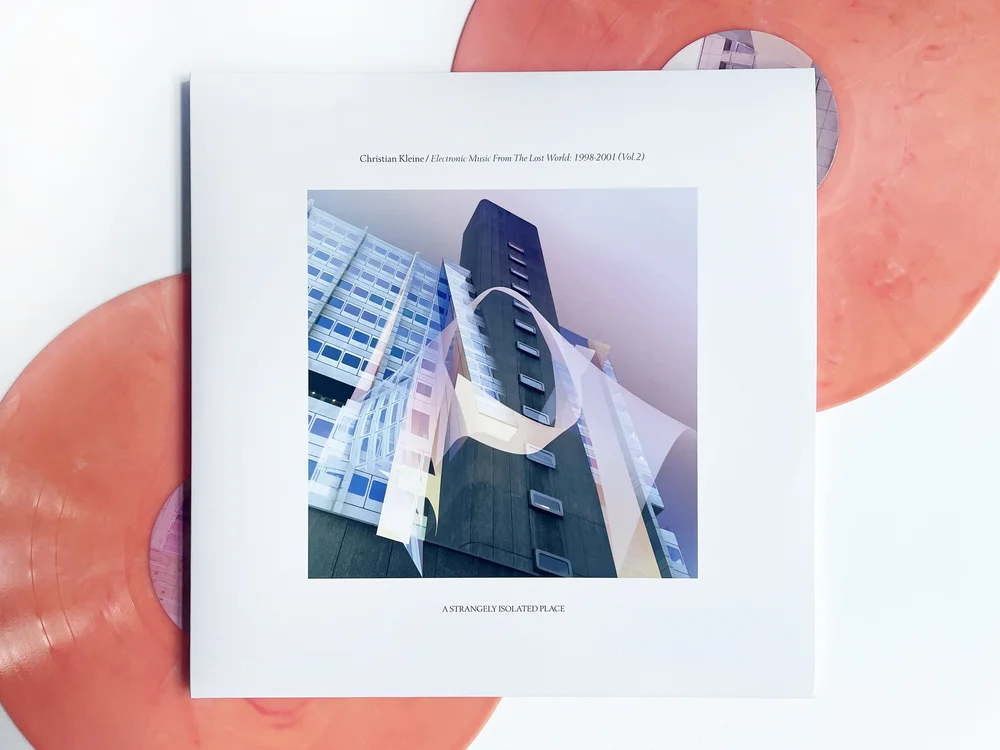

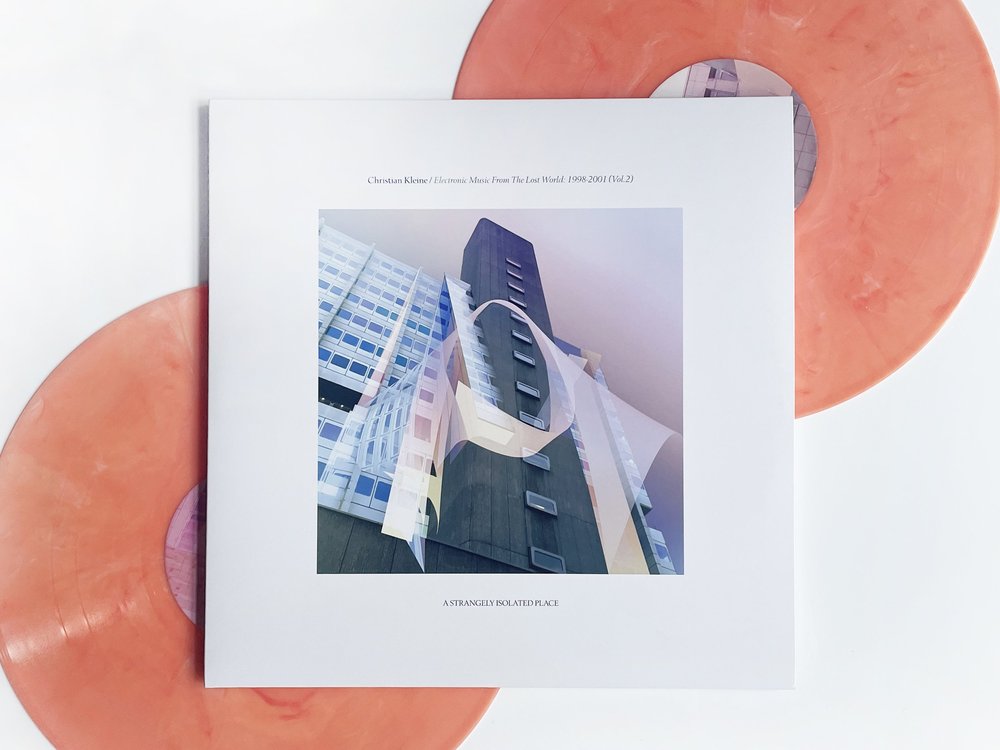
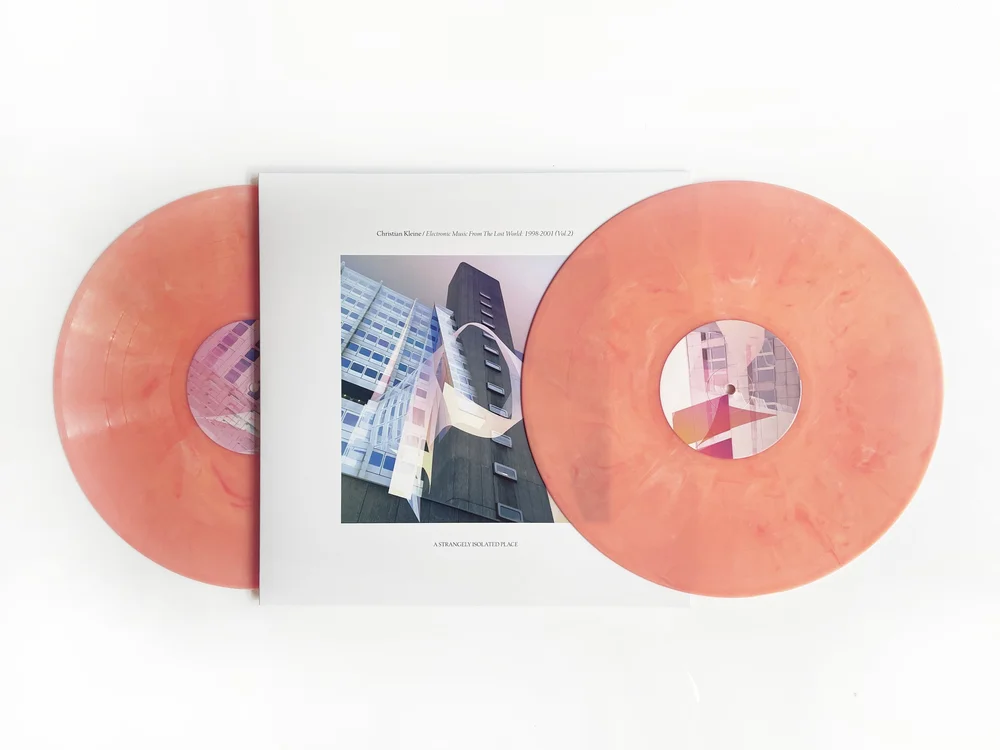

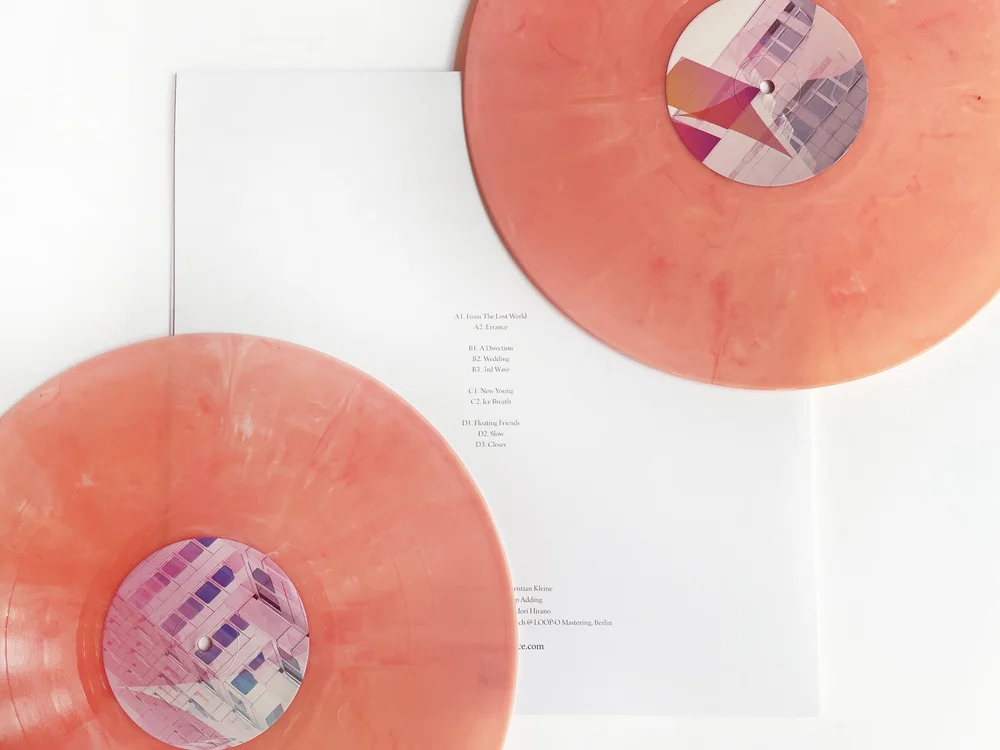


Christian Kleine continues to unearth long-lost transmissions with Electronic Music From The Lost World: Vol.2 - another batch of pristine artifacts from his personal DAT archive. Much like its predecessor, this release serves as both a time capsule and a reminder of Kleine's effortless blend of melodic warmth, intricate rhythm programming, punk influences, and a deep-rooted love for the fringes of electronica.
Where Vol.1 felt like an invitation back to the late '90s, a time when IDM was still an evolving conversation, this second volume extends the dialogue, revealing more of the sonic experiments and fully-formed pieces that never saw the light of day. Tracks recall specific moments from Kleine's time living in Berlin, an era of minimal comforts but maximal creativity, where all that really mattered was that the PowerPC, sampler, and synths kept running. This period of introspection, coupled with the musical freedom afforded by cheap rent and late-night school classes, shaped the deeply personal and solitary sound of these recordings.
Visually, Vol 2 shares its origins with the first volume, as Midori Hirano's stark Berlin photography forms the foundation, and Noah M / Keep Adding pushes the imagery into a brighter, more reflective final space. Final touches remain in familiar hands, with LOOP-O on mastering and lacquer duties, bringing new life to Christian's OG DAT recordings.
And much like the classic City Centre Offices era that shaped this sound and Kleine's early career, this release nods to that legacy. A special limited 7" EP with two bonus tracks, designed in tribute to CCO's iconic DIY aesthetic, will be available on release day direct from the label's Bandcamp.
Electronic Music From The Lost World: 1998-2001 (Vol.2), will be available on marbled pink gatefold 2LP on April 18th 2025.
isolatedmix 130 - Anatolian Weapons [ 29-Mar-25 8:24pm ]
Whether under his Dream Weapons or Fantastikoi Hxoi aliases or more his more extensive output as Anatolian Weapons, Aggelos' output is one to get lost in, where each project feels like a conversation between worlds that don't usually meet. As Anatolian Weapons, that conversation comes into sharper focus: what began as an experiment in bridging the sharper edges of EBM and krautrock with the circular, percussive energy of Greek folk music has turned into a fully formed and consistent thread through his output of EPs and albums.
One of his first full-lengths as Anatolian Weapons arrived via the legendary Tim Sweeney's Beats In Space label back in 2019 - a move that pulled ancient melodies into unfamiliar territory and a statement piece at the time. Since then, Aggelos has gone on to release on labels as varied as Emotional Response, Transmigration and Sound Metaphors along with more techno-oriented homes such as Dekmantel and Kalahari Oyster Cult.
Fast forward to 2024's album, Beyond, and that sense of push and pull is still present, only now with more intent and confidence. It's music that leans into repetition and rhythm without losing sight of where it came from. Aggelos also has an innate ability to find some really addictive hooks in his music, too (for example, I used this voice texture as a loop in my Monument mix, which I absolutely adore).
Aggelos' isolatedmix feels like a natural continuation and culmination of his complex yet harmonious style. There's no strict mood or genre at play, but rather a slow reveal, drawing on the same tensions and textures that have defined Baltas' path so far. It's a pleasure to have him contribute with such a dreamy trip through the many facets of his influences.
~
I see you describe your sound as 'progressive folk and psych'. Can you expand on this a little?
'Progressive Folk And Psych From Freece' is a 3-part mix compilation showcasing my influences as Fantastikoi Hxoi. The Fantastikoi Hxoi albums brought me to the attention of selectors like Lena Willikens, who used to play tracks from that era (2009-2011). The sound is something between space rock, kraut, folk, and progressive with electronics. The Dream Weapons moniker is reserved for more techno-oriented sounds while Anatolian Weapons is moving towards world music influences with driving beats.

One of your first albums came about for Tim Sweeney's esteemed Beats In Space label - how did that happen?
There had been two Fantastikoi Hxoi releases before that, and I had just started the Anataloian Weapons project. Again, Lena Willikens played an unreleased track on her Beats In Space and I contacted Tim to let him know about the ID. He seemed interested, and my collaboration with local folk musician Seirios Savvaidis was born. I love his work, and I'm very lucky and humbled to have worked with him on the album, which did well.
Can you tell us a little about your approach to some of the many remixes and edits you create and why you enjoy producing them?
It is very fun to collaborate with people I admire, and re-editing is something that I enjoy immensely, even if it's just a good pitch-down of a track. I love re-contextualizing and juxtapositions of different genres. It all comes down to the inspiration I get from fellow artists or my musical heroes of the past. I have just released an edit compilation called 'The Whiteout Edits' a couple of days ago and I am working closely with Sound Metaphors on the remix front as well as on original material.
It seems you also enjoy experimenting more by releasing through EPs versus albums - is that intentional? Is that a way to create more regular approaches to your sound?
It all comes down to requests, really, and the dynamics of each label. I feel very lucky to have worked in album format with BIS as well as Subject To Restrictions, a label that feels like home nowadays. Dominik Andre has a flawless instinct for A&R and a great ear.
STR is surely a label worth checking out. Apart from the two brother albums 'Earth' and 'Beyond' I also did mixing and additional production on my good friend Anna Vs June in her album 'Ersi', the album and her musical world are extraordinary - also worth checking out.
One of my favorite tracks of yours is 'Lets Talk' on the Mantil EP - and I think this does a great job of capturing your sound. For anyone new to you, which records would you point them to first?
Thank you. I'm glad you like it; it's much appreciated.
I'd say 'A Strange Light From The East EP' or 'The Black Sea EP' on Lurid music would encapsulate the Anatolian Weapons sound, whether it is dubbed out excursion of African library music or druggy downtempo. My mix for Tim Sweeney's Beats In Space and Lena Willikens Lightning Conductor on NTS can show exactly how I like my music to sound when I play out, along maybe with the Sameheads mixed tape called 'Palace Of Imagination'.
As a producer from Greece, what are the opportunities and challenges you face there? From my limited knowledge, it must be very hard to form a community, given how extensive the country is across islands, etc. Are you active in any local scene?
I have been playing in numerous spots in Athens throughout the years with many local and international acts, as well as keeping my 20-year residency at Astron Bar (now in a new building with a capacity of 300).
The scene is getting stronger day by day, and there are a lot of talented people creating music and throwing parties. The friends whom I have shared decks with would be too many to mention,
I enjoyed opening a gig for Polygonia / Kangding Ray / Wata Igarashi along with Nausicaa from Revolt! who also runs an excellent record shop. So yes, I think the scene here is at an all-time high with a knowledgeable and heady crowd supporting what truly deserves the support.
How has your sound impacted the tracks chosen in this mix? Was there a concept behind the mix? Can you list any tracks included in the mix?
The mix showcases my taste on the ambient/ downtempo side with a couple of tracks from Gus Till, whose output I love, some local stuff, plus the original mix of The Light At The End, a huge favorite of mine by Zen Paradox from his first CD-r release.
I also have the honor of remixing it with two new versions - the vinyl will be out on Transmigration very soon. If the music is deep, contemplative, melancholic, and melodic, with a touch of light for good measure, it will probably be up my street. Two tracks that almost made it in the mix are Kay Nakayama's 'Free Your Mind (Light Side Mix)' and 'Loading To Airport'.

What else can we expect to hear from you soon?
I just released 'The Whiteout Edits' on Bandcamp, there is a split on Dalmata Daniel with The Spy coming soon on 10'' lathe, the Zen Paradox remix EP on Transmigration, remixes for Arvin Fajar and Talking Machine (digital only) an album on Byrd out (digital only) plus original material on Sound Metaphors Also a lot of new edits on Bandcamp so watch that space!
We rarely sleep around here.
~
astrangelyisolatedplace · isolatedmix 130 - Anatolian WeaponsListen on Soundcloud the ASIP Podcast or the 9128.live iOS and Android app
(No tracklist on this one I'm afraid but quite a few tracks mentioned above)
The Feelies / Died Pretty
ULU, London
Melody Maker, November 29 1986


The Feelies
The Good Earth
Melody Maker, September 27 1986

And the answer is.... no.
Until today, in fact.
Crazy Rhythms, I like rather more. But it's a pretty pared-down pleasure.
The self-effacing austerity of this kind of thing - its un-Iggyness - is why I never really got with the college rock program.
Songs from Crazy Rhythms are used well in this cool cult film Smithereens though
In particular, the tentative, slowly-accelerating intro instrumental part of "Loveless Love" becomes a recurring mood-setting leitmotif of the whole picture
Heard in this context, I'm Feelies-ing it more and more...
Archive Fever [ 29-Mar-25 7:16am ]

Looking up an old tutor of mine who had impressed me, to see if his spoor of publications was distinguished in the field, I came across a lengthy tribute to a different professor - one I had not been engaged by nor vice versa of that I am sure. And popping out of this obituary, there was the surprise of an early appearance, decades before Derrida's book, of the phrase "archive fever".
Does this mean the expression has a long if obscure history in English? (It is after all only the translator's rendering of Jacquey's mal d'archive which literally means either / both "illness of the archive" and "in need of the archive" - craving the archive, crazed from too long in the archive.
Ironic too that one of his students that he most likely would have seen as least likely to become a historian, did in fact become a historian, of sorts - poring over not manorial inheritance documents of the Middle Ages but old music papers. A victim of archive fever in his own right, or write..
But wait... the mystery deepens... by chance, reading, finally Borges's short story "The Library of Babel", I stumble on the phrase "feverish library"


But it is rendered as a quotation.... now is it in fact a quotation, a real one, or just a fictitious one that Borges pretend-cites?
The passage is much quoted on the internet but always attributed to Borges not to its "source" (if one even exists)
The Borges story dates to the early 1940s.
Back to Jones, my old tutor (RIP).
No, he was not one of my favorites, A rather dry, dried-out, slightly tetchy fellow... who evidently found it a chore to have to sit through our execrable essays - in my case, always written at the last minute, in an all-nighter, so that during the tutorial I would be struggling to stay awake... my efforts did have the benefit of being short, brisk, and relatively stylishly written, unlike the offerings twice as long droned out by my fellow students... but Jonesy seemed to give more credence and respect to the dronework, since it evidenced a dogged diligence. Clearly he dearly wished to be back in his beloved archives, poring over primary sources, inhaling their sickly must, like the characters Friedrich N warned about in The Uses and Abuses Of History.
So it was with an unseemly amusement that I noticed that nearing the end of his eulogy, the scholarly colleague of Jones admitted, more or less, that Jones's grand opus on the Italian city-state was a dense, barely-readable affair, the work of someone who had succumbed to archive fever but not known how to conquer it or prevent it from rendering the resulting history unnavigable


But I take this not so much as spur to schadenfreude as a warning - a kind of memento mori even - that any kind of writing will sooner rather than later grow useless to later generations, outmoded, exposed, and just simply gathering dusty irrelevance with each passing decade.
Writing, then - like research - is only worth doing for the fever itself.


I saw that American family sitting glumly in the tea room area of the farm shop the other day. Although the dad may actually be a Brit - he's got one of those grating in-between accents. Passing their table on the way to my favorite nook, I heard him muttering disagreeably about the deficiencies of the bagel that lay forlornly half eaten on his plate. Honestly, anyone with a pinch of sense wouldn't order a bagel in that kind of place. A scone, a granary bap, a nice white roll, a flapjack…
They do seem a downcast bunch. But I suppose having to move, lock, stock and barrel, in such a hurry... I really ought to make more concerted efforts to integrate them into the community, such as it is. But they don't look the sort to be making jams or cheese straws for the church fete.
On to other matters....
Well, the big news in the parish is a new album by Position Normal - Modern & Unique 2.

It is indescribably good. Which I mean literally - I can't describe it.
All the quaint creaky crinkled quirkily chuneful qualities of classic Poz Normal (Stop Your Nonsense, Goodly Time etc) meshed with the unmistakably digital-now. A sort of hyper-brite murk, cobwebbed with glinty glitches.
I say that but looking at the press release, the sound palette is all acoustic and electronic, barely digital at all! And there's material, or constituents at least, in there that allegedly date back to the late '80s. Pre-Bugger Sod.
It's a headscratcher
Release irrationale:
All lyrics and stories written and performed by John Cushway. Instruments played here:. Piano (a real one and a software one). Guitars: Aria Pro 2, Yamaha acoustic, electric Italia Maranello, Double Bass, Congas, Bongos, Tambourine (wooden), Shakers (one egg shaped, the others are all made to look like fruit and vegetables). And synths.
2 samples though. One of a dog barking twice and a drum and bass sample from a 90's D&B Sample CD on the last hidden secret bonus track Techno Non-Stop (Party Party Drugs).
This whole album spans from the late 80's to now.
Recorded onto VHS.
credits
Music: Chris Bailiff
Lyrics: John Cushway
A bonus track not on the album
Oh and look here - a movie about or involving Position Normal
^^^^^^^^^^^^^^^^^^^^^^^^^
Activity from the village elders!
Including posthumous activity... which I suppose is pretty ghostological if you think about it.
Now I remember as a boy cycling past Pendley Manor and slowing to a near-wobble as the big lawn came into view - goggling at the contorted calisthenics cavorted by what looked like naked or nearly-naked figures. Turns out this was the dance troupe of Ernest Berk, an avant-gardist in exile, whose radical choreography was accompanied by equally radical electronic music for movement composed by his good self.
Trunk already issued a chunk of this stuff (Electronic Music for Two Ballets) but somehow I missed the heaping double-CD portions of Berktronica that came out last year via the Huddersfield Contemporary Records label:

Release irrationale:
This double CD represents the first substantial publication of the electronic music of Ernest Berk. Only two works from his catalogue of over 228 pieces were published during his lifetime in the early 1970s. Following the collapse of the Historisches Archiv der Stadt Köln in 2009 it was generally thought that all materials were lost. The project team comprising Prof Monty Adkins, Dr Sam Gillies and Ian Helliwell have managed to source early digitisations of some of the master tapes from Martin Kohler (who was a PhD candidate at the time) as well as other sources across Europe. The project team have then selected 18 representative tracks from Berk's oeuvre composed between 1957-1984. They have then worked with Dr Richard Scott and Jos Smolders to digitally remaster these works for this release. The CD features a bespoke cover design by Ian Helliwell and has been produced by Monty Adkins. Extensive liner notes about Berk's work have been written by Adkins, Gillies, and Helliwell.


An older post on Berk and Berktronica
BBC documentary with a section on Berk in his prime - the dancing and the sound-shape-making
His (ex)-wife Lotte seems to have been quite a freeethinker herself
Jack Dangers at Electronic Sound on Berk's solitary and incredibly rare release during his lifetime - and stuff on his life and Lotte.


More electronic ballet music from the venerable and (like Berk) long-no-longer-with-us Daphne Oram - Beauty and the Beast, a collaboration with the composer Thea Musgrave, made for the Scottish Theatre Ballet in 1969. Released with minimal fanfare only days ago. You don't seem to be able to buy it in solid or immaterial form anywhere - but it's out there on the streamers and YouTube.
Clangers-tastic stuff.
Standard Music Library seem to be putting out a bunch of vintage stuff, some of it a bit 80's and hyperbright, but some fine work by familiar names like Brian Hodgson, such as this spacy 1975 effort Encore Electronic, a collaboration - or perhaps simple adjacence of compatible works - with a less-familiar name, Reginald J. Lewis.

^^^^^^^^^^^^^^^^^^^^^^^^^^^^^^^^^^^^
Younger elders, if that makes sense - a rare sighting of... but I'm sworn to secrecy. Or rather charged with the challenging duty of alerting without revealing. Let's just say, if you ever h.arked to the waftings of A.R.Kane's fellow-travelers and sprite-children, give a glisten to these emissions from melody snakes. Not really "hauntology" but the next parish over, yet certain to trigger ghostly tremors in the memoradelic sector of the brain for some of us.
^^^^^^^^^^^^^^^^^^^^^^^^^^^^^^^^^^^^
A missive from our Canadian twin town East Gwillimbury!
Tony Price alerts us to his latest project, Requiem For The Ontario Science Centre - self-released on Maximum Exposure and described as "a sonic eulogy to my favourite work of art: The recently shuttered Ontario Science Centre in Toronto, a world-renowned brutalist architectural wonder designed by Canadian architect Raymond Moriyama as a centennial project for Canada. It is a stunning landmark that is largely representative of the post-war utopian outlook that permeated through Canadian culture in the 1960s. Last summer, the Conservative Government of Ontario announced its abrupt, unexpected and controversial closure, a decision that was supposedly based on an engineer's report warning of a small percentage of roof panels at risk of collapse after decades of neglect.
"Musically, this record is almost entirely made up of synthesizers and saxophones, played by Toronto avant-garde saxophonist, Colin Fisher. If I had to throw you an elevator pitch I would say it sits somewhere between Terry Riley, Fripp & Eno, Boards of Canada and Don Cherry's "Brown Rice"."
Neat parameters and it does actually fall squarely into that quadrangle
The inspirational touchstone and monument to bygone utopianism


God bless and protect Canada and the Canadian people!
^^^^^^^^^^^^^^^^^^^^^^^^^^^^
From our Italian twin town Potenza Piscene...
Fast approaching their tenth anniversary of operation, Artetetra (have we reached 6th World Music yet?) release the evocatively titled Crepuscular Elixirs by the German-Finnish outfit Grykë Pyje in just a few weeks time. You can hear most of it already here.

release irrationale:
It has been six years since Grykë Pyje (forest ravine in Albanian) stretched out their high sensitivity feelers for the first time into the greatest of outdoors to bring us fascinating, multilayered soundscapes and introduce audiences to their signature, crystal-clear fifth-world compositions. Working on the idea of using music as a way to pierce the fabric of myths from yonder thanks to a wide array of synthesis, sound superimpositions, patchworking and manipulations, blending hazy shards of experience and imagination, in their fourth LP, "Crepuscular Elixirs", Grykë Pyje spins further adrift from its previous works, trying to increase the level of intricacy.
If recent experiments engaged with the sonification of sacred herbariums and the reimagining of chants and myths from the animal kingdom, for the brewing of their latest musical potion, tracks were built around skew and Oddly-hypnotic resemblances of grooves dodging well-trodden patterns. These bumping and stumbling primal rhythms pervading the album were inspired by the inconsistent pulse and timbrical variety of animal noises: a hammering woodpecker, croaks and ribbits from frogs or the scraping of ants at work. Rhythmic backbones were used as free territory to imagine the entire and alien world around the sounds of this pseudo-fauna.
Indeed Crepuscular Elixirs is an apt title for this bizarre conflation of fiction and natural science, magical miniaturism and microscopic realism. With its bizarre world of supernatural charlatans, hazy incantations and invisible accesses to an impossible bestiary, Grykë Pyje creates sixteen tracks of pure audio alchemy where it's impossible to retrace the songs' various layers, rather compelling one to listen to the compositions as a moving thing in its whole. Sounds lift up one another creating texture, mimesis and confusion, incredibly entangled, blurring the line between transmutation and sonic manipulation.
With Crepuscular Elixirs, the duo's organico-mineral soundscape is sharper and more detailed than ever before. A type of listening requiring allure and curiosity, but that repays with a seemingly endless rediscovery and wonder. Now let this seemingly alive bag of sonic illusions open a new chapter in the excitingly chaotic, fantastic world of Grykë Pyje!
"Potion Seller, I am going into battle and I need your strongest potions."
"My potions are too strong for you, traveler."
^^^^^^^^^^^^^^^^^^^^^^^^^^^^^^^^^
Here's a recent-ish mix made by Luke J. Murray aka Stonecirclesampler for The Wire.
"The mix is a hauntological blend of washed out ambient, dub and grime, threaded together with samples from horror films and TV."
Tracklist
Travis Elborough & Stonecirclesampler "Stonecirclesampler Hauntology Primer (Intro)"
Stonecirclesampler "Television Of The Stones (Rainfall version)"
Liquid DNB-like Ambient Grime 2 "Forthcoming Untitled Ambient Grime Dub 12" (Old Grime White Label Wire mix version)"
Stonecirclesampler "The Stone Tape (Wire mix edit)"
Stonecirclesampler "A Drift In Seaburgh (Wire mix edit)"
Rainfall Widens The Cracks In The Concrete "After Dark (Stonecirclesampler version)"
Stonecirclesampler "Memorex Dub (The End Of Techno instrumental edit)"
Old Grime White Label "Forthcoming Untitled B-side (Superior London Pulp edit)"
Stonecirclesampler "The Drift VIP"
Stonecirclesampler "Save The Stones! (Deep Dream Ambient Grime mix)"
Stonecirclesampler "Megalithic Grime Radio Documentary (28 Stonecircle Wire mix version)"
Old Grime White Label "Unknown (Stonecirclesampler A303 Acid rebuild)"
Stonecirclesampler "Megalithic Grime VIP (Stonecirclesampler Wire mix version)"
Liquid DNB-like Ambient Grime 2 "Forthcoming Untitled 4x4 Grime Techno 12" A-side (Stonecirclesampler Rainfall VIP)"
Old Grime White Label "After Leaving The Cliff Overlooking The Pacific Ocean, Rainfall Began To Fall Silently On The Car Roof (Travis Elborough & Stonecirclesampler version)"
Stonecirclesampler "Save The Stones! (Rainfall Widens The Cracks In The Concrete Slowed Down VIP)"
Superior London Pulp "The Real Occults In The Pubs Of The East End (Wire mix acid edit)"
Old Grime White Label "Untitled 2010 Techno (Travis Elborough & Stonecirclesampler Fourth Dimension version)"
Stonecirclesampler "Haunted Goth Ambient Grime (Breakbeat mix)"
Stonecirclesampler "After The Ice Age (Frozen Grime mix)"
Stonecirclesampler "Penda's Fen (Wire mix edit)"
Superior London Pulp "The Green Man Inn (Old Grime White Label's Ambient version)"
Travis Elborough & Stonecirclesampler "Ghost In The Water (DISMAL edit)"
Superior London Pulp "Maybe A Door Will Open Somewhere (Travis Elborough & Stonecirclesampler Haunted mix)"
Stonecirclesampler "Deep Dream Derbyshire Gloom (Liquid DNB-like Ambient Grime 2 Dub)"
Old Grime White Label "Rainfall Falls Silently On Concrete Rooftops (Ambient Grime edit)"
Stonecirclesampler "A Bygone Age (Rainfall version)"
Travis Elborough & Stonecirclesampler "Shivers Of Weird Landmarks, The Time Is Out Of Joint (Outro)"
^^^^^^^^^^^^^^^^^^^^^^^^^^^^^^^^^^^

Release irrationale:
Overspill Estates EP is a new four track EP from Warrington-Runcorn New Town Development Plan, which delves back into the Your Community Hub sessions to uncover some gems that had been forced off the album.
Gordon Chapman-Fox, the genius behind WRNTDP says "I'd worked on these tracks for the best part of a year, and, in my mind, they were a fundamental part of the whole Your Community Hub project. I was heartbroken when they couldn't make it onto the album, so it's an enormous relief to see them come to life here."
The initial concept for the fifth WRNTDP album was to expand beyond north Cheshire, and dedicate a track to some of Britain's other New Towns. Being part of the project from early on, these four tracks were dedicated to Basildon, Cwmbran, Redditch and Harlow. To give an idea on how long these things can take to gestate, the opening track "The People Of The Town was performed at the End Of The Road Festival in 2022.
The album cover is an image from the half-modernist, half-mock Tudor houses that were built in Birchwood, Warrington in some of the last large scale building projects that were part of the New Towns.
^^^^^^^^^^^^^^^^^^^^^^^^^^^^^
Why now, I wondered?
Then suddenly it occurred to me that - instead of monumentally tardy, it might in fact be topical and even jumping the gun ever so slightly. For later on this year... it'll be the 20th Anniversary of Hauntology... if not as an emergent sound-zone (you could date that to 1999/1998 - Stop Your Nonsense, Music Has A Right To Children) then as a christened phenomenon...
Some sneaky snaps I took hastily, furtively, while in the village newsagents.


