
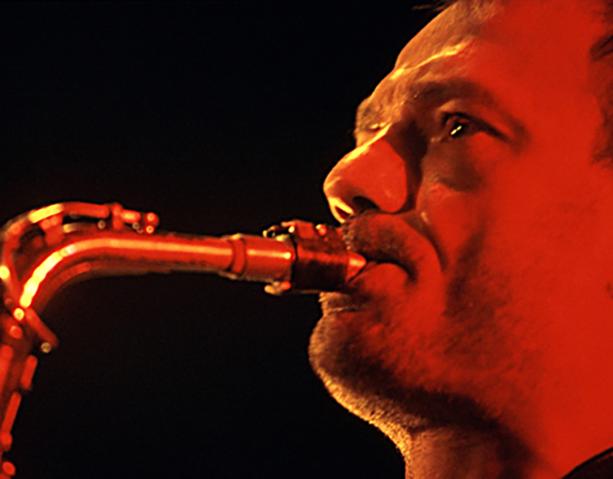
In The Wire 503/504, Seymour Wright appraises the hardcore saxophony of French musician Jean-Luc Guionnet
Jean-Luc Guionnet
Per Sona
Empty Editions DL/LP
L'Épaisseur De L'Air Live
Potlatch CD/DL
French multi-instrumentalist, composer, philosopher and visual artist Jean-Luc Guionnet has been a globally influential figure for several generations of creative peers. He is also one of the great living saxophonists, with an alto voice that uniquely consolidates strands of the instrument's sonic and conceptual history into something powerfully distinct, rigorous, instantly recognisable and future-fit.
In 2021, after 30 odd years of solo performance, he released his first full-length alto saxophone solo recording on Los Angeles label Thin Wrist. Recorded in a semi-open barn in 2018 in Brittany, L'Épaisseur De L'Air (The Thickness Of The Air) was concerned fundamentally with the texture, materiality and ideas of saxophone, sound and space. Here, four years on, are two more solo alto recordings. Though not officially released as a pair, they appeared almost simultaneously. One offers two live realisations of the L'Épaisseur De L'Air material on the French label Potlatch, the other private studio recordings made in Hong Kong and released via Empty Editions.
These sets consolidate Guionnet's voice in documentary form, containing years of situated work. Here, it's possible to hear his playing as the kernel/nexus of a sort of Francophone school of saxophone innovators that includes Daunik Lazro, Christine Abdelnour, Stéphanes Rives, Bertrand Denzler, Patrick Martins, Pierre Borel and Pierre-Antoine Badaroux. It is also possible to find traces of other alto techniques: the M-Base ways of Steve Coleman and Gary Thomas, the lyrical power of Arthur Blythe, the whimper-gnash of Anthony Braxton's Composition 99G, Arthur Jones's Scorpio.
A consistent ambiguity and variety of scale twists, inflates and crushes complex sonic details, dense knots, abrupt nothingnesses across the two discs. Both recordings document astonishingly visceral and cerebral instrument technique, into which musical/philosophical traditions are tied very tight: the saxophone stuff, plus for example study with Iannis Xenakis, workshops with Don Cherry, deep engagement with philosophy (a dialogue with tools in the ideas of Gilbert Simondon in particular feels at the tip of saxophone-homunculic fingers and tongue), mark-making and lines - are all in here, bound up with haptic ways of getting at, and beyond, the saxophone as technology, or back, via bagpipes and other ancient breathed-into, manually worked tools of transformation.
Dedicated to Miguel Garcia, L'Épaisseur De L'Air Live includes two longish in concert solos recorded in Montreuil, in the eastern suburbs of Paris - the first in summer 2024, the second in winter 2023. The alto saxophone fizzes, furry, flinty, furied, fuzzy, hard and soft, large and small sounds accruing and decaying in and out of phase with the force and stress Guionnet applies. The Parisian ghost fuel of the saxophone - from Adolphe Sax's speculative patent to Lester Young's memory palace (and absinthe) - are part of the air through which he forces his ideas, via the horn, into the ears of his listeners.
The longer first piece evolves episodically, in slabs, trickles and eruptions/implosions of ideas as sound that grow, decay and grow again as mouldy blooms, alto alliums of bulbous, pungent forces that sizzle and linger. The heavy, hot sonic reactions that begin the second shorter piece collapse into a long dusty tail of embers. The liveness is salient - we can hear the rooms, the other people there, making and listening, the world in this music.
Per Sona presents 11 exquisite studio solos recorded in Hong Kong, all of them short - between 90 seconds and seven minutes, almost miniature études. These are close, detailed recordings of close, detailed sounds: pied sounds that contain pockets and layers of different types of sonic activity, in different places in the saxophone, mouth and ear at once. Rippling sounds made up of multiple bits emerge out of simultaneous interactions and qualities of the saxophone qua machine. The first piece is a series of giant ascending blocks of complex sonic chunks; the second a cloud-cypselae, blown almost ney-like across reed/mouthpiece tip; the third a columella of growl about which the piece spirals. Sounds of skeleton-feathered lichens ripple in the final track's nutty sonic butter - halfway in, a gargle ends with spat-breath of husk.
In accompanying notes, Guionnet writes, tellingly, of the saxophone, "It was invented; invent music for it in return; always remember that when it falls, its fall does not sound like a saxophone. If it happened to fall, it makes the muffled sound of a ductile metal sheet, or of a bad hardware shop; its body is not sonorous - in which it is a machine; virtually, see by playing it the three dimensions of the metamorphoses of the air column, under the influence of the action; an unstable regime once grasped, maintain it by going with the wave." This gives a sense of the intellectual and physical stuff of the work at play here. "By whom sounds what?" he concludes, "Through what sounds who? Person/per-sonare or this mask which carries in my place a mask that does not belong to me… nor to it." Per Sona is an amplifier, definer and representer of character, identity.
Utterly hardcore and grown up in its humble enquiry and challenge, this is essential 21st century saxophony.
This review appears in The Wire 503/504 along with many other reviews of new and recent records, books, films, festivals and more. To read them all, pick up a copy of the magazine in our online shop. Wire subscribers can also read the issue in our online magazine library.
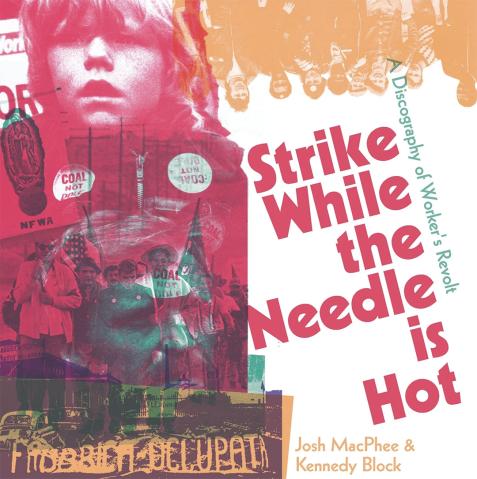
In an extract from his new book, co-authored with Kennedy Block, Josh MacPhee outlines the role of workers' songs and the making of records in supporting labour movements in the US
If producing a record is a tactic, and winning a strike is the goal, then what is the strategy? From studying these records, it's clear that the hopes for them are sometimes singular, other times multiple, often overlapping, and almost always clearly understood and articulated by the workers and unions.The records more often than not speak for themselves when you listen to them, but as most are quite hard to find, or in languages many of us don't speak, it's worth trying to lay out some of the intentions for the vinyl here.
There are two dominant reasons these records are produced: first, to raise public awareness of a strike, and second, to raise money to support the strike (and the strikers, who are by definition out of work and not being paid) - this latter reason is particularly acute for the wildcat strikes, where workers are not getting any support from an official union strike fund. That said, there are plethora of other intentions you can find for these records: to document a struggle after the fact, ie, a "proof of existence"; to build capacity amongst the workers and their supporters - for example, learning how to work together, organising and accomplishing increasingly complex projects, etc; as an extension of this, to build confidence amongst workers by creating "permanent" documents of their struggle; to use as a tool to connect to other workers, often in different industries but facing similar macro economic pressures; and to reach audiences that might not read a pamphlet or a long-format political treatise, but are more than happy to pick up a record they might enjoy.
A handful of records even come out of the practice of militant research, developed by the Facing Reality group in Detroit in the 1940s and 50s, then lifted up and expanded on by autonomous Marxists in Italy in the 1960s. The idea is simple: rather than prioritising academic pursuits by outsiders, workers know their workplaces best, and can participate in the study of their own struggles, and learn from similar studies by workers in other struggles.
While the music and production of these records is surprisingly eclectic, there are some things most have in common. As we'll see, if workers' action produces a record, it is almost always a 7″ single, either because the strike committee doesn't have the resources to produce something of a larger scope, or simply because most strikes don't last long enough to collect material to fill a full LP. The length of a 7″ single is roughly a third of an LP, and its packaging half the size and a fraction of the cost, and thus demands fewer resources to produce. In the pop music market, many singles were released in blank white sleeves, or with "company" sleeves that advertised the record label rather than the specific release. You'll find few of these here. Even if the format was small in stature, it was taken full advantage of. Almost all strike records came in picture sleeves, and many in gatefold sleeves - a double wide cover folded in half, giving the workers/union/solidarity committee twice the space to share information about the strike. In addition, it was not uncommon for the records to have additional information slotted into the sleeves: lyric sheets for sing-alongs, petitions to sign, even some oversized posters which could be hung up in apartments, or brought out to a picket line.
These documents are likely as illustrative of a particular struggle as any union newspaper or pamphlet, and sadly haven't been given their due importance in research on worker organisation. That said, this publication is at best a cursory overview of the field, a road-map to where we might look and dig deeper in the future. I'm interested in the use of vinyl records as a form of agitprop - as can be exhaustively seen in my previously produced An Encyclopedia of Political Record Labels. The effects of my fetish for vinyl shouldn't be understated. Beginning in the late 1970s, and gaining serious steam by mid 1980s, the cassette became a much cheaper and more versatile tool for political organising.
If we had included cassettes and CDs here, the size of this book might have doubled, at least. Both formats are much easier to produce than vinyl, and much cheaper, especially in smaller runs. There are likely many, many homemade cassettes created by workers' strike committees that weren't distributed beyond the picket line. I've been able to find a half dozen without really spending much time looking. But what little research I've done has made it clear that a focus on cassettes and CDs is really another project altogether, and I stand by the decision to use vinyl as a curatorial tool here. Ideally someone else will pick up the thread and follow up with a deep dive into worker-produced cassettes and CDs. But for me, and in this book, the vinyl record functions as both a marker of financial investment and a commitment to mass distribution.
Co-editor Kennedy Block and I propose there are several ways to read this book. To look at any particular entry drops you into a specific strike, more than likely a fight that has been forgotten, at least by those who weren't active participants. Like the records themselves, the entries are modest time capsules, historical markers of punctuated class struggle. But when taken together, they tell a larger story, one of an arc of global conflict, of the gains of workers in the 1960s and 70s, and the re-entrenchment of capital in the '80s. We see fights for wages, shorter hours, and even worker ownership and control eclipsed by increasingly immiserated demands for factories not to shutter and pits not to close.
It's a little brutal to listen to - in recorded real time - utopia slide into desperation, to see how neoliberalism stomped on the neck of hope for meaningful and fulfilling work, replacing it with a panicked need of workers to keep a roof over their heads. It is likely no coincidence that the tectonic shifts towards neoliberalism in workers' perceptions of what their struggles could accomplish appear to run parallel to another big shift, this one sonic. The earliest records you'll find in this book tend towards sounding like direct decendents of old left workers' choruses with their martial songs and anthems (a couple even include a version of "l'Internationale"). Over the course of the 1970s we see a shift towards the inclusion of more pop idioms into the music, first in the form of folk, and then rock, reggae, and finally hiphop (or at least pop rap). While on the surface this may seem a natural progression, it exposes a much deeper and more complex process at work.
While the labour music of the 19th and early 20th century might not be the most exciting to our contemporary ears, it developed out of generations of working class organisation, both in the workplace but also the community. Songs such as "l'Internationale" and "The Red Flag" weren't just sung on picket lines, but in union halls, at pubs, worker's funerals, and solidarity marches. As there was little class mobility in the world, children would learn the songs from their parents, and in turn pass them down to their kids. So the shift towards pop music (primarily Anglophone pop) was not simply a stylistic one, but a shift in relationship to the songs themselves. Labour songs are a social form, to be performed and listened to in a community context. Pop music is a commodity, to be sold to individuals, who develop personal relationships to the music.
This is likely why some of the later records come off as strange, or even worse, completely corny. The records fail musically, as well as fail to give voice to any sense of a coherent working class. And this was one of the projects of neoliberalism, the bio-political replacement of any sense of collective working class identity with the atomised consciousness of individual consumers. We're not labour historians, but hope something can be learned from the stories these records tell us.
The last 15 years have seen a huge upswing in militant labour organising in the United States, from the Republic Windows and Doors occupation in Chicago in 2008 to the huge gains made by domestic workers across the country (such as the rise of Domestic Workers United and their successful fight to pass a New York State Domestic Workers Bill of Rights in 2010), to the increasingly successful campaigns to organise workplaces like Starbucks (Starbucks Workers United) and Amazon (Amazon Labor Union, affiliated with the Teamsters). Music and audio documentation haven't been a memorable part of these struggles so far, but in the social media-dominated attention economy we live in, it doesn't take much to imagine how music could play a larger role in publicising worker action and encouraging broad support. But even if we set aside these larger promotional concerns for a moment, the records in this book exude the sheer joy of workers singing and marching together, fusing solidarity, and taking their lives into their own hands.
This is an edited extract from the introduction of Strike While the Needle Is Hot: A Discography of Workers' Revolt by Josh MacPhee & Kennedy Block, published by Common Notions Press.
You can read Dave Mandl's review of the book in The Wire 503/504. Pick up a copy of the magazine in our online shop. Subscribers can also read the review and the entire issue online via the digital library.
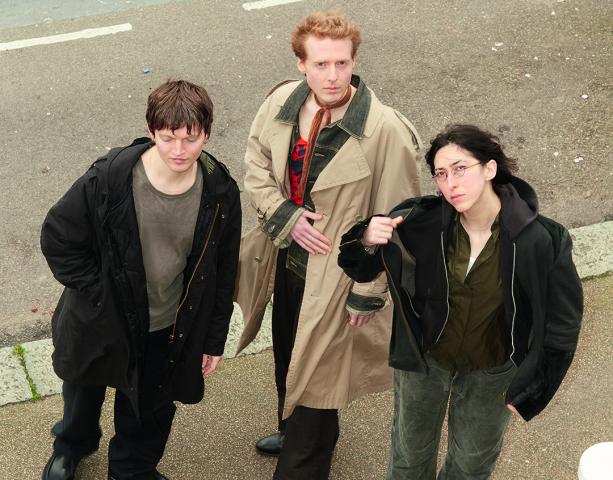
To make sense of ongoing tech revolutions, a new generation of musicians is making music that metabolises electronic processes through analogue forms, argues Ryan Meehan
The progressive music scene turns to the future in a foul mood. It was detectable in the air last October, as the audience gathered for the first of the evening's two sold out Autechre shows at Brooklyn Steel in north Williamsburg. Here, in the omphalos of the newly-minted Commie Corridor was a display of cultural force every bit as robust as the political one which had recently vaulted socialist Zohran Mamdani to the Democratic nomination (and, in short order, the mayoralty). So why, then, as the Rochdale duo took the stage in their preferred semi-darkness, was the atmosphere cut with an unmistakable current of dread? Perhaps it was the uneasy stagecraft of the Gaza truce, still fresh, or the unreconstructed decorum of post-pandemic concertgoers unable to handle their doses (and sometimes their bodily functions). Perhaps it was a suggestion hardwired into the music itself that, outside these walls, there was a vision of the future taking hold (remember the Artificial Intelligence series?) for which we weren't entirely prepared.
Futurists though they remain, the future Autechre first portended is now largely history. Cloned sheep, Clippy the Microsoft assistant, and the like. Their vanguardist rhythms, swinging like sonic battering rams in 4-D, recede into the foundations of the world to come. Instead, as we attain the quarter century, artists are staking out a vital new position within the looming crisis of the digital as it develops in the here and now.
This tendency takes for granted the dynamic and space-bending possibilities of electronic composition, and accepts them not as grounds for abandoning the field, but as a sporting challenge to their own analogue rhythms. At a time when complex computers and their pitchmen lay claim to as much of communicative life as they can, this metabolic tendency in music emerges as one possible response - not theoretical, but organic; not doctrinaire, but instinctively oppositional. If the metabolic coheres as a specific answer, perhaps it's to the question as to why the world has got so weird lately, and what of that weirdness plays back to us in our music.
Weirdness, of course, can be a source of delight. In 2025, few bands were as weirdly delightful onstage as Fievel Is Glauque, the jazz-pop ensemble shifting around the duo of American keyboardist Zach Philips and Belgian vocalist Ma Clément.
The rare progressive band whose precision feels spontaneous and vice versa, FIG's baroque, fleetfooted compositions hit like bursts of sunshine in a funhouse mirror. Core to their sound is a downright algebraic approach to rhythm, massaged across the instrumentation generally, though special plaudits go to recurring bassist Logan Kane and many-handed drummer Gaspard Sicx.
Another provisional quality of metabolism: though its freneticism can seem to dialogue with digitality, the music itself is produced primarily by hand. This isn't mainly a declaration of Luddism (though maybe it is also that) so much as a reclamation of terrain by enfleshed bodies in the production of what makes those bodies move. Nor is it an aesthetic of purity. Fievel's last album, Rong Weicknes (2024), was recorded "live in triplicate", its final tracks spliced together from overlapping takes à la Teo Macero. That the band commits to re-confecting this sound live (and live previews of new material place their upcoming album high among the most anticipated of 2026) emphasises a concern with human, rather than machine potential. With the serene bounce of a surrealist tour guide, Clément sings faster than you can think, her poetry the kind a computer could only spit out by mistake.
In metabolic songcraft, the glitch, long a point of fascination in digital aesthetics, migrates to a motif of human breakdown under the pressures of the mediated grid.
On the left, attention has turned increasingly to passages in Marx regarding capital's potential to develop beyond the resource capacities of earth - what proponents of degrowth call the metabolic rift. In the last decade, art's attempts to encompass climate change as a subject have found themselves stranded - often frustratingly so - in the passive, the local, and the melancholically topical. A crop of new artists on London's AD 93 label has obvious recent antecedents - the fetid Zappa splatter of Geordie Greep's projects, the high watermarks of Tom Skinner's influence within The Smile - but at its most caustic, this pod-born sound suggests an aesthetic rift to measure up to the deep-tissue wrenching of the planetary one underway.
Brooklyn band YHWH Nailgun is the label's latest rising star, porting their youthful current into sludgy contortions that bring to mind images of ceremonial emetics. And while their mixture of propulsive rhythms (courtesy of the reabsorbed kitsch of Sam Pickard's rototoms) and effects-bent melodies recall Braxton-era Battles to this elder millennial ear, that band's use of digital instruments had the flavour of liberation. The Nailgun, by contrast, sound penned in - all but strangled by the imminent cyborg dawn.
For my money, though, the most promising of this corridor of metabolists are Still House Plants, whose incantatory vocal lines and decaying guitar riffs tilt just off-axis over beats whose cracked precision would sound looped if you couldn't see David Kennedy playing them up close and personal.
Irregular tempos and faltering structures seemed designed in advance to resist algorithmic training. As climate politics endures historic setbacks in the West, nascent popular outrage at the AI data centre boom's resource intensity (alongside outcries against music's unique role within the data regime) may provide a previously listless creative counterforce with a potent new metaphor for attack.
Some warriors in this emergent battle are happier than others. A founder of Darkside, one of metabolism's most direct precursors, guitarist Dave Harrington applies the intricate compositional style he first refined beside Nicolas Jaar's minimal post-dub atmospherics to his second band's cheekily analogue arrangement.
Taper's Choice styles itself as a supergroup (just about all of its elements of style are overtly over-styled) looking to supercharge the high-participation jam scene from its progressive fringe. Last year, the ensemble - which includes Real Estate bassist Alex Bleeker, Arc Iris keyboardist Zach Tenorio Miller, and Vampire Weekend drummer Chris Tomson - released their first proper studio album, after a compilation of songs ('concrèted', one imagines, in a method not dissimilar to Fievel's) and a string of - what else? - live tapes. A mixture of balloon bounce and rapid-eye flutter, Prog Hat holds an affinity for the gentle dislocation of 70s jazz fusion. Is it a stretch to compare its supple geometry and bold colour to that other, utopian metabolism, of Tange and Kurokawa? Harrington conducts the marathon-like "Dave Test" with an eye for microstructure, all thrashed into shape by Tomson's relentless stamina. If Taper's swings, it's at a rate your feet must first calculate to catch up to.
Which returns us to Autechre, and the ambiguous future of the human-technology interface, in which music is both figure and ground. A surging appetite for vanguardist rhythms perhaps only awaits the breaking of a figurative dam, the blowing of a metaphorical pipeline, that the metabolic turn can provide. For this generation, it may be that the pessimism of the intellect is a precondition for a renewal of the optimism of the will. Time and again, where democracy elevates a new political regime, its success can depend on the rise of a cultural one in tandem. Will metabolism play such a role? Predictions are a parlour game, but those that clamour for shibboleths of a "left with no future" will at the very least have to dance to the reality shifting beneath our feet, and contend with the eternal truth of Michael Crichton's Jurassic Park - that life finds a way.
You can read more critical reflections on underground music going into 2026 in The Wire 503/504. Wire subscribers can also read the issue in our online magazine library.
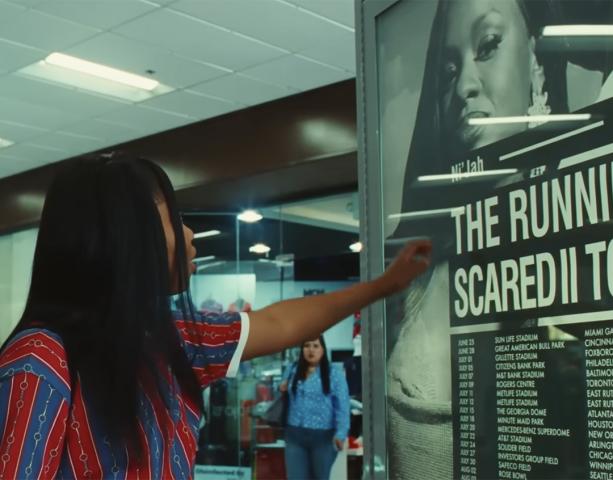
In his latest Secret History of Film Music column, Philip Brophy explores how the signifiers of Black musics in Swarm are fragmented to indicate its main character's psychosis
What does it mean to compose music today? Is composed music a creative act or a procedural action? An original expression or a contextual response? A conceptual performance or an industrial gameplay? And if it is one or the other, how do we perceive it as positive or negative? I'm perennially excited by these notions - especially when a film score sends my head spinning into their interrogative possibilities. Michael Uzowuru's score for the Prime mini-series Swarm (2023) spun my head considerably.
The premise is stark. Dre (Dominque Fishback) is a rabid fan of Ni'jah (a twisted simulacrum of Beyoncé and her Beyhive fanbase). She embarks on a killing spree, targeting people on social media who hate on Ni'jah. Graphically unsettling and tonally diffuse, Dre's picaresque journey turns Dante's Inferno upside down and pumps it full of Black aspirationalism to exploding point. Created by Donald Glover and Janine Nabers (whose previous series Atlanta is a meltdown of Samuel Beckett, Melvin Van Peebles and OutKast), Swarm pulls an even tighter focus on the sociocultural complexities of Black music, here pivoting from the hemmed-in machismo of trap and rap to the goddess hysteria of R&B and pop.
Ni'jah's songs are sung and written by Kirby Lauryen, with selected co-writing and production spread between Glover and Uzowuru, among others. Childish Gambino touches are evident, and all tracks are skilled parodies of digital soul, gushing with stacked harmonies. "Something Like That" collapses digital simulations of vocal cooing with gospel-tinged organs and percussive thrumming a la Kate Bush's ethnographic backings. Kirby's AutoTuned lines layer female and male tones in a heady pansexual mix. "Agatha" harks back to seminal Timbaland productions for the late Aaliyah, awash in slurred breathiness and lo-fi Ngoni licks. "Big World" fuses microhouse and elegant sophistico vocals. The bouncy Vocoder jaunt of "Adventure" conjures a trappy limo party as remembered by college grads. "Hahaha" and "Sticky" are pumped with multi-genre crosswired stylistics, making both hard to characterise.
Scattered across the series's seven episodes in disruptive edits and interrupted passages, these songs point to the magical breath of Ni'jah, who has the mystical power of a Black diva to excite her 'swarm' of fans. But unlike (for example) the soaring positivity of Hollywood's flirtations with Black goddess music - from The Bodyguard (1992) to Glitter (2001) to Sparkle (2012) to Trap (2024) - Swarm posits Ni'jah's songs as a type of 'broken' soul music. The polyglottic gumbo of ballads and anthems for Ni'jah do not shy away from how the spiritual Beyoncés and heartache Kanyes of the world produce music that is stylistically fractured, compositionally kaleidoscopic, digitally processed and authorially aggregate. 'Broken' soul describes equally this technological shift, its marketplace redefinition, and the psycho-therapeutic aspect of how fandom now links to these mystical figures with impossibly affective voices.
At the core of Swarm's broken world is the psychotic character Dre. Dominique Fishback's stellar performance (maddeningly numb and unpredictable) breaks the series's narrative momentum continually, pushing the shared notion of 'serial' story and 'serial' killer into hitherto unexplored territory. Uzowuru's score is a selective rearrangement and reconstitution of the sonic shards of Ni'jah's songs. Sometimes they seem to be literal fragments from the songs, but mostly they are echoes of recognisably similar elements: single sounds from drum machines, single chords from digital keyboards, processed textures of clipped vocal utterances. An aural ouroboros is formed: the score comes from the songs which are studio-composed from the type of sonics of the score. This acousmatic mirage evokes the bond between Ni'jah and Dre - who in the first episode makes it clear: "Ni'jah knows what we're thinking and she gives it a name."
With this declaration, Dre is defending Ni'jah to the sleazy boyfriend of her tweenhood friend, Marissa, with whom she now shares an apartment. Dre's announcement triggers an ungainly sound: a badly sampled vinyl scratch of an indiscernible source. This squawk is a sonicon for Dre's cracked personality. Like Grand Mixer DXT's trademark scratch of the Vocodered "fresh", it is her call sign. Uzowuru uses it to forecast Dre's loss of control and unmitigated rage; it will progressively increase in presence and density in the score as the story lurches into widening expanses of psychotic violence. (To my mind it also recalls the pitch-wheel bending of Major Lazer's "Pon de Floor", the basis of Beyoncé's "Run The World (Girls)".)
When Marissa decides to shift out of their apartment and live with her boyfriend, Dre's world falls apart. The squawk sample increasingly and erratically haunts the soundtrack, variously merged with kalimbas, cellos, noise drones and symphonies of swarming bees. All of Uzowuru's 'cues' are tied to Dre. Accordingly, they are weird sonic collages desperately trying to pass themselves off as 'music', just as Dre masks as sane, always hiding her murderous bent behind inscrutable logic and motives. In fact, each episode takes place in a different time in a different state, presenting their chapters as spatio-temporal ruptures in Dre's life as she obsessively tracks Ni'jah's tour schedule in the deluded belief that one day she and Ni'jah will be besties. Dre's outward appearance, her living conditions, her employment situation all make her nearly unrecognisable in each episode. Uzowuru's score placement is moulded by these ruptures.
In a radical move that these days seems far more commonplace in television than cinema, Swarm is a meta-textual labyrinth engineered less by plot and character and more by chance and psychosis. Squiggles, not arcs; lesions, not persons. Episode 6, "Fallin' Through The Cracks", is a sharp send up of long-running tabloid true crime shows like The First 48 and Snapped. It has no tonal connection with the series, and uses none of the actors, nor any of Uzowuru's music. Episode 5, "Girl, Bye", paints an unexpected and unsettling portrait of Dre's childhood and her relationship to Marissa. A single cue by Uzowuru is sounded right near the end of the mostly silent episode. All the other episodes possess their own equilibrium of song tracks, music cues, and sono-musical collages. The viewer/auditor is refused any thematic musical flow to aid in riding the emotional tides and sociopathic waves of Dre.
The final episode, "Only God Makes Happy Endings", devolves into the ecstatic, sensual world of Ni'jah's music, shifting from her disembodied voice to her performative body, when Dre finally gets up close to her idol. Weirdly - magically, even - Uzowuru's music becomes the world of Ni'jah as embodied within Dre's schismatic and dissociative headspace. From awkward squawks of scratched audio to the glistening symphony of 'devangelical' music, Swarm's soundtrack stitches together the titbits megastar divas disseminate to their swooning fans: 'broken' soul for Dre's broken mind.
Wire subscribers can read Philip Brophy's original Secret History of Film Music columns from the 1990s online in the digital archive. Previous instalments of this column published on The Wire website can be found here.
From the mainstream to the margins, bands were once again in decline in 2025, writes Antonio Poscic
For several years, the supposed death of the band has been cropping up in state-of-the-nation style music discourse. The obvious culprit? Financial hurdles of the sort that even successful bands can no longer overcome. This autumn, Garbage vocalist Shirley Manson launched a diatribe against the unsustainable realities of touring. Meanwhile, UK post-punk four piece Dry Cleaning were forced to postpone their US concerts due to "increasingly hostile economic forces".
Ignoring the rockist winds that circulate the topic alongside the alleged downfall of guitar music, the cultural decline that band-made music suffered in the mainstream is clear by looking at the 2025 streaming charts. Here, groups are few and far between, relegated to the lower tiers, while higher placed entries are either legacy acts (The Rolling Stones, Coldplay) or K-pop groups.
Around them is a sea of solo projects, across genres from hiphop, to electronic music, to bro country, for which musicians are often motivated to present as cultural icons and social media influencers. Going at it solo, it would seem, is both more profitable and better suited to social currents. However, blaming harsh economic environments alone can obscure the nuances of the situation.
In a 2012 letter announcing the dissolution of his Chicago Tentet, Peter Brötzmann lambasted "the everlasting critical economic situation, actually with no expectation for better times", musing on how "the financial situation forms and builds sometimes the music". He closes the announcement with a dejected rhetorical question: "Who can afford to travel with a quintet nowadays?" Surveying the landscape of experimental music 13 years after Brötzmann's letter, the sobering answer is, not that many. For the 2025 edition of The Hague festival Rewire, one of experimental music's flagship European festivals, only a fraction of the immense lineup was occupied by bands, even with the definition of the term stretched to its extremes. Further out, the pattern repeats at Utrecht's Le Guess Who? and Kraków's Unsound.
Meanwhile, outside the big names (eg Jazzfest Berlin), free jazz and improvisation focused events across Europe are forced to balance their rosters by relying on ad hoc groups. Even avant rock and more audacious metal festivals, such as Roadburn in Tilburg, whose bread and butter are bands, have begun to rely on solo projects.
But, in the same letter, Brötzmann pointed out an overlooked tendency working against experimental bands: the rote and patterns that settle in over time. "Hanging together for such a long time - with just a couple of small changes - automatically brings a lot of routine," he writes, "for my taste it is better to stop on the peak and look around than gliding down in the mediocre fields of 'nothing more to say' bands." Does the dissolution of the band prompt greater creativity among its ex-members?
If economic challenges brought the band down to its knees, technology gave it a hard kick. Home studio hardware and software, digital workstations and programming languages free artists from the power dynamics and creative restrictions characteristic of bands. Some of the essays in Routledge's 2024 volume The Ontology Of Music Groups make the case that intra-group relationships can stifle innovation and creativity, and point out that social structures that emerge in a band are often patriarchal in nature, and eventually collapse under the prevailing influence of its most prominent members.
Bedroom pop and black metal led the way, showing the potential for one person, DIY projects to result in a myriad of stylistic permutations, while being conducive to unorthodox experiments and accessible to more marginalised people. Furthermore, the solo practitioner need not pay for prohibitively expensive rehearsal spaces, and much could be achieved even during Covid lockdowns, using the internet as a tool for dissemination. Comparing The Wire's 2025 Releases of the Year chart with those from 2020, 2015 and 2010 shows the decline in the representation of bands in the latest lists, especially when excluding long-established groups like Stereolab, Tortoise and The Necks.
In theory, the current hyper-local music landscape, shaped by the financial and administrative difficulties associated with touring and encompassing everything from rap micro-scenes in various US cities to sound art communities in Eastern Europe, could present ideal conditions for the formation of bands. But local showcases for up and coming musicians that are open to outfits from the region and beyond, such as Zavod Zavod Za Eksperimentalni Zvuk's Čuješ?! Drugačije in Zagreb, tend to feature very few.
Much of the music performed on the night of Čuješ?! Drugačije's 2025 edition fits the 'this could have been a band' category - we hear vague avant, prog and post-rock forms meshed with abstract electronics - but the bill shows exclusively solo acts and duos, and is staged in a small and cosy art gallery, not a traditional concert venue. Between sets, the musicians connect and exchange ideas. You can almost sense a network of kindred projects, each of them with its own story, becoming a surrogate for the camaraderie and collectivism found in bands - without any of the compromises?
There is a hint of what a post-band world might look like in the still-emerging fad of cloud rock that, given the current rate of change, might already be over. Amorphous and difficult to define, this variant of alternative rock occupies a hazy dimension between shoegaze, dream pop, post-rock, hiphop and post-internet niches. Artists such as ML Buch, James K, ssaliva and Tom Boogizm's Rat Heart belong to this particular music, definable through mood rather than style, gesturing broadly towards a rock aesthetic while expanding the vernacular beyond the traditional band.
Reflecting on the success that the likes of Geese and caroline have enjoyed throughout 2025 in their particular niches, it's obvious that the demand for band music still exists. And if we recognise the millions of Spotify plays attracted by the AI slop of Velvet Sundown as a pilot project, then we can expect the industry to increasingly rely on technofeudalism's latest force-fed solution for all problems, generative AI, to flood the supply side. In fact, the unscrupulous types found in the tech industry are already hard at work, drafting licensing agreements with the global music brands like Warner, Universal and Sony that would allow them to use generative AI to create all the band music they could ever want while bypassing all the annoying needs of human beings that the form entails.
The music business has never been particularly fair or caring towards artists, but the AI-fuelled divide feels deeper and harsher than ever before. In an optimistic scenario, this moment could mark a turning point, one in which musicians return to bands out of spite, repurposing the basic human connections that exist within a group into acts of revolt. Unmediated by technology, the band becomes a symbol of everything that AI isn't: creative, messy and human.
You can read more critical reflections on the state of underground music in 2025 in The Wire 503/504. Wire subscribers can also read the issue in our online magazine library.
The music industry's uptake of AI complicates the boundaries between listener, artist and music in troubling new ways, argues DeForrest Brown, Jr
Automating ourselves out of existence is trending.
Our habit of referring to music as an aesthetic object has guided a widespread shift in the way we experience a musician's workflow as recorded audio. The conversation around - as opposed to resistance against - music streaming services largely focuses on the accessibility and fungibility of music that far exceeds the capacity of our collective attention spans. Without much headroom, sound circulates as editable waveforms in a loop that does not require interpretation or participation. This de-centering of the musician's workflow enables large streaming catalogues to be animated by AI-enabled virtual instruments and protocols that subvert authorship - partially to the comfort of the listener, who is no longer burdened by the intentions or emotions of any given song or album's author. In this sense, platforms such as Spotify, TikTok, and AI-generated music systems act as quasi-sovereign actors, shaping which cultural narratives circulate and which are excluded, functioning as vectors of soft power across global audiences.
The automation of music did not begin with artificial intelligence or streaming, but with a quiet social agreement that sound could be managed like inventory. In 1998, in the beginning pages of More Brilliant Than The Sun: Adventures In Sonic Fiction, Kodwo Eshun outlined a transatlantic logistics and distribution system of physical music and ephemeral culture. "As a US or Euro import, a test pressing, a white label DJ promo, a double pack, a triple pack or a 10", the single is the rare object that everyone wants, that most people never get to see," he wrote. "The 12" is the hardback of music, the ltd-edn run of 2000 copies that sells out in three days, never to be seen again." Eshun's description of a pre-internet network of music circulating among DJs, journalists, and eventually the consumer, resembles that of book publications where reissues in different formats determine the overall availability of music in the public sphere.
Much thought has been put into unlocking the algorithmic function of Spotify's 'black box' that begets both curated and assembly line-like 'playlists' that replaced, or for now, operate in parallel with weekly album releases. Much less thought has been put into why we create music within this specific age of post-internet, end-stage capitalism where music has been normalised into sono-semiotic databases.
In reality, sound is not measured in decibels or beats per minute, but is instead experienced in real time as an unfiltered acoustic phenomenon. Songwriting marshals sounds in a supposedly organised fashion that leads the mind along a linear path within a specific span of time. Within that time, a song could technically do or be anything within the limits of what has been recorded, mixed and mastered in the moments prior to reaching a listener's ears. And yet, much music adheres to a standard of chorus-verse-chorus-bridge-chorus among other logical variations.
Spending time with music and its surrounding mediasphere, I began to notice a pattern in the way music is being released and consumed: a quasi-reciprocal choreography between artists (creator) and audience (consumer). This customisable relationship of give-and-receive operates in an ambient commons that in many ways resembles and represents the tastes and imaginations of everyday society. Loops of attention and algorithmic recommendation function as a form of soft power, subtly dictating what is culturally legible, while the infrastructure of streaming itself - code, metadata, and interface design - acts as governance, shaping behaviour and influence beyond explicit human intervention.
In January 2023 an online publication titled "After the Creative Economy" by Yancey Strickler, co-founder of Metalabel and former CEO of Kickstarter, critiqued the revenue-focused ecosystem defining the "creative economy", where attention online is monetised rather than cultivated. He reproached the way in which digital music distribution has been entirely geared around revenue with less focus on the process of creation. Digital music distribution, he argued, prioritises commodification over creation: "Everyone treated music as this infinite resource to be endlessly commoditised and sold, but nobody thought about the conditions of the musicians who made it, where new music came from, or how it was meant to be financed." What we've seen of the creative economy has in many ways illustrated cultural dependence on corporate-controlled platforms: artists and audiences alike become enmeshed in systems whose governance is algorithmic and opaque, while the infrastructure of distribution itself posits a governing architecture that subtly choreographs participation, labour and value.
Imagining a music industry without people has been a recurring thought of mine since the emergence of vaporwave, a digital-native non-genre that metabolised nostalgia for late 1990s and early 2000s retail, pop and cyber culture. Vaporwave did not produce new music per se, but instead reimagined existing commercial audio production and consumption, accelerating them into sample packs of metamodernist aesthetics to vibe to. Pre-digital generations tend to be nostalgic for iconic, socially shared moments in music history, while post-digital generations desire playback as affirmation of music's aesthetic potential for the future.
This future-oriented nostalgia has reshaped music distribution: 'old music' from pre-file sharing eras now outsells new music, signalling a potential post-internet scarcity of music that has not already been archived within the circulatory system of physical recording formats - or, further still, a scarcity of collective memory not indexed by platforms. For example, Oneohtrix Point Never's Tranquilizer salvaged digitised sample CDs of 1990s commercial muzak, while the sibling duo Chuquimamani-Condori and Joshua Chuquimia Crampton's Los Thuthanaka infused self-released, unmastered CD-Rs with ancestral wisdom and ceremonial textures, actively resisting algorithmically curated flows rather than supplying them.
Instrumentalising artificial intelligence has become a nonspherical approach to culture production and distribution in the absence of object-permanence in an online marketplace. Holly Herndon and Mat Dryhurst have used their own online ecosystem of the Interdependence podcast as well as two major art exhibitions at the Serpentine Gallery in London and the KW Institute for Contemporary Art in Berlin as a way to organise and publicly build a ledger of the ever-changing landscape of AI specific technology and its effects on musical expression.
For more than a decade, the two have advocated for the use of laptops and other computerised instruments to be considered legitimate modes of creative cultural production while also using the podcast industry, art world and speculative economics to demonstrate the potential benefits of advanced technology and other vapourware in their prototype stages. "AI is a deceptive, over-abused term. Collective Intelligence (CI) is more useful," Herndon suggested in a tweet later quoted by Jacobin: "It's often just us (our labour/data), in aggregate, harnessed to produce value by a few, who maybe have an easier time acting with impunity because we are distracted by fairytales about sentient robots." The article goes on to explore another observation of Herndon's in which AI music is described as an evolution of audio samples that should be imagined as a "recording technology 2.0".
Inside the digital audio workstation (DAW), the logic of a recording technology 2.0 intensifies. Suno, an emerging generative AI platform designed to create music from text prompts, entered a landmark partnership with Warner Music Group. This acquisition addressed prior copyright disputes while also establishing a framework for fully licensed AI music models similar to a previous deal WMG made with the personalised soundscape app Endel in 2019. A recording music 2.0 might allow users to describe genre, tempo, mood and instrumentation without real world acoustic resonance into fully realised tracks or stems based on legal intellectual property and behavioural metadata that can then be mixed, edited and exported in standard audio formats compatible with DAWs and DJ software for further processing and analysis.
The CDJ as a prosumer player device could potentially standardise workflow into a "prosumptive listening", in which Suno and AlphaTheta facilitate a parallel domain of performance, where authorship dissolves into prompts, skill into compatibility, and listening into metrics. As of 18 December, Universal Music Group entered into a partnership with cloud-based music creation platform Splice, to offer prosumers AI-powered virtual instruments and workflows trained on UMG's entire catalogue of over seven million recordings and compositions. With minimal human input, this potential experimentation with platform convergence places a new emphasis on how intellectual properties might be distributed and valued between creator and consumer, if at all.
Music has always been haunted by the tension between creation, distribution and consumption. From Kodwo Eshun's rare vinyl to Spotify's algorithmic playlists to AI generated tracks, the evolution of music reflects shifts in cultural and economic priorities. The question is not whether automation will replace human creativity, but how we choose to participate in a culture industry that increasingly blurs the lines between audience, creator and product.
You can read more critical reflections on the state of underground music in 2025 in The Wire 503/504. Wire subscribers can also read the issue in our online magazine library.
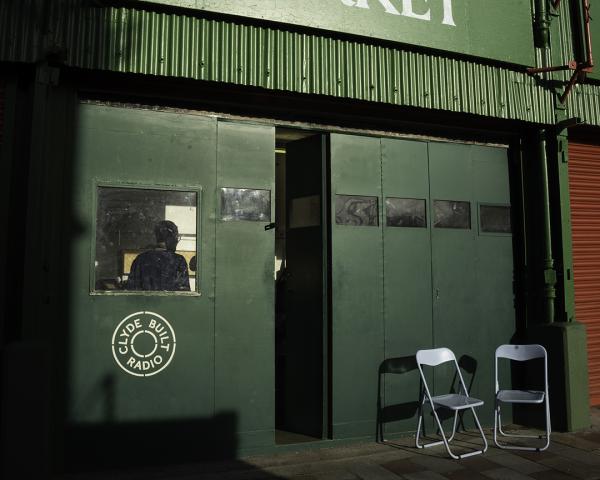
DIY online radio stations allow humanity and personality to surface in a tide of soulless and reductive algorithmic playlists, argues Paul Rekret in The Wire 503/504
For all their horrors, the Covid years were oddly good for radio. With gigs shuttered and the usual circuits of nightlife abruptly choked off, artists and audiences moved online in search of somewhere to gather. Live sets were broadcast from bedrooms, performances surfaced from empty venues, local scenes tried to keep themselves going through the ether.
DIY online stations didn't suddenly emerge during the pandemic. The 2010s had their benchmarks: Amsterdam's Red Light Radio (now gone), London's NTS (long since outgrown its Dalston cubbyhole), and New York's The Lot (still recognisable from its early days). But around the lockdowns of 2020-21, dozens of small stations appeared or flourished and have carried on since, from Clyde Built Radio in Glasgow to Budapest's Radio Lahmacun or Seoul Community Radio, forming a loose but persistent network through which underground music continues to circulate.
They survive through volunteer labour and improvised arrangements: intermittent broadcasts, borrowed rooms, a corner of a cafe or a market stall. The remit is whatever sits outside the cleansed margins of the dominant culture, "music misfits, amateurs, and seasoned DJs", as Clyde Built Radio puts it. A minor infrastructure, but one in which local underground cultures quietly persist.
Meanwhile, music is drawn ever deeper into platform capitalism's limitless digestive system, in which everything is processed into frictionless, mildly flavoured playlists; musical wallpaper, as one description has it, but with the walls closing in. Enough has been written about what this has meant for artists and listeners: the recursive shaping of taste, incomes collapsing, the sorting and harvesting of data through interfaces increasingly less like portals and more like chutes.
What these small stations offer isn't only the presence of a human voice rather than an algorithmic proxy - "no playlists, no ads, just the people", to borrow Bristol based Noods Radio's phrasing. Again and again, producers and hosts describe the space itself as crucial: the low-level drift of people coming and going, an unexpected conversation with someone finishing a set, the idle time before another begins. In the context of ever more solitary, smooth and inward online music consumption, such spaces become an increasingly important wayward impulse, even if a fragile one, that keeps slipping out of the platform's prescribed channels.
The boundary between mainstream and alternative cultures, however it's understood, has thinned further as more of social life is subsumed into the circuits of a few monopolistic tech firms. Bandcamp's sale to Epic Games in 2022, absorbed with barely a ripple, made this plain. Stations depend on the very machinery that might one day render them obsolete: social media's opaque visibility regimes, cloud platforms whose terms shift without warning, digital archives whose survival hinges on conditions no one local can influence.
All of which places today's DIY stations in a longer, bittersweet lineage: the recurring struggle between autonomous cultural practices and the forces that seek to regiment, rationalise and monetise them. The ham radio enthusiasts forced off the dial by regulators in the 1920s; the format-radio monocultures that smothered unaffiliated broadcasters in mid-century America; the stifling of freeform FM by the 1970s; the pirates that threaded across Europe, moving through whatever cracks regulators and the police had not yet sealed. The antagonists have changed, but the basic plot remains.
Economic survival, always precarious, has become still more so. Running costs accumulate, revenue rarely does. Many stations endure only through their attachment to other small institutions, cafes, bars, art spaces, themselves little more secure. EHFM is entwined with Ground Floor cafe in Edinburgh; Noods operates from Mickey Zoggs; Slack's is woven into the Lubber Fiend venue in Newcastle. In the wider context of rising rents and dwindling jobs, none of this is guaranteed. Yet the sheer abundance of such stations, and the social worlds that gather around them, should give one pause. With so many alternatives already in existence, the idea of paying for yet another streaming subscription seems rather perverse.
This essay appears in The Wire 503/504 along with many more critical reflections on 2025. To read them, pick up a copy of the magazine in our online shop. Wire subscribers can also read the issue in our online magazine library.

In The Wire 503/504, Lucy Thraves argues that luxury labels and conglomerates are keen to purchase some avant garde glory, but at a cost to experimental music and the ecosystem that supports it
In March 2025, the UK experimental music scene was pleasantly surprised when London venue Cafe Oto got a mention at the Oscars. Daniel Blumberg, who won an Oscar for the score for The Brutalist, used his acceptance speech to pay tribute to the East London venue and its community of "hard working, radical musicians, who've been making uncompromising music for many years" (the soundtrack features the likes of Seymour Wright, Evan Parker and Steve Noble). Six months later, the composer walked the runway for designer label Miu Miu, prompting fashion magazine A2Z to praise him for "[infusing] the runway with introspection and avant garde energy".
Whatever avant garde energy is, high fashion wants it. The last few years have seen a growing number of designer brands working with experimental music or musicians. In 2022, radio platform NTS partnered with designer denim brand Diesel to launch TRACKS, a series of parties, events and discussions that would allow Diesel to harness NTS's community-making infrastructure and leftfield musical nous. In April this year, Berlin label Pan, who have released the likes of Beatrice Dillon, Iggor Cavalera and Slikback, teamed up with Nike - a company recently valued at $31 billion - to launch a new trainer. Cellist Oliver Coates and former Wire cover star Arca scored a Dior show in 2022. Another former Wire cover star, Dean Blunt, soundtracked Burberry's 2024 show.
Obviously fashion and pop music go hand in hand, enjoying a nearly symbiotic relationship as cultural expressions. But a burgeoning relationship between high fashion and experimental music is troubling, most obviously because the economic and social forces underpinning the two are so drastically imbalanced. What could multibillion dollar companies possibly want with precarious, awkward, typically anti-capitalist music cultures? Unless it's… precisely those qualities.
High fashion understands that 'avant garde energy', which we presumably should understand to mean a combination of cool, authentic and novel, is born from an ethics of anti-commercialism and political integrity. In creative scenes more broadly, artists' ability to protest, propose counter ideologies and offer ways of thinking and being outside of the dominant culture is always in tension with the economic demands of their self-reproduction, meaning that pockets of radical culture are increasingly hard won, and appear increasingly rare in their commitment to independence and integrity.
Naturally, a company that exists to sell wildly expensive shoes, coats or bags cannot truly claim such integrity for itself, but that doesn't stop it from trying. As part of capitalism's ever intensifying search for new ways to sell and people to sell to, the marketeers of luxury are attempting to metabolise dwindling scenes of real creativity in their pursuit of the niche and cutting edge - without contributing anything meaningful to the landscapes that give rise to these cultures in the first place.
Some might argue that commercial partnerships of any kind work by bestowing exposure on the scenes they exploit. But is this true? Shortly after the Oscars mention, a Cafe Oto staff member mentioned to a Wire colleague that the rush of exposure had done nothing for ticket sales: it's not obvious that interest translates into material gains. Nor is it obvious that any resulting engagement would be useful. If the people buying the Pan x Nike trainer are turned on to the label's output, will they come to that culture with an attitude that goes beyond acquiring a certain musical taste in the same way that you might acquire a new coat? This is not to denigrate the buyers themselves, but to criticise the ways that capitalism forces us to behave, turning us not into listeners, but into consumers.
By accepting these parasitic partnerships, radical cultures risk letting themselves get caught up in a logic of elitism: luxury taste for luxury clothes. And as the desire for luxury creeps further into the domain of ordinary life via social media campaigns and endorsements by supposedly relatable celebrities and influencers, it's not hard to see how the avant garde could be co-opted to support the toxic ideology at the heart of high fashion: that an individual's expensive taste and purchasing power makes them better than everyone else.
However it chooses to present itself, high fashion peddles commodity fetishism, while experimentalism peddles the opposite, producing nothing easily captured, understood, replicated or marketed. It relies on engaged and passionate people working together in spite of economic and social conditions that are often hostile to their own reproduction. So it may look and feel good when it gets to strut down the catwalk - but it should keep in mind what it stands to lose.
This essay appears in The Wire 503/504 along with many more critical reflections on 2025. To read them, pick up a copy of the magazine in our online shop. Wire subscribers can also read the issue in our online magazine library.
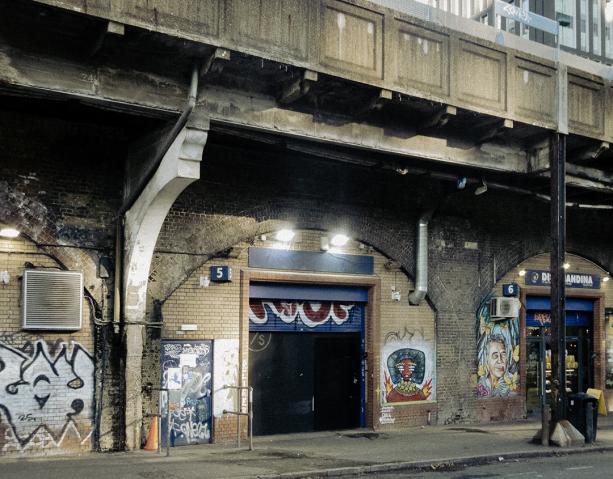
London's extensive railway infrastructure is both a refuge for DIY nightlife and under threat from gentrification, writes Deborah Nash in The Wire 503/504
London can be as fluid as the River Thames in its restless movement of traffic and people, its soaring constructions and expanding demolitions. Beneath this charged surface, writes Laura Grace Ford in her zine collection Savage Messiah, "You can hear deserted places, feel the tendrils creeping out across the abandoned caverns, the derelict bunkers and broken terraces…." These spaces are reshaped by music, and among them you will find the tapped energy of the Victorian railway arch, of which there are many, both sides of the river.
Acting as a brake in the ceaseless ebb and flow of commerce, the archways on these transit routes come with a readymade darkness and genuinely shadowy ambience, sending out siren calls to the experimental and the underground, and they are still - more than 150 years after their fabrication - places where interesting things happen.
At Elephant & Castle station on Elephant Road, South East London, is a string of graffitied arches that are home to small businesses like TR Autos. Occupying arches four and five is Corsica Studios, founded by Amanda Moss and Adrian Jones, who moved the club here in 2002 after losing their premises in Corsica Street, North London, from which the venue draws its name. "This is the third arch I've worked in, in my 20 years of night club management," Corsica venue manager Jamie Shearer tells me. "It feels underground, dingy, off the grid." "It feels like you're in a basement, even though you're not in a basement," adds Laura Krull, who has worked at the club for four years.
We are standing in the main studio, where the walls are pitch-black panelling and plasterboard; there's a heavy duty pipe running through and a loaded lighting rig; behind me is a bar and a smaller dancefloor next door, with the green room upstairs. Shearer says that Jones and Moss would be amazed if they had known Corsica Studios would last 23 years in this location. The club has an impressive rollcall of acts absorbed into the fabric of its walls. "One time, Faust put a smoke bomb on the stage and the whole place had to be evacuated, mid-gig," Shearer recalls. Faust, none the wiser, continued performing through the smoke. "The whole point is escapism," concludes Shearer.
All this is set to change in March, when Corsica Studios closes to accommodate the surrounding developments already underway in Elephant & Castle. The strip of arches run as a distinctive, archaic seam through Elephant Road (now Elephant Central) but they are described by architectural firm Allies and Morrison, involved in the redevelopment of the area, as an "impermeable eastern perimeter to the site". Their masterplan is to open up the "Piccadilly of the South" to a "colony of shops, restaurants and cafes" with some "affordable" housing included in the residential developments. The Corsica Studios website is at pains to shift perceptions away from assumptions of all-out commercial pressure. "Nothing lasts forever," the statement begins, but it is difficult to be optimistic amid such blandification and identikit constructions, found everywhere. The anodyne is taking over. Where will the wildness go?
Not so far away, down a similar side street that straddles Loughborough Junction station, there is a long line of buddleia-crowned railway arches mostly given over to motor repairs, but also housing the performance venue Spanners. Intimate in scale, almost chapel-like, it is a shallow arch painted bright yellow on the outside that can pack in a crowd, with the concomitant ease of transport links that such locations provide, even as it retains a rough, independent, truly hidden quality other arches lack.
Many small venues were shaped by the rise of the superclubs of the previous century, sometimes becoming one themselves. The long established gay nightclub Heaven is one of these - it has been unfolding itself beneath Charing Cross railway station since 1979. Changing ownership has done little to dent the club's loud, proud, rainbow-hued identity, and even the souvenir shop next to its archway entrance, selling London totes and tacky shades, seems just another extension of Heaven's camp spirit. "That club was brilliant," recalls Leigh Bowery's collaborator and widow Nicola Rainbird, who frequented Heaven in the 1980s. "All those lasers - which are like all the sequins in the world!"
With its similarly impressive lighting rig playing over exposed brickwork and a 1000 capacity is The Steel Yard, a tidy polished set of three arches on a lane leading to the river, skirting Cannon Street railway bridge, itself built on the site of a tenth century steelyard in the City, London's oldest quarter. "We're open to everything," says Charlie from the events team. "It's a question of what can fill the space. To get the right sort of atmosphere, you really need 700 people."
"Edginess, no-frills, chic industrial": these words monetise the viaduct arch as a place to snack on counterculture, but they can also warp the setting, turning it into corporate event hires or tourism. The Leake Street graffiti tunnel beneath Waterloo station is a noisy palimpsest of layered words and images. Set in the arches and sharing the tunnel is The Vaults, an immersive theatre company. "We want talented artists from every vocation to… make stuff that is challenging, accessible and imaginative," proclaims the venue's website. "We are unparalleled, we are unexpected and we are under your feet." But this venue-landlord's decision to change the use of its tunnels in 2024, leading to the demise of the well-regarded Vault festival, London's premier fringe theatre outlet, seems at odds with its mission statement. The graffiti overload, the loud, in your face edginess suddenly feels fake. It makes me want to run under a railway bridge and scream like Sally Bowles.
This essay appears in The Wire 503/504 along with many more critical reflections on 2025. To read them, pick up a copy of the magazine in our online shop. Wire subscribers can also read the issue in our online magazine library.
Traditional instruments, folk cultures and mythic ideas of futurity offer slip roads exiting AI's highway to a hollow future, argues Daryl Worthington in The Wire 503/504
"This system will take your ancestral traditions and twist 'em indigenous", raps billy woods on "Make No Mistake" from Golliwog. Raising questions about where the boundaries of tradition are drawn, that line seems to get longer through repeat listens.
Time doesn't move sequentially on Golliwog. The record opens with a back-spinning sample, swiftly followed by an incessant tick-tock. The tracks feel time-dilated, with warm soul, jazz and R&B instrumentation hitting disturbed beats as woods seemingly folds eras into each other. Across the album, deep histories of colonialism are meshed with their contemporary ramifications. Meanwhile, gruesome and supernatural imagery shares ground with 1990s horrorcore groups such as Geto Boys or Gravediggaz, but with woods the gap between allegory and reality is less clearly demarcated, reinforcing the sense that he is threading linkages forwards and back through history.
The nonlinear temporalities Golliwog inhabits resonate with other corners of underground music in 2025. Refugees Of The Symbolic Network by Egypt born, London based artist Cerpintxt takes works by Arabic poets - Palestinian Izz al-Din Manasirah and Assyrian Iraqi Sargon Boulus - and deconstructs them through effects and cut-up techniques. A small ensemble improvise through the distorted texts, all broadcast through a simulation of the reverb in the King's Chamber of the Giza pyramid. Cerpintxt's music evokes a garbled lament linking past to present against systems that exclude.
Where Cerpintxt and woods make era-spanning palimpsests mapping oppressive systems, others have found euphoric possibilities when the past leaks into the present. Many of the songs on Beirut based sextet SANAM's Sametou Sawtan see vocalist Sandy Chamoun borrow texts, including two from 12th century Iranian poet and mathematician Omar Khayyam. They are sung over radiant music propelled by guitars, synths, buzuq and drums. Like woods and Cerpintxt, SANAM's music sits far outside the recycled aesthetics of folk revivalism.
On the Chinabot album 〽 Japanese producer KASAI builds from the tradition of minyo. He writes songs that celebrate his day jobs - care worker and garbage collector - and criticise financial capitalism's failings. Influenced by singeli and awa odori dance troupe Kokesaku, the album's jubilantly off-kilter production reinforces KASAI's handling of minyo as ongoing rather than timestamped.
All these artists' works are more nuanced than simply updating old idioms or adding a folky veneer to new ones. They don't separate traditional and contemporary, instead stressing that tradition doesn't mean relics, but continuities where the present co-exists with the past.
Rasheedah Phillips's 2025 book Dismantling The Master's Clock dissects "western temporal norms which privilege progress and futurity", arguing these were a tool of European colonialism. For Phillips, founder of the interdisciplinary practice Black Quantum Futurism with Camae Ayewa/Moor Mother, the arrow of time that can't reverse course "locks us into the present".
By exploring conceptions of space-time in African societies and quantum physics, Phillips shows that less rigid, nonlinear understandings of time exist, and can be emancipatory. Her focus is on Black communities and the specific oppression they face under current regimes. But Phillips offers a guide to think more broadly beyond linear history.
Binarising traditional and contemporary perpetuates a linear idea of time marching along a single line of progress. Contemporary music utilising older instruments or idioms isn't new or unusual, and when it's anachronistic it only reinforces the idea of a linear history. Cerpintxt, KASAI, SANAM and woods don't deal in anachronisms but continuums - they signal the ongoing evolution of traditions as opposed to ruptures, a present evolving from the past rather than then and now as discreet entities.
Nonlinear timelines are reflected in Brìghde Chaimbeul's Sunwise. Her music's focus is the Highland small pipes. Close your eyes, and the blankets of luminous drones and repeating melodic phrases almost evoke pads and arpeggiators in synth music. Chaimbeul brings the lineage she's working with into a wider dialogue, showing it's more than a local anomaly. It's both a precursor and contemporary to the stories of minimalism and drone.
Elsewhere, Sheffield based Emergence Collective deploy an array of early music instruments. Their minimalist, pattern based music is built from an improvisation practice that strives to be accessible by bypassing virtuosity and learnt repertoires. Their music exists within multiple traditions, but there's a sense they're striving to democratise the means of production. The result on Swimming In The Early Hours is a constantly evolving music that breaks the notion that traditional means unchanging.
Similarly forward-facing temporal distortions occur in Weston Olencki's Broadsides. One of the most startling sees banjo fed through machine learning algorithms, extending bluegrass standards out into mesmerizing permutating patterns. As Olencki explained in The Wire 500, they're trying to break the banjo free from the colonialist histories embedded in it "to see if there's a futurism to this thing".
At a moment when we're facing the AI revolution, music that destabilises ideas of linear progress provides a useful counter. These artists are far from retreating from the present, but their work makes the future look a lot less straightforward. Instead of single lanes hurtling towards a fixed horizon they present roundabouts with multiple exits. At a time when progress points to AI slop, music that complicates forward motion is vital.
This essay appears in The Wire 503/504 along with many more critical reflections on 2025. To read them, pick up a copy of the magazine in our online shop. Wire subscribers can also read the issue in our online magazine library.
In The Wire 503/504, Xenia Benivolski writes that as the speed of events and information flows increases, drone based slowness offers another mode of perception
The prehistory of drone music begins with the recognition of sound as a temporal event. In ritual, chant and natural acoustics, drones mark ambience and continuity. Ancient instruments such as horns and bells produce extended vibrations that transform time into a perceptual field, and this stretching of temporal experience is as much social as musical. These instruments and others have proliferated into the rhythms of the human world. Each moment of sustain provides a window into what infinity might be, and in a sense, a base note to reality.
Sometimes this moment takes shape in literal ways: for me it's taking hangover naps at La Monte Young and Marian Zazeela's Dream House while seeking refuge from the scorching sun of Lower Manhattan. Or on a plane, sitting with your ear pressed against the window, listening to its engines, feeling like a flimsy little speck in a big loud universe. Almost always, a drone bumps against some sort of border between an inside and an outside that you have to mentally overcome in order to allow your mind to touch the humming current and fill in the blanks. Maryanne Amacher defined this by treating the listener's perception as the compositional site, the "third ear", where the active listener is an experimenter. You could say the same about Pauline Oliveros and many others of that generation who worked with extended improvisation and deep listening where the politics of sustained listening resist the fragmentation of sound and experience.
Information, true and false, is manufactured at neck-breaking speed. As one advert blends into another, a horrifying news story is blocked by a pop-up, and on top of it an online digital productivity ad. We ignore the noise, but it doesn't disappear. It fades into the background with all the other noises, the ones we've already put away. Works that feature wind, children and rivers are all over my devices, in my ears, as if trying to reassemble the texture of physical reality as opposed to the frantic haptic continuum that haunts us.
Catherine Christer Hennix, Cosey Fanni Tutti and other composers who populate my playlist link tone to perception. Suddenly it seems that time doesn't advance. It pools in certain scenarios, drains in others. So lately I've been gravitating towards artists and composers who sustain sound. Listening to the long notes in Sarah Davachi's music brings a memory: I'm doing the dishes while looking out of the window in the spring. The eye follows a mundane scene while the mind syncs with the slow modulation of tone, and the distinction between environment and composition fades. In such moments, time seems to stretch to stillness.
A contemporary turn in music to a sort of slowness is audible in the works of Davachi, Lucy Railton, Catherine Lamb, Lawrence English, and Kali Malone and Drew McDowall's recent Magnetism. The drone absorbs noise without cancelling it, integrating ambient sound, interference and nuance. Composition collapses into impossible chaos, then the chaos flattens into a note, perhaps a single drone: some form of reality.
In the mid-20th century, drones re-emerged as part of a broader response to industrial acceleration and the politics of perception. After the Second World War, sound artists and composers used duration to counter the compression that characterised mass communication and the automated society. The same continuous tone that evokes meditation has its evil twin in the endless hum of drones in Gaza, the mechanical resonance of generators in Beirut, and the punishing dial tone of tinnitus.
Modernity has introduced new forms of sustained sound. Jordan Tannahill's novel The Listeners describes a mysterious hum that binds together a group of strangers who cannot identify its source. It's difficult to identify the source of the hum, because every environment hums, so the phenomenon becomes a form of communion. Hydrofields, electrical lines and data servers that sustain daily life produce an uninterrupted haptic soundscape, an endless clang. To hear them is to hear an index of the present.
It's been said that time slows down when you experience a life changing event; the moment is fractal, both compressed and suspended into infinity. Perhaps the base frequency of the world is modulating, and in the process, reshaping continuity itself.
This essay appears in The Wire 503/504 along with many more critical reflections on 2025. To read them, pick up a copy of the magazine in our online shop. Wire subscribers can also read the issue in our online magazine library.

Far beyond novelty or experiment, 2025 was the year that crossover projects rejected genre labels for endless sonic possibilities, writes Stewart Smith in The Wire 503/504
From Chris Williams and Lester St Louis in the US, to Pat Thomas and XT in the UK, improvised music is plugging in, literally and figuratively, to electronic currents from the club to conservatory. Cross-genre experiments have been happening for decades, but this is something new, going beyond fusion or hybridity. We're seeing musicians with knowledge of multiple idioms taking real risks by exploding hierarchies between genres, performing in different spaces and correcting imperialist narratives.
In January 2025, I was blown away by Ambrose Akinmusire's Honey From A Winter Stone. I'd dug the trumpeter-composer's 2018 album Origami Harvest, where his jazz ensemble played off Kool AD's rhymes and Mivos Quartet's strings, but this was on another level. Its constituent elements - Akinmusire's exploratory trumpet, vocalist Kokayi's freewheeling reflections on Black male identity, Sam Harris's elegant piano, chiquitamagic's synth colours and grooves, Justin Brown's intricate drumming, Mivos's new music textures - are fully integrated into a visionary whole.
Akinmusire's masterpiece is part of a wider conversation. A key question for jazz artists engaging with hiphop is how to maintain the spontaneity of improvised music within the recursive structure of the beat. Yet as hiphop has got noisier and more psychedelic, the possibilities for improvisors have opened right up. Embracing this are WRENS, the quartet of Ryan Easter on trumpet and vocals, Elias Stemeseder on synths and una corda piano, Lester St Louis on cello and electronics, and Jason Nazary on drums and synths. Their album Half Of What You See moves freely from deconstructed rhythms and percolating funk to beatless atmospherics, as acoustic extended techniques meld seamlessly with woozy electronics. As on Nazary's 2021 album Spring Collection, or his collaborations with Saint Abdullah, the line between live playing, processing and production is deliciously blurred.
St Louis is one half of a formidable partnership with trumpeter Chris Williams. Stark Phenomena, their debut as HxH, is a beautifully realised journey into post-rave electroacoustic music, combining the timbral exploration of free improvisation with luminous synths, humid reverb and grainy static. The pair also have production credits on Pink Siifu's BLACK'!ANTIQUE, bringing the trippy haze of HxH to the beatless coda of "(8)". Williams has contributed to several of the rapper's projects, but his role goes way beyond that of guest jazzer to reflect the interdisciplinary practice of HxH, his solo release Odu: Vibration II, and the Brooklyn supergroup History Dog.
The latter unit's bassist Luke Stewart is also a member of Irreversible Entanglements, who have been central to this international community. Moor Mother might be their most prominent member, but saxophonist/synth player Keir Neuringer dropped one of the year's finest albums in The Burning Bright Light, a collaboration between his group Dromedaries and writer/artist/activist Alex Smith aka Alexoteric. Informed by cyber/solarpunk and Black queer culture, Smith brings an Auto-Tuned lyricism to wild cosmic jazz.
Moor Mother's 2020 collaboration with billy woods was a key marker in the ongoing conversation between improvised music, underground hiphop, electronics and noise. She also worked with Austrian drummer-producer Lukas Koenig, appearing on his 2023 album 1 Above Minus Underground alongside Nappy Nina, MC dälek, Elvin Brandhi and Chris Pitsiokos. Moor Mother and dälek contributed to RYOK, by Koenig, Audrey Chen and Julien Desprez's synapse-frying trio Mopcut.
Together with Peter Kutin, Koenig and Brandhi form PLF, whose Skreamerz splices mutant strains of trap, noise, punk and improvisation. Brandhi is part of an outward looking wing of UK experimentalists dissolving the barriers between improvisation, noise and electronic music. Brilliant pianist Pat Thomas is also an inspired electronic musician, from his 'klangfarbenmelodie in the dancehall' junglism of the 1990s, to his recent scatterArchive albums using IRCAM TimeStretch software. On Reality Is Not A Theory, his duo album with Mark Fell, he situates piano within his collaborator's teeming percussive timbres, showing a masterful understanding of electroacoustic textures, from King Tubby to Stockhausen.
Thomas's [Ahmed] bandmate Seymour Wright is also pushing things forward with projects, including XT, his electroacoustic duo with drummer Paul Abbott. On 2023's Deorlaf X, they incorporated Chicago house into free improvisation, while 2024's YESYESPEAKERSYES saw them collaborate with Kavain Wayne Space, aka RP Boo. Last year's album with sound artist Anne Gillis moves away from club forms, yet it continues their interest in "potential" sounds. There's deep respect for tradition, but that focus on sound, rather than genre, is what makes this new music so exciting. The possibilities are endless.
This essay appears in The Wire 503/504 along with many more critical reflections on 2025. To read them, pick up a copy of the magazine in our online shop. Wire subscribers can also read the issue in our online magazine library.

The London based MayDay Rooms' anarcho-punk archive is a valuable resource for radical cultures and politics today, writes Seth Wheeler in The Wire 503/4
Flicking through the pages of an old diary, Dunstan Bruce, former Chumbawamba vocalist and now frontman for the agitational post-punk trio Interrobang‽, pauses. "This will give you an idea of how immersed we all were in the wider anarchist scene in the 1980s," he says, running his finger down the diary's fading gridlines.
The yellowing pages are divided into hand drawn columns: dates, venues, ticket prices, local contact numbers. Under "security", the annotations harden up. For anti-fascist benefits, security was always marked as essential. "It was a very different time," Bruce reflects. "Gigs were often war zones - the far right were very active."
Chumbawamba's tour diary. Photo by Seth Wheeler
We're standing in the Fleet Street offices of MayDay Rooms founded over a decade ago as "an archive, resource and safe haven for social movements, experimental and marginal cultures and their histories". Its holdings form a vast paper topography of refusal over 100,000 flyers, bulletins, pamphlets and minutes tracing the history of the anti-authoritarian left. Much of the material is British but threaded with transnational currents: together they form a living diagram of insubordination as it travelled the world.
While open to researchers and the public, MayDay Rooms' main aim is to connect this material to current struggles, teasing out what lessons recent ones may hold for militants today. Its free programme of screenings, workshops and discussions extends the archive outward: archive as feedback loop, not mausoleum.
While historians accept punk injected new energy into Britain's ageing anarchist milieu at the end of the 1970s, this convergence largely remains under-documented in the archive. Beyond the odd leaflet or review, anarcho-punk's effect on anarchist practice has largely escaped the record. To counter this, MayDay Rooms has issued a call for materials - zines, flyers, minutes, posters - to trace how sound and political action co-evolved: what anarcho-punk did to politics, and what politics it created. Among the first to respond were former members of Chumbawamba, whose origins lie in that milieu.
By the time The Sex Pistols imploded in 1978, much of the press had declared punk dead. For those who had only just swapped flares for safety pins, this closure felt premature. Taking "Anarchy In The UK" not as irony but as directive, thousands began to organise. At the centre of this stood Crass. The Epping based art collective were the first to fuse punk's anti-authoritarian energy with a DIY sensibility. Crass's self-organised tours reached beyond the rock circuit into squats, working men's clubs and village halls, extending punk's reach outside the metropolitan grid. Their self-released records unfolded into manifestos, essays and posters, transforming the LP into a portable agit-prop device that many would emulate. Crass's Bullshit Detector compilations - which Penny Rimbaud has called his proudest achievements - were crucial for this emerging network. "Many early Chumbawamba members featured on Bullshit Detector," Bruce notes. "We tried to contact others on that release to build a national network, so as not to squander this opportunity."
The anarcho movement was built through friendships made at gigs. Beside the amps, trestle tables overflowed with animal liberation leaflets, prisoner solidarity appeals and picket announcements. "Pen pals were really important," declares Bruce, leafing through old correspondence. "You'd swap tapes, book tours, offer floors. These contacts became the backbone of the movement." Bands adopted Crass's austere visual grammar: stencils, projections, slogans collapsing poetry and polemic. Performances became calls to mobilisation. By the early 1980s, anarcho-punk formed an archipelago of resistance sustained by squatting and dole autonomy.
Soon the energy spilled onto the streets. Crass helped coordinate the proto-Occupy Stop The City protests in 1983-84, that blockaded London's financial district. "We attended the first one in 83," Bruce recalls, "then we organised the Leeds one in 84. Hundreds came out." Zines provided another infrastructure. "Our first fanzine was called The Obligatory Crass Interview," he smiles.
The first anarchist bookfair, held at the Wapping Autonomy Centre - funded by sales of a Crass and Poison Girls split single - made visible the generational encounter between punks and older anarchists. Within a few years the anarcho-punk scene had revitalised an ageing libertarian left, reanimating feminist, anti-militarist, squatting and ecological circles. Its graphic and political energy soon bled into new formations, notably Class War, who recruited from within punks' ranks.
"Chumbawamba had an intimate relationship with Class War," Bruce notes. "For a couple of years we were basically their in-house band in Leeds. In the early years, we were much more concerned with single issue politics, taking our lead from Crass, whose makeshift anarchism could broadly be understood as a mixture of Quakerism, pacifism and a commitment to individual liberty. At that time we were playing benefits and engaged in direct action against the arms industry, against animal testing and the like - much like everyone else who had been turned onto the ideas of Crass. However, the second and third generation of anarcho-bands that quickly followed them shared a more developed understanding of anarchism. By the time the miners' strike came around, many of them, including ourselves, had rejected Crass's pacifism and the wilful minoritarianism of the scene. We had moved toward a more combative, class-conscious form of politics."
The conditions that allowed anarcho-punk to flourish - cheap housing, lenient squatting laws and welfare benefits adequate to live on - have since been dismantled. "We took the dole as a full-time wage underpinning our activism," Bruce says. "We pooled our resources; that money powered the band and our printing press in the squat basement. We printed leaflets for local campaigns and activist groups."
The questions the movement posed remain urgent. How might a generation facing ecological collapse, genocide and economic precarity reinvent circuits of solidarity? How can it buy time to experiment outside of waged labour? What role could music play in collective refusal? "We were an anarchist affinity group first," reflects Bruce, "part of a generation lucky enough to live off a functioning benefit system. We just happened to use music as our main form of propaganda. Anarcho-punk wasn't a soundtrack to revolt - it was a form of revolt. Its organisation prefigured the world we wanted: mutual aid, direct democracy, collective action."
Bruce opens a box labelled 'Dissenting Anarchist Ephemera 1980s'. Beneath a pile of pamphlets lie handwritten minutes from a Stop The City planning meeting at London's key anarcho-punk venue, Old Ambulance Station. The notes include "Crass suggests..." recommendations, demonstrating that bands were regarded as politically sovereign, equal to the activist collectives beside them.
Alongside MayDay Rooms, 56a infoshop in South London also holds a large archive of anarcho-punk materials for the public to view and engage with; this has been carefully stewarded by the artist/writer and activist Chris Jones and a host of volunteers. Sealed Records, the brainchild of Sean Forbes (of Wat Tyler and Hard Skin) and Francisco 'Paco' Aranda, are also redressing this subterranean history, reissuing early demos and lost recordings from the anarcho-punk scene, and presenting these alongside reproductions of zines and flyers that help to establish their social context. A recent reissue of a 1983 demo by The Passion Killers (the proto-Chumbawamba band featured on Bullshit Detector) has been warmly received among veterans of the movement and new audiences alike.
In today's underground, anarcho-punk endures - mutated, partial, yet alive. Gigs remain self-organised in basements, social centres and DIY venues, acting as benefits and platforms. At the broader register of pop consciousness, politically charged performances - like Kneecap's unapologetic solidarity with Palestinian liberation - suggest that live music still offers an entry point into progressive struggle. "The unresolved question," says Bruce, "is how music can become a strategy again."
The anarcho-punk archive offers a working hypothesis: when music detaches from commodity logic and reattaches to social purpose, it becomes infrastructure, the connective tissue through which radical movements coalesce and alternative futures are rehearsed. Against the backdrop of today's crises, the task remains the same: to transform music into militant organisation, a building block for a kinder, more equitable world.
A version of this essay appears in The Wire 503/4. Wire subscribers can also read it in our online magazine library.
Abi Bliss reviews a new project that draws on the sound archive of BBC Radiophonic Workshop co-founder and electronic music pioneer Daphne Oram in The Wire 502
vari/ations: Ode To Oram
Various
(Nonclassical DL/LP)
"The home computer is today a very sophisticated machine, getting better every year," wrote Daphne Oram in an article published in 1994 in the journal Contemporary Music Review, shortly before suffering the stroke that would bring her remarkable career to an end. "How exciting for women to be present at its birth pangs, ready to help it evolve to maturity in the world of the arts. To evolve as a true and practical instrument for conveying women's inner thoughts, just as the novel did nearly two centuries ago..." Oram had seen the potential of computers to liberate music technology since the 1980s, when she taught herself to code and hoped to adapt Oramics, her groundbreaking optical synthesizer system, for the Acorn Archimedes. Sadly, she didn't live to see the era when her vision would come true for an ever-increasing number of female producers.
When Oram died aged 77 in 2003, she was remembered chiefly for co-founding and directing the BBC Radiophonic Workshop in 1958, then leaving it the following year, frustrated with shoestring budgets and its low status within the organisation compared with such crucibles of musique concrète as the RTF studios in Paris or Warsaw's Polish Radio Experimental Studio. Even if no single recording of hers has the level of fame enjoyed today belatedly by Delia Derbyshire's rendering of the Doctor Who theme, every year brings greater appreciation of her work and influence.
The 2007 compilation Oramics and 2011's The Oram Tapes put her music back into circulation, from compositions such as 1965's Pulse Persephone, to sound design that enhanced films (The Innocents, Dr No) and advertised everything from Lego toy bricks to washing machines. Her unperformed work Still Point, which combined an orchestra, turntables and electronic manipulation back in 1949, was finally (fully) realised at the 2018 Proms in London. Documentaries and theatre told her story; buildings have been named in her honour, while her post-BBC base at Tower Folly in Kent is recognised as the first electronic music studio founded by a woman.
Notably, Oram's archives were saved from disposal by her friend Hugh Davies and are now preserved by the Daphne Oram Trust at Goldsmiths, University of London. To mark the 2025 centenary of her birth, the Trust, together with the Oram Awards set up to celebrate and develop those same female and gender-diverse artists whose use of technology vindicates her prediction, commissioned this album, whose ten pieces use a sample pack drawn from tapes spanning 1956-1974.
This isn't the first time that Oram's sound collection has inspired collaborations beyond the grave. Taking its title from one of Oram's earliest radiophonic pieces, Andrea Parker and Daz Quayle's excellent 2011 album Private Dreams And Public Nightmares braved the eerier corners of her sonic archive, while 2014's Sound Houses by Walls was an agreeable, if less successful attempt to merge the Anglo-Italian duo's sensibilities with Oram's own. Where vari/ations: Ode To Oram distinguishes itself is in engaging with how the wider picture of her life interwove with her sonic achievements. Of course, much of the inner world of this famously independent composer is now lost to time. While also referencing the formative moment when a medium told the teenage Oram that she would excel in music, "Séance", by xname aka London based Milanese producer Eleonora Oreggia, acknowledges this: veiled fragments of Oram's speech emerge between bursts of Oramic engine: Daphne Oram presenting at East Surrey College, Redhill, 1980 static, wispy sine tones and bubbling pops of melody then slip tantalisingly away.
For all the variety among the contributing artists, the shared sample pack means that sounds and motifs bind the album together with a pleasingly psychedelic quality, heightened by a recurring quote from Oram about music that "floats in a distant dreamworld of its own". As well as both featuring a contentedly purring cat, Cosey Fanni Tutti's "Tributum" and Nwando Ebizie's "The Art Of Living" both evoke a flowering creative consciousness, the former as loops and rhythms emerge from a cavern of filtered bells and slithering textures; the latter as the cat's rumbles agitate flurries and specks of sound into a luminescent haze. By contrast, producer/DJs TAAHLIAH and Deena Abdelwahed make their respective "Gosamour" and "Eidolon" tough for the dancefloor yet still alive with intricate sonic details.
Elsewhere Tower Folly looms large, both as home to the composer's Oramics explorations and symbol of how her commercial work co-existed with more esoteric ideas, folly to some, but visionary to others. Setting an emotive, multilayered cello solo and wordless vocals against jittery, sped-up samples, afromerm and abi asisa's "1966 Interrupted" references the year when Oram's apparent mental breakdown severed her working relationship with Graham Wrench, a valuable engineer for the mercurial machine. Meanwhile Lola de la Mata's arresting "Folly Folly Folly" starts as prosaic waveform lesson Oram enunciating "sine wave", "sawtooth", "square wave", and so on then takes flight as a soprano choir chants the title into a space both intimidating and unfettered.
Ultimately, Oramics became not just a means of sculpting sound, but a philosophy. As Oram's 1972 manifesto An Individual Note Of Music, Sound And Electronics outlined, to her, music could become (as Albert Ayler put it) the healing force of the universe. Whether her beliefs would endure in today's age of 432 hertz obsessed YouTubers is a question for another time, but as layered frequencies sing an ambient elegy through the ether on Marta Salogni's closing track "An Individual Note", this rewarding compilation suggests that there is still plenty more to learn.
This review appears in The Wire 502 along with many other reviews of new and recent records, books, films, festivals and more. To read them all, pick up a copy of the magazine in our online shop. Wire subscribers can also read the issue in our online magazine library.
Irene Revell reflects on the life and work of Fluxus co-founder Alison Knowles, who died in October
There is a German television newsreel of the Fluxus Internationale Festspiele Neuester Musik at Museum Wiesbaden in autumn 1962 that captures what is often described as the genesis of the Fluxus movement. In the opening shot the line of protagonists take the stage: first is Alison Knowles who radiates a gnomic poise in her commanding stature; joint performances ensue with her colleagues Nam June Paik, George Maciunas, Benjamin Patterson, Philip Corner et al.
For Knowles, it is this moment of co-founding Fluxus that equally heralds the flourishing of her own highly multifaceted oeuvre that encompasses participatory installations, performance, sound, poetry, publications and tactile objects. Most immediately, on these early European Fluxus tours she would write many of her iconic event scores: Newspaper Music (1962), Nivea Cream Piece (1962), Shoes Of Your Choice (1963), and perhaps best known of all, the eponymous proposition Make A Salad (1962).
As she explained decades later to composer John Lely: "A lot of people followed us from city to city - we had to have fresh material... it had to be super simple, it had to have no theatre accoutrements, and it had to be for anybody in the group who was travelling with us. I composed them when we were touring and we did them the next day. It was very, very exciting."
Scores that bring attention to, and ultimately revel in a shared wonder and joy in the simplest elements of everyday life. The rhythms of preparing a salad; the story of the shoes on your feet (or any other pair); applying hand cream as a communal and sounding event; works that produce an infectious social materiality yet are simultaneously so precise, incisive.
Born in 1933 in New York, from a childhood permeated by her father's literary interests (a college professor and Don Quixote expert), as well as a love of disappearing into the woods behind her teenage suburban home, Knowles trained in painting at Pratt Institute in the mid 1950s. Without independent wealth, in parallel she took up professional layout and page design work to maintain financial autonomy, techniques that would also enter her own practice through silk-screening onto canvas - as well as in a multitude of artist book projects. In 1960 she married her second husband, and fellow Fluxus artist, Dick Higgins, and in 1964 they would have twins, now artist Jessica Higgins and art historian Hannah B Higgins (with three grandchildren, including Shimmy Disc musician Clara Joy). The aforementioned event scores would find their way into her first publication, By Alison Knowles (1965), one of the Great Bear Pamphlet series published by Dick Higgins's Something Else Press, a press which she in fact named and contributed to copiously - perhaps most prominently co-editing the Notations (1969) score anthology with John Cage.
But the book is more than a medium for Knowles, something to be explored from all perspectives. In her Big Book (1967) gallery installation the giant pages become a physical habitat. Bean Rolls (1963), her first book object, also inaugurated two further long-standing interests - quite literally as it says on the tin, a fascination with beans (dried beans are in the tin alongside written scrolls that detail her research on the topic) - and more broadly with sounding objects (here, the beans' percussive quality). These converge again in the Bean Garden (1971) installation, a giant amplified tray of 200lbs (90kg) of dried butter beans that was a stage for invited performances, as well as members of the public during Charlotte Moorman's 12th Annual Avant Garde Festival, and then slowly consumed, a circular economy present in much of Knowles's work that presciently anticipates contemporary interest in 'art and ecology'. In all these examples, the inherent playfulness is also underpinned by a profound and long-standing material enquiry.
Many of these interests converge in her most ambitious undertaking The House Of Dust (1967) project, thought to be the first computer-generated poem, that uses FORTRAN-IV software coding (with the aid of composer James Tenney) to generate and print 100s of permutations of quatrains, meditating on different forms of housing, another highly prescient concern. One of which "a house of plastic, in a metropolis, using natural light, inhabited by people from all walks of life" became the basis for her Guggenheim fellowship large-scale sculptural installation (with electronic sound by Max Neuhaus) installed in the Lower East Side, and later shipped to the desert of CalArts while Knowles taught there in the early 1970s, operating as a site for gathering and performance with Knowles's students.
If she cut a lone female figure at Wiesbaden, it was in the early 1970s that some of her creative friendships with women would blossom. First the deliciously sardonic Postcard Theatre (1974) series with Pauline Oliveros (Beethoven was a lesbian; Chopin had dishpan hands; etc). In turn, Oliveros would introduce Knowles to Annea Lockwood with whom she would co-edit and self-publish the score magazine project Womens Work (1975-8) - my personal point of intersection with Knowles's work, researching that project's history, and collaborating with Primary Information on re-publishing it in 2019. During this period Knowles would also inaugurate (with Lockwood, Ruth Anderson and Jean Rigg) the 48 hour marathon reading of Gertrude Stein's 925 page novel The Making Of Americans Over New Years 1974/5, that would then become a tradition at Paula Cooper Gallery (with various more recent revivals). Composer Tom Johnson, writing in The Village Voice, described this as "the ultimate Knowles work … one of her most personal and characteristic", exemplary in as much as she always works with existing materials, concerned with social implications and the bringing together of people, taking an "exceptionally modest stance". And for Johnson, most characteristically of all, works that allow for her to remove herself altogether, as in many of her scores.
Alison Knowles' works have only circulated more over time in both art and music contexts, and crucially the in-between, intermedia communities that she has been so foundational in nurturing. Yet it is clear that her centrality is still not understood fully enough. In the last decade several major museum retrospectives have begun this work including the still touring By Alison Knowles; and next year the first monograph study of Knowles's life and work, Performing Chance: The Art Of Alison Knowles In/Out Of Fluxus by Nicole L Woods will be published. More than anything, though, her work will live on through her many scores. While these have been taken into the classical repertoire - most recently in concerts by the LA Philharmonic - what is perhaps most notable is the sheer breadth of contexts in which her scores are performed: in London alone, in recent years, at Wigmore Hall, Whitechapel Gallery, the London Contemporary Music Festival, and, most repeatedly, Cafe Oto.
Make A Salad (1962), first performed at the ICA in London just weeks after Wiesbaden, would go on to be presented in the Turbine Hall at Tate Modern in 2008 for an audience of 3000, and of course in so many other instances here and elsewhere, with and without Knowles's own presence. In a lockdown performance over Zoom with my own sound arts students, we each set to work with the ingredients we had assembled in advance. Chopping together and apart, inevitably at some point I find myself no longer performing a score, no longer in a class on a call but completely absorbed in the work at hand. A feeling of how alive we are, how connected to each other and the world around us; even in these bleaker moments, or perhaps even more so.
Wire subscribers can read Louise Gray's review of Womens Work in issue 426 in the digital library.
In his latest Secret History of Film Music column, Philip Brophy analyses the musicalisation of purgatory in Japanese sci-fi series Alice In Borderland
The first season of Shinsuke Sato's live action science fiction series Alice In Borderland (2020, based on Haro Aso's manga serialised between 2010 and 2016) opens with a shooter game being played on a large bedroom screen by Arisu, a self-absorbed, unemployed rich kid. The game's audiovision is violent, meaningless, enthralling. Cut to Arisu and his slacker friends Kurabe and Chota meeting up at Tokyo's Shibuya station. Unexpectedly, Arisu becomes conscious of something just beyond his grasp. A slow track into his face actively fades down the sound of swarming people on their way to work. A few softly played piano notes are sounded: this is a premonition of the frailty of life, which Arisu and his friends may soon lose.
After experiencing a power outage while in Shibuya station, the trio emerge onto an entirely emptied Scramble Crossing. Composer Yutaka Yamada unfurls low horn sustains and rumbling sheets of noise: something is seriously wrong here. They don't realise it yet, but they're in a 'borderland' between life and death, where they'll be forced to play an unending series of death games. Returning individually to their work places, each realises the breadth of erasure around them. Rising multiphonic tones musicalise the omnipresent air-con ringing audible in both interior and exterior environments. Interspersed with these chordal passages are the distant looping of electronic tones, as if an electrical home appliance has been left unattended, sounding a soft warning tone, the type of which was pioneered in Japanese consumer appliances in the late 20th century.
A quick historical aside. Since the 1960s denki revolution of accelerated electronics design, music in Japan serviced industry in ways that would shape the psychoacoustic environment of the country for decades to come. Through the combination of piezoelectric actuators and 8-bit audio, beeps, tones and melodies became ubiquitous in products which sonically communicated to users. Before too long, Japan's tightly shaped congestion of public space and close-quartered confines of private space hummed with a dissonant symphony of digi-voices, synth gongs, cute zaps and googly sonics. Alice In Borderland's multitude of screens (from giant window displays to tiny LED lozenges) tinkle and ting incessantly, informing Arisu and company of cruel time limits and non-negotiable restrictions. Their electroacoustic world is always polite and accommodating, often guided by a recorded female voice whose obsequiousness masks its passive-aggressive manipulation, like a life-draining geisha.
That's the sound of the world for those momentarily alive in Borderland. For those who die, the last sound they hear is a laser beam piercing their cranium. A thin red beam descends from the stratosphere - inside or outside, the result is the same - with the abrupt force of a metallic stun gun, executing loser humans like cattle. The zap is a multi-layered power punch of finality, like a distorted dubstep kick-drum fused with an anvil pounded by a red hot hammer. Similarly, Yamada's titles theme to Alice In Borderland builds from a galleon-sized single cello note, tattooed in compound time, atop which violas fretfully saw Vivaldi-like triplets with maddening repetition. This compressed sound of morbid singularity is expressed as that last nanosecond when you realise you are about to die.
A compositional template unfolds throughout Alice In Borderland: submerged synth tones as player tension builds, contrasted with earth-shattering thwacks as gameplay logic decimates participants. Mostly, a composed noisescape engulfs each life threatening situation, overwhelming the viewer/auditor as much as it drains Arisu and his colleagues. The series is relentless with this psychoacoustic terror, recalling the electromagnetic pulse attack that initiated the creation of Borderland at the beginning in Shibuya.
The second episode of season one opens with a montage of famous tourist spots in Tokyo, each digitally modified to represent an evacuated city. Almost inaudibly, soft tonal patterns carry from afar. This is music left to perform and sound itself, in a realm where life is disallowed. To evoke pervasive death, Yamada constructs tones as if the city itself - its network of soothing 'earcons' and polite warning beeps - is playing itself, atmospherically dispersing its chipmunk pips like trees falling unheard in a void forest. This self-erasing compositional technique merges with the series' sound design, rendering Borderland tonal, harmonic and musical. And forever deadly.
Each episode of Alice is ingeniously centred in an architectural domain, highlighting the unique characteristic of a space (a danchi apartment block, a botanical garden, an underpass tunnel, a resort hotel) which players must navigate to survive. Yamada's minimal music is less an issue of style and more a thematic sounding of these spaces' acoustic design, and how such environments - originally designed with living people in mind - have been reconfigured to hasten their demise. The simplistic tones are as non-humanist as the bleep of a dishwasher completing its cycle: it isn't speaking to 'you'; it is simply sounding its programmed 'self'. The perverse psychological ploy typical in the human drama of manga and anime dark phantasmagory is that human characters attain consciousness by realising they are as socially programmed as a dishwasher. Alice In Borderland points to an entire subgenre of 'death fantasy' in Japan that proceeds from this premise.
Taking in seasons one and two of Alice In Borderland (2020-2022) is as draining as the emotional exhaustion experienced by its survivors, headed by Arisu. Season three (2025) radically commences well outside of the previous seasons' mortal combats. Arisu is being interviewed by professor Matsuyama, part of a government department tasked with analysing people who in the real world have survived the initial meteorite destruction of Shibuya. An aerial panorama of a razed Shibuya evidences this reality, powerfully depicting Shibuya as a multi-tiered hive of reconstruction. The sequence is matched to a sharp organ chord, sizzling in a freeze frame of absolute devastation.
Back in his campus office, Matsuyama reviews his analysis of the near-death experiences of the Shibuya survivors. A tantalising single chord breathes in a slow pulse, again like harmonised air conditioning. The single chord carries over Matsuyama making his way across Shibuya and its mobile throngs, their ambience muted under the carpeted synth tones. This becomes emblematic of the headspace of Matsuyama, and the drive he exhibits in seeking to discover the mystery not of life, but of death. As a researcher obsessed with such a topic, he is an asocial entity - the opposite of Arisu, whose battle experience has shaped him into a caring, responsible adult, now with a wife (Usagi, his game partner from the previous two seasons).
Surprisingly, Yamada's music seems to be mixed at a softer level in season three. Yet it retains its power and purpose, here redefined to accentuate how people are nothing but nodes moving through networks. The delicacy of tones - percussive, textual, harmonic - connotes inescapability, resignation and inevitability. Yamada's score here acknowledges the series' pivoting from adrenaline inducing survivalism to migraine massaging existentialism. The music is often diminutive and politely subservient to the well designed social spaces of an otherwise affluent and aspirational Tokyo. Arisu and Usagi are clearly presented as the ideal 'new family couple' one sees in current promotional adverts in Japan of new urban utopian housing developments.
This is where Alice In Borderland is less about the border between life and death, and more about the border between designed attainment and programmed existence. Tokyu Corporation, East Japan Railway Company and Tokyo Metro Co Ltd collectively instigated the Shibuya Station Area Project (SSAP), a masterplan of formidable scale incorporating the contemporary urbanism of architect Kengo Kuma. Preparations commenced in 2010; Phase I was finished in 2019 (Shibuya Scramble Square); Phase II commenced this year (the Central and West towers) and is due to be finished by 2030; the total development is slated for final completion in 2034. Alice In Borderland seems to deliberately skewer the SSAP and its marketing of upward mobility with cynicism. But season three is also the most emotional: as Arisu struggles to save his wife Usagi, the score swells like a treacly rendition of Scelsi drones rich in upper harmonics. Yamada's digi-orchestral surges connote involvement, commitment and hope.
Most interestingly, silence is deployed to powerful effect, framing sonic incidents and musical moments with breathtaking precision. Yamada's music becomes a matter of secretion, shading and residue, forwarding the notion of how nothingness sounds, and how death shapes one's environmental consciousness. Anime has excelled in this for decades (eg the score and sound design to Ghost In The Shell: Stand Alone Complex from 2002). Yamada's distinctive pounding drums and cello seesawing are introduced only in the last ten seconds of season three's first episode. To some, his music may be lacking in distinction or personality. But as with so much Japanese musical composition and production, that's precisely the point: to be something through nothingness.
Wire subscribers can read Philip Brophy's original Secret History of Film Music columns from the 1990s online in the digital archive. Previous instalments of this column published on The Wire website can be found here.
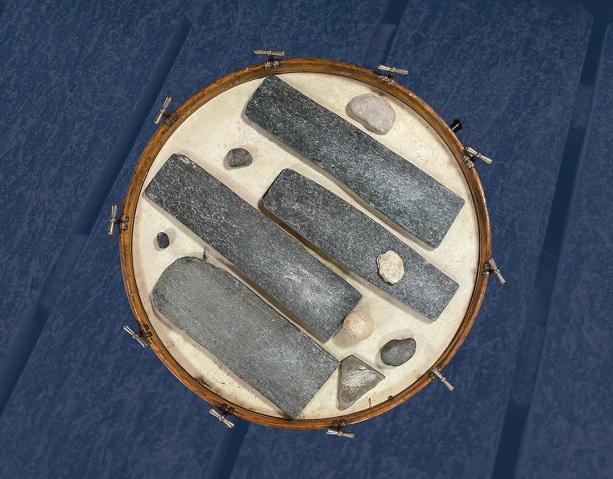
In an extract from his new book, Mike Adcock explores the aural properties of stone and introduces some notable figures in the development of lithophones
Music stones go back a long way. Nobody knows how long, but it could well be that stone, along with bone, wood, reeds and grass, was one of the first materials used by humans with the intention of making sound. It is of course in the nature of the medium, being transient, that it's not possible to know what sounds they were making in those far distant days. With visual images, whether they be petroglyphs carved into stone or cave paintings, the proof that they were produced is there to be seen with our eyes, but with sound the only evidence is circumstantial.
The oldest known musical instrument is thought to be a bone flute, possibly between 50 and 60,000 years old and its identification is based on the existence of a hollow piece of bone with holes in it, which has survived. There may well have also been flutes made from wood and reed flutes, but they have long since perished. Stone endures and the evidence that it might have been used percussively is found in markings on its surface: if there seems to have been repeated striking with no other explanation as to why that should have taken place, it might be deduced that the purpose was to make sound. Sounds produced in this way may have had a functional application, being used as a form of communication over distances, possibly for sending warnings, or perhaps incorporated into rituals or ceremonial occasions. The point at which any of these activities can be defined as music remains open to debate.
The purpose of Music Stones is not to trace, or speculate on the history of stone being used musically. Nor is it a survey of the way in which different cultures around the world have included the playing of resonant stone within their musical traditions. Rather, it is looking at how, in the modern era, a number of people have discovered the aural properties of stone, often unintentionally, and chosen to pursue the idea in a musical way. Some have done this quite independently, pursuing their own chosen path of travel, while others, having seen existing examples, chose to develop the idea in their own way. This is what happened in England in the 19th century with the formation of a series of so-called family rock bands.
Those responsible, all residents of the town of Keswick in Cumbria's Lake District, built large instruments incorporating stone bars sourced from the local terrain and two of the resulting bands went on to have extraordinarily successful musical careers. The story being told here starts with those pioneers in Keswick and has continued to develop through to the present day in numerous locations. The question of why people should have chosen to make music from this unlikely material is one which lies at the heart of this investigation.
When struck together any two pieces of stone will make some kind of noise. In most cases it will be a dull thud, which according to most definitions would not be described as particularly musical. But some rocks will resonate with an attractive ring, reverberating in such a way that the sound continues, at least for a short time, before dying away and it is these resonating pieces of rock which have been utilised by certain cultures across the world and across time. Although there is no guarantee that a particular kind of rock will ring there are some types which are more likely to do so, with hard rock, for example, being generally more resonant than soft. It might be igneous, volcanic rock formed from lava, such as black granite or basalt, or one of the varieties of metamorphic rock, including slate and marble. Some kinds of sedimentary rock will ring, particularly limestone, whose hardness partly comes from being formed from fossils and shell fragments. Even among geologists there is a degree of uncertainty as to why it is that one piece of rock from a certain place will ring while a similar piece beside it will not.
The reason seems to lie in the condition of its internal structure. Although very porous rock may well not be hard enough to ring, being porous itself is not an impediment. As long as the outer wall of each pore is intact the sound vibration can travel, but if it is fractured, it will not. From the second half of the 20th century onwards, there has been a good deal of research supporting the belief that stone was used for musical purposes in prehistoric times. The unearthing of 11 large slabs of stone in Vietnam in 1949 which, on examination were judged to have been tuned for musical use, possibly thousands of years ago, was followed by further similar discoveries in the same country. An increased awareness of the part played by stone instruments in the musical history of some of Vietnam's musical minority cultures has resulted in a revival of interest in the playing of stone instruments in the country, on a scale not found to such an extent anywhere else.
It goes without saying that musical instruments made from stone are not a common sight. They may date back to the neolithic period but what has happened to them since cannot rate as a great success story. There are good reasons for this, one self-evidently being one of weight, an instrument built from substantial pieces of rock highly being impractical to transport. Another factor is the limited feasibility of stone as a material to work with: other materials such as wood and later bronze proved to be far more malleable and thus suitable for making necessary refinements.
The general name given to a stone instrument, lithophone, is derived from the Greek words for stone and sound. There are those who insist that the word specifically applies to a set of tuned bars of stone, played with handheld beaters and that to call any musical instrument made of stone a lithophone would be the equivalent of calling any wooden instrument a xylophone. Whilst there is a case to be made for this, the history of language shows that logic does not always prove to be an effective decider on such matters. The remit of Music Stones, stretching as it does beyond such a tight definition, sidesteps the controversy by neatly excluding the word lithophone from its title.
The reason for the commonly experienced surprise and fascination upon seeing a lithophone for the first time seems to be more than just its novelty, but to lie in the nature of the material it's made from. The associations we have with stone and the way we use the word metaphorically doesn't tally with attributes generally associated with music: stone cold; stone dead; stone deaf; heart of stone. Stone is inanimate, lifeless, probably not something we would wish our music to be. Yet in the visual sphere we have long been fully aware of the potential of stone to be turned into things of beauty and profundity: architecture, jewellery, sculpture being common examples. These things are part of our world. But in them stone is no longer rough, visibly hacked from the landscape, it has been transformed into something else. And we do like our musical instruments to be things of visual beauty too: the subtle curves of a violin or a Les Paul guitar, the magnificence of a concert grand, the brazen flamboyance of a trumpet or trombone, or the sparkle of a drumkit. So a row of roughly hewn stone slabs doesn't initially hold much promise, yet paradoxically that seems precisely why, when those low expectations are defied, the enjoyment is all the greater. It was the sheer amazement at the quality of music being produced, as familiar dance tunes and popular classics were played on rustic-looking stone slabs in English towns in the early 1840s, which led to the success of the family rock bands.
When stone first began to be employed in the playing of music may be impossible to pinpoint and remains a matter of conjecture, but we can perhaps be more specific about the first documented use of the term "music stones". Peter Crosthwaite, while curator of the Crosthwaite Museum in Keswick, wrote in a memorandum: "On the 11th June 1785 Peter Crosthwaite found his first Music Stones".
Having collected enough stones from the foot of the nearby Skiddaw mountain, he went on to assemble them into a musical instrument. It was his music stones, which he displayed and played in his museum, which later inspired Joseph Richardson to build his much larger lithophone and form the first of the family rock bands. From our standpoint in time, the difficulty of having to contend with the idea of rock bands being around in the 19th century is rather confusingly compounded by the fact that this term was not only applied to the group of musicians but also at times to the instrument itself.
Mike Adcock's Music Stones: The Rediscovery Of Ringing Rock is published by Archaeopress. You can read Katrina Dixon's review of the book in The Wire 502. Pick up a copy of the magazine in our online shop. Subscribers can also read the review and the entire issue online via the digital library.
Sourced in "It's Over" by The Funk Master - main sample is at 1.56 - "not a little girl anymore / used to be the one I adore / but there's plenty more fish in the sea / for meee".
Also used is "too many times you made the plunder by tellin' me / You'll be with me"
Amazing how Chris Mack turns that "be with me" into this sensually sinister loop...
Vocal science! Vocal sorcery!
The mood and feel of the original is completely transformed
The track's slinky-and-twitchy production is incredible: a sort of sublime fussiness, a palsied panache.Those dramatic slashes of.... strings? .... are like intensifications of the way staccato strings are used in Chic to slice across the soundscape.
It's avant-pop where the avant and the pop are equally strong
Flipside also fabulous
What do you know, the Funk Master tune was actually a Top Ten hit in the UK
Chris Macfarlane, true hardcore hero and Exhibit A in the Case for Nuumological Continuumity
A playlist I made of his entire uuurrrvvvv (near as dammit anyway - 164 tunes + remixes) running through hardcore, jungle, UKG, 2step
Wonder what he's doing now...

I did not know that Chris Petit, maker of the great Radio On, also did a bit of rock writing, for Melody Maker. (He was also the Film Editor of Time Out at this time)
Here he reviews Wreckless Eric, whose "Whole Wide World" is memorably used in the film
Here Melody Maker's then editor Richard Williams blogs about a later Petit work The Museum of Loneliness and recalls sending Petit to Germany to write a piece about German music including Kraftwerk but also Boney M!
And here's Petit himself, talking about how his brief foray into rock journalism was instrumental in the making of Radio On:
"I became a rather bad music journalist for Melody Maker with the express intention of meeting Kraftwerk. This achieved, I gave them a folder with the script for Radio On. Ralph Hütter mistook the name of the folder for the title of the film and thereafter it was referred to between us as The Digby Wallet. We completed the package by going to Dave Robinson at Stiff Records and offered the film as a way of promoting Stiff's material. The specific track wanted was Wreckless Eric's Whole Wide World, but we were given the run of its catalogue."
Wreckless Eric is someone I would have probably never bothered to check out, if not for the film, which introduced me to "Whole Wide World"
Elton John rather perceptively described it as Troggs-y.
At his enjoyable blog Eric Goulden remembers the moment when Elton John was infatuated with Wreckless Eric and - very briefly - a guest member:
One night we were at the Hemel Hempstead Pavilion. I was sitting in a corner of a large dressing room full of bands, trying not to let everything get on my nerves, when a woman I knew walked in. I knew her because she'd done some PR work for Stiff Records at some point and we'd got on well. She came straight over to me, said hello and addressed me in hushed voice:
'I'm here with Elton John, he's out in the corridor - he'd really like to meet you.'
... He was in a corner of the corridor looking as though he was trying to melt into the wall. There must have been other people around but I didn't see them, just him, alone and exuding vulnerability. His face lit up when he saw me. He seemed at once other worldly and completely normal. He was wearing a black 1920s flapper suit and a floppy herringbone tweed cap.
We said hello, and our awkwardness hung in the air between us. His eyes were soft and grey, and very kind. He had an Edwardian shirt buttoned to the neck with some sort of Art Deco, bakelite bow tie.
'Um, er... does that light up?'
He laughed: 'No, I'm off duty.'
Elton joins the band onstage to play piano on "Whole Wide World" and then the whole thing escalates:
Then he was at the piano, playing and singing some weird slow blues that turned out to be a half speed version of Chuck Berry's Sweet Little Sixteen. We were playing along and it was getting intense, and then there was one of those massive piano fills that goes from one end of the keyboard to the other, and we were up to full speed and rocking. The guitars were shrieking and I turned round in time to see Elton kick back the piano stool, take a backward run, then head forward like a raging bull and leap off the stool and on to the top of the piano where he stood for an instant like the rock god he most undoubtedly was. Then he jumped off the piano into the centre of the stage and cut the entire band with one gesture.
He stood in the spotlight and just for an instant the world stopped turning. He raised his arms above his head and started to clap his hands. The energy that was coming off him was almost physical. I've never again experienced such a thing. At that moment I fully understood why he was such a huge star.
The whole story is well worth a read.
 Block to the Future [ 17-Aug-25 7:44pm ]
"It may be that Britain - and much of Europe - is in a similar moment to that described by Clark just before 1848: on the edge of a new kind of society we don't yet have the language to describe. It feels frightening because without that language it is impossible to have coherent dreams of the future. To build a better world, you need an idea of what should change and how.
And one of the things preventing that may be our obsession with constantly replaying the past. In the present age, the fog of experience has been thickened by the mass of recorded data that allows the recent past to be endlessly replayed, refusing to fade away. A constant loop of nostalgia - music, images, films and dreams from the past. It is another block to the future. And it is also the way this series is made. My bad."
Adam Curtis talking about his new-ish program Shifty
"You have this constant pantomime of hysteria which screws with your idea of time and yet it's almost like you're treading water. Nothing is actually happening. No one actually comes up with anything new. There are now four films being made about The Beatles. Four major movies about The Beatles. That's like people in the 1960s listening to a musical from the time of Queen Victoria. It's extraordinary! We're trapped!"
"Taylor Swift is such a prim 1950s, almost Doris Day figure. That's not to diss any of what she's saying but it's quite held together in time and I don't think that expresses now."
"What you're left with now is this weird psychodrama-scape of everyone knowing that everyone is performing. The real self has completely disappeared deep within your and my minds and you'll never find it."
Adam Curtis also talking up and around his new-ish program Shifty
I really enjoyed 'Out to the Dancers', a conversation between Emma Warren and Ezra Collective's Femi Koleoso at the South Bank Centre's Purcell Room, centred around what dancing means to them in different ways (8 August 2025).

A key theme was around inclusivity - who gets to dance, how and where? In answer to the opening question, 'What makes a great time on the dance floor?', Femi expanded on Emma's ingredients of space and sound by adding inclusivity - 'I think dancing is like almost a human expression of feeling welcomed. And it's very difficult to dance, if you don't feel welcome somewhere.... I think if you can make people feel included, they dance'.
As a young black man growing up in London Femi has of course had a particular experience of what welcome means. As he recalled, planning for a night out was always accompanied by the nagging worry of whether he and all his friends would actually get in. There was an interesting discussion about doors, Emma talking of the excitement of the bass rattling of the door as you approach it, 'the door as a kind of holder of the sound' promising how you will soon be feeling the music inside. Femi said that he hated that very moment, carrying with it the threat of rejection at the final hurdle after all the queuing. No wonder he said he preferred dancing outside with one less door to negotiate.
Interesting to see how this perspective plays out in Ezra Collective's approach to performance - 'the party starts on stage and everyone's invited' with a conscious effort to make people in the audience feel included, something I really felt when I saw them.
The talk was part of the South Bank's summer programme 'Dance your way home', inspired by Emma's book of the same name and featuring a month of dance-themed events. In fact while the talk was going on hundreds of people were dancing on the riverside terrace outside to Deptford Northern Soul Club.


'Out to the Southbank dancers' - Emma Warren's mini-zine for the events
Looking forward to reading Emma's new book on youth clubs, out soon.
(thank to Jools for photo of Emma and Femi)

Jordan Uncovered is a small exhibition of personal photos of first wave punk icon Jordan (Pamela Rooke, 1955-2022), put together by Andrew James and Darren Coffield. Working at Sex in the Kings Road, starring in Derek Jarman's Jubilee, and managing Adam and the Ants, Jordan was one of the people who in effect created the punk look, at least in its 1970s London incarnation. Sometimes its not the people in the bands who are the most influential in defining a subcultural aesthetic, it's also the faces in the scene and that was certainly the case with Jordan. Later in life she returned to her love of animals and became a veterinary nurse on the south coast.


 Jordan and Jarman
The exhibition is at Colony Room Green in Heddon Street, Mayfair, a basement bar reviving the original Colony Room Club which closed in 2008. There's lots of memorabilia from the famous Soho Bohemian drinking den, with some drinks still on sale at 2008 prices. A friendly place for a drink in this part of town.
Exhibition closes 22 August 2025

Lewisham protest, 1 August 2025
In the past few weeks many 'Stop Starving Gaza' pots and pans protests called by the Palestine Solidarity Campaign have been held around the UK:
'Palestinians in the Gaza Strip are starving to death due to Israel's blockade - a blockade designed specifically to use starvation as a weapon of war and of genocide. We've all seen the haunting images of Palestinian adults and children reduced to skeletons, the exhausted people holding empty pots and pans waiting for any small amount of food aid available, and cruelly, often meeting their deaths this way. Nearly 1,000 Palestinians have been shot to death by Israeli soldiers whilst queuing for food' (PSC)
I took part in one in Lewisham, South London where a 200+ people turned out and banged pans in solidarity with Gaza. On the same day (1 August 2025), Georgina Cook took part in a similar event in Hastings, and at her substack she has reflected on this kind of public gathering:
'It sounds the alarm. Turn's pots and pans, the very tools that should prepare nourishment, into instruments of protest against weaponised hunger. It alerts our neighbours and community that plenty of people oppose this weaponisation of hunger, as they do the wider genocide that it's part of, despite the involvement and/or complicity of our governments and media [...]
'The simple act of showing up with a saucepan might not stop a genocide, but it reminds us that we're not as alone or as powerless as so many of us feel. It creates a moment where the silence around atrocity gets punctured by the clatter of kitchen utensils'
As Georgina mentions, historian Matthew Kerry has written of the radical history of this practice which in its modern form he traces back to 1970s Chile:
'Pots and pans are some of the least offensive objects in the kitchen, yet their very mundanity and the ease with which they can be employed by anyone to contribute to a deafening wall of noise make them a media-friendly, uncomfortable reminder of the collective conscience and a challenge to the voice of the state. Pot-banging is malleable to different political contexts, from dictatorships to democracies, as well as spatial performances, including refuge or confinement in the home [...] Despite attempts to quash noisy protests, the history of pot-banging and its radical mundanity suggests the clanging discordant beat of pots and pans will echo on. (Radical Objects: the Pot and Pan, History Workshop, 2024)
Banging pots has also been a feature of protests in Myanmar against the military government that took power in a coup in 2021 where punks formed a collective named Cacerolazo after the Spanish name for this kind of protest (the name derived from Spanish word for "casserole"). As a form of protest it is particularly associated with women in Latin America and women. A 2002 manifesto of the Housewives Union in Argentina (Sindicato de Amas de Casa de Santa Fe) argued at a time of economic crisis and austerity:
'Although women have always been involved in the popular struggle, from the Indigenous and slave rebellions at the time of the Conquest, to the movement of the mothers during the dictatorship, to today's "cacerolazo," we have not been listened to and our demands have been postponed in the name of "more urgent" needs. Other women in Latin America and in the world are banging their pots not only in support of the Argentinian people but on their own behalf, because beyond national realities, we women have needs and demands which bring us together as sisters'.
Commenting on this manifesto, Krista Lynes remarks 'The cacerolazo is thus a special drumbeat—a beat that announces through the mundane materiality of kitchen tools the publicity of the private in the face of the privatization of the public sphere' (quoted in Feminist Manifestos: a Global Documentary Reader, edited by Penny A. Weiss, 2018). In the case of Palestine today today though we have to raise noise against something more - the extinction of both the private and the public sphere through starvation, slaughter and destruction.


(photos from Stop Starving Gaza protest at Lewisham Clock Tower, 1 August 2025)
For starters, there is the theme tune.
An instrumental that lies somewhere between UKG and Deep Tech - it sounds a bit like if an Eski-era grime producer decided to make a house track.
Then there's some of the musical guests on the show, who have either been pure Nuum - Craig David - or Nuum-adjacent (Katy B, Tinie Tempah).
The guests chosen often seem to come from around that 2010-2011 moment - which must be when the typical contestant on the show would have been 9 or 10. Perhaps there's a sort of nostalgia appeal for the contestants, a flash back to watching Channel U or listening to your older brother or sister's music. Although quite a few of these artists would have been on the Top of the Pops.
And then there is the fact Chris & Kem from the third season of Love Island, revealed an ability to rap in the Talent Show episode of that 2017 season. This resulted in their recording a not-bad at all grime-ish single that incorporates Love Island-slang and which reached #15 in the charts and
"Little Bit Leave It" came out on Relentless, the UK garage label. Nuumy!
Stormzy also made a non-musical appearance in the 2017 season, with a video clip apologizing for a tweet about one of the prominent female contestants and also giving some tips to Kem & Chris ("I can give you advice about the raps - you can't use the phones")
Certain contestants over the years have actually been performers in "urban" bands as singers or backing dancers (e.g Cach, from the winning couple this year).
^^^^^^^^^^^^^^^^^^
How about that season finale then?
They should really have bent the rules and allowed two girls to count as a couple, given that Toni and Shakira were clearly the stars of the season and theirs is the true love story here.

Toni has the best tone and cadence since Liza Minelli.

In another era, some impresario would have spotted Shakira's incandescence and whisked her off to Elstree - or more likely, given her gumption, she'd have made her own way to Hollywood, like Cary Grant et al did. There she'd have been screen-tested and put through the studio system finishing school (what a shame though for elocution to override that delicious accent) and emerged as a star.

If she can half-way act, it could still happen.
More likely, in this day and age, she'll be famous for being herself, a public personality.
With any luck, she'll drift from entertainment into politics and sort out all our problems.
regurgitating a past that never existed / regurgitating a critique that's 14-years--old (at a bare minimum) [ 07-Aug-25 3:53am ]Martin Ingle oblivious to the irony of banging on about an already banged-to-bits critique
"regurgitating a past that never existed" - apart from that being a contradiction in terms (if it never existed, it could never be consumed in the first place, let alone puked up again for the re-eating), if that is actually what is going on, then it would be quite an interesting state of affairs. Unprecedented, even!
In response to such racist intrusion and killjoy tactics of the police, black youths have taken up the challenge. In Handsworth, Birmingham, several people were injured following a sell out appearance of sugar Delroy Wilson at the Rebecca club. 900 fans were turned away, but many remained at the club in the hope they might be allowed in. The police were called and a battle began. At least 14 police officers were reported injured following the battle' (Socialist Challenge - International Marxist Group, 9 June 1977)
 isolatedmix 134 - Artefakt [ 04-Aug-25 12:01am ]
The Dutch duo of Robin Koek and Nick Lapien, known together as Artefakt, have long been shaping their own atmospheric corner of techno. Bridging the meticulousness of academic sound design with an ever-present emotive pulse, their work has resonated deeply across releases for labels such as Delsin, Semantica, Field Records, and their own De Stijl imprint.
They've always struck a balance between abstraction and function, a rare knack for making club-appropriate music that still rewards deeper, solitary listening. That tension surfaced memorably in tracks like "The Fifth Planet" or "Somatic Dreams," but perhaps most personally, in "Entering The City", a track that found its way into my Reflection on 2017 mix and still holds that special late-night gravity for me, many years on.
Their contribution to the isolatedmix series lands as an expansive meditation on contrast and communion. As the duo describe it:
"This recording came together for us imagining being in spaces of sonic isolation - conversing with each other and through this act of exchange, unfolding a dynamic landscape. This emerges as an auditory refuge where we become the waves. As we navigate this appearing structure, we re-anchor ourselves as listeners, embracing the ephemeral and reconciling with strangeness to find solace in deviation.
The mix also draws from a lifelong inspiration that runs as a thread through our own music - the contrasts between natural textures, organic decay and fractal blooming sounds set against the quantization, designed function and electric qualities of the built city and the futures they represent, captured in musical imagination. The mix invites listeners to dwell in this synthesis of spaces, discovering connection within isolation."
This is Artefakt working in longform and dictating progression, where subtle shifts feel tectonic and sequences unravel like a conversation across timezones. There's techno here, but blurred through the lens of wide-angle composition - a unique trance-like state that mimics their unique dance-floor rituals.
astrangelyisolatedplace · isolatedmix 134 - ArtefaktListen on Soundcloud, the ASIP Podcast or the 9128.live iOS and Android app.
~
Artefakt Bandcamp | Soundcloud | Instagram
Pete Shelley tribute
Pitchfork, December 8 2028
by Simon Reynolds
The first and only time I saw Buzzcocks play live was in 2012, at the Incubate festival in Holland. They seemed an incongruous choice for a festival otherwise dedicated to experimentalism and dark cutting-edge fare. Although I love the band's late-1970s output, I never would have actively sought out their live incarnation as a pop-punk legacy act; it was exactly the sort of nostalgia-appealing operation that would usually earn my stern disapproval. It was mild curiosity, really, that drew me into the big hall—only to be stunned by the power and glory of the noise wrought by the worse-for-wear-looking survivors on the stage.
Classic after classic smashed into the crowd's collective face like surf. I found myself doing something embarrassingly close to a pogo. It was wonderful, every bit of it—even a strange new mid-section to "Harmony In My Head" that involved Steve Diggle delivering a kind of quasi-insurrectionary rap. This appeared to bemuse Pete Shelley as much as the audience and prompted him to gasp into the mic, "What the fuck was that?". I had turned up expecting something rote and stale; instead I was jolted alive.
Whenever I listen to Buzzcocks' music, what always strikes me is how modern it still sounds. But that is actually how it works with true innovation. No matter how much time passes—decades during which a breakthrough is assimilated and worn out by repetition, whether by others or by the artist repeating themselves—something of that initial shock of the new rings out and cuts through. And if you think about it, nearly everything handed down to us as "classic" was, in its own time, a break with tradition.
Buzzcocks severed ties with the blues-rooted rock of the early '70s. No Chuck Berry chug for them: instead, Shelley cited Can's Michael Karoli as his favorite guitarist and said that his idea of a great solo was John Lennon's abstract noise eruptions on Yoko Ono's "Why." The name Buzzcocks could almost be onomatopoeia for the noise made by Shelley and rhythm guitarist Diggle: a serrated surge, at once coarse and sleek, with a hint of kinky mischief. Shelley and the band's original singer Howard Devoto found that name from the chance conjunction of words in a magazine headline about the buzz-worthy TV show "Rock Follies," rock-biz satire featuring a tough-girl singer who cheekily addresses everyone as "cock."
Although they were in the original core cluster of groups that invented UK punk, Buzzcocks would always be an anomaly within that movement—misfits among the misfits. There had never been words, a voice, a personality, like this in rock before. Shelley sang love songs when every other major punk vocalist rejected them as trivial next to political themes, or—if they did deal with desire and heartbreak—laced the words with spite and hostility. The aggression in Buzzcocks was all in the sound; the animating spirit was sensitive, open-hearted, vulnerable. There's a lovely clip of Shelley circulating on the internet, interviewed by a TV documentary crew in 1977 when punk gigs in Britain were getting banned by local councils and picketed by hordes of outraged citizenry. Twinkling and grinning adorably, the singer is incredulous at the idea that he could be deemed "vile and obscene."
When punk evolved into post-punk, Buzzcocks didn't fit there either. Although Shelley was well-read and philosophically searching, and although the group's graphic presentation was arty and stark, their tunes and riffs went straight for your pleasure centers; the words were direct, colloquial, accessible to all. Nor did Buzzcocks have much truck with the militancy or didacticism of the post-punk era. The band's politics were personal, verging on private—to do with radical honesty, the struggle to be an individual, to disentangle oneself from games and masks and role-play.
"I think people need a new way of living—inside themselves," Shelley offered gently, when asked about the idea of a political movement by TV interviewer Tony Wilson. People generally assume that Peter McNeish renamed himself Shelley after the Romantic poet, but in that same TV mini-doc about Buzzcocks, Wilson says that Shelley was the name that his parents would have given Peter if he'd been a girl.
That invocation of the she that he might have been connects to a genuine innovation that Shelley introduced to rock and that reflected his fluid sexuality: the deliberate use of gender non-specific pronouns in love songs, something that would hugely influence later lyricists like Morrissey. "There isn't any implied gender in our songs now because we think it's boring singing about one thing when it could apply to both sexes," Shelley told the music paper Sounds in 1977. "Our songs our bisexual."
This elasticity of gender and sexual attraction was one aspect of Shelley's desire to invent a new kind of love song. In a 1978 interview with NME, he described himself as "a modern romantic… trying to find out what modern romance is.. I'm trying to find something new… All the old kinds of romance are self-destructive because they don't take account of realities." On the Buzzcocks' debut album, Another Music From A Different Kitchen, "Fiction Romance" was about the gap between the entrancing dreams propagated by movies and magazines and the aching mess of real-life desire: "I love this love story/That never seems to happen in my life."
Shelley's solution was a radical mundanity, using pained humor to sketch scenarios of humiliation, inadequacy and shortfall, coupled with melody that promised resolution or transcendence. Again, this tension between romance and reality points ahead to groups like Orange Juice and the Smiths. In the Buzzcocks' case, the delicate balancing act between beauty and bathos was never more (im)perfect than on the group's second and third singles: the perpetual unfulfillment of "What Do I Get?" (the answer: sleepless nights in an empty bed), the amorous asymmetry of "I Don't Mind" ("this pathetic clown''ll keep hangin' around, that's if you don't mind").
Although "Ever Fallen In Love (With Someone You Shouldn't've)" continues the theme and is a fan favorite as well as Buzzcocks's biggest UK chart hit, this triptych of anti-romantic love songs is really completed by "You Say You Don't Love Me." The aim here is clarity achieved through a kind of positive disillusionment, serene acceptance of things as they are: "I don't want to live in a dream, I want something real… Though I've got this special feeling, I'd be wrong to call it love/For the word entails a few things that I would be well rid of." In interviews, Shelley talked of his new approach: starting out as friends and hoping romance would grow, rather than falling head over heels and then trying to turn that idealized half-figment of a person into a friend and companion.
In the punk and new wave era, people who would never have previously been considered to be pop star material—on account of their looks or their vocal inadequacies—became household names. Part of the shock of Buzzcocks was the sheer ordinariness of Pete Shelley materializing in the glitzy TV context of "Top of the Pops." With his open-neck button-shirts and slightly shaggy hair, he looked like neither a punk nor a pop star, but more like an office clerk on his lunch break. And he sang like one too.
Shelley might never have become the band's lead singer and lyricist if Howard Devoto had stayed in Buzzcocks. Like Bernard Sumner following the death of Ian Curtis, Shelley took on the frontman role because he and the other members of the band figured it would be easier for an insider to take over singing duties rather than accommodate a new person who might have his own ideas.
But Shelley would have already been a historically significant figure in British punk even if he'd never sung a single tune or written a line of lyric. It was he and Devoto who arranged for the Sex Pistols to play their debut Manchester gig at the Lesser Free Trade Hall on June 4 1976: a much-mythologized event said to have seeded the city's entire punk scene, sparking the careers of Joy Division, the Fall, and Morrissey.
It was also Shelley who persuaded his dad to take out a loan for 250 pounds, the decisive investment in the recording and pressing of Buzzcocks' Spiral Scratch EP, which the band and manager Richard Boon put out on their own New Hormones label. Released in February 1977, Spiral Scratch would be the beacon that mobilized the DIY hordes of punk and post-punk Britain and beyond, inspiring outfits like Desperate Bicycles, Scritti Politti, and Swell Maps to demystify and democratize the means of musical production. Do-it-yourself and release-it-yourself was seen as a righteous war waged against the apathy and ennui so acutely anatomized by Devoto in his lyrics for "Boredom," Spiral Scratch's killer track.
By the time of the EP's release, though, Devoto was bored of punk itself and left the band, taking with him an epic guitar riff generously gifted him by Shelley that would eventually serve as the hook of "Shot By Both Sides," the debut single of his new group Magazine. Shelley and Buzzcocks, meanwhile, decided that persevering on their own regional independent label was not viable and they signed with the major United Artists. In swift succession, over just two compressed and hectic years, there followed the immaculate debut album Another Music in A Different Kitchen and its uneven but endearing follow-up Love Bites (both released in 1978), then the underrated third album A Different Kind of Tension the following year. The last of these was overlooked in its own time, as the rapidly evolving UK scene left Buzzcocks behind.
There was also a string of eight perfect singles, starting with "Orgasm Addict" (a hilarious masturbation anthem that was, in fact, construable as "vile and obscene"). Together these made up Singles Going Steady, the greatest "greatest hits" LP this side of the Supremes, even if most of the inclusions had barely been hits. I vividly remember the disbelief, aged 16, when the gorgeous melodic swirl of "Everybody's Happy Nowadays" and the glittering chimes of "Harmony In My Head" both failed to pierce the Top 20.
In punk-pop perfection terms, Buzzcocks were rivalled only by the Undertones and there was a feeling, albeit a minority viewpoint, that they were the era's Beatles, or should have been. Each single deserved to go straight in at Number One. But there was more to Shelley than power pop, as was revealed on the second side of Singles Going Steady, dedicated to the group's B-sides. These grew steadily less straightforward, culminating in "Why Can't I Touch It," nearly seven minutes of loping almost-funk and radically stereo-separated guitar-slashes, and "Something's Gone Wrong Again," which resembles suspended-animation Stooges, glistening with a coat of frost. The entire second side of A Different Kind of Tension was a Shelley mini-concept album, permeated with existential doubts and askew with a disassociated feeling influenced by LSD. And 1980's "Are Everything," one of the first-phase Buzzcocks' last singles, was even more psychedelic: Shelley took acid for every stage of the process, from recording to mixing, hoping for the rush of revelation to overcome him.
But it wasn't a case of Buzzcocks getting weirder as Shelley expanded his horizons: he'd always had an experimental streak. A few years before punk, Shelley recorded several albums worth of abstract electronic music and some of this 1974 material saw belated release in 1980 as the album Sky Yen. Another 1980 side project was The Tiller Boys, in which Shelley partnered with a Manchester teenager called Eric Random to record the clangorous Neu!-like stampede "Big Noise From the Jungle", which became a favorite on John Peel's BBC radio show. Both Sky Yen and "Big Noise" bore a relationship to a pair of "theoretical groups" Shelley had conceptualized in the years before Buzzcocks: a heavy, hypnotic Krautrock-inspired project called Smash and an electronic entity known as Sky. Unlike Smash, Sky actually "became real… but consisted solely of me," Shelley recalled to Trouser Press in 1983. Made at home with hand-built oscillators and cheap-and-nasty organs, Sky's squalls of abstract electronic noise couldn't have been further from the prim precision and candied catchiness of "Ever Fallen In Love" . Any Buzzcocks fans who splashed out for Shelley's solo album were likely mystified.
When Shelley and Devoto first met it was actually through the Electronic Music Society at the Bolton Institute of Technology in Greater Manchester, where they both studied: Devoto was looking for someone to soundtrack a film he was making. "Peter was an electronics engineer and he was into computers even at that stage," Devoto told me in 2003. With this deep and long-established interest in electronic music and technology, it's hardly surprising that Shelley was quick to notice the potential of the affordable synths and drum machines that became available in the last few years of the '70s.
After the band split up exhausted in 1980, Shelley started working on a solo album with Martin Rushent, the producer who had crucially shaped the Buzzcocks' raw-but-glossy sound on record. The result was the pioneering synth-pop single "Homosapien," yet another in the long line of Shelley should-have-been-a-smash songs (although this time the problem was a BBC ban, on account of its impishly suggestive homo-erotic lyric), and a 1981 album of the same title that blended synths and drum machines with electric guitars. Another parallel universe / alternate history scenario tantalizes here: a world where Shelley pipped the Human League to the post (they also worked with Rushent, to massive success) or became a kind of one-man Pet Shop Boys. You could even imagine a Buzzcocks that didn't split but embraced electronics, gradually becoming a New Order-like force.
Instead, after a couple more unsuccessful electro-pop solo records, Shelley joined with the other ex-Buzzcocks to reform the group along their classic lines. They released their fourth album Trade Test Transmissions in 1993, the first in a series of half-a-dozen albums that were solid but never quite ignited the old spark. In 1994, at fanboy Kurt Cobain's invitation, they toured with Nirvana, a preview of the next 20 or so years of sustained live work.
In the days following Cobain's suicide in April 1994, Shelley—an early adopter of the internet—could be found on a bulletin board of the now-defunct Compuserve commiserating with fans and sharing his very recent memories of hanging out with Kurt. He cycled between self-reproach for not being able to help the troubled singer and deliberately irreverent comments intended to deflate overly pious laments for the fallen rock savior—attitudes he clearly felt missed the point of punk and of Cobain himself.
Shelley's own aim was to be exactly the same size as life, and somehow put that across onstage or on record, despite the inherent artifice of being a performer. That was his interpretation of what punk represented—the artist as unheroic hero, on the same level as the fans. Approachable, unassuming, self-deprecating, Shelley lived out that ideal until the end.
Barbara Tucker diva loop - brilliantly stuttered and ghostified - is taken from what might well be my favorite house track that isn't by Todds Terry or Edwards
sourced deeper
Daily Worker Carnival Dance at Hoxton Baths with 'Real Red Band', December 1931:

Also from 1931, 'Great Boxing Night Revels' at New Greenwich Baths with 'South East London's Finest Dance Floor' and 'the Varsity Revels Band'. Plus Hackney National Unemployed Workers Movement social and dance at Holcroft Road school; Woodcraft Dance at Savoy Ballrooms in Dalston (presumably liked to radical scouting alternative the Woodcraft Folk) [source Daily Worker, 12 December 1931)

From 1934 - Young Communist League Flannel Dance at Bermondsey Library, Spa Road; Relief Committee for the Victims of German Fascism dance at Conway Hall; League Against Imperialism and Negro Welfare Association Social and Dance at the Pindar of Wakefield in Grays Inn Road. Plus some Eisenstein film nights. Also an advert for Nanking Chinese Restaurant at 4 Denmark Street, off Charing Cross Road 'the place for internationalists'
 See also: Anarchist Dances in London, 1890s-1910s
A Split Second / A Taste of Sugar / Erotic Dissidents
Sin, London
Melody Maker, January 21 1989
by Simon Reynolds


