
 Caught in the eternal present - more poststep [ 23-Sep-12 4:43pm ]
There has been a lot of talk about the lack of a clear genre name for all the stuff going on in the post dubstep territory, and as always people seem obsessed with the relationship between clearly defined stylistic signifiers and equally clear names for sets of signifiers sufficiently coherent to be seen as a style in itself. Whether the lack of solid styles with solid names is seen as a positive sign, suggesting a state of becoming, a not-yet-there flux just waiting to finally develop, or as an ill omen of a permanent, retromanic lack-of-vision where everything is half assed magpie microstyles, never containing anything forceful or groundbreaking enough to last longer than an instant, at least people seem to agree that this is somehow the crucial point. Which is a shame, because it get us stuck in the same old template for thinking about electronic (dance) music - i.e. whether it's developing through organic step-by-step scenius interactions, as most people now seem to agree that it should, if it is to be classified as proper "authentic" street level electronic dance music.
Well, that's not how this stuff is developing, and that's a big part of what makes it great, and interesting. As a big fan of everything from acid to gabber to jungle to wobble, I certainly understand why that dynamic is important and fertile, but it gets so incredibly tiresome that it's always the way people are thinking about it, almost as annoying as rock critics using their old templates of auters and album statements to judge rave music. And it's why it's really a shame that post dubstep seem to be slowly disappearing as a catch-all phrase for this music (the snappier poststep never got a chance it seems), only to be replaced by the ridiculous and pointless "bass music". Because what actually made it a truly useful name was exactly, as the post punk comparison shouldmake clear, that this is not music to be understood like previous electronic dance music, or - and this is probably the most important point - as that music's "listening" counterpart, was understood. The old rave/IDM-divide does simply not exist in post dubstep, the producers are not thinking in those terms anymore, they're making music that - on a track to track basis - might or might not be danceable, but it's not a central part of the musics identity. Which is also why it is a misunderstanding to suggest that poststep is somehow the "new IDM", even if it does fit that description in a lot of ways.
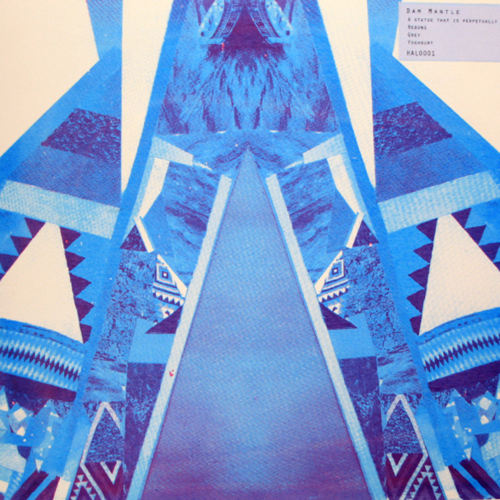
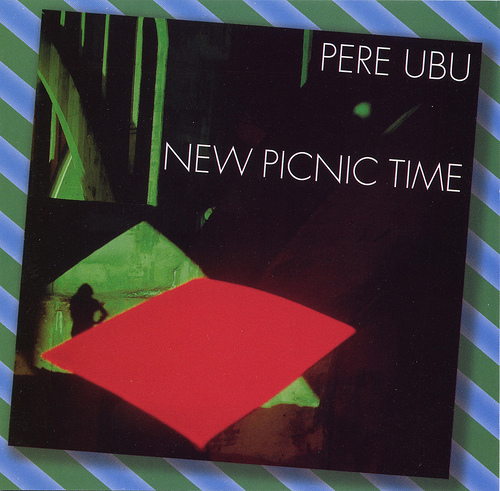
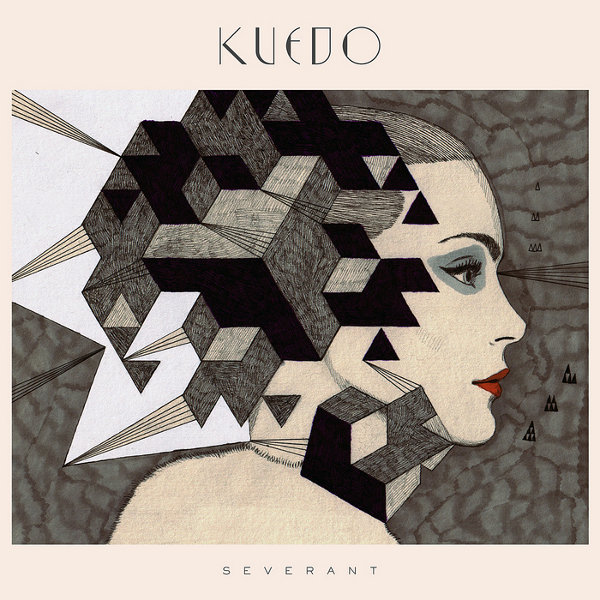
What proper, popular rave sound would post dubstep be in opposition to (or be leeching on), like with the old IDM vanguard and rave/hardcore/jungle? Wobble? Well, there's a small contingent of first generation "true dubstep"-heads that might fit this description, but they're more like detroit purists than IDM people really, and to the degree that they're actually part of post dubstep (rather than just, well, making die hard old school dullstep), they're a pretty negligible part. The rest seem either completely removed from wobble (neither defining themselves as opposition or trying to copy it), or, in a few cases, actually make wobble (Taz Buckfaster, Doshy, Akira Kiteshi etc.). What about UK Funky, then? Well, it's pretty much a small connoisseur scene, not a big popular rave form, and there's certainly no opposition between it and (most parts of) poststep; I often find it impossible to distinguish it from the larger poststep-map - more and more I'd say it's similar to something like 2tone within post punk. Bassline? If there have been any relationship - hostile or parasitic - between bassline and poststep, I've never encountered it. Juke/footwork? See UK Funky, except even more so: totally not a popular rave form, actually pretty much an avant garde in itself, so the relationship between, say, Kuedo/Distal and juke is much more like the relationship between Contortions/Blurt and free jazz, rather than between Plug/Squarepusher and jungle. Plus, it actually seems like at least partly a two way connection.
What I'm trying to say here, then, is that not only is the stupid dance/"intelligent" divide something that only an old guard of electronic-dance-critics - plus perhaps a few younger ones schooled in that line of thinking - look for, while producers and listeners of the (post) dubstep generation doesn't even seem to think, let alone care, about it, but it is also exactly why the lack of clear, sharp genre lines is not an indication of uncommitted, cheaply eclectic postmodernism. Rather, it signifies poststep as a polymorphous, constantly evolving mass of genre-goo, where that very characteristic - the morphing instability, the frantic drive to change and reorganise, is the core of the music, rather than a lack of core. Which is where - once again - the post punk/poststep analogy comes to the fore. Because really, isn't it odd that post punk is seen as this pinnacle of creativity and radical formal invention, when it was every bit as unfocused and incoherent as what is going on in poststep today, exhibiting the very characteristics - a myriad of momentary not-quite-genres, a fractured overall messy-chaotic aesthetic, rampant and bordering-on-dysfunctional mutations of frontline contemporary dance music - that are identified everywhere in poststep, except that there it's seen as the very proof of the scenes inability to be truly innovative and significant. It's tempting to call this a double standard, but most likely it's simply due to the historical perspective - rave history have conditioned rave critics to think in scenius terms, whereas that line of thinking has played very little role in relation to rock.
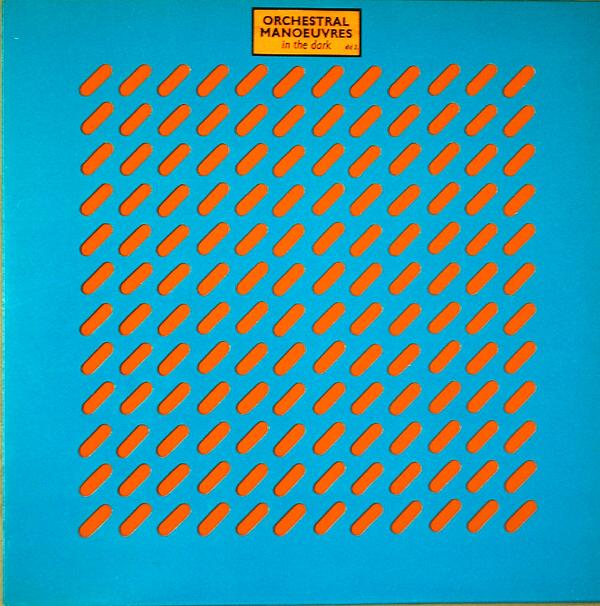
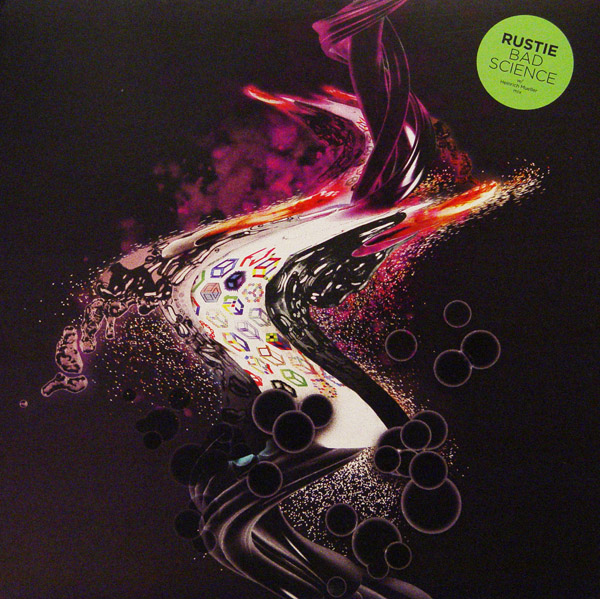
In addition to this, the huge differences between post punk and poststep as more overall zeitgeist representatives is obviously also part of the reason why the comparison is rarely explored, and the same characteristics is seen as groundbreaking innovation in one case, and as retro-regressive dabblings in the other. Post punk was loudly conscious of and outspoken about the fact that it wanted to be groundbreakingly innovative and have some impact on society, as well as just generally conscious and outspoken, really thinking about what it was doing and its relation to the world around it, and it wasn't afraid to talk about that. Poststep doesn't seem to have any ambitions in this department, but perhaps this is exactly a reflection of the zeitgeist. After all, it would be pretty weird if there was a 100% matching post punk-poststep correspondence, considering that things have changed so much as they have. Rather, the amazing musical inventions of poststep could perhaps shed a little light on a rarely explored aspect of post punk, namely that its relentless formal creativity didn't just happen because a bunch of radical people wanted to create radical music - it also happened because it could, because the formal potential was there. Suddenly, vast stylistic possibilities - avant garde techniques more or less unexplored in rock, the ambitiousness and formal infidelity of prog - were up for grabs by the post punk do-it-yourself freedom and perpetually-change ethos. However, if all that had already happened before, no amount of will-to-be-radical would have made it possible to be as inventive with rock music ever again - as rock history ever since clearly shows.
With poststep, there's certainly an intent to invent, it's just not driven by the politically charged matter-of-life-and-death determination that post punk had, it's more like a stumbling and confused attempt to reflect the ever-fracturing, ever-reforming maze we're all stuck in today. Nevertheless, just like with post punk, the invention is happening because it can: huge untapped potentials have now suddenly become available, and as a result, the poststep aesthetic is just as weird and disturbing and plain now, as much a distorted and yet true reflection of our time, as post punk was in its time, whether it's the synthetic surfaces (OMD, Japan, Rustie, Jam City) or the twisted mess underneath (Pere Ubu, The Pop Group, Burial, Dam Mantle), or everything in between. And the potential right now comes from possibilities opened up by the dubstep generation dissolving techno and rave-cultures age old dance/not dance-divide. Abstraction and complexity is not in opposition to popular physicality any more. Poststep certainly can be as chilled and un-physical as the most self-consciously anti-hardcore I-think-therefore-I-ambient-IDM/electronica (newer Kuedo and Zomby-stuff, the Tri Angle-label, if that counts as poststep), but the crucial point is that it doesn't set it apart from - and isn't meant to set it apart from - the rest of the poststep community, just like softer, more ethereal post punk records like The Raincoats Odyshape, The Flying Lizards' Fourth Wall or The Durutti Columns LC, were still unquestionably part of post punks cornucopia of invention, even if they didn't share the harshness and sharpness usually associated with it.
The point is perhaps best illustrated when comparing post punk with progressive rock: In a way post punk pretty much re-established the prog quest for stylistic experimentation and shattering of rocks established norms and boundaries, but any "official" connection with prog was definitely not a part of the program, it was rather something that had to be disowned by the practitioners, much like the current poststep vanguard is eager to stress their unironic love for every possible street beat style out there, thus trying to avoid being called "the new IDM" - something that would taint them with associations to drill'n'bass' jungle-mockery or po-faced pseudo-academic click-scapes, and therefore something that has to be avoided as much as post punk had to avoid being called prog. And there are differences, of course, post punk wasn't simply prog part 2, but rather progs artistic ambition reborn without the cult of technical difficulty, an experimental impulse driven by an emphasis on primitivism, roughness and open ended everyone-can-do-it avant garde strategies, rather than traditional "skills". Which is pretty much mirrored in poststeps relation to IDM: Poststep might be brain-music, but it does not, unlike first generation IDM, assume that dance music is by definition not brain music, and thus something that has to be either rejected or "improved". Instead, poststep recognises the potential complexity and strangeness inside dance music and uses it as a starting point for further experimentation, creating weird mutations by force, test tube anomalies that wouldn't develop "naturally" by the usual 'nuum dynamics, rather than using dancefloor signifiers as window dressing, like IDM did with drum'n'bass. In this respect, as much as a new IDM, poststep resembles a whole generation of the kind of outsiders that almost every popular rave scene always has (4 Hero, T-Power, The Speed Freak, The Mover, Oliver Lieb, Terror Danjah etc.), trying all sorts of stylistic experimentation from within. Except, of course, that poststep simply hasn't got an actual stable rave scene to use as base.

 If post punk cultivated stylistic flux and radicalism as a continuation of the (presumed) punk promise - permanent revolution as the only way to avoid the (presumed) seventies rock stagnation, as well as a way to fight the political changes of the time -, poststeps constant process of dismantling, deforming and reimagining the musical landscape, could be described as an examination of the future we're supposed to live in, an attempt to analyze the hyperworld we were promised, or an exploration of the treacherous interzone between the illusory surfaces representing that hyperworld - the only thing we ever got -, and the ever growing instability and uncertainty underneath. This is perhaps neither as heroic or as easily recognised as the fight post punk was fighting, but it's nevertheless a valid and necessary reaction to the world we live in. The world got cold and scary at the beginning of post punk, and as a result, post punk became cold and scary music. The world got woozy and fractured at the beginning of poststep, and that is what poststep sounds like (I'm generalizing massivelyhere, of course, given that its exactly my point that neither post punk nor poststep can be summed up by univocal terms - there's lots of post punk that isn't "cold and scary", just as there's lots of poststep that isn't woozy and fractured).
The big problem, of course, is that by the very nature of this fractured, timeless world, it's almost impossible for the relevant stuff to be recognised, as it's seen as just more of the endless, coexisting post modern micro-styles recycling the past (because now, unlike in the time of post punk, experimenting with and combining different elements from styles where you don't "belong naturally" - as well as the very fact that you don't belong naturally to a specific style at all - is deeply suspect and certainly mean that you're just making another post modern amalgam). And even if this wasn't the case, the mere amount of otherstuff out there, right now, all the time, everywhere, means that even the most radical and groundbreaking poststep will, at least to some degree, be drowned out. Burial, Rustie and Zomby (and perhaps Flying Lotus, if we can say he belongs here) are perhaps relatively big names, but they're still mostly for the cognoscenti, and their influence is almost non-existent outside poststep. In this way, poststep might reflect the zeitgeist, but it's also, by the very nature of that zeitgeist, caught in its maze of distractions and equal irrelevance of everything, and therefore unable to change and challenge it directly.
Still, as soon as you start to recognise the subversive weirdness and dysfunctionality of poststep, you're able to seek it out, and to reject all the stuff that is just regressing to safe, tried and tested forms. And to increasingly see our current world through this lens: Monstrous synthetic shapes simultaneously silly and disturbingly unreal, glittering cascades of time-debris and half-formed digital microorganisms, haunted mental landscapes where time and space is disintegrating, blending and caught in splintered patterns, propulsion and determination constantly eroded by stumbling, queasy disruptions and unstable gravity. It's there and it's amazing, but it's also hard to discover because there's so few championing it as the powerful vision of now, (rather than just mentioning it along all the other stuff we like), and there's so much else around. It's an uphill battle for these artists, but even if they're not winning the overall war, the fact that they actually have qualified cannon fodder to send into the all consuming black hole of now, is sort of a victory in itself.
Soon, hopefully, some more concrete examples of the amazing wealth of new poststep still pouring out right now!
10 WOBBLE RECORDS [ 04-May-12 11:49pm ]Anyway, it feels good that it went the way it did, wobble almost lived up to all the hopes I had for it, I love the way it pisses of all sort of old guards (within dupstep or otherwise), and the fact that its bloody everywhere, with tons of crap being pumped out. That's how it should be, a sign that it truly have made an impact. I can't say the current dubstep mainstream ("brostep", or "EDM", apparently) does that much for me, but then, I haven't expected it to do so. Rather than bandwagon jumping drum'n'bass producers, the wobble aesthetic now seem to be fusing with electro house, to form a new all purpose rave music, much like punk rawness/intensity eventually ended up as a part of a wider "real rock" sensibility in the eighties. It's all about the Skrillex/ Deadmau5-axis, of course, and while Deadmau5 doesn't seem all that exiting to me, Skrillex is actually pretty good. Sure, he might not have that many tricks up his sleeve so far, and the electro house part of the equation is a bit of a drawback, but he's nevertheless really good at using wobbles potential for catchiness and dynamics, redefining it to meet his own ends. It would be tempting to go all the way and see him as some sort of, I dunno, dubsteps Sex Pistols, but that would be taking it too far. Perhaps something like Metallica is probably a better comparison, if a historical comparison have to be made.
While Skrillex have made several great tracks, and while he certainly is ten times as exhilarating as venerable "dubstep legends" like Mala or Scuba, the best of the pioneering wobble tracks that paved the way for his current success are much greater, and deserve some exposure. And interestingly, even though a few of critics are waking up to wobble (still a minority compared to those mocking it as a degenerate fad), I have so far not seen anyone trying to create a guide to some of the best tracks around. So, I guess I should do it then, given that I've believed in it right from the start. Of course, given the scenius nature it will only be some of the best ones, I'm sure there's a lot that I've missed. Also, it might seem a bit regressive to do it in terms of ten records, after all only a minority of wobble ever made it to vinyl. But I guess it's showing the dedication of this supposedly short lived throwaway-music: Vinyl was probably absolutely unnecessary for the development of wobble, but it was still being made, the people involved in the scene had a strong enough sense of connection and belief in this music to want physical, enduring objects of it, no matter how inconsistent and functional it was conceived. So here you are, some of the greatest rave music of the last five years, ten immortal wobble objects for posterity:

Stenchman: 2MuchKet! (True Tiger, 2008)The True Tiger-label was a significant player in the transition from early proto-wobble to the real thing, a transition that is almost complete here, with Stenchman being one of the first big names in the "filth" end of dubstep, complete with stoopid/"wacky" juvenile humour and a recognisable "sick" image - performing in a gimp mask and having a bit of a cow-obsession. All the things, in other words, that the old, right-thinking dubstep guard hated. "2MuchKet!" is still not quite as hyperactive and pompously extravagant as wobble would eventually be, but it's a blast nevertheless, and the b-side is also looking ahead with "Dubnet", an early example of the later fad of wobble cover versions (basically - taking a well known theme and playing it with tear out wobble bass, a joke that got pretty thin really fast), and "Cut in Half", which takes the development of pure wobble-centric madness a couple of steps further than the title track. It would be the absolute standout track of the ep if it wasn't for the lame and far too long joke-sample in the middle.
It's interesting to compare 2MuchKet! with Sukh Khights equally awesome Born Invincible, a slightly earlier True Tiger release, which is arguably just exactly on the other side of the border between the minimally brooding early wobble and the real rave deal: it's staunch and punishing, but not really letting loose with the unhinged derangement that makes later wobble so thrilling. In between them, the two eps creates a perfect snapshot of this crucial dubstep transformation.
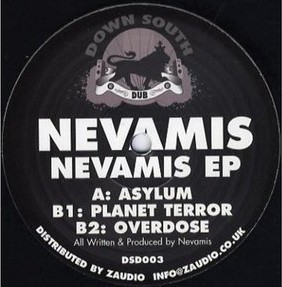
Nevamis: Nevamis EP (Down South Dub, 2008)Pure rave-step of the kind that uses wobble-bass as a massive, underlying propulsion throughout, but never as actual rhythmic or melodic focus. The wobble is there, deliciously heavy and rubbery, but the infectious, sky-soaring, almost hands-in-the-air-trancey rave riffs are the most obvious hooks. Not an example of the wobble aesthetic being cultivated on its own terms, in other words, but a brilliant demonstration that it can just as well be used as a catalyst for creating exhilarating new kinds of straightforward rave music.
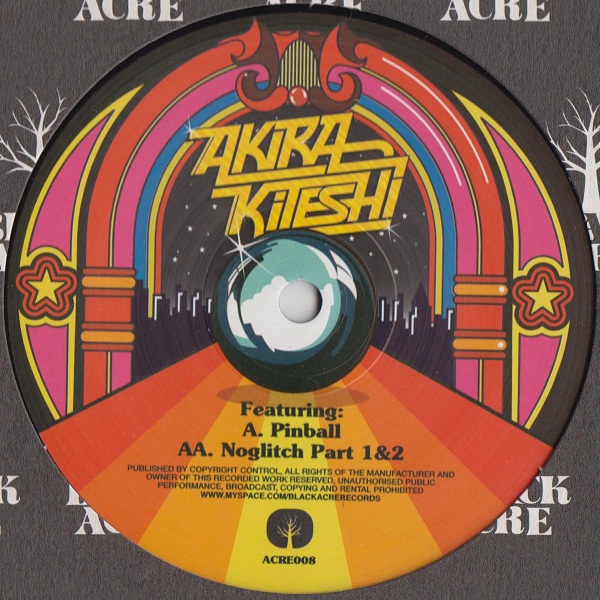
Akira Kiteshi: Pinball (Black Acre, 2009)With his fake japanese name and colourful sound, scottish producer Akira Kiteshi was one of the most promising of the early wobble producers, yet after a couple of minor anthems (this being the best of them) he seemed to change strategy and went into more experimental poststep territory as A.K.Kids. Not a completely surprising development, given that "Pinball", in all its freaked out rave madness, was almost dysfunctionallytwisted, and had a sharp 8bit-edge not a million miles from the rave/poststep/bitstep-intersection (Eprom, Taz, Suckafish P. Jones), while the b-side, "Noglitch part 1&2", pretty much went all the way into woozy, wonky territory. Eventually, perhaps stimulated by the Skrillex' succes, he have now returned more or less to the wobble fold with the Industrial Avenue-album, which contains some good tracks (both full on wobble and some more poststep-leaning ones), but nevertheless is a bit... well... uneven overall. The irresistible insanity of "Pinball" is still the best he's ever done.
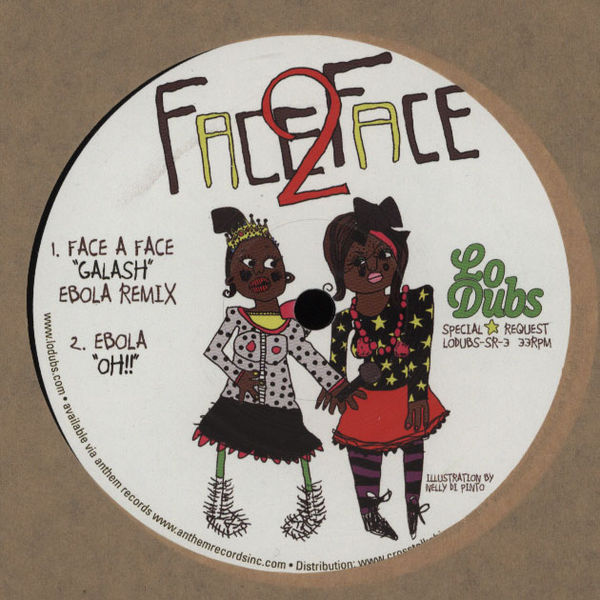
Ebola + Face 2 Face: Galash (Lo Dubs, 2010)An odd but really excellent EP where former breakcore producer Ebola remixes "Galash" by Face 2 Face - sort of a french afro-grime vibe combined with heavy wobble-sludge, and delivers three more tracks with an awesome combination of grumbling, grunting zombie rhythms and borderline-melodic bass-riffs, embellished with samples, rave-effects and 8 bit bleeps for good measure. It's not exactly your "archetypical" wobble, even though it's not that easy to put your finger on what gives it its unusual edge, but on the other hand, wobble is definitely what is. As such it's a brilliant example of the degrees of invention actually possible within the wobble aesthetic, at least at the time.
Downlink/Vaski: Biohazard/Zombie Apocalypse (Rottun, 2010)Usually I'm not a big fan of the Rottun-end of the wobble scene, it always seemed to be the part of it most clearly just being contemporary drum'n'bass-producers joining the bandwagon, complete with painfully clichéd techstep-meets-heavy-metal graphics. Nevertheless, this split 12" is surprisingly good, with inventive, constantly morphing riffs and ridiculous, almost playfully pompous fanfare-melodies. As brilliant a mastery of rave dynamics as any.

Doctor P: Big Boss/ Black Books (Circus, 2010)There has to be some Doctor P in this list, but I guess by now "Sweet Shop" is so ubiquitous that it doesn't make much sense to choose that - it's pretty much the wobble anthem. You'd think Doctor P would use his success to produce a heap of "Sweet Shop"-clones, but his output is actually pretty slim, with just two proper 12"s and a bunch of split records/collaborations/compilation tracks. Perhaps because of this, the quality is really high, the "Sweet Shop" b-side "Gargoyles" is pretty much just as good as the hit itself, as is both tracks here. All remnants of "proper", brooding half step-dubstep are completely gone, and instead we're treated to a rollercoaster ride of catchy melody shrapnel, constantly interchanged with hysteric midrange-noise and bleep cascades, and driven by an almost rock-like beat that is so straightforward that it's practically unnoticed. As rave, and as now, as it gets.
Borgore: Borgore Ruined Dubstep part 2 (Buygore, 2010)I've always wanted to like Borgore, I love how he goes out to deliberately annoy the old guard of "real dubstep" defenders and even takes pride in having "ruined" the sound (all in the punk/"it's just not music"-tradition), and it would be great if this guy, so universally hated by all the right thinking people, was actually great. Sadly, as a wobble producer, he is often a bit mediocre, his riffs not really different from any other run-of-the-mill-wobble-producer, and what have mostly made him noticed is his overall funny/"provocative" image, which, except for the dubstep ruining part, is actually pretty lame. The predictably ironic gangster/misogyny-image have never really been that funny, and by now it's such an old and tired trick that it's utterly embarrassing. Still, Borgore at least made one really great EP, so he can be included here, as he really ought to.
Interestingly, what makes Borgore Ruined Dubstep part 2 great is not in the full on wobble department that most people associate with the guy. The A side, "Kinder Surprise" - a collaboration with Tomba - is a nice enough metallic wobble attack, but not exactly exceptional. Instead, it's the two, slightly poststep-ish b side tracks, "Afro Blue" and "Money", that really makes the difference. They're still using typical wobble-tricks (mostly melodies being played with those tearing mid range sounds), but at the same time they're doing completely new and unexpected things with them. "Afro Blue" is a really unique track, almost a sort of wobble torch song, but not in the usual pop sampling sense: Instead it uses an odd, dragging melancholic melody (not completely unlike those amazing early Darkstar-singles), oscillating between introverted sadness and explosive mid range aggression. "Money", on the other hand, is almost a sort of circus-wobble, combining a cartoon-silly (and irresistibly catchy) 8 bit melody with metallic grunts and ramshackle beats (plus annoying ironic rap at the beginning, but that's easily ignored). Intriguing to ponder what would have happened if Borgore had dedicated himself to this style instead, seems a bit like a lost potential.
 Tomba: Brace for Impact EP (Buygore, 2011)
Interestingly, Borgores much less know co-conspirator Tomba did the pure, full-on wobble-horror much better, at least on this little gem of an EP, a tour de force of hyperkinetic riffs and all sorts of thrilling rave tricks. The title track is overflowing with almost trance-like euphoria, "The Goblin" is all metal-gothic gloomcore-pomp, while "Seven" is the greatest example I've heard so far of the weird pairing of smarmy pop vocals and punishing power-wobble - something that have become increasingly popular all over the scene the last couple of years (and which is, of course, a big part of Skrillex' sound). In particular, the ep excels at the "grunt-step" wobble variety, like a horde of towering, Godzilla-sized pig-robots marching through a nocturnal megapolis, crushing everything in their way while puking out cascades of green ooze through writhing hydraulic cyber-snouts. I guess people who look down upon this stuff - which is ridiculous to be sure, but also so far out and exaggerated that it's absolutely exhilarating - deserve their boring retro garage.
 Silent Frequencies/Document One: Game Over EP (Neostep, 2011)A split sitting somewhere between the overly melodic style of the Circus-camp and a more straightforward wobble architecture, and the result is just incredibly great. Especially the two Document One tracks are arguably some of the best, most thorough rave I've ever heard, in any genre, as relentlessly inventive and explosive as anything by Hyper-on Experience or the early Prodigy.
Tim Ismag & Ibenji: Shock Out/ Choose Your Destiny (Wicky Lindows, 2011)I could fill half of this list with Wicky Lindows-records, the label have put out an impressive series of releases which combine the most catchy and hard hitting wobble-tricks with some of the most ridiculously bombastic and complex arrangements out there. 'Nuum-purists would sniff and dismiss it as busy, inauthentic pseudo-rave, as "fake" as IDM-drill'n'bass, unlike the "true" and "real" sound of the "streets". Even the label name, referencing Aphex Twins "Windowlicker", seems to make this point. But I've never bought the idea that 'nuum music should be "real" and "true", that's the kind of rhetoric used around the most mind numbingly dull legacy detroit techno, and whenever I hear it used I know there's a good chance that the stuff being defended ("real dubstep", retro garage) will be hopelessly boring and tasteful, while the stuff being attacked could very well be fun and exciting, which is just the case here.
The Windowlicker-reference makes sense in a completely different way: That track came out in 1999, and for a lot of the current wobble-step producers, it might simply be one of their first exposures to far out electronic madness. Sure, it was sort of a parody, but if you didn't know the context and history, and just was exposed to it out of the blue, it might very well have seemed world shattering (and the "real stuff" would perhaps seem a bit pedestrian if you only came around to it afterwards). As always, it's a sign of health that new generations doesn't have a submissively humble relationship to the great (real or imagined) ancestors, it's moving things forwards that they don't know the "right" classics and don't try to pay homage to them. And in any case, the element of insane, unhinged bombast and complexity have always been a part of rave music: With machines you don't have to be a prog virtuoso to make that kind of over-the-top stuff, anything can be done, so why not go all the way. In this way, the best Wicky Lindows-tracks remind me (again) of Hyper-on Experience, not by sounding like them, but by having the same sort of mad, exhilarating inner logic, a paradoxical combination of locked-on-target-linearity and constantly morphing, ridiculously baroque structures. This one is a great example.
The best of 1991 - 20 records to celebrate in stead of Nevermind [ 27-Dec-11 4:55pm ]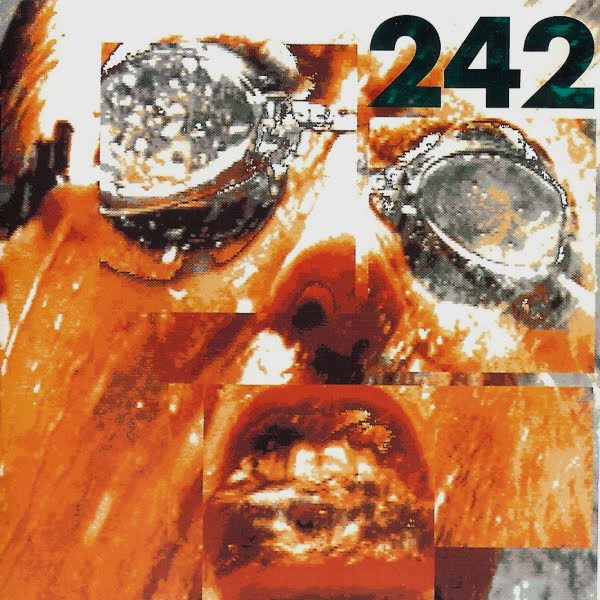
Front 242: Tyranny >For You<Let's start with what could be called an intermediary in the passage from eighties electronic music and the explosively expanding new world of the nineties; a genre simultaneously pushing ahead into and being eclipsed by techno "proper", namely EBM. Usually, EBM is seen as a late eighties phenomenon, and those years was indeed the genres highest tide, but it's not like it all just disappeared with the nineties and rave culture. Especially the first three years of the nineties were incredibly rich when it comes to EBM, there was still a massive momentum, a lot of the people involved clearly still believed that they were the future, and a lot of the genres greatest records ever came out during those years. Yet, what is really interesting about this EBM phase is that it was also highly involved with the new dance floor oriented sounds, which, after all, took a lot of both inspiration and audience from the older EBM scene. At least in northern Europe, rave culture was in many ways built on the already existing EBM-network, a bit like it was built on the existing hip hop/reggae-culture in Britain. A good example is Tyranny>For You<, by arguably the greatest EBM act ever, which managed to integrate more rave friendly elements in their unique sound. Tracks like "Moldavia" and "Neurobashing" practically disband all conventional song structures in favour of a driving, stomping energy not all that different from the harder techno forms being made by Front 242s fellow Belgians at the same time. The rest is classic Front 242 at their best, where dizzying clockwork contraptions of spliced and microscopically manipulated samples somehow manage to turn into surprisingly catchy songs. Tyranny >For You< is still an impressive demonstration that in 1991, EBM was still a force to be reckoned with, and certainly much more exiting and revolutionary than grunge ever was.
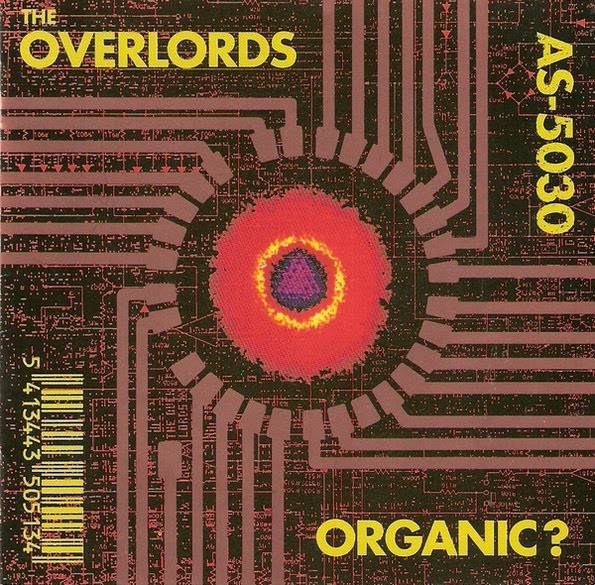
The Overlords: Organic?Going a step further in the EBM-techno-transformation, this one also takes well constructed and catchy song based EBM, and makes it even more rave friendly. The production is clear and cyber-muscular, with emphasis on a heavy, pumping groove, and the sort of melodic, infective pulse-riffs that EBM eventually handed down to trance. The track "Sundown" was a huge, huge single, and probably the snapshot of EBM turning into techno/trance.
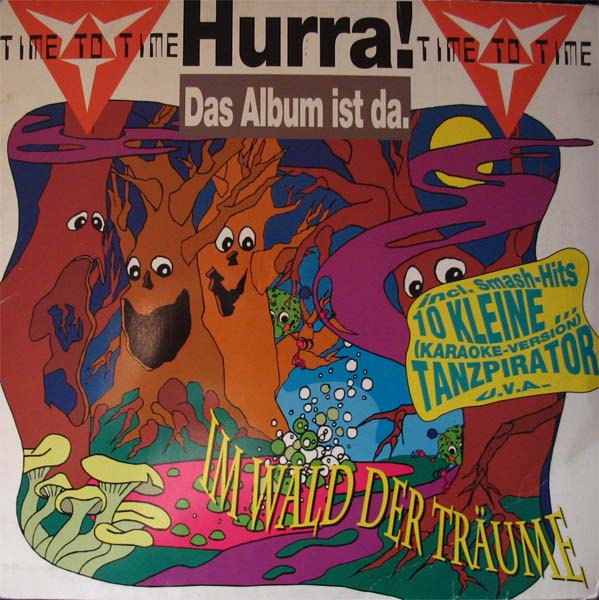
Time to Time: Im Wald der TräumeIf The Overlords went further into rave territory than Front 242, Time To Time went all the way. While you can still clearly hear EBM-elements - those pulsing sequencer riffs again - Im Wald der Träume also embraces rave juvenilia to a degree that would make Smart'Es blush. The vocals have been pitched up to a ridiculous helium smurf squeek, the "lyrics" are at best utterly silly, and the melodies could be taken from a childrens TV show. The contrast is made further clear by the cover, at one hand a splash of colourful cartoon images like Hannah Barbera on acid and ecstasy, but at the same time it depicts a group of three young men that could belong to any late eighties group in the intersection of EBM and dark, Depeche Mode-derived synth pop. All in all not a record that had a big impact anywhere, it's definitely the most obscure on this list, but nevertheless it's a fascinating indicator of the massive changes that was going on in electronic music at the time, and as silly and ridiculous as the music is, it also has a twisted inventiveness - sort of a rave Der Plan - that is irresistibly charming and utterly unique.
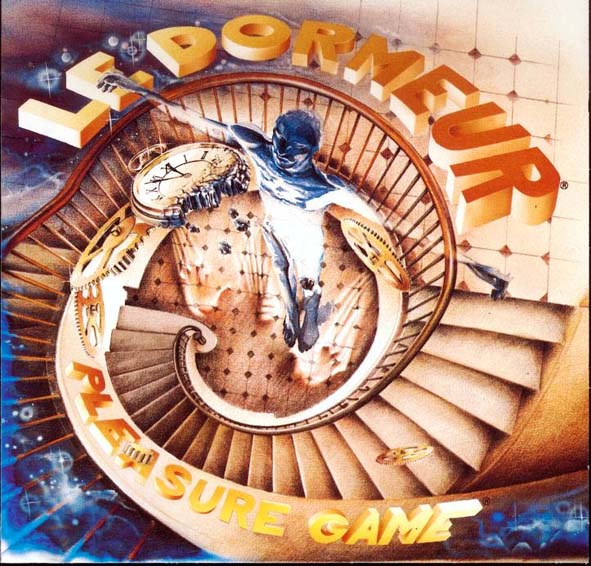 Pleasure Game: Le Dormeur
The biggest, most overwhelming rave development of 1991 was of course the Belgian hardcore sound, and that sound was largely based on singles. It never managed a successful transformation into album music, and in 1991 few of the leading artists even tried. The best attempt in this respect was Pleasure Games Le Dormeur, named after their massive hit, and managing to keep the quality relatively high throughout. Some tracks were clearly fillers, mostly designed to be atmospheric and experimental intermezzos among all the rave intensity, and they come off as either pretty uninspired or pretty awful, or both. There's still a majority of good stuff though, including some minor-yet-brilliant follow up hits to "Le Dormeur" ("Mystic House", "Prepare to Energyse"), as well as some awesome lost gems in the same vein ("Gravity Force", "Professeur Daktylus"), and it's definitely possible to listen to the album as a fully connected whole. Le Dormeur is not a stellar album by any means, but it's arguably the best and most concise single artist summing up of one of the most exciting developments of 1991, and as such a much more invigorating and relevant example of the zeitgeist than any mopey retro rock.
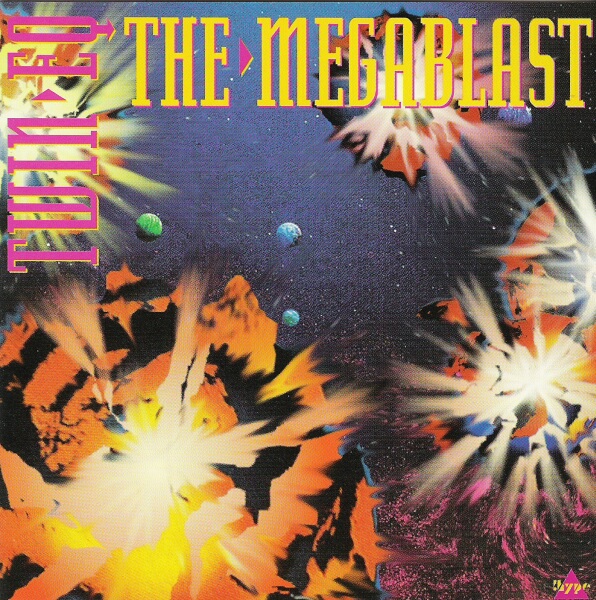 Twin EQ: The Megablast
The best straightforward rave album of 1991 was this forgotten obscurity, loaded with high energy beats, buzzsaw synths and bleepy riffs keeping just the right balance between functional anonymity and catchy melodiousness. German duo Twin EQ worked under many different names, the most successful being Interactive, who had several verging-on-novelty rave hits later on, but this is arguably their greatest moment. None of the tracks could be called classics or have left any permanent mark on techno history, but all the same none of them are weak or compromised, and every one of them delivers just the kind of hyperactive synthetic blast that good rave music should. The Megablast simply works as a compact, tremendous whole, energetic and buzzing all the way through.
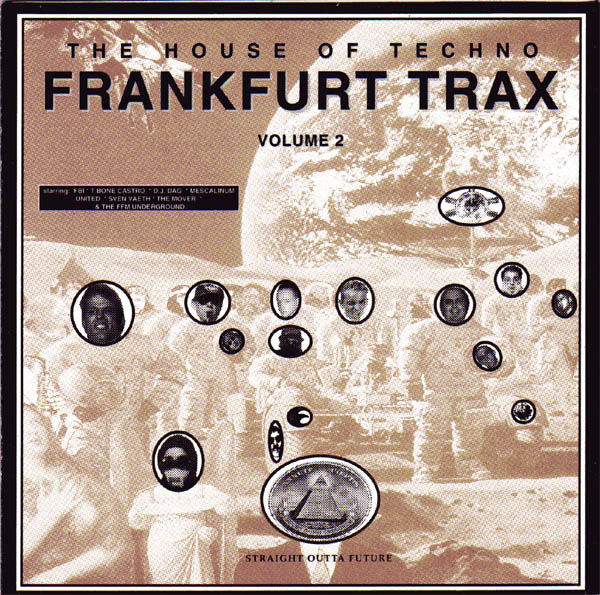
Frankfurt Trax volume 2 - The House of TechnoSome might argue that this violates my restriction to single artist albums, as it's obviously a compilation. Well, since everything on it - or at least on the vinyl version which I'm sticking to here - is done by Marc Acardipane, either on his own or in a few collaborations, it's certainly also very much a single artist effort, very clearly a singular vision, with the "compilation" aspect most of all being a conceptual packaging. In any case it deserves the benefit of a doubt, because probably being the greatest album of 1991, it couldn't really be left out here. Not much more to add, really, I think I have already said quite enough.
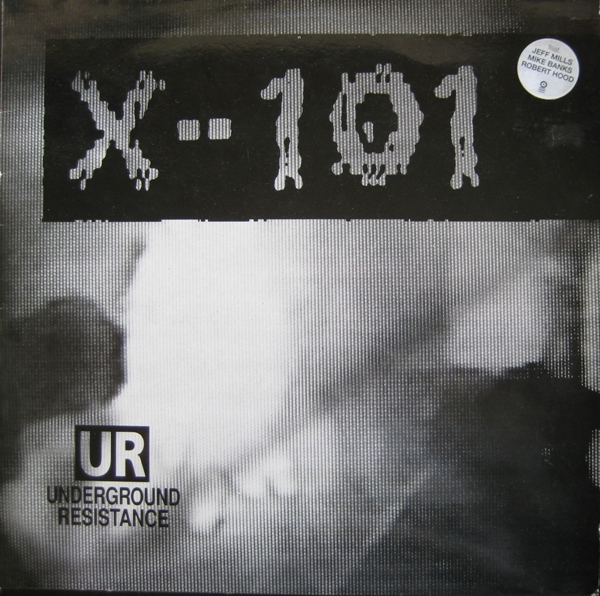
X-101: X-101A short, concise and generally brilliant little LP that is still one of the best things the Underground Resistance collective ever released. Interesting to notice the similarities with the contemporary Belgian/European rave sound on several tracks, as well as the EBM-ish elements, not just in the sound but even more with the cover, which is as archetypical EBM as it gets. I guess it's partly due to Mills' industrial roots (ie Final Cut), but it's also a great indication that the different pre-histories of techno aren't as disparate as usually assumed.
Air Liquide: Neue Frankfurter Elektronik-SchulePackaged and probably sold as an EP, and with an unclear release date that sometimes places it in 1992 (at discogs at least, but pretty much all other evidence say 1991), this is not the most obvious inclusion, but with a playing time of forty minutes (ten more than X-101) and one of the most ahead-of-its-time sounds of all the records in this list, it really ought to be here. Air Liquide would later be one of the main players on the cologne scene - also including Mike Ink/Wolgang Voigt and eventually one of the definitive building blocks in the current minimal techno sound - but here they've already created their own unique style, a reinvention of acid and cosmic krauttronica as haunting free form machine music, achingly beautiful and foreboding on tracks like "Sun Progress" and "Coffeine".

Biosphere: MicrogravityThis is usually considered one of the definitive records of the early "ambient techno" boom, though it's not really ambient in the conventional sense, or at least only on a few tracks. Not that it's easy to say what it is then, though. It's clearly a kind of dark and atmospheric techno, but it doesn't sound like any of the other styles around at this time (bleep, rave, proto-hardcore, proto-trance, detroit etc.), and hardly like anything since. There's a connection to the kind of bleak, gloomy and largely industrial/dark ambient derived minimalism that would later sort of run parallel to the actual minimal techno scene (Pan Sonic, Psychick Warriors Ov Gaia, Pressure of Speech etc.), but all the same, Biospheres sense of melody and structure is so unique here that it's probably more appropriate to classify him as a not directly related predecessor rather than as an actual ancestor. Microgravity had a huge impact, but it's so oblique and subtle in what makes it special, that no one has fully been able to emulate it.
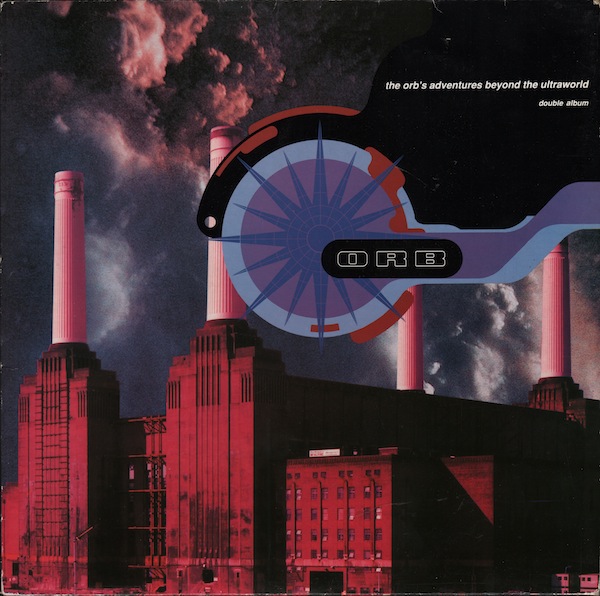
The Orb: Adventures Beyond the UltraworldSome might find this two hour monster opus too much, but it's still one of the most groundbreaking chill out records of all time, still part of the foundation of much music being made today. Personally, I still think most of it is pretty great, there might be early signs of the cheap ironic zaniness that would eventually become an annoying part of the Orb brand, and a lot of the tricks that they would later repeat over and over again are also present, and consequentially a bit damaged by reverse association, but there's also a freshness and a sense of breathless, un-ironic wonder that still makes huge parts of it seem magically unreal and beautiful all these years later.
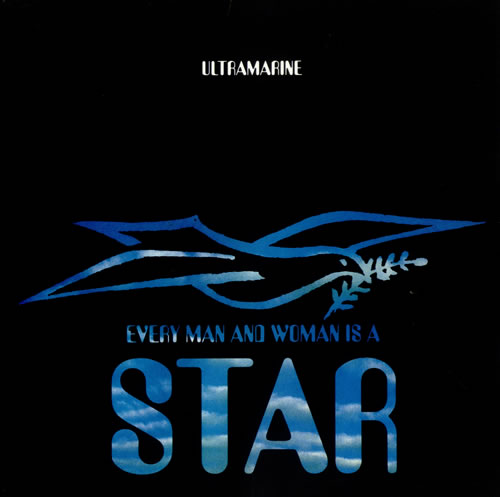
Ultramarine: Every Man and Woman is a StarIf The Orb's Adventures Beyond the Ultraworld seems a bit too obvious and omnipresent, this have long been the "cool" alternative choice as greatest chill out album of 1991. Actually, it's not all that chilled, the beats are often extremely groovy and energetic, but it's a catchy and enjoyable album that - a bit like Biospheres Microgravity - was probably a bit too unique in its style for others to follow it. If anything, it seems almost like an atmospheric, laid back and new age "spiritual" forbearer of big beat.
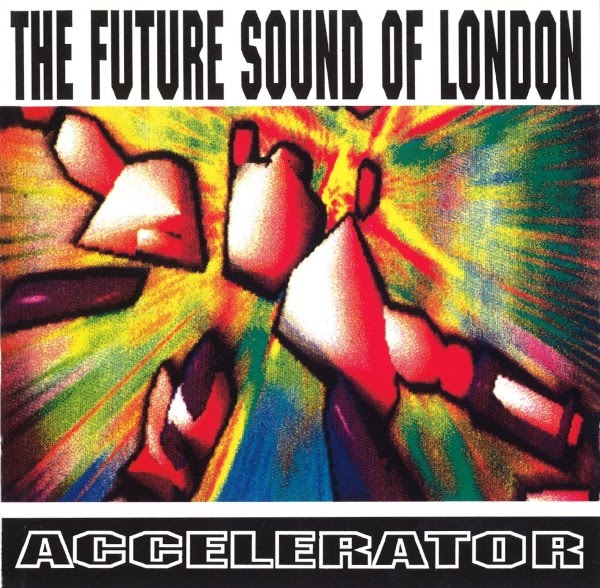
Future Sound of London: AcceleratorDespite FSOLs later reputation as abstract ambient experimenters par excellence - something that made them the big bad pseudo proggers in Energy Flash - their first album wasn't all that abstract, and not particular ambient either. Rather, it was a pretty straightforward collection of tracks existing somewhere in between rave viscerality and introverted "softcore" atmospherics, often reminiscent of the 808 State style of electronic exotica. However, it's never quite the one or the other, and Accelerators greatness is exactly that it manages to be both without sounding like a forced or clumsy pairing of opposites. One of the greatest and most convincing examples that electronic dance music can be fully transformed into softer, mood based "album music" without losing its edge one bit. I've never personally thought that the later FSOL efforts were bad, and certainly not as bad as they're said to be in Energy Flash, but Accelerator remains my favourite FSOL album by far; inventive, well-proportioned and endlessly listenable.
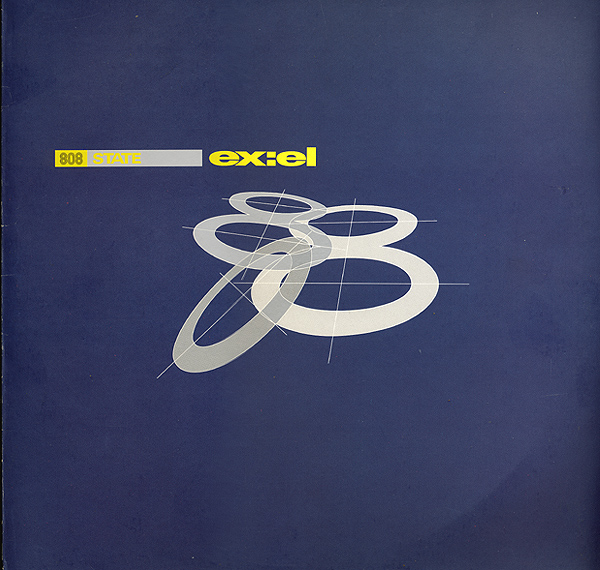
808 State: Ex:elIf anyone can be called pioneers of the techno album it's 808 State, but after some of the genres greatest LPs ever - Newbuild and Ninety - by 1991 they were beginning to lose it just slightly. Ex:el was a bit of a mess, trying to be all over the map, while simultaneously going further into the guest vocalist trap that they just managed to keep stomachable on Ninety. Arguably, the vocal styling of Björk is so sound-in-itself oriented that it works brilliantly with atmospheric electronica, but one track would be enough, and Bernard Sumners "Spanish Heart" is pretty lame. Still, what makes Ex:el great, and makes it belong here, is that it manages to be surprisingly listenable despite all these problems. It's too long, slightly messy and uneven, but somehow it all comes together as a coherent - if not exactly seamless - whole, that sort of embody the explosive, unmanageable state of the electronic scene at the time. None of the music on Ex:el is quite the "real thing", ie proper representatives of the many different genres and fractions spreading at hyperspeed in 1991, but rather artificial simulacra thereof - when not simply artificial creations without any obvious outside inspiration - and deeply fascinating and odd exactly because of it.
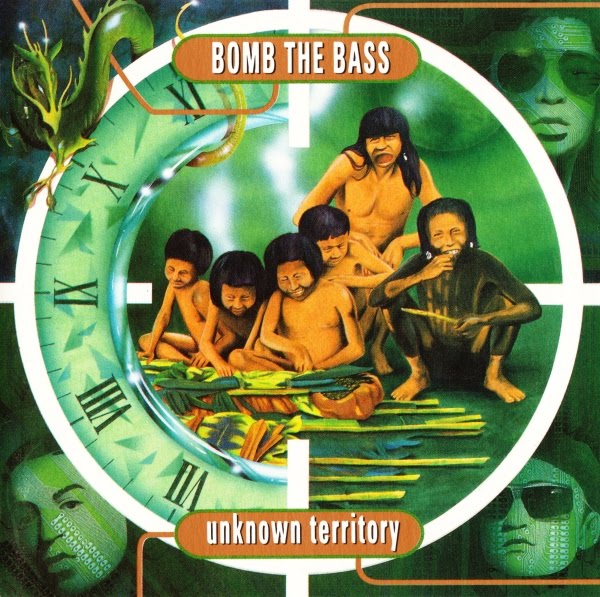
Bomb the Bass: Unknown TerritoryThe guest vocals have usually been an even greater problem with Bomb the Bass than with 808 State, though clearly a similar problem: They seem unnecessary, tacked on and overshadowing the real interesting things happening in the track constructions. Unknown Territory, though, is the one time where Tim Simenon makes it all balance, partly because there's not that many guests on it, partly because the used vocalists have so little personality, and are used in such a way, that they mostly seem like anonymous sound sources - they could just as well have been samples, and the production is taking the lead throughout. Preempting both trip hop and big beat, continuously inventive and catchy, and without a single dull track (even the torch songs - something I normally loathe - somehow inexplicably works), Unknown Territory is one of the greatest and most prophetic albums of 1991, and arguably the crowning achievement of the DJ/producer-as-star movement that came out of the late eighties British acid/hip house boom.
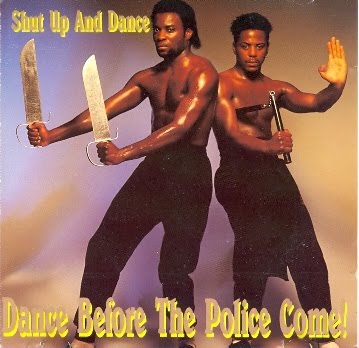
Shut Up and Dance: Dance Before the Police Come!The closest we get to hip hop in this list, considering that SUAD saw themselves as fast hip hop rather than techno/rave. That said, I've never cared much for the rap on it, it's the breakbeat-and-samples rave aspect that truly makes it an interesting and in many was groundbreaking record. In a lot of ways it's patchy and perhaps one of the most dated of the records here, but there's no denying that it represents an important step in the breakbeat development, and definitely a much bigger musical leap - as well as one of much bigger subsequent innovative impact - than anything Nirvarna ever did.
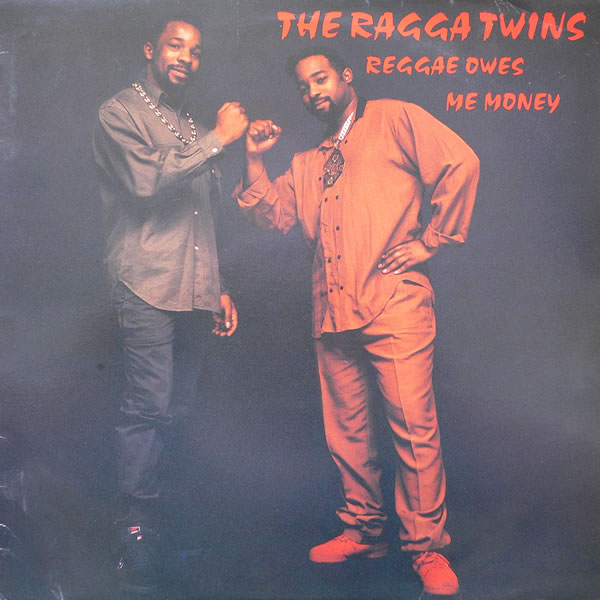
The Ragga Twins: Reggae Owes Me MoneyA step closer to true proto jungle, mostly due to the fusing of ragga vocals and breakbeats in just the way that would eventually become the very definition of the most popular, ragga-dominated end of jungle. As with Shut Up and Dance, I prefer the instrumental side of The Ragga Twins, though I'm sure the charm and character of the vocals is a huge part of why this record is held in such high esteem by most hardcore/breakbeat/jungle scholars. Anyway, that it's some sort of a musical milestone is pretty undeniable.

4 Hero: In Rough TerritoryAs for ahead-of-its-time break beat, no one were probably further ahead in 1991 than 4 Hero. Their cold, sharp and basically ragga-free approach made it proto drum'n'bass rather than proto jungle (if that distinction makes any sense), and you'll be hard pressed to find anyone else working so consequently with the breakbeats-and-bass template this early, even considering 12" releases. In Rough Territory has its weaknesses - it's definitely too long and samey, and there's still a slightly antiquated quality to some of the tracks, with their basis in - interestingly enough - bleep'n'bass still clearly audible, making it as much a highly alternative take on the bleep aesthetic as the creation of drum'n'bass ex nihilo. Still, the ground breaking inventiveness of the sample splicing and dicing, the sheer propulsive force and the overall quality of the best tracks, gives the whole a future shock impact that still seem powerful today, and which certainly must have been amazing at the time, and more than enough to render its overall problems as an album (which only seem really problematic retrospectively) irrelevant.
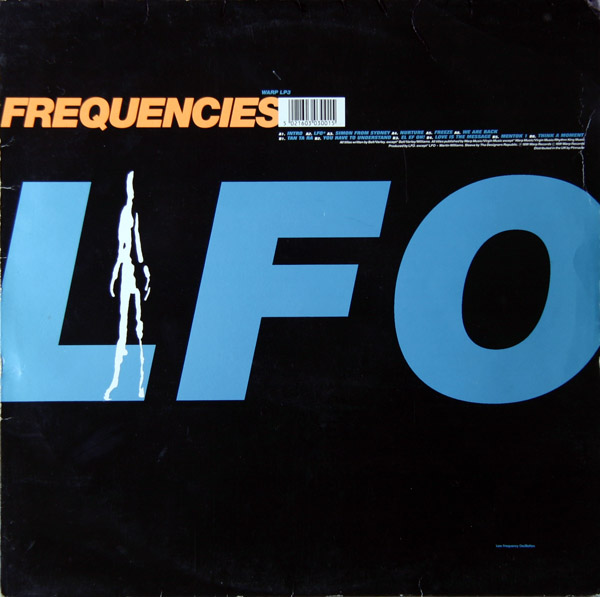
LFO: FrequenciesIt's sobering to consider that while 4 Hero were deliberately moving away from bleep and already building a new future, bleep itself was still just about a year old, and and only then reaching its apex. That's how fast things were moving. The definitive bleep album, and as such arguably the crowning achievement of the style, was of course LFOs Frequencies, which is the canonised techno album of 1991 if there is one. The status is well deserved, LFO takes the bleep aesthetic and invents a whole new language with it, using the potential to its fullest and twisting it into all sorts of weird and hitherto unimagined shapes - and much like with Biosphere, the results are mostly so idiosyncratic and self contained that the album seemed to exhaust this specific direction completely, rather than opening up for possible descendants - trying to emulate Frequencies seems both impossible and pointless.
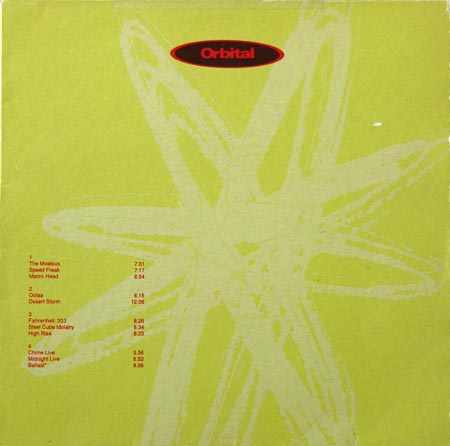
Orbital: OrbitalWith one foot in the bleep camp and one in their very own brilliant future - simultaneously proto trance, chilled "listening techno" and experimental electronica - I'd dare say that Orbitals "green album" is even better than Frequencies at expanding the possibilities of the bleep scene, even if they never fully seemed a part of it. The album is arguably too long - a problem Orbital continued to struggle with on many subsequent albums - but the quality is nevertheless extremely high (if anything, it's the incredibly coherency of it that sort of makes it a bit exhaustive in the long run), and it's especially fascinating that the greatest tracks are not just the established singles ("Chime", "Belfast", "Speed Freak" - great as they might be), but rather less known "fillers" like "The Moebius", "Macro Head" and "Steel Cube Idolatry", being just as creative with the bleep formula as anything on Frequencies. Too long or not, except for Frankfurt Trax 2 there's probably no other album of 1991 that still sounds so fresh - and so timelessly original - as Orbitals debut.

Plaid: Mbuki MvukiPredating their albums with The Black Dog, this is the very first long player from anyone belonging to what would eventually be Warp-based British IDM milieu (Aphex, Autechre, µ-ziq, Luke Vibert etc.), and its mythological status have been pumped up by the fact that it was practically unavailable for a long time. With Warps Trainer-compilation of early and/or unreleased Plaid material, it was finally possible to judge it, and it turned out to be... well, not quite as incredible as it had been claimed to be. Well, how could it ever? Basically, Mbuki Mvuki is a bit uneven, with several tracks coming off as too effortless breakbeat+"exotic sample" amalgams ("Slice of Cheese", "Summit", "Scoobs in Colombia"), not really going anywhere. However, that doesn't change the fact that it also contained some of the first fully formed examples of what would eventually become Plaids (and to some degree also The Black Dogs) trademark sound, those weirdly angular melodies and rubbery, flexible rhythms that still sounds absolutely unique and futuristic, even today. And even if there's a few fillers, Mbuki Mvuki works convincingly as a whole, and has just the right, refreshing length - something later Plaid and Black Dog albums never quite got right. ****Appendix A: CompilationsWith so much amazing music being released only as singles, the overwhelming impact being made by the rave scene in 1991 is not really clear from just single artist albums. However, there was simply so much great stuff around that it's possible to find a bunch of very different compilations that all work as superb albums on their own. This small top five could just as well have been part of any "best of 1991" list.
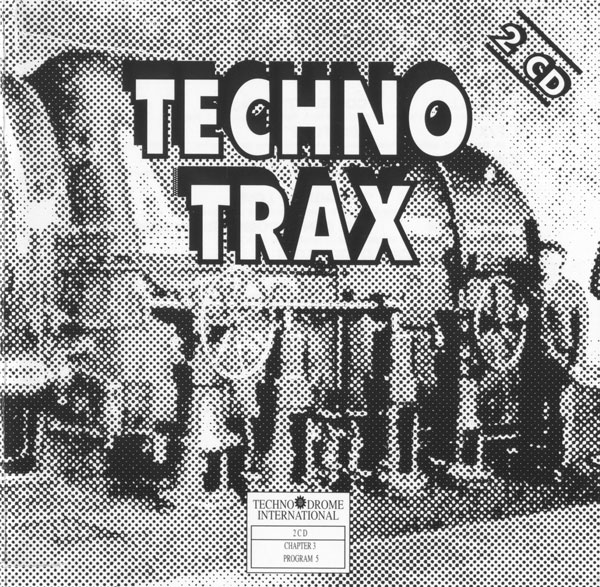
Techno TraxThe first in a series of compilations that would eventually get more and more dominated by watered down dance hits and cheap novelty tracks, but which nevertheless began pretty great, with the first one especially being a bit of a treasure trove, full of lost gems mostly from the German and Italian part of the continental hardcore/rave scene. The emphasis here is on more electro-tinged tracks (with very clear elements of both EBM and italo disco), rather than the more house /hip hop based sound of the British/Belgian axis, and there's simply so much good stuff to be excavated in this department - no techno collection should be without treasures like Recall IVs "Contrast", Klangwerks "Die Kybernauten" or Cybex Factors "Die Schöpfung". Techno Traxis invaluable in any survey of the 1991 techno scene.
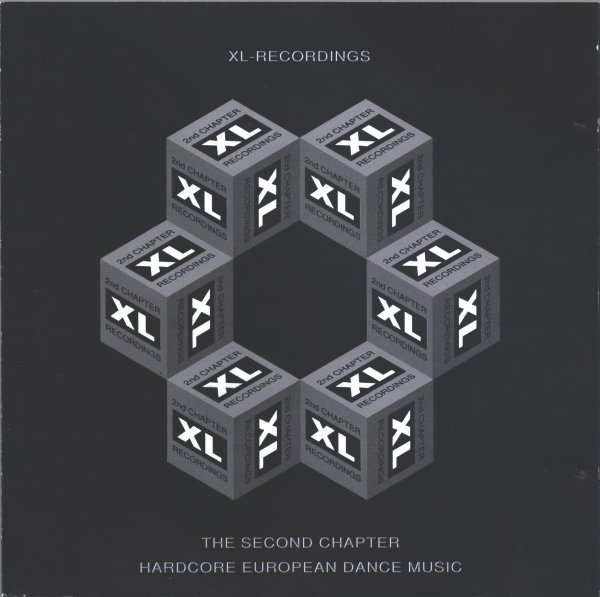
XL-recordings: The Second Chapter - Hardcore European Dance MusicProbably the most definitive collection of 1991 rave hits you'll ever find - I'd say at least 75% is stone cold classics (T99, The Prodigy, Holy Noise, Cubic 22 etc. etc.) while the rest are just ad brilliant if not quite as well known. Absolutely essential starting point to get what this was all about.
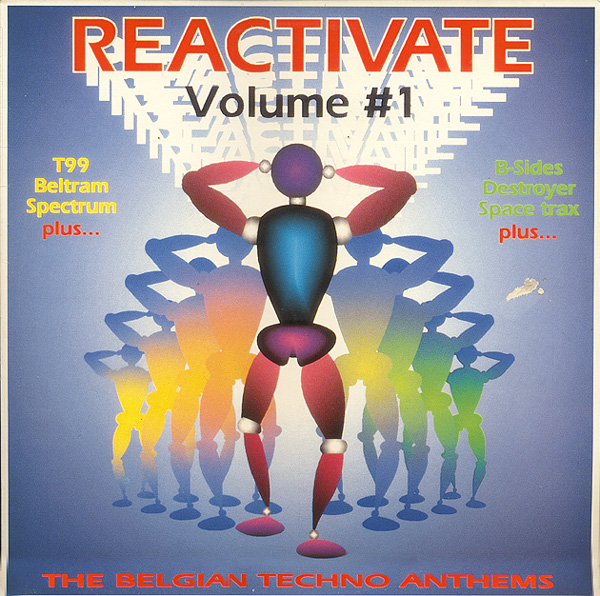
Reactivate volume #1 - The Belgian Techno AnthemsThe ideal companion to The Second Chapter, in that except for T99s "Anasthasia" (the only track appearing twice in this list) and Beltrams "Energy Flash", this is all lesser known, not-quite-hits that brilliantly showcases the slightly more tracky side of the Belgian scene. You'll not find a better or more concise LP of Belgian techno (even if several of the tracks aren't really Belgian).
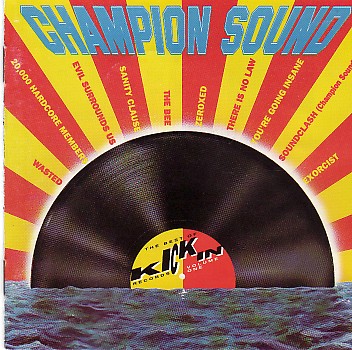
Champion Sound - The best of Kickin Records Volume OneIn 1991 Kickin was one of the most successful labels in the British breakbeat scene, specialising in a both melodic and bombastic sound that fused Belgian brutalism with the prevailing British b-boys-on-hyperspeed sound. This compilation sums it all up in one definitive package, containing practically all their great early singles.
Technozone: Central-EuropeThe best indication of just how out of control the techno/rave scene was by 1991, is the fact that you'll find compilations like this, full of practically unknown tracks that are clearly pumped out very fast to meet the demand, but rather than being weak and derivative, pretty much everyone is a winner. Substantiates why techno - and not grunge - ruled the world in 1991, and blasted open the gates to the future.****Appendix BA last couple of albums ought to be mentioned. First of all, KLFs White Room certainly had a huge impact in 1991, and was somehow part of dance cultures taking over of the world. Only a shame it was so crappy. Secondly, Kraftwerk released The Mix after five years of silence. Now, consisting entirely of remixed old tracks, it wouldn't really fit the original top 20 list, after all, that list was meant to represent the future that erupted in 1991, not the past, but there's definitely a massive significance to The Mix. By 1991, Kraftwerk had finally proven beyond all doubt that they had won. The unfolding future was their spawn. And with The Mix, they sort of acknowledged this. The album should really have been the closing of the doors to the past, but sadly, grunge simultaneously reopened them and insisted that it was better to live with rock regression than with electronic progression.
WONK IT UP AND START AGAIN [ 07-Nov-11 6:19pm ]It's seems that there is still a lot of controversy about whether the electronic dance scene is producing anything really "new". Outside the scenes own circles, everybody more or less agree that everything is now all about looking back, rediscovering past glories, an endless patchwork of retro styles and pomo recombinations. At best it's "hautological", deconstructions of the retro-process itself, but nothing actually novel or unheard, nothing so new it'll shock, just like it have been the last ten, or is that fifteen, years? Or twenty, if you're brainwashed by rock-based media and think rave music was also a pomo recombination thing (because you see, they were using samples!), and the last time something "new" happened was bloody grunge (is there anything more sad than encountering someone who have lived through one of the greatest moments in music history, the rave golden age, a veritable explosion of innovation, only to hear them talk about how exciting they thought it was when grunge, that pathetic last-grasp-at-authentic-rock, happened, how it was the "new" and "revolutionary" thing of their youth? What a waste of youth.)
Anyway, for those who actually did notice the electronic glory years, there's still a lot of people who haven't given up, those who still think that not only should (electronic dance) music always renew itself, but who also claim that it is actually still doing exactly that. Well, aren't there always someone who will talk about how much great music is constantly being made, and don't the rest of us know how hopeless that is? Because it's not just about how there's a lot of quality stuff around, there more or less always is, and some of it might even sound somewhat novel, perhaps managing to make some small twists of the old formulas. The question is whether that stuff is actually opening up new possibilities, changing our perception of what music means and can be, and basically shapes and challenges the times rather than being shaped by them. Well, I completely agree that this is not really happening where most people tend to suggest it is. As so often before, the front line is supposed to be the british club scene (i.e. "the 'nuum", more or less), and certainly, what is being proposed as the current frontier in that respect, namely the intersection of uk funky and post dubstep/"future garage"/whatever it's being called, is, mostly, just hopelessly dull and regressive. So in a way I'm with the pessimists, led mostly by Simon Reynolds it seems, when it comes to the stuff being championed by this specific post dubstep contingent, on dissensus and associated blogs. However, and this is the point, all sorts of mindbending, shockingly new stuff actually are being made, and can even be classified within the post dubstep area, it's just something very different from all the tastefully lame pseudo house.
 It was actually quite a surprise for me to discover just how much amazing stuff came out last year, suddenly realising that I was, in a way, living in a new golden age, though a golden age that it's hard to distinguish because it's the result of all sorts of crazy, strange and uncategorizable ideas going on all over the map simultaneously - even when the map as such is nevertheless very clearly a post dubstep map. In any case I don't think this kind of momentum have been around since the early nineties, but nobody seem to notice since it's lacking a coherent movement and a really huge audience, not really being a true "scenius" movement, let alone a part of the 'nuum proper. But at the same time it's all happening because there actually is a proper 'nuum scene happening right now, with probably the hugest audience any rave movement have had since the mid nineties. I'm talking, of course, about wobble dubstep. Which I guess is also why things might feel like a golden age, because this is certainly the wobble heyday. It's also why so much of the funky/post dubstep being suggested as where thing are happening are actually so uninteresting: Because it's in its conception meant to be anti wobble, which almost automatically makes it tame and regressive, rejecting the most exciting and truly innovative scenius movement to have appeared in ten years.
 Wobble is now what most people think of as dubstep, and I can only see this as a good thing. There was a lot of good stuff in the early dubstep movement, but when it was possible to reject the style back then as a kind of forced or willed and far too self consciously scenius scene, it was because it did indeed contain a lot of the very same concepts of depth, taste and righteous history that still seem so archaic in so much of the current "future garage"-stuff. And most, if not all, of the things that made early dubstep so fascinating and promising, despite all the reggae vocal samples, clichéd dub-echoes and even more clichéd brooding spliff-moods, was precisely the things that eventually became parts of wobble: The aggression, the wild start-stop-dynamics, the over-the-top monumentalism, and so on. I remember writing back in 2008 that I hoped wobbles bass-manipulations would eventually develop to the same level of intensity, complexity and rhythmic/dynamic irresistibility as jungle, and the question is now whether this have actually happened? I'm not completely sure, but to some degree, yes, I actually think it has. Not that wobble seems as perplexing or shockingly new to me as jungle once did, but I think this might just as well be because of me, rather than the music itself.
Back then, I hadn't really been following the breakbeat hardcore scene much (I was mostly into gabber, acid and experimental techno), so when it suddenly broke through it seemed to come out of nowhere, and indeed didn't sound like anything I'd ever heard before (even though I could obviously hear that there was some kind of connection to the early Prodigy-ish breakbeat rave that I was aware of). With dubstep, well, I've been following the development in real time, have seen all the mutations as they have been happening, and perhaps most important, I have constantly been wondering whether this could actually be the "new thing", asking and judging whether it could be said to be as perplexing and shocking as jungle once was. Eventually, this level of attention and historical knowledge will guarantee that I will not feel the same, but if you're as unprepared for wobble as I was for jungle when jungle hit me, I think wobble could very well seem just as mad and revolutionary. The complete redefinition of rhythmic and melodic drive, the constant chopping and deformation of the bass lines, not really being "lines" any more, but rather taking on a melodic and orchestrational aspect, and the completely new two-lane rhythmic structure, where everything is happening in concentrated packages of insanity between two lurching, monumental godzilla-steps, all this is redefining musical parameters and dancefloor dynamics on a scale that inevitably reminds you of jungle.

Now, comparing jungle and wobble, there's obviously also things that are very different. In particular, you can't but notice that there's fewer true "anthems" in wobble, and longer between the tracks that turns everything on the scene upside down. As far as I can tell, this happened on something like a monthly basis during the jungle heyday, and even though I'm not monitoring wobble that closely, it doesn't seem to be the case here. And I think this is because the whole setting is so very different. In the noughties dubstep scene that wobble came out of, and still is a part of in a way, everything just happened so much slower, every new 'nuum development immediately got adopted by the omnivorously eclectic, post historic hipster club scene, rather than being in direct competition with countless other strains of rave, as in the nineties. Dubstep and wobble have certainly mutated constantly and thoroughly, but never in a way that have seemed rushed or uncontrollable. Eventually, it got to the future, but it never seemed as hell bent on getting there as jungle, or gabber, or trance - or pretty much any kind of early nineties rave. And this is more or less still the situation, wobble have been dominant - and generally GREAT - for something like three or four years by now. Compared to jungle, that's a long time to be on top (how long did it take from jungle broke through to it started the jump up/jazzzzzz/techstep-ossification? Was it even two years?), but the reason might simply be that wobble is taking its time, delivering the goods at a much slower rate, and not trying to reach the mutational dead ends as fast as possible. Not that that is necessarily a bad thing, but it certainly means that it doesn't appear as fertile and hectically innovative as the leading rave forms of the previous decade.
In any case, wobble is great, often absolutely insane and utterly exiting, and it have definitely been the final proof that dubstep was indeed the new thing all the early devotees said it was. That the same devotees are now whining about how bad and wrong and stupid wobble is, is only more proof - that's exactly how it should be when the next generation comes along and take all the small innovations that was part of dubstep from the start, and turn them all the way up to eleven, getting rid of all the historical clutter so important to the first generation. Their whining is the strongest sign of health and actual, radical newness that the wobble scene could possibly get, and probably the main reason Simon Reynolds finally, sort of, saw the light. Not that he's really championing wobble, but he clearly got that dubstep now follows the familiar pattern repeating itself again and again throughout rave history (and, consequently, through Energy Flash): The new mutations that actually opens new doors and take things in new directions will always be seen as degenerations by the old guard, and always be described as stupid, unmusical, soulless, unintelligent, primitive, repetitive, monotone, all-the-same, just aggressive noise for losers/students/chavs/whoever you don't like, to go nuts to, and not least: This kind of talk is exactly indicating that something really interesting is happening.
It's actually nice to see Reynolds being consistent and still getting it, even if it took him some time, and even though he doesn't seem to have gotten really into it, as much as it would sort of make sense he did, considering that wobble might simply be just the thing he have been looking for for so long, and that he thought grime was: Rave cultures version of punk. But perhaps he finally gave up all hope that this would ever happen some time ago, and therefore can't really allow it to happen now that the truth is supposed to be that nothing new is happening/can happen, and that everything is retro culture. Strangely, some years ago I really thought that all possibilities of newness was forever exhausted, and certainly that something even remotely resembling punk would be impossible within rave culture, just a wish among those brought up on rock mythology for a magic moment to repeat itself. Nevertheless, here we are. Why anyone would waste their time on retro stuff when so much utterly, shockingly new is happening right nowis beyond me. But so little of it is yet recognised, I guess. Seeing wobble as the trailblazing new thing that it is, is one thing, getting a hold of and recognising the scope of the post-dubstep scene is something quite different.
Post-dubstep is a fitting name, not because it's signifying a post modern everything-goes-mindset of endless combinations and rave-historic excavations, and certainly not because it's "post" like post rock, always so tasteful and humble. No, post dubstep is post like post punk, and not just, as it has been claimed, because it's a collective term for a lot of actually quite different stuff that just shares some roots in dubstep, because that's actually not the case for a substantial part of the stuff that I think it makes sense to describe as post dubstep. Post dubstep is like post punk in that it's a heap of very different artist and sounds thriving in the new fertile musical environment being opened up by dubstep, just like post punk was an expansion into the endless possibilities made possible by punk. That is what's happening now, rather than the coherent and continuous scenius movement that the 'nuum have followed so far, we have all these people coming from all these different places, some actually from dubstep, some from breakcore or drum'n'bass, some from different strains of "club music", some from experimental hip hop, some even from electro and IDM/electronica, and of course some coming from nowhere really, just getting started doing music at all, inspired to do something by the overall sense of excitement and freedom, and they don't seem to think of themselves as a movement, they all have their own ideas as how to twist things and change the rules, to make stuff that is deliberately strange and dislocated and not necessarily "functional" like proper scenius 'nuum-music. As such it's much the same mindset as the experimental techno of the nineties, except that now it's generally driven by and permeated with the new sense of groove and overall viscerality of dubstep. Even when it's clearly brain/listening-music, it still seems fully aware of the physical impact as the necessary starting point when you want to utilize the force inherent in any kind of rave based music, even if it's for much more cerebral and "arty" ends. Which is pretty much the way most post punk - extremely arty and conceptual - was driven by punk, and what made it different from prog rock.
So yeah, I think post dubstep is sort of the right name, except perhaps that it's not all that snappy. But that's easily solved, just compress it to POSTSTEP and we're home, the perfect umbrella term for what is going on here, not least because there's probably not much that could solely be classified as poststep. Just like with post punk, it's more like a vast area full of things that are sufficiently apart to warrant their own labels. There's already a cornucopia of new terminology waiting to happen, and I'll try to use it as a launch pad to demonstrate my claim about how much truly new and unprecedented music poststep is coming up with:
WONKY HOUSE: I think this is an adequate name for a lot of the "future garage" stuff being discussed in the dissensus/blackdown-circuit, i.e. influenced by/parallel to UK funky, but more strange/twisted (well, "wonky"), and sometimes even good. Generally, though, this is the part of poststep that I find dull, and where it's pretty fair to describe it as tastefully feeble, uninventive and backward-looking. Far too much smooth house-emotionalism and this strange belief that some rather unremarkable "clever" details in the otherwise hopelessly regressive four to the floor drum programming somehow qualifies as innovation. Like the worst kinds of minimal and detroit-techno, the cognoscenti can recognise the ever-so-subtle syncopation that most people wouldn't, and that is supposed to elevate the simplistic main pulse to high art. Well, there still are some good things here, the Egyptrixx album Bible Eyes is surprisingly futuristic despite some obvious elements of newer minimal techno on the more straightforward 4/4 tracks. The Night Slugs label has released other good tracks, but mostly they're highly outnumbered by slightly-more-inventive-than-actual-house pseudo-house.
 Some might argue that Zomby belongs in the wonky house department, and while that's certainly not the case for his early stuff, at least from One Foot Ahead of the Other and onwards, it could make some sense. In that case, he's obviously the best in this area, being one of the greatest and most uniquely groundbreaking poststep revolutionaries, though I'd still say he's only a borderline representative of this end of things. Except for some of his very early singles he doesn't seem the least interested in making things that works in the club, and is basically just his own. Also in the borderline area is the Hyperdub label in general, which more or less joined the wonky house camp recently, and have contributed with some of its better offerings, even though they're in no way as great and groundbreaking as their older releases. The most obvious example is probably Ikonika, whose Contact, Love, Want, Have is certainly too long and one-dimensionally "emotional" for its own good, and nowhere as good as her early singles, but still contain many wonderful and highly original tracks. In small doses (like the ep samplers), it's some of the best in the housey end of poststep. As for Kode9, I'm not quite sure what to think of the Black Sun-album, it's sort of fascinatingly odd, but not exactly convincing or coherent. But I'm not really sure it belongs here, it could just as well be placed in the next box:
GHOST STEP: This is the hautological part of poststep, and perhaps the first strain to separate itself from the larger dubstep movement. The example par excellence here, looming high above everything else, is of course Burial, and the majority of the stuff going on is more or less descended from him. Which is all fine and dandy and have resulted in some highly enjoyable music - after all Burial made some of the absolutely greatest records of the last ten years, so it's hardly surprising that someone could get absorbed in his particular aesthetic and make something good with it as a template - but often it's not something I've felt especially compelled to follow, just like I've never felt Joy Division - to use that old comparison again - to be so compelling that I've wanted to immerse myself in the scene that was built on their particular vision. That said, there's also lot of potential here outside the completely Burialesque tradition. As mentioned earlier, Distance represent a related and yet completely different aesthetic, drawing on and subverting the "doomstep" elements of proper dubstep, and yet there's not many who have tried to follow that promising route. Strangely, some of the most interesting examples come from the American end of things, with connections to the "downtempo" scene (i.e. "posthop" below): In each their own way Lorn and Nosaj Thing create a kind of doomy-yet-hushed, dubstep-influenced post rave ghost music. Lorn is the most bombastic and cinematically melancholic, while Nosaj Thing, on his amazing debut Drift, manages to be as otherworldly and truly haunting as Burial without sounding even remotely like him. And interestingly, some of the best newer British ghoststep producers seem related to the downtempo aestehetic as well; both Illum Sphere and Ital Tek combine a kind of burial-derived hollow emotionalism with more rounded production structures and sleepy beats, as well as some of the more fractured videogame-elements that are getting increasingly used in the Californian scene as well. In this respect, Ital Teks Midnight Colour album, as the title suggests, seemingly try to tick off as many poststep boxes as possible. It's quite good actually, if perhaps a bit too long for something that polished and uniform.
POST HOP: This is the prime example of how people from a completely different and more or less stuck leftfield area suddenly seem to explode with creativity, seeing all sorts of new possibilities in the space opened up by dubstep. I've always been extremely suspicious of the downtempo/abstract hip hop/illbient scene that I guess is the roots of all this. Dull laid back stoner music made even more dull by an oppressive knowledge of hip hop history. Intellectually righteous pomo mashup, really. Overlapping with the J Dilla end of things, which always left me cold as well. All those things are still, to some degree, present somewhere deep down inside the new poststep version, but all the same they have been eclipsed by a completely new style, drawing on anything from pure dubstep to chip tunes and computer game music to dreampop, sci fi soundtracks and seventies synth prog (Vangelis is being sampled a lot). OK, haven't this style always been drawing on many of those influences, you might ask? Well, it has, but hitherto only in the sample collage sense - as cool styles to drop into the mix, flavours and references to be recognised. Now, on the other hand, they're used as integrated parts of the compositional structures. Rather than just finding some oldschool arcade bleeps or eerie sci fi synth and placing them on top of a stoned beat, new producers like Free the Robots, Mono/Poly and Shlohmo seem to take these elements as the starting points and build a whole new world with them - music that is actually futuristic because its inventing new and strangely contemporary equivalents to the forms where these elements once was used, rather than just combining stuff that signal "futuristic".
I've never cared much for Flying Lotus, who was arguably one of the first to take things in this direction. Somehow he never fully got free of the aforementioned downtempo trappings (see also Samiyam), and even when he really tries to tear up the rulebook and disrupt all the usual structures, like on last years Cosmogramma, to me it somehow comes off as just aimless. Which is why it was such a surprise to encounter a record like Shlohmos Shlohmoshun Deluxe, technically belonging to the Flying Lotus family, but all the same working on all the levels that traditional down tempo isn't. And then discover that there were many more producers from the same Californian milieu doing things equally new and exciting, yet not necessarily similar. In Shlomos case, the drowsy laidback mood that is always such a turn off in downtempo have turned forebodingly unearthly and worn, sometimes on the brink of disintegration, and with an almost glitchy feel which somehow merges perfectly with the Zomby-like dislocated arpeggios and angular stabs of bass, sometimes clearly drawing on wobble. It's simultaneously reminiscent of the early Octagon Mans rigor mortis-electro and a pixelated version Reqs proto-hauntological meditations on sample based entropy and decay, yet it all comes together as a completely self contained vision, diagnosing the messy world of now just as convincingly as Burial or Zomby. The same holds to some degree for Dibiase, related but also quite different, going all 8bit/Nintendo-crazy on machines Hate Me, probably the clearest example of what could be called bit hop, a small sub genre slowly coalescing within post hop. It's a record that is actually loaded with very obvious "historical" samples, from both video games and old school hip hop, but which nevertheless manages to make it sound disturbingly disoriented and fractured. Rather than a cosy exercise in feel good nostalgia, the album is a treacherous maze of mangled memory fragments and jarring sonic scrap. Closer in spirit to The Residents' Third Reich'n'Roll than any contemporary "mash up".
The grainy digital entropica of Shlohmo and Dibiase is only one part of post hop, though, and others - most prominently Take and Free the Robots - take things in the opposite direction, while clearly belonging to the same "movement". Here there's also plenty of 8bit cascades and heavy, at times pseudo-wobbly machine bass, but it's also extremely well produced, not to mention well composed, with tracks unfolding like miniature stories or sonic short films, dazzling sci fi moodscapes that seem like a heir to both cosmic prog and space funk as well as chill out and trip hop, but all done in the new framework that has evolved in the intersection between (post) dubstep and (post) instrumental hip hop. A lot of the same elements that are found all over poststep are also present here: ghostly, futuristic alienation, glittering synthetic colours, "neon" as a metaphor for the luminous-yet-eerily-insubstantial quality of the overall moods. At times this kind of post hop gets too smooth or chilled or laid back funky, which is unfortunately, to some degree, the case with both Takes Only Mountain and Free the Robots Ctrl Alt Delete. Still, at their best - which they fortunately are on big parts of those albums albums -, they're magnificently bewitching, like an endless glide through kaleidoscopic dreamspaces, as succulent and engulfing as they're strangely disturbing and bittersweet.
Post hop is probably one of the largest and most popular fractions of poststep, not least because it's partly build upon a pretty big and well established scene. However, where this scene seemed stuck and irrelevant just a few years ago, now all of a sudden it's coming up with all sorts of new forms that seem to constitute a small revolution within the dowtempo/chill hop community. There's even a lot of it I don't particularly care for, especially all that going in a indietronica-ish direction (like, say, Tokimonsta), but I can still appreciate that they're making their contribution to the overall sea change. And there's also a lot of stuff outside the Californian stronghold, like the early stuff by Lukid and Rustie, or to some degree Robot Koch, who, like Ital Tek, is pretty much all over the poststep map. Few of those are as consistent as the best of the Californians, but they're all part of the larger picture.
BITSTEP: This is where things get really amazing in my opinion, and probably something like the big, all-connecting hub of poststep: Almost all other kinds of post dubstep intersects with bitstep, mostly sharing some characteristics but not all. Still, there's also a lot of stuff that is exclusively bitstep, even though it's difficult to define it precisely. Something that doesn't belong anywhere else, yet is clearly poststep, usually sounds very much like bitstep, even if it doesn't directly use the defining 8bit sounds, computer game effects or pixelated arpeggio madness. It's a bit like those elements - jerky angular rhythms, jagged scraps of trebly-scratchy guitar, punky dub-funk bass -, that are often a sort of shorthand for post punk, even though a lot of post punk didn't use them. In a similar way, the collapsing dubstep syncopations, stumbling 8bit-patterns and labyrinthine, ever-fracturing dynamics of bitstep will, I hope, eventually be the stylistic summing up of poststep. This is the greatest, most world shattering revolution developed in the wake of dubstep, and it's what ought to be recognised and championed as the essence, so far, of poststep, rather than some inhibited house-mutation.
Some try to dismiss all this by claiming that the 8bit and Nintendo-elements makes it retro music, or at the very least dependent on a historical knowledge, but I suspect that people making this claim haven't heard much bitstep, or have only listened for the elements here or there which can be used to support their dismissal. Bitstep is generally no more retro-chip tune or dependent of Nintendo soundtrack history than, say, The Slits or PiL were retro dub or dependent of historical reggae scholarship. The 8bit elements have been popping up in different kinds of electronic music - techno, rave, electro, hardcore, you name it - practically as long as these styles have existed, sometimes in a specifically melodious way, sometimes as abstract sound effects, sometimes as clear historic references, and sometimes as a hitherto unheard new idea. Bitstep takes this last tendency and runs with it, creating a whole new, completely unprecedented aesthetic fully exploiting the 8bit techniques potential for wild abstraction, yet at the same time inventing an equally new and unheard form of melodiousness out of those very abstractions.
This is where Zomby really ought to be classified. Especially on his early releases he was pretty much the archetypical bitstep producer, along with a substantial part of the Hyperdub roster back when that label had a legitimate claim to the leading edge: Quarta 330, Cardopusher, the early Ikonika, the early Darkstar ("Squeeze My Lime" is perhaps the greatest single of the noughties, while North was an equally great disappointment). Runner up as bitsteps founding label is Ramp, which, in addition to several Zomby-releases (and a lot of other slightly bitstep related stuff of different quality), released the "Gritsalt" 12" by Slugabed, pretty much taking things to the next level after Zomby. Slugabed made a bunch of remixes and contributions to compilations and split records until he released the - so far - definitive bitstep milestone, the Ultra Heat Treated-ep, kind of the crowning achievement of 2010 as the greatest poststep year yet. Pretty much taking all the most wild and colourful elements of 8bit-influenced dubstep and practically inventing a new language with them, breaking them into jagged, unbelievably contorted pieces and then reassembling them in bizarre patterns, abstract cascades of 8bit-splinters somehow coming together with a paradoxical melodiousness, syncopations so bizarrely twisted that they're practically dysfunctional, yet at the same time almost as forceful and invigorating as full on wobble. Quite simply one of the most revolutionary and radically new records of any period - if anyone could listen to this and not hear the shock of the future, then they could just as well have been listening to "Acid Tracks" in 1987 and dismissed it as a regurgitation of disco, or to Are We Not Men? in 1978 and dismissed it as retro-prog.
Slugabed, and in particular Ultra Heat Treated - his new ep Moonbeam Rider is still pretty great and unique but unfortunately also more polished and smooth - might be the peak of bizarre bitstep so far, but luckily he's far from alone, others have joined and develop the style further: labels like Error Broadcast, Low Riders and Donkey Pitch, artists like Loops Haunt, Ghost Mutt and Coco Bryce. Some of them take things in an even more abstract direction, all dysfunctional beats and kaleidoscopic sound splinters, and others, like Suckafish P. Jones and Eprom, while equally twisted and colourful, somehow manage to be almost wobble-ravey. There's also a more atmospheric direction, spearheaded by Jamie Vex'D/Kuedo - on the In System Travel and Dream Sequence eps - and Dam Mantle, whose incredibly strange and uncanny Purple Arrow ep might be second only to Ultra Heat Treated as the greatest poststep release of 2010. And then there's of course the many examples of bitstep merging with other poststep trends, as well as more open ended crossover artists: Lazer Sword, Robot Koch, Starkey, SRC etc.
WONKY WOBBLE/(WONKLE?)/RAVE-STEP: The wobbly-ravey end of bitstep blends into a larger trend within straightforward rave dubstep and wobble: a style that is simultaneously meant to be full-on tear out dancefloor-anthems, yet utilises a lot of weird'n'wonky bit/post-step tricks to make things even MORE mental. Some of this is just wobble with added catchy poststep elements - typically 8bit bleeps or quirky detuned bass sweeps -, others make full blown poststep weirdness that just happens to work on a hyped up wobble dancefloor as well, and a lot of it falls in between: dubstep and poststep at the same time. Not much to add to that, actually, except that at its best it's a great example of a truly popular avant garde, in the great rave pulp modernism-tradition - i.e. also quite scenius. I guess labels like Bad Acid and Rwina are the leading exponents here, and some of the best representatives could be artists like Geste, Rachet or Doshy.
HYPERGRIME: In a lot of ways poststep have revitalised the potential for strangeness and newness that was originally present in grime, but which somehow got eclipsed as that genre got to be more and more about MC egos, while the actual music - the instrumental, non-narrative element once so sharp and radical - more or less got reduced to an opportunistic afterthought that could be pretty much anything. A lot of the things that made early grime seem so revolutionary have returned in poststep, and are now being used and further developed as an aesthetic in its own right, rather than as a purely functional means to back up an MC: The ultra synthetic plastic sounds, the bombastic, fanfare-like riff-melodies, the almost preposterously inorganic syncopations. As dubstep became the route that most instrumentalists would take away from grime proper, these elements became sort of forgotten, until the poststep scene created a whole new place for them, practically divorced from the scene actually descendant from the original grime scene, and finally allowed to flourish and evolve.
The key example is of course Terror Danjah, one of the only first generation grime producers that fleshed out the instrumental side of the style and used it as an end in itself, a lab for wild experimentation and invention with sound design, complexity and new compositional structures. From being slightly forgotten, the amazing Gremlinz-retrospective suddenly put him back in the front line as a part of the general poststep landscape, as an inspiration and forerunner for a lot of the prevailing ideas, and demonstrating the huge, still untapped futuristic potential in grime when the pure sonic aspect of the style is being recognised. Afterwards he was immediately embraced by the poststep scene, and a whole bunch of releases flowed from him in 2010, not least on the two most influential poststep labels, Hyperdub and Planet MU. Most of it was pretty good, with the Hyperdub album Undeniable getting most accolades. Personally I'm not completely convinced by that - mostly because of the vocals - while I find the sadly somewhat overlooked mini-album Power Grid on Planet MU much more compelling: Precise, intense, bursting with ideas and innovation, and fitting the overall poststep feel of newness and freshness like a glove.
Of course Danjah is not alone, and fully formed experimental/instrumental grime seem to have a bit of a heyday right now, independent of the MCs and allowed to go its own way, which seem to run parallel to the rest of poststep. Labels like Earth616, No Hats No Hoods and Oil Gang, and artists like Teeza, Swindle and Darq E Freaker, push this new grimestrumental-breed into still more exaggerated, twisted and complex shapes. A really strange part of all this is the Belgian DJ Elephant Power, who started out as one of those mash up DJs who utilised grime as yet another exotic flavour, never really being a part of the scene as such (he also did glichy collage stuff), but ravey dubstep apparently showed him a much more exiting and convincing way to have a mad party, and his Elepha in da Flash-album is one of the best poststep party records out there, at its best giving cartoony-grimy tracks some of the energy of tear out wobble.
SKWEEE: Much like the Californian downtempo-scene, this Scandinavian style developed on its own, but now seem to be an obvious part of the larger poststep-whole. It utilises elements present all over poststep - hyper-syncopated electro funk beats, twisted 8-bit melodies and deliberately synthetic neon synths - yet it all comes together in a way that is all its own, sometimes perhaps a bit too conscious of the eighties electro-aesthetics, sounding more like what used to sound futuristic rather than actually sounding futuristic. Most of the time, though, it's either some of the most strange and unheard, undeniably new and futuristic stuff to have come out in the last five years, or it has the "lost future" feel so central to poststep, sounding like the blurred memory of an unknown future that should have been happening right now. This is the case with records like Daniel Savio's Dirty Bomb and Nekropolis, as well as Rigas den Andre's Guilty Feet, No Rhythm, while artist like Limonious, V.C. and Mesak (on his new stuff) go all the way into the unknown. With his debut lp House of Usher, Limonious is up there with Zomby, Slugabed and Dam Mantle as one of the most revolutionary poststep-producers, twisting beats and melodies into shapes so absurdly angular and unnatural - and yet so paradoxically catchy - that it seems impossible to even start to look for something to compare it with - except perhaps some of his most out-there skweee-colleagues.
At its best, skweee is a bit like what industrial was to post punk: In many ways a quite different aesthetic coming from a different and unique background, yet sharing some central aspects of the overall vision (structural disintegration and hyper-syntheticity with poststep, transgression and starkness/bleakness/coldness with post punk) and thus becoming an integral part of the whole, sometimes sounding unlike anything else, sometimes almost indistinguishable from more "archetypical" poststep-forms, and sometimes clearly influencing artist from other areas. Bitstep-ish producers like Coco Bryce and Nino have already pledged allegiance to skweee, while the French "post funk" maverick Debruit seem to have reached a closely related sound independently.
JUKESTEP: During the last couple of years, juke/footwork have become the club connoisseurs great black hope for the next big scenius thing. Personally I can't say I'm completely convinced by juke, and not just because it's so functional and scene-driven that there's an almost intolerable low hit-to-filler-ratio, though that's definitely also a part of it. Most of all, I just can't see it as being all that radical and new. The super fast rolling drum machine patterns sound strangely regressive to me, after all we've been through jungle and 2-step and Timbaland-style r'n'b beat-science, and then this kind of busy clutter of 808-sounds seem almost old fashioned, and almost like the sort of thing you'll always come up with when you try to make really complicated and weird high speed beats on a drum machine, but eventually give up on exactly because you think it sounds a bit too forced in it's complicated high speed-weirdness, a bit too obviously held back by the equipments limitations when it comes to exactly this kind of beat science. And then there's the vocal science. Well, what vocal science? It's not like looping one vocal sample throughout an entire track is some sort of revolutionary new concept - really unimaginative producers have certainly done it in other sorts of electronic dance music all since the early nineties, if not earlier. Only, they rarely did it so unimaginatively, and perhaps that's the whole point: the vocal loops in juke are clearly meant to be detached and primitivistic. It just doesn't make them less dull or annoying.
Still, I'm slowly warming a bit to juke, it seems to become better and more innovative, and I seem to be hearing more tracks that are actually pretty good - with ideas and weird, unearthly moods, and beat structures that actually seem as multidimensional as they're said to be. While I thought that the first juke solo-albums on Planet MU - DJ Nate's Da Track Genious and DJ Roc's The Crack Capone - was completely absurd (who on earth would ever listen to such endless, one dimensional endurance tests all the way through), I must say the Bangs & Works-compilation is a brilliant introduction with a good selection of (mostly) very good tracks, and the new DJ Diamond album Flight Muzik is actually really good - engaging and fascinating tracks with lots of ideas and personality almost all the way through. Which takes us to the point, namely that juke is also being used as one of the main inspirations in a lot of new poststep. First of all, it's worth noticing that a lot of record shops actually file juke records as dubstep, even though it comes from a completely different scene and context and doesn't sound even remotely like dubstep. This seems pretty weird, but I suppose it's a reflection of the fact that, outside the actual, original core audience in Chicago, for which it's a pretty much isolated sound dictated by its functional context, the international audience for juke is exactly the poststep audience that uses it as a new set of useful ideas in their general search for futuristic beat-abstraction. And I actually think that it often works much better in this way than with "true", authentic juke. Which is of course the absolute opposite of how it used to be with the scene/lone artist dynamic in electronic dance music. Unlike, say, jungle, where the crossover and electronica outsiders takes on it always seemed a bit tame compared to the real thing, with juke, I often find that it's a fresh angle that just need to be used for something, and that's what the poststep producers are doing.
Sure, it's not always a success, something like Machinedrums Room(s)-album is just the kind of predictable IDM fusion mush you'd expect from an electronica veteran who have utilised different strands of new underground dance sounds as exotic-authentic flavours for ten years. But with many others, it makes much more sense: On the new albums from Kuedo and Sully, as well as Dam Mantles awesome new ep We, the juke beats simply works as a fully integrated aspect of the overall sound, to the degree where you sometimes doesn't even notice them- they're just a part of what makes the music strange and unique. Both Kuedo and Sully certainly have backward looking aspects (Dam Mantle is still sounding like little else), but I can't really hear them sounding "retro" at all - at most perhaps slightly "hautological" - and a reason for that is precisely because they've managed to integrate weird and destabilising elements - like juke beats - so smoothly into the whole.
Still, more interesting is the possible concept of "jukestep", a more equal combination of juke techniques and poststep aesthetics. You DO hear more and more of this cropping up I think, though so far only Jamie Grinds Footwork-ep - of what I've heard - make it work really convincingly. But I'm sure more is on the way. And you could also ask if it has to be poststep producers approaching juke, couldn't it be the other way round? Some of the more ambitious juke producers might notice the potential of the poststep scene that is giving them so much credit, and eventually try to approach it from their side. Perhaps this is what happened with DJ Diamond, the reason Flight Muzik is so unorthodox and intriguing. I have no way of knowing, but it would certainly be an interesting development. Perhaps juke is playing much the same role as avant garde jazz played in relation to post punk: A beguiling contemporary frontier of far out extremism and abstraction, eventually creating a loosely defined interzone where you can't really say what is what and which practitioners might originally have come from each starting point.

In addition to these more or less major trends, there's also a lot of other, different poststep-things going on, some being small micro-developments by a single producer or label, others having a potential still waiting to unfold. There's the 8bit-dub invented by Disrupt and his Jahtari-label; it's often regressing into lame digi-reggae, but at its best - basically meaning Tapes and Disrupt himself - it's truly unique and innovative, somehow tuning into the same vision as many other poststep producers, yet not sounding like them at all. There's Anti-G and his incredible Presents Kentje'sz Beatsz-album, apparently a kind of bizarre experimental version of the duch "bubbling" sound, and definitely some of the most mental and jaw-droppingly strange music I've heard this year. There's Debruit, who might have a lot in common with skweee, but who is also his very own twisted thing. There's the dream-step of the Tri Angle-label (Balam Acab, Clams Casino etc.), often a bit too indie-friendly for my taste, but clearly creating their own path. And then there's this concept of "post bassline" which I've seen mentioned somewhere (dissensus?) recently - bassline producers going eccentric/experimental - which I haven't investigated further, but it's obviously something that could happen, and could be very fascinating. You could perhaps also suggest something like post wobble - not the kind of experimental rave dubstep discussed earlier, but rather the harsh, industrial textures of the most brutal wobble forms turned into experimental mood music. Former Vex'D member Roly Porter goes all the way into dark ambient on Aftertime, but it seems obvious that some might eventually create an in between sound.
 As it should be clear by now, I think we're living in an incredibly exciting time, musically, with enough innovation, originality, quality, variation and utter strangeness/newness around to make a comparison with the post punk years. Not that it should be taken as a one-to-one analogy, though, because there's obviously also some very important differences, in particular with respect to the relationship between all the incredible music and the rest of society as a whole. Post punk seemed to reflect the times in a two way process - the music was generally seen as analysis, comment or parody of its time, and was often also created as such. This gave it another sense of importance and urgency, it was the quintessential expression of those years in artistic terms, as well as an active part of the opposition to the way things were. Post punk was taken seriously as more than "just music", and nevertheless it managed to produce a surprising amount of artists that actually had a huge commercial impact, names that were public knowledge and not just cult esoterica for the converted. With poststep, there's no big success-stories (closest: Burial and Zomby, but they're a long way from being a part of public consciousness in the way that, say, Talking Heads and Joy Division were). Very little of it seem to have any conscious ambition to be seen as more than "just music", and even less is judged as such. The reason for this is obviously that the times - despite certainly just as desperate - are so very different.
 Today, nobody's encouraged to think of the music they make as a factor of actual social/political/philosophical impact or consequence, and nobody seems interested in hearing those things in it. Music is music and even though you might have big and ambitious aspirations for it, whether as artist or listener, they're always purely aesthetic aspirations. Music is now a part of the endless flickering landscape of choices and distractions - youtube hits and briefly exiting micro trends -, and neither listeners nor producers are able to focus entirely on one clear vision and use it to build an ongoing dialogue with or response to these troubling times. However, you could argue that poststep is a brilliant expression of the zeitgeist exactly because of this, because the vision it is creating - more or less subconsciously I guess - is a sense of flickering, dislocated unreality, caught somewhere between a perpetually disintegrating mosaic of bizarre shapes and colours, and a ghostly yearning for something unknown or half forgotten that ought to be here. And if that isn't how right now feels, I don't know what is.
TEN YEARS OF NOTHING [ 07-Dec-09 9:41pm ]Anyway, not being a fan I will not be listening to, let alone buy, that box set, but it is interesting to compare it with the releases celebrating the 10 year anniversary in 1999. First you might notice the cover design. The 1999-records had some modernist architechture/brutalism-thing going on - not executed all that great, but the idea was appropriate. The new box, on the other hand, looks like it could be a recent Pink Floyd compilation. Of course that kind of pseudo-scientific cod surrealism have always been a part of the Warp aesthetic, but the fact that it's chosen to represent the entire Warp history is quite dispiriting. Still, the content is even more significant: With the 10 year anniversary records they not only made what is probably the ultimate bleep compilation, basically containing all their amazing early singles, they even released a great compilation of early house and techno from artist that came before Warp, a gesture that seemed so much more interesting and brave than just giving the countless newly converted Aphex/Autechre/Squarepusher-fans a pile of stuff they allready knew and loved. Ten years later, and half of the anniversary box is a compilation chosen by Warp co-founder Steve Beckett and "the fans". And the other half is repeating the "idea" of the least interesting third of the 10 year anniversary - the tired trick of dressing a bunch of old tracks up in new remixes.
Well, obviously they couldn't release another compilation of old bleep singles, but that's actually the whole point of why the anniversary thing is so sad: In the last ten years Warp have not made any contribution to music even remotely as groundbreaking as their part in the bleep era. Or the IDM era for that matter. Because, rellay, even though there's some good records here and there, when was the last time any of them had any actual impact on anything? That would probably be Boards of Canadas Music Has the Right to Children, which did indeed start a whole lot of things, but that was 1998!! Even if there have been the odd great warp record during the last ten years, that period do indeed seem utterly impoverished compared to the ten years that went before. And it's bloody ten years. Ten years of almost nothing. Let's not even mention the indie records.
In this way, the Warp anniversary somehow seems to represent how insignificant the noughties have been in comparison with the nineties. Now Warp never really got into the great stuff that actrually did happen in the noughties, unlike Planet MU they never tried to be a part of grime or dubstep or breakcore, so of course the Warp version of the decade is much more dull than it actually was in itself, but still, in the nineties there was huge amounts of incredible stuff going on that Warp didn't participate in either, and they still managed to release a whole bunch of groundbreaking records. It often seemed like the nineties - especially the first half - simply had infinite levels operating at the same time. Looking back at the last ten years of Warp you realize that that was not the case at all during this decade. To come up with something new and original was the exception, not the norm. This is what really saddens me, and it kinda work on a personal level too: The thing is, when I heard about the 20 years of Warp, I suddenly realized that I remembered the last time Warp had an anniversary - and it seemed like yesterday!!!
Part of the problem here is obviously that you're bound to feel old with such a realisation. Ten years passed and you hardly noticed, and all those things you wanted to do never happened. But equally sad is the reason the years seemed to pass so fast and leave so little: Unlike the nineties, the noughties didn't offer more truly new stuff than it was possible to keep track on. Developments that could have happened simultaniously and in a few months in the early nineties followed each other in orderly succession in the noughties, and took years each - like the 2step-grime-dubstep-lineage. You could keep up with the new releases and feel that indeed things were happening, not realizing that you spent years following developments that would have happened in a flash earlier. For someone brought up on the nineties evolutionary speed, the noughties felt like an instant, because the musical evolution it offered would have happened in an instant in the privious decade.
BREAKCORE GEMS [ 07-Jun-09 5:19pm ]
Maybe there's a few places in my pieces about dubstep and mainstyle-gabber where it looks like I'm kinda badmouthing breakcore. And, to some degree, I am. Breakcore is bloody problematic to me in a lot of ways. Despite the fact that it developed out of the more-or-less experimental hardcore scene that I've loved for so long, and despite the fact that I was totally into it in the beginning and bought lots of records, and even though I still love and regularly listen to a lot of said records, it was pretty obvious for me right from the start that this stuff wasn't going to have a - let alone be the - future. For a start, the name is a dead giveaway, so sadly uninspired that it's almost directly proclaiming a lack of ambition - this music is just a combination, and a rather obvious one at that. It's hardcore with breakbeats, innit. Jungle meeting gabber. It had to happen, and of course a combination of two of the greatest forms of rave ever has to deliver some good stuff, but the point is that just adding up stuff doesn't automatically advance the used elements in themselves. Breakcore didn't develop neither jungle nor gabber any further. At best it managed to revitalize them slightly, but mostly by placing them in a new context.
Of course, it might not have been 100% doomed from the start. Dupstep, despite having an equally lame name, and also starting as a kind of obvious combination (something like instrumental grime+2step+tech step), eventually ended up with it's own powerful innovations, taking a giant leap forward. It just didn't happen with breakcore, and for some reason it never felt like it actually could. But why? I guess it has something to do with the core audience and the producers, mostly coming from styles already infected with either anti-rave crossover aesthetics or an ironic mash up approach. Two of the most crucial elements making up the breakcore scene is probably lapsed IDM-nerds, lured into breakbeats by drill'n'bass rather than jungle/'ardcore, and former Digital Hardcore-disciples with much more of a noise/punk approach than a rave one. That would be a huge part of the American segment I'd say - digital hardcore was surprisingly big in the US, maybe just as big as any kind of genuine rave music (of which I'm not counting house), and the same goes for breakcore too I suppose.
Anyway, the point is that a large fraction of those making breakcore were kinda doing post-rave mix-it-all-up music right from the start, working with self conscious deconstruction, references and parody rather than developing the musics genetic material from within. Too large a fraction for breakcore to ever free itself from the gravitational pull of the past, the knowledge of history, and engage a sufficiently amount of new blood. Unlike dubstep, which, no matter what people like K-Punk or Reynolds want to believe, certainly have a large audience - and probably a growing roster of new producers as well - that are not scholars of 'nuum history. This is the reason why, despite all the great music, breakcore never convinced me the way dubstep did, and why it probably never could have developed into a really fertile rave scene. To get the full meaning of breakcore, you had to know too much, there's no starting from zero. Which is finally, to some degree, getting us to the point of this piece: Because even though the majority of breakcore is made up of either: 1) extremely hard and noisy jungle overloaded with ragga samples, 2) drill'n'bass beefed up and rhythmically anchored by massive gabber bass drum density, 3) silly plunderphonic party music, 4) post DHR-noisefests with punishing amen shrapnel, 5) sluggish industrial goth-core or 6) a combination of any or all of the above, breakcore was also an extremely versatile genre. The producers came from a huge variety of backgrounds, and it all became part of the sound, which could be anything from absolutely serious noise/art-experimentalism to feel good party music.
As much as breakcore lack a truly independent, collective movement, and never managed to create a new, unique and defining sound separating it from its sources, it also has a much higher maverick ratio than perhaps any other electronic music of the last twenty years. Precisely by not being a scenious movement, breakcore had plenty of room for geniuses, or at least producers creating their very own odd take on things. This is where the great breakcore innovations are to be found, and of course, none of them initiated a movement, they were all specialized signature curiosities, personal micro-innovations that could hardly be followed by anyone else without plagiarising them. As a result, there's a big treasure chest of wonderful and thoroughly enjoyable breakcore to be excavated, and while the genre have few defining classics (let alone anthems), there's plenty of amazing obscurities, as well as stuff that's just so bloody original that it can't help to fascinate. So here we go, a collection of 15 more or less unsung breakcore gems:
Patric Catani: Hitler 2000 (Digital Hardcore Recordings)
Perhaps the greatest artist on DHR, and definitely the one who made the best records released by the label. Alec Empire is probably as good as Catani overall, but his best records remain the albums he did for Mille Plateaux, even if he also made some good ones for his own label as well. While Empires Destroyer is one of the few truly trailblazing breakcore records, opening the amen-punk route followed by far too many, it's nowhere as great as this, which shows how inventive, funny, destructive and sometimes even downright groovy breakcore can be. Some people talk about Shizou as the pinnacle of DHR; I've got absolutely no idea why. To me he seems pretty anonymous and stereotypical. Others mention Christoph de Babalon, but even though his highly praised If You're Into It, I'm Out of It-album IS pretty good, it's also slightly overrated, a bit uneven quality-wise, while probably a bit too even in mood and atmosphere. Hitler 2000 is quite the opposite, sticking in all sorts of weird, twisted directions, from the baroquely contortive to the nightmarishly beautiful, and most of it not sounding like anything else in breakcore, though maybe at times slightly foreshadowing later developments. With it's superb balance of earshredding noise and mangled grooves, Hitler 2000 was in many ways the next big leap forward in breakcore, since 1997s foundational records like Panaceas Low Profile Darkness, DJ Scuds early eps and Alec Empires aforementioned Destroyer, while simultaneously remaining a unique, inimitable entity. It kind of map out the scenes potential, you could say, and consequently, in a lot of ways, the journey begins here. Mind you, Catanis trashy fictitious computer game soundtrack The Horrible Plans of Flex Busterman might actually be his greatest achievement for DHR, but that's not really breakcore, and unfortunately not something anyone really followed.

No-Tek 5 - Urban Break Corps (No-Tek)
A brilliant obscurity from the transitional phase in french hardcore, where the cutting edge switched from manic speedcore to twisted breakcore. Apparently, No-Tek is both a label and a producer, and responsible for some of the greatest of that french speciality, psychedelic gabber. This four track EP, which is actually kind of a mini-compilation involving Psai-Zone, Axl and "Znobr the Break Fucker" as well, is in a much more loose and grungy territory. It's still driven gabber bass drums as hard and heavy as big blocks of concrete, but they've become strangely rolling and syncopated and countered by rattling breakbeats, creating the overall impression of rusty and ramshackle machinery pushing ahead despite being close to a breakdown.
Cavage09 - Sans Dessus Dessous (Cavage)
Mostly known for organizing raves in the Paris catacombs and sewers, which is obviously enough to give them eternal cult status, the Cavage label was also a central cog in the french breakcore scene, mirroring the developments made by experimental-hardcore-institution Praxis, which made a shift from industrially sounding four-to-the-floor mayhem to industrially sounding splatter breakbeats around the time Cavage started. Cavage became the french part of the whole milieu surrounding Praxis - including labels like Ambush and Deadly Systems, the c8-website and the Datacide-magazine -, and released a string of compilations centered around prime mover and label mastermind Saoulaterre, aka Boris Domalain, also working as Gorki Plubakter and DXMédia (and often on the same record), and accompanied by a floating roster of artists like Nurgle de Trolls, Gamaboy and Praxis stalwarts like Dan Hekate and Nomex. In this way, the Cavage records are not so much traditional compilation albums as they're the latest adventures of Boris and friends, and the style change according to his current whims and whoever is otherwise participating. The most recent Cavage record, number 14, is absolutely brilliant, but couldn't really be called breakcore by any stretch of the definition. Rather, it's deeply psychedelic avant garde hardcore, simultaneously beautiful, noisy, sorrowful and disorienting/terrifying, and definitely worth tracking down. For their breakcore output however, they were probably never better or more unique than on Cavage09, where all traces of traditional breakcore clichés are practically gone There is one single lame cliché on the album, in the form of a short and utterly generic noise track, but the rest is a bizarre and captivating mix of twisted french hip hop, drifting psychedelic soundscapes and slowly-disintegrating-yet-deeply-groovy breakbeats, not to mention even more odd elements like stuttering guitar riffs and oldie show tune-samples. This might sound like it's one of those annoying everything-goes-no-genres-binding-us-we-can-and-will-fuse-everything-we-please records, but what's so amazing is that it actually isn't. The weird mix of styles and ideas never sounds like forced eclecticism, it's all just coming together in a way that seems obvious and right and so much it's own strange thing - physically searing and totally ravey while at the same time permeated with a strange sense of loss and sadness - that you hardly even notice that it's actually a combination of pretty awkward elements.

Electromeca: Riddim (Casse Tête)
The most successful french breakcore label is probably Peace Off, specializing in archetypical breakcore styles from a huge cluster of international leaders in the field, like Sickboy and Doormouse. Electromeca could be described as something like Peace Offs secret weapon, their one true claim to innovative fame and on a completely different level from what's otherwise on the label - a bit like Req on Skint, you could say. It often seems like Electromeca is the breakcore producers breakcore producer, recognised within the scene as something extraordinary, but still somewhat unknown outside it. His trademark is the incredibly heavy, crunchy rhythms, treacherously chopped start-stop-syncopations that are nevertheless infectiously funky and groovy where most breakcore is linear and frenetic. The Batteling Doll Beats-ep on Peace Off is arguably the definitive Electromeca record, showcasing his style at its most pure and effective, but this one hits harder, so intricately brutalized that it's almost disintegrating, and yet it still delivers an irresistible dancefloor impact.
Inushini: Inushini (Ohm 52)
It's not easy to dig up information about this guy. There's a myspace-page, but as usual that isn't much help. He seems to be german, and given a split LP with Society Suckers, perhaps from Chemnitz/Karl Marx Stadt as well, or at least from the former East Germany. It would certainly make sense considering the music, which is easily the most bleak, grainy, gritty, grimy, low res-sample rate damaged breakcore you're ever going to hear. The sound of a world turned into one big polluted, frozen, industrial dump, an absolute forsaken wasteland of dead sounds and sonic dirt. In a way, it's breakcores very own hauntology. A few of the tracks are aggressive noise+amen attacks with a clear DHR influence, like bursts of desperation in an otherwise worn out world, but mostly, this is a record of atmospheric and understated breakcore, often saturated with an almost unbearable, ghostly, heartbreaking sadness. An obvious comparison could be Christoph de Babalons highly praised If You're Into It, I'm Out of It-album, but Inushini is actually better and more powerful.
LFO Demon/ FFF: Clash of the Titans (Sprengstoff)
Probably the most successful rave-anthemic breakcore producer around, and definitely the most versatile, LFO Demon only tangentially belong to the genre. His secret weapon is an utterly honest and heartfelt love for the Mokum school of cheesy happy gabber, and this record even contain a track - which is obviously totally great - called "Mokum Riddim". His best tracks are true anthems because they're free from any hint of irony or mockery, he simply makes euphoric hardcore rave so irresistibly catchy that you think you're back in '92, not because the music sounds like a retro construction a la Zombys back-to-'92-album, but exactly because it doesn't. What LFO Demon resurrect is the future buzz itself, through a music that is clearly contemporary. It's only the feeling it ignites that isn't. The three tracks on LFO Demons half of this split EP - the other half is pretty good but also much more ordinary ragga-breakcore - are all among his most anthemic tracks, combining breakbeats, ragga samples and incredibly catchy gabber, and are probably the closest he have ever been to something that can be adequately identified as breakcore - even though that still isn't all that close, maybe it's more a kind of raggabber, as I've once seen it described. In any case, it's just one side of his polymorphous talent, stretching from psychedelic experimental hardcore to gloomy and achingly beautiful electronica. I really should make an entire post about him some time.

Ove-Naxx: Ove-Chan Dancehall (Adaadat)
Japanese gameboy-breakcore, rhythmically pretty similar to the typical Venetian Snare-ish beat-butchery, viciously thrashing forward while constantly stumbling over its own feet. What makes it special, though, is the exquisite sense of melodic playfulness and the highly inventive arrangements patching together all sorts of twisted dynamics and mad build ups. It's the kind of thing that could very well have been totally annoying, but somehow Ove-Naxx manage to make it thoroughly enjoyable with just the right amount of cartoonish charm. Also worth mentioning is his ability to actually use the bleepy arcade sounds in new and sprawling ways, as an inspiration in the original sense of the word, rather than as a signifier of a particular era and sound. Is Ove-Naxx what some people call clownstep? If so, I'm all for clownstep.
Slepcy: And Again (Ambush)
This polish duo took the most abstract avant-noise end of breakcore - the early Ambush/Praxis-axis as well as the more extreme parts of DHR- to the logical conclusion, eventually creating something that was as close to musique concrete as to jungle. It's also sonic violence of epic, almost wagnerian proportions, like monumental cathedrals made of sonic scrap metal and nerve gas. Certainly an example of breakcore in thrall to the noise scenes quest for self-indulgent extremism, but it nevertheless manage to turn completely atonal and hostile abstraction into something truly thrilling and strangely spellbinding. Slepcys greatest achievement is probably the peculiar electronica-ish LP We Are the Newest Battle Models, only containing superficial vestiges of breakcore, but this one is arguably their most crucial, simply because it defines the outer limits of this specific strain of breakcore - how far it can be taken as well as to how good it can be done.
Overcast: 3PM ETERNAL (Bloody Fist)
We mainly think of Bloody Fist as crusaders of the most distorted and ruthless speedcore gabber imaginable, probably a notion primarily based on the success of the early Nasenbluten stuff. As it happens, the label always had room for fast, noisy breakbeats, and a lot of their records actually contain a kind of proto-breakcore, as well as full blown breakcore later on. 3PM ETERNAL was one of the last Bloody Fist releases before the label closed in 2004, the magnum opus of label owner and Nasenbluten member Mark Newlands, and clearly a labour of love - to the degree that "love" is a word that can be used in any relation to Bloody Fist at all. Despite being a declared lo-fi Amiga primitivist, Newlands is also a highly skilled DJ in the traditional b boy-sense - cutting up records, scratching and building his tracks as raw sample collages. That approach is pretty much the starting point for this records, which only contain a few remnants of the terrorcore mayhem usually associated with Bloody Fist. The result is a kind of breakcore, based as it is on punishing breakbeats and industrial noise, but it's not really like any other breakcore out there - it's more like the breakcore answer to, or mutilation of, the whole Ninja Tune/Mo Wax/Depth Charge journey-by-DJ aesthetic. Not mashup like all that tiresome Kid606/Shitmat/Jason Forrest-pomo-idiocy, this is this thing done right: massive breaks, ugly samples and gritty gloomcore coming together to form a style so consistent that it seems almost obvious, while still being unique to Newlands.

Shiver Electronics: Soultrade (Widerstand)
Doomy breakcore fused with 8 bit atmospheres and horror movie samples, in many ways silly like old school gabber, but also very evocative, almost epic. Like Overcast, Shiver Electronics have forged a very personal style that seems so right that you'd think it was part of a long tradition, yet there isn't really anyone else doing anything quite like it.
Karl Marx Stadt: 2001 - 2004 (Lux Nigra)
The brainchild of Christian Gierden, who is probably best known as half of the Society Suckers, a pretty great, if much more ordinary, breakcore duo, whose Not the SUCKERS Again-ep contain some of the most irresistibly catchy tracks the genre have ever produced. As Karl Marx Stadt he's trying out all sorts of strange ideas, and while the first KMS-ep 1997-2001 was an uneven hodgepodge of mostly IDM-influenced hybrid styles, this one is pretty focused on a unique vision, with the exception of the closing "All I Wanna Do", which is a standard lazy mash up that tries too hard to be funny, and "Nsk 1 Shareoom", which is truly beautiful, music box-twinkling electronica. The rest is opulent breakcore where massive choir- and orchestra-samples creates a cod-symphonic yet absolutely exhilarating apocalyptic vibe, further twisted by nutty 8 bit melodies and a hyperactive approach to composition that cram the tracks with details and ideas, yet somehow keeps its balance so it never seems cluttered or showy like the typical dril'n'bass-derived breakcore-programming.
Venetian Snares: Rossz Csillag Alatt Született (Planet MU)
This can hardly be called an obscure gem, Venetian Snares is, after all, something like the biggest breakcore figurehead around, and this is probably one of his most celebrated releases. However, it really has to be here - this is where he completely transcends his own formulas and makes something that truly stands alone. Mostly, his output have been so enormous, and so influential on the rest of the breakcore scene, that it's somehow drowning out itself, but this one defines it's own territory in a way that's more or less unrepeatable - that is, you might try to do something similar, but it would just make you look like a pathetic copycat. Of course, it's utterly contrived and overblown, with its mock avant garde stylings and hungarian melancholia and sad poems, but unashamed contrivedness have always been a big part of what makes Venetian Snares interesting, so it's all the better that he goes all the way here, and eventually makes some kind of framework for his power drill-breakbeats, gives them a point besides their own hardness and complexity.
Hecate: Negative World Status (Zhark London)
Once Hecate seemed to be something like the queen of goth-dustrial breakcore, and Venetian Snares' closest rival, but I don't really know how much that is the case any more. At some point I lost interest as she got too stuck in pseudo-occult horror movie theatrics and eventually even black metal wreckage, but I still cherish her early stuff, which actually managed to make the usual darker-than-thou overdrive truly scary. The clunky, butchered breaks have been drained of even the slightest vestige of funk or groove, but that's all part of the point here - like Inushini and Slepcy, this is breakcore as 21st century industrial through and through, a brutal, disintegrating soundscape rather than rave music.

Panacea: Chartbreaka (Position Chrome)
After creating one of the main breakcore blueprints with the industrial mayhem of Low Profile Darkness, Panacea went on to produce a heap of minmal-doomy and macho-metallic techstep, slightly thrilling in it's attempt to build the hardest, most single minded punishing headbanger-sound around, but obviously also very tiring in the long run. Eventually he started to cheer up, adding more silly and ravey elements while pledging allegiance to the original british 'ardcore together with DJ Scud. The culmination of that development was probably this triple 12" and its sister release Underground Superstardom, both kind of borderline records between rave-tastic breakcore and contemporary monster riffing drum'n'bass. It's tasteless and cheesy to the extreme, all bulid ups, mentasm hoovers and gothic pomp, and the main breakcore community certainly didn't like it at all. To these ears, though, it's simply some of the most exhilarating music this scene have ever come up with, not to mention the best Panacea have done since the first album.
Istari Lasterfahrer: "Breakcore" The Death of a Genre
A playful internal critique from one of the scenes most prolific producers, apparently realizing that the style is degenerating and becoming a parody of itself - hence this parody of its most tired mashup-ragga clichés. Lasterfahrer have always been oscillating between straightforward breakcore - like his masterpiece Do You Think, which somehow managed to find the perfect path between abstract hypersyncopation and the invigorating thrust of old school ragga jungle - and records that challenge the form through a more twisted, unorthodox approach. This one is a prime example of the latter, full of wit, charm and silly melodies, quirkily syncopated breaks and bright plastic sounds. On "Fuck with My Crew" the ruff ragga vocals are pitched up to near-helium hysteria, so they're losing the usual menacing machismo while simultaneously becoming sexless, alien and creepy. I don't think this record is meant to be the last word in breakcore, but perhaps it should be. Lasterfahrer mostly makes dubstep now, I think.
THIRD MOVEMENT [ 18-Jan-09 7:48pm ]There was, and there still is, I think, a small rave-scene based on the Hellfish filter/cut up-sound, but it was not really a part of the gabber mainstream, and what's so amazing about the Third Movement-development is that it now is the gabber mainstream, rather than a cultish fraction. It was this fact that made it such a big surprise to me, because it was exactly the gabber mainstream that I'd given up on a long time ago, choosing to follow the weird twists and permutations of the experimental hardcore field in stead, and eventually ending up with breakcore, like most of that movement did. And then, out of the blue, I discovered that those Dutchmen that I'd completely abandoned had gone and made the next big leap forward in hardcore rave. A more straightforward hardcore-devoted friend played me some of the new stuff in 2001/2002 - from the new breed of Thunderdome-records even - and I was totally blown away. If anything can be used as a textbook example of the power of scenious development or of a continental hardcore continuum, this is it. Unnoticed by mainstream dance- and electronica-media - to say nothing of music media as a whole - the faithful gabber-believers just did their own thing and won. Stumbling upon such a vibrant, inventive and convincing scene was a bit like discovering jungle when that broke through. Here was a scene that had been left to it's own devices and living in darkness for years, developing something completely new and unheard, almost unrecognisable when compared to the original style. The big difference, though, is that this new style didn't break through, it never became noticed outside it's own ghetto, not even by electronic music journalists, whereas jungle was news even to people who didn't care about rave, or even hardly about music at all. In this respect it's much like grime and dubstep, then, but the comparison with jungle is still useful for purely stylistic reasons.
 To be completely honest, it's certainly not all "mainstyle"-gabber that can claim to be as faraway a mutation from the original gabber as jungle was from breakbeat 'ardcore ("mainstyle", eventually, is one of the few somewhat recurring tags that seems like an attempt to give this style it's own name - usually it's just called "hardcore", which of course isn't really helping to set it apart as something new and unique). The truly groundbreaking developments are not necessarily present on all the tracks, not consciously understood by the scene as the defining element setting it apart as a whole new thing, as with jungles chopped up and excitingly rearranged - as opposed to just looped - breakbeats. With mainstyle there's a lot of tracks that are industrially dark and noisy in a very monotonous and one dimensional way, simply making the hardness of the sound the whole point, and on the other hand there are many tracks that are rather trancey, bordering on straight hardstyle. But in between we have the real deal, balancing both extremes and defined by it's incredible creative bass drum engineering. Actually, it's the polymorphous kicks in themselves that are the real deal, and in principle they can be used in the trancey as well as the industrial minimalist stuff, it's just that at lot of the time they aren't, and then those styles are actually not that exciting. It's when the bassdrum architecture is the whole driving force that this style peaks as some of the greatest rave music ever, as viscerally catchy and mindbendingly inventive as the best jungle. All varietys of the style, though, seems to be considered acceptable parts of the overall movement, many of the main producers work with the whole spectrum from noisy monotony to cheesy anthems, often on the same record (the primary mainstyle outlet seems to be four track eps, bless them), so perhaps it's a little hyperbolic to claim that this stuff is overall as great as jungle - or even the original gabber for that matter - the brilliance-to-crap-ratio is not quite as impressive. But it doesn't change how overwhelmingly brilliant the best stuff actually is.
As with jungle, the great leap made by the best mainstyle-tracks is rhythmic. It's about liberating a hitherto simple structure and allowing it to blossom into constantly morphing, multidimensional grooves. Jungle took 'ardcores usually rather straightforwardly looped breaks and chopped them to atoms, building new structures as amazingly complex as they were irresistibly catchy, saturated with insane start-stop trickery and endlessly stimulating syncopations. With mainstyle, it's the relentlessly pounding four-to-the-floor kick drums that are being transformed and turned into a dynamic, hyperkinetic force. The sound of each kick is beefed up so it's closer to a metallic bass than a drum, so thick and massive that it practically has a physical presence, like a big block of sonic concrete. The occasional use in traditional gabber of double time kicks or small kick rolls at the end of a bar, to add a little variation and extra energy, is here a constant - and constantly self-transforming - element, creating a rhythmic flow that is simultaneously explosive, monstrously massive and mercilessly precise. The stomping monotony is punctuated by unexpected jumps, twists and turns, one moment warping in all directions, the next surging forward with immense power, enfolding all sorts of broken syncopations within the metronomic stampede. And the drum sounds, having reached such a density that they're practically synth tones, are often pitched up and down so they're used as tuned percussion, introducing a melodic element in what was once monochrome simplicity. As with jungle, linear rhythmic energy is turned into multi-tiered beat science. In both cases, the end result - when the process have really worked - is that the drums have become the melody, or rather, the main creative force in the music, what makes it exciting and irresistible.
A lot of these things can be said about the Hellfish/Producer-sound too, of course, and if anything there's probably a much bigger focus on wild beat trickery with them. The crucial difference lies in the remaining factors, and the overall purpose they give the music. Hellfish and Producer seem somehow self-consciously left field, whipping up a hyperactive sensory overload that in many ways owes as much to old school hip hop turntablism (apparently the unsurpassable horizon of more or less all good British dance music) as it does to gabber. The mainstyle producers, on the other hand, slow things down to create a much more stable groove, where the rhythmic tricks and gambols serve the overall linear thrust. That's what makes so much of this music a heir to "We Have Arrived" and the more ravey end of PCP/Acardipane-doomcore generally. Often it's simply like doomcore reunited with the original (proto)-gabber brutality from "We Have Arrived", revitalized with modern equipment. Or, the other way round, it's the most anthemic, cod-symphonic and, in a way, trance-like end of gabber - the K.N.O.R./Ruffneck-axis as well as a lot of the stuff on Mokum - that have developed it's own dark side, becoming more "serious" or respectable by pledging allegiance to Acardipanes apocalyptic vision. If this music is considering itself "deep" or "heavy", to the degree that it cares about such things at all, it's because of this darkness rather than the beat-complexity, which is probably seen much more as a functional invention, a simple means to charge up the rave-capacity rather than a goal in itself - not the essence or art that the stuff is all about. Which might be part of the explanation why the beat science here have never become the same kind of staple, defining factor as with jungle, but also why it seems to have reached a broader kind of popularity than with Hellfish/Producer - it's never really allowed to spiral off into complexity-and-abstraction-for-the-sake-of-it, the technique is always subservient to that monstrous locked-on-target force that Marc Acardipane defined so long ago with "We Have Arrived".
 The most melodic and anthemic of this stuff, where the pompous, mentasm damaged synth riffs blare as triumphantly euphoric as in eurotrance or hardstyle, is obviously totally cheesy, but so is the doomcore variety as well, in it's own way, overindulging in gothic pomp, sampled choirs and horror movie dialogue. And it's great. Actually, both kinds of mainstyle-cheesiness can come up with the best of what this scene has to offer, it's more often here you'll find the really far out beats, whereas the more serious, arty and minimal end of it have a tendency to avoid the most excitingly exaggerated possibilities. It's totally scenious in this way, there's practically no mavericks or self proclaimed "deep artists" here, and there's absolutely no hint of jazz or soul tastefulness - but then, I guess that is pretty unlikely within the gabber continuum anyway. Arguably, some of the producers specializing in the more industrial-noisy end of things might think of themselves as the experimental front line, taking the new hardcore to a deeper and more serious level, but I can't think of a single one who have made a real name for himself that way, there doesn't seem to be any "geniuses" celebrated as artistic leaders by the scene, or as honourable exceptions by the mainstream music media (again - pretty unlikely with anything coming from gabber). There's yet no LTJ Bukems or Goldies of mainstyle, which is probably a sign of health.
Even the biggest names doesn't really stand that much apart from the whole. They're usually offering good solid quality, but not necessarily the best or most exciting tracks. The Third Movement label is of course something like the very foundation of the style, having released countless records, many of them pioneering or outright defining the sound. Their Demolition series of compilations is an obvious place to start for those who want a fast introduction to the style. They are, however, also very mixed bags, quality-wise. There's cheesy anthems, metallic monotony and strikes of incredibly thrilling scenious brilliance, and while most of it seems to be good stuff, it's not necessarily one big cavalcade of classics - there's many fillers as well, and there's absolutely no guarantee that the best mainstyle-tracks will be included. The same goes for the very prolific DJ Promo (a name every bit as irritating as DJ Producer), founder and champion of Third Movement, and often seen as more or less the man behind the scenes success, as well as playing the major role in inventing the style. His records contain lumpen, cheesy "hits" - all titanic tranceriffs and his signature shouty, self-aggrandizing rap-like vocals - as well as brilliant abstract tracks, taking mad metallic percussion and rhythmic contortions to surprisingly catchy extremes. Yet, it's hard to think of any of his music as being truly in a league of its own: If he's kind of representing the scene, it's because of his tireless work as DJ, label-owner and prolific producer, as well as the fact that he was one of the first and most pronounced to develop the elements defining the style, and not because he have made a string of universally known, indisputable timeless classics, or because his tracks are generally the best the scene has to offer.
 In true scenious style, you'll find the best mainstyle records more or less by pure luck, checking out the bulk of new releases regularly, now and then stumbling upon something that'll just happen to be incredibly great, some of the very best stuff you've ever heard, in any style. And there's really no way you can systematize these discoveries, unless you're practically dedicating your life to it - i.e. being a full time DJ. I'd be the first to admit that I'm no real authority on what is truly the greatest mainstyle records, I've never dug that deep into the piles of stuff available, never really tried to check everything coming out, and I'm not claiming that my few personal favourites are necessarily the very pinnacles of the style. I've certainly missed plenty of masterpieces, and I'm sure mainstyle-scholars could play me lots of unsung tracks that would be at least as great as the ones I've found. The best advise, as it's usually the case with scenious music, is to find your own classics, create your own cannon. But that said, I'd like to end this with a couple of my personal discoveries; records that were probably conceived as effective DJ fodder, and certainly aren't well known in the same way as stuff by DJ Promo or other Third Movement mainstays like Catscan or Rude Awakening. Yet it's records that I rate higher than any other mainstyle I've ever heard.
Interestingly, my two favourites are actually not dutch. The Depudee is german, and takes the style to the cheesy extreme. Tons of aggressive rap samples, cheap fanfare-like hardstyle riffs and even cheaper rave dynamics wonderfully overdone - on a record like Move Around the tracks practically consist of nothing but breakdowns and build ups, breakdowns within breakdowns, breakdowns within build ups, build ups within breakdowns etc. ad infinitum. As cheap as it is, it's also incredibly inventive and invigorating, wallowing in the lowest common denominators while at the same time supercharging them through insane, constantly morphing bass drum architecture, using them with such creativity and sparkling conviction that it reminds me of nothing as much as the early Prodigy. Yet better still is Chaosbringer, one of the few examples (that I know of) of the big french hardcore scene going into mainstyle territory. Here we're talking doomcore-derived darkness of the most exaggerated, pseudo-symphonic kind, beefed up by the same massive rave dynamics as with The Depudee. The tracks build and build, creating immense tension and explosive release, surging forward like a giant army of towering demon-robots, and always made further powerful by bass drums as hard and heavy as reinforced concrete, yet elastic and intractable like run amok rubber balls.
 To me, if to no one else, Chaosbringers Dividing the Red Sea-ep really feels like a kind of pinnacle, all the best aspects of ravey (i.e. non-avant) hardcore/gabber rolled into one: Droning mentasm doomcore, cheap samples and catchy synth riffs, rampaging mainstyle bass drums, even a tearing break beat in one track. The only thing missing is computer game silliness and raw amiga samples, but then the result would probably be, and sound, far too forced. What makes it so ultimate here is that it doesn't seem even remotely like something deliberately made to be ultimate, not a conscious effort to collect all the best ideas, but rather an obvious evolutionary outcome, a natural accumulation of stuff that works, hyper-engineered to a new level of devastating power, everything coming together smoothly. Still, dig deep into the wealth of mainstyle, and you might find your own pinnacles. The time when this scene was peaking and seemed totally new and revolutionary is some years behind by now, so perhaps in a few years time people will begin mining it. Maybe I should get a lead and start now. THE CITY HAUNTING ITSELF - DISTANCE AND BURIAL [ 14-Jul-08 9:17pm ]
 Released over half a year apart, no one tried to compare Untrue with My Demons, and that's also a shame, because even if Underwater Dancehall is a good album, it's the other two that are the real deal, 2007s defining musical outposts, and it's quite interesting to compare the different ways they're dealing with what is, to some degree, the same core material: "atmospheric dubstep" saturated with the unreality, sadness and hopelessness lurking deep down in the shadows of the postmodern mind. I suppose one of the reasons My Demons' not being acknowledged is because of the almost ostentatious sci fi-darkness, a very obvious urban dread of the kind that is often seen as a po-faced claim to authenticity in music that considers itself "serious". Where that kind of cartoony grimness is usually accepted in cheesy rave, because it's not music that's supposed to take itself too seriously anyway, it's rejected as pretentious and self important when it looks like it's meant to be "deeper", as in this case. Distance, however, is one of the rare artists that manage to work with the cheap and obvious and make it yield a weird, alluring "deepness" of it's own.
The Mover of Frontal Sickness is probably the greatest example of this. In Simon Reynolds review of Planet MUs 200-compilation he writes: "Dubstep's downside? That would be the remorseless fixation on turgid tempos and sombre moods, an ominousness as unrelieved as it's corny. Living in the city ain't that bleak, boys!" This sounds very much like a description of Marc Acardipanes "darkness" to me, but Acardipane is apparently OK because he's making cheesy rave for the masses. Yet a lot of his stuff isn't really that ravey or cheesy, and especially Frontal Sickness seem very self-consciously "deep" to me. To some degree, My Demons could be a contemporary heir to Frontal Sickness, both records inhabit a strange grey area that is too subtle and "musical" for the functional rave scenes they belong to, yet also too cartoonishly exaggerated in their gloom to be taken serious as arty "listening music". And both are really fascinating and exciting exactly because of this, even if My Demons is clearly no match for the league-of-it's-own greatness that is Frontal Sickness.
When comparing Distance and Burial we'll come upon another interesting example of someone caught in this grey area between cheap teen functionalism and serious art music. As some may recall, Burial is often heralded as a kind of post-rave Joy Division, and if Burial is Joy Division, then you could ask what Distance is. Some would probably point out that this question is taking the analogy too far - Burial is compared with Joy Division because of the quality and emotional impact, not because dubstep as a whole is comparable with post punk and Distance therefore also must be compared with someone from that era. I think the question makes a lot of sense and have an obvious and quite interesting answer, though: Distance is the post-rave Cure. Where Joy Division is still considered endlessly deep and important, their gloom and introspective misery never seen as self-important navel gazing, The Cure have not been remotely as canonized. Admittedly, they have a solid base of supporters, even among traditional rock critics, but it's mostly down to the later records where they discovered positive pop and generally became emotionally versatile rather than one-dimensionally depressive, and you can still see their early records routinely rejected as pathetic teenage self-pity. OK, maybe I'm mostly thinking of Reynolds' suspiciously effortless dismissal of them in Rip It Up - "Smith's forlornly withdrawn vocals, the listless beat and the grey haze guitars made for some of the most neurasthenic rock music ever committed to vinyl" - but you definitely never see The Cure getting the same universal praise as Joy Division. If anything, their depressiveness is perceived as a somewhat immature trait, whereas it's considered the very essence of Joy Divisions deepness and vision. But isn't this simply because Joy Division were better, their death drive genuine where The Cures was just a cheap pose? Well, as probably one of the only people in this world who are ready to admit that I actually think The Cure, at their best, were better than Joy Division ever was, I obviously think not.
The main difference was that Joy Division managed to give the impression of a darkness that was deeper and more true, and here I'm not just thinking about Curtis suicide, their entire sound and image was so tastefully, intellectually serious, that it just came off as much more "important" and timeless than The Cures obvious and graphic style, with its blurred images and faces of pale, sickly boys. Not to mention the front men - Curtis sonorous droning sounding much more authoritative and tormented, whereas Robert Smith have always sounded like a mopy teenager wallowing in his own existential bellyache. The point, however, is that beyond these surface elements, there doesn't seem to be any reason Smiths sickness is less genuine than Curtis gloom. Or, rather, Curtis doesn't really come off as less pompous or overwrought than Smith. The surface elements are very distinct, though, there's almost a comic book quality to The Cure, the way they express their darkness through straightforward, unsubtle pictures, where Joy Division is all arty black and white photography (it makes perfect sense that Corben should make a film about them) and dignified theatre. And of comics and theatre, we all know which is considered an important art form.
 It's the same with Burial and Distance, at one level at least. Distance is very straightforward in his dystopic urban darkness, and My Demons is an album that almost have "dark and doomy" written on it with big black letters. The labyrinthine urban dreadscape on the cover is actually pretty much doing exactly that. And yet, there's also a very surreal, mysterious aspect to that cover, just like the music it's capturing so brilliantly. The gloom and darkness may be loudly declared, but underneath, the music is much more ambiguous, subtly moving and dreamlike. So while it's executed differently, the core material is not that far from Burials - in both cases there's a feeling of unreality at the centre of the music, a drift of obscure and ghostly emotions. Maybe you could say that Distance and Burial are approaching each other from opposite directions: Burial take what was once human emotions and remove them completely from their flesh and blood context, makes them copy-pasted fragments haunting the ether, caught in loops like compulsive thought patterns, decaying and mutating into shapes where the hitherto familiar becomes painfully broken and alien. What remains of our hopes and dreams are now these deteriorating synthetic forms, forever lost to us and following their own path, as if the only way the rave euphoria could survive was by escaping into this unknown viral electro-magnecology. With Distance, the thoroughly alien is the starting point- like looking directly inside mysterious future machines, probing their private mental world, and thereby creating an emotional response in listeners trying to grasp what is essentially beyond human emotional reach.
Distance is not using the embarrassing cliché of the Pinnochio-cyborg longing to be human, the forms inhabiting My Demons are unapologetically synthetic and inhuman on their own terms. And even though the music seems haunted and sorrowful and doomy, it's also coming off strangely detached, with an uncertainty to whether it's just our best attempt at interpreting the alien emotions before us - they seem like sorrow and paranoia, but that might just be our own minds playing tricks for lack of something to compare it with -, or whether the sadness and gloom is simply our own reaction to the lost and empty world before us. There is no humans on the cover of My Demons, and the music is exactly like the dreams of a depopulated city. Where Burial creates a world of electromagnetic ghosts circling above the drowned metropolis, Distance goes down to the desolate street level, streets haunted not by ghosts or angels, but by synthetic minds encapsulated in forgotten surveillance networks and the robot offspring left to stalk the empty spaces - streets haunted by the city itself as one big zombie organism of decaying concrete, glass and wires.
So, to get back on track, can My Demons be described as a contemporary Faith to Untrues Closer? Or is Seventeen Seconds perhaps a more appropriate comparison? It's a relevant question, because even though Distance and Burial seem to mirror The Cure and Joy Division in their different approaches to a shared core of post rave loss and disintegrated dark futurism, the analogy doesn't fit quite as well when it comes to the actual sound of their music. Burials fuzzy, blurred, crackling production isn't the least like Joy Divisions bare boned, hard edged thump, which is actually, if anything, much more reminiscent of Distance - and more so than anything by The Cure as well. Sure, there's a sharp simplicity to Seventeen Seconds that's not completely at odds with Distance, but most of all it has a kind of brittle, prickly transparency that's also quite different from My Demons' slow paced use of space and gravity. Faith is a more fitting comparison, being the Cure album with the most thoroughly drowned, somnambulist introversion. But then, if this is closer to the Distance sound, then it's because it's also the Cure-album closest to Joy Division.
Things get more complicated if we look at Faiths successor and The Cures masterpiece, Pornography, because the sound of that record is far from the tight structures of Distance, and actually much closer to Burial - quite unlike the cold, death obsessed sickness of the lyrics, which is as far from Burials bittersweet dreams as it's pretty much possible. Despite the overall simplicity and mechanical thrust of Pornographys song structures, the production is often deeply psychedelic, a maze of hallucinatory delay and reverb. With drifting fragments of para-arabic melody and Smiths voice transformed, disembodied and echo-drenched to sound like a self-devouring hive mind, Pornography is a blurred, crackling, decaying sound world of thoughts slowly dissolving and drifting away, very much like it's the case with Burial. The greatest technical difference between the two is probably in the rhythms, where The Cure utilise a deliberate stiff and thrashing hardness, resembling nothing as much as techstep. Only on "Siamese Twins" and to a lesser degree "Cold" do things get rhythmically fascinating - here the contrived un-funkiness is so exaggerated that it becomes crooked and stumbling, a lopsided anti-groove not completely different to Burials asymmetric twitching, though the heavy angularity of grime is probably a better comparison.
 In the end, both Burial and Distance have something that is totally their own, something that will not be recognised if we demand to see them through the lens of the rock cannon, no matter how flattering a comparison with Joy Division is meant, or how accurate it may be in describing some aspects of what's going on. I think the most crucial thing about Burial is the ambiguity, the way the sadness and hopelessness somehow also contain a comforting warmth and awestruck, mystic wonder. It's music with such a tangle of shades that it never reaches a clear meaning, and as such it's much more alienating and disorienting than Joy Division or The Cure ever were, with their convinced, one-sided gloom and depression worn clearly on their sleeves. And Distance, well, with him as well things are not as obvious as they seem, even if he indeed flaunt the darkness in a manner just as coarse as the post punk misery goats. The crux of My Demons is the restraint; even the hard riffing tracks constantly seem to hold something back, avoiding impact or friction in a way that is almost gentle. And never in a way that suggest repressed emotions or imminent eruptions, the restraint always come off as somehow right, obviously fitting the strange unfolding sound world. Which is actually the most futuristic and fascinating thing about this music, where it become quintesentially synthetic, machinic and alien, and what completely separates it from the human desperation burning beneath the cold surfaces of The Cure and Joy Division.
There's a dreamlike, otherworldly elegance to My Demons, it creates minds eye visions of incomprehensible giant robots performing hushed slow motion ballets in empty, nocturnal cities, with fluid tiptoe movements in unreal contrast to their hulking proportions. This is not as much a world where the nightmare predictions of The Cure and Joy Division have come true, as it's the new world to follow, a world where history - or at least human history - really have ended, and what have taken over is not for us, not of us. And that world is very much at the heart of Burial as well, even if he seems to suggest that it's not just a world to come, but also a world that is somehow already here, coexisting with our perceived reality. As such, these great dubstep records are not contemporary equivalents of Joy Division and The Cure, but rather their heirs, or distant mutant descendants, taking the post modern sickness not just to the logical conclusion, but beyond.
IMPERIAL MARCHES OF SOUTH LONDON [ 24-Mar-08 7:24pm ]In the light of this, I think it's quite impressive how far dubstep actually have come, and how successful it is, not just with getting a big and more-or-less global audience, but sonically as well. And this is even more impressive when you consider how dubstep is being scorned by right thinking dance music theorists of all persuasions, accusing it of just about everything that can explain what's "wrong" with it - that is: why they don't feel it, or so it seems to me. To some, there's all sort of reasons why it isn't really a true form of rave music: It's too self conscious, too theoretical, too derivative, too middle class, too many students in the audience, not lowbrow enough etc. etc. On the other hand, a lot of people are criticising it for the exact opposite reasons, pretty much like breakbeat hardcore was seen before it was redeemed: Too lowbrow, too primitive, too single-minded, too repetitive, too many meatheads in the audience, not deep enough etc. Take the infamous "wobblers", the successful but formulaic dancefloor fodder routinely slagged of by dance connoisseurs. With all other kinds of DJ driven rave music, there seem to be a general agreement that it's vital to have tons of records recycling and reworking the most effective ideas, being the gene pool for the slow scenius mutations as well as raw material for DJs to build with. With the wobblers, though, everybody is whining that they're killing the scenes original innovative approach, dumbing it down so dubstep nights just feature a bunch of hard riffing anthems.
Not having been to many dubstep nights, I've no idea to what degree this is true. Maybe there is a lot of lame wobblers being played in succession, and I'm sure that's something I'd find tiring in the long run. But then, I'd find a whole night of gabber or jungle anthems tiring, even though it's some of my favourite forms of music. The point is that the anthemic approach is a crucial part of any vigorous rave music; it'll excite those down with the core programme, and eventually result in some amazing long term innovations as well as some truly groundbreaking classics now and then, enjoyable for everyone else too. Unless you're a dubstep DJ, you're not supposed to buy all the wobblers, and unless you're a hardcore devotee, you're not supposed to love whole nights of them either. Basically, the wobble is the latest of a long tradition of genre defining innovations - the 303 squelch, the mentasm stab, the morse code riff, the chopped amen - immediately catchy and successful, initiating loads of copycats that'll eventually come up with new variations and mutations. What the wobble resemble most of all right now, to my ears at least, is the amen break right before polymorphous beatcontortions and effect drenched cutting and splicing became standard with the peak of jungle. Back then, the majority of amen tracks simply had the sped up, slightly distorted break running throughout, without much dynamic or structural detail. And honestly, many of those tracks seem slightly dated and monotonous now, just like the majority of wobblers (or the majority of those I've heard, at least), while the tracks that anticipated the invention and complexity of fully formed jungle now stand out as the milestones of the "dark" hardcore era.

So maybe one day, hopefully not too far away (because if it's too far away dubstep could simply petrify prematurely in the current shape), there'll be a golden age where incredibly creative and exhilarating wobblers will be churned out in mindboggling numbers. I haven't heard many tracks heralding such a new golden age yet, though, so it might never happen, but now and then there's a wobble that's just undeniably great and makes you think that there really ought to be tons of tunes build on that. Generally, the more melodically baroque and ornamentally freaked out the better. Not the mega-compressed one-note pseudo metal riffing, descended from the worst of techstep, but the ridiculously exaggerated twists and turns and firework-like explosiveness of the Prodigy/Hyper-on Experience/ragga jungle lineage. Not "Spongebob" and those headbangers, they might be ridiculously exaggerated, but they also seem unimaginative and inhibited, not really grabbing your attention or musical pleasure centres. The best wobblers ought to be in the great rave tradition of dancefloor carnival rides, and my favourite of 2007 in that respect is Bass Clefs irresistible "Cannot Be Straightened", with its twisted horns, rattling percussion and insane bouncy-yet-stumbling bassline, like a giant rubber robot freaking out on a trampoline. Actually, the track has two brilliant basslines; first it's a super catchy wobble-riff, then halfway it morphs into a constantly mutating rampage, giving the track even more mad energy. It's like suddenly stumbling upon some far distant descendant of jump up jungle, if that genre had reached mutational escape velocity ten years ago, rather than a dead end.
"Cannot Be Straightened" appears on the album A Smile is a Curve that Straightens Most Things, which I haven't heard, as well as on the Opera-ep, which includes two other excellent tracks: "Opera", a fast and precise arcade-wobbler (to coin a sub-style) and "Don't ask me to forgive you", which is simultaneously playful and lightly melancholic. None of it sounds quite like much else in dubstep, and Opera is a good example of one of the safest signs that a rave scene is in good health: There is a growing amount of excellent EPs, contrary to just white label 12"s, and often the individual records has a nice variety of tracks - some "anthems", some moody "ballads", some slightly experimental ones, and some in between. This is what made 2007 a really good dubstep year to my ears. The overwhelming feeling when realising just how many releases were coming out, and that so many of them actually were so brilliant that you had to choose which ones not to buy. In other words, I'm not sharing the general belief among scenesters that dubstep is getting stale and you'll have to dig deep to find a few gems among piles of generic DJ fodder. Not that those piles aren't there, but the gems are aplenty and all over the shop as well, and I honestly haven't had that feeling from a rave genre since the mid nineties (I missed 2step you see, even though I'll have to admit that, listening back to it now, I doubt I'd have felt particular impressed if I had noticed it then. Yeah, it's clearly where grime and dubstep came from, but that doesn't automatically make it good in itself, does it? It's not that it's bad as such, but I can't really see why it's supposed to be such a big deal - far too self-sophisticated and club-smart for my taste. But I'm digressing here, I'll return to the topic some other time).
What's really interesting about Bass Clef is that even though his style is very original and "different" from (what is usually thought of as) the dubstep norm, he still clearly belong to the genre. This is another indication that dubstep thrives as a rave scene: It allow the existence of slightly off-centre mavericks that doesn't follow the rules completely, but still manage to make their own unique contributions to the overall movement, rather than being a kind of internal opposition to it. Other examples of this could be grime-tinged hybrids like Emalkay and Kromestar, Planet MU-electronica-steppers like Milanese and Boxcutter, the growing input from non-british producers who have come to the sound through different routes and with very different backgrounds, and of course Burials sorrowful dream-step.
Outside England, Germany have become a force to be reckoned with. Some claim this is because of the cross over potential of the minimal scene, but actually, it seems more like it's the big German breakcore scene that have moved fully into dubstep territory. Three of the main breakcore labels, Kool.pop, Sprengstoff and Sozialisticher Plattenbau, all put out dubstep in 2007. Innasekts Structure/Core on Sprengstoff was a great 12" - the first track majestically gliding and melodic, the second coldly abrasive and noxious -, while Mackjiggahs On the Corner on Kool.pop was one of the most fully formed dubstep eps of 2007, managing to make dreamy/gloomy atmospheres, bouncy rhythms and straightforward tunefulness work together surprisingly well.
 Not only Germany contributed to the international currents, even small countries like Denmark have entered. The danish label Kraken (brilliant deep-sea-mysterious name for a dubstep label!) put out one of my favourite tunes of 2007, Wolf Mans "Eyes of the Demon", indeed sounding like the foreboding slow-motion invocation of an immense, abyss dwelling monster. The flip, Obeahs "Copenhagen Massive", is slightly similar, but it also falls a bit too much into the most dangerous trap dubstep have set up for itself, the affected "authenticity" of digital dub pastiche. A similar problem appears on several tracks on the only french dubstep record I've heard, the compilation ep Dubstep Hors Series 3, where we're once again treated to some horribly predictable melodica sounds. This is where I really think dubstep can fail: It's supposed to be electronic music, and all sorts of weird and twisted sounds are available to the producers. Still they choose such lame clichés again and again. Why? Well, because there's a stupid feeling of dub authenticity to them, I'm afraid, and unfortunately there's still a lot of producers who think they have to make their sound really "dubby", or show some loyalty to the dub traditions, even though all the things that make dubstep exciting are those that separates it from any kind of "true" dub. I really think the best thing dubstep could do for itself would be to change the name and remove any direct reference to "dub". I suggest substep in stead. All that said, the french ep did contain one of my favourite tracks of 2007, Cavates pompously brutal "Kobold". It's not really a wobbler, and its slow moody darkness is shamelessly pushing all the most obvious cyber-goth buttons, but that's actually exactly what makes it so great.
Within dubstep, this stategy reached perfection with Vex'ds seminal track "Thunder", and it clearly show the techstep roots - the good techstep roots, that is - in the monstrous bombast of Torque-era No U-turn. But further, it also goes all the way back to belgian hardcore (and ultimately to EBM and electro), the awesome invading-war-machines-slaughtering-humanity-stomp reminding me most of all of "James Brown is Dead" - a punishing robo-fascist drill that is also a gushing rapture, a celebration. This aspect of dubstep is pretty much overlooked, and places it in a completely different rave lineage than just the usual (and rather reductive) "continuum". Right from the start, rave music have had this deep fascination with heavy totalitarian symphonics, and it have always been used euphorically, an immortal source of morbid jouissance where the aura of machine-army-invincibility creates a weird, demonic pleasure. In this way, dubstep becomes a part of a long tradition of fascist imagery and para-mythology as a thrilling fantasy of dark power and primeval death drives - the reason endless documentaries on Hitler and the Nazis are continously churned out, the reason most power electronics have any kind of audience at all, and the reason everybody knows that the Empire is the real thrill in Star Wars. Dubstep-darkness is mostly on the Star Wars-level - cartoony and superficial -, and the comparison fits, because of all John Williams' Star Wars music, the best piece is of course "The Imperial March", and that piece do indeed sound a lot like the most over-the-top dark and bombastic dubstep. It's like there's a whole sub-genre of processional marches, the grim pomp and circumstance of an imagined totalitarian empire ruling a future post-apocalyptic London. At its best it creates an exhilarating fascist euphoria that is not pathetically morbid like so much post-industrial noise, or ego-boosting like metal, but rather something like a self-effacing power trip, a gleeful celebration of the future cyber-despots as humanitys pure and rightful oppressors.

2007s best representative of this sound was Afterdark, releasing two brilliant EP's that seemed to work with "Thunder"s regimented grind-stomp and noxious riffing more or less as a full genre in itself. I've no idea if they sold well - they certainly felt like deliberate attempts to supercharge an already in-demand sound - but they didn't get any critical attention whatsoever. I can't recall anyone talking about Afterdark anywhere, and yet those two practically unknown EP's were among the highlights of 2007, reinforcing the impression of the dubstep scene as an organism out of control, churning out heaps of critically unrecognised scenious brilliance. Especially Infiltrate is a killer, two of the three tracks being potential doomstep-anthems, complete with soaring horror riffs, cheap sci-fi movie monologue and immense bombast. It's the kind of thing that is generally seen as kitschy attempts to be serious and dangerous, and in a lot of ways it's exactly what it is. But just like with the original darkside 'ardcore, the cartoony quality is often a redeeming factor. This stuff is obviously not as dark and evil as it thinks, but it's thrilling as pulpy sci fi: Total Recall to Burials Blade Runner, you could say. The tracks on the second Afterdark EP, Tags and Throw-Ups Vol. 3, aren't quite as anthemic, more the kind of solidly built, hard-edged floor-fodder that is simultaneously generic and invigorating, and an indispensable ingredient in any healthy rave scene. Dubstep have a lot of that stuff, thriving on labels like Tempa and especially Boka, as well as the Dub Police/Caspa/Rusco-axis I guess - but I haven't followed that one much actually. Theres just too much to keep track on.
Some critics bemoan the lack of rhythmic drive and groove in this pompstep, calling the crawling, listless plod regressive. Well, I agree that dubstep was much more rhythmically interesting in the beginning, when it still wasn't altogether separated from grime and still contained highly unnatural, alien and bodytwisting syncopations, but even though I miss that aspect and hope it'll make a return, I'd say that to think it disqualifies dubstep as rave is missing the point completely. Rave isn't only about beats, it's also about riffs, their sound and shape, and with this kind of dubstep it's all about the hammering, fanfare-like riffs. Actually, it's probably the first kind of rave that focus on this aspect entirely, and where beats are, if not actually absent, then practically irrelevant. I think that is a very exciting development, and it's certainly as euphoria-inducing as many other strands of rave, even if it isn't fuelled by a racing groove, and as such it's a new and fascinating example of the odd shapes rave can take.
While the slow, lifeless anti-rhythms are pretty much unique to dubstep, the pseudo-symphonic processional marches are not. It's an aspect that have always been a part of grime, and recently it have become more and more pronounced, especially on the instrumental records. At the same time, it actually seems like the only area where grime and dubstep still overlap, and where you get records that occupy some strange twilight zone in between. Take Kromestar; he's mostly seen as a part of dubstep, but his 2007 mini-LP Iron Soul seemed much closer to current grime, with its clean, cheap-sounding production, triumphant plastic-orchestral riffs, and total of lack of towering bass-blubber. An exhilarating example of the pseudo-symphonic fascist euphoria found in so much dubstep, and yet the rhythms are much more strange, clattering and invigorating, much closer to grime. From the slightly 2steppy opener and B1s Nyman/Glass pseudo-minimalist strings, to the hysteric fanfares dominating the rest, Iron Soul could be a bloody masterpiece if it wasn't for another thing it - unfortunately - shares with most grime, namely the ridiculous single-mindedness of the individual tracks. Most of them just oscillates between two basic riff-patterns all the way through, without any further developments or details.
A somehow similar sound, but approached in a much more varied and unpredictable fashion, is found on Jokers Kapsize ep, a great example of how inventive instrumental grime still can be. It's like the next evolutionary step following previous grimestrumental mini-masterpieces like Davinches Dirty Canvas-series and Terror Danjahs Industry Standart Trilogy, records occupying the strange zone between dubsteps gloomy atmospheres and grimes futuristic stutter-funk, glued together by the synthetic fanfare-riffs shared by both. Kapsize and Iron Soul hint at what could be the most powerful way to forge a new and fertile electronic dance sound - combining day-glo catchiness with sci-fi doom and an immense physical impact, while simultaneously ditching the most annoying and regressive elements of each style; the attempts at hip hop or dub authenticity. In this way, and even though neither truly belong to the genre, Kapsize and Iron Soul emphasize that 2007 was a great, great year for dubstep, and as such actually also a year - one of the first in a long time - that made me optimistic about electronic music. If that optimism is grounded in anything, well, maybe 2008 will tell.
.
.
.
Oh, and bassline? Maybe I'll also get some kind of grip on what I think about that in 2008 - right now I've not really seen the light (a bit like with 2step, as mentioned above), but more on that later, probably.
AUF DER BAHN ZUM SIRIUS - RIP KARLHEINZ STOCKHAUSEN [ 01-Jan-08 12:07am ] Stockhausen was such a great and powerful character that it's sometimes being suggested - a bit like with John Cage recently - that he was much more interesting exactly as such; as a theorist and a colourful eccentric rather than as a composer. Well, I loved Stockhausen the self-important mad scientist, but did I actually like his music? Did I eventually "get" it? I think so, to some degree at least, but it's certainly a process that I'm far from finished with. Which is also why I never fully knew if he was the greatest living composer, even though I had no doubt that he was among the most fascinating and influential of the 20th century. I've come a long way since I first borrowed Sirius from my local music library, shortly after I'd gotten into "electronic music" (which to me, at that point, simply meant Jean Michel Jarre, Vangelis and a few other related names with "hits" in the Synthesizer Greatest-tradition), and my uncle told me Stockhausen was one of the most crucial names in electronic music. Obviously I couldn't see any connection with Jarre/Vangelis, and I even felt slightly emperors-new-clothes-suspicious. It's one of the only times in my life where I've encountered music that seemed so strange and alien to me that I'd no idea how to approach it. I found it extremely indistinct and aimless, and my first reaction was not to take it seriously. Yet, it planted some weird seed in me, something that I couldn't just shrug off, but had to keep coming back to, slowly letting it grow with time. And now, it's not as much alien as it's just kind of really strange, and it doesn't seem all that intangible any more. I've actually become familiar with it, and I enjoy a lot of it without much consideration.
 The first Stockhausen record I bought was Kurzwellen. It'll never be one of my favourites, still sounding too uniform and one-dimensional for a record lasting almost two hours (the length is doubled as it has two different versions of the piece - something that's hardly necessary), but I'd never sell it and it feels good to have it, it's something that becomes a little bit more inviting and rewarding each time you hear it. And there's a lot of Stockhausen records like that, too harshly abstract to be really loveable, yet also so fascinating that you keep going back to them. There's a few doing nothing for me - like Momente or Prozession - and then some that are straightforwardly amazing and wonderful, like Stimmung or Sternklang, and of course there's the cannonised works that are exactly the groundbreaking modern classics that they're said to be, but maybe not that much more, like Gruppen, Hymnen or Gesang der Jünglinge, containing no lingering mysteries, just solid, powerful modernism.
 The thing about Stockhausen that seems most mistaken and out of proportion to me is his status as a kind of electronic godfather. It's something he didn't quite know what to think of himself, I guess, at one time criticising techno artists for their repetitiveness, at another simply answering "yes" when asked by the german magazine De:Bug if he invented techno. The time he spent working with electronics of any real consequence was pretty much a small phase in a long career mostly dedicated to more traditional instrumental writing, from the serial determinism of his early chamber pieces, over the "intuitive" works based on improvised ensemble play, to his later preoccupation with opera and choir. And even though I definitely think Hymnen, Kontakte and Gesang der Jünglinge are among the best examples of the post war avant garde going electronic, I'm actually more interested in Stockhausen as a "traditional" composer, more fascinated by the works where he's creating unearthly soundworlds with more or less earthly instruments. Or voices, as in Stimmung, which is my favourite of his, and one of those rare pieces where you're just mesmerized, holding back your breath as not to disturb the otherworldly beauty.
His real greatness, to my ears, is exactly in this area where he's a sort of a bordeline case within the traditional classical world, almost too far gone and esoteric to belong to it at all. Even someone like Penderecki seem rather old fashioned and retrospective by comparison, his extreme noisescapes related to the expressionistic outpourings of the late romantic school, whereas with a great deal of Stockhausen, it's like there isn't really any ties with any tradition. Things like Gruppen and the early chamber pieces obviously belong to the modern lineage, and his electronic pieces are clearly a part of the early electronic avant garde, but after that, he not only didn't sound like anything else, he didn't even sound like he had come from anything else. This is even the case with something like the monumental opera cycle Licht, or at least the parts I've heard, which are hardly recognizable as opera in any conventional sense. The only part of it I know in depth is Donnerstag, an overpowering work containing some truly strange and mysterious music (sometimes sounding like ethereal space jazz), as well as some parts that are actually rather silly, as you'd often find with the later Stockhausen. Equally idiosyncratic are the solo pieces for clarinet - Harlekin, Traum-Formel etc. -, you'd think that with something as specific as that it would at least sound a little related to some existing sound world, but it's actually some of his most odd and enigmatic creations, thoroughly alien and deeply intimate at the same time.
 It feels like there's a lot of things that ought to be said about Stockhausen, but somehow I can't quite find a firm shape or a clear focus for them, they seem to hover just outside my thoughts reach, still amorphous and nebulous. Much like his music, actually, or my perception of it anyway. And it is pretty late already, almost a moth since he died now, high time I get this finished. I guess everybody else is more or less through with the obituaries by now, and he is slowly returning to the mostly unobserved box he occupied in our mental archives just before he died. I think Licht, even if it's eventually performed in its entirety, will remain too closely specified and too connected with particular performers, to ever become even remotely as inexhaustible and penetrating as Wagners Ring - the most obvious comparison -, and that's probably the case for most of Stockhausens music. It's so grown together with him that it seems unlikely that it will continue to catch peoples attention on its own, and that's such a shame, because our evaluation of him really ought to be an ongoing process. In a lot of ways I think we still need to catch up with him. STRAIGHT OUTTA FUTURE: FRANKFURT TRAX VOLUME 2 [ 04-Dec-07 11:07pm ]
Even though Acardipane has got a very good reputation among respected journalists/bloggers like Simon Reynolds and Woebot, and therefore isn't as much a pariah as most gabber and hardcore-producers, it also seems like they mostly know him from his middle-period productions, rather than the early releases which were, frankly, even better. Sure, everybody knows "We Have Arrived", but except for that, his reputation in those quarters seems to be built mostly on records like "Slaves to the Rave", "Into Sound" and especially the later parts of the Cold Rush-catalogue. I was a little puzzled by Reynolds calling "Apocalypse Never" Acardipanes pinnacle, because I'd say that it's actually one of his more anonymous things. But then, Reynolds always seem to be more into sound-in-itself than catchy riffs or melodies, and like most later Acardipane-productions, this one is more about pure thickness and power of sound than anything else. There's nothing wrong with that, of course, but all this pure cultivation of the mentasm-buzz + simplistic 909-kicks, well, it seems just a tiny bit uninspired when, on his older releases, you got the mentasm and the kicks, but also a lot of other things. If I were to make an Acardipane/PCP-top five, or even a top ten, it probably wouldn't even include anything later than 1994.
So, let us take a look at this one, one of the real milestones from before Acardipane was acknowledged outside the continental hardcore circuit, before he was seen as a keeper of the working class hardcore-essence in the face of trendy electronica and increasingly degenerate drum'n'bass, and simply was one of the greatest names in rave techno, releasing records so far ahead of the game that the rest of the scene would never catch up, and at a rate unmatched even in ´92, the near pinnacle of rave innovation. First of all, Frankfurt Trax 2 is an excellent example of that rave scene speciality; the compilation album where everything is made by one single guy. Well, to be fair, Acardipane isn't completely on his own here, there's some collaborative efforts and appearances of more or less forgotten people like producer Ramin, rapper Rakhun and the provisory "Delirium Posse", as well as two of Frankfurts rising DJ-stars, giving the album title just a little credibility. Eventually, those DJs happen to be trance-masterminds Sven Väth and DJ Dag (of Dance 2 Trance fame), so it's also removing a little of Acardipanes credibility, considering how trance in general, and Väth in particular, is now regarded. For some time, of course, it was just the other way round, Väth being a leading light of artistically serious techno, while PCP were just producing simplistic ravefodder. Not that they aren't seen like that any more, it just happen to be evaluated completely different now: Simplistic ravefodder is a good thing, while artistically serious techno is embarrassing. OK, that's probably pushing it a little, but there's certainly some quarters where this progophobic punk-reasoning is claiming trance guilty by association. Serious artistic ambitions? Bad by default!
In any case, these tracks are interesting because they're from before Väth and Dag really broke through. They were not yet seen as neither innovators nor blemishes on the history of techno, and were simply just parts of the early Frankfurt-scene. It's saying something very interesting about early rave and the way people were still just wallowing in the infinite possibilities. There weren't clear trenches back then, and people who would later represent savagely opposed forces simply belonged to the "techno"-scene, and could work together easily. You even get this strange feeling that Frankfurt was a close knit community at one point, that maybe there's this great tale to be told about these people and how they built their scene and eventually split up in different fractions. Hell, maybe there is such a tale to be told, what do we actually know about the early Frankfurt scene? After all, they didn't just create trance and doomcore, but also Mille Plateaux, and Atom Heart, and there's a big 80s EBM-prehistory as well. They had a club called the Techno-Club as early as 1984! Why isn't this story as widely known as that of Detroit? Why isn't there a book about it? There really should be. It would be way more interesting than Dan Sickos predictable Techno Rebels. Still, to see this record as some kind of snapshot of the early Frankfurt scene is definitely going too far, even if it feels nice. It's still pretty much the work of one man.
Appropriately the album starts with "We Have Arrived", one of the greatest single tracks Acardipane ever made, as well as the ultimate piece of hardcore techno. I'm just a little too young to have heard Joey Beltrams "Energy Flash" when it originally came out, and with all the hype about it, it was a big disappointment when I actually checked it. Was that supposed to be this legendary milestone, this track so incredibly hard and intense that it shocked and revolutionised the world of techno when it was released? It seemed only slightly more hard-edged than a lot of other stuff from the same time - or even earlier acid house - and compared to the different kinds of hardcore that came afterwards, it seemed almost dull. Dated, really. What's so amazing about "We Have Arrived" is that it doesn't seem dated at all, not even seventeen years later. Actually, it's not just not-dated, it's still so incredibly fresh, still unbelievably ahead of not just it's time, but even our time. "Energy Flash"s problem is not that it's of-its-time and not as hard as the tracks that followed, but rather that the hardness and intensity was the whole sales-point, and hence it doesn't seem all that interesting when it doesn't sound hard and intense anymore. "We Have Arrived" is also known mainly for its hardcore intensity (even though - unlike with "Energy Flash" - I think it has more to offer as well), and yet you're still hard pressed to find anything even remotely as hard and intense all these years later.
Arguably, the new industrial-tinged "main-style"-gabber, or whatever it's called, that have evolved over the last 3-5 years, is the first time anyone really have begun understanding what "We Have Arrived" is all about, what makes it so amazing. The Third Movement-label and producers like Promo, Catscan and Trickstyle sometimes actually succeed in making shrill, metallic and inhuman noise totally catchy. And that's kind of the secret of this track, isn't it? It's not so much about making the most horrible, migraine-inducing inhuman noise as possible, that's a whole other story, and there's plenty of people who have surpassed Acardipane in that game. And even though I don't think it's necessarily pointless or uninteresting, and actually enjoy a lot of music that is deliberately un-catchy, alienating and ugly, it's certainly also a dead end concept of "hardness", if hardness is to be seen as a positive aesthetic quality at all. The alien, inhuman strategy can be deeply fascinating, and a great art in itself, but to twist it so that it simultaneously becomes pop, now that's a much more surprising achievement.
Often, this is what the best rave music is trying to do, but "We Have Arrived" takes it to another level entirely, because it's not just noisy compared to "normal" music - as with most rave, including most of Acardipanes other tracks -, it's truly an industrial inferno every bit as harsh and punishing as any avant-noise-extravagance you might dig up, and yet this inferno is somehow structured in a way that makes it immediately irresistible, danceable, euphoric even. Well, OK, maybe not to everyone, and it isn't really "pop" as such I guess, but it certainly has an anthemic, almost-melodic quality that makes it work on these levels for anyone just potentially down with the programme. As such, it's kinda strange that it actually had such an impact on the world of hardcore techno and gabber, considering how impossible it have been just to figure out how the hell Acardipane made that sound, to say nothing about copying it, making most of the hardcore records that followed seem tame by comparison.
Only now, with the aforementioned Third Movement-sound, the technology available to the majority of producers have enabled them to emulate what Acardipane did more than fifteen years earlier. Almost, anyway. They're still missing this weird "coming out of nowhere"-feel that's so unique about "We Have Arrived". With the Third Movement-stuff, you can hear the long evolution, hear how the effect have been reached by a steady process of exaggeration and brutalization. "We Have Arrived" itself, though, are not using even remotely as distorted, treated and exaggerated sounds, and it still sound at the very least equally powerful. Just like it's more catchy than it should be, according to how harsh and noisy it is, it's also sounding much more brutal than it actually is, technically. I think it has something to do with the strange restraint that's in it too, a grinding insistence in the bass riff and a linear precision in the death ray synth blasts that makes it sound frighteningly determined. An old fashioned sci-fi killing-machine-fantasy perhaps, but nonetheless truly thrilling in its very pure, efficient malevolence.
With "We Have Arrived" as the opener, it would have been something of an anticlimax if Frankfurt Trax 2 had been a hardcore/gabber-compilation. The only way to live up to that beginning is to have tracks that are powerful in areas so different that there's really no comparison. Even IF Acardipane was able to make more tracks like "We Have Arrived", it would only diminish the force of all of them if he did. That's probably another reason it's so great, that he have never really emulated it himself. It's not that he haven't repeated some of his favourite formulas many times over the years, but he have never repeated "We Have Arrived", and that have been an excellent strategy, making it much more unique and mythical. And luckily, he had no problem filling the rest of Frankfurt Trax 2 with tracks that were not just very different from the opener, but also, in most cases, almost as great.
What links "We Have Arrived" with the rest of the compilation is atmosphere. The atmospheric element is what originally made Acardipanes stand out from the rest of the continental hardcore scene, and what eventually spawned doom/gloom-core, but in this early stage the atmosphere is more or less the whole point of the tracks, not a trademark finish applied to functional floorfillers (er, that's probably a bit harsh, I really do like a lot of his later stuff). Here, everything is soaked in Acardipane-atmospherics, and not just the super doomy/gloomy-mentasm drones and cartoon goth riffs, but an amazing variety of brooding sorrowful night moods and hollow grey shades. And there's such a stylistic variety, so many different things and unique ideas that doesn't sound much like anything else, that it's almost frustrating. This was a time when a compilation or an album didn't have to either stick to a well known sound, or namecheck different genres through generic stylistic exercises, but could try out a whole bunch of weird ideas and combinations. Where every track could not just have a unique riff or sound, but even it's own unique, never-to-be-heard-again style. That's more or less the case here, and yet, it never seems like failed, ridiculous experiments-for-the-sake-of-experiments, simply because the quality is so high and it all is part of Acardipanes vision.
Despite containing so many great tracks, there's only two fully established "classics" here, which is kinda odd, and almost makes it a collection entirely of lost gems - a compilation that would have seemed like a goldmine of recovered brilliance had it been released now, as a retrospective. The second stone cold classic is "Nightflight", originally from The Movers Frontal Sickness-ep. It's also pretty much the only track that seems like a mistaken inclusion, not because its oppressively heavy, foreboding, somnambulist sludge-world doesn't fit the albums overall feel, because it certainly does, but rather because it seems somehow wrong to take just a single track from a records as brilliant and essential as Frontal Sickness, and it kind of weakens the impression of Frankfurt Trax 2 as a full album in its own right, rather than just a compilation of arbitrary stuff. And it really manages to make that impression, generally. Even the tracks with Sven Väth and DJ Dag fits like obvious pieces in the unfolding Acardipane-vision. Strangely, those two tracks, despite the input from a couple of proto-trancemasters, are some of the most minimal and restrained on the whole record. Dag Tribes "No Compromise" is an ominously looming hangar-stomper, while R U Readys "Vaeth 1" is a cold and metallic piece of bleep'n'909 architecture: Quite simple, but not monotonous in the modern minimal sense, thanks to the sudden (rather than slow and gradual) adding and subtracting of drum- and bleep-patterns every few bars - a technique often used by Acardipane around this time.
Arguably, the most amazing tracks on Frankfurt Trax 2 are T-Bone Castros "Hilltop Hustler" and Trip Commandos "House Music's Not Dead", both being not just brilliant and highly original, but also completely un-canonised, something that makes their unexpected impact even greater and more overwhelming. They both inhabit a subterranean twilight world somehow simultaneously moist and frozen, all bleeping, circling, echoing roentgen-riffs, incredibly textured sounds gloving like uranium tubes in concrete tunnels, the voice on "House Music's Not Dead" treated so it sounds like a ghost robot - a "house" music not as much dead as unliving, body-snatched by unknown machine-forms. Like with some of the lesser known tracks on LFOs Frequencies - say "El Ef Oh!" or "Simon from Sidney" - there seem to be a lost future here, like this is really the road "serious" techno should have taken between hardcore rave and chilled ambient, rather than the path that seems so trite now: Detroit orthodoxy, minimal puritanism, early tasteful trance.
Most of the tracks, though, are not as much lost futures as simply pieces of utter strangeness, speaking to us from a time where everything seemed possible: The zombie-sludgy tribal chant of FBIs "The FFM Theme", RPOs jittery, break beat driven and muddling mournful "1991 (and I just begun)". The best in this respect is the last three tracks, where the dystopian futurism turns creepy cosmic on Alien Christs "Of Suns and Moons (phase II)" - with an oddly stiff-jointed and stilting alien bleep riff -, and forebodingly ancient on Six Mullahs mock-ethnic "Persian Lover", which seems like a forgotten ancestor to the more oriental-tinged end of dubstep, in mood if not in form. Hardest to pin down is Project Æs closing "Whales Alive", fluctuating between a bittersweet moodiness, slightly reminiscent of the Twin Peaks soundtrack, and a void of distant buzzing + phased break beats of the kind Alec Empire would come to use extensively on his more atmospheric records. A track that really defies any definition, and ends Frankfurt Trax 2 in a very strange and kind of anticlimactic way - it just sort of dissolves and dies out, quietly evaporating into nothingness.
Writing about the album, it becomes more and more mysterious, an amazing piece of self-mythology with wonderful bits of fictive trivia added to the track info in a few places, fleshing out the different projects almost like characters or alternate identities, rather than just functional names: "We Recorded this tune when the cops raided our studio and arrested Agda"; "Mixed by someone at the Behescht Oasis, Teheran, Persia"; "Activated & tuned by the Mover on a Nightflight in 04/91. Mixed somewhere in Deep Space 06/91" - pure UR that one! The cover is also quite interesting in this respect, depicting fifteen or sixteen "people" (some of them actually just icons), like the record really is a Frankfurt all-star parade. Some of them are clearly recognisable, like Sven Väth, Atom Heart (who's has a bonus track on the CD-version) or Mark Spoon (it looks like him, anyway), who I'm pretty sure made no musical contribution to the record whatsoever.
Counting absolutely everything, including three members for the Delirium Posse (presumably it's the people behind the Delirum record shop and the label of the same name), there still isn't fifteen people involved in making this music, but several of Acardipanes pseudonyms get their own pictures, and there's quite a lot of masked ones too, so the cover can also, to some degree, be seen as yet another way of fleshing out the multi-pseudonym tactic. And maybe one of the faces is the mysterious Slam Burt, the estranged and almost forgotten second half of the original PCP-team, a guy completely overshadowed by Acardipane and not even contributing any music to the album. I couldn't tell, but its one of the many secrets that makes me explore and cherish the album even more. It's this way Frankfurt Trax 2 has the ability to continuously tickle the imagination, making it not just a collection of musical brilliance, but rather a truly unique historical artefact, a source of ongoing speculation, awe and wonder.
# [ 04-Dec-07 10:16am ]

