

Since 2016, Norwich Science Festival, which this year runs from 14-21 February, has inspired, excited and entertained. The aim is to encourage careers in STEM (science, technology, engineering, and mathematics). And as today is International Day of Women and Girls in Science, we are proud to bring you one local woman's story of how her contribution made a difference to science.
As of December 2024, women make up only 27.6% of the UK's core STEM workforce. Yet women have long played an important, but often unacknowledged, role in advancing science. Alice Grace Cook, born in 1877 in Stowmarket, is one such remarkable lady. She had a passion for astronomy. More remarkable, is that she taught fellow amateur, JP Manning Prentice observing and astronomy. Prentice went on to become a key member of Sir Bernard Lovell's team of (professional) scientists. Their work together led to advances in radio astronomy, and Lovell building Jodrell Bank - in its day, the largest radio telescope on earth.
In a letter to Dennis Jack Fulcher from 1951, Cook describes her life pursuing astronomy. It demonstrates what is possible with passion and determination.
How it began Alice Grace Cook in her observing deck chair pictured for the Daily Mirror Jun 19 1918. From the British Library Collection. Used with permission.
Stargazing was something Cook was brought up with. Her grandmother possessed astronomy books and a small telescope which her mother used frequently. It was not until 1909 that Cook's interest in astronomy was really aroused. She attended six Cambridge Extension Lectures in Stowmarket, delivered by Joseph Alfred Hardcastle, an accomplished lecturer in astronomy.
At the close of the first lecture, Hardcastle invited students to join him for a tutorial. Cook writes that his "method of teaching was to encourage his students to make their own discoveries in the sky". And that is what Cook did over the remaining years of her life.
Cook's achievementsCook's astronomical achievements and publication list is astonishing. In 1916, she was one of the first women to be elected a Fellow of the Royal Astronomical Society.
Her early work with Hardcastle included making diagrams for his students, assisting his search for clusters and nebulae, plotting the finds on a star map and showing how they were situated in regard to the Milky Way. Cook searched for comets, spotting Miner's comet and Halley's Comet. She even had her own observatory built and reported her observations of sunspots, the Moon, telescopic comets and Saturn.
Cook also spent time in her deck chair outdoors observing the night sky, and was rewarded with sightings of meteors, aurorae and zodiacal light, and the strange light clouds; solar and lunar haloes, and the Gegenschein. In 1920, Cook was appointed the Meteor Director at the British Astronomical Association and held the post until 1923, when it was taken over by Manning Prentice, the Suffolk solicitor she had taught.
 A Woman's Observatory. Alice Grace Cook describes her own observatory: "A Woman's Observatory" in English Mechanic and World of Science, 19 February 1915, p. 69. Permission to use from OAS(I)
Her most notable achievement was on 8 June 1918, when she went out to search for slow moving bright meteors. "Almost at once, I spotted a strange star, twinkling violently and changing colours rapidly," she wrote. "I was the first astronomer in England to make the earliest observation of Nova Aquilae."
Towards the end of her life, Cook became a founding member of the Ipswich and District Astronomical Society, the pre-curser to The Orwell Astronomical Society.
The moral of this taleThe purpose of Norwich Science Festival is to explain, excite and encourage children, young people and adults to have a lifelong interest in science. But more importantly, through access to researchers, scientists and practitioners, to inspire and demonstrate the breadth of science - from astronomy to geology, from the microscopic to the macroscopic, from biology to psychology, from physics to chemistry and beyond.
As the life of Alice Grace Cook demonstrates, even a 100 years ago and without the opportunities that exist in the modern world, with passion and determination, anyone with an interest in science can have a profound impact on the world.
Who knows, maybe one day that someone will be you.
Alice Grace Cook's original letter to Dennis Jack Fulcher is held by the Suffolk Archives (www.suffolkarchives.co.uk).
More from East Anglia Bylines History
Ada Lovelace: how her triumph in STEM made history
byKate Viscardi 3 October 2024
History
Ada Lovelace: how her triumph in STEM made history
byKate Viscardi 3 October 2024
 Climate
Five ways to inspire ocean connection: reflections from my 40-year marine ecology career
byProf Martin Attrill 8 June 2025
Climate
Five ways to inspire ocean connection: reflections from my 40-year marine ecology career
byProf Martin Attrill 8 June 2025
 Anglia
Our ditches: a source of insidious greenhouse gas emissions
byTeresa Silverthornand1 others 31 March 2025
Anglia
Our ditches: a source of insidious greenhouse gas emissions
byTeresa Silverthornand1 others 31 March 2025
 Health
New brain implants to fight severe addiction to be trialled
byCraig Brierley 23 March 2025
Health
New brain implants to fight severe addiction to be trialled
byCraig Brierley 23 March 2025
 Bylines Network Gazette is back!
With a thematic issue on a vital topic - the rise child poverty, ending on a hopeful note. You will find sharp analyses on the effect of poverty on children's lives, with a spotlight on the communities that are on the front line of deprivation, with personal stories and shared solutions. Click on the image to gain access to it, or find us on Substack.
Journalism by the people, for the people.
The post How one remarkable Suffolk woman helped shape modern astronomy first appeared on East Anglia Bylines.

In his latest newsletter, "By Hagbard's Beard," Bobby Campbell explains how he wrestled with a particular question with his Tales of Illuminatus! comic book adaptations: Does Hagbard Celine have a beard or is he clean shaven? I'll let you follow the link for Bobby's solution!
Lots of other interesting news and bits at the link, don't forget to click through Bobby's links! For example, Bobby is working on his plans for a Maybe Day event on July 23 in Berkeley, California: "I've been scouting venues and bugging the locals. Speaking it into existence one step at a time :)))"

Their names sound like a chemistry exam: USS Antimony, USS Calcium, USS Hydrogen — three concrete barges that spent World War II doing exactly one important thing in the Pacific: making ice cream. Roughly 500 gallons per shift, about five tons a day, from freezers that ran at ten gallons every seven minutes, according to Wikipedia. — Read the rest
The post WWII's strangest vessels were ice cream factories appeared first on Boing Boing.

Four Cambridge math students in the 1930s wanted to know if you could fill a square with smaller squares, each a different size. They solved it by pretending the squares were electrical resistors. Brooks, Smith, Stone, and Tutte — who published as "Blanche Descartes," a shared pen name — transformed the geometry problem into a circuit diagram, then applied Kirchhoff's laws to find solutions, according to Wikipedia. — Read the rest
The post Four students solved a geometry puzzle by pretending squares were resistors appeared first on Boing Boing.

This looping animation by Robert Samuel Hanson is only a few seconds long. A goose tries to interact with a fire extinguisher. The goose and the extinguisher share the same beak (or handle), depending on how you look at it.
The simple black-and-white illustration style makes the whole thing feel timeless and surreal, letting the strange visual logic speak for itself. — Read the rest
The post A surreal animation of a goose confused by a fire extinguisher appeared first on Boing Boing.

In 1874, an astronomer named James Nasmyth built his own telescope, observed the moon, and then created and photographed detailed plaster models of its surface. You can see one of those photographs here. Without context, you'd think it was taken from orbit. — Read the rest
The post How James Nasmyth created stunningly realistic moon models in 1874 appeared first on Boing Boing.

TL;DR: Upgrade your listening setup with these JBL Tune Buds 2 True Wireless Noise Cancelling Earbuds, now only $39.99.
Are you in the market for some new earbuds? These JBL Tune Buds 2 True Wireless Noise Canceling Earbuds offer killer sound, all-day comfort, and an impressive 48 hours of battery life — and right now you can bring them home for just $39.99. — Read the rest
The post Upgrade your listening with JBL noise-canceling earbuds, now just $40 appeared first on Boing Boing.

TL;DR: Get modern, AI-powered Office 2024 apps for Mac or PC for a one-time $99.97 — faster performance, smarter tools, and lifetime access without subscriptions.
There are two types of people: People who don't mind paying monthly subscriptions. And people who absolutely do not. — Read the rest
The post This MS Office 2024 sale is the tech version of getting your life together appeared first on Boing Boing.

Manhole covers are round for a mix of safety, engineering, and practical reasons. A circular cover can't fall through its opening, regardless of rotation, making it safer for workers and pedestrians. The shape also matches the circular shafts below, which handle pressure from surrounding soil and traffic better than angular alternatives. — Read the rest
The post A manhole cover may have been the first object launched into space appeared first on Boing Boing.

On "The Late Show with Stephen Colbert" last week, James Taylor told the story of how he came to record the song "You've Got a Friend," written by Carole King. It's his only #1 hit.
Taylor met King in 1969, when King was already a tremendously successful songwriter, and he was only 21 years old, with one album under his belt. — Read the rest
The post James Taylor tells a heartwarming story intertwining two of the most iconic songs of the 70s appeared first on Boing Boing.


Tom the Dancing Bug: Super-Fun-Pak Comix, feat. Mickey Mouse and his nameless dog
-Please join the team that makes it possible for your friendly neighborhood comic strip Tom the Dancing Bug to exist in this hostile Trumpverse! JOIN US FOR 2026 IN THE INNER HIVE, and be the first kid on your block to get each week's Tom the Dancing Bug comic - before it's published anywhere. — Read the rest
The post Tom the Dancing Bug: Mickey Mouse reunites with his dog in Super-Fun-Pak Comix appeared first on Boing Boing.

Late Tuesday, the FAA ordered every aircraft out of the sky over El Paso — commercial flights, cargo, private planes, medevac helicopters, police — for 10 days, citing "national defense" and threatening to shoot down anything that flew. No one in city government, Congress, or airport operations got advance warning, El Paso Matters reported. — Read the rest
The post FAA ordered a 10-day shutdown of El Paso's airspace, then reversed it hours later appeared first on Boing Boing.

Winter is not yet over by a long shot, and these knitted goose gloves might put you in a right frame of mind for the rest of the cold season. They're inexpensive and you can find them all over (Etsy, Amazon) in white or black. — Read the rest
The post Goose gloves appeared first on Boing Boing.

As readers might know, I am 11 and I have autism. It took my parents five years to get my autism diagnosis, and they ended up going to a private organisation for my assessment. Once I got the diagnosis, there was still no extra help that the NHS or local councils could give me or my parents.
Today, average waiting times for an autism assessment on the NHS is 3-5 years which does not help families or their children and, in the meantime while waiting, they do not receive any help.
I would like to introduce a new charity that was set up in 2024 called Thrive Autism. I have become an ambassador for them, and I am so happy to be doing this role and promoting the services they offer.

Thrive Autism's purpose is to help people aged 0-25 with autism and their families. They are helping people in the Norfolk and Waveney area. Their long-term goal is to have a facility that will hold therapy, recreation and training to help families and their young people.
In the meantime, they are offering therapy sessions, rest and relaxation breaks, coffee and cake session for parents and carers and an opportunity to get an autism assessment quicker.
I think this charity will be a big help to families across Norfolk and Waveney. I want to help spread the word about this charity and what they offer.
If anyone wants to know more about this charity or requires any help from them then please visit their website.
Thank you for reading this, and I look forward to writing my next article.
More from East Anglia Bylines
 Health
Different, not less: my life as a 10-year-old with autism
byAmaya Edwards 2 April 2025
Health
Different, not less: my life as a 10-year-old with autism
byAmaya Edwards 2 April 2025
 Environment
The danger of flying rings to seals: a young campaigner's advice
byAmaya Edwards 3 August 2025
Environment
The danger of flying rings to seals: a young campaigner's advice
byAmaya Edwards 3 August 2025
 Environment
This simple solution stops pollution going into the sea
byAmaya Edwards 9 February 2025
Environment
This simple solution stops pollution going into the sea
byAmaya Edwards 9 February 2025
 Environment
The best way to help the plovers nest safely
byAmaya Edwards 28 June 2025
Bylines Network Gazette is back!
Environment
The best way to help the plovers nest safely
byAmaya Edwards 28 June 2025
Bylines Network Gazette is back!
With a thematic issue on a vital topic - the rise child poverty, ending on a hopeful note. You will find sharp analyses on the effect of poverty on children's lives, with a spotlight on the communities that are on the front line of deprivation, with personal stories and shared solutions. Click on the image to gain access to it, or find us on Substack.
Journalism by the people, for the people.
The post Highlighting a new autism charity in Norfolk first appeared on East Anglia Bylines.
If I'm being brutally honest, I never really got the appeal of mechanical keyboards. There was always someone in the office who made a godawful racket hammering on their keyboard and then waxed lyrical about the merits of various switches. I'd mostly just dismissed them as cranks. I'm in love with my old Microsoft 4000 ergonomic keyboard. What use could I have a mechanical keyboard festooned with lights?
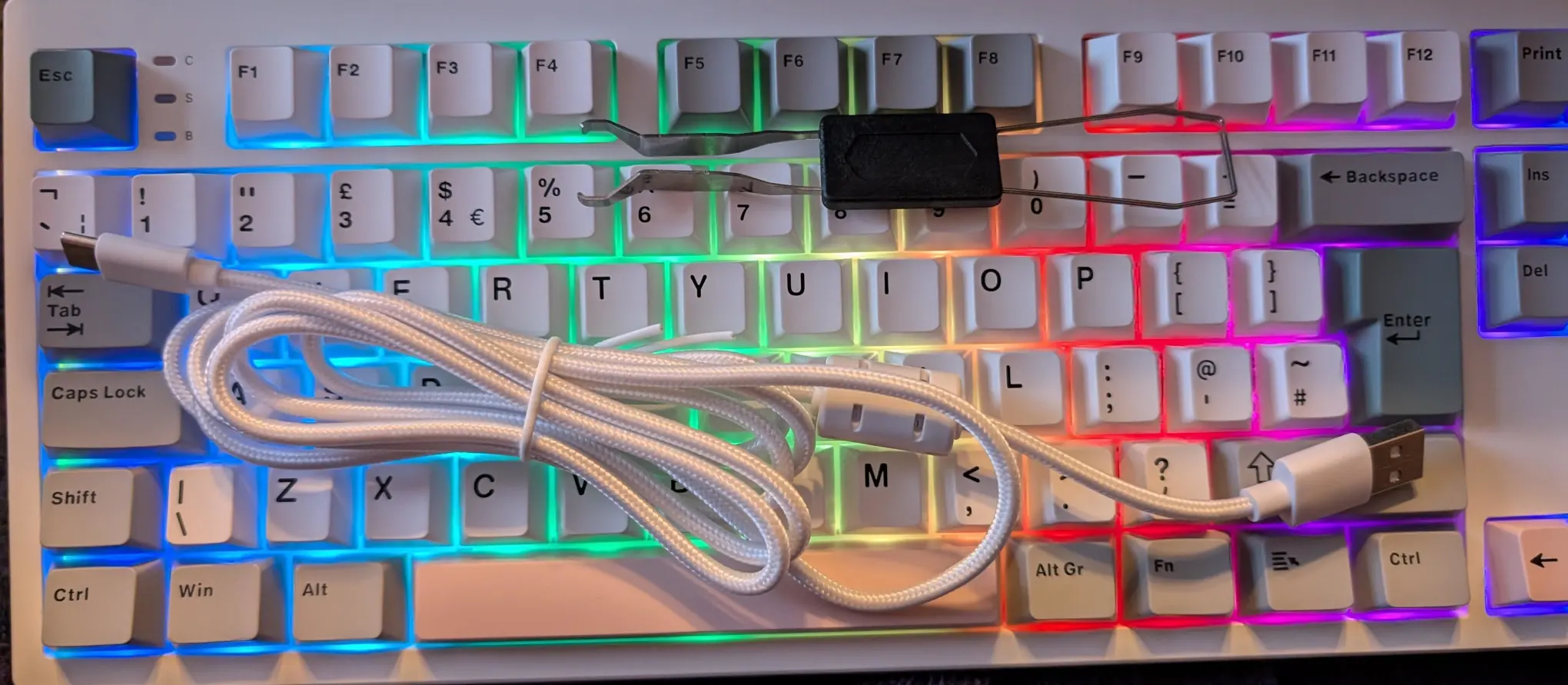
The good folks at Epomaker want me to see the error of my ways and have sent me a couple of devices to review. Today I'm trying out the TH87 and it is surprisingly lovely!
Blinken lights!Here's a quick video showing some of the effects.
https://shkspr.mobi/blog/wp-content/uploads/2026/02/th87-new.mp4Is this necessary? No! But it is jolly good fun. Probably a bit distracting - especially if you're in a dark space or a crowded office - but rather pleasing nevertheless. Switching between the effects means remembering the correct key combo - there's no way to do it programatically, you just have to cycle through them all.
Linux CompatibilityThe TH87 comes with a USB-C to A cable. Personally, I'd've preferred straight C-C, but this does the job. Flick the switch at the back to USB mode, plug it in, and Linux instantly detected it. No drivers to configure.
Rather cheekily, lsusb shows it as 05ac:0250 Apple, Inc. Aluminium Keyboard (ISO) - there's another switch for changing between Mac and PC mode. That doesn't change how the keyboard presents itself; just the keycodes it sends.
Oddly, there was this warning in dmesg:
apple 0003:05AC:0250.0010: Fn key not found (Apple Wireless Keyboard clone?), disabling Fn key handling
However, the function keys worked and I was able to control screen brightness etc using Fn and the F1-12 keys.
There's also a Bluetooth option. Again, Linux use was a breeze - although you'll have to remember what the pairing combo is and which device it is paired to.
There's also a 2.4GHz option. Hidden under one of the feet is a little USB-A receiver. Again, pairing is simple - just plug it in and flick the switch.
As expected, it also plays well with Android. The Bluetooth connection worked as did USB-OTG. Of course, quite why you'd want a giant heavy keyboard paired to your tiny phone is an exercise left to the reader.
Clunk Click Every Trip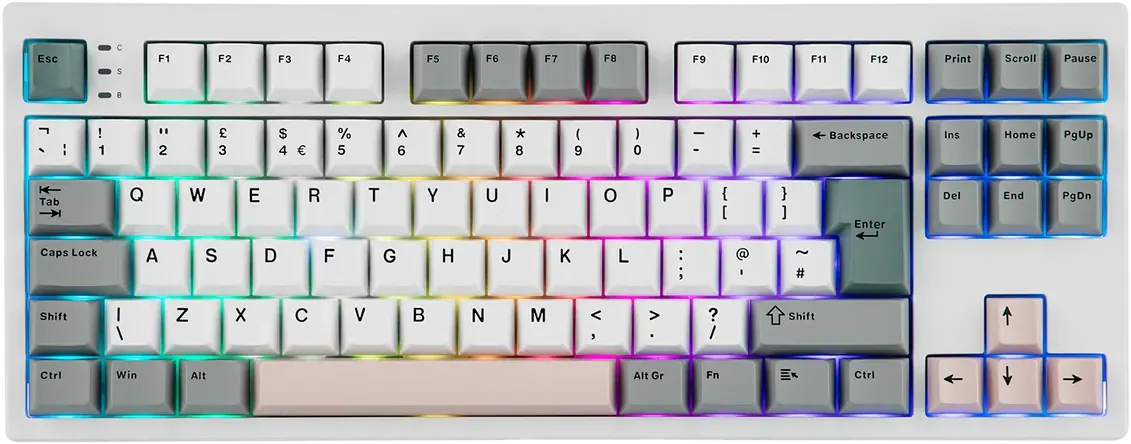
So let's talk about noise. This keyboard is noisier than some of my other typing surfaces, but not aggressively so. Apparently it is "pre-lubricated" and has some noise suppression. The travel on the switches is excellent, they aren't stiff, and the whole contraption is sturdy.
It was easy to remove the caps with the enclosed tool. I didn't bother trying to extract a switch because I'm afraid of buggering it up.
Other ThingsBattery life is excellent - as you'd expect from a 10,000 mAh unit. It recommends charging by attaching to a computer and warns a regular charger might damage it. But, frankly, it seemed to cope just fine.
There's no software for customising the colours or functionality. Apparently lots of mechanical keyboards run an Open Source firmware - but this appears to be proprietary. There is some question about whether Epomaker comply with the GPL when it comes to the QMK source. They appear to have some source code available but it is hard to tell whether it exists for this specific model. I've contacted them for clarification.
There's a lot of technobabble on the website. Apparently it uses "5-Layer Sound Optimizing Design with PORON Sandwich Foam, IXPE Switch Pad, Sound Enhancement Pad, EPDM Switch Socket Pad, and Silicone Bottom". I've no ideas what it means, but it appears important to some people.
There's no number-pad, which is a bit of a shame. However the keyboard has a proper UK layout and is reasonably compact. Although at 1Kg it is almost as heavy as my laptop!
CostI have no internal benchmark for something like this. It's around £60 from AliExpress or £80 on Amazon UK depending on whether you have pleased The Algorithm. That seems pretty reasonable for a hefty keyboard with lots of customisability.
If you want ALL THE LIGHTS and value the ability to hot-swap various keys and switches, I think this is a nifty bit of kit.
 Razer's oldest mouse is new again, and $1337 [ 11-Feb-26 2:33pm ]
Though "leet" never made word of the year (Merriam-Webster selected "woot" instead), it was the language of a generation, said to be destroying their literacy. Now it's a charming memory of a time when the internet was cool rather than a vile and infested wasteland of brain rot and resurgent fascism. — Read the rest
The post Razer's oldest mouse is new again, and $1337 appeared first on Boing Boing.
The New 'Stargate' Is Adding a Familiar Face in a Surprising Way [ 11-Feb-26 2:14pm ] Pokémon Pokopia Could Be the Switch 2's Biggest Sleeper Hit [ 11-Feb-26 2:00pm ] 7 Weird Space Phenomena That Only Make Sense if Dark Matter Exists [ 11-Feb-26 1:30pm ] Hubble Zooms in on the Mysterious Egg Nebula, and It's More Spectacular Than Ever [ 11-Feb-26 1:05pm ] Nicolas Cage Explains the Allure of Watching 'Spider-Noir' in Black and White [ 11-Feb-26 1:00pm ] Paramount Wants to Shell Out on 'Teenage Mutant Ninja Turtles' [ 11-Feb-26 12:00pm ]
Last month it was Heineken but now it's Guinness.
Cheers?

The latest ad-splash is a week-long campaign for Guinness, specifically the new brewery experience in Covent Garden which the King opened just before Christmas. Two tube stations have had a makeover, one minimally and the other more map-based. And while one aspect of the campaign is creatively brilliant, overall it's just an expensive tourist attraction overselling itself.
Here's the clever bit.

Eleven Northern line maps at Tottenham Court Road station have been 'inverted' so the line is white and the background is black, thus resembling a pint of Guinness with a white frothy top. Where the stairwells meet the platform it looks like two pints side by side. Full marks to the creative team for that idea.
It can't be a coincidence that the TfL blog sprang into rare action yesterday with a post entitled Commercial Partnerships at TfL: A balancing act. It asserts that commercial income is an essential part of TfL's wider strategy to grow and diversify revenue. It recognises they haven't always got it right ("Following the Burberry activation at Bond Street, which created some unintentional customer confusion, we reviewed and improved our approach"). And it lists three guiding qualities every time an activation like this goes live. Only one is a positive - raising money - whereas the other two are essentially 'we promise not to muck up'.
• Revenue generation - aiming to infuse colour and fun into the network while generating essential incomeThe inverted map is certainly accessible, indeed arguably clearer than the normal black on white. The only branding is a small harp beside the name of one station, assuming passengers will make the Guinness connection for themselves. Tellingly they've had to add a drinkware.co.uk URL at the bottom of the map, even at the bottom of the Central and Elizabeth line diagrams in the ticket hall, lest the tiny harp drive you to drink.
• Customer clarity - carrying out essential planning to ensure no customer is ever confused or misdirected
• Accessibility - embedded at every stage of planning and delivery, so no customer is disadvantaged

Yes they've changed some roundels, don't they always? Three on each platform have been swapped, a gold harp substituting for the red circle. Yes they've plastered a few corridors and slapped some Guinness ads up an escalator. Yes they've used black and gold along the top of the platform, though only partially. Yes there is a small toucan perched in the ticket hall, in fact two if you look carefully. No they haven't touched the Elizabeth line, not as far as I saw, because why waste extra money unnecessarily? And yes there is a large exhortation just before you leave the station to go and sample "The Home of Guinness in London", so I did.

And here's the stupid thing, Tottenham Court Road isn't the closest station to the Guinness Brewery. It isn't even the closest Northern line station, which is Leicester Square, but 95% of the marketing budget has still been spent here. The closest station is actually Covent Garden and all that has is half a dozen roundels - hardly any statement at all - but I guess the last thing TfL wants is more tourists at the deep awkward station with the busy lifts. Instead it's a 9 minute walk from Tottenham Court Road to the brewery, as the smallprint up the escalators attests, and that's assuming you know which convoluted way to go.
The Guinness Open Gate Brewery is an oddly-unfocused attraction tucked behind the streets of Covent Garden. It's partly based in historic buildings around Old Brewery Yard but also sprawls along an access corridor to a separate piazza, filling whatever floors the developers could get their hands on. Guinness was never brewed here, despite what the heritage murals might hint, and indeed isn't brewed here now. Instead the on-site microbrewery team explore "the new frontier of beer flavours", "from classic cold lagers to innovative low-percentage brews and sours with a tropical twist", "brewed to bubble at the centre of your conversations". If you manage to find a bar where they sell proper Guinness, it's all shipped in from Ireland.

And they'd rather you didn't just come for a Guinness but were tempted by alternative purchases. The most prominent door leads to a restaurant where £14 gets you a sausage and £6 a side of chips, while a more expensive seafood restaurant lurks upstairs. A portentous stairwell leads to a basement events space available for hire. If you hang around the main yard after the tables have been set out a black van will sell you a bespoke pie with a smidgeon of Guinness in the gravy. Don't try looking for a pub, there is no pub, all the better to help pay off the £73m development costs.
A separate building, opposite where Stanford's map shop ended up, hosts the experiential part of the experience. Here you can book tours to view the non-Guinnesses being brewed, take part in a tasting session and in the final room try your hand at pulling the perfect pint. I imagine the finale is seriously Insta-friendly ("come on Jason, don't let it all froth up") and that drinking said pint occupies a fair proportion of the 90 minute tour duration. Meanwhile downstairs is a Guinness store specialising in merch rather than beer, should you genuinely have need of a branded umbrella, branded beermat, limited edition tank top or weird designer creation invented for the sake of it. The supposed must-have is a personalised glass with the engraving carried out on site by faux heritage staff wearing black and gold braces, and the whole place reeks of the fundamentally unnecessary.

I'm not averse to a Guinness souvenir, my fridge is bedecked with a tortoise magnet purchased 25 years ago at the St James's Gate Brewery in Dublin. But that felt like a proper tour whereas this is just windowdressing masquerading as heritage with a price tag to match, not so much celebrating a beer as pimping a brand. And that's also why Guinness have splashed themselves across a busy tube station this week, a siren call to the neo-proletariat to visit WC2 for an extended black and white experience. Londoners won't be getting lower tube fares as a result but some marketing executives will be very happy, and that's the only pure genius frothing up here.


