
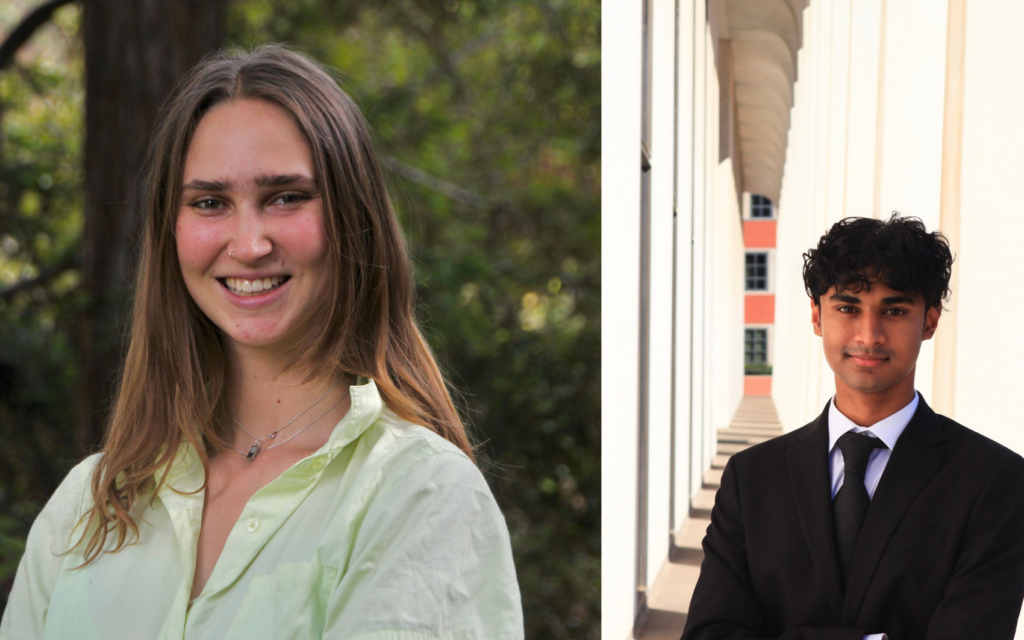
 Pictured: Sophie Luskin (left); Jason Persaud '27 (right)
Sophie Luskin is an Emerging Scholar at the Princeton Center for Information Technology (CITP) conducting research on regulation, issues, and impacts around generative AI for companionship, social and peer media platforms, age assurance, and consumer privacy to protect users and promote responsible deployment. Her research has been conducted across policy, legal, journalistic, and communications spaces. Luskin's writing on these topics has appeared in a variety of outlets, including Corporate Compliance Insights, National Law Review, Lexology, Whistleblower Network News, Tech Policy Press, and the CITP Blog. Recently, Luskin sat down with Princeton undergrad Jason Persaud to discuss her research interests.
Jason Persaud: Could you begin by telling us a little bit about yourself and some of the work that you do here at the CITP?
Sophie Luskin: I am a researcher in the Emerging Scholars Program here at CITP. I mostly work with Mihir Kshirsagar through the center's Tech Policy Clinic but have ongoing projects with various people connected to the Center. This is my second year at CITP, and I was working at a whistleblower law firm prior to starting here. I was doing work initially as a communications fellow, which then became explicit tech policy work. So I feel like that really informs my research interests.
I see my interests as a mixture of public interest and consumer protection. It's exciting to work on that, specifically around tech policy, because that has been my area of interest for a while, so it was less explicit before coming here.
Jason: Nice. Could you talk a little bit more about how your background has informed your current research?
Sophie: I got into tech policy because I had an interesting path through history. At University of California, Davis [UC Davis], I had a professor named Omnia El Shakry, and a lot of her classes' themes discussing colonialism and global interconnectivity centered around technologies of control like surveillance, etc. Those were major themes brought up through history, and were ones that I could connect to social media and the internet. Then UC Davis had a science and technology studies program, which I discovered my junior year of undergrad. And so I minored in science technology studies from there.
And then I ended up at the law firm because when I was interviewing I saw that it was the broadest opportunity I had to explore different areas of interests, and they were excited that I was interested in tech policy.
Jason: Okay, so, you mentioned right before [the interview] that you just came from a meeting about an AI project. Could you talk more about that?
Sophie: Yeah, so this project is a survey of products that are AI mental health chatbots. And it's specifically looking at the language they use to market themselves; so it's looking at claims like '24/7 availability', 'non-judgmentality', 'personalization' (gets to know you), etc. What's interesting there is that this is a widely discussed topic now in the news because there have been cases of how sycophancy has impacted people's mental health, livelihoods, etc.
These are all general-purpose products. These stories are coming out of interactions with OpenAI's ChatGPT. But when people talk about why people are turning to that, they say, '24/7 availability,' 'non-judgmental,' and things like that. And that's not necessarily the language coming from the companies and products themselves. So it's just trying to analyze and kind of pick up themes of the major mental health products - products designed to be tools for that, and analyzing what language they are using and how that may still be harmful.
Jason: Could you tell us a little bit more about another project you're working on?
Sophie: Aside from the therapy chatbot project, I am working on a survey with Madelyne Xiao and Mihir, inspired by New York's SAFE for Kids Act.
It's about what people's preferences are around age assurance methodology. The act is designed to prevent kids from being fed algorithmic personalized feeds without parental consent. And so, for that to happen, one would have to prove they are over 18 if they didn't receive parental consent to be shown that kind of feed.
If they're under 18, they'll still have access, but it would be a chronological feed. So, it's not like they'd be cut off from the product entirely - it's just steering them away from features that are deemed harmful or addictive.
Our angle is: this is going to happen, the act passed, and now they're looking into implementation. What are the ways people are most comfortable with age assurance being conducted, and why? What demographic features relate to that?
Specifically, we're trying to get at whether people are most comfortable with biometric methods - like face scanning or voice analysis to estimate age - or with a more "hard verification", like uploading a photo of a driver's license. And beyond those methods, where do they want that verification to occur? On each platform? Within a device's operating system? At the app store level? In the browser?
We want to know: when people are fully informed of their options, what do they choose? That way implementation can be as smooth as possible, because there's going to be a lot of tension around this. So that project is currently in the design stage. It complements a year-long course from last year where three SPIA juniors (now seniors) did a report on age assurance methods and where they can be performed within the tech stack, to submit as a comment to the New York Attorney General's office. We just submitted that recently, actually.
Jason: Great, thank you for giving us an opportunity to discuss your work with you.
Jason Persaud is a Princeton University junior majoring in Operations Research & Financial Engineering (ORFE), pursuing minors in Finance and Machine Learning & Statistics. He works at the Center for Information Technology Policy as a Student Associate. Jason helped launch the Meet the Researcher series at CITP in the spring of 2025.
The post Meet the Researcher: Sophie Luskin appeared first on CITP Blog.

California Representative Ted Lieu (D-CA) was clearly exhausted by Attorney General Pam Bondi's evasive, non-answers to questions, but he wouldn't stand for her lies.
The Attorney General evaded nearly every question and used her time as a campaign pitch for Donald Trump. — Read the rest
The post Congressperson tells Pam Bondi he believes she is lying to Congress appeared first on Boing Boing.

As the world boos US government officials at the Olympics, and our athletes decry government abuse at home, Immigration and Customs Enforcement wants the world to know they'll be at the FIFA World Cup.
Acting ICE Director Todd Lyons told a congressional committee Tuesday that Immigration and Customs Enforcement, through its Homeland Security Investigations unit, will remain "a key part of the overall security apparatus" for the 2026 FIFA World Cup, as the tournament faces mounting controversy over immigration enforcement and travel restrictions.
The post ICE gives the world another reason to skip the U.S. World Cup appeared first on Boing Boing.

While masked government thugs slay citizens legally observing their over-zealous and perhaps extra-judicial immigration enforcement, Tennessee Republican congressperson Andy Ogles has found the real National emergency: Bad Bunny's hips.
The gentleman from Tennessee has formally demanded that the House Energy and Commerce Committee examine whether the NFL and NBC properly vetted what he calls "widespread twerking, grinding, pelvic thrusts, and other sexually suggestive content" during the NFL Superbowl half time show. — Read the rest
The post Congressman demands a federal probe into 13 minutes of televised twerking appeared first on Boing Boing.

In another glaring contradiction, the oft-repeated insistence by convicted felon Donald Trump and Amazon film star Melania that Jeffrey Epstein didn't introduce the two lovebirds has taken a shot across the bow.
FBI documents in the Epstein files show a sworn statement by one of Epstein's former assistants, who insists Trump's longtime pal, Jeffrey, "introduced MELANIA TRUMP to DONALD TRUMP," in files reviewed by The Daily Beast. — Read the rest
The post FBI file claims Epstein introduced Melania to Trump, contradicting the fairy tale appeared first on Boing Boing.

No one loves the excessive use of force quite like Los Angeles' finest. In addition to recently having been asked by the City Council to back off the riot gear and immediately threatening responses to crowds, the LAPD also got the news that a federal judge is banning their favorite less-than-lethal 40mm foam projectile launchers. — Read the rest
The post Federal judge bans one "less-lethal" launcher, LAPD finds another appeared first on Boing Boing.

After reviewing unredacted Epstein files, Rep. Jamie Raskin (D-MD) told Axios that when he searched for Donald Trump's name, it appeared "more than a million times," and at least one document appears to directly contradict Trump's public claims about the extent of his relationship with Jeffrey Epstein. — Read the rest
The post Unredacted Epstein files contain a whole lot of "Donald J. Trump" appeared first on Boing Boing.

Most high school shop programs produce birdhouses and bruised thumbs. In Sandpoint, Idaho, students spent their Saturdays building two full-scale aircraft, earned FAA airworthiness certificates, and then watched one of their own take them into the sky.
The morning of October 4, 2025, marked a turning point for the North Idaho High School Aerospace Program.
The post Idaho high schoolers build two airplanes, then go fly them appeared first on Boing Boing.

In a big win for the local dairy industry, the United Kingdom's Supreme Court today affirmed a law that "milk" refers only to the stuff that comes out of animals. It ruled against the oat milk brand Oatly, effectively banning the marketing of dairy-free alternatives as "milk." — Read the rest
The post UK Supreme Court: oat milk can't be called milk appeared first on Boing Boing.

John the Fox, 1978
Half a century ago, documentary photographer Joyce Edwards (1925-2024) took these tender portraits of the squatters who inhabited empty houses in the triangle of streets next to Victoria Park which had been vacated for the sake of a proposed inner city motorway that was never built. Her pictures are now being shown publicly for the first time at Four Corners in Bethnal Green in an exhibition entitled, Joyce Edwards: A Story Of Squatters, which opens tomorrow and runs until Saturday 20th March.

Joyce Edwards, 1980

Harold the Kangaroo, painter, with his dog Captain Beefheart, 1978

Billy Cowden, Joy Rigard & Jamie, 1978

Henry Woolf, actor, 1974

Beverly Spacie, 1977

Anthony & Andrew Minion, 1980

Elizabeth Shepherd, actor, c. 1970

John, painter,1979

Gary Chamberlin, Beverly Spacie & Howard Dillon, 1977

Julia Clement, 1978

Vanessa Swann & Baz O' Connell, 1979

Matthew Simmons, 1978

Shirley Robbins, 1977

Tosh Parker, 1977

Sue, 1977

Father & son, 1976

103 Bishops Way E2, Co-op headquarters, 1978

Attempted eviction, 1978

Joyce Edwards, 2012
Photographs copyright © Estate of Joyce Edwards
Joyce Edwards: A Story Of Squatters is at Four Corners, 121 Roman Rd, E2 0QN. Friday 13th February until Saturday 20th March (Wednesday to Saturday, 11am - 6pm)
You may also like to take a look at
In Gallup's final measure of Donald Trump's approval rating, Trump was stuck at 36%—his lowest since the end of his first term in office. The president won't have to worry about the famed pollster's next set of numbers, as it will no longer bother. — Read the rest
The post After 88 years, Gallup will no longer poll presidential approval ratings appeared first on Boing Boing.

The Pentagon's new high-energy laser works great against party balloons.
The airspace shutdown over El Paso grounded every flight at the international airport and forced medevac planes to reroute 45 minutes to Las Cruces, New Mexico. The administration blamed Mexican cartel drones breaching U.S. — Read the rest
The post "Cartel drone threat" that shut El Paso's airport was a party balloon appeared first on Boing Boing.

If a beautiful woman in a surgical mask asks if she's pretty, the correct answer — according to decades of Japanese folklore — is "average." Anything else and you're in trouble. Say no, and she kills you with her long scissors. — Read the rest
The post If this masked woman asks if she's pretty, the correct answer is "average" appeared first on Boing Boing.

A wondrous illuminated manuscript, which gathers and illustrates the marvels of the world and beyond.
Book them now
Early bird tickets are on sale for the 42nd IIW, which began on a Gillmor Gang podcast the last day of 2004. In my biased but correct opinion, IIW is the most leveraged tech conference on Earth. This one will happen on April 28th to 30th, Tuesday to Thursday. But for the full experience, block out the whole week, so you can catch to catch VRM Day on Monday the 27th, and the Agentic Internet Workshop on Friday, May 1. All will be at the Computer History Museum in Silicon Valley.
MyTerms will be a wide weave (not just one thread) of conversation through all three events, each of which are open space: no keynotes, no panels, no booths. It's all breakouts gathered around work and conversation toward outcomes.
Song du jour
Time Loves a Hero, by Little Feat, which is incorrectly stil absent from the Rock & Roll Hall of Fame.
Assholes
Remembering when radio was radio
Nice write-up on one of the greatest radio stations ever: WQDR/94.7 in Raleigh, during its album rock era, which ran from 1971 to 1984, as I recall. My own involvement (as a creative director for the station's ad agency) ran from '78 to '83 or so. (Hard to nail the dates down, because many good friends worked there and I we all hung out a lot.
As a side thing, it's worth noting that the big FM stations in that part of the country have a lor of range. WQDR when hung out there, was 100,000 watts on a 1200 foot tower, wth a signal that stretched from Winston-Salem to Greenville. On hot summer morning, you could get them from the mountains to the beach. Earlier, when WRAL/101.5 was a thousand feet up the WRAL/5 tower, it was 250,000 watts and bragged about being audible "from Hatteras to Hickory." Later, it dropped to 100,000 watts at close to 2000 feet, on the new WRAL/5 tower, which was dropped by ice in 1989. Both WRAL and WQDR are close to the top of the replacement tower today, when most of us aren't listening to radio on radios anymore. We're getting streams and podcasts on our phones. Only some of that comes from radio stations, and most radio stations lack local talent and programming. Telle est la mort.
Which always creeped me out, but he has a case
Don Marti is a (somewhat provisionally, but still actually) fan of rewarded interest.

In 1951, Bertrand Russell closed an essay on liberalism and fanaticism with what he called a "Liberal Decalogue" — ten rules for honest thinkers, not to replace the original commandments but to supplement them. Writing in The New York Times Magazine, he argued that liberalism was not a creed but a temperament, one built on the admission that you are probably wrong about something. — Read the rest
The post "Do not feel absolutely certain of anything." Bertrand Russell's 10 rules for thinking clearly, from 1951 appeared first on Boing Boing.

Thirteen European countries have formed an alliance called EuroPA to build a continent-wide payment system that routes around Visa and Mastercard — and the $24 trillion in annual transactions the two American companies currently handle, Cory Doctorow writes in Pluralistic. — Read the rest
The post Europe builds its own payment network, ditches Visa appeared first on Boing Boing.

Every trafficking victim seated behind Attorney General Pam Bondi at Wednesday's House Judiciary Committee hearing raised their hand when asked whether the Department of Justice had refused to meet with them. Bondi wouldn't turn around to look, according to The New Republic. — Read the rest
The post Bondi refused to turn around and face the Epstein victims sitting right behind her appeared first on Boing Boing.
I'm a data & product engineer (whatever that means). I've wandered through journalism, retail, professional sport, music, and software—always searching for the invisible threads between them. Sharing what we've lived through helps others find their path while reshaping our own. I love mixing ideas from distant places to build something new. French by blood, human by heart. Writing about engineering, data and design at From An Engineer Sight. Writing about life at Liminal Duality. — Benoit
 PHYSICAL
- STAUB Dutch oven/cocotte. Cooking is one of the most peaceful, human, and pleasant activities for me. This classic cocotte allows me to make any French classic, and waiting 3 hours to see that bourguignon come out dark, caramelized and ready for sharing within your family is the best emotion you can get from such a simple iron cocotte.
- Simple binder. As an avid reader of blog posts, I tried several things (Remarkable, iPad, Kindle, etc.). But in the end, printing sheets of paper and putting them in a simple transparent binder is the best I have found. Less screen, fewer notifications, and the feeling of true simple paper is inequitable.
- Hugo Boss Coat. It's made from Italian fabric, it's expensive, but as my mom says, "Quality stays, price vanishes" (a very bad motto when you go shopping…). Having a top-quality coat makes it easy to go outside when it's cold. It's also comforting when you go out at night—it's almost like being in bed already. You don't leave it on a random chair. You look for a coat rack nearby. You take care of it, as it takes care of you.
DIGITAL
- TheNewPrinter: my vibe-coded project to print blog posts on paper with a basic template to make them look like a quality newspaper.
- The intro video of Dynamicland project. I hope the future of computing interface is taking this direction.
INVISIBLE
"Don't cry because it's over, smile because it happened"
Sign up here to get What's in my NOW? a week early in your inbox.


