
I love thermal imaging cameras. They're great for spotting leaking pipes, inefficient appliances, and showing how full a septic tank is. The good folks at Topdon have sent me their latest thermal camera to review - it is specifically designed for spotting wildlife.
This is the TS004 Thermal Monocular:

Let's put it through its paces!
HardwareThis is a chunky bit of kit and fits nicely in the hand. It's well weighted and feels sturdy.
The rubber seal fits tightly around your eye and is excellent at keeping light out. The screen is set a little way back, so is easy to focus on. Taking a photo of the screen itself was a little tricky - here's what you can expect to see when using the settings menu:

The focus knob near the viewfinder is a little stiff, but it turns silently.
There's a rubber lens cover which is attached and can be easily tucked away next to the standard tripod mount. It comes with a lanyard strap, so you're unlikely to drop it. The buttons are well spaced and respond quickly.

The USB-C port has a rubber flap to keep out moisture.
OK, let's take some snaps!
PhotosPhoto quality is pretty good - although limited by the technology behind the thermal sensor. The TS004 has a thermal resolution of 256x192 and images are upscaled to 640x480.

One thing to note, the user-interface is burned in to the photos. So if you want the battery display on screen, it will also appear on the photo. Similarly, things like the range-finder appear in the image.
There's a reasonable AI built in. It is designed to tell you what sort of wildlife you've spotted. In some cases, it is pretty accurate! A woman walked by me while I was looking for wildlife - here's her photo:

Nifty!
Here's a photo of a fox:

There are remarkably few wild boars in London!
VideoVideo is also 640x480. It is a very smooth 42.187 FPS and a rather chunky 2,162 Kbps - leading to a file size of around 20MB per minute. With around 30GB of in-built storage, that shouldn't be a problem though. There's no audio available and, just like the photos, the UI is burned into the picture.
Here are a couple of sample videos I shot. In them, I cycle through the colour modes and zoom levels.
First, an urban fox foraging in London:
https://shkspr.mobi/blog/wp-content/uploads/2026/02/fox.mp4Second, some parakeets flapping around a tree:
https://shkspr.mobi/blog/wp-content/uploads/2026/02/Birds-In-Flight.mp4I'm impressed with the smoothness of the video and how well it picks up heat even from relatively far away.
LinuxBizarrely, on Linux it shows up as 1d6b:0101 Linux Foundation Audio Gadget. It presents as a standard USB drive and you can easily copy files to and from it. 100% compatibility!
You can't use it as a WebCam - for anything more complicated than copying files, you need to use the official app.
AppThe TopInfrared App for Android is reasonably good. It connects to the camera via WiFi and offers some useful features. Most impressively, it live-streams the camera's view to your phone.
From there you can take photos or videos and have them saved straight onto your device. Handy if you've set the camera up outside and want to view it from somewhere warmer.
Frustratingly, it isn't possible to set all the options on the camera using the app. For that you need to go back to the menu on the camera - which is slightly laborious.
The app isn't mandatory for most operations - thankfully - but it is the only way to set the time and date on the monocular. You will also need it if there are any firmware updates.
If you don't need the app, you can turn off the WiFi to save some battery life.
DrawbacksThe device works - and is great for wildlife spotting - but there are a few little niggles. I've fed these back to the manufacturer and have included their responses.
There's no EXIF in the photos, or any way to get thermal data out of the images.
- "These products focus on image clarity, high sensitivity, and low latency. For example, temperature-measurement thermal cameras typically run at 25 Hz, while the TS004 operates at 50 Hz for smoother viewing. Devices that include EXIF temperature data, raw thermal export, and analytical tools are measurement-focused thermal cameras, which are based on a different design and use case."
As mentioned, having the UI burned into the photos and videos is slightly annoying.
- You can turn off the UI elements on screen which stops them appearing in the photo.
The range-finder only works in yards and, while seemingly accurate, isn't overly helpful to those of us who think in metric!
- "Unit switching will be available in the March firmware update"
Once you sync the time with the monocular, all the filenames are timestamped like 2026_02_09_12345678 but it appears to be hardwired to Hong Kong Time (UTC+8) - so your dates and times might be a little out.
- "We will investigate it and see if it can be implemented in a future update"
The AI detection feature doesn't seem particularly tuned for the UK.
- "Due to hardware limitations, the current recognition is relatively basic, so there is limited room for significant improvement"
In terms of hardware limitations, there's no GPS. I would expect a device in this price-range to have basic GPS functionality to allow you to easily tag photos.
None of these are show-stoppers, but for a device this expensive they are an annoyance.
PriceOK, so you want to spot birds in trees and wild boars foraging in the forest - what'll this cost you?
Close to £400 - you can use code TERENCE15 for a 15% discount until 16 February 2026.
The price of thermal imaging equipment is high and this is a fairly niche form-factor. It is easy to use, has a great range, and the rubber eyepiece is much nicer than staring at a bright phone screen. The battery life is excellent and you certainly can't complain about the generous storage space.
There are some minor irritations as discussed above, but it is an exceptional bit of kit if you like to explore the environment. Are you going to spot any cryptids with it? Who knows! But you'll have lots of fun discovering the natural world around you.
In this series I'm taking the train one stop beyond the Greater London boundary, getting off and seeing what's there. Today that means Grange Hill, one stop beyond Hainault on the Central line shuttle. The station's barely outside London, indeed the boundary runs immediately behind the southbound platform, as a small bulge of Essex nudges unnecessarily into the capital. I should say up front that the iconic children's drama was never set here, indeed Grange Hill's only school is a primary, but if you walk to the far side of the suburb you eventually end up in Birds of a Feather.

Grange Hill was originally an isolated hamlet around a crossroads on the edge of Hainault Forest. North to Chigwell, east to Chigwell Row, south to Barking Side and west to Woodford Bridge, just to get your bearings. There was once a 15th century manor called the Grange and there is still is a hill, hence Grange Hill. Alas nothing pre-20th-century survives except a triangular green by the crossroads, complete with grubby village sign and minimal shrubbery. One of the old pubs took a direct hit from a parachute mine in 1941 and is now a Shell garage, and the other was sold off to developers in its 240th year and has been replaced by a block of flats.

What wrought the greatest change around here was inevitably a railway. The Fairlop loop opened in 1903 crossing open countryside to link Woodford to Ilford, with Grange Hill station slightly better used than lonely Hainault. A doodlebug took out the original station building in 1944, hence the somewhat utilitarian flatroofed design. But the platforms only needed a new canopy so remain some of the most evocative on the Underground, complete with twiddly green columns with the letters GER entwined in the ironwork. Services were transferred to the extended Central line in 1947 and this was finally the trigger for a considerable burst of housebuilding locally - private developers to the west and an LCC estate to the east.

Grange Hill is one of three wards under the jurisdiction of Chigwell Parish Council, and closer you get to Chigwell proper the larger the houses get. Along Hainault Road the neighbours appear to be having some kind of blingiest gate competition, black and gold twiddles preferred, shielding sizeable detached homes and parking for several vehicles. Step back off the main road and the houses are more typically postwar, from half-timbered semis to gabled four-bedders, but still on the large side as befits the Essex fringe. Fontayne Avenue was one of the first additions and has a thick strip of hedge down the middle of the road, like some kind of suburban dual carriageway sloping down towards open farmland views. The bungalow at 22 Dacre Gardens is called Llamedos, and yes we see what you did there.

A decent parade of shops ascends from the station with estate agents and beauty salons perhaps over-represented. This being Chigwell South the local cafes tend to be either pink or cottage green, and a tiny chihuahua will meet you at the door of the Naked Lounge if you pop in for spa treatment or microblading. Obviously there's a florist, who with Valentine's Day imminent have erected a gazebo of blooms on the pavement and wrapped pink ribbons all around the pedestrian crossing. The top row of newspapers in the rack outside the Manor supermarket kicks off with the Daily Telegraph and continues Times, Sun and Daily Mail. It also has a slot for the Jewish Chronicle while the cafe nextdoor promotes Hot Salt Beef, so yes there is a synagogue up the hill, recently refurbished with funds from a local businessman and renamed the Lord and Lady Sugar Community Hall.

Grange Hill's most conspicuous church is St Winifred's, built in 1935 as a chapel of ease because traipsing all the way to Chigwell proper every Sunday wasn't ideal. Something about the building looks a bit off, perhaps the sparse tower with its painted black crosses, or more likely the fact it was cheaply built in brick then coated with cement. The local cemetery is more recent, accessed at the far end of the delightfully-named Froghall Lane which appropriately enough is a dead end. Here the parish council oversees a long sliver of land with a tranquil rural outlook, employs on-site groundsmen and charges a £40 release fee if your car gets locked in overnight. The oldest grave I could find is from the 1970s and the latest is marked only by Charlie's floral tributes, as yet unfaded. Looking on the back of the headstones I spotted one with the extra epitaph He Lived He Laughed He Loved, and I hope this isn't a trend that'll spread.

The cemetery is the only part of Grange Hill beyond the railway, this being the official boundary of the Green Belt. The tracks run in a cutting all the way to Chigwell, bar a brief section where the Edwardian engineers had to burrow through the spur of a hill. The Grange Hill Tunnel is only 237m long making it the shortest in regular service on the Underground and takes just 12 seconds to whizz through aboard a train. It's also perfectly straight as you can clearly see from the bridge outside the station, also the caged footbridge on the opposite side accessed up a muddy path from the corner of Wycliffe Gardens. Just be aware that if you want to see a train pass through they only run every 20 minutes, this because Grange Hill is the 3rd least used station on the Underground, beaten only by the next two stations up the line.

But if there's one worth seeing round here it's probably the Limes Farm Estate, that is assuming postwar housing is your thing. In the late 1960s Chigwell Urban District Council belatedly decided they ought to build a lot of council houses and picked an as yet undeveloped slope abutting the edge of Redbridge where most Essex residents would never see it. The architects had a field day, starting by drawing a single-exit loop road and then adding a maze of large apartment blocks and crisscrossing townhouses in the centre. The flats form three large U-shaped blocks facing a central car park, each of the trio distinguished by red, yellow or green detailing. The houses have timber, brick or chunky pebbledash exteriors and separate rows of garages. And just for a laugh they numbered them all 2-634 Limes Avenue round one side and 1-731 Copperfield round the other, which must make deliveries a nightmare.

The finest feature is the green wedge that tumbles down the centre of the estate, a bit squidgy at present but creating an attractive backdrop to urban life. A slim concrete footbridge connects the top of the estate to the summit of the hill where a bench has been plonked with views towards Docklands and Kent. The estate's parade has only four shops, and currently offers just takeaways or nice nails while a crew of refrigeration experts rips the interior out of Londis. Residents must be hoping the Post Office reopens soon. There's an underlying sense of isolation here, as tends to happen when a community is a developmental afterthought, with only a few short alleyways linking Limes Farm to earlier streets. But slip through to the south and you instantly enter cul-de-sacs with Redbridge bins, then it's barely five minutes to Hainault station, because that's how close to London a One Stop Beyond can be.
 How "Stranger Things" united the generations [ 12-Feb-26 6:00am ]
Exiting the UK to re-join the European Union [ 13-Feb-26 5:23am ]
How "Stranger Things" united the generations [ 12-Feb-26 6:00am ]
Exiting the UK to re-join the European Union [ 13-Feb-26 5:23am ]
It was a baking hot summer day in the UK on 24 July 2019, hitting heatwave temperatures of 34/35° Celsius. The political atmosphere was tense amongst British people due to the Brexit referendum, and polarised arguments were rife amongst the population. I had decided enough was enough and made a bid to move to Brussels in Belgium.
All changeI had quit my job, I had no plans in place, and I simply loaded up a hired van containing all my worldly belongings and booked a ferry. As I was driving south to Dover, it was announced over the radio that Boris Johnson had been elected as Prime Minister of the UK. Within hours of this news, I was aboard the ferry, watching the white cliffs of Dover diminish in size, and I was setting sail for the continent.
With plenty of effort and a large helping of luck, I found an apartment in Brussels to rent, along with some gainful employment - all within a brief couple of months. I registered my freelance business as a sole trader and things began to fall into place. I was already paying taxes in Belgium by November 2019 and was beginning to settle down. However, a dark period was looming around the corner, about to engulf the world. Everything changed, I was vaccinated in Brussels, and in line with the rest of the population, I switched to working from home.
New language, new cityAs my business grew, I needed to conduct meetings more and more using French as the primary language. I had to learn fast, and in the most expedient way possible - total immersion. It worked. Over time, my life in Brussels became more and more settled, the culture captured my heart, and I began to feel naturally immersed in the life of a bustling continental capital.
New identity Author's image, used with permission
More recently, my friends started to suggest I should apply for Belgian Citizenship. I was close to meeting the criteria - namely living, working and paying taxes in Belgium for five years, and speaking one of the two national languages. I wasn't in any hurry and was quite relaxed, yet at the same time, I was seriously considering it.
Once again, the political situation suddenly flipped and I was pushed into rapid decision making. In February 2025, the New Flemish Alliance coalition party was elected in Belgium, and they began putting steps in place to make application for nationality more complex and expensive. The language test was to be raised from Level A2 (generally functional) to Level B1 (more securely integrated), and the fee was to be raised from €150 to €1,000. In order to avoid these stricter regulations, I quickly got the wheels in motion for the application. On 22 May 2025, only a few weeks before the fee was officially raised to €1,000, my application was accepted by my local administrative office in the district of Etterbeek, Brussels - at the original cost of €150.
On 2 February 2026, I returned to the administrative offices to collect my Belgian National Identity card and Passport, and I was holding back the tears of joy as I exited the building. Having acquired Belgian nationality by naturalisation, Brexit and its aftermath in the UK now seemed a million miles away. I had not only gained dual national identity, but I had also regained my European Identity - which I felt I had been stripped of due to the marginal and polarised nature of the referendum.
New securityI am now the very proud owner of the Belgian passport which ranks at number three in the world, after Singapore and Japan. This ranking is calculated on the number of countries one can visit without the need for a visa. Due to the nature of my work, it's essential for me to travel extensively, so having this prestigious passport and being a renewed EU citizen has become a tremendous advantage. I am now at liberty to travel to a whole host of countries worldwide without the need for lengthy and costly visa applications.
The moral of my story is that risks can turn out to be a phenomenal asset - provided they are judged correctly and at the right time. I have learned many things on my journey, but the greatest of all is that I'm no longer afraid to jump out of the fire when the heat reaches breaking point. Never look back, always look forward, and continue to keep an eye on the ever changing political world in which we are all inextricably linked.
More from East Anglia Bylines
 Brexit
The time is ripe for an extensive youth mobility scheme
byJenny Rhodes 26 September 2025
Brexit
The time is ripe for an extensive youth mobility scheme
byJenny Rhodes 26 September 2025
 Brexit
It's complicated: the post-Brexit relationship of the UK-EU
byJenny Rhodes 25 July 2025
Brexit
It's complicated: the post-Brexit relationship of the UK-EU
byJenny Rhodes 25 July 2025
 Brexit
What can the 1975 referendum teach us 50 years on?
byEast Anglia Bylines 6 June 2025
Brexit
What can the 1975 referendum teach us 50 years on?
byEast Anglia Bylines 6 June 2025
 Brexit
The EU/UK reset summit: baby steps but positive glimmers
byJenny Rhodes 30 May 2025
Brexit
The EU/UK reset summit: baby steps but positive glimmers
byJenny Rhodes 30 May 2025
 Friends of Bylines Network
There has never been a greater need for grassroots journalism that investigates the stories that really matter, holds power to account and champions the voices of everyday citizens. We are proudly powered by volunteers but what we do isn't free.
STAND WITH US for independent, citizen-led journalism that makes democracy stronger, and you will even get some exclusive benefits.
BECOME A FRIENDThe post Exiting the UK to re-join the European Union first appeared on East Anglia Bylines.
Waymo is asking DoorDash drivers to shut the doors of its self-driving cars [ 13-Feb-26 4:41am ]
Grandpa Pudding Brains is bored and sleepy [ 13-Feb-26 2:51am ]
Today, the President of the United States had trouble pronouncing simple words, got bored, let us know by closing his eyes for a little "me-time" while waiting for the speech to end, and told the EPA Administrator that his speech was too long. — Read the rest
The post Grandpa Pudding Brains is bored and sleepy appeared first on Boing Boing.
Mike Henbrey's Vinegar Valentines [ 13-Feb-26 12:01am ]Inveterate collector, Mike Henbrey acquired harshly-comic nineteenth century Valentines for more than twenty years and his collection is now preserved in the archive at the Bishopsgate Institute.
Mischievously exploiting the anticipation of recipients on St Valentine's Day, these grotesque insults couched in humorous style were sent to enemies and unwanted suitors, and to bad tradesmen by workmates and dissatisfied customers. Unsurprisingly, very few have survived which makes them incredibly rare and renders Mike's collection all the more astonishing.
"I like them because they are nasty," Mike admitted to me with a wicked grin, relishing the vigorous often surreal imagination at work in his cherished collection - of which a small selection are published here today - revealing a strange sub-culture of the Victorian age.
.


Images courtesy Mike Henbrey Collection at Bishopsgate Institute
You might also like to look at
What can Britannic teach us about her sister ship, Titanic? [ 13-Feb-26 12:23am ]
Through negotiations between the owner of Britannic's wreck and the Greek government, which controls it, divers have finally been allowed to enter the well-preserved hulk.
In the first video, Sam from Historic Travels does a great job of explaining how Britannic was de-designated as a war grave and how its current owner obtained permission to have divers document the interior. — Read the rest
The post What can Britannic teach us about her sister ship, Titanic? appeared first on Boing Boing.
RFK Jr. cites toilet-seat cocaine habit as proof germs aren't real problem [ 12-Feb-26 11:58pm ]
The nation's top health official offered this explanation for many of his policies: "I'm not scared of a germ. I used to snort cocaine off of toilet seats." This clears up an awful lot, but shouldn't make you feel any better. — Read the rest
The post RFK Jr. cites toilet-seat cocaine habit as proof germs aren't real problem appeared first on Boing Boing.
OpenAI President Defends Trump Donations, Refuses to Comment on ICE [ 12-Feb-26 10:10pm ]
Because Pricing is Getting Too Personal [ 12-Feb-26 9:35pm ]
Surveillance pricing already has its own page in Wikipedia. It also has its own authority: Abbey Stemler, Associate Professor of Business Law and Ethics and Weimer Faculty Fellow in Business Law & Ethics at Indiana University's Kelly School of Business. And she'll be speaking about her work a week from now:

As you see, she'll be speaking in both the natural and the digital worlds, so you can join us on Zoom if you're not in the former. Meanwhile, put it in your calendar: February 19, 4 PM Eastern.
_______________
Top image above are by Google Gemini and Adobe Photoshop, with some help.
NASA Puts 21-Year-Old Spacecraft on Pause to Keep It From Crashing Into Earth [ 12-Feb-26 10:00pm ] 'Scarlet' Is a Ravishing Vision Undercut by a Glib 'Hamlet' Reimagining [ 12-Feb-26 10:00pm ] This Tiny Comet Pulled Off a First-of-Its-Kind Spin Flip [ 12-Feb-26 9:45pm ]
List of games with chroma-keyed actors addressing the player [ 12-Feb-26 8:51pm ]
Games Where a Person in Front of a Greenscreen Talks Directly to You is a directory of games where chroma-keyed actors address the player. A trope of the CD-ROM era of "full-motion" video, early standouts include Myst and Westwood realtime strategy games. — Read the rest
The post List of games with chroma-keyed actors addressing the player appeared first on Boing Boing.
Waymo Announces Its Next Generation of Robotaxis [ 12-Feb-26 9:30pm ] Researchers Jailbreak ChatGPT to Find Out Which State Has the Laziest People [ 12-Feb-26 9:20pm ]
mist: Share and edit Markdown together, quickly (new tool) [ 12-Feb-26 9:16pm ]It should be SO EASY to share + collaborate on Markdown text files. The AI world runs on .md files. Yet frictionless Google Docs-style collab is so hard… UNTIL NOW, and how about that for a tease.
If you don't know Markdown, it's a way to format a simple text file with marks like \*\*bold\*\* and \# Headers and - lists… e.g. here's the Markdown for this blog post.
Pretty much all AI prompts are written in Markdown; engineers coding with AI agents have folders full of .md files and that's what they primarily work on now. A lot of blog posts too: if you want to collaborate on a blog post ahead of publishing, it's gonna be Markdown. Keep notes in software like Obsidian? Folders of Markdown.
John Gruber invented the Markdown format in 2004. Here's the Markdown spec, it hasn't changed since. Which is its strength. Read Anil Dash's essay How Markdown Took Over the World (2026) for more.
So it's a wildly popular format with lots of interop that humans can read+write and machines too.
AND YET… where is Google Docs for Markdown?
I want to be able to share a Markdown doc as easily as sharing a link, and have real-time multiplayer editing, suggested edits, and comments, without a heavyweight app in the background.
Like, the "source of truth" is my blog CMS or the code repo where the prompts are, or whatever, so I don't need a whole online document library things. But if I want to super quickly run some words by someone else… I can't.
I needed this tool at the day job, couldn't find it… built it, done.
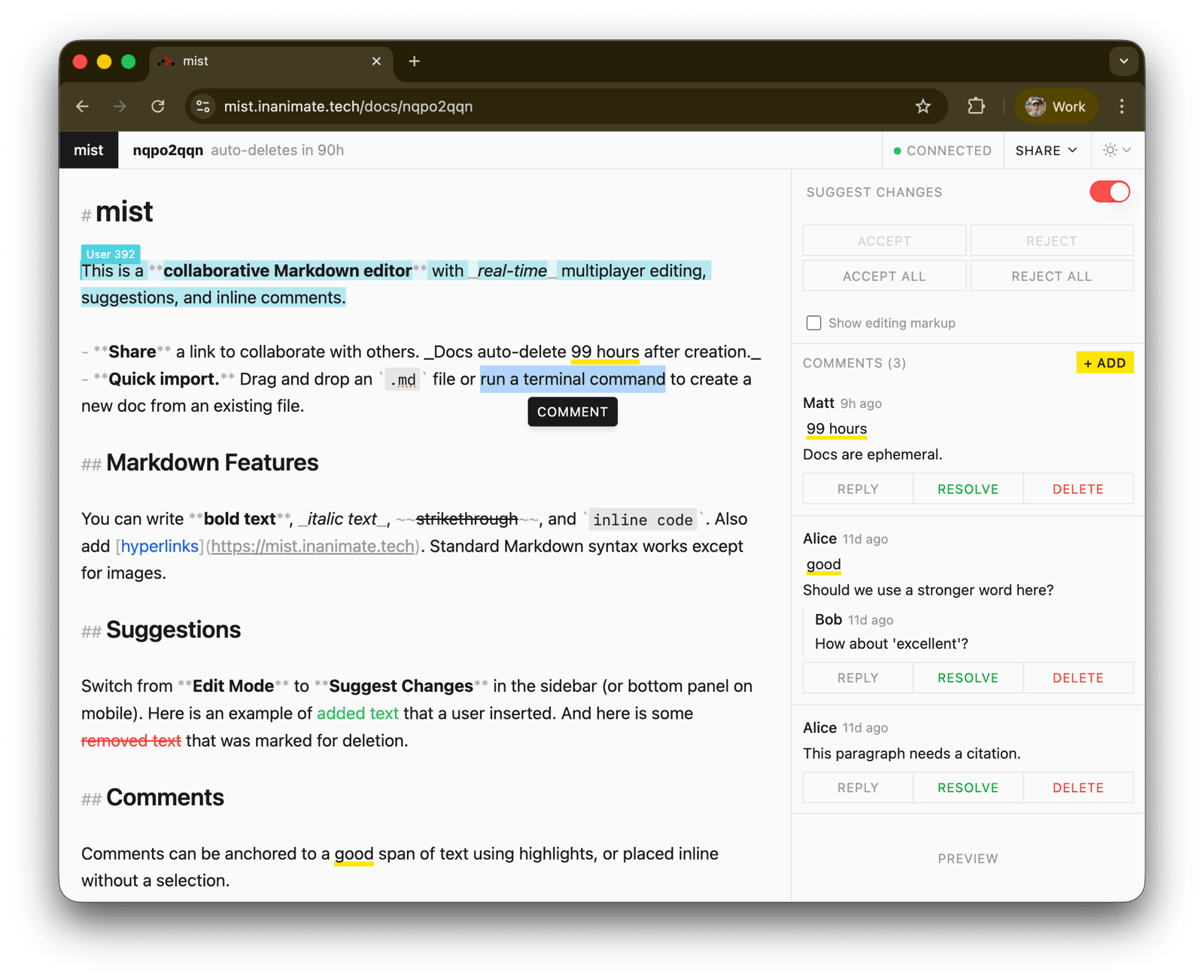
Say hi to mist!
- .md only
- share by URL
- real-time multiplayer editing
- comments
- suggest changes.
I included a couple of opinionated features…
- Ephemeral docs: all docs auto-delete 99 hours after creation. This is for quick sharing + collab
- Roundtripping: Download then import by drag and drop on the homepage: all suggestions and comments are preserved.
I'm proud of roundtripping suggested edits and comment threads: the point of Markdown is that everything is in the doc, not in a separate database, and you know I love files (2021). I used a format called CriticMark to achieve this - so if you build a tool like this too, let's interop.
Hit the New Document button on the homepage and it introduces itself.
Also!
For engineers!
Try this from your terminal:
curl https://mist.inanimate.tech -T file.md
Start a new collaborative mist doc from an existing file, and immediately get a shareable link.
EASY
Anyway -
It's work in progress. I banged it out over the w/e because I needed it for work, tons of bugs I'm sure so lmk otherwise I'll fix them while I use it… though do get in touch if you have a strong feature request which would unlock your specific use case because I'm keep for this to be useful.
So I made this with Claude Code obv
Coding with agents is still work: mist is 50 commits.
But this is the first project where I've gone end-to-end trying to avoid artisanal, hand-written code.
I started Saturday afternoon: I talked to my watch for 30 minutes while I was walking to pick my kid up from theatre.
Right at the start I said this
So I think job number one before anything else, and this is directed to you Claude, job number one before anything else is to review this entire transcript and sort out its ordering. I'd like you to turn it into a plan. I'll talk about how in a second.
Then I dropped all 3,289 words of the transcript into an empty repo and let Claude have at it.
Look, although my 30 mins walk-and-talk was nonlinear and all over the place, what I asked Claude to do was highly structured: I asked it to create docs for the technical architecture, design system, goals, and ways of working, and reorganise the rest into a phased plan with specific tasks.
I kept an eye at every step, rewinded its attempt at initial scaffolding and re-prompted that closely when it wasn't as I wanted, and jumped in to point the way on some refactoring, or nudge it up to a higher abstraction level when an implementation was feeling brittle, etc.
And the tests - the trick with writing code with agents is use the heck out of code tests. Test everything load bearing (and write tests that test that the test coverage is at a sufficient level). We're not quite at the point that code is a compiled version of the docs and the test suite… but we're getting there.
You know it's very addictive using Claude Code over the weekend. Drop in and write another para as a prompt, hang out with the family, drop in and write a bit more, go do the laundry… scratch that old-school Civ itch, "just one more turn." Coding as entertainment.
The main takeaway from my Claude use is that I asked for a collaborative Markdown editor 5 months ago:
app request
- pure markdown editor on the web (like Obsidian, Ulysses, iA Writer) - with Google Docs collab features (live cursor, comments, track changes) - collab metadata stored in file - single doc sharing via URL like a GitHub gist
am I… am I going to have to make this?
My need for that tool didn't go away.
And now I have it.
Multiplayer ephemeral Markdown is not what we're building at Inanimate but it is a tool we need (there are mists on Slack already) and it is also the first thing we've shipped.
A milestone!
So that's mist.
xx
More posts tagged: inanimate (2).
Auto-detected kinda similar posts:
- The emerging patchwork upgrade to the multiplayer web (27 Sep 2021)
'The Last Sacrifice' Explores the (Maybe?) Occult Crime That Inspired 'The Wicker Man' [ 12-Feb-26 9:00pm ]
Didero lands $30M to put manufacturing procurement on 'agentic' autopilot [ 12-Feb-26 8:31pm ]
After Two Years, the Apple Vision Pro Finally Has a YouTube App [ 12-Feb-26 8:30pm ]
Anthropic raises another $30 billion in series G, with a new value of $380 billion [ 12-Feb-26 8:18pm ] YouTube finally launches a dedicated app for Apple Vision Pro [ 12-Feb-26 8:14pm ]
'Starfleet Academy' Decides Everyone Needs a Harsh Lesson [ 12-Feb-26 8:00pm ]
Even Grok thinks RFK Jr.'s diet is a bad idea [ 12-Feb-26 7:00pm ]
Healthy and Human Services brainworm RFK Jr's new "Real Food" website features his upside-down food pyramid, recommending more fat, butter, and red meat. The site also redirects to Elon Musk's dubious chatbot, Grok, which quickly explains that Kennedy's guidance isn't based on scientific evidence and that you shouldn't trust Kennedy himself. — Read the rest
The post Even Grok thinks RFK Jr.'s diet is a bad idea appeared first on Boing Boing.
Medieval painters gave dogs human faces to symbolize cowardice [ 12-Feb-26 6:54pm ]
In the Retable de la Passion, an oil-on-wood altarpiece from around 1500, a small dog sits among the crowd at Christ's trial. It has grey stubble, a weak chin, and an expression that's unsettlingly human. The dog is Pontius Pilate. — Read the rest
The post Medieval painters gave dogs human faces to symbolize cowardice appeared first on Boing Boing.
"Lyin' and Spinnin' (and Cheatin' and Hidin')" a Valentine's release by Randy Rainbow [ 12-Feb-26 6:48pm ]
Randy Rainbow declares Trump's second term the worst sequel since "Wicked for Good."
I particularly enjoy that Mr. Rainbow gives us a few moments after the interview to discuss the source material before he breaks into song. Randy has consistently documented Trump's evil, and done it in tune. — Read the rest
The post "Lyin' and Spinnin' (and Cheatin' and Hidin')" a Valentine's release by Randy Rainbow appeared first on Boing Boing.
Hacker linked to Epstein removed from Black Hat cyber conference website [ 12-Feb-26 7:15pm ] Trump administration undermines EPA enforcement of Clean Air Act [ 12-Feb-26 7:13pm ] Automattic planned to target 10 competitors with royalty fees, WP Engine claims in new filing [ 12-Feb-26 7:02pm ]
A STI Fungus Is Making Itself Cozy in the US [ 12-Feb-26 7:00pm ] Mutated Rats Reign in This Ooey-Gooey Clip From 'Cold Storage' (Exclusive) [ 12-Feb-26 7:00pm ] Trump Just Blew American Climate Policy to Smithereens [ 12-Feb-26 6:59pm ] Israel Accuses Two Polymarket Bettors of Trading on Classified Military Operations [ 12-Feb-26 6:55pm ] Enjoy This POV of Getting Arrested at the Super Bowl—Courtesy of Smart Glasses [ 12-Feb-26 6:36pm ]
ICE agent fails sobriety test, questions deputy's nationality [ 12-Feb-26 6:30pm ]
In body-camera footage released by the Monroe County Sheriff's Office, 42-year-old ICE goon Scott Thomas Deiseroth repeatedly fails to offer the deputy the respect his agency continuously demands law enforcement merits, displays his racism, and fails a field sobriety test. — Read the rest
The post ICE agent fails sobriety test, questions deputy's nationality appeared first on Boing Boing.


