

The Wall Street Journal reports staff beratings, polygraph tests, showboat raids, and a Coast Guard pilot allegedly fired because someone didn't pack the secretary's favorite blanket.
The Department of Homeland Security under Noem and Lewandowski is apparently run like a YouTube influencer's channel. — Read the rest
The post Noem and Lewandowski turned Homeland Security into a reality show with poor trigger discipline appeared first on Boing Boing.

Congressperson Jamie Raskin (D-MD) paid the ICE facility in Baltimore a surprise visit. What he found was "disgraceful. "
Raskin found 60 men packed into a single room, with only one toilet and no showers. The inhuman conditions also involved sleeping with a simple aluminum foil survival blanket. — Read the rest
The post 60 Men, one toilet: Lawmaker describes conditions inside ICE facility appeared first on Boing Boing.

The City of Los Angeles lost a court case over the improper seizure and disposal of property from unhoused people without it ever going to trial. Forensic analysis showed the city had "modified or fabricated" 90% of the reports filed over 144 "cleanups." — Read the rest
The post Los Angeles caught covering up huge rights violations appeared first on Boing Boing.

People with the richest intellectual lives didn't develop Alzheimer's until age 94, on average. Those with the least enrichment got it at 88. That six-year gap stems from a study of 1,939 people, published in the journal Neurology, which followed participants for roughly eight years and measured what "enrichment" entailed across three stages of life. — Read the rest
The post A lifetime of reading may delay Alzheimer's by six years appeared first on Boing Boing.

In 2008, someone stole an entire beach in Jamaica. Five hundred truckloads of white sand vanished from Coral Springs, Trelawny, derailing a $110 million resort development. Charges were eventually dropped after death threats against the key witness. Nobody was ever convicted. — Read the rest
The post Sand thieves stole an entire Jamaican beach and got away with it in 2008 appeared first on Boing Boing.

For 24 years, Suzanne McArthur sold an odd little utensil from Martha Washington's coffee shop in Sydney — a single piece of cutlery that could scoop soup, spear a prawn, and cut a piece of chicken. Her husband William had patented it in 1943 after seeing a magazine photo of women at a Roman buffet dinner, struggling to balance plates, glasses, and full sets of silverware on their knees. — Read the rest
The post Meet the Splayd, the spork's sharper Australian cousin appeared first on Boing Boing.

Goldman Sachs chief legal officer Kathryn Ruemmler announced her resignation Thursday night, the latest career to fall apart because of the Epstein files. She'd received luxury handbags and a fur coat from Epstein after his 2008 sex crimes conviction and offered him advice on managing his reputation. — Read the rest
The post JPMorgan flagged $1 billion in suspicious Epstein transactions and kept banking him appeared first on Boing Boing.

The Headies. From left: Grant Robinson - keyboards and vocals, Todd Purse - drums, Danny Robinson - vocals and guitar, Billy Frolic - guitar and vocal and Justin Vavala - bass guitar. Yes, it's the same Todd Purse who is the 'Tales of Illuminatus' artist.
Danny Robinson, who made a soundtrack album for Tales of Illuminatus No. 2 as "Danny and the Darlings," now has a Patreon. As Bobby Campbell says, he's "he's sharing demos, shop talk, lyric sheets, background lore, and vegetarian recipes as he endeavors to get his forthcoming album pressed on vinyl!"
Here is more information on the soundtrack album; you can read my interview with him and you can read up on his new punk rock opera.

A federal grand jury on Tuesday unanimously rejected the DOJ's attempt to indict six Democratic lawmakers who posted a 90-second video reminding military personnel they can refuse unlawful orders. Trump had responded to the video on social media by writing, "SEDITIOUS BEHAVIOR, punishable by DEATH!" — Read the rest
The post Grand jury unanimously refuses to indict six lawmakers Trump wanted executed for telling troops to follow the law appeared first on Boing Boing.

Someone found Jeffrey Epstein's YouTube handle and a Fortnite account linked to his name, and from this concluded that the dead sex trafficker is alive and playing video games in Israel. That's the caliber of theorizing now swirling around the DOJ's release of over 3 million pages, 2,000 videos, and 180,000 images from the Epstein investigation, reports The New York Times. — Read the rest
The post Epstein's Fortnite account discovered, theorists decide he's alive appeared first on Boing Boing.

The Trump administration paid Palau — a Pacific island nation of 18,000 people — between $4.7 million and $7.5 million to accept deportees. So far, it has sent zero.
That's one detail from a Senate Foreign Relations Committee report, which tallied at least $40 million in spending on shipping roughly 300 migrants to countries other than their own, according to the AP. — Read the rest
The post Trump's third-country deportations cost $133K per person appeared first on Boing Boing.
 The following article contains images of human remains
The aftermath of a battle or execution from around the 9th century AD has been discovered by Cambridge University archaeologists and students conducting a training dig as part of the University's undergraduate degree in archaeology.
The burial pit, found on the outskirts of Cambridge, may date from a time when the area was a "frontier zone" in the conflict between the Saxon-run kingdom of Mercia and the kingdom of East Anglia, which was conquered by the Vikings in around 870 AD (CE).
Unearthed during spring and summer last year, the pit contained the remains of ten individuals based on the number of skulls, including at least one decapitation and a man well over six foot in stature - extremely tall for the time - with a trepanned head.
Unusually, the mass grave held a mix of complete and dismembered remains, including a cluster of skulls without clear accompanying bodies and a "stack of legs", as well as four complete skeletons, some in positions suggesting they were tied up.
All appear to have been relatively young men flung into the pit without care, leading archaeologists to believe they found the wake of a skirmish or battle, or perhaps a mass execution - or a combination of both. The discovery is showcased in an episode of the BBC's 'Digging for Britain'.
 Image credit: Cambridge Archaeological Unit/David Matzliach
A training excavation with extraordinary results
Image credit: Cambridge Archaeological Unit/David Matzliach
A training excavation with extraordinary results
The excavation, led by Dr Oscar Aldred from the Cambridge Archaeological Unit (CAU), took place at Wandlebury Country Park, famous for its "ringwork": a series of banks and ditches that mark an Iron Age hillfort constructed a millennium before the Viking era.1
Archaeologists say the Iron Age features at Wandlebury - a popular destination for school trips and family days out, located three miles south of Cambridge - would have made it a renowned meeting place in the early medieval period just as it is now.
The University's Department of Archaeology and CAU have worked with local charity Cambridge Past, Present and Future, who own Wandlebury, to conduct student training digs on the site for several years, but this is their most significant and grisly find on the site to date.
"Before we uncovered the first remains, our best find was a 1960s Smarties lid," said Olivia Courtney, an archaeology undergraduate from Bath, now in her third year at Cambridge University.
"I had never encountered human remains on a dig, and I was struck by how close yet distant these people felt. We were separated by only a few years in age, but over a thousand years in time."
These are the first human remains found at Wandlebury since 1976, when a storm uprooted a tree close to the recent dig site, and a cache of five skeletons also dating to the same time were uncovered.
The unusually tall man with a trepanned skullAmong the most intriguing aspects of the latest find are the complete remains of a man aged between 17 and 24, flung face down into the pit, who would have stood at around 6 foot 5 inches tall.2
His height may be down to a growth condition, according to archaeologists, who say he would have towered over others at a time when the average male height was around 5 foot 6 inches.
The man has a large oval hole in his skull, 3cm in diameter, suggesting he underwent trepanation: an ancient surgical procedure in which a hole is bored through a living human's skull. The hole in the back left side of his skull has signs of healing.
Trepanned skulls have been found the world over, including in ancient Greek and Roman remains. Trepanning was thought to relieve symptoms of conditions such as migraines and seizures, along with disorders we now know to be psychological.
 Trepanned skull. Image credit: Cambridge Archaeological Unit/David Matzliach
"The individual may have had a tumour that affected their pituitary gland and caused an excess of growth hormones," said Dr Trish Biers, curator of the Duckworth Collections at the University of Cambridge, where these remains have been taken for further analysis.
"We can see this in the unique characteristics in the long shafts of their limb bones and elsewhere on the skeleton."
"Such a condition in the brain would have led to increased pressure in the skull, causing headaches that the trepanning may have been an attempt to alleviate. Not uncommon with head trauma today," Biers said.
A mass grave unlike others of its periodThe inclusion of dismembered remains alongside fully articulated bodies is highly unusual even for a mass grave, and has puzzled archaeologists.
While one man was clearly beheaded - evident from chop marks on the jaw - and a few others have traces of trauma consistent with combat, there isn't enough to suggest those buried at Wandlebury were victims of a battle, say archaeologists.
However, to have severed heads, limbs and other remains - from ribs to pelvises - tossed in a pit, with body parts of the same type stacked together in some cases, piled on top of four dead men, at least one apparently bound, suggests terrible violence and perhaps an execution, according to CAU's Dr Oscar Aldred.
"Those buried could have been recipients of corporal punishment, and that may be connected to Wandlebury as a sacred or well-known meeting place."
"It may be that some of the disarticulated body parts had previously been displayed as trophies, and were then gathered up and interred with the executed or otherwise slaughtered individuals," Aldred said.
"We don't see much evidence for the deliberate chopping up of some of these body parts, so they may have been in a state of decomposition and literally falling apart when they went into the pit."
Cambridge in the late 8th century was under the control of Offa, ruler of the kingdom of Mercia, but in the late 9th century (around 874-5 AD), half of the Viking Great Army set up camp close to Cambridge, and sacked the town.
Cambridgeshire was then incorporated into the Viking kingdom of East Anglia, and stayed under Viking control up to the early 10th century as part of the Danelaw agreement.
Initial radiocarbon work dates some bones to around this time, but with no associated grave materials more research is required to establish if these are Saxons or Vikings.
"Cambridgeshire was a frontier zone between Mercia and East Anglia, and the continual wars between Saxons and Vikings as they clashed over territory across many decades," said Aldred. "We suspect the pit may relate to these conflicts."
Next steps in uncovering Wandlebury's pastHistoric England, who are supporting the excavation, and monitor and manage archaeology on protected Scheduled Monuments such as Wandlebury, have commissioned a new geophysical survey of the area that archaeologists hope will reveal more about the site surrounding the burial pit.
Tony Calladine, East of England Regional Director, Historic England, said: "Wandlebury is an important natural and historic resource for the people of Cambridgeshire. The extraordinary discovery there speaks to the story of our nation and the lives of ordinary people living during turbulent times."
Future work from the Cambridge team will include bone analysis including ancient DNA and isotopic work to investigate health, kinship and ancestral links, which will help to establish if these are Viking remains.
The archaeologists will also attempt "refitting" to see if any dismembered remains can be reconstructed to determine how many people were thrown into the pit.
"I would never have expected to find something like this on a student training dig. It was a shocking contrast to the peaceful site of Wandlebury," added Grace Grandfield, a Cambridge undergraduate from York who took part in the dig.
"Several of the individuals we uncovered were a similar age to me, and it was a sobering experience to identify ever more disarticulated bones and realise the extent of the suffering that had taken place."
- The pit, measuring four metres by one metre, was unearthed just outside the hillfort ringwork to the south. ↩︎
- Initial radiocarbon work dates this skeleton to between 772 - 891 AD with 85% probability, and further work will be undertaken to help narrow this date. ↩︎
This article from the University of Cambridge is republished under a Creative Commons licence (CC BY-NC 4.0). Read the original here.
More from East Anglia Bylines
 Bylines Network Gazette is back!
With a thematic issue on a vital topic - the rise child poverty, ending on a hopeful note. You will find sharp analyses on the effect of poverty on children's lives, with a spotlight on the communities that are on the front line of deprivation, with personal stories and shared solutions. Click on the image to gain access to it, or find us on Substack.
Journalism by the people, for the people.
The post Cambridge students unearth Viking-era 'execution pit' first appeared on East Anglia Bylines.

Summer Worden falsely claimed that her astronaut wife, Ann McClain, illegally accessed her bank account from the International Space Station. This technically implausible story suffered rapid unscheduled dissassembly and she's off to jail for three months, having pleaded guilty to making false statements to NASA and the authorities. — Read the rest
The post Three months' prison for woman who claimed her astronaut wife accessed bank account from space appeared first on Boing Boing.
Welcome to your Friday issue of the Best of Bylines Network newsletter, bringing you a standout article from one of our 10 UK national and regional publications.
This time, we hear from Nazish Saad, a writer for Bylines Scotland with a strong focus on sustainability and minority rights, and who responds to the news that Suella Braverman has defected to Reform. A post on Bluesky, accompanied by a photograph of Braverman resting her head on Nigel Farage's chest, wide smiles on both faces, did not incite Nazish's anger or disdain. Instead, it triggered something deeper, heavier - a particularly nauseating pain of betrayal.
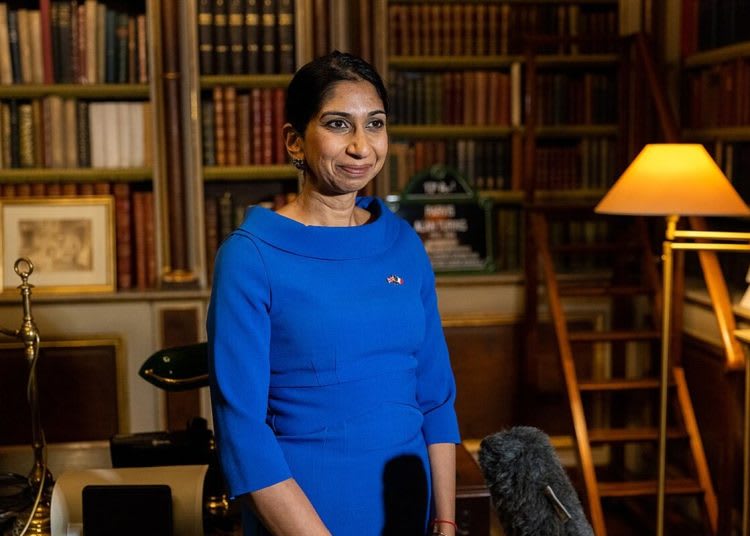 Suella Braverman, UK Home Office, CC BY 2.0 , via Wikimedia Commons
I found myself asking, as a brown woman, why this felt so much more hurtful: a gut punch spiked with the bitterness of treason and the emptiness of abandonment.
I know that one should not hold anyone to a higher moral standard because of their ethnicity or their gender. And I agree that representation is neither a monolith nor should it impose virtue, and that everyone - irrespective of their origins or backgrounds - has the right to choose the ideology that best aligns with their beliefs.
And yet…Parties like Reform thrive on hate-filled narratives targeting minorities, migrants, and any other category of people deemed a convenient scapegoat for their own failed policies of austerity. While, in theory, I should separate identity from political loyalty, in actual fact, it is impossible for me to be neutral and ignore it. I cannot help viewing current events through my own lens, those of a brown woman living in a world where the struggle to belong, to be accepted, is constant.
I did not feel like I ever had the luxury of not being 'political' and activism felt necessary for survival. I have never existed in a space where my rights and my belonging could not be questioned at any moment - often by those who could never conceive of ever being questioned themselves.
The ruling classThe traditional ruling class, entrenched in the denial of its history of slavery and colonialism, has long been incapable - or unwilling - to recognise how this dark past continues to shape injustices in the present. In this context, political representation by those who looked like me once felt like a hope - a connection rooted in shared experience promising greater inclusion and empathy.
Perhaps this is why this moment feels personal.
Embracing an ideology of division hurtsThe symbolism of a brown woman embracing an ideology of discrimination and exclusion normalises this discourse. It sends a message - whether intended or not - that the racism or misogyny, which many endure daily, is acceptable. It becomes a powerful tool of gaslighting. It reminds me of the many times I was silenced about the abuse I faced, told to not make it about race or gender. Of how sometimes it feels like my existence is a balancing act between two worlds: like walking on eggshells, expected to endure systemic discrimination, yet rarely allowed to name it.
Suella Braverman has the right to make her own choices, and neither her gender nor the colour of her skin obliges her to an ideology. Yet Suella and her loved ones must have had some experience of difficulties and mistreatment because of their identity in their lives. What hurts is that she knows exactly what this choice represents - and the impact of pulling the ladder up behind her for so many who share her background.
What hurts is that, knowing this, she chose it anyway.
Join the citizen army supporting journalism by the people, for the people

Bylines Network gives a platform to over 2,500 citizens to report on the topics that matter, investigate local and global stories, and speak truth to power. Every month, we publish 400 articles in our 10 UK national and regional publications and engage 100,000s of readers. But that's not the full story.
The UK media continues to be dominated by white men who went to private schools. It is increasingly owned by corporations disconnected from our communities, and by billionaires with political agendas. Without networks championing unheard voices, writers like Nazish would be silenced. Without everyday citizens volunteering as writers, editors, proofreaders and uploaders, none of our journalism would see the light of day.
We're proudly independent, our websites are free to read, and we don't take corporate advertising income. But it costs at least £150,000 a year to run our network. Much more when we carry out deeper investigations, or work with communities who don't normally have the opportunity to tell stories. Without the financial support of our readers and followers, we couldn't run our publications, and the costs are rising all the time.
This year, there are hugely significant elections to the Welsh Senedd and Scottish Parliament, and across the English regions. We want to make sure the voices of citizens are heard loudly by those asking for our votes, in their own words, without fear or favour. You can help.
Upgrade to a monthly paid subscription here on Substack or become a Friend of Bylines Network by completing the form on this page. For as little as £3.50 a month, you'll get behind-the-scenes insights, chances to engage with our editorial teams, access to special events and merchandise. For £10 a month, you get a little more involvement in how we run. For £30, you can do even more.
If you want your monthly payment ring-fenced to one of our 10 publications, all you have to do is drop us a line saying which.
Our Friends are not just donors, they are part of our community - they ensure our journalism thrives, by the people, for people.
Sign up by clicking the button below, or upgrade your Substack subscription.
Become a Friend of Bylines Network


"I loved the torture video," read the subject line of an email sent to Jeffrey Epstein. The sender was identified by a U.S. lawmaker as Sultan Ahmed bin Sulayem, the 71-year-old chairman of DP World, one of the planet's largest port and logistics companies. — Read the rest
The post DP World ousts Trump-connnected Sultan after Epstein files reveal "torture video" email appeared first on Boing Boing.

According to a study comprising 43 years of data on over 130,000 patients, drinking caffeinated coffee was associated with a lower risk of dementia. The study, published in the Journal of the American Medical Association, found that drinking two to three cups of coffee or one to two cups of tea—approximately 300mg of caffeine—reduced dementia risk by 18% and 14%, respectively. — Read the rest
The post Caffeinated coffee may stave off dementia appeared first on Boing Boing.

There is a Match Museum in Jönköping, Sweden, dedicated to matchsticks and matchboxes. It's one of only a handful of match museums worldwide.
I love looking at vintage matchbox art, and this museum sounds like a great place to see some. — Read the rest
The post Sweden's match museum celebrates the lost art of matchbox design appeared first on Boing Boing.

Rays of light beam from a mass of dust, glancing off banks of cloud 1,000 light years from Earth. The nebula glows not because its gases ionize but because the sun-like star at its center is nearing the end of its life. — Read the rest
The post Hubble captures death of a sun-like star appeared first on Boing Boing.

This painting by Louis Wain depicts a wonderfully playful scene of cats sledding down a hill. Some look thrilled, while others look absolutely terrified. A few have even gone flying off their sleds and landed upside down in the snow. I need to find a print of this for my wall. — Read the rest
The post This delightfully chaotic Louis Wain painting shows cats sledding downhill with pure joy and terror appeared first on Boing Boing.

This hypnotic timelapse shows a sand dollar trundling in circles on the ocean floor, leaving a precise circular trail in the sand — its very own sand art.
Sand dollars may look like simple beach treasures, but they're living sea urchins with a surprisingly elegant design. — Read the rest
The post Watch a living sand dollar spin like a tiny Roomba, etching circular sand art appeared first on Boing Boing.

A special exhibition, "Universal Theme Parks: The Exhibition," will open on February 14 at The Franklin Institute, Philadelphia's museum of science and technology. The exhibition celebrates and explains the technology and artistry behind the Universal theme parks. It is planned to be in Philadelphia until September, and then go on a national tour of science museums for five years. — Read the rest
The post Program an animatronic, design a coaster at this new Philly exhibit appeared first on Boing Boing.

TL;DR: Windows 11 Pro for Microsoft is available for $12.97 (reg. $199), offering upgraded security, multitasking tools, and built-in Copilot features for compatible PCs, through March 22 at 11:59 p.m. PT.
If your PC is still rocking that 2016 energy, it's time for an upgrade that won't cause existential dread. — Read the rest
The post Windows 11 Pro is $12.97 and your aging PC might thank you appeared first on Boing Boing.
 The Spirits #190: The Sloppy Joe Cocktail [ 13-Feb-26 4:01pm ]
~ THE SLOPPY JOE COCKTAIL ~
40ml light rum (I used Bacárdi)
20ml French vermouth (I used Noilly Prat)
20ml lime juice
10ml orange curacao (Pierre Ferrand)
5-10ml grenadine (homemade)
Now, darling, I want you to put your prettiest cocktail glass in the freezer. Can you do that for me? Wonderful. Now, carefully measure all of the above ingredients into your shaker. Swirl and taste. OK? Add a decent handful of ice, bang on the lid and now you're gonna shake shake shake shake shake shake it up. Phew. Fine-strain into the pre-frozen glass — through a fine-mesh, that's it — and drink immediately. Happy Valentine's day, baby.
With 2026 being the year of the fire horse, this spicy number has a suitable kick to mark the occasion
Here's a spicy little number that will help you see in the lunar new year in style on 17 January.
Rron Rakoci, mixologist, Huŏ, London
Continue reading...
I love thermal imaging cameras. They're great for spotting leaking pipes, inefficient appliances, and showing how full a septic tank is. The good folks at Topdon have sent me their latest thermal camera to review - it is specifically designed for spotting wildlife.
This is the TS004 Thermal Monocular:

Let's put it through its paces!
HardwareThis is a chunky bit of kit and fits nicely in the hand. It's well weighted and feels sturdy.
The rubber seal fits tightly around your eye and is excellent at keeping light out. The screen is set a little way back, so is easy to focus on. Taking a photo of the screen itself was a little tricky - here's what you can expect to see when using the settings menu:

The focus knob near the viewfinder is a little stiff, but it turns silently.
There's a rubber lens cover which is attached and can be easily tucked away next to the standard tripod mount. It comes with a lanyard strap, so you're unlikely to drop it. The buttons are well spaced and respond quickly.

The USB-C port has a rubber flap to keep out moisture.
OK, let's take some snaps!
PhotosPhoto quality is pretty good - although limited by the technology behind the thermal sensor. The TS004 has a thermal resolution of 256x192 and images are upscaled to 640x480.

One thing to note, the user-interface is burned in to the photos. So if you want the battery display on screen, it will also appear on the photo. Similarly, things like the range-finder appear in the image.
There's a reasonable AI built in. It is designed to tell you what sort of wildlife you've spotted. In some cases, it is pretty accurate! A woman walked by me while I was looking for wildlife - here's her photo:

Nifty!
Here's a photo of a fox:

There are remarkably few wild boars in London!
VideoVideo is also 640x480. It is a very smooth 42.187 FPS and a rather chunky 2,162 Kbps - leading to a file size of around 20MB per minute. With around 30GB of in-built storage, that shouldn't be a problem though. There's no audio available and, just like the photos, the UI is burned into the picture.
Here are a couple of sample videos I shot. In them, I cycle through the colour modes and zoom levels.
First, an urban fox foraging in London:
https://shkspr.mobi/blog/wp-content/uploads/2026/02/fox.mp4Second, some parakeets flapping around a tree:
https://shkspr.mobi/blog/wp-content/uploads/2026/02/Birds-In-Flight.mp4I'm impressed with the smoothness of the video and how well it picks up heat even from relatively far away.
LinuxBizarrely, on Linux it shows up as 1d6b:0101 Linux Foundation Audio Gadget. It presents as a standard USB drive and you can easily copy files to and from it. 100% compatibility!
You can't use it as a WebCam - for anything more complicated than copying files, you need to use the official app.
AppThe TopInfrared App for Android is reasonably good. It connects to the camera via WiFi and offers some useful features. Most impressively, it live-streams the camera's view to your phone.
From there you can take photos or videos and have them saved straight onto your device. Handy if you've set the camera up outside and want to view it from somewhere warmer.
Frustratingly, it isn't possible to set all the options on the camera using the app. For that you need to go back to the menu on the camera - which is slightly laborious.
The app isn't mandatory for most operations - thankfully - but it is the only way to set the time and date on the monocular. You will also need it if there are any firmware updates.
If you don't need the app, you can turn off the WiFi to save some battery life.
DrawbacksThe device works - and is great for wildlife spotting - but there are a few little niggles. I've fed these back to the manufacturer and have included their responses.
There's no EXIF in the photos, or any way to get thermal data out of the images.
- "These products focus on image clarity, high sensitivity, and low latency. For example, temperature-measurement thermal cameras typically run at 25 Hz, while the TS004 operates at 50 Hz for smoother viewing. Devices that include EXIF temperature data, raw thermal export, and analytical tools are measurement-focused thermal cameras, which are based on a different design and use case."
As mentioned, having the UI burned into the photos and videos is slightly annoying.
- You can turn off the UI elements on screen which stops them appearing in the photo.
The range-finder only works in yards and, while seemingly accurate, isn't overly helpful to those of us who think in metric!
- "Unit switching will be available in the March firmware update"
Once you sync the time with the monocular, all the filenames are timestamped like 2026_02_09_12345678 but it appears to be hardwired to Hong Kong Time (UTC+8) - so your dates and times might be a little out.
- "We will investigate it and see if it can be implemented in a future update"
The AI detection feature doesn't seem particularly tuned for the UK.
- "Due to hardware limitations, the current recognition is relatively basic, so there is limited room for significant improvement"
In terms of hardware limitations, there's no GPS. I would expect a device in this price-range to have basic GPS functionality to allow you to easily tag photos.
None of these are show-stoppers, but for a device this expensive they are an annoyance.
PriceOK, so you want to spot birds in trees and wild boars foraging in the forest - what'll this cost you?
Close to £400 - you can use code TERENCE15 for a 15% discount until 16 February 2026.
The price of thermal imaging equipment is high and this is a fairly niche form-factor. It is easy to use, has a great range, and the rubber eyepiece is much nicer than staring at a bright phone screen. The battery life is excellent and you certainly can't complain about the generous storage space.
There are some minor irritations as discussed above, but it is an exceptional bit of kit if you like to explore the environment. Are you going to spot any cryptids with it? Who knows! But you'll have lots of fun discovering the natural world around you.


