
 liar liar 4: creative autobiography [ 27-Apr-09 2:42pm ]
there must be some way out of here
said the joker to the thief.
there's too much confusion
I cant get no relief.
dylan ~ all along the watchtower
From the Pseudologia fantastica entry on Wikipedia:
Pseudologia fantastica, mythomania, or pathological lying, is one of several terms applied by psychiatrists to the behaviour of habitual or compulsive lying. It was first described in the medical literature in 1891.
 I ended the last one (Liar Liar 3: The Myth of Myth) by saying: "Lying turns out to be a central theme and major mode for the Mystic Bourgeoisie, even if they call it their 'Mythic Journey,' which is where we'll pick it up next time." Those of you who actually click on the links, know that that one went to Your Mythic Journey: Finding Meaning in Your Life Through Writing and Storytelling by Sam Keen. Ring a fire in your belly? No? Well, there's Sam on the right, looking for all the world like Quasimodo, the old bell-ringer himself. Say hello to the folks, Sam, you old fraud. Are you ready for your close-up?
OK, let's start with this clip from the intro to your interview at EnlightenNext (formerly What Is Enlightenment? magazine) Issue #16, Fall-Winter 1999; issue theme: "How Free Do We Really Want to Be?"
...[Keen] has authored over a dozen books and has for years been a prominent figure in the American human potential movement. It was through his experiences leading workshops at Esalen Institute, as a contributing editor for Psychology Today, and as cofounder of a men's group called SPERM (Society for the Protection and Encouragement of Righteous Manhood) that he began to formulate many of the ideas that would fill the pages of his books.Which explains why those pages tend to stick together.
In the middle of an interview that is so cranky and boring at the same time that your ears might start to bleed, Keen says something that sounds as if it might actually be true.
So much of my approach is the effort to go beyond mythology to autobiography, to take my own story and the uniqueness of my own situation, my own gifts and my own wounds, with a kind of ultimate seriousness.Interesting that he distances himself from both gender issues ("get over it") and Jung ("I don't like Jungianism -- just like I detest the idea of archetypes."). He made a bundle on the former, and invokes Jung -- as does his mentor Campbell -- whenever he finds it convenient, which is often. For instance, on Keen's current website, in a directory inexplicably titled...
fontsize13bseminarsandlecturesbfontp
...in the section on "Your Life, Your Story: Composing an Autobiography," right after where he says that human beings are "biomythic animals," there's this...
Carl Jung once said that the most important question anyone can ask is: What myth am I living? In the degree that we remember and retell our stories and create new ones we become the authors, the author/ities, of our own lives.Too right. You probably didn't know this about me, but I have totally reinvented myself as the Sugar Plum Fairy.
The photo of Keen, above, comes from Yoga Journal November-December issue, 1994, pp. 114-116. (btw, monster kudos to Google for putting magazine archives online!) The article is titled "What My Book Is Not About," the book in question being Hymns to an Unknown God: Awakening The Spirit In Everyday Life. This appears opposite a cheesy ad for two Deepak Chopra books: Restful Sleep and Perfect Weight. Evidently, things the book is not about include angels, UFOs, miracles, out-of-body experiences, near-death experiences, self-esteem, and "prophesy" [sic].
It is not even about what my dear friend Joseph Campbell talks about in Hero's Journey, where he writes that we go into the forest where it is the darkest, and each goes alone, since It would be a shame to go in a group.
A shame, yes how true. But note that Keen has cleverly touched on all the magic hot buttons that readers of Yoga Journal in 1994 -- and perhaps even more so today -- are most likely to care about.
After devoting at least half the article to such disclaimers, Keen then says, well OK, he can tell us a little about what the book is about. "The book is in some ways about forming a spiritual bullshit detector," he writes. But only in some ways, right, Sam? Because if your intended audience had working bullshit detectors, they'd never read your crap in the first place. So: moderation in all things. A little detecting, a little bullshit. A little detecting, a little more bullshit. Rinse and repeat.
Publishers Weekly says of Hymns to an Unknown God...
Defining the quest to unlock spirituality as "the reverse of the religious pilgrimage," bestselling author Sam Keen (Fire in the Belly) nonetheless sets out immediately to blend Eastern and Western religious traditions with philosophy, psychology and autobiography. The result is a New Age-ish "now-and-then spiritual journey" whose indirect path may result in confusion for questers seeking less amorphous guidance.But Publishers Weekly clearly doesn't get it. On your mythic journey, indirection is the path; amorphous confusion the shining goal.
In the opening bars of Your Mythic Journey, we learn two salient facts. First (p. iii), the book was published by Jeremy P. Tarcher, who was responsible for more New Age books than Jesus Christ, Buddha and Lao Tzu, combined. (btw, Tarcher was married to Shari Lewis, so it's possible that the ontological devolution we've been exploring here, lo these many years now, was a plot hatched by Lambchop. After all, ask yourself: is this the real life or is this just fantasy?)
Second (p. iv), it is dedicated to Joseph Campbell, whose name will appear again and again in such books. Such books being those about how to make the lesser argument appear the greater. The lesser being the random-ass concatenation of cruel jokes and unconscionable misjudgments that constitute your personal history. The greater being the same set of raw materials magically reformulated into the shining saga of a hero or goddess able to leap tall buildings at a single bound, patch up the crack in the Liberty Bell, or fearlessly lead a locust-horde of God-fearing White People Westward. You go, girl!

John Gast's 1872 painting, American Progress, is but one reminder that America is no stranger to heroes and heroines, gods and goddesses got up to serve the interests of the prevailing ideological drift. A bit further back, we have the glee of Henry David Thoreau that his family took its name from that of a Norse god.
But back to Sam & Joe. Note that Keen's Your Mythic Journey (1973) came out barely a year after Campbell's Myths We Live By (1972). Much later, Jean Houston -- another Campbell protege -- wrote A Mythic Life: Learning to Live Our Greater Story, with a foreword by Mary Catherine Bateson, author of Composing a Life. Houston also wrote an introduction to The Mythic Path: Discovering the Guiding Stories of Your Past, Creating a Vision for Your Future by David Feinstein and Stanley Krippner (Tarcher/Putnam, 1997). That book begins with "An Invitation: Renew the Dream That Quickens Your Spirit" (p. 3)...
Your personal mythology is the loom on which you weave the raw materials of daily experience into a coherent story. You live your life from within this mythology, drawing to yourself the characters and creating the scenes that correspond with its guiding theme.
There is no end of references to the power of mythic hogwash. But as this is the fourth installment of the "Liar Liar" series, perhaps at this point I should back up and talk about why all this is important. Why I think it's important.
In my previous post (Liar Liar 3: The Myth of Myth), I suggested that the powerful attraction of Jung -- Eliade depended on him, as did Campbell and so many others since -- is based not just on his notions about archetypes and the collective unconscious, but on something much more seductive that those two constructs enable: "individuation."
By individuation, Jung meant the creation of a real Self (he usually capitalized it) balanced between individual subjectivity -- the waking personal conscious -- and the Collective Unconscious (he capitalized that too) -- a transpersonal layer of racially acquired experience. (Yes, the reference to race is problematic -- as has been Jung's entire theory, for the same reason.)
Henry David Thoreau, who was wrong about so many things, was right when he said most people lead lives of quiet desperation. At least some of the time. I have felt that way. You have felt that way. Let us not talk falsely now. And the desperation is to get out of the terrible suffocation of being imprisoned within a miniscule inarticulate repetitive and hugely boring subjectivity. There must be some way out of here.
By the way, dropping allusions to Dylan here is more germane than you might guess. His song, "All Along the Watchtower," is based on one of the most obscure prophets of the Old Testament...
- I will stand upon my watch, and set me upon the tower, and will watch to see what he will say unto me, and what I shall answer when I am reproved.
And the LORD answered me, and said, Write the vision, and make it plain upon tables, that he may run that readeth it.
Habakkuk, 2:1-2, King James Version
In brief, word on the street was that some ill-intentioned horde of barbarians was bearing down on some minor king's minor kingdom in some long forgotten desert where more recent barbarities are now making headlines. So this king asked God what to do. Should I stay or should I go sorta thing. And God, in His ineffable effing way, said hang loose, King, I'll get back to you. Put sentries on your watchtowers and I'll send you a sign.
Except He never did.
For this reason, Sunday sermons based on the book of Habakkuk tend to get rather convoluted rather quickly. Two riders were approaching. Or they weren't. Or... well, let's kick around what God might have been thinking.
A favorite human pastime.
Which brings us back to Jung. And to the larger context within which Jung, by his own occasional admission, was embedded: gnosticism. Let's leave aside for the moment the fact that some scholars in the field of Religious Studies have suggested that gnosticism is such a vague and historically slippery concept that it has no real meaning at all. See for instance, Rethinking "Gnosticism": An Argument for Dismantling a Dubious Category (Princeton University Press, 1996). As a class, the Mystic Bourgeoisie has constructed itself of just such nebulous and ultimately meaningless categories. So what else is new?
The gnostic category Jung gave us was the capital-S Self, and a method by which it could "shop" itself together, i.e., individuation. Think a sort of spiritual Photoshopping. Think rag and bone shop of the heart.
The shop window is the collective unconscious, another questionable category, but let's let that one slide too. Think Macy's windows at Christmastime in New York, the lights, the snow, the tinkling sublunary music of the spheres. Everyone in love, everything sorta magical. Sorta mythic.
Kinda like a drug. Like ecstasy maybe. Like whatever drives away quiet desperation. Take only as directed.
And here are the directions. Stroll up and down looking at the pretty archetypes in the shop windows. The Empress, the Goddess, the Good Witch of the East, the oracle@delphi. But of course, not all are so pretty. There's the Warrior, the King, the Sorcerer, the Magician. Those are for the boys. And don't worry, if you're lesbian, there's Sappho, if you're gay, there's Pan. And so on. Point being: something for everyone and not half boring! Not in the least desperate. In fact, when you get right down to it, really rather Sacred.
And who wouldn't want to trade in their ho-hum subjectivity for a gung-ho archetypicality or two?
Actually, Jung himself warned about this. He warned of psychic inflation, infection, of "invasion" from the unconscious. Sounds dire, doesn't it? Like "The Invasion of the Body Snatchers," like "The Day the Earth Stood Still." Aba Gort. Klaatu barada nikto!
Jung wasn't kidding, though. He had first-hand experience of such invasions and possessions. Serious business. No laughing matter.
But note also how close such warnings sound to those of the side-show barker. Ladies and Gentlemen, don't get too close! This Beast from the Dark Jungles of Africa will shock you. It will challenge your most cherished beliefs! Don't come inside unless you are sound of body and pure of heart! Only for the brave, courageous and bold!
Such "warnings" sell a lot of tickets.
So you step right up and buy yours for the Gnostic Individuation ride. Show your girl you're no chicken, dammit. Show that guy you're no dum-dum!
I weep for you.
Because yes, life is boring a lot of the time. Not as exciting as you thought it'd be. The wife, the kids. The husband, the job. Is that all there is? Midway on life's journey, your desperation boils over, and no Virgil in sight. Because Stoneman's cavalry came and tore up the tracks again. Yeah, that's it, that's probably why.
Virgil Kane is the name
and I served on the Danville train...
The Band ~ The Night They Drove Old Dixie Down
Or wait. Corn in the fields... Maybe Virgil reincarnated as Carlos Castaneda or Don Miguel Ruiz or Sri Aurobindo or Ram Dass or Deepak Chopra. Listen to the rice as the wind blows 'cross the water... One-a those foreigners with the funny names. One-a them vaguely Oriental types. King Harvest will surely come!
You're individuating now, baby! See? All you needed was a little help, a little expert direction. A Guide, a Guru, a Master.
Step right up.
Stroll by the window displays. Pick yourself a cool archetype, a knowing goddess, a fearless champion. And rework the story of your life so it works out that that's really you. The real you. The realer than real you. Your True Self.
Ta-da!
You're on your mythic journey now, just like Sam Keen promised. You got your mythic image, just like Joe Campbell said. You're a Hero, a Heroine.
Or maybe you're on a particularly addictive form of heroin. Maybe you're shitting yourself blind.
Mystic Bourgeoisie is a history of professional liars, side-show barkers who, for hundreds of years, have promised to help you find a more mythical, mystical story for your life. A deeper meaning. A higher purpose. A better soundtrack.

Scarecrow and a yellow moon
and pretty soon a carnival on the edge of town.
King Harvest has surely come.
The Band ~ King Harvest


liar liar 3: the myth of myth [ 17-Apr-09 1:36am ]Thanks to the tireless efforts of Carl Jung, Mircea Eliade, Joseph Campbell, and their now innumerable wannabe emulators, the general half-educated public tends to have quite an inflated view of capital-M Myth these days. However, it is worth recalling that the word can also refer to something that just flat-out ain't so.
The Merriam-Webster Online Dictionary includes these bits in its definition of myth:
- an unfounded or false notion
- a person or thing having only an imaginary or unverifiable existence
The American Heritage Dictionary of the English Language, Fourth Edition, includes these alternative semantics:
- a fiction or half-truth, especially one that forms part of an ideology
- a fictitious story, person, or thing

When an individual plays a part he implicitly requests his observers to take seriously the impression that is fostered before them. They are asked to believe that the character they see actually possesses the attributes he appears to possess, that the task he performs will have the consequences that are implicitly claimed for it, and that, in general, matters are what they appear to be.Goffman published The Presentation of Self in Everyday Life in 1959. Fifty years later, this brilliant piece of sociological R&D has it's own Wikipedia entry. But no one really reads it. Too old fashioned.~ Erving Goffman, p. 17
The Presentation of Self in Everyday Life
No worries, though: there's a brand new book on self presentation, published just last year. In this updated case, the presentations are in PowerPoint. And of course, the whole discussion has been "spiritualized." For instance, on page 145 of Presentation Zen: Simple Ideas on Presentation Design and Delivery, we are told that...

It also doesn't hurt to have the Helvetica Neue UltraLight font in your bag of tricks. Plus a copy of the DSM-IV-TR, which includes this diagnostic criterion for Narcissistic Personality Disorder...

As only hinted in Liar Liar 2, we are back in the world of self as brand manipulation, of identity as infinitely moveable advertising feast. That is to say, back in the special, high-status, high-quality, sophisticated, important and above all spiritual realm of capital-M Myth. And we should therefore not be in the least surprised at this juncture to re-encounter kindly old Father Jung, replete with his archetypes and the collective unconscious, ready to assist with contemporary branding initiatives.
For exhibit A in this regard, try The Hero and the Outlaw: Building Extraordinary Brands Through the Power of Archetypes by Margaret Mark and Carol S. Pearson. The latter also wrote The Hero Within: Six Archetypes We Live By and Awakening the Heroes Within: Twelve Archetypes to Help Us Find Ourselves and Transform Our World.
But let's break out of our branding focus for a moment and go back to the Ur-Spring of all these notions. The following is from Abstract #000226 of Jung's paper on "Archetypes of the collective unconscious." The paper itself appears in The Archetypes and The Collective Unconscious - Collected Works of C.G. Jung Volume 9, Part 1 (p. 3-41). The abstract begins...
The concept of archetypes as the mode of expression of the collective unconscious is discussed. In addition to the purely personal unconscious hypothesized by Freud, a deeper unconscious level is felt to exist. This deeper level manifests itself in universal archaic images expressed in dreams, religious beliefs, myths, and fairytales. The archetypes, as unfiltered psychic experience, appear sometimes in their most primitive and naive forms (in dreams), sometimes in a considerably more complex form due to the operation of conscious elaboration (in myths).Note a couple of things here. First, "hypothesized by Freud." Hold that thought. Second, re Jung, "a deeper unconscious level is felt to exist." Note the passive voice. Note especially that this is felt as a feeling, an inkling, perhaps a belief -- or a hunch, a conjecture, a shot in the dark. Perhaps Jung simply took a wild ass guess. Finally, note well, highlight, underline, and set off in neon spots the bit about...
conscious elaboration (in myths)
Up until around the time of Jung's death in 1961, Freud had won the depth psychology sweeps hands-down. Psychoanalysis had beat out Analytical Psychology by any and every measure that could be applied to determine things like cultural popularity, number of clients and gross take.
However, with the advent of psychedelic drugs in the 1960s -- thanks largely to their importation and wide distribution by the U.S. Central Intelligence Agency (but that's another story) -- the inherent spookiness of Jung's crypto-occultism was a better fit with the return of a hallucinatory Zeitgeist. That the '60s were in fact a return to the cultural milieu of fin-de-siecle northern Europe is a major premise of this blog (soon to be a Major Motion Picture) -- and thus a return to Jung's roots, as partially unpacked in Spiritualism and the Foundations of C.G. Jung's Psychology (Amazon). Later, the women's movement (with substantial help from Jeffrey Moussaieff Masson) debunked Freud's "seduction theory," thus tilting the scales still further, if by default, in favor the Jungian persuasion.
We're getting a bit far afield with this detour, but it's worth noting that in the often dramatic cultural competition between Freud and Jung, the latter -- amazingly, hare-and-tortoise-wise -- won! While neither man's theory of the mind has ever been scientifically proven, Jung's ideas are certainly more "far out," trending toward the arcane, the inexplicably mysterious, even the occult.
It is one of the supreme ironies of the century just past -- which kicked off in 1900 with the publication of Freud's The Interpretation of Dreams -- that psychoanalysis is today almost universally considered passe, while nearly anything invoking Jung is taken by many as absolute gospel. Try telling a woman she is suffering from penis envy, and she'll slap your face and walk away. Rightly so. But mention archetypes, alchemy, Gnosticism, or "synchronicity," and chances are good she'll hang on your every word for the entire evening. What's wrong with this picture?
That's the question Mystic Bourgeoisie returns to again and again. In the present case, what's wrong is what's right. For many, the powerful attraction of Jung is that his numinous musings enable a mythic reconfiguration of the Self -- the favorite subject, bar none, of the Mystically Beatified. This is what Jung called "individuation." The Wikipedia discussion of this topic points to a hopelessly confused ("Individuation is the process of integrating the conscious with the unconscious, for the purpose of self-actualization." BZZZZT! WRONG!), but entirely typical source on a site called soultherapynow.com...
Individuation is a philosophical, spiritual and mystical experience (Jung, 1989b, p. 294). It is the goal of our psychological development and in metaphysical terms amounts to God's incarnation (Jung, p. 157). Individuation is the central concept and purpose of Jung's Analytical Psychology (Jung, 1989a, p. 209)...
-
References
- Jung, C. G. (1962). Symbols of Transformation: An analysis of the prelude to a case of schizophrenia (Vol. 2, R.F.C. Hull, Trans.). New York: Harper & Brothers.
- Jung, C. G. (1989a). Memories, Dreams, Reflections (Rev. ed., C. Winston & R. Winston, Trans.) (A. Jaffe, Ed.). New York: Random House, Inc.
- Jung, C. G. (1989b). Psychology and Religion: West and East (2nd ed., R.F.C. Hull, Trans.). Princeton, NJ: Princeton University Press.
I shall restrain myself from even mentioning Individuation and Narcissism: The Psychology of Self in Jung and Kohut, an excursus into deeply ignorant ideas about "healthy narcissism," of which we know there is no such fucking thing. When I hear the names Jung and Kohut together, I reach for both my revolvers.
At one extreme, one finds that the performer can be fully taken in by his own act; he can be sincerely convinced that the impression of reality which he stages is the real reality. When his audience is also convinced in this way about the show he puts on -- and this seems to be the typical case -- then for the moment at least, only the sociologist or the socially disgruntled will have any doubts about the 'realness' of what is presented.Emphasis mine, of course, as I count myself firmly ensconced among "the socially disgruntled," and with -- as I keep trying to demonstrate here -- damn good reason!~ Erving Goffman, p. 17
The Presentation of Self in Everyday Life
With that in mind, let's turn back to brands. Specifically, to brands and archetypes. More specifically still to Building Brands and Believers: How to Connect with Consumers Using Archetypes (Wiley, 2003), the cover of which is graced with the Signs of the Zodiac -- which I suppose are being offered as brand serving suggestions. Rather than rant at you further at this point, let's just look at a bit of the Table of Contents, shall we?
SECTION II  The Mythic Connection
Chapter  5. Archetypes: The Source Code
Chapter  6. Making Modern Mythology

SECTION III Mythic Profiles
Chapter  7. Mythic Profile: The Ultimate Strength
Chapter  8. Mythic Profile: The Siren
Chapter  9. Mythic Profile: The Hero
Chapter 10. Mythic Profile: The Anti-Hero
Chapter 11. Mythic Profile: The Creator
Chapter 12. Mythic Profile: The Change Master
Chapter 13. Mythic Profile: The Powerbroker
Chapter 14. Mythic Profile: The Wise Old Man
Chapter 15. Mythic Profile: The Loyalist
Chapter 16. Mythic Profile: The Mother of Goodness
Chapter 17. Mythic Profile: The Little Trickster
Chapter 18. Mythic Profile: The Enigma
Chapter 19. Mythic Figures in Combination and in
            Local Cultures

SECTION IV  Harnessing Archetypes
Chapter 20. Managing the Intangible
Chapter 21. Improving Consumer Connections
Now, from the sound of that, combined with the cluelessly lurid cover art, you might be forgiven for thinking the author to be yet another New Age no-brainer on bad drugs. However, while I frame no hypothesis as to his actual IQ, get a load of this official "About the Author" clip...
Kent Wertime is a veteran of the international advertising and communications industry. His career to date has included executive positions in New York, Hong Kong, Bangkok, and Singapore. Kent has worked with dozens of blue-chip multinational clients, covering a wide range of product categories. He is also an experienced writer and lecturer whose articles and professional commentary appear frequently in the Asian press, including the Asian Wall Street Journal, Media, CNN, and CNBC. Currently, Kent is the CEO of OgilvyInteractive Asia, the Interactive division of the Ogilvy & Mather Group.If you don't find that at least vaguely horrifying, try this blurb from no less a light than Philip Kotler, S.C. Johnson Distinguished Professor of International Marketing, Kellogg Graduate School of Management, Northwestern University...
Kent Wertime successfully argues that while products are becoming more alike, brands can avoid "commoditization" by drawing on the rich language of archetypes to tap into more unconscious and emotional levels that influence consumer perception and preference.We are now fully through the looking glass. That wasn't very painful, now was it? Unless you object to Global Economy by Ouija Board. Unless you thought rationality was still intact among the much vaunted spoils of some fondly imagined Age of Enlightenment 1.0. Unless you thought "New Age" was merely something involving tinfoil hats and crystal gazing in Sedona, AZ.
But oh, it gets so much richer! In How Brands Become Icons: The Principles of Cultural Branding (Harvard Business School Press, 2004), author Douglas B. Holt -- the L'Oreal Chair of Marketing at Oxford University, so he should know! -- "shows how iconic brands create 'identity myths' that, through powerful symbolism, soothe collective anxieties resulting from acute social change."
Don't you feel soothed already, just reading that? Can you handle a little more? This is from p. 39...
Targeting myth markets can be a complicated task, for they don't stand still. In fact, myth markets are routinely destabilized by cultural disruptions: Symbolic earthquakes pulse through society, shattering the value of existing myth markets and spurring the creation of new ones. Iconic brands not only target the most appropriate myth market; they are also sensitive to cultural disruptions, shifting their target when opportunity strikes. Successful iconic brands leap nimbly across cultural disruptions by deciphering the new myth markets created by the disruption and homing in on a new target.Sounds pretty freakin impressive, no? Until you read the next sentence: "One especially agile iconic brand has been Mountain Dew."
In the preface, Holt tells a story about an ad for Diet Coke that used the Cheap Trick song, I Want You To Want Me. He describes the voiceover by Renée Zellweger about some loser flossing his teeth in the apartment across the alleyway or some such bullshit. The details are supremely unimportant, trust me. Then the author tells us...
this ad touched me because Diet Coke had grabbed familiar cultural source material and used it to tell a story about manhood, a story I wanted to believe in. The story tells us that guys caught up in frivolous pop music, guys so immersed in their music that they find spiritual moments in the most mundane of tasks, are endearing, even cool in a way.That was when the projectile vomiting set in.
When the individual has no belief in his own act and no ultimate concern with the beliefs of his audience, we may call him cynical, reserving the term 'sincere' for individuals who believe in the impression fostered by their own performance. It should be understood that the cynic, with all his professional disinvolvement, may obtain unprofessional pleasures from his masquerade, experiencing a kind of gleeful spiritual aggression from the fact that he can toy at will with something his audience must take seriously.This was going to be a lot longer, but it's too long already. So I guess there'll be a Liar Liar 4, and maybe even a Liar Liar 5. Lying turns out to be a central theme and major mode for the Mystic Bourgeoisie, even if they call it their "Mythic Journey," which is where we'll pick it up next time.~ Erving Goffman, p. 18
The Presentation of Self in Everyday Life
For now, let me leave you with this from the Conclusion (p. 201) of The Culting of Brands: Turn Your Customers into True Believers...
We live in a spiritual economy. There is a
marketplace for worldviews and communities as
well as goods and services. There are both
consumers and producers of belief systems and
community. And the laws of supply and demand
apply as much in the spiritual exchange as
they do in the economic. Where the economic
and spiritual marketplaces differ, however,
is that in the former, demand can rise and
fall. In the spiritual marketplace demand is
pretty constant. There is always a need to
belong and make meaning. They are the
essentials of the human condition after all.
Yeah, after all.


liar liar 2: self as brand [ 09-Apr-09 8:45pm ]In a later chapter called "Self-Liberation Through Consumerism" -- the section is titled "Heinz Kohut and the Valorization of Narcissism: The Self Takes Center Stage" -- Cushman talks about Kohut's "self psychology" and theory of narcissism, writing (p. 270) that Kohut confused appearance for essence, that is, taking culturally conditioned psychological dynamics for universal human truths. He says that Kohut
...saw the whole mid- to late twentieth-century clearing -- the appearance of emptiness, confusion, isolation, the commodification of human life -- and called it essence. By doing so he reified the given, gave it a scientific justification, and encouraged its continuation. Ultimately, this is the source of his limitation, and ours as well.And there's this a page later...
......self structure is both built (through psychologically taking in and metabolizing the parent's qualities) and liberated (through the unfolding plan of the nuclear self). The consumer language in [Kohut's] formulation should be obvious. The two characteristic elements of twentieth-century American consumerism -- individual salvation through the consuming of commodities and the liberation of the enchanted interior -- are clearly evident.


Relationships Are ToolsOther people are viewed as objects or tools in the quest for distinction, and the narcissistic patient expends a great deal of mental energy comparing him- or herself and judging the worth of others. If others have the potential to advance the narcissist in some way, they will be idealized and pursued. If others are perceived as ordinary or inferior, they will he dismissed, or perhaps exploited for some gain, then discarded.
Cognitive Therapy of Personality Disorders
Aaron Beck et al, 2nd edition, p. 250
The Brand YU Life - Chapter 6: Be Authentic


wheel of fortune [ 06-Apr-09 9:48pm ]Hey, that's why I wrote this song!”
dire straits ~ heavy fuel
 You know what I'm thinking? No, of course not. That's why I write this stuff. To tell you. And what I'm thinking right now, as I track down references to C. Wright Mills and Ralph Waldo Emerson (more about them later on), only to find myself, via Google, thinking about the same stuff six years ago... what I'm thinking now is that maybe it's time for certain parts of Entropy Gradient Reversals to come together with certain parts of Mystic Bourgeoisie. Since we've lately been getting so personal and all. I mean, it's all coming from the same source, my attempts at diversionary prestidigitation notwithstanding.
So here. This is cryptic as hell, hell being perhaps merely a form of cryptomnesia. And more on that later, too. In the meantime...
   Sunday, April 13, 2003
   Border Patrol

   coyote moon, half high, half full,
   girl on the radio singing no one
   could ever compare to you. middle
   of the night, I'm out of cigarettes.
   all day reading Alice Miller. not
   reading really. what I do. tracking
   something down.

   two days ago I bought this first
   edition. not that I collect the
   things. not for their dates of
   publication anyway. I got a coffee
   and walked back to where I'd read
   those first few pages a year and
   change ago.

   and funny thing, it was a different
   book. Prisoners of Childhood it was
   called in 1981 when this all started,
   just now noticing. that fits. nothing
   else does. not really. not well. the
   receipt I found in the other one says
   01-27-02. sitting in this same spot
   that day outside of starbucks on the
   mall I said oh my god, this is me.
   well of course it was. and everyone
   else. what marketing genius.

   back then I'd been thinking about
   C. Wright Mills. about voice. about
   anything but the moon. thinking that
   he'd said the sociological imagination
   flowered where biography intersected
   history.

   but in the Drama of the Gifted Child,
   Alice Miller says in those first few
   pages, first paragraph in fact, that
   biography is all that counts, and not
   all that abstract intellectual stuff.
   it's all we have, she says, to protect
   us from mental illness. I'm quoting.
   for the personal history of our
   childhood defines, for each of us,
   she says, our own truth. your truth
   my truth his truth her truth.

   and this truth, though different for
   each, so different that it takes a
   boatload of empathy to get it, is that
   each of us was abused raped sodomized
   beaten. left for dead. but nobody wants
   to hear about your truth because of
   this secret conspiracy of nasty old-boy
   psychoanalysts to hush it all up, like
   Freud with his drives and instincts.
   Eros was bad enough, but how about
   Thanatos, she says. and now how do you
   like your blue eyed boy, Mr. Death?

   but here's the weird thing. in the
   first edition, she says I'm not going
   to talk a lot about narcissism. then
   does. at length. by that name. on and
   on. however, by the new improved second
   edition, the word doesn't appear at
   all except in a brief retelling of
   the story of Narcissus and Echo, which
   just sort of sits there, disconnected.
   split off and out of place.

   she doesn't like Melanie Klein or
   Kernberg she says, with their over harsh
   views about darkness and pathology. she
   does like Kohut, though, who deep sixed
   all that nonsense about drives and said
   no, instead it was all the self, evolving
   naturally, coming to its own realization.
   it's own truth, you could say.

   but tell me something Alice, honey, where
   does all that abusive aggression come from
   then? when the true self blooms in the
   gentle listening of someone as enlightened
   as yourself (no other authors are cited),
   is it all just perfect niceness after that?
   and nobody anymore wants a piece of your
   action?

   and tell me another thing before you go.
   what happened to all those references to
   narcissism, leaving us with our little
   personal stories but no common history,
   no imagination, except for an undriven
   darkness that, in truth, does not exist?
   and why no mention of solipsism, leaving
   me with your truth, the revised expanded
   second edition, and me with this coyote
   moon, half high, half empty. girl on the
   radio, interrupted.

   10:22 AM | link |


liar liar [ 04-Apr-09 10:17pm ]the way she lied...
zombies ~ she's not there
"Paradoxically, the reluctance to come to grips with
deception can stem from an exalted and
all-absorbing preoccupation with truth."
Sissela Bok ~ Lying: Moral Choice in Public and Private Life

I once knew a woman, or thought I did, who told me the following story. We were in bed together at the time, which is to say, it was an intimate moment, not an oh-by-the-way sort of thing. The story was meant to convey something deeply meaningful, and she told it that way.
Once, she said, she was walking home at night, and a car pulled up alongside her. The driver offered her a ride, and naively, she got in. As soon as she did, all the locks clicked shut and she instantly knew he was planning to rape and quite possibly kill her. Panic washed over her. But then, just as suddenly, she was enveloped by a feeling of deep calm. Not knowing why she did it, she reached over and touched the man's arm. "Don't worry," she said. "I won't hurt you."
As soon as she said this the doors unlocked and the man roughly shoved her out. Then, without a single word, he drove away.
I was stunned by this story, deeply moved. What incredible insight, intuition. What courage. My amazing lover, what a woman! In a couple of my books, I wrote: "I'm a motherfucker, baby, your mind my sky, your eyes my fire." Click the link. Read between the lines. It wasn't a casual relationship.
But as George Harrison warned us, while his guitar gently wept, all things must pass. Yes, yes, how true. Yet, not being George Harrison, nor of his Hindoo-cum-faux-Boodist persuasion about The Impermanence and such as, things didn't pass all that smoothly.
Sometimes you look back on your life and wish you'd made different choices. For me, the road not taken entailed a sawed-off and a life stretch in Florence. Ah well, maybe George was right. What good is it now to cry over might-have-beens?
OK, so I passed on my one real opportunity for interpersonal mayhem. But that didn't mean I, you know, moved on. I am morally and philosophically opposed to moving on. This blog is living proof. This blog is all about asking what happened? What went wrong? This blog is about answering the sort of questions most people never think to pose, opting instead for a wistful and comforting sense of remorse and personal guilt. To quote from the final movement of Repo Man...
- Girlfriend: "Don't just go! What about our relationship?"
- Otto: "Huh?"
- Girlfriend: "What about our relationship?"
- Otto: "Fuck that!"
- Girlfriend: "You shit!"
That movie helped me a great deal at a difficult time.
Then time moved on of course, even if I did not, and one day in a local used bookstore I found an old paperback copy of Magical Child by Joseph Chilton Pearce. The first edition was published in 1977, three or four years before I first met the woman who told me the story recounted above. Keep in mind that she told me that story during our second go-round circa 2000-2002, and that I knew this was a book she'd read before our first tour, you might say, in 1981. Not only read, but studied carefully. And talked about. I have a good memory for lovers and books.
So I bought Magical Child and brought it back to my lair. During the worst months of the worst depression I've ever lived through (and there was some non-trivial question pending at the time as to whether I would), it sat unread in a stack on my coffee table, which was already spilling over with books like Severe Personality Disorders and the complete series of Essential Papers in Psychoanalysis

One day, maybe six months later, I picked up that battered copy of Magical Child. Hmmm, I thought idly, I wonder. Now, I don't read in the usual linear way, and there was no way in hell I was going to slog through all of Joseph Chilton Pearce's honeyed prose, so soon, I was nearly done with the damn thing.
Then I hit the passage that begins on page 225. What with The Healing and all, it has taken me something like six years to get around to copying it out as Exhibit A in a case that was never tried. I hope you enjoy it even a fraction as much as I did at the time. Picture me sitting there for an hour afterwards with my mouth hanging open and a dumbstruck look on my face.
A remarkable woman in her early thirties, formerly an actress, now working for a doctorate in psychology, related the following incident at a seminar.
As she was approaching her apartment in New York City late one evening, a car suddenly pulled up, and she was yanked into the front seat between two young men, a knife point immediately jabbing at her throat, all in the wink of an eye. The two young men immediately began babbling at her, their speech sporadic and half incoherent, that they were taking her out to New Jersey and were going to rape and kill her. They demanded that she tell them how it felt to be getting ready to die. It dawned on her that they meant it, that they were in a state of high agitation and had all the earmarks of intense fear and anger. They shook physically, the knife point at her throat jogging little stabs.
After an initial panic, realization of the futility of her position and a calm acceptance of her death swept over her. She replied to their frenzied questions calmly and earnestly. Now that she had accepted her death, her focus clarified and shifted. She became increasingly intrigued over the young men's fear and almost total lack of physical control. An odd maternal concern over them began to dominate her thoughts. She asked them about themselves, although they only insisted, like broken records, that she tell them what it felt like to be getting ready to die. She told them that she was sorry she had to die because she was young but that she understood perfectly well what the rape-kidnap laws were and realized why they would have to kill her. But what, she asked them, were they so afraid of? Why were they shaking so?
It was a strange conversation as they drove the thirty-odd miles out into a desolate, deserted part of the Jersey tidewater region. The men grew exasperated, confused. and more belligerent, all but pleading that she tell them how it felt to be getting ready to die. She prodded them with gentle, spontaneous, and utterly sincere questions about themselves and about why, knowing they had to do as they must do, they were so afraid. She assured them that all was well, that they did not have to be concerned on her account.
They arrived at a place that seemed familiar to them and in the dim light pointed out to her several mounds they claimed to be previous victims. Demanding that she tell them how it felt to be the next, they stripped her and threw her to the ground, both now whimpering and making strange noises. Looking up at the boy mounted over her, she dimly sensed a contorted and broken face. Compassion filled her anew, and she put her hands up, cradled his cheeks in her palms, and said quietly, "It's all right. You don't have to be afraid."
At this, the young man collapsed into a heap, overcome with great, wracking sobs, shaking uncontrollably in the spasm of wild grief. The other man sat pounding the ground and shouting, "What is it? What is it? What's gone wrong?" Then he, too, burst into the same strange, grief-stricken sobs.
It was some time before they quieted enough that she could speak to them and say quietly, "Boys, we may as well go home." Without a word, only their continued sobbing, they drove her back to the city. At the first subway, she suggested they let her out, which they did. She told us she had $300 in her purse, but they had given no thought to money. On impulse, she asked them would they lend her the money for the subway, which they did. She turned her back to them, started down the steps, heard them drive away, put her money in the turnstile, walked through, and fainted dead away. When she was questioned by the policeman who revived her, she replied, "If I told you, you'd never believe me."
well let me tell you about the way she looked
the way she acted and the color of her hair
her voice was soft and cool
her eyes were clear and bright
but she's not there


ontological cuisinart [ 13-Mar-09 5:57am ]
she tricks me into thinking
I can't believe my eyes
I wait for her forever
but she never does arrive
cars ~ all mixed up
In May of last year, in a post called I Can Get It For You Wholesale, I begged you (yes you, The Valued Readers) to buy me what I was then calling The Library of World Bullshit. This is a series of books including...
- 50 Self-Help Classics (2003)
- 50 Success Classics (2004)
- 50 Spiritual Classics (2005)
- 50 Psychology Classics (2007)
- 50 Prosperity Classics (2008)
No sooner had I posted that than I got my wish! This is all fully documented in a post unaccountably titled 300: Prepare for Glory. These days, given the state of The Economy, I am begging for food, not books, but I did want to share the wealth by alerting you to a site I found while slumming the nether reaches of the web yesterday. Click the graphic below and be amazed!
 One assumes that's a photo of author/editor Tom Butler-Bowdon, and not a male model, but no matter. Point is, if you click on it, you will be treated to many substantial excerpts from these valuable and informative books. In an interview with some unspecified interrogator, Butler-Bowdon says:
While Christians may view Goddess worship as the work of the devil, its adherents find in it a beautiful and complete expression of the sacred feminine power.Not being a Christian myself, I don't view Goddesses worship as the "work of the devil" -- unless it is that infamous devil in the details. Let's explore some of those, shall we?
In aid of said exploration, I'm going to share a very cool pop-culture research trick with you here. And make no mistake, it's in popular culture that these ideas really take root and play out, not in the realm of academic scholarship. So here's the trick. If you go to Zinio.com, you'll see a search box at the top of the page. As Zinio sells electronically delivered magazine subscriptions, most people would reasonably think to enter the name of a magazine. But as Zinio apparently indexes the full text of all its 900+ magazines, you can search for anything. For instance, searching on "goddess" I found the following...
Prediction Magazine - Page 67 | Sep-05And you can even embed riffy graphical links to the full article in your blog, like so....A home that is happy, welcoming and healthy is the goal of this goddess. Annette Gardner and Anne Nash of 21st Century Goddess work with goddess energy, offering themed parties and trips to sacred sites...
Prediction Magazine-Sep-05 So how cool is that? But the ultracool thing is, your query will even turn up stuff in the advertising -- the sine qua non of pop culture. My "goddess" query found, among many other hits, this...
Yoga Journal-Mar-09 Expanding on the ad at the top of the right page, we get...

And going to the Fertile Goddess site, we learn even more!
“Here at Fertile Goddess we believe in the
inspirational connection between real women and the
bountiful power and wisdom of ancient fertility
goddesses....
From her days studying archaeology, [founder] Stacia
[Wells] knew that in many ancient cultures, abundance
was synonymous with fertility.”
I have emphasized "archeology" above because it plays into the rest of our story, which will serve to explain the particular brand of archeology Ms. Wells most likely studied.
 To get deeper into that story, let's start on the landing page for (my favorite) 50 Spiritual Classics. There you will find one book listed for which, sadly, no excerpt is provided. I refer to the The Spiral Dance: A Rebirth of the Ancient Religion of the Great Goddess - Rituals, Invocations, Exercises, Magic by Starhawk (pictured right). The book was published in 1979, at what some vainly hoped was the height of the madness, and was hugely influential in certain quarters of the U.S. where witch burning is deprecated. If you've never heard of her, you have clearly not kept abreast of the zeitgeist, as Starhawk now has a blog, "On Faith," on a joint Newsweek / Washington Post site.
 I sometimes tire of people asking if my beat here on Mystic Bourgeoisie is not trivially marginal to mainstream American culture, and thus the world's. If you should entertain such misgivings, click that Newsweek / Washington Post link where you can read in Starhawk's mini-bio about how she "travels internationally teaching magic, the tools of ritual, and the skills of activism," and posts stuff like this bit from Compassion Begins With Mother Earth...
Earth based spirituality covers such a wide spectrum of diverse religions and spiritual traditions, from indigenous traditions to modern NeoPagansim. We share no unified dogma, and no one person carries the authority to speak for all, certainly not me.
 Yeah, but hey, Newsweek, The Washington Post... you've sure got a bully pulpit! Though, granted, it's not as if there aren't plenty of other speakers for "earth based spirituality." For instance, also published in 1979, there's Drawing Down the Moon: Witches, Druids, Goddess-Worshippers, and Other Pagans in America by Margot Adler.
That would be the same Margot Adler who once told me, personally -- in front of a sizable audience -- that I was her kinda guy. No lie. At the time, which was April of 2000, we were both speaking on a panel at the University of Colorado's 52nd annual Conference on World Affairs. So you see, I've come a long way too, baby.
However, witches, druids, goddess-worshippers, and other pagans -- whether in America or elsewhere -- are no longer saying nice things about me. Not if they've ever read this blog. But let's get back to Starhawk and her latest documentary, which is about the archeologist Marija Gimbutas -- about whom I wrote back in June, 2006, in Yogis, Shapersons and Goddesses (if you didn't catch it the first time around, don't miss The Da Vinci Code movie review).
In The Triumph of the Moon: A History of Modern Pagan Witchcraft (p. 357), Ronald Hutton writes of Gimbutas...
In 1974 she published a celebrated analysis of the figurines which had long been recognized as one of the most remarkable features of neolithic and Copper Age sites in south-eastern Europe. Following the collapse of general scholarly belief in a Great Goddess, she treated these as representations of individual deities and interpreted their symbolism -- elaborately and boldly -- according to a system which had been developed in its essentials by the Jungian psychologist Erich Neumann, whom she acknowledged and praised.Jung, of course, as we might have suspected. But continuing...
It was only in the late 1970s that feminist theory replaced Jungian psychology as her major conceptual tool, and this may not be unrelated to the fact that she taught in the University of California, Los Angeles.
Your...

...at this juncture would not be inappropriate.
A much fuller description of the Gimbutas debate is provided by an article in Lingua Franca (April/May 1997) by Lawrence Osborne. It's called...
 And not all the naysayers are men, by a long shot. Quoting from the above...
- Lotte Motz, an expert on Germanic mythology, argues that images of men and animals are just as prolific as goddess imagery in early European cultures.
- Lauren Talalay at the Kelsey Museum of Archaeology in Ann Arbor, Michigan, claims that Gimbutas's work was as marred by gender bias as that of her Russian peers in the 1950s.
- For many scholars, the Pokrovka warrior women serve as the final nail in Gimbutas's coffin, putting her male-marauder theory permanently to rest. "We have this macho myth about the so-called Kurgan nomads, that they were hierarchical warmongers and so forth," says Claudia Chang, an archaeologist at Sweet Briar College, who works on Kurgan graves in central Asia. "But in fact, as these recent excavations are showing, their kinship system often favored women and enabled them to enter the military and social elite."
What you see in the video on the Belili Productions website is the first minute and a half of this more complete YouTube video, which is the first part of Starhawk's documentary about Marija Gimbutas, "Signs Out of Time."

Olympia Dukakis (narrator): "What does the dance mean to the dancers? How do we measure the beliefs that set those feet in motion?"
Good questions, to which we will eventually loop around again.
Meanwhile, the following are sequential statements from Part 7 of the Signs Out of Time - Marija Gimbutas video on YouTube.
- Lord Colin Renfrew: "She felt she had a direct line to these things. So she felt to some extent that she could understand it in an intuitive way. I'd almost say a feminine way, but that might be... I might be criticized by some of your more critical viewers. But she had a very holistic approach to things."
- James Harrod: "And that's why it was so creative. It was that cross-fertilization of ideas which enabled her to see things which other people hadn't seen."
- Olympia Dukakis: "But artists, ecologists, feminists, contemporary goddess worshippers, and social thinkers were deeply inspired by her work."
- Joan Marler: "When Marija began to publish her work on the symbolism of Old Europe it just happened to coincide with the second wave of feminism and the development of eco-feminism and sense of rediscovering the fact that we are connected with this Earth."
- Ernestine Elster: "There were feminists who found in Marija's ideas the scientist who they had hoped would support their ideas that once God was a woman. And so she was borne aloft by, really, a lively group of women -- and pr... men too. And she never looked back." [note: the "pr..." elision was probably "probably" -- doncha think?]
- Patricia Reis: "So the backlash against her I think was part of the backlash against feminism, because she got identified with feminism."
By the way, if you click on the names above, you'll find some... interesting background on these people.
The voiceover then refers to Gimbutas' home country: "Lithuania, where goddesses have never been forgotten." We'll come back to that shortly -- and with a vengeance.
But first note the interesting logic on display above: What many (including myself) believe to be a crackpot theory just happened to intersect with "second wave feminism" (there have been more waves than two, but we'll let that ride) and was accepted, adopted and championed by a whole herd of crackpots who were eagerly awaiting a crackpot with a Ph.D. in Archeology and a bunch of cracked pottery, who, and which, supported their own crackpot theories.
Continuing in an oddly (but intimately, you could say) related direction, Hugh Urban's Magia Sexualis: Sex, Magic, and Liberation in Modern Western Esotericism has an interesting table of contents. Here's a sample.

 My emphasis. In case you wondered.
Urban also wrote Tantra: Sex, Secrecy, Politics, and Power in the Study of Religion. Both books are published by the University of California Press, and Urban is Associate Professor of Religion and Comparative Studies at Ohio State University. Whether because of or in spite of these credentials, he seems to know what he's talking about, and his books are a needed counterbalance to the plethora of absolute malarkey about "Tantric Sex" that is being spewed around these days by the ignorant loonies of the Mystic Bourgeoisie. He writes in Tantra (p. 2)...
As we can see on the shelves of any bookstore, Tantra pervades Western pop culture, appearing in an endless array of books, videos, and slick web sites. Indeed the phrase "American Tantra" is now even a registered trademark, representing a whole line of books, videos, and "ceremonial sensual" merchandise.There is much more in this vein at Urban's The Omnipotent Oom: Tantra and Its Impact on Modern Western Esotericism.
But wait! That's not all you'll get!
 I searched Zinio again, this time for "Gimbutas," and found her mentioned in the 28 September 2007 issue of Science, which has been the official journal of the American Association for the Advancement of Science since 1900. In other words, this is not Science Lite. The article, titled "Myths and Consequences" is a review of Aryan Idols: Indo-European Mythology as Ideology and Science by Stefan Arvidsson (on my Amazon wishlist, yo). The University of Chicago Press site provides a useful synopsis, including this bit...
Stefan Arvidsson traces the evolution of the Aryan idea through the nineteenth century -- from its roots in Bible-based classifications and William Jones's discovery of commonalities among Sanskrit, Latin, and Greek to its use by scholars in fields such as archaeology, anthropology, folklore, comparative religion, and history. Along the way, Arvidsson maps out the changing ways in which Aryans were imagined and relates such shifts to social, historical, and political processes. Considering the developments of the twentieth century, Arvidsson focuses on the adoption of Indo-European scholarship (or pseudoscholarship) by the Nazis and by Fascist Catholics.While "Fascist Catholics" is certainly a show-stopper phrase, don't let it overshadow that reference to pseudoscholarship. Meanwhile, you can read the full review right here...
Science-Sep-28-07 The reviewer, Michael Witzel (Department of Sanskrit and Indian Studies, Harvard), notes that 19th-century linguists Max Müller and Hermann Hirt had argued against drawing connections between language and race. He then continues...

I found this interesting note on p. 293 of Aryan Idols...
Marler (1997) stresses Gimbutas's strong Lithuanian identity and the traumatic consequences that the Polish and later the Russian Bolshevik occupation of Lithuania had for her and her educated family, who seem to have held liberal and romantic-nationalist values. As for many Lithuanians during the interwar period, the German army instead seemed like defenders of the Lithuanian culture.the cited reference is to
"The Circle Is Unbroken: A Brief Biography" by Joan Marler
in From the Realm of the Ancestors:
An Anthology in Honor of Marija Gimbutas
So what have we got here so far? Archeology, Feminism, Indo-European languages, Hindu Tantra, The Goddess, The Four Noble Truths, Hour-Long Orgasms, Perfect Great Enlightenment, Total Utter Bullshit... As The Cars once said: it's all mixed up.
But maybe, just maybe, we can still extract some shred of sense out of this bubbling cauldron of newts' eyes and fenny snakes.
Something about the opening bars of that Starhawk/Gimbutas video made me uncomfortable. Dancing peasants happily cavorting around bonfires always give me a creepy feeling. They conjure up images of the carefree Wandervogel circa 1900, about whom I've written elsewhere. (Click graphic for more.)

Point is, many of those kids, several decades after their youthful revels, were signing up with the Nazi Party.
So, on a hunch, I broke out of Starhawk's "Signs Out of Time" vid and googled "Lithuania Holocaust" -- without the quotes. And the first thing I found was a Wikipedia page called (predictably, but still I was floored) Holocaust in Lithuania. It says...
The Holocaust in Nazi-occupied Lithuania resulted in the near total destruction of Lithuanian Jews living in the Nazi-controlled Lithuanian territories... Out of approximately 208,000 to 210,000 Jews, an estimated 195,000 - 196,000 perished before the end of World War II (wider estimates are sometimes published)...
It has taken me several days to put this into the context that the balance of this post will attempt to present. This has already been long, I know, but I hope you'll bear with me to the bitter end. And it is bitter indeed.
In 1992, Christopher Browning published a book titled Ordinary Men: Reserve Police Battalion 101 and the Final Solution in Poland. The Publishers Weekly review said...
On June 13, 1942, the commanding officer of Reserve Police Battalion 101 received orders to round up the Jews in the Polish town of Josefow and shoot all but the able-bodied males. Major Wilhelm Trapp, who wept over the order, gave his troops the extraordinary option of "excusing themselves" from the task. Of the 500 in the unit only a dozen did so, and the rest slaughtered 1500 women, children and old people. ...these ordinary men, mostly middle-aged working-class people from Hamburg, shot to death some 38,000 Polish Jews and sent 45,000 others to the Treblinka gas chambers. ...this short work... reveals how average Germans became mass murderers.Four years later, in 1996, Daniel Goldhagen ignited a firestorm with Hitler's Willing Executioners: Ordinary Germans and the Holocaust. Here's Publishers Weekly again...
Refuting the widespread notion that those who carried out the genocide of Jews were primarily SS men or Nazi party members, he demonstrates that the perpetrators -- those who staffed and oversaw the concentration camps, slave labor camps, genocidal army units, police battalions, ghettos, death marches -- were, for the most part, ordinary German men and women: merchants, civil servants, academics, farmers, students, managers, skilled and unskilled workers. Rejecting the conventional view that the killers were slavishly carrying out orders under coercion, Goldhagen, assistant professor of government at Harvard, uses hitherto untapped primary sources, including the testimonies of the perpetrators themselves, to show that they killed Jews willingly, approvingly, even zealously.But it wasn't just the Germans who did this. That Wikipedia article on the Holocaust in Lithuania cites an article by Dina Porat -- The Holocaust in Lithuania: Some Unique Aspects -- which appears in The Final Solution: Origins and Implementation. Porat writes (p. 163)...
A declaration issued after the war by the Lithuanian Jews in the American zone in Germany regarding "the guilt of the Lithuanian people in the extermination of Lithuanian Jewry" concludes: "The small places in the Lithuanian provinces, without any exception, were erased by the Lithuanians." This declaration actually sums up the events detailed in Lithuanian Jewry, the volume on the Holocaust: the handful of survivors of 220 Shtetles and small towns describe how the Jews in those places were killed. Their descriptions, in which the Germans are hardly mentioned, make it quite clear that Lithuanians perpetrated most of the torture and killing, generally without any German officials on the spot. Recent research confirms Jewish sources to a large extent. The German historian Hans-Heinrich Wilhelm, in his research on the Einsatzgruppen, assumes that "possibly half or two-thirds" of Lithuanian Jews were killed by local units. It seems, then, that the part played by the Lithuanians was greater than the Germans could afford to admit in their reports to their headquarters.
And this is from the Neustadt-Saki chapter of Lithuanian Jewry, referred to by Porat in the previous quote...
...a group of Lithuanian "Activists," under the command of Germans who came from Shirvint, attacked the city. They ordered all Jewish males above the age of fourteen out to the streets. There armed Lithuanians were waiting and they took them under heavy guard to the District Council building. Council officials collected their papers, money and anything of value found on them.To make this even more real, try watching these YouTube videos:In groups of fifty the Jews were taken to the Jewish cemetery. There, pits which were excavated by Soviet prisoners of war were ready. One hundred ninety-two of the prisoners were murdered by the Germans and the Lithuanian "Activists." They were shot at the edge of the pits.... The district governor and the council head were present at this mass execution. ...all those who participated were invited by the district governor and council head to a large banquet. The two thanked the Germans and the Lithuanians who participated in the mass slaughter for their efforts.
- Holocaust Testimony: Murder of the Jews of Lithuania
Dina Baitler, age seven, was brought to the forest of Ponary outside of the city of Vilna, Lithuania together with thousands of other Jews. From morning till night the Jews were lined up and shot into pits located in the forest. - Holocaust Survivor Describes Escape from Cattle Car
Born in 1930 in Kaunas, Lithuania, Kalman Perk was deported with his family to the Kovno ghetto in 1941. Hiding in a cellar in July 1944 to escape the impending liquidation of the ghetto, the family was forced to abandon their hiding place due to German-ignited fires in the ghetto. They were then loaded onto a cattle car and deported to the concentration camps.
So it wasn't just the Germans. And it wasn't just the men.
A book published just last Fall, Ordinary People as Mass Murderers: Perpetrators in Comparative Perspective, contains a chapter titled "Perpetrators of the Holocaust: A Historiography." Here's a clip...
The representation of female perpetrators and their defence strategy in various Nazi trials is a largely neglected topic but played an important part in the collective strategy of denying any guilt. Accused women exploited their gender status by arguing that they had been exploited and had acted in subordinate positions as helpless assistants in a regime that was led by men. Furthermore, analyses of "courtroom culture" and "media representation" of trials show that female perpetrators were stereotyped and demonised as complete deviations from femininity and exceptional "female brutes", e.g., Ilse Koch, "the witch from Buchenwald", Carmen Maria Mory, "the devil" of Ravensbrück, or Herta Oberheuser, "the sadist of Ravensbrück". This discourse disguised the participation of a large number of women in Nazi crimes, and served to avoid a critical self-reflection on the past. In short, the picture of "unnatural femininity" and dehumanised creatures with unbridled sexuality allowed society to construct a counter-model of itself as normal and innocent.The following names (and links) are taken, fairly randomly, from the Wikipedia pages for Ravensbrück concentration camp and Female guards in Nazi concentration camps...
Hermine Braunsteiner, Emma Zimmer, Johanna Langefeld, Maria Mandel, Dorothea Binz, Greta Boesel, Elisabeth Marschall, Christel Jankowsky, Ilse Goeritz, Margot Dreschel, Kaethe Hoern, Irma Grese, Elisabeth Volkenrath, Herta Ehlert, Alice Orlowski, Jane Bernigau, Gerda Steinhoff, Hildegard Neumann, Ruth Closius, Juana Bormann, Ruth Hildner, Elfriede Lina Rinkel, Herta Bothe.If you visit all those pages, as I did, you'll recognize some of the faces on the cover of this book...

So how did that Starhawk/Gimbutas intro go again?
What does the dance mean to the dancers? How do we measure the beliefs that set those feet in motion?You tell me, babycakes.


separated at birth? [ 07-Mar-09 7:49pm ]


we have all been here before...
- Positively Fourth Street*
- You've Come a Long Way, Baby
- Diachronicity: A Causal Disconnecting Principle
- A Rogues Gallery
* "Note that the book Seligman references - Charles Murray's Human Accomplishment: The Pursuit of Excellence in the Arts and Sciences, 800 B.C. to 1950 - is an extended paean to Blind Boy Apollo and the All-White Astronauts of Western Civilization."
I'm just saying...
the aspirational self [ 27-Feb-09 7:33am ]
We begin today's little homily with a large, slightly modified graphic (a "derivative work" on several fronts, you could say) from the homepage of
 Joie de Vivre Hotels. That by way of introduction to its CEO, Chip Conley (pictured), and this extremely interesting thing he said...
The customer sees the product as an extension of themselves. Then you've created an identity refreshment. You've refreshed the identity of the customer because they feel that by using your product they're becoming more of that aspirational self.He says this in a video recap of some of the exciting marketing events at LOHAS 12, a conference that took place last year right here in Boulder, Colorado. And hearing the guy say that, how could I not think once again of that seminal work of pop psychology, Narrative Therapy: The Social Construction of Preferred Realities? In fact, allow me to recycle a bit from a 2005 Mystic B post on that very subject...
So let me see if I've got the gist of this... If I'd prefer to be a fairy princess, say, instead of someone whose life has been derailed by a personality disorder arising from childhood trauma -- some combination of physical, emotional, sexual and/or psychological abuse -- then I could rework my "narrative" to where I was really born with a magic wand and a tiara? Or let's say I was spooked by all this postmodern confusion of optional selves and shifting histories. I could what? Morph myself into some arcane magus from the 15th century?I wrote about the market research outfit LOHAS in November 2005 in The Discreet Charm of the Mystic Bourgeoisie. The group says of itself...Cool!
LOHAS is an acronym for Lifestyles of Health and Sustainability, a market segment focused on health and fitness, the environment, personal development, sustainable living, and social justice.But who are they really? On the LOHAS Means Business page, we learn a bit more...
Anthropologist and sociologist Paul Ray, Ph.D., executive vice president of American LIVES, a research firm in Oakland, Calif., in 1994 began a lengthy and complicated national study of American values. Ray's research reshaped theories about American culture and revealed an emerging cultural phenomenon called the "Cultural Creatives" -- a slice of the American population comprising 50 million persons or 26 percent of American adults.Ah, so we're back to that again. One of these days I'll learn that I can save a lot of time by going to Wikipedia first. Had I done that a couple years ago, I might have gotten the connection between LOHAS and the "Cultural Creatives" meme a whole lot sooner (though who knows if it was even there then). The following is from the Wikipedia page for LOHAS...
Lifestyles of Health and Sustainability (LOHAS) is a demographic defining a particular market segment related to sustainable living, "green" ecological initiatives, and generally composed of a relatively upscale and well-educated population segment.... Author Paul H. Ray, who coined the term Cultural Creatives in his book by the same name, explains that "What you're seeing is a demand for products of equal quality that are also virtuous."[4][5] Included in the cultural creative demographic are consumers of "new age" goods and services.[6][1]Those inline references go to...
- 1. Judith Rosen (May 27, 2002). Crossing the Boundaries: Regardless of its label, this increasingly mainstream category continues to broaden its subject base - Publishers Weekly
- 4. Amy Cortese (July 20, 2003). They Care About the World (and They Shop, Too) - New York Times
- 5. Laura Everage (October 1, 2002). Understanding the LOHAS Lifestyle - Gourmet Retailer Magazine
- 6. David Moore (June 17, 2002). Body & Soul, yoga w/o the yoyos - Media Life
A kid named Max Simon appears in the video Next-Gen LOHAS Leaders - Part 3. I kick myself for missing this pow-wow last June, as it took place not three miles from where I live. You really must catch Max's act, as it's impossible to do it justice with mere words. The logo from his site might give you a clue though...
 Max, as it transpires, is the son of Deepak Chopra's sidekick, David Simon -- a man I have always thought the phrase "pencil-necked geek" might have been invented for.

 like father
like son
like father
like son
On the page where that exuberant picture came from, Max includes some laudatory blurbs, starting with...
"I believe Max is the perfect example of a leader for the next generation." Deepak Chopra M.D., the pioneer of mind-body medicine
But all was not entirely well in paradise it seems, reading between the lines of Max's somewhat embarrassing Un-edited thoughts post, which begins...
It's 6 am and I am in my hotel room at the Westin in Colorado after finishing my last Chopra Center course (in the foreseeable future). We (my father and I) decided that it would be better to have me stop teaching at their courses so that I could focus my full time and attention on selfcentered and so that it wouldn't distract from The Chopra Center's programs.It would appear that the exuberance got a bit much even for the far-famed equanimity of Deepak Chopra.
 Ayurvedic healing is apparently no match for the terminal irritation that can be caused by self-centered enfants terribles.
Steve Case of AOL fame (pictured right) spoke at the LOHAS 10 conference in 2006. From his remarks there I learned about Lime ("healthy living with a twist™"), which I'd never run across until today. Don't miss their...

...where you can choose amongst:
- the spaceroom™
- the winterroom™
- the floralroom™
- the forestroom™
- the waterroom™
- the zenroom™

And Gaiam -- "Gaia" + "I am" -- is not simply Gaiam, but...

Unsurprisingly at this juncture, Gaiam's 2000 annual report informs us...
"Cultural Creatives," a term coined by sociologist Paul Ray in a demographic study on American values, refers to a distinct segment of the population who value personal development and wellness and who support the health of the planet. This group comprises 26% of the population or 50 million adult Americans according to Ray. Gaiam caters to these consumers by supporting "conscious commerce," a term we use to describe our customer's evolving practice of making purchasing decisions based on lifestyle and values.Giam's Personal Growth section facilitates, for instance...


...in other words: selling shit. But hey, it's...

Continuing a trend we saw above with LOHAS, the following is from Gaiam's current Corporate Officers page.
Paul H. Ray - Director since October 1999. Mr. Ray is the Chief Executive Officer of Integral Partnerships LLC, a consulting firm specializing in Cultural Creative topics. From November 1986 until December 2000, he was Executive Vice President of American LIVES, Inc., a market research and opinion-polling firm. From 1981 to 1983, prior to joining American LIVES, Mr. Ray was Chief of Policy Research on Energy Conservation at the Department of Energy, Mines and Resources of the Government of Canada. From 1973 to 1981, Mr. Ray was Associate Professor of Urban Planning at the University of Michigan. He is the author of "The Integral Culture Survey," which first identified the Cultural Creatives subculture.And the Integral Partnerships What's New page contains the following...
In association with Wisdom University and the Institute on Emerging Wisdom Culture, Dr. Paul H. Ray is conducting a major new study on America's Cultural Creatives. The findings of the study will be released in the Summer of 2008.In addition to Paul "Cultural Creatives" Ray, the Wisdom University Faculty page includes the following luminaries and their associated "fields." This is a veritable Who's Who of the Mystic Bourgeoisie. I encourage you to explore their respective pages -- if you can stomach them.
- Oberto Airaudi: Damanhurian Studies (website)
- Lauren Artress: Labyrinthian Mysteries (website)
- Alex Grey: Sacred Art (website #1; website #2)
- Stanislav Grof: Transpersonal Psychotherapy (website)
- Jean Houston: Social Artistry (website)
- Barbara Marx Hubbard: Conscious Evolution (website)
- Caroline Myss: Energy Medicine (website #1, website #2)
- Rupert Sheldrake: Holistic Science (website)
- Marion Woodman: Feminine Spirituality (website)
Let me end this on the same note I came in on, by quoting the words of wisdom delivered to that LOHAS confab last year by Joie de Vivre Hotels' CEO Chip Conley...
The customer sees the product as an extension of themselves. Then you've created an identity refreshment. You've refreshed the identity of the customer because they feel that by using your product they're becoming more of that aspirational self.Yes, this is how Pod People procreate.
Well, refresh your identity with this: If you are buying any of the products or services hawked by these fucking LOHAS vampires, you are supporting some of the most twisted, irrational psychos currently inhabiting planet Earth. Or if you prefer, Gaia.


an important message from the Gaiam > Eco Home & Outdoor > Bedroom page

the cultural creatives [ 23-Feb-09 1:36am ]but now I think the karma cops are comin' after you.
aerosmith ~ full circle
I've given all I can but were still on the payroll.
radiohead ~ karma police
For a minute there, I lost myself. Several posts ago, in You've Come a Long Way, Baby, I wrote, "Hints in the sidebar: compare and contrast." The big hint was the second item -- here it's the first. The big hint was actually not so big. The big hint was actually pretty hidden, as it's next to impossible to read the title. So I'll tell you the title. It's The Cultural Creatives: How 50 Million People Are Changing the World by Paul H. Ray and Sherry Ruth Anderson.
But why is The Feminine Face of God also back again this time? Easy: because it too was co-authored by Sherry Ruth Anderson. I had to wait till Amazon sent me a cheap-ass copy before I could continue this thread. And I had to first post about Jean Shinoda Bolen, as I did last night, because she comes into the story too. In fact, she wrote the foreword to Sherry Ruth Anderson's book. There, for instance, Shinola Bolen says...
The feminine face of God is an aspect of divinity and an approach to the sacred that is not exclusively of women, but women will naturally lead the way because women's receptivity, commitment to relationships, and biological experience provide greater opportunities for this kind of revelation.Right. But let me ask my women readers -- of whom there are many more than some might suspect, given that my subject matter often edges on territory that could invite speculation re possible misogyny; but that's only because so many chicks go in for this kind of bullshit. Let's try that again. Let me ask, just because you have an innie and I have an outtie, does that really make me less:
- receptive?
- committed to relationships?
- biologically experienced?
...whatever those things might actually mean, which isn't exactly crystal clear. But that's just something to think about. Just a MacGuffin on the way to looking at the kind of bullshit the boys go in for every bit as much as the girls. No Goddess necessary. Batteries not included.
 So there I was seven or eight years ago, sitting on the floor in the back of Boulder Book Store -- where I hardly ever go anymore because of a) the parking, and b) the clientele -- looking at this book called The Cultural Creatives: How 50 Million People Are Changing the World. Yes, the very one by Paul H. Ray and Sherry Ruth Anderson. Keep these names in mind, as they will be important to our story as it unfolds. And oh baby, is it ever gonna unfold!
Also keep in mind that when lots of things come together unexpectedly, it's not necessarily synchronicity. It is just as possible -- in this case, far more possible -- that you have stepped into the magic circle jerk of mutual self-admiration.
It wasn't that the premise of the book didn't interest me. It did. But 50 million people? C'mon! I didn't think there were 50 million people in America who could read, much less create anything that might be called "culture." Of course, this was before blogging took off. Now there are 50 million bloggers, easy. They still can't read, but they can type.
This was in the days when I had tons of money -- from Cluetrain and (mostly) Gonzo Marketing -- and I would buy books on the merest whim. Nonetheless, I left The Cultural Creatives sitting on the shelf. There was something deeply bogus about the book, but I couldn't say what it was, couldn't put my finger on it.
Last week I ran into the book again in a local used bookstore. I picked it up and started casually flipping through it. And I was thunderstruck! All my obsessive research in the intervening years had finally prepared me to grasp the awful truth:
cultural creatives = mystic bourgeoisie
OMG! OMG! I didn't have the... (what can I call it? Receptivity? Biological experience?) to see what I was looking at back in 2001. But now it jumped out at me from nearly every page. Strap in and prepare for examples. Amazon's own review offers a decent precis for starters...
Cultural Creative is a term coined by Ray and Anderson to describe people whose values embrace a curiosity and concern for the world, its ecosystem, and its peoples; an awareness of and activism for peace and social justice; and an openness to self-actualization through spirituality, psychotherapy, and holistic practices.That last bit is the kicker, of course. You can care all you want to about the ruination of the physical world and the slow starvation of billions of poor bastards under fascist regimes propped up by vampiric global capital and the CIA. But if you don't filter that concern through a finely cultivated miasma of ayhuasca tourism, Maslovian needs-meeting, esoteric shiatsu Reiki Qi Gong biodynamic bodywork, and archetypically Jungian evolutionary dream trance shaman goddess consciousness, then all bets are off: you suck.
Let's look at a couple blurbs.
There is no way to overestimate the contribution that Ray and Anderson have made to our understanding of the times in which we live. They have put their finger on the pulse of an entire generation. Just knowing who we are, having a name as it were, gives Cultural Creatives more power to affect the world.That would be the same Marianne Williamson who introduced the world to A Course in Miracles in her book, A Return to Love. And those would be the Miracles described by Jesus-channeler Helen Schucman, who, at the end of her life "cursed, in the coarsest barroom language you could imagine, 'that book, that goddamn book'," and whose life-partner sidekick, William Thetford, was oh-btw concurrently doing research on "Personality Theory" funded via the CIA's then-secret MK-ULTRA mind control program. Weird, I know. But hey, I'm just saying.~ Marianne Williamson
Here's another one in run-on-sentence mode...
"Hallelujah! The Cultural Creatives brings us spectacular, inspiring good news: our long-desired sea change has occurred, each of us 'cultural creatives' is not alone, together we now amount to a critical mass sufficient to transform America!"~ John Vasconcellos
 And that would be the same John Vasconcellos who as a California state senator was responsible for pushing through one of the biggest boondoggles in that state's much-boondoggled history, to wit, the disastrously failed (though worthless from the get-go) project to promote "Self-Esteem" in the classroom (hey teacher, leave those kids alone!), based in part, as he so embarrassingly divulges, on "my own painful personal struggle - despite repeated successes and achievements in my life - to develop my own self-esteem." In aid of which, he wrote: "It is time to plumb the reaches and mysteries of inner space." Excuse me, John, but what an asshole!
Am I suggesting guilt-by-association here? You bet I am. And let's lay on a little more! The Cultural Creatives was based on a multi-year marketing study by American Lives, Inc. Does the following chart look vaguely familiar? Like say, the same sort of slice-em-and-dice-em routine applied by every huckster target-marketing outfit that ever centered its cross-hairs on your Third Eye?
 click graphic for full-size image on American LIVES site
If you go to that LIVES Analysis page, right under the graphic, you'll find this...
Paul H. Ray, Ph.D., Executive Vice-President of American LIVES, has extensively researched how the subcultures of values permeate all aspects of American life. In this research, he discovered the emergence of a new values subculture of Americans that he named the Cultural Creatives, which includes 1 out of every 4 American adults. This led to more research about the Cultural Creatives, a group that Dr. Ray identifies as being on the cutting edge of social change. They have a different set of values than the subcultures that have dominated America's past. They are interested in new kinds of products and services, and often respond to marketing and advertising in unexpected ways. They represent valuable new market opportunities if their needs can be met and addressed.But this was not just any old market research study. Oh no. I here reproduce the end of the LIVES Analysis page verbatim, including the links and graphic...
The Institute of Noetic Sciences and the Fetzer Institute have both been key sponsors of research on the Cultural Creatives. The Integral Culture Survey: A Study of the Emergence of Transformational Values in America, a longer description of the American LIVES Typology and its historic context, is for sale by contacting the Institute of Noetic Sciences at 415.331.5650.First off, The Fetzer Institute -- maaan, you learn something new every day -- was founded by one John Earl Fetzer, who, according to his official bio...For a more exhaustive analysis, look for Dr. Ray's new book, The Cultural Creatives: How 50 Million People Are Changing the World, by Harmony Books. He and his co-author, Sherry Anderson Ph.D, offer an evocative portrayal of the Cultural Creatives: who they are, how they are affecting society and culture, and why we should care. You can also visit Cultural Creatives for more information.

Well, isn't that special? Wikipedia adds: "Approximate endowment = $400,000,000 in 2006," and the Dalai Lama is featured on the site's front page -- so you know you're in good hands here. But wait, that's not all! In June, you can attend the "Nature and Mystical Experience" event.had an intense intellectual curiosity about the "unseen elements" of life. He studied various forms of meditation, prayer, philosophy, and positive thinking, and explored other ways of healing.... The interests that shaped John Fetzer's life can be seen as the seedbed for the questions that define the work of the Fetzer Institute: How can the secular and sacred elements of life be better integrated? How can the insights of science and the powers of technological innovation be utilized to explore the capacities of the mind and spirit? How can the wisdom and insight gained through inner exploration be used to better our individual and collective health? And how can the entrepreneurial spirit and financial resources gained from the American business sector be used in the service of creating a better world?
In case you're getting confused, we're still talking about backers of the Cultural Creatives market research study. Right? Still with me? And the other backer is the biggie: the aforementioned Institute of Noetic Sciences. One of my favorites! IONS, as it is affectionately known to not-really-New-Agers everywhere, was founded by ex-astronaut Edgar Mitchell, who, while orbiting in his Apollo 14 capsule, "conducted private ESP experiments with his friends on Earth." Wikipedia, which is where that quote comes from, adds a footnote to Private Lunar ESP: An Interview with Edgar Mitchell. Well, OK!In this workshop, we will deepen our mystical rapport with Earth through ceremony and mystical practice. We will immerse ourselves in the wind, rain, sun, and fields at GilChrist, making time for solitude and community.
Interviewer: Were you already interested in ESP?No, Edgar, they don't. Not scientific laboratory experiments. And people even weirder than you have been trying for well over a century.Mitchell: Oh yes. I had a religious upbringing, and was always interested in science; the two seemed to have different answers, which bothered me. When the chance to go to the moon came up, it re-raised the questions about what kind of world we live in, because nobody had been outside the atmosphere. I had been reading the literature for several years and had become convinced. Science says it can't work but laboratory experiments show that it does.
You can read more about all this in Mitchell's book, The Way of the Explorer: An Apollo Astronaut's Journey Through the Material and Mystical Worlds. But let's push on to some of the other focal interests of the Institute of Noetic Sciences. These include, as the site puts it, Three Principal Program Areas:
- Extended Human Capacities
- Creativity
- Meditation
- Psi Studies
- Wisdom Capacities
- Subtle Energies
- States of Consciousness
- Death, Dying, and Beyond
- Integral Health and Healing
- Biofields
- Distant Healing
- Global Medicine
- Integral Medicine
- Mind Body Medicine
- Extended Survival
- Placebo Expectancy Effects
- Emerging Worldviews
- Integral Intelligence
- Science of Wisdom
- Gaia Theory
- Transformative Practices
- Cultivating Spiritual Awareness
- East/West/Indigenous Practices
Are we getting the drift, class? I hope you're starting to share my road-to-Damascus flash (so to speak) that
cultural creatives = mystic bourgeoisie
btw, Patricia Hopkins, Sherry Ruth Anderson's co-author in The Feminine Face of God (and remember: Sherry Ruth Anderson was Paul Hays' co-author [not to mention wife] on The Cultural Creatives; head ache yet?), also thanks The Institute of Noetic Sciences. It's a tight little group. But actually not so little. If you believe Hay and Anderson, the number is 50,000,000.
 And that should be that, as this has already gone on far too long. But remember that mention of synchronicity back at the start of all this? Well, the reason for that was an Amazon recommendation I got this morning (hell, you know the kind of weird stuff I read) for a new book by Daniel Pinchbeck et al called Toward 2012: Perspectives on the Next Age. Being a big fan of 2012 (do not miss the trailer!), I poked around inside the book -- and found an article I simply had to read RIGHT NOW NO WAITING: "Transforming Repression of The Divine Feminine" by Wahkeena Sitka Tidepool Ripple. No lie. So I googled about and, mirabile dictu, found it on Reality Sandwich! I also found another article by Ms. Sitka Tidepool Ripple on Alternatives magazine. It's called Can Sex Work Be Shamanic? And since we've been chatting lately about Tantric Sex and whatnot here on Mystic B, I took a closer look. But what really caught my eye there was the site banner...

And you just know I did my best Keanu Reeves "Whoa, dude!" Because, are you kidding? "Cultural Creativity"? This just has to be related to the post I was, even then, thinking I had to post today (this is it). And naturally, but of course, I dig a little  deeper and find The Cultural Creatives: We Are Everywhere - The "InnerView" with Paul Ray. They sure as shit are everywhere! But seeing as this was from the Summer 2001 issue, where have I been all my life? Surrounded by fucking Cultural Creatives -- a demographic to be proud of! -- and here I didn't even know it.
The Cultural Creatives was published in 2000. And oh look, it was also blurbed by the ubiquitous Jean Shinola Bolen...
When people identify themselves as cultural creatives through reading this book, the transformation of society will be accelerated. The book itself will be a force for change.
Well gosh, I guess so. Because whatever rough beast this is, it's not slouching. It's galloping, kids. It's got a nine-year lead. And something tells me it's not headed for Bethlehem.


on not knowing shit from shinoda [ 22-Feb-09 2:17am ]One Ring to bring them all and in the darkness bind them.
~ tolkien
Confused by my title slug? Ever eager to help, Wikipedia comes to the rescue in its admirably complete entry on a particular brand of shoe polish -- specifically in the subsection titled You don't know shit from Shinola.
Shinola was immortalized in colloquial English by the phrase You don't (or he/she doesn't) know shit from Shinola which first became widely popular during World War II. Aside from being an amusing bit of alliteration, the phrase implies that the person being referred to is stupid or woefully ignorant. Shit and Shinola, while superficially similar in appearance, are entirely distinct in their function; only one is good for polishing shoes, and anyone who fails to distinguish one from the other must be ignorant or of low acuity.Such ignorant low-acuity types should, for instance, never polish their footwear in the bathroom, lest they be overcome with confusion and wind up in the plight described in this tune by the Rolling Stones...
Come on, come on down Sweet Virginia,Granted, this is perhaps an overlong introduction to the work, such as it is, of Jean SHINODA Bolen, but I thought it would get us more quickly into the spirit, the marrow and substance, the archetypal essence of her oeuvre. For make no mistake, Ms.
Come on, honey child, I beg of you.
Come on, come on down, you got it in ya.
Got to scrape the shit right off your shoes.(emphasis added)
 Shinoda Bolen is, and I quote, "an internationally known Jungian analyst." Which means, as we have come to understand by this self-labeling, that she can make up any sort of fatuous nonsense and, by attributing it to some hypothetical and impossible to substantiate "collective unconscious" make it seem not only reasonable, but indeed, profound.
While she is best known for Goddesses in Everywoman: Powerful Archetypes in Women's Lives, I am more interested here in her longwindedly titled Ring of Power: Symbols and Themes, Love vs. Power in Wagner's Ring Cycle and in Us: A Jungian-Feminist Perspective. Actually, I ran across an older edition of this in a used bookstore last week and was amused to see that it was no less prolixly titled Ring of Power: The Abandoned Child, the Authoritarian Father, and the Disempowered Feminine: A Jungian Understanding of Wagner's Ring Cycle. Clearly, the publisher -- which puts out all manner of similar crap -- decided that love and power trump abandoned children and sexual politics in these latter days. So hard to keep up with what's hip.

That's the Arthur Rackham illustration that graces the cover of my edition. The publisher's synopsis says...
Bolen shows how Wagner's ever-popular Ring Cycle articulates universal experiences and deep-seated longings by offering a mythology of the dysfunctional family and the patriarchal society in which the quest for power distorts personalities and relationships. We respond to the Ring because we recognize ourselves and our relationships in the Cycle's stern father, disempowered mother, abandoned children, and brave truth-tellers. Bolen vividly relates the events of the four operas and spotlights characters in ways that evoke the reader's identifications, memories, and healing emotions.Brave truth tellers: hold that thought.
What most of us know about Wagner (if I'm any example) comes from the Ride of the Valkyries
And OK, I admit it, I know more about Wagner's antisemitism than I'm letting on, but only because I happened onto an insanely cheap copy of Twilight of the Wagners: The Unveiling of a Family's Legacy in a Barnes & Noble cutout bin several years ago, and for about a year it was sitting on the bookshelf in my downstairs bathroom, which is where a lot of my knowledge acquisition activities take place, and yes, I did idly page through it on occasion. While it appears that many Amazon reader/reviewers were put off by the book, the Publishers Weekly review does contain some highly pertinent information that goes beyond issues of writing style and ideological bias.
According to Greek myth, the sins of a father are visited upon his sons for three generations. Born in 1947, Gottfried Wagner is the third generation of operatic genius Richard Wagner's offspring, and it is clear in this prickly memoir that he does continue to carry the burden of his great-grandfather's infamous anti-Semitism. Though Wagner (1813-1883) died six years before Hitler was born, Gottfried demonstrates that the composer's virulent essays, which call for Jews to "redeem" themselves through "destruction," exercised a powerful influence on Hitler. More importantly, Gottfried shows that Wagner's descendants -- especially his daughter-in-law Winifred -- were ardent supporters and close friends of Hitler. Furthermore, Gottfried contends that his father, Wolfgang, now the director of the annual Wagner festival in Bayreuth, continues to obfuscate the family's and the festival's Nazi connections.And it's not exactly as if the Wagner/Nazi connection is arcane, hidden, difficult to find information. A desultory search of Amazon brings up in a flash...
- Richard Wagner and the Anti-Semitic Imagination
- The Darker Side of Genius: Richard Wagner's Anti-Semitism
- The History of Anti-Semitism, Volume III: From Voltaire to Wagner
).
Of all this, Jean Shinoda Bolen seems not only ignorant, not just "of low acuity," but positively deaf, dumb and blind. The only significant (being generous) mention she makes of the Hitler connection in her book on Wagner is this embarrassing bit of exculpatory twaddle.
As I became familiar with The Ring of the Niebelung, the psychiatrist in me became intrigued by my knowledge that Hitler was fascinated by the Ring cycle and identified with it in some way. I knew that he was a major patron, that he had insisted that SS officers attend, and required that schoolchildren be exposed to these operas; all of which had caused me to be biased against Wagner and the Ring. I had assumed that it extolled Nazi goals and reflected Hitler's dreams of triumph and was surprised that to the contrary, Valhalla and Wotan go up in flames in the last act of Twilight of the Gods, reflecting the fate of the Third Reich and Hitler's own end; his charred remains were found in a burnt-out bunker.That last bit in case you hadn't read the comic book. The book's index includes entries for alchemy, anima, archetypes, codependency, courage, darkness, dragon, empathy, father god, feminine aspect, funeral pyre, grief, Hades, humiliation, integrity, intuition, Odin, magic horses, ravens... well, you get the idea. And of course lots about Joseph Campbell and C.G. Jung.
Not included are any references to Jews, antisemitism, fascism, or Nazis. The one substantive reference to Hitler I have quoted in full above. For someone writing an entire book about Wagner, this passing over in silence is not just a -- whoops! -- "oversight." It is clear and simple intellectual dishonesty.
And this sort of willful blindness is endemic in the Jungian community (with one significant exception that I know of), perhaps in part because too close an examination of Jung's own ideas along such lines would reveal his theories to be inherently racialist, if not, in places, outright racist. His stated views on "Negroes" and Jews in Civilization in Transition (The Collected Works of C. G. Jung, Volume 10) are hair-raising. Here's a relatively tame example...
Just as every Jew has a Christ complex, so every Negro has a white complex and every [white] American a Negro complex. As a rule the colored man would give anything to change his skin, and the white man hates to admit that he has been touched by the black.And why? Because the beauty of the White Aryan woman must not perish from the earth. That's why. Doesn't it sorta have that certain Ring of Power?CW 10, par. 963

got to scrape the shit right off your shoes
Postscript: As I mentioned above, I bought my copy of Ring of Power in a used bookstore here in Boulder, and the previous owner's name was written on the flyleaf. I won't tell you who it was, but I found her easily on Google, in a very lovely PDF for a Colorado arts center. She (or perhaps it was someone else) left a note in the book, on a 3x5 card. Here, verbatim, is what it says:
YOU GOT WHAT
IT TAKES.
YOUR IDENTITY
COME FROM
THE SILENCE
& EXPERIENCE
ITS WHEN YOU
FEEL GOOD
& YOU FEEL GOOD
WHEN IN ALIGNMENT
WITH YOUR
INNER BEING.
Right. So say we all. God bless America.


mysticism for white chicks [ 19-Feb-09 7:36pm ] Despite strong leanings toward multiculturalism, not all the Not-Really-New-Age crowd (most of whom, of course, are women, and totally New Age) are comfortable with non-Western alternative New Religions -- new to them anyway, such as Santeria, Voodoo, Hoodoo, Macumba, Abacua, Candomble, Palo Mayombe, Umbanda, shit like that. They tend to be uncomfortable with these other paths lest some pow'ful black man come be messin wit dey gris-gris bits.
Paulist Press to the rescue! "Celebrating 142 years of excellence in Catholic publishing," as the website informs us, Paulist offers solace to confused white Americans in search of safe inner weirdness with its Classics of Western Spirituality series.
Chosen with care from that series, what follows is my Top-Ten gallery of solid-platinum First-World Spiritualityism® -- you just can't go wrong with these perennial favorites.
But first, a few brief notes before you start clicking through and buying all these wonderful books for your own personal library, thus assuring me a continued source of intellectual stimulation and much needed protein.
- In the first couple items below, note that "Anglo-Saxon" and "Celtic" are code words for White. In fact, "Western" in this context is a code word for White. Don't worry, you're in good hands here. I understand Your Needs.
- Angels are always good. How could 74% of Americans be wrong?
- Hildegard of Bingen is included because her name always cracks me up. Right up there with Princess Marie von Thurn and Taxis. Call it a personal thing.
- Julian of Norwich was a chick. Who knew?
- Mostly sunny with clouds of unknowing in the later afternoon.
- Meister Eckhart appears twice in deference to his name having been highjacked by Holy Rollah Eckhart Tolle -- though that boy not be preachin in da hood any more than they be rollin Enya
- I wanted to add Emmanuelle II, but I guess Paulist Press was out of stock.
- The last one is in honor of Madonna's deep spiritual yearnings
- Yes, I had a really fucked-up childhood thanks to the Roman Catholic Church. How did you guess?
- One two three four five six seven... all good children go to Heaven.


aldous much? price: mystical! [ 19-Feb-09 3:16am ]
for a larger, suitable-for-framing version, click here.
If you think my title slug for this one is a tad weird (I hope you get Mastercard flashbacks), you can easily see where I got it by looking for those phrases, which stochastically emerge from the lower left-of-center portion of the above graphic like delicious found art. That would be, obviously, Aldous Huxley and -- not so obviously -- Richard Price.
The graphic itself was generated using Wordle, a cool little web app I've been having lots of fun with. I seeded it with a bunch of random grafs grabbed from this University of Chicago Press excerpt of Esalen: America and the Religion of No Religion by Jeffrey J. Kripal. I was going to call this post "Mystical Queers on Dope," but thought it might give offense to Tupak Okra, who, incidentally, blurbs the book as "stunning." (We've had our differences over the years, but I've always thought him a snappy dresser.)
More seriously, my inclination to use such a scurrilous title slug was influenced to large degree by passages like the following (which you can go read in greater detail).
...[Gerald] Heard, like his fellow British expatriate and brother Vedantist, Christopher Isherwood, was quite clear about his homosexuality. In other words, two of the three British expatriates (Huxley, Heard, and Isherwood) were self-described homosexuals, even if they chose to express this sexual-spiritual orientation in very different ways. Isherwood wrote openly about his own active homosexuality, his (failed) attempts at celibacy, and his sexuality's defining effect on his devotional relationship to the tradition's founding saint, Sri Ramakrishna, who he suspected (correctly) was also homoerotic in both his spiritual and sexual orientations.
 So Ramakrishna was gay, big deal. Perhaps a good deal bigger deal, however, was his apparent predilection for prepubescent boys, the correct term for which is pedophilia. The same author writes elsewhere (Kali's Child: The Mystical and the Erotic in the Life and Teachings of Ramakrishna, p. 163):
In other words, the visions and acts speak once again of Kali astride Siva, arousing his penis into an erect acknowledgment of her erotic dominance.Well, OK. So far so good. For who amongst us, of whatever gender preference, has never wanted to give Kali a good sound fucking? But then...
Ramakrishna laughs as he plays with a paramahamsa boy's penis, worships the penises of young boys in a Tantric state, teases a pearl out of the erect phallus of Siva, and plays naked in a dream vision with a fourteen-year-old boy, whom he wants to kiss and embrace in his waking life. He has become the goddess. He is a scandal.Bottom line, Kripal writes, "Ramakrishna's worship of the boys' penises was something he could not stop."
Evidently, some debate and hard feelings were engendered by all this. Oh dear. Jeffrey Kripal here defends himself at length against various charges.
Ah... well, I seem to have gotten rather off-track with this post somehow. Personally, I couldn't care less about any of the foregoing except inasmuch as it serves to further ground my fundamental premise, to wit: that all these people were total FREAKS and should be approached as one would a mad dog, which is to say, with all due caution and a working sense of humor as to life's not-so-little ironies.
 For Extra Credit: The following pull-quote (so to speak) is from EnlightenNext magazine's recent Sex issue, specifically from the article titled Their Stroke of Insight. Are we seeing a trend developing here? If so, it's quite clever. While many people react negatively to spiritual cultists, who, in these thoroughly enlightened times would dare to diss a coven of numinous lovelies stroking each other off? As House says in a recent episode: "Another life saved by girl-on-girl action." Look for more such "Tantric" marketing coming soon to a future near you!


Gives a whole new meaning to this one. OM, Jeeves!

you've come a long way, baby [ 17-Feb-09 6:27am ]


Not since the days of Plato and Buddha and Confucius some twenty-five hundred years ago, has there been such an uprising of spiritual yearning... The spiritual technologies at our disposal can be harvested from the whole world: Christian centering prayer, Buddhist mindfulness and visualization practices, African trance dancing, Tantra and sacred sexuality, Native American powwows and sweat lodges, shamanic spirit journeys, Asian martial arts, Jungian dreamwork, as well as, for some, the neomystical study of quantum realities. All of these rework the landscapes of the subliminal mind so that there are channels and riverbed in which a deeper spiritual consciousness can flow.-Jean Houston, Jump Time

PLUS: This just in from my all-time favorite magazine subscription...

For our second issue under the name EnlightenNext, we take an in-depth look at the always provocative relationship between sex and spirituality. Surveying the latest trends in the field -- including the neo-tantric dharma of David Deida, the One Taste community's practice of "orgasmic meditation," and psychologist Jenny Wade's research into transcendent sexual experiences -- we deliver a thought-provoking exploration that you won't want to miss...Note: This issue contains explicit language and content.
Oh really? Well, here's some more for ya...
America, Fuck Yeah!


intermission: pharmaceutical breakthrough [ 13-Feb-09 3:35am ]


hidden gymnastics of the non-mind [ 03-Feb-09 7:33pm ]Now, in his 80th year, Steiner has just published My Unwritten Books (Jan 2009). The New Directions publisher's page says:
By one of the world's foremost intellectuals, George Steiner's My Unwritten Books meditates upon seven books he had long had in mind to write, but never did. Massively erudite, the essays are also brave, unflinching, and wholly personal.Among the themes listed there is "a theology of emptiness," and one gets the impression from the following quote that he isn't talking about Buddhism. Perhaps some kind reader will buy the book for me (shameless hint-hint). Then we'll all know.
The quote is from an interview with Steiner on Australia's ABC Radio National. The interviewer reads a passage from the book: "I'm haunted to the point of panic by the fragility of reason." Asked what he means by that, Steiner replies...
As I come to the end of my life, there are four times as many registered astrologers in the United States as there are physicists and chemists. Four times as many. The wife of our sometime Prime Minister wears an amulet against "space rays." There is not a corner of our lives now that is not invented, invited, invaded by idiocy of irrational superstition, [such as] people who pay vast sums to have some fake Oriental arrange their furniture. Vast sums! The whole New Age -- this is a charlatan's age like never before. It makes the Middle Ages seem scientific in many ways. And all around me, in people I deeply respect, you scratch the surface and there is a frightened, profoundly superstitious person doing hidden gymnastics of the non-mind, in a way, trying to plan their fate, trying to escape from reality. And it frightens me a great deal, because reason is very fragile.So you won't miss the reverb with Mystic B's extended subtitle, let me quote it again here...
The unlikely story of how America slipped the surly bonds of earth & came to believe in signs & portents that would make the Middle Ages blush.Nuff said.


Sphinx Without a Secret [ 30-Jan-09 7:12am ]to find out.
I found out.
day tripper ~ beatles
"The Sphinx Without a Secret" is the title of a nasty little story by Oscar Wilde. I thought it nasty, anyway, when I discovered it five or six years ago. It's about a mysterious woman. A woman about whom there turns out to be no mystery at all. It seemed to me the story was... uncharitable, to say the least. It seemed to be saying something I was unprepared to accept: that this woman had built herself, as from a kit, and cloaked herself with an obscurity suggestive of great depth, but that there was nothing behind the screen.
Interesting metaphor. Let's say you go to see a film and are greatly moved by it. If afterwards you go backstage and explore behind the projection screen, are you a fool to feel cheated to find nothing there? More than a fool: a moron. What were you thinking to even look? Mon Dieu! The movie moved you because it was a cleverly constructed illusion. If it moved you greatly, we might even say its construction was artful.
I have no desire to wade into the morass of dissecting, you know, Art: what it is and isn't, what it does and doesn't do, what it strives for, when it falls short. Leave that for the longhairs and poseurs in the sparkling salons of the idle rich. From this far dumpier salon of the idle poor, my interest does nonetheless bear upon intent. Is the artist's purpose to somehow touch the heart and mind, or merely to appear to be doing that? As art exists and works within the very domain of appearances, it is the best place, bar none, to practice deception as divulgence. Assemble a collection of abstruse icons, symbols, semaphores. Arrange them on a carefully prepared palimpsest of partially excavated previous attempts. Annotate the lot with animal familiars, arcane alphabets, phases of the moon. Is it real or is it Memorex? Pay close attention: my fingers never leave my hand!
I would argue that this kind of artistic sophistry -- making The Bogus appear The Profound -- has a special allure for the Mystic Bourgeoisie. I would say it almost constitutes a definition. And they construct themselves this way as well. There are even manuals.

 Don't prefer your current reality? Surely you can cobble together something better. Or at least something that appears better, plays better. Something deeper, denser, darker, more intelligent, more spiritual. Yeah, that's it: full fathom five! For after all, is all not Maya, the veil of dream, the play of illusion? As the Dalai Lama said to the hot dog vendor: make me one with everything.
You can be what you want to be.
On Cloud 9.
When Marx said religion was the opium of the masses, he hadn't even scratched the surface. Communism is to skin-popping as Spirituality is to shooting mainline.
You might want to check your seat belt at this point, as we're coming into a sharp curve. Hang on.
So there I was a couple nights ago, listening to the audiobook version of Indigo Slam, "An Elvis Cole Novel" by Robert Crais. It was first published in 1997, which is important for my purposes here. My purposes are archeological, you could say, with my personal history as the dig site.
Elvis Cole is a P.I. -- that would be Private Investigator to you. He's a helluva guy, emphasis on the guy part. He's 100% American Male. He was in Nam, baby, and he learned a lot of heavy shit in country. Firearms and munitions and martial arts. You don't want to fuck with this LA gumshoe whose business card says "World's Biggest Dick." He's a firecracker. He's a whip-sharp wisecracker. Yet Elvis is also a sensitive guy. He cleans, he cooks, he philosophizes, he does yoga. And he doesn't screw around; he has relationships. Elvis, as Robert Crais tells us in three-foot-high letters of glowing neon, is an...

This woman I once knew (and about whom I've been writing here in pseudo-stealth mode all along) turned me on to Robert Crais in 2000. At first, I was surprised that she'd read that sort of pop pulp fiction. Then slowly (duh!), I got it that Elvis turned her on. Not to mention his sidekick, Joe Pike, who is much darker and, it is hinted about 3000 times, far more dangerous -- but who is also a vegetarian.
Despite my snide tone here, I've enjoyed these books, and I've read them all. Crais is a decent writer in a genre littered with people who can't write for shit -- and that includes many of the biggest bestsellers. I loved Raymond Chandler and Ross Macdonald, and over the years have looked for more contemporary authors who come even close. Crais comes close.
 But I've never read this kind of stuff what you might call "critically." I read mysteries the way people who have televisions (I don't) watch Lost or Battlestar Galactica -- or the way the truly discerning (I am) watch Terminator: The Sarah Connor Chronicles. Summer Glau, if you're reading this, please get in touch!
Sadly, we can't all be ADULTs.
Which rather nicely brings us back to our emerging theme. It's pretty clear that some group of high-powered market researchers got ahold of a sample of my non-adult DNA, and engineered Summer Glau's friendly robot terminator character to slot into it perfectly. I mean, I like the series. A lot. I think it's well written, well acted, well done all around. But there are times when Cameron (the aforesaid anti-Terminator) does something, says something, makes some move that leaves me not only willing to suspend my disbelief, but positively poleaxed with desire. It's uncritical in the extreme. I can't help it.
However, my point here is not to convince you I'm a dirty old man. You knew that. No, my point involves market research. My erstwhile lady friend's sexual attraction to Elvis Cole was engineered by highly skilled semioticians who were reconstructing her unconsciously preferred reality by remote control.
While it does get hormonally translated into sex appeal, Elvis Cole's main attraction is, for lack of better language, his political correctness. But maybe there is better language. Perhaps cultural correctness is closer. Elvis always conducts himself correctly. Sure he kills the living shit out of the bad guys. Sure he has lots of guns and knows 29 ways to permanently maim you. But he's always a gentleman in his relationships. That's the key thing. And he has one in this book. Bigtime. With Louisiana lawyer Lucy Chenier. In fact, it's a relationship that carries across quite a few of Crais's other novels, e.g., The Forgotten Man, The Last Detective, L.A. Requiem, Sunset Express, and Hostage.
So there I am a couple-three nights ago, listening to Indigo Slam. It's a book I've read before, but all of a sudden I'm hearing it differently. I'm hearing this unmistakable thread of cultural correctness running through it. It's not only unmistakable, it's consistent. There's a template, a framework, an ethic, a set of, you know, values. So when that one's done, I queue up The Last Detective, and listen for that thread more closely. Was it just the one book? Nope. At the end of this one, Lucy breaks up with Elvis. It seems that violent mayhem is not among the needs Lucy seeks to get met. Bummer. But Elvis is brave. Just as he can handle his booze -- a crucial element in the skill set of the All-American Male -- so can he handle his feelings. His heart is broken but he understands.
The Last Detective didn't come out till 2003. That was after the woman who turned me on to Robert Crais had broken up with me. She discovered that my own unique brand of nonviolent mayhem was not among the needs she needed to get met. Unlike Elvis, I did not understand. I was like, "So? Who gives a flying fuck?" I did not handle my feelings well. At the very end of The Last Detective, there's an existential dream sequence in which Elvis discovers his Inner Child. Unlike Elvis, I discovered my Inner Borderline. It wasn't like I Hate You, Don't Leave Me, the classic work on the subject for the intellect-impaired. It was more like I Love You, Eat Shit and Die You Fucking Crack Whore!
No, I did not understand. In fact, when she was breaking up with me she said, "You don't know anything about communication and relationship!" Except it came out sounding more like...

Like it was a total girl thing. Like the frosted lettering on top of the sheet cake they maybe had when she first made the cheerleading team. Go - Fight - Win! Mom, God and Apple-Pie America. All T&A and pom-poms flying. Truth is: I never stood a chance.
As I listened to Indigo Slam, I started thinking -- the one activity I usually read such books to avoid. I stopped the player. I went to Amazon to see when it was published. Aha: 1997. Three years before we got (back; it's a long story) together. So it was at least possible that this culturally correct framework, this set of values, had served to um... inform our experience of each other. Or at least hers of me. Then I fell asleep.
On waking, I realized that I must have been thinking more about all this in my sleep. For the first time in six or seven years, it occurred to me to google "communication and relationship." Was it possible that this had been some sort of code-phrase not included in the boys' version of The Junior Woodchucks Guidebook?
I searched and searched, but nothing really jumped out at me. Then I tried it on Amazon and found this...

While, true, this does capture the general flavor of the concept -- a bunch of fruits out of their tree -- who the fuck ever heard of Joseph A. DeVito? No, I was looking for something with a far greater degree of cultural magnetism. So I pressed on. I may not know anything about communication and relationship, but I'm hell on wheels with a search engine. And finally, my efforts were rewarded.
- Men Are from Mars, Women Are from Venus: A Practical Guide for Improving Communication and Getting What You Want in Your Relationships (1993).
Mars and Venus Together Forever: Practical Guide to Improving Communication and Relationship Skills (1996).
Oh ho! In retrospect, I guess I should have guessed. But I never paid any attention to that kind of horseshit. Obviously. Thus my abject failure in the Communication and Relationship Departments.
But back to Robert Crais. (Bear with me, as I'm trying to stitch this all together somehow.) Say you're him, and you notice that the Romance genre is getting way hotter, so to speak, than the straight private eye shtick. Maybe you could... hmmm... combine them! Yeah, but wouldn't it be cool if there were some sorta prefab market research just lying around for the taking to model the characters on? Well, dude, there's Mars and Venus practically jumping off the goddam shelf at ya. Hey, it's almost like paint-by-number fiction!

Lest you wonder if the Mars/Venus books really had all that much cultural impact, the first book remained in hardback for 12 years, and purportedly sold something on the order of 14 million copies in that time. Add in the new paperback version, a dozen other books mining the same rich seam, plus innumerable CDs, VHS tapes, DVDs, conferences, workshops, websites, and spin-off "therapies" ... and  it becomes suddenly and painfully clear that I must be the only person left in the known universe who has not been deeply touched by this man's uh... work.
More to the point, I now discover that I was deeply touched by the Mars/Venus craze. Only I didn't know it.
Elvis Cole, you turncoat little cocksucker!
I hope the foregoing serves to explain my sudden interest in Dr. John -- Dr. John Gray, that is; not to be confused with Dr. John, The Night Tripper. I mean, to look at the guy, he seems a total dweeb. But hey, he holds a Doctor of Philosophy degree, and he still advertises it proudly to this day. For example, this clip is from the cover of his most recent book, Why Mars and Venus Collide: Improving Relationships by Understanding How Men and Women Cope Differently with Stress.

But why do I say "to this day"? Well, it's because the institution that granted that vaunted "Ph.D," Columbia Pacific University, was shut down in 1999 by order of the Marin County Superior Court of the State of California. See, e.g., Court Orders Columbia Pacific University to Cease Operating Illegally in California (via Quackwatch). And his undergraduate "degrees" were granted by... well, here, let's let Wikipedia tell it...
In 1995, Newsweek reported that Gray had spent nine years as a celibate monk and secretary to New Age cult leader Maharishi Mahesh Yogi. In 1997, Time magazine revealed that Gray earned B.A. and M.A. in the "Science of Creative Intelligence" from the Maharishi European Research University in Switzerland, a field of study created by the Yogi himself, purported to be the "scientific theory for the development of higher states of consciousness, which naturally develop through the practice of Transcendental Meditation." Neither the school nor the degree field is accredited.
The guy who got lei'd in the above photo, is the same guy who invented "Yogic Flying," which, if you've never seen it, is beyond ludicrous. Beyond, in fact, any previous definition of belief.
In response to my belated discovery of this connection between John Gray's libido-planetary delusions and the hallucinatory wig-droppings of the Maharishi Freakpuke, just allow me to say: Vishnu H. Krishna on a pogo stick! Is there any corner of our fast-shrinking world that has not already been psychically terraformed by these stealth religious zombies? Is there no quarter they have not colonized with their total and utter bullshit?
Describing Gray as a "a man who must have left his humility on Mars when he fell to Earth," Time magazine said of him in June, 1997 (Tower of Psychobabble)...
He announces proudly that the new book [Mars and Venus on a Date] took him a grand total of seven weeks to do and that it isYeah, beautiful, baby. Don't ever change!"without a doubt in my mind the greatest book I've ever written." Relaxing in the living room of one of two houses he owns in Mill Valley, Calif., Gray sounds awestruck by his own wizardry: "I'm sitting there writing, and these beautiful ideas come out."
But here's an idea. Fuck communication and relationship. Do something useful for a change...
S T O P S K Y N E T


uplifting sentiments: a passing observation [ 28-Jan-09 6:00am ]

But "spiritual calligraphy" is something of a reverse oxymoron. That is to say, it's not that it's not calligraphy, or that it's not spiritual; it's that all calligraphy is spiritual. So why bother to say so? Except of course, to make a point that might otherwise slip by us -- as so much that is spiritual and beautiful and meaningful and deep so often does. For as that font of wisdom and fluted prose, Ralph Waldo Emerson, reminds us, Beauty is God's Handwriting.

In fact, Emerson is a favorite of calligraphers. Why, without him and Rumi, many would have no idea where to start and stop their textish arabesques. Without the immortal words of others who have scried further than themselves into the vasty deeps, they wouldn't have the grit, the guts, the nerve, the pluck to write a goddam thing. Sure, your Inner Magic 8-Ball may have all the answers, yet it seldom has the poetry, the fire, to frame the perfectly aesthetic apothegm.

But even if you do go where there is no path, and even if you leave quite a considerable trail, it is very fucking unlikely that you'll ever see your words immortalized in calligraphy. Take this clip from my July 2006 Mystic B post, Ken Wilber Would Like You To Suck His Dick, as a counter-example...


It does not lack, you must admit, a certain poesy.
Nor does it represent a shallow thought.
But it's likely not something some chick
is going to frame and stick over the couch.
part animal. part legend. all woman. [ 25-Jan-09 8:17am ]she acts as if it's understood
she's cool.
girl ~ beatles

See also...
- race and degeneration
- fear of devolution
- evolutionary slippage
- hidden worlds
- fascist foxism
- more fascist foxism
- colonialism 1
- colonialism 2
- colonialism 3


rogues gallery [ 22-Jan-09 10:32pm ]Ontology for Dummies - or - The Fucktard's Guide to the Universe
Amazon today alerted me to a new feature: what they're calling Author Stores. That link goes to the main index, but I couldn't resist creating specific links to some of the miscreants Mystic B loves to hate. Moreover, once I'd already blown half the day doing that, I couldn't help adding certain... individuals who don't yet have their own pages. If you trip around through the following, you'll see what I mean. Have fun, and remember: Tous les jours á tous points de vue je vais de mieux en mieux!
(btw, the photos at the right are taken directly from the Amazon Author Stores. Who knew that Napoleon Hill, author of perhaps the best-selling self-help book in the history of the world, looked so much like Geraldo Rivera?)
The Founders
The Perennialists
The Traditionalists
The Positive Thinkers
The Hardcore New Agers
The Base
Bad Science
Bad Juju
Just Plain Crazy
Personal "Favorites"

Napoleon Hill

Dan Millman

Eckhart Tolle

Wayne Dyer

Rhonda Byrne
(gosh, what's her secret?)
Open Plaques: joining the blue dots [ 04-Apr-10 2:35pm ]Writing in the Telegraph last year, Stephen Fry reflected: "Many of us like to believe that we understand the point of history. We all pay lip service to the idea that yesterday makes today, but it is hard to make the imaginative leap that truly connects us to the past. It is as if we are forced to move forwards in such a narrow passageway of time that the act of stopping to look behind us is difficult."
Fry surmised that the UK's blue plaques – erected to mark the physical locations occupied by people from history who have left a notable mark on our culture – were a living corrective to this. But are they really? What if these inert short-form stories were re-animated by augmenting the physical markers with a layer of digital information that made looking back in time from the present day a far easier, richer and more immediate experience? Wouldn't that be a greater step forward in terms of bringing history to life?

Even as Fry was writing this in June 2009, a project was already underway do just that - to open up that heritage and make it accessible, expanding the narrow passageway of time that Fry lamented.
Credit to kickstarting this goes to Frankie Roberto who came away from a conference on mobile learning for the museums and archives sector in January 2009 with a bee in his bonnet:
"You see them everywhere - especially when sat on the top deck of a double-decker bus in London - and yet the plaques themselves never seem that revealing. You've often never heard of the person named, or perhaps only vaguely, and the only clue you're given is something like "scientist and electrical engineer" (Sir Ambrose Fleming) or "landscape gardener" (Charles Bridgeman).
I always want to know more. Who are these people, what's the story about them, and why are they considered important enough for their home to be commemorated? I'd like to be able to find out all this, and to do so at the point at which I stumble across a plaque - which to me suggests something on a mobile platform."
In the 15 months since, this desire for deeper and more accessible context to these static emblems has crystallized in the Open Plaques initiative. An open source community project; it is also community-driven by necessity, due mainly to the data surrounding the UK plaques being fragmented between hundreds of bodies, and not only inconsistent but sometimes totally absent.
It gathered momentum when Frankie's early efforts caught the attention of Jez Nicholson, Simon Harriyott and Marvin Baretto who’d already (coincidentally) teamed-up to do a blue plaques project for the Open Hack London event in May 2009. So it happened that they prototyped a website that could pull this information together.
The Open Plaques service which emerged from this ad-hoc grouping (which I joined later last year) synthesises a number of tactics and workarounds to overcome the challenges it faces. As the plaques by their very existence are in public domain, Frankie has made a series of Freedom of Information requests for data and records of the plaques to several of the bodies that hold them, so they can aggregate them together and offer the data in standardised form for free re-use by others.
In turn, the already existent Blue Plaques group on Flickr proved useful and amenable, and the idea of using images from Flickr on the Open Plaques service gained an important leg-up when Flickr agreed to grant a "machine tag" option to photographs of plaques uploaded under a Creative Commons licence.
It's remarkably simple and works like this: each plaque location listed on the Open Plaques database (which you can search on their site by name, place or organisation) has a number. When the number is added as a machine code in the tags of the corresponding photograph on Flickr by the user – and if the user gives the photo a Creative Commons licence – the image is pulled from Flickr onto the Open Plaques website. The service also allows geo co-ordinates to be imported.
The site itself is still in Alpha phase of development but is already substantially populated - with 38.44% of 2297 known plaques in the database now having a corresponding machine-tagged photograph.

The whole project is still in the earliest of stages. Making it fully functional and accessible on mobile devices still lies ahead. Any number of possibilities for what could be done going forward suggest themselves. But in the very act of pulling it together, it already bears the DNA stamp of what it could some day become. The plaques themselves encapsulate people-powered history: a history of action, ideas and invention. Open Plaques has the potential to transform them into a living resource - and make each one a porthole that helps us connect with, understand and traverse moments in place and time, just like Stephen Fry said.
Re-shaping historical interest points nationwide as dynamic experiences is a mammoth task but Open Plaques – which is unfunded and 100% volunteer based – is already gearing up for a productive 2010. In February, Simon and Frankie attended the first ever English Heritage conference on commemorative plaques (yes, they're not all blue) to find out more about the organisation's thinking and plans, and talk to people about the initiative. Simon also talked about the project at last week's £5 App Meet in Brighton.
In the meantime, we need more people to help fill up the image database - yes that's you Flickr users! – plus help with the technical development. Spreading the word also matters and you can stay in the loop by following Open Plaques on Twitter.
Any input is welcome. You can even source and suggest plaques that aren't on the website's (incomplete) list. So if you'd like to get involved in connecting past and present, and do some local or further-afield exploring in the process, visit the site’s Contribute page for more instructions, see Jez's blog and the Open Plaques group for simple Flickr tips or get in touch directly, and lend a hand in joining the blue dots.
[UPDATE 12/5/10] We now have an Open Plaques blog and I’ve added my first post: Meet the time bandits.

 Ada Lovelace Day 2010: Lee Miller in focus [ 24-Mar-10 1:32pm ]
Telling the story of my Finding Ada heroine for 2010 – photographer Lee Miller – requires taking a broad perspective. Her life’s achievement is a composite of a number of key strands: art, photography, fashion, technology and war reporting, bound together by a pioneering spirit.
This hurried blog isn’t the place to explore and understand these all in detail. Lee Miller was a breakthrough figure for a number of reasons – this is just a snapshot.
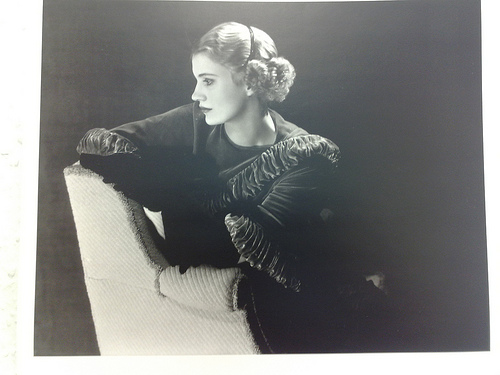
Born in Poughkeepsie, New York state in 1907, Elizabeth “Lee” Miller left for Paris at the age of eighteen where, according to Ursula Butler:
"She studied lighting, costume and theatre design at Ladislas Medgyes's School of Stagecraft. She later returned to New York and enrolled in the Art Students League. There she met Condé Nast and he introduced Miller to the world of modeling. From 1926-1929 she modeled, but eventually wanted to see what life was like behind the camera. Miller studied under the great dada-surrealist artist and photographer Man Ray. Under his supervision, Miller learned how to manipulate the photograph to make a self-contained, semi-abstract or dreamlike image."
She also became his wife and established her own studio. So far so interesting, but things were just hotting up.
The word ‘photography’ was coined by scientist Sir John F.W. Herschel in 1839 (though it had been coined seperately by Hercules Florence in 1834!) and is actually is derived from two Greek words: ‘photos’ meaning light and ‘graphein’ meaning draw. The pace of technology development in cameras and photography accelerated during the early twentieth centry, but our subject’s contribution to the science of photography was a marriage of chance and artistry. Miller brought the alchemy.
Much debate surrounds the issue as to which of the couple stumbled across a technique in photography that – like a reverse negative of the ‘photography’ coinage – had been discovered a few times previously but not clearly defined and adopted: namely solarisation.

“The effect was usually caused by inadvertent severe over-exposure or occasionally by accidentally exposing an exposed plate or film to light before processing. Artist Man Ray perfected the technique which was accidentally discovered in his darkroom by his assistant Lee Miller." [Wikpedia]
Whatever the facts, Man Ray was soon flying the flag for perfecting this technique whilst his collaborator Miller was merely, again, known as his model (although she marshalled the technique to equally compelling effect – see her above ‘Portrait of an Unknown Woman’ from 1930). Man Ray was of the controlling variety, and Miller being a woman of substance soon broke free of his grip. She continued to be deeply involved in the Surrealist movement, amassing a body of work in her late twenties and early thirties that puts her on a par with the leading figures in photographic art and photo journalism, though this has only been recognised in the last two decades after her death, thanks to the meticulous recovery, ordering and promotion of her archives by her son.
A friend of Picasso – and combining commercial fashion photography and artistic work while entwined in a bohemian milieu – what beguiles me is the mastery she achieved in the realm of photography by bringing with her all her selves as she worked though each chapter of her career and each dimension of her work. There was truth and artifice – with neither undermining the other – in her iconic photo 'Women with fire masks' (1941), taken on the street of her own residence in Hampstead.

Conversely, when Vogue sent her off with a Rolliflex to Europe to cover the end of the war and the liberation, her photos combined a self-sufficient, often mysterious power with a visceral sense of unfolding drama. As she travelled through a bombed-out, shattered Europe, her camera captured many of the most powerful images of the closing months of that dark chapter in the last century. From the Italian front and the first ever use of Napalm at the siege of St Malo, to the death camps of Buchenwald and Dachau, and the liberation of Paris, you can view a wide selection of her potent war images online in the Lee Miller Archive.
Mistress of the lens, at the height of her career she lived for several years in this house on Downshire Hill in Hampstead, also spending time in Egypt and travelling widely, before moving to Farley Farm House in east Sussex. She had two further marriages, the second to British surrealist artist Roland Penrose whom she stayed with.

After the war, whilst still doing the occasional fashion shoot, Miller’s overall profile declined and she suffered bouts of clinical depression alleged (in retrospect) to have been symptoms of post-traumatic stress disorder caused by the horrors she had seen while on war assignment. In turn, her ironic sensibility was reinforced with disillusionment at the limited type of commercial work she was being offered. Women en masse had successfully taken on all sorts of previously "male" roles during the conflict, and as a surrealist photojournalist embedded with the US army Miller was among them. But after the war, governments scrambled to promote traditional values in their efforts to glue broken societies back together, and opportunities for women in the working world shrank.
In her lifetime, she was all to aware of the cultural - and personal – impact of womens’ abilities and output being marginalised. A photograph she composed of Max Ernst and his partner, artist Dorothea Tanning, encapsulates her subversive take on this.
The recognition she has posthumously achieved was acknowledged on a grand scale some 30 years after her death in a major retrospective at the V&A in 2007, which I attended, plus coverage and exhibitions globally in the last decade. Now the scales have been duly re-balanced, we can celebrate Miller as a true icon and pioneer in the art and technology of photography. For innovation and inspiration personified, look to Lee Miller on Ada Lovelace Day.
–
Ada Lovelace Day is an annual worldwide day of blogging to celebrate the achievement of women in science and technology. More information on Ada Lovelace Day 2010 can be found on the Finding Ada website. This post hasn’t been much about technology per se – it’s what we do with it that matters…

 Social media diet - the book supplement [ 20-Dec-09 9:55pm ]
In December 2007 I went on a media diet, inspired by a Digital Health Service Workshop I’d attended. To be truthful, it was mainly a social media diet. I was an early casualty, as it seems to be catching on more widely now. After being relentlessly engrossed in reading and then creating blogs since 2004, and then diving into the participatathon of Facebook in October 2006, and Twitter the month after, plus a host of other social-sharing-crowdfacing-wikified-whateverisms (on top of all the other web stuff I do), warning signals were sounding.
Having partaken in these principally as a core (and very fruitful) part of my job, they were completely taking over, and the side-effects were not exactly glamorous. I’ve written about them before.
In some ways social media latecomers are lucky and have probably adapted better to the social mediaverse. Plus most don’t have to do it as a matter-of-life-or-paycheck, (although a few dozen tweets can get you a social media intern gig these days, but what did you do before that Tarquin? Enough said).
After I emerged from the two-week zero-fat diet of Xmas 07/ NY 08, things were different. Nowadays, it’s all about judicious media consumption for me, honing a better skim-and-plunge technique… supposedly. I still spend my working days neck-deep in the mechanics and strategy of all aspects of online communities, social media and their ilk, and find their business, tech, social and cultural impacts fascinating. Evenings, if I’m dabbling, it’s more likely reading, bookmarking and the odd tweet. Sometimes I’ll even try out a new web service. But there’s more to life…
And the part I was missing most was books.
(I’d just about managed to keep up on music, film, art and other stuff; somehow that was possible).
When I first moved to London in 1998 I didn’t read a book for 6 months. I was shellshocked – by the material stress of the move, the quantum leap of my job, the social rupture of leaving my life in Glasgow, the general disorienting strangeness (I’d been to London 30+ times previously, but living there – sorry, here – is different). As someone who’d normally read – and often review in my freelance journalist guise – 3-5 books a month, the book-reading famine was symptomatic of a larger destabilising episode.
I just couldn’t sit, zone-in and immerse myself in the great books I’d got queued up to read. When I think about it now, the wave of social media that’s washed over me in a work context in the last 5 years has made me exhibit many of the same behaviours that resulted from my transplanting to Londinium. But you always – hopefully – resurface.
So I made an effort to get some nourishment. Here are (some of) the books I read in 2009. Mainly – if sometimes vaguely – work-related, hence the exhibitionism…

Books queued up in December 2008
I’m not reviewing them (if only!) but I have to admit two of the pictured editions are unfinished: Yochai Benkler’s (seminal) The Wealth Of Networks (see also the blog and wiki) and Grant McCracken‘s Transformations. I’m still in transit with them, gradually snacking my way through. Must be the microblogging ripple effect 

Books queued to read August 2009
I can’t wait to read 2010′s offerings. The pile is currently being assembled. And the project of filtering too many media inputs continues
If anyone wants to do a digital / social web book club (preferrably offline), this reader might be interested.

 Delete, not fade away and radiate? [ 13-Dec-09 3:29pm ]
As digital capture of our lives edges ever closer to ubiquity - and that seems to be where we're heading - what are the consequences for memory and for judgement on both a personal and societal scale? Is it a curse or just a new aspect of the modern age that we're inevitably making some mistakes in coming to terms with?
That's the subject of a new book 'Delete: The Virtue of Forgetting In A Digital Age', and on 19th November I attended a talk at the RSA given by the author Victor Mayer-Schonberger, director of the information and innovation policy research centre at the National University of Singapore's Lee Kuan Yew School of Public Policy, which was ably chaired by Kevin Anderson, Blogs Editor (now Digital Research Editor since December ’09) at The Guardian.

It's a wide ranging topic, and a lot was covered, but the crux was this: the growing tendency to default to digitally documenting and sharing experience is creating a digital legacy that we as individuals are not fully able to control. In many cases this can lead to information being taken out of context, or shared beyond appropriate boundaries, with baleful (and other, still unknown) consequences.
Take a trio of now commonplace examples. The innocent party photo passed through Facebook or stored in Flickr or Google's image archive means you're passed over for a promotion or job, or sacked from your current one. The long past relationship is made ever present by related content from that time being accessible at the push of a button and compounded by current two or three-degrees connection to the ex. The holiday or special occasion is experienced less as something we live through intensely in the moment and later recollect at leisure, but is constantly punctuated with recording for posterity and increasingly stylised and calculated for the consumption of a small or not-so-small audience.
The second interlinked thesis is that our slowly evolved patterns of memory, learning and recollection are being distorted and un-bound by reliance on digital recording and storage. Memory reconstructs the past to minimise cognitive dissonance, the author explained. This is more potent and interesting, if an area I'm less familiar with. Normally, we cannot deliberately forget (for the reverse, see Michel Gondry and Charlie Kaufman's fantastic movie Eternal Sunshine Of The Spotless Mind) and memory naturally both selects, filters and deteriorates over time. But if the default is moving to not physiologically but digitally remembering, is the solution to delete?
Mayer-Schonberger is himself ambivalent about this, but citing a woman known as "AJ" he shared some compelling evidence of studies of human beings who have biological difficulties with forgetting. AJ experiences total recall as a curse. Tethered by an ever more detailed recollection of what has gone before, she is continually haunted by the past; resulting in an inability to live in the present, to generalise and to abstract from experience.
Another worrying consequence touched on by Mayer-Schonberger is our mass participation and compliance in the creation of a temporal Panopticon - in other words our collusion in the ability of institutions to store and always see our actions at any moment in time. My colleague Ian Delaney has written about this more eloquently than I can.
Accelerating referencing of digital content taken out of context - according to Mayer-Schonberger - means we also increasingly deny each other the capacity to change, evolve and grow and as such we are becoming a more unforgiving society. He floated an extreme scenario: what if we disregard our own recollection and instead depend solely on digital memory? Wouldn’t we have lost more than we had gained?
Clearly a thought experiment, he added the caveat that as only fragments of our experience are captured digitally, this cannot actually happen in totality. The problems right now – as mentioned with the careers, relationship and holiday examples – come when it happens on a piecemeal, ad hoc or imperceptible basis.
Solutions proposed by Mayer-Schonberger, include:
(1) Reintroduce forgetting by technological means - an expiration date put on information that we are prompted to input when we add time and GPS co-ordinates to data (or more simply, when we save it). The pitfall of this approach is if it's public it can be copied by others and stored elsewhere.
(2) "Digital rusting" - a closer approximation of the tactile and receeding nature of memory. The issue with this is how we can know at the point of recording how we might feel about the material in the future. This might be a workable model for some public data, but personal information (and creation) has different implications, and personal and public often overlap. Ultimately, I feel current and future historians might beg to differ with this approach.
(3) Go back to forgetting by default. This means either we cease to record and save information (not gonna happen), or that we forget we have done so - which is a much worse nightmare! The key I think is that information, however private or public, somehow needs to be understood and placed in differing temporal and social dimensions.
(4) The dark side of the network – and the downside of the end of silos – is that because social conventions lag behind the increasing openness of information it's easy to find "personal" information about "impersonal" connections, and once this data is exposed and fed into to impersonal judgements it's not so easy to get a second chance. The solution? We should promote the exercise of judgement [privately and publicly, I presume], argued Mayer-Schonberger. Guy Parsons shared an optimistic twist on this at Chinwag Live: The Dark Side Of Social Media, an event I organised back in 2007. But not all elements of society will consistently act this way, so the risk remains.
If the wisest survival response is then self-censorship, how far should you go? Even private use of search engines is not immune. Mayer-Schonberger cited AOL's now infamous search query datastream release c*ck-up in 2006, wherein the supposedly anonymized data of search records was rapidly traced by technologists at the New York Times to some of the individuals who'd created it. What if it you had been one of them? In turn, how much does constant watchfulness really benefit public and personal development? Is it right that privacy is being eroded so much that we need to be so careful?
Nico Macdonald made the point that you can't code the solutions to social problems. This seemed uncontroversial as I don't think much store has been put by the "expiry date" solution in responses to the book. We shouldn't be "subjected" to technology but be more active in shaping it, he inferred. Perhaps that's what we really need reminded of.
Much was said about search engines and the Internet Archive even got a namecheck. But the cash-strapped Internet Archive is shrinking not growing I've noticed. Google is dependent on the trust of its users, and that trust is tantamount to its business model Mayer-Schonberger stressed. But a recent remark by Google's Eric Schmidt tells us this is changing. Facebook now faces the same issue. Despite their recent announcement about the Open Graph API and their latest privacy settings swerve, most people expect privacy from Facebook. Whether or not that expectation is foolish, Facebook could still be wrong-footed by being too open.
Returning to recall for a moment, timelines are something I've always thought that, conversely, digital content could do with more of but their genesis requires some subtlety and serious forethought. Fear of interrogating the past could diminish us as much as it might protect us. Surely it's a function of human enquiry and maturity to be able to embrace our past, to reflect on and dwell in it on occasion without becoming paralysed like AJ? Why would the digital storage and referencing of past information stop us from being able to interpret it wisely and still live in the present? This is really where Mayer-Schonberger and I part paths.
Flexible and reliable privacy settings are just a feature that should come with such services. The first one I came across was Rememble, which enabled you save and store selected text messages, blogs, tweets, photos and other content in a visual timeline. Creator Gavin O'Carroll likened it in 2007 to a washing line for your digital bits and pieces. It was a narrative-led yet accessible framework for piecing together fragmented content and reconstructing memories, conversations and events at the personal level.
If you're looking to place stuff in a larger historical context, a landmark project – sadly no longer existent – came in the form of Miomi. It was an exciting melding of content from different sources to create user generated history that I saw demoed at the Minibar start-up event in Brick Lane in 2007. Miomi allowed the user to zoom in and out of particular years and decades over the last century and a half and see relevant content (eg. from Wikipedia and public digital records) relating to that time, and also location, as well as annotating and adding their own. Unsurprisingly the more contemporary part was already very detailed. I'm doubtful it would have scaled well in terms of moderation and accuracy, but its ambition was refreshing. I'm sure it's next-gen version is being cooked up somewhere.
So digital permanence was the dish of the day at the RSA. But the opposite view - that digital is an extremely fragile and ephemeral medium for so much of human culture and activity to be engraved and invested in, and that we should make far more effort to selectively and robustly archive it - wasn't voiced at this event. Paradoxically digital content is both brittle and persistent, transitory and important. There is no black or white answer to seek refuge in.
Finally the context question. In his talk Mayer-Schonberger seemed to side with the view that personal digital content - in the very act of being accessed beyond me and forwards in time – always lacks a contextual 'je ne sais quoi'. Granted he may say much more than this in the book (I have it on order) but this is where the story both begins and ends.
While I can't talk with any depth about the brain's gradually evolved ability to remember and recollect, surely the digital overlay is just a new frontier for the human ability to record and sometimes simultaneously interlace experience with another layer of data?
We've done it before. We drew pictures, told stories and wrote books. These things took time to permeate our cultures but they enriched them. In the last century we had social panics about radio, recorded music, film and then television being available to the masses (just as we had panics about women voting and going to work, for instance). More recently, there was somewhat more minor fretting that people listening to walkmans walked this earth as if in a bubble. It's funny when you look back on it now - because it's y’know, recorded – and remember…
Now the context is evolving. That's why creative projects such Britglyph and Open Plaques are intriguing, using the medium as a canvas to help us collectively discover, trace and find new ways to map meaning and think about human activity back and forth in time. This is what Bill Thompson was driving at when he described Britglyph as "a fascinating example of what is possible when you work with the grain of the internet, building something around the things the network makes possible."
So rather than disgorging personal data to the network, we should always be curating and shaping. That's the trump card digitally-augmented context - mastered and done well – is bringing to the table.
Are we really so incapable of adapting to and interpreting new contexts that this growing layer of digital information augmenting our lives will render us personally dysfunctional? Or worse still, divided into slaves to "one ring that rules them all" (whether that's Facebook, Google or your friendly local authorities) on one side, and savvy digital invisibles on the other. Or is this just the messy late-teenage phase of the unfolding web canvas? It seems like it could go either way.
Last words, for now, go to Chris Stein circa 1978.
…watchful lines vibrate soft in brainwave time.
Silver pictures move so slow.
Golden tubes faintly glow.
Electric faces seem to merge.
Hidden voices mock your words.
Fade away and radiate.
Fade away and radiate.
Beams become my dream.
My dream is on the screen.
–
For a reverse panopticon of the event itself ;-) Neil Perkin has provided a good write-up, the event was recorded by the RSA (MP3 download) and Mayer Shoenburg was interviewed by Reuters beforehand.
Apologies and thanks to Stein et al for the title.

 Rebooting the association [ 12-Dec-09 5:29pm ]
While media budgets are squeezed still further as we trudge onward under the cloud of recession, trillionesque debt and the massive public spending cuts gathering on the horizon, the focus on social media ROI grows ever sharper, but less energy is expended looking at the benefits that focused online communities can bring to businesses.
Communities for not-for-profits and membership bodies have a slightly different flavour to those developed for commercial entities. While commercial brands answer to shareholders or private owners, NFPs and membership bodies exist for the benefit of their constituents. There is already a genuine, real-world community or shared interest in place – just as there isn't (really) between me and say, Sainsbury's – so a digital community is a natural fit.
But that doesn't mean it's any simpler, nor is the transition to deeper member or supporter engagement any less challenging for the organising bodies than a renewed focus on customer engagement is for businesses. There is a lot of overlap. An event I attended at the Law Society on 6th October, "Surviving in a Recession - What Member Organisations can Learn from the Commercial World” addressed the challenges and opportunities in this area.
One of the things I liked about it was the way it set online communities in a longer timeframe than we're used to talking about. Many membership bodies have been around for 50-200 years. Most started out when enthusiastic and committed people come together informally - usually in a bar room, hotel or coffee house – to improve and professionalise emerging crafts and knowledge.
Fast forward to now, and these bodies occupy grand buildings, wield influence with governments and business, and provide letters after your name. But are they achieving their original aims? How close are they to their members today, and how can a geographically dispersed membership benefit from the knowledge and experience of their fellow members and the wider interested audience? In other words, can we re-boot the association?
The event was co-hosted by Sift - who are the technology and consultancy supplier for CIMAsphere, the online community I manage - and Madgex. Rather than reading a re-cap of the discussion, you can watch the presentations from two of the speakers that morning.
First up is Adam Cranfield, my former colleague, who was at the time Digital Media Manager at CIMA.
The second presentation is from Lawrence Clarke, Head of Consultancy at Sift. Sadly you can't see his slides in the video, nor Adam’s in his. But the stand-out points for me were Lawrence’s thoughts on the tendency of subscription-based associations to rely on inertia and top-down, one-to-many communications, and how that is being undermined by the connectedness and transparency the web brings on the one hand, and recessionary pressures on the other.
That talk is a companion piece to this post Lawrence wrote a month earlier on the Sift blog. Highly recommended.

 Community management under the bonnet: 23 things [ 11-Oct-09 2:46pm ]
Online communities have been around for as long as the internet itself, but the path technology has travelled in the last decade means the options for what you can offer and what you can do with them today have exploded.
Despite this, they’re still viewed as a bolt-on or feature of a brand’s web presence. This has led to what’s been termed as the "iceberg effect of community management".

Image courtsesy of Rita Willaert, Greenland, 10th September 2005 on Flickr
The full-spectrum of web and social media tools is now being vacuumed up into and integrated with communities: so beyond forums and chat, we now have blogs, RSS, aggregation, email, polls, Q&A, photos, video, audio, virtual worlds, groups, ratings, attachments, events, microblogging, profiles, focus groups, networking, widgets and wikis, to list only the most obvious…
These tools protrude the ocean's surface, along with the reams of content created by community members. But that is only a small fraction of what is happening. As more brands and organisations come to recognise the potential value of facilitating their own communities - but still consider it as an “add-on” to their main website - what does this mean for the role of community manager? What do they need to know and what do they do all day?

Image courtesy of The Brain Toad on Flickr
This is my off-the-cuff list of community management under the bonnet. I prefer the engine metaphor because communities commonly have a goal - they’re supposed to get you somewhere. I’ve also included the pre-launch stages. Depending on your product and whatever way you slice it, there’s a lot to get stuck into!
1. Business Plan
Translating business objectives into a workable plan that is agreed with stakeholders across the business. Finding and agreeing a budget. If you’re already on board at this stage, you’ll need to be involved in this in order to understand the business needs, if you’re hoping to translate it into a successful product that is…
2. Technology Platform & CMS
Choosing a technology platform – low-cost off the shelf packages you can tailor to suit community interaction, eg. Ning, Squarespace, Joomla; bigger-budget customised developments based on for example Drupal (the system I’ve worked with in my last three roles); or maybe you go totally bespoke whether in-house or with an agency (potentially the priciest, and beware proprietary lock-ins that could come back to bite you).
3. Personas & User-Centred Planning
Personas are a useful heuristic for surfacing the needs of the different key groups who’ll be using your community. You think you have your audience all figured out, but have you thought about their activities and requirements in community terms? Explore this in workshops if you can.
4. Design & Build
If you’re around during this phase, you could be called upon to input from the following (and more) perspectives: web design and wireframing, information architecture, usability, accessibility, user experience, on site search, SEO, taxonomy and folksonomy, APIs, browser compatibility and web standards. Many brands are still lacking in some or all of these departments, so your broad knowledge and experience can help make or break the end product! In terms of collaboration and notation around refining design and navigation concepts with your devs and designers, I can’t recommend Conceptshare strongly enough. I used it for that purpose in Chinwag‘s previous re-build and it is genius.
5. Registration & CRM Integration
The first experience of a community member is often to register; don’t make it painful and onerous, you'll annoy and lose people from the get go. Communicate the importance of this to direct stakeholders, preferably with story boards and demos of best practice. The experience generally is so poor and under-thought that Joshua Porter’s writing a book about it. Get advance estimates for the costs of integrating community registration / login with your current CRM system (preferably when you’re in Business Planning stage). The figures – and actual effort – can be unexpected. Is there another solution?
6. Testing & Tweaking
When you have early “alpha” versions of the site to play with, plan for an extended period of UAT (user acceptance testing). Get people across the business involved. Allow for some less structured “guerilla” usability testing too, at different stages of the build. You can learn as much from this as from pre-scripted interactions. Make sure your community manager is involved for most if not all of it and has oversight on the final sign-off.
7. Guidelines
Social networks revolve around me and are a bit of a free-for-all, they’re social but generally selfish. Communities bring benefits to people by having a common purpose that may facilitate but also overrides pure self-interest. So community rules and a general etiquette are essential. These guidelines need to be agreed by your organisation, and include some legal considerations. You may also need specific guidelines: for your bloggers, for group managers, for staff members and for sponsors, depending on the scope of your endeavour.
8. FAQ / Help
The more multi-faceted your site, the more bases your FAQ will need to cover! Basic instructions on your different areas, tools and registration are essential, should be visibly linked to everywhere and also feature somewhere in the site-wide navigation. Keep them readable and concise. A good FAQ is not an afterthought, and harder to write than you’d imagine. Be community-minded and have a site help discussion forum too, where your input and peer support can mingle to the benefit of all concerned.
9. Seeding: pilot before launching
There's nothing worse than being told of some cool new community or cutting edge network, and hoofing it over there only to find it bereft of visible life forms. Counter this by running a closed pilot, while you also beta test the site's taxonomy and functionality. Invite a segment of your audience to participate in the pilot. Make sure they know they're getting a special preview, listen to their feedback and iterate rapidly to solve key technology, content and user experience design issues during this period. Allow for a couple of months minimum, or at least until there is lively activity before opening up. Then when the world turns up, they won't be confronted by a confusing environment of unusable tools and tumbleweed. [See also .17]
10. Moderation
Think about posting controls, editing permissions, alert systems, freezing tools, spam filters and of course, moderators! Which is better for your community: external agency moderation, user-mods, or moderation by the experts, contact centre staff and people who know the answers and issues themselves inside the business? As community manager for CIMAsphere I run staff training workshops, and oversee the moderation workflow and rolling schedule. A closed group on the community for geographically distributed moderators to discuss issues and share best practice is another plus. Relying solely on external mods can be un-feasible and also means the brand is not fully engaging.
11. Inboxes
Not everything happens *on* your website, so common community inboxes you may have to set up and manage include: info, help, feedback, and abuse; plus the community manager’s personal inbox of course. That’s a lot of email! Who else can help you mange these inboxes? Hunt down the most apposite or amenable folks and spread the inbox love to spare the pain!
12. Enhancements & bug fixing
Gotta love those bugs as a community manager! Living in perpetual beta with a modest budget, bugs follow you wherever you go. Users complain on the site, people email for help, some people struggle to even login if your registration process isn't perfect (and whose is?). Bugs perkily await you in the morning, and they're there when you go to sleep each night. The thing businesses need to consider is that bugs impact users much more directly and frequently in communities than in other websites. And who else can communicate these bugs' intricacies and preferred fixes to developers apart from the community manager? Prioritise ruthlessly, and use a good bug-logging or collaborative project management tool. I recommend Trac, Adminitrack, or even Basecamp (but not Bugzilla – it’s strictly for the engineer contingent). Realise you'll never get them all fixed if your support budget is minimal. Communicate with your users about the bugs, and discuss with the business how they plan to support product development in the future.
13. Analytics
Unique users, dwell-time, page views, referring sites, search traffic, browser and device breakdown, exit pages, pages per visit, popular keywords and content, campaign tracking… this is just the beginning, but if you can't report on the above, something's wrong. Even if you use a paid analytics vendor like Neilsen, Omniture or Nedstat, it should be possible to also plug in the wonderfully free Google Analytics. But realise there's more to GA than meets the eye - look into its deeper facilities.
14. Community & engagement metrics
Another beast from analytics entirely: clicks are not the bottom line! Value comes in many forms. Most active participants; most active groups / forums; total posts / interactions; average posts per user; ratio of posters to passives. These are some fundamentals, but don't tell you much more than if you're properly monitoring the community from a managerial perspective in the first place. But how many go onto recommend you, or redistribute your content elsewhere? How many buy? How many change their sentiment from negative to positive, and vice versa? How many act creatively? How many contribute valuable feedback and knowledge to other users and to your organisation? Only some of these metrics are directly monetary, others contribute to site and business objectives in the broader sense and longer term. Think about types of value, what you want to measure, and what you effectively *can*.
15. Bloggers
Internal or external, expert or enthusiasts, detractors or advocates? Okay, it might not be the most sensible move to hire detractors as bloggers, but critics will have a voice on your site nonetheless, and are part of the positive future of your organisation, catalysts for beneficial change. This is because they often speak loudly the frustrations and uncomfortable truths that the brand smoothes over. That's because they’re passionate, so some could be bloggers eventually :-) Get a mix of bloggers on board, make sure a variety of business and community interests are represented, and within your guidelines allow for freedom. Give them ongoing feedback. Run training for internal bloggers and monitor their progress. Try out different things and don't expect it to purr along like a dream. Expect it to be bumpy.
16. Groups
Groups are very powerful clusters: a key trait of people is to identify by similarity of experience, location or interest. According to the Ruder Finn Intent Index, 72% of people go online just to become part of a community. Groups in communities facilitate this clustering further. Do you have pre-defined or user suggested groups, or both? Devolving group control to community members is common practice. Group guidelines and moderation can ameliorate the risks involved, as well as reassure the group managers that you're taking their group's good health and sanity to heart.
17. Advocates, evangelists & early days participants
Prior to launching, identify and open a communications channel with brand or business advocates who can get motivated to sign-up and post when you launch, and help spread the word. These could be dynamic individuals already championing your brand elsewhere in the social mediaverse, or people who present themselves and have good ideas when you (for instance) do a mail out to your audience asking for ideas and involvement before the community goes live. In turn, your first active users should be carefully listened to and responded to. Those first weeks are critical. Having turned up first to the party and said hello, they deserve special attention!
18. Getting to know you
If you don't "know" your community, you're onto a loser. By know, I mean get familiar with them as participants. You don't need to be the resident expert on the community's focus (though input from experts is essential) but you do need to know who's unhappy, who's helpful, who's critical, and who's smart. Many community users will be a combination of these and other types. Some people can even be accidentally evil and destructive. Unless they've been heinously bad, don't jump to cast judgement! We're complicated creatures after all.
19. PR, content and attention planning
Do you know why you're building your community? Then the PR and content planning should be seamless. Schedule in some eye-catching events and content around your launch; but remember it's not about broadcasting “messages” or parading shiny baubles. Instead it's about being interesting by providing value and being relevant and useful. If your event isn't going to really matter to those early days and ideal users, then all the press coverage and email-outs in the world aren't going to get people logging in and participating! It's the same with content and event programming going forward. What might impress journalists and influential bloggers on the one hand and what tickles your community on the other don't necessarily correlate.
20. Culture shift and cross-business input
The governance and ongoing development of the community shouldn't be left to one person, or even one department. A cross-business steering group is one way of bringing a range of business eyes and knowledge to bear on the project and prevents it being siloed or becoming a political football for competing fiefdoms in the organisation. Communities languish and fail every day due to the latter scenarios. Breaking down those barriers is one of the great leaps forward that a community can begin to facilitate. People talk about operational efficiencies, but they're rarely delivered in a meaningful or positive way. Well managed communities make this approach tangible, and eat away at the barriers and inertia both within businesses and between them and their customers.
21. Direct engagement and response
Follows from the above. If your community is a platform for CRM, R&D, product development, PR, marketing or customer insight, direct engagement must be baked in. As community manager you should liaise across the business to make sure the right people are aware, listening and acting upon feedback - whether that's publicly, or off-line, or in specific community spaces. And the community needs to know you're listening, even if you don’t respond publicly on every single occasion. Ignore them at your peril. Creating community areas and content that your users have suggested and asked for is one of the best outcomes of engaging with them. Hosting raw, unfiltered and real-time feedback is also a wake up call to complacent businesses; you can gain insight and improve your key business offerings based on monitoring conversations and analysing positive and negative comments.
22. Communications & Marketing
Communities do generate their own buzz, but those who can gain most from community often don't have the time or aren't in the right context to pick up on these vibrations. That said, neither does traditional marketing always reach the parts that other, more context-specific comms can. Marketing in and for communities often falls flat, or as one marketer has put it “there’s a hole in my funnel“. It's got to be clear: what's in it for them? Reaching out and partnering with other networks is likely to be more fruitful (see 23.). In turn, setting up group, discussion and blog alerts, and a community newsletter, can also spur new members and accelerate activity. Working with advocates in your community and elsewhere also has a grassroots halo effect.
23. Off-site community: partnering & networks
Linking with or extending to external communities can create a virtuous circle, with value for the brand and community flowing in multiple directions. Are there directly-related or relevant groups elsewhere? There were already 30+ CIMA student and member run groups on Facebook when I started at CIMA, which up until then had been ignored by the business. We decided to work with some of the livelier groups rather than starting our own, we recently set up a Facebook page and Twitter accounts, and we're reviewing other networks. Think about the positive impact of reaching out, but beware duplicating your product and effort on a platform you don't own. Be realistic about your workload but inform the business that your customers are out there – they're organising themselves and being courted by others. So for how much longer will your brand be relevant, or will it soon be surplus to requirements?
–
Think a lot of this is a job for other people? Web editors, web designers, CRM staff, digital marketing and PR folks, web producers, brand managers, product and business development, perchance even some community assistants? That's as may be, but community management is an emerging profession and – in the main – little understood.
Online communities are viewed much like websites were 10 years ago – “oh, that new thing, let’s get one”. As time goes by, community management will become more specialised. But for now, it's a whole lotta skillsets rolled into one…
So it follows that I've actually left out some things – 23 things is enough to be getting on with ;-) What else do you think goes on under the bonnet of community management?
In line with this (if you'll forgive me for mashing my metaphors) it's also time to ask: what other new roles will emerge to power communities forward and keep the iceberg's complex ecosystem intact?

 Being Don Draper [ 22-Aug-09 9:43pm ]
If you’re a fan of Mad Men, who wouldn’t want to be Don, even if just for one wheeling dealing afternoon or rollercoaster nocturnal session? What's begun to happen with fictional characters on Twitter in 2008/2009 is heading in this, and other equally interesting directions.
Mad Men vs me at a Mad Men party - courtesy of Laura Brunow on Flickr
It kind of started when digital planner and strategist Paul Isakson donned the guise of early 1960's adman Don Draper on Twitter in the summer of 2008, unbeknownst to Mad Men programme makers AMC. As of writing Don/Isakson now has 8,880 followers. All the other Mad Men characters are on Twitter too (my current fave is Roger Sterling). From what I know, they too are mostly unofficial.
Isakson came clean as to his ownership of the @don_draper account in November and to their credit it seems AMC didn’t demand that Isakson hand it over. Now the chance to be Don (or at least that particular Don, for there are now multiple Dons on Twitter) is up for grabs - and the deadline is today.
Whoever is picked – by a combination of a forthcoming audience vote on the finalists, laced with Paul Isakson’s editorial judgement - will be Don Draper on Twitter for the remainder of Season 3 which began transmitting 16th August in the US. What's more, if folks don't rate the new Don's performance, he can be fired and replaced by the runner-up at any point during the season.
I'm not even going to go into the aptness of all this given Don's very particular backstory, because if you haven't yet followed Mad Men that would be a heinous spoiler.
Looking at his blog post today, I'm not sure Isakson got enough entries (I'm guessing some went via the back door of email and the side entrance of tweetbacks). But as an exercise in crowdsourcing an audition, and expanding the kudos Mad Men accrues by layering multiple, more permeable Dons around actor John Hamm's TV incarnation, it’s a Stars In Their Eyes/X Factor mashup for the transmedia generation.
Of course it's all somewhat jarring for Mad Men fans not in the USA, but y'all know these transmission lags are a major reason why TV torrents are hugely popular in the UK and why the old school TV distribution model is declining.
Concerns of brandjacking and Twitter-squatting aside - and increasingly these concepts seem hugely over-simplified if not redundant – unofficial is often good if not better. Characters are being liberated, authorship is be re-shaped and unforeseen talents are taking the reins. Simples
In fact the Twittersphere is now awash with fictional personae. I’ve already been following “Gene Hunt” from the BBC's Ashes To Ashes for a few months. Daft but bolly good value.
Peep Show is going down the same road, with Mark getting the most interest. All of which feels oddly natural given that a year ago it would have been freakish; and a choice counterpoint to the dreaded real-world insistence that we must “be who we say we are online”, an exhortation that incites me to commit unspeakable acts.
In short, it's exciting territory and ripe for more quality excursions. To take a very random and subjective sample of arresting characters, imagine if you could have been, or be able to converse with:
John Rebus in Ian Rankin's Inspector Rebus novels
Teddy Hoffman or Richard Cross from Murder One
Renton, Begbie or Spud or from Trainspotting - chapters of which were first published in the groundbreaking Edinburgh-headquartered Rebel Inc magazine.
Henry (“helicopters!”), Karen (“Henrrrry!”), or Tommy (“guns”) from Goodfellas
Pembleton or Munch from Homicide: Life On The Street
Bridget Gregory in The Last Seduction
Caleb Temple in American Gothic
Patrick Bateman in American Psycho
(Rita Hayworth as) Gilda in Gilda
Nick Carraway or Jordan Baker in The Great Gatsby.
All so moreish…
Elsewhere this month author Philippa Gregory (working with digital agency Blonde) created a Twitter feed for the main character Elizabeth Woodville in her latest novel The White Queen - all the better, you see, to reinterpret the story through a series of tweets in the week prior to the book's publication.
For one week only? Hmm, not a lot of time to become really hooked or intrigued you'd think. But no, with very little fanfare she garnered 700+ followers, and the feedback in @ messages was equally potent from numerous viewpoints: the author herself, marketer and publisher intelligence gathering, online PR of course, and practitioners of transmedia generally.
After the first week of this project, we were able to read the tweets in more traditional narrative order on this Flash site. Analysed per-tweet, the quality is variable but from a birds-eye view the concept's overall execution is quite beguiling.
A central challenge for The White Queen project lay in matching the quality of the source material, and in the transition of perspective and literary skill from print page to ambient digital flow. A big ask, but sometimes (if not this time) the Twitter offshoot is even better than the original fabrication.
In that vein (to lower the tone for a minute and head over to present-day adland), while I don’t set much store by comparison websites, I've lately followed CompareTheMeerkat. As always with creative marketing, the risk is that we're merely delighted, and this doesn't translate to sales. But that's nothing new, and as part the perennial tug of love between advertising, marketing and branding, largely immaterial to this discussion. What's compelling is the character and @Alexsandr_orlov is a highly diverting creation.
This particular clutch of character extensions are also textbook transmedia shortcuts. Is it just me, or do you ever get tired just thinking about all those Facebook pages connected to the YouTube channel connected to the SEO strategy connected to the website connected to the email sign-up form connected to the mobile campaign, etc, etc, ad infinitum..? All these rinky dink agencies trying oh-so relentlessly to herd our weary eyeballs round some archetypal loop of media integration. Like it was all orchestrated for some slick presentation designed to wow lazy executives at whatever new media conference, ugh.
Oh no, wait, what we should *really* be doing is aggregating them all in FriendFeed or one of its ilk for a full-fat, 360, planned to the nth degree social media experience. Oh, Facebook just bought Friendfeed, umm, well then just wait for 12-18 months, add semantic web – and bada bing! What, the semantic web thingy will take at least 5 more years you say? No, just stop it. It really doesn’t work like that.
Instead, how about we park the whole 360 shizzle, look at the shortcuts that are working some magic and think about the implications? Being @Don_Draper and its Kaufmanesque cohorts are entry points to the future of storytelling. If fictional prototypes like these are the prelude to a new era of character development and narrative interplay, I can’t wait to see what unfolds over the next decade.

 Round up of my Chinwag events [ 09-May-09 10:27pm ]
Sheesh, is it really six months since I left Chinwag? Crazy times. Half of my hybrid role there (the other being planning, wireframing and launching/editing the new website) involved hatching ideas for and bringing to life their wish for an events programme…

What shall we call it, Sam mused, when I joined in October 2006. I processed this while getting other stuff done. A few hours later I blurted out “It’s a bit cheeky, but how about Chinwag Live?”. So, he asked with his customary chortle, what’s it all about then D? “Casting light on trends in the digital media and marketing industry” I reasoned, deadpan. Actually, it was Sam who insisted we add the words “and marketing“.

Me introducing Chinwag Live: Media Widgetised - part of Widget Week 2007
So I got onto it. Oh yeah, and the marketing and the PR and the whole social media fandango. Bloggishness? Obligatory. Old skool press release? Easy. Facebook Goup? In an instant. Upcoming? Check. Oh, now we need a Facebook Page too huh? Sorted. Flickr photos of every event? At once. Multiple Twitter accounts? We have the technology. Endless networking across the digital fleshpots of London (and Texas)? But of course…

All the good people at Chinwag Live: Media Widgetised 16th May 2007
It would all be nothing of course without the thousands of incredible people who were there over the 24+ events… Whatever happens with the recession and the government’s Digital Britain initiative, I know that the UK is a very special place for digital debate and enterprise…

Chinwag Big Summer 07 sponsored by Channel4, Adobe, Neutralize, Agency.com and The Big Chill
Here’s a run-down of the Chinwag Live events that resulted during my tenure, plus the offshoots: Chinwag Clinic; Widget Week 2007; and not forgetting Big Summer ’07 – officially the biggest ever party for digital practitioners in the UK with some 2,000 folk attending.

Chinwag's Big Summer party 5th July 2007 dancefloor moves to The Big Chill's DJs
MY CHINWAG EVENTS CALENDAR:
Chinwag Live: Wobble 2.0 – 6th Feb 2007
Chinwag Live: Mobile Metamorphosis – 26th Feb 2007
Chinwag Live: PPC Earthquake – 27th Mar 2007
Chinwag Live: PR Unspun – 24th Apr 2007
Chinwag Live: PPC Earthquake @ Internet World – 2nd May 2007
Chinwag Live: Media Widgetised – 16th May 2007
Widget Week 2007 - 14th-22nd May 2007
(in collaboration with Mobile Monday & NMK)
Chinwag Live: Dark Side Of Social Media – 19th Jun 2007
Big Summer ’07 – 5th Jul 2007
(a superhuman team effort!)
Chinwag Live: Web TV Takeover – 18th Sep 2007
Chinwag Live: Media Widgetised @ Ad Tech London – 27th Sep 2007
Chinwag Live: Xmas Futures, Crystal Balls? – 5th Dec 2007
Chinwag Live: Skills Emergency – 29th Jan 2008
Chinwag Live: Measuring Social Media – 18th Feb 2008
Chinwag Live: Tomorrow’s Ad Formats – 18th Mar 2008
Chinwag Live: User Centered Advertising (with Manchester Digital) – 15th Apr 2008
Chinwag Live: Real World Usability – 22 Apr 2008
Chinwag Live: Measuring Social Media @ Internet World – 30th Apr 2008
Chinwag Live: Micro Media Maze – 20th May 2008
Chinwag Live: Search vs Recommendation – 2nd Sep 2008
(in co-ordination with Elizabeth Varley)
Chinwag Live: Micro Media Maze @ Ad Tech London – 24th Sep 2008
Chinwag Clinic: Search Marketing Surgery – 30th Sep 2008
(in co-ordination with Elizabeth Varley)
[Testimonials For Search Marketing Surgery]
Chinwag Live: Search and LBS – 7th October 2008
(in co-ordination with Elizabeth Varley)
Chinwag Live: Social Media ROI @ Ecommerce Expo – 28th Oct 2008
(in co-ordination with Julia Eilon)
Chinwag Live: MoSo Rising – 11th Nov 2008
(in co-ordination with Julia Eilon)
Chinwag Live: Xmas Futures, Crystal Balls? – 2nd Dec 2008
(in c0-ordination with Julia Eilon)
That is all.
Want more? Are you for real? Okeydoke, here’s a round-up of My NMK Events.

 Some hero magic on Ada Lovelace Day [ 24-Mar-09 9:14pm ]
It’s all about the “now” and the “next” in media and technology; but in the headlong, often mind-numbing rush for mindshare, followers, whuffie or whatever is this week’s shiny nu nu thing, what has gone before is equally important.
That’s why, to mark Ada Lovelace Day I wanted to write about someone who inspired and mentored me directly.
I’d already edited a web site for the Edinburgh Festival and covered technology and multimedia culture for the likes of The Scotsman newspaper and .net magazine before I touched down in Londoninium in July 1998.
I was starting as Web Editor for the international website of Ernst & Young but – I was informed on Day One – there was a month of handover between me and the freelancer who’d previously been editing the site part-time.
On the morning the freelancer was due to come in my nerves were ratcheted up another notch from their already high levels. There was me *way* out of my comfort zone working in corporatesville when in walks this stunning woman: pixieish hair, jeans and a biker jacket. And when she removed said jacket, ooh, the tattoo on her arm was just gorgeous. She smiled and extended a hand: “Hey! I’m Lizzie”. And that was Liz Bailey. I’ll never forget it.
It was less of a handover, more of a crash course in ramping-up my html skills, and getting the ultimate outsiders insider’s guide to my employer, interspersed with some scrumptious Chinatown and Soho lunches and lots of hilarity. The full-spectrum introduction But more than that it was finding – in this most alien of environments – a kindred spirit, because Lizzie was my entry point into London’s embryonic web scene.
A freelancer who also wrote and did web editing, design and production for Wired UK, The Guardian, BBC Online, the FT, Demos, Wallpaper*, McKinsey, The Telegraph and more, Lizzie knew everyone who was doing anything interesting web-wise in London.
Missing my own familiarity with Scotland’s web scene, I was happy to take a cue from my new mentor. If it wasn’t for Lizzie, well I would’ve been fine, but she allowed me to bridge both worlds: the corporate but innovative focus of my everyday work, and the creativity, excitement and bone fide madness of the first dotcom boom.
I’d seen a black and white A4 newsletter once in Glasgow (when someone in London posted it to me) called New Media Age – it carried four pages of news on the nascent sector and no ads! But it was Lizzie who tipped me off re a packed mid-week party in Great Titchfield St dubbed ‘Boob Night’ where I met the editor of the then fully-fledged magazine, a young fella by the name of Mike Butcher who I managed to out-argue . He says he doesn’t remember it, but back then nights of mayhem where the champers flowed gratis were ten a penny for the current TechCrunchUK editor 
At Lizzie’s 30th Birthday party I also met Phil Gyford (then at BBC Online I think), and a guy she was working with on ‘New Media Creative’ magazine called Paul Murphy. Later she introduced me to hotshot new media reporter Polly Sprenger who was fresh over from Wired News in San Francisco (Mike Butcher once described Polly to me as “the Red Rum of technology reporters” after they worked together on the shortlived Industry Standard Europe magazine).
It reaffirmed I wasn’t just working in a “job”, for a “company”, but part of of something game-changing and amazing.
But this melange of web culture, innovation and merriment paled next to Lizzie’s own formidable focus and grit. A web grrrl to the core, Lizzie would magic up websites to die for whilst relentlessly promoting the causes of usability, innovation and the visibility of women in the web design and technology sector.
That movement for change – and celebration of talent – has latter day embodiments in UK-founded networks (some of which have gone global) like She Says, Girl Geek Dinners, Women In Mobile Data, and the briefly existent Digital Womens’ Club – all great initiatives I’ve actively supported.
Three years flew by, and when I was two jobs on from Ernst & Yong working as editor in chief of a VC-funded music website, the entire sector imploded. After a barren several months I decamped to the TV industry back in Belfast in 2002. But Lizzie hung in there. Multi-talented and entrepreneurial to a tee, she was surely the woman who knew most about new media in London. She was praxis.
And just when I came back to London in 2004, as the first timid signs of hope were visible in the sector (I’d been waiting, watching and biding my time you see), Lizzie switched careers and started studying to be a barrister.
Now she’s qualified and doing well, but her influence in web culture and technology still resonates for me. I’ve often been at conferences like SXSW Interactive, FOWA, Changing Media – and the NMK and Chinwag Live events I’ve organised myself – and thought “damn, Lizzie should be speaking at this!”. But looked at in a broader way, she has been…
I don’t know if I’d have dared come back to digital if I hadn’t known Lizzie. There were too many talented people flushed out of the sector back then. As it turns out while digital certainly has been affected by the current recession, compared to the rest of media – and jobs more generally – it’s still *relatively* resilient. In short, it’s nowhere near a dotcom bust Groundhog Day scenario.
Tons and tons of people inspire me of course, but in reality it’s hard to say what it all will mean and which parts will be valuable 10 years hence.
So raise a toast to the inaugural Ada Lovelace Day and sample some vintage Liz Bailey (NB. it’s an internet hazard that most of Lizzie’s work from then – like most of mine – has not been archived):
Boo gets booed – The Guardian 11th November 1999
Britgrrls No Bark and No Byte? – 1999, trAce
Demos publications by Liz Bailey
–
Who was Ada Lovelace?
Born on 10th December 1815, the only child of Lord Byron and his wife Annabella, Augusta Ada Byron (now known simply as Ada Lovelace) wrote the world's first computer programmes for the Analytical Engine, a general-purpose machine that Charles Babbage had invented »read more
Credits
Thanks to Suw Charman for co-ordinating Ada Lovelace Day on Tuesday 24th March 2009. The first of it’s kind, it’s “an international day of blogging to draw attention to women excelling in technology. Women's contributions often go unacknowledged, their innovations seldom mentioned, their faces rarely recognised. We want you to tell the world about these unsung heroines. Entrepreneurs, innovators, sysadmins, programmers, designers, games developers, hardware experts, tech journalists, tech consultants. The list of tech-related careers is endless.” »Ada Lovelace website
Join In!
You (male or female) can still register your pledge to write a blog post celebrating your technology heroine on this day – Tuesday 24th March – at the official »2009 PledgeBank page

 SXSW 08 core conversation: do you have to disappear completely to get things done? [ 16-Mar-09 10:16pm ]
While anxiety and frustration were visible on the faces of those gathered at this Core Conversation, it wasn’t due to the gruelling conference – or social – schedule (in-step with the syndrome under discussion, it's taken me just over a year to write up this final blog post from SXSW Interactive 2008).
And yours truly? By random chance I'd been scanning the room, looking for something else that I knew was on there, but stumbled upon this instead and was drawn to it in a heartbeat.
Weirdly my serendipitous discovery in meat space of a conversation I didn't intend to find, mirrored one of the key issues in the larger digital challenge it was grappling with: the overload tendancy that’s wedded to being “always on”. You’re only ever one link away from some interesting new fact or opinion.
In a wholesale Being John Malkovich moment, I'd gone through a port-hole and all the voices and daily dillemas in my head that worry about overload were embodied and talking to each other in front of me… Nurse, the screens!
Ryan Frietas facilitating Do You Have to Disappear... at SXSW 2008
So yeah… it was 11th March 2008 at SXSW Interactive, and the facilitator was the one and only Ryan Frietas, then Director of Experience Design at Adaptive Path.
Do we know what we're doing?
Here's the backdrop: we're overwhelmed by information, drowning in email, weary with un-read feeds, tired of Twitter, assailed by mobile comms, productively challenged… and yet the nagging feeling that we're probably missing something very important is strong enough to trample all common sense, and our counter-productive habits surface given the slightest glimmer of opportunity.
Pleasingly, the first point Frietas made was the counter-argument: there's a generation being raised who are multimedia and multi-tasking all in parallel, and are socially different from us. Hurray for them I guess, but what about the rest of us, who didn't use a computer till we were 10 or maybe even 20 years old, and the internet even later? What solace can we take from the information overload?
Self-help required: employers and govt 4 steps behind (as usual)
The group - while commonly exhausted - had plenty of suggestions for coping-strategies. If you're a freelancer, consultant, or just the type who catches up on email and admin at odd hours due to parenting duties or whatever; don't give the impression that you're available and working there and then or the email stream will just increase. Write emails in draft in the evening and weekend if needs be; but send them in office hours.
If you check email, Twitter and RSS feeds first thing in the morning you'll have nothing done by 11am or midday, and that puts you on a psychological downer for the rest of the day. To compound matters, the rest of the day will be less productive than it would have been because of what you did (or rather didn't do) in the morning.
"Eat the frog" was one of Ryan's suggestions. Do the thing you really don't want to do as your first task: a small accomplishment that gives you an immediate sense of achievement and helps you face the rest of the day.
We then paused to talk to the person next to us, and I found myself listening to the woes of a web project manger working at the Austin branch of a large US advertising agency, but she could have been from anywhere. She described an incredibly busy agency scenario, with everyone working lots of unpaid overtime; calls and emails from her boss at the weekend; general over-work and insufficient numbers of skilled staff that sounded identical to many digital shops globally. She loved her job but was unhappy. There was never enough time and the torrent of email was endless.
Firehose slapdown…?
On the positive side, it's an ecosystem of information that we're all contributing to with blogs, wikis, social networks, microblogging, etc, noted Ryan. This is true, but how much of what we’re actually sharing is valuable, discoverable, and to whom?
One woman told of how she goes on regular media diets. This reminded me a lot of some ideas floated at the Digital Health Clinic run by Gavin O'Carroll which I attended in London late in 2007. I've tried out a diet myself, and it worked a tonic.
In fact the DHS clinic spurred me to check-out of Facebook completely for a few weeks at the end of December 2007. My usage of it has been sparse ever since, but for me Twitter is still a toxic siren. Tweetdeck (which I’ve tried) and the like promise to detoxify the stream, with the ability to sort and stratify the importance of our relationships and incoming data-stream on Twitter. While that's progress to be welcomed, it's still a mechanistic approach to filtering and managing highly-nuanced communication.
Widgets and tactics help, but it's complicated…
Talking of which, some other tools mentioned were the dashboard widget that monitors what apps you are on and when you switch between them. The much-feted Feltron was also cited - it tracks what you do on your computer and builds up an annual report.
Part of the challenge derives from the weak divide between work and social / fun stuff, Ryan commented. There's an element of truth here - for some - but it makes me wonder, how did I not feel this pressure when I was editing a music website back in dotcom boom 1.0? I was obsessed by the subject matter, and 2-3 nights a week I went out to gigs or clubs in connection with my role. And was I poorer, stupider, less happy or as shattered then? No on all counts I'm afraid. The salience of Ryan's point is more general, as the context and nature of work and the concomitant technology has evolved.
The concept of “friendless zero” got the first real laughs of the session. Analogous to the Inbox Zero movement (which gets your inbox down to the magic digit), Ryan admitted he'd gone in that direction lately, keeping his Twitter follows down to a tiny number of close friends and colleagues. Still, I've heard countless stories of how people brutally cut back their RSS feeds to the bare essentials only to find a few months alter they've crept back up again. I abandoned Bloglines two years ago myself for the same reason; and I haven't replaced it with another reader. Nothing bad has happened because of this
If engineers fall short, what else is there?
The question was asked: can we automate relevance of information and people? That's an engineer’s approach to human interaction, observed Ryan. My friend is a 5, my mother is a 3, etc… it simply doesn't make sense of or cater for the complexity of our relationships.
Another suggestion from the group was only have one device out at a time [great, but are you going to ignore your mobile ringing or beeping just because you're working on your laptop?]. Someone else suggested the classic panacea of having a hobby that takes you out of yourself.
Much of it comes down to time-management and managing expectations, someone said. That may be true, but these are delicate skills to master and practice, and who in the social media ferment is evangelising them? Discounting Tim Ferris of course, who has actually elevated it to the realms of a modern-day religion (and religion is in the province of the supernatural); oh yeah, and sad-sacks for whom GTD becomes the only topic of conversation.
Central exhaustion system
One reason that it's so important for us to check our various feeds [and devices sir ], Ryan argued, is that we're also interacting with another layer of information and media that is apart from our direct experience and what we're doing. This works for me. It's the invisible skin of data and interaction layering over our immediate and physical lives. But isn't that what old skool social connections - aka the ideas and experiences we hold in common with other people - have always done? And wasn't the point of the session to explore how we maintain productivity, creativity and being “in the zone” in the face of endless sources to discover and distractions?
Maybe it's just me, but the flow isn't all that (yet); or at least, it's over-rated. Un-critical social media mavens love to sanctify it, but many information workers are paying the price for the level of dysfunction it produces in its current embryonic state. It's plumping-up already maxed-out email and task agendas.
While a perfect infomediary grid beckons – the venerated digital nervous system predicted of yore – we’re left to deal with our real, complicated and imperfect experiences. Naturally the recession / depression / correction - or what you will - isn't helping. We're all working that little bit harder (than last year). We're all that little bit more insecure, and we're that little bit more atomised too.
The spread of Being John Malkovich Syndrome (#bjms) is merely the solace we can take from each other here and now. It holds the seeds of promise, but it's not yet fit for purpose. Sifting meaning and / or value from the voices, chatter and keywords we skim through is an arduous, often wasteful and frequently un-manageable task.
Twitteresque – digital stylistics or path to a higher being?
Speaking of Twitter, just today Nic Brisbourne summed-up part of the signal-to-noise filtering challenge:
"I'm not sure that tools are the only answer though… I recently read Lessig's Code2.0, a book in which he talks at length about how communities are governed and regulated. He persuasively argues that for there are four modes of regulation – architecture/code, law, norms and the market (more details here) – Tweetdeck et al are code based solutions to the problem of too much traffic on Twitter, but the other modalities or regulation (as Lessig would describe them) are also important.
"It is pretty clear to me that as the community grows something is going to have to change – and as I have written before it is instructive to think of the Twitter community as an emergent system with rules that need to evolve to ensure that the signal to noise ratio is maintained at a sensible level whilst keeping the service growing… The health of the Twitter community (as with all communities online and offline) is 100% dependent on the rules"
So given the openness of Twitter, the emergent norms are either (1) anyone's guess , or (2) the same norms we see operating in other civilised (or - slight difference here - "consensual") communities. Place your bets.
Broadsight's Alan Patrick keeps saying he hears less noise on Twitter and more signal. I've not seen evidence yet, although most of the folk I follow are reasonably well-behaved. To those I've un-followed, it's not because I doubt your genius But whatever Alan is on, I want some…
Digital Health drop-in surgery 19th March
In the meantime if you're feeling the overload burn, Gavin O'Carroll is running a Digital Health Service drop-in surgery this Thursday 19th March 2009 at the RSA
http://digitalhealthservice.pbwiki.com/
—
FURTHER READING ON INFORMATION OVERLOAD:
Going Without Comms To get a better Connection – Broadstuff 16 April 2009
Digital Overload is Frying Our Brains - Wired 6th February 2009
Distraction: Being Human In The Digital Age by Mark Curtis (Futuretext, 2005)
Overload! By Columbia Journalism Review - 19th November 2008
Dumb, Dumber and Google: Alan Patrick, Broadsight - 9th June 2008
10 Things I Learned from Mental Detox Week: Ian Tait, Poke London - 30th April 2008
Information overload in the web era: Nic Brisbourne, The Equity Kicker - 22nd April 2008
The strain of digital sweatshops: PDA Blog, Media Guardian - 14th April 2008
In Web World of 24/7 Stress, Writers Blog Till They Drop – NYT 6th April 2008
Does work/life balance exist?: Danah Boyd, Apophenia - 6th April 2008
Computer addiction as survival for the ego - 10th December 2007
My other SXSW 2008 panel reports:
http://innovationeye.wordpress.com/category/sxsw-interactive-2008/

 Dearly Beloved, We Are Gathered... [ 01-Jan-14 11:40pm ] # [ 29-Dec-13 12:10pm ] # [ 29-Dec-13 4:16am ] # [ 29-Dec-13 3:16am ]
In fact intros were, in a pre-House/rave era (or at least in terms of the uneven geographical development of said genres) a necessary breathing space/ preparation pause/ energy generator/ opportunity to get off the dance floor and have a pint asap. In a sense they fulfilled a myriad structural/social uses.
In fact the dynamics of djing in the now sadly defunct Scorpio 1 in Barrow-in-Furness, the town's main nightclub in say, 1996, when I was a drunk and basically terrified 16 year old goth, (in a Cramps t-shirt), for that rowdy, sexually segregated amalgam of rockers, metalers, mods, new romantics, punks, casuals and soul boys and girls was probably miles more artful and aware than beat matching seven hours of identikit techno for some monged out self-selecting gang of gurners ten years later.
Ah, the lost art of dj-ing.Back then, back there, you would get your fifteen, twenty minutes worth of tribal songs (if memory serves for us it was often The Cure and Echo and the Bunnymen that announced our "alternative" slot was coming up, and people used to take records in to have played too, New Model Army's No Rest and The Bolshoi's A Way along with The Sister's Alice being big faves, if I recall correctly). You would be left unmolested to do your thing. U2, The Alarm, The Waterboys, Then Jericho were universals, The Smiths less so, anything disco-y or SAW-y was girl's stuff. Then we had a few hip hop or northen soul specialists in smart suits who really danced.
Funny.
Anyway.
#
# [ 29-Dec-13 1:04am ]fairly convinced once you add up the dance, rap, pop, metal, and electronic stuff the 80s tops the best decade for intros by a long way.
unlike riffs, the intro has more of the capacity to be inherently populist - the bit where everyone on the floor clicks and ups their game/where everyone in the pub strikes up. it's also the portion of the song most likely to recieve attention from execs and studios: if you have a great riff it might never be noticed if you opening falls flat, ending up with no units shifted. an intro has little potential for wanking is what i'm saying. #
Weapon in her Palm [ 19-Oct-13 3:07pm ]This TOTP performance is usually seen as either a totally naff 'literalist' interpretation, or an amusing joke at the expense of the 'Last Gang in Town'.
However, the aesthetic elements of a whole wing of contemporary pop culture is here. Smut, cages, violence, money - this is the world of Larry Clark, Terry Richardson, Vice and so on. It could be easily up-datable as a Rhianna video.
DAVID HOCKNEY'S ART SCHOOL DAZE Part 15 [ 18-Jul-12 12:14am ]That evening Hockney found himself at "The Choughs" with half a dozen others. Patty was in the bar by herself, looking prettier than ever. One by one the rest of the men dropped off, the last saying, "Are you coming, Hockney?" and being answered in the negative. Kitaj had repeatedly told Hockney how pretty Patty was. At first the rubber slave had been worried by this but now he'd come up with a plan to eliminate her as a love rival. Patty may have been a girl but that didn't mean he couldn't seduce her and make her fall in love with him!
He sat still, watching Patty as she flitted about, washing up the ale glasses and putting them on their shelves, and getting out her work basket; and then she came and sat down in her aunt's chair opposite him, and began stitching away demurely at an apron she was making. Then he broke silence:
"Where's your aunt to-night, Patty?"
"Oh, she has gone away for a few days, for a visit to some friends."
"You and I will keep house, then, together; you shall teach me all the tricks of the trade. I shall make a famous barman, don't you think?"
"You must learn to behave better, then. But I promised aunt to shut up at nine; so you must go when it strikes. Now promise me you will go."
"Go at nine! what, in half an hour? The first evening I have ever had a chance of spending alone with you; do you think it likely?" and he looked into her eyes. She turned away with a slight shiver, and a deep blush.
His nervous system had been so unusually excited in the last few days by the fear that he was going to lose Kitaj's affections as they slowly turned towards this kitten, that Hockney seemed to know everything that was passing in her mind. He took her hand. "Why, Patty, you're not afraid of me, surely?" he said, gently.
"No, not when you're like you are now. But you frightened me just this minute. I never saw you look so before. Has anything happened to you?"
"No, nothing. Now then, we're going to have a jolly evening, and play Darby and Joan together," he said, turning away, and going to the bar window; "shall I shut up, Patty?"
"No, it isn't nine yet; somebody may come in."
"That's just why I mean to put the shutters up; I don't want anybody."
"Yes, but I do, though. Now I declare, Mr. Hockney, if you go on shutting up, I'll run into the kitchen and sit with Dick."
"Why will you call me 'Mr. Hockney'?"
"Why, what should I call you?"
"Hockney, of course."
"Oh, I never! one would think you was my brother," said Patty, looking up with a pretty pertness which she had a most bewitching way of putting on. Hockney's rejoinder, and the little squabble which they had afterwards about where her work-table should stand, and other such matters, may be passed over. At last he was brought to reason, and to anchor opposite this enchantress, the work-table between them; and he sat leaning back in his chair and watching her, as she stitched away without ever lifting her eyes. He was in no hurry to break the silence. The position was particularly fascinating to him, for he had scarcely ever yet had a good look at her before, without fear of attracting attention, or being interrupted. At last he roused himself.
"Do you know what BDSM is, Patty?" he said, sitting up.
"There now, I've won," she laughed; "I said to myself I wouldn't speak first, and I haven't. What a time you were. I thought you would never begin."
"You're a little goose! Now I begin then; what do you know about BDSM?"
"I know all about that. Your friend Kitaj was in here earlier on telling me all about your activities with him as a rubber slave!"
"What, Kitaj?"
"Yes, that's it; he was here about half-past six, and--"
"What, Kitaj here?" interrupted Hockney, utterly astonished.
"Yes, he's been here two or three times lately."
"The deuce he has!"
"Yes, and he talks so pleasant to aunt, too. I'm sure he is a very nice gentleman, after all. He sat and talked tonight for half an hour, I should think."
"What did he talk about?" said Hockney, with a sneer.
"Oh, he asked me whether I was a virgin, and if I had a boyfriend, and all about my sexual preferences, and made me feel quite pleasant. He is so nice and quiet and respectful, not like most of you. I'm going to like him very much, as you told me some time ago."
"I don't tell you so now."
"But you did say he was your great friend."
"Well, he isn't that now."
"What, have you had a quarrel?"
"Yes."
"Dear; dear; how odd you gentlemen are!"
"Why, it isn't a very odd thing for men to quarrel, is it?"
"No, not in the public room. They're always quarrelling there, over their drink and the bagatelle-board; and Dick has to turn them out. But gentlemen ought to know better."
"They don't, you see, Patty."
"But what did you quarrel about?"
"Guess."
"How can I guess? What was it about?"
"About you. Well we haven't yet but we will do when I see him"
"About me!" she said, looking up from her work in wonder. "How could you quarrel about me?"
"Well, I'll tell you; until I met Kitaj I though I was gay and then he showed me in BDSM there is no gay or straight. Now I want you to be my master. What do you think of that?"
They sat still for some minutes. Evil thoughts crowded into Hockney's head. He was in the humour for thinking evil thoughts, and, putting the worst construction on Kitaj's visits, fancied his master fancied Patty more than a man like himself. Hockney did not trust himself to speak till he had mastered his precious discovery, and put it away in the back of his heart, and weighed it down there with a good covering of hatred and revenge, to be brought out as occasion should serve. He was plunging down rapidly enough now; but he had new motives for making the most of his time, and never played his cards better or made more progress. When a man sits down to such a game, the devil will take good care he shan't want cunning or strength.
Hockney talked Patsy into putting on a record and dancing with him. They cleared some tables and waved their arms and legs around to Hound Dog by Elvis Presley.
"Thanks for the dance," Hockney blurted as the song ended.
"Hey!" Patty grabbed Hockney's arm. "You think I'm going to bite?"
She lifted her arms up as if to put them around Hockney's neck and waited. What could he do? He walked into her and put his arms around her waist as she draped her arms around his neck.
Although he preferred men Hockney was got an instant stiffy.
"Mmmmm," Patty cooed as she snuggled her chin on Hockney's shoulder.
He gazed for a moment at the metal stud in her tongue and thought you will be assimilated, resistance is futile. Patty squeezed even tighter. For a skinny girl, she sure seemed strong. She rubbed her pelvis against Hockney's, rolling his boner around between his upper thighs.
Then Patty's and Hockney's lips were pressing into each other. Hockney thought the stud on Patty's tongue felt weird every time his tongue slid over it.
"Let's go to one of the upstairs bedrooms!" Patty hissed
"Yeah, but what about Kitaj?" Hockney asked.
Patty rolled Hockney's boner against her crotch and said, "Forget Kitaj for now!" Then Patty stuck her tongue in Hockney's ear and licked all around the ridges for a few seconds. He almost had an orgasm just standing right there!
"C'mon! I promise you an hour of pleasure like you've never had and never will have again. Don't pass it up." Patty lisped
Hockney followed Patty up two fights of stairs to one of the pub's special rooms.
"Uh, mind if I use the bathroom?" Hockney asked pointing to the master bathroom through a door in the bedroom.
"Not that one," she said. "That's for women only. Use the one down the hall."
Hockney shrugged, wondering why an en suit room would have a women's only john; but he followed Patty's directions, took a shit, and returned to find her tall, skinny, ashen body already naked in bed. Her skimpy top, her black leather skirt, her fishnet stockings, and her shoes were in a pile on the seat of a chair in front of a wide sliding glass door that opened out onto a huge balcony. Hockney thought it odd he didn't see a bra or panties among the discarded garmentry.
"C'mon!" Patty said. "I've felt how big and stiff it is. Now I want to see my prize."
Hockney kicked off his shoes, removed his shirt, then his socks, and finally his pants. "Is this what you wanted to see?"
"Yeah! Bring it to me, baby!"
Hockney climbed into bed with Patty and they were immediately swapping spit, her ashen skin and black lipstick no longer a concern. His cock just needed to take a plunge -- nothing else mattered. He rolled her onto her back and began to suck her perky little titties. Her nipples were little more than tiny red pimples, but Hockney managed to give them a tad more fullness as she cooed, "Ooh!" and "Ahh!"
Hockney started to crawl lower, but Patty pushed him onto his side and said, "Want to fuck my mouth?"
"Wow!" Hockney gasped. Did she really mean that? Does she really know what it means to have a guy fuck her mouth? "Yeah!"
Patty rolled flat on her back, stretching her arms over her head, and said, "Go ahead! Have at me!"
"You really want me to?"
"Yeah! Like my mouth was a pussy. Go ahead! Don't hold back!" Then she faced straight up at the ceiling and opened her mouth wide.
Hockney couldn't believe it. He swung a leg over her head and settled onto her, facing her crotch. He slid his cock into Patty's gaping mouth, then slammed his pelvis down, pressing his crotch tightly to her lips, before she could change her mind.
Hockney felt his cock twist sharply at the back of Patty's mouth - as it slid past her throat and down her gullet. She began bucking wildly under him, nearly throwing him off her a few times. There was no way she was going to make him disengage before he was fully satisfied. He didn't even have to pump her mouth -- her strenuous gag reflex did all the work, milking his cock far more tightly than any pussy, hand, or asshole ever could.
"Oh! Oh! Oh!" Hockney groaned as he flooded Patty's throat with his spunk. Her continuing gagging and squeezing of his cock drew more cum from him than he could have ever produced with his own hands. He just kept coming and coming and coming,
Hockney pulled his cock out of her mouth and rolled off her, panting. After a few seconds, he sat up and said, "Patty! Wow!"
Patty didn't answer.
"My God! Patty! PATTY!" She was out cold. Hockney ran to the bathroom and found a cup. he filled it with water, ran back, and splashed it on her face. He slapped her face a few times and she started to cough and sputter.
"Patty! I'm sorry! I..."
"It's okay," she said and coughed for a while. Then she grinned wide and said, "But now it's my turn."
"What do you mean?" Hockney asked. "Now we fuck normally, right? But I don't think I have any more spunk left in me after that."
"No! Now I ride you and you make me come with your mouth."
"Sure," Hockney agreed
"You'll love this!" Patty pushed Hockney onto his back. In an instant she had straddled his head, hovering her ass just inches above his face. He was staring into in the thickest, blackest muff hair ever known to man. Her pussy was the merest slit between her twin mounds. And she had a little tattoo of a unicorn on the inner surface of her ass cheek with its horn about to impale her anus.
"Ready?" she asked.
"Yeah!" Hockney said.
Patty sat on his face. Hockney's nose was shoved up her asshole, and her pussy was pressed tightly to his mouth.
Patty squeezed Hockney's nose with her anal sphincter and said, "Make me come, Hockney. You're not taking another breath until I come."
Hockney felt Patty swing her legs straight out in front of her along the sides of his body. Her pussy mounds twisted his lips under her weight as she swung her legs around. The pressure on his face increased, and it quickly dawn on him that his visage was supporting her full weight. Despite her slight build, her full weight on his skull was crushing and painful.
Hockney slid his tongue up between her tight rubbery pussy lips and tasted the musky wetness within. He slid his tongue up and down her pussy and in and out of the hole a few times. Then he found her clit. He flicked it a few times with his tongue, then drew it into his mouth between his lips.
Hockney's lungs were already gasping for air, and so he tried to motion her with my hands to let him take a breath, but his arms were pinned at his sides under her legs. Hockney had no choice but to continue working her clit. With her clit pulled into his mouth, he swirled and flicked it with his tongue. She began to moan, "Oh! Ah! Ohhh! Aaaaah!" as Hockney batted her clit with his tongue.
Hockney was on the verge of passing out when Patty started to quake on his face and gushed a heavy stream of pussy juice into his mouth. Then the taste hit him. It wasn't pussy juice. She was pissing into his mouth as she came. Hockney struggled to get Patty to stop, but his head was pinned under her ass, and his arms were still pinned under her legs. Just when Hockney was on the verge of blacking out, Patty fell forward onto him.
"Whoa!" she said. "You're good!"
"Aaaaaah!" Hockney said, his mouth was full of pee and he couldn't say anything else.
Patty turned and sat up on Hockney's chest looking down at him.
"Ahhh! Ahhh!" Hockney said, pushing her to get off him.
"No! I'm not getting off."
"Ahhh! Ahhh!" Hockney said again pointing into his mouth. He so wanted to spit her waste out of his mouth.
"No, Hockney! Swallow it. I'm sitting right here until it's all gone."
So Hockney swallowed her filth.
"There," Patty said, "That wasn't so bad, was it?"
"But why'd you pee in my mouth? And why wouldn't you let me get up to spit it out?"
"I pee during powerful orgasms. And you gave me one of the most powerful orgasms ever!"
"I, uh, well..."
"And I swallowed your cum. So you can swallow my pee."
"I guess so..." Hockney figured Patty had a point there. Even though cum wasn't exactly waste.
"Besides, haven't you ever heard of water sports?"
"Well, yeah," Hockney said. "But to date I've only been a piss toy for men, and that's different."
"And what did it taste like to you?" she asked.
"It didn't taste like anything, really. I guess it wasn't so bad. But girl pee is still different to man piss."
"Kitaj told me about using you as a piss toy. He said he'd give you the idea that he fancied m. He wanted you to want to fuck me. And after I'd done the shag-nasty with you he told me to pass on the message there is no gay or straight in BDSM - only mind games!"
It was ten o'clock instead of nine before Hockney left, which he did with a feeling of defeat and tears in his eyes. Hockney walked quickly to Kitaj's pad. But Kitaj was out and the next day Hockney dared not go and confront him over Patty and his sexual orientation. Deeper and deeper yet for the next few days, downwards and ever faster downwards Hockney plunged, the light getting fainter and ever fainter above his head. Little good can come of dwelling on those days. He left off pulling himself off, shunned his old friends, and drank with the very worst men he knew in college, who were ready enough to let him share all their brutal fun.
Boshier, who was often present, wondered at the change, which he saw plainly enough. He was sorry for it in his way, but it was no business of his. He began to think that Hockney was a good enough fellow before, but would make a devilish disagreeable one if he was going to turn into a misery guts crying for attention by threatening suicide. But everything returned to normal when Hockney received a note from Kitaj saying he'd been a bad rubber slave but his phony punishment of banishment was over and now he must return to his master for a beating.
DAVID HOCKNEY'S ART SCHOOL DAZE Part 1 [ 31-Jan-12 7:35pm ]Republican College of Art was a moderate-sized art school. There might have been some seventy or eighty postgraduates in residence, when our hero appeared there as a freshman. Of these, unfortunately for the college, there were a very large proportion of the gentleman-commoners; enough, in fact, with the other men whom they drew round them, and who lived pretty much as they did, to form the largest and leading set in the college. So the college was decidedly fast.
The chief characteristic of this set was the most reckless extravagance of every kind. London wine merchants furnished them with liqueurs at a guinea a bottle and wine at five guineas a dozen; London and London tailors vied with one another in providing them with unheard-of quantities of the most gorgeous clothing. They drove tandems in all directions, scattering their ample grants, which they treated as pocket money, about roadside inns and London taverns with open hand, and "going tick" for everything that could by possibility be booked. Their cigars cost two guineas a pound; their furniture was the best that could be bought; pineapples, forced fruit, and the most rare preserves figured at their wine parties; they danced, slept by day, played billiards until the gates closed, and then were ready for vingt-et-une, unlimited loo, and hot drink in their own rooms, as long as anyone could be got to sit up and play.
The fast set then swamped, and gave the tone to the college; at which fact no persons were more astonished and horrified than the authorities of the RCA.
That they of all bodies in the world should be fairly run away with by a set of reckless, loose young spendthrifts, was indeed a melancholy and unprecedented fact; for the body of fellows of the RCA was as distinguished for restraint, morality and respectability as any in an art school. The foundation was not, indeed, actually an open one. St Martin's at that time alone enjoyed this distinction; but there were a large number of open fellowships, and the income of the college was large, and the livings belonging to it numerous; so that the best men from other colleges were constantly coming in. Some of these of a former generation had been eminently successful in their management of the college. The RCA postgraduates at one time had carried off almost all the art prizes, and filled the young contemporaries lists, while maintaining at the same time the highest character for manliness and gentlemanly conduct. This had lasted long enough to establish the fame of the college, and great lords and statesmen had sent their sons there; art masters had struggled to get the names of their best pupils on the books; in short, everyone who had a son, ward, or pupil, whom he wanted to push forward in the art world--who was meant to cut a figure, and take the lead among men of culture, left no stone unturned to get him into RCA; and thought the first, and a very long step gained when he had succeeded.
But the governing bodies of colleges are always on the change, and, in the course of things men of other ideas came to rule at the RCA--shrewd men of the world; men of business, some of them, with good ideas of making the most of their advantages; who said, "Go to; why should we not make the public pay for the great benefits we confer on them? Have we not the very best article in the educational market to supply - almost a monopoly of it - and shall we not get the highest price for it?" So by degrees they altered many things in the college. In the first place, under their auspices, gentlemen-commoners increased and multiplied; in fact, the eldest sons of baronets, even squires, were scarcely admitted on any other footing. As these young gentlemen secretly paid double fees to the college, and had great expectations of all sorts, it could not be expected that they should be subject to quite the same discipline as the common run of men, who would have to make their own way in the world. So the rules as to attendance at exhibitions and in the studio, though nominally the same for them as for commoners, were in practice relaxed in their favour; and, that they might find all things suitable to persons in their position, the kitchen and buttery were worked up to a high state of perfection, and the RCA, from having been one of the most reasonable, had come to be about the most expensive art school in the land (and the only one to take only postgraduates and have no undergraduates).
These changes worked as their promoters probably desired that they should work, and the college was full of rich men, and commanded in the college the sort of respect which riches bring with them. But the old reputation, though still strong out of doors, was beginning sadly to wane within the world of art. Fewer and fewer of the RCA men appeared in the Royal Academy summer show, and even less amongst the prize-men at that august event.
The inaugurators of these changes had passed away in their turn, and at last a reaction had commenced. The fellows recently elected, and who were in residence at the time we write of, were for the most part men of great attainments, all of them men who had taken their use of colour and boldness of line to the very heights of perfection. The electors naturally enough had chosen them as the most likely persons to restore, as tutors, the golden days of the college; and they had been careful in the selection to confine themselves to very quiet and studious men, such as were likely to remain up at Kensington Gore, passing over men of more popular manners and active spirits, who would be sure to flit soon into the world, and be of little more service to the RCA.
But these were not the men to get any hold on the fast set who were now in the ascendant. It was not in the nature of things that they should understand each other; in fact, they were hopelessly at war, and the college was getting more and more out of gear in consequence.
What they could do, however, they were doing; and under their fostering care were growing up a small set, including most of the sculptors, who were likely, as far as they were concerned, to retrieve the college's character. But they were too much like their tutors, men who did little else but work feverishly in their studios. They neither wished for, nor were likely to gain, the slightest influence on the fast set. The best men amongst them, too, were diligent readers of Eric Gill, and followers of Henry Moore; and this led them also to form such friendships as they made amongst out-college men of their own way of thinking - viz with high modernists, rather than the RCA fast set. So they lived very much to themselves, and scarcely interfered with the dominant party.
Our hero, on leaving school, having bound himself solemnly to write all his doings and thoughts to the friend whom he had left behind him: distance and separation were to make no difference whatever in their friendship. This compact had been made on one of their last evenings in Bradford. They were sitting together on a park bench, Ferrill Amacker splicing the handle of a favourite cricket bat, and Mark Berger reading a volume of Lautréamont's works. One of their tutors at Bradford School of Art had lately been alluding to 'the decadents' and the mysteries of man-to-man love and had excited the curiosity of the active-minded amongst his pupils about gay sex and beastiality. So Lautréamont's works were seized on by various voracious young readers, and carried out of the master's private library; and Mark was now deep in 'Les Chants de Maldoror" and the vagaries of shark sex, curled up on one end of the bench. Presently, Hockney heard something between a groan and a protest, and, looking up, demanded explanations; in answer to which, Mark, in a voice half furious and half fearful, read out:--
"There are some who write seeking the commendation of their fellows by means of noble sentiments which their imaginations invent or they possibly may possess. But I set my genius to portray the pleasures of cruelty! . . Cannot genius be cruelty's ally in the secret resolutions of Providence? Or, if cruel, can't one possess genius? My words will provide the proof; all you need do is listen to them, if you like..."
"You don't mean that's Lautréamont's view of humanity?"
"Yes! "
"What a cold-blooded old Philistine," said Hockney.
"But it can't be true, do you think?" said Mark.
And in short, after some personal reflections on Lautréamont, they then and there resolved that, so far as they were concerned, it was not, could not, and should not be true, that they would remain faithful, the same to each other; and the greatest friends in the world, through I know not what separations, trials, and catastrophes. And for the better insuring this result, a correspondence, regular as the recurring months, was to be maintained. It had already lasted through the long vacation and up to Christmas without sensibly dragging, though Hockney's letters had been something of the shortest in November, when he had lots of cottaging in Manchester, and two days a week at a steam bath that attracted the best looking men from the north west of England. Now, however, having fairly got to London, he determined to make up for all short-comings. His first letter from college, taken in connexion with the previous sketch of the place, will probably accomplish the work of introduction better than any detailed account by a third party; and it is therefore given here verbatim:-
The RCA, Kensington Gore, London.
February, 195-_
MY DEAR GEORDIE,
According to promise, I write to tell you how I get on up here, and what sort of a place London is. Of course, I don't know much about it yet, having only been up some weeks, but you shall have my first impressions.
Well, first and foremost it's an awfully idle place; at any rate for us newbies. Fancy now. I am in the studio twelve hours a week! Two hours a day; all over by twelve, or one at latest, and no extra work at all in the shape of still life, engraving, or other exercises.
I think sometimes I'm back in the lower fifth; for we don't get through more than we used to do there; and if you were to see the men draw nudes, it would make your hair stand on end. Where on earth can they have come from? Unless they blunder on purpose, as I often think. Of course, I never look at a model before I go in since unfortunately they are mostly female. I hope I shall take to making portraits of the men I pick up outside the local tube station; but you know I never was much of a hand at sapping, and, for the present, the light work suits me well enough, for there's plenty to see and learn about in this place.
We keep very gentlemanly hours. Wine every morning at eight, and beer every evening at seven. You must drink at least twice a day, that's the rule of our college - and be in gates by twelve o'clock at night. Besides which, if you're a decently steady fellow, you ought to dance at the union perhaps two days a week. Union is open all day and closes at eleven o'clock at night. And now you have the sum total. All the rest of your time you may just do what you like with.
I dare say after what I've written you'll say it tells you nothing, and you'd rather have twenty lines about the men, and what they're thinking about and the meaning, and the inner life of the place, and all that. Patience, patience! I don't know anything about it myself yet; you shall have the kernel, if I ever get at it, in due time.
Ever your affectionately,
D. H.


