
 Utrecht welcomes the Tour de France but what's the legacy for a city that already cycles? [ 28-Jun-15 8:30am ]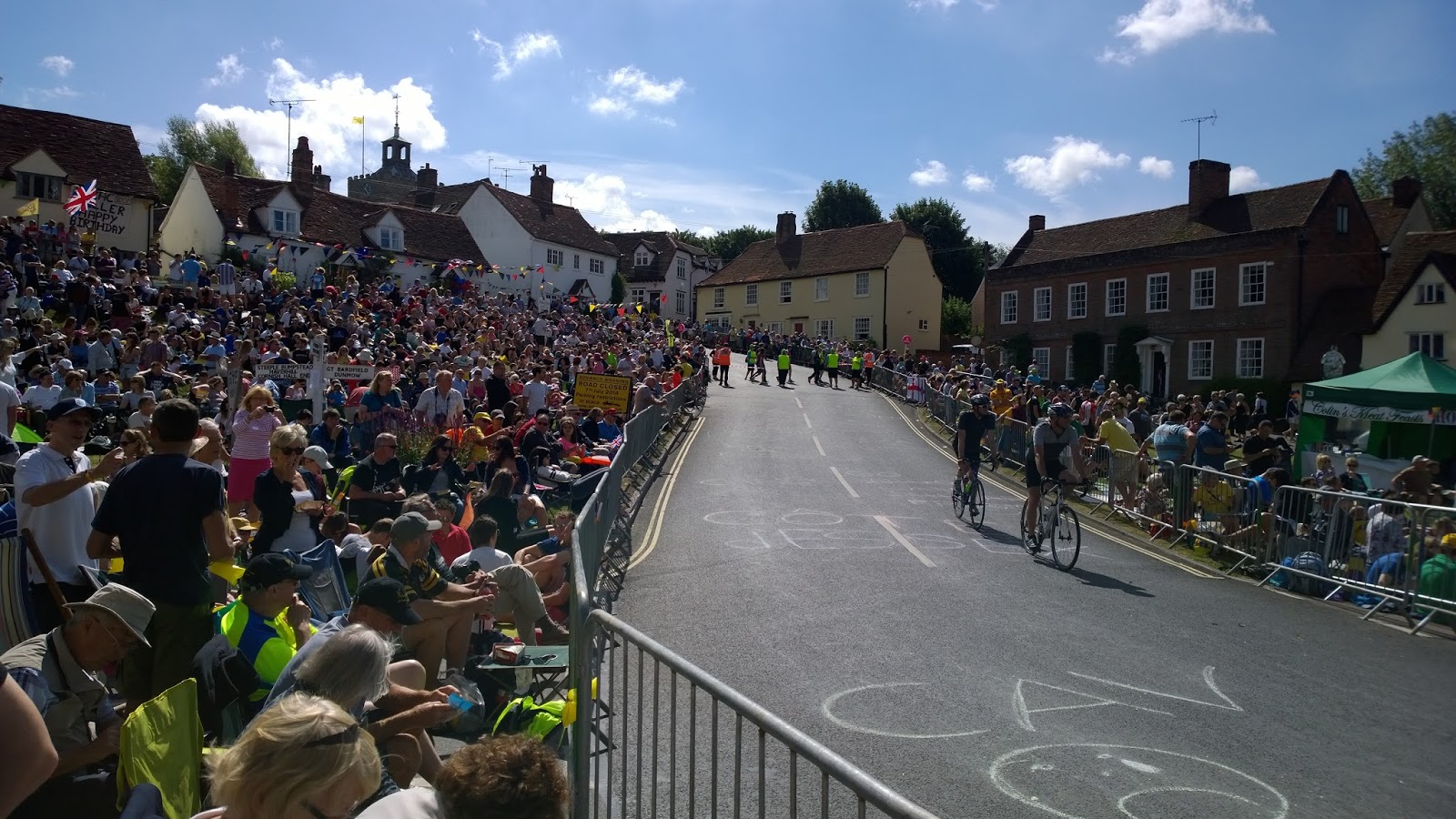
Thousands of spectators packed the tiny Essex village of Finchingfield to watch Le Tour pass by in 2014. With roads closed for miles around, most arrived by bicycle (including me!)
Everything has to have a "legacy" these days (thank you, London 2012) and the Grand Depart in Britain was no exception. Echoing last year's route, members of the public can now emulate their cycling heroes and ride Britain's hills alongside pro riders in the Tour de Yorkshire, encouraging more people to take to their bikes. There was even a Knighthood for Grand Depart organiser Gary Verity.
This Saturday the Tour de France is heading north once more, this time starting in the Dutch city of Utrecht. Home to canals, festivals and Miffy the bunny, it's a compact and charming university city stuffed with cycle tracks and people on bikes. So, in a city that already has a mainstream cycling culture, will the Grand Depart be all of that big deal for the Dutch?
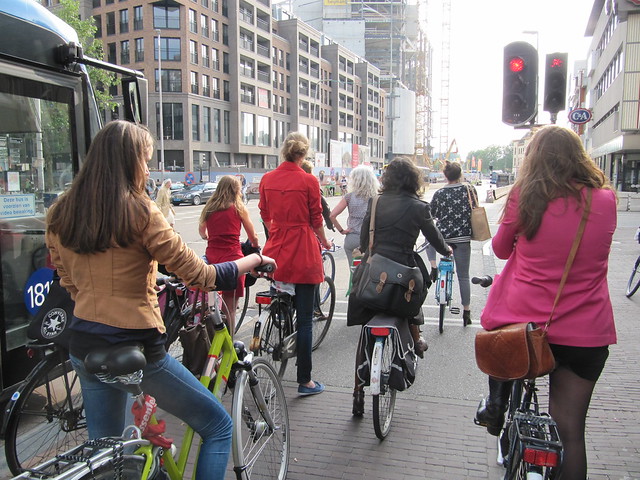
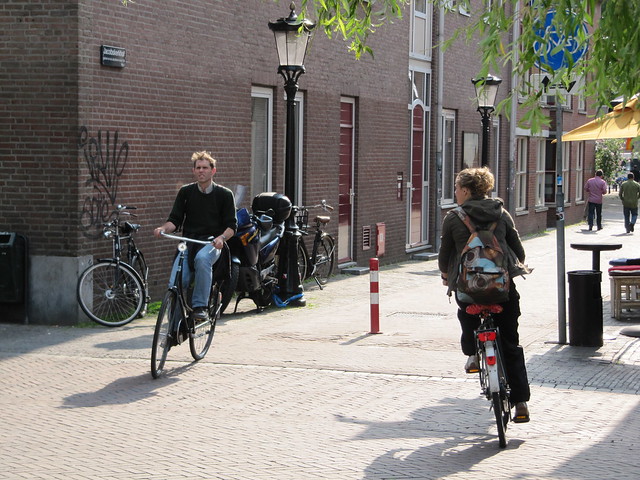
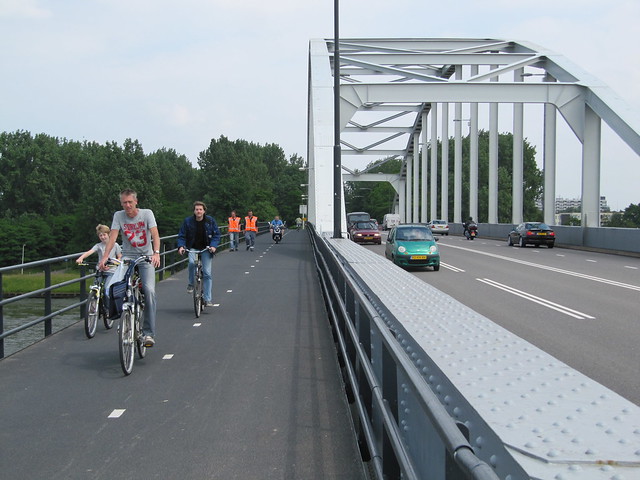
'Cyclists' riding in Utrecht, where the Tour de France will begin this weekend.
I've heard cycle campaigners on both sides of the equation disparaging sports cycling in mass cycling countries. On one hand, the argument goes that sports cycling is all well and good but it is not the "right kind" of journey by bike that cities so desire. On the other, some dedicated roadies discredit cycling provision in case it detracts from their right to ride as quickly as they can. I can see merits in both arguments, but on the ground in successful cycling cities the reality is very different.
Sports cycling is alive and well in the Netherlands (as multi-time world champion and Olympic gold medallist Marianne Vos and 2014 Tour de France stage winner Lars Boom attest) and there is no shortage of people pulling on their lycra on a Saturday morning to head out for a long spin in to the country.
The Dutch use bikes like we use cars and buses; it is an everyday and ordinary activity. So it seems perfectly natural that their language makes a distinction between 'being a person who uses a bike' and 'being a cyclist'. A fietser is someone who uses a fiets (a bicycle) whereas someone with all the kit and the fancy sports bike is called wielrenner, literally a 'wheel runner'. When the Dutch say cyclists don't wear helmets or special gear they mean it sincerely as 'fietser' is only ever a description of someone using a Dutch bike going about their day in a very ordinary way. This is not to say sports cyclists don't exist in the Netherlands and people aren't out there in all their kit putting in the miles.
As this video by Mark from the always excellent BicycleDutch blog demonstrates, the cycle tracks of the Netherlands are home to plenty of wielrenner. The reason you don't see them so much in bike blogs and photographs about the country is that they are somewhat obscured by the everyday and ordinary fietser all around them, much as Britain's sports cyclists are overwhelmed by the everyday and ordinary car journeys going on around them.
I can't help but feel that if we had the same linguistic distinction here in the UK, perhaps Transport for London wouldn't have dipped in to the cycling safety budget to the tune of £6million in order to host the Tour last year, instead of spending that money on making roads safer for bike riders of every hue. (Rumours abound that TfL bosses, keen to spend the cycle budget on anything other than actual changes on the road, are keen to lure the Grand Depart to London again soon) If we had the same linguistic distinction between cyclists and cyclists as the Dutch do, perhaps there might be a clearer understanding of what is needed to bring about those everyday and ordinary journeys by bike?
Utrecht is a beautiful energetic cycling city and I have no doubt it will give Le Tour a fantastic send off this weekend, heralding a summer of brilliant cycle racing. It would be interesting to see - once the professional wielrenner have wheeled out of town - how Utrecht carries on being an everyday and ordinary successful cycling city; it could be a 'legacy lesson' for us all.
Share
Nature Boy [ 23-Jun-15 6:33pm ]
London is changing, and it's all down to you. But what next for cycle campaigners? [ 22-Jun-15 8:30am ]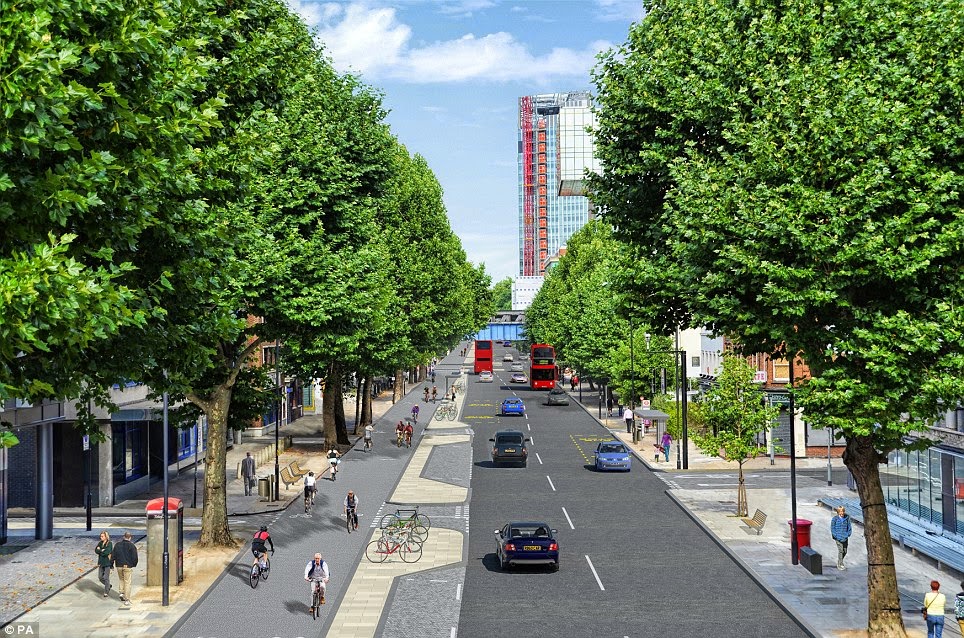
The North / South Cycle Superhighway is finally under construction.
My last article here was about the serious attempt by the Licensed Taxi Drivers Authority to have Mayor Boris Johnson's Cycle Superhighway plans stopped. In a classic filibuster they threatened to submit the entire scheme to Judicial Review in the High Court, which would have added months and innumerable expense to getting the routes built. In the end the LTDA slinked quietly away, and the Board of Transport for London gave construction the green light. (Though not until Board members, some with shocking conflicts of interest, had gone over the proposals in minuscule detail for some 90 minutes.)
Cycle campaigners - myself included - have been saying for many years that the pace of change in London has not been fast enough when considered against the annual death toll of people on bikes and the growth in numbers riding. And yet, in many ways the pace of change has now accelerated faster than anyone could have imagined even just a few years ago.
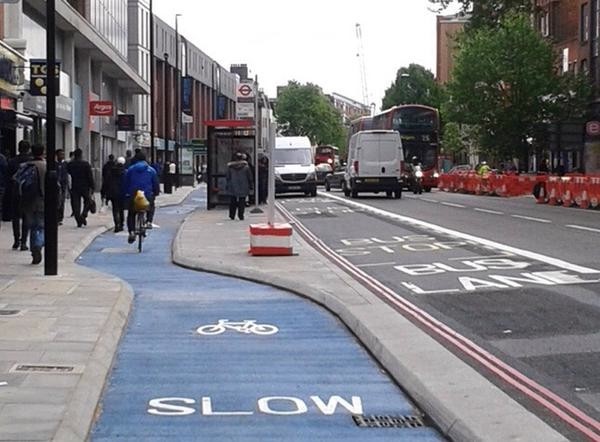
The upgraded Cycle Superhighway 2 in Whitechapel, which is opening in sections and where floating bus stops are working well. (Picture via Twitter with thanks)
In 2010 I demanded to know if the London Cycling Campaign and the Cyclists Touring Club were even prepared to push for decent cycling infrastructure or not. There was no consensus among cycle campaigners as to how best go about creating conditions for mass cycling, and even less agreement as to whether segregated cycle paths were even desirable. The integration / segregation conundrum sparked heated debates, both online and off. Respected cycling journalist and author Carlton Reid disparaged from the comments section of my blog;
"We ain't gonna get the sort of cycle infrastructure we'd all love. Ever.But here we are some 5 years later, and construction of high quality, segregated cycling infrastructure is already underway in London. The plans are by no means perfect, but they will be revolutionary. When TfL's previous Cycle Superhighways were built - effectively little more than just blue paint - cycling levels on those routes leapt. Imagine what the effect is going to be with safe new routes, separated from traffic and useable by all abilities? We didn't just get the kind of cycle routes that people said were impossible, they're going to be game changers too.
In such a car-centric society as the UK it would be next to impossible to take meaningful space away from cars."
Aldgate Gyratory is being largely rebuilt, due for completion in September 2016. Segregated cycle tracks in Oval will arrive by next spring. Construction is underway on the North / South Cycle Superhighways from Elephant and Castle to King's Cross, also due for completion by next spring. The most contentious cycle route of them all, the East / West Cycle Superhighway along the Embankment, is currently causing a little light traffic chaos along the river and will be operational by May 2016, not withstanding gaps in the Royal Parks who continue to dig in their heels, and in so doing reveal their prejudices.
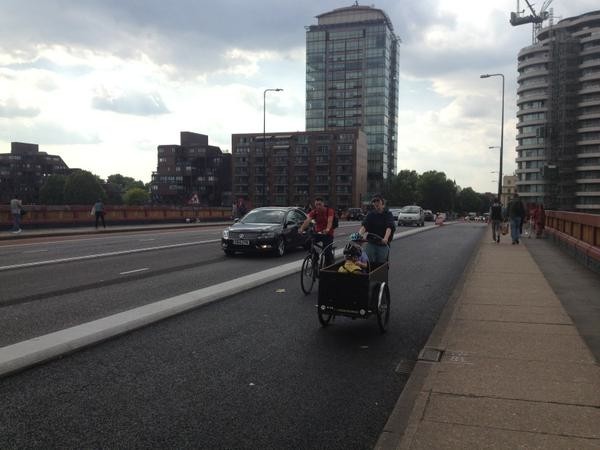
Welcome to the future! This segregated road space on terrifying Vauxhall Bridge will soon become a two-way cycle track. (via @citycyclists with thanks)
Cycle campaigner's integration / segregation argument has largely gone away, with most (cough, Hackney, cough) now acknowledging that where traffic volumes and speeds are sufficiently high then separating cyclists is desirable. As consensus emerged, much was made of the need for any new cycling infrastructure to be as fast and direct as the experience of riding in the road, and rightly so. The internet brought us easily accessible examples of best practise from overseas, whilst popular protests in London rallied around dangerous junctions and the need for design rather than behaviour to provide safety. This spawned the London Cycling Campaign's fabulous "Love London, Go Dutch" campaign and #space4cycling which, in turn, led to the Mayoral promise to build better routes.
Charting this progress is in itself an interesting exercise. I am struck by just how far we have come; my talk at the 2012 National Conference on Urban Design detailed how design and conditions on the ground emerged as the campaigning issue of our time. This consensus has in turn led to new routes being built on the ground. Here's the audio and slides from that talk, if you fancy a lunchtime history lesson.
Design Led Cycle Safety; how the cycling community came to value urban design from ibikelondon on Vimeo.
My 2010 talk on Design-led Cycle Safety charts how campaigning has changed in London.
Once that consensus emerged, London's cycle campaigners became increasingly resilient. Lots of new faces got involved, the LCC's policy was hammered in to shape by brilliant contributors like Dr Rachel Aldred whilst activists became advisers, working as much behind the scenes as in front. Brilliantly conceived activations were put together specifically with media impact in mind, and activist's work became targeted and with achievable aims. The pop-up business campaign CyclingWorks.London was instrumental in helping the new Cycle Superhighways plans scrape through TfL Board approval, in the face of exceptionally powerful opposition from the likes of Canary Wharf and their corporate lobbyists. Without the names of the 170 company CEOs pledging their support for the plans, I am not sure we would have made it. In a recent speech the Mayor's Cycling Commissioner, Andrew Gilligan, highlighted just how tight the fight has been:
"It was at times nightmarishly difficult to manage this, and we saw some absolutely ferocious resistance, kicking and screaming, and we saw a lot more passive resistance, heel digging and foot dragging from whom Olympic cyclist Chris Boardman called Old Men in Limos; you've heard of the MAMILs, those were the OMILs. A lot of objections, which would nearly always start with the words 'Of course I support cycling..."Gilligan went on to highlight how, with the helps of the likes of CyclingWorks, the OMILS were "comprehensively outfought in the PR and public support battle."
"You'll have to read our memoirs, if anyone wants to publish them, to find out how difficult it all was and how close it all came to not happening."
"I think we've made enormous progress - unprecedented progress - over the last couple of years, but I believe we're still in the foothills of making London a cycle friendly city and the task for Londoners is to make sure the progress we've made continues after May [2016, the next Mayoral election]."I think this is an honest assessment and shows how hard campaigners have worked to date. Gilligan has been a highly effective banger together of heads, but will he wish to continue as Cycling Commissioner when Boris Johnson steps down as Mayor next year? Furthermore, will the movers and shakers at Transport for London want to go back to playing just with buses and trains once the political drive for cycling moves on?
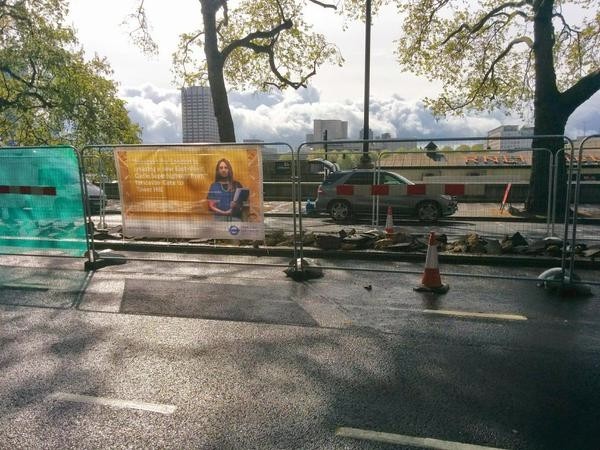
Work is underway on the Embankment for the East / West Cycle Superhighway (via @jonokenyon with thanks)
Despite the amount of work involved to date, campaigners cannot yet rest easy. In the short term we'll need to ensure the new segregated routes are fit for use and finished to a high quality. They'll also have to continue powerfully putting the case to the rest of London that the disruption they're currently experiencing will be worth it. Transport for London will need to ensure their spanking new cycle routes are maintained, cleaned and enforced - a cycle track with a truck parked in it is no good to anyone.
In the longer term efforts must now begin to focus on the Mayoral election in 2016. Without political will for cycling in City Hall in the future it will be too easy for TfL to draw back from their cycling responsibilities. 'Love London, Go Dutch' and #space4cycling were aspirational campaigns which captured the wider public's imagination about how London could be. As the results of those campaigns begin to take solid form, it's important to find a way to convince London that more of the same would be a good thing.
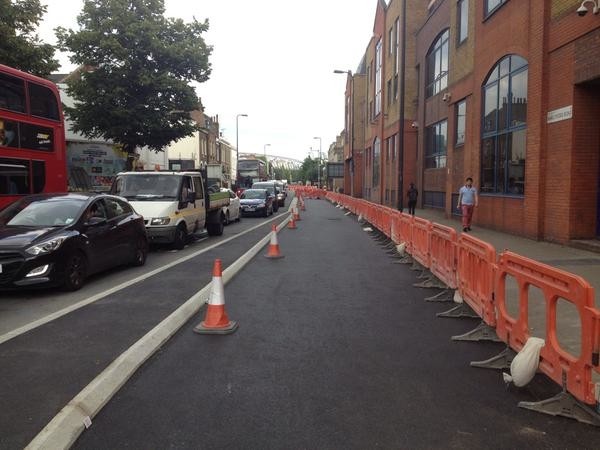
Brand spanking new cycle tracks in south London - look how smooth they are! (Pic via @citycyclists with thanks)
Away from the cycle tracks, lethal lorries remain a chronic issue for vulnerable road users in our city, and much more can still be done on this issue to get the shocking and seemingly inevitable annual death toll down. There is only so much campaigners can do, whereas Boris Johnson has the power to effect lasting change in the last 10 months of his Mayoralty. To keep the pressure up on Transport for London he should appoint a cycling representative to their Board, an easy and much overdue move. He should also push ahead with urgent reforms of lorry safety. In doing so, he'd help to secure his long term cycling legacy and make it harder for future Mayors to unpick his good work.
For now, everyone who has attended a protest, written to the Mayor, tweeted, signed petitions and helped keep the momentum going should take a moment to reflect on how far London has come - both in terms of consensus and successes - and enjoy watching the new cycle routes being built. But there's going to be more work to do to elevate London from "the foothills" of being a cycling city. We need to get ready for what's next.
Share |
James Mason - Home James (1972) [ 13-Jun-15 4:38pm ]Via Tariq.
James Goldsmith's Referendum Party was generally seen as an unhinged plutocrat's last hurrah. The Natural Law Party, backed by George Harrison: for those who thought Monster Raving Loony were too sensible.
And yet .... an in-out Referendum on EU membership remains one of the key issues in British politics and still divides the Right. Goldsmith's railing against "professional politicians" is an even more mainstream view. And doesn't Natural Law's program to de-stress the British people sound rather like the Happiness agenda?
# [ 25-Mar-15 3:51pm ]Here from 5
http://www.jdwetherspoon.co.uk/home/pubs/the-lord-moon-of-the-mall
then I guess
The Rockingham arms at approx 7:30
http://www.jdwetherspoon.co.uk/home/pubs/the-lord-moon-of-the-mall
then Hipster fun in New Cross at 9:30 ish
http://www.royalalbertpub.com/
and a late nightcap in the Greenwich Wetherspoons from 11-ish
http://www.jdwetherspoon.co.uk/home/pubs/the-gate-clock
this won't work out of course. I don't have a smartphone, Phil doen't even have a mobile so hopefully we will meet up at some point. Bring anyone you like and remember we like meeting new people and have highly developed social skills. #
Here from 5
http://www.jdwetherspoon.co.uk/home/pubs/the-lord-moon-of-the-mall
then I guess
The Rockingham arms at approx 7:30
http://www.jdwetherspoon.co.uk/home/pubs/the-lord-moon-of-the-mall
then Hipster fun in New Cross at 9:30 ish
http://www.royalalbertpub.com/
and a late nightcap in the Greenwich Wetherspoons from 11-ish
http://www.jdwetherspoon.co.uk/home/pubs/the-gate-clock
this won't work out of course. I don't have a smartphone, Phil doen't even have a mobile so hopefully we will meet up at some point. Bring anyone you like and remember we like meeting new people and have highly developed social skills. #
Here from 5
http://www.jdwetherspoon.co.uk/home/pubs/the-lord-moon-of-the-mall
then I guess
The Rockingham arms at approx 7:30
http://www.jdwetherspoon.co.uk/home/pubs/the-lord-moon-of-the-mall
then Hipster fun in New Cross at 9:30 ish
http://www.royalalbertpub.com/
and a late nightcap in the Greenwich Wetherspoons from 11-ish
http://www.jdwetherspoon.co.uk/home/pubs/the-gate-clock
this won't work out of course. I don't have a smartphone, Phil doen't even have a mobile so hopefully we will meet up at some point. Bring anyone you like and remember we like meeting new people and have highly developed social skills. #
# [ 07-Mar-15 2:00pm ]
Phil and I are going to have a promotional pub crawl for Strangled and No More Heroes on the 27th of March. Quite what it will constitute remains to be seen. I intend to flog my author copies of No More Heroes out of my gym bag and give the funds raised to Defend The Right to Protest. We will start in Central London around 5 then head south. London Bridge/ Elephant then New Cross/Deptford. We will figure out the exact pubs later. Essentially doing this solves one fundamental problem: the fact that I still like and get on with people who have now fallen out with each other. We will come to you, or somewhere near you, and you don't have to not come for a quick pint through the fear that you'll bump into that ex-comrade who has turned out to be a psycho/ reactionary/ closet Tory/ leering Troll / treacherous Careerist, etc. If you ever contributed to the Decade's blogs it would be great to see you, but it would be great to see you anyway. This is an open invitation. I'll update the pub location nearer the date, after full consultation with Phil. He's dead fussy.
Facebook page here. #
# [ 07-Mar-15 2:00pm ]Phil and I are going to have a promotional pub crawl for Strangled and No More Heroes on the 27th of March. Quite what it will constitute remains to be seen. I intend to flog my author copies of No More Heroes out of my gym bag and give the funds raised to Defend The Right to Protest. We will start in Central London around 5 then head south. London Bridge/ Elephant then New Cross/Deptford. We will figure out the exact pubs later. Essentially doing this solves one fundamental problem: the fact that I still like and get on with people who have now fallen out with each other. We will come to you, or somewhere near you, and you don't have to not come for a quick pint through the fear that you'll bump into that ex-comrade who has turned out to be a psycho/ reactionary/ closet Tory/ leering Troll / treacherous Careerist, etc. If you ever contributed to the Decade's blogs it would be great to see you, but it would be great to see you anyway. This is an open invitation. I'll update the pub location nearer the date, after full consultation with Phil. He's dead fussy.
Facebook page here. #
# [ 07-Mar-15 2:00pm ]Phil and I are going to have a promotional pub crawl for Strangled and No More Heroes on the 27th of March. Quite what it will constitute remains to be seen. I intend to flog my author copies of No More Heroes out of my gym bag and give the funds raised to Defend The Right to Protest. We will start in Central London around 5 then head south. London Bridge/ Elephant then New Cross/Deptford. We will figure out the exact pubs later. Essentially doing this solves one fundamental problem: the fact that I still like and get on with people who have now fallen out with each other. We will come to you, or somewhere near you, and you don't have to not come for a quick pint through the fear that you'll bump into that ex-comrade who has turned out to be a psycho/ reactionary/ closet Tory/ leering Troll / treacherous Careerist, etc. If you ever contributed to the Decade's blogs it would be great to see you, but it would be great to see you anyway. This is an open invitation. I'll update the pub location nearer the date, after full consultation with Phil. He's dead fussy.
Facebook page here. #
I watched the Adam Curtis film Bitter Lake this week. I'm not going to comment on the argument of the film, as I have no special insights into Afghanistan other than having followed the news for the last 15 years. However, a whole line of criticism has developed around the aesthetics of Curtis' films, particularly his use of film archive, that is worth responding to.
The internet was hailed as great breakthrough in multimedia, which it is of course. But it has also produced a revenge of the written word, and of those who believe writing is the senior service of media. Platforms like tumblr or pinterest have ended up devaluing images by reducing them to a churn; twitter actively defaces them, using pictures and video as fodder for jokes, constant fact-checking or abuse. Live-tweeting programs seems like a way of refusing to surrender to the pull of video and sound.
The left, with its tradition of print journalism, and critical theory, created by people trained in philosophy and literature, has form here. On Photography and Camera Lucida could be seen as attempts to cut visual mass media down to size, by those who felt threatened by them. Marshall McLuhan's career is now an academic morality tale: don't get too into television or you will become vacuous. (The exception is John Berger who was an artist before he began writing, and has retained a positive sense of making images.) There is a Protestant and iconoclastic (in the original sense) undercurrent here.
The criticisms of Curtis' use of archival footage and his editing techniques have some of this spirit. At work here is a misunderstanding of what he is doing. Curtis' films are histories. Almost all serious written histories are led by the use of archival sources. In practise most of these were produced, and are kept, by institutions of various kinds. So the argument that Curtis is 'lost in archives' or 'or lost in the BBC archives' is a non-criticism. His use of audio-visual sources is also close to the practise of 'thick description' where historians build up a picture of a past society or event by piling detail on detail and example on example. This is a methodical and rhetorical strategy, and one used by several different historians from Raphael Samuel to Keith Thomas to Saul Friedländer. It should be noted that this technique involves a fair bit of direct quotation or repetition of material that the author may not agree with and is often presented without much comment. Walter Benjamin fans will see the similarity with the Arcades Project; indeed Keith Thomas has written of his admiration for that work. I can't help noticing the link with Humphrey Jennings' Pandemoniumeither - Curtis' father was Jennings' cameraman. This is also the technique of many works of oral history. The statement that Bitter Lake is an 'emotional history' is therefore in keeping with this tradition.
This sheds a different light on complaints about decontextualisation too. This has been perhaps thecomplaint against thick description as a method ['quotation out of the context' is the standard charge]. But this is a problem of all methods: they show some things and reveal others. It is true that, unlike history writing, Curtis' films have no footnotes and apparatus: but this is true of all factual films. Having more talking head experts would not solve the problem; it would merely introduce multiple arguments from authority.
The other point about archives is this: progress in history has generally been made by bringing new sources into play or finding new ways of looking at them. Indeed, it should be emphasised how underused television and film archives are in creating works of histories [as opposed to illustrating them.] This is partly due to the conservatism of the academic form, but also because it is very hard to get access to these archives and even harder to re-use the material publicly. Ironically therefore, the 20th century, that supposedly radical and modernist century, has some of the most conservative and restricted forms of telling its history.
There is a deep literalism at work in criticism of his technique. People seem to want every image or video to come with captions and explanations. Or perhaps every frame has to feature Fergal Keene telling us when to feel sad. Curtis is creating a new form of multi-media history. Who knows where others will take it next?
# [ 30-Jan-15 11:08am ]
As the LTDA goes to war with cyclists, we ask just who runs London? Is this a Cycle Superhighway Stich up?! [ 30-Jan-15 8:30am ]Johnson's announcement follows one of Transport for London's largest ever consultations on a project, with a staggering 21,500 responses. So many people wanted to respond, they extended the length of the consultation to allow everyone time to air their views. But the results are conclusive; even when you discount responses automatically generated by the London Cycling Campaign's website, some 73% support the more contentious east / west route running along the Embankment.
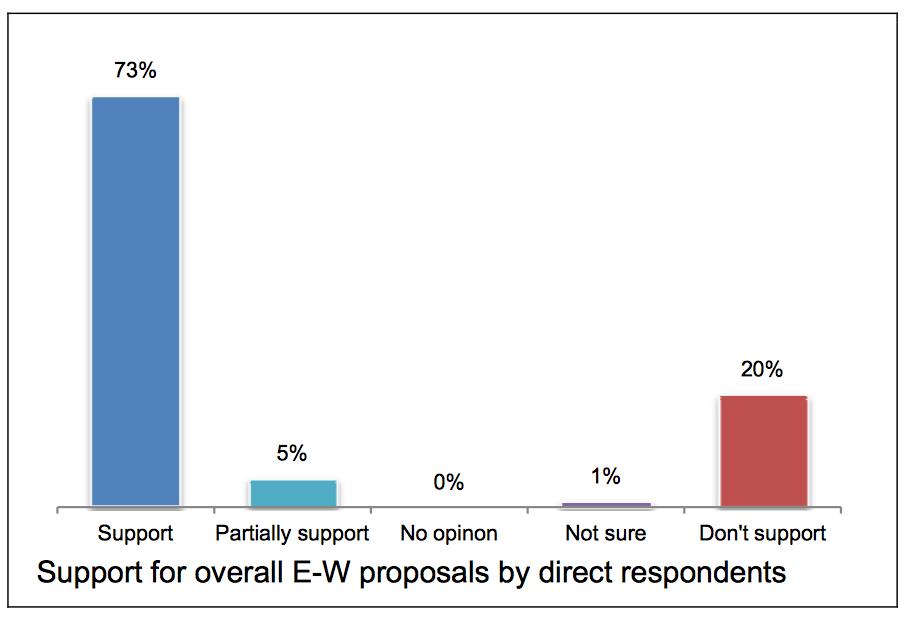 This reflects a recent YouGov poll of Londoners of all backgrounds, the majority (64%) of which supported the cycleway plans even if it involved taking a lane away from traffic. It's also worth remembering of course that the consultation is not a referendum on the proposals; the scheme is the brain-child of our directly elected Conservative Mayor, who is mandated by the population of London to deliver his manifesto promises, of which the Cycle Superhighways were one. So far, so democratic, right?
Within minutes of the announcement on Tuesday, the Licensed Taxi Drivers Association let it be known they were furious that the Cycle Superhighways were going ahead and planned to lodge a Judicial Review. Here's what Steve McNamara, the LTDA's Secretary, had to tell Vanessa Feltz on her BBC London radio show on Tuesday morning:
"It's an abomination!... ...The ideal route would have been to run it along the Southbank, in front of the old LWT [London Weekend Television] building all the way along there, it would have been lovely, it would have been out of the way, it would have been ideal... ... We're against it, lots of businesses are against it. We are considering a Judicial Review against the scheme in conjunction with Canary Wharf and others."McNamara went on to give his opinions as to exactly why the Cycle Superhighways - which represent a tiny percentage of London's roads - were a BAD THING, especially if they benefit CYCLISTS:
"...they all try and tell you this myth, that it is wealthy people driving around in cars that we need to combat, and that it is the poor man on the cycle. And of course it's not. What we've got now is this metropolitan elite who can afford to live in the centre of the city, afford to cycle a few hundred yards or half a mile to work, they're the people campaigning for this. The vast majority of Londoners, working Londoners, business Londoners - the majority of your listeners who are coming in from the suburbs and trying to move around this city - are going to be severely disadvantaged by this scheme...I think it is fair to say that the LTDA has gone to war against cyclists. In November 2013 - the same month six London cyclists died on our roads in just two weeks - they gave the Evening Standard cooked up footage which claimed to show the majority of London cyclists run red lights.
..We're the only people in London who can actually stand up for working Londoners, us and a few businesses who have come together. As I say, Canary Wharf - a massive business that employs tens of thousands of people at the Wharf - they're concerned about their people getting to work, we're concerned about moving people around the city, lots of freight companies are very, very concerned about it, they've got to make deliveries. London is a working city, it's got to be able to work the 23 hours a day when them cyclists are not down on the Embankment - and they're not.... .. it's madness. They must see it, and we're hoping the Courts will see it." [Click here for a full transcript of his interview]
Then, in March 2014 their Director wrote this frankly bizarre editorial in their member's newsletter, claiming that cycling is "bringing this city to its knees":
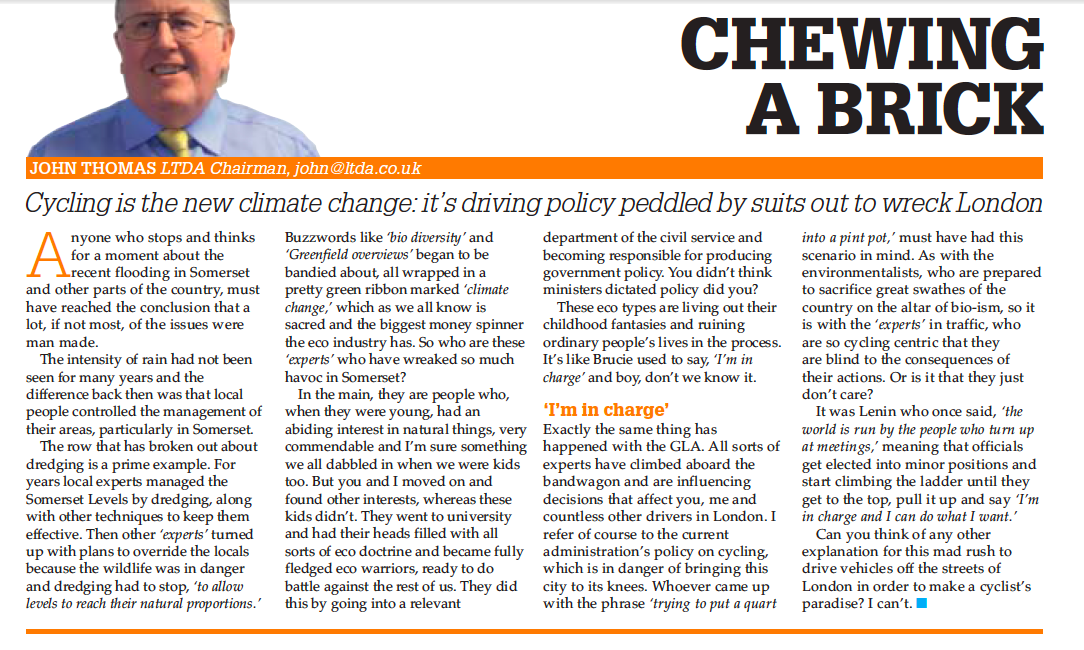
And now, in 2015, they're coming out all guns blazing against the Cycle Superhighway project, threatening legal action and mouthing off to anyone who will listen. But there's more to it than that, unfortunately. I'll deal with McNamara's ridiculous assertions firstly, but please do read on to the end because what happens next is even more ridiculous...
The idea that the LTDA is a paragon of working class, salt-of-the-earth virtue is preposterous: this is an organisation that gives discounts to its members for country hotel leisure breaks, golf clubs and designer glasses. (And cheap legal representation to those facing driving bans who accumulated too many points on their license) Most of their members will be earning around £60,000 a year (that's twice the national average).
Let's contrast that with the 13 people who were killed cycling in London last year: two teachers, two students, a ventilation engineer, a conference organiser, a pharmacist, a hospital porter, a bus depot worker, a solicitor, an IT worker, one person unknown and a security guard. Hardly what I'd call a "metropolitan elite".
And were those who were killed cycling "a few hundred yards or half a mile to work"? Of course not. The majority of all cycle journeys in London originate in the fringes of zone 2 and 3 and make their way to the centre and back again. Commuting patterns like my own journey to and from work which is 10 miles, versus the city-wide average of 15 miles (That's 15 miles regardless of which mode of transport you use).
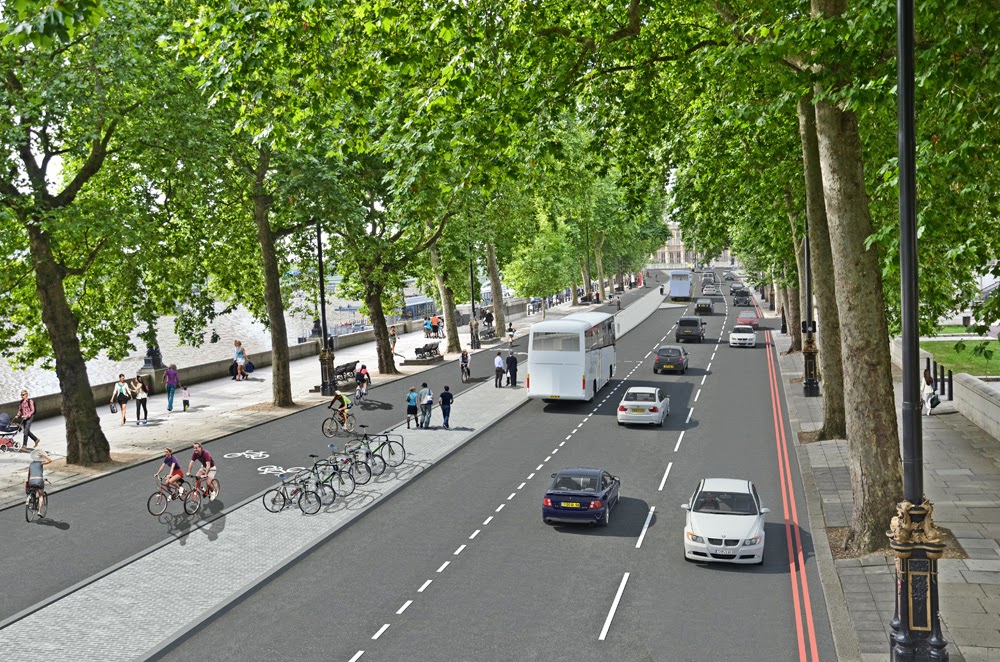 Proposals for Victoria Embankment
Taxis ferry about businessmen on expense accounts and unwitting tourists for the majority of the time, and are out of reach for most ordinary working Londoners. The last time I took a taxi from Heathrow to central London it cost nearly £100 (an awful journey during which the driver stopped his car to scream obscenities at a woman on a pedestrian crossing and deigned to share with me his abhorrently racist views for the duration of the trip). The Piccadilly Line can do the same journey - opinion free - for about a fiver.
As for sticking the Cycle Superhighway south of the river (presumably because Black Cab drivers don't go there) frankly, why should they? For a starter the whole point of the project is to get people by bicycle to centres of work quickly and safely. London's bridges are already a danger spots for cyclists, but to put it in language the LTDA would understand: around half of all the vehicles on Blackfriars Bridge during the peak hour are bicycles (that's one bike every two seconds) Are you sure putting more bikes on the bridges to get south of the river is such a good idea?
To put things in a clearer light, and to completely discredit McNamara's idea that cycle journeys are somehow unnecessary and get in the way of "working London", let's look at some actual statistics.
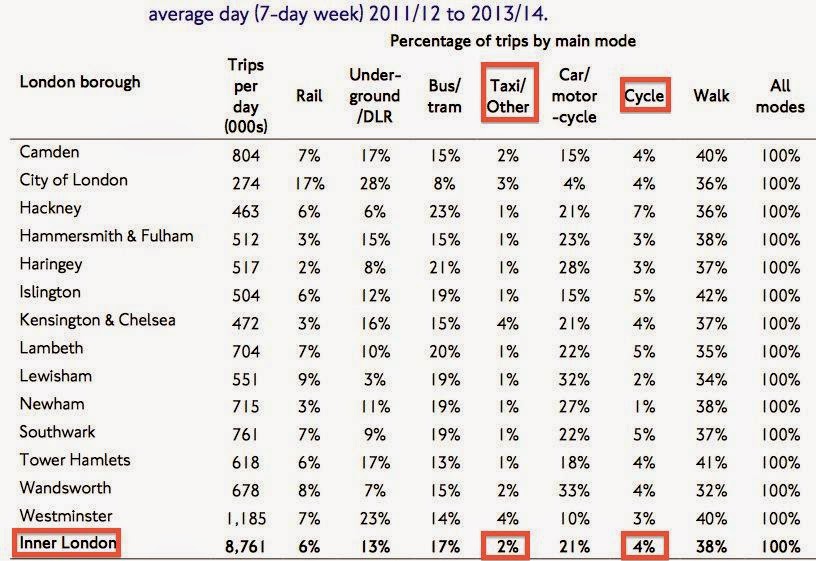 Via As Easy As Riding A Bike, with thanks.
According to Transport for London's latest data, taxis make up 2% of all inner London road users. Bicycles make up 4%. Cycle rates in the same area have doubled over the past 10 years, whilst journeys by car have consistently declined. Across greater London there are approximately 650,000 cycle journeys every day - they can't all be Bradley Wiggins wannabes making laps of Richmond Park.
The LTDA's stance is astonishing. That they'd channel so much effort and resource in to giving such a knee-jerk and provocative reaction to a scheme that will cover a tiny percentage of London's roads (whilst their members lose massive market share to credit-card accepting mini-cab firms and book-by-app discount drivers Uber) is sad to watch. If I was an LTDA member I'd be telling them to pick their battles. As a cyclist I'd laugh if this wasn't so serious.
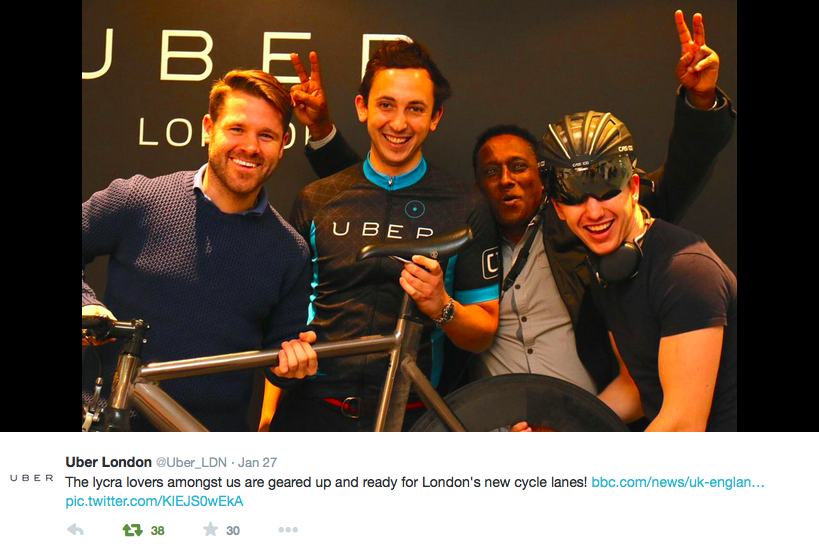 Uber take a pop at the LTDA's pre-historic attitude via their Twitter account @Uber_LDN
A Judicial Review could see the Cycle Superhighway project delayed by up to 14 weeks, and its TfL's fare-paying customers who will pick up the bill for fighting it (you know, ordinary working Londoners) But the madness doesn't stop there.
The LTDA's McNamara said say they "are considering a Judicial Review against the scheme in conjunction with Canary Wharf." You'll remember that the Canary Wharf Group were behind an anonymous briefing filled with untruths about the Cycle Superhighways which was distributed to politicians and business leaders late last year. They've also paid for a lobbyist to tour the political party conferences to try and drum up opposition to the scheme. Their strategic adviser, Howard Dawber, has appeared on television and radio claiming the project would be bad for their business and has attended numerous stake holder planning meetings.
And this is where things get ridiculous.
If a Judicial Review doesn't materialise, next Wednesday the Board of Transport for London will meet to decide whether to fund the Cycle Superhighway project or not. This is not just a case of rubber-stamping the Mayor's plans. As Cyclists In The City points out, they've picked over cycling plans in minute detail before.
But two members of the Board have a direct conflict of interest, and it would be a democratic failure were they to be allowed to participate in the funding decision...
Peter Anderson sits on the Board, and is also the Finance Director for.. ..Canary Wharf Group.
Bob Oddy sits on the Board, and is also the Deputy General Secretary of... ..the LTDA!
 The LTDA's Bob Oddy, above, and Canary Wharf Group's Peter Anderson, below
 In the long term I would ask - considering there's more of us on the roads every day than there are of them - why taxi drivers are represented on TfL's Board when cyclists are not. In the short term I'd ask this: what will the Mayor do to ensure that those whose employers have been actively lobbying against this scheme are totally excluded from the process which will decide its future?
London's cycling community has fought long and hard and waited for many years for this: just ONE safe segregated cycle route across our city. This project cannot be scuppered by members of the Board who no longer have a right to be involved in it. If Anderson and Oddy think they can turn up at the Board after all their companies have done they've got another thing coming.
Transport for London's Board meeting takes place at 10AM on Wednesday 4th Feb at City Hall, committee room 4. It is open to the public and the Board papers are available online to review.
Share
# [ 29-Jan-15 1:40pm ]
Whatever happened to him? [ 27-Jan-15 11:31am ]What's interesting about Leeson is, as far as anyone has been able to tell, he didn't actually profit from the giant fraud he committed. He was just trying to cover up the losses he made early on into his new job on the Singapore Stock Exchange, and had to keep going until someone found out. Perhaps this quirk prevented people from drawing any deeper conclusions about finance from the case.
Funny by the way, how many key 90s figures came from Watford: Leeson, Mo Mowlam, Geri Halliwell and Gareth Southgate.
Boris gives green light to Cycle Superhighways to unlock central London for bikes [ 27-Jan-15 10:05am ]The East / West Cycle Superhighway will form Europe's longest substantially segregated urban cycleway, stretching from Tower Hill in the east to Acton in the west. Intersecting with a new North / South Cycle Superhighway from King's Cross to Elephant and Castle, the new routes will form the flagship facility in Johnson's £913million 10-year cycle investment plan.
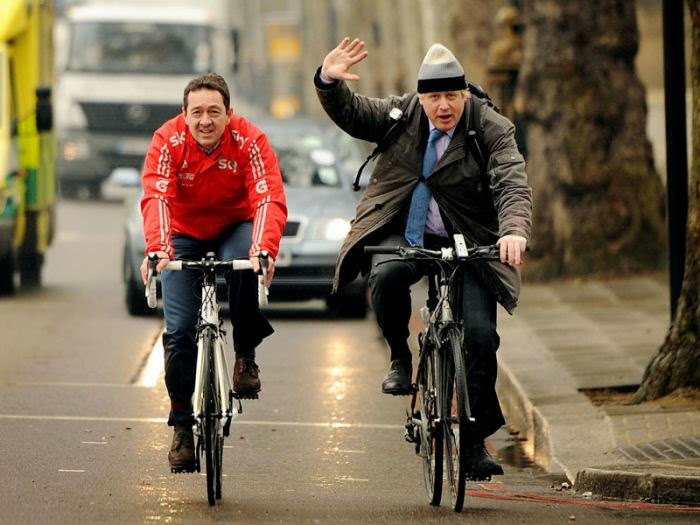 Boris Johnson rides the route of his future Cycle Superhighway on the Embankment with Olympic champion cyclist and campaigner Chris Boardman. Photo via Press Association with thanks.
The Mayor said: "We have done one of the biggest consultation exercises in TfL's history. We have listened, and now we will act. Overwhelmingly, Londoners wanted these routes, and wanted them delivered to the high standard we promised. I intend to keep that promise."
Subject to approval by the Board of TfL next week, construction on the routes will begin as soon as March, with the first route complete and ready for riders by spring 2016. (It's worth pointing out that Johnson's term as Mayor concludes in May 2016)
The nine-week public consultation on the plans saw an overwhelming 21,500 responses from individuals and business organisations, with 84% in overall support of the plans. A YouGov opinion poll taken during the consultation found 73% of Londoners supported the Cycle Superhighways, even if it meant taking a lane of traffic away.
Coordinated by pop-up campaigning group CyclingWorks.London, over 170 businesses and organisations pledged their support for the Cycle Superhighways and called on the Mayor to construct them without delay, including key employers along the route such as Unilever, Orange, the Royal Bank of Scotland and Deloitte.
Businessman and cyclist Chris Kenyon from CyclingWorks.London said:
"Rarely if ever has a scheme by TfL gathered so many CEO-level signatures of support. Surely that is the big story. The backers represent every major industry sector and show that Londoners are in it together and believe that it's time for kerb protected lanes in the heart of the city."
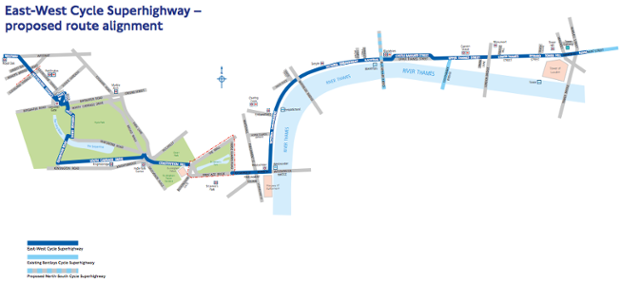 The original route along the Embankment, which will still incorporate Parliament Square, subject to modifications.
The original plans from Transport for London have been revised in response to concerns by the City of London, the taxi lobby and the Canary Wharf Group that building cycle tracks would cause too great a delay.
The lanes for other traffic on the Victoria Embankment were to be cut from two to three between the pinch points of Blackfriars underpass and Temple Station. By squeezing the cycle tracks at these points, the three lanes of traffic will be able to remain.
The Mayor's Cycling Commissioner, Andrew Gilligan, believes delays will be cut by 60% on the original plans. The worst affected journey - from Limehouse Link to Hyde Park Corner - will now only take an additional 6 minutes, rather than 16 minutes under the original plans. The traffic models do not account for people switching to other types of journey (ie cycling) as Rachel Aldred explains in her blog about why we should not fear the worst case scenario.
These new routes will fundamentally change London. Currently we stand with our back to the Thames and the Embankment. What is currently a traffic-choked, noisy and dirty rat-run for the city will become the spine of London's safest cycling infrastructure, where cyclists of all ages and abilities - from roadies, to children - will be able to undertake their journeys in safety.
Transport for London's rendering of the north / south Cycle Superhighway from King's Cross to Elephant and Castle.Cycle use has already doubled across London over the past ten years, but these ambitious plans will see cycling levels rocket. Sir Peter Hendy CBE, transport commissioner for London, said:
"Cycling is clearly now a major transport option in London, with over 170,000 bike journeys now made across central London every single day... These projects will help transform cycling in London - making it safer and an option that more and more people can enjoy."
We should be clear that the Cycle Superhighway plans are not perfect: the width of the tracks being reduced to approximately 3 metres through the Blackfriars Underpass and at other pinch points on the Embankment is very much of concern. Once built they must be monitored, and potentially dangerous sections must re-assessed. Furthermore, the route through the Royal Parks is still not clear and will be consulted on at a later date, as explained by Danny over at Cyclists in the City. Could the Royal Parks put a spoke in the wheel of the whole scheme?
And there's no guarantee that the Canary Wharf Group will back down in their opposition to the Cycle Superhighway plans, despite the reduction in delays. You'll remember they employed a professional lobbyist, distributed an anonymous briefing paper full of dodgy statistics, and badgered politicians at party conferences over the scheme. The Canary Wharf Group's Finance Director is one Mr Peter Anderson. He's also Chair of Transport for London's Finance and Policy Committee and a member of their board - and therefore will have a say next week over whether the plans will go ahead or not.
The City and Canary Wharf Group have always been keen to demonstrate that opinion is divided on these schemes, whereas it has been my impression throughout that the majority of Londoners want these changes, they need these changes and they must be allowed to go ahead. Those who oppose these changes would do well to remember we are talking about a tiny fraction of London's streets, even though it could have a transformative effect for cyclists. Johnson has now made a big promise in the run up to the elections, it is important that he sticks to it.
If all goes well - and not withstanding skullduggery and backroom dealing - London has achieved something incredible with this announcement. It was only a few years ago, in November 2011, that Danny Williams from Cyclists In The City and I organised the Tour du Danger an initial protest around London's most dangerous junctions for cyclists. Since then there have been countless campaigns, protest rides (not least at Blackfriars Bridge) and of course, cyclist's deaths. Now we have a major UK politician staking their reputation on their cycling dream, prepared to put up the cash, and even ready to take roadspace away from other traffic to achieve their aims. This is in no part is down to all of you who've badgered your politicians, signed petitions, come on protests and responded to consultations. Give yourself a pat on the back, London. Let's make a date in our diaries for a celebratory ride on our city's beautiful new cycling infrastructure, coming soon to a road near you!
Share |
In defence of fair-weather cyclists: how do you keep a city cycling, even in the worst of winter? [ 26-Jan-15 8:30am ]One of the most persistent criticisms I hear levelled against investing in cycling is that as soon as the weather becomes inclement people stop riding, therefore making it an unreliable way of moving people in cities.
 Cyclists in a recent rush hour snow storm in Copenhagen, via the Copenhagenize / Viking Biking Tumbr.
 Whilst the difference between summer and winter cycling levels in London have been decreasing year on year, the number of cyclists on the road over the winter months is markedly lower than in the long, light and warmer summer days.
If a journey by bicycle is tolerated for the sake of convenience, rather than comfort, it is true that poor weather can serve to increase the perception of it being sketchy. I personally dread cycling around Old Street roundabout or through Holborn Circus in heavy rain with reduced visability. No matter how good your waterproofs, you'll still be soaked through with the sweat of anxiety by the end of your terrifying trip.
 Cyclists in the snow, Bethnal Green, London, 2010
Of course, it is not the actual rain, snow or darkness that I fear but the chance that my fellow road users are not paying sufficient attention to the conditions, and do not modify their behaviour appropriately.
In successful cycling countries this problem is solved by separating cyclists from motorised traffic one way or another; perhaps with cycle tracks on main roads, or with closures, restrictions and one-way routes on lesser roads with lighter traffic. But this in turn can pose its own problems: in the worst of the winter weather, how do you keep cyclists - and the city - moving?
When you have a high percentage of your population making their journey by bikes - as in Copenhagen or across the Netherlands - making sure that cycle routes are clear becomes a very serious consideration. In another fascinating new post, video blogger Mark of Bicycle Dutch fame recently recorded how his home city of 'S-Hertogenbosch kept people moving through a recent snow storm, and made journeys by bicycle possible in challenging conditions.
He explains: "On a cycle way the 'gritters' brush the surface first, and then it is sprayed with a mixture of salt and water. That film of salt water does cover the entire surface and that means most of the snow melts instantly on the entire street surface even without [passing cyclist's] tyres to disperse the salt. The difference between routes that were cleared and gritted and those that were not (yet) was huge."
I know what you're already thinking: here in the UK we don't deal with adverse weather well. That we struggle to clear our roads and pavements, let alone cycle paths. That we can't even build all-weather year-round cycle routes.
 Mud, mud, glorious mud! It's not Middle Earth, but all the same you shall not pass... Via As Easy As Riding A Bike.
 Indeed, As Easy As Riding A Bike blog recently highlighted a Sussex cycle route which could provide a safe and convenient bypass to the busy A2 is impassable to all but those equipped with mountain bikes and wellington boots for much of the year. It's never been laid properly due to concerns about an "urbanising effect" on the countryside, which clearly doesn't consider the same effect car journeys have that could easily be replaced by trips on this path, were it a viable route instead. Making this journey on the path in its current form on a dark night in wet and windy weather would be reserved for all but the hardiest of thrill-seekers.
 The heavy snow fall of 2010 caught London unprepared. My street, seen here, remained uncleared for over a week.
But as the Dutch example demonstrates, winter weather need not be an insurmountable obstacle for successful cycling. People always tell me that "there's no such thing as bad weather, only bad clothes" but I'd argue that there's more to it than that...
You can have all the fancy water proof kit in the world, but if you're having to fend off thundering lorries and itinerant taxi drivers in addition to trying to stay upright through wet and windy weather you're not going to be having a very nice time. And you could have all the cycle infrastructure in the world (and I'm thinking in particularly of the separated lanes we should start to see being rolled out in London over the next few years) but if the authorities don't have a plan for keeping them clear of mud, snow and ice they'll be next to useless. Keeping your city cycling, even in the worst of weather, shows the special care and consideration people on two wheels need.
Further reading:
Bicycle Dutch: how to make cycling in the snow possible
Copenhagenize: the ultimate bike lane snow clearance post!
As Easy As Riding a Bike: Natural Character
ibikelondon: Cycling through epic amounts of snow, retro Norway style
Share
Never mind "cyclists stay back", what about "drivers, watch for cyclists"? [ 21-Jan-15 6:30am ]They're big, they're yellow, they're angry and they're everywhere. "Cyclists! Stay back!" they shout, and they seem to be stuck on the back (or even the side) of just about every working vehicle in London.
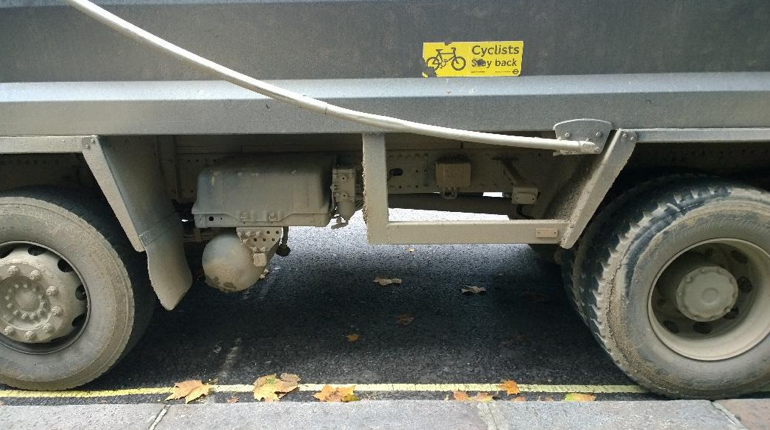 The ubiquitous yellow safety stickers first appeared on lorries as a warning to cyclists that they had massive blind spots, and slipping down their sides was a potentially fatal thing to do. But when Transport for London began requiring every contracted vehicle to also sport the stickers, they began to appear on vehicles ranging from-mini buses to ordinary cars; vehicles which are hampered not by blind spots but by the driver's failure to look. Peter Walker of the Guardian explains very well just why these stickers seem particularly impertinent to cyclists.
There was uproar last summer as the yellow menace spread, and Transport for London agreed to begin replacing the stickers with more gently worded warnings to "avoid passing this vehicle on the inside". But I can only assume the replacement stickers are lost in the post somewhere as just last night I saw what looked to be brand new "stay back" stickers on the rear window of two different taxis.
Popular cycling website Road.cc turned their hand to sticker making and came up with these "Cyclists! Stay Awesome!" stickers, and I can appreciate the humour: too often it seems that signs shouting at people on bikes lurk around every corner. Cyclists! Stay Back! Cyclists! Dismount! Cyclists! Stop at red! Cyclists! Proceed directly to jail, do not pass go, do not collect £200!
So I was really happy to see the below sign on the exit gates of the Crossrail station construction site at Bond Street, which is busy with lorries day in and day out. The message is bold, the message is simple, the message makes sense: "Drivers! Watch for cyclists!"
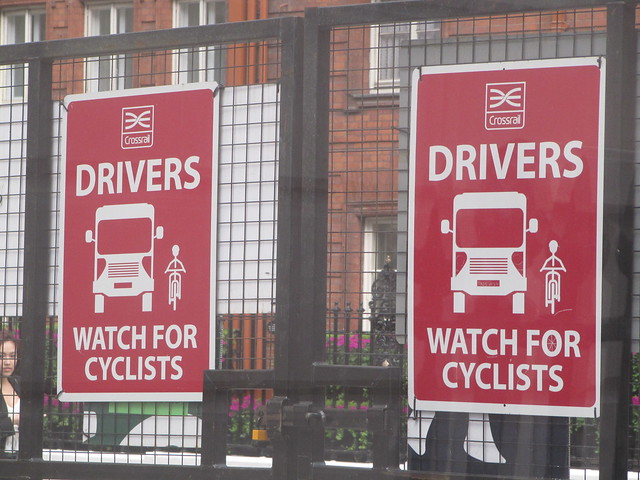
Maybe I bear a two-wheeled bias, but I'd like to see a lot more of these around town. In fact, I have a proposal to make: I'll agree to anyone slapping a "Cyclists! Stay back!" marker on the back of their vehicle so long as they also agree to stick "Driver! Watch for cyclists!" on their steering wheel. Seems like a fair deal to me, don't you think?
Share |
Will Camden deliver the UK's best urban planning scheme (with HUGE benefits for cyclists)? 48hrs to tell them to DO IT! [ 19-Jan-15 8:30am ]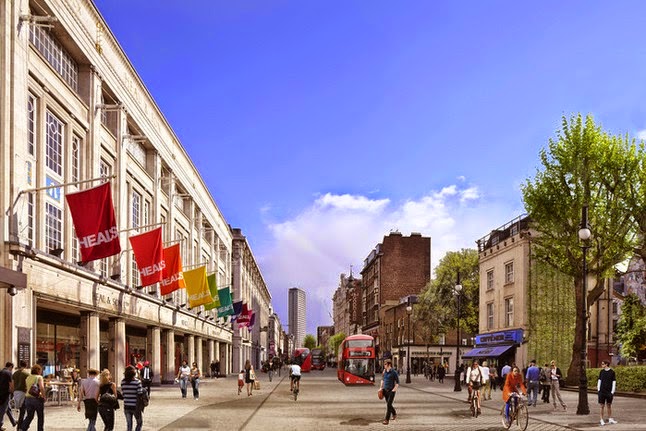 Tottenham Court Road will become a primarily pedestrian route, with safer and easier crossing of the road, 20mph speeds and bus priority. Cycle-specific provision will be supplied on parallel Gower Street.
So, what are the plans? Some £26million pounds will be spent removing the one-way gyratory which currently ensures speeds are much too high on Tottenham Court Road and condemns Gower Street (which should be one of London's finest Regency-era streets) to exist only as a traffic sewer filled with three lanes of buses and speeding vehicles. The area is currently described as one of the worst in the borough for collisions, with 259 casualties in total in the last three years, of which 36% involved pedestrians and 27% involved cyclists.
You can view the amended plans in full here.
"The Wages of Sin is Death; The Gift Of God Is Life" [ 14-Jan-15 1:06pm ]
Mark from As Easy As Riding a Bike blog tweeted a screen grab from Streetview recently of a newly painted bike lane in Horsham with the caption "Where that Department for Transport 'cycling money' is going. Brand new (2014) cycle 'infrastructure' painted in Horsham with Local Sustainable Transport Fund cash". It doesn't take a rocket scientist - let alone a road engineer - to work out that this is crap:
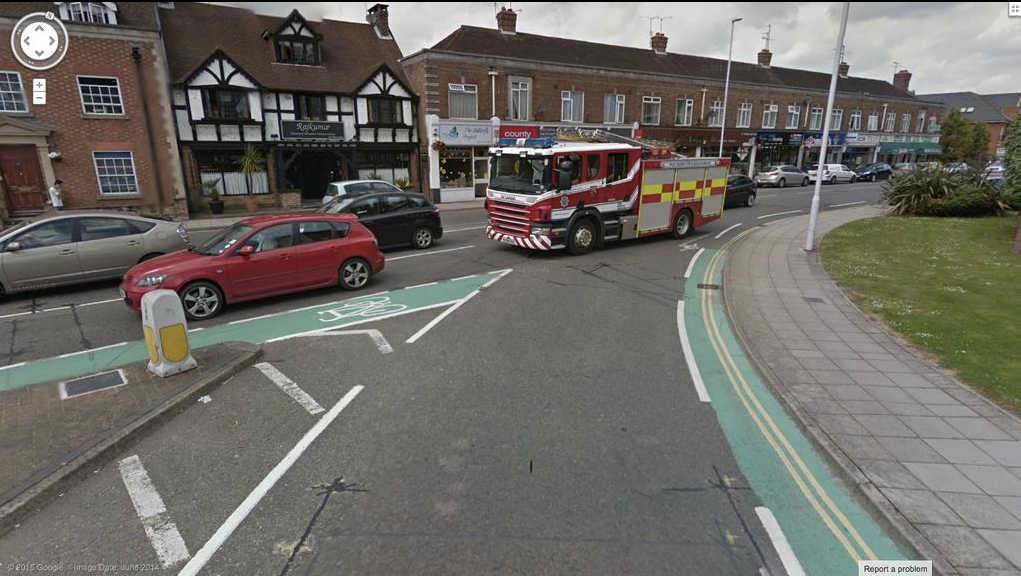
This shouldn't just make cyclist's blood boil. Not only is at best unusable and at worst downright dangerous, it's also a complete waste of tax payer's cash; something we are frequently reminded is in short supply these days.
However Horsham is not alone in splashing the cash (and the paint) around. Here's a shot I recently took in London's shiny new Olympic Park. This road layout is little more than a year or two old, and yet contains poorly painted sub-standard bike lanes which really help no one and serve no purpose:
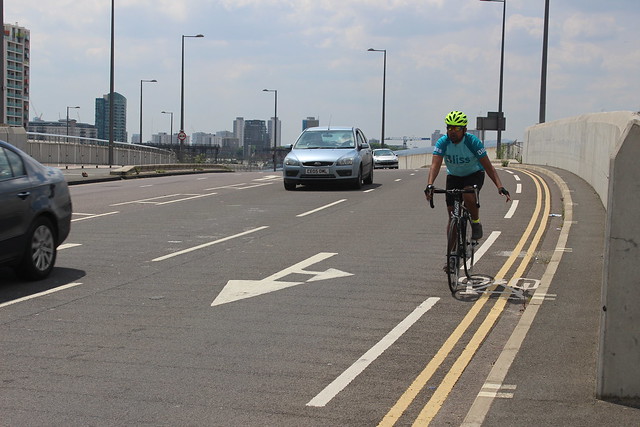
There's a faction of cycle advocates who would say it is not worth asking for cycle infrastructure at all, because all you get is nonsense like this. I can empathise with their position - the internet is filled with pages and pages of examples just as bad as this (or worse).
I've argued before that you need three things to make successful cycling cities:
- Political Will
- Money
- Design knowledge
And in the above cases I would strongly argue that it is the latter - design knowledge - which is lacking. There are plenty of road engineers out there who don't have a clue how to accommodate cyclists in their designs, but there are plenty more who would like to do so but are nervous from straying from the manual.
In UK road design circles innovation cowers in the shadow of liability, perhaps understandably when you consider that it is people's safety potentially at stake. As a consequence most of the space between buildings is filled in like a "Paint by Numbers" picture, fitting in whatever the manual says is appropriate.
Busy road with lots of vehicles? There's a pre-defined solution for that.
Quiet cul-de-sac with heavy pedestrian activity? There's a pre-defined solution for that, too. Call it "tick box urbanism", if you like.
The trouble is that most streets take a few years to get from the drawing board to reality, and in that time I would argue the aspiration of cycle campaigners has evolved whilst the guidance has struggled to keep up. In just a few short years in London we've gone from a situation where campaigners (and campaigns) could not even decide whether they wanted cycle provision or not, to a much broader consensus with far more ambitious aims. The London Cycling Campaign and others are now asking for - and getting - high quality, European-style separated infrastructure.
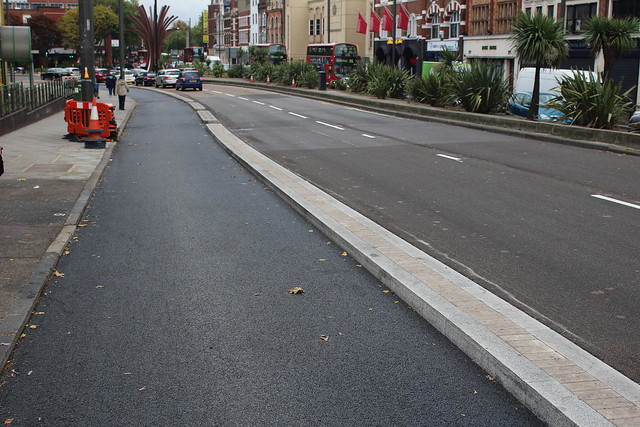
How wide do you want your spanking new bike tracks?
Transport for London have been quick to get their design skills up to date (see the Cycle Superhighways proposed for central London and the construction work currently ongoing around the Oval) whereas some of our local borough authorities are much further behind the curve.
And here's the trap. For those behind the times who are still following guidelines to the letter, there's a real policy lag. As has been remarked elsewhere, not all of the guidelines designers and engineers are employing are particularly effective at prescribing environments suitable for cyclists of all ages and abilities. Whilst there has been much in recent years to help make streets more attractive, there has been less about improving the actual subjective experience of riding a bike.
This policy lag - the inability of the paperwork to keep up with the aspiration - will ensure that for every fantastic new cycle track built over the next few years there's going to be plenty of crap, as well.
Further reading:
Rachel Aldred: what's wrong with place and movement hierarchies?
As Easy As Riding a Bike: when will design guidance think of cycling as something for all?
A View From The Cycle Path: 3 types of Cycle Safety
Share
Divine David Christmas Masterclass [ 25-Dec-14 12:14pm ] Cutting Edge - Comrades (Militant Liverpool documentary, 9 November 1992) [ 23-Dec-14 12:06pm ]
You're invited to the CycleLove x ibikelondon Christmas Ride [ 04-Dec-14 8:30am ]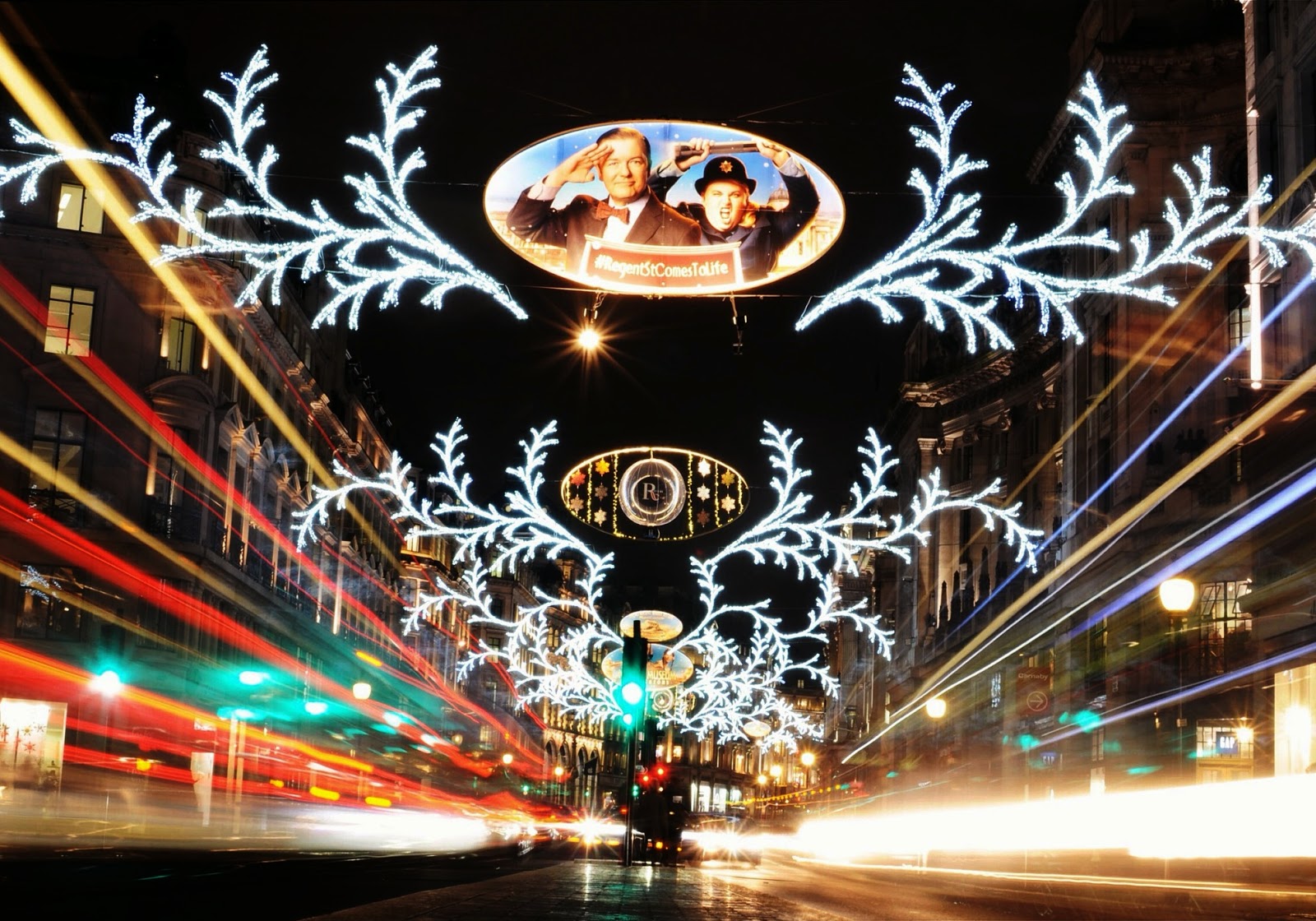 Regent Street Christmas lights, by Tom Payne with thanks.
So join James from CycleLove and me, Mark from ibikelondon, for a festive lighthearted spin around the seasonal lights and sites of London's West End on Thursday 18th December. It's a chance to get in to the Christmas spirit, celebrate the success of the year and to catch up over mince pies and a beer or four with friends old and new.
After an incredible year of the most stylish cycling reportage and one amazing summer adventure by Boris Bike, CycleLove is coming to a close very soon so this is a good chance to say "chapeau" to James in person. And after a year of relentless cycle campaigning I'm looking forward to having a fun night out on my bike that simply celebrates the best way to get around town, in the company of like-minded cyclists.
Setting off from Look Mum No Hands on Old Street at 6:30PM we'll see the Norwegian Christmas tree in Trafalgar Square, the twinkling white lights of Long Acre and the beautiful illuminated Peacocks of New Bond Street. We've devised a special route that packs in maximum Christmas dazzle for your seasonal delectation, so wind some fairy lights around your bike frame, don your best Christmas jumper, and I'll bring the playlist of cringeworthy Christmas tunes. After taking in the sites on our easy and steady-paced ride we'll return to Old Street for drinks and to see out the night.
Hope to see you there!
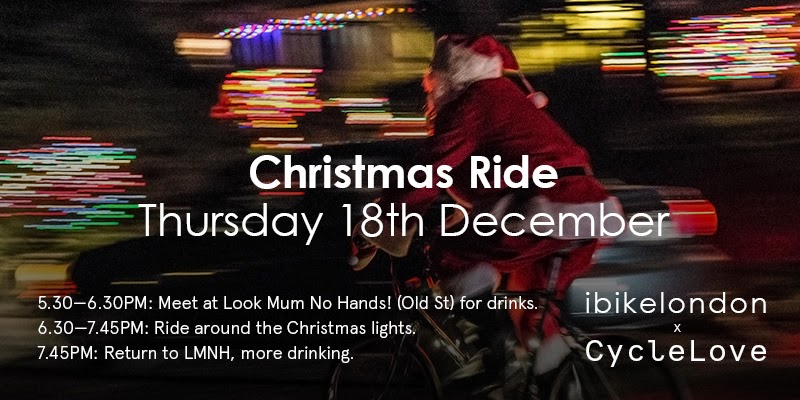 CycleLove x ibikelondon Christmas Ride
Thursday 18th December 2014
5.30—6.30PM: Meet at Look Mum No Hands! (Old St) for drinks.
6.30—7.45PM: Ride around the Christmas lights.
7.45PM: Return to LMNH, more drinks.
Bikes of all style and riders of all abilities are welcome; just let us know you're coming on the Facebook event page.
Got a question? Ask James or me on Twitter: CycleLove or markbikeslondon
Share
Field of Dreams. [ 30-Nov-14 8:50pm ]
Contains nothing but spoilers!
There's lots of impressive things about Christopher Nolan's Interstellar and to a degree it made me want to go back and re-watch some of his earlier films and think more about his recurring obsession with time (plus the frozen planet is highly reminiscent of his second movie Insomnia, which I hardly remember at all.) It's certainly all very clever, as you would expect, and technically accomplished but as per usual with Nolan you're left wondering why the political vision of the film is in comparison so abysmally lacking.
The earth is running out of food due to The Blight, but despite this armies have been abolished. Oh aye? That seems unlikely. No ongoing resource wars then? No rich people stockpiling grub, no warlords sitting on top of dwindling fresh water supplies? Nope. But there is a benign secret NASA project to get man off the earth, this is despite the seeming loss of the questing American frontier spirit, as embodied by Cooper a last Man among Last Men, and his feisty daughter Murph, who gets into a fistfight over liberal revisionist histories that portray the moon landings as a hoax to sucker the Ruskies into a ruinous space race. Green liberals, here schoolteachers, would have us wallow in the dirt as farmers rather than head for the heavens, worrying all the time about squandering the world's last precious resources when the earth should really just be viewed as something we use up in order to get out into space, fulfilling our godlike destiny among the stars. So essentially, in this film the world's environmental problems are just absolutely insoluble but travelling through a wormhole into different dimensions then ultimately transporting the rest of humanity there, perfectly do-able.
Brand, the head of the NASA project has told a "noble lie" there is no plan to ship earthlings out, but to repopulate the new planet from scratch with some frozen embryos. Brand couldn't tell the humans this, they would never agree to go if it didn't mean rescuing their own loved ones and so have had to be tricked into it, sheeple that they are, though from a genuinely, scientifically disinterested perspective, why is the continued existence of humanity as a species of any importance whatsoever, unless, as the Nolans obviously do, you regard humanity as having some kind of transcendent value, to, in effect, be the meaning of the cosmos itself, not merely the human as the integer of all existence, but specifically the ruggedly individualistic, American male, cornerstone of the divinely ordained American family, with his love for his daughter and his powerful will, embodied in his unbreakable "promise" a force powerful enough to shape and bend all of time space to his ends. Better this than sitting quietly alone, waiting for the end, eh? Ah, man and his pathological sense of dignity!
And here lies the heart of Interstellar's deep conservatism, remorseless natalism and nostalgia. Possibly the reason Cooper is so desperate to get those surviving on earth off planet is so that they can continue the great American project, maintain the sacred order of property, family, and tradition. The first thing Cooper sees on awakening in the space station at journey's end is some kids playing baseball outside his window in a dustless facsimile of 1950's USA. Paradise restored! Who knows, a whole load of awoken embryos might have decided to do it all differently?
But then again of course, being human, they couldn't. We might plunge through the event horizon and wind up in a five dimensional Tesseract, but that other horizon, a life beyond home and family, beyond the inevitabilities of reproduction, property, the grand kids at your deathbed, the couple, and that couple best expressed as love between a straight man and woman ( though in this the woman's love, rather girlish and not to be trusted, leads them almost into doom, whereas Cooper's love for his daughter is the force that ultimately saves us all), that horizon, internal, genetic, hard wired is impassable, breaching that, unthinkable.
In this respect Interstellar is just another conservative vision of American Renewal, a highly unlikely prospect that requires all kinds of increasingly epic torsions of time-space to seem faintly credible. One day, on distant stars, we will sit swilling beer on the porch with our robots, secure in the knowledge that there was only ever one way to live, one form of life we were just bound biologically into, which reached its apotheosis and then presumably went out into the Universe like a great cancer, strip mining and devastating everything it found, humanity metastasising identikit McMansions into the cosmos's deepest folds.
This is almost certainly Elon Musk's favourite film eva.
Friday Throwback: would you let your kids ride this bike? [ 28-Nov-14 8:30am ]It's nearly the weekend, which means it is time for another in our occasional series of Friday Throwbacks, looking at the best images of bicycles and cyclists from days gone by which have been uploaded to the Flickr Commons.
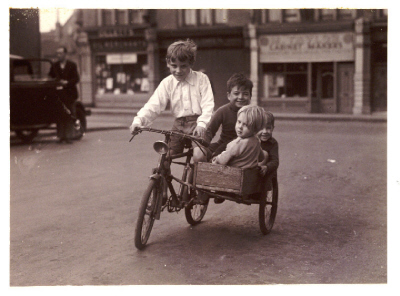
I'm all up for children's freedom, and despair at what indoor and restrained lives kids today lead, but even I am not sure if I'd let me kids ride this bike around town... Still, it looks like they're having a great time, doesn't it?
This photo is via the National Media Museum, who host a wealth of historic photographs online.
Whatever your cycling plans this weekend, whether two-wheeled or three, be sure never to miss another post from ibikelondon again! You can join the conversation on Twitter or follow our Facebook page. Happy cycling!
Share
# [ 27-Nov-14 11:16pm ]http://repeaterbooks.wordpress.com/
 #
# [ 27-Nov-14 11:17pm ]
#
# [ 27-Nov-14 11:17pm ]http://repeaterbooks.wordpress.com/
#
Public Service Announcement [ 27-Nov-14 11:15pm ]http://repeaterbooks.wordpress.com/
# [ 27-Nov-14 11:37am ]Looks like this has a publication date of 27th of March. It's "Holding out for a hero" retitled. Phil and I will attempt a promotional pub session for this and "Strangled" around the time. You are all invited.
Massive thanks to Owen Hatherley for converting it from a blog to manuscript form.
 #
What next for London's Cycle Superhighways? [ 26-Nov-14 9:24am ]
#
What next for London's Cycle Superhighways? [ 26-Nov-14 9:24am ]The official consultation on the Mayor of London's ambition to build two new separated Cycle Superhighways across the city has come to an end, but those who are against the plans are still making their case strongly behind closed doors.
Transport for London received over 20,000 consultation responses, one of their highest response rates ever. Of those, approximately 80% are said to be in favour. Transport commissioner Sir Peter Hendy has hinted that TfL will listen to all concerns raised, and will publish revisions to their designs in approximately two months "that will work for everybody."
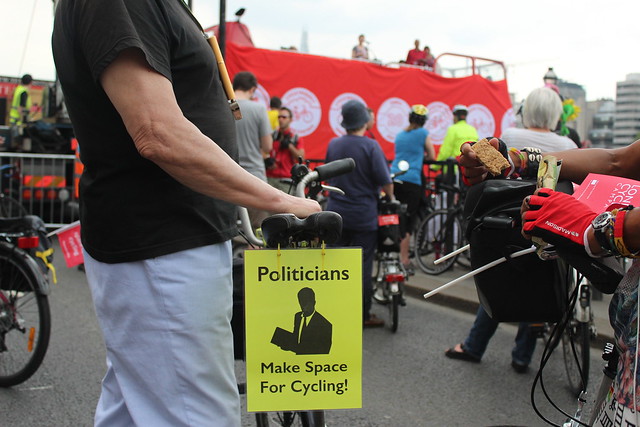
Cyclists make their concerns known in May's Space4Cycling protest.
Talking with the Evening Standard's correspondent Matthew Beard, Hendy said:
"One of the characteristics of this is that it's highly emotional. I think the support for the scheme from the cyclists and the objections from the businesses are both heartfelt. For one side to represent that the other has no case is false."
However Chris Kenyon from CyclingWorks.London has been quick to point out that it is not accurate to portray the debate around the cycle tracks as one just between cyclists and business leaders:
"Rarely if ever has a scheme by TfL gathered so many CEO level signatures of support. Surely that is the big story. The backers represent every major industry sector and show that Londoners are in it together and believe that it's time for kerb protected lanes in the heart of the city."
When the consultation closed at the weekend over 160 city businesses, institutes and organisations had written to Transport for London expressing their support for the Cycle Superhighway plans. Support has continued to roll in past the deadline, including that of publishing group Pearson who employ over 4,000 staff, many of who cycle in London.
Whilst London Assembly member Kit Malthouse was busy last week telling the Mayor his constituents were desperate for the Cycle Superhighways to be extended through his borough, opposing forces were working to undermine the plans.
The London Chamber of Commerce and Industry has proposed that the cycle tracks should be narrowed and only 'partially segregated' from traffic, allowing other road users to utilise the same space as cyclists. A similar system operates for the existing Cycle Superhighways which have seen an increase in cycling numbers but have been roundly criticised by campaigners following a series of deaths on the routes.
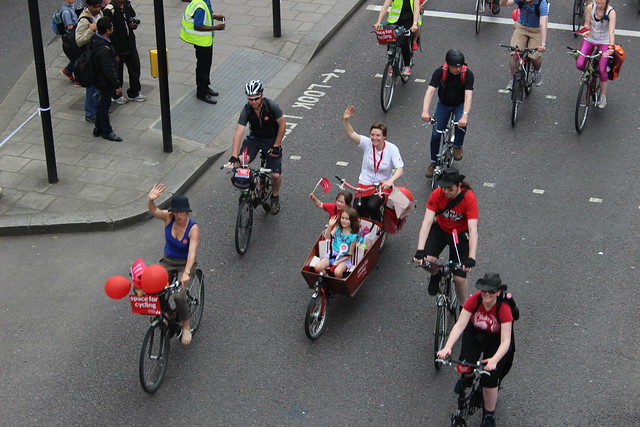
Cyclists take over part of the proposed route of the east / west Cycle Superhighway.
Meanwhile lobbyist Howard Dawber, Strategic Adviser for the Canary Wharf Group, is clear that they believe the Cycle Superhighways will lead to unacceptable traffic congestion in east London. He would do well to talk to academic and modelling expert Dr Rachel Aldred who goes in to detail on her blog as to why he needn't worry about the 'worst case scenario'. Detail aside, the Canary Wharf Group is not an opponent the cycling community can afford to underestimate; they have unprecedented access to influential ears and a lie - or a badly researched briefing document - will get half way around the world before the truth has got it's shoes on...
All this is set against the backdrop of more consultations on further significant changes planned for London's road network; on revisions to Cycle Superhighway route 5 through Oval and Vauxhall, at Archway Gyratory, at Stockwell Cross, and plans to remove the Old Street roundabout.
Those who were around for the Battle of Blackfriars just a few short years ago will remember how cyclists had to fight and fight just to stop cycle lanes being ripped out in order to "maintain traffic flow". It would seem that some elements of Transport for London have come a very, very long way since then.
But when it comes to winning over the rest of London - most especially its most influential interests - we can't afford to rest easily just yet. Watch this space.
Think tank the Centre For London are hosting a debate on the 10th December; "Are Cycle Superhighways good for London?". The Mayor's Cycling Commissioner Andrew Gilligan, CyclingWorksLondon's Chris Kenyon and Canary Wharf Group's Howard Dawber will all be there. Register to attend here.
Share
English Fields. [ 20-Nov-14 12:22pm ]In Kill List the country is divided between the killers, trapped in awful marriages, up to their eyeballs in debt, desperate to hang on to their suburban new builds, their victims: the marginal, denizens of a grey, wintry edgeland of damp basement flats, lock ups, factories and industrial estates, and the cultic higher orders, whose arcane practices and rituals are as ancient as their hold on power.
Marriage is a battlefield, kids are collateral damage. Friendships may erupt into violence at any moment. Work is a series of bloody tasks carried out under the auspices of vastly powerful forces with whom one wittingly or otherwise has signed a blood oath, the exact nature of which is deeply uncertain. Everyone, even your own partner, regards death as a merciful release.Your complicity in your own destruction is the only thing that is guaranteed.
In this sense Kill List is the first great film of Austerity Britain.

The damaged veteran finding ways to readjust to and deploy his skills on Civvy street is a common recent theme in British film, but there's nothing noble or sympathetic about Jay and Gal. Nor do they have that surplus of confidence, the familiarity with violence and the rugged self determination that often makes the demobbed squaddie a hero figure. In fact they lack agency and soon become fearful of what they have got themselves into. In Nick Love's Outlaw, the returned soldier raises a vigilante gang to combat The Establishment, but in Kill List they continue to be its pawns.
There have been all kinds of heated theorizations about how and if Kill List's elliptical and allusive narrative ties up. But Kill List is less interesting for what it means than what it does, enacting a violent rupture with and within its genre conventions, bringing the British Gangster movie under pressure from two directions, Loachian realism and Gothic horror. Only hammering these two seemingly irreconcilable forms together can adequately get at the texture of the moment: cold dread, incomprehension, the sense that things are out of your control, your life is not your own.
We are a long way here, from cheeky London-centric capers like Lock, Stock and Two Smoking barrels. This an England which, during the pomp of the post-historic and classless 90s and Noughties had been banished, never to return.
Food Bank Britain, ATOS Britain, UKIP Britain, with its endlessly declining pay, rising rents, spiralling debts. Home to the nine poorest areas of northern Europe as well as its single richest. A country riven by a series of fantastical, overlapping revelations, phone hacking, financial manipulation, VIP paedophiles, police corruption. A nexus of vested interests intent on occulting and exculpating it all.
To be plunged into such a world, such a crisis, to have a set of prior assumptions whisked away, is disorienting, disturbing, nerve-jangling, the pieces can't yet be fitted fully together, something terrible is happening, has perhaps always been happening, History has returned in all its devastating, vertiginous enormity, not, or not yet at least as the continuation of a progressive project but as a nightmare.
The film was shot in Sheffield, the setting for one of Ben Wheatley's favourite non-horror horror films, the harrowing nuclear attack docu-drama, Threads.
In an interview for a A Field in England Ben Wheatley suggests that it should be thought of as a prequel to Kill List. Loathe as I am to disagree with the director's assessment of his own work, I am going to suggest that the reverse is true. That Kill List, a film about the present, can't help but be about the past. A Field in England, though it's set during the civil war is really a film about the future.
If there is an initially terrible, traumatic return of history in Kill List, history as the piling up of disasters, trauma on trauma, the evil plan of the establishment, the Illuminati, the dark ones unfolding. In A Field in England a countervailing set of societies, movements, and organizations is evoked, the history of the long struggle for liberation. There is some corner of an English field, that is forever foreign, committed to experiment, to rejection, to turning the world upside down, pushing toward the new, and the film itself, with its baroque stylization and breathtaking formal boldness, maintains fidelity to this tradition as it invokes it.
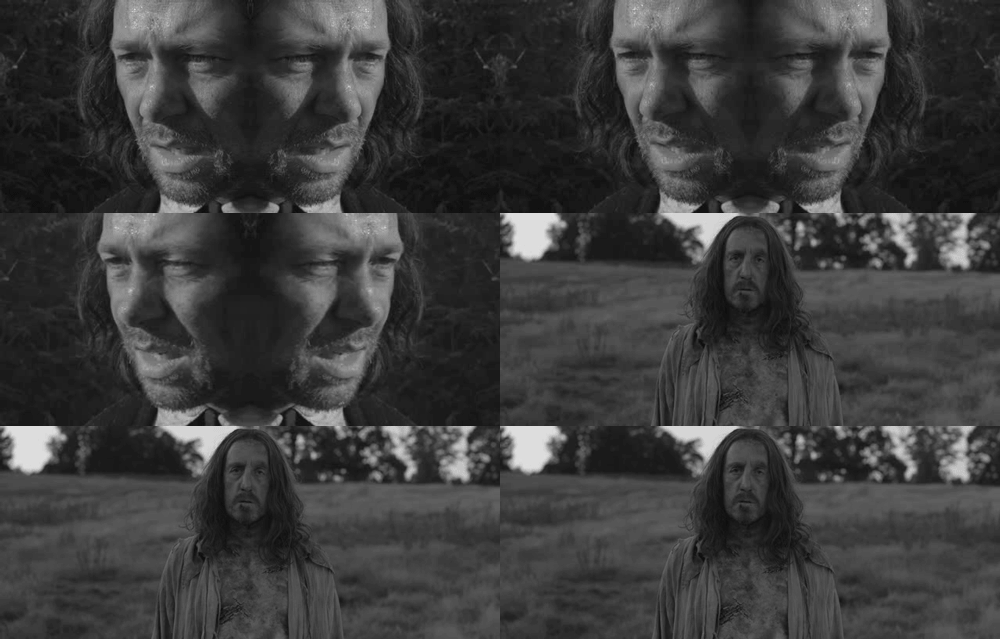
Again the film deals with soldiers, conscripts, rather than professionals who exit the civil war, enter a different field and decide to strike out together to look for an alehouse. This though is a ruse and they are dragooned instead into a treasure hunt. After a few brief moments as masterless men they are again set to work. "I am my own man, I am my own man" Jacob repeats angrily as he digs for treasure at gunpoint.
Whitehead's story could be the drab, reactionary tale of a cowardly intellectual who through learning to kill becomes more-than-human, somewhat like Dustin Hoffman's character by the end of Straw Dogs. But in seeking to return to his master and fullfil his task in a repeat of the films opening point of view shot as he plunges through the hedgerow, he is instead returned to the field and finds Friend and Jacob reborn and silently waiting. The final shot is a tableau of the three men, memorialised, charged with an eerie significance.
The inability to escape from a particular location, with all the narrow, winding roads leading you eventually back to doom, is a trope of rural horror, a spacialization of circadian, rural rhythms, the modern progressive man, rider of times arrow fallen into the vortex, we might say, given that Peter Strickland's superb Berberian Sound Studio deals with similar themes the Equestrian Vortex, of deep time. But here it is used to different, more optimistic ends.
From the flux and chaos of the battle, from their repeated deaths and rebirths, from their having travelled as far into and out of themselves as its possible to go the men have been transformed. Whitehead is now caught up in a particular social field, a particular set of relations. Toward the end of the film Jacob tells him that all along the true treasure was here between them. They have become masterless, finally, not through some abstract notion of freedom, nor by slipping away through the hedgerow, but precisely by staying within the field, altering their relation to it, their relation to each other. Here it is a field, but it could a square, a street, an estate, a nation, a world. This is a process, an alchemical process, which we might call comradeization, in which they no longer are "their own men", but of and for each other.
In this way the film is not just of a piece with the neglected films of the 60's and 70s regularly tagged as influences, from Witchfinder General to Culloden, from Winstanley to Blood on Satan's Claw but also with more trenchant, overtly politicized treatments of the theme, Peter Hall's Akenfield and Bill Douglas' Comrades.
In returning to the past, to the Civil War and its role in accelerating enclosure A Field in England returns us to the problem of ownership, the commons and land rights, something previously considered to be an issue mainly for indigenous peoples in the developing world. The term re-peasantization is used now to talk about the movement of the young unemployed in Spain, or Greece out of urban centres.
When the city can offer us nothing but precarious employment as servants of the rich, it's not rural but urban life that begins to look like the idiocy. A Field in England reminds us that the countryside is no idyll, is as much an arena of power and conflict as anywhere. Who knows but that groups of radicals returning to the land, as they have periodically, will find themselves in solidarity with rural workers, against the ancient estates and the group approvingly identified by the Telegraph back in 2004 as the new squirearchy of our neo-feudal times.
But A Field in England is also cut from more millenarian cloth, imbued with other, longer range fantasies and fears. Finally, when all social relations breakdown, when the end comes, when the credit dries up and the oil runs out, when the waters rise or exotic diseases decimate the globe and Malthus has the last laugh, we will be obliged to return to the land and the great cycle will be complete.
In Threads, Ben Wheatley's favourite non-horror horror film, after the bitter decade-long night of the nuclear Winter has passed, rudimentary communities spring up again to till the soil that, momentarily at least, has been returned to them.
It has taken a war to get them there.
Is this London's most extreme bike ride? Danny Macaskill gets in a spin... [ 20-Nov-14 12:26pm ]It's not every day you get invited on a mystery tour, to witness what was billed as "London's most extreme bike ride". Planning the launch event for their virtual personal assistant, Cortana, Microsoft had been in touch promising thrills, spills, and world-famous trials bike rider Mr Danny Macaskill. Needless to say, I was excited!

Danny's stunt was kept under wraps right until the last minute, and the excitement built as darkness fell and we cruised up the river Thames on Wednesday evening. Everyone assembled on board snapped pictures of London's most famous landmarks as we neared our destination.
As the London Eye came in to view, so did a barge floating in the middle of the river with a massive slope and loop-the-loop built on top. What was about to unfold became clear, and I was blown away by just how epic the night was turning out to be.
Danny's London stunt is just another string to his bow, following the enormous success of his online videos including the most recent (and I'd argue best) film, The Ridge, which has already been viewed over 20 million times on Youtube.
Apparently Microsoft's Cortana acted as Danny's personal assistant throughout his training for the event, arranging his meetings, setting appointment reminders, playing his favourite music, warning for bad weather and finding maps.
He explains; "A career as a professional athlete can be quite hectic and as I prefer to spend as much time on my bike as possible - any help in organising meetings, travel plans and projects is great. This is one of the biggest set-ups I have ever ridden and the location is amazing. To have a five-metre loop floating on a barge is something surreal. I always look for new challenges and the chance to ride this massive loop with the help of Cortana is another achievement I can be proud of."
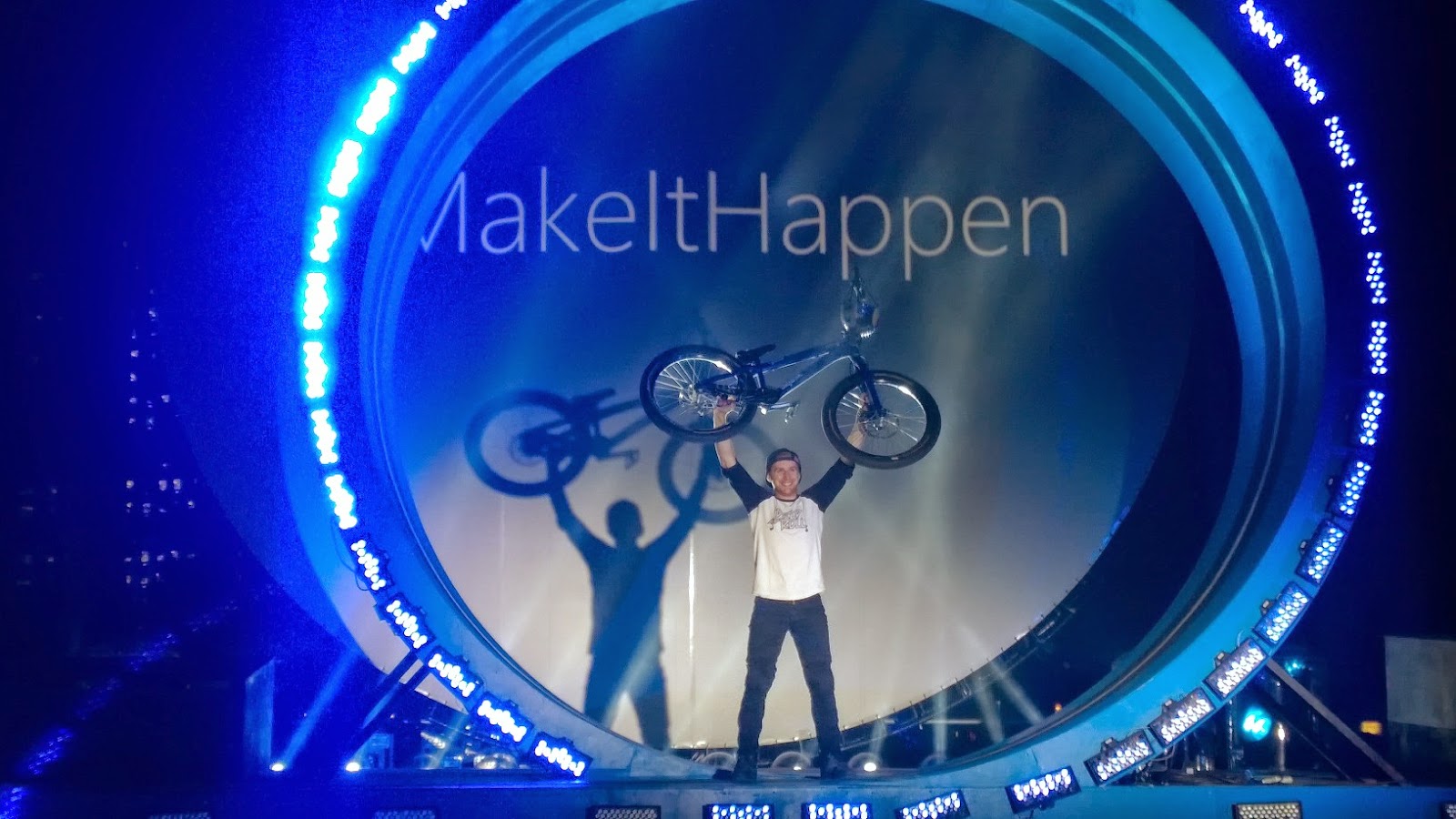
Our boat moored by Victoria Embankment, putting Danny's loop in line with the London Eye. As the crowd waited eagerly, I can't imagine what would be going through his mind. Was he nervous? What if he fell? Would he over-shoot the slope and end up in the river?!
If Macaskill was nervous, he certainly didn't show it. With a quick spin and a hop suddenly he was off, gathering speed on the steep slope before whizzing around the loop, then delivering a perfectly executed backwards wheelie on his front wheel.
The crowd (which I noticed included trails pioneer Hans 'No Way' Rey) gave him a huge cheer, and it was all over too soon.
Riding a bike along the river Thames usually involves dodging lorries and massive pot holes, and there's been lots of talk recently about the idea of building a floating bike track down the middle of the river. That's fine by me, just so long as it includes a 5 metre high loop the loop so we can all have a go!
Many thanks to Microsoft's Cortana for a great evening!
Share
The SMIDSY-killing cycling jacket; we road test the dazzling Reflect360 [ 12-Nov-14 8:30am ]We're often approached by companies interested in sharing their latest cycling "innovation" with us. From gloves with built-in indicators, to cycling jackets with special pockets for storing a pizza, we've really seen it all. So we were pleasantly surprised when a company got in touch claiming not only to have made the most reflective cycling jacket, but that it also started life here in London...
The REFLECT360 cycling jacket does exactly what it says on the tin; it reflects light back to other road users from every angle. It's not just got a reflective strip or some shiny striping, the entire jacket is reflective, from top to bottom.
I have my own reservations about 'safe' cycling wear, having started out my urban cycling career wearing a bright yellow builder's vest I grew to loathe. But I've been pleasantly surprised by the REFELCT360 - here is a cycling jacket designed around safety features that you can actually wear in to the office or the pub without looking like an epic banana.
I spoke to the founder of ProViz, Anthony Langly-Smith, to find out what inspired him to create the jacket: "I'd been commuting by bike for about 12 years, and I was seeing lots of people going through Clapham up to London Bridge - on what is now the Cycle Superhighway route - and when I was at the traffic lights I would see three or four other people on bikes. Now there are 30 or 40 people at every turn of the lights. Unless you're actually there you can't quite fathom what a big change that was."
"At the same time there seemed to be a move away from cycling products that didn't just look like builder's jackets. People wanted fitted stuff, waterproof stuff. It started with me and my brother thinking about what our fellow cyclists might need on our commute to work, and has turned in to our business; now we're selling product in Chile, Colombia, China, Korea, Belgium, Denmark, Australia and New Zealand."
Anthony's latest product to come to market, the REFLECT360 range, has been garnering lots of interest with positive reviews on BikeRumor, the Evening Standard, and the Guardian among others. I found it was not just in reviews that this jacket got lots of attention; during our road test other cyclists came up to me at traffic lights to ask where it was from and where they could get one for themselves, astonished by the reflective quality now the nights are growing dark.
"We launched the jacket in February and suddenly we had so many people coming to talk to us, taking photos, wanting to know about the material, wanting to know how this product came about. It was astonishing. The success has bred an entire line; a rucksack cover, a vest, a gillet and a children's jacket."
So what about the jacket itself? How does it work, and what's it like to ride around town in?
The waterproof material is covered with thousands of tiny microscopic glass beads which reflect light, throwing back light that approaches it from any angle. The jacket itself is a well constructed design for cyclists, with taped seams, waterproof zips and pockets, a longer tapered back for good positioning on the bike as well as lots of adjustable seams and flaps to increase or decrease its breathability. It feels strong and sturdy and should last well.
Riding around town I found the jacket fitted well, performed brilliantly in the rain and stood up to everything London's mucky roads could throw at it. Whilst the material is a touch on the warm side, the addition of under arm vents helped me to keep my cool. I'm usually highly sceptical about the sort of claims made about these kind of products, but my reservations about the effectiveness of cycling "safety" kit evaporated too - I did feel noticeably more visible whilst riding around town in the jacket, and I think it would be invaluable on darker country roads.
London's cycle scene inspiring products which in turn help London's cyclists to feel more safe? We like that very much.
The REFLECT360 cycling jacket is available at Evans Cycles, Halfords and most good bike shops, or online directly from ProVisSports here.
Share
With 48 hours to go, your voice counts! If you do one thing for cycling this weekend, do this... [ 07-Nov-14 3:08pm ]You need to send an email to consultations@tfl.gov.uk by Sunday night saying why you want London's new Cycle Superhighways to be built. Doing so is really important and a chance for you to actually make a difference to London. Read on to find out why...
It's been a fast and furious few weeks in the cycle campaigning world, with lots of behind the scenes activity and meetings trying to get as many people as possible to signal their support for the Mayor of London's hugely ambitious "Crossrail for Bikes" cycling plans.
As most of you know, there's been some very cloak and dagger lobbying by some business interests who are desperately trying to kick the plans in to the long grass. With a Mayoral election coming up, delaying these plans means they risk not being built at all. And now there's just 48 hours for you to contribute and make a difference...
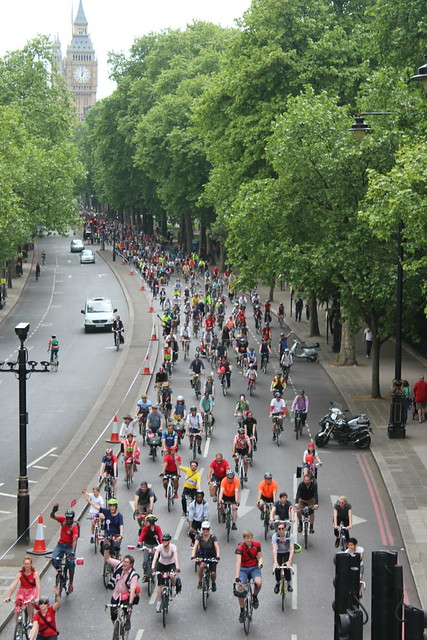 Space4cycling protestors travel down the Embankment, the route of the proposed the east / west cycle superhighway.
These Cycle Superhighway plans are from being won. There's bad news to come with Westminster Council proposing all sorts of mad ideas like painting bike lanes down the middle of the Mall as some sort of Cycle Superhighway alternative. In short, they'll do anything to avoid having to address the sinful cesspit of shame that is the current state of Parliament Square, where the route is currently planned to go. Later today (Friday) the CBI will submit their response to the consultation. I've seen a draft and I'd be charitable if I were to say that it is hopelessly outdated in its approach to how cities really work.
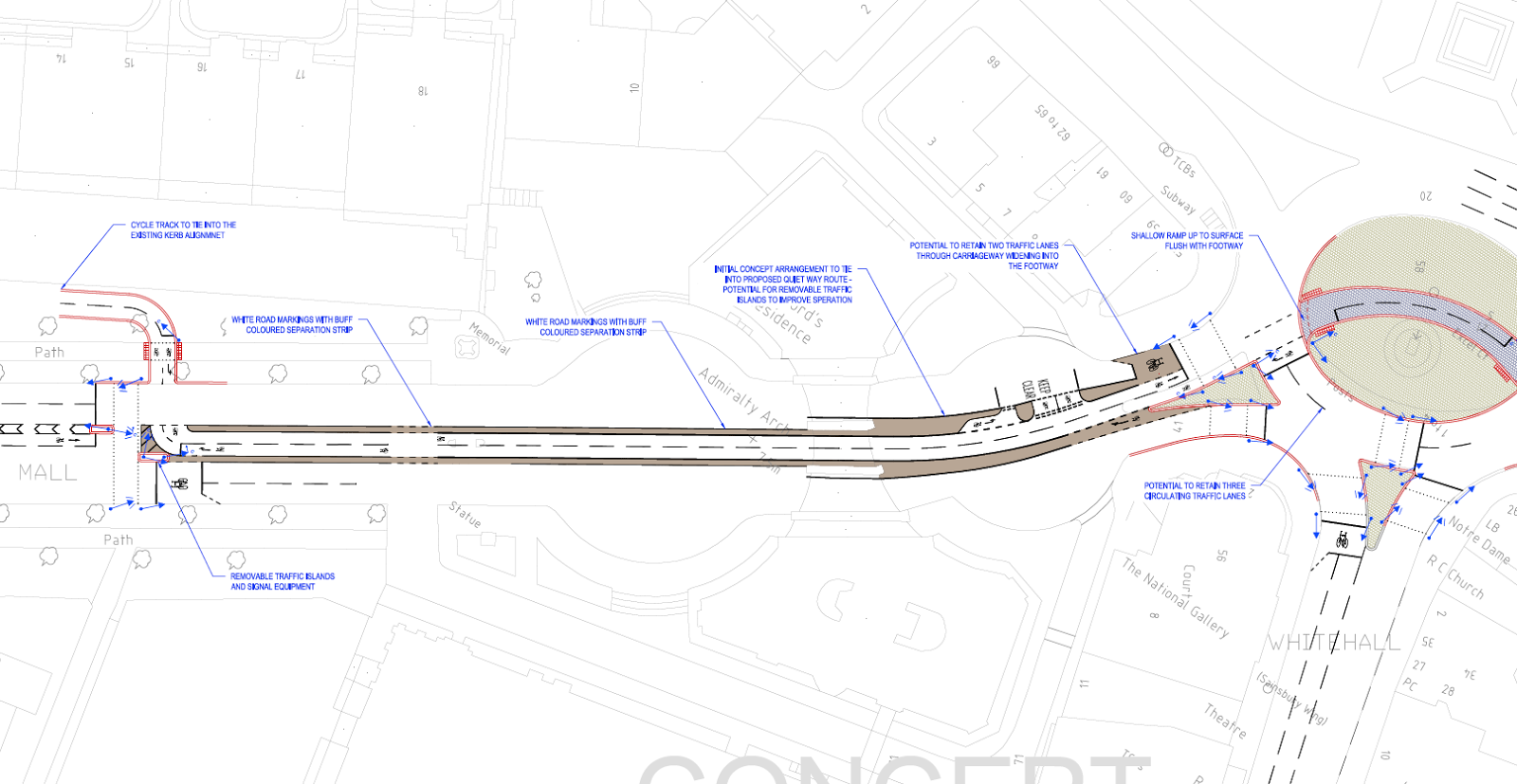 Westminster's bonkers plans to send cyclists down the middle of the Mall with fast moving traffic either side of a painted strip.
 Of course, this late flurry of negative attention is not a mere coincidence. With 14 cyclists killed on London's roads in 2013, six in a two-week period this time last year, no-one wants to be seen to be publicly saying they *don't* want to see improvements (real improvements) for people on bikes. So in a classic lobbying tactic these last minute submissions are coming in right on the line in the hope that everyone will go home for the weekend and not notice the "against" voices quietly doing their thing.
It sounds so sinister, doesn't it? Like some kind of crazy conspiracy theory. I'm fully aware of this, but this is the score with lobbying in London it would seem...
Luckily, the wider business community in London is much more enlightened. CyclingWorks.London have been collating positive responses from organisations to the Cycle Superhighway plans and they've been inundated - almost overwhelmed - with businesses saying "Yes" and "Build it, Boris" to these plans. This week alone the University of Central London, the English National Opera, the Civil Aviation Authority, the City of London Police, Universal Records and many others have piled in with their support, joining Microsoft, Unilever, Deloitte, the Royal Bank of Scotland, Olswang LLP, Herbert Smith and many, many others.
 Just some of the very long list of business names who support the Mayor's Crossrail for Bikes.
The devisions between those "for" and those "against" led Evening Standard journalist Ross Lydall to go so far as to say there was only a "50/50 chance" of the Cycle Superhighways ever being built.
And with the consultation plans closing on Sunday, now it is your turn to get involved. If you can find twenty minutes to add your voice as a London cyclist, then you'll have strengthened the chances of these ambitious bike tracks being built and the Mayor delivering on his "Go Dutch" election promises.
You can go through the step-by-step consultation on the Transport for London website, which you can find here.
Alternatively, you can send an email to consultations@tfl.gov.uk with the subject matter "East West and North South Cycle Superhighway consultation" with you own comments.
Perhaps you want to explain how you'd like to bring your kids in to town by bikes safely? Or maybe you are particularly excited about a certain section of the route and the wider calming impacts it will have, like at Parliament Square?
Maybe you work on or near the route and this will make your commute to work a safe and inviting option all year round?
Perhaps you have other reasons you'd like to see these routes built; maybe you voted for the Mayor on the back of his "Go Dutch" promise?
Maybe you'd like to send a note supporting the broader concept, or perhaps you love a particular part of the scheme like a certain road closure or safe space for cycling where currently there is none. You can make critical suggestions for improvements too, of course (I've asked TfL to ensure they use angled curb stones to make sure cyclists can use the full width of the lanes.)
The point is, the agenda is set by those who show up and now more than ever before we need the real voice of Londoners to be reflected in this consultation.
So please, take the time to pen a note to Transport for London this weekend and help to make the city where we live a better place for everyone.
Share |
# [ 29-Oct-14 12:05pm ]The stars aligning, the moon entering its fullest phase ... #
# [ 09-Oct-14 12:29pm ]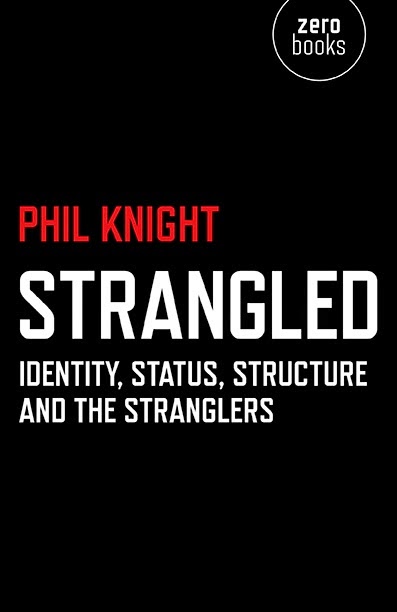 # [ 25-Sep-14 11:42pm ]
# [ 11-Sep-14 6:01pm ]
New blog [ 31-Aug-14 12:33pm ]
# [ 25-Sep-14 11:42pm ]
# [ 11-Sep-14 6:01pm ]
New blog [ 31-Aug-14 12:33pm ]I'm going to start a new project on the films of Alan Clarke. It will be a blog at first [http://belovedenemies.blogspot.co.uk/] and then, who knows? His films have been obsessing me for a while, and there is very little out there about him or his work. So I thought I might as well write the texts I wanted to read etc.
As it goes on any feedback would be welcome.
# [ 31-Jul-14 12:35am ]#
DAVID HOCKNEY'S ART SCHOOL DAZE Part 25 [ 11-May-14 12:01am ]A FIGGING FOR HOCKNEY TEACHES THIS BDSM FREAK THE VALUE OF THINKING WITH HIS DICK!
At the start of their second year Kitaj was doing very well at the Republican College of Art. Hockney wanted to see whether he could make a better fist of the new term at the RCA than he had of the last. He began with a much better chance of doing so, for he was thoroughly humbled. The discovery that he was not altogether such a hero as he had fancied himself, had dawned upon him very distinctly by the end of his first year as the full depths of his masochism had been revealed; and the events of the long vacation had confirmed the impression, and pretty well taken all the conceit out of him for the time being. The impotency of his own will, even when he was bent on doing the right thing, his want of insight and foresight in whatever matter he took in hand, the unruliness of his temper and passions just at the moments when it behooved him to have them most thoroughly in check and under control, were a set of agreeable facts which had been driven well home to him. The results, being even such as we have seen, he did not much repine at, for he felt he had deserved them; and there was a sort of grim satisfaction, dreary as the prospect was, in facing them, and taking his punishment like a man. Or at least like a girl since he most enjoyed bondage scenes in which he was made to put on dresses and act like a member of the 'weaker' sex.
Kitaj was so fully occupied with painting and a muscle-building regime that he'd taken up, that Hockney had scruples about demanding much of his spare time in the evenings. Nevertheless, the two men still wanted to enjoy some kinky sex together, and were able to do so both at the RCA and in their rooms. On the first day of term Hockney checked out the new first year students and had even sucked one of them off in the men's toilet at lunchtime. He hoped Kitaj would hear about this and would punish him severely for it. And that was precisely what happened towards the end of that first day back at college.
Hockney stood in the corner of a lecture room, his hands firmly planted on the top of his head, muttering at the injustice of it all. He knew that Kitaj was strict, but he was in his early twenties for fucks sake, a post-graduate art student, and he had been standing with a view of nothing but peeling paintwork for the last forty-five minutes. Hockney heard Kitaj step back into the room and the blinds of the lecture hall fell, leaving only the glow of the lights.
"Boy, what did you think you were doing?" Kitaj's voice was harsher than before, Hockney could tell this time he was in for it.
The sub's response came out as a mutter: "Nothing, it was just a bit of fun..."
"Just what? A Joke? I'm sure that fresher's orgasm wasn't a sarcastic orgasm, was it?"
"No," Hockney was sulking by this time. He was being spoken to like a child, it had just been guys messing around in the john, a quick blow job, and now he was taking a heavy wrap for it.
"No sir, is how you shall address me Hockney! I see it is not just your submissive peers you treat with such disrespect but even your master. Come over to the lecture desk."
Hockney walked over to the most imposing piece of furniture in the room as Kitaj instructed. He lowered his arms from his head and gave them a little rub to improve their numbed circulation.
"They tried punishing you with lines when you were at school I presume?" Kitaj snapped.
Hockney rummaged in his bag with one hand, thinking how cruel it was that his position in the corner had made his arms ache before the hours of endless, repetitive writing.
"And writing lines didn't make an impact on you I see" Kitaj continued as he sat down in a chair behind the lecture desk, "So instead of getting you to write out 'I must not suck fresher cock' a thousand times, I want you to bend over this desk, and we will see if I can't beat some discipline into you."
Hockney jerked his head up to look at Kitaj, and was shocked to see he was done up like a tranny. Kitaj was wearing make-up and a low cut dress, not to mention a sick stern kind of smile that made it clear that he was on some strict school-mistress trip. He even had on long false nails that had been painted with purple varnish! Kitaj hadn't looked anything like this when he'd left the room. It was sick, in anyone else the way Kitaj was done up would have looked like forced feminisation, but the dom was able to carry it off and retain his aura of authority and masculinity. Still being beaten by a top wearing a dress was a new level of humiliation for Hockney.
Hockney took his time bending over the desk, taking in Kitaj's female scent - a perfume he was unable to name - as he leant towards him. Kitaj stood and walked round the desk and out of Hockney's line of sight. The apprehension the sub felt was nearly unbearable and although it could only have been a few seconds it felt like minutes had passed before Kitaj spoke.
"Hockney, earlier today you seemed to think it amusing to suck some boy's cock without my permission." This was clearly a statement, not a question, so Hockney kept his mouth shut. "I think it is fair that you shall drop your trousers for your caning"
Before Hockney had time to refuse to comply, Kitaj pinned the sub to the desk with one hand. Hockney felt Kitaj's body against his own and a strange sense of arousal came over him as he once again took in his master's feminine scent. Hockney was thinking he shouldn't be turned on by this, a master who has dressed himself up in a frock, plastered make-up over his face and drenched himself in cheap perfume. It was a new low in Hockney's sexual fetishism.
Kitaj practically assaulted Hockney. The sub felt one hand undoing his belt, removing it and then Kitaj used a length of rope to tie Hockney's hands to a hook on the other side of the desk, stretching him across the wood and pressing his cock against it. Hockney clenched his legs together determined that Kitaj would not remove his trousers, but Kitaj's strength was astounding, probably the result of all the weight training he'd been doing. Hockney's overpants were at his ankles, and Kitaj ordered him to step out of them, his smalls did little to preserve his dignity. Hockney snapped his legs back together, determined that Kitaj wouldn't see through to his cock, which was, much to his great pleasure, rock hard. The reason Hockney had a stiffy was because he was completely vulnerable. He clenched his butt cheeks tight together in anticipation of the cane.
"Boy, I am going to give you eight strokes for your cock sucking antics. You are to count them and if you miss one I will start again. If you try to avoid your punishment by squirming, I will start again. Don't give me a reason to make this worse boy."
Hockney heard the cane before he felt it. A swoosh through the air then a thwack as it landed on his clenched buttocks. The pain took a few seconds to register in his brain, being felt as a tingle before it became a sting, and by the time the sub fully appreciated this agony it was every bit as bad as he was expecting. Hockney clenched his gluteus muscles to help him control himself and stay still. "One, sir," then "two sir," almost immediately after.
Hockney wasn't ready for the second stroke, he tensed up just as the cane hit, and Kitaj saw that all of Hockney's gluts had contracted. As both Hockney and Kitaj knew the gluteal muscles are a group of four muscles. Three of these muscles make up the buttocks: the gluteus maximus muscle, gluteus medius muscle and gluteus minimus muscle. The fourth and smallest of the muscles is the tensor fasciae latae muscle, which is located anterior and lateral to the rest. Without Hockney even thinking about it all of his gluts had tensed. Indeed even Hockney's hamstrings had contracted.
"Hockney, why are you clenching your buttocks like that? Does the caning hurt too much or are you daydreaming that you are performing squats with a heavy barbell across your shoulders?"
The sub wasn't fooled by the mock sympathy in Kitaj's voice and didn't answer.
"Do you know, boy, what they did to naughty boys who clenched their buttocks during a canning in the ancient world?"
"No sir."
"Let us have a little history lesson then…"
Hockney felt Kitaj getting up close and personal with him, and then pulling down his skidmarked knickers. Hockney tried to struggle against Kitaj but it was useless, the top already knew Hockney didn't have the best hygiene habits in the world, and was often reduced to boiling his shit and piss stained underpants in a pan to get them clean. When he did this, Hockney always feared a knock on the door from his landlady Mrs Longbottom. She would scream at him and yell that she ran a Christian house in which no man was allowed to boil his underpants on a hot plate since the smell was an affront to the dignity of upright and moral women of all classes.
Just as he tried to hide his underpant boiling activities from Mrs Longbottom, Hockney hoped to hide the fact that he now had a raging hard on from Kitaj. The top's false nails scraped against Hockney's cock as Kitaj pulled the sub's skidmarkded underwear down. But the dom didn't mention the state of extreme sexual arousal the slave just happened to be in.
Hockney wobbled as Kitaj pulled one of his ankles towards the leg of the desk and tied them securely together - the operation was then repeated on the other side. Hockney was trussed up like a turkey at Christmas and hoping he'd end up just as well stuffed. The bottom was unable to move his arms or his legs, but he could still clench his butt cheeks together. He heard the clink of Kitaj's high heels on the floor and the door opening, but not shutting. He was tied to a desk, naked from the waist down with the door open whilst Kitaj went out for what Hockney wrongly imagined to be a wank in the john.
Hockney had no idea how much time passed before Kitaj returned with what looked like a carved vegetable that had been shaped into a buttplug in his hand. Kitaj stood behind the sub and fondled his butt cheeks, spreading them apart.
"Relax, it will be worse if you don't."
Worse? Hockney wondered what the hell Kitaj was going to do with him. With one hand holding Hockney's arse cheeks apart, the top slipped something cold and wet into the sub's anus. Why was Kitaj doing that Hockney wondered? Then his bum started tingling, and the sub tried to clench his rim of dark pleasures tight to stop Kitaj pushing the unknown thing in any further. Despite Hockney's pitiful attempt to struggle against it, the strangely carved vegetable kept going in deeper and deeper. And while this was happening the tingling had progressed into a burning.
"This Hockney is called figging, the tighter you clench, the more it hurts and burns."
"What is it sir?"
"Ginger, four inches of it, freshly cut and shaped for your naughty little bumhole…"
Hockney winced as Kitaj stepped back to retrieve his cane, The sub had no choice now but to relax because the more he tightened his gluts and pelvic core the more the ginger burned him. He wondered how much the caning would hurt? Determined to stay relaxed, Hockney awaited the third stroke of his punishment. And it came. Harder than the last two on his now bare and figged bottom.
"Ahh shit, fuck, oahh, th-three sir." Hockney had been relaxed for the stroke, but then clenched on the ginger once he felt the pain of it, getting the worst of all worlds. And yet through it all his cock was throbbing, desperate for some attention. For a moment sexual desire took over from the agony.
"That was not three, boy, we had to start again, and your appalling language has done little to help you, counting is clearly too difficult for your hormone crazed brain to handle - that's right, I have seen how hard your little dick has got from me punishing you. Let's try it again, five more strokes."
Kitaj walked around to the desk, and shoved Hockney's filthy skidmarked drawers into the sub's gob. The smalls were wet with piss and shit and tasted dirty in Hockney's mouth, Before Hockney could consider using his tongue to push the underwear out of his north and south, they were taped firmly in place and he was instructed to remain silent.
The next three strokes came in quick succession, one after the other on the delicate fold between the leg and the cheek. That is to say he was being whacked on the gluteal sulcus, also known as the gluteal fold, the horizontal gluteal crease, or the fold of the buttocks. It is an area on the body of humans and great apes described by a horizontal crease formed by the inferior aspect of the buttocks and the posterior upper thigh. The gluteal sulcus is formed by the posterior horizontal skin crease of the hip joint and overlying fat, and is not formed by the lower border of gluteus maximus, which crosses the fold obliquely. It is one of the major defining features of the buttocks in both great apes and humans.
But Hockney was not giving much thought to anatomy. The sting of the cane mixed with the burn of the ginger, leaving him in a state of sexual agony. His anticipation of the next stroke forced his buttocks to clench hard around the ginger, intensifying the burning sensation and immediately making him relax in an attempt to dull the pain. Kitaj waited for that moment before he struck. This stroke came firmer than the previous three and was immediately followed by another swift blow.
As the sixth stroke came, Hockney's body thrust forward by the three millimetres available to it. The sub's knob, trapped between his body and the desk, rubbed pleasurably against the tough oak. Hockney let out a low moan despite the shit-smeared gag in his mouth. This cry articulated both pain and sexual arousal. Kitaj heard it and let out a disapproving chuckle. Hockney, meanwhile, thrust his cock against the desk in an attempt to gain some release from that hard and sexy surface.
As the seventh stroke smashed into Hockney's reddened backside, it greatly added to his sense of extreme sexual arousal, and all pain was washed away by the genetic urges coursing through his core. Hockney awaited stroke eight. The sub was unable to see his master, but he felt his hand, cold against his burning bumhole, making its way towards the ginger plug. And then the pain intensified. Kitaj was fucking Hockney's arse with the ginger, renewing the sensations that had begun to subside.
Then it finally came! The eighth and last stroke of the cane. It was, in fact, the eleventh stroke - and Hockney's arse burnt and stung like it had been attacked by a swarm of angry bees who believed their queen to be imprisoned in the sub's guts. The bottom's cock was hard and pressed against the art school desk.
Then Kitaj spoke. "Well done, boy. You dealt with that well in the end. Was it really worth making all that fuss over?"
Hockney tried to speak, but through the shitty gag his words came out as an incomprehensible murmur. He wasn't going to argue. His love muscle was too hard and his bulk ached for release too much for him to do anything. He simply found himself grateful for the restraints. They kept him from falling to the floor.
"However, I am disappointed at this." As he spoke Kitaj reached underneath Hockney and cruelly prodded his throbbing member. "It seems I have done little to teach you in the long term about the consequences of unauthorised cock sucking. It seems that no matter what I do you are only able to think with your dick..."
After the figging Hockney was convinced that thinking with his dick wasn't such a bad idea - since it opened up so many orgasmic possibilities. He even made a student painting on the theme entitled "Be A Man, Think With Your Dick" but unfortunately it has been lost to posterity.
# [ 03-May-14 11:56pm ]https://www.youtube.com/watch?v=Q1ESzFocBj4
One of the best musical performances I can think of in as unlikely a vehicle as a Robert Altman teen comedy. Unsure of how the band and Altman became entangled but I'm not sure I want to really. #
Back to the Future [ 25-Apr-14 6:57am ]Simon, via his own bloggige, bringing this article to attention, re '80s revivalisms as demo-trageting marketing trend. Which reminds me of why this is the one "decades blog" that I was always hard-pressed to ever contribute to.
According to the marketing logic cited in the NYer article, I should be winsomely nostalgic for the 1980s. It's the decade in which I went to high school, entered adulthood, finally got out of the shithole town I'd grown up in by eventually going off to college, & etc etc. Yet it's probably the one decade I feel the least the nostalgic about. Why? Because it was a totally shit decade. Because of the politics; because of the economics; because of all the shit music and shit fashion, all of which was inescapably hegemonic at the time due to the way media and culture worked in those days.
All of which is why, quite frankly, I'm quite fine with seeing the decade being associated -- by way of the cited marketing campaigns -- the last place that most people would ever go to shop for electronics, a lowest-tier fast food chain, and a video game that is unanimously considered the worst in history. Seems only fitting.
Finding Your Own Mythos [ 09-Mar-14 7:34pm ] I am barely awake. I know I risk the titters of the enlightened for saying such a thing. "Ah, he is slumbering in the otter darkness." Or perhaps I mean outer darkness. But the typo is felicitous, even fateful, for when I go haring off to Google Images to find an appropriate Otter, where do I find this one but on a site called The Interpretation of Dreams. This was not intentional, I assure you, but does serve to underscore the ubiquity of what I set out - after such a long hiatus - to discuss today. The page where I found this furry water sprite says:
If in a dream you see, how otters peacefully dive and lap in transparent water, in reality to you the happiness and good luck are prepared. For bachelors such dream promises successful marriage.The page is festooned with astrological sun signs and other assorted paraphernalia of the psychic prediction business. To me, the happiness and good luck are prepared indeed, because what I was meaning to discuss was precisely this sort of magical thinking. However, the Otter was merely a gift from Source, as Marianne Williamson might say. I wasn't really shooting for such low-hanging fruit as broken-English dreambooks.
What does this do? bear with me: just messing with the HTML. this post is a work in progress, as I'm having to relearn my own Blogger template! But let's see what happens if I drop this graphic in...


 A Jobseeker's Agreement [ 09-Feb-14 11:37pm ]
Maurizio Lazzarato, The Making of Indebted Man
Future Stars of Digital Culture [ 17-Aug-12 3:58pm ]Last week Lighthouse hosted the future stars of digital culture, from coders and programmers, to animators and designers for a coding summer camp. The Young Rewired State participants, aged 11-18, spent four days devising and developing their projects fuelled on pizza and Pepsi. They then journeyed up to Birmingham's Custard Factory where they presented their creations along with their peers to a panel of judges at the Festival of Code.
The endlessly patient Emma O'Sullivan from sponsor Cogapp and Edd Parris from co-sponsor NixonMcInnes, who volunteered their time to organise and support the enthusiastic participants, led the group. Throughout the week the group were visited by a number of mentors who coached the young people on all manner of useful skills, from presenting to programming, prioritising to team-working. The mentors included a number of Lighthouse friends, including Seb Lee-Delisle, (who is kicking off the 2012 Brighton Digital Festival with his PixelPyros digital firework display) and Tobias Quinn, one of the Good For Nothing alumni.
At the end of day four I was invited downstairs to find out what they had been up to all week and to watch the youngsters introduce their final projects, which they would be presenting to the judges at the weekend. As I joined them they were frantically trying to finish their work, each selectively not hearing the calls to stop and begging for just a little more time.
When they finally settled down to share their work with the rest of the group and mentors, I can honestly say they left me slack-jawed and speechless! I knew these guys and girls had some special skills with computers but I was amazed at their level of social consciousness (much higher than many adults), their ability to create, translate their ideas and then present them so coherently. They built their own websites, games and one group even built their own programming language.
At the Festival of Code presentation weekend two of the Brighton teams were prize category finalists and one team impressed the judges so much they invented a new prize category; "Should Exist" for the group who created user-generated app called Way to Go, for people who have walking disabilities, which allows them to find and rate the accessibility of public places.
Read day by day blogs from Edd here and Emma's over-all review of the event here.
The Young Rewired State was so inspiring; it demonstrated that hacking was possible, no matter how old (or young) you are, no matter what your background or level of education. It made me want to learn to code! Let's hope they come back next year.
View pictures of the event on Flickr
IMPROVING REALITY FILMS [ 09-Nov-11 4:10pm ]As part of Brighton Digital Festival, Lighthouse presented a one-day conference looking at how artists, designers and filmmakers are using digital technology to improve reality.
Improving Reality featured some of the biggest names in digital art, such as Prix Ars Electronica winner, Julian Oliver, Blast Theory and Matt Hanson, as well as some stellar guests from the worlds of technology film and education including the BFI’s director of Digital, Paula Le Dieu, gaming gurus Adrian Hon and Alice Taylor, and designer and developer, Aral Balkan. The presentations covered a wide range of projects including interactive artworks, locative cinema experiences, mobile games, design-fictions, storytelling platforms, digital toys and distributed documentaries.
Session 1 – Reality Hacking
How artists and designers are shifting perceptions of place and time, by overlaying increasingly complex and imaginative layers onto our lived environment, through the use of augmented reality, 3D printing and other technologies. Speakers:
Julian Oliver – artist, critical engineer & winner of this year’s Prix Ars Electronica
Aral Balkan – user experience designer & curator of the Update conference
Jose Luis de Vicente - curator, writer and cultural researcher
Session 2 – Beyond Cinema
How filmmakers and artists are shifting our ideas about what cinema can be, adding cinematic drama to reality and reinterpreting creative processes and traditional business models. Speakers:
Matt Hanson – filmmaker, writer & creator of A Swarm of Angels
Lizzie Gillett – producer of the hit documentary film, Age of Stupid
Matt Adams – co-founder of Blast Theory, makers of the locative cinema experience, A Machine to See With
Jamie King - filmmaker, director of the acclaimed Steal This Film and co-founder of VO.DO
Session 3 – Gaming for Good
How artists and designers using games and play to morph and shift social and cultural reality. Speakers:
Tassos Stevens – co-founder of Agency of Coney, artist and maker of games like Papa Sangre & Nightmare High
Adrian Hon – next-generation storyteller and co-founder of Six to Start
Time’s Up – artists and makers of playful interactive experiences, including Stored in A Bank Vault
Alice Taylor – blogger, gaming guru and founder of MakieLab
Improving Reality was part of Brighton Digital Festival – a month-long celebration of digital culture, made up of events, exhibitions, performances, workshops, conferences and meet-ups that took place in venues and outdoor spaces across the city throughout September – http://brightondigitalfestival.co.uk/
It is part of PARN (Physical and Alternate Reality Narratives) - a pan-European project, developed by FoAM, Lighthouse, Blast Theory and Time's Up.
Supported by Arts Council England, the EU Culture Programme and Screen South.
MA IN DIGITAL MEDIA ARTS [ 05-Oct-11 2:24pm ]Over the past three years, our MA in Digital Media Arts has adopted an interdisciplinary approach to digital media arts that enables students to utilise and develop their existing skills in an environment that encourages both innovation and high quality production. Taught both here at Lighthouse, and at the University of Brighton's Grand Parade campus, the MA provides excellent training for artists and arts professionals wishing to seek a career in the creative industries. It includes expert education in the subject areas of interaction design, programming, digital film, installation, public art and interactive art.
Live project work is encouraged so that students gain direct experience and develop valuable links in the digital media industries and wider cultural industries. Students are encouraged to attend Lighthouse's year-round programme of events and exhibitions, to develop a broad appreciation of digital art and culture. Students tend to become part of the wider social fabric of Lighthouse, and often become involved in our programmes and activities.
To find out more visit the University of Brighton's MA webpage
To apply for the MA, download an application form
The course is accredited by and run in partnership with the University of Brighton.
Entry Requirements: Relevant honours degree or recognised equivalent qualification and minimum one-year arts or design practice outside full-time education. Non-graduates with appropriate experience are also considered. Mature practitioners who have been out of education for a while are particularly welcome.
Attendance pattern: Full-time: 1 year / Part-time: 2 years
Location: Grand Parade Campus, University of Brighton and Lighthouse
Start Month: September 2013


