
Can We Trust Google?
https://lauren.vortex.com/2018/12/10/can-we-trust-google
The DATA Says: Google’s “Dragonfly” Chinese Search Is Doomed
https://lauren.vortex.com/2018/11/28/the-data-says-googles-dragonfly-chinese-search-is-doomed
Save Google — but Let Facebook Die
https://lauren.vortex.com/2018/11/22/save-google-but-let-facebook-die
After the Walkout, Google’s Moment of Truth
https://lauren.vortex.com/2018/11/03/after-the-walkout-googles-moment-of-truth
Beware of “Self-Selected” Surveys of Google Employees
https://lauren.vortex.com/2018/10/30/beware-of-self-selected-surveys-of-google-employees
Why Internet Tech Employees Are Rebelling Against Military Contracts
https://lauren.vortex.com/2018/10/15/why-internet-tech-employees-are-rebelling-against-military-contracts
The Death of Google
https://lauren.vortex.com/2018/10/08/the-death-of-google
–Lauren–
I consider Google to be a great company. I have many friends who are Googlers. I am dependent on many Google services and products.
But if you’ve gotten the sense that Google has been flailing around in a seemingly uncoordinated fashion lately, like a chainsaw run wild, you’re not the only one. And I’m not talking right now about their nightmare “Dragonfly” Chinese censorship project or the righteous rising tide of their own employees’ protests.
Let’s talk about the users. Let’s talk about you and me.
Some of Google’s management decisions are chopping Google’s most loyal users to figurative bloody bits.
Google has fantastic engineering teams, world-class privacy and security teams, brilliant lawyers, and so many other wonderful human and technical resources — yet Google’s upper management apparently still hasn’t really grown up.
To put it bluntly, Google management in key respects treats ordinary users like disposable bathroom paper products, to be used and quickly disposed of without significant consideration of the ultimate impacts.
There’s a site out on the Web that calls itself the Google Graveyard — they list all the Google services that have appeared and then unceremoniously vanished over the years, leaving seas of disappointed and upset users in their wake.
Today Google apparently announced that they’re pushing up the death date for consumer Google+ to April. Just recently they said it was going to be next August, so loyal G+ users — and don’t believe the propaganda, there are vast numbers of them — were planning on the basis of that original date. Google is simultaneously citing a new minor G+ security bug and is apparently using that as an excuse. But we know that’s bogus, because Google simultaneously notes that this minor bug only existed for less than a week and there was no evidence of it being exploited.
Google just wants to dump its social media users who aren’t on YouTube. No matter the many years that those users on G+ have spent building up vibrant communities on the platform. We know Google isn’t killing the essential G+ technical infrastructure, since they plan to continue it for their enterprise (paying) customers.
Who knows, maybe Google will next announce that consumer G+ will shut down 48 hours from now.
Let’s face it, you simply cannot depend on Google honorably even sticking to their own service shutdown dates and not pulling the plug earlier — users be damned! Who really cares about the impacts on those users, right?
You want another recent example? Glad you asked! Google over the last handful of days suddenly, and with no notification at all, started removing a feature from Google Voice, causing the way incoming calls are treated by the system to suddenly change for users employing that option in call screening. Because Google didn’t bother to notify any Google Voice users about this in advance, users only found out when their callers started expressing confusion about what was going on. I’m in useful discussions with the Google Voice team about this situation, and Google asserts that most users didn’t choose a mix of options that were affected by this.
But that’s not the point! For those users who did use that option set, this was a big deal, a major disruptive change that they were not told about (and in fact, still have not officially been informed about as far as I know), leaving them no opportunity to take reasonable proactive actions and limit the negative impacts.
The list of similarly affected Google products and services goes on and on. Google adds and removes features and changes user interfaces without warning, explanation, or frequently even any documentation. They kill off services — used by millions — on short notice, and even when they give a longer notice they may then suddenly chop months from that interval, as they have with G+.
Some might argue that users who don’t pay for Google services shouldn’t expect much more than nuthin’. But that’s garbage.
Vast numbers of persons depend on Google for many aspects of their lives. In many cases, they would happily pay reasonable fees for better support and some guarantees that Google won’t suddenly kill their favorite services! Innumerable people have told me how they’d happily pay to use consumer G+ or Google Voice under those conditions, and the same goes for many other Google services as well.
And yet, except for the limited offerings in “Google One” and media offerings like YouTube and Music premium services, essentially the only other way to pay for standard Google services is through Google’s “G Suite” enterprise model, which is domain-centric and far more appropriate for corporate users than for individuals.
Google knows that as time goes on their traditional advertising revenue model will become decreasingly effective. This is obviously one reason why they’ve been pivoting toward paid service models aimed at businesses and other organizations. That doesn’t just include G Suite, but great products like their AI offerings, Google Cloud, and more.
But no matter how technically advanced those products, there’s a fundamental question that any potential paying user of them must ask themselves. Can I depend on these services still being available a year from now? Or in five years? How do I know that Google won’t treat business users the same ways as they’ve treated their consumer users?
In fact, sadly, I hear this all the time now. Users tell me that they had been planning to move their business services to Google, but after what they’ve seen happening on the consumer side they just don’t trust Google to be a reliable partner going forward.
And I can’t blame folks for feeling this way. As the old saying goes, “Fool me once shame on you, fool me twice shame on me.”
The increasingly shabby way that Google treats consumer users in the respects that I’ve been discussing here has real world impacts on how potential business users view Google. The fact that Google has been continuing to pull the rug out from under their most loyal consumer users has not been lost on business observers, who know that even though Google’s services are usually technically superior, that fact alone is not enough to trust Google with your business operations.
Google works quite hard it seems to avoid thinking much about these negative impacts. That’s part of the reasons, I believe, why Google fights so hard against filling commonly accepted roles that so many firms have found to be so incredibly useful, such as ombudspersons, ethics officers, and user advocates.
In some ways, Google management still behaves as if Google was still a bunch of PCs stacked up in a garage. They still have not really taken responsibility for their important place in the world.
Personally, I still believe that Google can turn around this situation for the better. However, I am forced to admit that to date, I do not see significant signs of their being willing to take the significant steps and to make the serious changes necessary for this to occur.
–Lauren–
Google’s highly controversial “Dragonfly” project, exploring the possibility of providing Chinese-government censored and controlled search to China, is back in the news — with continuing protests by concerned Google employees, including public letters and other actions.
I have previously explained my opposition to this project and my solidarity with these Googlers, in posts such as: “Google Admits It Has Chinese Censorship Search Plans - What This Means” (https://lauren.vortex.com/2018/08/17/google-admits-it-has-chinese-censorship-search-plans-what-this-means) and other related essays.
There are a multitude of reasons to be skeptical about this project, ranging from philosophical to emotional to economic. Basic issues relating to freedom of speech and individual rights come into play when dealing with an absolute dictatorship that sends people to “reeducation” camps where they are tortured merely for having the “wrong” religions, or where making an “inappropriate” comment on the tightly-controlled Chinese Internet can result in authorities dragging you away to secret prisons.
There is also ample evidence to suggest that if Google proceeds to provide such search services in China, they will be mercilessly attacked by politicians from both sides of the aisle, many of whom already are in the ranks of the Google Haters.
But for the moment, let’s attempt to set such horrors and the politics aside, and look at Dragonfly in the cold, hard logic of available data. Google famously considers itself to be a “data-driven” company. Does the available data suggest that Dragonfly would be practical for Google to implement and operate going forward?
The answer is clearly negative.
Philosopher George Santayana’s notable assertion that: "Those who cannot remember the past are condemned to repeat it" is basically another way of saying “If you ignore the data staring you in the face, don’t be surprised when you get screwed.”
And the data regarding the probability of getting burned, screwed, or otherwise bulldozed by China is plentiful.
Google of course has plenty of specific data in hand about this. They tried providing censored search to China around a decade ago. The result was (as many of us predicated at the time) ever-increasing demands for more censorship and more control from the Chinese government, and then a series of Chinese-based hack attacks against Google itself, causing Google to correctly pull the plug on that project.
Fast forward to today, and Google management seems to be asserting that somehow THIS time it will all be different and work out just fine. Is there any data to suggest that this view is accurate?
Again, the answer is clearly no. In fact, vast evidence suggests exactly the opposite.
The optimistic assertions of Dragonfly proponents might have a modicum of validity if there were any evidence that China has been moving in a positive direction relating to speech and other human rights (in either or both of the technological and non-technological realms) in the years since Google’s original attempt to provide censored Chinese search.
But the data regarding China’s behavior over this period clearly demonstrates China moving in precisely the contrary direction!
China has used this time not to improve the human rights of its people, but to massively tighten its grip and to escalate its abuses in nightmarish ways. And especially to the point of this discussion, China’s ever more dictatorially monitored and controlled Internet has become a key tool in the government’s campaign of terror.
China has turned the democratic ideals of the Internet’s founders on their heads, and have morphed their own Internet into a bloody bludgeon to use against its own people, and even against Chinese persons living outside of China.
The reality of course is that China is an economic powerhouse — the West has already sold its economic soul to China to a major degree. There is no reversing that in the foreseeable future. Neither threats nor tariffs will make a real difference.
But we still do have some free choice when it comes to China.
And one specific choice — a righteous and honorable choice indeed — is to NOT get into bed with the Chinese dictators’ Internet control and censorship regime.
Giving the Chinese government dictators any control over Google search results would be effectively tantamount to embracing their horrific abuses — PR releases to the contrary notwithstanding.
The data — the history — teaches us clearly that there is no “just dipping your toe into the water” when it comes to collaboration with unrepentant, dictatorial regimes in the process of extending and accelerating their abuses, as is the case with China. You will not be able to make China behave any “better” through your actions. But you will inevitably be ultimately dragged body and soul into their putrid deeps.
The data is obvious. The data is devastating.
Google should immediately end its dance with China over Chinese censored search. Dragonfly and any similar projects should be put out of their miseries for good and all.
–Lauren–
Do you know why Facebook is called Facebook? The name dates back to founder Mark Zuckerberg’s “FaceMash” project at Harvard, designed to display photos of students’ faces (without their explicit permissions) to be compared in terms of physical attractiveness. Essentially, a way he and his friends could avoid dating “ugly” people by his definition. Zuck even toyed with the idea of comparing those student photos with shots of farm animals.
Immature. Exploitative. Verging on pre-echos of evils to come.
Fast forward to Facebook of today. As we’ve watched Zuckerberg’s baby expand over the years like a mutant virus from science fiction, we’ve had plenty of warnings that the at best amoral attitudes of Zuck and his hand-picked cronies have permeated the Facebook ecosystem.
It’s long been a given that Facebook ruthlessly controls, limits, and manipulates the data that users are shown — to its own financial advantage.
But long before we learned of Facebook’s deep embeds in right-wing politics, and the Russians’ own deep manipulative embeds in Facebook, there were other clues that Facebook’s ethical compass was virtually nonexistent.
Remember when it was discovered that Facebook was manipulating information shown to specific sets of users to see if their emotional states could be altered by such machinations without their knowledge?
Over and over again, Facebook has been caught in misstatements, in subterfuge, in outright lies — including the recent revelations of their paying an outside PR hit firm to fabricate attack pieces on other firms to divert attention from Facebook’s own spreading problems, even to the extent of the firm reportedly spreading false antisemitic conspiracy theories.
Zuck and Chief Operating Officer Sheryl Sandberg found an outgoing employee to fall on his sword to take official responsibility for this, and initially both Zuck and Sheryl publicly disclaimed any knowledge of that outside firm’s actions. But now Sheryl has apparently reversed herself, admitting that information about the firm did reach her desk. And do you really believe that control freaks like Mark Zuckerberg and Sandberg weren’t being kept informed about this in some manner all along? C’mon!
Facebook of course is not the only large Internet firm with ethical challenges. Recently in “The Death of Google” (https://lauren.vortex.com/2018/10/08/the-death-of-google), and “After the Walkout, Google's Moment of Truth” (https://lauren.vortex.com/2018/11/03/after-the-walkout-googles-moment-of-truth), I noted Google’s own ethical failings of late, and my suggestions for making Google a better Google. Importantly, those posts were not predicting Google’s demise, but rather were proposing means to help Google avoid drifting further from the admirable principles of its founding (“organizing and making available the world’s information” — in sharp contrast to Facebook’s seminal “avoid dating ugly people” design goal). So both of those posts regarding Google were in the manner of Dickens’ “Ghost of Christmas Future” — a discussion of bad outcomes that might be, not that must be.
Saving Google is a righteous and worthy goal.
Not so Facebook. Facebook’s business model is and has always been fundamentally rotten to its core, and the more that this core has been exposed to the public, the more foul the stench of rotten decay that Facebook emits.
“Saving” Facebook would mean helping to perpetuate the sordid, manipulative mess of Facebook today, that reaches back to its very beginnings — a creation that no longer deserves to exist.
In theory, Facebook could change its ways in positive directions, but not without abandoning virtually everything that has characterized Facebook since its earliest days.
And there is no indication — zero, none, nil — that Zuckerberg has any intention of letting that happen to his self-made monster.
So in the final analysis — from an ethical standpoint at least — there is no point to trying to “save” Facebook — not from regulators, not from politicians, and certainly not from itself.
The likely end of Facebook as we know it today will not come tomorrow, or next month, or even perhaps over a short span of years.
But the die has been cast, and nothing short of a miracle will save Facebook in the long run. And whether or not you believe in miracles, Facebook doesn’t deserve one.
–Lauren–
Some new studies are quantifying the levels of toxic emissions from conventional 3D printers using conventional plastic filaments of various types. The results are not particularly encouraging, but are not a big surprise. They are certainly important to note, and since I’ve discussed the usefulness of 3D printing many times in the past, I wanted to pass along some of my thoughts regarding these new reports. (Gizmodo’s summary is here: https://gizmodo.com/new-study-details-all-the-toxic-particles-spewed-out-by-3d-p-1830379464).
The big takeaways are pretty much in line with what we already knew (or at least suspected), but add some pretty large exclamation points.
PLA filament generally produces far fewer toxic emissions than most other filament compositions (especially ABS), and is what I would almost always recommend using in the vast majority of cases.
The finding that inexpensive filaments tend to have more emissions than “name brands” is interesting, probably related to levels of contaminants in the raw filament ingredients. However, in practice filament has become so fungible — with manufacturers putting different brand names on the same physical filament from the same factories — it’s often difficult to really know if you’re definitely buying the filament that you think you are. And of course, the most widely used filaments tend to be among the most inexpensive.
My own recommendation has always been to never run a 3D printer that doesn’t have its own enclosed build area air chamber (which the overwhelming vast majority don’t) in a room routinely occupied by people or animals — print runs can take many hours and emissions are continuing the entire time. Printing outside isn’t typically practical due to air currents and sudden temperature changes. A generally good location for common “open” printers is a garage, ideally with a ventilation fan.
The reported fact that filament color affects emissions is not unexpected — there has long been concern about the various additives that are used to create these colors. Black filament is probably the worst case, since it tends to have all sorts of leftover filament scraps and gunk thrown into the mix — the fact that black filament tends to regularly clog 3D printers is another warning sign.
Probably the safest choice overall when specific colors aren’t at issue, is to print with “natural color” (whitish, rather transparent) PLA filament, which tends to have minimum additives. It also is typically the easiest and most reliable to print with, probably for that same reason.
The finding that there is a “burst” of aerosol emissions when printing begins is particularly annoying, since it’s when printing is getting started that you tend to be most closely inspecting the process looking for early print failures.
So the bottom line is pretty much what you’d expect — breathing the stuff emanating from molten plastic isn’t great for you. Then again, even though it only heated the plastic sheets for a few minutes at a time (as opposed to the hours-long running times of modern 3D printers), I loved my old Mattel “VAC-U-FORM” when I was a kid — and who knows how toxic the plastics heated in that beauty really were (https://www.youtube.com/watch?v=lCvgvWiZNe8). Egads, not only can you still get them on eBay, replacement parts and plastic refill packs are still being sold as well!
I guess that they got it right in the “The Graduate” after all: https://www.youtube.com/watch?v=Dug-G9xVdVs
Be seeing you.
–Lauren–
UPDATE (November 22, 2018): Save Google — but Let Facebook Die
– – –
Google has reached what could very well be an existential moment of truth in its corporate history.
The recent global walkout of Google employees and contractors included more than 20,000 participants by current counts, and the final numbers are almost certain to be even higher. This puts total participation at something north of 20% of the entire firm — a remarkable achievement by the organizers.
Almost a month ago, when I posted my concerns regarding the path that this great company has been taking, and the associated impacts on both their employees and users (“The Death of Google” – https://lauren.vortex.com/2018/10/08/the-death-of-google), the sexual assault and harassment issues that were the proximate trigger for the walkout were not yet known publicly — not even to most Googlers.
These newly reported management failures clearly fit tightly into the same pattern of longstanding issues that I’ve frequently noted, and various broad concerns related to Google’s accountability and transparency that have been cited as additional foundational reasons for the walkout.
Google today — almost exactly twenty years since its founding — is at a crossroads. The decisions that management makes now regarding the issues that drove the walkout and other issues of concern to Googlers, Google’s users, and the world at large, will greatly impact the future success of the firm, or even how long into the future Google will continue to exist in a recognizable form at all.
That so many of these issues have reached the public sphere at around the same time — sexual abuse and harassment, Googlers’ concerns about military contracts and a secret project aimed at providing Chinese-government censored search, and more — should not actually be a surprise.
For all of these matters are symptomatic of larger problematic ethical factors that have crept into Google’s structure, and without a foundational change of direction in this respect, new concerns will inevitably keep arising, and Google will keep lurching from crisis to crisis.
The walkout organizers will reportedly be meeting with Google CEO Sundar Pichai imminently, and I fully endorse the organizers’ publicly stated demands.
But management deeds are needed — not just words. After a demonstration of this nature, it’s all too easy for conciliatory statements to not be followed by concrete and sustained actions, and then for the original status quo to reassert itself over time.
This is also a most appropriate moment for Google to act on a range of systemic factors that have led to transparency, accountability, and other problems associated with Google management’s interactions with rank-and-file employees, and between Google as a whole and its users.
Regarding the latter point, since I’ve many times over the years publicly outlined my thoughts regarding the need for Google employees dedicated to roles such as ombudsperson, user advocates, and ethics officer (call the latter “Guardian of Googleyness” if you prefer), I won’t detail these crucial positions again here now. But as the walkout strongly suggests, these all are more critically needed by Google than ever before, because they all connect back to the basic ethical issues at the core of many concerns regarding Google.
These are all interconnected and interrelated matters, and attempts to improve any of them in isolation from the others will ultimately be like sweeping dirt under the proverbial rug — such problems are pretty much guaranteed to eventually reemerge with even more serious negative consequences down the line.
Google is indeed a great company. No firm can be better than its employees, and Google’s employees — a significant number of whom I know personally — have through their walkout demonstrated to the world something that I already knew about them.
Googlers care deeply about Google. They want it to be the best Google that it possibly can be, and that means meeting high ethical standards vertically, horizontally, and from A to Z.
Now it’s Google’s management’s turn. Can they demonstrate to their employees, to Google’s users, and to the global community, that loyalty towards Google has not been misplaced?
We shall see.
–Lauren–
 Personalization Pyramid: A Framework for Designing with User Data [ 08-Dec-22 3:00pm ]
As a UX professional in today's data-driven landscape, it's increasingly likely that you've been asked to design a personalized digital experience, whether it's a public website, user portal, or native application. Yet while there continues to be no shortage of marketing hype around personalization platforms, we still have very few standardized approaches for implementing personalized UX.
That's where we come in. After completing dozens of personalization projects over the past few years, we gave ourselves a goal: could you create a holistic personalization framework specifically for UX practitioners? The Personalization Pyramid is a designer-centric model for standing up human-centered personalization programs, spanning data, segmentation, content delivery, and overall goals. By using this approach, you will be able to understand the core components of a contemporary, UX-driven personalization program (or at the very least know enough to get started).
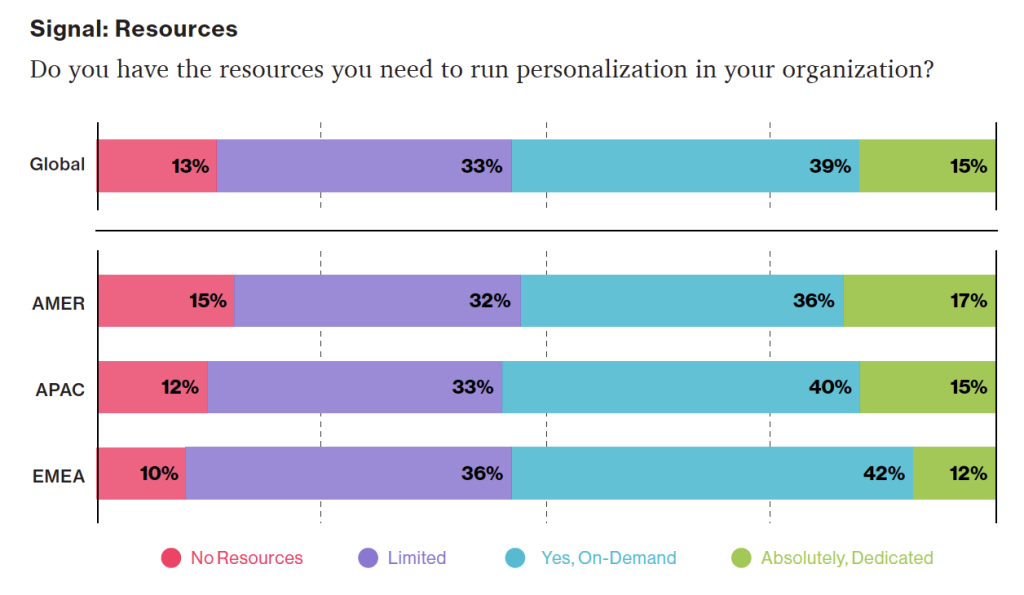
Growing tools for personalization: According to a Dynamic Yield survey, 39% of respondents felt support is available on-demand when a business case is made for it (up 15% from 2020).
Source: "The State of Personalization Maturity - Q4 2021" Dynamic Yield conducted its annual maturity survey across roles and sectors in the Americas (AMER), Europe and the Middle East (EMEA), and the Asia-Pacific (APAC) regions. This marks the fourth consecutive year publishing our research, which includes more than 450 responses from individuals in the C-Suite, Marketing, Merchandising, CX, Product, and IT.
Getting StartedFor the sake of this article, we'll assume you're already familiar with the basics of digital personalization. A good overview can be found here: Website Personalization Planning. While UX projects in this area can take on many different forms, they often stem from similar starting points.
Common scenarios for starting a personalization project:
- Your organization or client purchased a content management system (CMS) or marketing automation platform (MAP) or related technology that supports personalization
- The CMO, CDO, or CIO has identified personalization as a goal
- Customer data is disjointed or ambiguous
- You are running some isolated targeting campaigns or A/B testing
- Stakeholders disagree on personalization approach
- Mandate of customer privacy rules (e.g. GDPR) requires revisiting existing user targeting practices
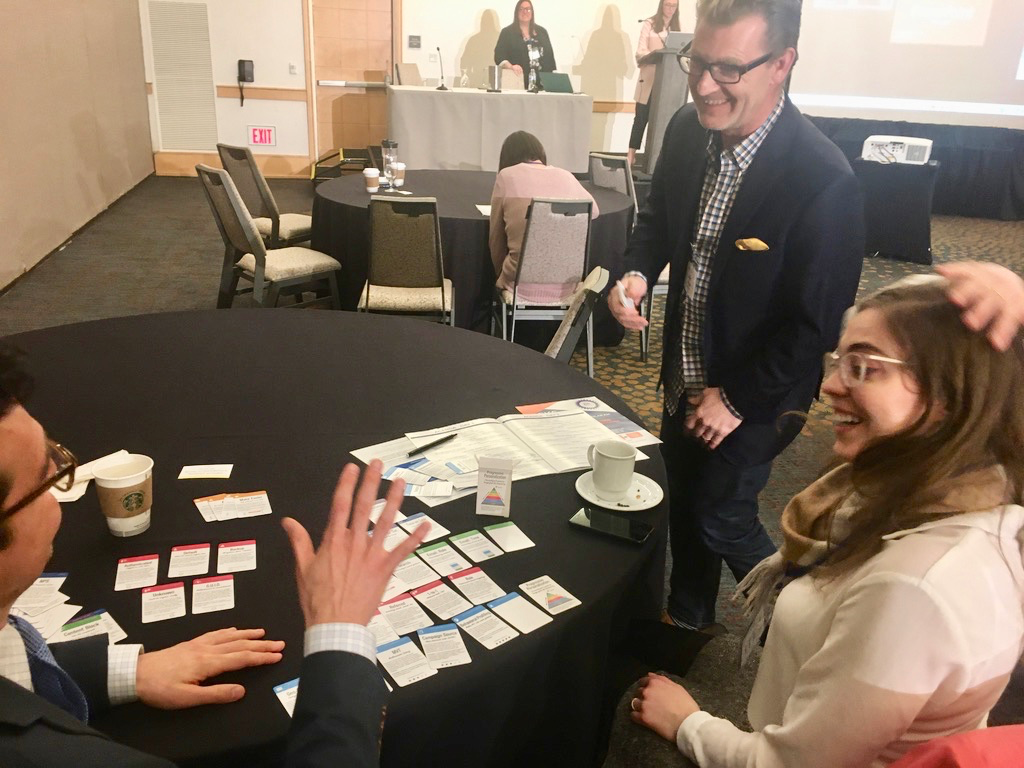 Workshopping personalization at a conference.
Regardless of where you begin, a successful personalization program will require the same core building blocks. We've captured these as the "levels" on the pyramid. Whether you are a UX designer, researcher, or strategist, understanding the core components can help make your contribution successful.
 From the ground up: Soup-to-nuts personalization, without going nuts.
From top to bottom, the levels include:
- North Star: What larger strategic objective is driving the personalization program?
- Goals: What are the specific, measurable outcomes of the program?
- Touchpoints: Where will the personalized experience be served?
- Contexts and Campaigns: What personalization content will the user see?
- User Segments: What constitutes a unique, usable audience?
- Actionable Data: What reliable and authoritative data is captured by our technical platform to drive personalization?
- Raw Data: What wider set of data is conceivably available (already in our setting) allowing you to personalize?
We'll go through each of these levels in turn. To help make this actionable, we created an accompanying deck of cards to illustrate specific examples from each level. We've found them helpful in personalization brainstorming sessions, and will include examples for you here.
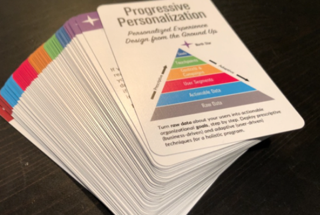 Personalization pack: Deck of cards to help kickstart your personalization brainstorming.
Starting at the Top
Personalization pack: Deck of cards to help kickstart your personalization brainstorming.
Starting at the Top
The components of the pyramid are as follows:
North StarA north star is what you are aiming for overall with your personalization program (big or small). The North Star defines the (one) overall mission of the personalization program. What do you wish to accomplish? North Stars cast a shadow. The bigger the star, the bigger the shadow. Example of North Starts might include:
- Function: Personalize based on basic user inputs. Examples: "Raw" notifications, basic search results, system user settings and configuration options, general customization, basic optimizations
- Feature: Self-contained personalization componentry. Examples: "Cooked" notifications, advanced optimizations (geolocation), basic dynamic messaging, customized modules, automations, recommenders
- Experience: Personalized user experiences across multiple interactions and user flows. Examples: Email campaigns, landing pages, advanced messaging (i.e. C2C chat) or conversational interfaces, larger user flows and content-intensive optimizations (localization).
- Product: Highly differentiating personalized product experiences. Examples: Standalone, branded experiences with personalization at their core, like the "algotorial" playlists by Spotify such as Discover Weekly.
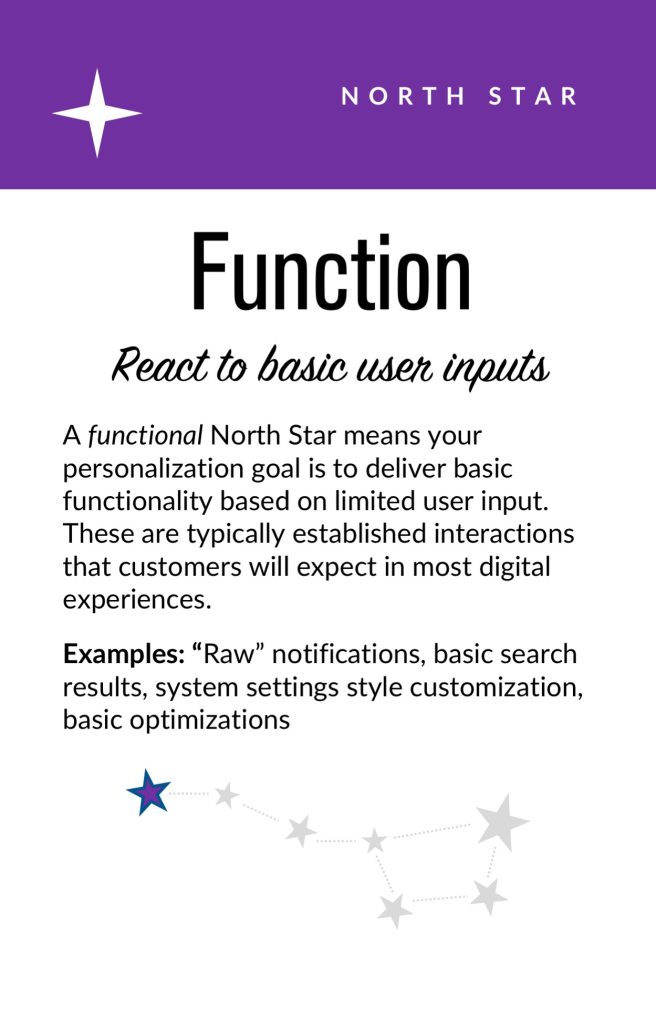
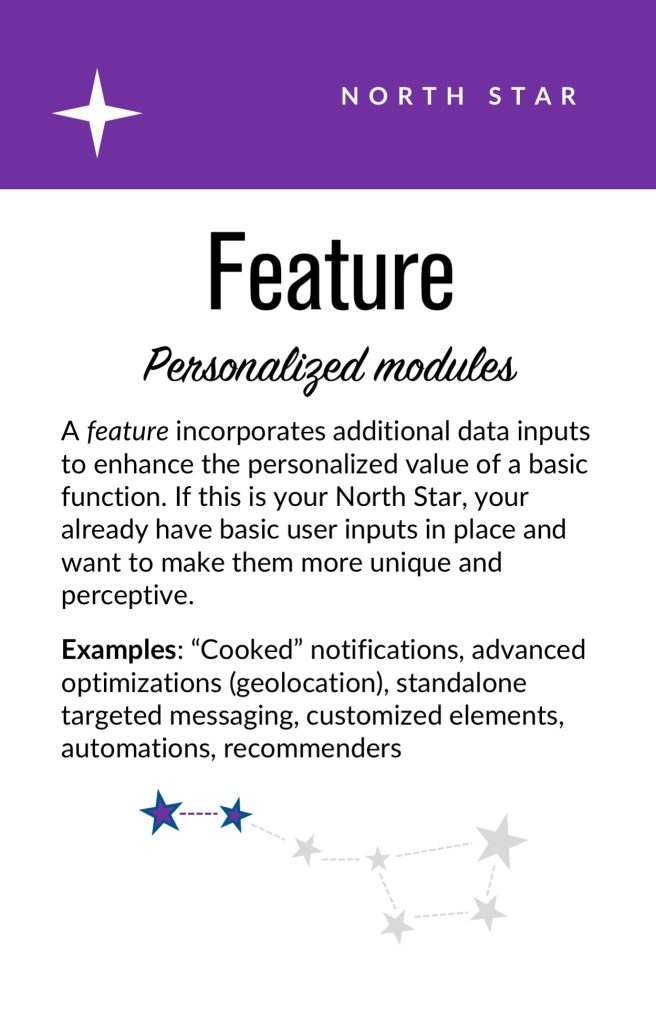
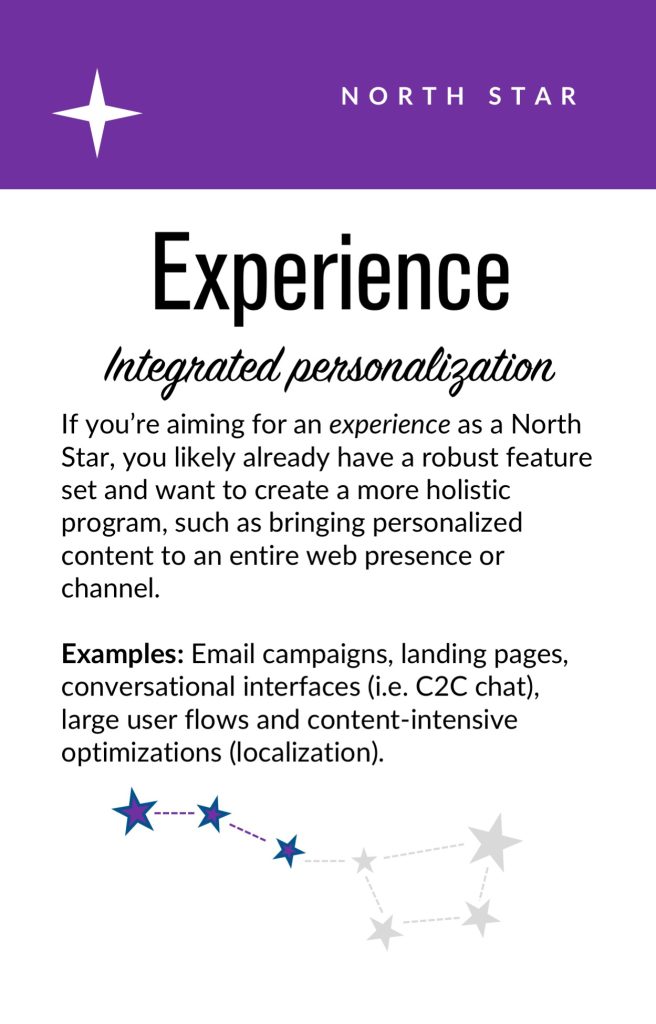 North star cards. These can help orient your team towards a common goal that personalization will help achieve; Also, these are useful for characterizing the end-state ambition of the presently stated personalization effort.
Goals
North star cards. These can help orient your team towards a common goal that personalization will help achieve; Also, these are useful for characterizing the end-state ambition of the presently stated personalization effort.
Goals
As in any good UX design, personalization can help accelerate designing with customer intentions. Goals are the tactical and measurable metrics that will prove the overall program is successful. A good place to start is with your current analytics and measurement program and metrics you can benchmark against. In some cases, new goals may be appropriate. The key thing to remember is that personalization itself is not a goal, rather it is a means to an end. Common goals include:
- Conversion
- Time on task
- Net promoter score (NPS)
- Customer satisfaction
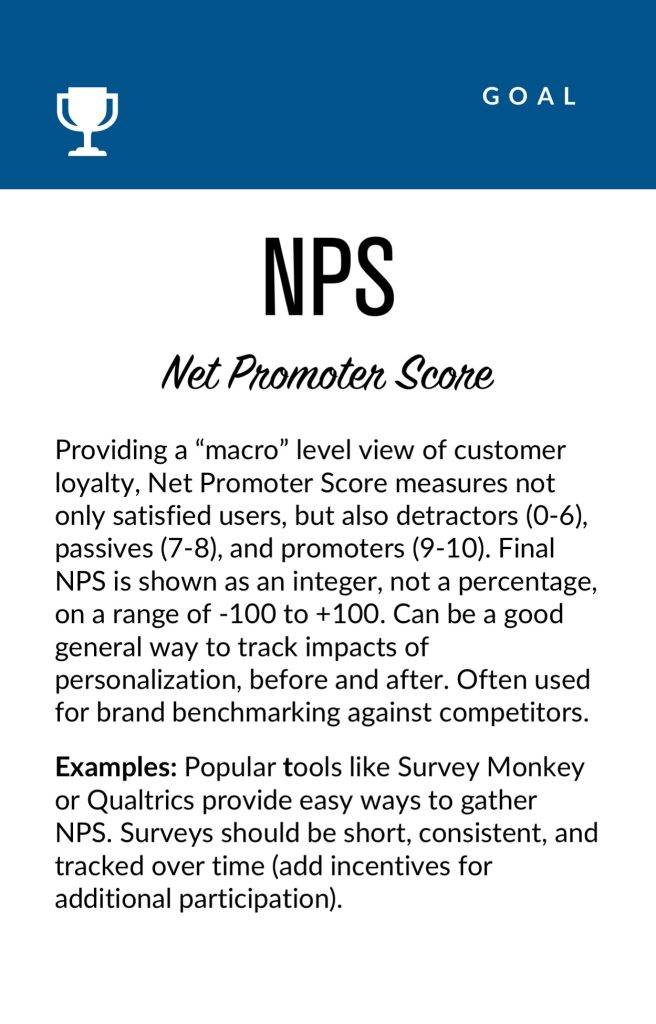
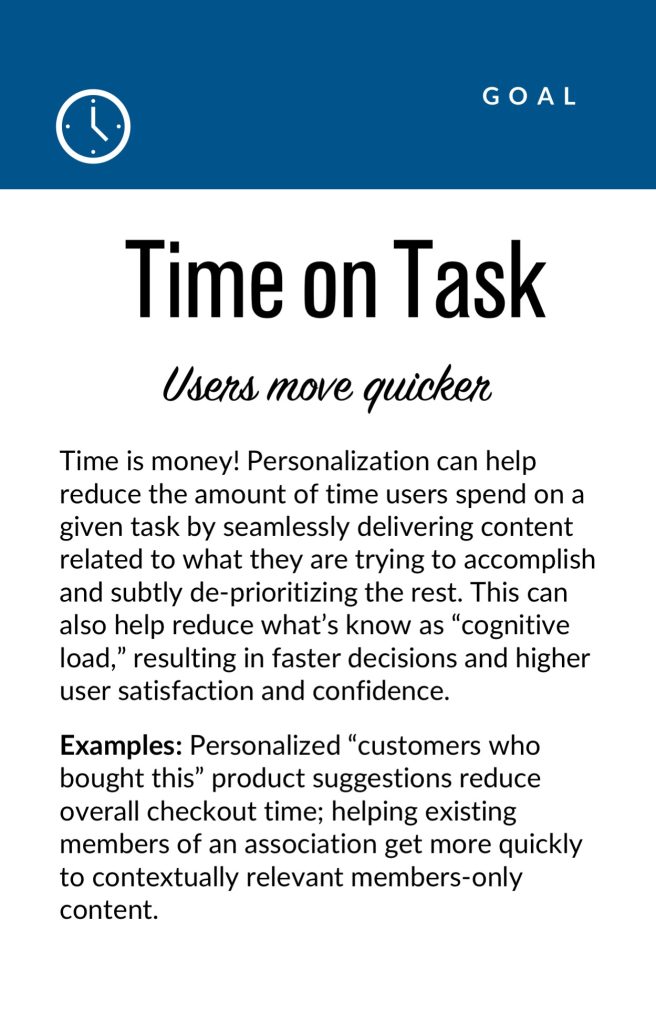
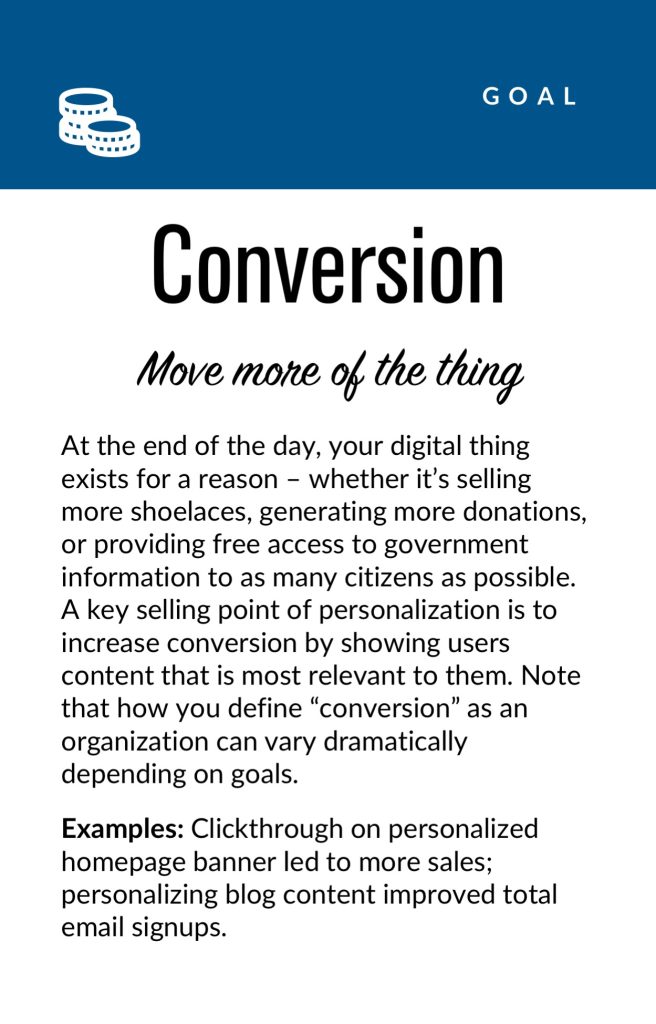 Goal cards. Examples of some common KPIs related to personalization that are concrete and measurable.
Touchpoints
Goal cards. Examples of some common KPIs related to personalization that are concrete and measurable.
Touchpoints
Touchpoints are where the personalization happens. As a UX designer, this will be one of your largest areas of responsibility. The touchpoints available to you will depend on how your personalization and associated technology capabilities are instrumented, and should be rooted in improving a user's experience at a particular point in the journey. Touchpoints can be multi-device (mobile, in-store, website) but also more granular (web banner, web pop-up etc.). Here are some examples:
Channel-level Touchpoints
- Email: Role
- Email: Time of open
- In-store display (JSON endpoint)
- Native app
- Search
Wireframe-level Touchpoints
- Web overlay
- Web alert bar
- Web banner
- Web content block
- Web menu
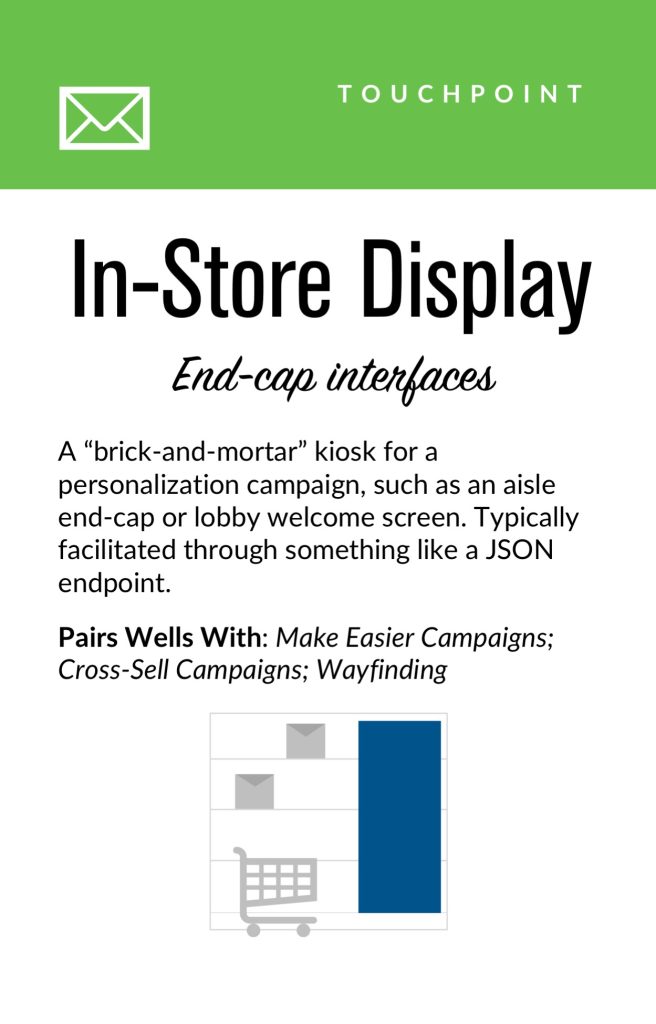

 Touchpoint cards. Examples of common personalization touchpoints: these can vary from narrow (e.g., email) to broad (e.g., in-store).
If you're designing for web interfaces, for example, you will likely need to include personalized "zones" in your wireframes. The content for these can be presented programmatically in touchpoints based on our next step, contexts and campaigns.
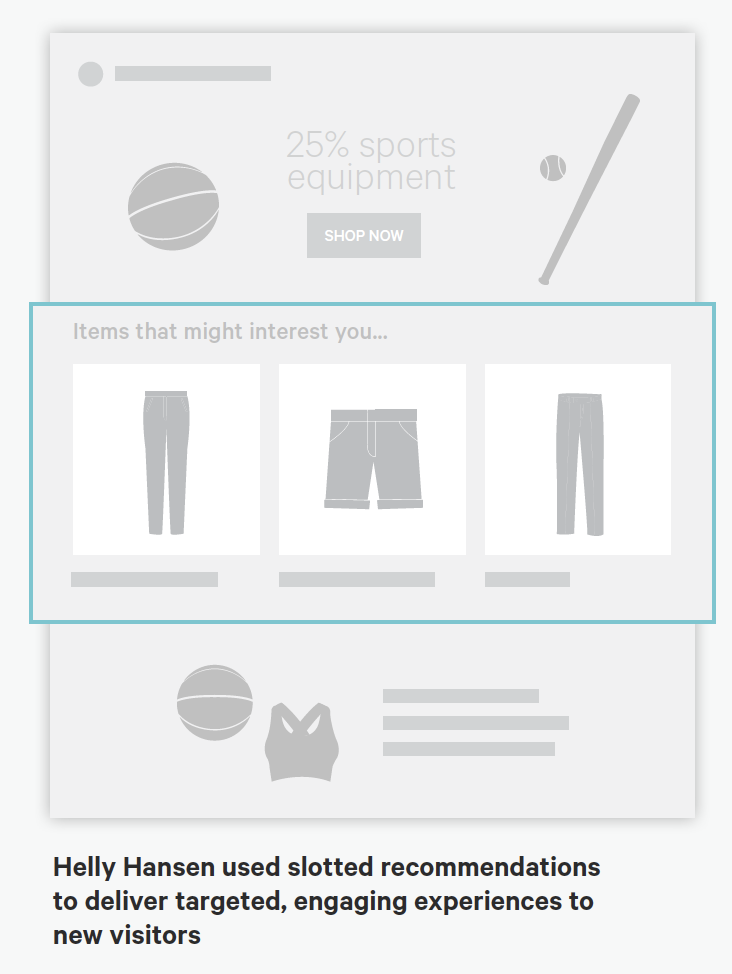
 Targeted Zones: Examples from Kibo of personalized "zones" on page-level wireframes occurring at various stages of a user journey (Engagement phase at left and Purchase phase at right.)
Source: "Essential Guide to End-to-End Personaliztion" by Kibo. Contexts and Campaigns
Once you've outlined some touchpoints, you can consider the actual personalized content a user will receive. Many personalization tools will refer to these as "campaigns" (so, for example, a campaign on a web banner for new visitors to the website). These will programmatically be shown at certain touchpoints to certain user segments, as defined by user data. At this stage, we find it helpful to consider two separate models: a context model and a content model. The context helps you consider the level of engagement of the user at the personalization moment, for example a user casually browsing information vs. doing a deep-dive. Think of it in terms of information retrieval behaviors. The content model can then help you determine what type of personalization to serve based on the context (for example, an "Enrich" campaign that shows related articles may be a suitable supplement to extant content).
Personalization Context Model:
- Browse
- Skim
- Nudge
- Feast
Personalization Content Model:
- Alert
- Make Easier
- Cross-Sell
- Enrich
We've written extensively about each of these models elsewhere, so if you'd like to read more you can check out Colin's Personalization Content Model and Jeff's Personalization Context Model.


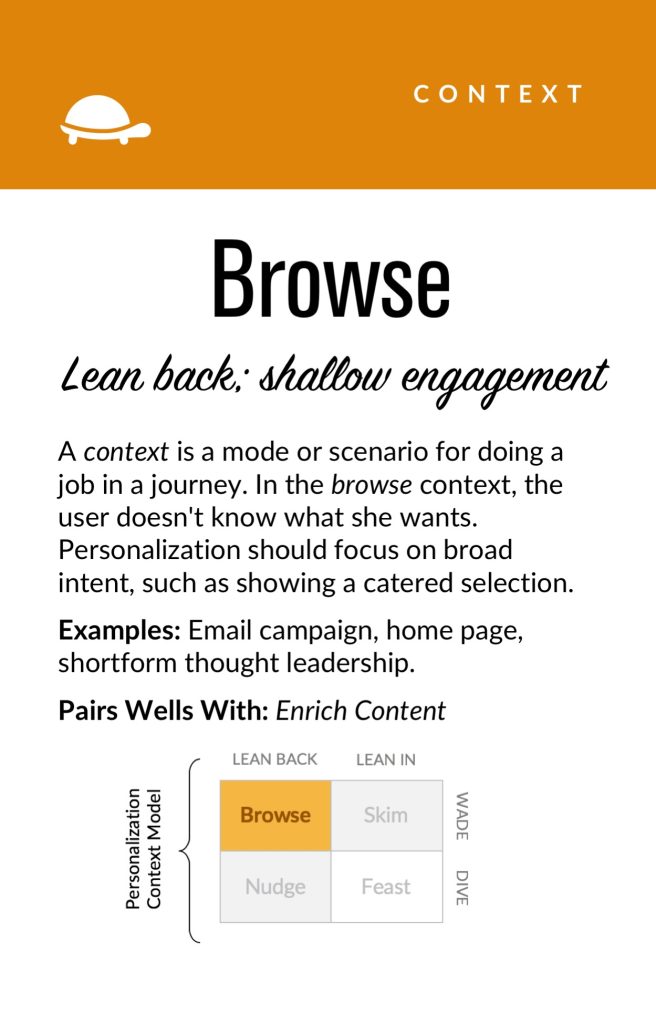 Campaign and Context cards: This level of the pyramid can help your team focus around the types of personalization to deliver end users and the use-cases in which they will experience it.
User Segments
Campaign and Context cards: This level of the pyramid can help your team focus around the types of personalization to deliver end users and the use-cases in which they will experience it.
User Segments
User segments can be created prescriptively or adaptively, based on user research (e.g. via rules and logic tied to set user behaviors or via A/B testing). At a minimum you will likely need to consider how to treat the unknown or first-time visitor, the guest or returning visitor for whom you may have a stateful cookie (or equivalent post-cookie identifier), or the authenticated visitor who is logged in. Here are some examples from the personalization pyramid:
- Unknown
- Guest
- Authenticated
- Default
- Referred
- Role
- Cohort
- Unique ID


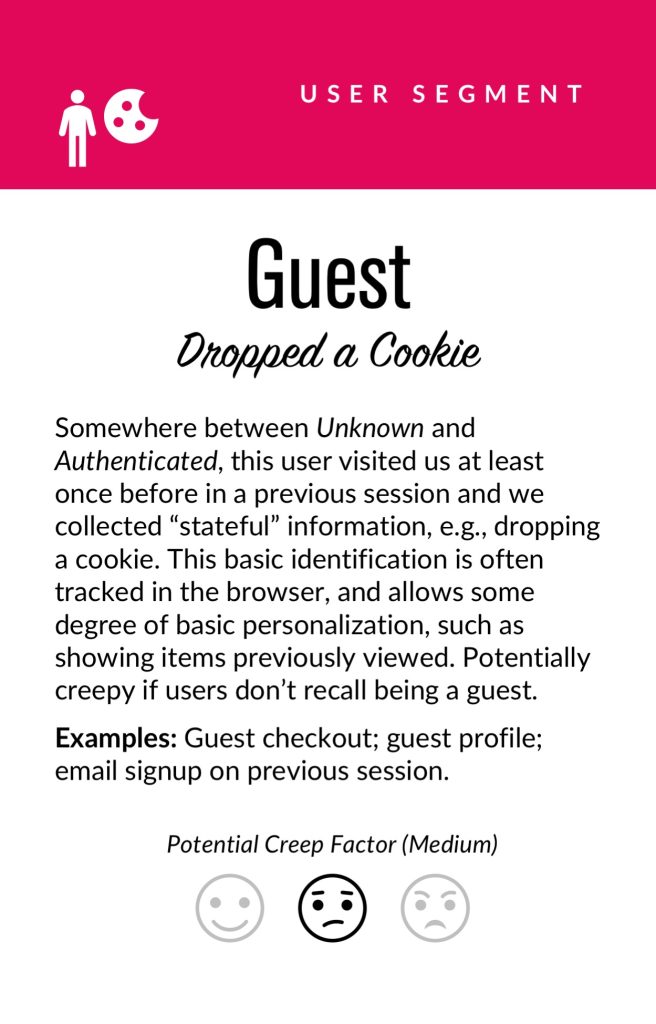 Segment cards. Examples of common personalization segments: at a minimum, you will need to consider the anonymous, guest, and logged in user types. Segmentation can get dramatically more complex from there.
Actionable Data
Segment cards. Examples of common personalization segments: at a minimum, you will need to consider the anonymous, guest, and logged in user types. Segmentation can get dramatically more complex from there.
Actionable Data
Every organization with any digital presence has data. It's a matter of asking what data you can ethically collect on users, its inherent reliability and value, as to how can you use it (sometimes known as "data activation.") Fortunately, the tide is turning to first-party data: a recent study by Twilio estimates some 80% of businesses are using at least some type of first-party data to personalize the customer experience.
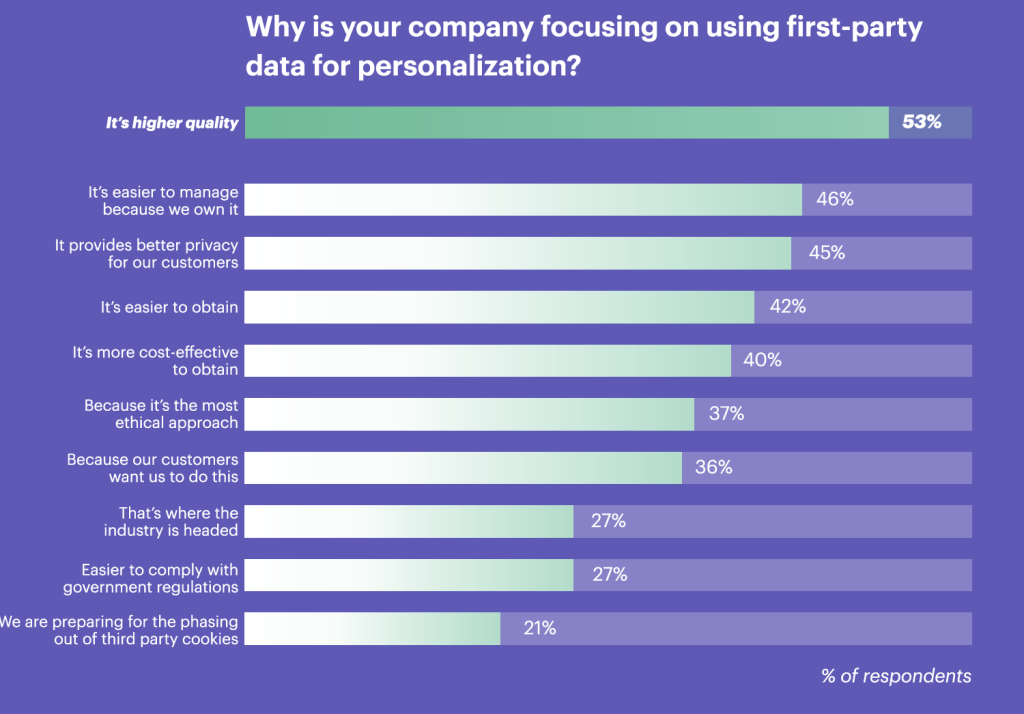 Source: "The State of Personalization 2021" by Twilio. Survey respondents were n=2,700 adult consumers who have purchased something online in the past 6 months, and n=300 adult manager+ decision-makers at consumer-facing companies that provide goods and/or services online. Respondents were from the United States, United Kingdom, Australia, and New Zealand.Data was collected from April 8 to April 20, 2021.
First-party data represents multiple advantages on the UX front, including being relatively simple to collect, more likely to be accurate, and less susceptible to the "creep factor" of third-party data. So a key part of your UX strategy should be to determine what the best form of data collection is on your audiences. Here are some examples:

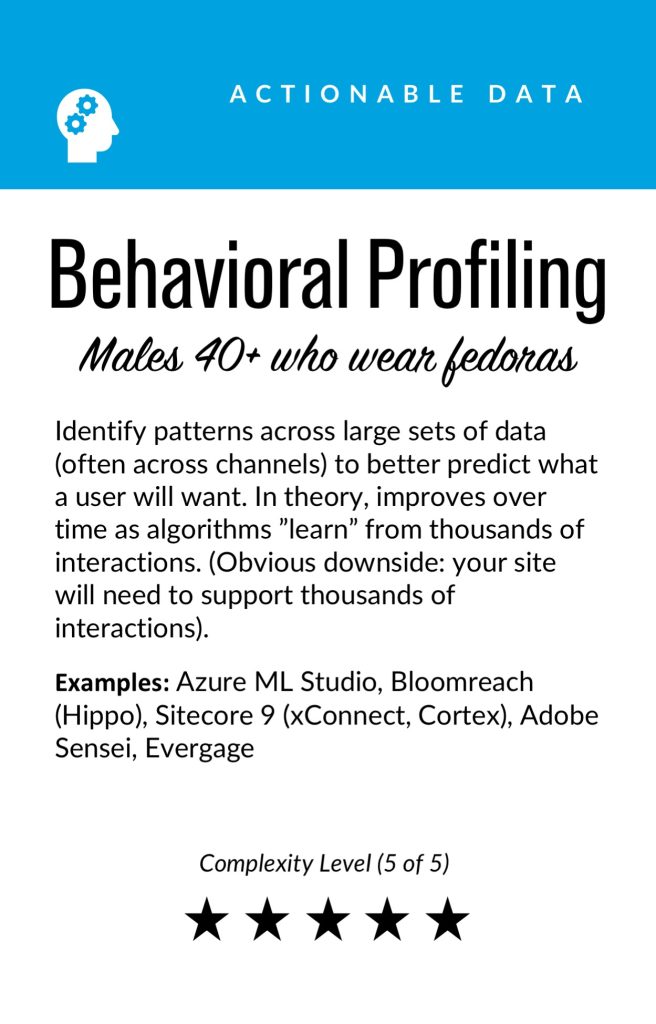

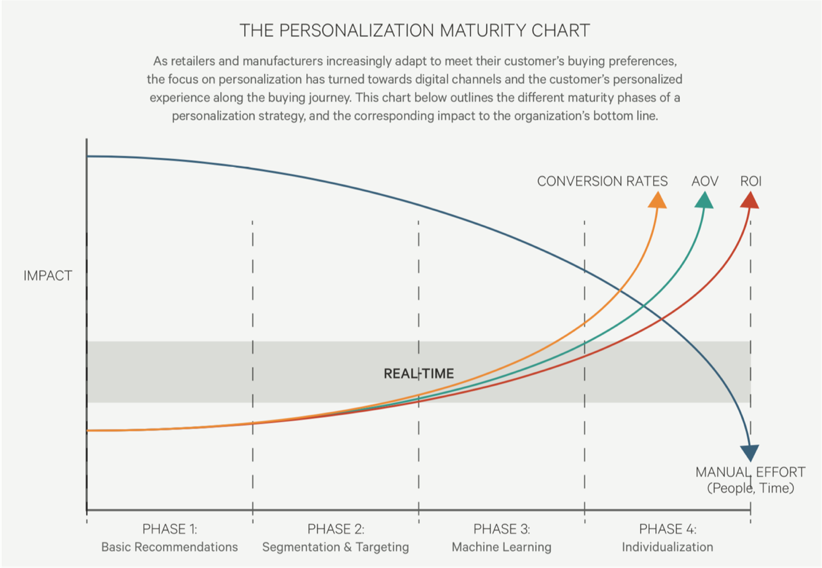 Figure 1.1.2: Example of a personalization maturity curve, showing progression from basic recommendations functionality to true individualization. Credit: https://kibocommerce.com/blog/kibos-personalization-maturity-chart/
There is a progression of profiling when it comes to recognizing and making decisioning about different audiences and their signals. It tends to move towards more granular constructs about smaller and smaller cohorts of users as time and confidence and data volume grow.
While some combination of implicit / explicit data is generally a prerequisite for any implementation (more commonly referred to as first party and third-party data) ML efforts are typically not cost-effective directly out of the box. This is because a strong data backbone and content repository is a prerequisite for optimization. But these approaches should be considered as part of the larger roadmap and may indeed help accelerate the organization's overall progress. Typically at this point you will partner with key stakeholders and product owners to design a profiling model. The profiling model includes defining approach to configuring profiles, profile keys, profile cards and pattern cards. A multi-faceted approach to profiling which makes it scalable.
Pulling it TogetherWhile the cards comprise the starting point to an inventory of sorts (we provide blanks for you to tailor your own), a set of potential levers and motivations for the style of personalization activities you aspire to deliver, they are more valuable when thought of in a grouping.
In assembling a card "hand", one can begin to trace the entire trajectory from leadership focus down through a strategic and tactical execution. It is also at the heart of the way both co-authors have conducted workshops in assembling a program backlog—which is a fine subject for another article.
In the meantime, what is important to note is that each colored class of card is helpful to survey in understanding the range of choices potentially at your disposal, it is threading through and making concrete decisions about for whom this decisioning will be made: where, when, and how.
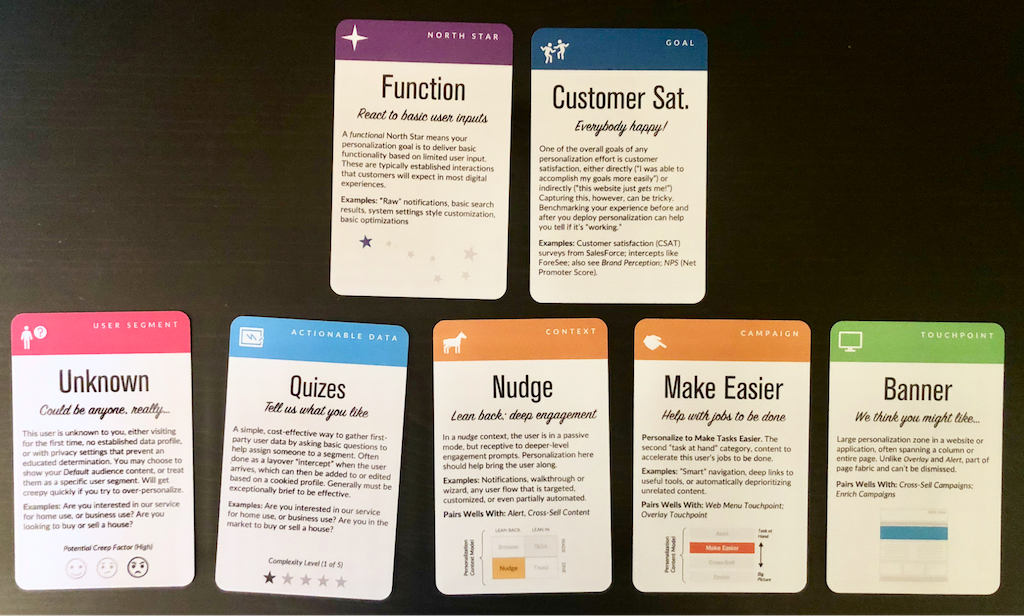 Scenario A: We want to use personalization to improve customer satisfaction on the website. For unknown users, we will create a short quiz to better identify what the user has come to do. This is sometimes referred to as "badging" a user in onboarding contexts, to better characterize their present intent and context.
Lay Down Your Cards
Scenario A: We want to use personalization to improve customer satisfaction on the website. For unknown users, we will create a short quiz to better identify what the user has come to do. This is sometimes referred to as "badging" a user in onboarding contexts, to better characterize their present intent and context.
Lay Down Your Cards
Any sustainable personalization strategy must consider near, mid and long-term goals. Even with the leading CMS platforms like Sitecore and Adobe or the most exciting composable CMS DXP out there, there is simply no "easy button" wherein a personalization program can be stood up and immediately view meaningful results. That said, there is a common grammar to all personalization activities, just like every sentence has nouns and verbs. These cards attempt to map that territory.
Mobile-First CSS: Is It Time for a Rethink? [ 09-Jun-22 3:13am ]The mobile-first design methodology is great—it focuses on what really matters to the user, it's well-practiced, and it's been a common design pattern for years. So developing your CSS mobile-first should also be great, too…right?
Well, not necessarily. Classic mobile-first CSS development is based on the principle of overwriting style declarations: you begin your CSS with default style declarations, and overwrite and/or add new styles as you add breakpoints with min-width media queries for larger viewports (for a good overview see "What is Mobile First CSS and Why Does It Rock?"). But all those exceptions create complexity and inefficiency, which in turn can lead to an increased testing effort and a code base that's harder to maintain. Admit it—how many of us willingly want that?
On your own projects, mobile-first CSS may yet be the best tool for the job, but first you need to evaluate just how appropriate it is in light of the visual design and user interactions you're working on. To help you get started, here's how I go about tackling the factors you need to watch for, and I'll discuss some alternate solutions if mobile-first doesn't seem to suit your project.
Advantages of mobile-firstSome of the things to like with mobile-first CSS development—and why it's been the de facto development methodology for so long—make a lot of sense:
Development hierarchy. One thing you undoubtedly get from mobile-first is a nice development hierarchy—you just focus on the mobile view and get developing.
Tried and tested. It's a tried and tested methodology that's worked for years for a reason: it solves a problem really well.
Prioritizes the mobile view. The mobile view is the simplest and arguably the most important, as it encompasses all the key user journeys, and often accounts for a higher proportion of user visits (depending on the project).
Prevents desktop-centric development. As development is done using desktop computers, it can be tempting to initially focus on the desktop view. But thinking about mobile from the start prevents us from getting stuck later on; no one wants to spend their time retrofitting a desktop-centric site to work on mobile devices!
Disadvantages of mobile-firstSetting style declarations and then overwriting them at higher breakpoints can lead to undesirable ramifications:
More complexity. The farther up the breakpoint hierarchy you go, the more unnecessary code you inherit from lower breakpoints.
Higher CSS specificity. Styles that have been reverted to their browser default value in a class name declaration now have a higher specificity. This can be a headache on large projects when you want to keep the CSS selectors as simple as possible.
Requires more regression testing. Changes to the CSS at a lower view (like adding a new style) requires all higher breakpoints to be regression tested.
The browser can't prioritize CSS downloads. At wider breakpoints, classic mobile-first min-width media queries don't leverage the browser's capability to download CSS files in priority order.
The problem of property value overridesThere is nothing inherently wrong with overwriting values; CSS was designed to do just that. Still, inheriting incorrect values is unhelpful and can be burdensome and inefficient. It can also lead to increased style specificity when you have to overwrite styles to reset them back to their defaults, something that may cause issues later on, especially if you are using a combination of bespoke CSS and utility classes. We won't be able to use a utility class for a style that has been reset with a higher specificity.
With this in mind, I'm developing CSS with a focus on the default values much more these days. Since there's no specific order, and no chains of specific values to keep track of, this frees me to develop breakpoints simultaneously. I concentrate on finding common styles and isolating the specific exceptions in closed media query ranges (that is, any range with a max-width set).
This approach opens up some opportunities, as you can look at each breakpoint as a clean slate. If a component's layout looks like it should be based on Flexbox at all breakpoints, it's fine and can be coded in the default style sheet. But if it looks like Grid would be much better for large screens and Flexbox for mobile, these can both be done entirely independently when the CSS is put into closed media query ranges. Also, developing simultaneously requires you to have a good understanding of any given component in all breakpoints up front. This can help surface issues in the design earlier in the development process. We don't want to get stuck down a rabbit hole building a complex component for mobile, and then get the designs for desktop and find they are equally complex and incompatible with the HTML we created for the mobile view!
Though this approach isn't going to suit everyone, I encourage you to give it a try. There are plenty of tools out there to help with concurrent development, such as Responsively App, Blisk, and many others.
Having said that, I don't feel the order itself is particularly relevant. If you are comfortable with focusing on the mobile view, have a good understanding of the requirements for other breakpoints, and prefer to work on one device at a time, then by all means stick with the classic development order. The important thing is to identify common styles and exceptions so you can put them in the relevant stylesheet—a sort of manual tree-shaking process! Personally, I find this a little easier when working on a component across breakpoints, but that's by no means a requirement.
Closed media query ranges in practiceIn classic mobile-first CSS we overwrite the styles, but we can avoid this by using media query ranges. To illustrate the difference (I'm using SCSS for brevity), let's assume there are three visual designs:
- smaller than 768
- from 768 to below 1024
- 1024 and anything larger
Take a simple example where a block-level element has a default padding of "20px," which is overwritten at tablet to be "40px" and set back to "20px" on desktop.
Classic min-width mobile-first
.my-block {
  padding: 20px;
  @media (min-width: 768px) {
    padding: 40px;
  }
  @media (min-width: 1024px) {
    padding: 20px;
  }
}
Closed media query range
.my-block {
  padding: 20px;
  @media (min-width: 768px) and (max-width: 1023.98px) {
    padding: 40px;
  }
}


The subtle difference is that the mobile-first example sets the default padding to "20px" and then overwrites it at each breakpoint, setting it three times in total. In contrast, the second example sets the default padding to "20px" and only overrides it at the relevant breakpoint where it isn't the default value (in this instance, tablet is the exception).


The goal is to:
- Only set styles when needed.
- Not set them with the expectation of overwriting them later on, again and again.
To this end, closed media query ranges are our best friend. If we need to make a change to any given view, we make it in the CSS media query range that applies to the specific breakpoint. We'll be much less likely to introduce unwanted alterations, and our regression testing only needs to focus on the breakpoint we have actually edited.
Taking the above example, if we find that .my-block spacing on desktop is already accounted for by the margin at that breakpoint, and since we want to remove the padding altogether, we could do this by setting the mobile padding in a closed media query range.
.my-block {
  @media (max-width: 767.98px) {
    padding: 20px;
  }
  @media (min-width: 768px) and (max-width: 1023.98px) {
    padding: 40px;
  }
}
The browser default padding for our block is "0," so instead of adding a desktop media query and using unset or "0" for the padding value (which we would need with mobile-first), we can wrap the mobile padding in a closed media query (since it is now also an exception) so it won't get picked up at wider breakpoints. At the desktop breakpoint, we won't need to set any padding style, as we want the browser default value.
Bundling versus separating the CSSBack in the day, keeping the number of requests to a minimum was very important due to the browser's limit of concurrent requests (typically around six). As a consequence, the use of image sprites and CSS bundling was the norm, with all the CSS being downloaded in one go, as one stylesheet with highest priority.
With HTTP/2 and HTTP/3 now on the scene, the number of requests is no longer the big deal it used to be. This allows us to separate the CSS into multiple files by media query. The clear benefit of this is the browser can now request the CSS it currently needs with a higher priority than the CSS it doesn't. This is more performant and can reduce the overall time page rendering is blocked.
Which HTTP version are you using?To determine which version of HTTP you're using, go to your website and open your browser's dev tools. Next, select the Network tab and make sure the Protocol column is visible. If "h2" is listed under Protocol, it means HTTP/2 is being used.
Note: to view the Protocol in your browser's dev tools, go to the Network tab, reload your page, right-click any column header (e.g., Name), and check the Protocol column.
 Note: for a summarized comparison, see ImageKit's "HTTP/2 vs. HTTP/1."
Also, if your site is still using HTTP/1...WHY?!! What are you waiting for? There is excellent user support for HTTP/2.
Splitting the CSSSeparating the CSS into individual files is a worthwhile task. Linking the separate CSS files using the relevant media attribute allows the browser to identify which files are needed immediately (because they're render-blocking) and which can be deferred. Based on this, it allocates each file an appropriate priority.
In the following example of a website visited on a mobile breakpoint, we can see the mobile and default CSS are loaded with "Highest" priority, as they are currently needed to render the page. The remaining CSS files (print, tablet, and desktop) are still downloaded in case they'll be needed later, but with "Lowest" priority.
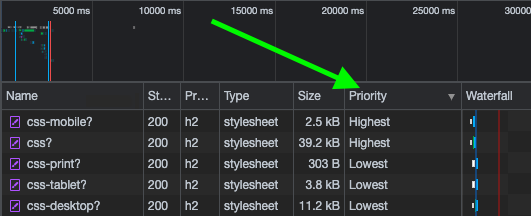
With bundled CSS, the browser will have to download the CSS file and parse it before rendering can start.
While, as noted, with the CSS separated into different files linked and marked up with the relevant media attribute, the browser can prioritize the files it currently needs. Using closed media query ranges allows the browser to do this at all widths, as opposed to classic mobile-first min-width queries, where the desktop browser would have to download all the CSS with Highest priority. We can't assume that desktop users always have a fast connection. For instance, in many rural areas, internet connection speeds are still slow.
The media queries and number of separate CSS files will vary from project to project based on project requirements, but might look similar to the example below.
Bundled CSS
<link href="site.css" rel="stylesheet">This single file contains all the CSS, including all media queries, and it will be downloaded with Highest priority.
Separated CSS
<link href="default.css" rel="stylesheet"><link href="mobile.css" media="screen and (max-width: 767.98px)" rel="stylesheet"><link href="tablet.css" media="screen and (min-width: 768px) and (max-width: 1083.98px)" rel="stylesheet"><link href="desktop.css" media="screen and (min-width: 1084px)" rel="stylesheet"><link href="print.css" media="print" rel="stylesheet">Separating the CSS and specifying a media attribute value on each link tag allows the browser to prioritize what it currently needs. Out of the five files listed above, two will be downloaded with Highest priority: the default file, and the file that matches the current media query. The others will be downloaded with Lowest priority.
Depending on the project's deployment strategy, a change to one file (mobile.css, for example) would only require the QA team to regression test on devices in that specific media query range. Compare that to the prospect of deploying the single bundled site.css file, an approach that would normally trigger a full regression test.
Moving onThe uptake of mobile-first CSS was a really important milestone in web development; it has helped front-end developers focus on mobile web applications, rather than developing sites on desktop and then attempting to retrofit them to work on other devices.
I don't think anyone wants to return to that development model again, but it's important we don't lose sight of the issue it highlighted: that things can easily get convoluted and less efficient if we prioritize one particular device—any device—over others. For this reason, focusing on the CSS in its own right, always mindful of what is the default setting and what's an exception, seems like the natural next step. I've started noticing small simplifications in my own CSS, as well as other developers', and that testing and maintenance work is also a bit more simplified and productive.
In general, simplifying CSS rule creation whenever we can is ultimately a cleaner approach than going around in circles of overrides. But whichever methodology you choose, it needs to suit the project. Mobile-first may—or may not—turn out to be the best choice for what's involved, but first you need to solidly understand the trade-offs you're stepping into.
Designers, (Re)define Success First [ 12-May-22 3:00pm ]About two and a half years ago, I introduced the idea of daily ethical design. It was born out of my frustration with the many obstacles to achieving design that's usable and equitable; protects people's privacy, agency, and focus; benefits society; and restores nature. I argued that we need to overcome the inconveniences that prevent us from acting ethically and that we need to elevate design ethics to a more practical level by structurally integrating it into our daily work, processes, and tools.
Unfortunately, we're still very far from this ideal.
At the time, I didn't know yet how to structurally integrate ethics. Yes, I had found some tools that had worked for me in previous projects, such as using checklists, assumption tracking, and "dark reality" sessions, but I didn't manage to apply those in every project. I was still struggling for time and support, and at best I had only partially achieved a higher (moral) quality of design—which is far from my definition of structurally integrated.
I decided to dig deeper for the root causes in business that prevent us from practicing daily ethical design. Now, after much research and experimentation, I believe that I've found the key that will let us structurally integrate ethics. And it's surprisingly simple! But first we need to zoom out to get a better understanding of what we're up against.
Influence the systemSadly, we're trapped in a capitalistic system that reinforces consumerism and inequality, and it's obsessed with the fantasy of endless growth. Sea levels, temperatures, and our demand for energy continue to rise unchallenged, while the gap between rich and poor continues to widen. Shareholders expect ever-higher returns on their investments, and companies feel forced to set short-term objectives that reflect this. Over the last decades, those objectives have twisted our well-intended human-centered mindset into a powerful machine that promotes ever-higher levels of consumption. When we're working for an organization that pursues "double-digit growth" or "aggressive sales targets" (which is 99 percent of us), that's very hard to resist while remaining human friendly. Even with our best intentions, and even though we like to say that we create solutions for people, we're a part of the problem.
What can we do to change this?
We can start by acting on the right level of the system. Donella H. Meadows, a system thinker, once listed ways to influence a system in order of effectiveness. When you apply these to design, you get:
- At the lowest level of effectiveness, you can affect numbers such as usability scores or the number of design critiques. But none of that will change the direction of a company.
- Similarly, affecting buffers (such as team budgets), stocks (such as the number of designers), flows (such as the number of new hires), and delays (such as the time that it takes to hear about the effect of design) won't significantly affect a company.
- Focusing instead on feedback loops such as management control, employee recognition, or design-system investments can help a company become better at achieving its objectives. But that doesn't change the objectives themselves, which means that the organization will still work against your ethical-design ideals.
- The next level, information flows, is what most ethical-design initiatives focus on now: the exchange of ethical methods, toolkits, articles, conferences, workshops, and so on. This is also where ethical design has remained mostly theoretical. We've been focusing on the wrong level of the system all this time.
- Take rules, for example—they beat knowledge every time. There can be widely accepted rules, such as how finance works, or a scrum team's definition of done. But ethical design can also be smothered by unofficial rules meant to maintain profits, often revealed through comments such as "the client didn't ask for it" or "don't make it too big."
- Changing the rules without holding official power is very hard. That's why the next level is so influential: self-organization. Experimentation, bottom-up initiatives, passion projects, self-steering teams—all of these are examples of self-organization that improve the resilience and creativity of a company. It's exactly this diversity of viewpoints that's needed to structurally tackle big systemic issues like consumerism, wealth inequality, and climate change.
- Yet even stronger than self-organization are objectives and metrics. Our companies want to make more money, which means that everything and everyone in the company does their best to… make the company more money. And once I realized that profit is nothing more than a measurement, I understood how crucial a very specific, defined metric can be toward pushing a company in a certain direction.
The takeaway? If we truly want to incorporate ethics into our daily design practice, we must first change the measurable objectives of the company we work for, from the bottom up.
Redefine successTraditionally, we consider a product or service successful if it's desirable to humans, technologically feasible, and financially viable. You tend to see these represented as equals; if you type the three words in a search engine, you'll find diagrams of three equally sized, evenly arranged circles.
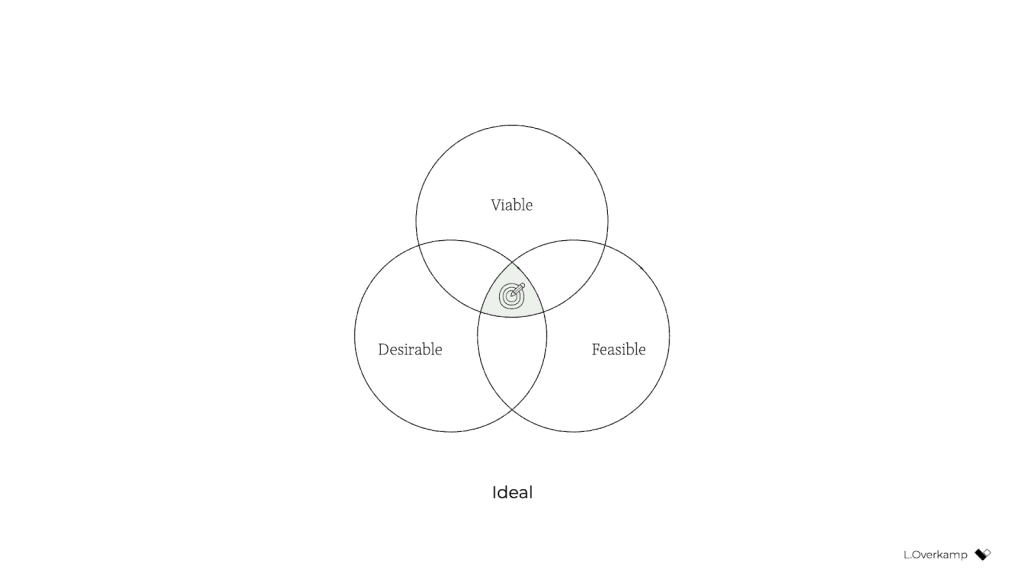
But in our hearts, we all know that the three dimensions aren't equally weighted: it's viability that ultimately controls whether a product will go live. So a more realistic representation might look like this:
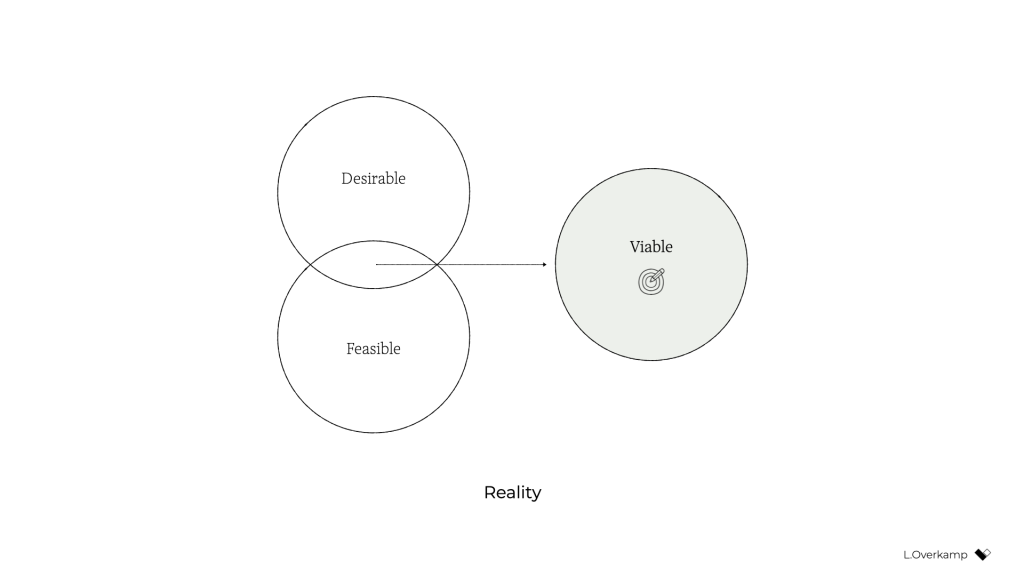
Desirability and feasibility are the means; viability is the goal. Companies—outside of nonprofits and charities—exist to make money.
A genuinely purpose-driven company would try to reverse this dynamic: it would recognize finance for what it was intended for: a means. So both feasibility and viability are means to achieve what the company set out to achieve. It makes intuitive sense: to achieve most anything, you need resources, people, and money. (Fun fact: the Italian language knows no difference between feasibility and viability; both are simply fattibilità.)
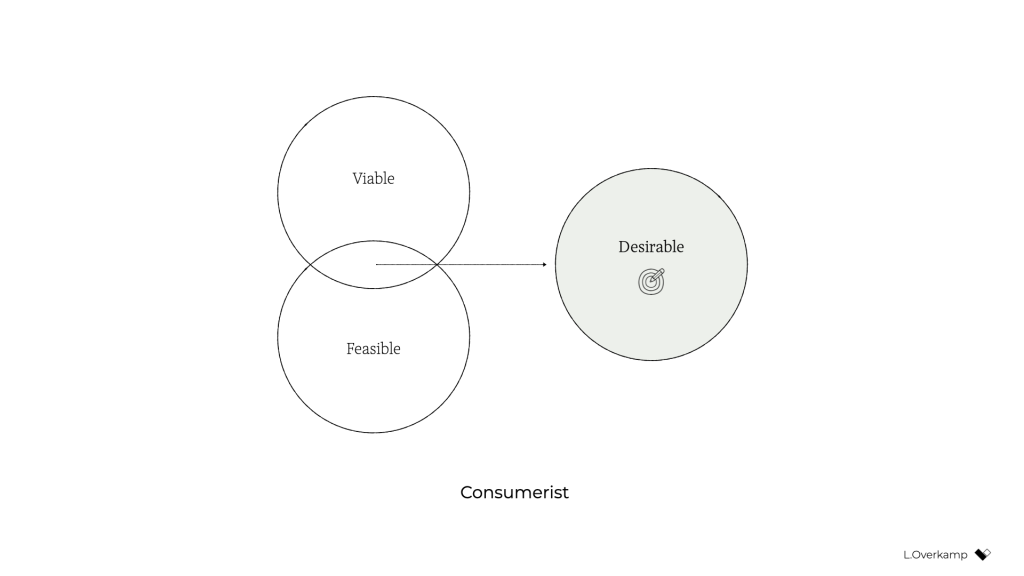
But simply swapping viable for desirable isn't enough to achieve an ethical outcome. Desirability is still linked to consumerism because the associated activities aim to identify what people want—whether it's good for them or not. Desirability objectives, such as user satisfaction or conversion, don't consider whether a product is healthy for people. They don't prevent us from creating products that distract or manipulate people or stop us from contributing to society's wealth inequality. They're unsuitable for establishing a healthy balance with nature.
There's a fourth dimension of success that's missing: our designs also need to be ethical in the effect that they have on the world.
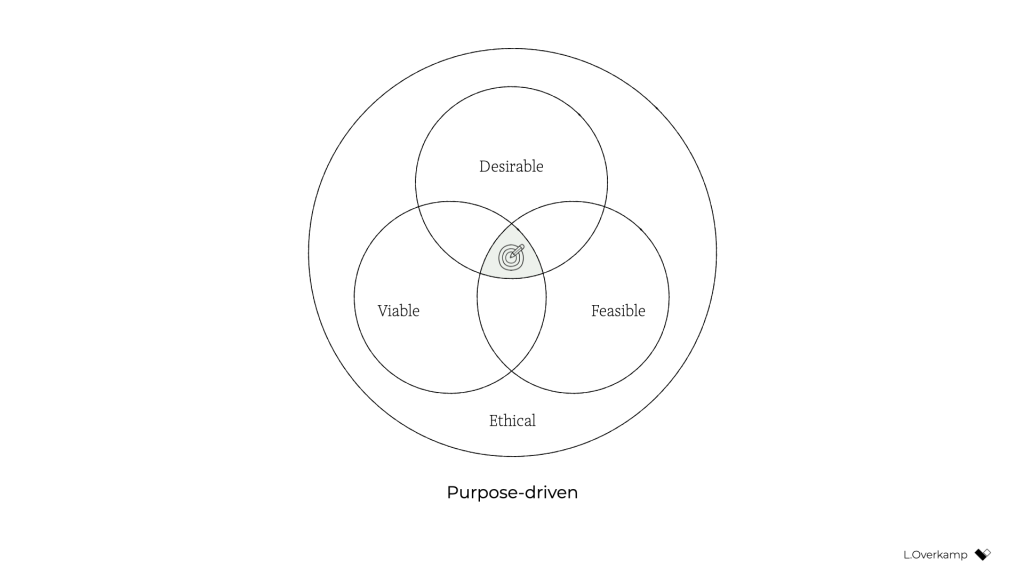
This is hardly a new idea. Many similar models exist, some calling the fourth dimension accountability, integrity, or responsibility. What I've never seen before, however, is the necessary step that comes after: to influence the system as designers and to make ethical design more practical, we must create objectives for ethical design that are achievable and inspirational. There's no one way to do this because it highly depends on your culture, values, and industry. But I'll give you the version that I developed with a group of colleagues at a design agency. Consider it a template to get started.
Pursue well-being, equity, and sustainabilityWe created objectives that address design's effect on three levels: individual, societal, and global.
An objective on the individual level tells us what success is beyond the typical focus of usability and satisfaction—instead considering matters such as how much time and attention is required from users. We pursued well-being:
We create products and services that allow for people's health and happiness. Our solutions are calm, transparent, nonaddictive, and nonmisleading. We respect our users' time, attention, and privacy, and help them make healthy and respectful choices.
An objective on the societal level forces us to consider our impact beyond just the user, widening our attention to the economy, communities, and other indirect stakeholders. We called this objective equity:
We create products and services that have a positive social impact. We consider economic equality, racial justice, and the inclusivity and diversity of people as teams, users, and customer segments. We listen to local culture, communities, and those we affect.
Finally, the objective on the global level aims to ensure that we remain in balance with the only home we have as humanity. Referring to it simply as sustainability, our definition was:
We create products and services that reward sufficiency and reusability. Our solutions support the circular economy: we create value from waste, repurpose products, and prioritize sustainable choices. We deliver functionality instead of ownership, and we limit energy use.
In short, ethical design (to us) meant achieving wellbeing for each user and an equitable value distribution within society through a design that can be sustained by our living planet. When we introduced these objectives in the company, for many colleagues, design ethics and responsible design suddenly became tangible and achievable through practical—and even familiar—actions.
Measure impactBut defining these objectives still isn't enough. What truly caught the attention of senior management was the fact that we created a way to measure every design project's well-being, equity, and sustainability.
This overview lists example metrics that you can use as you pursue well-being, equity, and sustainability:
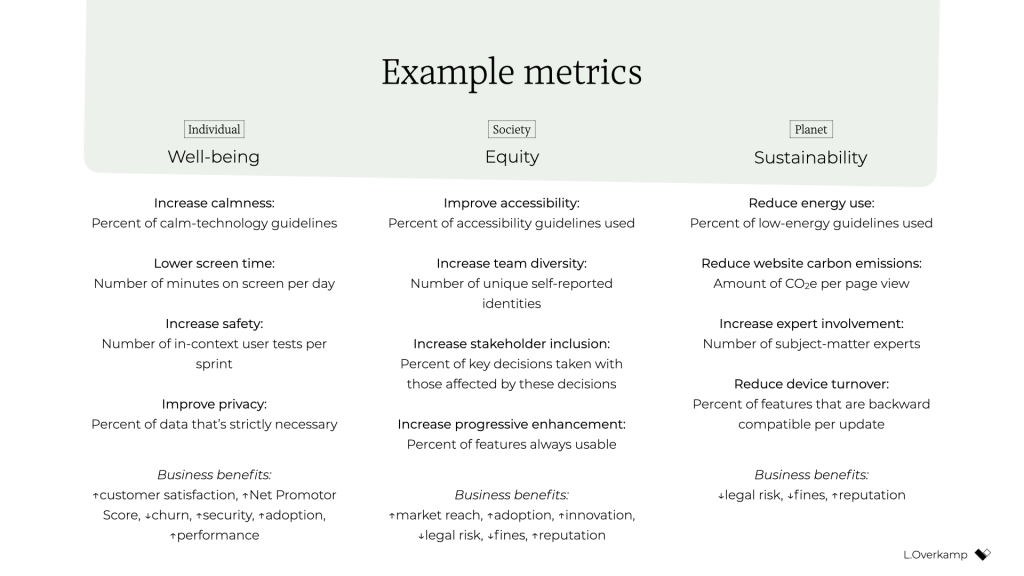
There's a lot of power in measurement. As the saying goes, what gets measured gets done. Donella Meadows once shared this example:
"If the desired system state is national security, and that is defined as the amount of money spent on the military, the system will produce military spending. It may or may not produce national security."
This phenomenon explains why desirability is a poor indicator of success: it's typically defined as the increase in customer satisfaction, session length, frequency of use, conversion rate, churn rate, download rate, and so on. But none of these metrics increase the health of people, communities, or ecosystems. What if instead we measured success through metrics for (digital) well-being, such as (reduced) screen time or software energy consumption?
There's another important message here. Even if we set an objective to build a calm interface, if we were to choose the wrong metric for calmness—say, the number of interface elements—we could still end up with a screen that induces anxiety. Choosing the wrong metric can completely undo good intentions.
Additionally, choosing the right metric is enormously helpful in focusing the design team. Once you go through the exercise of choosing metrics for our objectives, you're forced to consider what success looks like concretely and how you can prove that you've reached your ethical objectives. It also forces you to consider what we as designers have control over: what can I include in my design or change in my process that will lead to the right type of success? The answer to this question brings a lot of clarity and focus.
And finally, it's good to remember that traditional businesses run on measurements, and managers love to spend much time discussing charts (ideally hockey-stick shaped)—especially if they concern profit, the one-above-all of metrics. For good or ill, to improve the system, to have a serious discussion about ethical design with managers, we'll need to speak that business language.
Practice daily ethical designOnce you've defined your objectives and you have a reasonable idea of the potential metrics for your design project, only then do you have a chance to structurally practice ethical design. It "simply" becomes a matter of using your creativity and choosing from all the knowledge and toolkits already available to you.
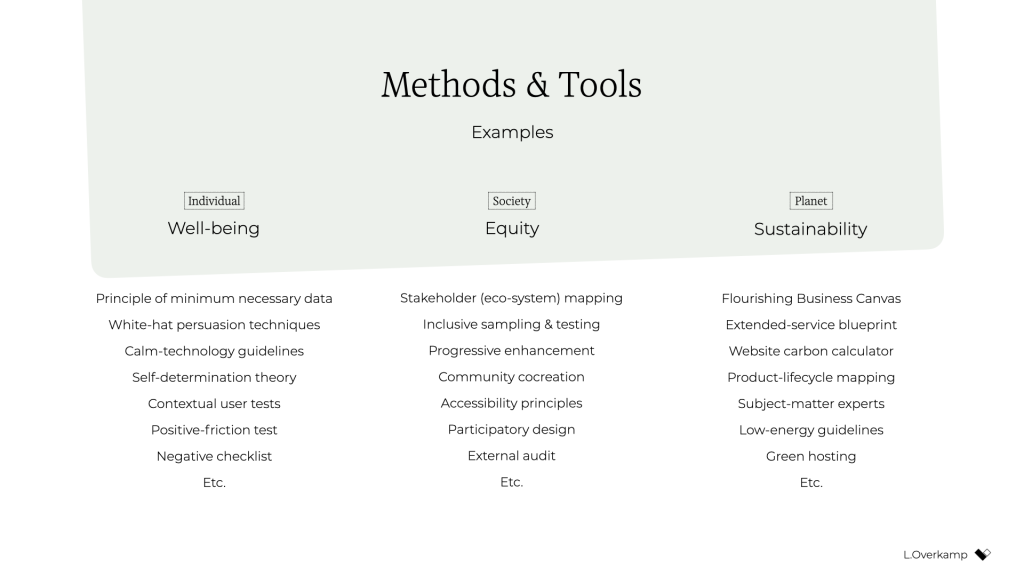
I think this is quite exciting! It opens a whole new set of challenges and considerations for the design process. Should you go with that energy-consuming video or would a simple illustration be enough? Which typeface is the most calm and inclusive? Which new tools and methods do you use? When is the website's end of life? How can you provide the same service while requiring less attention from users? How do you make sure that those who are affected by decisions are there when those decisions are made? How can you measure our effects?
The redefinition of success will completely change what it means to do good design.
There is, however, a final piece of the puzzle that's missing: convincing your client, product owner, or manager to be mindful of well-being, equity, and sustainability. For this, it's essential to engage stakeholders in a dedicated kickoff session.
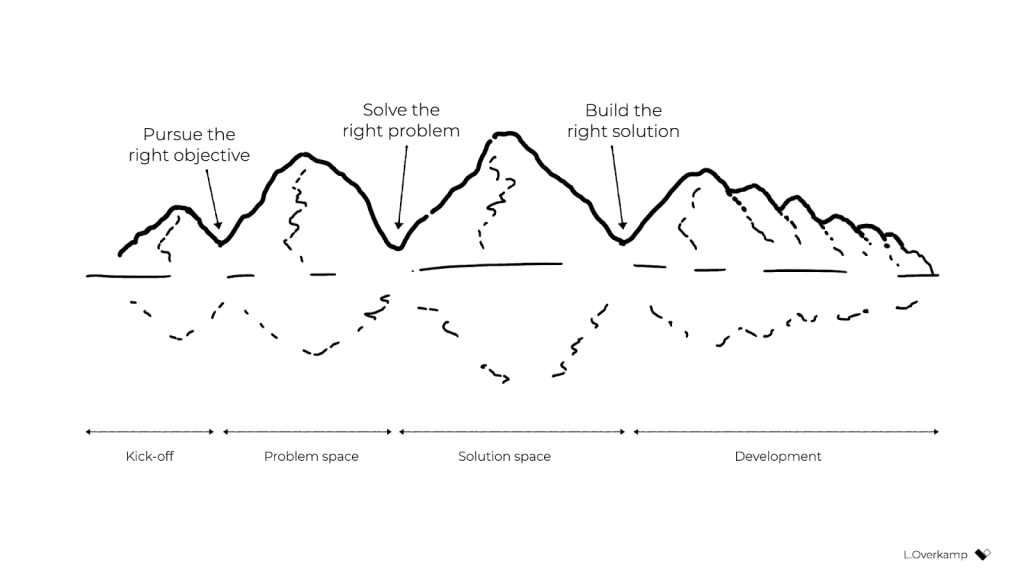
Kick it off or fall back to status quoThe kickoff is the most important meeting that can be so easy to forget to include. It consists of two major phases: 1) the alignment of expectations, and 2) the definition of success.
In the first phase, the entire (design) team goes over the project brief and meets with all the relevant stakeholders. Everyone gets to know one another and express their expectations on the outcome and their contributions to achieving it. Assumptions are raised and discussed. The aim is to get on the same level of understanding and to in turn avoid preventable miscommunications and surprises later in the project.
For example, for a recent freelance project that aimed to design a digital platform that facilitates US student advisors' documentation and communication, we conducted an online kickoff with the client, a subject-matter expert, and two other designers. We used a combination of canvases on Miro: one with questions from "Manual of Me" (to get to know each other), a Team Canvas (to express expectations), and a version of the Project Canvas to align on scope, timeline, and other practical matters.
The above is the traditional purpose of a kickoff. But just as important as expressing expectations is agreeing on what success means for the project—in terms of desirability, viability, feasibility, and ethics. What are the objectives in each dimension?
Agreement on what success means at such an early stage is crucial because you can rely on it for the remainder of the project. If, for example, the design team wants to build an inclusive app for a diverse user group, they can raise diversity as a specific success criterion during the kickoff. If the client agrees, the team can refer back to that promise throughout the project. "As we agreed in our first meeting, having a diverse user group that includes A and B is necessary to build a successful product. So we do activity X and follow research process Y." Compare those odds to a situation in which the team didn't agree to that beforehand and had to ask for permission halfway through the project. The client might argue that that came on top of the agreed scope—and she'd be right.
In the case of this freelance project, to define success I prepared a round canvas that I call the Wheel of Success. It consists of an inner ring, meant to capture ideas for objectives, and a set of outer rings, meant to capture ideas on how to measure those objectives. The rings are divided into five dimensions of successful design: healthy, equitable, sustainable, desirable, feasible, and viable.
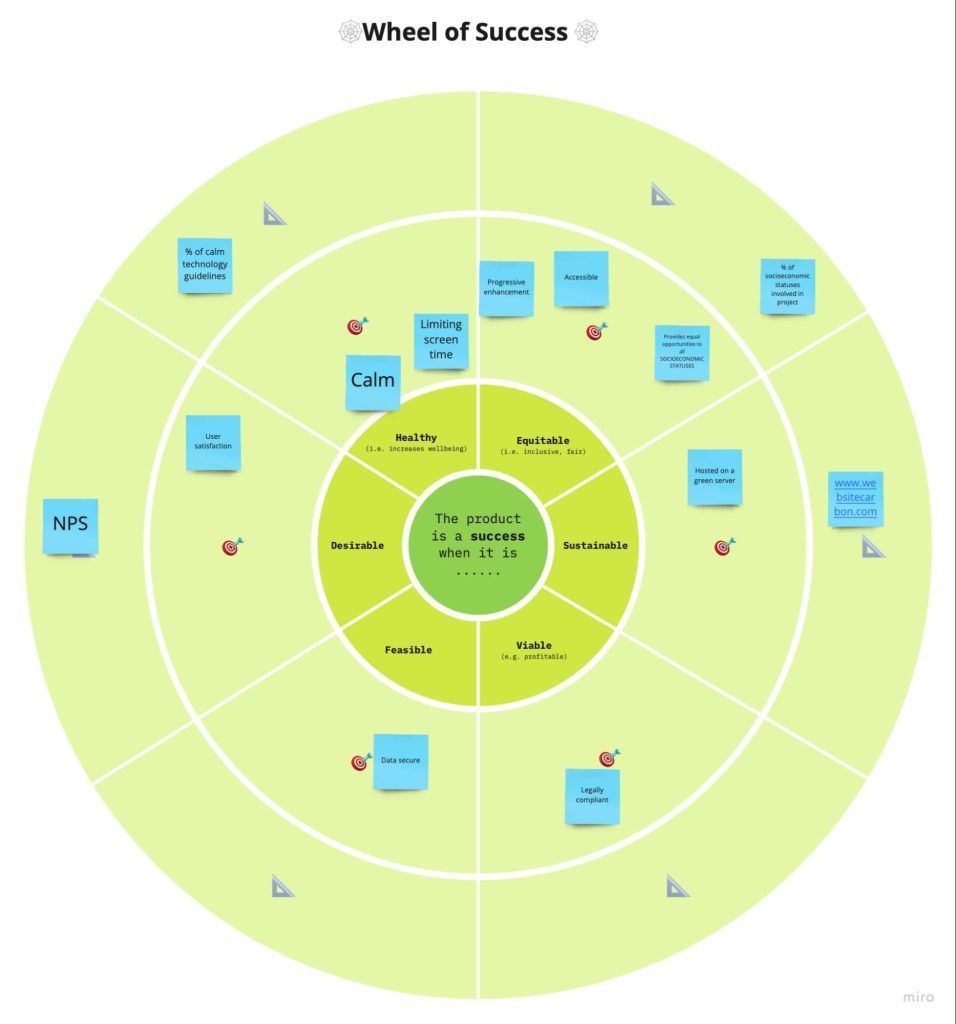
We went through each dimension, writing down ideas on digital sticky notes. Then we discussed our ideas and verbally agreed on the most important ones. For example, our client agreed that sustainability and progressive enhancement are important success criteria for the platform. And the subject-matter expert emphasized the importance of including students from low-income and disadvantaged groups in the design process.
After the kickoff, we summarized our ideas and shared understanding in a project brief that captured these aspects:
- the project's origin and purpose: why are we doing this project?
- the problem definition: what do we want to solve?
- the concrete goals and metrics for each success dimension: what do we want to achieve?
- the scope, process, and role descriptions: how will we achieve it?
With such a brief in place, you can use the agreed-upon objectives and concrete metrics as a checklist of success, and your design team will be ready to pursue the right objective—using the tools, methods, and metrics at their disposal to achieve ethical outcomes.
 Conclusion
Over the past year, quite a few colleagues have asked me, "Where do I start with ethical design?" My answer has always been the same: organize a session with your stakeholders to (re)define success. Even though you might not always be 100 percent successful in agreeing on goals that cover all responsibility objectives, that beats the alternative (the status quo) every time. If you want to be an ethical, responsible designer, there's no skipping this step.
To be even more specific: if you consider yourself a strategic designer, your challenge is to define ethical objectives, set the right metrics, and conduct those kick-off sessions. If you consider yourself a system designer, your starting point is to understand how your industry contributes to consumerism and inequality, understand how finance drives business, and brainstorm which levers are available to influence the system on the highest level. Then redefine success to create the space to exercise those levers.
And for those who consider themselves service designers or UX designers or UI designers: if you truly want to have a positive, meaningful impact, stay away from the toolkits and meetups and conferences for a while. Instead, gather your colleagues and define goals for well-being, equity, and sustainability through design. Engage your stakeholders in a workshop and challenge them to think of ways to achieve and measure those ethical goals. Take their input, make it concrete and visible, ask for their agreement, and hold them to it.
Otherwise, I'm genuinely sorry to say, you're wasting your precious time and creative energy.
Of course, engaging your stakeholders in this way can be uncomfortable. Many of my colleagues expressed doubts such as "What will the client think of this?," "Will they take me seriously?," and "Can't we just do it within the design team instead?" In fact, a product manager once asked me why ethics couldn't just be a structured part of the design process—to just do it without spending the effort to define ethical objectives. It's a tempting idea, right? We wouldn't have to have difficult discussions with stakeholders about what values or which key-performance indicators to pursue. It would let us focus on what we like and do best: designing.
But as systems theory tells us, that's not enough. For those of us who aren't from marginalized groups and have the privilege to be able to speak up and be heard, that uncomfortable space is exactly where we need to be if we truly want to make a difference. We can't remain within the design-for-designers bubble, enjoying our privileged working-from-home situation, disconnected from the real world out there. For those of us who have the possibility to speak up and be heard: if we solely keep talking about ethical design and it remains at the level of articles and toolkits—we're not designing ethically. It's just theory. We need to actively engage our colleagues and clients by challenging them to redefine success in business.
With a bit of courage, determination, and focus, we can break out of this cage that finance and business-as-usual have built around us and become facilitators of a new type of business that can see beyond financial value. We just need to agree on the right objectives at the start of each design project, find the right metrics, and realize that we already have everything that we need to get started. That's what it means to do daily ethical design.
For their inspiration and support over the years, I would like to thank Emanuela Cozzi Schettini, José Gallegos, Annegret Bönemann, Ian Dorr, Vera Rademaker, Virginia Rispoli, Cecilia Scolaro, Rouzbeh Amini, and many others.

A day later came the US publication of the first book, BEYOND THE HALLOWED SKY, by Pyr Books and available via Simon and Schuster, with links to Amazon and other online bookshops.

This book has had kind words from North American authors:
Ken Macleod does things nobody else does and this is a terrific read.- Jo Walton, multi-award-winning author of Among Others and What Makes This Book So Great
Sure, some writers knock it out of the park but with Beyond the Hallowed Sky, Ken MacLeod knocks it right out of the solar system! Too often, space opera throws science out the airlock, but MacLeod has given us a believable faster-than-light adventure that will have you racing through the pages at superluminal speed.- Robert J. Sawyer, Hugo Award-winning author of The Oppenheimer Alternative
An exceptional blend of international politics, hard science, and first contact.
- Michael Mammay, author of the Planetside series.
.jpg)
I only learned of the existence of Blood And Steel when it was announced SRS were issuing it on DVD. At the time of writing it still doesn't have an Internet Movie Database entry despite this revival. Presumably that will be fixed soon but it shows how obscure this flick is. Blood And Steel was the working title for Bruce Lee's Enter The Dragon and this film, swiping that, is dedicated to Bruce Lee.
Shot in Buffalo, New York, the opening looks more like a regional horror with a woman in a swimming pool having her throat cut. Then a guy gets killed slasher style. Writer, director and star, Mark Swetland - playing himself - is the brother of one of the victims and he goes after the killers. The death of Swetland's screen sister at the get-go in this movie appears designed to resonate with Bruce Lee's sister - played by Angela Mao - committing suicide to avoid being raped by the bad guys early on in Enter The Dragon.
Swetland gets a lead via a photograph that a martial artist from a local dojo is involved in the murder of his sister. So like Bruce Lee busting up the Japanese dojo in Fist of Fury (Chinese Connection in the USA), he lays waste to this martial arts school with his kung fu skills.
Ransacking the fight school's office, Swetland gets a lead to an industrial company. Turns out both operations provide cover for drug dealing. The industrial company invokes the ice factory in Bruce Lee's The Big Boss (Fists of Fury in the USA) which is a front for an illicit drugs operation. Meanwhile the bad guys hire an outside fighter to take care of Swetland - just as Chuck Norris is called in by the gangsters in Way of the Dragon to deal with Bruce Lee.
The stakes escalate as Swetland attempts to free his kidnapped girlfriend, He defeats the martial arts killer hired to take him out in what looks like a school hall with a stage - guess there is no equivalent of Rome's Colosseum in Buffalo, the venue for the Bruce Lee/Chuck Norris fight in Way of the Dragon (although in reality and glaringly obviously mostly shot on a Hong Kong film set).
As the film is sprinting toward its finish, Swetland gears up in a yellow jumpsuit like Bruce Lee in Game of Death and besieges the bad guys' HQ. Of course, Swetland triumphs, avenging his sister's death and freeing his girlfriend. Imagine an all American college jock who is also a Bruce Lee super fan acting out his hero worship by trying to role elements from five Little Dragon flicks into a single script which he also directs and stars in, and you'll have a pretty good handle on this movie.
The martial arts and action stunts - some involving motorcycles fights/chases rather like those added to Game of Death after Bruce Lee's death - are surprisingly good for an American no budget flick. Swetland's Bruce Lee muggings during breaks in the fights are too restrained - he's too much the good guy college jock to indulge in nose thumbing levels of cockiness, although that has proved in the past to be a sure-fire route to Brucesploitation schlock of the first water.
In terms of content this would make the core of the Brucesploitation genre as I theorised it in my book Re-Enter The Dragon. However being core is also dictated to a degree by being known to Brucesploitation enthusiasts since genre is socially negotiated - and because it isn't, Blood and Steel slides back into being part of the periphery. That could change but there's a shortage of groovy seventies stylings on show here - it was made a decade too late - and I'd say this film will ultimately prove to be of more interest to those who dig American regional film than martial arts fans.
Turn On, Tune In, Boot Up! For MozFest 2023: [ 05-Mar-23 1:53am ]Vanilli's Blockchain Busting Musical Experience "R.U. Cyber.. R.U. Against NFTs?"
 Immediate release from: 03/03/2023
"AI-Musement Park comprises a cornucopia of performances / talks / happenings /
documentary & discussion about AI, Intelligences, technocapitalism’s more than
pressing-ongoing urgencies." -Eleanor Dare, Cambridge University & AI-Musement Park
R.U. Cyber.. R.U. Against NFTs? An original AI-Musement Park, PlayLa.bZ & MONDO 2000
History Project human and machine learning co-creation, taking the perspective of an AI that is
training itself on the R.U. Sirius & MONDO Vanilli ‘I’m Against NFT’s’ song lyrics, exploring a
surreal, mind melting and multi-dimensional 360 world of paradoxes and conflicting rules.
"Mondo Vanilli was originally intended to be a virtual reality band exploding all
assumptions about property and propriety in the 1990s. Today fabrication becomes de
rigueur as the connection to the real is intentionally confused by the banal political
tricksters of power and profitability… while storms pound our all-too-human bodies and
communities. I am thrilled to finally see MONDO Vanilli in it's appropriate context.
Immersive. Come play in the simulacra one more time" -R.U. Sirius, MONDO 2000
R.U. Cyber.. R.U. Against NFTs? Is a satirical, irreverent block-chain busting commentary on
the propaganda relations fueled ‘Web 3’ hype around non-fungible tokens and the broader
issues that underpin our algorithmically massaged hyper-connected infinite scrolls and trolls
age. Challenging our assumptions about the nature of technology, creativity, and value,
reminding us that the digital world is shaped by powerful forces that determine what is valued
and what is not, and a click is not always for free.
Join Us! On Spring Solstice 2023 For "R.U. Cyber? :// Mondo 2000 History Project Salon"
at MozFest Virtual Plaza & Mozilla Hubs: AI-Musement Park 20th March / 8.30pm EU / GMT

- https://schedule.mozillafestival.org/plaza #Mozfest
- https:/ schedule.mozillafestival.org/session/LSNGRJ-1 #RUCyber
- https:/ www.mondo2000.com/2023/03/02/simcerity-r-u-against-nfts-period-question-mark-or-exclamation-point-join-mondo-vanilli-r-u-sirius-in-vr-on-march-20 #RUAgainstNFTs
R.U. Sirius is an American writer, editor, and media pioneer. Known for being one of key
psychedelic & cyberpunk movement figures. Best known as Mondo 2000 editor-in-chief and at
forefront of 1990s underground cyberculture movement.
Since 2010, MozFest has fueled the movement to ensure the internet benefits humanity, rather
than harms it. This year, your part in the story is critical to our community's mission: a better,
healthier internet and more Trustworthy AI.
Co-founded by PsychFi, FreekMinds & Squire Studios we're a next generation multipotentiality
multi-award-winning, multi-dimensional motion arts experience design laboratory, developing
DIY changemaking createch immersive experiences & software applications for social good
storycraft. Supporters & Friends: Mozilla Festival, Jisc: Digifest, Beyond Games, Tate Modern,
Furtherfield, Boomtown Festival, Sci-Fi-London, Ravensbourne University London, UAL, East
London Dance, NESTA, Modern Panic, ArtFutura, Kimatica, National Gallery X, Kings College
London, Looking Glass Factory, SubPac, Ecologi, The JUMP, BOM Labs, Mondo 2000
PR Contact: James E. Marks, Tel: 07921 523438 @: jem@playla.bz Twitter: @GoGenieMo
The post Turn On, Tune In, Boot Up! For MozFest 2023: appeared first on Mondo 2000.
Simcerity: R.U. Against NFTs (period question mark or exclamation point) Join MONDO Vanilli & R.U. Sirius in VR on March 20 [ 03-Mar-23 12:49am ]image by Chad Essley Simcerity: I’m Against NFTs (It doesn’t matter much to me) 1: WE ARE DUCHAMPIAN OF THE WORLD When Marcel Duchamp — possibly at the suggestion of Baroness Elsa von Freytag-Loringhoven — dropped that urinal on an art gallery back in 1917, he signaled the world of art, contemporariness, galleries and capital that their was a new jest in town. image by Jay Cornell Value was to be...
Interview [ 22-Jan-23 2:10pm ]
Gimme Helter MONDO Vanilli 1994 - Video 2023 [ 19-Jan-23 5:59am ]New video for Gimme Helter by Satori D 2023 Music MONDO Vanilli from IOU Babe 1994 (Scrappi DuChamp – Jonathan Burnside) Comments regarding co-creating and producing Gimme Helper for MONDO Vanilli and about Trent Reznor whose erstwhile record label Nothing had (sort of) signed MONDO Vanilli and paid for the studio time to produce an album. by Jonathan Burnside as told to R.U. Sirius First…
R.U. Sirius Philosophy Of Modern Song… naaa… [ 31-Dec-22 7:53pm ]I’m reading and enjoying Bob Dylan’s preposterous, eccentric and enjoyable “The Philosophy of Modern Song” (not Nobel Prize material) and around the same time, I stumbled into this attempt to explain what I was thinking of as my Top 40 favorite songs. I think I wrote it somewhere between five and ten years ago and I would put them in a different order now or maybe change a few. Not as dreamy or...
Chus Martinez has junked the discredited literary tradition of actually writing original material. They thought that with such great shit out there in the experimental and transgressive fiction worlds, they'd just hi-jack stuff that grooved them. So Chus gets their point of view over by re-arranging old schlock without the hassle of slaving long hours over a computer keyboard. Students of anti-literature will probably have long words for this kind of cut-and-paste book and they'll invoke everything from isms to hauntology. I would describe it as ripping the piss.
The story, as much as there is one, is about some old pornographer being harassed by a copyright enforcer and being kidnapped by hot young women. But don't worry, there isn't too much conventional narrative and before you know it, Martinez has lost the plot and digressed into providing a discography of records that promote conspiracy theories about JFK.
Lots of paragraphs I recognised - especially the utterly depraved and filthy depictions of sex - but often I couldn't name the source. Even using the helpful "You Have Been Reading' list on pages 128-135, I remained flummoxed about where some of the material originated. But then a lot of what's referenced at the back are records and TV shows. Given The Bastardizer is the most important novel about copyright since the Berne Convention was foisted on the world, infringement in left field rock and roll plays a big part in its body odour boogie. The message to the man and on copyright is 'burn, baby, burn'.
Of course Martinez is always getting into deep trouble for their plagiaristic antics and threatened with lawsuits. But any 142 page book that finishes with the words 'A5 Paperback 128pp' has got to be a winner! You couldn't make it up and Chus certainly didn't because they ripped it off! Each section is standout, since Martinez takes virtually every piece of avant-garde and pornographic trash you ever wanted to read, edits it down to a bite-sized chunk and re-uses it. Genius.
On the face of it mocking a load of famous literary works is a juvenile thing to do - but as burlesque it works a treat! The Bastardizer is essential reading. I ought to know, I published it and I wrote the introduction - although this initial section was plagiarised from one of my books without my permission, so perhaps I should sue! You ought to buy this novel while it is briefly available, since once some uptight literary estate takes it out of circulation, it'll be a gold-plated and unbelievably expensive collector's item!

Since returning to Tokyo in July last year after 14 years, I’ve been immersing myself in web3. I’ve also been frantically catching up with everything I missed in Japan - the food, my friends, Japan’s mostly failed attempts at digital transformation and the new generation of Gen Z kids.
I set up the Center for Radical Transformation at the Chiba Institute of Technology; took a new role, Chief Architect, at the company I co-founded, Digital Garage; and advise various government agencies and industry groups. I also launched a bunch of media projects. I have a podcast, a book on web3, a TV show on TV Tokyo’s satellite network, and a YouTube channel. I’ve been focused on publishing and interacting in Japanese, but I thought I’d check in with the Anglosphere to give you an update and share this • Notion page • on web3 in Japan in English.
Japan is trying very hard to transform society in many ways, and it’s wonderful being back and contributing to the effort.
I’d gotten away from posting on this, because I got heavily involved in local environmental politics. If you look up big developments and fire in San Diego for the last two years, I’ve been involved in that. Still am, really, which is why I can’t talk about it. Regardless, things are slowing down, and I’ve had a chance to read some interesting articles that might help with science fiction worldbuilding, so I’ll post them here.
And, of course, there’s US politics, which I’m not going to write about. I’m guessing that, if you’re reading this, you want a break from it? Regardless, it’s not clear whether we actually have any right to privacy at the moment, so I’m not going to post detailed diatribes over whether it would be reasonable to doxx certain high level judges in the US at the moment or not. I assume the answer is no, incidentally, but we’re not talking about that here.
Instead, this is about a new paper. There seems to be better evidence for what caused the PETM. The Paleocene-Eocene Thermal Maximum 56 mya is currently one of the better models for anthropogenic climate change. This article shows there’s some decent evidence that it was caused by volcanism, specifically, Iceland.
This didn’t surprise me. Iceland’s odd. Basically it’s a hotspot volcano like Yellowstone or Hawai’i, and during the Paleogene it was tracking across Greenland and into the widening north Atlantic. Now the hotspot is under the Mid-Atlantic Ridge, and I’m not sure if it will stay stuck there or keep moving. That hotspot X spreading center combination is unique in the world as far as I know. What’s a spreading rift, you ask? Well, in some models, it’s a row of hotspot volcanoes that…nevermind. I don’t know why some volcanism makes rifts (East Africa) and others make hotspots (the Pacific high islands).
It’s the details that matter, both for our current climate change nightmare and for worldbuilding on ancient SF planets.
–First off, the PETM carbon emissions were significantly higher than our fossil fuel supplies, so we could (if incredibly stupid) burn all our fuel and not get that hot. Since we’re burning fuel on the order of 300 years (most in the last 50 or so) and the PETM took 3,000-6,000 years, life WILL NOT adapt to our terafart as it did to the PETM. This is was incredibly stupid means. We’re not slowly boiling the climate frog, we’re microwaving it, and we need to control our emissions ASAP. Still, +8oC in the next 500 years seems to be off the table. Which is good, seeing how civilization’s rivets are starting to pop at a +1oC increase.
–Second, the clathrate gun hypothesis seems to be less supported. That’s the idea that methane released from the ocean floor can flood the atmosphere and rapidly raise temperatures. As the 2010 Deepwater Horizon blowout showed, when mass quantities of methane are released into the ocean, they get gobbled by methanotrophic archea and bacteria before they make it to the surface. So this isn’t (thank Gaia) as likely a doomsday scenario as it was 20 years ago.
And then we get to the proposed mechanism for how Iceland blew carbon, and it’s kind of cool. It’s also relevant for worldbuilding on a science fiction world.
The general problem with terrestrial worlds is that a biosphere that can support multicellular life has a limited lifespan. It requires oxygen (long story) and our planet, it took billions of years for that atmosphere to form (mostly because a huge amount of iron, sulfur, and other elements needed to be oxidized before surplus oxygen could flood the atmosphere). Another trap is that keeping carbon in the air requires active plate tectonics. Unfortunately, as planets age, absent some other source of energy, radioactive elements in the core decay, the core cools, the crust cools and thickens, and volcanoes and plate tectonics grind to a halt. This traps carbon underground, and multicellular life becomes impossible.
Thing is, our planet already has old rocks, and the PETM event shows an interesting way carbon can be blown back into the atmosphere.
From the article:
“CO2 and other gases can bubble out of tectonic plates as they dive into the mantle, percolating up into the underside of thick crusts like Greenland's, and forming carbonate formations that can be stable for millions or even billions of years.
“If the crust is ever pulled apart by rifting, however, the trapped carbon can spill upward and erupt as rare carbonatite lava, which contains far more CO2 than standard lava. Indeed, such a process appears to be underway in East Africa right now, where a rift has begun to tear the horn of Africa away from the rest of the continent…”
“Similarly, the hot spot that burned through Greenland starting 60 million years ago could have mobilized any carbonate under its crust, Gernon says. When the rifting began to open up what today is the northeastern Atlantic Ocean, ‘you'll have a huge amount of carbon venting.’
“Evidence of the carbon-rich melt is abundant on either side of the North Atlantic rift, the tectonic division that marks the old boundary between Greenland and Europe…”
The worldbuilding point of this is that, even on worlds with thick crust and little active rifting, carbon-rich lavas are possible (Ol Doinyo Lengai is the current example), and that’s how carbon will come back into the air.
If I had to guess, this will turn out to be the major mechanism for Earth’s mass extinctions: massive volcanoes hitting carbon-rich rocks. It’s almost certainly what caused the End Permian (the Siberian Traps burning through a huge, young coal field). The end-Triassic extinction is associated with the rifting open of the Atlantic (more thick, old rock getting cooked), and so on.
So, as long as flood volcanism and rifts can continue on a planet, both short term mass extinctions and long-term life may well continue. It will turn out to be both interesting and obnoxious if the long-term survival of life on Earth and Earth-like worlds is inseparable from the geology that also causes mass extinctions.
Bad Kingdom (1972) [ 18-Jun-22 8:10pm ]
In 1972, the government drew up plans to construct a deportation facility off the coast of Ireland that could house as many as 70 million people - the entire population of the UK, if need be. The intention was to make it an exact replica of the United Kingdom and call it Bad Kingdom. Nobody, it seemed, fulfilled the increasingly stringent criteria of what it meant to be truly British.
Experts estimated that, by 2050, the United Kingdom's only remaining residents would be members of the Cabinet, the Royal family, and bald-headed perpetually enraged men with a poor command of the English language whose idea of patriotism was to attack with deckchairs anyone who so much as spoke with a foreign accent.
In all likelihood, without enough people to maintain a working infrastructure, these UK residents would have to sneak into Bad Kingdom in order to stock up on supplies and to have a shower, although doing so would be illegal and carry a sentence of deportation back to the United Kingdom where they risked being deported to Bad Kingdom, leaving the UK empty.
The Silver Jubilee Ghost (1977) [ 02-Jun-22 1:48pm ]

During the Queen's Silver Jubilee in 1977 a ghostly figure was spotted by alarmed viewers in a BBC broadcast. The spectre appeared to be sitting beside the Queen in her carriage. The apparition's identity remains unknown, though some claim it is Scarfolk resident Herbert Empire.
Empire, a proud slaughterhouse owner and staunch monarchist, died after trying to tattoo a likeness of the royal family on his own brain using the pin on the back of a royal souvenir badge that depicted the young Prince Andrew meticulously checking the gender of a Corgi with his nose. A post mortem also revealed that Empire had swallowed substantial quantities of red, white and blue paint, later found to contain toxins, to ensure that everything he discharged was patriotic.
The Queen was encouraged to publicly acknowledge Empire's loyal actions on his birthday, which annoyed her because it would mean missing her favourite radio programme called I Know God Doesn't Exist But I'm Not Saying Anything Because the Peasants Still Think Royals Are Divinely Chosen.
The Children's Guide To Séances & Cuddly Demons (Scarfolk Books, 1973) [ 24-May-22 9:51am ]"Are you amongst us, spirit? Wake up, be bright, be golden and light. Bagpuss, oh hear what I sing..."
From page 37 of the Children's Guide To Séances & Cuddly Demons (Scarfolk Books, 1973). The book encouraged children to contact the apparitions of children's deceased television stars. It was banned briefly, however, in 1975 when Noddy and Big Ears, deranged by their time in the spirit world, broke through to the earthly realm and wreaked havoc in a branch of Marks & Spencer, causing thousands of pounds worth of damage. Additionally, a priest had to be called to perform an exorcism over the shop's entire stock of varicose vein support tights.

The theme of this year's Science Festival is Revolution. This is an apt topic here in St Giles, which after all is the very spot where the revolution, in the then Three Kingdoms, began: a revolution that created modern Britain. But whether Jennie Geddes is real or legendary, I hope no chairs are hurled at the pulpit today. So, steering well clear of religion or politics, I'd like to talk about how we talk about politics, and when and why people started talking about revolution. Interestingly enough, it was at about the same time that our revolution happened, in the seventeenth century.
In the same century, and perhaps by no coincidence, there was a scientific revolution. The mechanics of Galileo and Newton was the subversive science of its day, challenging the metaphysical doctrines of ancient tradition as shatteringly as the artillery it helped to aim battered down the walls of lordly castles. And it left its mark on our language of politics.
When you look at the language and vocabulary that we use to describe political events, you find a surprising number of words from seventeenth-century physics and astronomy. Revolution in that context meant a complete turning of a wheel, or the circuit of a planet in its orbit - the revolutions of the heavenly bodies, as Copernicus titled his revolutionary thesis. And revolution, as a metaphor in politics, originally meant something very similar - a return to the starting point.
At the time it must indeed have seemed like that. You get rid of a King, you fight a civil war and end up with a Protector, and then the Protector dies and before you know it you have a King again. And everything seems to be back in the same place as it was before: after the Interregnum, the Restoration. Looking back, people in later centuries could see more clearly that it was not: that some things had changed irreversibly, and the revolution, you might say, kept rolling on.
We still talk of masses, which may or may not be in motion. We speak of political and social movements, which may or may not have certain dynamics. We evaluate the balance of forces. If we're politics professors or journalists, we may ponder the electoral cycle. We may look at a social or political system - and that word too, system, originates in astronomy - and ask whether the system is stable or unstable, or whether or not it is in equilibrium. We may investigate the system's mechanics. We may despair at the system's inertia, and hope, perhaps in vain, for some impulse or even momentum to change it. And can the change we seek or fear be accelerated, or retarded? Should we worry about possible retrograde developments? Will our action in the end produce a reaction?
It's Newtonian mechanics all the way down! Well - perhaps not quite. There are some other sciences that we draw on for political metaphor: the idea of a political upheaval surely comes from geology, as does a political earthquake, when the tectonic plates of politics shift. (I wonder how many years of the Edinburgh Science Festival, and how much toil of primary and secondary school teachers, and how many school visits to Dynamic Earth it took before plate tectonics became a political metaphor that everyone could understand!)
Our most troubling political language comes from biology, and evolutionary biology in particular. The metaphors of competition, of natural selection, of struggles for existence have been applied and misapplied with dire consequences. This pains me greatly, not least because I trained as a zoologist. Now, I've read Darwin, and for my sins I've even read Herbert Spencer, and I can honestly say that in these matters they are both much maligned. There is no basis in their work, let alone in modern biology, for any kind of racial politics. But when the founding text of a discipline is titled On the Origin of Species by Means of Natural Selection, or the Preservation of Favoured Races in the Struggle for Life it's all too easy to see how misunderstandings could arise.
Is there a biological science that might offer us a more fruitful language for politics? I think there is: ecology. It's already provided us with two familiar terms in politics: sustainability, and diversity. Ecology examines all forms of life in interaction with their physical environment and with each other, and identifies and measures the flows of energy and material among them. And humanity, of course, is now a somewhat important form of life, and affects these flows on a planetary scale, not always entirely for the good of itself, let alone the rest.
Ecology, I think, is as subversive a science in our time as Newton's mechanical philosophy was in his. Why? It delivers warnings about what our interactions with the rest of nature are doing to us and to the planet, certainly. But it does more. It suggests a science of ourselves that starts with our relationship with the rest of nature, and with each other. Like it or not, we all need food, drink, and shelter, and like it or not we can only get them from the rest of nature and in and through relationships with other people. Human beings can't sustain themselves individually, like the sea-birds outside my window, or co-operate instinctively, like the ants in my back yard. We're social and productive by necessity but not by instinct, so we must rely on thought and speech. To make our living together, we have to speak and think, imagine and create, question and discover. An ecologically inspired science of humanity could start from these facts, and trace the flows of material and energy through human society and back to the earth and air and water around us. It could ask what people think they're doing, and investigate what they're actually doing. It might dig up all kinds of inconvenient truths about where stuff comes from, where it goes, and how it gets there -- and who gets it, and who gives. And if these connections became widely known and understood, people might want to change a lot of what goes on.
Perhaps we need a better metaphor for change than revolution. One that has always stuck in my mind is ecological succession. On land left bare by ice or fire or landslide or flood, different populations of plants, animals and fungi settle in well-defined stages, each incomplete and unstable in itself, each more complex and diverse in its components and their interactions, until finally there arises what is called the climax community, a combination of species that is self-sustaining and self-reproducing: a mature forest, for example. The more complex and various the community, the more stable and resilient it is. Is such complexity and diversity, then, that we should expect and work towards in our human community? What would a climax community of humanity look like? Are we there yet? I'll leave these questions open. I'm not here to preach.
Infinite Gesture — 21 Lyrics in Search of Music [ 21-Apr-22 10:10pm ]Fake Album Cover Infinite Gesture Unrecorded Lyrics by R.U. Sirius by Jay Cornell visit his Undated Records for more great visuals https://undatedrecords.com Avant God (2016) I want an avant god Loving perversity Unlimited diversity Optimized for your VR cabal Totally portable Sometimes snortable Gendered or not Maybe subject to rot Why not? The avant god is as real As the knees on which they...
 Photo [ 24-Jul-21 7:22pm ]
 Mooreeffoc [ 24-Jul-21 4:00pm ]
Herein is the whole secret of that eerie realism with which Dickens could always vitalise some dark or dull corner of London. There are details in the Dickens descriptions - a window, or a railing, or the keyhole of a door - which he endows with demoniac life. The things seem more actual than things really are. Indeed, that degree of realism does not exist in reality: it is the unbearable realism of a dream. And this kind of realism can only be gained by walking dreamily in a place; it cannot be gained by walking observantly. Dickens himself has given a perfect instance of how these nightmare minutiae grew upon him in his trance of abstraction. He mentions among the coffee-shops into which he crept in those wretched days one in St. Martin’s Lane, “of which I only recollect that it stood near the church, and that in the door there was an oval glass plate with ‘COFFEE ROOM’ painted on it, addressed towards the street. If I ever find myself in a very different kind of coffee-room now, but where there is such an inscription on glass, and read it backwards on the wrong side, MOOR EEFFOC (as I often used to do then in a dismal reverie), a shock goes through my blood”. That wild word, “Moor Eeffoc, "is the motto of all effective realism; it is the masterpiece of the good realistic principle - the principle that the most fantastic thing of all is often the precise fact. And that elvish kind of realism Dickens adopted everywhere. His world was alive with inanimate objects.
Charles Dickens: A Critical Study by G. K. Chesterton. New York, Dodd, Mead & Company (1906).
Of course, fairy-stories are not the only means of recovery, or prophylactic against loss. Humility is enough. And there is (especially for the humble) Mooreeffoc, or Chestertonian Fantasy. Mooreeffoc is a fantastic word, but it could be seen written up in every town in this land. It is Coffee-room, viewed from the inside through a glass door, as it was seen by Dickens on a dark London day; and it was used by Chesterton to denote the queerness of things that have become trite, when they are seen suddenly from a new angle. That kind of “fantasy” most people would allow to be wholesome enough; and it can never lack for material. But it has, I think, only a limited power; for the reason that recovery of freshness of vision is its only virtue. The word Mooreeffoc may cause you suddenly to realise that England is an utterly alien land, lost either in some remote past age glimpsed by history, or in some strange dim future to be reached only by a time-machine; to see the amazing oddity and interest of its inhabitants and their customs and feeding-habits; but it cannot do more than that: act as a time-telescope focused on one spot. Creative fantasy, because it is mainly trying to do something else (make something new), may open your hoard and let all the locked things fly away like cage-birds. The gems all turn into flowers or flames, and you will be warned that all you had (or knew) was dangerous and potent, not really effectively chained, free and wild; no more yours than they were you. The “fantastic” elements in verse and prose of other kinds, even when only decorative or occasional, help in this release. But not so thoroughly as a fairy-story, a thing built on or about Fantasy, of which Fantasy is the core. Fantasy is made out of the Primary World, but a good craftsman loves his material, and has a knowledge and feeling for clay, stone and wood which only the art of making can give.
Tree and Leaf by J. R. R. Tolkien, George Allen and Unwin (1975).
Photo [ 24-Jul-21 12:06pm ] Image © The British Film Institute, used with kind permission. [ 18-Jul-21 8:35pm ]
Image © The British Film Institute, used with kind permission.
Phenomenology [ 10-Jul-21 6:40pm ]“By the act of reflection something is altered in the way in which the fact was originally presented in sensation, perception, or conception” — Hegel, 1830, Encyclopedia of the Philosophical Sciences
Phenomenology (architecture), based on the experience of building materials and their sensory properties … Phenomenology (archaeology), based upon understanding cultural landscapes from a sensory perspective … Phenomenology (particle physics), a branch of particle physics that deals with the application of theory to high-energy experiments … Phenomenology (philosophy), a philosophical method and school of philosophy founded by Edmund Husserl (1859 - 1938) … Existential phenomenology, in the work of Husserl’s student Martin Heidegger (1889-1976) and his followers … Phenomenology of Perception, the magnum opus of French phenomenological philosopher Maurice Merleau-Ponty …Phenomenology of religion, concerning the experiential aspect of religion in terms consistent with the orientation of the worshippers … The Phenomenology of Spirit, a book by Georg Wilhelm Friedrich Hegel … Phenomenology (psychology), used in psychology to refer to subjective experiences or their study … Phenomenology (science), used in science to describe a body of knowledge that relates empirical observations of phenomena to each other.
Phenomenology; A term used in philosophy to denote enquiry into one’s conscious and particularly intellectual processes, any preconceptions about external causes and consequences being excluded. It is a method of investigation into the mind that is associated with the name of Edmund Husserl, as it was he who did most to develop it, although when Husserl’s system appeared on the philosophical scene, the word already had a long history and had undergone a conspicuous semantic evolution.
The first use of it goes back to Johann Heinrich Lambert (1728-77), a disciple of Christian Wolff (1679-1754). Lambert published in 1764 a treatise on epistemology dealing with the problem of truth and illusion, under the rather pedantic title of Neues Organon oder Gedanken über die Erforschung des Wahren und der Unterscheidung von Irrtum und Schein (New Organon, or Thoughts on the Search for Truth and the Distinction between Error and Appearance), in the fourth part of which he outlines a theory of illusion that he calls ‘phenomenology or theory of appearance’. Although he belongs to a period in the history of philosophy in which the question of the intuition of essences had not yet been raised, his implicit definition of phenomenology, taken literally, does not sound odd to the post-Husserlian reader, except that to him, Lambert, an appearance (or phenomenon) is necessarily an illusion. More important, Lambert was acquainted with Kant, and Kant in 1770 was writing to him about the need for a 'general phenomenology’ which he conceived as a preparatory step to the metaphysical analysis of natural science. According to Spiegelberg (1960), what Kant called phenomenology was in fact synonymous with his idea of the critique of pure reason, though nothing allows us to suppose that he specifically used the term forged by Lambert to qualify phenomena as antithetic to noumena or things in themselves. It is, however, with Hegel’s Die Phänomenologie des Geistes (Phenomenology of the Mind), published in 1807, that the term is used explicitly for the first time to label a philosophical work of fundamental importance.
A significant step in its evolution from Lambert to Hegel may be found in J. G. Fichte’s Wissenschaftslehre (Theory of Science), in which its role is to establish the origin of phenomena as they exist for consciousness; and in Hegel’s elaborate system, its basic task is primarily historical since it aims at discovering the successive steps of realisation of self-consciousness from elementary individual sensations up to the stage of absolute knowledge through dialectic processes.
The few authors worth mentioning who dealt with phenomenological problems between Hegel and Husserl are William Hamilton (1788-1856), who in fact equates phenomenology with psychology as opposed to logic, Eduard von Hartmann (1842-1906), whose studies on religious, ethical, and aesthetic consciousness were greatly inspired by Hegel’s phenomenology, and, to some extent, Charles Sanders Peirce, though his work on the classification of phenomena belongs more to metaphysics than to an actual phenomenology of subjective experience.
Except in the case of Hegel, phenomenology was not a major field of reflection until Husserl’s monumental work. Since Husserl’s transcendental phenomenology is discussed in some detail in the entry under his name, it will suffice here to underline its distinctive features. In contrast with pre-existing philosophies, it is no mere, closed, abstract construct that theoretically allows the philosopher to pronounce on the conditions of principles of experience; it is rather an endless attempt to stick to the reality of experienced phenomena in order to exhibit their universal character. In order to succeed in the endeavour, Husserl has to discard the classic dualistic view, according to which the knowing subject reaches the world only through representation — a position typical of rationalistic and idealistic systems. Hence he refers, after Brentano, to the intentional character of consciousness, and condemns psychologism (the theory that psychology is the foundation of philosophy) in view of the contradiction it brings about: that the supposedly universal laws of logic and mathematics would be dependent on the concrete functioning of psychological mechanisms. The Husserlian standpoint is thus a radical one, since it aims at 'going back to the things themselves’ by claiming that there is no reason to suppose that phenomenon and being are not identical. In other words, the noema (object content) and the noesis (knowing act) are directly related by the intentionality of consciousness, so that every phenomenon is intuitively present to the subject.
However, phenomena, as they are grasped by the subject, are always given under a particular profile. No object whatsoever is given in its totality as a simultaneous exhaustible whole, but every profile conveys its essence under the form of meaning for consciousness. In order to reach the essence of any object, one is bound to proceed to unceasing variations around the object as thematic reality, i.e. to discover the essence through the multiplicity of possible profiles. This procedure applies to all phenomena, ranging from current perceptual experience to the highly intricate constructs characterising the various fields of knowledge, such as physics and psychology.
Every phenomenon belongs to a regional ontology by virtue of its essence, as revealed by the so-called eidetic intuition, the essence (eidos) being the sum of all possible profiles. In the course of this process, consciousness operates as a constitutive moment, i.e. its activity in grasping the essence of phenomena is, perforce, part of the process of their emergence. Thus Husserl overcomes the classic dualism of subject and object. Reaching the universal essence of an object through eidetic intuition, i.e. discovering the basic structure implied by its very existence, is a process which Husserl calls eidetic reduction. This being granted, the next step consists in referring phenomena to subjectivity without falling back into psychologism, since the empirical subject, as referred to psychology’s own regional ontology (or Descartes’ res cogitans), belongs to a realm of contingent being, which cannot furnish by itself the necessary foundation for the organisation of the absolute principles governing universal essences. Husserl is therefore bound to exclude belief in the natural world as the ultimate reference of all our intentional acts. This process is termed phenomenological reduction. It presupposes, in Husserl’s terms, a provisional 'bracketing’ (Einklammerung) of the natural and a description or explication of our intentional acts as referred to pure noematic structures.
The final accomplishment of this process is the transcendental reduction, by which the fundamental conditions of every possible meaningful intentional relation must be elucidated. This is the core of Husserl’s theory of transcendental subjectivity or transcendental ego.
Thus Husserl’s phenomenology reconsidered the philosophical problem of consciousness in a radical fashion and contributed thereby to the placing of psychology — and the human sciences in general — within a new epistemological framework. Criticism of the one-sidedness of both empiricist and idealistic standpoints could be developed so that the shortcomings of dualistic views, with all their derivatives such as mechanicism, parallelism, and phenomenalism, became more apparent.
As a fundamental theory of phenomena ranging from perception to creative thinking, it has provided a firm starting point for the integration of concepts of the subject at different levels: hence phenomenologically inspired hypotheses such as those that guided F. J. J. Buytendijk and V. von Weiszäcker in anthropological physiology. The French philosopher Maurice Merleau-Ponty’s analyses of the experienced body (1942) and perception (1945) were phenomenological works that contributed to the transforming of the classical standpoints in psychology.
— Georges Thinès, 1987, Oxford Companion to the Mind.
Street Haunting: A London Adventure by Virginia Woolf [ 08-Jul-21 7:09pm ]No one perhaps has ever felt passionately towards a lead pencil. But there are circumstances in which it can become supremely desirable to possess one; moments when we are set upon having an object, an excuse for walking half across London between tea and dinner. As the foxhunter hunts in order to preserve the breed of foxes, and the golfer plays in order that open spaces may be preserved from the builders, so when the desire comes upon us to go street rambling the pencil does for a pretext, and getting up we say: “Really I must buy a pencil,” as if under cover of this excuse we could indulge safely in the greatest pleasure of town life in winter–rambling the streets of London.
The hour should be the evening and the season winter, for in winter the champagne brightness of the air and the sociability of the streets are grateful. We are not then taunted as in the summer by the longing for shade and solitude and sweet airs from the hayfields. The evening hour, too, gives us the irresponsibility which darkness and lamplight bestow. We are no longer quite ourselves. As we step out of the house on a fine evening between four and six, we shed the self our friends know us by and become part of that vast republican army of anonymous trampers, whose society is so agreeable after the solitude of one’s own room. For there we sit surrounded by objects which perpetually express the oddity of our own temperaments and enforce the memories of our own experience. That bowl on the mantelpiece, for instance, was bought at Mantua on a windy day. We were leaving the shop when the sinister old woman plucked at our skirts and said she would find herself starving one of these days, but, “Take it!” she cried, and thrust the blue and white china bowl into our hands as if she never wanted to be reminded of her quixotic generosity. So, guiltily, but suspecting nevertheless how badly we had been fleeced, we carried it back to the little hotel where, in the middle of the night, the innkeeper quarrelled so violently with his wife that we all leant out into the courtyard to look, and saw the vines laced about among the pillars and the stars white in the sky. The moment was stabilized, stamped like a coin indelibly among a million that slipped by imperceptibly. There, too, was the melancholy Englishman, who rose among the coffee cups and the little iron tables and revealed the secrets of his soul–as travellers do. All this–Italy, the windy morning, the vines laced about the pillars, the Englishman and the secrets of his soul–rise up in a cloud from the china bowl on the mantelpiece. And there, as our eyes fall to the floor, is that brown stain on the carpet. Mr. Lloyd George made that. “The man’s a devil!” said Mr. Cummings, putting the kettle down with which he was about to fill the teapot so that it burnt a brown ring on the carpet.
But when the door shuts on us, all that vanishes. The shell-like covering which our souls have excreted to house themselves, to make for themselves a shape distinct from others, is broken, and there is left of all these wrinkles and roughnesses a central oyster of perceptiveness, an enormous eye. How beautiful a street is in winter! It is at once revealed and obscured. Here vaguely one can trace symmetrical straight avenues of doors and windows; here under the lamps are floating islands of pale light through which pass quickly bright men and women, who, for all their poverty and shabbiness, wear a certain look of unreality, an air of triumph, as if they had given life the slip, so that life, deceived of her prey, blunders on without them. But, after all, we are only gliding smoothly on the surface. The eye is not a miner, not a diver, not a seeker after buried treasure. It floats us smoothly down a stream; resting, pausing, the brain sleeps perhaps as it looks.
How beautiful a London street is then, with its islands of light, and its long groves of darkness, and on one side of it perhaps some tree-sprinkled, grass-grown space where night is folding herself to sleep naturally and, as one passes the iron railing, one hears those little cracklings and stirrings of leaf and twig which seem to suppose the silence of fields all round them, an owl hooting, and far away the rattle of a train in the valley. But this is London, we are reminded; high among the bare trees are hung oblong frames of reddish yellow light–windows; there are points of brilliance burning steadily like low stars–lamps; this empty ground, which holds the country in it and its peace, is only a London square, set about by offices and houses where at this hour fierce lights burn over maps, over documents, over desks where clerks sit turning with wetted forefinger the files of endless correspondences; or more suffusedly the firelight wavers and the lamplight falls upon the privacy of some drawing-room, its easy chairs, its papers, its china, its inlaid table, and the figure of a woman, accurately measuring out the precise number of spoons of tea which—-She looks at the door as if she heard a ring downstairs and somebody asking, is she in?
But here we must stop peremptorily. We are in danger of digging deeper than the eye approves; we are impeding our passage down the smooth stream by catching at some branch or root. At any moment, the sleeping army may stir itself and wake in us a thousand violins and trumpets in response; the army of human beings may rouse itself and assert all its oddities and sufferings and sordidities. Let us dally a little longer, be content still with surfaces only–the glossy brilliance of the motor omnibuses; the carnal splendour of the butchers’ shops with their yellow flanks and purple steaks; the blue and red bunches of flowers burning so bravely through the plate glass of the florists’ windows.
For the eye has this strange property: it rests only on beauty; like a butterfly it seeks colour and basks in warmth. On a winter’s night like this, when nature has been at pains to polish and preen herself, it brings back the prettiest trophies, breaks off little lumps of emerald and coral as if the whole earth were made of precious stone. The thing it cannot do (one is speaking of the average unprofessional eye) is to compose these trophies in such a way as to bring out the more obscure angles and relationships. Hence after a prolonged diet of this simple, sugary fare, of beauty pure and uncomposed, we become conscious of satiety. We halt at the door of the boot shop and make some little excuse, which has nothing to do with the real reason, for folding up the bright paraphernalia of the streets and withdrawing to some duskier chamber of the being where we may ask, as we raise our left foot obediently upon the stand: “What, then, is it like to be a dwarf?”
She came in escorted by two women who, being of normal size, looked like benevolent giants beside her. Smiling at the shop girls, they seemed to be disclaiming any lot in her deformity and assuring her of their protection. She wore the peevish yet apologetic expression usual on the faces of the deformed. She needed their kindness, yet she resented it. But when the shop girl had been summoned and the giantesses, smiling indulgently, had asked for shoes for “this lady” and the girl had pushed the little stand in front of her, the dwarf stuck her foot out with an impetuosity which seemed to claim all our attention. Look at that! Look at that! she seemed to demand of us all, as she thrust her foot out, for behold it was the shapely, perfectly proportioned foot of a well-grown woman. It was arched; it was aristocratic. Her whole manner changed as she looked at it resting on the stand. She looked soothed and satisfied. Her manner became full of self-confidence. She sent for shoe after shoe; she tried on pair after pair. She got up and pirouetted before a glass which reflected the foot only in yellow shoes, in fawn shoes, in shoes of lizard skin. She raised her little skirts and displayed her little legs. She was thinking that, after all, feet are the most important part of the whole person; women, she said to herself, have been loved for their feet alone. Seeing nothing but her feet, she imagined perhaps that the rest of her body was of a piece with those beautiful feet. She was shabbily dressed, but she was ready to lavish any money upon her shoes. And as this was the only occasion upon which she was hot afraid of being looked at but positively craved attention, she was ready to use any device to prolong the choosing and fitting. Look at my feet, she seemed to be saying, as she took a step this way and then a step that way. The shop girl good-humouredly must have said something flattering, for suddenly her face lit up in ecstasy. But, after all, the giantesses, benevolent though they were, had their own affairs to see to; she must make up her mind; she must decide which to choose. At length, the pair was chosen and, as she walked out between her guardians, with the parcel swinging from her finger, the ecstasy faded, knowledge returned, the old peevishness, the old apology came back, and by the time she had reached the street again she had become a dwarf only.
But she had changed the mood; she had called into being an atmosphere which, as we followed her out into the street, seemed actually to create the humped, the twisted, the deformed. Two bearded men, brothers, apparently, stone-blind, supporting themselves by resting a hand on the head of a small boy between them, marched down the street. On they came with the unyielding yet tremulous tread of the blind, which seems to lend to their approach something of the terror and inevitability of the fate that has overtaken them. As they passed, holding straight on, the little convoy seemed to cleave asunder the passers-by with the momentum of its silence, its directness, its disaster. Indeed, the dwarf had started a hobbling grotesque dance to which everybody in the street now conformed: the stout lady tightly swathed in shiny sealskin; the feeble-minded boy sucking the silver knob of his stick; the old man squatted on a doorstep as if, suddenly overcome by the absurdity of the human spectacle, he had sat down to look at it–all joined in the hobble and tap of the dwarf’s dance.
In what crevices and crannies, one might ask, did they lodge, this maimed company of the halt and the blind? Here, perhaps, in the top rooms of these narrow old houses between Holborn and Soho, where people have such queer names, and pursue so many curious trades, are gold beaters, accordion pleaters, cover buttons, or support life, with even greater fantasticality, upon a traffic in cups without saucers, china umbrella handles, and highly-coloured pictures of martyred saints. There they lodge, and it seems as if the lady in the sealskin jacket must find life tolerable, passing the time of day with the accordion pleater, or the man who covers buttons; life which is so fantastic cannot be altogether tragic. They do not grudge us, we are musing, our prosperity; when, suddenly, turning the corner, we come upon a bearded Jew, wild, hunger-bitten, glaring out of his misery; or pass the humped body of an old woman flung abandoned on the step of a public building with a cloak over her like the hasty covering thrown over a dead horse or donkey. At such sights the nerves of the spine seem to stand erect; a sudden flare is brandished in our eyes; a question is asked which is never answered. Often enough these derelicts choose to lie not a stone’s throw from theatres, within hearing of barrel organs, almost, as night draws on, within touch of the sequined cloaks and bright legs of diners and dancers. They lie close to those shop windows where commerce offers to a world of old women laid on doorsteps, of blind men, of hobbling dwarfs, sofas which are supported by the gilt necks of proud swans; tables inlaid with baskets of many coloured fruit; sideboards paved with green marble the better to support the weight of boars’ heads; and carpets so softened with age that their carnations have almost vanished in a pale green sea.
Passing, glimpsing, everything seems accidentally but miraculously sprinkled with beauty, as if the tide of trade which deposits its burden so punctually and prosaically upon the shores of Oxford Street had this night cast up nothing but treasure. With no thought of buying, the eye is sportive and generous; it creates; it adorns; it enhances. Standing out in the street, one may build up all the chambers of an imaginary house and furnish them at one’s will with sofa, table, carpet. That rug will do for the hall. That alabaster bowl shall stand on a carved table in the window. Our merrymaking shall be reflected in that thick round mirror. But, having built and furnished the house, one is happily under no obligation to possess it; one can dismantle it in the twinkling of an eye, and build and furnish another house with other chairs and other glasses. Or let us indulge ourselves at the antique jewellers, among the trays of rings and the hanging necklaces. Let us choose those pearls, for example, and then imagine how, if we put them on, life would be changed. It becomes instantly between two and three in the morning; the lamps are burning very white in the deserted streets of Mayfair. Only motor-cars are abroad at this hour, and one has a sense of emptiness, of airiness, of secluded gaiety. Wearing pearls, wearing silk, one steps out onto a balcony which overlooks the gardens of sleeping Mayfair. There are a few lights in the bedrooms of great peers returned from Court, of silk-stockinged footmen, of dowagers who have pressed the hands of statesmen. A cat creeps along the garden wall. Love-making is going on sibilantly, seductively in the darker places of the room behind thick green curtains. Strolling sedately as if he were promenading a terrace beneath which the shires and counties of England lie sun-bathed, the aged Prime Minister recounts to Lady So-and-So with the curls and the emeralds the true history of some great crisis in the affairs of the land. We seem to be riding on the top of the highest mast of the tallest ship; and yet at the same time we know that nothing of this sort matters; love is not proved thus, nor great achievements completed thus; so that we sport with the moment and preen our feathers in it lightly, as we stand on the balcony watching the moonlit cat creep along Princess Mary’s garden wall.
But what could be more absurd? It is, in fact, on the stroke of six; it is a winter’s evening; we are walking to the Strand to buy a pencil. How, then, are we also on a balcony, wearing pearls in June? What could be more absurd? Yet it is nature’s folly, not ours. When she set about her chief masterpiece, the making of man, she should have thought of one thing only. Instead, turning her head, looking over her shoulder, into each one of us she let creep instincts and desires which are utterly at variance with his main being, so that we are streaked, variegated, all of a mixture; the colours have run. Is the true self this which stands on the pavement in January, or that which bends over the balcony in June? Am I here, or am I there? Or is the true self neither this nor that, neither here nor there, but something so varied and wandering that it is only when we give the rein to its wishes and let it take its way unimpeded that we are indeed ourselves? Circumstances compel unity; for convenience sake a man must be a whole. The good citizen when he opens his door in the evening must be banker, golfer, husband, father; not a nomad wandering the desert, a mystic staring at the sky, a debauchee in the slums of San Francisco, a soldier heading a revolution, a pariah howling with scepticism and solitude. When he opens his door, he must run his fingers through his hair and put his umbrella in the stand like the rest.
But here, none too soon, are the second-hand bookshops. Here we find anchorage in these thwarting currents of being; here we balance ourselves after the splendours and miseries of the streets. The very sight of the bookseller’s wife with her foot on the fender, sitting beside a good coal fire, screened from the door, is sobering and cheerful. She is never reading, or only the newspaper; her talk, when it leaves bookselling, which it does so gladly, is about hats; she likes a hat to be practical, she says, as well as pretty. 0 no, they don’t live at the shop; they live in Brixton; she must have a bit of green to look at. In summer a jar of flowers grown in her own garden is stood on the top of some dusty pile to enliven the shop. Books are everywhere; and always the same sense of adventure fills us. Second-hand books are wild books, homeless books; they have come together in vast flocks of variegated feather, and have a charm which the domesticated volumes of the library lack. Besides, in this random miscellaneous company we may rub against some complete stranger who will, with luck, turn into the best friend we have in the world. There is always a hope, as we reach down some grayish-white book from an upper shelf, directed by its air of shabbiness and desertion, of meeting here with a man who set out on horseback over a hundred years ago to explore the woollen market in the Midlands and Wales; an unknown traveller, who stayed at inns, drank his pint, noted pretty girls and serious customs, wrote it all down stiffly, laboriously for sheer love of it (the book was published at his own expense); was infinitely prosy, busy, and matter-of-fact, and so let flow in without his knowing it the very scent of hollyhocks and the hay together with such a portrait of himself as gives him forever a seat in the warm corner of the mind’s inglenook. One may buy him for eighteen pence now. He is marked three and sixpence, but the bookseller’s wife, seeing how shabby the covers are and how long the book has stood there since it was bought at some sale of a gentleman’s library in Suffolk, will let it go at that.
Thus, glancing round the bookshop, we make other such sudden capricious friendships with the unknown and the vanished whose only record is, for example, this little book of poems, so fairly printed, so finely engraved, too, with a portrait of the author. For he was a poet and drowned untimely, and his verse, mild as it is and formal and sententious, sends forth still a frail fluty sound like that of a piano organ played in some back street resignedly by an old Italian organ-grinder in a corduroy jacket. There are travellers, too, row upon row of them, still testifying, indomitable spinsters that they were, to the discomforts that they endured and the sunsets they admired in Greece when Queen Victoria was a girl. A tour in Cornwall with a visit to the tin mines was thought worthy of voluminous record. People went slowly up the Rhine and did portraits of each other in Indian ink, sitting reading on deck beside a coil of rope; they measured the pyramids; were lost to civilization for years; converted negroes in pestilential swamps. This packing up and going off, exploring deserts and catching fevers, settling in India for a lifetime, penetrating even to China and then returning to lead a parochial life at Edmonton, tumbles and tosses upon the dusty floor like an uneasy sea, so restless the English are, with the waves at their very door. The waters of travel and adventure seem to break upon little islands of serious effort and lifelong industry stood in jagged column upon the floor. In these piles of puce-bound volumes with gilt monograms on the back, thoughtful clergymen expound the gospels; scholars are to be heard with their hammers and their chisels chipping clear the ancient texts of Euripides and Aeschylus. Thinking, annotating, expounding goes on at a prodigious rate all around us and over everything, like a punctual, everlasting tide, washes the ancient sea of fiction. Innumerable volumes tell how Arthur loved Laura and they were separated and they were unhappy and then they met and they were happy ever after, as was the way when Victoria ruled these islands.
The number of books in the world is infinite, and one is forced to glimpse and nod and move on after a moment of talk, a flash of understanding, as, in the street outside, one catches a word in passing and from a chance phrase fabricates a lifetime. It is about a woman called Kate that they are talking, how “I said to her quite straight last night … if you don’t think I’m worth a penny stamp, I said …” But who Kate is, and to what crisis in their friendship that penny stamp refers, we shall never know; for Kate sinks under the warmth of their volubility; and here, at the street corner, another page of the volume of life is laid open by the sight of two men consulting under the lamp-post. They are spelling out the latest wire from Newmarket in the stop press news. Do they think, then, that fortune will ever convert their rags into fur and broadcloth, sling them with watch-chains, and plant diamond pins where there is now a ragged open shirt? But the main stream of walkers at this hour sweeps too fast to let us ask such questions. They are wrapt, in this short passage from work to home, in some narcotic dream, now that they are free from the desk, and have the fresh air on their cheeks. They put on those bright clothes which they must hang up and lock the key upon all the rest of the day, and are great cricketers, famous actresses, soldiers who have saved their country at the hour of need. Dreaming, gesticulating, often muttering a few words aloud, they sweep over the Strand and across Waterloo Bridge whence they will be slung in long rattling trains, to some prim little villa in Barnes or Surbiton where the sight of the clock in the hall and the smell of the supper in the basement puncture the dream.
But we have come to the Strand now, and as we hesitate on the curb, a little rod about the length of one’s finger begins to lay its bar across the velocity and abundance of life. “Really I must–really I must”–that is it. Without investigating the demand, the mind cringes to the accustomed tyrant. One must, one always must, do something or other; it is not allowed one simply to enjoy oneself. Was it not for this reason that, some time ago, we fabricated the excuse, and invented the necessity of buying something? But what was it? Ah, we remember, it was a pencil. Let us go then and buy this pencil. But just as we are turning to obey the command, another self disputes the right of the tyrant to insist. The usual conflict comes about. Spread out behind the rod of duty we see the whole breadth of the river Thames–wide, mournful, peaceful. And we see it through the eyes of somebody who is leaning over the Embankment on a summer evening, without a care in the world. Let us put off buying the pencil; let us go in search of this person–and soon it becomes apparent that this person is ourselves. For if we could stand there where we stood six months ago, should we not be again as we were then–calm, aloof, content? Let us try then. But the river is rougher and greyer than we remembered. The tide is running out to sea. It brings down with it a tug and two barges, whose load of straw is tightly bound down beneath tarpaulin covers. There is, too, close by us, a couple leaning over the balustrade with the curious lack of self-consciousness lovers have, as if the importance of the affair they are engaged on claims without question the indulgence of the human race. The sights we see and the sounds we hear now have none of the quality of the past; nor have we any share in the serenity of the person who, six months ago, stood precisely where we stand now. His is the happiness of death; ours the insecurity of life. He has no future; the future is even now invading our peace. It is only when we look at the past and take from it the element of uncertainty that we can enjoy perfect peace. As it is, we must turn, we must cross the Strand again, we must find a shop where, even at this hour, they will be ready to sell us a pencil.
It is always an adventure to enter a new room for the lives and characters of its owners have distilled their atmosphere into it, and directly we enter it we breast some new wave of emotion. Here, without a doubt, in the stationer’s shop people had been quarrelling. Their anger shot through the air. They both stopped; the old woman–they were husband and wife evidently–retired to a back room; the old man whose rounded forehead and globular eyes would have looked well on the frontispiece of some Elizabethan folio, stayed to serve us. “A pencil, a pencil,” he repeated, “certainly, certainly.” He spoke with the distraction yet effusiveness of one whose emotions have been roused and checked in full flood. He began opening box after box and shutting them again. He said that it was very difficult to find things when they kept so many different articles. He launched into a story about some legal gentleman who had got into deep waters owing to the conduct of his wife. He had known him for years; he had been connected with the Temple for half a century, he said, as if he wished his wife in the back room to overhear him. He upset a box of rubber bands. At last, exasperated by his incompetence, he pushed the swing door open and called out roughly: “Where d'you keep the pencils?” as if his wife had hidden them. The old lady came in. Looking at nobody, she put her hand with a fine air of righteous severity upon the right box. There were pencils. How then could he do without her? Was she not indispensable to him? In order to keep them there, standing side by side in forced neutrality, one had to be particular in one’s choice of pencils; this was too soft, that too hard. They stood silently looking on. The longer they stood there, the calmer they grew; their heat was going down, their anger disappearing. Now, without a word said on either side, the quarrel was made up. The old man, who would not have disgraced Ben Jonson’s title-page, reached the box back to its proper place, bowed profoundly his good-night to us, and they disappeared. She would get out her sewing; he would read his newspaper; the canary would scatter them impartially with seed. The quarrel was over.
In these minutes in which a ghost has been sought for, a quarrel composed, and a pencil bought, the streets had become completely empty. Life had withdrawn to the top floor, and lamps were lit. The pavement was dry and hard; the road was of hammered silver. Walking home through the desolation one could tell oneself the story of the dwarf, of the blind men, of the party in the Mayfair mansion, of the quarrel in the stationer’s shop. Into each of these lives one could penetrate a little way, far enough to give oneself the illusion that one is not tethered to a single mind, but can put on briefly for a few minutes the bodies and minds of others. One could become a washerwoman, a publican, a street singer. And what greater delight and wonder can there be than to leave the straight lines of personality and deviate into those footpaths that lead beneath brambles and thick tree trunks into the heart of the forest where live those wild beasts, our fellow men?
That is true: to escape is the greatest of pleasures; street haunting in winter the greatest of adventures. Still as we approach our own doorstep again, it is comforting to feel the old possessions, the old prejudices, fold us round; and the self, which has been blown about at so many street corners, which has battered like a moth at the flame of so many inaccessible lanterns, sheltered and enclosed. Here again is the usual door; here the chair turned as we left it and the china bowl and the brown ring on the carpet. And here–let us examine it tenderly, let us touch it with reverence–is the only spoil we have retrieved from all the treasures of the city, a lead pencil.
https://shop.bfi.org.uk/penda-s-fen.html [ 07-Jul-21 6:08pm ] Photo [ 06-Jul-21 8:08pm ]
 Photo [ 06-Jul-21 7:45pm ]
 The Making of The Owl Service [ 05-Jul-21 7:42pm ]
“The Owl Service — Granada’s first major all location, fully-scripted drama serial — was adapted in eight episodes by Cheshire author Alan Garner from his award-winning book. The story is based on a strange old Welsh legend which gradually unfolds while three teenagers — Alison, Roger and Gwyn — are on holiday in Wales’ — Granada TV 1978 press release
"The Owl Service is a kind of ghost story, in real life as well as on the film or page. Right from the start things happened that haven’t happened with any other book I’ve written. It began when I read an old Welsh legend about Lleu, and his wife Blodeuwedd, who was made for him out of flowers. Later she fell in love with Gronw Pebyr, and together they murdered Lleu. Lleu was brought back to life by magic, and he killed Gronw by throwing a spear with such force that it went right through the rock behind which Gronw was sheltering; and the rock, says the legend, is called the Stone of Gronw to this day. Blodeuwedd, for her part in her husband’s murder, was turned into an owl” — Alan Garner, Filming The Owl Service.
“They took the flowers of the oak, and the flowers of the broom, and the flowers of the meadowsweet, and from those they called forth the very fairest and best endowed maiden that mortal ever saw" — The Mabinogion
"Many accomplished actors live the parts they are playing, but it’s no joke when a legend takes such a grip on them that it affects their private lives even after filming is over. This is precisely what happened to blonde actress Gillian Hills (she was one of the little girls who stripped off in Blow Up), Francis Wallis and Michael Holden. They play the three teenagers, step-brother and sister Roger and Alison and Welsh boy Gwyn in Granada’s current mystery serial, The Owl Service. The story, which centres round an old Welsh legend, is set in a remote mid-Wales valley near the town of Dinas Mawddwy, where much of the filming was done. The trio discover an old dinner service in an attic and Alison finds that if she traces its unusual pattern and fits it together, the figure of an owl appears. In fact, owls are the key to the whole intriguing mystery (now in its third week) in which the three become involved in the ancient legend of the beautiful Blodeuwedd. Created out of flowers as a wife for the hero Lleu, she was turned into an owl after being unfaithful to him with her lover Gronw. The cruelties and passions generated by these legendary figures still disturb the valley, and begin to take possession of Gwyn, Alison and Roger. Slightly sceptical of the legend, I invited the trio to a reunion down in the depths of the Essex country-side. I took with me one of the original plates, with startling results. It conjured instant memories which hurtled us all mentally into mid-Wales. Brought up in a converted shepherd’s cottage in Snowdonia, 19-year-old Michael Holden described how the legend took control of them during filming” — Ann Beveridge, The Observer on Sunday magazine, January 1970
“It was an incredible experience for all of us. It was as if we personally were really living the thing. The legend, the spirit of the valley was so strong that we became obsessed by it. I felt very close to the whole thing. The area was so much like where I grew up in Bethesda—and it was nice to go back to being outnumbered by sheep” — Michael Holden, The Observer on Sunday magazine, January 1970
“The Owl Service is a kind of ghost story, in real life as well as on the film or page. Right from the start things happened that haven’t happened with any other book I’ve written. It began when I read an old Welsh legend about Lleu, and his wife Blodeuwedd, who was made for him out of flowers. Later she fell in love with Gronw Pebyr, and together they murdered Lleu. Lleu was brought back to life by magic, and he killed Gronw by throwing a spear with such force that it went right through the rock behind which Gronw was sheltering; and the rock, says the legend, is called the Stone of Gronw to this day. Blodeuwedd, for her part in her husband’s murder, was turned into an owl. The legend stuck in my mind for several years, and then one day Griselda’s mother showed me an old dinner service that she had. She had noticed that the floral pattern round the edges of the plates could be seen as the body, wings and head of an owl. Griselda traced the pattern, juggled it a bit, and there it was-a paper owl" — Alan Garner, Filming The Owl Service, an Armada special, 1970
"Rehearsals began at Poulton, and I met the actors for the first time. It was a nasty experience. "Well,” said Peter, “do they look right?” I wanted to run. They looked too right. It was like a waking dream. Here were the people I’d thought about, who’d lived in my head for so long ; but now they were real. I couldn’t accept that they were only actors. And this feeling got worse when they began to read their parts, and speak the words I’d given them. We took the cast to Wales for a couple of days right at the start, so that they coil hi get the feel of the original setting. Now my waking dream grew worse. The characters were where I’d imagined them, and it was as if I was looking at live ghosts" — Alan Garner, Filming The Owl Service, an Armada special, 1970
Bridget Appleby (Graphic Artist) Richard Branczik (Camera Assistant) Harry Brookes (Sound Recordist) Peter Caldwell (Designer) Jack Coggins (Generator Operator) Stewart Darby (Stills Photographer) Sue Fox (Press & Publicity) Alan Garner (Scriptwriter) Ray Goode (Cameraman) James Green (Chargehand Electrician) Frank Griffiths (Music Recordist) Don Kelly (Film Editor) Alan Kennedy (Props Manager) Neil Kingsbury (Sound Assistant) John Martin (Electrician) Ian McAnulty (Stage Hand) John Murphy (Casting Director) Marjorie Norrey (Wardrobe) John Oakins (Unit Manager) Peter Plummer (Producer & Director) Dick Pope (Camera Assistant) Michael Popley (Camera Assistant) Jon Prince (Asst. Film Editor) Harry Rabbie (Camera Assistant) Elvira Riddell (Make-up) Phil Smith (Sound Recordist) Michael Thomson (Camera Assistant) Peter Walker (Dubbing Mixer) Alan Waterfall (Set Dresser) Louise Williams (Production Assistant) David Wood (Cameraman).
Granada Television for ITV. December 21, 1969 — February 8, 1970. 16mm, colour. Filming locations: Dinas Mawddwy, Gwynedd, Wales, UK and Poulton Hall, Liverpool, Merseyside, England, UK.
“The Owl Service was much admired but because I could never bear to watch myself I have seen it only now. Father’s very proper English family frowned at having an actress in the family yet they watched the first episode to see what I was like and followed the whole series. That was a huge compliment. The Owl Service was a magnificent gift that allowed me to haul back a slice of my lost youth. It had fallen by the wayside at fourteen when I was ‘discovered’ by Roger Vadim. No more contact with kids my age meant there was a chink in my learning compass. So my memory is not of anecdotes, stories. I was totally engrossed with the feel of Alison. In effect, Alison allowed me to become while she too was unfolding. It also played a part in changing the course of my life. The graphics designer for The Owl Service came while we were filming and I told him how curious I was about his work: when I was a recording artist in Paris I’d go round to see my friends at the music magazine Salut Les Copains - I adored the way the magazine was being put together. The designer invited me to visit the TV centre where they produced the visuals, soon I began at St Martins, but work was always taking me away, then Sir John Cass, Saturdays - but I was filming a lot. Throughout my childhood I was always drawing. My grandmother was a painter but we never met. When I began acting I gave up drawing. Three years after The Owl Service I would plunge into illustrating. The Owl Service is a peculiar work. Singular. Mesmerising. It stands out as a one off … I never thought The Owl Service was for children only. It felt as if it fit a larger audience. That’s what made it special. Because it also belongs somewhere where the memory of one’s own adolescence lies. It is super-real to the extent that it becomes unreal. Wagnerian. And too, like an old film it unreels itself repeatedly, then begins again. Any criticism that the series was unsuitably adult for children is untrue. Never underestimate the child; it is pure, it observes, makes up its own mind. But then is taught to see things otherwise … I have not read Peter’s book I’ve Seen a Ghost. I was unaware of it and maybe I should not read it. My grand father, the superlative Polish poet Boleslaw Lesmian, was ruled by his exceeding 'superstitiousness,’ so the family was too. Artists are sensitive to this in varying degrees. I am glad I focused on Alison. But if something unusual happened I would keep it to myself. I prefer to believe I am contemplating the cosiness of a blanket than a levitating counterpane" — Gillian Hills in conversation with Kevin Lyons, The Encyclopedia of Fantastic Film and Television, 2008
I’ve Seen a Ghost: True Stories from Show Business by compiled by Richard Davis. Hutchinson, 1979.
"The mood of this book darkens perceptibly with Mr Plummer’s piece. Many of you will remember the excellent TV adaptation of Alan Garner’s ’ The Owl Service’, that strange novel about spiritual possession, haunting and fascinating in its own right. As you will read, uncanny events took place of screen as well as on. It seems that when you are creating productions about the super-natural in whatever medium, you are laying yourself wide open to psychical onslaught"
"We shot it on location at a little village church in Cheshire and it concerned the theory that the 'dark lady’ referred to in Shakespeare’s sonnets was a local girl, Mary Fitton. Her ghost is said to haunt the area around the church which is, in any case, a strangely solemn and timeless setting of still pond, dark trees and ancient gravestones. It had rained hard the night before we arrived, but now, as we came to the village, a hot summer sun suddenly blazed out from behind the clouds and David’s camera was presented with the extraordinary sight of individual mists rising from each of the quickly heated stones of the old flat box-tombs. All the way across the big churchyard these white veils were being drawn up from every grave. As the mist closed, it revealed, lying on the newly mown grass by the south door of the church, a scythe. Presumably the rain had interrupted the mower the previous evening. Anyway, as a piece of tempus fugit symbolism it was just too tempting and we used it in the film as a requiescat for poor Mary. After a gap of many years — nine years after the making of 'The Owl Service’, in fact — I found myself once more back at that same remote village church, this time to attend a service. It was the winter of 1977-78. A grey day offering neither sun, cloud nor vision. The mechanics of the service determined that we enter the church by the north door and leave by the south. As we came out into the cold fresh air through that south door, there, on the grass, was the scythe. I correct myself. There on the grass was a scythe. Between the first and second sightings lay a gap of some fifteen years. I know very well that the object can’t have been lying there on that grass verge for that length of time. For all I know they now use a motor-mower and I can only guess at the chances that brought the thing to that spot the second time around. But you may care to know that the occasion which had brought me back to that church was the funeral of David Wood who, some years earlier, had decided to come and live in the village. All of which — if you have ever read Alan Garner’s original book of 'The Owl Service’ — or indeed any of his books — is not quite such a detour from our starting point as it might seem. Because an idea whose variations dominate Alan’s books and films is that all time runs, in a sense, in parallel, and that patterns of violently emotional climaxes can imprint themselves through from one parallel to another. This is, if you like, rather in the way that 'pre-echo’ can occur in gramophone records or that aligned areas of sound tape can occasionally suffer from a print-through so that magnetic patterns of certain particularly strong resonances may occasionally be duplicated out of context in adjoining areas of that tape spool. As a result, when we come to play the tape it runs in continuous and uninterrupted sequence but occasionally we hear displaced echoes both before and after their true situation. Is this what happened with 'The Owl Service’? And were Alan’s book and Granada’s television film themselves the inevitable echoes, and 'prints-through’, from the past event? Or, just as plausibly, were they and was the vision of the original men who 'created’ the legend pre-echoes? Were they 'prints-back’ from a shattering primary event that, on a normal consideration of time, hasn’t yet happened?”
Be High [ 17-Feb-22 3:01am ]About three weeks ago, I went for a hike in Castle Rock Park, alone, going far, and I talked to a plant for a long time. A madrone with a duckbeak snag and a moss beard. I haven’t used pot or alcohol for twenty-five years, but I still like to be high. When I find […]
The post Be High first appeared on Rudy's Blog.
How To Write: Getting Ideas, Part II [ 03-Feb-22 10:21pm ]Where do I get my ideas for science fiction? This continues my earlier post on the topic. The material is taken from interviews. That 3d plastic slug was 3d printed for me by Chuck Shotton. Interviewed by Heath Row for The National Fantasy Fan, July, 2009. New York. You asked how I between the value […]
The post How To Write: Getting Ideas, Part II first appeared on Rudy's Blog.
Poems: "Light Fuse And Get Away" [ 01-Feb-22 6:46pm ]These poems were my way of beginning to be a writer. I wrote them in two batches. The first batch came during 1975-1978 while I was teaching math at the state college of Geneseo, in upstate New York—the five of us: Sylvia, me, and our three kids. I’d read my poems at English department readings. […]
The post Poems: "Light Fuse And Get Away" first appeared on Rudy's Blog.
How To Write: What SF Writers Want [ 19-Jan-22 11:20pm ]You can have anything you want. But what do you want? Some of the appeal of SF comes from its association with the old idea of the Magic Wish. Any number of fairy tales deal with a hero (humble woodcutter, poor fisherman, disinherited princess) who gets into a situation where he or she is free […]
The post How To Write: What SF Writers Want first appeared on Rudy's Blog.
How To Write. Getting Ideas, Part I [ 17-Jan-22 1:22am ]Lately I’ve been writing some “How to Write” posts for my blog and for Medium. For this one, I’m using excerpts from my huge document All the Interviews, which you can read as a PDF online. Today’s topic is “Getting Ideas.” And I have a Part II on my blog and on Medium as well. […]
The post How To Write. Getting Ideas, Part I first appeared on Rudy's Blog.
Visions of the Metanovel [ 15-Jan-22 4:39am ]The Singularity was brought on by some nanomachines known as orphids. The orphids used quantum computing and propelled themselves with electrostatic fields. The self-reproducing orphids doubled their numbers every few minutes at first; fortunately, they'd been designed to level out at a sustainable population of some sextillion orphids upon Earth's surface. This meant there were […]
The post Visions of the Metanovel first appeared on Rudy's Blog.
Writing and Painting. [ 13-Jan-22 7:45pm ]Selections from interviews asking about my painting and my writing. #217. Elephants. 2009. Interview by Charlie Jane Anders for io9. Q. Do you think your writing changed when you started painting a lot? A. All along, I’ve made little pen and paper drawings of my scenes before writing them, but now I enjoy the more […]
The post Writing and Painting. first appeared on Rudy's Blog.
"Everything Is Everything." SF Story. [ 06-Jan-22 9:13pm ]Here’s the January, 2022, version of a story I’ve been revising off and on for a couple of years. I think this version is pretty tight and funny. I published an early version of it in the zine Big Echo back in October, 2020. And that would make it hard to publish the new version […]
The post "Everything Is Everything." SF Story. first appeared on Rudy's Blog.
Everything is Everything. Start. [ 30-Dec-21 1:27am ]A crazy new SF adventure…with entitled realtors from the infinite subdimensions. So my last novel Juicy Ghosts is out there, and I've been idle for a few months, so now—what to do? Nescio. That's Latin for "I don't know, son." Don't know what I'll write next, don't know if I'll ever write again. But I'll start […]
The post Everything is Everything. Start. first appeared on Rudy's Blog.
The controversy over the recently announced decision by YouTube to remove publicly viewable “Dislike” counts from all videos is continuing to grow. Many YT creators feel that the loss of a publicly viewable Like/Dislike ratio will be a serious detriment. I know that I consider that ratio useful.
There are some good arguments by Google/YouTube for this action, particularly relating to harassment campaigns targeting the Dislikes on specific videos. However, I believe that YouTube has gone too far in this instance, when a more nuanced approach would be preferable.
In particular, my view is that it is reasonable to remove the publicly viewable Dislike counts from videos by default, but that creators should be provided with an option to re-enable those counts on their specific videos (or on all of their videos) if they wish to do so.
With YouTube removing the counts by default, YouTube creators who are not aware of these issues will be automatically protected. But creators who feel that showing Dislike counts is good for them could opt to display them. Win-win!
–Lauren–
UPDATE (September 3, 2021): Apple has now announced that “based on feedback” they are delaying the launch of this project to “collect input and make improvements” before release.
– – –
Apple’s newly revealed plan to scan users’ Apple devices for photos and messages related to child abuse is actually fairly easy to explain from a high-level technical standpoint.
Apple has abandoned their “end-to-end” encrypted messaging promises. They’re gone. Poof! Flushed down the john. Because a communication system that supposedly is end-to-end encrypted — but has a backdoor built into user devices — is like being sold a beautiful car and discovering after the fact that it doesn’t have any engine. It’s fraudulent.
The depth of Apple’s betrayal of its users is not specifically in the context of dealing with child abuse — which we all agree is a very important issue indeed — but that by building any kind of backdoor mechanism into their devices they’ve opened the legal door to courts and other government entities around the world to make ever broader demands for secret, remote access to the data on your Apple phones and other devices. And even if you trust your government today with such power — imagine what a future government in whom you have less faith may do.
In essence, Apple has given away the game. It’s as if you went into a hospital to have your appendix removed, and when you awoke you learned that they also removed one of your kidneys and an eye. Surprise!
There is no general requirement that Apple (or other firms) provide end-to-end crypto in their products. But Apple has routinely proclaimed itself to be a bastion of users’ privacy, while simultaneously being highly critical of various other major firms’ privacy practices.
That’s all just history now, a popped balloon. Apple hasn’t only jumped the shark, they’ve fallen into the water and are sinking like a stone to the bottom.
–Lauren–
As the COVID “Delta” variant continues its spread around the globe, the Biden administration has deployed something of a basketball-style full-court press against misinformation on social media sites. That its intentions are laudable is evident and not at issue. Misinformation on social media and in other venues (such as various cable “news” channels), definitely play a major role in vaccine hesitancy — though it appears that political and peer allegiances play a significant role in this as well, even for persons who have accurate information about the available vaccines.
Yet good intentions by the administration do not necessarily always translate into optimum statements and actions, especially in an ecosystem as large and complex as social media. When President Biden recently asserted that Facebook is “killing people” (a statement that he later walked back) it raised many eyebrows both in the U.S. and internationally.
I implied above that the extent to which vaccine misinformation (as opposed to or in combination with other factors) is directly related to COVID infections and/or deaths is not a straightforward metric. But we can still certainly assert that Facebook has traditionally been an enormous — likely the largest — source of misinformation on social media. And it is also true, as Facebook strongly retorted in the wake of Biden’s original remark, that Facebook has been working to reduce COVID misinformation and increase the viewing of accurate disease and vaccine information on their platform. Other firms such as Twitter and Google have also been putting enormous resources toward misinformation control (and its subset of “disinformation” — which is misinformation being purposely disseminated with the knowledge that it is false).
But for those both inside and outside government who assert that these firms “aren’t doing enough” to control misinformation, there are technical realities that need to be fully understood. And key among these is this: There is no practical way to eliminate all misinformation from these platforms. It is fundamentally impossible without preventing ordinary users from posting content at all — at which point these platforms wouldn’t be social media any longer.
Even if it were possible for a human moderator (or humans in concert with automated scanning) to pre-moderate every single user posting before permitting them to be seen and/or shared publicly, differences in interpretation (“Is this statement in this post really misinformation?”), errors, and other factors would mean that some misinformation is bound to spread — and that can happen very quickly and in ways that would not necessarily be easily detected either by human moderators or by automated content scanning systems. But this is academic. Without drastically curtailing the amount of User Generated Content (UGC) being submitted to these platforms, such pre-moderation models are impractical.
Some other statements from the administration also triggered concerns. The administration appeared to suggest that the same misinformation standards should be applied by all social media firms — a concept that would obviously eliminate the ability of the Trust & Safety teams at these firms to make independent decisions on these matters. And while the administration denied that it was dictating to firms what content should be removed as misinformation, they did say that they were in frequent contact with firms about perceived misinformation. Exactly what that means is uncertain. The administration also said that a short list of “influencers” were responsible for most misinformation on social media — though it wasn’t really apparent what the administration would want firms to do with that list. Disable all associated accounts? Watch those accounts more closely for disinformation? I certainly don’t know what was meant.
But the fundamental nature of the dilemma is even more basic. For governments to become involved at all in social media firms’ decisions about misinformation is a classic slippery slope, for multiple reasons.
Even if government entities are only providing social media firms with “suggestions” or “pointers” to what they believe to be misinformation, the oversized influence that these could have on firms’ decisions cannot be overestimated, especially when some of these same governments have been threatening these same firms with antitrust and other actions.
Perhaps of even more concern, government involvement in misinformation content decisions could potentially undermine the currently very strong argument that these firms are not subject to First Amendment considerations, and so are able to make their own decisions about what content they will permit on their platforms. Loss of this crucial protection would be a big win for those politicians and groups who wish to prevent social media firms from removing hate speech and misinformation from their platforms. So ironically, government involvement in suggesting that particular content is misinformation could end up making it even more difficult for these firms to remove misinformation at all!
Even if you feel that the COVID crisis is reason enough to endorse government involvement in social media content takedowns, please consider for a moment the next steps. Today we’re talking about COVID misinformation. What sort of misinformation — there’s a lot out there! — will we be talking about tomorrow? Do we want the government urging content removal about various other kinds of misinformation? How do we even define misinformation in widely different subject areas?
And even if you agree with the current administration’s views on misinformation, how do you know that you will agree with the next administration’s views on these topics? If you want the current administration to have these powers, will you be agreeable to potentially a very different kind of administration having such powers in the future? The previous administration and the current one have vastly diverging views on a multitude of issues. We have every reason to expect at least some future administrations to follow this pattern.
The bottom line is clear. Even with the best of motives, governments should not be involved in content decisions involving misinformation on social media. Period.
–Lauren–
Ransomware is currently a huge topic in the news. A crucial gasoline pipeline shuts down. A major meat processor is sidelined. It almost feels as if there are new announced ransomware attacks every few days, and there are certainly many such attacks that are never made public.
We see commentators claiming that ransomware attacks are the software equivalent of 9/11, and that perpetrators should be treated as terrorists. Over on one popular right-wing news channel, a commentator gave a literal “thumbs up” to the idea that ransomware perpetrators might be assassinated.
The Biden administration and others are suggesting that if Russia’s Putin isn’t responsible for these attacks, he at least must be giving his tacit approval to the ones apparently originating there. For his part, Putin is laughing off such ideas.
There clearly is political hay to be made from linking ransomware attacks to state actors, but it is certainly true that ransomware attacks can potentially have much the same devastating impacts on crucial infrastructure and operations as more “traditional” cyberattacks.
And while it is definitely possible for a destruction-oriented cyberattack to masquerade as a ransomware attack, it is also true that the vast majority of ransomware attacks appear to be aimed not at actually causing damage, but for the rather more prosaic purpose of extorting money from the targeted firms.
All this having been said, there is actually a much more alarming bottom line. The vast majority of these ransomware attacks are not terribly sophisticated in execution. They don’t need to depend on armies of top-tier black-hat hackers. They usually leverage well-known authentication weaknesses, such as corporate networks accessible without robust 2-factor authentication techniques, and/or firms’ reliance on outmoded firewall/VPN security models.
Too often, we see that a single compromised password gives attackers essentially unlimited access behind corporate firewalls, with predictably dire results.
The irony is that the means to avoid these kinds of attacks are already available — but too many firms just don’t want to make the efforts to deploy them. In effect, their systems are left largely exposed — and then there’s professed surprise when the crooks simply saunter in! There are hobbyist forums on the Net, having already implemented these security improvements, that are now actually better protected than many major corporations!
I’ve discussed the specifics many times in the past. The use of 2-factor (aka 2-step) authentication can make compromised username/password combinations far less useful to attackers. When FIDO/U2F security keys are properly deployed to provide this authentication, successful fraudulent logins tend rapidly toward nil.
Combining these security key models with “zero trust” authentication, such as Google’s “BeyondCorp” (https://cloud.google.com/beyondcorp), and security is even further enhanced, since no longer can an attacker simply penetrating a firewall or compromised VPN find themselves with largely unfettered access to targeted internal corporate resources.
These kinds of security tools are available immediately. There is no need to wait for government actions or admissions from Putin! And sooner rather than later, firms and institutions that continue to stall on deploying these kinds of security methodologies will likely find themselves answering ever more pointed questions from their stockholders or other stakeholders, demanding to know why these security improvements weren’t already made *before* these organizations were targeted by new highly publicized ransomware attacks!
–Lauren–
While we’re all still reeling from the recent horrific, tragic. and utterly preventable incidents of mass shooting murders, inside the D.C. beltway today events are taking place that could put innumerable medically challenged Americans at deep risk — and the culprit is Louis DeJoy, the Postal Service (USPS) Postmaster General and Trump megadonor.
His 10-year plan for destroying the USPS, by treating it like his former for-profit shipping logistics business rather than the SERVICE is was intended to be — was released today, along with a flurry of self-congratulatory official USPS tweets that immediately attracted massive negative replies, most of them demanding that DeJoy be removed from his position. Now. Right now!
I strongly concur with this sentiment.
Even as first class and other mail delays have already been terrifying postal customers dependent on the USPS for critical prescription medications and other crucial products, DeJoy’s plan envisions even longer mail delays — including additional days of delay for delivery of local first class mail, banning first class mail from air shipping, raising rates, cutting back on post office hours, and — well, you get the idea.
Fundamentally the plan is simple. Destroy the USPS via the “death by a thousand cuts” — leaving to slowly twist in the wind those businesses and individuals without the wherewithal to rely on much more expensive commercial carriers.
While President Biden has taken some initial steps regarding the USPS by appointing several new appointees to the USPS board of governors (who need to be confirmed by the Senate), and this could lead to the ability for the ultimate ousting of DeJoy (since only the board can fire him directly), we do not have the time for this process to play out.
Biden has apparently been reluctant to take the “nuclear option” of firing DeJoy’s supporters on the board — they can be fired “for cause” — but many observers assert that their complicity in this DeJoy plan to wreck USPS services would be cause enough.
One thing is for sure. The kinds of changes that DeJoy is pushing through would be expensive and time consuming to unwind later on. And in the meantime, everybody — businesses and ordinary people alike — will suffer greatly at DeJoy’s hands.
President Biden should act immediately to take any and all legal steps to get DeJoy out of the USPS before DeJoy can do even more damage to us all.
–Lauren–
As it stands right now, major news organizations — in league with compliant politicians around the world — seem poised to use the power of their national governments to take actions that could absolutely destroy the essentially open Web, as we’ve known it since Sir Tim Berners-Lee created the first operational web server and client browser at CERN in 1990.
Australia — home of the right-wing Rupert Murdoch empire — is in the lead of pushing this nightmarish travesty, but other countries around the world are lining up to join in swinging wrecking balls at Web users worldwide.
Large Internet firms like Facebook and Google, feeling pressure to protect their income streams more than to protect their users, are taking varying approaches toward this situation, but the end result will likely be the same in any case — users get the shaft.
The underlying problem is that news organizations are now demanding to be paid by firms like Google and Facebook merely for being linked from them. The implications of this should be obvious — it creates the slippery slope where more and more sites of all sorts around the world would demand to be paid for links, with the result that the largest, richest Internet firms would likely be the last ones standing, and competition (along with choices available to users) would wither away.
The current situation is still in considerable flux — seemingly changing almost hour by hour — but the trend lines are clear. Google had originally taken a strong stance against this model, rightly pointing out how it could wreck the entire concept of open linking across the Web, the Web’s very foundation! But at the last minute, it seems that Google lost its backbone, and has been announcing payoff deals to Murdoch and others, which of course will just encourage more such demands. At the moment Facebook has taken the opposite approach, and has literally cut off news from their Australian users. The negative collateral effects that this move has created make it unlikely that this can be a long-term action.
But what we’re really seeing from Facebook and Google (and other large Internet firms who are likely to be joining their ranks in this respect) — despite their differing approaches at the moment — is essentially their floundering around in a kind of desperation. They don’t really want (and/or don’t know how) to address the vast damage that will be done to the overall Web by their actions, beyond their own individual ecosystems. From a profit center standpoint this arguably makes sense, but from the standpoint of ordinary users worldwide it does not.
To use the vernacular, users are being royally screwed, and that screwing has only just begun.
Some observers of how the news organizations and their government sycophants are pushing their demands have called these actions blackmail. There is one universal rule when dealing with blackmailers — no matter how much you pay them, they’ll always come back demanding more. In the case of the news link wars, the end result if the current path is continued, will be their demands for the entire Web — users be damned.
–Lauren–


