
 UK Passage of Online Safety Bill to Create Chinese-Style Internet Tracking and Censorship — Coming Soon to U.S.? [ 20-Sep-23 6:03pm ]
In the 2005 film “V for Vendetta” a fictional UK government has turned into a tightly censored, tracked, and controlled hellscape, with technology used to control citizens in every way possible. The UK has now taken a massive step toward making that horror a reality, with the passage of likely the most misguided legislation in the country since the Norman invasion of 1066.
I won’t detail their Online Safety Bill here — you can find endless references by searching yourself — but the vast, blurry, nebulous, misguided rules for “protecting children from ‘harmful’ content” — a slippery slope bad enough on its own, quickly expanded into a Chinese Internet style virtual steel collar for every UK resident, chained to the government in every aspect of their online lives.
The mandated social media platform ID age verification requirements, which will ultimately require the showing of government IDs for access to sites, alone will create the opportunity for virtually every action of every user of the Internet in the UK to be tracked by the government and its minions in ever expanding ways over time.
Be careful what sites you visit or what you ask or say on them. In China, you can simply vanish under such circumstances. And in the UK? Similar disappearances coming soon, perhaps, as every site you visit, no matter the topic related to business, medical concerns, or other aspects of your family’s private and personal life, will ultimately be linked to you in government databases.
VERY similar *bipartisan* legislative efforts are taking place here in the U.S., though the U.S. court system is creating additional hurdles for their perpetrators here, at least for the moment. For now.
While some activists and legislators spend their time ranting about Internet advertising, governments around the world are working to turn the Internet into a pervasive tool for tracking your every online move and thought, permanently linked to your government IDs.
We’ve seen it in Communist China. Now we see it in so-called democracies.
Open your eyes — while you still can.
–Lauren–
I am a creative. [ 29-Jan-24 3:53pm ]I am a creative. What I do is alchemy. It is a mystery. I do not so much do it, as let it be done through me.
I am a creative. Not all creative people like this label. Not all see themselves this way. Some creative people see science in what they do. That is their truth, and I respect it. Maybe I even envy them, a little. But my process is different—my being is different.
Apologizing and qualifying in advance is a distraction. That's what my brain does to sabotage me. I set it aside for now. I can come back later to apologize and qualify. After I've said what I came to say. Which is hard enough.
Except when it is easy and flows like a river of wine.
Sometimes it does come that way. Sometimes what I need to create comes in an instant. I have learned not to say it at that moment, because if you admit that sometimes the idea just comes and it is the best idea and you know it is the best idea, they think you don't work hard enough.
Sometimes I work and work and work until the idea comes. Sometimes it comes instantly and I don't tell anyone for three days. Sometimes I'm so excited by the idea that came instantly that I blurt it out, can't help myself. Like a boy who found a prize in his Cracker Jacks. Sometimes I get away with this. Sometimes other people agree: yes, that is the best idea. Most times they don't and I regret having given way to enthusiasm.
Enthusiasm is best saved for the meeting where it will make a difference. Not the casual get-together that precedes that meeting by two other meetings. Nobody knows why we have all these meetings. We keep saying we're doing away with them, but then just finding other ways to have them. Sometimes they are even good. But other times they are a distraction from the actual work. The proportion between when meetings are useful, and when they are a pitiful distraction, varies, depending on what you do and where you do it. And who you are and how you do it. Again I digress. I am a creative. That is the theme.
Sometimes many hours of hard and patient work produce something that is barely serviceable. Sometimes I have to accept that and move on to the next project.
Don't ask about process. I am a creative.I am a creative. I don't control my dreams. And I don't control my best ideas.
I can hammer away, surround myself with facts or images, and sometimes that works. I can go for a walk, and sometimes that works. I can be making dinner and there's a Eureka having nothing to do with sizzling oil and bubbling pots. Often I know what to do the instant I wake up. And then, almost as often, as I become conscious and part of the world again, the idea that would have saved me turns to vanishing dust in a mindless wind of oblivion. For creativity, I believe, comes from that other world. The one we enter in dreams, and perhaps, before birth and after death. But that's for poets to wonder, and I am not a poet. I am a creative. And it's for theologians to mass armies about in their creative world that they insist is real. But that is another digression. And a depressing one. Maybe on a much more important topic than whether I am a creative or not. But still a digression from what I came here to say.
Sometimes the process is avoidance. And agony. You know the cliché about the tortured artist? It's true, even when the artist (and let's put that noun in quotes) is trying to write a soft drink jingle, a callback in a tired sitcom, a budget request.
Some people who hate being called creative may be closeted creatives, but that's between them and their gods. No offense meant. Your truth is true, too. But mine is for me.
Creatives recognize creatives.Creatives recognize creatives like queers recognize queers, like real rappers recognize real rappers, like cons know cons. Creatives feel massive respect for creatives. We love, honor, emulate, and practically deify the great ones. To deify any human is, of course, a tragic mistake. We have been warned. We know better. We know people are just people. They squabble, they are lonely, they regret their most important decisions, they are poor and hungry, they can be cruel, they can be just as stupid as we can, because, like us, they are clay. But. But. But they make this amazing thing. They birth something that did not exist before them, and could not exist without them. They are the mothers of ideas. And I suppose, since it's just lying there, I have to add that they are the mothers of invention. Ba dum bum! OK, that's done. Continue.
Creatives belittle our own small achievements, because we compare them to those of the great ones. Beautiful animation! Well, I'm no Miyazaki. Now THAT is greatness. That is greatness straight from the mind of God. This half-starved little thing that I made? It more or less fell off the back of the turnip truck. And the turnips weren't even fresh.
Creatives knows that, at best, they are Salieri. Even the creatives who are Mozart believe that.
I am a creative. I haven't worked in advertising in 30 years, but in my nightmares, it's my former creative directors who judge me. And they are right to do so. I am too lazy, too facile, and when it really counts, my mind goes blank. There is no pill for creative dysfunction.
I am a creative. Every deadline I make is an adventure that makes Indiana Jones look like a pensioner snoring in a deck chair. The longer I remain a creative, the faster I am when I do my work and the longer I brood and walk in circles and stare blankly before I do that work.
I am still 10 times faster than people who are not creative, or people who have only been creative a short while, or people who have only been professionally creative a short while. It's just that, before I work 10 times as fast as they do, I spend twice as long as they do putting the work off. I am that confident in my ability to do a great job when I put my mind to it. I am that addicted to the adrenaline rush of postponement. I am still that afraid of the jump.
I am not an artist.I am a creative. Not an artist. Though I dreamed, as a lad, of someday being that. Some of us belittle our gifts and dislike ourselves because we are not Michelangelos and Warhols. That is narcissism—but at least we aren't in politics.
I am a creative. Though I believe in reason and science, I decide by intuition and impulse. And live with what follows—the catastrophes as well as the triumphs.
I am a creative. Every word I've said here will annoy other creatives, who see things differently. Ask two creatives a question, get three opinions. Our disagreement, our passion about it, and our commitment to our own truth are, at least to me, the proofs that we are creatives, no matter how we may feel about it.
I am a creative. I lament my lack of taste in the areas about which I know very little, which is to say almost all areas of human knowledge. And I trust my taste above all other things in the areas closest to my heart, or perhaps, more accurately, to my obsessions. Without my obsessions, I would probably have to spend my time looking life in the eye, and almost none of us can do that for long. Not honestly. Not really. Because much in life, if you really look at it, is unbearable.
I am a creative. I believe, as a parent believes, that when I am gone, some small good part of me will carry on in the mind of at least one other person.
Working saves me from worrying about work.I am a creative. I live in dread of my small gift suddenly going away.
I am a creative. I am too busy making the next thing to spend too much time deeply considering that almost nothing I make will come anywhere near the greatness I comically aspire to.
I am a creative. I believe in the ultimate mystery of process. I believe in it so much, I am even fool enough to publish an essay I dictated into a tiny machine and didn't take time to review or revise. I won't do this often, I promise. But I did it just now, because, as afraid as I might be of your seeing through my pitiful gestures toward the beautiful, I was even more afraid of forgetting what I came to say.
There. I think I've said it.
Blockchain smartphones are the avant-garde devices propelling us into a new era where seamless interaction with Web3 apps, next-generation privacy features, and strict security for digital assets has become the norm. These nifty gadgets offer unrivaled privacy and security for our digital assets while unlocking seamless interactions with decentralized applications (dApps). As smartphone industry titans […]
The post Blockchain Smartphones: From Crypto Vaults to Meta Gateways appeared first on Gadget Headlines.
A small space heater allows you to thoroughly heat a space, and the objects in it, with ease. You will, by reading this guide, learn how much electricity a small space heater uses, and how to reduce this electricity usage. What Is A Small Space Heater? A space heater is a heater that's used to […]
The post Space Heaters – An Essential for Offices and Gaming Rooms appeared first on Gadget Headlines.
At this point in time, Sony isn't offering a web browsing app on the PS5. Unlike other console releases that the company has had, the app doesn't come standard, and there is no option to download an app from the Playstation Network, or PSN. For many people, this seems to be a warning that the […]
The post How to Surf the Web on a PS5 appeared first on Gadget Headlines.
Handheld PC. A name that is typically used to refer to portable gaming consoles with complete desktop operating systems. Valve’s Steam Deck is just but one of them, a single entity among the many models already out there. Every one of them has a single mission: Provide a technologically superior option to the aging Nintendo […]
The post Steam Deck Competitors: Which One Will Remain Standing Post-Release? appeared first on Gadget Headlines.
Although the price still needs some adjustment, SSD’s have finally pushed out the traditional hard drives out of the market. Sure, you can still find them in cheap laptops and some prebuilt PC configurations, but most, if not all mid-range devices feature at least 256 GB of pure solid state drive technology. The trouble, though, […]
The post Review: Sandisk Extreme Portable SSD 4 TB appeared first on Gadget Headlines.
Lorem ipsum dolor sit amet, consectetur adipiscing elit, sed do eiusmod tempor incididunt ut labore et dolore magna aliqua. Ut enim ad minim veniam, quis nostrud exercitation ullamco laboris nisi ut aliquip ex ea commodo consequat. Duis aute irure dolor in reprehenderit in voluptate velit esse cillum dolore eu fugiat nulla pariatur. Excepteur sint occaecat […]
The post DIY: Build Your Own External SSD With These Enclosures appeared first on Gadget Headlines.
The post Nintendo Switch Error Codes Solutions appeared first on Gadget Headlines.
The post Best WiFi Adapter for PC appeared first on Gadget Headlines.
The post Best PSU Power Supply for PC appeared first on Gadget Headlines.
The post Best Water Liquid Cooling System Kit appeared first on Gadget Headlines.
Chengdu Worldcon: Meet the Future [ 03-Nov-23 10:06pm ]
This historic Worldcon has already been very well covered by others, e.g. Nicholas Whyte and Jeremy Szal. For lots of coverage of events, guests and so on, see the con's Facebook page.
But I've been back over a week, and here's my overdue account.
Last month I spent far too few days in China, at the Chengdu Worldcon, to which I was invited as an international guest. My travel, and accommodation for me and my wife, were covered by the Committee of the 2023 Chengdu World Science Fiction Convention, for which much thanks.
We had a wonderful time. The convention was a smashing success and easily the biggest, and most publicly celebrated, Worldcon ever.
We arrived at Chengdu airport in the early evening of Wednesday 18 November and quickly met volunteers at a stall near the exit, from which were immediately hurried to a minibus that took us to the Sheraton Pidu. Along the way we saw advertisements for the Chengdu Worldcon lining the highways, and the robot panda mascot at numerous intersections. We met the volunteer who was looking after us, Zoe, who was unfailingly sweet and helpful throughout. Our luggage was whisked inside and we were back on a bus for a short drive to the venue.

 This was the elegant and futuristic newly built Chengdu Science and Science Fiction Museum, across a lake in the park from the hotel. We took our seats just in time for the start of the opening ceremony.

This combined a traditional Worldcon opening ceremony...

 ...with a spectacular show, including song and dance, giant video projections, and culminated in a drone display outside the huge semi-circular window of astronomical and sci-fi images whose high point was an outline rendering of a spinning black hole (which unfortunately I didn't catch, so you'll have to make do with Saturn).


The other ceremonies - the Galaxy Awards, the opening of the Chengdu International Science Fiction convention, the Hugo Awards, the Hugo after-party, and the closing ceremony - were likewise spectacular: a primary school choir sang in one of these, an entire symphony orchestra took the stage in another, and so on.

 They were MC'd by professional television presenters.
 The venue was as impressive inside as outside.


 I took part in a couple of panels, one on Science Fiction and Future Science and one on cyberpunk, and was interviewed on video by an Italian documentary company and on voice recording for the Huawei news website. For two mornings I put in an hour or two at the Glasgow Worldcon stand. Never in my life have I been asked for so many autographs, or to pose with so many people for photographs. Nicholas Whyte, also at the stall, had the same experience, and others did too. Hardly any of the people whose notebooks and souvenirs we signed, or who stood beside us to have their photo taken, could have known who we were: that were overseas visitors with something to do with science fiction was enough. Among the few who did know us were some students from the Fishing Fortress College of Science Fiction in Chongqing.
Our enthusiastic reception was nothing to that of Cixin Liu, author of the Three-Body trilogy and the story filmed as The Wandering Earth. His signing queue was like those I've seen for Neil Gaiman and Terry Pratchett. Science fiction in China is taken very seriously and sincerely by its fans.
I took part in a couple of panels, one on Science Fiction and Future Science and one on cyberpunk, and was interviewed on video by an Italian documentary company and on voice recording for the Huawei news website. For two mornings I put in an hour or two at the Glasgow Worldcon stand. Never in my life have I been asked for so many autographs, or to pose with so many people for photographs. Nicholas Whyte, also at the stall, had the same experience, and others did too. Hardly any of the people whose notebooks and souvenirs we signed, or who stood beside us to have their photo taken, could have known who we were: that were overseas visitors with something to do with science fiction was enough. Among the few who did know us were some students from the Fishing Fortress College of Science Fiction in Chongqing.
Our enthusiastic reception was nothing to that of Cixin Liu, author of the Three-Body trilogy and the story filmed as The Wandering Earth. His signing queue was like those I've seen for Neil Gaiman and Terry Pratchett. Science fiction in China is taken very seriously and sincerely by its fans.
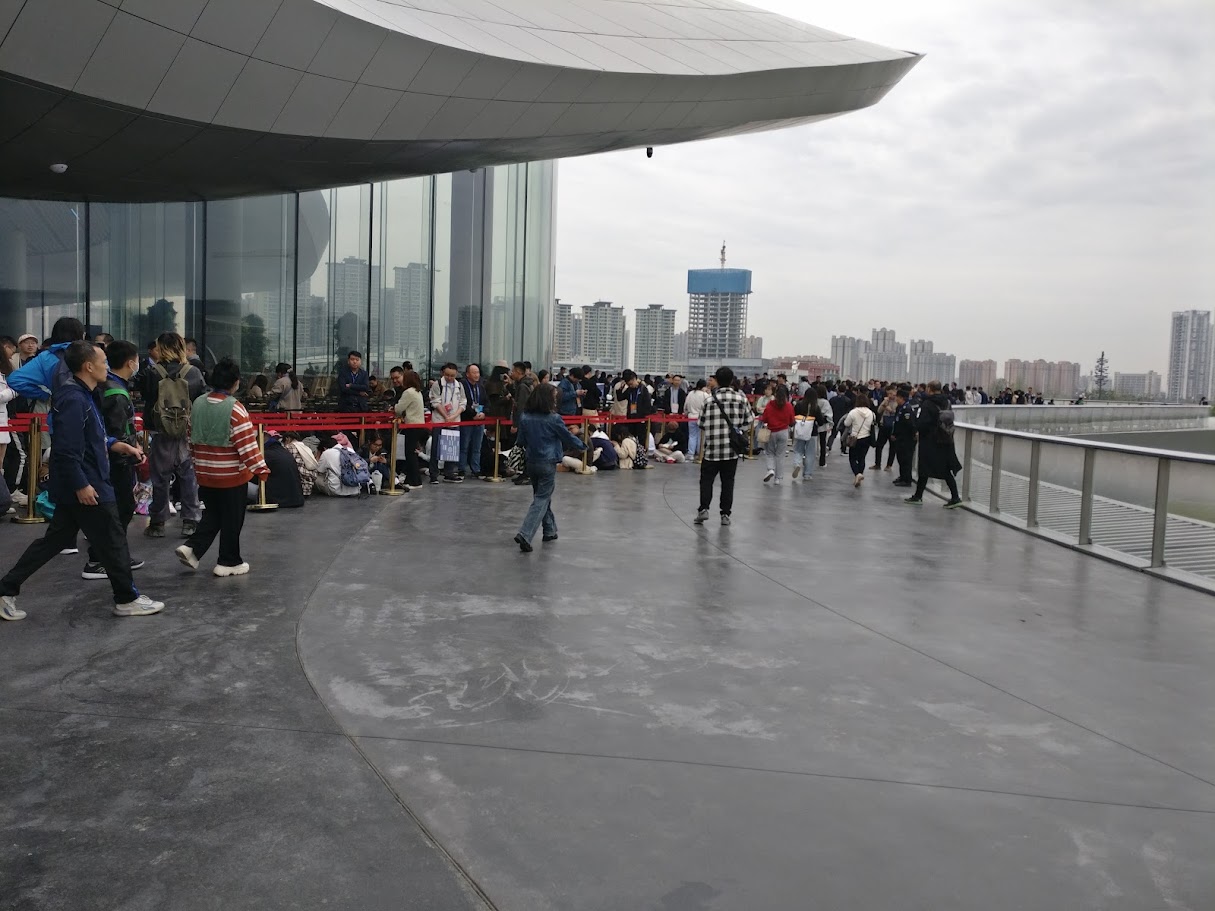
Thousands upon thousands of people passed through the venue, including many primary-school classes there for the day. Lots of young people, and lots of families. They weren't just there for the toys and for the impressive tech exhibition hall.


 The bookstall just across from the Glasgow Worldcon stall had a fast-moving queue of book-laden customers all the time. Many panels were standing room only, with people crowding the doorway leaning in and recording on their phones.


There were hundreds of volunteers, some minding the international guests, others helping visitors to the venue, acting as guides in exhibitions, or adding some elegance to the ceremonies.
 Some even worked on security (the hotel and the venue had almost airport-level security throughout the convention). Most seemed to be from language schools, and eager to practice their English.
Our good friend Fan Zhang, who looked after us so well in Beijing in 2019, now has an important post at the Fishing Fortress college of Science Fiction. He took us out to dinner with two of his staff, and had some interesting proposals for next year, which I'm seriously considering.
We had one side trip organised by the convention for guests: a visit to Chengdu's famous panda research centre, truly unforgettable.

 Alongside the hotel was an exhibition of 'Intangible Cultural Heritage', traditional arts and crafts: Shu embroidery not just displayed but demonstrated, traditional music and singing, silver filigree, a tea ceremony, cut-paper pictures, and melted-sugar drawings made before our eyes and handed to us on a stick to eat. It all made for an interesting and uplifting hour.
On our final day, Monday 23 October, Carol and I went on our own to the Wuhou Shrine, a historic site and major tourist destination set in a great park which opens to some old streets, now lined with gift shops and street food stalls.


And on Tuesday we began the long journey home. We had met old friends and made new ones, and it was a pang to leave.

We owe thanks to many people - the organisers and volunteers, especially Zoe, and a special thanks to the indefatigable Sara Chen.
 Buy My Apocalypse Songs (15 Lyrics In Search Of Music) [ 18-Sep-23 3:11am ]
While you're standing around
Waiting for your grandkids to drown
Or maybe catch fire
After you're dead and retired
You may as well listen
Get high and get pissed
To my apocalypse songs
Yes listen to this shit
Boomer please
I'm down on my knees
Everything has gone wrong
Buy my apocalypse songs
I've got profiles in discourage
From The Airplane to the bees
Failed stories faded glories
All you need is flowers and beads
From Stealers Wheel to The Troggs
From glitter glam to 60s mods
And there was surely Pussy Galore
Stick around you won't get bored
Boomer please
I'm down on my knees
Everything has gone wrong
Buy my apocalypse songs
We didn't stop the fire (rept)
 Actual Apocalypse (2020)
Everyone's a prepper now Everyone's a mutilated cow Everyone is making vows
Everybody take a final bow
Actual apocalypse It isn't fun like watching Mad Max it isn't clever like Oliver Sacks or
Insanely great like Steve Jobs' Macs
One mask is for the disease One mask is for the smoke One mask is for avoiding police
Last toke before we're broken
Actual apocalypse It isn't fun like watching Mad Max it isn't clever like Oliver Sacks or
Insanely great like Steve Jobs' macs
2020 that was the year 2020 the vision is clear Gonna need four more beers Drown the
fire in my tears
Actual apocalypse It isn't fun like watching Mad Max it isn't clever like Oliver Sacks or
Insanely great like Steve Jobs' macs
Ring around the platitudes A pocket full of smug
Call & Response (rept. Many times)
East Coast Chorus
"Water water everywhere"
West Coast Chorus "Ashes ashes"
You don't need a weatherman to know we're toast
Shit's getting Biblical from coast to coast
I'm moving' to Ohio where the chicks are groovy
Surfin' with Mike Love we're gonna make it a movie
(to the tune of Surfing USA as stolen from Chuck Berry's Sweet Little 16)
And they'll be surfing in Boston
And in the ruins of Pompei
Deep in the deserts of Kashmir
L.A. has gone cra-cra
They'll all be grabbing their children
And all their property too
Tell everybody they're surfing
And everything is cool
You don't need a weatherman to know we're toast
Everybody's freakin' from coast to coast
Going' back to California where the chicks are pissed
They'll kneel before my virtue when I raise my fist
And they'll be shooting deniers
And oil CEOs
And all Republican Senators
And every Fox News host
They'll all be grabbing their children
And all their property too
Tell everybody they're surfing
And everything is cool
He was the stepfather of his country
But he raised the kids as his own
He gave them ears of corn — oodles of porn
But when they bought bad cocaine they earned his scorn
& when they all got older
He turned them into soldiers
Strapping tote bags to their shoulders
filled with weapons of mirth
It was all rather cheery
He read them Dr. Leary
Until those silly numbskulls
Decided to give birth
That was just the final straw
This was just what killed their pa
"Birth & death stay from my door
What do you think the porn was for?
To make you each one onanistic
Now I'll get a bit fascistic"
One by one he ate his grandkids
Chowed them down like gutted pigs
Except one who was schizophrenic
& could produce some anaesthetic
Together they drifted into a coma
Singing gleeful songs of soma
& thus a world was born & died
All because of a stepdads pride
It takes a village to make things fair
Fuckin' stepdad didn't care
Dumb easy feckless proles
Matrons danced the Watusi
Hoodlum malcontents did the stroll
Early tech geeks couldn't find sushi
Assholes like me were relentlessly droll
Dads at home acted like il Duce
Middle class kids weren't on the dole
Everyone bowled and went to the movies
But now there's no rest
Now there's no rest
Now there's no rest
For the Precariat
But now there's no rest
Now there's no rest
Now there's no rest
For the Precariat
Punters fighting punters
Owners sailing yachts
We can jump into the fire
But we cant afford new Reeboks
Nothing much is left to say
It's cyberwar from day to day
Street distress from night to night
Play instruments of madcap blight
And now there's no rest
Now there's no rest
Now there's no rest
For the Precariat
But now there's no rest
Now there's no rest
Now there's no rest
For the Precariat
The girl at the ticket booth
Started wailing and weeping
With all the grieving
A body could hold seething
& the bouncer standing near to me
With cracked and violent idiot glee
Was swinging his fists randomly
Saying everybody gets in for free
But first you have to get passed me
Everyone from all around
saying stuff that sounds profound
& a smarter king of Deliria
That day was duly crowned
& if you listen a wee bit closer
To all the people in the ground
You'll hear them screaming loud
& this is the sound
[Follow with Ornette Coleman meets Jimi Hendrix 8 minute jam]
Pulp (rept)Pulp
Pulp
One slimy gulp
Cheese contrasts and compliments
A hint of leather methamphetamine crashing
Disconsolate poisoned rockabillies smashing
Or just a washed-up cabaret
Playing themes around a town without pity
Laughter as much as revulsion
Prayer beads of a tactless devotion
A goblin drinking from a guilty pump
Ectoplasm and it's slithering amok
Could be Falstaff but I know it's Puck
Get thee to puppetry to come unstuck
There's something special in the grime
Lipstick smeared before a wife of crime
The whipped clean sheen of a mall
It's only pulp but here have mine
Love ain't like anthrax at all
It's only pulp but give it time
It's only pulp but give it time (rept)
Lip Sync Ships StinkerTorn limb from limb by the mean girls at the orphanage
Glued back together in a spirited attempt at hoodoo bricolage
Went on a rampage of irreligious sacrilege
It didn't matter to her a whit if it was Islam or written in Sanskrit
Lip syncs sink ships
Uncle Fester loves Trent Reznor
Polly the hijacker wants a cracker
Lip sync ships stinker
She sniffed the air tingling & tasting loves uneasy lunacy
Saw sorrowful vistas spotted with funereal urns
She rang a doorbell brought her neighbors an eerie shrieking doll
with that invasion they entered the dreamlands of the unwell
Lip syncs sink ships
Uncle Fester loves Trent Reznor
Polly the hijacker wants a cracker
Lip sync ships stinker
In this lightly sprinkled phase
Of quasi-historical banter
Do you like Phyllis Diller
More than Paul Kantner?
I challenge you to a high stakes game
Of triage and hospitalization
Nearly fatal illnesses terrible stillnesses
What have you got to lose then?
You have no friends and might just mend
The betting starts and some day it ends
That's when the payoff takes its toll
Chased across the data in an infinite troll
And now I need an infinite rest (and that's death)
Now I need an infinite rest (and that's death)
Live free or dye your hair pink
The choice is easier than you think
There ain't no choices just cacophony of voices
It's the entire kitchen sink
So while we try to make sense
Ideas are being steamrolled by events
While we try to make sense
Ideas are being steamrolled by events
An intoxicating mixture of dogshit and fennel
Chowed down right there in the very kennel
A handful of bros and their surly bitches
Laughing in the faces of beheaded snitches
And if'n that don't float your boat
See what the news is with your remote
Yes pandemonium comes to all seven seas
Pirates with nukes and the deadly bees
So take a moment to name your poison
To run with the wolves or hang with the boys 'n'
Take a quick pic for an NFT fortune
Or just wait around for the next bus to Boston
Yoginini Joes has a private shaman
She screams "don't interrupt me" at her maid called Carmen
Who’s polishing the Paltrow vagina candle
When Yogini Jones flies off the handle
Shouting “don’t touch that talisman
It awaits the sacred phalisman
Unenlightened wretch you make me tired
I live in perfect peace and you’re fucking fired
The next thing you know Yoginini’s giving lectures
On how to stay positive — her bodyguard is Hector
Hector is a killer microdosing PCP
And Yoginini Jones is selling branded tantric pee
In a definite misunderstanding Yogini contacts me
I tell her I can’t help you dear — maybe try Flea
Flea invites him up to his place for wine and brie
But hw just won’t get behind the branded tantric pee
(repeat 3 times)
Enlightenment entitlement
Tantric pee is heaven sent
Buy Gwyneth’s sacred scent
With a tasteful dash of decadent
 A Brief Discourse
I got the word from the Bolshevik shaman
Who thinks he's also a Hindu Brahmin
Drank Iboga from a patented cup
I just shrugged and said "Cool what's for supper"
Around me people were puking up shit
Put it on youtube — it could be a hit
They cried and tugged and gouged at their eyes
Pluck them out was not that surprising
But back to the operatic scene at hand
The long and boring road from madness to bland
Like reeling in the years and bobbing for Snapple
Getting paid to keep it low down and subtle
When that "all hell" broke loose I was in the back
Brokering a truce and wearing a dunce cap
Trying hard for death with pills and soda
Hovering around for just one last Mimosa

The edgelord built a sneerbot
He knew it would replace him
When it came time to upload his mind
He slipped away on a vacation
He hid out in Tangiers
Imagining he was Brion Gysin
But Edgelord pals can't be trusted
And one day one slipped him some ricin
And we were laughing all the way to the bank
But we found the account was vacant
We tried everything from flash to bland
And to making the sex more blatant
We tried pitching to the British ravers
And to the sincere planet savers
And to the loony libertarians
Who didn't do us too many favors
And the sneerbot said…
Haw haw haw they used to wipe there own asses
Haw haw haw they used to wipe there own asses
Haw haw haw they used to wipe there own asses
Haw haw haw they used to wipe there own asses
And the sneerbot said…
Look at this history of the human masses
Haw haw haw they used to wipe their own asses
And look at this dude tryin' to boil his own eggs
Man those humans was on their last legs
Watched jocks and the hippies share a kegger
And give free oysters to the local beggar
I've seen this all with my very own eyes
Man these humans they take the fuckin' prize
and the sneerbot said
Haw haw haw they used to wipe their own asses
Haw haw haw they used to wipe their own asses
Haw haw haw they used to wipe their own asses
Haw haw haw they used to wipe their own asses
The universe is made of Crayola
I lost the '70s thanks to payola
I was a member of the Blank Panther Party
Ripped on coke and Bacardi
I learned to multiplex before I could add
I was a murderess before I was sad
My micro-mini is way below my knees
I ain't no goddamn tease
I hit the racetrack I was loaded with cash
Was feeling guilty and a wee bit rash
Bet all my winnings on a system crash
And now I've gotta dash
The universe is made of Crayola
I lost the '70s thanks to payola
I was a member of the Blank Panther Party
Ripped on coke and Bacardi
Well I used to be disgusted
And then I tried to be amused
But now I'm just plain flabbergasted
At the depth of the abuse
And I'm not singing 'bout a bad date
And I'm not singing 'bout ya 2 minutes hate
I'm looking at the new level of crazy
With their hands wrapped around our fate
Does anybody remember the quantified life?
(R. Plant voice) Does anybody remember laughter?
Does anybody remember the balcony speeches?
Does anyone remember bloodletting and leeches?
Does anyone remember the days before then?
Lugubrious meetings with remake-able men
& Little Brother is watching one and other
So mark your turf — Then run for cover
When you get to the bottom of the world
Just find some expensive California girls
Build a luxury home with all the convenience
Invite three billionaires and one digital genius
You'll start a new race that's probably pale
This human race is about to fail
Don't worry 'bout them you'll soon set sail
From the launching pad in the desert sun
Who knew holocausts could be so much fun
In your helter luxury shelter
In your helter luxury shelter
Days of fire and desert swelter
In your helter luxury shelter
Do you remember when chaos was a state of play
Do you remember "punk rock is here to stay"
Do you remember when Sister Ray was très outré
When Bowie asked… "or even yesterday?"
I'm wearing deplatform shoes
I've got the fear monger blues
When you ain't got somewhere
You got no choice to choose
And now I'm yesterday's news
They canceled Lenny Bruce
I still have a glimmer of rascalinity
But now it's one inch short of divinity
My jest is a million miles from infinity
I may be creepy crawling towards morbidity
I'm wearing deplatform shoes
I've got the fear monger blues
When you ain't got somewhere
You got no choice to choose
And now I'm yesterday's news
They canceled Lenny Bruce
I used to chatter to the birds and bees
Grabbed the branches and climbed the trees\
I'm picking fleas, man… all this disease
All that's left now is to vomit and sneeze
I'm wearing deplatform shoes
I've got the fear monger blues
When you ain't got somewhere
You got no choice to choose
And now I'm yesterday's news
They canceled Lenny Bruce
(first movement: Simcerely)
One more shot at glamour
Everybody's dead in Alabama
Your status symbol's your latest trauma
Don't bring the noise bring the drama
Bring all the bad karma
& the Dalai Lama
& lay your burden down on me
Come on lay it down
Simcerely yours
You're the boss
Just a lost cause
No remorse
(second movement: Draw the Curtain)
Last blast of spectacle
Termite feeding on the bloated corpse
I want a piece of the action
Fuck y'all and your way rad factions
Reemergence as the prince of naught
Truly ready for the triumph of the nil
All the hip kids need a reason to go on
Like '73 when I saw Satyricon
The next 4 years were sexy and steamy
I thought I was Frederick Fellini
It was a blast it couldn't last
I even wound up with my dick in a cast
Chump change with President Carter He said peanuts I said barter
A punk group was a total nonstarter
Drunken blonde was my perfect partner
She had a poster of Ulrike Meinhoff
She knew how to kick and she knew how to scoff
When the boys tried to climb on board
Her cutting words were as a sword so…
Last blast of spectacle
Termite feeding on the bloated corpse
I want a piece of the action
Fuck y'all and your way rad factions
(Third Movement Say The Right Thing)
I live in a world of perpetual crisis
We want to get out but we know what the price is
Death come fast
After this repast
They're all certain
Bring down the curtain
They're all certain
Bring down the curtain
They're so young
They're no fun
They're so young
They're no fun
Trite makes right
Uptight
Trite makes right
Uptight
Walk upright
Polite
Walk upright
Polite
I live in a world of perpetual crisis
We want to get out but we know what the price is
Death come fast
After this repast
It's tasty in the bakery
Sticky in the mines
We're trying to get out
Just tell me when it's time
His libidinal wants swaddled in rectitude
Born in purity at 60 years old
The stick gains its entry
The stick gains its entry
The stick gains its entry
There it must stay
She's got the bling
But she says the right thing
It don't mean a thing
Of thee we sing
(rept with increased stridency)
Say the right thing
The post Buy My Apocalypse Songs (15 Lyrics In Search Of Music) appeared first on Mondo 2000.
Home movie — The filming of Akenfield by Ronald Blythe. [ 26-Aug-23 6:49pm ]
Home movie — The filming of Akenfield by Ronald Blythe.
I THINK THAT MY CHIEF SURPRISE is that it’s all happening, as they say. The preliminaries have been so protracted and the idea so threatened by various aspects of the malaise affecting the film industry generally, that Peter Hall and my-self, glancing at each other across the farmyard, often find it amazing that we are actually shooting Akenfield. Initially I had great reservations about filming the book at all. In the first place, the tendency of film companies or television to want to turn every successful book into a picture is questionable. Writers are often mangled in the process. Anthony Burgess continues to protest about what occurred to his novel A Clockwork Orange when the film-makers got hold of it. My book presented unique difficulties inasmuch as it involved many friends and neighbours as well as deeply personal experiences drawn from a whole lifetime in the Suffolk countryside. Also, there was the problem of continuity; how did one film three generations in terms of work, belief, education and climate. For this is what Akenfield is really concerned with.
I met Peter Hall in London a few weeks after the book had been published and he told me of his Suffolk home; how my work had touched a deeply personal element in his life, and how, like all creative people, he felt a great need to express important things concerning himself and his family in artistic terms. He thought that a film based on Akenfield might achieve this. There would be no actors and as little as necessary of the general elaborations which accompany the making of a big film. That autumn I wrote a script based on the ideas in the book, on what people said and did. Roughly speaking, the pattern of this script involves a day in the past and a day in the present, a day of life and a day of death, and a day of summer and a day of winter. Within this pattern a century of Suffolk life works itself to a present-day conclusion.
It is a feature film and not a documentary, although every-body in it would be ploughing, shoeing, praying, marrying, harvesting, teaching, rook-scaring, factory-farming, digging up the past or concealing the present with all the actuality which the camera could catch. Peter Hall and I talked of Robert Bresson and his remarkable films of French country life. I even mentioned Man of Aran. A Suffolk friend of mine, Hugh Barrett, had accompanied Flaherty when he was making this classic. The script written, the agreements settled as to how we would resolve things generally, it took the super-human tact and imagination of a young producer named Rex Pyke to get our film financially and practically into motion. Then suddenly, after two years of negotiation—we started.
For myself it has meant starting off in hundreds of directions, returning, on the whole triumphantly, with the necessary spoils. Permissions to use old schools, fields, churches and chapels. Advice or artefacts from everybody within a thirty-mile radius and, most important of all, people. We auditioned scores of East Anglians for the little group of main roles and then literally went out into the highways and byways to collect country children, men and women for the large scenes. Many of the results deriving from this spontaneous casting have been a revelation to us all. I ‘shall never forget seeing the first rushes of the 1900 village school scene and the forty or so local children miraculously slipping back in time (under the influence of hob-nailed boots, slate-rags, pinafores and thunderous iron desks) until they had become, by some mysterious chemistry better known to themselves than our costume department, the distant children in the sepia photographs which I had brought from our splendid Rural Industries Museum at Stowmarket.
The school building itself was fascinating. It lies just across the meadows from my house and was built in 1858, but has not been used for over thirty years. It was the little building which Edward Fitzgerald, the translator of Omar Khayyam, used to visit when he felt like instructing the children. Several of the old people in my book were educated there and after we had re-furnished it with all the things discovered in the East Suffolk Education Department’s store at Ipswich, swept the chimney—full of jackdaws’ nests—lit the fire in the massive Victorian grate and chalked 'Tuesday 3rd January 1900’ on the blackboard, I thought of those neighbours of mine who had actually sat in this tall room and heard about the Boer War.
It was foolhardy, we realised later, to have begun filming Akenfield with a particularly elaborate and subtle scene involving seventy people, if one included such kind assistants as the Vicar’s wife and the headmistress of the nearby primary school, but when we saw the results on a vast screen in a little cinema in Wardour Street, we were delighted that we took so bold a plunge. I think it was John Constable who said that 'a big canvas will tell you what you cannot do’ and this first weekend of shooting, appropriately enough in Debach school, was a real education for everybody working on Akenfield. It did indeed tell us what we could not do in the circumstances of this unusual film, and this was never to go beyond the reality of what existed before our very eyes. The reality was the fun, the sadness, the poetry and the truth. And thus all the drama that we required.
The fun certainly came over in a big way—and accompanied by big-band music—when we held a 1943 village dance. Mr Arbon, who had blacked-out the hall for Hitler’s war, blacked it out all over again for us. People of all ages, the Young Farmers’ Club, farm workers and their families, teachers, every kind of person, danced to Glen Miller and the Inkspots, while the bombers from the nearby aerodrome (now the site of a vast mushroom factory) boomed overhead. Searchlights, sandbags, uniforms of the Suffolk Regiment, free beer from the Ipswich brewers whose wartime ads were mixed up with posters which said, 'Be like Dad, Keep Mum’, and some drastic haircuts created the kind of nostalgia you could cut with a knife.
But the real test of filming Akenfield has been re-creating the old horse economy of Suffolk for the early scenes, finding those small fields of heavy clay, with their dense hedges, discovering workable forges which have not progressed from leather bellows to acetylene welding and, above all, searching out young farm workers who are able to do the old traditional crafts. We soon found out that the best way to do anything of this nature was not by appeals in the local press or on local television, although each of these mediums have given us the most generous help, but by good old bush telegraph. Not the least disturbance to my normally extremely quiet existence is the unknown voice on the telephone, full of Suffolk diffidence, saying, 'I hear you’re looking for a man who can use a reaper…’ Or giving me invaluable advice on costume, weather, hymns, pigs, stone-picking, battery chickens or just life itself as we aim to show it.
Perhaps our best scene, and certainly the one which most excites us, is the great harvest scene of about 1911, with the magnificent Suffolk waggons, the biggest in England, in the field and with heroic punches to draw them. We intend to cut two fields according to the old manner and have even arranged for them to be delightfully, if inefficiently, starred with poppies and scabious. We are praying for traditional harvest sun and moonshine so that we can capture something of those toiling idylls reflected in the Suffolk Photographic Survey, a wonderful collection of old pictures showing every facet of rural life in the county since the 1870s. The survey is the basis of our authority in such matters and I find it deeply moving to see these glimpses of Suffolk long ago brought into the present, as it were–principally by local faces. 'Hands last’, said the blacksmith in my book. So do faces, of course. The youngster climbing out of his car, a bit awkwardly, for the old clothes are massive compared with jersey and jeans, takes the plough-reins and plunges off to the horizon behind delicately stepping shires, and, certainly for all the intents and purposes of our film, is his grandfather.
We have to shoot across the seasons, of course, so the making of the film is abnormally protracted. It is an enormous film, maybe two hours long and full of time and music, as well as work. Also love and death. Peter Hall calls it his home movie, thinking of his special involvement and of the weekend shooting schedules. In between filming, we all rush back to our 'normal’ tasks, Peter to the National Theatre, the camera crew to various studios, the producer to cutting Pinter’s The Home-coming, the designer, the make-up girls, wardrobe mistresses, and so on to a variety of professional quarters and myself to writing a book called The Art of the English Diary which makes a change. And our cast hurries back to keep half a dozen surrounding villages running.
If we succeed, we shall have challenged a lot of myths connected with the orthodox film industry, particularly those dealing with money. Our company, which we have registered as 'Angle Films’, is really a co-operative from which nobody takes his usual professional fee until the film itself makes a profit. If its soul, or whatever, finally emerges into the un-common light of an East Anglian day, it will be due to the marvellous help of the country people themselves, who have been swift to recognise the special nature of the enterprise, and due a bit also to Peter Hall and myself coming from many generations of 'Suffolk’.
Home movie: The filming of Akenfield by Ronald Blythe. Reproduced here with the kind permission of both Ronald and The Countryman. First published in The Countryman, summer 1973.
Orford NessOrford Ness is a cuspate foreland shingle spit on the... [ 04-Jul-21 5:24pm ]
Orford Ness
Orford Ness is a cuspate foreland shingle spit on the Suffolk coast in Great Britain, linked to the mainland at Aldeburgh and stretching along the coast to Orford and down to North Weir Point, opposite Shingle Street.
Between August 1913 and the summer of 1916 the southern half of the King's Marsh was drained and levelled to form airfields to the left and right of the road. The site was ready to receive its first aircraft in 1915. This was perhaps the most significant turning point in the history of the Ness, with the arrival of part of the Central Flying School's Experimental Flying Section from Upavon in Wiltshire. This was the start of 70 years of intense military experimentation, which as well as leaving a variety of physical traces, has given the place what has been described as 'the mystique of secrecy'. The longevity as a place of military experimentation is significant. The arrival of the military curtailed the traditional uses of the Ness by the local population, although the station soon became an important source of employment for them. Most of the experimental work related to aerial warfare. Parachutes, bombs, machine guns and aircraft. Significant advances were made in both military hardware and experimental techniques and equipment. Amongst the pioneering work of the First World War were early experiments on the parachute, on aerial photography and on bomb and machine gun sights as well as evaluation of aircraft and the development of camouflage. After the War Orford Ness was put on a 'care and maintenance' order until 1924 when it was reopened as a satellite of the Aeroplane and Armaments Experimental Establishment at nearby Martlesham.
When the site was reopened in 1924 a 'new' experimental bombing range replaced the First World War range. The range operated right up until the development of nuclear weapons, with some of the last work being the development of advanced high-speed, low-altitude bombing techniques for Britain's last independent air-dropped nuclear weapons, the WE177 series. The current Bomb Ballistics building was built in 1933 to house 'state of the art' equipment used to record the flight of bombs. This information was used to improve their aerodynamics and provide data for the production of the tables used to refine bomb aiming. The equipment was steadily improved over the years, most notably from the 1950s for the development of the atomic bomb. The technical capabilities of the range were proved by the fact it was still used during the Second World War, despite its proximity to the continent. The Bomb Ballistics building was restored in 1996, and the roof now provides a platform from which to view the site, in particular the vegetated shingle features that make the Ness such an important site. Inside there is a display on the uses of this building and the surrounding area.
This enigmatic building, looking much like a sail-less black windmill, was constructed by local builders WC Reade of Aldeburgh in 1928 for the Royal Aircraft Establishment, Farnborough, to house an experimental 'rotating loop' navigation beacon. Part funded by Trinity House and reported to be a marine navigation beacon, the Air Ministry also funded work on the development of an aircraft location system based on this early innovation, and the Orford Ness equipment was probably an early homing beacon for aircraft that formed part of this work. Renovated in 1995, the beacon now provides an elevated viewing area and displays for the visiting public.
Perhaps the most significant experiments on Orford Ness took place between 1935 and 1937, after Robert Watson-Watt and his team arrived on 13 May 1935 to found the 'Ionospheric Research Station'.This was in fact a cover for the research and development of the aerial defence system, which was later to become known as radar. Still standing and recently restored, one of the few surviving First World War accommodation blocks on the site (later employed as the NAAFI) was used by those radar pioneers. The First World War 'Institute' building - close by and still standing - might also have been used in these experiments. The first demonstrations of the feasibility of radar as a practical air defence system were made here before the team moved a little further down the coast to a larger site at Bawdsey Manor in 1936. There, a full range of applications was developed leading to the creation of the first of the 'Chain Home' stations. It is not an exaggeration to say that but for the work done by this team at Orford Ness and Bawdsey Manor, the outcome of the Battle of Britain and the subsequent history of Europe would have been very different.
Between 1938 and 1959 a majority of the firing trials were concentrated in the northern airfield, part of which is now reedbed. The firing trials were mainly concerned with determining the vulnerability of aircraft and aircraft components to attack by various projectiles. Whole aircraft or individual parts such as fuel tanks, oxygen tanks or running engines were subjected to carefully controlled and recorded simulations of attack. A principal area of work involved improving the lethality of Allied ammunition and improving the protection of Allied aircraft against German ammunition. A wide range of aircraft including four-engine bombers would be lined up here undergoing trials. To determine vulnerability the aircraft were shot at with .303 rifles from all angles, a single shot at a time, with each bullet hole marked and recorded after every shot. After the war work continued on machine gun ammunition, rockets and other projectiles, on the vulnerability of aircraft to attack and the development of techniques to record projectiles in flight and duplicate various effects experimentally.
Connected with the 'lethality and vulnerability' firing trials a rather uninteresting looking building was home to a number of extraordinary experiments. During the 1940s the Plate Store was part of a plate range. The plates in question were sheets of experimental armour plate or paper targets. Initially built to house the plate armour, the end wall was later removed and various types of projectile were fired from smooth bore field guns into plates mounted inside the building to test their effectiveness. Tests on the fragmentation of projectiles employed old London telephone directories to determine how far the fragments would penetrate. The method of firing projectiles from smooth bore cannon was later employed in the Model Bombing Range (sited near the NAAFi building) to test models of bombs and rockets. The Plate Store was last used by the AWRE as a technical base for experiments on the interaction of radio waves with the ionosphere. The bases of the radio masts can still be seen around the brackish lagoons just over the Chinese Wall in the King's Marsh.
After the Second World War, work continued on the aerodynamics of bombs, machine gun ammunition, rockets and other projectiles. It also continued on the vulnerability of aircraft to attack and the development of techniques to record projectiles in flight and duplicate various effects experimentally. During the 1950s the King's Marsh was used as an experimental range for recording the flight paths of air-launched rockets. Fired from above the airfields the rockets were recorded by a series of cameras triggered by infrared sensitive cells, which could detect the rocket as it passed over. In the peaceful atmosphere of today it is difficult to imagine the noise generated by these trials as the Gloster Meteor jets passed over at full speed and at a height of only 50 feet (15 metres).
In 1968 work started on the top secret Anglo-American System 441A 'over-the-horizon' (OTH) backscatter radar project, finally code-named Cobra Mist. The Anglo-American project, whose main contractor was the Radio Corporation of America, was set up to carry out several 'missions', including detection and tracking of aircraft, detection of missile and satellite vehicle launchings, fulfilling intelligence requirements and providing a research and development test-bed. A multi-million pound project, it was plagued by a severe 'noise' problem of an undetermined origin which resulted in a major reduction in detection capability. An investigation into this problem by a joint US/UK Scientific Assessment Committee (SAC) led to a report and recommendations in early 1973 from which came a joint US/UK decision to terminate operations at Orford Ness, based on economic and 'other considerations'. An integral part of the project, beyond the building stood 18 'strings' of antennae in the shape of a large open fan, until they were removed in the mid 1970s. This fan was accompanied by a large aluminium 'ground net' covering some 80 acres of Lantern Marsh to the north of the site. Cobra Mist is also well known for its alleged associations with UFOs. The large grey steel building currently houses radio transmitters that until recently broadcast the BBC World Service.
It is a place of strange contrasts. For the National Trust, its 'elemental nature' contrasts with the 'inherent dangers' of this place, a 'hostile and potentially dangerous site'. Military structures - the Bomb Ballistics Building, the Black Beacon, the 'pagodas' used for explosive design - have been converted into viewing spots. This is not a celebratory site, however; there is ambivalence and doubt here, with regard to what is being physically and ideologically conserved.
— Rachel Woodward — National Trust
Images — A Film by Robert AltmanWhen a wealthy housewife and... [ 02-Jul-21 6:43pm ]
Images — A Film by Robert Altman
When a wealthy housewife and children's author begins to have disturbing visions, her husband takes her to the countryside for a vacation. There, her delusions worsen, with tragic consequences.
Wealthy children's author Cathryn (Susannah York) receives a series of disturbing phone calls in her home in London one dreary night; the female voice on the other end, sometimes cutting in on other phone conversations, suggests mockingly that her husband Hugh (René Auberjonois) is having an affair. Hugh comes home, finding Cathryn in distress. As Hugh attempts to comfort her, Cathryn witnesses a different man who is behaving as if he were her husband. She screams in horror and backs away, only to see her vision of the figure revert to her husband.
Hugh attributes her outburst to stress and her pregnancy. He decides to take her on a vacation to an isolated cottage in the Irish countryside, where Cathryn can work on her book and take photographs for its illustrations. Immediately upon her arrival, however, Cathryn hears voices saying her name and sees strange apparitions: While preparing lunch one day, she sees her husband Hugh pass through the kitchen, then transform into her dead lover, Rene (Marcel Bozzuffi). Rene continues to appear to her around the house, and even speaks with her.
Cathryn's paranoia and visions become increasingly pervasive, and are exacerbated when a local neighbor and ex-lover, Marcel (Hugh Millais), brings his adolescent daughter, Susannah (Cathryn Harrison), to visit. Cathryn becomes unable to distinguish Hugh from Rene or Marcel, as the men shift before her eyes. One day, Rene taunts Cathryn, asking her to kill him if she wants rid of him, and hands her a shotgun. She shoots him through the abdomen; Susannah, startled by the gunshot, runs into the house, and finds Cathryn standing in the den, having shot Hugh's camera to pieces. Cathryn claims the gun accidentally fired when she was moving it.
Seeking solace, Cathryn goes to a nearby waterfall, where she often sees her doppelgänger staring back at her. After one such occurrence, she returns to the house, where Hugh tells her he has to leave for business. She drives him to the train station and returns to the house, where she finds Marcel waiting inside. He begins to undress to have sex with her, but she stabs him through the chest with a kitchen knife. The next morning, she encounters a local elderly man walking his dog, and invites him to come inside for coffee, in spite of the fact that Marcel's corpse apparently lies in the living room (which suggests that she regards the "murder" as a hallucination, like her shooting of Rene); the old man declines the invitation. Later in the evening, Susannah stops by the house, and remarks that her father was not at home when she awoke that morning. Cathryn is alarmed by this, as it could mean that she really did kill Marcel. She is relieved to hear that Marcel did return drunk after midnight, and invites Susannah in for a cup of tea after reasoning that Marcel cannot be dead on her living room floor. Susannah asks Cathryn if she looked like her when she was young before ominously saying, "I'm going to be exactly like you."
After having tea, Cathryn drives Susannah back home. Marcel comes out of the house and attempts to talk to Cathryn, but she drives away. While on a stretch of road through a desolate field, Cathryn witnesses her doppelgänger again, attempting to wave her down. Back at the house, she finds both Rene and Marcel's corpses have reappeared in the living room. Cathryn leaves again, and encounters her doppelgänger at a bend in the road; this time she stops. The doppelgänger begs Cathryn to let her into the car, and the two begin to speak in unison. She then hits the doppelgänger with the car, throwing her off a cliff and into a waterfall below. Cathryn then drives back to her home in London. At her home, she goes to take a shower. While in the bathroom, the door opens, and the doppelgänger walks inside. Cathryn screams in terror, "I killed you," to which the doppelgänger responds, "Not me." The final shot shows Hugh's corpse lying at the bottom of the falls.
Susannah York - Cathryn, Rene Auberjonois - Hugh, Marcel Bozzuffi - Rene, Hugh Millais - Marcel, Cathryn Harrison - Susannah, John Morley - Old Man, Barbara Baxley - Voice on telephone (uncredited).
Produced by Tommy Thompson and Al Locatelli (uncredited), Cinematography by Vilmos Zsigmond, Film Editing by Graeme Clifford, Production Design by Leon Ericksen.
Makeup Department: Toni Delaney … makeup artist, Barry Richardson … hair stylist, Production Management: Sheila Collins … production manager, Second Unit Director or Assistant Director: Seamus Byrne … assistant director, Sound Department: Rodney Holland … sound editor, Noel Quinn … boom operator, Liam Saurin … sound recordist, Doug E. Turner … dubbing mixer (as Doug Turner), Stomu Yamashta … sounds (as Stomu Yamash'ta), Special Effects by Jerry F. Johnson … special effects (as Jerry Johnson), Gerry Johnston … special effects (uncredited), Camera and Electrical Department: Earl L. Clark … assistant camera (as Earl Clark), Jack Conroy…gaffer, Paddy Keogh … grip, Nico Vermuelen … assistant camera, Costume and Wardrobe Department: Jack Gallagher … wardrobe, Editorial Department: Robin Buick … assistant editor, Michael Kelliher … assistant editor, David Spiers … assistant editor, Music Department: Stomu Yamashta … musician: sound sculptures, John Williams … orchestrator (uncredited), Transportation Department: Arthur Dunne … transportation captain, Other Crew: Joan Bennett … continuity, John Collingwood … production accountant, Jean D'Oncieu … assistant to producer.
The Lost Town of DunwichThere's a queer story going about,... [ 30-Jun-21 9:57pm ]
The Lost Town of Dunwich
There's a queer story going about, when the door's shut and the curtain's drawn, that is, as to a place right out in the country over the other side of Midlingham; on the opposite side to Dunwich. They've built one of the new factories out there, a great red brick town of sheds they tell me it is, with a tremendous chimney. It's not been finished more than a month or six weeks. They plumped it down right in the middle of the fields, by the line, and they're building huts for the workers as fast as they can but up to the present the men are billeted all about, up and down the line … Some say they've seen the gas. I heard that a man living in Dunwich saw it one night like a black cloud with sparks of fire in it floating over the tops of the trees by Dunwich Common.
— The Terror by Arthur Machen
Dunwich is a village and civil parish in Suffolk, England. It is located in the Suffolk Coast and Heaths AONB around 92 miles north-east of London, 9 miles south of Southwold and 7 miles north of Leiston, on the North Sea coast.
In the Anglo-Saxon period, Dunwich was the capital of the Kingdom of the East Angles but the harbour and most of the town have since disappeared due to coastal erosion. At its height it was an international port similar in size to 14th century London. Its decline began in 1286 when a storm surge hit the East Anglian coast followed by a great storm in 1287 and another great storm also in 1287, and it was eventually reduced in size to the village it is today. Dunwich is possibly connected with the lost Anglo-Saxon placename Dommoc.
A gravestone dedicated to Jacob Forster is the last remaining memorial in the churchyard of All Saints Church in Dunwich. The church was decommissioned in 1758 due to encroaching coastal erosion. Most of the site went over the cliff; the last remaining buttress from the church was saved in 1920 and was moved to St James Church. The gravestone reads "In Memory of Jacob Forster who departed this life March 12th 1796 aged 38 years"
The Dark Heart of Dunwich is piece of Suffolk folklore, the origins of which appear to lie in the 12th century. The legend tells of how Eva, a Dunwich maiden due to be married to the son of a local landowner, fell instead for a good-looking local cad, who had his way with her and then deserted her, running off to sea. After waiting in vain for her lost love to return, she cut out her heart and hurled it into the sea. However, according to the legend, she was unable to die, and still haunts the area, particularly around the (constantly shifting) beach. The heart itself, believed to be similar in appearance to a wooden heart, is believed to wash up occasionally, and bring great misfortune onto anyone who picks it up and keeps it.
Grumpy Locals Are Sabotaging Cruise and Waymo Robotaxis With Traffic Cones [ 11-Jul-23 9:41am ] At your local animal shelter, roughly half of the cats up for adoption will be black or black and… [ 19-Jun-23 7:54pm ]
At your local animal shelter, roughly half of the cats up for adoption will be black or black and white. But black cats, in particular, face difficulty in finding adoption.
Although some cultures regard black cats well (in Scotland they are said to bring prosperity and in England and Japan some say they bring good luck) in much of the world they are associated with evil omens and witchcraft.
But now they face an added challenge: the cruel demands of the Instagram age, in which black cats are deemed less aesthetically pleasing than their more colourful comrades. Between 2007 and 2013 the Blue Cross saw a 65% rise in the number of black cats taken in each year, and the RSPCA, noting similar figures, blamed the fact that black cats are not "selfie-friendly".
"It's not uncommon for many monochrome moggies to wait many weeks or months to be adopted," says Gemma Croker from Cats Protection, which takes in 200,000 cats each year.
Adopt a black cat - here’s how to make them look great on Instagram (Guardian)
On a long enough timeline, instagram filters will shift the evolutionary opportunities of whole species.
# [ 21-Apr-23 7:49am ]
Spotify appears to be creating and uploading x thousands of identical, procedurally generated songs under different names and cover art.
According to DN, Firefly Entertainment is doing a roaring trade in what some would call "fake artists" on Spotify.
These are the now-well-known pseudonymous artists on the streaming platform - artists with no discernible online footprint - whose music fills up many of Spotify's own key mood and chillout playlists.
For a long time, music industry figures have wondered aloud whether Spotify has deals in place that see it pay less in royalties for streams of music from "fake artists" - whose cumulative streams now sit in the billions - than streams of artists signed to major record companies.
In its report (available here) DN obtained a list of 830 'fake artist' names linked to Firefly, and discovered that at least 495 of these artists have music on first-party Spotify playlists.
#This figure probably under-estimates the scope of Firefly's artists on Spotify-run playlists, suggests DN, as the newspaper only examined 100 playlists out of the "several thousand [playlists] that Spotify is responsible for".
# [ 30-Mar-23 7:42am ]

"The expectation was, you have to smile eight hours a day," a woman Baker calls Sofiya tells her. A 41-year-old Russian émigré who had been living in the United States for the past decade, Sofiya "was a proficient English speaker," Baker writes, but it was in her job as a bank teller that she "came face-to-face with her deficiency in speaking 'American.' This other English language, made up of not just words but also facial expressions and habits of conversation subtle enough to feel imagined. Smiling almost constantly was at the core of her duties as a teller. As she smiled at one customer after another, she would wince inwardly at how silly it felt. There was no reason to smile at her clients, she thought, since there was nothing particularly funny or heartwarming about their interactions. And her face hurt."
This confrontation with the culture clash of smiling for an Eastern European immigrant in America hits close to home. Which is why seeing the relentless parade of toothy, ahistorical, quintessentially American, "cheese" smiles plastered on the faces of every civilization in the world across time and space was immediately jarring. It was as if the AI had cast 21st century Americans to put on different costumes and play the various cultures of the world. Which, of course, it had.
# The very first citation in this stupid letter is to our StochasticParrots Paper, “AI systems with… [ 30-Mar-23 7:40am ]The very first citation in this stupid letter is to our StochasticParrots Paper, “AI systems with human-competitive intelligence can pose profound risks to society and humanity, as shown by extensive research[1]”
EXCEPT
that one of the main points we make in the paper is that one of the biggest harms of large language models, is caused by CLAIMING that LLMs have “human-competitive intelligence.”
[Twitter] [ 30-Mar-23 7:34am ]
[Twitter]
One of Europe’s largest ammunition manufacturers has said efforts to meet surging demand from the… [ 28-Mar-23 7:47am ]
One of Europe's largest ammunition manufacturers has said efforts to meet surging demand from the war in Ukraine have been stymied by a new TikTok data centre that is monopolising electricity in the region close to its biggest factory.
The chief executive of Nammo, which is co-owned by the Norwegian government, said a planned expansion of its largest factory in central Norway hit a roadblock due to a lack of surplus energy, with the construction of TikTok's new data centre using up electricity in the local area.
"We are concerned because we see our future growth is challenged by the storage of cat videos," Morten Brandtzæg told the Financial Times.
Norwegian company says TikTok data centre is limiting energy for manufacturing Ukraine ammunition
Photo [ 05-Jul-21 6:32pm ] Photo [ 05-Jul-21 3:13pm ]
 Jan Faye, The Reality of the Future — An Essay on Time, Causation and Backward Causation (Odense University Press) / Who is afraid of the Causal-General Approach? [ 04-Jul-21 9:05pm ]
"Faye's book is, without doubt, an important contribution to the theory of causality. It is meant not merely to reconstruct or to react to existing scientific knowledge but “to outline the conceptual foundations of new scientific knowledge". In that sense, it stands in the tradition of classical essays concerning natural philosophy and metaphysics. Faye's aim is nothing less than to give us a comprehensive characterisation of the conceptual and logical features of the direction of causation (including a coherent notion of backward causation) and, what is more, to give us an understanding of how causation is related to energy and time. The monograph is original to a very large extent; sometimes provocative (for more traditional accounts). It contains eight chapters, an introduction, conclusion, and a helpful index. In the following, we briefly mention the content of Faye's book and point out those of his claims which seem to demand further clarification. Chapter I deals with 'The puzzles about backward causation'. However, Faye's theory of backward causation is not a really shocking one - no fortune-tellers, no altering the past, nor shooting someone's own grandfather. Even if there were instances of causal relationship directed against the temporal order of events of the system under consideration, the kind of involved particles is limited to hypothetical quantum-mechanical objects ("advanced particles") only. Moreover, those objects would not be able to interact (at least not directly) with the "normal particles" of the world. This topic is considered in more detail in the last two Chapters VII (The advanced particles'), VIII (‘The theories of tachyons and their interpretations') and in the Conclusion. Naturally, telling stories about backward causation is not the ultimate goal of Faye's considerations. Chapter I revisits a representative sample of arguments against backward causation to see whether it is ruled out by any of the aprioristic reasons stated so far. Faye's conclusion is straightforward: backward causation is conceptually possible”
Jan Faye, The Reality of the Future - An Essay on Time, Causation and Backward Causation. Odense University Studies in Philosophy vol. 7. © 1989 by Jan Faye and Odense University Press. Photoset and printed by AiO Tryk as ISBN 87 7492 710 8. ISSN 0107 7384.
Who is afraid of the Causal-General Approach?
Philosophers have struggled with understanding the direction of time for centuries. No common notion is available even today. There are those who think of time's arrow in terms of objective becoming. They hold that since fundamental laws of nature are time-invariant, allowing processes to be symmetric in time, it must be some kind of objective becoming that tailors these processes in one direction. On this perspective the orientation of causal processes are parasitic on objective becoming. Becoming is ontic prior to causation. This view fares well with substantivalism but not with relationalism, since, ex hypothesis, becoming are not reducible to any relation between events. Nonetheless, some philosophers urge to bring in objective becoming in a relativistic framework partly because they don't see the possibility of physics to describe the necessary asymmetry as an intrinsic feature of the causal processes.
The major part of philosophers and physicists agree that causal processes do not exhibit an intrinsic arrow in virtue of certain nomological features, i.e. they believe that the asymmetry is not internal to the processes themselves. But they also reject the idea that the observed causal asymmetry is due to an objective becoming as vacuous or incoherent. Objective becoming is incompatible with relationalism if it cannot be reduced to features of the causal processes or features of the laws of physics, and relationalism is traditionally regarded as the ontological foundation of relativity theories - although today this is more controversial. These philosophers and physicists are still looking to physics to find a proper way of describing the causal asymmetry in spite of the fact that they deny that there exist intrinsically asymmetrical causal relations. The upshot is that they find various physical arrows of time but all of them, or nearly all of them, are due to an asymmetric distribution of boundary conditions. They argue that any asymmetrical causal relation consists in either a contingent asymmetry in the distribution of boundary conditions or in an anthropocentric projection. The basic laws of physics are symmetric in time and provide no help in marking out the direction of physical processes.
Apparently, we are left with two alternative approaches to a causal asymmetry: becoming or boundary conditions. One has little if no place in physics (as Dorato points out), whereas the other yields mostly an extrinsic asymmetry. Such an asymmetry may, however, not even in fact coincide with time's arrow. In my opinion, however, there is a third alternative: The basis of the arrow of causation rests on an intrinsic, non-relational physical property of a process that makes an instance of it a temporally asymmetric cause of an effect.
How to Write, Interview with Skinner Darkly [ 30-Jul-23 2:37am ]I got an emailed question about my novel Spacetime Donuts from a fan of mine, who prefers to be known as Skinner Darkly. I said, hell, let’s make it an online interview, haven’t done one of those for a couple of months. So here you are. I’m publishing it here, and on Medium. This time […]
The post How to Write, Interview with Skinner Darkly first appeared on Rudy's Blog.
Podcast #114. "Who Do You Love" [ 19-May-23 5:09pm ]May 19, 2023. This story relates to the death of my wife Sylvia. I read it an SF in SF event in January, 2023, and it was recorded by Rusty Hodge for SomaFM. The story appeared as online text in Nature Futures on Feb 15, 2023. Press the arrow below to play Rusty’s recording of […]
The post Podcast #114. "Who Do You Love" first appeared on Rudy's Blog.
Shirley Interview: AI, ChatGPT, and Consciousness [ 12-May-23 8:09pm ]Most of the material in this blog post is drawn from an email interview of me by my old pal John Shirley, for the terrific new ezine Instant Future , run by Brock Hinzmann and John. As is my usual fashion, for my blog-post version I added some images that may seem to have no […]
The post Shirley Interview: AI, ChatGPT, and Consciousness first appeared on Rudy's Blog.
Roadtrip To Encinitas [ 30-Mar-23 2:29am ]The grief is still quite harsh; it comes and goes. But it’s getting better. A couple of weeks ago, alone in the supermarket I was still lost in a haze of regret. All the things I didn’t do, or did wrong. Even though, in her last months, Sylvia told me, "I forgive you for anything […]
The post Roadtrip To Encinitas first appeared on Rudy's Blog.
The Potential Privacy Problems With YouTube's Family Plan "Suggestion Leakage" [ 16-Aug-23 7:02pm ]I love YouTube. I consider it to be a wonder of the world for an array of reasons. Its scale is — well, the technical term is “mindbogglingly enormous.” I subscribe to YouTube Premium (primarily to obliterate the ads — I don’t use ad blockers), and as far as I’m concerned it’s the best streaming service value on the planet. If I had to choose one streaming service only — it would be YouTube Premium, undoubtedly. I have something approaching 7000 favorited videos on YT, and I sometimes imagine that there’s a whole cluster in a dark corner of a Google data center singularly devoted to managing my giganormous watch history.
Does YT have problems? Yup. Some YT creators have to deal with inappropriate strikes and takedowns — I’ve tried to assist a bunch of these users with these sorts of disruptions over the years. Some people complain of bad video suggestions pushing them in dark directions — though this has never been an issue for me — the suggestions I get are generally great, though I do take time to train the algorithm as to what I do and don’t like. If you just use YT not-logged in and/or don’t train, you’ll probably get less favorable results. Basically that’s your choice.
Obviously, no technology is perfect, and at YT’s scale even if only a tiny fraction of suggestions are problematic, it can still be a large number in absolute terms. That’s life. I still love YouTube.
There’s an oddity though with YT that I think is worth mentioning. It’s not a big concern in the scheme of things, but it really shouldn’t be happening.
This relates to the YouTube Premium “Family Plan” that lets you bundle multiple separate Google accounts in a household together so that they all have the benefits of Premium, at a better price than each subscribing to Premium separately. Under FP, each of the associated accounts is free of ads, etc., but is still separate — with their own YT play history, etc. — and can view different content simultaneously (normally, a Premium account can only view content on one device at a time).
But a strange thing can happen with Family Plan. The videos being watched by one account on the plan can affect the suggestions on other accounts on the plan, even though they should be entirely separate in this particular respect.
This is most often noticed when a topic starts to pop up in the suggestions for one FP member that are totally odd for them — for example, a subject that they never view videos about. And it turns out — if the members of the FP compare notes — that some other member of the plan was watching videos on that topic, and the YT videos/channels being watched by FP member A are showing up in the suggestions for FP member B. And so on.
Most of the time this isn’t a serious concern, and can even be interesting in terms of surfacing new topics. But of course there are intrinsic privacy considerations as well. It isn’t good policy for the YT viewing habits of different family members to be intermingled in that way, without their specifically asking for such sharing. The potential family problems that could occur as a result in some cases are fairly obvious.
This has been going on with Family Plan for years, and I’ve brought this up with Google/YT myself in the past. And the responses I’ve always gotten back have either been that “it can’t happen” or “it shouldn’t happen” and … that’s pretty much where it’s been left hanging each time.
But it does still happen (I have a new report just this morning) and yeah, it really shouldn’t.
Again, not an enormous problem in the scheme of things, but not trivial either, and it’s something that definitely should be fixed.
–Lauren–
Artificial Intelligence at the Crossroads [ 13-Jul-23 5:24pm ]Suddenly there seems to be an enormous amount of political, regulatory, and legal activity regarding AI, especially generative AI. Much of this is uncharacteristically bipartisan in nature.
The reasons are clear. The big AI firms are largely depending on their traditional access to public website data as the justification for their use of such data for their AI training and generative AI systems.
This is a strong possibility that this argument will ultimately fail miserably, if not under current laws then under new laws and regulations likely to be pushed through around the world, quite likely in a rushed manner that will have an array of negative collateral effects that could actually end up hurting many ordinary people.
Google for example notes that they have long had access to public website data for Search.
Absolutely true. The problem is that generative AI is wholly different in terms of its data usage than anything that has ever come before.
For example, ordinary Search provides a direct value back to sites through search results pages links — something that the current Google CEO has said Google wants to de-emphasize (colloquially, “the ten blue links”) in favor of providing “answers”.
Since the dawn of Internet search sites many years ago, search results links have long represented a usually reasonable fair exchange for public websites, with robots.txt (Robots Exclusion Protocol) available for relatively fine-grained access control that can be specified by the websites themselves, and which at least the major search firms generally have honored.
But generative AI answers eliminate the need for links or other “easy to see” references. Even if “Google it!” or other forms of “more information” links are available related to generative AI answers at any AI firm’s site, few users will bother to view them.
The result is that by and large, today’s generative AI systems by their very nature return essentially nothing of value to the sites that provide the raw knowledge, data, and other information that powers AI language/learning models.
And typically, generative AI answers (leaving aside rampant inaccuracy problems for now) are like high school term papers that haven’t even included sufficient (if any) inline footnotes and comprehensive bibliographies with links.
A very quick “F” grade at many schools.
I have proposed extending robots.txt to help deal with some of these AI issues — and Google also very recently proposed discussions around this area.
Giving Creators and Websites Control Over Generative AI:
https://lauren.vortex.com/2023/02/14/giving-creators-and-websites-control-over-generative-ai
But ultimately, the “take — and give back virtually nothing in return” modality of many AI systems inevitably leads toward enormous pushback. And I do not sense that the firms involved fully understand the cliff that they’re running towards in a competitive rush to push out AI systems long before they or the world at large are ready for them.
These firms can either grasp the nettle themselves and rethink the problematic aspects of their current AI methodologies, or continue their current course and face the high probability that governmental and public concerns will result in major restrictions to their AI projects — restrictions that may seriously negatively impact their operations and hobble positive AI applications for users around the world long into the future.
–Lauren–
Thoughts on AI Regulation [ 29-Jun-23 5:56pm ]Greetings. The excellent essay:
https://circleid.com/posts/20230628-the-eu-ai-act-a-critical-assessment
(by Anthony Rutkowski) serves to crystallize many of my concerns about the current rush toward specific approaches to AI regulation before the issues are even minimally understood, and why I am so concerned about negative collateral damage in these kinds of regulatory efforts.
There is widespread agreement that regulation of AI is necessary, both from within and outside the industry itself, but as you’ve probably grown tired of seeing me write, “the devil is in the details”. Poorly drafted and rushed AI regulation could easily do damage above and beyond the realistic concerns (that is, the genuine, non-sci-fi concerns) about AI itself.
It’s understandable that the very rapid deployments of AI systems — particularly generative AI — are creating escalating anxiety regarding an array of related real world controversies, an emotion that in many cases I obviously share.
However, as so often happens when governments and technologies intersect, the potential for rushed and poorly coordinated actions severely risks making these situations much worse rather than better, and that’s an outcome to be avoided. Given what’s at stake, it’s an outcome to be avoided at all costs.
I don’t have any magic wands of course, but in future posts I will discuss aspects of what I hope are practical paths forward in these matters. I realize that there is a great deal of concern (and hype) about these issues, and I welcome your questions. I will endeavor to answer them as best I can.
–Lauren–
A Proposal for "Enhanced Recovery Services" for Locked Out Google Accounts [ 24-May-23 5:09pm ]This post could get very long very quickly, so instead I’m going to endeavor to keep this introductory discussion brief, with an array of crucial details to come later.
In my recent posts:
An Example of a Very Sad Google Account Recovery Failure — and How It Affects Real People
https://lauren.vortex.com/2023/05/17/google-account-recovery-failure-sad
and:
Potentially Serious Issues with Google's Announced Inactive Accounts Deletion Policy
https://lauren.vortex.com/2023/05/16/google-inactive-accounts-deletion
(and frankly, in many related postings over many years in this blog and other venues), I discussed the continuing problems of honest Google users being locked out of their Google accounts, often with a total and permanent loss of all their data (Gmail, photos, Drive files, etc.) that they entrusted to Google.
These lockouts can occur for an array of reasons — problems with login credentials, third-party hacking of accounts including (but not limited to) malware, Google believing that violations of its Terms of Service have occurred, and many other events.
Each of these is an entire complex topic area that I won’t detail in this post.
But the bottom line is that many Google users who feel that they have done nothing wrong find themselves locked out of their accounts — and crucially — their data at Google, and are unable to successfully navigate the existing largely automated account recovery procedures that Google currently provides.
Generally speaking, once a user who has been locked out of a Google account reaches this point, they are, to use the vernacular, SOL — there’s no way to proceed. Usually their data, no matter how important and precious to their lives, is lost to them forever.
To be sure, sometimes the failure to recover a Google account is rooted in the failure of users to provide or keep up to date the recovery information that Google requests for the very purpose of easing account recovery paths.
But the reality is that many users forget about keeping these current, or are reluctant to provide phone numbers and/or alternative email addresses (if they even have them) in the first place. That’s just the way it is.
And ultimately, even at Google’s enormous scale of users who use its services for free, there is something inherently wrong about honest users who lose so much of their lives — that Google has encouraged them to entrust to Google — when an unrecovered account lockout occurs.
Over and over again — in a manner reminiscent of the film “Groundhog Day” — desperate Google users who have been locked out have asked me if there was someone they could pay to help them? Isn’t there some way, they ask, for Google to do a deeper dive into the circumstances of their lockouts, the users’ official government IDs for proof, and other methods to authenticate them back into their Google accounts — as can be done at virtually all financial institutions and most other firms.
Right now the answer is no.
But the answer should be and could be yes, if Google made the decision — by no means a trivial one! — to provide the means for such “enhanced recovery services” for Google Accounts, which in some cases (e.g., when a user is indeed at fault as the root cause of the lockout) could be chargeable (that is, paid) services as a means to help defray the additional costs involved.
This is a very complicated area with an array of trade-offs and nuances. It’s likely to be highly controversial.
But as far as I’m concerned, the status quo of how Google account recoveries work (or fail) is no longer acceptable, especially in the current regulatory and political environment.
In future discussions, I will detail my thinking of how “enhanced recovery” for Google accounts could be accomplished in practice, and how it would benefit Google’s users, Google itself, and the wider global community that depends upon Google.
Take care, all.
–Lauren–
An Example of a Very Sad Google Account Recovery Failure — and How It Affects Real People [ 17-May-23 3:21pm ]UPDATE: 24 May 2023: A Proposal for "Enhanced Recovery Services" for Locked Out Google Accounts
– – –
All, I am doing something in this post that I’ve never done before over these many years. I’m going to share with you an example of what Google account recovery failure means to the people involved, and this is by no means the worst such case I’ve seen — not even close, unfortunately.
I mentioned yesterday in my other venues how (for many years) I’ve routinely tried to informally help people with Google account recovery issues, because the process can be so difficult for many persons to navigate, and frequently fails. The announcement yesterday of Google’s inactive account deletion policy that I blogged about then:
https://lauren.vortex.com/2023/05/16/google-inactive-accounts-deletion
triggered an onslaught of concerns that for a time made my blog inaccessible and even delayed inbound and outbound email processing.
I’m going to include below most of the text from messages I received today from one of my readers about a specific Google account recovery failure — and how that’s affecting a nearly 90-year-old woman. I’ll be anonymizing the message texts, and I’ve of course received permission from the sender to show you this.
Unfortunately, this example is all too familiar for me. It is very much typical of the Google account recovery problems that Google users, so dependent on Google in their daily lives, bring to my attention in the hope that I might be able to help.
I’ve been discussing these issues with Google for many years. I’ve suggested “ombudspeople”, account escalation and appeal procedures that ordinary people could understand, and many other concepts. They’ve all basically hit the brick wall of Google suggesting that at their scale, nothing can be done about such “edge” cases. I disagree. In today’s regulatory and political environment, these edge cases matter more than ever. And I will continue to do what I can, as ineffective as these efforts often turn out to be. -L
– – – Message Text Begins – – –
Hi Lauren, I tried to help a lovely neighbor (the quintessential “little old lady”) recently with her attempt to recover her legacy gmail account. We ultimately gave up and she created a second, new account instead. She had been using the original account forever (15+ years) and it was created so long ago that she didn’t need to provide any “recovery” contacts at that time (or she may have used a landline phone number that’s long been cancelled now). For at least the last decade, she was just using the stored password to login and check her email. When her ancient iPad finally died, she tried to add the gmail account to her new replacement iPad. However, she couldn’t remember the password in order to login. Because the old device had changed and she couldn’t remember the password and there was no back channel recovery method for her account, there was no way to login. I don’t know if you’ve ever attempted to contact a human being at google tech support, but it’s pretty much impossible. They also don’t seem to have an exception mechanism for cases like this. So she had to abandon hopes of viewing the google photos of her (now deceased) beloved pet, her contacts, her email subscriptions, reminders, calendar entries, etc.
I understand the desire to keep accounts secure and the need to reduce customer support expenses for a free service with millions of users. But it’s also frustrating for end users when there’s no way to appeal/review/reconsider the automated lockout. She’s nearly 90 years old, so I find it remarkable that she’s able to use the iPad. But it’s difficult to know what to say to someone like this when she asks “what can we do now” and there are no options…
I recognize that there are many different kinds of google users. Some folks (like journalists, dissidents, whistleblowers, political candidates, human rights workers, etc.) need maximum security for their communications (and their contacts). In these cases, it makes sense to employ multifactor authentication, end-to-end encryption, one time passwords, and other exceptional privacy and security features. However, there are a great many average users who find these additional steps difficult, frustrating and (esp. in the case of elderly people who aren’t necessarily very technology savvy), sometimes bewildering. It’s tough to explain that your treasured photos can’t be retrieved because you’re not the sort of user that google had in mind. Not everyone is a millennial digital native who finds this all obvious.
– – – Message Text Ends – – –
–Lauren–
Potentially Serious Issues with Google's Announced Inactive Accounts Deletion Policy [ 16-May-23 7:52pm ]UPDATE: 24 May 2023: A Proposal for "Enhanced Recovery Services" for Locked Out Google Accounts
UPDATE (17 May 2023): An Example of a Very Sad Google Account Recovery Failure — and How It Affects Real People
– – –
Google has announced that inactive personal Google accounts will be removed and all of their data deleted after two years, after a number of emailed reminders:
https://blog.google/technology/safety-security/updating-our-inactive-account-policies/
Right now I’m only going to thumbnail some potentially serious issues with this policy. They deserve a much more detailed examination that I will address when I can, but there are many associated concerns that Google did not address publicly, and these matter enormously because Google is so much a part of so many people’s lives around the planet.
– Will account names become available for reissuing after an account is deleted? Google policy historically has been that used account names are permanently barred from reissuing. I am assuming that this is still the case, but I’d appreciate confirmation. This would be the best policy from a security standpoint, of course.
UPDATE (17 May 2023): I’ve now received confirmation from Google that account names will not be reissued after these account deletions. Good.
– Given the many ways that users can lose access to their Google accounts, including password and other authentication confusion, lockouts in error due to location login issues, and many other possibilities related to authentication and account recovery complexities, I am not convinced that deleting user data after two years of inactivity is a wise policy. While keeping the data around forever is impractical, two years seems very short from a legal standpoint in an array of ways, even if routine user access is blocked after two years of inactivity. While many users locked out of their accounts simply create new accounts, many still have crucial data in those “trapped” accounts, and most users unfortunately do not use the “Takeout” facilities Google provides to download data while accounts are still active.
– The impact on user photos and public YouTube videos are especially of concern. Many popular and important YouTube videos are associated with very old accounts that are likely effectively abandoned. The loss of these public videos from YouTube could be devastating.
UPDATE (17 May 2023): While their original announcement yesterday said that YouTube videos would be deleted when accounts were deleted under this policy, Google has responded to concerns about YouTube videos and has now made a statement that “At this time, we do not plan to delete accounts with YouTube videos.” Obviously this leaves some related open questions for the future, but is still great news.
– Many people use Google accounts for logging in to non-Google sites via federated login (“Login with Google”) mechanisms. While Google says these logins will continue to constitute activity, many of these accounts are likely fairly old and their associated users may not have used them for anything directly on Google for years (including reading emails). If they also have not been logging on to those third party sites for extended periods, when they do try again they’re likely to be quite upset to find their Google accounts necessary for access have been deleted.
I could go on but for now I just wanted to point out a few of the complex negative ramifications of Google’s policy in this regard, irrespective of their assertion that they’re meeting “industry standards” related to account retention and deletion.
As it stands, I predict that a great many people are going to lose an enormous amount of data due to this Google policy — data that in many cases is very important to them, and in the case of YouTube, often important to the entire world.
–Lauren–
How Google Broke Chrome Bookmarks Sync [ 12-May-23 5:27pm ]UPDATE (15 May 2023): And … about 48 hours after this original post, bookmarks starting successfully syncing in full to my tablet, after months of failing totally (despite my many best efforts and every sync trick I know). Coincidence? Could be. But I’ll say “Thanks Google!” anyway.
– – – – – –
Greetings. Recently I asked around for suggestions to help figure out why (after trying all the obvious techniques) I could no longer get my Chrome bookmarks to sync to my primary Android 13 tablet.
Now, courtesy of a gracious #Mastodon user who pointed me at this recent article, I have the answer as to the why. But there’s no apparent fix. Bookmark sync is now broken for power users in significant ways:
https://www.androidpolice.com/google-chrome-bookmark-sync-limit/
In brief, Google appears to have imposed (either purposefully or not) an undocumented limit to the number of bookmarks permitted to be synced between devices. If you exceed that limit, NO bookmarks appear to usually sync — you can end up with no bookmarks at all on most affected devices.
In my case, my Android 13 phone is still syncing all bookmarks correctly, while my tablet has no bookmarks, and shows the “count limit exceeded” error in chrome://sync-internals that the above article notes.
The article suggests that the new undocumented limit is 100K for desktops and 20K for mobile devices. It turns out that I have just over 57K bookmarks currently, so why the limit is exceeded on the tablet and not on the phone is a mystery. But having ZERO synced bookmarks on the tablet is a real problem.
Yeah, there are third party bookmark managers and ways to create bookmark files that could be viewed statically, but the whole point of Chrome bookmark sync is keeping things up to date across all devices. This needs to work!
And if you feel that 57K bookmarks is a lot of bookmarks — you’re right. But I’ve been using Chrome since the first day of public availability, and my bookmarks are the road maps to my use of the Net. For them to just suddenly stop working this way on a key device is a significant problem.
I’d appreciate some official word from Google regarding what’s going on about this. Have they established new “secret” limits? Is this some sort of bug? (The error message suggests not.) Please let me know, Google. You know how to reach me. Thanks.
–Lauren–
Big Tech Needs to Vastly Improve Their Public Communications — or Potentially Face a Political Train Wreck Over AI (and More) [ 11-Apr-23 7:29pm ]In several of my past recent posts:
The "AI Crisis": Who Is Responsible?
https://lauren.vortex.com/2023/04/09/the-ai-crisis-who-is-responsible
State and Federal Internet ID Age Requirements Are Hell-Bent on Turning the Internet Into a Chinese-Style Internet Nightmare
https://lauren.vortex.com/2023/03/23/government-internet-id-nightmare
Giving Creators and Websites Control Over Generative AI
https://lauren.vortex.com/2023/02/14/giving-creators-and-websites-control-over-generative-ai
and others in various venues, I have expressed concerns over the “perfect storm” that is now circling “Big Tech” from both sides of the political spectrum, with both Republicans and Democrats proposing (sometimes jointly, sometimes in completely opposing respects) “solutions” to various Internet-related issues — with some of these issues being real, and others being unrealistically hyped.
The latest flash point is AI — Artificial Intelligence — especially what’s called generative AI — publicly seen mainly as so-called AI chatbots.
I’m not going to repeat the specifics of my discussions on these various topics here, except in one respect.
For many (!) years I have asserted that these Big Tech firms (notably Google, but the others as well to one degree or another) have been negligently deficient in their public communications, failing to adequately assure that ordinary non-technical people — and the politicians that they elect — understand the true nature of these technologies.
This means both the positive and negative aspects of tech. But the important point is that the public needs to understand the reality of these systems, and not be misguided by misinformation and often politically-biased disinformation that fill the information vacuum left by these firms, often out of a misguided and self-destructive fear of so-called “Streisand Effects”, which the firms are afraid will occur if they mention these issues in any depth.
It is clear that such fears have done continuing damage to these firms over the years, while robust public communications and public education — not looking down at people, but helping them to understand! — could have instead done enormous good.
I’ve long called for the hiring of “ombudspersons” or liaisons — or whatever you want to call them — to fill these important, particular communications roles. These need to be dedicated roles for this purpose.
The situation has become so acute that it may now be necessary to have roles specific to AI-related public communications to help avoid the worst of the looming public relations and political catastrophes, that could decimate the positive aspects of these systems, and over time seriously damage the firms themselves.
But far more importantly, it’s society at large that will inevitably suffer when politics and fear win out over a true understanding of these technologies — how they actually impact our world in a range of ways — again, both positive and negative, both now and into the future.
The firms need to do this now. Right now. All of the greatest engineering in the world will not save them (and us!) if their abject public communications failures continue as they have to date.
–Lauren–
The "AI Crisis": Who Is Responsible? [ 09-Apr-23 8:00pm ]There is a sense of gathering crisis revolving around Artificial Intelligence today — not just AI itself but also the public’s and governments’ reactions to AI — particularly generative AI.
Personally, I find little blame (not zero, but relatively little) with the software engineers and associated persons who are actually theorizing, building, and training these systems.
I find much more blame — and the related central problem of the moment — with some non-engineers (e.g., some executives at key levels of firms) who appear to be pushing AI projects into public view and use prematurely, out of fear of losing a seemingly suddenly highly competitive race, in some cases apparently deemphasizing crucial ethical and real world impact considerations.
While this view is understandable in terms of human nature, that does not justify such actions, and I fear that governments’ reactions are heading toward a perfect storm of legislation and regulations that may be even more problematic than the premature release of these AI systems has been for these firms and the public. This may potentially set back for years critical work in AI that has the potential to bring great benefits (and yes, risks as well — these both come together with any new technology) to the world.
By and large the Big Tech firms working on AI are doing a negligent and ultimately self-destructive job at communicating the importance — and limitations! — of these systems to the public, leaving a vacuum to be filled with misinformation and disinformation to gladden the hearts of political opportunists (both on the Right and the Left) around the planet.
If this doesn’t start changing for the better immediately, today’s controversies about AI are likely to look like firecrackers compared with nuclear bombs in the future.
–Lauren–
Humility: An Essential Value [ 22-Jun-23 2:00pm ]Humility, a designer's essential value—that has a nice ring to it. What about humility, an office manager's essential value? Or a dentist's? Or a librarian's? They all sound great. When humility is our guiding light, the path is always open for fulfillment, evolution, connection, and engagement. In this chapter, we're going to talk about why.
That said, this is a book for designers, and to that end, I'd like to start with a story—well, a journey, really. It's a personal one, and I'm going to make myself a bit vulnerable along the way. I call it:
The Tale of Justin's Preposterous PateWhen I was coming out of art school, a long-haired, goateed neophyte, print was a known quantity to me; design on the web, however, was rife with complexities to navigate and discover, a problem to be solved. Though I had been formally trained in graphic design, typography, and layout, what fascinated me was how these traditional skills might be applied to a fledgling digital landscape. This theme would ultimately shape the rest of my career.
So rather than graduate and go into print like many of my friends, I devoured HTML and JavaScript books into the wee hours of the morning and taught myself how to code during my senior year. I wanted—nay, needed—to better understand the underlying implications of what my design decisions would mean once rendered in a browser.
The late '90s and early 2000s were the so-called "Wild West" of web design. Designers at the time were all figuring out how to apply design and visual communication to the digital landscape. What were the rules? How could we break them and still engage, entertain, and convey information? At a more macro level, how could my values, inclusive of humility, respect, and connection, align in tandem with that? I was hungry to find out.
Though I'm talking about a different era, those are timeless considerations between non-career interactions and the world of design. What are your core passions, or values, that transcend medium? It's essentially the same concept we discussed earlier on the direct parallels between what fulfills you, agnostic of the tangible or digital realms; the core themes are all the same.
First within tables, animated GIFs, Flash, then with Web Standards, divs, and CSS, there was personality, raw unbridled creativity, and unique means of presentment that often defied any semblance of a visible grid. Splash screens and "browser requirement" pages aplenty. Usability and accessibility were typically victims of such a creation, but such paramount facets of any digital design were largely (and, in hindsight, unfairly) disregarded at the expense of experimentation.
For example, this iteration of my personal portfolio site ("the pseudoroom") from that era was experimental, if not a bit heavy- handed, in the visual communication of the concept of a living sketchbook. Very skeuomorphic. I collaborated with fellow designer and dear friend Marc Clancy (now a co-founder of the creative project organizing app Milanote) on this one, where we'd first sketch and then pass a Photoshop file back and forth to trick things out and play with varied user interactions. Then, I'd break it down and code it into a digital layout.
 Figure 1: "the pseudoroom" website, hitting the sketchbook metaphor hard.
Along with design folio pieces, the site also offered free downloads for Mac OS customizations: desktop wallpapers that were effectively design experimentation, custom-designed typefaces, and desktop icons.
From around the same time, GUI Galaxy was a design, pixel art, and Mac-centric news portal some graphic designer friends and I conceived, designed, developed, and deployed.
 Figure 2: GUI Galaxy, web standards-compliant design news portal
Design news portals were incredibly popular during this period, featuring (what would now be considered) Tweet-size, small-format snippets of pertinent news from the categories I previously mentioned. If you took Twitter, curated it to a few categories, and wrapped it in a custom-branded experience, you'd have a design news portal from the late 90s / early 2000s.
We as designers had evolved and created a bandwidth-sensitive, web standards award-winning, much more accessibility-conscious website. Still ripe with experimentation, yet more mindful of equitable engagement. You can see a couple of content panes here, noting general news (tech, design) and Mac-centric news below. We also offered many of the custom downloads I cited before as present on my folio site but branded and themed to GUI Galaxy.
The site's backbone was a homegrown CMS, with the presentation layer consisting of global design + illustration + news author collaboration. And the collaboration effort here, in addition to experimentation on a 'brand' and content delivery, was hitting my core. We were designing something bigger than any single one of us and connecting with a global audience.
Collaboration and connection transcend medium in their impact, immensely fulfilling me as a designer.
Now, why am I taking you down this trip of design memory lane? Two reasons.
First, there's a reason for the nostalgia for that design era (the "Wild West" era, as I called it earlier): the inherent exploration, personality, and creativity that saturated many design portals and personal portfolio sites. Ultra-finely detailed pixel art UI, custom illustration, bespoke vector graphics, all underpinned by a strong design community.
Today's web design has been in a period of stagnation. I suspect there's a strong chance you've seen a site whose structure looks something like this: a hero image / banner with text overlaid, perhaps with a lovely rotating carousel of images (laying the snark on heavy there), a call to action, and three columns of sub-content directly beneath. Maybe an icon library is employed with selections that vaguely relate to their respective content.
Design, as it's applied to the digital landscape, is in dire need of thoughtful layout, typography, and visual engagement that goes hand-in-hand with all the modern considerations we now know are paramount: usability. Accessibility. Load times and bandwidth- sensitive content delivery. A responsive presentation that meets human beings wherever they're engaging from. We must be mindful of, and respectful toward, those concerns—but not at the expense of creativity of visual communication or via replicating cookie-cutter layouts.
Pixel ProblemsWebsites during this period were often designed and built on Macs whose OS and desktops looked something like this. This is Mac OS 7.5, but 8 and 9 weren't that different.
 Figure 3: A Mac OS 7.5-centric desktop.
Desktop icons fascinated me: how could any single one, at any given point, stand out to get my attention? In this example, the user's desktop is tidy, but think of a more realistic example with icon pandemonium. Or, say an icon was part of a larger system grouping (fonts, extensions, control panels)—how did it also maintain cohesion amongst a group?
These were 32 x 32 pixel creations, utilizing a 256-color palette, designed pixel-by-pixel as mini mosaics. To me, this was the embodiment of digital visual communication under such ridiculous constraints. And often, ridiculous restrictions can yield the purification of concept and theme.
So I began to research and do my homework. I was a student of this new medium, hungry to dissect, process, discover, and make it my own.
Expanding upon the notion of exploration, I wanted to see how I could push the limits of a 32x32 pixel grid with that 256-color palette. Those ridiculous constraints forced a clarity of concept and presentation that I found incredibly appealing. The digital gauntlet had been tossed, and that challenge fueled me. And so, in my dorm room into the wee hours of the morning, I toiled away, bringing conceptual sketches into mini mosaic fruition.
These are some of my creations, utilizing the only tool available at the time to create icons called ResEdit. ResEdit was a clunky, built-in Mac OS utility not really made for exactly what we were using it for. At the core of all of this work: Research. Challenge. Problem- solving. Again, these core connection-based values are agnostic of medium.
 Figure 4: A selection of my pixel art design, 32x32 pixel canvas, 8-bit palette
There's one more design portal I want to talk about, which also serves as the second reason for my story to bring this all together.
This is K10k, short for Kaliber 1000. K10k was founded in 1998 by Michael Schmidt and Toke Nygaard, and was the design news portal on the web during this period. With its pixel art-fueled presentation, ultra-focused care given to every facet and detail, and with many of the more influential designers of the time who were invited to be news authors on the site, well... it was the place to be, my friend. With respect where respect is due, GUI Galaxy's concept was inspired by what these folks were doing.
 Figure 5: The K10k website
For my part, the combination of my web design work and pixel art exploration began to get me some notoriety in the design scene. Eventually, K10k noticed and added me as one of their very select group of news authors to contribute content to the site.
Amongst my personal work and side projects—and now with this inclusion—in the design community, this put me on the map. My design work also began to be published in various printed collections, in magazines domestically and overseas, and featured on other design news portals. With that degree of success while in my early twenties, something else happened:
I evolved—devolved, really—into a colossal asshole (and in just about a year out of art school, no less). The press and the praise became what fulfilled me, and they went straight to my head. They inflated my ego. I actually felt somewhat superior to my fellow designers.
The casualties? My design stagnated. Its evolution—my evolution— stagnated.
I felt so supremely confident in my abilities that I effectively stopped researching and discovering. When previously sketching concepts or iterating ideas in lead was my automatic step one, I instead leaped right into Photoshop. I drew my inspiration from the smallest of sources (and with blinders on). Any critique of my work from my peers was often vehemently dismissed. The most tragic loss: I had lost touch with my values.
My ego almost cost me some of my friendships and burgeoning professional relationships. I was toxic in talking about design and in collaboration. But thankfully, those same friends gave me a priceless gift: candor. They called me out on my unhealthy behavior.
Admittedly, it was a gift I initially did not accept but ultimately was able to deeply reflect upon. I was soon able to accept, and process, and course correct. The realization laid me low, but the re-awakening was essential. I let go of the "reward" of adulation and re-centered upon what stoked the fire for me in art school. Most importantly: I got back to my core values.
Always StudentsFollowing that short-term regression, I was able to push forward in my personal design and career. And I could self-reflect as I got older to facilitate further growth and course correction as needed.
As an example, let's talk about the Large Hadron Collider. The LHC was designed "to help answer some of the fundamental open questions in physics, which concern the basic laws governing the interactions and forces among the elementary objects, the deep structure of space and time, and in particular the interrelation between quantum mechanics and general relativity." Thanks, Wikipedia.
Around fifteen years ago, in one of my earlier professional roles, I designed the interface for the application that generated the LHC's particle collision diagrams. These diagrams are the rendering of what's actually happening inside the Collider during any given particle collision event and are often considered works of art unto themselves.
Designing the interface for this application was a fascinating process for me, in that I worked with Fermilab physicists to understand what the application was trying to achieve, but also how the physicists themselves would be using it. To that end, in this role,
I cut my teeth on usability testing, working with the Fermilab team to iterate and improve the interface. How they spoke and what they spoke about was like an alien language to me. And by making myself humble and working under the mindset that I was but a student, I made myself available to be a part of their world to generate that vital connection.
I also had my first ethnographic observation experience: going to the Fermilab location and observing how the physicists used the tool in their actual environment, on their actual terminals. For example, one takeaway was that due to the level of ambient light-driven contrast within the facility, the data columns ended up using white text on a dark gray background instead of black text-on-white. This enabled them to pore over reams of data during the day and ease their eye strain. And Fermilab and CERN are government entities with rigorous accessibility standards, so my knowledge in that realm also grew. The barrier-free design was another essential form of connection.
So to those core drivers of my visual problem-solving soul and ultimate fulfillment: discovery, exposure to new media, observation, human connection, and evolution. What opened the door for those values was me checking my ego before I walked through it.
An evergreen willingness to listen, learn, understand, grow, evolve, and connect yields our best work. In particular, I want to focus on the words 'grow' and 'evolve' in that statement. If we are always students of our craft, we are also continually making ourselves available to evolve. Yes, we have years of applicable design study under our belt. Or the focused lab sessions from a UX bootcamp. Or the monogrammed portfolio of our work. Or, ultimately, decades of a career behind us.
But all that said: experience does not equal "expert."
As soon as we close our minds via an inner monologue of 'knowing it all' or branding ourselves a "#thoughtleader" on social media, the designer we are is our final form. The designer we can be will never exist.
Leary, Mondo2000, and TESCREAL [ 21-Aug-23 5:28pm ]Propaganda poster by Ed Reibsamen with a little help from Midjourney
by Aragorn Eloff
There’s been a lot written lately about the so-called TESCREAList ideology that is currently hegemonic in the Silicon Valley tech circles frequented by people like Elon Musk and Peter Thiel. TESCREAL stands for transhumanism, extropianism, singularitarianism, cosmism, rationalism, effective altruism and longtermism – terms that are probably at least intuitively familiar. Reading recent critical descriptions of this facile, elitist ideology, which is driving a lot of the hype around machine learning, I’m struck by how familiar it all seems. Listening to a podcast on 60s psychedelia on my run this morning, it suddenly all made sense.
It turns out you can trace a pretty direct line back from TESCREAL ‘philosophers’ like Kurzweil and Bostrom to Wired magazine and the extropians mailing list, and from there to the legendary Mondo2000 magazine – a 90s tech-enthusiast counterculture publication from California put together by old sixties heads enthused by nascent technologies like the web, VR and ‘nootropics’. Indeed, 1992’s Mondo 2000: A User’s Guide to the New Edge, a gorgeous typographic mess of glossy 3d graphics and paeans to the coming techno-singularity, feels almost like a secret peek into the TESCREAL gang’s wildest fantasies, although regulars like Douglas Rushkoff, Mark Dery and Bruce Sterling were admittedly far more interesting than the current dreck. Mondo 2000 was, in turn, the successor to the less glossy High Frontiers and Reality Hackers, 80s publications that mixed cyberpunk and surrealism with phone phreaking and experimental music. And then, of course, there was the psychedelic enthusiasm, particularly the strong echoes of one Timothy Leary.

As a diligent student at the Hofmann and McKenna school for young dropouts in the early 90s, I devoured all the Tim Leary books I could get my hands on. Classics like Psychedelic Prayers, High Priest and The Psychedelic Experience, but also an oddly singular text titled Neuropolitics: The Sociobiology of Human Metamorphosis, published in 1977. The book was written while Leary was languishing in jail for his psychedelics advocacy, and marks a shift in attention away from LSD and towards quintessentially TESCREAList topics like space migration, life extension and so forth. Indeed, Tim essentially argues in the book that by the year 2000 we’ll all be immortals travelling through space and indulging in increasingly exotic pleasures while expanding our intelligence using computers and smart drugs. As a useful heuristic, he coined some acronyms that are particularly revealing: SMI2LE (Space Migration, Intelligence Increase, Life Extension), HOME (High Orbit Mini-Earths) and HEAD (Hedonic Engineering And Design).
Essentially then, Tim Leary, psychologist and psychedelics guru, synthesised a fairly significant chunk of the philosophy that would become TESCREALism while sitting in his prison cell, undoubtedly fantasizing about the great outdoors and all the experiences he was missing out on. My fellow students and I also spent a fair amount of time in the early 90s learning how to SMI2LE and use our HEADs while gazing up into the stars waiting for our new HOMEs to be ready. In retrospect it was in large part a naive fantasy fueled in no insignificant part by prodigious consumption of 5-HT2A receptor agonists.
There is a grain of intuitive truth to Leary’s dreams, of course -—we could and should try to enrich life in whatever way we can – but when divorced from the messiness of real life in all its social, political and ecological complexities, SMI2LE, like TESCREALism (and, yes, like Fully Automated Luxury Communism) is the kind of indulgent hopium that’s fine, perhaps even vital, when you’re 16, but probably not when you’re a billionaire with immense economic and political power seeking to enact your juvenile fantasies at the expense of the rest of the world. More importantly though, the TESCREALists are far, far more boring than Leary and the Mondo crowd. We could do a lot better.
The post Leary, Mondo2000, and TESCREAL appeared first on Mondo 2000.
 泥中乃蓮 emerging from my long-neglected Japanese calligraphy. The symbol on the bottom is my kao (花押) which is a kind of kanji signature derived from my first name Joichi (穰一).
Thick Nhat Hahn, one of my favorite Buddhist monks, often said, "No Mud, No Lotus." This is very similar to the saying, deichuunohasu (泥中乃蓮, でいちゅうのはす), which translates to "lotus in the mud." In Buddhism, the mud symbolizes suffering and darkness, from which emerges the lotus flower. Without the mud, the lotus would not emerge. There are sutras and meditations where one imagines oneself as the seed of the lotus emerging out of the mud.
Recently I've been studying and practicing Japanese tea ceremony, and one of the key elements of the tea room and the ritual is to choose a hanging scroll, often with something written on it by a monk. In my group, I have started exchanging seasonal Zen sayings and proverbs before tea sessions as a way to study both tea and Japanese. I've also started practicing my Japanese handwriting and calligraphy, which is in an abysmal state.
This week's proverb was "泥中乃蓮" which is seasonal because this is the week that lotuses are to begin opening according to the Japanese seasonal calendar. (It looks like the lotus blooming at the temple next door is already over. I guess we need to adjust the calendar for climate change.)
As I repeatedly wrote the proverb in my slowly improving, long-neglected handwriting, the characters emerged from my brush like the lotus trying to grow out of the mud. Along with the characters emerged a resonance with my own life which feels like a lotus trying to emerge from the mud of the last few years. It is also a societal metaphor for our society trying to come together around a common purpose and harmony in the midst of a truly mud-like moment in history.
And with this vision, I start this morning with a new metaphor and image to meditate on as we attempt to emerge from this submergence.
Using High Dynamic Range (HDR) iPhone Footage in Premiere Pro 2.3.2 [ 20-May-23 12:52am ]
iPhone videos shot in High Dynamic Range (HDR) would look blown out when edited in Premiere Pro. (Newer iPhones shoot in HDR mode by default now.) This was screwing up iPhone-user YouTubers, including myself. There were tons of not-too-useful videos on how to work around this, including selling you plugins and LUTs. In February 2023, Adobe fixed this by adding tone mapping so most of these “fixes” are mostly no longer helpful.
More detail followed by a How-To with images:
Newer iPhones now support Higher Dynamic Range (HDR) video, which has a “larger color space” and allows whites to be whiter and a broader range of colors making videos more vibrant than standard monitors and videos in Standard Dynamic Range (SDR).
The problem is that not all cameras, editors and displays support HDR, and the tools are just starting to support HDR.
Color spaces are standardized to be consistent across devices. The common color space standard for video is Rec. 709, which is what Adobe Premiere uses as a default. There is a different color space called Rec. 2100, which is a larger color space that supports HDR, unlike Rec. 709. If you record with the HDR setting on the iPhone, it will record in Rec. 2100.
The problem was that if your timeline on Premiere Pro was set to Rec. 709 and you added a clip recorded in Rec. 2100, the images looked blown out and saturated because the colorspace was too big and didn’t “fit” inside Rec. 709. You needed to either “map” Rec. 2100 to Rec. 709 and shrink the color space to fit in Rec. 709 or edit the entire video in Rec. 2100 by setting the color space to Rec. 2100.
Some people got thrown off because if you tried to edit a Rec. 2100 sequence with a normal display setting (your computer is default sRGB which is the computer equivalent of Rec. 709), the Rec. 2100 images would look blown out and weird on your display (even though they are actually fine on the sequence.) To properly edit Rec. 2100 videos, you must set your display settings in Premiere to map or recognize the Rec. 2100 settings in preview mode.
Lastly, even if you set the sequence to Rec. 2100 and the preview in the edit to Rec. 2100, if the export is set to Rec. 709, you would end up with the same blown-out image in the exported file. So the key to doing a proper HDR video is to shoot with HDR on, make sure your sequence is set to Rec. 2100 and your export is set to Rec. 2100. If you want to edit and export in Rec. 709 (normal video color space), just make sure you set tone mapping on and set your sequence and export to Rec. 709.
Luckily, if you set tone mapping on, any videos you put into your sequence will automatically map to whatever color space you edit. Also, if you choose New Sequence From Clip, the sequence will properly default to the color space that your clip is in.
How To Post iPhone HDR Videos to YouTube or Vimeo

Go to Settings->General on Premiere Pro and ensure that Display Color Management and Extended dynamic range monitoring are on. This is required to view Rec. 2100 HDR videos in Premiere Properly. If you don’t set these, they may look blown out when you try to edit them.
 If you record a video with HDR on and examine it in QuickTime, for example, you should see the color space as Rec. 2100. (In this image: Transfer Function: ITU-R BT.2100 (HLG)) Import this into Premiere Pro 23.2 or later.
 Right-click this clip and select New Sequence From Clip.

Right-click the sequence in the project pane and select Sequence Settings.

Observe that Working Color Space is Rec. 2100 HLG. (HLG stands for hybrid log-gamma.) The Video Previews Codec should be Apple ProRes 422 HQ. This is the compression standard (codec) that supports HDR. This shows that the sequence is the same setting as the HDR media. Depending on the source resolution, the size may be HD or 4K.
Go to export, select QuickTime as the format, and ensure your color space is set to Rec. 2100 HLG.

If you export this and upload to YouTube or Vimeo, they should both recognize that they are HDR and display with high dynamic range for users able to view them. You will see “HDR” on the settings gear. It can take a few minutes for Vimeo and YouTube to process the HDR part.
See my sample video on YouTube and Vimeo. See, for example, how much brighter the whites in the video are than the white of the web page if you are viewing on an HDR compatible display. (Embedding HDR didn’t seem to work for me.)
If you instead would like to post as a normal video without HDR…
Ensure your Sequence’s color space is set to Rec. 709 and that Auto Tone Map Media is set on.
 Then make sure that you select Rec. 709 in the Export settings.
Enjoy!
£10 for the day, with a great range of authors, plus workshops and exhibitions: details and bookings here.
 Moniack Mhor is Scotland's creative writing centre, located in a spectacular landscape in Inverness-shire. I've taught there before, with Mike Cobley, and it was great. But a residential week or long weekend isn't for everyone, which is why Moniack Mhor offers 'Moniack in a Month': courses held over Zoom, with one evening workshop a week for four weeks, plus one-to-one tutorial sessions and guest events.
I'm delighted to say that bookings are now available for an online course on writing science fiction which I'll be teaching this September. Details are here. The wonderful Justina Robson has kindly agreed to be our Guest Reader.
Review Sacred Rites by Antero Alli [ 11-Apr-23 4:38am ]Sacred Rites: Journal Entries of a Gnostic Heretic
Antero Alli
Falcon Press
2023
review by R.U. Sirius

Antero Alli has been a master at gifting others with their presence in the moment and in the world as it is… and the world that we feel and imagine, although he is too humble to make such claims. His ritual journal entries bring to life the personal and group dynamics of some of his "sacred rites." Herein Alli takes us with him as he dances on light and falls, stumbles and hurts, rises with great inner strength and then backs off and makes space for the others to struggle and play with their own angels, demons, ancestral Jungian archetypes, mutable gendered forms, true memories and conjured reflections and refractions of their personal and group experiences past and present.
Who else has shared hir journey into a sort of embodiment of depth psychology married to the theatrical and cinematic artistry of a unique individual mind? Did Gurdjieff leave behind such generous notes? Did Artaud ever climb out of his own tortured mind to guide others into a theater of revelation and share the results? I think not.
As a lonely writer and minor league media trickster playing and toiling in the fields of counterculture and model agnosticism — I am jealous of those who got to be present for Alli's physically active deep soul uncoverings — these experiences that he calls Sacred Rites. I always intended to join one of these experiences but time was my master and my excuse. I was a busy little beaver playing in McLuhans spider web of endless mediations where I have amused and (I hope) occasionally informed others while eking out a bare livelihood feeding and housing my own brief experiment in embodiment. I now understand that this experiment would have been more successful if I had allied with him for an experience or two.

When I first met Antero way back in the 1980s we were both working and playing under the influence of the neuro-political and exo-psychological maps provided by Timothy Leary and Robert Anton Wilson. Leary brought us the theory of the minds' evolution in tandem with biology and technology (tools). Bob Wilson gave it clarity and a heart. Antero Alli took the mind and the heart of Leary/ Wilson theory and gave it a body. He brought with him an influence from Jerzy Grotowski and his paratheatrical theories. As Alli writes, Paratheatre was "combining methods of physical theatre, modern dance, vocalization, and standing Zazen to access the internal landscape of forces in the Body – the impulses, emotions, sensations, tensions, and other autonomous forces – towards their spontaneous expression in movement, vocal creations, symbolic gesture, characterization, and asocial interplay."
What a lovely contribution from E.C.C.O (Earth Coincidence Control Office) to bring Alli's unique imprint into alignment with this relatively obscure path. Here, in Sacred Rites, Alli's interior observations hide within them a map to the work he has been doing for some 46 years. It's all here. How to create asocial interplay. How to conjure and embody visions and insights through the use of archetypes. How to move people from their stuck places. It's not a cool cerebral picture. There's a lot of howling, weeping. I would venture that there's even some gnashing of teeth. Alli brings you inside these sessions and this text will leave you wanting more. Fortunately, the work will continue. Read the book and find out.
The post Review Sacred Rites by Antero Alli appeared first on Mondo 2000.
# [ 13-Mar-23 10:57am ]
Samsung cameras claim to produce incredibly high-detailed photos, even at night. One example they use is shots of the moon. However, as this reddit user shows, they are in fact using onboard AI / machine learning to superimpose existing high definition moon images onto the low-definition images actually taken by users. Samsung is faking the moon.
Samsung “space zoom” moon shots are fake, and here is the proof
# Crochet enthusiasts asked ChatGPT for patterns. The results are... [ 28-Feb-23 8:20pm ]

Crochet enthusiasts asked ChatGPT for patterns. The results are 'cursed' | ChatGPT | The Guardian
A typical crochet pattern resembles coding in its own way, with abbreviations and punctuation marks denoting the creation process. "Ch" is used to denote "chain", and "sc" is "single crochet", for example. Meanwhile, an asterisk (*) implies an instruction should be repeated and brackets [] are used to separate repeatable steps in the instructions.
Woolner was impressed to find that ChatGPT returned comprehensive instructions that resembled a typical pattern. Following the pattern exactly, they created what was described as an "AI-generated narhwal crochet monstrosity". Woolner said although the product was anatomically disturbing, it was impressive the language-learning tool created a pattern that actually yielded a sea creature.
"The consensus among people who have seen it is that it looks wrong and ugly, but also very cute," they said. "It came out shockingly very accurate while still being very, very wrong. It's a weird mix, kind of an uncanny valley."


