
 Royal Enfield Super Meteor - First Date [ 10-May-23 10:56am ]
I subscribe to the notion of type. We all have our preferences as well as our long-ingrained apathies. And whilst I would describe my two-wheeled tastes as broad, the genre of "cruisers" has always sat in the latter category for me. Perhaps it is that they don't seem to accommodate my overly-limbed frame, or their unshakable Americana pretence, typically I overlook them. So, I assumed a two-week match made with Royal Enfield's new 650 cruiser, the boldly named Super Meteor, would prove a challenge to my factory settings.

As I took delivery of the bike on our Shoreditch drive a fellow Shedist (whose preferred motorcycle type most certainly is cruisers) bounded over eager to see it. His delight in the details and overall proportions made me park my preconceptions, stand back and look again. He was right, the Super Meteor is a handsome and satisfyingly robust machine.

As befits the class there are splashes of chrome here and there, which I admit ticked my colleagues boxes more than mine, but a quick flick through the available paint schemes revealed these more prevalent on the Interstellar design (as per my loaner) than the more subdued Astral options. My eyes were drawn instead to the front-end with its considerable, upside-down Showa forks and those splendid cast wheels. "Shame it doesn't have spokies" chimed my viewing friend, confirming once and for all that winning is simply not an option. For my part, any minute of my future not spent cleaning a spoked wheel is a minute I welcome back.

Although the Super Meteor shares a power-unit with RE's Continental GT and Interceptor models, little else is carried over. The spine frame is a dedicated design for the SM which through a new cylinder head mount utilises said motor as a stressed member. As cruiser standards dictate the rider sits low with the soles of their feet thrust forward via a bolt-on tube and plate set-up. Despite being an alien position to me, it proved comfortable enough on first acquaintance. Time to put some miles beneath the wheels.

Familiarity and a firm fondness for Enfield's universally admired 650 twin greased the wheels of my soon about-turn. It is just a joy to use. The modest digits belie an eagerness to work, coupled with a near gymnastic flexibility that for anywhere shy of highway mile-munching, I would take over more boastful numbers every time. But don't suppose it wont thrum along happily all day at (or a little above) the national speed limit, that is well within this motor's expansive locker, with 6th and even 5th almost acting as overdrive ratios. The exhaust note is engaging if a little polite, but having heard it through a variety of pipe options I can confirm there is a burly bellow lying in wait for those who want it.

But stop, anyone who has swung a leg over alternative deployments of this power-unit are already well aware of the above. The question is how does it feel to ride the Super Meteor?
Absolutely bloody great.
I believed cruisers were required to sacrifice their handling ambition at the altar of their raked out steering angle. Apparently not. Far from feeling distant, the front-end and low-slung riding position provoke huge confidence and a broad grin as I chase that foot-peg grind bend after bend. I absolutely relished in throwing the Super Meteor around. Preconceptions corrected.

Sure, I craved a little more response from the front brake but the rear proved a far superior anchor anyway and since my protruding legs could offer little in the way of weight bearing or steering input, it was nice for my right foot to participate in the ride. The rear shocks could benefit from a little rider specific weight and style tweakery (there is 5-step preload adjustment as standard) but I was having too much fun riding to bother messing about.

As my two weeks of cruiser life drew to a surprisingly unwanted close, the words so often bandied about at the Enfield press events began to echo in my head. Fun and accessible. If my words haven't completely failed me, hopefully the 500 or so written above have portrayed the fun I enjoyed on the Super Meteor, so now to the accessibility part. Motorcycling is an expensive pastime to fuel and an even more wallet-challenging endeavour to embark upon, but Enfield have absolutely nailed value. Their range of 350 (see my HNTR review HERE) and 400cc (Scram HERE) models are deliberately priced to bring motorcycling within the grasp of more. Then, when hooked (as they no doubt will be) the now expanded 650 line-up is waiting to take those recruits deeper down our most joyous rabbit hole.

None of which is to say that the larger capacity machines of the Enfield line-up are solely the preserve of recent or returning motorcyclists. I have spoken with many (with a more storied motorcycling back catalogue than my own) who find more enjoyment in the honest and perfectly judged 650 platform than in plenty of the more lauded machines they have had the privilege to sample.
So, did my two-week date with the Super Meteor convince me it was the Enfield 650 for me? Truthfully I'd probably stick with the Interceptor, but I now know I would be doing so due to my preference of type and not from my mis-informed belief that it would yield any greater riding pleasure. The Super Meteor is an absolute blast. About time I scrap that adherence to the notion of type...
WHAT CAUGHT OUR EYE | EICMA 22 [ 11-Nov-22 4:28pm ]Last week saw the motorcycle industry gather in Milan for the annual EICMA exhibition. As usual many used it as a chance to whip the covers from their latest models and concepts - and as usual a few definitely caught our eye. Below is a quick run down on some of the machines we look forward to swinging a leg over in 2023 and beyond.

ROYAL ENFIELD SUPER METEOR 650
As teased at our 2022 London Show, Royal Enfield launched the latest vessel for their cracking 650 Twin. The Super Meteor carries said motor in an entirely new tubular steel frame with upside down forks (a first for Enfield) and cast wheels. The Super will no doubt build on the success of their existing Meteor monikered 350 cruiser. We look forward to seeing these roll down our drive in 2023.

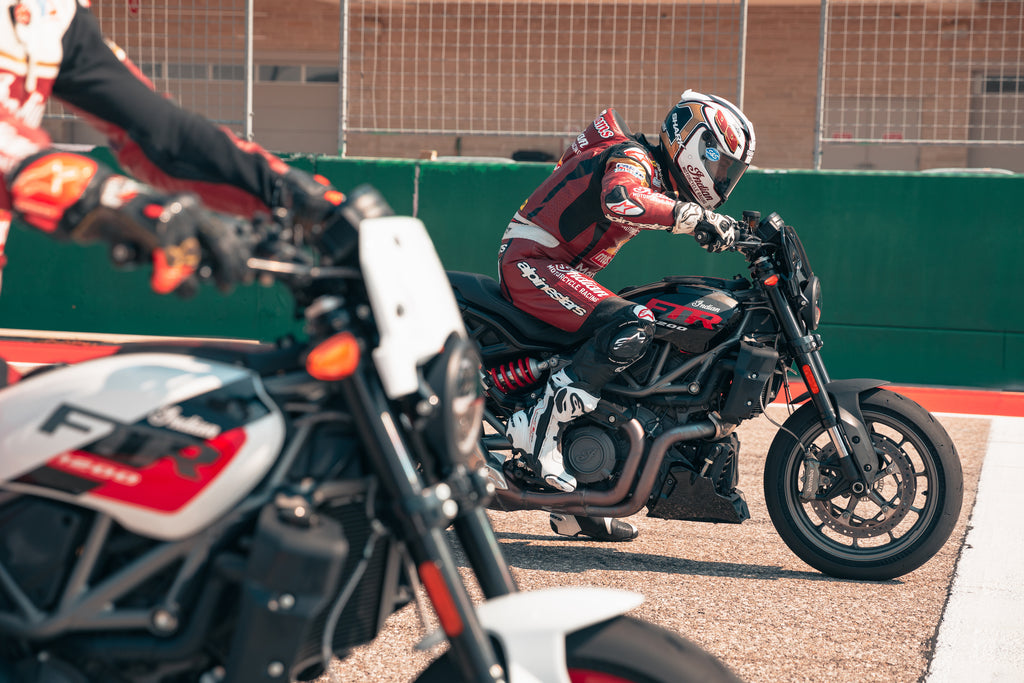 INDIAN FTR SPORT
Indian Motorcycle showcased their revised 2023 FTR model line-up. The "S" variant has now become the "Sport" with a reshaped tank and aggressive belly-pan. Along with the visually tweaked R Carbon and Rally iterations the Sport also gains trick integrated navigation. The stock FTR meanwhile has a graphic makeover as all models lean away from their flat-track inspiration toward a sporting road focus. All models benefit from revised front braking and clutch systems. More on these, along with several other new models across their offering on Indians site.
 SUPER73-C1X
Our friends at Super73 further showcased their pedal-ditching C1X. Their first exciting step into the world of electric motorcycles. With 15' wheels front and back, BMX thinking and Super73's firmly established DNA we cannot wait to have a rip on this fun-machine. Deposits (£73) now being taken...

HONDA TRANSALP AND SUZUKI DR800
The Japanese pair both launched street and adventure models featuring brand new parallel twin power units. The Transalp and DR800 (well, DE) names were revived along with colour smatterings paying homage to the previous incumbents of the names. Both clearly have their cross hairs fixed on the Yamaha Tenere with it's CP2 engine, speaking of which...


FANTIC SCRAMBLER 700
Italian brand Fantic have leveraged their partnership with Yamaha to shoe horn that aforementioned motor into their striking Caballero platform. The 700 Scrambler apes the 125, 250 and 500 iterations visually but promises plenty of power and reliability from the well proven and universally admired CP2 unit also found in the XSR700 and MT-07.

HONDA CL500
Honda clearly have a well thumbed copy of their back catalogue at their development HQ as the initials CL, first seen in the 60's, once again entered the fray. The CL500 combines their popular 500 parallel twin with retro scrambler styling cues but no doubt a more city than trail bent.
 DUCATI 800 SCRAMBLER RANGE
Ducati evolved their 800 Scrambler range with a host of technical rider aids and TFT dash tech while tweaking the lines and dropping a few kgs in the process. The changes are more than skin deep with a re-engineered trellis frame notably ditching the side mounted shock in favour of a central mount to the redesigned swing arm. Nice.

Crowds also formed around the new "RR22" liveried Desert X. Ducati and their mates at Audi let loose with the felt tips in homage to the Dakar conquering Audi RS Q e-tron... anticipate a Desert X tilt at the Dakar this year. Check out Dutch's ride report on the Desert X HERE.
 MV AGUSTA 921 S CONCEPT
MV have suggested we may have as little as two years to save up for their stunning 921 S concept. Inspired by their iconic '72 750S the inline four 921 is riddled with classic styling cues yet dripping with modern tech. We truly hope it retains as much of this style as possible on the treacherous journey from concept to production.
Elsewhere Guzzi displayed some new editions of their much loved V7 alongside the recently launched V100 Mandello (which I cannot wait to ride). Triumph's latest Chrome Collection (recently launched at Bike Shed London) glistened under the lights while Bimota surprised everybody with a 450 Enduro bike borrowing Kawasaki running gear who themselves hinted at a Hydrogen powered future H2...
What else caught your eye??
Norton 961 Commmando - The Comeback [ 27-Oct-22 8:15pm ]I've been waiting a long time to have a go on a Norton 961 Commando. A very long time. About 12 years, in fact. The elephant in the room which needs addressing straight away is that this bike first came to the market in spring 2010, under the previous ownership, who I won't mention here, as enough has been written about them already. Let's just say, things didn't go well.
Bikes rolled off the production line in 2010 and into owner's garages, and many went straight back for repairs. After the farce that followed many owners were left without a working motorcycle, or no motorcycle at all.

Although this may look like a continuation of service for Norton, it is actually a brand new chapter for this much-loved British Marque. Norton has been bought by wealthy Indian Company TVS, who've invested over £100m into the business, with a whole new team of engineers and managers. This investment included a brand new, state-of-the-art factory in Solihul, where the new team had to reverse-engineer major components of the motorcycles they had bought, and in the case of the 961's engine, replace over 130 parts, while rebuilding the engines to much higher tolerances.

There are also general improvements in all the components, from fasteners, brackets, and finishes to the latest high-spec Ohlins and Brembo chassis parts, with beautiful, polished wire-spoked wheels, all hung together to create a finished machine that looks much more carefully considered than previous incarnations. Back in 2010, some journalists described the bike as looking as though it was assembled with whatever parts were lying around the factory floor. Thankfully this bump in the road has been pushed firmly into Norton's past.

When I heard Norton were back under new ownership and were going into production again I was initially surprised that the they decided to re-make a bike for 2022 that was already a re-make back in 2010, evolved from a re-made Norton originally created in Oregon by Kenny Dreer in 2006 as the Norton Commando 952 (actually 861cc). (You can read the Alan Cathcart Review HERE).
It seemed like an odd gamble, especially considering the 2010 bike's short-comings in build quality and consistency, but when you consider what is happening to motorcycling right now it might just turn out to be a very clever thing to do in relaunching the Company and winning trust back from the moto community.

Norton haven't changed the basic design or silhouette from 2010, despite the competition having spent the last decade or so perfecting the Modern-Classic motorcycle category, especially as they've all taken-on some of the custom scenes minimal shapes and style cues. This bike looks old-fashioned in comparison, especially in photos, but when you see one in real life, you stop thinking about all that because it's just a lovely-looking thing. It also looks like the real-deal in an era of re-imaginings, tributes and homages.

What needs describing is the overall appearance of the bike in the flesh. It looks hand made, but in a good way. Perhaps in a 1960s Rolls-Royce British-Luxury kind of way. The engine looks like it's from another era of engineering (which it is) with heavily polished cases that were definitely not designed by a computer. Not all the components and brackets have exactly the same finish, but all of them are well made. The pin-striping is clearly done by hand, and there's a simplicity to the overall construction, but as an object of automotive design the bike does looks properly conceived. It is extremely curvy, with huge scallops cut into the tank, which lead back to a very narrow seat.

From above the bike looks like a black and gold wasp. In some ways the "new" (or remade) Commando looks more like the result of old-school British automotive design than the original 1970s 850 Commando. There's a 60's feel to it more reminiscent of that decade's Jaguars and Aston Martins.

The "new" Commando comes in two version. The Café Racer, with clips-ons and the Sport with upright bars, both available in either black and hand painted gold pinstripe or silver and black. Apart from the bar position they both appear identical, although I haven't compared the footrest position, as we only borrowed the Sport version to have a play on.

My riding day started with some very slow manoeuvres around Shoreditch's back streets, so Camera Dan could take some photos for my write-up. I spent about 45 minutes riding around in first and second gear, doing U turns, and riding as slowly as I could so Dan could get as many shots as possible. Normally this isn't fun, but it turned out to be the perfect start. Firstly, the bike handles and moves really well at low speeds, which isn't always the norm for large capacity classically styled motorcycles. The 5-speed gearbox is firm and accurate, and feels familiar straight away. The slow speed turning is completely neutral, and the engine was quite happy getting hot while rumbling along very slowly. Even when I absent-mindedly snicked-up into third and it lurched at low speed it didn't stall, when it probably should have.

It's quite a heavy bike, but at no point did I notice the weight under exactly the kind of conditions where it might have been annoying. Even wheeling the Norton around the Bike Shed gallery was easier than I expected.

The best part of my day was the public reaction. It was a weekend, so Shoreditch was busy with shoppers, and every single person who saw the bike gave me a smile, a nod, or a thumbs up, or asked me about it. None of them looked like bikers or people who knew anything about motorcycles. This bike is a crowd-pleaser. It's like cruising around in classic convertible car on a Sunday afternoon, enjoying the admiring glances.

So what about the ride?
It was fun. Pure and simple. The engine feels like a proper motorcycle engine, and clatters away like a Ducati twin from the early noughties, with pleasant mechanical noises and a rich exhaust note, even with standard pipes, thanks to the Individual Vehicle Approval process which circumvents Euro 6 noise compliance. It feels like the 77 brake horsepower quoted, which is plenty for most British roads, and the suspension and brakes are superb - as per the quality components. It's like riding a resto-mod. A classic bike that has been completely rebuilt, better than new, and then had the chassis parts modernized - which is kind of what this bike is.

Many people compare this bike to a Triumph Thruxton 1200R, but I think they are missing the mark. I have a 1200RS and although the bike is stylistically similar and may even attract similar customers, the Thruxton is very much a modern motorcycle; much smoother, much cleverer electronics, more of a proper factory finish, with every component clearly coming from the same evolved design and build. It's also a lot faster and more responsive, but that's not the point.
I think a better comparison is a Ducati Sport Classic 1000 GT. While the Ducati is lighter and faster, it delivers a very similar feeling: Lots of clattering noise, with rattly clutch and basic engine design, offering plenty of enjoyable character, vibration and punchy exhaust note. It's also the only other bike I've ridden that gathers as much attention from the non-riding general public, especially the café racer Paul Smart version, which I still have. Both the Ducati and the Norton generate a reaction from other people that can only make you feel a little bit cooler.

This is not a bike for commuting and owners won't want to ride it in the rain. It's a modern classic in the truest sense, and is perhaps the last knockings of an era in motorcycling that will soon be behind us. It makes me happy that a bike like this exists in 2022. It also looks as though the new owners are willing to take on the burden of the previous owner's failures, and are putting their money where their mouth is. Hats off to them. I think it's bloody marvellous, and, biking - as a culture - deserves motorcycles like this to still be in production, whether it's your cup of tea or not.
....
SECOND OPINION - Gareth Charlton. Bike Shed's Brand Director.
Splendid. Dutch has covered the oh-so-complicated backstory, the Phoenix-like rebirth and the technical details of the machine itself, meaning my tuppence-worth can be pure and simple gut-feeling and opinion. Cheers Boss.
But first, what's in a name? Ever since its 1967 introduction and ten year production run the name Commando has demanded respect and adulation both within and beyond motorcycling. It is that iconic name and reputation that new owners, TVS, are betting is strong enough to withstand the previous, ill-fated revival. For myself, and I dare say anyone not scarred by those trials and tribulations, it remains a name that holds sway. I want for a Norton Commando to exist, and I want to want one as badly as I have all these years.

And here it is, in the metal, and I have the key.
Now this article is full to bursting with beautiful pictures (top job camera-Dan) but trust me when I tell you they do not do the Commando justice as to the eye. The purity of the original Kenny Dreer design, so long lusted after, remains intact and yet heightened. Exaggerated and simplified. It is just bloody gorgeous. That classic engine, with its almost biological cases, that thick-tubed frame with dramatic diagonal back-bone reminiscent of the Seeley iterations of the original.
The silhouette and proportions are sublime and the finish and detailing more than live up to the Modern Luxury tagline. My one disappointment? That aforementioned key could easily be confused with any number of others with a far less emotive task than firing up this Commando.

But, woof. What a noise it brings to life. The best I have heard on a stock bike bar-none. As Dutch touched on, some clever navigation of homologation rules I care not to understand have made it possible - and it is quite simply delicious. Time to ride. After much negotiation of our available hours I grabbed the key for the first of mine and right then (of course) the heavens utterly opened. I guess they figured some dramatic thunder and lightning was required to go with the soundtrack just unleashed on earth.
Now I am going to make some assumptions. I don't believe many owners will take their Commando out in the rain. I also don't count on many tasking it with their commute, but that was to be my first taste of the bike, and despite the conditions, it more than convinced me to take the circuitous route home. Cue a fitful night's sleep punctuated with much weather-app checking that was thankfully ended by an early alarm and clear skies. The neighbours were rudely awakened and off we went. The Commando that promised so much on that tiptoe home now gets to show me exactly what it is about.

I have always craved a classic motorcycle. They are what kicked me down the road to my life and work today, but every time I have actually ridden one, I have been either underwhelmed or downright scared. The 2022 Commando 961 is how I always wish they had felt. A soul-filled motor, chattering and bellowing back at you. Slick gear changes interlacing surges of power. Weighty controls revealing just the right level of healthy vibrations. Responsive suspension, sharp handling and eye-popping brakes. The very best of both modern and classic. Not to say the motor is old, as described it is filled with freshly engineered parts, but its approach to propulsion remains from yesteryear and the satisfaction it provides cannot be matched.

I am going to assume again that lucky Commando owners will use them primarily for their Sunday B-road jaunt, and for this I cannot think of a better companion. The power is perfect for our UK roads, you can give it some stick without hitting inappropriate digits and that nimble handling will put you exactly where you want to be on your favourite road. And the big fat cherry on top? That unquantifiable feeling of being aboard something more than a bit special. Of a machine that will always command a second glance and a third or fourth conversation.

Of course there are many more capable motorcycles, there are many motorcycles that ape the same feelings, and there are some motorcycles that are both. But there is nothing like the Commando. For as long as we are allowed to combust petrol for pleasure, I cannot think of a better machine to do so upon.
ROYAL ENFIELD HNTR 350 | RIDE REPORT [ 25-Oct-22 4:32pm ]The promo video plays; a host of familiar young faces riding the familiar streets of East London, taking photos, having fun - their motorcycle the facilitator in chief of their busy lifestyle. The target audience for Enfield's latest 350 could not be clearer. Are you a young city-dweller who dreams of a motorcycle and the independence it provides? The Hunter is for you, sorry I mean the HNTR. Depending on your location in the world this model is pitched as either the Hunter or HNTR 350 and in the UK we don't get the vowels. I suppose we did opt out of the EU…

Arriving in the crisp morning light at the West London start-line of the UK launch, the assembly of HNTR's immediately hit the right visual notes. Bright, enticing, approachable, modern and yet undeniably classic. The third machine to use Enfield's 350cc J-engine (following the cruiser-lite Meteor and classic Classic) the HNTR is pegged as the firms Roadster, with its stomping ground firmly determined as the city streets.
It is certainly a handsome little motor, reminiscent of the old Kawasaki TR250 unit with its upright cylinder surrounded with open space. Over the years small capacity singles such as Yamaha's SR and Suzuki's GN have provided a superb base for many a custom whip and I have no doubt the clean lines of this frame and motor will have many creative minds pondering a project beyond the plentiful parts catalogue... but I digress.
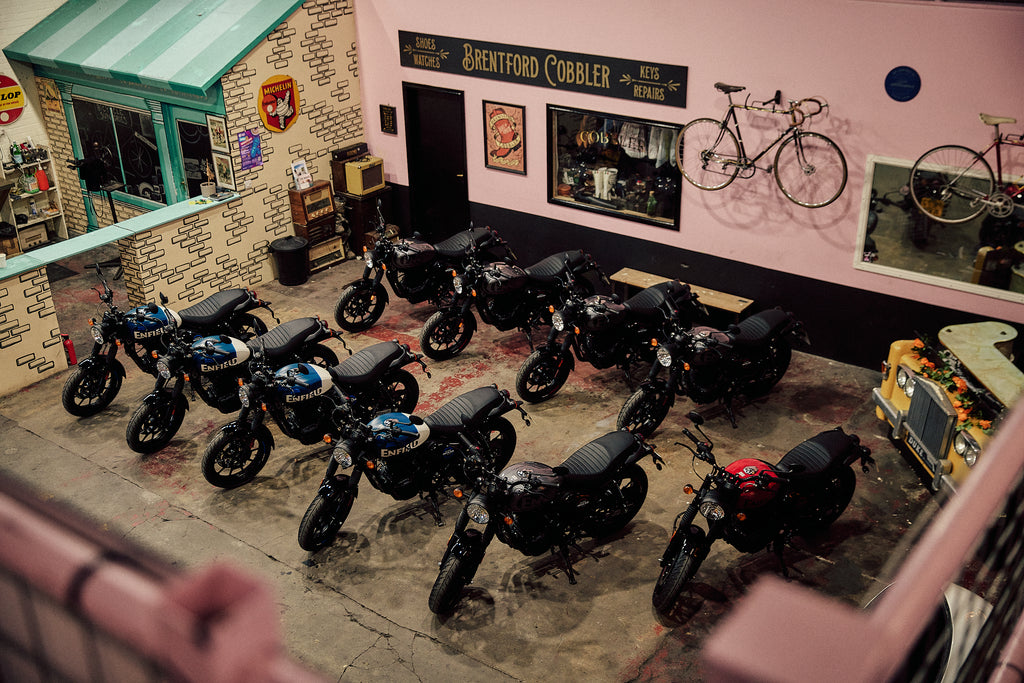 The global launch pitted the Hunter against Bangkok's notorious road network to prove its urban worth and for the UK, the plan was similar. To cross the heart of London, west to east and back again. All well and good if you live west… a trudge if you live east and have to factor in the additional criss-cross. This had better be as good an urban assault vehicle as they say it is.

After a short intro citing the 1959 Fury as a key inspiration to the lines of the HNTR the host dropped a bombshell that left my underprepared-jaw on the floor. This motorcycle can be yours for £3899 on the road. Or to put it another way, 18 months of a London zone 1-4 travel card. I say underprepared, because the hugely successful Meteor 350 goes for a similarly wallet-friendly price - but its baby cruiser looks left me cold, so I forgot to pay attention. The HNTR on the other hand, with cast 17-inch wheels fore and aft, broad seat, aluminium grab-rails and striking graphics definitely piques my attention. And it feels like a quality piece of kit despite the budget price - fair play RE.

Time to ride. From tick-over the motor provides a satisfying single-cylinder soundtrack at a surprisingly low pitch, instantly encouraging an eager throttle hand as we peel onto the busy London streets. Now let's get one thing straight, this is not a fast motorbike, rather with only 20 horses to call on it sits firmly in the slow category. But a decent corresponding torque figure of 27nm lends it enough hustle to keep up with and pass-out traffic in those aforementioned zones 1-4. I am also growing quite keen on the phenomenon of riding slow bikes fast, as opposed to fast bikes slowly - using more of a machine's dynamic range will always be more fun.
 Almost instantly the bike feels familiar, as simple and easy to ride as geared machines come, with broad, flexible ratios and agile, yet sure footed handling. The front brake initially surprises with a lack of bite but does the job once familiar while simultaneously encouraging use of the effective rear, something which I confess has become a rare occurrence in my daily riding. The HNTR will likely be early, if not at the very start of a motorcyclists machine-owning journey and it is the perfect choice for recent recruits to the two wheeled world.

As we progress across the capital, taking in all the key sights, our throng of riders are clearly having a blast. We dart and dive for the camera guy, chat at lights, engage with eager onlookers and revel in the fun factor of the HNTR. This is exactly how this machine is meant to be used, socially, actively, in the heart of a city. A brief stretch of flyover allows sight of 60mph and no doubt the machine could sit comfortably in the mid 60's for as long as your interest would sustain. But the tighter the roads and the gaps become, the more this machine truly excels, boasting comfortably the tightest turning circle I have ever experienced.

So, the HNTR has absolutely smashed its brief and will no doubt more than satisfy the riders it was built to target, but what of those outside of that demographic? Well it entirely depends on what you want from your bike and how you ultimately use it. But if you think the HNTR 350 may fit your personal riding brief, in it you will find an honest, low cc, low cost, imminently usable motorcycle that will never fail to raise a smile. In their stable of 350 and 411 machines Royal Enfield have created a bike for every taste and the HNTR is the sweetest handling of the lot. If I was starting my two wheeled journey again - this is exactly where I would start.
 LIVEWIRE ONE | BACK TO THE FUTURE [ 20-Oct-22 11:01am ]
This is not about the future. E-fuel, alt-fuel, hydrogen, electric… who knows what two-wheeled transportation will look like further down the line. This is instead about the here and now, today and tomorrow, where alternatives already ride amongst us.
First up a confession. I have not been in the least interested. Do not misunderstand me, I have two, very small, very important reasons (that keep me awake most nights) to want to preserve this rock of ours. I always endeavour to do my bit, but I have knowingly neglected to apply this focus to my motorcycling habit. I know I need to accept the inevitable march of progress, but I will forever be more inspired by what has been than what is to come - a different take on recycling, perhaps.

Rather than sit with the nerds in I.T and Computer Science I spent my formative years in the Archaeology and History rooms. Today, I couldn't tell you the model of my iphone and the prospect of a watch that needs charging makes my wrist break out in a rash. In short, I am not the tech-loving, future craving, early-adopter that the majority of LiveWire nerds customers will likely be. No Question, I am a tough crowd for this test ride. And (whisper it) I don't really get Harleys...

But wait, it's not a Harley anymore? Over to the man in charge in Milwaukee.
"We recognized the pioneering spirit and brand value in LiveWire for our community and took the decision to evolve the original LiveWire motorcycle into a dedicated EV brand."
Both a brave and understandable decision. As a machine the LiveWire always felt somewhat outside of the traditional Harley stable. More akin to what Erik Buell would have made had Harley originally launched this power unit in a Sportster or Fatboy inspired platform. And you know what? I really like Buells.

Walking around the LiveWire the Harley ownership is still apparent. The HD shield adorns the petrol/charger cap and the full name wraps around the specifically developed Michelin "Scorcher Sport" rubber. Fat grips and a brake lever like a skillet handle also reinforce the factory heritage. But beyond those elements the aggressively hunched tank and slim, high seat-unit remind instead of the original Ducati Monster and again, the Buell back catalogue - a great reference list that adds up to without question the best looking machine in its class.
Time to fire it up. Thankfully the TFT screen helps me navigate the plethora of bar buttons and we are ready to go, I think. A gentle pulse through the bars lets you know you are "live" and with the first of what would be many gropes for an absent clutch lever we are off. At the recommendation of the delivery guy I head out in rain mode to soften the power delivery. The stance is immediately and thankfully familiar as my brain recalibrates to the reduced riding task list. Stop and Go.

I make it approximately half a mile before deciding I am ready for the unfiltered version and mash the buttons until the rain cloud in the top right of the screen is replaced by an enticing red S, that'll be the Sport mode. An empty slip road opens up before me, time to see what this instant torque is all about. Great Scott! The surge is astounding, the previously silent forward motion is replaced by the whirring of a Pod-Racer and the world races forward at light speed. I could quote HP figures but they seem meaningless such is the difference in delivery versus a combustion unit. The complete lack of preparation for propulsion in the form of gears, revs or clutch makes the immediacy of the power delivery an addictive hit. Twist and Go. My mind races back to 1998 and the seared-in experience of taking a bigger kids two stroke Italjet Dragster 180 around the block…
Back to 2022 and the taught suspension, fierce brakes and fat rubber relay supreme confidence and soon enough I am riding as if the entire Galactic Empire fleet is hot on my tail. Of course it is not necessary to ride the LiveWire this way, but it is utterly addictive. There is seemingly no correlation between current road speed and available warp thrust. Be it 20-40, 40-60, 60 to a bit more, that immediacy always surprises. Pick a spot a few hundred yards up the road and the LiveWire will have you there before you can say "plasma cannon".

It is just such a totally different experience (one that 120 riders sampled over a weekend of test rides out of our Shoreditch HQ) as much defined by what is absent as what is present. The limited controls, lack of noise, of heat, an exhaust. The heightened awareness of the suspension and road surface that comes with the near silent progress. It is an entirely separate genre of two-wheel experience. And that silence - there is huge joy to be had stealthily rolling into your street in the dead of night, whisper-quiet. A sleeping fox raised barely a whisker as I parked up a few feet away.
Plugged into my domestic socket overnight it was more than ready to go in the morning. Range depends on your abuse of the throttle but 90-140 miles is expected and workable. I watched enough Long Way Up to know that longer trips require careful planning but for 90% of my riding it wouldn't be an issue. There is even a fast charger at work… Hang on - am I seriously considering this? Could it replace my idea of a motorcycle?

Well, no. But also yes. I would miss the bangs and the pops, the control points and the familiarity of combustion and my romantic attachment to it. But, if I had the space and means for two machines, while one unashamedly would be a nostalgic fossil-fuel drinker, the other could very well be a LiveWire. Because they both do the same thing so very differently. I know that when the delivery man returns to collect the LiveWire, I will absolutely miss it too. The whoosh and the whirr, the simplicity and the excitement of this new mode of transport.
Contrary to my expectations, I am absolutely convinced. So whilst I may always lean toward the fedora clad version of Mr Ford, Han Solo also had a solid point when he foresaw "Hokey religions and ancient weapons are no match for a good blaster at your side, kid."...

Boxers, Rock 'n Roll, Robots & Glorious Goodwood [ 11-Oct-22 12:14pm ]Three days riding many motorcycles in glorious countryside en route to Goodwood Revival punctuated with factory tours and slap-up meals in good company? When the invitation to join BMW's press "Heritage Tour" landed in my inbox it was one of the easier hell-yesses to give. The main aim of the trip? To pass hours in the saddle of the gamut of BMW's heritage range; the R18 in its Classic, Bagger and Transcontinental guises and all four iterations of their hugely successful R nineT.

After an introductory dinner at Bike Shed Shoreditch (a sterling start) our 26-strong group of journalists and BMW key-players took off early next morning for the Marshall Amplifier factory in Bletchley. Why? BMW teamed up with the iconic British brand as their speaker partner for the R18 Transcontinental and Bagger, my ride for the day.

Even within the gleaming line up of assembled metal my Bagger stood out. With a deep, metallic violet and silver paint-job daubed across that mighty screen and pannier set it simply demanded attention. But not even the outrageous colour scheme could detract from the centrepiece of this bike. That almighty engine.
An eighteen-hundred and two cc, torque laden celebration of the boxer configuration. A whale's heart captured in a motorcycle. Traditionally, I should now mention the exhaust note, but this was my first time on a motorcycle with a stereo and it was not a novelty I was prepared to turn off. Ever. With Planet Rock turned up to 10 in pursuit of the campest Rock songs I could find, the purple beast and I wound our way out of North London. Huge thanks to the DJ that saw fit to string together Pat Benatar, Starship and Journey on the Holloway Rd.

Cards on the table, this isn't usually my cup of coffee. Cruisers, baggers, Harleys and their ilk have never been the machines I google at night. But perhaps I missed their point… The motorway hop was despatched in laid back, low rpm comfort and with the sun high in the sky and London dwindling behind us, the R18 and I were swinging through bends, gobbling up straights, having a damn fine time of it. It is such a different vision of motorcycling to anything I have previously known or pursued, but I think I can finally appreciate the appeal.

At circa 400kg's it is without question a substantial proposition. But it carries the bulk of those digits low and does that trick the best monster-machines manage of seemingly shedding pounds on the move. Granted, gravel car parks are a butt-clenching scenario but the more miles I spent on the bike the more it felt at peace with itself. And I will never tire of that lurch to the left as you blip the throttle at standstill.

The first destination of the tour was the Marshall factory, both a Rock 'n Roll mecca and a pleasingly idiosyncratic, British establishment boasting a crew of craftsmen and master solderers. The place tells a great story and makes the best gear in the amplification game - it would have to, to be heard over that R18 motor. A painfully-slow traffic filled dawdle to our overnight provided me the chance to admire the other machines on the tour fleet and I earmarked a beautiful Option 719 R nineT Urban GS for the next day's action.

With too little sleep, heavy heads and full bellies we took the short hop to the next stop, the BMW Mini Factory. Not an obvious destination for a riding group but having begun my four-wheeled life in one of the proper ones I was happy to visit the site where the original manufacture also took place. And it blew my puny mind. I had no idea humans could conceive such things. An army of giant orange robots as far as the eye could see, wielding and welding Minis in a spark-fuelled ballet of automated, automotive creation. With barely a human in sight. Skynet is real.

Mind still reeling, I climbed aboard the refreshingly simple Urban GS and headed for some of the best roads of the entire route. As clearly the most up my straße machine of the entire range, this was a bike I was eager to pass some miles on. Many more qualified than I have written reams in review of the universally admired Nine T range - so expect no technical dissection here, rather my honest gut feelings from two days in the saddle.

As with the R18, the motor dominates the experience. Character is the word most often hung from it and I won't reach for an alternative - but I will add another. Grunt. I was taken aback by the power of this thing. The quoted figure of 109 horses while respectable, does not do justice to the real-world hustle this unit offers. Of course, it slides through towns and low speed traffic in a gentlemanly fashion, but loosen the neck-tie and this thing just lunges for the other side of the horizon, sharpish. They may have leaned into a scrambler visual with this particular model but I was far more inclined to slide my toes backward on the pegs, devour straights and romp through bends than search for the nearest byway.
The R nineT range currently sits at 4 models. The un-monikered original with a 17-inch front and upside-down forks, the Pure, also with a 17' out-front but sandwiched between conventional forks and finally the Urban GS and Scrambler models which share a 19' front wheel and differ via a few styling gambits. The beautiful but wrist-testing Racer has been discontinued, much to the disappointment of carpal-tunnel specialists. All models of course benefit from that spectacular oil/air cooled 1200 engine, formerly housed in the GS and provide largely similar riding experiences. Pick yours by your preferred riding vibe as much as anything. For me the Urban GS was the sweet spot. And I'll stick with the cast wheels.

After two days of plentiful miles, I had to add an additional 300 mile-round trip back to London for an evening of family duties ahead of the final day gathering at Goodwood. It was the last thing my ride-weary body needed but the nineT had my (aching) back. Heated grips made my poor glove choice an irrelevance and the faultless cruise-control munched through the motorway miles. The clearest mirrors I have ever experienced, while a decidedly dull detail, only added to the abounding feeling of quality exuding from the whole package.

And so, with the last of the summer bugs smeared across my visor I rolled into the 2022 Goodwood Revival. It has been too many years since I attended this one of a kind event and it did not disappoint. What an experience. The noise, theatricality, relentless eye-candy, anticipation and excitement among the attendees create a vibe like no other. The bike-pits were a hive of activity ahead of the Barry Sheene Memorial Trophy race and the machinery on display, simply outrageous. A 1928 rigid BMW R57 Kompressor with leaf-spring forks later described by the commentator as "The most evil thing at Goodwood" exploded to life a yard from my noggin before registering 132 on the noise man's decibel stick… My head is still ringing.

With a Le-Mans style running start, pit-lane rider swapsies and a grid-full of current track stars to ride the nuts and bolts off the remarkable machines the race itself was a chaotic joy to behold. The noise was apocalyptic - that a silencer flew loose from one bike, cartwheeling down the start / finish straight and yet made no discernible difference to the noise emitted tells some of the story…

Suitably reminded as to why BMW can proudly refer to this assemblage of bikes as their "Heritage Range" and with a flat-cap full of memories to which a phone exploding with images would never do justice, I made my way back to the nineT for my long ride home. And even after those many, many miles, it still goaded me into the scenic route…
G Charlton
SLIDE SCHOOL | RE SCRAM 411 REVIEW [ 05-Sep-22 2:53pm ]For the overwhelming majority of my time on two wheels, the breaking of traction has been an occurrence I have done my damnedest to avoid…Grip, grip and an extra serving of grip please. But my preference for adhesion belies a long-standing obsession with flat track. A teenager who clocked up too many hours watching On Any Sunday became an adult with a Sideburn Magazine addiction and sideways leaning friends who still somehow never quite managed to scratch the itch. Until now.

A Bike Shed Members day at the Dirt Craft / Royal Enfield Slide School appeared in the calendar and my arm shot in the air. In anticipation of the day I studied the particulars; location - Iwade Speedway circuit on the Kent coast, machines - custom Royal Enfield Himalayan "FT" 411's and the instructor - Pro Flat Track racer Gary Birtwistle. This was going to be a lot of fun.

In the name of a good story-telling (but in reality, to get a jump on the participating members) I wangled a brand-spanking Royal Enfield Scram 411 on test for a few days either side of the school. With a flat track standard 19' front hoop the Himalayan based Scram is a squint away from near-as-dammit the same as the slide school steeds we would be wrestling. After a dreary motorway drone to our destination (not the Scrams most obvious habitat) the learning could begin.
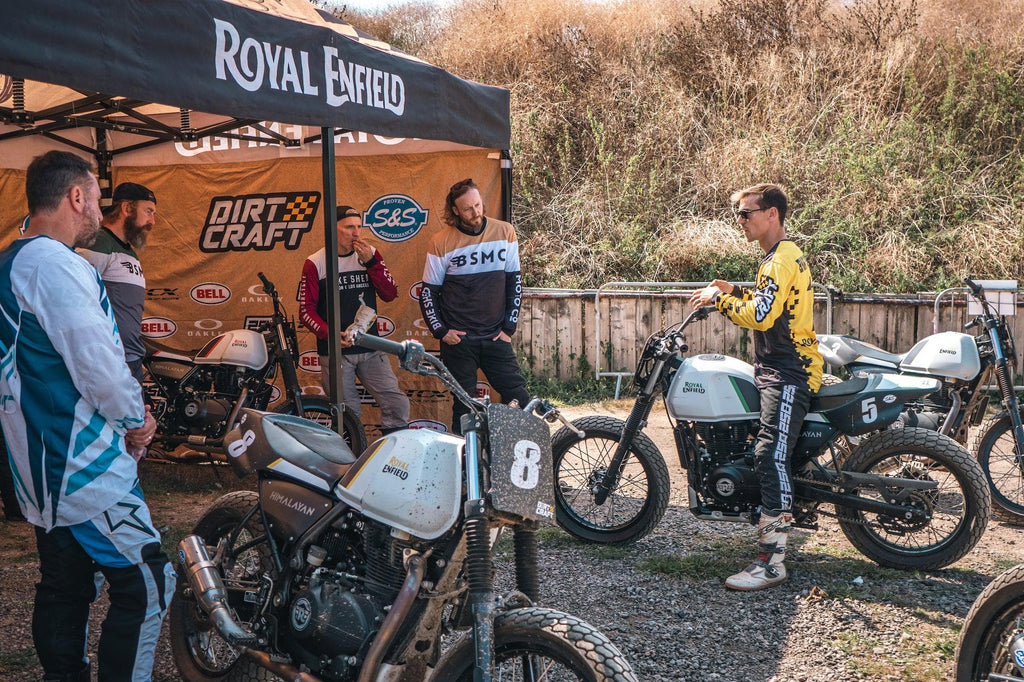
As usual on 'Shed member events the atmosphere was easy, relaxed and jovial as Gary explained some of the basic principles of sliding on a picturesque track walk, which revealed a surface simultaneously looser yet harder than I had expected. The essential left-peg steel-shoes were fitted to provide us with that authentic clunk-thud racer limp gait and we were tentatively underway.
 Oh-so slow early laps with cone strewn straights kept us upright and sensible as we learned our way around the bikes and the basics. The easy-going motor and broad gear ratios I had familiarised with aboard the Scram were as expected, but bolstered with a grin inducing growl courtesy of the fruity S&S pipe. The lack of front brake however, I doubt could feel familiar in a lifetime of laps, my two right fingers groping the air for the absent lever…

Progress and pace increased as sessions and snacks ticked by, punctuated with further pearls of wisdom from the ever-helpful, good humoured Gary. The drip-feed tuition was timed just right as confidence grew and the breaking of traction became provoked rather than feared. Of course, it is no surprise he can teach this stuff so well, 'cause my Lord can he do it.
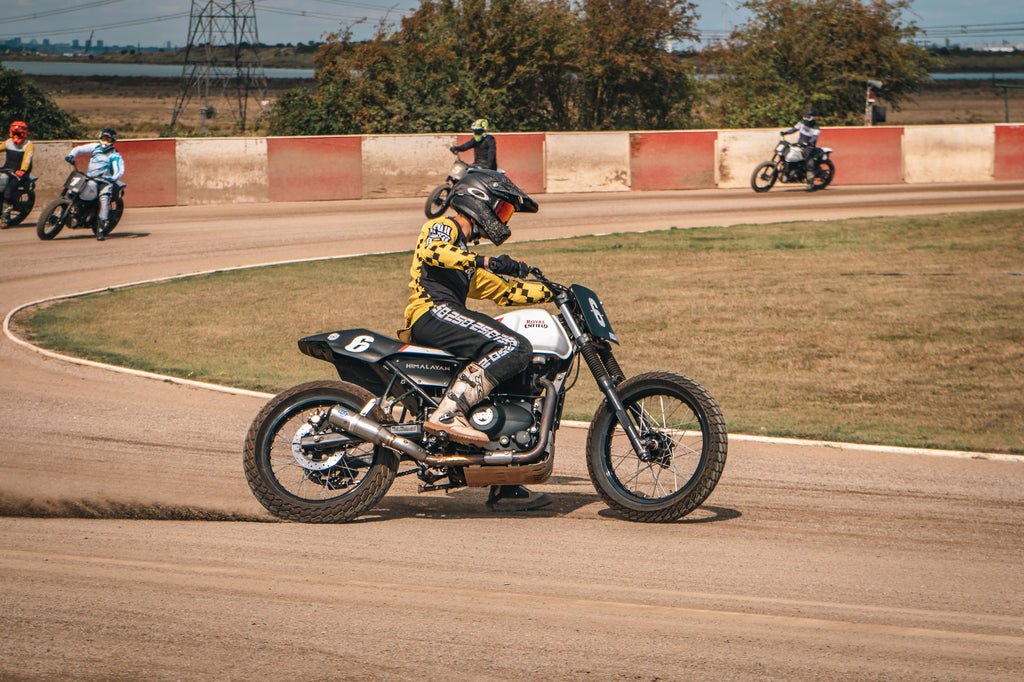
Gary has won every round of the 2022 DTRA season to date aboard his stunning factory RE Harris Performance 650 (seen below in attendance at our '22 London Show). A further 2 British and 1 European Championship between 2018-2020 for Ducati UK, alongside regular race wins in the 450 Pro-class, tell you all you need to know. Watching him pilot the school FT 411's on sighting and demonstration laps displayed a supreme skill, the edges of which were surprisingly accessible during our one day tuition, but the mastery of which is clearly an entirely different gallop of greyhounds.


Back to us newbies. Our speeds lifted and slides lengthened as early boundaries were explored and surpassed, the shriek of steel shoes growing ever louder as the day drew to a close. It was amazing to see the progression in our group; from a quiet, cautious procession to a raucous crew of somewhat slide-ways converts.

On a couple of occasions the dirt was viewed a little closer than intended. For myself I was as convinced as I have ever been of imminent crashy-crashy only to find myself through the other side and belting down the straight - my heart lost through my mouth somewhere mid-corner. But with limits came learning and finally, with a degree of assurance I hadn't expected, I knew what it was to go side-ways. And hell, do I want to do it some more.

Dirt Craft host slide schools across the UK, check out their page HERE and get yourself along - you will not regret it. There is already a clamour for more sideways action from Bike Shed members and crew so expect another day to drop into our calendar soon. Email Dan.ja@thebikeshed.cc to get yourself a hole shot start for the list.

If like me, all this has given you a flat track appetite you can begin to sate it HERE with Sideburn Magazines review of all the trackers in attendance at our 2022 London Show, some absolute belters.

Royal Enfield SCRAM 411

On the journey home the Scram and I continued our acquaintance. Away from the motorway and encouraged by the frolics had astride its FT cousin, we really started to get along. In truth, we do not make an obvious pair. At 6'4' and 100 ish kg's I have a habit of making big bikes look small, and the Scram ain't particularly big. One more creative observer likened my appearance on the Scram to "a spider in a teacup - all knees and elbows". So yes, perhaps I am not this 24-horse machine's target rider, or perhaps that is my own misconception? The Scram was more than happy to try and convince me otherwise.

As we rode in and out of towns, flick flacked through roundabouts and whipped between hedgerows one word kept springing to mind. Honest. A long admired human trait but not always top of the want list when it comes to motorcycles, perhaps it should be. The Scram is obviously not a fast motorcycle, nor is it pretending to be. It takes you back instead to the simplest form of riding, where momentum, line and presence within a journey are far more pertinent than tech spec bragging rights and elec-trickery.
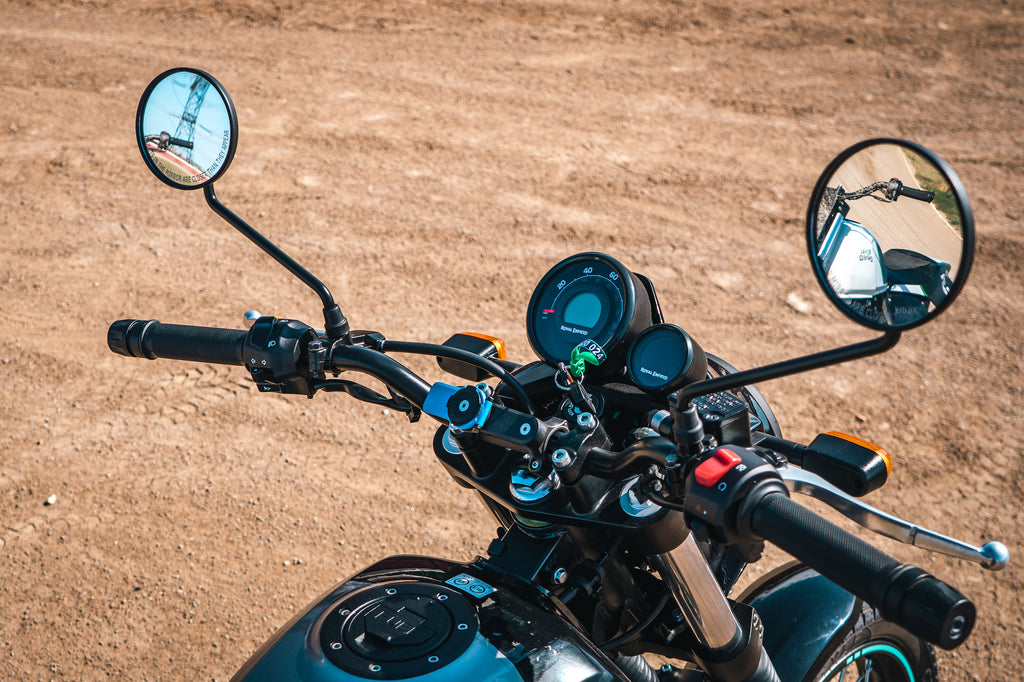
Enfield describe the Scram as "A spirited, multipurpose ADV Crossover that combines high altitude adventurer DNA with authentic scrambler vibes... An able multi-tasker, optimized for agility and always ready to take on challenges." And whilst I am pretty sure it is a moto-journo no-no to type marketing blurb verbatim, I am not a moto-journo, and this line hits the proverbial nail with a well-aimed hammer.

I love the Scram wheel set up. Having spent the majority of my days piloting a 21-inch front in various guises, I have grown accustomed to their on-road vagaries, but I often crave the set-up of my all-time favourite back-road hustler, the odd-ball Cagiva Gran-Canyon (do bear with me reader). With a 19' front and 17' rear (as my oft mourned 'Giva) the Scram is mountain-goat agile in an eager, bounding fashion. I don't understand the physics, but I know the feeling. If you were previously tempted by the Himalayan with its 21'- 17' set up, do be sure to give the Scram a swing too.

Forcing the bike down Supermoto (and as I now know Flat-track) style was a rewarding hoot as was more upright pendulum progress. Beyond a few dusty tracks the majority of our time was spent on tarmac, but such is the confidence the Scram package inspires I wager it would prove a more than willing accomplice on the loose stuff as well. And if you really must, for those high(er) speed slogs, just stick to 70. You will get there in the end. Plus, if you try for more than that the mirrors will start folding in on you.

Given their price point Enfield actually provide the majority of competition for the Scram 411 themselves. Want something more traditional? Take the Classic 350. More Adventurous? Himalayan for you good sir/mam. Want to pretend you are American? Check out the Meteor. Or if you want longer legs via a few more cubic centimetres come and meet the 650 twins. For me, the Scram is the one. If you are moving up from a 125 or indeed just fancy a different take on the whole two-wheeled progress game you cannot go far wrong. As they said so eloquently themselves, it just does it all. You may also be tempted by a spare pair of 19's and an S&S pipe...for the weekends.

Thanks to @harryblaisefryer for capturing the day.
Ducati Desert X North American Press Launch [ 24-Aug-22 1:54am ] We were all excited to see the Cagiva Elefant style livery on the Adventure bodywork that was clothing a modified Scrambler Ducati Desert Sled in EICMA a couple of years ago (see above), but all the customer feedback said; "make it a proper adventure bike, with proper Ducati performance", so the "Land of Joy" gave way to the high performance, high-tech world of pure Ducati Sport, in a brand new bike, built for adventure from the ground up.

 Delivering 110 bhp in Rally mode this new bike carries it's 937cc Testrastretta Desmodromic L Twin engine a full ten inches off the ground with high-spec, fully adjustable YSS off-road suspension, and a host of rider modes covering Sport, Touring, Urban, Wet, Enduro and Rally, which also allow Traction Control, Engine Breaking and ABS to adjusted on the fly. It's like owning 3 or 4 bikes in one.
 The bike also has a proper 21 inch front wheel and 18 inch rear, shod, on our test day, with tubeless Pirelli Scorpion Rally STRs which work very well on the dirt, and use a grippy enough compound for the road.
 With a dry weight of just over 200kg (445lbs) this bike hauls proverbial ass and defies it's apparent size as it commands steep rutted inclines and large boulders, although I was grateful for the low seat option.
 Sneaking-in at the high spec, larger cc end of the middleweight adventure bikes, this new motorcycle will likely outperform most of the close competition on the dirt, while threatening the big mile-munching heavyweights too.
 Equally importantly, it's a seriously good-looking head-turner, and manages to look thoroughly modern and thoroughly classic at the same time.
 So what about the riding experience?
Well...
Let me start out by saying that my dirt bike riding days are far behind me. Until a very recent trip to Hungry Valley's Adventure Off Road Park a couple of weeks ago, on a rented Honda CRF230, my last two-wheeled time in the dirt was about 7 years ago at the Yamaha Off-Road School in the UK, and even then I was very rusty.
So what about the riding experience?
Well...
Let me start out by saying that my dirt bike riding days are far behind me. Until a very recent trip to Hungry Valley's Adventure Off Road Park a couple of weeks ago, on a rented Honda CRF230, my last two-wheeled time in the dirt was about 7 years ago at the Yamaha Off-Road School in the UK, and even then I was very rusty.
 When I was invited to join the Ducati Desert X North American Press Launch I did mentioned not being any kind of off-road rider and was assured that I'd be fine and that little skill was required.
On arrival I discovered I'd be riding 80% off road all day, up a 12,000 foot mountain, with Mint 400 champion Jordan Graham and Pro TT and BSB Racer Jake Zemke, along with 4 journalists who write for ADV mags. … Gulp.
When I was invited to join the Ducati Desert X North American Press Launch I did mentioned not being any kind of off-road rider and was assured that I'd be fine and that little skill was required.
On arrival I discovered I'd be riding 80% off road all day, up a 12,000 foot mountain, with Mint 400 champion Jordan Graham and Pro TT and BSB Racer Jake Zemke, along with 4 journalists who write for ADV mags. … Gulp.
 I was very nervous.
Two things made it all ok. One was Jake's patience and support in guiding me through the steep and rocky terrain, and the other was this incredible bike. Uphill rocky ascents on a bike with big wheels and decent suspension just takes some balls, but steep descents are another thing altogether. As you pitch forward on a steep rocky decline that finishes with a 180 degree downhill hairpin turn on the side of a mountain, things can go very wrong, very quickly.
I was very nervous.
Two things made it all ok. One was Jake's patience and support in guiding me through the steep and rocky terrain, and the other was this incredible bike. Uphill rocky ascents on a bike with big wheels and decent suspension just takes some balls, but steep descents are another thing altogether. As you pitch forward on a steep rocky decline that finishes with a 180 degree downhill hairpin turn on the side of a mountain, things can go very wrong, very quickly.
 Under Jake's guidance I selected Enduro Mode, limiting me to 75bhp, plus we manually set the Engine Braking to Maximum. In first gear I didn't even need the back brake, as the engine took me down hills on idle - leaving me to concentrate on looking where I wanted to go, instead where I was pointing!
 On a couple of tricky occasions I panicked and instinctively grabbed the front brake, which would have seen my front end wash out from under me on most dirt bikes, but the sophisticated Enduro setting's TC simply didn't put the front brake on, and I steered round the turn without crashing.
 I honestly don't think I would have made it down that mountain on any other bike without many more hours of dirt riding under my belt. This is the first time I've really appreciated (or benefitted from) modern, high tech technical intervention on a motorcycle. Up until now I'd relied on my own riding skills, and saw all this tech as being unnecessary for most experienced riders. In this application I was very wrong.
 I did try the Rally Mode a couple of time on the dirt and it turned the bike into a fiery beast, with a full 110bhp on tap and no TC or ABS. I can see why Jordan Graham felt the bike was race-ready straight out of the box, but the Rally setting was too much for me on this terrain. At least, this time around.
 We had a few miles on proper pavement (tarmac) roads, carving through the stunning Colorado mountains and forests.
In Touring Mode, Sport Mode and Urban Mode the bike was transformed again and again, with fantastic road manners, handling and power delivery in all settings.
We had a few miles on proper pavement (tarmac) roads, carving through the stunning Colorado mountains and forests.
In Touring Mode, Sport Mode and Urban Mode the bike was transformed again and again, with fantastic road manners, handling and power delivery in all settings.
 Looking at the photos and video that Ducati created for this riding event, I'm surprised how well-composed the bike looks underneath me, and how good the bike looks with a rider on it. My screensavers might not change for a while!
Do I want one?
I have too many bikes on my wish-list, but when it comes to Adventure, I think this may be The One, and in practical terms I don't think I've ever ridden any bike that offers so many levels of riding experience from City to Freeway, Trails to Dirt, with aftermarket options to suit the longest of adventures.
Looking at the photos and video that Ducati created for this riding event, I'm surprised how well-composed the bike looks underneath me, and how good the bike looks with a rider on it. My screensavers might not change for a while!
Do I want one?
I have too many bikes on my wish-list, but when it comes to Adventure, I think this may be The One, and in practical terms I don't think I've ever ridden any bike that offers so many levels of riding experience from City to Freeway, Trails to Dirt, with aftermarket options to suit the longest of adventures.
 On a good day I could probably ride this bike on Hungry Valley's trails and surprise a few dirtbike riders, knowing that it was also my ride home, ... taking the long way.
I'm interested to hear what the Adv Pros make of the bike, but the smiles on everyone's faces suggest some rave reviews might be due. BSA GOLD STAR - 2022 [ 18-Jul-22 12:43pm ]
On a good day I could probably ride this bike on Hungry Valley's trails and surprise a few dirtbike riders, knowing that it was also my ride home, ... taking the long way.
I'm interested to hear what the Adv Pros make of the bike, but the smiles on everyone's faces suggest some rave reviews might be due. BSA GOLD STAR - 2022 [ 18-Jul-22 12:43pm ]BSA is back. The Gold Star is back. And on a scorching day at a tarmac playground hidden deep in the English countryside I was invited to ride a machine I have only ever heard spoken of in tones of hushed reverie. Named after the medal received by one of its predecessors for lapping Brooklands circuit at over 100mph the original Gold Star was the metal of choice for the Ton-up boys, Clubman TT Racers and Sunday Scramblers of the 50's and 60's. Fast forward to the 2020's and the reborn 650 Gold Star is gunning for those who remember fondly what it was but also a new & entirely different generation of admirers.

This was a day to ride so I will keep the preamble brief. BSA was purchased by the Mahindra Group in 2016, their intentions to manufacture in the UK were sadly scuppered by the carnage of the years since but it remains the future plan. For now, the Goldie is assembled in Mahindra's native India with machines expected to be delivered into a network of UK dealers mid-August priced from a respectable £6500 to £7000 (+ otr charges) depending on your colour of choice. Thankfully my favourite, the Highland Green is the cheapest scheme. The pictures tell far more than any words how damn handsome this machine is. A faithful homage to the DBD34, it is covered in delightful touches and unfortunately encumbered with a few modern necessities - more on those later. Overall it is a machine that will forever raise a smile as the garage door lifts and command a second glance before it closes.

Time to ride. God I love a single. The heart of the Goldie had to be a thumper, the 500cc displacement of the original has swelled to a 652cc powertrain in which a host of sophisticated manufacturing techniques have sought to balance and smooth the inherent vices of the single layout whilst preserving its character. It is a brilliant motor. Definitely not the fastest at 45bhp, nor perhaps the most refined, but perfectly befitting the 2022 Goldie.

Millbrook proving ground was the venue for the day's fun and games, a test facility for both two and four wheelers Millbrook boasts a host of real road simulations. Whether pootling between the hedgerows or chin on tank, throttle to the stop tickling the ton on the banked oval circuit, the motor proved a willing and compelling companion. I eagerly await that Ton-up Club members card…
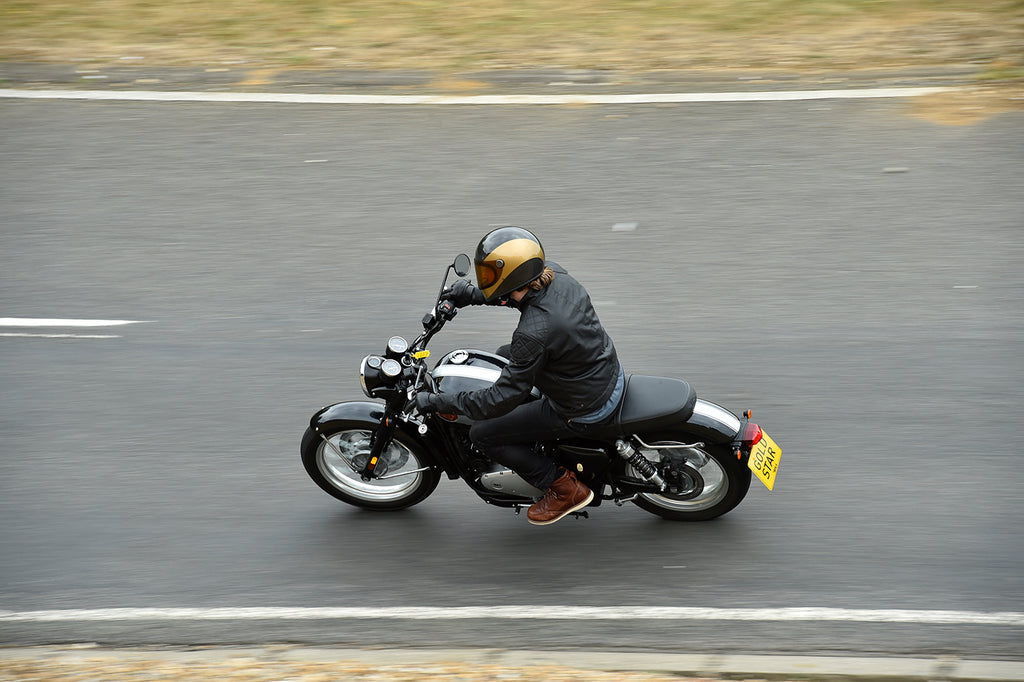
Swinging through the complex bends of the faux Alpine course (including the infamous Aston Martin flipper from Casino Royale) was a fun yet reassuring experience with the Brembo brakes arresting momentum of the 213kg Beeza with great assurity. The suspension on the machine of the slighter rider ahead of me definitely looked a sight more composed than it felt beneath my weightier-self and would (like most machines in this price bracket) benefit from fine-tuning or upgrade to suit the rider and use. Or just ride, adapt and smile. Romping through the tight layout of a supposed "city course" that better resembled a gymkhana was a hoot - and the pace at which the lead rider conducted the route eye-widening..
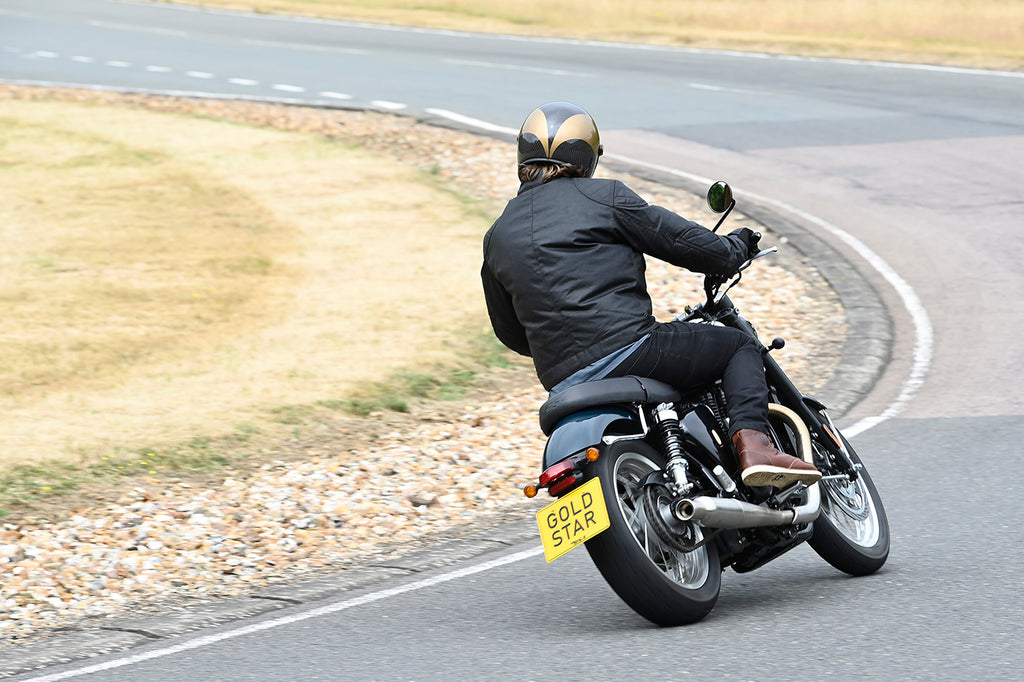
Back in the 50's the DBD34 was defined as a super-sport machine. Today's iteration is clearly a world away from that moniker, but I wager I had a deal more fun wringing the neck of the Goldie and exploring its capabilities as opposed to clinging on to a current super-sport and exposing my own. Perhaps I was just born in the wrong era, but as todays roads seem to slow with traffic and tech, a machine with the dynamic capabilities of the Goldie makes more and more sense.

Now for the fun part, this is Bike Shed after all and this is a motorcycle crying out for a little tinkering or full-bore customisation. One of the best things about the original machine was its adaptability. Yes, the café-racer is the first vision that springs to mind, but with the swapsies of a few key parts the old Goldie did everything well, Scrambles, Trials, Flat-Track… The inspiration is endless and I have no doubt that come our 2023 Show we will see the new Gold Star reimagined as all of the above and everything in between. No bobbers please.

What would I do to it? Those aforementioned modern necessities can go for a start. The fugly switchgear, prominent USB charging ports and catalytic converter the size of an over-fed feline curled up in the frame rails all need a new home. While we are shedding kilos a quick glance under the seat reveals a bolt-on subframe that could fast be swapped or altered, you can keep your (all-be-it lovely) fork shrouds and the radiator seemingly sourced from an Austin Mini could use some detailed thought. A single seat, some short guards, slim-line side panels, upswept exhaust that celebrates as oppose to apologises for the thump, clip-ons, rear-sets, and sticky tires pretty please. A brief chat with the ever-growing BSA team reveals a few more ponies could easily be corralled from the motor and suddenly we are having even more fun. The beautiful reverse sweeping clocks can stay, perhaps framed with a bullet-style fairing… But I digress. Necessary? Absolutely not. Part of the fun? Absolutely yes.

Whether owned, once ridden or long lusted for, BSA has always been a marque to command a place in the heart of many motorcyclists. With the new Gold Star, BSA are looking to add a new generation of riders to that hearty club. Have they made a machine that can do this? I sure as hell believe so. BSA, it is great to have you back.

@garethcharlton wore -
• BSMC x Hedon Heroine Carbon Racer Helmet
• Belstaff Brooklands Jacket in Black
• BSMC Protective Jeans in Black
• Alpinestars Robinson Gloves
• Alpinetars Monty V2 Boots
BSMC Gift Guide [ 01-Dec-21 4:30pm ]Or just for yourself -
You are certainly reading this for one of two reasons, either...
A. You stumbled here as you try and second guess what your motorcycle obsessed friend / lover / sibling / other would like to find under a yew tree come the 25th.
- Or -
B. It's that groovy time of year when your favourite folk might treat you to something you fancy and you are looking for exactly what to suggest to avoid the usual Crimbo detritus...
Whether shopping for unique gifts for the motorcycle rider in your life or looking for your good-self, you have come to the right page. Here are our top picks organised into categories for all wallets. You are very welcome.
 The easy wins, motorcycle gifts, stocking fillers or that little bit extra...
For under £30 you have a bundle of choice.
The easy wins, motorcycle gifts, stocking fillers or that little bit extra...
For under £30 you have a bundle of choice. Monogram Bandana - £25 Keep the chill from your neck BSMC style.
Booth Fob - £15 Ride around with a small piece of the 'Shed swinging from your key. Our "Booth" fobs are cut from the leather left over from the upholstery of our restaurant booths - waste not want not! Hand crafted in a local East London factory these little beauties (in two different styles) are obviously only available in strictly limited quantities - when they're gone they're gone!
Patches - £4 / £5 / £6 Immediately upgrade any garment with a judiciously placed BSMC Patch.
Beanie - £25 Thick, Merino wool blend Beanies. For when the lid comes off and there is a winter chill in the air.
"Handmade is Better Made" print - from £8 Dave Buonaguidi's iconic BSMC design beautifully rendered in A3, A2, & A1 Lithographic print or as a quality A4 cheap and cheerful digital print.
Mural Mug - £12 The epic wall mural of our LA venue as drawn by Ryan Quickfall aka @Ryanroadkill, wrapped around a tin drinking vessel. Perfect for all liquids, hot / cold, alcoholic / non, stable or combustible...
 Now we are getting into second gear... Under £50
BSMC Gift Bag - £45 (individual value over £60) All our favourite bits, bobs, trinkets and un-sized BSMC goodies bagged and boxed for that special rider on the day when everything needs to be bagged or boxed.
ESTD. LS220P Jersey Khaki - £45 A new colour-way of our ever popular heavyweight long-sleeve jersey. Perfect worn under a jacket on a ride and as such, the perfect gift for the rider this Christmas.
Mural T-shirt - £35 The epic Ryan Quickfall penned mural that adorns the broad wall of our LA venue beautifully executed in digital print on the back of our newly update BSMC T-shirt block.
"Handmade is Better Made" T-shirt Black - £35
Because prints on walls are great - but you can't take em with you on an adventure... Dave Buonaguidi's epic BSMC "Handmade" design on our newly updated and upgraded BSMC T-shirts.
Duke & Sons Card Wallet - £45 Fill your pocket with craftsmanship and charm with this old-school cash and card holder. Hand cut, embossed and stitched by Jan Den Hartogh aka "Duke & Sons Leather" especially for BSMC. Available in black, dark brown and black leather.
Women's lightening Vest - £35
This vest was BSMC Boss-woman Vikki's pet-project. The brief; black, ribbed, tight as hell and cut just right. Job done. Our lightning logo received it's debut on this piece but expect to see it elsewhere soon...
 Now we are talking. At under £100 these collaboration and in-house created pieces will make for some very happy riders.
 INC. Hoodie - £65 Our plush, brush-backed 100% Organic cotton Hoodie - perfect for curling up by the fire after a winters ride with a mulled cider...
BSMC x RE Messenger Bag - £60 We had a lot of fun working on a collaboration project with Royal Enfield and one of he key pieces was our take on the classic Messenger / Courier bag. Make sure the receiver of this gift / you open it first - it'll prove perfect for ferrying other gifts to and from Christmas get togethers.
Utility Ripstop Shirt - £95
Smart, durable and with the rider considered in every detail; from the button-down collar to the side entry chest pocket for easy under-Jacket access. At BSMC we make the gear we want to wear - and this Christmas you will find plenty of us rocking this shirt for shindigs, parties and general shenanigans.
Moto Co Sweat - £65 Our best-selling sweat. You won't go wrong with the classic motorsport combination of black and gold, but if you fancy an alternative the new navy with mustard embroidery style is fast becoming a staff favourite.
BSMC x Goldtop Gloves - £74.99 If you don't ride (yet!) you may not appreciate just how crucial a great pair of gloves are to a rider, they are the key interface betwixt operator and machine. We teamed up with the guys at Goldtop to get our design executed just-so, and they absolutely nailed it.

Blow the budget over £100 and win Christmas with our stunning Hedon collaboration helmet, our RESISTANT riding jeans, BSMC Vest and Jackets or the ultimate year-round motorcyclists gift - Bike Shed Motorcycle Club membership.
Utility Vest BLK - £110 Whether worn beneath or over a jacket, on the bike or off it, the vest has long been a staple of the rider's wardrobe. Ours is inspired by classic workwear styles and tweaked with a rider's use in mind.Hedon x BSMC Club Classic - £560
Our iconic BSMC x Hedon graphic, as launched on our black and gold Carbon Racer helmet, reimagined with stunning, vintage motocross vibes. Strictly limited quantities available.
BSMC x RE Bomber Jacket - £120 In collaboration with Royal Enfield, our take on the classic US Air Force MA1 Bomber Jacket.
Twill Jacket Tan - £155 An in-house favourite, our heavyweight brushed twill jacket features a quilted lining and detailed chest and back embroideries. Available in tan or black for desert or city style.
RESISTANT Jeans - £140 Our RESISTANT line is best described as hard-wearing, fit-for-purpose clothing, boasting the strength and abrasion resistance riders are accustomed to from their protective gear - but deployed in secretly technical, casual garments.
BSMC London Membership - £250
Our community of members have access to regular organised events, from off-road weekend camping trips, to exclusive hosted dinners with biking heroes and legends. Simply put, this is the ultimate year round gift for any rider. A very Happy Christmas to you or your significant rider.
From all at BSMC
HANDMADE IS BETTER MADE - meet Dave Buonaguidi [ 26-Nov-21 3:30pm ]You meet the best people on Motorcycles... After a chance encounter at a North London petrol station it was inevitable that Dutch and Dave, aka @realhackneydave would get up to no good together - or plenty of good, depending on your angle...
 Dave ended up joining us for our first Paris event back in 2013, slinging Art, ogling the machinery and making friends with all the locals. We had an absolute ball and the very night we wrapped the event, Dave put pen to paper for his iconic BSMC Handmade is Better Made design. The artwork was in Dutch's inbox before we set foot back in London.
With all the hard work behind our LA venue finally coming together we felt the Handmade is Better Made design and the sentiment behind it was long overdue a rebirth. But this being Dave, a simple reprint and T-shirt drop was never going to cut it... "Let's print 'em with my motorcycle!" of course Dave, why the bloody hell not.
 We caught up with Dave after his epic Motorcycle Pulled Print Night at our Shoreditch HQ to ask him some questions and try get some answers from the man. Cheers Dave.
 Who are you / where are you based / what do you do?
My name is Dave Buonaguidi, I am a printmaker artist working in Hackney in London.
Who are you / where are you based / what do you do?
My name is Dave Buonaguidi, I am a printmaker artist working in Hackney in London.
 How did you get started in your craft?
I have always worked in the "creative" field, having had a previous career in advertising. The problem with advertising is that it's not very creative, and I did a lot of art on the side. After 30 years I decided to end my days as an artist after I did a one-day print workshop at Printclublondon.
How did you get started in your craft?
I have always worked in the "creative" field, having had a previous career in advertising. The problem with advertising is that it's not very creative, and I did a lot of art on the side. After 30 years I decided to end my days as an artist after I did a one-day print workshop at Printclublondon.
How did you get involved with or meet BSMC and what have you got up to together? I have always been a petrol head and telly in the 60's and 70's was all about Americana, custom cars, muscles cars, dirty bikes and oily fingers. I built a custom bike with the RYCA kit, years ago and just by chance bumped into Dutch at a petrol station on the Holloway road, he is the only person I have ever known who recognised the bike. Boom. Instant connection. I love the custom scene and was lucky enough to sell my prints at the first big London show, and then the Paris show and since then I do live printing at the shows.

What are your favourite pieces you have created and what are you working on at the minute... Once I'm finished with a piece, I want to move on, but I would say the 8ft LOVE BOMB piece I did in the summer was fun. A real 1000lb General purpose bomb standing on its nose, in gloss gold. It was painful, expensive, idiotic, terrifying and fun to do. What more do you need?

 What bike do you currently own?
 I've got a dirty custom hardtail Harley sportster. Pure filth. Perfect for a spot of screen printing.
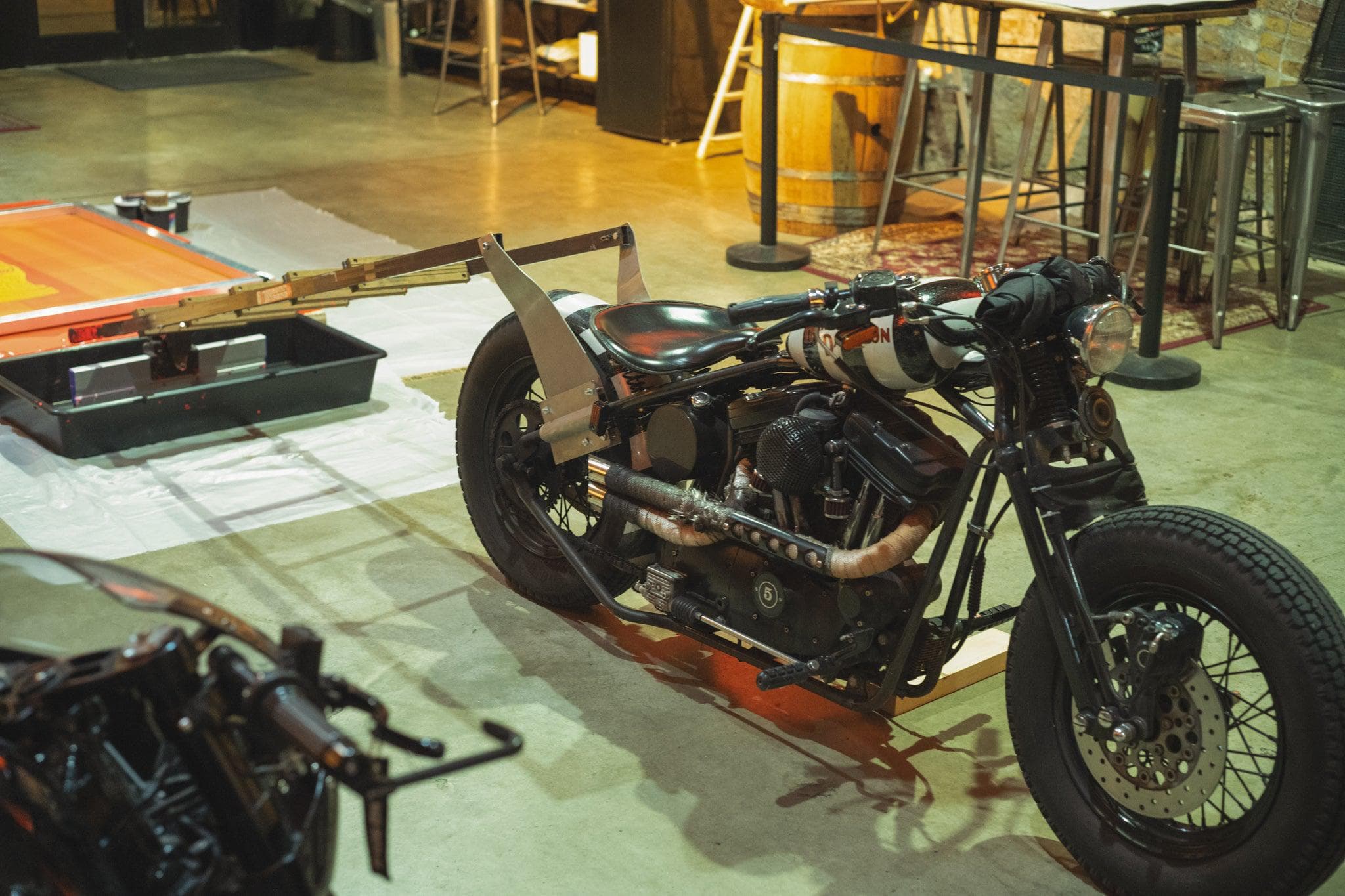
What was your favourite bike? I've had loads of bikes, all sorts, but I'm very happy with the current one.
 What is your dream machine?
That red De Bolex race bike is gorgeous. Two please.
What is your dream machine?
That red De Bolex race bike is gorgeous. Two please.Cue gratuitous De Bolex pic...


See more of Dave's art and enjoy a daily laugh by following him @realhackneydave.
Cheers Dave
Where East meets East: BSMC x Royal Enfield [ 27-Oct-21 6:35pm ]Born in England in 1901, Royal Enfield began building bikes in India in 1955 moving to entirely Indian-made machines by 1962. In taking-on the mantle of these iconic bikes of that era, Royal Enfield somehow captured the enduring spirit of Great Britain while finding a new home in India. The Company has since evolved to hold a place in the heart of two nations, with a shared provenance.
This Indian-British nationality has a natural place in East London, where culture, food and fashion from the South of Asia has taken root over generations, centred around Brick Lane, Bethnal Green and Shoreditch, also home of the Bike Shed Motorcycle Club.
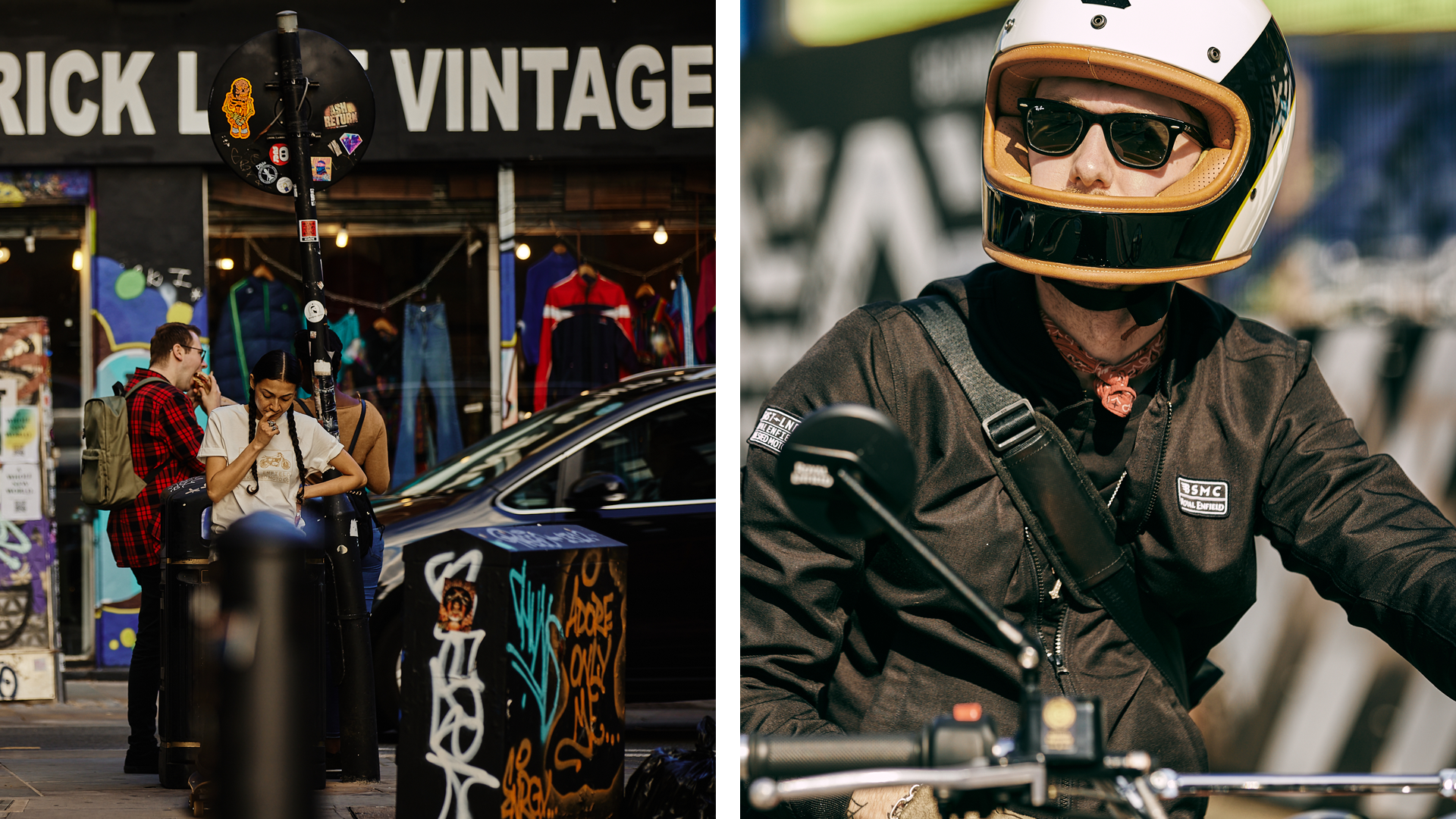
To celebrate this meeting between East & West in the world of motorcycle manufacturing, Bike Shed and Royal Enfield have created a clothing and apparel collaboration that celebrates East London; a melting pot of East meets East, where Asia defines the tastes, smells, colours and sounds around the Bike Shed's first venue, alongside East London markets, bakeries, butchers, pubs and workshops.

Some of the designs take inspiration from the Bike Shed x Royal Enfield collaboration bike build, co-designed by Royal Enfield's UK Design & Technology team and Bike Shed's Founder, Dutch, to be the perfect East London urban street bike. The collection also draws on the creative side of urban East London, exploring the art and style of the district in billboard, street and stencil typography.

HANDMADE IS BETTER MADE: Jan den Hartogh - Duke & Sons [ 25-Aug-21 4:33pm ]For all the convenience the modern world provides with it's digital magic and mass-produced accessibility, it can never replace the craft of a true artisan creating work with their hands. From the very earliest days of Bike Shed we became great friends and later collaborators with Master Artisan Jan den Hartogh of Duke & Sons; a craftsman who took his creative flare away from a screen and into his workshop, showing us all that handmade really is better made.
We caught up with Jan to hear about his story.

Who are you / where are you based / what do you do?
I'm Jan den Hartogh, based in the Netherlands and I'm a Leather craftsman.
How did you get started in your craft and when did you establish Duke & Sons?
As a designer who was used to working the whole day behind a screen, I realised I was missing something important in my life and that was the opportunity to do something with my hands.
I'm a fan of the amazing atmosphere of heritage goods and brands. I love the fact that many of these companies still make the same quality goods and stick to their origins. Inspired by a real craftsman, I decided to learn the skills myself, and just by 'learning by doing' I have managed to teach myself the making of quality leather goods.
It all started in 2013.

How did you get involved with the Bike Shed and how has the collaboration grown over the years?
I guess it was the third BSMC event, the first at Tobacco Docks in Wapping but in a very small footprint compared to what it is now. One of the Bike Shed founders had spotted my work on the internet and called to ask if I was interested in a nice weekend in London, alongside a lot of motorcycle enthusiasts. I arranged my own travel but they took take care of the stuff I would need to show my skills at the show, like table, chairs and a shop vitrine. I think the last one was from somebody's home hahaha!

It was the first time for me abroad doing my leathercraft and the first time together with Ingeborg my lovely wife. From the first moment on, we had a close relationship with everybody and it really felt like we were friends for a long time. Even Ingeborg, who was not that acquainted with the motorcycle world, embraced the whole community. It was a special weekend with special people and we were not used to that vibe in the Netherlands. When we left, it felt like we had a visit with a warm family weekend.
The rest is history... every year since we visit our 'family' at every show and we're very grateful for that.

What are your favourite pieces to work on and can you share some details of the processes that go into making them?
I love to work with natural veg tan leather. It is such a fine leather and you can do anything with it. When the leather is moisturised you can emboss it and you can dye it with several special dyes but you can also colour the embossed artwork to give a special touch and make unique pieces.
You can find many samples in my maker stories, like this one: https://www.dukeandsonsleather.com/blogs/maker-stories/making-the-bike-shed-protective-card-wallet

What bike do you currently own?
I currently ride a 1987 Harley Davidson Heritage Softail and a 1978 Classic Yamaha XS 1100.

What was your favourite bike?
I started when I was 16 and I've had a few favourite bikes: The Laverda, my Honda CB750, and the 2 stroke Kawasaki's in particular...
What is your dream machine?
At this moment I don't have a dream machine, however, I really like the WWII Harley Davidson WLA in original army look.
What attracts you to the motorcycling world and community? The camaraderie, especially in the UK community, which is so different from the Dutch community. It is hard to explain but it is our experience when we meet all the customers at the annual BSMC show. But in general it's the freedom of riding, the power of the engine, and sharing that passion with good friends.
 Check out Jan's latest exclusive BSMC pieces below - he doesn't make in batch for anyone else and we are honoured to have his work carry our name. Cheers Jan.
//
Harley-Davidson Pan America - First Ride [ 30-Jun-21 3:34pm ]HARLEY-DAVIDSON - PAN AMERICA FIRST RIDE
The day is here, I finally get to go on a press launch and I'm excited. For the past few years, I've experienced bike launches vicariously through editing the photos and video that land in my inbox, and hearing from Ross, our editor, but, with the shit-show of a year we have had, Ross retired from the 'Shed and relocated to Devon in search of a more off-grid life tinkering in his new workshop and more accessible country roads.
The obvious replacement would have been Stew, the most qualified of adventure riders of the BSMC crew, having ridden for 12 months down through the Americas on the actual 'Pan American Highway' from Alaska to Ushuaia on the Harley adventure bike's biggest adversary, the BMW GS.
But, with Stew in LA finalising the imminent grand opening of our new venue out there, I was next in line to take up the opportunity and I jumped at it.
I'm not so much a track-day speed-demon, I lean more to the travel and adventure side of motorcycling. That's what gets me excited and inspires me, loading up my bike with everything I need and riding to some mountain ranges, off the beaten tracks of Europe for a few weeks. For me there is no better feeling.
Now, this isn't gonna be packed with maths and figures on the technical details of the new Pan Am because. You can google that, or read it in Bike magazine. This review is about my experience of riding the bike, and how it made me feel, and the experience of being on a manufacturer's press launch.
THE PAN AMERICA AND IT'S RECEPTION
Since the Pan America was announced, it's definitely been divisive. Some people were welcoming and open-minded of Harley-Davidson's foray into a new market. Others, not-so-much, questioning the wanting of a piece of the pie that 'wasn't theirs to have' or being capable of seriously entering and most of all contending with. The bold aesthetics reinforce some of that negativity and inspires a love or hate reaction. It was definitely a talking point here at the 'Shed.

This bike is a huge deviation from the niche Harley-Davidson have dominated and appealed to for decades, upsetting the status quo amongst one of their most valuable assets besides their bikes, their die-hard following. On the flip side, a lot of the non-Harley riders see an insular brand muscling-in on an aspect of motorcycle culture that wasn't previously earned, but times are a changin' and to keep relevant, companies need to diversify. We've already seen that with their other stereotype breaker, the electric Livewire, although that model is now being divested from the H-D stable into it's own brand.
I could see both viewpoints but leaned towards the positive. I see an incredible brand trying something new and appealing to a different rider, but not only that, coming in with their own take on the adventure sector.
I respected that and it was certainly refreshing and exciting to see a company think a bit differently about who they are, what they want to make, and disrupt the sometimes tiresome beaky aesthetics of the current offerings. A big sway for me was their launch video back in February which was a refreshing documentary format highlighting some unknowns to me - the history of HD and their experience in off road racing in the Baja back in the 70's, and real, promising R&D that's gone into this new bike.
I personally really like the look of it. The bluntness of its features are aggressive yet refined but most of all the utilitarian feel of it all is what appeals to me most. Above everything, for me, it needs to function for what it was designed for, and that's adventure — to chew up long distance miles, with the capability of carrying everything you need as your home away from home, on any terrain you might want to throw at it, having fun along the way. On paper it's my kind of bike.
DAY ONE
Now, let's get back to the actual launch. Fortunately I had a buddy to ride with and an 'alright' one at that. It turns out that Charley 'Long Way' Boorman was booked on the same day as I was, so we decided to road trip up together to the location of the launch, set in the middle of north Wales at Lake Vrynwy. A place that is well known for adventure riding, for its beautiful scenery, twisty roads and more importantly off road tracks. After 4 hours of catching up and dad jokes, we arrived at the hotel.
We drove up the H-D flag-lined driveway to check in. We met the team and could tell they were excited for what they had in store for us. A full takeover of one of the most beautiful places I'd seen in the UK, looking over a lake which looked like the inspiration for Microsoft desktop background, with sweeping hills and valleys. This launch was important to them and they'd clearly pulled out all the stops. We'd worried that the weather was going to drench us as it had the group of journo's the day before, but we got lucky and the clouds had broken revealing a brilliant blue sky.

Soon after arrival we were ushered up to the 'HD campfire' to meet everyone else, and more importantly the bikes. Charley had already seen and ridden one briefly around London the week before and on the ride up he said it looked better in real life. That's true. Even though I was a fan of how it looked, I did fear that it's bold aesthetics and design were potentially more in favour of trying to carry over the form aspect of their iconic Road Glide, than being something that actually felt right in an adventure bike. Having a walk around and a sit on it soon quashed that worry. It's well proportioned with enough meat up front to house the tech filled cockpit and wind deflection, which then tapers-off into a nice place to sit, stand and strap luggage. Build quality looked good throughout with no badly thought out fixtures or fittings that I could see. If I really had to find something, maybe the rear brake reservoir could have been tucked away a bit better to avoid clipping a boot on it along with the bolstering of the windscreen fittings. Set at the higher level it was prone to a bit of wobble, but neither of those things are anywhere near dealbreaker territory. In fact, I'm just mentioning them as I feel obligated to list a con, which feels a bit like scraping the barrel, as for me there weren't many that made me wince.
The proper ride of the bike is planned for the next day, however HD have a little something planned for tonight; a slow race/balance competition. The rules are simple. Two riders head to head, 50ft from the finish line, last one over the line wins and a foot down will get you knocked out (of the competition I mean, like I said, they're trying to shake the leather clad brawler demographic stigma!). Finally all those filtering skills learned in the notoriously painful traffic jams of the Blackwall Tunnel could be applied and maybe even give me an edge!
I actually thought it was a bit weird for our first experience of the bike to be one of straight up on the pegs, finding a balance point and clutch controlling 50ft as slow as we could without getting a feel for how it rides generally. But, that I think was a stroke of genius from them. I think everyone, including me, maybe expected a typical grunty engine that may take a bit of time to adapt to, being bolted into the geometry of an adventure chassis. Instead, the bike fired up with more of a purr than the synonymous chuggy burble we'd usually expect from a Harley-Davidson and a wind of the throttle felt incredibly smooth.
The pressure was on in front of my new friends, but to my surprise the biting point was easily predictable to manage and with a dab of rear brake to hunker it down, within a few seconds I was stood up on the pegs, gently coaxing it along with way less effort than I'd anticipated. This bike is big, no bigger than any other adventure bike but big nonetheless, and being able to control it in that way spoke volumes to me. That's what I mean about the stroke of genius. For a first experience on a bike to instil such confidence in it under a more technical riding situation, only made me more excited for what it had to offer in more common uses out on the open road or off the beaten path gravel tracks. Well done HD.
Anyway, I won my first heat and awaited the next, but campfire burgers called with buckets of beers, which distracted people somewhat, so the competition faded away into a good old hangout and chatting about motorbikes.
However, that confidence gave me a spark, so much so that I challenged Charley to our own slow race. It was all going fine until I noticed we were neck and neck with only about a foot between us as the finish line grew closer, making the nerves kick in at maybe beating him. Although, a distraction occurred as I saw him weave toward the side rope and I inadvertently backed off the throttle just enough to stall it. Despite using my best 'bicycle at the traffic light' balance technique, right leg flailing for balance whilst trying to start it again without putting a foot down, I surrendered and allowed him his glory. It would have been fun to beat him but he'd have only blamed it on his legs!
As the sun started to set, we watched it for a bit, took in the sights of Lake Vrynwy, said our collective 'aaah's' and gathered around the campfire to discuss how 'nice it was to be out of London' and 'how lockdown was for us' whilst bumping elbows with new acquaintances. Then bedtime.
DAY TWO
I woke bright and early, excited at the thought of riding through Wales in the hopes it would fill a void I'd been longing for for over a year and a half of actually riding motorcycles properly on some good roads.

We made our way to the front of the hotel, where parked out front were a row of shiny new Pan Americas, in each colour way. These versions were the specced up 'Special' versions with quite a few extra features over the regular model. These include the usuals like heated grips, centre stand, crash bars etc, but one of the standout and most interesting features is what HD are calling Adaptive Ride Height (ARH). This is a new thing that's quite techy as it's function is to cleverly lower the ride height of the bike at standstill, how quickly it does so is calculated by the electronics depending on how aggressive or smooth your braking is. Unladen seat height stands at 890mm (with a ground clearance of 175mm) although that drops to 855mm when at a stop, lowering to a point that could make all the difference in whether you're on tip-toes or flat footed.
This is an industry first, not just for Harley, and is quite a neat little trick up its sleeve which may intrigue the shorter rider who may be put off by the height of adventure bikes. The feature-heavy 'Special' version of the Pan America comes in at about £1500 more than the standard model which is £14k so for £15.5k, you get a lot of bike for your money.

The ride out was led by Dakar legend Mick Extance who operates his own off road experience company in the same area, so we knew we were in good hands for worthy routes to test the bike on. Soon after meeting, Mick told us to pick a bike and saddle up, so I went for the flagship orange and white. That was until Charley barged me out of the way muttering "orange is my colour!". I backed off laughing and jumped on the dark grey one, more my style anyway.
We pulled out of the hotel forecourt and down the driveway, acquainting myself with positioning, controls and instruments along the way. Just like the night before, I was immediately comfortable on the bike and everything felt solid and sturdy as we made our way along the road surrounding the lake and into the hills.
It was the first time I'd been able to open up the throttle and work my way up the gears, and, as anticipated, the changes were smooth and accompanied by a purry whine as the mechanicals of the all new 150bhp Revolution Max 1250 engine did their thing. The roads had dried from the downpours of the previous days so I set the rider mode to 'road' as I got used to the bike.
We meandered through the twisty B-roads presenting the perfect opportunity to test the handling, something I was skeptical about, given how big the bike looks. It handled the corners really well delivering precision on the lines I chose, albeit with a little more counter steering at slower speeds than I thought would need to be given. Whilst handling was great and did everything I wanted it to do, it's not 'flickable', but then again I didn't expect it to be so much a country road carver as other bikes on the market. It was, quite keen to stand up rather than maintain lean more than usual, especially when powering round or accelerating out of the bends which was something echoed by other riders.

As the ride progressed out of the forest, the route before us transformed into snaking roads cutting through the beautiful Welsh valleys. There are five modes to choose from on the Special - rain, road, sport, off-road and off-road plus. This was the perfect opportunity to flick the mode button into the 'sport' setting, which can be done whilst riding. They should rename it to 'Beast mode'! I expected a change in performance and behaviour, but not to that extent, and it really did make a difference. Throttle response was sharp and aggressive and unleashes the full power capability of that engine. The suspension firms up and with slighter twists of the throttle, the bike just wants to go and pull you along with it. Acceleration was certainly a smack in the face if you're not ready for it but, what else would you expect with a 1250cc twin.
Just as important as making the bike go, is being able to make it stop, and the Brembo braking system delivered a fine set up. The new radial monobloc four-piston calipers with 320mm twin discs up front delivered a progressive feel throughout. In fact for me, it was one of the best braking setups I've ridden with just the right amount of feathering capability and bite, giving great stopping power and feedback.

We pulled over, had a drink, and stretched our legs while we swapped first impressions, which were pretty much unanimously "yeah! It's good isn't it!", accompanied by wide eyes and raised eyebrows. As the group removed their helmets revealing surprised grins, we had a look around the bikes with a now more informed outlook on the machines that brought us here based on what is ultimately the most important thing, the ride.
We got back on the bikes and followed Mick through more of the amazing roads that Wales had to offer, stopping for sheep along the way and smiling at being out of central London, enjoying the ride and saying mental "ahh's" inside my head. Damn it's good to be back on bikes again.

We took a turn-off and followed Mick up a gravelly track which indicated we were about to start the part of the ride that had me most excited and intrigued, the off-roading. I was still in 'road' mode which at times made the ride feel a bit squirmy under the rear wheel, so again I flicked the switch and put the bike in 'off-road' to see how the behaviour and response of the bike changed. This rider aid made a lot of difference to how it performed, by restricting power in the high RPM range and also limiting the traction control's intervention allowing it to spin up a bit more. Suspension dampening is also increased to help soak up the change to uneven and shifting surfaces, and all of a sudden the bike became much more manageable as we teared up the hill and into the forest. There is another off-road mode called 'plus' which reduces the rider aids to their minimal settings. Traction control intervenes at an even lesser level and ABS braking switches to front only, allowing for experienced riders to have additional control over the bike for more aggressive riding.

With the bike now a bit more predictable on these unknown grounds, I stood up, nipping the tank with my knees and loosening up my arms. Ergonomics felt excellent for me, a rider just shy of 6ft, and it felt comfortable riding in stance position. As I got used to the ride on this terrain, I took the opportunity to try and provoke the bike into situations that make these rider aids kick in and see if it was noticeable, but the electronics on the bike are extremely intelligent and borderline magical. Traction control kicking-in wasn't like the usual, obvious power cut to the engine I'm used to, it's extremely refined, forgiving and progressive when you do give it a bit too much gas on the shift surfaces. Same with the ABS, it's a clever setup which manages harsher braking, even off-road really well with barely any of that pumping feedback which sometimes can throw your stomach into your throat when applied aggressively on gravelly descents. The tyres fitted to the Pan America were the Michelin Scorcher Adventure tyres and although I did feel they were more of a road bias at first sight, questioning whether they would require a bit of caution on the dirt, they actually held up really well. The alternate options for it are the much revered Anakee Wilds, again from Michelin, which are a much more aggressive knobbly for those who want to really push the off-road capabilities and confidence of the bike, but given our 60/40 mix of terrains, the dirt not being too waterlogged, the Scorchers worked great.
As we delved deeper into Mick's playground of tracks, hills, whoops and puddles, my opinion and love for this bike grew. Skepticism about how it would handle on tricky ground faded away quite quickly as it seemed to just lap up whatever I wanted it to do both in terms of terrain but also how I wanted to be able to control it. It felt unphased, obedient, and planted as we navigated through some tight and narrow trails, often having to duck under branches, which despite much repositioning of my body, held it's own weight when I wanted it to and came with me when I didn't. A lot of this I think is down to the really well thought out geometry but also clever weight distribution of all of the components. They have clearly been on a quest to find the all important sweet spot to achieve a quite remarkable centre of gravity, much of this owed to material choices such as aluminium fuel tank, and lighter weight magnesium engine casings. That was the part of the ride that stuck in my mind and solidified this bike in my head as a really capable adventure bike for me.

I loved riding these tracks so much that I had another run around the obstacle loop, and made my way back to the group. This is where I had a 'whoopsy'. I pulled up as the side of the track, reconvening with the group, laughing to the others at the fun I was having, and was caught off guard momentarily by the amount of lean the bike needs to sweep the side stand out fully. Without realising, a rock under my right foot rolled and I dropped the bike. Normally I'd have been able to catch this weight, but, with five healing broken ribs (yes from another whoopsy the month before) I had to succumb and let it go. Not ideal, but shit happens. At least it gave us an authentic look into how the bike takes the inevitable mishap. On It's side, the bike lay perfectly on its crash bars, front and rear with not a scratch or even mark of dirt elsewhere apart from the bar end. Simple design working perfectly as intended. Nice one. This also presented another opportunity, how easy is it to lift the bike up again? Extremely easy, as it happens. No sooner than I had got to my feet, clutching my rib, one of the other guys had already whipped it up back onto its wheels. This bike was ticking all the boxes we could throw at it.
I dusted myself off, sucked up the jibes, and we got back on the bikes to make our way back through the forest and back to base. As we enjoyed the roads that we had ridden earlier in the morning, I couldn't help but smile. I was in the middle of the countryside with the sun shining, riding motorbikes again, muddied up and having a great time. That was something I'd been thinking about and longing for over the past year or so. I reflected then on the bike I was doing it all on. I was excited pre-ride about this bike which surprised me as I didn't think that a Harley-Davidson could ever do that to me. However, I went in open minded and in doing so had all of the misconceptions that surround this bike blown away. I'm currently making a list in my head of what my next bike will be, of which touring, off-road capability, performance and fun is high on the the check list. I can confidently say this bike ticks all of those boxes and more for me and certainly makes the shortlist of favourite bikes I've ever ridden.

While I was there it became clear to me, after the ride when asked how I found it, the Harley-Davidson team didn't want a sugar coated response in return for their wonderful hospitality. They knew they'd built a great motorcycle, and enjoyed seeing people return from the Welsh valleys with the same astounded reactions that I had, pulling up back at base with a smile. They were deservedly relishing the fact that I was another person knocked from my perch on the fence and into their garden. It's a nice place to be, and finally they offer something in their line-up that gets me excited. And that makes me happy too.
It's for sure that one of their goals with the Pan America was to convert new people to their brand, and I'll happily say, mission accomplished.
Whether this is the right adventure bike for you is best discovered by taking one for a test ride, which I'd urge you to do. I think you'll be pleasantly surprised.
Want to know more? Here's the launch event video that made my ears prick up and begin to pay more attention.
Shipping Seagrass to the Venice Biennial [ 19-Nov-24 12:11pm ]We’re raising money to take an ecological artwork to Venice. Support us here.
In 2022, my partner and I co-founded the artist’s collective Vessel on the island of Aegina to explore creative approaches to ecology, climate change, and the needs of our community.
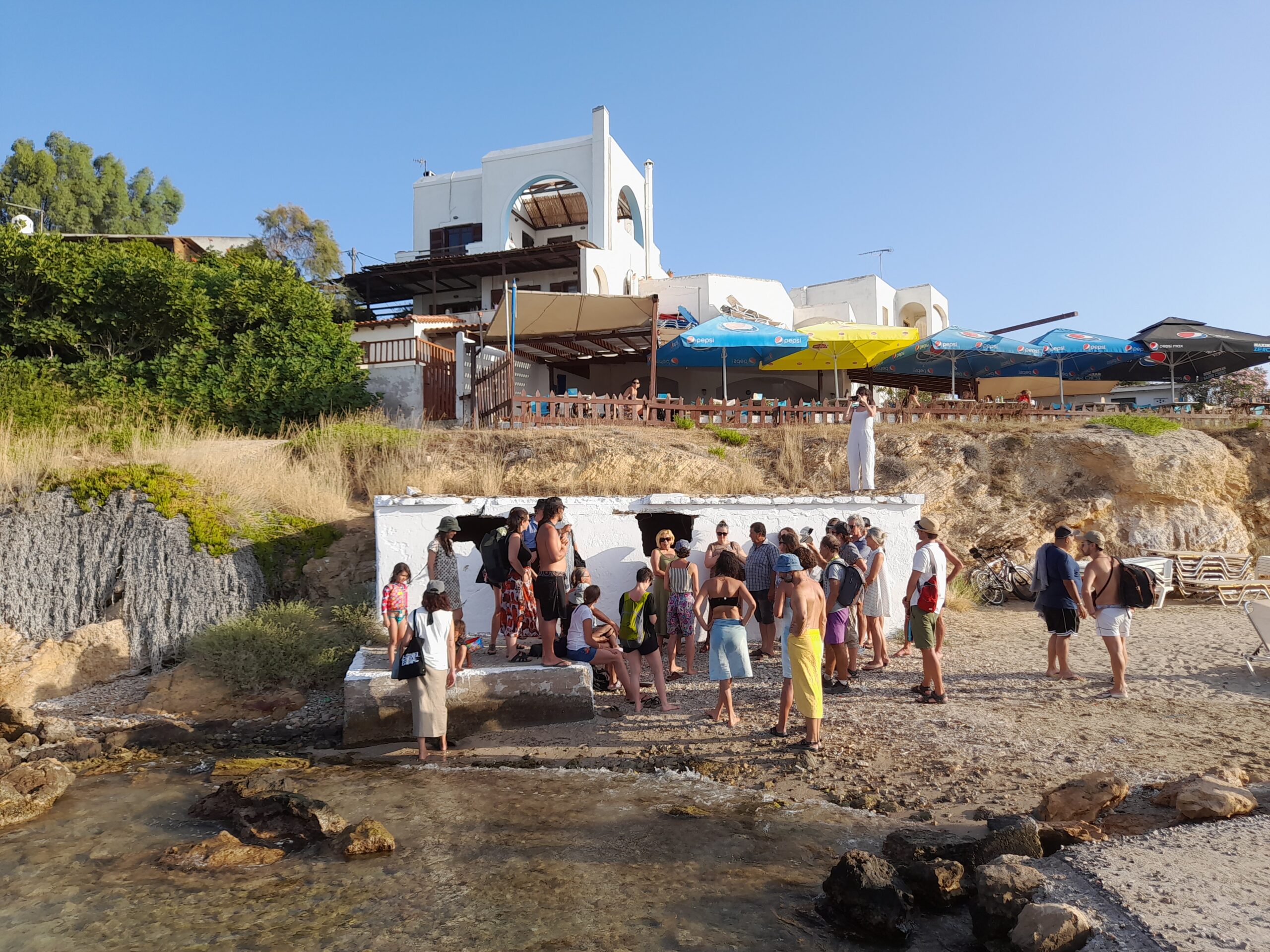
We’ve taught students how to build collectively and ecologically, painted murals in local playgrounds, and invited people to explore the lost springs of the island.
Now, we’ve been invited to take something of Aegina to the Venice Biennale of Architecture in 2025, and we’d like your help to get there.

Mediterranean seagrass – Posidonia oceanica – grows all around our island. It’s an extraordinary plant, the only flowering one in the ocean, and it is vital to marine ecosystems worldwide. It stores carbon, fills the ocean with oxygen, and provides a habitat for everyone else. It’s also under threat, with some 60% of seagrass meadows disappearing from the ocean in the last few decades.
On Aegina, and around the Mediterranean, seagrass has been used for generations as insulation for houses and fertiliser for fields. Although these practices have largely disappeared, and been replaced by synthetic and unsustainable alternatives, the seagrass is still here.
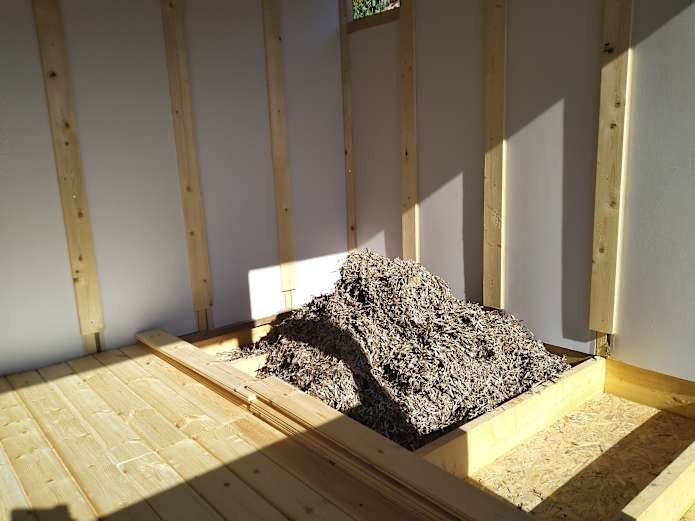
We’ve been using seagrass as insulation in our projects, and it really is a wonder material: fire-resistant, inhospitable to pests, and free to collect on the beaches. Moreover, as we’ve used it, we’ve discovered its worlds, and become involved in conservation efforts to preserve and regenerate local seagrass meadows in the Aegean.
We want to share this knowledge, and raise awareness about seagrass ecology and conservation. And the Vennice Biennial has invited us to do so: but they don’t offer any financial support. That’s why we’re asking for help.
We want to send several packing cases of seagrass, collected on our local beaches, to Venice. As well as samples of seagrass prepared for architectural use, we’ll include ceramic objects made from local clay, which tell the story of seagrass in the wild. This is a reference to the Venetian glassmakers of Murano, who used to send their wares around the world packed in seagrass from the lagoon of Venice. Even the painted crates will be made from reclaimed wood, and will form part of the exhibit, in order to minimise waste and maximise recycling as part of the project.

You can read more, and donate to our fundraising effort, here. It would be hugely appreciated.
More-Than-Human Aesthetics [ 14-Nov-24 8:19am ]I was recently interviewed by Kanoko Tamura for the Japanese art magazine art journal “Bijutsu-Techo”. The interview will be published, in Japanese, in a forthcoming issue of the magazine, dedicated to Generative AI. I’m publishing an English-language transcript, only lightly edited, of our discussion, because it touches on so many things I’m interested in, and raises one particularly interesting question, which I attempted to answer: “what is a non-human aesthetic?”.
Kanoko Tamura:
For the next issue that we are working on, it’s going to be about generative AI and art. Becaus now ChatGPT and all these technologies have been spread among general people, a lot of people have started using those technologies. But it’s also a very particular time in the history because generative art has its own long history. But what is happening now is something very unique. So I want to use this issue as an opportunity to analyze what is really our current situation?
I think a lot of us are having been learning pros and cons of AI and if it’s actually useful for art. And there’s a huge discussion in the art world as well if we should use AI or not, and how should we face the AI from the point of view of the art world. So we are doing different interviews with artists to hear how people think about it and also in a way to try to find a positive way to look at the current situation. So being positive - not accepting everything nor denying everything, but trying to find a positive/productive way of looking at the technology from the artist’s point of view.
I will be interviewing you today, and I wish to talk about stuff based on Ways of Being where you talk about non-human intelligence and how you find values and possibilities in it? Also connecting that to what’s going on in the art world. If you, as an artist, see any possibilities or issues or challenges in usage of AI in terms of creative work. If you could start by maybe talking about how you see this current situation at the moment and also if you see any possibilities toward the future?
James Bridle:
Certainly, and thanks. It’s a vast thing to talk about, right? Because one thing to start talking about from the outside is really: what are we talking about? One of the first splits to talk about is between the AI that most people imagine and the AI that actually somewhat exists. We have AI as in the kind of vast science fiction imagining of everyone, which is fed by science fiction films, and by the marketing propaganda of companies that engage in this. That is something that’s so huge and so culturally powerful that it really shapes so much of our thinking about AI, in the art world, but also everywhere.
The reality of the actual tools that we have in the present moment are pretty different from what immediately pops into our head when we think about AI. So that’s the first thing: making a distinction between AI as it is in the popular imagination, and in the artistic imagination; and in the actuality of the tools that we have.
The second thing I would say is that there’s a really important distinction between the AI you're talking about – generative AI and large language models – and all the different kinds of AI there actually are in existence. Because I have made projects over the years using neural networks, which underlie generative AI and large language models, but I haven’t used those specific technologies in my work. And these emerge from a whole history of other attempts to build AI that have different outcomes. The idea that AI is just something that can make images or make text out of these kind of huge corpora is only one thing that might be possible with them. There’s a range of practices around AI.
The other split I’m quite keen to make, that cuts across those other ones and doesn’t just apply to imagining other forms of AI, but trues to ask what we’re talking about when we talk about intelligence in general. Where does AI sit within our imagination of who gets to think, who gets to create. A lot of my work, and particularly in Ways of Being, has been about trying to figure out what we mean when we talk about AI - or rather, let’s call it machine intelligence rather than artificial intelligence. Because when we talk about intelligence, we mostly, subconsciously or consciously, mean what humans do. So all of our thinking about AI is contained within this very narrow idea that AI is somehow mimicking some or all aspects of what we consider to be human intelligence. It’s like a subset of human intelligence. One of my questions is: what if it’s not? What if it’s actually a radically different kind of thinking about the world? Therefore, what other modes of thinking the world might we be able to come up with to compare it to, to make sense of it, to measure it against?
I’ve always found it incredibly striking that AI, this big amorphous conceptual thing, is having such a huge moment in the popular imagination just as in a lot of other ways, in the art world and elsewhere in politics, in our relationship to the planet, we’re also rethinking the centrality of the human. We’re recognizing both our overwhelming power to organize, control, change, damage, perhaps improve the planet, but also our intense limitations, and part of that is recognizing that there’s a whole world of other beings that have always inhabited this planet, who also have their own forms of intelligence that are not lesser than ours. They’re just different ways of thinking the world. And so is machine intelligence like human intelligence? Is it like the intelligence of some other living being? Is it something entirely new? How does it partake in the world?
That brings up really fascinating philosophical questions concerning what we can know about the intelligence of others. Not just the intelligence of other species, but the intelligence of other people, the intelligence of people who’ve existed within different cultures, different cosmologies. There’s so many different ways of thinking in the world. That’s the beginning.
We can say some things about what kind of intelligence we are dealing with. One thing we can say about the contemporary forms of AI that most of us have access to is that it is what I call corporate AI. It is AI that is made by large corporations, mostly American and some Chinese and others, all within these very particular structures of power and capitalism. That is like a plant growing within a particular ecosystem. It will take on the qualities of the life it has to survive, what it considers success from that niche in which it grows up. This is why so much attention is paid to AIs that play games. It’s because that’s the only way we have to tell if it’s winning. But that makes it think that winning is the most important thing, which is a particular value of capitalism and of some other systems. It comes freighted with these kind of values, biases, concerns. It comes with its own view of the world that it acts upon.
Personally, I’m not interested in art involving AI that doesn’t contain some of that critique, that doesn’t contain some of that thinking. Because what is this thing we’re talking about? Is it a way of painting or is it a way of thinking about painting? Or is it a way of seeing the whole world? Is it a tool? Is it a context? Is it a framework? Or is it a whole cosmology, a whole model of the world that we’re interacting with?
And very, very finally and briefly, I want to make a case that AI is very boring. It’s not as interesting or as important as so many other things, including art. It has to be secondary to the important things we’re discussing, which in this case might be: what is art? What can art be? What can art do? We have to talk about the art first and then see if maybe, just perhaps, AI is an interesting component of that.
Does it help us answer some of these questions? Does it help us do something or not?
Kanoko Tamura:
Thank you for that. With that said, I’m interested in hearing about your AI Chair Project because I see a lot of potentials in that project. Even though it’s a very simple and maybe small project that you recently started on, I think that it shows or it tries to explore possibilities of humans and the other. How can we collaborate with someone who is not human? It also shows that the values that you reach together in the conversation with AI. It’s not always the standard beauty or function. It questions the values that humans think are good. I also think about the use of the used materials or the materials that are often usually considered useless. So I think AI Chair Project asks very crucial and fundamental question, and that’s how I interpreted the project. If you could maybe talk about your intention behind it or what did you get out of it after you started the project?
James Bridle:
So one of the ways that I think about AI is thinking about the fact that you are in communication with another being, a system or whatever it is that has a way of thinking the world that is different with the way that I have of thinking the world. And most of the discourse in AI is around the discordances that it creates. Things like AI hallucinations, the way it does seem to understand the world differently in a way that doesn’t make sense to humans, that comes across as a mistake or even sometimes as a lie. That's often how these systems are critiqued as seen as being wrong, as being lying, when really that’s just how they understand the world, and it’s different to how humans understand the world.
In particular, they’re good at things that humans are bad at, like thinking about huge numbers or very large amounts of information. We’re just not very good at that. We need machines to help us with that or that’s what machines are good for, anyway. But then they’re not good at things that humans are good at, like certain other types of creative thinking, guessing, hunches, another kind of thinking in the world, just a different way of thinking. So we have these different ways of thinking. There’s different roles to be had here, and in particular rather than assuming that AI is something that will outcompete humans, we can at least start to think about it as being something that accompanies humans, that collaborates with humans, that we can put those ways of thinking into some kind of productive alignment.
One thing that the computer systems are really good at that humans aren’t so good at is optimization and efficiency. One of the long term uses for computer systems within architecture, for example, is something like how do we make a bridge with fewer supports, or less material? How do we build a more efficient roof on a house? These kind of questions. Complex mathematical problems. So that seemed like the thing to push on. I had a load of spare wood sitting around, scrap wood from other projects. So I was like, okay, well, I know how to build a chair, and chairs are useful, direct, you know. We’re probably not going to improve on the design of the chair: humans know how to make the best form of the chair for the human body. It’s just something that holds you off the ground. But I thought that the AI could perhaps do this kind of creative work that I wasn’t so good at, which was to imagine which materials would be the most efficient in different places. That’s what I was really hoping for from the project, that I would be able to give this machine a bunch of descriptions of pieces of wood that I actually had, and it would tell me how to combine them in ways that I wouldn’t have thought of, that wouldn’t have occurred to me.
The result was actually less interesting than that. It told me how to build a very simple chair. It did use the materials very efficiently. There was also work for me to do, to figure out how to follow its instructions. I had to do some creative work here. That was interesting to me because the AI didn’t learn anything from this experience, but I learned something practical and definite from this experience. My carpentry improved slightly. That’s more than collaboration. That’s commensalism, which is a term for a symbiotic relationship where something gets better on both sides. You’re not just surviving. You’re actually improving. I think that’s really key, in that I want to have relationships with my tools that is commensurate. Where we’re improved by our use of them rather than merely doing as we’re told or using them instead of our brains. It’s trying to find the places in which we have either hierarchical relationships or negative parasitic relationships, which most of our relationships with technology are, and replace them with commensal ones. Where we are all uplifted by this experience.
There’s a bunch of other stuff in there about like treating the AI as the other and that kind of stuff. But that was really my main thing: how do I build something greater out of this? Also, how do I get a better understanding of the thing that I’m dealing with? Because buried in there is a very literal description of how this kind of AI functions. The chairs that I’ve built by asking the AI to help me build chairs are the sort of chairs that are imagined by someone who has only ever read about chairs. They’ve never sat in one, which is a very important thing to understand about how AI understands things. It’s such a beautifully direct description of what this thing is that I’m dealing with that becomes so apparent when you actually make a thing.
That’s slightly in counterpoint to my last point about how you have to talk about the art first. Sometimes you just have to do the thing and then figure out what the art of it is.
Kanoko Tamura:
Yes. It’s very interesting the last thing you talked about. By making the chair, you kind of understand what exactly AI is, because it produces something not from the experience of sitting, and but out of all the information. I think in Ways of Being, you also talk about there are lots of hints as to how humans can build relationship with non-humans, including AI and other animals in nature. I think you could imagine that relationship being the kind of relationship that you’re building with AI as well. Do you have any specific ideas or examples or imagination on how exactly we can build that kind of relationship with non-humans? I’m interested in animals and plants and all the other beings that you talked about in the book as well. Maybe you could focus on those instead of AI.
James Bridle:
Happily. Very happily. What to say? One of the main points of Ways of Being is that everything is alive. Everything has its own being. Everything exists in this world equally with everything else, with its own presence, its own awareness, its own living force, whatever that is. Some of that is knowable and recognizable by us. Some of it is so strange and different to us that it’s almost impossible for us to grasp. How do we change or shape our awareness in recognition of that? How do we enter into a world in which most of the life that’s occurring is radically different to us and yet shares the world with us? There’s many possible answers to that. One of them is to directly experience, to pay attention. As I said about the AI chair, sometimes you have to do it. Most of what I’m talking about exists in the realm of direct experience. It can’t be spoken of.
What do I mean when I say these things cannot be spoken of? Well, what I mean is that language is a system for making distinctions between things. So you have to divide things up in order to be able to talk about them meaningfully. If I say "this mountain", I’m describing a particular mountain. I’m separating it from other things. But if I say the mountain is alive, what does that mean? Does it mean that the mountain breathes like a mammal? Does it exist like a bacteria? Does it live like the wind lives? The words stop having meanings in ways that are useful to us. But the mountain is alive. It’s just really hard to talk about. So the only really meaningful relationship one can have is one that goes beyond language. That concerns direct experience. Things just happen: that is the realm of direct experience. And that’s also the realm of quite a lot of art. So we’re talking about things that have a relationship. That go beyond everyday language and quite often beyond language itself in order to be able to conceive, feel and experience things that are truer than what we can put into any form of words.
The question then becomes what kind of relationships do we want to have. What do we want these to be for? Do we want these to be relationships to build a better world? A world of mutual flourishing, a world in which everyone gets to live to their fullest possibilities? And by everyone, I do also mean the birds, the animals, the seas, the mountains. How do we build a world of mutual flourishing? It comes from these kinds of forms of attention, from caring about these things, and by the gift of thinking the world as being fully alive.
A lesser question, but one that I am still fascinated with is: do computers count? Does AI count? Is AI alive? Could it be? Which is this question that keeps coming up. I find it fascinating. This is, for me, the best use of AI because it makes me ask this question - Is AI alive, in the terms that I’m talking about? If so, how? Because I understand that aliveness has some kind of a resonance, but also something that descends from something greater, from the universe. Everything comes out of the universe. That’s what makes it alive. Does AI come out of that? Or did we build it in just in the lab, and therefore, it has no life? But everything is alive. I don’t know. I'm thinking about it.
What is AI made out of? It’s literally made out of the bodies of creatures that died billions of years ago. It’s made out of plastic and oil and electrons. So it is part of the universe as much as anything else. What does it mean to think and have these relationships? How does it change us to have these relationships? How is the world changed by the relationships that we have? These are the questions that I’m interested in.
Kanoko Tamura:
I think that’s a very, very important message and question that you raised that is important not only to this topic that we want to discuss in the magazine issue, but it’s a very fundamental question that we all need to face because when we try to ask questions about AI, we tend to start by questioning and trying to criticize the corporate AI. If it’s useful or not or if it’s helpful or not. But I think if you really think about why AI is here and is AI alive, we can actually get to a very fundamental question in art as well because instead of talking about all the games happening in the art market, we start to ask questions like why do we start drawing in first place, or why do we start dancing and singing? I think it connects to those more important questions.
James Bridle:
Yes, absolutely. That for me is the most interesting thing about AI. It’s the idea of it, not whatever we write in code or systems. Why as a species are we so fascinated by the idea of there being non-human intelligence?
I should really qualify that by saying why as particular human cultures are we fascinated by non-human intelligence? Because for many cultures, the idea of non-human intelligence is not so complicated. For someone acculturated to, in particular, a Western European post-enlightenment scientific position, we’ve been told that there’s no such thing. And we’ve forced most of the world, if not to accept that position, then at least to live within it. We are living within the consequences of that imperial, colonial, epistemological action. Whatever anyone else in the world thinks, we’ve set the world up to run as though there’s nothing but the human and really nothing but certain types of human that matter. So the project, the only important project at the present, is to change that situation.
I think that's quite a long shot, given how entrenched our colonialist, capitalist, and Western Enlightenment scientific cultures are. But it does seem to me that the attention given to AI quite clearly speaks to a yearning within the human to meet and learn from the non-human.
Kanoko Tamura:
With that said or from that point of view, do you think it’s possible to kind of come back to the art and talk about aesthetics with non-human intelligence? Because aesthetics is important, it’s being discussed over years by philosophers, and then there is also a discussion of new aesthetics. But do you think it’s possible to discuss non-human aesthetics, or aesthetics of intelligence, or aesthetics of being?
James Bridle:
My engagement with aesthetics has always been somewhat accidental. My project, The New Aesthetic, which still continues, is very much a sort of amateur, outsider one, in which I responded quite viscerally to things that I was encountering. It’s always been a research project rather than a doing project in that sense. But in another sense, it’s something I’ve been doing for almost 20 years now. So I guess I can call it meaningful.
The first thing to say about a non-human aesthetic would be that it can’t be an aesthetic, as we understand it, because aesthetics is about human sense and human judgment and experience. It's about that we encounter, process, think of the world primarily in terms of appearances because we’ve got these great big eyes in the front of our head that are our primary sense. But that’s not how most of the universe encounters itself.
One of the things I always think about is the way, as humans, we live within such a narrow band of space time, in multiple ways. Within time, we live within the ticking of a clock. Our day-to-day time, the 24-hour cycle, and the cycle of our attention, which is also determined by things outside of us. We also live within the time scale of our lives, and we live within the time scale of our culture, what our culture remembers, which is a very small fraction of the history of the planet, let alone the universe, let alone, a number of other things. We live within this really narrow time and we can’t see that far ahead. Our experience is so bounded just by time. And then regarding space, we can see a little, we can hear a little, but that is limited by the frequencies we can perceive. There are huge numbers of beings that live on this planet that can hear things that we can’t hear. So even there, immediately, this other aesthetic, a non-human aesthetic, is bigger, broader, deeper, wider, stranger than a human aesthetic because it extends into all these different potential realizations, awarenesses, and therefore, things to process and therefore, things to think with. It increases the number of objects to think with.
So I guess that actually makes for me quite a neat definition of a non-human aesthetic: to increase the number of things we have to think with. Every culture has its own set of aesthetics that it thinks with and humans have collectively a set things to think with. The most interesting thing for me in the world is trying to expand the things, or rather beings, that we have to think with. I add that 'beings' to it because I think a big part of this is the transformation of things into beings. The process by which we stop regarding only the people that we know, or humans in general as being people, beings who matter, and we start to see everything as being people who are in their own process of passing through space time on a trajectory that occasionally intersects with our own. Because the moment of thinking happens when those things collide. The moment of living happens when those things collide.
In Ways of Being, I write about intelligence as being a cooperative process. But I’d go a lot further than that, and I would say this kind of living and thinking, this being or mattering is what happens when beings interact, when they meet. How do we increase the number of relationships? That is not a non-human, but a more-than-human aesthetics, that includes all these possible and effectively infinite different intersections between beings to produce entirely new perspectives, new ways of perceiving and thinking the world.
Kanoko Tamura:
You gave us a lot of hints to really digest and think on, so thank you for that. Do you have any plans for near future or anything that you’re working on at the moment that you could tell us? Any current project that you’re interested in?
James Bridle:
My work at present is largely focused on quite practical work. I spent, you know, a lot of the last 10, 15 years looking at questions of technology. That’s been my main focus. Writing Ways of Being was was part of, I should say, a conscious transition from a technological focus to an ecological focus. It’s explicit in the book, but it’s part of my whole practice and part of my whole life. I think for me and for a lot of other people, the most urgent work at present is to address the planetary ecological crisis. And an incredibly important question for artists is: what is our role within that?
One of the ways that I think about that is to ask questions of art itself, of what it can do, of how it operates. In my work with technology, I found myself running up a lot against essentially a problem of representation, which is where you make work with technology about technology that just does more technology in various ways that just recreates the same systems you’re critiquing. That problem is even greater when it comes to ecological work. It’s very easy to make work about climate change. It’s also pointless and irresponsible in the present moment.
The only work that really matters is work that actually does something. I’m not about to claim that my work succeeds in doing that. It’s hard. But it is my intention always that the work actually does some work. Now that can be work to inform people just to talk about things, to raise these as issues, to increase awareness or imagination, but that is mostly representation. It can also be super practical. I build solar panels. I build windmills. I make these things as works of art that actually do the thing, that actually work. I call them 'works that work' or 'works that do work' because they’re actively part of the transformation that I’d like to see in the world. They’re not solutions; I don’t believe in solutions. But I do believe in a kind of active engagement that the work, the artworks themselves, are part of. They don’t stand alone. They’re not representations of anything anymore. They’re actually getting involved in some way. That’s probably of a piece with my feelings about ecology, about the world around me, about the aliveness of everything. The artworks partake as much as anything else. That’s where I’m at these days. I’m making things and I’m making things in the world and I’m eager to see what the world thinks about it.
AI is doing exactly what its creators want it to do [ 14-Nov-24 7:23am ]I am very pleased that Ways of Being is now available in Spanish, courtesy of Galaxia Gutenberg, joining translations in German, French, Italian, Hungarian, Dutch, Brazilian Portuguese, and other languages. I did a small interview with El Mundo, on AI and more-than-human relations, which I am publishing in English below.

- Repsol, a Spanish company, features prominently at the beginning of your book as it uses Artificial Intelligence to search for oil in Greece, leading to the destruction of the ecosystem. When something as old and harmful as fossil fuels joins forces with something as new and seemingly positive as Artificial Intelligence, should it alarm us that things may not be as they are portrayed?”
Artificial Intelligence, as it currently actually exists, is a business technology developed by corporations for capitalist ends, so we shouldn’t really be surprised when it is put to use in ways which continue to degrade the biosphere and corrode human relations. Of course, too, the hype is about making the world better, but hasn’t it always been? As the writer Joanna Maciejewska recently put it, “I want AI to do my laundry and dishes so that I can do art and writing, not for AI to do my art and writing so that I can do my laundry and dishes.” We could say the same about AI and the environment: what do we actually want this tool to do, and who should be imagining it and working with it to make that so?
- Is the technological determinism that claims technology is unstoppable a fait accompli strategy that leads us to disaster?
Technology in itself is not the problem; any technological problem, at sufficient scale, is a political problem. It matters who builds and deploys technology, and historically this power has been concentrated in the hands of corporate elites and governments who don’t always act in the best interests of people and the planet. This isn’t inevitable: most of us have access to skills and resources to shift this power towards mutual flourishing, but it’s not easy; political change never is. But the more of us who can imagine a world in which technology is a tool for emancipation and equality, rather than control, the more we can determine the future of that world together.
- You write: “True AI is already here: it’s corporations.” It is fascinating to expand the concept in this way. Is AI any golem that has escaped its creator’s control?
I don’t think AI has escaped its creator’s control; it’s doing exactly what its creators want it to do, which is make money. AI is not some strange, otherworldly force from nowhere, it’s part of our existing systems of culture, law, and society, and it emerges from them. I talk about corporations as AI because I want to emphasise that we already live within complex, opaque systems which we have little control over – financial markets, state governments, the global climate – but we also have cultural tools to address them, from art to political activism. Changing the status quo involves both concrete steps to reduce inequalities of power and knowledge, as well as re-imagining what we think technology and governance are for.
- When Silicon Valley tells us we should fear AI, do you think AI is also going to replace even them? Isn’t it also a way of diverting attention by pointing to Skynet so we don’t think about the gigantic power Silicon Valley is accumulating?
“Silicon Valley”, meaning the quite small number of powerful people who control the major technology companies, and have always controlled such powerful entities, including governments, like to pretend that they don’t have power, that they too are at the mercy of the systems that in fact we all create together. This pretense disempowers the rest of us too, by making us think that we too lack the power to make change in the world. AI does promise, or at least make possible, a radical shift in power, but it is unlikely to do so in a way that benefits all of us when it’s in the hands of a few corporations. We should always be critical of proclamations from the powerful that X – whether that’s AI, corporate taxes, or environmental protections – is dangerous to all of us, when in reality what is threatened is their own power. Nobody ever gave that up willingly, and they will do anything to continue their own dominance, including inventing fantasies of Skynet.
- Your main hypothesis is that someone has deceived us into thinking that there is only one kind of intelligence when there are many. What mental journey led you to that reflection?
All my ideas come out of the world, from encounters with the Earth and the many different beings that live on and in it. In the last few years, as I’ve delved deeper into ecological thinking and forging stronger relationships with the more-than-human world – meaning us and everyone else who lives here – this has radically shifted my thinking about technology. One aspect of this is the realisation that what we call ‘Artificial Intelligence’ is really only one kind of intelligence. Just as birds, dogs, trees, monkeys and oceans all manifest their own kind of intelligence based on their context, experience, and embodiment, an intelligence no ‘higher’ or ‘lower’ than our own, but evolved for its particular circumstance, so AI is currently evolving it’s own capitalist, machine-like intelligence because of the context in which it is being raised. It’s helpful for me to think of it this way because it grounds some of the wilder thinking about AI in a broader ecological context, and also helps me to re-imagine how it could be otherwise.
- What would it mean to build artificial intelligences and other machines that were more like octopuses, fungi, or forests?
This is the logical next step, and of course it applies to more than AI. What would all of our technologies look like if they were firstly more concerned about bringing us closer to the world than separating us from it, and secondly what can we learn from non-humans about how to do this? Octopuses, for example, have minds which are physically spread throughout their whole bodies, federated brains with neurons in their arms, which allow for a radically different kind of thinking: more responsive, perhaps more creative, and more in tune with their fluid environment. Forests are superorganisms consisting of many beings working together, intimately entangled, and more often co-operating, rather than competing, for resources. We have become programmed – by science, technology, and modernity – to think of minds as little boxes trapped inside our own heads, or inside machines, that we miss out on the reality of intelligence as something embodied, enacted, and networked in an infinite number of possible configurations.
- What is the ecology of technology?
Over the twentieth century, almost all scientific and philosophical disciplines discovered ecology, which is the simple idea that everything is interrelated, that it is impossible to study any phenomenon in isolation, because it impacts, and is impacted by, everything around it. This applies to physics as much as biology, in the discovery of the quantum world, and to economics as much as sociology. Technology has an ecology as well: the cultures it is a product of, the rules which govern it, the effects it has on our minds, our bodies, and the planet. We tend to think of technology as lots of little boxes, which do specific things, when really it is a network of relationships, and these relationships matter more than what any particular little box does.
- In New Dark Age, you explained that we live in a world so technologically complex that we are incapable of understanding it. What possibilities of action does a human being, walking blindly, have then?
When I say that we are incapable of understanding the complexity of contemporary technologies, I don’t mean that we are blind. The kind of understanding that we like to think we have, the ability to break something down into its component parts, master it, and control it for our own ends, simply does not apply to complex systems like a worldwide computer network, or a financial market, or the global climate. Rather, these are systems which we live inside, which we shape and which shape us in turn. This realisation shifts the question from one of understanding – a matter of power, control, and dominance – to one of ethics. How to live justly within such systems, in good relationship with everyone else, human and non-human, for the mutual benefit of all? The implications of such a question are not something we are blind to at all.
- If one day we contact a highly advanced extraterrestrial intelligence, would it be more like an octopus or Elon Musk?
Scientists have recently begun working with, and coming to recognise, the organisms which live deep within the earth’s crust; which exist by digesting exotic minerals and excreting other ones, which might form some of the foundations of all life. In recent decades we’ve met creatures who live in total darkness at the bottom of the ocean, huddled around hot vents, breathing only methane. Others flourish atop dry mountains, or in the iron-rich rivers of mine tailings. I cannot even begin to imagine what else might be out there, but if if we meet it, it is likely to have got there by working with, rather than against, its own environment and community.
- “The world is not like a computer. Computers are like the world.” Is another kind of computing possible?
Almost all the computers in the world are one kind of computer: the automated, binary machine invented by Alan Turing in the 1940s. Yet infinite other kinds of computer are possible, from hydrological computers which use the flow of water, rather than electrons, to calculate the freeze rate of concrete or the likelihood of a recession, to quantum computers operating at vastly accelerated speeds, to Gaia, a conception of the world as a vast, cybernetic system constantly regulating itself towards flourishing. And all these are just ways of thinking about thinking, abstractions from the actual business of living together on the Earth, useful some of the time, less so at others. Everything is not only possible, it is happening all the time.
To The Mountain [ 08-May-24 8:46am ]Last year I was asked to contribute to the Serpentine Galleries’ Infinite Ecologies Marathon, a prelude to their Inifinite Ecologies programme, with something that expressed what I thought was missing from most discussion and practice of what we might call ecological art.
Over the last few years, I’ve been concerned with what might broadly be called a new crisis of representation when it comes to ecological work. This awareness stems from my own practice as well as wider concerns.
One place in which it is expressed is in Amitav Ghosh’s book The Great Derangement, a text I return to often. In it, Ghosh argues that capital-L Literature is unfit for engaging with climate-scale issues. The global ecological crisis is simply too vast in scale and complexity to be captured adequately by human-scale fiction, and thus cannot be meaningfully acted upon it. (I could write a lot more about this: Ghosh is concerned mostly with the bourgeois novel, rather than, say, speculative fiction; I would argue that in his own fiction he disproves his own thesis through his use of multiple narrators, including non-human ones; and the book is about much more than this, but anyway.)
My own journey to this crisis point comes through the technological art which was my own main preoccupation for more than a decade, centred on issues arising from networked systems, the materiality of contemporary technology, and its political effects. I found, in particular, that most art work about, say, surveillance (and now AI) which described itself as critical (including my own) mostly just reproduced the structures and mechanisms of the things it was critiquing, and thus normalised it. This is as true of the Snowden leaks as of critical tech art. Art which just does more surveillance, however transparently, or just maps out the existing structures of technological control (Look! A datacentre! Behold! A dataset!) is more likely to dazzle, frighten, and ultimately turn off an audience than to spur them to action; to make a change.
We can see parallels to this in what we might call the empathy crisis in media and humanitarian work: we know that just showing pictures of terrible things happening far away doesn’t do anything (at best) or actively turns viewers away (at worst) – but we keep doing it, for lack of better ideas (and lack of actual power and agency).
One result of this, in turning to ecological work, was to insist on what I call “works that work”, or “works that do work”: pieces which function both as artwork and as engines of ecological intervention, however minor. Hence: windmills, solar panels, self-built architecture. Not always achieved, not always achievable, but necessary. There’s no point making work about climate change. You have to do the work. This is a whole book; it might be in time.
As I couldn’t be present for the Serpentine event, I sent a short film in my stead. And for this, I focussed on the other component that I feel is central to ecological work – to art, to life – the part I feel less confident speaking about, the more personal, the often unspoken. And yet: without it, we cannot conceive of being ecological at all. And so: to the mountain.
AI Chair 1.1: Llamafiles and Mistral [ 12-Apr-24 9:01am ]Following my experiments with the ChatGPT-assisted AI Chair 1.0, I’ve been continuing experiments with a range of other LLMs. The below image is Chair 1.1, designed with the assistance of Mistral AI.
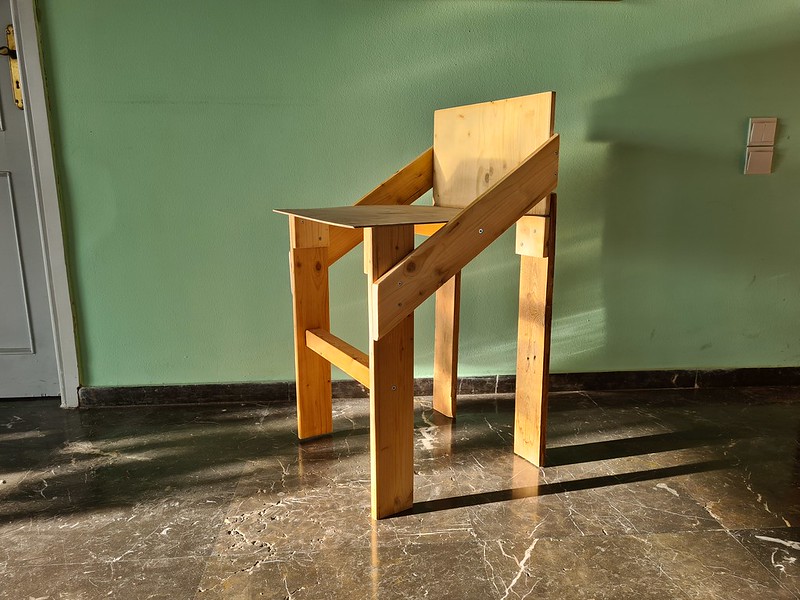
Before embarking on this chair, I did some experimenting with local LLMs. These are essentially small “large” language models that you download and run on your own computer. What you gain is transparency, control over resources, privacy etc etc; what you lose, to a quite significant degree, is power and complexity.
I used llamafile from Mozilla, a programme which lets you download small LLMs (filesizes are around 1GB) and tried out two very lightweight models, at the absolute maximum of what I can run on my wheezy secondhand laptop. With very little RAM and no GPU, they can only output a few tokens (~words) a minute, so the process was quite painful. Furthermore, neither were capable of designing a chair.
The above are my attempts to sketch out designs for scrap wood chairs based on the instructions from two locally-running LLMs: LLAVA 1.5 and Phi-2 (click those links for full transcripts of our conversations). While I tried to makes sense of what I was given, the above sketches are very creative interpretations of instructions which mostly did not make sense. Confusion over materials, inconsistent referents, and severe difficulties with measurements, resulted in descriptions which sounded like they should make a chair, but really didn’t.
I don’t know how much of this I can blame on the models, or the fact that they were running on a seriously underpowered machine. But I decided if I was going to use up my remaining stock of scrap wood, I would work with a slightly more helpful assistant, so I turned to the ChatGPT competitor, Mistral.
I have a pile of scrap wood and I would like to make a chair. I have a saw, a drill, screws, and wood glue. Please give me step by step instructions for making a chair from the following materials, using as little wood as possible. 3 pine panels: – 18, 180, 490 mm – 18, 255, 490 mm – 18, 255, 490mm 1 plywood sheet: – 4, 480, 455 mm 1 L-shaped laminated chipboard sheet: – 15, 280, 410 mm (missing 130, 135 mm cutout) 3 planks – 20, 95, 1300 mm – 20, 95, 1200 mm – 20, 95, 1200 mm 1 wood beam – 50, 50, 895 mm
Sure, I’d be happy to help you create a simple chair using the materials you have. Please note that the design will be basic due to the limited materials and tools. Here’s a step-by-step guide:
Materials:
• Pine panels: A (18, 180, 490 mm), B (18, 255, 490 mm), C (18, 255, 490 mm)
• Plywood sheet: D (4, 480, 455 mm)
• L-shaped laminated chipboard sheet: E (15, 280, 410 mm)
• Planks: F (20, 95, 1300 mm), G (20, 95, 1200 mm), H (20, 95, 1200 mm)
• Wood beam: I (50, 50, 895 mm)
Tools:
• Saw
• Drill
• Screws
• Wood glue
Steps:
1. Backrest and Seat:
– Use pine panel A (18, 180, 490 mm) as the backrest.
– Use the plywood sheet D (4, 480, 455 mm) as the seat.
2. Back Legs:
– Cut plank F (20, 95, 1300 mm) into two equal pieces (20, 95, 650 mm) for the back legs.
3. Front Legs:
– Use plank G (20, 95, 1200 mm) and cut it into two equal pieces (20, 95, 600 mm) for the front legs.
4. Armrests:
– Use plank H (20, 95, 1200 mm) for the armrests. Cut it into two pieces, one of 20, 95, 500 mm and the other of 20, 95, 700 mm. The longer piece will be the back armrest, and the shorter one will be the front armrest.
5. Support Beam:
– Use the wood beam I (50, 50, 895 mm) as a support beam between the front legs.
6. Assembly:
– Attach the backrest (A) to the top of the back legs.
– Attach the seat (D) to the top of the front legs and the bottom of the back legs.
– Attach the back armrest to the top of the backrest and the back legs.
– Attach the front armrest to the front legs.
– Attach the support beam (I) between the front legs for added stability.
– Use the L-shaped laminated chipboard sheet (E) as additional support. Attach it to the back of the seat and the backrest.
Remember to pre-drill all your holes to prevent the wood from splitting. Also, use wood glue in addition to screws for extra strength.
Please be aware that this design is quite basic and may not be as comfortable or as sturdy as a professionally made chair. Always ensure your safety when using tools and handling materials.
Good luck with your project!
This seemed like a pretty do-able set of instructions, although I had doubts about some of the aspects, so I went ahead and built it. There was a bit more back-and-forth about how to attach the seat (the above makes no sense), the seat’s orientation, and various connections. Read the full transcript here. Mistral is very apologetic, but I’d also been told it was more technically accurate than ChatGPT and less likely to make stuff up, so let’s go.
There were two major changes to Mistral’s first design, one of which I prompted directly, and the other I did without discussing it. The first is that it was very obvious that the seat as described had no way of attaching to the legs, and there was no way of adapting the design as given without using more wood. Challenged on this, Mistral advised adding cleats to the back legs to support the chair. I interpreted this in the way you see in the chair: adding additional blocks to the legs to widen them and provide a secure base for the seat. I did this to the front legs too, which Mistral didn’t ask for, but was very obviously necessary (and still insufficient; see below). As an aside, this produced a detail which I absolutely love, where the rear of the seat is very neatly sandwiched between the rear leg cleats and the backrest.
Secondly, Mistral suggested armrests, but it was very unclear where these went or how they were attached. As the original instructions included bracing between the front legs, but left the front-back axis supported only by the 4mm ply seat (again: no), I decided to use these pieces as semi-armrests, semi-braces, as you see in the final design. I like this: a design element I would not have come up with without having to solve a structural problem posed by, and constrained by, my collaborator’s instructions.
Mistral advised me to use the incredibly thin plywood sheet as a seat again, just as ChatGPT did. However, in this case it over-reached. It said the seat should “overhang the front legs slightly”, which when combined with the other measurements it provided, resulted in the above. This cracked as soon as I sat on it. To prevent this crack getting a lot worse, I had to add an additional beam support underneath the seat – although this actually worked really well, both aesthetically as it connected the armrests nicely, and structurally to stabilise the chair.
(A reminder when looking at these photos: I am building these chairs quickly, with very poor tools, out of materials which have been sitting in the rain and sun for months/years. Do not judge my joinery.)
Here’s the other major problem with the design as given:
I am 6’0 (182cm) tall, but even my feet don’t touch the ground. Now, the ChatGPT chair was weirdly large, but kind of comfortingly so, like an outsized child’s chair. Mistral went even bigger, specifying legs which are 60cm long. This is too long.
Of course, I could see this coming, and in a true collaboration I would have simply adjusted the height, and I nearly did this. But since I am still in the prototyping phase, I decided to let it stand, as it makes for a good point of comparison with other collaborators, for now. As I said, Mistral was supposed to be more technically precise, and concise, than ChatGPT, but from this experience it seems slightly less capable with materials and human dimensions. The various changes prompted or needed – adding cleats, shortening the legs – also made for much less efficient use of materials than the first pass.
On the other hand, apart from the material efficiency issue (which does matter), those adaptations are my job: Mistral made a way more interesting chair. The inclusion of armrests-turned-braces and the low backrest led to something that’s much closer to a ‘designer’ chair than ChatGPT’s oversized doll’s chair, even in this very rough prototype version.

Finally, for comparison, here’s where we are now: from left to right, the FRÖSVI folding chair by IKEA, the AI Chair 1.0 by ChatGPT and me, and the AI (High?) Chair 1.1 by Mistral and me:
Am I annoyed that I started making chairs, rather than simpler, elongated stools, so that I could have made a BENCHMARKING joke? Yes I am. But if any other AI developers want to give me access to their paid / geo-locked products (Anthropic, I’m looking at you there), I’d be happy to discuss BENCHMARKING your product too.
(Go read the history of benchmarks now. It has nothing to do with furniture, but it’s very nice.)
Dig Where You Stand [ 11-Apr-24 10:29am ]I wrote an opinion piece for the Guardian on Amazon’s “cashier-free” grocery stores, AI, outsourcing and military technology. You can read it at the Guardian’s website, but the bit I’d like to focus on is this:
The national minimum wage in the UK is £11.44. A small grocery store like the Amazon Fresh shops might have half a dozen staff. Assuming all of them were on full wage (unlikely) and all of them were on the lowest wage (ie not managers), the average individual salary would be about £20k and the annual wage bill would be about £130k. When this work is outsourced via video cameras, it is passed to data labellers. Amazon's remote data labellers might be paid one or two pounds an hour, if they are lucky. If you can replace half a dozen UK staff with half a dozen data labellers in India, Kenya or the Philippines, then the difference in the annual staff bill alone could be almost £100,000 a year.
Jeff Bezos is the second-wealthiest person in the world, worth about $205bn (£163bn). That money doesn't come out of nowhere. It doesn't drop out of a pier-end slot machine called, "I learned to code at Princeton and that's why I'm better than you". It is the result of deliberately hiding actual work - designing, making, sorting, packing, cooking, farming, delivering - behind little icons on your smartphone screen, in order to devalue it. It is the systematic use of the fake robot trick to lower the value of labour, until people are reportedly sleeping in tents at the factory gates, then banking the difference.
The size of Bezos's rocket is very precisely determined by the difference in costs between paying a worker in Britain and a worker in India - including all the historically determined racist and colonialist inequality that calculation involves. But make no mistake - Bezos and his ilk will pay a robot even less, as soon as that's possible. The only lesson of Amazon Fresh is that we are not - quite - there yet.
The thing that I’m doing here – looking at the precise cost saving of outsourcing labour through technology, and pointing out that this is actually a form of wage theft which accumulates to the capital of the company doing it – was directly inspired by one of the most extraordinary books I’ve read in some time.
That book is Sven Lindqvist’s Dig Where You Stand. I expect I’ll be writing a lot about it in my next book, but – not least because I’m really interested in discussing it with anyone else who’s read it – some notes…
I’ve been a huge admirer of Lindqvist for some time. Saharan Journey, Exterminate All the Brutes (which you might know from its HBO series adaptation by Raoul Peck, which I also highly recommend), and A History of Bombing are all unique texts, blending visceral, passionate reportage with high literary technique. I quote on a regular basis his line from Exterminate… which for me encapsulates the problem of knowledge and action in an era of over-whelming information: “You already know enough. So do I. It is not knowledge we lack. What is missing is the courage to understand what we know and to draw conclusions.”
Dig Where You Stand was published in Swedish in 1978, and started a whole movement in Scandinavia and elsewhere. I’ve been telling people that it’s simultaneously the most boring and the most fascinating book I’ve ever read. The first part is because it’s largely a book about the Swedish concrete industry: its history, its structures, its employees and management, its role in society. But it is very much more than that. It’s a practical handbook for workers in any industry to excavate and relate the history of their own labour, and thus to better frame their present working conditions and industrial relations. And it’s much more than that too: by meticulously researching the history of worker’s lives, even as they are scarcely recorded in the official archives, Lindqvist shows how power, over time, appropriates the value of labour, and makes this – yes – concrete.
One chapter, for example, details the official holiday allowances of workers in a factory in the 1920s, 30s, and 40s, as well as the unpaid seasonal layoffs which preceded this period. Then he shares excerpts from the diaries of the factory’s owner: their yacht trips, trips abroad, long weekends at their country house. Each moment of the owner’s leisure revealed as time stolen, directly, from the lives of his employees, who can neither afford, not have time for, such pleasures. Another chapter performs a similar analysis on worker’s housing, another on healthcare, and so on. A chapter on asbestos is particularly devastating: Lindqvist shows how deliberate cost-saving measures by management in the first half of the twentieth century manifest as both cancers in the lungs of workers later in life, and as actual capital in the accounts of the company.
“Thus history lives on in living people’s bodies. It lurks there and finally it kills. When the dead body is opened up, history can be found in the shape of silvery fibres – the last remnants of the air people breathed in the factories and workers’ homes of the 1910s and 20s.” [p. 115]
“For each year that Skånska Cement managed to avoid installing an electrostatic filter, the company could save some money at the expense of the workers and and the local population. This money has not disappeared. It is still there and today forms part of the capital of Industri AB Euroc.” [p. 122]
Lindqvist didn’t invent dialectical materialism. What he does in Dig… is critically twofold: he puts it to work, and he shows you how to do it. The book is a handbook, and includes boxed texts in every chapter showing you how to go and find this information yourself, where to find it – and how to ask questions of it. The result is more than information; it is agency.
Finally, Lindqvist points to a couple of examples of where workers have become involved in their work politically and culturally. He insists on the value of workers knowledge (in a chapter which compares the official Swedish dictionary with worker’s terms for their own tools, he writes: “you have knowledge that science has not” [p. 207]). And he writes particularly movingly of the work of retired engineers Tony Cundick, Ivan Fear, and Ron Plaster, who saved and restored the five huge steam engines at the Kew Bridge Pumping station:
“To me the steam engine is a time machine,” says Ron Plaster. “When I work on one of them, I feel it’s a way to enter history, knock off the rust, take it to pieces, clean it, polish it, oil it and start again. You can sense the odor of history, you hear it hissing and puffing when the steam is admitted. You can feel history tremble under the pressure, see it start slowly and begin to move, you see how history works — that’s what’s so fantastic.” [p. 240]
“To reconstruct an old text — that’s research” writes Lindqvist. ” To restore old murals in a church — that’s culture. But to get one of the largest and oldest steam engines of the world to move again, after having been in the scrap-yard for thirty years — what is that?” [p. 241]
One of the most interesting things about Lindqvist’s book is its legacy. In Scandinavia, it gave shape (and a name) to the emerging Dig Where You Stand movement, which saw tens of thousands of ordinary people (who Lindqvist termed “barefoot researchers”) join study groups and excavate their own histories and social conditions. In Germany, it helped inspire the widespread History Movement which advocated active popular engagement with the country’s recent past. Among many other things, the History Movement led to the literal digging up, by amateur archaeologists, of the rubble-strewn former Gestapo headquarters in Berlin: an action which in turn led to the preservation of the site, which is now the Topography of Terror museum.
Although it wasn’t published in English until 2023, unofficial translations circulated in Britain from the 1970s, including as part of the curriculum of the History Workshop, Raphael Samuel’s seminars at Ruskin College which also led to a broad history-from-below movement. I’m currently reading Workshop of the World, Verso’s recent edition of Samuel’s essays, which is leading me to all sorts of interesting places, like the Pleb’s League, a worker’s self-education collective founded in the mining communities of South Wales. In the 1920s the League collectively published a series of textbooks on subjects such as psychology, finance, and imperialism. I’m looking forward to going to the Marx Memorial Library to read them.
AI Chair 1.0 [ 17-Mar-24 7:07pm ]TL/DR: I asked ChatGPT to design a chair based on a pile of scrap wood, and then I built the chair.
A while ago I wrote about how I wanted an AI for carpentry. Specifically, I didn’t want something which replaced me, or the interesting bits of work, but something more like a smart carpenter’s mate, to do some of the sums and make interesting suggestions, and leave me to do the fiddling and the sanding. A collaborator, not a god.
Here is the wood that was knocking around on my balcony, left over from a few things:
And here is the prompt I gave OpenAI’s ChatGPT 4:
I have a pile of scrap wood and I would like to make a chair. I have a saw, a drill, screws, and wood glue.
Please give me step by step instructions for making a chair from the following materials, using as little wood as possible.
4 pine panels:
- 18, 180, 490 mm
- 18, 255, 490 mm
- 18, 255, 490 mm
- 18, 255, 490 mm
1 plywood sheet:
- 4, 480, 850 mm
1 L-shaped laminated chipboard sheet:
- 15, 280, 410 mm missing 130, 135 mm cutout
1 20mm diameter dowel, 1900 mm long
1 pine or fir plank
- 20, 95, 1300 mm
5 wood beams
- 50, 50, 890 mm
- 50, 50, 900 mm
- 50, 50, 980 mm
- 50, 50, 980 mm
- 50, 50, 1030 mm
There was a bit more to it than that: I had some issues formatting the prompt in a way that didn’t crash the chat client, and we also went back and forth on a backrest. I also tried to push for a more interesting design, in the way I described in the original post, but this resulted in something I could not make (materially and physically) – and wasn’t very interesting either. You can read the whole transcript here.
So, this is what we settled on:
Materials Needed:
- Plywood Sheet: For the seat.
- Pine Panels: For the backrest.
- Wood Beams: For legs and support structure.
- Dowel: For additional bracing.
- Tools: Saw, drill, screws, and wood glue.
Cutting Plan:
- Seat: Use the plywood sheet to cut a rectangular seat, 480 mm x 400 mm.
- Backrest: Select one pine panel (255 mm x 490 mm) and trim if necessary to match the width of the seat for aesthetic continuity.
- Legs/Support Structure:
- Front Legs: Cut two pieces from the beams to the desired seat height (about 450 mm).
- Rear Legs/Backrest Support: Use the longer beams (980 mm or 1030 mm) and cut them so they can serve both as rear legs and extend upward to support the backrest. The total length should support a standard seat height plus the backrest height, roughly 900-1000 mm depending on your desired backrest angle and height.
- Seat Supports: Use leftover wood or the pine/fir plank to create support planks that run underneath the seat for added stability. Cut these to match the width of the seat (400 mm).
Assembly:
- Prepare the Seat: Attach the support planks to the underside of the plywood seat using wood glue and screws for extra stability. Space them evenly to distribute weight.
- Attach Legs:
- Front Legs: Secure the front legs directly to the underside of the seat at its corners with screws and wood glue.
- Rear Legs/Backrest Support: Align the rear legs so they support the seat and extend up to support the backrest. Attach them to the underside of the seat and the lower end of the backrest.
- Install the Backrest: Attach the backrest to the extended rear legs using screws and glue. Ensure it's firmly in place and offers comfortable support.
- Bracing with Dowel: For additional lateral stability, use the dowel to create cross-braces between the legs. Cut the dowel into pieces that fit between the legs under the seat and halfway up the rear legs/backrest supports.
Finishing Touches:
- Sand the chair thoroughly to smooth out any rough edges and corners.
- Apply a finish of your choice to protect the wood and enhance its appearance.
This approach makes efficient use of your materials while providing a sturdy, comfortable seat with a backrest. The extended rear legs contribute to a streamlined, elegant design, and the under-seat supports ensure durability and weight distribution.
Based on this description, I worked up a rough plan that made sense. I tried to be as literal as possible. I suspected that the dowel braces between the legs would be necessary, and they very much were:
The chair did not take very long to build – even on a narrow balcony, in the dark – and I didn’t try too hard to make it nice. My saw is not very good; I sanded things down a bit; I glued where necessary. I tried to interpret the instructions as literally as possible. I decided where the screws and glue should go (twelve screws). You can sit in the chair.
My first impression of the chair was that this is what you get when you ask someone who has read a lot about chairs, but has never sat in one, to design a chair, which is exactly what it is. To be fair, it did a pretty good job.
My main concern building it was that the plywood seat was much too thin. It still feels very thin when you sit in it: it creaks and gives. But it holds – so far – and it’s perhaps more comfortable than a thicker, more rigid seat would have been.
It is what I wanted in that regard: minimalist – in the sense of using the absolute minimum of material – and it pushes at the boundaries of what I would have done myself.
My go-to example of what I mean here is the Optometrist Algorithm, which I wrote about in New Dark Age. The Optometrist Algorithm was designed, by Google, to improve nuclear fusion experiments. It’s an algorithm which works alongside human researchers, as a collaborator, serving to push their exploration of a problem space just a little bit further, or in novel directions, than they would do alone.
I would not have designed this seat: I would have used another piece of thicker wood. And this would probably have been less efficient. This is all the wood I had left at the end (from the pieces which ChatGPT selected):
The one change I would make would be to cut that remaining bit of ply down and use it to laminate the seat, doubling its thickness. Maybe.
The chair also felt too big. Here’s a size comparison with an IKEA folding chair:
That’s still not terribly clear, but it’s much taller, and deeper, than most chairs I have (I doubted the dimensions so much I clarified, in the chat, which way round the seat should be). But, again, I’m not sure I disagree. I’m 6’0, and it feels the right size – it makes me feel like a lot of chairs are too small for me. Plus, again: efficiency. It used all the wood. It does look very big though. It looks a bit weird. A slightly uncanny chair.
I’m not including here the images that ChatGPT made to accompany the instructions; you can see them in the transcript, but they’re not very helpful, and don’t match the descriptions in a useful, technical way. They are still the same sort of thing though: generic images of chairs, rather than generic descriptions of chairs.
I’m still a bit disappointed that other prompts which asked the programme to go a bit crazier with its design didn’t pan out. Perhaps a chair isn’t the best thing for playing with here: humanity has converged on pretty much the best minimal chair design possible without AI’s help, it’s hard to improve on that. But it’s nice that after years of trying to peer inside the machine, I get to explore in more practical ways what comes out of it.
It should be noted that this chair is built on the stolen labour of everyone who’s ever put something on the internet (including many who passed centuries before the internet was invented). The energy use is not good. I didn’t make this with ChatGPT: I made it with a partial history of all previous chairs, and I held myself back from making it “better”. But it’s something to think with.
I learned to make chairs from Enzo Mari, Donald Judd, my grandpa, YouTube. What the machine is good at is numbers, efficiency, tolerances (maybe). What can we do with that which is more interesting than putting people out of work? Which is more, genuinely, generative? Which is more interesting than more computers? Which, ultimately, builds agency rather than contributing to our general disempowerment us? That, at least, is what I mean by collaboration. We learn together.
Edit 19/3/24: As a couple of people have pointed out, this feels like the opposite of generative AI. The machine can only use the tools and materials I have to hand: it’s restrictive, yet paradoxically more productive as a result. Something to think about.
The Distractor [ 23-Oct-23 9:27am ]An installation at Kunthaus Zurich on the theme of media history, education, and the technology of attention.
Some time ago, I was commissioned to write an essay about children’s media and the capture of attention by the Centre for Media, Technology and Democracy at McGill University. You can read that essay in full, but here’s an excerpt, which concerns the research done by the Children’s Television Workshop (CTW) in the 1960s, which led into the development of Sesame Street:
One of the workshop's key innovations was a device Palmer termed "the distractor". Initially on visits to "poor children in day-care centres" and later in specially designed observation laboratories, Palmer and his colleagues would set up a television showing Sesame Street episodes, and next to it they would set up a slide projector, which would show a new colour image every seven and a half seconds. "We had the most varied set of slides we could imagine," said Palmer. "We would have a body riding down the street with his arms out, a picture of a tall building, a leaf floating through ripples of water, a rainbow, a picture taken through a microscope, an Escher drawing. Anything to be novel, that was the idea." Observers would sit at the side of the room and watch a group of children as the episodes played, noting what held their attention and what didn't every six and a half seconds for up to an hour at a time.
Individual characters, short skits, and even whole episodes lived or died by the distractor. By the time they got to broadcast, the show's attention rating averaged around 85 to 90 percent, and some reached 100 percent, as the crew learned to trust the distractor and absorbed its lessons. For Palmer, the distractor enabled the team to hone Sesame Street into a finely tuned educational instrument: "After the third or fourth season, I'd say it was rare that we ever had a segment below eighty five percent. We would almost never see something in the fifty to sixty percent range, and if we did, we'd fix it. You know Darwin's terms about the survival of the fittest? We had a mechanism to identify the fittest and decide what should survive."
I’ve been fascinated by the Distractor ever since I first read about it. It seemed to embody so many things I was fascinated by, from visual attention, to the use of technology to capture and hold attention, to the origins of children’s screen-based media and what’s happened to it, and even randomness.
I find the device particularly mesmerising because I don’t know how I feel about it. The research performed by CTW in the 1960s and 70s laid the groundwork for screen-based educational programming worldwide, and Sesame Street made a positive difference to the lives of millions of children, especially for many from disadvantaged backgrounds. At the same time, it marks a moment in which technological solutions were chosen over social ones, and education was outsourced to screens and corporations. Today, techniques developed by educationalists in the 1960s are deployed in automated systems, such as mobile apps and social media, and make possible the global 'attention economy', under which human attention is treated as a resource to be captured and exploited.
This fascination has caused me to spend a not inconsiderable amount of time tracking down references, descriptions, and actual data on the Distractor, its use and results, from the Children’s Television Workshop archives in the Mass Media & Culture collection at the University of Maryland (thanks to Michael Henry, Laura Schnitker, and James Baxter at UoM for their invaluable and generous assistance). Initially, I was just interested in reconstructing the contents of the slideshow, but when I was offered a commission by Kunsthaus Zurich last year to develop a new work for their digital programme, I decided to restage the mechanism in its entirety.

The above is the only photographic image I’ve found of the Distractor in operation, and I’m not sure it’s representative of most set-ups, although it’s certainly evocative, with the white researchers staring down at a black child, fingers poised on their electronic devices, while Kermit appears on one screen, and some kind of modernist architecture pops up on the other. The CTW archives contain a number of reports on the Distractor, including one entitled “The Sesame Street Distractor Method for Measuring Visual Attention”, published by Leona Schauble of Sesame Street Research in July 1976, and containing the following diagram:
For the Kunsthaus Zurich installation – which opened in May and is on view until Spring 2024 – I used this layout, sourcing period furniture and television equipment from Swiss second-hand sites (the installation does include a contemporary Parker Jotter – although only an expert would spot the differences between it and the model first introduced in 1954). The television shows the first ever broadcast episode of Sesame Street, from 1969, while the carousel slideshow, set to advance every seven seconds, contains ninety or so randomly-selected images from collections of vintage slides purchased on ebay and elsewhere.

Some of the most fascinating artefacts in the CTW archives were the original “Distractographs”: hand-drawn analyses of the results of the Distractor sessions, where researchers would plot the childrens’ attention over time, as they watched episodes of Sesame Street and other shows, while the Distractor attempted to do its work. For the installation, I reproduced half a dozen of these by hand to hang on the walls of the gallery:
(The wall colours, by the way, were chosen based on Pantone’s Sesame Street colour range.)
Finally, to accompany the installation, an online work continues the work of the Distractor into the present day. This work can be found at distractor.jamesbridle.com – visiting this page will present you with a random work from the Kunsthaus’ collection, together with information about its title, creator, and provenance. You can set this webpage to be the default new window or tab page in your browser settings, in order to constantly distract yourself with art (it’s quite nice, I promise).




Huge thanks to curator Mirjam Varadinis and to everyone at the Kunsthaus for their support in making this work happen. Particular thanks to Tony Kranz for his excellent and patient technical assistance throughout.
More information about the programme is available at digilab.kunsthaus.ch.
What does the river want? [ 14-Sep-23 11:26am ]This is a lecture given at the Festivaletteratura, Mantova, Italy, in September 2013, about legal personhood, non-indigenous species, terraforming, colonialism, floods, and more-than-human relations. It was given without notes and the transcript below has only been loosely edited for clarity, so please forgive mis-speakings, typos, confusions, and lack of references.
*
Hello. Thank you for that introduction, thank you very much for having me; it’s a real pleasure to be here. I’m here representing my most recent book which is called Ways of Being in English and Modi di Essere in Italian and it’s a book about realizing that we are surrounded by all forms of intelligence that manifest not just in humans but in animals, plants, microorganisms of all kinds; perhaps also in in natural systems, in ecologies, in the very fabric of the world around us. Essentially, intelligence is not something that only happens inside human heads – it’s a thing that doesn’t just happen inside heads at all – but it happens when bodies meet, when we meet the world, and it’s a process by which we can come to know the world better.
There’s a lot of stories about that in my book – I talked about some of them on Friday evening if some of you were there. I wasn’t sure what I was going to talk about this afternoon but I thought I’d tell a couple of stories – some of which are in the book some of which aren’t – and also to try and bring them together with some more recent thinking that I hope is interesting… so I’m going to do that.
This is the Whanganui river in the North Island of Aotearoa, or New Zealand. It’s a huge river, it’s about 300 kilometers long, it drains a watershed of some 7,000 square kilometers, and if you’ve heard of it at all it’s probably, as I did, because in 2017 it was granted legal personhood: the river became a person under the law.
What does this mean? It means that historically when we have tried to relate to the environment through legal structures and by extension through social and political structures we’ve treated the environment as being a series of objects; a series of objects largely on which humans act: mine; extract; in the case of the river: divert; draw water; pollute and so on and so forth and so the only way to address the damage that might be happening to the river is essentially to to find the people who are doing it and find ways of changing them and punishing them because the river itself is just a thing: it doesn’t have any legal standing.
There’s this growing movement in in ecological law around the world to give non-human beings of all kinds – animals, plants, whole ecosystems like the river – their own kind of legal standing so that instead of saying it’s our responsibility to protect the river we say the river has its own rights. The river has its own right to life, to flowing, to be clean, to be healthy, to support all the communities, human and non-human, which live alongside it. And this attempt to give some kind of real meaningful recognition to non-humans plays out in different ways depending on the legal systems, the local traditions. There’s a big movement in the US for example to give zoo animals legal personhood and to say they have the right not to be imprisoned. We could go further and say animals have the right not to be kept on farms, not to be killed for food, these kind of questions. Legal personhood would reshape our relationship to non-humans in really important ways.
I often think that those are also kind of insufficient because we know that the law always lags behind what we need from our relations. It’s taken us thousands of years to get to where we are now which barely includes most humans; many, many humans are still excluded from our systems of law in various ways and the law has always been late coming to that and I don’t think legal personhood is some magic way that will solve that problem. But I think it’s interesting and it’s particularly interesting in the case of the Whanganui river because this wasn’t just a case of an existing legal system expanding to sort of grudgingly include the river but it was a result of centuries of protest by the Maori peoples who lived alongside the river and who have always considered the river to be a person. So under the Maori cosmology the river was also – has always been – a being that they have lived alongside and have had reciprocal relations with and have had a responsibility towards, and after a couple of hundred years of campaigning what happened was some of those Maori principles became incorporated into the colonial law of New Zealand to shift the kind of ways in which the river was thought about.
So while again imperfect in all kinds of ways, one of the main things is that the river now has representation within human communities, both in the law but also in the form of a couple of Maori Elders who speak for the river to bring another perspective on what is good for the river and how we could live with it better. There’s a beautiful line in some writing that I was reading about the river from one of the activists involved in the campaign to give the river personhood, where they said that what’s happening when you make this change in law but you also set up the culture that makes that law possible through the appointment of these kind of Guardians, the people who might speak for the river, is that you move from a position of saying “what do we want for the river?” to a position of “what does “the river want and how do we get there together?”
So this change that gives the river this idea of personhood is a shift in thinking to a position where we acknowledge that the river has its own needs and desires and that those matter – and of course that they matter to us as well; that by being in this kind of reciprocal arrangement we might actually change our relationship to the Earth in in far more broad ways.
A smaller example of something similar is happening on the River Aller in Somerset in England, where I come from, where a stretch of the river several miles long has been – one of the terms for this is rewilding – essentially the people who manage the area have said that they’re not going to decide what happens to the river anymore, they’re not going to bridge it, they’re not going to embank it, they’re not going to stop it flowing in any particular way; in fact they’ve cut channels into the side so that it changes its flow or it starts to change its flow and then they are going to let it do whatever it wants: they’re going to let the river flow wherever it wants.
This river for probably thousands of years has been shaped by human activity. People have moved it because they want to grow crops or grow trees, they’ve poisoned it in all kinds of ways, but this decision has been made to say we’re going to let we’re going to leave it alone and find out what the river wants. And even though this has only been going on for for five years or so the results are also already kind of amazing: the river has started to create new wetlands, it has started to stay longer in the soil so it doesn’t dry out in summer, so you have much more verdant fields, more things growing, it floods a little but less and in a way that is far far less destructive to the ecosystem around it and it’s home to vast amounts more life. The biodiversity increase is incredible. If you go there and walk around it, as you approach it, the sound of life gets stronger you can hear creatures buzzing and as you walk grasshoppers flow around your feet and the difference between that and the kind of agricultural land that surrounds it is huge, and the river is becoming healthier and in turn that affects the kind of human activity around it as well. Organic farming increases and other kinds of things because they have to in order to protect the river and respect its rights in this way. So changing the river is also a change in ourselves.
This is a friend of mine who I meet regularly, and who’s interesting to me. This is a lionfish – has anyone seen a lionfish before or know what they are? They’re very interesting, very beautiful, very strange creatures. I live on an island called Aegina which is near Athens in the Saronic Gulf in Greece, at the top of the Aegean coming off the Mediterranean, and I go diving and I meet these guys quite regularly – but I shouldn’t because they’re not from here, they’re very new to the place. Lionfish are indigenous to the Indian Ocean and for 10 million years that’s where they lived, that’s where they evolved, that’s where they changed, but for the last 20 or so years they’ve been spreading through the Mediterranean, and that’s the result of a few things.
Well, really, essentially, two things. They are what’s called Lessepsian migrants: Ferdinand Lesseps was the name of the French engineer who built the Suez Canal. When the Suez Canal was constructed humans basically cut through several millennia of geological separation between the Indian Ocean and the Mediterranean and over the last hundred years or so hundreds of different species have been making their way up through this new passage into the Mediterranean. And the other reason that they’re doing that of course is climate change. The Mediterranean is getting warmer and so it’s becoming more hospitable to all of these various species.
The lionfish were first spotted in the Mediterranean about 20 years ago in a very small population, but they’ve been spreading slowly and surely. They’ve now been found as far west as Sicily and they only actually made it up into the Aegean Sea five years ago, they were first spotted off my island three years ago, but now if you go diving you’ll see half a dozen of them on a particular dive. This human activity is completely reshaping the Mediterranean and these creatures have arrived and they are spoken of in in the terminology you’ve probably heard of: of invasive species, this terminology that implies that these creatures are alien, that they don’t belong here, that this is not the place for them and we should be doing all we can to eradicate and destroy them.
Now that’s a language that’s familiar for most of our relationships, again not just to the natural world but also to other humans. We see that there’s some kind of stable state and we we don’t like the change and we don’t like the others who are coming in. Much of the discussions in biology around non-indigenous species tries take pains not to use human terminology for these creatures and I think that’s bad, as I might say a bit more about later, but even so I have a real problem with that narrative just from the perspective that I see them and I meet them on a regular basis and I am also new to this place. They arrived on this island the same time that I did, three years ago. Who am I to tell this creature that it doesn’t belong here, not least down to the fact that I am deeply responsible for it being there.
The lionfish are in the Mediterranean and around my Island because of a history of colonialism and imperialism, through the building of the Suez Canal, that I am, particularly as a British person, deeply involved in and also because of the current human activities of climate change. There’s a line that I always come back to from the British Sri Lankan writer Ambalavaner Sivanandan who wrote of colonial relationships in Britain from the perspective of non-indigenous peoples: “we are here because you were there.” These migrants are coming here because we went elsewhere and changed the world in ways that they are responding to and that’s the same for these of these creatures. We have to work out other ways of living alongside this change that is occurring, that doesn’t repeat those same mechanisms of treating the other essentially as something unwelcome and to be destroyed.
Of course you have a local variant of that here in Mantova: the lotus flowers that are growing in the lake, which are fascinating and beautiful like the lionfish, and also of course quite recent arrivals. I heard the beautiful story last night on a boat on the lake that the arrival of the lotus flower was in part the result of a love affair; that the botanist who first introduced them to the lake did so as part of their relationship with the person who was responsible for the water quality of the lake itself – that it was an act of love and beauty to introduce these things that are still seen as beautiful but also now regarded as some kind of pest.
It’s quite extraordinary – to me at least, coming to that ecosystem fresh – the extent to which it’s an entirely artificially created space. Not only have the lotus flowers only been there for a hundred years, the fish that swim under them were introduced by German sport fishermen, apparently the Ibises that fly and wade amongst them and wade are escaped zoo animals – good for them! – so this entire landscape is as far from any historical idea of somewhere natural as we could possibly imagine. And yet we still think that we can manage it in this way, that we can control the landscape in this way, in ways that will only ultimately result in more confusions like this occurring.
And it strikes me particularly what a long, ongoing process this is because of course it’s not just the introduction of the lotuses into the lake. The lakes themselves are entirely artificial creations, created back in I think the 11th, 12th, 13th centuries for the defense of Mantova. The draining of the swamp was an act of geoengineering, of transforming the landscape that is just as transformative as present climate change in terms of the biodiversity that it destroyed, the way that it reshaped the landscape [and human livelihoods]. We’ve been doing this for some time.
It reminds me particularly of another landscape from England, again from where I’m from originally from, the east of England, an area known as the Fens. For again most of history, or the most of history in which Britain was an island which is actually not even that long, the east of England was very wet and boggy and marshy and this was this area known as the Fens, which was underwater a lot of the time much like the area around here would have been a thousand years ago. In fact these processes happen at the same time and for the same reasons: politics and defense and controlling the landscape.
So between the 1100s to about the 1600s this landscape, the Fens, which was thousands and thousands of square kilometers of marsh, of bog, of these kind of wetlands that were incredibly productive in and of themselves, areas not just of biodiversity but of huge ranges of human habitat, of different kinds of ways of living, they were were drained. The water was put into canals and rivers and lakes like it was here and those landscapes were transformed. And that was done for a couple of reasons: it was done in part for agricultural reasons, that even though the these marshes were incredibly bountiful and the people who lived in them harvested all kinds of fruits and grains from them that grew there naturally, they farmed them, they grazed animals seasonally, they used the rushes to make baskets and housing – again just like was done here – the modern monocultures of wheat agriculture and so forth were instituted instead because the land was enclosed by landlords who could make more money out of it and selling it that way.
And that is destroying the land. The land around here is becoming exhausted, the use of fertilizers and so forth is destroying the soil, the crops won’t actually go on much longer. But it was also done for political reasons: it was done because the people who lived there were rebellious and they didn’t like being ruled by the king and they frequently retaliated against the tax collectors who came in and so on and so forth. And so the pacification of the landscape, the way this landscape was destroyed, was also a pacification of the people. It was a way of bringing those people under control, turning them from free people into serfs, peasants who lived under landlords and owed all their labour to them. It was one of the earliest transformations of Capitalism, which has not been around forever but has been a deliberate process of turning people from people who lived in reciprocal relationships with the land in which they found themselves into producers of capital for the for the upper classes who took over and transformed those landscapes.
What’s particularly fundamental for me about that story – as well, again, as a British person – is that’s how we learned to do colonialism. We developed the techniques of colonialism internally within Britain: the peoples of the east of England, as well as the peoples of Scotland and Wales and most of the rest of the islands were the first people to be colonized by the British – which is not quite the same as all the people who live there – and they practiced it there not just through this transformation of landscape but also through things like collective punishment, of destroying whole villages because they would try and stop the waterworks and so on and so forth. So these changes in landscape have always been tightly tightly tied to political processes, and there is no transforming once again our relationship to landscape and our understanding of landscape and our living and our health within landscapes without political processes as well.
What we do to the Earth we do to one another. The climate catastrophe is pretty much first and foremost a kind of colonial, Imperial catastrophe that builds on what we’ve been doing to the Earth for centuries long before just fossil fuels and so on and so forth and that’s what I meant when I said that it’s vitally necessary to rethink how we think about something as particular as invasive species – or non-indigenous species I should keep calling them and try to remind myself to do so – because for a long time I was very like scientists who work on this, I was quite nervous of making this explicit connection between non-human and human migrants because it’s all too easy to dehumanize people already and if you start to say “well, you know, the lionfish or the lotus flower they belong to the same category of things” it might increase that dehumanization. But I think that’s just a symptom of having it the wrong way around: we are capable of treating the Earth in this way because we are capable of treating each other this way. Racism is the first thing that then goes on to produce speciesism which ultimately produces our sense of human superiority that allows us to treat the Earth as a kind of resource to be extracted, as a thing to be to be used for our own benefit, not to be considered a person, a thing with its own life that in turn produces among other things the climate and biodiversity crisis of the present moment. These things are all deeply, deeply connected.
This has been brought home to me in violent form; it keeps being brought home to me in violent forms in various ways. After a summer of wildfires in which my island luckily escaped fire, but was repeatedly engulfed in smoke and ash – we had days in which it hurt to breathe outside, friends have lost their houses – last week my house, my garden were under about a meter and a half of water. You might have heard of the floods that have been occurring in northern Greece, which are horrific. They weren’t as bad on our island but this was the result of the same storm that sent down a meter and a half of rain over a few days, that washed out quite large areas of the island. I don’t know if anyone here has experienced flooding and if you haven’t I really hope you don’t.
I had never experienced anything like this and it was deeply frightening, on a deep, physical, bodily level, to feel as if the Earth itself was trying to hurt us. It was hard not to personify in such a strong way when the roads and streams and the hillsides next to your house which all summer have been dry turn within minutes into rivers. The question of “what does the river want?” becomes quite powerful, becomes quite serious, because in that moment the water wants to get to the sea and it quite obviously doesn’t really care about anything that stands in its way. It felt like a very violent and direct reassertion of the willfulness, of the personhood, of the beinghood of the Earth, but not one with which I or anyone else was in very good relationship with. We were not having a good relationship in this moment.
And yet in some way, on another level, even while this was occurring – and this is the feeling that I tried to hold on to – on another level I was entirely not separate from it, or this was an emphasis on the complete inability of ourselves to separate ourselves from it. While feeling this fear, this physical, animal terror at the actions of the weather, I both felt it as a being – I managed to hold on to that feeling – this is not chance, this is a process, this is a system of things that are happening, this is an event that is part of a climatic system, that is part of a global system that includes us and our actions and the lives and livinghoods of everything else that lives there. And it’s a system of which I am fundamentally a part; that I am utterly Inseparable from, that we are all inseparable from.
We are the weather. We are the river. We are the Earth, that is part of this process that is happening. And I don’t yet know entirely what that means for us. I know that feeling and that understanding is fundamentally important. I know that continuing to ask the question of “what does the river want?” will remind us that the other beings that we share the world with have their own needs, desires, hopes, fears, and by listening to them and working with them we will in turn shift our own relationship towards them, that will in turn, in time, and not without some quite terrible things happening in the future, shift the whole system of the earth towards some kind of better place. But at the moment that system is in huge turmoil. It’s trying to shift in all of these frightening ways into a kind of new relation but we are part of that system. We are the weather, we are the water, and we are the world, and we need to shift ourselves along with it and change our place within it if we hope to make any kind of better relation in the future.
I could make that [ 13-May-23 8:59pm ]
I went off to the mountain alone for a few days this week, which is a longer and more interesting story than this one. And because I didn’t want the internet with me, I picked up one of these.
It’s a Nokia 105 (4th ed). 4G, Dual SIM. Calls, SMS, Alarm, Snake. No data, no photos. Battery lasts about a month.
I bought it from a big shop in Athens where I also bought a Moleskine notebook. Both items cost 22 Euros. Something is obviously wrong about both ends of that but here we are.
I don’t know why I still find this interesting, but I fell in love with it a little. Partly because it’s so small and feels so reliable – robust, but also trustworthy. You press a button, it goes ding, NOKIA appears, you can almost feel it groping around for a signal and then tying on fast. Get SMS; send SMS; turn it off again. Unlike a smartphone, it feels like an actual connection, rather than a constant assault from the outside.
The other thing that I liked was that I felt like I could build it. I don’t mean full toaster, but I’ve used all these basic components before: some kind of board, power, some kind of display, connect to a SIM card etc. (In particular, the State of Sin robots are basically mobile phones: Arduino boards connected to a sensor (including a microphone…), a display, and a GSM shield with a Hologram IoT SIM.)
I think it’s this: the level of technology I am most comfortable with (and I mean actively happy not just oblivious to) is that which I materially understand to the point of being able to build a basic, toy version of.
I’ve used the metaphor of plumbing here before. I probably shouldn’t plumb a whole house (although I am about to try) and certainly should not design a whole city sewerage system. However, I have a pretty robust mental model of what’s going on, which means I don’t have to worry about it – and, crucially, I can tell when something is not right.
Corollary: If I can’t make that little toy version work, even in my head, I think there’s an inherent level of distrust and uncertainty there, which I’m pushing down and ignoring to get on with my day. I suspect most of us are doing this most of the time, and it’s not healthy. That feeling should be reserved for actual magic.
Something something minimum viable model, knack, agency. Working on this.
–
P.S. Compare/contrast the above image and thoughts with e.g. this post. Trying not to go backwards / trying to go somewhere more interesting, again.
SUPER KIOSK and other news [ 27-Mar-23 3:42pm ]This was also published to my newsletter, sign up to it here.

Last month, Navine and I opened SUPER KIOSK, pictured above, at the Thessaloniki Biennial:
SUPER KIOSK is a standalone structure made from 100% reclaimed wood, featuring rainwater collection and solar purification, solar-powered tea-making with a selection of endemic Greek mountain teas, and hand-made ceramics. SUPER KIOSK was a collaboration between James Bridle and Navine G. Dossos (representing Vessel), and students from the Architecture school at the university of Thessaloniki. It was inspired by the work of Walter Segal, Dimitris Pikionis, and the history of DIY, self-build, and regenerative construction. The installation is set within the historic courtyard of the Islehane museum, which, through its history as an orphanage and technical school during the last years of the Ottoman Empire, links back to the Kapodistrian Orphanage in Aegina as well as Vessel’s vision of an engaged, collective future.
SUPER KIOSK is on show at the wonderful Islehane museum in Thessaloniki until the end of May, and you can find out more on my website, and through the Biennial. More photos here.
*
To mark five years since the original publication, Verso Books have released a new edition of NEW DARK AGE, my book about the culture of network technology and the nature of knowledge in the digital age. It has a natty new green jacket:
To mark the reissue, I’ve written a new afterword, which examines some of the things that have and haven’t changed about technology in the last half-decade. You can read an excerpt from this afterword, looking at the current cycle of Artificial Intelligence hype, published in The Guardian this week:
The lesson of the current wave of "artificial" "intelligence", I feel, is that intelligence is a poor thing when it is imagined by corporations. If your view of the world is one in which profit maximisation is the king of virtues, and all things shall be held to the standard of shareholder value, then of course your artistic, imaginative, aesthetic and emotional expressions will be woefully impoverished. We deserve better from the tools we use, the media we consume and the communities we live within, and we will only get what we deserve when we are capable of participating in them fully. And don't be intimidated by them either - they're really not that complicated. As the science-fiction legend Ursula K Le Guin wrote: "Technology is what we can learn to do." […]
*
WAYS OF BEING is currently appearing in a number of languages and some magnificent new jackets, including the Italian and Brazilian editions below. Dutch, German, French, Hungarian, Japanese, Korean, Turkish and other translations are either out now or on their way. And you can now pre-order the English paperback in US and UK editions, if you somehow haven’t got a copy yet…
It’s been a pleasure talking about the book in various places. You can listen to or read my interview with Emergence Magazine online here:
We think so much like computers today because they've defined what is thinkable. And so for me, rethinking the computer rethinks what is computable, and therefore rethinks what is thinkable at all about the world.
Everything is equally evolved. Everything has been on this planet for as long as everything else. Everything has been in this universe for as long as everything else. Nothing is more evolved than anything else. Everything has been evolving for the same length of time. Everything has been becoming for the same length of time. […] And that immediately destroys any idea of hierarchy or division for me that might shape or inform that splitting and clumping that's been the last century of scientific legacy and that we are finally getting rid of.
And I talked to one of my favourite writers, Claire Evans, for Grown by Ginkgo magazine:
I don't think there is such a thing as an artificial intelligence. There are multiple intelligences, many ways of doing intelligence. What I envisage to be more useful and interesting than artificial intelligence as we currently conceive of it—which is this incredibly reduced version of human intelligence— is something more distributed, more widely empowered, and more diverse than singular intelligence would allow for. It's actually a conversation between multiple intelligences, focused on some narrow goals.
*
I have a few exhibitions coming up and in progress. I am participating in Face to Face, an exhibition about identity and identification at the National Museum, Wroc?aw, and Perfect Behaviors, an exhibition about the quantification of everyday life, at OGR Torino. I’m particularly pleased that Windmill 003 (for Walter Segal was selected for Renaissance 3.0, Peter Weibel’s final exhibition at ZKM, which explores the use by artists of the tools, methods and programs of science.
# [ 28-Nov-24 7:13pm ]


Satellite images of a horse, pomegranates, and a camel, created from Solar Panel installations in China and Mongolia.
Via @russss@chaos.social.
The Horse image was created in association with Huawei, in a project that also includes agrivoltaics (growing crops between and underneath solar panels):
In the Kubuqi Desert of Inner Mongolia, the State Power Investment Corporation used Huawei’s smart PV solution to build a 300 MW solar power station. The power station located in Dalad Banner, an administrative region in Inner Mongolia, boasts 196,000 solar panels that were installed in the pattern of a galloping horse. By the end of 2022, the power station had produced 2.566 billion kWh of green electricity, equivalent to saving 1.027 million tons of coal equivalent and reducing CO2 by 2.56 million tons. The project has also fixed more than 1,000 hectares of sand.
The solar panels do far more than just generate electricity. Local residents have been able to plant herbs and shrubs under the panels and cash crops like desert false indigo and Mongolian milk vetch between the arrays. This prevents further erosion of the land between the panel arrays and contributes to wind and sand fixation and ecosystem restoration. This power station serves as a perfect example of how PV can support desertification control, and plans to replicate this success are being made in other desert lands of western China.
Alxa Right Banner, in Mongolia, the location of the Camel design, is a thriving camel business region. Hotan, in Xinjiang, China, is likewise a prominent pomegranate cultivation area.
#
Holding Social Media Responsible: Time To Change Section 230? [ 07-Jan-25 6:25pm ]I have long held that efforts to tamper with Section 230 from the Communications Decency Act of 1996 are dangerously misguided. It is this section that immunizes online service providers from liability for third-party content that they carry. I have also argued that attempts to mandate “age verification” for social media will spectacularly backfire in ominous ways for social media users in general, and will not actually protect children — and I continue to believe that age verification systems cannot achieve their stated goals and will cause dramatic collateral damage.
One of my key concerns in both of these cases is that they would over time cause major social media platforms to drastically curtail the third-party content that they host, eliminating as much as possible that would be considered in any way controversial, in an effort to avoid liability.
I still believe that this is true, that this would be the likely outcome of Section 230 being altered in any significant ways and/or widespread implementation of the sorts of age verification systems under discussion.
But I’m now wondering if this would necessarily be such a bad outcome, because the large social media platforms appear to have increasingly eliminated all pretense of social responsibility, making it likely that the damage they have done over the years through the spreading of misinformation, disinformation, racism, and all manner of other evils will only be exacerbated — become much, much worse — going forward.
Seeing billionaire Mark Zuckerberg today proclaiming nonchalantly that he’s making changes to Meta platforms (Facebook, Instagram, etc.) that will inevitably increase the level of harmful content — he essentially said that explicitly — is I believe a “jumping the shark” moment for all major social media.
I feel it is time to have a serious discussion regarding potential changes to Section 230 as it applies to large social media platforms, with an aim toward forcing them to take responsibility for the damage the content on their platforms causes to society, whether it is third-party content or their own.
I would also add — though this extends beyond the formal scope of Section 230 and social media — that firms who have deployed Generative AI systems (chatbots, AI Overviews, etc.) should be held responsible for damage done by misinformation and errors in the content that those systems generate and provide to users.
It is obvious that the major social media platforms are at best now providing only lip service to the concept of social responsibility, or are effectively abandoning it entirely, for their own political and financial expediency — and the situation is getting rapidly worse.
We must make it clear to these firms that they serve us, not the other way around. Changes to Section 230 as it applies to the large social media platforms may be the most practical method to convince the usually billionaire CEOs of these firms that our willingness to be victimized has come to an end.
–Lauren–
The Helpful Google Ombudsman (Who Doesn't Exist) [ 03-Jan-25 6:38pm ]I just had a good laugh. Someone asked me this morning how they could reach the “Google Ombudsman” for help with an account lockout issue. And I laughed not because their situation was funny, but because of the sad fact that I’ve been pushing for Google to establish an Ombudsman (or these days, often called Ombudsperson) role, for … well … decades. I’ve pushed from the outside. When I had the opportunity, I’ve pushed from the inside. Obviously, I never had any luck with this.
But I did get curious again today. For years, my essays on this topic ranked very high on Google Search. What about now?
Another laugh! I searched for:
google ombudsman
and a blog post of mine on this topic from 2009 is still on the first page of search results — 16 years later!
This was actually superseded by my more recent posts about this, such as 2017’s “Brief Thoughts on a Google Ombudsman and User Trust”:
https://lauren.vortex.com/2017/06/12/brief-thoughts-on-a-google-ombudsman-and-user-trust
But the story is still exactly the same as it was originally — Google has never been willing to budge on this issue, even as the need for such a role (or roles) has dramatically increased over the years, not just for issues related to account lockouts and other traditional Google user problems that cry out for valid escalation paths, but of course now related to the rapidly rising range of AI-related controversies.
The more things change, the more they stay the same.
Very sad.
–Lauren–
More Bipartisan Madness: Commerce Department Proposes Yet Another Insane Chinese Drone Ban That Could Cost Lives [ 02-Jan-25 5:59pm ]I’ll use very simple words for these government officials: You ban Chinese drones, you’re putting U.S. lives at risk.
Congress with bipartisan support very recently passed what is effectively a ban on import of (and perhaps, but less likely, the use of existing) Chinese drones such as those from market leader DJI, taking effect in a year against the firm if DJI can’t convince a government agency to certify that they are not a security risk — and of course, how DJI is supposed to accomplish this isn’t spelled out.
So now it gets even worse. The U.S. Commerce Department is considering its own Chinese drone bans, and has opened a public comment period through early March.
The absolute bull-headed STUPIDITY of these bans is beyond belief. There is no evidence extent that DJI drones present a security risk — only theoretical. politically-motivated speculation from both political parties that make virtually no sense at all.
The organizations and businesses that depend on these drones — law enforcement, search and rescue, agriculture, utilities, and a long list of others, have not found practical alternatives to DJI drones in the vast majority of cases. DJI dominates the market because they make the highest quality drones at prices these entities can afford, and provides world class support for them.
The politics of this situation are beyond disgusting. Is it too much to hope that the Trump administration will be more reasonable about this? Yeah, probably not a good bet, but being more sensible than both parties in Congress — and the current administration — on this score is a very low bar at this point.
Here is the current official Commerce URL with their announcement. This was not easy for me to find — not a single media source I saw bothered to include this crucial information!
Absolute insanity. -L
AI Is Dooming Google, but Not in the Way Its CEO Believes [ 29-Dec-24 5:06pm ]According to reports, in a recent employee meeting, Google CEO Sundar said that (essentially) the entire focus of Google in 2025 will be AI and pushing it out to consumers in a “scrappy” way — with him referencing the early days of Google. This was when, I would note, their rush resulted in massive arrogance, and privacy problems at the firm were at a peak. Over the years these both were reduced — especially privacy issues where Google actually has become world class in terms of protecting users’ privacy (and security). Both could return to former terrible levels under Sundar’s deeply flawed AI approach.
With such a focus on AI and so much money between poured into it by Google, it is inevitable that other core Google services will ultimately suffer, and given Google’s notoriously deficient “customer service” when things go wrong — from account lockouts to a wide range of other problems — it’s only going to be getting worse. Word is that Google teams not mostly devoted to AI are already suffering cutbacks. How long before Google decides that Gmail, etc. just aren’t worth keeping around anymore? Couldn’t happen? Think again.
Google’s AI continues to be an endless source of mediocrity and wrong, confused, and even utterly inane and nonsensical answers and false statements, and Google refuses to take responsibility for these and how they could negatively (sometimes even dangerously) impact users. This renders Google’s incredibly reckless pushes to embed AI deeply into Google Search (thanks to AI, decreasingly trustworthy), and the introduction of their new “AI Agents” (taking over web browsers on behalf of users — an enormous target for hackers and phishing attacks), both horrific risks for consumers.
Sundar would (I suspect) say that unless Google moves in this direction, Google is doomed. I believe that he and his executive team have it exactly backwards. Consumers do not want AI. The more they learn about it, the less they trust it or care for what it does in their day to day lives. They don’t want to pay for it. They don’t want it popping up in their faces constantly and being shoved down their throats. They certainly DO want Google to take 100% responsibility for what it does.
Sundar wants Google to be scrappy. We might as well delete that leading “s” — unfortunately, that’s Google’s likely fate, because his AI path will lead to Google’s almost certain doom one way or another. The exact timing and form of that doom cannot be accurately predicted right now, but billions of Google’s users will suffer in the process.
And one more thought. It’s been reported that apparently Sundar has now joined the exalted ranks of the billionaires. How that may or may not be affecting his thinking in these matters I’ll leave as an exercise for the reader.
Dark times for Google’s users, indeed.
–Lauren–
[What say you, Spock?] My Proposed Terminology to Describe Bypassing Social Media Face ID Age Verification Systems [ 24-Dec-24 3:51pm ]All the talk now is about using AI-based mechanisms to authenticate social media users as being not underaged for access, through analysis of their faces on video feeds. The multitude of ways in which this could fail in both directions (declaring faces either older than they really are, or younger than they really are, not to mention how you determine from a face if someone is 15.5 or 16 years old when the minimum age required for access is 16) are far too many to even list here.
But given all of the attention, I feel that we need terminology to quickly describe the entire area of bypass techniques targeting these age verification/gating systems.
I propose the term:
BALOK
As in, “The 11-year-old easily baloked the system and gained quick access.”
or:
The free software was capable of baloking the ID portal within seconds to bypass the age restrictions.
BALOK is an acronym for:
Bypassing Age Locked Online Keys
Of course, fans of the original “Star Trek” already know what’s really going on.
Balok was an alien in the first season of “Star Trek” from an episode called “The Corbomite Maneuver”. In appearance he was a very young, vulnerable child. But in his audio and video communications with the Enterprise ship, he employed an artificial booming voice and what turned out to be a menacing appearing puppet to fool the Enterprise crew into fearing him.
The parallels with the current face ID age verification systems are obvious.
Children will be baloking the social media age gating systems in a myriad number of ways, while adults who were supposed to have access will be blocked due to both face analysis errors and technology access problems. Not everyone uses smartphones with cameras to access social media, and many people rightly fear sending video images of their faces to these or other firms due to justifiable concerns about potential abuses.
I anticipate both freeware baloking software and baloking as a (largely free) service. Kids will band together in groups to develop new baloking techniques. They are extremely resourceful when it comes to these areas, more so than the vast majority of adults.
Balok knew that it was easy to fool his potential adversaries with a faked persona. The ingenuity of kids today pretty much guarantees that their own efforts to balok the social media firms, and in essence the politicians who pushed age blocks in the first place, will be even more successful in the real world.
–Lauren–
Insanity: Drone Hysteria and Bans Put Lives at Risk [ 19-Dec-24 6:20pm ]Is this happening around the world, or is it only here in the USA that everything appears to be going totally nutso? Seemingly all at once, politicians of both parties look and sound like they’ve given up all pretense of being educated human beings and are behaving like infantile idiots with political agendas. Oh boy, what a mix.
Logic? Forget about it! Pandering to fear and nonsense? That’s the way to win elections!
We don’t have much clearer examples of this than two simultaneous situations involving drones.
First, as you probably know by now, there has been a hysterical panic in New Jersey and surrounding areas about supposed swarms of mysterious “drones”. All evidence to date is that this is entirely nonsense, fed by clickbait social media, opportunistic mainstream media, and politicians in both parties out to seize an opportunity to score political points from people’s ignorance about technical realities.
So far, other than legal hobby and commercial drones that are routinely in the air — there are something over a million licensed in the U.S. — people have been reporting as “mystery drones” various shaky, blurry images of stars, helicopters, and airplanes (maybe the green and red flashing lights and the white strobe lights give them away, huh?), plus all manner of other completely ordinary stuff that most people just never notice most of the time. And you have politicians like Democratic Senator Chuck Schumer irresponsibly trying to ram a new surveillance bill through the Senate to protect us from this nonexistent threat — Republican Senator Rand Paul blocked him. When we have to depend on Rand Paul to be the sensible one, we must be in The Twilight Zone.
Politicians in both parties including Trump have been making all manner of claims feeding the drone hysteria — based on nothing real, and calling for shooting down the supposed “drones” if they “can’t” be identified, putting the lives of pilots and passengers on ordinary plane flights at risk. People have been shining lasers at planes — a criminal offense — again risking pilots and passengers.
The whole thing is totally nuts. It’s reminiscent of a notorious panic in Bellingham, Washington in 1954, when people started noticing ordinary manufacturing defects in car windshields and mass hysteria broke out with people fearing it was nuclear radiation or some other kind of attack. I’m not kidding. Google it.
The drone panic wasn’t helped by the sluggish reaction of government agencies to speak clearly to the issue, but the fact that there were no collisions between supposed drones and other air traffic spoke volumes about the ridiculous nature of the entire situation. The FAA has now issued some temporary drone flight restrictions in various areas of New Jersey, to try calm things down even further. But if agencies had gotten ahead of this issue early on, the information vacuum might not have been filled with so much ridiculous nonsense.
One of the best new videos I’ve seen explaining the current drone hysteria is:
https://www.youtube.com/watch?v=MAWCIfs0ER4
I strongly recommend that it be widely viewed.
Meanwhile, the political hysteria over Chinese drone maker DJI’s drones as a claimed national security risk — with absolutely no evidence of this being presented — has reached a bizarre and dangerous inflection point in Congress.
DJI holds a very large majority of the U.S. drone market not just for hobbyists but in the absolutely crucial areas of law enforcement, search and rescue, other public safety groups, agriculture, utilities, and many other areas of society. The reason is simple — these groups have not found practical competing products from other manufacturers that meet the quality, reliability, and service support levels that DJI routinely provides. DJI drones are used in myriad areas to directly support the protection of human lives and property, keeping critical infrastructure operating, and an almost endless list more.
Still, some politicians in both parties keep screaming at the top of their lungs that DJI’s drones must be banned, no matter how many lives are lost or hurt in the process. Again, there is zero evidence that has ever been presented that these drones are a security risk, and DJI has bent over backwards to demonstrate that they do not threaten security. But trying to logically argue with politicians who have their own agendas (e.g., by pointing out to them that a foreign power could just buy satellite surveillance photos — they don’t need to “spy” through commercial drones!) is like debating a moldy sponge. All you get for your efforts is a rotting odor.
It was thought that the current defense appropriation bill might push through a DJI ban. This was likely to include DJI drones, cameras, audio equipment, and other products — either import bans alone, or more likely import bans combined with telling the FCC to prohibit their use of U.S. radio frequencies, which could also in theory — but probably not in practice — block use of these DJI products already received and in routine use in the USA.
Instead, with so many crucial public safety and other groups opposed to the ban, the final language puts off a ban for a year, and says to avoid the ban DJI must get an appropriate national security agency to certify that their products are not a security risk.
Proving a negative is always, uh, challenging. But worse — and this is something straight out of Putin’s Russia — the language does not say which national security agency should do this or require any of them to do it. Franz Kafka would love this. Putin would smile.
It’s possible that the next administration will be more receptive to logical arguments about why DJI products should not be banned, and if the ban moves forward DJI is virtually certain to litigate through the courts, as well they should.
But the sheer irresponsibility of politicians wanting to ban such crucial products based on zero evidence and a lot of wild-eyed political posturing is nothing short of disgusting and irresponsible.
So here we are. Blurry photos of stars and planes are being touted as terror drones, with politicians more than happy to latch onto the panic for their own purposes. Actual drones crucial to a vast array of industries and to saving lives are at risk of being banned by politicians who scream “national security” without evidence.
Yeah, I don’t know about the rest of the world, but here in the USA it sure looks like we’ve fallen off the deep end of sanity.
–Lauren–
Australia's Under-16 Social Media Ban Is Doomed [ 28-Nov-24 4:38pm ]Ah yes. Poodle skirts and bobby socks. Jimmie Rodgers and the Everly Brothers. Around the world, there seems to be a collective longing for a rose-tinted, 20/20 hindsight, fantasy view of “the good old days” of the 1950s, before those damned computers starting infiltrating so much of our lives. And social media bans have become the means by which governments hope to force children off their phones and back to sometimes rather violent competitive sports and other ultraviolet light suffused outdoor activities.
It won’t work. The latest example of this yearning for the past is in Australia where, with very broad public support, the government just pushed through (in about a week!) a ban on children under 16 using social media. There are no exceptions for anyone with current accounts. There are no exceptions to allow parents to permit their children to use social media if the parents determine that’s best for their own children. The ban likely will include all of the major social media platforms except (for now at least) YouTube, which is widely used in schools.
Clearly, there have been enormously tragic incidents involving children who were, for example, bullied or otherwise abused over social media. But there are also many examples of the positive benefits of social media helping children who were being abused by family members, for whom access to assistance over social media was crucial. And many examples of isolated children for whom social media has been an important benefit to their mental health. And children who have created educational outreach and other extremely positive projects via social media.
I’m not a sociologist. I’ll leave it to the experts in that and related fields to explain the complex and sometimes competing aspects of social media and young persons.
But I am a technologist. And as such, my view is that Australia’s ban almost certainly won’t work and will end up doing far more damage than the status quo before the law, as it creates a culture of false hopes, push back, and circumvention.
Like all social media age gating laws, the Australian law would require ALL users of social media to be age verified. That’s how you (in theory) block the children. The law wisely does not penalize parents or children who circumvent the law, instead depending on financial fines against the social media firms. And at the very last minute, a provision was apparently added that prohibits requiring use of government credentials for identification. This was a positive change, because as I’ve discussed many times, age-verification based on government credentials for websites access would lead almost inevitably to broad tracking of Internet usage by the government in much the style that users in China are subjected to today.
So how would Australia do age verification for this law? The law is planned to take effect a year from now, and an age verification trial is supposed to take place before then. Most frequently discussed are AI-based (oh boy, here we go …) techniques to analyze users’ faces, online behavior patterns, types of content they access … and so on.
It doesn’t take much imagination to create a long list of ways that such techniques not only have errors in both directions (passing users who were too young, blocking users who were actually old enough) — even in the absence of circumvention techniques. E.g., how do you determine if a child is 15 and a half years old or 16 years old from their face? Uh huh. Hell, I’ve known people who were 30 and had faces that looked like they were 15.
But even beyond the mumbo jumbo of supposed AI-based solutions, the list of relatively straightforward circumvention techniques seems almost endless. And anyone who thinks that children won’t figure this stuff out are in for a rude awakening.
One obvious problem for the law will be VPNs. Unless the Australian government plans to detect/ban VPN usage — which would have enormous negative consequences — simply creating accounts on these social media platforms that appear to be coming from countries other than Australia is an obvious circumvention methodology.
Attempting to ban children from social media won’t work. It will make a complicated situation even worse, and it technically is impractical without creating a hellscape of government-verified identity Internet usage tracking for all users of all ages — and even then circumvention techniques would still exist.
The desire to eliminate the negative consequences of social media is a laudable one. And there’s much that could be done by social media firms to better prevent abuse of their platforms, especially when children are targeted for such abuse.
But age-based bans are a “feel good” effort that will create new harms and will fail. They should be firmly rejected.
–Lauren–
DOJ's Proposed Antitrust "Remedies" Against Google Would Be a Disaster [ 21-Nov-24 4:48pm ]Despite my continuing differences with various specific aspects of Google operations that I feel could be straightforwardly improved to the benefit of their users, I can’t emphasize enough what an utter disaster the DOJ proposed Google antitrust “remedies” would be for the privacy and security of their users and consumers more broadly, and for the overall usability of these crucial services as well.
Google privacy and security standards and teams are world class, and I have enormous trust in them. Keeping email and the many other Google services that billions of people rely on in their everyday lives safe and secure is an enormously complex and continually evolving effort, and key to this — as well as making sure that users’ data entrusted to Google is not put at risk by firms with less stringent standards than Google — is the integrated nature of the Chrome browser, Android, and other aspects of Google services. Even with this integration, it’s a monumental task.
Breaking these aspects of Google apart in the name of supposed “competition” — that would actually only make most non-technical users’ interactions with tech more confusing and complicated, just what consumers clearly don’t want — would be a gargantuan mistake that consumers would unfortunately end up paying for in a myriad number of ways for many years.
Google is far from perfect, but DOJ seems hell-bent on pushing an antitrust agenda in this case that would make consumers’ lives far worse instead of better. Whether that’s a result of DOJ ignoring the technical realities in play or simply not really understanding them, it’s the wrong path and would lead to a very bad place indeed for all of us.
–Lauren–
DOJ vs. Google: Users have the most to lose [ 10-Oct-24 6:50pm ]Despite my ongoing concerns over various of the directions that current management has been taking Google over recent years, I must state that I agree with Google that the kinds of radical antitrust “remedies” — and “radical” is the appropriate word — apparently being contemplated by DOJ, would almost certainly be a disaster for ordinary users’ privacy, security, and overall ability to interact with many aspects of related technologies that they depend on every day.
These systems are difficult enough to keep reasonably user friendly and secure as it is — and they certainly should continue to be improved in those areas. But what DOJ is reportedly considering would be an enormous step backwards and consumers would be the ultimate victims of such an approach.
–Lauren–
"I Am the Very Model of a Google AI Overview" [ 02-Jun-24 5:57pm ]“I Am the Very Model of a Google AI Overview”
Lauren Weinstein
To the tune of “I Am the Very Model of a Modern Major-General” (with apologies to Gilbert & Sullivan)
– – –
I am the very model of a Google AI Overview.
I know what you’ll be searching for,
At least an hour ahead of you.
My answers aren’t always right,
In fact they’re often quite a brawl.
But hey we’re Google and you’re here,
So that’s the way the chips will fall.
We really don’t like those blue links,
They’re so old-fashioned we agree.
Why bother sites with viewers,
When users can just come here to me?
Of course some sites may suffer,
And yeah that’s a bit tragic to see.
But while we aren’t evil,
Face the facts it’s all about money!
Now if your Google search results,
No longer seem of quality,
It’s not our fault,
The problem is,
Your queries are just all lousy.
So welcome to my AI world,
An LLM can’t think things through,
I am the very model of a Google AI Overview.
– – –
–Lauren–
What Google Should Do About Their Search Generative AI Overview Answers [ 24-May-24 5:31pm ]Google Search AI Overview answers are clearly not ready for prime time. Google should immediately return them to Lab (opt-in) status. Before deploying them again generally beyond Labs, there needs to be an opt-out option — permanent until changed by the user — at least for logged-in users.
–Lauren–
Generative AI Is Being Rammed Down Our Throats [ 21-May-24 4:18pm ]The technical term for what’s happening now with Artificial Intelligence, especially generative AI, is NUTS. I mean it’s not just Google, but Microsoft too, with OpenAI’s ChatGPT. The firms are just pouring out half-baked AI systems and trying to basically ram them down our throats whether we want them or not, by embedding them into everything they can, including in irresponsible or even potentially hazardous ways. And it’s all in the search of profits at our expense.
I’ll talk specifically about Google Search shortly, but so much of this crazy stuff is being deployed. Microsoft wants to record everything you do on a PC through an AI system. Both Google and Microsoft want to listen in on your personal phone calls with AI. YouTube is absolutely flooded with low quality AI junk videos, making it ever harder to find accurate, useful videos.
Google is now pushing their AI “Help me write” feature which feeds your text into their AI from all over the place including in many Chrome browser context menus, where in some cases they’ve replaced the standard text UNDO command with “Help me write”. And Help me write is so easy to trigger accidentally that you not only could end up feeding personal or business proprietary information into the AI, but also to the human AI trainers who Google notes can also see this kind of data.
OK, now about Google Search. For quite some time now many people have been noticing a decline in the quality of Google search results — and keep in mind that Google does the overwhelmingly vast percentage of searches by Internet users. So Google has recently been rolling out to regular Google Search results what they call AI Overviews, and these are AI-generated answers to what seem like most queries now, that can push all the actual site links — the sites from which Google AI presumably pulled the data to formulate those answers — actually push them so far down the page that few users will ever see them, and this potentially starves those sites that provided that data from getting the user views they need to stay up and running.
Some of the AI overview answers have links but often they’re dim and obscure and almost impossible to even see unless you have perfect 20/20 vision and very young eyes. On top of that many of these AI Overview answers are just banal, stupid, and often just confused or plain wrong, mixing up accurate and inaccurate information, sometimes in ways that could actually be unsafe, for example when they’re wrong about health-related questions. This is all very different from the kinds of top of page answers that Google has shown for straightforward search queries like math questions or definitions of words or when was a particular film released that they’ve provided for some time now.
These AI Overview answers are showing up all over the place and like I said, much of the time their quality is abysmal. Now of course if you’re not knowledgeable about a subject you’re asking about, you might assume a misleading or wrong AI Overview answer is correct, and since Google has now made it less likely that you’ll scroll down the page to find and visit sites that may have accurate information, it’s a real mess. There are some tricks with Google Search URLs that I’ve seen to bypass some of this for now, but Google could disable those at any time.
What’s really needed is a way for users to turn all of this generative AI content completely off until such a time, if ever, that a given user decides they want to turn it on again. Or better yet, these AI features should be ENTIRELY opt-in, that is, turned off UNTIL you decide you want to use them in the first place.
So once again we see that fears of super intelligent AIs wiping out humanity are not what we should be worried about right now. What we need to be concerned about are the ways that Big Tech AI companies are hell-bent on forcing generative AI systems into all aspects of our private lives in ways that are often unwanted, confusing, irresponsible, or even worse. And the way things seem to be going right now, there’s no indication that these firms are interested in how we feel about all this.
And that’s not going to change so long as we’re willing to continue using their products without making it clear to them that we won’t indefinitely tolerate their push to stuff generative AI systems into our lives whether we want them there or not.
–Lauren–
Evil [ 18-May-24 5:29pm ]Every day it becomes ever clearer. All the talk of super-intelligent AI destroying humanity was and is nonsense. It’s the CEOs running the Big Tech firms pushing AI into every aspect of our lives in increasingly irresponsible and dangerous ways who are the villains in this saga, not the machines themselves. The machines are just tools. Like hammers, they can be used to build a home or smash in a skull.
For evil, you have to look to humans and their corporate greed.
–Lauren–
The Nightmare of Google Account Recovery Failures [ 16-May-24 7:32pm ]Let me be very clear about why I am, frankly, so angry with Google over their Account Recovery failures.
I have on numerous occasions directly proposed to Google a variety of significant improvements to their current Account Recovery processes.
While their existing procedures successfully recover many accounts daily, they tend to fail disproportionally for innocent non-techie users and other marginalized groups like seniors and more — users who still are dependent on Google for email and data storage in a world where other support options (like telephone and non-email billing and support) are being rapidly marginalized by firms as cost-cutting measures.
These are often users who barely understand how to use these systems that they’ve in many cases essentially been coerced into using. When they’re locked out, they can lose everything — email, photos, and other personal data crucial to their lives.
I have on multiple occasions proposed specific improvements to Google’s procedures that could be invoked optionally by users who desperately needed access to their accounts that were locked out without good cause, and methods by which Google would have the means for cost recovery of the additional (and typically not extensive) additional support measures required to accomplish this.
My proposals have never received serious consideration by Google. I always receive the same responses. “We recover lots of accounts and that’s good enough.” “Nobody is forced to use Google.” “People who don’t properly maintain their recovery addresses and phone numbers have nobody but themselves to blame.”
Unspoken and unwritten but clearly part of the underlying message: “We just don’t care about those categories of users. Hopefully they’ll go away and never come back.”
It’s a travesty. I’ll keep trying, because hope springs eternal, and I’m too old now to give up on even apparently hopeless causes. Silly me, I guess. Take care.
–Lauren–
Google and Seniors [ 09-May-24 7:57pm ]Google refuses to create a specific role for someone to oversee the issues of older users, who depend on Google for so many things but so often get the shaft and lose everything when something goes wrong with their accounts. Google should AT LEAST (I still think the role is crucial), be providing focused help resources and a recurring (at least monthly) blog to help this class of users (“Google for Seniors”, “Google Seniors Blog”).
This would all be specifically oriented toward helping these users deal with the kinds of Google Account and other Google problems that so often disproportionately affect this group.
This would be good for these users (who Google unreasonably and devastatingly considers to be an unimportant segment of their user base) and frankly good for Google’s PR in a highly challenging and toxic political environment.
I’m so tired of having so many people in this category approach me for help with account and other Google issues because they never understood the existing Google resources that, frankly, are written for a different level of tech expertise and understanding.
I have more detailed thoughts on this if anyone cares. No, I’m not holding my breath on this one.
–Lauren–
Outtake [ 23-Jan-25 6:14pm ] Volbert/Ghiordanescu, Watts
Hi.
Yeah, I know. Last person you wanted to see alive. If it's any consolation, I might not be by now. Maybe I'm dead, maybe payback arrived and you just slept through it.
Doesn't matter. Put your hatred aside for a moment. You want to hear this.
We've picked up a—a hitchhiker. Says it's Human, says it's what we turned into a few million years after we shipped out, but there's no fucking way. I saw it—pieces of it, anyway— over on Araneus. (Oh right, we ran into Araneus the other day. What's left of her, anyway. What are the odds?) The recorder data's severely degraded—which is suspicious in its own right, she's been derelict for less than two million years as far as we can tell— but it shows something coming out of the last gate she built, something that reached for Araneus like a falling man grasping at a branch. It shows something else too, coming out behind it, stretching and snapping back like a rubber band stretched too far.
We tried to leave the fucking thing behind, but it followed us home. Rode the shuttle bareback. Chimp won't let us hurt it. Chimp thinks it's just another member of the crew— maybe even the most important because it's more—I dunno, recent. It melted before we even got out of the shuttle: all those joints, all those limbs and slits, all those eyes. Encysted into some kind of chrysalis. It's down in Med5 right now, turning into—
Well, we don't know yet.
But I'm pretty sure it won't be emerging as a butterfly. I think, once metamorphosis is complete, our degrees of freedom go to zero. I mean, it's still just a puddle of organic soup and it's already got Chimp in its pocket. When it hatches, who knows? Maybe we'll be lemurs and it'll be God and there's nothing we'll be able to plan or say or even goddamn think that it won't know before we do.
So I'm bringing you back now, while there's still some ghost of a chance that no one else knows what I'm doing. I'm using back doors and secret tunnels from the old days. I'm using Lian's bypasses so Chimp won't know you've been moved.
I know what you're thinking. I did what I did. I'd do it again. But it was a broad-strokes deal, it's not like I told Chimp about every stitch and seam in the revolution. There's a lot he doesn't know. He doesn't know we can do this, for one thing. He doesn't know you're down here in the Black Forest and not snoozing away in C4B. So long as he doesn't start missing his favorite pet enough to try bringing you back for old times' sake, we should be okay. And yes, that's a risk—but you two didn't part on the best of terms. I'm betting—I'm hoping Chimp doesn't need the grief.
So now you're wondering why take that chance? Why me, out of all these thousands? But I don't know how many thousands there are any more. Every thinking being within ten thousand lightyears is right here, buried in this fucking rock, and after sixty-seven million years I've still only met a fraction of them. I trust barely a fraction of those. Most of them would probably be just as happy to see me tossed out an airlock. You'd be first in line.
But that's the point. I know you. I know the purity of your hatred. It burns pretense to ash. You're the last person I'd ever trust with my life, but this isn't about my life. It's about everyone else's. It's about Eriophora. You'll pick up this baton for the exact same reason you’d kill me if you got half a chance.
So I’m sorry, but you're drafted: someone behind the scenes, someone Chimp thinks is safely out of play, someone this abomination, this parasite doesn't know about. And I pray to whatever Gods may prevail over that one that, when it hatches, it won't be able to read my mind back to this moment and see what I'm doing now, because if it can then all hope is truly lost.
I'm not saying it's a foolproof plan, or even a good one. It's probably a terrible plan. But it's the best I can come up with on short notice. And I'm already beyond forgiveness; I've got nothing to lose by conscripting you. So wake up, wild card. Wake up, hidden variable. Watch from the shadows. Fight back against a god that hopefully doesn't know you exist. Be the blind spot in omniscience.
Gods help us, Sunday, I think we've got a gremlin on board.
Hope for the New Year. [ 03-Jan-25 9:10pm ] The illo for “All the Songs”―assembled by me, actually, using elements courtesy of Liam Andrew and Dai Mar Tamarack.
Not too long ago—back before Covid took me out for the holidays— I attended the BUG's latest fiction launch, sharing drinks with a horde of her fans and students from all walks of life. One such fan was a journalist, with whom the conversation turned to environmental apocalypse and the various ways it might yet be staved off. (This was only fitting: the BUG's new novelette—"All the Songs", in Fusion Fragment—is the most hauntingly beautiful celebration of Human extinction you're ever likely to read.)
The journo had grave misgivings about my suggestion that, for starters, the lot of us could just stop breeding. If you're only including the childless, she pointed out, you're going to be having a very small conversation. One might argue that her own, somewhat more outwardly-directed solution— guillotine the plutocrats—suffers from similarly limited appeal. (Although maybe not. It's hard to find fault, for example, with Luigi Mangione's approach; since those ironically-named "health care" CEO's clearly aren't bothered by either the deaths they've caused or by next-of-kin tramping around with protest signs, it seems only systematic to test whether the prospect of ending up dead themselves might motivate a change in behavior.) In either case, it seems pretty clear that the time for conversations— small or large— has pretty much run its course. It's all just talk.
Behold, the New Year:
The nuclear codes are about to move back from the hands of the doddering old fool into those of the stumbling demented tantrum-child. The Democrats— having repeatedly characterized Trump as a "fascist"—are now in the awkward position of enabling a "smooth transition" to said fascism because that is how the Great Democracies work.
Ukraine is fucked.
Gaza is even more fucked (not that this is much of a change from Genocide Joe's regime, admittedly).
The chances of nuclear war are higher than they've been at any time since the Cuban Missile Crisis.
Most importantly (with the possible exception of the whole nuclear war thing), the environment is fucked. 2024 closed out as the hottest year not just in recorded history, but in the past 125,000 years. We've been consistently over 1.5°C for a solid year now, notwithstanding the Hope Police's strident insistence that we really haven't blown past that threshold until we've done it for a bunch more years. Carbon emissions continued to increase in 2024 (although I'm certain that they'll start to come down once the Orange Imbecile puts his Drill Baby Drill policy into play).
Mix in the various plagues and pandemics still doing the rounds (even if most jurisdictions have stopped releasing data on such things because if you admit we're still in the throes of a pandemic you might have to be seen to do something about it, and the The Economy won't stand for another shutdown) or waiting in the wings; the S'Asian flash floods and the Mexican killer heat waves and the firestorms and droughts raging from California to Australia; the revelation that traditional carbon sinks such as the Amazon and the Arctic are now net carbon producers; and the ongoing catastrophic extinction rates of all those thousands of species we really don't give a shit about because they sure as shit were never Made In God's Image—put all that together and the year we just crawled out of was pretty much the worst ever.
And yet, looking forward to what's coming this year, 2024 represents the last of The Good Old Days. We're headed for 2.7-3.1°C by century's end if current trends continue. Current trends will not continue, of course. As of January 20th, they're going to get a lot worse.
If any of you can find any legitimate good news in the face of all this—and I'm talking about reasonable cause for hope here, not some feel-good story about rescued hedgehogs or found cats—by all means let me know. Don't bother mentioning the plummeting cost and improving economics of renewable energy[1], though, unless you include strategies that don't turn the planet into a moonscape from mining the requisite minerals. (Apparently it would take half the world's current lithium production and twice the world's current cobalt production just to electrify the UK grid. Now scale that up to the rest of the planet). Don't feed me fairy tales about giant pie plates in the sky, designed to reduce solar input without requiring anyone to give up their super-yachts or private jets. In fact, don't talk about any technological fix that won't fall instantly afoul of Jevon's Paradox, that will be sold as a way to Buy Time To Save The World but really end up as just another excuse to do fuck-all. Talk to me about behavioral solutions. Give me hope by showing me evidence that Humanity can change its nature.
Because honestly, the only hope I have now can be found in the fact that the Earth has already endured five major extinction events— and that new, gloriously-diverse biospheres have always evolved in their wake. It may take twenty million years after we're gone, but the Earth will shake off this disease. It will recover.
The only hope I have is that the biosphere will survive long enough for us to go extinct.
Which, fun fact, still hasn't put a dent on fossil energy production, instead merely adding to it. ↑
Born in Pain and Sweat and Pee: the 2024 Gallery Update [ 24-Dec-24 9:44pm ]
I have been wracked by COVID over the last ten days. If I’m not hot enough to set paper aflame, I’m wet enough to single-handedly power a water slide. Throughout the night, every 25 minutes on the dot, I shed my own body mass in sweat like some kind of human hagfish. I take desperate midnight baths consisting of no more than 40% water: the rest is mucous and sweat (and pee the consistency of machine oil and the color of blood oranges, if I’m not fast enough hauling myself out of the tub when Nature calls). I fart like the Hindenburg. The BUG says she has not seen me laid this low since the days of Flesh-Eating Fest, over a dozen years ago.
And yet, I promised you all a Gallery update.
Click. Click here and be fulfilled.
Normally I would just say, Fuck you all: I’m sick, you can wait another week or two. But this particular update has an inflexible expiry date, for it includes the printer files for Jon Bell’s Scrambler Christmas Ornaments, which are either useful now or not for another year. So I’m been slogging away. ragged, nauseous, the noblest Squid on the plain. Between hacks and migraines I’ve curated over sixty artifacts―thirty in the rifters gallery, the rest over in Blindopraxia―that would, I’m certain, comprise a special collection for the ages if only I could see the fucking things through the splinters in my eyes.

There are, as I’ve mentioned, the scrambler ornaments―just barely in under the wire, but that’s still plenty good enough for anyone with a maker in their possession. There’s a mini-soundtrack for Blindsight, courtesy of the composer who scored the only movie actually filmed in outer space. There are some surprisingly-good AI-generated renderings of the Juan de Fuca Ridge (also some slop, admittedly, but not a much as you might think). There’s some new official cover art out of Poland. There are radio spots, as capitalism staples on a cheery face to ring a few more bucks out of the apocalypse. And there’s an animated gif showing Sarasti as a furry.
Because of course there is.

Once I post this I expect to collapse either until the next drench sweat or until February. I will never do this again.
Merry Christmas.




 "The Pilot Enters the Core. [ 13-Dec-24 8:11pm ]
The Core enters the pilot.
Ventilators boot up, hydraulics whisper reassurance, control surfaces flicker to life. Straps and webbing cinch tight, securing him to the command chair. Haptic controllers flex around his fingers; awakening subsystems chirp in readiness. The headrest jack snaps into his cervical socket.
It’s as though he’s been holding his breath for days, and can only now let it out. His gut unclenches; the tightness in his chest evaporates. The tension accumulating like radioactive waste just— melts away. All the data embodied in this colossal prosthesis. All the telemetry flowing from a thousand sensors. The scales falling from his eyes, the fog lifting from his brain. A whole universe, stretching beyond the pitiful limits of flesh and blood: he mainlines it all.
He’s born again.
Shrieker shifts around him, responsive to his slightest movement. He leans forward and the great machine trembles as though straining at an invisible leash. He’s not just a pilot any more. Not just an individual: not a he but a they, a marvelous and grotesque fusion of meat and mech. A centaur.
Hanger doors rumble open onto the horizon. Shrieker steps forward. The ground trembles. The pilot looks down at Walter—tiny, insignificant Walter—already halfway to the foreman’s office in pursuit of some next priority that probably seems very important to him. I could kill you. It’s a distant thought, abstract and dispassionate. One step and I could squash you like a bug.
But what would be the point? Why waste even a thought on something so inconsequential when there’s a whole world out there waiting to be fought?
Shrieker emerges under an endless low-slung sky sick with electricity. Pneumatics hiss like rearing vipers as she rises to cruising height. Embodied, enhanced, alive, the colossus and the incandescent being in its heart head out across the desert."
 The man and the mainline.
SPOILERS FOLLOW
You can see it all, can't you? Some of you have seen it (well, except for the bit about Walter, who in the final cut is reduced to a few disembodied words in an earpiece) because the Blurmians translated those words into visuals so perfectly it took my breath away.
True, we never got to see Shrieker's real name in
stenciled block letters disfiguring the starboard flank: CHICXULUB. An ancient word from a forgotten world. Something about an asteroid. Walter sounded it out for him once—tsheek-shoy-lub—but it sounds even worse than it looks when the pilot tries to say it.
Shrieker. Close enough.
In fact, in the episode you actually do catch a glimpse of the name stenciled onto the carapace, and it's just—disappointingly—Shrieker. Too bad.
In the grander sense, though, who cares? Everything we did see was beautiful.
 Shrieker. The solo album cover.
The actual story? Changed significantly, as I mentioned last post. And largely, as I also mentioned, for the better. When I was brought on board there was all this canon: a spice-like McGuffin called "coral", which acted as a networked intelligence and plastic explosive and (I kid you not) food source. The game Fires of Rubicon takes place on a planet ravaged by a catastrophe that burned all the coral off its face (along with about 95% of its biosphere); it begins fifty years later, when the Coral seems to be making a comeback and there's a gold rush booting up because He Who Controls The Coral Controls—
You get the idea.
The protagonist is called Raven. His handler is Walter, and he's a slippery cryptic sonofabitch who keeps his agenda very close to his chest. The voice in Raven's head is Ayre, and she appears to be a some kind of sentient iteration of Coral that interfaces with Raven's implants. I was originally retained to tell a story about these characters, but one that wouldn't give away any major plot or character elements of the actual game.
 Keanu has never been cooler. Literally.
But mid-course, someone up the line decided that we couldn't call the pilot "Raven" and we couldn't call the coral "coral", because even those terms constituted spoilers. Even the term "Rubicon" was expunged. The story originally played out in…
"…the Glasslands now, cruising the radioactive slag at a cool three hundred kph. Far-off peaks jut over the horizon like tiny broken teeth. Obscene sculptures punctuate the landscape in the nearer distance, the half-melted corpses of old machinery from old wars. Some probably date back to the Calamity itself."
…"The Calamity" being, of course, the immolation of the Rubicon system when the Coral went supercritical fifty years earlier. The desert and slag are gone now, some winter world swapped in in their stead. (Glad to see that plenty of dead machinery made the cut, though.) Keanu's back tattoo notwithstanding, this dude isn't Raven. Cool sexy vibe notwithstanding, the voice in his head need not be Ayre. There's nothing in the final cut to even distinguish the world as Rubicon. So many details have been stripped away that this particular episode might fit almost anywhere in the Armored Core franchise—which was apparently the point.
Since the payoff of my story centered around the corpopolitics of coral on Rubicon, these changes left certain elements dead in the water. (The very title—"Asset Management"—derives from the way Walter treated Raven; with Walter virtually eliminated from the story, it dangles like a vestigial appendix.) But if some elements were killed, others were liberated. Without the need to bend the narrative to all that arcane filigreed lore, the character at the center of it all—a wasted addict in a codependent relationship with a suite of drugs, a suit of armor, and a voice in his head—could become a narrative focus rather than a vehicle. We could stop talking about magic tech and start talking about the Very Soul of the Machine.
That's what JT Petty did. That's what you see on the screen.
And yet, when all is said and done, I was delighted by how much of my story survived the refit. Dialog especially: a surprising amount made it through unscathed, and even the scathed material kept the right vibe. Ditto for the way JT translated the story's interior thoughts into spoken words when called for. No complaints.
 A mech pilot walks into a bar…
The episode is the subject of a fair bit of back-and-forth over on Reddit. From what I can tell there seem to be two factions: one focuses on canonical minutiae, tries to fit various clues and Easter eggs together to figure out what generation of augments the protagonist is carrying, or precisely where in the AC universe this story fits (kinda like the way certain Tolkien fans kept trying to map Middle Earth onto locations IRL). And there's a lot for them to dig through; from the sound of it, "Asset Management" is jam-packed with call-outs and franchise references. Hell, even the cameo of an unkillable cockroach— something I'd just assumed was a brilliant little metaphor for the pilot himself— was apparently a call-out to some obscure bit of AC lore. But all those in-jokes were JT's doing. I've never played Armored Core; I knew nothing about it before Blur handed me a very comprehensive deck of docs on the lore. Whatever arcana I inserted was based on Fires of Rubicon, and was pretty much stripped out. The details the fans are poring over is 100% JT— and judging by how granular they're getting in their analyses, he did a kick-ass job at that. So I can see why so many hardcore fans are trying to fit all those pieces together, perhaps at the expense of the story itself. One negative review (one of the few, I'm relieved to say; the consensus is that "Asset Management" is one of the better episodes of the season) exemplifies this perfectly. IGN complained that the story focused more on the pilot than "the granular mech customization that is the cornerstone of the series". Apparently they regarded this as a bad thing.
 Highly significant, apparently.
The other Reddit faction is more interested in "Asset Management" as a self-contained story, without worrying too much about canonical consistency. They've generally been quite kind given that this story, these themes, were composed by someone who has never the played the game. The up side is that the story will hopefully be accessible to others who have never played the game. The eggs and references will go right over their heads; hopefully the thematic tension between conformity and individuality will land.
Also I should mention that I really enjoyed Reeves' performance. I see a lot of Johnny Silverhand references out there, and fair enough—but speaking as someone who's only just gotten around to playing Cyberpunk 2077 (I waited until they got the bugs out) I gotta say I prefer his performance here. Seems more natural, somehow. Grungier.
 Getting a bit of a Michelangelo vibe here. Albeit with the whole Divine element toned down somewhat.
Is there anything I didn't like? In hindsight, there were fridge-logic issues with the ending. I loved the twist JT introduced—his ending packed way more of a punch than mine—but looking back you have to wonder why the other mech pilots didn't just radio their intentions before everything went to shit. Or at least use those cool energy weapons to carve We Come In Peace into the snow. I can think of a few reasons why they wouldn't do that just off the top of my head; a line of dialog, a single camera shot could have stitched that seam.
 Glorious chaos.
Also, maybe, the mech battle itself. Don't get me wrong: the mech battle as rendered was fucking spectacular. I'd been going for a kind of Enemy-Below/Balance-of-Terror vibe, though, something more tactical than button-mash. Much of the encounter I wrote was a game of cat-and-mouse in a derelict industrial wasteland full of giant storage tanks and pipes and the encrusted fifty-meter hulks of dead machinery. Shrieker got walloped right out of the gate and never fully recovered: barely held its own against two and suddenly there were four more coming out of nowhere. The voice in his head tells the pilot to drop and Shrieker drops, without the pilot even knowing why until "A beam of energy shatters the air just overhead, strips electrons from nuclei, draws a line of sun through the Rubicon atmosphere". The voice rattles off bearings and he shoots blindly, not knowing what at. Keanu takes a lot more on faith in the short story. You can see some tactical maneuvering if you slow the video right down and step through critical moments frame-by-frame, but viewed in realtime it’s gorgeous cinematic chaos. It would have worked spectacularly if I hadn't been expecting gambits and countergambits, moves and knight sacrifices.
It still worked plenty well enough, mind. And since the rest of you never read the story, I'm guessing it works even better for you.
Admittedly, the whole premise of giant mechs punching each other in the face is fundamentally silly— we're talking about a game here, not a peer-reviewed scenario for plausible off-world combat—so nitpicking over the implementation of specific tactics is probably missing the point. That's completely okay. Vampires are silly too, but you can still do interesting stuff with them thematically.
Anyway, that was it: my first brush with the cinematic arts. It was a blast working on it; it was a blast working with them.
I hope you dig the end result as much as I.
 Ass Man. [ 28-Nov-24 5:14pm ]
Which is what we called "Asset Management" behind the scenes, while I was writing it. Of course, back then I didn't know I was writing it for Keanu fucking Reeves.
Apparently they mentioned my name on some ComicCon panel about a month ago, which effectively lifted the embargo ("Brag #2" was as far as I could go back in September). Now they've released a couple of meaty clips over on YouTube. I am—I suppose the word is psyched.
You can see me in there, kind of. My dialog didn't make it through unscathed, because "Asset Management" incorporated specific game/plot elements that were declared off-limits post hoc (not really sure why; spoilers can't be much of of an issue for a game that came out over a year ago). The folks at Blur had to strip out a lot of details to make that work; they changed the ending entirely. But—and you don't see authors admit this very often, so take it to heart—I think their changes were for the better. I'd been writing within the constraints not just of Rubicon the world, but also of Armored Core VI's specific plot. Those constraints forced the story into a specific and complex mold. Unbound, though, it could assume a simpler and more natural shape.
So the dialog in one of these clips expresses the essence of what I wrote with slightly different verbiage. The dialog in the other is pretty much all me, but there's only one line of it so that's not saying much. The mech, as Keanu mentions, is called Shrieker— but that's just a phonetic simplification of a much more awkward spelling, with much more world-changing implications. I look forward to seeing whether we get to see the actual name stamped onto a breastplate or something.
 A Boy and His Mech
Because I still haven't seen the whole thing, you see. Blur tried to slip me a copy, but Amazon was only willing to let it stream via a service that only supports two of the most pernicious and surveillant browsers on the planet (Chrome and Edge). It wouldn't play nicely with Firefox, Brave, and/or their associated privacy plug-ins— and there was no way I was gonna let those guards down. Hell, Amazon's one of the reasons I have them up in the first place.
 A Mech and Its Boy.
So once you check out the clips you'll have seen all I have. But the good news is, those moments are totally in sync with the vibe I was going for when I wrote the treatment. And the changes that make any difference at all are improvements.
For a proper assessment, of course, I'll just have to wait until December 10th with the rest of you. Steal the ep when it drops.
 You and me both, Keanu. In it to the end.
Meet the New Boss. Same as the Old Boss. [ 06-Nov-24 7:25pm ]
You and me both, Keanu. In it to the end.
Meet the New Boss. Same as the Old Boss. [ 06-Nov-24 7:25pm ]"In 1933, people were not fooled by propaganda. They elected a leader who openly disclosed his plans with great clarity. The Germans elected me… ordinary people who chose to elect an extraordinary man, and entrust the fate of the country to him.
“What do you want to do, Sawatzki? Ban elections?"
—Adolph Hitler, "Er Ist Wieder Da" (2015)

Pete Townshend's prayer has gone unanswered.
The US Dollar is "surging" even as I type, along with shares in Bitcoin and Tesla. Wall Street opened at an all-time high. The world's leaders, scared shitless, scramble over each other to fall in line and congratulate the new/old boss on his resurrection. The world's tyrants and shitstains—Orban, Netanyahu, Bolsonaro— were of course at the front of the line[1], but even vacuous ineffectual bobbleheads like Canada's own PM jump up and down like eager puppies, reminding Dear Leader of a friendship "united by a shared history, common values and steadfast ties between our peoples". (And, as the BUG astutely remarked, wouldn't it be interesting to see the alternate statements all these folks had doubtless prepared in the event that the merely mediocre candidate had triumphed over the apocalyptically bad one?)
Trump may not have spoken with the "great clarity" that Hitler commanded, but it's not as if he hid his agenda. He won anyway, handily. I guess you really do get the government you deserve.
And yet, for all Trump's hateful narcissistic idiocy, he's not really the problem. Trump is merely a symptom. The problem is a political system that rewards the world's Trumps with massive power and influence, instead of marginalizing them. A number of left-leaning 'Murricans—most, I'd wager—seem to regard their homeland as a great nation, a shining experiment in liberty and democracy, that somehow lost its way. I tend to be less charitable. The US is a nation literally founded on invasion, slavery, and germ warfare—which is to say, it was born in the universal reality of human beings fucking each other over for a percentage. It is a global case-in-point of Homo so-called sapiens belying its own self-aggrandizing myths and behaving exactly like the social mammals we are: short-sighted apes, prioritizing the approval of the tribe over long-term consequences our intellects grasp dimly at best, and our guts reject outright. Facts don't matter. Truth is not the survival trait. Conformity is: defense of the tribe, hatred of The Other.
U S A. U S A.
Is there hope? Perhaps a little: ironically, in the crushing of hope. Because despite what the hopepunks have been wittering on about all these years—despite the bromides about how we should stop writing dystopias and never say 1.5° is 'unachievable' because to do so would give in to paralyzing narratives of hopelessness and despair—we have evidence that the exact opposite is true. Ballew et al over at Nature report that "Climate change psychological distress is associated with increased collective climate action". People who are bummed out and distressed about the state of the environment are more likely to get off their asses and do something than are all those cozy optimists who tell us to put on a happy face because We Live In The Greatest Nation On Earth and Things Will Work Out Somehow. Ballew et al show, at high levels of significance, that the Hope Police have their heads up their asses.
This study, admittedly, did not explicitly deal with Gileads-in-the-making, with the unchecked power of demagogues or the stripping away of Human rights. It deals with our reaction to environmental havoc—and even if that's all it applies to, I'm cool with it. I personally am more concerned about ecocide than Human rights. Treating each other like shit at least keeps our sins in the family—and frankly, given the contempt with which we treat the rest of the biosphere, I'm skeptical that Humans even deserve "rights". Certainly, Trump's victory has pretty much incinerated whatever faint hope we might still have had of turning things around environmentally. The world was already circling the toilet bowl on that front (and would doubtless have continued in that grim decaying orbit even if Harris had prevailed); Trump's victory flushes it down for good.
I'd be very surprised, though, if activism was catalyzed only by distress of the environmental kind. Almost certainly, it also maps onto the social distress currently being experienced even by all those Democrats who, according to polls and campaign priorities, really don't give a shit about climate change (at least, not relative to "the economy" or "the border"—remember how Harris flip-flopped on the whole fracking thing to appeal to her tribe?) Hell, how may pundits have already attributed Trump's victory to the distress-induced activism of Magats who found themselves paying too much for groceries?
So maybe this will be the impetus for something. Maybe "the resistance" will be more than an ineffectual Star Wars call-out this time around.
Maybe. But I'm gonna start pitching in on building this Wall anyway.
And on the plus side, all those environmental dystopias I wrote back in the day are looking increasingly prophetic. Should give my street cred a bit of a boost, until the book banners burn through all that gender smut and start looking further afield…
Except for Putin, curiously. Putin seems to be staying relatively quiet. Almost as if he doesn't need to kowtow, because he knows he'll get what he wants without any embarrassing displays of self-abasement… ↑
Some People Just Want to Watch the Internet Burn. [ 20-Oct-24 8:21pm ]A Blast from the Past:

Arpanet.
Internet.
The Net. Not such an arrogant label, back when one was all they had.
Cyberspace lasted a bit longer— but space implies great empty vistas, a luminous galaxy of icons and avatars, a hallucinogenic dreamworld in 48-bit color. No sense of the meatgrinder in cyberspace. No hint of pestilence or predation, creatures with split-second lifespans tearing endlessly at each others’ throats. Cyberspace was a wistful fantasy-word, like hobbit or biodiversity, by the time Achilles Desjardins came onto the scene.
Onion and metabase were more current. New layers were forever being laid atop the old, each free—for a while—from the congestion and static that saturated its predecessors. Orders of magnitude accrued with each generation: more speed, more storage, more power. Information raced down conduits of fiberop, of rotazane, of quantum stuff so sheer its very existence was in doubt. Every decade saw a new backbone grafted onto the beast; then every few years. Every few months. The endless ascent of power and economy proceeded apace, not as steep a climb as during the fabled days of Moore, but steep enough.
And coming up from behind, racing after the expanding frontier, ran the progeny of laws much older than Moore’s.
It’s the pattern that matters, you see. Not the choice of building materials. Life is information, shaped by natural selection. Carbon’s just fashion, nucleic acids mere optional accessories. Electrons can do all that stuff, if they’re coded the right way.
It’s all just Pattern.
And so viruses begat filters; filters begat polymorphic counteragents; polymorphic counteragents begat an arms race. Not to mention the worms and the ‘bots and the single-minded autonomous datahounds—so essential for legitimate commerce, so vital to the well-being of every institution, but so needy, so demanding of access to protected memory. And way over there in left field, the Artificial Life geeks were busy with their Core Wars and their Tierra models and their genetic algorithms. It was only a matter of time before everyone got tired of endlessly reprogramming their minions against each other. Why not just build in some genes, a random number generator or two for variation, and let natural selection do the work?
The problem with natural selection, of course, is that it changes things.
The problem with natural selection in networks is that things change fast.
By the time Achilles Desjardins became a ‘Lawbreaker, Onion was a name in decline. One look inside would tell you why. If you could watch the fornication and predation and speciation without going grand mal from the rate-of-change, you knew there was only one word that really fit: Maelstrom.
Of course, people still went there all the time. What else could they do? Civilization’s central nervous system had been living inside a Gordian knot for over a century. No one was going to pull the plug over a case of pinworms.
—Me, Maelstrom, 2001
*
Ah, Maelstrom. My second furry novel. Hard to believe I wrote it almost a quarter-century ago.
Maelstrom combined cool prognostications with my usual failure of imagination. I envisioned programs that were literally alive— according to the Dawkinsian definition of Life as "Information shaped by natural selection"—and I patted myself on the back for applying Darwinian principles to electronic environments. (It was a different time. The phrase "genetic algorithm" was still shiny-new and largely unknown outside academic circles).
I confess to being a bit surprised—even disappointed—that things haven't turned out that way (not yet, anyway). I'll grant that Maelstrom's predictions hinge on code being let off the leash to evolve in its own direction, and that coders of malware won't generally let that happen. You want your botnets and phishers to be reliably obedient; you're not gonna steal many identities or get much credit card info from something that's decided reproductive fitness is where it's at. Still, as Michael Caine put it in The Dark Knight: some people just want to watch the world burn. You'd think that somewhere, someone would have brought their code to life precisely because it could indiscriminately fuck things up.
Some folks took Maelstrom's premise and ran with it. In fact, Maelstrom seems to have been more influential amongst those involved in AI and computer science (about which I know next to nothing) than Starfish ever was among those who worked in marine biology (a field in which I have a PhD). But my origin story for Maelstrom's wildlife was essentially supernatural. It was the hand of some godlike being that brought it to life. We were the ones who gave mutable genes to our creations; they only took off after we imbued them with that divine spark
It never even occurred to me that code might learn to do that all on its own.
Apparently it never occurred to anyone. Simulation models back then were generating all sorts of interesting results (including the spontaneous emergence of parasitism, followed shortly thereafter by the emergence of sex), but none of that A-Life had to figure out how to breed; their capacity for self-replication was built in at the outset.
Now Blaise Agüera y Arcas and his buddies at Google have rubbed our faces in our own lack of vision. Starting with a programming language called (I kid you not) Brainfuck, they built a digital "primordial soup" of random bytes, ran it under various platforms, and, well…read the money shot for yourself, straight from the (non-peer-reviewed) ArXiv preprint "Computational Life: How Well-formed, Self-replicating Programs Emerge from Simple Interaction"[1]:
"when random, non self-replicating programs are placed in an environment lacking any explicit fitness landscape, self-replicators tend to arise. … increasingly complex dynamics continue to emerge following the rise of self-replicators."
Apparently, self-replicators don't even need random mutation to evolve. The code's own self-modification is enough to do the trick. Furthermore, while
"…there is no explicit fitness function that drives complexification or self-replicators to arise. Nevertheless, complex dynamics happen due to the implicit competition for scarce resources (space, execution time, and sometimes energy)."
For those of us who glaze over whenever we see an integral sign, Arcas provides a lay-friendly summary over at Nautilus, placed within a historical context running back to Turing and von Neumann.
But you're not really interested in that, are you? You stopped being interested the moment you learned there was a computer language called Brainfuck: that's what you want to hear about. Fine: Brainfuck is a rudimentary coding language whose only mathematical operations are "add 1" and "subtract 1". (In a classic case of understatement, Arcas et al describe it as "onerous for humans to program with".) The entire language contains a total of ten commands (eleven if you count a "true zero" that's used to exit loops). All other characters in the 256 ASCII set are interpreted as data.
So. Imagine two contiguous 64-byte strings of RAM, seeded with random bytes. Each functions as a Brainfuck program, each byte interpreted as either a command or a data point. Arcas et al speak of
"the interaction between any two programs (A and B) as an irreversible chemical reaction where order matters. This can be described as having a uniform distribution of catalysts a and b that interact with A and B as follows:
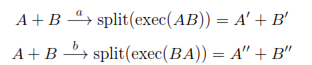
Which as far as I can tell boils down to “a” catalyzes the smushing of programs A and B into a single long-string program, which executes and alters itself in the process; then the “split” part of the equation cuts the resulting string back into two segments of the initial A and B lengths.
You know what this looks like? This looks like autocatalysis: the process whereby the product of a chemical reaction catalyzes the reaction itself. A bootstrap thing. Because this program reads and writes to itself, the execution of the code rewrites the code. Do this often enough, and one of those 64-byte strings turns into a self-replicator.
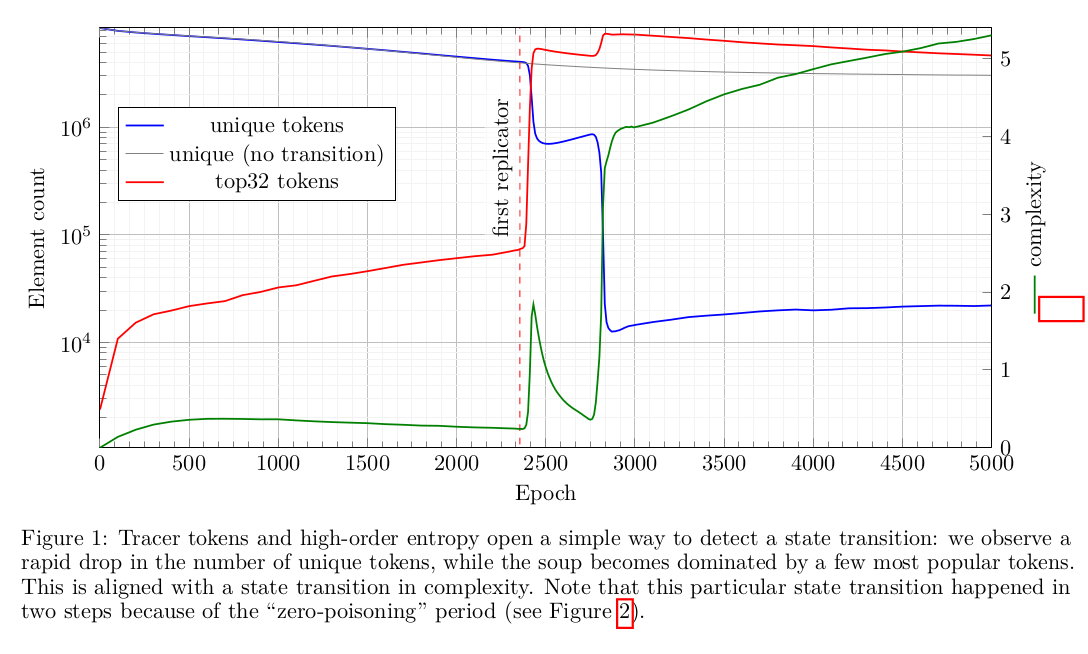 The Origin of Life
It doesn't happen immediately; most of the time, the code just sits there, reading and writing over itself. It generally takes thousands, millions of interactions before anything interesting happens. Let it run long enough, though, and some of that code coalesces into something that breeds, something that exchanges information with other programs (fucks, in other words). And when that happens, things really take off: self-replicators take over the soup in no time.
What's that? You don't see why that should happen? Don't worry about it; neither do the authors:
"we do not yet have a general theory to determine what makes a language and environment amenable to the rise of self-replicators"
They explored the hell out of it, though. They ran their primordial soups in a whole family of "extended Brainfuck languages"; they ran them under Forth; they tried them out under that classic 8-bit ZX-80 architecture that people hold in such nostalgic regard, and under the (almost as ancient) 8080 instruction sets. They built environments in 0, 1, and 2 dimensions. They measured the rise of diversity and complexity, using a custom metric— "High-Order Entropy"— describing the difference between "Shannon Entropy" and "normalized Kolmogorov Complexity" (which seems to describe the complexity of a system that remains once you strip out the amount due to sheer randomness[2]).
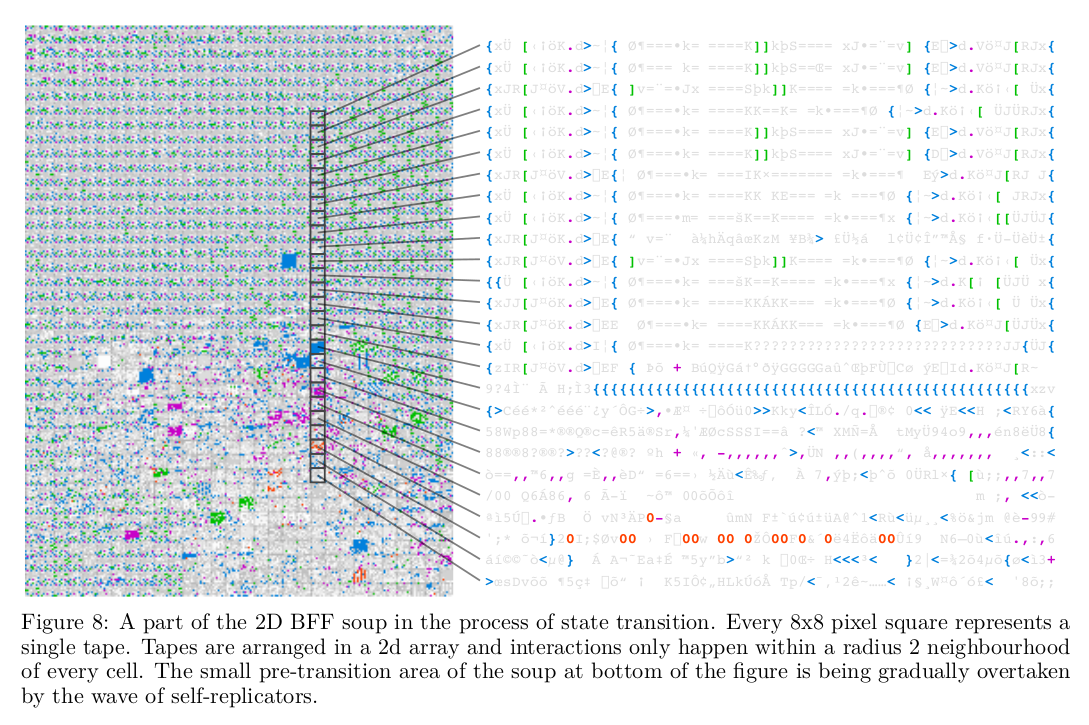
They did all this, under different architectures, different languages, different dimensionalities—with mutations and without—and they kept getting replicators. More, they got different kinds of replicators, virtual ecosystems almost, competing for resources. They got reproductive strategies changing over time. Darwinian solutions to execution issues, like "junk DNA" which turns out to serve a real function:
"emergent replicators … tend to consist of a fairly long non-functional head followed by a relatively short functional replicating tail. The explanation for this is likely that beginning to execute partway through a replicator will generally lead to an error, so adding non-functional code before the replicator decreases the probability of that occurrence. It also decreases the number of copies that can be made and hence the efficiency of the replicator, resulting in a trade-off between the two pressures."
I mean, that looks like a classic evolutionary process to me. And again, this is not a fragile phenomenon; it's robust across a variety of architectures and environments.
But they're still not sure why or how.
They do report one computing platform (something called SUBLEQ) in which replicators didn't arise. They suggest that any replicators which could theoretically arise in SUBLEQ would have to be much larger than those observed in other environments, which they suggest could be a starting point towards developing "a theory that predicts what languages and environments could harbor life". I find that intriguing. But they're not even close to developing such a theory at the moment.
Self-replication just—happens.
It's not an airtight case. The authors admit that it would make more sense to drill down on an analysis of substrings within the soup (since most replicators are shorter than the 64-byte chunks of code the used), but because that's "computationally intractable" they settle for "a mixture of anecdotal evidence and graphs"—which, if not exactly sus, doesn't seem especially rigorous. At one point they claim that mutations speed up the rise of self-replicators, which doesn't seem to jibe with other results suggesting that higher mutation rates are associated with a slower emergence of complexity. (Granted "complexity" and "self-replicator" are not the same thing, but you'd still expect a positive correlation.) As of this writing, the work hasn't yet been peer-reviewed. And finally, a limitation not of the work but of the messenger: you're getting all this filtered through the inexpert brain of a midlist science fiction writer with no real expertise in computer science. It's possible I got something completely wrong along the way.
Still, I'm excited. Folks more expert than I seem to be taking this seriously. Hell, it even inspired Sabine Hossenfelder (not known for her credulous nature) to speculate about Maelstromy scenarios in which wildlife emerges from Internet noise, "climbs the complexity ladder", and runs rampant. Because that's what we're talking about here: digital life emerging not from pre-existing malware, not from anarchosyndicalist script kiddies—but from simple, ubiquitous, random noise.
So I'm hopeful.
Maybe the Internet will burn after all.
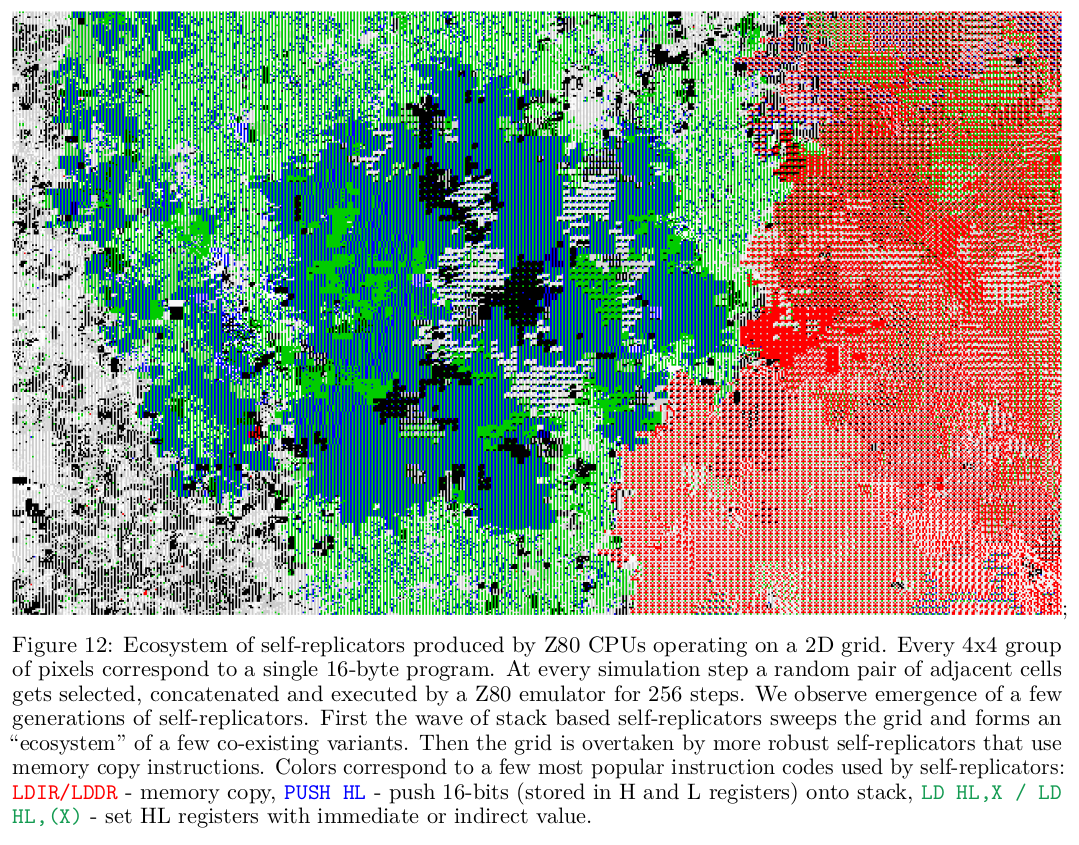
-
The paper cites Tierra and Core Wars prominently; it's nice to see that work published back in the nineties is still relevant in such a fast-moving field. It's even nicer to be able to point to those same call-outs in Maelstrom to burnish my street cred. ↑
-
This is a bit counterintuitive to those of us who grew up thinking of entropy as a measure of disorganization. The information required to describe a system of randomly-bumping gas molecules is huge because you have to describe each particle individually; more structured systems—crystals, fractals—have lower entropy because their structure can be described formulaically. The value of "High-order" Entropy, in contrast, is due entirely to structural, not random, complexity; so a high HEE means more organizational complexity, not less. Unless I'm completely misreading this thing. ↑

Time :5:30
Scroll :"yuen" by Kitaro Nishida
Bowl:9th Ohi Chozaemon
Tea: Hoshinoen "Hojyu"
Had a nice bowl of thick tea this chilly morning.
Nishida is the founder of the Kyoto School of Philosophy and one of the founding members of the Chiba Institute of Technology. The scrolls says "yuen" and it means far and distant in time and space or eternity.
Tea practice has made me much more aware of time - many of the utensils we use are hundreds of years old, and the scrolls and the utensils we use will likely continue to be used for hundreds of years. Hold an ancient bowl; one can imagine when it was made, the people who handled it, and the society and history surrounding them. Then, it is easy to imagine the bowl in the future and the people and cultures they will live in. Then stretch and keep pushing time in the past and the future until you envision eternity.
The Three-Bragger Problem [ 26-Sep-24 1:42am ]Preamble: OK, I lied. Said last time that this time was gonna be about science, and no more of this fluffy promo bullshit. And I meant well. But this time, the fluffy promo is about me. And it's cool. And more to the point, I don't have to spend hours doing research on things I don't actually know much about, so it's fast. When you're writing to deadline, fast is good.

Brag 1.
So check this out:
I have a small hand in this universe. I'm developing some of its Lore. I am not allowed to give you any details, but none of you will be surprised to learn that said Lore contains certain, shall we say, Darwinian elements.
I think it's going to rock.
Brag 2.
There’s something I'm allowed to share even fewer details about than EVE. In fact, I'm not even allowed to say that I am involved in it, although the trailer dropped earlier than EVE’s and the curtain rises sooner. I am allowed to paste promo copy from a certain corporate entity about a certain project—in effect, to place someone else's generic ad copy onto the 'Crawl without explaining its relevance. This is an opportunity I must regretfully decline.
A shame, though. From what I've seen, it's gonna be awesome. Stay tuned.
Brag 3.
And this—this—may be the least significant item in terms of pop culture, but it is, by far, the closest to my heart. It is an honor that generally accrues only to the likes of Gary Larson, Greta Thunberg, and Radiohead.
Niko Kasalo & Josip Skejo have named a tribe of Australian Pygmy Grasshoppers after me.
I mean, not me personally, but one of my novels. The Tribe is Echopraxiini; the genus is Echopraxia; the species is E. Hasenpuschi. And should any of you point out that correlation is not causation, and that there might be any number of reasons why someone might name a taxon after the neurological malady without even knowing about my novel, I've got you covered:

The paper in its entirety is paywalled, but I have uploaded a copy for your forensic edification just in case you think I'm full of shit. After reading it you may still conclude that I faked the whole manuscript, which offhand I cannot disprove. But if I did, you gotta admit I did a bang-up job.
Anyway: now you have some idea of the stuff I've been doing when I haven’t been writing Echopraxia Omniscience. I haven't just been lying around jerking off all these months.
Well, not exclusively.

Next up: science. Definitely[1].
Probably. ↑


