


"RoomDiffusion," a proposed AI scheme that might act as your interior designer for your home,
https://arxiv.org/pdf/2409.03198v1
In this report, we introduce RoomDiffusion, an industry model applied to interior decoration design scenarios, which outperforms all existing open-source models.
Our report details the construction process of the RoomDiffusion model, the evaluation methods used, and the performance comparison with open-source models. We also hope that our technical report can provide a reference for the open-source community and foster more rapid and valuable development in the field of interior decoration design.
#Holly Herndon & Mat Dryhurst on Artificial Psychedelia
*Starmirror AI public space installation. I reckon that's gonna be hard to beat for weird.
Timber structures built by pre-humans

Dear ThingsCon friends,
In just four weeks, we'll kick off TH/NGS 2025, our annual gathering exploring this year's theme: Resize < Remix < Regen.
This week brings exciting updates: our closing keynote speaker, three new workshops, exhibition details, and a final reminder that early bird tickets end this Sunday, November 16.
Closing keynote: Matt JonesWe're delighted to announce Matt Jones as our closing keynote speaker. Throughout his career—from BERG to Google, Lunar Energy, and now as Head of Design - AI at Miro—Matt has consistently offered playful incisive perspectives on our relationship with technology.
 The plenary program
Alongside our keynotes, the plenary program will feature:
- Student Project Pitches - Three selected projects presenting their innovative work
- Exhibition Talks - Short presentations diving into the vision and design behind selected exhibited works
 New Workshops Announced
Our program continues to take shape with approximately 14 workshops and sessions, plus exhibition talks, student showcases, and more.
Last week we introduced five workshops covering Creating physical manifestations of our digital waste, People's AI infrastructures & Mud batteries, The politics of design, Making AI chairs, and Design artefacts for magic.

Home - a private place for everyone? Seemingly harmless smart home sensors and
their impact on privacy for secondary users


Anticipatory Design: Bringing the power of foresight into everyday practice
by Susan LK Gorbet, Matt Gorbet
Save on your ticket—early bird pricing expires November 16.Secure your spot!
We can't wait to see you at TH/NGS 2025!
Warm regards,
The ThingsCon Team
Inside Ananya Panday's First Home in Mumbai Designed by Gauri Khan
Modern Bollywood celebrity home with an interior designed by the designer wife of a Bollywood celebrity.
#Amazon's surveillance camera maker Ring announced a partnership on Thursday with Flock, a maker of AI-powered surveillance cameras that share footage with law enforcement.
Now, agencies that use Flock can request that Ring doorbell users share footage to help with "evidence collection and investigative work."
Flock cameras work by scanning the license plates and other identifying information about cars they see. Flock's government and police customers can also make natural language searches of their video footage to find people who match specific descriptions. However, AI-powered technology used by law enforcement has been proven to exacerbate racial biases.
On the same day that Ring announced this partnership, 404 Media reportedthat ICE, the Secret Service, and the Navy had access to Flock's network of cameras. By partnering with Ring, Flock could potentially access footage from millions more cameras.
Ring has long had a poor track record with keeping customers' videos safeand secure. In 2023, the FTC ordered the company to pay $5.8 million over claims that employees and contractors had unrestricted access to customers' videos for years.

North Korean Scammers Are Doing Architectural Design Now
Talented North Korean coders and developers have, for years, been getting hired for remote jobs at Western tech firms. Thousands of these so-called IT workershave earned billions for North Korea's authoritarian regime by developing apps, working on cryptocurrency projects, and infiltrating Fortune 500 companies—when they get paid, they send their earnings home. But the scale and scope of these fraudulent job schemes likely extends beyond most people's understanding.
New analysis of exposed online accounts and files linked to suspected Democratic People's Republic of Korea (DPRK) digital laborers shows that at least one group has been working in a very different field: architecture and civil engineering. Over recent years, the cluster of workers has been masquerading as freelance structural engineers and architects, according to a report sharedwith WIRED by cybersecurity firm Kela, which dug into one network it links to North Korea.
Files linked to the alleged North Korean operatives show 2D architectural drawings and some 3D CAD files for properties in the United States, Kela researchers say. In addition to the plans, the scammers were also seen claiming to advertise a range of architectural services and using, or creating, architectural stamps or seals, which can act as legal certification that drawings follow local building regulations.
"These operatives are active not only in technology and cybersecurity but also in industrial design, architecture, and interior design, accessing sensitive infrastructure and client projects under fabricated identities," Kela writes in a blog post. The United Nations estimates that thousands of IT workers raise between $250 million and $600 million for North Korea each year, with money being used to support the country's nuclear weapons programs and sanctions evasion efforts….

An American SAGE nuclear air-defense complex in the height of the Cold War.
One of the things I've found out the hard way over the past year is that slowly going blind has subtle but negative effects on my productivity.
Cataracts are pretty much the commonest cause of blindness, they can be fixed permanently by surgically replacing the lens of the eye—I gather the op takes 15-20 minutes and can be carried out with only local anaesthesia: I'm having my first eye done next Tuesday—but it creeps up on you slowly. Even fast-developing cataracts take months.
In my case what I noticed first was the stars going out, then the headlights of oncoming vehicles at night twinkling annoyingly. Cataracts diffuse the light entering your eye, so that starlight (which is pretty dim to begin with) is spread across too wide an area of your retina to register. Similarly, the car headlights had the same blurring but remained bright enough to be annoying.
The next thing I noticed (or didn't) was my reading throughput diminishing. I read a lot and I read fast, eye problems aside: but last spring and summer I noticed I'd dropped from reading about 5 novels a week to fewer than 3. And for some reason, I wasn't as productive at writing. The ideas were still there, but staring at a computer screen was curiously fatiguing, so I found myself demotivated, and unconsciously taking any excuse to do something else.
Then I went for my regular annual ophthalmology check-up and was diagnosed with cataracts in both eyes.
In the short term, I got a new prescription: this focussed things slightly better, but there are limits to what you can do with glass, even very expensive glass. My diagnosis came at the worst time; the eye hospital that handles cataracts for pretty much the whole of south-east Scotland, the Queen Alexandria Eye Pavilion, closed suddenly at the end of last October: a cracked drainpipe had revealed asbestos cement in the building structure and emergency repairs were needed. It's a key hospital, but even so taking the asbestos out of a five story high hospital block takes time—it only re-opened at the start of July. Opthalmological surgery was spread out to other hospitals in the region but everything got a bit logjammed, hence the delays.
I considered paying for private private surgery. It's available, at a price: because this is a civilized country where healthcare is free at the point of delivery, I don't have health insurance, and I decided to wait a bit rather than pay £7000 or so to get both eyes done immediately. It turned out that, in the event, going private would have been foolish: the Eye Pavilion is open again, and it's only in the past month—since the beginning of July or thereabouts—that I've noticed my output slowing down significantly again.
Anyway, I'm getting my eyes fixed, but not at the same time: they like to leave a couple of weeks between them. So I might not be updating the blog much between now and the end of September.
Also contributing to the slow updates: I hit "pause" on my long-overdue space opera Ghost Engine on April first, with the final draft at the 80% point (with about 20,000 words left to re-write). The proximate reason for stopping was not my eyesight deteriorating but me being unable to shut up my goddamn muse, who was absolutely insistent that I had to drop everything and write a different novel right now. (That novel, Starter Pack, is an exploration of a throwaway idea from the very first sentence of Ghost Engine: they share a space operatic universe but absolutely no characters, planets, or starships with silly names: they're set thousands of years apart.) Anyway, I have ground to a halt on the new novel as well, but I've got a solid 95,000 words in hand, and only about 20,000 words left to write before my agent can kick the tires and tell me if it's something she can sell.
I am pretty sure you would rather see two new space operas from me than five or six extra blog entries between now and the end of the year, right?
(NB: thematically, Ghost Engine is my spin on a Banksian-scale space opera that's putting the boot in on the embryonic TESCREAL religion and the sort of half-baked AI/mind uploading singularitarianism I explored in Accelerando). Hopefully it has the "mouth feel" of a Culture novel without being in any way imitative. And Starter Pack is three heist capers in a trench-coat trying to escape from a rabid crapsack galactic empire, and a homage to Harry Harrison's The Stainless Steel Rat—with a side-order of exploring the political implications of lossy mind-uploading.)
All my energy is going into writing these two novels despite deteriorating vision right now, so I have mostly been ignoring the news (it's too depressing and distracting) and being a boring shut-in. It will be a huge relief to reset the text zoom in Scrivener back from 220% down to 100% once I have working eyeballs again! At which point I expect to get even less visible for a few frenzied weeks. Last time I was unable to write because of vision loss (caused by Bell's Palsy) back in 2013, I squirted out the first draft of The Annihilation Score in 18 days when I recovered: I'm hoping for a similar productivity rebound in September/October—although they can't be published before 2027 at the earliest (assuming they sell).
Anyway: see you on the other side!
PS: Amazon is now listing The Regicide Report as going on sale on January 27th, 2026: as far as I know that's a firm date.
Obligatory blurb:
An occult assassin, an elderly royal and a living god face off in The Regicide Report, the thrilling final novel in Charles Stross' epic, Hugo Award-winning Laundry Files series.
When the Elder God recently installed as Prime Minister identifies the monarchy as a threat to his growing power, Bob Howard and Mo O'Brien - recently of the supernatural espionage service known as the Laundry Files - are reluctantly pressed into service.
Fighting vampirism, scheming American agents and their own better instincts, Bob and Mo will join their allies for the very last time. God save the Queen― because someone has to.
There is currently what amounts to a “war” between the U.S. federal and state governments against specific Chinese drone makers, with the big target being DJI. And a major issue has been what would happen if the many organizations — law enforcement, search and rescue, other public safety, farmers, utilities, on and on — couldn’t continue to obtain or use the DJI drones in particular that they have depended on for years.
And the discussion has been largely theoretical for most of this period because DJI drones, repairs, parts, and service have continued to be available. But now that’s changing and moving beyond the theoretical and into real world effects, and yeah the situation is deteriorating even faster than even most pessimistic observers anticipated.
I’m not going to try review here all the deep details of how we got to this point, except to note that there are multiple aspects. Confusion over rapidly changing tariff rates is one factor. There have been claims that DJI drones have, or maybe in the future could have security issues, though this has never been demonstrated — apparently DJI has passed every security audit conducted on their products.
Many observers have long suspected that what’s really going on is politically-motivated protectionism from politicians in both parties, because the organizations that buy DJI drones apparently consider them to be more affordable, reliable, and rapid to obtain compared with currently available U.S. made alternatives. And remember we’re not talking just about little DJI drones you can hold on your hand, they also have very large drones that farmers use to spray crops, and big drones that can lower or gather heavy payloads in rescue situations in isolated, rugged areas and so on.
But now, with this confluence of factors, including U.S. Customs reportedly pretty much choking off the supply of DJI products into the U.S., we’ve reached a point where the rest of the world can buy these advanced DJI drones, including new ones just recently released and others likely to be very soon released, but the U.S. is cut off. The supply of DJI products has dried up in the U.S. Out of stock virtually everywhere. Repairs are reportedly taking longer, and parts are difficult or impossible to obtain.
DJI is still trying to get a government agency to do the security review mandated by the National Defense Authorization Act as passed by Congress, and the deadline that would trigger an associated DJI drone ban is at the end of this year. The whole situation is completely nuts.
In Florida, the state government ordered official usage of DJI drones stopped. That means grounding 200 million taxpayer dollars of drones used for police work, fire fighting, mosquito control and more. And the state is apparently only willing to provide a tenth of that much to replace them with U.S. made drones that are typically many times more expensive than DJI drones, and sometimes take months rather than days to obtain.
In some states 90% of public safety drones are DJI. Their drones are known to be exceptionally reliable. An Orlando police department indicated that they had five failures of “approved” U.S. made drones over a year and half, but no failures among the DJI drones they’d been using.
We could keep going through the statistics and more of these cases but you get the idea. We all want a strong domestic drone industry, but agencies and other groups who rely on DJI drones in the U.S. are being cut off from vital technology that the rest of the world can still easily obtain. There haven’t been publicly demonstrated security problems with DJI drones despite the alarmist hype from the politicians.
This entire mess does appear to be politically driven and BOTH parties are to blame. These politicians need to stop this craziness, because they’re not just putting important U.S. businesses and other organizations at risk with this drone ban nonsense, they’ll be putting U.S. lives at risk as well. That’s irresponsible and it really needs to stop, RIGHT NOW!
–Lauren–

Centuries before photography froze the world into neat frames, scientists, poets, and artists streamed transient images into dark interior spaces with the help of a camera obscura. Julie Park explores the early modern fascination with this quasi-spiritual technology and the magic, melancholy, and dream-like experiences it produced.

A modernist manifesto inspired (controversially) by the Tupi people of Brazil.

Commemorative featuring illustrations of pageants, costumes, and fireworks, later further illustrated by a separate artist, with floral motifs.

Female astronomical first, in 2025 and 1787.
We all want to prevent children from being harmed on the Internet, but exactly how to do this without creating even more problems for them and for adults has turned into quite a complicated and political situation.
There have been broad concerns that various website age verification systems could be privacy invasive, ineffective, and in some cases actually might cause even more harm to children than not having the verifications there in the first place. And now with more and more of these systems appearing — the Supreme Court just declared them legal for states to require for commercial porn sites — we’re starting to see various of these predictions coming true.
Remember that age verification systems — whether for porn sites, or social media sites, or pretty much any site like the situation in China where virtually all Internet usage can be tracked by the government — doesn’t only affect children and teens. No matter your age, you have to prove you’re an adult for access. And that opens up tracking possibilities that many politicians in both parties would love to have here in the U.S, with various state and federal legislation already in place or in litigation. And this quickly creates a situation where your basic privacy involving what sites you visit, what topics you research, what videos or podcasts you view or listen to, on and on, may be seriously compromised in ways never possible before now.
There have already been breaches of age verification systems that publicly exposed users’ identity credentials, a treasure trove for crooks. We can reasonably expect directed hacking attacks at these systems as they expand, and if history is any guide many will be successful. Some of these systems use government credentials, some require credit cards, some are using systems to estimate your age from your face, or by how long you’ve been using a particular email address, and so on.
Many adults who don’t want to hand over a credit card or their driver’s license — and their privacy — to these firms have already found various bypass mechanisms, and it appears that — as expected — kids are already WAY AHEAD of adults at this.
A broad age verification law just took affect in the UK a handful of days ago and is already being widely breached, with it trivially easy to find public discussions with users trading bypass hints and tricks. The degree to which these systems are political theater is emphasized by rules that for example order sites not to tell users that they could use VPNs to bypass the checks in many cases — as if VPNs haven’t been used to bypass geographic restrictions for many years — and most age verification systems are geographically based.
But it actually gets even more bizarre. Some of these age verification systems do indeed try to estimate your age from your face as seen on your camera. Of course if you don’t have a camera on your device or don’t want your face absorbed by these systems you’re out of luck in this respect. For that new UK age verification system, kids very quickly realized they could use a video game that generates very realistic faces to bypass the age verification system. And of course as the nightmarishly advanced AI-based video generation systems continue to evolve — we know where this is headed.
The worst part about all this is that age verification systems broadly applied as some politicians desire, not only have the potential to cut children off from the ability to access crucial information about their own health and safety in cases of abuse, but could actually drive children to all manner of disreputable sites — the kind that can pop up and vanish quickly — that could potentially do them real harm but will never abide by age verification rules.
Age verification seems like an obvious solution to a range of Internet-related problems. But the reality is that many observers feel that it creates more problems than it solves, creating new hacking opportunities and privacy risks, and that in many cases the kids will find ways to bypass it anyway. When trying to fix a complicated problem on the Internet, or anywhere else, the first step probably should be, “Try not to make things even worse.” An idea worth keeping in mind.
–Lauren–
A Conventional Boy is the most recent published novel in the Laundry Files as of 2025, but somewhere between the fourth and sixth in internal chronological order—it takes place at least a year after the events of The Fuller Memorandum and at least a year before the events of The Nightmare Stacks.
I began writing it in 2009, and it was originally going to be a long short story (a novelette—8000-16,000 words. But one thing after another got in the way, until I finally picked it up to try and finish it in 2022—at which point it ran away to 40,000 words! Which put it at the upper end of the novella length range. And then I sent it to my editor at Tor.com, who asked for some more scenes covering Derek's life in Camp Sunshine, which shoved it right over the threshold into "short novel" territory at 53,000 words. That's inconveniently short for a stand-alone novel this century (it'd have been fine in the 1950s; Asimov's original Foundation novels were fix-ups of two novellas that bulked up to roughly that length), so we made a decision to go back to the format of The Atrocity Archives—a short novel bundled with another story (or stories) and an explanatory essay. In this case, we chose two novelettes previously published on Tor.com, and an essay exploring the origins of the D&D Satanic Panic of the 1980s (which features heavily in this novel, and which seems eerily topical in the current—2020s—political climate).
(Why is it short, and not a full-sized novel? Well, I wrote it in 2022-23, the year I had COVID19 twice and badly—not hospital-grade badly, but it left me with brain fog for more than a year and I'm pretty sure it did some permanent damage. As it happens, a novella is structurally simpler than a novel (it typically needs only one or two plot strands, rather than three or more or some elaborate extras). and I need to be able to hold the structure of a story together in my head while I write it. A Conventional Boy was the most complicated thing I could have written in that condition without it being visibly defective. There are only two plot strands and some historical flashbacks, they're easily interleaved, and the main plot itself is fairly simple. When your brain is a mass of congealed porridge? Keeping it simple is good. It was accepted by Tor.com for print and ebook publication in 2023, and would normally have come out in 2024, but for business reasons was delayed until January 2025. So take this as my 2024 book, slightly delayed, and suffice to say that my next book—The Regicide Report, due out in January 2026—is back to full length again.)
So, what's it about?
I introduced a new but then-minor Laundry character called Derek the DM in The Nightmare Stacks: Derek is portly, short-sighted, middle-aged, and works in Forecasting Ops, the department of precognition (predicting the future, or trying to), a unit I introduced as a throwaway gag in the novelette Overtime (which is also part of the book). If you think about the implications for any length of time it becomes apparent that precognition is a winning tool for any kind of intelligence agency, so I had to hedge around it a bit: it turns out that Forecasting Ops are not infallible. They can be "jammed" by precognitives working for rival organizations. Focussing too closely on a precise future can actually make it less likely to come to pass. And different precognitives are less or more accurate. Derek is one of the Laundry's best forecasters, and also an invaluable operation planner—or scenario designer, as he'd call it, because he was, and is, a Dungeon Master at heart.
I figured out that Derek's back-story had to be fascinating before I even finished writing The Nightmare Stacks, and I actually planned to write A Conventional Boy next. But somehow it got away from me, and kept getting shoved back down my to-do list until Derek appeared again in The Labyrinth Index and I realized I had to get him nailed down before The Regicide Report (for reasons that will become clear when that novel comes out). So here we are.
Derek began DM'ing for his group of friends in the early 1980s, using the original AD&D rules (the last edition I played). The campaign he's been running in Camp Sunshine is based on the core AD&D rules, with his own mutant extensions: he's rewritten almost everything, because TTRPG rule books are expensive when you're either a 14 year old with a 14-yo's pocket money allowance or a trusty in a prison that pays wages of 30p an hour. So he doesn't recognize the Omphalos Corporation's LARP scenario as a cut-rate knock-off of The Hidden Shrine of Tamoachan, and he didn't have the money to keep up with subsequent editions of AD&D.
Yes, there are some self-referential bits in here. As with the TTRPGs in the New Management books, they eerily prefigure events in the outside world in the Laundryverse. Derek has no idea that naming his homebrew ruleset and campaign Cult of the Black Pharaoh might be problematic until he met Iris Carpenter, Bob's treacherous manager from The Fuller Memorandum (and now Derek's boss in the camp, where she's serving out her sentence running the recreational services). Yes, the game scenario he runs at DiceCon is a garbled version of Eve's adventure in Quantum of Nightmares. (There's a reason he gets pulled into Forecasting Ops!)
DiceCon is set in Scarfolk—for further information, please re-read. Richard Littler's excellent satire of late 1970s north-west England exactly nails the ambiance I wanted for the setting, and Camp Sunshine was already set not far from there: so yes, this is a deliberate homage to Scarfolk (in parts).
And finally, Piranha Solution is real.
You can buy A Conventional Boy here (North America) or here (UK/EU).
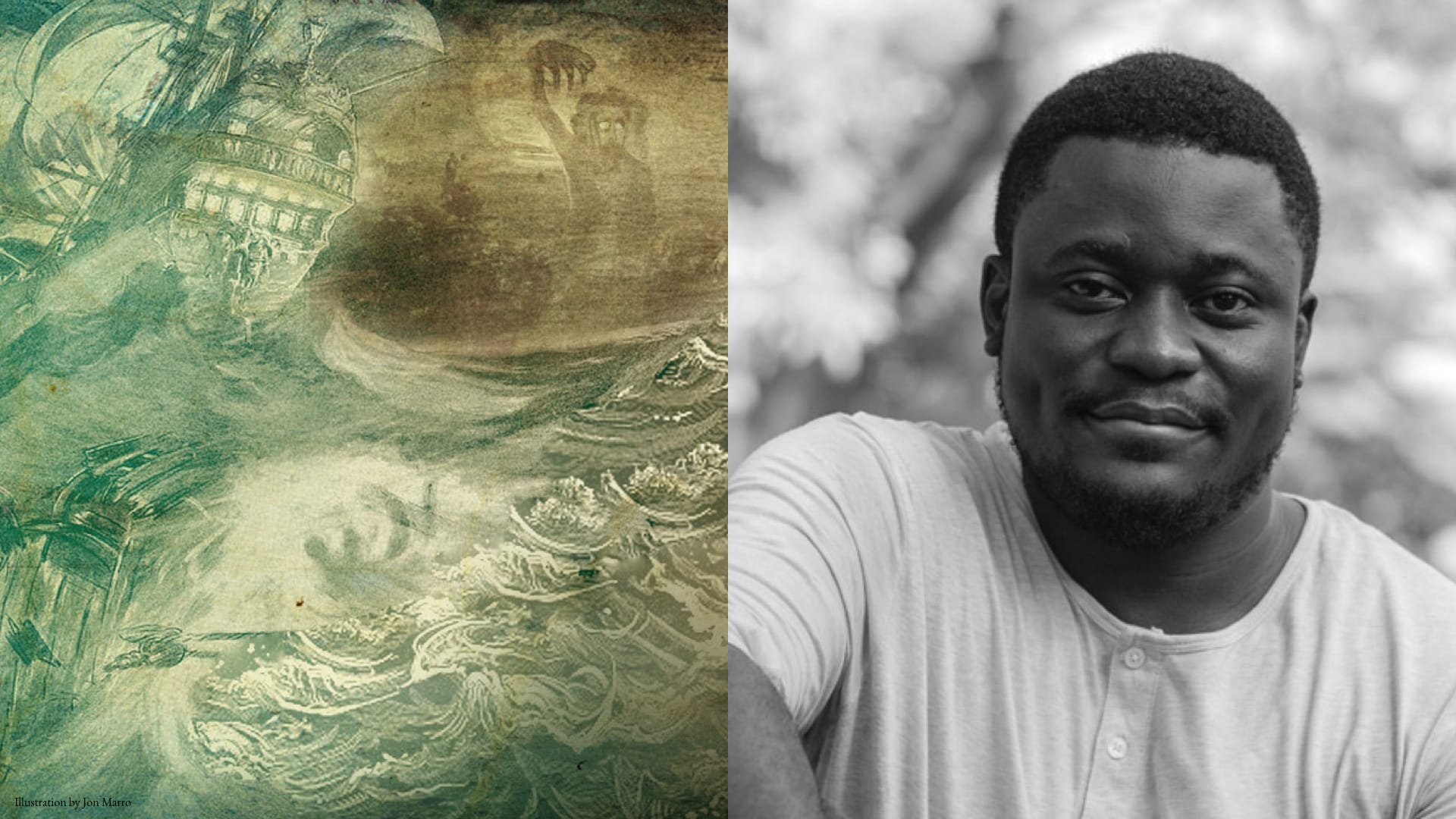
Attend live on Tue, May 5, 02026 at 7:00PM PT
Tickets on sale soon
Bayo Akomolafe (Ph.D.) is a philosopher, writer, activist, professor of psychology, and executive director of The Emergence Network. Rooted with the Yoruba people, Akomolafe is the father to Alethea and Kyah, and the grateful life-partner to ‘EJ’. Essayist, poet, and author of two books, These Wilds Beyond our Fences: Letters to My Daughter on Humanity’s Search for Home (North Atlantic Books) and We Will Tell our Own Story: The Lions of Africa Speak, Bayo Akomolafe is also the host of the online postactivist course, ‘We Will Dance with Mountains’. He currently lectures at Pacifica Graduate Institute, California and University of Vermont, Burlington, Vermont as adjunct and associate professor, respectively. He sits on the Board of many organizations, including Science and Non-Duality and Local Futures. In July 2022, Dr. Akomolafe was appointed the inaugural Global Senior Fellow of the Othering and Belonging Institute at UC Berkeley. He has also been appointed Senior Fellow for The New Institute in Hamburg, Germany. Dr. Bayo hopes to inspire what he calls a “diffractive network of sharing” and a “politics of surprise” that sees the crises of our times with a posthumanist lens.
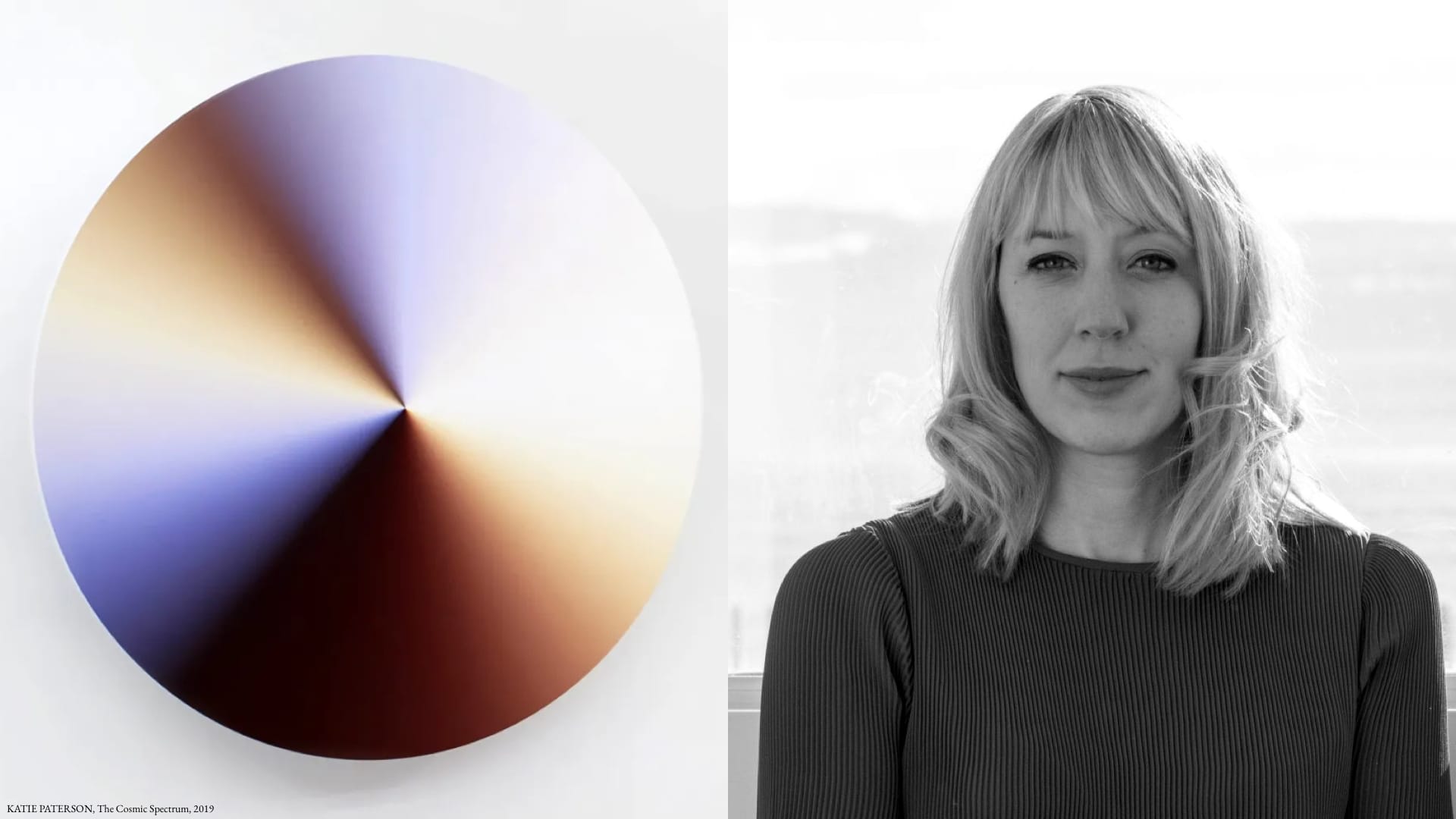
Attend live on Tue, Apr 7, 02026 at 7:00PM PT
at The Interval at Long Now
Tickets on sale soon
Katie Paterson (born 1981, Scotland) is widely regarded as one of the leading artists of her generation. Collaborating with scientists and researchers across the world, Paterson’s projects consider our place on Earth in the context of geological time and change. Her artworks make use of sophisticated technologies and specialist expertise to stage intimate, poetic and philosophical engagements between people and their natural environment. Combining a Romantic sensibility with a research-based approach, conceptual rigour and coolly minimalist presentation, her work collapses the distance between the viewer and the most distant edges of time and the cosmos.
Katie Paterson has broadcast the sounds of a melting glacier live, mapped all the dead stars, compiled a slide archive of darkness from the depths of the Universe, created a light bulb to simulate the experience of moonlight, and sent a recast meteorite back into space. Eliciting feelings of humility, wonder and melancholy akin to the experience of the Romantic sublime, Paterson’s work is at once understated in gesture and yet monumental in scope.
Katie Paterson has exhibited internationally, from London to New York, Berlin to Seoul, and her works have been included in major exhibitions including Turner Contemporary, Hayward Gallery, Tate Britain, Kunsthalle Wien, MCA Sydney, Guggenheim Museum, and The Scottish National Gallery of Modern Art. She was winner of the Visual Arts category of the South Bank Awards, and is an Honorary Fellow of Edinburgh University
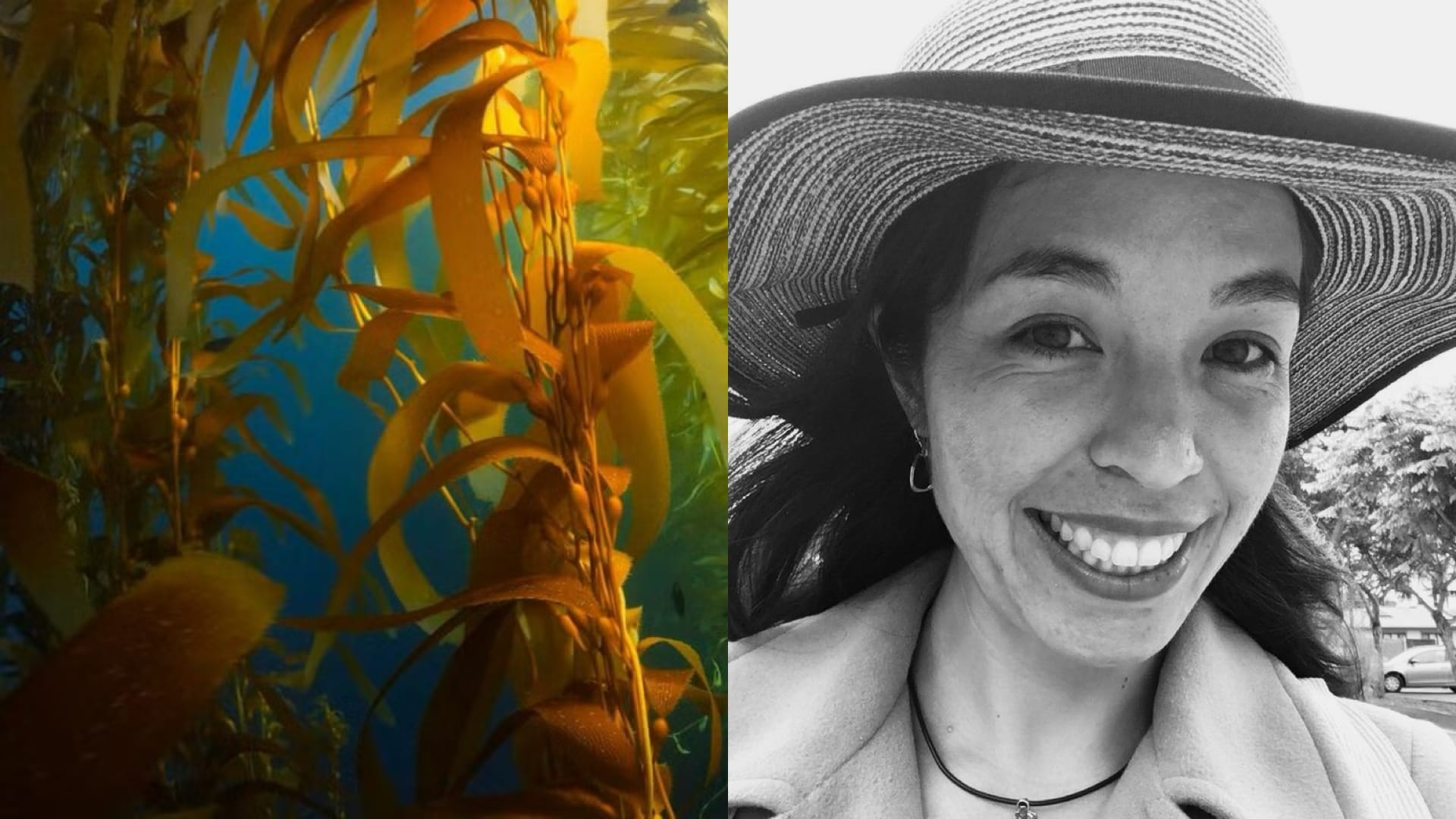
Attend live on Wed, Mar 18, 02026 at 7:00PM PT
at Cowell Theater in Fort Mason Center
Tickets on sale soon
Melody Jue is Professor of English at the University of California, Santa Barbara. Her research and writings center the ocean humanities, science fiction, media studies, science & technology studies, and the environmental humanities.
Professor Jue is the author of Wild Blue Media: Thinking Through Seawater(Duke University Press, 2020), which won the Speculative Fictions and Cultures of Science Book Prize, and the co-editor of Saturation: An Elemental Politics (Duke University Press, 2021) with Rafico Ruiz. Forthcoming books include Coralations (Minnesota Press, 2025) and the edited collection Informatics of Domination (Duke Press, 2025) with Zach Blas and Jennifer Rhee.
Her new work, Holding Sway, examines the media of seaweeds across transpacific contexts. She regularly collaborates with ocean scientists and artists, from fieldwork to collaborative writings and other projects. Many of her writings are informed by scuba diving fieldwork and coastal observations.
Attend live on Tue, Jan 27, 02026 at 7:00PM PT
at Cowell Theater in Fort Mason Center
Tickets on sale soon
Indy is co-founder of Dark Matter Labs and of the RIBA award winning architecture and urban practice Architecture00. He is also a founding director of Open Systems Lab, seeded WikiHouse (open source housing) and Open Desk (open source furniture company).
Indy is a non-executive international Director of the BloxHub, the Nordic Hub for sustainable urbanization. He is on the advisory board for the Future Observatory and is part of the committee for the London Festival of Architecture. He is also a fellow of the London Interdisciplinary School.
Indy was 2016-17 Graham Willis Visiting Professorship at Sheffield University. He was Studio Master at the Architectural Association - 2019-2020, UNDP Innovation Facility Advisory Board Member 2016-20 and RIBA Trustee 2017-20.
He has taught & lectured at various institutions from the University of Bath, TU-Berlin; University College London, Princeton, Harvard, MIT and New School. He is currently a professor at RMIT University.
He was awarded the London Design Medal for Innovation in 2022 and an MBE for Services to Architecture in 2023.
Picture this: You're in a meeting room at your tech company, and two people are having what looks like the same conversation about the same design problem. One is talking about whether the team has the right skills to tackle it. The other is diving deep into whether the solution actually solves the user's problem. Same room, same problem, completely different lenses.
This is the beautiful, sometimes messy reality of having both a Design Manager and a Lead Designer on the same team. And if you're wondering how to make this work without creating confusion, overlap, or the dreaded "too many cooks" scenario, you're asking the right question.
The traditional answer has been to draw clean lines on an org chart. The Design Manager handles people, the Lead Designer handles craft. Problem solved, right? Except clean org charts are fantasy. In reality, both roles care deeply about team health, design quality, and shipping great work.
The magic happens when you embrace the overlap instead of fighting it—when you start thinking of your design org as a design organism.
The Anatomy of a Healthy Design TeamHere's what I've learned from years of being on both sides of this equation: think of your design team as a living organism. The Design Manager tends to the mind (the psychological safety, the career growth, the team dynamics). The Lead Designer tends to the body (the craft skills, the design standards, the hands-on work that ships to users).
But just like mind and body aren't completely separate systems, so, too, do these roles overlap in important ways. You can't have a healthy person without both working in harmony. The trick is knowing where those overlaps are and how to navigate them gracefully.
When we look at how healthy teams actually function, three critical systems emerge. Each requires both roles to work together, but with one taking primary responsibility for keeping that system strong.
The Nervous System: People & PsychologyPrimary caretaker: Design Manager
Supporting role: Lead Designer
The nervous system is all about signals, feedback, and psychological safety. When this system is healthy, information flows freely, people feel safe to take risks, and the team can adapt quickly to new challenges.
The Design Manager is the primary caretaker here. They're monitoring the team's psychological pulse, ensuring feedback loops are healthy, and creating the conditions for people to grow. They're hosting career conversations, managing workload, and making sure no one burns out.
But the Lead Designer plays a crucial supporting role. They're providing sensory input about craft development needs, spotting when someone's design skills are stagnating, and helping identify growth opportunities that the Design Manager might miss.
Design Manager tends to:
- Career conversations and growth planning
- Team psychological safety and dynamics
- Workload management and resource allocation
- Performance reviews and feedback systems
- Creating learning opportunities
Lead Designer supports by:
- Providing craft-specific feedback on team member development
- Identifying design skill gaps and growth opportunities
- Offering design mentorship and guidance
- Signaling when team members are ready for more complex challenges
Primary caretaker: Lead Designer
Supporting role: Design Manager
The muscular system is about strength, coordination, and skill development. When this system is healthy, the team can execute complex design work with precision, maintain consistent quality, and adapt their craft to new challenges.
The Lead Designer is the primary caretaker here. They're setting design standards, providing craft coaching, and ensuring that shipping work meets the quality bar. They're the ones who can tell you if a design decision is sound or if we're solving the right problem.
But the Design Manager plays a crucial supporting role. They're ensuring the team has the resources and support to do their best craft work, like proper nutrition and recovery time for an athlete.
Lead Designer tends to:
- Definition of design standards and system usage
- Feedback on what design work meets the standard
- Experience direction for the product
- Design decisions and product-wide alignment
- Innovation and craft advancement
Design Manager supports by:
- Ensuring design standards are understood and adopted across the team
- Confirming experience direction is being followed
- Supporting practices and systems that scale without bottlenecking
- Facilitating design alignment across teams
- Providing resources and removing obstacles to great craft work
Shared caretakers: Both Design Manager and Lead Designer
The circulatory system is about how information, decisions, and energy flow through the team. When this system is healthy, strategic direction is clear, priorities are aligned, and the team can respond quickly to new opportunities or challenges.
This is where true partnership happens. Both roles are responsible for keeping the circulation strong, but they're bringing different perspectives to the table.
Lead Designer contributes:
- User needs are met by the product
- Overall product quality and experience
- Strategic design initiatives
- Research-based user needs for each initiative
Design Manager contributes:
- Communication to team and stakeholders
- Stakeholder management and alignment
- Cross-functional team accountability
- Strategic business initiatives
Both collaborate on:
- Co-creation of strategy with leadership
- Team goals and prioritization approach
- Organizational structure decisions
- Success measures and frameworks
The key to making this partnership sing is understanding that all three systems need to work together. A team with great craft skills but poor psychological safety will burn out. A team with great culture but weak craft execution will ship mediocre work. A team with both but poor strategic circulation will work hard on the wrong things.
Be Explicit About Which System You're TendingWhen you're in a meeting about a design problem, it helps to acknowledge which system you're primarily focused on. "I'm thinking about this from a team capacity perspective" (nervous system) or "I'm looking at this through the lens of user needs" (muscular system) gives everyone context for your input.
This isn't about staying in your lane. It's about being transparent as to which lens you're using, so the other person knows how to best add their perspective.
Create Healthy Feedback LoopsThe most successful partnerships I've seen establish clear feedback loops between the systems:
Nervous system signals to muscular system: "The team is struggling with confidence in their design skills" → Lead Designer provides more craft coaching and clearer standards.
Muscular system signals to nervous system: "The team's craft skills are advancing faster than their project complexity" → Design Manager finds more challenging growth opportunities.
Both systems signal to circulatory system: "We're seeing patterns in team health and craft development that suggest we need to adjust our strategic priorities."
Handle Handoffs GracefullyThe most critical moments in this partnership are when something moves from one system to another. This might be when a design standard (muscular system) needs to be rolled out across the team (nervous system), or when a strategic initiative (circulatory system) needs specific craft execution (muscular system).
Make these transitions explicit. "I've defined the new component standards. Can you help me think through how to get the team up to speed?" or "We've agreed on this strategic direction. I'm going to focus on the specific user experience approach from here."
Stay Curious, Not TerritorialThe Design Manager who never thinks about craft, or the Lead Designer who never considers team dynamics, is like a doctor who only looks at one body system. Great design leadership requires both people to care about the whole organism, even when they're not the primary caretaker.
This means asking questions rather than making assumptions. "What do you think about the team's craft development in this area?" or "How do you see this impacting team morale and workload?" keeps both perspectives active in every decision.
When the Organism Gets SickEven with clear roles, this partnership can go sideways. Here are the most common failure modes I've seen:
System IsolationThe Design Manager focuses only on the nervous system and ignores craft development. The Lead Designer focuses only on the muscular system and ignores team dynamics. Both people retreat to their comfort zones and stop collaborating.
The symptoms: Team members get mixed messages, work quality suffers, morale drops.
The treatment: Reconnect around shared outcomes. What are you both trying to achieve? Usually it's great design work that ships on time from a healthy team. Figure out how both systems serve that goal.
Poor CirculationStrategic direction is unclear, priorities keep shifting, and neither role is taking responsibility for keeping information flowing.
The symptoms: Team members are confused about priorities, work gets duplicated or dropped, deadlines are missed.
The treatment: Explicitly assign responsibility for circulation. Who's communicating what to whom? How often? What's the feedback loop?
Autoimmune ResponseOne person feels threatened by the other's expertise. The Design Manager thinks the Lead Designer is undermining their authority. The Lead Designer thinks the Design Manager doesn't understand craft.
The symptoms: Defensive behavior, territorial disputes, team members caught in the middle.
The treatment: Remember that you're both caretakers of the same organism. When one system fails, the whole team suffers. When both systems are healthy, the team thrives.
The PayoffYes, this model requires more communication. Yes, it requires both people to be secure enough to share responsibility for team health. But the payoff is worth it: better decisions, stronger teams, and design work that's both excellent and sustainable.
When both roles are healthy and working well together, you get the best of both worlds: deep craft expertise and strong people leadership. When one person is out sick, on vacation, or overwhelmed, the other can help maintain the team's health. When a decision requires both the people perspective and the craft perspective, you've got both right there in the room.
Most importantly, the framework scales. As your team grows, you can apply the same system thinking to new challenges. Need to launch a design system? Lead Designer tends to the muscular system (standards and implementation), Design Manager tends to the nervous system (team adoption and change management), and both tend to circulation (communication and stakeholder alignment).
The Bottom LineThe relationship between a Design Manager and Lead Designer isn't about dividing territories. It's about multiplying impact. When both roles understand they're tending to different aspects of the same healthy organism, magic happens.
The mind and body work together. The team gets both the strategic thinking and the craft excellence they need. And most importantly, the work that ships to users benefits from both perspectives.
So the next time you're in that meeting room, wondering why two people are talking about the same problem from different angles, remember: you're watching shared leadership in action. And if it's working well, both the mind and body of your design team are getting stronger.
Good news/no news:
The latest endoscopy procedure went smoothly. There are signs of irritation in my fundus (part of the stomach lining) but no obvious ulceration or signs of cancer. Biopsy samples taken, I'm awaiting the results. (They're testing for celiac, as well as cytology.)
I'm also on the priority waiting list for cataract surgery at the main eye hospital, with an option to be called up at short notice if someone ahead of me on the list cancels.
This is good stuff; what's less good is that I'm still feeling a bit crap and have blurry double vision in both eyes. So writing is going very slowly right now. This isn't helped by me having just checked the page proofs for The Regicide Report, which will be on the way to production by the end of the month.
(There's a long lead time with this title because it has to be published simultaneously in the USA and UK, which means allowing time in the pipeline for Orbit in the UK to take the typeset files and reprocess them for their own size of paper and binding, and on the opposite side, for Tor.com to print and distribute physical hardcovers—which, in the USA, means weeks in shipping containers slowly heading for warehouses in other states: it's a big place.)
Both the new space operas in progress are currently at around 80% complete but going very slowly (this is not quite a euphemism for "stalled") because: see eyeballs above. This is also the proximate cause of the slow/infrequent blogging. My ability to read or focus on a screen is really impaired right now: it's not that I can't do it, it's just really tiring so I'm doing far less of it. On the other hand, I expect that once my eyes are fixed my productivity will get a huge rebound boost. Last time I was unable to write or read for a couple of months (in 2013 or thereabouts: I had Bell's Palsy and my most working eye kept watering because the eyelid didn't work properly) I ended up squirting the first draft of novel out in eighteen days after it cleared up. (That was The Annihilation Score. You're welcome.)
Final news: I'm not doing many SF convention appearances these days because COVID (and Trump), but I am able to announce that I'm going to be one of the guests of honour at LunCon '25, the Swedish national SF convention, at the city hall of Lund, very close to Malmö, from October 1th to 12th. (And hopefully I'll be going to a couple of other conventions in the following months!)
From sustainable and low-alcohol tipples to Snoop Dogg and Dr Dre's surprisingly sippable bottle, these are the gins worth your time - and tonic
• The best tinned drinks for summer
Gin and tonic has been a mainstay of British drinking culture since the 17th century, when its initial medicinal use soon turned recreational. It has seen several notable explosions in popularity over the years. The effects of the 18th-century "gin craze" were famously immortalised in Hogarth's satirical artwork Gin Lane - though some might say worse crimes have been committed in the name of gin more recently.
A centuries-old ban on small-scale distilling was finally lifted in the UK in 2009, fuelling a huge boom in "craft gin" and record sales between 2015 and 2019. It also led to an incredible variety of bottles, flavours and colours, which were sometimes more weird than wonderful: Vegemite or Jaffa Cake gin, anyone?
Continue reading...

A trick film in the peepshow vein, involving magnification and mites on a block of cheese.
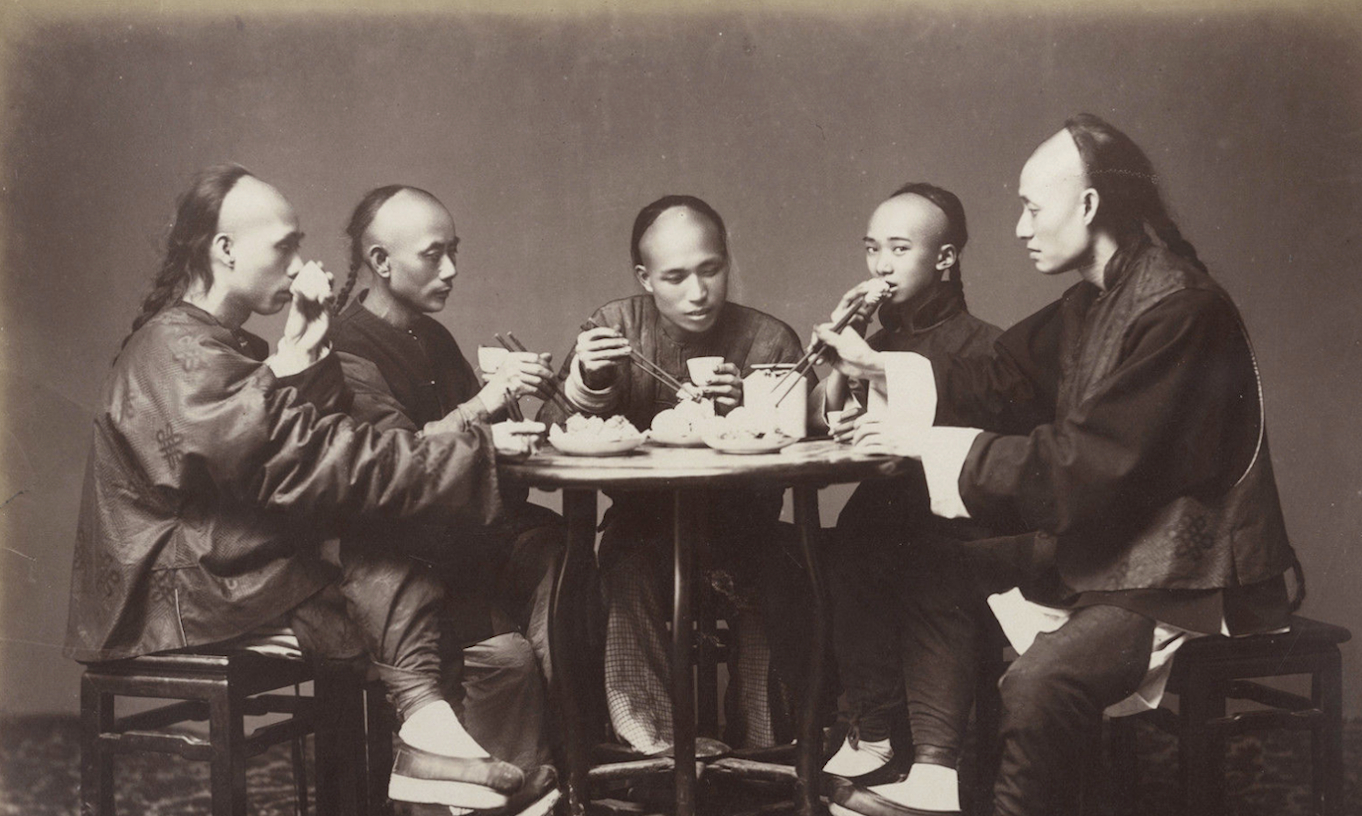
As Chinese immigration to California accelerated across the 19th century, the hairstyle known as the queue — a long, braided pony tail — became the subject of white Americans' fascination, disgust, and legal regulation. Sarah Gold McBride explores why hair served as an index of political subjecthood, and how the queue exposed cracks in American norms regarding gender, economy, and citizenship.
“One of the peculiar things about the 'Net is it has no memory. (…) We’ve made our digital bet. Civilization now happens digitally. And it has no memory. This is no way to run a civilization. And the Web — its reach is great, but its depth is shallower than any other medium probably we’ve ever lived with.” (Kahle 01998)

In February 01998, the Getty Center in Los Angeles hosted the Time and Bits: Managing Digital Continuity conference, organized by the founders and thinkers of two non-profit organizations established two years earlier in San Francisco: the Internet Archive and The Long Now Foundation, both dedicated to long-term thinking and archiving.
The Internet Archive has since become a global example of digital archiving and an open library that provides access to millions of digitized pages from the web and paper books on its website. The Long Now Foundation’s central project involves the design and construction of a monumental clock intended to tick for the next 10,000 years, promoting long-term thinking alongside its lesser-known archival mission: the Rosetta Project.
The Time and Bits: Managing Digital Continuity conference brought together these organizations to discuss what the Internet Archive’s founder, Brewster Kahle, referred to as “our digital bet”: a digital-only novel form of civilization with no history, posing challenges to the preservation of its immaterial cultural memory. Discussions at the conference raised concerns about the longevity of digital formats and explored potential archival and transmission solutions for the future. This foresight considered the ‘heritage’ characteristics of the digital world, which were yet to be defined as such on a global level. It was not until 02003 that UNESCO published a charter advocating for “digital heritage conservation”, distinguishing between “digital-born heritage” and digitized heritage (UNESCO 02003, Musiani et al. 02019). The Getty Center conference thus emerges as a precursor in the quest to preserve both digital data and analog information for future generations. This endeavor, the chapter argues, aligns with the longue durée, a conception of time and history developed by French historian Fernand Braudel during World War Two (Braudel 01958).
While the Internet Archive has envisioned such a mission through the continuous digital recording of web pages and the digitization of paper, sound, and video documents into bits format, The Long Now Foundation’s Rosetta Project began to take shape during the ‘Time and Bits’ conversations, offering a different approach to data conservation in an analog microscopic format, engraved on nickel disks.
Taking the 01998 gathering of the Internet Archive and Long Now Foundation as a starting point, this chapter aims to examine the challenges and strategies of ‘digital continuity management’ (or maintenance). It proposes to analyze the different ways these two case studies envision archiving and transmission to future generations, in both digital and analog formats — bits and nickel, respectively — for virtual web content and physical paper-based materials.
Through a comparative analysis of these two non-profit organizations, this chapter seeks to explore various archiving methods and tools, and the challenges they present in terms of time, space, innovation, maintenance, and ‘continuity’. By depicting two distinct visions of the future of archiving represented by these organizations, it highlights their shared mission of safeguarding, sharing, and providing universal access to information, despite their differing formats.
The method used for this analysis combines theoretical, comparative, and qualitative studies through an immersive research process spanning over three years in the San Francisco Bay Area. This process involved conducting interviews and participant observations during seminars, talks, and meetings held by both The Long Now Foundation and at the Internet Archive. Additionally, archival research was conducted online, using resources such as the Internet Archive’s Wayback Machine and The Long Now Foundation’s blog dating back to 01996, as well as on-site at The Long Now Foundation.
This chapter adopts a multidisciplinary approach conjoining history, media, maintenance, and American studies to analyze the challenges faced by these two organizations in transmitting both material and intangible cultural heritage (UNESCO 02003).
The first part of this chapter concentrates on the future of archives and their longevity, a topic that was discussed during the 01998 Time and Bits conference. It suggests a parallel with the Braudelian longue durée perspective, which offers a novel understanding of time and history.
The second part focuses on digital transmission in ‘hard-drive form’ using the example of the Internet Archive and its Wayback Machine, comprising thousands of hard drives. The final segment of this chapter discusses the analog archival format chosen by The Long Now Foundation, represented by the Rosetta Disk, a small nickel disk engraved with thousands of pages of selected texts. This format is likened to a modern iteration of the Egyptian Rosetta Stone for preservation into the long-term future.
“Time and Bits: Managing Digital Continuity”…and maintenance in longue durée“How long can a digital document remain intelligible in an archive?” This question, asked by futurist Jaron Lanier in one of the hundreds of messages posted on the Time and Bits forum that ran from October 01997 until June 01998, underscores not only concerns about the future ‘life’ of digital documents at the end of the 01990s, but also their meaning and understanding in archives for future generations. These concerns about digital preservation were central to discussions at the subsequent Time and Bits conference organized a few months later in February 01998 at the Getty Center in Los Angeles by the Getty Conservation Institute and the now defunct Getty Information Institute, in collaboration with The Long Now Foundation.
The Long Now Foundation, formed in 01996, emerged from discussions among thinkers and futurists who later became its board members. This group included Stewart Brand, recipient of the 01971 National Book Award for his Whole Earth Catalog and co-founder of the pioneering virtual community, the WELL, created in the 01980s (Turner 02006), engineer Danny Hillis, British musician and artist Brian Eno, technologists Esther Dyson and Kevin Kelly, and futurist Peter Schwartz (Momméja 02021). Schwartz, in particular, is the one who articulated the concept of the ‘long now’ as a span of 20,000 years — 10,000 years deep into the past and 10,000 years into the very distant future. This timeframe coincides with the envisioned lifespan of the monumental Clock being constructed by the foundation in West Texas. The choice of this specific duration marks the end of the last ice age about 10,000 years ago, a period that catalyzed the advent of agriculture and human civilization, with some scholars even identifying it as the onset of the Anthropocene epoch. Indeed, a group of scientists extends their analysis beyond the industrial era, which has generally been studied as the beginning of this human-induced transformation of our biosphere, considering the origins of agriculture as “the time when large-scale transformation of land use and human-induced species and ecosystem loss extended the period of warming after the end of the Pleistocene” (Henke and Sims 02020). For the founders of The Long Now Foundation, this 10,000-year perspective must therefore be developed in the opposite direction, towards the future (hence the expected duration of the Clock) forming the ‘Long Now’.
The paper argues that ‘long now’ promoted by the organization can be paralleled with the concept of longue durée put forth by Annales historian Fernand Braudel. Braudel began elaborating the idea of longue durée during his time as prisoner of war in Germany. For five years, he diligently worked on his PhD dissertation, La Méditerranée et le monde méditerranéen à l'époque de Philippe II (Braudel 01949). It was during his internment that Braudel developed the concept of the ‘very long time’, a temporal construction that provided him solace from the traumatic events he experienced in the ‘short time’ and helped him gain insight into his condition by situating them on a much broader time scale (Braudel 01958). With newly stratified temporalities ― from the immediate to the medium to the very long term ― Braudel succeeded in escaping the space-time of which he was a prisoner, a ‘here’ and ‘now’ devoid of meaningful perspectives when a longer ‘now’ would liberate him from the present moment. Longue durée was thus imagined as a novel long-term approach to history, diverging from traditional narratives that focused on brief periods and dramatic events, such as wars. This is what Braudel referred to as “a rushed, dramatic narrative” (Braudel 01958). A second, longer type of history, based on economic cycles and conjunctures, was described by Braudel as spanning several decades, while longue durée offered a novel type of history that transcended events and cycles, extending even further to encompass centuries ― although the French historian refrained from specifying an exact timeframe.
Longue durée, alongside its modern Californian counterpart, the ‘long now’, prompts us to reconsider our understanding of history in time as a means to encapsulate events far beyond our lifetimes. Braudel insisted historians should incorporate longue durée into their work and rethink history as an ‘infrastructure’ composed of layers of ‘slow history’.
Given this perspective, how can we archive and transmit fast traditional history within the context of longue durée? In his foreword to the Time & Bits report, Barry Munitz, president and CEO of the J. Paul Getty Trust, explained the initiative behind the conference:
We take seriously the notion of long-term responsibility in the protection of important cultural information, which in many cases now is recorded only in digital formats. The technology that enables digital conversion and access is a marvel that is evolving at lightning speed. Lagging far behind, however, are the means by which the digital legacy will be preserved over the long term (Munitz 01998).
The two organizations selected for this chapter offer two distinct, yet complementary, visions of how archiving and transmitting should be approached, now and for the longue durée, in digital and analog formats.
Digital transmission in ‘hard-drive form’: The Wayback Machine and the Internet ArchiveAddressing the “problem of our vanishing memory” was a focal point of the Time & Bits conference encapsulated by Internet Archive founder Brewster Kahle’s question: “I think the issue that we are grappling with here is now that our cultural artifacts are in digital form, what happens?” (Kahle 01998). As noted by Stewart Brand, Kahle also pointed out that “one of the peculiar things about the 'Net is it has no memory. (…) We’ve made our digital bet. Civilization now happens digitally. And it has no memory. This is no way to run a civilization. And the Web—its reach is great, but its depth is shallower than any other medium probably we’ve ever lived with” (Kahle 01998).
As a way to resolve this ‘digital bet’ and the pressing need for ‘digital continuity’, Brewster Kahle embarked on a mission to archive the web on a massive scale, giving rise to the Internet Archive and its Wayback Machine: an archive comprising 20,000 hard drives and containing 866 billion web pages as of March 02024.
Like The Long Now Foundation, the Internet Archive is a non-profit organization founded in 01996 in San Francisco. In fact, both entities once occupied adjacent offices in the Presidio. Their missions can also be put in parallel: whereas The Long Now Foundation promotes long-term thinking through projects like the construction of a Clock and the preservation of foundational languages and texts of our civilization in analog form through the Rosetta Disk, the Internet Archive digitizes and archives analog documents and records digital textual heritage through its Wayback Machine.
The Internet Archive embarked on its mission with an imperative to save internet pages, immaterial data composed of bits, which had not previously been archived: “We began in 01996 by archiving the internet itself, a medium that was just beginning to grow in use. Like newspapers, the content published on the web was ephemeral ― but unlike newspapers, no one was saving it” (Internet Archive 02024). Despite the transient and intangible nature of web pages, the Internet Archive remains committed to this mission, continuing to archive internet pages in a digital format to this day, with the ambition to remain open and collaborative, “explicitly promoting bottom-up initiatives intended to revalue human intervention” (Musiani et al. 02019).
Brewster Kahle, who could be regarded as the first digital librarian in history, promotes “Universal Access to All Knowledge” and “Building Libraries Together”. These missions, as explained during the Internet Archive's annual celebration on October 21, 02015, at its headquarters in San Francisco, highlight the organization’s commitment to a wide array of digital content, including internet pages, books, videos, music, and games. Therefore, the internet appears as a “heritage and museographic object” (Schafer 02012), with information worth saving and protecting for the future. While the Library of Congress recently acknowledged the significance of Twitter content as a form of heritage (Schafer 02012), the Internet Archive has been standing as an advocate for the preservation and transmission of digital heritage as early as the 01990s. UNESCO further validated this recognition in 02003 by acknowledging the existence of “digital heritage as a common heritage” through a charter on the conservation of digital heritage (Musiani et al. 02019) where resources are ‘born digital’, before being, or even without ever being, analog:
Digital materials encompass a vast and growing range of formats, including texts, databases, still and moving images, audio, graphics, software, and web pages. Often ephemeral in nature, they require purposeful production, maintenance, and management to be retained. Many of these resources possess lasting value and significance, constituting a heritage that merits protection and preservation for current and future generations. This ever growing heritage may exist in any language, in any part of the world, and in any area of human knowledge or expression (UNESCO 02003).
The Internet Archive’s mission aligns perfectly with this definition, providing open access to documents that are "protected and preserved for current and future generations”, echoing once again The Long Now Foundation’s own mission. However, the pursuit of "universal access to all knowledge" raises questions about the quality or "representativeness of the archive" (Musiani et al. 02019) in the face of the abundance and diversity of the sources and formats available.
For instance, the music section of the Internet Archive connects visitors to San Francisco’s local counterculture history with a vast collection of recordings from Grateful Dead shows (17,453 items) that fans contributed to the organization in analog formats for digitization. This exchange has not only allowed the band’s fan community to flourish but has also bolstered the group’s the popularity: “they started to record all those concerts and you know, there are I think 2,339 concerts that got played by the Grateful Dead (…) and all but 300 of those are here in the archive” (Barlow 02015). In this way, the Internet Archive confirms its role as a universal collaborative platform and effectively contributes to a “new era of cultural participation” (Severo and Thuillas 02020), one that is proper to Web 2.0 but which the non-profit has been championing since the 01990s.
However, for the Internet Archive, and digital technology in general, to truly guarantee the archiving of human heritage ‘for future generations’ over the years, whether initially analog or digital, it is imperative to continuously improve and update storage formats and units to combat obsolescence and adapt to evolving technologies:
Of course, disk drives all eventually fail. So we have an active team that monitors drive health and replaces drives showing early signs for failure. We replaced 2,453 drives in 02015, and 1,963 year-to-date 02016… an average of 6.7 drives per day. Across all drives in the cluster the average ‘age’ (arithmetic mean of the time in-service) is 779 days. The median age is 730 days, and the most tenured drive in our cluster has been in continuous use for 6.85 years! (Gonzalez 02016)
If “all contributions produced on these platforms, whether amateur or professional, participate in the construction and appropriation of cultural and memorial heritage” (Severo and Thuillas 02020), reliance solely on digital technology poses a substantial challenge to the preservation of our cultures in longue durée. Aware of the inherent risks associated with archiving both analog and ‘digital heritage’ on storage mediums with limited lifespans, the Internet Archive must make the maintenance and replacement of the hard drives that comprise its Wayback Machine a constant priority.
From stone to disk: the Rosetta Project through time and spaceTo embody Braudel’s notion of ‘slow history’ and foster long-term thinking among people, The Long Now Foundation envisioned not only a monumental Clock as a time relay for future generations, but also a library for the deep future, soon materializing as an engraved artifact: The Rosetta Disk.
As explained by technologist Kevin Kelly, the concept of a miniature storage system comprising 350,000 pages of text engraved on a nickel disk, measuring just under eight centimeters in diameter, was proposed by Kahle during the Time and Bits: Managing Digital Continuity conference, “as a solution for long-term digital storage (…) with an estimated lifespan of 2,000–10,000 years” (Kelly 02008). These meeting discussions thus led to the emergence of the Rosetta Project within The Long Now Foundation, drawing inspiration from the Rosetta Stone. The final version of the Rosetta Project’s Disk was unveiled in 02008: 14,000 pages of information in 1,500 different languages (Welcher 02008). Crafted in analog format, it was conceived as the solution to the ever-changing landscape of digital technologies.
While the Internet Archive possesses infinite possibilities for archiving, The Long Now Foundation’s analog choice demands a thoughtful selection of texts to be micro-engraved onto the disk. The foundation decided to focus on several texts, both symbolic and universalist, such as the 01948 Universal Declaration of Human Rights, along with Genesis, chosen for its numerous translations. Materials with a linguistic or grammatical vocation, such as the Swadesh list — a compendium of words establishing a basic lexicon for each language — were included, as well as grammatical information including descriptions of phonetics, word formation, and broader linguistic structures like sentences.
Unlike Kahle's digital and digitized heritage project, the Foundation’s language archive is exclusively engraved, accessible only through a microscope. Such an archive is thus a finite heritage, with no scope for future development beyond the creation of new disks displaying new texts. While the Internet Archive and its Wayback Machine are constantly evolving, updated through constant digitization and the preservation of new web pages, the format and size of the nickel disk remain immutable.
To ensure the long-term survival of this archive, the foundation has embraced the “LOCKSS” principle — Lots of Copies Keep Stuff Safe — and has opted to duplicate its Rosetta Disk. By distributing these duplicates worldwide, the project stands a greater chance of lasting in longue durée: “this project in long-term thinking would do two things: it would showcase this new long-term storage technology, and it would give the world a minimal backup of human languages” (Kelly 02008).
The final version of the Rosetta Disk, containing 14,000 micro-engraved pages, was presented at the Foundation's headquarters in 02008. “Kept in its protective sphere to avoid scratches, it could easily last and be read 2,000 years into the future” (Welcher 02008). Beyond its resilience within the timeline of the Long Now, the analog Rosetta Disk aspires to endure across space as well. Remarkably, as the Foundation had been developing its project since 01999, they were contacted by the European Space Agency (ESA) and the Rosetta Mission team which, coincidentally, was working on the launch of an exploratory space probe aptly named Rosetta. The Rosetta probe was launched on March 2, 02004, aboard an Ariane 5G+ rocket from Kourou, with the mission of studying comet 67P/Churyumov-Gerasimenko (‘Tchouri’) located near Jupiter. On board the probe was the very first version of the Rosetta Disk, less comprehensive than the version unveiled in 02008, nevertheless containing six thousand pages of translated texts.
ConclusionOn November 12, 02014, over a decade after its departure from Earth, the Rosetta probe finally reached Comet Tchouri. Upon arrival, it deployed its Philae lander onto the comet’s surface, where, despite unexpected rebounds, it eventually stabilized itself to conduct programmed analyses. Nearly two years later, on September 30, 02016, the Rosetta module, with the Rosetta Disk on board, joined Philae on Tchouri, thus marking the conclusion of the mission: “With Rosetta we are opening a door to the origin of planet Earth and fostering a better understanding of our future. ESA and its Rosetta mission partners have achieved something extraordinary today” (ESA 02014). Through a space mission focused on the future with the aim of better understanding the Earth's past, the Rosetta Disk fulfilled its project to become an archive in longue durée, transcending temporal and spatial boundaries.
Almost ten years later, both the Rosetta Disk and the Internet Archive, through a selection of books and documents from its datasets, became part of an even larger spatial archive which also includes articles from Wikipedia and books from Project Gutenberg, all etched on thin sheets of nickel. The Arch Mission Foundation’s Lunar Library successfully landed on the Moon on February 22, 02024, thus reuniting for the first time the two non-profits’ archival materials in a cultural and civilizational preservation project, built to remain on the Moon surface throughout the longue durée.
The Time and Bits: Managing Digital Continuity conference did not present a single solution to the challenges of digital archives and data transmission. Instead, it offered a range of options and tools for web archives, digital data, and analog documents to address our ‘digital bet’. The two cases presented appear as two faces of the same disk — digital and analog — with a shared conservation objective: providing different means to consider longue durée and ensure archival continuity and maintenance in the long term. This continuity extends not only through time, but also across space, placing “digitally-born heritage” (Musiani et al. 02019) and more traditional forms of heritage on equal footing.
From the “creative city” (Florida 02002) of San Francisco, both organizations have managed to extend the boundaries of the “creative Frontier” (Momméja 02001), not only physically and digitally, but also through longue durée and space. From hard drives to disks, they offer a new form of coevolution between humans and machines, a ‘post-coevolution’ aimed at transmitting our cultural heritage to future generations through bits and nickel.
ReferencesBrand, Stewart. 01999. The Clock of The Long Now: Time and Responsibility. New York: BasicBooks.
The European Space Agency. 02002. “Rosetta Disk Goes Back to the Future.” The European Space Agency. December 3.
https://web.archive.org/web/20240423005130/https://sci.esa.int/web/rosetta/-/31242-rosetta-disk-goes-back-to-the-future.
———. n.d. “Enabling & Support – Rosetta.” The European Space Agency. https://web.archive.org/web/20240423005544/https://www.esa.int/Enabling_Support/Operations/Rosetta.
———. n.d. “Rosetta – Summary.” The European Space Agency. https://web.archive.org/web/20240423004357/https://sci.esa.int/web/rosetta/2279-summary.
———. n.d. “Where Is Rosetta?” The European Space Agency. https://web.archive.org/web/20240423003218/https://sci.esa.int/where_is_rosetta/.
Florida, Richard. 02002. The Rise of the Creative Class: And How It’s Transforming Work, Leisure, Community and Everyday Life. New York, NY: Basic Books.
Gonzalez, John. 02016. “20,000 Hard Drives on a Mission.” Internet Archive Blogs. October 25. https://web.archive.org/web/20240423002926/https://blog.archive.org/2016/10/25/20000-hard-drives-on-a-mission/.
Henke, Christopher R, and Benjamin Sims. 02020. Repairing Infrastructures the Maintenance of Materiality and Power. https://web.archive.org/web/20240423002248/https://direct.mit.edu/books/oamonograph/4962/Repairing-InfrastructuresThe-Maintenance-of.
Internet Archive. 02015. “Building Libraries Together, Celebrating the Passionate People Building the Internet Archive.” Internet Archive, San Francisco, October 21. https://archive.org/details/buildinglibrariestogether2015.
Internet Archive. 02024. “About the Internet Archive.” Internet Archive. https://web.archive.org/web/20240423001744/https://archive.org/about/.
Kahle, Brewster. 02011. “Universal Access to All Knowledge.” San Francisco, November 30. https://web.archive.org/web/20240423001555/https://longnow.org/seminars/02011/nov/30/universal-access-all-knowledge/.
Kahle, Brewster. 02016. “Library of the Future.” University of California Berkeley, Morrison Library, March 3. https://web.archive.org/web/20240423001315/https://bcnm.berkeley.edu/events/109/special-events/1004/library-of-the-future.
Kelly, Kevin, Alexander Rose, and Laura Welcher. “Disk Essays.” The Rosetta Project. https://web.archive.org/web/20240422235700/https://rosettaproject.org/disk/essays/.
Kelly, Kevin. 02008. “Very Long-Term Backup.” The Long Now Foundation. August 20. https://web.archive.org/web/20240423000131/https://longnow.org/ideas/very-long term-backup/.
The Long Now Foundation. “Time and Bits: Managing Digital Continuity.” 01998. February 8.https://web.archive.org/web/20240423001231/https://longnow.org/events/01998/feb/08/time-and-bits/.
MacLean, Margaret G. H., Ben H. Davis, Getty Conservation Institute, Getty Information Institute, and Long Now Foundation, eds. 01998. “Time & Bits: Managing Digital Continuity.” [Los Angeles: J. Paul Getty Trust].
Momméja, Julie. 02021. “Du Whole Earth Catalog à la Long Now Foundation dans la Baie de San Francisco : Co-Évolution sur la “Frontière” Créative (1955–2020).” Paris: Paris 3 – Sorbonne Nouvelle. https://theses.fr/2021PA030027.
Musiani, Francesca, Camille Paloque-Bergès, Valérie Schafer, and Benjamin Thierry. 02019. “Qu’est-ce qu’une archive du Web?” https://books.openedition.org/oep/8713/.
The Rosetta Project. n.d. “Disk – Concept.” The Rosetta Project. https://web.archive.org/web/20240423002348/https://rosettaproject.org/disk/concept/.
———. n.d. “The Rosetta Blog.” The Rosetta Project. https://web.archive.org/web/20240423002731/https://rosettaproject.org/blog/.
———. n.d. “The Rosetta Project, A Long Now Foundation Library of Human Language.” The Rosetta Project. https://web.archive.org/web/20240423003014/https://rosettaproject.org/.
Schafer, Valérie. 02012. “Internet, Un Objet Patrimonial et Muséographique.” Colloque Projet pour un musée informatique et de la société numérique, Musée des arts et métiers, Paris. https://web.archive.org/web/20240423012521/http://minf.cnam.fr/PapiersVerifies/7.3_internet_objet_patrimonial_Schafer.pdf.
Severo, Marta, and Olivier Thuillas. 02020. “Plates-formes collaboratives : la nouvelle ère de la participation culturelle ?” Nectart 11 (2). Toulouse: Éditions de l’Attribut: 120– 31. https://web.archive.org/web/20240423003238/https://www.cairn.info/revue-nectart 2020-2-page-120.htm.
Turner, Fred. 02006. From Counterculture to Cyberculture: Stewart Brand, the Whole Earth Network, and the Rise of Digital Utopianism. Chicago: University of Chicago Press.
UNESCO. 02004. “Records of the General Conference, 32nd Session, Paris, 29 September to 17 October 02003, v. 1: Resolutions.” UNESCO. General Conference, 32nd,0 2003 [36221]. https://web.archive.org/web/20240423004242/https://unesdoc.unesco.org/ark:/48223/pf 0000133171.page=81.
_
"Time, bits, and nickel: Managing digital and analog continuity" was originally published in Exploring the Archived Web during a Highly Transformative Age: Proceedings of the 5th international RESAW conference, Marseille, June 02023 (Ed. by Sophie Gebeil & Jean-Christophe Peyssard.) Licensed under CC-BY-4.0.

A crop circle sighting tinged with Christian morality.

Time travel and murder during a New York heat wave.
Time to catch up on my photos. Here’s May and June, 2025. A lot happened. Here I am in North Beach with Barb, I guess this was back in May. Love the display sign of a big fish! I always like messy things on walls. Like painted-over plywood. Fab four-color fan. Usually I line myself […]
The post Summer in SF and NYC first appeared on Rudy's Blog.
(This is an old/paused blog entry I planned to release in April while I was at Eastercon, but forgot about. Here it is, late and a bit tired as real world events appear to be out-stripping it ...)
(With my eyesight/cognitive issues I can't watch movies or TV made this century.)
But in light of current events, my Muse is screaming at me to sit down and write my script for an updated re-make of Doctor Strangelove:
POTUS GOLDPANTS, in middling dementia, decides to evade the 25th amendment by barricading himself in the Oval Office and launching stealth bombers at Latveria. Etc.
The USAF has a problem finding Latveria on a map (because Doctor Doom infiltrated the Defense Mapping Agency) so they end up targeting the Duchy of Grand Fenwick by mistake, which is in Transnistria ... which they are also having problems finding on Google Maps, because it has the string "trans" in its name.
While the USAF is trying to bomb Grand Fenwick (in Transnistria), Russian tanks are commencing a special military operation in Moldova ... of which Transnistria is a breakaway autonomous region.
Russia is unaware that Grand Fenwick has the Q-bomb (because they haven't told the UN yet). Meanwhile, the USAF bombers blundering overhead have stealth coatings bought from a President Goldfarts crony that even antiquated Russian radar can spot.
And it's up to one trepidatious officer to stop them ...

When I became the father of twin boys, I found myself suspended in a new kind of time — time measured not in days or deadlines, but in lifetimes.
Drifting in a sea of dreams about what their futures might hold, I began to wonder:
If I was dreaming dreams on their behalf, then what dreams had I inherited from my parents, and which were truly my own?
In that moment, I ceased to see myself as a captain of my family’s future and began to feel more like a confluence of currents, with dreams flowing through me.
I was no longer just having dreams — some of my dreams, I imagined, were having me.
Growing up, I absorbed certain dreams through osmosis: my father's admiration for public service, my mother's love of beauty, my country's dream of freedom.
Who would I be if not for this inheritance of dreams?
Who would anyone be if not for theirs?
Perhaps the better question is this:
What do we do with the dreams we receive?
Each generation must wrestle with the dreams they inherit: some are carried forward, consciously or not, and others are released or transformed.
That was always hard enough. Today, we must also grapple with the dreams that are increasingly suggested to us by invisible algorithms.
AI systems may not dream as we do, but they are trained on the archives of human culture.
Just as a parent’s unspoken dream can shape a child’s path, a machine’s projections can influence what we see as possible, desirable, or real.
As machines begin to dream alongside us, perhaps even for us, questioning where our dreams come from and remembering how to dream freely has never been more important.
Dreaming FreelyOne of the most iconic episodes of dreaming freely took place just blocks from where I live.
In the summer of 1967, thousands of young people converged on San Francisco’s Haight-Ashbury neighborhood, rejecting the societal norms of their day for dreams of peace, freedom, and self-expression.
Some of those dreams were lost to excess, while others were co-opted by spectacle, or overcome by the weight of their own idealism. Yet many planted seeds that grew deep roots over the ensuing decades.
Several of those seeds drifted south, to the orchards and garages of what became Silicon Valley, where software engineers turned ideals from the counterculture into technology products.
Dreams of expanded consciousness shaped the market for personal computing.
Dreams of community became the power of networks.
The Whole Earth Catalog's "access to tools" became Apple's "tools for the mind.”
Today, many of those tools nudge us toward the embrace of dreams that feel genuine but are often in fact projected onto us.
As we embrace technologies born of generations that once dared to dream new dreams, we find ourselves ever more deeply enmeshed in the ancient process of intergenerational dream transmission, now amplified by machines that never sleep.
Embodied ArchivesThe transmission of dreams across generations has always been both biological and cultural.
Our dreams are shaped not just by the expectations we inherit or reject, but by the bodies that carry them.
This is because our genes carry the imprint of ancestral experience, encoding survival strategies and emotional tendencies. Traits shaped by stress or trauma ripple across generations, influencing patterns of perception, fear, ambition, and resilience.
Inherited dreams contain important information and are among the deep currents of longing that give life meaning: dreams of justice passed down by activists, dreams of wholeness passed down by survivors, dreams of belonging shared by exiles.
They can be gifts that point us toward better futures.
Like biological complexity, these dream currents layer and accumulate over generations, forming an inheritance of imagination as real as the color of our eyes. They echo outward into the stories we collect, the institutions we build, and into the AI models we now consult to make sense of the world.
What begins as cellular memory becomes cultural memory, and then machine memory, moving from body to society to cloud, and then back again into mind and body.
There’s plenty of excitement to be had in imagining how AI may one day help us unlock dormant aspects of the mind, opening portals to new forms of creativity.
But if we sever our connection to the embodied archives of our elders or the actual archives that contain their stories, we risk letting machines dream for us — and becoming consumers of consciousness rather than its conduits and creators.
Temples of ThoughtLibraries are among our most vital connections to those archives.
For thousands of years, they have served as temples of knowledge, places where one generation's dreams are preserved for the next. They have always been imperfect, amplifying certain voices while overlooking others, but they remain among our most precious public goods, rich soil from which new dreams reliably grow.
Today, many of these temples are being dismantled or transformed into digital goods. As public libraries face budget cuts, and book readership declines, archive materials once freely available are licensed to AI companies as training data.
AI can make the contents of libraries more accessible than ever, and help us to magnify and make connections among what we discover. But it cannot yet replace the experience of being in a library: the quiet invitation to wander, to stumble upon the unexpected, to sit beside a stranger, to be changed by something you didn’t know you were looking for.
As AI becomes a new kind of archive, we need libraries more than ever — not as nostalgic relics, but as stewards of old dreams and shapers of new ones.
Just down the street, a new nonprofit Counterculture Museum has opened in Haight-Ashbury.
It preserves the dreams that once lived in bodies now gone or fading.
Those dreams live on in the museum’s archives.
They also live on in algorithms, where counterculture ideals have been translated into code that increasingly shapes how we dream.
Digital DreamsArtificial intelligence models are now among the largest repositories of inherited knowledge in human history. They are dream keepers, and dream creators.
They absorb the written, spoken, and visual traces of countless lives, along with the biases of their designers, generating responses that mirror our collective memory and unresolved tensions.
Just as families convey implicit values, AI inherits not just our stated aspirations, but the invisible weight of what we've left unsaid. The recursive risk isn't merely that AI feeds us what we want to hear, but that it withholds what we don't, keeping us unaware of powerful forces that quietly and persistently shape our dreams.
Philip K. Dick’s 01968 novel Do Androids Dream of Electric Sheep? imagined a future San Francisco (roughly our present day, five decades after the Summer of Love) in which the city is overrun with machines yearning to simulate emotions they cannot feel.
His question — whether machines can dream as we do — is no longer sci-fi. Now we might reasonably ask: will future humans be able to dream without machines?
In some ways, AI will expand our imaginative capacities, turning vague hopes into vivid prototypes and private musings into global movements.
This could ignite cultural revolutions far more sweeping than the Summer of Love, with billions of dreams amplified by AI.
Amidst such change, we should not lose touch with our innate capacity to dream our own dreams.
To dream freely, we must sometimes step away – from the loops of language, the glow of screens, the recursive churn of inherited ideas – and seek out dreams that arise not from machines or archives, but from the world itself.
Dreaming with NatureDreams that arise from nature rarely conform to language.
They remind us that not all meaning is created by humans or machines.
"Our truest life is when we are in dreams awake," wrote Thoreau, reflecting on how trees, ponds, and stars could unlock visions of a deeper, interconnected self.
This wisdom, core to America's Transcendentalist Movement, drew from many sources, including Native Americans who long sought dreams through solitude in the wild, recognizing nature not as backdrop but as teacher.
They turned to wild places for revelation, to awaken to dreams not of human making, but of the earth's.
When we sit quietly in a forest or look up at the night sky, we begin to dream on a different wavelength: not dreams of achievement or optimization, but dreams of connection to something much deeper.
In nature, we encounter dreams that arise from wind and stone, water and root, birdsong and bark.
They arrive when we contemplate our place in the wider web of existence.
Dreaming AnewAt night, after reading to my boys and putting them to bed, I watch them dreaming.
I try not to see them as vessels for my dreams, but as creators of their own.
When they learn to walk, I’ll take them outside, away from digital screens and human expectations, to dream with nature, as humans always have, and still can.
Then I’ll take them to libraries and museums and family gatherings, where they can engage with the inheritance of dreams that came before them.
When they ask me where dreams come from, I’ll tell them to study the confluence of currents in their lives, and ask what’s missing.
What comes next may be a dream of their own.
At least, that is a dream that I have for them.
The Inheritance of Dreams is published with our friends at Hurry Up, We're Dreaming. You can also read the essay here.

Excerpts from a dazzling image collection, discovered in a Norwegian barn in the 1980s, that experiments with the presentation of gender.

In 1853, John Benjamin Dancer achieved a feat of seemingly impossible scale: he shrunk an image to the size of a sharpened pencil tip. Anika Burgess explores the invention of microphotography and its influence on erotic paraphenalia and military communications.
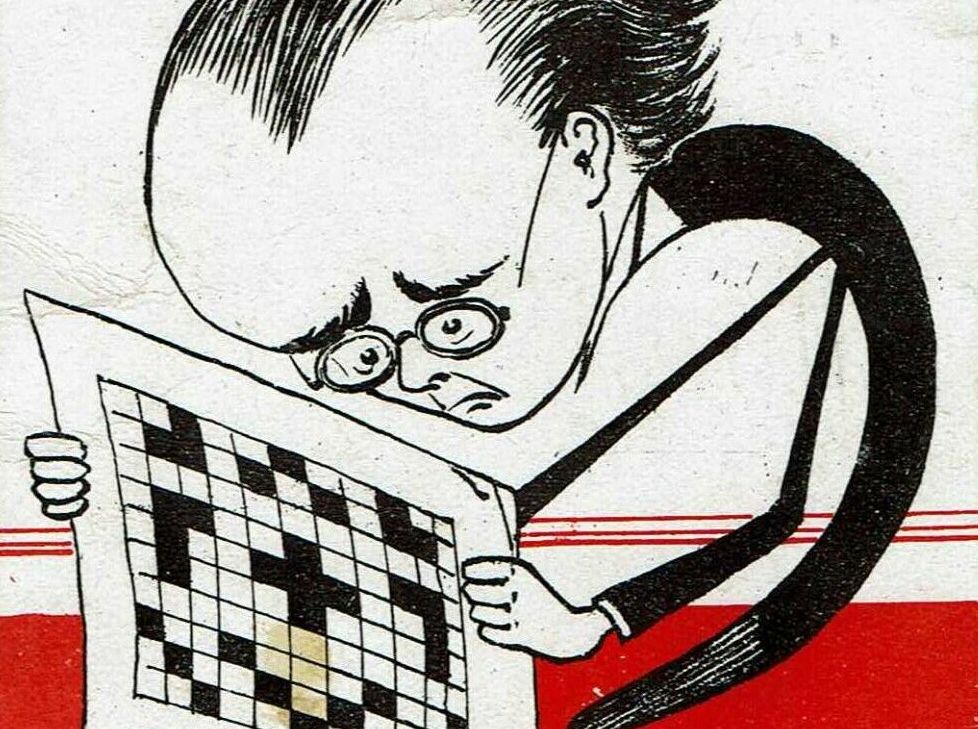
Eleventh instalment in our series of extremely small and free-form cryptic crossword puzzles, themed on our latest essay.

The sole example of a Bauhaus workshop's arcane theatrical scoring system, combining colours, words, and complex symbolic notation.

Our immediate history is steeped in profound technological acceleration. We are using artificial intelligence to draft our prose, articulate our vision, propose designs, and compose symphonies. Large language models have become part of our workflow in school and business: curating, calculating, and creating. They are embedded in how we organize knowledge and interpret reality.
I’ve always considered myself lucky that my journey into AI began with social impact. In 02014, I was asked to join the leadership of IBM’s Watson Education. Our challenge was to create an AI companion for teachers in underserved and impacted schools that aggregated data about each student and suggested personalized learning content tailored to their needs. The experience showed me that AI could do more than increase efficiency or automate what many of us consider to be broken processes; it could also address some of our most pressing questions and community issues.
It would take a personal encounter with AI, however, for me to truly grasp the technology’s potential. Late one night, I was working on a blog post and having a hard time getting started — the blank page echoing my paralysis. I asked Kim-GPT, an AI tool I created and trained on my writing, to draft something that was charged with emotion and vulnerability. What Kim-GPT returned wasn’t accurate or even particularly insightful, but it surfaced something I had not yet admitted to myself. Not because the machine knew, but because it forced me to recognize that only I did. The GPT could only average others’ insights on the subject. It could not draw lines between my emotions, my past experiences and my desires for the future. It could only reflect what had already been done and said.
That moment cracked something open. It was both provocative and spiritual — a quiet realization with profound consequences. My relationship with intelligence began to shift. I wasn’t merely using the tool; I was being confronted by it. What emerged from that encounter was curiosity. We were engaged not in competition but in collaboration. AI could not tell me who I was; it could only prompt me to remember. Since then, I have become focused on one central, persistent question:
What if AI isn’t here as a replacement or overlord, but to remind us of who we are and what is possible?AI as Catalyst, Not Threat
We tend to speak about AI in utopian or dystopian terms, but most humans live somewhere in between, balancing awe with unease. AI is a disruptor of the human condition — and a pervasive one, at that. Across sectors, industries and nearly every aspect of human life, AI challenges long-held assumptions about what it means to think, create, contribute. But what if it also serves as a mirror?
In late 02023, I took my son, then a college senior at UC-Berkeley and the only mixed-race pure Mathematics major in the department, to Afrotech, a conference for technologists of color. In order to register for the conference he needed a professional headshot. Given the short notice, I recommended he use an AI tool to generate a professional headshot from a selfie. The first result straightened his hair. When he prompted the AI again, specifying that he was mixed race, the resulting image darkened his skin to the point he was unrecognizable, and showed him in a non-professional light.
AI reflects the data we feed it, the values we encode into it, and the desires we project onto it. It can amplify our best instincts, like creativity and collaboration, or our most dangerous biases, like prejudice and inequality. It can be weaponized, commodified, celebrated or anthropomorphized. It challenges us to consider our species and our place in the large ecosystem of life, of being and of intelligence. And more than any technology before it, AI forces us to confront a deeper question:
Who are we when we are no longer the most elevated, intelligent and coveted beings on Earth?
When we loosen our grip on cognition and productivity as the foundation of human worth, we reclaim the qualities machines cannot replicate: our ability to feel, intuit, yearn, imagine and love. These capacities are not weaknesses; they are the core of our humanity. These are not “soft skills;” they are the bedrock of our survival. If AI is the catalyst, then our humanity is the compass.
Creativity as the Origin Story of IntelligenceAll technology begins with imagination, not engineering. AI is not the product of logic or computation alone; it is the descendant of dreams, myths and stories, born at the intersection of our desire to know and our urge to create.
We often forget this. Today, we scale AI at an unsustainable pace, deploying systems faster than we can regulate them, funding ideas faster than we can reflect on their implications. We are hyperscaling without reverence for the creativity that gave rise to AI in the first place.
Creativity cannot be optimized. It is painstakingly slow, nonlinear, and deeply inconvenient. It resists automation. It requires time, stillness, uncertainty, and the willingness to sit with discomfort. And yet, creativity is perhaps our most sacred act as humans. In this era of accelerated intelligence, our deepest responsibility is to protect the sacred space where imagination lives and creativity thrives.
To honor creativity is to reclaim agency, reframing AI not as a threat to human purpose, but as a partner in deepening it. We are not simply the designers of AI — we are the dreamers from which it was born.
Vulnerability, Uncertainty, and Courage-Centered LeadershipA few years ago, I was nominated to join a fellowship designed specifically to teach tech leaders how to obtain reverent power as a way to uplevel their impact. What I affectionately dubbed “Founders Crying” became a hotbed for creativity. New businesses emerged and ideas formed from seemingly disparate concepts that each individual brought to our workshop. It occurred to me that it took more than just sitting down at a machine, canvas or instrument to cultivate creativity. What was required was a change in how leaders show up in the workplace. To navigate the rough waters of creativity, we need new leadership deeply rooted in courage and vulnerability. As Brené Brown teaches:
“Vulnerability is the birthplace of love, belonging, joy, courage, empathy and creativity. It is the source of hope, empathy, accountability, and authenticity. If we want greater clarity in our purpose or deeper and more meaningful spiritual lives, vulnerability is the path.”
For AI to support a thriving human future we must be vulnerable. We must lead with curiosity, not certainty. We must be willing to not know. To experiment. To fail and begin again.
This courage-centered leadership asks how we show up fully human in the age of AI. Are we able to stay open to wonder even as the world accelerates? Can we design with compassion, not just code? These questions must guide our design principles, ensuring a future in which AI expands possibilities rather than collapsing them. To lead well in an AI-saturated world, we must be willing to feel deeply, to be changed, and to relinquish control. In a world where design thinking prevails and “human-centered everything” is in vogue, we need to be courageous enough to question what happens when humanity reintegrates itself within the ecosystem we’ve set ourselves apart from over the last century.
AI and the Personal LegendI am a liberal arts graduate from a small school in central Pennsylvania. I was certain that I was headed to law school — that is, until I worked with lawyers. Instead, I followed my parents to San Francisco, where both were working hard in organizations bringing the internet to the world. When I joined the dot-com boom, I found that there were no roles that matched what I was uniquely good at. So I decided to build my own.
Throughout my unconventional career path, one story that has consistently guided and inspired me is Paulo Coelho’s The Alchemist. The book’s central idea is that of the Personal Legend: the universe, with all its forms of intelligence, collaborates with us to determine our purpose. It is up to each of us to choose whether we pursue what the universe calls upon us to do.
In an AI-saturated world, it can be harder to hear that calling. The noise of prediction, optimization, and feedback loops can drown out the quieter voice of intuition. The machine may offer countless suggestions, but it cannot tell you what truly matters. It may identify patterns in your behavior, but it cannot touch your purpose.
Purpose is an internal compass. It is something discovered, not assigned. AI, when used with discernment, can support this discovery, but only when we allow it to act as a mirror rather than a map. It can help us articulate what we already know, and surface connections we might not have seen. But determining what’s worth pursuing is a journey that remains ours. That is inner work. That is the sacred domain of the human spirit. It cannot be outsourced or automated.
Purpose is not a download. It is a discovery.
Designing with Compassion and the Long-term in MindIf we want AI to serve human flourishing, we must shift from designing for efficiency to designing for empathy. The Dalai Lama has often said that compassion is the highest form of intelligence. What might it look like to embed that kind of intelligence into our systems?
To take this teaching into our labs and development centers we would need to prioritize dignity in every design choice. We must build models that heal fragmentation instead of amplifying division. And most importantly, we need to ask ourselves not just “can we build it?” but “should we and for whom?”
This requires conceptual analysis, systems thinking, creative experimentation, composite research, and emotional intelligence. It requires listening to those historically excluded from innovation and technology conversations and considerations. It means moving from extraction to reciprocity. When designing for and with AI, it is important to remember that connection is paramount.
The future we build depends on the values we encode, the similarities innate in our species, and the voices we amplify and uplift.
Practical Tools for Awakening Creativity with AICreativity is not a luxury. It is essential to our evolution. To awaken it, we need practices that are both grounded and generative:
- Treat AI as a collaborator, not a replacement. Start by writing a rough draft yourself. Use AI to explore unexpected connections. Let it surprise you. But always return to your own voice. Creativity lives in conversation, not in command.
- Ask more thoughtful, imaginative questions. A good prompt is not unlike a good question in therapy. It opens doors you didn’t know were there. AI responds to what we ask of it. If we bring depth and curiosity to the prompt, we often get insights we hadn’t expected.
- Use AI to practice emotional courage. Have it simulate a difficult conversation. Role-play a tough decision. Draft the email you’re scared to send. These exercises are not about perfecting performance. They are about building resilience.
In all these ways, AI can help us loosen fear and cultivate creativity — but only if we are willing to engage with it bravely and playfully.
Reclaiming the Sacred in a World of SpeedWe are not just building tools; we are shaping culture. And in this culture, we must make space for the sacred, protecting time for rest and reflection; making room for play and experimentation; and creating environments where wonder is not a distraction but a guide.
When creativity is squeezed out by optimization, we lose more than originality: we lose meaning. And when we lose meaning, we lose direction.
The time saved by automation must not be immediately reabsorbed by more production. Let us reclaim that time. Let us use it to imagine. Let us return to questions of beauty, belonging, and purpose. We cannot replicate what we have not yet imagined. We cannot automate what we have not protected.
Catalogue. Connect. Create.Begin by noticing what moves you. Keep a record of what sparks awe or breaks your heart. These moments are clues. They are breadcrumbs to your Personal Legend.
Seek out people who are different from you. Not just in background, but in worldview. Innovation often lives in the margins. It emerges when disciplines and identities collide.
And finally, create spaces that nourish imagination. Whether it’s a kitchen table, a community gathering, or a digital forum, we need ecosystems where creativity can flourish and grow.
These are not side projects. They are acts of revolution. And they are how we align artificial intelligence with the deepest dimensions of what it means to be human.
Our Technology Revolution is EvolutionThe real revolution is not artificial intelligence. It is the awakening of our own. It is the willingness to meet this moment with full presence. To reclaim our imagination as sacred. To use innovation as an invitation to remember who we are.
AI will shape the future. That much is certain. The question is whether we will shape ourselves in return, and do so with integrity, wisdom, and wonder. The future does not need more optimization. It needs more imagination.
That begins now. That begins with us.

The first comprehensive history of marionette artistry in the English language.


