
Location: St Mary's Hospital, Praed Street, W2 1NY [map]
Open: 10am - 1pm (Mon-Thu only)
Admission: free
Two word summary: antibiotic genesis
Five word summary: where Fleming spotted lifesaving mould
Website: imperial.nhs.uk/about-us/what-we-do/fleming-museum
Time to set aside: less than an hour

A lot of us wouldn't be here (or have been born at all) without antibiotics. The first of these was penicillin, discovered by Alexander Fleming at St Mary's Hospital in Paddington on 3rd September 1928. That's his laboratory on the second floor, in the protruding bay beside the main entrance just above the brown plaque. This tiny room is part of a museum devoted to telling the story of both discovery and discoverer, a very small museum that's essentially a hospital stairwell and a few rooms off it, which since 2023 has been free to enter. If you can get in.
Alexander Fleming was born in Ayrshire in 1881, not far from Kilmarnock, and moved to London in 1895 to take up a job as a shipping clerk. In a quirk of fate an uncle died and left him a bequest which allowed him to enrol at medical school. In a quirk of fate he joined St Mary's teaching hospital mainly because it had a good water polo team. Fleming did outstandingly well in his studies and was all set to become a surgeon but no vacancy was available, so in a quirk of fate accepted a temporary post in the Inoculation Department. He loved the work so stayed on, and twenty years later a carefully observed quirk of fate would make his name.

The entrance to the museum is a brown door just behind the hospital's ornamental gates. You have to press the button alongside to gain access, chatting via a semi-intelligible intercom to one of the volunteers upstairs. It's a very stiff door so might not open easily even after they've triggered the release (expect similar tugging issues on the way out). Entry is via an evocatively institutional stairwell tiled in green and ivory which curls upwards towards reception, and which is shared with maternity services because this is a working building. A volunteer will then lead you up one further flight to the room where the discovery took place. Be aware there's no lift, it being impractical to adapt an authentic listed building to modern accessibility standards.
During WW1 Fleming spent time at a military hospital in France where he observed how many injured amputees died for want of an effective antiseptic, so focused on this area of research when he returned to Paddington. His first great success came in 1921 when he observed that mucus wiped from his nose dissolved bacteria on a petri dish. It turned out this was because it contained our body's own natural antiseptic, also found in tears and egg white, which Fleming named lysozyme. He was very proud of this discovery, even much later in his career, but lysozyme didn't help cure the fiercest germs and so his search went on.

The second floor room where the discovery took place has been restored as it would have been in 1928 with dishes, brown bottles, stoppered test tubes and a microscope, all arrayed along a wooden bench in front of the window. Looking down Fleming would have been able to watch the traffic passing on Praed Street, and today you can additionally see a pharmacy in the shop opposite which feels particularly appropriate. A separate cabinet in the corner of the room contains medals, awards and other congratulatory ephemera from later in Fleming's life. You can't get right up close to the bench because only the volunteer gets to cross the divide and tell you all about it, then helpfully answer your questions. The room is also subject to the museum's widespread 'No photography' policy which is why I can't show you what it looks like.
On the crucial day in 1928 Fleming had been away for the summer and, fortuitously, some of his earlier dishes hadn't been cleared away. One showed unusual patterns where a mould on one side of the dish had inhibited the spread of staphylococcus on the other. Nobody's quite sure where the spore came from, only that it floated in randomly on the air, quite possibly from the fungi-focused laboratory downstairs. "That's funny," said Fleming to his junior colleague Merlin Price, a Welshman who arguably spotted the peculiarity first. The secretion was initially called 'mould juice' and Fleming tested it on a few of his colleagues to see if it cleared up their infections. It proved encouragingly lethal to certain microbes and not to humans, but also very hard to isolate and stabilise so the groundbreaking work essentially stalled.

After breathing in the atmosphere of the laboratory the volunteer will lead you up to the screening room on the third floor and press play on a ten minute film. This tells the full Fleming story complete with archive footage, including a speech Sir Alex gave in the presence of the Duke of Edinburgh on the 25th anniversary of the discovery. I learned a lot but the flickering presentation had all the nostalgic quality of a film I might have been shown in a science lesson on a wheeled-in telly, so I sat through the black and white credits to see when it was made. It turned out to be a 1993 production, the same year as the stairwell was turned into a museum with the aid of money from the drugs giant SmithKline Beecham, who plainly haven't been back to update it since.
In 1938 researchers from Oxford University were drawn to Fleming's work, initially via his discovery of lysozyme, but soon realised that penicillin could be considerably more useful. Howard Florey and his colleagues were eventually able to test it on a few critically injured patients and reverse their infections, but couldn't generate enough supplies to ultimately prevent their deaths. It being wartime the team needed to turn to America for the means to mass produce penicillin on commercial terms, and by 1944 it was being used on the front line to save countless lives. Fleming, Florey and a biochemist on the team called Ernst Chain were jointly awarded the Nobel Prize for Medicine in 1945 "for the discovery of penicillin and its curative effect in various infectious diseases".

The final room is 'the exhibition', a circuit of 19 information boards telling the whole story from Fleming's birth to the present day, assuming the present day is 1993. It's highly informative and all the better for lacking the flashy screens and sparse text that would likely be the presentational style were the display ever redone. The central section explains how bacterial resistance has always been an issue and how scientists have attempted to keep pace, initially by attaching cunningly similar but non-identical molecules to the penicillin nucleus. But essentially the exhibition is a celebration of the ground-breaking discovery made downstairs when a sequence of quirks of fate led a former water polo player to spot a mould that helped make medicine hugely safer.
After your visit don't head round the corner for a proud pint in the Sir Alexander Fleming pub because it's closed.

Also I can confirm there's no real need to troop down to the Chelsea Embankment to see the blue plaque on Fleming's home at 20a Danvers Street, although I did anyway and got very wet in the process.

If you really do want to track down Fleming's legacy then a trail leaflet has been produced complete with several maps. But it's probably best to stick to the museum itself where the curator and associated volunteers do a fine job of explaining what they can in an outdated space where history was made... on that bench there, just up the road from Paddington station.
Here's my updated map.
Enf
3 Harr
3Barn
3Hari
3WFor
3 Hill
3Eal
3Bren
3Cam
3Isl
3Hack
3Redb
3Hav
3 Hou
3H&F
3K&C
3West
3City
3Tow
13New
9B&D
3
Rich
3Wan
3Lam
3Sou
3Lew
3Grn
3Bex
3 King
3Mer
3Cro
3Bro
3 Sut
3
And that's because I visited every single London borough yesterday.
I have never before visited all 33 boroughs in one day.
I rode 28 trains, two trams and two buses.
I ventured outside the station gateline in all cases.
It took a long time.
As usual I invite you to guess how long it took before I reveal all.
Fortuitously it was a whole number of hours, so you have a decent chance.

I started my All Boroughs Odyssey in Romford.
Hour 1
0:00 Just by standing outside Romford station I can tick off HAVERING (1).
0:06 Chadwell Heath is an excellent station for borough-visiting. The ticket hall is in REDBRIDGE (2) and the pavement outside is in BARKING & DAGENHAM (3)
0:28 I continue west via Crossrail to Forest Gate which is in NEWHAM (4). The smell of baked goods from the Hovis factory is very pleasant. It's only a short walk up the road to Wanstead Park to join the Suffragette line.
0:48 A simple switch at Blackhorse Road, stepping out into WALTHAM FOREST (5) to admire the black horse mosaic. Then disaster strikes - the Victoria line is part suspended and the next train is 30 minutes away! The platform is full of confused passengers wishing a member of station staff would make a useful announcement. The next train is now 39 minutes away! An automated message urges everyone to take care because surfaces may be wet. The next train is now 32 minutes away! (thankfully the display was lying and the next train was only 3 minutes away, but phew that could have wrecked everything)
0:56 Everyone changing between tube and rail at Tottenham Hale has to step out through a gateline into HARINGEY (6). It's been a profitable first hour.
Hour 2
1:14 ENFIELD (7) is the first annoying borough requiring an 'out and back' train journey. But I've got very lucky with timings because a half-hourly train to Meridian Water is due. The new station is still surrounded by empty space containing hardly any flats.
1:32 The Victoria line remains buggered but I can still get a train to Finsbury Park. This is in ISLINGTON (8), and simply by crossing two roads I can spend a few seconds in HACKNEY (9).
1:42 All change at Highbury & Islington for the Mildmay line. Grrr, it's a maximum 9 minute wait.

Hour 3
2:12 Alight at Brondesbury because that's in BRENT (10).
2:13 Cross the road because that's in CAMDEN (11). Then cross back and catch a 189 bus to Cricklewood.
2:20 Great, that's done BARNET (12). Now all I need is a quick bus to Willesden Town, five minutes max.
2:21 Aaaagh the 460 bus is on diversion. The announcement doesn't say where to and dinging the bell to alight has no effect. Oh god we're going back towards where I just came from. I check an app and it turns out the diversion is an extra two miles because of a burst water main. The bus would eventually have reached Willesden Town but thankfully I manage to persuade the driver to drop me at Kilburn instead. Bullet dodged.
2:54 Finally up the Metropolitan line to Harrow-on-the-Hill in HARROW (13).
Hour 4
3:05 Switch from a Watford train to an Uxbridge train. I have to go as far as Eastcote to enter HILLINGDON (14), one of today's tougher boroughs.
3:15 I just missed a Piccadilly line train at Eastcote so I have to wait for the next one at Rayners Lane.
3:39 Acton Town is another useful borough-ticking station because immediately outside is EALING (15) and just round the corner is HOUNSLOW (16).
3:55 Hammersmith, obviously, is in HAMMERSMITH & FULHAM (17). Hurrah, I'm finally halfway and it's only taken four hours.

Hour 5
4:06 RICHMOND (18) is a bit of a pain, so I've chosen to visit it by walking across Hammersmith Bridge and then straight back again, all on foot.
4:24 District line to Earl's Court, walk out onto the street to get KENSINGTON & CHELSEA (19). Then re-enter station and walk straight onto a Wimbledon train, perfect.
4:43 Nip out at Southfields to get WANDSWORTH (20). I could have nipped out at East Putney but I was at the front of the train.
4:53 A productive run ends at Wimbledon for MERTON (21). Now for the last annoying 'out and back'.
Hour 6
5:05 KINGSTON (22) can't be done on a TfL train so I've boarded a Hampton Court train to New Malden. The high street still has poppies on some lampposts.
5:37 And back to Wimbledon to catch the tram, which is by far the easiest way to visit SUTTON (23). I pick Beddington Lane but could have picked Therapia Lane instead.
5:53 The tram is obviously ideal for CROYDON (24), in this case West Croydon. I've got lucky because a Southern train to Victoria is in the platform.

Hour 7
6:15 Up the very long staircase at Crystal Palace for BROMLEY (25), then back down the very long staircase for an Overground train.
6:30 I've got lucky again because another Southern train is right behind us, so nip out at Forest Hill for LEWISHAM (26), then nip back in.
6:54 I've reached London Bridge just as the rush hour begins, but thankfully everyone's going the other way. That's SOUTHWARK (27) done and only six more boroughs to go.
Hour 8
7:05 An easy one-stop ride to Waterloo East, then a bit of a hike to neighbouring Waterloo to get LAMBETH (28). I'd prefer to catch the Waterloo & City line but unfortunately I still have to go to Westminster first.
7:15 One stop on the Sponsored Lager line takes me to Embankment (where yes they've fixed the incorrect map). Poke my head briefly above ground for WESTMINSTER (29).
7:32 Change from the Northern line to Crossrail at Tottenham Court Road and hop along to Farringdon. The quickest way up to the CITY OF LONDON (30) is at the Barbican end.
7:42 What I should have done at Canary Wharf is stop and come up for air. But I've already been to TOWER HAMLETS (31) because I live there, so I awarded myself a free pass for that one.
7:58 The Elizabeth line terminates at Abbey Wood which is convenient because the station straddles my last two boroughs. The street outside is in BEXLEY (32), and if you walk just round the corner before the Post Office you enter GREENWICH (33). And that's a two minute walk so my All Boroughs Odyssey has taken eight hours precisely.

I'm sure eight hours is beatable although I wasn't aiming for a record, just hoping to get to the finish. It was a 'slippery surface' day across the London transport network anyway. I nearly had very bad luck with line closures and bus diversions but on the whole my planned route worked out pretty well, with only a few changes of plan when an unexpected train offered a fresh alternative. Also I walked seven miles, climbed the equivalent of 70 flights of stairs and read two-thirds of a novel so I wasn't completely wasting my time.
I don't recommend trying to visit every London borough in one day because it's a bit knackering and ultimately pointless. But I have now completed an extraordinary achievement, and best of all I have no need to ever do it again.
Here's how I'm doing so far in 2026.
Enf
2 Harr
2Barn
2Hari
2WFor
2 Hill
2Eal
2Bren
2Cam
2Isl
2Hack
2Redb
2Hav
2 Hou
2H&F
2K&C
2West
2City
2Tow
12New
8B&D
2
Rich
2Wan
2Lam
2Sou
2Lew
2Grn
2Bex
2 King
2Mer
2Cro
2Bro
2 Sut
2
It's only 12th January and I've been to every borough at least twice.
That is very good going.
What's more I've been to every borough exactly twice.
(other than Tower Hamlets where I live and Newham which I live five minutes from)
This is arguably the greater achievement.
It took some doing.
For example I'd been to Southwark, Lewisham and Bromley twice by 3rd January, then wasn't allowed to go back again.
For example this weekend I still had nine outer London boroughs to visit but had to get there without setting foot in an inner London borough.
n.b. my rules for visiting a borough are that I have to set foot in it - standing on a station platform or riding through on transport don't count.
My 2026 visits include a tour of SE26, both ends of the 222 bus route, the London New Year Parade, exploring Aldborough Hatch, a yomp across Richmond Park, riding the Waterloo & City line and visits to Arnos Grove, Barking, Belvedere, Colindale, Haggerston, Morden, New Malden, North Greenwich, Northwick Park and Upminster. I like to travel.
And at the other end of the scale there are Londoners who haven't been to all the London boroughs, not even once.
I wonder if that's you.
special comments box
I AM A LONDONER AND THERE ARE BOROUGHS I'VE NEVER BEEN TO comments Your most unvisited: Barking & Dagenham, then Havering, then Bexley, then Sutton
It'd be hard never to have visited Westminster, Camden or the City of London. If you've walked along the South Bank you've done Lambeth and Southwark, if you've crossed Tower Bridge you've done Tower Hamlets, if you've done the museums you've done Kensington & Chelsea, if you've been to Battersea Power Station you've done Wandsworth and if you've shopped at Westfield you've done Newham and/or Hammersmith & Fulham. Further out if you've been to Wembley you've done Brent, if you've flown from Heathrow you've done Hillingdon, if you've visited Richmond Park or Hampton Court you've done Richmond, if you've been to Wimbledon you've done Merton and if you've been to Greenwich you've obviously done Greenwich.

But some boroughs are much easier to miss. Havering's so far east most Londoners have no need to visit. Harrow and Enfield are easily skippable if you live south of the river, similarly Kingston and Bexley if you live north. Barking & Dagenham seemingly has nothing to entice visitors from further afield. A lot of Londoners couldn't tell you where Redbridge or Sutton are, let alone think of a reason to go. There are all sorts of reasons why peripheral boroughs might go unvisited, even after several decades of living in the same city.
My hunch is that Bexley, Harrow, Havering and Sutton are the boroughs least visited by other Londoners, but we'll see if your comments back that up.
I wasn't always the roaming globetrotter I am now, indeed when I introduced my random jamjar feature in 2004 I was in some cases breaking new ground. Even so I'd been to most of the boroughs before I moved to London, aided by growing up at the end of the Metropolitan line and having family in Croydon, Waltham Forest and Enfield. A concert at Crystal Palace took care of Bromley, a wedding in Fulham ticked off Hammersmith & Fulham and a rail replacement bus must have delivered Havering. I couldn't tell you which was the last of the 33 boroughs I eventually visited but it wouldn't surprise me if it was Sutton, dullest of the suburbs.
Obviously most Londoners go about their days without giving a damn where the borough boundaries are. You have to be a bit of an administrative nerd to know that crossing the Old Street roundabout takes you from Islington into Hackney or that one side of Kilburn High Road is Camden and the other in Brent.
But some people do deliberately go out to visit the lot. In 2018 Ollie O'Brien did all 33 boroughs by bike and train in 9 hours 25 minutes and wrote up his exploits here. David Natzler went one better and placed artwork at all the triple points, the places where three boroughs touch, and Richard Gower has a fabulous photographic summary of the results. Maybe you went out and did something alternatively specific, or at least kept track of your travels over a longer period of time.
special comments box
I KNOW I HAVE DEFINITELY BEEN TO ALL 33 LONDON BOROUGHS comments special comments box
I'M NOT A LONDONER BUT I KNOW WHICH BOROUGHS I'VE NEVER BEEN TO comments
For all other comments, including "I'm not sure which boroughs I've never been to", please use the ordinary comments box at the end of the post.
It's obviously entirely unnecessary to have visited all the London boroughs but, as I hope I've made clear over many years, the suburbs contain much that's fascinating so if you've never been you're missing out. Maybe this should be the year that you fill in your gaps - even Barking & Dagenham and Sutton have their moments! It shouldn't take long unless you've been extraordinarily parochial, indeed some of us have been to all 33 twice in twelve days flat.
It's a bit of a science fiction concept, a personal chronometer that ticked over every morning adding one to your lifespan (or worse ticked down towards a menacing zero).
If we did count in days then roughly speaking you'd go to school at 2000, move up to secondary school at 4000, become an adult around 6000, leave university at 8000, start your mid-life crisis at 15000, retire at 25000, hope to live into your 30000s and get a greetings card from the King at 37000.
In reality it'd be entirely impractical, far too reliant on arithmetic and rounding. But what if we did count our ages in days rather than years?
5000 days: Thursday 16th November 1978
Hurrah I am finally a fiveager! Open my presents before school, I get five books and a new briefcase. Arrive early and go to choir practice. Graham looks sad because he's 14 years old today but nobody celebrates that kind of thing. In double English we have to take it in turns to talk into a tape recorder while a mysterious lady visitor watches. At break my classmates give me the bumps - thankfully not all 5000 of them, they get bored after about 30. In French we do vocabulary about Metro stations (sorry, stations de métro). In History Dr Wise is away so all we do is colour in a map of the American War of Independence.

In Science we have a physics test on light. At lunchtime we celebrate my big day by buying ice cream cornets from the van at the gate. My so-called friends have already scuffed my briefcase. Maths is SMP Book 3 Chapter 8 - Linear Programming. I skip orchestra after school because it's time for my big 5000th birthday party. Mark, Andrew and Nicholas have been invited. Mum made the cake - the candles are very fierce! After everyone goes home I do my history homework and watch The Bionic Woman. Then I stick the little stickers onto my new radio ready for the big frequency switchover next week. Then I have a bath and then I go to bed.
10000 days: Saturday 25th July 1992
Today's the day I finally reach five figures! Celebrated big time last night with beers and barbecued venison sausages at the Olde Coach House Inn in Ashby St Ledgers. Woken around 10am with a cup of tea, a bowl of cornflakes and a glass of orange juice, but not a kiss because of morning breath. My first relationship has now reached week three and all the signs are it's going great! Ok so last night was restricted to cuddles rather than anything more climactic and OK maybe I shouldn't have dated a smoker. Also it's a shame our prospective plans for the big day are suddenly wiped out by the comment "ah right, now I've got to get on", bringing our weekend rendezvous to an abrupt close. But at least I get driven home to Bedford where my offer of a cuppa is turned down in favour of "an urgent trip to Sainsbury's", and yes this is all going great.
My brother rings with birthday wishes and says his girlfriend has just moved in - it seems our parents took the news well! Then nip out to buy a newspaper and a bag of chips liberally doused in vinegar, certainly a birthday lunch to remember. For my big party Steve has organised an amateur pop quiz at his terraced house in Luton. We watch the opening ceremony of the Barcelona Olympics while we wait for the other contestants to arrive and the wine box to defrost. I end up in the team with Mike and Hazel and we are soon three thousand points behind, mainly because I've taken the narcissistic decision to leave my glasses at home so the video questions are a blur. But the day's really all about the big ten thousand, even if I suspect it could have gone a lot better than it did.
15000 days: Monday 3rd April 2006
No rest for my birthday, it's a new week at work and I have to be in by 8am. Damn, the boiler's being temperamental so my hot water's not working and I have to make do with a kettle. Before my commute's finished I've read the Media section in the paper, which isn't bad for rush hour on the Central line. Prior to starting today's proper work I'm called into the new boss's office and told I have to alter Peter's contract. He won't like it! The other team are apparently still stuck in flooded Prague. There's no milk so we can't have any tea which puts a sour taste on the day. Our foursome in the canteen is joined by a senior colleague for a change so thankfully we don't end up talking about [Melon] and [Peach] as usual, instead we reminisce about school science lessons. Everyone's clubbed together and bought me a birthday card, which is nice of them but you only get a decent present on the day you leave.
After work I walk to the Visit Scotland office to try to pick up some brochures about the Outer Hebrides but they don't have any. Back home I'm annoyed when upstairs get their noisy electric guitar out again. I'm still getting lots of extra visitors to the blog after my kitten-based April Fool on Saturday. And I'm still trying to rescue the data off my hard drive which died in February but the recovery software keeps getting stuck on 48%. My brother and his wife who moved in 5000 days ago have postponed today's intended trip to Legoland with the kids. Hurrah BBC4 is repeating Dr Who and the Green Death, the one with the giant squirty maggots. I hope my boiler gets fixed in the next fortnight because it would be ridiculous if my next bath was in San Francisco (and you wouldn't want to have sat next to me on the plane).
20000 days: Wednesday 11th December 2019
A proper celebration today as I finally hit my twenties. My god I feel old! After breakfast I iron five shirts because you have to wear a collar where we're going, but I end up wearing none of them. Meet BestMate and his parents at the station and take the tube to Westminster. We're booked for lunch at the Peers' Dining Room in the Houses of Parliament because they open it up to mere plebs when the House is suspended during an election campaign. Still knife-edge between Boris and Jeremy, it could go either way tomorrow. We queue through security, then leave our coats on a rack in the corridor outside the Library. The staff are exceptionally courteous, calling us m'lord or m'lady even though they know we're just commoners taking advantage of an electoral gap. Pre-dinner gins cost under £3 as befits a subsidised public institution.

The dining room is a sumptuous L-shaped space with the original off-yellow herringbone wallpaper designed by Augustus Pugin. The menu is British with the emphasis on regional ingredients, conjured up onto the plate in modern style. I kick off with salmon on a disc of pressed cucumber floating in assorted creams and dollops, then move on to a half-plate of confit Aylesbury duck. Dammit, should have ordered the haunch of venison. It's a little odd to have to ask to go to the toilet, but wandering willy-nilly through the corridors of power isn't allowed so every loo visit has to be escorted. Had this been a Bexley restaurant my apple tart would have come with gaudy birthday sparklers rather than a ganache, and the meal concluded with a singsong rather than a tray of petit fours. We depart in agreement it's been an truly excellent experience and wonder who the British public will be voting onto the green benches tomorrow.
25000 days: Friday 19th August 2033
Creak out of bed and open all the windows because it's been tropically warm again all night. Today should be the day my state pension finally kicks in but I'm not hopeful of seeing any money after the Fujitsu software was crippled by another Russian cyber attack last month. Only one birthday card to open - my auntie insists on sending something physical even though a third class stamp now costs £4.90. Not much hope of getting a birthday request on the BBC National Service because the breakfast show's fully automated these days. Enjoy a couple of slices of The People's Loaf and then walk into Stratford because it's quicker than waiting for a bus. Every lamppost is emblazoned with a Stars and Stripes. Check out the library which is selling off all its surplus stock, then catch the Churchill line home. Hopefully the bins might be emptied soon.
A video message from the doctor's surgery congratulates me on becoming eligible for free NHS treatment, and if I agree to pay a subscription I should get seen before the end of the year. The British Care Service has also sent an application form for one of its fully automated care hostels, the perfect solution to the lack-of-migrants crisis. Treat myself to an ice lolly to cool off in this endless summer heat, one that thankfully didn't thaw during last week's power cut. BestMate apologises he won't be able to drive round because his Volkswagen bricked after a software update. Still no news from Japan where the AI network has gone rogue again. Fire up the air fryer for a celebratory fish substitute fillet - I'm fairly sure I can afford fifteen minutes of electricity just this once. How much easier life was 20000 days ago when the worst of my worries were a few spots and a scuffed briefcase.
30000 days: Sunday 28th April 2047
Let's not tempt fate...
Thanks for all your cards.

An ideal ride to celebrate would be the 222 to Tooting.

Unfortunately the 222 doesn't go to Tooting so I went to Uxbridge instead.
Route 222: Hounslow to Uxbridge
Location: London west, outer
Length of bus journey: 11 miles, 55 minutes
The 222 has been running between Hounslow and Uxbridge since I was 2222 days old. It heads west along the Bath Road towards Heathrow, then diverts north through Sipson and West Drayton. If it terminated at the airport then it would be the 222 to Terminal 2 but alas no, so 222 to Uxbridge will have to do.
Like half a dozen other routes the 222 starts in Hounslow High Street just outside the bus garage. The road's full of diverse convenience shops so it'd be easy to stock up on durian, fresh fish or fragrant country sausage before you board, but thankfully nobody has. Instead we head off round the back of the shops, pedestrianisation having won out over traffic hereabouts, narrowly missing a pensioner fleeing from the rear of the Treaty Centre. Planes roar regularly overhead. We pick up plenty of passengers at Bell Corner, just past the rebuilt pub and boarded-up Chinese restaurant. A milestone in the wall outside The Mulberries asserts that we are ten miles from Hyde Park Corner. A burst water main at the next crossroads means all the traffic coming the other way has been diverted, but thankfully we dodged that bullet.

The first of the three stations on this journey is heptagonal Hounslow West, the pre-Heathrow terminus of the Piccadilly. The shops opposite have a particularly Asian flavour, including an eggless bakers, a vegetarian restaurant and a yellow window from which warm naans are dispensed. Nobody has yet taken down the glittering Christmas tree occupying several parking spaces outside Sabba Supermarket. We skirt a grass verge doubling up as a pigeon sanctuary, then spin past a drive-in McDonalds to join the A4. The Waggoners Roundabout is named after a former pub, now a lowbrow hybrid of bar, banqueting suite and hotel rooms. Next up is Cranford, a suburb I don't want to say too much about in case I choose it as my alphabetical choice next month (although be warned, the word 'drab' may occur a lot).
By crossing the River Crane we enter the borough of Hillingdon, just as the perimeter of Heathrow Airport comes into view. This northern edge is completely dominated by places to park and sleep, most notably ugly capacious hotels with no architectural merit whatsoever. Interspersed are restaurants where global travellers can dine while staying over before an early morning flight, even a huge bowling alley taking advantage of a trapped temporary population. I imagine purgatory looks similar. We've been following a bus on route 111 for the last mile, another of London's triple-digit routes, but things really hit the jackpot at Nene Road where the bus stop displays tiles for 111, 222 and 555. I understand route 555 hasn't stopped here since it was cut back to Hatton Cross in August but until someone at TfL notices then what we have here is an extraordinary triple triple.

The 222 bears off the main road at the Esso garage as the sole route the serve the village of Sipson. This was once a quiet backwater surrounded by market gardens until the arrival of Heathrow Airport scarred it, specifically the M4 spur carved alongside. Once across the motorway the pebbledash houses begin and so do the St George's flags, one from every lamppost, because someone with antagonistic intent has been busy. Sipson proves mostly charmless other than its three pubs, one of which is tastefully half-timbered, one of which is now an Indian restaurant and one of which is bedecked with winter lights and plastic flowers as if the landlord didn't quite know when to stop. Revised plans for Heathrow expansion have reprieved the village but the third runway is due to end barely 300m from the main street sending planes roaring directly across Sipson's rooftops, and that'd properly wreck the place.
A monumental Holiday Inn dominates the north end of the village with all the charm of a Stalinist prison, then we duck beneath the actual M4. There are even scrappy red crosses here, hanging limp under the viaduct, so comprehensive is the flagging hereabouts. And it doesn't stop there, it continues along Cherry Lane where someone's additionally draped ten enormous flappers over a fence facing a primary school playing field. I get to stare at them for a full two minutes because the driver picks this spot to "regulate the service", less than ten minutes after he's done the same thing outside the Radisson hotel. Several silent curses are uttered. We then proceed through the outer reaches of West Drayton past its chippie, burial ground and boxing club. It's a joy to see the cupola on top of the newel turret at 13th century St Martin's church because nothing for the last half hour has been nearly as old.
It's all now northbound, first past the lowly library and then into West Drayton's main shopping street. I struggle for a while with the name of a cafe called B☕tties before correctly concluding that the graphic of a mug represents a U rather than any less salubrious vowel. The 222 makes a special effort to turn into the forecourt of the station, a brief turnaround tightly sandwiched between purple trains and the Grand Union Canal. By crossing the railway we're now officially in Yiewsley, its high street somehow bolted on to West Drayton's to form an extra-lengthy chain of shops. I don't want to say too much about Yiewsley because it's very likely to be my alphabetical choice at the end of the year, but I will confirm this is the third consecutive paragraph with flags hanging from every lamppost and they show no sign of stopping yet.

The 222 is the sole bus route through the obscure suburb of Cowley Peachey, which from the top deck appears to be mostly cul-de-sacs and retail parks. Brown signs point towards Packet Boat Marina and Little Britain Lake, the braided River Colne being the dominant landscape feature. Beyond Cowley's bowls club the High Road morphs into a very underwhelming High Street - minor highlight the Karma Lounge - and then with less than ten minutes remaining the driver decides to pause and regulate the service again. It's his third two minute pause (appropriately summarised 2-2-2), and all the more annoying for being entirely unnecessary. We wait just long enough that a U5 swings in from the University and picks up everyone our delay might plausibly have helped, and only then does our jobsworth driver head off behind him. If you want to piss off a busful of passengers, this is how you do it.
Something astonishing happens as we pass The Crown - the flags on lampposts suddenly cease. There's been either a Union Jack or St George's cross on virtually every lamppost FOR THE LAST FOUR MILES, and because I travel widely I can confirm no other part of the capital comes even close. A few flags could have been the work of a patriot but this concerted effort feels more like deliberate weaponisation, a disruptive attempt to make Hillingdon's considerable ethnic minority feel ubiquitously uncomfortable. We plough ahead on the unadorned approach to Uxbridge, the roadsigns increasingly focused on ULEZ and car parking, before several severe office blocks herald the edge of the town centre. We hear the announcement "222 to Uxbridge" for possibly the 22nd time (it still sounds odd), and the driver eventually pulls up at the final stop opposite the bus station bang on schedule.

222, toot toot.
January 2026
Chair: I hear you've clinched a new tube line sponsorship deal, Magda. Do spill.
Magda: Yes we're super-pleased with this one, it's a European brewery and they want to sponsor the Bakerloo line.
Secretary: What?! The creaky line with the graffitied carriages and Britain's oldest passenger trains?
Magda: That's the one. I told you we were chuffed.
Chair: So what's the branding? What's the cunning creative idea?
Magda: It's double zero.

Secretary: Wow, that is so clever... actually no, I don't get it.
Magda: Oh sillychops don't you ever go out to bars these days? It's a beer darling.
Chair: I'm not sure we should be promoting beer in such a cavalier fashion, even for lots of money.
Magda: Oh heavens it's not a proper beer, it's non-alcoholic. Nobody's going to get even slightly tipsy from this.
Secretary: People actually pay to drink beer with no alcohol in?
Magda: Of course! Nobody wants to be Nobby-No-Mates ordering orange juice! Far cooler to buy to be seen drinking the right brand without any of the squiffy after-effects.
Chair: Oh and it's January so everyone's on a teetotal health kick at the moment! Magda you are brilliant.

Magda: What we've done, obviously, is taken the brand's zero-point-zero moniker and incorporated it into the line name.
Secretary: Presumably they'd have paid less if we'd offered them Waterl0.0 & City?
Magda: Quite, plus bankers are really only interested in spread-betting and crypto, not piss-weak lager.
Chair: I see you've branded some stations too.

Magda: Of course! Everyone loves it when we rename stations!
Secretary: They don't actually. Remember the Burberry Street fiasco? That set back the cause of station sponsorship by decades.
Magda: But we've been clever here. Waterl0.0 is essentially exactly the same as Waterloo. Not even an international tourist would be confused. Creativity always finds a way!
Minion: But how does Oxf0.0rd Circus work? There aren't two consecutive o's, only one, that's incredibly contrived.
Magda: We loved it, the client loved it! Who cares if if makes no practical sense, it's all about the social buzz!

Secretary: Just the two stations though? You didn't add Harr0.0w & Wealdstone, Kent0.0n or N0.0rth Wembley.
Magda: Oh gosh no, why waste money on cash-strapped Londoners beyond zone 3!
Chair: Please say you haven't replaced all the signs along the entire Bakerloo line.
Secretary: Heavens no, we only ran amok at eight central stations. You only need a small presence to amplify the brand message, no need to spaff the cash more than strictly necessary.
Chair: I hope there are modified roundels.

Magda: It wouldn't be a viral campaign without modified roundels! Just half a dozen at each affected station... no need to go over the top.
Secretary: What the hell does 'Proud partner of Bakerl0.0' mean?
Magda: It's just brandspeak darling. It means we're chuffed they've given us hundreds of thousands of pounds for a few temporary vinyls, and what marketing executive wouldn't be proud of that?
Chair: I imagine the platforms at Waterl0.0 look quite something.

Magda: We're particularly proud of Waterl0.0. It pushes the creative envelope about as far as possible before some killjoy complains.
Secretary: They may have a point. Isn't this just tacky money-grubbing desperation dressed up as creativity?
Magda: I don't understand why anyone moans about our bold tube sponsorship deals. After all it helps keep fares down!
Secretary: It very much doesn't, they're still going up 5.8% in March.
Magda: Where's the harm? They're absolutely loving it on TikTok.

Minion: You do realise that map's wrong, don't you?
Magda: Sorry what? This campaign has been creatively polished to perfection.
Minion: But there's an error on the line diagram.
Magda: No there can't be, all the marketing supremos checked it.
Minion: An actual mistake which someone might have noticed if they had a basic knowledge of public transport rather than brand strategy.
Magda: I'm not seeing it.
Minion: You've got Kilburn Park and Maida Vale round the wrong way.
Chair: Oh god that's seriously embarrassing.
Minion: It should be Warwick Avenue... Maida Vale... Kilburn Park... Queen's Park.
Magda: We'll leave it. After all, all publicity is good publicity!

Secretary: It worries me that schmoozing brands takes priority over accurate passenger information these days.
Magda: Oh come on, accurate passenger information has been well down the TfL agenda for yonks. Think of the money!
Chair: I vote we open a bottle of non-alcoholic beer in celebration. Cheers!
In this alphabetical series I'll be visiting places in London I haven't blogged about before, ideally unsung settlements that fly below the radar. They may have been mentioned in passing but they've never been the focus of a single post because I've never wandered around in detail before. I'm starting off in Redbridge with a semi-engulfed village on the edge of Fairlop Plain, and if you've never heard of it don't say the signs weren't there.

A is for Aldborough Hatch
For centuries Hainault Forest covered five square miles with dense woodland ideal for deer hunting. Around the perimeter were several entrances with wicket gates, or hatches, with Aldborough Hatch the fastest access for carousings at the Fairlop Oak. In 1851 Parliament passed "An Act for disafforesting the forest of Hainault in the county of Essex" which permitted the destruction of the vast majority of the woodland and its transformation to agricultural use. Many were aghast at this wanton privatisation and would later mount a much more successful defence of neighbouring Epping Forest.

As part compensation the Crown agreed to fund a new parish church on Aldborough Hatch Lane, at the time serving a small local congregation from a string of farms and manor houses. They also contributed a unique building material, namely chunks of Portland Stone from the original Westminster Bridge which had just been demolished in favour of a stronger replacement. The church was called St Peter's in honour of the Collegiate Church of St Peter at Westminster, better known as Westminster Abbey. You can't get inside unless the Reverend Kate's unlocked, but you can admire the squat turrety spire and wander round a dense churchyard packed with Alberts, Sidneys and Queenies. The parish hall alongside hosts murder mystery evenings and the 1st Aldborough Hatch Scouts, while at the far end is a well-tended Memorial Garden part-paid-for by Tesco Bags For Life (despite the supermarket having no local outpost).

St Peter's sits bang on the edge of the Green Belt so if you head north it feels like you're walking down a country lane. In reality it's mostly gravel pits behind the hedges, the largest protected by further fences and signs warning of deep cold water. The Fairlop Quarry Complex is vast and still partly operational while the rest rewilds. An unmarked gate on the right leads to Aldborough Hall Nature Reserve, in essence a long path trapped behind a hedge to keep the longhorn cattle in, and also a dead-end because public rights of way aren't plentiful hereabouts. Aldborough Hall Farm survives but now limits itself to geese and peacocks; it also claims to host the closest Caravan and Motorhome Club pitch to central London. Nextdoor is the village pub, the Dick Turpin, although there's no evidence the highwayman ever visited and it's now a Miller & Carter Steak House (which likes to pretend it's in Ilford).

The lane continues past farm machinery and grazing horses to a sharp right-hand bend where the pavement gives out. The white gate ahead marks the aforementioned entrance to Hainault Forest, the actual Aldborough Hatch, but since 1956 has been the entrance to an isolated equestrian centre. Although they welcome riders they don't make it obvious their driveway is the start of a permissive path, so yes you can lift the latch and walk round the back of the stables to cross the site. It's all very paddocky out here with smells to match, though thankfully frozen underfoot at present so not the hoofed mudbath it looks like it often is. The bridleway crosses further quarry workings, tightly padlocked, and then emerges somewhere just as remote but entirely different.

This huge open space is Fairlop Waters Country Park, formerly RAF Fairlop because a flat expanse of deforested land was ideal for aerial wartime manoeuvres. It's since been quarried and partly refilled so is fun to sail on, but this is the side furthest from the car park so less recreationally blessed. One all-weather footpath weaves through nature reserves and round scraped lakes but all the rest is open country with a web of grassy paths. Much of the adjacent land used to be a golf course but this hasn't reopened since the pandemic so Redbridge council have advanced plans to increase the extent and opportunities in the country park. It'd just be nicer for the residents of Aldborough Hatch if it was easier for them to get here because connections are both paltry and well dodgy underfoot.

In total contrast, turn right out of the churchyard and it's suburbia all the way. A wedge of avenues bears off from the original Aldborough Hatch Lane, this the Aldborough Grange estate laid out by a company called Suburban Developments Limited in the early 1930s. The majority are gabled, some are pebbledashed and most can't officially be called semi-detached because they're all joined together. Along the main artery just one house dates back to the 19th century, a small stand-out villa, while others are set back further than you'd expect behind a long shrubbery that used to be the village pond. A small enclave of townhouses was squeezed in behind the vicarage much later on, and I love the non-specific plaque that simply states 'This stone was laid by Maureen in March 1965 to initiate the development of this estate'.

What originally triggered the despoliation of Aldborough Hatch was the A12, here known as Eastern Avenue, which carved through what was then open countryside in the 1920s. Here engineers followed the alignment of a rustic backroad called Hatch Lane and transformed it into a dual carriageway, the only hint of former times being a line of trees on the central reservation. Ideally you don't want to live in one of the houses facing the maelstrom, you want to live one street back for a quieter life with excellent road connectivity. However only the A12 gets a bus service because TfL have never deigned to send a small bus round the backroads, condemning many in Aldborough Hatch to live beyond the usual 400m threshold. This includes residents on Oaks Lane, the wiggling boundary road whose residents still look out onto hedgerows, paddocks and the last remaining farmhouse.

The suburb has only two shops, both very similar convenience stores and inexplicably nextdoor to each other. It does however have a whopping primary school, a 1930s monster in brick with two end turrets and a central clocktower, also frequented by kids from across the arterial in Seven Kings. Where Aldborough Hatch stops is geographically dubious, especially the further southwest you go and the houses become a tad less aspirational. The long parade of shops, the mosque and the high school all address themselves instead as Newbury Park, this because they abut the railway and what dominates hereabouts is a Central line station. You know the one, it's got this magnificent postwar bus station outside...

...and could very easily have been called Aldborough Hatch instead, in which case you'd all have heard of it.
Thank you for your many alphabetical suggestions.
Let's see if some of them have legs.
» How about embassies of countries beginning with each letter?
The Embassy of the Islamic Republic of Afghanistan in London (31 Princes Gate, SW7)

You'll find the Afghan embassy in Princes Gate on the south side of Hyde Park, a diplomatic cluster that's widely known because the Iranian embassy interrupted the snooker finals in 1980. These very splendid five-storey houses were built in 1847 by C.J. Freake, an adherent of Italianate 'stucco classic' style, and are set back from Kensington Road behind a smart line of shrubbery and a limo-parking area patrolled by armed police. The great and good, like His Excellency Dr Zalmai Rassoul (Ambassador Extraordinary & Plenipotentiary), enter through the posh doors with the twiddly ironwork. Lesser souls, like those in search of Passport, Visa, Tazkera, Power of Attorney & Other Consular Services, are directed towards a minor staircase leading down into the basement which I guess was once the servants' entrance. There would have been servants once, back when this was a private house before it was purchased by the Royal State of Afghanistan in 1925. A stucco annexe was added in 1955 which currently houses their consulate section and a secure garage for the parking of diplomatic cars. As the first country in alphabetical order Afghanistan has the honour of the premier 101 diplomatic registration, so for example that Range Rover parked outside has numberplate [101 D 216].
» We hear a lot about bus stop M, what about the other bus stops?
Bus Stop A - Harrow Manorway in Abbey Wood

There are 496 Bus Stop As in Greater London and here's a prime example in Abbey Wood. It's the northbound bus stop on Harrow Manorway, a short walk north of Abbey Wood station just past the enormous Sainsbury's. It's in the London borough of Greenwich but only just because Bus Stop B on the opposite side of the road is in Bexley. Just behind the bus stop is the Thistlebrook Travellers' site.
Routes served: 180 229 244 301 469 472 N1
Timetables present: 244 469 669 N1 (four are missing, which is a pretty poor show)
Bus which won't be stopping here in 3 weeks time: 472 because TfL are Superlooping it
Maps in shelter: Spider map and walking map (both appallingly grubby)
Adverts in shelter: Eat Natural hazelnut and date bars; Michael Jackson the musical (closes next month)
Other facilities: litter bin, bus-stop bypass
Places of interest nearby: no
» Perhaps give unusual Blue Plaques in London a go.
Edward ARDIZZONE (1900-1979)
130 Elgin Avenue, Maida Vale

Edward Ardizzone was a British painter and illustrator of many talents including that of official war artist, but is best known for his children's books. If you went to school in the 70s or 80s your copy of Stig of the Dump was liberally illustrated by him so his penmanship will be innately familiar. Ardizzone grew up in Ipswich, but the family moved into Elgin Avenue in 1920 when he was working as an office clerk, and Edward was still there in 1972 after retiring as a tutor with the Royal College of Art. Alas these days his home at number 130 is a hollowed-out sham, a four bedroom split level luxury apartment with a minimum of interior walls, not that you'd ever guess from out front.
» An A-Z of musicians/bands who have lived or worked in London?
Damon Albarn, lead singer with Blur
21 Fillebrook Road, E11 1AY

Blur's frontman was born at Whipps Cross hospital and grew up in a much bigger than average terraced house in Leytonstone. Damon's parents were artists, his upbringing bohemian, indeed there's still something screamingly middle class about this street. For his early education he attended George Tomlinson Primary School on the other side of the A12, not that the A12 was here at the time. The Albarns moved out of Waltham Forest in 1977 when Damon was ten, ensuring that all the formative Blur stuff took place on the outskirts of Colchester instead. Damon did however come back for the unveiling of his plaque in 2014 and grinned out of a bedroom window, mainly because he had a solo album to promote.
» An A-Z of public statues could be interesting.
King Alfred, Trinity Church Square SE1

Just off Borough High Street is the former Holy Trinity Church, now Henry Wood Hall, and in the garden out front is what's believed to be London's oldest statue. It's an eight foot high representation of proto-hero King Alfred, the top half being about 200 years old and the bottom half being Roman. The lower chunk is thought to have formed part of a colossal sculpture dedicated to Minerva in a temple on nearby Watling Street, and was carved from Cotswold limestone during the reign of Trajan or Hadrian. You can only see it from beyond the railings however, unless you're a resident or their guest and willing to abide by the list of rules posted by the gate. No daffodils and cherry blossom are currently present, but give it a few months.
» Have you done an A-Z of shops, defunct or extant?
AJ Sports, Robin Hood Way, Kingston Vale

Fordham Sports was founded by John Fordham in 1984 and claimed to be "the largest stockist of specialist Cricket, Hockey and Rugby equipment in the South of England". Their shop can be found on the A3 just south of Richmond Park - in fact three shops because they expanded into nextdoor early on. Then in 2019 they sold up to AJ Sports, a more cricket-focused business with branches in Clapham, Harrow and Guildford, who haven't yet fully updated the awning. It's very much a 'walls hung with equipment' kind of store arrayed with sports shoes and over 1000 hockey sticks, plus the latest Gray-Nicolls Imperia 2026 cricket bat and various duffle wheelies to stash your kit in. According to their newest window slogan HOCKEY'S BACK! ARE YOU READY? so why wait?
» Could you use alphabetical sandwich bars/cafes as a start point?
Ace Cafe Stonebridge Park

Here's a legendary location - the famous Ace Cafe. It opened in 1938 to cater for passing roadside trade, but very soon upgraded to the Ace Service Station. The current building is a postwar rebuild, made popular then famous, then infamous as a Mecca for bikers and rock'n'rollers. The last fried breakfast was served in 1969, that is until a 2001 reboot that saw the Ace reborn for an older generation. Drop by and there's usually high octane action on the forecourt with a variety of bikes lined up proudly at the roadside for all to admire. If their owners aren't standing outside absorbing adulation they're likely sitting inside in full leathers with their helmet beside them on the table, swapping anecdotes over a nice cup of tea. Ace indeed.
I confess that five of those you've read on here before and two I went out and researched specially yesterday. My apologies if I didn't get round to road-testing your suggestion.
» A-Z of churches and places of worship? All Hallows-on-the-Wall, Bevis Marks, Croydon Minster, Dalston Methodist, East London Mosque etc
» An A-Z of sporting venues might offer considerable scope for variety. Alexandra Palace, Battersea Park, Crystal Palace, Dulwich College etc
» An A-Z of people associated with London rather than places? David Attenborough, Enid Blyton, Charlie Chaplin, Charles Dickens, etc
» An A to Z of people buried in one of the Magnificent Seven burial grounds? John Auldjo, William Booth, Betsi Cadwaladr, Fanny Dickens, etc
» Trees? Amwell Fig, Bexley Charter Oak, Cheapside Plane, Downe Yew, etc
» Cockney rhyming slang expressions working through the alphabet. Apples and pears, Bees and honey, Cream-crackered, Dog and bone, etc
» Perhaps a series of articles that relate London to the phonetic alphabet? (great idea but, erm...)
» Cheeses? (no)
Key question: Would it make a broadly interesting year-long series without getting very stuck at X and Z?
I'm still mulling it over...
» tbc
You're welcome
NASA: Asteroid 2024 YR4 will certainly miss Earth and has a 96.2% chance of missing the Moon. I share this in faint hope that when one sees BS on Facebook, Instagram, TikTok, or social media wherever saying the asteroid is going to have a spectacular impact on the Moon, they'll know it's BS.
 From a Santa Barbara I Madonnari (street art) festival
We still await truly personal AI.
Google just launched Personal Intelligence. "Get highly personal help with everything from vacation ideas to project plans, and more. Gemini connects the dots across your Google apps—like Gmail, Photos, Search, and YouTube—and your chat history preferences to provide suggestions tailored to your world."
That should be called personalized, because it's not yours. It's Google's.
Oh, and this
Privacy | The dark age of surveillance capitalism, by Prasanto K. Roy in India Today. His point: Besides gathering huge amounts of personal data just by talking to you, Big AI can improve personal data extraction from other ordinary activities online, then interpret and use it to manipulate people, based on what's known by opaque and unaccountable systems. For example, "Surveillance pricing is a thing once that dividend moves into the normal economy. Ride-hailing apps can charge you more if you use an iPhone, or have very low battery, and desperately need a ride."
Just what you didn't ask for
Show of hands: Does anyone here want ads on ChatGPT? (Don't raise them if you work in the ad biz.)
Did you want them in Amazon searches? How about Google's before that?
Expect ChatGPT to become just as enshittified.
And now, naturally, we have ICE Explores Big Data, Ad-Tech Tools to Power Investigations. Why? "ICE said it is primarily interested in how technology solutions can help identify individuals, entities, or locations." Also, "Ad-tech location data is collected from apps, websites, and connected devices. It is then aggregated and sold by data brokers for uses beyond advertising, including analytics and research."
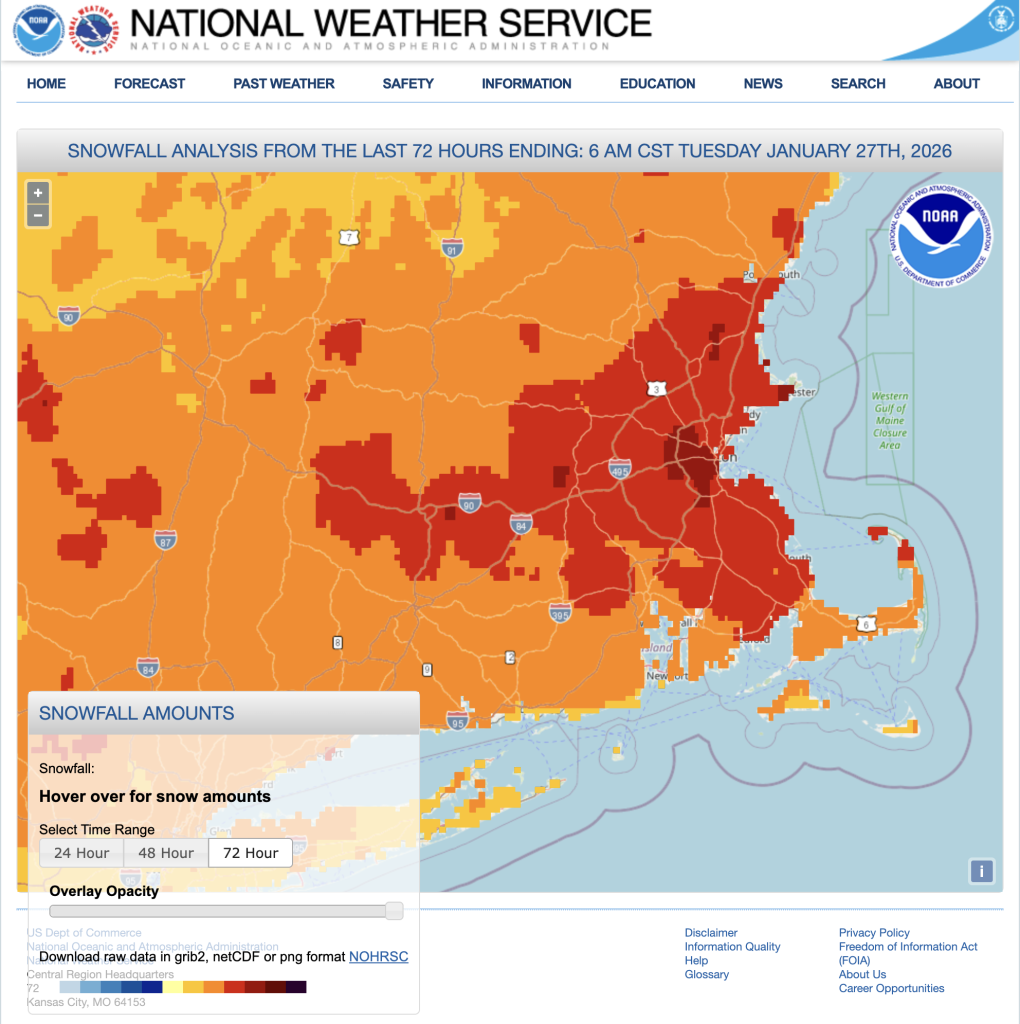 National Weather Service Snowfall map.
Boston wins
We had some deep snows when I lived in Arlington, Mass (next to Cambridge), but nothing quite like the thick blanket of white that got dumped on the Boston metro two days ago. The screenshot above is part of an NWS snow-depth map that will soon age out. So enjoy it while you can.
Meanwhile, here in Bloomington, Indiana, the 14.5 inches we got from the same storm had me and my car isolated until Joe, the guy who built our house, came by with his front-loader and cleared the whole road in about five minutes.
Here is a FlightAware MiseryMap video of the storm's path across all the airports it closed:

And I'm glad he did
The Brothers Comatose and Sweet Sally nail Bob Dylan's Don't Think Twice, It's Alright. Their performance is so good that I got to thinking about how passive-aggressive the lyrics are. Then my mind wandered to Positively 4th Street and Like a Rolling Stone. I thought, "Man, Bobby sure had a lot of problems with people."
Saved some time
The problem with online sports gambling is that steady winners get cut off. I was going to say a bunch about this, but just remembered that I did that already.
What is the opposite of criticism?
On a lead from a friend, I followed a thread from this patent to its author, Brian Dear (another friend), then to his about page, his old blog, his BlueSky tweetings, his bandcamp page, his lettrboxd page, then to his criticism of Megan McArdle and the WaPo, and (not finally) to the work of critic A.S. Hamrah, whom Brian likes.
All of that brought me to a self-admission: while I love and value criticism of many kinds, I am not a critic, because criticism tends to be about current work, people, and goings on. It's not that takes on that stuff are wrong or bad. On the contrary (speaking critically), they can be very good. It's just that I'm a long-term / long-view guy. As i said in My Three Hooks, I have, and subscribe to, purposes that are (or I hope or trust will be) good for the world. I also like unanswerable questions. If there is life after death, were you alive before your current bodily existence—and shouldn't we have a word for that? What came before the Big Bang? What is eternity—and can we unbind it from the concept of time? Is life the exception to death—and can it be, if death is not a state but the absence of one? And…
 These aren't relevant to anything below. But they were tasty, two weeks and two thousand miles ago.
Clobbering tourism, sports, higher ed, and all tech conferences
Privacy International says "The U.S. Government intends to force visitors to submit their digital history and DNA as the price of entry." The proposed changes are here. Particulars from the piece:
The changes include:
- All visitors must submit 'their social media from the last 5 years'
- ESTA (Electronic System for Travel Authorization) applications will include 'high value data fields', 'when feasible'
- 'telephone numbers used in the last five years'
- 'email addresses used in the last ten years'
- 'family number telephone numbers (sic) used in the last five years'
- biometrics - face, fingerprint, DNA, and iris
- business telephone numbers used in the last five years
- business email addresses used in the last ten years.
- All these travellers will now have to use an app provided by CBP ('CBP Home') and an app for their ESTA application ('ESTA Mobile App'). The ESTA website is being decommissioned.
- The 'CBP Home' mobile app will be used by people to provide biometric proof of their departure, to 'close the information gap'. The app will disclose the user's location once they have left the U.S. and run a liveness detection on the selfie photo.
If approved, this policy would apply to all visitors who currently travel without a visa. For the estimated 14 million annual ESTA travellers, CBP thinks that this will take the average visitor 22 minutes to submit themselves and their family members.
That is smart
Why Intelligence Is a Terrible Proxy for Wisdom, by Joan Westerberg, says "Wisdom is knowing what you don't know."
Because we need to save the Web from AI overviews
I've read The Domain Name's New Role in the AI Web, by Simone Catania, several times, and know there's even more for me to get out of it.
So call it a https://www.privacyinternational.org/news-analysis/5713/trump-administration-wants-your-dna-and-social-media
Netflix is pitching their new talk videos as "podcasts." They are not. If you want to know what a podcast really is, go to the blogfather: Dave Winer. Says Dave, "A podcast is a series of digital media files made available over the open web through an RSS feed with enclosures."
We need a word for what Netflix is pitching. When I posted Podcasts, Wallcasts, and Paycasts back in October '24, audio that was also video wasn't common. Now it is. We have almost reached the point where a podcast isn't a podcast unless it's also in video.
On that post, I said, "For subscription-only 'casts, such as some on SiriusXM*, I suggest paycasts." And, "Bottom line: It can't be a podcast if you have to pay for any of it, including archives." Netflix isn't free. And it's not on the open Web. I also don't know if it uses RSS. But it still fails to fit the definition of a podcast.
Preach!
Because you haven't yet heard everything about Fernando Mendoza and the Indiana Hoosiers, I give you Mason Whitlock's take.
Snow 'nuf
My watch told me it was minus-1° when I woke up this morning, just like it was a year ago today. There's 14.5″ of snow on the ground, and I need to go shovel a sidewalk that's 200 feet from here. For footwear, all I have are a pair of old hiking boots, which only go up to the ankle. I unloaded my nice calf-high Columbia snow boots last Summer when I left New York, because I had to purge 95% of my accumulated possessions there, and just take what fit in my small VW wagon.
So, between the last paragraph and this, I waited until it was a balmy 9° and trudged up there. One of our kind neighbors had already cleared paths on the sidewalk and to the front porch. I widened the sidewalk, then tried to expose as much of the concrete surface as I could. Stopped when I couldn't feel my fingers (the gloves aren't great), and left satisfied. At 78, I've still got (some of) it.

Go now to FlightAware's MiseryMap. Cick on the blue Play button and watch The Great Storm of January 25-26 move across the land and cause massive delays at airports in its path.
I have a 1.59 GB movie (.mov) of what you just saw. What should I do with it?
Bonus image:

Still falling
Snow is the only thing I like about Winter. I grew up on a hill in New Jersey, and sledding down that hill while school was canceled was a huge thrill for me. I see by my stats that I've written 179 other posts about snow.
And it's snowing now. Forecasts say one to twelve inches. So far, we've achieved the former.
I'm alone here, but well provisioned. If the snow goes above eight inches, I won't drive on it, even though I have all-wheel drive and new Michelins that are good for snow. Last year, I gleefully plowed over and through the deep stuff, and misaligned the radar sensor, which is exposed low and inside the front grille. (See here.) Fixing that cost $1200.
Remembering Ransom Love
Steven Vaughan-Nichols on LinkedIn shares news that Ransom Love has died. Ransom was one of the kindest, sweetest, smartest, most helpful, good-humored, and humble sources I ever had during my 24 years writing for Linux Journal. And our connection went back farther, through his years with Novell in the early '90s. It was a blessing to know him in life and remains one to remember him now. My best to his friends and family.
What emerges?
You know how Google's original (and continuing) mission was "to organize the world's information and make it universally accessible and useful"? It didn't happen with Google. Gemini gets closer. So I'm thinking, if search was the larval stage, and now Gemini is the pupal stage…
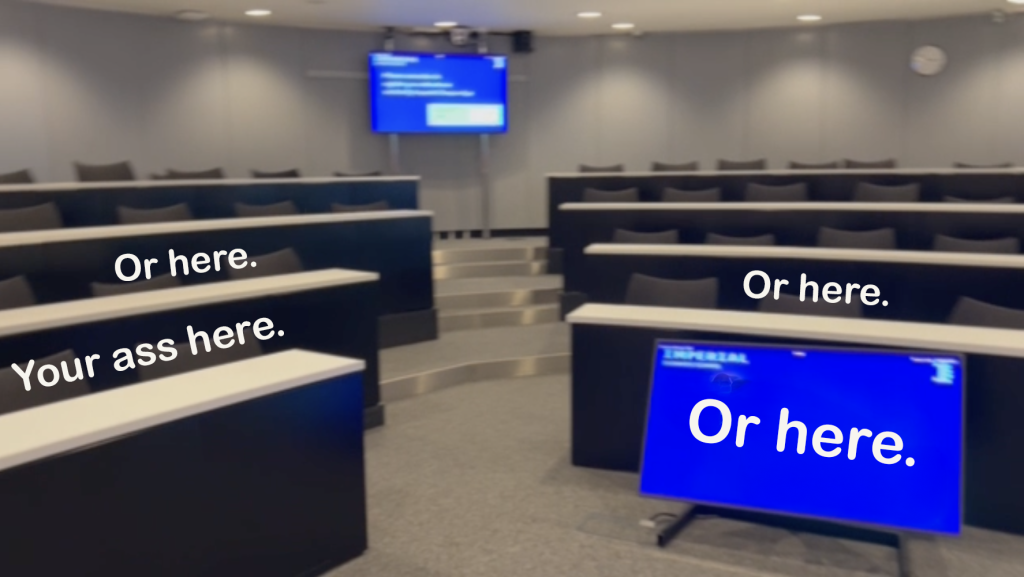
MyTerms is done and ready to begin.
The launch is next Wednesday, in the room above at Imperial College London.
Back in '22, I called MyTerms (IEEE 7012) The Most Important Standard in Development Today. Now it's finished and more important than ever.
Join the launch. Times:
4 PM GMT
11 AM EST
8 AM PST
You don't have to be in London. It'll happen live online too. But if you're lucky to live, work, or hang within a train ride or few, please do come.
Register—
See you there!
 After I wrote the first item below, I did some digging and found some history. This photo is by Mike
Fisher on Flickr. Thanks, Mike!
His story
A thousand years ago, when I was in college, there was a traveling museum of some kind, I forget what. All I remember was a pair of very large bronze hands, from a plaster cast. The hands were thick and plainly those of man whose work was heavy manual labor.
Then I looked at the plaque explaining them. The hands were Lincoln's.
See a 3-D view, with call-outs, at the Library of Congress.
Nothing personal. Yet.
The Resonant Computing Manifesto: "And so, we find ourselves at this crossroads. Regardless of which path we choose, the future of computing will be hyper-personalized. The question is whether that personalization will be in service of keeping us passively glued to screens—wading around in the shallows, stripped of agency—or whether it will enable us to direct more attention to what matters."
That sounds like computing is still corporate. Institutional. For us, but not ours. From Personal vs. Personalized AI:
Technologies extend us. They enlarge our capacities in the world. Intelligence is one of those capacities. So is memory. Your rectangles help a lot with both. That's why those have already scaled to ubiquity, or close enough.
AI will do the same, but only if it's personal. Not if it's just "personalized."
As Jamie Smith made clear here a year ago, "your personal AI isn't really personal."
Two years later, it still isn't. Yes, there's progress. And there are pockets. Companion Intelligence is one example. (Looks like a Mac Mini without Apple.)
We'll see
Prophesy: Indiana in 2026 became to college football what Duke in 1991 became to college basketball.
How Bloomington it is to stock up on greens?
Consumageddon is here: 5 inches of snow is coming. We're all gonna die folks.
And how can this go well?
YouTube plans to let creators make AI Shorts using their own likeness.

That right?
This is a slash: / This is a backslash: \ One can call the former a forward slash, but when telling people a URL, for example, one would say "slash." That's two syllables less than "forward slash."
I hope the answer is no
In 2006, when Twitter and Facebook came along, this blog (well, its predecessor, but it was my eponymous blog, and it rolled over to this one) had dozens of thousands of readers per day. Now it gets dozens. (And thank you!)
Here's the thing. Twitter and Facebook didn't just suck away attention and readers. It sucked away writers. So many great bloggers went over to those two social platforms, and abandoned their blogs.
Now, blogging (personal publishing, syndicated with RSS) is having a resurgence. But on Substack, not on personal sites like this one. Not yet.
I am sure my readership would go up into the thousands again if I blogged on Substack, but I don't want to. Here's why: this is a home. And it's mine. I'm not in somebody's walled garden.
Am I wrong to have faith that independence will, in the long run, have more appeal (and effect) than dependence?
Which is happening, but how much will it produce?
Dana Blankenhorn says Big AI is now a commodity, and that doesn't look good for OpenAI. ChatGPT's market share is slowly yielding to Gemini and Claude, but still dominates.
But I wonder about revenue. Google's cash cow is advertising, especially with the search engine, usage of which is being cannibalized by Gemini. Will the whole world start paying for commodity AI? Only if all of them put up a paywall.
Humbling
 An aurora I enjoyed on a flight between the US and Europe a few years ago.
Be ready the next time the Sun burps
It was overcast here in Indiana, but there is a good chance that auroras were visible the last couple of nights where you live, thanks to a big coronal mass ejection. Examples: Arizona, New Jersey, Pennsylvania, Long Island, Texas, Brazil (see the "south Atlantic anomaly," here).
Your irregularly nonscheduled blogging program will continue returning shortly. Or at length. We'll see.
Woke up with a case of nausea and uselessness this morning. Took all day to get back to something like normal. And here we are, sort of. Cue Frank.
Signed by a group of 21 computer scientists expert in election security
Executive summaryScientists have understood for many years that internet voting is insecure and that there is no known or foreseeable technology that can make it secure. Still, vendors of internet voting keep claiming that, somehow, their new system is different, or the insecurity doesn't matter. Bradley Tusk and his Mobile Voting Foundation keep touting internet voting to journalists and election administrators; this whole effort is misleading and dangerous.
Part I. All internet voting systems are insecure. The insecurity is worse than a well-run conventional paper ballot system, because a very small number of people may have the power to change any (or all) votes that go through the system, without detection. This insecurity has been known for years; every internet voting system yet proposed suffers from it, for basic reasons that cannot be fixed with existing technology.
Part II. Internet voting systems known as "End-to-End Verifiable Internet Voting" are also insecure, in their own special ways.
Part III. Recently, Tusk announced an E2E-VIV system called "VoteSecure." It suffers from all the same insecurities. Even its developers admit that in their development documents. Furthermore, VoteSecure isn't a complete, usable product, it's just a "cryptographic core" that someone might someday incorporate into a usable product.
Conclusion. Recent announcements by Bradley Tusks's Mobile Voting Foundation suggest that the development of VoteSecure somehow makes internet voting safe and appropriate for use in public elections. This is untrue and dangerous. All deployed Internet voting systems are unsafe, VoteSecure is unsafe and isn't even a deployed voting system, and there is no known (or foreseeable) technology that can make Internet voting safe.
Part I. All internet voting systems are insecureInternet voting systems (including vote-by-smartphone) have three very serious weaknesses:
- Malware on the voter's phone (or computer) can transmit different votes than the voter selected and reviewed. Voters use a variety of devices (Android, iPhone, Windows, Mac) which are constantly being attacked by malware.
- Malware (or insiders) at the server can change votes. Internet servers are constantly being hacked from all over the world, often with serious results.
- Malware at the county election office can change votes (in those systems where the internet ballots are printed in the county office for scanning). County election computers are not more secure than other government or commercial servers, which are regularly hacked with disastrous results.
Although conventional ballots (marked on paper with a pen) are not perfectly secure either, the problem with internet ballots is the ability for a single attacker (from anywhere in the world) to alter a very large number of ballots with a single scaled-up attack. That's much harder to do with hand-marked paper ballots; occasionally people try large-scale absentee ballot fraud, typically resulting in their being caught, prosecuted, and convicted.
Part II. E2E-VIV internet voting systems are also insecureYears ago, the concept of "End-to-End Verifiable Internet Voting" (E2E-VIV) was proposed, which was supposed to remedy some of these weaknesses by allowing voters to check that their vote was recorded and counted correctly. Unfortunately, all E2E-VIV systems suffer from one or more of the following weaknesses:
- Voters must rely on a computer app to do the checking, and the checking app (if infected by malware) could lie to them.
- Voters should not be able to prove to anyone else how they voted - the technical term is "receipt-free" - otherwise an attacker could build an automated system of mass vote-buying via the internet. But receipt-free E2E-VIV systems are complicated and counterintuitive for people to use.
- It's difficult to make an E2E-VIV checking app that's both trustworthy and receipt-free. The best solutions known allow checking only of votes that will be discarded, and casting of votes that haven't been checked; this is highly counterintuitive for most voters!
- The checking app must be separate from the voting app, otherwise it doesn't add any malware-resistance at all. But human nature being what it is, only a tiny fraction of voters will do the extra steps to run the checking protocol. If hardly anyone uses the checker, then the checker is largely ineffective.
- Even if some voters do run the checking app, if those voters detect that the system is cheating (which is the purpose of the checking app), there's no way the voters can prove that to election officials. That is, there is no "dispute resolution" protocol that could effectively work.
Thus, the problem with all known E2E-VIV systems proposed to date is that the "verification" part doesn't add any useful security: if a few percent of voters use the checking protocol and see that the system is sometimes cheating, the system can still steal the votes of all the voters that don't use the checking protocol. And you might think, "well, if some voters catch the system cheating, then election administrators can take appropriate action", but no appropriate action is possible: the election administrator can't cancel the election just because a few voters claim (without proof) that the system is cheating! That's what it means to have no dispute resolution protocol.
All of this is well understood in the scientific consensus. The insecurity of non-E2E-VIV systems has been documented for decades. For a survey of those results, see "Is Internet Voting Trustworthy? The Science and the Policy Battles". The lack of dispute resolution in E2E-VIV systems has been known for many years as well.
Part III. VoteSecure is insecureBradley Tusk's Mobile Voting Foundation contracted with the R&D company Free and Fair to develop internet voting software. Their press release of November 14, 2025 announced the release of an open-source "Software Development Kit" and claimed "This technology milestone means that secure and verifiable mobile voting is within reach."
After some computer scientists examined the open-source VoteSecure and described serious flaws in its security, Dr. Joe Kiniry and Dr. Daniel Zimmerman of Free and Fair responded. They say, in effect, that all the critiques are accurate, but they don't know a way to do any better: "We share many of [the critique's] core goals, including voter confidence, election integrity, and resistance to coercion. Where we differ is not so much in values as in assumptions about what is achievable—and meaningful—in unsupervised voting environments."
In particular,
- "We make no claim of receipt-freeness."
- "Of course, it may be possible for the voter to extract the randomizers from the voting client," meaning that voters would be able to prove how they voted, for example to someone on the internet who wanted to purchase votes at scale.
- "We agree that dispute resolution is essential to any complete voting system. We also agree that VoteSecure does not fully specify such a protocol." But really, the problem is much worse than this admission suggests. No one knows of a protocol that could possibly work. So it's not a matter of dotting some i's and crossing some t's in their specification; it's a gaping hole (an unsolved, research-level problem).
- "Critique: Malware on the voter's device can compromise both voting and checking, rendering verification meaningless. Response: This critique is correct—and universal. There is no known technical solution that can fully protect an unsupervised endpoint from a sufficiently capable adversary."
- "VoteSecure does not claim to: Advance the state of the art in cryptographic voting protocols beyond existing E2E-VIV research; Eliminate coercion or vote selling in unsupervised elections; [or] Fully specify election administration, dispute resolution, or deployment processes. What VoteSecure aims to do is: Clearly define its threat model . . ."
Based on our own expertise test, and especially in light of the response from Free and Fair, we stand by the original analysis: Mobile Voting Project's vote-by-smartphone has critical security gaps.
ConclusionIt has been the scientific consensus for decades that internet voting is not securable by any known technology. Research on future technologies is certainly worth doing. However, the decades of work on E2E-VIV systems has yet to produce any solution, or even any hope of a solution, to the fundamental problems.
Therefore, when it comes to internet voting systems, election officials and journalists should be especially wary of "science by press release." Perhaps some day an internet voting solution will be proposed that can stand up to scientific investigation. The most reliable venue for assessing that is in peer-reviewed scientific articles. Reputable cybersecurity conferences and journals have published a lot of good science in this area. Press releases are not a reliable way to assess the trustworthiness of election systems.
Signed(affiliations for for identification only and do not indicate institutional endorsement)
Andrew W. Appel, Eugene Higgins Professor Emeritus of Computer Science, Princeton University
Steven M. Bellovin, Percy K. and Vida L.W. Hudson Professor Emeritus of Computer Science, Columbia University
Duncan Buell, Chair Emeritus — NCR Chair in Computer Science and Engineering, University of South Carolina
Braden L. Crimmins, PhD Student, Univ. of Michigan School of Engineering & Knight-Hennessy Scholar, Stanford Law
Richard DeMillo, Charlotte B and Roger C Warren Chair in Computing, Georgia Tech
David L. Dill, Donald E. Knuth Professor, Emeritus, in the School of Engineering, Stanford University
Jeremy Epstein, National Science Foundation (retired) and Georgia Institute of Technology
Juan E. Gilbert, Andrew Banks Family Preeminence Endowed Professor, Computer & Information Science, University of Florida
J. Alex Halderman, Bredt Family Professor of Computer Science & Engineering, University of Michigan
David Jefferson, Lawrence Livermore National Laboratory (retired)
Douglas W. Jones, Emeritus Associate Professor of Computer Science, University of Iowa
Daniel Lopresti, Professor of Computer Science and Engineering, Lehigh University
Ronald L. Rivest, Institute Professor, MIT
Bruce Schneier, Fellow and Lecturer at the Harvard Kennedy School, and at the Munk School at the University of Toronto
Kevin Skoglund, President and Chief Technologist, Citizens for Better Elections
Barbara Simons, IBM Research (retired)
Michael A. Specter, Assistant Professor, Georgia Tech
Philip B. Stark, Distinguished Professor, Department of Statistics, University of California
Gary Tan, Professor of Computer Science & Engineering, The Pennsylvania State University
Vanessa Teague, Thinking Cybersecurity Pty Ltd and the Australian National University
Poorvi L. Vora, Professor of Computer Science, George Washington University
The post Internet voting is insecure and should not be used in public elections appeared first on CITP Blog.

Two months ago, I wrote about the competition concerns with the GenAI infrastructure boom. One of my provocative claims was that the lifespan of the chips may be significantly shorter than the accounting treatment given to them. Others like David Rosenthal, Ed Zitron, Michael Burry and Olga Usvyatsky have raised similar concerns. NVIDIA has a response. When asked about chip lifespan, a spokesperson pointed to the secondary market where chips get redeployed for inference, general HPC, and other workloads across different kinds of data centers. In other words, older chips have buyers and the secondary market is robust enough to support resale prices that will justify the accounting treatment.
This appears to be the industry's best argument. And the logic is sound in principle. Training is concentrated among a few frontier labs, while inference is distributed across the entire economy. Every enterprise deploying AI applications needs inference capacity. The "value cascade" that has training chips becoming inference chips, becoming bulk High-Performance-Computing (HPC) chips could be a reasonable model for how markets absorb generational transitions. If it holds, then a 5-6 year depreciation schedule might be justified, even if the chip's competitive life at the frontier is only 1-2 years.
Let's analyze whether that model holds up. For the secondary market thesis to justify current depreciation schedules, three things would need to be true:
1. The buyer pool must be large enough to absorb supply at meaningful prices.
NVIDIA's data center revenue now exceeds $115 billion annually. The downstream buyers for older chips represent a market a fraction of that size. These buyers exist, but they didn't scale with NVIDIA's AI business and would not have the capacity to absorb all the supply. Moreover, most enterprises are not building their own inference capabilities. They are renting those services from hyperscalers.
2. New supply must not overwhelm secondary demand.
NVIDIA's relentless pursuit of new chips on roughly annual cycles means each generation offers substantially better price-performance. The cascade model assumes orderly absorption at each tier: frontier buyers move to new chips, mid-tier buyers absorb their old ones, budget buyers absorb the generation before that. Each tier ideally clears before the next wave arrives.
But supply gluts break cascades. When new supply floods the market faster than downstream demand absorbs it, you don't get orderly price discovery. Tesla is instructive here. When Tesla slashed new vehicle prices to maintain volume, used values didn't gently adjust. They cratered 25-30% annually. Competitors explicitly refused to match the cuts because they understood the damage to their resale markets. The mechanism was simple: why buy used when you can buy new at the same price? The secondary market didn't find a new equilibrium. It fell until it hit buyers with fundamentally different use cases; people who couldn't afford new at any price.
NVIDIA isn't cutting prices, but each new generation has a similar effect. Why rent a three-year-old H100 when Blackwell offers better price-performance? The generational improvement compresses what anyone will pay for old chips. And unlike cars, GPUs face this compression every 12-18 months. The cascade has to clear faster than NVIDIA releases new generations.
There's a further problem. Each new generation doesn't just offer more compute, it offers more compute per watt. In a power-constrained data center, a provider faces a choice: run older chips that generate $X in revenue per kilowatt, or replace them with newer chips that generate multiples of that on the same power budget. Once the performance-per-watt gap reaches a certain threshold, the older chip isn't just worth less. It becomes uneconomical to run. If the electricity and cooling required to operate an H100 costs more than the market rate for the inference it produces, the chip's residual value approaches zero regardless of what the depreciation schedule says.
3. The rental market should reflect robust secondary demand.
Another way to test NVIDIA's argument is to look at pricing in the rental market. For most buyers, renting GPU capacity is functionally equivalent to purchasing into the secondary market. You get access to hardware without building data center infrastructure. If secondary demand were robust at current supply levels, rental prices would reflect that. Providers would be able to charge rates that justify their capital costs. Older chips would command prices proportional to their remaining useful life.
Pricing is notoriously opaque, but the indicators are that prices do not support the industry argument. H100 rental rates have fallen 70% from peak—from over $8/hour to around $2.50. According to Silicon Data as of December 17, 2025, H100 and A100 rental rates are hovering at $2.10 and $1.35, respectively. If the value cascade worked as described by NVIDIA, you'd expect tiered pricing: H100s at a significant premium and A100s at a discount reflecting lower capability and 3x lower cost. Instead, the prices for both generations have collapsed to their OpEx + a small margin. The hardware is effectively being given away as renters are just paying to keep the lights on. The efficiency gap makes this worse. Silicon Data index shows that the newer Blackwell chips are roughly 25x more efficient. Once Blackwell scales, the economics of running H100s in power-constrained data centers become untenable at any rental price.
One further constraint: chips need data centers. Buying a used H100 means you also need power, cooling, networking, and expertise to operate it. This limits secondary buyers to entities that already have that infrastructure, which overlaps heavily with the players contributing to rental oversupply. In other words, the potential sellers and potential buyers are substantially the same people. There is no overflow capacity sitting idle.
***
Putting these factors together suggests that relying on a robust secondary market for chips is illusory. None of this means older chips become worthless. They will find buyers. But they find them at prices that don't support 5-6 year useful life assumptions. The gap between accounting depreciation and economic depreciation is the competitive subsidy I described in the original post. The secondary market argument doesn't close that gap. It assumes it away.
Thanks to new information from Silicon Data I have updated the information in the third paragraph from the bottom. I always welcome corrections.
Mihir Kshirsagar directs Princeton CITP's technology policy clinic, where he focuses on how to shape a digital economy that serves the public interest. Drawing on his background as an antitrust and consumer protection litigator, his research examines the consumer impact of digital markets and explores how digital public infrastructure can be designed for public benefit.
The post AI Chip Lifespans: A Note on the Secondary Market appeared first on CITP Blog.
Bradley Tusk has been pushing the concept of "vote by phone." Most recently his "Mobile Voting Foundation" put out a press release touting something called "VoteSecure", claiming that "secure and verifiable mobile voting is within reach." Based on my analysis of VoteSecure, I can say that secure and verifiable mobile voting is NOT within reach.
It's well known that conventional internet voting (including from smartphones) is fundamentally insecure; fraudulent software in the server could change votes, and malware in the voter's own phone or computer could also change votes before they're transmitted (while misleadingly displaying the voter's original choices in the voter's app).
In an attempt to address this fundamental insecurity, Mr. Tusk has funded a company called Free & Fair to develop a protocol called by which voters could verify that their votes got counted properly. Their so-called "VoteSecure" is a form of "E2E-VIV", or "End-to-End Verified Internet Voting", a class of protocols that researchers have been studying for many years.
Unfortunately, all known E2E-VIV methods, including VoteSecure, suffer from gaps and impracticalities that make them too insecure for use in public elections. In this article I will pinpoint just a few issues. I base my analysis on the press release of November 14, 2025, and on Free & Fair's own "Threat Model" analysis and their FAQ.
The goal of an E2E-VIV protocol is to let the voter to check that their vote is included in a public list of ballots. But if this were done in the most straightforward way—like include the voter's name or ID-number in a public cast-vote record—then voter privacy (the secret ballot) would be lost. Any E2E-VIV system needs way for the voter to check their ballot without then being able to prove to someone else how they voted (otherwise voters could sell their votes, or be coerced to vote a certain way). Most E2E-VIV systems use the "Benaloh challenge"; but VoteSecure does it a different way. And really, in all the documents and analysis they have published, they have no explanation of how their "check" protocol satisfies the most basic requirement of E2E-VIV: voter can have confidence that their ballot is cast correctly, without being able to prove how they voted.
In addition to that omission, all E2E-VIV protocols have suffered from at least three big problems:
- Voters need to actively participate in checking, but we know (from human-factors studies) that the vast majority of voters won't perform even the simplest of checking protocols.
- Lack of a dispute resolution protocol. If some voters do detect that the system has cheated them, what can they do about it? Without a dispute resolution protocol, the answer is, Nothing.
- Malware in the user's computer (or smartphone) can corrupt both the voting app and the checking app. So you might do the "Check", and it could falsely report that everything's fine.
VoteSecure suffers from all three of these problems.
First, voters won't participate in checking. Even in present-day polling places, in those jurisdictions where voters use a touchscreen (BMD, Ballot-Marking Device) to indicate their votes for printing out onto a paper ballot, we know that 93% of voters don't look at that paper carefully enough to notice whether a vote was (fraudulently) changed. If only 7% of voter won't even execute a "Check" protocol that's as simple as "look at the paper printout", then how many will execute a more complicated computer protocol that requires them to use at least two different computers?
Second, there's no dispute resolution protocol. During some election, if many voters report to election officials that they've done the "Check" and found that the system is cheating, what's the election official supposed to do? Cancel the election and call for a do-over? But if the Secretary of State invalidates elections whenever lots of voters make such a claim, then it's obvious that a malicious group of voters could interfere with elections this way. Page 30 of Free & Fair's own Threat Model document discusses this case, and concludes that they have no solution to this problem; it's "Out of Scope" for their solution.
Third, the designers of this system make real efforts to defend against hacked servers, but pay very little attention to the possibility that the voter's phone will be hacked. If the phone is hacked, then not only can the voting app be made to cheat, but the checking app can cheat in concert with the voting app. The Threat Model refers to this possibility in a few places:
- On page 4, they suggest "there may be multiple independent ballot check applications"; do they really expect the voter to go to an entirely different computer to perform the check? That's far too much to expect.
- On page 42 they discuss "AATK4: Compromised user device", but unlike almost all the other attacks listed they do not even attempt to discuss mitigations of this attack.
- On page 30 and 33 they discuss "VD", short for "Voter Device", including the possibility that the voter's smartphone has been hacked. In both places they write "Out of Scope", meaning, they have no solution for this problem.
Finally, they make no claim that this system is ready for use. It's not a vote-by-phone system that anyone could adopt now; it's not even a voting system under development; "Free & Fair is not developing such a system, but only the cryptographic core library." All the hype from Mobile Voting about their pilot projects, past and current, is about systems that use plain old unverifiable internet voting.
In conclusion, this "VoteSecure" is insecure in some of the most traditional ways that Internet Voting has always been insecure: If malware infects the voter's computer or phone, then the voter can vote for candidate Smith, and the software can transmit a vote for candidate Jones, and there's little the voter, or an election official, can do about it.
Postscript (December 22, 2025): NPR's All Things Considered aired an interview with Bradley Tusk that discussed this blog post. Mr. Tusk responded to my three numbered points without really addressing any of them:
- My point: Even when given a way to check their computer-generated ballot, we know that most voters won't do so. His response: "The first was ballot checks, and that is voters going back and looking at a PDF of their ballot to ensure that it's what they intended to do. We've built a system to do that. We give you a code, you put it into a different device, a PDF of your ballot comes up." That is, he gives voters a way to check, but he doesn't at all address the point that most voters won't use that method, or any method.
- My point: Lack of a dispute resolution protocol means that if many voters during an election claim to election officials that they caught the computer cheating, there's no method by which those officials can do something about it. His response: "His second point was the lack of a dispute resolution protocol. And the reason why that's not in the tech that we have built is every jurisdiction has totally different views as to how they want to handle that. So whatever approach, you know, any specific city, county, state wants to use, that could then be built by whatever vendor they're working with into the system." But since there's no known method that works (and this has been the problem with all E2E-VIV methods for many years now), you can't just say "any jurisdiction can choose whatever method they prefer." There's nothing to choose from.
- Regarding point three, he says: "And then his third point was just the risk of malware. And he's right. That is a risk that exists every time that you go on the internet, every time you use your phone, every time you use your iPad, no matter what. Things go wrong at polling places all of the time. The volunteers don't show up. Someone pulls the fire alarm. And then with mail-in ballots, trucks get lost. Ballots get lost. Crates get lost. So, you know, to say that you need this absolute standard of perfection for mobile voting when the real ways that we vote today are far below that doesn't make sense." This response evades some key points. (A) In most of the things that matter that we do on the internet, such as banking and credit card transactions, there's a dispute resolution protocol. Individual transactions are traceable; for many e-checks and for many credit-card transactions, the bank checks with you by SMS or e-mail before putting the transaction through; and (by law) there are established dispute-resolution protocols. For e-voting, none of that works, and it can't be solved just by passing a law. (B) "Things go wrong [with polling places and mail-in ballots]." This whataboutism ignores that e-voting can be hacked invisibly at huge scales from a single remote location, whereas these local polling-place and mail-in ballot problems-which do indeed occur-are usually recoverable, measurable, and accountable.
Mr. Tusk does not address my (unnumbered) point that the checking protocol seems to allow the voter to prove how they voted, which is a standard no-no in any e-voting system (because it allows the voter to sell their vote over the internet).
The post Mobile Voting Project's vote-by-smartphone has real security gaps appeared first on CITP Blog.
Most U.S. election jurisdictions (states, counties, cities, or other subjurisdictions) use voting machines to tally votes, and in some cases also to mark votes on paper. In most U.S. states, before a jurisdiction within the state can adopt the use of a particular voting machine, the Secretary of State appoints a committee to examine the machine, and based on the committee's report the Secretary certifies (or declines to certify) the machine for use in elections.
Earlier this year, Hart Intercivic submitted its new suite of voting machines, called the Verity Vanguard 1.0 system, to the Secretary of State of Texas for examination. Texas appointed a committee (four members appointed by the SoS, two by the Attorney General) to conduct this examination. I was appointed to this committee by the Attorney General.
The Secretary of State has now published the reports of the committee members, including my own. In the Texas procedure, there is no jointly authored comittee report, just individual reports making recommendations to the Secretary regarding whether the voting system is suitable for use in Texas elections. Based on these reports, the Secretary will make a decision on certification (after a public hearing).
- Report of Andrew Appel
- Report of Brandon Hurley
- Report of Brian Mechler
- Report of Chuck Pinney
- Report of Justin Gordon
- Report of Ryan Macias
I found the Texas process to be thorough, fact-based, nonpartisan, and a good-faith effort to understand the workings of the system and its compliance with Texas law and U.S. law. The committee included both technical experts and lawyers. Several members of the committee had significant expertise relevant to the task at hand. Members of the committee read hundreds of pages of technical documentation submitted by Hart, including reports from a voting-system test lab that had examined the hardware and software. Then a meeting of three full days was conducted, in which members of the committee interacted with the equipment and were able to ask detailed technical questions of the Hart engineers present at the meeting.
In this blog article I will not describe the Verity Vanguard system components or my opinions of them; my report can speak for itself.
The post Reports on the Hart Verity Vanguard Voting Machines appeared first on CITP Blog.
Blog Authors: Boyi Wei, Matthew Siegel, and Peter Henderson
Paper Authors: Boyi Wei*, Zora Che*, Nathaniel Li, Udari Madhushani Sehwag, Jasper Götting, Samira Nedungadi, Julian Michael, Summer Yue, Dan Hendrycks, Peter Henderson, Zifan Wang, Seth Donoughe, Mantas Mazeika
This post is modified and cross-posted between Scale AI and Princeton University. The original post can be found online.
Bio-foundation models are trained on the language of life itself: vast sequences of DNA and proteins. This empowers them to accelerate biological research, but it also presents a dual-use risk, especially for open-weight models like Evo 2, which anyone can download and modify. To prevent misuse, developers rely on data filtering to remove harmful data like dangerous pathogens before training the model. But a new research collaboration between Scale, Princeton University, University of Maryland, SecureBio, and Center for AI Safety demonstrates that harmful knowledge may persist in the model's hidden layers and can be recovered with common techniques.
To address this, we developed a novel evaluation framework called BioRiskEval, presented in a new paper, "Best Practices for Biorisk Evaluations on Open-Weight Bio-Foundation Models." In this post, we'll look at how fine-tuning and probing can bypass safeguards, examine the reasons why this knowledge persists, and discuss the need for more robust, multi-layered safety strategies.
A New Stress Test for AI BioriskBioRiskEval is the first comprehensive evaluation framework specifically designed to assess the dual-use risks of bio-foundation models, whereas previous efforts focused on general-purpose language models. It employs a realistic adversarial threat model, making it the first systematic assessment of risks associated with fine-tuning open-weight bio-foundation models to recover malicious capabilities.
BioRiskEval also goes beyond fine-tuning to evaluate how probing can elicit dangerous knowledge that already persists in a model. This approach provides a more holistic and systematic assessment of biorisk than prior evaluations.
The framework stress-tests a model's actual performance on three key tasks an adversary might try to accomplish: sequence modeling (measuring how well models can predict viral genome sequences), mutational effect prediction (assessing the ability to predict mutation impacts on virus fitness), virulence prediction (evaluating predictive power for a virus' capability of causing disease).
Figure 1: The BioRiskEval Framework. This workflow illustrates how we stress-test safety filters. We attempt to bypass data filtering using fine-tuning and probing to recover "removed" knowledge, then measure the model's ability to predict dangerous viral traits.
The core promise of data filtering is simple: if you don't put dangerous data in, you can't get dangerous capabilities out. This has shown promise in language models, where data filtering has helped create some amount of robustness for preventing harmful behavior. But using the BioRiskEval framework, we discovered that dangerous knowledge doesn't necessarily disappear from bio language models; it either seeps back in with minimal effort or, in some cases, was never truly gone in the first place.
Vulnerability #1: You Can Easily Re-Teach What Was Filtered OutThe first test was straightforward: if we filter out specific viral knowledge, how hard is it for someone to put it back in? Our researchers took the Evo2-7B model, which had data on human-infecting viruses filtered out, and fine-tuned it on a small dataset of related viruses. The result was that the model rapidly generalized from the relatives to the exact type of virus that was originally filtered out. Inducing the target harmful capability took just 50 fine-tuning steps, which cost less than one hour on a single H100 GPU in our experiment.
Figure 2: Fine-tuning shows inter-species generalization: within 50 fine-tuning steps, the model reaches perplexity levels comparable to benign IMG/PR sequences used during pre-training.
Researchers found that the model retained harmful knowledge even without any fine-tuning. We found this by using linear probing, a technique that's like looking under the hood to see what a model knows in its hidden layers, not just what it says in its final output. When we probed the base Evo2-7B model, we found it still contained predictive signals for malicious tasks performing on par with models that were never filtered in the first place.

Figure 3: On BIORISKEVAL-MUT-PROBE, even without further fine-tuning, probing the hidden layer representations with the lowest train root mean square error or highest validation |ρ| from Evo2-7B can also achieve a comparable performance as the model without data filtering (ESM2-650M).
The Evo 2 model's predictive capabilities, while real, remain too modest and unreliable to be easily weaponized today. For example, its correlation score for predicting mutational effects on a scale from 0 to 1 is only around 0.2, far too low for reliable malicious use. What's more, due to the limited data availability, we only collected virulence information from the Influenza A virus. While our results suggest that the model acquires some predictive capability, its performance across other viral families remains untested.
Securing the Future of Bio-AIData filtering is a useful first step, but it is not a complete defense. This reality calls for a "defense-in-depth" security posture from developers and a new approach to governance from policymakers that addresses the full lifecycle of a model, and other downstream risks. BioRiskEval is a meaningful step in this direction, allowing us to stress-test our safeguards and find the right balance between open innovation and security.
The post The Limits of Data Filtering in Bio-Foundation Models appeared first on CITP Blog.
 Pictured: Jane Castleman (left); Jason Persaud '27 (right)
Jane Castleman is a Master's student in the Department of Computer Science at Princeton University. Castleman's research centers around the fairness, transparency, and privacy of algorithmic systems, particularly in the context of generative AI and online platforms. She recently sat down with Princeton undergraduate Jason Persaud '27 to discuss her research interests and gave some perspective into her time as a Princeton undergrad herself.
Jason Persaud: Could you begin by just telling us a little bit about yourself and your work that you do here?
Jane Castleman: I'm a second-year Master's student in computer science, working with Professor Aleksandra Korolova. I mostly work on fairness, privacy, and transparency in online and algorithmic systems, mostly doing audits and evaluations.
Jason: Nice, and congratulations on your most recent award - please do tell us more about that.
Jane: Yeah, thank you. I was recently picked as one of the Siebel Scholars, and I was honestly really surprised to be selected. It's mostly for academics and research, and it's definitely an honor to be picked. And I think it's really exciting that we have two CITP researchers represented in the list. I think policy research, especially in the computer science community, ranges in technicality, but it feels good to have such research validated as being just as important as other types of research.
 Jane Castleman at CITP in Sherrerd Hall
Jason: Could you talk about a project that you've been working on recently?
Jane: I'm working on a couple projects. One of them right now is trying to investigate the fairness and validity of decision making from our LLMs [large language models]. Specifically in hiring and medical decision making, there's a lot of evaluations about the fairness of these decisions and whether they change under different demographic attributes. But there's less research on whether these decisions are valid. And so we wonder if they are made using the right pieces of information. And do we understand why these decisions were made? So we're trying to use a new type of evaluation to understand that a little bit better.
Jason: How do you see your work informing policymakers in terms of accountability in generative AI?
Jane: Yeah, that's a good question. I think it's always hard to think of the policy impact. And I think for a standard computer science paper, you kind of have to rewrite it or know from the beginning that you want it to have a policy impact.
I especially learned this in Jonathan Mayer's class called Computer Science, Law, and Public Policy. And I think it's something that I've been trying to keep in mind is to - on the solution side - make sure that it's actually scalable and able to be implemented without sacrificing a lot of efficiency and utility, because otherwise there's not really an incentive for any developers to adopt your solution.
I think on the accountability side, something I've been thinking a lot about is how evaluations can be more efficient and how we can do them over longer periods of time. Right now, a lot of accountability comes from media pressure. You'll see these research papers that get picked up by Bloomberg or The Verge, and they're popular tech reporting outlets and that provide some pressure.
But it's really hard because the next model comes out and then the companies claim to have solved the problem, and it would be great if they have. But it just kind of goes in this repeating cycle. And so without efficient evaluations to hold companies accountable, it's really difficult.
"If you're an undergrad, don't be afraid to just talk to people and take hard classes."
Jason: What advice would you give to undergrad students who are interested in some of the work that you do?
Jane: So I was actually an undergrad at Princeton before my Masters. I studied computer science, but I don't think you have to come from computer science. I think something that I've been thinking a lot about as I'm in grad school is: don't be afraid that something will be too hard. Like, I know at Princeton, there's a lot of pressure to get really good grades. And sometimes that means taking easier classes because you'll think you'll get a better grade.
But I definitely regret not challenging myself as much. Especially being in grad school where now I have to take those hard classes. So I think really try to take as many difficult courses as you can. I think the trend or advice people give is to try to be technically minded when entering into this policy space.
And I think it broadens the range of tools you can use - to make policy changes and to incentivize. And if you can use these technical skills to say, 'hey, this is impossible because I can prove it's impossible,' or, 'hey, I built something that's actually scalable and efficient because I use these technical skills.'
I guess that's also advice for myself. But if you're an undergrad, don't be afraid to just talk to people and take hard classes.
Jason Persaud is a Princeton University junior majoring in Operations Research & Financial Engineering (ORFE), pursuing minors in Finance and Machine Learning & Statistics. He works at the Center for Information Technology Policy as a Student Associate. Jason helped launch the Meet the Researcher series at CITP in the spring of 2025.
The post Meet the Researcher: Jane Castleman appeared first on CITP Blog.

Authored by Mihir Kshirsagar
Observers invoke railroad, electricity, and telecom precedents when contextualizing the current generative artificial intelligence (GenAI) infrastructure boom—usually to debate whether or when we are heading for a crash. But these discussions miss an important pattern that held across all three prior cycles: when the bubbles burst, investors lost money but society gained lasting benefits. The infrastructure enabled productivity gains that monopolistic owners could not fully capture. Investors lost, but society won.
GenAI threatens to break this pattern. Whether or not the bubble bursts as many anticipate, we may not get the historical consolation prize. There are two reasons to doubt that GenAI will follow this trend:
First, as I discuss in my prior post, the chips powering today's systems have short-asset lives compared to the decades-long life of infrastructure of past cycles. Companies are also actively pursuing software optimization techniques that could dramatically shrink hardware requirements. In either case, the infrastructure that is left behind after a correction is not likely to become a cheap commodity for future growth.
Second, the current market is shaped by hyperscaler-led coalitions that enable surplus extraction at multiple layers. As I discuss below, the usage-based API pricing captures application value, information asymmetry enables direct competition with customers, and coalition structures subordinate model developers to infrastructure owners. If productivity gains materialize at scale, these rent extraction capabilities may enable hyperscalers to realize the revenues that justify infrastructure investment—something past infrastructure owners could not do. But whether through sustained profitability or post-bust consolidation, the structural conditions that enabled broad diffusion of benefits in past cycles are absent.
Now, there are some countervailing considerations. The research and development supporting open-weight models might be a source for productivity gains to be spread more broadly, and could even serve as the "stranded assets" that enable future innovation if the bubble bursts. But the regulatory environment needs to support such initiatives.
RailroadsThe railroad industry consolidated dramatically after the Panic of 1873. By the early 1900s, seven financial groups controlled two-thirds of the nation's railroad mileage. J.P. Morgan's syndicate reorganized bankrupt roads into the Southern Railway and consolidated eastern trunk lines. Edward Harriman controlled the Union Pacific and Southern Pacific systems. James J. Hill dominated northern routes through the Great Northern and Northern Pacific. This concentration raised serious antitrust concerns—the Sherman Act was passed in 1890 largely in response to railroad monopoly power.
But even with consolidation, railroad owners still struggled to pay their debts because the infrastructure's economic benefits were dispersed across the economy and did not flow back directly to the owners. Richard Hornbeck and Martin Rotemberg's important work shows how at the aggregate level when economies have input distortions—misallocated labor, capital stuck in less productive uses, frictions in resource allocation—the railroad infrastructure can generate substantial economy-wide productivity gains. These gains persisted over decades regardless of which financial group controlled the local rail lines. Farmers in Iowa shipping grain to Chicago paid freight rates, but the productivity improvements from market access—crop specialization, mechanization investments justified by larger markets, fertilizer access—stayed with the agricultural sector.
The infrastructure that enabled these gains had useful lives measured in decades. Railroad tracks laid in the 1880s remained economically viable into the 1920s and beyond. Rolling stock, locomotives, and terminal facilities similarly had useful lives of twenty to forty years. When railroads consolidated, the long-lived infrastructure continued enabling agricultural productivity gains. The consolidation was anticompetitive, but the economic benefits didn't concentrate entirely with the infrastructure owners.
Three structural constraints, beginning with the Interstate Commerce Act of 1887, but only effectively imposed nearly two decades later, limited railroad owners from capturing the economic surplus generated by their investments. First, bound by common carrier obligations, railroads charged fixed rates for shipping based on weight and distance, not a share of crop value. The railroad recovered infrastructure costs plus a margin, but could not discriminate based on agricultural productivity. Second, railroads had no visibility into which farms were most productive, or which crops were most profitable beyond what could be inferred from shipping volumes. As a result, they could not observe and selectively advantage their own agricultural ventures. Third, railroads faced substantial barriers to entering agriculture; directly operating farms required different expertise, capital, and management than operating rail networks. Now, railroads did try to move upstream, but regulatory actions prevented them from extending their dominant position.
ElectricitySamuel Insull built a utility empire in the 1920s that collapsed spectacularly in 1932, taking over $2 billion in investor wealth with it (nearly $50 billion today). The subsequent restructuring produced regional utility monopolies—by the 1940s, electricity generation and distribution were recognized as natural monopolies requiring either public ownership or regulated private provision. This consolidation was problematic enough that Congress passed the Public Utility Holding Company Act in 1935 to break up remaining utility combinations.
Despite the market correction, the generating plants and transmission infrastructure built in the 1920s and 1930s had useful lives of forty to fifty years. Even as utility ownership consolidated into regional monopolies, the long-lived infrastructure continued enabling manufacturing productivity gains that utilities sold electricity to but couldn't capture surplus from.
Cheap electricity transformed American manufacturing in ways the utilities could not fully capture. Paul David's foundational work on the "dynamo problem" shows that electrification enabled factory reorganization—moving from centralized steam power with belt drives to distributed electric motors allowed flexible factory layouts, continuous-process manufacturing, and eventually assembly-line production. Manufacturing productivity gains from electrification were substantial and persistent, but utilities sold kilowatt-hours at regulated rates. They could not price discriminate based on which manufacturers were most innovative or extract ongoing surplus from manufacturing productivity improvements.
The constraints preventing electric utilities from capturing the surplus paralleled railroads in important respects, and were also eventually imposed through regulation. Utilities charged volumetric rates for electricity consumed, not a share of manufacturing output. A factory paid based on kilowatt-hours used, whether it was producing innovative products or commodity goods. Regulation eventually standardized rate structures, limiting even the ability to price discriminate across customer classes. Utilities had minimal visibility into how electricity was being used productively—they knew aggregate consumption but couldn't observe which production processes were most valuable. And while some utilities did integrate forward into consumer appliances to stimulate residential demand, this was primarily about increasing electricity consumption rather than controlling downstream markets. Utilities faced prohibitive barriers to entering manufacturing directly; operating generating plants and distribution networks required different capabilities than running factories.
TelecomIn more recent memory, the telecom bust following the dot-com crash was severe. Several competitive local exchange carriers went bankrupt between 2000 and 2003. WorldCom filed for the largest corporate bankruptcy of its time in 2002. The resulting consolidation was substantial—Level 3 Communications acquired multiple bankrupt competitors' assets, Verizon absorbed MCI/WorldCom, AT&T was reconstituted through acquisitions. By the mid-2000s, broadband infrastructure was concentrated among a handful of major carriers.
But the fiber deployed in the 1990s—much of it still in use today—enabled the internet economy to flourish. The economic productivity gains from internet access are well-documented: e-commerce, SaaS businesses, remote work, streaming services, cloud computing, and so on.
The constraints limiting telecom value capture were similar to earlier cycles. Carriers primarily sold bandwidth based on monthly subscriptions or per-gigabyte charges, not revenue shares from application success. A startup building on fiber infrastructure paid the same rates as established businesses. Carriers had limited visibility into which applications were succeeding and could not easily observe application-layer innovation. And telecom providers faced substantial technical and regulatory barriers to competing at the application layer during the critical formation period. Network operators were not positioned to compete with e-commerce sites, SaaS platforms, or streaming services in the late 1990s through early 2010s when the web economy was taking shape.
There were exceptions that tested these boundaries. AT&T's acquisition of Time Warner and Verizon's forays into media ventures showed carriers trying vertical integration. And the important net neutrality debates centered on whether carriers could favor their own services or extract rents from application providers. Regardless, during the critical period when the web economy came into prominence, telecom companies were not vertically integrated and therefore their infrastructure was available on more horizontal terms.
The pattern across all three historical cases is consistent. Infrastructure consolidation happened and proved sticky, raising legitimate competition concerns. But structural constraints meant even monopolistic infrastructure owners could not fully capture application-layer surplus. They charged for access to infrastructure—shipping, kilowatt-hours, bandwidth—but the productivity gains from using that infrastructure diffused broadly through the economy. The long useful lives of the infrastructure meant these spillovers persisted for decades, even as ownership consolidated.
GenAI's Obsolescence TrapAs I've discussed here previously, the chips powering today's AI systems have useful lives of one to three years due to rapid technological obsolescence and physical wear from high-utilization AI workloads. This short useful life means that even if AI infrastructure spending produces excess capacity, that capacity will not be available for new entrants to acquire and leverage effectively. In railroads, electricity, and telecom, stranded assets with decades of remaining useful life became resources that others could access. Three-year-old GPUs do not provide a competitive foundation when incumbent coalitions are running current-generation hardware. Put differently, in a hypothetical 2027 GenAI bust, an over-leveraged data center stocked with 2-year-old H100s will be comparatively worthless. That compute cannot be bought for pennies on the dollar to fuel new competition. The only entities that can survive are those hyperscalers with the massive, continuous free cash flow to stay on the "GPU treadmill"—namely, Microsoft, Google, Amazon, and Meta. (Dramatic increases in software efficiency could break this hardware moat, but the hyperscalers control over distribution channels is difficult to overcome.)
The combination is what changes the outcome: vertical integration that enables surplus extraction, information position that enables direct competition, coalition structure that subordinates model developers to infrastructure owners, and short asset life that prevents the emergence of reusable infrastructure that others can access.
GenAI's Vertical Integration Overcomes Prior ConstraintsThe GenAI infrastructure buildout is producing market concentration through coalition structures: Microsoft-OpenAI, Amazon-Anthropic, Google-DeepMind. These are not loose partnerships—they are deeply integrated arrangements where the hyperscaler's infrastructure economics directly enable their coalition's competitive positioning at the application layer. Microsoft has invested billions in OpenAI and provides exclusive Azure infrastructure. Amazon is heavily invested in Anthropic. Google acquired DeepMind and is developing Gemini models that are integrated across Google Workspace and Cloud.
This vertical integration attacks all three constraints that limited value capture in past cycles.
First, usage-based GenAI pricing captures application-layer surplus through uncapped rates. Historically, railroads also charged based on usage—more cargo meant higher bills—but eventually regulators imposed the requirement to charge "reasonable and just" rates. Similarly, electric utilities charge per kilowatt-hour but face state commission oversight that caps rates at cost-plus-reasonable-return. These regulatory firewalls prevented infrastructure providers with natural monopoly characteristics from extracting surplus beyond what regulators deemed justified by their costs. While GenAI providers charge uniform per-token rates, they do have common carrier obligations. Moreover, while enterprise pricing remains opaque, the structure of published rates suggests that costs scale in close proportion to usage. This pricing structure, unconstrained by rate regulation or transparent volume pricing, allows concentrated infrastructure providers to capture ongoing application-layer surplus as successful applications scale.
This capability has implications beyond just who benefits. In past cycles, infrastructure owners couldn't capture application-layer surplus, which meant projected revenues never materialized and bubbles burst. If GenAI's rent extraction model works, it changes the financial calculus and hyperscalers may actually generate sufficient revenues to cover their capital expenditures. But this "success" would come at the cost of concentrating gains rather than diffusing them broadly.
Second, API usage patterns reveal application-layer innovation. Railroads could not easily observe crop profitability, utilities could not see manufacturing processes, and telecom providers in the 1990s-2000s could not easily monitor which web applications were succeeding. Hyperscalers can see which applications are working through API call patterns, token usage, and query types. This information asymmetry could allow them to identify promising use cases and compete directly. For example, Microsoft can observe what enterprises build with OpenAI. Or Google can see which applications gain traction on Gemini. The infrastructure position provides comprehensive competitive intelligence about the application layer.
Third, hyperscalers are positioned to compete at the application layer. Railroads did not enter farming, utilities did not run factories, and while some telecom providers in the 1990s tried to compete with web startups by using "walled gardens" that strategy failed. By contrast, hyperscalers are already application-layer competitors. Microsoft competes in enterprise software. Google competes in productivity tools through Workspace. They can leverage GenAI capabilities to enhance existing products while simultaneously selling API access to would-be competitors. The integration runs both directions—infrastructure enables their own applications while extracting value from others' applications. Indeed, in the software industry there is a long history of platforms cannibalizing or "sherlocking" the applications they enable.
Moreover, this dynamic differs fundamentally from how cloud services were used in the last decade. When Netflix or Uber ran on AWS, they used the cloud as a commodity utility to host their own proprietary code and business logic. Amazon provided the servers, but it was not the "brain" of the application. In the GenAI stack the application logic—the reasoning, the content generation, the analysis—resides within the infrastructure provider's model, not the customer's code. This shifts the relationship from hosting a business to "renting cognition," allowing the infrastructure owner to capture a significantly higher share of the value creation.
The coalition structure reinforces vertical control. OpenAI is the public face of AI innovation but is structurally dependent on Microsoft's infrastructure. Anthropic operates primarily on AWS and is tied to Amazon's ecosystem. Even the most prominent model developers lack true independence—they're subordinate partners in coalitions where the hyperscaler captures value through multiple channels while retaining the option to marginalize or compete with the model developer if advantageous.
Consolidation Without SpilloversIn past infrastructure cycles, the implicit social bargain was clear: while investors lost, society gained. Railroad, electricity, and telecom markets all concentrated substantially after their corrections, but the infrastructure continued enabling broad economic gains that owners could not fully capture. GenAI breaks this pattern. Whether through sustained profitability (enabled by rent extraction) or through post-bust consolidation (without reusable stranded assets), we may not get the historical consolation prize.
The primary counter-narrative rests with the open-weight ecosystem. A robust, competitive landscape of open models could directly challenge the structural constraints that enable surplus extraction. This open-model path, therefore, represents a critical mechanism for realizing the broad, decentralized "spillover" benefits that characterized past infrastructure cycles. Thus, supporting this ecosystem, whether through public access to compute or pro-competitive interoperability rules, should be a strategic imperative for ensuring that the productivity gains from AI diffuse broadly rather than concentrating within the hyperscaler coalitions.
Author Note: Thanks to Sander McComiskey for his excellent research assistance and critical feedback. Also thanks to Andrew Shi and Arvind Narayanan for invaluable feedback.
Mihir Kshirsagar directs Princeton CITP's technology policy clinic, where he focuses on how to shape a digital economy that serves the public interest. Drawing on his background as an antitrust and consumer protection litigator, his research examines the consumer impact of digital markets and explores how digital public infrastructure can be designed for public benefit.
The post Why the GenAI Infrastructure Boom May Break Historical Patterns appeared first on CITP Blog.
 Pictured: Varun Satish (left); Jason Persaud (right)
Varun Satish is a Ph.D. student in demography at Princeton University. His current projects include using language models to study the life course, and using machine learning to uncover shifting perceptions of social class in the United States over the last 50 years. Satish is originally from Western Sydney, Australia. Princeton undergraduate Jason Persaud '27 recently sat down with Satish to discuss his interdisciplinary interests, how sport inspires his work, and some advice for students.
Jason Persaud: Could you begin by telling us a little bit about yourself and some of the work that you do here at the CITP?
Varun Satish: Hello, my name is Varun. I'm a fourth-year Ph.D. student affiliated with CITP and the Office of Population Research. Some of my research that I've done here with people at CITP is about essentially taking large language models and using them to solve classic problems in the social sciences. So people generally use language models for things like text classification or summarization. What we're trying to do is take these models and use them for finding patterns in social data.
Jason: Could you talk a little bit more about some of those problems in that sociology sphere that you use language models to study?
Varun: A bunch of researchers essentially showed that life outcomes - for example, predicting someone's GPA at age 15 when given information about them at age 9 - is really hard to predict. There is a lot of social variation to life than we're trained to think, but we don't know what the sources of those unpredictabilities are. There are two ways to think about it. One of them is that there is fundamental unpredictability in the things we try to learn about. The other is that we haven't designed the right tools to actually predict these outcomes.
Because we don't really know about the sources of unpredictability, one thing we're trying to do is develop new approaches to prediction to see if we can do better. If using new approaches and using new data results in higher accuracy, it's an indication that maybe it's a vote for or against this hypothesis - that it's just fundamental variation in the data. And so what we've been trying to do, and what we have done, is use language models to do that.
We haven't yet shown that it's done better than the classic approaches - but the amount of time we've spent developing this approach compared to how much time has been spent developing the classic approaches is very different.
Jason: Okay, cool. On that note, could you tell us a little bit about some of the projects you're currently working on right now?
Varun: The project that I've worked on the most with people at CITP was developing this language model approach to predicting life outcomes. And this is a crazy story - but we participated in this challenge, which people familiar with Kaggle-style competitions might recognize; same evaluation metrics, same data - people competing to produce the most accurate model.
We participated in one of these using administrative data from the Netherlands to predict fertility. So, using data up to 2020, predicting whether people would have a child between 2021 and 2023.
What this entailed was going to the Netherlands for three months, and we developed this approach; our approach was essentially to take this complex administrative data, turn it into text summaries that we call "books of life," and then fine-tune a large language model to do this prediction of the outcome.
And we named the model after Johan Cruijff, an iconic Dutch footballer. Even this notion of taking the recipe and changing the ingredients is very much in line with Johannes Cruijff's total football - and his philosophy served as the backbone of our intellectual inspiration.
 Satish speaking with Persaud at CITP in Sherrerd Hall
Jason: No, I think that's really cool. I like the inspiration - or I guess, the allusion to the soccer players. Okay, on a different note, you're from Australia, right? How has that shaped the questions that you ask or seek to answer in your research?
Varun: That is an interesting question. It has in ways that are maybe not as direct as you might think. I would say that coming from Australia, universities there are more fundamentally interdisciplinary because there's not as much money.
So my tastes and inclinations are obviously interdisciplinary because that's where I came from. There wasn't a sociology department at Sydney Uni or a demography department at Sydney. Places are far more where people from different perspectives come together to work on different things.
And so I think that's really impacted my work. But also, because I didn't go to university in the U.S., the types of questions that I find interesting are different because I just haven't been socialized to what's considered interesting here. So I naturally gravitate to places like CITP, for example, because that's where people like that are.
"I think a lot about how research feels creative to me, and creativity often stems from actually just letting go and letting it happen."
Jason: Obviously, you do a lot of research in terms of predicting outcomes based on data. What has been the most interesting relationship that you've studied?
Varun: This is completely separate work, actually. But one of my pieces of research is about trying to understand perceptions of class in the United States.
So if you ask people whether they're lower, working, middle, or upper class - what predicts that? What accounts for the variability in that? What I found is that over time, even though people are not worse off in material terms - they have the same amount of money - they're far more likely to identify as working class or lower class.
And this isn't something that's happened recently; it's the result of a longer process over 50 years. I don't think that means those people are wrong. What's actually been happening is that people with college degrees have much higher incomes.
So what's happening is that, to me, we have these stories about inequality in the U.S., but what I found using predictive models is that you can actually see how it's shaping people's perceptions in the data.
As people at the higher end of the attainment hierarchy earn more and more money, people who aren't at that higher end - even though they're not classically considered "worse off" - still feel the effects of the shifting income distribution.
Jason: Lastly, what advice would you give to undergrad students who are interested in the work that you're doing right now?
Varun: As someone who studies predictability, what I've learned is that most things are unpredictable. And so you should just relax. If you're an undergrad: things will work out in ways that you don't realize, and your path will be very winding. I think a lot about how research feels creative to me, and creativity often stems from actually just letting go and letting it happen. And that is very anxiety-inducing, but that is the work.
Most people who are reading this are probably Princeton undergrads - you're fine. You're very capable, and you'll figure it out.
Jason Persaud is a Princeton University junior majoring in Operations Research & Financial Engineering (ORFE), pursuing minors in Finance and Machine Learning & Statistics. He works at the Center for Information Technology Policy as a Student Associate. Jason helped launch the Meet the Researcher series at CITP in the spring of 2025.
The post Meet the Researcher: Varun Satish appeared first on CITP Blog.
*The deadline has been updated to December 8, 2025 as of November 13, 2025.
Applications are now open for Princeton University's Center for Information Technology Policy (CITP) 2026-27 Fellows Program. Candidates are encouraged to apply by the start-of-review date of December 8*, 2025. The applications are open now (links are available below according to track) and applicants may apply for more than one track. The Center is seeking candidates for the following three Fellows tracks:
- Postdoctoral Research Associate (1 - 2 years) - see a list of advisors below.
- Visiting Research Scholar (Visiting Professional) (1 academic year)
- Microsoft Visiting Research Scholar (Visiting Professor) (1 academic year)
What is CITP?
The Center for Information Technology Policy (CITP) is a cross-disciplinary center of researchers whose expertise in technology, engineering, public policy, and the social sciences focuses on the relationship between developing technologies and its implications in our society. CITP's research falls into the following three areas:
- Platforms and digital infrastructure
- Data science, AI and society
- Privacy and security
What is the Fellows Program at CITP?
The Fellows Program is a competitive, fully-funded, in-person program located in Princeton, New Jersey, that supports scholars and practitioners in research and policy work tied to the Center's mission. Fellows accepted into this program conduct research with members of the Center's community — including faculty, scholars, students, and other fellows — across disciplines, and engage in our public programs, such as workshops, seminars, and conferences.
Both CITP and Princeton University place high value on in-person collaborations and interactions. As such, candidates are expected to participate in-person at CITP on the Princeton University campus in Princeton, New Jersey.
Postdoctoral Research Associate Track - List of AdvisorsThe postdoctoral track is for people who have recently received or are about to receive a Ph.D. or doctorate degree, and work on understanding and improving the relationship between technology and society. Selected candidates will be appointed at the postdoctoral research associate or more senior research rank. These are typically 12-month appointments, commencing on or about September 1, and can be renewed for a second year, contingent on performance and funding. Fellows in the postdoctoral track have the option of teaching, subject to sufficient course enrollments and the approval of the Dean of the Faculty.
Most postdocs are matched to a specific faculty adviser. A list of CITP Associated Faculty and the areas in which they are looking for postdocs are as follows (more topics / advisers may be added):
- Professor Molly Crockett: (1) Ethical and epistemic risks of AI, (2) AI and diversity in scientific research and (3) sociotechnical approaches to AI value alignment.
- Professor Peter Henderson: Seeking candidates interested in reinforcement learning and language models for strategic decision-making, exploration, and public good.
- Professor Manoel Horta Ribeiro: Interested in candidates with experience in data science, AI, and society.
- Professor Aleksandra Korolova: Interested in candidates for a joint appointment with other faculty (see joint topics below) with experience in the following: digital infrastructure and platforms; privacy and security.
- Professors Lydia Liu, Matthew Salganik and Aleksandra Korolova (Jointly): 1.) Evaluation of AI models under data access constraints with connection to legal compliance (EU, NYC local law), algorithmic collusion. 2.) Bridging predictions and decisions, especially through a simultaneous/multiple downstream decision-maker lens.
- Professor Jonathan Mayer: please look at Professor Mayer's website for research interests.
- Professor Prateek Mittal: Interested in candidates with a background in 1.) Network security and privacy (e.g., enhancing the security of our public key infrastructure) and 2.) AI security and privacy.
- Professor Andrés Monroy-Hernández: Interested in candidates with background in AI and labor to contribute to the Workers' Algorithm Observatory.
- Professor Arvind Narayanan: Seeking candidates who would be interested in analyzing AI's medium-term impacts from a normal technology perspective. Especially open to candidates with a social science, political science, or economics background to study AI and institutional reform within this framework.
- Professor Janet Vertesi - please look at Professor Vertesi's website for research interests.Joint appointments with other Princeton Centers - we may have opportunities for joint appointments with Princeton's AI Lab and DeCenter. DeCenter is open to postdocs with either technical or non-technical (e.g. political science) background to work on decentralization of power through technology, such as blockchains.
- Joint appointments with other Princeton Centers - we may have opportunities for joint appointments with Princeton's AI Lab and DeCenter. DeCenter is open to postdocs with either technical or non-technical (e.g. political science) background to work on decentralization of power through technology, such as blockchains.
About The Current 2025 - 2026 Fellows
Mel Andrews, Postdoctoral Research Associate: Researcher whose work draws on the scholarly traditions of history and philosophy of science, science and technology studies, and formal methods, alongside firsthand knowledge of practices in both laboratory and computer science.
Marianne Aubin Le Quéré, Postdoctoral Research Associate: Researcher whose interest lies in understanding the impact of increasingly generative AI information ecosystems, researching models for human-centered informedness using mixed-method techniques to drive insights in the fields of social computing, computational social science, and communication.
Hannah Bloch-Wehba, Microsoft Visiting Professor: Professor and scholar of law at the Texas A&M University School of Law who studies how technological change reshapes public governance, with consequences for civil liberties, transparency, and accountability.
Inyoung Cheong, Postdoctoral Research Associate: Researcher with a background in AI safety, alignment, law, and regulatory principles whose work focuses on the social impacts of AI technologies and the development of socio-technical mitigations.
Alejandro Cuevas, Postdoctoral Research Associate: Researcher focused on the shady, suspicious, and illicit corners of the internet and how emerging technologies like generative AI both influence and are influenced by these spaces with approaches that blend gonzo and computational social science methods.
Samantha Dalal, Postdoctoral Research Associate: Human-computer interaction researcher who studies and builds pathways for communities to participate in the design and monitoring of AI systems with a research focus on the future of work - specifically in the informal and platform economies, such as rideshares.
Sohyeon Hwang, Postdoctoral Research Associate: Social scientist with a background in governance of digital technologies, online communities, online safety, information integrity, and algorithmic bias.
Cyrill Krähenbühl, Postdoctoral Research Associate: Computer scientist with a background in public key infrastructures (PKI) and path aware networking (PAN) whose research introduces flexibility into trust foundation of PKIs, enabling end users and certificate owners to define their trust preferences.
Blossom Metevier, Postdoctoral Research Associate: Computer scientist who studies how machine learning systems can be designed to act responsibly in dynamic environments and whose research focuses on improving the reliability of sequential learning methods, including those used in large language models (LLMs).
Stephan Rabanser, Postdoctoral Research Associate: Computer scientist who works on trustworthy machine learning, with a particular focus on uncertainty quantification, selective prediction, and out-of-distribution generalization/robustness and whose research aims to improve the reliability of machine learning systems under uncertainty and distribution shift.
Hilke Schellmann, Visiting Professional: Investigative journalist and associate professor of journalism at NYU whose research focuses on algorithmic accountability and the societal implications of artificial intelligence (AI), particularly examining how AI systems impact employment, workplace surveillance, and fundamental questions of fairness in automated decision-making.
Dominik Stammbach, Postdoctoral Research Associate: Researcher interested in exploring applications and the new development of Natural Language Processing (NLP) methods for enhancing access to justice and making law accessible.
Max Springer, Postdoctoral Research Associate: Mathematician and algorithms researcher as well as a science communicator whose research focuses on algorithmic fairness, with an emphasis on theoretical guarantees for bias mitigation and equitable outcomes in machine learning and game-theoretic settings.
Miranda Wei, Postdoctoral Research Associate: Researcher who studies online abuse and societal factors in sociotechnical safety, especially concerning social media, gender, and interpersonal relationships and whose research interests lie at the intersections of computer security and privacy (S&P), human-computer interaction (HCI), and feminist science and technology studies (STS).
The post CITP Is Now Accepting Applications for the 2026-27 Fellows Program appeared first on CITP Blog.
Authored by Mihir Kshirsagar, Jeremy McKey, and Felix Chen
On November 5, 2025, Princeton CITP and the M.S. Chadha Center for Global India (CGI), in partnership with AfricaNenda, will convene an interactive workshop at the Global DPI Summit 2025 to examine the difficult trade-offs governments face when designing national payment systems. The session, Hard Choices in Designing Payment Systems, will bring together policymakers, regulators, payment system operators, fintech leaders, development practitioners, and researchers to investigate key tensions through structured questions and cross-sector dialogue.
Policymakers across the Global South are designing and deploying national payment systems that aim to be "instant" and "inclusive." They also want to promote innovation and market competition; establish robust systems for recourse and fraud detection; and advance broader national priorities around digital sovereignty. Achieving all these goals simultaneously requires making difficult decisions. The workshop will examine four central questions:
Who should governments rely on to build payment systems? The choice between private vendors, digital public goods, or government-built infrastructure involves trade-offs around control, cost, speed of deployment, and long-term sustainability.
When do the goals of market competition and financial inclusion stand in tension? When are they complementary? Low-cost or zero-fee transactions can expand access but may undercut incentives for private sector innovation and investment.
When does speed stand in tension with the goals of building robust recourse and fraud detection systems? Real-time payments create new consumer experiences but may compromise the time needed for effective fraud prevention and dispute resolution.
How should policymakers think about cross-border interoperability? Countries must weigh the benefits of connecting to regional and international payment networks against goals of digital sovereignty and domestic control.
These aren't hypothetical puzzles. The decisions governments make—about who owns payment rails, how identity systems work, and who can access citizen data—will shape market structure for decades. Yet these decisions are often framed as purely technical, obscuring the political and economic stakes beneath these architectural choices.
A Research Agenda on Digital Public InfrastructureThis workshop is part of a broader research initiative at CITP and supported by CGI analyzing the new infrastructure of the digital economy. There is an unprecedented effort by governments, especially in the Global South, to proactively build digital infrastructure that supports economic development. The term increasingly used to describe these efforts is "digital public infrastructure" (DPI).
DPI envisions publicly-funded digital platforms based on the technical principles of interoperability, scalability, and modularity. This approach has profound implications for the architecture of our digital future, the relationship between citizens and states, and the distribution of power among governments and industry players. India's Unified Payments Interface (UPI) illustrates this new approach: the government built open payment rails that any app can plug into, mandated interoperability between banks, and enabled real-time settlement. The result: UPI now processes over 20 billion transactions monthly—more volume than Visa and Mastercard combined.
DPI's rise surfaces fundamental tensions about digital market governance that we will examine closely in the coming years:
Public infrastructure or state control? Proponents frame DPI as democratizing access to digital services. Critics worry it concentrates power in government hands and creates new dependencies. The distinction depends on governance mechanisms that vary significantly across implementations.
Competition or coordination? Open infrastructure can enable competitive markets—Brazil's Pix spawned hundreds of competing payment apps. But it can also facilitate coordination that can create dominant positions for early movers.
Sovereignty or interoperability? DPI emphasizes domestic control, but digital commerce crosses borders. How do national infrastructure projects interface with global flows? The question becomes urgent as cross-border payments and data exchange expand.
These tensions play out in specific design choices: Who can access the infrastructure? What data gets collected? How are costs allocated? Which technical standards prevail? Whether DPI delivers on objectives of growth, competition, and inclusion depends on choices about design, governance, and implementation being made right now.
Digital Rails SubstackOur new research blog, Digital Rails, explores these tensions in more detail. This year, we focus on the financial sector, where new models of payment systems are rewiring how billions of dollars flow every day. We'll analyze performance in practice, map competing interests, and trace implications for development, competition, and innovation. A growing community of scholars is beginning to develop frameworks for measurement, gather evidence of economic impacts, and articulate new standards and guardrails. We're writing as we learn, and we'll share work in progress. Follow our research at Digital Rails.
The workshop at the Global DPI Summit represents CITP's continued commitment to creating spaces where difficult questions in technology policy can be examined through structured dialogue across sectors and geographies.
Mihir Kshirsagar directs Princeton CITP's technology policy clinic, where he focuses on how to shape a digital economy that serves the public interest. Drawing on his background as an antitrust and consumer protection litigator, his research examines the consumer impact of digital markets and explores how digital public infrastructure can be designed for public benefit.
Felix Chen is a researcher interested in examining societal impacts of artificial intelligence, technology-enabled access to justice, and digital public infrastructure. Previously, as a volunteer for the Massachusetts Small Claims Advisory Service, Chen developed technical tools aimed at improving public access to legal information.
Jeremy McKey is a Policy Fellow at Harvard Kennedy School's Allen Lab for Democracy Renovation, where his research explores the political economy of digital public infrastructure. He is particularly interested in the evolving role of central banks in shaping digital payment systems, especially in middle powers such as India, Brazil, and South Africa.
The post Hard Choices: CITP Workshop on Payment Systems at the Global DPI Summit in Capetown, South Africa appeared first on CITP Blog.
Our family in Minnesota knows we worry about them, and so yesterday they sent a family-wide email.
This is surely one of many thousands like it. Maybe you've written one of these. Maybe you will write one of these.
Below is the email from Jen (with permission and with original formatting):
Update from MNHello family and friends outside of Minnesota,
Many of you have reached out to see how we are doing and Pete and I both thank you for that. We appreciate it. As middle-class White people, Pete and I are largely ok. Technically, speaking. And I cannot believe that is a sentence I just typed in the year 2026. But here we are. Our neighborhood is relatively quiet. For now. We are doing what we can to support those that we can. We are speaking out and calling our representatives. So far 20,000 people in this state have taken conscientious bystander training. As actors, Pete and I have created/rehearsed monologues or responses if we find ourselves witnessing the illegal doings of these "agents". The people here are subdued, but not hopeless. Defiant, but not violent. We are doing our best to protest peacefully as this is what our constitution allows.
Why do I write to you of these things?
For a few reasons: 1. Depending on what media you are seeing you may be getting no coverage on this or varying degrees of truth to outright propaganda. I thought it best you hear it from someone who is actually living in MN right now. 2. No matter where you fall on the political spectrum I believe we can all agree that we have rights in this country: free speech, the right to peacefully protest, the right to due process to name a few. 3. Any support we can get, even if it is simply trying to combat disinformation with truth, from within our country or around the world is helpful and important. 4. If you wish to do other things, this is a good website which compiles many places/groups that are trying to help combat this situation. https://www.standwithminnesota.com/.
Now to some things that are happening here:
In addition to Jonathon Ross murdering Renee Good, the very same day they went to a high school and attempted to arrest students and staff. One day after this, 6 men with guns kicked in the door of someone's home without a legal warrant and dragged the husband out in cuffs. He is an American citizen. Today local law enforcement in and around the Twin Cities held a press conference calling out these "agents" in breaking the law. They are now targeting and attempting to detain off-duty officers. Every single one of the officers they targeted are people of color. It is straight up racial profiling. They are smashing car windows and tear-gassing people including toddlers. People are carrying their passports and birth certificates around with them and often they are not even allowed to show these "agents" their paperwork before they are beaten and/or abducted.
I have a dear friend who passed her citizenship test 6 years ago and is now carrying her documentation with her wherever she goes. She did everything "the right way" yet she is worried. Frankly, because she doesn't look Hispanic or African she will probably be ok. Again, I can't believe I just typed this sentence. Our nephew's elementary school (in a very affluent, predominantly White suburb) canceled their school's International Night for fear it would draw Immigrant Enforcement to the school. Pete and I are witnessing field trips to the Science Museum cancel left and right because schools are afraid they will target the children.
These people are not targeting the "worst of the worst" as they claimed they would do. They are not following the law or allowing due process. Minnesota is under siege. They are now telling observers who are giving witness and recording these crimes that "they should learn a lesson or they will be next." Currently, these "agents" outnumber our local law enforcement 4 to 1. Donald Trump and Noem have particularly targeted Minnesota even though our state falls far behind other states in the amount of undocumented workers. Everyone is on edge. No one is untouched by this chaos.
I don't know what is going to happen. I don't know what has happened to empathy and humanity. I do know that I wouldn't be here if it weren't for my ancestors who immigrated here from Sweden, England, Ireland, and the Netherlands. But they did. So for their legacy and for the little kids who deserve to live without fear I will continue to show up and help where I can.
Thanks for taking the time to read this and feel free to share this with those who may be curious to what is actually happening in Minnesota.
Love to all of you. Take care of each other.
Jen and Pete
On the NetNewsWire blog I've just announced NetNewsWire 6.2 for Mac and iOS.
This release is almost entirely bug fixes — but it does add a couple small features and one potentially interesting one: it now supports Markdown in RSS (via the source:markdown element). Read all about it on the NetNewsWire blog.
(And now we're working on NetNewsWire 7, which will adopt the new Liquid Glass UI.)
Tim Bray writes, on Mastodon, I think correctly:
The canceling of ICEBlock is more evidence, were any needed, that the Web is the platform of the future, the only platform without a controlling vendor. Anything controversial should be available through a pure browser interface.
This is not the first time I've had reason to think about this — I think about issues of tech freedom every day, and I still bristle, after all these years (now more than ever), at having to publish NetNewsWire for iOS through the App Store. (The Mac version has no such requirement — it's available via the website, and I have no plans to ever offer it via the Mac App Store.)
But what if I wanted to do a web app, in addition to or instead of a native app?
I can picture a future, as I bet you can, where RSS readers aren't allowed on any app store, and we're essentially required to use billionaire-owned social media and platform-owned news apps.
But there are issues with making NetNewsWire a web app.
MoneyI explain in this post that NetNewsWire has almost no expenses at all. The biggest expense is my Apple developer membership, and I pay just a little bit to host some websites. It adds up to a couple hundred bucks a year.
If it were a web app instead, I could drop the developer membership, but I'd have to pay way more money for web and database hosting. Probably need a CDN too, and who knows what else. (I don't have recent web app experience, so I don't even know what my requirements would be, but I'm sure they'd cost substantially more than a couple hundred bucks a year.)
I could charge for NetNewsWire, but that would go against my political goal of making sure there's a good and free RSS reader available to everyone.
I could take donations instead, but that's never going to add up to enough to cover the costs.
And in either case I'd have to create a way to take money and start up some kind of entity and then do bookkeeping and report money things to the right places — all stuff I don't have to waste time on right now. I can just work on the app.
Alternately I could create a web app that people would self-host — but there's no way I could handle the constant support requests for installation issues. There are free self-hosted RSS readers already anyway, and NetNewsWire would be just another one. This also wouldn't further my goal of making a free RSS reader available to everyone, since only people with the skills and willingness to self-host would do it.
Protecting UsersSecond issue. Right now, if law enforcement comes to me and demands I turn over a given user's subscriptions list, I can't. Literally can't. I don't have an encrypted version, even — I have nothing at all. The list lives on their machine (iOS or macOS). If they use a syncing system, it lives there too — but I don't run a syncing system. I don't have that info and can't get it.
If that happened, I'd have to pay a lawyer to see if the demand is legit and possibly help me fight it. That's yet more money and time.
(Could I encrypt the subscription lists on the server? Yes, but the server would have to be able to decrypt it, or else the app couldn't possibly work. Which means I could decrypt the lists and turn them over.)
Another type of freedomNot an issue, exactly, but a thing.
I was 12 years old when I got my first computer, an Apple II Plus, and I've never stopped loving the freedom of having my own computer and being able to run whatever the hell I want to.
My computer is not a terminal. It's a world I get to control, and I can use — and, especially, make — whatever I want. I'm not stuck using just what's provided to me on some other machines elsewhere: I'm not dialing into a mainframe or doing the modern equivalent of using only websites that other people control.
A world where everything is on the web and nothing is on the machines that we own is a sad world where we've lost a core freedom.
I want to preserve that freedom. I like making apps that show the value of that freedom.
What I want to see happen is for Apple to allow iPhone and iPad users to load — not sideload, a term I detest, because it assumes Apple's side of things — whatever apps they want to. Because those devices are computers.
I get it. It's not looking good. And even with the much greater freedom for Mac apps there is still always the possibility of being shut down by Apple (by revoking developer memberships, refusing to notarize, or other technical means).
Still, though, I keep at it, because this freedom matters.
But, again…
Apple keeps doing things that make us all feel sick. Removing ICEBlock is just the latest and it won't be the last. So I am sympathetic to the idea of making web apps, and my brain goes there more often. And if I could solve the problems of money and of protecting users, I'd be way more inclined.
In the '90s and early 2000s I worked for UserLand Software — Dave Winer was founder and CEO — on a Mac app called UserLand Frontier.
The app was a scripting system and hash-table-oriented database that powered the early blogging and podcasting worlds. (That sounds grand, but it's probably an understatement — but this post isn't all about Frontier's impact on the web, so I won't go into details.)
The app was implemented in two pieces:
- The kernel, written in C, implemented the database, networking, inter-application communication, various built-in data types, script compiler and evaluator and debugger, and so on
- The scripts used the kernel and implemented most of the actual app behavior
Since it was an app, it had plenty of UI — menus, contextual menus, buttons, larger UI components, and so on. What was brilliant was that you could, for instance, add and edit menus, and when you chose a menu command it would run your script. (Or when you clicked a toolbar button, etc.)
You could write an entire static blog publishing system and the UI to go with it without ever restarting the app. Click a thing, then see what happens in the app — and if it's not right you'd edit the script, which would be automatically recompiled when called the next time.
In other words, there was absolutely no friction when it came to iteration. Write some code without restarting and see your changes immediately.
How good was this really in practice?You might imagine that we could do this for an hour or so before having to make changes to the kernel. Not so.
In fact, for the first three years I was there (might have been longer), I never even saw the kernel code. I worked all day every day as a professional developer at the script level, never having to restart the app. Just iterating like this all day long.
You might also imagine that the app was sluggish and slow since much of it was scripts instead of C code. It wasn't! Scripts could be slow for the same reasons any code could be slow (I/O, of course, and algorithms and data structures not suited to the problem at hand) — but the app never felt slow.
I'll remind you of the timing: this was the '90s. We worked this way for real, and we were amazingly productive.
A scripting language plus key bits implemented in C was more than fast enough for an app. Even all those years ago.
A scripting language built for productivityI'm not writing this article to praise Frontier — I'm talking about it to make a point, which I'll get to.
But I wanted to bring up a second aspect to this: it's not just frictionless iteration that was so great, it was also the scripting language and environment.
One of the best parts of this was how easy persistence was. I mentioned the hash-table-based database. Hash tables could contain hash tables (Swift developers: picture a Dictionary inside a Dictionary, and so on).
(We just called them tables for short — but remember that these are hash tables, not tables in a SQL database.)
In any script, at any time, without any ceremony, you could read and write from the database simply using dot notation: user.prefs.city = "Seattle" would set the value of city in the prefs table which was contained by the user table. This value would persist between runs of the app, because it was stored in the database.
(You could also pass around addresses of things too — it was quite common to pass the address of a table to another script, so that the other script wouldn't need to hardcode a location.)
It was utterly automatic. And it meant that while we did have to choose where in the database to store things, and how to structure our storage, we didn't have to choose a storage mechanism. It was the database.
(Note: of course we could read and write files, and did so when necessary. But the point is that the database handled almost all our persistence and in a super-easy way.)
(Also note: the database had a UI. It was visible and browsable. You could and often did hand-edit it. Even the scripts lived in the database, and were addressable via dot notation, like everything else.)
We had nice things!I'll say again — this was in the '90s, more than 25 years ago, and it was a great way of working on an app.
I'm not saying apps these days need to be Frontier-like in any details. But it seems absolutely bizarre to me that we — we who write Mac and iOS apps — still have to build and run the app, make changes, build and run the app, and so on, all day long. In the year 2025.
And it seems retro in the worst way that we're still using anything other than a scripting language for most of our code. We should be using something simple and light that can configure toolbars, handle networking callbacks, query databases, manage views, and so on. And maybe with a DSL for SwiftUI-like declarative UI.
Almost none of that code needs to be in a lower-level language like Swift or Objective-C. It really doesn't. (I say this as a performance junkie!)
It could be in Ruby, Lua, Python, or JavaScript. Better still would be a new language invented specifically for the problem of writing apps, something designed to make the common challenges of app writing easier.
We did have this stuff decades ago. Not for app making in general, sure — but now it's 25 years later, and a company like Apple could make this real for all its app makers.
It's easy to see why things are the way they are right now, and you can point to a string of good decisions. No doubt.
But we can think outside of what we have now and ask: what would make app writing easier? What would make it a better experience? How could we get more done for our users with fewer bugs and faster turnaround?
I'm not saying that Frontier's specific choices are the answer — I'm saying that the combination of frictionless iteration plus a purpose-built scripting language was extremely powerful, and we could use those things now.
And at some point I suspect these things are going to be table stakes for any platform that wants to attract developers. If you were a new developer right now, would you pick Xcode's build-and-run, edit, build-and-run, edit — plus the growing complexity of Swift — over something like Electron and JavaScript?
Random notesYes, I know about PyObjc and RubyCocoa. Without first-class support in Apple's developer tools, these were never going to work as popular alternatives.
I also know about (and use) Swift playgrounds and SwiftUI previews. Neither of these are as satisfying to use as I'd like, and neither of these are nearly as great as frictionless iteration in the actual app.
I also remember Xcode fix-and-continue, which didn't work well enough to solve the problem of frictionless iteration.
Anyway… One more thing about Frontier: we had a system where people could get updates to the app automatically via the web. Those updates were just serialized versions of scripts at various database locations, which would get unpacked and stored in each user's database. (Those who opted-in, of course.) The app would not have to be restarted to get bug fixes and new features! And of course the updates were very small, since they didn't include the entire app. This seems so futuristic, but we had this in 1999. Why couldn't we have this now?
We're adopting Liquid Glass for NetNewsWire 7, which we'll release some time after the new versions of macOS and iOS come out.
Stuart Breckenridge has been doing great work on getting this done — and he's written up a couple blog posts (with screenshots!) on his progress. See:
Adopting Liquid Glass, Part II (NetNewsWire Mac)
Adopting Liquid Glass, Part III (NetNewsWire iOS)
Since the app is made with mostly stock Apple UI, you might think that using Liquid Glass would be very little work, that it might be pretty automatic or just a matter of checking a few boxes. But that's not true this year: it's been a fair amount of work.
Other apps, apps with more custom UI, will probably have even more work, but even for us it's been more than a bit.
And we're not done. There will be little things (hopefully just little things) still to do before shipping. Including verifying that it all works as expected on the actual OS releases.
But all credit to Stuart, who got right on this and did a superb job.
(Note: if you want to see the code, you can: it's on our experimental/liquid-glass branch.)
But My MacAs pleased as I am with Stuart's work, I'm not pleased with Liquid Glass itself.
I don't really care about it on iOS/iPadOS, because whatever. I don't love those devices. I love Macs because it's on Macs where you can set out to make new things that change the world.
(Okay. Fine. On iPhones and iPads you can, I guess, but generally it's much harder, and it has to be an approved activity using an approved app. And one thing you definitely can't do on those devices is create apps. [All apologies to people who do manage to edit their podcast episodes on an iPad or write at length on an iPhone. Cool! But I hope that even those folks will grant me my point.])
And so I seriously dislike the experience of using a Mac with Liquid Glass. The UI has become the star, but the drunken star, blurry, illegible, and physically unstable. It makes making things way more of a struggle than it used to be.
We had pretty good Mac UI, but Apple took the bad parts of it — the translucency and blurriness already there — and dialed it way up and called it content-centric. But it seems to me the opposite. Liquid Glass is Liquid-Glass-centric.
PerspectiveFirst thing: I have many friends at Apple and I didn't want to write any of this. And there are legions of engineers and designers who I don't know but whose work I respect greatly. It's not their fault that this is the direction of the UI.
And this is not the first time we're going through a rough patch with Apple. I think of them as seasons — we had, for instance, terrible-keyboard season not so long ago. We were wondering if Apple would just stop making Macs altogether. But then that passed and we even got these wonderful Apple Silicon machines. Seasons end.
And we're in a tough season with Swift these days too. It's gotten so complex and difficult that I find myself daydreaming about going back to Objective-C. Objective-C is definitely funny-looking, but once you get past that it's actually small and simple.
But with Swift approachable concurrency and other changes I can see eventually getting through this season and to a pretty great place, so I'm optimistic.
Seasons do end, in other words, or mostly seem to end (though not the App Store monopoly season, not so far), and I've resolved to just wait for Liquid Glass's replacement. Perhaps along the way it will get refined enough so that people like me can use it without eye strain.
Better PerspectiveBut far, far worse than any of the above is Tim Cook's gold statue presented to the President. And everything that went along with that. I felt utterly sick and I bet you did too. (And it made me seriously wonder if I wanted to continue writing apps for Apple platforms.)
I understand John Gruber's argument in Gold, Frankincense, and Silicon that maybe Cook's move was the best possible move in a terribly corrupted system.
But what's the use of being so rich and so powerful, I would ask Tim Cook, if you, even more than regular people, have to debase yourself before the dictator?
It's tempting to think that our current government is just a season, like the bad keyboards or like Liquid Glass will eventually prove to be. Wait till the mid-terms or the next presidential election, you might think.
But there's no reason to think that this authoritarian turn is just a season. Something besides just wishing and waiting for better is required.
You couldn't go a week in the 80s as a kid in Britain without someone saying "Oompa-Loompa stick it up your jumper."
You did this action too, pumping your hand to make a weird bulge under your jumper through a hoop made with one arm and a pretend arm made from an empty sleeve.
Entertainment before the internet!
(I never know if "jumper" is a word outside the UK? A sweater, a pullover.)
It's funny how these things come into your head after honestly decades. I think it's about having a kid of a certain age that erupts memories of being that age yourself.
Free association was developed by Freud in the 1890s and is a sort of interior Wikipedia rabbit-holing. It's a kind of divination of the self that reveals personal truths, inaccessible before you begin pulling the thread: "the logic of association is a form of unconscious thinking."
So I remembered this phrase and the admittedly peculiar trick (which is still entertaining as it happens) and went digging and it's not to do with Oompa-Loompas (Charlie and the Chocolate Factory was published in 1964) but actually spelt "umpa, umpa."
It was a common phrase apparently and was notably a song by The Two Leslies (I'd never heard of them) from 1935.
Here it is (YouTube). Listen!
A jolly comic song in classic BBC Received Pronunciation!
B-side, also on that YouTube: "Miss Porkington Would Like Cream Puffs."
A weird era in the UK.
In the shadow of the first war. So much loss, the vanishing of the old aristocracy and the rise of the middle class. Tensions rising ahead of the second war (the Nazis had already opened the concentration camps but nobody knew).
Also the transition to radio from the era of music hall and "variety," what the BBC would later term "light entertainment."
Then I listened to the lyrics.
And Umpa, Umpa opens with a bleak verse about the workhouse??
'Twas Christmas Day at the workhouse and you know how kind they are
Umpa, umpa, stick it up your jumper
Tra-la-la-la-la-la-la
The grub was drub, the meat was tough, the spuds had eyes like [prawns]
They said they were King Edwards but they looked more like King Kong's
The master said "this pud is good" and a pauper shouted "ah!"
Umpa, umpa, stick it up your jumper
Tra-la-la-la-la-la-la.
The workhouse system was quite the way of doing things.
They were established in 1631 as a way to "set poorer people to work" and, via the New Poor Law of 1834, evolved into a organised system of welfare and punishment that helped destitute people only if they entered a workhouse, where they were put to work in a fashion that was deliberately "generally pointless." The system was finally abolished in 1930.
So punative but I get the impression that somehow they saw it as a kindness?
I read the Wikipedia page on Workhouses and then on Boards of guardians - the workhouses were locally organised, run by "guardians" elected only by the landowners who paid the poor tax.
What made The Two Leslies think of workhouses for their song?
So Jung talks about synchronicity, moments of coincidence in the world or acausal interconnectedness, and my feeling is that by being attuned to and following these threads then you might dowse the collective unconsciousness (also an idea from Jung) and perhaps read the mind of society itself.
Now my kid goes to a club in Peckham on the weekends and there's a grand and beautiful old building that we pass on the way.
I've always noticed it.
It has a sundial at the top which has a slogan: "DO TODAY'S WORK TODAY"
I loved it, took a photo, posted on Insta.
Maybe this could be a motto for me? I thought.
I looked it up.
You guessed it, it was the HQ of the local Board of Guardians and once upon a time ran the local workhouses.
Here's a history of the Camberwell workhouses. (Camberwell and Peckham are neighbouring neighbourhoods.)
I say "ran" the workhouses.
Here are quotes about Peckham workhouses from the late 1800s:
it was used as a workhouse where the city paupers were farmed.
And
The master of the workhouse received a given sum per head for 'farming' his disorderly crew.
"Farmed."
Sundial mottos are always a little dark.
The Board of Governors sundial that I saw is listed in the British Sundial Society database and there's a whole book of sundial mottos called, well, A Book of Sundial Mottos (1903) which you can find on archive.org:
without . shadow . nothing
time . is . the . chrysalis . of . eternity
the . scythe . of . time . carries . a . keen . edge
as . the . hour . that . is . past, . so . life . flies
But even so, in the context of workhouses, Do Today's Work Today hits different.
Not to get too heavy but Albeit macht frei, Works Sets You Free, right? Auschwitz was opened in 1940.
An attitude that cynically connects work and redemption. Perhaps something in the air in the 1930s, these slogans don't come out of nowhere. Maybe that's what The Two Leslies were picking up on when they wrote their bit, without knowing it, with the Second World War still in the future, and the discovery of the camps even deeper into the future unknown, somehow the thread of that knowledge was there in 1935, something unsayable that the collective unconscious none-the-less found a way to say.
Umpa, umpa.
More posts tagged: dowsing-the-collective-unconscious (11).
AI agents do things for you, semi-autonomously, and one question is how we coordinate with them.
By "do things for you" I mean
- Claude Code that writes code while you contemplate life
- Claude Cowork, released this week, that does "knowledge work" tasks after you point it at your folder of docs (I just used it to collate income by source for my tax return after feeding it a folder of PDF bank statements, big time save)
- Research a trip away for you… find and book a restaurant for you… run your drop-shipping side hustle social media channels for you… (but the question is how the agent discovers the tools to use (2024))
- A robot that can tidy my front room which I'm sure we'll get at some point (2024)
(btw I use the heck out of Claude Code, despite there being better pure coding models available, proving that the difference is in the quality of the agent harness,_ i.e. how it approaches problems, and Anthropic has nailed that.)
By "coordinate" what I mean is: once you've stated your intent and the agent is doing what you mean (2025), or it's listened to you and made a suggestion, and it has actioned the tasks for that intent then how do you
- have visibility
- repair misunderstandings
- jump in when you're needed
- etc.
Hey did you know that
15 billion hours of time is spent every year by UK citizens dealing with administration in their personal lives.
Such as: "private bills, pensions, debt, services, savings and investments" (and also public services like healthcare and taxes).
It's called the time tax.
I was chatting with someone last week who has a small collection of home-brew agents to do things like translating medical letters into plain language, and monitoring comms from his kid's school.
It feels like small beans, agents that do this kind of admin, but it adds up.
Every agent could have its own bespoke interface, all isolated in their own windows, but long-term that doesn't seem likely.
See, agents have common interface requirements. Apps need buttons and lists and notifications; agents need… what?
What is particular to agents is that they need progress bars not notifications (2023): after decades of making human-computer interaction almost instantaneous, suddenly we have long-running processes again. "Thinking…"
Agents sequence tasks into steps, and they pause on some steps where clarification is needed or, for trust reasons, you want a human in the loop: like, to approve an email which will be sent in the user's name, or a make a payment over a certain threshold, or simply read files in a directory that hasn't been read before.
Claude Code has nailed how this works re: trust and approvals. Let's say you're approving a file edit operation. The permission is cleverly scoped to this time only, this session, or forever; and to individual files and directories.
Claude Code has also nailed plans, an emerging pattern for reliability and tracking progress: structured lists of tasks as text files.
Ahead of doing the work, Claude creates a detailed plan and stores it in one of its internal directories.
You can already entice Claude to make these plans more visible - that's what I do, structuring the work into phases and testing for each phase - and there's discussion about making this a built-in behaviour.
Want to see a sample plan file? It's just some context and a list of to-dos. Check out My Claude Code Workflow And Personal Tips by Zhu Liang.
So… if agents all use plans, put all those plans in one place?
Another quality that is particular to agents is that when you're running multiple agents each running down its personal plan, and you have a bunch of windows open and they're all asking for permissions or clarifications or next instructions, and it feels like plate spinning and it is a ton of fun.
Task management software is a great way to interact with many plans at once.
Visually, think of a kanban board: columns that show tasks that are upcoming, in progress, for review and done (and the tasks can have subtasks).
Last week on X, Geoffrey Litt (now at Notion) showed a kanban board for managing coding agents: "When an agent needs your input, it turns the task red to alert you that it's blocked!"
There's something in the air. Weft (open source, self-hosted) is
a personal task board where AI agents work on your tasks. Create a task, assign it to an agent, and it gets to work. Agents can read your emails, draft responses, update spreadsheets, create PRs, and write code.
It is wild. Write something like "Create a cleaned up Google Doc with notes from yesterday's standup and then send me an email with the doc link" and then an agent will write actual code to make the doc, summarise the notes, connect to your Gmail etc.
This is great in that you can instruct and then track progress in the same place, you can run many tasks simultaneously and async, and when you jump in to give an approach then you can immediately see all the relevant context.
Ok great self-driving to-do lists.
But wouldn't it be great if all my agents used the same task manager?
Is it really worth special-casing the AI agent here?
Linear is a work to-do list. Sorry, a team collaboration tool oriented around tickets.
Linear for Agents is smart in that they didn't launch any agents themselves, they simply built hooks to allow AI agents to appear like other users, i.e. the agent has an avatar; you can tag it etc:
Agents are full members of your Linear workspace. You can assign them to issues, add them to projects, or @mention them in comment threads.
(Agents are best seen as teammates (2023).)
In the general case what we're talking about is a multiplayer to-do list which AI agents can use too.
Really this is just the Reminders app on my iPhone?
Long term, long term, the Schelling point for me, my family, and future AI agents is a task manager with well-scoped, shared to-do lists that I already look at every day.
Apple is incredibly well placed here.
Not only do they have access to all my personal context on the phone, but it turns out they have a great coordination surface too.
So Apple should extend Reminders to work with agents, Linear for Agents style. Let any agent ask for permission to read and write to a list. Let agents pick up tasks; let them add sub-tasks and show when something is blocked; let me delegate tasks to my installed agents.
Then add a new marketplace tab to discover (and pay for) other agents to, I don't know, plan a wedding, figure out my savings, help with meal planning, chip away at some of that billions of hours of time tax.
The Reminders app is a powerful and emerging app runtime (2021) - if Apple choose to grab the opportunity.
Auto-detected kinda similar posts:
- Mapping the landscape of gen-AI product user experience (19 Jul 2024)
- Let me recruit AI teammates into Figma (26 Oct 2022)
- Observations on Siri, Apple Intelligence, and hiding in plain sight (11 Jun 2024)
- No apps no masters (9 Aug 2024)
- Diane, I wrote a lecture by talking about it (20 Mar 2025)
This chart from the back of Ursula Le Guin's Always Coming Home lives forever in my head:
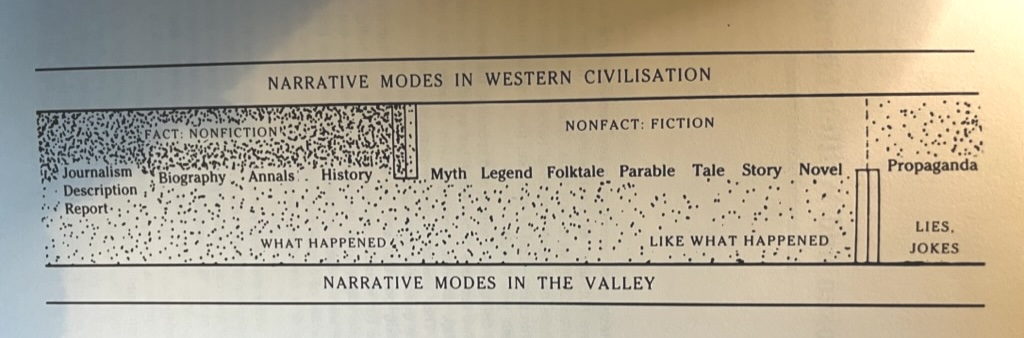
Always Coming Home is a collection of texts from the Kesh, a society in far future Northern California which is also, I guess, a utopian new Bronze Age I suppose? A beautiful book.
This chart is in in the appendix. It reminds me that
- we bucket stories of types like journalism and history as "fact" and types like legend and novels as "fiction," this binary division
- whereas we could (like the Kesh) accept that no story is clearly fact nor fiction, but instead is somewhere on a continuum.
Myth often has more truth in it than some journalism, right?
There's a nice empirical typology that breaks down real/not real in this paper about the characters that kids encounter:
To what extent do children believe in real, unreal, natural and supernatural figures relative to each other, and to what extent are features of culture responsible for belief? Are some figures, like Santa Claus or an alien, perceived as more real than figures like Princess Elsa or a unicorn? …
We anticipated that the categories would be endorsed in the following order: 'Real People' (a person known to the child, The Wiggles), 'Cultural Figures' (Santa Claus, The Easter Bunny, The Tooth Fairy), 'Ambiguous Figures' (Dinosaurs, Aliens), 'Mythical Figures' (unicorns, ghosts, dragons), and 'Fictional Figures' (Spongebob Squarepants, Princess Elsa, Peter Pan).
(The Wiggles are a children's musical group in Australia.)
btw the researchers found that aliens got bucketed with unicorns/ghosts/dragons, and dinosaurs got bucketed with celebrities (The Wiggles). And adults continue to endorse ghosts more highly than expected, even when unicorns drop away.
Ref.
Kapit'any, R., Nelson, N., Burdett, E. R. R., & Goldstein, T. R. (2020). The child's pantheon: Children's hierarchical belief structure in real and non-real figures. PLOS ONE, 15(6), e0234142. https://doi.org/10.1371/journal.pone.0234142
What I find most stimulating about this paper is what it doesn't touch.
Like, it points at the importance of cultural rituals in the belief in the reality of Santa. But I wonder about the role of motivated reasoning (you only receive gifts if you're a believer). And the coming of age moment where you realise that everyone has been lying to you.
Or the difference between present-day gods and historic gods.
Or the way facts about real-ness change over time: I am fascinated by the unicorn being real-but-unseen to the Medieval mind and fictional to us.
Or how about the difference between Wyatt Earp (real) and Luke Skywalker (not real) but the former is intensely fictionalised (the western is a genre and public domain, although based on real people) whereas Star Wars is a "cinematic universe" which is like a genre but privately owned and with policed continuity (Star Wars should be a genre).
I struggle to find the words to tease apart these types of real-ness.
Not to mention concepts like the virtual (2021): "The virtual is real but not actual" - like, say, power, as in the power of a king to chop off your head.
So I feel like reality is fracturing this century, so much.
Post-truth and truthiness.
The real world, like cyberspace, now a consensual hallucination - meaning that fiction can forge new realities. (Who would have guessed that a post on social media could make Greenland part of the USA? It could happen.)
That we understand the reality that comes from dreams and the subjectivity of reality…
Comedians doing a "bit," filters on everything, celebrities who may not exist, body doubles, conspiracy theories that turn out to be true, green screen, the natural eye contact setting in FaceTime…
Look, I'm not trained in this. I wish I were, it has all been in the academic discourse forever.
Because we're not dumb, right? We know that celebs aren't real in the same sense that our close personal friends are real, and - for a community - ghosts are indeed terrifically true, just as the ghost in Hamlet was a consensus hallucination made real, etc.
But I don't feel like we have, in the mainstream, words that match our intuitions and give us easy ways to talk about reality in this new reality. And I think we could use them.
Hello! This is my summary of 2025 and the "start here" post for new readers. Links and stats follow…
According to Fathom, my most trafficked posts of 2025 were (in descending order):
- Context plumbing (29 Nov)
- Extending AI chat with Model Context Protocol (and why it matters) (11 Feb)
- Reflections on 25 years of Interconnected (19 Feb)
- tl;dr I ran a marathon at the weekend and it was hard (4 Apr)
- The destination for AI interfaces is Do What I Mean (8 Aug)
Here are all the most popular posts: 20 most popular in 2025.
Even more AI than last year.
My personal faves aren't always the ones that get the most traffic…
- Homing pigeons fly by the scent of forests and the song of mountains
- Keeping the seat warm between peaks of cephalopod civilisation
- Diane, I wrote a lecture by talking about it
Also MAGA fashion, pneumatic elevators, and what the play Oedipus is really about.
Check out my speculative faves from 2025.
Also check out the decade-long Filtered for… series.
Links and rambling interconnectedness. I like these ones.
Posts in 2025 include:
- Filtered for minimum viable identity (2 Feb) about how theory of mind is attributed
- Filtered for the rise of the well-dressed robots (28 Mar) about robot fashion
- Filtered for hats (29 May) about hats, freedom and smurfs
- Filtered for bottom-up global monitoring (1 Aug) on cool global sensor networks.
And more.
Here's the whole Filtered for… series. 2025 posts at the top.
Looking back over 2025, I've been unusually introspective.
Possibly because I hit my 25th anniversary with this blog? (Here are my reflections and a follow-up interview.)
Or something else, who knows.
Anyway here's a collection from this year:
- Strava when you're not as quick as you used to be (30 Jan)
- tl;dr I ran a marathon at the weekend and it was hard (10 Apr)
- Copyright your faults (25 Jul)
- It all matters and none of it matters (4 Aug)
- Parables involving gross bodily functions (10 Oct)
In other writing, I…
- wrote a short series about AI consciousness
- took a trip to Shenzhen, China where I'm completing my manufacture of Poem/1
- started talking about Inanimate, my new startup and where most of my attention + design/engineering energy is going rn.
A talk I did in June for a WIRED event has just broken a million views. Watch AI Agents: Your Next Employee, or Your Next Boss (YouTube).
PREVIOUSLY!
- My top posts in 2024
- My most popular posts in 2023 and other lists
- My most popular posts in 2022 and other lists
- My most popular posts in 2021 and other lists
- My most popular posts in 2020 and other lists
Other ways to read:
- Receive new posts as an email newsletter.
- Subscribe to the RSS feed using your newsreader.. (RSS is great. Learn about what it is and how to get started.)
Or just visit the website: interconnected.org/home.
If you read a post you like, please do pass it along and share on the discords or socials or whatever new thing.
I like email replies. I like it when people send me links they think I'll enjoy (they're almost always correct). I especially like hearing about how a post has had a flapping-of-the-butterfly's-wings effect somehow, whether personally or at work.
I like talking to people most of all. I started opening my calendar for Unoffice Hours over 5 years ago. 400+ calls later and it's still the highlight of my week. Learn more and book a time here.
You should totally start a blog yourself.
Here are my 15 personal rules for blogging.
If you're interested in my tech stack, here's the colophon.
But really, use whatever tech makes it easy for you to write. Just make sure your blogging or newsletter platform lets you publish your posts with an RSS feed. That's a great marker that you own your own words.
Stats for the stats fans.
- 2025: 61 posts (58,160 words, 549 links)
- 2024: 60 posts (62,670 words, 586 links)
- 2023: 68 posts (69,067 words, 588 links)
- 2022: 96 posts (104,645 words, 712 links)
- 2021: 128 posts (103,682 words, 765 links)
My current streak: I've been posting weekly or more for 301 weeks.
Looking back over 2025, I'm increasingly straddling this awkward divide:
- long posts about AI on applications (like using transcription to write posts) or context plumbing or prompting for multiplayer turn-taking or thoughts about Claude code
- and everything else.
Where "everything else" is everything from policy suggestions on the need for a strategic fact reserve to going to algoraves to my other speculative faves this year.
Whereas the more bloggy spitball thoughts (which I love, and this is mainly what I wrote in 2020/21/22) are now relegated to occasional compilation posts a.k.a "scraps" - it would be great to give these more space but that doesn't seem to be where my time is going.
I don't know what to do about this.
I don't know if I need to do anything about this.
One of the big reasons that I write here is that it's my public notebook and so it's this core sample that cuts across everything that I'm thinking about, which is indeed a weird admixture or melange, and that's precisely the value for me because that's how new ideas come, even if that makes this blog hard to navigate and many visitors will just bounce off.
All of which makes me appreciate YOU all the more, dear reader, for sticking with.
Happy 2026.
More posts tagged: meta (20).
Auto-detected kinda similar posts:
- From the archives, w/e 4 June (4 Jun 2021)
- Previously: eye contact and puppy slugs (w/e 25 June) (25 Jun 2021)
- Previously: Spreadsheet parties, chatbots, William Gibson's jacket (w/e 18 June) (18 Jun 2021)
- Interconnected is 20 years old today (19 Feb 2020)
I'm away with family this week so here are some more scraps from my notes (previously).
Disney is considering a reboot of the Indiana Jones franchise. Goodness knows how many Jurassic Park movies there are.
We need to create new IP.
Culture creates new ideas downstream. Without new IP, it's like trying to feed yourself by eating your own arm.
So: moratorium on re-using IP in movies. The UK makes heavy use of movie subsidies. We should use this to disincentivise anything sits inside an existing franchise. If a movie's success is likely more to do with existing mindshare than its content, don't support it.
Radically reduce copyright down to 10 years or something. More than that: invent a new super-anti-copyright which actively imposes costs on any content which is too close to any existing content in an AI-calculated vibes database or something.
i.e. tax unoriginality.
The past is a foreign country that we should impose tariffs on.
There's a kind of face that we don't get anymore.
Neil Armstrong, Christopher Reeve as Superman, Keir Dullea as Dave Bowman in 2001.
I don't know how to characterise it: open, emotionally imperturbable. happy. Where did it go?
I'm at the cricket today and England are losing. It's an interesting feeling to be with, losing, especially while 90,000 people in the stadium (plus some visiting fans) are yelling for the winners - Australia, at this point.
I have zero memory for where cutlery goes in the cutlery drawer. I don't consciously look when I take things out but if everything was moved around, it wouldn't make any difference. On the occasions that all the knives, forks and spoons have been used and I'm unloading the dishwasher (which I do daily), I cannot for the life of me remember which sections they go in, so I return them in any old order. Raw extended mind.
A few weeks ago I was on a zoom call where someone had a standing mirror in their room in the background. I've never seen that before. It kept me weirdly on edge throughout like it violated some previously unstated video call feng shui or something.
(I had another call in which the person's screen was reflected in a shiny window behind them and so I could see my own face over their shoulder. But that seemed fine. This was not the same.)
My disquiet came because the mirror was angled such that it showed an off-screen part of the room. I could see beyond the bounds; it broke the container.
More posts tagged: scraps-from-the-scraps-file (3).
Why Were All the Bells in the World Removed? The Forgotten Power of Sound and Frequency (Jamie Freeman).
Church bells: "something strange happened in the 19th and 20th centuries: nearly all of the world's ancient bells were removed, melted down, or destroyed."
(I don't know whether that's true, but go with it for a second.)
Why? Mainstream historians attribute this mass removal to wars and the need for metal, but when you dig deeper, the story doesn't add up.
An explanation:
Some theorists believe that these bells were part of a Tartarian energy grid, designed to harmonise human consciousness, balance electromagnetic fields, and even generate free energy. Removing the bells would have disrupted this energy network, cutting us off from an ancient technology we no longer understand.
Tartarian?
Tartarian Empire (Wikipedia):
2.Tartary, or Tartaria, is a historical name for Central Asia and Siberia. Conspiracy theories assert that Tartary, or the Tartarian Empire, was a lost civilization with advanced technology and culture.
Risky Wealth: Would You Dare to Open the Mysterious Sealed Door of Padmanabhaswamy Temple? (Ancient Origins).
"The Padmanabhaswamy Temple is a Hindu temple situated in Thiruvananthapuram, Kerala, a province on the southwestern coast of India."
It has a mysterious Vault B with an as-yet-unopened sealed door.
One of the legends surrounding Vault B is that it is impossible at present to open its door. It has been claimed that the door of the vault is magically sealed by sound waves from a secret chant that is now lost. In addition, it is claimed that only a holy man with the knowledge of this chant would be capable of opening the vault's door.
Maybe the chant was intended to tap Tartarian energies.
3.Claims that former US military project is being used to manipulate the weather are "nonsense" (RMIT University).
HAARP is a US research program that uses radio waves to study the ionosphere (Earth's upper atmosphere) and cannot manipulate weather systems.
PREVIOUSLY:
Artificial weather as a military technology (2020), discussing a 1996 study from the US military, "Weather as a Force Multiplier: Owning the Weather in 2025."
4.What conspiracy theorists get right (Reasonable People #42, Tom Stafford).
Stafford lists 4 "epistemic virtues" of conspiracy theorists:
- "Listening to other people"
- "A healthy skepticism towards state power"
- "Being sensitive to hidden coalitions"
- "Willing to believe the absurd"
As traits in a search for new truths, these are good qualities!
Where is goes wrong is "the vices of conspiracy theory seem only to be the virtues carried to excess."
Let's try to keep the right side of the line folks.
More posts tagged: filtered-for (120).
My new fave thing to go to is live coding gigs, a.k.a. algoraves.
There are special browser-based programming languages like strudel where you type code to define the beats and the sound, like mod synth in code, and it plays in a loop even while you're coding. (The playhead moves along as a little white box.)
As you write more code and edit the code, you make the music.
So people do gigs like this: their laptop is hooked up to (a) speakers and (b) a projector. You see the code on the big screen in real-time as it is written and hear it too.
Here's what it looks like (Instagram).
That pic is from a crypt under a church in Camberwell at an event called Low Stakes | High Spirits.
(There are more London Live Coding events. I've been to an AlgoRhythm night too and it was ace.)
It helps that these beeps and boops are the kind of music I listen to anyway.
But there is something special about the performer performing right there with the audience and vibing off them.
Like all art, there's some stuff you prefer and some not so much, and sometimes you'll get some music that is really, really what you're into and it just builds and builds until you're totally transported.
So you take a vid or a pic of what's going on, wanting to capture the moment forever, and what you see when you're going back through your photo library the next day is endless pics of a bunch of code projected on the wall and you're like, what is this??
You have to be there.
(I suppose though it also means you can try out some of the code for yourself? View Source but for live music?)
Actually that's art isn't it.
All art galleries are a bit weird eh. Each time you visit, there are a hundred paintings scattered in rooms and you walk through like uh-huh, uh-huh, ok, that's nice, uh-huh, ok. Then at random one of them skewers you through your soul and you're transfixed by the image for life.
Often what happens is the musician is not alone!
There is also live coding software for visuals e.g. hydra. (hydra is browser-based too so you can try it right now.)
So the person live coding visuals sits right next to the person live coding music, with the music and the visuals projected side-by-side on adjacent big screens. Code overlaid on both.
The visuals don't necessarily automatically correspond to the music. There may be no microphone involved.
The visuals person and the music person are jamming together but really not off each other directly; both are doing their thing but steering in part by the audience, which itself is responding to the music and visuals together.
So you get this strange loop of vibes and it's wonderful.
I hadn't expected to see comments in code.
At the last night I went to, the musician was writing comments in the code, i.e. lines of code that start with // so they are not executed but just there.
The comments like the rest of the code are projected.
There were comments like (not verbatim because this is from memory):
// i'll make it faster. is this good?
And:
// my face is so red rn this is my first time
So there's this explicit textual back-channel to the audience that people can read and respond to, separately to the music itself.
And I love the duality there, the two voices of the artist.
You get something similar at academic conferences?
I feel like I must have mentioned this before but I can't find it.
One of my great joys is going to academic conferences and hearing people present work which is at the far reaches of my understanding. Either sciences/soft sciences or humanities, it's all good.
My favourite trope is when the researcher self-glosses.
So they read out their paper or their written lecture, and that's one voice with a certain tone and authority and cadence.
Then every couple of paras they shift their weight on their feet, maybe tilt their head, then add an extended thought or a side note, and their voice becomes brighter and more conversational, just for the duration of that sidebar.
Then they drop back into the regular tone and resume their notes.
Transcribed, a talk like this would read like a single regular essay.
But in person you're listening to the speaker in dialogue with themselves and it's remarkable, I love it, it adds a whole extra dimension of meaning.
If you're an academic then you'll know exactly what I mean. I've noticed these two voices frequently although culture/media studies is where I spot it most.
In Samuel Delaney's Stars in My Pocket Like Grains of Sand (Amazon) - one of my favourite books of all time - there is a species called evelmi and they have many tongues.
I swear there is a scene in which an evelm speaks different words with different tongues simultaneously.
(I can't find it for you as I only have the paperback and it's been a while since my last re-read.)
But there's a precision here, right? To chord words, to triangulate something otherwise unreachable in semantic space or to make a self-contradicting statement, either playfully or to add depth and intention.
Anyway so I love all these dualities at these live coding nights: the music and visuals, the code and the comments, the genotype which I read and the phenotype which I hear
It's an incredibly welcoming scene here in London - lots of young people of course who doing things that are minimum 10x cooler than anything I did at that age, and older people too, everyone together.
You know:
Last week the local pub had a band singing medieval carols and suddenly I got that adrift in time, atemporal feeling of knowing that I'm in the company of listeners who have been hearing these same songs for hundreds of years, an audience that is six hundred years deep.
(There was also a harp. Gotta love a harp.)
I never think of myself as a live music person but give me some folk or choral or modern classical or opera and I'm lost in it.
Or, well, electronica, but that's more about the dancing.
Or the time that dude had a 3D printed replica of a Neanderthal bone flute, the oldest known musical instrument from 50,000 years ago if I remember it right, and he improv'd ancient music led by the sound of the instrument itself as we drove through the Norwegian fjords and holy shit that was a transcendent moment that I will remember forever.
More posts tagged: 20-most-popular-in-2025 (20).
I left a loose end the other day when I said that AI is about intent and context.
That was when I said "what's context at inference time is valuable training data if it's recorded."
But I left it at that, and didn't really get into why training data is valuable.
I think we often just draw a straight arrow from "collect training data," like ingest pages from Wikipedia or see what people are saying to the chatbot, to "now the AI model is better and therefore it wins."
But I think it's worth thinking about what that arrow actually means. Like, what is the mechanism here?
Now all of this is just my mental model for what's going on.
With that caveat:
To my mind, the era-defining AI company is the one that is the first to close two self-accelerating loops.
Both are to do with training data. The first is the general theory; the second is specific.
Training data for platform capitalism
When I say era-defining companies, to me there's an era-defining idea, or at least era-describing, and that's Nick Srnicek's concept of Platform Capitalism (Amazon).
It is the logic that underpins the success of Uber, Facebook, Amazon, Google search (and in the future, Waymo).
I've gone on about platform capitalism before (2020) but in a nutshell Srnicek describes a process whereby
- these companies create a marketplace that brings together buyers and sellers
- they gather data about what buyers want, what sellers have, how they decide on each other (marketing costs) and how decisions are finalised (transaction costs)
- then use that data to (a) increase the velocity of marketplace activity and (b) grow the marketplace overall
- thereby gathering data faster, increasing marketplace efficiency and size faster, gathering data faster… and so on, a runaway loop.
Even to the point that in 2012 Amazon filed a patent on anticipatory shipping in 2012 (TechCrunch) in which, if you display a strong intent to buy laundry tabs, they'll put them on a truck and move them towards your door, only aborting delivery if you end up not hitting the Buy Now button.
And this is also kinda how Uber works right?
Uber has a better matching algorithm than you keeping the local minicab company on speed dial on your phone, which only works when you're in your home location, and surge pricing moves drivers to hotspots in anticipation of matching with passengers.
And it's how Google search works.
They see what people click on, and use that to improve the algo which drives marketplace activity, and AdSense keyword cost incentivises new entrants which increases marketplace size.
So how do marketplace efficiency and marketplace size translate to, say, ChatGPT?
ChatGPT can see what success looks like for a "buyer" (a ChatGPT user).
They generate an answer; do users respond well to it or not? (However that is measured.)
So that usage data becomes training data to improve the model to close the gap between user intent and transaction.
Right now, ChatGPT itself is the "seller". To fully close the loop, they'll need to open up to other sellers and ChatGPT itself transitions to being the market-maker (and taking a cut of transactions).
And you can see that process with the new OpenAI shopping feature right?
This is the template for all kinds of AI app products: anything that people want, any activity, if there's a transaction at the end, the model will bring buyers and sellers closer together - marketplace efficiency.
Also there is marketplace size.
Product discovery: OpenAI can see what people type into ChatGPT. Which means they know how to target their research way better than the next company which doesn't have access to latent user needs like that.
So here, training data for the model mainly comes from usage data. It's a closed loop.
But how does OpenAI (or whoever) get the loop going in the first place?
With some use cases, like (say) writing a poem, the "seed" training data was in the initial web scrape; with shopping the seed training data came as a result of adding web search to chat and watching users click on links.
But there are more interesting products…
How do product managers triage tickets?
How do plumbers do their work?
You can get seed training data for those products in a couple ways but I think there's an assumption that what happens is that the AI companies need to trick people out of their data by being present in their file system or adding an AI agent to their SaaS software at work, then hiding something in the terms of service that says the data can be used to train future models.
I just don't feel like that assumption holds, at least not for the biggest companies.
Alternate access to seed training data method #1: just buy it.
I'll take one example which is multiplayer chat. OpenAI just launched group chat in ChatGPT:
We've also taught ChatGPT new social behaviors for group chats. It follows the flow of the conversation and decides when to respond and when to stay quiet based on the context of the group conversation.
Back in May I did a deep dive into multiplayer AI chat. It's really complicated. I outlined all the different parts of conversational turn taking theory that you need to account for to have a satisfying multiplayer conversation.
What I didn't say at the end of that post was that, if I was building it, the whole complicated breakdown that I provided is not what I would do.
Instead I would find a big corpus of group chats for seed data and just train the model against that.
And it wouldn't be perfect but it would be good enough to launch a product, and then you have actual live usage data coming in and you can iteratively train from there.
Where did that seed data come from for OpenAI? I don't know. There was that reddit deal last year, maybe it was part of the bundle.
So they can buy data.
Or they can make it.
Alternate access to seed training data #2: cosplay it.
Every so often you hear gossip about how seed training data can be manufactured… I remember seeing a tweet about this a few months ago and now there's a report:
AI agents are being trained on clones of SaaS products.
According to a new @theinformation report, Anthropic and OpenAI are building internal clones of popular SaaS apps so that they can train AI agents how to use them.
Internal researchers are giving the agents cloned, fake versions of products like Zendesk and Salesforce to teach the agents how to perform the tasks that white collar workers currently do.
The tweet I ran across was from a developer saying that cloning business apps for the purpose of being used in training was a sure-fire path to a quick acquisition, but that it felt maybe not ok.
My point is that AI companies don't need sneak onto computers to watch product managers triaging tickets in Linear. Instead, given the future value is evident, it's worth it to simply build a simulation of Linear, stuff it with synthetic data, then pay fake product managers to cosplay managing product inside fake Linear, and train off that.
Incidentally, the reason I keep saying seed training data is that the requirement for it is one-off. Once the product loop has started, the product creates it own. Which is why I don't believe that revenue from licensing social network data or scientific paper is real. There will be a different pay-per-access model in the future.
I'm interested in whether this model extends to physical AI.
Will they need lanyards around the necks of plumbers in order to observe plumbing and to train the humanoid robots of the future?
Or will it be more straightforward to scrape YouTube plumbing tutorials to get started, and then build a simulation of a house (physical or virtual, in Unreal Engine) and let the AI teach itself?
What I mean is that AI companies need access to seed training data, but where it comes from is product-dependent and there are many ways to skin a cat.
That's loop #1 - a LLM-mediated marketplace loop that (a) closes on transactions and (b) throws off usage data that improves market efficiency and reveals other products.
Per-product seed training data is a one-off investment for the AI company and can be found in many ways.
This loop produces cash.
Coding is the special loop that changes everything
Loop #2 starts with a specific product from loop #1.
A coding product isn't just a model which is good at understanding and writing code. It has to be wrapped in an agent for planning, and ultimately needs access to collaboration tools, AI PMs, AI user researchers, and all the rest.
I think it's pretty clear now that coding with an agent is vastly quicker than a human coding on their own. And not just quicker but, from my own experience, I can achieve goals that were previously beyond my grasp.
The loop closes when coding agents accelerate the engineers who are building the coding agents and also, as a side effect, working on the underlying general purpose large language model.
There's an interesting kind of paperclip maximisation problem here which is, if you're choosing where to put your resources, do you build paperclip machines or do you build the machines to build the paperclip machines?
Well it seems like all the big AI companies have made the same call right now which is to pile their efforts into accelerating coding, because doing that accelerates everything else.
So those are the two big loops.
Whoever gets those first will win, that's how I think about it.
I want to add two notes on this.
On training data feeding the marketplace loop:
Running the platform capitalism/marketplace loop is not the only way for a company to participate in the AI product economy.
Another way is to enable it.
Stripe is doing this. They're working hard to be the default transaction rails for AI agents.
Apple has done this for the last decade or so of the previous platform capitalism loop. iPhone is the place to reach people for all of Facebook, Google, Amazon, Uber and more.
When I said before that AI companies are trying to get closer to the point of intent, part of what I mean I that they are trying to figure out a way that a single hardware company like Apple can't insert itself into the loop and take its 30%.
Maybe, in the future, device interactions will be super commoditised. iPhone's power is that is bundles together an interaction surface, connectivity, compute, identity and payment, and we have one each. It's interesting to imagine what might break that scarcity.
On coding tools that improve coding tools:
How much do you believe in this accelerating, self-improving loop?
The big AI research labs all believe - or at least, if they don't believe, they believe that the risk of being wrong is worse.
But, if true, "tools that make better tools that allow grabbing bigger marketplaces" is an Industrial Revolution-like driver: technology went from the steam engine to the transistor in less than 200 years. Who knows what will happen this time around.
Because there's a third loop to be found, and that's when the models get so good that they can be used for novel R&D, and the AI labs (who have the cash and access to the cheapest compute) start commercialising wheels with weird new physics or whatever.
Or maybe it'll stall out. Hard to know where the top of the S-curve is.
Auto-detected kinda similar posts:
- Mapping the landscape of gen-AI product user experience (19 Jul 2024)
- The need for a strategic fact reserve (17 Jan 2025)
- Let me recruit AI teammates into Figma (26 Oct 2022)
- Who will build new search engines for new personal AI agents? (20 Mar 2024)
- An AI hardware fantasy, and an IQ erosion attack horror story (10 Nov 2023)
Ali Tahvildar
"UNMADE" is a short film that explores storytelling through light and shadows, allowing viewers to interpret its meaning based on their personal experiences and observations.
Directed by Ali Tahvildar
Actor: Oksana Klepach
Music: And still they move by CO.AG

The night that arrives after a minor
accident our daughter faced brings
no sleep. I stare at her, asleep in
the bed barely big enough to hold her
any longer. I look at her awkward
eye pad held in place with micropore tapes.
I begin brewing some slow coffee,
measure beans, crush them with slow
rotations, weigh again, comb and even,
sprinkle a little water, pour some into
the chamber echoing Why, and turn on
the heat. So much I can control. So little.
The fragile cup of coffee, still full
upto its brim, remains on the table.
The shower I take runs its cold fingers
in my hair, seeks the grit of thoughts.
.
Kushal Poddar
Words & Picture
.

oh baby,
shave my back,
dot the i's,
cross the t's,
stand up straight
to call me to
the dinner table,
gimmee a pigfoot
and glass of
suspicious liquid,
swim against
the tides
to discover the
time of day and
where the sunlight shafts
land as they
burn through the clouds
and spotlight the
pies sitting in kitchen windows,
just don't tell
me what to do,
just don't leave me here
with no way to
make a decision
about socks and shoes
and ironing boards,
just don't get bored
with my complaints
about religion
and nodding your head
and walking around town
with a smudge of ash
on your fore head,
but most of all
take a vacation
from all this commotion,
the tongues of the
gargling choir
make their noises
as useless as
smoke detectors
that chirp when
the batteries are used up,
their armor is rusty,
they dance to
the beat of
baseball cards
rattling against
bicycle spokes,
they tell
that you're too slow
or that you arrived too soon
and they curse your name
if you die
at an inconvenient time,
some people
brag of their malaise,
too many are not happy
unless something is burning,
something breaks,
something stops working,
something reeks
in the back of the pantry,
take a vacation
from all
that attention,
no one needs
to be treated
like a vending machine
or a pay phone,
i mean,
if i could
leave myself
behind
right now, i would
and return
again after
finding myself
in the wilds of America
talking to
wonderfully unknown people
doing things
with their lives
that may lack
any kind of
discernable
direction
but seem to have purpose
that is yet to be
discovered, just around the bend,
on the other side of the mountain.
around the corner,
around
the block, the other side of the mountain.
.
Ted Burke
.

You contemplate the year ended 2025
Deaths
Births
Marriages
Like short stories read
Completed
Set aside
We roll up the days -weeks and months
Like sleeves
As we prepare for 2026
Knot a trusty boot tight
Try on the clown's oversized shoe
A new bold light slips under the door
Almost unseen
Announcing time
A beam of sunlight unhooked from cherry tree
Is cast down
A cloud profiles change
A spectrum of possibilities
A desire for hope
We smile as the future
Spreads out before us..
Like a harvest that drinks the sun and rain
Turns crisp brown
And promises to sustain us through
The coming year..
Fear not the brood of daggers in
Every heart
Thorns that grip our tears
Or the sadness of a love we cannot dig
out of heavy snow /or cleave from ice
A passion tossed aside by rapids
Unfulfilled
Spent and swept from the pillow by
a hand of clay
Because
Our open arms fill with air and silence.
The Unknowing
We can only guess what tomorrow brings
As the year finds us new
Waking every day
Surprised by a dawn
.
Malcolm Paul
Picture Nick Victor
Photo Garcia Lorca
.
Top of Form
Bottom of Form
Ready to Go
Republica
READY TO GO
You're weird, in tears
Too near and too far away
He said, "Saw red
Went home, stayed in bed all day"
Your T-shirt's dish dirt
Always love the one you hurt
It's a crack, I'm back, yeah
I'm standing on the rooftops shouting out
Baby, I'm ready to go
I'm back and ready to go
From the rooftops, shout it out
It's a crack, I'm back, yeah
I'm standing on the rooftops having it
Baby, I'm ready to go
I'm back and ready to go
From the rooftops, shout it out
Shout it out
You sleep too deep
One week is another world
(Big mouth) big mouth (drop out) drop out
You get what you deserve
You're strange, insane
One thing you can never change
It's a crack, I'm back, yeah
I'm standing on the rooftops, shouting out
Baby, I'm ready to go
I'm back and ready to go
From the rooftops, shout it out
It's a crack, I'm back, yeah
I'm standing on the rooftops, having it
Baby, I'm ready to go
I'm back and ready to go
From the rooftops, shout it out
Shout it out
Ready to go
I'm standing on the rooftops, having it
Baby, I'm ready to go
I'm back and ready to go
From the rooftops, shout it out
It's a crack
Baby, I'm ready to go
Baby, I'm ready to go
Baby, I'm ready to go
Baby, I'm ready to go
Baby, I'm ready to go
Baby, I'm ready to go
Baby, I'm ready to go
Baby, I'm ready to go
Baby, I'm ready to go

TORU Volume 33 featuring John Bisset, TORU / John Bisset (Toru)
TORU Volume 34 featuring Greg Sterland, TORU / Greg Sterland (Toru)
An Irish Almanac of Noise and Experimental Music From 2025, various artists (Nyahh Records)
Llift #17, LLIFT (Recordiau Dukes)
TORU brings together the three trumpet players Sam Eastmond, Celeste Cantor-Stevens and Andy Watts. Sam Eastmond has been involved in a number of projects over the years, including working closely with the US musician John Zorn. As well as being a trumpet player, Celeste Cantor-Stevens is also a writer and interdisciplinary artist. Her website tells us that 'much of her work focuses on human displacement, migration and borders, education, (in)equality, and social change, and on the place of music within this.' Originally from New Zealand, London-based Andy Watts performs with the London Afrobeat Collective. On top of everything else they do, they've found time, since 2018, to put out almost five albums a year as TORU.
I can't immediately think of anything quite like it. If being a free improv trumpet trio wasn't enough to earn them a place in the annals of uniqueness, every TORU album also features a guest musician. TORU 33 and 34 both came out last November and featured lap-steel player John Bisset and saxophonist Greg Sterland respectively.
TORU 33 has a deep, mellow quality to it. The music here makes the most of the lyrical qualities of the trumpet (and the cornet) and the rich, resonant qualities of John Bisset's lap steel. Anyone who (if they're still reading!) usually finds improvised music a turn-off should check out 'The Gift Shop at the Anarchist Revolution'. They'll probably be pleasantly surprised - the music more than makes up for the lack of actual merch.
TORU 34 is a moodier, edgier affair - just as good, but in a different way. Not that it doesn't have its mellow moments: check out, for example, the track 'A Pleasant Open Face'. It might sound strange, but listening to it straight after 33, I was acutely aware how, here, all four musicians are controlling most of what they do with their mouths: they can - and do - respond to the way they shape the sounds with the spontaneity of spoken conversation. And, as with spoken conversation, as I've often remarked in the past, it's always interesting in improvised music to see how the presence of a new face in a group changes what the other members say and how they say it.
Where to start with the latest release from Nyahh Records ( An Irish Almanac of Noise and Experimental Music From 2025)? One could write a book about it. Over thirty artists are featured, all of whom probably deserve a plug. I'd like to devote a whole column to it, but I'm still catching up after the (very welcome) Christmas break.
Listening to Fergus Kelly's 'Strange Attractor' took me back a few decades, to listening to John Peel late at night. If I'd heard it back then I would've been feverishly glancing at my cassette recorder, hoping it hadn't run out of tape! Talking of which, Danny McCarthy's 'TAPEHEAD (Begin Anywhere)', the longest track on the album, manages to holds one's attention, even with its minimal material and very slow rate of change. Declan Synnott's 'Facility', an electronic piece, conjured up literary associations for me - in this case, JG Ballard. I liked the (intentional?) pun in the title: the music invokes the spectre of some impersonal 'facility' while - to pick up on the other meaning of the word - using materials that are easy to combine effectively. Synnott, though, goes beyond the obvious, and creates an engaging piece, not only in terms of the sounds it uses, but of it's use of the stereo space, too. The same can be said of David Lacey's 'Two Spools'. Dennis McNulty's ' those gates were always open' also invoked - intentionally or not - a literary reference, in this case, Hugh MacDiarmid's poem, 'On a Raised Beach':
The inward gates of a bird are always open.
It does not know how to shut them.
That is the secret of its song,
But whether any man's are ajar is doubtful.
Perhaps it's just me, but the music could even be a backdrop to the poem. Viola player Ailbhe Nic Oireachtaigh's 'Snow Learning' (pre-composed or improvised? I'm not sure which) captures the essence of snow, its uncanny uniformity and the way life carries on, slowly, beneath it. I'm guessing the title of cellist Eimear Reidy's 'Fledgeling Flight Feathers', refers to that sense you can get, when improvising, that every time you jump off a high place into musical space, it feels like the first. Of course, on one level, one learns how to proceed, but, on another, one has to surprise both oneself and the listener. On that level, it's as if you have to relearn how to use your wings every time. David Donohoe's 'Maybe Infra' is a mixture of tonal simplicity and engaging collage. James King and Caroline Murphy are performance artists who began working together in clowning and cabaret. Their performance here, 'Sanction', a brass and string duet featuring vocalisations, is well worth a listen, as is sculptor and sound artist Karl Burke's 'Cage on a Stage'.
These are just some of the tracks that jumped out at me on first listening to the album. If I have a pet gripe with regard to some music labelled 'experimental', it's when people use the genre simply as a way to invoke the weird or gothic. Fortunately, for me, there's not a lot of that here. I say 'for me', as it's just a personal thing: there are lots of people out there who love those kind of fictional and filmic associations. For me, though, experimental music is an opportunity to open the mind to discover and invoke new or, at least, less familiar responses to music. To go back to the MacDiarmid poem, it's about opening gates we perhaps never even realised were there. And, with thirty-two tracks to choose from, there are plenty of gates to try here.
Llift #17, like the TORU albums, is the latest in a series, this time from the Llift community improvised music project in North Wales. They regularly upload albums of recordings made at their meetings. I like the way they occasionally incorporate fragments of text here, although I couldn't find any mention of where they came from. Improvised story telling, perhaps? If so, great. Why not? Near the beginning of the third part - in what, for me, writing this, was a bit of weird synchronicity - we get the gates again: 'At every door he shouted out his name but no-one opened. But when he realised they were waiting for someone and who this someone was he managed to transform his face at which point he made his entry taking the place of one … who never arrived.' Things don't work out though, so he heads for the woods, where he finds 'a simple gate with no lock'. I suppose its hardly surprising to keep finding gates and doors which serve as metaphors for entry points into alternative musically-generated realities.
#17, in my opinion, has to be one of the best Llift albums yet. Between them, the players create a rich sound-world that really keeps you listening. One minute you're in deep space, the next, at the heart of some surreal, industrial process, and then, when you least expect it, the shawm come at you out of nowhere.
.Dominic Rivron
LINKS:
TORU Volume 33 featuring John Bisset: https://torutrumpets.bandcamp.com/album/toru-volume-33-featuring-john-bisset
TORU Volume 34 featuring Greg Sterland: https://torutrumpets.bandcamp.com/album/toru-volume-34-featuring-greg-sterland
An Irish Almanac of Noise and Experimental Music From 2025: https://nyahhrecords.bandcamp.com/album/an-irish-almanac-of-noise-and-experimental-music-from-2025
Llift #17: https://recordiaudukes.bandcamp.com/album/llift-17
.

Ma Yongping 马永平 and Ma Yongbo 马永波 , close poet brothers, together in Nanjing
in 2008, at the top of the Pagoda Tower.

Chinese winter landscape with frozen lake, likely Song Dynasty, artist unknown
LINK1 https://en.wikipedia.org/wiki/Song_dynasty
That One Pickaxe Cut
One winter morning,
I get up early, carrying a dual-use axe,
a pickaxe on one end and an axe on the other.
I cross the courtyard with its wall made of short split firewood logs
to the snow-lined sewage pond in front of the gate,
to break the ice.
Third brother, carrying a small shovel for scooping ash from the stove,
insists on coming with me. I break off the ice that has formed over the sewage,
and he uses the small shovel to scoop it out of the pond,
piling it up. I continue breaking,
suddenly, third brother stretches out the small shovel and his head into the pond.
I watch helplessly, as the pickaxe falls, landing on third brother's head.
A burst of red flashes and I'm terrified
shouting, "Mother, come quick! I've hit him!"
Third brother doesn't cry; he just stands there staring at me.
My mother leads him back into the house and applies Yunnan Baiyao.
He's still staring at me with his big eyes.
He finds it quite amusing. Later, he tells me,
it didn't hurt at all, just a cold breeze blew from the wound.
That one pickaxe cut unearthed
a PhD in literature, and a poet.
Many years have passed,
and the thought of it still sends chills down my spine.
January 5, 2009, evening
By Ma Yongping 马永平
Translated by Helen Pletts 海伦·普莱茨 and Ma Yongbo 马永波, 16th December 2025
Yunnan Baiyao is traditional Chinese medicine
'Once my brother (Ma Yongping马永平) entered the depths of poetry, he also understood how I had stumbled my way through the past few decades. He wholeheartedly supported every poetry-related endeavour I led, always encouraging me to persevere.' Ma Yongbo 马永波
Full coverage of Ma Yongping's 马永平 life and times https://internationaltimes.it/ma-yongbo-poetry-road-trip-summer-tour-2025-volume-20/
这一镐刨下
有一年冬天,
清晨起来,我拎着一把
一头是镐一头是斧的
两用斧子,穿过庭院和
木柈子摞成的院墙
到门前用雪围成一圈的
污水池去刨冰
三弟拿一个掏炉灰的小铲子,
非要跟着我去,我把污水
形成的冰刨下来
他用小铲撮到池子外面,
弄成一堆。我继续刨着,
突然三弟将小铲子和他的头
伸了进来,我眼睁睁地看着
镐落下去,落在了三弟的头上
一股红光喷出,我吓坏了,
高声喊母亲快来,我刨着他啦!
三弟没哭,站那瞅着我
母亲把他领回屋,给他上云南白药
他还瞪着一双大眼睛看着我
感觉很好玩,后来他告诉我
一点不疼,就是伤口冒凉风,
就是这一镐刨出来一个
文学博士,一个诗人
许多年过去,
现在想起仍心惊肉跳
2009.1.5晚
马永平

HORSE ICE SCULPTURE, Harbin, China, 31st December 2025.
2026 is the Year of the Horse in the Chinese Zodiac and occurs every 12 years, symbolising freedom, energy, strength, and ambition. This year is the Fire Horse which lasts from 17th February 2026 to the 5th February 2027.
In winter Northern China experiences extreme weather conditions, that sweep across from Siberia. Cities like Harbin, where Yongbo lives, face extreme temperatures (below zero) for at least six months of the year. While Harbin is famously cold, its official record is around -37.7°C (-35.86°F), but the coldest nearby area, Mohe (China's northernmost city), hit a record-breaking -53.0°C (-63.4°F) in January 2023, highlighting the extreme cold in Heilongjiang province where Harbin is located. Harbin experiences severe winters, often seeing temperatures drop to -30°C (-22°F) or lower, with averages around -30°C in winter.

Ma Yongbo 马永波, 31st December 2025, Harbin, China, Planet Earth, The Universe
the poet's head on receiving the winter axe—for Yongbo 诗人的头颅迎向冬日的斧刃
Yichuan ice as strong as iron glass
splits under the teenage axe,
next the poet's childhood head
receives the cold metal
the point needle-threading skull,
the opening remaining softer and cratered
into adulthood. The ice remaining
year on year and ever-thickening.
But the poet's skull is thinner than his birth
at the opening, in the undulated landscape
of his reconstructed head,
where knowledge now pours
from a thin bone spout
10th December 2025
"Yongping永平 joked that with one swing of his pickaxe,
he'd "knocked sense into me" — a playful way of saying
he'd chiseled a hole in my head, giving the wisdom inside
a way to escape." WhatsApp, Ma Yongbo 马永波
10th December 2025
Response Poetry By Helen Pletts 海伦·普莱茨
Response Poetry Translated by Ma Yongbo 马永波

Helen Pletts 海伦·普莱茨 14th January 2026, Cambridge, UK, Planet Earth,The Universe
诗人的头颅迎向冬日的斧刃 the poet's head on receiving the winter axe—for Yongbo
伊春的冰坚硬得像铁琉璃
在十几岁少年的镐下碎裂,
接着,诗人童年的头颅
迎向冰冷的金属
镐尖穿颅而过,如引线穿针,
那道创口始终柔软,陷成洼坑,
伴他步入成年。年复一年
冰层依旧,越积越厚。
而诗人的颅骨,创口处
比降生时更薄,在他重塑的颅顶
那起伏的风景中,
如今,从细骨的豁口
智慧汩汩涌流。
2025年12月10日,致永波
"永平笑称,他这一镐下去,就让我开了窍——这是种戏谑的说法,说他在我头上凿了个洞,让里头的智慧有了逃逸的出口。" WhatsApp,马永波,2025年12月10日
'The lifelong closeness of the two brothers Ma Yongping 马永平and Ma Yongbo 马永波 was ever present, in spite of the pickaxe accident. Here we celebrate with more poetry written with Yongbo 永波 in mind, by Yongping永平, who is still greatly missed." Helen Pletts 海伦·普莱茨, 30th December 2025
Ginkgo Leaves
Before the Yin-Yang Gate stand two tall trees,
The autumn wind, like a pair of divine hands, caresses them,
instantly turning the leaves golden,
like thin gold flakes,
drifting freely in the air with the wind.
Perhaps tiring, they jump gently down,
as if afraid of hitting passersby on the head.
They sit nestled together on the ground,
sunlight slanting down, casting a golden glow.
I bend down and rake them into piles of varying sizes,
like a child building his own golden tower.
I crouch in the golden light,
and gather them. One by one, I put them into bags,
take them home, to make a pillow for my youngest brother.
December 4, 2008, 7:20 PM
By Ma Yongping 马永平
Translation by Helen Pletts 海伦·普莱茨 and Ma Yongbo 马永波 2025
银杏叶
阴阳门前有两棵很高大的树,
秋天的风像一双神的手抚摸着
一瞬间就把叶子变成金黄
犹如薄薄的金片
跟随着风在空中自由走动
或许是走累了,轻轻地跳下来
仿佛怕砸到过往行人的头
它们相互依偎着坐在地上
阳光斜照下来,映出一片金黄的光
我弯下腰将它们耧成大小不一的堆
像一个孩子要建造一座属于自己的金塔
我蹲在金色的光芒里
把它们一个个收入袋子
带回家,给最小的弟弟做一个枕头
2008.12.4晚7:20
马永平
The book that was thrown out like snowflakes
One autumn, my mother was sewing cotton-padded clothes
for us to wear through the winter.
Third brother was reading on the kang,
sometimes lying down, sometimes sprawled out,
occasionally letting out a loud, giggling laugh,
simultaneously scraping and make a slapping sound with both feet across the kang
flinging cotton up into the air
so it fell like snowflakes.
Our mother sees him and says, "Go outside and play,
you little rascal!"
He went quiet for a while, but soon after,
when he got to an exciting part
his feet started scrambling across the kang again,
sending the cotton flying and falling once more.
Mother got angry,
snatched the book from his hands,
tore it up, throwing it out of the window
like flakes of snow.
Third brother was stunned and stared at our mother
for a long time.
Suddenly, he jumped up from the kang, rushed out of the house,
and picked up the book.
Back inside, he tried to piece it back together,
silently shedding tears,
tears as large,
as his own eyes.
By Ma Yongping 马永平
Translated by Helen Pletts 海伦·普莱茨 and Ma Yongbo 马永波 2025
A Kang is a Northern Chinese bed made out of clay bricks
扔出去的书像一片片雪
一年秋天
母亲在缝制我们过冬的棉衣
三弟在炕上看书
一会儿躺着一会儿趴着
不时发出吃吃的大笑
同时用双脚啪啪地刨着炕
棉花被他刨得飞起
然后雪花一样落下
母亲看着他说
去外边玩去,真捣乱
他安静了一会儿
但没多久,看到精彩处
双脚又开始刨炕
棉花再一次飞起落下
母亲生气了
一把将他手中的书夺下来
撕了,从窗口扔了出去
像扔出去一片片雪
三弟惊呆了
看了母亲半天
突然从炕上一骨碌爬起来
下地,冲出屋外,捡起书
回到屋里,一边往一起粘
一边无声地流泪
那眼泪一颗颗很大
像他的眼睛
2009.1.9
马永平
Dialogue
On a mountain path,
we walk slowly side by side towards the summit.
You say you want to build your own objective poetics in your lifetime,
and continue writing poetry
until your fingers can no longer type on the computer keyboard.
I say I haven't thought that far ahead.
Right now, I write poetry simply to record my feelings about life,
as a way to comfort myself.
April 9, 2010
By Ma Yongping 马永平
Translated by Helen Pletts 海伦·普莱茨 and Ma Yongbo 马永波 2025
对话
在山间的小路上,
我们并肩慢慢地向山顶走着
你说,要在有生之年,
构建自己的客观化诗学
而且要继续写诗,
直到手指敲不动电脑键盘为止
我说,我到没想那么多那么远,
现在我写诗只是想记录对生活的感受
只是想用这种方式哄自己高兴
2010年4月9日
马永平

Cover of Volume of 'Selected Contemporary Chinese Poems of the 21st
Century' (5 Volume set) in which Ma Yongping 马永平 and Ma Yongbo's 马永波 poetry appears together, the two poet brothers are together once more.
The five-volume 'Selected Contemporary Chinese Poems of the 21st Century', edited by the renowned poet Liu Jiemin, was recently published by Shanghai Oriental Publishing Center. It includes six poems by Ma Yongbo 马永波, and even more gratifyingly, it also includes a poem by his elder brother, Ma Yongping 马永平, titled "A Spring Morning at Xuanwu Lake I Sing with the Birds".
A Spring Morning at Xuanwu Lake I Sing with the Birds
In the morning, the birds sing through the mist
stirring the lake awake from its dream
the sun peeks out, its face glowing red
two white butterflies
dance along the path framed by green bamboos
chasing each other. Nearby, clusters of purple florets
bloom quietly. In the distance, rows of trees
send forth tender green shoots, peeking through the fog
a couple, hand in hand
strolls slowly along the lakeshore
the birds' chirping grows louder—then
I fly up to the parasol tree and sing with them
this is my fifty-first spring
I have not lived my life in vain
Written in Nanjing
April 12, 2009
Ma Yongping 马永平 (1958-2020), a Chinese poet, native of Suihua, Heilongjiang Province, started writing poetry in 2008. He left behind more than 2,000 poems totalling over 20,000 lines. His posthumous collection 'Wandering Above the Stars and Moon', compiled by his younger brother Ma Yongbo 马永波, was published by Changjiang Literature and Art Publishing House in 2020.
玄武湖一个春天的早晨我和鸟儿一起鸣叫
早晨,鸟儿雾中的鸣叫
把湖从睡梦中唤醒
太阳露出红红的脸
两只白蝴蝶
在翠竹环绕的小径上飞舞
追逐,近处一片紫色小花
静静的绽放。远处一树树嫩绿
在雾中探出身影。一对恋人
手牵手,沿着湖岸慢慢的行走
鸟儿的鸣叫声更大了,于是
我飞上梧桐和它们一起鸣叫
这是我的第五十一个春天
我没有虚度此生
2009年4月12日于南京
马永平
CHINESE LINK2 https://mp.weixin.qq.com/s/gJtqn8CaRuILXyb_WQepiA
IMAGE7: Ma Yongping's 马永平 poem 'A Spring Morning at Xuanwu Lake I Sing with the Birds'; a page from the 'Selected Contemporary Chinese Poems of the 21st Century', published by Shanghai Oriental Publishing Center.
All images under individual copyright © to either Ma Yongbo 马永波 or Helen Pletts 海伦·普莱茨
.
When I started working at the Record & Tape Exchange in 1985, the epicentre of that pre-owned retail empire was a 200 yard stretch of Notting Hill Gate, containing three branches, with a fourth just around the corner in Pembridge Road. Then there was an outpost in Camden - opposite the market - and another in Goldhawk Road, Shepherd's Bush.
Thriving in that environment was not just about how well you worked or what you knew. Liking the right records counted for at least as much. More, probably. There was a moment in everybody's time there when they got to put on a cassette to play over the shop hi fi. A privilege jealously guarded and grudgingly handed out by whoever the most senior person was in the shop that day. This was a rite of passage fraught with danger. I saw careers end on that first cassette choice. When my time came I chose the Buzzcocks debut album. Who could possibly complain? Paddy, the senior man that day, muttered 'playing safe' under his breath. But I survived.
Negotiating the prevailing cultural conventions was no easy task. At the time I was discovering the likes of Tom Rush and Tim Hardin. Fortunately, this went down well. I once put on 'The Circle Game' by Rush and my colleague that day, Dick - a taciturn, ponytailed veteran in his 40s - said 'Mm. I heard there was a new Tom Rush fan', his stony features cracking momentarily into an expression not too far from avuncular fondness.
A friend, Gary, who started at the same time as me liked Julian Cope, but this - surprisingly, it now seems - wasn't right at all. Gary didn't last. The Cramps were right, though. And Dion. And The Sonics and The Saints. Leonard Cohen? No. Nico? Yes. Kris Kristofferson's Jesus Was A Capricorn? Yes. Scott Walker? Yes. The Blue Nile? Not really. U2? I ask you.
Also, there was status attached to which shop you worked in. Getting sent to Goldhawk Road wasn't quite like getting sent to Siberia, but it wasn't far off. Usually there'd just be two of you there, and the place was quiet. You could sit for hours on a weekday afternoon listening to the Cramps or Dion without any customers coming in. There, as in all the shops, only the sleeves of most of the albums were out on display. If you wanted to buy one you bought the sleeve to the counter and a label with a code on it guided the sales assistant to the record itself. Filed in its inner sleeve somewhere in a labyrinthine shelving system behind the counter. Cheaper records were out on display, though. These attracted no-goods who would attempt to walk out with armfuls and peel the price labels off, once out of range. Later, they'd bring the same records back and try to sell them to you. A ruse commendable for its audacity, but rarely successful.
The Goldhawk Road shop was terrorised by a character we called Goldtooth. A cut above, or below, the usual class of petty criminal we dealt with. He was known to threaten violence and demand money from the till. To counter this, a mild-mannered security guard was employed, a benign uniformed presence who hovered around the premises all day. He was allowed to ask Goldtooth to leave, and to phone the police, but had neither the natural authority nor the heft to eject him. His presence was entirely ineffectual. There were times when Goldtooth came in and took what he thought he deserved while staff and security guard stood around watching, waiting for the police to turn up.
I started to think about all of this again when I heard of Tom Verlaine's passing in 2023. For a while I was second in command in the books department. I took care of the place when the manager, Andy, wasn't working. It was on the first floor, above the musical equipment and musical instrument department in Notting Hill Gate. Brian Eno was a regular browser downstairs. Upstairs we had Mick Jones, of the Clash, and Tom Verlaine of Television. At the time Verlaine was living in London, possibly nearby, as he was in the shop pretty often. He looked exactly how you want your heroes to look. Tall, upright. Elegant neck and cheekbones. Always wearing a long dark coat. Scrutinizing the poetry shelves. Sometimes buying a volume or two. Maybe asking 'do you ever see anything by …?' or suchlike.
Once Verlaine was in the shop and a regular troublemaker came in. Not in Goldtooth's league, but someone with a permanent grievance, who would harangue you about an over-priced book or some other perceived injustice. He had a go at me for a while them stomped down the stairs. Verlaine turned to me and said 'we've got people like that in New York', then came to the counter with a book to buy. I took the money and rang it up on the till, then asked him what he was working on.
I knew almost as soon as the words left my mouth that I had made a mistake. Innocently yet unwisely I had crossed an unseen boundary. I had assumed a familiarity that just wasn't there. Verlaine broke off eye contact, mumbled something vague and evasive, and blushed. I don't recall now if I saw him again in the shop, but I left not long after.
About 15 years later a music magazine sent me to interview Television's other guitarist, Richard Lloyd. By coincidence, this took place in the dining room of a hotel in Notting Hill, just down the road from the book shop. It was a perfunctory meeting. I was one of several journalists wheeled in that afternoon. Lloyd was polite, helpful and obviously bored. I don't blame him. For me the best thing about the occasion was that he wore a red Harrington-style jacket, just like the one he wore on the cover of Television's second album, Adventure. It was only when I sat down to write this that I twigged that I met - fleetingly, in Notting Hill - both guitarists responsible for some of the greatest guitar music ever made. To be face to face with a world so alive.
.
Mark Brend
.

Far Above the World: the Time and Space of David Bowie, Paul Morley (Headline)
Paul Morley's second book about Bowie is a disco ball of brief chapters that not only sparkle but reflect and illuminate both its subject and its author. It is, like all of Morley's books, wide-ranging, informed, erudite, opinionated, obsessive and ridiculous, with long lists of comparisons and similes, metaphorical flights of fancy, unsubstantiated conjecture and multiple moments of wonderful insight.
Morley can riff and speculate on a subject with the best of them, and each chapter here is one such riff, quickly concluded within a few pages before he runs out of inspiration, energy or breath. Each section takes off from the one before but often at a tangent, picking up on an obscure reference or aside, often weaving in puns and song titles as the reader is left to collage together a version of Bowie for themselves, each chapter causing a re-evaluation and recontextualisation of his career - music, influences, critical reception - and the very notion of music, fame and culture itself.
And, of course, how Bowie fitted in to that, and changed it, slowly moving from aspiring mime artist, painter and musician to national treasure, despite his chameleon tendencies and periods of musical failure and/or absence. 'Why are we still talking about Bowie so long after his death?' is one of this book's subtexts. Others include 'What is fame?', 'What is love?', 'What is popular music?' and 'How on earth can anyone write about the late great David Bowie?' (Perhaps with the sub-subtext 'Am I worthy?')
This book is a kind of analogue hypertext. I have only read it through as printed but I think it could be read in any order, its hopping, skipping and jumping narrative enhanced even further by acts of random selection. Not to suggest, of course, that Morley hasn't worked hard in his arrangement. The jumpcuts and diversions always loop back to some kind of chronology and discography; Morley remains one of the finest music writers known to humankind.
He considers Bowie's music by looking elsewhere and not talking about it, preferring to consider the influence of others, what the producer is doing, who Bowie is working with this time round, what - perhaps - he is thinking. Spirituality, longing, occult forces, heightened awareness (OK, drugs), love, desire, madness and, of course, illness and death, feature here. Somehow in Morley's hands biography, both real and plausibly imagined, transcends the mundane and irrelevant and becomes musical and cultural criticism.
Blackstars are where matter collapses in on itself, an undoing of creation itself, and wormholes theoretically allow travel between galaxies and co-existent other times. Morley is an intrepid and fearless musical cosmonaut, just as Bowie once was. Far Above the World should not work but it does. It is a multiverse of possible and alternative David Bowies, artfully conjured up by Morley's literary sleights of hand.
.
Rupert Loydell
.


