

TL;DR: BrowserCopilot AI works directly on the pages you're already using, offering customizable copilots, multi-model support, and fewer reasons to copy and paste all day now $69 (reg. $619).
Your browser already knows everything about your life. Your emails, half-finished drafts, endless tabs, research rabbit holes, and the document you swore you'd finish [yesterday] all live there. — Read the rest
The post Your browser just got a lot smarter thanks to this built-in AI copilot appeared first on Boing Boing.

Lives spent up late led to poorer health in late life, according to research published in the Journal of the American Heart Association. Tracking the chronotypes of 300,000 mostly white adults in the U.K., with an average age of 57 years, researchers found that 8% had late-night bedtimes with peak activity during the evening, whereas 24% were "definitely morning people." — Read the rest
The post Night owls have poorer cardiovascular health appeared first on Boing Boing.

AI datacenters' demand for processing power, memory and storage has seen prices for GPUs and RAM soar, and now last year's technology is following suit. DDR4 and older cards are joining the latest models on the top shelf. People building systems are finding that the savings "aren't as significant as expected," writes Adam Corsetti. — Read the rest
The post Prices for older PC hardware soar appeared first on Boing Boing.
"Australia has so much solar that it's offering everyone free electricity"
This is not the gift of a government. This is the gift of the sun. And it has some really interesting implications… #actuallyexistingsolarpunk
Solar tech is falling in price so fast that in many and increasing numbers of places we can have this kind of "free energy". It's hard to get your head around at first, but once those electrons are moving they really are "free" in the best sense, and you might as well use them for something (including storage for later, yes).
Ben Jones wrote about this as "the magic lump of possibility" - the period of negative pricing when the sun is shining, when you can get so much done for free.
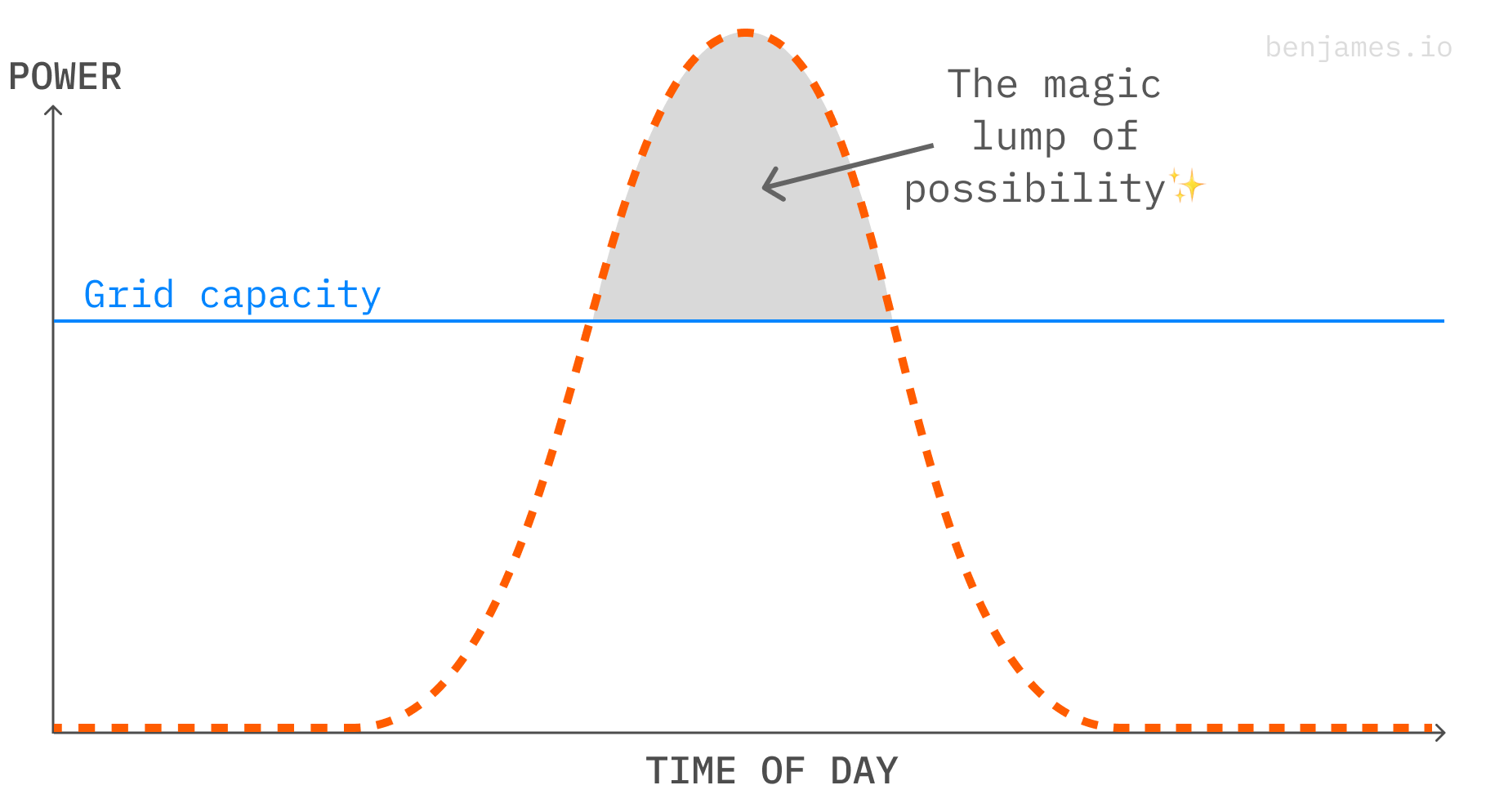
Ben pointed out in that piece that the price of solar panels is getting so low, that you can buy a panel for just twice the price of a wooden fencing sheet the same size:

In fact, this is already happening, as the FT reported last year. Once you factor in the savings on an electricity bill, it is already cheaper in the Netherlands and Germany to install solar PV panels as garden fencing, than to use wood:
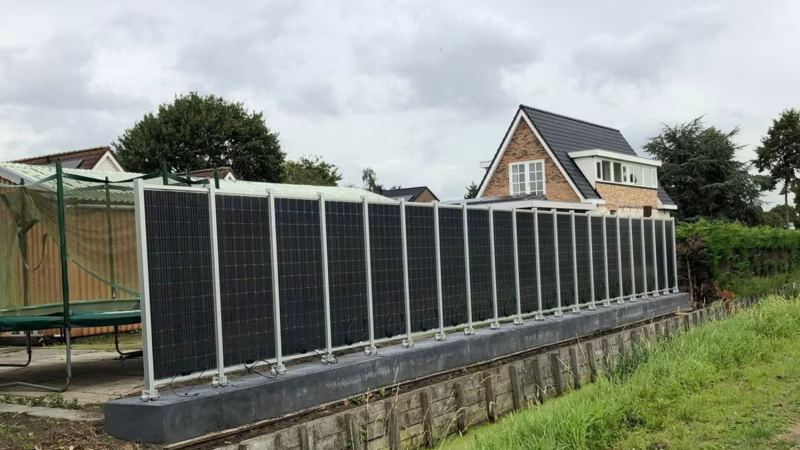
This is #actuallyexistingsolarpunk: the realisation that the tools we already have to hand are far more transformative, and more ecologically beneficial in every sense, than all the speculation around novel digital technologies:
"Actually existing AI" is a phrase I use a lot, to separate reality from hype. "Actually existing solarpunk" is one I might start using. Because I genuinely believe that a general energy transition is *more possible* than general artificial intelligence, and more exciting and more equitable.
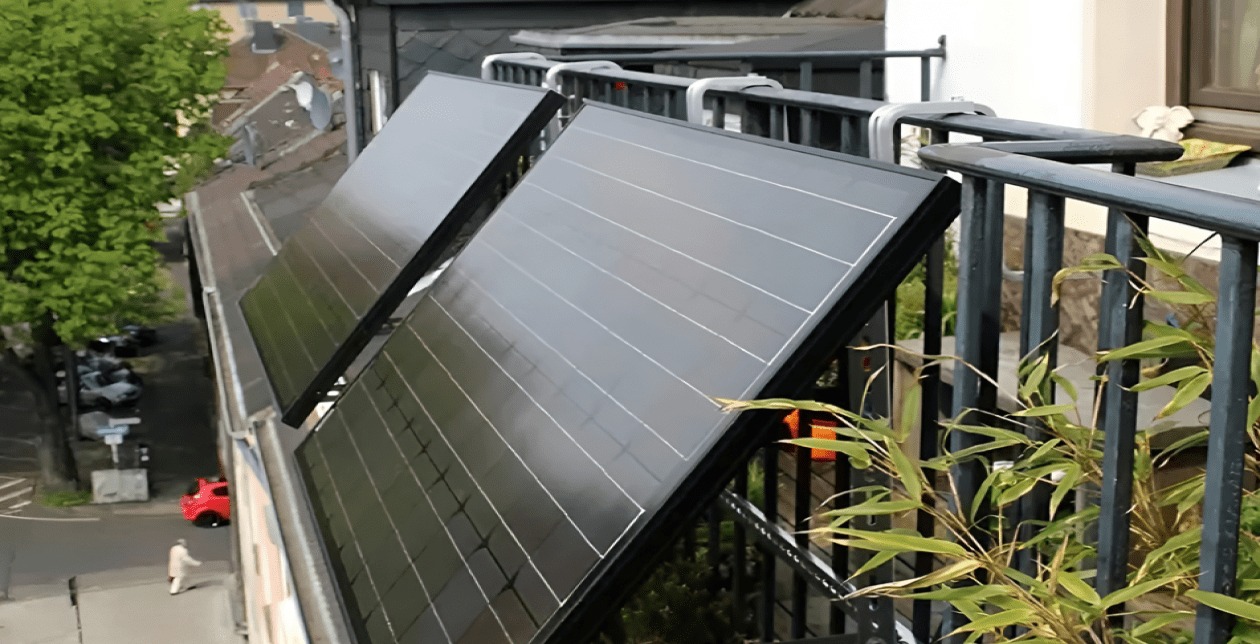
But there's more. Firstly, there are really interesting things happening around solar, driven by and shaping this transition, which you can meaningfully participate in. For example, balcony solar. This is solar at the scale not of a rooftop, or a garden, but a small apartment.
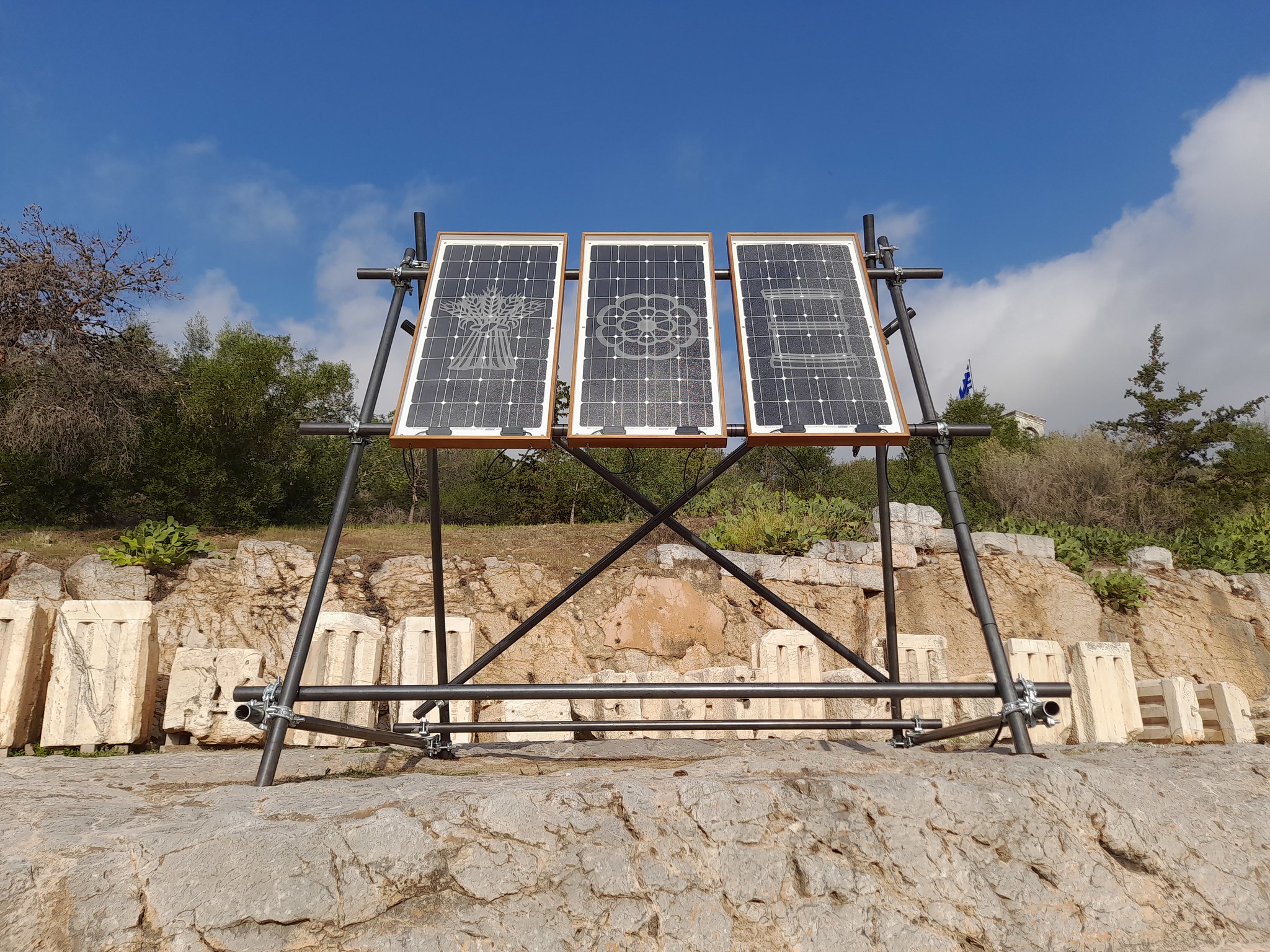
I've used the microtransformers built for balcony solar installations in my solar panel artworks. This means they plug directly into the local network, without batteries or the grid, and power the gallery, institution, or site hosting them (in this case, an archeological site):
In New York, the brilliant Solar Power for Artists is creating tiny window mounts for solar panels, accessible even to those who rent:

In that post about possibility, Ben talks about massive off-grid solar for direct use as one of the features of the coming transition - but there's another aspect, which is more relevant to the point of the gift of the sun: you don't have to be a prepper and go off-grid, or wait for governments to do something. We can do it together. We can form our own energy communities.
Energy communities are when a group of people get together to make their own power. You invest together in a renewable energy plant - could be solar, wind, hydro, or even storage, like a battery site. It's owned by the community, the community sells that power to the grid and gets money off their bills, and sells the excess. My friends at Hyperion Solar Community in Athens are a good example.
It's not really about selling the excess: it's about combating energy poverty and increasing energy democracy, while actually and actively changing the energy mix, and building community. It's a nascent political form within the transition, and it's #actuallyexistingsolarpunk: not just technology, but a shift in how we live. We can redistribute power.
I'm helping to start an energy community where I live. You can too. We all can. I don't think solar panels will magically save us: I do think that the more of us actively engaged in the transition has benefits for the planet and our communities which will help us face an uncertain future. This is one way to do it.


"斩杀线"
*Chinese social media explaining why wretched, poverty-stricken Americans lack homes, medical care and decent food, and are therefore dying like flies


Fury as Amazon Ring Cameras Are Hooked Up to ICE System
As US Immigration and Customs Enforcement agents wreak havoc on American communities, big tech companies have been making themselves indispensable to the increasingly tyrannical state.
Among them is Amazon subsidiary Ring, the company behind those AI doorbell cameras that have exploded in popularity over the last few years. Back in October, Ring announced that its devices would soon be looped into a network of Flock AI surveillance cameras. That network, an investigation by 404 Media found, has been available to local and federal police and enforcement agencies like ICE — leaving many worried that their Ring doorbell cams are now feeding into a government panopticon.
Sure enough, as anti-ICE protests ramp up throughout the US, activists are pushing a grassroots campaign to convince Ring users to smash their devices. Doing so, they say, could help deprive the federal government of footage it's using to enact a campaign of harassment, arrests, and deportation.
"Smash your Ring doorbells," progressive activist Guy Christensen urged his 3.5 million followers on TikTok. "You need to smash your Ring doorbells. Amazon owns Ring, and they've decided to begin sharing surveillance collected from your front step with ICE and Flock Safety, weaponing surveillance against the American people."
"If you have home surveillance or something, make sure that you know, 100 percent, the footage being recorded of you and your family in your home, or wherever, is only and can only be seen and shared with you," Christensen implored….


I'll AI-slop my way to a new and better world


New Years MMXXVI
From H. P. Lovecraft
Cleveland, Ohio
August 12, 1922
My dear Mr. Smith:—
I trust you will pardon the liberty taken by an absolute stranger in writing you, for I cannot refrain from expressing the appreciation aroused in me by your drawings & poetry, as shown me by my friend, Mr. Samuel Loveman, whom I am now visiting in Cleveland. Your book, containing matter only chronologically classifiable as juvenilia, impresses me as a work of the most distinguished genius; & makes me anxious to see the new volume which I understand is in course of preparation.
Of the drawings & water-colours I lack a vocabulary adequate to express my enthusiastic admiration. What a world of opiate phantasy & horror is here unveiled, & what an unique power & perspective must lie behind it! I speak with especial sincerity & enthusiasm, because my own especial tastes centre almost wholly around the grotesque & the arabesque. I have tried to write short stories & sketches affording glimpses into the unknown abysses of terror which leer beyond the boundaries of the known, but have never succeeded in evoking even a fraction of the stark hideousness conveyed by any one of your ghoulishly potent designs.
I should deem it a great honour to hear from you if you have the leisure & inclination to address an obscurity, & to learn where I may behold other poems by the hand which created such works of art as Nero, The Star-Treader, & the exquisite sonnets which companion them. That I have not work of even approximately equal genius to exhibit in reciprocation, is the fault of my mediocre ability & not of my inclination.
Apologising for this intrusion upon your time, & again expressing the appreciation which every renewed glimpse of your work increases, I beg the honour to remain
Yr most obedient Servt.
HPLovecraft


That's an orbiting AI data center as imagined by Grok on XTwitter, and man, Elo's pet AI ought to be a lot better at doing space sci-fi than this. Not only is it a spelling disaster, there's space art in crumbly old sci-fi magazines from the 1930s that make more sense than this.
#
*Of course I've used every single one of these dead media, but I've also been known to use an Incan quipu in public
*Once I inscribed some Babylonian cuneiform into wet clay just to see how that worked
#
The Regicide Report, the last novel in the main Laundry Files series, is coming out on January 27th in the US (from Tor.com Publishing) and the UK (from Orbit).


If you want to order signed hardcovers, contact Transreal Fiction in Edinburgh. (I believe Mike is currently willing to send books to the USA, but don't take my word for it: check first, and blame Donald Trump if there are customs/tariff obstacles.)
Audiobooks: there will be audio editions. The Audible one is showing a January 27th release date on Amazon.com; Hachette Digital will be issuing one in the UK but it's not showing up on Amazon.co.uk yet. (For contractual reasons they're recorded and produced by different companies.)
Ebooks and DRM: The ebook will be available the same day as the hardcover. Tor.com does not put DRM on their ebooks, but it's anybody's guess whether a given ebook store will add it. (Amazon have been particularly asshole-ish in recent years but are promising DRM-free downloads of purchases will be available from late January.) Orbit is part of Hachette, who are particularly obstreperous about requiring DRM on everything electronic, so you're out of luck if you buy the Orbit edition. (I could tell you how to unlock the DRM on purchases from the UK Kobo store, but then my publisher would be contractually obliged to assassinate me. Let's just say, it can be done.)
What next?
The Regicide Report is the last Bob/Mo/Laundry novel. It's set circa March-May 2015 in the time line; the New Management books are set circa November 2015 through May 2017, so this one slots in before Dead Lies Dreaming.
There may be a Laundry Files short story collection, and/or/maybe including a final New Management novella (it's half-written, but on "hold" since mid-2024), at some point in the future. But not this year or next. (I'm taking time off to get back in touch with space opera.)
None of the above precludes further Laundry Files novels getting written, but it's up to the publishers and market forces. If it does happen, I expect they'll be set in the 2020s in the internal chronology, by which time the Laundry itself is no more (it's been superseded by DEAT), and we may have new protagonists and a very new story line.
No, but really what's next?
I don't know for sure, but I'm currently working on the final draft of Starter Pack, my Stainless Steel Rat homage, and planning yet another rewrite of Ghost Engine, this time throwing away my current protagonists and replacing them with the ones from Starter Pack (who need another heist caper). Do not expect publication before 2027, though! I'm also awaiting eye surgery again, which slows everything down.
It's been years and years since I last went trawling for webcomics worth reading, so it's time for an update: obviously online search is pretty much useless, but we ought to be able to crowdsource something here.
I keep a separate browser window for webcomics; here's a selection of my currently-open tabs, excluding syndicated stuff that shows up in newspapers. (So no "This Modern World" or "The Far Side".) What am I ignoring? Preferably new in the past decade, which rules out old-timers like "Digger" or "Girl Genius" (arguably I should have ommitted QC and xkcd too, but they're favourites of mine).
Questionable Content has been first on my daily reading list for a long time ... almost 20 years? It's Jeff Jacques' "internet comic strip about friendship, romance, and robots ... set in the present day and pretty much the same as our own except there are robots all over the place and giant space stations." And more plot threads than I can possibly summarize, given that it's a sprawling soap opera unfolding at roughly 250 strips per year.
Saturday Morning Breakfast Cereal which, despite the name, comes out almost every day, is the antithesis of QC: every daily strip is a standalone, and it has an alarming tendency to lob philosophical hand grenades at entire fields of scientific endeavour. By Zack Weinersmith, who's also written some good books.
xkcd is the third classic, by sometime NASA robot guy Randal Munroe; like SMBC it tends to focus on the sciences, with a distinctly whimsical take on things. Should need no introduction, but if you don't already know, it's where those stick figure science comics come from ...
Kill Six Billion Demons Less of a single strip at a time webcomic and more of an episodic graphic novel, KSBD is distinctly Japanese/Hindu/Chinese/Hellish in tone: it seems to follow the travails of an American female student called Alison who winds up in hell, befriends demons, gets caught up in a holy war to end the universe, and ascends towards godhood, but that's kind of selling it short. Come for the amazing artwork, stay for the batshit theology. By Abbadon.
Pepper & Carrot by David Revoy is thematically the exact antithesis of KSBD: P&C is set in a very kitsch, cozy, D&D style generic fantasy world. Pepper is a young and less-than-competent student of witchcraft, and Carrot is her one-brain-cell ginger cat (and hapless familiar): they get in trouble a lot. (Spin-offs: if you want to dip in to a one-shot rather than a serial, there's Mini-Fantasy Theatre--same character but every story is self-contained.)
Runaway to the Stars is an extremely crunchy hard SF slice-of-life serial by Jay Eaton, following Talita (an alien centaur-oid alien fostered by humans) and her friends. Did I say "crunchy"? The world-building is extreme. (And you'll never think catgirls are sexy again!)
Phobos and Deimos A differently-crunchy solarpunk story about a girl from Mars who, exiled by an invasion, ends up as a refugee on Earth, where she has to make a new life for herself and grapple with the culture shock of attending high school in Antarctica as a 'fugee.
RuriDragon an online manga set in a Japanese high school, following student Ruri Aoki, who wakes up one day and notices horns have started growing from her head. When she asks her mother about it, mum confesses that her father was a dragon ... RuriDragon was serialized in Weekly Shōnen Jump magazine in 2022; this is an unofficial fan translation. (It follows Japanese formatting conventions, so read it from the top down and right-to-left or the dialog won't make much sense.)
SideQuested by AlePresser & K.B. Spangler is a web serial/graphic novel in progress set in a slightly less generic fantasy realm than Pepper & Carrot (this one shows some signs of Xianxia/cultivation influences). It focusses on the adventures of an extremely sensible level-headed librarian-in-training girl named Charlie, who clearly has absolutely no magical abilities whatsoever--until one day her absentee father turns up with some unexpected news: he's the King's Champion, her mother is a foreign princess, and she's needed at Court because the King's head-in-the-clouds son Prince Leopold is being a problem and her father needs her to sort him out in a hurry ...
Eldritch Darling Nothing to see here, just your usual webcomic about an eldritch horror from beyond spacetime who falls in love with a lesbian. H. P. Lovecraft would not approve!
Unspeakable Vault of Doom is an irregular series of extremely goofy web strips that H. P. Lovecraft would definitely disapprove of, not least because he occasionally features in it, along with his more notorious creations!
Finally, two from the cheesecake dimension:
Oglaf is almost invariably NSFW, rude, and very, very funny. Weekly, started out 20 years ago as an attempt to do bad D&D porn then kind of wandered off topic, and these days there's only about an 80% probability that any given weekly strip will include explicit sex scenes, stabbings, or jokes.
Grrl Power (Caution: author has a severe male gaze problem) As the "about" page says: A comic about super heroines. Well there are guys too but mostly it's about the girls. Doing the things that super powered girls do. Fighting crime, saving the world, dating, shopping, etc. There are also explosions, cheesecake, beefcake, heroes and villains, angels and demons, cyborgs, probably ninjas, and definitely aliens. Lots and lots of aliens. Some of whom are only visiting Earth as sex tourists ...
And that's my round-up!
Your turn. What web comics do you frequent new webcomics that aren't on this list?
It should be fairly obvious to anyone who's been paying attention to the tech news that many companies are pushing the adoption of "AI" (large language models) among their own employees--from software developers to management--and the push is coming from the top down, as C-suite executives order their staff to use AI, Or Else. But we know that LLMs reduce programmer productivity-- one major study showed that "developers believed that using AI tools helped them perform 20% faster -- but they actually worked 19% slower." (Source.)
Another recent study found that 87% of executives are using AI on the job, compared with just 27% of employees: "AI adoption varies by seniority, with 87% of executives using it on the job, compared with 57% of managers and 27% of employees. It also finds that executives are 45% more likely to use the technology on the job than Gen Zers, the youngest members of today's workforce and the first generation to have grown up with the internet.
"The findings are based on a survey of roughly 7,000 professionals age 18 and older who work in the US, the UK, Australia, Canada, Germany, and New Zealand. It was commissioned by HR software company Dayforce and conducted online from July 22 to August 6."
Why are executives pushing the use of new and highly questionable tools on their subordinates, even when they reduce productivity?
I speculate that to understand this disconnect, you need to look at what executives do.
Gordon Moore, long-time co-founder and CEO of Intel, explained how he saw the CEO's job in his book on management: a CEO is a tie-breaker. Effective enterprises delegate decision making to the lowest level possible, because obviously decisions should be made by the people most closely involved in the work. But if a dispute arises, for example between two business units disagreeing on which of two projects to assign scarce resources to, the two units need to consult a higher level management team about where their projects fit into the enterprise's priorities. Then the argument can be settled ... or not, in which case it propagates up through the layers of the management tree until it lands in the CEO's in-tray. At which point, the buck can no longer be passed on and someone (the CEO) has to make a ruling.
So a lot of a CEO's job, aside from leading on strategic policy, is to arbitrate between conflicting sides in an argument. They're a referee, or maybe a judge.
Now, today's LLMs are not intelligent. But they're very good at generating plausible-sounding arguments, because they're language models. If you ask an LLM a question it does not answer the question, but it uses its probabilistic model of language to generate something that closely resembles the semantic structure of an answer.
LLMs are effectively optimized for bamboozling CEOs into mistaking them for intelligent activity, rather than autocomplete on steroids. And so the corporate leaders extrapolate from their own experience to that of their employees, and assume that anyone not sprinkling magic AI pixie dust on their work is obviously a dirty slacker or a luddite.
(And this false optimization serves the purposes of the AI companies very well indeed because CEOs make the big ticket buying decisions, and internally all corporations ultimately turn out to be Stalinist command economies.)
Anyway, this is my hypothesis: we're seeing an insane push for LLM adoption in all lines of work, however inappropriate, because they directly exploit a cognitive bias to which senior management is vulnerable.
So: I've had surgery on one eye, and have new glasses to tide me over while the cataract in my other eye worsens enough to require surgery (I'm on the low priority waiting list in the meantime). And I'm about to head off for a fortnight of vacation time, mostly in Germany (which has the best Christmas markets) before coming home in mid-December and getting down to work on the final draft of Starter Pack.
Starter Pack is a book I wrote on spec--without a contracted publisher--this summer when Ghost Engine just got a bit too much. It's a spin-off of Ghost Engine, which started out as a joke mashup of two genres: "what if ... The Stainless Steel Rat got Isekai'd?" Nobody's writing the Rat these days, which I feel is a Mistake, so I decided to remedy it. This is my own take on the ideas, not a copy of Harry Harrison's late 1950s original, so it's a bit different, but it's mostly there now and it works as its own thing. Meanwhile, my agent read it and made some really good suggestions for how to make it more commercial, and "more commercial" is what pays the bills so I'm all on board with that. Especially as it's not sold yet.
Ghost Engine is still in progress: I hit a wall and needed to rethink the ending, again. But at least I am writing: having working binocular vision is a sadly underrated luxury--at least, it's underrated until you have to do without it for a few months. Along the way, Ghost Engine required me to come up with a new story setting in which there is no general AI, no superintelligent AI, no mind uploading to non-biological substrates, and above all no singularity--but our descendants have gone interstellar in a big way thanks to that One Neat Magictech Trick I trialed in my novella Palimpsest back in 2009. (Yes, Ghost Engine and Starter Pack are both set very loosely in the same continuum as Palimpsest. Or maybe it's more accurate to say that Palimpsest is to these new novels what A Colder War was to the Laundry Files.) So I finally got back to writing far future wide screen space opera, even if you aren't going to be able to read any of it for at least a year.
Why do this, though?
Bluntly: I needed to change course. After the US election outcome of November 2024 it was pretty clear that we were in for a very bumpy ride over the next few years. The lunatics have taken over the asylum and the economy is teetering on the edge of a very steep precipice. It's not just the over-hyped AI bubble that's propping up the US tech sector and global stock markets--that would be bad enough, but macro policy is being set by feces-hurling baboons and it really looks as if Trump is willing to invade Central America as a distraction gambit. All the world's a Reality TV show right now, and Reality TV is all about indulging our worst collective instincts.
It's too depressing to contemplate writing more Laundry Files stories; I get email from people who read the New Management as a happy, escapist fantasy these days because we've got a bunch of competent people battling to hold the centre together, under the aegis of a horrific ancient evil who is nevertheless a competent ancient evil. Unfortunately the ancient evil wins, and that's just not something I want to explore further right now.
I'm a popular entertainer and it seems to me that in bad times people want entertainments that take them out of their current quagmire and offers them escape, or at least gratuitous adventures with a side-order of humour. I'm not much of an optimist about our short-term future (I don't expect to survive long enough to see the light at the end of the tunnel) so I can't really write solarpunk or hopepunk utopias, but I can write space operas in which absolutely horrible people are viciously mocked and my new protagonists can at least hope for a happy ending.
Upcoming Events
In the new year, I've got three SF conventions planned already: Iridescence (Eastercon 2026), Birmingham UK, 3-6 April: Satellite 9, Glasgow, 22-24 May: and Metropol con Berlin (Eurocon 2026), Berlin, 2-5 July. I'm also going to try and set up a reading/signing/book launch for The Regicide Report in Edinburgh; more here if I manage it.
As during previous Republican presidencies in the USA it does not feel safe to visit that country, so I won't be attending the 2026 worldcon. However the 2027 world science fiction convention will almost certainly take place in Montreal, which is in North America but not part of Trumpistan, so (health and budget permitting) I'll try to make it there.
(Assuming we've still got a habitable planet and a working economy, which kind of presupposes the POTUS isn't biting the heads off live chickens or rogering a plush sofa in the Oval Office, of course, neither of which can be taken for granted this century.)
So, I'm cross-eyed and typing with one eye screwed shut, which sucks. Seeing an ophthalmologist tomorrow, expecting a priority referral to get the other eyeball stabbed. (It was not made clear to me at the time of the last stabbing that the hospital wouldn't see me again until my ophthalmologist referred me back to them. I'm fixing that oversight—hah—now.)
Anyway, my reading fatigue has gotten bad again, to about the same extent it had gotten to when I more or less stopped reading for fun and writing ground to a halt (because what do you spend most writing time doing, if not re-reading?). So don't expect to hear much from me until I've been operated on and ideally gotten a new set of prescription lenses.
Book news: A Conventional Boy is getting a UK paperback release (from Orbit), on January 6th 2026. And The Regicide Report, the 11th and final book in the main Laundry Files series, comes out on January 27th, 2026 in hardcover and ebook—from Orbit in the UK/EU/Aus/NZ, and from Tor.com in the USA.
Note that if you want a complete run of the series in a uniform binding and page size you will need to wait until probably January 6th-ish, give or take, in 2027, then you'll need to order the British paperbacks because There is no single US publisher of the series. The first two books were published by Golden Gryphon (who no longer exist), then it was picked up by Ace in hardcover and sometimes paperback (The Nightmare Stacks never made it into paperback in the USA as the mass market distribution channel was imploding at the time), then got taken on by Tor.com from The Delirium Brief onwards, and Tor.com don't really do paperbacks at all—they're an ebook publisher who also distribute hardcovers via original-Tor. I sincerely doubt that a US limited edition publisher would be interested in picking up and repackaging a series of 14 novels (and probably a short story collection that doesn't exist yet), some of which have been in print for 25 years. I mean, a complete run of the British paperbacks is more than a foot thick already and there are two books still to go in that format.
(Ordering the books: Transreal Books in Edinburgh will take orders by email and will get me in to sign stock, but is no longer shipping to the United States—blame Trump and his idiotic tariff war. (Mike is a sole trader and can't afford the risk of doofuses buying a bunch of books then refusing to pay the import and duty fees. Hitherto books were duty-exempt in the US market, but under Trump, who the hell knows?) I believe amazon.co.uk will still ship UK physical book orders to the USA, but I won't be signing them. If you're in North America your next opportunity to get anything signed is therefore to wait for the worldcon in 2027, which I believe is locked in now and will take place in Montreal.)
What happens after these books is an open question. As I noted in my last update, I'm working on two space operas. Or I would be working if I could stare at the screen for long enough to make headway. If the eyeball fairy would wave a magic wand over my left eye, I could finish both Starter Pack (a straightforward job—I have edit notes) and Ghost Engine (less straightforward but not really impossible) by the end of the year. But as matters stand, you should consider me to be off sick until further notice. Talking about anything that happens after those two is wildly ungrounded speculation: lets just say I expect a spurt of rebound productivity once I have my eyes working appropriately again, and I have some ideas.
For the same reason, blogging's going to be scarce around these parts. So feel free to talk among yourselves.
Edit: remaining cataract not bad enough for surgery—yet—but my prescription has changed (in both eyes). New glasses coming in a week or two: I'm not pushing on the surgery because eye surgery is not on my list of happy fun recreational activities. So normal service should resume by mid-November-ish.
Meanwhile I'm working on another big idea for blogging, riffing off the idea that nation-states are the products of (or are generated as a by-product of) secular religions. It's easiest to see if you look at your neighbours' weirdnesses: Americans, contemplate the British monarchy (hereditary theocracy that supplants the papacy as intercessionary with Jesus, how much clearer could it be than that?); Brits, look to the USA (holy scripture written down in that constitution, daily prayers pledge of allegiance in schools, and all the flag-shagging). Or Israel, and the whole "holy land/chosen people" narrative underpinning political zionism. Patriotism is an affirmation of religious zeal. In this reframing, extremist nationalism is religious evangelism. Now ask, what are the implications, looking forward?
It's my 61st birthday this weekend and I have to say, I never expected to get to be this old—or this weirded-out by the world I'm living in, which increasingly resembles the backstory from a dystopian 1970s SF novel in which two-fisted billionaires colonize space in order to get away from the degenerate second-hander rabble downstairs who want to survive their John W. Campbell-allocated banquet of natural disasters. (Here's looking at you, Ben Bova.)
Notwithstanding the world being on fire, an ongoing global pandemic vascular disease that is being systematically ignored by governments, Nazis popping out of the woodwork everywhere, actual no-shit fractional trillionaires trying to colonize space in order to secede from the rest of the human species, an ongoing European war that keeps threatening to drag NATO into conflict with the rotting zombie core of the former USSR, and an impending bubble collapse that's going to make 2000 and 2008 look like storms in a teacup ...
I'm calling this the pivotal year of our times, just as 1968 was the pivotal year of the post-1945 system, for a number of reasons.
It's pretty clear now that a lot of the unrest we're seeing—and the insecurity-induced radicalization—is due to an unprecedented civilizational energy transition that looks to be more or less irreversible at this point.
Until approximately 1750, humanity's energy budget was constrained by the available sources: muscle power, wind power (via sails and windmills), some water power (via water wheels), and only heat from burning wood and coal (and a little whale oil for lighting).
During the 19th century we learned to use combustion engines to provide motive power for both stationary machines and propulsion. This included powering forced ventilation for blast furnaces and other industrial processes, and pumps for water and other working fluids. We learned to reform gas from coal for municipal lighting ("town gas") and, later, to power dynamos for municipal electricity generation. Late in the 19th century we began to switch from coal (cumbersome, bulky, contained non-combustible inclusions) to burning fractionated oil for processes that demanded higher energy densities. And that's where we stuck for most of the long 20th century.
During the 20th century, the difficulty of supporting long-range military operations led to a switch from coal to oil—the pivotal event was the ultimately-disastrous voyage of the Russian Baltic fleet to the Sea of Japan in 1906, during the Russo-Japanese war. From the 1890s onwards Russia had been expanding into Siberia and then encroaching on the edges of the rapidly-weakening Chinese empire. This brought Russia into direct conflict with Japan over Korea (Japan, too, had imperial ambitions), leading to the outbreak of war in 1905—when Japan wiped out the Russian far-eastern fleet in a surprise attack. (Pearl Harbor in 1941 was not that surprising to anyone familiar with Japanese military history!) So the Russian navy sent Admiral Zinovy Rozhestvensky, commander of the Baltic Fleet, to the far east with the hastily-renamed Second Pacific Squadron, whereupon they were sunk at the Battle of Tsushima.
Rozhestvensky had sailed his fleet over 18,000 nautical miles (33,000 km) from the Baltic Sea, taking seven months and refueling numerous times at sea with coal (around a quarter of a million tons of it!) because he'd ticked off the British and most ports were closed to him. To the admiralties watching from around the world, the message was glaringly obvious—coal was a logistical pain in the arse—and oil far preferable for refueling battleships, submarines, and land vehicles far from home. (HMS Dreadnought, the first turbine-powered all-big-gun battleship, launched in 1905, was a transitional stage that still relied on coal but carried a large quantity of fuel oil to spray on the coal to increase its burn rate: later in the decade, the RN moved to oil-only fueled warships.)
Spot the reason why the British Empire got heavily involved in Iran, with geopolitical consequences that are still playing out to this day! (The USA inherited large chunks of the British empire in the wake of the second world war: the dysfunctional politics of oil are in large part the legacy of applying an imperial resource extraction model to an energy source.)
Anyway. The 20th century left us with three obvious problems: automobile driven suburban sprawl and transport infrastructure, violent dissatisfaction among the people of colonized oil-producing nations, and a massive burp of carbon dioxide emissions that is destabilizing our climate.
Photovoltaic cells go back to 1839, but until the 21st century they remained a solution in search of very specific problems: they were heavy, produced relatively little power, and degraded over time if left exposed to the sun. Early PV cells were mainly used to provide power to expensive devices in inaccessible locations, such as aboard satellites and space probes: it cost $96 per watt for a solar module in the mid-1970s. But we've been on an exponential decreasing cost curve since then, reaching $0.62/watt by the end of 2012, and it's still on-going.
China is currently embarked on a dash for solar power which really demands the adjective "science-fictional", having installed 198GW of cells between January and May, with 93GW coming online in May alone: China set goals for reaching net-zero carbon emissions by 2030 in 2019 and met their 2030 goal in 2024, so fast is their transition going. They've also acquired a near-monopoly on the export of PV panels because this roll-out is happening on the back of massive thin-film manufacturing capacity.
The EU also hit a landmark in 2025, with more than 50% of its electricity coming from renewables by late summer. It was going to happen sooner or later, but Russia's attack on Ukraine in 2022 sped everything up: Europe had been relying on Russian exports of natural gas via the Nordstream 1 and 2 pipelines, but Russia—which is primarily a natural resource extraction economy—suddenly turned out to be an actively hostile neighbour. (Secondary lesson of this war: nations run by a dictator are subject to erratic foreign policy turns—nobody mention Donald Trump, okay?) Nobody west of Ukraine wanted to be vulnerable to energy price warfare as a prelude to actual fighting, and PV cells are now so cheap that it's cheaper to install them than it is to continue mining coal to feed into existing coal-fired power stations.
This has not gone unnoticed by the fossil fuel industry, which is collectively shitting itself. After a couple of centuries of prospecting we know pretty much where all the oil, coal, and gas reserves are buried in the ground. (Another hint about Ukraine: Ukraine is sitting on top of over 670 billion cubic metres of natural gas: to the dictator of a neighbouring resource-extraction economy this must have been quite a draw.) The constant propaganda and astroturfed campaigns advocating against belief in climate change must be viewed in this light: by 2040 at the latest, those coal, gas, and oil land rights must be regarded as stranded assets that can't be monetized, and the land rights probably have a book value measured in trillions of dollars.
China is also banking on the global shift to transport using EVs. High speed rail is almost always electrified (not having to ship an enormous mass of heavy fuel around helps), electric cars are now more convenient than internal combustion ones to people who live in dense population areas, and e-bikes don't need advocacy any more (although roads and infrastructure friendly to non-motorists—pedestrians and public transport as well as cyclists—is another matter).
Some forms of transport can't obviously be electrified. High capacity/long range aviation is one—airliners get lighter as they fly because they're burning off fuel. A hypothetical battery powered airliner can't get lighter in flight: it's stuck with the dead weight of depleted cells. (There are some niches for battery powered aircraft, including short range/low payload stuff, air taxis, and STOVL, but they're not going to replace the big Airbus and Boeing fleets any time soon.)
Some forms of transport will become obsolescent in the wake of a switch to EVs. About half the fossil fuel powered commercial shipping in use today is used to move fossil fuels around. We're going to be using crude oil for the foreseeable future, as feedstock for the chemical and plastics industries, but they account for a tiny fraction of the oil we burn for transport, including shipping. (Plastic recycling is over-hyped but might eventually get us out of this dependency—if we ever get it to work efficiently.)
So we're going through an energy transition period unlike anything since the 1830s or 1920s and it's having some non-obvious but very important political consequences, from bribery and corruption all the way up to open warfare.
The geopolitics of the post-oil age is going to be interestingly different.
I was wrong repeatedly in the past decade when I speculated that you can't ship renewable electricity around like gasoline, and that it would mostly be tropical/equatorial nations who benefited from it. When Germany is installing rooftop solar effectively enough to displace coal generation, that's a sign that PV panels have become implausibly cheap. We have cars and trucks with reasonably long ranges, and fast-charger systems that can take a car from 20% to 80% battery capacity in a quarter of an hour. If you can do that to a car or a truck you can probably do it to a tank or an infantry fighting vehicle, insofar as they remain relevant. We can do battery-to-battery recharging (anyone with a USB power bank for their mobile phone already knows this) and in any case the whole future of warfare (or geopolitics by other means) is up in the air right now—quite literally, with the lightning-fast evolution of drone warfare over the past three years.
The real difference is likely to be that energy production is widely distributed rather than concentrated in resource extraction economies and power stations. It turns out that PV panels are a great way of making use of agriculturally useless land, and also coexist well with some agricultural practices. Livestock likes shade and shelter (especially in hot weather) so PV panels on raised stands or fences can work well with sheep or cattle, and mixed-crop agriculture where low-growing plants are sheltered from direct sunlight by taller crops can also work with PV panels instead of the higher-growing plants. You can even in principle use the power from the farm PV panels to drive equipment in greenhouses: carbon dioxide concentrators, humidifiers, heat pumps to prevent overheating/freezing, drainage pumps, and grow lamps to drive the light-dependent reactions in photosynthesis.
All of which we're really going to need because we've passed the threshold for +1.5 °C climate change, which means an increasing number of days per year when things get too hot for photosynthesis under regular conditions. There are three main pathways for photosynthesis, but none of them deal really well with high temperatures, although some adaptation is possible. Active cooling is probably impractical in open field agriculture, but in intensive indoor farming it might be an option. And then there's the parallel work on improving how photosynthesis works: an alternative pathway to the Calvin cycle is possible and the enzymes to make it work have been engineered into Arabidopsis, with promising results.
In addition to the too-many-hot-days problem, climate change means fluctuations in weather: too much wind, too much rain—or too little of both—at short notice, which can be physically devastating for crops. Our existing staple crops require a stable, predictable climate. If we lose that, we're going to have crop failures and famines by and by, where it's not already happening. The UK has experienced three of its worst harvests in the past century in this decade (and this decade is only half over). As long as we have global supply chains and bulk shipping we can shuffle food around the globe to cover localized shortfalls, but if we lose stable agriculture globally for any length of time then we are all going to die: our economic system has shifted to just-in-time over the past fifty years, and while it's great for efficiency, efficiency is the reciprocal of resilience. We don't have the reserves we would need to survive the coming turbulence by traditional means.
This, in part, explains the polycrisis: nobody can fix what's wrong using existing tools. Consequently many people think that what's going wrong can't be fixed. The existing wealthy elites (who have only grown increasingly wealthy over the past half century) derive their status and lifestyle from the perpetuation of the pre-existing system. But as economist Herbert Stein observed (of an economic process) in 1985, "if it can't go on forever it will stop". The fossil fuel energy economy is stopping right now—we've probably already passed peak oil and probably peak carbon: the trend is now inexorably downwards, either voluntarily into a net-zero/renewables future, or involuntarily into catastrophe. And the involuntary option is easier for the incumbents to deal with, both in terms of workload (do nothing, right up until we hit the buffers) and emotionally (it requires no sacrifice of comfort, of status, or of relative position). Clever oligarchs would have gotten ahead of the curve and invested heavily in renewables but the evidence of our eyes (and the supremacy of Chinese PV manufacturers in the global market) says that they're not that smart.
The traditional ruling hierarchy in the west had a major shake-up in 1914-19 (understatement: most of the monarchies collapsed) in the wake of the convulsion of the first world war. The elites tried to regain a degree of control, but largely failed due to the unstable conditions produced by the great depression and then the second world war (itself an emergent side-effect of fascist regimes' attempts to impose imperial colonial policies on their immediate neighbours, rather than keeping the jackboots and whips at a comfortable remove). Reconstruction after WW2 and a general post-depression consensus that emerged around accepting the lesser evil of social democracy as a viable prophylactic to the devil of communism kept the oligarchs down for another couple of decades, but actually-existing capitalism in the west stopped being about wealth creation (if it ever had been) some time in the 1960s, and switched gear to wealth concentration (the "he who dies with the most toys, wins" model of life). By the end of the 1970s, with the rise of Thatcherism and Reaganomics, the traditional wealthy elites began to reassert control, citing the spurious intellectual masturbation of neoliberal economics as justification for greed and repression.
But neoliberalism was repurposed within a couple of decades as a stalking-horse for asset-stripping, in which the state was hollowed out and its functions outsourced to the private sector—to organizations owned by the existing elites, which turned the public purse into a source of private profit. And we're now a couple of generations into this process, and our current rulers don't remember a time when things were different. So they have no idea how to adapt to a changing world.
Cory Doctorow has named the prevailing model of capitalist exploitation enshittification. We no longer buy goods, we buy services (streaming video instead of owning DVDs or tapes, web services instead of owning software, renting instead of buying), and having been captured by the platforms we rent from, we are then subject to rent extraction: the service quality is degraded, the price is jacked up, and there's nowhere to go because the big platforms have driven their rivals into bankruptcy or irrelevance:
It's a three stage process: First, platforms are good to their users; then they abuse their users to make things better for their business customers; finally, they abuse those business customers to claw back all the value for themselves. Then, they die.
This model of doing business (badly) is a natural consequence of the bigger framework of neoliberalism, under which a corporation's directors overriding duty is to maximize shareholder value in the current quarter, with no heed to the second and subsequent quarters hence: the future is irrelevant, feed me shouts the Audrey II of shareholder activism. Business logic has no room for the broader goals of maintaining a sustainable biosphere, or even a sustainable economy. And so the agents of business-as-usual, or Crapitalism as I call it, are at best trapped in an Abilene paradox in which they assume everyone else around them wants to keep the current system going, or they actually are as disconnected from reality as Peter Thiel (who apparently believes Greta Thunberg is the AntiChrist.)
if it can't go on forever it will stop
What we're seeing right now is the fossil fuel energy economy stopping. We need it to stop; if it doesn't stop, we're all going to starve to death within a generation or so. It's already leading to resource wars, famines, political upheaval, and insecurity (and when people feel insecure, they rally to demagogues who promise them easy fixes: hence the outbreaks of fascism). The ultra-rich don't want it to stop because they can't conceive of a future in which it stops and they retain their supremacy. (Also, they're children of privilege and most of them are not terribly bright, much less imaginative—as witness how easily they're robbed blind by grifters like Bernie Madoff, Sam Bankman Fried, and arguably Sam Altman). Those of them whose wealth is based in ownership of fossil fuel assets still in the ground have good reason to be scared: these are very nearly stranded assets already, and we're heading for a future in which electricity is almost too cheap to meter.
All of this is without tackling the other elephant in the room, which is the end of Moore's Law. Moore's Law has been on its death bed for over a decade now. We're seeing only limited improvements in computing and storage performance, mainly from parallelism. Aside from a very few tech bubbles which soak up all available processing power, belch, and ask for more, the all you can eat buffet for tech investors is over. (And those bubbles are only continuing as long as scientifically naive investors keep throwing more money at them.)
The engine that powered the tech venture capital culture (and the private equity system battening on it) is sputtering and dying. Massive AI data centres won't keep the coal mines running or the nuclear reactors building out (it's one of those goddamn bubbles: to the limited extent that LLMs are useful, we'll inevitably see a shift towards using pre-trained models running on local hardware). They're the 2025 equivalent of 2020's Bored Ape NFTs (remember those?). The forecast boom in small modular nuclear reactors is going to fizzle in the face of massive build-out of distributed, wildly cheap photovoltaic power plus battery backup. Quantum computing isn't going to save the tech sector, and that's the "next big thing" the bubble-hypemongers have been saving for later for the past two decades. (Get back to me when you've got hardware that can factor an integer greater than 31.)
If we can just get through the rest of this decade without widespread agricultural collapses, a nuclear war, a global fascist international dictatorship taking hold, and a complete collapse of the international financial system caused by black gold suddenly turning out to be worthless, we might be pretty well set to handle the challenges of the 2030s.
But this year, 2025, is the pivot. This can't go on. So it's going to stop. And then—
So, in the past month I've been stabbed in the right eye, successfully, at the local ophthalmology hospital.
Cataract surgery is interesting: bright lights, mask over the rest of your face, powerful local anaesthesia, constant flow of irrigation— they practically operate underwater. Afterwards there's a four week course of eye drops (corticosteroids for inflammation, and a two week course of an NSAID for any residual ache). I'm now long-sighted in my right eye, which is quite an experience, and it's recovered. And my colour vision in the right eye is notably improved, enough that my preferred screen brightness level for my left eye is painful to the right.
Drawbacks: firstly, my right eye has extensive peripheral retinopathy—I was half-blind in it before I developed the cataracts—and secondly, the op altered my prescription significantly enough that I can't read with it. I need to wait a month after I've had the second eye operation before I can go back to my regular ophthalmologist to be checked out and get a new set of prescription glasses. As I spent about 60 hours a week either reading or writing, I've been spending a lot of time with my right eye screwed shut (eye patches are uncomfortable). And I'm pretty sure my writing/reading is going to be a dumpster fire for about six weeks after the second eye is operated on. (New specs take a couple of weeks to come through from the factory.) I'll try cheap reading glasses in the mean time but I'm not optimistic: I am incapable of absorbing text through my ears (audiobooks and podcasts simply don't work for me—I zone out within seconds) and I can't write fiction using speech-to-text either (the cadences of speech are inimical to prose, even before we get into my more-extensive-than-normal vocabulary or use of confusing-to-robots neologisms).
In the meantime ...
I finished the first draft of Starter Pack at 116,500 words: it's with my agent. It is not finished and it is not sold—it definitely needs edits before it goes to any editors—but at least it is A Thing, with a beginning, a middle, and an end.
My next job (after some tedious business admin) is to pick up Ghost Engine and finish that, too: I've got about 20,000 words to go. If I'm not interrupted by surgery, it'll be done by the end of the year, but surgery will probably add a couple of months of delays. Then that, too, goes back to my agent—then hopefully to the UK editor who has been waiting patiently for it for a decade now, and then to find a US publisher. I must confess to some trepidation: for the first time in about two decades I am out of contract (except for the UK edition of GE) and the two big-ass series are finished—after The Regicide Report comes out next January 27th there's nothing on the horizon except for these two books set in an entirely new setting which is drastically different to anything I've done before. Essentially I've invested about 2-3 years' work on a huge gamble: and I won't even know if it's paid off before early 2027.
It's not a totally stupid gamble, though. I began Ghost Engine in 2015, when everyone was assuring me that space opera was going to be the next big thing: and space opera is still the next big thing, insofar as there's going to be a huge and ongoing market for raw escapism that lets people switch off from the world-as-it-is for a few hours. The Laundry Files was in trouble: who needs to escape into a grimdark alternate present where our politics has been taken over by Lovecraftian horrors now?
Indeed, you may have noticed a lack of blog entries talking about the future this year. It's because the future's so grim I need a floodlight to pick out any signs of hope. There is a truism that with authoritarians and fascists, every accusation they make is a confession—either a confession of something they've done, or of something they want to do. (They can't comprehend the possibility that not everybody shares their outlook and desires, to they attribute their own motivations to their opponents.) Well, for many decades now the far right have been foaming about a vast "international communist conspiracy", and what seems to be surfacing this decade is actually a vast international far-right conspiracy: from Trump and MAGA in the USA to Farage and Reform in the UK, to Orban's Fidesz in Hungary, to Putin in Russia and Erdogan in Turkey and Modi's Hindutva nationalists in India and Xi's increasingly authoritarian clamp-down in China, all the fascist insects have emerged from the woodwork at the same time. It's global.
I can discern some faint outlines in the darkness. Fascism is a reaction to uncertainty and downward spiraling living standards, especially among the middle classes. Over the past few decades globalisation of trade has concentrated wealth in a very small number of immensely rich hands, and the middle classes are being squeezed hard. At the same time, the hyper-rich feel themselves to be embattled and besieged. Those of them who own social media networks and newspapers and TV and radio channels are increasingly turning them into strident far-right propaganda networks, because historically fascist regimes have relied on an alliance of rich industrialists combined with the angry poor, who can be aimed at an identifiable enemy.
A big threat to the hyper-rich currently is the end of Moore's Law. Continuous improvements in semiconductor performance began to taper off after 2002 or thereabouts, and are now almost over. The tech sector is no longer actually producing significantly improved products each year: instead, it's trying to produce significantly improved revenue by parasitizing its consumers. ("Enshittification" as Cory Doctorow named it: I prefer to call the broader picture "crapitalism".) This means that it's really hard to invest for a guaranteed return on investment these days.
To make matters worse, we're entering an energy cost deflation cycle. Renewables have definitively won: last year it became cheaper to buy and add new photovoltaic panels to the grid in India than it was to mine coal from existing mines to burn in existing power stations. China, with its pivot to electric vehicles, is decarbonizing fast enough to have already passed its net zero goals for 2030: we have probably already passed peak demand for oil. PV panels are not only dirt cheap by the recent standards of 2015: they're still getting cheaper and they can be rolled out everywhere. It turns out that many agricultural crops benefit from shade: ground-dwellers coexist happily with PV panels on overhead stands, and farm animals also like to be able to get out of the sun. (This isn't the case for maize and beef, but consider root vegetables, brassicae, and sheep ...)
The oil and coal industries have tens of trillions of dollars of assets stranded underground, in the shape of fossil fuel deposits that are slightly too expensive to exploit commercially at this time. The historic bet was that these assets could be dug up and burned later, given that demand appeared to be a permanent feature of our industrial landscape. But demand is now falling, and sooner or late their owners are going to have to write off those assets because they've been overtaken by renewables. (Some oil is still going to be needed for a very long time—for plastics and the chemical industries—but it's a fraction of that which is burned for power, heating, and transport.)
We can see the same dynamic in miniature in the other current investment bubble, "AI data centres". It's not AI (it is, at best, deep learning) and it's being hyped and sold for utterly inappropriate purposes. This is in service to propping up the share prices of NVidia (the GPU manufacturer), OpenAI and Anthropic (neither of whom have a clear path to eventual profitability: they're the tech bubble du jour—call it dot-com 3.0) and also propping up the commercial real estate market and ongoing demand for fossil fuels. COVID19 and work from home trashed demand for large office space: data centres offer to replace this. AI data centres are also hugely energy-inefficient, which keeps those old fossil fuel plants burning.
So there's a perfect storm coming, and the people with the money are running scared, and to deal with it they're pushing bizarre, counter-reality policies: imposing tariffs on imported electric cars and solar panels, promoting conspiracy theories, selling the public on the idea that true artificial intelligence is just around the corner, and promoting hate (because it's a great distraction).
I think there might be a better future past all of this, but I don't think I'll be around to see it: it's at least a decade away (possibly 5-7 decades if we're collectively very unlucky). In the meantime our countries are being overrun by vicious xenophobes who hate everyone who doesn't conform to their desire for industrial feudalism.
Obviously pushing back against the fascists is important. Equally obviously, you can't push back if you're dead. I'm over 60 and not in great health so I'm going to leave the protests to the young: instead, I'm going to focus on personal survival and telling hopeful stories.
Based on a cocktail called the bees' knees, this winter warmer will put a bit of sunshine into your evening
This drink is full of ginger spice and aromatics from both the honey and the London dry gin. The fresher it is, the better, so don't keep the syrup for longer than two days. I'm pretty particular about citrus shelf life, too, so always squeeze it fresh and never keep it overnight or, heaven forbid, even longer.
Ross Finnegan, bar manager, The Palomar, London W1
Continue reading...Pandan leaf brings fragrant southern Asian sweetness to a mix of rice gin, white vermouth and green chartreuse
At Bun House Disco, we're all about bringing the vibrancy of late-night 1980s Hong Kong to Shoreditch, east London, and paying homage to a time when the island came alive after dark. In that same spirit, our cocktail list nods to the classics, but also features all sorts of Chinese and Asian ingredients and spices.
Serves 1
Linus Leung, Bun House Disco, London E2
Continue reading...A sweet and sparkly way to use up cocktail cherries at the 19th hole
If, like many people, you've got an opened jar of cocktail cherries in the fridge after the festivities, here's a very classy way to use up some of the syrup.
Emilio Giovanazzi, head bartender, The American Bar, Gleneagles, Auchterarder, Perthshire
Continue reading...A booze-free mocktail that uses lemon juice to bring a bright sharpness to the earthy sweetness of beetroot and sumac
Traditionally, shrubs are made with vinegar, but for this one we use lemon juice to bring a bright sharpness to the base syrup, because it balances the earthy sweetness of the beetroot and sumac. A 0% gin brings some botanical notes to proceedings, but the syrup also works wonderfully just topped with soda water. You'll need to start the syrup a day ahead.
Connor Wilson, head chef, The Kirkstyle Inn, Slaggyford, Northumberland
Continue reading...Gather your friends and raise a glass to the year gone by with recipes from Thomasina Miers, Honey & Co and Benjamina Ebuehi
When it comes to throwing parties, the world falls into two quite distinct camps: those who love to do so, and those who would rather do almost anything else. Getting organised early is key, and finding a few delicious recipes to start the proceedings will amuse your guests while you try to keep the show on the road.
Continue reading...An old fashioned with a batty backstory
Legend has it that in 1920 Bhupinder Singh, the maharaja of Patiala, was determined that his cricket team would triumph over a visiting English team. To gain the upper hand, he hosted a grand party the night before the match at which he served his guests Patiala pegs, famously generous four-finger whisky pours traditionally measured from pinky to index finger. Unsurprisingly, the English players overindulged, leaving them very hungover and, inevitably, defeated the next day, and the legend of the Patiala peg was born. This Punjabi kind-of old fashioned is inspired by Singh's drink. At the restaurant, we serve it from a bespoke five-litre bottle, but we've adapted the recipe to make it more suitable for a domestic environment.
James Stevenson, beverage director, Ambassadors Clubhouse, London W1
Continue reading...Clementines and cranberries sing Christmas carols in this classy festive premix
This is a home-friendly version of one of the drinks on our new cocktail menu. It's a batch premix that's packed with the flavours of Christmas, making it ideal for a festive party. Save the excess cordial for breakfast drinks or for puddings, or for another round of bikinis.
Tibor Krascsenics, group beverage director, La Petite Maison, London W1
Continue reading...Unique, tested gift ideas for every budget - from stocking stuffers to splurges - to cover every recipient and scenario
Every holiday season, I envision a sunny Saturday when I can peacefully pursue aisles as I select the perfect gift for my loved ones. And every year, I run out of time, often doling out an impersonal gift card or a wad of cash to the people closest to me.
We want to save you that time with this mega gift guide: a one-stop shop for gifts and stocking stuffers in all of these categories: home, sleep, travel, tech, kitchen, food and drink, fitness, camping and outdoors, clothing, beauty, games, kids and pets.
Continue reading...Unleash your inner mixologist this Christmas with these awesome agave spirits, from sustainable to smoky to margarita-ready
• 'Dreamy in a dirty martini': the best vodkas, tested
Across North America, Mexican spirits have always been big - tequila even overtook whiskey as the US's second biggest spirit in 2023 - but it's taken the UK a little longer to catch on.
Now, though, premium Mexican spirits are on the rise, and we are surely in our agave era. Celebs are bringing out agave-based drinks by the crate-load (shout out to Rita Ora, Kendall Jenner and Nick Jonas), spicy margs have their own merch, and even Waitrose reported an 86% increase in sales of tequila last year.
Continue reading...A margarita dressed in a red vermouth coat with white tequila trimmings … ho ho ho
This smoky, deep-red cocktail takes its cue from our Latin roots, but with a seasonal twist. The mix of mezcal, tequila and vermouth is warming and vibrant, while pomegranate and rosemary lend a winter accent that makes it as fitting for a Christmas gathering as for a relaxing night in.
Maria Yanez and Carlos Socorro, Tiny Wine, London W1
Continue reading...Experts weigh in on if the traditional remedy of whisky, honey, lemon and hot water can actually help your cold
The hot toddy has a reputation as a folk remedy for illness. And if you're sick, a steaming cup of whisky, honey, lemon, and water can sound like a lot more fun than crackers and broth.
But what about the alcohol? Here's what experts say about hot toddies and colds.
Continue reading...A spiced syrup to add festive aromas to a mezcal-laced take on the negroni and a spicy, tangy aromatic cider to match a whole host of mixers
Despite being known for shaking a cocktail on Instagram now and again, very little will induce me to last-minute cocktailery if I am entertaining a serious number of guests. However, a good drinks recipe that you can prep in advance is a lovely thing to dazzle your friends with and to gift over Christmas. With or without alcohol, this pair look good and taste delicious, and should help everyone ease into the December festivities.
Continue reading...Gin and Japanese vodka combine with jasmine tea in a martini-style pre-mix that you could even gift at Christmas
Store this batch cocktail in a glass bottle in the fridge, so it's ice-cold and ready to go whenever the need arises over the festive period; alternatively, bottle and gift it to a loved one or friend. It's a citrussy, martini-style union of sake from Peckham, Japanese vodka and London dry gin.
Aidan Monk, restaurant and beverage manager, Humble Chicken, London W1
Continue reading...From morning drinks to nolo suggestions for the non-drinkers, and from stocking fillers to showstoppers and after-dinner port
I make the same mistake every single year. And that mistake it this: I underprepare. "How is that possible, Hannah?" you may well be asking. "You're a wine writer with presumably dozens of half-drunk bottles in your flat at any given time?" It's because I spend Christmas with my parents, who live about two hours away by train, and there's no way I'm risking the spill of any bottles on EMR.
So, I usually bring up three or so bottles that are always in the recycling bin by Christmas Eve. What I really need to do is not leave things to the last minute, and instead order ahead. And not just for Christmas dinner, either, but for every moment of the day. From the opening of presents to the falling asleep in front of the umpteenth viewing of The Good Life Christmas special, each instance calls for something entirely different to meet the moment.
Continue reading...A festively fizzy, rosy-red aperitif based on a rustic Italian strawberry liqueur
Earlier this year, we launched a range of tiny cocktails in collaboration with drinks writer Tyler Zielinski to reimagine Italian classics in miniature form, all designed to serve as light, pre-dinner tipples. This one's suitably red, to go with the festive season.
Matteo Pesce, head of beverage, with Tyler Zielinski for Bar Lina, London and Manchester
Continue reading...They come into their own around Thanksgiving in the US, used alongside savoury dishes, as well as in desserts. Now is the time to try them with sweet potatoes, in a strawberry mousse, or even with soup
The connection between marsh mallow the herbaceous perennial, also known as althaea officinalis, and marshmallow the puffy cylindrical sweet, is historic. In the 19th century, the sap of the plant was still a key ingredient of its confectionary namesake, along with sugar and egg whites. But that connection has long been severed: the modern industrial marshmallow is derived from a mixture of sugar, water and gelatine. Its main ingredient is air.
But there's a lot you can do with the humble marshmallow - here are 17 examples.
Continue reading...A dark'n'stormy rides a moscow mule to an Indian restaurant …
Serves 1
Sai Pawan, head of bar, Farzi, London SW1
Continue reading...The perennial question of what to serve those who like the taste of cocktails and spirits, but who don't drink alcohol, is actually getting easier to answer year on year
It's time to start thinking about the C word. You might well already have plans to stock up for house guests who are drinking, but what about those who aren't? It's a good opportunity to think about how we might jazz up our non-alcoholic offering for friends and family who are trying to drink less, or not drinking booze at all. Sometimes, your friend will just want a Fanta, but I don't like being the one to offer it to them. We can do better than that.
There are really excellent non-alcoholic and low-alcohol beers out there, as well as an ever-expanding offering of zero-alcohol wines (or, even, sessionable wines at around 6% ABV). But what of those who like, or used to like, a cocktail? Those who enjoy the heady, medicinal kick of a spirit, but don't want any of the booze?
Continue reading...You don't need fancy equipment to make a martini, the founder of Melbourne's The Everleigh says - but you do need to measure precisely
I fell in love with bartending in London, aged 21, working in pubs and nightclubs, but it wasn't until I joined the team at New York's Milk & Honey that I really knew it was the career for me. We focused on classic cocktails, made excellently, delivered with grace, and our tight-knit team were dedicated to the cause.
Sasha Petraske, the founder of Milk & Honey, and who tragically died in 2015, became my mentor, and I am forever grateful for the passion and determination he instilled in me. In 2011 he partnered with me on The Everleigh, in Melbourne's Fitzroy. After 14 incredible years, we've now closed The Everleigh, although we continue to influence Victorian bar culture at Heartbreaker in the CBD, and by supplying Melbourne's best bars and restaurants with hand-cut ice from Navy Strength Ice Co.
Continue reading...

