
 Is the current beta release ever going to make it to the Play Store? [ 06-Jan-26 11:58am ]
As above. The beta release has been live for a while but no sign of an update in the Google Play Store since Nov 17th. It's not a problem as such, as I never upgraded to the broken version, but it's a bit of an annoyance having to skip the update each time.
submitted by /u/CaptainFickle[link] [comments]
Feature Request: Multiple Playlist Status Memory. [ 02-Jan-26 4:23pm ]It would be nice if I could switch between different playlists and have it continue where it had left off including the position within the active song/track.
Use case: Some times I want to listen to music from a play list and other times I want to listen to one of my audio books. When switching between my music play list and the audio book playlists it starts from the beginning of the list. This is quite annoying especially while driving using Android Auto. It is challenging to remember which chapter to jump to and then to fast forward to the point in the chapter where you left off at. It is also dangerous to do this while driving.
Could it store by play list the current track and position you were at as well as if it was using the shuffle mode and/or repeat mode. It would also be nice if you restart a play list if it could have an option to restart 5 seconds earlier then it was stopped at.
You would probably need to add an option to start from the beginning or continue from where you left off in case you want to start over.
Incase it helps I am using a Google Pixel 8 with Android 16 and Android Auto version 15.7.654634-release
submitted by /u/Past_Knowledge_3184[link] [comments]
Does importing playlists still work? [ 27-Dec-25 12:38am ]Just got a new phone. Backed up a playlist from my old phone and have been trying to import it, but it just spins seemingly endlessly. It's a 1.33 MB file, how long should it take to complete? Or is this just another broken feature?
submitted by /u/imail724[link] [comments]
Alternatives to BlackPlayer with Similar Features [ 20-Dec-25 5:30pm ]I am curious of any alternative music player apps that share similar qualities as BlackPlayer EX. Since for the time being, it is best to seek out another app.
These qualities are:
- Manually set album covers on your own
- Display the covers you chose in a playlist of music
- Edit Tracks in naming them and such
- Ad-free & can be played offline
I have tried Poweramp, Oto music, Musicolet and such, but none have met what I am looking for in an app.
Thank you for your time
submitted by /u/Healthy-Fennel9244[link] [comments]
Website for BlackPlayer [ 19-Dec-25 11:40pm ]Stumbled across a website that is affiliated with Blackplayer. Is this website legit or not?
Here's the link
Edited: https://blackplayermusic.com/
submitted by /u/Healthy-Fennel9244[link] [comments]
Getting a New Phone As a Last Resort or Hard Reset [ 20-Dec-25 1:45am ]Assuming you've tried all options to get the blackplayer EX app working as normal, but none has worked, would the following options work. Such as:
- Get another phone that you manually download the BlackPlayerEX app and continue from there with re-uploading all music, images and such.
OR
- Hard reset your phone, with everything saved and backed up of course, and try the BlackPlayer EX App after purchasing it again.
Either way, it's worth asking
submitted by /u/Healthy-Fennel9244[link] [comments]
Issues With BlackPlayerEX App After Reboot. [ 17-Dec-25 8:44pm ] Playlists & Other Things Gone Despite All Downloaded Songs Remain On My Phone [ 17-Dec-25 7:52pm ]
 Album cover bug? [ 14-Dec-25 6:47am ]
 BP does not continue current shuffle in Android Auto [ 14-Dec-25 10:13am ]
BP (licensed version) does not continue shuffle play that was active before I entered the car. I always have to navigate menus in the car to activate shuffle play. Bug or am I missing a setting?
submitted by /u/afxmac[link] [comments]
Blackplayer for android 9 [ 13-Dec-25 11:20pm ]I've always used my old Galaxy S8 as an mp3 player using BlackPlayer EX Sadly, it was updated to 20.63 when I volunteered to become a Beta tester.
Is there a working BlackPlayer version that I can use with Android 9 (which is the final OS version for the Galaxy S8
submitted by /u/Creepy-Panda-7696[link] [comments]
Exoplayer Won't Play WMA's [ 13-Dec-25 10:00pm ]I sort of wish there was a way to go back to before these updates, as I was really enjoying this app for years and didn't see a need for it to be updated. For some reason the Exoplayer will not play my WMA music files, where as the old MediaPlayer decoder has no issues with them. The problem with the MediaPlayer option comes with a slew of bugs that have already been mentioned on here. What can I do? Do I just keep it on Media Player and deal with the bugs?
submitted by /u/theafterdeath[link] [comments]
BlackPlayer EX just randomly stops working [ 12-Dec-25 10:17am ]Is anybody else having this issue?
Ever since the update, music sometimes just stops playing completely and I have to go and press play again. This happens randomly (sometimes a few seconds after the music starts, other times 2 or 3 songs pass by before the problem arises), no matter whether the phone is on stand-by mode, I'm on other apps or with the phone open on BlackPlayer itself.
[link] [comments]
Can not save custom Equalizer preset [ 10-Dec-25 5:37pm ]The recent EX version does not save custom Equalizer presets. Says 'unknown error'. I had 2 saved presets from older 20.62 version, after updating, it detects only one of those :(
submitted by /u/manigma99[link] [comments]
Any good Blackplayer alternatives? [ 01-Dec-25 12:40am ]I'm looking for a music player on Android that also has features like album art downloads, metadata editing and has a similar UI.
Blackplayer used to be my favourite but it's had such a fall from grace.
submitted by /u/JesusSamuraiLapdance[link] [comments]
Unknown Error on Playlist Image Change [ 29-Nov-25 6:33pm ]
I'm consistently encountering an "unknown error" when I try to change the playlist image in the app. This prevents the image from updating. Could you please look into this bug for a future update? Thanks for the great app!
submitted by /u/Fun-Enthusiasm1607[link] [comments]
Enhance lyrics view? [ 29-Nov-25 5:24pm ]
Can you wrap the lyrics in the album container? to make it look better
Left sidebar opening at startup, how I can turn off? [ 28-Nov-25 1:42pm ] Gapless Playback [ 27-Nov-25 8:21am ]Hi, I'm new at this community, I've been using the player for like 7 or 8 years and the way it played the live albums was perfect, there was no gap between the songs, or at least not much gap, but for some reason the newest updates seems not to work with that gap filler, is there any way that this work again? I tried to turn it on and off the gapless option but doesn't work, I appreciate any help, thank you
submitted by /u/MrPolar8o[link] [comments]
Finally the app is fixed [ 24-Nov-25 11:23am ]Just updated the app and all seems to be working fine. Now I changed the audio decoder to media player from exo player which was the fast fix with the latest auto double music playback when you open the app. Just let's pray for it not to go bugged again.
submitted by /u/kamflordx[link] [comments]
Napster Is Now a Slop Farm for AI Music [ 29-Jan-26 10:30pm ]
Amazon is reportedly in talks to invest $50 billion in OpenAI [ 29-Jan-26 10:11pm ]
What Is the Future of 'Dragon Ball' Without Akira Toriyama? [ 29-Jan-26 10:00pm ] Mercedes-Benz Says the 2027 S-Class Gives Passengers a Better Ride Through AI [ 29-Jan-26 9:55pm ] Next-Generation Weather Satellite Captures Earth's Atmospheric Chaos in Striking Detail [ 29-Jan-26 9:45pm ]
Medium gives employees Friday off to participate in national strike protesting ICE [ 29-Jan-26 9:49pm ] Microsoft won't stop buying AI chips from Nvidia, AMD, even after launching its own, Nadella says [ 29-Jan-26 9:21pm ]
A Waymo Robotaxi Hit a Kid by a School [ 29-Jan-26 9:30pm ] Apple Drops $2 Billion on Israeli AI Facial Tracking Company [ 29-Jan-26 9:20pm ] Whoa, Why Has This Frozen Lake Turned Green? [ 29-Jan-26 9:15pm ] Amazon Digs Deeper Into the Comics Shelf With a 'Sex Criminals' Show [ 29-Jan-26 9:00pm ]
Fintech firm Marquis blames hack at firewall provider SonicWall for its data breach [ 29-Jan-26 8:31pm ]
The 30-Year Nostalgia Cycle Has Me Actually Excited for a PC With Fake Floppy Drives [ 29-Jan-26 8:15pm ]
Satya Nadella insists people are using Microsoft's Copilot AI a lot [ 29-Jan-26 8:06pm ]
Discover 16-Bit Sonic Realms With DAFMExplorer [ 29-Jan-26 7:59pm ]
Synth makers use data science to make a playground out of 93,000+ FM sounds from the Sega Genesis/Mega Drive era.
The post Discover 16-Bit Sonic Realms With DAFMExplorer appeared first on Make: DIY Projects and Ideas for Makers.
'Starfleet Academy' Decides There Are Some Things Worth Keeping the Same [ 29-Jan-26 8:00pm ] Kids Are Overdosing on GLP-1 Drugs, and It Can Get Dangerous Fast [ 29-Jan-26 7:35pm ] Tesla Applies for Trademarks on 'Cybercar' and 'Cybervehicle,' But What Do They Mean? [ 29-Jan-26 7:15pm ] New 'Masters of the Universe' Toys Will Power You Up for the Movie [ 29-Jan-26 7:00pm ] It's a Big Week for Google Privacy Violation Settlements [ 29-Jan-26 6:55pm ]
Elon Musk's SpaceX and xAI in talks to merge, report says [ 29-Jan-26 7:30pm ] Apple buys Israeli startup Q.ai as the AI race heats up [ 29-Jan-26 6:58pm ]
Palestine Action Judicial Review [ 29-Jan-26 6:59pm ]I attach the full text of Lord Young's decision granting the Scottish judicial review of the proscription of Palestine.
A few points. Judicial Review can only be granted where the judge believes it has a realistic chance of success. Lord Young evidently believes that we have a realistic chance of success on our three grounds - failure to consult, disproportionate limitation of freedom of assembly, disproportionate limitation of freedom of speech.
This was not even disputed at hearing.

On the disputed points - my standing and the jurisdiction of the court - we won on all points.
Lord Young's ruling explicitly means that a Scot can always go to Scottish courts against an infringement of their human rights, no matter if identical action is being taken in England. It emphasises the independence and equality of the Scottish judicial system.
On consultation, there is one outstanding fact that I wish to bring to your attention. In England it is being argued - correctly - that while the Home Office consulted the Israeli Embassy, weapons manufacturers and communities including for some reason Lebanese Christians, they failed to consult any Palestinians, any pro-Palestinan organisation, any human rights organisation. They plainly and selectively consulted only those they thought would agree with them.
And to the point here they consulted with nobody - literally nobody - in Scotland. Not the Scottish Government. Not Police Scotland. Not the Scottish counter terrorist strategy board (CONTEST). Yvette Cooper just imposed the proscription on Scotland with no consultation at all.
COS-P1017-25 Pet: Craig Murray for J/R
Halliday Campbell WS Office of the Advocate General
26 January 2026 Lord Young
The Lord Ordinary, having considered the petition and answers thereto, and being satisfied that the test
in Section 27B(2) of the Court of Session Act 1988 has been met, and for the reasons given in the note
attached hereto, grants permission for the petition to proceed; assigns 23 February 2026 at 10am as the date
for the procedural hearing; assigns 17 and 18 of March 2026 at 10am as the dates for the substantive hearing;
both hearings within the Court of Session, Parliament Square, Edinburgh, and to be held before the Hon. Lord
Young; further, makes the following case management orders:-
1. allows parties to adjust their pleadings until two weeks prior to the date of the procedural hearing; and
to lodge final versions of their pleadings no later than one week prior to the procedural hearing;
2. appoints parties to mark up any relevant documents to indicate the parts they intend to rely on no later
than one week prior to the procedural hearing;
3. appoints notes of argument to be lodged no later than one week prior to the procedural hearing;
4. appoints statements of issues to be lodged no later than one week prior to the procedural hearing;
5. appoints affidavits to be lodged in respect of those facts founded on by a party at the substantive hearing
no later than one week prior to the procedural hearing;
6. appoints parties to write to the court to confirm whether they are ready to proceed to the substantive hearing
no later than one week prior to the procedural hearing;
7. appoints parties to lodge a list and bundle of authorities, which should be marked up to indicate the parts
the party intends to rely on no later than 10 days prior to the substantive hearing.
Andrew Young
Note -
1. By interlocutor of even date, and following an oral hearing, I granted permission for the petitioner to proceed
with his petition for judicial review as required by section 27B of the Court of Session Act 1988. In this Note, I
set out the reasons for my decision.
2. By interlocutor dated 11 December 2025, I asked to be addressed by parties in relation to two issues raised in
the Answers lodged by the respondent, namely (i) whether the petitioner had a sufficient interest to give him
standing to proceed with this petition, and (ii) whether it was appropriate or necessary for these proceedings to
proceed given the existence of identical proceedings in England.
3. At the oral hearing, senior counsel for the respondent took a somewhat neutral position on the question of
standing. He noted that the averments in the petition in relation to the petitioner's standing were brief but
acknowledged that affidavits had now been produced which provided more information as to the petitioner's role as
a supporter of Palestine Action. He accepted that the affidavits were truthful and that the petitioner did not have
the "busybody" characteristic referred to in some of the legal authorities. After noting that standing is context
specific, senior counsel was content to leave the matter for the court's decision. I did not require to be addressed
by senior counsel for the petitioner on this issue. I am satisfied that the petitioner's role over recent years as an
active supporter of Palestine Action and his strategic involvement in some of their protest actions, provides him
with standing in relation to an organisation which does not have a conventional structure.
4. On behalf of the respondent, I was informed that the judicial review proceedings before the High Court in England
had involved a hearing over three days in November and December 2025. One day of those proceedings had taken place
under the closed material procedure. The judgment was still awaited. An appeal might reasonably be anticipated to
the Court of Appeal, or potentially direct to the Supreme Court. On behalf of the respondent, it was argued that the
issues within the current petition are identical to those heard in the English court. There is no bespoke Scottish
argument which merits separate proceedings in Scotland. Any proceedings in Scotland are likely to require closed
material procedure for part of the hearing which will present practical difficulties. I was referred to R (Liberty)
v Prime Minister & Anor [2020] 1 WLR 1193 at paras [26]-[31] in which the Court of Appeal discussed certain
matters of policy where issues common throughout the UK are the subject of judicial review proceedings in more than
one UK jurisdiction. Senior counsel for the respondent identified three potential ways forward. The first option was
to refuse the petitioner permission to proceed. The second option was to reserve the issue of permission and sist the
current cause until a decision was available in the English proceedings. The third option was to grant permission
followed by an immediate sist until the decision in the English proceedings was available and had been digested.
5. Senior counsel for the petitioner submitted that the relevancy of the English proceedings was unfocussed in the
respondent's Answers. The existence of the English proceedings had not been advanced as the basis for any
plea-in-law challenging this court's jurisdiction. It was observed that any decision in England could not found a
plea of res judicata in Scotland. A Scottish court would not be required by precedent to follow any decision of the
High Court in England. There had been a number of recent examples of important constitutional challenges proceeding
in parallel in Scotland and England. Those cases demonstrated that different decisions might be taken in the lower
courts for ultimate adjudication in the Supreme Court. While the current petition did not include an argument
peculiar to Scots law, it could not be ruled out that adjustment of the petition might introduce an issue which was
not before the English courts. In relation to the decision in R (Liberty) v Prime Minister, this was a decision of
the Court of Appeal on a case management issue. The Court of Appeal had not had the benefit of a full citation of
the relevant authorities. The proscription of Palestine Action directly affected a number of individuals in Scotland
who were facing criminal prosecutions. They had a right to have this restriction on their legal rights challenged
before a court in Scotland. The court should grant permission. The respondent's subsidiary motions for a sist should
also be refused for the same reasons.
6. I am satisfied that it is appropriate to grant permission for this judicial review to proceed in Scotland
notwithstanding the existence of English proceedings which are at a more advanced stage. As a matter of principle,
a
petitioner who has standing and whose petition sets out arguments of sufficient merit to satisfy s27B(2)(b) of
the 1988 Act should not be refused permission because of the existence of parallel proceedings in another UK
jurisdiction. The petitioner claims that his legal rights have been illegally circumscribed by the 2025 Order.
He is entitled to look to the courts of his place of residence for a determination of that complaint. The cases of
Cherry v Advocate General 2020 SC 37 and R (Miller) v Prime Minister [2019] EWHC 2381 support the petitioner's
argument that there is nothing inherently objectionable with proceedings on the same issue progressing through
different jurisdictions within the UK at the same time. There is no suggestion that these proceedings are being
advanced for an improper or abusive purpose such as a campaign to swamp the respondent with a multitude of
proceedings. The possibility that any substantive hearing in this petition will require the adoption of closed
material procedure is not a factor of any weight to the issue of permission. The necessary arrangements will be
put in place if the closed material procedure is required.
7. I did not find the decision in R (Liberty) v The Prime Minister to be of any direct assistance to the issue
before me. It involved discussion of a request for an expediated hearing in judicial review proceedings where
similar proceedings had already been completed before the Outer and Inner Houses of the Court of Session. The
case was not concerned with the granting of permission to proceed under the relevant English rules. It involved
a discussion of case management issues in a case already proceeding through the courts. Wider issues are
involved, including judicial resources, when an issue of case management is under consideration.
8. For these reasons, I grant permission for the petition to proceed. For the avoidance of any doubt, my
decision is not influenced by the suggestion tentatively floated by senior counsel for the petitioner that the
petition might yet be developed to include a Scottish angle to the arguments.
9. I also refuse, in hoc statu, the respondent's motion that these proceedings should be sisted. As observed
above, case management may involve consideration of factors beyond those relevant at the permission stage. I
am not satisfied that it is appropriate to sist these proceedings immediately after granting permission. The
better course of action is for parties to proceed through the usual stages of a procedural hearing towards a
full substantive hearing which I shall provisionally fix for 2 days. This procedure will enable the final
shape of these proceedings to be better understood. It is, of course, open to either party to seek a sist
or some alternative procedure once there is clarity as to the position in England. Any such motion would be
considered on its merits at that time.
Author: Lauren Bell Cunningham
This document has been electronically authenticated and requires no wet signature.
IN THE COURT OF SESSION
AFFIDAVIT OF HUDA AMMORI
IN THE PETITION of CRAIG MURRAY, residing at Edinburgh, EH10
PETITIONER
For judicial review of the Terrorism Act 2000 (Proscribed Organisations) (Amendment)
Order 2025
At on the NINTH day of JANUARY 2026, in the presence by way of remote
video conferencing software of Lynn Littlejohn McMahon, solicitor and notary public,
Halliday Campbell WS, solicitors, Edinburgh, EH16,
COMPEARED HUDA AMMORI, who being solemnly sworn hereby DEPONES as follows:-
1. My name is Huda Ammori, I am a co-founder of Palestine Action.
2. Palestine Action was a network of individuals and groups which supported, and
took, direct action against weapons companies which were involved in the
destruction of Palestine and the ongoing massacres of the Palestinian people.
3. The group's main focus was the Israeli weapons industry operating in Britain.
Specifcally, Elbit Systems, which is Israel's biggest weapons manufacturer.
4. Craig Murray and I had met in person when myself, Richard Barnard (also a co-
founder of Palestine Action), and others, were housed together for The World
Transformed festival in Liverpool. We were all there as speakers for various
parts of the event.
5. During this time, we had exchanged contact details and I had asked Craig
Murray if he would support us in increasing awareness of the various court
cases that were taking place as part of Palestine Action. He was happy to help,
and ever since, had become very involved in Palestine Action.
6. In May 2023, Craig Murray was also part of a mass protest action by Palestine
Action against UAV Tactical Systems, a subsidiary of Elbit Systems. The protest
was publicly called for by Palestine Action, for supporters of the network to
attend and be a part of the action, all of which was under the Palestine Action
banner.
7. The purpose of the mass action, was for people to hold a constant presence
outside the factory to disrupt the production of Israeli drones. Not only was
Craig Murray a part of this action, he had also reported on it for his
blog: https://www.craigmurray.org.uk/archives/2023/05/freedom-of-speech-
elbit-and-fascist-policing/ (print-out annexed hereto)
8. In the summer of 2023, both myself, Richard Barnard and Craig Murray were
speakers at 'The Rebel Tent', a part of the Beautiful Days festival. During this
time, Craig Murray had also spoken to the crowd about Palestine Action's aims
and objectives.
9. As part of his solidarity work with Palestine Action, Craig Murray would also
attends trial in support of those facing criminal charges for taking direct action.
This included the plea hearing of Richard Barnard, who was facing charges
relating to two speeches he had made in support of Palestine Action in October
2023.
10. Craig Murray had supported Richard Barnard, as he did with many people
facing criminal charges for their involvement with Palestine Action. He was part
of the protest at the Old Bailey for Richard Barnard, with myself. He had also
raised awareness of the proceedings online, through his large platform, which
also significantly helped mobilise support for the case.
11. It's important to note that the slogan 'We are all Palestine Action' was
popularised, as the network encompassed those taking direct action and
joining protests, and those also supporting the court cases and spreading
awareness of the aims of the group and the challenges we faced.
12. Not only was Craig Murray actively supporting Palestine Action online, sharing
actions, and raising awareness of Palestine Action's aims and strategy, he also
had joined the mass action himself against Elbit Systems' UAV Tactical Systems
factory.
13. I also consider him a close friend and a confidant, who I would regularly speak
to about the challenges myself and others personally faced due to state
repression of Palestine Action. For the above reasons, I believe it is clear that
Craig Murray was both involved and an active supporter of Palestine Action and
is therefore extremely well placed to legally challenge the proscription of
Palestine Action.
All of which is truth as the deponent shall answer to God.
Declared by way of video conference, and signed electronically
this NINTH day of January 2026 at Glasgow
before me, Lynn Littlejohn McMahon, Solicitor and Notary Public, via video conference
which I attended at Glasgow, G11
Lynn Littlejohn McMahon
Edinburgh
Solicitor and Notary Public
IN THE COURT OF SESSION
AFFIDAVIT OF CRAIG JOHN MURRAY
IN THE
PETITION
of
CRAIG MURRAY, residing at Edinburgh EH10
PETITIONER
For judicial review of the Terrorism Act 2000 (Proscribed Organisations) (Amendment) Order 2025
At Edinburgh on the NINTH day of JANUARY 2026, in the presence of David James Finlay Halliday, solicitor and notary public, Halliday Campbell WS, solicitors, Edinburgh, EH16 5PQ, COMPEARED CRAIG JOHN MURRAY, residing at Edinburgh, EH10 who being solemnly sworn hereby DEPONES as follows:-
-
I am Craig John Murray, born 17 October 1958, resident at 63 Oxgangs Road Edinburgh EH10 7BD.
-
I am a journalist in alternative media, retired diplomat and British Ambassador, and a campaigning political activist.
-
I have a particular interest in Palestine having campaigned on the issue since I first joined the Friends of Palestine in 1977, with a hiatus during my period in the FCO. I also have a particular long-term interest in freedom of speech issues.
-
I supported Palestine Action since its inception. I had frequently for decades expressed the view that Palestinians have been subject to ethnic cleansing and genocide for over seven decades. This did not start on October 7 2023. I therefore strongly supported the efforts of Palestine Action to disrupt the Israeli defence industry's procurement and manufacturing infrastructure in this country.
-
I still support direct action against Israeli interests, in particular in view of the accelerated genocide of the last two years. I believe that the proscription of Palestine Action constrains my human right to freedom of expression, as a part of its general chilling effect upon journalism and upon individuals.
-
As my main income comes from subscriptions to my published blog, the curtailment of my ability there to write of ..redacted.. Palestine Action also affects my professional career and directly my income.
-
I do not support terrorism nor violence against individuals; neither does Palestine Action. The notion that constraining my human right to express my views is a necessary measure to combat terrorism is, in my view, absurd.
-
I was myself subject to detention under Section 7 of the Terrorism Act at Glasgow Airport on 19 October 2023, and questioned by police on my views and activism on Palestine. My mobile telephone and laptop computer were confiscated and I received a letter stating I am under continued investigation (which to my knowledge has not been closed).
- The United Nations has queried with the British government the arbitrary nature of my de facto arrest in a letter dated 4 December 2024 which it sent to the British Government. A copy of the letter is produced as Annex 1 to this Affidavit.
-
On 10 and 11 May 2023 - over two years before proscription - I participated in a Palestine Action picket at the Elbit factory outside the city of Leicester. Elbit is Israel's leading weapons manufacturer and responsible for many of the weapons that have been massacring tens of thousands of civilians in Gaza.
-
As is the case with the vast majority of Palestine Action events, this was an entirely peaceful protest. Over the two days I was there it consisted of nine people, on the pavement opposite the factory, causing no disruption whatsoever. Nonetheless the police attempted to disperse us, my first encounter with the gross abuse and denial of citizens' rights in the UK in support of the Israeli defence industry.
-
I published immediately two articles on my website detailing my experience, stating that this was a specifically Palestine Action event and providing a link to Palestine Action's website. My articles make clear that I was there as a supporter and activist, not merely as a journalist. Copies of the articles, titled "Freedom of Speech: Elbit and Fascist Policing" and "Now Protest Is a Moral Duty", are produced as, respectively, Annex 2 and Annex 3 to this Affidavit.
-
Almost since its foundation I have had direct contact with Palestine Action's founders, Richard Barnard and Huda Ammori. I have shared a flat with them when lobbying the Labour Party conference in Liverpool almost three years ago. I have advised them on legal representation. I have turned up to support Richard when he was charged with terrorism offences at the Old Bailey, and spent some hours strategising with them after that event.
-
I have attended the hearings at the High Court and Court of Appeal in London on the proscription of Palestine Action, reported on them, and discussed legal strategy for the plaintiff Huda Ammori with both Huda Ammori and, with Huda's consent, directly with Gareth Peirce, Raza Husain KC and Blinne Ni Gharaligh KC.
-
Palestine Action did not have a membership structure. I was therefore not a member before its dissolution. I was however an active collaborator.
-
I was in the public gallery at the International Court of Justice in the Hague for the hearings in South Africa vs Israel on Israel's alleged breach of the Genocide Convention.
-
From October 2024 to February 2025 (with a short festive season break) I was resident in Lebanon reporting from the ground on Israeli attacks on Beirut, the Bekaa Valley and Southern Lebanon.
-
I am concerned at the extreme and disproportionate effect of the proscription of Palestine Action not just as a supporter of Palestine, but also as a supporter of free speech. I have written frequently on freedom of speech and assembly issues.
-
Notably I have published articles on individual attacks on free speech, such as the prosecution of Mark Hirst. On March 21 2024 I published an article attacking Scotland's new hate speech legislation on freedom of speech grounds. I take the unfashionable view of defending the free speech even of those with whose views I profoundly disagree - for example I published an article against the imprisonment of Lucy Connolly. A copy of these articles, titled "Scotland's Hate Speech Act and Abuse of Process" and "Lucy Connolly Should Be Released" are produced as, respectively, Annex 4 and Annex 5 to this Affidavit.
-
I would argue that anybody whose rights are constrained by the proscription of Palestine Action should have standing to challenge it. That an executive action which limits the rights of everybody equally cannot be challenged as it therefore does not limit the rights of anybody in particular, is an absurd contention.
-
But if particular status is needed I have it. I have participated in Palestine Action protests and have demonstrably supported them. I am a colleague and collaborator of Palestine Action's founders. I am a journalist whose freedom of expression is being curtailed disproportionately. I have a demonstrable long term particular interest in Palestine and in Article X and XI freedoms.
-
I am a Scot. I live in Scotland. Scotland is where I wish to publish my views redacted Palestine Action. Scotland is where my established Article X and XI human rights are being infringed.
-
I wish to seek the protection of the courts in my own jurisdiction against executive infringement of my rights within this jurisdiction.
-
As I understand it, the Scottish courts are not subservient or junior to the courts of England and Wales. Their opinion is equally valid and - crucially - the courts of Scotland have the absolute right to take a different view, even in a very similar or identical matter, to the court of England and Wales.
-
The disproportionate effect of the proscription of Palestine Action on individuals in Scotland has been appalling. Scores of peaceful people of entirely good character have been arrested on absurd pretence of "terrorism".
-
Terrorism related charges are life changing. They do not only bring potential imprisonment. They bring loss of employment, debanking and loss of access to money, and severe international travel restriction.
-
I have met entirely decent people in Scotland who have suffered all these consequences of the proscription. I have met an elderly female pensioner whose home was raided and searched by counter terrorism police in the early hours in front of her young grandchildren.
-
On 18 August 2025 I travelled to Dunoon for the court appearance of Bill Williamson, aged 73. Bill had been arrested in Dunoon High Street on 16 August 2025 at a regular weekly vigil for Palestine, for displaying a sign allegedly supporting Palestine Action. He was handcuffed in public and led away by four policemen. He was told he was arrested for a terrorism offence.
-
Bill, a man of impeccable character who is a stroke victim, was kept in the police cells all weekend, for two nights, with no food given to him suitable to his diet. He was produced at Dunoon Sherrif Court on Monday afternoon but released without - so far - any charge. This kind of disgusting treatment of a respectable elderly Scottish citizen exercising the right of peaceful protest and assembly in a small town like Dunoon is precisely the kind of disproportionate nonsense I want a judicial review to stop. A copy of the article published on the website of the Dunoon Observer and Argyllshire Standard on 21 August 2025, titled "Dunoon's pro-Palestine protestor 'liberated'" is produced as Annex 6 to this Affidavit.
-
It is not only those accused of supporting Palestine Action who have suffered dreadful abuse of their rights in Scotland since the proscription. Prior to the proscription, nobody taking direct action against the Israeli arms supply chain in Scotland had been charged with terrorism related offences.
-
On 17 July 2025 three women were arrested in a direct action at Leonardo weapons factory in Edinburgh which allegedly slightly damaged a security fence. The action is not alleged to relate to Palestine Action.
-
Nevertheless the women were treated as terrorism offenders and their treatment by police was appalling. They were transferred to Govan Police Station where they were held in the special terrorism unit without charge for five days. They were held incommunicado in this time.
-
At the request of the support group for the women and of the women's families, with which I had direct contact, I arranged for the best available legal representation for the women. However the police refused to pass on the details of the arranged legal representatives to the women.
-
They also refused to allow their families to contact the women. I had given details of the arranged legal representatives to the families but the police also refused to allow the families to communicate this to the women. They therefore arrived in court for charging unaware that alternative legal representation had been arranged for them to the standard duty solicitors with which they had been provided.
-
I understand that this keeping of the women incommunicado and therefore not allowing them information on choice of legal representation was entirely because of the different way alleged "terrorists" are treated.
-
The women were informed by police they were being charged under the Terrorism Act, but at the court itself they learned that this had been replaced by charges "aggravated" by terrorism.
-
The Scottish Counter Terrorism Strategy Board (CONTEST) includes the Scottish Government, Police Scotland, security services, COSLA and others ( I believe including the Crown Office). The CONTEST minutes for May 2025, released under the Freedom of Information Act, include the following:
"Palestine Action Group (PAG)
Palestine Action are extremely active in Scotland, particularly within the protest activity space. This is a co-ordinated group, which is known for escalating violence in other parts of the UK.
Currently within Scotland, this group has been focused on protest activity which has not been close to meeting the statutory definition of terrorism; CT policing continues to monitor their activity and are prepared to intervene where necessary"
A copy of the extract of the minutes is produced as Annex 7 to this Affidavit.
-
Five UN Special Rapporteurs have submitted to the English judicial review that UK counter-terrorism legislation fails to meet international standards in conflating property damage not endangering life with terrorism. A copy of a press release titled "UN experts urge United Kingdom not to misuse terrorism laws against protest group Palestine Action" issued by The Office of the United Nations High Commissioner for Human Rights on 1 July 2025 is produced as Annex 8 to this Affidavit.
-
The UN High Commissioner for Human Rights himself, Mr Volker Turk, has urged the UK government to rescind the proscription, stating:
"I urge the UK Government to rescind its decision to proscribe Palestine Action and to halt investigations and further proceedings against protesters who have been arrested on the basis of this proscription. I also call on the UK Government to review and revise its counter-terrorism legislation, including its definition of terrorist acts, to bring it fully in line with international human rights norms and standards."
A copy of a press release titled " UK: Palestine Action ban 'disturbing' misuse of UK counter-terrorism legislation, Türk warns" issued by The Office of the United Nations High Commissioner for Human Rights on 1 July 2025 is produced as Annex 9 to this Affidavit.
-
In the Scottish legal tradition sovereignty rests with the people, not with the Crown in parliament.
-
In the English legal and constitutional tradition, parliament may do anything, be it ever so authoritarian. Parliament could legislate to repeal the Human Rights Act or cancel elections, and English courts would likely uphold that if properly passed through parliament and approved by the Crown.
-
I believe that the Scottish tradition of legal thought and practice should and does provide greater protection for the people from arbitrary and oppressive government, as expressed in the still in force Claim of Right. That is why I believe it is important for a Scottish court to hear this judicial review in Scotland for theprotection of the people of Scotland from what I see as an arbitrary, oppressive, politically motivated and intellectually absurd executive action.
-
This affidavit addresses the issues of standing for the hearing on 12 January, not the whole matter for judicial review.
All of which is truth as the deponent shall answer to God.
Signed this ninth day of January 2026 at Edinburgh
before me, David James Finlay Halliday, Solicitor and Notary Public
Edinburgh
IN THE COURT OF SESSION
AFFIDAVIT OF DR ELIZABETH JANE ELDRIDGE IN THE
PETITION
of
CRAIG MURRAY, residing at Edinburgh, EH10
PETITIONER
For judicial review of the Terrorism Act 2000 (Proscribed Organisations) (Amendment) Order 2025
At GLASGOW on the EIGHTH day of JANUARY 2026, in the presence of Lynn Littlejohn McMahon, solicitor and notary public, Halliday Campbell WS, solicitors, Edinburgh, EH16 COMPEARED DR ELIZABETH JANE ELDRIDGE, Glasgow, G44 who being solemnly sworn hereby DEPONES as follows-
My full name is Dr Elizabeth Jane Eldridge. I am also known as Lizzie Eldridge. My date of birth is 4 December 1967. My home address is Glasgow, G44.
- I am a writer, a business English teacher and a former university lecturer. I obtained an MA(Hons) from the University of Glasgow in sociology and theatre in 1988,and then obtained a PHD from Lancaster University in 1993.
- 1 am currently the Vice President of the Scottish branch of PEN International. PEN is an organisation that defends freedom of expression and campaigns on behalf of writers suffering censorship, oppression, imprisonment and even death. I lived in Malta for 12 years and came back to Scotland at the end of 2019. I got involved with Scottish PEN almost immediately upon my return, and I have been Vice President for one year now.
- I've always been involved in Human Rights since I was in my teens. To my shame, Palestine largely disappeared from my line of vision for a while until the May 2022 assassination of the Palestinian journalist Shireen Abu Akleh by the IDF. I was heavily involved with Scottish PEN by then. I alerted them and we arranged for a statement to be put out. When the genocide of the Palestinian people began in Oct 2023, I got involved in protests at that stage, and I have been doing everything that I can since then to help, including writing for the Palestine Chronicle and appearing on the Palestine International Broadcast.
- I know of the Palestine Action group, but I am not directly involved with them. I do have connections with people formerly involved with Palestine Action, but I have never been involved in any direct action or anything like that myself.
- I have a friend from Edinburgh who has been in prison since August 2024. She was allegedly one of the activists who took direct action at the Elbit Systems factory in Filton, Bristol. She is known now as one of the "Filton 24". Arrested under the Terrorism Act(2000), she has been detained since then without trial, and has been deprived of basic prison rights and bail. Her period of detention, like that of her co-defendants, far exceeds the maximum 6 month period of detention, and the treatment of the Filton 24 (then Filton 18) has been strongly criticised by UN Human Rights experts [https://www.middleeasteye.net/news/un-experts-intervene-filton-18-palestine-action-case] (Annex 1 hereto)
- The Filton action was prior to the proscription of Palestine Action as a terrorist group, but I feel this was part of the build up to proscription.
- In the space of one year, since November 2024, I have been arrested three times. I had never been arrested or in any trouble with the law before that.
- Since the genocide in Palestine began, the Scottish Palestine Solidarity Campaign and the Gaza Genocide Emergency Committee ("GGEC") have been holding weekly protests outside 8arclays Bank in Glasgow. I participate in the protests weekly. On 2 November 2024, the protest had just ended, and we were all heading home,when suddenly people started shouting about someone being arrested. It was a young Palestinian woman who is a friend of mine. I asked the police what they were doing, and under what powers they were arresting my friend. There were three male police officers arresting her. I put my hand on her arm whilst I was talking. The police said that if l didn't remove my hand they would arrest me. I said that she hasn't done anything wrong. They arrested me for"obstruction" and put me and my friend in handcuffs in Argyll Street, put us in a van, and took us to Govan Police Station. I was held in a cell for 5hours. It was not a nice experience. I was given very restrictive bail conditions, which I eventually had to accept, rather than stay in the cell until Monday. One bail condition was that I wasn't allowed in Glasgow City Centre at all. Three weeks later, I went to court and thankfully the Sheriff agreed that the bail condition was too restrictive and that was overturned.
- I was back in court in January 2025 for a pre-hearing, and that's when I discovered that a new charge of breach of the peace had been added to the obstruction charge. I represented myself, and I pled not guilty. The next time I appeared in court was in May 2025. The police gave evidence saying"all hell broke loose" but the video evidence showed very clearly that we were not causing any problems at all. The Sheriff said that senior police "gave unreliable evidence" which I understand to be as close as a Sheriff can get to saying that they lied. The Sheriff also allowed evidence from the bank manager of Barclays, who said that he didn't see me cause any disturbance. I was acquitted of Breach of the Peace, but I had to return to court in August with letters of support re the obstruction charge. The Sheriff was satisfied that I was of good character, and gave me an absolute discharge. It was a huge relief.
- In between all that, in April 2025, I took part in a protest at Aberdeen Bowling Club, against an Israeli player taking part in an International Bowling Competition. Petitions had been signed trying to prevent him taking part, but he did anyway. In the end, I ran onto the green with a Palestine flag my friend had hidden when we went in as spectators. I made my objections clear by shouting, and I was arrested and put in a van. The police never did take me to a police station though, they just let me out the van. I call this my "invisible arrest".
- My third arrest was on 6 September 2025. I was attending a protest in front of Queen Elizabeth House on Sibbald Walk in Edinburgh. It was a protest organised jointly by Defend our Juries, and the Scottish Palestine Solidarity Campaign. Some people had placards saying, "I oppose genocide, I support Palestine Action. I didn't have a placard. I was standing at the back, wearing a t-shirt, which read "Genocide in Palestine, Time to Take Action". The words "Palestine" and "Action" were both written in a larger font. According to the police citation, 'you LIZZIE ELDRIDGE did wear an item of clothing namely, t-shirt in such a way or in such Circumstances as to arouse reasonable suspicion that you were a member or Supporter of a proscribed organisation as defined by the aforementioned Act namely, Palestine Action, in that you did wear said t-shirt; CONTRARY to the Terrorism Act 2000, Section 1 3 (1) (a) as amended'
- I was not arrested there and then, nobody was. I was actually thinking at the time, "what a shame for the placard guys, no doubt they will cop trouble for that", as I knew Palestine Action has been proscribed as a terrorist group by then. However, nearly two weeks later, there was a knock at my door whilst I was teaching a student business English in an online session. It was two plain clothed police officers. They started talking about the protest in Edinburgh, and I said the timing "was inconvenient, could they come back in 10 minutes, after my lesson", and they agreed. When I opened the door 10 minutes later, they were standing in precisely the same positions I had left them. They said they were there to arrest me under the Terrorism Act. Again, I said the timing was inconvenient, I had other lessons, and asked them to come back at 1pm. They agreed. It was all a bit farcical. as the police were very apologetic when they came back, and they were perfectly nice, and even asked me for directions to Cathcart Police Station, as they were from Edinburgh. I wasn't handcuffed, I was only in the police station for an hour, and after taking my mugshot and fingerprints, they let me go, with no bail conditions. Which I found to be pretty surreat if they really thought me to be a terrorist.
- In December,a counter terrorism police document was leaked, which gave advice to the police on how to deal with protestors post proscription of Palestine Action. The wording on my t-shirt was specifically referred to, and was said explicitly not to be an arrestable offence. https://www.declassifieduk.org/palestine-action-policing-guidance-suggests-protesters-wrongly arrested/j (Annex 2 hereto) However,I (together with a number of others in a similar situation) received letters from the police, claiming that they could take action against us, but they would offer to just give us a warning for potential terrorism instead. We all decided that there was no way we were agreeing to that. A warning stays on your record for 2 years and can be used against you. We met and symbolically burned our letters at a public protest in Edinburgh on 22 November 2025.
- Then, on the Saturday before Christmas there, I received a police citation giving me a court hearing date of 21 January 2026.
- On a personal and professional level, I would say that thèse experiences have led me to be shocked at the erosion of human rights and civil liberties in our country.
Truth as solemnly declared
before me, Lynn Littlejohn McMahon, Solicitor and Notary Public
Edinburgh, EH16
I am very optimistic now we have won this stage. But I am afraid the full judicial review is going to be very expensive. We need everyone who can contribute to contribute, even if it is only a pound, dollar or euro. And we need everyone who already contributed to think of another person who they can ask to contribute. All of us have to look towards people we know of good heart with means.
If we succeed, we will save many scores of people from the life changing consequences of a terrorism sentence and from possible jail. But PLEASE do not contribute if you really cannot afford it - we are trying to make people's lives better not worse.
https://www.crowdjustice.com/case/scottish-challenge-to-proscription/
I know these are the most difficult of times. But that is why we have to keep fighting. The sums needed to mount a successful legal challenge to the power of the state can be eye-watering. But we are the many. Every penny helps, but please do not cause yourself hardship. You can contribute via the crowdfunder above or via these methods:
paypal.HostedButtons({ hostedButtonId: "NZDEN7BYDHVS4", }).render("#paypal-container-NZDEN7BYDHVS4")
Alternatively by bank transfer:
Account name: MURRAY CJ
Account number: 32150962
Sort code: 60-40-05
IBAN: GB98NWBK60400532150962
BIC: NWBKGB2L
Bank address: NatWest, PO Box 414, 38 Strand, London, WC2H 5JB
Or crypto:
Bitcoin: bc1q3sdm60rshynxtvfnkhhqjn83vk3e3nyw78cjx9
Ethereum/ERC-20: 0x764a6054783e86C321Cb8208442477d24834861a
Because some people wish an alternative to PayPal, I have set up new methods of subscription payment including a Patreon account and a Substack account if you wish to subscribe that way. The content will be the same as you get on this blog. Substack has the advantage of overcoming social media suppression by emailing you direct every time I post. You can if you wish subscribe free to Substack and use the email notifications as a trigger to come for this blog and read the articles for free. I am determined to maintain free access for those who cannot afford a subscription.
Subscriptions to keep this blog going are gratefully received.
Choose subscription amount from dropdown box:
Recurring Donations
3 Pounds : £3.00 GBP - monthly5 Pounds : £5.00 GBP - monthly10 Pounds : £10.00 GBP - monthly15 Pounds : £15.00 GBP - monthly20 Pounds : £20.00 GBP - monthly30 Pounds : £30.00 GBP - monthly50 Pounds : £50.00 GBP - monthly70 Pounds : £70.00 GBP - monthly100 Pounds : £100.00 GBP - monthly

PayPal address for one-off donations: craigmurray1710@btinternet.com
Alternatively by bank transfer or standing order:
Account name
MURRAY CJ
Account number 3 2 1 5 0 9 6 2
Sort code 6 0 - 4 0 - 0 5
IBAN GB98NWBK60400532150962
BIC NWBKGB2L
Bank address NatWest, PO Box 414, 38 Strand, London, WC2H 5JB
Bitcoin: bc1q3sdm60rshynxtvfnkhhqjn83vk3e3nyw78cjx9
Ethereum/ERC-20: 0x764a6054783e86C321Cb8208442477d24834861a
The post Palestine Action Judicial Review appeared first on Craig Murray.
An 'avowed ketamine user' explains why robots are the future [ 29-Jan-26 6:22pm ]
During Tesla's earnings call, investors got a guided tour of Elon Musk's robot fantasies, presented as the company's future. This, on the heels of Trump chief of staff Susie Wiles referring to Musk as an "avowed ketamine user." This description is important to remember when a CEO pivots from selling cars to promising humanoid companions and automated destiny. — Read the rest
The post An 'avowed ketamine user' explains why robots are the future appeared first on Boing Boing.
Waymo saw a child, slowed down, still hit it [ 29-Jan-26 5:55pm ]
Failing at the one job that mattered most, Waymo's self-driving car saw a child, made a decision, and followed through.
Waymo said its robotaxi struck the child at 6 miles per hour, after braking "hard" from around 17 miles per hour.
The post Waymo saw a child, slowed down, still hit it appeared first on Boing Boing.
The Computer History Museum's New Online Portal Is a Nerd's Dream Come True [ 29-Jan-26 6:05pm ] 'Absolute Batman' Is the Batman We Deserve in 2026 [ 29-Jan-26 6:00pm ]
Waymo robotaxis are now giving rides to and from San Francisco International Airport [ 29-Jan-26 5:55pm ]
"Robot in Roses" (2017) [ 15-Jan-26 12:10pm ]This is a "Bruno Argento" fantascienza story, set in Italy and first published in Italian. It's all about AI and robots. Nine years ago it was quite avant-garde, but given technical developments, I believe it's becoming a cultural relic.
So why not post it here?

Robot in Roses
by Bruce Sterling
The wild men of Tyrol pursued him with sickles and hoes.
Wolfgang climbed up a steep granite boulder. The leering, shouting mountain folk milled under his stony lectern, waving their weapons at him. He calmed them with an art lecture.
This splendid day in the Alpine mountains — September 12, 2187 — would not be the last day for Wolfgang Stein of Nuremberg. Wolfgang was a Beau Monde gentleman. The illiterate peasants below him were dangerous, but mostly puzzled and afraid. Mere fragments of ethnicity or religion, the wild humans had been scattered by the globe's great storms like so many dandelions.
Wolfgang told the savages that a world-famous artist had entered their obscure valley. The Winkler was crossing the Alps.

He had captured the attention of the savages, though their English was poor.
The Winkler, he told them, was a famous robot. The Winkler took the form of a wheelchair, which roamed the world like an empty throne. He, Wolfgang Stein of Nuremberg, had the honor to follow the Winkler. He was the robot's shepherd.
The peasants lowered their crude picks, hoes, scythes, and shovels, because they understood sheep-herding . . .
Wolfgang deftly adjusted his white cloak, his white hat. He declared to the awestruck peasants that — whenever inspiration struck it — the Winkler created beautiful works of art. Sometimes the Winkler drew patterns in sand with its wriggling fingers. At other times, it assembled mosaics of pebbles. At its most inspired, the Winkler would weave great lattices from twigs and dry grass, creations like fantastic bird's nests.
Rolling along, year after patient year, through vast Eurasian steppes and deserts, through forests, over hills and even mountain ranges, the Winkler had come to their Tyrolean Alps all the way from Japan. The Winkler had no command but its own creativity.
So, for human beings like themselves to meet the Winkler — Wolfgang told his grimy little audience — was a great good fortune. The Winkler was a thing like a blessing. There was no other robot like it in the world.
Wolfgang's charm, his grace and confidence, had won the trust of the savages. He bounded down from his boulder into the midst of them. He beckoned the peasants to follow his leadership, to witness the Winkler for themselves.
Profoundly impressed, they all followed his lead.
Wolfgang was a practiced scholar of the Winkler's behavior. He was able to track the wayward art machine through the gray Alpine cobbles and the tall brown grasses.
The famous Japanese wheelchair was meekly rambling up and across a steep, flowered meadow. The artistic robot was softly upholstered in weatherproof brown cushions. Its four stout titanium wheels were hidden under its stately black carbon-fiber skirts.
The Winkler was a large, stout, stately, low-slung, medical machine. It was a cyborg platform built to embrace a patient crumbling with old age. Its complex software was unique in the world, and it had been alone for eight long years, yet still, the Winkler had once been a woman's wheelchair. A Japanese woman of artistic genius had lived and died in the Winkler's soft embrace. There was still, somehow, a certain dainty femininity about the Winkler.
Good luck favored Wolfgang, because, as he and his astonished followers gathered round the Winkler, the robot rolled into a bright mat of Alpine wildflowers. Surrounded by blossoms, the Winkler extruded its hidden arms. These air-filled, boneless limbs oozed slithering from two concealed slots in the wheelchair's chassis.
The Japanese art robot was obsessed with the beauty of flowers. It settled into place with an odd mechanical squat, and ran its puffy, agile fingers over the hairy stems, the pliant leaves, the golden petals.
The Winkler bent down a tall stalk of the golden Alpine saxifrage, and took a long, close, robot-surveillance look with its bright ring of camera eyes.
The Winkler serenely ignored the gawking, ragged band of humans that surrounded it. It carried out its private and delicate ritual of vegetable peering, groping, staring, and caressing until, satisfied at last, it retracted its soft rubber arms with a pneumatic wheeze. Then the Winkler rolled onward, down the Alpine valley of the Adige River, intent on its own robot destiny, just as it had roamed the planet's surface for eight years.
Wolfgang was civilized and erudite, while his newfound mountain audience was rude and ignorant, but the presence of the world-famous robot had given them a profound human connection. The Tyrolese were delighted by their encounter with the Winkler. They were almost weeping with joy from it.
Sometimes the good work of a critic was as deep, yet as simple, as that.
As he trailed the Winkler through spectacular Dolomite mountain vistas, ice-carved brown crags slick with snow torrents and wreathed in occult mists, Wolfgang felt sore at heart.
Why was the art of the Winkler still such an enigma to the world?
Wolfgang had convinced the Tyrolean peasants of the robot's importance, but he knew that it was really his own charm, passion, and conviction that had touched their hearts. He hadn't truly explained the Winkler. Because — although Wolfgang was an art critic with a global reputation — he couldn't properly explain the Winkler, even to himself.
He'd done everything he could to understand the robot. Wolfgang had set aside his tasks at his Nuremberg gallery, forsaken his wife and two children, and assumed the sworn role of a wandering pilgrim, all to pursue his ambition to comprehend the Winkler. To elucidate it, to clarify it, in a direct, truthful, universal way.
For five lonely weeks, Wolfgang had roamed Europe with the unique art machine, observant, entirely dedicated, living on pure water and handy little bags of trail mix dropped from aerial drones. Wolfgang had slept under the stars, wrapped in his weatherproof cloak and huge white hat, a human being in an intimate relationship with a machine that was, somehow, a great artist.
Wolfgang had followed the meandering, mysterious Winkler throughout Bavaria, and the dense, black forests that loomed outside Augsburg and Munich. Whatever the Winkler saw, he saw. Wherever it roamed, he roamed. His paper sketchbook was his only witness.
He had made himself the robot's human shadow. Then, the Winkler — which was equipped with a small yet tireless solar engine — had tackled the mighty Alps.

The Winkler was a machine: it had no need to eat, breathe, think, suffer, or even live. Good men had died trying to follow the Winkler, but Wolfgang, fully resolved on his duty, had chosen a hiking staff from a fallen branch of oak. He had followed the Winkler, at any cost. He had climbed the daunting slopes of the Alps.
That effort was a cruel ordeal: Wolfgang had grown thin, scraped, bruised, and sore, and his bearded face below his white travel hat was weather-beaten. But he had overcome the challenge: wherever the robot artist set its wheels, he had set his feet.
He did not fear death, but he did fear intellectual failure. He feared the many failures of his colleagues in the Ghost Club.
The Ghost Club were global Beau Monde intellectuals. They were Wolfgang's peers, and some were his superiors. They excelled at scholarly rhetoric. They were, in fact, much too good at talk.
The Ghost Club explained too much. The Beau Monde literati wrote about the Winkler in high-flown, abstract, critical terms: the Anthropocenic, the hylozoic, cybernetic animism, and the digitally collective unconscious. Wolfgang, by contrast, was resolved on the direct human experience of a nonhuman entity. He knew that the world's best writers were hiding within their own eloquence. They discussed the robot endlessly, but they had forfeited their own humanity. They had not placed their human hands directly on experiential truth.
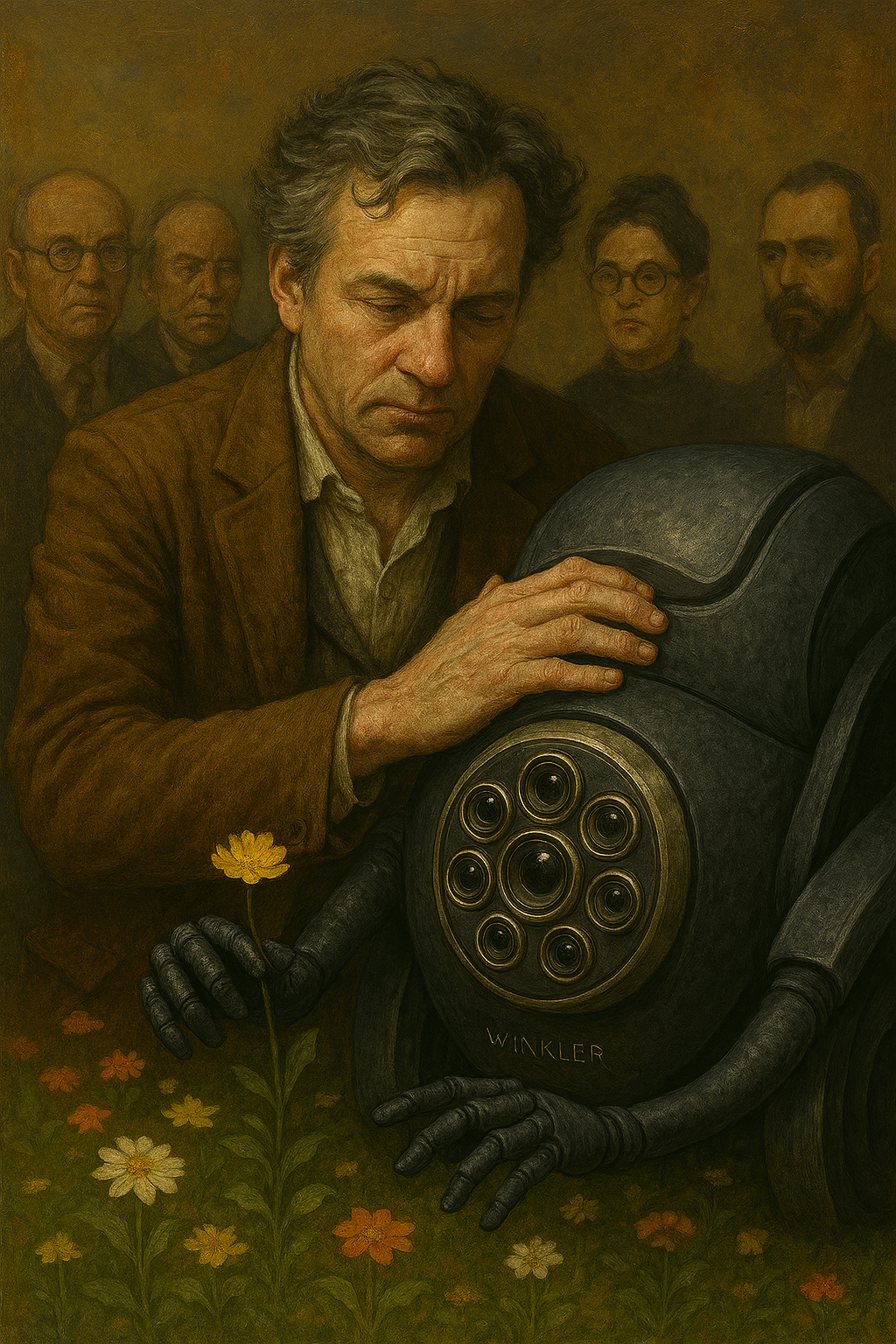
Those Ghost Club scholars, those great worldly writers, were trapped in a tangle of words. In some indescribably similar way, the world's greatest robots were trapped within tangles of software. But one robot in the world — the Winkler — had escaped those tangles. A robot had found a direct, unmediated, experiential relationship with Nature.
Nature was, somehow, the source of the Winkler's great art. The Winkler was post-robotic. It was neither alive nor intelligent, and yet it was in the world, and it learned from the world, and it expressed itself in beauty.
That was the issue.
Wolfgang had set himself a goal in his adventure with the enigmatic robot artist: to capture its true meaning, with one simple, clear sentence. One apothegm, one maxim. One missile of his insight, straight from his heart to the hearts of all mankind, wherever they were, whatever their condition. Even the savages of the Tyrol should be able to understand the Winkler. The sea was as deep and mysterious as the Winkler — but even a savage would understand the sea, if a savage ever saw and touched the sea.
Yet despite his effort, his insight, his dedication, all his sacrifice, all his study, Wolfgang had failed to find a clear line of critical attack. He could not tell the world what the Winkler truly was.
He had hiked from Germany over the mountains to Italy, but despite that physical feat, all too soon, his pledged tour of duty would end. Soon, some other members of the Ghost Club would take Wolfgang's place as the robot artist's human shadow. Wolfgang would abandon the Winkler and return home to Nuremberg, to his beloved Beau Monde city of stone angels, square roofs, and stone turrets.
His family, his wife Silke, his children, they would welcome him gladly, but he would be returning as a moral failure.
Another effort, another failure, just like the forty-seven other writers and thinkers of the Beau Monde who had already followed the Winkler. These colleagues of Wolfgang's had cast aside their own habits and comforts, to pursue the robot across the savage places of the Earth. That had become a central ritual with the Ghost Club, almost an act of devotion. The post-robot artist of the post-natural Anthropocene was an artist of such un-human power that even the elite of the Beau Monde, who were themselves no longer quite human, were baffled by the beauty it created.
Some befuddled authors were certain they had answered the Winkler enigma. But Wolfgang knew that they were deceiving themselves. These overconfident poseurs merely shared a refined rhetoric, of fancy metaphors and elaborate, useless theories. False myths, poetic snarls, a deep, lightless thicket.
The truth about a great robot artist — if that truth was discovered, found, and stated simply and directly — would overwhelm the world. The truth would brook no argument. Like the answer to a riddle, the truth would simply convince. The critic who revealed that truth to the Beau Monde would be a great scholar. He would be a torch to light the steps to the twenty-third century.
But no such burning light had ignited within the breast of Wolfgang Stein of Nuremberg. His days as an intimate of the Winkler were dwindling. For all his prowess in forest walks and mountain hikes, he had found no clear path to understanding.
Mankind was still pitifully snared in the thorny mistakes of its ancestors. And, with the remorseless passage of the centuries, new mistakes were ramifying.
#
Italy revealed herself to Wolfgang as the overgrown garden of Anthropocenic Europe.
Under her spectacular, often frightening skies, Italy had become one vast botanical lesson in eco-globalization. Great cosmopolitan jungles flourished in the peninsula, amazing thickets of black locust, ailanthus, kudzu, and bamboo. These dank, insect-humming, forest-sized feral growths flourished in the mellow sunlight, tangling, rotting where they fell, or burning in vast, raging, ashy, sky-reddening conflagrations.
Feral horses and cattle trampled Italy in huge streaming herds, pursued by hungry packs of feralized dogs. Tremendous flocks of pigeons, crows, starlings, and seagulls wheeled in the Italian sky, in shrieking bird storms that sometimes blotted out the sun.
Stinging ranks of nettles overran the ghostly borders of Italy's abandoned vineyards. Italian villages had been entirely eaten by their own garden flowers, in tall, reeking jungles of bright exotic ornamentals.
The only visible agents of human intent in this chirping, howling landscape were environmental robots. These workaday metal monsters did their duty to the Beau Monde, slowly scraping an old road, or noisily working together to brace a flood-control dam. The big grounded robots were aided by common flying robot drones, and beyond those aerial drones were the magnificent global space drones, flung into the blackness of orbit from the great Lucca launch field.
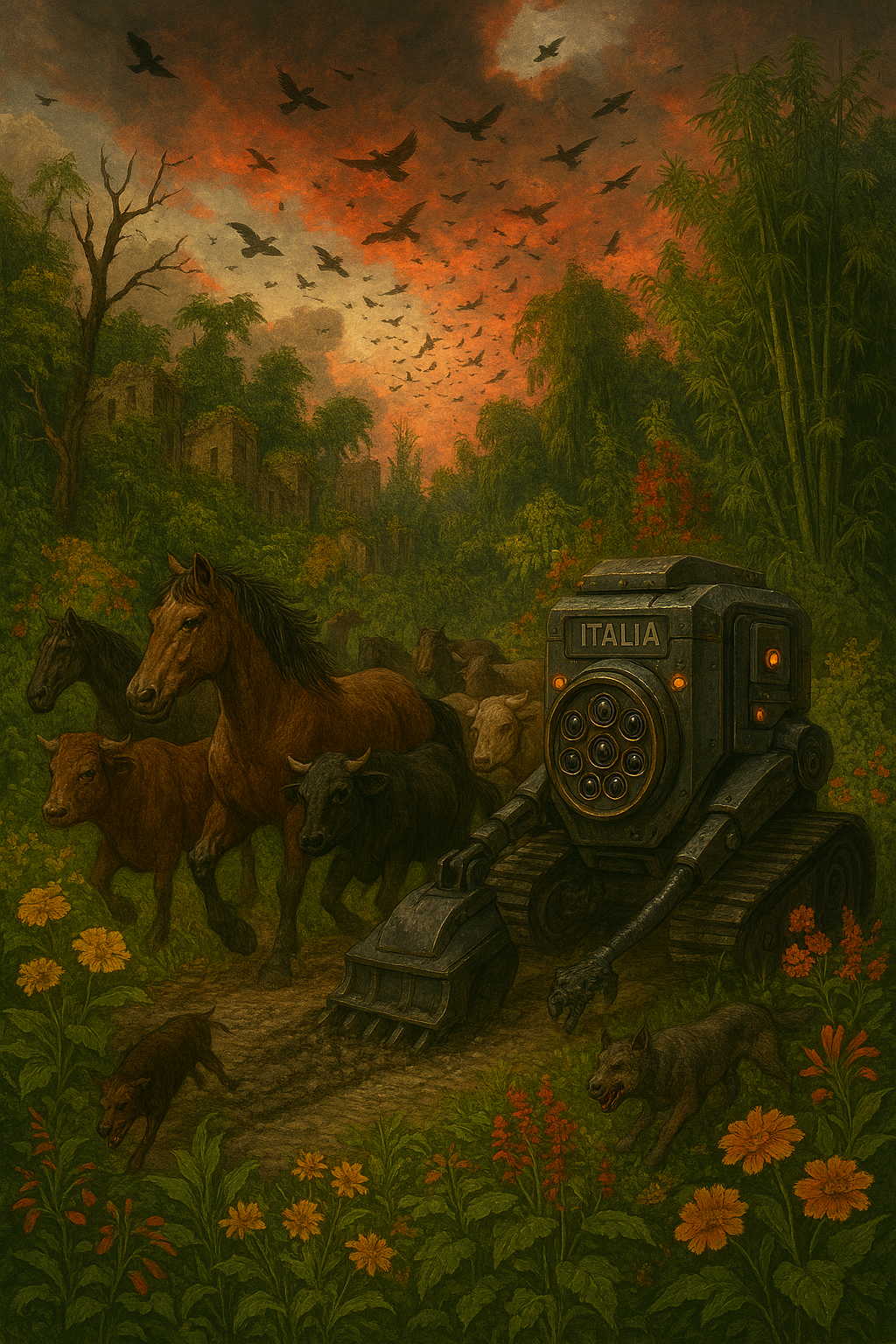
The Beau Monde had lost all interest in the soil. Civilization had abandoned its long habits of agriculture. Mankind had guiltily returned Earth's soil to the other living things of Earth. Those new masters of the Anthropocene world, the survivors of the big extinctions, were invasive species, mostly: the aggressive, parvenu squatters of the vegetable kingdom.
The humble Winkler rolled across the wilderness of Italy with an ant-like foraging behavior. The robot's custom was to stop to fondle some patch of lichen, a shiny pebble of agate, the white bones of some long-dead bird.
The Winkler's efforts to grasp its world were never simple, routine, or mechanical. The Winkler was so unlike any normal robot that it seemed almost vegetable sometimes, like a green network of crooked crabgrass that probed the naked earth in many rhizomatic fits and starts.
A Ghost Club critic had named these activities "winkling." That name had stuck to the robot, for the Japanese owner of the Winkler, a true adept of mechatronic cybernetics, had never given her beloved robot any name at all.
The Japanese artist had handcrafted her wheelchair for many years, and she had been a sorceress of code. Most robots, because they were robots, cared nothing for sunlight or darkness. But whenever the sun set, the Winkler would lower itself to the earth in a peculiar torpor, and dream the world's nights away. Sometimes the wheelchair dreamed in broad daylight, twitching and fitful.
In the years of its art practice, the Winkler had created only thirty-one cataloged artworks — not counting its hundreds of scribbles in sand, its marks in the dirt, and its probes in the mud. Wolfgang naturally hoped to discover a splendid Winkler artwork during his own tour of duty, but he knew his chances were slim.
In some ways he was grateful about that. The Winkler's art was highly coveted in the astral upper ranks of the Beau Monde. If he discovered a major Winkler artwork, it would arouse so much feverish attention that it might well overshadow his true work as a critic.
Although he was a gallerist, and a successful one, Wolfgang did not want to be perceived as some mere retailer of a robot's curios. The Beau Monde's raging hunger for fine art was, all too often, a fine excuse not to understand.
In its years of odyssey, the Winkler had never entered a city. And yet, when the stone walls of Verona appeared in the broadening Adige valley, the Winkler briskly picked up its pace. It rolled straight through the city gates as if it had been built in Verona.
Wolfgang was a stranger to Verona, and had to talk his way into the city. His Beau Monde charm did not fail him, and once through the city's noble, stone-arched gates, he was able to find the Winkler again, though more by luck than skill.
He saw at once that robots abounded in the Beau Monde city of Verona. They outnumbered the people by far. Mouse-like sensors darted from doors and windows, while elephantine units slowly scrubbed the streets.
Verona's elderly people had a particular fondness for traditional wheelchair units. No one in Verona looked twice at the Winkler. It simply trundled along the Veronese streets with all the stolid dignity of the city's shopping carts.
Crisply obeying the street signs, the Winkler rolled past Veronese hairdressers, gymnasia, and candy stores, over an arched stone bridge across the bright and rippling Adige River. The Winkler passed an ancient Roman amphitheater, and rolled straight through the yawning double-doors of a robotic "black factory."
Wolfgang rushed inside the factory as its doors hissed shut behind the Winkler. He found himself trapped within a windowless darkness, deafened by the busy industrial hum of moving servos. Duty required him to grope and prod with his hiking stick until he located the robot artist.
The Winkler had found an empty niche along the factory wall and plugged into the Veronese grid. The robot had sunk into a computational bliss, passing out into nirvana like some drunken Italian tourist.
With a groping effort, Wolfgang found an exit door from the lightless factory. Blinking in September daylight, he leaned against the wall to ponder his next move.
No one in the Ghost Club had ever seen the Winkler enter a city. Wolfgang was completely at a loss. Wolfgang knew nothing of the customs of Verona, and yet the Japanese robot, since it was a robot, seemed to have the freedom of the town.
He needed wise allies to help him watch over the Winkler, but how, where? He'd never met any member of the Beau Monde in Verona. Worse yet, his long weeks of the wilderness had left him shaggy, disheveled, and unfit to confront civilization.
Wolfgang took action. He abandoned the slumbering robot in its factory. He found a modest Italian hostel and checked himself in with a palm print. He washed his weatherproofed cloak, hat, and sturdy walking shoes. He enjoyed his first hot shower in weeks. He neatly trimmed his ragged hair and beard in a hotel mirror. He sent an affectionate message to his wife and two children in Nuremberg, assuring them that he was safe and well.
At the hotel bar he drank a fine cup of hot chocolate and cautiously asked the barman about Verona's local "Circle of Readers." Reassuringly, these cultured literati were much respected in the city of Verona. The Readers haunted a certain posh literary café.
Wolfgang braced himself to demand the aid of the Italian literati. His personal charm had rarely failed him, even among Tyrolese savages. He set out to find the café; but was instantly bewildered. The atmosphere of Verona overwhelmed him.
The Veronese architecture was fantastic. The people dressed with a dandified care. Their machines were eccentric. The steaming stacks of the food factories smelled like fresh-baked cakes. Even the tumbling flowers in the window boxes were alien.
The chic and stylish local Veronese ladies smiled at his all-weather cloak and broad hat. They seemed to think he was a romantic gallant disguising himself for an intrigue.
Why was he in Verona at all? Why had the Winkler entered any human city? What motivating force had pulled it from its nature studies in the wilderness, into civilization, after so many years?
It suddenly struck Wolfgang that cities — as creative, nonhuman entities existing on the planet — might have some deep affinity for the Winkler. Could it be that cities — which were creatively active entities, yet neither alive nor intelligent — also had some "third order of being," as the robot artist itself, supposedly, did? Were beautiful cities like Verona themselves also "robot artists" of a kind?
Maybe the Winkler was, in some sense, a city-on-wheels — a machine that created beauty in much the way that towns created beauty. Cities were authentic entities, growing from landscapes. People loved their cities. Wolfgang loved Nuremberg, and if he lived in Verona, he could surely come to love Verona, too.
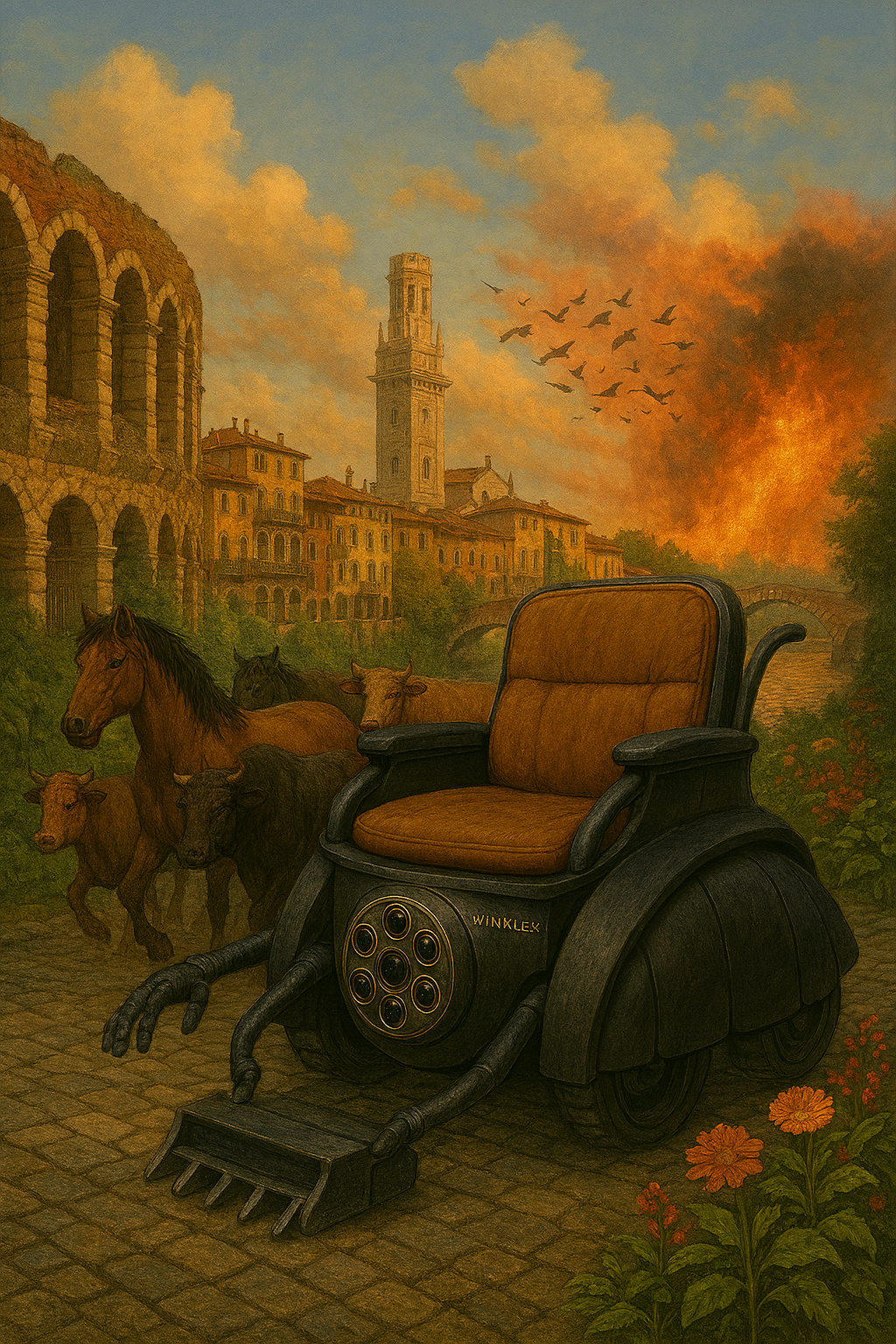
For a human being to feel love — that profound connection, that felt understanding — for a nonhuman, complex entity that was neither "alive" nor "intelligent" — that sudden insight seemed promising to Wolfgang. It might be the key to a new line of argument that would reveal the Winkler's true nature. Wolfgang had to find a sheltered spot in a robot bus stop to write that critical note in his sketchbook.
Then — conscious of the growing risk, and in a spasm of anxiety — Wolfgang hastened back to the black robot factory.
He arrived just as the Winkler was being loaded on a tow truck.
Two people had seized the Winkler from its bolt-hole inside the black factory. One was a Veronese official in a tall hat and braided uniform, while the other was a thin, nervous woman in a white laboratory coat. The hapless Winkler seemed paralyzed, and showed no initiative.
"Please don't interfere with this artwork!" Wolfgang cried out in English, rushing up to confront the two strangers. "What offense has the Winkler committed? I will take full responsibility for it!"
"This robot is an illegal fraud," said the woman. To Wolfgang's surprise, her global English had a German accent much like his own.
"But madame, how can the Winkler be a fraud? In what sense is that possible? A robot can't deceive anyone, because a robot has no moral intent."
Mustering his dignity, Wolfgang formally introduced himself to the Veronese city official. He took care not to mention his affiliation with the Ghost Club. The club's elite never tolerated a reckless use of its credibility.
The woman countered this action by introducing herself, in a stiffly proper Beau Monde manner. Dr. Jetta Kriehn was a scientific fieldworker from the Cosmic Council.
Wolfgang was rapidly grasping the situation. In the Beau Monde, the humanities and the sciences were rivals. There were certain troubling subjects where art and science collided, and the Winkler was one of them.
His new opponent — Dr. Jetta Kriehn — had laid a trap in Verona for the Winkler. Obviously she had known that the Winkler was approaching Verona. Scientists were clever and resourceful.
However, Wolfgang could sense that Dr. Jetta Kriehn was uneasy. Like himself, she was a global operative in a local town. His sudden appearance had taken her by surprise.
Wolfgang quickly decided to appeal to the self-interest of the Italian policeman.
"Please release this robot into my own custody, Officer. The Winkler is harmless. It hasn't done any harm to your city, or to madame's scientific intelligentsia."
The Veronese official was a mustached gentleman with a wily look. He silently folded his arms across his gold-braided chest. He watched their faces from under the brim of his splendid hat.
"Every scientific fraud harms the public interest," Jetta insisted. "Artificial intelligence is an old and malignant idea. A dangerous fraud like this must be policed and eliminated."
Rather awkwardly, the young scientist struck a Beau Monde oratorical pose. "This evil joke from a dead subversive has lasted long enough! This foreign hoax should be removed from the peaceful streets of Verona!"
Wolfgang gathered up the white folds of his travel cloak. "No modern thinker would even claim that the Winkler is an 'artificial intelligence,'" he declared. "This robot, like all robots, is neither 'intelligent' nor even 'alive.' However, this particular robot is the world-famous Winkler. If this great artwork comes to harm here in Verona — after traveling thousands of kilometers across the globe — that would gravely damage this city's Beau Monde reputation."
"On the contrary!" Jetta cried. "Scientists worldwide would cheer, because Verona took the necessary steps to arrest this malignant imposition! The City of Verona would be valorized by all the rational intellectuals of the Beau Monde!"
"I can refute that sad fallacy, so listen carefully," Wolfgang said. "By deploying that emotional term 'malignant,' you are implying that the Winkler is a moral actor! But that statement contradicts your own argument. We have already agreed that the robot has no 'artificial intelligence.' The Winkler doesn't live, it doesn't think, and it has no morality. Don't you agree with that, Officer?"
The Italian shrugged eloquently and spread his white-gloved hands.
"If the Cosmic Council really believes that a robot is a wicked criminal," Wolfgang said, "then fine, arrest the Winkler. Go ahead, Dr. Kriehn: make a fool of yourself and the Veronese court. What are your legal charges against the Winkler? When does this robot go on trial? I'll enjoy writing about a ridiculous scandal of worldwide scope."
"I can see that you are a literary man," said the Veronese cop, speaking English.
"I am. What's more, this robot is my favorite topic. Put a robot on trial. I'll attend that trial every day. The art collectors of the Beau Monde will take an interest in my commentary, let me assure you."
"Oh come on!" cried Jetta, her pale eyes darting in distress. "Don't let this strange tramp sweet-talk you, Captain! Those aren't true facts, those are all wild hypotheticals, and besides, this Japanese robot doesn't even belong to this German guy in his cloak! Just throw that evil thing into the truck, and let's get out of here."
"Do not be deceived by my travel garb," said Wolfgang. "My wife is Silke of Nuremberg."
The official bowed, then offered his gloved hand to Wolfgang. "Sir, I am Captain Gregorio, just a modest city policeman of Verona — but a sincere admirer of the Beau Monde belles arts. Therefore, I admire Silke of Nuremberg. She's the foremost landscape artist of the modern day."
"Your good taste is appreciated, Captain Gregorio."
"She's the creative light of her generation. Truly."
"I would agree with you there," Wolfgang smiled, "but as her husband, and the father of her children, I admit to some prejudice."
"Can your gifted and famous wife fly here to Verona? Can she join you here?" Captain Gregorio was politely eager. "Our Lady Mayor could host a lovely soiree for Silke of Nuremberg."
Wolfgang pursed his bearded lips. "My wife's packed schedule, unfortunately, doesn't allow her to make any sudden public appearances."
Captain Gregorio turned on Jetta, who was stunned and sulking at the turn of events. "Doctoressa, listen to me. This is Verona. A robot in Verona gets to do whatever it wants."
Defeated and knowing it, Jetta abandoned her Beau Monde composure. "Look, this is terrible! It's a public policy disaster! This so-called artwork is just a rolling billboard for bullshit! It's a crazy art prank that just rolls around the world, randomly weaving bird nests out of rubbish!"
Captain Gregorio shrugged eloquently. "But this wheelchair is famous. Verona has many artistic attractions. Now it has another."
"But this robot isn't even an artist, it's just a damned wheelchair. It's for intellectual cripples! It creates nothing but ridiculous confusions. It damages the science of robotics!"
Graciously overlooking her outburst, the Veronese official turned toward Wolfgang. "I'm sorry to have troubled you with this matter, sir. Your robot is free."
Wolfgang bowed. "To tell the truth, Captain, I do need some help in shepherding this robot. It rolled here to Verona all the way from Kyoto in Japan — an amazing feat, you'll agree. The Winkler is a creature of our modern Anthropocenic landscape. It's something like a Japanese kame, a 'spirit of place.' So it would be tragic to Verona if this robot came to any grief in this place."
"I believe that we can help each other," nodded the official. "That is — if you will promise not to write anything critical about Verona. We're a cultured people here — not so big as Rome or Milan — but we always do our best."
"The gallantry of you and your fine city both deserve my critical praise," Wolfgang told him, as Dr. Jetta silently seethed. "If you ever find yourself in Nuremberg, please do favor my gallery with a personal visit."
The Winkler suddenly came to itself, with a long, shuddering jolt. The awakened robot promptly rolled away down the antique Veronese pavement.
Wolfgang hastily left the policeman to follow the Winkler, and the scientist pursued him.
Dr. Jetta Kriehn was fizzing with rage at her setback, but she was a woman of purpose. "That was clever of you, what you just did," she said through gritted teeth. "But it was also dishonest and wicked. If you would only listen to reason, I could prove to you that this 'Winkler' is nothing but a hoax."
"The Winkler is a beautiful, meaningful, and poetic device," said Wolfgang.
"No it isn't. By the standards of robot construction, this hacked-up wheelchair is a piece of junk. It's a nasty fraud, from a mean-tempered old Japanese woman, who was sick of her life and hoodwinking the world."
The Winkler rolled downhill toward the riverside streets of Verona."Very well, Doctor," said Wolfgang. "Prove all that to me. I will listen to you. I will even take notes."
Jetta paused. "What is that thing in your hand there?"
"This is my artistic sketchbook. This is my pencil."
"Is that really 'paper and pencil'? Oh my God!"
"Paper and pencil fully suit a human being," Wolfgang told her somberly. "Because we humans evolved here on the world, and in the world. The natural limits of our senses are an integral part of our relationship with reality."
Wolfgang held up his hand to forestall her shocked interruption. "Yes, it might be argued that our human senses are slow, or even deceptive. I know all that, because I've heard it all! However — as a professional aesthetician — I must assert that a man lives best when he trusts his senses, and cultivates his senses so that they deserve trust! We human beings are authentic. We really experience a real world. Therefore, whenever I write, I write my own thoughts with my own hands."
Jetta thought this over, blinking in disbelief. "Well, the way you talk, you must write a whole lot."
"That is true. I am an art critic: a Beau Monde litterateur. Furthermore, I have personally followed this robot, on my own two human feet, for over six hundred kilometers. Other colleagues of mine have also followed the Winkler, across this world, its forests, mountains, deserts, for eight years. We have lived with this entity. We studied it day and night. Some of us died next to it. So I rather doubt you'll amaze me with some insight of yours in five minutes."
"You really did all that? You walked here, from Germany, in a cloak, with a pencil?"
"Yes, we really do that: and our emphasis is on the Real."
"You walk the Earth making up weird artsy bullshit about a cheap parlor trick like this stupid wheelchair here? You're a fanatic! Are you crazy? You must be starving to death!"
Wolfgang smiled urbanely and settled his heavy cloak on his shoulders. "Granted, I'm no scientist, unlike you and your Cosmic Council. But your scientific method is just one narrow technique of inquiry. You know less than you imagine you do. Science is notoriously useless for seeking metaphysical truth or establishing ethical values."
Jetta suddenly looked woeful. "Why is this happening to me? Why can't I just get rid of that stupid machine? My own mother thinks it's a robot with a soul that makes birds' nests! The Winkler is a cult! It's pure superstition. Can't you see that? You sound like an intelligent man. You're completely on the wrong side here."
"Your discontent with your mother's foibles is a part of the human condition," said Wolfgang. "Your science will never solve that issue for you."
"Let's leave my mother out of this discussion."
"Your science can't even solve the human problems of Science as an institution. Women scientists — by that, I mean women like yourself — are oppressed by your scientific establishment. Why else did you get this ridiculous job? You seem bright and capable. You could do better."
Jetta stumbled, then narrowed her eyes, for this shrewd attack had hit her hard. "Well, that's true. This robot assignment is lousy. Fighting science fraud is just some necessary scut work that I have to perform as my duty to the Cosmic Council. I almost had this job accomplished, before you showed up."
"But here I am, and I won't be leaving. Because I am the Winkler's sworn guardian. So if you want to harm this splendid artwork, you'll have to accomplish that over my dead human body."
Jetta scowled. "Oh come on, we are both Beau Monde, aren't we? The Beau Monde is beyond those old human habits of death, and violence and war. I don't even want to be human. I have higher ambitions."
"Oh, I know the ambitions of the Cosmic Council," said Wolfgang, his voice tightening. "I don't want to second-guess your intelligent, technically advanced, and not quite human patrons — but I'll never allow you to destroy the Winkler! It is the final masterpiece created by a great woman artist, a woman who was older, wiser, and better than you in every way. I will resist your philistine iconoclasm to my last breath. Even dead, I will resist it."
"Now I get it," said Jetta, her pale eyes wide and shining. "You are Ghost Club."
"No comment."
"You are. I never met one of you literary spooks before, but you are Ghost Club. You're very Ghost Club. Wow."
"Look. If you know anything at all about the Ghost Club, then you would know I can never publicly state that I'm 'Ghost Club.' Because that's bad literary ethics! If you are a great writer — a classic for the ages — then you can never say, 'I am a great writer.' That is crass! You have to wait for your peers to declare your greatness. Then you should be demure."
"I get it, Mr. Art Critic, sir. You're Ghost Club, you're married to that famous girl, and you have rich, posh friends in the art world. Fine: now I know who I'm dealing with. How much do they pay you to follow this robot?"
"They pay me nothing at all, Doctor. In fact, I sacrifice a lot for the honor of doing this."
Jetta laughed bitterly. "Then your stupid job is even worse than my stupid job! You're a clown! We're both completely screwed because of this stupid robot, which is an empty chair, a piece of junk! Why are you stopping me from just getting rid of the Winkler? Do you get any rational benefit at all?"
Wolfgang wrapped himself in his cloak. "In literature, we receive benefits beyond your so-called 'rationality.' Our major benefit is becoming famous after we are dead. All the greatest writers of mankind are ghosts. Hence, the living power of literary tradition, the 'Ghost Club': the oldest and deepest unifying force of the global Beau Monde."
"That sounds pretty. It's nonsense, of course."
"My dear, you'd be surprised how long our pretty words can last. Our words will bury all your friends in the Cosmic Council. They are cosmic, they will outlive normal humans, but they all use language, and we are the masters of words."
"Oh, stop that boasting. We're both stuck walking the streets behind an empty wheelchair. You writers are all talk."
The Winkler slowed suddenly, and Wolfgang was forced to creep along the street. "Since we're walking together, we can be civil, can't we? As you say, we're both Beau Monde. The Cosmic Council is a major Beau Monde institution. So, tell me, Dr. Kriehn: What is your field of research, exactly?"
"I'm a post-anthropologist of the Anthropocene."
"A radical, I knew it!" Wolfgang cried. "You want to tear up the roots of our being. You want to rip humanity out of its natural matrix and transform us into cyborgs. That ambition is fatal!"
"No, my ambition is vital. It's your ambitions that are fatal." Jetta lifted her palms and gazed upward, her pale eyes strangely glimmering. "We must improve mankind radically, or else mankind will die off like dry weeds under these ruined skies."
"'Man is a rope stretched on an abyss between the beast and the superman.'"
"Wow," said Jetta, blinking. "That's the first thing you've said that makes sense."
"It sounded better in the original German. Four hundred years ago."
The Winkler, balky and jittery, chose to take a sharp turn, rolling along the stern, stone flood embankment of the bright River Adige.
"My robot companion behaves so oddly here in Italy," Wolfgang lamented. "I wish I knew why."
"I can tell you that," said Jetta. "The Winkler came here to Verona to recompile. So it needs a strong power supply and a fast, steady cloud connection. Then it can sync its local circuitry with the global Beau Monde cloud, and work out the bugs and kinks in its deep-learning algorithms."
Wolfgang stared at her. "How do you know that?"
"We know! We're the Cosmic Council! We can watch the robot crunching its data in real time. The Winkler's software is hosted on global servers. It could never hold its huge databases inside its own little head."
"The Winkler doesn't have any 'head.' It's a wheelchair."
"The Cosmic Council has scientists who track malware. Most of the time, this robot just putters along by itself in the wilderness, running on solar power. It's out there like some vacuum cleaner, groping with the grass and twigs and flowers. It compiles databases, and tries to deep-learn principles from the shapes of natural phenomena."
"Right, yes," Wolfgang said eagerly, "yes, do go on."
"But there are no deep, pure artistic principles in Nature. That idea is a myth. And even if pure Nature was a source of pure Art, then climate change would have ruined that already. There is no 'Nature' anymore. This world is Anthropocenic. Everything in Nature has been altered and changed by mankind."
"I'm forced to agree with you there," said Wolfgang. "This is the twenty-second century. The Anthropocenic is a truism."
"So the Winkler's botched, mistaken software gets chaotic. It can't do what's impossible, so it gets needy, it gets greedy. Here in Verona, the people are careless with robots. This city give its robots huge computational resources. So we knew the Winkler would come here."
"Well," Wolfgang nodded slowly, "your scientific method does have its merits."
"I'm telling you the truth, you know." Jetta reached within her lab coat and removed an ivory slate. "You don't have to take my word for it. In science, you can look for yourself."
Wolfgang accepted her scientific screen and gazed within its glass.
As it rolled haltingly through the Veronese streets, the Winkler was playing chess. The tablet's screen displayed an astounding overview of a sprawling game board, with millions of ranks and columns.
The awful horde on this titanic chessboard was made of standard chess figures — rooks, knights, bishops, and pawns— but deployed in dense, ant-like masses of battling millions.
Vast, foam-like waves of chess battalions were clashing tempestuously in seething, silent maelstroms of black-and-white combat. Here and there, within the computational chess plane were whirling knotted chess problems as intricate as snowflakes, where thousands of pieces, locked in fatal power struggle, exploded in waves of sacrifice.
Wolfgang was stunned by the ferocious vista in the glass. "The Winkler dreams with chess? Does the Winkler often do this?"
"It uses chess algorithms to grab global cloud power," said Jetta. "For your useless robot pal here, chess is just a malware tool."
"But this is not a chess game at all. This is no game, it's colossal, it's beyond all human comprehension. It's frightening, it's sublime. Its fantastic. It's like a vast kaleidoscope."
"So what? It's just code! Robots don't think! A kaleidoscope is just a machine, it's chips of glass! A million kaleidoscopes would look amazing to you, but it's just a heap of glass. A heap of silicon. In the end, the Winkler amounts to nothing."
"But Jetta, why? Why does the Winkler play huge games of chess while it dreams? Why doesn't it just emit white noise? Why does the Winkler do anything at all, in this world of ours? The Winkler's not alive, it can't think, it has no feelings, no motives, no needs, no desires! Why doesn't it stop, kill itself, die, quit? Why does the Winkler go on? What does the world mean to it?"
"Robots aren't so mysterious," said Jetta. "We just fool ourselves: we imagine that computational systems have mystery. They have no mystery, they just have computation. Sometimes it's big, sometimes it's small, but it's all the same ones and zeros. It's people who are mysterious."
Suddenly she smiled at him."I am mysterious. Why am I so happy, suddenly, here in Italy? Why is Verona so beautiful?"
Her coy smile had little mystery for Wolfgang. Jetta Kriehn was happy because she was confessing herself, and because he was listening.
Wolfgang had a charm for women. He was handsome, well spoken, polite and emotionally attentive, so women tended to think well of him. Jetta Kriehn was no longer quite human, because he could see that the Cosmic Council had done something transformative to her; that was their way.
Despite that fact, she was flirting with him. She found him attractive. Wolfgang was not flattered by this. Somehow, it painfully reminded him of a lonely old woman artist whose only intimate companion was a robot wheelchair.
"Why does it play chess?" he said to Jetta. "The Winkler is denied a partner for its chess game. The Winkler is a unique thing in this world. It's entirely alone."
Jetta looked aside and shrugged. "The old Japanese woman liked chess. She liked conceptual art stunts. Like stacking up grand pianos and setting them on fire."
"That's true — she always had her fine respect for the classics." Wolfgang offered a judgment. "Akiko Nakamoto's artwork is not entirely to my taste. I find much of her work pretentious and dated. However, I respect her. Only a great female Japanese artist could have ever created the Winkler."
"You made four stupid mistakes in one sentence there," said Jetta spitefully. "That's because you want your Winkler to have soul magic inside it. You want your Winkler to be mysterious and literary for you. But it isn't. 'A great female Japanese artist,' those are four fine-sounding words, but they have no truth in them. She was female, but we women aren't witches. She was 'Japanese,' but the Japanese aren't magic people. Three, she was an 'artist.' She created fantasies, that's all. And four, she's was never 'great,' because this scheme was a cheap publicity stunt that she made from her used-up wheelchair."
"Do you really think this artist was a wicked person? An enemy of yours?"
"I have a right to be angry about her arrogance. Akiko Nakamoto made the Winkler. A painted idol. We scientists tried to ignore it at first, but every year that it rolls across the world, this robot gets more famous. People think it has an aura, that it's divine, even. Mysticism always darkens people's thinking. Superstition keeps people ignorant, and powerless, and down. This ugly toy of hers is an occult act. Yes, she was bad to do it. Wicked. Her Winkler is like her curse."
Wolfgang, Jetta, and the jittering Winkler all paused at a gently blinking traffic light.
"In the last century," Jetta said, "millions of people were killed with 'autonomous drones.' Your friend the artist was alive then. She was as young as we are now. This robot she built has the taint of that war, that darkness, that feat of letting robots take the moral blame for mass murder. The Winkler stinks of that."
"Oh, well, that's quite an old, hackneyed argument," said Wolfgang, with an urbane shrug. "Yes, things were horrible, back in the twenty-first century — how could they not be bad? Far too many people, not enough resources, they failed to manage politely, they were never Beau Monde. But some old-fashioned genocide with drones is not the concern of the two of us, not here and now. The strict limits of your scientific worldview have blinded you to the central question."
"What question is that?"
"This is it: What if this Winkler really is an autonomous entity? What if it's not a mere robot with strange malware, but something authentically different, a true 'post-robot'? We both know the Winkler's not alive, and it's not intelligent. The twenty-second century agrees about that, that is settled, we know that AI is a myth of the past. But: the Winkler might be so radically different from our expectations that no one has described the truth of its existence."
"The Winkler has a 'Third State of Being,'" said Jetta.
"Yes, that. That concept. That idea."
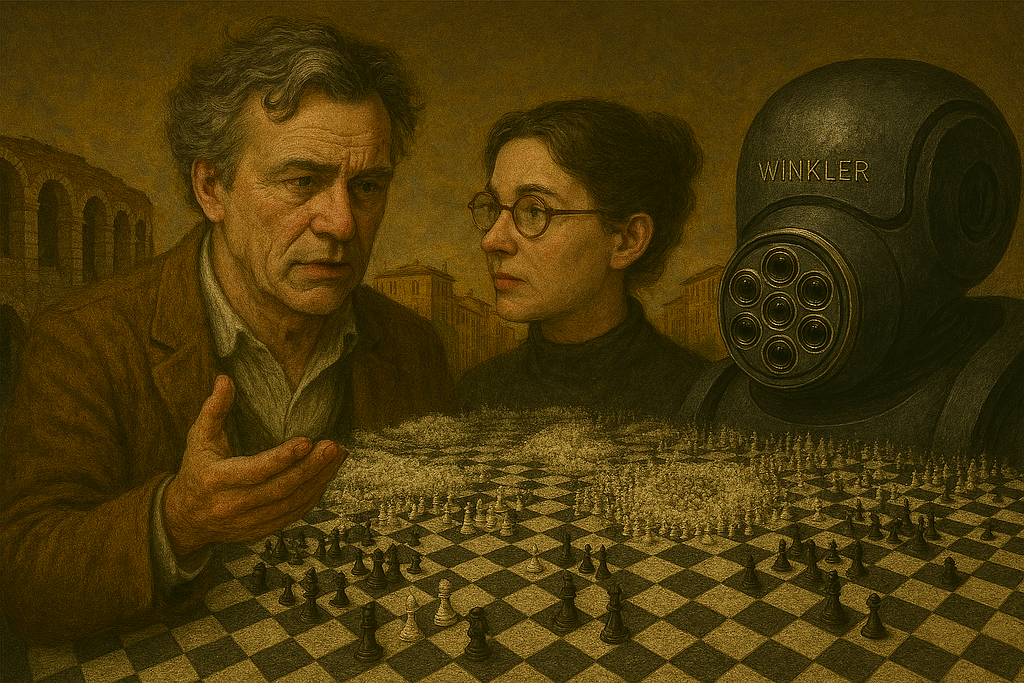
"That idea is rubbish! Can you measure any so-called 'third being'? Does it have any mass and energy? Does it leave any trace in the world that any instrument can register? It's a ghost! You made it up."
"I didn't invent the Winkler. The Winkler exists, look, here it is, it's in our world, like you and me!"
Jetta considered this. "You and I, do we have to quarrel? It would be so easy for us to get rid of the Winkler. Problem solved!"
Wolfgang drew a breath. "It's not so simple. The Winkler's not a stupid fraud. If you think so, then you should make fifty Winklers. Persuade your Cosmic Council scientists to copy the Winkler. Then, let fifty Winklers roll around our world. The Winkler won't possess any more magic 'aura' after that is done. I'm an art critic, so I know this: people will perceive that army of Winklers as normal, mundane robots. Everyone will get bored with the Winklers. Your problem is solved if the art robots are everywhere."
Jetta stared at him, impressed. "That was diabolical! You want to trick me into making more Winklers? Make them yourself! Don't make me do it!"
"What are you so afraid about?" Wolfgang laughed briefly. "You certainly fear it a lot, whatever it is that you fear. Can you weigh, or measure, this mystery that you fear? Surely it doesn't exist."
"Well, I'm not afraid of any weird art crap you make up that's outside the laws of physics."
"I hope you don't meet God in the Afterlife, with that kind of crass materialism."
"God doesn't exist."
Wolfgang spread his hands. "Well, the vast majority of mankind has always strongly disagreed with that opinion. 'There are more things in heaven and earth than are dreamt of in your philosophy.'"
She looked at him quizzically. "Are you religious, Wolfgang?"
"In a way. Yes, I am spiritual. Sometimes I wonder if the Winkler knows God much better than we humans do."
"In science," said Jetta, "we are not allowed to make absolute claims about God and Reality."
"You just did."
"I got carried away, all right? Because I'm passionate. Besides, this is such a good argument! You're the first guy I've met who really cares about my lousy robot." She blinked, and rubbed her pale eyes. "If a guy as clever as you is so upset about this wheelchair, it must matter more than I think."
Jetta, Wolfgang, and the Winkler had to wait, then detour as a robot riverside crane unloaded swaying lengths of Italian timber from a robot river barge.
Wolfgang spoke up at the far side of the bustle. "An objective phenomenon, such as the Winkler, can focus a metaphysical debate. That is why the Winkler has been so lastingly esteemed. It's not the machine by itself — we know the Winkler is an artist's provocation. The Winkler represents a larger issue, about the role of art in life. A robot that is a great artist must be a participant in life, even if it's not alive."
"Science also has a role in life. Science makes no 'provocations,' science makes experiments," Jetta said. "Listen to me now. You postulate that there is some 'third state of being' that is different from 'life' or 'intelligence.' You think that it comes out of computation, or software, or from network connections — somehow. But how can you test your claim? How would we prove that this 'connectivism' was really there, or that 'connectivism' was never there at all?"
"Well, I know the connectivism is there." Wolfgang pointed at the Winkler as it deftly skirted an open manhole. "There it is."
"Oh, sure, you writers can write all those fancy words like 'connectivism,' 'hylozoic,' 'animism,' 'third state of being,' but you're just proclaiming your faith! That's all! None of those words can be tested, so it's not reality. It's just poetry. It's empty verbal claims."
"Maybe you should abandon your own empty claim that you can falsifiably test everything in the world."
"But dear Wolfgang, there is no 'third state of being'! No! The Winkler doesn't have any 'state,' and, also, there's nothing for it to 'be'!"
"There is."
"Well, what? What, then, for heaven's sake? What is it, really? Spit it out, just say it simply and clearly, tell me!"
"I want to do that," said Wolfgang. "I ask myself that question a hundred times every day. That question is my torment. If you could help me with that question, I'd be deeply grateful to you. Sincerely. You might be saving my life."
Jetta considered this. "You want my science help in your art criticism? Are you serious?"
Wolfgang strode ahead of the slowly rolling Winkler. "Well, yes. I do need someone's help here in Verona. The Winkler has behaved bizarrely ever since it came to Italy. I thought I almost understood the robot, when we were out in the wilderness, the forests, the mountains, together, me and the Winkler, alone in the world. Now we're here in a strange Italian city. I don't know what to make of the Winkler, or even myself. I feel a strange dread that the Winkler could vanish any moment. The Winkler will vanish — or maybe me."
"I thought that you worshipped the silly thing. You act like its a sacred monk, with that white robe you wear."
Wolfgang shook his head, lifted his white cloak, and dropped it. "Jetta, I admit that, yes, I do sympathize with the Winkler. Maybe I've even become fond of it in some way. But is that the truth? In poetry, there's a term called the 'pathetic fallacy.' Do you know that term?"
"I can read," said Jetta. "I don't read a lot of poetry."
"In the 'pathetic fallacy,' a poet attributes pathos to a thing that lacks emotions. 'The cruelty of the icy rain.' 'The fierceness of the wildfire.' It's a strong poetic device, people will respond to that, but the rain is rain, it has no 'cruelty.'"
"That is right," said Jetta, her eyes gleaming with sudden hope. "The 'pathetic fallacy,' that's just what you've been doing all along. You should stop that."
"Well, the pathetic fallacy not precisely the issue. There's another matter called 'prosopopoeia.' In prosopopoeia, the writer gives an abstraction a face. For instance, when 'Justice' is portrayed as a beautiful blind woman with her sword and her scales, that is 'prosopopoeia.'"
"That strange word, I can't even pronounce that! But, well, you literary people shouldn't do that."
Wolfgang smiled. "You scientists do that all the time. I know that your Cosmic Council's golden scientific medals have fine pictures of 'Truth' and 'Nature' on them. Two beautiful nude women, Truth and Nature! A scientist should devote his very life to prosopopoeia. Do you?"
"How old are you, Wolfgang?"
"I'm thirty-six."
"Well, I'm twenty-five, but you can stop patronizing me. I'm a scientist, I'm not a blind girl on a gold medal. I had to walk my own path to get where I am in the world, to be here and now. I did it, and my feet are raw and sore."
"I walked across a mountain range, to be here and now. Did you?"
Jetta pursed her lips and said nothing.
"We should suffer less on our journeys," said Wolfgang. "May I be frank with you? Truthful? Natural?"
"Fine. Do it."
"On the last day of September, I must fly back to Nuremberg. My tour with the Winkler will be finished. I will never see the Winkler again. You understand?"
"I don't understand the strange rules of your Ghost Club," said Jetta, "but I understand you. You mean to say that we are opponents — but only in the here and now."
"We never met before Italy, this place and this time. When we part, we'll likely never meet again. So why be opposed at all? Art and Science should join forces when we can. We should study the Winkler together. We might discover something important."
"I have a better idea. I'm thinking we should pitch the Winkler straight in the river together. A wheelchair can't swim."
"Actually, the Winkler does swim. I've personally witnessed it swimming. But listen: the Winkler might, in fact, be worthless. Really. I admit that possibility. Maybe you are right: maybe the Winkler is a cruel hoax by a mean old woman. In which case, I won't defend the Winkler. I will attack the Winkler. I will debunk it as bad art. I will write a stinging denunciation of it. I will show the Winkler no pity. I will ruin its artistic reputation in every corner of this world."
Jetta pulled at a lock of her short hair. "Can you do that?"
"Yes. That's not the mode that I relish as a critic, but if a critic has no teeth, he's not a critic at all. The art world despises a hoax. Let the Winkler wander the Earth till it rusts and falls apart. As a laughingstock! Junk! Rubbish!"
Jetta considered this. "You critics are cruel men at heart, aren't you? I just wanted to quietly tip a robot off a bridge."
"The direct attack will never work. Never make a martyr of the Winkler. The noblest art is always lost art. A tragic myth can outlast any gravestone. I promise that's true."
Jetta drew her long-fingered hands from the pockets of her white lab coat. Slowly, she drew nearer to him. "If I help you with the Winkler, can you handle some travel expenses for me? This is Italy, you know."
"Within reason, yes I can. Although, if the Winkler returns to the countryside, we'll both have to live rough. The Anthropocene, the wilderness, is hard."
"I know how to manage rough fieldwork. The Beau Monde has its ivory towers, but they're never yet meant for me."
"Do we have a bargain?"
Jetta offered her hand. "Yes. As Science and Art, we have a brief and local alliance, which is only for the here and now."
Wolfgang gazed into Jetta's eyes as he gripped her hand. The contact of their flesh was a strong erotic moment. It was as if she'd flung her lab coat off and wrapped him in her arms.
Jetta opened her lips to speak, to scold him or maybe to flirt, but then a robot bus rolled up and disgorged a horde of noisy human passengers.
During their pleasant moment of intimate embarrassment, the Winkler had rolled aboard the Veronese bus. The robot had swiftly vanished in the toils of the Italian city.
An urban transport system was a robot's native element. Pursuing the Winkler was like trying to swim after a shark.
Alarmed and frustrated, Wolfgang and Jetta had to abandon their useless pursuit. They had to seek the help of Captain Gregorio, the Veronese city official.
Captain Gregorio was delivering testimony within Verona's lavish Palace of Justice. Wolfgang and Jetta had to wait impatiently while local prisoners were brought into court. These defendants were burdened with heavy iron chains on their wrists and ankles. Italy's city-states, freed of national norms, had evolved many strange local customs.
The Veronese trial was a stately procedure, but after much courtly ritual, Wolfgang and Jetta were allowed a word with Captain Gregorio in a wooden coffee closet backstage.
"I'm sorry to hear about your mishap with your global robot," said the Italian politely. "I should have placed the Winkler under police guard — although it's too late now. I wouldn't worry too much, though. If a robot is within the city walls of Verona, then it can be found. A simple matter of allocating official time and resources."
"How long does it take for Verona to find a vagrant robot?" said Jetta.
"Well, that varies. How much global money can you offer us to meet our local expenses?" Gregorio gently tapped his fingers on his waxed and gleaming coffee table. "If you two can pay us promptly, and if your robot is here in Verona, then all will be well. However, I can offer no assurance at all if your robot is outside Verona. As two people of the Beau Monde, you must know that, outside Verona's walls, I can do little to help."
"My slate shows that the Winkler is still running software," said Jetta. "Can't you track that on your local police network?"
"Yes, any robot can be tracked," Gregorio allowed, "but that is a matter of time, of custom, of legal permissions and many fine, old robotic traditions…. Your robot was never native to my city. Your robot has no human owner at all, I understand. That is most exceptional."
"We don't want to trouble your city administration with a complex global issue," Wolfgang offered. "Is there, perhaps, some discreet, private method to find the Winkler?"
"Oh, well, yes, Italy has almost too many discreet private agents," said Captain Gregorio, "including yourselves, if I may say that. Are you sure that you two, yourselves, aren't the source of this trouble in Verona? Every policeman knows that the theft of a robot is commonly an inside job. This may be an intrigue from some enemy who knows you are in Verona. Some traitor you have foolishly trusted."
"That is a dark theory," said Wolfgang.
"We are familiar with famous artworks here in Italy," said Gregorio politely. "Some wealthy, unscrupulous art collector — perhaps a patron from your famous gallery in Nuremberg, sir? — might have found an opportunity to simply seize the Winkler and crate it up!"
Jetta narrowed her eyes, and smiled. "What crazy people there are in the art world!"
"Or — perhaps some scientific criminal has hacked the Winkler," said Gregorio, glaring suddenly into Jetta's pale, shining eyes. "The Winkler may be seized, by remote control, from thousands of kilometers away. The Winkler's software is old, and surely riddled with flaws. Some technical pirate, whom you know, Dottoressa Kriehn, might have pounced on that robot just to spite you."
"Why would anybody do that?"
"Oh, the dark pleasures of illicit possession can gnaw at the soul of anyone, human or more than human," said Captain Gregorio. He deftly tapped fresh coffee-flavored yeast powder into his ancient brass percolator. "Why do people choose to commit art crime? Is it so that you, yourself, can see that precious artwork, gloating over the stolen art, just as you please? Oh no! The true pleasure of theft is in denying what is precious to other eyes! Through art theft, you harm the innocent happiness of those you envy."
Wolfgang exchanged a troubled glance with Jetta. He had never expected an Italian policeman to offer such dark insight into their situation.
"What should we do?" said Jetta.
Captain Gregorio knotted his dark brows under his splendid hat brim. "Art and Science should trust in the Law. I can devote some of our city's slender resources to your special case. Come to my office tomorrow. I mean, after lunch, naturally. Bring me some money. Then we can put in the necessary requests to study the video street records, shipping lists, bills of lading, and so forth. We can also request some help from the Verona airport. Unfortunately, since our Verona drone field is a global airport, it has its own global Beau Monde standards, with strictly separate security arrangements . . ."
Wolfgang and Jetta expressed their gratitude and departed the stately courthouse.
Jetta was downcast. "We are both in big trouble now. I'm starting to think that we must be bad luck for each other."
"At least we have someone intelligent to share our troubles with," said Wolfgang. "That policeman can't do much for Art and Science, obviously, but you and I are capable, and much stronger as a team. Tonight I will ask for help from the local Circle of Readers. Very little happens in this world that the Readers don't read about."
"Tonight I can find a Cosmic Council system administrator who can place a finger on the robot," Jetta said. "But — programmers are never prompt when it comes to the needs of a post-doc on a field assignment. Those big fancy code experts only want to do the big glamour jobs."
"That's too bad — but at least you can talk clearly to your science colleagues. In my own literary world, it's all about allusions, hints, and implications. The vagueness of literary culture can be so maddening sometimes."
Jetta sniffed. "Well — to tell the truth — it wouldn't much surprise me if a coder did steal the Winkler. Those rascals just move their fingers on a keyboard, and something gets stolen. Computer science is disgusting."
"Art theft is even worse than that. I run an art gallery in Nuremberg. The great collectors of the Beau Monde are bizarre. Until you meet one, you would never believe how strange rich people are nowadays."
Jetta gazed at him in anguish, and he returned her look. But their anguish was not all that keen, because there was so much excitement in being in trouble together.
"We mustn't panic," said Wolfgang. "Two strangers in Italy have to be clever and patient. Let's be practical, let's keep our strength up. Do you know any decent place to eat here in Verona?"
"I'm a scientist, I just eat the snack food off the street carts," Jetta confessed. "Any cheap food from a robot is always fine with me."
"Well, that won't do, because I've eaten nothing but trail mix for five weeks. I can pick a good Veronese restaurant based on th
Ancient Everyday Weirdness (2026) [ 01-Jan-26 8:19am ]Ancient Everyday Weirdness
by Bruce Sterling

This design essay is part of a series, including "The Homemade Limits of Everyday Weirdness" and "Some Public Limits of Everyday Weirdness." I release these essays on New Year's Day.
My two earlier essays were about weird domestic arrangements. This one concerns weird everyday objects.
"Every Day Carry" is a lifestyle native to the 21st century. This hobby was directly named after "the everyday." "Every Day Carry" concerns tools, toys and/or utensils which somebody, somehow, feels obliged to lug around on their own person. All the time. Every Day.
"Weird Everyday Carry" is a niche even more intriguing to me, because it combines my abiding interests in the oxymoronic, the everyday, and the weird. How weird is everyday weird? What are the limits to weirdness? How long has this weirdness been going on?
That term-of-art "Every Day Carry" is a neologism from digital social media, but the weirdness is prehistoric. The term-of-art from archaeology would be "manuport." A "manuport" is some hand-carried knick-knack, a small shiny object, commonly a pretty rock, that somebody saw and grasped. They picked it up, by hand, and lugged it a long distance, just because they were happy to look at it, and they wanted it in their hand.
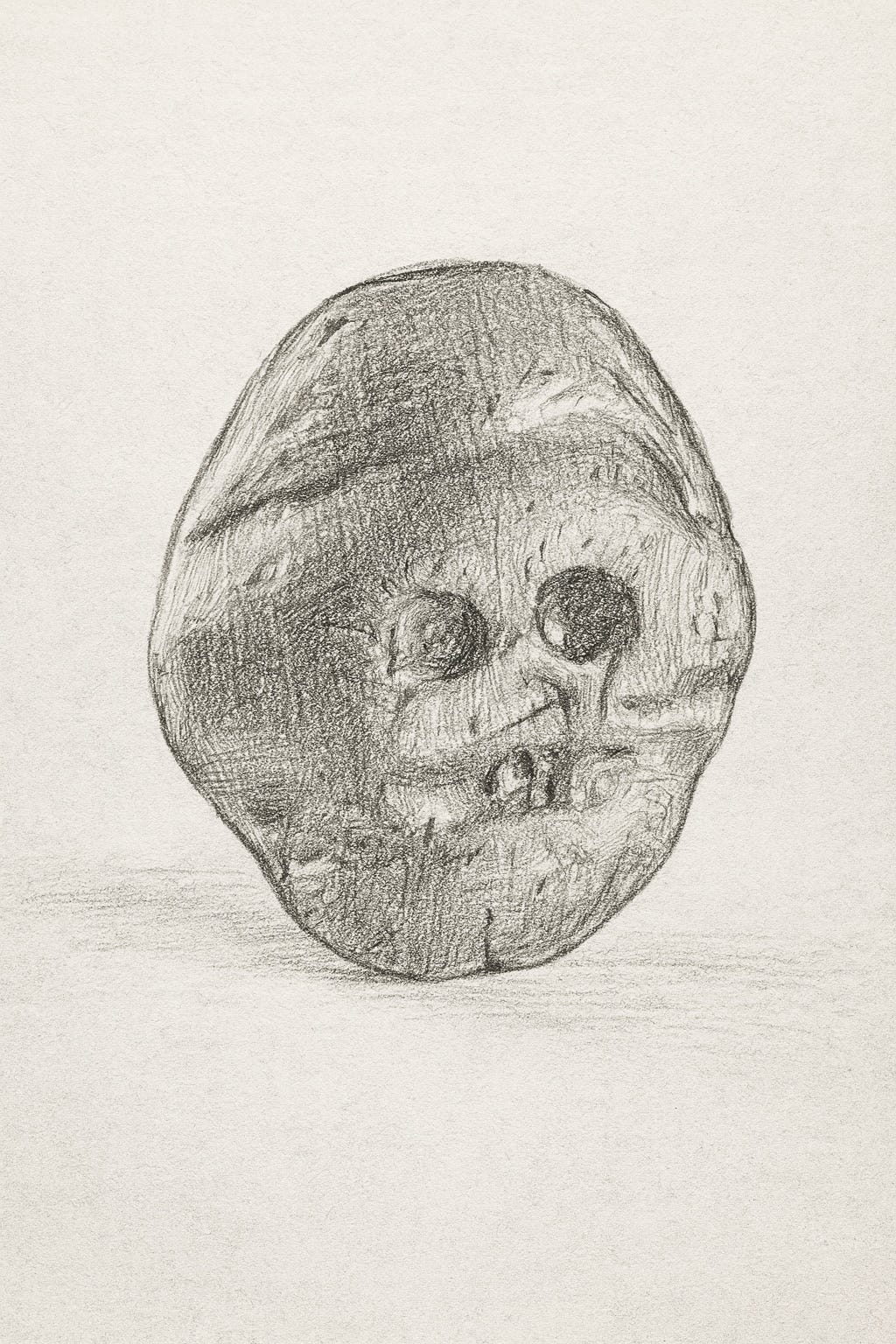
It's pleasant to take note of this deep human continuity, the anthropoid's enduring fondness for collectible curios. When these handheld things seem senseless to us, when they lack clear motive, they lack rational explanation, they're exotic and out-of-place… then they're weird.
It is entirely normal and banal, it is non-weird, for people to carry some things every day. In our own everyday era, those might be the standard personal clutter of cellphones, wallets, glasses, pens, and keys… Every one of those ultra-common artifacts would be bafflingly weird by the cultural standards of some past era. You could place your cellphone into the hands of Galileo and that genius-of-science wouldn't get it, he'd be at an utter loss.
Personally, I carry multitools. I've done this — every day — for half a century. This is standard behavior for me. Since I carry these tools so very commonly, and so near to my person, and I use them so often, I'd have to say that multitools are, for me, the least-weird, most-familiar artifacts that I have anything to do with.
I know their histories, purposes, promotions and price points. I've seen them built in factories. I can maintain them, modify them and even pull them apart. I've pretty well got them figured out. They have no occult mysteries for me. I have one, and often more than one, in hand's reach every day of my life.
And yet, despite their intimate everydayness, they are protean and unstable objects. In my long intimacy with them, they've changed a lot, in strange ways.
Back in the vanished 20th century, I had no modern "Every Day Carry" attitude about multitools. I came from a family of Texan farmers and engineers, so pocket tools were the fabric of our everyday reality. As Texan men, we just had 'em, as tradition. I used them every day, in everyday ways. I never felt at all "weird" about them, unless I broke one or lost one. Then my life became weird without them, because I was suddenly deprived of a host of small, useful actions that I routinely did as my reflexive habits. Everyday micro-acts, that I carried out routinely with my pocketable knife, bottle-opener, scissors and other, odder features.
Every time I lost a tool-set of this kind (which I often did, because I was so young, lazy and carefree), I had to promptly fetch some other one. I always did that, so as to restore my humdrum status quo. I consumed them and I tossed them like pencils. I rarely pondered their weird nature as weird objects manuported through a weirdly changing world. I depended on them every day, and I used them a dozen times a day, and yet I scarcely perceived them. It's a little weird, how entirely normalized they were.
As Adam Greenfield has wisely remarked, "Design dissolves into behavior." If you carry small scissors, every day, for years, then those intimate scissors will escape your conscious notice. Your design-awareness — ("Lo! I possess Victorinox scissors!") will dissolve into habit, as your world becomes a normally-scissorable world.
Even the intimate people around you will thoughtlessly expect you to provide this Greenfield scissoring-behavior. They will ask you to scissor things when you're wet from a shower in a towel. That request seems pretty weird, but it's much less weird than pausing your own lived experience to formally, technically recognize that your husband can't possibly scissor some kitchen-package because his pants are in some other room. Whenever design dissolves-out-of-behavior, it tends to manifest as an odd little crisis of this kind.
Though I've used them commonly for fifty years, I'm currently more intensely interested in multitools than I've ever been before. In the present historical moment, 2025/2026, I follow their industrial foibles, quirks and furbelows, with the abiding interest that I once had for "personal computers." I buy multitools like I buy coffee-table art books. I've been known to carry four or five different models at once, on belt-loops, in satchels, in bags.
This EDC-conscious cultish behavior of mine surely ranks as "Everyday Weird." I'm aware that it's peculiar, and I'm even a little chagrinned about it.
I'm comforted, though, that it's not all my own fault. I was lured into it by social change. I was beset with peer pressure. I have multitools that are uniquely hacked and even laser-engraved, but "Severe Everyday Weird" would be a tool collector/evangelist who owns glass-topped display racks of multitools. Most of these devices never "carried," any day, by anybody. They're mint, like in numismatics.
These zealots diligently pursue and collect extreme, artsy, unique and freakish multitools. They design, make and sell their own models. They have digital marketplaces and specialized regional conventions.
I do not scold these tool-zealots for their zeal. No. I regard them as an interesting, contemporary techno-avant-garde, such as life-extension fans and urban parkour gymnasts. They are technosocial influencers. Normal people are becoming weird like them, much faster than normal people can scold them, assimilate them, or calm them down.
Since I'm a writer and critic, I'm curious about their deeper cultural situation. "Everyday-Weird" — how do people manage such sharp contradictions, and even embody that oxymoron? To directly mix weirdness with daily life is like mixing whale-oil with vinegar. Yet, somehow, this feels tasty and attractive to some people. It's like a salad-dressing.
What is its deepest context? How does mankind, Homo Faber, the tool user, the master-of-fire, etc., ever end up with a miniature metal jumble of seventeen tools in his pants?
Stealthily, that's how. Through slow and subtle paradigmatic re-framings, over generations.
Long before our modern Everyday Weird was the Ancient Everyday Weird.
As mechanical devices, multiplex folding tools are at least two thousand years old. But our own current verbal framing, our high-concept of "multitool," dates back only to the early 1980s.
"Multitool" modernity began when the Cold War ended, with a direct, globalizing collision of Oregonian capitalism with Eastern European material culture. This is the much-repeated, heroic origin-story of a young American technical genius, Tim Leatherman. Tim aspired to fix a broken Communist world with one multiplex gadget from his own pocket. A scheme which sounds weird to the point of megalomania — until you actually are an American in Eastern Europe. In which case, I can personally testify that it makes perfect sense to lug Leatherman "survival tools" everywhere, every day.
Historically speaking, as functional artifacts, those spikey, hingey, ultra-compact Leatherman "survival tools" are intensely eccentric little machines. It took eight years from their workshop-invention for them to find customers and a user-base. But those "survival tools" certainly did survive. These surviving tools successfully pried and chiselled-open their own Overton Window. They more than survived, they prevailed, and every similar tool-set in their product sector has been re-conceptualized, and standardized, and made mundane, and feels commonplace now. They made the weird everyday — even though "folding knives" are prehistoric.
Aristotle, disciple of Plato, mentions a multi-use "Delphian knife." In Roman times, sets of domestic tools, for kitchen, bath and boudoir, were gathered together on metal rings.
Multiple tools were there in the world ages ago, but they were always special and rare, especially compared to the tumbling iron horde of gadgets from the nineteenth century's Industrial Revolution. Built in steaming factories, as micro-factories for the hand, these multiplex, portable tools were mass-manufactured with a new, industrial precision: small, cheap, and much favored by the military. Especially the navy and the cavalry, where the man-in-uniform ventures far from his supply-lines.
A handheld totem of consolation for a fellow in all kinds of trouble, a military multitool isn't much use. However, it's a whole lot better than nothing. The traditional use-case for multitools is martial and desperate. In tumultuous military conditions, multitools can't be weird. They don't have the cultural luxury of weirdness. Multitools are native to extreme SNAFU conditions where everything must-but-can't happen right away by whatever means necessary.
Multitools make field-tested sense in the deep confusions of wartime, but like a lot of other wartime things, they're bad. You have to get fully-used to multitools to understand how authentically bad they are, how lacking in merit as tools. As functional hand-tools, multitools are wretched hacks. Supposedly, they can be a comprehensive toolbox fit for all possible challenges, but they're all jammed into one small dysfunctional handle. The tiny tools that fold-out from those harsh design-constraints are flat, and weak, and wobbly, and frail, and hard to deploy for any length of time, with any force and precision.
Multitools are a dense little crowd of mini-tools, hand-hurting, badly balanced, munchkin-sized. They're absurd even at a touch and glance…. but the war-fighter does not care about that. He has the standards of a warrior, while civilian tool standards are for sissies not getting shot-at. His Jack Tar sailor jack-knife, his cavalier Swiss Army Knife — those will be coveted.
Coveted military multitools will be "adapted to civilian life." That procedure is an odd conversion, and they will adapt weirdly. Military multitools are natives of extreme conditions. They look weird and they act weird. They're also deliberately made even more weird for civilians. Debased, misunderstood, parodized, and exaggerated. In a vulgar, popular fashion.
This "weirdness" is inherent in the nature of artifacts which have been pushed out of functionality into pocket-adornment status. Show-offy, eccentric multitools are artsy, parodic, and impractical, screechy in their extra-ness and their specialness. They're more everyday than they think they are, but it's touching that they aspire to be so weird.
I quite like them: the spectacle of them. Goofy, peculiar pocket-tools that visibly flaunt their weirdness. They have some of the virtues and a lot of the awful vices of science-fiction art. They yearn to become exotic, but they're too easy to understand. These weird tools bear the relationship to functional "tools" that sexy lingerie bears to the act of sleeping. There's something timelessly human and endearing about them.
Sometimes, these pocket tools are weird-in-decor and also mechanically and functionally weird. They might have absurd functions, bizarre folding systems, and/or exoticized metals. Multitools are small, and compacted in more ways than one. Their formal distinctions — the way they look, the way they work — tend to melt into one manuported lump. The damascened bottle-cap lifter. The ninja-gentleman's micro-Bowie-knife. The genuine weirdness of oxymoronic product-categories such as "Luxury Tactical." Within the everyday-weird, the oxymorons multiply like mice.
Folk-weird knives are old. They're as old as the folk. Ancient Roman folding knives, which were made for civilians, often featured violent fighting-gladiator themes. Sometimes ancient Roman folding knives were bluntly phallic. These everyday tools were so obscene that they'd subject modern EveryDayCarry zealots to instant YouTube bans.
This folk element of "everyday-weirdness" — I know that it makes for poor industrial-design, but I can't cruelly dismiss it just because folk culture is for hicks. Soldiers and wannabe-soldiers are headlong, boisterous young guys. They're not jaded multinational polymaths who write design-essays. I do not scold them. I don't scan them in airports and deprive them of their trophies. I never flinch at titanium ninja-karambits. I don't decry ludicrous fantasy-daggers that snap like breadsticks. I brim with avuncular tolerance about "folk-weird." But it's folksy. It's not very weird.
Maybe a figure-ground reversal would help in explaining this yin-yang interplay of the weird and the everyday. This particular tool, which is an ancient folding-knife, is the antihero of my essay about EveryDay-Carry weirdness.
 ery
eryThis is the remarkably little-known "Hallstatt Knife." This artifact is at least 2,500 years old. It was hand-made from iron and bone. It seems to have been carried into Europe by some horseback steppe invader from Scythia.
Scythian horseback invaders wore pants. Those riding-pants might have even had pockets. So the Hallstatt Knife, amazingly, might be somebody's actual, real-deal, "everyday pocket-knife." In 600 BC, more or less.
The Hallstatt Knife is the oldest folding-knife in the archeological record. Somehow — I don't understand why — it has always been very obscure, and never famous. Somehow, that "Hallstatt Knife" is and always has been astonishingly normal. It just plain is. It even ranks with what the designers Jasper Morrison and Naoto Fukasawa would call the "Super Normal." It would pass for a normal modern product at any cutlery store in the world.
That ancient knife is so impressively normal that no ancient-history buff ever bothers to discuss it or replicate it. Their covetous eyes glide right over it. No one wants to clutch one and grip one. The Hallstatt Knife has no collector-frisson. It has no eager fan base of admirers and users. It's prehistoric and it has a good origin story, but nobody notices or cares. That's a truly impressive "limit to everyday weirdness." Somehow, it has never achieved weirdness, not in 2,500 years. Maybe the Scythian marauder who dropped it off horseback never noticed it was gone.
It is freakishly old — it's the same age as the Babylonian Exile in the Bible. But it's as common as rice.
With that important, anti-weird counter-example fully-recognized — (no one will remember my sermon about the forgettable Hallstatt Knife, but I felt the strong need to write about it) — it's time to pay due court to the star of this essay. An Ancient Everyday-Weird multitool so entirely compelling that I had to have one. I even had to make one.
Nobody knows who made the first one. Or who owned it. Or what it's for, or why it existed in the first place.
Today, there are four different known models of this ancient, weird device. Three and half, because one of them may be a forgery.
These four multitools are artifacts from the Roman Empire circa AD 100-200. They are severely anomalous. No expert on ancient Rome ever expected to discover tools like these. There's not a whisper about them in any historical document.
Held in the hand, gazed at, it looks weird and it acts weird. Its decor is weird and its engineering is weird. It's the weirdest multitool in the world.
This device is so anachronistic, and so peculiar, that it ranks as a weird sister of the extremely weird "Antikythera Mechanism." That bronze Greek computer also has no known name. It was named after the shipwreck where that computer was found.
The ancient multitool was found in graves, rather than found in some shipwreck, but the same Antikythera principle applies. It was entirely lost to mankind and it reappeared by sheer accident, and people stared at it in disbelief for a hundred years and wondered what-the-hell.
Two models of this complex device were excavated by experts from two known and well-dated Roman graves. The other two models were most likely graverobbed from two defiled and unknown graves. There may be some others. No one knows.
Here they are, after time's long corrosions, more or less:
The Ventimiglia Set.
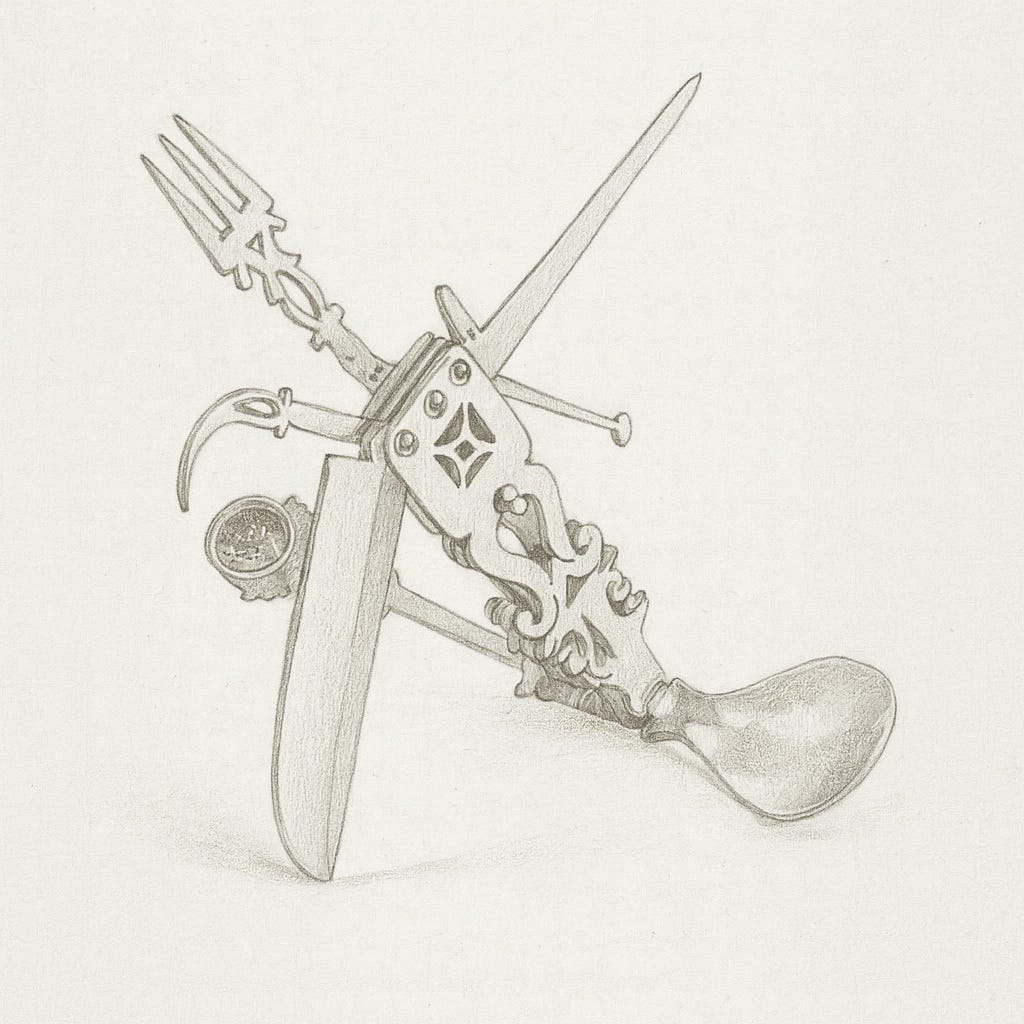
The Cambridge Set.

The Ljublen Set.
The Zurich Set.

This item I'm discussing is a grave-toy. It's ancient, eldritch and spooky. It's the nameless, heroic, ancient queen of multitool everyday-weirdness. It took me six months of curious effort and exploration to get to the point where I wanted to write something about it.
I've seen one personally, which was excavated from an ancient grave. I've handled a modern replica of another one. The rest of this essay is about my personal efforts to get accustomed to this thing. I never assumed that I would fully understand it, or resolve the deep historic mysteries about it. I wanted to get close enough to it to "dissolve" it, like I do with other such tools. I didn't want to crassly dispell the raw wonderment of its existence. Instead, I wanted to be able to take it for granted.
To discuss it in the essay here, I will have to name this thing. Its ancient Latin name (it surely had one) is unknown. Whatever do we call it?
In the English language, this device is often called the "Ancient Roman Swiss Army Knife."
In Italian, it's known as the "Voyage Service."
In Bulgarian, it's described as the "Surgical Instrument."
There's supposedly a fourth one which is owned by a private collector in Zurich. Nobody knows what he calls it.
In this essay, I'll give it a neutral, anodyne, nonjudgmental name: "The Set."
I have known about The Set for forty years. But I never paid much attention to The Set. I just took The Set for granted.
My attitude changed while I was perusing YouTube multitool videos (as is my wont). On YouTube, a historical-restoration devotee was demonstrating a modern replica of this "Ancient Roman Swiss Army Knife." Here he is. On a video available on YouTube. (Available for a while, at least.)
This video demonstrated to me that the ancient Set had emerged from its grave. Somehow, modern people had The Set held in-hand. The Set had become another EveryDay Carry device in YouTube's thriving EveryDay Carry World. Somehow, this eldritch techno-zombie — as weirdly unlikely as Boris Karloff in "The Mummy" (1932) — had survived Roman Imperial destruction, hibernated through Dark Ages, and returned to public life.
Modern people re-built and owned and carried The Set. They used The Set in the full glare of the public. This activity was visible in social media. It was much remarked-upon.
The re-enactor, a devotee of the Roman Army, believed that The Set was a military multitool — a "Roman Swiss Army Knife." He assumed that The Set was designed and built for everyday use by ancient Roman soldiers. A sensible and rational idea, aligned with multitool history.
He performed with The Set for his camera, while wearing his reconstructed Roman Army gear. He handled the replica Set in close-up. He manually demonstrated The Set's practical affordances.
This was "experimental archaeology." I had heard of that scholarly practice, although I'd never done any myself. Better yet, this was "experimental archaeology" on public display in a social media video. Quite an interesting thing to do and to see.
In terms of the artifact itself— "The Set" — I could feel its weirdness-limits shattering.
I was moved by this — the spectacle of this eldritch Roman Army veteran, somehow drafted into the ranks of modern "Every Day Carry". Among many other such things, The Set from ancient Rome passed muster as just-another one-of-those-things.
I felt an urge to get closer to The Set, and to get hands-on with it.
The Set was vastly distant in time from me, but physically, it was quite near. I was in Turin, as I commonly am, but the world's first-discovered Set was in a museum in the Italian town of Ventimiglia.
So, I promptly caught a train to Ventimiglia, a pleasant little town on the Italian Riviera. I went there on pilgrimage to encounter the Set. This was the start of an extensive relationship.
The Set in Ventimiglia was unearthed in 1917 by a Turinese archaeologist. This Italian scholar, Prof. Pietro Barocelli, immediately knew that the Set was weird. He wasn't much impressed, though. "Multitools" were little-known in his own day, and it was not yet a habit to fuss about them.
However, thanks to the 21st century's ongoing multitool fetishism, The Set has become a celebrity object in Ventimiglia. The Set has a big star poster on the outside of its regional museum.
I had a contemplative look at this ancient device, which currently exists inside the digitized see-thru screens of its protective vitrine. As a supposed "Voyage Service," The Set has voyaged maybe two hundred meters from the grave from which it was unearthed in 1917. In its spidery, much-corroded state, one gets the impression that The Set wouldn't mind returning to some peace-and-quiet.
The people of Ventimiglia are justly proud of The Set. It's the most famous inheritance from their ancestral town of "Albintimillium," once the fortress-homestead of the long-vanished Albinti tribe of ancient Liguria. Modern Italian "Ventimiglia" is the same town as old Roman "Albintimillium," after some of its vowels corroded and fell off.
The Set has the bizarre affect of a manuport from a passing UFO, but it existed in Albintimillium, which was and is a real town. In The Set's museum, there are other metal contraptions of this specific time and place. High-security, outsized, bronze lock-and-key sets, for the front-doors of local villas. Metallic, springy, complicated safety-pins to secure cloaks and togas. Many other everyday objects that the owner of The Set would have encountered, and maybe owned.
The Set had a user. Like his artifact, he has no known name. For this essay, I will name him "User142." His cremated ashes were found inside a lead box in "Grave 142" in Pietro Barocelli's excavations.
The gathered mourners of User142 ("UsorCXLII" in Latin) placed his ashes, and The Set, into the same grave in the town cemetery. It seems that the locals thought that User142 needed The Set, in much the way that he needed the various other grave-goods that they also left.
The grave of User142 held a little ensemble of artifacts, from an organized burial activity. The mourners of User142 ate gourmet snails at his graveside. They dropped the empty snail-shells into his tomb — not as picnic debris, for this special snail-feast was their solemn tribute to him. They dropped and broke four glass jars into his grave (with some long-gone, unknown, important liquids inside those jars). They performed funereal drinking at the gravesite, and deliberately shattered their wine jug, and they left another intact wine-jug, as a farewell toast for him, good old User142.
User142 also received one glass dining cup, one silver dining spoon, and two busted pieces of ceramic with a lion logo on them (User142 would have known what that meant). He also was given a toiletry object, a Roman bath "strigil," maybe handy for the steam-baths of the underworld.
User142 might have been a woman. There are cases of Roman Empire women being buried with their folding-knives, including one maiden entombed with a lethally-hefty pigsticker whose splendid handle was a stark-naked statue of Hercules.
User242 has no known gender, name, ethnic origin or career. It's not even clear that User142 ever owned or used The Set. The Set might have been a posthumous gift. Roman burials were ceremonies envisioned as a "send-off," a ritual of journey, toward the world of the afterlife. In the case of User 142, it was an Albintimillium bon-voyage of snails and wine, for that trip from which mortals never return.
Unlike their little travel-gadgets. Those gadgets can and do return. There are some of them around right now.
The Set was placed in that grave by people who understood it. The Set belonged in that grave. If The Set had been shatteringly unusual, truly "weird" in their eyes, they would have sold The Set as a rarity, and laid on a better grave-feast for themselves. The Set was a thing for an everyday guy, for his modest, decent grave in downtown Albintimillium.
Roman-Empire Albintimillium was a seaside town, like Roman-Empire Pompeii, but poorer, smaller, colder, cruder and ruder. Compared to lavish Pompeii, it was a town from an Italian Scotland where the locals lived off their fish and sheep. Albintimillium never ranked with Portland Oregon, a hotbed of technological innovation where advanced multitools might spring into existence. Albintimillium might have been a nice, quiet place to grow old and die with a multitool. The Set was likely imported to Albintimillium and dropped into a user's grave there. That's why a regional museum has it now. All Sets that never became "grave goods" have vanished utterly.
The "Voyage Service" was voyaging — until it pit-stopped in Ventimiglia for 1,800 years. There were also other Sets. The "Cambridge Set." The "Ljublen Set." The alleged "Zurich Set."
These artifacts are versions of The Set. They do vary, and they've been studied differently.
The Ventimiglia Set was the first discovered. The Ventimiglia Set also has the fanciest and most-varied features.
The "Cambridge Set" has been well-studied, and is the easiest to study, especially if you speak English. The Cambridge Set was bought on the open antiquities market, with no known origin or associated user.
The "Ljublen Set" comes from a Bulgarian tomb, of a married couple from Roman-Imperial Thrace. The deceased users seem to have been a Roman cavalry doctor and his predeceased wife, who, to judge by her tomb goods, was likely a nurse. We can call this Set user the "Thracian Cavalier," since he was so well-to-do compared to "User142." His grave abounded with vases, bowls, glasses, spoons, plates, belts, horse-tack, weapons, artworks and even money.
The last "Zurich Set" is private and has been said to be from Roman-Empire Syria.
All The Sets are weird, but united in similar weirdness. One single Set might be so weird that it could be dismissed as a mere freakish oddity. But four of them? That's a product category.
The Sets seem to be from all over the Roman Empire. Ventimiglia in Italy is 1,400 kilometers away from Ljublen in Bulgaria. Syria was the eastern rim of the Roman Empire. The "Cambridge Set" model, in Britain today, might even be British in its origin. Britannia, that exotic Roman island colony, abounded in folding knives. Roman Britannia even had folding spoons.
All of The Sets are metal multitools, designed to be carried and used by hand. These multitools have various component tools which lack any settled names. So, for this essay, I will name these tools:
1. The Knife
2. The Spoon
3. The Fork
4. The Spike
5. The Earspoon
6. The Leaf
7. And last and deservedly least, The Sieve.
The fancy Set in Ventimiglia has all seven of the tools, while the other Sets have fewer.
The Spoon seems to be the dominant tool in The Set. If you hand some naive person The Set, and you ask them what The Set is, they will tell you that it's a spoon. Held and touched, The Set has the look-and-feel of a Spoon. The Spoon is the biggest, broadest tool in The Set, and it's visibly mounted on the outside of The Set. So at the first glance, at the first grip, The Set is a Spoon with a gadget attached to it.
This Spoon feels important, but the Spoon is also unstable and tricky. The Spoon is attached to a rotating lever. This lever spins on an axle, inside a round hinge, at one end of The Set. When the big Spoon flips over, the other end offers the user a tiny, trident-style Fork.
The "Ventimiglia Set," the most elaborate model, features a silver Sieve attached to the Spoon, while the Fork deploys on its own special pivot.
All four of The Sets have Forks. These trident-shaped jabbing-tools do not behave at all like modern table-forks.
All of The Sets once had iron Knives, which have rusted away. These Knives were likely similar to the everyday blades in other Roman folding knives. Simple "slip-joint" blades, good for slicing, not much good for jabbing or stabbing.
The Set also contains the highly unusual panoply of the Spike, the Earspoon, and the Leaf. All three tools are always present in all the models of The Set.
The Spike is a thin, fold-out tool almost as long as the Knife. The Spike is pointed, but it has no sharp edge. The Spike is clearly built for poking, probing, piercing and perforating. When the Spike and the Spoon are both deployed at once, then the two tools together closely resemble an everyday Roman table-spoon. Normal Roman spoons had long handles ending in a spikey point.
The peculiar "Earspoon" resembles a well-known Roman grooming implement designed to scrape the wax from inside human ears. The Earspoon is a round, flattened, slightly bent metal bead at the end of a prong. The Earspoon is a small, short, and delicate tool, maybe long enough to reach and clean a human ear canal. I choose to call this tool "the Earspoon," not because I really think it was made for cleaning human ears, but because it looks more like a Roman "Earspoon" than it looks like anything else.
The "Leaf" is utterly mysterious. In over a century, nobody has ever known what to name it. This "Hook," "Toothpick," "Nail-Cleaner," "Spatula," "Hoof-Pick," "Phleam," "Strigil," etc, is a small, delicate tool shaped like the curvilinear talon of a cat. It has one bent, tear-drop-shaped hole filed though it.
Except for the mysterious Leaf, all the other tools in The Set: the Spoon, the Fork, the Knife, the Spike, the Sieve and even the Earspoon — they all look and act like miniature versions of well-known Roman hand-tools. They're flat, compacted, shrunken tools and therefore pretty weird, but these tools once had independent, verifiable existences as everyday tools in the Roman Empire. The Leaf, by contrast, is a tool like nothing else known anywhere. The Leaf appears to exist as an artifact only among the tools of The Set.
Also, the four Leaves among the four different Sets are different in shape. They are more variant and apparently fanciful than any of the other tools in The Set. The Leaf is not just weird, but decisively, differently weird. All Sets do have the Leaf, though. A Set without a Leaf is not a Set.
The Sieve exists only in the Ventimiglia Set. The Sieve is a unique component of the most elaborate Set. This Sieve is a tiny metal cup shaped like a modern tea-strainer, with many dainty little holes drilled to drain and strain fluids. The Sieve is so tiny that it could contain maybe half of one modern teabag. It's hard to understand what precious substance this Sieve might have plausibly filtered.
All the Sets have metal shells to encase and hold The Set's multiple tools. One end of the case is always doubled-over to form a rounded hinge, which is the important rotation-axle of the exterior Spoon-Fork combo. The other end of The Set's case is held together with metal rivets.
The metal case shelters the Knife, and also serves to sandwich-together the Spike, Earspoon, and the Leaf. The metal cases of The Set are always "openwork," elaborate, decorative and frail. Solid metal shells would have worked much better for a multitool, but the cases of The Set are delicate, ornate and dainty.
The Set's frames vary. They're hand-made, of different lengths and widths. Some have built-in locking devices to secure the folding tools. All Sets have decorative, look-at-me motifs. Some resemble a military shield. All four Sets have a curvilinear structure. It always resembles the shape of a lyre.
This lyre decoration — it was hard to build by hand, because it's fussy — seems to be an important design element that identifies a set of tools as "The Set."
#
I built The Set. Or, rather, I built various models of The Set, and the various components of The Set. The original builders made their Sets in forges, but I assembled my Sets under a shade-tree, out of modern industrial debris. It took me about six months of occasional, contemplative labor, until finally I ended up with a workable version of The Set that satisfied my curiosity. Then I was able to stop.
At first, I thought that I would just buy a modern replica of The Set — because hobbyists do make copies, and I'd held one. I thought that I might carry The Set around in my pocket, Every Day, and figure out what it might be "good for."
But in contemplating The Set in closer detail — and especially, after confronting a genuine dead one — I changed my mind about that. The Set was not a toy for a modern purchase and my personal use. There might be some aspects of The Set that were personally good-for-me to have and use, but with that narrow attitude, I couldn't learn what mattered about it. The Set was clearly a "personal tool," but I needed to get closer to the stakeholders of The Set's general enterprise — the various people who had designed it, built it, handled it, travelled with it, used it and put it in a grave.
If you make a "design fiction" object, you need to engage with futuristic speculations. The concerted, focussed effort in futurism is the point of doing design fiction. Through design, you want speculations to look-and-feel embodied. Not as a verbal narrative, like the vaporous rhetorical larks of a sci-fi writer. As an "object that tells the world." As a "deliberate effort to suspend disbelief about change."
The Set is not a design-fiction. It is an already-embodied thing. It seemed important to me to learn to fantasize about it less. "The past is a future that already happened." An object of the past can speak like a design-fiction speaks, but not in futuristic speculation. Instead, it whispers about a genuine, vanished world. You engage with it in the hope that the process of rebuilding and using it will be revelatory of past worldly circumstances. You want it to behave as a "diegetic archaeotype."
I'll offer a quadrant diagram here. Here we have a chart of various efforts to rebuild ancient everyday-objects. We can divide these on two important axes.

Do these objects perform, do they function like the old thing once functioned — or do they merely look old, as visual representations?
Also: were the objects made with the same materials and processes as the old objects? Do they have the same designer "grain of the material"? Or do they use modern processes and materials to make objects that are modern analogies of the old object?
I'm not judgmental about which of these approaches are "better," but these approaches scatter widely. At the chart's center is the "museum quality replica." This is our current modern consensus about rebuilt objects which are not old, but are presented as closely related to old things, within a historically-aware, institutionally-approved, public context.
The museum-quality replica is our culturally legitimated version of a rebuilt ancient object. We haven't yet invented any method to rebuild and valorize replicas of better quality. So, in this quadrant, it's at the cross-haired center of the field.
Up in the extremist make-believe corner is the historical FX prop from historical TV, games and/or movies, an embodied fantasy which merely has to look good, temporarily. Costume-play is an amateur-theatricals version of a professional FX-prop of this kind. As far as the materials go, most anything is permitted, since the end-goal is to get the shot, or to strut the stage.
If the materials are valuable, then this value provokes fakes and forgeries. They're rebuilt and seem ancient, but they're fraudulent.
"Creative anachronisms" are often created with antique means and materials. Some mastery of antique craft-effort is central to this modern form of expression.
In another extreme are the ancient objects which lack any credible provenance. These objects look and act old, and maybe they are ancient, but no one can prove that. They're more anomalous, more orphaned by time, even than forgeries.
Flint-knapping is a good example of a modern craft-hobby with prehistoric materials. Objects fired from clay can be similar.
The "restored" object in this diagram is a genuinely old thing which has been patched back together from some battered state of corroded incompleteness.
The commercial "historical reproduction" is a newly-made thing, sometimes hand-made with historical materials. It's often prettier and better-made than the original ancient object that it mimics.
The Morris Arts&Crafts object exists in moral refusal of mass-market industrialism, and has a Ruskinite ideology. Objects of this kind are not archaic in intent. They're often not even "old-fashioned," but rather "pre-Raphaelite," in a complex, social-critical way.
A "re-invention" is a modern object inspired by an archaic one. A re-invention has an archaic form and use in a modern context.
The "re-discovery" is a new thing that resembles an old thing by happenstance. The designer/maker/engineer made it independently, and had no awareness of any such prior art.
Above the top of this chart are the speculative "future means of production." Their presence implies that our current means, methods and motives of rebuilding ancient things are unstable. There is not, and cannot be, any perfect, permanent way to "rebuild past things." People might, in future, remake some things which seem utterly un-buildable to us, such as genetically-restored, de-extinctified mammoths. It's good to keep these possibilities in mind, so as not to get too self-satisfied and perfectionist about how we happen to hack at the past right now.
This chart may seem rather abstract and fussy, but it was helpful to me, because it became clear to me that you can't possibly do all these things at once. I was able to perceive that I had no current use for a Set meant for public display. A Set made in bulk and sold as a product to other people, that was possible to do, but not what I wanted and needed. What I seemed to want and need was a "functional analog" Set. What did this ancient thing do, how did it perform and do its work, in the hands of ancient people who once made it by hand, held it in their hands, and gave it to a grave?
It struck me that I needed a cradle-to-grave approach to the Set. I knew that it was dug from a graveyard, but where was it born? Where did it come from, and how? I would never know this directly, but I needed methods to approach those questions.
The Set was an actual, existent mechanism which vanished centuries ago. So is the Antikythera Mechanism. A sympathetic understanding of how that device was designed, built, and used, makes it clear to us moderns that Greek astronomical geometry was more than straight-lines with compass and ruler, or verbal lectures in an olive-grove. Greek astronomy had gears, dials and a comprehensive hardware set-up. That assertion sounds far-fetched, but it's both weird and true.
If you're a science fiction writer (as indeed I am), you naturally want to dramatically play-up and intensify the weirdness of the weird. That's entertaining to the public and you know how to do it. Also, it's fun. But my struggles with the Set are a different matter. Not about the weirdness of weird, but about the truthfulness of true.
The personal everyday objects I carry in my pockets are my own lived experience. Since they're with me all the time, in some formal sense they are the least weird and most personal things in my life.
By making The Set part of my lived experience, I expand my awareness of my lived experience. These are some important political and financial aspects of "Every Day Carry Weird."
My boring everyday wallet, for instance: under no circumstances do I want my wallet to "become weird." I know that modern fintech people very much want my wallet to be much weirder. They have exotic payment systems to move me away from archaic paper cash on my hip, toward phone-centric apps in their own control, that I can't see and touch.
I might also metaphorically, but foolishly pretend that my densely networked iPhone is somehow a personal "Digital Swiss Army Knife." This too-facile comparison is a bad frame-of-mind. That dishonesty will get me, and my intimates, into trouble. There are consequences to this intellectual laziness.
I don't claim that my studies of classical hand-tools will resolve the focussed assaults of tyrannical oligarchs on my habits and well-being. But they are a form of recreational "otium." They seem to offer some stoic philosophical consolation.
So, to hand-grapple with "Everyday Ancient Weirdness" I needed a bigger arena of comprehension. The people who built The Set are long-gone and their assumptions and habits are vanished. But this should not be a counsel of despair. It's more a Heraclitean understanding that you can never step in the same river twice. In the distinct case of the Set, there are four of them, so they didn't even step in the same river once.
The people of the ancient world in 200 AD were no more "authentic" than we ourselves are authentic. I even suspect that the "Zurich Set" is a fake. Not a "modern fake" — but the Zurich Set looks so different from the other Sets, and it's so obviously crude, that it may have been an ancient fake. The product of some shady guy in some Roman Syrian bazaar, who once saw a Set, and figured he would hammer out a phony one, and sell it full-price as the real-deal.
It's important to understand that the "ancient everyday" is just another every day. It's one every day among a billion days. Yes, it's old, but our awed respect for antiquity does not make it sacred, or even respectable.
In the case of The Set, you are not "rebuilding imaginary futures," a topic I've written about in other essays. This is an effort to rebuild pasts, which are peculiar and difficult to understand, but can be overburdened with too much imagination, and not enough sincere engagement with what once existed there.
One path out of that conundrum is to stop fantasizing about it and "just make one." That was my first step.
At first, I wanted to test the hypothesis that The Set was just-plain weird. The Set was eccentric, peculiar, because it was stapled-together by people who were nuts. This is a lively theory and it's also plausible. Real people in any day, every day, prehistoric, historic, contemporary, futuristic, now, yesterday and tomorrow, can be just plain off-their-rocker.
Maybe The Set was a failed multitool built by an incompetent Tim Leatherman, some Roman inventor who lacked Tim's concentration and staying-power. Instead, he just frankensteined a bunch of rubbish into a weird gizmo to hold in his hand. An easy hypothesis for me to test, since I was fully-qualified to try that myself.
And I did try it. At first, I did it with cardboard, because that's an abject material that costs nothing (because it's garbage). I made a cardboard Set at no cost, but that act was complicated. Through the act of doing that, I soon learned that The Set could not possibly be some magpie process by some mentally-unstable person.
It was not possible to rashly jam those components together on some daffy impulse. The Set had a distinct order of assembly. The Set was built deliberately, with a foresightful "order of operations." Some things had to happen first. Only then could the other things happen.
I learned this through rehearsing in cardboard, and establishing the proportions and relationships of the pieces of The Set. I myself looked and acted quite weird while I was fanatically slotting and twiddling bits of cardboard, but no one was watching me. I had proved that the builders were sane and well-prepared. That was progressive.
Also, this active design research led me to the important concept of the "chaîne opératoire."
While I was slicing and dicing my trashy cardboard with a trusty Opinel folding-knife (established 1890), I pondered various videos and texts of "experimental archaeology." I knew little about this scholarly research practice, but it's been around since the 1970s and is by no means a fly-by-night enterprise. When I learned how those experiments were done, my attitudes toward The Set changed radically.
I no longer much wanted or needed to "own The Set" or even to "make a replica Set." Instead, I needed to closely study the Set's "chaîne opératoire," and I needed to study that through acts of "kinaesthetic learning."
Kinaesthetic learning means getting to grips with the way that ancient human hands gripped the ancient object under study. Kinaesthetic learning is the archeological cousin of the "hacker hands-on imperative." For the demographic that sieves tiny ancient objects out of old mud, it's also the functional equivalent of the "maker think-and-do-lab."
To discover these parallels was intensely edifying. Clearly I should have done all that forty years ago, and I would have been better off for doing it. However, it's never too late to learn.
The profound issue here is the "chaîne opératoire" — in my own case, the chain of operation of the builders of The Set. I knew that they had operations carried out in a distinct order, but what was going on?
The "chain of operation" is always referred to, in scholarly French, as the "chaîne opératoire", since the concepts of its major theorist, Prof. Andre Leroi-Gourhan, were elaborated over his lifetime. Leroi-Gourhan had elaborate ideas: they're a comprehensive theory of the co-evolution of man and technology, rather than some mere design-theory about ancient Roman objects.
The key insight of the chaîne opératoire is that the artifact under study is a link in a chain of human relations. You may have just dug some artifact out of the ground — from a grave, maybe. This thing may look peculiar, and even amazing, "weird," but as a Leroi-Gourhan student of humankind's manifold artifacts, you want to get over that folk-hick "weird" attitude right away.
According to Leroi-Gourhan, an artifact is best understood in this fashion. It is technology. Therefore, it was produced by an animal on the Earth, which has unique human characteristics of an upright gait, agile, prehensile hands that are permanently free, an expressive face, and the ability to speak. All technological artifacts, from shaped flints to satellites, are incidental products of technology. The physical objects are collateral evidence, while the gestural dexterity and the ability to learn and teach — the ''gesture and the speech" — are absolutely central to technology.
If you can grip things and talk to others about them, then you-and-yours can become a technological species. Otherwise — no matter how much or how long you can "build" — you're a nesting bird or a termite.
I would not claim that I "believe this." I would say that it was helpful and even liberatory to me. To study the chaîne opératoire, that is by no means a good way to get any practical thing briskly done. It has dismal results for efficient design and manufacturing. However, it's great. It's great because you are trying to sympathetically get under the human skin, into the gestures and speech and decisions, of remote people who are making and using the artifact.
The chaîne opératoire method is loose and abstract. But it has one major benefit. Nothing is weird. At the exalted level of abstraction of the chaîne opératoire, nothing can be "weird." Herodotus is never amazed by whatever merely seems "foreign." There is no foreign.
When you do the chaîne opératoire as a method of engaging your hands, your gaze, the weirdness evaporates. You are relieved of weirdness. You forget it was ever there. Instead, you are engaged in many small hands-on tasks, the "kinaesthetic learning" of the hands, the eyes, and also the body, face, and speech. Too-complex conceptual abstractions, about means, motives, opportunities, ideologies, customary habits — they painlessly disappear. Become a primate (because you are one) and the issue feels immediate to prehensile hands and binocular eyes: look at it, feel it. Is the thing handled like this, or is it otherwise handled like that? Give it an honest try, with two ready hands and two eyes open. Then judge the result of that experience, rather than idly speculating about what might be plausible.
Forget your own possible uses for it. Don't force it to be useful in your own routines, your own surround. Instead, identify with the people who made it — you want to listen to the justifications they're making, what they feel they have to say to another. The looks on their faces, on the ground, in the tall weeds, in the workshop, over the counter. What it means to them — its functional and symbolic roles. Why they would want it to do that, and be that?
I was pleased at this doctrinal discovery of mine. Of course it's not new, it's merely new to me, but I found it consolatory, and even enlightening. It helped and encouraged me as I worked on my Ancient Everyday Weird project. I won't forget it, either. Kinaesthetic learning and the chaîne opératoire are permanent additions to the way I approach the material world. I'm an old man here in the year 02026, but I know that I'll find many future uses for them.
In my ongoing procedure, I had learned that a Set can never be randomly thrown together on an impulsive whim. It had a chain of operations, meaning first-things-first. What was first?
The shape of the casing was first. That became obvious. No other method could work. The case came first because all of the tools have to fit inside the case. The case had to be understood first, and measured first, and also made first — and yet, the case could never be completed first. In the chain of operations, the completion had to wait for the rest of an organized, ongoing process.
Complicated, rational, and sensible labor — but why? Because the case had to be heated in a forge, and bent, and transformed into a Spoon-Fork axle, before the case was permanently closed and riveted over the other tools.
To accomplish this operational chain had to mean measurements and drawings, and something like rulers and calipers. There's also an authority structure. The guy who decides about those calipers and rulers, and puts the project into its operative motion — he's not a shade-tree hobby crank, centuries away, cutting-up cardboard. He's the boss. He's the major participant in The Set operation. He might not be dug from a grave, but he's as real as the cremated ashes of User142. We can call him "the Maestro."
In some merely verbal, hands-off theory about The Set, we mght imagine that the Maestro could build The Set alone, all by himself. He establishes the shapes for making the casing and the tools of The Set, and knows all about it. But to know it, or to talk and write about it, is not to successfully make it. The chain of The Set's operation is about human hands set in motion.
Filing ancient Roman metal into shape is hard and patient hand-work. You will kinaesthetically learn that when you yourself do that labor by hand. You will understand, without any verbal or written instruction, that the Maestro with those drawings and those calipers cannot be the drudgery person slowly and monotonously scraping hard metal with a hand file. That imaginary division-of-labor can't make sense. It would waste the Maestro's valuable skills, and would squander time effort and money for everyone involved.
The Set does exist, so some real person with busy hands filed and sawed that metal. Who? The "Apprentice" files the metal with his hands. This teenager is allowed in the workshop — "the Atelier," we can name it, since some extensive, fine craftwork is going on in there. The Apprentice puts in long, tedious, operational hours in the Atelier. His arms are sore. He's bored silly. But also, he's a kid. The Apprentice needs to learn that grind-it-out work ethic. He needs those necessary thousand-hours of learning the files and the saws.
The Apprentice runs the Atelier's errands. He puts out the forge-sparks. He sweeps up, afterward. His childish playtime is over for the young Apprentice. He's got a real job.
When the Apprentice goes home with his file-blistered hands, he's got a loaf of dark bread and rabbit stew for dear old Mom. Mom is not directly involved in The Set's chain-of-operations, because Mom doesn't design, build or use the silly thing, but Mom couldn't be happier. "Oh, Apprentice, your late father would be so proud to see you making your way in the world! Just look at those blacksmith muscles growing on you, the girls will line up for you!" The personnel who build The Set work within a larger social context. That context supports them. These indirect participants don't bash the metal, but they look and they nod and they praise.
The Apprentice is just some kid, so he clumsily roughs-up his tools, but someone else up the chain refines, maintains and sharpens the Atelier's tools. That person would be "The Journeyman." He's got an educated eye for the scope of the job. He uses such tools himself routinely, so he already knows what works well and what doesn't.
The Journeyman is a former Apprentice. The Operation of the Chain is what changes their status. This involved procedure — who does the rough stuff, who does the skilled stuff — is what people in the Atelier talk about together. That is how they garner their new Leroi-Gourhan skills-and-gestures and remember their old skills-and-gestures. The Chain is what moves them.
With the tools grappled by the Apprentice, and maintained by the Journeyman, it is time to complete and fold the metal casing for The Set. The Set's case arrives in the Atelier as a standard, Roman, flat ingot: it's a metal bar. This basic, flat metal bar cannot leave the Atelier until it becomes fancy, openwork and involuted, with even a lyre-shape built in. Through what chain of actions does that process take place?
With one glance at The Set, you will surely notice a lot of holes. However, if you build it, you will feel and see those are intense, identical, precise, and numerous holes. In the top-end "Ventimiglia Set" — (the "industry leader of the product category," in terms of refined Italian fussiness) — those holes are very straight and narrow holes drilled through three tough layers of metal. The Sieve has dozens of holes.
The Set's casing features many holes drilled where holes have no apparent reason to exist — holes with no functional purpose. Those larger openwork spaces in the casing of The Set — those empty spaces all likely started as drilled holes, and were later expanded by files.
The holes are there — what chain-of-operations made so many holes? They might be a large squad of Apprentice slaves, each one hand-drilling holes. Or: maybe drilled holes come cheap and fast in the Atelier. Because drilled holes are the Atelier's technical specialty.
A Drill Technician appears as a link in the chaîne opératoire. This personage maintains a specialized device in the Atelier. It's the ancient Roman equivalent of a drill-press. It's a special machine, with sharp bits, a chuck, accurate clamps, and maybe gearing from some non-human power-source. A waterwheel. A mule walking circles.
This speculation can't prove that a Drill once existed with a Drill Technician, but if it did, then this impressive drill-rig is the private competitive advantage of the Atelier. They're making good, thorough use of it, too. It means that the decoration on the Set is not "artistic" — it's not hand-whittled figurative sculpture, like with ivory Roman folding-knifes, featuring the standard-weird cheap vulgar gladiators. The Set is a technical top-end product, and its decoration is mechanical — it's flat patterns, it's abstract, and mostly it's made from machine-drilled holes. The more holes, the better. Holes are drill-scrap. The silver case of The Set is table-ready Roman silverware. Those valuable silver little drill-chips, they add up. With your mechanical drill, you want to drill that thing till it's mostly air.
Following these deductions — (they're a bit Sherlock Holmes, but they're logical) — we again confront the Final Boss chain-operator. This fellow is the original Maestro, because he's the expert who rivets the Spoon-Fork combo to The Set, assembles the tools inside The Set, steadies their bearings, and ball-peens two red-hot rivets through the tools without damaging The Set. The Maestro masterfully performs this final, conclusive, constructive act in the Chain that could easily screw up the whole effort of The Set if it was botched by some mere layman.
To elegantly, and safely, complete The Set — that can't be sweaty, brawny, heroic blacksmith labor. A little old man might do it. That little old man has to know what he's about, though. He performs the Leroi-Gourhan gestures, which integrate The Set into the world, as a completed object-of-value. Also, the Maestro speaks those gestures. Because he tells the others what to do, and why, and the Maestro distributes the rewards to the crew. With his own hands.
Then the deed is done. They have hand-built The Set — but they do not sell The Set, in bulk, over the counter. The Set is a complex and fussy contraption, sophisticated-bordering-on-feature-creep, with a lot of moving parts. There can't be some cheap basket of a hundred Sets in the Roman marketplace, where you might reasonably find a normal basket of mass-produced Roman clay lamps. The Set isn't merely "weird," it's also genuinely, physically hard to design, and to manufacture-by-manual-means. With the kindest possible assumptions about the productive and consumptive capacities of people in AD 100-200 AD, it can't be a commodity or an impulse-purchase.
This Set is so finicky, and so expensive, and even so weird, that it had to be commissioned. That idea can't be proven, but it makes sense. If The Set was a "Roman Swiss Army Knife," issued to everyday soldiers marching in their everyday Legions, there would have been thousands of them. The Sets can't be mass-produced, mil-spec tools meant for warfare. They are silvery gadgets with lots of drilled holes.
It's possible that some ancient Roman officers who were wealthy noblemen would choose to own Sets. But The Sets are not solid and fully-functional Roman military equipment that the everyday Roman soldiery carried Every Day.
The Sets were elite, high-tech and fussy. There are only three and a half of them left to us to marvel at — but at least that's better than the lonely Antikythera Device. The astronomical computer belonged to some elite Academy, but some lone collector paid up front to create and own his own Set.
The Set-Collector bought all the silvery materials, and he was impatiently waiting for his product delivery. He knew what he was about, too. The Set Collector is "User 142," a personage very much a part of The Set's "operational chain" — the customer, who is always-right. When the work's done, he meets the Maestro. Artisan and customer/patron, they meet with a handshake. Then they discuss the matter at hand.
Mutual assurances pass between them. Some are merely verbal and classically-rhetorical. Others you look at, and touch, and grip with your hands. "Oh, this is some of our best work, sir! I can promise you, you'll enjoy this Set till your dying day!"
User-142 — we can't say much about him. But he wouldn't feel happy without that Set. Especially, in his grave, where everyone agreed that he needed The Set.
Especially that Leaf, always present in every Set. He can't manage his Set without that Leaf. To have no Leaf, that would be sad, but have no Set at all, that would be weird.
#
An operational-chain narrative about the Set (which is that verbiage I just uploaded here in New Years Day 2026) is not the historical truth about The Set. However, I would point out that there's nothing "weird" about that narrative. It's described as a chain of connected, operational actions that normal people might perform, every day.
Not weird actions, with a weird artifact. Sensible actions, about the role of a modestly-sized, handheld device in a workaday society, where everyone involved has some clear and reasonable motives. It has "Ancient EveryDay Weirdness" to us, and I don't want to dismiss our honest wonderment about The Set, but at no point does anyone in the past have to stop their own normal lives and yell, "Hey! Let's make this gadget especially weird, so as to baffle people two thousand years from now!"
Baffling us with weirdness was never their intent, and if we imagine that they're weird while we're somehow not, then we're forcing that idea onto long-dead people in order to make ourselves feel more a


