
 # [ 18-Feb-26 1:36pm ] The Spurlocks of RSS-Land [ 18-Feb-26 2:42pm ]
I saw a product announcement from Jake Spurlock -- a new feed reader called Today. From the description sounds well-thought-out.
He explains -- "Google killed Reader in 2013. I've been chasing that feeling ever since. So I built it."
I also know someone named John Spurlock, who I worked on some OPML and RSS stuff for Bluesky in 2023. I sent a note of congrats to him, when I really should've sent it to Jake.
Screen shot of the conversation I had with ChatGPT.
And text of the email I sent congratulating the wrong Spurlock.
- Congrats on the new product!
- Haven't tried it yet, I don't generally use Apple's store on my Mac, not sure why. I will do it though.
- Your product looks nice and well-thought out.
- And there are some ways we could work together now that I think you'll find interesting, like using FeedLand to get you instant updates based on rssCloud, assuming you haven't figured out how to support it from a client.
- Also OPML subscriptions are nice too. Another thing I'd like to get going, and need someone to work with on to make it happen.
Also, I wonder if they're related? Have they met each other? Do they know of the havoc they are bringing to the formerly simple world of RSS.
Kana emerges from stealth with $15M to build flexible AI agents for marketers [ 18-Feb-26 3:08pm ]
The Future of 'Star Trek' Comics Is Ready for a New Next Generation (Exclusive) [ 18-Feb-26 3:00pm ] Google's Pixel 10a Is the Same Damn Phone as the Pixel 9a [ 18-Feb-26 3:00pm ] Real-Life Pokémon Pinball Is the Most Visceral Way to Catch 'Em All [ 18-Feb-26 2:45pm ]
This former Microsoft PM thinks she can unseat CyberArk in 18 months [ 18-Feb-26 3:00pm ] Microsoft says Office bug exposed customers' confidential emails to Copilot AI [ 18-Feb-26 2:44pm ] OpenAI pushes into higher education as India seeks to scale AI skills [ 18-Feb-26 2:32pm ]
Chris Hemsworth Has High Hopes for Thor's MCU Future [ 18-Feb-26 2:00pm ]
Canva gets to $4B in revenue as LLM referral traffic rises [ 18-Feb-26 2:00pm ] World Labs lands $200M from Autodesk to bring world models into 3D workflows [ 18-Feb-26 2:00pm ]
Snakes Resort to Cannibalism When the Opportunity Strikes, Study Shows [ 18-Feb-26 1:30pm ]
Book Review: All Systems Red - The Murderbot Diaries by Martha Wells ★★⯪☆☆ [ 18-Feb-26 12:34pm ]
Everyone raves about this series, so I thought I'd grab the first book. It's basically fine, I guess.
It is moderately amusing having the Muderbot be an awkward teenage boy who just wants to watch videos and cringes when people stare at him. But it is a bit one-note. Similarly, evil corporations hiding details from exo-planet surveyors is a trope which has been a thousand times before.
This is a novella, serving to introduce the protagonist and fill us with a little too much exposition. The trouble is that nothing much happens. There's a bit of world building and a light smattering of action - although I found it rather plodding.
Essentially, a lot of telling and not much showing. Rather underwhelming given the hype. I might give one of the many (many!) sequels a go once I reach the end of my reading list.
What Happens When a "Suitcase Bottle" Gets Dual Citizenship? [ 18-Feb-26 11:00am ]Not to sound too wistful, but these days, it's easy to forget how modest the amaro options in the U.S. once were. Now, most backbars are lined with a wide and rich spectrum of amaro and European liqueurs, but that was not the case when, as a burgeoning drinks writer in the mid-2000s, I first spiraled down the bitter rabbit hole.
Perhaps that's why, when in Italy, my biggest thrill still comes from acquiring "suitcase bottles" of amaro, those deep-cut discoveries that range from limited-run riservas to special-edition releases, distillery gift shop exclusives (like Amaro Lucano Menta), dusty vintage finds, and yet-to-be imported brands.
At Popina, a modern Italian restaurant on the Brooklyn waterfront, owner and general manager James O'Brien shares a similar affinity for suitcase bottles. When visiting wine producers in Italy, he always makes room for a few special bottles, whether it's a rare wine, an amaro that you can't find stateside or a bottle of vintage Chartreuse. O'Brien views it as a way to surprise and delight guests. "The suitcase haul has always been one of my favorite tricks because it feels the most personal," he says. Offering guests pours from hard-to-source bottles "lets them feel like they tagged along on your trip."
The bottles in my amari collection that have made the transatlantic journey home do possess a transportive quality. Often, it was the "hunt" to secure these bottles that makes them special. Now, though, some formerly elusive brands and expressions have become available stateside. Does a suitcase bottle risk losing its allure when it attains dual citizenship?
Among the many only-in-Italy bottles I typically bring home with me, Bràulio Riserva, the annual limited-run release of the iconic alpino-style liqueur, remains my first love. Less filtered and aged in smaller barrels for up to 24 months, it's achieved a bit of a cult-like appeal among amaro heads, and its dated annual releases makes it ideal for vertical flights and tastings. I used to be able to find it for around 22 euros a bottle, though that's since gone up to around 33 euros to 45.
There were whispers for years that Bràulio Riserva, part of the Gruppo Campari portfolio, would eventually make its way to the U.S., and sure enough, this past holiday season, I finally spied the amaro at my local bottle shop in Brooklyn. But my brief moment of joy was deflated when I saw it was priced at $82. This is in line with the list price of other Italian riserva releases, but the sticker shock made me balk. I left the Bràulio Riserva on the shelf.
As O'Brien explains, "being considered more rare, riservas can probably afford to be less price-sensitive. But when they're new to the U.S. market they have the opportunity to see where they want to fall: approachable or luxury?"
Taylor Mason, a fellow suitcase amaro fan, suspects the word "riserva" is being used to justify higher costs in the U.S. Mason is the chef and co-owner of Luca and Pizzeria Luca in Lancaster, Pennsylvania, and he curates a small but growing vintage amari selection at his restaurants. He also helps lead food tours throughout Italy. "While advocates like us will always be singing their praises regardless of the cost, inflated pricing is unfortunate and hard to be looked at as anything other than price gouging," he says. Others, like Patrick Miller, founder and co-owner of Brooklyn's Faccia Brutto Spirits, attribute rising costs to tariff surcharges. "There's a point where brands have to look at the rising cost of doing business and say, 'Do we pass this on to the customer or not?'" he says.
For the Bràulio, the bottle does seem to be appealing to at least some stateside shoppers: Brooklyn Wine Exchange in Cobble Hill says that, since the amaro arrived in mid-December, it has sold almost two cases. Much of that, however, can be attributed to the knowledgeable staff hand-selling the product.
India's Sarvam wants to bring its AI models to feature phones, cars and smart glasses [ 18-Feb-26 1:01pm ] Heron Power raises $140M to ramp production of grid-altering tech [ 18-Feb-26 1:00pm ] Indian AI lab Sarvam's new models are a major bet on the viability of open-source AI [ 18-Feb-26 12:55pm ] DG Matrix raises $60M to make data center power smarter [ 18-Feb-26 12:30pm ]
'Badlands' Almost Had Even Bigger Links to the Other 'Predator' and 'Alien' Movies [ 18-Feb-26 1:00pm ]
It's nothing new [ 18-Feb-26 11:58am ]
I found this funny , how Apple Music looks like BlackPlayer now
submitted by /u/Terrible_Sorbet_7122[link] [comments]
'KPop Demon Hunters' Cast on How They Slayed Their Own Demons [ 18-Feb-26 12:00pm ] I'm a Computing Dummy Who Tried Quantum Coding. Here's What Happened [ 18-Feb-26 12:00pm ] T-Mobile 5G Home Internet Puts Fastest In Your Connection and Cash In Your Pocket [ 18-Feb-26 11:55am ]
Great rides: electric-assisted cycling across the Netherlands [ 18-Feb-26 9:18am ]
Detroit Wants to Make Cars Normal Again [ 18-Feb-26 10:00am ]
Adafruit furniture [ 18-Feb-26 5:10am ]Adafruit furniture
Day Out [ 18-Feb-26 7:00am ]0615: It's always a relief when your alarm clock goes off at the right time on a day trip. It'd be all too easy to set it wrong and sleep in and miss your train, wasting all that money you spent seven weeks ago.
0645: It's always a balancing act putting just enough into a rucksack (food, reading material, thermos) but not so much it weighs you down all day.
0655: Don't touch the barrier with your usual card, it doesn't work this early.
0700: It's always a relief when the tube's running properly on a day you've bought a special rail ticket, so you are going to get to the departure station in time and won't be wasting all that money you spent seven weeks ago.
0705: The bloke sitting opposite gets out his smoking paraphernalia to prepare a roll-up, then drops his bag and spills poundsworth of tobacco all over the carriage floor, then scoops most of it back into his bag and prepares a tarnished roll-up.
0745: I asked for a forward-facing window seat. Instead they reserved me a backward-facing seat unaligned with any window. All that lovely scenery out there and I'm staring at a grey bulkhead with a thin sliver of outside.
0810: The guard is selling a standard ticket to a tourist who's boarded without buying one. That ticket costs them £93 return, which is five times what I paid and he's only going half as far.
0820: Denise does an announcement apologising for the limited catering, She's prioritising first class and the rest of us won't get a full service until the last fifteen minutes of the train's journey when the crew changes over.
0840: Most of the passengers on board pile off, so I take the opportunity to sneak into a proper window seat - that's better.
0841: A young lad boards the train and dives into the viewless seat I just vacated, despite there now being loads of other spare seats. Fool, I think, but over the next hour he never takes his eyes off his phone so he's missing nothing.

0900: When I booked this ticket, aiming for a riverside town, the weather was sub-zero and wintry. Since then it's rained almost non-stop and the landscape outside the window is now seriously flooded, all overspilled rivers and underwater meadows and puddled fields. Doesn't bode well for later.
0900: A second ticket check, but this time it's civilians in tabards doing a 'ticket audit'.
0930: I'm wearing walking boots, but maybe I should have brought wellies.
0945: The guard walks down the platform holding a quiche.
0950: I've got a lot of reading done.
I then walked around Town One for three hours. Only one road was so flooded that I had to turn round and go back the way I came. I surprised a birdwatcher in a purple anorak. I saw plenty of snowdrops. I did not see the famous pop star. The lady in the Tourist Information Office was lovely. The bridge was quite something. I noted that 'large cod' in the local chippie is only £8.90 so we're being fleeced in London. I spotted the pub I didn't go to in 1984.

1300: I caught the bus from Town One to Town Two. Fares outside London are still £3, mostly. The next stops were announced very loudly, and quite early.
I then walked around Town Two for three hours. Only one path was so flooded that I had to turn round and go back the way I came, but a lot were very muddy. I heard a lot of birdsong. The lady in the Tourist Information Office was brusque. I noted that 'large cod' in the local chippie is only £8.95 so we're being fleeced in London. I chatted to a man called Robert who said the flooding was worse yesterday. I didn't spot the newsagent where I bought a copy of Record Mirror in 1984.
1700: The return trip wasn't especially noteworthy.
The last time I was in the area was 40 years ago, just after leaving university. I'd somehow made some cool friends there, one of whom lived in Hillingdon and one of who lived on a farm outside Town One. So First Friend and I decided to drive out to the farm and surprise Second Friend, mainly because we only had an address not a telephone number so couldn't warn him in advance. First Friend was so cool he had a Rover 800 and had been employed to steward at the final Wham! concert two weeks earlier. It was a three hour drive and on the way we stopped off so First Friend could buy some Insignia gel and I could buy Second Friend a Toblerone as a thankyou. We also stopped off at a local phonebox to ring Directory Enquiries, but the number they gave us turned out to be Second Friend's gran so wasn't much use.

Second Friend was extremely surprised to see us, lumbering around the farm in his wellies near the polytunnels. We joined in with the day's work in the top field which involved sitting on the back of a tractor-pulled contraption and planting savoy cabbages. Sorry, we put some of them in upside-down. After 24 rows we went switched jobs and picked some courgettes, then hitched a ride back to the farmhouse on the back of a truck. Second Friend's mum was very pleased to see us and served up cake and raspberries, I think pleased her son had genuinely made some friends. We overscrutinised the contents of his bedroom, sat round the Aga in the kitchen and got an invite to his sister's next big party. For a surprise visit it all went surprisingly well, plus when we finally got home I was able to give my Dad seven courgettes and a savoy cabbage. I sometimes wonder if my social life peaked right there.
U.S. court bars OpenAI from using 'Cameo' [ 18-Feb-26 6:40am ]
David Olusoga on Empire, identity - and The Traitors [ 17-Feb-26 6:00am ]
New report: Poverty is an expensive political choice [ 18-Feb-26 5:39am ]
Poverty in Britain has become so familiar that it risks fading into the background. Food banks on high streets; children arriving at school hungry; working families choosing between heating and eating.
Scrapping the two-child benefit cap is estimated to lift nearly half a million children out of poverty. But that will still leave child poverty levels at 28% - double the rate in the 1970s.
The scale of modern povertyA staggering 4.5 million children - 14 million people in all - are living in relative poverty in the UK. And one in five people living in poverty are actually in work. This is happening in one of the wealthiest economies in the world.
This week, Taxpayers Against Poverty published The Nicolson Report: Poverty Benefits No-One (link at the top of the page).
The report's central conclusion is clear: poverty on this scale is not inevitable, but the result of political and economic choices. For years, governments have claimed that tackling poverty is simply too expensive. Public finances are stretched, we are told. The evidence assembled in The Nicolson Report shows this claim is wrong.
Poverty benefits no onePoverty is estimated to cost the UK more than £75bn every year, through lost output, higher health and social care spending, and reduced tax revenues. It damages health, places enormous pressure on the NHS, weakens productivity, and blights children's life chances.
The UK's economic system actively sustains this failure. At its heart, sits an outdated and unbalanced tax system that over-taxes work and under-taxes wealth.
Most people rely on wages and pay income tax and National Insurance on every payslip, and VAT on most of what they spend. Meanwhile, large amounts of wealth - from property, capital gains, and inheritances - are taxed lightly, inconsistently, or not at all. In some cases, the poorest households pay a higher proportion of their income in tax than the richest.
This is not accidental. It is structural. Wealth in Britain has not been created in isolation. It has been built on publicly funded education, healthcare, infrastructure, legal stability, and social cohesion. These shared foundations made prosperity possible. Yet today, they are underfunded and overstretched, while wealth continues to concentrate at the top. If we are serious about reducing poverty, this imbalance must be addressed.
Tax reform is not about punishment or envy. It is about sustainability, fairness, and funding the systems that allow a modern economy to function. The Nicolson Report sets out a practical "white paper" for this Labour government, if it wants to truly tackle long-term poverty.
A practical route to reformWith an economy struggling for growth, it recommends several simple, cost-effective reforms to the UK tax system, including:
• a 2% wealth tax on assets over £10m, raising £25bn annually, and enjoying strong public support
• aligning capital gains tax with income tax
• applying National Insurance to investment income
• closing income tax loopholes focused on large accumulations of wealth
• reforming council tax, and replacing it with a proportional property or land value tax
Taken together, these reforms would raise substantial revenue. But more importantly, they would rebalance the system so that it no longer entrenches poverty. Research shows these policies already have popular support. A wealth tax, for example, has the backing of Labour Party members, the wider public and even those most likely to pay the tax, millionaires.
Beyond taxation aloneAlongside such tax reform, The Nicolson Report calls for a stronger welfare safety net, action on wage inequality, and sustained investment in health, education, social care, and infrastructure to make lasting progress on poverty. This matters because tax reform is not abstract. It is what enables government to ensure social security covers the essentials of life; to make work a reliable route out of poverty; to invest in public services; and to reduce the regional inequalities that leave entire communities behind.
Preventing poverty is not only morally right; it is economically rational. Recent events and personnel changes in Number 10 have given Keir Starmer a chance to reshape his government and his priorities. He has an opportunity to truly tackle long-term poverty and set his government's own legacy for the 21st century. But will he take it?
More from East Anglia Bylines
 Community
Normalising deprivation - when charity is the default response to poverty
byNick Gardham 3 December 2025
Community
Normalising deprivation - when charity is the default response to poverty
byNick Gardham 3 December 2025
 Economics
Child poverty: policy, consequences and the emerging road ahead
byKate Moore 12 January 2026
Economics
Child poverty: policy, consequences and the emerging road ahead
byKate Moore 12 January 2026
 Economics
We can eliminate poverty: but we have decided not to
byProf Richard Murphy 7 December 2023
Economics
We can eliminate poverty: but we have decided not to
byProf Richard Murphy 7 December 2023
 Politics
A government creating poverty
byStephen McNair 13 December 2022
Politics
A government creating poverty
byStephen McNair 13 December 2022
 Bylines Network Gazette is back!
With a thematic issue on a vital topic - the rise child poverty, ending on a hopeful note. You will find sharp analyses on the effect of poverty on children's lives, with a spotlight on the communities that are on the front line of deprivation, with personal stories and shared solutions. Click on the image to gain access to it, or find us on Substack.
Journalism by the people, for the people.
The post New report: Poverty is an expensive political choice first appeared on East Anglia Bylines.
Tesla Relents, Reportedly Stops Using the Term 'Autopilot' in California [ 18-Feb-26 4:23am ]
Tesla dodges 30-day suspension in California after removing Autopilot [ 18-Feb-26 4:07am ]
Trump's aid freeze is killing US-funded privacy tools like TOR [ 18-Feb-26 1:34am ]
The US government spent decades funding the development of tools like Tor, which helps millions of people route around censorship and surveillance in countries like Iran, China, Cuba, and North Korea. As of mid-2024, about 35% of the Tor Project's $7.3 million budget still came from federal sources, with the State Department's Bureau of Democracy, Human Rights, and Labor alone contributing over $2.1 million in 2023-2024 for expanding uncensored internet access in China, Hong Kong, and Tibet. — Read the rest
The post Trump's aid freeze is killing US-funded privacy tools like TOR appeared first on Boing Boing.
SaaS Companies Take Unusual Step to Prove AI Has Not Mortally Wounded Them [ 18-Feb-26 1:51am ]
Could we add an option to sort songs by track number in the folder view? [ 18-Feb-26 12:50am ]
My audio files are named Artist Name - Song Name.flac, I could add their respective track number to the file name but that's damn near 10,000 files I would have to do it manually for
Does 'Sorry' Count When AI Writes It for You? [ 18-Feb-26 12:28am ]
Stanley Rondeau At The V&A [ 18-Feb-26 12:01am ]Remembering Stanley Rondeau who died on 13th January aged ninety-two

Stanley Rondeau's great-great-great-great-great-great-grandfather Jean Rondeau was a Huguenot silk weaver who came to Spitalfields in 1685 as a refugee fleeing religious persecution in Paris. Jean's son prospered in Spitalfields, becoming Sexton at Christ Church, having eleven children, building a new house at 4 Wilkes St and commissioning designs in the seventeen-forties from the most famous of silk designers, Anna Maria Garthwaite, who lived almost next door, in the house on the corner with Princelet St.
Since Anna Maria Garthwaite's designs were exceptionally prized both for their aesthetic appeal and their functional elegance as patterns for silk weaving, hundreds of her original paintings have survived to this day. So Stanley & I went along to the Victoria & Albert Museum in Kensington to take a look at those done for Stanley's ancestor Jean the Sexton, nearly three centuries ago. We negotiated our way through the labyrinths of the vast museum, teeming with school children, with a growing sense of anticipation because although Stanley had seen one of the designs reproduced in a book, he had never cast his eyes upon the originals. And up on the fourth floor, we entered a sanctuary of peace and quiet where curator Moira Thunder awaited us in a lofty room with a long table and large flat blue boxes containing the treasured designs that were the objects of our quest.
Moira - chic in contrasting tones of plum and navy blue, and with a pair of fuchsia lenses which hinted at a bohemian side - welcomed us with scholarly grace, and duly opened up the first box to reveal the first of Anna Maria Garthwaite's designs. Drawn in the wide margin at the top of a large sheet containing an elaborate floral number, this design was the epitome of restraint with a repeated motif that resembled a bugle flower in subdued tones of purplish brown, labelled Mr Rondeau, Feb 5 174 1/2, and intended as a pattern to be woven into the body of a vellure used for men's suiting.
Stanley was instinctively drawn towards his own name revealed before him, leaned forward to touch the piece of paper - which caused Moira's eyes to pop, though fortunately for all concerned the priceless design was protected by a layer of transparent conservator's plastic. Once smiles of amelioration had been exchanged after this faux-pas, Stanley enjoyed a quiet moment of contemplation, gazing with his deep-set chestnut eyes from beneath his bushy white eyebrows upon the same piece of paper that his ancestor saw. I think Stanley would have preferred it if 'Mr Rondeau' had been written beside the fancy design below, because he asked Moira whether the other design for Jean Rondeau in the collection was more colourful but, with an unexpectedly winsome smile, Moira refused to be drawn.
Yet while Stanley's curiosity was understandably focussed upon those designs attributed to his ancestor, I was enraptured by the myriad pages of designs by Anna Maria Garthwaite, whose house I walk past every day. Kept from the daylight, the colours in these sketches remain as fresh as the day she painted them in Spitalfields three centuries ago. The accurate observation of both cultivated and wild flowers in these works suggests they were painted from specimens which permits me to surmise that she had access to a garden, and picked her wild flowers in the fields beyond Brick Lane. I especially admired the sparseness of these sprigged designs, drawing the eye to the lustrous quality of the silk, and Moira, who worked as assistant to Natalie Rothstein - the ultimate authority on Spitalfields silk - pointed out that weavers rarely deviated from Garthwaite's designs because they were conceived with such thorough understanding of the process.
And then, Moira opened the second box to reveal the second design by Anna Maria Garthwaite for Jean Rondeau, which Stanley had never seen before. Larger and more complex than the previous, although monochromatic, this was a pattern of pansy or violet flowers divided by scalloped borders into a repeated design of lozenges. Again drawn in the margin, at the top of a piece of paper above a multicoloured design, this has the name 'Mr Rondeau' written in feint pencil beside it. It was a design for a damask, either for men's suiting or a woman's dress, which Moira suggested would be appropriate to be worn at the time of half-mourning. A degree of formalised grief that is unfamiliar to us, yet would have been the custom in a world where women bore many more babies in the knowledge that only those chosen few would survive beyond childhood.
Moira took the unveiling of this second design as the premise to outline the speciality of Master Silk Weaver Jean Rondeau, who appears to have built his fortune, and company of fifty-seven employees, upon the production of cheaper silks for men, unlike his Spitalfields contemporary Captain Lekeux - for whom Anna Maria Garthwaite also designed - who specialised in the most expensive silks for women. In response to Moira's erudition, Stanley began to talk about his ancestor and the events of the seventeen forties in Spitalfields with a familiarity and grasp of detail that made it sound as if he were talking about a recent decade. And as he spoke, with the unique wealth of knowledge that he had gathered over a lifetime of research, I could see Moira becoming drawn in to Stanley's extraordinary testimony, revealing new information about this highly specialised milieu of textile production which is her particular interest. It was a true meeting of minds, and I stood by to observe the accumulation of mutual interest, as with growing delight Moira and Stanley exchanged anecdotes about their shared passion.
Recently, Stanley visited the Natural History Museum to hold the bones of his ancestor Jean the Sexton which were removed there from Christ Church for study, and by seeing the designs at the Victoria & Albert Museum that once passed before Jean's eyes in Spitalfields, he had completed his quest.
'It was a big day,' Stanley admitted to me afterwards, his eyes shining with emotion, as he began to absorb the reality of what he had seen.

Stanley Rondeau sees the design commissioned by his ancestor in the seventeen-forties for the first time

Design for a vellure for Jean Rondeau, by Anna Maria Garthwaite, Spitalfields, February 5th, 1741

The full page with Jean Rondeau's design at the top

Design for a damask by Anna Maria Garthwaite for Jean Rondeau, possibly for half-mourning
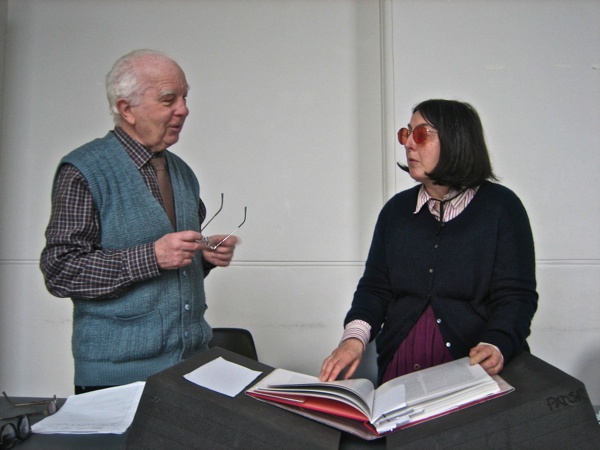
Stanley Rondeau chats with Moira Thunder, Curator, Designs, at the Victoria & Albert Museum, over a copy of Natalie Rothstein's definitive work "Silk Designs of the Eighteenth Century."

Anna Maria Garthwaite's catalogue of designs


Designs by Anna Maria Garthwaite for Spitalfields silks from the seventeen forties in the collection of the Victoria & Albert Museum.
Textile design photographs by Jane Petrie
Textiles copyright © Victoria & Albert Museum
With grateful thanks to Moira Thunder of the Victoria & Albert Museum for making this possible.
You may also like to read about
A 24-hour drinking city that embraces both the theatrical and the historical, New Orleans has been a font for classic cocktails for upward of a century. The city's homegrown recipes are known to have quite a range, too, spanning strong and stirred whiskey staples, fiery dessert drinks and even ice-cold holiday favorites. There's no better way to get to know New Orleans and its nightlife than by experiencing its iconic drinks, one glass—or to-go cup—at a time. But if you can't get to New Orleans just yet, here are a handful of our favorite perfected recipes to transport you there.
Though the Absinthe Suissesse was not born in New Orleans, the city has nevertheless adopted it as its own. With roots in Europe and northern U.S. cities, the minty drink has shape-shifted over time, with variations including or omitting egg white, orgeat, various liqueurs, sweeteners and soda water documented since the 1930s. It somehow made its way into the Depression-era book Famous New Orleans Drinks and How to Mix 'Em, and, decades later, the Cure cocktail book. Kirk Estopinal, a champion of the drink, says, "It has a very Mardi Gras connection to me," adding, "it feels like the kind of drink you want to drink early in the morning."

For decades, swaths of the American media have failed to treat Elon Musk like a CEO with a track record of missed timelines and broken promises. Instead, he is portrayed as a misunderstood supergenius playing 11-dimensional chess with civilization in the balance. — Read the rest
The post How the media keeps manufacturing Elon Musk's "Genius" appeared first on Boing Boing.

TL;DR: Take your programming to the next level with cross-platform development and AI-powered collaboration. Discover Microsoft Visual Studio Professional 2026 for just $49.99 (Reg. $499.99).
Want to take your programming skills to the next level? The key is simple: learn how to work with AI instead of against it. — Read the rest
The post Your favorite developer's favorite development tool just got an AI upgrade — and it's 90% off appeared first on Boing Boing.

In April 2019, Steve Bannon texted Jeffrey Epstein a three-step plan to rescue his reputation: "First we need to push back on the lies; then crush the pedo/trafficking narrative; then rebuild your image as philanthropist." Bannon had spent months filming Epstein for a planned documentary — roughly 12 hours of interviews without ever raising the subject of his abuse of girls and young women or his 2008 conviction for soliciting a minor for prostitution, according to TheWrap. — Read the rest
The post Bannon texted Epstein a rehab plan, called him "God," shared lawyers appeared first on Boing Boing.


