
 Holiday Jeer...Uhh...Cheer [ 02-Dec-25 1:21am ]
I remember when there were no "Black Friday Sales Events," 'cuz I done be olde, chile. I think I first saw a Black Friday commercial this year pre-Halloween. Is nothing sacred?
Our hearts bleed for all the subsidiaries of Omnicorp, their middle managers' jobs on the line unless they come fiscally through before the next earnings report. If the increasingly poor masses don't show up for Holiday Savings, you can just see Virgil from Sales eyeing your job. Did you sign up for this? Yes, you did.
This Substack is reader-supported. To receive new posts and support my work, consider becoming a free or paid subscriber.

(When I'ze a kid we were so poor we couldn't afford snow, much less a snowman. And besides, it was 80 degrees in Los Angeles.)
When Black Fridays started up and became a Thing I remembered how Big Biz can make up shit and it flies. Advertising is magic! They taught me that in Brainwashing 101. Repetition repetition repetition repetition sex repetition repetition status class anxiety repetition repetition fear repetition. Need I say more?
Then everyone got an email address and a personal computer and voila!: "Cyber Monday" and its supposedly marvelous savings on all things enshittified. Do you really need a second salad spinner? No, you don't, so salt away that dough for your next weed purchase. Be a Smart Shopper. Word to the wiseguys.
The once-fairly-robust charitable (write-offs) groups weighed in with "Giving Tuesday." Somehow, that also seemed to fly, though we wonder for how long. If I had any money left after Black Friday "sales events" and, following closely on the heels of Black Friday, Insolvency Saturday and Scheming Sunday, I'd love to subscribe to someone else's Substack on Giving Tuesday. Lawd knows y'all need it. Hell: I need it, hence my self-serving bit here. But as my Brit friends say, I'm skint from Black Friday and Cyber Monday. I ain't got dime nor shekel for Giving Tuesday. I lack drachmas, even. I'm bereft of lire, no oodles of rubles. I yearn for yen. For some serious Euros. A cold wad of cash that could choke Secretariat. Need me to paint a picture fer yas?
But nonetheless let's all keep our chins up in the face of all the forced revelry. They harvested Jesus at this time of year or some shit, and Santa, who began as a psychedelic mushroom god from Norway, wants to bring us stuff. I'm still kinda hazy on the origins, so cut me some slack: it's Christmas! 'Tis the season, brothers 'n sistuhs. Damn straight!
I kid about Black Friday: I didn't buy a damned thing. Out of solidarity. Also: I am Bonneville Salt Flat-broke. So there's that.
HEY LQQK!: Here's a Scheme!: Next year let's all try to gin up support for the day after Black Friday: Substack Subscription Saturday, in which those who still have savings and paying jobs are heavily pressured and guilt-tripped into supporting us. We get in after Black Friday and before Cyber Monday, when the xmas spirit is still not showing gooey black flecks around the edges. Blow me, Cyber Monday! Sorry, Giving Tuesday, but we were in line first. The line starts way back there.
Maybe a non-profit will make a short commercial for us that we can get on…TV? YouTube? A huge billboard outside Ebbing, Missouri? Anyway, we need exposure to the Monied Reading Class, which is a thing, or this bit doesn't work. We need some annoying, riveting, garish ad in which we're all sitting around in the hot dirt with old Smith-Coronas, our hair tousled, conspicuous Band-Aids on our exposed flesh, and flies (use honey!) dive-bombing our heads, with the voice-over of a Charlie Brown sounding Kute Kid saying, "Won't you…help out a hungry writer today?" (hat-tip: Sally Struthers)
Who's with me?
After you've spend too much from your dwindling holiday budget, it's on to Woeful Wednesday, followed by Taciturn Thursday, when no one feels like talking to anyone else because let's face it the System and blah blah blahgetty-blah-OOF! a-heynonny nah nah goodbye. You and your wallet are depressed. And you don't wanna talk about it, so shut the fuck up. (Breathe…count seven, exhale, count seven…: repeat until you feel relaxed, and good and jaded. But relaxed and jaded.)
Fed-Up Fridays are now all the rage, and I mean that literally. You don't want to cut off anyone in traffic that day, a cold early December one, especially in the Northeast or my hometown, insane Los Angeles and its environs. Southside Chicago has been simmering since Woeful Wednesday, which they call Watch Your Back Wednesday, and they joke that Fed Up Friday is Fucked Up Friday, in which half the working population calls in sick to get drunk. Vengeance for harms done by faceless corporations and their stooges in Congress fires the hearts of men and women (could it be indigestion?), and even some children then. Much plotting is feverishly concocted in cold "low cost" housing, but then they realize they lack revolutionary fervor 'cuz they too damned drunk. Even some of dem kids. Hey, I feel ya. I really do. (I mean all this figuratively, fer crissakes.)
Slingshot Saturdays have been gaining every year for the last decade now: when you're out of money for the holidays, you might be sued for what you did on Fed-Up Friday, and you can't wait for It all to blow over soon and you're thinking you might get into Buddhism. On this day we all would like to think we could slay the Giant, but…courage. I tend to be more the Dennis the Menace type on Slingshot Sunday, picking off the Haves, or at least pestering them with a handy dirt clod or tiny bits of gravel. I once knocked a clip-on tie off a haughty bourgeois Republican coming out of church from 35 feet. I was pursued on foot until I hopped a fence like I was that Matt Damon character in that action series of films I've never seen.1 They gave up and I had a hearty laugh, until I noticed a nasty gash on my tibia.
Use camouflage and take cover behind a Help Wanted sign and they'll never see ya. Pro tip…
The following day, Sour-Sarcastic Sunday ("Thanksgiving was ten days ago," you recall, counting on your fingers, because you're still reelin' from the new medication you started taking, the one Charlie the Dealer sold you in the park), always reveals the general tenor and mood of the People as the days of Xmas Cheer get louder and more ominous.
Let me take a moment here to wish everyone a Hot Hanukkah and a Krazy-Assed Kwanzaa. Don't take shit from anybody, you guys! Light the hell outta them candles and a hearty Karamu, too. Please cook everything thoroughly, because the now-compromised FDA ain't checkin for salmonella at all anymore, it seems.
Just an observation. How's your week goin'? Tell me your favorite Slingshot Saturday anecdote in the comments!
This Substack is reader-supported. To receive new posts and support my work, consider becoming a free or paid subscriber.
1It's right on the tip of my tongue. Jason something. Voorhees? The Voorhees Ultimatum? Gimme time. I decided to watch the entire history of film and I'm only up to 1913 right now.
(artwork by B. Campbell)
Thought Experiment: "Common Sense" [ 30-Nov-25 9:15am ]What is the OG on about now? It's just common sense to think about common sense. Or is it?
[tl;dr1: Using the term "common sense" is just me bullshitting myself and others; the plain (delightful) fact is we're just gonna have to cultivate our thinking more.]
Three reasons impelled me to address this idea:
This Substack is reader-supported. To receive new posts and support my work, consider becoming a free or paid subscriber.
The seemingly sudden and swift decline of the unique self, the weirdo personality honestly derived, the desire to speak one's mind without regard to Herd Hearsay and "I Done Seen It Onna Internet"-mind.
That this decline has been driven by algorithms and dopamine-addiction to screens, and the increasingly common fear that one's individuality is seeping away, kinda like the Cheshire Cat's body, but being glued to screens all day will eat that smile up too. I think the popularity of Severance and the newer show Pluribus (which I have not seen but have read quite a lot about), and my reading of a thousand testimonies in disparate places about the personal jihad of trying to wrest a human life away from Tik-TokFacebookXitterBlueskyInstagramLinkedIn, etc. also inform this query. Are our "selves" imperiled as of 2006, or 2014, or whenever everyone was suddenly obsessed with being "liked" by distant strangers?
This question should be wide-open to everyone. If you notice all your friends are agreeing about what "common sense" is (it's highly likely it's what you and your friends think it is), the only game-rule would be: name those who don't seem to agree with you and at least one of you pretend you're one of them, acting as an advocate for the people who disagree with you. In other words, temporarily pretend you're one of Them. This should involve some acting and will be good for major laffs. Follow this up by having a good faith back 'n forth about why those who don't have "common sense" maybe think like they do, in that weird wrong way that's not like the way you think. If you do this with aforementioned good faith while entertaining a little bit of your famous "open-mindedness" there's a chance it will put you in a slight altered state of consciousness.
So: what "is" common sense? As of the date I'm writing this, I see it as a species of bullshit rhetoric that's appealing to people who don't want to think: what we already think about X,Q,Z, and R is just "common sense." No more need to think about it. In this, it seems a kissin' cousin to "human nature." It bears a family resemblance to Naive Realism. Those Americans who still think little things like seceding from Britain and getting ourselves a Constitution ratified was a good idea will give Thomas Paine's agitprop a bye for this round.
Some history and examples and Just Plain Fun ensues:
Giambattista Vico (1668-1744), arguably the father of the modern social sciences, wrote this line in his New Science: "Common sense is an unreflecting judgement shared by an entire social order, people, nation, or even all humankind."2
Bertrand Russell had a line on this (because of course he did): "Common sense, do what it will, cannot avoid being surprised occasionally. The object of science is to spare it this emotion and create mental habits which shall be in such close accord with the habits of the world that nothing shall be unexpected."3
Alfred Korzybski, in his 1921 book Manhood of Humanity seems to think that "common sense" is a very difficult problem - a Hard Problem - and he thinks an understanding of our deep history must play a big part in decoding what this strange beast "common sense" might consist of:
Such I take to be the counsel of wisdom - the simple wisdom of sober common sense. To ascertain the salient facts of our immense human past and then to explain them in terms of their causes and conditions is not an easy task. It is an exceedingly difficult one, requiring the labor of many men, of many generations; but it must be performed; for it is only in proportion as we learn to know the great facts of our human past and their causes that we are enabled to understand our human present, for the present is the child of the past; and it is only in proportion as we thus learn to understand the present that we can face the future with confidence and competence. Past, Present, Future - these can not be understood singly and separately - they are welded together indissolubly as one.4
In this "sober common sense" I don't see anything "simple;" rather: the neo-Darwinian paradigm was just getting off the ground. He published this book in 1921, and in 1925 schoolteacher John T. Scopes was put on trial for teaching Evolution. I'm betting that somewhere in the transcript William Jennings Bryan argued that we could not have descended from apes was just "common sense."
A funny thing happened along the way from Korzybski's desiderata to our present time: History got vastly complex and entangled. Just hang with academic Amy J. Elias here when she's explicating Linda Hutcheons's poetics of postmodernism and history, as found in an essay about Thomas Pynchon's uses of history:
{…] postmodern fiction questions the assumption that the writing of history is transparent and neutral by asserting that all values are context dependent and ideologically inflected, contests notions of history's teleological closure and developmental continuity, and tries to demonstrate that all historical accounts are emplotted in the manner of fiction rather than merely recorded in the manner of science.5
Lest we assume the long hard slog of encircling some sort of philosophical anthropology derived from something like Neuroscience and Evolutionary Psychology…this uhhhh…seems like too tall an order to find out what "common sense" could really mean…and hey: maybe let's get hard-headed and think like a Mathematician in order to close in on our prey. But then, in 1931, the same year as Gödels' Incompleteness Theorem:
One of the chief services which mathematics has rendered the human race in the past century is to put "common sense" where it belongs, on the topmost shelf next to the dusty canister labeled "discarded nonsense."6
George Lakoff the cognitive scientist wrote this about the claim of "common sense":
One of the things most studied in cognitive science is common sense. Common sense cannot be taken for granted as a given. Whenever a cognitive scientist hears the words, "It's just common sense," his ears perk up and he knows there's something to be studied in detail and depth - something that needs to be understood. Nothing is "just" common sense. Common sense has a conceptual structure that is usually unconscious. That's what makes it "common sense." It is the commonsensical quality of political discourse that makes it imperative that we study it.7
I don't know about you, but by now my head is spinning and I feel like whatever common sense I had before I started writing this spew has long circled the drain and is headed straight for the Pacific Ocean. I muddle onwards!..
The phenomenological sociologists I've studied might call this "unconscious" aspect of common sense a variation on the "seen but not noted" world. It's the invisible or not-noted stuff that seems ultra-powerful, mostly for being not noted. Or that it's unseen. Unquestioned. I love anything like this because it takes me out of myself while I'm studying it, kinda like a mild psychedelic drug trip. Here, I'm tellin' ya who I "am," in case ya didn't know. Let's face it, to be interested in such things is just common sense.8
The worldly-universalist reader might immediately jump to knowledge of the social worlds of non-Anglo peoples found throughout the world and how their "common sense" seems wildly different than any of ours, as recorded by embedded cultural anthropologists since at least the early roarin' 20th century. In E. Doyle McCarthy's Knowledge As Culture: The New Sociology of Knowledge, there's a fine discussion about the origins of the term "ideology" and by Napoleon's time it seemed to be a battle between the eggheads and the owning class of the rich and their politicians:
Such a description brings to mind C. Wright Mills's "men of affairs," those sober citizens who parade themselves as hard-headed realists, epitomizing what Richard Hartland calls the Anglo-Saxon variety of common sense: "Anglo-Saxons have the feeling of having their feet very firmly planted when they plant them upon the seemingly solid ground of individual tastes and opinions, or upon the seemingly hard facts of material nature." Accordingly, ideologists do not base their ideas on experience, but resort instead to ideas and deceits - to ideologies.9
One of my great intellectual loves, Robert Anton Wilson, loved to riff on "common sense" throughout his writing career, c.1959-2007. Here's a line from an article he wrote in New Libertarian, c.1977: "Common sense" is…
[…] the body of hominid (or primate) prejudice that is so widespread that only philosophers, mathematicians, physicists, and other eccentrics ever contradict it.10
In a discussion about the flux of individual perception and experts and authorities refereeing over what thoughts and apparent sense perceptions and observations/abstractions are allowable and which reports must be damned, Wilson wrote:
The world is forever spawning Damned Things - things that are neither tree nor shrub, fish nor fowl, black nor white - and the categorical thinker can only regard the spiky and buzzing world of sensory fact as a profound insult to his card-index system of classifications. Worst of all are the facts which violate "common sense," that dreary bog of Stone Age prejudice and muddy inertia.11
Perhaps better (or worse, depending on how much you think we can nail down this gnome "common sense"), RAW, in a long excursion on various epistemologies in the foxy 20th century, cites P.W. Bridgman, also a fave of Korzybski:
Operationalism, created by Nobel physicist Percy W. Bridgman, attempts to deal with the "common sense" objections to Relativity and Quantum Mechanics, and owes a great deal to pragmatism and instrumentalism. Bridgman explicitly pointed out that "common sense" derives unknowingly from some tenets of ancient philosophy and speculation - particularly Platonic Idealism and Aristotelian "essentialism" - and that this philosophy assumes many axioms that now appear untrue or unprovable. Common sense, for instance, assumes that the statement, "The job was finished in five hours" can contain both absolute truth and objectivity. Operationalism, however, following Einstein (and pragmatism) insists that the only meaningful statement about that measurement would read, "When I shared the same inertial system as the workers, my watch indicated an interval of five hours from start to finish of the job."12
Because you haven't heard enough from RAW here: "You are walking down the street, and you see an old friend approaching. You are astonished and delighted, because you thought he had moved to another city. Then the figure comes closer and you realize your perception-gamble (as transactionalists call it) had been in error: the person, as he passes, is clearly registered as a stranger. This does not alarm you, because it happens to everybody, and daily 'common sense,' without using the technical terms of quantum physics and transactional psychology, recognizes that perception and inference are probabilistic transactions between brain and incoming signals."13
Now I gotta get outta here 'cuz Lulu is ringin' the dinner bell, so I'll add to this flummery by citing a living philosopher, Eric Schwitzgebel, who was at UC Riverside last I saw. Prof. Schwitzgebel argues that all famous philosophers, when arguing about metaphysics, all sound "crazy" at some point. Why? 'Cuz "there's no way to develop an ambitious, broad-ranging, self-consistent metaphysical system without doing serious violence to common sense somewhere. It's just impossible." But: "common sense", Schwitzgebel asserts, is an "acceptable guide to everyday practical interactions in the world. But there's no reason to think it would be a good guide to the fundamental structure of the universe." To bolster this last thought he cites Relativity and Quantum Mechanics.14
And here I stand, with Schwitzgebel, not in the same inertial frame as me right at the moment, but close enough, the Professor is.
Thought Experiment results: I have no idea what the fuck I'm talking about when I mention "common sense."
(Site logo artwork done by Bobby Campbell)
1I realize my articles are usually longer than what most writers do here, but if "tl;dr" why are we reading my Substack, anyway? Move on to the next person's thing! There's a lot of shorter good stuff out there. I don't wanna be a bring-down.
2New Science, Vico, trans. by Dave Marsh, Penguin ed, section #142. Vico's "unreflecting" is one of my favorite takes on this topic of "common sense." Nota bene the ballsy gall of Vico to claim this for an entire people! No wonder James Joyce loved Vico so much. Later, the Frankfurt School tended to see similarly that common sense was for common thinkers, and one of them called common sense "the spontaneous ideology of everyday life." - see The Dialectical Imagination, Martin Jay, p.60.
3found in Science and Sanity, Korzybski, 4th ed, p.491. This outlook on what science ought to be able to do for us was shared by Korzybski, and feels like "scientism" now. We need to get to the point where nothing is unexpected (fat chance, Bertie, I say to you in 2025!), and that poor ol' "common sense" is no longer surprised or caught off guard. But we know now we will always be caught off guard with astonishment, Lord Russell. It shall not cease! The utopian ideals for critical thinking and rational technological utopianism by so many great thinkers in the first half of the rollicking 20th century feels like 500 years ago, and not merely 100, at least to me. The scientific millenarianism of folks like Russell and Korzybski - that we're in for a future of justice, peace, prosperity and end of hunger, war, and ignorance, possibly the end of death - is a world long lost, but then again a lot of these dudes were feelin' it then. Some sort of Golden Age will return, etc. Korzybski knew of the social powers of science and mathematical thought but also warned, as I mention in the next footnote, that we gotta get our act together as homo sap or we're cooked. Hack language thoroughly: this we must do in order to get to some sorta Engineer's Dream Garden. It seemed like common sense to them. At the time. Wittgenstein thought common sense was "nothing more than a web of linguistic practices common to a certain community." Or at least that's Richard Rorty's reading of Wittgenstein. See Take Care of Freedom and the Truth Will Take Care of Itself, p.78. Rorty himself thought common sense was part of the workings of philosophers who took pleasure in linking new, weird ideas with old ones, an idea that of course I would favor too.
4Manhood of Humanity, Korzybski, pp. 171-172. He wrote this book in the wake of the Great War, having been in it, and injured. A Polish Count who spoke five languages, his main thesis at this point was that humanity needs to grow the fuck up ASAP. We did not. He saw the 1939-1945 war and kept working to help humans understand how language can lead us astray, and very many ways to hack language so you don't keep acting like a damned ape. Among those writers who were influenced by him: Neil Postman, Robert Anton Wilson, Robert Heinlein, Alan Watts, Fritjof Capra, William S. Burroughs and many others. That the physical sciences were just beginning their cultural ascendance in the West need not be remarked upon, but by the early 21st century, polymathic scientist Jared Diamond argued that too many brilliant scientists had gotten too caught up in the details of some "fanciful" hypothesis that they really should think with more "common sense." See This Idea Is Brilliant, (2018), ed. John Brockman, pp.221-224.
5Cambridge Companion to Thomas Pynchon, pp.124-125. When you actually get into a grokduel with others over "common sense" it might be a good idea to rehearse some of these phrases to pull out and use to throw your interlocutors off their game, and win points:
Your pal: So I say common sense is a mere historical contingency as used by diverse groups in a class struggle.
You: Yes, yes, but the notion of teleological closure implied within any argument for common sense contains a suspect developmental continuity and conceals, like, ya know? how history is written more like fiction, with emplottments and…
Another pal; Where are you getting this shit? Pass the bong over here, please.
Weird roommate: Yea dude, you're being ideologically inflected bigger 'n shit. Anyone seen my Marley CD?
6Mathematics: Queen of the Sciences, Eric Temple Bell. (1931). I found this quote in Robert Anton Wilson's novel The Universe Next Door, p.68, original paperback ed. Bell was a student of Cassius Keyser, who was a close friend of Korzybski. Bell's work influenced John Nash and the prover of Fermat's Last Theorem, Andrew Wiles. It seems highly likely that "The map is not the territory", usually attributed to Korzybski, was derived from Bell. When Bell taught at CalTech, Korzybski lived nearby and they traveled in some of the same circles.
7Moral Politics: What Conservatives Know That Liberals Don't, G. Lakoff, p.4. My copy is an early version of the book, and the subtitle was changed to How Liberals and Conservatives Think, possibly because the earlier version might lead you to think this was another Frank Luntz-type book? Psychonaut-intellectual Dale Pendell asked his mentor Norman O. Brown about common sense and NOB replied, "Common sense never interested me." See Walking With Nobby, p.151 The context was a conversation in which William James comes up and Pendell says James has a certain common sense, then NOB says William James didn't turn him on, then the above line about common sense, then NOB says this was a Freud problem: Freud and his crew tried to make psychoanalysis common sense and to NOB that was a mistake. Lakoff's bete noir (or one of 'em: Chomsky's way up there), Steven Pinker, asserted that common sense is not in operation when a decision must be made between two competitors whose interests are partly shared. See How The Mind Works, p.409
8No, it ain't.
9Knowledge As Culture: The New Sociology of Knowledge, McCarthy, p.32 (Routledge, 1996) My favorite model of ideology is from Mannheim, who in the 1920s thought we all have ideologies which are based in our "situatedness" in the social scheme, or Standorsgebundenheit. Further, he emphasized a "relationism" that we all have to the truth, though no one owns the truth. There are those who are more free and open to exploration within other ideologies, and Mannheim thought they were the relatively unattached stratum of intellectuals, writers and artists. These people had a clearer view of the landscape and more sophisticated takes on "knowledge" "the truth" and "common sense." We can safely assume the better discourses around "common sense" would come from these types of thinkers. They will not come from C. Wright Mills's "men of affairs."
10The exact date/issue currently eludes me and I found this quote with something else I'd scribbled on a 4x6 notecard on "common sense" and the "self." Similarly, Marshall McLuhan supposedly has something in common with William Blake regarding common sense in that they both thought of human touch as the "sensus communis" and, at least for McLuhan, touch reintegrates our sense ratios which were thrown out of balance by various forms of media and their effects on the nervous system. Presumably we need this now more than ever, but I may have been stoned. This from a notecard fragment that looks written in the mood of ephemerality and possibly after waking from a dream. Sorry I even mentioned it.
11Email To The Universe, p. 179, Hilaritas Press ed, p.169 in New Falcon ed. "Damned Things" is a nod to Charles Fort, a major influence on Wilson's philosophy of science. The quoted passage is from an essay, "Damnation By Definition," which RAW traces back to his 1964 unpublished book, Authority and Submission. Note the term "prejudice" again here. RAW's deep study of perception informed his reading in General Semantics and led him to think that we literally don't notice substantial parts of the world that are right in front of our faces, because our brains have already decided what's "real" or worth paying attention to. This idea has gained enormous ground in the neurosciences since 1964.
12Quantum Psychology: How Brain Software Programs You and Your World, Robert Anton Wilson, pp. xxi-xxii, Hilaritas Press ed; pp.18-19 New Falcon ed. You wondered if Einstein would show up in "common sense" didn't you? Well here he is. Again: steal at least one idea here for your lively conversation about common sense:
Your friend Thaddeus: I remember some writer saying common sense was just some prejudice coming out of a dreary stone age bog or some shit.
You: Yes. Let's not forget to mention our inertial frames when making any statement involving a claim of space-time, as Einstein would urge us. Man, this Unicorn Poop is da bomb!
(Silky Sylvia walks in from another Substack screed): What're you guys talkin' about?
13Natural Law: Or: Don't Put a Rubber on Your Willy & Other Writings From a Natural Outlaw, Wilson, pp.72-73, Hilaritas Press ed; p.59 original Loompanics ed. Man, this "common sense" thing is gettin' out in the weeds, eh?
14Philosophy at 3 a.m: Questions and Answers with 25 Philosophers, ed. Richard Marshall (2014), Oxford U. Press, p.39.
Where "Are" We? Chapel Perilous? Chinatown? [ 23-Nov-25 8:55am ]We have a 34-time convicted felon as a leader, and his ideas are endorsed by more then 50% of the "representatives." In addition, the felon, who has always seemed to me more like a needy screaming toddler than a fully rational-emotional adult, was allowed to appoint three Right-Wing authoritarian Christian ideologists to the highest court of law in the land. I won't go into more details.
What I have just written, to the degree you assent or not, was solely from my subjective point of view. It's my best general take as of today, but I'm still learning. I don't think my interpretation of this reality is the one true correct one; I'm only trying to describe what I have seen. Your interpretations will differ in some significant ways. I will try not to go into more details about why I think these things. In my understanding of epistemology, I could be completely insane, but "sane enough" to have a Substack and to be writing somewhat coherent English sentences. I think I "am" sane. Others say so. I think the felon's minions and adherents entertain ideas that, taken to logical extremes, are mostly needlessly stupid and cruel, and lead to human misery for most people. And I've found when daydreaming I feel like I somehow lack an adequate metaphor for this entire scenario.
This Substack is reader-supported. To receive new posts and support my work, consider becoming a free or paid subscriber.
History teaches us that cruel despots are more the rule than the exception. What that says about history and humanity I'll leave to some other blogspew. For now I'm trying to grasp at something better than "The Darkness." So I'm going to name some writers and ideas and pre-existing metaphors, and, like the way metaphors can work, try them on for size and do some comps.
Embodied MetaphorTo be extremely brief, I'm heavily influenced by the work of George Lakoff and Mark Johnson, who, looking at metaphors as mostly invisible conceptual systems that guide our thought, found what philosophy and linguistics were saying about metaphors inadequate, so they lighted out for a new territory, c.1979.1 They say that the idea of metaphor as a poetic flourish that we can use if we want for rhetorical purposes is completely wrong: metaphors are conceptual systems that give rise to action, and are detected by analyzing language. Notice the "buried" sense here: the words are on the surface; the action we take in even our most mundane moments were driven by unconscious metaphors that are instantiated in neural clusters.2
So as I grasp for something I feel is a sufficient label for the world we live in in the U.S, late 2025, I feel it's almost darkly whimsical; I'm acting from a poetic impulse that elides the main points Lakoff and Johnson wanted to make, while here I am at the same time claiming that whatever I come up with will still fall within their frame of what accounts for as metaphorical. I mean: Who the fuck cares what we call it? Will it clarify things enough to spur action? Or help move things towards something more "sane"? I have grave doubts. I don't think it will make a drop of difference. Hence, my claim for a dark whimsy here.
"Black Iron Prison"This was Philip K. Dick's idea of an omnipresent system of social control that obscures the true nature of things. It showed up originally in his late novel, VALIS, and was floridly elaborated upon in his notes for his gigantic, sprawling Exegesis. It's a gnostic view: to wake up and see slave labor, manufactured wars by the strong against the weak, mass surveillance of every aspect of our lives, bread and circuses, etc: PKD thought the Empire Never Ended. (Roman empire). Are we "in" this place?
A quick elaboration can be read here.
Why this feels inadequate to me: while the political views here seem true, there have been some oscillations historically. It looks dire now, but it always looks that way to the literate in very Bad Times. I'm not sure we're in something this bad, though many of you may disagree. My own situated-ness is precarious and yet I've trained myself to enjoy the simplest of things. At a micro-level, my own life is a happy one. Perhaps I'm fooling myself? I don't know. It's still a wonderfully menacing idea from PKD. It's up to us to wake up and see it, and realize there is some spark of divinity in everything and presumably if enough of us realize this, we can defeat it.3 It's very complicated and PKD was a substantially complex man.
I might be resisting here. I'm uneasy with my existential stance: that so far ICE hasn't come for me; so far my medications are still covered; to this point I can still afford food; so far there are no blackshirts out disappearing "liberals" who showed up on a list that probably emanated from Palantir, etc. I will be in solidarity forever with those victims of wanton, needless cruelty, and indeed, It, whatever It is, does seem to be gunnin' for me, because, while white and native-born, I am not rich. Not even close. So I may have false consciousness here; the Black Iron Prison may be accelerating towards its Endgame. If so, I fear for my own looming fearfulness and would like to think I will remain mostly fearless, but have grave doubts. The Overseers are fabulously wealthy and powerful, but it's not enough because so far all that wealth and power has not made them happy. Do any of them seem happy to you? Like they've got genuine interests outside "winning"? They do not to me. Not a one of 'em.
Do we live in the Black Iron Prison?
 (Pessimistic-Existential)"Labyrinth"
I grew up in the suburbs of Los Angeles but in my twenties I found I was completely enthralled by films noir, especially ones from what critics call the "classic cycle," 1940-1960. Hard-boiled gumshoes, fedoras, high contrast lighting, femmes fatale, endless hierarchies of crime where often the low-level street thug is part of a larger system leading to a "fine and upright" millionaire corporate head or mayor. After 1960s noir films were always made and still are. They were made before 1940, but that's not my point. The ones from the classic cycle were heavily influenced by refugees from fascism in Europe, and they worked within the studio system and slyly wrote codes into these films that contained messages that went 180 degrees against the American myth of "If ya just work hard and be a good person things will work out for you." Just look at some of the titles: Desperate, Trapped, No Way Out, Detour, Criss Cross, Brute Force, Roadblock, etc. A common theme is the simple working man just happening onto some situation in which he becomes entangled or ensnared, which leads to murder, blackmail, mistaken identity, and all varieties of prisoner's dilemmas, and, as a line in Detour has it, "Fate, or some mysterious force, can put a finger on you or me…for no good reason at all!" The concrete canyons - the labyrinths - of our metropolises - especially Los Angeles and New York - are where the ongoing summations of primate human emotions play out. Organized and disorganized crime, money, sex and greed, violence, toxic egotistical misery-bringers and other exotic varieties of sociopathy, corrupt politics…these all play out against our desires to just keep to ourselves and live quiet, decent lives of somewhat meaningful work and social volunteerism, a white picket fence in front of an orange tree in the suburbs, mutual aid, and self-creation. In other words, in the labyrinth, it's near-impossible to live such a life. In these films, capitalism is the hidden engine of widespread psychopathy.
There are stories you were told and then there is reality, which, in one narrative that's always intrigued me, the only children who are told about "reality" are the children of the rich. I'm not sure if it's true, but there's a lot of truth in it. Being not born into wealth, I had to jump outside of my own reality-tunnel system and look at other realities. This one - the world of the wealthy - seemed in itself noir as fuck. We're rich because we are the Best People. But also: we're rich because, let's face it: you take all you can and give the other guy the shaft and that's just what Grandpa or Daddy did; that's simply the way the world works. Law of the jungle. Don't let anyone tell you otherwise. Don't fall for the stories the Poor People (who deserve their lot) tell, about fairness, kindness, egalitarianism, and community: that's for the weak. In this narrative, the children of the rich grow up with two different worldviews. Can one be happy that way? I'm not sure. I suspect not.
Very often in films noir the small town or rural area is seen as an escape from this madness. From the nighttime shots of long shadows and murky characters plotting in dingy tenements or boardrooms in the City, to the sunshine and trees and fields of the small town and a sudden simple sweet melody in a major key promise refuge. But you're a sap if you don't think they can find you, track you down, and keep you ensnared. Even out there, where grandma lives.
Noir's labyrinths: mazes in the impossibly complex City, possibly leading to the Abyss, to death or insanity: as a young person I found I needed these films to help me overcome the attenuated, tunneled varietals of "reality" I had made from green, quiet, drab, lower-middle-class swimming-pool-drenched suburbia. It was as if I had found a huge piece of missing "reality" that I always knew existed and now I had the cognitive capital to understand the deeper levels - the metaphors - of what these films "mean." The filmmakers - especially the writers of the source material - were critiquing the American myth and the only way they could get it on the screen was the real-world spectres of Franco, Hitler, Mussolini. The gangster capital of the English-speaking world felt threatened by the type of capitalism the fascists were promising, so once again, you're off to "Over There."
The films were disturbingly enjoyable. They were (and are: I still re-watch them obsessively) a certain type of education.
It's a truism in noir studies that the people who made these films just thought, "we're making yet another crime film." They never said, 'Let's make a film noir." The term "film noir" was invented by French critics after the American films began to filter into Paris after 1945. It's funny4 how others can reframe your reality by seeing it from a different vantage point.
Are we in an endless noir labyrinth? You tell me. Closely allied to this…
"Chinatown"A neo-noir film that came out in 1974, the authoritarian Production Code had evaporated due to the film industry's de-monopolization and need to compete with television, Chinatown (1974, Roman Polanski) had the very bleak ending that had not been allowed by the infantilizing Code. The Bad Guy, "Noah Cross," played by John Huston - an obscenely wealthy man who has literally created a teenage girl from incest (imagine a rich-man-leader who lusts after his own daughter!) gets away with everything. In other words: reality. It's a naked lunch: Burroughs supposedly defined that as finally, clearly seeing what's on the end of your fork.
In the film, ostensibly about a private eye in Los Angeles in the 1920s and the history of the real estate/water-swindle in the City of Angels, "Chinatown" is that area of the City in which you don't know the language or the cultural codes. You really don't know what's going on. As the books I read as a child called it: "topsy-turvy." The cops would seem loathe to mention that they can't figure out what's going on there, but you know they talk amongst themselves. And think of the metaphorical possibilities here, in "Chinatown." You must pretend, play-act and fake it if you're a non-Chinese person. 'Cuz things are going on and you know not what or who, or why. It's another realm of reality: an opaque one. It's something horribly sobering to encounter if you're charged with "keeping order."
Not long after the film came out, the director, Roman Polanski, gave an interview with Der Spiegel. They asked him about the significance of "Chinatown.":
The title simply represents the film's mysterious atmosphere. Jack Nicholson's detective character has experienced something important and disturbing - the violent death of a woman. Now he meets a new woman, who has something threatening and important about her, something that's somehow Chinese in nature. […] Chinatown, whether it refers to a place or the woman, represents Nicholson's fate, something he keeps having to face up to.5
Robert Anton Wilson was an Adept at naming these metaphorical states of mind. He had written about Polanski having to dodge the Nazis in Warsaw and having his pregnant wife ritually murdered by the Mansonoids, and entering "Chinatown" both times. An extended metaphor. The script was written by Robert Towne, who grew up in Los Angeles and he had similar metaphors for "Chinatown." Wilson used the "Chinatown" metaphor in his novel The Universe Next Door. An FBI agent has been surveilling and bugging Justin Case, who bears some similarity to Wilson himself:
Special Agent Tobias Knight, playing Case's tapes one evening, actually heard a long rap about Curly being the id or first circuit, Larry the ego or second circuit, and Moe the superego or Jung's fourth circuit. Things got even more confusing when Case went on to talk about the "cinematic continuity in the S-M dimension between Moe and Polanski." It got even weirder when Case said, "Polanski himself went to Chinatown three times — when his parents were murdered by the Nazis, when his wife was murdered by the Manson Family, and when he got convicted of statutory rape. We all go to Chinatown, one way or another, sooner or later."6
The FBI agents have no idea what to make of this.
Wilson later has Case argue briefly that Skull Island in King Kong, was director Merion C. Cooper's "Chinatown." We know that Cooper had been shot down in 1918 during World War I, and he put the plane in a tailspin to suck the flames out, was taken prisoner by the Germans and thought dead by the Army. In another novel, The Trick Top Hat, Case is dreaming of lecturing about film to an audience of transvestites:
The montage of Chinatown or Chapel Perilous takes us to the Lair of Fu Manchu - the center of Power - the occult Nine Unknown Illuminated Ones who rule the world -the secret of capitalism and ownership - the cruel Cross that separates inside from outside, without windows.7
Here Wilson conflates the Chinatown metaphor with his favored, very similar metaphor, Chapel Perilous.
"Chapel Perilous"Originating with the Grail stories, with many versions related in Jesse Weston's magisterial From Ritual To Romance (1920), Wilson had probably first encountered this metaphor there, when reading supplementary material for Ezra Pound or TS Eliot. He saw the need of this metaphor when he thought he was losing his mind or was contacted by extraterrestrial intelligence, starting around July of 1973. He later entered Chapel Perilous when his teenage daughter was murdered in 1976. His interpretation of metaphorical place is robust and compelling:
In researching occult conspiracies, one eventually faces a crossroad of mythic proportions (called Chapel Perilous in the trade). You come out the other side either a stone paranoid or an agnostic; there is no third way. I came out an agnostic.
Chapel Perilous, like the mysterious entity called "I," cannot be located in the space-time continuum; it is weightless, odorless, tasteless, and undetectable by ordinary instruments. Indeed, like the Ego, it is even possible to deny that it is there. And yet, even more like the Ego, once you are inside it, there doesn't seem to be any way to ever get out again, until you suddenly discover that it has been brought into existence by thought and does not exist outside thought. Every thing you fear is waiting with slathering jaws inside Chapel Perilous, but if you are armed with the wand of intuition, the cup of sympathy, the sword of reason and the pentacle of valor, you will find there (the legends say) the Medicine of Metals, the Elixir of Life, the Philosopher's Stone, True Wisdom and Perfect Happiness.8
The Veil of Maya, Blake's "Dark Satanic Mills," Gurdjieff's civilization of sleepwalking madness, the Discordian's "Region of Thud," David Lynch and Mark Frost's "Black Lodge," the list goes on and on. You probably know others from your favorite artists and writers.
The historical moment at the end of 2025 in the US feels like a bit of all of the above-named. Some wonder if an entire culture can be in Chapel Perilous. I would assume so; there are no rules for these things. They all seem to function as a metaphor for Stephen Dedalus/James Joyce's "Nightmare of History." I think we all need intuition, sympathy, reason and valor if we're going to make it through this.
Poe's "Descent Into the Maelström"A science fiction story from 1841, a man tells how he survived being caught at sea in a massive whirlpool, a vortex never before seen by anyone. The drowned ship was pulled under. One brother went instantly insane, the other disappeared under the water, objects around the narrator were repelled and attracted by the mind-numbing physics of the storm. Suddenly, he had a revelation: as terrifying as this was, it was magnificent, even beautiful. The narrator abandoned ship and clutched a barrel and was rescued by fisherman.
The point was: rather than panic, he calmed down and observed. This story gave Marshall McLuhan an idea about how to observe the effects of media while being a part of the culture in which the dizzying effects of media were playing out.
Can we create or locate some standpoint in which to see…"all this" more clearly and calmly?
1Metaphors We Live By is one of a few "high culture" texts that have not only been stimulating and interesting to me in the extreme, but has reliably given me a low-level psychedelic buzz ever since I first encountered it.
2The neural clusters, or circuits, got there by once being children in environments. If we must divide political worldviews into something like Authoritarian patriarchal hierarchy or Nurturant co-parent general views, as Lakoff does in his Moral Politics, it's because we were exposed to both of these worldviews very many times as children. Lakoff uses the term "biconceptual" and we are all this: we all understand the other view while mostly not adhering to the other concepts; in actual practice most of us seem a mixture of mostly one metaphorical cluster and a little of the other. We're all "bi." The neural circuitry was built-in from there, and as we grew up, we continued to be exposed to both types of political metaphors. When we watch a movie in which a "justice"seeking vigilante takes the law into his own hands and murders the bad guys: the Authoritarian circuits get buzzed and are strengthened; when we teach our children to stand up for or protect that one kid who is being bullied because it not only helps that kid but makes us better people, that's the Nurturant model being buzzed and strengthened. There are a gadzillion examples.
3This idea is a classic gnostic one and yet I'm still waiting for enough people to demand single-payer Universal Health Care like they have in all true civilized countries, so this general millennialist wake-up call seems very much like Sky Cake to me right now.
4"funny" as in ironically and interesting in its dark implications, not "funny" as anything coming from mirth.
5Roman Polanski: Interviews, U. of Mississippi Press, pp. 60-61 (2005)
6Schrödinger's Cat Trilogy, omnibus ed, p. 23
7Schrödinger's Cat Trilogy, omnibus ed, p.273
8Cosmic Trigger I: The Final Secret of the Illuminati, p.4 (Hilaritas Press ed.) If you noticed the metaphors upon metaphors found here, you're not alone, and it was for a reason. See my colleague Gabriel Kennedy's biography of RAW for more details on his entrances and extrications from: Chapel Perilous: The Life and Thought Crimes of Robert Anton Wilson
 On Names [ 16-Nov-25 7:24am ]
"What variety of herbs soever are shuffled together in the dish, yet the whole mass is swallowed up under one name of a sallet." - Montaigne, On Names, Chas. Cotton translation
Okay, I gotta admit it: I've long had a thing for Naomi Klein, and when her book Doppelganger: A Trip Into the Mirror World came out I had to read it. Either I nominated it for the book group I'm in or someone else did. I would have read it anyway. I love her. Anyway: Klein takes off from how she was increasingly confused in the wider culture with Naomi Wolf, who had slowly gone from feminist icon to…whatever you call what she is now: "influencer"? Regressive, neofascist anti-vaxxer? I don't know. I find it depressing. Klein: "There is a certain inherent humiliation in getting repeatedly confused with someone else, confirming, as it does, one's own interchangeability and/or forgettableness."1
This Substack is reader-supported. To receive new posts and support my work, consider becoming a free or paid subscriber.

While reading Klein's book I recalled some of the times I'd mixed up names. Sometimes I think it's sheer laziness on my part (yours too?), but I also think we are increasingly exposed to so many names these days we're bound to get convoluted and intertwingled every now and then. Recently I had realized I was reading two different left-ish culture critics and writers instead of one guy: Branko Milanovic and Branko Marcetic are different people! "He" was simply "the Branko M-ich" guy until I realized…
I had read a lot of literary journalism from the scholar of Literary Modernism/OSS-linked biographer of James Joyce, Richard Ellmann, whose bio of Joyce is often named with Boswell's Life of Samuel Johnson as the most influential biographies of all-time. But later I realized some of this was Richard Elman, one enn, one ell: a novelist, journalist, poet and teacher. Different dudes. I only know of one Ellmann who writes. Turns out there are two, both named Richard. Perhaps there are Richard Ellmans I haven't found yet? Why did I not notice the doubled letters not being there with the novelist guy? What are some of your own examples? I admit I thought the second one-enn/one-ell guy's style-change kinda vexing until I realized…
Here's a question for you: How many people with the last name "Brodie" do you know? I know no one personally with that name, but I'm a film noir fanatic, so I know Steve Brodie from a number of wonderful noirs (Out of the Past, Armored Car Robbery, Desperate, Crossfire). Then around a year ago I was reading a bunch of stuff about the discovery of peptides and the endorphin system, and I glommed on to Candace Pert, who had a wonderful terrible genius life. She worked under the venerable neuropharmacologist Solomon Snyder at Johns Hopkins. Snyder worked under Nobel winner Julius Axelrod, who made seminal contributions around dopamine, catecholmines, epinephrine, and the pineal gland. Axelrod worked under the legendary Bernard Beryl Brodie, who did pioneering work in neurotransmitters, anesthesia, paracetamol, and Tylenol. You say: so fucking what? That's just another Brodie. He doesn't have the same first name as your noir dude. Oh, but for some reason his friends called this Brodie "Steve."2
In 1886 an earlier Steve Brodie claimed to have jumped off the Brooklyn Bridge and survived. An early influencer, this Steve Brodie was responsible for that time you went head-over-heels in a bicycle crash: it was called "doin' a Brodie" when I was a kid. Or maybe you just took a flying leap at something that seemed a last-ditch effort: a Brodie. I think I first encountered this Steve Brodie when Bugs Bunny mentioned him.
So: I can't think of any other Brodies off the top of my head (maybe the old 49ers QB from the 1960s, John Brodie), but here there are: three all-Steve Brodies. Perhaps the notoriety of the Bridge-jumper (he probably didn't jump but wanted people to think he did) influenced the other two.
This seems weird to me, but not as weird as nomen est omen, or "nominative determinism," "the name is the sign," the idea that your name influences who you become as a person. Which seems, on the face of it, insane.
Nominative DeterminismI live near Santa Rosa, California, and when I listen to local radio stations I'll often hear an ad for Grab 'N Grow, a company run by Soiland. Started in 1962 by Marv Soiland, the Soiland Company specializes in soil, mulch, and compost. Their motto "We're as old as dirt." Why did Marv get into this business of dirt? You wonder. This reminds me of a George Carlin bit: there was someone who cleaned up in dirt farming, but later the market went south and he took a bath and had to wash his hands of the whole thing.
This phenomena got a lot of play from a 1994 New Scientist article about a polar explorer named Daniel Snowman, and two urologists named Splatt and Weedon, although Jung was interested in this (of course) and noted his former mentor, Freud, who studied pleasure, had a name that means "joy" in German.
The bass player for Rush, Geddy Lee, wrote about his Jewish heritage and the Holocaust in his autobiography. He cites the Bronfman family in Canada: a Moldovan Jewish Canadian family of bootleggers in the 1920s. They later morphed into Seagram's, went legit. Bronfen is an old Yiddish word for booze, moonshine, spirits. Lee cites Prohibition scholar Daniel Okrent: "It was almost fated that the Bronfman family would make its fortune from alcoholic beverages."3
Freud's disciple and writer on sex, Karen Horney? Michael Pollan, who writes prolifically on flowering plants? The misanthropic writer Will Self? Self wrote about Wittgenstein's ideas about how your name might influence your personality. The botanist who discovered the sexual-reproduction parts of the flower: Nehemiah Grew. Agnes Arber was an early 20th century botanist. A few months ago I was reading on intellectual culture and in a George Scialabba essay he wrote about a Neo Conservative intellectual who can't stand intellectuals, calling them "feckless, resentful, unworldly, and power-hungry." His name: Robert Conquest.4 There was a pretentious asshole at Harvard who kept women out of the Experimental Psychology department, because this guy, Edward Boring, thought it was a man's discipline.5 There's a theory about the earliest singing ever done on planet Earth: by a specific weird fish, and the idea comes from Cornell professor Andrew Bass.6
Three names of the fastest male sprinters over the past 50 years: Houston McTear, Harvey Glance, and Usain Bolt.
In researching all things Giordano Bruno I can't help but think about one of heaviest persecutors of Bruno for his ideas: Cardinal Severina.
A name-story that I find haunting: the lead singer of the hair metal band Warrant took a rock star name: Janie Lane. His parents, the Oswalds, had named him John Kennedy Oswald; he later changed it to John Patrick Oswald. A "pretty" man, Janie Lane later told a story to intimates about a famous musician and that musician's manager on the Hollywood metal scened who drugged him and raped him just after Lane arrived on the Sunset Strip metal scene. A well-liked and talented musician, he drank himself to death at age 47. As far as I know, this story/case/allegation is still a mystery. I wonder about how having the name John Kennedy Oswald may have scarred him in some way; maybe I'm just reading too much into it, like some cut-rate palm reader.
One of the most informed writers on how the nuclear stockpile and our readiness to start nuclear war threatens all living things: Elaine Scarry. In Austin, Texas, there's a doctor who specializes in performing vasectomies: Dr. Richard ("Dick") Chopp. The guy who invented the hottest pepper in the world, the Carolina Reaper, is named Ed Currie.
There seems to be more surgeons named Dr. Pain than statistical chance would allow, but who knows what's really going on?
Any one of us can name a few more I haven't mentioned. Are these all merely a coincidence? What precise mechanisms would explain this? If you do a deep dive into nominative determism you will read articles about how there are statistically more dentists with the first name Dennis, and how if you're a Baker you're almost more likely to bake.
It can get perilous. A man changed his name to Beezow Doo-Doo Zoppity Bop-Bop and was arrested for a drug offense. On the other hand, Marijuana Pepsi Vandyck, a truly Pynchonian name, earned her PhD in Higher Education. Her dissertation was on uncommon black names in the classroom.
How Might Nominative Determinism Work?We're not noticing all those people whose name has nothing to do with their occupations or ideas. So, clearly there is no "determinism" here. At the same time, I wonder if some poetic aspect of words, in some farther-flung Whorfian sense, work on some people's subconscious and it influences them, while if you ask them, they say their name had nothing to do with why they pursued this or that line of work. Lord Chief Justice of England and Wales, Igor Judge, said his name had no influence in his pursuit of the law; a weather reporter named Storm Field said the same, although his father, Frank Field, also a weatherman, influenced him. All dad had to do was add the Storm, and voila! Perhaps there are some forces of convergence also.
In all, these names and occupations are good for a laugh, and seem to function in the way that Henri Bergson said humor works: it reminds us that a lot of the time we're acting as if we have no agency. Humor wakes us up to this. We are not robots, though a disconcerting amount of time we act like we are. As Oliver Hardy so often said to Stan Laurel: "Now see what you made me do!"
Brief Remarks on Having a Boring NameThis past October 23rd, 2025 I watched Jeopardy! (being an incurable addict) and one of the contestants was a long-hair, uniquely dressed young man with a baritone voice, who identified as a poet. His name: Elijah Perseus Blumov. I was quite jealous. Of his name. (By the way: he didn't win, though I was rooting for him and his name.) I've long wondered how to get out of the bland anonymity of my birth name: Robert Michael Johnson. I was named after my dad, but mom and dad called me by my middle name. Currently Johnson is still running second to Smith for surnames in the US. I write a lot about Wilson, whose name is 14th on the latest census list, behind Gonzalez, but just ahead of Anderson. One of my best readers of this Substack is Jackson, currently number 19. Another is Campbell, who comes in at number 47 as of the 2020 census. If any Williamses, Browns, Joneses, Garcias or Millers are here: welcome! You too, Davis, Rodriguez and Martinez.
The philosopher and Leibniz scholar Justin Erik Halldor Smith later just signed his articles Justin EH Smith, but now he's Justin Ruiu, and he explains why here.
When I was in junior high school there were three Mike Johnsons, including myself. It was then (age 14) when I realized I had to deal with this horrible name. If I go by my birth certificate, I'm Robert Johnson, who…is the king of blues guitar. He went down to the crossroad, fell down on his knees, made some sorta deal with Satan to become the best guitarist, and it worked. Okay!
I had a doctor who made the same "Do you play blues guitar?" joke every time I saw him. He just must've forgot, for obvious reasons. What's weird is: yes, I do indeed play blues guitar. I know the current leader of the fascist party in the House has my name, but it will blow over. For awhile, Michael Johnson was the fastest man in the world. You probably know someone else with my name. Naomi Klein? You had just enough Naomi to get into trouble with another one. My troubles along these lines are relatively dull.
When I got married in Hawaii there were a few options for changing your name with marriage, but one that they didn't allow in that state was for the man to take his wife's last name, which I actually tried before they told me I couldn't do it. I couldda been Michael Canada. I couldda been a contenduh!…for something less forgettable.
I've long thought of just adopting a nom de plume, and I can't give you a good reason why I haven't yet. Perhaps on some level I'm too mired in the name. There's so many of us it has a certain black hole-gravitational pull to it. Or seems to. This lifelong name is getting me almost zero traction as a writer. So: maybe I should find something more memorable, more musical or picturesque or grotesque or poetic. Right now I'm partial to Elijah Perseus Blumov, but I hear it's already taken.
I sometimes wonder if I became a Generalist because of my name. Ya know, like Dr. Dick Chopp, became the vasectomy king?
1Doppelganger: A Trip Into the Mirror World, Naomi Klein, p.27
2If anyone reading this is interested in how influential first-person chains of scientific research works you might do no better than read Apprentice To Genius, by Robert Kanigel, which goes into great detail about why one location (Johns Hopkins) could generated Brodie to Axelrod to Snyder to Pert.
3My Effin' Life, Geddy Lee, p.15
4What Are Intellectuals Good For?, George Scialabba, p.162. Also see, p.49, and the oft-complaining Walter Karp and writers who end up writing about what their names sound like. Scialabba links this to Derrida's ideas.
5https://daily.jstor.org/gatekeeping-psychology/
6Beethoven's Skull: Dark, Strange and Fascinating Tales From the World of Classical Music, Tim Rayborn, pp.153-154
(artwork by Campbell)
James Joyce and Espionage [ 11-Nov-25 12:06am ]With the rise of mass media and literacy in the first half of the 20th century, the disparity between utopian feelings around 1900 and the Great War only 14 years later, followed by fascism, another world war, the Bomb…we also became very aware of espionage. This will be the first of a series of essays on the topic of writers and artists and the security state. There's something about imaginative writers and the craft and game of intelligence that has them overlapping in so many strange ways…
(artist unknown)
This Substack is reader-supported. To receive new posts and support my work, consider becoming a free or paid subscriber.
Anarchist Bombings in the USUnited States, May Day, 1919: mail bombs sent by anarchists to prominent government agents explode. The following month: ten bombs explode in New York, Cleveland, Milwaukee and San Francisco. In DC, a man carrying a case to the attorney general's house trips and a bomb explodes in the yard. Glass everywhere. Later police find what was left of the bomber's head on the roof of a three-story mansion a block away. This is linked by authorities to Italian anarchist Luigi Galleani, who was quickly deported. Attorney General J. Mitchell Palmer amasses a security force four times larger than what is was during the Great War. The enemy: Reds. Bolsheviks, communists, weirdo bohemians and free-thinkers or anyone who seemed like they may be one. The infamous Palmer Red Raids ensued. A new, very small bureau in DC, the General Intelligence Division - soon to become the FBI - helps to suss out writers and publishers, files, books, magazines, newspapers, anything that sniffed of "radical literature." A very small avant literary magazine, The Little Review, gets busted. It's run by two arty lesbians who were attracted to Gurdjieff, Margaret Anderson and Jane Heap. They had been printing chapters of James Joyce's upcoming novel, Ulysses. It was the only platform for Joyce's book in the US. Now Joyce had a file at the nascent FBI.1
UnabomberAs Theodore Kaczynski's bombs increasingly did more damage, the FBI was stymied trying to figure out who this guy was. Kaczynski was toying with them: inserting false leads, wearing elaborate disguises, taking long bus trips to mail his bombs from disparate locations, he even found hairs in public urinals and inserted them into his packages to throw forensics off the trail. Kaczynski also teased the FBI with wordplay and they didn't know it for the longest time. Let's look at how he used the word "wood."
His bombs came in wooden boxes. His third victim was named Percy Wood, who lived in Lake Forest. The tenth victim lived in Ann Arbor. His 16th victim worked for the Forestry Service, and was mailed from Oakland, California. The sixth bomb was sent with the name of a real Brigham Young professor, Leroy Wood Bearnson. A writer at the San Francisco Chronicle, Jerry Roberts, received a letter from the Unabomber, who signed himself "Isaac Wood" of 549 Wood Street, Woodlake, CA. The wildest example, to me, is when the New York Times received a letter from Ted K in the early summer of 1993, which provided a social security number: 553-25-4394 as a way to prove it's really him if he writes again in the future. Of course the data base for social security was consulted: this number was linked to an inmate at Pelican Bay prison in California. When officials approached the inmate, he knew nothing, of course.
But on his forearm there was a tattoo: PURE WOOD. I still can't figure out how Kaczynski pulled this off.
Kaczynski, a former Prof of Mathematics at Berkeley, who wrote his thesis on "Boundary Functions" (don't ask me!), knew Nordic and English language histories. In 1995, William Monahan of the New York Press, figured out that the Unabomber was using Old English: "wood" in its earliest usages, meant, "the sense of being out of one's mind, insane, lunatic." In Chaucer, when people "go wood" it's because they've tricked. "Wood" was used when someone was bested by an intellectual superior. Monahan explained to the FBI and anyone else who would listen, the "going wood" was a triple entendre: angry at being tricked, numbness from trauma, and getting an erection.
And that was just part of the wordplay, Monahan suggested. For example, the package containing the bomb that killed Thomas J. Mosser of New Jersey listed a fictitious name, "H.C. Wickel," as the sender. In old English, the word '"wicker" means wood. "H.C. Earwicker" is a ubiquitous character in James Joyce's Finnegans Wake, who sometimes assumes the identity of the Norse god Woden.2
Kaczynski had signed some missives and his manifesto "FC." It took awhile to figure out what this meant. It meant "Freedom Club" and it was taken from one of Kaczynski's favorite novels, Joseph Conrad's The Secret Agent.
Mail bombings, espionage, counter-intel, artists, false leads, intellectuals, and codes.
No Such Thing As Bad Publicity?In a September 1920 letter to his brother Stanislaus, James Joyce wrote that there had been "reports" of himself as a spy in Dublin for the Austrians, as a spy in Zurich for the British or Sinn Fein, that his Ulysses was a pre-arranged German code, and that he was a cocaine addict. Sometimes I think Joyce was an all-timer at starting whispering rumors about himself. I suspect he was fascinated by how rumor worked, which was a lot like a virus.
Other rumors he'd heard about himself: he founded Dadaism, was a bolshevik propagandist, and "the cavalier servant of the Duch—--of M—--, Mme M—-R——M—-, a princ—de X——, Mrs T-n-T A—- and the dowager empress of China."3 A few months later his prime benefactor, Harriet Shaw Weaver, wrote to express concern over Joyce's excessive drinking. Apparently she'd heard stories from Robert McAlmon and Ezra Pound. Joyce's reply to Weaver, dated June 24, 1921, is a study in disinformation between a writer and his sponsor: Joyce denies much while relaying other scandalous rumors about himself, which he denies, while also admitting to being and doing the kinds of things that Artists must do. Joyce scholar Richard Ellmann writes that Joyce "countered legend with fact and fact with legend."4
Sylvia Beach reminisces about hanging out with Joyce in Paris:
He told me how he had got out of Trieste when the war came. It had been a narrow escape. The Austrians were about to arrest him as a spy, but a friend, Baron Ralli, obtained a visa just in time to get his family out of the country. They had managed to reach Zurich, and had stayed there till the end of the war.5
We wonder how many variations on this story Joyce told.
As many Joyceans observe, Joyce inserted his own fears and fetishes, dreams and obsessions in Leopold Bloom and HCE, (not to mention the antics of the Gracehoper-writer-artist layabout Shem the Penman) albeit exaggerated much of the time. One really doesn't know what's really true and to what degree, or how exaggerated his own weirdness was in these characters. Quite a lot of this strikes me as Joyce's antic humor, but what do I know? It also further serves to illustrate Joyce's understanding of the theory of relativity on a social or human scale.
This is all within a subset of difficulties in already notoriously difficult texts. Scholar Mark David Kaufman notes about the rumors Joyce recounted around being an alleged spy, and Ulysses: "The image of Ulysses as a book that seems to be hiding something, a book that may or may not be treacherous, has had a bizarre afterlife in popular culture. In The Manchurian Candidate (1962), Frank Sinatra's brainwashed character owns a copy of Ulysses. Similarly, in Robert De Niro's CIA film, The Good Shepherd, a KGB double agent hides his real identity papers in the binding of Joyce's novel."6
Claire Culleton traces "difficult" writers like Joyce, Woolf, Elliot, Pound to a general feeling, articulated by Llewelyn Powys in article in New Masses, in January 1927: "The average man would gladly kill artists for sport, for like fleas and bugs and lice, they disturb his sleep." Culleton thinks this aptly describes the conscious orientation of J. Edgar Hoover (who had to cover for his own homosexuality). For Hoover, the average Joe and Josephine America felt anxiety over the writings and paintings of these weirdos, and they had to be reigned in. Hoover wrote much intelligence lit-crit, which is perennially the most clueless in the lit-crit genre. Conservative guard dogs speaking on behalf of an insensible horde: Culleton thinks this ironically privileged the High Modernists, and pushed intellectual modernism, "driven by its aesthetic of complexity."7
In literature, this notion of using difficulty in an effort to create new styles and forms is one thing, but evasions, plausible deniabilities, and self-mythologizing of the artist could be a form of defensive esotericism. The writer feels that he might be persecuted for what he writes, so he utilizes smoke and mirrors to obfuscate, and only the initiates are clued-in. In Arthur Melzer's book-long attempt to flesh out Leo Strauss's theory of esotericism in Strauss's Persecution and the Art of Writing, Melzer writes that a writer may write esoterically to avoid two evils: "either some harm that society may do the writer (persecution), or some harm that the writer might do society ('dangerous truths'), or both."8 Obviously, Ulysses was banned in the United States for 11 years after its release in Paris. Despite the difficulties, certain people quickly sussed out the naughty bits (that they could detect), and it was enough. After thirty-odd years of reading all things Joyce, I feel I have less of an understanding of him than when I started. Joyce himself was an Enigma Machine!
Ed Sanders: Writer as Intelligence-GathererClassicist but also a member of the proto-punk band The Fugs, Sanders's slim pamphlet, Investigative Poetry, advocates for writers to report journalistically in the form of poetry or verse, like the ancients did. He gives many examples. He also lists numerous writers who were persecuted by the State for their writing. Sanders presents a 180 degree mirror image of the spook: the poet/artist/countercultural gathering of intelligence and corroborating reports, including techniques (Sanders urges us to open up our own files on any subject that interests us, including our friends), and advice for dealing with dangerous, difficult people. His advocation of studying one's own notes to glean "data clusters" seems ultra creative and revelatory. The story on p.32 about Sam Giancana, Sinatra, Las Vegas and the CIA is a good example of what Sanders was up to. Sanders's biggest influence was Charles Olson, who had strong ties to the work of Ezra Pound, who was the idol of…the head of CIA counterintelligence, James Jesus Angleton, who had lunch often with his friend Kim Philby while not knowing Philby was a double-agent. When Pound was detained by Allied troops in Italy, his Pisan Cantos were suspected of being a secret code.9 Sanders was also heavily influenced by Allen Ginsberg, who similarly kept files on hundreds of topics, and once actually had lunch with Angleton.10
Investigative Poetry has been a major influence on the Overweening Generalist.
Did Joyce Know and Use Classic Ciphers and Codes?The answer appears to be yes. In the "Scylla and Charybdis" episode in Ulysses, Stephen argues about who the "real" Shakespeare was. Who actually wrote Shakespeare? And Joyce was well aware of a best-selling book by Ignatius Donnelly and the idea that Francis Bacon wrote Shakespeare.11 The sheer level and amount of fun Joyce had with Bacon-Shakespeare has inspired thousands of pages by Joyce scholars. Bacon had actually spelled out a biliteral cipher in his Of the Advancement of Learning, Book VI, chapter 1. This cipher was what fired Donnelly up in his hammy pursuit of the "real" Bard: Bacon.
Two of the most famous and sophisticated inventors of ciphers, Sir Francis Beaufort (d.1857), and Charles Wheatstone, who attributed his cipher to Baron Playfair (d.1898) may have been used by Joyce; all three names appear in Finnegans Wake:
The optophone which optophanes. List! Wheatstone's magic lyer. (FW, p.13)
Hark to his wily geeses goosling by, and playfair, lady! (FW, p.233)
in the end, the deary, soldpowder and all, the beautfour sisters (FW, p.393)
till they were bullbeadle black and bufeteer blue…(FW, p.511)
in blue and buff of Beaufort the hunt shall make (FW, p.567)
The problem here is that these ciphers work in a long enciphered text, and Finnegans Wake is not such a thing. Joyce scholar James Atherton insisted that Joyce acknowledged all of his influences by hiding them in his texts, and it seems safe to guess that Joyce enjoyed the ciphers of Beaufort/Wheatstone/Playfair within the context of the Bacon-Shakespeare stuff, but what about this passage in FW?:
I should like to euphonise that. It sounds an isochronism. Secret speech Hazelton and obviously disemvowelled. But it is good laylaw too. We may take those well-meant kicks for free granted, though ultra vires, void and, in fact, unnecessarily so. Happily you were not quite successful in the process verbal whereby you would sublimate your blepharospasmockical suppressions, it seems? (FW, p.515)
This is Shaun, the frustrated postman, conservative, the Ondt to Shem's Gracehoper, and feeling like an intelligence agent here, calling out the text, probably Finnegans Wake itself. "Isochronism" means appearing at regular intervals, which is crucial in a good substitution cipher. "Secret speech" seems obvious. "Disemvowelled" is a very common way to code: leave out the vowels. (Or: lv t th vwls) Joyce actually uses this tool in discussing what's in Bloom's drawer at his house on Eccles Street. "Sublimate" also seems quite obvious in this con-text. "Bepharospasm" is a spasm of winking, which we see in film after film and TV, when a character is trying to stay quiet and signal to another to "go along with this." Or: whatever I seem to be saying just now? Don't believe it!12
Where might Joyce have caught on to the cryptographer's bug? One guess: J.F. Byrne, Joyce's good friend in college. John Francis Byrne, AKA "Cranley" in A Portrait of the Artist As A Young Man.
John Francis Byrne (1879-1960)In A Portrait of the Artist, the budding consciousness of Stephen Dedalus is trying to articulate his own ideas about aesthetics, and he tells these to his sympathetic friend, Cranley. Cranley is based on Joyce's friend J.F. Byrne. They had known each other for a long time, but became close while both were at University College, Dublin. Byrne had actually lived at 7 Eccles Street, the address of Molly and Leopold Bloom in Ulysses, from 1908-1910, with two cousins, and one night in 1909, when Joyce had returned to Dublin they went out partying and came back to Byrne's house and Byrne had forgotten the key in another pair of pants, so he climbed over the wall…the same thing Bloom does at the end of the day in Ulysses. Byrne exiled himself from Dublin for New York in 1910 and became a journalist and worked as a financial editor at the Daily News Record in NY from 1929-1933 under the pseudonym J.F. Renby. But what's most interesting about Byrne here: he invented a "chaocipher" made from a cigar box, a few bits of string and odds and ends. He claimed it produced ciphers that were uncrackable unless the receiver had the key.
In a chapter on heterogenous cryptographers, David Kahn relates Byrne's gambit: he came up with the "chaocipher" in 1918, convincing himself it would produce peace and perfect security between confidants. His cousin thought he'd win a Nobel Peace Prize for it. He demonstrated it to top cryptographic men at the Signal Corps. They passed. The State Department said thanks but no thanks, that their ciphers were "adequate to its needs." Kahn says Byrne was right to call this "a paragon of smugness." In 1938 Byrne showed his chaocipher to the Navy and AT&T, who passed on a deal. Byrne continued to have faith in his invention (you'll never read "Cranley" the same way you did) and in the last chapter of his book The Silent Years: An Autobiography With Memoirs of James Joyce and Our Ireland he inserted a message in Chaocipher at the end, openly challenging anyone to crack it, with the prize being $5000 or the royalties for his book after the first three months. Byrne challenged the New York Cipher Society, the American Cryptogram Association, and the founder of cybernetics, Norbert Wiener. No one cracked it, and Byrne died in 1960. Kahn surmises that the reason the Chaocipher never caught on was that, while it had merits, it was probably not of practical use.13
MacintoshWho is the man in the macintosh who keeps appearing all over Dublin, June 16, 1904? He first appears at Paddy Dignam's funeral. "Now who is that lankylooking galoot over there in the macintosh?," Bloom wonders. Then macintosh disappears. In the "Wandering Rocks" episode he appears: "A pedestrian in a brown macintosh, eating dry bread, passed swiftly and unscathed across the viceroy's path." Etc. he keeps reappearing then disappearing. We all have our hypotheses and I will not add to the more than five thousand essays trying to convince you I have the best guess, but I just think he seems to be a spy, and he also seems to be Joyce himself, presaging Alfred Hitchcock showing up in his own work, the Author himself inside the work, saying to us, I'm here. And he's there to gather intel. On the human condition of his characters and us.
Who do you think Macintosh is, and why?
1The Most Dangerous Book: The Battle for James Joyce's Ulysses, Kevin Birmingham, pp.154-156, (2014)
2Harvard and the Unabomber: The Education of an American Terrorist, Alston Chase, pp.42-44, (2003)
3James Joyce, Richard Ellmann, first revision, p. 509, (1959-1982)
4Ellmann, pp.509-512; this same letter is printed in the one-volume Joyce: Selected Letters, edited by Ellmann, pp.281-284. Ellmann himself was in the OSS under Yale professor Norman Holmes Pearson, but Ellmann seems to have used his time there to go to Ireland to visit Yeats's widow and look at his manuscripts. Pearson's secretary in the OSS was Ezra Pound's ex-girlfriend HD's daughter. Pearson recruited his "number two" in the OSS, James Jesus Angleton, to be head counterintelligence at the new CIA. There will never be a shortage of wild and weird daisy chains when one begins researching literature, espionage, secret societies, and the occult. "Espionage, political intrigue, and the occult tend to come together in secret societies." - Dr. Richard B. Spencer, Emeritus professor of History at U. of Idaho, in lecture series The Real History of Secret Societies (Teaching Company). About secret societies and the occult: Joyce was very familiar with the material of the Golden Dawn, the same that had as members William Butler Yeats and Aleister Crowley. Joyce knew their literature - kabbalah, tarot, ritual, many forms of esotericism - but preferred to keep his own aesthetics of applied Aquinas. As you well know.
5Shakespeare and Company, Sylvia Beach, new edition with introduction by James Laughlin, p.38 (1956/1991)
6"Clever, Very," Mark David Kaufman, James Joyce Quarterly, Nov. 9, 2020
7Joyce and the G-Men: J. Edgar Hoover's Manipulation of Modernism, Claire A. Culleton, pp.65-68 (2004)
8Philosophy Between the Lines: The Lost History of Esoteric Writing, Arthur M. Melzer, p.4 (2014) I used Melzer's thesis for much of my thinking about Giambattista Vico's protective esotericism in "Notes on Vico, Wilson, Language, and Class Warfare," in TSOG: Tsarist Occupation Government, Robert Anton Wilson, pp. 245-293. Vico was a heavy influence on Joyce's Finnegans Wake.
9Pound had to explain himself to the authorities about his poetry written in prison: "The Cantos contain nothing in the nature of cipher or intended obscurity. The present Cantos do, naturally, contain a number of allusions and recalls, to matter in the earlier 71 cantos already published, and many of these cannot be made clear to readers unacquainted wth the earlier parts of the poem […] The Chinese ideograms are mainly translated, or commented in the english text. At any rate they contain nothing seditious…": this defense by Pound was first published in the Paris Review, vol.7 no. 28, Summer-Fall 1962. I found it in A Guide To The Cantos of Ezra Pound, William Cookson, pp.xxvi-xxvii. The Paris Review was funded by the CIA. Pound's Cantos seem at least the equal to Joyce's difficult texts, and were therefore suspect by intelligence agencies. How can one know an erudite, experimental writer isn't trying to code secret messages to aid someone else? Pound was instrumental in the discovery of James Joyce as an important writer, and in getting Joyce funded so he could write his texts.
10Sanders wrote a history of the United States: America: A History in Verse, 1900-1939; another volume covering 1940-1961; a third covers 1962-1970, and there's a separate volume devoted just to the year 1968. He also wrote books in verse about Chekhov and Ginsberg. OSS's Norman Holmes Pearson, who declined joining the new CIA in favor of returning to his professorship at Yale, was friends with Ed Sanders. Pearson also seems to have continued on as a teacher of counterintelligence officers. "In fact, in his responses to a 1964 questionnaire about Fuck You: A Magazine of the Arts, Sanders said that the magazine was funded in part by 'a leading Ezra Pound scholar of Yale.'" This was in fact, Pearson. See Code Name Puritan: Norman Holmes Pearson at the Nexus of Poetry, Espionage, and American Power, by Greg Barnhisel, pp.304-305 (2024)
11The Great Cryptogram: Francis Bacon's Cipher in the So-Called Shakespeare Plays, 1887.
12see "Joyce and Cryptology: Some Speculations," Hugh B. Staples, James Joyce Quarterly, vol.2, no, 3, Spring 1965, pp.167-173
13The Codebreakers, David Kahn, pp.766-768 (1967/1996)
Recent Psychedelic Drug Research and German Ethology [ 05-Nov-25 10:50am ]Here I am again, on acid. I mean: I'm writing about acid. Psychedelic drug research and other drugs besides LSD. Here I am, writing about them again. Why? 'Cuz it's an exceedingly, overwhelmingly fascinating topic to me. I get a contact high just writing about it. You too?
So, a current obsession of mine is trying to keep up with what's going on in psychedelic research. The topic is very hot and rich, like a double mocha caramel frappucino, but much more mind-manifesting.
This Substack is reader-supported. To receive new posts and support my work, consider becoming a free or paid subscriber.
(Dr. David Olson of UC Davis, pioneering in psychoplastogens)
David Olson of UC DavisDr. Olson is the head of psychedelic research at Davis; it looks like he's getting funding from the Pentagon, but I'm not sure. (Leonard Pickard seems to think so. Go to the 47 minute mark.) Olson and his team are up to their elbows in our 5-HT2A serotonin receptors (and their cousins). These receptors regulate feeling "normal" which perhaps many of us take for granted. Why? Because when something goes organically wrong with these receptors we have depression, schizophrenia, obsessive-compulsive disorders, etc. Of course, it's far more complicated than this. Anyway: this receptor is an agonist for LSD, psilocybin, DMT and others. Meaning: these drugs "look" so much like serotonin that they are taken up by the 5-HT2A receptors and…ehhhhh…disrupt (?) normal brain function. Ya get way high. Serotonin regulates one of our versions of "reality"; let's see what other versions there are that dock into 5-HT2A and other serotonin receptor types.
Olson has figured out a way to tinker with these drugs enough that they can give the therapeutic results we've all been reading about for the past 15 years or at least since Michael Pollan's How To Change Your Mind made the bestseller list. Here's the catch: he's tinkered with the drugs so you don't trip, but still get the benefits. Or at least that's the goal. And he's making inroads, which is fantastic news for anyone suffering from a host of maladies that psychedelics have been shown to have therapeutic efficacy for…and for those who get the Lovecraft horrors when they even think about tripping. That's a lot of people, as we know.
That's the goal: you've been depressed? You will get one of these drugs Olson has dubbed "psychoplastogens" and take them at home, you won't be trippin' balls, and your depression gets markedly better than anything SSRIs could do. I surmise the Pentagon (or DARPA) wants it for PTSD, to treat soldiers, and possibly: to prevent them from being lastingly traumatized by what they saw on the battlefields.
Olson's term - the "plastogen" aspect - plays on the neuroplasticity of our brains. It's been found that tinkering with the serotonin system opens up more plasticity: new learning, fast learning, un-learning. With plasticity, we've found that our brain functions are much more like Silly Putty than we ever thought before 1980. (William James posited in his magisterial 1890 textbook Principles of Psychology, that our brains remained plastic throughout life, pretty much. That was shot down. William James turns out to be have been right.)
There seems to be a lot of promise. Very recently as I write this, Olson's private venture company, Delix Therapeutics, announced the results of a Phase 1B study of their drug zalsupindole/DLX-001, which is their psychoplastogen based on the ultra-strong psychedelic 5-MeO-DMT, the toad venom one you've read about or actually tripped on yourself. Of 18 participants, 9 got the drug once a day for 7 days; the other 9 participants got it twice over 7 days. The participants had major depressive disorder. All 18 got around a 50% reduction in depression as measured by the Montgomery-Asberg Depression Rating Scale. There was no significant difference between the two groups, suggesting getting this drug only twice in one week would show improvements. No one tripped or got delusional or dissociated. Delix will report more results later. Participants were not at home, so their brain activity could be monitored. We'll hear more about this within a year, it seems. They're ready for a next phase: people taking DLX-001 at home. It seems like very good news for people who have major depressive disorder, but I think we need to see a lot more research and clinical trial data. Olson has another drug called Tabernathalog, which is an analog of Ibogaine without the trip. I know the Olsons are often linked to Utah and Mormonism, and "Tabernathalog" sounds like a hat-tip to all that, but I have no evidence for this. Olson hasn't answered my email. I think he's really really busy, honestly.

(Dr. Gül Dölen of UC Berkeley, making inroads in critical periods and psychedelics)
Gül Dölen at UC BerkeleyShe does not design drugs like Olson, but she's a very creative researcher. She also seeks to avoid using email ever again, it seems, so she hasn't answered any of my Qs. I may have to drive to both Davis and Berkeley to see if I can talk to both of them for 15 minutes.
Dölen made news when she gave octopuses MDMA/Ecstasy/"Molly" and these normally asocial creatures became very social. She studied philosophy, then neuroscience, linguistics, and then got into psychedelic research. Dölen says it's an open secret that a lot of neuroscientists got interested in psychedelics because so many of these drugs are molecularly isomorphic to serotonin, which implies a superhighway of insight into perennial philosophical questions about the nature of consciousness.
What was so eye-opening about the octopus experiment - which sounds like a stunt to get noticed but was not - was that there was a theory that psychedelics quiet the amygdala or prefrontal cortex, but octopuses don't have either of those. The reigning psychedelic theory of entropic brain processes put out by two giants in the field, Dave Nutt, and Robin Carhart-Harris, seem to require the Default Mode Network in its explanatory scheme. Octopuses don't seem to have one. Dölen thinks it all has to do with serotonin transport systems, something we share with eight-armed alien-like mollusk friends.
We branched off from them 500 million years ago, they certainly seem to have consciousness, they recognize humans and signal to them using complex body movements, they have no skeleton, so they can squeeze through very tight openings. But they're very intelligent! Come to grips with it, older scientists: these mollusks are intelligent and conscious. I for one can't eat them at sushi restaurants anymore. They have three hearts, blue blood, on and on. For a brainy take on them and us, see philosopher Peter Godfrey-Smith's Other Minds: The Octopus, the Sea, and the Deep Origins of Consciousness (2016).
Dölen disagrees with Olson on the ultimate therapeutic questions around psychedelics: she thinks the trip is necessary for long-term healing, like those people who were depressed, took one trip on psilocybin, and weren't depressed ten years later. Where she agrees with Olson is that neuroplasticity is where the action is, and that has to do with serotonin receptors. But she thinks what's going on is that our critical periods become re-opened on these psychedelics.
Critical periods are the periods in which we are open to massive amounts of learning, and according to Takao Hensch of Harvard, who specializes in critical periods, "There are probably as many critical periods as there are basic functions."1 From a 2021 article in Frontiers In Neuroscience, "A critical period is a window in which environmental input is necessary for the appropriate development of the relevant brain circuit. During a critical period, the brain has a heightened plasticity in which experiences have robust effects on establishing stable neurocircuitry. During this developmental period, the brain's malleability creates both a vulnerability to environmental insults or deprivations as well as a remarkable ability to quickly and robustly acquire skills."2 There are established critical periods for walking, seeing, hearing, language acquisition, parental bonding, developing absolute pitch, learning the local cultural norms, and, as Hensch alludes to, many more.
At first Dölen thought MDMA opened critical periods for social learning, but using prior intent, she and her team found that LSD also opened critical periods. Then psilocybin, ibogaine, and even ketamine did, too. WTF? Last I saw they linked this to 65 genes involved with critical period open states. How long do the critical periods stay open? For longer than the trip lasts, which blows me away. It's now thought you're open to radical new or re-learning for a day or two and up to two months. This raises a massive question about "setting." A battered wife doing psilocybin-assisted psychotherapy cannot just go back home to where her husband is beating the crap out of her: she'll re-imprint the trauma, probably making it worse. The implications for this seem humongous to me. 3
Are psychedelics reset buttons?
Timothy Leary and Robert Anton Wilson urged self-metaprogramming: have intent and a goal in mind before you trip. And of course Set and Setting were of paramount import. Leary had read everything on imprinting (the older term for critical periods) that he could find before the government locked him up for having a small amount of cannabis. What was he reading? The Germans who discovered imprinting.
German-Austrian-Dutch BiologyIn 1973, Leary was languishing in solitary confinement, reading and writing books. That same year, Karl von Frisch, Niko Tinbergen, and Konrad Lorenz received the Nobel Prize for Medicine and Physiology for their work in Ethology, which is the science of observing animals not in a lab, but natural environments. Frisch had deeply characterized bees' language; Tinbergen had a host of discoveries, including what's called "supernormal signaling": you can replace a bird's egg in the nest with one larger, and it will invest significant energy taking care of it. This aspect of exaggerating that which is already biologically desirable has been linked to our long history as hominids of seeking out food that is sugary and fatty: very hard work for 99% of our time, but now: fast food and an obesity epidemic. It's been linked to the world of Art, to our consumption of pornography, all kinds of things.
Lorenz contributed hugely to the ur-theory of critical periods: imprinting. As a kid I saw on PBS the greylag goose following him around. It had imprinted on him as its "mother" because Lorenz was present when its imprint vulnerability was open.
Ethology was largely a European response to American Behaviorism. In the US, ethology seems to have creeped in via what was Sociobiology in the 1970s, later Evolutionary Psychology. Behaviorism was what Chomsky and Leary had both attacked, in their own ways, in the 1950s and 1960s. In the American mind, it's often linked to "brainwashing." What's kinda weird is that Jacob von Uexkuell, one of the great-grandfathers of German biology in the 20th century, who coined the term umwelt, the specific way an organism must perceive the world given the capabilities of its perceptual apparatus and sensory organs, was a major Nazi. He even helped shaped Nazi ideology. And Lorenz was a Nazi party member. A rabid member:
The immensely high reproduction rate in the moral imbecile has long been established…Socially inferior human material is enabled…to penetrate and finally to annihilate the healthy nation. The selection for toughness, heroism, social utility…must be accomplished by some human institution if mankind, in default of selective factors, is not to be ruined by domestication-induced degeneracy. The racial idea as the basis of our state has already accomplished much in this respect. We must - and should - rely on the healthy feelings of our Best and charge them…with the extermination of elements of the population loaded with dregs.4
So: you can't escape them: mad scientists with inhumane intent. Nobel Prize winners you wouldn't want living in your neighborhood. Sometimes they're fucking brilliant with some of the stuff they come up with. How do we deal with this knowledge? Please answer in the comments. Back to Leary.
(Leary. It seems he was fascinated by instincts before he knew about imprinting. I write this just from looking at the index to his 1957 book The Interpersonal Diagnosis of Personality)
Timothy LearyThe Leary scholar James Penner thought Leary's ideas around "de-conditioning" and "reimprinting" using psychedelic drugs were his biggest breakthroughs.5 In a 1965 article published in ETC: A Journal of General Semantics, "Languages: Energy Systems Sent and Received,"6 Leary discusses information signaling systems throughout the body, including the effects of imprinting. It's a long, brilliant article, and at one point he speculates with his knowledge of imprinting by noting three aspects of it that didn't seem to be covered by the literature:
"The first is the rather terrifying implication that early, accidental and involuntary events can blindly and tenaciously couple the instinctual machinery to entirely inappropriate stimuli. It raises the disturbing question for each individual - which orange basketballs imprinted you?"7 Leary here alludes to some research on imprinting in which ducklings rejected the mother in favor of an orange basketball. For me, it makes me think of billionaire tech bros who think of themselves as gods with the right to change the world, because they're so brilliant and rich and to hell with democratic ideas. It makes me think of Astrid Sabiha Lloyd's recent article about psychedelics expanding the Ego. Sabiha Lloyd doesn't mention the long open critical period established by Gül Dölen and her team, but I couldn't help thinking of these guys tripping at Burning Man and everyone around them kissing their asses for days and weeks with how great they are, etc. Do these guys need to be imprinting that shit?
"Another issue is the relationship of conditioning and learning to imprinting. One possibility is that imprinting sets up the basic attachment-avoidance of stimuli and that all subsequent learning is accomplished by means of association to the original imprint." This became the basic working hypothesis throughout Leary's subsequent work and in Robert Anton Wilson's Prometheus Rising, which I consider the great text explaining Leary's life-work: the Eight-Circuit Model of Consciousness. In these works, conditioning and learning are constantly malleable, but only within the parameters of earlier imprinting on the oral-biosurvival "circuit," the anal-territorial/political "circuit," the symbolic-semantic "circuit," and the socio-sexual "circuit." All four of these dimensions were imprinted, and the local culture acts as a Behaviorist-At-Large, subtly encouraging and dissuading citizens to fit into society. The 2nd circuit: anal-territorial-political, is far older than the semantic and social ones, and therefore more pronounced in all our own realities, which explains all the alpha male baboons and terror and war in our history as species. Within Leary's and Wilson's Philosophical Anthropology, this has led to the Nightmare of History, because, in a very strong sense to them, these processes spelled out the mechanisms for robotic behavior at the individual level all the way up to national and trans-national behavior levels. The good news is that they posited four circuits beyond these, which largely escape Behaviorism. Some other article…And:
"Another aspect of imprinting is its addictive quality. The human being is 'hooked' to the external world. Sensory deprivation experiments suggest that when the human being is cut off from his 'supply' of external stimuli, he shows all the symptoms of a 'dope fiend': restlessness, discomfort, anxiety." Maybe in 2025 think here of your Internet fix? Your phone/laptop/compuer is external to your body. Cut off that "supply" for awhile: how do you feel? The problem here is that some of us were well past the legal drinking age when we first got a computer and an email address: could we have imprinted the Internet? I personally prefer to stay off "all that" and read codex/dead tree books, which I am clearly addicted to, and will feel anxiety, discomfort or restlessness if deprived of my supply. But to those born, say, after 1995? I think we must consider that they have imprinted Internet. What does that entail? Too rich for my blood, right here, right now!
I wonder how effective Olson's psychoplastogens will be. I wonder how many critical periods will be shown to be opened by psychedelics and amenable to therapy. How many things that we assume are "hardwired" in us can actually change under psychedelics? Will Olson's or Dölen's work prove more influential? Can a person who's nearing retirement age but still wants to learn a foreign language, take up a musical instrument, or become really good at mathematics benefit from a targeted psychedelic approach? Will humans eventually get so good and creative at serial re-imprinting during critical periods with psychedelics that it will become some sort of art-form? Are there certain genetic profiles that will reveal that some people can re-imprint easily, while for others it is difficult or impossible? Can we learn to discern what our own values really are, then use psychedelics to help us change our lives so we live in accord with those values in a more integrated way and not be so scattered and chasing after things we've been told we should want? Can we keep Authority at bay and use psychedelics according to our own wants, desires and needs? There will be unforeseen outcomes of all this: what will these be? Are psychedelics overhyped? There's some quality data that suggests non-psychedelic approaches re-open critical periods: new technology, shock, confusion, and isolation: how will the research on these go? We have reason to believe our immune systems become imprinted: how far does this extend?8 Will more knowledge of critical periods change standard practices?9
Only time will reveal tentative answers to these and any of your questions around this fascinating subject.
(artwork courtesy of Bobby Campbell)
1This quote gleaned from Rachel Nuwer's I Feel Love: MDMA and the Quest For Connection In a Fractured World, p.172.
2see Frontiers In Neuroscience, Sept 19, 2021, "Critical Period Plasticity as a Framework for Psychedelic-Assisted Psychotherapy." If I put a hyperlink to the article the pictures show up here in the footnotes, making it unwieldy, which is a drag, I know.
3see the June 14, 2023 article in Nature: "Psychedelics Reopen the Social Reward Learning Period." Incidentally, longtime underground psychedelic therapist Leo Zeff seems to have noticed a long time before Dölen's team's research that you're still open for weeks after the trip: he cautioned his trippers to not quit jobs or take new ones, start or end a relationship, etc, for three weeks after. Zeff didn't use the term "imprint," much less "critical period" but intuited what was going on after long experience of working in the field, underground. One of his "patients," a guy named "Andrew" thought the three-week rule was right and added, "Just be with it awhile. See what pertains to the trip itself and what is meant to be actualized in your life." see The Secret Chief Revealed, by Myron Stolaroff, pp.88-89. The Secret Chief was Leo Zeff all along!
4found in Behave: The Biology of Humans at Our Best and Worst, Robert Sapolsky, pp.9-10. Sapolsky - one of my favorite humans - found this quote from Lorenz in R. Learner's Final Solutions: Biology, Prejudice and Genocide, 1992. Prior to Sapolsky quoting Lorenz he had quoted founder Behaviorist John Watson, with a similar horrific quote we associate with fascism. He followed that with a quote from Egas Moniz, Portuguese neurologist who won the Nobel in 1949, who pioneered icepick lobotomies for people who were social misfits or just too weird, according to…others.
5Timothy Leary: The Harvard Years, ed. James Penner, p.9.
6Penner, pp. 268-301. I consider this one of the truly sparkling works from Leary's ingenium.
7Penner, pp.276-277, for this quote and the following two from Leary.
8I'm thinking of Original Antigenic Sin, which has become widely accepted in medical circles: the first flu you got, the way your body attacked and defeated this flu and this flu's characteristics, stays with you for life. In other words, the version of the flu virus you first caught as a child influences how sick you get from influenza viruses the rest of your life. I probably caught the 1968 H3N2 "Hong Kong Flu" which was a doozy. As an adult, when I get the flu there's always a couple of days in which I think: gotta go to the hospital, feel like I'm gonna die. From first symptoms: fever, chills, etc, to feeling like I'm recovered: around five weeks for me, maybe six. When I first read about OAS it was a revelation.
9David Jay Brown, one of the great psychonauts, thinks circumcision leaves an imprint of trauma and violence. See New Science of Psychedelics, p.43.
(art work courtesy of Bobby Campbell)
Ezra Pound, RAW and The "Two Cultures" [ 30-Oct-25 10:06am ]In 1959, British chemist Lord C.P. Snow gave a lecture, which was promptly printed into a thin volume: The Two Cultures, which immediately went viral. Yes, a book about the intellectuals on the Humanities and Physical Science side of the university: went viral. 'Twas a different time, verily. In Snow's lecture, he lamented the gulf between the Physical Sciences guys, and the Humanities people. He argued that his guys, the physicists, chemists, and biologists, were open-minded towards the Humanities but the non-scientist intellectuals wanted to have nothing to do with Science, or its language, mathematics. Okay, but Why are they so separated?
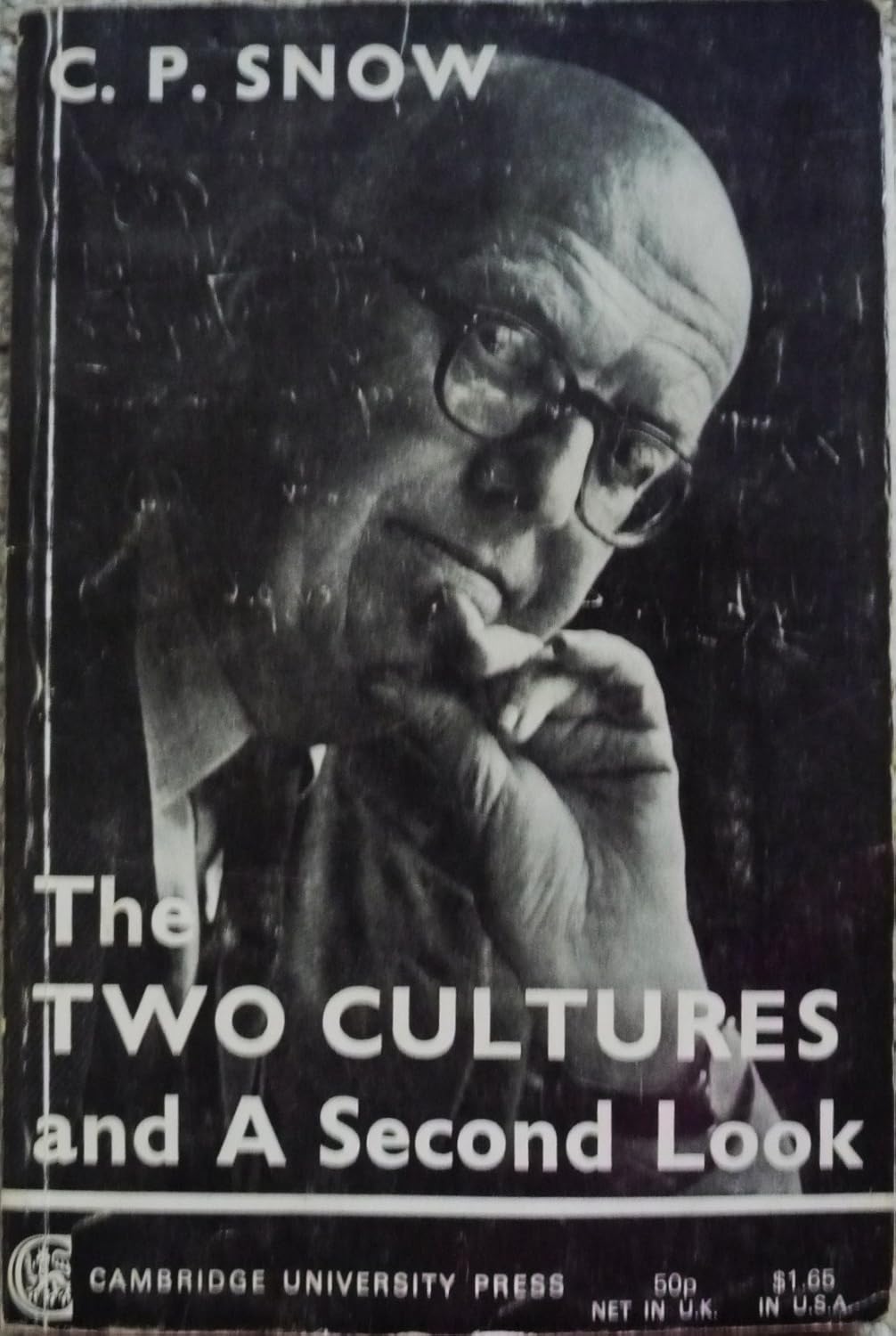
This Substack is reader-supported. To receive new posts and support my work, consider becoming a free or paid subscriber.
There seems to be no place where the cultures meet. I am not going to waste time saying that this is a pity. It is much worse than that. Soon I shall come to some practical consequences. But at the heart of thought and creation we are letting some of our best chances go by default. The clashing point of two subjects, two disciplines, two cultures - of two galaxies, so far as that goes - ought to produce creative chances.1
I was tempted to italicize "heart of thought and creation" and then say they're mine, not in the original. But the whole damned lecture/essay is hyperbolic like this. But that's not the part I find maddening. Nor is it the world-revolves-around-Cambridge assumptions of Lord Snow. It's the claim that his scientist guys work all day in their mathematical languages, but when they get some time, they really do want to read Shakespeare, the current poets, history books, the latest in Art history, etc. But those Humanities people are almost proud to not know any science. And they seem to hate mathematics.
Now: we all know some professors in which this rings true. I have known a few who line up fairly close with Snow's straw man argument here. But I've known more Humanities people who are fascinated with science and who assume the two cultures are unnecessary. Perhaps it was way different back then. Sure, the science guys get far, far, FAR more funding.2 In 1959 the divergence of our great universities as "research" schools was only beginning. Snow wouldn't recognize them. But I suspect he'd be delighted, much like Francis Crick, who in his 1967 lecture made into a book, Of Molecules and Men, agreed with Snow's thesis and furthermore, was happy the Humanities were dying and science blossoming. (see pp.93-96 in Crick)
Francis, you're not helping Snow's argument there…
Snow wrote about how weird it was to go viral back in 1959 in an essay published in 1964, The Two Cultures: A Second Look. He names other people who were talking about these same ideas around the same time (Jacob Bronowski, Merle King, ADC Peterson), and he's flexing while saying he got lucky and was in the right place at the right time, these ideas must have been in the air, etc. He was astonished seeing a public discussion of his thesis catching fire in places like Hungary, Japan, and Poland. Snow laments that, "A few, a very few, of the criticisms have been loaded with personal abuse to an abnormal extent…" and that some had personally approached him to ask if they could reprint what so-and-so said about him. (It was FR Leavis; Snow refuses to mention him. Leavis, a champion of Pound, Yeats, Eliot and Hopkins and a friend of Wittgenstein, thought Snow had been flatulent and pretentious and excoriated him in Two Cultures? The Significance of C.P. Snow.)
Why the Hubbub?Simply because two cultures idea had really flared up with the intellectual and ruling classes of Europe using the physical sciences to not only win the war (Hitler had driven out the best minds of that generation, terrified by antisemitism, haunted anxiety-ridden shod, dragging themselves and their suitcases through Paris and Lisbon, looking for a saving ticket to UCLA or The New School…) but invented a whole slew of products for consumers. Meanwhile, the English profs had been eggheads who seem to object to the widening gulf between haves and have-nots, and therefore, are a Huge Drag who just don't "get" progress. I oversimplify, but you get my point.
Then Snow piles it on 14 years after the war, and it was just a bit too much for a lot of the types of intellectuals who had never specialized in any one academic domain. The generalists, the relatively unattached free-floating stratum of bohemian thinkers, flaneurs reeking of herbs, obsessive autodidacts, and drop-out scholars, some who'd been to University but who did not become academics, or who were in academia for a while but it was not a good fit. Ezra Pound was asked to leave. Robert Anton Wilson was an Engineer who was interested in everything but was mostly a freelance writer3. Pound was also interested in everything. There were a lot of people like this: highly literate thinkers who were also interested in science.
1963Having always been a prominent intellectual who wrote both novels and essays and a deep reader in science, Aldous Huxley published Literature and Science, taking Snow at his word, urged more Humanities types to read science, even though, "Whether we like it or not, ours is the age of Science." (p.70) Huxley, whose brother Julian won the Nobel Prize in Physiology and Medicine in 1963, was from one of the most prominent intellectual families in Europe, Aldous's and Julian's grandpa being "Darwin's Bulldog." So, while Snow was taking a victory lap in 1963, four years after he made his name with the Rede Lecture on "the two cultures," there's Aldous publishing his pro-science book for his literary audience. Then, in November of that year, dying of oral cancer, Aldous took a massive dose of LSD and died the same day as the JFK hit.
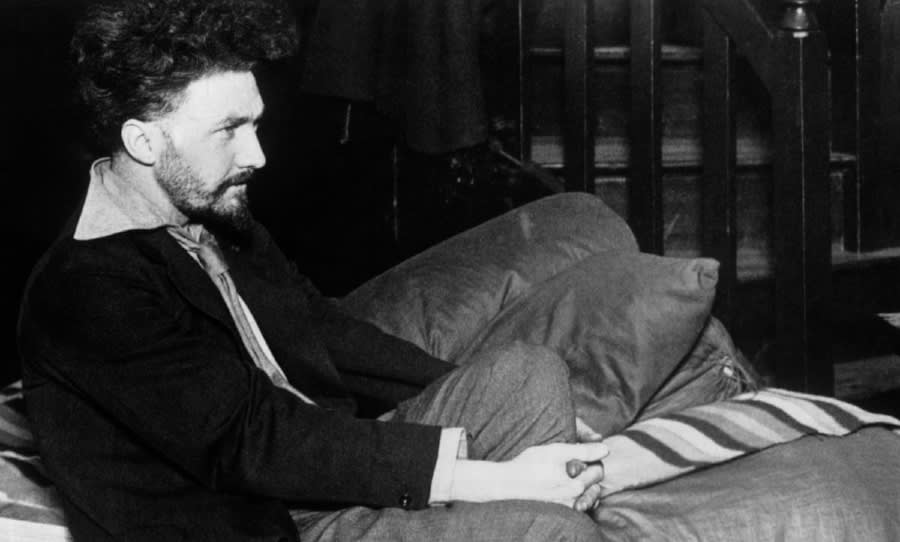
(Ezra Pound)
Special Case: Ezra PoundPound, who we might argue single-handedly pronounced a revolution in the Arts, and especially poetry, then actually successfully carried it off, had always been attracted to science. In 1996, scholar Maria Luisa Ardizzone published Machine Art and Other Writings, from previous unpublished work by Pound between the years 1927 and 1943. It's a basic attack on the Aristotelian/spectatorial view of knowledge, which placed "theory" on high, while Pound argues that techné is an Art, and superior, all of which goes against Snow's argument.
Since Leibnitz there has been no theology, and no philosophy. That is to say, there have been essays on philosophic subjects, but the thought has been a mere weak derivative from scientific discovery. IT IS ALIVE. It says nothing about not fishing on Sunday or about having only one woman or about fealty to the constitution. (Machine Art, p.119, "How To Write")
Pound here is riffing on the "splendor of the cosmos" and he wants nothing to do with monotheism, but is only interested in an erotic, universal cosmology, and science, and fer gawdsakes: not "economics": science was where it wuz at for this Poet.
Whenever a scientist has come into contact with the practice of hired economists, he has been both amazed and disgusted. A "science" which excluded facts from its investigation and demonstration is not rated very high among physicists, biologists, chemists. (119, op.cit.)
The conspicuous problem here is Pound's nutty, hideous antisemitism of this period. At the end of his life he admitted he'd been wrong. But this issue is too complex to go into here. Suffice: my feeling is that most people who thought they knew Pound didn't realize how impressed he was with the methods and instigations of physical scientists. Pound was a very complex sort of vitalist; his fellow poets and sculptors, painters and novelists were not going to help him here. In inventing his ideogrammic poetic method he thought he was mimicking a scientific technique, to use for poetry and even expository writing. In an overwhelmingly creative misreading of Chinese writing he had put poetry and writing on a scientific footing. "I am not offering a system of thought, if that means a few idées fixes arranged in a pattern on a shelf. I offer a system of thinking. Any biologist will understand you if you say mankind is my bug." (112) His influence was enormous.
From c. 1980 Counting Back to 1963Novelist, essayist, playwright and counterculture figure Robert Anton Wilson, trained as an Engineer, largely because he thought he had a facility with mathematics, wrote the following in a footnote in a novel from the late 1970s, as if the novel had been annotated in the year 2803:
At the time of this comedy those primates who specialized in verbal manipulations of the third neurological circuit formed a gene-pool separate from those who specialized in mathematical manipulations. The former, controlling the verbal environment, had dubbed themselves "the intellectuals."4
RAW almost sounds like Snow here. But RAW was far more complex a thinker than Snow. Let us continue.
In a 1971 book by Pound scholar Christine Brooke-Rose, she's discussing the ideogrammic method, and writes:
What I want to emphasize now is that Pound, long before the present fashion for the "two cultures," insisted that this ideogrammic way of seeing, or proceeding, was the way not only of art but of science, which he liked to bring together, but together against "logic." 5
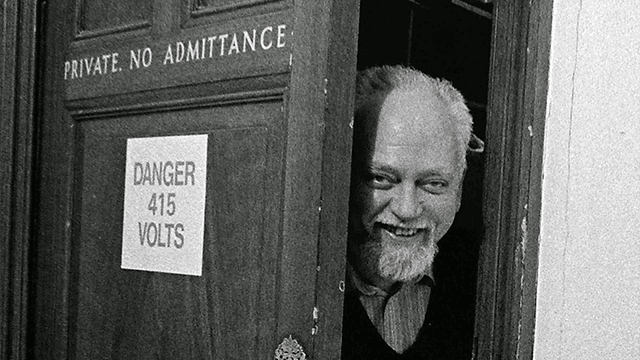
(Robert Anton Wilson)
Big-Time Literary Modernist Scholar: Hugh Kenner (and RAW)In June of 1963, Hugh Kenner, prolific academic scholar of Pound and Joyce, received a letter from Robert Anton Wilson, an itinerant writer raising his family on a farm near the woods, in Yellow Springs, Ohio. He was working for the Antioch Bookplate Company and writing articles like mad and sending them out, trying to keep food on the table. He'd published an essay "Joyce and Taoism" in the James Joyce Quarterly on or around his 27th birthday in 1959; also around this time he published an essay, "The Semantics of God" for the early counterculture magazine The Realist, run by Paul Krassner. It is apparent that Kenner had announced he was writing a book called The Pound Era. It wouldn't come out until 1971, but RAW must have read that Kenner was writing it, because it seems one of the reasons he wrote the Professor.
So let's get the picture: a highly esteemed academic receives a letter - actually, a series of letters6 - from a nobody named Wilson, who was 31 years old at the time. What's astonishing is the manic and haughty tone of RAW to Kenner. I cannot help but think RAW got most of this attitude from Pound; RAW had been reading Pound since his teenage years, and while Pound's attitude towards Jews was abhorrent to him, RAW trained himself to look for what's valuable in any artistic or scientific genius, no matter how offensive some statement they'd made or some scandalous some action. RAW, who died in 2007, would have had a lot to say about "cancel culture," but alas, he's not around and that's a separate issue. Let's get on with it.
I have to cut a lot out because these letters are wild, manic and, I think, amazing. We only have so much room. Back to mid-June, 1963:
At one point, RAW calls C.P. Snow an "ass-hole" when in The Two Cultures, he "blythely (sic) demonstrates his own ignorance of the significant developments in the arts of our time/because he writes imitation Victorian novels, he imagines he is hip to modern literature…"
Snow the chemist had also published a bunch of novels. What bothered RAW was that Snow had paid no attention to Pound's revolution, or Ulysses, or any of the experimental poetic and prose forms invented after the 1880s. For RAW's aesthetics, this is egregious. He thought the Arts should keep up with Science, and once in the late 1950s he gave a talk to New York literati and claimed that the only literature was science fiction and James Joyce. He realized they thought he was insane. Which was fine for him: he thought the New York literary publishing establishment was reactionary and a drag on human progress, the New Yorkers assuming that Freud and Marx were still the hottest ideas around. They didn't want to talk about Joyce and they seemed to want to pretend that science fiction didn't even exist, based on their neglect in reviewing those books. For RAW, science fiction was the epicenter of the Novel of Ideas. The New York literati didn't much like science, either. He was happy to tick them off. If I recall correctly, RAW said they "acted like I'd killed a cat in the sacristy."
RAW then goes off informing Kenner that ideograms are synergetic, "and so is science," that he'd worked out a synthesis of Buckminster Fuller and Pound "years ago" (1963!), and that "Synergy (non-additive relations) is the one concept that helps you to find your way from the sciences to the arts and back again…" 24 years later, RAW was still talking and writing about synergy, in an interview from 1987 and published in Natural Law:
Sun: You've been quite outspoken, in your writings and in your talk last night, about your use of mind-altering drugs. Would you say you've gotten more out of drugs than out of therapy?
RAW: Yes. But it's hard to say. Everything is synergistic. Today is the result of everything that's happened in my life. I think the study of General Semantics did as much for me as psychotherapy did. If somebody doing Buddhist meditation today had been in Freudian psychoanalysis twenty years ago, and had been at several encounter groups, then they're doing a different type of Buddhist meditation than someone who's never had that experience. But just because something seems to have done you more good than something else doesn't mean it's better than the other thing; the other experience might have created the ground work for the newer one to be effective.7
Back to the wild letter to Kenner, June 1963:
There is one equation that explains the structure of the Cantos8 better than any words can explain it, and it is a synergistic equation.
Eight days later, Kenner gets a somehow even more manic letter from this Wilson guy. Here's a snippet:
Shannon's information equation (quoted in my "13 Ways"9) is synergetic function. Strangely enough, or not strangely at all, so is C.H. Douglas's equation for cultural heritage, and so is Korzybski's equation for "time-binding." Information, structural knowledge, texne, increases non-additively.
So, this nobody writing to Hugh Kenner at UC Santa Barbara (he was there from 1951-1973) is telling Kenner how to think about Pound. He's also elaborating about Chinese writing, more ideogrammic theory, all kinds of things. I suspect RAW wanted to get in with Kenner, or earn his gratitude. Maybe he'll even mention "Robert Anton Wilson" somewhere in his (still eight years off) The Pound Era, now widely called Kenner's magnum opus.
Well, that book does not mention RAW, anywhere. However, Kenner does mention RAW in a letter to Guy Davenport dated June 21, 1963:
Have hooked on to an amiable crank named Bob Wilson, formerly of the School of Living in Ohio, now at Antioch Bookplate Company in Yellow Springs, O, who is loading me with Pound-Fuller-Wright-China-Korzybski-Gesell tieups. These Utopian absolutists make me nervous…10
I've read The Pound Era a couple of times. I find it hard to believe Kenner wasn't influenced by RAW, and neglected to mention him, but maybe I shouldn't be all that surprised: if we dig into the McLuhan archives there's a letter to an undergrad from McLuhan berating him for not giving proper credit where it was due. It was to a young Hugh Kenner.
However, I can't prove this. Maybe Kenner encountered those ideas before 1963.
Not being an academic, I don't know how common that sort of thing is. Let us laud Kenner for his wonderful work. But maybe let's keep this kind of thing in mind, too. Kenner's pre-1963 writing barely touches in synergy, information theory, non-additive structures, etc. But they are there in spades in his 1971 book. RAW didn't at least plant a seed?
I'm not so adept at scholarly exegesis to make a strong argument about RAW's influence on Kenner's magisterial The Pound Era, but I have my suspicions. RAW wrote Kenner a letter in 1974 and doesn't outright say, Hey you didn't mention me anywhere, but from the text I think he clearly thought he deserved to be mentioned.
To review: there are many intellectuals outside of academia that Lord Snow preferred to not even recognize; certain types of intellectuals have had the urge to unify or cross-pollinate the sciences with the Humanities since the Age of Reason. This was just one example of a weird instance of Science + Arts thinking: Ezra Pound and Robert Anton Wilson, both working outside the Groves, and apparently Pound as persona non grata to Lord Snow and RAW a mere "crank" to Hugh Kenner.
1The Two Cultures and A Second Look: An Expanded Version of the Two Cultures and the Scientific Revolution, Cambridge, p.16
2This observation was true in the US until the past 10 months. Who knows what that status really is, today?
3Erik Davis labeled RAW, Philip K. Dick and Terence McKenna "garage philosophers" in book High Weirdness: Drugs, Esoterican and Visionary Experience in the Seventies (2019, M.I.T. Press); garage philosophers were "the feral ranks of the underground intelligentsia," p.219. In a tweeted answer to my query about the term on July 6, 2019, Davis wrote, "I did mint the term, which Simon (Critchely: a fellow scholar- OG) admired, and did it for the Exegesis initially. What I like is not just the non-institutional DIY side of the story, but the sense of 'garage' as both puttering/wood shedding and 'I don't give a fuck intensity." The Exegesis is a 944 page book culled from what seems literally thousands of pages Philip K. Dick wrote about his impossible-to-explain-here weird personal experiences.
4The Trick Top Hat, a second novel in the Schrödinger's Cat Trilogy, omnibus ed, p. 230. These three novels all use roughly the same core characters, but they are living in different universes as patterned after three different interpretations of the Schrödinger wave equation. A reviewer from New Scientist, John Gribbin, read these novels and said they must have been written by a physicist.
5A ZBC of Ezra Pound, (1971), pp.7-8. Pound's suspicion of formal logic is widespread and discursive yet disparate throughout his texts. Suffice: formal logic seems too artificial and abstract compared to the sort of bio- or neuro-logic of human observation and very close attention to detail that works along the mental mode or networks we think of as "logic" but is not Aristotelian, Boolean, or any of the other formal, two-valued logic of True/False. The bio-logic is closer to reality. Wilson appreciated this logic, too, but wrote much more about multi-valued, non-Aristotelian logics and managed to be humorous about it.
6Kenner's archives are at the Harry Ransom Center at the U. of Texas, a hotbed of literary archives, and the archivists and librarians there I've found are most helpful.
7Natural Law: Or Don't Put a Rubber on Your Willy and Other Writings From a Natural Outlaw, Hilaritas Press ed, p.145. The interviewer was Sy Safransky of The Sun magazine. The original edition of Natural Law was put out by Loompanics in 1987.
8Ezra Pound's lifelong work, in case you're comin' in late.
9"13 Ways" was a sort of aesthetic-scientific manifesto RAW wrote. I'll be writing about it here or elsewhere soon.
10Questioning Minds: The Letters of Guy Davenport & Hugh Kenner, vol. one, edited by Edward M. Burns, p.354.
(artwork by Bobby Campbell)
Hyperobject: Internet [ 27-Oct-25 1:38am ]One of my favorite of the still-living weirdo philosophers, Timothy Morton, coined the term "hyperobjects" for all those Things (I capitalize in a Lovecraftian sense here) that are non-local and dwarf our ability to comprehend them in their totalities. While Internet is one, I hate to lay it on ya, but there are many more: evolution, relativity, non-locality in quantum mechanics, nuclear weapons, global warming, microplastics, pandemics, styrofoam, AI, fascist ideologies, etc: it's the Blind Men and the Elephant story times a million. We can all see parts of these things, but we cannot encompass these things in their totality at all. No one can. If anyone says, "Lemme tell you all about (any one of these things), ask me anything," you're talking to someone who doesn't know what they don't know.
This is how I tend to approach Internet. I don't say "the Internet" for roughly the same reasons no one says "the global warming."
This Substack is reader-supported. To receive new posts and support my work, consider becoming a free or paid subscriber.
What Tech Calls Thinking: An Inquiry Into the Intellectual Bedrock of Silicon Valley, Adrian Daub, Farrar, Strauss and Giroux, 2020, 152 pages.
Lo and Behold: Reveries of the Connected World (2016, Werner Herzog), 98 mins.
The Net (2003, Lutz Dammbeck), 121 mins.
When I first saw the title of Daub's book I thought it might be a critique of AI, but that's not what this slim volume is about at all; the subtitle is the giveaway here. Daub is a comparative lit and German Studies prof at Stanford, and his situatedness in Silicon Valley gives his narrative a dash more gravitas; he can just ask a colleague or student and they'll tell them all kinds of things. But mostly he reads.
Broken into chapters "Dropping Out," "Content," "Genius," "Communication," "Desire," "Disruption," and my personal fave, "Failure", this extended essay of a book extended my understanding of Silicon Valley I'd mostly gleaned from Fred Turner's From Counterculture to Cyberculture, What The Dormouse Said by John Markoff, and extended rifflings and grazings through and in Adam Fisher's Valley of Genius: The Uncensored History of Silicon Valley (As Told by the Hackers, Founders and Freaks Who Made It Boom). I also watched the entire run of HBO's parody/satire of start-ups, Silicon Valley (Mike Judge, et.al, 2014-2019). I kept wondering how many inside jokes I was missing in the TV show: Is this Asperger-y tech billionaire clod supposed to be based on…???
(comp lit/German prof Adrian Daub, of Stanford)
In other words, I know almost nothing. I find it striking that, when I think of the work of Daub, Herzog and Dammbeck here, I find my right hemisphere guides me based on what I've read from counterculture figures who were once insider-idealists and who have now grown very critical: Douglas Rushkoff, but especially Jaron Lanier, a pioneer in virtual reality but who started blowing whistles about digital tech before Obama first got elected. Before Facebook took off. 1
Daub emphasizes California history and the neurogeography of ideas pre-Internet: Esalen, Berkeley, sprawling office parks in the South Bay area near San Francisco, but especially, Stanford. Which seems weird, because the hallmark of Internet is that it effectively obliterates space. And I assume, based on Erving Goffman's work, that the Interaction Ritual - thinkers meeting in hacker-speaks's "meatspace" - has a valence that's underrated. We can all use our library card to check out a book by Rene Girard, but Peter Thiel sat at this guru's feet at Stanford (see the chapter "Desire"). For Goffman, the Interaction Ritual generated emotional energy in a way that emailing each other cannot. Interaction rituals contain enormous amounts of information we don't find virtually: greetings, body language, and the sacredness of simple, symbolic acts. It's one thing to exchange phone calls or emails with a colleague; it's quite another (now, seemingly increasingly forgotten) to be incarnate with them for many hours. (Goffman's work is not mentioned by Daub but it could have been. Daub is concise and this is a short but rich book that can be read in two days.)
For "Dropping Out" Daub illustrates the quasi-occult links to Timothy Leary, Allen Ginsberg, Hermann Hesse, Aldous Huxley, Ken Kesey, Jack Kerouac, and Robert Heinlein. This is juxtaposed with the awe and whispers about so-and-so who just "dropped out" of Stanford after their freshman year to try and get rich in a start-up. As Daub points out, there are crucial differences not only in the aims of the counterculture figures named above, but their ages: Leary dropped out of academia (more accurately, he pulled the classic line at Harvard: You can't fire me! I quit!) at age 46. While most who drop out to strike 'er rich with a start up fail (see chapter 7), their forebears in the 1950s and 1960s sought to find something more genuine and true to their core beings, as hilarious as that might strike many today. There are some passages about the less-than-shallow education in Humanities that people like Elizabeth Holmes or Mark Zuckerberg would have gotten had they not dropped out, and I don't care to elaborate for 6000 words. Although I could…
What's hidden in dropping out at Stanford is that these are usually white upper-class kids, who, if they fail, have familial social safety nets that idealistic drop-outs in the 1960s usually did not have: if the commune breaks down for myriad reasons (and it did break down - save for the Stephen and Ina May Gaskin's The Farm), you were fucked. Peter Thiel very recently commented that all these people became "Charles Manson" in a bizarre talk with conservative God-man Ross Douthat of the New York Times. Think of Thiel giving exclusive talks in 2025 to Christian fascists who support Trump, about "The Antichrist" and how it might be Greta Thunberg and people like her, and combine this with his past punitive billionaire swagger and take-down of Gawker because they outed him, and his gurus - Ayn Rand (covered in Daub's chapter 3, "Genius"), and Rene Girard's theory of mimetic desire as the basis of a philosophical anthropology, this desire which makes violence "inevitable", and the current accelerationism driven by tech billionaires like Thiel and Musk. Daub's book, published in 2020, looks quaint now in these respects.
[In all fairness, as I truly see it, Thiel clearly felt his sexuality was private and I think such things should be left out of the media. He's also a very smart guy who happened to be in the right place at the right time to be able to use the prior scaffolding of Internet to start PayPal and become an early investor in Facebook and now he's got $21,000,000,000. While I am sorta smart myself, too, my desire is not getting up in the morning to invent stuff. (Actually, I can't get up in the morning, but that's for some other OG-spew.) Good for Thiel! But now my health care and food stamps will be taken away, largely because of Thiel's armchair-rationalist/accelerationist ideas about Making America Great Again. So there is an element of…jealousy and palpable fear in my perspectives here. Clearly, I'm biased in my view. Towards my own survival.]
In the short chapter on "Communication," Daub writes about ARPANET and how Steve Wozniak helped the Russia-American Center at Esalen to open up communication between Soviet citizens and Americans via satellite and Internet, and how Huxley's trip on mescaline didn't help him get a direct line to those entities that William Blake were in contact with, but still:
And the thing is, we know both of these feelings only too well. On the one hand, there's the incredible sense of potential when we're suddenly connected to a much wider world in ways that even twenty years ago would have seemed hopelessly futuristic. And on the other hand, there's the feeling that we keep messing it up, that maybe our communication media are such spam-filled, dick-pic-laden, Nazi-promoting cesspools because we're somehow doing them wrong. (81-82)
Daub proceeds to riff with an interesting little argument: Claude Shannon's mathematical theory of communication proved how built-in redundancy ensures we can communicate better, while McLuhan's argument, that we need to pay better attention to how "people are changed by the instruments they employ" and that, because we would be producing, receiving and enjoying that communicated content and load up every channel with redundancy, we would communicate worse. (82)
It's cosmically hilarious to me: to read a book like Daub is to operate on a meta-level: reading about thinking about reading and consuming on Internet. In my personal value system, there's a meta-level, too: it's to be able to articulate and be in intimate touch and thinking and operate with…one's own value system. And in a culture so saturated (to understate) with Internet, being able to think about what we're doing "there" - the ideas behind it, where they came from - would be a very basic thing. Clearly, it is not. As previously stated, though I've read a bunch on this topic, I don't know a damned thing compared to what there is to know. Internet is a hyperobject, but if you're a blind man feeling-up the elephant, Daub's book helped me to feel another part of that wondrous jumbo.
Do documentary films, given their very medium, help us understand Internet better? My feeling is that we glimpse other dimensions of the hyperobject that books can't give us. And I'm lucky Werner Herzog - one of my favorite artists - has tackled the subject.

(Dr. Lucianne Walkowicz, astrophysicist and artist. Identifies as non-binary)
In Lo and Behold: Reveries of the Connected World, the first sequence is at UCLA, where the first ARPANET messages were sent to Stanford Research Institute, and computer scientist Leonard Kleinrock acts as a museum curator, showing us the sacred CPU that still stands, a sold metal box as tall as an NBA player. Kleinrock scribbles wild, highfalutin' Shannon-like equations to show how Internet traffic has increased a billion-fold. If every message in the world from just one day was encoded on compact discs, they would stack up to Mars and back, or some dizzying, unfathomable (hyperobject-like) way. Herzog's mordant sense of humor carries throughout the film. He juxtaposes a short interview with Space X's Musk, who wants to go to Mars (Herzog says he does, too), with Dr. Lucianne Walkowicz of the Adler Planetarium in Chicago, who says the discourse about relocating to Mars "in case" something really bad happens on Gaia, misses the point. Herzog juxtaposes short sequences between Walkowicz and Musk, and after she makes an unassailable point, Herzog cuts to Musk just sitting there, looking at the camera, not saying anything. Perhaps this was footage of Musk while they were getting lighting right, but this is a powerful way for the editor/filmmaker to make their point. It looks like Musk has no rejoinder to the (beautiful and smart) astrophysicist. I think Musk would argue with her; I think Herzog thought she was right, and so uses this rhetorical method of aposiopesis.
It was interesting to see Danny Hillis talk, from what looked like a room in his massive house in Berkeley. My friend once interviewed him there. Ted Nelson, who coined the term "hypertext" in 1963, shows up to talk. He's been lauded by Jaron Lanier as a visionary whose ideas didn't catch on, probably because in Nelson's architecture, individual creators would get paid for their work instead of platform owners. There he is, talking at his houseboat at Sausalito, where Alan Watts lived and where the Houseboat Summit took place. Impish, audacious physicist Lawrence Krauss shows up as a talking head who speculates but refuses to "predict" how things will go. There is a family sitting at their dinner table: someone had taken pictures of their daughter who had been in an auto accident and decapitated: people sent them anonymous emails with the pics, with vile messages attached, and…why? There are people who live in a remote area of West Virginia where there is no EMF due to a special telescope that detects frequencies; people who get sick due to EMF flock there, not being able to live anywhere else. Herzog showcases computer wizards who develop robots that can play soccer and learn and get better and better. He talks to biochemistry-interested computer scientists who developed a game for any citizen scientist to play in order to crowdsource the intricate ways protein molecules can fold, which seems now one of the best applications of AI. And, to my delight, famed hacker Kevin Mitnick shows up, still bragging about some of his exploits.
While Herzog's film appeared in 2016, it, like Daub's book, feels dated to me. And I think it's due to the logarithmic acceleration of information, often written about by Robert Anton Wilson, Ray Kurzweil and many others, largely underwritten by Moore's Law, in which omniephemeralization holds sway: integrated circuits will become smaller, faster and more efficient, roughly doubling in computational power every 18 months to two years. What thinkers predict about the social effects of this is diverse. Wilson thought it just makes everything and everyone crazier. He thought that around the year 2000. Hold on tight, volks. This may get far bumpier than we can imagine.
I saw Lutz Dammbeck's little documentary The Net shortly after it came out 22 years ago. I re-watched this past year, and in some ways, it oddly seems more current that Daub's book or Herzog's wonderful documentary. Why? Because the German filmmakers don't seem to be preoccupied with any ideas current right now, but at the turn of the century they took cameras to San Francisco, Los Angeles, New York and just asked questions. Here's John Brockman, pre-Jeffrey Epstein news, talking about as arrogantly as he sounds in the prefaces to his books of interviews and essays by his "Third Culture" writers. Here's Stewart Brand, who also seems a bit too swaggerly, but in his own way. He's on a houseboat in Sausalito talking about his truly marvelous life and background. Here's Kesey, here's Leary. Etc, etc, etc.
Just my own weirdness, but the section, filmed somewhere in a house that looked like it was deep in the Santa Cruz mountains, there is Heinz von Foerster holding forth about reality and possibility in Wittgenstein, mathematics, constructivism, science/schizophrenia/schism, and a couple other subjects. Very elderly, speaking German (with subtitles), he seems like a good model for any "Mad Scientist" figure you'd want to envision for your science fiction novel. (As of this writing, here's the segment; I'm hesitant to link to YouTube videos, because of my old blog and all the dead links, but this must be seen.) I find Heinz a thrill. The filmmakers caught von Foerster just before reached thermodynamic equilibrium at age 90, in 2002.
The through-line is Dammbeck's correspondence with one Theodore Kaczynski, and why he did what he did. Dammbeck seems in some measure sympathetic to Ted's philosophy. All these interviews with counterculture, computer scientist and Internet luminaries are intercut with snippets from the correspondence. Kaczynski was at Harvard, a brilliant kid with IQ off the charts, who was admitted as a poor kid from Wisconsin with really good grades. And…we can't help but think something really bad happened to him at Harvard when he fell under the sway of the Department of Social Relations, headed by ex-OSS and professor Henry Murray. 2
After being fed-up with the scene as a professor of Mathematics at Berkeley (if Pynchon had been accepted when he wanted to go there and study math, he might have studied under Kaczynski), Ted dropped out, and armed with one of Stewart Brand's Whole Earth Catalogs which showed you how to build your own cabin in the woods…
I came away from my second, twenty-years later viewing of The Net, thinking Kaczynski had a point. But, as the Republican party now says openly about Hitler: right idea, wrong way to go about it. And Kaczynski's ideas now drive extreme environmentalism and it seems to me that ship has sailed. The Nazi ship hasn't sailed.
I really don't know what to make of the hyperobject Internet, and the more I read (and watch documentaries), the less I feel I understand.
And, as odd as this sounds, I enjoy this feeling.
1I've been heavily influenced by Lanier's arguments in You Are Not A Gadget (2010; Who Owns The Future? (2013); Dawn of the New Everything (2017); Ten Arguments For Deleting Your Social Media Accounts Right Now (2018); and There Is No A.I. (2023).
2I recommend having a look-see inside Alston Chase's Harvard and the Unabomber: The Education of an American Terrorist. I disagree with a lot of Chase's social thought, but the book seems ultra-compelling when we look at the case of Kaczynski. Timothy Leary was at Harvard, with Murray his boss. Leary fully informed those who wanted to explore their mind with psychedelic drugs while Murray and his "study" often did not: Kaczynski would have had no idea what was happened to him, or why. And Murray died a stalwart fellow, well-spoken of. While Leary went to prison for objectionable ideas and a small amount of cannabis. There are times when just pondering this makes me feel insane. Or rather: more insane than I usually feel.
On the Religious Function of Intellectuals [ 21-Oct-25 10:37am ]Maybe 30 years ago I suddenly realized one fine day that, though I had grown up a pagan and had studied world religions like a maniac anthropologist and wasn't a believer in any of them, that I was still, in some way, "religious." How so?
My studies of religion and religious behavior gave me a strong suspicion that the core ideas were born of the need for answers about, ya know, the little things: who made the world, why is there something rather than nothing, how come "reality" seems to "be" this way? Etc…
This Substack is reader-supported. To receive new posts and support my work, consider becoming a free or paid subscriber.
I realize there was a lotta pressure on the shamans, wizards, and seers, so they had best come up with something good. And hey, they did their damnedest. And It Accreted. Bless all the fathers and (there shouldda been many more, perhaps that's the problem here and I don't wanna get off-track, but sheesh) mothers behind our most seminal texts, everywhere, back to 3500 BCE. There should be more Mothers amongst humanity's gods. There are a lot, but there should be more…
Since the Renaissance, but especially the Industrial Era in the West, "science" has come up with stories about the Big Pics that seem much more compelling to a lot of us, myself included. But I'm…"conservative" in the sense that I still think religion is important; it's just that we all need to get better and better at reading metaphors. And when I say "better" I mean it roughly in the sense of practicing Etudes so your chops improve and eventually, you know, you dash off one of Bach's English Suites in a way that sounds almost pro. It's a lot of work, but worth it. Takes time.
Also: never forget that metaphors literally come out of the human body.
The Sociologist Randall Collins has a passage that starts to get us into the subject in a perhaps meatier way:
"Intellectual products are felt, at least by their creators and consumers, to belong to a realm which is peculiarly elevated. They are part of Durkheim's 'la vie sérieuse.' We can recognize them as sacred objects in the strongest sense; they inhabit the same realm, make the same claims to ultimate reality, as religion. 'Truth' is the reigning sacred object of the scholarly community, as 'art' is for literary/artistic communities; these are simultaneously their highest cognitive and moral categories, the locus of highest value, by which all else is judged. As Bloor (1976) has pointed out about mathematics, intellectual truth has all the characteristics Durkheim stated for the sacred objects of religion; transcending individuals, objective, constraining, demanding respect."1
I like the idea of "truth" as a sacred object for intellectuals, something they all share. It seems kinda ideal, but I'm buying, just to see where he goes with this. He goes far, all over China, Renaissance, India, etc. Just…wow.
So, what's a Theologian to do? I recall guys like Peter Berger writing in the 1960s, surveying the social landscape, and pronouncing organized Religion pretty much over. Even he had a good long laff at himself at this in his memoir, Adventures of an Accidental Sociologist (2011). Indeed, along the main line of my subject, in Berger and Luckmann's The Social Construction of Reality, we read this line: "Theology is paradigmatic for the later philosophical and scientific conceptualizations of the cosmos."
Nay, religion is only too-well these days.
Meanwhile, I've developed my 30 year hunch on all kinds of directions, and I'll just pursue a couple-two-three here.
Every six months I read something from a Theologian who writes about Science as the new explainer of Ultimate Things, and often they riff on "good luck, astrophysicists!" Because, hey: we told people that God made the world in seven day; you guys got a Big Bang. But some of them come up to me and ask, What created God?, while you guys get asked, What caused the Big Bang? See? It's not so easy, eh?2
While the god-experts have a point, the crux for me is the thick descriptions put out by the scientists. Look at the data in Genesis or Gilgamesh and the world-picture you get in your mind's eye, and remember to read it as a bunch of metaphors, as an adult would. Then think about pictures you've seen from the Hubble or the James Webb space telescopes.

(In this mosaic image stretching 340 light-years across, Webb's Near-Infrared Camera (NIRCam) displays the Tarantula Nebula star-forming region in a new light, including tens of thousands of never-before-seen young stars that were previously shrouded in cosmic dust.)
Somehow this just seems a bit more vivid to me, as in, unlike the monotheist's big books, science brought receipts, witness this photo, not to mention I feel like a child who suddenly realizes how minute my existence is. Which is a feeling I found out I like a lot more than some of my fellow citizens. On Earth.
"Intellectuals?"Okay, so "intellectuals." How does this picture illustrate what "intellectuals" do? And aren't "intellectuals" people like Susan Sontag or Noam Chomsky, who have nothing to do with this sorta thang? Lemme explain.
Alvin GouldnerMy most basic template of who intellectuals are comes from a very thin volume from 1979 by another Sociologist, Alvin Gouldner, who, in his The Future of Intellectuals and the Rise of the New Class, posits two broad branches of the intellectual class: the older class of "Humanists", who were the first highly literate types, pre-Gutenberg and they still haunt the area of the campus devoted to, loosely, The Humanities. They're also freelance writers, salaried readers-writers-talkers in cultural organizations like museums, and you might be one, reading this esoteric Substack. You read a lot of books, including classics, poetry, history, art, philosophy, and even theology.
Gouldner's other branch only really got going in the 19th century, with the rise of the scientific methods and their uses in industry and technology. These are the physicists, chemists, biologists, and engineers. These are the people most responsible for the photo of the Tarantula Nebula, 340 light years across, above. Gouldner called these intellectuals the "technical intelligentsia," and they make their bones largely by using a different language than the Humanists: they use mathematics. Gouldner says they tend to be more conservative than the Humanist intellectuals, but what they produce has very (very!) radical effects on society, politics and culture. Need I elaborate in 2025? I think not.
For Gouldner, the technical intelligentsia in 1979 had long been very jealous of their prerogatives: they thought they had used a superior epistemology and had changed the world, utterly, in only 250 years, and what have those guys quoting Keats accomplished? They had by 1979 developed a class consciousness of their own and thought they deserved more money and prestige than their Business Overlords were doling out. (I stringently wish to avoid a discussion about their changed status 46 years later.)
Perhaps the most interesting idea, to me, in Gouldner's book is how the Humanities old guard intellectual class had come into accord with the Technical Intelligentsia in their shared commitment to CCD: the Culture of Critical Discourse, which, thumbnail, means: the truth is the truth; good ideas are good ideas no matter where they come from. Listen and be open-minded; we don't know everything and that attitude is largely why we're here today: an inexhaustible thirst for knowledge and ideas. If you've given a talk on recent findings in the epigenetics of a beetle found only in Cameroon and some kid stands up during the Q&A with dreadlocks down to the middle of his back and a nose ring: you politely listen, because interesting ideas are held by weirdos like that who'd attend your niche talk.3
If we look back at the quote from Randall Collins, notice he equates "truth" for the scholarly community as a "sacred object" while for the literary and arts community, it's "Art." We artists call "Art" only that which seems transcendently exceptional to our own aesthetic judgments.
-You already saw the new David Lynch film, Lost Highway? Was it any good?
-Man, it was so good! It was Art, man.
-Wow! Cool! In what ways?
(And then you launch into your elucidations of how Lynch did this, you use your aesthetic vocabulary in the service of rhetorical chops to talk about how Lynch sent you for two hours, and altered the way you see "reality" for many days afterwards. I use this example from a very vivid personal memory.)
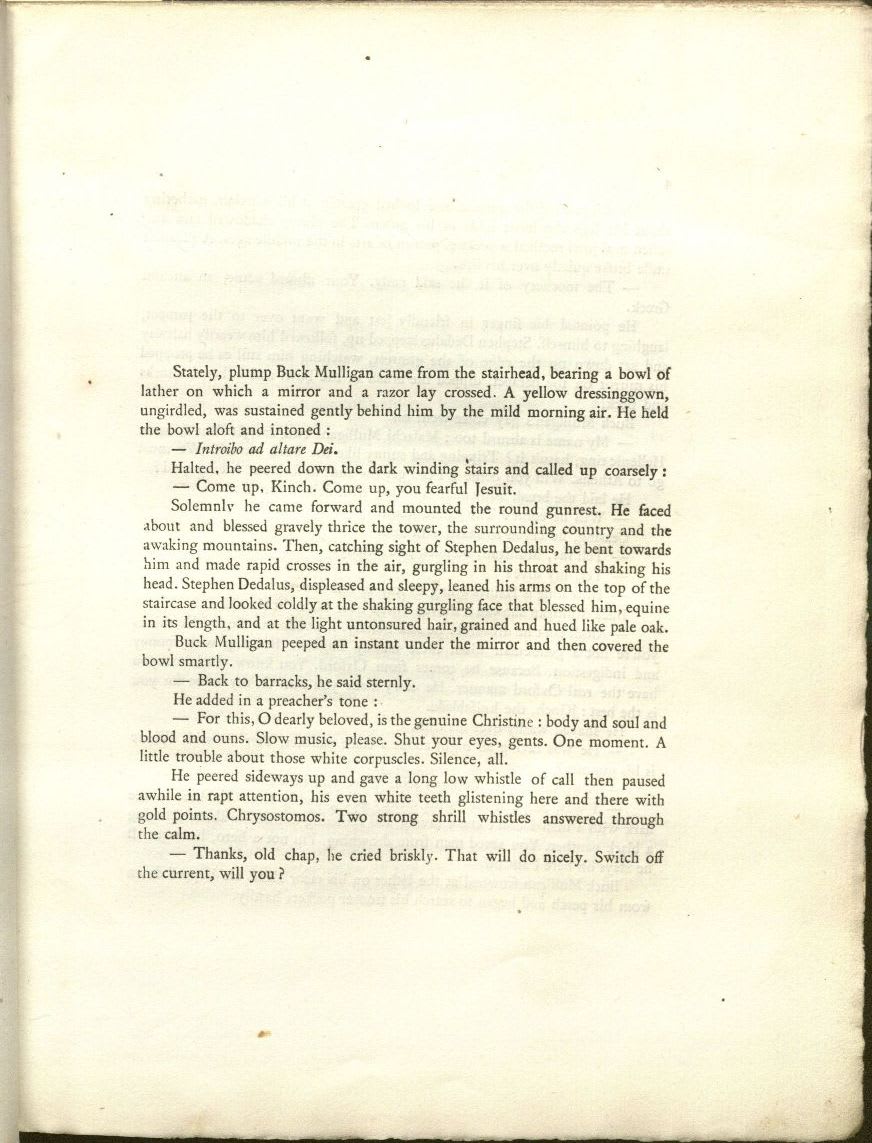
(first page of Ulysses. Soon after this Mulligan will exhort Stephen to "Chuck Loyola, Kinch, and come on down. The Sassenach wants his morning rashers," of which the sounds transported me; or need I not explain it?)
As I see it, the poets and novelists are the strongest exponents of not only the Humanities intellectuals, but some of them even light the fires for the Technical Intelligentsia. Shakespeare seems to be one of the gods of the Humanities, but a guy like Pynchon personally sent me into research into sundry corners privy to the Technical Intelligentsia. There are many others, and Aldous Huxley comes immediately to mind. His Literature and Science should've ended the Snovian disjuncture, but alas…
WonderIt's all we really need for our religion. Or so I assert. And I'm far from the first. But it's personal, as it oughtta be. Any work by any thinker/writer/scientist that fills me with wonder is both an artist in addition to whatever else their bona fides claim for them. The nature of my understandings and graspings of diverse brain-product phenomena varies with the language: if it's Claude Shannon's equation from entropy to measure the amount if information in a message, I don't excel at all in that stuff, but I do read numerous descriptions from those who can translate well. And at some point, it hits me: OMG! Same with, say the Schrodinger Wave Equation and Einstein's Mass times the speed of light, squared, which equals Energy.
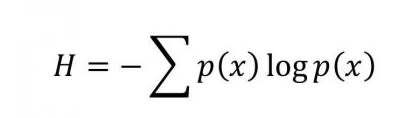
(Claude Shannon - a great generalist himself - derived this equation, which helped make the Information Age. Perhaps it was Jeremy Campbell's book Grammatical Man: Information, Entropy, Language and Life that blew every fuse in me here?)
Poetic experimentation with language would be something I'm much better at, perhaps genetically, but who knows. I could do a two-hour lecture on Joyce's Ulysses at the drop of a hat. It is just as profound as anything. Meaning, for me: it's so wonderful it indeed does function as a Holy Book to me.
You should have all your own Wild, Wonderful, and Fantastic Stuff like this. You came to it in your own way, and you were never the same again. It/Those Works provided transcendent meaning for you. They are "religious texts" in my view.
How Wide Does It Go For You?There's a passage at the beginning Timothy Leary's Info-Psychology, which was written soon after he was released from various prisons, including two years in solitary confinement, for the crime of possession of a small amount of cannabis, and, apparently, if you read what the judge had to say, bad ideas about how psychology might work if we just tested those ideas.
Pretty much zero academics stood up for Leary while he was a political prisoner, which I might get to some day. Suffice: Leary came out of stir very vocal about the history of Psychology, the field in which he earned his PhD.
Anyway, Leary wrote about this: Freudianism and Behaviorism became a big deal in part because the quasi-educated masses were turning off to "organized" Theology. He dates "Industrial Psychology" to 1850-1975, for, I think, personal reasons. Then he writes this:
"The task of personalizing and popularizing new 'mystical' philosophic themes has always been assigned to special genetic castes -- artists, writers, poets, bards, minstrels, storytellers. So it was the Impressionists, Expressionists, Cubists, Pointillistes, Surrealists and others of this rowdy group who persuaded us to accept visual reality in terms of shifting planes and shimmering realities."4
His use of "caste" here seems telling: I think he was circling the counterculture wagons and appealing to a select audience ready to accept more of his wild ideas, for which I grant him every favor. The second part seems to limit the groups too much: I think those "castes" were far more extensive than this Artistic class. Clearly, there were some trained in the physical sciences who belong here, too, for example. How about Bateson? What about Lilly? I won't even mention The Beatles, 'cuz that's just me kvetching now, though Leary does mention "minstrels."
My point is: we know who these castes are. And I accept them as the part of the Artistic-Generalist class. This was the class articulated by Karl Mannheim in his Ideology and Utopia (1927; trans. English 1936). Mannheim thought, of all the intellectual castes and classes, there was one he called the free-floating, relatively-unattached intellectuals, the freischwebende intelligenz, who wrote for little magazines, lived in cold-water flats, hung out in cafes and bookstores, used hashish and drank absinthe, etc. The Bohemian intellectuals, roughly isomorphic to Leary's "castes."
In my personal cosmos of intellectual types who fire the imagination, engender wonder, awe, and that religio I need? I extend my circle to include these ones, of course! Like Walter Benjamin. His buddies in the Frankfurt School knew he had to the goods: just finish that dissertation, submit, and you're in! Benjamin couldn't be bothered. Something about it just wasn't in the cards for him. If you read his essay on "The Flaneur" you get a good feeling for what he wanted to do. (Benjamin haunts a lot of us, these days, in the US…)
The "relatively unattached" in Mannheim's theory could read and write whatever they damned wanted, because they didn't have to answer to the party, head of the university department, main editor of a mainstream paper, some cigar-chomping know-nothing blowhard of a President of the company, etc. They're poor, live on the margins, but they're freer, and this was point from Mannheim that stood out to me: they "see" more of "reality" because they don't have good, steady jobs. They can turn their attention and studies anywhere. Substack might be a good place for them these days, but I digress…
William S. Burroughs and Robert Anton Wilson might be my all-time faves of the FFUIs, my shorthand for "free-floating unattached intellectuals." As writers, they tend to write both fiction and non-fiction, and they write about subjects that none of the New York Intellectuals wrote about.
Burroughs's inheritance is famous, but he burned through it pretty quickly, and heroin didn't help matters any. Naked Lunch (1959) put him on the map and his books sold to this same class of FFUIs and boho drop-outs until his death in 1997.
I've derived more sheer wonder from RAW, perhaps, than anyone else. He was trained as an Engineer, but was a hardcore intellectual in these senses: reading in pretty much all areas, and deeply, by the age of 27, when he finally published, on or around his 27th birthday in 1959, an essay in James Joyce Quarterly (now, IIRC, James Joyce Review), and an essay on "The Semantics of 'God'" in the satirical magazine The Realist. RAW intensely disliked the "artificial" walls between the Arts, Humanities and Sciences. He found wonder in all of these places, and wrote about it well, and I was gloriously infected by it all. Both Burroughs and RAW were funny, too, which is woefully underrated by the mainstream intellectual classes.
Aye, I was bitten and infected, became intransigent in my jones for a wonder fix.
And thus, this tiny essay.
Again I urge: genuine wonder: it's all the religion I need. You too?
1The Sociology of Philosophies: A Global Theory of Intellectual Change, p.19 This book I find enchanting, it's 1098 pages, and dazzling. The Bloor book he cites in the passage is Knowledge and Social Imagery. Collins also once wrote a detective novel with Sherlock Holmes and Bertrand Russell as the detectives: The Case of the Philosopher's Ring, in which they deal with the most evil man in the world. If you read The Sociology of Philosophies, or just read in it for an hour, you're left truly wondering how this same guy writes a Sherlock Holmes book, but there it is.
2Here's Theologian Giles Fraser in The Guardian, short article, 2024, hitting pretty much all those notes.
3Because this short article is really about the religious function of intellectuals, I have no time today to address CP Snow's Two Cultures or the catastrophe around the Humanities on university campuses since 1979, but at some point I'll get to it. Are doctors and lawyers part of one group or the other? Again: later. I tend to see a good General Practitioner as a fine mix of scientist and artist, but this is moving too far afield…
4Info-Psychology (1976), originally titled Exo-Psychology, pp.1-2.
(artwork by Bobby Campbell)
Book Chat: Some Odd Titles [ 13-Oct-25 10:38am ]I associate Spring with lengthening days, a new baseball season, and reading books. For Summer, the days are long and the nights warm (in California) and I love to read all night until I can't keep my eyes open. The Autumn comes and the days shorten: perfect for reading books and I'll have those moments where I'm reclining on a couch for hours, then feel drowsy, the book falls to my chest and I don't quite fall asleep but get some hypnogogic imagery: of reading in September or October as a kid. Winter is just flat-out a great time to read something. Like a book. A dead-tree codex.
I've found I can read for a great many hours in the day if I just move around the place: now I'm sitting in a chair, then I'll be on a couch, then I move to another room or the porch. I don't know why changing settings in such a seemingly inconsequential way can give me that sort of endurance, but it does.
This Substack is reader-supported. To receive new posts and support my work, consider becoming a free or paid subscriber.
On with some book titles.

The Secret Forest, by Patricia Westerford. This book was written by a character in the novel The Overstory, by Richard Powers. It seems clear that Powers based the character on a real person, Suzanne Simard, who wants to alert the world to the magnificent intelligence of trees and plants and their vast telecommunications systems, largely mediated by mycorrhizal network of fungi, etc. Simard wrote Finding the Mother Tree, which I've skimmed. Related to these works in my mind: The Hidden Life of Trees, by Peter Wohlleben, which surely contains magic in it, and The Secret Life of Trees, by Colin Tudge. Publishers found out in the past 15 years that books about how plants seem much more intelligent than we thought sell pretty well. There's an audience. The sentinel book here, the precursor, great grand-daddy of 'em all, must be 1973's The Secret Life of Plants, by Tomkins, which was a pretty big influence on a lot of weirdos, including Robert Anton Wilson. To hardcore scientists it was "woo" then, and, pretty much now also. Although things might be slowly changing, if I'm reading the landscape accurately over the past 15 years or so. But RAW had traced subtle consciousness and intelligence back to the earliest years of agriculture (his reading in James Frazer's The Golden Bough), and earlier: shamanism. I recently read a few fascinating articles on scientists studying slime mold, which is brainless but seems to act intelligently, and I think RAW would say, "I told you so!"
I hope to write on plant intelligence in these spaces soon.
It can't hurt the authors or publishers to put "hidden" or "secret" in the titles of books, either. I think we all know the score here.
On the Shadows of Ideas, which appears to be a book inside Giordano Bruno's De Umbris Idearum, published in 1582. Frances Yates discusses De Umbris in her Giordano Bruno and the Hermetic Tradition:
Philothimus asks what is the book which Hermes holds in his hand, and he is told it is the book On the Shadows of Ideas, the contents of which its author is in doubt whether or not to make known. Philothimus points out that no great work would be produced if such hesitations were allowed to prevail. The providence of the gods does not cease, as the Egyptian priests used to say, because of statutes promulgated at various times by repressive Mercuries. The intellect does not cease to illuminate, and the visible sun does not cease to illuminate, because we do not always all turn toward it. (193)
Cagey Bruno puts a book inside another book (with basically the same title), the inner book discussing the pressing political issue for Bruno himself: what can he get away with writing and saying without being busted? 18 years later he found out: burned at the stake at Campo de' Fiori.
The idiocy of book burners and banners, and persecution of writers marches on in our "enlightened" times. Why? Wilson and Leary thought it was because too many humans were stuck on the digital, robotic first four metaphorical "circuits" of the nervous system; when you turn on right hemisphere, analog circuits you are fine with any expression, as long as no one is actively harming anyone else. What a couple of nuts, eh?
To quote Grady McMurtry, "Why does the gnosis always get busted?"
Erotic Adventures of Loren Ipsum, by Etienne Cherdlu. With an odd provenance. Tell me if you think this is weird too 'cuz I've never seen this: on the copyright page it says "published jointly between Olympia Press and Bell Labs." I mean…
Loren's kink is to do it on top of old linotype machines or on papers filled with banks of meaningless digital data. Lorem took a weird - and this is a weird book, make no mistake - sexual imprint: at age 14, with her junior high school boyfriend one magical Saturday afternoon she used the key to her computer scientist father's office at the Stanford Research Institute in 1969, and had her first glorious experience among banks of computers and print-outs. The boy was a close friend of Douglas Engelbart's son. Or it seems to allude to that, not that it matters. I've just read a ton of stuff on "The Mother of All Demos."
Where was I? Oh yea: It seems the factor of maybe "getting caught" plays into her excitement, and she ups the ante as this erotic novel, very popular among coders, moves toward a, uhhh, climax. There was a bizarre excursus on George K. Zipf's 1935 book The Psycho-Biology of Language right in the middle that I can't see as pertinent to the story, although it was interesting. The final scene, after her 22nd birthday party, in the basement of CERN, is probably too weird to discuss. I take it the author is French, and it figures. Not bad, although there seems to be too much text that just fills in the space of the novel.
Farewell, America: The Plot to Kill JFK, by James Hepburn. Okay, okay, I have yet to read this one, because I haven't found it in any library. I only know about it because it's written about so colorfully in editor-of-Ramparts-magazine Warren Hinckle's If You Have A Lemon, pp. 252-268. Hinckle tells us this book came out in 1968 and was immediately suppressed in the US and Canada. And now we know that "James Hepburn" didn't exist. Who wrote it? Possibly Herve Lamarre, and agents from INTERPOL, Andre Ducret of the French civil police forces, and Phillipe Vasjoly, an agent for Big Oil in France. It seems the French wanted us to believe Big Oil was behind the JFK hit. Why? Maybe I'll get to it this late November. Or next year. If you've read it, you tell me in the comments.
This book was finally released to the public c. 2002 and most of the reviews I've seen say it's "dated" (no! really?) but somewhat compelling. Publisher's Weekly wrote, c.2002: Most of the text is a damning jeremiad, portraying pre-1964 America as a vicious, discriminatory oligarchy controlled by alliances of Big Steel and Big Oil, the military and organized crime, which all had reason to fear JFK's proposed reforms. The reviewers at Amazon mostly seem happy: it fed their JFK hit fix. Sometimes ya just gotta have it. I tend to read reviews by these guys and picture them having a literal wall of JFK conspiracy texts in their man-caves. Big-time JFK assassination writer William Turner wrote the introduction. I think I have an insider's idea of what it's like to be one of those people who've read 700 different JFK books. I mean: I get it. It seems sorta like a secular version of medieval monks going over the same sections of writings about Jesus, for decades, arguing over all the minutiae. And there is a lot of it.
Hinckle tells us that ex-FBI-turned-Ramparts editor Turner had stacks of contraband copies of Farewell, America piled up in his basement in San Rafael. I wonder what the real purpose of this banning was in the first place. Who did Turner sell to after 1968, and what was it like? Was it like making a drug deal in a park near San Francisco? I imagine codes, the right colored hats, hand signals, brown paper bags, synchronized Timexes and Bulovas. Maybe Donald Sutherland is lurking not more than 20 feet away. That is, if Turner sold to anyone. What do you do with all those copies of a book people want? How did he go from FBI to the Catholic-Left and Ramparts?
When Robert Shea was asked a final question in an interview, published in Tom Jackson's recent book, Every Day Is A Good Day: Who killed JFK? Shea responds: "We all did." Which, at this point, I accept…with an explanation, if I may, Your Honor…
My Past Was An Evil River, by William S. Burroughs
The Hindsight Saga, by SJ Perelman
These are the titles of two books of memoirs that the authors never got around to finishing. It seems likely WSB never wrote anything for his book; it's cited in William S. Burroughs: Cutting Up the Century, (2019), ed. by Hawkins, Wermer-Colan, Cannon, et.al, on page 58. Perelman never got around to finishing his autobiography, which was originally titled Smiling, The Boy Fell Dead, but his wife Laura said that was too morbid. (see Conversations With SJ Perelman, p.66) Both Burroughs and Perelman have at times made me laff out loud reading them, to the point where I got a mild side-ache. I'll have to be content with their writings extant.
In John Barth's wonderful The Friday Book I read about The Three Imposters, a book that garnered much commentary in the 17th century. The three imposters were Moses, Jesus, and Mohammed, so you can see why there wouldda been a ton o' ballyhoo then. Then it was revealed that the book didn't exist; the word had gotten out and people just felt like it was their right to comment on it, having heard a little about it. My how times have changed!
What's really funny is that…suddenly the book appeared! Barth links this to the impossibly marvelous Sir Thomas Browne and…Borges? See The Friday Book, pp.70-71
Speaking of Borges (who is required to appear in articles like this one), have you heard of The Anglo-American Cyclopedia (1917)? It was an actual pirated version of the 10th edition of the Encyclopedia Britannica, and it features prominently in Borges's "Tlön, Uqbar Orbis Tertius." Which "is" fake.
Blacktopolis: The Intransigence of African-American Urban Poverty and Baggy Clothes, by Foy Cheshire. A maddening sociological rant by a guy who felt like Bill Cosby before we knew he was drugging and raping women. There's a lot of humor here and it's all unintentional. What a strange book. I found out about it reading Paul Beatty's The Sellout. See p.48
I, Libertine, by Theodore Sturgeon (1956) This supposedly became a best-seller. Sturgeon's a fine writer, but I can't find reliable best-seller info for this one. Which is interesting, because the title started out as a non-existent book hoax/put-on by New York radio legend Jean Shepherd, who was satirizing the mass-marketing/Mad Men-like process of the making of a best-seller. Then Sturgeon asked Shepherd if he could write an actual book by the title and was given the green light.
This, and the aforementioned The Three Imposters (and many, many other books) seem to provide a corollary to John Lilly, which might go like this: Within the province of books and publishing, what is imagined is a real book or becomes a real book within certain publishing limits. In the province of the possible library of the mind there are no limits.
Finally, because I can only pull my readers' legs for so long and no longer: Semiotic Analysis of Various Translations of the Necronomicon, ed. Timothy F.X. Finnegan (1944). The highlight of this, for me, at least, was de Selby's attacks on the imperialist structure of British grammar. Erudite, witty, bonkers. Highly recommended. For more information, see Robert Anton Wilson's Introduction to The Selected Letters of Philip K. Dick, 1977-1979, p.4
This Substack is reader-supported. To receive new posts and support my work, consider becoming a free or paid subscriber.
Gas Station Heroin and Other Musings On Drugs [ 11-Oct-25 1:01am ]When you get to the point where you have a constant cultural dialogue about how really fast computers might kill us all or only make super rich people even more rich, so what is the best way to act on this?…
When you have an Administration like this one, aimed at killing the poor and non-white for… reasons…
This Substack is reader-supported. To receive new posts and support my work, consider becoming a free or paid subscriber.
When nothing works, no one cares, and the populace are zombified phone addicts reading fascist agitprop probably produced by an algorithm, and it makes them want to off their neighbors, who, while having an "ethnic" name have actually lived in the US longer than anyone else around…
When you fear that something coming down soon, like the King's "decree" that you must have a Bitcoin account attached to Facebook in order to stream-watch the season-finale of America's Got Talented Bachelors…
No one can do anything about it because It Is Broken. And furthermore, that was the goal. It is with some irony that I pronounce "kudos" to the hidden, billionaire class: you did it! You installed un clown fasciste brailleur in the house at 1600 Pennsylvania, have successfully packed Congress with your own lackeys, and six of nine on the SCOTUS will drink your bathwater on command. Good job! No "communists" will come and take your stuff 'cuz they're all dead, so you can relax and watch your daytime soaps without those nagging worries. But just to be safe, keep using the luxury Panic Room. You know, the one with the humidor, just off the guest houses?
I wonder about little details. Is all this lurid, maddening and stupid beyond belief? Of course, but that's beside the point. My point.
Bellweathers. Cultural indicators. Where are things more absurd than you'd think? Which way is the current microplastic-suffused wind blowing?
Case in, uh, point: Gas Station Heroin Linked To More Deaths In California. I have so many questions. And none of them are "Where can I get some?" because this pithy news item I consumed with my coffee tells me: it's still "sold openly across the Bay Area." (Note to self: there's still hope.)

(I think the key term here is "amazing.")
It's in convenience stores, this little story expanding the semantic reach of the word "convenient" somethin' fierce. Hell: you can get it mail-order, 'cuz freedom.
(I show the chemical structure of 7-OH here to try 'n impress y'all. Also: I have a fetish for this kind of thing. I think if you install a hydrogen atom to that branch up above the middle oxygen it turns into an antihistamine? Hold on…that can't be right. I'll get back to you on this.)
7-Hydroxymitragynine AKA "7-OH" has both opiate and "stimulant-like" effects: gas station speedballs, my friends! And they say there's no progress. I do wonder what "stimulant-like" means. I'd suspect something along the lines of "food-like." I guess I'm gonna have to do some immersive, investigative reporting and try a little 7-OH just so I can speak from a place of personal knowledge.
Sold in candy-flavored pills (why not?), 7-OH is also infused in drinks, and of course: it's vape-able if that is your desire. Hey, it's a free country. Just…let's stay away from needles here, mm-kay? Although you know some 7-OHers will get to the point where the high isn't quite intense enough and/or doesn't arrive quite fast enough, so: drug user's logic and I can see it now, a future headline:
Officials Say Prom Queen, Star Quarterback Died From Injecting Gas Station Heroin.
(Just below this story: Powerball Jackpot Now Worth $97 Billion… Not that you asked.)
It's been linked to at least six deaths now. The 7-OH, not the lottery. Officials are telling "retailers" to stop stocking the stuff, which is "highly addicting." You wonder how it found its way onto shelves in the first place. (Full disclosure: I wonder increasingly less about this kind of thing these days.) Retailers need to stay alive too, so let's factor that in. If they're stocking little "candy-flavored" death-dealers, it's just the price of doin' biz. Ya gotta break a few lives to make an omelette. If you told me Steve Bannon is selling this stuff on his fascist call-in show it would be the least surprising thing I'd heard all month. "Amazing."
No doubt every health department in Murrrka is understaffed or now consists solely of the local mayor's nephew, Chad, who never finished his degree in Business Administration, is pulling down $147K in a municipality that recently closed its remaining fire station, and Chad has yet to show up to the office. (Chad could not be reached for comment.)
From this simple article, we read that "California lawmakers introduced a bill this year that would ban the sale of the drug" because it was unregulated and could be sold to children. Then: "The bill did not pass the legislature…" in California this didn't pass? I mean, I could see West Virginia, Alabama, Texas…Curiouser 'n curiouser…
I imagine some politicos - Democrats, as this is California - thought: health care cuts are going to hurt my constituents, maybe they'll get some relief from extreme pain at the local Gas 'N Blow. They were "thinking outside the box." (Why were they even in a box in the first place? They couldn't be reached for comment, but spokespersons inside the box said they'd reach out from inside the box for comment later. We're still waiting, staring at that damned box.)
Other articles about this OTC "heroin" use the term "popular supplement." Yea, like this shit is a close cousin to Vitamin C. (If Linus Pauling was alive today he'd be spinning in his grave, to steal a line from…probably Yogi Berra or Samuel Goldwyn, who copped all the good lines.)
I also wonder how a fine, glamorous, elder-statesman drug like Heroin got roped into this story at all in the first place. If we read this report with any continuous partial attention at all we see that the drug doing the heavy lifting here is a "synthetic relative of kratom." Kratom is derived from a tropical evergreen tree in Southeast Asia. We all know heroin is synthesized from poppies. Trees are not flowers. QED, a line I stole from Euclid. (Or was it Yogi Berra?)
Kratom is all over the Internet, there to help us "meet" our "fitness goals." Does this version of "heroin" sound like something that will put you on the nod under a rotting abandoned staircase is a flea-bitten hotel near the Red Light District? Me neither. Something smells fishy here, and I think Heroin should sue for damages.
[Scene: A middle class neighborhood, white picket fence, well-manicured lawn. A police car rolls us, two cops walk past a pink flamingo and knock on the door. Door opens to mom in Lululemon pants and dad in Metallica t-shirt. The cops have their hats in their hands, held to their chests.]
Cop1 : Do you have a son named Iggy?
Mom (alarmed): Yes. Is he okay?
Cop 2: We have good news and bad news.
Dad (vehement): Wha…What is this? What's the bad news?
Cop1: Iggy was found dead from an overdose of kratom. It's called 7-OH. Gas station heroin.
Mom: OH MY GOD! My sweet little boy! (She falls to her knees in agony.)
Cop2: We're so sorry to have to deliver this news.
Dad (crying): You said there's good news? Wha…what do you mean?
Cop1: Kratom is all Natural!
Aaaand: scene. I'm sorry, that was tasteless, asinine, juvenile and dark, but these are tasteless, asinine, juvenile and dark times, no? (Also, to be fair: all these gas station drugs are synthetic, but you can market them as "natural." To put too fine a point on it.)
By the way, kratom powder and good ol' gas station heroin are available right now via Amazon: next-day service! The drivers might be dipping a finger in it, so: word to the wiseguys. Besides, why not slum a little and head out to that truck stop where the two Interstates converge and score there? Put some color into your life before you get high and dance with death? I mean, think about it at least. You only live once.
I could find no reliable information on ideas for "what goes good with"/how to "pair" 7-OH with anything. Possibly Nine Inch Nails? Two shots of Red Bull? Please advise.
Finally - because I know y'all have some choice porn to look at - I ask in my most plaintive voice, yet again: Would It Kill Ya To Just Smoke a Joint? I'm talking to you, kids.
This Substack is reader-supported. To receive new posts and support my work, consider becoming a free or paid subscriber.
TONIGHT: Speed of Light vs. Speed of Thought: Get Your Tickets NOW! [ 06-Oct-25 9:08am ]I just finished listening to my brilliant friend Eric Wagner being interviewed by Gerry Fialka and Fialka asked this Q to Eric: What's faster: the speed of light or the speed of thought? Boy, that brought me back…
I'm reminded of a synchronicity I had many years ago (maybe early 1991?) but which comes back to me in idle moments of brain-transiency and daydreams: I wondered how fast thinking was. Is it faster than light? Then I opened a book randomly and started reading and I found an answer. Was it the answer? It looked like it, given the source. But lemme back up a bit.
This Substack is reader-supported. To receive new posts and support my work, consider becoming a free or paid subscriber.
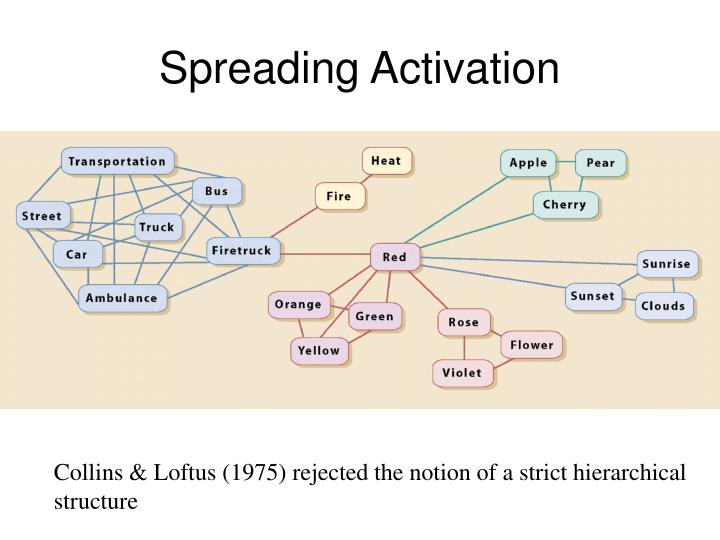
Atop this synchronicity, this question then suddenly appeared in my life everywhere, in various guises. Of course we find ourselves in environments, choose to tunnel into certain areas of thought in which this sort of thing will happen more, so it's not a Baader-Meinhof effect. At least I don't think it is.
-So what's faster? A thought or the speed of light?
I'm gettin' to that, Hiawatha. Just lemme settle in here onto the ol' naugahyde, ease me achin' bones…
-I think it's a thought. They seem like the fastest.
You may just be right, Juniper. Lemme see if I can make this innarestin' to ya.
-Are you gonna mention that Einstein guy again?
Ya gotta, Lotte. I mean, dude's Da Man when you get into all this. Or one of 'em…Hey? Where y'all goin'?
(All three chilluns done left, so now it's just you 'n me. When their old man talks about Einstein they become Pavlovian, associating that sorta of talk with mental pain. And so it goes…)
The SynchronicityI had wondered about this. Of course Einstein established the speed limits of the universe, with the help of the Michelson-Morley experiments and a whole lot of daydreaming. 186, 242 miles per second: speed of light. Okay, cool. And thoughts, whatever they were - they didn't seem like photons, but must have some sort of measurability - thoughts had to move through the medium of meat-space of our brains, which are made of water and a bunch of other neuro-chemicals that would slow everything down. Impedance. You're doin' it now. Slam dunk it's the speed of light that's faster. However, it should be more interesting than that.
It is.
I wanted to know more, but this was pre-Internet, so I picked up a book that seemed like it might have more on this: Science and Sanity, by Alfred Korzybski (1933). I'd been delving into it because Robert Anton Wilson was so enthusiastic about it. This book seemed super-dense, highly technical at times, filled with math, and with passages I found so interesting I felt like I was tripping, and then he'd repeat something he said five pages ago. There were also passages that seemed utterly nutty to me. In short: for someone of my bend, this is my kinda thing.
Anyway, I probably checked the index for "Thought." "See 'Thalamic 'thinking'" Hoo boy. There was a sub-heading: "Laws of Thought." I started to read those pages but wasn't getting to speed of thought in the way I needed it. So I opened at random - this is a form of bibliomancy that I think of as Sortes Virgilianae, which is a magical technique that goes back to the Romans, who used The Aeneid, opened to a random spot, for divinations and other purposes. At first, I didn't know what I had.
I had fallen open to page 165 of my 4th ed. of Science and Sanity. Check this out; just hang with it and I'll try 'n clarify;
It is possible that "intelligence" and abstracting both started together and are due to the physical-chemical structure of protoplasm. All living material, usually called protoplasm, has, in some degree, the nervous functions of irritability, conductivity, integration, . (←—OG: This was Korzybski's alternative to using "Etc")
It is obvious that a stimulus S does not affect the little piece of primitive protoplasm A "all over and at once" (infinite velocity), but that it affects it first in a definite spot B, that the wave of excitation spreads, with finite velocity and usually with a diminishing gradient, to the more remote portions of A.
Now we're cookin' with gas, daddio! And just re-reading and typing out this passage is giving me a mild buzz of intellectual euphoria. Your mileage may vary. On with it:
We notice also that the effect of the stimulus S on A is not identical with the stimulus itself.
Brief comment from a long-time reader of Korzybski: there seems to be an entire epistemological world here. Korzybski insists, over and over throughout this 800 page tome that nothing is identical to anything else; we only forget we're abstracting when we see things as "the exact same" as something else. Difference seems fundamental on all levels of physical and social "being." Okay, sorry for the interruption.
A falling stone is not identical to the pain we feel when the stone falls on our foot.
Sorry again: Nota Bene: this was another way for Korzybski to illustrate the stimulus to the protoplasm which had its effect by traveling in a wave of excitation, which computer scientists and neurobiologists today call "spreading activation." It's just that the stone/foot relationship is more concrete and easily pictured in our minds.
This speed, we now see or feel or intuit, is far less than the speed of light.
Neither do our feelings furnish a full report as to the characteristics of the stone, its internal structure, chemistry, . So we see that the bit of protoplasm is affected only partially, and in a specific way, by the stimulus. Under physico-chemical conditions, as they exist in life, there is no place for any "allness." In life, we deal structurally only with "non-allness"; and so the term, "abstracting in different orders" seems to be structurally and uniquely appropriate for describing the effects of external stimuli on living protoplasm. "Intelligence" of any kind is connected with the abstracting (non-allness) which is characteristic of all protoplasmic response. Similarities are perceived only as differences become blurred, and, therefore, the process is one of abstracting.
So: even though nothing is identical to anything else, when we abstract - which we need to be conscious about, always - we are blurring differences. So what? Well, for one thing: we must abstract, as this leads to intelligence. Notice that protoplasm in the above passages abstracts. There is differentiation in its response to stimulus. What some amoeba does when we use an electrical probe on it, and what Einstein did when he daydreamed (thinking not in language but in pictures) and came up with the Theory of Relativity: there is a continuum here!
I felt like I had my answer now, but with a lot of meat on its bones, and it came via an ancient process of divination. Yes, that seems weird, and I seem weird. So be it. I hasten to add it's probably good the chilluns done left the room, as I'm afraid they'd be bored sick by the Old Man again.

(Wish I could get my hair to look this cool.)
Einstein's Thinking As Filtered by Robert Anton Wilson, in a Novel
In Masks of the Illuminati, James Joyce and Albert Einstein are teamed-up in Zurich, 1913, in a locked-room mystery where they're trying to solve the problem of a young nobleman (Babcock), who's terrorized and convinced someone or some Thing is finally going to do him in. Wilson, a serious student of Physics and who idolized both Einstein and Joyce, has Einstein in an interior monologue:
The obvious absurdity of Newtons's hypotheses non fingo1: actually, it is impossible not to theorize. The velocity of nerve transmissions in the brain is such that we can never disentangle perception from conceptualization. It is even a concept that I am speaking to human beings. Joyce and Babcock might both be automatons passing themselves off as humans, or I might be hallucinating. And who but Poincaré and Mach understand that fully, in their bones? We live, as Joyce says, in a web of symbolic constructs made by our brains. The Herrdoktorprofessors cannot understand my paper on relativity of space-time, for instance, because they think "length" is a fact, not a concept of our brain. (104)
(the context for this image is partially explained, below)
A Couple of Recent PapersLast December in the journal Neuron a team of researchers, using information theory to measure processing of bits in WiFi, our cell phones, our total human sensory system, and our brains consciously processing information, came up with these numbers: The average WiFi system processes 260 million bits per second. Our cell phones; 64,000 bits/second. The human sensory systems take in and processes around 1 to 10 billion bits per second. But - take a deep breath - the human brain only "consciously" processes about 10 bits per second. Ten. Ten. Elite typists who churn out 120 words per minute: about 10 bits per second. The top video gamers: 10 bits per second. People who excel at a task called "speedcubing" - where you put on a blindfold and then try to solve Rubik's Cube as fast as possible: around 12 bits per second.
So: Our total sensory input from the environment gets processed at around 1 billion bits per second, but we don't use…hardly any of that information. We're really really RILLY good at filtering out all that information. Why? Evolution. We evolved for 99% of our time as hominids to make our paths through the forest or other environments, looking for food, trying to stay alive. The Industrial Era began a few seconds ago, in 1750. Our invention of information processing gadgets has accelerated at a pace that's unfathomable. Meanwhile, all studies show that we totally suck at "multitasking." We weren't built for it. Advice: be more Zen: do and concentrate on one thing at a time. Also: a number of studies show that slowing down and deliberately paying deep attention to information helps us retain it better. Take notes with a pencil or pen if you care about your information. Probably read a dead-tree book rather than stuff on a digital device. It's evolution. Of course…2 Look at the "lives" of these gadgets: we'd rather be who we are. Information processing isn't everything, though every fascist schmuck in Silicon Valley will try to tell you otherwise.
Around eight months before that, a paper on possible information storage in the human brain was published in the journal Neural Computation. Researchers using Shannon entropy (AKA Mathematical Information Theory, same as the "processing in bits" story above) studied the synaptic connections and dendritic spines of neurons in a given region of the brain. As any reader in neuroscience knows, what fires together wires together: circuits that are repeatedly activated together are the backbone of learning. And what have they found?
Admittedly, this study was done using rat brains, but what they found was remarkable: there was much more information (in bits) stored in "wired" synapses than we thought. So much so that, if we scale this study up to human brains, we arrive at the idea that humans have ten times more storage capacity than previously thought.3
So: another old evolutionary truism: Use It Or Lose It: keep the lasagna flying, as Robert Anton Wilson fans say. (RAW once observed that brains resemble a slab of lasagna.) This study tells us the capacity for learning - it's very large - and also tells us we will be able to learn a lot about the withering of brain circuits, from aging, dementia or other diseases, and perhaps help stave off those catastrophes. We can now see these synaptic actions stuff going on. Which ought to blow ye fookin' mind, aye!
So: we can only consciously process about 10 bits per second, due to evolution. And that's for high-processing activities. And yet we can store a vast amount, about 10 times more than previously thought. What should we do with this information about the brain? I answer: Let us choose wisely.
Trying Not To Freak Out HereThis is well-known to those who are fascinated by the philosophical concept of "free will," and I only wanna say a couple things here. The Neuroscientist Benjamin Libet started doing studies in the 1980s about consciousness and free will: how did you decide to lift your index finger just now? We all think we made a conscious decision to move our finger, so we did. Libet's research says sorry, but no: there was something unconscious going on first, about half a second before. Uhh…okay: then what was that "thinking" behind that "decision"? This is where it gets maddening. I mean, sit back and just think of the implications here: possibly nothing we think we "decided" to do was done neurophysiologically the way we think it does. It's almost as if we're preprogrammed. That can't be right! Something else is going on. What?
At this point, despite the science, I recommend you just disregard the findings. Call it a series of errors or bad experimental design or faulty math, some sorta conspiracy, bad instrumentation, or maybe all the neurobiologists who say we don't have free will the way we think we do? Why, they're all just a buncha poopie-heads. I recommend thinking this - any one of these - for hardcore pragmatic reasons. I'm not sure why I do, though…
Matsuhashi and Hallett replicated Libet's findings in 2008. In 2011, Rigoni, Sartori, Kuhn and Brass did a similar study suggesting that undermining belief in free will kinda fucks us up. I told you to just quit paying attention to this area of neuroscience!4
My Own Weirdo HypothesisI think we gather latent energies in the environment through some sort of magnetic resonance emanating from the Earth's core, which is influenced by all the matter in the Milky Way, and this all interacts with our nervous system and free information in the atmosphere and it all has to do with Bell's Theorem (1964), which showed that once two subatomic particles were in contact they will always be in contact, even if you separate them by many millions of miles: observe the particle spin of one, and immediately - faster than the speed of light, which is supposed to be impossible - the other will complement that spin in our observance with the opposite. We don't really know why; it just does. Because all particles were cooped up or cooked up with the Big Bang, they are all always in connection. We are made of those particles. We are stardust/We are golden/And we've got to get back to the Garden. (The Knicks game starts starts at 7 and you know Mid-Town traffic at that hour! Oy vey!)
So: back to where we started: perhaps the speed of thought is faster than the speed of light, but I will not be betting the farm on it. Maybe only that old tool shed. Ya know? The one with the rusted lock that has an old moonshine still in it from the 1920s? If you shine a flashlight in the only small window, there's a centerfold of Miss July, 1964 taped onto the wall. I saw it when I'ze but a boy, and it had an impact.
1
Latin: "I frame no hypotheses."
2An article that summarizes this "10 bits per second" study is HERE.
3An article that summarizes this "we can store 10 times more information" study is HERE.
4I think a decent place to start on this disturbing stuff is the Wikipedia page: Neuroscience of Free Will, and branch out from there. Or: only read all the detractors of all the studies, which in this case I think is a legit stance and, as I say, pragmatic.
The Success of 'Knight of the Seven Kingdoms' Is Already Influencing HBO's Other 'Game of Thrones' Spinoff Plans [ 30-Jan-26 11:00pm ]
Darren Aranofsky's AI-animated show about the AAMEREEDD revolution is a true horror [ 30-Jan-26 10:08pm ]
Darren Aranofsky's "On This Day… 1776" is a forthcoming AI-generated TV series featuring short narrative stories about the War of American Independence. The voices are human actors, so it may be considered as animation. Even so, it's extremely uncanny and mostly interesting as an example of the sort of thing AI bros on Twitter declare will completely replace humans immediately ("Hollywood is cooked!") — Read the rest
The post Darren Aranofsky's AI-animated show about the AAMEREEDD revolution is a true horror appeared first on Boing Boing.
New York police officer kills raccoon at area beach [ 30-Jan-26 9:39pm ]
A New York police officer opened fire at a suspect Thursday on Rockaway Beach, killing his target: a raccoon whose behavior had led someone to call 911 to report a "vicious animal." The officer is on modified duty "while the matter is reviewed." — Read the rest
The post New York police officer kills raccoon at area beach appeared first on Boing Boing.
Japan Botched a Satellite Launch in One of the Weirdest Ways Possible [ 30-Jan-26 10:15pm ] AI Agents Have Their Own Social Network Now, and They Would Like a Little Privacy [ 30-Jan-26 10:10pm ] February's Lego Releases Want You to Catch 'Em All [ 30-Jan-26 10:00pm ]
Informant told FBI that Jeffrey Epstein had a 'personal hacker' [ 30-Jan-26 10:04pm ]
George R.R. Martin Almost Planned a Very Different Kind of Targaryen Power for 'Game of Thrones' [ 30-Jan-26 9:00pm ]
Instagram might soon let you remove yourself from someone's Close Friends list [ 30-Jan-26 9:14pm ] Blue Origin pauses space tourism flights to focus on the moon [ 30-Jan-26 9:11pm ]
Elon Musk Emailed With Jeffrey Epstein to Plan Island Visits in 2012 and 2014 [ 30-Jan-26 8:35pm ] Could Poop Pills Be a Secret Weapon Against Cancer? [ 30-Jan-26 8:25pm ]
Man dressed as duck pours milk and cereal over himself in subway train [ 30-Jan-26 7:51pm ]
A half-naked man, his body painted yellow, a duck's beak affixed to his nose, and his belly inscribed with "flappy one" in thick black marker, vandalized a subway train in Glasgow by pouring milk and cereal over his head.
"Behaviour such as this is clearly unacceptable and will not be tolerated," the Strathclyde Partnership for Transport (SPT) said in a statement. — Read the rest
The post Man dressed as duck pours milk and cereal over himself in subway train appeared first on Boing Boing.
Proof Without Content [ 30-Jan-26 12:00am ] Seeing Is Believing at Your Own Peril in 'After God' [ 30-Jan-26 8:00pm ] Google's Project Genie Is Not for You [ 30-Jan-26 7:55pm ]
SpaceX's IPO could open the floodgates — and secondaries are booming in the meantime [ 30-Jan-26 7:41pm ]
The gospel of collective efficacy [ 30-Jan-26 8:01pm ]
Seeing Is Believing at Your Own Peril in 'After God' [ 30-Jan-26 8:00pm ] Google's Project Genie Is Not for You [ 30-Jan-26 7:55pm ]
SpaceX's IPO could open the floodgates — and secondaries are booming in the meantime [ 30-Jan-26 7:41pm ]
The gospel of collective efficacy [ 30-Jan-26 8:01pm ]If I got to determine the school curriculum, I would be optimising for collective efficacy.
So I live in a gentrified but still mixed neighbourhood in London (we're the newbies at just under a decade) and we have an active WhatsApp group.
Recently there was a cold snap and a road nearby iced over - it was in the shade and cyclists kept on wiping out on it. For some reason the council didn't come and salt it.
Somebody went out and created a sign on a weighted chair so it didn't blow away. And this is a small thing but I LOVE that I live somewhere there is a shared belief that (a) our neighbourhood is worth spending effort on, and (b) you can just do things.
Similarly we all love when the swifts visit (beautiful birds), so somebody started a group to get swift nest boxes made and installed collectively, then applied for subsidy funding, then got everyone to chip in such that people who couldn't afford it could have their boxes paid for, and now suddenly we're all writing to MPs and following the legislation to include swift nesting sites in new build houses. Etc.
It's called collective efficacy, the belief that you can make a difference by acting together.
(People who have heard of Greta Thunberg tend to have a stronger sense of collective efficacy (2021).)
It's so heartening.
You can just do things
That phrase was a Twitter thing for a while, and I haven't done the archaeology on the phrase but there's this blog post by Milan Cvitkovic from 2020: Things you're allowed to do.
e.g.
- "Say I don't know"
- "Tape over annoying LED lights"
- "Buy goods/services from your friends"
I read down the list saying to myself, yeah duh of course, to almost every single one, then hit certain ones and was like - oh yeah, I can just do that.
I think collective efficacy is maybe 50% taking off the blinkers and giving yourself (as a group) permission to do things.
But it's also 50% belief that it's worth acting at all.
And that belief is founded part in care, and part in faith that what you are doing can actually make a difference.
For instance:
A lot of my belief in the power of government comes from the fact that, back in the day, London's tech scene was not all that. So in 2009 I worked with Georgina Voss to figure out the gap, then in 2010 bizarrely got invited on a trade mission to India with the Prime Minister and got the opportunity to make the case about east London to them, and based on that No. 10 launched Tech City (which we had named on the plane), and that acted as a catalyst on the work that everyone was already doing to get the cluster going, and then we were off to the races. WIRED magazine wrote it up in 2019: The story of London's tech scene, as told by those who built it (paywall-busting link).
So I had that experience and now I believe that, if I can find the right ask, there's always the possibility to make things better.
That's a rare experience. I'm very lucky.
ALTHOUGH.
Should we believe in luck?
Psychologist Richard Wiseman, The Luck Factor (2003, PDF):
I gave both [self-identified] lucky and unlucky people a newspaper, and asked them to look through it and tell me how many photographs were inside. On average, the unlucky people took about two minutes to count the photographs whereas the lucky people took just seconds. Why? Because the second page of the newspaper contained the message "Stop counting - There are 43 photographs in this newspaper."
"Lucky people generate their own good fortune via four basic principles."
They are skilled at creating and noticing chance opportunities, make lucky decisions by listening to their intuition, create self-fulfilling prophesies via positive expectations, and adopt a resilient attitude that transforms bad luck into good.
I insist that people are not born lucky. I am sure that luck can be trained.
You can just be lucky?
(Well, not absolutely, I'm privileged too, but maybe let's recalibrate luck from where it is now, that's what I'm saying.)
When I was a kid I used to play these unforgivingly impossible video games - that's what home video games were like then. No open world play, multiple ways to win, or adaptive difficulty. Just pixel-precise platform jumps and timing.
Yet you always knew that there was a way onto the next screen, however long it took.
It taught a kind of stubborn optimism.
Or, in another context, "No fate but what we make."
Same same.
All of which makes me ask:
Could we invent free-to-plan mobile games which train luckiness?
Are there games for classrooms that would cement a faith in collective efficacy for kids?
Or maybe it's proof by demonstration.
I'm going into my kid's school in a couple of weeks to show them photos of what it looks like inside factories. The stuff around us was made by someone; it's not divine in origin; factories are just rooms.
I have faith that - somehow - this act will help.
US Declassifies Vintage Spy Satellite With a Wildly Lopsided Orbit [ 30-Jan-26 7:25pm ] Catherine O'Hara, Star of 'Beetlejuice' and 'Home Alone,' Has Died [ 30-Jan-26 6:51pm ]
Uber is literally in the driver's seat when it comes to AV bets [ 30-Jan-26 6:56pm ]
This Robot Hand Pops Off and Crawls. I Hate It So Much. [ 30-Jan-26 6:45pm ]
Best Dev Boards for Music [ 30-Jan-26 5:00pm ]
Music makers today have access to all sorts of tools in our quest for cool sounds. Here are some of my favorite dev boards for music.
The post Best Dev Boards for Music appeared first on Make: DIY Projects and Ideas for Makers.
Gar's Tips & Tools - Issue #208 [ 30-Jan-26 4:00pm ]My latest maker video obsession is Asian street food vendors on Instagram. Not only is it mesmerizing to watch the videos and try to figure out what they're making, but the various ovens, grills, hot-tops, and purpose-built tools are fascinating. One leit motif throughout them all? Eggs. Over 75% of the food items are egg-based. This reminded me of my friend Andrew Lawler's amazing book, Why Did the Chicken Cross the World?, a surprising page-turner that details the history of the domesticated chicken and how it has literally fueled the march of civilization. (And it is apparently still fueling the street diners of Asia.)
Top Project Farm Products Tested Last YearIn his year-end roundup from 2025, Todd from Project Farm details his top ten highest-rated tools. It's comforting to me to have folks like Todd in the world who are not only passionate about tools but who take the time to rigorously test them. Some of my favorites on his list: Wolfbox Air Duster, Civivi Folding Pocket Knife, Dreo Space Heater, and the Craftsman Screwdriver Set.
4-Color Prints from Rattle Can Paint?There's a particular kind of joy that comes from misusing a perfectly respectable technology. This Wesley Treat video scratches that itch.
Wesley applies the logic of CMYK printing (those tiny cyan, magenta, yellow, and black dots that trick your eyes into seeing color photographs) and scales it up. Instead of ink, he uses rattle can spray paint. Instead of printer rollers, he uses laser-cut blocks and Mylar stencils. Instead of precision registration, he embraces drift, overspray, and happy accidents.
What makes this especially satisfying is that it's not a tutorial striving for a guaranteed outcome, but a series of playful experiments. Up close, the prints proudly announce how they're made. Step back, and your brain obligingly creates the illusion of a halftone. Fun stuff.
Tested Team's Best of 2025Watching the Tested team's favorite tools and miscellaneous geekery at the end of each year is always a treat. Tools, what they enable, and the possibilities they offer, are so very important to me, so it's always fun to see what inspired other smart and thoughtful tool enthusiasts. For Adam Savage's favorites, he includes some eye-openers, like UV glue and cabinet scrapers.

The big aha for me was the magnetic flexible LED work lights. These are cheap, corded flex-shaft LED lights that you can mount on machines via their magnetic base. I found out they're also called "sewing machine lights" and you can get three of them for $20. They even come with adhesive metal disks so you can mount them to just about any non-ferrous surface, too. I added one to the side of a plastic parts cabinet for extra illumination on my workbench. You can also see last year's favorites from Norm, Jen, Sean, Kayte, and the entire Tested team here.
Which Wood is Worth Burning? Country Living / Adrift Visuals
In this Country Living piece, UK homesteader, Sally Coulthard, shares her advice on seasoning, stacking, and burning firewood. Here she shares the best four woods to burn:
Makers Gotta Eat!Oak: The king of firewood, oak burns slowly and creates long-lasting heat right through to the embers stage. Needs two years' seasoning.
Ash: Another excellent hardwood for fires. Burns well with no sparking. Needs at least 18 months' seasoning.
Birch: Burns well but quite fast - best mixed with a slower fuel, such as oak. The papery bark is great for kindling. Needs at least a year's seasoning.
Beech: Very good firewood - burns well with few sparks and one log can last for hours in the fire. Needs two years' seasoning.
Food tips too good not to share
The moment bread, cake, crackers, chips, and similar foods are exposed to air, moisture starts escaping out, and air creeps in, and "fresh" quickly turns into "why are we keeping this?"
Paper bags, cardboard boxes, foil tents, and loose cling film might give the illusion of preservation, but they aren't airtight. Drying and going stale aren't just about time; they're about airflow.
Example: A loaf of French bread left in its paper sleeve turns into a Stone Age club by the next morning. The same loaf, cut to fit and dropped into a Ziplock bag, stays soft for days.
If you want food to last, think about sealing it, not covering it. Push the air out. Seal it tight. Air will win eventually. Your job is to make it work harder (and your food — and your dollars — last longer).
The Next 'Fast and Furious' Movie Finally Has an Official Title and Release Date [ 30-Jan-26 6:00pm ]
Anthropic brings agentic plugins to Cowork [ 30-Jan-26 6:00pm ]
Disgraced Crypto CEO Sam Bankman-Fried Seeks Trump Pardon With Republican Pivot [ 30-Jan-26 5:25pm ] Rabbit's Next AI Gadget Is a 'Cyberdeck' for Vibe Coding [ 30-Jan-26 5:20pm ]
£20mn offer to reopen Saxmundham SEND school puts Suffolk council on the spot [ 30-Jan-26 5:08pm ]
The Government is willing to foot a multi-million-pound bill to reopen a school for children with special needs, an MP has revealed.
Jenny Riddell-Carpenter, MP for Suffolk Coastal, said the Government would be willing to pay in full to convert the former SET Saxmundham Free School, in Seaman Avenue, into a new special school.
It comes after the Government made some £6 million available to Suffolk County Council to deliver Severe Learning Difficulty places in the county. However, the council could instead choose to take up the Government's offer to reopen the former Saxmundham school, which the authority has said could cost as much as £20mn.
Ms Riddell-Carpenter, whose campaign to reopen the school has attracted more than 600 signatures in support, stressed the urgency of the project.
"I've been working hard to ensure that this school is built - it is desperately needed," she said. "I am urging Suffolk County Council, again, to do the right thing and ensure this new school is given the green light. Too many families are waiting in limbo whilst the council remains quiet."
Earlier this month, the council raised concerns that the original £6.3mn funding allocation would not be enough to complete the project, leaving a potential £14mn shortfall.
Now, the authority must decide whether to proceed with the original allocation or accept the larger funding proposal to reopen the school in Saxmundham.
A Suffolk County Council spokesperson said the authority was still working through its options to allocate new SEND places. "We want to make the best possible use of the funding available, and so we must consider all options thoroughly before we can respond to the Department for Education at the end of February," they said.
Parents say SEND system is 'designed for you to fail'The funding decision comes amid mounting anger from parents across Suffolk over the state of SEND provision.
 Each pair of shoes is represented by a child who was failed by the SEND system. Image by LDRS. Used with permission
Last autumn, families gathered outside West Suffolk House in Bury St Edmunds as part of a national day of action led by The SEND Sanctuary UK. Pairs of children's shoes were laid outside council offices, each representing a child failed by the SEND system. Similar protests took place outside 94 council offices across the UK.
Ella Trainor, a volunteer from Red Lodge, said parents were trying to "shine a light on the number of children with SEND that have been failed by the system". She said the lack of specialist placements had left her own five-year-old son a "corridor kid" in a mainstream school, overwhelmed by classroom environments despite staff doing their best with limited resources.
"It's children we are talking about at the end of the day," she said, "and they deserve the same as children without SEND."
'You have to fight for absolutely everything'Parents also spoke of the difficulty of securing timely and adequate Education, Health and Care Plans (EHCPs), legally binding documents setting out a child's support needs.
A mother from Great Barton, who asked to remain anonymous, said: "You have to fight for absolutely everything, and you have to be really strong, because the system is designed for you to fail."
Reverend Benjamin Edwards, vicar of Great Barton and Thurston, said the system had become combative and exhausting. "Those young people that are let down by this system feel that society doesn't think they're worth helping," he said.
The pressure on families comes against a backdrop of sharply rising demand. In Suffolk, the county council had issued 10,625 EHCPs as of March, 2,289 more than the previous year.
 Image by UK Parliament via Flickr (CC BY-NC-ND 2.0)
MPs call for accountability and reform
Image by UK Parliament via Flickr (CC BY-NC-ND 2.0)
MPs call for accountability and reform
Concerns about SEND provision in Suffolk have also been raised in Parliament.
Earlier last year, Ipswich MP Jack Abbott - whose constituency borders Suffolk Coastal - called for reform of the SEND tribunal system during a Westminster Hall debate. While welcoming a £1 billion national funding boost for SEND services, he argued that culture and accountability within the system remained deeply flawed.
With around 95% of SEND tribunal hearings finding in favour of families, Abbott suggested hearings should be held in public as standard, rather than only in exceptional circumstances.
"The SEND crisis is a national one," he said, "but services in Ipswich and Suffolk have been in a desperate state for more than a decade."
A test case for Suffolk's SEND prioritiesSuffolk County Council says it plans to deliver 200 new SEND places by September 2026, with 100 due for this year's intake. But parents say promises of future provision do little to help children missing education now.
As the council weighs whether to accept the Government's offer to fully fund the reopening of the Saxmundham school, families and MPs alike see the decision as a test of whether Suffolk is finally prepared to confront long-standing failures in its SEND system.
More from East Anglia Bylines
 Education
Suffolk's Special Educational Needs failures wreak havoc on children's futures
byLiz Crosbie 2 February 2024
Education
Suffolk's Special Educational Needs failures wreak havoc on children's futures
byLiz Crosbie 2 February 2024
 Anglia
Suffolk County Council's SEND failures exposed after damning report
byJack Abbott MP 20 September 2021
Anglia
Suffolk County Council's SEND failures exposed after damning report
byJack Abbott MP 20 September 2021
 Education
Suffolk County Council's SEND services under scrutiny
byEast Anglia Bylines 29 July 2024
Education
Suffolk County Council's SEND services under scrutiny
byEast Anglia Bylines 29 July 2024
 Anglia
One in 10 disadvantaged young people in East Anglia not in education, employment or training
byCameron Holloway 21 August 2022
Anglia
One in 10 disadvantaged young people in East Anglia not in education, employment or training
byCameron Holloway 21 August 2022
 Friends of Bylines Network
There has never been a greater need for grassroots journalism that investigates the stories that really matter, holds power to account and champions the voices of everyday citizens. We are proudly powered by volunteers but what we do isn't free.
STAND WITH US for independent, citizen-led journalism that makes democracy stronger, and you will even get some exclusive benefits.
BECOME A FRIENDThe post £20mn offer to reopen Saxmundham SEND school puts Suffolk council on the spot first appeared on East Anglia Bylines.
Bluesky issues its first transparency report, noting rise in user reports and legal demands [ 30-Jan-26 5:25pm ]
Turtlemania Surges as 'TMNT II: The Secret of the Ooze' Returns to Theaters [ 30-Jan-26 5:00pm ] RFK Jr. Stacks Key Autism Panel With Vaccine Skeptics [ 30-Jan-26 4:50pm ]
Are we living in a simulation? [ 30-Jan-26 4:50pm ]

Illustration by Andrei Castanha on Unsplash
Here is a sentence I liked from Michael Johnson's latest Substack piece, "On the 'Simulation Hypothesis':
"You and I and that wall, that empty bowl of cereal in the sink, the lava lamp, the '69 Mets, and Krakatoa, are all just in the mind of God."
Many people joined me in thinking Michael's latest was mind-expanding, judging from the large number of comments that it drew. And there's some good stuff on Robert Anton Wilson's theory of perception.
No seats for mainstream media at premiere of "Melania" [ 30-Jan-26 4:29pm ]
There's the classic "not screened for critics," and then there's this: Variety reports that mainstream press were "blocked" from watching the premiere of "Melania," the "documentary" that cost Amazon $40m up front and another $35m in marketing costs.
Reporters from The New York Times, The Washington Post, AP and Vanity Fair, among dozens of other outlets on the carpet, were not granted tickets to the invite-only screening in the Opera House, located one floor above the carpet.
The post No seats for mainstream media at premiere of "Melania" appeared first on Boing Boing.
Reid Hoffman urges Silicon Valley leaders to stop bending the knee to President Trump [ 30-Jan-26 4:51pm ] Russian hackers breached Polish power grid thanks to bad security, report says [ 30-Jan-26 4:50pm ]
In a Sea of Melting Ice, These Polar Bears Are Doing Something Unexpected [ 30-Jan-26 4:20pm ]
Bondi arrests Don Lemon after judge and appeals court refused [ 30-Jan-26 4:24pm ]
Former CNN anchor Don Lemon was arrested late Thursday on federal charges stemming from a January 18 protest at a St. Paul church where an ICE official serves as pastor.
Attorney General Pam Bondi ordered the arrests of Lemon along with three others: activists Trahern Jeen Crews and Jamael Lydell Lundy, and independent journalist Georgia Fort. — Read the rest
The post Bondi arrests Don Lemon after judge and appeals court refused appeared first on Boing Boing.


