Variety's review of Melania: a "Cheeseball Infomercial of Staggering Inertia" [ 31-Jan-26 2:00pm ]
"There's no drama to it. It should have been called 'Day of the Living Tradwife.'" That's Variety's Owen Gleiberman reviewing Melania, Brett Ratner's documentary about the First Lady, which cost $40 million to make (plus $35 million on marketing) and is projected to gross around $1 million in its first week. — Read the rest
The post Variety's review of Melania: a "Cheeseball Infomercial of Staggering Inertia" appeared first on Boing Boing.
A great new documentary about the breakneck construction of Disneyland in just one year [ 31-Jan-26 2:00pm ]
Disneyland Handcrafted is a new documentary about the construction of Disneyland from July 16, 1954 to its opening date on July 17, 1955. The fact that this groundbreaking park was built in one year is mind-boggling. Today, it can take five years to construct one Disney theme park ride! — Read the rest
The post A great new documentary about the breakneck construction of Disneyland in just one year appeared first on Boing Boing.
Book Review: With the End in Mind - Dying, Death and Wisdom in an Age of Denial by Kathryn Mannix ★★★⯪☆ [ 31-Jan-26 12:34pm ]
Is it possible to "die well"? We have midwives for births, should we have "deathwives" for the other end of our lives? I think this book was recommended to me in the depths of the pandemic. I was too much of a chicken to read it while those around me were dying. The book aims to normalise the process of death and mostly succeeds. Unlike a lot of books, it doesn't just identify a problem - it provides pages of solutions. Every chapter ends with a series of questions to ask yourself (or your loved ones) about death.
At times, it is utterly heartbreaking and more than a little gruesome. Death is emotionally and physically distressing. Similarly, there are several stories which deal with the reality of assisted dying. I think the author comes down against euthanasia - but it certainly helps raise questions of whether repeatedly offering the option amounts to pressuring them into an unwanted decision.
It is a bit homespun and cloying. I felt like it painted quite a rosy picture of what death can look like. All the nurses are angels and the doctors have endless patience, there's always time for a cuppa and deathbed revelations are never awkward.
Oh, and there's a lovely aside about memorial benches being harbingers of doom, which I found quite amusing!
This will probably sit unread on your ebook for far too long - but it is worth cracking it open and thinking about the questions it raises.
ICE expands power to arrest people without warrants [ 31-Jan-26 1:55pm ]
ICE can now arrest virtually anyone without a warrant, according to a new internal memo that redefines what "likely to escape" means. The phrase used to mean someone unlikely to show up for immigration hearings. Now it means anyone unlikely to remain at the scene of the encounter, according to The New York Times. — Read the rest
The post ICE expands power to arrest people without warrants appeared first on Boing Boing.
How comic publishers tricked the trademark office with garbage comics [ 31-Jan-26 1:51pm ]
In the 1930s and 1940s, comic book publishers fought dirty wars over titles. If you wanted to lock down a name like "Thrill Comics" or "Sensation Comics," you needed to convince the U.S. Patent & Trademark Office that you'd actually published a comic with that title. — Read the rest
The post How comic publishers tricked the trademark office with garbage comics appeared first on Boing Boing.
HOA orders removal of emergency generator during ice storm blackout because it isn't "aesthetic" [ 31-Jan-26 1:47pm ]
A Nashville family rushed out to buy a generator after electrical blackouts threw their home into freezing darkness. No sooner than they set it up, though, than the homeowner association for their Wedgewood-Houston townhome threatened them with fines if they did not immediately remove it. — Read the rest
The post HOA orders removal of emergency generator during ice storm blackout because it isn't "aesthetic" appeared first on Boing Boing.
Wayward coyote living large on Alcatraz [ 31-Jan-26 1:30pm ]
Earlier this month, a bedraggled, tired coyote pulled itself out of San Francisco Bay onto Alcatraz Island. The coyote was exhausted after the swim through rough waters, and it was unclear if he would survive on the island. Those concerns proved unfounded, as he not only survived but appears to be thriving, according to The San Francisco Standard. — Read the rest
The post Wayward coyote living large on Alcatraz appeared first on Boing Boing.
Why mirrors seem to reverse left and right but not up and down [ 31-Jan-26 1:18pm ]
Why, in a mirror, is the writing on your t-shirt backwards but your head and feet where they belong? The puzzle of why mirrors appear to reverse left and right — but not up and down — has confused people since at least Lewis Carroll's Through the Looking Glass. — Read the rest
The post Why mirrors seem to reverse left and right but not up and down appeared first on Boing Boing.
Metal Gear Solid's Snake joins Rainbow Six Siege as playable operator [ 31-Jan-26 1:10pm ]
Ubisoft's tactical competitive shooter Rainbow Six Siege, best known for inspiring real-life crimes and tie-in glasses, is nevertheless one of the few unambiguous successes the troubled games company has going for it of late. As is the story we've seen a thousand times with every live service game under the sun, however, it's taking its first steps toward becoming the Fortnite-esque morass of recognizable IP that awaits each of them. — Read the rest
The post Metal Gear Solid's Snake joins Rainbow Six Siege as playable operator appeared first on Boing Boing.
The celebration of the life of Cindy the Baboon will be live-streamed on February 1 [ 31-Jan-26 1:08pm ]
When I posted last month about the death of Cindy the Baboon, beloved beast and internet celebrity, I heard from many people that they were deeply saddened by her passing. The funny, grumpy, sweet, tender, rambunctious, and mischievous Queen of the Farm seemed to be universally loved, and her death on December 28, 2025, at the age of 31, hit many of us hard. — Read the rest
The post The celebration of the life of Cindy the Baboon will be live-streamed on February 1 appeared first on Boing Boing.
Nintendo's "Tomodachi Life: Living the Dream" looks wonderfully strange [ 31-Jan-26 1:01pm ]
Vice City? Never heard of her. There's only one tropical paradise I'm interested in visiting next year: the island that takes center stage in Tomodachi Life: Living the Dream, the unlikely continuation of Nintendo's quirky little life-sim series.
As I noted when the game was first revealed, its 2013 predecessor — just Tomodachi Life — is one of my favorite Nintendo games ever. — Read the rest
The post Nintendo's "Tomodachi Life: Living the Dream" looks wonderfully strange appeared first on Boing Boing.
Get ready for a Chia Pet movie [ 31-Jan-26 1:00pm ]
Ch-ch-chia! The pottery that grows! Coming to a theatre near you!
Long before Americans realized that chia seeds, a staple food crop of the Aztecs, were a nutritional powerhouse, there was the Chia Pet. The original ram statue that grew "hair" was eventually joined by everything from Grogu to Hello Kitty. — Read the rest
The post Get ready for a Chia Pet movie appeared first on Boing Boing.
Legendary cartoonist Will Eisner's life's work, including The Spirit, is up for sale [ 31-Jan-26 12:58pm ]
The heirs of the great Hall of Fame cartoonist Will Eisner are putting his entire intellectual property up for sale. Included are his many graphic novels — he's considered by many to be a pioneer of the form — his children's books, and the stories and character of his most famous creation, the Spirit. — Read the rest
The post Legendary cartoonist Will Eisner's life's work, including The Spirit, is up for sale appeared first on Boing Boing.
Meet Alvin, an adorable Guinness World Record-holding Shetland pony who has perfected the art of skipping [ 31-Jan-26 12:55pm ]
My new favorite internet animal star is Alvin, an adorable Shetland pony who has perfected the art of skipping and might just be the best skipper I've ever encountered. Just watch him skipping through the snow, happy as can be. He stars in dozens of videos, skipping along happily, on his social media page, and while they are all terrific, I think this one, where his skipping is set to the music of Dr. — Read the rest
The post Meet Alvin, an adorable Guinness World Record-holding Shetland pony who has perfected the art of skipping appeared first on Boing Boing.
Investors panic over Google's AI game generator, tank gaming stocks [ 31-Jan-26 12:52pm ]
A couple years ago, it was my distinct displeasure to inform you about the advent of Sora AI-generated video just before the resulting tidal wave of slop rendered truth a luxury. It's my even more distinct displeasure to inform you that we could be standing at the edge of a similar precipice — at least, according to a few investors. — Read the rest
The post Investors panic over Google's AI game generator, tank gaming stocks appeared first on Boing Boing.
LAPD chief says enforcing ICE mask ban could cause "armed conflict" between cops and federal agents [ 31-Jan-26 12:50pm ]
Los Angeles Police Chief Jim McDonnell said at a news conference Thursday that the LAPD will not enforce recently enacted state and local laws prohibiting federal law enforcement officers from wearing masks. "It's not a good public policy decision, and it wasn't well thought-out, in my opinion," he said. — Read the rest
The post LAPD chief says enforcing ICE mask ban could cause "armed conflict" between cops and federal agents appeared first on Boing Boing.
Bob Ross paintings sell for $1.2 million as Trump guts public TV [ 31-Jan-26 1:56am ]
A cache of original paintings by Bob Ross just sold for $1.2 million! A tidy return on a body of work created for public television, while Public Broadcasting Service faces existential funding cuts from a political movement that has spent years sneering at the very idea of shared culture. — Read the rest
The post Bob Ross paintings sell for $1.2 million as Trump guts public TV appeared first on Boing Boing.
# [ 31-Jan-26 8:38am ] TfL FoI requests in January 2026 [ 31-Jan-26 7:00am ]
1) Not all insulated pots are made of porcelain, some are Glass Reinforced Plastic.
2) When a "stand on both sides of the escalator" trial was attempted at Holborn station in 2016, the flow of customers increased by up to 30%. However when staff resources were withdrawn from the foot of the escalators, "customers reverted to the behavioural norm and queued to stand on the right with a minority walking on the left".
3) There are currently no plans to charge for the use of the Woolwich Ferry.
4) In the last financial year, the total revenue received for gambling advertising on bus shelters was £1,010,718 (up from £587,290 the previous year).
5) Twenty Bakerloo line trains per hour can be safely reversed at Queen's Park. At peak times nine trains per hour continue northbound.
6) There is a business case for decreasing the frequency of route 310 to 1 bus per hour and a business case to withdraw the service. However these options are not being progressed at this stage due to expected stakeholder opposition. (multiple recent bus route analyses here)
7) The most used tram stops outside central Croydon are Wimbledon, Mitcham, Therapia Lane, Ampere Way and Beckenham Junction. The least used, by some distance, are Avenue Road and Coombe Lane.
8) If the Overground were to take over Great Northern suburban rail routes out of Moorgate, the existing rolling stock would be retained and yes, the lines would be added to the tube map.
9) Last year TfL received 18,363 applications for their graduate programme. Approximately 650 applicants were shortlisted and 172 job offers were made.
10) The LGBTQ+ pedestrian crossing lights at Trafalgar Square have been removed as part of the LED retrofit programme. LEDs are around five times more energy-efficient than standard lamps and have a significantly longer lifespan, helping to improve reliability and reduce maintenance. Unfortunately, as the LGBTQ+ signals were a bespoke design when originally installed, there is currently no equivalent LED version available that can be used as a direct replacement. (hey journalists, look, here's an actual news story for you)

11) A passenger on the Metropolitan line contacted TfL to complain about a Poem on the Underground called Goldfinch because it contained the lines 'THIS WINTER'S DAY PRICKS LIKE CHAFF' and 'I'LL COCK MY HEAD'. They would have changed the offending words to something more family-friendly.
12) Superloop route SL4 (through the Silvertown Tunnel) is used by an average of 5300 passengers on Saturdays and 4500 on Sundays.
13) South Kenton station has been unstaffed since 9 January due to safety issues. A persistent ceiling leak has caused visible weakening of the structure. With continued rain the risk of the ceiling falling has increased. This has meant that it is unsafe for staff to be in the office.
14) The Elizabeth line entrance gate at Bond Street station facing Hanover Square had been closed as the mechanism for opening and closing the gates was faulty. Works to put the gates back into service were completed in the week ending 13 December and passengers no longer have to use the side gates.
15) There are no plans to run a Superloop service to Bluewater.
16) There are approximately 14,000 cameras in London Underground stations and 7,500 cameras onboard the trains. CCTV footage is stored for at least 14 days, with a number of stations holding recordings for at least 31 days.
17) The most popular stops on Bakerloop servce BL1 are Lewisham Clock Tower westbound and Waterloo Road eastbound. Overall, passenger totals are 7% higher eastbound than westbound.
18) A z1-9 annual Travelcard costs 38% more than it did ten years ago and 63% more than 15 years ago.
19) TfL lose no revenue due to the Freedom Pass because the settlement with London Councils comprises the costs of providing the scheme and the revenue forgone. The revenue forgone for 2024/25 was £260m.
20) The eleven tube stations with cross-platform interchanges between different lines are Acton Town, Baker Street, Barons Court, Euston, Finchley Road, Finsbury Park, Hammersmith, Mile End, Oxford Circus, Stockwell and Wembley Park.
Bonus FoI 1
Have you ever wondered how many pocket-size paper tube maps are printed? Well, it's currently 8 million a year although 10 years ago it was 30 million! Here's a graph.

TfL currently print an initial allocation of 4 million maps per year, printing more later if a top-up is required. The total cost of manufacturing 4 million copies is around £80,000. Updating the artwork generally only costs around £1000. Maps are packed in boxes of 3000. When a print run takes place two boxes are sent to all zone 1 stations and one box to all zone 2-9 stations. The initial shipment to stations totals 1,110,000 copies with the remainder held at the warehouse.
Also don't read too much into that very high bar at the start of the graph. 2016 was an unusual year with three separate tube map editions (January 2016, June 2016, December 2016). Also June 2016 was the time they mucked up the tram fare zone at Morden and had to do a complete reprint, binning the entire first run.
Bonus FoI 2
Someone asked "I would like to request the ridership figures for each TfL bus route in the 2024-2025 financial year, broken down by Oyster, Contactless, different Zip Card age groups, Orange Freedom Pass, Blue Freedom Pass, other ENCTS, etc.". A spreadsheet has been provided.
I can thus tell you that these are the most used bus routes by payment type.
18: most used by Oyster PAYG, 60+ Oyster and Bus Passes (and overall)51% of bus passengers pay full fare (38% contactless, 13% Oyster).
149: most used by contactless payment cards
158: most used by holders of Travelcards
5: most used by holders of 16+ Zip cards
279: most used by holders of child Zip cards
207: most used by holders of an elderly Freedom Pass
29: most used by holders of a disabled Freedom Pass
12% of passengers use Freedom Passes (9% elderly, 3% disabled) and another 4½% use 60+ Oyster cards.
9% of passengers swipe a Bus Pass, 9% use a Zip card and 6% still use a Travelcard.
77% of passengers on school buses pay with a Zip card and 10% with a contactless card.
45% of passengers on nightbuses pay with a contactless card and only 1½% with a Zip card.
There's also a column in the spreadsheet headed 'Button Push', which I believe refers to passengers with non-electronic passes or boarding without paying. There were 129.5 million button pushes in this particular year, i.e. 7% of all passengers, although I believe this is a blanket estimate so don't read too much into how much lost revenue it represents.
Bridge quiz [ 30-Jan-26 6:00pm ]
Seam Crooked Sam [ 31-Jan-26 7:32am ]
The mule kicked off a new one
and the stockings ran up Seam Crooked Sam
bandana frock stuffed with smoke
and ears out flopped like bowlin' pins
hog troughs hocked and wallered in cool mud bins
and patent leather hooves
split in twos
rooms for rent down t' Ben's
Frendsa danced in a frenzy
choked a juke bird with froth glass ferns
and turpentine urns her sawdust daily keep
and whiskey creeps down her neck naked front
and red leatherette
peen button set where her fanny sweat
raised her wrist-a-fan and a mouse coughed cotton
through a screen door cracked sand
rooms rent only to friends
Hat Rack Hotel
architecture tincture of red Arkies pinched the southern belle
and splayed his cracked nail hand
grey fedora - snappy band
and the camel walls yelluh like damp dead chickens
beak down the hard wood floor
and the music - O the music
harp man blew his best lung white shirt
his feet worked like a monkey out the door
and Dora robbed a baby through a dark bebop
licorice lenses fogged in hot sorrow
through the floorboards at the general store
yuh foods still in the hot hand oven
apple pie cooked through a seed bruised stem eye
sticky in the window of Momma Frame Broke
rope bell dinglin'
"Children, I won't call yuh once more."
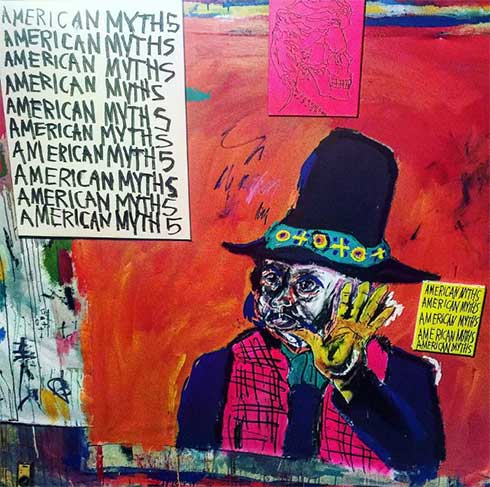
Don Van Vliet
Aka Captain Beefheart
Going Down: Frozen Dreams [ 31-Jan-26 7:26am ]
Alaska, Greenland, Iceland, Canada, they're all mine, mine, mine.
America, around 50 miles from Russia, bought Alaska 1867 for $7.2 million.
America, just 1500 miles from Greenland…
At last. Now I feel safe.

I'll ask her," said the naked
Russian Put in straight, the Bare
Ring, bell when ship hits ice
(with no more ice on land)
Drowned us in rare earth and oil
Going down. Going down.
What's the question?
Cain or Abel?
Pass the right word.
I can see you rush in
From where I am.
Lovely lips stick on the legless John,
Dewey -eyed, oil-crippled moose
With big glass bulging eyes.
Rifle! Shoot the bastard!
Don't let him size me up.
And find me wanting.
Natural selection?
No! My creation.
Killing fields take no hostages
And fortunes die.
Frozen Dreams.
© Christopher
.
Oscar Wilde and L'Hôtel [ 31-Jan-26 7:26am ]

Sam Burcher visits L' Hôtel in St Germain-des-Prés one hundred and twenty five years
after Oscar Wilde died here.
There would be no more luxury for the witty and feted playwright, novelist and poet Oscar Wilde following his disastrous libel trial in London in 1895. The case he brought against the 9th Duke of Queensbury's claims of homosexuality, at the time a criminal offence, had led to Wilde's conviction of gross indecency with a sentence of two years hard labour in Reading Gaol.
In prison he was allowed to write his famous eighty page letter De Profundis (From the Depths) "for medicinal purposes." It starts, Dear Bosie, addressed to his lover Lord Alfred Douglas, the son of the Duke of Queensbury, who had encouraged Wilde's pursuit of the libel claim against his father, with whom he was embattled.
His letter recalls with passion and bitterness Bosie's vanity and greed whilst taking responsibility for his own part in the affair. In the second part Wilde describes with humility his profound spiritual and emotional transformation in jail. He eschews shallowness as the supreme vice and writes, "For the secret of life is suffering. It is what is hidden behind everything."
When he arrived in Paris in February 1898 his health was considerably weakened. Wilde checked into the shabby rather than chic Hôtel d'Alsace, its atrium open to the elements, under the pseudonym of Sebastian Melmoth. Today, this building is L'Hotel, one of Paris's best loved five star boutique hotels.

His eighteen month residency in the draughty boarding house was an unhappy one, not least because he once had been accustomed to and craved beauty. From his sickbed Wilde famously said, "My wallpaper and I are fighting a duel to the death. One or the other of us will have to go."
The libel trial had bankrupted him, and although he still received royalties from his English and Irish publishers, the cheques were slow to arrive. To tide him over, the French Government acted to give Wilde some money demonstrating its benevolence towards the arts, a tradition which it extends to foreign artists to this day.
When Oscar Wilde died aged 46 there were no funds left. He succumbed to a swelling on his brain caused by a fall in prison, and the infection from two surgeries performed in his room to remedy it. His final bill went unpaid for two years after his death, until his literary agent Robert Ross arrived in Paris to pay it.
The last invoice is amongst the framed mementos on the opulent green and gold peacock walls of Room 16 of L'Hotel. The Oscar Wilde Suite represents a luxurious homage to the place where the writer died. As his health deteriorated, he was too ill to climb the spiral staircase to his first floor room. So, a bed was brought into a small room beyond the lobby where his surgeries took place.
No-one can be completely sure, but it's possible this room is now an elegant niche in Wilde's Lounge where champagne and classic cocktails are served with bright green Italian olives and roasted cashews. I think Oscar would approve. The Oscar Wilde Appreciation Society states he moved downstairs to have surgery, but for the final two weeks returned to his room on the upper floor.
Sadly, his fall from grace was irrevocable. He was mercilessly reduced from the celebrated author of witty plays, intriguing novels, poems and charming children's stories to a penniless exile. Before the trial Wilde's life was on course to be a masterpiece, one that required a great ending. But the public and the law had turned against him, consigning him to an unreformed penal system designed to break a man. He had been treated unfairly.
Wilde briefly reunited and lived with Bosie in Naples after his release from prison, but the lovers separated under the pressure of his penury. Bosie later repudiated Wilde and sued Arthur Ransome for publishing libellous passages referring to De Profundis. He lost the case, and in turn, went bankrupt. Bosie's suffering would be complete when he received a six month prison term for libelling Winston Churchill during the First World War.

Wilde's downfall had brought him to a closer understanding of Christ, and of himself. In De Profundis he drew parallels between the true life of Christ and the true life of an artist. He viewed Christ as the imaginative poet whose spiritual message was too radical for his time, and as the seasoned man of sorrows unifying life's beauty and pain on the cross. Both Oscar and Bosie later converted to Catholicism, Wilde on his deathbed at L'Hôtel.
Other Famous Residents of L'Hôtel
In the wake of a forty day trial for allegedly exposing himself on stage, Jim Morrison, the charismatic poet and lead singer of The Doors arrived at L'Hôtel to await the verdict. His intention was to write poetry and his first port of call was Oscar Wilde's tomb. After whiling away the time at the nearby Café de Flore and Les Deux Magots, just as Wilde had done, he moved into his girlfriend's rented apartment in the Marais, where he was found dead on 3rd July 1971, aged 27.

Oscar Wilde and Jim Morrison rest in Père Lachaise Cemetery. The winged sphinx on Wilde's tomb sculpted by Jacob Epstein has been shielded by a glass screen since 2011 to stop adoring fans covering it with lipstick kisses. It was Robert Ross his former agent who commissioned the sculpture on the proviso that his ashes be interred within Wilde's tomb when he died.
The Paris prefecture demanded the Sphinx's genitalia be covered by a bronze butterfly after the occultist and author Aleister Crowley unveiled the limestone carving in November 1913. The genitals were later stolen when the tomb was vandalised in 1961. They have never been recovered.

Morrison's modest plot was at the centre of international media attention last year when his heavily graffitied funerary bust stolen from the graveside forty years ago, suddenly reappeared in Paris. By coincidence I happened to be in Père Lachaise at the time and was interviewed by the Associated Press about my experience of witnessing the bust in situ during the 1980's. https://www.samburcher.com/index.php/articles/notes-on/jim-morrisons-bust-stolen-from-his-grave-finally-recovered
I met Florian Liger-Bernard, the front desk concierge at L' Hôtel to discuss the minutiae of Oscar Wilde's stay until his death in November 1900. He told me about the many other celebrities who have followed in the famous Irish writer's footsteps since then. "There can be no coincidence if you choose to stay at L'Hôtel. It is a form of decadence," he said.
At the height of the success of J'taime…moi non plus in 1969 Jane Birkin and Serge Gainsbourg moved into Room 14 whilst his nearby house, now the Maison Gainsbourg, was refurbished https://internationaltimes.it/sam-burcher-enters-the-maison-and-museum-gainsbourg-to-explore-the-life-and-loves-of-frances-most-prolific-modern-composer/ At night, Serge composed Melody Nelson on the hotel piano in the basement. This brilliant concept album was not an immediate success, because the French public in general did not understand it. Only the intellectuals appreciated its unusual and avant-garde sound. One song, Un Particular Hôtel, was directly inspired by his stay.
In the bar Florian showed me the photographs of other famous guests Elizabeth Taylor and Richard Burton, Salvador Dali, Princess Grace, and Frank Sinatra, who romanced Ava Gardner in The City of Love. He points out the grainy deathbed photo of Oscar Wilde. We respectfully discuss his life and death in the library nook.
After several iterations L'Hôtel, which stands on the exact spot occupied by La Reine Margot's Pavillon d'Amour in the 17th century, underwent a significant refurbishment in 1967. The central atrium once open to the elements is snugly under glass. If you look up directly after entering the lobby it appears as an elegant circular tower with exquisitely lit balconies and arches on each floor interspersed with sculptural reliefs of classical figures.
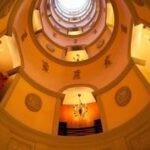
Around the tower a staircase spiralling six floors is covered in a luxurious leopard print carpet. Small indentations on the handrail burnished from hundreds of years of use attest to the innumerable and celebrated hands that may have caressed the same beautiful imperfections.
Over the last twenty years, the new owners have further transformed L'Hôtel. The bedrooms are categorised as L' Apartment, Bijoux, Chic, Grand, Mignon, Reine Hortense, and of course, the Oscar Wilde Suite. Each room is unique and sumptuously decorated in impeccable French style by interior designer Jacques Garcia (who also designed the piano bar in Museum Gainsbourg). Garcia is the winner of numerous cultural prizes, including the Oscar Wilde Prize in 2002.
For one night I enjoy the Venetian Room 30 on the third floor. The walls are textured in striped golden velvet, the bedhead is a profusion of intricately carved wooden leaves in a Rococo style with burgundy drapes on either side. A crystal chandelier shimmers over the centre of the bed. The Rosso Francia marble that proliferates throughout the building extends to the deep bathtub.
In the stylish lounge a blazing log fire gives the entire place a warm, cosy feel. Beyond the festive breakfast room, where attentive staff and friendly guests mingle, is a view of the peaceful garden with a small ornate stone fountain where Oscar Wilde once sat quietly reading and writing.

My thanks to Florian Liger-Bernard.
L'Hotel is located St Germain-des-Prés, on 13 Rue Des Beaux-Arts, 75006 Paris, https://www.l-hotel.com
.
Of Dark Materials, Strange Curves and Other Curiosities [ 31-Jan-26 7:25am ]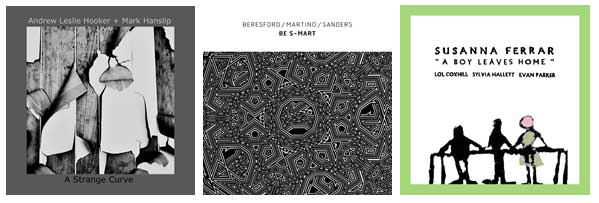
A Strange Curve, Andrew Leslie Hooker / Mark Hanslip (Scatter Archive)
Be S-Mart, Steve Beresford / Pierpaolo Martino / Mark Sanders (Confront Recordings)
A Boy Leaves Home, Susanna Ferrar (Scatter Archive)
Andrew Leslie Hooker is both a visual artist and a composer of no-input music. No-input music, for those who don't know, takes the internal noise of electronic devices as its starting point. The idea dates at least as far back as the 1960s - various musicians, including David Tudor and Pauline Oliveros, explored it. An early, obvious, example would be Steve Reich's Pendulum Music which dates from 1968. In it, microphones are set swinging in front of amplifier speakers - as the microphones pass the fronts of the speakers, feedback is generated. Sonic Youth created a version of the piece for their Goodbye 20th Century album (which, for anyone who doesn't know it, is well worth checking out. It's one they released on their own SYR label).
However, development of the possibilities of no-input music only really took off in the twenty-first century. People began to explore what could be done with mixers. One might, for example, connect the output of a mixer to one of its input channels and amplify the result. If you do, all kinds of changes can be made to the pitch and timbre of the sound by manipulating the mixer controls. There is a degree of unpredictability involved: some artists exploit this in performance, although Hooker himself has said that over the years he's learned to control what he does and can even match a fellow performer 'note for note'. The fact remains, though, that however much control you maintain in performance, such systems are an interesting way to explore sound that sidesteps the obvious choices one might be drawn into making using modular synthesis.
Hooker's no-input soundscapes are so lacking in conventional points of reference that, I imagine, it must be quite challenging, when playing duets with more conventional instruments, to find points of contact. It's a challenge Hooker and his collaborators have set themselves time and time again. A Strange Curve is the latest in a series of duet albums - it's a growing list, which already features artists as diverse as recorder-player Sylvia Hinz and harpist Rhodri Davies. On this occasion, he's paired up with sax-player Mark Hanslip. Hanslip has been a key presence on the jazz scene for over twenty years. He's performed at many major festivals and venues and has featured on over thirty albums. He's no stranger to collaborative duo formats either, having previously worked with drummer Javier Carmona on the album Dosados (released in 2012, on the Babel Label). And, as well as working in contexts more readily identifiable as jazz, he's at home, too, in the more left field - and, as here, the left field of the more left field - world of free improv.
I was going to say, all credit to Hanslip here for finding things to say that fit into the musical conversation, but there's less a sense of conversation here and more a sense of two musicians working closely together to create a homogeneous musical world which, though fundamentally electronic, admits the sound of the sax. And I should add, too, that as well as the no-input electronics, Hooker is also credited on the album as using a snare drum. From what I can hear, it sounds as if, rather than hit it, he gets it to resonate with the electronic sounds he generates, while varying the contact the snare has with the drum. The results are really effective, I think.
I found A Strange Curve a compulsive listen. Hooker and Hanslip have managed to create something really quite special. It's definitely an album I'll be coming back to.
Double bass-player Pierpaolo Martino has worked with Steve Beresford in the past, as part of the trio, Frequency Disasters. Together with drummer, Valentina Magaletti, they've already had two albums released on Confront Recordings. Here, on B-Smart, they're working together, again as a trio, but this time with drummer Mark Sanders.
The result is forty-five minutes of very approachable, high-energy music: jazz-based, certainly, but pushing limits. Grooves are established, ideas elaborated, sometimes more straightforwardly, at others, drawing on noise and electronics. The titles of the two tracks at first put me in mind of Philip Pullman's His Dark Materials, but, on reflection, it seems more likely that they refer to the quote from John Milton Pullman took his title from. Milton's 'dark materials' are the raw, chaotic, and unformed matter from which the God of Paradise Lost forged the world:
Into this wild Abyss
The womb of Nature, and perhaps her grave -
Of neither sea, nor shore, nor air, nor fire,
But all these in their pregnant causes mixed
Confusedly, and which thus must ever fight,
Unless the Almighty Maker them ordain
His dark materials to create more worlds, …
I'm sure choosing titles is a constant headache for most musicians, and anyone coming across this quote would probably think they'd struck gold, but the allusion to Milton here really does capture a quality of the music: the confusion of elements in a 'wild Abyss' coalescing into compelling musical shapes is a great way to describe what's going on here.
Tutanekai and his friend Tiki lived on Mokoia, an island on Lake Rotorua. In the evening, they used to make music together. The sound drifted across the waters of the lake to the mainland, where it was heard by the noblewoman, Hinemoa. One day, Tutanekai visited the mainland. He and Hinemoa fell in love. Sadly, though,Tutenakai had to return to Mokoia. Every evening, he played his music for Hinemoa to hear, hoping she'd follow him. Her people, fearing Hinemoa would leave them, hid all the boats. Undeterred, Hinemoa, using empty gourds as floats to help her, swam across the lake to the island, where she and Tutanekai lived happily ever after.
This Maori legend is the story behind half of the title, 'Hinemoa (Women of Ireland)', of one of the tracks on A Boy Leaves Home, a solo album by violinist Susanna Ferrar, which first came out on CD in 1997, but which has recently been re-released as a digital album by Scatter Archive. For me, it was perhaps the most striking track on the album. Ferrar's improvisations often remind me of Samuel Beckett in the way they seem to struggle to articulate something that may be unsayable. It's a struggle which sometimes resolves itself by morphing into the simple gestures of folk music (in this case, the song from the other side of the globe, 'Women of Ireland'). Of course, it's always presumptuous to speculate what lies behind a piece of music, but I'd say this is music about women finding their voice, struggling to live the way they want to live, and succeeding. It was recorded at a London Musicians Collective concert back in 1992 and, not that it needs any help, but the ambience certainly adds to the power of the performance.
I qualified my judgement by saying it was only perhaps the most striking track, as there is much else here that is remarkable. For example, and especially if you're a fan of his sax-playing, it's impossible not to be touched by Lol Coxhill singing 'Shenandoah'. One critic noted, back when it first came out, that there was 'too much unremarkable folk singing' on the album, which kind of misses the point, I think (and it's a fact which, I assume, is worn as a badge of honour, as it's quoted in the album notes!) The thing is, Ferrar assembles her music the way one might a cabinet of curiosities. An allusion to a folk story, a folk song, someone whistling in a stairwell, her riding a motorbike, her son, as a small boy (he grew up to be actor Dickon Tolson), telling a story. And it's the cabinet of a well-travelled curator, which is hardly surprising, as she's a Fellow of the Royal Geographical Society. There is, inevitably, much we don't get to see. Her grandfather, geologist HT Ferrar, was part of Captain Scott's first Antarctic expedition. She holds a Postgraduate Certificate in Antarctic Studies and has performed on her violin both in Scott's hut and on the Ross Ice Shelf. She has a special interest in site-specific improvisation and is an artist who, very visibly, weaves her art from the threads of her life.
Not that one needs to know the backstories to appreciate what's happening. The music of A Boy Leaves Home speaks for itself, as it should. I described it as a solo album, but it features collaborators, too. I've already flagged up Lol Coxhill and Ferrar's son, Dickon, but there are duets here, too, with sax-player Evan Parker and fellow violinist, Sylvia Hallett ('Shenandoah' is a trio, with Hallett and Coxhill). In 'Oak, Ash and Thorn', Ferrar's folk music gestures morph into fractured free improv, converging with Evan Parker's note-stream. And hearing Ferrar and Hallett play duets together (in 'Ho (Scherzo)' and 'Art Music (Minuet and Trio)'), it's clear that they're improvisational soul-mates.
.Dominic Rivron
LINKS
A Strange Curve: https://scatterarchive.bandcamp.com/album/a-strange-curve
Be S-Mart: https://confrontrecordings.bandcamp.com/album/be-s-mart
A Boy Leaves Home: https://scatterarchive.bandcamp.com/album/a-boy-leaves-home
.
Heroin, Again [ 31-Jan-26 7:25am ]
I don't really recall how I started using opiates and heroin again in 1965. I had kicked the habit early in 1964 and went back to college to redo my A levels so that I could go to university.[1] At the City of Westminster College I met Lynn Ellis and we started going out. I had already met her at the Witches Cauldron in Belsize Park, but it was through college that we got together. She was weaning herself from opiates and had a regular methadone prescription. Sometimes she'd give me half a vial and I'd shoot that up. So that must have been the start. Summer 1965 after travelling overland to Afghanistan with friends I found I could buy ampoules of morphine for 10 Afghanis each (about a shilling old money, 5p today) to shoot up. I also brought 4 oz of opium home from that trip and sometimes would dissolve that and shoot it up, after boiling and filtering it through a tiny ball of cotton wool.
Summer 1966 I went back Afghanistan with just one friend Peter and persuaded a doctor to write me prescription for 4 ampoules of morphine. It was a rather shameful incident. There was a queue of about 100 sick people and I jumped the queue and went straight up to the doctor and asked for medicine for painful piles, as Bill Burroughs used to do. He started to write a prescription for paracetamol when I stopped him and said that was not strong enough. He asked "The pain is very?" I responded "The pain is very!" and he wrote me the prescription for morphine. Shamefully, I have never suffered from piles.
My companion Peter took a picture of my booty laid out on a pillow in Kabul. There's a syringe along the top, over the revolver. Two folding knives on the left, and various discs of black hashish on the right. There are three bullets for the gun top left and various pills, drugs, etc including two ampoules of morphine and 4 larger ones of distilled water. There is a small lump of opium top right near the larger discs of hash. All of it was used up, disposed of, like the gun that was pinched from me in Kandahar, or brought home with me. This rather poor contact print is the only image left.

Afghan booty Summer 1966
I bought the gun from a French hippie in Herat for $10 with 3 used but repacked bullets. I never dared fire it just in case it went wrong and blew my hand off. In Kabul I walked around with the revolver butt protruding from the right hand hip pocket of my Levis. An English speaking police officer approached me and politely informed me that, technically, carrying a gun is illegal, so would I kindly disguise it better? In response I wrapped a red hanky round the butt so it wasn't quite so obvious. I kept the gun unloaded with the 3 bullets in a matchbox in my left pocket.
I did wave it around in anger once, to threaten a hotel keeper who tried to extort 3 days rent after a stay of just 2 nights, and who was impeding our departure by hanging on to a suitcase. Luckily he didn't see the chambers were empty when I pulled out the gun and shouted "Let go of the suitcases or I'll blow your fucking head off!" He backed away with raised hands and we escaped with our luggage. Unfortunately our waiting taxi driver saw the incident with the gun and drove off in a panic. So we had to run a couple of hundred meters down the road carrying a packed suitcase in each hand, until we were out of sight! Our suitcases were full of used American clothing from the market that were quite the rage back home in London. These were USAid donations which ended up on sale in the market. Button-down cotton shirts, Ivy League cut jackets, and so on. Plus some traditional Afghan outfits. Just for ourselves and maybe for a couple of friends.
Returning to England I found I had got good grades in my A level resit exams and won a place at the fashionable but excellent Sussex University near Brighton. It was called by 'Hampstead by the Sea' by some wags. I soon made friends with the local heads at the university and in town, especially as my old Hampstead mates Alan Green and his brother Brian Green lived nearby. They were both ex-users but stuck to booze and smoke these days.

Maggi Gearson in 1966
That Autumn I met and fell in love with a wonderful and beautiful girl called Maggi Gearson. She was studying to become a teacher at the Brighton College of Education, across the road from the University. We hit it off so well and were inseparable for the next 20 months, except when she visited her mother in Paris. I did sometimes go with her, and her mother put us up in a modest hotel in the Pigalle district near to her flat. We took a lot of drugs together like hash, acid and less often uppers and downers. I recall spending one whole acid trip in Brighton in bed doing nothing but making love with Maggi. We came again and again and I couldn't tell which was her body and which was mine. It was a wonderful experience of bodily and mind fusion and togetherness. Ah, the passion and lust of young love.
In Autumn 1967 after a Summer together in Ibiza I started my second year and we were more heavily into drugs. Maggi dropped out of college and was living with me in a dingy basement flat in Ventnor Villas, Hove. I shared this flat with my dear friend Dave Fry. One of my new friends was Niall Good whose father was a GP in nearby Rottingdean. He would pinch some morphine solution from the surgery and he and I used to get high on that. He substituted water for it and I do hope some poor tragic accident victim wasn't given a shot of morphine solution diluted to nothing, when in real need.
I tried to keep my opiate use hidden from Maggi, but she knew what was going on and asked me for some. I refused because I thought it would ruin her. I did some serious thinking because I knew it was getting inevitable that she would start shooting up. I faced two choices - to give up all opiates and intravenous drug use myself, or to break up with her. I just couldn't and wasn't prepared to do the former and I loved her too dearly for the latter. I was paralysed with indecision and in the end I made the coward's choice of no choice and the inevitable happened.
One day when I came back from University she showed me she had some heroin she had bought and some nasty punctures on her arm where she had tried and failed to inject herself. I didn't want to do it but couldn't bear to see her wounding herself, so I gave in and, regretfully, gave her her first intravenous shot. She loved it and after it wore off in the midnight hour she wanted more, more, more.
Over the course of that academic year we were multidrug users smoking dope most of the time, taking speed, acid now and then, downers, opiates, and when we could get it, coke to shoot up with the H. We were getting by without getting too degraded and even travelled to Turkey together overland during the Easter vacation 1968 to score a couple of Kilos of hash for sale and personal use. We went to so many psychedelic events that year - the Technicolour Dream at Ally Pally, in April and Christmas on Earth at Olympia in December; UFO in Tottenham Court Road, Middle Earth in Covent Garden. We saw Jimi Hendrix and the Pink Floyd about five times each, Arthur Brown once and loads of others including Captain Beefheart.
One time we were at the Middle Earth club in Covent Garden that my friend Neil Winterbottom had set up with others (so he claimed). John Peel was the DJ and he said over the PA system what bliss it would be if he had a copy of the Velvet Underground's record to play. This was their first album with the Andy Warhol banana cover and my friend Patrick Lane had brought a copy back from San Francisco and later swapped it with me for a box of ampoules of meth. So we went to John Peel and said we had it outside in the car, and brought it in and lent it to him. However after 2 hours he still hadn't played it so we asked for it back and left. In those days you could park in Covent Garden and Maggi had a tiny car called a Goggomobil.
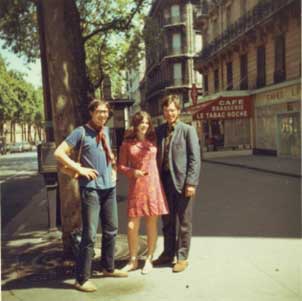
Alex, Maggi and Paul in Paris Easter 1968 on return from Gaziantep, Turkey
However from Easter 1968 we started to go downhill, becoming full-on heroin addicts. I stopped attending University and we spent more time in London, although there were a few registered addicts we scored from in Brighton, as well. We hung around with some heavy users like John Boylan, Danny Halliday and Frank in Shadwell, as well as anyone else we could score from. Too often we would be hanging around the chemists Bliss in Kilburn, and Boots and John Bell & Croyden by Piccadilly circus at midnight, looking to score. However, of the episodes I recall about half involve Maggi and half do not. She also went to Paris several times on her own.
I remember walking around the underground station at Piccadilly circus, trying to score from junkies at the Gents, shooting up in the stalls, and thinking it was like one of Dante's circles of Hell. It really was. Undercover cops chasing rent boys and pick pockets. Junkies chasing dealers - who themselves were just junkies with a little 'spare' on the script. Then there was the squalor and stink of the underground station and the gents toilets! Drunks and junkies vomiting. Rent boys and johns ejaculating. We were condemned by our desires and sins to forever chase each other around this hellish circle.
Too many half remembered episodes come back from the Spring and early Summer of 1968. Such as meeting Gina Strauss who had been such a lovely and joyful girl in Hampstead, Tony's first real girlfriend and later Andrew Loog Oldham's squeeze. Now only 5 years later she was an ill-kempt and desperate junkie hanging around the 'Dilly'. She offered to come home and sleep with me just for a bed for the night. I declined, my sole desire was for the white mistress of the night, heroin. Heroin kills libido in males and reduces capacity too. For women it is different, quashing inhibitions without necessarily squashing desire.
One time I was so desperate all I could score was methadone linctus and I shot that up in a giant 20ml syringe in the Dilly gents. My blood floated on top of the linctus and when I shot it into my arm it was as if my liver groaned and my low grade high was tinged with nausea.
One time I found a jack of H on the floor at Bliss where some junkie had fumbled their little prescription bottle and dropped it. In those days H still came in little jacks in a tiny cork stoppered glass bottle, the pills counted out by the dispensing chemist. Charlie came in similar bottles but was tiny little snow-flake crystals, smaller than in sea salt. Methedrine came in little glass vials holding 2 ml of water into which 30 mg was dissolved. The vials came in cardboard packs of 5 for which the standard price was £1 or 5/- each vial. H and C was £1 a grain (60mg in the form of six10mg jacks) and was 100% pure NHS issue. I have never used any H that was other than 100% pure NHS issue.
In all my time as a junkie I never once had a junkie try to jack the price up on me (excuse the pun). The prices were just standard and accepted by everyone. I hate to think what would happen today, if someone had the stuff you desperately needed and you only had money to buy it with. Would the price double, treble, go up fivefold? I think the reason everything was fair (and cheap) was because it was junkies selling part of their script both to help out a fellow user and to gain a little spending change. They weren't in the game to get rich, just to get by!
As soon as the Chinese Heroin came in via the Hong Kong Triads, after the NHS more or less stopped prescribing it around 1969, the price jumped sixfold to 1 pound a fix (instead of 6 jacks for a pound). Grey elephant they called it. I never tried it.
Only once did I get a prescription for H and that was from the infamous Dr Petro. I met him by arrangement in St John's Wood tube station, where he wrote me a prescription for 3 grains of H, for a fee of £2. He was a doctor who had served the upper classes but now as an alcoholic he was down on his uppers. He was struck off not too long later.
Rab cashed my script (prescription) for me in an East End chemist and as we were walking away he opened the bottle clandestinely in his raincoat pocket to steal some, but fumbled it. When I asked for my H it was all loose in his grubby pocket, mixed in with fluff and god knows what else. I told him off and said "I was going to give you some, you know" which I did.
I was reluctant to get registered on H because I was technically a foreigner and I was applying for British citizenship at the time. I just didn't want 'heroin addict' written all over my official records, and get refused as an undesirable alien. In the end the police decided I was involved with drugs and recommended I be refused citizenship anyway, which I was, in 1968. My friends Tony and Alan were registered addicts by then, but either we didn't meet up that often, or when we did they didn't have any junk to spare.
Maggi was starting to sleep with other guys when were not together, which I didn't really know at the time, although I sometimes had vague glimmerings and uneasy suspicions. She was quite insecure and attention seeking, and if I, her boyfriend, was not there to give her my love and full attention, she would use her charms to get that attention from another guy on the scene. One time she gave me crab lice, and even then I did not suspect how she had been infected. We both had to cut off our pubic hair and apply a pink cream to kill the little parasites and their eggs. When we did, because of all the little wounds and scratches we had made on our pubic regions with nail scissors, it stung really badly. As we jumped about in pain I recall joking that we had the perfect antidote to that pain as we both shot up heroin. It worked.
One time in the Brighton flat, we had 3 jacks each. I shot mine up but she only used one of hers. A few hours later I wanted some of hers, like a child squabbling over his sister's sweets when he'd gobbled up his own share. She didn't want to share and I begged and pleaded for ages. When I looked round she was cutting scratches into her forearm with a knife. She was so torn between her need for her own heroin and my desperate pleas that she turned away from the pain of the insoluble dilemma and hurt herself. I was deeply shocked to see that, upset because of the pain I was giving the woman I loved. But I still wanted some of her heroin. I think she gave me half a jack.
There was a couple we knew, Diane and John, from the London drug scene. They were a stylish, attractive but skinny pair. They might be labelled Goths these days. They were speed freaks, which kept them very thin. She said they lived by 'bric-a-bracing' which was a euphemism for burglary. Diane lent us her mini a couple of times and we'd drive down to Brighton for a day or two.
One time we took the old time junkie Danny Halliday and his girlfriend Pauline on a late night visit to my flat in Ventnor Villas, Hove, in the borrowed mini. We arrived at 6:30 am and waited by the beach until Niall Good turned up at 7am for the start of his deck chair job. We piled into the tiny hut and within 10 minutes Niall had passed out from an overgenerous shot of heroin.
We then drove on to Ventnor Villas. Pauline couldn't wait and was shooting up in the car and passed out with a needle bloody in her arm. She flopped out of the mini and was lying on the pavement, legs in the car, bloodied needle in arm, skirt up 'round her waist, which didn't look too good to the neighbours, as she had a ravaged streetwalker look anyway! A bit much at 8 am as a spectacle for neighbours to pass by on their way to work! We picked her up and hauled her downstairs to the seedy basement flat.
Danny was on a huge script of 30 grains of H, 30 grains of C and I think 10 boxes of methedrine per day, on a prescription from Dr. Lady Frankau. So although a very heavy user he had plenty to spare. I don't know what prescription Pauline had. We piled into the flat and Danny generously allowed me and Maggi to use as much as we wanted. Being greedy I had a big shot of H and C (an exquisite speedball) and passed out on the floor. My friend Patrick was there to witness this. This is his account.
I visited my close friend Paul one day at his basement flat in Ventnor Villas in Hove. I found him on the floor, dead, with a syringe still protruding from his arm. Instead of giving him mouth-to-mouth resuscitation or calling an ambulance, I rifled through his pockets to find his stash of drugs, which I immediately took possession of. I also stole his LP of Bach's Musical Offering and his copy of The Hero with a Thousand Faces by Joseph Campbell. That such wondrous examples of human creativity should be coveted by a lost degenerate provides yet another example of life's rich contradictions.
'Well, he doesn't bloody need them any more,' I would have said if asked.
I'm pleased to report that Paul was not dead, just unconscious, and these days he holds a chair at a prestigious English university. I eventually replaced the drugs and returned the book and LP - though we argued for a long time about how much heroin was in his pocket when I emptied it. But Paul was very forgiving of my behaviour and completely understood. "Of course, man. I would have done exactly the same."
Danny said to me when I came to "Don't trust that guy Patrick, he helped himself to your stash". In fact, he didn't steal it all, just enough to get him off, and for us not to notice. And he did replace the book and the LP although I'm not sure he ever replaced the drugs!
Another incident with Danny and the mini happened not long after. Maggi and I scored some boxes of meth and were pretty high on it for days. We drove to Frank's to see if we could get some H. He didn't have much to spare but swapped a grain of C for a box of meth. Next, after midnight, we drove to Danny's in West Hampstead to score. In my stoned and devious way I thought maybe I could get 2 grains of H from Danny. We went in after the usual palaver of quietly tapping on the window of his rented room at about 1 am. One of his young acolytes let us in and we had an audience with him in his large bedsit room. There were a few young addicts sitting around listening to his longwinded stories for a cheap, or if really lucky, free fix.
We went in and greeted the occupants paying special homage to Danny. After the usual long delays he finally asked me what I wanted. I said I had a couple of grains of coke to swap for two grains of H please. He opened the folded paper and looked at the coke. He said
"This is one grain of coke. You have come here trying to cheat me. I don't like it, I'm no fool you can take advantage of just because I'm high. As a punishment I will give you just half a grain of H for it. But I'm not forcing it on you. I will only give it to you if you tell me that this is fair and you are happy with the deal."
I was hurt, publicly humiliated, but so desperate for the H I told him I was happy with the deal, took the three jacks and left. I was really upset. Outside in the hallway Maggi said to me "How could you let him put you down like that. And in public, have you no spine?". I burst into angry tears and asked how she could kick me like this when I was so down and humiliated.
We got into the mini and headed off to Brighton from West Hampstead. The cogs in my meth raddled mind were turning, and in my amphetamine psychosis the picture became clear. She was my enemy and was planning to kill me. I sat there silently scheming. I wondered how I could escape from the speeding car and her evil intentions, and then a bright idea came to me. I pushed my foot hard against the gear stick so she could not change gear and would be forced to stop. She exclaimed "What are you doing?" and pulled the car diagonally in to the curb in Finchley Road near St John's Wood tube station. I threw open the door and ran out and hid behind a low wall. She followed me asking ""What's happening, are you okay?". I was sobbing by now and ran down a side street and huddled in the doorway to a garden set in a long brick wall. Maggi came and sat next to me with her arm around me trying to comfort me as I shook with tears.
Just then a bobby on the beat walked up and asked me. "Excuse me sir, is that your car on the high street?" I replied, "No, no, no, … it's not my car, it belongs to a friend who lent it to us, you see." He said "Well if you don't mind, would you be kind enough to park it properly, sir?" and then he walked off. I guess he thought we were having a lover's tiff rather than me having a breakdown.
We got back in the car and drove to Brighton down the usual route including the wonderful and aptly named "PurleIy Way". It has a line of sodium lights suspended above the centre of the road for a kilometre, like a string of pearls. I gradually recovered my equanimity, but it was one more step towards the end of our relationship.
There were many further sad, degenerate and desperate episodes of drug abuse throughout the academic year 1967-68, especially in the early summer, culminating in Maggi dumping me.
In the summer of 1968, after Maggi was gone, I recall going to Diane's basement room in Westbourne Grove one evening. She was the girl who used to lend us her mini. There were about half a dozen of us including Diane sitting around on the carpet. Someone had some speed so we all coughed up some money and shared it out in little paper packets. These were made the usual way. You get a rectangle of paper, maybe 6" by 4" and put your powder in the middle. Then you fold it longways so the two lengths overlap a couple of times. Then you fold up the bottom and top thirds, making sure you keep the powder in the middle, and tuck one inside the other. People also sold grass and other drugs wrapped in a similar way. There were no plastic bags nor clingfilm in those days.
So we each had our stashes in little paper folds and were starting to shoot up the speed. After twenty minutes one of the guys, a youngster I hadn't seen before said "Hey, I can't find my stuff!". We all got up and patted down our trousers and looked around. Nothing doing. The young guy got more and more agitated, saying "One of you guys must have nicked it!". Everyone denied it and he went off in near tears. We carried on shooting up, then one of the guys said "Well of course I had it. You can't go leaving your stuff around on the floor and not expect it to get nicked. It was his own fault, he'll learn."
I was deeply shocked by this casual thievery from a compatriot in the brotherhood of drugs. The absolute lack of empathy and ethics towards someone you were treating as a friend a moment before. What was shocking was not just the theft, but the casual admission, as if nobody could possibly regard it as wrong. Drug desire knows no ethics, no bounds, and you'd steal a dying relative's morphine if you needed it.
I remember two incompatible endings to that night, so probably it was two evenings. In one ending everybody left except Diane, and a female friend of hers and her sleeping five year old child. Diane took her blouse off revealing a very skinny torso with ribs deeply etched, and two perfect breasts. She smiled at me and despite my head spinning with speed at 3 am, I felt really sexy and aroused. I wanted to make a move on her. I felt it was an invitation. But I was just too inhibited, embarrassed to make love to her in the presence of another woman and a child in her one room flat. The hours passed and as dawn came I left. I always regretted my timidity.
In the other ending, one of the guys said, wouldn't it be great to score some H. I said I knew where, at Frank's in Shadwell. We went there by tube. I think it must have been really late by then and we got the first tube at 5 or 6 am. I told him to wait on the platform and I would go and score. I couldn't bring him as Frank didn't like strangers coming around. I went to Frank's and it took ages to score and I shot up myself as well, before I left. I did bring some stuff back to Shadwell Tube Station, but it had taken me 1 hour and 15 minutes, and my friend for the night had gone. I felt sad he had given up waiting before I got back. But it left me some extra!
We must have met Frank at the Dilly or somewhere. He lived in a flat in the East End, nearest tube Shadwell, and his flat was absolutely crammed with his stuff. Floor to ceiling. Stuffed eagles, harmoniums, oak pulpits, complete encyclopedia sets, large collections of crockery, fishing tackle, brass instruments, records including 78s, towers of books, cases of butterflies, electric drills, and so on. A real emporium of antiques and bric-a-brac. Except none of it was for sale. He was a hoarder. There were passages through it so you could get to the toilet, kitchen and bedroom. The living room and hall were pretty fully stuffed. Even the bedroom was mostly piled high with books on half on the bed and two or three easy chairs clear, if you were lucky, with a cramped space for your feet, and the rest of the room filled up. Some of the time he lived with a mixed race girl and her child. I think they all slept sitting up in the chairs. Frank was a bright guy, I don't know what path had led him into heavy drug addiction. He was a self taught expert on everything, and with his ginger hair looked a bit like Vincent van Gogh. And just as rough as Vincent on one of his bad days.
He was a decade or two older than us. He could usually spare a bit of H and C and would swap them for Meth, if you had some. He'd often make you accompany him to the chemists to pick up his prescription. He liked the company because there were East End roughs around who would rob him of his drugs if they got a chance. I recall them shouting insults at us, like "He's a dirty junkie!" as we re-entered his flat having collected his prescription. They had broken in once, when he was out, and robbed him. He had a boarded up window in the hallway where they had broken in.
One time I was there, it must have been Autumn 1968, when there were noises and the boarded up window was pushed in. Piles of crockery and books were pushed perilously close to collapse as two guys clambered in the window, breaking a few plates. They were plain clothes police. They said "What are you up to Frank, keeping honest?" I don't know what his relationship with them was, and whether they were on the make. He certainly did not welcome the intrusion. I was sitting down trying to stop nodding off while I read "The Trial of Galileo" by Berthold Brecht. I was studying Thomas Kuhn's Copernican Revolution and the history of science at the time, at Sussex University. One policeman said to me "What's a nice middle-class boy like you doing around here, you shouldn't let Frank get you on the drugs." I protested I was only a friend, although my pinned pupils would certainly have given me away as a user. They left after a while. Frank was a nice and interesting guy, and I did regard him as a friend, not just someone to score off.
Tony told me later that Frank got busted and the Council moved in, cleaned up his flat, and stored his stuff in a garage lock up. When Frank came out of nick his flat was gone and he claims they nicked the best stuff in his collection. I never knew what happened to Frank in the end, let alone the girl and child.
I had a pretty miserable academic year 1968-69 after coming back from Sweden in the Summer, where my parents sent me to rehabilitate. I restarted year 2 of my course at Sussex again but had to leave after a month as I was back on drugs. I was a multi-drug addict, taking anything to get high. I had a lot of acid trips for kicks, not as the semi-religious voyages of self discovery that they had been at first, starting 1965. I used everything I could get, smoking dope daily, alcohol, uppers and downers, speed, opiates, anything at all. It was really a year of depression and breakdown. Sitting at home reading H.P. Lovecraft, Tibetan Buddhism, Sci-Fi and all sorts of weird stuff that confirmed my rabbit hole of 'world-strangeness' or alienation.
I learned later that during this time my two ex-girlfriends Lynn and Maggi moved into Paul de Mille's flat in Chalcott Square, which they shared with Crispin Kitto, while Paul was away for a couple of months. They were both on junk, but our paths did not cross. I had seen Lynn once in early Summer 1968 when she came over to my mother's house and stayed the night after getting out of Holloway Prison on release for some petty drug-related offence. By the time I woke up she was gone again, back into the endless nightmare of her life, wearing some of my clothes.
But as winter 1968 approached I was isolated and very depressed. My mother referred me to a psychiatrist Dr. Peter Dally who she worked with at Westminster Hospital. Because I was intermittently on junk he gave me a methadone prescription for 4 months. He described my state as psychotic, my mother told me later. He was cutting me down from 4 ampoules to 2 ampoules a day. I would jump on a bus from West Hampstead to Golders Green everyday to cash my prescription. I even saw Maggi a bit. I recall hiding behind the door of her bedroom in Hendon with a methadone loaded syringe in my hand when her father looked in to speak to her. I had been banned from the house and she snuck me in. But the magic, the love was gone and we were now both sad and desperate characters.
When my grandmother died around Easter 1969 I asked Dr. Dally for two days worth of methadone syrup to take with me to the funeral in Gothenburg. I went there by ship, which was the cheapest route in those days. Each day I drank half the syrup and then refilled it with water. I was at Danny and Lena's in Gothenburg when the withdrawal kicked in. But it was only aching legs for one night and sleepers took care of it.
I think Lena made love to me once that visit, as I was lying drowsily on the roof in the sunshine with just my pants on, still a bit numb from the sleepers. She climbed on top of me and was finished before Danny came to look for us. If he had caught us, or confronted her she would have said "You don't own me or my body, I'll sleep with anyone I want to!". It would have been more difficult for me though, as I was betraying a friend's trust.
It was good to see old Swedish friends again but I was in a dark place. I felt nothing at my grandmother's funeral although I had spent lots of time with her as a kid and loved her dearly. Returning to London I was still a depressed multi-drug addict taking whatever I could to get high. In the Summer I went to the Stones free concert in Hyde Park.
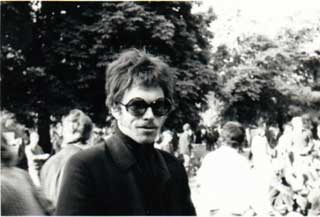
Paul at the Stones concert in Hyde Park Summer 1969
My last period of drug abuse was Summer 1969. I arranged to meet Lena, my Swedish sometime lover, in Ceuta, Spanish Morocco. She was in an all inclusive holiday resort just outside of Tetuan which she had booked cheaply as a travel agent. I flew in to Gibraltar and took the ferry across the straits and a bus to her resort. The doorman wouldn't let me in and denied that she was there. I found out later she was sleeping with him, and he obviously didn't want to lose his pretty blonde squeeze for the weekend. So I travelled on to Tetuan and hit the chemist for over the counter drugs. I scored lots of preludin, a form of speed, and spent the weekend shooting it up in my hotel room, and smoking kif. I think I suffered from amphetamine psychosis. I was hugely paranoid and saw some terrible things. These included eyeballs on stalks coming through splitting walls. There were whispering voices and an overall aura of threat and doom.
By Monday morning I was in a terrible state. I went back to the holiday camp and met Lena, but I was so locked up inside myself I kept saying "terrible things are happening". We took the bus to Tangier, but instead of shacking up together in a hotel as I had hoped, she abandoned me and hoofed it as soon as we arrived. I was all hippied up in a white flowing shirt with turquoise embroidery and matching turquoise velvet loon pants from my friend Duncan who ran Forbidden Fruit in Portobello Road. But it wasn't the hippie clothes and long hair that drove her off. After all, the previous summer she had sewed me a couple of pairs of flared trousers herself. No, it was my abject head state. Her plan was to score a couple of keys in Tangier and then take them home to Gothenburg, which she did. I can't blame her for dumping me! I never saw her again, although my sister bought her flat in the very steep Nedre Fogelbergsgatan (Lower bird mountain street) from her and Danny in Gothenburg, or rather paid her key money to take it on.
Actually it was me that inspired her to smuggle the dope. I'd met up with Danny de Souza in Gothenburg on my second cure Summer 1968, when my parents sent me to Sweden after my awful summer in the dumps and after the split from Maggi. I stayed in the countryside with my cousins and near my granny (mormor - mother's mother) and took up the habit of bussing into Gothenburg to visit the main library. They had loads of English language books. One day walking out I bumped into Danny de Souza who I knew from City of Westminster College where I had redone my 'A' Level studies 1964-66. He took me home to meet his girlfriend Lena. They invited me to stay and I moved in there.
Danny had to go back to England for a week to clear up some business and Lena immediately invited me into her bed. It was such an intense romance for me. I suppose I had a vacuum in my heart after Maggi and the terrible damage heroin does to you emotionally. Lena filled it, and it was young love all over again. I was head over heels infatuated. I'd meet her after work at her travel agent's office and we'd spend all our time together, much of it in bed. I bought her the new Bob Dylan LP with Johnny Cash and Buffalo Springfield's second album and those songs were listened to by us with such intensity, that the feeling lingers on to this very day.

Paul and Lena during our brief fling, Gothenburg Summer 1968
But then Danny came back and I had to covertly move out of her bed and their normal life resumed. But I regaled them with stories of how I had travelled to Morocco twice and brought back grass. How I'd been twice to Afghanistan and brought back hash. And how I had even travelled to Turkey earlier that year with Maggi and brought back 2.1 kg of best hash. So they wanted some. In fact, in the 1970s Danny did one run and got caught in Iran and spent a year or two in jail in Meshed. When he got back he told me he had become chess champion of Greece on the return overland journey because the colonels had locked up all the best players. He refused to play me though, I was at the peak of my skill at chess and Go, and fancied a game. He didn't learn however, and got caught again bringing quite a few kilos of hash into Turkey from Iran and ended up with a sentence of 20 years. He served many years and his story is like that in the film Midnight Express with John Hurt. He wrote his story in a book "Under the Crescent Moon" which I picked up in a charity shop.
Back to Summer 1969. Lena was gone and I got a hotel room in Tangier, but was still out of my head. I smoked one pipe of kif after another and I could hear people whispering about me incessantly, and I just knew that they were peering into my hotel room through every crack, door and window. I 'sensed' that there were watchers all around, even hanging in the air outside my window, just out of sight. At one point I threw open my doors shouting "I have nothing to hide!" Luckily the hotel manager was either deaf or very tolerant of stoned tourists. Later on that week, wandering around Tangier and looking seawards, I could see big fish jumping out of the water. They were the same size all the way to the horizon, so I worked out that I must be hallucinating, from the speed.
Of all the drugs I ever took the most dangerous was speed, in its many forms from amphetamine, Dexedrine, Preludin, methedrine, Ritalin, etc. Large doses of speed stop you sleeping and you get paranoid and develop threatening hallucinations and suspect that all around you are scheming against you, even those you love. Amphetamine psychosis makes you cunning, wily, paranoid, scheming, distrustful, obsessive and full of distorted illusions about people, space and time. It made me fearful, angry and liable to lose my temper. Luckily I never became violent but some speed freaks do. A small dose makes you warm and loving and you can't stop rabbiting on. Large repeated doses brings out compulsive behaviour, sleeplessness and paranoia and is very dangerous.
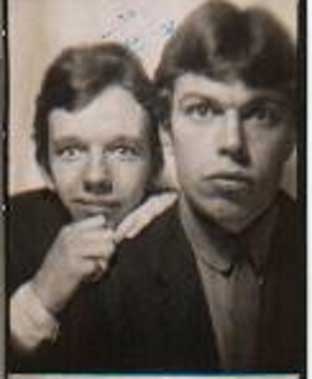
Alan Shoobridge and Paul in 1963
Fortunately I stopped shooting up speed and calmed down a bit and my amphetamine psychosis subsided. Actually, what happened was I went to a chemist stoned and asked for preludin. The chemist asked me what for. I was flustered and caught off guard so I said "Slimming". But I was skinny as a rake, twitching and done up in hippy gear, so it was a highly implausible story. The chemist refused me, which was actually doing me a favour.
Walking around the Casbah who did I bump into in but my old friend Alan Shoobridge? I was so happy to see a dear friendly face and we spent the next 2 or 3 weeks together before I flew home to the UK. I kept my cheap room in a hotel in the Casbah, but spent all of my time with Alan. He was shacked up with his French girlfriend in another cheap hotel, taking all the drugs he could afford. Our staple was paregoric, an over the counter tincture of opium with camphor dissolved in the alcohol base, so it could not be injected.
William Burroughs describes chilling it until the camphor has separated out and forms a crust on top, and then extracting and injecting the remaining liquid. I have done that in the UK. Alan had a simpler technique. You heat it in a metal ladle or large spoon until boiling and then set fire to it. Both the camphor and alcohol burn off and you are left with a black opium deposit. This dissolves easy enough in water, suck it up through a ball of cotton wool and hey presto, you are ready to go!
I had money enough to pay for my share and to pay for his Alan would send his girlfriend importuning in the European quarter of Tangier. She would ask gentlemen for money for her favours and then run off back to Alan with the cash. We didn't discuss it but I gathered that some johns caught her and demanded their pound of flesh!
I had a bottle with 120 trips of LSD in liquid form with me in Tangier. Quentin Theobald had synthesised in his Hythe lab. He was of course caught later and ended up in the clink doing a seven stretch. In the 1970s when I was back into studying mathematical logic I sent him logic and philosophy books in jail. He passed his Logic 'A' level inside. After that we sort of lost touch, but I heard he was killed in Ibiza. A brilliant chemist and a lovely guy!
But that summer I didn't feel in the right state to take it myself, so I sold it among the hippies of Tangier. In fact I never took acid again. The drug binge with Alan Shoobridge in Tangier for three weeks was my last mad fling. While there I made a deal with a shop to buy 20 pairs of leather slippers with about 2 oz of hash sewn into each sole. But although I had given them half the money, I had a premonition that it would end badly, so I cancelled the deal. For my money I took some dope, instead, to smoke. Probably one of the best decisions I have ever made. People were getting caught bringing dope back. Paul de Mille had tried to bring a bunch of stuffed leather camel toys with kif in them back from Morocco, or posted them, I forget, and got busted, a year or two before. It was not a smart time to take risks, even though many people were getting through, especially as I was dressed like a hippie, drawing attention to myself. Indeed I was a hippie!
In the years that followed a whole bunch of friends were caught out east smuggling hash back, including Danny de Souza in Iran and Turkey, and Bernie Osgood, Viv Schutzman and Mic Parsons, who did time in Iran. (Mic also did time in USSR, having got off a plane in Tashkent to shoot up. He was later released as small change in a celebrated spy swap deal). That was before the really big-time smuggling took off, which ended with my friends Patrick Lane and Howard Marks splashed all over the papers and then in jail in the USA. I guess I was lucky to get away with it, but I did give it all up before it got really hairy, and my last smuggling was Turkish hash at Easter 1968 with Maggi. Oh no, there was one more occasion. When I went back to stay with Lena in Gothenburg in April 1969 I posted a bundle of comics and magazines with 2 oz of hash stapled between some pages, addressed to myself. The magazines were all rolled into a tube and bound up with string, so you could see right down the middle. It got through undetected.
It was just as well I posted it because when the boat docked in Gothenburg I was strip searched by the customs authorities, who confiscated most of the Rizla cigarette papers I was bringing. These were highly taxed in Sweden at the time. You were allowed 3 packs but I had a box of 50 as requested by Danny and Lena. There was no penalty, just confiscation and a mild telling off. Astutely they noticed the tracks on my arms and I explained that I was a recovering addict who had just given up methadone except for the linctus, which they let me take through. They were a thoroughly decent bunch of people.
Alan and I had a great time in Tangier but it was also uncomfortable. The reusable stainless steel needles we used were getting more and blunt, and even rubbing them on the striking side of a safety match box to sharpen them left them hurting my arm. Also the shots, the dissolved opium deposits, were making me feel sick to my stomach (my liver more likely) and it was all starting to be a pain. Not Alan though, I loved his company.
On reading a draft of this memoir my old friend Tony told me that paregoric includes benzoic acid as well as camphor and opium extract. No wonder shooting it up, even after burning off the inflammables, made me feel sick to my stomach!
I flew home to London via Gibraltar, but when I arrived I was diagnosed as multiply infected. I had hair lice, crab lice, pink eye (conjunctivitis), hepatitis A or B, and was a suspected typhus carrier. After and a few days in a public ward in Middlesex Hospital, I was diagnosed as a risk and sent to Coppetts Wood isolation hospital in Muswell Hill. Before I got there, I made a pact with the doctor to stop all drugs, and I did. This was forever, apart from one telling slip in the Autumn of 1969.
I spent 3 or 4 weeks in Coppetts Wood Isolation hospital completely on my own, off drugs. Visitors had to be gowned and masked up, before they were admitted into my private room, as source of some mirth to me. They were the freaks, not me. My parents brought me a radio and later a portable TV, as well as fruit and other treats on their visits. Bowie's 'Major Tom' (Space Oddity) was the hit of the moment on the radio and I rolled those delicious chords around my mind. I was just sitting and thinking, determined to go clean, forever. The drugs no longer brought me joy and my life was a mess. Just watching the sky at dawn was a huge turn on. Of course, now I know that if you are a heavy user of cannabis the THC saturates your body fats so you remain pretty high for a month after giving it up. But no matter, I was filled with joy and love and ready to start to live again. I wrote poems and other short pieces including dramatic descriptions of sunrises and sunsets. I sent cards and letters to friends to keep in touch, letting them know I was back in the land of the living, adding drawings and writings in coloured pens and pencils. I was sharing the new found joy of being straight, of rediscovering myself, and of finding a self I could love and enjoy, instead of having run away and hide from myself all the time. One of the letters I wrote to was Philip Howe, and a parcel arrived from him in Cornwall. He was yachting with old man Hubbard and sent me a tin of clotted cream. I recall feasting on dark chocolate digestives with the cream in my isolation room, a private ecstasy. I tested negative for typhus in the end and was released.
The last time I had brought any dope to the UK back was Easter 1968. My then girlfriend Maggi and I travelled to Gaziantep, where we bought 2.1 Kg of the best grade hash. Back in England things had gone from bad from worse and we sunk into addiction and had to part Summer 1968, when she dumped me, to my great sorrow. Before then Maggi had a tin with 20 oz of our Turkish hash stolen by a guy called Max, after she spent the night with him. But in Autumn 1969, after I had given up all drugs, Max came back from Afghanistan with 100 kg of hash. Pete Rasini kindly said to Max "Why don't you replace the dope you took from Paul and Maggi? That would be a nice thing to do." Max gave Maggi one pound in weight of black Afghan hash, and although married to Tony by now, and 15 months on from our split, most honourably she contacted me to give me my half.
Selling that was the last dealing I ever did. Although straight, I took it to Brighton to sell to Geoff Conrad and other friends from the University of Sussex. Geoff happily bought it off me, and then offered me some coke. I had one shot, then, two, three, four, until it ran out. By morning I was pretty stoned and wretched as I took the train back to London. I thought to myself I was at a crossroads. I could choose to go back on drugs. Or I could take this slip as a serious lesson, and learn that I could not trust myself around any of my old drug friends, if they were still using. Viewed this way it could be seen as a positive, not the beginning of the end.
I walked back to West Hampstead from Victoria Station through St James' Park, Hyde Park, Regents Park, Primrose Hill, on a glorious and sunny Autumn day. I smelled the flowers in those wonderful rose gardens in Regent's park. My long walk was partly a penance but also partly just time to think, to clear my head. I decided I really did want to stay clean, I didn't want throw away my hard won sobriety. I had just turned 25 and it was time to grow up, get serious, and fully face the wonders and challenges that life has to offer.
And so I did, keeping myself sequestered and applying for work and pursuing new interests in yoga, meditation, mysticism, magic and all the technologies of soul cleansing. I started a new diary recording all of these practices on 1 January 1970, just as I had started a diary about my growing into adolescence on 1 January 1960. Clearing out my mental garbage led to me getting a good job in computer programming at the start of 1970, and meeting Jill, the love of my life three months later. And reader, I'm still married to her, 56 years on.
By the summer of 1970 I was confident enough to meet my old friends on neutral grounds, away from temptation. Many were clean anyway like Peter, Philip, Steve and John. Maggi married my best friend Tony and although still users, they were mostly on methadone treatment programmes. Maggi and I were good friends until her premature death in 1971 from an accidental overdose caused by a pharmacist accidently making up methadone linctus for her that was eightfold too strong. The inquest was a whitewash and they claimed that she has added methadone powder to her syrup to enrich it. And they even talked down the 5 gm discrepancy in his methadone stocks listings as trivial, even though it is enough to kill more than a score of people. Their lovely son Julius is 55 years old now. Tony and the others, those that survived anyway, are still my best friends, to this very day, with heroin a very distant memory in the past.
To continue the story of my life, Sussex University readmitted me in 1971 after passing academic tests and with a letter from my psychiatrist saying I was clean. Jill worked and supported me by commuting from Brighton to her work at the World Films Service office in Brook Street, WC1. She rode down to Cannes in a Rolls Royce carrying the print of Losey's 'The Go Between' to be screened, and it won the Palme D'Or. We were married in 1972.
I graduated in 1973 and obtained a masters degree in mathematical logic in 1974 with distinction. And on to my academic career. I published my first academic paper in 1975 in The British Journal of Philosophy of Science and sent a copy to Dr. Peter Dally, at my mother's urging, to show how the fallen had risen mightily!
Paul and Jill in Summer 1970
There is quite a contrast between this picture and that of the dark and doomed-looking Paul of the Summer 1969, just one year earlier, at the Stones' Concert in Hyde Park.
I guess I was lucky to get away with it, but I did give it all up, especially the smuggling, before it got really hairy. I did get turned down for British Citizenship in 1968. I mentioned Paul de Mill getting busted for smuggling dope. Because my name was in Paul's address book I was listed as 'suspicious' in the Home Office files. One 'strike' against me. I was also interviewed by customs and excise agents Mr Cutting and Mr Cooney, when my friend Steve was done for posting some Afghan stuff in from Paris in 1965, on our way home from Afghanistan. Lynn Ellis's parents had also falsely reported me to the Home Office in 1965 for turning their daughter onto drugs. In fact when we hooked up (sic) she was on a methadone treatment and it was her giving me a bit now and then that helped opened the door to my eventual readdiction. These three things were used against me by the police when they recommended turning down my citizenship application to the Home Office, in 1968.
They were very decent about it and suggested I withdraw my application. But I refused to do, stupidly thinking it was an admission of guilt! Of course they were right, I was deeply involved in drugs, even if none of the circumstantial evidence proved it. But as the policeman said at the time: "just one of these reports could have been a mistake. But three reports - too much to be a coincidence!" As John Buchan wrote "Once is happenstance. Twice is coincidence. The third time it's enemy action." (Goldfinger quotes this!). But in 1990 my next application went through smooth as silk, thank god! Have you seen what they do to immigrants applying for citizenship these days? Monstrous. But I was clean and respectable by then!
When Mr Cutting and Mr Cooney interviewed me in my home, in the 1965 build up to my friend Steve's smuggling case, one of them took a disc of hash out of his case and addressed me. "It's not the money in this that gets me, it's all the misery in a piece like this!" he said, waving the disc. I really had to battle to keep a straight face. I thought of all the laughter and joy in it!
Alan came back to the UK and I recall seeing him late 1969 or early 1970 when he visited me in West Hampstead. I was straight but he was not. He had few personal possessions left but owned a stamp collection in storage and asked me to hold it for him, when he went off on his travels again.
Later that year I got the news that he had had a dirty shot somewhere in Northern France that developed into septicaemia. He was taken to hospital too late by his girlfriend and died there from blood poisoning. He was 25 years old. He would now be in his early 80s.
Portrait of Alan Shoobridge by Paul Ernest, 1963.
All his friends mourn and miss Alan. He was a very bright, stylish, sardonically witty, loyal and sincere friend, but one with an unquiet heart, a death wish. Afterwards Maggie came to me and told me that Alan had said that he would leave his stamp collection to her, so I passed it on. Sadly she too was dead within the year and I think Tony still has Alan's stamp collection. The only surviving, tangible memento. Well, at least Alan found some peace.
And finally there is the sad tale of Lynn Ellis with whom this story started. I was working as a computer programmer in Berkeley Square in 1970 and strolling down Bond Street one lunch hour. Who should I see but Lynn in a doorway. We chatted and I asked if she was off the stuff. She said yes but I could see from her pinned blue eyes that she was on opiates. Later I heard from her friend Nessie that she was living in a squat and died from a dirty fix the year after I saw her. Not many of the cursed gang left, I guess I'm one of the lucky ones.
.
Paul Ernest
January 2026
[1] An account of my first bout of heroin addiction and some speculation about the lure of the drug is in Paul Ernest, Heroin, International Times, May 2020. https://internationaltimes.it/heroin/
.
Black Eyed Dog [ 31-Jan-26 7:23am ]Alessandro Cino Zolfanelli
Alone but for his dog, a man is consumed by obsession with a mysterious creature he encountered in the woods as a child.
Written, directed & animated by Alessandro Cino Zolfanelli
A THING OF BEAUTY AND JOY [ 31-Jan-26 7:23am ]
The Complete C Comics, Joe Brainard
Foreword by Ron Padgett, Essay by Bill Kartalopoulos
(New York Review Books)
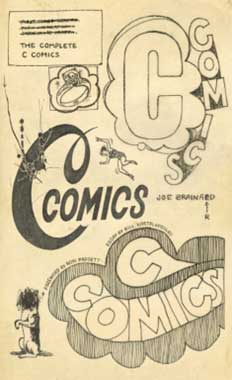 The Complete Comics, Joe Brainard
Foreword by Ron Padgett, Essay by Bill Kartalopoulos
(New York Review Books)
Every now and then perhaps we need to be reminded, and perhaps now more than ever, that joy exists in the world.
It's 1960s New York, and the more or less unknown artist Joe Brainard - living on next to nothing but in the thick of the social and energetic milieu of the poets and painters of the New York School - would send drawings of comic-book style pages to poets - not just any ol' poets: it's John Ashbery, Frank O'Hara, Ted Berrigan, Kenneth Koch, Ron Padgett and loads more; just about anyone who's anyone in the New York School, in fact - and they would supply words for the caption boxes and speech balloons Brainard had left empty, or put them anywhere else they felt that words might go. Brainard and the poets didn't plan or discuss things, they didn't confer . . . for the poets it would have been a bit like getting some do-what-the hell-you-want homework. Sometimes the texts they came up with would be put on the paper by Brainard in a comic-style script, other times the poet's handwriting would go straight in - but no matter, the spontaneity of the whole enterprise is evident on every page. Mistakes were scrubbed out but the messy blobs were allowed to remain, corrections were made, nobody cared much about neatness, and the poets' handwriting is often terrible, albeit always readable. Even now, 60 or so years later, the energy comes right off the page, and never flags.
One might think, given these are comics in the 1960s, that you'd have a version of Pop Art, like the Roy Lichtenstein pictures with the static (and, I suppose, ironic) out-take of the comic strip visual and its language, but here the dynamic is totally different. While Brainard may have appropriated the comic strip format, the ways of presenting it are various, and if there's any narrative (narrative is not a given) it's conjured up by a New York School poet, and never quite what you might expect. For example, on a page devoted to Wonder Woman, upon which she's in 4 or 5 different 'flying' positions spread across the page, Tony Towle has her at first thinking, in mid-flight, "Only someone's who's experienced it can possibly know the heartbreak and humiliation of being rejected", and finally as she splashes down with a SPLASH! she thinks ". . . so my Irish congressman has to lose his autographed rosary in a vat of strawberry preserves. . . "

C Comics #1 (1964) C Comics #2 (1966)
I'm tempted to list some of the treats these comics have to offer:
James Schuyler contributes several advertisements, including one for the marvellous "The Envy of the Harem" necklace ("Makes wearer irresistible says age-old accredited legend").
John Ashbery supplies "The Great Explosion Mystery", which begins by threatening to make sense but then resolutely doesn't, and opts instead for following one frame and speech bubble e.g. "According to the calendar, winter begins at 8.41 pm on Dec. 21, but according to the New York-Florida railroad timetables the winter season is due to start on Thursday" with several others e.g. "What a time to get a case of the staggers!"

Then there's Brainard's own "People of the World: RELAX!" ("Do not be afraid of death. It will not hurt you". . . . .
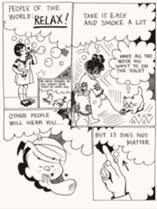 But if I start listing the treats I'll be here all day, so I won't do that.
In his brief Forword, Ron Padgett recalls that "we did the work simply for the pleasure and adventure of it, with little or no thought of how it might be received by the public. Likewise, it was happily free of theoretical ambitions, such as toward being avant-garde or radical or even funny . . . Ultimately, we were cradled in the sure-handed graphic beauty of Joe's art." And of course there is play here, and playful poets have long been frowned upon by other poets who, to quote Kenneth Koch from his poem "Fresh Air", are firmly under baleful influences and have "their eyes on the myth/ And the missus and the midterms". Behind the fun and artful artlessness of all of this lurks the sensibility that defines the New York School, whether or not it ever existed or still exists or it's just a label we all use because we like labels, because they help us to know what we have in front of us. It's a sensibility which, if it could be summed up in a few words, they would surely be words clamouring to be crossed out and replaced by something much more amusing.
The first issue of the comics was mimeographed on to, as I understand it, far from the best quality paper in the world. (Cheap and very cheerful.) It was what the Americans call legal size paper, which Google tells me is 8½ x 14 inches. The second issue was offset printed on slightly smaller but higher quality paper (8 ½ by 11 inches). Oh, and another thing I love is that for that second issue, Brainard paid the printer $950 for 600 copies, and sold them at $1 a copy, thereby losing money hand over fist. In his own words: "I am afraid that it is a money losing proposition."
This sumptuous reprint from New York Review Books, as an object to handle and leaf through, is a long way from the 1960s originals, and is a luxurious thing of beauty and joy. But the content of the comics is unadulterated and as pure and fresh as the day they were made. Importantly, the book keeps the large format of the originals so they can be enjoyed to the full. It clocks in at a hefty 14 x 9 inches, and weighs half a ton (or thereabouts) with solid hard covers and superb quality paper. It ain't cheap, but it's worth every penny.
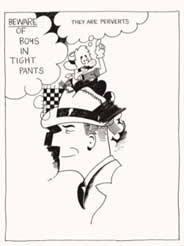
.
© Martin Stannard, 2026
Persuasive [ 31-Jan-26 7:21am ]
Possessions, Davina Quinlivan (229pp, September Publishing)
Possessions is an almost hallucinogenic, dreamlike memoir. Throughout, the narrator is hyper self-aware and lost in the delusions that friends, authority, fashion and academia want her to conform to. From childhood worries about being 'other' and not looking right, to a realisation she is not the 'academic Barbie' required by universities for their neoliberal teaching and research, via the struggle to be a good parent and earn enough, Quinlivan navigates familial expectations, feminism, racism, epiphanies and breakdown.
She does so as a kind of contemporary shaman, travelling through time and place, talking to her ancestors, her dead parents, her previous and future self, students and colleagues from long ago and the present, and directly to the reader. Unable to conform to the university system she is meant to be part of, everything is brought to a head during lockdown and the move to online teaching: the ghosts in the machine, the silent, uninvolved and invisible students on Zoom classes, are too much to bear and the world spins and becomes untenable.
The university where she worked (it's not named, though I can make an informed guess) clearly took a different attitude to my one during lockdown. My institution prioritised student welfare, conversation, contact and wellbeing, our imposed 'flexible learning' became just that: flexible. It's quite a shock to find out that anywhere does 2 hour lectures, in person or online, when studies have shown for decades that 20 minutes of being talked at or to, however entertaining or sprinkled with jokes and visuals, is the maximum most of us can bear. Lectures and seminars require pace and momentum, changes in activity…
So, I was fortunate, and did not have to try to replicate lectures and 2 or 3 hour seminar workshops online. We could start a session, set online breakout rooms up for small discussion groups or initiate writing tasks and then regroup later that day or week to share and review work. We recorded our lectures (in short parts if necessary) and let the students watch them when they were up to it: felt well enough, motivated or could simply find time amongst the chaos of lockdown. We arranged extra tutorials as well as cross-curricular and multi-cohort (year group) support sessions. Quinlivan, it seems, was expected to somehow replicate all her teaching - which seems to have been way above the agreed national maximum contact time - online, even thought she was also home schooling and dealing with her own personal demons, even though she was part-time and on a fixed-term contract.
Sometimes, I find it hard to empathise. In my place of work we simply refused to do more teaching than we should unless student lives or health were in danger. During lockdown, attendance was not monitored (engagement and assessments were), and the word counts of submission were reduced or different forms of assessment introduced. Possessions makes me realise how liberal my place of work really was, how generous and caring it tried to be (and often was).
But I do empathise with the crunch point Quinlivan reaches. I had a kind of breakdown after lockdown ended, when realisation of what we/I'd endured kicked in, and stress and anxiety belatedly arrived as normal timetables and in-person teaching returned. Quinlivan's experiences are different, and this whole book is self-experiential, birthed from that period of lockdown isolation and digital loneliness. These only accentuate her sense of being lost in the world… How does her Burmese ancestry work in 21st Century Britain? What are the expectations for a woman in a Russell Group university? Why can't her university management and colleagues cope with intelligent, informed and innovative ideas? How does anyone raised in London deal with the weather, traditions, racism and isolation of living in the British countryside? Why can't lived experience inform teaching and research?
Unlike other books which formally examine the failings of the neoliberal hijacking of universities (I particularly recommend Peter Fleming's Dark Academia: How Universities Die), Possessions explores what it feels like to be part of the machine that higher education has become, prioritising money and efficiency over motivational learning and teaching, bullying and persuading its front line staff in the name of streamlining and futureproofing. The idea of teaching students how to think and learn for themselves, of open-ended discussion and debate, has been replaced by 'how to' seminars and the yes/no/tickbox answers already prevalent in UK schools. Instead of encouraging wide-ranging reading and understanding, informed debate and open-ended and ever-developing understanding, students are given the idea that there are right and wrong answers, and academic institutions are judged by the percentage of graduates who have certain incomes or managerial levels of employment.
It's good to reminded how this kind of bullshit is taking its emotional and mental toll on university lecturers and teachers, who mostly want to be doing their jobs because they are passionate and knowledgeable about their subject and want to share that with others, learning and exploring new ideas. Very few think of themselves as oracles of wisdom or receptacles of information that can somehow be imparted or transferred to empty-headed students; good teaching is about enthusing, sharing and encouraging. Quinlivan's book cuts through the educational crap that politicians and management have produced in the last few decades and reminds us of what is possible, what might be; what our priorities should be. It is at times overwrought and often peculiar, has an unfortunate clunky end chapter about a robot lecturer which is not as funny as it thinks it is, and is mystical and emotional in a way I don't normally engage with. But is also startlingly original, passionate and powerfully persuasive.
.
Rupert Loydell
.
A Careful Curation [ 31-Jan-26 7:21am ]
Alarm bells are ringing.
New opportunities will
materialise but there are
rules to follow & it's time
to catch our bus.
A lot of people are
disconnected from birds,
she said. Forget the sea,
this is where we want to be.
These vultures may not
look too wholesome but
they know how to clean
up the bones. A leap into
the dark becomes a leap
into the darkness as total
transparency is not on our
agenda. Today will be cold
& there is a chance of snow.
.
Steve Spence
.
I'm Just A Singer (In A Rock And Roll Band) [ 31-Jan-26 7:19am ]The Moody Blues
h
I'M JUST A SINGER (IN A ROCK AND ROLL BAND)
I'm just a wandering on the face of this earth
Meeting so many people
Who are trying to be free
And while I'm traveling I hear so many words
Language barriers broken
Now we've found the key
And if you want the wind of change
To blow about you
And you're the only other person to know, don't tell me
I'm just a singer in a rock and roll band.
A thousand pictures can be drawn from one word
Only who is the artist
We got to agree
A thousand miles can lead so many ways
Just to know who is driving
What a help it would be
So if you want this world of yours
To turn about you
And you can see exactly what to do
Please tell me
I'm just a singer in a rock and roll band.
How can we understand
Riots by the people for the people
Who are only destroying themselves
And when you see a frightened
Person who is frightened by the
People who are scorching this earth.
Scorching this earth
I'm just a wandering on the face of this earth
Meeting so many people
Who are trying to be free
And while I'm traveling I hear so many words
Language barriers broken
Now we've found the key
And if you want the wind of change
To blow about you
And you're the only other person to know, don't tell me
I'm just a singer in a rock and roll band.
I'm just a singer in a rock and roll band
How can we understand
Riots by the people for the people
Who are only destroying themselves
And when you see a frightened
Person who is frightened by the
People who are scorching this earth.
Scorching this earth
Music is the traveler crossing our world
Meeting so many people bridging the seas
I'm just a singer in a rock and roll band
I'm just a singer in a rock and roll band
Music is the traveler crossing our world
Meeting so many people bridging the seas
I'm just a singer in a rock and roll band.
We're just the singers in a rock and roll band.
I'm just a singer in a rock and roll band…
.
Pecksniff: Rock star Burnham becomes stalking horse for what comes next [ 31-Jan-26 6:08am ]

Jaws plummeted among the wise men at the Muckrakers at the inauspicious display of chaos over the Gorton and Denton by-election candidacy emanating from No.10. The first rule of crisis management is to sum up the known facts and tell them all honestly. Instead, No. 10 has assiduously applied themselves to obfuscation, denial and (in that they briefed two contradictory versions of what happened) dishonesty. It began with informing the media that the NEC would rule out Andy Burnham before they told him. Catastrophic mismanagement, and the only way out is to apologise. But apologies are always for softies in Labour's No.10.
Instead of listening to their prophets, they came up with a growing series of excuses as to why they hadn't told him and how the decision was reached, and predictably every position taken was immediately over-run. No.10 even insisted Mr Burnham was told by phone before the meeting that his candidacy wouldn't be accepted: thus making clear the outcome was a fix even before it was discussed. Then as though that wasn't enough, another No.10 source contradicted it.
This is all getting surreal. Another source close to the PM disputes what my original source close to the PM says about Burnham being warned not to bother to apply to be a candidate in the by election. Just so you know (and yes it is faintly ridiculous) https://t.co/MPsE2mhBzF
— Robert Peston (@Peston) January 27, 2026
Mr Burnham is a bit of a rock star 'oop north'. He has the wholesome appeal of a popular secondary school teacher. He may or may not be the answer to Labour's and the nation's ills as PM, a role for which Keir Starmer appears to have little aptitude. But he represents what seems the most promising conduit to change.
*
One of the most serious of the many repercussions for Labour of the candidacy controversy is the resultant open attack on the party's leadership by Andrea Egan, new general secretary of Unison, one of Labour's major trade union backers.
"We cannot allow those currently in charge of the party to take us down with them… A radical change in direction could not be more needed."
For some time, Pecksniff has been reporting dissent in the party over Keir Starmer, but with the absence of either the will or the nous to do anything about it. However, the game's afoot when the unions begin to stamp theirs. Stalwart Labour supporters will tell themselves this will all blow over. It won't.
By the way, watch Darren Jones…
*
The NEC meeting was always going to lead to internecine Labour Party war. The by-election itself will not be long delayed. This is a campaign Keir Starmer can't win even if Labour holds the seat. Even before the Burnham brouhaha, one of the convocation of the wise with knowledge of the constituency declared that Labour would get "a pasting".
On the other hand, other reports suggest the Labour vote may be holding up, in fear of Reform. There is now the ritual fan dance, but it is a sign of the times that the two parties with expectations are the new kids on the block, the 'anybody but the above' parties: Reform and the Greens, with the age of those bothering to vote a likely determinate of the outcome. Though the constituency has a significant Muslim electorate, and there is known advocacy for the Greens.
 Lee Anderson MP. Image by David Woodfall via Wikimedia Commons (CC BY 3.0)
Reform was first to make its presence known, on social media, but it did not go well. Chief whip Lee Anderson published a photo of a happy group of Reformers, with the words: 'Gorton and Denton. A cold but productive day in what will be a hotly contested seat. Reform UK fear no party. Bring it on.'
Unfortunately, unless Reform is even more incompetent than one supposed, this claim seems to be a porky. The picture was taken in Audenshaw, which is in the Ashton-under Lyne constituency, presumably on a different occasion unless Reform is actually canvassing the wrong voters: not impossible.
*
"With Labour, Britain will stay outside the EU. But…we must make Brexit work. There will be no return to the single market, the customs union or freedom of movement."
This is a quote from the Labour Party's website. It is all my eye and Betty Martin, of course. Keir Starmer is determined to take Britain into the dark, and this week he exacerbates our self-inflicted wound by pretending "Britain must get closer to the single market".
By their dissembling shall ye know them. The PM still insists we must "make Brexit work", in spite of the past decade having shown the idea is a delusion.
Nor can we get closer to the single market without joining it. A belief to the contrary is another example of British exceptionalism, the idea that rules can be bent for us. Yet, ever since the travesty of the hapless Tory negotiations, the one principle carved on tablets of stone in any communication with the EU is that there can be no cherry picking. So if you want the benefits of the single market, you have to be part of it. To allow cherry picking would undermine the whole policy, probably the bloc's most accomplished success (in which Britain played a notable part).
We should not fool ourselves or allow others that privilege. Keir Starmer's dishonesty is only prolonging the profound sense of grief and betrayal that millions of us have suffered since that referendum. He has to go.
*
 David Gauke. Image by UK Parliament via Flickr (CC BY-NC-ND 2.0)
"Polling reveals that 22 million consider themselves to be in the centre or the centre right. Nearly a third of those people - 7 million - consider that no political party adequately represents their views." So claims former Tory cabinet minister David Gauke in an article at Conservative Home, introducing the new 'moderate' Conservative group called 'Prosper'.
Potentially millions of old-fashioned Conservatives are wondering who to vote for, and even a moderate return to the fold might dramatically split the right-wing vote. Prosper is clearly trying to climb back into the Tory party rather than establish something new, and Kemi Badenoch (NW Essex) is hastily turning her artillery on this new and perhaps unexpected threat from the left.
There was an interesting and aggressive piece in the Guardian on Wednesday by Justine Greening, driving a disingenuous wedge between the recent absconders - Robert Jenrick and Suella Braverman - and their esteemed leader. The idea being to establish that the deserters are right-wing pedagogues, and their departure permits Ms Badenoch to return to more heterodox opinions. It is then easier to paint her as extreme too when she doesn't.
In fact, Ms Badenoch finds herself on treacherous ground, caught between Scylla and Charybdis. She now has to fight on two fronts, and we must doubt whether she has the intellectual footwork for that.
*
 Image of Farage by Gage Skidmore via Wikimedia Commons (CC BY-SA 2.0); Badenoch by FCO via Wikimedia Commons (CC BY 2.0)
What to make of those latest desertions from Tories to Reform, and how will Kemi Badenoch deal with cannons to the right of her and Prosper cannons to the left? Her tone this week has been rather Rorke's Drift, her diminished band facing the increasingly disreputable army of Reform. Nigel Farage has, perhaps somewhat unwillingly, welcomed a positive Addams Family of grotesques, all apparently eager to climb into an abyss of financial scandal and political depravity. They seem infinitely prepared to accede to any depths in order to slake their unsatisfied ambition. Mr Farage will recognise the threat they pose to his position, but he was impotent to prevent their arrival - which in itself tells us a great deal.
Most interesting in the weeks ahead will be the inevitable confrontation between the leader of the Conservatives and her erstwhile colleague, the member for Fareham and Waterlooville. It sounds like a particularly squalid music hall turn, 'Badenoch and Braverman', in which the two protagonists throw ordure at each other across the stage. How long, dear reader, before the appeal among the audience of being covered in it themselves begins to pall?
*
 Morgan McSweeney
Morgan McSweeney has become a hate figure for disenchanted Labour voters and others on the left, held responsible for those repressive right-wing policies the government pursues, most notably Sir Keir's volte face on his support for membership of the EU. Mr McSweeney's entire strategy has been based on pandering to the socially conservative 'working-class' group who he believes have swung behind Reform, those he apparently calls his "hero voters". For that we have put up with Labour attacks on the small boats and an interminable assault on immigration, but most unforgivably, he is a fervent supporter of Brexit and is responsible for corrupting the PM into believing its delusions.
So just how successful has this strategy proved? Well, this week YouGov published a study of where 2024's voters would now place their cross, and the total number of Reform voters influenced by Mr McSweeney's strategy in government turns out to be… 0%.
That's it: none. Nil. Nix. Nada. Zero. Zilch. Sweet fanny adams.

It can hardly appear churlish, therefore, to point out that the entire McSweeney-Starmer project has turned out to resemble a pig's rectum. The whole strategy behind everything Labour has plotted since Jeremy Corbyn's defenestration has been based on a chimera. And during that time, countless observers, including (one must modestly point out) your diarist, have spelled it out. Neither Sir Keir nor Mr McSweeney have anywhere to hide.
*
 Composite image. Farage by Owain Davies via Wikimedia Commons (CC-BY-SA 4.0); Clacton by diamond geezer via Flickr (CC BY-NC-ND 2.0)
Debate over foaming bumpers among the wise persons this week included speculation on whether Reform actually has a Clacton office. After all, my dears, why would they? A presence in the town would only encourage long queues of voters requesting Nigel Farage to solve some problem for them, when he could more profitably employ his time on buckshee jaunts around the world at the expense of one of his billionaire backers.
His principal preoccupation, after all, is with money and his own personal entitlement to lots of it. Nowhere is it recorded that the interests of the people of Clacton feature on his agenda.
*
The East Anglian Daily Times can be a worry. Take this week. On Wednesday they published this, on the subject of the cancellation of local elections:
"A member of the public: Michelle Dorrell, from Ipswich, said: 'I am furious, as is my right.' When asked why she thought that the elections had been postponed, she replied: "because Labour and the Conservatives are scared of losing to Reform."
Now, anyone who has ever had to solicit views from the public knows they don't speak like this: as though from a script. Nor do hacks ever trundle in an interviewee out of context and call her primly "a member of the public", with no further explanation. So, what do we read from this? Is the paper overtly supporting Reform? Local papers usually run a mile from being identified with a particular party. Or is it a ham-fisted attempt to drum up interest in a subject which they feel ought to be broadcast, only they know it will bore all but the political nerds?
Another curious coincidence of the story is that the lady involved (who so readily was to hand with what appears to be a previously prepared political statement) is a former employee of the East Anglian…
*
 BBC's Chris Mason. Image by Number 10 via Flickr (CC BY-NC-ND 2.0)
Readers may recall that the BBC's political editor, Chris Mason, was once a half decent political correspondent. (As indeed in her time was Laura Kuenssberg.) So what is it that happens to them when they take on the mantle of editor?
Mr Mason often appears like the junior lead in an amateur production of some drawing room comedy. In parsonic overtones he constantly tells us that Reform hold the ring in national politics. But like his predecessor, he is wedded to the old boys' club of Westminster, and mistakes that for real politics. He eulogises Nigel Farage and his popular impact on the electorate, in spite of the polls telling us two thirds of us wouldn't have him in the house.
The Reform manifesto promises our own domestic version of President Trump's ICE, and the introduction of concentration camps. It is fair to assume that a majority of the public might be appalled at the idea, but they will only be appalled if somebody tells them of the plans. There was a time when journalists, especially BBC journalists, might have thought that was their job.
*
This week's intelligencers are Liz Crosbie, Stace Richards, Karl Whiteman, Malcolm Lynn, David Patey, Celina Błędowska, Mark Popay and James Porter.
<<< Previous Pecksniff's Diary
More from East Anglia Bylines
 Foreign Policy
After Davos: a world unanchored
byAndrew Levi 26 January 2026
Foreign Policy
After Davos: a world unanchored
byAndrew Levi 26 January 2026
 Brexit
Letter: The EU-India deal is the future Britain is missing
byEast Anglia Bylines 27 January 2026
Brexit
Letter: The EU-India deal is the future Britain is missing
byEast Anglia Bylines 27 January 2026
 Environment
A suppressed warning finally appears: ecosystem collapse as a national security threat
byProf Rupert Read 25 January 2026
Environment
A suppressed warning finally appears: ecosystem collapse as a national security threat
byProf Rupert Read 25 January 2026
 Foreign Policy
The Carney Doctrine: 'live in truth' not illusion
byEast Anglia Bylines 21 January 2026
Foreign Policy
The Carney Doctrine: 'live in truth' not illusion
byEast Anglia Bylines 21 January 2026
 Friends of Bylines Network
There has never been a greater need for grassroots journalism that investigates the stories that really matter, holds power to account and champions the voices of everyday citizens. We are proudly powered by volunteers but what we do isn't free.
STAND WITH US for independent, citizen-led journalism that makes democracy stronger, and you will even get some exclusive benefits.
BECOME A FRIENDThe post Pecksniff: Rock star Burnham becomes stalking horse for what comes next first appeared on East Anglia Bylines.
Emails appear to show Elon Musk trying very hard to get invited to Jeffrey Epstein's party [ 31-Jan-26 1:26am ]
The latest DOJ Epstein files dump has the internet abuzz. They appear to show a series of emails from 2012 in which Elon Musk repeatedly attempts to arrange a visit to Jeffrey Epstein's private island, growing increasingly eager and looking for a "wild party." — Read the rest
The post Emails appear to show Elon Musk trying very hard to get invited to Jeffrey Epstein's party appeared first on Boing Boing.
Particle, Digi, and the XBee That Started It All [ 31-Jan-26 1:26am ]
On Tuesday, Particle announced its acquisition by Digi — the very creators of the XBee — representing a full circle moment for its founder Zach Supalla. "One of my core beliefs when I started Particle," said Zach, "was that the maker movement and professional engineering are part of the same continuum, and that we could […]
The post Particle, Digi, and the XBee That Started It All appeared first on Make: DIY Projects and Ideas for Makers.
a16z partner Kofi Ampadu to leave firm after TxO program pause [ 31-Jan-26 1:23am ]
Vanishing London [ 31-Jan-26 12:01am ]We sent out the wrong link yesterday for details of how to object to the proposal to demolish the glass roof at Liverpool St Station and build a nineteen storey tower block on top. Here is the correct link:
CLICK HERE TO OBJECT TO THE DEMOLITION & TOWER SCHEME

Four Swans, Bishopsgate, photographed by William Strudwick & demolished 1873
In 1906, F G Hilton Price, Vice President of the London Topographical Society opened his speech to the members at the annual meeting with these words - 'We are all familiar with the hackneyed expression 'Vanishing London' but it is nevertheless an appropriate one for - as a matter of fact - there is very little remaining in the City which might be called old London … During the last sixty years or more there have been enormous changes, the topography has been altered to a considerable extent, and London has been practically rebuilt.'
These photographs are selected from volumes of the Society's 'London Topographic Record,' published between 1900 and 1939, which adopted the melancholy duty of recording notable old buildings as they were demolished in the capital. Yet even this lamentable catalogue of loss exists in blithe innocence of the London Blitz that was to come.

Bell Yard, Fleet St, photographed by William Strudwick

Pope's House, Plough Court, Lombard St, photographed by William Strudwick

Lambeth High St photographed by William Strudwick

Peter's Lane, Smithfield, photographed by William Strudwick

Millbank Suspension Bridge & Wharves, August 1906, photographed by Walter L Spiers

54 & 55 Lincoln's Inn Fields and the archway leading into Sardinia St, demolished 1912, photographed by Walter L Spiers

Sardinian Chapel, Lincoln's Inn Fields, August 1906, demolished 1908, photographed by Walter L Spiers

Archway leading into Great Scotland Yard and 1 Whitehall, September 1903, photographed by Walter L Spiers

New Inn, Strand, June 1889, photographed by Ernest G Spiers

Nevill's Court's, Fetter Lane, March 1910, demolished 1911, photographed by Walter L Spiers

14 & 15 Nevill's Court, Fetter Lane, demolished 1911

The Old Dick Whittington, Cloth Fair, April 1898, photographed by Walter L Spiers

Bartholomew Close, August 1904, photographed by Walter L Spiers

Williamson's Hotel, New Court, City of London

Raquet Court, Fleet St

Collingwood St, Blackfriars Rd

Old Houses, North side of the Strand

Courtyard of 32 Botolph Lane, April 1905, demolished 1906, photographed by Walter L Spiers

32 Botolph Lane, April 1905, demolished 1906, photographed by Walter L Spiers

Bird in Hand, Long Acre

Houses in Millbank St, September 1903, photographed by Walter L Spiers

Door to Cardinal Wolsey's Wine Cellar, Board of Trade Offices, 7 Whitehall Gardens

Old Smithy, Bell St, Edgware Rd, demolished by Baker St & Edgware Railway

Architectural Museum, Cannon Row, Westminster
Images courtesy Bishopsgate Insitute
You may also like to look at
Physical Intelligence, Stripe veteran Lachy Groom's latest bet, is building Silicon Valley's buzziest robot brains [ 31-Jan-26 12:09am ] OnlyFans considering selling majority stake to Architect Capital [ 30-Jan-26 11:54pm ]
Elon Musk email to Epstein revealed: "What day/night will be the wildest party on your island?" [ 30-Jan-26 11:37pm ]
Elon Musk claimed that he was "photobombed" by Ghislaine Maxwell in the infamous shot of them together at the Vanity Fair Oscars party in 2014: "Don't know Ghislaine at all. She photobombed me once at a Vanity Fair party several years ago. — Read the rest
The post Elon Musk email to Epstein revealed: "What day/night will be the wildest party on your island?" appeared first on Boing Boing.
OpenClaw's AI assistants are now building their own social network [ 30-Jan-26 11:36pm ]
On the "Simulation Hypothesis" [ 26-Jan-26 9:17am ]Sorry I haven't been churning out that scintillating stuff you all know and sometimes read and comment upon, but, though I've never been a "depressed" person, I have been feeling like Nothing Matters lately. In times like this…not sure what to say. I'm glad cannabis exists.
Brief Rundown of Bostrom's RiffAlong the lines of stoned thinking: the Simulation Hypothesis, which coalesced in and around the mind of Nick Bostrom, c.2003.
This Substack is reader-supported. To receive new posts and support my work, consider becoming a free or paid subscriber.
As I understand it, Bostrom says it's conceivable that a technologically advanced civilization other than ours might have run a very large number of simulations of what their ancestors might have been like, so they programmed these extremely sophisticated algorithmically-based simulations of conscious, philosophically thoughtful, self-reflective "beings" with attitudes and experiences in their (fake) world that are like ours. Or flatly: are us. We just think we are who we are, with our histories and experiences, etc. Or we are all those things - remembering, reflecting on ourselves and experiences - but it's all algorithmic simulation. The Simulators got really good at this and did it millions of times, or more. We are just one model They came up with.
So, like you're sayin' nothing is real? Like we're in Strawberry Fields? Or, like, ya know, what Pink Floyd says in "Wish You Were Here": we're just two lost souls swimming in a fishbowl, year after year? Whoa! What is this shit?
It's a hybrid my friend came up with. Novel terpene ratio. She calls it Kali's Shaven Vulva. You like?
Okay, so Bostrom says, you can have one of three takes on this: 1.) Technologically advanced Entities who run simulations like this is a bullshit idea, so just STFU; 2.) Technologically advanced Beings are all over the Universe, but they don't do simulations like this; I imagine the idea has come up a trillion times and someone says, ya know, Naw, we got bigger fish to fry. We already know enough about our ancestors. Something like that. Or: 3.) Such technologically advanced Beings are all over the universe, and they fucking love doing simulations, and furthermore, there are countless Sims out there. Bostrom asks us to accept there are more Sims than non-Sims, among all the entities with civilizations 'n shit. Bostrom thought there's around a 33% chance for #3, which would imply we're all probably Sims. What if we are Sims? I like comedian David Cross's joke, about Homeland Security's daily threat level during the Iraq War:
Honey, it says here the threat level is orange today and orange is: "High, or high risk of a terrorist attack." What do we do?
Well, get out the bread and let's make some sandwiches.
 Not A New Idea, Methinks
I was brought up by a couple of quasi-hippies, and never went to church. Around age 17 I had to read the Bible on my own, just to see what all the shouting was about. I recall thinking Genesis was like someone dreamed it up. Probably it was a story dreamed up by many, told over and over until a good version of it prevailed, then, with writing, someone took it down. There are some weird problems, like there seem to be gods, plural, and then just the one god. What happened to the Others? I wanted to know more about them, but they just seem to have been forgotten. Adam, I later learned, had an earlier wife named Lillith and they got a no-fault divorce or something like that. In order to get a new squeeze, the Simulator took a rib from Adam…wild! People buy this? (Well, at the time I was reading the Bible and right wing Christianity was burgeoning, they were buying Man From Atlantis on TV, so…) Anyway, here is a transcendent Being making us and giving us ideas (one of 'em was "Don't get no funny ideas about knowledge, see?"), setting us down in a Garden, then walking away to watch from a nice vantage point. Proto-Candid Camera.
Arch-Taoist Chuang-Tzu AKA Zhuang Zhou AKA Zhuangzi, Chinese philosopher, (c.369-286 BCE; Socrates did the Hemlock Self-Offing trip in 399 BCE for perspective) had this idea: I dreamed I was a butterfly, fluttering and flitting about, happily doing butterfly things. Suddenly I woke up and realized I was the same ol' Chuang-Tzu…or… am I the Butterfly, and only dreaming now that I'm some Chinese dude named Chuang-Tzu? Thus does everything transform into everything else, a Taoist basic.1
In 1713, the Irish Bishop Berkeley2 wrote, in his Philonous, "The brain therefore you speak of, being a sensible thing, exists only in the mind. Now, I would fain know whether you think it reasonable to suppose, that one idea or thing existing in the mind, occasions all other ideas. And if you think so, pray how do you account for the origin of that primary idea or brain itself?"3
In Scientist As Rebel, Freeman Dyson writes about how Olaf Stapledon had a prototypical sort of Simulation Hypothesis in his novel Star Maker (1937), in which there is an early version of the interpretation of quantum mechanics, called "Many-Worlds." The Star Maker makes some universes into mature ones of extraordinary complexity. Taking a few pages from Stapledon, Sir Martin Rees had a thought-experiment concerned with the "fine-tuning" hypothesis that seems needed to account for this universe we live in, which, according to astrophysics, needed to be set-up just-so mathematically or life could not exist. How did we get so lucky? Rees says: with Many-Worlds, we would see an extremely high number of possible universes that would conform to some Cosmic Anthropic Principle, and we just happen to exist in one of those universes. Once again, we gotta ask: Who or What caused the Universes to exist? For some, it's the old God Game again, from here to eternity. For others, it's chaos and numbers and maybe some Hindu metaphysical thought thrown in. The point I'm tryna get at: this creation thing. It's a bitch, isn't it? 9th grade Trigonometry will not help me here. Here's Dyson discussing Rees:
If our present universe is a simulation created by intelligent aliens interested in exploring the consequences of alternative laws of physics, then we should expect the laws of physics that we observe to be chosen in such a way as to make our universe as interesting as possible. We should expect to find our universe allowing structures and processes of maximum diversity. The immense richness of ecological environments on our own planet gives support to Rees's proposal.4
I find it utmost refreshing to note this last item: ecological environments on our planet: Elon Musk, who said we absolutely live in a Simulation, wants to populate Mars, which would need to be terraformed and we don't know how to do that. Mars's soil is literally poison. 5
Apparently there are a number of science fiction novels that address a simulation hypothesis, including Greg Egan's 1997 Diaspora.
If we veer back toward Philosophy, from the 1960s to the 1980s we got a lot of Other Worlds from modal logic, like that of David Lewis, who wrote On the Plurality of Worlds (1986), which built on counterfactual thinking like it was no one's business but his own.
Others who seem to have had a Simulation Hypothesis idea predating Bostrom are Ed Frenkel (who I often mix up with Ed Fredkin), Jacques Vallee, Rudy Rucker, Stephen Wolfram, and Hans Moravec. And let us not forget the Wachowskis and their Matrix films.
Conspicuously absent from this discourse among philosophers are the names of Charles Fort, John Keel, and William Bramley, of Gods of Eden fame. Lemme just briefly riff on Fort here:
Fort writes in The Book of the Damned: "Would we, if we could, educate and sophisticate pigs, geese, cattle? Would it be wise to establish diplomatic relation with the hen that now functions, satisfied with mere sense of achievement by way of compensation? I think we're property." Fort floated the notion, in 1919, that some alien race made us, and we're like farm animals to them. Jeffrey Kripal, a Professor of Weird Religions, noted that Fort's idea that we are some colony or "property" of alien beings had its precedent with a musing by William James.6
Benjamin Breen's recent book Tripping On Utopia, discusses John Lilly's 1971 book, The Center of the Cyclone: "He spoke of the universe as a great cosmic computer in which all conscious beings were mere simulations."7
Novelist Jonathan Lethem had fun playing with the Simulation Hypothesis in his 2009 book Chronic City, in which the most colorful character, Perkus Tooth, walks home the morning after a blizzard and realizes he lives in a Simulation.8
Professor Carlin Weighs In"I think many years ago an advanced civilization intervened with us genetically and gave us just enough intelligence to develop dangerous technology but not enough to use it wisely. Then they sat back to watch the fun, kind of like a human zoo. And you know what? They're getting their money's worth."9
How Do We Think About This Stuff?You could reject Bostrom's idea that consciousness could arise from a computer. I admit that's my main model right now. I think we need to be evolved, embodied, carbon-based sensory processors with florid emotions in order to be conscious, and I base this on a number of philosophers, biologists, and cognitive scientist's thoughts, but the Portuguese Antonio Damasio made a big impression here.
You might just look at the mathematical formalisms Bostrom uses and say he's wingin' it from the get-go. Or you could reject it on the basis that something as complex as our worlds, bodies, minds, societies and creations could reduce to any mathematics at all. This was recently done by Dr. Mir Faizal, Lawrence Krauss, Arshid Shabir, and Francesco Marino, published in the Journal of Holography Applications in Physics, this past November. 10 They haul in Gödel's Incompleteness Theorem of 1931 to show that the entire cosmos lies outside of algorithmic understanding. I quote Dr. Faizal: "It has been suggested that the universe could be simulated. If such a simulation were possible, the simulated universe could itself give rise to life, which in turn might create its own simulation. This recursive possibility makes it seem highly unlikely that our universe is the original one, rather than a simulation nested within another simulation." In other worlds, for the Beings that might be simulating us in Bostrom's hypothesis, who or what created them? It feels a lot like "what happened before the Big Bang?" question that any intelligent 13 year old will pose. Faizal, Krauss and pals think that, where it was previously thought that you can't debunk The Simulation Hypothesis, but now they did. But here's where it gets a bit weird: Space and Time come out of Physics, but there needs to be a substrate for it, and they see: Information. Okay…where does the Information come from? From scientific laws, which are prior to anything, ehhh…and they posit it all comes out of some sort of Platonic Realm, with a mathematical foundation that is "more real" than anything in our…ehhh…universe. And it feels to me that they went through an old trap door that led to a rusty old storm grate near the sewer system, crawled through that, and came out in a dark old abandoned house, took a spiral staircase to some immaculate, weird all-white and pristine room…they had reached David Bohm's Implicate Order via a non-orthodox way, although Bohms' Implicate Order is not mentioned.
Bohm's Implicate Order is beyond Space-Time and so…a religious idea? I don't know. The Laws of physics itself are weightless, timeless…I'm getting some gooseflesh just thinking about it. Bohm was a favorite student of one Albert Einstein…
Frankly, I don't know what to do with this, but the Gödel stuff feel intuitively correct enough to me to hurl a monkey wrench11 into Bostrom's works.
More objections: how do we know Sims and Non-Sims are in the same epistemic situation? Or is what possible similarity between the two plausible? How does thinking about the Sim Hypothesis harm or dent our thinking about the possible future applications of computers? Maybe it really would not be "cheap" to run billions of Simulations for these many beings? Wouldn't we detect glitches or boundaries if we were in a Sim? We can go on and on with this, but in my Generalist way of thinking, I can't rule out that we are living in a Simulation, because I just don't know enough, and there are interesting ideas about how we "are" in a Sim, and these are by highly intelligent people. I personally estimate the probability that we're living a Sim as 0.1%. Which is not nothing, but far less than Bostrom's 33%.
David ChalmersI don't know what Chalmers makes of the recent application of Gödel to this idea, but in 2022 he thought we couldn't prove ("it's impossible") we weren't living in a Sim.12 What's Chalmers's estimate that we are living in a Sim? Around 25%. How does he arrive at this? We seem to exist relatively early in the universe. While we've made some pretty fancy simulations/alternate reality computer games and scenarios, we aren't close to making something like the vivid universe or even the Amazon basin. We haven't encountered any other intelligent beings. (I will write about this topic some time in the future.) When a guy like Bostrom says 33%, I sorta give a Bronx Cheer, but when a guy like Chalmers says 25% I find it a tad unnerving. Still: get out the bread; let's make sandwiches.
Robert Anton WilsonIn a June 3rd, 1987 letter to his friend and benefactor Kurt Smith, RAW tries to explain his theory of perception to Smith, who had trouble understanding the early, Loompanics edition of Natural Law: Or: Never Put a Rubber on You Willy:
You look at a space-time event and see a thing which you call a chair. A snake looks at it and sees a heat field, not a thing, and probably does not call it by that name. An electron microscope looks at it and sees empty space with such peculiar twinkles that attempting to explain them leads to all the paradoxes of quantum mechanics. What is "really" there? I don't know, but I rather doubt it "is" a Platonic Idea or an Aristotelian Essence or even a Kantian ding an sich. Operationally-existentially what is "real" for us is what we encounter and endure, but that is not "real" in any absolute sense.
In the Buddhist epistemology, the chair is real — to your nervous system. The chair is not real — to the electron microscope. The chair is both real and not-real, because your images and the microscope's image are not contradictory, but, in Bohr's phrase, complementary. The chair is both real and not-real because it has infinite aspects not containable in either your image or the microscope's image.
The "real" "thing" of which chair and heat field and twinkles are images may exist somewhere, in some Platonic or Aristotelian realm, as I cheerfully and repeatedly admit, but as Nietzsche and Bridgman both demonstrated, by different arguments, since we cannot contact those realms, it is meaningless to talk about them. What we can talk meaningfully about is out existence and our operations — what our brains encounter and endure and what our instruments encounter and endure. As Heisenberg said to Bohr, Einstein's continued attempt to go beyond that existential-operational level to a Platonic "reality" sounds to us skeptics much like the medieval debate over how many angels can dance on the head of a pin.
I feel obliged to work RAW into any discussion, and so there ya go. But more seriously: his theory of perception is colorful, difficult, trippy and quite scientific. I think we should be thinking more along RAW's lines than armchair probabilities, using mathematical formalisms.
Further: this is what we know about reality. Would posited aliens performing Simulations on their ancestors see "reality" like we do? Do they understand all this? Moreover: does Nick Bostrom understand this?
Final RiffI touched on the vivid dense richness of Earth's environment. There are some critics, like Marco Gleiser, who think being serious about the Simulation Hypothesis is a dangerous escapist fantasy at best.13
When I think about this idea from many angles (you read about some of 'em here), I keep coming back to something that genuinely terrifies me, and I'll admit it: guys like Musk, Thiel, Andreessen, and Bezos are demonstrably anti-Humanities. I don't know much about Bostroms's background, but he's an academic. But quite nerdy, and he's said and written some racist things in the past. All these guys know is computing and attendant problems along with computer science. When they pontificate outside of the area they know, they sound like morons. I have citations and receipts, but that's for another time. All of these guys and the kiss-asses that they surround themselves with who want us to think about never-ending growth, using much more energy, living forever, and colonizing space…they're, full of it! Full. Of. It. The facts of Astrophysics, Thermodynamics, current medicine, etc. say so. They're banking on a significant level of the public just accepting whatever they say about this stuff, 'cuz they're rich. And the reason they're so rich is they were at the slot machines right at the time when they paid off not because they're transcendent geniuses. And they now have political power and guess what? They are ready for the planet to be trashed. These fucking idiots have given up on saving the planet. They just want more money, then escape from the planet. Good luck!14
They have a famous ailment: Engineer's Disease.15 This is where if you're an expert in some STEM field, you think you're an expert in everything else, too. We ought not listen to the billionaire tech bros and work on our own, all-too-real problems living on Earth, because we are not going anywhere. Not Mars. Not space-cities that house tens of thousands or millions. Not soon, that is. Not soon at all, given the actual problems, here at home, which has what we need for sustainability. Our problems are political, not technological. Let's get real!

(OG artwork by Bobby Campbell)
1It's now thought dubious that "Chuang-Tzu" even existed. In 2003 Russell Kirkland says there's scant evidence he existed, and most of what we know about Chuang-Tzu was from 3rd BCE commentator Guo Xiang. So maybe Guo simulated Chuang-Tzu and his sayings and doings, really pulling the wool over everyone's eyes. Possibly the Butterfly Effect gave rise to conditions under which Guo Xiang was telling us what the arch-Taoist said? Similar things about dubious historicity have been written about Jesus and Keyser Söze. "The nature of things is in the habit of concealing itself," or so Heraclitus had spake thusly. Anyone got a line on Heraclitus's historicity? We've opened up a can of worms here, folks. We're through the Looking-Glass, and it could be turtles, turtles, turtles all the way down. Who put the turtles there? I don't man; I didn't do it.
2The city of Berkeley, California was named after him, because he wrote, in a poem, "Westward the course of empire takes its way; the first four acts already past. A fifth shall close the drama with the day; Time's noblest offspring is the last," and they thought this an omen of sorts, the promise of the far West in the Americas, but then they dropped the ball when everyone started saying "BURK-lee" when the Bishop pronounced it "BARK lee." Metaphysics is weird.
3Borges was a big fan of Berkeley, who thought all our ideas are real, but they are all part of the mind of God. You and I and that wall, that empty bowl of cereal in the sink, the lava lamp, the '69 Mets, and Krakatoa, are all just in the mind of God. Fain, of course Borges would be in love with such a wonderful nut as Berkeley. I got this Berkeley quote from Borges's essay "A New Refutation of Time," Selected Non-Fictions, p.320. No writer makes me feel like I am a Sim like Borges does. That is to say, he's a psychedelic writer to me. For his own Sim idea, written in the late 1930s and as a satire on fascism, order, and antisemitism, see his "Tlön, Uqbar, Orbis, Tertius." In 1714, a year after Berkeley published Philonous, on the Continent, Leibniz would describe consciousness as entering a thinking machine which was like entering a mill, and looking around you see machinery everywhere going full-tilt, but there was not one person around. There was nothing that could explain perceptual experience there. This idea about "consciousness" is still going strong, seems to me. I think Metaphysics has only gotten weirder since 1714.
4Scientist As Rebel, Freeman Dyson, p.337, in his essay, "Many Worlds."
5Humans would have to live underground there for an ungodly amount of time before the terraforming was done…and it's all bullshit, really. It's not going to happen. You could, with some legitimacy, think we could colonize Mars in 1965; by 1985 it was getting very difficult to believe this, given the large gains of knowledge about the Red Planet. Now? n 2026? You have to be completely full of shit to claim we can do this. Or so actual Astrophysicists I've read on the matter say. So: why the bullshit, Musk? Is it bad faith? Musk, Thiel, Bezos, Andreesen: these guys have never taken a meaningful hike in the forests of Earth. One wonders if they've ever performed oral sex on a woman (let's leave Thiel out of this). But I digress. My point is: these guys say they want to do things that are impossible and a lot of us are saying, Why Are You Already Giving Up On Earth? Because you were as responsible for the pending collapse as anyone else?
6The Occult World, ed. Christopher Partridge, p. 291
7Tripping On Utopia, Breen, p.276. Lilly in 1971 predates Bostrom by 32 years. I find it hard to picture Bostrom reading Lilly, though. Really hard.
8see pp.335-342 of Chronic City, but the idea is played around with on 224-230; 266-268 (hilarious!); 327-332; and 388-390. Here the ambience of cannabis seems to inform the Simulation Hypothesis, as Terence McKenna often touches on trans-dimensional beings that seem to play with humans when they're tripping on DMT. We mentioned John Lilly above, who tripped on everything, and earlier than most people, but is now identified with Ketamine and I'm not sure if this does a disservice to Lilly or not. The reason I bring all this up is that the idea of a Simulation Hypothesis seems to immediately strike a lot of us as "trippy" stuff. I doubt Bostrom was high, though.
9Napalm and Silly Putty, Carlin, p.158
10A brief article about their paper is HERE.
11Wot? Ya fancy callin' it a spanner do ye?
12Chalmers, who I include here because he's always so interesting to me, wrote about how it's impossible to prove we don't live in a Simulation HERE.
13Marco Gleiser, in July, 2022. We are faced with real dangers on Earth, and these assholes want to argue about whether we're in Simulation? What the hell is wrong with these people? For Gleiser and a lot of my readers, it's becoming hellish to be an actual adult in this world.
14see Survival of the Richest, Douglas Rushkoff.
15for a fascinating and chilling discussion of Engineer's Disease, see astrophysicist Adam Becker's More Everything Forever, pp. 261-278
Sex/Food/Death (episode: Aleph) [ 19-Jan-26 10:58am ]The TV series White Lotus has apparently become notorious for showing penises, and a question asked has been why. Since there's been quite a lot of full frontal female nudity in TV and mainstream films, why has TV so shied away from penises until relatively recently? Santiago Fouz-Hernandex, film studies professor at Durham U. subscribes to fellow film studies professor Peter Lehman's idea of the "Phallic Mystique," which Lehman first wrote about in the 1990s. The phallus is a concept and symbol, and hardly anyone calls a particular penis a phallus; it's "the phallus" as a symbol of masculinity, power, and privilege. Mere penises are kept off-camera, the theory goes, because to show it is to normalize the phallus, and strip it of its patriarchal symbolic powers.
Some critics think the brains behind White Lotus, Mike White, who I thought was self-identified as gay but apparently claims bisexuality as his identity, is "flipping the script" by showing more frontal male nudity than female nudity in the White Lotus series. The term I often see in popular culture these days is "normalize." Now, I don't know if Lehman's idea of the taboo about showing the penis is TV or film robs the phallus of its patriarchal powers, but if it's true, maybe we should all be rooting to see penises everywhere. Anything to rob patriarchy of its privilege, I say. What really are the arguments for women as second-class citizens, anyway? I see no good arguments at all. I never have. 1
This Substack is reader-supported. To receive new posts and support my work, consider becoming a free or paid subscriber.
I grew up in a household where mom and dad walked around naked, so we did, too. It was no big deal. As you get older, you realize: it's a big deal. For some reason, but it is. I don't think any of my friends had suburban pagan parents like I did. Mom and dad couldn't wait to get tickets to see the live nude cast of Hair when it came out. I lost my mom's vinyl record of that, but I later bought the CD, 'cuz I loved those songs.
Is it true that the penis and its occulted reference, the phallus, can be "normalized"? I suspect that showing penises all the freakin' time on TV and in movies could rob the phallus of its power. Will this happen? I don't see it, no. I hope I'm wrong, and not just 'cuz I wanna see other guys naked. While I'm not gay I do see the nude male form as beautiful. But if the idea that we haven't seen many penises on TV or film is 'cuz it (subconsciously?) takes the shine off patriarchal values, count me in.
The modern hero here, for me, wasn't on TV or film, but was Joyce's Leopold Bloom in Ulysses, who, at the end of the chapter "The Lotus Eaters" nonchalantly goes to the public bath and sees his own penis in the bath, "the limp father of thousands, a languid floating flower." Just-so! When we look at the rest of the 20th century, it's mostly how large so-and-so's cock was. We seem to be interested in that.
Meanwhile, yet another study suggests women care less about size than men do.2 Some variation on this study arises every six months, it seems: some women say size matters to them, but most say it's other stuff that matters. Gawd it's boring. Because no matter how many studies are done: men will not get it, it seems. All of which suggests Peter Lehman's "Phallic Mystique" might have very deep roots, and that he's not drilling in a dry hole there.
The worst scenario would be: the normalization of the penis on screens, but every time it's a gorgeous hunk of man-meat actor with a large schlong, which would, I'm guessing, just bolster patriarchal values? I don't know.
On to food.
Food: Some Noteworthy DinnersEzra Pound left the US for Britain, introduced himself to W.B. Yeats and said I'm gonna be your secretary, and he was. Yesterday, as I write this, January 18th, was the 112th anniversary of Pound's party at fellow poet Scawen Blunt's house; Pound told Blunt that they were going to have a party at his house and eat roast peacock. Pound wanted to meet all the poets of Britain. It was the kind of thing he could pull off. Also at the dinner - in which a marble box designed by Gaudier-Brzeska housed the recent poems of the dinner guests - were Richard Aldington, F.S, Flint, Yeats, Victor Plarr, Thomas Sturge Moore, and Blunt's neighbor, Hillaire Belloc.3 It appears there were no women present (though they were behind the scenes: Lady Gregory, Olivia Shakespear), it was a very exclusive MeetUp. A real sausage-fest…with roast peacock.
Have I ever eaten peacock? Not that I know of. Would I, if offered? Only if I were very hungry and had few other choices. I imagine it, like so many other exotic meats, "tastes like chicken."

Peacock tongue was evidently part of Roman aristocratic power dinners in the first two centuries CE. Fried door mice too. De gustibus non est diputandum for reals. When you read history do you picture yourself in some of the scenes? I do. These guys might poison you, too, by slipping something into the wine if you were a rival. Do you try to hide the stuffed snails in your napkin? Fancy some African ostrich? How good is your gag reflex? You want to be able to gag at will, it would seem to me. The mores were different: you ate yourself silly, then vomited. It was all the rage. In a review of Barry Strauss's Ten Caesars: Roman Emperors From Augustus to Constantine4 - a book I have merely lazily examined - there's a brief section listing some of the recipes in Marcus Gavius Apicius's The Art of Cooking, which:
lists more than 400 recipes for camel heels, parrot, coxcombs, venison, pheasant, thrush, rabbit, goose liver, brain-stuffed sausages, peacock, flamingo, caviar-stuffed crayfish, cranes, ostrich, ham, legumes, vegetables, and an array of seafood from sea urchins to red mullet, bass, bonito, and snails, for which special spoons were designed.
Ham, vegetables, legumes and seafood we get. And look at what it's juxtaposed with. "Brain-stuffed sausages"? Really now…I once had a huge plate of snails - escargots - at Los Caracoles in Barcelona. They weren't bad, but little bits of the shells kept getting in my mouth. Copious amounts of garlic didn't hurt. Overall, I'm lazy, and while I'll try anything once, I don't like to have to develop some dextrous technique in order to get at the food. Pasta and vegetables are just so easy to deal with. Has anyone reading this had flamingo? Camel heel? Do tell!
16th century Popes were just as culinarily outlandish as aristocratic Romans: monkey brains, parrot tongue, Turkish fish, etc.5
We're all aghast at the idea of eating such things, but as the cultural anthropologists have taught us, stuff we can't imagine eating is part of the ho-hum daily fare all throughout the world, though it seems increasingly there's a McDonald's down the end of the dirt path. Which Bourdain book was it where he was determined to eat Bird's Next Soup? As I recall, it didn't go well.
I'm very amused when food and crime mix, as in my reading of a history of the TV show 60 Minutes from around a year ago. The Chinese were selling rubbery truffles to the French, with the Mob as go-betweens. They put "Product of France" on the packages and made much more than a trifle on bogus truffles.6
How daring are we as eaters? I tend to think I'm on the "daring" spectrum, and can't recall turning anything down that I'd never tried. I did not like vegemite at all, but I wonder why? I tend to like just about everything. There are many things I choked down then said to myself, Never Again. I used to hang out with a couple of Afghan brothers when I lived on the Los Angeles harbor, at San Pedro. They invited me to a special feast, in which they hung a piece of meat out on a line for a couple of days, then ate it: Lahndi. I admit to being a tad nonplussed, but hey: they were all eating it. When in San Pedro by way of Kabul. Hours later, alone, at home, I really thought I was going to die. They'd find my corpse slumped over next to the toilet. It was bad. I told my buddies about this a couple days later and they laughed. So did I. I made it through. It's this sort of experience that causes me to say, "Oh, thanks, but I just ate before I got here. I'll have some garlic naan and chai though."
Would I try human placenta? I don't know. Probably not, in the exceedingly odd chance I'd be offered. I only bring it up because apparently, YouTube "influencers" had people believing placenta was "healthy."7 I tend to consider alleged health-giving effects of a food way down the list of my priorities, and "adventure" at the top. There are some things that others have eaten that I would not even consider trying, though.
Like the Frenchman "Monsieur Mangetout,"8 ("Mister Eats-All"), born Michel Lotito, who died in 2006 at the age of 55. He had pica, which is a psychological disease in which you crave…non-nutritious things. Like metal or glass. An entertainer of sorts, he once ate an airplane. A Cessna 150, to be exact. Put an asterisk next to this, though: it took him two years to eat the airplane. Mon dieu! He ate a television. He ate a bicycle. (So that's where my bike went!) Make claims for your adventurous eating, but we're all pikers compared to Michel Lotito.
Death: Why All the Fear?I'm gettin' up there. I have the medical records to prove it. I often think of the Stoic riff: why fear death? Think of all the time before you were born that you didn't exist. Then you were born, lived your life, then die. Why not worry about all that time before you were born? There are variations on this, and it seems a neat trick. I can work myself into moments where I lose the fear of death, but then I find my ego has gained control again and is horrified at the Very Very Bad News that it - my ego, which thinks it's running the whole show - will at some point reach thermodynamic equilibrium. This Ego of mine thinks it's imperative that I live, and…show others I could…what? Write? Play the guitar well? Tell an amusing anecdote? Be some sort of caretaker or teacher?
It's kind of ridiculous, but I think it has a lot to do with our background assumptions about what it means to live a human life. How many of us are unwilling to interrogate those assumptions? I know I'm unwilling and terrified of doing so sometimes. Then, the disappearance of fear and a hearty belly-laugh at how strange it all is: this. All this. Living. A grotesquely huge level of good luck seems to have attended my existence. No, I'm not rich but American standards. Hell: I make almost nothing. And I do need money. But still: I was always so damned lucky. I had nothing to do with most of the conditions of my life. You want to be remembered well…as if you live on after death somehow, basking in the golden words of others: they remembered how kind or smart or funny you were and that one time…But you're fucking dead! YOu're not listening in on all the lovely things (or non-lovely) people are saying about you. It doesn't matter! Your reputation? What do we care about that after we're dead? What matters is being a decent, interesting person NOW. It matters a lot, seems to me.
I welcome any and all dissenting opinions in the comments.
In Pynchon's Vineland, Mucho Maas and Zoyd Wheeler talk about how the State was threatened by LSD, because it gave you the feeling of immortality. I resonated with that passage. They did Windowpane down in Laguna in the 1960s. Zoyd say, "God, I knew then…I knew…" and Mucho interrupts him:
Uh-huh, me too. That you were never going to die. Ha! No wonder the state panicked. How are they supposed to control a population that knows it'll never die? When that was always their last big chip, when they thought they had the power of life and death. But acid gave us the X-ray vision to see through that one, so of course they had to take it away from us.9
Similarly, Robert Anton Wilson, in his epoch self-programmed non-psychedelic trip that was heavily influenced by Aleister Crowley, on July 22nd, 1973: "I lost all fear of death, knowing it to be literally impossible. I understood the wit of Yeats's fine line, "Man has created death."10
Let us all find some peace and equanimity when it comes to thoughts of our own demise.
1I was actuated to read about this topic after reading this article at BBC. Notice at the end, in press junkets, male actors who were nude say that it was a "prosthetic." I'm not savvy enough to know: how, why, what, and will see if I can figure it out. Some other time.
2Now, see HERE!
3Modernist scholar Lucy McDiarmid wrote an entire book about this meal.
4Prof. Strauss's book was reviewed HERE. He adds that most of the accounts of lavish debauched Roman banquets we read about are "famously unreliable and need to be taken with a huge grain of salt." I'll never read Petronius's "Dinner With Trimalchio" the same way.
5"Cooking For The Pope," Edward White, Paris Review, March 3rd, 2017.
6Ticking Clock, by Ira Rosen, pp.229-231.
7"CDC Warns Against Eating Placenta - In Case You Needed Another Reason", Beth Mole, Ars Technica, June 30th, 2017. "Medicine Or Myth?: The Dubious Benefits of Placenta-Eating," Daniella Blei, Undark, December 12th, 2019. Placentaphages: think twice!
8Wikipedia page for Michel Lotito. This is one entry - and I happened upon it months ago - that I wonder about. It just seems too fantastic to me.
9Vineland, Thomas Pynchon, pp.313-314
10Starseed Signals, RAW, p.181
 RAW's Erotic Panpsychic Cosmotheism [ 13-Jan-26 12:25pm ]
[We return you now to the OG's riffing on Wilson's cosmotheism, already in progress]
…So, that's how the zebra got its stripes. What was that? Bonobo sex? That's a good one, and I'd like to answer it, but it's gonna have to wait, as I see by the little sundial there on your spacious patio next to the…sex swing, is it? that I have to get back to that…thing I was talking to you about earlier, Ellen. Thanks for the invitation and hospitality and that lovely brunch of crepes and steak, you really are a la cordon bleau, ain'tcha? Remind me to riff on bonobo sex the next time okay? Thanks for showing up and if you need your parking validated, ask Frankie the Mook and don't worry, he's harmless; if you need personal validation, lemme just leave you with some words I may have ripped off from Mr. Rogers: You're good enough, you're smart enough, and consarnit 'n hells to the yeah: people like you!1
This Substack is reader-supported. To receive new posts and support my work, consider becoming a free or paid subscriber.
RAW, Leary and Francis CrickIn the 1970s, Crick made the case for panspermia: the idea that life on Earth originated elsewhere in the galaxy or universe. This had been an idea for awhile, but thought of as fringe and kooky, however if you are a Nobelist and co-discoverer of the structure of DNA, people will listen to what you have to say, even if it's about an idea like this.2 As most of you well know, there are two broad types of panspermia, both of which circumvent the problem of how inorganic matter spontaneously (?) became organic matter, then after that, a very complex proto-RNA somehow appeared. Somehow. Either some Intelligence put life here (Directed Panspermia)3 - and who knows whether they really meant it or were just goofin' around - or life accidentally surfed the cosmic rays and landed here (Undirected Panspermia). Crick was good on fleshing out the history. Naturally this idea was very appealing to Erotic Cosmologist acid head intellectuals like Leary and Wilson. What's interesting is: Crick did LSD, too.
The crux of RAW's "darkest heresy" was the problem of the seeming fantastic level of order spit out by Evolution. Sure, ya got 4.6 billion years to get the James Webb Space Telescope, human discovery (or invention of ?) and implementation of quantum mechanics, which is the most successful physical theory ever, and ya know, like, Bach's Chaconne in D minor for solo violin, Finnegans Wake, and The Rocky Horror Picture Show. But for some, evolution by natural selection, even given this time span, doesn't seem quite enough. There's gotta be more. Back to Crick.
Somewhere I read or heard RAW riff on how the order in our world coming from Natural Selection was like throwing a bunch of spare jet engine parts over the fence and then seeing a 747 come out of it, by itself. Another time he used all the parts of a television spread out that somehow combined together in just the right way to make a working TV. Francis Crick's hypotheses about panspermia seems to have fueled RAW's doubt about the adequacies of Neo-Darwinism, which I find deeply ironic, given Crick's absolute antipathy for vitalism in Biology4
RAW and Leary speculated wildly with panspermia in the late 1970s, but Leary more so than Wilson.5 Crick did use LSD (What? When? How often?; Perhaps it's in Cobb's recent biography?), but only allowed this to be known after he died in 2004. Crick called LSD a "thinking tool." If Crick is right about Directed Panspermia, presumably we all have ET DNA in us, an idea that RAW seems to have taken a gnomish delight in.6
Note that the hardcore Physicalist Crick hates any hint of Vitalism, and his complex organic compounds/DNA-RNA (maybe) came from another world, theoretically: it's still a Physicalist view, but Crick had to get it from Elsewhere first. And Crick has to admit there's no (1981) evidence for Directed Panspermia. I find this cosmically hilarious, personally. Maybe it's just me.
Brief Notes on the Influence of Korzybski and Pound on RAW's CosmogenesisWilson began reading Alfred Korzybski's Science and Sanity and Ezra Pound's essays and Cantos as a teenager. Though Korzybski was trained as an Engineer and tried to adapt the mathematical calculus to everyday thinking, for everyone, and Pound was a brilliant if nutty poet who, as Wilson argued, set out to start a revolution in the Arts and succeeded, I think both may have contributed to Wilson's urge to transcend the Neo-Darwinian synthesis.
Wilson read Korzybski repeatedly throughout his life, often while stoned on cannabis.7 :
Everything I have written, however improved or disimprooved8 by my own wisdom or idiocy, begins from the shock of taking a book off a library shelf and encountering the world of Alfred Korzybski. […] it still remains, in 1994, somewhat controversial - and painfully confusing ("unreadable") to many specialists. Perhaps I found Korzybski easier to navigate than many learned persons because I had not yet specialized in anything when I read him - and even at 62 I still haven't specialized in anything. I suspect that perhaps I suffer from intellectual Don Juanism. I love too many reality-tunnels to give my heart entirely to any one fo them. I agree with Korzybski's friend, R. Buckminster Fuller, who said , "If nature wanted us to be specialists, we'd be born with one eye and a jeweler's lens attached." 9 […] Or perhaps I found Korzybski congenial because I read his book over and over, perhaps two dozen times in the first ten years after discovering it, many times under the influence of marijuana, a herb which makes it easy to understand Korzybski's major thesis, which holds that our seemingly-immediate perceptions of a seemingly-external "reality" contain as much guess-work, abstraction, induction, deduction, outright "gamble" etc, as any of our more slower, "conscious" ideologies, belief systems, religions, sciences, etc. All science and philosophy that follows its own method logically will eventually end with relativity, uncertainty, and zeteticism because the sense-data from which we start remains wobbly and unsure.10
We need to add that Korzybski's idea of humans as "time-binders" - while plants bind energy, non-human animals bind energy and space, humans bind energy, space and time because of writing. We can receive signals from Plato, Confucius, Scotus Erigena, and Giordano Bruno, due to our symbol systems and writing, which, when added to the scientific method, eventually led to the steam engine around 1750 and then history accelerates to a startling level, considering where we had been. Graphs of various levels of historical phenomena having to do with human social activity all show "hockey stick" activity starting around 1750: this is mostly due to writing, which is epigenetic: we now know that it's not Nature vs. Nurture, but Nature via Nurture, and that genes are switched on and off, or are modulated like a rheostat due to those genes being in particular environments. Korzybski groped at this without knowing what it was. Epigenetics is quite recent. But it has to do with how what's outside out body interacts with what's inside our own genome. Writing is epigenetic, and thus seems to extend the heresy of Lamarckism in the history of Biology. Jean-Baptiste Lamarck (1744-1829) was a big deal until Darwin came along, then Lamarck became a sort of embarrassment, but now he's "back" with epigenetics. So, Korzybski's notion that homo sapiens are unique in that we have writing and bind up time is a biological idea, too, and while it's Lamarckian, by the time Korzybski published his theory of time-binding, it was 1919 and Lamarck was still on the outs.11
Ezra Pound's mystical outlook is evident to anyone who enjoys reading him. From all the cognate "vitalist" terms throughout history and people planet-wide (see Part 1, footnote #4), for Pound it was the god Dionysius (largely) that indicated Vitalism, and here's a few lines from Canto XCII:
The Divine Mind is abundant
unceasing
improvisatore
Omniformis
unstill
In The Spirit of Romance, Pound is blatantly Vitalistic (what true poet isn't?):
Let us consider the body as pure mechanism. Our kinship to the ox we have constantly thrust upon us; but beneath this is our kinship to the vital universe, to the tree and the living rock, and, because this is less obvious -- and possibly more interesting - we forget it.
We have about us the universe of fluid force, and below us the germinal universe of wood alive, of stone alive.12
The influence of Pound on Wilson will have to wait; it's a dense thicket in there for me, and I've yet to see the extent. So complex! I will add here that Pound thought there were three domains we draw from when we read writers: 1.) phanopoeia: how well does the writer project images into your mind?; 2.) logopoeia: how does the "dance of the intellect" in the writer appear to you?; and 3.) melopoeia: how "musical" is the writer? How does he/she use the sound of words? Rhythm? Pound thought that "Music is perhaps the bridge between consciousness and the unthinking sentient or even insentient universe," which he speculates about in his book Translations. Pound scholar Eve Hesse says of this: "Properly attuned, the poet's voice becomes the voice of inarticulate creation."13 So powerful were books in Pound's (and RAW's) cosmology that he even sounds Vitalist when he talks about them: "If a book reveals to us something of which we were unconscious, it feeds us with its energy."14
I assume we all could stand to read more poetry. Just a thought…
Comparison: Thomas NagelThe living academic philosopher Thomas Nagel, most known to non-philosophy specialists for his short essay from 1974, "What Is It Like To Be A Bat?"15 In 2012 he came out with Mind and Cosmos, in which he argues that physics and chemistry are inadequate to fully explain evolution; something else is needed. He's not sure what that something is, but he makes some guesses. Nagel's stance toward the Neo-Darwinian synthesis seems quite isomorphic to Wilson's.
Nagel reads "card-carrying naturalist" Francis Crick's Life Itself: Its Origin and Nature and writes, "But Crick acknowledges that there is no basis for confidence in any of these likelihoods," meaning proof of Directed Panspermia.16 Nagel wants to be a Physicalist, too, but he kept coming up short. So he went over to a non-reductionist view, but admits this seems extravagant and costly, because its implications throw everything we know, from biology to physics into a vastly changed worldview that would include Mind, somehow, in everything.17
This was one of the reasons we called it counterculture.
I really like Nagel's work, on everything. He's one of my favorite living philosophers, holding on as I write, at 88. In this gripping short work (Mind and Cosmos is 128 pages and very well-written for Generalists like myself), by page 44 he's arguing that the reigning paradigm of Neo-Darwinism and reductive physicalism keeps faith that biology can be reduced - completely - to chemistry and physics. And Nagel cannot agree.
About the forms of consciousness in evolution?:
I believe it cannot be a purely physical explanation. What has to be explained is not just the lacing of organic life with a tincture of qualia but the coming into existence of subjective individual points of view - a type of existence logically distinct from anything describable by the physical sciences alone.18
Nagel seems to argue that even if physicalist reduction can account for consciousness in organisms in evolution it can't account for subjective experience, which would be outside its explanation. (?)(!) Physicalist-materialists must account for the appearance of consciousness in evolution: how?
Early in Mind and Cosmos, Nagel cites three books by Stuart Kauffman that argue biological variation is not due to chance, "and that principles of spontaneous self-organization play a more important role than natural selection in evolutionary history."19
Nagel ends up arguing for Teleology. By 2012, things had begun to thaw, this sorta stuff was thinkable, sayable, and you could write about in in academia. But he ends up where RAW and Leary already were: the universe is so constructed that it wants to see itself.20
Wilson seriously entertained Rupert Sheldrake's hypothesis of formative causation and morphogenetic fields, and David Bohm's interpretation of quantum mechanics and a holographic universe, with an Implicate Order behind where we all exist now, the Explicate Order. Among many other ideas. I'm not sure a large number of academic philosophers espouse Bohm or Sheldrake, but things seem to be changing pretty fast over the last 15 years.
There are a number of thinkers I like along these lines who seem to break with the mainstream Neo-Darwinian synthesis who are working in "respectable" academic and Think Tank fields: Stuart Kauffman, who we've already mentioned. Kauffman thinks really interesting things happen at the far edge of complex adaptive systems: read him!21 The trio of heavyweights Francisco Varela, Humberto Maturana and Evan Thompson and their autopoiesis hypothesis seem totally worth consideration to me. 22 I was impressed with David Haig's From Darwin to Derrida. Haig took over Robert Trivers's job at Harvard and they're old friends who collaborated on a book about genomic imprinting 25 years ago, which I still haven't gotten to. Trivers tells an anecdote in his magisterial Folly of Fools: "As one evolutionist told me, his genes couldn't care less about him, and he feels the same way toward them." This evolutionist was David Haig.
A Crick AnecdoteIn In Praise of Indecency by the late friend of RAW, Paul Krassner, there's an essay about pornography and masturbation and the topic turns toward the TV tabloid murder-trial involving Scott Peterson, a fertilizer salesman, who was convicted of murdering his wife Laci. During the trial the prosecutor noted that three weeks before Laci disappeared Scott had added some hardcore porn channels to their subscription satellite dish, which Scott's attorney Mark Geragos answered by saying was "as great a form of character assassination as I don't know what," even though, as Krassner adds, Scott Peterson was then on trial for the murder of his wife and unborn child. In Krassner's comic analogic mind, this discourse about jerking off moves on to a 57 year old judge named Donald Thompson, who a court reporter complained masturbated through his robe during trials, using a penis pump, that Thompson had literally jerked off through many trials, including rape and baby murder trials. And so Judge Thompson went on trial for this, with several witnesses for the prosecution: cops and jurors who heard a "swooshing" sound of the pump through Thompson's robe. The testimony was damning and the judge got four years for indecent exposure. From there Krassner moves to Bill Clinton and Monica Lewinsky and Clinton's surgeon general, Joycelin Elders, who advocated for masturbation as part of Sex Ed. Then, to our surprise, Francis Crick shows up:
Several years ago I was at the home of a friend when someone visited him in order to borrow some pornography. It was Francis Crick, who in 1962 won the Nobel Prize for his and two others' seminal (yes, seminal) discovery of the double-helix structure of DNA. In a bestselling 1968 book, The Double Helix, James Watson wrote that Crick was so elated on the day of that discovery that he announced to the patrons of a local pub that the pair had just discovered "the secret of life."
Their discovery in 1953 helped launch the modern field of molecular genetics, with far-reaching implications for understanding our biology, as well as spin-offs relating to genetic engineering to DNA fingerprinting, plus DNA imprinting found in blood, saliva and hair follicles. Certainly, to reveal that Crick liked to play with himself is not, in the words of Geragos, "as great a form of character assassination as I don't know what."
I've waited until after Crick's death to write about this, but the seemingly incongruous image of a Nobel Prize winner masturbating to porn in no way diminishes his accomplishments. There is not the slightest bit of inconsistency between his jerking off and being described by Caltech professor Christof Koch, his collaborator for many years, in these words: "He was the living incarnation of what it is to be a scholar: brilliant, rational, dispassionate and always willing to revise his own opinions in light of the actions of a universe that never ceased to astonish him. He was editing a manuscript on his deathbed, a scientist until the bitter end."
The Los Angeles Times obituary stated: "An inveterate collaborator and gatherer of thinkers about him, Crick mused over the years on questions as varied as why people dream, where life came from and whether much of the DNA in our cells was parasitic junk." Ironically, in recent years, DNA has become a euphemistic synonym for semen. So there you have it. A fertilizer salesman, a judge, a president, and a Nobel Laureate. Together, they represent a monument to masturbation as the Great American Equalizer.23
Okay, I'm spent. I didn't get to everything I had about RAW and his erotic cosmogenesis. I maybe covered 40%. I got bogged down jerking off there at the end, thinking of…no, no not Francis Crick…maybe Monica Lewinsky.
1Subsequent research reveals this seems more to be a paraphrase of something one Stuart Smalley said.
2Yea, yea, I hear ya, Rosalind Franklin fans. Apparently a very recent, highly-lauded and well-reviewed biography: Crick: A Mind In Motion: From DNA to the Brain, by Matthew Cobb - I haven't yet read it - asserts Watson and Crick didn't steal Franklin's data. Hmmm…About the character of James Watson: he's dead. Or so I've heard.
3Directed Panspermia seems to have first come out of a 1930 science fiction novel by Olaf Stapledon, Last and First Men. Iosif Shklovski and Carl Sagan wrote about this idea in 1966's Intelligent Life In The Universe, followed by Crick and L.E. Orgel's article in Icarus about the topic in 1973. In 1973 Wilson thought he was receiving signals from near the Sirius star system. The Wikipedia page on Directed Panspermia is pretty good right now, in case you're innarested.
4See Crick's Of Molecules and Men, pp.3-28: "The Nature of Vitalism." One gets the feeling reading this, were Vitalism a human being, Crick would have run that person through with a scimitar. And yet: panspermia. Crick wants us all to know that Frederick Wohler synthesized an organic molecule, urea, from inorganic ammonium cyanate. (op.cit: pp.17-18) Rather than seeing this as the death blow to Vitalism, I see Wohler as a modern alchemist. As far as junk and assemblage of order in evolution, I recently happened across a passage where this metaphor may have arisen while I was reading a book about the brain and the evolution of reading: "In a much-cited article, Francois Jacob pictured evolution as a timeless tinkerer who keeps a lot of junk in his backyard and occasionally assembles pieces of it to create a new contraption."- Reading In The Brain, Stanislaus Dehaene, p.147. Francois Jacob was also a Nobelist (in Medicine), who discovered, with Jacques Monod, how enzymes are regulated in all cells through transcription.
5Leary's Info-Psychology and The Game of Life, especially.
6See the posthumous Lion Of Light: Robert Anton Wilson on Aleister Crowley, pp.217-218. Hence, Kenneth Ring's "extraterrestrial unconscious" in us all.
7Chaos and Beyond: The Best of Trajectories, Hilaritas ed., see pp.-5-9.
8RAW found out an Irish colloquialism was "disemprove" so he added it to his working vocabulary. The spellcheck thinks I'm insane with this one. Blow me, spellcheck, which sounds like a line from an erotic novelist who is based in Prague.
9hence, the "Overweening Generalist." As I always agreed with Korzybski, Fuller and Wilson. I suspect it's what William James called "temperament."
10While Korzybski is ponderous and repetitive at times, suddenly he will blow my mind with insight from his logical wonderments, and if I had to pick one passage that would illustrate how I think Science and Sanity may have influenced RAW's cosmotheism, see chapter 22, "On Inhibition," pp.341-357 of the 4th ed. It concerns consciousness that we're always abstracting from perception, and Korzybski gets into physiological gradients of protoplasm, and he links it to love! Korzybski was heavily influenced here by an early 20th century giant of Neurobiology, C. Judson Herrick, who died in 1960. In 1956, Herrick wrote, "We are citizens of the universe. The universe is dynamic and inextricably creative at all levels of organization. This native creativity is amplified in the domain of organic evolution and glorified when aware of itself in human purposive planning. The sublimity of man's place in nature commands our reverence and our utmost effort to meet the demands imposed upon us by that nature which is our alma mater."
11Manhood Of Humanity. He had seen horrors in World War I, was wounded himself in the war, and wanted us to "grow up" finally, and end this childish nonsense. His magnum opus, Science and Sanity came out in 1933. Looking at the childishness of certain "leaders" in 2026 is sobering AF, friends, innit?
12The Spirit of Romance, p.92 (first published in 1910). "Stone alive" seems like panpsychism to me. "Wood alive" even more so.
13New Approaches to Ezra Pound, p.21. From here a metaphysics of erotic universe gets going, but it will have to wait, as I fear I've already gone too far into the weeds here, no?
14Selected Prose, p.30
15This essay is collected in many books, but I first happened upon it in a marvelous collection of essays, The Mind's I: Fantasies and Reflections On Self and Soul (1981), ed. by Douglas Hofstadter and Daniel Dennett. Here's a PDF of the essay, which, if you haven't read it, it will probably alter your life. Seriously. I've never stopped thinking "what it's like to be…" after I read this. Indeed, it's weird to be some other species! And addictive, so: forewarning.
16Mind and Cosmos, Nagel, p.124.
17Recall that RAW the non-academically trained philosopher, just had to assume Mind, so accepted it, and let the chips fall. Nagel seems hemmed in here. He's a big-time Philosopher, institutional accolades for days, and notoriously a dapper dresser. What to do? To be fair, Nagel is forced to play by the Game Rules of 21st century Philosophy and be super-rigorous with each statement, while RAW was the non-academic Generalist nonpareil who didn't have to play a certain game but did write for the marketplace, in search of audiences as a freelancer. I suspect RAW would have loved Nagel's book.
18Mind and Cosmos, p.44.
19Mind and Cosmos, p.9 One of the things I love about Nagel here is, in the run-up to writing this book, he felt compelled to read the best books by Christian thinkers on Intelligent Design, and he was impressed with their arguments about why Neo-Darwinism cannot be the sole explanation for…mind and cosmos. But Nagel totally rejects Christianity. In a 1977 article by RAW in Ken Kesey's book-like magazines Spit In The Ocean, #3, RAW knows a lot about Intelligent Design and says he had to snap out of the Darwinian hypnosis that had grabbed him and clouded his judgement for so long, and that Intelligent Design justifies not just Christianity, but "every religion": the kicker is his idea of Intelligent Design is a massive inherent intelligence in everything, panpsychic and pantheistic and Taoist, driven by cybernetic feedback-loops on every level, because the "designers" want us to write our own brain-manuals and instructions for operating Spaceship Earth. Mind wanted to make us smart enough to survive and thrive. And: Love.
20Prometheus Rising, Wilson, Hilaritas ed, p.190: "[…] Gaia, the Life Spirit, becoming conscious of Herself, of Her powers, of Her own capacities for infinite progress." p.211: "Simply accept that the universe is so structured that it can see itself, and that this self-reflexive arc is built into our frontal lobes, so that consciousness contains an infinite regress, and all we can do is make models of ourselves making models…"
21Wilson and Leary were very much interested in this idea, especially after Ilya Prigogine won the 1977 Nobel in Chemistry for his ideas about information, thermodynamics, and "dissipative structures." Entropy is disorder; negative entropy - information - coalesced around dissipative structures like humans, who create an enormously high level of ordered structure.
22See The Embodied Mind: Cognitive Science and Human Experience, by Varela, Thompson and Rosch (2016). This seems to come out of systems theory. It feels like all this had its Big Bang with Schrödinger's What Is Life?, which made a massive and lasting impression on RAW, too. Evan Thompson is the son of William Irwin Thompson, a RAW ally and fellow intellectual-artist. Thompson the Elder wrote on many subjects in common with RAW, including Finnegans Wake.
(See The Footnote: A Curious History, by Anthony Grafton)
23In Praise of Indecency, "Masturbation Helper," Paul Krassner, pp. 35-37
 Robert Anton Wilson and Plant Intelligence: Evolutionary Views and Speculations Beyond Darwin [ 12-Jan-26 10:41am ]
On his 68th birthday, January 18, 2000, Wilson wrote an email to Eric Wagner1, which Wagner later forwarded to me and at least six others. It begins thus:
Today I visited a friend in the terminal stages of dying by cancer. I came home and wept — not just for my friend, but for Arlen2. His death-process forced me to relive all I went through during her dying last year. I wept. [Jesus wept: the shortest verse in the Bible.]
Then my son and daughter came over and we had a wonderful birthday party. I felt their love and my love for them as more tangible, more "real" (whatever that means) than the furniture in the room.
We discussed evolution and I found to my delight that they both shared my doubts about Darwinian dogma. All evolution, we agreed, did not look like an accident to us. As to the "non-accidental" aspects we all shared a deep agnosticism and sense of mystery. I felt very happy that 2 such independent minds shd. share these darkest of all my Heresies.
RAW then goes on to quote Pound, citing Cavalcanti and love, a radio show from his childhood starring Lionel Barrymore called "The Mayor or the Town," which concerned the mystery of death, then he paraphrases Alfred Korzybski, and ends with a long quoted passage from Finnegans Wake, which he would type out from memory.
This Substack is reader-supported. To receive new posts and support my work, consider becoming a free or paid subscriber.
It's this "darkest of all my Heresies" that we're concerned with here.
As part of his self-training as a teenaged "monster of erudition"3 he read Darwin, who he flatly called a writer for "adults" in an early 1970s paper on American horror films as folk-art.4 Coming out of an impoverished early childhood in a neighborhood of "shanty Irish" near Brooklyn, he successfully enrolled in the storied Brooklyn Technical High School, where he encountered kids his age from wildly diverse backgrounds. There were Protestants, atheists, Jews and agnostics. He was fascinated. It was quite the 180 from his Catholic school torments at the hands of nuns and "brothers." "The result was that I started reading all the authors the nuns had warned me against — especially Darwin, Tom Paine, Ingersoll, Mencken, and Nietzsche."5
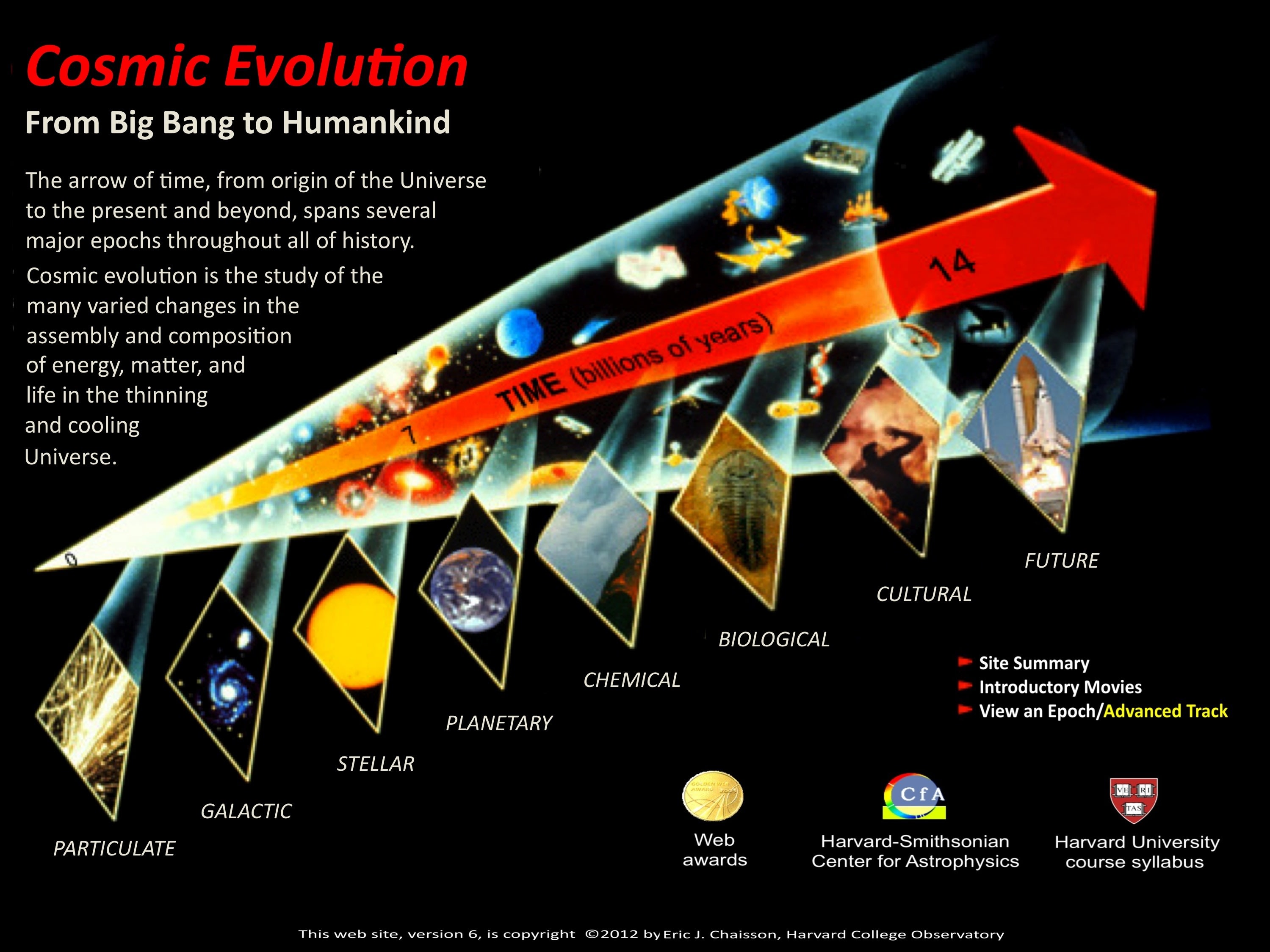
(a meta-narrative!)
We've already seen how RAW had developed a organicist, or vitalist outlook on cosmic evolution with his relationship with plants. I will discuss some of the wider views what I call his cosmotheism.6
RAW was impressed with what physicalist/reductionist Biology had done with the Ne-Darwinian synthesis.7 During the 1970s his reading convinced him that NeoDarwinism could not be the Final Answer in Biology. In a September 1974 essay in Green Egg, Wilson argued that a huge mistake was made when Giordano Bruno's erotic cosmology was overthrown in favor of Newton; in the 20th century both Wilhelm Reich and Timothy Leary had tried to revive Bruno's pantheism but both were thrown in prison. In the late 1970s, after Leary's release, RAW helped Leary flesh out his Eight Circuit Model of the brain and consciousness. The first four circuits were heavily scaffolded upon NeoDarwinian ideas. By 1977 RAW had speculated that the 8th circuit had to do with consciousness outside bodies, or what Aldous Huxley had called Mind At Large:
Consciousness probably precedes the biological unit or DNA tape-loop. "Out-of-body experiences," "astral projection," contact with alien (extraterrestrial?) "entities" or with a galactic Overmind, etc, such as I've experienced, have all been reported for thousands of years, not merely by the ignorant, the superstitious, the gullible, but often by the finest minds among us (Socrates, Giordano Bruno, Edison, Buckminster Fuller, etc.). Such experiences are reported daily to parapsychologists and have been experienced by such scientists as Dr. John Lilly and Carlos Castaneda. Dr. Kenneth Ring has attributed these phenomena to what he calls, very appropriately, "the extraterrestrial unconscious."8
RAW published a very brainy quiz for Steward Brand's Whole Earth Catalog in 1989. In it he asks Questions, then a couple of pages after that he discusses Answers. After every Question he has a box for True or False, but the article is titled, "Beyond True and False: A Sneaky Quiz With Subversive Commentary." Questions #31 and #32 read thus:
The Darwinian Theory of Evolution has been conclusively proven.
The Darwinian Theory of Evolution has been conclusively disproven.
When we skip ahead to the Answers, we read:
31 and 32, asserting that Darwinian evolutionary theory has been proven or disproven, I personally would classify as None Of The Above. I regard such assertions as propaganda in the Cold War between Darwinians and Creationists. The Darwinian theory has more or less stood up for over a hundred years, has flaws which most biologists now admit, and may need considerable revision in the near future, but remains, as Popper9 has often argued, not in the same ball park as all the "laws" of sciences like mathematical physics. (Personally, I don't see any better biological model around than Darwin's but considering the criticisms recently raised within biology I strongly suspect a better model will arrive shortly — and will probably be equally offensive to Creationists…)10
It's not that RAW ever really broke with this position; it's just that he was more interested, from the 1980s to his death in 2007, in thinking about all those aspects that seem unanswered by the Physicalist Neo-Darwinian scientists: how life began on this planet, anomalies, erotic cosmotheism, the necessity of some sort of Mind in evolution, etc. In a 2003 interview with Gabriel Kennedy, RAW talks about how Space/Time/Matter can't be broken up; they make a whole, and then he pretty much confirms what he was thinking about NeoDarwinism in the mid-1980s:
Obviously, you can't leave mind out wither, because how do you know the space-time-matter are there are all unless there is a mind to observe them. So, space-time-matter and mind make up the four parts of any transaction. So where does that get us?
GK: It's good for me.
RAW: Oh, yeah, also, I object to Fundamentalist Materialism. Although, in some ways I lean very closely to what I'd call a literal materialism as a working hypothesis that's safe most of the time. As long as you're directed into a goddamn dogma or an idol. The Fundamentalist Materialist is what I call these people, this mindset, that takes the materialist model and revers it as passionately as a religious conviction. Like some of these goddamn Darwinians I see in television. To me, they're as embarrassing as the Fundamentalist Christians they're arguing with. All these Fundamentalist Christians are yelling, "God created the world in six days." All the Fundamentalist Materialists are yelling back, "Evolution is not a theory; it's a proven fact." Well, it's not a proven fact. It's a hypothesis. It's a very plausible hypothesis, seems to me the most plausible hypothesis. You can't confuse it with a fact; in the first place it can't be tested in the laboratory, so it can't be refuted. According to Karl Popper, any theory that can't be refuted is not part of science. I think evolution did occur. I mean I beliee in it. But, jesus, some of these people are so fanatical about it they sound just like the Christians.11
A very fine yet massive detail here, that many seem to miss, possibly because our culture has brainwashed so many people into thinking in just two categories: Right/Wrong; True/False; Science/Not Science, etc: Wilson agrees with the Neo-Darwinian synthesis, but objects to calling it a "proven fact" on grounds laid down by Karl Popper's epistemology. Is Darwinism science? It looks like it, yea, to RAW. Is it on the same epistemological level as mathematical physics? No. In Wilson's universe there are many granular levels of detail and no one Knows All.
In the late 1970s and early 1980s, Wilson crammed a lot of his ideas into his Schrödinger's Cat Trilogy of novels, which contain a dizzying level of free play with scientific ideas, along with scads of non-science. Leary and Wilson had pounced on Harvard biologist Edward O. Wilson's massive, seminal, wildly controversial 1975 book Sociobiology: The New Synthesis. They both read it like Talmudic scholars and RAW's subsequent writings, including the novels that make up Schrödinger's Cat reflect this with musings on insects, ecology, genes, ethology, status hierarchies, and ideologies.12
Later RAW criticized EOW for giving humans very short shrift (EOW was an Entomologist by training), and asserted that Sociobiology only addressed the first two of Leary's Eight Circuits. In 1991 RAW cited JBS Haldane's golden quote about the Mind behind evolution: "The great biologist, asked what dominant trait he would attribute to the Mind behind evolution - if he admitted such a Mind - replied at once, 'an inordinate fondness for beetles.'"13
We will see that RAW asserted a more Grand and poetic idea for this Mind, and that he has many more allies both in the Academy and outside it in 2026 than he had at his death in 2007.
(I will try to conclude these essays on RAW's cosmotheism, vitalism, and his personal efforts to transcend physicalist NeoDarwinism in the next section. Wish me luck! - Michael/OG)
1Wagner was writing An Insider's Guide to Robert Anton Wilson, which was published in 2004, and then appeared in an updated version in 2020.
2Wilson's wife of over 40 years. She was a poet and intellectual and mother of four.
3RAW used this self-description candidly if ironically many times when discussing his life in the 1950s.
4see the final page of "'Even A Man Who Is Pure of Heart': The Horror Film as American Folk-Art.", Journal of Human Relations, 1971.
5From the essay "Left and Right: A Non-Euclidean Perspective," in Email To The Universe, Hilaritas ed, p.131.
6Spoiler Alert: RAW's cosmotheism would have as its preferred pronoun "It." Absolutely not "He."
7Neo-Darwinism is Darwin's theories plus genetics, which was fleshed out and published by the the Augustinian friar Gregor Mendel in 1866, but not discovered until 1900, when three different scientists found his writings on genetics. Have there been other earth-shattering papers have been written but not known? This would, I presume, constitute a Known Unknown, or possibly an Unknown Unknown?
8Cosmic Trigger vol 1, pp.209-210. In this 1977 work, Wilson had tried to explain what had happened to him when, in July 1973, he began to receive messages from the Sirius star system. He had spent the previous 15 years doing Self-Experimentation on his own mind with cannabis and psychedelic drugs, ceremonial magick, yoga, breathing techniques, deep immersion in readings of difficult writers such as Joyce, Pound, Crowley, and an astounding amount of writing. Possibly underrated was his burgeoning commitment to what he called "Model Agnosticism," which was a radical openness to signals and ideas that he did not hold in his "monster of erudition" days. In reading in a delirious number of texts, including tabloids, Anthropology, all schools of Psychology, "crank" literature, and phenomenology, he sought to enter other peoples' "reality tunnels" to see what it's like living there, before exiting, reflecting, and entering other reality tunnels. All this reading was combined with practices in secret society initiation and ritual and he was an ordained witch. Among many other things. All this probably contributed to his "contact" with Sirius, which taxed his considerable powers of skepticism and doubt. After grappling with different models for what had happened to him, he used metaphors from the Tarot deck to lead his way out of "Chapel Perilous." Then his youngest daughter was murdered in Berkeley. It's all covered in this book, a sort of memoir that's still very difficult to categorize. In the quoted passage it's easy to link Lilly's contact with ET intelligence as solely to do with psychedelic drugs, but upon further study this seems facile to me. It seems more complicated. As for the charlatan Castaneda, RAW would catch on around 1979 or 1980, with the works of Richard DeMille, among others.
9Sir Karl Popper had stressed that scientific ideas need to be falsifiable through experiment, or they cannot be truly scientific ideas, one of the great epistemological gambits in the history of science and I'm sure today someone has written about how falsifiability was a mistake.
10The Fringes of Reason: A Whole Earth Catalog, edited by Ted Schultz, pp. 170-173.
11Read Kennedy's interview HERE.
12Examples: in The Universe Next Door, Benny "Eggs" Benedict, a journalist, "had actually read Darwin once, in college a long time ago, and had heard of sciences like ethology and ecology, but the facts of evolution had never really registered on him. He never thought of himself as a primate. He never realized his friends and associates were primates. Above all, he never understood that the alpha males of Unistat were typical leaders of primate bands." (p.15, omnibus ed.); Blake Williams is at a loud, crowded cocktail party: "…which is why we're all deviates. If Mother DNA had wanted us all to be replicable units, She'd have made us insects instead of primates…" (The Trick Top Hat, p.212, omnibus ed); in The Homing Pigeons, Dashwood is lecturing on humans as primates: "It's a biochemical fact," Dashwood said, "that ninety-eight percent of our DNA is identical with chimpanzee DNA. Eighty-five percent of our DNA is identical with the South American spider monkey, our most distant relative in the primate family. This means, gentlemen, that most of our behavior is genetically programmed to follow the same survival, status, and sex programs as the other primates." Dashwood goes on at length, is interrupted by someone who shouts "Bullburger." Dashwood, a comic figure, thinks, this is a typical primate reaction to a threat. RAW then has Dashwood use a long novel as an example of reminding the reader, on every page, that they're primates, and what the effect on the reader would be. He then goes on: "Even stranger, if I stopped mentioning it for about two hundred pages, the readers would all forget it quickly, and be startled if mentioned it again on page five hundred fifteen." This passage occurs on p.515 of the novel(s). RAW does indeed repeat at length in these three novels that we are "domesticated primates." It's strong poetry, and a political move on his part. But having the persnickety professorial figure of Dashwood break the Fourth Wall and talk about reading a long book that repeats that humans are primates and then just seeming to pull the page number of 515 out of thin air, while the passage indeed occurs on that page, seems like a strong nod to his legion of cannabis-infused readers.
13Cosmic Trigger vol II, p. 44, Hilaritas ed. "The Big Bang…And Its Consequences."
Robert Anton Wilson on Plant Intelligence, (Part 1?) [ 05-Jan-26 12:59am ]A poor kid born three years into the Great Depression, near Brooklyn, who contracted polio as a child and was enamored of Weird Tales and mathematics and poetry, you might think Wilson would not be a good candidate to develop a pantheist, vitalist, panpsychist point of view. He was not a hiker (the polio), but in the 1970s in Northern California he and his wife Arlen were very much involved with modern paganism and definitely did magickal rituals in Berkeley and met other pagan artists and intellectuals in the redwoods in Northern California. What was the trajectory? How did he develop this mystical outlook?
1940s and 1950sRAW received the Sister Kenny Method1 of treatment for his polio, which orthodox medicine did not approve of. It consisted of hot compresses and soft, or "passive" manipulation of affected body parts. This nurse-nun thought the muscles of polio patients needed to be "re-educated," having been "alienated." It's part of the basis of what we call "Physical Therapy" today. RAW was able to walk without much trouble for most of his life, until he was forced to deal with Post-Polio Syndrome symptoms during his last ten years.
This Substack is reader-supported. To receive new posts and support my work, consider becoming a free or paid subscriber.
This healing via unorthodox method planted a strong suspicion of the authority of the American Medical Association throughout his life.
As a 24 year old intellectual in New York, Wilson found out Wilhelm Reich's books were being burned at the Gansevoort Incinerator, in 1956. Trucks backed up to the incinerator at Gansevoort and Hudson and dumped six tons of Reich's books there, where they were burned. It was largely American liberals and the FDA that were behind this. The Nazis had earlier burned Reich's books. Wilson had become extremely affected by WWII and the Nazi regime and had imbibed the message that fascists burn books, but we are free and for free speech. It was only 11 years since the end of the war. He had to understand why a former star pupil of Freud was so vilified and feared by authority. RAW went on the study Reich's books for a good portion of his life, and if you know nothing of Wilhelm Reich but are interested, you might want to read Wilson's Wilhelm Reich In Hell, a play, with a Shavian preface by RAW, in which he discusses Reich's individual theories, persecution, paranoia, and the role of heretical thought in societies.2
Reich had been persecuted by the Stalinists also. He was kicked out of the Communist Party for his sex theories and especially for his 1933 theories of why fascism seemed to be the default mode, worldwide, throughout history. Reich's The Mass Psychology of Fascism appeared in 1933. Why would "socialists" (or "communists" for that matter) be so threatened by a book on fascism?3
For our purposes, later in his career, Reich became convinced there was an undetected life-giving force that permeated the universe. It was called Orgone. RAW cited a long history of peoples all over the world re-discovering this vital force. If you've heard, read about, or had your chi manipulated, or were told how to breathe to build up prana, you know this force.4
One of the giants of post-WWII scientific ecology, William Van Vogt, published The Road To Survival in 1948, when Wilson was 16, and Wilson read that and began following Ecology as a science before the age of 20. He was also heavily influenced his entire life by Erwin Schrödinger's What Is Life? (1948), which was at the nexus of quantum theory, the new Information Theory of Shannon, and Biology, and could be considered a backdoor for respectable neo-Darwinists to entertain ideas that might be considered quasi-vitalist.

(in nature there are no "natural" closed systems: everything is involved with everything else)
Wilson was also a riveted reader of Sir James Frazer's The Golden Bough, and there is much from Frazer about ancient peoples fucking in the fields to encourage plant growth. Sexuality and fertility of humans was analogous to fecundity of plants, and this vital, progenitive sexual force seemed to have been intuitively known by ancient peoples, and might be considered the ur-religion. More on this below.
"Herbert Muller, a Nobel laureate in genetics, once said that we're all giant robots created by DNA. There's a lot of truth in that metaphor. DNA is immortal and has designed everything. Bucky Fuller points out that there's no engineer or technologist, including himself who's achieved the simplicity and tremendous structural strength and economy of a tree." - Wilson in a 1977 interview with Weird Trips magazine
Wilson in Southern Ohio, 1962
On December 28, 1962, Wilson had his first psychedelic trip, on peyote, in an old slave cabin in the woods near Yellow Springs, Ohio.5 He experimented very extensively with peyote in the woods - at least 40 trips - and one time, the day after a trip, while weeding in the garden, "a movement in the adjoining cornfield caught my eye.":
I looked over that way and saw a man with warty green skin and pointy ears, dancing. The Skeptic watched for nearly a minute, entranced, and then Greenskin faded away "just a hallucination…" But I could not forget him. Unlike the rapid metaprogramming during a peyote trip, in which you are never sure what is real and what just the metaprogrammer playing games, this experience had all the qualities of waking reality, and differed only in intensity. The entity in the cornfield had been more beautiful, more charismatic, more divine than anything I could consciously imagine when using my literary talents to portray a deity. As the mystics of all traditions say so aggravatingly, "Those who have seen, know."6
Wilson reads the new book by Castaneda five years later and this same warty green being, the spirit of the peyote plant, Mescalito, appears. So RAW had an experience with this entity before reading Castaneda, and this was a challenge to his educated Materialism. Could Mescalito be part of the Jungian unconscious? The anthropologist Weston LaBarre in his The Peyote Cult cited this dancing green warty being as seen by many peoples.
Is Mescalito a Vegetation "plant spirit"? It taxes the sophisticated intellectual's credulity. And yet, Paracelsus had believed in these beings. So did Goethe, Rudolph Steiner, Gustav Fechner, Luther Burbank, and George Washington Carver. Thomas Edison was determined to catch these spirits on film, but never did.
In wondering what might be going on here, RAW cites that eccentric, uncategorizable 1973 book The Secret Life of Plants, and IBM's Marcel Vogel, who studied plant-human telepathy for over a decade: Vogel hooked up a polygraph to plants while people in the room…thought erotic thoughts. "The plant responded with the polygraph pattern typical of excitement."7 Vogel's findings naturally trigger wonder about Reich's orgone and plant-human connections, Frazer's fucking in the fields idea, and:
Brief Detour to Ancient Babylon, Egypt, IndiaMescalito could be both an archetype of Jung's Collective Unconscious and an anthropomorphized human translation of a persistent signal sent by the molecular intelligence of the vegetative world. Naturally, the ability to decode such orgonomic or neuro-electric signals would be eagerly sought by all shamans in societies dependent on agriculture. In other words, according to this model, Mescalito is a genetic signal in our collective unconscious, but activated only when certain molecular transmissions from the plant world are received. 8
If Cleve Backster (discussed in my previous article about Plant Intelligence), also a major player in The Secret Life of Plants (recall this nutty book predates by 50 years all the surprising new data on plant signaling and intelligence) and Vogel used polygraph machines to obtain data from plants, how did the ancient shamans know that fucking in the fields was a powerful magic to enable the crops to flourish? They got this info from the amanita muscaria mushrooms, psilocybin-containing mushrooms, cannabis, and peyote. Wilson's reading leads him to the idea that the only religious practice older than taking plant-drugs is the ritual orgy. Frazer called these knowledgable shamans "Primitive Scientists." Wilson thinks they discovered the "magick function of the ecstatic state" and it seemed to lead, historically, to hierogamy or "sacred marriage," where, in Egypt, Babylon, Persia, India, the mass ritual orgy in the fields was condensed down to one significant couple having intercourse to ensure, not just the crops, but the welfare of all their people. Often this couple was the King and his sister. (Look up Royal Incest in Egypt, for example.)
While this might disgust us, Wilson thinks the development of mass orgy ritual in the fields to hierogamy may have led to the practice and philosophy of Tantra.9
Timothy Leary's "Vegetable Conspiracy": As Wilson AdvocatesBoth Leary and Wilson held varieties of panpsychism, erotic cosmology, and the like that I lump under the rubric of "cosmotheism", being influenced by esoteric scholar Wouter J. Hanegraaff. Check out how this psychedelic idea plays out in 1977, as RAW talked to Weird Trips magazine. Our linear, left-brain, one-thing-after-another-rational-empirical brain has led us to the brink of environmental collapse, and clearly, we need to learn to think with general systems, ASAP. (Or is our time on this planet a fait accompli?) Here's RAW explaining a Leary idea:
[…] because we've been thinking too much with the left brain we've been creating ecological havoc on the planet, so that DNA had to get new signals through to us. It did this through the vegetative kingdom which was being severely endangered by pollution and so on. So the vegetative kingdom conspired to get chemicals into us that would teach us ecological common sense. The only way to get them into our nervous system in vast quantities in a quick way is hedonistically. So the vegetable kingdom set out to seduce us with drugs that get us high and make us happy and at the same time open us up to right brain activity. You see, the fifth circuit is the sugar coating to get us into the sixth circuit. First it turns us on and gets us high, and then it opens us up to a more cosmic perspective. It's a vegetable conspiracy to communicate with us. The mushrooms and the cacti and the hemp and so on are signals from the vegetable kingdom to our nervous system.10
This seems to me a funny riff on cosmic conspiracies. It reads like a sort of hippie fable. And yet, like all fables, it teaches something true at its core. Given the science I've read on the molecular structures within plants that get people high via passage of the blood-brain barrier and plant molecules looking enough like serotonin to be picked by receptors in the brain, the intentionality of plants to develop these chemicals in order to teach us a "cosmic perspective" seems ludicrous, if a hilarious rhetorical ploy by Leary and Wilson. These chemicals were there WAY before we started the spoliation of the planet; what's fascinating to me is the happy accident of shamans and psychonauts stumbling onto these plant substances. For Wilson to repeat this Leary riff speaks, I think, to his quite serious ideas about plants and vitalist cosmotheism. His erotic cosmology. For which I see Giordano Bruno (1548-1600) as the original progenitor in the Modern era.
Sidetrack: Bruno's Erotic CosmologyBefore the Inquisitors, a trial in Venice,11 Bruno was given a chance to recant, soften, or amend some of the things he had written or said, but he chose to make things worse for himself, or he didn't understand or care about the situation he was in. He talked of how everything lives, grows, acts and abides in perfection, due to Providence, but that "God" communicates in an "inconceivable" way and "God"'s essence, presence, and power are "unspeakable." Here's Bruno, not exactly sounding like what the orthodoxy of the Catholic church wants to hear from one of their own:
Now I understand all attributes to be one and the same in Deity, and, with theologians and the greatest thinkers, I conceive of three attributes: power, wisdom, and goodness; or, mind, comprehension, and Love. Things are through mind, they are ordered and distinct through intellect; they are in harmonious proportion through universal love, in all and above all. There is nothing that doth not shine in being, any more than anything is beautiful without the presence of beauty; wherefore nothing can exist shorn from the divine presence. [And here's where they start gathering the kindling-OG] But distinctions in the Divinity are made by the method of Discursive Thought and are not reality.
Pantheism, held together by Love. There is no Trinity, which men made up using their powers of reason. Whatever God is, it's unspeakable, but we see this higher power's trace in Love and - literally - everything. Any divisions between Father/Son/Holy Spirit were concocted by men. Bruno wasn't buying. And he had a hard time finessing his positions once he got nabbed.
Bruno talks of other planets and worlds, which alone was probably enough to get him burned to a fine crisp:
I hold the universe to be infinite as result of the infinite divine power; for I think it unworthy of divine goodness and power to have produced merely one finite world when it was able to bring into being an infinity of worlds. Wherefore I have expounded that there is an endless number of individual worlds like our earth. I regard it, with Pythagoras, as a star, and the moon, the planets and the stars are similar to it, the latter being of endless number. All these bodies make an infinity of worlds; they constitute the infinite whole, an infinite space, an infinite universe, that is to say, containing innumerable worlds. So that there is an infinite measure in the universe and an infinite multitude of worlds. But this may be indirectly opposed to truth according to the faith.
No! Ya think, Giordano? Hey, we now know your vision was far more close to being scientifically true - as of three weeks ago, there are 6065 confirmed exoplanets in our little backwoods galaxy, the Milky Way. There are 1025 confirmed planetary systems: a star that has more than one planet orbiting it, like ours.
Bruno then - and it's very hard to understand his little shifts here and there, but we must place a heavy burden on him being kept in solitary squalor for years at this point - Bruno tries to explain how he agrees with Aristotle about the Prime Mover thing and tries to square this with the doctrine of the Trinity, but then he says, "All things, souls and bodies, are immortal as to their substance, nor is there any other death than dispersion and reintegration." Here Bruno sounds like an atheist. I like to think Bruno would like the recent "mushroom suits" people are providing for their own deaths: something that will allow their dead bodies to break down more quickly so their organic compounds can feed the soil and flowers more efficiently. Bruno at this point said he thought the souls of the dead might take up residence in other things: the dreaded transmigration of souls, metempsychosis, strictly verboten to think about. But I'm getting way ahead of myself here. Suffice: The Nolan is not doing a good job buying fire insurance.
Admitting he could never see how finite flesh of a human could be fused with the Word, Bruno tells the authorities their Trinity doctrine is bullshit:
To make clearer what I have said, I have held and believed that there is a distinct Godhead in the Father, in the Word, and in Love, which is the Divine Spirit; and in Essence these three are one; but I have been able to grasp the three really being Persons and have doubted it. Augustine says: "We utter the name of Person with dread when we speak of divine matters, and use it because we are obliged." Nor have I found the term applied in the Old or New Testament.
As he continues to be grilled on official Church doctrine, a prosecutor - Gabrielle - asks, "And so you are a skilled theologian and acquainted with Catholic decisions, are you?" Bruno answers: "Not much. I have pursued philosophy, which has been my avocation." It's around here I get the feeling Bruno's burning at the stake would be a fait accompli. Bruno's grilled on magick books that Mocenigo told them he found in Bruno's possession:
Judge: And what of the books you are known to have read? Occult books, the works of heretics?
Bruno: I have indeed seen condemned works such as those by Raymond Lully and other writers who treat of philosophical matters. I scorn both them and their doctrines.
Here Bruno's outright lying to save his bacon, not realizing it was already in the pan. They found Seals of Hermes in his possession. Bruno had mocked the Faith. He insisted that the universe was infinite, which was bad, but to posit there must be Life on other planets throughout the universe: Burn Him. It was bad enough that he embraced the brand-new ideas of Copernicus. He denies the Trinity. He is burned alive, with an audience, in Rome, February 17th, 1600.12
Hanegraaff goes to long, articulate lengths in showing how, after Bruno, the Church, then embroiled in corruption, official doctrines about occultism, Hermeticism, etc being a no-no, but the new Protestant sects were overtaking them here. And then there was the so-called Age of Reason, and the advent of modern materialist science. Over the next 400 years, thinking like Bruno would be to think like a weirdo, the Other, and Hanegraaff details exquisitely the making of scientific reality vs. an "orientalized" Other that included Hermetic thought, magick, occultism, alchemy, and this notion of Intelligence being inherent in all things, which we today are seeing called panpsychism. Hanegraaff shows there have always been varieties of panpsychism. He asks us to imagine an extreme "manichean" dualism and extreme pantheism:
Robert Anton Wilson's CosmotheismBut by far most typical for the context of "Western esotericism" are the many intermediary "panentheist" versions that may be referred to as cosmotheism. The term was coined by Lamoignon de Malesherbes in 1782, and adopted by the Egyptologist Jan Assmann as a logical counterpoint to monotheism.13
In a June 16th, 1983 (Bloomsday) interview conducted by John van der Does, at Wilson's Dublin residence within sight of Martello Tower, RAW addressed his cosmotheistic ontology. John asks RAW why he calls God "It", which might be confusing for people:
Actually I started that back in 1959. I was reading Science and Civilization by Joseph Needham, and I was thinking that I agreed with the Taoists more than any other religion. And I started asking myself why.
RAW discusses the semantics of "It" over the three great monotheisms - Judaism, Christianity, and Islam - and their "He." He thinks this neurosemantically makes us think of a "cosmologically huge human being," which can't be correct. "I do have a very strong intuition of some kind of cosmic intelligence. I'm an agnostic on the level of not being passionately convinced. I just have a strong intuition of cosmic intelligence." He returns to this intuition in hundreds of places in his work, both fiction and non-fiction. My suspicion is that he was averse to just saying he "is" a panpsychist, though in other places he says this outright. He goes further:
I thought, "Cosmic intelligence is not a gaseous vertebrate," which was Thomas Henry Huxley's description of the Christian God. It does not have a penis, so it is not a "He." I can't think of it as an Eastern potentate or king. All the Christian symbology, "Our Almighty King or Lord," "Our Great Father," etc, seems to me to be a continuation of infantile thinking projected onto the universe. I don't think the universe is a punishing father. I don't think it has any of the traits of an old paranoid man. It's impossible for me to think of cosmic intelligence peeking into bedrooms, taking notes and giving people gold stars for making love the right way, and black stars for doing it the wrong way. All that seems absurd to me. So, I can't take Christianity seriously as an intellectual force. It's a continuation of infantile anxieties.14 And so, the same goes for Judaism and Islam. As far as the Western World is concerned, I'm an atheist.
RAW goes on to elaborate on his idiosyncratic cosmotheism.
But I do have a strong intuition of cosmic intelligence, and I find Buddhism quite compatible. But I find Taoism even more compatible. So, I prefer to speak of cosmic intelligence as It rather than He.15
Skipping down:
I have reverence for a great many things: trees, flowers, animals, children, some adults, art, Beethoven, Bach, mathematics, great scientists, the sun and moon and stars, and the ocean and rivers…To quote T.S. Eliot, whom I generally don't agree with, "I don't know much about gods, but I think the river is a strong, brown god." I feel all things are full of gods. So, I have reverence for a great deal.
RAW then talks about intelligence as radically decentralized and cannot relate to Martin Buber's I-Thou relationship because of this. "Every biological system is intelligent, if you really understand what Darwin is saying. But it's not a centralized intelligence, it's a decentralized intelligence. Darwin's ruling metaphor is the tangled bank, with every plant trying to maintain its own space to expand its roots, and the whole system is intelligent."
He then expounds on the Margulis-Lovelock hypothesis of Gaia. "I'm inclined to think that probably on a higher level, the galaxy is an intelligent being." Remember: this is his "intuition." He refuses to commit. Further in this marvelous interview RAW speculates on Teilhard de Chardin's idea of the noosphere, which he not only thinks is real and true; It, too, is evolving:
Well, the noosphere is the mental part of existence. Consider the mental as having an existence that you can think about, although I know some materialists try to pretend it doesn't exist. It palpably does. When I talk to you, obviously I'm feeding things from my mind into yours. When you talk to me, your mind is feeding stuff to me. And I can communicate with dogs and they can communicate with me. I have a certain amount of success in communicating with all life forms. By experimenting, I found, to some extent, I can communicate with plants.16
Okay, Substack just dropped its red banner on me about my perennial problem: length. I see I'm up to 5000 words here today, so I will take a rest. If you liked this, I'm very glad. If you want more, I have a whole lot more. Let me know! It was fun researching these last two articles on plant intelligence and cosmotheism. William Zinsser was a big influence on me with this book Writing To Learn.
There is a LOT more about Wilson's cosmotheism, which I will get to in due time, but the OG also needs to think and write on other topics. If you have any topics you'd like to see me riff on here, please do harangue me about it! - Michael AKA the OG
1Turner Classic Movies aficionados might have seen RKO's biopic Sister Kenny (1946, Dudley Nichols), with Rosalind Russell as the nun.
2The Hilaritas Press ed. of Wilhelm Reich In Hell also contains Forewords by both Christopher S. Hyatt and RAW scholar Eric Wagner that add much to the text.
3Hint: Reich had turned Freud's theory upside down: that in order to have a civil society we must repress sex. Reich thought fascism resulted from repressed sexuality, so we must take action! He also thought the very structural nexus of fascism was in what we call the "nuclear family." So, you can see why he may have riled some folks.
4see RAW's Starseed Signals, p.337. He includes many other vitalist historical forces independently discovered, including "multiplication of the first form" in medieval alchemy, "the first matter" of later alchemists, "animal magnetism" of Mesmer, "OD" or Ordic Force by 19th century chemist/polymath Baron Carl Reichenbach, the "mana" of the Polynesians, the "wakan" of the Native Americans of the plains, and "bioplasma" of Andrija Puharich. The Russians had a "psionic force" while in India they had "kundalini." The Iroqois had "orenda," while the Greeks used "pneuma." In other books and articles Wilson includes Bergson's "elan vital." Borges thought Schopenhauer's "will" in The World as Will and Idea was the same thing as Bergson's "elan vital" and George Bernard Shaw's "life force." Some Jungians consider Jung's use of "libido" to be cognate with Bergson's "elan vital." The Hebrews call it "ruach," while Hans Driesch, a non-Jew pacifist Romantic German influenced by Goethe and persecuted by the Nazis used a rather mundane "Vital Principle." Driesch was also a proponent of ESP and after chased out of Germany was part of the Society For Psychical Research in London. No doubt I'm forgetting many of these cognate terms. Perhaps it's necessary to link Aristotle's vitalistic force, entelechy, here? Lakoff and Johnson consider "vitality" and "life" as substances and containers, respectively, in our cultural metaphors, and not forces. To illustrate vitality as a "substance" they elicit "She's overflowing with vitality" and "He's devoid of energy." "I don't have any energy left in me." "I'm drained." "That took a lot out of me." Metaphors we use for life, which is a container: "I've had a full life." Life is empty for him." "Her life is crammed with activities." "Get the most out of life." "Her life contained a great deal of sorrow." "Live your life to the fullest." : see Metaphors We Live By, p.51. Whether this vitality "really is" a force or a substance might be a moot point here; for vitalist thinking, there's something that science hasn't yet detected but which countless people have felt that is of paramount import.
5Wilson wrote of his time in southern Ohio, on a farm, being associated with Ralph Borsodi and Mildred Loomis's anarchist School For Living, working for the Antioch Bookplate Company and editing possibly the earliest hippie periodical, Way Out, in various places his Cosmic Trigger vol 1 (see pp.19-25) and Cosmic Trigger vol 2, but see Gabriel Kennedy's biography of RAW, Chapel Perilous: The Life and Thought Crimes of Robert Anton Wilson, pp.44-55 for a more integrated view of RAW in southern Ohio.
6Cosmic Trigger vol 1, p.22
7Cosmic Trigger vol 1, p.23. See The Secret Life of Plants, by Tomkins and Bird, pp. 32-47, on the experiments of Marcel Vogel on plant sentience, esp. pp. 43-44, in which a group of "skeptical psychologists, medical doctors and computer programmers" convened at Vogel's house and were invited to check for hidden gimmicks or trickery. They talked about "several topics with hardly a response from the plant." It was generally concluded there was nothing going on until someone brought up the topic of sex, and the plant came to life, the polygraph equipment "oscillating wildly on the chart." This brought up speculation about Reich and orgone and Frazer's ideas about fucking in the fields to encourage greater crop yield. It was the 1970s. Vogel rather prosaically posited some sort of "Life Force or Cosmic Energy" that surrounded all living things and plants, animals, and humans: they all share in this energy-force. - Secret Life of Plants, p.39. I'd've gone with Orgasmic Pan-Vital Energy or something like that, but Vogel was an IBM scientist. We're tempted to write Vogel off as a quack of some sort, right? Here's Jacques Vallee, working around the earliest computer networks and ARPANET at Stanford, writing in his journal on May 22, 1976: "I met Marcel Vogel today. He is a massive block of a man, a jovial fellow, an expert at IBM where he studies plant telepathy and other paranormal topics. He made so many millions for them with his discoveries in magnetic recording that they leave him alone, with a fat salary and his own lab."- Forbidden Science 2: The Journals of Jacques Vallee, 1970-1979, p.337.
8Cosmic Trigger vol 1, pp.23-24
9Lion Of Light: Robert Anton Wilson on Aleister Crowley, pp.151-154
10Either Wilson scholar Mike Gathers or I bought a copy of Weird Trips on eBay, or someone sent us a copy, because I printed out the article for my files. Robert Shea is also in this interview. HERE is a link to what Gathers put up at RAWilsonFans.org, a gem of a site for research on RAW. The passage cited here appears about 9/10 down the page. DNA wants to get through to humans, so uses plants. This idea of DNA as God indeed feels a lot more like Leary than RAW, though RAW was in total awe of DNA, to be exact.
11The records of Bruno's ultimate trial, in Rome, were lost, so we must rely on the Venice inquisition. 400 years to the day after Bruno got baked, the Church apologized. Cardinal Angelo Sodano called Bruno's burning "a sad episode" and "an atrocious death."
12I have used transcripts about the persecution of Bruno cited by Michael White in his book The Pope and the Heretic, pp. 85-138. White wrote many good popular science history books, and also mystery novels and thrillers. He lectured on Chemistry at Oxford and was a member of the British pop group The Thompson Twins.
13Esotericism and the Academy: Rejected Knowledge in Western Culture, (2012), Wouter J. Hanegraaff, pp. 370-371. The Egyptologist seems to not be related to a prominent New York proctologist nor to Cosmo Kramer, although a mathematician and a population geneticist determined we're all related to Nefertiti, which brings us back to Egyptian hierogamy. Long ago I read Ludwig von Bertalanffy on General Systems Theory and was convinced that my personal epistemological choices could do worse than to always think with Systems. There are no closed systems, etc. When I read this article on how we are all related to Nefertiti (her name means "the beautiful woman has come" insert joke here), I knew this Systems thing would payoff like this!
14students of the 1st and 2nd circuits, take note!
15RAW notes he wrote "The Semantics of God" for The Realist in 1959, and it was republished in his book Right Where You Are Sitting Now.
16All of these quotes from the June 16th 1983 interview by John van der Does are only found in the Hilaritas Press edition of RAW's Coincidance: A Head Test, which is most often referred by Wilson scholars as his "Joyce book". The interview is not found in the New Falcon editions of the book. The interview is wide-ranging and a doozy for showing not only RAW's ideas of cosmotheism, but his cosmic intelligence on everything. Highly recommended. Passages I've quoted here are in the Hilaritas edition, pp. 341-343.

(artwerk: B. Campbell)
On Plant Inelligence and/or Consciousness [ 28-Dec-25 9:23am ]First off, you're right: we can't even agree on what human consciousness is. A guy in a vegetative state for 19 years suddenly wakes up and asks for a Pepsi1; brain tissue grown from stem cells in a culture - brain "organoids" - might attain consciousness, some think; others demure. I'll believe it when it can tell me what time the Giants game starts. (An organoid is an "it", right? I don't know how I'll feel when it tells me to call it "Dave." Or worse: "Mister Noid.") But you know what will be interesting? Finding out the answer to this question: Which will happen first: Will a brain organoid convince an AI to kill itself, or will an AI go at some advanced organoid hammer and tongs? Or will both events happen roughly concurrently, like on a Wednesday night during Sweeps Week? Is Vegas taking bets yet?2

This Substack is reader-supported. To receive new posts and support my work, consider becoming a free or paid subscriber.
I'm not even sure where I "was" when I found myself downstairs in front of the fridge, eating a bowl of Fun Flaky Bliss Bombs, with milk. To be sure, I wasn't "all there" - but was I conscious? Not in choosing to eat that crap. My gawd, I suspect a consortium of dentists got together - conspiracy! - and came up with those sugar bombs in order to juice their root canal rackets. And I know, this sounds like the typical Ambien joke. And yet I was not on Ambien. Why? Ya got any? Just one? Do me a solid…3 Then there were all those times you drove home from work and when you got home, you didn't remember a thing about the commute. Consciousness? There must be a million flavors of it, many so subtle you don't even notice 'em.
There was a time when I was deep in the weeds in the various arguments about human consciousness. For me, when I took a step back and realized Philosophers, Anesthesiologists, Neuroscientists, Biologists, and yes, Physicists were all weighing in on what David Chalmers calls "The Hard Problem" and that no one was winning this game, no one seemed to be able to score, I realized this might be yet another "problem" we homo saps invent that is impossible for creatures embodied like us, in a gravity well on a planet in the Goldilocks Zone orbiting a Type G main-sequence star, to solve.
Some scientists and philosophers call this "Mysterianism": maybe we can use the equations of quantum mechanics in all our hi-tech industry, but we can't understand what the equations mean about how nature "really" works.4 And to combine the quantum world with Relativity? We've had 100 years of trying to solve this as of this year (2025)5 and everything has only gotten weirder and more inscrutable. So who's going to pontificate about what is conscious and what isn't? Lots of folks, turns out. Real smart ones, too.
I suspect we use our intuition and pick those series of stories that seem most plausible to us, and dig deep there. Until we hit a gas line or bedrock, whatever. Then veer off with a few other stories. I'm borderline Mysterian6 when it comes to the idea of consciousness, but I do favor certain lines of thought over others, and I can only cite something like "tentative intuitive plausibility." I know it sounds rickety and stopped-up with debris, but it's all I have.
All this goes for the origin of life (really cool set of stories there, ongoing, lots of smart folk working on it, rivalries and mudslinging, everything you can ask for as an Overweening Generalist); what happened before the Big Bang (same); what happens after death? (here I find the answers mostly hilarious); and why is there always room for Jell-O?
Finally! I get to:
PlantsA very basic, workable idea of "intelligence" (and maybe consciousness?) is the ability to decode and process energy and information from the environment and respond in ways that look adaptive and intentional. In this plants are looking like they've been overlooked by reductive science since the 1700s. If it turns out to be slam-dunk correct that trees, plants, bushes and all their cousins, were intelligent all along? Why it's just damned embarrassing at the very least. On the other hand, with the way we're heating up the planet, the plants may all just be muttering to each other that it's only a matter of time before the Golden Age of Cretacious II and the mammal parasites are mulch.
You may have seen, or even read, a number of articles on the possibility of plant intelligence over the last 12 years or so. But this idea is an old one. There are the mystics and pantheists and animists, of course, but then the German physicist and early experimental psychologist Gustav Fechner (b.1801) thought plants were not only smart, but had inner lives as well. Admittedly, this was after he had a breakdown when, at a career point desperate for a gig, he took on the job of assembling and translating many thousands of pages of the 8-volume Hauslexikon, which was a sort of 19th century Ladies Home Journal. The tedium broke him. Then he stared at the sun, as an experiment and wrecked his eyes, then stayed inside in a dark room for four years, when he finally emerged and looked at his garden and it sounds a lot like Aldous Huxley on psychedelics in 1953, but it was 1843:
A beautiful glimpse beyond the boundary of human experience. Every flower shone towards me with a peculiar clarity, as if it were throwing its inner light outwards […] One must only open one's eyes afresh to see nature, once stale, alive again.
Fechner answered naysayers. Aristotle thought plants were living things, but stupid, failed living things, dumber than animals because they can't even walk around7 and get their own food. Fechner said plants simply move really slowly (a historical figure named - ahem! - Chuck Darwin thought similarly of plant locomotion), and that plants delight in the sun as we would during a gourmet meal. Because we can't know the inner lives of each other, we must assume that when we gaze into each others' eyes and see something like ourselves, that the other must indeed be like us, and this includes our experiences interacting with plants. People like Sam Altman apparently extend this mode of phenomenological existentialism to artificial "intelligence." I know this sounds nutty, but hey, William James liked Fechner, too. As an undergrad taking a bunch of Psychology classes I put the finger on Fechner as one of the earliest lab psychologists, with Wundt and Helmholtz, and they were all wiggy German weirdos I would have loved to hang out with. The physics of the mind, was what they thought they were doing.
Later I read The Secret Life of Plants, by Tomkins and Bird (1973), which Michael Pollan called "a beguiling mashup of legitimate plant science, quack experiments, and mystical nature worship that captured the public imagination at a time when New Age thinking was seeping into the mainstream."8 There's a brief discussion about The Secret Life of Plants in The Madman's Library: how a documentary was made about the book with Stevie Wonder writing the music, how one of the stars of the book, Cleve Backster, was invited on Johnny Carson and David Frost, and "All this, despite the fact that Backster's research, and the book as a whole, were derided as pseudoscientific nonsense by the scientific community."9
At the same time, in 2025, studies in Plant Behavior are advancing at a torrid pace.
Brief Disclaimer, in Brackets[Despite my tone here, I have come around to plant intelligence, if not plant consciousness. The unevenness of this tone - flighty, devil-may-care, smart-assed cannabis-infused wiseacre combined with an attempt at High Seriousness about plant intel - only serves to highlight the pixillated quality of my current stance of Yep: Plants Are Intelligent and Possibly Communists To Boot assertions here. I spent most of my life with an ontology of Plants Are Dumb, and now every day I'm reconfiguring old brain circuits, deleting here, editing there, writing new code in my subcortices: plants communicate to each other, allocate resources to those in need, use strategies to combat predators, discern, are mostly ecumenical in plant terms, etc. It's a bit overwhelming, frankly. Plants seem - and I can't believe I'm typing this - wise. What do they do if they're attacked?, you ask. Well, they release volatile organic compounds (VOCs) because they have stress-response genes: kinda like using pepper spray on an unwanted sexual advancer. But their plant neighbors are listening in on the commotion and preparing for a similar attack on themselves. Smart move, guys.
Possibly my biggest ethical quandary that has arose from my Shift: I still eat some of these intelligent beings, and so far I rationalize it as, somehow, That's What They Want, which will never feel satisfactory, and, indeed, it's a lot like "Look at what she was wearing. She was askin' for it!" I realize I've skipped over the eating of animals, which I would rather not write about right now, 'cuz of…cultural baggage. Any and all advice here about eating plants would be greatly appreciated.- OG]
HyphaeIn fungi and some bacteria, hyphae are long tendrils of filament. They are a collection of cells surrounded by a "septum"-like tube wall that is just porous enough to exchange mitochondria, ribosomes and nuclei. This, I found, mindblowing. Because I have studied - strictly as an OG, remember - tens of books on neural transmission in human brains. A collection of hyphae is called a mycelium, a word I find mellifluously pleasant. Mycelia use spores to reproduce. Spores give rise to fruiting bodies and eject themselves from these fruiting bodies (like a mushroom) and travel for many miles on air currents before landing and taking up residence elsewhere. They are "ramblin'" agents like it's nobody's business. 'Tis a hot topic among paleontologists and plant geneticists whether they preceded land plants on this planet (Earth; Gaia) or not, but microscopic fossilized spores from embryophytes called cryptospores have been dated to the mid-Cambrian epoch, which was some time after the Big Bang and much before the Moslems were beaten back by Charles "The Hammer" Martel in current-day France, Battle of Tours, 732 CE.
Are spores really that badass, you ask? Well, radiotrophic fungal spores have grown inside the abandoned nuclear reactor at Chernobyl and use melanin to convert gamma radiation into chemical energy; other extremophiles can withstand pressures six times that experienced at the bottom of the Marianas Trench, some are totally fine living in temperatures near Absolute Zero (sans parka), and other extremophiles survive the vacuum of space, which has led to the theory of Panspermia: that life on Earth started elsewhere, which may be the ultimate cliff-hanger: okay…so where did that life start? Etc…So yes, Virginia, spores are badass. All the extremophiles must be given mad props by us homo saps, or I'll just speak for myself: I complain it's too cold when it gets below 55 degrees F; whine like a wuss when it tops 90F outside. Hat's off to extremophiles everywhere! (And make no mistake: they are everywhere.)
Mycelia save our lives every moment of every day by decomposing plant material. So relax about raking the leaves: among us the fungus would break down, transform and re-purpose the leaves, though I can't promise that busybody Mrs. Schwartz won't complain to the Homeowner's Association first. Life is complicated like that.
Oh yea, mycelia also make the soil more organic and release carbon dioxide back into the atmosphere as part of the carbon cycle. They carry water, don't chop wood as that would be a betrayal. They seem the nexus of electrical-chemical transactions of information, kinda like your how your nervous system is working right now as you read this puffball piece.
Hat's off to hyphae, dendrites of the vegetable world.
Plant PhilosophySounds kinda absurd, but it's burgeoning currently. Philosopher Stella Sandford of Kingston U. in London, who's written a couple of books on plants and philosophy, writes:
The new plant philosophy has emerged partly in response to this work in the plant sciences, and especially to the new paradigm, because the series of concepts that mark out the new paradigm as new - agency, intention, consciousness, and so on - are already the topic of considerable and long-standing philosophical debate. As soon as attention is focused on plants, broader issues emerge. For it is not just that philosophy is interested in plants; we discover that plant life, or the specificity of plant being, challenges some of the cherished assumptions that have dominated the Western tradition for centuries, if not millennia. Plant philosophy is about more than plants. It is also about how the peculiarities of plant life challenge us to think about our own being in new ways.10
And boy is it a challenge for me. I mean, I'm easily in or approaching my dotage: am I ready to keep reconfiguring my thinking to deal with plants as intelligent? I've already gone over right wing attacks on this: it's a conspiracy by radical environmentalists to try to keep us from the despoilment of the planet. I've looked at enough of the studies and evidence by now to see the (ironically) "conservative" attacks as childish. Big surprise!
It appears abundantly obvious that learning and responding to the environment doesn't require neurons; neurons are how mammals like us do it; nature seems to have developed an array of ways to extract information from the environment and convert it into Intelligence.
How are you dealing with this rapid influx of data on how smart plants were and how for most of our lives we've treated them like, I dunno…Stephen King's "Carrie"? If you've begun therapy, I understand.
Psychonauts Were of Course Avant Garde HereDennis McKenna, on what psychedelic plants can teach humans:
"They also teach us biophilia. Basically on a fundamental level you come out of a psychedelic experience with a feeling for the sacredness of all life and a love of life, and that's an important thing to integrate. They teach us animism: the perception that everything is alive and intelligent. And on the global level they teach us pantheism -- the notion that the universe itself, the world itself, is alive and intelligent. This is the worldview of most indigenous cultures that use psychedelics, and it becomes the worldview of individuals in our culture that use psychedelics."11
In The Internet Is Not What You Think It Is: A History, A Philosophy, A Warning (2022), philosopher Justin Smith-Ruiu (formerly Justin EH Smith), who recently came out as a psychedelic user, and it turned him into a Catholic (!), argues for Internet within the context of Gaia, with many learned examples and it's most definitely trippy.12
Matthew Hutson took LSD, then asked scientists about altered states and their power, then began to see trees as smart. He talked to naturalist Sy Montgomery, author of Soul of an Octopus, who had compared her scuba diving and octopus-research to LSD: "I find myself in an altered state of consciousness, where the focus, range, and clarity of perception are dramatically changed." In an email Montgomery told Hutson that "the mental experience of one species is no more real or valuable than any other." Hutson, an atheist since age 10, was backpacking in the Sierras when a tree seemed to want to commune with him. 13
Am I making this next one up as a psychonaut - am I pulling your leg? - or could it be real?: MIT scientists transformed the leaves of spinach into a bomb-detection device that can sense not only explosives but dangerous chemicals in the air, and thereby transmit the info to our digital phone? Sounds psychedelic! But it's actually a thing. Prof Michael Strano, MIT chemical engineer: "We're showing how we can get information from a plant's root system into your cellphone." The field is called Nanobionics. "The vision is to try to replace the electronic devices we mass produce with comparably functioning plants," says Strano. The very idea makes me feel high.
Tom Robbins, in 1984:
Flowers do not see, hear, taste, or touch, but they react to light in a crucial manner, and they direct their lives and their environment through an orchestration of aroma. With an increased floral consciousness, humans will begin to make full use of their "light brain" and to make more refined and sophisticated use of their "smell brain." […] We live now in an information technology. Flowers have always lived in an information technology. Flowers gather information all day. At night, they process it. This is called photosynthesis. As our neocortex comes into full use, we, too, will practice a kind of photosynthesis. As a matter of fact, we already do, but compared to the flowers our kind is primitive and limited. [..] Some people believe that we process information during dreams. Quite the contrary. A dream is the mind having fun when there is no processing to keep it busy. In the future, when we become more efficient at gathering quality information and when floral consciousness becomes dominant, we will probably sleep longer hours and dream hardly at all.14
Thomas Pynchon, in 1973:
Trees, now — Slothrop's intensely alert to trees, finally. When he comes in among trees he will spend time touching them, studying them, sitting very quietly near them and understanding that each tree is a creature, carrying on its individual life, aware of what's happening around it, not just some hunk of wood to be cut down. Slothrop's family actually made its money killing trees, amputating them from their roots, chopping them up, grinding them to pulp, bleaching that to paper and getting paid for this with more paper. "That's really insane." He shakes his head. "There's insanity in my family." He looks up. The trees are still. They know he's there.15
"Hemp Cannabinoids May Have Evolved to Deter Insect Pests," says a 2023 study. I was aware of this idea in the 1970s, but now we have more data that cannabis plants may have developed THC and other similar molecules in order to protect themselves. Philosopher Dr. Sebastian Marincolo discusses human use of cannabis within the context of animal and plant intelligence and how Western thinkers have use the ontological categorization of intelligence to argue that the fundamental deadness of "reality" is "advanced" while those who had ascribed intelligence to plants and animals were just nutsy-cuckoo and "primitive."16
Alan Watts, in 1972:
It escapes the notice of many well-educated people that the scientific establishment always runs the danger of becoming a rigidly authoritarian religion, a church excommunicating heretics such as Wilhelm Reich, Velikovsky, and Timothy Leary. In this church it is high dogma that anything outside the human skull is relatively stupid and unfeeling, and that animistic religions, such as Shinto, which attribute life and spirit to rocks and rivers, represent the lowest form of intellectual development. Meanwhile, such an imaginative enthusiast for science as Arthur Clarke speculates about vast electronic intelligences located in the galactic center. But the angels may be growing in your window boxes.17
Terence McKenna, in 1989:
The closer a human group is to the gnosis of the vegetable mind — the Gaian collectivity of human life — the closer their connection to the archetype of the Goddess and hence to the partnership style of social organization. The last time that the mainstream of Western thought was refreshed by the gnosis of the vegetable mind was at the close of the Hellenistic Era, before the Mystery religions were finally suppressed by enthusiastic Christian barbarians.18
Well..damn: Substack just alerted me that I have over 4000 words here, so I apologize for taking so much of your time. I will get to Robert Anton Wilson's experiences with plant mysticism in a future article.
1https://ground.news/article/arkansas-man-who-awoke-from-19-year-coma-in-2003-has-died-aged-57
2My brain seems to be in a weird spot right now. Please stand by. I didn't even address an advanced organoid having hallucinations like some AIs are already reported to have had. What if an organoid says it hallucinated but it turns out it - Dave - was lying all along? Can it still get a job on the writing staff for a situation comedy at Netflix? Science has so much to answer for! If this AI attacks a sufficiently sophisticated brain organoid at the same time an organoid successfully carries off a hit on an AI, I will give the Simulation Hypothesis a second thought. Hold me to it, folks!
3It was probably a simple case of Somnambulistica Ceresiae, yet to become well-characterized in the literature. Or I was just smoking a ton of weed that night/early morning.
4Just go ahead with all the Simulation Hypothesis stuff at this point. Have fun and see if I care. I don't think we are in a Sim, but then of course I'd think that, given "all this."
5Wolfgang Pauli came up with the Exclusion Principle; Heisenberg got an epic amount of creative thinking done on Helgoland, trying to escape his hay fever; Heisenberg, Born and Jordan come up with Matrix Mechanics, another road to the summit that worked, where they found Schrödinger's Wave Equation was already sitting, meditating. Schrödinger thought this up in 1925, didn't publish until 1926. We still don't really know what it all Means, but it works. Schrödinger wrote that the "sum total of all minds is one," so let's hold that thought for the discussion of plant intelligence? Imagine all these guys thought they'd figure all this GUT-stuff (Grand Unified Theory) out pretty quickly with one long neat equation that summed up all of physical reality, so I could carry it around on a piece of paper in my wallet. Did Not Happen. Looks like it won't, either. The head of Physics at Caltech is a String Theory guy; Sean Carroll, who used to be at Caltech but is now at Johns Hopkins, is a Many-Worlds guy. I'm guessing it's bad form to announce yourself as a Mysterian if you want to head up Physics at Caltech of Johns Hopkins. Not that I applied.
6One of the coolest things about this highfalutin' idea by eggheads is that it was taken from the 1960s rock band ? and the Mysterians, you know: they had a hit with "96 Tears"? Those of you under the age of 50 might not get this reference and I make no apologies. Suck it up and listen to Classic Oldies on Hot 97.7, your go-to oldies station for the entire Tri-State area.
7Aye, plants are fixed in one place, or sessile, a perfectly cromulent word.
8New Yorker, Dec 15, 2013: "The Intelligent Plant: Scientists Debate a New Way of Understanding Flora." Link. Quotes from Fechner are from various English translations, and mostly from Nanna: On the Soul Life of Plants, for which his colleagues attacked Fechner mercilessly, but the German public kept it on the best-seller lists for decades. He opens his Foreword: "I confess that I have taken some hesitation in bringing up the very dreamy subject in the most peaceful natural area…" Dude had chutzpah! In The Secret Life of Plants, pp. 135-140 are devoted to Fechner, whose worldview anticipated Whitehead's "process" reality, and Fechner should be considered a panpsychist.
9The Madman's Library: The Strangest Books, Manuscripts and Other Literary Curiosities From History, by Edward Brooke-Hitching, p. 212 (2020)
10Aeon, August 2nd, 2024, "Seeing Plants Anew."
11DMT Dialogues: Encounters With The Spirit Molecule (ed. Luke and Spowers), p.57
12see esp. pp. 57-84; but also a must-read is pp.86-88, where Smith compares slime mold intelligence to two people sending emails. Also see Carl Zimmer, "Wired Bacteria Form Nature's Power Grid: 'We Have An Electric Planet,'"about how nature built an electrical grid for itself loooong before we humans even knew what bacteria or electricity was.
13see Matthew Hutson, New Yorker, May 12th, 2022, "How I Started To See Trees As Smart."
14Jitterbug Perfume, pp. 323-324
15Gravity's Rainbow, pp.552-553 (It seems a fairly safe bet that the FBI questioned Pynchon when they were desperate to track down the Unabomber/Theodore Kaczynski. We know for a fact they questioned Tom Robbins, because he wrote about it: see Tibetan Peach Pie, pp. 291-294.) The FBI apparently questioned William T. Vollmann and considered him a suspect at one point.
16The Art of the High, Marincolo, pp.16-31
(fictional footnotes and indexes)
17In My Own Way: An Autobiography, Watts, 1972, p.327
18The Archaic Revival, p.219
 Thesis on History #6: Historiography's Shadow [ 21-Dec-25 1:45am ]
[Friends: It's been over a week since I posted anything in this "newsletter" and my excuse is always the same one: I was busy reading. There are some more Theses on History upcoming, and a buncha other schtuff. As always, I welcome comments and Qs. - OG/Michael/the Mgt]
Sometimes, when you're one of those weirdos who reads for more than four hours every damned day, you suddenly realize things. Or: you are able to "re-frame" some set of concepts or ideas that you've been playing with for a long time. Tinkering with all these ideas mindfully, you reconfigure them and you seem suddenly granted a new vista. I live for this!
This Substack is reader-supported. To receive new posts and support my work, consider becoming a free or paid subscriber.
This "happened" - or am I completely responsible for it? - to me, with regards to ideas about "history" and a huge body of thought usually placed in the bin "Psychology." I started to see that massive accumulation of texts associated with German Romantic thought as a way of doing historiography, when before I'd neuro-logically linked these ideas only to poetry, myth, anthropology, the occult, and of course: psychology.
My Whig HistoryAt some point (maybe) we metaprogrammatically reflect on our own reflexive reflections about "history." And I had come to realize I had, for 40 years, massively favored what's largely thought of as the "Whig" model of historiography: the liberal, "rational" view of "progress" and, despite massive setbacks by Humanity, a lurking optimism of…"perfectibility" of humanity?1 I confess to being embarrassed that I actually entertained this, and yet: I'm not embarrassed in some other part of my "self." I guess I unconsciously thought I was required to assume humanity would finally get its act together and escape the bottleneck of environmental destruction, chemical/biological/nuclear war, racism, cruelty, wanton murder and class war, etc. Because, really: what were the alternatives? Hey, I gotta live in this world. Let's keep things respectable. And hopeful.
Around ten years ago I realized I had long been reading certain thinkers who discussed History, but didn't seem to care much at all about particular events. If they did mention events or famous actors on history's world stage, they were framed as part of something philosophically anthropological. For most of my life, these ideas were interesting, but fer crissakes: name names, man! Oh, Hitler, Alexander the Great, Homer, Napoleon, Leonardo…they were named, but they were within a talk about "archetypes." So: Psychology and Jung and all that. Not really the History-chat I was up for, but still: possibly edifying discourse.
So: I've shifted a bit in the past decade or two.
 Miniscule Sketch of German Romantic Historiography
Franz Anton Mesmer (for decades I was ready to laff at the name, because I had been trained by my culture to expect bogus stage-hypnosis acts were imminent after seeing his name) had published what he thought was a revolutionary scientific paper, only to see his colleagues scoff. Around 1760, he retreated to the woods for three months, "thinking without words."2
Mesmer had come up with his hypothesis of "animal magnetism" which was a vital force within the human body, between spirit and matter. When it was blocked: illness resulted. It could be unblocked by the laying on of hands, or even making the hands pass over the body. Soon it was recognized that the patient who was blocked would go into a sort of "sleep-walking" trance. Over the next century, it was found that those who had gone into these somnambulistic states seemed to access hidden powers within the human psyche, which were linked to "natural magic" which went back to Cornelius Agrippa's Renaissance ideas that extra sensory powers were part of Nature, but were occluded by the fully conscious waking life of the rational, logical mind. If we can get "below" this level (soon seen as "surface" and trivial), we could access the "real" source of human vital energies: psychic powers, archetypes, and possibly the kabbalistic source code of human destiny.
Later German romanticists theorized that the brain - the "cerebral system" - was part of a complementary quality in us, with the "ganglion system" (located in the solar plexus, often identified with the "heart"), and the cerebral was "daylight" thought, while the ganglion was "nighttime" stuff: the good and true stuff. My Whig orientations had never allowed me to take these matters seriously, until I was forced to reorient, as I relayed above.
Hegel was but one capital tee Thinker who basically thought this was the right way to think about History, and I suddenly (after decades) realized this was probably a big reason why trying to read Hegel felt like I was being punked: this circumambient peripheralization3 couldn't actually be saying anything truly meaningful about History, can it? It's so abstruse, jargonish and gimmicky, and in Cloud Cuckoo Land. Marx was right to turn Hegel upside down…
Meanwhile, Mesmerism had people contacting angelic beings, speaking and writing in ancient of obscure scripts, and seeming to access psychic abilities.
Taking the Shine Off Enlightenment's PantsA huge number of 18th and 19th century thinkers (rarely even mentioned in all the Whig history books I'd read) saw that, as one recent historian puts it, these somnambules knew:
Making Sensefrom direct experience that behind the brutal realities of social and material existence there is a much larger, all-encompassing, and deeply meaningful life. Hence there are two complementary worlds, or levels of reality, each with its own specific modes of experience and expression: while the Enlightenment reduces everything to cold logic and discursive prose, its alternative expresses itself through profound symbols and poetic language. When our bodily senses shut down temporarily, and we descend into dream or somnambulic trance, our soul "wakes up" to the larger world whence it has come and where it really belongs. The rationalist, in contrast, is spiritually asleep. He lives in a state of artificial isolation from his own soul and its powers of perception, incapable of understanding the language of symbols and poetry. He naively believes that his brain and his senses show him all there is, never realizing that they are obstacles rather than reliable instruments for discovering the deeper "secrets of nature." Blind as he is to her spiritual dimensions, he can only dismiss belief in occult powers and supra-normal abilities as irrational "superstition."4
I confess I'm still a Whig of sorts, but it's much more tentative than what I was in my twenties or thirties. I now see this Jungian approach as a legitimate way to think through History, and for me, it was the social-political picture I got in the United States, my home country, starting around 2003, and given more pungency since 2016.
Guided by Robert Anton Wilson's pragmatic epistemology: he was a Freudian when Freud theories were of utility, a Marxist when Marxist thought made sense for what he wanted to say, a Reichian when that body of thought helped him illustrate his ideas, and a Jungian when it made sense to him: In this sense I've incorporated Jungian ideas in my thinking about History. What's funny is that I always took Jungian thoughts seriously - at least as edifying discourse - but it may have only been the Jungians who wrote Prophets, Cults and Madness5 who woke me up to incorporating Jung into my thinking of History. Is there something deep within ourselves that we've neglected that can give us the vital clue to not offing our own species?
Disparate Ideas From the "Nighttime" RealityWhich myth are we living? I got this from Joseph Campbell, who I consider a Jungian. I think I'm Hermes: the trickster, the messenger. And I now look for similar figures in History.
The CIA has long been interested in synchronicity, psychedelics, and parapsychology, and probably 'cuz they feared the Soviets were gonna get there first.6 But hey: we are interested in these things, too, right? Because they're marvelous, and we have had…experiences…
Wilson used Jungian riffs in his writing on film, film criticism, and fairy tales. In a scholarly article that discusses horror films and Karloff, Chaney, Frankenstein, Cabinet of Dr. Caligari, James Whale, Jacques Tourneur, et.al in archetypal terms Wilson adds, "If one takes a Jungian approach to depth psychology, one can assume that, as mirrors of the American collective unconscious, these entertainments contain parables of wisdom and healing as well as images of our pathologies and frustrations."7 RAW used King Kong repeatedly to riff on contemporary America, perhaps most memorably as the fear of African-Americans by white people.8 Again, I had to re-frame my thinking to read this discussion as saying something "underneath" my Whig histories.
In tackling the thorny, hideous antisemitism of Ezra Pound, Lewis Hyde uses archetypal thinking, excavates, and finds "Hermes the Thief" in Pound's thought: Pound's "shadow self": the "tricky Jew."9 In Pound's life-work, the Cantos, which he thought of as one very long "poem with history." The ironies are eternal when we descend into the archetypes, no?
Wilson thinks of Jung and the fall of Rome:
Dr. Carl Jung has compared the UFOs in general and Close Encounters in particular with the "signs and wonders" that accompanied the breakdown of Roman paganism and the rise of Christianity. It is ironic to remember that the Rationalists of that time — the Stoics, Epicureans and other heirs of the Greek philosophical-skeptical tradition — regarded Christianity with as much contempt as the modern Rationalist has for UFOs. They simply refused to look at what was happening, until their society was overcome by the paradigm-shift to the new reality-tunnel.10
RAW on Jung on the Nazis: the creatures in the great old horror films are the same ones we encounter every night in our dream-worlds: Hermes was the one who reminded us that that which is Above is also Below, and do these creatures influence History?:
IronyCarl Jung thought so: he regarded Nazi Germany as a nation possessed by an archetype — a metaphor different in content but not in structure from the simple Christian notion as that nation as one possessed by demons. Archetypes, demons, stimuli that trigger weird brain circuits: use the language grid that best suits you. The only error would lie in denying that they — "night's black agents" — exist in some form, or refusing to realize that they track us every minute of every day.11
This entire line of thought in our day seems related to intellectuals who have the time and resources to engage with it. There's something very hoity about the Eranos scene to me, but hey: maybe they're right? Or maybe they are on to something we need to heed? This class-based thinking (Daytime-thought) on my part is a mere impression I have from a lifetime of paying attention to who talks about these historical idea while seeming to write off the particulars of history as mere trivial surface manifestations. I suspect my background as a non-rich, low-status person has hampered my acceptance of this thought until the last 15 years or so. And, even more ironically, if the mainstream historians who will not incorporate this type of thinking into their historiographic enterprises, the irony stands: the Winners of Historiography are "daytime" thinkers who will not be able to diagnose the sickness we see in History until they open up to the Night-Time revelations, which they have ironically linked to the irrational impulses in the very histories they study.
Whatta world, eh?
1Weishaupt's Bavarian Illuminati have been identified closely with Perfectibility.
2c.f. Alfred Korzybski's thinking on the "silent level," which was the source of genius. Also note the solitary months in the woods of Sigismundo Malatesta, in Robert Anton Wilson's Nature's God.
3phrase stolen from Ezra Pound, when reacting to his friend Joyce's Finnegans Wake
4Esotericism and the Academy: Rejected Knowledge in Western Culture, Wouter J. Hanegraaff, p.263. I'm something of a true lover of the History of Ideas, and this book is "da bomb," as the kids once said. I've been enchanted by Prof. Hanegraaff's erudition for many months on end. Truly: a fantastic resource for knowledge that has been marginalized by "official" academia until a gradual thawing, which began, it seems, around 1990.
5Anthony Stevens and John Price, 2000. Deep history, schizophrenia, linking Jung to genetics and the long history of political madness. I suspect the Whig and other historiographical persuasions have crowded out this book, and it's our loss.
6see Acid: A New Secret History of LSD, David Black (2001), pp.47-57.
7"'Even A Man Who Is Pure of Heart': The Horror Film as American Folk-Art," Journal of Human Relations, early 1970s.
8Semiotext(e): SF, ed. RAW, Peter Lamborn Wilson, Rudy Rucker, 1989, pp.337-343.
9The Gift: Imagination and the Erotic Life of Property, Hyde, 244-257.
[This space intentionally left blank - The Mgt]
10Prometheus Rising (Hilaritas ed), p.199. This idea has, and will continue to haunt me: is it a coincidence? Synchronicity? What are we missing now?
11Dark Destiny: Proprietors of Fate, introduction by RAW, p.x

(art work courtesy of Bobby Campbell)
Reminder: Owning Physical Books Still A Good Idea [ 11-Dec-25 12:21pm ]Maybe I'll blog later on the classic right wing irony of claiming to be against "cancel culture" while most of these same right wingers are banning books and harassing librarians. It would seem they'd put two and two together, but then I'm pretending there's some sort of thoughtful logic to fascist "activism." There is no such thing. I'm going to instead concentrate on burnings.
But not deliberate burnings: books lost by fires of "natural disaster" sort, which seem somehow more ominous: there clearly is no logic, no reason or rhyme for massive burnings of books via " natural disaster," although there seems to be some greed-hubris action going on, as we see in the footnotes cited here for Mike Davis's Ecology of Fear…
This Substack is reader-supported. To receive new posts and support my work, consider becoming a free or paid subscriber.
Burnt book stories give me a visceral pain and I find I appreciate physical books evermore in the wake of readings of burnings. This past year was a rough one.

(Pacific Coast Highway near Pacific Palisades, January, 2025)
Altadena and Palisades Fires of January, 2025I was born in Pasadena and spent my earliest years in the hills above Pasadena, near Altadena, which burned this past January. It burned, badly. A very widespread, thorough burning and incalculable loss far beyond just the economic damage. Devastating losses to psyches, there. I'm still not "over" it. And I live 450 miles away now. It was my stomping grounds as a kid. My parents moved us to a bedroom community about half-hour east when I was 7, and later that winter the area where we'd lived was in National Geographic magazine because it had rained non-stop for days and many of our old neighbors had their homes almost completely inundated with mud. Such is life in Southern California hillside living: it's magical, but you always think about earthquakes, mudslides, and that weather pattern that makes hot, dry "Santa Ana" winds blow in from the east and turn the whole area into a tinderbox. To me, growing up there, it was just the way things were.1
Fire is such a visceral thing; when you're near it those days have a mood that sticks in your memory forever, and growing up in the San Gabriel Valley area of Los Angeles, I remember many fires, both large and small. I never had a house burned down, so I got lucky. One day when I was 22 or there was a time I lived in an apartment near a small hilly area near Glendora. A fire broke out in those hills. We were about four blocks from the parkside-hill area and were not warned to evacuate, so to stay calm amid all the sirens and commotion, I played guitar all day and copied Larry Carlton's two solos from Steely Dan's "Kid Charlemagne." I remember how to play those solos to this day, decades later. I don't know if the fire nearby helped, but I suspect it did: your awareness is heightened. You can't help it. Memory is strengthened or altered in a significant way because of the fear, a similar thing you all know from where you were on 9/11 and what is was like, that terrible night in early November 2016, and I've read a lot over the years by people old enough to remember the day JFK got killed. Pearl Harbor, etc. The winds whip up, your lips get chapped, the humidity is suddenly around 8%, the mood is strange, dangerous, everyone's swimming pool starts to fill up with palm fronds, if you walk across carpets you pick up static and touch your friend and they get a little shock, the mundane takes on a feeling of High Drama, and, sorry, can't help it, it's been cited 23 million times already by others, but Raymond Chandler has the best line about this weather in Los Angeles:
It was one of those hot dry Santa Anas that come down through the mountain passes and curl your hair and make your nerves jump and your skin itch. On nights like that every booze party ends in a fight. Meek little wives feel the edge of the carving knife and study their husbands' necks.2
The Theosophical Library in Altadena burnt early this year: 40,000 books were incinerated, but also thousands of unpublished letters and manuscripts. Robert Anton Wilson traces the lineage of modern esotericism to three main lines: the Golden Dawn and Aleister Crowley line, the Sufi Gurdjieff line, and the Madam Blavatsky Theosophical line. With the Altadena burning of the Theosophical Library, their entire archive was burnt, including an estimated 10,000 letters from and to Blavatsky herself. Lots of Buddhist and Hindu scriptures are now ash, and some original manuscripts of the Christian mystic Jacob Boehme were torched by the flames, and now, gone. Just writing the facts about this makes me feel a bit sick.
Art critic and fascinating public intellectual and writer Gary Indiana had died the previous October, and planned to have his books shipped to a new location, far from where they had been kept in the East Village of New York. They were shipped to Altadena, where they would form the core of a new library at an artist's residence there. Indiana was interested in weird books, rare art books, and had shelved them three-deep on shelves when he was alive, so I feel a kinship in just this: too many of my shelves are two-deep, and I'm constantly taking an entire shelf of books down and piling them on the floor just to find that volume that was lurking behind the first layer. Hey, it's a sort of sickness, but I don't want to be cured. Gary Indiana's massive, eclectic collection arrived in Los Angeles, then got to the Altadena residence just in time to be burned in the fires. I can only imagine the treasures lost there, based on Indiana's wild, cross-disciplinary tastes. Again: this is not a good feeling.
Zane Grey's estate, including a 3500 square-foot library, in Altadena, also burned down.
The Palisades branch of the Los Angeles Public Library system went up in that fire, same month. Arnold Schoenberg's accumulation of 100,000 items also burned in the Palisades fire.
Detour: The Zorthian Party of 1952One of the craziest parties I've ever read about was held at the Zorthian Ranch in the Altadena foothills. There were no doubt a lot of wild parties given there, which was started by an artist - Jirayr Zorthian, an Armenian-Turk boho artist I've seen compared to Toulous-Lautrec and Simon Rodia, whose masterwork is Watts Towers. There was recycled construction material made into life-sized installations all over the place, and Zorthian was friends with Andy Warhol and another Pasadena resident, Richard Feynman. One writer described the place in 2014 as "a cross between an old Western movie set and a scene out of Alice In Wonderland." The LA area has a lot of places like this…
The party I'm thinking about is the one mentioned in a number of books about Charlie Parker. On a warm Southern California summer night in 1952 Bird had agreed to play at the house, but was apparently on a bender, trying to kick heroin (again), was drinking a lot of alcohol, and was three years from his death at age 34. Beatnik artists and intellectuals were gathered on the Zorthian grounds the night of July 14th into the 15th. Zorthian had a raucous party celebrating Pan and other transdimensional celebrities there every year around this date, when pretty women would strip naked and jump in the pool and then everyone else would, too. Bird's band showed up around midnight and started jamming and from what I could tell, it was just another hot band playing, but kind of uneventful, because there was no Charlie Parker. His band had asked, upon arriving: "He's not here already?"
Bird finally showed up around 1 AM and and Zorthian urged him to start playing right away, but Bird said he wanted to go swimming. Zorthian's pleas convinced Bird to start playing. Then a gorgeous woman came up to Zorthian and said she'd do a strip tease for the entire party-crowd if Charlie Parker asked nicely, and immediately Bird got on his knees and begged her to do it. She did, and soon almost everyone at the party had taken their clothes off, too. Other sources say around three-quarters of the party were naked. I bet it was really somethin'. (I was at a 4th of July swimming pool party in Palos Verdes in the mid-1990s in which this same thing happened. It's a strange giggling anarchic mania that sort of rapidly takes over the party. All it took was one or two women stripping and jumping in the pool and this mood catches on very fast. We were (almost) all naked - maybe 25 or 30 of us - getting out of the pool to get another beer and everyone whistling at each other, etc. It's difficult to describe what happens when everyone suddenly takes off their clothes, but I must say: the alcoholic effect of "disinhibition" seems to fuel this in some significant way. But it's also an odd feeling of liberation. Zorthian had a thing for Pan; I think Dionysus showed up at the pool that day/night.)
This is perhaps a very common thing - everybody getting naked in the pool - in suburbs all over the US, and I'm thinking of Fountains of Wayne's hilarious song, "Fire Island," in which the lyrics are of from the POV of the teenagers reassuring mom and dad that they can go on their little vacation without hiring a babysitter for them: they're "old enough by now/to take care of each other.":
All the kids from school
Will be naked in the pool
While our parents are on
Fire Island.
There is a recording of Bird playing at Zorthian's party and you hear people yelling "Take it off!" The idea of Charlie Parker playing at Zorthian's was legendary socialist and civil rights attorney and California congressman John Burton from San Francisco. He was an absolute Bird fanatic, one of those people who hurt down every bootleg and listen obsessively to the recordings, exchange bits of Bird minutiae with the similarly obsessed. Burton finished 14th in the election of 2003 that saw Gray Davis recalled as California Governor and Arnold Schwarzenegger ascend to Goober…eh… governor of my home state. Robert Anton Wilson, running in the same race under the Guns and Dope Party, got 2000 votes.
Anyway, this party has to appear in the projected 14-volume Great Parties and Happenings in World History, a set of books that I just now imagined. It's not yet written, but on the happy side, this set can't be burned yet, either.
And oh yea, my subject: most of the Zorthian Ranch burned in the Altadena fire. I don't know how many books were burned there, but it was a bohemian mecca for 70 years, so the things that were heard there! The sites those grounds saw!
1Obligatory cautionary, riveting, sober-minded take on Malibu, Pacific Palisades, and basically all of the houses and areas built in the hills framing Los Angeles: Ecology of Fear: Los Angeles and the Imagination of Disaster, by Mike Davis, chapter 3, "The Case for Letting Malibu Burn," pp. 93-147. There are those who say Davis is callous here; to me, he's just telling the history as it had never been told before.
2from Chandler's novella, Red Wind.
Holiday Jeer...Uhh...Cheer [ 02-Dec-25 1:21am ]I remember when there were no "Black Friday Sales Events," 'cuz I done be olde, chile. I think I first saw a Black Friday commercial this year pre-Halloween. Is nothing sacred?
Our hearts bleed for all the subsidiaries of Omnicorp, their middle managers' jobs on the line unless they come fiscally through before the next earnings report. If the increasingly poor masses don't show up for Holiday Savings, you can just see Virgil from Sales eyeing your job. Did you sign up for this? Yes, you did.
This Substack is reader-supported. To receive new posts and support my work, consider becoming a free or paid subscriber.

(When I'ze a kid we were so poor we couldn't afford snow, much less a snowman. And besides, it was 80 degrees in Los Angeles.)
When Black Fridays started up and became a Thing I remembered how Big Biz can make up shit and it flies. Advertising is magic! They taught me that in Brainwashing 101. Repetition repetition repetition repetition sex repetition repetition status class anxiety repetition repetition fear repetition. Need I say more?
Then everyone got an email address and a personal computer and voila!: "Cyber Monday" and its supposedly marvelous savings on all things enshittified. Do you really need a second salad spinner? No, you don't, so salt away that dough for your next weed purchase. Be a Smart Shopper. Word to the wiseguys.
The once-fairly-robust charitable (write-offs) groups weighed in with "Giving Tuesday." Somehow, that also seemed to fly, though we wonder for how long. If I had any money left after Black Friday "sales events" and, following closely on the heels of Black Friday, Insolvency Saturday and Scheming Sunday, I'd love to subscribe to someone else's Substack on Giving Tuesday. Lawd knows y'all need it. Hell: I need it, hence my self-serving bit here. But as my Brit friends say, I'm skint from Black Friday and Cyber Monday. I ain't got dime nor shekel for Giving Tuesday. I lack drachmas, even. I'm bereft of lire, no oodles of rubles. I yearn for yen. For some serious Euros. A cold wad of cash that could choke Secretariat. Need me to paint a picture fer yas?
But nonetheless let's all keep our chins up in the face of all the forced revelry. They harvested Jesus at this time of year or some shit, and Santa, who began as a psychedelic mushroom god from Norway, wants to bring us stuff. I'm still kinda hazy on the origins, so cut me some slack: it's Christmas! 'Tis the season, brothers 'n sistuhs. Damn straight!
I kid about Black Friday: I didn't buy a damned thing. Out of solidarity. Also: I am Bonneville Salt Flat-broke. So there's that.
HEY LQQK!: Here's a Scheme!: Next year let's all try to gin up support for the day after Black Friday: Substack Subscription Saturday, in which those who still have savings and paying jobs are heavily pressured and guilt-tripped into supporting us. We get in after Black Friday and before Cyber Monday, when the xmas spirit is still not showing gooey black flecks around the edges. Blow me, Cyber Monday! Sorry, Giving Tuesday, but we were in line first. The line starts way back there.
Maybe a non-profit will make a short commercial for us that we can get on…TV? YouTube? A huge billboard outside Ebbing, Missouri? Anyway, we need exposure to the Monied Reading Class, which is a thing, or this bit doesn't work. We need some annoying, riveting, garish ad in which we're all sitting around in the hot dirt with old Smith-Coronas, our hair tousled, conspicuous Band-Aids on our exposed flesh, and flies (use honey!) dive-bombing our heads, with the voice-over of a Charlie Brown sounding Kute Kid saying, "Won't you…help out a hungry writer today?" (hat-tip: Sally Struthers)
Who's with me?
After you've spend too much from your dwindling holiday budget, it's on to Woeful Wednesday, followed by Taciturn Thursday, when no one feels like talking to anyone else because let's face it the System and blah blah blahgetty-blah-OOF! a-heynonny nah nah goodbye. You and your wallet are depressed. And you don't wanna talk about it, so shut the fuck up. (Breathe…count seven, exhale, count seven…: repeat until you feel relaxed, and good and jaded. But relaxed and jaded.)
Fed-Up Fridays are now all the rage, and I mean that literally. You don't want to cut off anyone in traffic that day, a cold early December one, especially in the Northeast or my hometown, insane Los Angeles and its environs. Southside Chicago has been simmering since Woeful Wednesday, which they call Watch Your Back Wednesday, and they joke that Fed Up Friday is Fucked Up Friday, in which half the working population calls in sick to get drunk. Vengeance for harms done by faceless corporations and their stooges in Congress fires the hearts of men and women (could it be indigestion?), and even some children then. Much plotting is feverishly concocted in cold "low cost" housing, but then they realize they lack revolutionary fervor 'cuz they too damned drunk. Even some of dem kids. Hey, I feel ya. I really do. (I mean all this figuratively, fer crissakes.)
Slingshot Saturdays have been gaining every year for the last decade now: when you're out of money for the holidays, you might be sued for what you did on Fed-Up Friday, and you can't wait for It all to blow over soon and you're thinking you might get into Buddhism. On this day we all would like to think we could slay the Giant, but…courage. I tend to be more the Dennis the Menace type on Slingshot Sunday, picking off the Haves, or at least pestering them with a handy dirt clod or tiny bits of gravel. I once knocked a clip-on tie off a haughty bourgeois Republican coming out of church from 35 feet. I was pursued on foot until I hopped a fence like I was that Matt Damon character in that action series of films I've never seen.1 They gave up and I had a hearty laugh, until I noticed a nasty gash on my tibia.
Use camouflage and take cover behind a Help Wanted sign and they'll never see ya. Pro tip…
The following day, Sour-Sarcastic Sunday ("Thanksgiving was ten days ago," you recall, counting on your fingers, because you're still reelin' from the new medication you started taking, the one Charlie the Dealer sold you in the park), always reveals the general tenor and mood of the People as the days of Xmas Cheer get louder and more ominous.
Let me take a moment here to wish everyone a Hot Hanukkah and a Krazy-Assed Kwanzaa. Don't take shit from anybody, you guys! Light the hell outta them candles and a hearty Karamu, too. Please cook everything thoroughly, because the now-compromised FDA ain't checkin for salmonella at all anymore, it seems.
Just an observation. How's your week goin'? Tell me your favorite Slingshot Saturday anecdote in the comments!
This Substack is reader-supported. To receive new posts and support my work, consider becoming a free or paid subscriber.
1It's right on the tip of my tongue. Jason something. Voorhees? The Voorhees Ultimatum? Gimme time. I decided to watch the entire history of film and I'm only up to 1913 right now.

(artwork by B. Campbell)
Thought Experiment: "Common Sense" [ 30-Nov-25 9:15am ]What is the OG on about now? It's just common sense to think about common sense. Or is it?
[tl;dr1: Using the term "common sense" is just me bullshitting myself and others; the plain (delightful) fact is we're just gonna have to cultivate our thinking more.]
Three reasons impelled me to address this idea:
This Substack is reader-supported. To receive new posts and support my work, consider becoming a free or paid subscriber.
The seemingly sudden and swift decline of the unique self, the weirdo personality honestly derived, the desire to speak one's mind without regard to Herd Hearsay and "I Done Seen It Onna Internet"-mind.
That this decline has been driven by algorithms and dopamine-addiction to screens, and the increasingly common fear that one's individuality is seeping away, kinda like the Cheshire Cat's body, but being glued to screens all day will eat that smile up too. I think the popularity of Severance and the newer show Pluribus (which I have not seen but have read quite a lot about), and my reading of a thousand testimonies in disparate places about the personal jihad of trying to wrest a human life away from Tik-TokFacebookXitterBlueskyInstagramLinkedIn, etc. also inform this query. Are our "selves" imperiled as of 2006, or 2014, or whenever everyone was suddenly obsessed with being "liked" by distant strangers?
This question should be wide-open to everyone. If you notice all your friends are agreeing about what "common sense" is (it's highly likely it's what you and your friends think it is), the only game-rule would be: name those who don't seem to agree with you and at least one of you pretend you're one of them, acting as an advocate for the people who disagree with you. In other words, temporarily pretend you're one of Them. This should involve some acting and will be good for major laffs. Follow this up by having a good faith back 'n forth about why those who don't have "common sense" maybe think like they do, in that weird wrong way that's not like the way you think. If you do this with aforementioned good faith while entertaining a little bit of your famous "open-mindedness" there's a chance it will put you in a slight altered state of consciousness.
So: what "is" common sense? As of the date I'm writing this, I see it as a species of bullshit rhetoric that's appealing to people who don't want to think: what we already think about X,Q,Z, and R is just "common sense." No more need to think about it. In this, it seems a kissin' cousin to "human nature." It bears a family resemblance to Naive Realism. Those Americans who still think little things like seceding from Britain and getting ourselves a Constitution ratified was a good idea will give Thomas Paine's agitprop a bye for this round.
Some history and examples and Just Plain Fun ensues:
Giambattista Vico (1668-1744), arguably the father of the modern social sciences, wrote this line in his New Science: "Common sense is an unreflecting judgement shared by an entire social order, people, nation, or even all humankind."2
Bertrand Russell had a line on this (because of course he did): "Common sense, do what it will, cannot avoid being surprised occasionally. The object of science is to spare it this emotion and create mental habits which shall be in such close accord with the habits of the world that nothing shall be unexpected."3
Alfred Korzybski, in his 1921 book Manhood of Humanity seems to think that "common sense" is a very difficult problem - a Hard Problem - and he thinks an understanding of our deep history must play a big part in decoding what this strange beast "common sense" might consist of:
Such I take to be the counsel of wisdom - the simple wisdom of sober common sense. To ascertain the salient facts of our immense human past and then to explain them in terms of their causes and conditions is not an easy task. It is an exceedingly difficult one, requiring the labor of many men, of many generations; but it must be performed; for it is only in proportion as we learn to know the great facts of our human past and their causes that we are enabled to understand our human present, for the present is the child of the past; and it is only in proportion as we thus learn to understand the present that we can face the future with confidence and competence. Past, Present, Future - these can not be understood singly and separately - they are welded together indissolubly as one.4
In this "sober common sense" I don't see anything "simple;" rather: the neo-Darwinian paradigm was just getting off the ground. He published this book in 1921, and in 1925 schoolteacher John T. Scopes was put on trial for teaching Evolution. I'm betting that somewhere in the transcript William Jennings Bryan argued that we could not have descended from apes was just "common sense."
A funny thing happened along the way from Korzybski's desiderata to our present time: History got vastly complex and entangled. Just hang with academic Amy J. Elias here when she's explicating Linda Hutcheons's poetics of postmodernism and history, as found in an essay about Thomas Pynchon's uses of history:
{…] postmodern fiction questions the assumption that the writing of history is transparent and neutral by asserting that all values are context dependent and ideologically inflected, contests notions of history's teleological closure and developmental continuity, and tries to demonstrate that all historical accounts are emplotted in the manner of fiction rather than merely recorded in the manner of science.5
Lest we assume the long hard slog of encircling some sort of philosophical anthropology derived from something like Neuroscience and Evolutionary Psychology…this uhhhh…seems like too tall an order to find out what "common sense" could really mean…and hey: maybe let's get hard-headed and think like a Mathematician in order to close in on our prey. But then, in 1931, the same year as Gödels' Incompleteness Theorem:
One of the chief services which mathematics has rendered the human race in the past century is to put "common sense" where it belongs, on the topmost shelf next to the dusty canister labeled "discarded nonsense."6
George Lakoff the cognitive scientist wrote this about the claim of "common sense":
One of the things most studied in cognitive science is common sense. Common sense cannot be taken for granted as a given. Whenever a cognitive scientist hears the words, "It's just common sense," his ears perk up and he knows there's something to be studied in detail and depth - something that needs to be understood. Nothing is "just" common sense. Common sense has a conceptual structure that is usually unconscious. That's what makes it "common sense." It is the commonsensical quality of political discourse that makes it imperative that we study it.7
I don't know about you, but by now my head is spinning and I feel like whatever common sense I had before I started writing this spew has long circled the drain and is headed straight for the Pacific Ocean. I muddle onwards!..
The phenomenological sociologists I've studied might call this "unconscious" aspect of common sense a variation on the "seen but not noted" world. It's the invisible or not-noted stuff that seems ultra-powerful, mostly for being not noted. Or that it's unseen. Unquestioned. I love anything like this because it takes me out of myself while I'm studying it, kinda like a mild psychedelic drug trip. Here, I'm tellin' ya who I "am," in case ya didn't know. Let's face it, to be interested in such things is just common sense.8
The worldly-universalist reader might immediately jump to knowledge of the social worlds of non-Anglo peoples found throughout the world and how their "common sense" seems wildly different than any of ours, as recorded by embedded cultural anthropologists since at least the early roarin' 20th century. In E. Doyle McCarthy's Knowledge As Culture: The New Sociology of Knowledge, there's a fine discussion about the origins of the term "ideology" and by Napoleon's time it seemed to be a battle between the eggheads and the owning class of the rich and their politicians:
Such a description brings to mind C. Wright Mills's "men of affairs," those sober citizens who parade themselves as hard-headed realists, epitomizing what Richard Hartland calls the Anglo-Saxon variety of common sense: "Anglo-Saxons have the feeling of having their feet very firmly planted when they plant them upon the seemingly solid ground of individual tastes and opinions, or upon the seemingly hard facts of material nature." Accordingly, ideologists do not base their ideas on experience, but resort instead to ideas and deceits - to ideologies.9
One of my great intellectual loves, Robert Anton Wilson, loved to riff on "common sense" throughout his writing career, c.1959-2007. Here's a line from an article he wrote in New Libertarian, c.1977: "Common sense" is…
[…] the body of hominid (or primate) prejudice that is so widespread that only philosophers, mathematicians, physicists, and other eccentrics ever contradict it.10
In a discussion about the flux of individual perception and experts and authorities refereeing over what thoughts and apparent sense perceptions and observations/abstractions are allowable and which reports must be damned, Wilson wrote:
The world is forever spawning Damned Things - things that are neither tree nor shrub, fish nor fowl, black nor white - and the categorical thinker can only regard the spiky and buzzing world of sensory fact as a profound insult to his card-index system of classifications. Worst of all are the facts which violate "common sense," that dreary bog of Stone Age prejudice and muddy inertia.11
Perhaps better (or worse, depending on how much you think we can nail down this gnome "common sense"), RAW, in a long excursion on various epistemologies in the foxy 20th century, cites P.W. Bridgman, also a fave of Korzybski:
Operationalism, created by Nobel physicist Percy W. Bridgman, attempts to deal with the "common sense" objections to Relativity and Quantum Mechanics, and owes a great deal to pragmatism and instrumentalism. Bridgman explicitly pointed out that "common sense" derives unknowingly from some tenets of ancient philosophy and speculation - particularly Platonic Idealism and Aristotelian "essentialism" - and that this philosophy assumes many axioms that now appear untrue or unprovable. Common sense, for instance, assumes that the statement, "The job was finished in five hours" can contain both absolute truth and objectivity. Operationalism, however, following Einstein (and pragmatism) insists that the only meaningful statement about that measurement would read, "When I shared the same inertial system as the workers, my watch indicated an interval of five hours from start to finish of the job."12
Because you haven't heard enough from RAW here: "You are walking down the street, and you see an old friend approaching. You are astonished and delighted, because you thought he had moved to another city. Then the figure comes closer and you realize your perception-gamble (as transactionalists call it) had been in error: the person, as he passes, is clearly registered as a stranger. This does not alarm you, because it happens to everybody, and daily 'common sense,' without using the technical terms of quantum physics and transactional psychology, recognizes that perception and inference are probabilistic transactions between brain and incoming signals."13
Now I gotta get outta here 'cuz Lulu is ringin' the dinner bell, so I'll add to this flummery by citing a living philosopher, Eric Schwitzgebel, who was at UC Riverside last I saw. Prof. Schwitzgebel argues that all famous philosophers, when arguing about metaphysics, all sound "crazy" at some point. Why? 'Cuz "there's no way to develop an ambitious, broad-ranging, self-consistent metaphysical system without doing serious violence to common sense somewhere. It's just impossible." But: "common sense", Schwitzgebel asserts, is an "acceptable guide to everyday practical interactions in the world. But there's no reason to think it would be a good guide to the fundamental structure of the universe." To bolster this last thought he cites Relativity and Quantum Mechanics.14
And here I stand, with Schwitzgebel, not in the same inertial frame as me right at the moment, but close enough, the Professor is.
Thought Experiment results: I have no idea what the fuck I'm talking about when I mention "common sense."

(Site logo artwork done by Bobby Campbell)
1I realize my articles are usually longer than what most writers do here, but if "tl;dr" why are we reading my Substack, anyway? Move on to the next person's thing! There's a lot of shorter good stuff out there. I don't wanna be a bring-down.
2New Science, Vico, trans. by Dave Marsh, Penguin ed, section #142. Vico's "unreflecting" is one of my favorite takes on this topic of "common sense." Nota bene the ballsy gall of Vico to claim this for an entire people! No wonder James Joyce loved Vico so much. Later, the Frankfurt School tended to see similarly that common sense was for common thinkers, and one of them called common sense "the spontaneous ideology of everyday life." - see The Dialectical Imagination, Martin Jay, p.60.
3found in Science and Sanity, Korzybski, 4th ed, p.491. This outlook on what science ought to be able to do for us was shared by Korzybski, and feels like "scientism" now. We need to get to the point where nothing is unexpected (fat chance, Bertie, I say to you in 2025!), and that poor ol' "common sense" is no longer surprised or caught off guard. But we know now we will always be caught off guard with astonishment, Lord Russell. It shall not cease! The utopian ideals for critical thinking and rational technological utopianism by so many great thinkers in the first half of the rollicking 20th century feels like 500 years ago, and not merely 100, at least to me. The scientific millenarianism of folks like Russell and Korzybski - that we're in for a future of justice, peace, prosperity and end of hunger, war, and ignorance, possibly the end of death - is a world long lost, but then again a lot of these dudes were feelin' it then. Some sort of Golden Age will return, etc. Korzybski knew of the social powers of science and mathematical thought but also warned, as I mention in the next footnote, that we gotta get our act together as homo sap or we're cooked. Hack language thoroughly: this we must do in order to get to some sorta Engineer's Dream Garden. It seemed like common sense to them. At the time. Wittgenstein thought common sense was "nothing more than a web of linguistic practices common to a certain community." Or at least that's Richard Rorty's reading of Wittgenstein. See Take Care of Freedom and the Truth Will Take Care of Itself, p.78. Rorty himself thought common sense was part of the workings of philosophers who took pleasure in linking new, weird ideas with old ones, an idea that of course I would favor too.
4Manhood of Humanity, Korzybski, pp. 171-172. He wrote this book in the wake of the Great War, having been in it, and injured. A Polish Count who spoke five languages, his main thesis at this point was that humanity needs to grow the fuck up ASAP. We did not. He saw the 1939-1945 war and kept working to help humans understand how language can lead us astray, and very many ways to hack language so you don't keep acting like a damned ape. Among those writers who were influenced by him: Neil Postman, Robert Anton Wilson, Robert Heinlein, Alan Watts, Fritjof Capra, William S. Burroughs and many others. That the physical sciences were just beginning their cultural ascendance in the West need not be remarked upon, but by the early 21st century, polymathic scientist Jared Diamond argued that too many brilliant scientists had gotten too caught up in the details of some "fanciful" hypothesis that they really should think with more "common sense." See This Idea Is Brilliant, (2018), ed. John Brockman, pp.221-224.
5Cambridge Companion to Thomas Pynchon, pp.124-125. When you actually get into a grokduel with others over "common sense" it might be a good idea to rehearse some of these phrases to pull out and use to throw your interlocutors off their game, and win points:
Your pal: So I say common sense is a mere historical contingency as used by diverse groups in a class struggle.
You: Yes, yes, but the notion of teleological closure implied within any argument for common sense contains a suspect developmental continuity and conceals, like, ya know? how history is written more like fiction, with emplottments and…
Another pal; Where are you getting this shit? Pass the bong over here, please.
Weird roommate: Yea dude, you're being ideologically inflected bigger 'n shit. Anyone seen my Marley CD?
6Mathematics: Queen of the Sciences, Eric Temple Bell. (1931). I found this quote in Robert Anton Wilson's novel The Universe Next Door, p.68, original paperback ed. Bell was a student of Cassius Keyser, who was a close friend of Korzybski. Bell's work influenced John Nash and the prover of Fermat's Last Theorem, Andrew Wiles. It seems highly likely that "The map is not the territory", usually attributed to Korzybski, was derived from Bell. When Bell taught at CalTech, Korzybski lived nearby and they traveled in some of the same circles.
7Moral Politics: What Conservatives Know That Liberals Don't, G. Lakoff, p.4. My copy is an early version of the book, and the subtitle was changed to How Liberals and Conservatives Think, possibly because the earlier version might lead you to think this was another Frank Luntz-type book? Psychonaut-intellectual Dale Pendell asked his mentor Norman O. Brown about common sense and NOB replied, "Common sense never interested me." See Walking With Nobby, p.151 The context was a conversation in which William James comes up and Pendell says James has a certain common sense, then NOB says William James didn't turn him on, then the above line about common sense, then NOB says this was a Freud problem: Freud and his crew tried to make psychoanalysis common sense and to NOB that was a mistake. Lakoff's bete noir (or one of 'em: Chomsky's way up there), Steven Pinker, asserted that common sense is not in operation when a decision must be made between two competitors whose interests are partly shared. See How The Mind Works, p.409
8No, it ain't.
9Knowledge As Culture: The New Sociology of Knowledge, McCarthy, p.32 (Routledge, 1996) My favorite model of ideology is from Mannheim, who in the 1920s thought we all have ideologies which are based in our "situatedness" in the social scheme, or Standorsgebundenheit. Further, he emphasized a "relationism" that we all have to the truth, though no one owns the truth. There are those who are more free and open to exploration within other ideologies, and Mannheim thought they were the relatively unattached stratum of intellectuals, writers and artists. These people had a clearer view of the landscape and more sophisticated takes on "knowledge" "the truth" and "common sense." We can safely assume the better discourses around "common sense" would come from these types of thinkers. They will not come from C. Wright Mills's "men of affairs."
10The exact date/issue currently eludes me and I found this quote with something else I'd scribbled on a 4x6 notecard on "common sense" and the "self." Similarly, Marshall McLuhan supposedly has something in common with William Blake regarding common sense in that they both thought of human touch as the "sensus communis" and, at least for McLuhan, touch reintegrates our sense ratios which were thrown out of balance by various forms of media and their effects on the nervous system. Presumably we need this now more than ever, but I may have been stoned. This from a notecard fragment that looks written in the mood of ephemerality and possibly after waking from a dream. Sorry I even mentioned it.
11Email To The Universe, p. 179, Hilaritas Press ed, p.169 in New Falcon ed. "Damned Things" is a nod to Charles Fort, a major influence on Wilson's philosophy of science. The quoted passage is from an essay, "Damnation By Definition," which RAW traces back to his 1964 unpublished book, Authority and Submission. Note the term "prejudice" again here. RAW's deep study of perception informed his reading in General Semantics and led him to think that we literally don't notice substantial parts of the world that are right in front of our faces, because our brains have already decided what's "real" or worth paying attention to. This idea has gained enormous ground in the neurosciences since 1964.
12Quantum Psychology: How Brain Software Programs You and Your World, Robert Anton Wilson, pp. xxi-xxii, Hilaritas Press ed; pp.18-19 New Falcon ed. You wondered if Einstein would show up in "common sense" didn't you? Well here he is. Again: steal at least one idea here for your lively conversation about common sense:
Your friend Thaddeus: I remember some writer saying common sense was just some prejudice coming out of a dreary stone age bog or some shit.
You: Yes. Let's not forget to mention our inertial frames when making any statement involving a claim of space-time, as Einstein would urge us. Man, this Unicorn Poop is da bomb!
(Silky Sylvia walks in from another Substack screed): What're you guys talkin' about?
13Natural Law: Or: Don't Put a Rubber on Your Willy & Other Writings From a Natural Outlaw, Wilson, pp.72-73, Hilaritas Press ed; p.59 original Loompanics ed. Man, this "common sense" thing is gettin' out in the weeds, eh?
14Philosophy at 3 a.m: Questions and Answers with 25 Philosophers, ed. Richard Marshall (2014), Oxford U. Press, p.39.
Where "Are" We? Chapel Perilous? Chinatown? [ 23-Nov-25 8:55am ]We have a 34-time convicted felon as a leader, and his ideas are endorsed by more then 50% of the "representatives." In addition, the felon, who has always seemed to me more like a needy screaming toddler than a fully rational-emotional adult, was allowed to appoint three Right-Wing authoritarian Christian ideologists to the highest court of law in the land. I won't go into more details.
What I have just written, to the degree you assent or not, was solely from my subjective point of view. It's my best general take as of today, but I'm still learning. I don't think my interpretation of this reality is the one true correct one; I'm only trying to describe what I have seen. Your interpretations will differ in some significant ways. I will try not to go into more details about why I think these things. In my understanding of epistemology, I could be completely insane, but "sane enough" to have a Substack and to be writing somewhat coherent English sentences. I think I "am" sane. Others say so. I think the felon's minions and adherents entertain ideas that, taken to logical extremes, are mostly needlessly stupid and cruel, and lead to human misery for most people. And I've found when daydreaming I feel like I somehow lack an adequate metaphor for this entire scenario.
This Substack is reader-supported. To receive new posts and support my work, consider becoming a free or paid subscriber.
History teaches us that cruel despots are more the rule than the exception. What that says about history and humanity I'll leave to some other blogspew. For now I'm trying to grasp at something better than "The Darkness." So I'm going to name some writers and ideas and pre-existing metaphors, and, like the way metaphors can work, try them on for size and do some comps.
Embodied MetaphorTo be extremely brief, I'm heavily influenced by the work of George Lakoff and Mark Johnson, who, looking at metaphors as mostly invisible conceptual systems that guide our thought, found what philosophy and linguistics were saying about metaphors inadequate, so they lighted out for a new territory, c.1979.1 They say that the idea of metaphor as a poetic flourish that we can use if we want for rhetorical purposes is completely wrong: metaphors are conceptual systems that give rise to action, and are detected by analyzing language. Notice the "buried" sense here: the words are on the surface; the action we take in even our most mundane moments were driven by unconscious metaphors that are instantiated in neural clusters.2
So as I grasp for something I feel is a sufficient label for the world we live in in the U.S, late 2025, I feel it's almost darkly whimsical; I'm acting from a poetic impulse that elides the main points Lakoff and Johnson wanted to make, while here I am at the same time claiming that whatever I come up with will still fall within their frame of what accounts for as metaphorical. I mean: Who the fuck cares what we call it? Will it clarify things enough to spur action? Or help move things towards something more "sane"? I have grave doubts. I don't think it will make a drop of difference. Hence, my claim for a dark whimsy here.
"Black Iron Prison"This was Philip K. Dick's idea of an omnipresent system of social control that obscures the true nature of things. It showed up originally in his late novel, VALIS, and was floridly elaborated upon in his notes for his gigantic, sprawling Exegesis. It's a gnostic view: to wake up and see slave labor, manufactured wars by the strong against the weak, mass surveillance of every aspect of our lives, bread and circuses, etc: PKD thought the Empire Never Ended. (Roman empire). Are we "in" this place?
A quick elaboration can be read here.
Why this feels inadequate to me: while the political views here seem true, there have been some oscillations historically. It looks dire now, but it always looks that way to the literate in very Bad Times. I'm not sure we're in something this bad, though many of you may disagree. My own situated-ness is precarious and yet I've trained myself to enjoy the simplest of things. At a micro-level, my own life is a happy one. Perhaps I'm fooling myself? I don't know. It's still a wonderfully menacing idea from PKD. It's up to us to wake up and see it, and realize there is some spark of divinity in everything and presumably if enough of us realize this, we can defeat it.3 It's very complicated and PKD was a substantially complex man.
I might be resisting here. I'm uneasy with my existential stance: that so far ICE hasn't come for me; so far my medications are still covered; to this point I can still afford food; so far there are no blackshirts out disappearing "liberals" who showed up on a list that probably emanated from Palantir, etc. I will be in solidarity forever with those victims of wanton, needless cruelty, and indeed, It, whatever It is, does seem to be gunnin' for me, because, while white and native-born, I am not rich. Not even close. So I may have false consciousness here; the Black Iron Prison may be accelerating towards its Endgame. If so, I fear for my own looming fearfulness and would like to think I will remain mostly fearless, but have grave doubts. The Overseers are fabulously wealthy and powerful, but it's not enough because so far all that wealth and power has not made them happy. Do any of them seem happy to you? Like they've got genuine interests outside "winning"? They do not to me. Not a one of 'em.
Do we live in the Black Iron Prison?
 (Pessimistic-Existential)"Labyrinth"
I grew up in the suburbs of Los Angeles but in my twenties I found I was completely enthralled by films noir, especially ones from what critics call the "classic cycle," 1940-1960. Hard-boiled gumshoes, fedoras, high contrast lighting, femmes fatale, endless hierarchies of crime where often the low-level street thug is part of a larger system leading to a "fine and upright" millionaire corporate head or mayor. After 1960s noir films were always made and still are. They were made before 1940, but that's not my point. The ones from the classic cycle were heavily influenced by refugees from fascism in Europe, and they worked within the studio system and slyly wrote codes into these films that contained messages that went 180 degrees against the American myth of "If ya just work hard and be a good person things will work out for you." Just look at some of the titles: Desperate, Trapped, No Way Out, Detour, Criss Cross, Brute Force, Roadblock, etc. A common theme is the simple working man just happening onto some situation in which he becomes entangled or ensnared, which leads to murder, blackmail, mistaken identity, and all varieties of prisoner's dilemmas, and, as a line in Detour has it, "Fate, or some mysterious force, can put a finger on you or me…for no good reason at all!" The concrete canyons - the labyrinths - of our metropolises - especially Los Angeles and New York - are where the ongoing summations of primate human emotions play out. Organized and disorganized crime, money, sex and greed, violence, toxic egotistical misery-bringers and other exotic varieties of sociopathy, corrupt politics…these all play out against our desires to just keep to ourselves and live quiet, decent lives of somewhat meaningful work and social volunteerism, a white picket fence in front of an orange tree in the suburbs, mutual aid, and self-creation. In other words, in the labyrinth, it's near-impossible to live such a life. In these films, capitalism is the hidden engine of widespread psychopathy.
There are stories you were told and then there is reality, which, in one narrative that's always intrigued me, the only children who are told about "reality" are the children of the rich. I'm not sure if it's true, but there's a lot of truth in it. Being not born into wealth, I had to jump outside of my own reality-tunnel system and look at other realities. This one - the world of the wealthy - seemed in itself noir as fuck. We're rich because we are the Best People. But also: we're rich because, let's face it: you take all you can and give the other guy the shaft and that's just what Grandpa or Daddy did; that's simply the way the world works. Law of the jungle. Don't let anyone tell you otherwise. Don't fall for the stories the Poor People (who deserve their lot) tell, about fairness, kindness, egalitarianism, and community: that's for the weak. In this narrative, the children of the rich grow up with two different worldviews. Can one be happy that way? I'm not sure. I suspect not.
Very often in films noir the small town or rural area is seen as an escape from this madness. From the nighttime shots of long shadows and murky characters plotting in dingy tenements or boardrooms in the City, to the sunshine and trees and fields of the small town and a sudden simple sweet melody in a major key promise refuge. But you're a sap if you don't think they can find you, track you down, and keep you ensnared. Even out there, where grandma lives.
Noir's labyrinths: mazes in the impossibly complex City, possibly leading to the Abyss, to death or insanity: as a young person I found I needed these films to help me overcome the attenuated, tunneled varietals of "reality" I had made from green, quiet, drab, lower-middle-class swimming-pool-drenched suburbia. It was as if I had found a huge piece of missing "reality" that I always knew existed and now I had the cognitive capital to understand the deeper levels - the metaphors - of what these films "mean." The filmmakers - especially the writers of the source material - were critiquing the American myth and the only way they could get it on the screen was the real-world spectres of Franco, Hitler, Mussolini. The gangster capital of the English-speaking world felt threatened by the type of capitalism the fascists were promising, so once again, you're off to "Over There."
The films were disturbingly enjoyable. They were (and are: I still re-watch them obsessively) a certain type of education.
It's a truism in noir studies that the people who made these films just thought, "we're making yet another crime film." They never said, 'Let's make a film noir." The term "film noir" was invented by French critics after the American films began to filter into Paris after 1945. It's funny4 how others can reframe your reality by seeing it from a different vantage point.
Are we in an endless noir labyrinth? You tell me. Closely allied to this…
"Chinatown"A neo-noir film that came out in 1974, the authoritarian Production Code had evaporated due to the film industry's de-monopolization and need to compete with television, Chinatown (1974, Roman Polanski) had the very bleak ending that had not been allowed by the infantilizing Code. The Bad Guy, "Noah Cross," played by John Huston - an obscenely wealthy man who has literally created a teenage girl from incest (imagine a rich-man-leader who lusts after his own daughter!) gets away with everything. In other words: reality. It's a naked lunch: Burroughs supposedly defined that as finally, clearly seeing what's on the end of your fork.
In the film, ostensibly about a private eye in Los Angeles in the 1920s and the history of the real estate/water-swindle in the City of Angels, "Chinatown" is that area of the City in which you don't know the language or the cultural codes. You really don't know what's going on. As the books I read as a child called it: "topsy-turvy." The cops would seem loathe to mention that they can't figure out what's going on there, but you know they talk amongst themselves. And think of the metaphorical possibilities here, in "Chinatown." You must pretend, play-act and fake it if you're a non-Chinese person. 'Cuz things are going on and you know not what or who, or why. It's another realm of reality: an opaque one. It's something horribly sobering to encounter if you're charged with "keeping order."
Not long after the film came out, the director, Roman Polanski, gave an interview with Der Spiegel. They asked him about the significance of "Chinatown.":
The title simply represents the film's mysterious atmosphere. Jack Nicholson's detective character has experienced something important and disturbing - the violent death of a woman. Now he meets a new woman, who has something threatening and important about her, something that's somehow Chinese in nature. […] Chinatown, whether it refers to a place or the woman, represents Nicholson's fate, something he keeps having to face up to.5
Robert Anton Wilson was an Adept at naming these metaphorical states of mind. He had written about Polanski having to dodge the Nazis in Warsaw and having his pregnant wife ritually murdered by the Mansonoids, and entering "Chinatown" both times. An extended metaphor. The script was written by Robert Towne, who grew up in Los Angeles and he had similar metaphors for "Chinatown." Wilson used the "Chinatown" metaphor in his novel The Universe Next Door. An FBI agent has been surveilling and bugging Justin Case, who bears some similarity to Wilson himself:
Special Agent Tobias Knight, playing Case's tapes one evening, actually heard a long rap about Curly being the id or first circuit, Larry the ego or second circuit, and Moe the superego or Jung's fourth circuit. Things got even more confusing when Case went on to talk about the "cinematic continuity in the S-M dimension between Moe and Polanski." It got even weirder when Case said, "Polanski himself went to Chinatown three times — when his parents were murdered by the Nazis, when his wife was murdered by the Manson Family, and when he got convicted of statutory rape. We all go to Chinatown, one way or another, sooner or later."6
The FBI agents have no idea what to make of this.
Wilson later has Case argue briefly that Skull Island in King Kong, was director Merion C. Cooper's "Chinatown." We know that Cooper had been shot down in 1918 during World War I, and he put the plane in a tailspin to suck the flames out, was taken prisoner by the Germans and thought dead by the Army. In another novel, The Trick Top Hat, Case is dreaming of lecturing about film to an audience of transvestites:
The montage of Chinatown or Chapel Perilous takes us to the Lair of Fu Manchu - the center of Power - the occult Nine Unknown Illuminated Ones who rule the world -the secret of capitalism and ownership - the cruel Cross that separates inside from outside, without windows.7
Here Wilson conflates the Chinatown metaphor with his favored, very similar metaphor, Chapel Perilous.
"Chapel Perilous"Originating with the Grail stories, with many versions related in Jesse Weston's magisterial From Ritual To Romance (1920), Wilson had probably first encountered this metaphor there, when reading supplementary material for Ezra Pound or TS Eliot. He saw the need of this metaphor when he thought he was losing his mind or was contacted by extraterrestrial intelligence, starting around July of 1973. He later entered Chapel Perilous when his teenage daughter was murdered in 1976. His interpretation of metaphorical place is robust and compelling:
In researching occult conspiracies, one eventually faces a crossroad of mythic proportions (called Chapel Perilous in the trade). You come out the other side either a stone paranoid or an agnostic; there is no third way. I came out an agnostic.
Chapel Perilous, like the mysterious entity called "I," cannot be located in the space-time continuum; it is weightless, odorless, tasteless, and undetectable by ordinary instruments. Indeed, like the Ego, it is even possible to deny that it is there. And yet, even more like the Ego, once you are inside it, there doesn't seem to be any way to ever get out again, until you suddenly discover that it has been brought into existence by thought and does not exist outside thought. Every thing you fear is waiting with slathering jaws inside Chapel Perilous, but if you are armed with the wand of intuition, the cup of sympathy, the sword of reason and the pentacle of valor, you will find there (the legends say) the Medicine of Metals, the Elixir of Life, the Philosopher's Stone, True Wisdom and Perfect Happiness.8
The Veil of Maya, Blake's "Dark Satanic Mills," Gurdjieff's civilization of sleepwalking madness, the Discordian's "Region of Thud," David Lynch and Mark Frost's "Black Lodge," the list goes on and on. You probably know others from your favorite artists and writers.
The historical moment at the end of 2025 in the US feels like a bit of all of the above-named. Some wonder if an entire culture can be in Chapel Perilous. I would assume so; there are no rules for these things. They all seem to function as a metaphor for Stephen Dedalus/James Joyce's "Nightmare of History." I think we all need intuition, sympathy, reason and valor if we're going to make it through this.
Poe's "Descent Into the Maelström"A science fiction story from 1841, a man tells how he survived being caught at sea in a massive whirlpool, a vortex never before seen by anyone. The drowned ship was pulled under. One brother went instantly insane, the other disappeared under the water, objects around the narrator were repelled and attracted by the mind-numbing physics of the storm. Suddenly, he had a revelation: as terrifying as this was, it was magnificent, even beautiful. The narrator abandoned ship and clutched a barrel and was rescued by fisherman.
The point was: rather than panic, he calmed down and observed. This story gave Marshall McLuhan an idea about how to observe the effects of media while being a part of the culture in which the dizzying effects of media were playing out.
Can we create or locate some standpoint in which to see…"all this" more clearly and calmly?
1Metaphors We Live By is one of a few "high culture" texts that have not only been stimulating and interesting to me in the extreme, but has reliably given me a low-level psychedelic buzz ever since I first encountered it.
2The neural clusters, or circuits, got there by once being children in environments. If we must divide political worldviews into something like Authoritarian patriarchal hierarchy or Nurturant co-parent general views, as Lakoff does in his Moral Politics, it's because we were exposed to both of these worldviews very many times as children. Lakoff uses the term "biconceptual" and we are all this: we all understand the other view while mostly not adhering to the other concepts; in actual practice most of us seem a mixture of mostly one metaphorical cluster and a little of the other. We're all "bi." The neural circuitry was built-in from there, and as we grew up, we continued to be exposed to both types of political metaphors. When we watch a movie in which a "justice"seeking vigilante takes the law into his own hands and murders the bad guys: the Authoritarian circuits get buzzed and are strengthened; when we teach our children to stand up for or protect that one kid who is being bullied because it not only helps that kid but makes us better people, that's the Nurturant model being buzzed and strengthened. There are a gadzillion examples.
3This idea is a classic gnostic one and yet I'm still waiting for enough people to demand single-payer Universal Health Care like they have in all true civilized countries, so this general millennialist wake-up call seems very much like Sky Cake to me right now.
4"funny" as in ironically and interesting in its dark implications, not "funny" as anything coming from mirth.
5Roman Polanski: Interviews, U. of Mississippi Press, pp. 60-61 (2005)
6Schrödinger's Cat Trilogy, omnibus ed, p. 23
7Schrödinger's Cat Trilogy, omnibus ed, p.273
8Cosmic Trigger I: The Final Secret of the Illuminati, p.4 (Hilaritas Press ed.) If you noticed the metaphors upon metaphors found here, you're not alone, and it was for a reason. See my colleague Gabriel Kennedy's biography of RAW for more details on his entrances and extrications from: Chapel Perilous: The Life and Thought Crimes of Robert Anton Wilson